Pacific



Islands
Monthly
f I IVI IWUI I V/MI I iww Australia A$2.50 Cook Islands NZ$3.00 Fiji F$1.75 Hawaii US$2.50 Kiribati I A$2.00 Nauru A$2.00 New Caledonia CFP250 New Zealand NZ$3.00 Niue NZ$2.50 Norfolk Island A$2.00 Papua New Guinea K2.00 Solomon Islands S$2.00 Tahiti CFP300 Tonga P2.00 Tuvalu A$2.00
Usa Us$3.00
USTT and Guam US$2.50 Vanuatu i VT2.00 Western Samoa T2.75 ♦Recommended retail price only
October 1988
How Sunia Fell From Grace New Moves In Agriculture
Cover Photograph: Oliver Strewe/Wildlight
Advertisements & other items, pp. 2-4 (1 item)
M Pioneer
V Wl belt Component Systems 1500 watts (pmpo) MS + 5 UR graphic i DAT in/out UMultiprogram timer ■ Surri ICD Fade Edit Synchro system mtdeaL □Si ith spectrum analyzer MRemote controllable, motor-driven volume BCD t circuitry ■ Full-function remote control ■ Full-logic control ■ Dolby* B /I md M23cm cone woofer with elastic composite diaphragm developed choose my music with care. Sometimes it’s the oldies. Sometimes it’s the totally new. But there’s one kind I can’t stand —the kind that’s weak or distorted. That’s why my choice in a personal hi-fi is PERSONNA PLUS —the powerful system that hates distortion and noise as much as I do. My PERSONNA Z-90R has a huge 500 watts of peak music power output, and three-way speaker systems that sound bigger than all outdoors. The graphic equalizer with spectrum analyzer lets me tailor the sound to my tastes. And there’s the double, auto-reverse cassette deck, quartz-PLL synthesizer FM/AM tuner, full-auto turntable and the optional six-disc Multi-play CD player. But best of all —I can operate the whole system, including the volume, by remote control. At first, it looked too hard to use. Wrong! Pioneer made it easy. They made my choice easy, too. PERSONNA PLUS —also available in the Z-70R and Z-50R systems—is the choice I recommend to you.
The future of sound and vision.
For further information, please contact: Australia: Pioneer Electronics Australia Pty. Ltd. (Incorporated in Victoria), P.O. Box 295, Mordialloc, Victoria, 3195 Tel: 580-9911 Fiji Islands; Brijlal & Company, G.P.O. Box No. 362, Suva, Fiji Islands Tel: 22258 New Zealand: Monaco Corporation Ltd., 41 Poland Road, Glenfield, Auckland, New Zealand Tel; (09) 444-9144 Norfolk Island; Burnt Pine Traders Ltd., P.O. Box 21, Norfolk Island Vanuatu: Burns Philp (Vanuatu) Ltd., Vila, Vanuatu Nauru Island: Jacob Enterprises, P.O. Box N 0.4, Republic of Nauru Tahiti: Tahiti Hi-Fi, P.O, Box 848, Papeete, Tahiti New Caledonia; Menard Pacifique Sari, B.P. 3899, Noumea, New Caledonia Tel: 27.62-23 American Samoa: Transpac Corporation, P.O. Box 1477, Pago Pago, American Samoa 96799 Tel: 633-5224 Rarotonga: South Seas International Ltd., P.O. Box 49, Rarotonga. Cook Islands Tel; 2327
5» K v < MS ynNS* * ■' '\>'V v\V » *0 i’^ \ iSK As Fiji’s national airline, we’re proud to announce our Nadi-Tokyo service starting October 30.
That’s our fanfare, and we’re not shy in saying it’s the most exciting move forward for Air Pacific and tourism that Fiji has seen for some time.
Fly with us any Sunday and return on a Monday with the people you’ve come to know...
Air Pacific. The friendly face of Fiji.
AIRIHCII
FIJI’S INTERNATIONAL AIRLINE
IHJ
A NEW DRIVING
EXPERIENCE
.: . - - -- 2W . . »I Fv
A HIGHER STANDARD:
ALL NEW COROLLAS NOW COME WITH
TOYOTA MULTI-VALVE ENGINES.
Here is a blend of elegance and performance usually found only in big, luxury cars. That’s because Toyota believes everyone should enjoy the newest automotive advancements. And the latest example of this thinking is the all-new Corolla. It has an elegantly rounded shape to be proud of. And the high output and efficient multi-valve engine in all Corollas puts their performance in far better shape.
Expand your driving experience to new horizons with the all-new Corolla. Toyota World’s No. 1 producer of multi-valve engines.
TOYOTA
Pacific
Islands
Monthy
Vol 59, No. 10
Voice Of The Pacific
October, ’BB
Cover Story 20
AMID complaints of poor organisation and accusations of a racially biased, politicised “celebration”, almost 2000 dancers, performers and craftspeople from around the region the northern Queensland city of Townsville for September’s Fifth Festival of Pacific Arts.
Leonie Hellmers looks behind the reports and finds an overall success story.
“Barbaric” Assault On Controversial Judge 10
Justice Barnett: a victim of raskols or payback?
OLD FOES UNITE IN NEW CALEDONIA 12 Tjibaou, Lafleur benefit from PM Roc ard’s flying visit to Noumea NAURUANS STILL GROUNDED: NO TAKEOFF IN SIGHT 15 Airline safety dispute still unresolved as inconvenience spreads MIXED RECEPTION FOR FORUM IN NUKUALOFA 16 Delegates applaud new directions, but media left out in the cold
How Sunia Came To Grief 18
A case of greed or too many traditional obligations?
Polluted Paradise Causes Concern 37
Hawaii suffers the industrialised world’s nightmare acid rain
A Brighter Future For Pacific
Agriculture 24
New breeds and disease-resistant varieties bring promise to the region’s farmers
Westpac Expands Its Regional
Holdings 28
Niue, Tuvalu and the Cooks get branches
Page 12
Page 40
Rabaul: Rumbles Of
Destruction
PNGs loveliest town faces shaky prospects
Power From The Sea 38
A unique Norwegian/Tongan venture for cheap wave-generated electricity
Pacific People: New Zealnd’S
Ranginui Walker 40
Maoridoms “instant radical” becomes its "elder statesman "
Deputy Editor Carson Creagh Art Director Samantha Foster Editorial Adviser John Carter Contributors Russell Blong Robin Bromby Deborah Cass Leonie Hellmers John Hunter Mesake Koroi Rex Matthews Michael Moriarty David S North Frank Senge Publisher and Managing Editor Geoffrey Hussey Advertising Sales Sydney & Melbourne — Warren Grey (02) 288 3521 Fergus Maclagan (02) 412 3918: Brisbane — Robert Walker (07) 3710533 Adelaide — Hastwell Williamson Representations (08) 79 9522
Cover prices are recommended retail only. Registered by Australia Post, publication No NBPI2IO. Copyright. Fiji Times Limited, Suva, Fiji.
Departments
Opinion 7
Pacific Report 29
Trade Winds 35
Transition 42
Tropicalities 44
Book Reviews 46
Island Press 50
Stamps 51
Shipping 52
Out Of The Past 58
Pacific Islands Monthly October 1988 5
Advertisements & other items, pp. 5-6 (2 items)
A Fiji Times Limited Production.
Founded 1930 (USPS 952480) 20 Gor don Street, Suva, Fiji; Telex: FJ2124; Fax: (679)30 1521; GPO Box 1167, Suva, Fiji; Telephone: (679) 31 4111.
Pacific Islands Monthly (APPS No.
NBP 1210) is published monthly by Fiji Times Limited, a division of Nationwide News, 2 Holt St, Surry Hills, NSW 2010.
Second class postage paid at Honolulu, Hawaii, POSTMASTER. Send address changes to PACIFIC ISLANDS MONTHLY, PO Box 22250, Honolulu, Hawaii 96822. Typeset by David Graph ics, Sydney, and printed by Fiji Times Limited, 20 Gordon Street, Suva, Fiji.
as seriously as you do.
m
Ski
m <s> <P <-■ S> » <>> -a J
Citizen takes your times
as seriously as you do.
For some sports time control is a key element.
The Citizen Sports Collection is a winning range of special timepieces
with unique performance features
designed specially for your sport.
The Citizen Sports Collection.
For the serious sportsman... We’ve got your Watch.
©CITIZEN
CITIZEN IS A REGISTERED TRADEMARK OF CITIZEN WATCH CO., JAPAN
FOR FURTHER INFORMATION, PLEASE CONTACT:
Australia:Citizen Watches Australia Pty. Ltd., 122 Old Pittwater Road, Brookvale, NSW 2100.
Tel: 939 7077. Cable: Citizen Sydney.
Telex: AA26633. Fax: 932864.
Fiji Islands: Tappoo Limited, P.O. Box, Sigatoka, Fiji. Tel: 50199. Telex: FJ4244.
New Zealand: Citizen Watches (N.Z.) Ltd., P.O. Box 9518, Auckland, New Zealand.
Tel: 543 393. Telex: 21429. Fax; 544177.
Tahiti: Morgan Vernex, Fare Ute B.P. 449, Tahiti.
Tel: 2.03.09.
Papua New Guinea: Kara Pty. Limited, P.O. Box 392, Port M.-esby. Tel 25 6044
Fumbling At The Forum
Opinion
Nukualofa pleases delights but offends observers.
MUCH of value has emerged from last month’s South Pacific Forum in Nukualofa. Representatives and observers alike have welcomed a change in emphasis away from politics to economic, educational and development priorities. The South Pacific Bureau for Economic Co-operation has been boosted in importance; regional health, development and education have been recognised as more important than flag airlines.
All these developments are welcome. Less so is Nukualofa’s woeful mis handling of the press contingent: as one New Zealand journalist commented sourly, “Tonga invited more than 70 journalists from around the world to cover the Forum . . . then treated them like cattle.” Too often, journalists regard the slightest restriction on their privileges as evidence of oppression or brutality, but in this case their complaints and outrage are fully merited.
To cite some examples of the bumbling, alienating behavior that had press personnel determined never to attend another Forum meeting: • A photographer with an outstanding reputation throughout the region at tempted to arrange portrait sessions (as he had been told would be possible) with delegates at the International Dateline Hotel. He duly presented his cre dentials and letters of accreditation: but to his horror, the ‘hotel staff pro ceeded to inspect his documents, and when he protested he was questioned by security police who would not deny that the ‘receptionists’ were also members of Tonga’s police force. • All members of the press contingent were supplied with information on del egates their accommodation, staff names, draft programs and so on al beit with the names of their Tongan liaison officers carefully deleted. Journalists and photographers were then told all approaches to delegates would have to be cleared with the very liaison officers whose names had been removed. • At a press briefing on the eve of the Forum, chaired by the director of the Pacific Islands News Association and Police Inspector Taniela Faletau, jour nalists learned the gentlemen supplying them with their briefing had no pro gram information, there was no list available either to journalists or to their briefers concerning accredited media representatives; and that “we don’t know what’s going on either.” • Photographers were given only moments to record the King’s Forum open ing address, from a considerable distance, and were flatly denied entry to working sessions; allegedly for ‘security reasons’, though no effort was made either to check their credentials or to inspect their equipment cases.
Petty matters, taken individually: and susceptible of rebuttal or at least ex planation, taken individually. But they are examples of a style of organisation that is simply not good enough not only for the hosts of this year’s Forum, but for representatives of an important regional entity.
Defenders may cry that “things are done differently in the Pacific” to ex plain the ability of manifestly corrupt politicians to evade prosecution or the misuse of official funds for personal gain: but that is no more than patronising and vicious nonsense.
There may, as in Tonga, simply be no traditional of public accountability and the sort of public sensitivity and political subtlety that go with account ability; and there may, as in Papua New Guinea, be a web of traditional tribal and regional obligations that resists the imposition of a Western style of ad ministration. But that does not excuse arrogance, or stupidity.
The Forum, and the Pacific in general, has to admit that if it wants to play in the big league if it wants, as it says it does, to be treated with the respect due to an equal it will have to play by the same rules. And as other players know, a basic part of the game is: don’t alienate the men and women whose reports influence the investors, the aid administrators, the voters and politi cians who provide the financial and technical assistance you are seeking. □
Advertisements & other items, p. 7 (1 item)
Pacific
SLANDS
I M Q N T H L Y~ I FIJI: Distribution, subscriptions and advertising: Fiji Times Limited, GPO Box 1167, Suva, Fiji. Phone 31 -4111, telex FJ2124.
FRENCH POLYNESIA: Distribution: Hachette Pacifique 10 Ave Bruat, Papeete. Phone 25-610 HAWAII: UNITED STATES: Distribution: PIM Hawaii, PO Box 22250, Honolulu, Hawaii, 96822 Advertising: Brian C Asgill, Apt 1308,1676 Ala Moana Blvd., Honolulu, Hawaii, 96815. Phone (808) 955-9718.
JAPAN: Advertising and subscriptions: Universal Media Corporation, GPO Box 46, Tokyo Phone 666-3036, cable UNIMEDIA Tokyo, telex 2524665.
MALAYSIA: Advertising and subscriptions: Worldwide Media Services, 57-B Komplex Damai, Jin Dato Haji Eusoff, Kuala Lumpur Phone 63-9340, cables WORLDMEDIA Kuala Lumpur, telex 31533.
VANUATU; Distribution: The Vanuatu Stationery and Book Centre, PO Box 557 Port Vila Advertising: Norman Bros Bookshop. Port Vila Phone 2232.
NEW CALEDONIA: Distribution: Depot Centre de Presse Michel Pentecost CBP2, Noumea Phone 27- 2434, 27-4729 NEW ZEALAND: Distribution: Gordon & Gotch, PO Box 584 , 2 Carr Road, Mt Roskill, Auckland 4 Advertising: McKay International Media Reps Ltd, C/- Albany PO, Auckland 10, New Zealand. Phone 413-9119.
Telex NZ22701, FAX 413-9110 WELLINGTON: Ross Quaid Media, 1 Scholes Lane Petone. (04) 68-7593, PO Box 38699, Petone PAPUA NEW GUINEA: Distribution: Gordon & Gotch, PO Box 3395, Port Moresby. Phone 25-4551.25-4855.
Advertising: Robert Walker, PO Box 600, Indooroopilly, Old Australia 4068. Phone (07) 371-0533.
SOLOMON ISLANDS: Distribution and Advertising: The Bookshop, (Norman Bros.) PO Box 503, Honiara.
PHILIPPINES: Advertising: The GF Group, 12 San Ignacio St., Uroaneta Village, Makati, Metro Manila. Phone 817-7299, telex 45950 and 4233.
UNITED KINGDOM: F A Smyth and Associates, 23A Aylmer Parade, London N2OPO, England. Phone (01 )340 5088, fax (01)341 9602.
UNITED STATES MAINLAND: Advertising: Joshua B. Powers Jr., Powers International Inc., Suite 708 , 271 Madison Ave,, New York, NY 10016. Phone 867-9580, Subscriptions: PIM, Hawaii, PO Box 22250, Honolulu.
Hawaii, 96822
SUBSCRIPTIONS
American Samoa...
Australia Canada Cook Islands Fiji French Polynesia Guam Hawaii Japan Kiribati Micronesia Nauru New Caledonia New Zealand Niue Norfolk Island Northern Marianas Papua New Guinea Solomon Islands ...
Tonga Tuvalu United Kingdom ...
US (Mainland) Vanuatu Western Samoa Elsewhere . US$45
AUSS24
US$45
AUSS46
F $24 US$45 ...US$45 US$45
US$3B
..AUSS46
US$35
~AUSS42
US$32
~AUSS42
. AUSS46
AUSS42
..US$36
AUSS42
AUSS46
AUSS46
AUSS46
Stq£2B .US$45
~AUSS42
AUSS6O
. AUSS63
Payments to Pacific Islands Monthly: Subscriptions Dept, GPO Box 1167, Suva, Fiji.
Subscriptions rates includes the cost of airspeeding to all destinations set out above. Direct airmail rates on application.
Celebration-But For Whom?
Performers and audiences confused
over Festival meaning.
AS Leonie Hellmers reports in this issue, Septem ber’s Fifth Festival of Pacific Arts (held in the Queensland city of Townsville) has raised ques tions of whether such celebrations of regional culture should be held in a so-called metropolitan nation.
Proponents would argue that Queensland, California or Japan have as much right to be classified as Pacific ven ues as do the many smaller island states.
Opponents counter that not only do such metropolitan locales represent onetime colonising powers (with the tragic effect colonialism has had on indigenous culture in all parts of the world), but that they are also more subject to manipulation by particular social, cultural or political forces: as witness the disagreement over this year’s Arts Festival, which many delegates saw as being “swamped” by Australian Aboriginal concerns.
Both points of view have merit; yet each has inherent flaws that serve only to heighten argument, not resolve it.
Perhaps the most telling argument against staging such celebrations at metropolitan venues was revealed in Townsville: apart from a suspiciously prompt and al most vindictive readiness on the part of Queensland’s media to publicise the Festival’s problems, hardly any na tional attention was given to it.
In smaller, more contained places, however, such an event assumes real importance, and not only are delegates and performers welcomed far more warmly into the host community, they are seen more as brothers and sisters than as admittedly colourful but somehow quaint and anach ronistic representatives of a romantic notion.
In contrast, the region’s claims to international impor tance supported by indications of its strategic and re source potential mean it must look to share its identity with its somewhat more distant neighbours. To do so, it must inform those neighbours of its immense cultural wealth, simply by performing and appearing in metro politan nations with a view to inviting those nations to share in a sense of “being Pacific”.
Unfortunately, the same cannot be said for those neighbours: there is one academic/cultural body in Cal ifornia, for example, that labels itself a “Pacific’ institute, yet exchanges views, ideas and information solely be tween southern California and Japan! The millions scat tered throughout the rest of Oceania presumably exist only as objects of Western romanticising.
There is no clear solution to the dilemma; merely a fond hope that some way will be found to legitimise a Pacific identity among the world audience. What is needed to ac complish that is a willingness not only on the part of is landers to take real pride in their uniqueness, but a realisation on the part of metropolitan peoples be they black or white that the Pacific’s peoples are not there to use for political gain. To exploit them so is to insult the force of their culture that makes them an attraction. □
Advertisements & other items, pp. 8-9 (1 item)
Specialist/Trainer
UNITED NATIONS
UNITED NATIONS DEVELOPMENT PROGRAMME
OFFICE FOR PROJECT SERVICES
COMMUNITY DEVELOPMENT
SPECIALIST/TRAINER
Applications are invited for the above position with the Integrated Atoll Development Project.
The lADP is a regional project aimed at increasing the self-reliance of atoll countries. The project is based in Suva, Fiji and covers the Cook Islands,Federated Statesof Micronesia,Kiribati, Marshall Islands. Tuvalu, Tokelau and Maldives in the Indian Ocean.
The Community Development Specialist/Trainer will be based in Suva and be responsible to the Project Coordinator in developing and implementing community/rural development and training programmes aimed at strengthening national and local institutional capabilities in planning and managing local level development.
This will include: a. plan and carryout training workshops for national and local government staff to strengthen their capability in planning, organising, implementing and managing community level development. b. to develop instruction materials and community development manuals for use and reference by national staff responsible for promoting and facilitating rural and community development, and to document, for regional dissemination, proven development approaches. c. provide technical backstopping to all project field staff based in the project site. d assist in planning and organising in-atoll development planning and management workshops and seminars in conjunction with national planning and rural development agencies and in-country project personnel.
Aplicants must possess a recognised tertiary degree in a relevant field of specialisation with at least ten years of appropriate working experience in community/rural development with sound theoretical knowledge of community/rural development methodologies and experience in local level development planning. The person must have expertise in organising and conducting training programmes and be able to prepare instruction materials. Must have excellent reporting skills. Previous working experience in atoll countries or similar socio-economic situations would be a definite advantage.
The position involves very frequent travel to the project countries; including extended periods in remote and isolated project sites. It is expected that the person will spend up to 7 months in a year in the field.
This is a UNDP expert position for a fixed-term of 24 months (on an annual contract) under UNDP project personnel terms and conditions. The salary shall be commensurate with qualification and experience at Grade P-4 of the UNDP professional staff scale with carries a tax-free net annual salary of USD 30,000 to USD 41,000.
Send three copies of curriculum vitae, with salary history, together with a recent passport size photograph and the names and contact of three referees to; Project Coordinator Integrated Atoll Development Project
UNDP
Private Mail Bag Suva FIJI.
Telephone: (679) 300399; Telex: 2228 FJ; Fax: (679) 301718 Applications close on 18 November 1988.
11l ll# \l# ll#
\l# ll# %l#
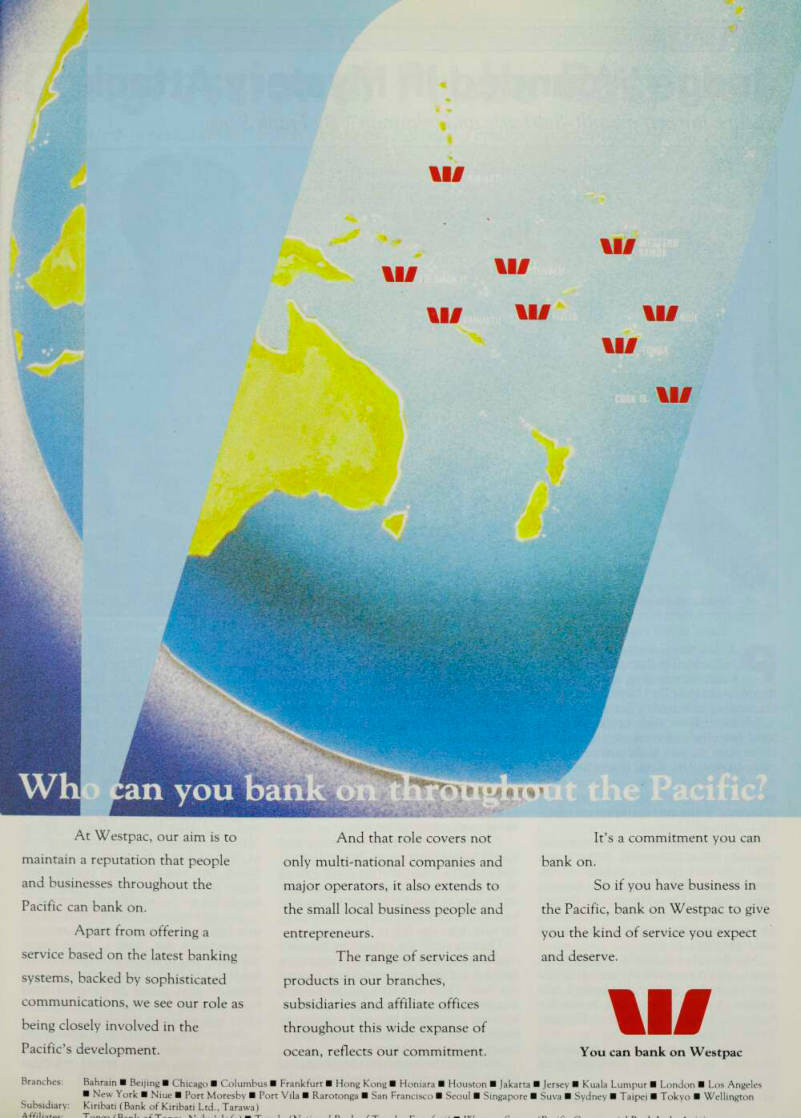
ll# ll# 1 ■ At Westpac, our aim is to maintain a reputation that people and businesses throughout the Pacific can bank on.
Apart from offering a service based on the latest banking systems, backed by sophisticated communications, we see our role as being closely involved in the Pacific’s development.
And that role covers not only multi-national companies and major operators, it also extends to the small local business people and entrepreneurs.
The range of services and products in our branches, subsidiaries and affiliate offices throughout this wide expanse of It’s a commitment you can bank on.
So if you have business in the Pacific, bank on Westpac to give you the kind of service you expect and deserve. ll# ocean, reflects our commitment.
You can bank on Westpac Branches: Bahrain ■ Beijing ■ Chicago ■ Columbus ■ Frankfurt ■ Hong Kong ■ Honiara ■ Houston ■ Jakarta ■ Jersey ■ Kuala Lumpur ■ London ■ Los Angeles ■ New York ■ Niue ■ Port Moresby ■ Port Vila ■ Rarotonga ■ San Francisco ■ Seoul ■ Singapore ■ Suva ■ Sydney ■ Taipei ■ Tokyo ■ Wellington Subsidiary: Kiribati (Bank of Kiribati Ltd., Tarawa) rn— ]. ■HHi.f. r . *rv_. i /vt /- - iu;
Judge Wounded In Mystery Attack
Papua New Guinea
Justice Barnett assault “barbaric and inhuman
By Frank Senge
PAPUA New Guinea National Court Judge Mr Tos Barnett and his wife Leela were singing in their car as they drove to their Port Moresby home on the evening of Saturday, September 10.
Moments later, their peace was shat tered brutally: as the couple stopped the car to open the gate to their home, a gang rushed them. Mrs Barnett watched, par alysed with fear and shock, as about eight men repeatedly stabbed her husband, chanting: “Kilim em i dai! kilim em i dai!” (“Kill him! Kill him!”).
Mr Justice Barnett, the Commissioner heading the controversial inquiry into PNG’s forestry industry (which recom mended criminal charges be brought against Mr Ted Diro, Member for Central Province), sustained a ruptured right lung and multiple stab wounds to his stomach and right thigh.
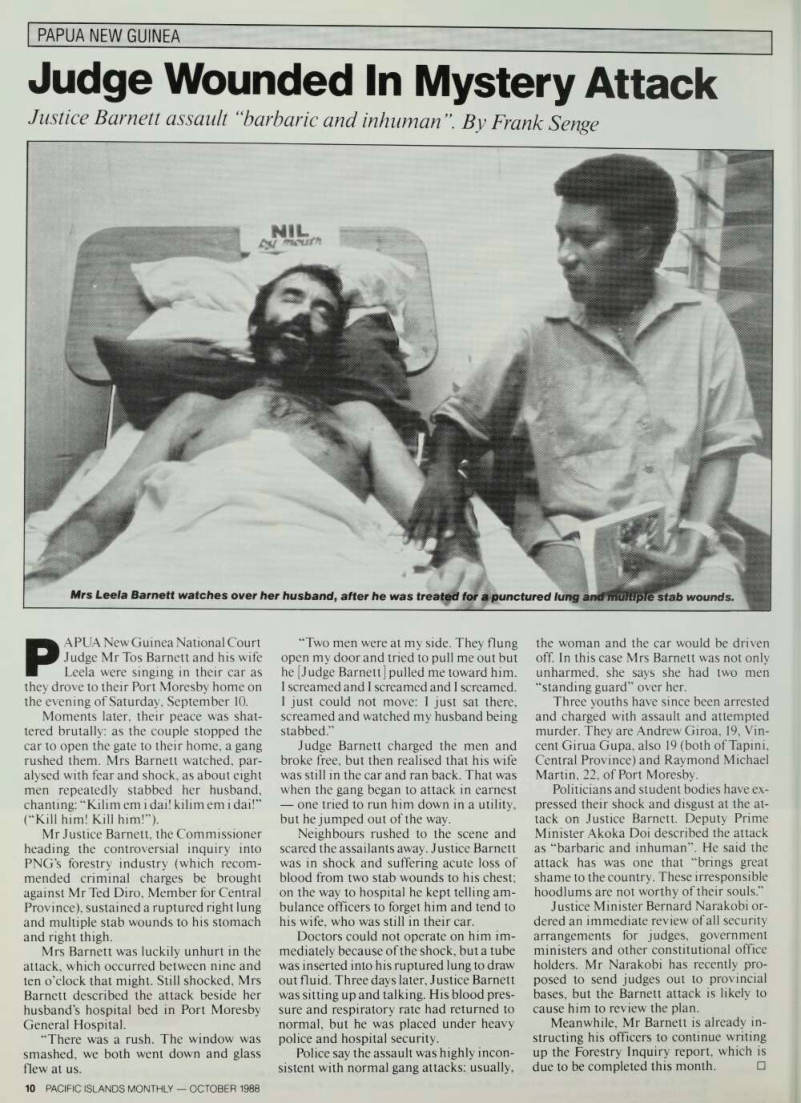
Mrs Barnett was luckily unhurt in the attack, which occurred between nine and ten o’clock that might. Still shocked, Mrs Barnett described the attack beside her husband’s hospital bed in Port Moresby General Hospital.
“There was a rush. The window was smashed, we both went down and glass flew at us.
“Two men were at my side. They flung open my door and tried to pull me out but he [Judge Barnett] pulled me toward him.
I screamed and I screamed and I screamed.
I just could not move: I just sat there, screamed and watched my husband being stabbed.”
Judge Barnett charged the men and broke free, but then realised that his wife was still in the car and ran back. That was when the gang began to attack in earnest one tried to run him down in a utility, but he jumped out of the way.
Neighbours rushed to the scene and scared the assailants away. Justice Barnett was in shock and suffering acute loss of blood from two stab wounds to his chest; on the way to hospital he kept telling am bulance officers to forget him and tend to his wife, who was still in their car.
Doctors could not operate on him im mediately because of the shock, but a tube was inserted into his ruptured lung to draw out fluid. Three days later. Justice Barnett was sitting up and talking. His blood pres sure and respiratory rate had returned to normal, but he was placed under heavy police and hospital security.
Police say the assault was highly incon sistent with normal gang attacks; usually,
the woman and the car would be driven off. In this case Mrs Barnett was not only unharmed, she says she had two men “standing guard” over her.
Three youths have since been arrested and charged with assault and attempted murder. They are Andrew Giroa, 19, Vin cent Girua Gupa, also 19 (both of Tapini, Central Province) and Raymond Michael Martin, 22, of Port Moresby.
Politicians and student bodies have ex pressed their shock and disgust at the at tack on Justice Barnett. Deputy Prime Minister Akoka Doi described the attack as “barbaric and inhuman”. He said the attack has was one that “brings great shame to the country. These irresponsible hoodlums are not worthy of their souls.”
Justice Minister Bernard Narakobi or dered an immediate review of all security arrangements for judges, government ministers and other constitutional office holders. Mr Narakobi has recently pro posed to send judges out to provincial bases, but the Barnett attack is likely to cause him to review the plan.
Meanwhile, Mr Barnett is already in structing his officers to continue writing up the Forestry Inquiry report, which is due to be completed this month. □
Mrs Leela Barnett watches over her husband, after he was trea teated fo r a punctured lung wounds.
Congressional Probe Resumes
Palau
Augmented investigation hopes to uncover Trust Territory corruption.
By Ed Rampell
THE United States Congress is send ing a second team of investigators to the Republic of Palau for re newed examination of the mysterious oc currences that have racked the island nation for almost a decade a still un solved presidential assassination, a cam paign of murder and arson aimed at opponents of a proposed Compact of Free Association with the United States, and the suspicious IPSECO power project. The Congressional probers will look into the IPSECO scandals, government road and capitol relocation contracts and alleged links with drug trafficking.
Though it is a United Nations Trust Territory, Palau is administered by Wash ington and is thus subject to American ju risdiction. The Congressional watchdog agency, the General Accounting Office or GAO, is sending the investigative delega tion to continue a GAO investigation that began in 1987. Congress determined that the intricate inquiry required more time, so the follow-up team has been sent from Washington and Honolulu to Koror to ob tain additional information in what has proved an extremely complicated case.
The dubious, overpriced IPSECO power project is high on the investigators’ list. The IPSECO fiscal fiasco has become one of the Pacific’s biggest scams: in the early ’Bos, Palau entered into an agree ment to construct a badly needed power plant and fuel facility albeit one for which it could never pay. The Microne sian nation defaulted on its loans in early 1985 and IPSECO, a British firm, went bankrupt. A United States Federal court recently ruled that the Republic is liable for SUS 44 million owed to the interna tional banking cartel that financed IPS ECO. (Palau’s Washington-funded annual budget is less than SUS2O million.) The GAO and other investigators have charged that Palauan officials accepted huge payoffs from IPSECO in exchange for influence peddling. The kickback recipi ents allegedly include deceased President Lazarus Salii; his brother, former Speaker of the House Carlos Salii; High Chief Ibedul Yutaka Gibbons; and Palau Na tional Development Bank Chairman Po lycarp Basilius. Chairman Basilius was instrumental in arranging the controver sial IPSECO deal and received more than SUS2OO,OOO for his decisive role. Despite ethical concerns, influence peddling may hot be against Palauan law, though it is strictly forbidden by US law.
A US Congressional staffer said the GAO will also look into suspicious road
and capitol relocation contracts signed by President Salii, who died on August 20.
According to Palau’s constitution, the Republic’s capitol must be moved from its present provisional site at Koror to the un developed island of Babeldaob in the 19905. The contracts are worth more than SUSI billion, and are the background to behind-the-scenes power plays between two high ranking chiefly titles and their respective factions the East Coast Ba
"According to a Congressional source, Palau's troubles tie into the same group of people"
beldaob Reklai and the Koror Ibedul.
Though the Compact provides for the con struction of a cross-Babeldaob road, the Salii administration has separately con tracted out road projects.
A knowledgable Congressional source contends that “there is no competence to determine whether the roads being put in are good engineering; no plans, other than a political one.” As with IPSECO, this source asserts that “without the Compact, there’s no money for the roads: so where is the funding coming from?”
The Congressional staffer went on to say that the inquiry will also examine the drug trade in Palau. The archipelago has purportedly become a major transship ment point for narcotics, and Congress man Morris Udall, the influential Chairman of the House Committee on In terior and Insular Affairs, has alleged that Palauan politicians have been involved in drug trafficking.
The investigation will examine what it calls Palau’s “overall problems”, includ ing the political violence that has plagued the microstate. Two Palauan presidents have been killed by gunshot in only three
years, and the assassins of President Haruo Remeliik remain at large. President Salii’s Special Assistant, Joel Toribiong, was convicted in relation to a shooting inci dent at the home of the current Speaker of the House of Delegates, and a string of fi rebombings as well as alleged murder have been aimed at opponents of IPS ECO and the proposed Compact, which would seek to replace the US-adminis tered United Nations Trusteeship with a new political status granting Palau auton omy and substantial US funding. In ex change, the Pentagon would receive military access in the strategically located Western Pacific archipelago.
IPSECO critics contend that the power project was in reality aimed at forcing vot ers to grant the Compact the 75 per cent vote required to override the anti-nuclear law, since Compact funding is the only po tential source Palau has for repaying the IPSECO debt. Once the Compact had been passed, they say, the Pentagon could con struct fallback bases in Palau if the major Philippines installations close down when leases expire in 1991. The military would have a free new power plant and 25-mil lion-litre fuel storage to provide energy for the Western Pacific defence area from an oversized facility that is far too large for the needs of Palau’s 15,000 people.
According to the Congressional source, “the previous Palau administration did not look into these problems because it could incriminate itself. . . Though the probe is not investigating a particular individual, all of Palau’s troubles tie into the same group of people; and that’s why they hav en’t looked into these matters.”
The General Accounting Office does not have the power to indict, but its fact finding mission can provide evidence for future indictments. Moves are also afoot to provide the beleaguered Republic with an auditor and a prosecutor; because of the Trusteeship’s ambiguous political status the investigation will have to deal with thorny jurisdictional questions, though the US Interior Department still has respon sibility for Palau. Washington has been cracking down on corruption in its Pacific possessions, and there have already been indictments in Guam, the Common wealth of the Northern Marianas and American Samoa. But the crimes at Palau including murder, arson, drug traffick ing, and the bankrupting of an entire na tion are far more serious than any of the charges brought in other American-affili ated territories. □
“Unity” In Noumea
New Caledonia
Kanaks and Caldoches gather in a rare show of amity.
THE success of French Prime Min ister Michel Rocard’s historic visit to New Caledonia late in August can be summed up by one incredible scene in side Noumea’s Town Hall: on stage stood Kanak and Caldoche leaders Jean-Marie Tjibaou and Jacques Lafleur, arms raised to acknowledge an ovation from a Euro pean audience.
Every inhabitant of New Caledonia was aware that this was a historic moment: not only the first visit by a Socialist Prime Minister to a territory that only a few months ago was on the brink of civil war, but the first time Jean- Marie Tjibaou has been publicly hailed by those who again, only a few months ago had damned him as a terrorist.
Mr Rocard, however, was less obliging to his Noumea audience. He called on New Caledonia’s European minority to “end the unequal system where one city dominates the rest of the territory, and where one community dominates the others.” He echoed Charles de Gaulle’s warning to the pieds-noirs that France was engaged in a “decolonisation” process in Algeria, call ing on Caldoches and Melanesians alike to accept a new order albeit one where New Caledonia will maintain “close links” with France through “decolonisation in side Republican institutions”.
According to Mr Rocard, the Matignon Accord signed in Paris on August 20 es tablishes the Government of France as “a referee; not as a player in the New Cale donian game.” To this end, he has pledged to give Kanaks an opportunity to play a meaningful part in an economic and ad ministrative system that had previously seen them as marginal elements. Four thousand “development traineeships” will be offered to young Kanaks in the terri tory’s municipalities, and 400 “mostly Melanesian” public servants will be sent to France for training. The move has won support from private sector interests in New Caledonia; a representative commit tee has urged the French Government also to assist private investment in areas out side Noumea, and to encourage Melane sians to establish profit-based businesses rather than co-operatives.
In the public sector, Mr Rocard has nominated positions in the police, tele vision and judiciary for Kanaks, promis ing a division of the present judicial system and the setting up of “branches” in Lifou (Loyalty Islands), Kone (on the west coast of Grande Terre) and Poindimie (east coast) to defuse accusations of a system
that worked primarily to “condemn Kan aks”, as separatists have claimed.
One of the most notable features of the Prime Minister’s visit was the absence of disturbances, and the call by Jacques La fleur for RPCR supporters to attend Mr Rocard’s address: loyalists have previ ously boycotted Socialist officials.
By the end of the three-day visit, how ever, the RPCR was grumbling about Mr Rocard’s announcement of an inquiry into the accounts of ADRAF (Agence de De velopment Rural et d’Amenagement Fon der), the body charged with land management in New Caledonia. Effec tively controlled by the RPCR, the agency has attracted heated criticism both from the FLNKS (which accuses it of failing to take into account traditional land rights) and the anti-independence right wing (which accuses it of favouring only RPCR supporters). Mr Lafleur expressed his dis appointment with the decision, saying Mr Rocard “would do better to strengthen the peace agreement.”
On the independentist side, reaction to Mr Rocard’s visit was warmly positive: even Canala, scene of a virtual siege ear lier this year, turned out to give the PM a courteous welcome. But the celebrations masked an internal power struggle be tween Mr Tjibaou’s mainstream Union Caledonienne and more radical FLNKS members such as Yann Celene Uregei’s hardline FULK which initially refused to sign the Matignon accord that was only resolved after weeks of intense and
often extremely heated discussion.
The real test of Mr Rocard’s visit will be the November 6 referendum in France.
Traditionally regarded as a plebiscite giv ing approval (or warning) to the govern ment and its policy directions, a national referendum will determine whether all of France and her territories support the Ro card decolonisation plan (which in any case cannot afford to be watered down) or, as conservative Opposition parties claim, reject the Prime Minister’s “cynical ex ploitation” of international opinion.
Whichever path is chosen, Michel Rocard has gained valuable domestic and terri torial support through his reconciliation of communities that scant weeks ago were at each other’s throats. □
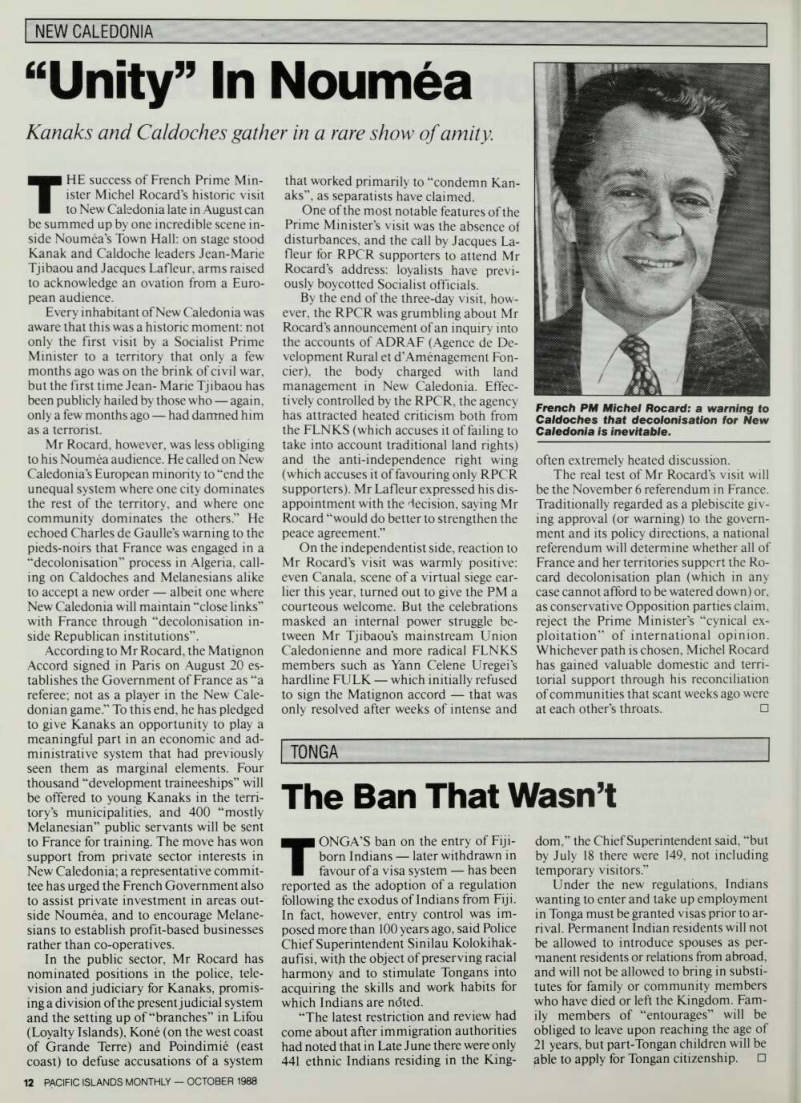
French PM Michel Rocard: a warning to Caldoches that decolonisation for New Caledonia is inevitable.
The Ban That Wasn’t
Tonga
TONGA’S ban on the entry of Fiji born Indians later withdrawn in favour of a visa system has been reported as the adoption of a regulation following the exodus of Indians from Fiji.
In fact, however, entry control was im posed more than 100 years ago, said Police Chief Superintendent Sinilau Kolokihak aufisi, with the object of preserving racial harmony and to stimulate Tongans into acquiring the skills and work habits for which Indians are noted.
“The latest restriction and review had come about after immigration authorities had noted that in Late June there were only 441 ethnic Indians residing in the King
dom,” the Chief Superintendent said, “but by July 18 there were 149, not including temporary visitors.”
Under the new regulations, Indians wanting to enter and take up employment in Tonga must be granted visas prior to ar rival. Permanent Indian residents will not be allowed to introduce spouses as per manent residents or relations from abroad, and will not be allowed to bring in substi tutes for family or community members who have died or left the Kingdom. Fam ily members of “entourages” will be obliged to leave upon reaching the age of 21 years, but part-Tongan children will be able to apply for Tongan citizenship. □
Advertisements & other items, pp. 13-14 (1 item)
developing
Howto
develop your
Tail
economy by
developing
your
systems for isolated areas. OTC was one of the founders of Intelsat. And/in the development of optical fibre systems, OTC is a pioneer.
This technology, which Australia at the fqftfront of communications, is available to you through OTC#nternational.
Tailor-made telecommunications.
OTC gives m>u the choice of the worlds heap communications systems, whiclwcan be specifically designed to mee«your needs.
Because v£ design, construct and operate systems, we can offer you expeynce in integrating the best softaajßpSnd hardware available.
Putting you in control.
An important strategic and economic consideration for any
communications.
In todays world, no country can develop in isolation. To grow it must compete in fast-moving world markets, and to gain access to these a modern telecommunications network is $ absolutely essenl When cations from Australia’s vou get more than the telecommunications system availal You alsofiret the sound financial expertise thaf'has made OTC Australia’s telecommunicarscompany.
By providing training to your staff in all aspects of financial planning and cost accounting, your system will operate on a solid financial basis. And pay for itself.
Bringing world markets to you.
Australia, like many nations, is a long way from the world’s business capitals. However, through OTC’s advanced communications network, the world is now on our doorstep.
OTC is the world’s leading exponent of thin route satellite communications system is local management.
OTC’s advanced training program makes the transfer of knowledge an important part of your system implementation.
Training courses in operations and management, accounting and planning will quickly result in local staffing and administration.
Making the right decision.
For an objective appraisal of your communication needs contact OTC now. Phone or write to Mr. Peter Shore, Executive Director, OTC International Ltd, GPO Box 7000, Sydney NSW 2001 Australia. Telephone (612)2875410, Fax (612)2875617. 0T1’0264 inojo.MDA I*l M
anyhow
tuwea
Winfield
i the rest
FITNESS
yOUn */arn ,ng - EPljgS vV3 r R
OKING
A u Itn SM
Nauru Still Flightless
Nauru
The region’s longest air strike drags on into its sixth month.
By Robin Bromby
AIR NAURU seems unlikely to re sume commercial operations for some time both New Zealand and Australia have withdrawn the airline’s certification. Air Nauru has been grounded commercially since May, its problems symptomatic of the economic malaise that afflicts this tiny republic.
Both the airline and the national ship ping company are believed to have lost rel atively huge sums in recent years, indicative of what recently leaked Aus tralian Foreign Affairs documents char acterised as waste and extravagance by the islanders, squandering the vast phosphate income that once gave them the highest per capita income in the world. Such have been the losses on Air Nauru that one Aus tralian Government official said the strike was “the best thing that could have hap pened” an situation that should at least reduce Nauru’s deficit this year.
The majority of Air Nauru pilots struck in May after the secretary of the Nauru Airline Pilots’ Association (NAPA), Cap tain Thomas Reid, was dismissed by the island’s government concerned that op erational deficiencies were compromising the safety of the airline. Since then, the air line has been operating flights with the four pilots still on staff.
In June, the New Zealand Ministry of Transport (which administers Nauru’s civil aviation regulations) withdrew the airline’s Air Service Certificate because it could not meet the Ministry’s interna tional air transport standards. This led to Australian authorities withdrawing Air Nauru’s Air Operator’s Certificate, the piece of paper that permits an airline to carry passengers on a fare-paying basis.
A spokesman for the Australian Civil Aviation Authority told Pacific Islands Monthly that the concern was for the safety of fare-paying passengers. “The airline’s in a state of collapse,” he said.
Before the dispute with its pilots, Air Nauru operated three Boeing 737 aircraft to Sydney, Melbourne, Guam, Hong Kong, Tarawa, Honiara and Auckland. For a country with just 5000 nationals, it was a network that indicated high ambitions. Air Nauru certainly lost a great of money, though how many millions is not known: the Nauruan administration of President Hammer Deßoburt maintains great se crecy about its finances.
Regardless of its rather uncertain fu ture (it is understood attempts to recruit new pilots who would have replaced those who went on strike and were then sacked have been unsuccessful), Air Nauru is be
having as if it will soon be operating im ternationally again: it has decided to renew the lease on its Sydney sales office.
Nauru’s Consul-General in Mel bourne, Mr Lawrence Stephen, con firmed that Air Nauru’s jets were operating private flights at least to Melbourne. These flights enable Nauruans to travel to and from the island, and carry provisions and mail. Mr Stephen said otherwise he has been told nothing about what is happening.
The nation’s shipping line, Nauru Pa cific, it also understood to be losing sub stantial sums: hardly surprising, considering its operational procedures.
Nauru Pacific runs two small, non-con tainerised vessels, Eigamoyia and Eigigu.
One agent who deals with the company told Pacific Islands Monthly that the ships “go when they want to and rarely have a schedule. They’re incredibly vague.” The first he knows that one of Nauru Pacific’s ships is reaching Melbourne is when a telex arrives advising that the ship will be re ceiving cargo.
The ships often stay at berth in Mel bourne until they have enough cargo: sometimes six days, each day notching up high berth fees in port (the same agent’s Papua New Guinea trade ships take on cargo for a maximum of three days). Most
of the cargo for Nauru is loose and has to be packed before being stowed. He says there is rarely any cargo coming the other way, and that as far as he can tell the ves sels sail mostly empty on the Nauru-Mel bourne leg. “It’s a very strange shipping line,” the agent added.
It’s clear the Nauru Government is be ginning to be concerned about the nation’s long-term viability. In February 1987, President Deßoburt called for islanders to tighten their belts, to stop expecting the government to pay for everything includ ing new houses, and to work harder than they have been doing.
During a recent visit to the island by Australia’s new Foreign Affairs Minister, Senator Gareth Evans, the republic’s act ing President, Buraro Detudamo, report edly agreed that Australia could inspect Nauruan financial records as part of a proposed aid package. For years Pacific politicians and diplomats have speculated that Nauru’s investment, which includes a 52-storey tower in Melbourne, property and several hotels, includes many that have actually lost money.
If Australia does eventually get to see what the Nauruans have done with all their money, the real future of Air Nauru should at last be revealed. □
Kiribati A Strike Casualty
WHILE the Naurans can still use their three 737 jets to ferry patients and politicians and essential provisions on private flights to Australia, crewing the aircraft with the handful of non-striking pilots, the people of Kiribati are not so fortunate.
Air Nauru provided the fastest and cheapest air link with Australia, and the Boeing 737 could maintain a reasonable airfreight service: but now the grounding of the flights has stretched into its fifth month, Kiribati has only a weekly flight by Marshall Islands Airways, which op erates between the Marshalls and Fiji with a call at Tarawa in Kiribati.
While the airline can accommodate most of the passengers wanting to get to Kiribati, its relatively small aircraft the DO2B cannot meet the demand for air freight, and even medical supplies are being delayed. The Kiribati Government is understandably working on the premise that it could be some time before Air Nau ru’s jets touch down at its international air
port, and has apparently approached the Australian and New Zealand govern ments for help in establishing its own di rect service, probably to Australia.
According to one observer, the Kiri bati Government is considering several options, including the possibility of An sett extending its Cook Islands/Western Samoa operation to include Tarawa.
There fs one ominous development ac centuated by the Air Nauru strike: many young i-Kiribati men work abroad as sea men, a valuable source of overseas re mittances for the cash-strapped island economy. It is understood that some of the shipping companies employing these men are baulking at the cost of flying them home between engagements, arguing that it is cheper to employ Asian seamen whose homes are served by more frequent and cheaper air links. The loss of that employ ment would be a serious blow to the Kir ibati economy, and is one factor adding urgency to the government’s search for a new air service. □
New Directions For The Region
South Pacific Forum
Politics take a back seat to economic issues in
By Mesake Koroi
Disagreements on a re gion-wide scale marked the days leading up to this year’s South Pacific Forum meeting in the Tongan capital of Nuku’alofa. Au stralian Prime Minister Bob Hawke, Australian Foreign Minister Senator Gareth Evans and Fiji PM Ratu Sir Kamisese Mara were already embroiled in arguments over whether Senator Evans could pay a formal visit to deposed Fijian PM Dr Timoci Bavadra during a stopover in Fiji en route to Tonga.
Permission was refused by Fiji’s interim government, which caused Mr Hawke to publicly consider the matter of a SAIO million aid package to Fiji, aimed at helping the coun try’s economic recovery. Mr Hawke also foreshadowed discussions on Fiji’s proposed new Constitution, which some observers feared would further disadvantage Fiji’s large Indi an population.
However, by the time the Forum got under way the leaders’ differ ences had been ironed out. Senator Evans said on his arrival in Tonga that there was no desire to have the Forum take any initiative on Fiji; it would allow Fiji to sort out its own internal affairs. Senator Evans’ re marks were decried by Mr Jone Dakuvula, a New Zealand based Fi jian who represents Dr Bavadra’s ousted government: Mr Dakuvula called for a formal discussion on Fiji because it was “the main issue of public interest in the region”.
Prime Ministers Hawke and Mara sorted out their disagreements at a breakfast meeting on the Tuesday be fore the Forum began. Mr Hawke supported his Foreign Minister’s hopes that the whole of Fiji society would benefit by the new Constitu tion, and agreed that withdrawal of the proposed aid package would only hurt those most in need of assist ance. For his part, Ratu Mara ex plained the interim government’s stand on “outside interference” in Fiji’s affairs, and welcomed an opportunity to “make a start on res toring the relationships” between Fiji and both Australia and New Zealand.
Apart from general resolutions ack nowledging the changes in Fiji and calls for a Constitution that would give fair and equitable protection to
Fijians of all ethnic backgrounds, and unanimous acclaim for the efforts of France’s new government in resolv ing the long-running conflict in New Caledonia, most of the Forum’s busi ness concentrated on economic and development concerns.
One of the first subjects for discus sion was Japan’s intransigence with regard to regional fishing agreements.
That country insists on negotiating treaties with individual nations which, island leaders say, results in Japanese interests being able to “play off” one Pacific nation against another with promises of develop ment funds and aid in return for con cessions on catch levels.
Catch levels themselves are a sub ject of concern to Forum members, since the only figures provided are those from Japanese tuna vessels.
It was largely as a fence-mending gesture that Australia’s Prime Minis ter volunteered to use his country’s influence with Japan in pressing for a multilateral fishing agreement be tween all 16 Forum members and the Japanese Government. Mr Hawke said it would “sit better” with Japan’s aim of playing a greater re gional economic role if it were to agree to fishing treaties that took the needs of Pacific states into account,
and if official checks could be made on the numbers of fish offloaded in Japanese ports.
Other environmental issues were addressed during the meeting: not ably the threat posed by the “Green house Effect”, whereby gradual glob al warming could see some low-lying islands (especially Kiribati, Tuvalu and Tokelau) as well as more popu lous areas such as Bangladesh, dis appear as sea levels rise. The Austra lian delegation introduced the debate, and Forum leaders agreed to devote finances and research efforts to the search for solutions to a potentially cataclysmic situation.
Perhaps the most immediately sig nificant outcome of the Forum was the decision to streamline the South Pacific Bureau for Economic Co operation SPEC and to reorga nise its activities. In line with the emphasis on economic activities rather than politics, SPEC will now be known as the Forum Secretariat and will concentrate on improving the economies of member nations.
“The Forum has almost exhausted its role in dealing with political issues,” said Vanuatu PM Father Walter Fini.
“We are particularly satisfied in the case of New Caledonia, but the Forum now needs to look more spe cifically at economic issues; issues that are no longer of concern to in ternational bodies like the United Nations.”
Father Fini said the Forum, through the Secretariat, needed to work out procedures and guidelines regarding its contribution to member states; a vital part of protecting their security in the international sphere.
As well, the Forum voted to rationalise regional bodies such as the University of the South Pacific to protect it and its staff and students against political pressure. Co ordination of all such activities will be handled by the South Pacific Organisations Co-ordinating Commit tee (SPOCC), a new body established by the Forum at this year’s meeting.
Under the aegis of the revitalised SPEC or Secretariat and SPOCC will be the implementaton of recommendations contained in a re port on regional economic issues that was presented to (and endorsed by) members. It deals at length with
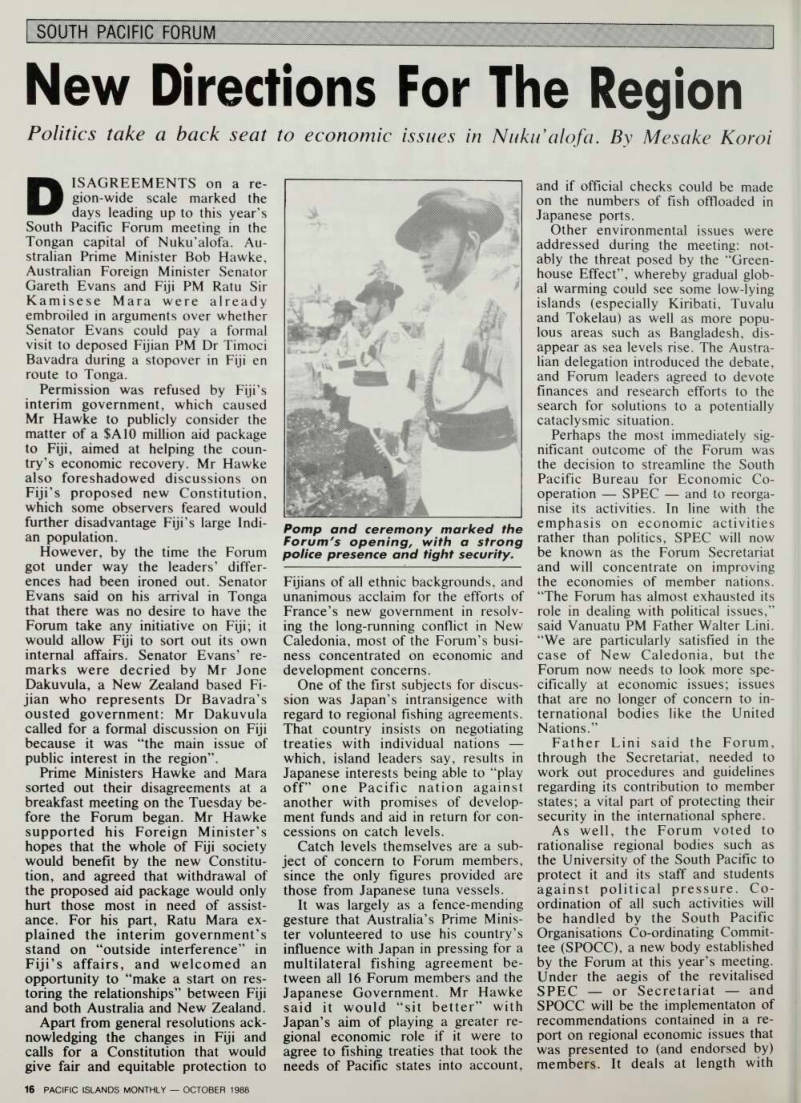
Pomp and ceremony marked the Forum's opening , with a strong police presence and tight security.
trade, investment, small business de velopment and the enhancement of economic planning capacity, and donors will be sought to supplement funds already available in realising the report’s aims.
Despite the provisions of the SPARTECA agreement giving South Pacific nations access to Australian and New Zealand markets, fun damental problems have meant some Forum countries (especially the smal ler nations) have actually been dis advantaged by the agreement: the meeting resolved to investigate ways of boosting production and marketing for member nations rather than “tink ering with” SPARTECA, which has been, on balance, a success.
One of the most far-reaching agree ments in Nuku’alofa concerned the proposal for a regional satellite-based communications network that was outlined in the May issue of Pacific
Islands Monthly.
With international giants such as British Telecom and Cable & Wire less looking to expand their holdings in the region, Bob Hawke lobbied successfully (or was at least given in principle support) for the adoption of an Australian satellite system de signed by OTCI, Australia’s govern-
ment-owned Overseas Telecommunications International.
As the meeting came to a close, President leremia Tabai announced that next year’s Forum would be held in Tarawa . . . and Western Samoan PM Tofilau Eti responded to criticisms of the way in which the international Press contingent had
been treated in Nuku’alofa (see this month’s Opinion pages) by urging Forum members to be “conscious of how the international community reacts to Forum decisions. The Forum has become much better known, and its activities are moni tored constantly by the international community.” □
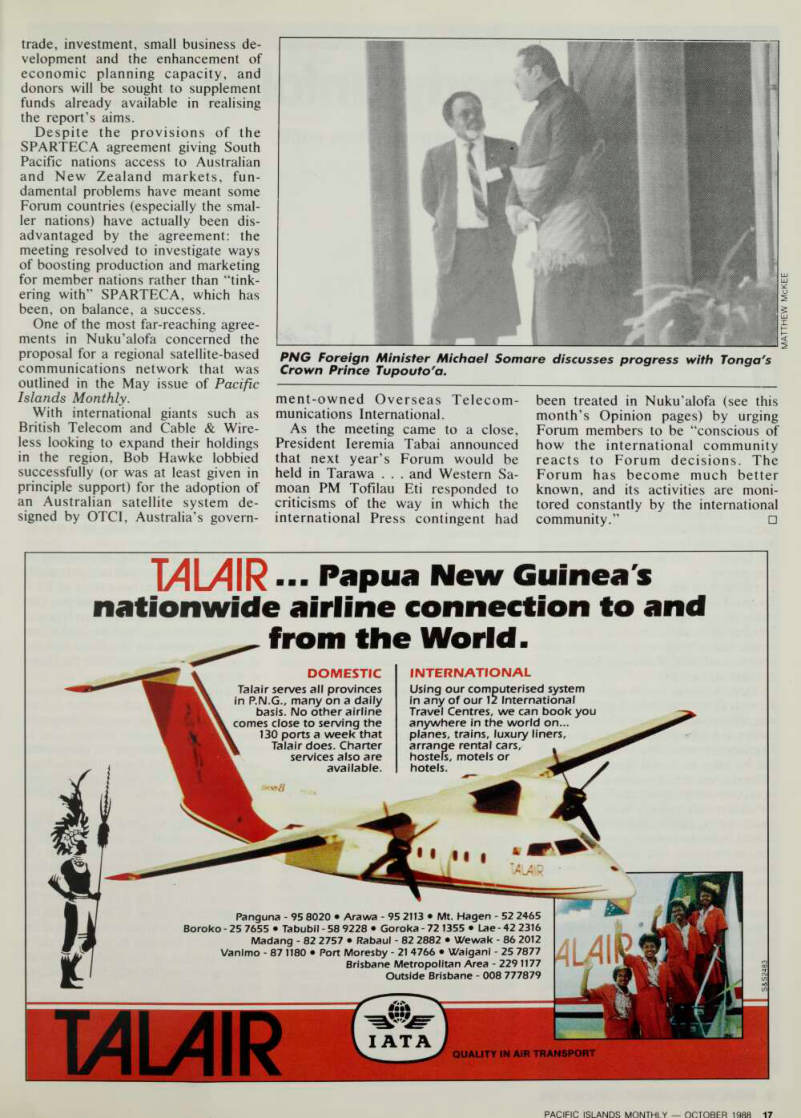
PNG Foreign Minister Michael Soma re discusses progress with Tonga's Crown Prince Tupouto'a.
Advertisements & other items, p. 17 (1 item)
Iaia\R
IALA\R --- Papua New Guinea's
nationwide airline connection to and
from the World.
it
DOMESTIC
Talair serves all provinces in P.N.G., many on a daily basis. No other airline comes close to serving the 130 ports a week that Talair does. Charter services also are available.
INTERNATIONAL
Using our computerised system
in any of our 12 International Travel Centres, we can book you anywhere in the world 0n...
planes, trains, luxury liners,
arrange rental cars, hostels, motels or hotels.
I I I I Panguna - 95 8020 • Arawa - 95 2113 • Mt. Hagen - 52 2465 Boroko - 25 7655 • Tabubil - 58 9228 • Goroka - 72 1355 • Lae - 42 2316 Madang - 82 2757 • Rabaul - 82 2882 • Wewak - 86 2012 Vanimo - 87 1180 • Port Moresby - 21 4766 • Waigani - 25 7877 Brisbane Metropolitan Area - 229 1177 Outside Brisbane - 008 777879
IAIA\R
ATA
QUALITY IN AIR TRANSPORT
Sunia’s Tragedy Unfolds
American Samoa
David North reports on the Congressman’s fall from grace.
THE scandal-marked departure of American Samoa’s Fofo Sunia from the halls of Congress is a tragedy not only for the island delegate it is a major setback for American Samoa as well.
Indicted by federal prosecutors on multiple counts of payroll fraud, ,51 -year old Sunia pleaded guilty, resigned from the House of Representatives on September 6, and faces a federal judge for sentencing on October 4. He could spend years in prison and pay substantial fines.
Meanwhile the interests of America’s only southern hemisphere territory will suffer; it will take years for Sunia’s succes sor to leam the ropes and, more impor tantly, to secure the seniority Sunia was beginning to enjoy.
The American House of Representa tives is a big place there are 435 voting members and five territorial delegates. An individual member, even with a vote on the floor of the House, can get lost in the body as a whole, but competent politi cians can make themselves felt by moving up in the complex committee structure of the House and Sunia had begun that long process.
Given both the size of the House and the usual lack of party discipline in floor votes, the committees make many of the detailed decisions of the body; and com mittee and subcommittee chairmen, who become experts in their fields, make many of those decisions.
Early last year Sunia made a break through for a territorial delegate when he was selected as chairman of the subcom mittee on public buildings of the House of Representatives Public Works Commit tee. No other territorial delegate had ever chaired a non territory-related committee or subcommittee. Suddenly Congressmen for all over the country were coming to Sunia, asking him for help as they sought federal buildings (usually courthouses) for their home towns. Sunia had power in his own committee, and could begin to wheel and deal with the rest of them.
He began using his new power to have projects for American Samoa funded through new and different legislative ve hicles: he didn’t have to place all his hopes on the traditional “omnibus” territorial authorisation bills that historically had been the focus of island delegates. Now, however, those new powers are again lost to American Samoa for at least a decade the time it usually takes for a new mem ber to move up to a subcommittee chairmanship.
“Sunia will be missed,” said Larry
Morgan, a longtime observer of the terri tories and the house of Representatives Director of Legislative and Public Affairs for the Interior Department’s Office of Territorial and International Affairs.
“In his own modest Pacific way, Sunia had became the most quietly effective ter ritorial delegate,” Morgan said, recount ing Sunia’s accomplishments, sometimes won against the wishes of the Interior De partment. “Everybody likes Fofo, he is a very pleasant person. That helped his cause, and that of American Samoa,” ac cording to Morgan who carefully sep arated his evaluation of Sunia’s legislative work from the charges against him. Mor gan had met Sunia when principal assist ant to a member of the House Interior Committee, another committee of which Sunia was a member.
Sunia addressed his legislative duties, often dealing with funding questions, with such success that government in Ameri can Samoa has many more resources than nearby Western Samoa: only the French colonies in the Pacific receive the kinds of largesse experienced by American Samoa and Guam. Part of the American Samoa- Western Samoa discrepancy related to Sunia’s work and part to the affluence of the US Government and its attitude that the islands should be treated as generously as the mainland.
Among Sunia’s recent projects were an effort to bring mainland money to Pago
Pago for such projects as a mainland-style welfare system, funds for fighting drug addiction and support for a National Guard (militia) unit. Throughout his term in the House he routinely secured Congressional passage for a tiny item in fund-allocation programs mandating that Samoa receive one quarter of one per cent of various special purpose funds distrib uted among states and territories. Nobody objected to 0.25 per cent of the funds (one dollar in $400) going to the islands, but then no one realised that 0.25 per cent of those funds was pretty good treatment for a territory that is home to only 0.015 per cent of the nation’s population.
What will happen now to American Samoa’s representation in Washington?
For the next four months Sunia’s seat will be vacant, despite efforts by both Sunia himself and Governor A P Lutali to avoid a vacancy. They had wanted the new Sa moa delegate to be seated this year so he would have more seniority than the other newcomers to the House, who will be seated in January.
Sunia had hoped that by resigning on September 6 his seat could be filled quickly by another Samoan, but a snarl of Terri torial and Federal laws prevented this. Part of the problem is that Pago Pago is new to this segment of mainland law, and its ter ritorial legislators (in the Fono) had not prepared for a resignation from the House of Representatives.
Territorial law says that if there is a va cancy in the delegate’s position of six months’ duration or less, the Governor may appoint an interim delegate (just as mainland governors can fill comparable vacancies in the US Senate.) But the Fono was looking at the wrong precedent mainland governors cannot appoint members of the House.
When Sunia resigned he knew Mr Lu tali would probably be unable to appoint someone to succeed him, but hoped the Governor could nevertheless call a special election to fill the vacancy, as mainland governors can. But the principal lawyer for the mainland House of Representatives ruled on the basis of territorial law that the Governor in fact had no power to call a special election, as the (useless) appoint ment option was the only thing available in the situation.
Meanwhile, several prominent Amer ican Samoans are busily running for the seat Sunia is vacating. Three of the prom inent candidates, all with territory-wide political backgrounds, are: • Eni Hunkin, current Lieutenant Gov
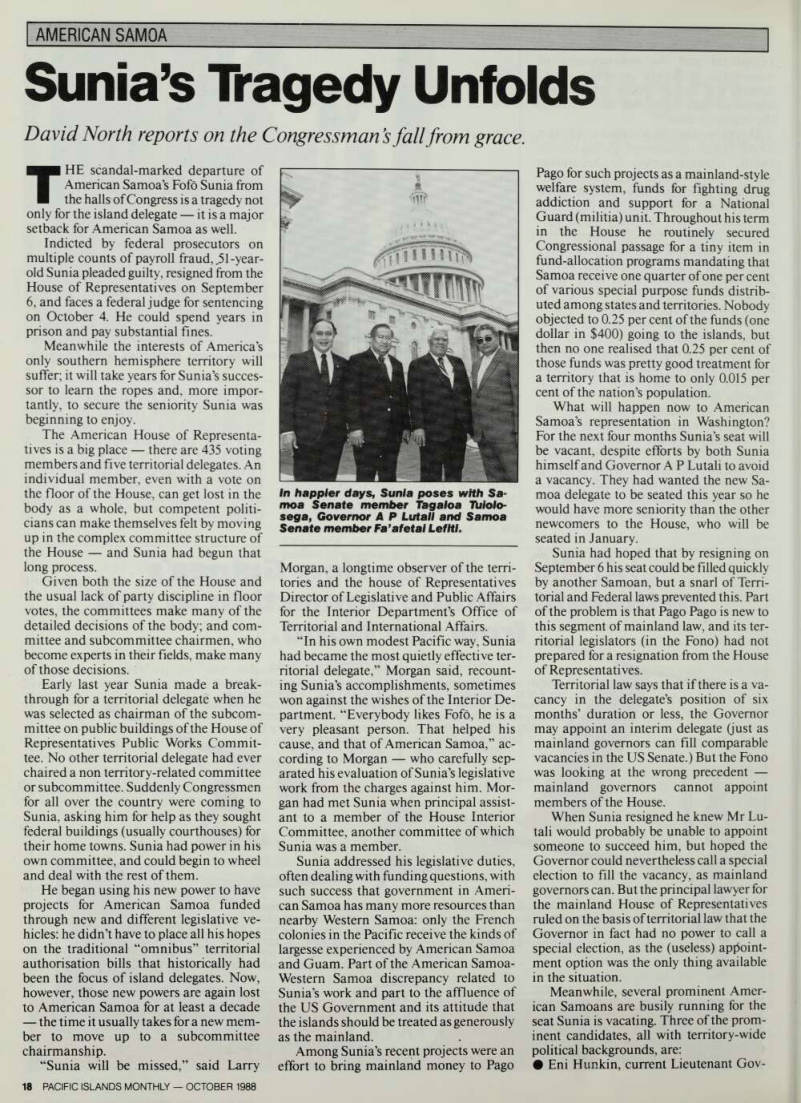
In happier days, Sunla poses with Sa moa Senate member Tagaloa Tuiolo sega, Governor A P Lutall and Samoa Senate member Fa’a fetal Lefltl.
emor of the Territory and former Congres sional staffer, a protege of controversial late Congressman Philip Burton. • Tufele Li’a, former Lieutenant Gover nor under Peter Tali Coleman, is said to have a perhaps trivial edge in one aspect of the race: it seems there are more Li’a bumper stickers than there are for the other candidates. • Soli Augmoeualago, the Territorial Public Defender, has run for the office twice before and came within 600 votes of beating Sunia two years ago.
Though the House of Representatives is organised along party lines, and though Sunia sat with the Democrats (and earned a chairmanship thereby), party lines are not very important in American Samoa.
Lutali and Hunkin identify themselves as National Democrats, and Augmoeualego received a contribution of SUSIOOO from the Republican National Committee last time he ran, but each party does not nom inate a single candidate as is the practice on the mainland.
Since there are no party nominations and since there are several candidates in the field it is likely none will win an ab solute majority of the vote on election day, November 8. If this occurs, the two lead ing candidates will fight it out in a second election, called a “runoff’, on November 22. American Samoa will then have a fur ther distinction, as its delegate will be the very last member of the House to be se lected; the others having been chosen on November 8, together with the President, Governors and Senators.
Why did Sunia do what he did? Why did temptation cause him to blow a pleas ant, high prestige job where he was doing useful things for his island territory? Sunia stopped talking to the press more than a year ago, but the one mainland reporter who has been following the story, Shan non Bradley of Washington Roll Call (which covers the Congress) had this to say: ’’Several current and former Sunia staf
fers ... have painted their boss as not a crook but as a Samoan out of his realm in Washington, a man bound by a culture that demands that he give in order to receive. ’They described Sunia, a father of eight, as perpetually hard up for money, yet ob ligated to prove his loyalty to visiting Sa moans by spending lavishly on them.
Staffers recall being invited to parties at fine restaurants when constituents came to town. ’lf Fofo didn’t fuss over them, they’d say “he doesn’t care about us any more’”, one former aide explained.
“Another added that Sunia adhered to the Samoan custom of showing his pres tige by flaunting his wealth, even though he didn’t have it.”
If Sunia had trouble breaking even on his $U589,500 a year salary (and a gen erous expense account for travel) he will be in worse shape shortly. He will probably be fined (he has pleaded guilty to taking SUS 130,000 that did not belong to him), and may well be unemployed. He may, of course, also go to prison.
It is a sad and sharp comedown for one whose biography shows a steady climb.
Following his graduation from the Uni versity of Hawaii (with a BA in Econom ics) in 1960, he spent 10 years in a series of increasingly important posts in American Samoa’s Government, such as appoint ment as the Territorial Elections Commis sioner and as a delegate to various South Pacific Conferences.
A high chief and a matai, he was se lected by his fellow matai to be a member of the Territorial Senate in 1970, and stayed there for many years before his first elec tion to the delegate’s seat in the US House of Representatives in 1980 the first Sa moan to hold the position.
Sunia has said he will return to Amer ican Samoa. But there may be a detour along the way, a spell in one of those pub lic buildings over whose planning, fund ing and construction he used to preside: a federal penitentiary. □
Bordallo Wins Appeal
By David North
FORMER Guam Governor Ricardo J Bordallo heard good news from the US Courts a few days before Amer ican Samoa delegate Fofo Sunia left Con gress. Bordallo had been convicted of accepting bribes from businessmen and drew a nine-year jail term: the sentence and most of his convictions were overturned by a three-nil decision of a US Appeals Court in San Francisco.
Both Sunia and Bordallo are islanders and Democrats, both were successfully prosecuted by the Reagan Administration for alleged corruption, and both (despite well-publicised charges) were elected as delegates to the Democratic convention that nominated Michael Dukakis for President. But the similarities^d there.
Up
Bordallo escaped from the bribery charges because the court found such bribery was only a crime if it involves state officials and Bordallo was a territorial one. The lower court apparently had not noticed this remarkable hole in the law.
Bordallo and Sunia reacted differently to the charges: Bordallo fought his indict ment, then appealed his convictions.
Sunia, having agreed to plead guilty, has a result no access to any appeals process.
The US Government in Bordallo’s case may appeal the Circuit Court ruling to the Supreme Court but that court hears only a small minority of the appeals brought to its attention, in effect confirm ing the lower courts’ decision by refusing to entertain the case. □
Advertisements & other items, p. 19 (1 item)
rrrrn 4. j
PTY. LTD
117 York St„ Sydney Cables: Henco Sydney.
C.P.O. Box 3949 Telephone: 261 1955.
For
specialised
and
personalised
buying
service
throughout
the
Pacific Islands
and the East
LOCAL AGENTS AND
REPRESENTATION
PAPUA NEW GUINEA
RABAUL: M. & C. Seeto, P.O. Box 131, Rabaul.
Telephone 92 2919
FIJI
K. Witherington Ltd., P.O. Box 293, Suva.
Telephone 22 356.
VANUATU
John Lum & Associates, P.O. Box 65, Santo.
Telephone 329.
Arts... Or Politics?
Austrlia
September’s Fifth Festival of Pacific Arts emerged as an uncomfortable compromise between tradition and realpolitik. By Leonie Hellmers
■ T could have been yet another ** I little blackfella festival the I beating of the drums, the shaking of the hips, the flowers in the hair. But the lids are being thrown off things now: Pa cific people have got to wake up!” said Shi reen Malamoo, co-ordinator for the Cultural Forum at last month’s Fifth Fes tival of Pacific Arts in Townsville, Queensland.
To some, in a way, it was another “little blackfella festival”; to the squadrons of home video makers, to the whites reclin ing in their deckchair South Pacific dreams, to the Townsville local who yelled “Baby! Come over here!” at a grass-skirted dancer representing the goddess of the night, and who thereby broke the sacred silence of the Tahitian Fire Walk.
But to the Aborigines and Torres Strait Islanders who organised the festival, this was a major achievement; the first time these people have been responsible for al most 2000 delegates from 24 nations to be fed. housed and transported over 10 days.
For the hosts, accomplishing that is a strong political statement in itself. Ac complishing it in Townsville a city known for its racism is an even greater victory. A piece of poetic justice, perhaps, to stage a festival of indigenous cultures in the bosom of the enemy.
So perhaps the hosts should be for given for “coming out” at their own party.
Some delegates, however, were less than overjoyed by what they saw as the politi cisation of a cultural festival. Others say it’s high time the festival became a forum for more than dying cultures, questioning whether it can afford to avoid the political.
Still others thought the festival didn’t go far enough, pointing to a “conspiracy of si lence” among the head bureaucrats. Some say it was less a conspiracy, more a com promise made by what they saw as a new class of Canberra Tat cats’.
It was clear that the flavour of this fes tival was a peculiar mixture of responses to political pressures from both the local Aboriginal community and the funding Federal Government. The difficulties be gan almost a decade ago when Townsville City Council made its original bid for the festival. Planning went ahead under mostly white, partly black management; then last year, while visiting Townsville, Prime Minister Bob Hawke announced the
festival as an Australian Bicentennial Event and caused some offence with the announcement.
Around this time dispute broke out when locals saw the festival heading in the wrong direction. “The basic problem,” ac cording to local Aboriginal Les CTNeill, “was that the Aborigines were not in con trol.” There followed a sit-in at the festival office lasting three days. The office re-
sponded by closing down for three weeks before a compromise was struck, the Fes tival Board was re- formed and a local Ad visory Committee formed anew.
When it came to the actual festival pro gram some members within the commu nity pushed for a greater political edge.
Administrators, however, had an ear to Federal Government concerns. The Cul tural Forum illustrates this war of wills. As well as performance, film, craft, language and exhibition components, it was argued there should also be a forum to discuss problems shared by Pacific islanders. The proposal encountered resistance from Australia’s Foreign Affairs Department and from others concerned about what might be sensitive material. The idea lived on, however, and was finally approved two weeks before the festival began. It did not appear on much of the festival literature.
Called a ‘cultural’ rather than ‘political’ forum, it was widely regarded as one of the greatest successes of the festival.. . de spite being held indoors, out of town, and not widely attended.
Papers were given on the struggle for sovereignty, self determination and the status of language. There was talk of Ab original economic development in Aus tralia, a women’s session, updates on events in Palau, Guam, the Solomons,
Aboriginal deaths in custody, terrorism and colonisation.
On the other hand it seems the Aus tralian Government, having put up the money, wanted less and less to do with the festival. One organiser spoke bitterly of the Government’s “patronising air about the Pacific.. .We had ministers and presi dents from the Pacific here. Hawke showed for the opening, but no [Australian] min isters, Federal or State, saw fit to grace the
proceedings.” Festival staffer Jean Wes terhout pointed out that “previous festi vals had the entire nation working behind them. But in Australia there are different orientations all through the country: in Perth, for example, they associate with the Atlantic peoples. There is no unity, and the festival was perceived as a fringe activity.”
It was certainly regarded as such by most of the Australian media.
One incident seemed to some observ ers symbolic of a “white Australian” atti tude to the entire festival. The Tahitian Fire Walk was a first outside Tahiti and a logistical triumph for all concerned, re quiring transport of sacred stones, plants and idols, strict “protocol” involving full audience co- operation, and extreme con centration from the High Priest, Ray mond Graffe. Graffe summoned the elements and controlled them. He not only
crossed the burning stone oven himself, but guided more than 200 of the audience across as well.
The crowd was filled with a sense of awe and wonder . . . then this incredible cere mony concluded with a fireman from the Queensland Fire Brigade lugging out a huge hose and quenching the rocks. Where Tahitians walk the fire, it seems, Queen slanders are there to put it out.
When it came to dialogue, many dele gates were unhappy with what they saw as attempts to politicise the festival. One representative claimed the organisation had used the festival to buy support.
“They’re asking Guam to voice support without knowing all the problems: the pol itics of the Bicentennial have got into the wheels of the Festival,” he said.
“We’ve all got problems in the Pacific, “but they’re not the aims and issues I see
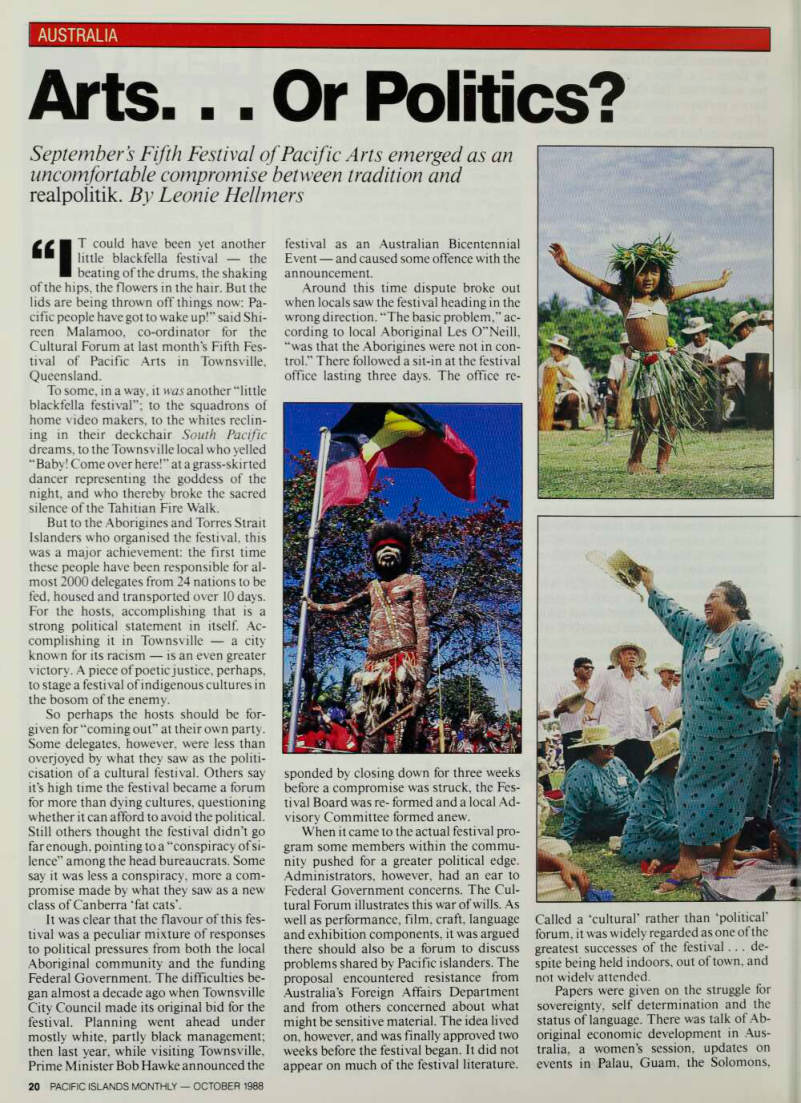
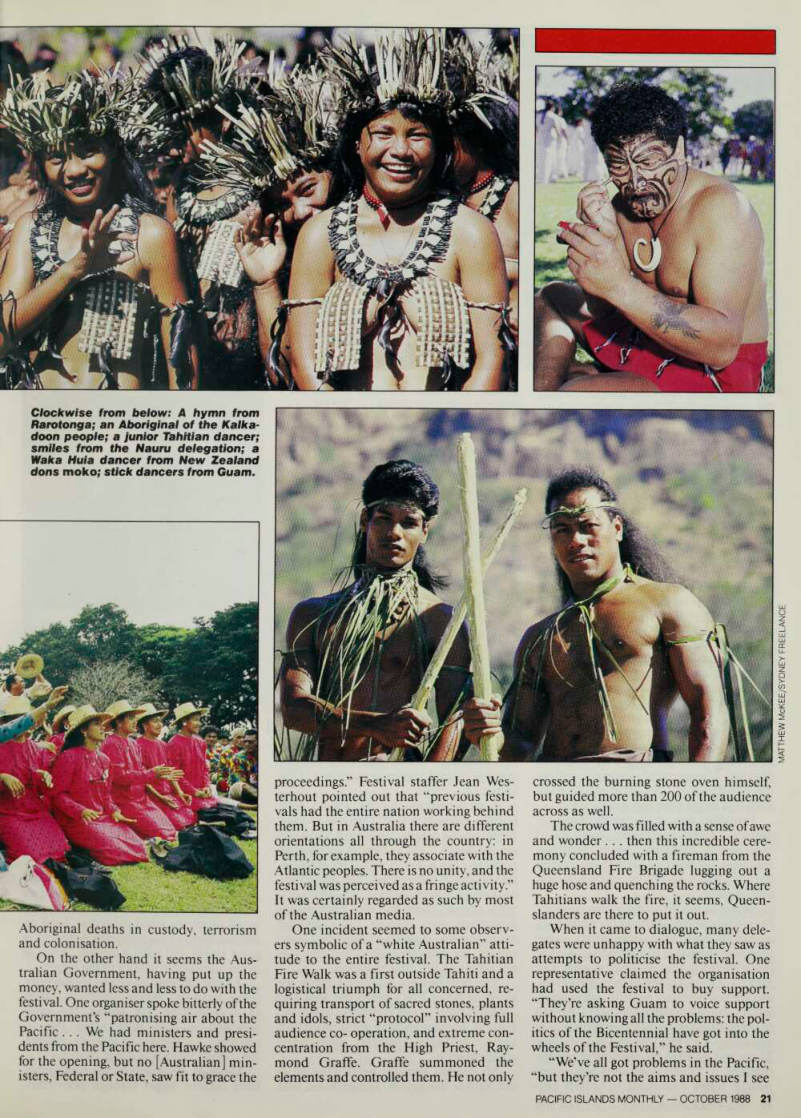
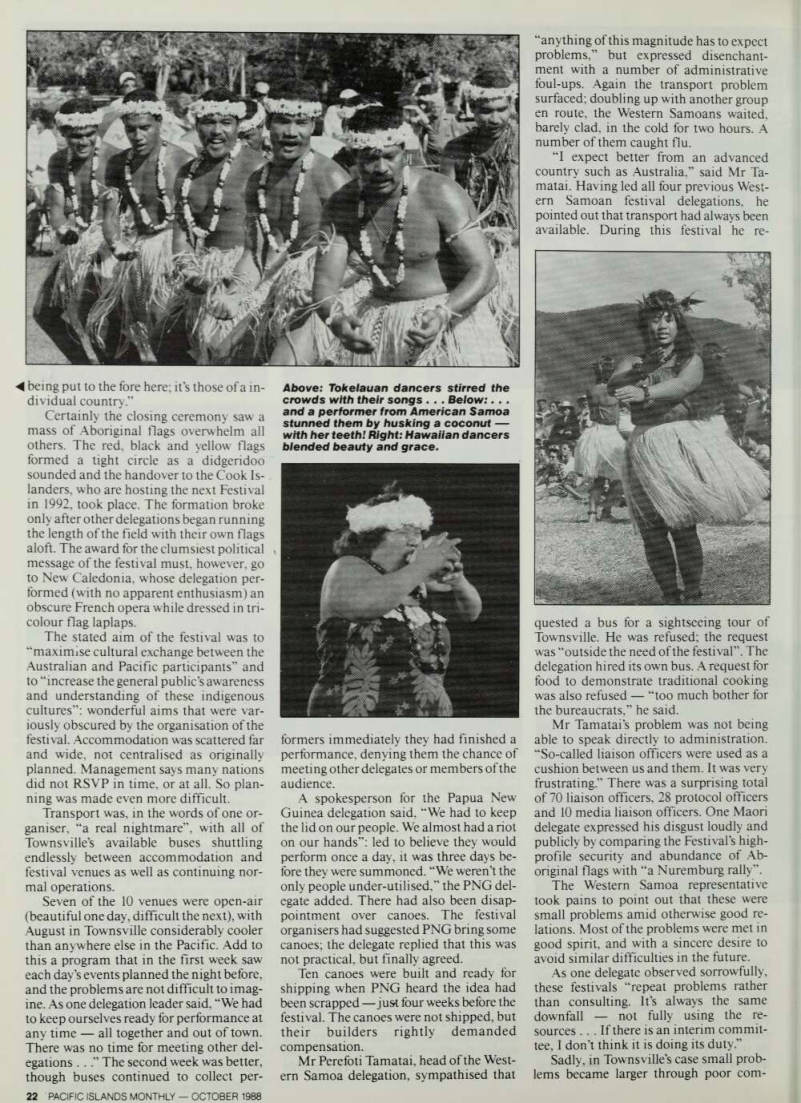
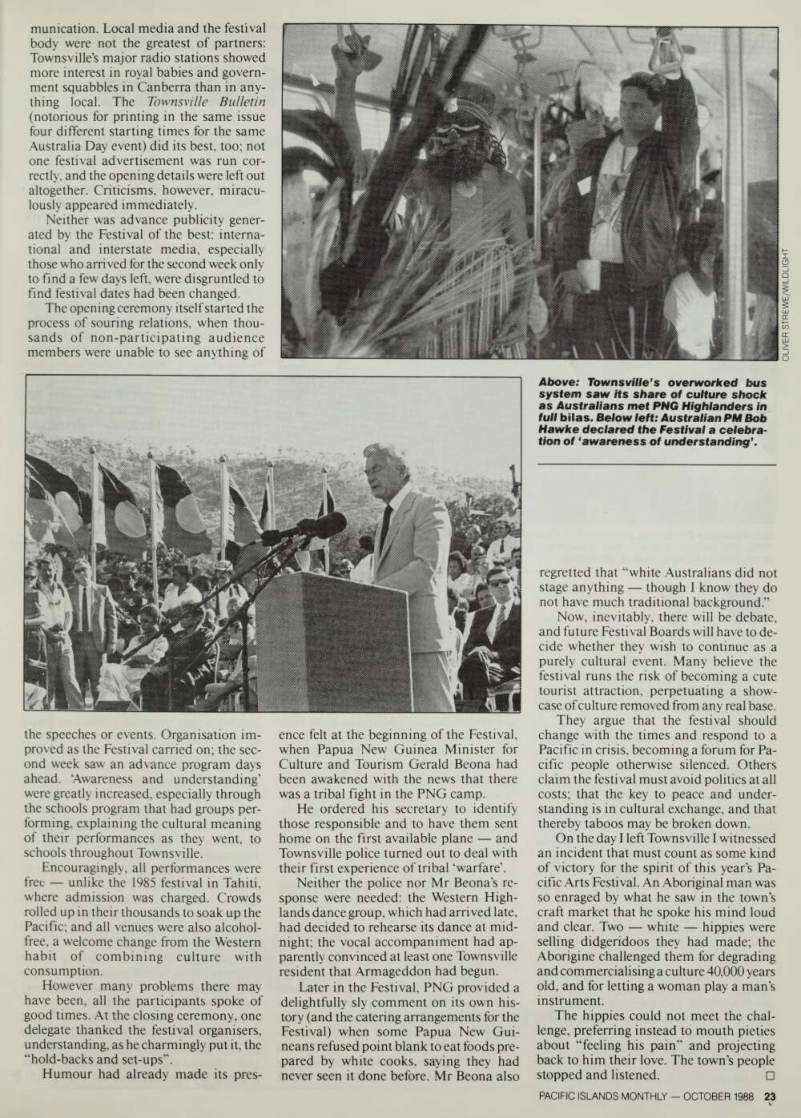
Clockwise from below: A hymn from Rarotonga; an Aboriginal of the Kalka doon people; a junior Tahitian dancer; smiles from the Nauru delegation; a Waka Huia dancer from New Zealand dons moko; stick dancers from Guam.
◄ being put to the fore here; it’s those of a in dividual country.”
Certainly the closing ceremony saw a mass of Aboriginal flags overwhelm all others. The red, black and yellow flags formed a tight circle as a didgeridoo sounded and the handover to the Cook Is landers, who are hosting the next Festival in 1992, took place. The formation broke only after other delegations began running the length of the field with their own flags aloft. The award for the clumsiest political message of the festival must, however, go to New Caledonia, whose delegation per formed (with no apparent enthusiasm) an obscure French opera while dressed in tri colour flag laplaps.
The stated aim of the festival was to “maximise cultural exchange between the Australian and Pacific participants” and to “increase the general public’s awareness and understanding of these indigenous cultures”; wonderful aims that were var iously obscured by the organisation of the festival. Accommodation was scattered far and wide, not centralised as originally planned. Management says many nations did not RSVP in time, or at all. So plan ning was made even more difficult.
Transport was, in the words of one or ganiser, “a real nightmare”, with all of Townsville’s available buses shuttling endlessly between accommodation and festival venues as well as continuing nor mal operations.
Seven of the 10 venues were open-air (beautiful one day, difficult the next), with August in Townsville considerably cooler than anywhere else in the Pacific. Add to this a program that in the first week saw each day’s events planned the night before, and the problems are not difficult to imag ine. As one delegation leader said, “We had to keep ourselves ready for performance at any time all together and out of town.
There was no time for meeting other del egations ...” The second week was better, though buses continued to collect per-
formers immediately they had finished a performance, denying them the chance of meeting other delegates or members of the audience.
A spokesperson for the Papua New Guinea delegation said, “We had to keep the lid on our people. We almost had a riot on our hands”; led to believe they would perform once a day, it was three days be fore they were summoned. “We weren’t the only people under-utilised,” the PNG del egate added. There had also been disap pointment over canoes. The festival organisers had suggested PNG bring some canoes; the delegate replied that this was not practical, but finally agreed.
Ten canoes were built and ready for shipping when PNG heard the idea had been scrapped —just four weeks before the festival. The canoes were not shipped, but their builders rightly demanded compensation.
Mr Perefoti Tamatai, head of the West ern Samoa delegation, sympathised that
“anything of this magnitude has to expect problems,” but expressed disenchant ment with a number of administrative foul-ups. Again the transport problem surfaced; doubling up with another group en route, the Western Samoans waited, barely clad, in the cold for two hours. A number of them caught flu.
“I expect better from an advanced country such as Australia,” said Mr Ta matai. Having led all four previous West ern Samoan festival delegations, he pointed out that transport had always been available. During this festival he re-
quested a bus for a sightseeing tour of Townsville. He was refused; the request was “outside the need of the festival”. The delegation hired its own bus. A request for food to demonstrate traditional cooking was also refused “too much bother for the bureaucrats,” he said.
Mr Tamatai’s problem was not being able to speak directly to administration.
“So-called liaison officers were used as a cushion between us and them. It was very frustrating.” There was a surprising total of 70 liaison officers, 28 protocol officers and 10 media liaison officers. One Maori delegate expressed his disgust loudly and publicly by comparing the Festival’s high profile security and abundance of Ab original flags with “a Nuremburg rally”.
The Western Samoa representative took pains to point out that these were small problems amid otherwise good re lations. Most of the problems were met in good spirit, and with a sincere desire to avoid similar difficulties in the future.
As one delegate observed sorrowfully, these festivals “repeat problems rather than consulting. It’s always the same downfall not fully using the re sources ... If there is an interim commit tee, I don’t think it is doing its duty.”
Sadly, in Townsville’s case small prob lems became larger through poor com
Above: Tokelauan dancers stirred the crowds with their songs... Below:... and a performer from American Samoa stunned them by husking a coconut with her teeth! Right: Hawaiian dancers blended beauty and grace.
munication. Local media and the festival body were not the greatest of partners; Townsville’s major radio stations showed more interest in royal babies and govern ment squabbles in Canberra than in any thing local. The Townsville Bulletin (notorious for printing in the same issue four different starting times for the same Australia Day event) did its best, too; not one festival advertisement was run cor rectly, and the opening details were left out altogether. Criticisms, however, miracu lously appeared immediately.
Neither was advance publicity gener ated by the Festival of the best: interna tional and interstate media, especially those who arrived for the second week only to find a few days left, were disgruntled to find festival dates had been changed.
The opening ceremony itself started the process of souring relations, when thou sands of non-participating audience members were unable to see anything of
the speeches or events. Organisation im proved as the Festival carried on; the sec ond week saw an advance program days ahead. ‘Awareness and understanding’ were greatly increased, especially through the schools program that had groups per forming, explaining the cultural meaning of their performances as they went, to schools throughout Townsville.
Encouragingly, all performances were free unlike the 1985 festival in Tahiti, where admission was charged. Crowds rolled up in their thousands to soak up the Pacific; and all venues were also alcohol free, a welcome change from the Western habit of combining culture with consumption.
However many problems there may have been, all the participants spoke of good times. At the closing ceremony, one delegate thanked the festival organisers, understanding, as he charmingly put it, the “hold-backs and set-ups”.
Humour had already made its pres
ence felt at the beginning of the Festival, when Papua New Guinea Minister for Culture and Tourism Gerald Beona had been awakened with the news that there was a tribal fight in the PNG camp.
He ordered his secretary to identify those responsible and to have them sent home on the first available plane and Townsville police turned out to deal with their first experience of tribal ‘warfare’.
Neither the police nor Mr Beona’s re sponse were needed: the Western High lands dance group, which had arrived late, had decided to rehearse its dance at mid night; the vocal accompaniment had ap parently convinced at least one Townsville resident that Armageddon had begun.
Later in the Festival, PNG provided a delightfully sly comment on its own his tory (and the catering arrangements for the Festival) when some Papua New Gui neans refused point blank to eat foods pre pared by white cooks, saying they had never seen it done before. Mr Beona also
regretted that “white Australians did not stage anything though I know they do not have much traditional background.”
Now, inevitably, there will be debate, and future Festival Boards will have to de cide whether they wish to continue as a purely cultural event. Many believe the festival runs the risk of becoming a cute tourist attraction, perpetuating a show case of culture removed from any real base.
They argue that the festival should change with the times and respond to a Pacific in crisis, becoming a forum for Pa cific people otherwise silenced. Others claim the festival must avoid politics at all costs; that the key to peace and under standing is in cultural exchange, and that thereby taboos may be broken down.
On the day I left Townsville I witnessed an incident that must count as some kind of victory for the spirit of this year’s Pa cific Arts Festival. An Aboriginal man was so enraged by what he saw in the town’s craft market that he spoke his mind loud and clear. Two white hippies were selling didgeridoos they had made; the Aborigine challenged them for degrading and commercialising a culture 40,000 years old, and for letting a woman play a man’s instrument.
The hippies could not meet the chal lenge, preferring instead to mouth pieties about “feeling his pain” and projecting back to him their love. The town’s people stopped and listened. □
Above: Townsville’s overworked bus system saw Us share of culture shock as Australians met PNG Highlanders in full bilas. Below left: Australian PM Bob Hawke declared the Festival a celebra tion of ‘awareness of understanding’.
Bright Future For Agriculture
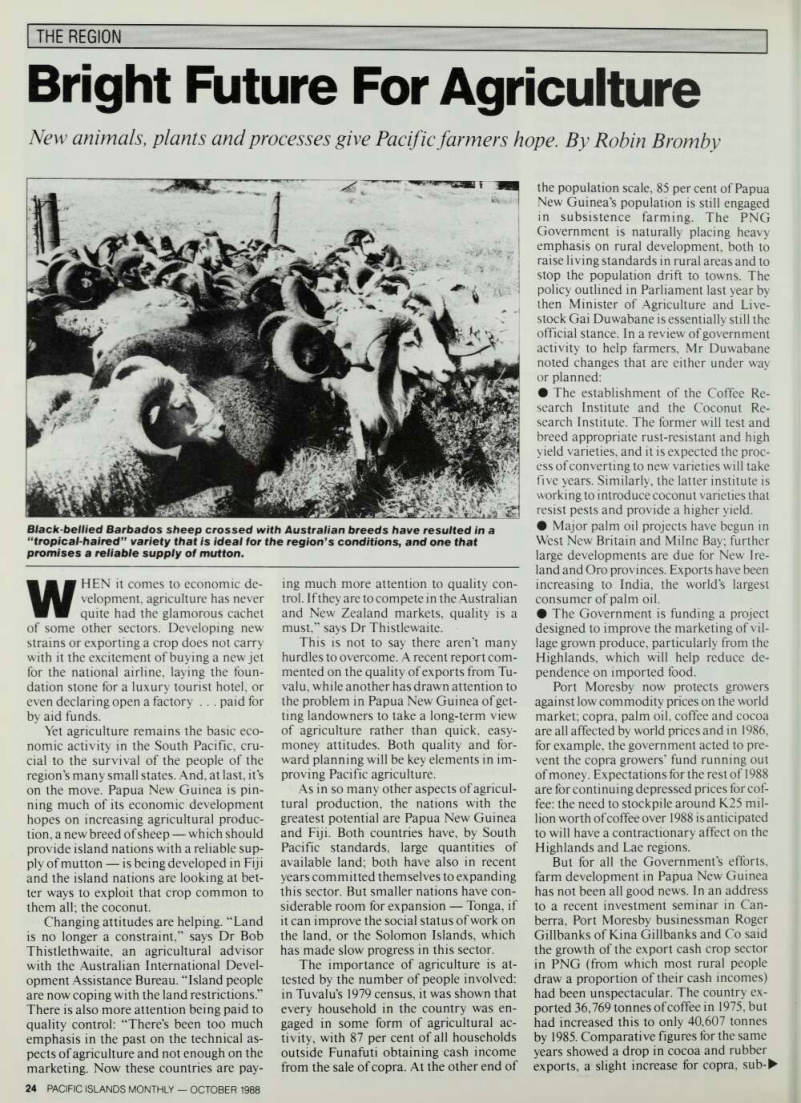

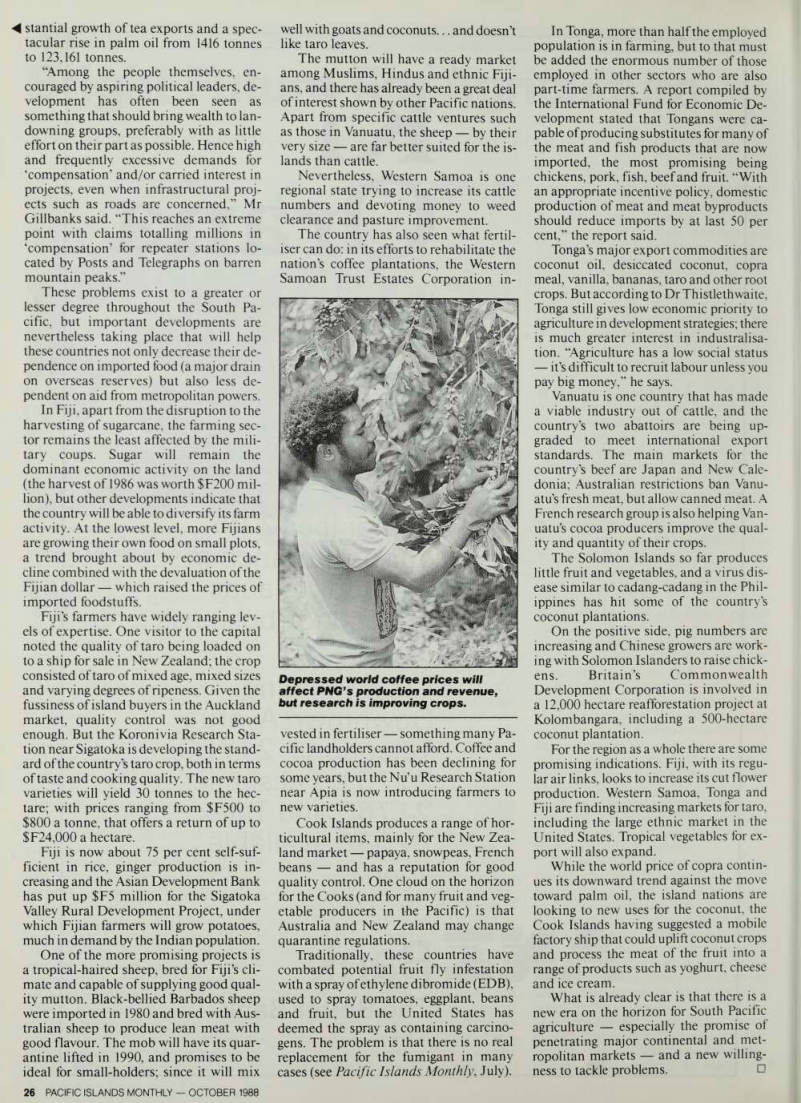
The Region
New animals, plants and processes give Pacific farmers hope.
By Robin Bromby
WHEN it comes to economic de velopment, agriculture has never quite had the glamorous cachet of some other sectors. Developing new strains or exporting a crop does not carry with it the excitement of buying a new jet for the national airline, laying the foun dation stone for a luxury tourist hotel, or even declaring open a factory .. . paid for by aid funds.
Yet agriculture remains the basic eco nomic activity in the South Pacific, cru cial to the survival of the people of the region’s many small states. And, at last, it’s on the move. Papua New Guinea is pin ning much of its economic development hopes on increasing agricultural produc tion, a new breed of sheep which should provide island nations with a reliable sup ply of mutton is being developed in Fiji and the island nations are looking at bet ter ways to exploit that crop common to them all; the coconut.
Changing attitudes are helping. “Land is no longer a constraint,” says Dr Bob Thistlethwaite, an agricultural advisor with the Australian International Devel opment Assistance Bureau. “Island people are now coping with the land restrictions.”
There is also more attention being paid to quality control: “There’s been too much emphasis in the past on the technical as pects of agriculture and not enough on the marketing. Now these countries are pay
ing much more attention to quality con trol. If they are to compete in the Australian and New Zealand markets, quality is a must,” says Dr Thistlewaite.
This is not to say there aren’t many hurdles to overcome. A recent report com mented on the quality of exports from Tu valu, while another has drawn attention to the problem in Papua New Guinea of get ting landowners to take a long-term view of agriculture rather than quick, easy money attitudes. Both quality and for ward planning will be key elements in im proving Pacific agriculture.
As in so many other aspects of agricul tural production, the nations with the greatest potential are Papua New Guinea and Fiji. Both countries have, by South Pacific standards, large quantities of available land; both have also in recent years committed themselves to expanding this sector. But smaller nations have con siderable room for expansion Tonga, if it can improve the social status of work on the land, or the Solomon Islands, which has made slow progress in this sector.
The importance of agriculture is at tested by the number of people involved: in Tuvalu’s 1979 census, it was shown that every household in the country was en gaged in some form of agricultural ac tivity, with 87 per cent of all households outside Funafuti obtaining cash income from the sale of copra. At the other end of
the population scale, 85 per cent of Papua New Guinea’s population is still engaged in subsistence farming. The PNG Government is naturally placing heavy emphasis on rural development, both to raise living standards in rural areas and to stop the population drift to towns. The policy outlined in Parliament last year by then Minister of Agriculture and Live stock Gai Duwabane is essentially still the official stance. In a review of government activity to help farmers, Mr Duwabane noted changes that are either under way or planned: • The establishment of the Coffee Re search Institute and the Coconut Re search Institute. The former will test and breed appropriate rust-resistant and high yield varieties, and it is expected the proc ess of converting to new varieties will take five years. Similarly, the latter institute is working to introduce coconut varieties that resist pests and provide a higher yield. • Major palm oil projects have begun in West New Britain and Milne Bay; further large developments are due for New Ire land and Oro provinces. Exports have been increasing to India, the world’s largest consumer of palm oil. • The Government is funding a project designed to improve the marketing of vil lage grown produce, particularly from the Highlands, which will help reduce de pendence on imported food.
Port Moresby now protects growers against low commodity prices on the world market; copra, palm oil, coffee and cocoa are all affected by world prices and in 1986, for example, the government acted to pre vent the copra growers’ fund running out of money. Expectations for the rest of 1988 are for continuing depressed prices for cof fee: the need to stockpile around K 25 mil lion worth of coffee over 1988 is anticipated to will have a contractionary affect on the Highlands and Lae regions.
But for all the Government’s efforts, farm development in Papua New Guinea has not been all good news. In an address to a recent investment seminar in Can berra, Port Moresby businessman Roger Gillbanks of Kina Gillbanks and Co said the growth of the export cash crop sector in PNG (from which most rural people draw a proportion of their cash incomes) had been unspectacular. The country ex ported 36,769 tonnes of coffee in 1975, but had increased this to only 40,607 tonnes by 1985. Comparative figures for the same years showed a drop in cocoa and rubber exports, a slight increase for copra, sub-^
Black-bellied Barbados sheep crossed with Australian breeds have resulted in a “ tropical-haired” variety that is ideal for the region’s conditions, and one that promises a reliable supply of mutton.
◄ stantial growth of tea exports and a spec tacular rise in palm oil from 1416 tonnes to 123,161 tonnes.
“Among the people themselves, en couraged by aspiring political leaders, de velopment has often been seen as something that should bring wealth to lan downing groups, preferably with as little effort on their part as possible. Hence high and frequently excessive demands for ‘compensation’ and/or carried interest in projects, even when infrastructural proj ects such as roads are concerned,” Mr Gillbanks said. “This reaches an extreme point with claims totalling millions in ‘compensation’ for repeater stations lo cated by Posts and Telegraphs on barren mountain peaks.”
These problems exist to a greater or lesser degree throughout the South Pa cific, but important developments are nevertheless taking place that will help these countries not only decrease their de pendence on imported food (a major drain on overseas reserves) but also less de pendent on aid from metropolitan powers.
In Fiji, apart from the disruption to the harvesting of sugarcane, the farming sec tor remains the least affected by the mili tary coups. Sugar will remain the dominant economic activity on the land (the harvest of 1986 was worth SF2OO mil lion), but other developments indicate that the country will be able to diversify its farm activity. At the lowest level, more Fijians are growing their own food on small plots, a trend brought about by economic de cline combined with the devaluation of the Fijian dollar which raised the prices of imported foodstuffs.
Fiji’s farmers have widely ranging lev els of expertise. One visitor to the capital noted the quality of taro being loaded on to a ship for sale in New Zealand; the crop consisted of taro of mixed age, mixed sizes and varying degrees of ripeness. Given the fussiness of island buyers in the Auckland market, quality control was not good enough. But the Koronivia Research Sta tion near Sigatoka is developing the stand ard of the country’s taro crop, both in terms of taste and cooking quality. The new taro varieties will yield 30 tonnes to the hec tare; with prices ranging from SFSOO to $BOO a tonne, that offers a return of up to $F24,000 a hectare.
Fiji is now about 75 per cent self-suf ficient in rice, ginger production is in creasing and the Asian Development Bank has put up SFS million for the Sigatoka Valley Rural Development Project, under which Fijian farmers will grow potatoes, much in demand by the Indian population.
One of the more promising projects is a tropical-haired sheep, bred for Fiji’s cli mate and capable of supplying good qual ity mutton. Black-bellied Barbados sheep were imported in 1980 and bred with Aus tralian sheep to produce lean meat with good flavour. The mob will have its quar antine lifted in 1990, and promises to be ideal for small-holders; since it will mix
well with goats and coconuts... and doesn’t like taro leaves.
The mutton will have a ready market among Muslims, Hindus and ethnic Fiji ans, and there has already been a great deal of interest shown by other Pacific nations.
Apart from specific cattle ventures such as those in Vanuatu, the sheep by their very size are far better suited for the is lands than cattle.
Nevertheless, Western Samoa is one regional state trying to increase its cattle numbers and devoting money to weed clearance and pasture improvement.
The country has also seen what fertil iser can do: in its efforts to rehabilitate the nation’s coffee plantations, the Western Samoan Trust Estates Corporation in-
vested in fertiliser something many Pa cific landholders cannot afford. Coffee and cocoa production has been declining for some years, but the Nu’u Research Station near Apia is now introducing farmers to new varieties.
Cook Islands produces a range of hor ticultural items, mainly for the New Zea land market papaya, snowpeas, French beans and has a reputation for good quality control. One cloud on the horizon for the Cooks (and for many fruit and veg etable producers in the Pacific) is that Australia and New Zealand may change quarantine regulations.
Traditionally, these countries have combated potential fruit fly infestation with a spray of ethylene dibromide (EDB), used to spray tomatoes, eggplant, beans and fruit, but the United States has deemed the spray as containing carcino gens. The problem is that there is no real replacement for the fumigant in many cases (see Pacific Islands Monthly , July).
In Tonga, more than half the employed population is in farming, but to that must be added the enormous number of those employed in other sectors who are also part-time farmers. A report compiled by the International Fund for Economic De velopment stated that Tongans were ca pable of producing substitutes for many of the meat and fish products that are now imported, the most promising being chickens, pork, fish, beef and fruit. “With an appropriate incentive policy, domestic production of meat and meat byproducts should reduce imports by at last 50 per cent,” the report said.
Tonga’s major export commodities are coconut oil, desiccated coconut, copra meal, vanilla, bananas, taro and other root crops. But according to Dr Thistlethwaite, Tonga still gives low economic priority to agriculture in development strategies; there is much greater interest in industralisa tion. “Agriculture has a low social status it’s difficult to recruit labour unless you pay big money,” he says.
Vanuatu is one country that has made a viable industry out of cattle, and the country’s two abattoirs are being up graded to meet international export standards. The main markets for the country’s beef are Japan and New Cale donia; Australian restrictions ban Vanu atu’s fresh meat, but allow canned meat. A French research group is also helping Van uatu’s cocoa producers improve the qual ity and quantity of their crops.
The Solomon Islands so far produces little fruit and vegetables, and a virus dis ease similar to cadang-cadang in the Phil ippines has hit some of the country’s coconut plantations.
On the positive side, pig numbers are increasing and Chinese growers are work ing with Solomon Islanders to raise chick ens. Britain’s Commonwealth Development Corporation is involved in a 12,000 hectare reafforestation project at Kolombangara, including a 500-hectare coconut plantation.
For the region as a whole there are some promising indications. Fiji, with its regu lar air links, looks to increase its cut flower production. Western Samoa, Tonga and Fiji are finding increasing markets for taro, including the large ethnic market in the United States. Tropical vegetables for ex port will also expand.
While the world price of copra contin ues its downward trend against the move toward palm oil, the island nations are looking to new uses for the coconut, the Cook Islands having suggested a mobile factory ship that could uplift coconut crops and process the meat of the fruit into a range of products such as yoghurt, cheese and ice cream.
What is already clear is that there is a new era on the horizon for South Pacific agriculture especially the promise of penetrating major continental and met ropolitan markets and a new willing ness to tackle problems. □
Depressed world coffee prices will affect PNG’s production and revenue, but research is improving crops.
Advertisements & other items, pp. 25-27 (1 item)
Orana
Ki
If you do business with the Cook Islands, we now offer you the best in banking services in Rarotonga.
Because on Tuesday September 27th, our new branch in the Cook Islands opened for business at the:- CIDB Building, Downtown Avarua Telephone: 21 7 50, 21751. Facsimile 21760 and Telex 62038 available soon.
The Better Bank
IHJ
All around the Pacific,
Budget means business.
V as n Wherever you travel on business throughout the Pacific, you can be sure Budget will be there to meet you.
And at all of Budget’s offices in the Pacific you can use your Corp-Rate card and guarantee yourself the best in vehicles, service and rates.
Budget drives your business dollar further. All around the Pacific. out me racinc, you
Budget
rent a car w
Papua New Guinea, phone 254512 • Fiji, phone 381555 • Vanuatu, phone 3170 • New Zealand, phone (09) 396-737 • Australia, phone (008) 331-331 (toll free) or 3206333 (Melb) • Solomon Islands, phone 23205 • American Samoa, phone 6332412 • Niue, phone 608 • Guam, phone 6465494 • Tahiti, phone 438079 • Hawaii, phone 8361700 • Western Samoa, phone 20561 • Tonga, phone 23510 • Cook Islands, phone 20888 • Philippines, phone 816 2210 •
KINSELLA BRC 1285
Bruce Usher/Westpac
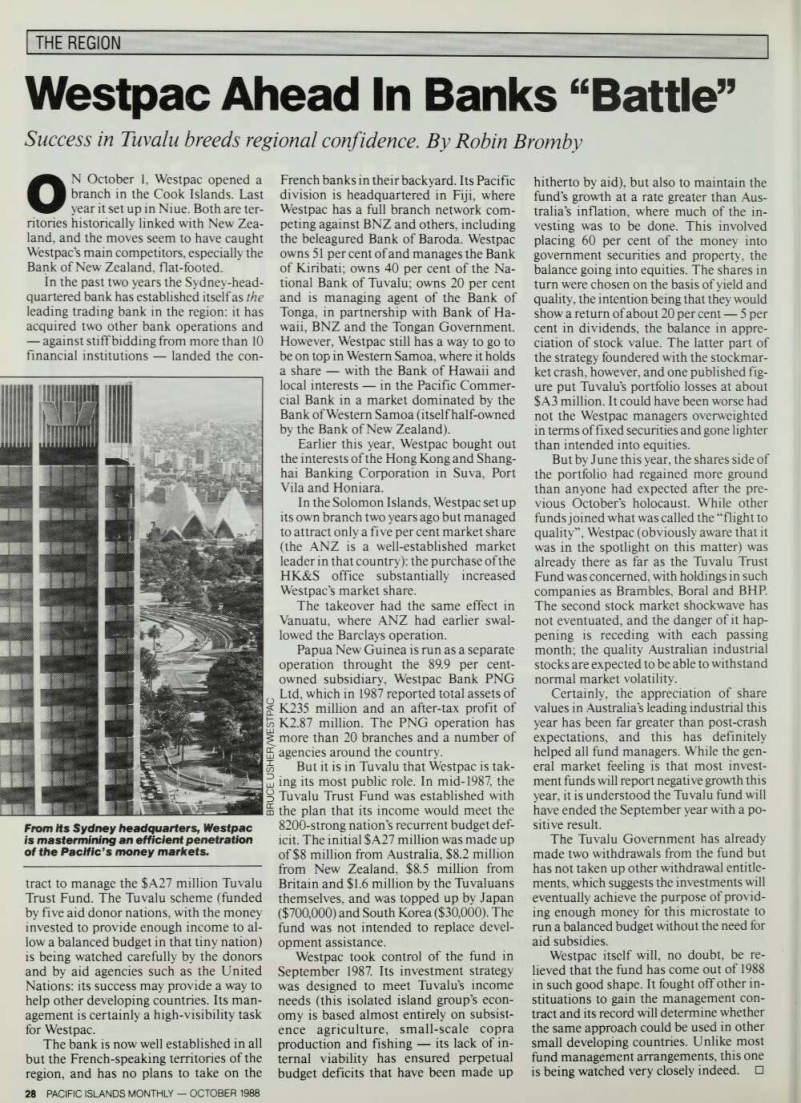
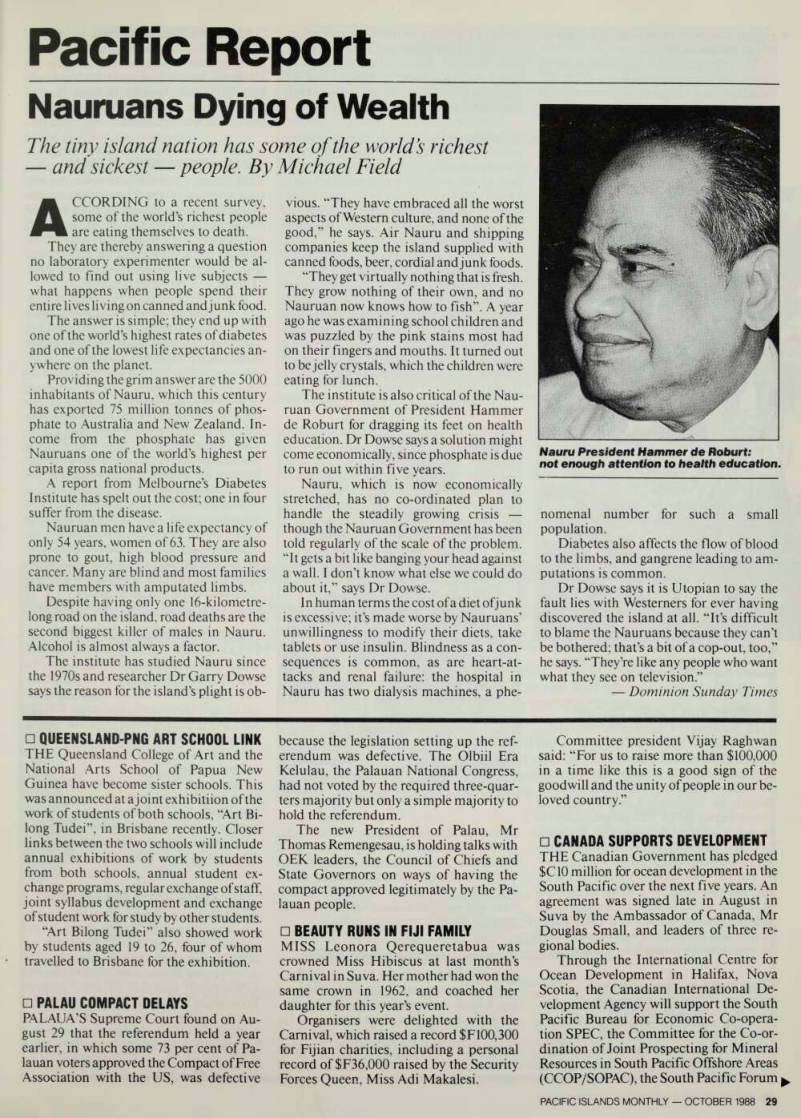
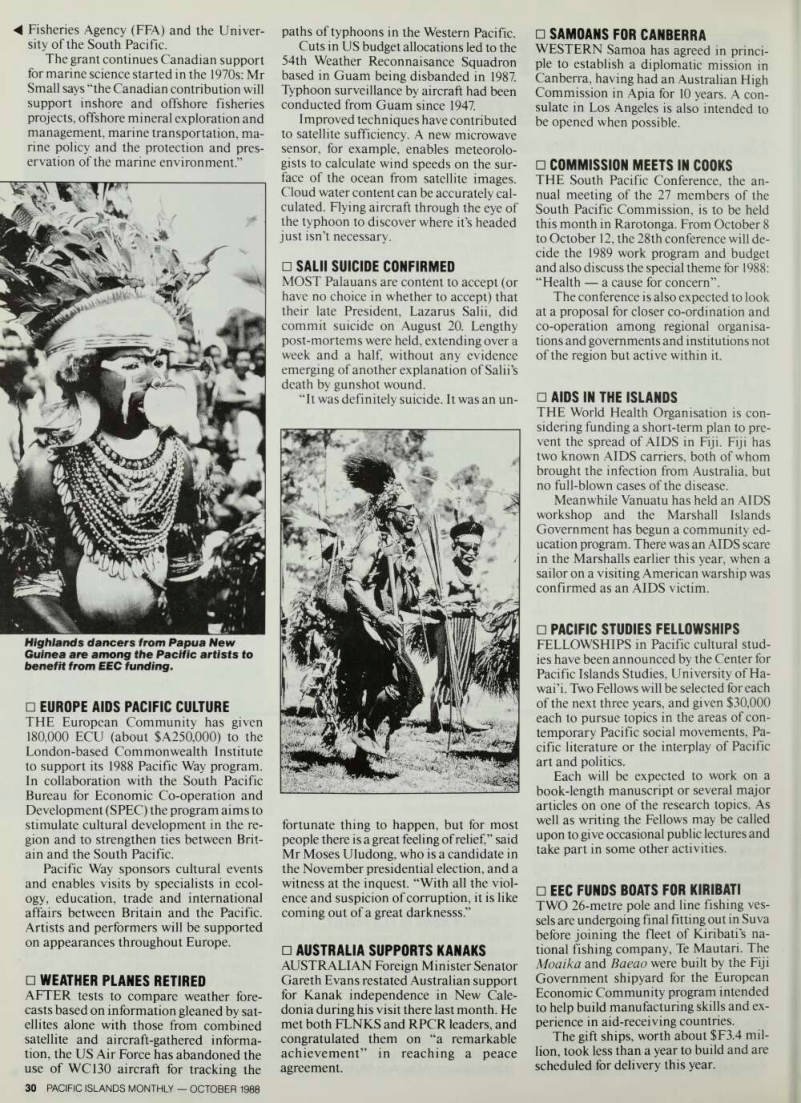
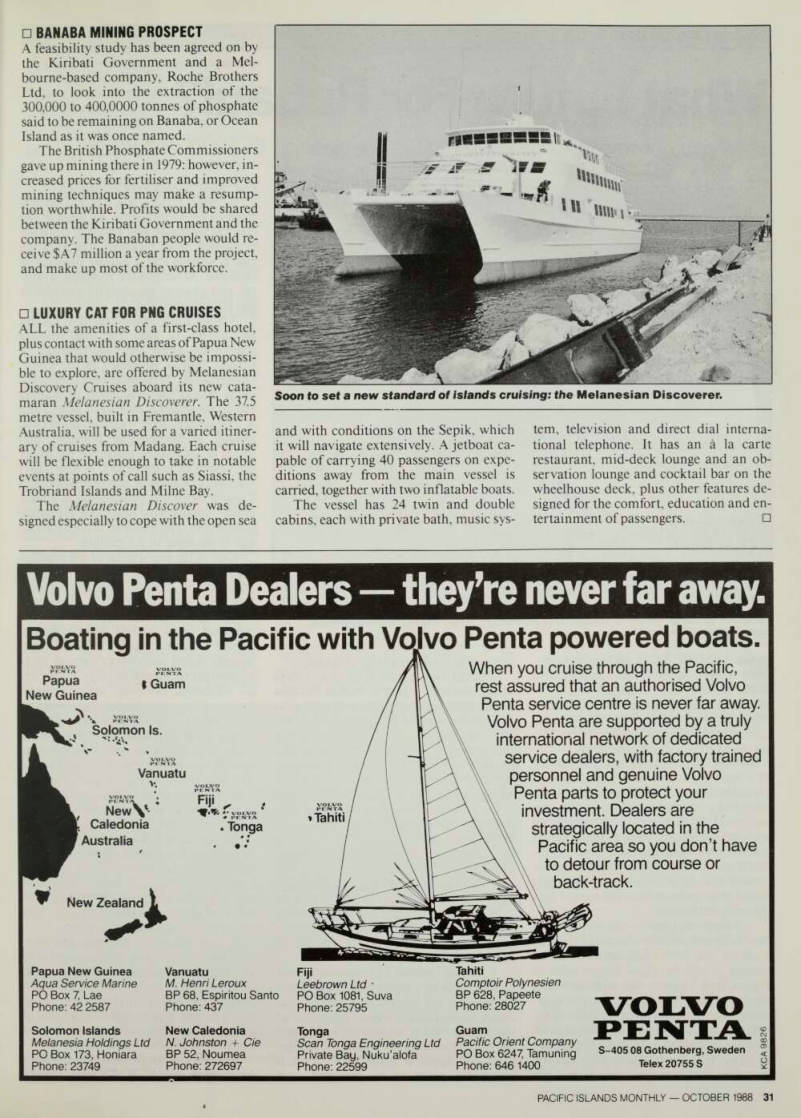
The Region
Westpac Ahead In Banks “Battle”
Success in Tuvalu breeds regional confidence.
By Robin Bromby
ON October 1, Westpac opened a branch in the Cook Islands. Last year it set up in Niue. Both are ter ritories historically linked with New Zea land, and the moves seem to have caught Westpac’s main competitors, especially the Bank of New Zealand, flat-footed.
In the past two years the Sydney-head quartered bank has established itself as the leading trading bank in the region: it has acquired two other bank operations and against stiffbidding from more than 10 financial institutions landed the con-
tract to manage the SA27 million Tuvalu Trust Fund. The Tuvalu scheme (funded by five aid donor nations, with the money invested to provide enough income to al low a balanced budget in that tiny nation) is being watched carefully by the donors and by aid agencies such as the United Nations: its success may provide a way to help other developing countries. Its man agement is certainly a high-visibility task for Westpac.
The bank is now well established in all but the French-speaking territories of the region, and has no plans to take on the
French banks in their backyard. Its Pacific division is headquartered in Fiji, where Westpac has a full branch network com peting against BNZ and others, including the beleagured Bank of Baroda. Westpac owns 51 per cent of and manages the Bank of Kiribati; owns 40 per cent of the Na tional Bank of Tuvalu; owns 20 per cent and is managing agent of the Bank of Tonga, in partnership with Bank of Ha waii, BNZ and the Tongan Government.
However, Westpac still has a way to go to be on top in Western Samoa, where it holds a share with the Bank of Hawaii and local interests in the Pacific Commer cial Bank in a market dominated by the Bank of Western Samoa (itself half-owned by the Bank of New Zealand).
Earlier this year, Westpac bought out the interests of the Hong Kong and Shang hai Banking Corporation in Suva, Port Vila and Honiara.
In the Solomon Islands, Westpac set up its own branch two years ago but managed to attract only a five per cent market share (the ANZ is a well-established market leader in that country): the purchase of the HK&S office substantially increased Westpac’s market share.
The takeover had the same effect in Vanuatu, where ANZ had earlier swal lowed the Barclays operation.
Papua New Guinea is run as a separate operation throught the 89.9 per cent owned subsidiary, Westpac Bank PNG Ltd, which in 1987 reported total assets of K 235 million and an after-tax profit of K 2.87 million. The PNG operation has more than 20 branches and a number of agencies around the country.
But it is in Tuvalu that Westpac is tak ing its most public role. In mid-1987, the Tuvalu Trust Fund was established with the plan that its income would meet the 8200-strong nation’s recurrent budget def icit. The initial $ A 27 million was made up of $8 million from Australia, $8.2 million from New Zealand, $8.5 million from Britain and $1.6 million by the Tuvaluans themselves, and was topped up by Japan ($700,000) and South Korea ($30,000). The fund was not intended to replace devel opment assistance.
Westpac took control of the fund in September 1987. Its investment strategy was designed to meet Tuvalu’s income needs (this isolated island group’s econ omy is based almost entirely on subsist ence agriculture, small-scale copra production and fishing its lack of in ternal viability has ensured perpetual budget deficits that have been made up
hitherto by aid), but also to maintain the fund’s growth at a rate greater than Aus tralia’s inflation, where much of the in vesting was to be done. This involved placing 60 per cent of the money into government securities and property, the balance going into equities. The shares in turn were chosen on the basis of yield and quality, the intention being that they would show a return of about 20 per cent 5 per cent in dividends, the balance in appre ciation of stock value. The latter part of the strategy foundered with the stockmar ket crash, however, and one published fig ure put Tuvalu’s portfolio losses at about SA3 million. It could have been worse had not the Westpac managers overweighted in terms of fixed securities and gone lighter than intended into equities.
But by June this year, the shares side of the portfolio had regained more ground than anyone had expected after the pre vious October’s holocaust. While other funds joined what was called the “flight to quality”, Westpac (obviously aware that it was in the spotlight on this matter) was already there as far as the Tuvalu Trust Fund was concerned, with holdings in such companies as Brambles, Boral and BHP.
The second stock market shockwave has not eventuated, and the danger of it hap pening is receding with each passing month; the quality Australian industrial stocks are expected to be able to withstand normal market volatility.
Certainly, the appreciation of share values in Australia’s leading industrial this year has been far greater than post-crash expectations, and this has definitely helped all fund managers. While the gen eral market feeling is that most invest ment funds will report negative growth this year, it is understood the Tuvalu fund will have ended the September year with a po sitive result.
The Tuvalu Government has already made two withdrawals from the fund but has not taken up other withdrawal entitle ments, which suggests the investments will eventually achieve the purpose of provid ing enough money for this microstate to run a balanced budget without the need for aid subsidies.
Westpac itself will, no doubt, be re lieved that the fund has come out of 1988 in such good shape. It fought off other in sinuations to gain the management con tract and its record will determine whether the same approach could be used in other small developing countries. Unlike most fund management arrangements, this one is being watched very closely indeed. □
From its Sydney headquarters, Westpac is mastermining an efficient penetration of the Pacific’s money markets.
Bruce Usher/Westpac
□ Queensland-Png Art School Link
THE Queensland College of Art and the National Arts School of Papua New Guinea have become sister schools. This was announced at a joint exhibitiion of the work of students of both schools, “Art Bi long Tudei”, in Brisbane recently. Closer links between the two schools will include annual exhibitions of work by students from both schools, annual student ex change programs, regular exchange of staff, joint syllabus development and exchange of student work for study by other students.
“Art Bilong Tudei” also showed work by students aged 19 to 26, four of whom travelled to Brisbane for the exhibition.
□ Palau Compact Delays
PALAUA’S Supreme Court found on Au gust 29 that the referendum held a year earlier, in which some 73 per cent of Pa lauan voters approved the Compact of Free Association with the US, was defective
because the legislation setting up the ref erendum was defective. The Olbiil Era Kelulau, the Palauan National Congress, had not voted by the required three-quar ters majority but only a simple majority to hold the referendum.
The new President of Palau, Mr Thomas Remengesau, is holding talks with OEK leaders, the Council of Chiefs and State Governors on ways of having the compact approved legitimately by the Pa lauan people.
□ Beauty Runs In Fiji Family
MISS Leonora Qerequeretabua was crowned Miss Hibiscus at last month’s Carnival in Suva. Her mother had won the same crown in 1962, and coached her daughter for this year’s event.
Organisers were delighted with the Carnival, which raised a record $F100,300 for Fijian charities, including a personal record of $F36,000 raised by the Security Forces Queen, Miss Adi Makalesi.
Committee president Vijay Raghwan said: “For us to raise more than SIOO,OOO in a time like this is a good sign of the goodwill and the unity of people in our be loved country.”
□ Canada Supports Development
THE Canadian Government has pledged SCIO million for ocean development in the South Pacific over the next five years. An agreement was signed late in August in Suva by the Ambassador of Canada, Mr Douglas Small, and leaders of three re gional bodies.
Through the International Centre for Ocean Development in Halifax, Nova Scotia, the Canadian International De velopment Agency will support the South Pacific Bureau for Economic Co-opera tion SPEC, the Committee for the Co-or dination of Joint Prospecting for Mineral Resources in South Pacific Offshore Areas (CCOP/SOPAC), the South Pacific Forum
◄ Fisheries Agency (FFA) and the Univer sity of the South Pacific.
The grant continues Canadian support for marine science started in the 19705: Mr Small says “the Canadian contribution will support inshore and offshore fisheries projects, offshore mineral exploration and management, marine transportation, ma rine policy and the protection and pres ervation of the marine environment.”
□ Europe Aids Pacific Culture
THE European Community has given 180,000 ECU (about $A250,000) to the London-based Commonwealth Institute to support its 1988 Pacific Way program.
In collaboration with the South Pacific Bureau for Economic Co-operation and Development (SPEC) the program aims to stimulate cultural development in the re gion and to strengthen ties between Brit ain and the South Pacific.
Pacific Way sponsors cultural events and enables visits by specialists in ecol ogy, education, trade and international affairs between Britain and the Pacific.
Artists and performers will be supported on appearances throughout Europe.
□ Weather Planes Retired
AFTER tests to compare weather fore casts based on information gleaned by sat ellites alone with those from combined satellite and aircraft-gathered informa tion, the US Air Force has abandoned the use of WCI3O aircraft for tracking the
paths of typhoons in the Western Pacific.
Cuts in US budget allocations led to the 54th Weather Reconnaisance Squadron based in Guam being disbanded in 1987.
Typhoon surveillance by aircraft had been conducted from Guam since 1947.
Improved techniques have contributed to satellite sufficiency. A new microwave sensor, for example, enables meteorolo gists to calculate wind speeds on the sur face of the ocean from satellite images.
Cloud water content can be accurately cal culated. Flying aircraft through the eye of the typhoon to discover where it’s headed just isn’t necessary.
□ Salii Suicide Confirmed
MOST Palauans are content to accept (or have no choice in whether to accept) that their late President, Lazarus Salii, did commit suicide on August 20. Lengthy post-mortems were held, extending over a week and a half, without any evidence emerging of another explanation of Salii’s death by gunshot wound.
“It was definitely suicide. It was an un-
fortunate thing to happen, but for most people there is a great feeling of relief,” said Mr Moses Uludong, who is a candidate in the November presidential election, and a witness at the inquest. “With all the viol ence and suspicion of corruption, it is like coming out of a great darknesss.”
□ Australia Supports Kanaks
AUSTRALIAN Foreign Minister Senator Gareth Evans restated Australian support for Kanak independence in New Cale donia during his visit there last month. He met both FLNKS and RPCR leaders, and congratulated them on “a remarkable achievement” in reaching a peace agreement.
□ Samoans For Canberra
WESTERN Samoa has agreed in princi ple to establish a diplomatic mission in Canberra, having had an Australian High Commission in Apia for 10 years. A con sulate in Los Angeles is also intended to be opened when possible.
□ Commission Meets In Cooks
THE South Pacific Conference, the an nual meeting of the 27 members of the South Pacific Commission, is to be held this month in Rarotonga. From October 8 to October 12, the 28th conference will de cide the 1989 work program and budget and also discuss the special theme for 1988: “Health a cause for concern”.
The conference is also expected to look at a proposal for closer co-ordination and co-operation among regional organisa tions and governments and institutions not of the region but active within it.
□ Aids In The Islands
THE World Health Organisation is con sidering funding a short-term plan to pre vent the spread of AIDS in Fiji. Fiji has two known AIDS carriers, both of whom brought the infection from Australia, but no full-blown cases of the disease.
Meanwhile Vanuatu has held an AIDS workshop and the Marshall Islands Government has begun a community ed ucation program. There was an AIDS scare in the Marshalls earlier this year, when a sailor on a visiting American warship was confirmed as an AIDS victim.
□ Pacific Studies Fellowships
FELLOWSHIPS in Pacific cultural stud ies have been announced by the Center for Pacific Islands Studies, University of Ha waii. Two Fellows will be selected for each of the next three years, and given $30,000 each to pursue topics in the areas of con temporary Pacific social movements, Pa cific literature or the interplay of Pacific art and politics.
Each will be expected to work on a book-length manuscript or several major articles on one of the research topics. As well as writing the Fellows may be called upon to give occasional public lectures and take part in some other activities.
□ Eec Funds Boats For Kiribati
TWO 26-metre pole and line fishing ves sels are undergoing final fitting out in Suva before joining the fleet of Kiribati’s na tional fishing company, Te Mautari. The Moaika and Baeao were built by the Fiji Government shipyard for the European Economic Community program intended to help build manufacturing skills and ex perience in aid-receiving countries.
The gift ships, worth about 5F3.4 mil lion, took less than a year to build and are scheduled for delivery this year.
Highlands dancers from Papua New Guinea are among the Pacific artists to benefit from EEC funding.
□ Banaba Mining Prospect
A feasibility study has been agreed on by the Kiribati Government and a Mel bourne-based company, Roche Brothers Ltd, to look into the extraction of the 300,000 to 400,0000 tonnes of phosphate said to be remaining on Banaba, or Ocean Island as it was once named.
The British Phosphate Commissioners gave up mining there in 1979: however, in creased prices for fertiliser and improved mining techniques may make a resump tion worthwhile. Profits would be shared between the Kiribati Government and the company. The Banaban people would re ceive SA7 million a year from the project, and make up most of the workforce.
□ Luxury Cat For Png Cruises
ALL the amenities of a first-class hotel, plus contact with some areas of Papua New Guinea that would otherwise be impossi ble to explore, are offered by Melanesian Discovery Cruises aboard its new cata maran Melanesian Discoverer. The 37.5 metre vessel, built in Fremantle, Western Australia, will be used for a varied itiner ary of cruises from Madang. Each cruise will be flexible enough to take in notable events at points of call such as Siassi, the Trobriand Islands and Milne Bay.
The Melanesian Discover was de signed especially to cope with the open sea
and with conditions on the Sepik, which it will navigate extensively. A jetboat ca pable of carrying 40 passengers on expe ditions away from the main vessel is carried, together with two inflatable boats.
The vessel has 24 twin and double cabins, each with private bath, music sys
tern, television and direct dial interna tional telephone. It has an a la carte restaurant, mid-deck lounge and an ob servation lounge and cocktail bar on the wheelhouse deck, plus other features de signed for the comfort, education and en tertainment of passengers. □
Soon to set a new standard of islands cruising: the Melanesian Discoverer.
Pacific Report
Nauruans Dying of Wealth
The tiny island nation has some of the world’s richest
and sickest people.
By Michael Field
ACCORDING to a recent survey, some of the world’s richest people are eating themselves to death.
They are thereby answering a question no laboratory experimenter would be al lowed to find out using live subjects what happens when people spend their entire lives living on canned and junk food.
The answer is simple; they end up with one of the world’s highest rates of diabetes and one of the lowest life expectancies an ywhere on the planet.
Providing the grim answer are the 5000 inhabitants of Nauru, which this century has exported 75 million tonnes of phos phate to Australia and New Zealand. In come from the phosphate has given Nauruans one of the world’s highest per capita gross national products.
A report from Melbourne’s Diabetes Institute has spelt out the cost; one in four suffer from the disease.
Nauruan men have a life expectancy of only 54 years, women of 63. They are also prone to gout, high blood pressure and cancer. Many are blind and most families have members with amputated limbs.
Despite having only one 16-kilometre long road on the island, road deaths are the second biggest killer of males in Nauru.
Alcohol is almost always a factor.
The institute has studied Nauru since the 1970 s and researcher Dr Garry Dowse says the reason for the island’s plight is ob
vious. “They have embraced all the worst aspects of Western culture, and none of the good,” he says. Air Nauru and shipping companies keep the island supplied with canned foods, beer, cordial and junk foods.
“They get virtually nothing that is fresh.
They grow nothing of their own, and no Nauruan now knows how to fish”. A year ago he was examining school children and was puzzled by the pink stains most had on their fingers and mouths. It turned out to be jelly crystals, which the children were eating for lunch.
The institute is also critical of the Nau ruan Government of President Hammer de Roburt for dragging its feet on health education. Dr Dowse says a solution might come economically, since phosphate is due to run out within five years.
Nauru, which is now economically stretched, has no co-ordinated plan to handle the steadily growing crisis though the Nauruan Government has been told regularly of the scale of the problem.
“It gets a bit like banging your head against a wall. I don’t know what else we could do about it,” says Dr Dowse.
In human terms the cost of a diet ofjunk is excessive; it’s made worse by Nauruans’ unwillingness to modify their diets, take tablets or use insulin. Blindness as a con sequences is common, as are heart-at tacks and renal failure: the hospital in Nauru has two dialysis machines, a phe-
nomenal number for such a small population.
Diabetes also affects the flow of blood to the limbs, and gangrene leading to am putations is common.
Dr Dowse says it is Utopian to say the fault lies with Westerners for ever having discovered the island at all. “It’s difficult to blame the Nauruans because they can’t be bothered; that’s a bit of a cop-out, too,” he says. “They’re like any people who want what they see on television.” — Dominion Sunday Times
Nauru President Hammer de Roburt: not enough attention to health education.
Advertisements & other items, p. 31 (1 item)
Kca9B26
Volvo Renta Dealers —they’re never far away.
Boating in the Pacific with Volvo Renta powered boats.
I Papua
|New Guinea
tl I Guam
VW&.VU
PENTA
Solomon Is.
Vanuatu
NewV-
Caledonia Australia
Fiji „
.-V Tonga New Zealand • Tahiti
When you cruise through the Pacific,
rest assured that an authorised Volvo
Renta service centre is never far away.
Volvo Renta are supported by a truly
international network of dedicated
service dealers, with factory trained
personnel and genuine Volvo
Renta parts to protect your
investment. Dealers are
strategically located in the
Pacific area so you don’t have
\\ to detour from course or
back-track.
Papua New Guinea Aqua Service Marine PO Box 7, Lae Phone: 42 2587 Solomon Islands Melanesia Holdings Ltd PO Box 173, Honiara Phone: 23749 Vanuatu M. Henri Leroux BP 68, Espiritou Santo Phone: 437 New Caledonia N. Johnston + Cie BP 52, Noumea Phone: 272697 Fiji Leebrown Ltd • PO Box 1081, Suva Phone; 25795 Tonga Scan Tonga Engineering Ltd Private Bay, Nukualofa Ph0ne:22599 Tahiti Comptoir Polynesien BP 628, Papeete Phone; 28027 Guam Pacific Orient Company PO Box 6247, Tamuning Phone: 646 1400
VOLVO
S-405 08 Gothenberg, Sweden Telex 20755 S
KCA9B26
What Future For Rabaul?
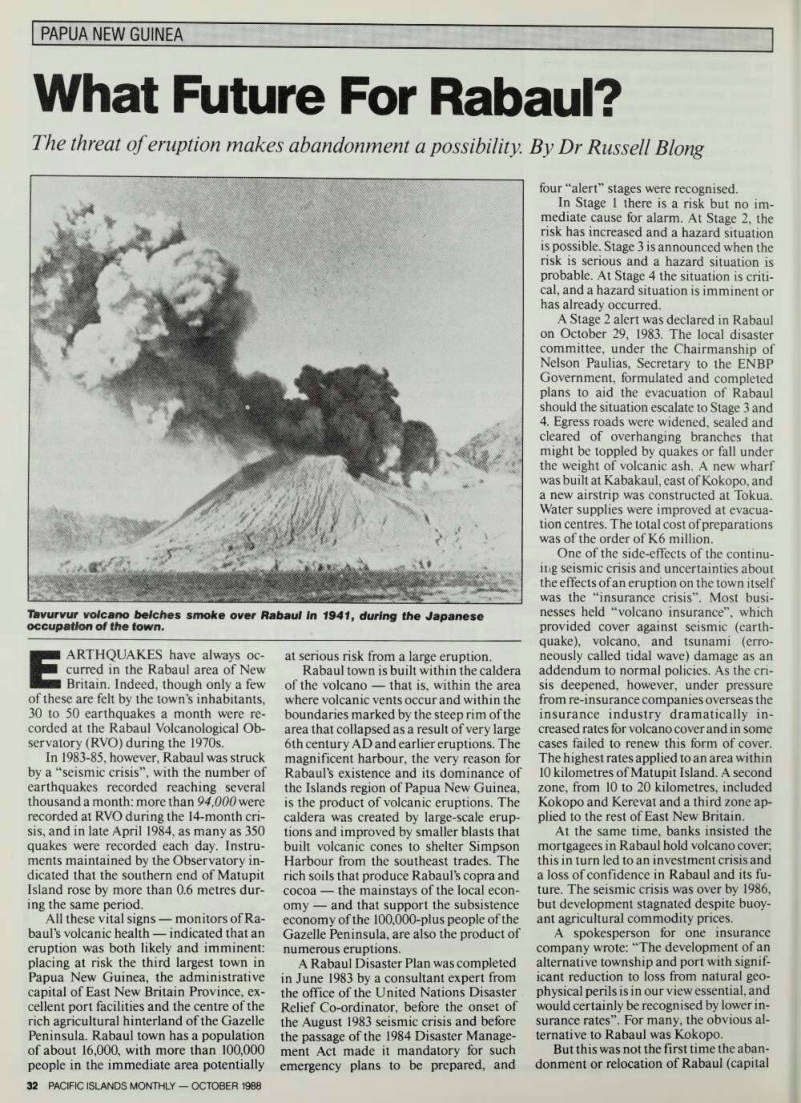
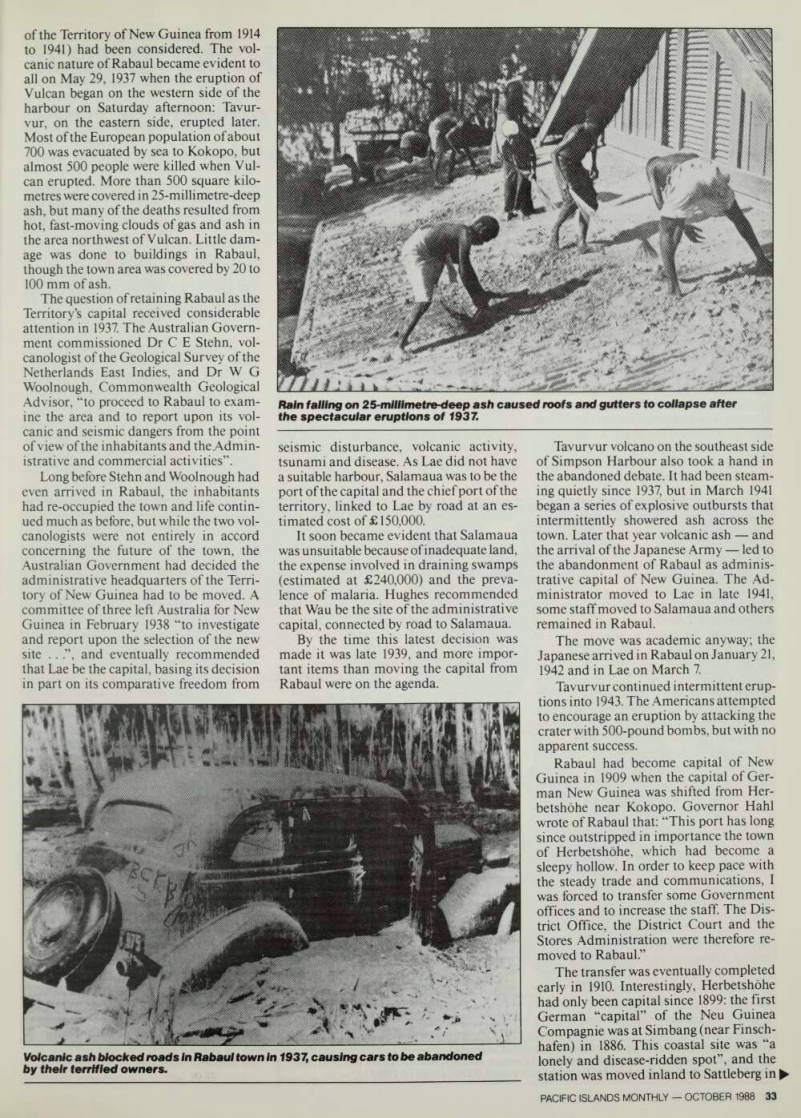
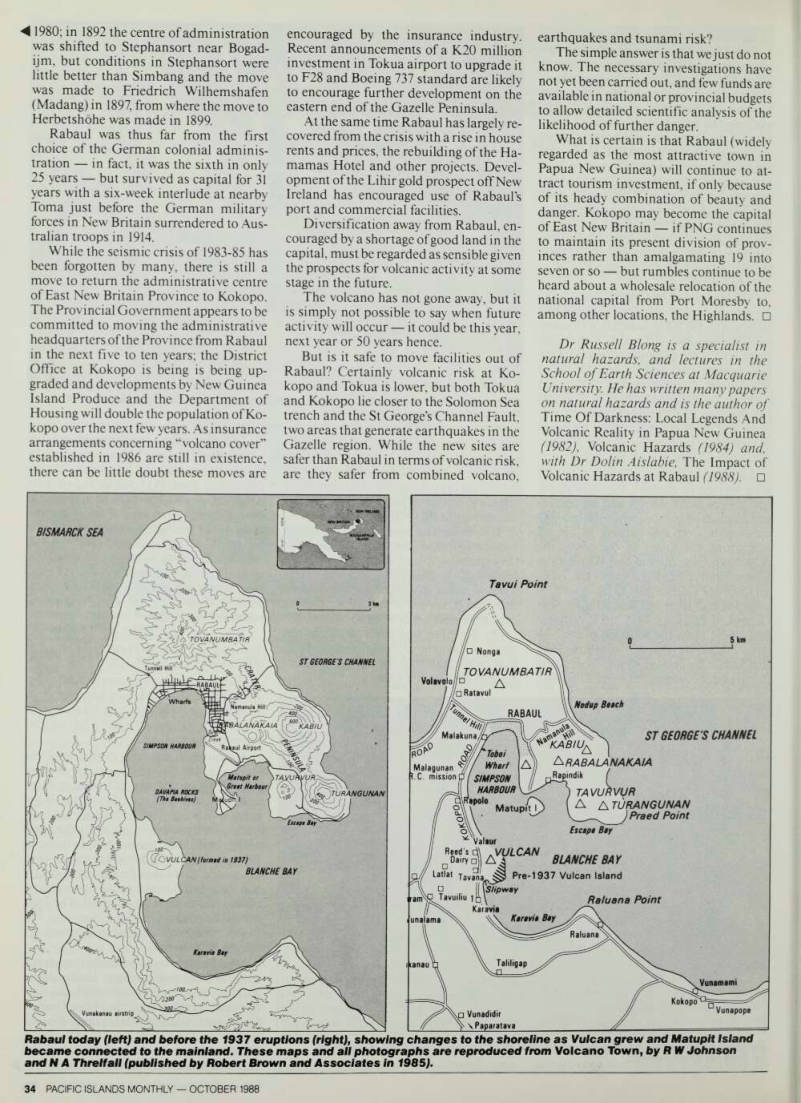
Papua New Guinea
The threat of eruption makes abandonment a possibility.
By Dr Russell Blong
EARTHQUAKES have always oc curred in the Rabaul area of New Britain. Indeed, though only a few of these are felt by the town’s inhabitants, 30 to 50 earthquakes a month were re corded at the Rabaul Volcanological Ob servatory (RVO) during the 19705.
In 1983-85, however, Rabaul was struck by a “seismic crisis”, with the number of earthquakes recorded reaching several thousand a month: more than 94,000 were recorded at RVO during the 14-month cri sis, and in late April 1984, as many as 350 quakes were recorded each day. Instru ments maintained by the Observatory in dicated that the southern end of Matupit Island rose by more than 0.6 metres dur ing the same period.
All these vital signs monitors of Ra baul’s volcanic health indicated that an eruption was both likely and imminent: placing at risk the third largest town in Papua New Guinea, the administrative capital of East New Britain Province, ex cellent port facilities and the centre of the rich agricultural hinterland of the Gazelle Peninsula. Rabaul town has a population of about 16,000, with more than 100,000 people in the immediate area potentially
at serious risk from a large eruption.
Rabaul town is built within the caldera of the volcano that is, within the area where volcanic vents occur and within the boundaries marked by the steep rim of the area that collapsed as a result of very large 6th century AD and earlier eruptions. The magnificent harbour, the very reason for Rabaul’s existence and its dominance of the Islands region of Papua New Guinea, is the product of volcanic eruptions. The caldera was created by large-scale erup tions and improved by smaller blasts that built volcanic cones to shelter Simpson Harbour from the southeast trades. The rich soils that produce Rabaul’s copra and cocoa the mainstays of the local econ omy and that support the subsistence economy of the 100,000-plus people of the Gazelle Peninsula, are also the product of numerous eruptions.
A Rabaul Disaster Plan was completed in June 1983 by a consultant expert from the office of the United Nations Disaster Relief Co-ordinator, before the onset of the August 1983 seismic crisis and before the passage of the 1984 Disaster Manage ment Act made it mandatory for such emergency plans to be prepared, and
four “alert” stages were recognised.
In Stage 1 there is a risk but no im mediate cause for alarm. At Stage 2, the risk has increased and a hazard situation is possible. Stage 3 is announced when the risk is serious and a hazard situation is probable. At Stage 4 the situation is criti cal, and a hazard situation is imminent or has already occurred.
A Stage 2 alert was declared in Rabaul on October 29, 1983. The local disaster committee, under the Chairmanship of Nelson Paulias, Secretary to the ENBP Government, formulated and completed plans to aid the evacuation of Rabaul should the situation escalate to Stage 3 and 4. Egress roads were widened, sealed and cleared of overhanging branches that might be toppled by quakes or fall under the weight of volcanic ash. A new wharf was built at Kabakaul, east of Kokopo, and a new airstrip was constructed at Tokua.
Water supplies were improved at evacua tion centres. The total cost of preparations was of the order of K 6 million.
One of the side-effects of the continu ing seismic crisis and uncertainties about the effects of an eruption on the town itself was the “insurance crisis”. Most busi nesses held “volcano insurance”, which provided cover against seismic (earth quake), volcano, and tsunami (erro neously called tidal wave) damage as an addendum to normal policies. As the cri sis deepened, however, under pressure from re-insurance companies overseas the insurance industry dramatically in creased rates for volcano cover and in some cases failed to renew this form of cover.
The highest rates applied to an area within 10 kilometres of Matupit Island. A second zone, from 10 to 20 kilometres, included Kokopo and Kerevat and a third zone ap plied to the rest of East New Britain.
At the same time, banks insisted the mortgagees in Rabaul hold volcano cover; this in turn led to an investment crisis and a loss of confidence in Rabaul and its fu ture. The seismic crisis was over by 1986, but development stagnated despite buoy ant agricultural commodity prices.
A spokesperson for one insurance company wrote: “The development of an alternative township and port with signif icant reduction to loss from natural geo physical perils is in our view essential, and would certainly be recognised by lower in surance rates”. For many, the obvious al ternative to Rabaul was Kokopo.
But this was not the first time the aban donment or relocation of Rabaul (capital
Tavurvur volcano belches smoke over Rabaul In 1941, during the Japanese occupation of the town.
of the Territory of New Guinea from 1914 to 1941) had been considered. The vol canic nature of Rabaul became evident to all on May 29, 1937 when the eruption of Vulcan began on the western side of the harbour on Saturday afternoon: Tavur vur, on the eastern side, erupted later.
Most of the European population of about 700 was evacuated by sea to Kokopo, but almost 500 people were killed when Vul can erupted. More than 500 square kilo metres were covered in 25-millimetre-deep ash, but many of the deaths resulted from hot, fast-moving clouds of gas and ash in the area northwest of Vulcan. Little dam age was done to buildings in Rabaul, though the town area was covered by 20 to 100 mm of ash.
The question of retaining Rabaul as the Territory’s capital received considerable attention in 1937. The Australian Govern ment commissioned Dr C E Stehn, vol canologist of the Geological Survey of the Netherlands East Indies, and Dr W G Woolnough, Commonwealth Geological Advisor, “to proceed to Rabaul to exam ine the area and to report upon its vol canic and seismic dangers from the point of view of the inhabitants and the Admin istrative and commercial activities”.
Long before Stehn and Woolnough had even arrived in Rabaul, the inhabitants had re-occupied the town and life contin ued much as before, but while the two vol canologists were not entirely in accord concerning the future of the town, the Australian Government had decided the administrative headquarters of the Terri tory of New Guinea had to be moved. A committee of three left Australia for New Guinea in February 1938 “to investigate and report upon the selection of the new site .. ”, and eventually recommended that Lae be the capital, basing its decision in part on its comparative freedom from
seismic disturbance, volcanic activity, tsunami and disease. As Lae did not have a suitable harbour, Salamaua was to be the port of the capital and the chief port of the territory, linked to Lae by road at an es timated cost of £150,000.
It soon became evident that Salamaua was unsuitable because of inadequate land, the expense involved in draining swamps (estimated at £240,000) and the preva lence of malaria. Hughes recommended that Wau be the site of the administrative capital, connected by road to Salamaua.
By the time this latest decision was made it was late 1939, and more impor tant items than moving the capital from Rabaul were on the agenda.
Tavurvur volcano on the southeast side of Simpson Harbour also took a hand in the abandoned debate. It had been steam ing quietly since 1937, but in March 1941 began a series of explosive outbursts that intermittently showered ash across the town. Later that year volcanic ash and the arrival of the Japanese Army led to the abandonment of Rabaul as adminis trative capital of New Guinea. The Ad ministrator moved to Lae in late 1941, some staff moved to Salamaua and others remained in Rabaul.
The move was academic anyway; the Japanese arrived in Rabaul on January 21, 1942 and in Lae on March 7.
Tavurvur continued intermittent erup tions into 1943. The Americans attempted to encourage an eruption by attacking the crater with 500-pound bombs, but with no apparent success.
Rabaul had become capital of New Guinea in 1909 when the capital of Ger man New Guinea was shifted from Her betshdhe near Kokopo. Governor Hahl wrote of Rabaul that: “This port has long since outstripped in importance the town of Herbetshohe, which had become a sleepy hollow. In order to keep pace with the steady trade and communications, I was forced to transfer some Government offices and to increase the staff. The Dis trict Office, the District Court and the Stores Administration were therefore re moved to Rabaul.”
The transfer was eventually completed early in 1910. Interestingly, Herbetshohe had only been capital since 1899: the first German “capital” of the Neu Guinea Compagnie was at Simbang (near Finsch hafen) in 1886. This coastal site was “a lonely and disease-ridden spot”, and the station was moved inland to Sattleberg in
Volcanic ash blocked roads In Rabaul town in 1937, causing cars to be abandoned by their terrified owners.
Rain falling on 25-millimetre-deep ash caused roofs and gutters to collapse after the spectacular eruptions of 1937.
◄ 198 ° ; m 1892thecentreofadmmistration was shifted to Stephansort near Bogadijm, but conditions in Stephansort were little better than Simbang and the move was made to Friedrich Wilhemshafen (Madang) in 1897, from where the move to Herbetshohe was made in 1899.
Rabaul was thus far from the first choice of the German colonial admimstration in fact, it was the sixth m only 25 years but survived as capital for 31 years with a six-week interlude at nearby Toma just before the German military torces in New Britain surrendered to Austrahan troops in 1914.
While the seismic crisis of 1983-85 has been forgotten by many, there is still a move to return the administrative centre of East New Britain Province to Kokopo.
The Provincial Government appears to be committed to moving the administrative headquarters of the Province from Rabaul in the next five to ten years; the District Office at Kokopo is being is being upgraded and developments by New Guinea Island Produce and the Department of Housing will double the population of Kokopo over the next few years. As insurance arrangements concerning “volcano cover” established in 1986 are still in existence, there can be little doubt these moves are
encouraged by the insurance industry.
Recent announcements of a K2O million investment in Tokua airport to upgrade it to F2B and Boeing 737 standard are likely to encourage further development on the eastern end of the Gazelle Peninsula.
At the same time Rabaul has largely re covered from the crisis with a rise in house rents and prices, the rebuilding of the Ha mamas Hotel and other projects. Devel opment of the Lihir gold prospect off New Ireland has encouraged use of Rabaul’s port and commercial facilities.
Diversification away from Rabaul, en couraged by a shortage of good land in the capital, must be regarded as sensible given the prospects for volcanic activity at some stage in the future.
The volcano has not gone away, but it is simply not possible to say when future activity will occur it could be this year, next year or 50 years hence.
But is it safe to move facilities out of Rabaul? Certainly volcanic risk at Ko kopo and Tokua is lower, but both Tokua and Kokopo lie closer to the Solomon Sea trench and the St George’s Channel Fault, two areas that generate earthquakes in the Gazelle region. While the new sites are safer than Rabaul in terms of volcanic risk, are they safer from combined volcano,
earthquakes and tsunami risk?
The simple answer is that we just do not know. The necessary investigations have not yet been carried out, and few funds are available in national or provincial budgets to allow detailed scientific analysis of the likelihood of further danger.
What is certain is that Rabaul (widely regarded as the most attractive town in Papua New Guinea) will continue to at tract tourism investment, if only because of its heady combination of beauty and danger. Kokopo may become the capital of East New Britain if PNG continues to maintain its present division of prov inces rather than amalgamating 19 into seven or so but rumbles continue to be heard about a wholesale relocation of the national capital from Port Moresby to, among other locations, the Highlands. □ Dr Russell Blong is a specialist in natural hazards, and lectures in the School of Earth Sciences at Macquarie University. He has written many papers on natural hazards and is the author of Time Of Darkness: Local Legends And Volcanic Reality in Papua New Guinea (1982), Volcanic Hazards (1984) and, with Dr Dolin Aislabie, The Impact of Volcanic Hazards at Rabaul (1988). □
Rabaul today (left) and before the 1937 eruptions (right), showing changes to the shoreline as Vulcan grew and Matupit Island became connected to the mainland. These maps and all photographs are reproduced from Volcano Town, by RW Johnson and N A Threlfall (published by Robert Brown and Associates in 1985).
Trade Winds
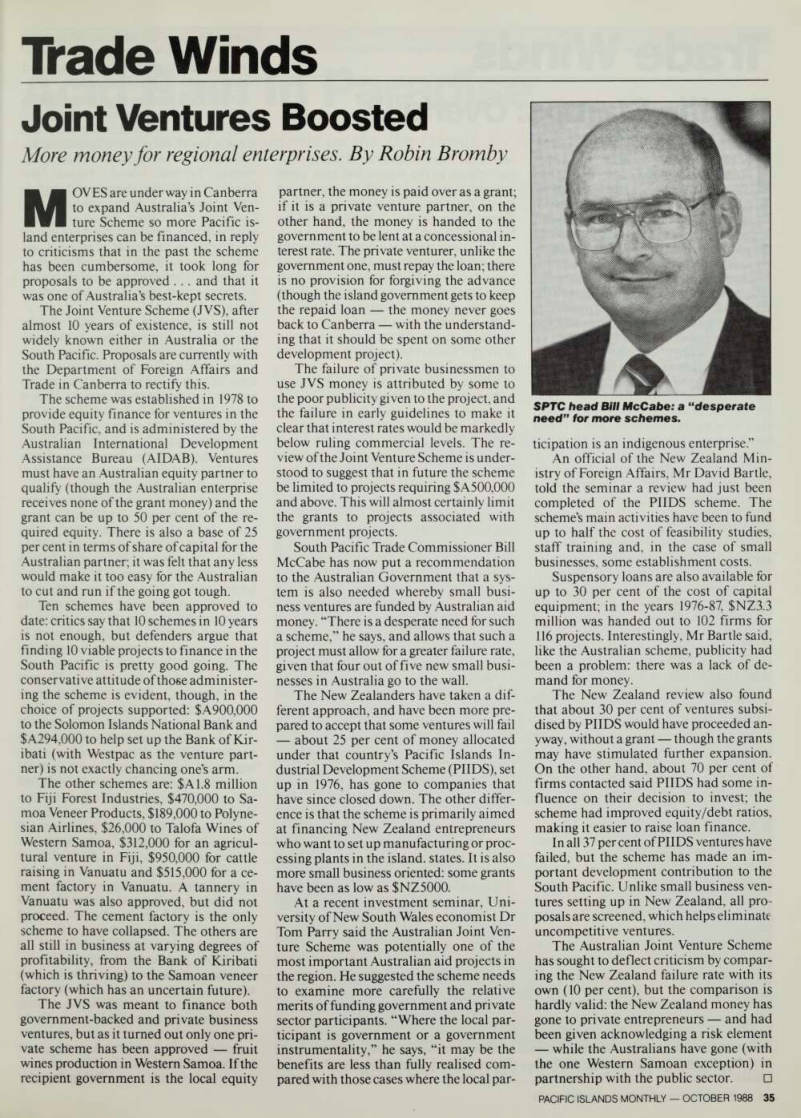
Joint Ventures Boosted
More money for regional enterprises.
By Robin Bromby
MOVES are under way in Canberra to expand Australia’s Joint Ven ture Scheme so more Pacific is land enterprises can be financed, in reply to criticisms that in the past the scheme has been cumbersome, it took long for proposals to be approved . . . and that it was one of Australia’s best-kept secrets.
The Joint Venture Scheme (JVS), after almost 10 years of existence, is still not widely known either in Australia or the South Pacific. Proposals are currently with the Department of Foreign Affairs and Trade in Canberra to rectify this.
The scheme was established in 1978 to provide equity finance for ventures in the South Pacific, and is administered by the Australian International Development Assistance Bureau (AIDAB). Ventures must have an Australian equity partner to qualify (though the Australian enterprise receives none of the grant money) and the grant can be up to 50 per cent of the re quired equity. There is also a base of 25 per cent in terms of share of capital for the Australian partner; it was felt that any less would make it too easy for the Australian to cut and run if the going got tough.
Ten schemes have been approved to date: critics say that 10 schemes in 10 years is not enough, but defenders argue that finding 10 viable projects to finance in the South Pacific is pretty good going. The conservative attitude of those administer ing the scheme is evident, though, in the choice of projects supported: $A900,000 to the Solomon Islands National Bank and $A294,000 to help set up the Bank of Kir ibati (with Westpac as the venture part ner) is not exactly chancing one’s arm.
The other schemes are; SAI.B million to Fiji Forest Industries, $470,000 to Sa moa Veneer Products, $189,000 to Polyne sian Airlines, $26,000 to Talofa Wines of Western Samoa, $312,000 for an agricul tural venture in Fiji, $950,000 for cattle raising in Vanuatu and $515,000 for a ce ment factory in Vanuatu. A tannery in Vanuatu was also approved, but did not proceed. The cement factory is the only scheme to have collapsed. The others are all still in business at varying degrees of profitability, from the Bank of Kiribati (which is thriving) to the Samoan veneer factory (which has an uncertain future).
The JVS was meant to finance both government-backed and private business ventures, but as it turned out only one pri vate scheme has been approved fruit wines production in Western Samoa. If the recipient government is the local equity
partner, the money is paid over as a grant; if it is a private venture partner, on the other hand, the money is handed to the government to be lent at a concessional in terest rate. The private venturer, unlike the government one, must repay the loan; there is no provision for forgiving the advance (though the island government gets to keep the repaid loan the money never goes back to Canberra with the understand ing that it should be spent on some other development project).
The failure of private businessmen to use JVS money is attributed by some to the poor publicity given to the project, and the failure in early guidelines to make it clear that interest rates would be markedly below ruling commercial levels. The re view of the Joint Venture Scheme is under stood to suggest that in future the scheme be limited to projects requiring $A500,000 and above. This will almost certainly limit the grants to projects associated with government projects.
South Pacific Trade Commissioner Bill McCabe has now put a recommendation to the Australian Government that a sys tem is also needed whereby small busi ness ventures are funded by Australian aid money. “There is a desperate need for such a scheme,” he says, and allows that such a project must allow for a greater failure rate, given that four out of five new small busi nesses in Australia go to the wall.
The New Zealanders have taken a dif ferent approach, and have been more pre pared to accept that some ventures will fail about 25 per cent of money allocated under that country’s Pacific Islands In dustrial Development Scheme (PUDS), set up in 1976, has gone to companies that have since closed down. The other differ ence is that the scheme is primarily aimed at financing New Zealand entrepreneurs who want to set up manufacturing or proc essing plants in the island, states. It is also more small business oriented: some grants have been as low as SNZSOOO.
At a recent investment seminar, Uni versity of New South Wales economist Dr Tom Parry said the Australian Joint Ven ture Scheme was potentially one of the most important Australian aid projects in the region. He suggested the scheme needs to examine more carefully the relative merits of funding government and private sector participants. “Where the local par ticipant is government or a government instrumentality,” he says, “it may be the benefits are less than fully realised com pared with those cases where the local par-
ticipation is an indigenous enterprise.”
An official of the New Zealand Min istry of Foreign Affairs, Mr David Bartle, told the seminar a review had just been completed of the PUDS scheme. The scheme’s main activities have been to fund up to half the cost of feasibility studies, staff training and, in the case of small businesses, some establishment costs.
Suspensory loans are also available for up to 30 per cent of the cost of capital equipment; in the years 1976-87, SNZ3.3 million was handed out to 102 firms for 116 projects. Interestingly, Mr Bartle said, like the Australian scheme, publicity had been a problem; there was a lack of de mand for money.
The New Zealand review also found that about 30 per cent of ventures subsi dised by PUDS would have proceeded an yway, without a grant though the grants may have stimulated further expansion.
On the other hand, about 70 per cent of firms contacted said PUDS had some in fluence on their decision to invest; the scheme had improved equity/debt ratios, making it easier to raise loan finance.
In all 37 per cent of PUDS ventures have failed, but the scheme has made an im portant development contribution to the South Pacific. Unlike small business ven tures setting up in New Zealand, all pro posals are screened, which helps eliminate uncompetitive ventures.
The Australian Joint Venture Scheme has sought to deflect criticism by compar ing the New Zealand failure rate with its own (10 per cent), but the comparison is hardly valid; the New Zealand money has gone to private entrepreneurs and had been given acknowledging a risk element while the Australians have gone (with the one Western Samoan exception) in partnership with the public sector. □
SPTC head Bill McCabe: a “desperate need” for more schemes.
Pacific Stamps: Overkill?
IN 1985, Tuvalu a nation ofjust over 8000 people issued no fewer than 373 different postage stamps. In 1986, Tuvalu was a little more restrained; the to tal number of new issues was down to 245.
Tuvalu is the most extreme example of the philatelic disease that has struck many nations seeking new ways of generating revenue. Most of the countries of the Pa cific have indulged in the practice, with the result that the number of stamp collectors has dropped dramatically in recent years; the high number of issues has made it an expensive hobby. “Collectors feel ripped off,” says Michael Sanig, editor of Aus tralia’s Stamp News. “The people who run these postal authorities don’t understand the phyche of the collector. If they collect they want to get everything, and if it gets too expensive to collect everything of one country, they’ll drop that and switch.”
The high number of issues is a world wide phenomenon, but in the case of the small Pacific countries stamp revenues are a major economic item: certainly in the cases of Kiribati, Tuvalu, Cook Islands and Tonga. Some of these countries are mak ing short-term gains at the risk of destroy ing the value of their stamps in the future.
For countries such as Tuvalu, the Cooks and Kiribati, disaffection could threaten an industry that produces significant amounts of foreign exchange.
Michael Sanig says Tuvalu’s stamps are “wallpaper”, while Sydney stamp dealer John Hall, of Alan Jones & Co, says the Cook Islands is a “joke” in the philatelic world. Hall’s case is that collectors like stamps that reflect their country of origin; stamps that speak of history or that tell a story. But several countries have issued stamps this year with either Expo ’BB or Australian bicentennial themes (Western Samoa, Solomon Islands, Vanuatu, Fiji), and the Olympic Games in Seoul has been well marked (though the Cook Islands, celebrating their first Olympic participa tion, may be more justified than most).
Tuvalu has taken this to an extreme. Its recent or planned issues include Leaders of the World (now dropped), the 500th anniversary of the discovery of the Amer icas . . . and gold stamps for the Queen’s 40th wedding anniversary. Tuvalu has already issued stamps in the names of its individual islands, something the Cook Islands did when it branched out into is sues for Penrhyn and Aitutaki. Tonga has issued stamps in strange shapes (includ ing that of a banana) and though it now has gone back to issuing “real” stamps, it may be too late to restore the country’s philatelic reputation. Even the Solomons,
one of the more conservative stamp issu ing nations in the region, last year came out with a gimmicky gold America’s Cup stamp that inspired a savage editorial in Stamp News, headed “The Shame of the Solomon Islands”.
The stamp world is unsure whether the new sobriety in stamp agencies may have come too late: Michael Sanig says Aus tralia Post’s philatelic sales are down 30 per cent this year, and reports from Port Mo resby indicate Papua New Guinea is no ticing a major downturn in collector activity. “Collectors are going rather than coming in,” adds John Hall.
There is no question that some auth orities are aware of the problem. The Sol omon Islands has made it publicly clear that it now recognises the gold stamp was a mistake (the 23,000 stamps with a face value of SAS and less than $2 worth of intrinsic gold were sold at a premium of $2O). Between 1985 and 1986, several countries hauled back the number of new issues, including Vanuatu, Tonga, Kiribati and Cook Islands. In a recent leaflet Papua New Guinea’s philatelic bureau stated it would be “issuing sufficient stamps each year to make Papua New Guinea worthy of the people who collect its stamps, but not too many that the collector feels ex ploited”. It also stated that values would be kept realistic, that stamps would show only PNG subjects and that it would be “staying clear of gimmicky issues”.
One way in which the stamp agencies have tapped into collectors is by doing what are called thematics for collectors who concentrate on stamps depicting, say, trains... so island countries that have no railway system have been known to issue stamps with trains on them.
Stamp dealer John Hall argues that the glut of new issues has also affected older stamps from these island countries. While some collectors may limit themselves to pre-war stamps, those who may have wanted to collect all stamps from one country may have dropped out altogether: it was one thing to collect Gilbert and El lice Islands, but Tuvalu has spoiled that.
Old stamps still command good prices, however, because they reflect both history and the country that issued them. A Sol omon Islands 1 George V red mint is worth up to SA3SO; canoe stamps from the Sol omons issued in 1908 can fetch up to $A225. A Western Samoan overprint on a New Zealand stamp is worth collecting because it reflects the colonial era. Prior to 1952, today’s PNG issued stamps for Papua, New Guinea and Northwest Pa cific Islands which reflected adminis
trative divisions while German New Guinea stamps (especially those over printed after Australian troops captured New Guinea) are highly prized.
John Hall says he doesn’t bother to stock many of the Pacific new issues be cause there is no demand for them. But this is not to say all the countries are in the Tu valu category. According to Michael Sanig, Nauru, Norfolk Island, Papua New Guinea, Fiji, Western Samoa and the Sol omon Islands still have a credible base.
Countries with Crown Agents are gener ally reputable, but those that have placed their issues in the hands of private com panies have suffered the greatest loss of reputation (the Solomons’ gold stamp, for example, was produced by a company in Western Australia).
Agencies in private hands fall foul of the law of diminishing returns as the num ber of people collecting the stamps of such a country falls off, more and more stamps have to be cranked out to extract money from the remaining collectors. In 1985, it would have cost a collector 21 times the amount needed to collect new Solomon Islands stamps to buy all the new Tuvalu issues; similarly, the face value of new Cook Island stamps was six times that of new issues from New Zealand.
The extent to which philatelic sales are important to revenue is adduced by Aus tralia Post’s latest result: stamp sales through the philatelic bureau reaped $42 million, enough to push the organisation into profit. Pacific Islands Monthly’s, phi latelic editor, John Hunter, has com mented on growing resistance to Australian material on the basis of cost (at one stage Australia had eight different $1 stamps on sale, and between July and No vember 1987 there were 15 stamps avail able to the public with a 37 cent denomination). There is also growing concern in philatelic circles that New Zea land Post, now that it is required to make a profit under the government’s corpora tisation policy, is about to resort to print ing more stamp issues as a way of generating revenue. It is tempting for the managements of postal authorities to view the philatelic world as a bottomless pit.
The question that remains is how much damage has been done already: those who have bought many recent Pacific issues now find those stamps difficult to unload.
Even countries with conservative policies have shown little appreciation: the 1979 Norfolk Island issue commemorating Rowland Hill had a face value of 55 cents, and is now worth at most about SAI —in real terms, less than at the date of issue.
Whatever the long-term outcome, it is clear collectors will steer away from any country that tries to milk them too hard; and when stamps account for a significant proportion of revenue, the countries con cerned could find philately’s golden goose has been well and truly killed.
Robin Bromby
Acid Rain In Paradise
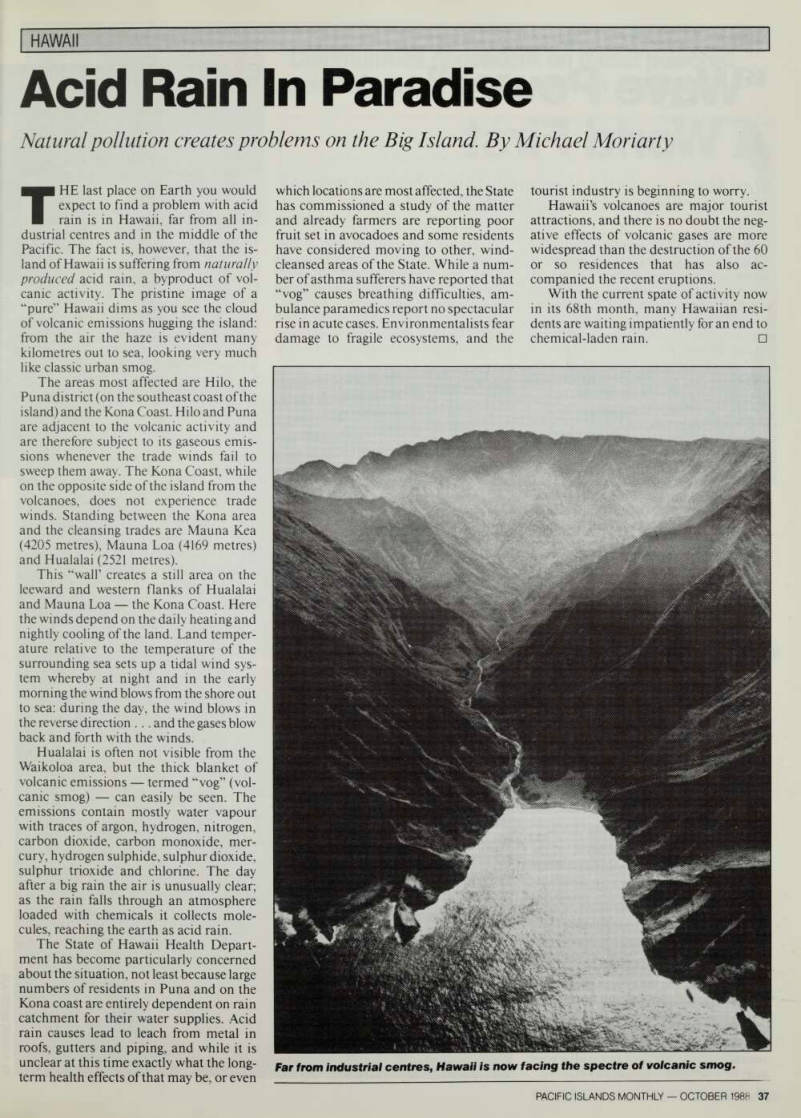
Hawaii
Natural pollution creates problems on the Big Island.
By Michael Moriarty
THE last place on Earth you would expect to find a problem with acid rain is in Hawaii, far from all in dustrial centres and in the middle of the Pacific. The fact is, however, that the is land of Hawaii is suffering from naturally produced acid rain, a byproduct of vol canic activity. The pristine image of a “pure” Hawaii dims as you see the cloud of volcanic emissions hugging the island: from the air the haze is evident many kilometres out to sea, looking very much like classic urban smog.
The areas most affected are Hilo, the Puna district (on the southeast coast of the island) and the Kona Coast. Hilo and Puna are adjacent to the volcanic activity and are therefore subject to its gaseous emis sions whenever the trade winds fail to sweep them away. The Kona Coast, while on the opposite side of the island from the volcanoes, does not experience trade winds. Standing between the Kona area and the cleansing trades are Mauna Kea (4205 metres), Mauna Loa (4169 metres) and Hualalai (2521 metres).
This “waif creates a still area on the leeward and western flanks of Hualalai and Mauna Loa the Kona Coast. Here the winds depend on the daily heating and nightly cooling of the land. Land temper ature relative to the temperature of the surrounding sea sets up a tidal wind sys tem whereby at night and in the early morning the wind blows from the shore out to sea: during the day, the wind blows in the reverse direction ... and the gases blow back and forth with the winds.
Hualalai is often not visible from the Waikoloa area, but the thick blanket of volcanic emissions termed “vog” (vol canic smog) can easily be seen. The emissions contain mostly water vapour with traces of argon, hydrogen, nitrogen, carbon dioxide, carbon monoxide, mer cury, hydrogen sulphide, sulphur dioxide, sulphur trioxide and chlorine. The day after a big rain the air is unusually clear; as the rain falls through an atmosphere loaded with chemicals it collects mole cules, reaching the earth as acid rain.
The State of Hawaii Health Depart ment has become particularly concerned about the situation, not least because large numbers of residents in Puna and on the Kona coast are entirely dependent on rain catchment for their water supplies. Acid rain causes lead to leach from metal in roofs, gutters and piping, and while it is unclear at this time exactly what the long term health effects of that may be, or even
which locations are most affected, the State has commissioned a study of the matter and already farmers are reporting poor fruit set in avocadoes and some residents have considered moving to other, wind cleansed areas of the State. While a num ber of asthma sufferers have reported that “vog” causes breathing difficulties, am bulance paramedics report no spectacular rise in acute cases. Environmentalists fear damage to fragile ecosystems, and the
tourist industry is beginning to worry.
Hawaii’s volcanoes are major tourist attractions, and there is no doubt the neg ative effects of volcanic gases are more widespread than the destruction of the 60 or so residences that has also ac companied the recent eruptions.
With the current spate of activity now in its 68th month, many Hawaiian resi dents are waiting impatiently for an end to chemical-laden rain. □
Far from industrial centres, Hawaii is now facing the spectre of volcanic smog.
“Wave Power”
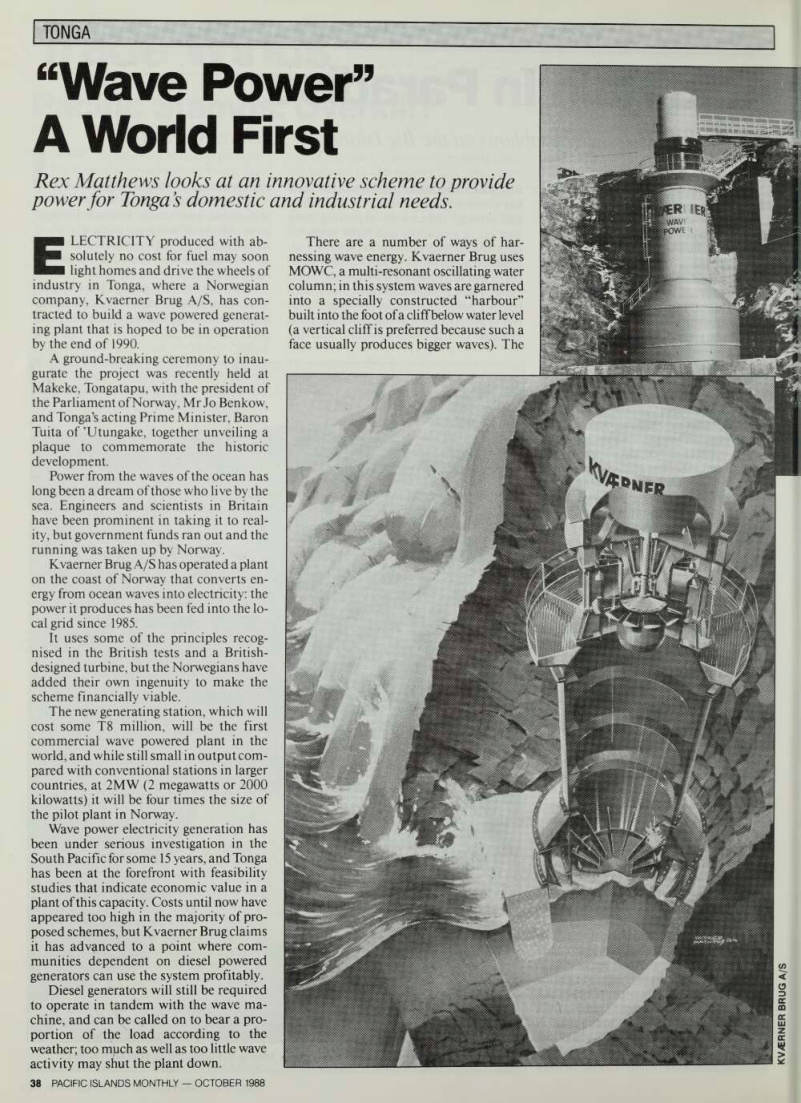
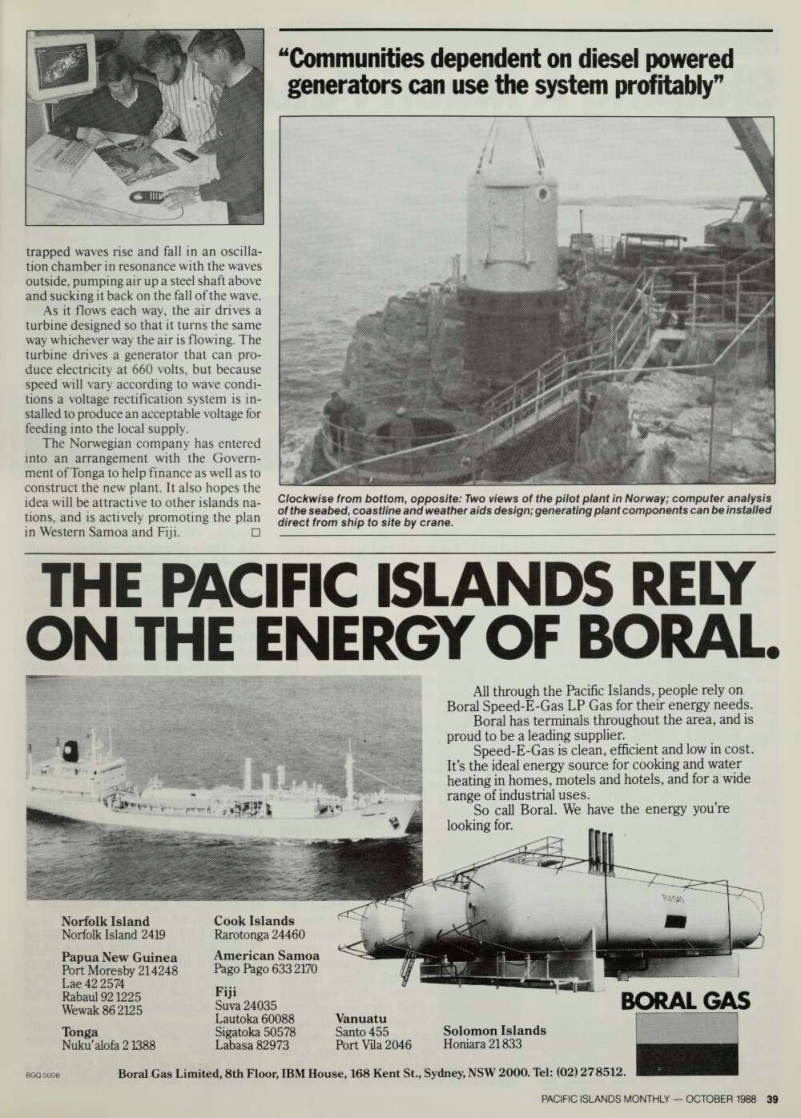
Tonga
A World First
Rex Matthews looks at an innovative scheme to provide power for Tonga’s domestic and industrial needs.
ELECTRICITY produced with ab solutely no cost for fuel may soon light homes and drive the wheels of industry in Tonga, where a Norwegian company, Kvaerner Brug A/S, has con tracted to build a wave powered generat ing plant that is hoped to be in operation by the end of 1990.
A ground-breaking ceremony to inau gurate the project was recently held at Makeke, Tongatapu, with the president of the Parliament of Norway, Mr Jo Benkow, and Tonga’s acting Prime Minister, Baron Tuita of ’Utungake, together unveiling a plaque to commemorate the historic development.
Power from the waves of the ocean has long been a dream of those who live by the sea. Engineers and scientists in Britain have been prominent in taking it to real ity, but government funds ran out and the running was taken up by Norway.
Kvaerner Brug A/S has operated a plant on the coast of Norway that converts en ergy from ocean waves into electricity: the power it produces has been fed into the lo cal grid since 1985.
It uses some of the principles recog nised in the British tests and a British designed turbine, but the Norwegians have added their own ingenuity to make the scheme financially viable.
The new generating station, which will cost some T 8 million, will be the first commercial wave powered plant in the world, and while still small in output com pared with conventional stations in larger countries, at 2MW (2 megawatts or 2000 kilowatts) it will be four times the size of the pilot plant in Norway.
Wave power electricity generation has been under serious investigation in the South Pacific for some 15 years, and Tonga has been at the forefront with feasibility studies that indicate economic value in a plant of this capacity. Costs until now have appeared too high in the majority of pro posed schemes, but Kvaerner Brug claims it has advanced to a point where com munities dependent on diesel powered generators can use the system profitably.
Diesel generators will still be required to operate in tandem with the wave ma chine, and can be called on to bear a pro portion of the load according to the weather; too much as well as too little wave activity may shut the plant down.
There are a number of ways of har nessing wave energy. Kvaerner Brug uses MOWC, a multi-resonant oscillating water column; in this system waves are garnered into a specially constructed “harbour” built into the foot of a cliff below water level (a vertical cliff is preferred because such a face usually produces bigger waves). The
Kv Aerner Brug A/S
trapped waves rise and fall in an oscilla tion chamber in resonance with the waves outside, pumping air up a steel shaft above and sucking it back on the fall of the wave.
As it flows each way, the air drives a turbine designed so that it turns the same way whichever way the air is flowing. The turbine drives a generator that can pro duce electricity at 660 volts, but because speed will vary according to wave condi tions a voltage rectification system is in stalled to produce an acceptable voltage for feeding into the local supply.
The Norwegian company has entered into an arrangement with the Govern ment of Tonga to help finance as well as to construct the new plant. It also hopes the idea will be attractive to other islands na tions, and is actively promoting the plan in Western Samoa and Fiji. □
“Communities dependent on diesel powered generators can use the system profitably”
Clockwise from bottom, opposite: Two views of the pilot plant in Norway; computer analysis of the seabed, coastline and weather aids design; generating plant components can be installed direct from ship to site by crane.
Advertisements & other items, p. 39 (1 item)
On The Energy Of Boral
THE RACIFIC ISLANDS RELY
; Si '‘ •' liili ■ ■# .. ... 9 V All through the Pacific Islands, people rely on Boral Speed-E-Gas LP Gas for their energy needs.
Boral has terminals throughout the area, and is
proud to be a leading supplier.
Speed-E-Gas is clean, efficient and low in cost.
It’s the ideal energy source for cooking and water heating in homes, motels and hotels, and for a wide range of industrial uses.
So call Boral. We have the energy you’re
looking for.
Norfolk Island Norfolk Island 2419 Papua New Guinea Port Moresby 214248 Lae 422574 Rabaul 921225 Wewak 86 2125 Tonga Nukualofa 21388 Cook Islands Rarotonga 24460 American Samoa Pago Pago 6332170 Fiji Suva 24035 Lautoka 60088 Sigatoka 50578 Labasa 82973 *
BORAL GAS
Vanuatu Santo 455 Port Vila 2046 Solomon Islands Honiara 21833 Boral Gas Limited, Bth Floor, IBM House, 168 Kent St., Sydney, NSW 2000. Tel: (02) 278512.
Shaping A Maori Future
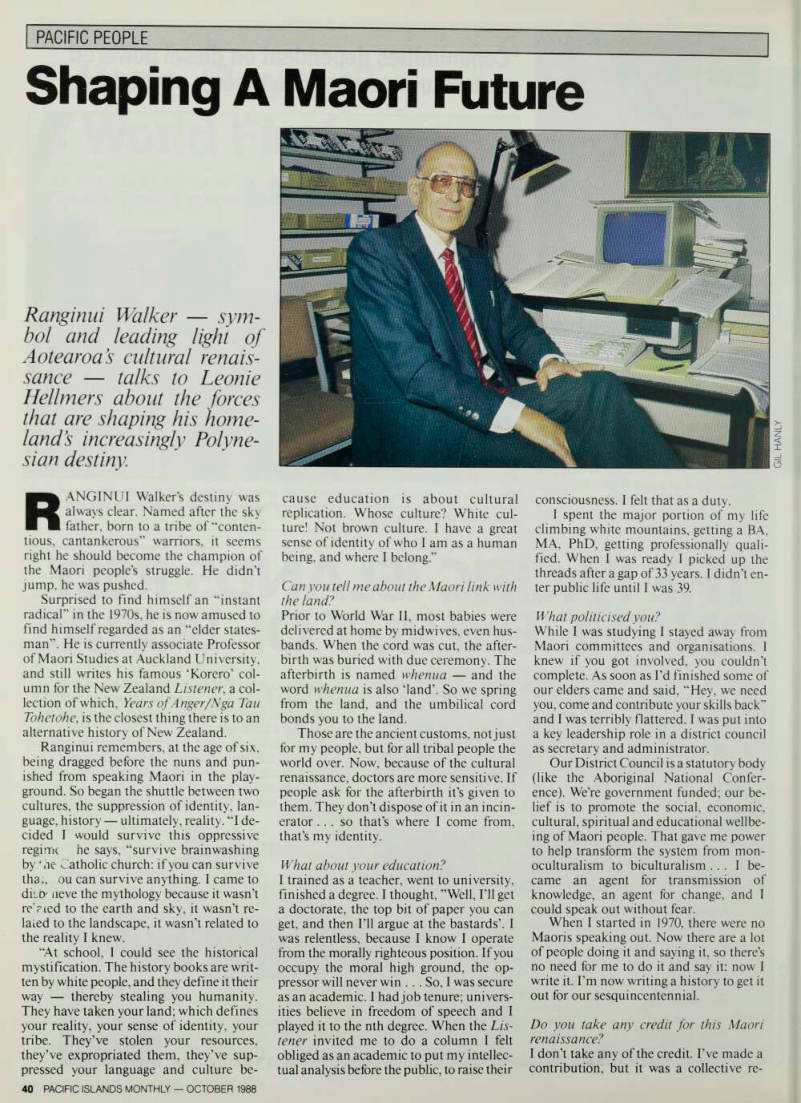
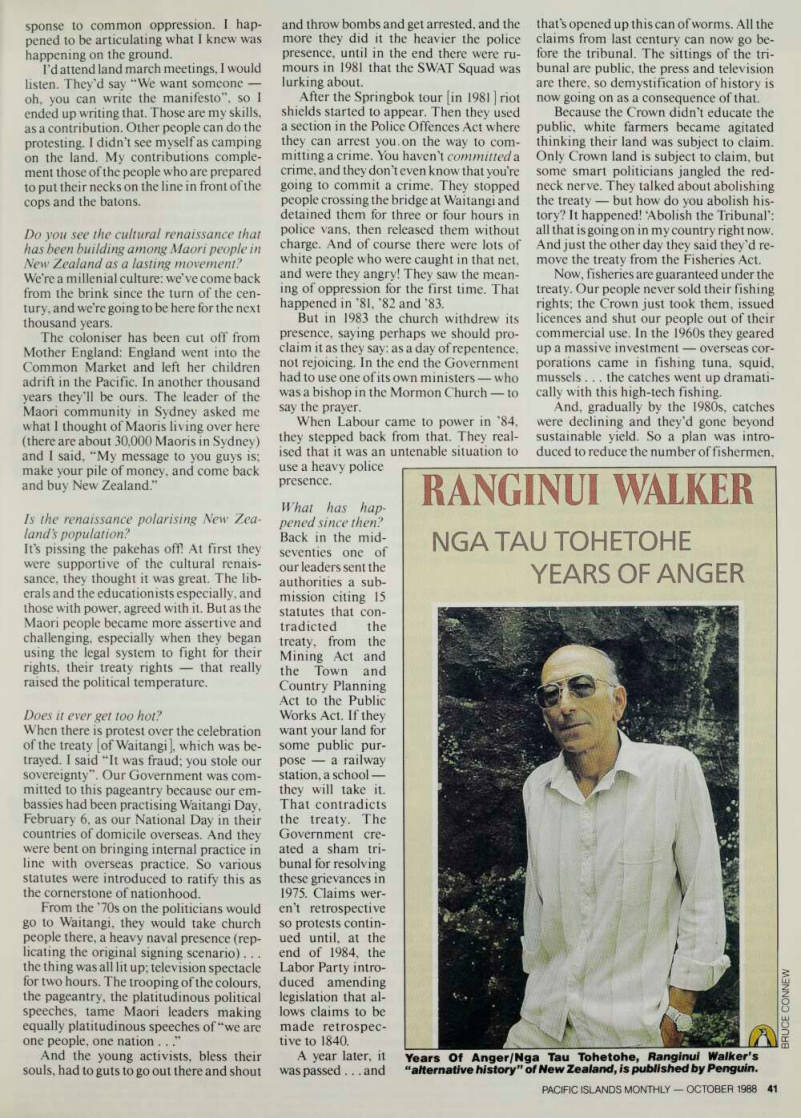
Pacific People
Ranginui Walker sym bol and leading light of Aotearoa’s cultural renais sance talks to Leonie Hellmers about the forces that are shaping his home land’s increasingly Polyne sian destiny.
RANGINUI Walker’s destiny was always clear. Named after the sky father, born to a tribe of “conten tious, cantankerous” warriors, it seems right he should become the champion of the Maori people’s struggle. He didn’t jump, he was pushed.
Surprised to find himself an “instant radical” in the 19705, he is now amused to find himself regarded as an “elder states man”. He is currently associate Professor of Maori Studies at Auckland University, and still writes his famous ‘Korero’ col umn for the New Zealand Listener , a col lection of which, Years ofAnger/Nga Tau Tohetohe, is the closest thing there is to an alternative history of New Zealand.
Ranginui remembers, at the age of six, being dragged before the nuns and pun ished from speaking Maori in the play ground. So began the shuttle between two cultures, the suppression of identity, lan guage, history ultimately, reality. “I de cided I would survive this oppressive regime he says, “survive brainwashing by Me Catholic church: if you can survive thai, ou can survive anything. I came to drib' neve the mythology because it wasn’t re>ted to the earth and sky, it wasn’t re lated to the landscape, it wasn’t related to the reality I knew.
“At school, I could see the historical mystification. The history books are writ ten by white people, and they define it their way thereby stealing you humanity.
They have taken your land; which defines your reality, your sense of identity, your tribe. They’ve stolen your resources, they’ve expropriated them, they’ve sup pressed your language and culture be-
cause education is about cultural replication. Whose culture? White cul ture! Not brown culture. I have a great sense of identity of who I am as a human being, and where I belong.”
Can you tell me about the Maori link with the land?
Prior to World War 11, most babies were delivered at home by midwives, even hus bands. When the cord was cut, the after birth was buried with due ceremony. The afterbirth is named whenua and the word whenua is also ‘land’. So we spring from the land, and the umbilical cord bonds you to the land.
Those are the ancient customs, not just for my people, but for all tribal people the world over. Now, because of the cultural renaissance, doctors are more sensitive. If people ask for the afterbirth it’s given to them. They don’t dispose of it in an incin erator ... so that’s where I come from, that’s my identity.
What about your education?
I trained as a teacher, went to university, finished a degree. I thought, ’’Well, I’ll get a doctorate, the top bit of paper you can get, and then I’ll argue at the bastards’. I was relentless, because I know I operate from the morally righteous position. If you occupy the moral high ground, the op pressor will never win ... So, I was secure as an academic. I had job tenure; univers ities believe in freedom of speech and I played it to the nth degree. When the Lis tener invited me to do a column I felt obliged as an academic to put my intellec tual analysis before the public, to raise their
consciousness. I felt that as a duty.
I spent the major portion of my life climbing white mountains, getting a BA, MA, PhD, getting professionally quali fied. When I was ready I picked up the threads after a gap of 33 years. I didn’t en ter public life until I was 39.
What politicised you?
While I was studying I stayed away from Maori committees and organisations. I knew if you got involved, you couldn’t complete. As soon as I’d finished some of our elders came and said, “Hey, we need you, come and contribute your skills back” and I was terribly flattered. I was put into a key leadership role in a district council as secretary and administrator.
Our District Council is a statutory body (like the Aboriginal National Confer ence). We’re government funded; our be lief is to promote the social, economic, cultural, spiritual and educational wellbe ing of Maori people. That gave me power to help transform the system from mon oculturalism to biculturalism ... I be came an agent for transmission of knowledge, an agent for change, and I could speak out without fear.
When I started in 1970, there were no Maoris speaking out. Now there are a lot of people doing it and saying it, so there’s no need for me to do it and say it: now I write it. I’m now writing a history to get it out for our sesquincentennial.
Do you take any credit for this Maori renaissance?
I don’t take any of the credit. I’ve made a contribution, but it was a collective re
sponse to common oppression. I hap pened to be articulating what I knew was happening on the ground.
I’d attend land march meetings, I would listen. They’d say “We want someone oh, you can write the manifesto”, so I ended up writing that. Those are my skills, as a contribution. Other people can do the protesting. I didn’t see myself as camping on the land. My contributions comple ment those of the people who are prepared to put their necks on the line in front of the cops and the batons.
Do you see the cultural renaissance that has been building among Maori people in New Zealand as a lasting movement?
We’re a millenial culture: we’ve come back from the brink since the turn of the cen tury, and we’re going to be here for the next thousand years.
The coloniser has been cut off from Mother England: England went into the Common Market and left her children adrift in the Pacific. In another thousand years they’ll be ours. The leader of the Maori community in Sydney asked me what I thought of Maoris living over here (there are about 30,000 Maoris in Sydney) and I said, “My message to you guys is; make your pile of money, and come back and buy New Zealand.”
Is the renaissance polarising New Zea land’s population?
It’s pissing the pakehas off! At first they were supportive of the cultural renais sance, they thought it was great. The lib erals and the educationists especially, and those with power, agreed with it. But as the Maori people became more aissertive and challenging, especially when they began using the legal system to fight for their rights, their treaty rights that really raised the political temperature.
Does it ever get too hot?
When there is protest over the celebration of the treaty [of Waitangi], which was be trayed. I said “It was fraud; you stole our sovereignty”. Our Government was com mitted to this pageantry because our em bassies had been practising Waitangi Day, February 6, as our National Day in their countries of domicile overseas. And they were bent on bringing internal practice in line with overseas practice. So various statutes were introduced to ratify this as the cornerstone of nationhood.
From the ’7os on the politicians would go to Waitangi, they would take church people there, a heavy naval presence (rep licating the original signing scenario). .. the thing was all lit up; television spectacle for two hours. The trooping of the colours, the pageantry, the platitudinous political speeches, tame Maori leaders making equally platitudinous speeches of “we are one people, one nation ..
And the young activists, bless their souls, had to guts to go out there and shout
and throw bombs and get arrested, and the more they did it the heavier the police presence, until in the end there were ru mours in 1981 that the SWAT Squad was lurking about.
After the Springbok tour [in 1981 ] riot shields started to appear. Then they used a section in the Police Offences Act where they can arrest you.on the way to com mitting a crime. You haven’t committed a crime, and they don’t even know that you’re going to commit a crime. They stopped people crossing the bridge at Waitangi and detained them for three or four hours in police vans, then released them without charge. And of course there were lots of white people who were caught in that net, and were they angry! They saw the mean ing of oppression for the first time. That happened in ’Bl, ’B2 and ’B3.
But in 1983 the church withdrew its presence, saying perhaps we should pro claim it as they say; as a day of repentence, not rejoicing. In the end the Government had to use one of its own ministers who was a bishop in the Mormon Church to say the prayer.
When Labour came to power in ’B4, they stepped back from that. They real ised that it was an untenable situation to
use a heavy police presence.
What has hap pened since then?
Back in the mid seventies one of our leaders sent the authorities a sub mission citing 15 statutes that con tradicted the treaty, from the Mining Act and the Town and Country Planning Act to the Public Works Act. If they want your land for some public pur pose a railway station, a school they will take it.
That contradicts the treaty. The Government cre ated a sham tri bunal for resolving these grievances in 1975. Claims wer en’t retrospective so protests contin ued until, at the end of 1984, the Labor Party intro duced amending legislation that al lows claims to be made retrospec tive to 1840.
A year later, it was passed ... and
that’s opened up this can of worms. All the claims from last century can now go be fore the tribunal. The sittings of the tri bunal are public, the press and television are there, so demystification of history is now going on as a consequence of that.
Because the Crown didn’t educate the public, white farmers became agitated thinking their land was subject to claim.
Only Crown land is subject to claim, but some smart politicians jangled the red neck nerve. They talked about abolishing the treaty but how do you abolish his tory? It happened! ‘Abolish the Tribunal’: all that is going on in my country right now.
And just the other day they said they’d re move the treaty from the Fisheries Act.
Now, fisheries are guaranteed under the treaty. Our people never sold their fishing rights; the Crown just took them, issued licences and shut our people out of their commercial use. In the 1960 s they geared up a massive investment overseas cor porations came in fishing tuna, squid, mussels ... the catches went up dramati cally with this high-tech fishing.
And, gradually by the 1980 s, catches were declining and they’d gone beyond sustainable yield. So a plan was intro duced to reduce the number of fishermen.
but effectively it squeezed out the small guys. Fisheries access had become mar ketable, like personal property. Who gob bles it up? The big boys; five corporations.
In effect the government created a prop erty right in the sea.
The tribes got together and served an injunction against the Crown. Five judges ruled it was in contradiction of the Treaty.
A Working Party set up to negotiate rights reached a deadlock on percentages: the Maori negotiators wanted 50 per cent, the Crown negotiators said no, you’re 15 per cent of the population so we’ll give you 15 per cent of the fisheries.
They were supposed to issue a resolu tion on June 30, but instead issued tan dem reports. It didn’t go back to court, and negotiations are continuing now directly between the ministers and our leaders.
The consequence of that is that some of the fishing boys are really uptight: they’ve taken half-page ads in the paper promot ing a petition (to be signed by about 50,000 people) saying that democracy is under threat, that rights are being taken over by the Maoris and resources are being taken by one group of people.
So, you’ve pakeha landowners getting uptight when they have no need to be cause the quarrel is with the Crown, not them. You’ve got individual fishermen getting uptight, and there’s no need to, be cause they will still continue to use their quota. What in effect will happen is the Maori and the Crown become the joint shareholders in the fishing licences.
What about the revival of moko (facial tattooing). Is it respectful?
It used .to bug me that our [prison] in mates would tattoo and disfigure them selves with these senseless, meaningless things all over their bodies. Why don’t they go and put the proper thing on? It’s start ing to happen. I’m surprised to see maybe half a dozen people who are doing tradi tional facial tattoos, whereas once upon a time it was grotesque but it was ex pressing, really, a broken culture. And now those guys are making political and cul tural statements in their tattoos.
Is bilingual education the next step?
They nearly killed our language off. Re searchers from the New Zealand Council for Educational Research have shown that the language has gone through four defin able stages. First security: when the Maori people were the majority and the colon iser came under their terms, it was the co loniser who was bilingual. But as they became numerically stronger, the Maoris became bilingual and the whites became monolingual. Then the pakehas domi nated and the Maori language started to decay. Now decay is well advanced, and the fourth stage which is Maori lan guage death is imminent.
That was put before a conference of Maori leaders. The elders were horrified;
they thought people would be speaking Maori as sure as the sun rises tomorrow, and suddenly here was the evidence say ing no because all your fluent speakers are over the age of 45, entering the mor tality years. Probably only 5 to 10 per cent of the under-fifteens spoke the language.
The elders said, “We must get kohanga reo (language nest) started. So the De partment of Maori Affairs, and it’s one of the best things it’s ever done in its 148 years of existence, established two pilot pre schools using just Maori. They showed it could work, and in no time at all they blos somed all over the country.
In 1982 we had only two pilot schools; we now have close to 500 where all the preschool work is carried out in the Maori language.
This is part of liberation: the oppressed must take control of their own education.
The next step is to establish bilingual schools. We’ve got two bilingual schools in Auckland, but we need a dozen: the two in existence now are private, but we hope we can push the state into funding them.
Just before I left another opened in Chirstchurch, which is fantastic, and some [idiot], the head of the Teachers’ College, said, These Maoris are setting up their own schools. It’s a form of apartheid!’ They can’t see the distinction between volun tary and enforced separation.
It’s part of the recovery of your own hu manity to control your own education, to define your own reality through things such as this. We’ve just had six weeks of our own Maori radio station, and even tually we’ll get that in Auckland.
It’s a very exciting period!
It is! And as I say, in the long term we will win because we are rooted in the land. The white man is detached from his cultural roots; he’s adrift in the South Pacific. We will save them from themselves ... if they don’t destroy the earth first.
To save themselves, does that mean whites can adopt your ways in some respects, abide by your laws?
Yes, by joining with us, marrying with us, identifying with us and with our values.
Without offending you.
No. That’s correct.
So, many of them want to know how.
Well, there are plenty of pakehas doing it, and one of the things is to learn to be hum ble. Some of the liberals are showing that they can do that: during the 1984 march to Waitangi from the Queen’s Capital, they stopped en route at Bastion Point. But who should be lighting the fires and cooking the food, out in the open, but the pakeha lib erals! In a menial servant role.
This is the hardest thing for pakehas to do to let go of power and let other people take over that power; to act in an auxiliary capacity and be humble about it. □
Advertisements & other items, p. 41 (1 item)
Bruce Connew
RANGINUI WALKER
NGATAU TOHETOHE
YEARS OF ANGER
Years Of Anger/Nga Tau Tohetohe, Ranginui Walker’s “alternative history” of New Zealand, is published by Penguin.
BRUCE CONNEW
Transition
Appointed: Dr Ross Mitchell, Goodman Fielder Wattie director based in Auck land, as executive responsible for all op erations of the group in Fiji. Dr Mitchell is managing director of the New Zealand Cereal Milling and Poultry Group.
Recognised: Mrs Winnie Safkaur, of Kokopo, East New Britain, for her work in producing primary health education aids for schools. Mrs Safkaur, 40, has been teaching for 22 years. Her recognition came in the form of a World Health Organisa tion Commemorative Medal, an award not previously bestowed outside the Health Department.
Mrs Safkaur modestly viewed the award as being on behalf of all teachers sharing in health education programs, and as a measure of recognition of the growing stature of professional women.
Died: Mr Bob Parkes, a pioneer of the travel industry in Fiji, in Suva on August 30, aged 73. Mr Parkes served in the New Zealand Army in World War II in Fiji and in the Middle East, returning to Fiji after the war and joining White’s Travel Serv ice, where package tours from Australia and New Zealand were first put together.
Died: Papa Taru Moana, president of the Koutu Nui, a body of chiefs and sub chiefs, in Arorangi, Cook Islands, on Au gust 1. Papa Tarn was a church leader and was elected to the first parliament of the Cook Islands in 1965; he remained a member until 1974. He is survived by two daughters, three sons and many grandchildren.
Died; Mr Ranga Reddy, Suva busi nessman, aged 60, on September 11. A partner in the Reddy Construction Com pany Ltd, Mr Reddy was also a keen golfer, representing Fiji at the South Pacific Games in 1969, 1971 and 1975. He was a member of the Fiji Film Censor Board for five years. He is survived by two sons, Na rayan and Rajesh, and a daughter, Subha Laxmi Rajan.
Died: Father Patrick O’Reilly, SM, his torian and researcher at the Musee de 1’Homme in Paris on August 6, aged 88.
Father O’Reilly first worked in the Solo mons in 1935-36 and after World War II devoted himself to South Pacific bibli ography and history. He published an notated bibliographies on Vanuatu, New Caledonia and Tahiti, and wrote defini tive studies of personalities of those countries.
He focused on Tahiti for his historical studies, and contributed much to the cre ation of the Musee Gauguin in Tahiti and the Musee de Tahiti et des lies. □
Advertisements & other items, p. 43 (1 item)
Breaking some
BJhonda Progress with Distinction.
rules to achieve
a new standard
of quality.
The new Civic Series makes its debut.
And it's a series that bound to change the way people view popular compact cars. Take the new 4-door Civic Sedan.
It looks like a quiet, decorous sedan.
But the new Civic 4-door Sedan breaks with convention in more ways than one.
For instance, each Civic 4-door Sedan features as standard a newly-developed sporty 16-valve engine and a 4-wheel double wishbone suspension. Hardly the rule in conventional cars of its class, these significant technological advantages allow the new Civic 4-door Sedan to transcend all conventional concepts of its class.
A prerequisite for a sedan today is refined, well-balanced styling. The Civic Sedan skillfully incorporates elements of aviation aerodynamics to achieve a classic silhouette. Entirely flush-surfaced, its elegant, rounded body lines combine with extensive glass areas to form one sleek, unbroken curve from the low nose to spoiler-shaped tail. And inside, there's an increased sense of \/ai \ /F r 4-Wheel -V/\I_V t Double Wishbone spaciousness, with the comfort quotient reaching new heights.
Sedans that stick to conventional rules.
Perfectly acceptable, but be prepared for conventional performance. Then try the new Civic Sedan. You'll be happy Honda broke some rules.
iHONDA
Specifications and equipment may vary in some countries.
V Oh© Honda engines have powered the Williams/Honda team to consecutive Constructors' Championships in 1986 and 1987, and last year powered Nelson Piquet to victory in the Driver's Championship.
For 1988, Honda engines will continue to compete in motor sports' toughest arena with the Lotus and McLaren teams.
AUSTRALIA; Honda Australia Pty, Ltd. Lot 95 Sharps Road, Tullamarine, Victoria 3043; Bennett Honda Pty, Ltd. 250 Victoria Road, Wetherill Park, N S W. 2164/NEW ZEALAND: Honda New Zealand Ltd.
Manners Plaza. 57-65 Manners St.. Wellmgton/PAPUA NEW GUINEA; Toba Pty, Ltd. P.O Box 503, Port Moresby/TAHITI: Honda Distribution S.A. R.L BP 1665, Papeete/KIRIBATI: Atoll Motor & Marino Services P.O, Box 49, Bairiki Tarawa, Republic of Kiribati/U.S. TRUST TERRITORY: United Micronesia Development Association P.O, Box 235, CHRB Saipan CM 96950/COOK ISLANDS: Cook Islands Motor Centre Ltd. P.O. Box 74, Rarotonga/GUAM: Mark’s Motor Co, Inc. P.O Box DV, Agana/WESTERN SAMOA: Motor Distributors (Samoa) Ltd. P:0. Box 576, Apia/ SOLOMON ISLANDS: Lee Kwok Kuen & Co, Ltd. P.O, Box 537, Honiara/NAURU; Nauru Cooperation Republic of Nauru/ f IJI Coral Island Motors Ltd. Robertson Road, Suva, Fiji/AMERICAN SAMOA: Holiday Motors, Parts and Service P O Box 968, Pago Pago, American Samoa 96799: Heleck’s Service Center Ltd. P.O. Box 1138 Pago Pago, American Samoa 96799/TONGA; Tonga Industrial Traders P.O. Box 1035. Nukualofa. Tonaa/NORFOLK ISLAND: Duncombe Bav Garaoe New Cascade Road. Norfolk Island/VANUATU; Honda Farm Ltd. P.O. Box 1031. Pori Vila. Vanuatu
An Ocean Well Studied
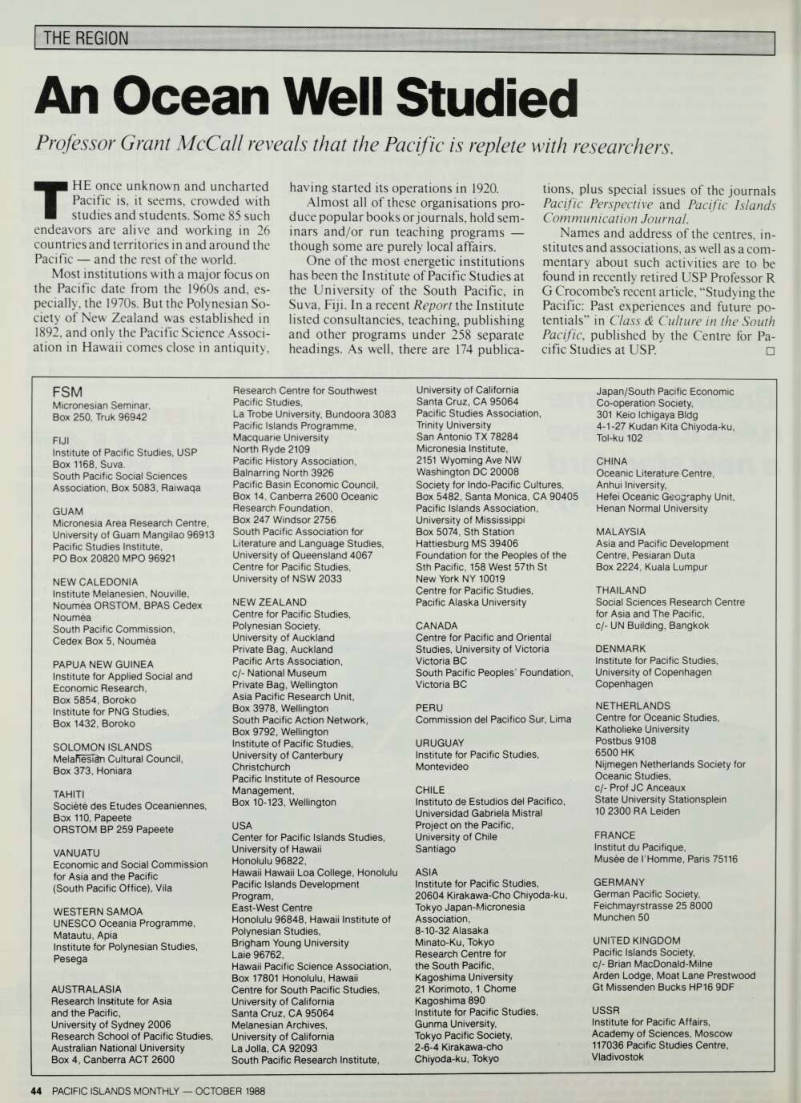
The Region
Professor Grant McCall reveals that the Pacific is replete with researchers.
THE once unknown and uncharted Pacific is, it seems, crowded with studies and students. Some 85 such endeavors are alive and working in 26 countries and territories in and around the Pacific and the rest of the world.
Most institutions with a major focus on the Pacific date from the 1960 s and, especially, the 19705. But the Polynesian Society of New Zealand was established in 1892, and only the Pacific Science Association in Hawaii comes close in antiquity,
having started its operations in 1920.
Almost all of these organisations produce popular books or journals, hold seminars and/or run teaching programs though some are purely local affairs.
One of the most energetic institutions has been the Institute of Pacific Studies at the University of the South Pacific, in Suva, Fiji. In a recent Report the Institute listed consultancies, teaching, publishing and other programs under 258 separate headings. As well, there are 174 publica-
tions, plus special issues of the journals Pacific Perspective and Pacific Islands Communication Journal.
Names and address of the centres, in stitutes and associations, as well as a com mentary about such activities are to be found in recently retired USP Professor R G Crocombe’s recent article, “Studying the Pacific: Past experiences and future po tentials” in Class & Culture in the South Pacific , published by the Centre for Pa cific Studies at USP. □
Fsm
Micronesian Seminar, Box 250, Truk 96942
Fiji
Institute of Pacific Studies, USP Box 1168, Suva.
South Pacific Social Sciences Association, Box 5083, Raiwaqa
Guam
Micronesia Area Research Centre, University of Guam Mangilao 96913 Pacific Studies Institute,
Po Box 20820 Mpo 96921
New Caledonia
Institute Melanesien, Nouville, Noumea ORSTOM, BPAS Cedex Noumea South Pacific Commission, Cedex Box 5, Noumea
Papua New Guinea
Institute for Applied Social and Economic Research, Box 5854, Boroko Institute for PNG Studies, Box 1432, Boroko
Solomon Islands
Melaßesistn Cultural Council, Box 373, Honiara
Tahiti
Societe des Etudes Oceaniennes, Box 110, Papeete ORSTOM BP 259 Papeete
Vanuatu
Economic and Social Commission for Asia and the Pacific (South Pacific Office), Vila
Western Samoa
UNESCO Oceania Programme, Matautu, Apia Institute for Polynesian Studies, Pesega
Australasia
Research Institute for Asia and the Pacific, University of Sydney 2006 Research School of Pacific Studies, Australian National University Box 4, Canberra ACT 2600
Research Centre for Southwest Pacific Studies, La Trobe University, Bundoora 3083 Pacific Islands Programme, Macquarie University North Ryde 2109 Pacific History Association, Balnarring North 3926 Pacific Basin Economic Council, Box 14, Canberra 2600 Oceanic Research Foundation, Box 247 Windsor 2756 South Pacific Association for Literature and Language Studies, University of Queensland 4067 Centre for Pacific Studies, University of NSW 2033
New Zealand
Centre for Pacific Studies, Polynesian Society, University of Auckland Private Bag, Auckland Pacific Arts Association, c/- National Museum Private Bag, Wellington Asia Pacific Research Unit, Box 3978, Wellington South Pacific Action Network, Box 9792, Wellington Institute of Pacific Studies, University of Canterbury Christchurch Pacific Institute of Resource Management, Box 10-123, Wellington
Usa
Center for Pacific Islands Studies, University of Hawaii Honolulu 96822, Hawaii Hawaii Loa College, Honolulu Pacific Islands Development Program, East-West Centre Honolulu 96848, Hawaii Institute of Polynesian Studies, Brigham Young University Laie 96762, Hawaii Pacific Science Association, Box 17801 Honolulu, Hawaii Centre for South Pacific Studies, University of California Santa Cruz, CA 95064 Melanesian Archives, University of California La Jolla, CA 92093 South Pacific Research Institute,
University of California Santa Cruz, CA 95064 Pacific Studies Association, Trinity University San Antonio TX 78284 Micronesia Institute, 2151 Wyoming Ave NW Washington DC 20008 Society for Indo-Pacific Cultures, Box 5482, Santa Monica, CA 90405 Pacific Islands Association, University of Mississippi Box 5074, Sth Station Hattiesburg MS 39406 Foundation for the Peoples of the Sth Pacific, 158 West 57th St New York NY 10019 Centre for Pacific Studies, Pacific Alaska University
Canada
Centre for Pacific and Oriental Studies, University of Victoria Victoria BC South Pacific Peoples’ Foundation, Victoria BC
Peru
Commission del Pacific© Sur, Lima
Uruguay
Institute for Pacific Studies, Montevideo
Chile
Institute de Estudios del Pacifico, Universidad Gabriela Mistral Project on the Pacific, University of Chile Santiago
Asia
Institute for Pacific Studies, 20604 Kirakawa-Cho Chiyoda-ku, Tokyo Japan-Micronesia Association, 8-10-32 Alasaka Minato-Ku, Tokyo Research Centre for the South Pacific, Kagoshima University 21 Korimoto, 1 Chome Kagoshima 890 Institute for Pacific Studies, Gunma University, Tokyo Pacific Society, 2-6-4 Kirakawa-cho Chiyoda-ku, Tokyo
Japan/South Pacific Economic Co-operation Society, 301 Keio Ichigaya Bldg 4-1-27 Kudan Kita Chiyoda-ku, Tol-ku 102
China
Oceanic Literature Centre, Anhui Iniversity, Hefei Oceanic Geog r aphy Unit, Henan Normal University
Malaysia
Asia and Pacific Development Centre, Pesiaran Duta Box 2224, Kuala Lumpur
Thailand
Social Sciences Research Centre for Asia and The Pacific, c/- UN Building, Bangkok
Denmark
Institute for Pacific Studies, University of Copenhagen Copenhagen
Netherlands
Centre for Oceanic Studies, Katholieke University Postbus 9108 6500 HK Nijmegen Netherlands Society for Oceanic Studies, c/- Prof JC Anceaux State University Stationsplein 10 2300 RA Leiden
France
Institut du Pacifique, Musee de I’Homme, Paris 75116
Germany
German Pacific Society, Feichmayrstrasse 25 8000 Munchen 50
United Kingdom
Pacific Islands Society, c/- Brian MacDonald-Milne Arden Lodge, Moat Lane Prestwood Gt Missenden Bucks HPI6 9DF
Ussr
Institute for Pacific Affairs, Academy of Sciences, Moscow 117036 Pacific Studies Centre, Vladivostok
Tropicalities
“Divisive” Festival
I WRITE of my concern regarding the Fifth Festival of Pacific Arts just held in Townsville. After this Australian ex perience, it is obvious to me that future Festivals should never again be given to a metropolitan country.
The island performers were well pre pared, colourful and exciting but we, the festival audience, and many of the visiting delegations thought we were in a police state and not in the joyous South Pacific.
We were oppressed by the constant high profile of soldiers with walkie- talkies, pri vate security guards and liaison officers peering closely if you spoke to any old friends, even of many years’ standing there was a closed, divisive atmosphere where people European antecedents were definitely unwelcome.
Instead of the wonderful lift that was expressed throughout the four other fes tivals, this one was too political. Activists mainly Aboriginal and Maori were prominent, aiming to indoctrinate discor dant views as widely as possible among the islanders. It was a blatant exercise in political propaganda hiding behind the fa cade of an artistic festival. Activist flags were always visible and even the logo cho sen by the Townsville committee was sel fishly and exclusively Aboriginal and Islander Australian so disregarding the fact that the festival is for ALL South Pa cific countries.
This insult disregarded the tradition followed by all other festival hosts, where the logos were required to include ele ments common to all South Pacific Com mission countries; the sun, the Pacific Ocean and canoes. Sadly, all this has turned the emphasis away from the joyous mood of other festivals to one of disrup tion with strong political overtones.
Future Festivals of Pacific Arts should stay in the island countries where they ob viously belong.
Sina Powell Pago Pago American Samoa
“Tremendous” Festival
HAVING returned from Townsville after two weeks of wonderful camaraderie and enjoyment, I would like to say “thank you’ to all who participated and organised the Fifth Fes tival of Pacific Arts. It was a celebration of sights and sounds of a tremendous stand ard. May you all feel well loved for sharing your efforts with us.
Brian Wray
Sydney, Australia
New Caledonia’S Remarkable Men
AS Pacific Islands Leaders of the Year for 1988 I nominate New Ca ledonians Jean-Marie Tjibaou and Jacques Lafleur, for their remarkable con tribution to a long-term peace solution for the future of their country.
F Grossini
Rome Italy
Anarchy In Png
I WOULD like to support the opinions expressed by Chris Ashton in the June issue of Pacific Islands Monthly. I thoroughly agree with four of the points he made about he mentioned the country’s “misconceived education system”, and he was correct. There seems to have been a misunderstanding between the former National Government, the Education De partment and academic institutions such as the University of Papua New Guinea and Unitech. This leads to improper plan ning in catering for those leaving schools, especially at the lower levels. This is clearly seen in the community schools and the high schools; there are not enough tertiary institutions and vocational centres for them, so they turn to direct means of in come earning. As a result, the number of juvenile crimes is increasing, especially stealing and drug- trafficking.
It doesn’t surprise any Papua New Guinean and not only those in the Western Highlands to see PNG “slip ping into anarchy”. This was expected to happen because it was never the intention of Mr Wingti’s Government to improve law and order: rural economic development was its priority, not an area that needed radical action.
Mr Ashton’s detailed description of crimes just highlighted a few of the crim inal activities that have been increasing over the past few years. Public places are becoming unsafe, especially at night. The streets of the main centres such as Port Moresby and Lae have become danger ous; homemade guns seen in the Western Highlands are also found in the Eastern Highlands to hold up the public travelling along the Okuk Highway.
Break-and-enter and armed robbery are the main causes of many companies with drawing from PNG. The withdrawal of the plantation management company in the Baiyer River, as mentioned by Mr Ash ton, is typical. Expatriates often leave the country for similar reasons, and because they cannot tolerate threats to their lives from criminals who demand money.
It is true now that the task lies with the
police force and the judicial system. How ever, they don’t have the money, skills and manpower to overcome anarchy: the re sponsibility rests on the shoulders of the new Papua New Guinea government.
Morath Maire
Sogeri National High School Boroko, Papua New Guinea
Solomons Housing: Brickbats ...
I AM writing in response to Larry Writ er’s article, “Islanders Help Them selves To New Homes” (Pacific Islands Monthly , July) concerning housing recon struction in the Solomon Islands follow ing damage by cyclone Namu in May 1988.
I read Mr Writer’s article with distaste and shock. As one of the co-ordinators of the Guadalcanal Province Cyclone Namu Rural Housing Reconstruction Assess ment Project, and having lived in the Guadalcanal Plains (where most of the se vere flooding took place), I find the article horribly erroneous. It is a grave injustice that Mr Kitchener has presented the pro ject as being near completion when; Not one of the 1600 homes on Guad alcanal reported as having been destroyed has, as of August 20, received even one sheet of roofing iron.
The National Disaster Council and Mr Kitchener’s program have decided that seven wards will be excluded from the roofing iron program, when they have for the past two years been leading people to believe that they were indeed going to re ceive roofing iron.
In May this year Mr Kitchener went to Malaita to inspect progress of some 800 packages of roofing iron, to discover that only seven homes out ofBoo had iron roofs.
The only housing reconstruction that has taken place in the Guadalcanal Plains was the introduction of one chainsaw, given to the area’s local government only five months ago; no demonstration houses have been built for the people of Guadal canal Plains, and only six on the entire is land of Guadalcanal.
Guadalcanal Province decided to put together its own assessment of damaged housing because assessors were unfamil iar with their areas of assessment, missing affected villages entirely and lumping other villages together. Not realising that some groups would have to abandon their partially destroyed homes because of flooding, loss of gardens and so on, asses sors “wrote off complete villages.
I could continue, but the fact remains that this program has been littered with controversy from its beginning, with ship ping delays, funds being unavailable and management confusion. That certainly ►
4 doesn’t sound like a success to me!
Nor would I think the funding agencies involved from the Netherlands, New Zealand, the EEC and the United States would think so.
Which brings us to the real tragedy of this program: the rural people who have been waiting and waiting for their roofing iron, and who have (partly, I will admit, because of my own naivete) been de ceived by radio broadcasts and newspaper articles telling them the materials are coming. It now appears that after 26 months, some of the people of Guadal canal will receive what they’ve been promised.
As for those people on Guadalcanal who have been excluded, maybe Mr Kitchener should go out to their villages and tell them personally that the program has been changed. Your magazine, sir, and your readers, have been duped!
Vincent Paris
Guadalcanal Solomon Islands
... And Bouquets
ON behalf of the committee respon sible for the housing reconstruc tion program in the Solomon islands, I would like to clarify certain mat ters raised by Vincent Paris.
Concerning distribution of materials in Guadalcanal, distribution was delayed by the failure of the provincial administra tion to provide accurate materials. Distri bution began in Guadalcanal in September and will be completed in two months.
Concerning exclusion of certain wards in Guadalcanal, this is not true: these wards will be assisted when funds become available and materials have been received.
Concerning construction of houses, the project’s job is to distribute materials and assist with training and advice; its job is not to build houses. The villagers are re sponsible for building their own.
Concerning teaching of new building methods and provision of sawmills, since January 1987 the project has had teams of builders working in the worst affected areas teaching disaster-resistant building tech niques and has been operating five port able sawmills in these areas since December 1986.
Concerning assessment of damage, the National Disaster Council sent trained, impartial observers to the areas con cerned directly after the cyclone to assess the damage done to food crops, roads, houses and so on. Guadalcanal Province made its own assessment 12 months later by sending out blank application forms to provincial staff to distribute as they saw
fit. The results were laughable, and were not accepted by the people in the areas concerned nor by the national government.
Concerning controversy, shipping de lays and funding problems, it is correct that we have problems with funding and that distribution of materials has been delayed by bad weather and unavailability of ship ping. There are, after all, only three ships in the whole country capable of carrying this amount of material.
It is not correct that there has been “a lot” of argument and controversy: there have been approximately eight disputes about ownership of materials, out of the 4150 families who will receive materials in the first phase of the program. It is signif icant that it is Mr Paris a Peace Corps volunteer who is complaining, not the Solomon Islanders living in his area.
Funds were not available to assist everyone at the same time and priority was given to those areas that were most se verely damaged. Mr Paris lived for some time in one of those less severely damaged areas and was not intimately involved in the project; he is therefore speaking from an unrepresentative and very limited perspective.
My committee would like to clarify one further point: it is the first phase of the project that is almost completed, not the whole project. The second phase of the project is being delayed until a proper evaluation of the first phase can be made and funding finalised. Otherwise the ar ticle is correct, and we welcome this ac knowledgement of what has been a successful project to date.
Richard Pezzulo
Chairman, Rural Housing Rehabilitation Management Committee Honiara Solomon Islands
A Dumping Ground For Old Food?
AS a housewife in the island para dise of Western Samoa, my great est challenge has been to produce a daily menu that is both tasty and nour ishing. It is through this effort that I have become aware of one particular problem, for which I hope someone has at the very least a better explanation than I do and ideally an answer.
I cannot buy milk with a shelf life of more than four months, and lately only of three months. I have three boxes of cereal in my cupboard, all with a “use by” square ... but with no date printed. Recently I had to throw out a box of cereal due to rancid
raisins, and weevils in spaghetti and noo dles seems to be the norm here.
These are a few examples, but the amount of short-dated and near short dated food here is overwhelming (let me add that I purchased these foodstuffs at one of the major retail outlets in Apia, and in no way is this a criticism of their business).
I have discussed my concerns with a number of expatriates here and am told this is not a problem peculiar to Samoa but one that occurs in most of the Pacific is lands. As a North American I am well aware of the many consumer protection agencies operating in the Western world and believe manufacturers are dumping what they consider to be unacceptable food on the smaller developing nations.
I have never before been motivated to write to a magazine and ask “Why?” or openly to criticise, but I find this situation appalling and would love to be proven wrong. At the risk of sounding completely naive, may I say that once again it appears the almighty dollar takes precedence over humans.
Amy Parker
Apia Western Samoa
Penfriends Wanted For Png
I AM a 17-year-old Papua New Gui nean in search of a pen-friend within the Pacific islands and elsewhere.
Would you please publish my name and address in your magazine so someone willing to do so may write to me? If I re ceive many letters I will pass some on to my friends.
Herman Huate
PO Box 761 Lae, Papua New Guinea
Tabai Walks The Tightrope
MY choice as the Pacific’s Leader of the Year is Mr leremia Tabai, President of Kiribati.
In 50 words: “President leremia Tabai walks the tightrope with on one side tra ditional life {te katei ni Kiribati ) and on the other side the modern, Western world {te katei ni i-Matang ) very skilfully con necting both worlds but not compromis ing. In these fast-changing times he is the best leader a small nation can have.”
Thank you for reading the opinion of a Dutchman on Pacific politics. Please accept my compliments for your excellent magazine, which I read every month with pleasure.
Mark Overbeeke
The Hague Holland
Book Reviews
LEE 800 OF BELAU: A Prince in London By Daniel J Peacock. South Sea Books. ISBN 0
8248 1086 Sus 18.50
Reviewed by HARVEY ZANE HELFAND IT is altogether fitting that Daniel Pea cock’s Lee 800 of Belau was selected as the first of a new series of “South Sea Books” published by the University of Hawaii Press and the University’s Pacific Islands Studies Program. Peacock’s book is a milestone in Micronesian chronicles, and an important contribution to the lit erature of Oceania.
The book recounts events related to the voyage of the East India Company packet Antelope , under Captain Henry Wilson, which was wrecked on the uncharted reef of the Belau (Palau) archipelago on a stormy August night in 1783. The crew was able to use the ship’s boats and a make shift raft to reach a sheltered cove on the small island of Oroolong (Ulong), some 22 kilometres southwest of Koror.
Before long a remarkable friendship sprang up between Abba Thulle (the Ibedul), High Chief of Koror, and Captain Wilson. Wilson’s men assisted the Chief in his battles with the village of Artingall (Melekeok) on the island of Babeldaob; in turn, the Englishmen were given food and help in constructing a new vessel, utilising what they could from the wreck of the An telope. Before sailing in the new ship, named Oroolong , Captain Wilson was asked by Abba Thulle to take along Lee 800, the Chiefs 10-year-old son, so the young Belauan could visit England, study under the Captain’s care and return with new knowledge to help his own people. Lee 800 made a strong first impression: “All of the English warmed to him from the time of their first handshake,” says a con temporary account.
After making their way to Macao, the officers and crew took passage on various East India Company ships and in July 1784 arrived in Portsmouth.
The next six months were a period of enthusiastic acculturation and learning for the amiable Lee 800. He lived in the Wil sons’ modest home in Rotherhithe, on the banks of the Thames near London, at tended school, played games with the Captain’s son and walked with the Cap tain to attend services at St Mary’s Church.
Lee 800 proved a quick learner, always aware of how his new experiences might be applied in Belau.
But his time in London was to be cut short abruptly. Though the Captain took precautions, the youth fell ill with small pox and in December 1784 succumbed. He was interred in the Wilson family tomb near the entrance to St Mary’s Church. An elegant epitaph was composed by Brook Watson, the member of Parliament who
introduced George Keate to Captain Wil son and became a favourite of Lee 800.
The closing lines of the inscription read: Stop Reader, stop! let Nature claim a Tear- A Prince of Mine, Lee 800, lies bury’d here.
This is all packaged in a style of writing that may surprise some Pacific scholars.
Peacock is refreshingly personal, candid, and poignant especially in his opening chapter, “Letter to Lee Boo,” in which he reports to the Prince: “You are not forgot ten. In fact, no lad from a Pacific Island was ever better remembered.”
Lee 800 of Belau is a book that has been waiting to be written. Author Peacock is a sensitive storyteller who has carefully pie ced together the parts of this account, pro viding new facts and linking the centuries.
The book should serve as a valuable ad dition to the Pacific history; and as the au thor states in the preface, it may “... also inspire latter-day Lee Boos to reflect on their own lives and record what others may wish to know before it is too late.”
THE COOK ISLANDS: A Guide By Norman and Ngaire Douglas. Creative Associates, Sydney, Australia. 160 pp; RRP $A11.95 and TAHITI: A COMPLETE GUIDE TO ALL OF THE ISLANDS By Vicki Poggioli. Hippocrene Books, New York, USA. 142 pp; $U59.95 Reviewed by BILL COPPELL WRITERS of guide books are al ways faced with a dilemma. They can limit their works to the bare minimum, and provide the visitor with enough information to get by on. This ap proach leads to superficiality and often leads the unwary reader into false expectations.
On the other hand, the trap into which authors of many guide books also fall is to become encyclopaedic, and to lose the reader in a maze of trivialities.
The best way is to provide a spring board from which the reader will want to become more knowledgeable about the place being visited. In their Cook Islands: A Guide , Norman and Ngaire Douglas have by and large achieved that desirable middle course.
This book contains many of the essen tial elements of the guide book that should be in every traveller’s kitbag: historical in formation, political, social and economic features of contemporary Cook Islands life, and (probably most importantly) the visitor is well informed about places to visit and things to do. The Cook Islands, for all their smallness, offer a great deal of inter est to the traveller who wants to leave be hind the fleshpots of the more fashionable tourist resorts; and this is brought to the fore effectively.
The layout is logical and provides easy access to sections of interest, there is an ar ray of maps, illustrations (both black and white and colour) that deal with the his torical and contemporary, and there are a number of well-chosen excerpts from books about the Cook Islands.
Let there be no cavilling at the overall usefulness of Cook Islands: A Guide. De spite its minor faults it is one of the better books available to those venturing into the lesser known and usually more com pelling parts of the Pacific.
Vicki Poggioli’s travel guide to Tahiti, on the other hand, is obviously written with the sole intention of addressing American readers and it largely follows the format of the standard American travel guide: information about air travel into French Polynesia with all flights originat ing in Honolulu or Los Angeles, with the sole exception being Lan Chile’s flights from Santiago. For the non-American there is nothing else on offer, or so it seems.
This guide offers us some useful snip pets of historical background and there are a few vignettes about the people and cus toms, but these are peripheral to the overt purposes of the publication: to provide “essential data” about tours, travel ar rangements, restaurants and hotels.
Like all American travel guide writers, Ms Poggioli gives plenty of warnings about Polynesian mosquitoes, spiders, lizards and cockroaches and provides advice about supplies of pills, lotions and other medications with which the wise and wary visitor should be armed.
There is selection of basic maps and 19 black and white photographs. The latter lack the natural sparkle that is so much a part of Polynesia, and few give promi nence to the people. It is the mixture of races and the spontaneity of the Polyne sians that for the majority of visitors will provide lasting memories of Tahiti.
Twenty-Eight Days In Kiribati By Robin
White and Claudia Pond Eyley. New Women’s Press, Auckland, New Zealand, 1987, Reviewed by BILL COPPELL CLAUDIA Pond Eyley and Robin White, in Days in Kiribai, provide in their own way an alternative travel guide to Kiribati. Ro bin White, an artist, went to live at Tarawa with her husband to assist in the work of the Baha’i community. While she was at Tarawa she became pregnant and was vis ited for a month by her friend, New Zea lander Claudia Eyley, and Claudia’s 13year-old daughter Brigid.
Robin White continued to work as an artist, and in particular created in wood
cuts many of her impressions of Kiribati life and of the effects of the Kiribati en vironment on Brigid. “I chose to present the series as woodcuts,” she writes, “a new medium for me, and I arranged the im ages in a manner similar to the mediaeval tradition where words and visual signals combine to fulfil an educative function.”
The friends have put together their impressions of life in Kiribati by bringing together elements of Robin White’s diary, an interview conducted by Claudia Eyley and extracts from the latter’s journal. There is also an interview with Winnie Powell, “Reaching a Woman’s Age”, in which this i-Kiribati mother talks about the intimate aspects of the transformation into wom anhood in Kiribati female society.
In word and picture Eyley and White give provocative insight into intimate as pects of Kiribati life and environment.
Robin White incorporates in her drawings and woodcuts the i-Kiribati vocabulary of the scenes and people she observes: though she claims to be following the mediaeval tradition in her pictures, she gives us a strength and boldness in portraying the i- Kiribati that evokes the feelings felt by Gauguin for the Polynesians.
The literary and artistic talents of the two authors are stamped on their book.
There is imagination and excitement in the manner in which they have moulded the printed word with reproductions from handwritten diaries, sketches, photo
graphs (black and white and colour) and woodcuts. There are unexpected flashes of humour in the written account and in woodcuts of bully-beef and mackerel tin labels. The photography also serves well its purpose of bringing together the i-Kir ibati and i-matang (Europeans) as part of the pervading atoll environment.
This is a book deserving of praise, as is its publisher the New Women’s Press of Auckland, which has as one of its ambi tions the publication of more books on and by Pacific writers and subjects. In Twenty eight Days in Kiribati , a standard has been set one that is to be hoped will lead to many more publications in the same vein and at the same level.
NOUS MOURONS DE IE VOIR! (“Ti mate ni kan moriko”) By Father Georges Delbos, Editions le Sarment, Fayard, Paris 1988 140 F Reviewed by NICOLAS ROTHWELL TESTAMENT to a great odyssey of faith, this history of the Catholic church in the islands of the Repub lic of Kiribati combines the best traits of religious mission a loving enthusiasm and a punctilious attention to detail that together lend the volume a delightful and inspiring tone.
Nous Mourons De Te Voir (literally, “We’re dying to see you”) is both a record of the extraordinary spiritual journey that
accompanied the European colonial pen etration of the 19th century Pacific, and a series of speculations on the character of the Ocean, more particularly the islands of Kiribati (formerly the British-ruled Gil bert Islands).
Father Delbos has carried out exten sive interviews with the key figures in the Catholic life of Kiribati today, and de votes his concluding pages to the “Bishop of Independence”, Monseigneur Paul Mea, whose tenure dates from 1979 when the Republic became independent. An intro duction by President leremia Tabai gives an impression of the central place this book occupies as an archive for the people of Kiribati a Pacific island nation where an intense spiritual life guides the evolu tion of society.
Father Delbos sketches with a deft hand the character of life in the islands of Kir ibati; the unforgettable rhythm of wind and wave that seems to summon forth in the inhabitants a particularly vivid apprecia tion of the divine order’s presence in the natural world. He also delves into the vexed relations between the twin religious powers of the Ocean, the French Catholics and the London Missionary Society: forces that contested for influence as their re spective colonial powers expanded through the islands.
No one who has visited Kiribati can ig nore the central importance of religion there: by far the most prominent buildings^
<4 in the islands communities are the churches, and the role of the islanders.
The “flame of belief’, as it was sweetly known by the missionaries, spread grad ually through the Pacific, by way of Fiji, Samoa and Tahiti before jumping from Polynesia to the Micronesian realm, to the atoll of Nonouti by returning labourers converted to Catholicism in Tahiti.
Father Delbos takes his evocative title from the pleading letter written by the first Gilbertese Catholics, asking for religious assistance: “We are dying to see you, do not scorn to visit us . ..” These first be lievers were inspired by the biblical ex ample of the Macedonian, who begged St Paul (in Acts 16) to “cross the sea, come quickly to our aid”.
The distances involved (and the cul tural divide) were, however, somewhat greater than in the Pauline example and so began the remarkable story of the Cath olic fathers in the Gilbert Islands; heroic figures among whom Father Bontemps, who evangelised the far-scattered islands, is pre-eminent.
Delbos’ volume contains many treas ures as he portrays the components of Gil bertese existence and examines the natural openness of the islanders’ character to new ideas. His tale is one of achievements and privation, ranging over the travails of World War 11, when the Japanese occu pied the islands, and the cataclysmic American storming of Tarawa atoll, to the slow fruition of the seeds of faith.
Father Bontemps was clearly a dedi cated preacher, criss-crossing the Gilberts in his zeal. Perhaps his methods may have been a trifle unconventional; he per suaded islanders that they were “Catholic in heart” by getting them to say they loved the Virgin Mary. But the crucial context of this missionary enterprise was the con tinuing rivalry between Catholic and Protestant faiths, still mirrored in the political divisions of many a South Pacific island state.
Delbos concedes that the “conflicts be tween the representatives of the two confessions were real, sometimes violent or tragic the historian cannot skate over them under the pretext of ecumenism,” but chooses instead to stress the common goals of the various Christian missions to to day’s Pacific: “pacification, civilisation, defence of the rights of the indigenous people, the care of the sick, the education of the young.”
He writes from long experience of the particular world of the Pacific. He has been director of Catholic Education for New Caledonia and the Loyalty Islands, per haps the place where conflicts between the two Christian confessions have been most acute. His most intriguing (and to the gen eral reader his most valuable) specula tions come when he attempts to encapsulate the specific mentality of the Gilbertese in one of his many passages of reverie: “It springs from its origins, the sit
uation and even the form of the islands, the means of subsistence, for the Gil bertese is above all a man of the sea.
“Water is his element, as is land for the continental man. And all the difference between the psychology of a mariner and a farmer comes from that which distin guishes land from sea one is solid, the other fluid; one needs patience and reflec tion, the other demands suppleness and an inventive spirit ... so one should not be surprised if the defining characteristic of the Gilbertese (and of the Micronesian in general, as against the inhabitants of more fertile Pacific lands) is mobility, a spirit of adventure, initiative and invention.”
Father Delbos offers his readers not just a survey of the state of religious belief in Kiribati today, but a masterful overview of the entire fast-shifting society as the in fluences of modern media and Western culture begin to be felt across the islands.
More than a religious history, this ac count is broad enough to capture the re flective memories of the pioneer fathers, the customs and beliefs of the i-Kiribati, and even the “lacework of the palm-tree foliage” in its pages.
As Father Delbos recalls, everywhere he went in the islands of Kiribati, the faces of the missionaries of bygone days re turned to greet him: “for it is they who patiently, over this fortune-troubled cen tury of apostolic work filled with reverses, dashed hopes and human weakness, built stone by stone this Church of Kiribati, which is bursting with youth despite its age.” In Father Delbos, these little-known heroes have at last found a fitting memorialist.
LE GEANT DU PACIFIQUE By Xavier Pons Economica, 49 rue Hericart, 75015 Paris; 150 F Reviewed by ROBERT ALDRICH XAVIER Pons, a professor at the University of Toulouse and one of France’s foremost authorities on Australia, has already published a study of Australia’s populations and a “psycholi terary” biography of Henry Lawson. Here he turns his attention to Australia’s role in the South Pacific and in so doing has also produced a general study of colonial and post-colonial relations in the South Pacific from a French perspective.
Pons provides a critical appraisal of Australia’s actions in Oceania. He argues that in attempting to maintain its ties with England in the period from 1770 to 1920, Australia “all in all did not show itself very enlightened with regard to the Pacific”.
The Pacific “represented a permanent threat against which Australia had to de fend itself’; the result was a Pacific policy that was, he says, “essentially negative and dissuasive.”
Australia’s first interest in Oceania was
to defend itself against any dangers that might come from those shores or, more precisely, from Britain’s rivals in the South Seas, notably France, Germany, and later Japan. Unlike the other expansionist powers, however, Australia’s initial am bitions ended there: “Australia did not really feel the civilising vocation that so often served as a justification for modern colonial ventures,” Pons writes. “What could it have boasted of bringing to the in digenes language, culture or religion that Great Britain was not more able than Australia to deliver? The imperialist will of Australia had no other goal than to keep territories judged to be of strategic interest away from possible adversaries.”
This, however, dragged Australia into the imperial scramble, especially with Australian control of Papua. In a second period, from the end of World War I to 1971, “Australia found itself a little embarrassed by its empire, not knowing what to do with it, and to which it did not want to allocate an important part of its budget.” Aus tralian control of Papua and New Guinea and Nauru was marked by indifference and inefficiency and little was done to pre pare the islanders for eventual self-govern ment, leaving territories to the mercies of miners and traders.
The situation changed in the 19705, Pons suggests. Canberra saw that “good relations with the Pacific would facilitate the negotiations Australia was having with the countries of the Third World.” Fur thermore, the entry of Great Britain into the Common Market in 1971 profoundly modified economic prospects for Aus tralia. Australia had to find new markets for its exports, which led it to see its Asian and Oceanic neighbours in a new light.
Pons’s work is based largely on second ary sources, including Australian works, and his book avoids many of the fashion able simplistic theories about neo-colon ialism and about the Pacific becoming the new centre of the world.
Some critics might claim he downplays the role of France and avoids detailed treatment of New Caledonia and nuclear testing, but Pons is certainly no apologist for French policy: he characterises the Rainbow Warrior incident as “a veritable act of war carried out on the territory of a friendly nation against unarmed adver saries”; on New Caledonia, he calls the Australian position “moderate”.
But his work may give some comfort to those who reject criticism of France’s role in the South Pacific or who sense a certain sanctimoniousness in Australia’s and New Zealand’s own actions. His arguments may also stick in the throats of those who look for evidence of the benefits of the Aus tralian presence in Oceania. But this use ful study does reinforce the point that geopolitical activities, no matter what fine words are used to express them, are not based on moralistic considerations. □
Advertisements & other items, p. 47 (1 item)
Pacific Islands Studies
Rockefeller Fellowships 1989-90
The Center for Pacific Islands Studies. University of Hawaii, invites applications for Rockefeller Residency Fellowships in the Humanities. Fellowships are open to academic scholars at junior or senior rank, to independent scholars without academic affiliation, and to other qualified writers in Pacific Islands studies from any country. Fellows will work on an original book-length scholarly manuscript or major articles relating to one of the following topics under the theme “Identity and Change in Contemporary Pacific Cultures”: (1) contemporary social, political, and religious movements in the Pacific; (2) indigenous Pacific literature: and (3) the interplay of Pacific art and politics.
Two fellowships will be awarded for each academic year 1989-90. 1990-91, 1991-92 at a stipend of $30,000 plus fringe benefits for nine months. Application deadline for 1989-90 is December 31,1988. For application forms and further information write to Director. Center for Pacific Islands Studies, School of Hawaiian. Asian, and Pacific Studies, 1890 East-West Road, Moore Hall 215, University of Hawaii, Honolulu. Hawaii 96822. m
The Island Press
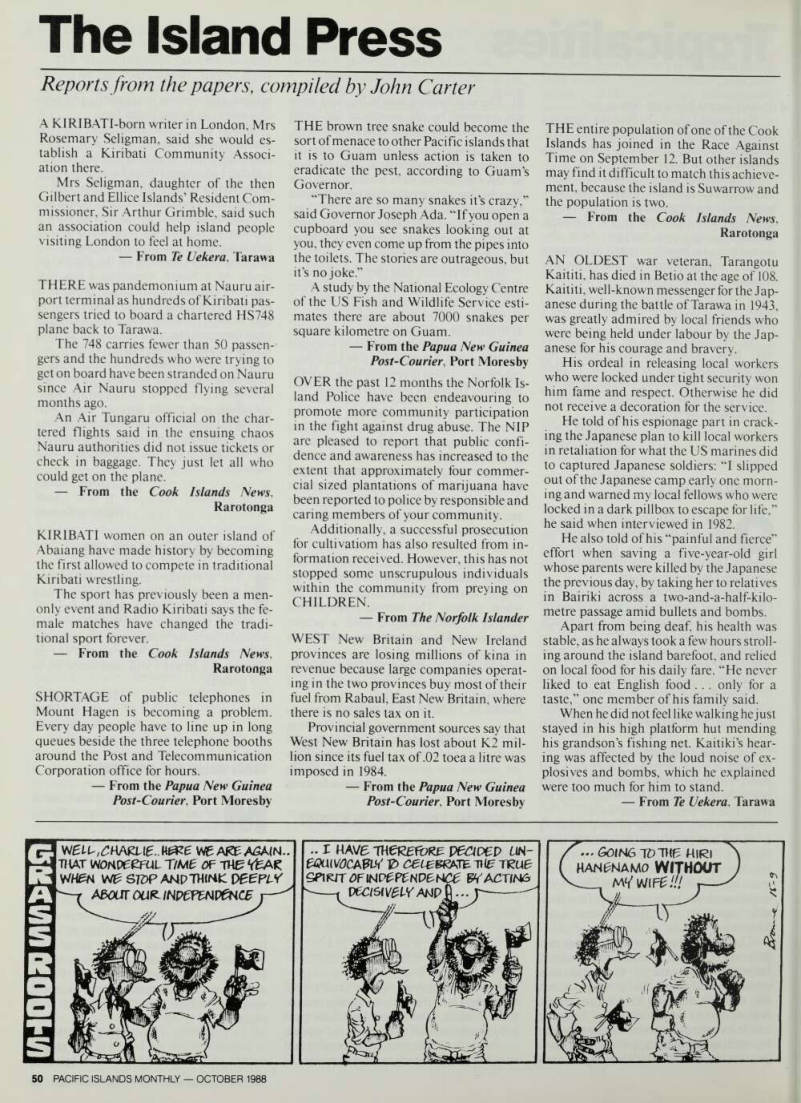
Reports from the papers, compiled by John Carter
A KIRIBATI-born writer in London, Mrs Rosemary Seligman, said she would es tablish a Kiribati Community Associ ation there.
Mrs Seligman, daughter of the then Gilbert and Ellice Islands’ Resident Com missioner, Sir Arthur Grimble, said such an association could help island people visiting London to feel at home.
From Te Uekera , Tarawa THERE was pandemonium at Nauru air port terminal as hundreds of Kiribati pas sengers tried to board a chartered HS74B plane back to Tarawa.
The 748 carries fewer than 50 passen gers and the hundreds who were trying to get on board have been stranded on Nauru since Air Nauru stopped flying several months ago.
An Air Tungaru official on the char tered flights said in the ensuing chaos Nauru authorities did not issue tickets or check in baggage. They just let all who could gel on the plane.
From the Cook Islands News , Rarotonga KIRIBATI women on an outer island of Abaiang have made history by becoming the first allowed to compete in traditional Kiribati wrestling.
The sport has previously been a men only event and Radio Kiribati says the fe male matches have changed the tradi tional sport forever.
From the Cook Islands News , Rarotonga SHORTAGE of public telephones in Mount Hagen is becoming a problem.
Every day people have to line up in long queues beside the three telephone booths around the Post and Telecommunication Corporation office for hours.
From the Papua New Guinea Post-Courier , Port Moresby
THE brown tree snake could become the sort of menace to other Pacific islands that it is to Guam unless action is taken to eradicate the pest, according to Guam’s Governor.
“There are so many snakes it’s crazy,” said Governor Joseph Ada. “If you open a cupboard you see snakes looking out at you, they even come up from the pipes into the toilets. The stories are outrageous, but it’s no joke.”
A study by the National Ecology Centre of the US Fish and Wildlife Service esti mates there are about 7000 snakes per square kilometre on Guam.
From the Papua New Guinea Post-Courier , Port Moresby OVER the past 12 months the Norfolk Is land Police have been endeavouring to promote more community participation in the fight against drug abuse. The NIP are pleased to report that public confi dence and awareness has increased to the extent that approximately four commer cial sized plantations of marijuana have been reported to police by responsible and caring members of your community.
Additionally, a successful prosecution for cultivatiom has also resulted from in formation received. However, this has not stopped some unscrupulous individuals within the community from preying on
Children.
From The Norfolk Islander WEST New Britain and New Ireland provinces are losing millions of kina in revenue because large companies operat ing in the two provinces buy most of their fuel from Rabaul, East New Britain, where there is no sales tax on it.
Provincial government sources say that West New Britain has lost about K 2 mil lion since its fuel tax of .02 toea a litre was imposed in 1984.
From the Papua New Guinea Post-Courier , Port Moresby
THE entire population of one of the Cook Islands has joined in the Race Against Time on September 12. But other islands may find it difficult to match this achieve ment, because the island is Suwarrow and the population is two.
From the Cook Islands News .
Rarotonga AN OLDEST war veteran, Tarangotu Kaititi, has died in Betio at the age of 108.
Kaititi, well-known messenger for the Jap anese during the battle of Tarawa in 1943. was greatly admired by local friends who were being held under labour by the Jap anese for his courage and bravery.
His ordeal in releasing local workers who were locked under tight security won him fame and respect. Otherwise he did not receive a decoration for the service.
He told of his espionage part in crack ing the Japanese plan to kill local workers in retaliation for what the US marines did to captured Japanese soldiers: “I slipped out of the Japanese camp early one morn ing and warned my local fellows who were locked in a dark pillbox to escape for life,” he said when interviewed in 1982.
He also told of his “painful and fierce” effort when saving a five-year-old girl whose parents were killed by the Japanese the previous day, by taking her to relatives in Bairiki across a two-and-a-half-kilo metre passage amid bullets and bombs.
Apart from being deaf, his health was stable, as he always took a few hours stroll ing around the island barefoot, and relied on local food for his daily fare. “He never liked to eat English food ... only for a taste,” one member of his family said.
When he did not feel like walking he just stayed in his high platform hut mending his grandson’s fishing net. Kaitiki’s hear ing was affected by the loud noise of ex plosives and bombs, which he explained were too much for him to stand.
From Te Uekera. Tarawa
Pacific Stamp Box
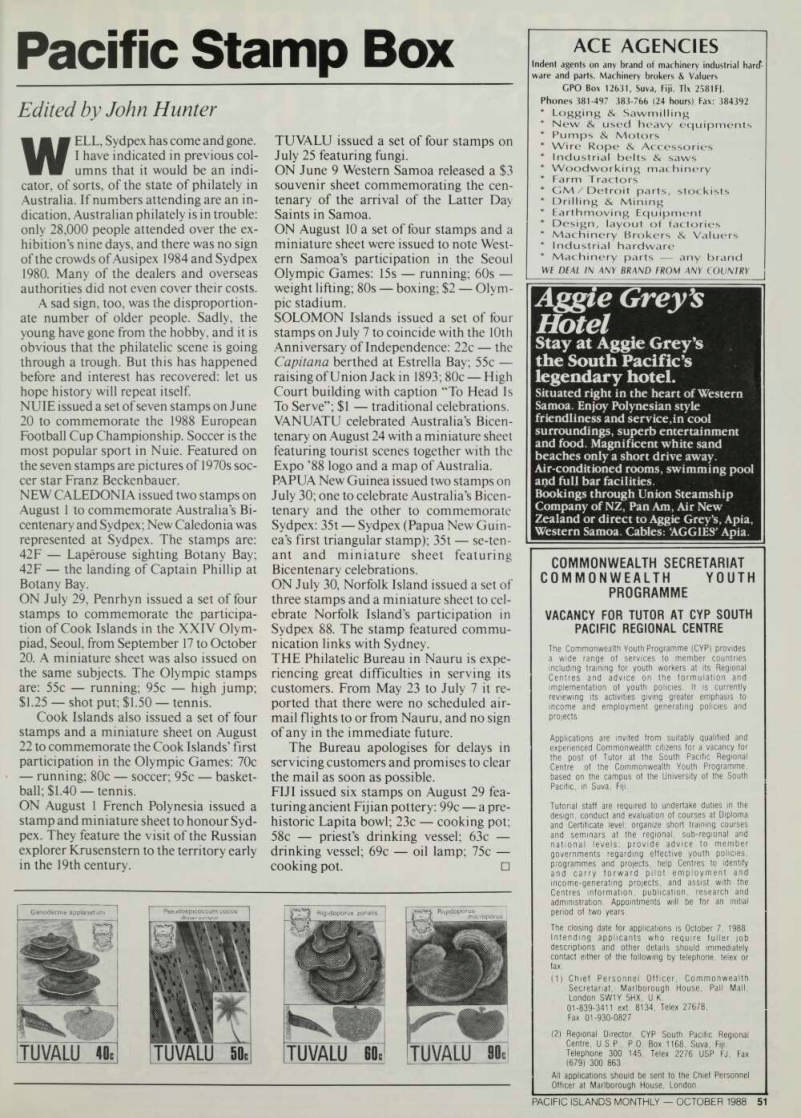
Edited by John Hunter
WELL, Sydpex has come and gone.
I have indicated in previous col umns that it would be an indi cator, of sorts, of the state of philately in Australia. If numbers attending are an in dication, Australian philately is in trouble: only 28,000 people attended over the ex hibition’s nine days, and there was no sign of the crowds of Ausipex 1984 and Sydpex 1980. Many of the dealers and overseas authorities did not even cover their costs.
A sad sign, too, was the disproportion ate number of older people. Sadly, the young have gone from the hobby, and it is obvious that the philatelic scene is going through a trough. But this has happened before and interest has recovered: let us hope history will repeat itself.
NUIE issued a set of seven stamps on June 20 to commemorate the 1988 European Football Cup Championship. Soccer is the most popular sport in Nuie. Featured on the seven stamps are pictures of 1970 s soc cer star Franz Beckenbauer.
NEW CALEDONIA issued two stamps on August 1 to commemorate Australia’s Bi centenary and Sydpex; New Caledonia was represented at Sydpex. The stamps are: 42F Laperouse sighting Botany Bay; 42F the landing of Captain Phillip at Botany Bay.
ON July 29, Penrhyn issued a set of four stamps to commemorate the participa tion of Cook Islands in the XXIV Olym piad, Seoul, from September 17 to October 20. A miniature sheet was also issued on the same subjects. The Olympic stamps are: 55c running; 95c high jump; $1.25 shot put; $1.50 tennis.
Cook Islands also issued a set of four stamps and a miniature sheet on August 22 to commemorate the Cook Islands’ first participation in the Olympic Games: 70c running; 80c soccer; 95c basket ball; $1.40 tennis.
ON August 1 French Polynesia issued a stamp and miniature sheet to honour Syd pex. They feature the visit of the Russian explorer Krusenstern to the territory early in the 19th century.
TUVALU issued a set of four stamps on July 25 featuring fungi.
ON June 9 Western Samoa released a $3 souvenir sheet commemorating the cen tenary of the arrival of the Latter Day Saints in Samoa.
ON August 10 a set of four stamps and a miniature sheet were issued to note West ern Samoa’s participation in the Seoul Olympic Games: 15s running; 60s weight lifting; 80s boxing; $2 Olym pic stadium.
SOLOMON Islands issued a set of four stamps on July 7 to coincide with the 10th Anniversary of Independence: 22c the Capitana berthed at Estrella Bay; 55c raising of Union Jack in 1893; 80c High Court building with caption “To Head Is To Serve”; $1 traditional celebrations.
VANUATU celebrated Australia’s Bicen tenary on August 24 with a miniature sheet featuring tourist scenes together with the Expo ’BB logo and a map of Australia.
PAPUA New Guinea issued two stamps on July 30; one to celebrate Australia’s Bicen tenary and the other to commemorate Sydpex: 35t Sydpex (Papua New Guin ea’s first triangular stamp); 35t se-ten ant and miniature sheet featuring Bicentenary celebrations.
ON July 30, Norfolk Island issued a set of three stamps and a miniature sheet to cel ebrate Norfolk Island’s participation in Sydpex 88. The stamp featured commu nication links with Sydney.
THE Philatelic Bureau in Nauru is expe riencing great difficulties in serving its customers. From May 23 to July 7 it re ported that there were no scheduled air mail flights to or from Nauru, and no sign of any in the immediate future.
The Bureau apologises for delays in servicing customers and promises to clear the mail as soon as possible.
FIJI issued six stamps on August 29 fea turing ancient Fijian pottery: 99c a pre historic Lapita bowl; 23c cooking pot; 58c priest’s drinking vessel; 63c drinking vessel; 69c oil lamp; 75c cooking pot. □
Advertisements & other items, p. 51 (1 item)
Aggie Grey’s
ACE AGENCIES
Indent agents on any brand of machinery industrial hardware and parts. Machinery brokers & Valuers GPO Box 12631, Suva, Fiji. Tlx 2581FJ.
Phones 381-497 383-766 (24 hours) Fax: 384392
* Logging & Sawmilling
* New & used heavy equipments * Pumps & Motors * Wire Rope & Accessories * Industrial belts & saws
* Woodworking machinery
* Farm Tractors * GM / Detroit parts, stockists * Drilling & Mining * Earthmoving Equipment * Design, layout of factories * Machinery Brokers & Valuers * Industrial hardware * Machinery parts -— any brand WE DEAL IN ANY BRAND FROM ANY COUNTRY
Aggie Grey’s
Hotel
Stay at Aggie Grey’s
the South Pacific’s
legendary hotel.
Situated right in the heart of Western
Samoa. Enjoy Polynesian style
friendliness and service,in cool
surroundings, superb entertainment
and food. Magnificent white sand beaches only a short drive away.
Air-conditioned rooms, swimming pool
and full bar facilities.
Bookings through Union Steamship
Company of NZ, Pan Am, Air New Zealand or direct to Aggie Grey’s, Apia, Western Samoa. Cables: AGGIES’ Apia.
COMMONWEALTH SECRETARIAT
COMMONWEALTH YOUTH
PROGRAMME
VACANCY FOR TUTOR AT CYP SOUTH
PACIFIC REGIONAL CENTRE
The Commonwealth Youth Programme (CYP) provides a wide range of services to member countries including training for youth workers at its Regional Centres and advice on the formulation and implementation of youth policies It is currently reviewing its activities giving greater emphasis to income and employment generating policies and projects.
Applications are invited from suitably qualified and experienced Commonwealth citizens for a vacancy for the post of Tutor at the South Pacific Regional Centre of the Commonwealth Youth Programme, based on the campus of the University of the South Pacific, in Suva, Fiji.
Tutorial staff are required to undertake duties in the design, conduct and evaluation of courses at Diploma and Certificate level: organize short training courses and seminars at the regional, sub-regional and national levels; provide advice to member governments regarding effective youth policies, programmes and projects, help Centres to identify and carry forward pilot employment and income-generating projects, and assist with the Centres information, publication, research and administration. Appointments will be for an initial period of two years.
The closing date for applications is October 7, 1988 Intending applicants who require fuller job descriptions and other details should immediately contact either of the following by telephone, telex or fax, (1) Chief Personnel Officer, Commonwealth Secretariat, Marlborough House, Pall Mall, London SW1Y 5HX, U K 01-839-3411 ext 8134, Telex 27678, Fax 01-930-0827 (2) Regional Director, CYP South Pacific Regional Centre. U S P., P 0. Box 1168, Suva, Fiji.
Telephone 300 145, Telex 2276 USP FJ, Fax (679) 300 863 All applications should be sent to the Chief Personnel Officer at Marlborough House, London.
Shipping Schedules

Australia New Caledonia
Fiji Hawaii North
America
PACE Line (ACTA Shipping) operates a fully containerised service every 17 days from Melbourne, Sydney and Brisbane to Noumea, Suva and Lautoka. The vessels continue on to the North coast of America, calling at Hawaii at frequent intervals.
Details from ACTA Pty Ltd, Sydney (266 0633); Tlx AA121369; Fax 267 1148; Burns Philp (SS) Co Ltd, Rodwell Road, Suva (31 1777); Tlx FJ2168; Fax 31 1804; Burns Philp (SS) Co Ltd, Lautoka (60 777); Sato SA, Avenue James Cook, BPC 2, Noumea, Cedex (28 1122); Tlx
163 Nm Sato; Fax 27 8532.
Australia Samoas
Tonga
Warner Pacific Lines operates a regular container service from Sydney, Brisbane and Melbourne to Nukualofa, Pago Pago, Apia and Vava’u with transhipment to Rarotonga.
Details from Hetherington Wesfarmers Shipping Agency, 37-49 Pitt St, Sydney (223 1600).
Australia New Caledonia
Fiji Samoas Tonga
Pacific Forum Line operates a fully containerised service (general, reefer and ro-ro) from Sydney to Noumea, Lautoka, Suva, Apia, Pago Pago, Nukualofa, Sydney. Cargo centralised from Adelaide, Melbourne, Brisbane.
Details from Pacific Forum Line, PO Box 796 Auckland; Union Bulkships, 333 George St, Sydney, Brisbane and Melbourne; Union Co, Lautoka; Pacific Forum Line, Suva, Nukualofa; Pacific Forum Line, Apia; Polynesia Shipping, Pago Pago.
Australia Kiribati
K. Asia Pacific operates a 5/6 weekly service from Melbourne and Sydney to Kiribati (Tarawa).
Details from K. Asia Pacific Pty Ltd, Goldfields House, 1 Alfred St, Circular Quay, Sydney (232 2277), Tlx 122143.
KAP New Guinea Lines calls Tarawa after PNG ports on a 35-day basis from Melbourne and Sydney/Brisbane.
Details from K. Asia Pacific Pty Ltd, Goldfields House, 1 Alfred St, Circular Quay, Sydney (232 2277), Tlx 122143.
Australia Tuvalu
K. Asia Pacific operates a direct service every second voyage to Tuvalu (Funafuti).
Details from K. Asia Pacific Pty Ltd, Goldfields House, 1 Alfred St, Circular Quay, Sydney (232 2277), Tlx 122143.
Australia — Norfolk Island
— Lord Howe Island
Norfolk Island Shipping Line operates a direct service every 5/6 weeks ex-Sydney.
Details from K. Asia Pacific Pty Ltd as managing agents for NISL, Goldfields House, 1 Alfred St, Circular Quay, Sydney (232 2277).
Australia — New Caledonia
— Vanuatu
Norfolk Island Shipping Line operates a direct service every 5/6 weeks ex-Sydney.
Details from K. Asia Pacific Pty Ltd as managing agents for NISL, Goldfields House, 1 Alfred St, Circular Quay, Sydney (232 2277).
Compagnie Generale Maritime operates a monthly service from Sydney, Melbourne and Brisbane to Noumea, Port Vila and Santo, for containerised and break-bulk cargo.
Details from Compagnie Generale Maritime, 12 Castlereagh St, Sydney (231 3700).
Australia — Nauru
Nauru Pacific Line operates a regular cargo service from Melbourne to Nauru, passenger service to Nauru only.
Details from Nauru Pacific Line (Aust) Pty Ltd, Nauru House, 80 Collins St, Melbourne (653 5709). Nedlloyd Swire, 8 Spring St Sydney, (20 522).
Australia — Solomon
Islands — Vanuatu
NGAL/PNGL joint service operates a monthly service.
Details from Nedlloyd Swire Pty Ltd, 8 Spring St, Sydney (20 522).
Australia — New Zealand
The Australian National Line and the New Zealand Line operate a 10-day container service (TRANZTAS) between Sydney and Melbourne to Auckland, Wellington, Lyttleton and Port Chalmers.
Details from Australian National Shipping Agencies, 131-137 York St, Sydney (225 7333) and Australian National Shipping Agencies, “World Trade Centre”, cnr Flinders and Spencer Sts, Melbourne (611 2323) or New Zealand Line, Pastoral House, 96 Lambton Quay, Wellington (72 2245).
Australia Nz Fiji
Vanuatu New Caledonia
Solomons New Guinea
Sitmar Cruises operates a year-round cruise program from Sydney to include the better-known ports in the above countries plus a number of unspoilt, and largely unknown, island paradises.
Details from Sitmar Cruises, 39 Martin Place, Sydney (239 9000) for NSW; reservations and inquiries (008 42 2277); rest of Australia, reservations and inquiries (008 22 2277).
Australia Nz Fiji
Tonga Vanuatu New
Caledonia Solomons
Samoas Tahiti
P&O Liners call at Auckland, Bay of Islands, Honiara, Lautoka, Noumea, Nukualofa, Pago Pago, Papeete, Port Moresby, Santo, Savu-Savu, Suva, Vava'u and Vila on cruises from Australia.
Details from P&O Booking Centre, Thomas Cook Pty Ltd, 33 Bligh St, Sydney (237 0333).
Australia Png
Solomons Vanuatu
A consortium of NGAL/PNGL and CONPAC/NEL has four vessels operating a joint service from east coast Australian ports to Port Moresby, Lae, Alotau, Madang, Wewak, Rabaul, Kavieng-Kimbe, Kieta, Honiara, Vila, Santo.
Details from Burns Philp & Co Ltd, PO Box R 124, Royal Exchange, Sydney (20 547); Nedlloyd Swire, 8 Spring St, Sydney (20 522); New Guinea Express Lines, 37 Pitt St, Sydney (241 3991); Vila Agents PO Box 27, Port Vila (2456), Tlx NHIOII.
New Guinea Express Lines operates a weekly container service from Melbourne, Sydney, Brisbane to Port Moresby, Lae, Alotau, Kimbe, Rabaul, Kieta, Honiara, Kavieng, Madang, Wewak, Santo, Vila.
Details from New Guinea Express Lines, PO Box R 73, Royal Exchange, Sydney (241 3991); 127 Creek St, Brisbane (221 9333); 84 William St, Melbourne (602 5544); Port Moresby (21 4572); Steamships Trading (agent), Rabaul (92 1400); Bougainville Agencies Pty Ltd Kieta, (95 6089); Steamships Trading Co, Madang (82 2446); Garumut Enterprises, Wewak (86 2106); Burns Philp (PNG) Ltd, Kavieng (94 2133); Alotau Stevedoring and Transport, Alotau (61 1318); Ngatia Wholesalers Pty Ltd, Kimba (93 5102) and Tradco Shipping, Mandana Avenue, Honiara (2 2588); Vila Agents Ltd, PO Box 971, Vila, Vanuatu (2490); John Lum & Associates, PO Box 65, Santo, Vanuatu (329).
◄ Europe Tahiti New
Caledonia Vanuatu
The Bank Line and Columbus Line operates a regular joint cargo service from Hamburg, Bremen, Antwerp, Rotterdam and Le Havre to Papeete, Noumea, Port- Vila and Santo.
Details from The Bank Line (A'asia) Pty Ltd, 51 Pitt St, Sydney (251 6688). Tix: AA24063, Columbus Line, Lae (423466), Tix: NE44171; Ets A M. Fare UTE, Papeete; Ets, Ballande, Noumea and other local agents.
Europe Png Solomons
The Bank Line & Columbus Line operate a regular joint cargo service from Hamburg, Bremen, Antwerp, Rotterdam and Le Havre to Port Moresby, Lae, Madang, Kimbe, Rabaul, Kieta and Honiara and on inducement to Yandina.
Details from The Bank Line (A'asia) Pty Ltd, 51 Pitt St, Sydney (2516688). Tix AA24063: Columbus Line, Lae (423466), Tix: NE44171; or lines' local agents.
Europe W. Samoa Tonga
Fiji
The Bank Line & Columbus Line operate a regular joint cargo service from Hamburg, Bremen, Antwerp, Rotterdam and Le Havre to Apia, Nuku’alofa, Suva and Lautoka.
Details from The Bank Line (A’asia) Pty Ltd, 51 Pitt St, Sydney (251 6688), Tix: AA24063, Columbus Line, Lae (423466), Tix: NE 44111, or Lines’ local agents.
Singapore Hong Kong
Fiji Islands Ports
Kyowa Shipping Co Ltd operates a monthly containerised and break-bulk cargo service from Hong Kong to Lautoka, Suva and then to island ports.
Details from Carpenters Shipping, Private Mail Bag GPO Suva, Fiji (31 2244); Fax: (679) 30 1572, Tlx FJ2199.
Far East Fiji New
Zealand
New Zealand Unit Express (NZUE) operates a monthly service accepting containerised and break-bulk cargo from Manila, Keelung, Kaohsiung and Hong Kong to Lautoka, Suva and thence to New Zealand ports.
Details from Carpenters Shipping, Private Mail Bag GPO Suva, Fiji (31 2244), Fax: (679) 31 1572; Tlx FJ2199; Burns Philp, Suva, (311777); New Zealand Unit Express, Maritime Building, 2-10 Customhouse Quay, PO Box 890, Wellington (72 7865), Cables ENZUE
Man Wellington, Tlx Nz31340,
NEDLNZ, or Nedlloyd Swire Pty Ltd, Sydney (20 522).
Far East Mid-South Pacific
China Navigation’s New Guinea Pacific Line operates a regular container and Break Bulk/Heavy Lift service from Hong Kong, Taiwan, Manila, Singapore, Malaysia, Thailand to Port Moresby, Lae, Rabaul, Kieta and Honiara with 18 days frequency. Wewak and Madang will receive four direct calls a year or more on inducement. A T/S service via Lae to these and other PNG ports connecting with monthly sailings is available at cost. Cargo from the same Eastern ports to the South Pacific ports of Noumea, Santo, Vila, Papeete, Pago Pago, Apia, Nukualofa, Raratonga and Tarawa will be shipped via Japan or Busan on the monthly Bali Hai service.
Details from Steamships Shipping, PO Box 634, Port Moresby (22 0283 or 22 0289).
Kyowa Shipping Ltd operates monthly services from Japan to Guam, Saipan, Solomons, New Caledonia, Fiji, Western and American Samoa, Tahiti, Cook Islands, Tonga and Vanuatu.
Details from Hetherington Wesfarmers Shipping Agency, 37-49 Pitt St, Sydney 1600); Carpenters Shipping, Suva (31 2244), Tlx FJ2199.
Guam Northern Marianas
Saipan Shipping Co operates a weekly service via barge carrying containers and conventional cargo between Guam and Saipan and Tinian.
Details from Saipan Shipping Co, Inc, PO Box 8, Saipan CM 96950 (322 9706 or 322 9707), Tlx 783619; Fax (670) 322 3183; Guam agents Maritime Agencies of the Pacific Ltd.
Hawaii Samoas Tonga
Cook Islands
Hawaii-Pacific Lines operates a monthly container service between Honolulu, Pago Pago, Apia, Nukualofa and Avatiu (Rarotonga).
Details from Hawaii-Pacific Maritime, Inc, PO Box 3264, Honolulu HI 96801-3264 (808 531 4841).
Details from Morris Hedstrom (Samoa) Ltd, PO Box 189, Apia, Western Samoa (21 355, 22 722), Tlx 224 (MORISHED SX), Fax 24 279; Union Citco Travel Ltd, Rarotonga, Cook Islands (682 21 780); Tlx 62024 (UTRAV G); Fax (682) 20 859; Kneubuhl Maritime Services, PO Box 39, Pago Pago, American Samoa 96799, (684 633 5121); Tlx 782505; Fax (684) 633 5100; Union Maritime Services Ltd, PO Box 4, Nukualofa, Tonga (21 644/5); Tlx 66227, Fax (676) 21 645.
Japan Fiji Island Ports
Kyowa Shipping Co operates a monthly containerised service from main ports of Japan to Suva, Lautoka, thence to island ports.
Details from Carpenters Shipping, Neptune House, 3/4 Floor, Tofua St, Walu Bay, Suva (31 2244), Fax: (679) 30 1572 Tlx FJ2199.
Japan Micronesia
The NYK Shipping Line operates a monthly cargo service from Japan to Micronesia, calling at Yoko, Nagoya, Kobe Guam, Saipan, Truk, Ponape and Majuro, returning via Yoko, Nagoya and Kobe Details from Burns Philp & Co. Ltd 51 Pitt St, Sydney (259 1000).
Saipan Shipping Co operates a monthly service from Japan to Saipan, Guam, Truk, Ponape, Majuro (Kosrae and Ebeye on inducement).
Details from Saipan Shipping Co, PC Box 8, Saipan, CM 96950 (322 9706 or 322 9707), Tlx 783619, Fax (670) 322 3183.
Japan agents Kyowa Shipping Company Ltd; Guam Agents Maritime Agencies of the Pacific Ltd.
Japan Korea Png
Paradise Service
Mitsui OSK Lines operates a monthly service from main ports in Japan, Wewak, Lae, Rabaul, Kieta, Port Moresby.
Details from Robert Laurie Company (PNG) Pty Ltd, PC Box 1032, Lae (42 3642, 42 3811), Contact: W O Hackenberg, Group Shipping Manager.
Japan Korea Png
Japan Paradise Service
Mitsui OSK Lines in joint service with NYK Lines operates a monthly service from main ports in Japan and Busan in Korea to PNG ports of Wewak, Rabaul, Kieta, Lae, Port Moresby, Kavieng, Kimbe, Madang and Oro Bay.
Details from Robert Laurie Company Pty Ltd, PO Box 1032, Lae (direct: 42 3642 or a switch: 42 3811), Contact: W O Hackenberg, Group Shipping Manager & Marketing; Tlx NE 42508, Fax 42 3801.
Png Inter-Mainport
Papua New Guinea Line offers scheduled 10-20 day coastal liner services linking all PNG major ports with containerisation, reefer, heavy lift and trans-shipment facilities.
Details from PNG Line, Box 543, Port Moresby (21 1174), Tlx 22269.
Png Taiwan Hong Kong
Singapore Indonesia
The Bank Line & Columbus Line operates a regular joint cargo service from PNG Ports to Kaohsiung, Hong Kong, Singapore, Jakarta & Surabaya.
Details from The Bank Line (A'asia) Pty Ltd, 51 Pitt St, Sydney (251 6688), Tix:
AA24063: Columbus Line, Lae (423466), Tix: NE44171; or lines' local agents.
Png Uk/Continent
The Bank Line and Columbus Line operate a regular joint service from Port Moresby, Oro Bay, Kieta, Rabaul, Kimbe, Madang and Lae to Hull, Hamburg, Rotterdam, Antwerp and Le Havre.
Details from The Bank Line (A’asia) Pty Ltd, 51 Pitt St, Sydney (251 6688), Tlx AA24063; Columbus Line, Lae (42 3466), Tlx NE 44171; or lines’ local agents.
Solomons Uk/Continent
The Bank Line and Columbus Line operate a regular joint cargo service from Honiara to Hull, Hamburg, Rotterdam, Antwerp and Le Havre.
Details from The Bank Line (A’asia) Pty Ltd, 51 Pitt St, Sydney (251 6688), Tlx AA24063; Columbus Line, Lae (42 3466), Tlx NE44171 Tradco Shipping Ltd, Honiara (22 588), Tlx 66313.
New Zealand Australia
Png Solomon Islands
Pacific Forum Line operates a containerised and ro-ro service from Lyttelton, Napier and Auckland to Brisbane, Port Moresby, Lae, Honiara, Brisbane then New Zealand.
Details from Pacific Forum, Auckland, Christchurch; Union Bulkships, Brisbane; Steamships Shipping, Port Moresby and Lae; Sullivans Ltd, Honiara; Seabridge, Wellington.
New Zealand Cook
Islands Tahiti
New Zealand Line operates cargo services based on pallets and similar units from Auckland to Cook Islands and Tahiti.
Details from NZ Shipping Agencies International Ltd, PC Box 3420, Auckland (39 2650); Waterfront Commission, PC Box 61, Raratonga Cook Islands; Shipping Office, Govt of Niue, PO Box 107, Niue Island; Compagnie Maritime Polynesienne, PO Box 36, Papeete, Tahiti.
New Zealand —Fiji
Reef operates a regular 18-day service from Auckland to Suva and Lautoka. Also passenger accommodation.
Details from Reef Shipping Agencies, PO Box 3382, Auckland (771 2213), Tlx 60633; MV Fijian Shipping Agencies Ltd, Private Bag, Suva (31 1056).
Pacific Line with one ship operates a three-weekly ro-ro cargo service New Zealand, Lautoka, Suva. No passengers.
Details Sofrana Unilines, 18 Customs St, Auckland (77 3279), PO Box 3614, Tlx
NZ2313; Carpenters Shipping, Neptune House, Tofua St, Walu Bay, Suva (25 141), Tlx FJ2199.
New Zealand Fiji North
America (Wc)
Blue Star Line Ltd Pacific Coast container services: only direct service to and from New Zealand. Blue Star vessels call at Suva and Honolulu on NZ-US West Coast voyages.
Details from Blueport ACT (NZ) Ltd, PC Box 192, Wellington (73 9029); Burns Philp (SS) Co Ltd, GPO Box 355, Suva (31 1777), Tlx FJ2168 Burship.
New Zealand Fiji
Samoas Tonga
Pacific Forum Line operates a containerised and ro-ro 21 day service from Auckland to Lautoka, Suva, Apia, Pago Pago and Nukualofa, Details from Pacific Forum Line, Auckland, Christchurch, Suva and Apia, Union Maritime, Lautoka, and Nukualofa; Polynesian Shipping, Pago Pago.
New Zealand Tonga
Samoas
Warner Pacific Line Services from Auckland to Nukualofa, Vava’u, Apia, Pago Pago monthly carrying general and freezer cargoes and FCL Dry Freezer.
<4 Details from McKay Shipping Ltd, 2nd Floor, Ferry Bldg, Quay St., Auckland PO Box 3 (39 0229). Cables MACSHIP, Tlx NZ2554f; Warner Pacific Line, Box 93, Nuku’alofa, Tonga; Mealelel (Western Samoa) Ltd, Private Bag Apia, Western Samoa; Burns Philp (SS) Co Ltd, PO Box 129, Pago Pago, American Samoa (633 2709), Cables 506, Burnsouth SB.
Nz Cook Islands
Aitutaki Niue
Cook Islands Line services Auckland, Rarotonga, Aitutaki, Niue monthly carrying general and freezer cargoes.
Details from McKay Shipping Ltd, 2nd Floor, Ferry Bldg, Quay St., Auckland/ PO Box 3, Auckland (39 0229). Cables
Macship, Tlx Nz2554; Fax 32 931.
South East Asia Fiji
Nedlloyd Lines (NZEAS) Service operates regular fast cargo service from Surabaya, Jakarta, Port Kelang, Bangkok and Singapore via New Zealand to Suva and Lautoka. Details from Carpenters Shipping, Neptune House, 3/4 Floor, Tofua St, Walu Bay, Suva. (31 2244) Fax: (679) 30 1572 Tlx: FJ2199
Tahiti New Caledonia
Vanuatu Solomon Islands
New Zealand Png
Singapore Europe
Polish Ocean Lines operates semi container type vessels to the following ports: from Papeete, Noumea, Santo, Vila, Yandina, Honiara, Auckland, Singapore, Port Kielang, Penang then to Mediterranean ports and Europe via the Suez Canal (other New Zealand ports subject to inducement).
Details from Universal Shipping Agencies Ltd, 7th Floor, 14 Emily PL, Auckland 1 (39 0931, 39 0727, 32 104), Tlx 21 517.
Taiwan Hong Kong
Singapore Indonesia
Png
The Bank Line & Columbus Line operate a regular joint cargo service from Kaohsiung, Hong Kong, Singapore, Jakarta, Surabaya to Papua New Guinea Ports.
Details from The Bank Line (A’asia) Pty Ltd, 51 Pitt St, Sydney (251 6688), Tlx: AA24063: Columbus Line, Lae (423466); Tlx: NE44171; or lines' local agents.
Europe Tahiti New
Caledonia
Compagnie Generale Maritime operates services from Europe and Mediterranean ports to Papeete and Noumea using three ro-ro and multi-purpose vessels thus ensuring a bi-monthly sailing to and from.
Details from Compagnie Generale Maritime, 12 Castlereagh St, Sydney (2313700).
Europe Tahiti New
Caledonia New Zealand
Vanuatu Solomons Png
Europe
Polish Ocean Lines offers regular monthly sailings for containerised and break-bulk cargo, also conventional reefer space and reefer containers from Hamburg, Rotterdam, Dunkirk, Le Havre to Papeete, Noumea, Auckland, Santo, Honiara, Rabaul, Lae, Singapore, returning to Europe via Suez. Other ports in the South Pacific can be served directly with inducement or otherwise via trans shipment.
Details from Sotama, BP 9170, Papeete (42 7805), Tlx Sotama 373FP; SATO: BP, C 2 Noumea Cedex (27 2094), Tlx 163 NM; Universal Shipping Agencies, PO Box 2282 Auckland (30 930), Tlx 21517; Vanua Navigation, PO Box 44, Vila (2027), Tlx 1033; Melan Chine Shipping Co, PO Box 71, Honiara (21 678), Tlx 66335; Steamships Trading Co Ltd, PO Box 85, Lae (42 4666), Tlx 42423; Union Steamship Co NZ Ltd, PO Box 50, Apia (21 781), Tlx 225; Warner Pacific Line, PO Box 93, Nukualofa (22 088), Tlx 66219; Fiji Agents
Tba.
Europe Tahiti W Samoa
Fiji New Caledonia
Nedlloyd offers regular cargo services from Continental ports to Papeete, Apia, Fiji and New Caledonia.
Details Nedlloyd (Aust) Pty Ltd, Spring St, Sydney (27 3801); Carpenters Shipping, Ist Floor, Harbour Centre Bldg, 100 Thomson St, Suva (31 2244) Tlx 2199FJ and Vetari St, Lautoka (63 988), Tlx 5215FJ.
Uk W Samoa Tonga
Fiji
The Bank Line and Columbus Line operate a regular joint cargo service from Hull, to Apia, Nukualofa, Suva and Lautoka.
Details from The Bank Line (A’asia) Pty Ltd, 51 Pitt St, Sydney (251 6688), Tlx: AA24063, Columbus Line, Lae (42 3466), Tlx NE 44111 or Line's local agents.
Uk Png Solomons
The Bank Line and Columbus Line operate a regular joint cargo service from Hull, to Port Moresby, Lae, Madang, Kimbe, Rabaul, Kieta and Honiara and on inducement to Yandina.
Details from The Bank Line (A’asia) Pty Ltd, 51 Pitt St, Sydney (251 6688), Tlx AA24063; Columbus Line, Lae (42 3466), Tlx: NE44171; or Line's local agents.
Uk Tahiti New Caledonia
Vanuatu
The Bank Line and Columbus Line operate a regular joint cargo service from Hull, to Papeete, Noumea, Port-Vila and Santo.
Details from The Bank Line (A’asia) Pty Ltd, 51 Pitt St, Sydney (251 6688), Tlx AA24063, Columbus Line, Lae (42 3466), Tlx NE44171; Ets A.M. Fare UTE, Papeete; Ets Ballande, Noumea and other local agents.
Us Hawaii Micronesia
Png
PM&O Lines operates two fully self contained container vessels on a sailing frequency of every 30 days between the San Francisco Bay Area, Los Angeles, Honolulu and Majuro, Ebeye, Kosrae, Ponape, Truk, Saipan, Yap, Palau, Cebu, Davao, Manila, Lae, Kieta and Rabaul.
Details from PM&O Lines, 353 Sacramento St, San Francisco, California 94111 (415 421 5400), Tlx 278016 PMC UR; owner's Representative PC Box 803, Saipan, NMI 96950 (234 6819), Tlx 783605
Cmcaa.
Advertisements & other items, pp. 53-57 (1 item)
Uur family sports
quite a radhdLhats
m f i Is getting things from A to B, when and how you want them, an important part of your business?
Then no doubt you will agree that finding the efficient and relevant services can be very frustrating.
That is why RLC have a family of divisions. These are designed to cover every aspect of the logistical nightmares involved in
relocating equipment,
supplies and products
whether by air, land or sea.
With over twenty years of experience in Papua New Guinea RLC, a member of the P&O family, can say with confidence leave it to
our family.
A member of the P&O Group Robert Laurie Company Pty Limited Stevedoring Import Export Services Trucking & Transport Ships Agency Special Projects OOO Dai>l Daai Mau/ ilrtAA C/«iArl»vNllA AAQL. Talaw TalaaKaaa OC AICO
TONGA
KIRIBATI
VANUATU
COOK ISLAND
SOLOMON ISLANDS
NEW CALEDONIA
U.S. SAMOA
WESTERN SAMOA
FRENCH POLYNESIA
JAPAN . KOREA
YOU’LL FIND IT,
HERE THE SKY MEETS
THE SEA
RORO. CONTAINER &
B.BULK SHIPPING
BALI
AGENTS
and
PHONE
SUVA:Burns Philp(B.P) 311777 Carpenter Shipping (C.S) 31 2244 LAUTOKA:B P 60777 C.S 63988 AP.A:B P 22611 PAGO PAGO .Polynesia Shipping Services Ltd 633-1211 PAPEETE-.Compagnie Maritime Polynesienne 42 84 02 NOUMEA:Etablissements Ballande 687-283384 VILA:B P 2456 SANTO:B P 230 HONlAßAiSullivans (Solomon Islands) Ltd 21645 TARAWA:Shipping Corporation of Kiribati 26195 NUKUALOFA:B P2l 500 BUSAN.for general cargo Young Chang Shipping Co., Ltd 753-0451 for vehicle Pan Continental Shipping Co , Ltd 778-7680 Soyang Shipping Co , Ltd 752-7755 JAPANdor general cargo Swire 03-230-9245 for vehicle NYK Lines 03-284-5506 Mitsui O.S.K 03-587-7123
The
South
Sea
Digest
m
tSBBBFM
THE PRIVATE
NEWSLETTER ON
PACIFIC ISLANDS
AFFAIRS
EVERY OTHER FRIDAY
SUBSCRIBE NOW
See coupon insert between pages 54-55.
YOUR DIRECT EUROPEAN CONNECTION
IW r: a* ■ i ■
EUROPE-SOUTH PACIFIC JOINT SERVICE
The South Pacific Specialists offer facilities for shipment of: Containers (FCL/LCL) and Breakbulk Cargo plus reefer space and deeptanks for carriage of vegetable oils and other liquid bulk cargo.
Carriers also accept heavy lifts, overlength and cumbersome parcels.
Ports of Service: Loading: Papeete, Apia, Suva, Lautoka, Noumea, Port Vila, Santo, Honiara, Port Moresby, Lae,Madang, Kimbe, Rabaul, Kieta, Darwin.
For: Rotterdam, Antwerp, Hamburg, Hull, Dunkirk, Le Havre. f Kj.
ROUND THE WORLD SERVICE
Additional ports on enquiry.
Please contact our regional offices for further information: The Bank Line (Australasia) Pty. Ltd.
Suite 701, 51 Pitt Street Sydney N.S.W. 2000 Phone: 251 6688 Telex; 24063 Columbus Line Reederei GmbH P.O. Box 1667 Lae/Papua New Guinea Phone: 42 3466/42 3287 2481 Colline NE 44 171
THE BANK LINE LTD LONDON
COLUMBUS LINE REEDEREI GMBH HAMBURG
C0L0024
A Playground For Imperialists
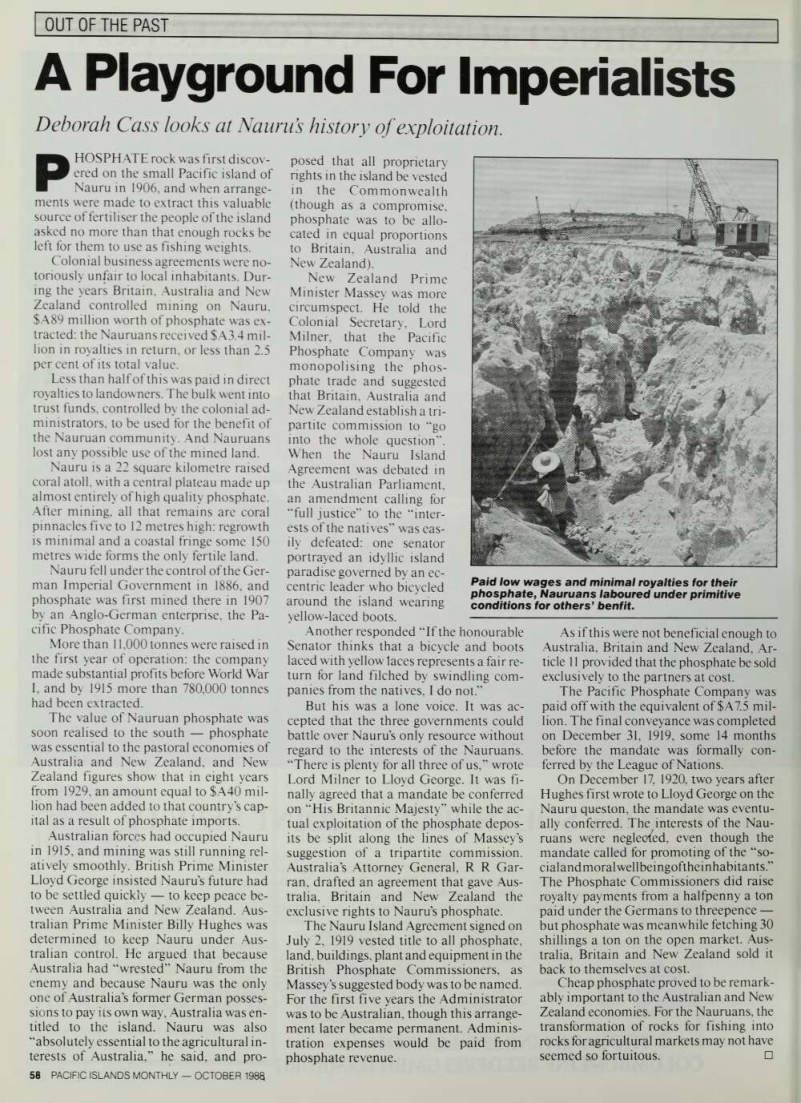
Out Of The Past
Deborah Cass looks at Nauru’s history of exploitation
PHOSPHATE rock was first discov ered on the small Pacific island of Nauru in 1906, and when arrange ments were made to extract this valuable source of fertiliser the people of the island asked no more than that enough rocks be left for them to use as fishing weights.
Colonial business agreements were no toriously unfair to local inhabitants. Dur ing the years Britain. Australia and New Zealand controlled mining on Nauru.
SAB9 million worth of phosphate was ex tracted; the Nauruans received $A3.4 mil lion in royalties in return, or less than 2.5 per cent of its total value.
Less than half of this was paid in direct royalties to landowners. The bulk went into trust funds, controlled by the colonial ad ministrators, to be used for the benefit of the Nauruan community. And Nauruans lost any possible use of the mined land.
Nauru is a 22 square kilometre raised coral atoll, with a central plateau made up almost entirely of high quality phosphate.
After mining, all that remains are coral pinnacles five to 12 metres high: regrowth is minimal and a coastal fringe some 150 metres wide forms the only fertile land.
Nauru fell under the control of the Ger man Imperial Government in 1886, and phosphate was first mined there in 1907 by an Anglo-German enterprise, the Pa cific Phosphate Company.
More than 11,000 tonnes were raised in the first year of operation: the company made substantial profits before World War I, and by 1915 more than 780,000 tonnes had been extracted.
The value of Nauruan phosphate was soon realised to the south phosphate was essential to the pastoral economies of Australia and New Zealand, and New Zealand figures show that in eight years from 1929, an amount equal to SA4O mil lion had been added to that country’s cap ital as a result of phosphate imports.
Australian forces had occupied Nauru in 1915, and mining was still running rel atively smoothly. British Prime Minister Lloyd George insisted Nauru’s future had to be settled quickly to keep peace be tween Australia and New Zealand. Aus tralian Prime Minister Billy Hughes was determined to keep Nauru under Aus tralian control. He argued that because Australia had “wrested” Nauru from the enemy and because Nauru was the only one of Australia’s former German posses sions to pay its own way, Australia was en titled to the island. Nauru was also “absolutely essential to the agricultural in terests of Australia,” he said, and pro
posed that all proprietary rights in the island be vested in the Commonwealth (though as a compromise, phosphate was to be allo cated in equal proportions to Britain, Australia and New Zealand).
New Zealand Prime Minister Massey was more circumspect. He told the Colonial Secretary, Lord Milner, that the Pacific Phosphate Company was monopolising the phos phate trade and suggested that Britain, Australia and New Zealand establish a tri partite commission to “go into the whole question”.
When the Nauru Island Agreement was debated in the Australian Parliament, an amendment calling for “full justice” to the “inter ests of the natives” was eas ily defeated: one senator portrayed an idyllic island paradise governed by an ec centric leader who bicycled around the island wearing yellow-laced boots.
Another responded “If the honourable Senator thinks that a bicycle and boots laced with yellow laces represents a fair re turn for land filched by swindling com panies from the natives, I do not.”
But his was a lone voice. It was ac cepted that the three governments could battle over Nauru’s only resource without regard to the interests of the Nauruans.
“There is plenty for all three of us,” wrote Lord Milner to Lloyd George. It was fi nally agreed that a mandate be conferred on “His Britannic Majesty” while the ac tual exploitation of the phosphate depos its be split along the lines of Massey’s suggestion of a tripartite commission.
Australia’s Attorney General, R R Gar ran. drafted an agreement that gave Aus tralia, Britain and New Zealand the exclusive rights to Nauru’s phosphate.
The Nauru Island Agreement signed on July 2, 1919 vested title to all phosphate, land, buildings, plant and equipment in the British Phosphate Commissioners, as Massey’s suggested body was to be named.
For the first five years the Administrator was to be Australian, though this arrange ment later became permanent. Adminis tration expenses would be paid from phosphate revenue.
As if this were not beneficial enough to Australia, Britain and New Zealand, Ar ticle 11 provided that the phosphate be sold exclusively to the partners at cost.
The Pacific Phosphate Company was paid off with the equivalent of $A7.5 mil lion. The final conveyance was completed on December 31, 1919, some 14 months before the mandate was formally con ferred by the League of Nations.
On December 17, 1920, two years after Hughes first wrote to Lloyd George on the Nauru queston, the mandate was eventu ally conferred. The interests of the Nau ruans were neglected, even though the mandate called for promoting of the “so cialandmoralwellbeingoftheinhabitants.”
The Phosphate Commissioners did raise royalty payments from a halfpenny a ton paid under the Germans to threepence but phosphate was meanwhile fetching 30 shillings a ton on the open market. Aus tralia, Britain and New Zealand sold it back to themselves at cost.
Cheap phosphate proved to be remark ably important to the Australian and New Zealand economies. For the Nauruans, the transformation of rocks for fishing into rocks for agricultural markets may not have seemed so fortuitous. □
Paid low wages and minimal royalties for their phosphate, Nauruans laboured under primitive conditions for others’ benfit.
Advertisements & other items, pp. 59-60 (1 item)
Super Power
FOR BIG SOUND EXCITEMENT
Super high power of 1000 watts (PMPO), with three-way speakers and full remote control. That’s the X-88 system, bringing big sound excitement to your listening room. Plus, features like graphic equalizer sound control, a double cassette deck with high speed dubbing, quartz synthesizer tuning with one-touch station memory presets, and more give you the edge in convenient music enjoyment.
The AIWA X-88: yours for unforgettable sound excitement.
lOOOw
i
AIWA
Stereo Component System X-88 aex Pty., Ltd. 12 Barcoo Street, East Roseville, Sydney, N.S.W. 2069, AUSTRALIA PHONE: (02)-406-6277/Oceania Indent Agency (P.N.G.) Pty., Ltd. Ago St., Gordon Box 5518, Boroko, Port Moresby, >ua New Guinea PHONE: 256411/The Sound Centre Ltd. P.O. Box 434 Port Vila, Vanuatu PHONE: 2035/P. Hargovind Bros. 190 Renwick Road P.O. Box 490 Suva Fiji PHONE: 24350/Hardy tnbutors Ltd. P.O. Box 5919, 5 Howe Street, Auckland New Zealand PHONE: (09) 399-175/Hifivox 79, rue de Sebastopol, B.P. 1458, Noumea, New Caledonia PHONE; 27. 24. 66/Harvest Pacific ited G.P.O. Box 517. Honiara. Solomon Islands PHONE; 131/Fare Hi-Fi Stereo Ruedu Marechal Foch —P.O. Box 269, Papeete, Tahiti PHONE; 2-4814/Micropac Audio, Inc. P.O. Box 3478 Agana,
im 96910 PHONE: 646-9304, 646-9305
Challenges Rewarded
Developing a new trend-setting car is a constant set of challenges faced on the drawing board, in the laboratory and, finally, on the test course.
For Mitsubishi Motors these challenges were embodied in a high-speed research vehicle, the Galant HSR. This prototype recorded cruising speeds in excess of 320km/h with exceptional stability and response. By incorporating state-of-the-art technologies in what was essentially an ordinary four-cylinder coupe, the HSR made everyday high-speed driving a reality.
But the HSR was designed to test these advanced technologies as they may be applied in a distinctive passenger vehicle.
Meeting this challenge resulted in the new Mitsubishi Galant—the reward of precise engineering and a gently organic design of warmth and emotion. An individualistic sedan that was voted Japanese Car of the Year only two months after its release.
Ultimately however, the final reward belongs to you.
Introducing the new
MITSUBISHI GRLRNT
Precision in Action Mitsubishi Motors is now offering a free 36-page PR magazine featuring interesting articles and exciting photos. If interested, write to: P.l. Advertising. International Business Planning Department, Office of International Business, Mitsubishi Motors Corporation, 33-8, Shiba 5-chome, Minato-ku, Tokyo 108, Japan.
AMERICAN SAMOA: MORRIS SCANLAN SERVICE INC. PO Box 367, Pago Pago, Tel 633-5520/AUSTRALIA: MITSUBISHI MOTORS AUSTRALIA LTD Box 1284, South Road, Clovelly Park, South Australia 5042, Tel. (08) 275-7223/FIJI: NIVIS MOTOR & MACHINERY CO.. LTD. G PO. Box 150, Suva, Tel 383411 /FRENCH POLYNESIA (TAHITI): ETS-BREDIN FRERES ET FILS PO. Box 21. Papeete, Tahiti, Tel 4-202-58/NEW CALEDONIA: SOCIETE D IMPORTATION D'AUTO DU PACIFIQUE SUD S.A B P. 438 Rond Point du Pacifique, Noumea, Tel 274144/NEW ZEALAND: MITSUBISHI MOTORS NEW ZEALAND LTD. Todd Park, Heriot Drive, Private Bag, Porirua, Tel 370-109/NORFOLK ISLAND: BORRYS LTD. PO Box 169, Norfolk Island, Tel 2114/PAPUA NEW GUINEA: TOBA PTY LTD. PO Box 503, Port Moresby, Tel 21-7874/ SOLOMON ISLANDS: HARVEST PACIFIC LTD. G PO Box 88. Honiara, Guadalcanal, Tel 30128/TONGA; SITANI MAFI CO., LTD. PO Box 83, Nuku’ALOFA, Tel 21-044/ VANUATU: SOCOMETRA B.P 06 Route de Lagon, Port-Vila, Tel. 2314/WESTERN SAMOA: A M, MACDONALD HOLDINGS LTD. PO Box 576, Apia, Tel. 22022/SAIPAN/ POHNPEI/MAJURO/KOSRAE/TRUK/YAP/BELAU: MICRONESIAN MOTORS. INC. 997 South Marine Drive, Tamunmg, Guam 96911, Tel 646-6827 A
MITSUBISHI
MOTORS