Pacific
Islands
Monthly
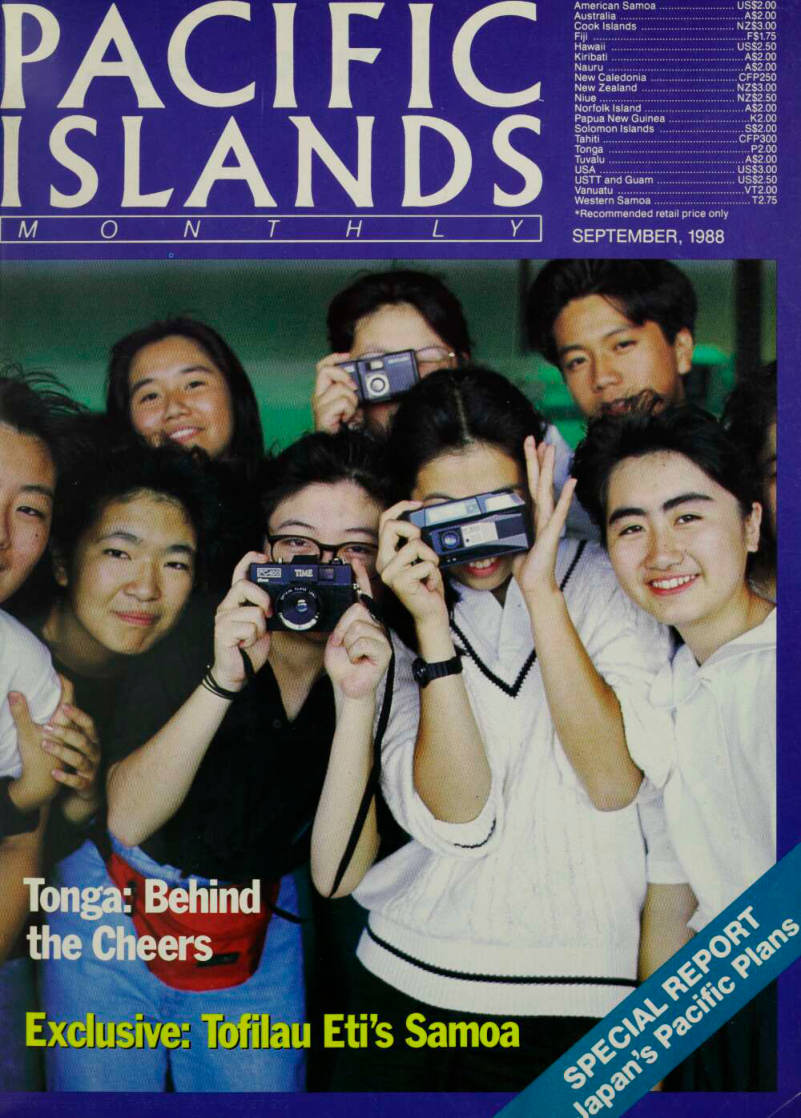
American Samoa US$2.OO Australia A 52.00 Cook Islands NZ$3.OO Fiji F 51.75 Hawaii US$2.5O Kiribati A 52.00 Nauru A 52.00 New Caledonia CFP2SO New Zealand NZ$3.OO Niue NZ$2.5O Norfolk Island A 52.00 Papua New Guinea K 2.00 Solomon Islands 552.00 Tahiti CFP3OO Tonga P 2.00 Tuvalu A 52.00
Usa Us$3.Oo
USTT and Guam US$2.5O Vanuatu VT2.00 Western Samoa T 2.75 *Recommended retail price only
September, 1988
Tonga: Behind the Cheers
Exclusive: Tofilau Eti’s Samoa
Advertisements & other items, pp. 2-4 (1 item)
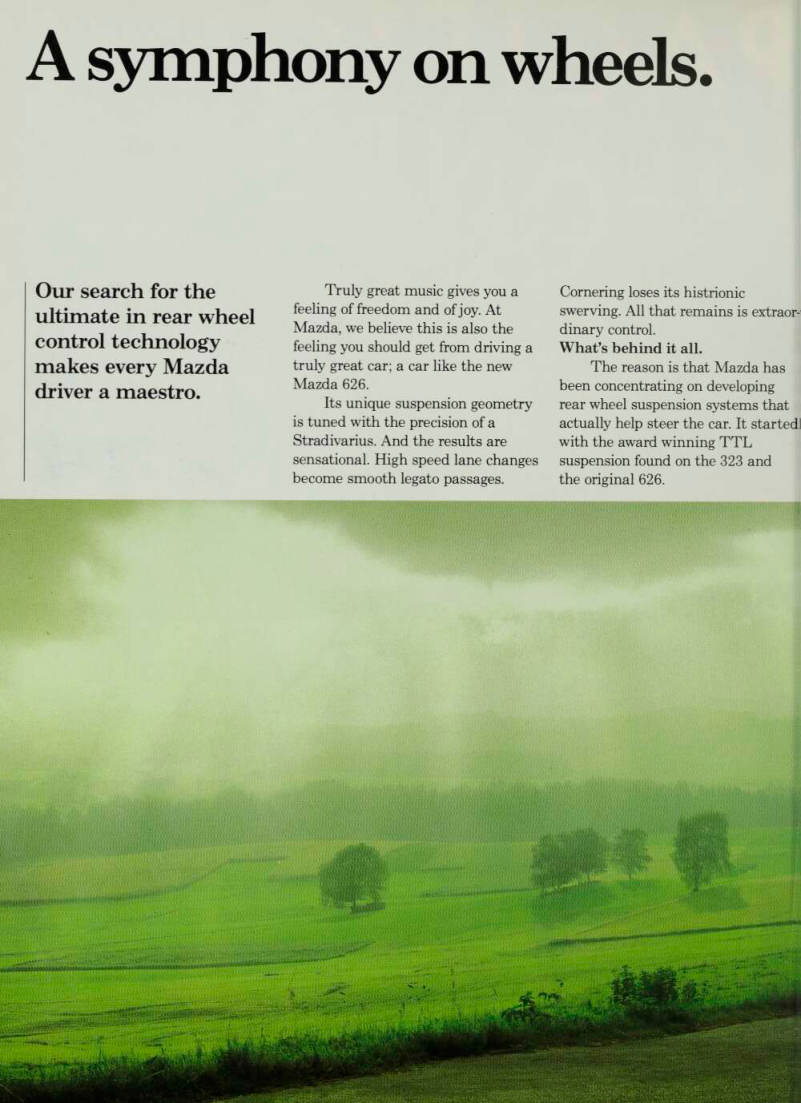
A symphony on wheels
Our search for the
ultimate in rear wheel
control technology
makes every Mazda
driver a maestro.
Truly great music gives you a feeling of freedom and of joy. At Mazda, we believe this is also the feeling you should get from driving a truly great car; a car like the new Mazda 626.
Its unique suspension geometry is tuned with the precision of a Stradivarius. And the results are sensational. High speed lane changes become smooth legato passages.
Cornering loses its histrionic swerving. All that remains is extraordinary control.
What’s behind it all.
The reason is that Mazda has been concentrating on developing rear wheel suspension systems that actually help steer the car. It started! with the award winning TTL suspension found on the 323 and the original 626.
The search for the ultimate continued with the development of i 4-Wheel Steering system. What we earned in that search was applied to he development of our award vinning DTS System for the RX-7 ind the E-Link suspension for the )29. This continuous process of efinement has come full circle again o the new 626, and applied to its PTL suspension. WeVe completely recalculated its suspension geometry to deliver a feeling of control that’s clearly superior and absolutely exhilarating.
Keeping on our toes.
It’s Mazda’s unique dedication to engineering the ultimate in rear wheel toe control and suspension technology that has resulted in such enjoyable driving in the Mazda 626.
And in fact, in all Mazda vehicles.
But don’t take our word for it.
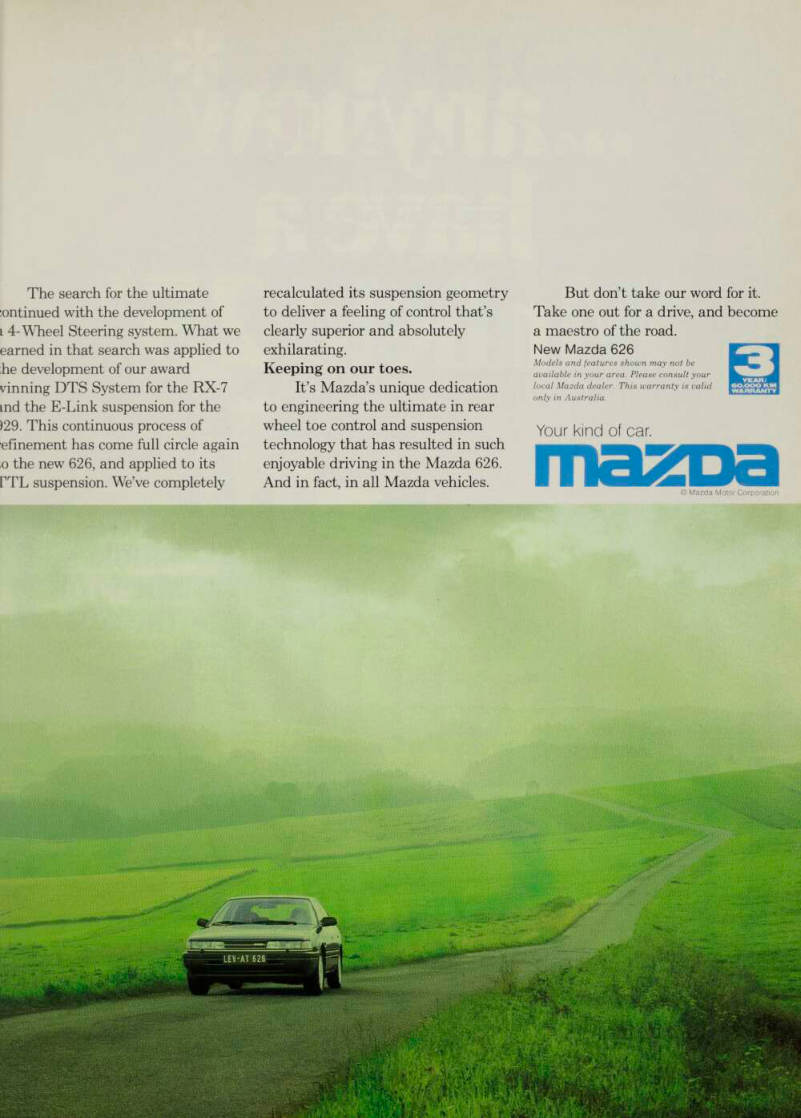
Take one out for a drive, and become a maestro of the road.
New Mazda 626 Models and features shown may not be available in your area. Please consult your local Mazda dealer. This warranty is valid only in Australia.
Your kind of car.
mazoa
© Mazda Motor Corporation
FcJ
YEAR/
60.000 KM
WARRANTY
anyhow
have a
Winfield
vJv'the rest s ■ pifIMESS
EDUCES
X
OKIM 6
sM
Pacific
Islands
Monthly
Vol 59, No. 9
Voice Of The Pacific
September, 'BB
Cover Story 25
SPECIAL REPORT: Japan is looking south to the Pacific ... bearing gifts and determined to erase past errors in aid donations. Japanese investors are pumping millions into Pacific resorts, roads and airports, partly for the benefit of a growing tourism industry and partly to diversify unwieldy Japanese wealth. Alan Goodall reports from Tokyo on Japan’s military, assistance and financial interests in the region it calls Oceania.
Cover Photograph: Oliver Strewe/Wildlight
LINI A WINNER IN VANUATU’S CONSTITUTIONAL CRISIS 10 Sope’s last-minute bid to topple his PM fails ANSETT, HAWAIIAN BREAK THE AIRLINE ‘MONOPOLY’ 13 Pacific air services set to expand with new competitors HAS PARIS FOUND A SOLUTION FOR NEW CALEDONIA? 15 The Matignon Accord offers France and Noumea a chance of peace
Namaliu Gets Tough With Png 16
The new PM’s bold plan for restoring law and investor confidence
Salii Death Leaves Questions Unanswered 17
Palau’s embattled President dies but was it suicide?
Tuvaluans Survive Epic Ordeal 18
Faith, courage and pluck keep four young islanders alive
Page 39
Muscians Jailed In Vila 41
West Papua’s Black Brothers claim they are
political victims
“Poor Relations” Denied A
Hearing In Canterbury 44
Pacific bishops ignored at Lambeth Conference
Pacific People: Western Samoa’S
Tofilau Eti ■■••■■■•■■■.■■■•■■■.■..46
The PM speaks in an exclusive interview
Suva Charts A Plan For The
Future 20
Tourism industry meets to boost the region
The Canoes Of Oceania Receive
Their Due 22
Hawaii’s Canoe museum honours the Pacific’s greatest artifacts
“Fight Them On The Beaches” ..32
Hawaiians battle developers
Shocks In Store Over Nuclear
Testing 33
A surprise for Paris policymakers from the heartland of the French Pacific
Rumours Of Discontent 36
Tonga celebrates a Royal birthday but its people are denied fair play
Congressman Indicted 39
Sunia steps down as corruption trial begins
Pacific Dancers A Hit In Paris,
London 40
Europe’s capitals salute the region s artists
Deputy Editor Carson Creagh Art Director Samantha Foster Editorial Adviser John Carter Contributors Robin Bromby Alan Goodall Jack Kelleher Diana McManus Michael Moriarty Ed Rampell David Robie Nicolas Rothwell Frank Senge Firoz Shaheem Rodney Smith
Publisher and Managing Editor Geoffrey Hussey
Advertising Sales Sydney & Melbourne Warren Grey (02) 288 3521 Fergus Maclagan (02) 412 3918; Brisbane Robert Walker (07) 371 0533 Adelaide Hastwell Williamson Representations (08) 79 9522
Cover prices are recommended retail only. Registered by Australia Post, publication No. NBPI2IO. Copyright. Fiji Times Limited, Suva, Fiji,
Advertisements & other items, pp. 5-6 (3 items)
Departments
OPINION 7
PACIFIC REPORT 34
ISLAND PRESS 50
TRADE WINDS 42
STAMPS 51
TRANSITION 49
SHIPPING 52
OUT OF THE PAST 58
5
PACIFIC ISLANDS MONTHLY SEPTEMBER 1988
A Fiji Times Limited Production.
Founded 1930 (USPS 952480) 20 Gor don Street, Suva, Fiji; Telex: FJ2124; Fax: (679) 30 1521; GPO Box 1167, Suva, Fiji; Telephone: (679)31 4111.
Pacific Islands Monthly (APPS No.
NBP 1210) is published monthly by Fiji Times Limited, a division of Nationwide News, 2 Holt St. Surry Hills, NSW 2010.
Second class postage paid at Honolulu, Hawaii, POSTMASTER. Send address changes to PACIFIC ISLANDS MONTHLY, PO Box 22250, Honolulu, Hawaii 96822. Typeset by David Graph ics, Sydney, and printed by Fiji Times Limited, 20 Gordon Street, Suva, Fiji.
va
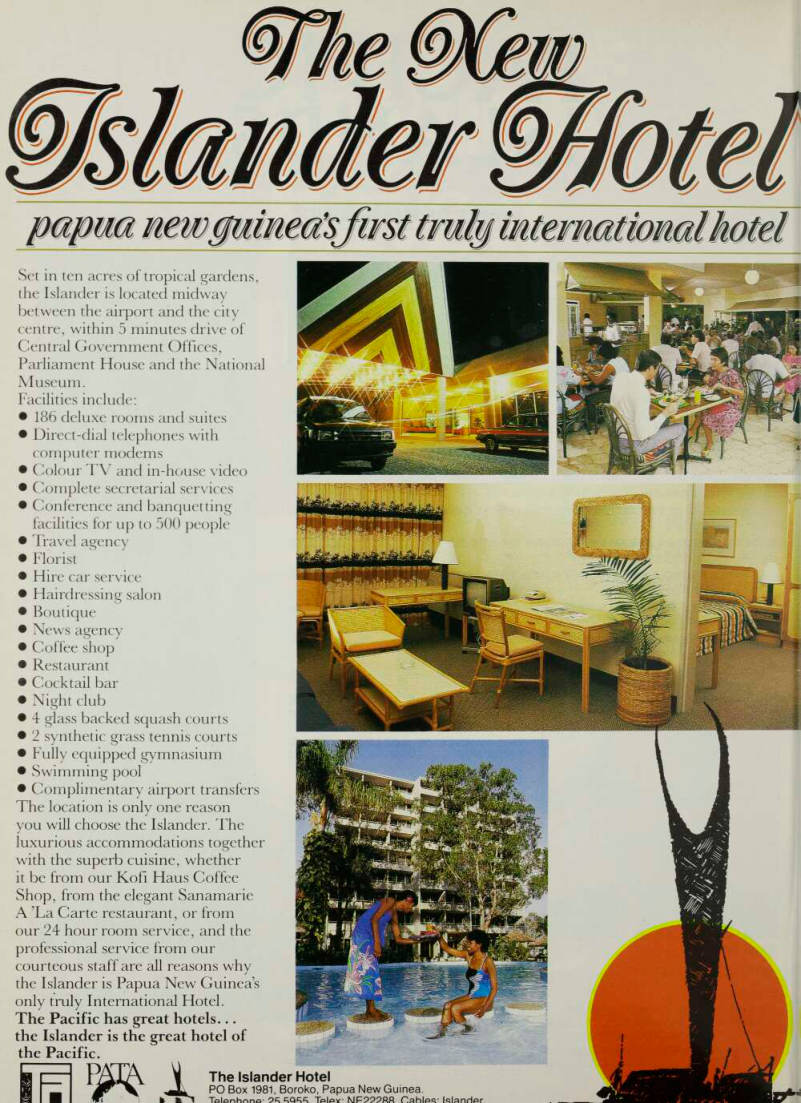
1 r Va Va Set in ten acres of tropical gardens, the Islander is located midway between the airport and the city centre, within 5 minutes drive of Central Government Offices, Parliament House and the National Museum.
Facilities include: 186 deluxe rooms and suites Direct-dial telephones with computer modems Colour TV and in-house video Complete secretarial services Conference and banquetting facilities for up to 500 people Travel agency Florist Hire car service
Hairdressing salon
Boutique News agency
Coffee shop
Restaurant Cocktail bar
Night club
4 glass backed squash courts 2 synthetic grass tennis courts
Fully equipped gymnasium
Swimming pool
Complimentary airport transfers
The location is only one reason you will choose the Islander. The luxurious accommodations together with the superb cuisine, whether it be from our Kofi Haus Coffee Shop, from the elegant Sanamarie A ’La Carte restaurant, or from our 24 hour room service, and the professional service from our courteous staff are all reasons why the Islander is Papua New Guinea’s
only truly International Hotel.
The Pacific has great hotels... the Islander is the great hotel of the Pacific. .1 m 5 \ The Islander Hotel PO Box 1981, Boroko, Papua New Guinea.
Tplpnhnnp- 9R RQfvR Tplpv MF999RR OahlPß - IfilanHpr
Tour De Force
Opinion
Noumea applauds Rocard’s plan for “decolonisation”.
AS this issue of Pacific Islands Monthly goes to press, France’s new Prime Minister, Mr Michel Rocard, has just returned to Paris from a three day visit to New Caledonia the first visit by a Socialist Prime Min ister and the first since Jacques Chirac’s flying visit last September.
Mr Rocard’s visit is thus doubly notable: he is the first PM to be hailed as the agent, if not the author, of profound change in the territory (conservative leaders have utilised New Caledonia primarily for publicity purposes in the past, knowing they could count on a high approval rating and taking advantage of Caldoche support to bolster their image in metropolitan France) and the first to promote France as a decolonising power.
Of course, cynics both in Noumea and in the region have dismissed his trip as no more than a public-relations gesture: a glib media event that presages no genuine change, but merely tightens his party’s grasp of government in Paris.
That, however, is not reflected by reaction in New Caledonia, especially in the towns and villages outside the capital. Melanesians have been buoyed by his informed interest and his apparent commitment to redressing more than a cen tury of abuse. Europeans have been reassured by his pragmatism and lack of rhetoric (his sobriquet, “the intellectual hamster”, has perversely won him popularity in non-intellectual French circles) and seem to believe that he does not intend to “abandon” them as right-wing extremists, conscious that much of their support comes from those still bitter about Algeria, have claimed.
The meat of Mr Rocard’s offer should provide comfort to both camps in the troubled territory: in his own words, a “veritable economic and cultural de colonisation of New Caledonia prior to independence. If it works, it will be a major world success” (he need not add that France, which has attracted con stant criticism for what many observers claim is an arrogant attitude, badly needs a shot of international approval).
Acknowledging, at a Kanak rally in the separatist stronghold of Poindimie, France’s recognition of the Melanesian struggle for self-determination, he promised financial, educational and technological support but warned Kanaks (and thereby comforted worried Caldoches) that Kanaks would have to work to build the New Caledonia of their dreams. Significantly, he made no mention of the concept of “Kanaky”, obviously recognising the territory’s likely dependence on France for generations to come.
Later, he addressed white settlers in Noumea and warned them they must learn to hand over power or face a protracted and undoubtedly destructive civil war: the events of the past 12 months have shown the Kanaks are able to mount an effective (if as yet relatively unco-ordinated) guerrilla campaign that could, if properly planned, bring New Caledonia’s affairs to a halt.
Mr Rocard has also demonstrated a more canny appreciation of the media than many of his predecessors with his announcement that RFO, France’s overseas radio service, will recruit and train Kanak journalists and technicians and that it will “better reflect the cultural and social realities” of New Cale donia ... something it manifestly has failed to do. As well, he hinted at the possibility of allowing an increase in the number of private, independent radio stations in the territory, “bearing in mind the need to respect the geographical, political and ethnic balances” of New Caledonia.
Self-serving manipulation of an electorate or high-minded attempt at peaceful progress, Michel Rocard’s words can only be taken at face value for the present. But the next decade will prove whether he and his Government and, indeed, his successors are genuine. Next month will see the first test, when Mr Rocard seeks cabinet approval (likely to be no more than a rubber stamp exercise) of November 6 as the date of a national referendum on the future administration of New Caledonia. The result of that poll will in turn indicate national feeling and, New Caledonia’s friends in the region hope, a timetable for France to cover itself in glory. □
Advertisements & other items, p. 7 (1 item)
Pacific
SLANDS
IMONT H L Y I
FIJI: Distribution, subscriptions and advertising: Fiji Times Limited, GPO Box 1167, Suva, Fiji. Phone 31-4111, telex FJ2124 FRENCH POLYNESIA: Distribution: Hachette Pacifique 10 Ave Bruat, Papeete. Phone 25-610 HAWAII: UNITED STATES: Distribution: PIM Hawaii, PO Box 22250, Honolulu, Hawaii, 96822. Advertising: Brian C Asgill, Apt 1308,1676 Ala Moana Blvd., Honolulu, Hawaii, 96815. Phone (808) 955-9718.
JAPAN: Advertising and subscriptions: Universal Media Corporation, GPO Box 46, Tokyo. Phone 666-3036, cable UNIMEDIA Tokyo, telex 2524665.
MALAYSIA: Advertising and subscriptions; Worldwide Media Services, 57-B Komplex Damai, Jin Dato Haji Eusoff, Kuala Lumpur. Phone 63-9340, cables WORLDMEDIA Kuala Lumpur, telex 31533, VANUATU: Distribution: The Vanuatu Stationery and Book Centre, PO Box 557 Port Vila Advertising: Norman Bros Bookshop Port Vila Phone 2232.
NEW CALEDONIA; Distribution: Depot Centre de Presse Michel Pentecost. CBP2, Noumea Phone 27- 2434, 27-4729 NEW ZEALAND; Distribution: Gordon & Gotch, PO Box 584, 2 Carr Road, Mt Roskill, Auckland 4 Advertising: McKay International Media Reps Ltd, C/- Albany PO, Auckland 10, New Zealand. Phone 413-9119.
Telex NZ22701, FAX 413-9110 WELLINGTON: Ross Quaid Media, 1 Scholes Lane, Petone. (04) 68-7593, PO Box 38699, Petone.
PAPUA NEW GUINEA: Distribution: Gordon & Gotch, PO Box 3395, Port Moresby. Phone 25-4551. 25-4855.
Advertising: Robert Walker, PO Box 600, Indooroopilly, Old Australia 4068. Phone (07) 371-0533.
SOLOMON ISLANDS; Distribution and Advertising: The Bookshop, (Norman Bros.) PO Box 503, Honiara PHILIPPINES: Advertising: The GF Group, 12 San Ignacio St., Uroaneta Village, Makati, Metro Manila. Phone 817-7299, telex 45950 and 4233.
UNITED KINGDOM; F A Smyth and Associates, 23A Aylmer Parade, London N2OPO, England. Phone (01 )340 5088, fax (01)341 9602.
UNITED STATES MAINLAND: Advertising: Joshua B. Powers Jr., Powers International Inc., Suite 708, 271 Madison Ave , New York, NY 10016. Phone 867-9580, Subscriptions: PIM, Hawaii, PO Box 22250, Honolulu.
Hawaii, 96822.
SUBSCRIPTIONS
American Samoa US$45 Australia AUSS24 Canada US$45 Cook Islands AUSS46 Fiji F $24 French Polynesia US$45 Guam US$45 Hawaii US$45 Japan US$3B Kiribati AUSS46 Micronesia US$35 Nauru AUSS42 New Caledonia US$32 New Zealand AUSS42 Niue AUSS46 Norfolk Island AUSS42 Northern Marianas US$36 Papua New Guinea AUSS42 Solomon Islands AUSS46 Tonga AUSS46 Tuvalu AUSS46 United Kingdom Stg£2B US (Mainland) US$45 Vanuatu AUSS42 Western Samoa AUSS6O Elsewhere AUSS63 Payments to Pacific Islands Monthly: Subscriptions Dept, GPO Box 1167, Suva, Fiji.
Subscriptions rates includes the cost of airspeeding to all destinations set out above. Direct airmail rates on application.
Japan Rediscovers The Pacific
Unparalleled wealth brings new opportunities for co-operation
THIS month’s Special Report focuses on the new role Japan is playing and hoping to play over coming decades in the South Pacific.
It is a salutary look at a nation that, despite having the largest amount of available capital in the world, has made errors in aid that the region has come to expect of faceless development agencies and distant Great Powers. Not that any inherently Japanese factor is to blame: it is merely a
reflection of the astounding ignorance of “our part of the world” that has alternately annoyed and saddened the in habitants of the region Japan calls Oceania.
What is particularly interesting is that though Japan has in the past veered between seeing itself as part of Asia and as some kind of offshore manufacturing plant for North America, it is now looking southward and to its east; to the vast ocean that is already Japan’s largest single des tination for tourism. It would seem the beauty and peace of the Pacific are as important to work-obsessed Japanese as the opportunities it offers for investment.
The South Pacific has a unique opportunity to look the gift horse in the mouth, and by so doing to tailor the as sistance offered so that entire island states will benefit.
Such a prescription encompasses more than development aid, of course: recognising that Japan wishes to diversify its industrial strength. Pacific leaders are for once able to dictate which industries will fit into their cultural require ments, and on what terms training, infrastructure, trade advantages Japanese investment will be made welcome.
Fiji has provided a partial model already, accepting Japanese input and with it the knowledge that Japan will derive the major profit from that input. Yet Fiji has im posed stringent conditions on all investment that Japan, with respect for national and cultural discipline, is pre pared to honour. While other island nations are wrestling with the preservation of traditional values at the same time as they are being courted by the West, they would do well to look closely, slowly and with considerable care at the effectiveness of Japan’s new ’look south’ policy.
Leader Of
The Year
READERS are reminded that entries for Pacific Is lands Monthly's Leader Of The Year close in No vember. Responses continues to cover a broad cross-section of regional personalities, and to come from a similarly broad area of the world: we have even received nominations from Italy and Denmark, as well as Canada, the United States and Malaysia!
One of the most notable trends is the move fore shadowed in July’s Opinion pages away from “estab lishment” leaders and those with decades of experience in guiding the nations of the Pacific, political parties or international agencies, toward younger, and often more radical, men and women.
Nominations for Pacific women, incidentally, have been fewer than we would have wished; so there is still time to send in your vote for a woman who has been not able in politics, social issues, education, development, business or environmental affairs over the past year. □
Advertisements & other items, pp. 8-11 (2 items)
Ny Economic Co-operation
South Pacific Bureau for
PROGRAMME CONTROLLER (SOUTH PACIFIC REGION
MARITIME DEVELOPMENT PROGRAMME)
Applications are invited from citizens of member countries for the above position at SPEC SPEC is a regional organisation based in Suva and was established to encourage co-operation in the South Pacific not only between member states in the region, but also between island member states and the more industrialised countries on all aspects of economic development, trade transport, tourism telecommunications, and energy. SPEC is also the Secretariat to the South Pacific Forum.
The Programme Controller will head the South Pacific Region Maritime Development Programme. He will be expected to develop and maintain a positive programme, including the development of national maritime administrations and legislation, identification of projects, infrastructure development and identification of potential aid donors, inorder to assist member countries in all aspects of maritime development.
This post requires a person with a degree in economics, law or relevant, equivalent qualifications, plus extensive relevant experience in Government or the private sector at a senior level. Detailed knowledge of existing South Pacific regional and international maritime transport agreements, regional projects, operations and trends is essential. Familiarity with donor agency procedures would be an advantage.
Appointees will be based at SPEC Headquarters in Suva but will be required to travel within the region. Appointment will be for two years initially and can be extended under certain conditions. Competitive salaries at regional levels paid in Fiji dollars are tax-free to non-Fiji nationals. Housing or housing allowances, overseas and education allowances, school holiday travel, superannuation provisions, medical, travel and life insurance benefits combine to make a most attractive package. Further details can be obtained from the address below.
Applications close on 30 September, 1988 and should provide full information on education and employment background and should list the names, addresses and telephone contact numbers of three referees with whom the applicant has been associated in a professional capacity.
Applications and enquiries should be addressed to: The Director South Pacific Bureau for Economic Co-operation.
P 0 Box 858. Suva. FIJI Telephone: 312600 Telex: 2229FJ Fax: 302204 * Member countries of SPEC are; Australia, Cook Is, Federated States of Micronesia, Fiji, Kiribati, Republic of Marshall Is, Nauru, New Zealand.
Niue, Papua New Guinea, Solomon Is. Tonga, Tuvalu, Vanuatu, Western Samoa.
Experience
A NEW DRIVING
- W-V -V 2*^ 'V: 5LV V-' w 5W S?
SStv.
In better shape here
and here.
TOYOTA
MULTI-VALVE
ENGINE
I r Ar<;
A HIGHER STANDARD:
ALL NEW COROLLAS NOW COME WITH
TOYOTA MULTI-VALVE ENGINES.
Here is a blend of elegance and performance usually found only in big, luxury cars. That’s because Toyota believes everyone should enjoy the newest automotive advancements. And the latest example of this thinking is the all-new Corolla. It has an elegantly rounded shape to be proud of. And the high output and efficient multi-valve engine in all Corollas puts their performance in far better shape.
Expand your driving experience to new horizons with the all-new Corolla. Toyota — World’s No. 1 producer of multi-valve engines.
TOYOTA
Whatever your cargo - a birthday present to Mum in Perth or a container from Los Angeles. However it must travel - by land, sea or air. Wherever it must go - across the street or across the Pacific, RLC Aircargo has the solution. As a member of the P&O Group, RLC Aircargo has unrestricted access to a worldwide network of materials handling services.
When you hand it over to RLC, rest assured for a safe, speedy and reliable delivery, we’ve got it all wrapped up.
Head Office Port Moresby PO Box 6499, Boroko, Papua New Guinea Facsimile 21 4790 Telex NE22352 RLC AIR Telephone 25 1511, 25 1524, 25 1642 m
AIRCARGO
Branches throughout Papua New Guinea
Sope’s Desperate Gamble Falters

Vanuatu
Rebel Vanuatu politician Barak Sope’s attempts to topple PM Walter Lini fail in Port Vila’s Supreme Court. By David Robie
TROPICAL squalls drenched the paramilitary guard of honour and the hapless crowd that ringed Port Vila’s Independence Park for muted cele brations marking the eighth anniversary of Vanuatu’s independence. It was per haps an omen.
Was there much to celebrate, in view of recent rioting over land rights, allegations of a “dictatorship” and a bitter power struggle between the Prime Minister, Father Walter Lini, and his rival Barak Sope? As far as Lini and his loyal sup porters in the ruling Vanuaaku Pati were concerned, there was still plenty to be pleased about: Lini harked back to inde pendence on July 30, 1980, when the Van uatu Government was forced to put down the Vemarana rebellion on the island of Espiritu Santo with the help of Papua New Guinean troops. “We proved then that we
could continue as a united country,” he told the drenched crowd, many sheltering under rainbow-coloured umbrellas. “We put the rebellion down and built up na tional unity.”
Now, however, some politicians “have forgotten why we fought for our independ ence and why we must continue as a peaceful, united and independent coun try. These leaders are now talking about ‘islandism’ and regionalism the very things that led to the Santo rebellion and they are causing division among the people of Vanuatu.”
Lini went on to warn the ni-Vanuatu particularly chiefs, church leaders, women and youth activists and businesspeople about “some power-hungry politicians who are spreading misinformation . . .
These politicians are working simply for their own selfish interests. They are like
wolves in sheep’s clothing.”
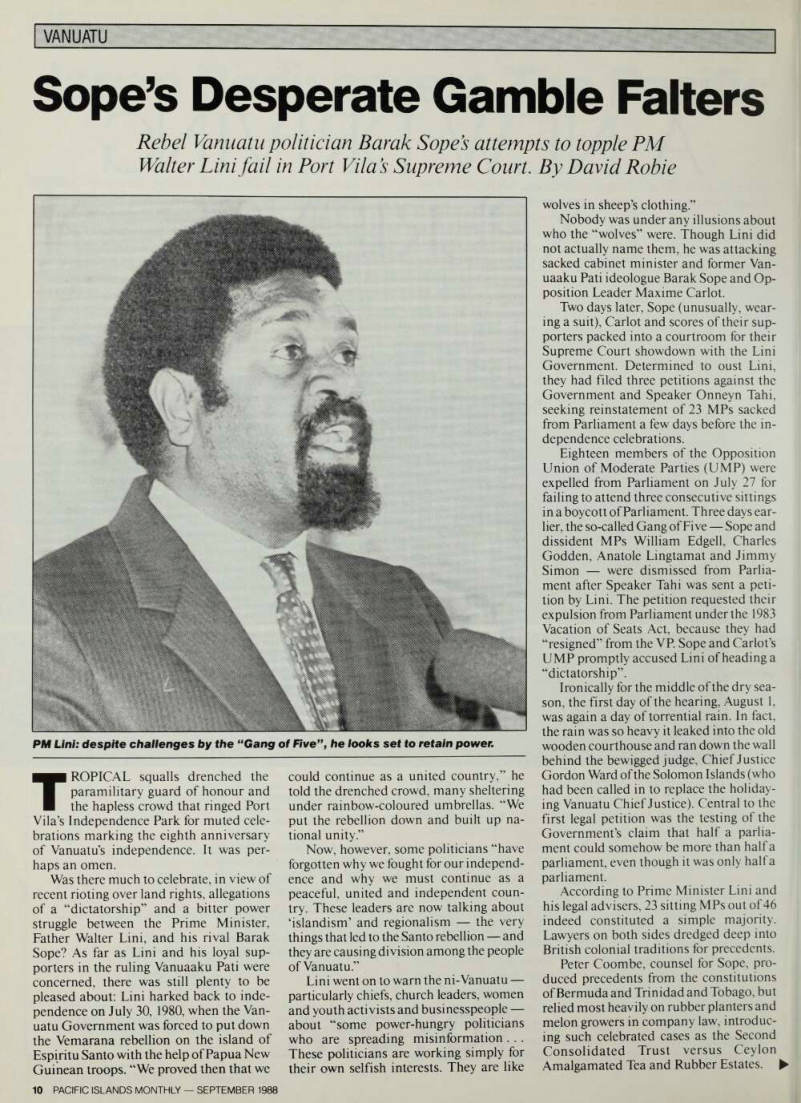
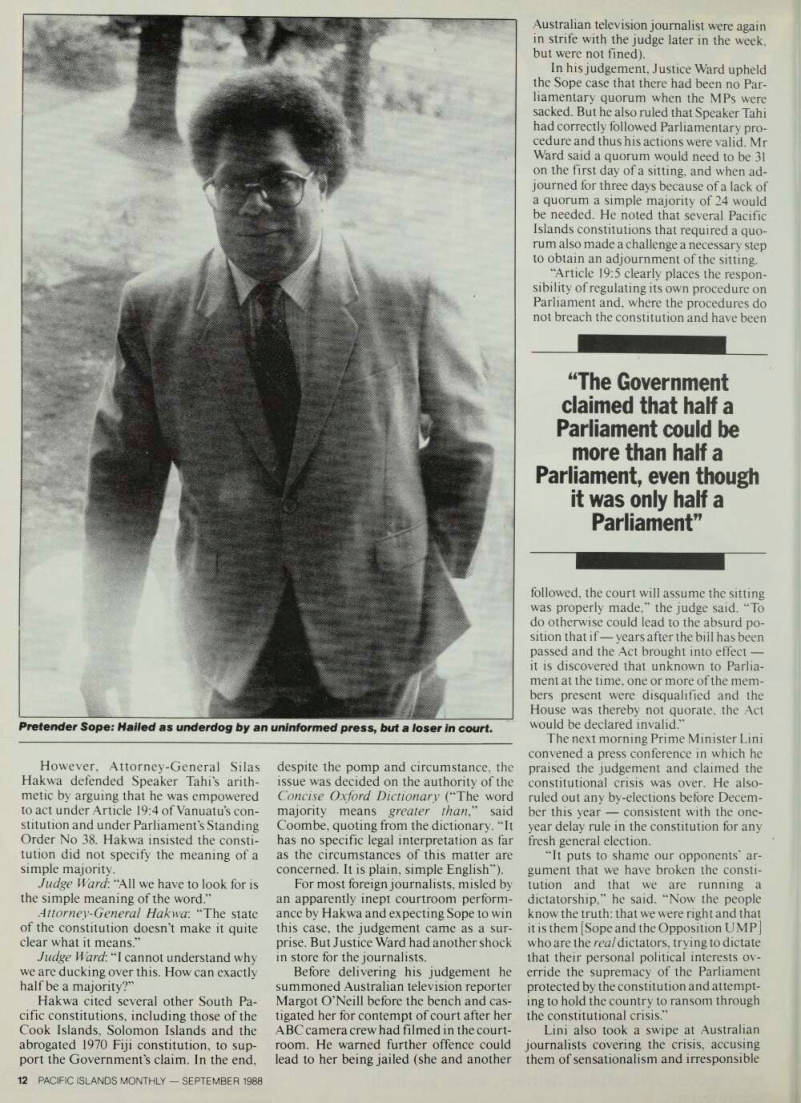
Nobody was under any illusions about who the “wolves” were. Though Lini did not actually name them, he was attacking sacked cabinet minister and former Van uaaku Pati ideologue Barak Sope and Op position Leader Maxime Carlot.
Two days later, Sope (unusually, wear ing a suit), Carlot and scores of their sup porters packed into a courtroom for their Supreme Court showdown with the Lini Government. Determined to oust Lini, they had filed three petitions against the Government and Speaker Onneyn Tahi, seeking reinstatement of 23 MPs sacked from Parliament a few days before the in dependence celebrations.
Eighteen members of the Opposition Union of Moderate Parties (UMP) were expelled from Parliament on July 27 for failing to attend three consecutive sittings in a boycott of Parliament. Three days ear lier, the so-called Gang of Five Sope and dissident MPs William Edgell, Charles Godden, Anatole Lingtamat and Jimmy Simon were dismissed from Parlia ment after Speaker Tahi was sent a peti tion by Lini. The petition requested their expulsion from Parliament under the 1983 Vacation of Seats Act, because they had “resigned” from the VP. Sope and Carlot’s UMP promptly accused Lini of heading a “dictatorship”.
Ironically for the middle of the dry sea son, the first day of the hearing, August 1, was again a day of torrential rain. In fact, the rain was so heavy it leaked into the old wooden courthouse and ran down the wall behind the bewigged judge, Chief Justice Gordon Ward of the Solomon Islands (who had been called in to replace the holiday ing Vanuatu Chief Justice). Central to the first legal petition was the testing of the Government’s claim that half a parlia ment could somehow be more than half a parliament, even though it was only half a parliament.
According to Prime Minister Lini and his legal advisers, 23 sitting MPs out of 46 indeed constituted a simple majority.
Lawyers on both sides dredged deep into British colonial traditions for precedents.
Peter Coombe, counsel for Sope, pro duced precedents from the constitutions of Bermuda and Trinidad and Tobago, but relied most heavily on rubber planters and melon growers in company law, introduc ing such celebrated cases as the Second Consolidated Trust versus Ceylon Amalgamated Tea and Rubber Estates. ►
PM Lini: despite challenges by the “Gang of Five ”, he looks set to retain power.
However, Attorney-General Silas Hakwa defended Speaker Tahi’s arith metic by arguing that he was empowered to act under Article 19:4 of Vanuatu’s con stitution and under Parliament’s Standing Order No 38. Hakwa insisted the consti tution did not specify the meaning of a simple majority.
Judge Ward: “All we have to look for is the simple meaning of the word.”
Attorney-General Hakwa : “The state of the constitution doesn’t make it quite clear what it means.”
Judge Ward: “I cannot understand why we are ducking over this. How can exactly half be a majority?”
Hakwa cited several other South Pa cific constitutions, including those of the Cook Islands, Solomon Islands and the abrogated 1970 Fiji constitution, to sup port the Government’s claim. In the end,
despite the pomp and circumstance, the issue was decided on the authority of the Concise Oxford Dictionary (“The word majority means greater than,” said Coombe, quoting from the dictionary. “It has no specific legal interpretation as far as the circumstances of this matter are concerned. It is plain, simple English”).
For most foreign journalists, misled by an apparently inept courtroom perform ance by Hakwa and expecting Sope to win this case, the judgement came as a sur prise. But Justice Ward had another shock in store for the journalists.
Before delivering his judgement he summoned Australian television reporter Margot O’Neill before the bench and cas tigated her for contempt of court after her ABC camera crew had filmed in the court room. He warned further offence could lead to her being jailed (she and another
Australian television journalist were again in strife with the judge later in the week, but were not fined).
In his judgement, Justice Ward upheld the Sope case that there had been no Par liamentary quorum when the MPs were sacked. But he also ruled that Speaker Tahi had correctly followed Parliamentary pro cedure and thus his actions were valid. Mr Ward said a quorum would need to be 31 on the first day of a sitting, and when ad journed for three days because of a lack of a quorum a simple majority of 24 would be needed. He noted that several Pacific Islands constitutions that required a quo rum also made a challenge a necessary step to obtain an adjournment of the sitting.
“Article 19:5 clearly places the respon sibility of regulating its own procedure on Parliament and, where the procedures do not breach the constitution and have been
“The Government claimed that half a Parliament could be more than half a Parliament, even though it was only half a Parliament”
followed, the court will assume the sitting was properly made,” the judge said. “To do otherwise could lead to the absurd po sition that if years after the bill has been passed and the Act brought into effect it is discovered that unknown to Parlia ment at the time, one or more of the mem bers present were disqualified and the House was thereby not quorate, the Act would be declared invalid.”
The next morning Prime Minister Lini convened a press conference in which he praised the judgement and claimed the constitutional crisis was over. He also ruled out any by-elections before Decem ber this year consistent with the one year delay rule in the constitution for any fresh general election.
“It puts to shame our opponents’ ar gument that we have broken the consti tution and that we are running a dictatorship,” he said. “Now the people know the truth: that we were right and that it is them [Sope and the Opposition UMP] who are the real dictators, trying to dictate that their personal political interests ov erride the supremacy of the Parliament protected by the constitution and attempt ing to hold the country to ransom through the constitutional crisis.”
Lini also took a swipe at Australian journalists covering the crisis, accusing them of sensationalism and irresponsible
Pretender Sope: Hailed as underdog by an uninformed press, but a loser in court.
reporting. He had a point: much of the re porting reflected a simplistic and unin formed view of “underdog Sope” versus “dictator Lini”. Peter Paurakolo, one of the founders of the ruling Vanuaaku Pati and now director of the Vanuatu National Tourism Office, also attacked “war hun gry” Australian journalists for sabotaging the country’s economy by their “creeping chaos in paradise” reporting.
Though Sope won the battle of inter national press coverage, his domestic im age has continued to slide as public perception of him as a self-seeking pol itician determined to hold the country to ransom has become stronger. Few ni- Vanuatu regard him as having much chance of regaining a seat in Parliament in a by-election.
In the last general election, he won his seat by just three votes. At the time Sope challenged Lini for the Prime Minister ship, attacking the leader’s ill health after Lini had become partially paralysed fol lowing a stroke in Washington 10 months previously. But he was easily defeated.
Sope then forced Lini to include him in the cabinet by threatening to split the Van uaaku Pati if he were left out. The growing rift finally erupted with a riot on May 16,
which left one man dead and damage to talling some SA2 million.
Sope (at the time Minister for Tourism, Immigration and Transport) was blamed for instigating the riot and was dismissed from cabinet. He was later stripped of his post of secretary-general of the Vanuaaku Pati, and he and his four colleagues were sacked from the party when they signed a no-confidence motion against the Lini Government.
In an interim report on the Vila Urban Land Corporation (VULCAN), the agency set up in 1981 to administer customary land leases to businesses in the capital, al legations of irregularity and financial mis management have been upheld.
VULCAN closely associated with Sope, who was a board member repre senting Ifira Island, one of the three tra ditional landowning villages was closed by the Lands Ministry in an incident that led to protests and, eventually, the May 16 riot. It has not prepared annual accounts since 1984; the year its costs began to es calate dramatically.
A government inquiry being con ducted by Australian accountants has shown that between 1981 and 83 about 14 per cent of VULCAN’s VT27 million an
nual income was spent on administration.
However, by last year this figure had soared to almost 98 per cent of the VT22 million income. VULCAN’s surplus also dropped from a steady average of VT23 million between 1981 and 1984 to less than VT 100,000 last year.
The general manager of VULCAN, a personal friend of Sope, was being paid a salary package of $A40,000 a year al most twice as much as President Ati George Sokomanu, who earns $ A 22,000 a year, and Prime Minister Lini’s $A20,000.
Sope, reputedly the wealthiest ni-Van uatu businessman, has important busi ness interests in stevedoring and tourism.
His opponents claim his credibility has been seriously even fatally eroded during the constitutional crisis and if the two final legal petitions fail, his political gamble will founder.
The Vanuaaku Pati is therefore likely to regain a majority when by-elections are fi nally held, and even if a new general elec tion is eventually called. □ Postscript: As Pacific Islands Monthly was going to press, Barak Sope and his fellow members of the “Gang of Five” an nounced they were forming a new political party, the Freedom and Justice Party.
Airlines “Sew Up” The Region
Aviation
Hawaiian Airlines and Ansett enhance Pacific air services.
By Robin Bromby
HAWAIIAN Airlines (see Pacific Is lands Monthly , February and March) is about to further strengthen its position in the South Pacific by negotiating rights to fly Honolulu/Rar otonga/Auckland, parallel with its route between the two destinations via Pago Pago. The service, which will be run in conjunction with Air Rarotonga, replaces the Cook Islands International flight be tween Rarotonga and Auckland with drawn because of low patronage.
Contrary to earlier reports, Ansett will retain the management of Cook Islands International Airlines (CIIA) and fly weekly Sydney/Apia/Rarotonga. In fact, Ansett is now looking to expand its serv ices by examining whether the new A 320 Airbus aircraft in service from October could be used on the Apia/Honolulu run, using the landing rights of Polynesian Air lines which is also managed by Ansett.
The Boeing 727 used by Ansett is dual-liv eried: CIIA colours on one side, Polyne sian Airlines on the other.
As time of going to press formal nego tiations were still under way, but the new Hawaiian route is certain to go ahead. The deal will be that Air Rarotonga will charter space in the Hawaiian DCS, thus taking up the Cook Islands’ reciprocal rights to fly
Auckland/Rarotonga (a route also flown by Air New Zealand), and will greatly en hance the position of Hawaiian Airlines in the Pacific; in less than two years, Ha waiian has won rights to fly Apia/Hono lulu, Rarotonga/Papeete and services into Auckland and Sydney via Pago Pago. As one airline official said, once Hawaiian works Rarotonga it is a long way toward “sewing up” the Pacific.
In an interesting comment, Cook Is lands’ Minister of Civil Aviation Dr Ter epai Maoate hinted that Ansett had planned also to withdraw from the Syd ney/Rarotonga service. After meeting with Ansett’s Sir Peter Abeles, he issued a state ment that said: “Sir Peter was most sup portive and agreed to continue to assist us where possible, and it was in this spirit that he agreed to my request for the continua tion of the Sydney/Rarotonga service.”
The end of the CIIA service to Auck land is further evidence that island air ways, even when managed by larger operators, will continue to struggle while stuck with low density routes, leaving the major international airlines to dominate the region. Air Rarotonga, hitherto a small internal aviation company, will no doubt benefit from being associated with Ha waiian; it is not yet known whether by
chartering space on the airline’s DCS it will have its livery on at least part of the air liner’s exterior. That would be a substan tial gain in terms of publicity Rarotonga’s airline (and therefore its ex istence as a destination) would be pro moted wherever the DCS flew.
As for Ansett, it will continue its weekly Sydney/Rarotonga and Sydney/Port Vila service (the latter under its own colours) and operate Polynesian Airlines’ long dis tance services. These consist of the joint flight with CIIA to Sydney, and the twice weekly Apia/Nuku’alofa/Auckland serv ice, as well as flying four times a week Apia/Pago Pago.
Polynesian Airlines also operates a Twin Otter for its Pago Pago service and an Islander for internal routes.
Ansett Australia receives the first of its new A 320 Airbus aircraft in October as its 727 replacement fleet. This has raised questions in the aviation industry that the new planes could be used in the Pacific be cause of their range abilities: certainly An sett is known to be looking at the possibility of using the aircraft on the Apia/Honolulu service, not only tapping the growing tourist and business traffic on flights out of Honolulu, but the large Sa moan population resident in Hawaii. □
Advertisements & other items, p. 14 (1 item)
an you bank on t
Ilf
Ilf
Ilf
\lf
Ilf
Ilf
%lf
Ilf
Ilf
A ■ S 5
an you bank on t
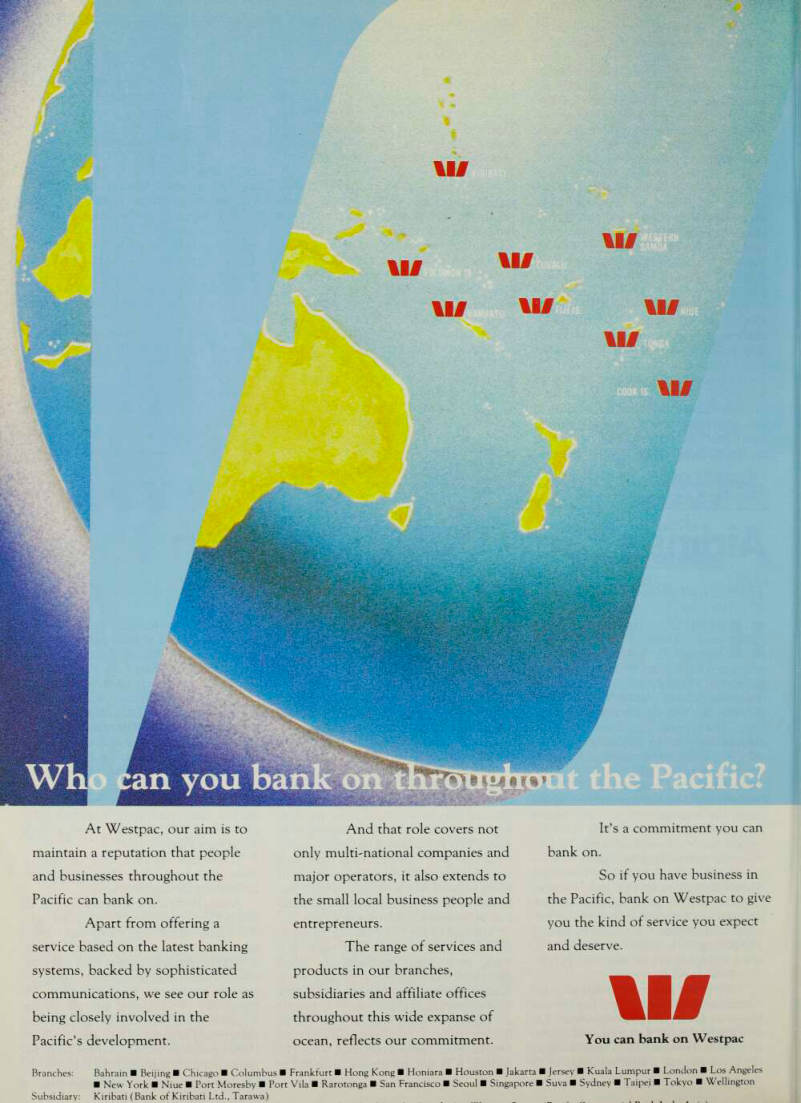
At Westpac, our aim is to maintain a reputation that people and businesses throughout the Pacific can bank on.
Apart from offering a service based on the latest banking systems, backed by sophisticated communications, we see our role as being closely involved in the Pacific’s development.
And that role covers not only multi-national companies and major operators, it also extends to the small local business people and entrepreneurs.
The range of services and products in our branches, subsidiaries and affiliate offices throughout this wide expanse of ocean, reflects our commitment.
It’s a commitment you can bank on.
So if you have business in the Pacific, bank on Westpac to give you the kind of service you expect and deserve. ll# You can bank on Westpac Branches: Bahrain ■ Beijing ■ Chicago ■ Columbus ■ Frankfurt ■ Hong Kong ■ Honiara ■ Houston ■ Jakarta ■ Jersey ■ Kuala Lumpur ■ London ■ Los Angeles ■ New York ■ Niue ■ Port Moresby ■ Port Vila ■ Rarotonga ■ San Francisco ■ Seoul ■ Singapore ■ Suva ■ Sydney ■ Taipei ■ Tokyo ■ Wellington Subsidiary: Kiribati (Bank of Kiribati Ltd., Tarawa)
Peace Breaks
New Caledonia
Peace Breaks Out In Noumea
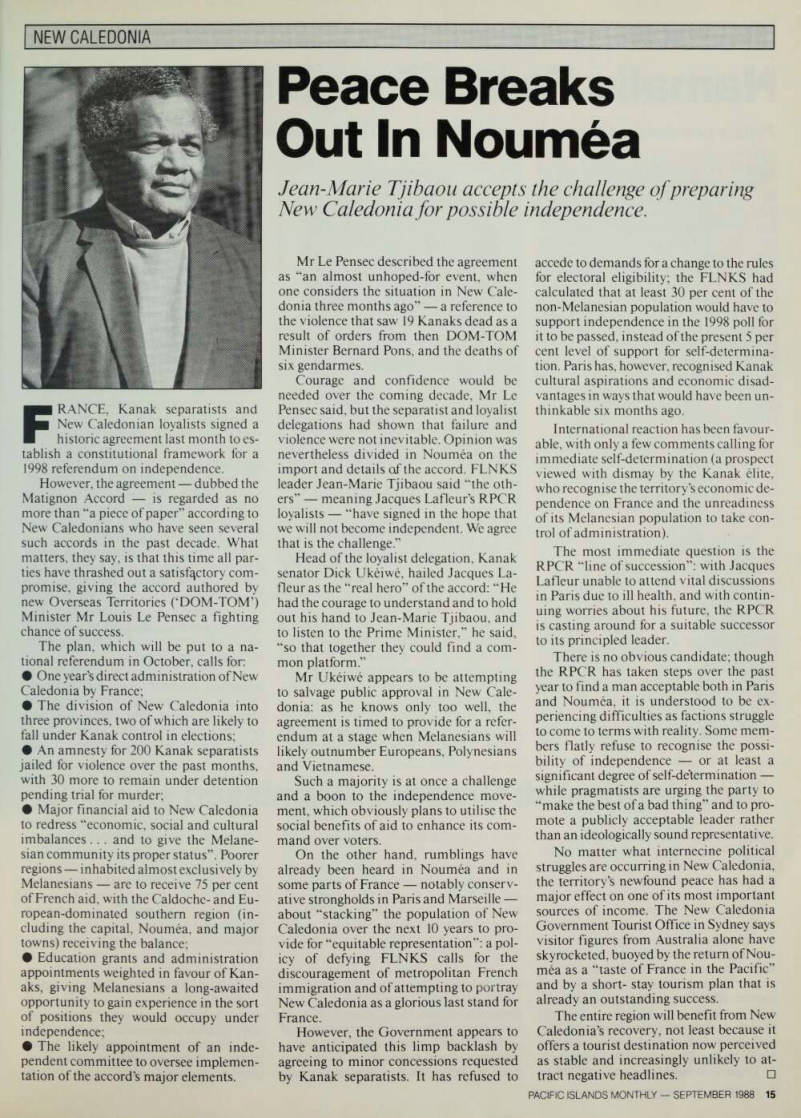
Jean-Marie Tjibaou accepts the challenge of preparing New Caledonia for possible independence.
FRANCE, Kanak separatists and New Caledonian loyalists signed a historic agreement last month to es tablish a constitutional framework for a 1998 referendum on independence.
However, the agreement dubbed the Matignon Accord is regarded as no more than “a piece of paper” according to New Caledonians who have seen several such accords in the past decade. What matters, they say, is that this time all par ties have thrashed out a satisfactory com promise, giving the accord authored by new Overseas Territories (‘DOM-TOM’) Minister Mr Louis Le Pensec a fighting chance of success.
The plan, which will be put to a na tional referendum in October, calls for: • One year’s direct administration of New Caledonia by France; • The division of New Caledonia into three provinces, two of which are likely to fall under Kanak control in elections; • An amnesty for 200 Kanak separatists jailed for violence over the past months, with 30 more to remain under detention pending trial for murder; • Major financial aid to New Caledonia to redress “economic, social and cultural imbalances. .. and to give the Melane sian community its proper status”. Poorer regions inhabited almost exclusively by Melanesians are to receive 75 per cent of French aid, with the Caldoche- and Eu ropean-dominated southern region (in cluding the capital, Noumea, and major towns) receiving the balance; • Education grants and administration appointments weighted in favour of Kan aks, giving Melanesians a long-awaited opportunity to gain experience in the sort of positions they would occupy under independence; • The likely appointment of an inde pendent committee to oversee implemen tation of the accord’s major elements.
Mr Le Pensec described the agreement as “an almost unhoped-for event, when one considers the situation in New Cale donia three months ago” a reference to the violence that saw 19 Kanaks dead as a result of orders from then DOM-TOM Minister Bernard Pons, and the deaths of six gendarmes.
Courage and confidence would be needed over the coming decade, Mr Le Pensec said, but the separatist and loyalist delegations had shown that failure and violence were not inevitable. Opinion was nevertheless divided in Noumea on the import and details of the accord. FLNKS leader Jean-Marie Tjibaou said “the oth ers” meaning Jacques Lafleur’s RPCR loyalists “have signed in the hope that we will not become independent. We agree that is the challenge.”
Plead of the loyalist delegation, Kanak senator Dick Ukeiwe, hailed Jacques La fleur as the “real hero” of the accord: “He had the courage to understand and to hold out his hand to Jean-Marie Tjibaou, and to listen to the Prime Minister,” he said, “so that together they could find a com mon platform.”
Mr Ukeiwe appears to be attempting to salvage public approval in New Cale donia: as he knows only too well, the agreement is timed to provide for a refer endum at a stage when Melanesians will likely outnumber Europeans, Polynesians and Vietnamese.
Such a majority is at once a challenge and a boon to the independence move ment, which obviously plans to utilise the social benefits of aid to enhance its com mand over voters.
On the other hand, rumblings have already been heard in Noumea and in some parts of France notably conserv ative strongholds in Paris and Marseille about “stacking” the population of New Caledonia over the next 10 years to pro vide for “equitable representation”: a pol icy of defying FLNKS calls for the discouragement of metropolitan French immigration and of attempting to portray New Caledonia as a glorious last stand for France.
However, the Government appears to have anticipated this limp backlash by agreeing to minor concessions requested by Kanak separatists. It has refused to
accede to demands for a change to the rules for electoral eligibility; the FLNKS had calculated that at least 30 per cent of the non-Melanesian population would have to support independence in the 1998 poll for it to be passed, instead of the present 5 per cent level of support for self-determina tion. Paris has, however, recognised Kanak cultural aspirations and economic disad vantages in ways that would have been un thinkable six months ago.
International reaction has been favour able, with only a few comments calling for immediate self-determination (a prospect viewed with dismay by the Kanak elite, who recognise the territory’s economic de pendence on France and the unreadiness of its Melanesian population to take con trol of administration).
The most immediate question is the RPCR “line of succession”: with Jacques Lafleur unable to attend vital discussions in Paris due to ill health, and with contin uing worries about his future, the RPCR is casting around for a suitable successor to its principled leader.
There is no obvious candidate; though the RPCR has taken steps over the past year to find a man acceptable both in Paris and Noumea, it is understood to be ex periencing difficulties as factions struggle to come to terms with reality. Some mem bers flatly refuse to recognise the possi bility of independence or at least a significant degree of self-determination while pragmatists are urging the party to “make the best of a bad thing” and to pro mote a publicly acceptable leader rather than an ideologically sound representative.
No matter what internecine political struggles are occurring in New Caledonia, the territory’s newfound peace has had a major effect on one of its most important sources of income. The New Caledonia Government Tourist Office in Sydney says visitor figures from Australia alone have skyrocketed, buoyed by the return of Nou mea as a “taste of France in the Pacific” and by a short- stay tourism plan that is already an outstanding success.
The entire region will benefit from New Caledonia’s recovery, not least because it offers a tourist destination now perceived as stable and increasingly unlikely to at tract negative headlines. □
Namaliu Faces Tough Decisions
Papua New Guniea
PNG's new leader targets law and order, youth and investment.
By Frank Senge
FACED with a fluid political system and a prevailing law and order prob lem of crisis proportions, Papua New Guinea’s new Namaliu Government has naturally targeted constitutional re forms and public security as its most ur gent priotities.
Releasing his Government’s policy in itiatives to an increasingly fidgety popu lace five weeks after taking government.
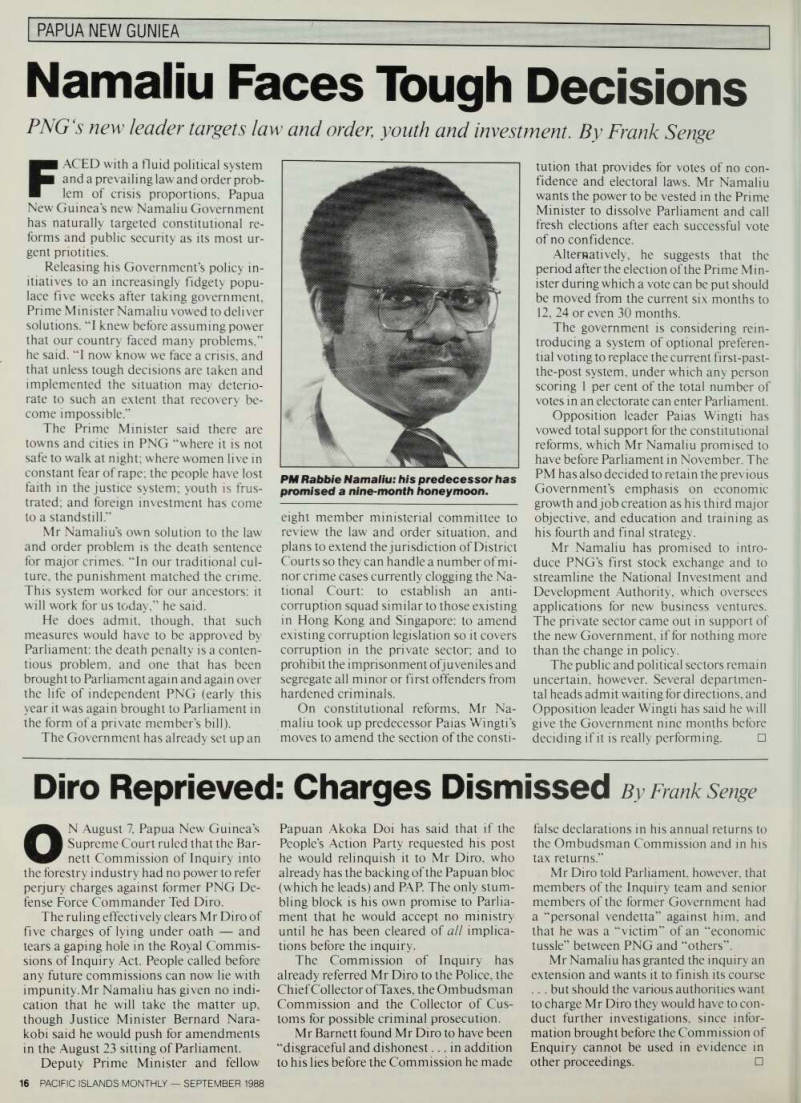
Prime Minister Namaliu vowed to deliver solutions. “I knew before assuming power that our country faced many problems,” he said. “I now know we face a crisis, and that unless tough decisions are taken and implemented the situation may deterio rate to such an extent that recovery be come impossible.”
The Prime Minister said there are towns and cities in PNG “where it is not safe to walk at night: where women live in constant fear of rape: the people have lost faith in the justice system; youth is frus trated; and foreign investment has come to a standstill.”
Mr Namaliu’s own solution to the law and order problem is the death sentence for major crimes. “In our traditional cul ture, the punishment matched the crime.
This system worked for our ancestors; it will work for us today,” he said.
He does admit, though, that such measures would have to be approved by Parliament: the death penalty is a conten tious problem, and one that has been brought to Parliament again and again over the life of independent PNG (early this year it was again brought to Parliament in the form of a private member’s bill).
The Government has already set up an
eight member ministerial committee to review the law and order situation, and plans to extend the jurisdiction of District Courts so they can handle a number of mi nor crime cases currently clogging the Na tional Court: to establish an anti corruption squad similar to those existing in Hong Kong and Singapore: to amend existing corruption legislation so it covers corruption in the private sector; and to prohibit the imprisonment of juveniles and segregate all minor or first offenders from hardened criminals.
On constitutional reforms, Mr Na maliu took up predecessor Paias Wingti’s moves to amend the section of the consti
tution that provides for votes of no con fidence and electoral laws. Mr Namaliu wants the power to be vested in the Prime Minister to dissolve Parliament and call fresh elections after each successful vote of no confidence.
Alternatively, he suggests that the period after the election of the Prime Min ister during which a vote can be put should be moved from the current six months to 12, 24 or even 30 months.
The government is considering rein troducing a system of optional preferen tial voting to replace the current first-past the-post system, under which any person scoring 1 per cent of the total number of votes in an electorate can enter Parliament.
Opposition leader Paias Wingti has vowed total support for the constitutional reforms, which Mr Namaliu promised to have before Parliament in November. The PM has also decided to retain the previous Government’s emphasis on economic growth and job creation as his third major objective, and education and training as his fourth and final strategy.
Mr Namaliu has promised to intro duce PNG’s first stock exchange and to streamline the National Investment and Development Authority, which oversees applications for new business ventures.
The private sector came out in support of the new Government, if for nothing more than the change in policy.
The public and political sectors remain uncertain, however. Several departmen tal heads admit waiting for directions, and Opposition leader Wingti has said he will give the Government nine months before deciding if it is really performing. □
PM Rabbie Namaliu: his predecessor has promised a nine-month honeymoon.
Diro Reprieved: Charges Dismissed
By Frank Senge
ON August 7, Papua New Guinea’s Supreme Court ruled that the Bar nett Commission of Inquiry into the forestry industry had no power to refer perjury charges against former PNG De fense Force Commander Ted Diro.
The ruling effectively clears Mr Diro of five charges of lying under oath and tears a gaping hole in the Royal Commis sions of Inquiry Act. People called before any future commissions can now lie with impunity.Mr Namaliu has given no indi cation that he will take the matter up, though Justice Minister Bernard Nara kobi said he would push for amendments in the August 23 sitting of Parliament.
Deputy Prime Minister and fellow
Papuan Akoka Doi has said that if the People’s Action Party requested his post he would relinquish it to Mr Diro, who already has the backing of the Papuan bloc (which he leads) and PAP The only stum bling block is his own promise to Parlia ment that he would accept no ministry until he has been cleared of all implica tions before the inquiry.
The Commission of Inquiry has already referred Mr Diro to the Police, the Chief Collector of Taxes, the Ombudsman Commission and the Collector of Cus toms for possible criminal prosecution.
Mr Barnett found Mr Diro to have been “disgraceful and dishonest... in addition to his lies before the Commission he made
false declarations in his annual returns to the Ombudsman Commission and in his tax returns.”
Mr Diro told Parliament, however, that members of the Inquiry team and senior members of the former Government had a “personal vendetta” against him, and that he was a “victim” of an “economic tussle” between PNG and “others”.
Mr Namaliu has granted the inquiry an extension and wants it to finish its course .. . but should the various authorities want to charge Mr Diro they would have to con duct further investigations, since infor mation brought before the Commission of Enquiry cannot be used in evidence in other proceedings. □
Violent End For Salii
Palau
Rumours surround gunshot death of Palau’s President.
By Ed Rampell
DURING a 1986 campaign for a proposed Compact of Free Associ ation between the United States and Palau, Palauan President Lazarus Salii reportedly stated that “anyone opposing the Compact deserves to be beakV the Palauan word meaning “a target to be shot”. Salii has become Palau’s second president to become a beakl and to die of gunshot wounds within three years.
However, unlike President Haruo Re meliik, who was gunned down by un known assailants on June 30 1985, it is uncertain at time of going to press whether Salii’s death was the result of assassination or suicide.
According to Palau Government spokesman Bonifacio Basilius, the shoot ing occurred at about 1.30 pm on August 20. A security guard, a maid and the First Lady, Christina Salii, were reportedly eat ing lunch outside the presidential resi dence in Koror when they heard a gunshot.
The guard inspected the grounds of the President’s house but found nothing unu sual, and Mrs Salii did not enter the home for a further 20 minutes.
Inside she found her husband dead, slumped in a chair. Police discovered a .357 caliber magnum revolver and spent car tridge. The revolver had one chamber empty and five rounds remaining (fire arms are strictly forbidden in Palau). The 54-year-old President was pronounced dead an hour later at Roror’s McDonald Memorial Hospital.
Vice President and Minister for Justice Thomas Remengesau was sworn in as in terim President by Chief Justice Mamoru Nakamura some five hours after the shooting. Fifty-seven-year-old Remenge sau will serve out the remaining four months of Salii’s term (this November, Palauans are to vote in general and presi dential elections) and prior to Salii’s death Remengesau had reportedly announced his candidacy for the presidency.
Early news dispatches termed the Salii shooting an “assassination”, but Palauan and US officials swiftly asserted that the President may have taken his own life: headlines soon appeared indicating the death could be a “suicide”. Guam’s chief medical examiner flew to Koror to assist in the autopsy on August 22.
Assuming that the suicide hypothesis is true, what factors could have led to Sal ii’s taking his own life? The authoritarian chief executive had a mercurial person ality and had over recent months faced a series of political setbacks. Salii’s main source of frustration was his inability to attain Compact ratification, which he had
been seeking for 21 years. Palau’s courts repeatedly ruled that the treaty’s military stipulations clashed with the constitu tion’s nuclear-free statue, and required a 75 per cent vote to override the anti nuclear provision. Despite 10 related ref erendums and numerous court cases Salii, like his predecessor, remained unable to resolve the Compact dilemma.
US Congressional investigations have alleged links between the late President
and his Administration with widespread corruption, the drug trade, and more. Salii had admitted to receiving SUS2OO,OOO from the IPSECO power project, and his younger brother was recently impeached by the House of Delegates for taking up to SUSI.S million from IPSECO while Speaker of the House.
Last month a US District Court ruled that Palau had to pay SUS 43 million to IPSECO’s creditors more than double the tiny Republic’s annual budget.
Unconfirmed reports indicate that Pa lau’s Washington-based liaison officer, Haruo Wilter, met with Salii shortly be fore his death, and that he may have con veyed disturbing information to Salii on the morning of August 20; perhaps regard ing impending indictments, since the US Government has been cracking down on corruption in its overseas territories.
Contrary to the suicide hypothesis is the news that the High Court appeal on the latest Compact-related court case had not been delivered prior to Salii’s death.
Salii also had enemies the Presiden tial limousine reputedly had a machine gun, and armed guards accompanied him
everywhere who resented a regime deemed “vindictive” and “oppressive” by Palauan dissidents, international poll watchers and human rights groups.
On the other hand, unable to untie the Compact knot (like Remeliik before him) Salii may have been regarded as “expend able” by pro-Compacl zealots. The night after Salii’s death the Compact camp was already meeting to choose a successor.
A more complete picture will emerge in weeks to come, depending on who an nounces candidacy for President and if any particular faction is blamed for Salii’s de mise. It is nevertheless past time for the United Nations and the United States to launch an investigation into the continu ing history of political violence in their joint Trusteeship responsibility not least because, for Lazarus Salii, the biblical edict “He who lives by the sword dies by the sword” has come terribly true. □
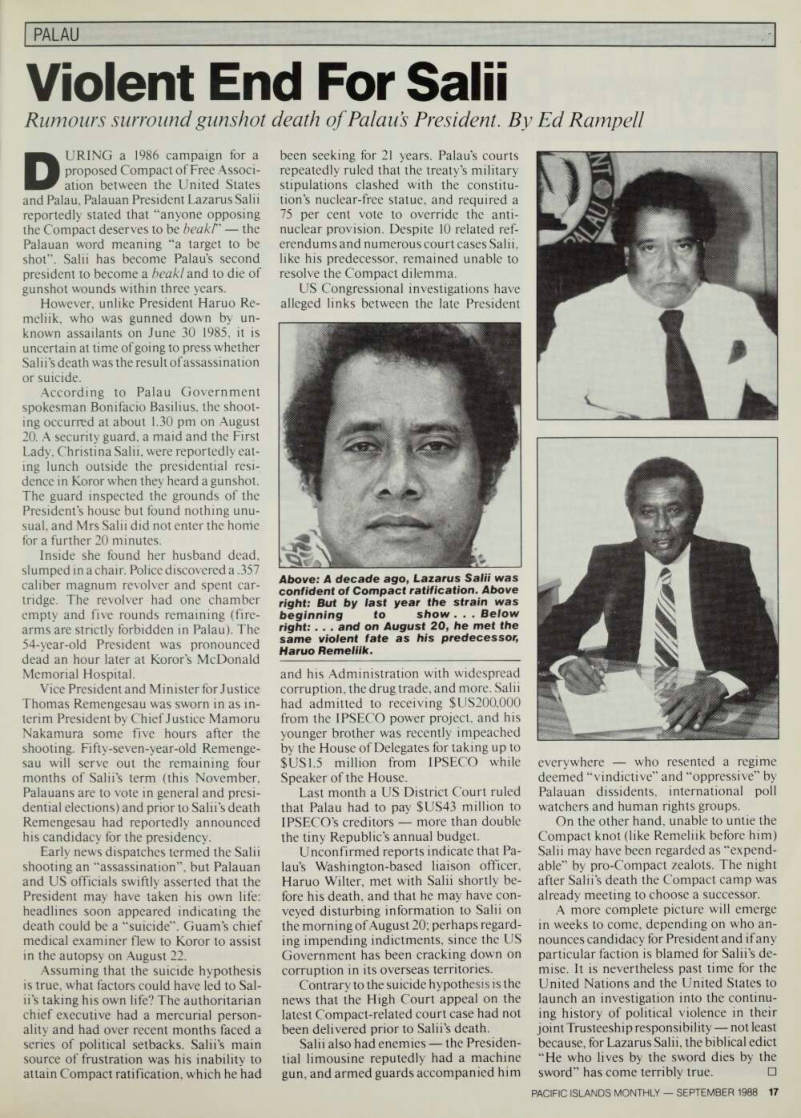
Above: A decade ago, Lazarus Salii was confident of Compact ratification. Above right: But by last year the strain was beginning to show . .. Below right: . . . and on August 20, he met the same violent fate as his predecessor, Haruo Remeliik.
Fifty-one Days Adrift
Tuvalu
How four young islanders survived an epic ordeal. By Diana McManus
FUNAFUTI, the capital of Tuvalu, was still rejoicing in late May this year because four of its young men had apparently returned from the dead.
The four men, who went adrift while fishing in February, were rescued on the island of Futuna in the French territory of Isles de Home, 400 nautical miles south southeast of Tuvalu after an epic 51 days at sea in a tiny dinghy. Afele Kitiona, a po lice constable, loane Maae and Tanei Tau mafua. a wireless operator, are all from the island community of Vaitupu; Tapaa Fiti, a Tuvalu Maritime School graduate, is from Niutao.
Tuesday February 23 was a wild, rainy, grey day, with rough seas and westerlies gusting at around 40 knots. The men had been fishing together in two boats since 10am, and had been swept out of sight of land by the sudden onset of the wind. After three hours of searching for land with no success, they tried to prepare a sea anchor and ready themselves for a drift. In doing so Tepaa and Tanei, who were in a 4.5 metre plywood dinghy, got into difficul ties and capsized. Afele and loane came to the rescue; they tied the floating boat to Afele’s slightly smaller plywood dinghy with a 200 metre line, hoping to save it later. The four men, all in Afele’s boat and bow to the wind, prepared to “ride it out”.
Afele and Tepaa are both single men and important contributors to the family income. loane Mae, already the father of one child, couldn’t help thinking about his pregnant wife, a nurse in the Princess Margaret Hospital onFunafuti. Tanei was concerned about his two small children, particularly as his wife (herself a former nurse) had tragically died of cancer some 18 months earlier.
Resigning themselves to the situation the men determined to survive, while an unsuccessful search of the islets surround ing Funafuti lagoon was carried out by the local community. An aerial search by a Fiji Air Heron that had arrived on a scheduled flight that morning also revealed nothing.
For three days and nights it rained con tinuously, and during the third night the bow of the boat began to swing from side to side. Tanei knew his own boat had bro ken loose and was lost.
On the fourth day the rain cleared and the men caught a black noddy, which they expected to eat: nobody was excited by the prospect but they hadn’t eaten for a long time. Luckily they were spared the taste of tern by a coconut log that came floating by with skipjack tuna swimming about it; out came the tackle and they caught a dozen
“Optimism began to give way to despair, and with it petty arguments and imaginary pains”
or so fish. Some they ate raw, the remain der they filleted, laying the fillets on the bow of the dinghy to dry and eat later.
In the emptied spare fuel tank they col lected rainwater, which they drank de spite the taint of petrol. Little could be collected, however, and at times their sup ply was rationed to a few sips at morning, noon and night.
At times the rain beat down, then the sun would glare from an empty sky. The men pulled up the decking of the dinghy and made a crude shelter, but during the day they would often bake and at night they huddled together for warmth. All slept fit fully and a system of shifts was arranged for each man to keep watch for land while the others rested.
On the ninth night they saw a ship and tried to hail it, but failed there were no flares on board. On another day they saw a bulk carrier and tried chasing it, but
failed to attract its attention or to catch it with their 15 horsepower outboard.
For three weeks the westerly winds drove them east, apparently to nowhere: remarkably they say they enjoyed this part of the drift. They swam around the boat, told stories and felt optimistic about their future. They saw schools of whales and big fish . . . then the wind changed.
The little dinghy was caught in the cur rent and the easterly winds for a further 19 days. By this time the store of dried fish was becoming moist and rank, and the men felt noticeably weaker. Optimism be gan to give way to despair, and with it petty arguments and imaginary pains. A pair of small whales frightened them by frolick ing around the dinghy and bumping it; the men lay silent and motionless and the whales eventually swam off to continue their “honeymoon” elsewhere.
One day five coconuts were found, though only three were good for eating; nevertheless, they were a welcome change to a diet of dried fish and water. About the thirtieth day the men heard something scraping the edge of the boat, and imag ined a great fish was attacking them. loane bravely leaned over the edge and deftly caught a turtle responsible for the noise. It was eaten raw.
At Easter the wind and seas rose again and they battled with the elements for a few days, trying to prevent the dinghy broach ing to. The wind continued to change: for days it blew from the north, then suddenly it would die and blow from the south. They had no idea where they were.
tion officials, there was feasting and dancing in their honour and the people presented them with garlands and a suit case ,of clothes.
The MV Nivanga, Tuvalu’s own inter island boat, made a detour from Fiji to collect the men and the little dinghy that had seen them to safety four days later.
The vessel’s captain, Houato lele, said the Futuna jetty was packed with islanders farewelling their guests. loane, Afele, Tanei and Tepaa arrived back in Funafuti on April 20 to happy rel atives, friends and onlookers who greeted them with more garlands and tears of joy. The community showed its enthusi asm at their return with a feast and fatele (dance) for the four men at the Vaitupu maneaba (meeting hall) on April 23, while the rest of the island was commemorating Bomb Day. A week later, the Police Force honoured the return of Afele and his friends with a special feast at the Vaiaku maneaba ; that night saw a magnificent private family feast held by Tepaa’s family at his home. Tepaa’s companions were honoured guests at the feast.
On Sunday May 1 a special Thanksgiv ing service was held at the Fetu ao Lima Church, where Afele Kitiona spoke on be half of the boys. He said while at sea they had prayed constantly and had never for gotten the Bible quote that says, ”Ask and ye shall receive”. He also gave thanks to God and his mercy. Another short service was held at the Tuvalu Maritime School on May 8, at which Tepa gave thanks for the survival skills he had learnt while a student there.
It’s not uncommon for Pacific island ers to go adrift and to be found days, weeks or even months later in far-off places. Yet their feats of endurance are rarely publi cised outside the local press. The story of these young men’s survival is a tribute to them and to the Polynesian affinity with the sea: it’s marvellous to see that age-old skills of survival and seamanship, partic ularly in such a small craft, are still very much alive in the 20th century □
Just as despair threatened to over whelm the weakened islanders, Afele and loane sighted land at about 10 o’clock on the morning of Wednesday April 13.
Twenty-four hours later they were close enough to start the outboard and use the little fuel remaining to make landfall.
Though weak, thin and troubled by sea so res, they were otherwise in good health, with plenty of dried fish and four gallons of “fresh” water on board.
Tanei was the first ashore and stag gered up the beach to a young man busy mending a punctured tyre. “Do you speak English?” Tanei asked, but the reply was negative. Afele joined Tanei moments later and asked him in Tuvaluan, “Did you find out the name of this island?”
To their astonishment the young man joined in the conversation apart from French, Tuvaluan is the second language of the inhabitants of Futuna! The young man listened to their story, then ran to alert the island and get help.
The astonished islanders of Futuna gave the young Tuvaluans a tumultuous reception: the island’s chief made the lads his special guests after they had been med ically examined and cleared by immigra-
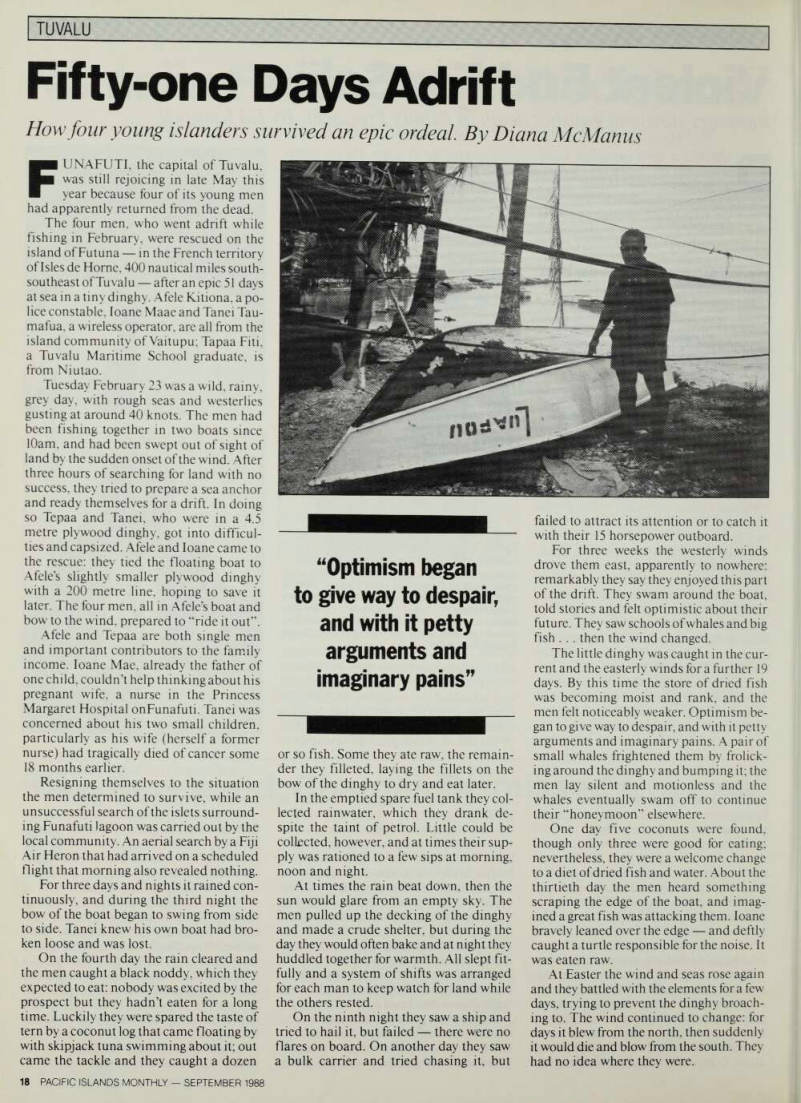
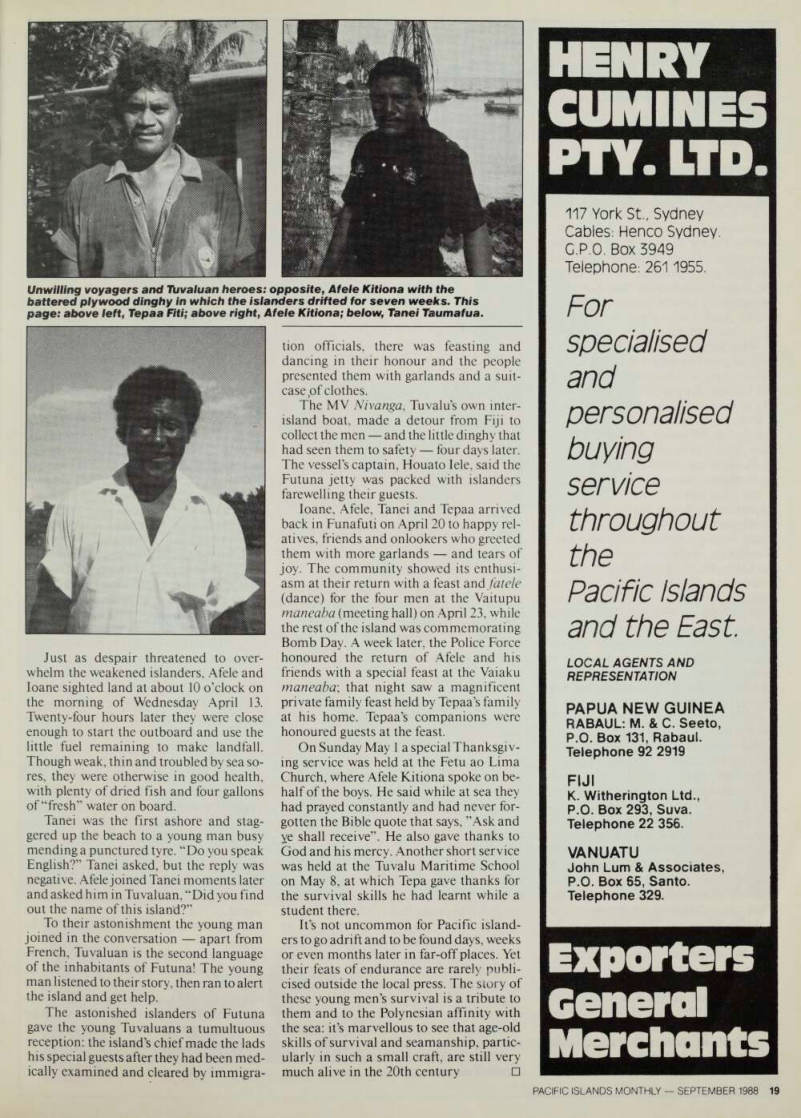
Unwilling voyagers and Tuvaluan heroes: opposite, Afele Kitiona with the battered plywood dinghy in which the islanders drifted for seven weeks. This page: above left, Tepaa Fiji; above right, Afele Kitiona; below, Tanei Taumafua.
Advertisements & other items, p. 19 (1 item)
Pty. Ltd.
[ 4-i
117 York St., Sydney Cables; Henco Sydney.
C.P.O. Box 3949 Telephone: 261 1955.
For
specialised
and
personalised
buying
service
throughout
the
Pacific Islands
and the East.
LOCAL AGENTS AND
REPRESENTATION
PAPUA NEW GUINEA
RABAUL: M. & C. Seeto, P.O. Box 131, Rabaul.
Telephone 92 2919
FIJI
K. Witherington Ltd., P.O. Box 293, Suva.
Telephone 22 356.
VANUATU
John Lum & Associates, P.O. Box 65, Santo.
Telephone 329.
Exporters
General
Tourism’s ‘Way Ahead’
Fiji
Tourism conventioneers gather to plan the future.
By Firoz Shaheem
THE delegates’ kit for last month’s Fiji Tourism Convention had this message on the cover from Minis ter for Tourism David Pickering; “If you are involved in Fiji tourism, I urge you to come to Fiji for this important and timely convention”. Given the knocks suffered by Fiji after the withdrawal of Continental and Japan Airlines from Nadi services, it was generally viewed as a convention that had to chart a way ahead for the indus try... hence the theme “The Way Ahead”.
What appears to be the way ahead is a need to promote regional tourism, using Fiji as the region’s hub, and beefing up the Fiji Visitors Bureau to play a leadership role in the promotion of Fiji as a holiday destination. The task is now to follow through on thfc issues that emerged from three days of talks and discussions.
The concept, mechanics and market ing of regional tourism took up a good part of the convention’s time. The Tourism Council of the South Pacific (TCSP) was established some two years ago as a re gional inter-government organisation to co-ordinate tourism development and marketing for the South Pacific: member countries are Fiji, American Samoa, Cook Islands, Kiribati, Niue, Papua New Guinea, Solomon Islands. Tahiti, Tonga, Tuvalu. Vanuatu and Western Samoa, and three days before the convention proper began representatives from all 13 nations met to approve a memorandum of under standing giving TCSP status as an inter government organisation.
TCSP Project Manager John Ya coumis put up a strong submission for re gional promotion, saying market trends to last year showed that Americans boosted their share of total traffic to the South Pa cific from about 13 per cent in 1984 to 22 per cent in 1986, while Canadians in creased theirs from 5 to 6 per cent. The United States’ share grew from below 15 per cent in 1984 to 27 per cent in 1986, while the Canadian market share in creased from 7 to 9 per cent.
Mr Yacoumis said the second major trend was a dramatic development in the opposite direction. The Australian mar ket was declining steadily, losing about 9 per cent of its relative share of arrivals in the region. Australians made up more than 43 per cent of all foreign visitors to Fiji in 1984, but their numbers dropped to 33.5 per cent in 1986, with 15,000 fewer Aus tralian visitors in 1986 than in 1984. The New Zealand market fluctuated widely and showed no real growth.
The conclusion was that while South
Pacific countries would continue to de pend for much of their tourist income on Australia and New Zealand, they had to develop new markets in North America, Japan and Western Europe. Australia and New Zealand would continue to be “bread and butter” in their own right, Mr Ya coumis said, but they would also be gate ways for long-haul markets through their growing attractiveness as international destinations.
But to tap new markets he warned, it is necessary to take into account their travel patterns and perception of the South Pa-
cific. The traditional short- haul markets of Australia and New Zealand are essen tially single-destination travel markets with long average stays North America and western Europe, on the other hand, generate mostly multi-destination and stopover trips with short average stays.
According to the TCSP, regional pro motion is vital first because most island countries cannot afford to mount individ ual promotion campaigns. Second, in North America and Europe the region is perceived as the destination area, so has to be promoted as a whole. Fiji, which is intended to be the hub of the system, will benefit from increased awareness of the South Pacifiers a destination, savings in promotion and growth of new markets.
The concept drew some opposition from the hotel sector, with talk of Fiji los ing its own image in a regional strategy, and that tourists visiting other South Pacific destinations might expect Fijian stand ards and come away disappointed.
The Fiji Visitors Bureau presented a draft of its new three-year strategic plan.
which calls for streamlining its structure, giving it a “mission”, changing its name to the Fiji Islands Tourist Authority and a host of other features. The name change suggestion also drew some opposition, mainly in connection with the word “Au thority’. It was felt ‘Visitors Bureau’ would better reflect the theme of bringing visi tors to Fiji.
The FVB’s strategic plan will be con sidered again in October; there appears to be a general desire for it to work but it needs money. The convention heard of prospects for inc/eased government fund ing (a “monumental jump”, according to FVB chairman David Williams) and Tourism Minister Pickering also spoke of government support for the industry.
Air Pacific, optimisitic about its new weekly Tokyo service beginning at the end of October, says the service has great po tential to increase the airline’s revenue base. It is looking at conservative seat fac tors in the first financial year, but says it may have underestimated if it achieves the level of traffic anticipated by a Fiji Government delegation that recently vis ited Japan. Ernie Dutta, the airline’s di rector of passenger marketing, said arrangements had been made with Japa nese wholesalers for Fiji packages, most of which were already in the market. Air Pa cific had initially sought to enter the mar ket under a seat-sharing arrangement with Japan Airlines, but though a number of discussions took place, Mr Dutta said, no clear decision had come from JAL and JAL’s withdrawal from Fiji largely influ enced the decision to launch the service.
Delegates also heard some blunt talk from guest speaker Sir Frank Moore, chairman of the Queensland Tourist and Travel Corporation. He hit out at tourism people in Australia, New Zealand and the South Pacific who, he said, were con cerned about how they were going to “pinch” a bit of the market from each other. “Don’t compete with each other compete with destinations such as the Caribbean and the Mediterranean,” he urged. “The South Pacific has its own unique charm; this is what has to be promoted.”
The convention ended with chairman Paul Manueli asking that issues raised be followed through, saying participants would not have used their time well unless they were prepared to follow up the issues; “Given the importance of this year’s con vention, it is essential that Fiji’s tourism industry does indeed chart a way ahead.” □
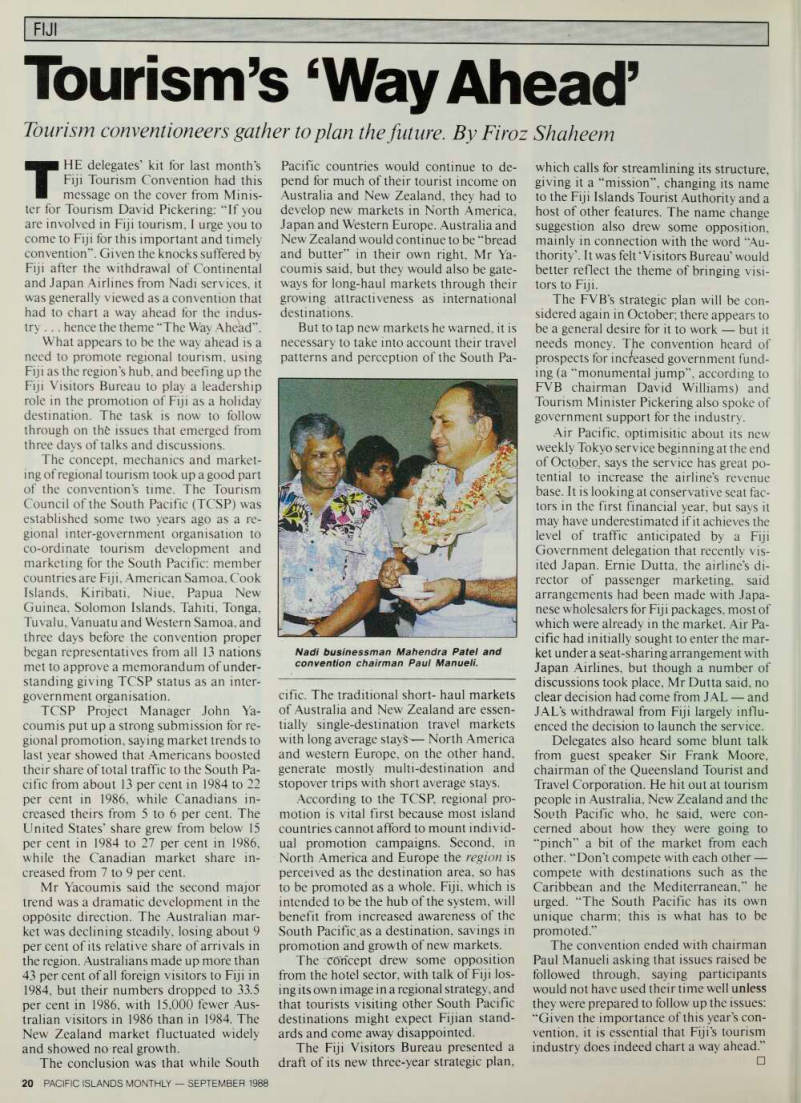
Nadi businessman Mahendra Patel and convention chairman Paul Manueli.
Advertisements & other items, p. 21 (1 item)
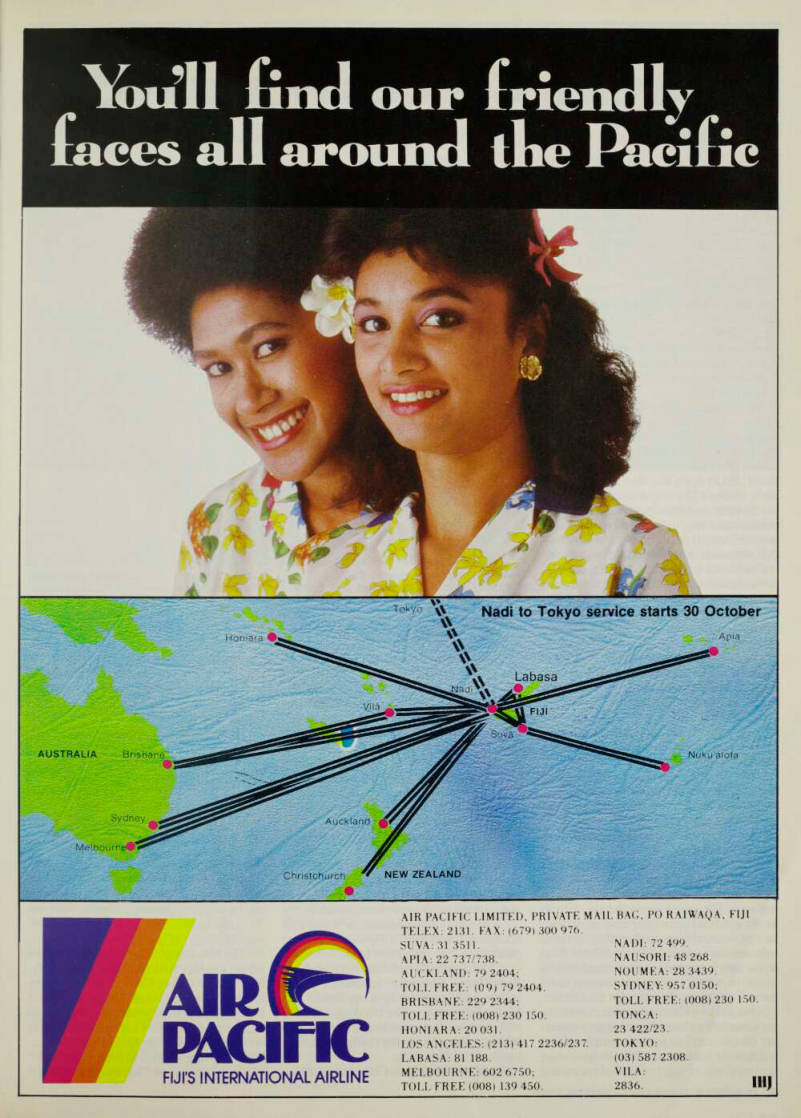
\oull find our friendly
faces all around tlie Pacific
It Honiara • Nadi to Tokyo service starts 30 October Apia AUSTRALIA Brisbane Sydney Melbourne# W \' Labasa \'
FIJI
Auckland Christchurch Nukualofa
NEW ZEALAND
AIR PACIFIC LIMITED, PRIVATE MAIL BAG, PO RAIWAQA, FIJI
AIR
PACIFIC
FIJI’S INTERNATIONAL AIRLINE
TELEX. 2131. FAX: (679) 300 976.
SUVA: 31 3511.
APIA: 22 737/738.
AUCKLAND: 79 2404;
TOLL FREE: (09) 79 2404.
BRISBANE: 229 2344;
TOLL FREE: (008) 230 150.
HONIARA: 20 031.
LOS ANGELES: (213) 417 2236/237.
LABASA: 81 188.
MELBOURNE; 602 6750;
TOLL FREE (008) 139 450.
NADI: 72 499.
NAUSORL 48 268.
NOUMEA: 28 3439.
SYDNEY: 957 0150;
TOLL FREE: (008) 230 150.
TONGA:
23 422/23.
TOKYO:
(03) 587 2308.
VILA:
2836 IH)
Oceania’s Canoes Honoured
Hawaii
A new museum pays tribute to the Pacific’s most famous vessels.
By Rodney Smith
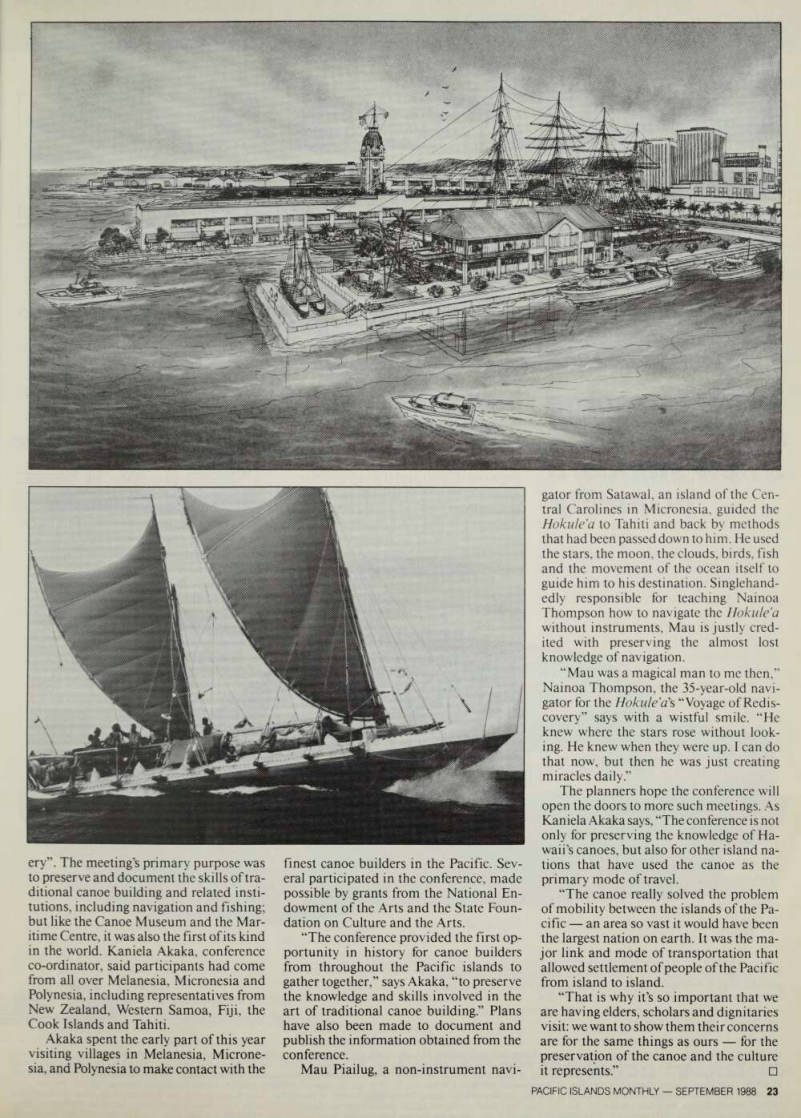
HONOLULU is joining the growing number of Pacific maritime centres that are redeveloping their waterfronts, but the crowning jewel of Honolulu Harbour’s rebirth will be the Pacific Canoe Museum, the first facility of its kind in the world.
Its setting on the shores of the historic, bustling Honolulu Harbour will distin guish the museum and the Hawaii Mari time Centre from purely recreational waterfront developments in the United States, which tend to be too far removed from working harbours to do more than simulate activity.
In contrast, the Hawaii Maritime Centre will offer visitors opportunities to see, hear, and feel a busy port going about its everyday affairs as they learn about the history of Hawaii. The Canoe Museum is scheduled to open this month at the Mar itime Centre’s Pier 7 facility, and will fea ture models and full- sized canoes both replicas and originals, from museum and private collections around the world that represent the traditional canoe-build ing skills of indigenous Pacific cultures from Australia and Asia to the furthest reaches of Melanesia, Polynesia and Mi cronesia. As well as exhibits covering dif ferent canoe types there will be displays of canoe-building tools and materials; hull, sail and paddle design; fishing; traditional weather forecasting; non-instrument nav igation; religious ceremonies attendant on canoe-building, launching and use; weap ons; canoeing skills; and canoe-related items such as clothing and voyaging foods.
The Maritime Centre is also collecting books, materials, documents and photo graphs of island canoes and canoe-related matters. On completion, the library and archival collection will constitute the first centralised resource for both casual and serious research into canoe-related mari time technology.
The canoe has always been the nucleus of culture in the South Pacific; “It is the most important artifact in Pacific island cultures. The canoe provided the vehicle for the greatest human dispersal of all time, and so revered were canoes that in some cultures, such as the Maori of New Zea land, people traced their lineage to the canoe in which their ancestors arrived,” according to a spokesman for the Centre.
One of the oldest water craft known to man has left an uncommon legacy across the Pacific, settling every habitable island in Oceania centuries before Western man ventured out of sight of land. It is to this
uncommon heritage that the Hawaii Maritime Centre Canoe Museum is dedicated, The voyaging canoe is the embodiment of a people and culture whose origin and survival were tied to a delicate balance between a capricious sea and the finite resources of island sanctuaries. An ingenious concoction of wood, sap, fibre and leaves. perfected by centuries of life and death interaction with an unforgiving sea, the voyaging canoe stands as a supreme testament to the Pacific islanders’ resourcefulness and spirit, to their singular harmony with the environment.
The Hokule’a is one of the dominant cultyre symbols of modern Oceania; a world-famous performance-accurate replica of an ancient double-hulled Polynesian voyaging canoe that will take pride of place in the museum’s waterborne fleet.
When not on expedition or in use as a “floating classroom”, Hokule’a will be moored at Pier 7 adjacent to the Museum which itself will be housed in Kalakaua Boat House, named in honour of a club owned and operated by King David Kalakaua last century. The building will have extensive exhibit areas and a three-storey lobby patterned after the skylighted courtyards of old Honolulu.
Inside will be almost 35 exhibits show-
ing the ocean’s role in Hawaiian life, in cluding displays of passenger ships, European explorers, the naval history of Hawaii, whaling, seaplanes, immigrants, surfing, windsurfing, non-instrument navigation and ocean life such as sharks, whales and turtles.
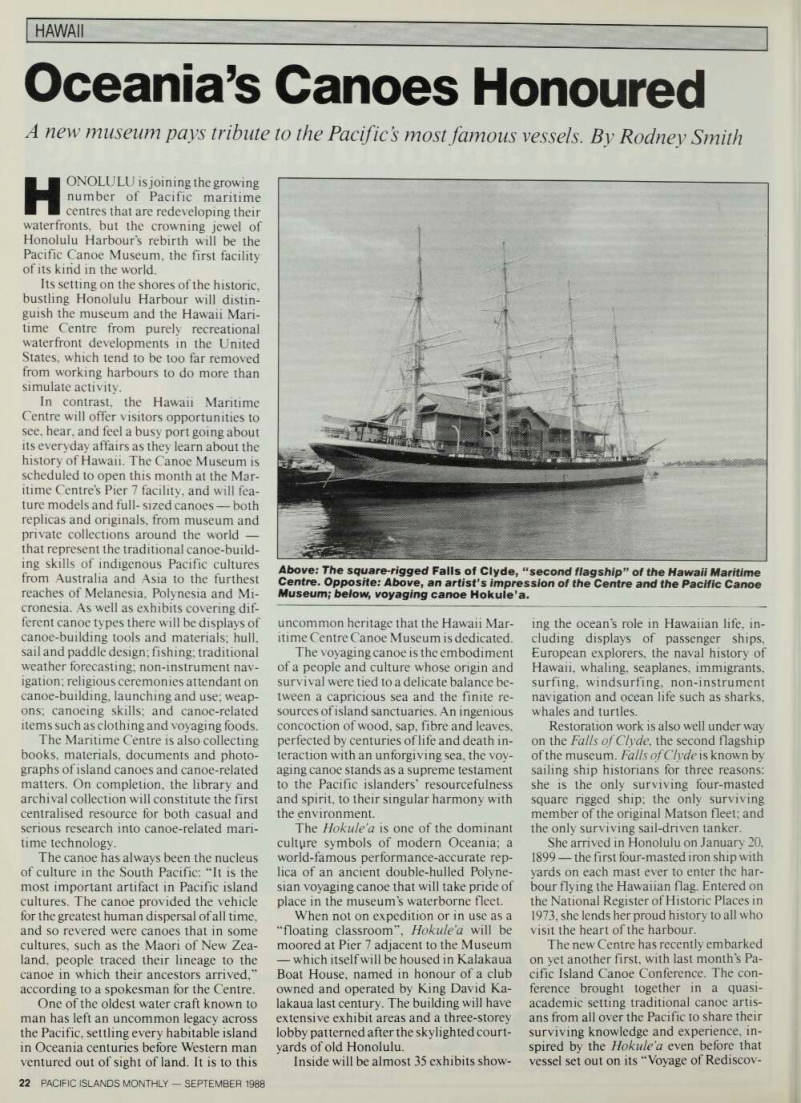
Restoration work is also well under way on the Falls of Clyde , the second flagship of the museum. Falls of Clyde is known by sailing ship historians for three reasons: she is the only surviving four-masted square rigged ship; the only surviving member of the original Matson fleet; and the only surviving sail-driven tanker.
She arrived in Honolulu on January 20, 1899 the first four-masted iron ship with yards on each mast ever to enter the har bour flying the Hawaiian flag. Entered on the National Register of Historic Places in 1973, she lends her proud history to all who visit the heart of the harbour.
The new Centre has recently embarked on yet another first, with last month’s Pa cific Island Canoe Conference. The con ference brought together in a quasi academic setting traditional canoe artis ans from all over the Pacific to share their surviving knowledge and experience, in spired by the Hokule’a even before that vessel set out on its “Voyage of Rediscov-
Above: The square-rigged Falls of Clyde, “second flagship” of the Hawaii Maritime Centre. Opposite: Above, an artist’s impression of the Centre and the Pacific Canoe Museum; below, voyaging canoe Hokule’a.
ery”. The meeting’s primary purpose was to preserve and document the skills of traditional canoe building and related institutions, including navigation and fishing; but like the Canoe Museum and the Maritime Centre, it was also the first of its kind in the world. Kaniela Akaka, conference co-ordinator, said participants had come from all over Melanesia, Micronesia and Polynesia, including representatives from New Zealand, Western Samoa, Fiji, the Cook Islands and Tahiti.
Akaka spent the early part of this year visiting villages in Melanesia, Micronesia, and Polynesia to make contact with the
finest canoe builders in the Pacific. Sev eral participated in the conference, made possible by grants from the National En dowment of the Arts and the State Foun dation on Culture and the Arts.
“The conference provided the first op portunity in history for canoe builders from throughout the Pacific islands to gather together,” says Akaka, “to preserve the knowledge and skills involved in the art of traditional canoe building.” Plans have also been made to document and publish the information obtained from the conference.
Mau Piailug, a non-instrument navi
gator from Satawal, an island of the Cen tral Carolines in Micronesia, guided the Hokule’a to Tahiti and back by methods that had been passed down to him. He used the stars, the moon, the clouds, birds, fish and the movement of the ocean itself to guide him to his destination. Singlehand edly responsible for teaching Nainoa Thompson how to navigate the Hokule’a without instruments, Mau is justly cred ited with preserving the almost lost knowledge of navigation.
“Mau was a magical man to me then,”
Nainoa Thompson, the 35-year-old navi gator for the Hokule’a' s “Voyage of Redis covery” says with a wistful smile. “He knew where the stars rose without look ing. He knew when they were up. I can do that now, but then he was just creating miracles daily ”
The planners hope the conference will open the doors to more such meetings. As Kaniela Akaka says, “The conference is not only for preserving the knowledge of Ha waii’s canoes, but also for other island na tions that have used the canoe as the primary mode of travel.
“The canoe really solved the problem of mobility between the islands of the Pa cific an area so vast it would have been the largest nation on earth. It was the ma jor link and mode of transportation that allowed settlement of people of the Pacific from island to island.
“That is why it’s so important that we are having elders, scholars and dignitaries visit: we want to show them their concerns are for the same things as ours for the preservation of the canoe and the culture it represents.” □
Advertisements & other items, p. 24 (1 item)
Breaking some
rules to achieve
a new standard
of quality.
The new Civic Series makes its debut.
And it's a series that bound to change the way people view popular compact cars. Take the new 4-door Civic Sedan.
It looks like a quiet, decorous sedan.
But the new Civic 4-door Sedan breaks with convention in more ways than one.
For instance, each Civic 4-door Sedan features as standard a newly-developed sporty 16-valve engine and a 4-wheel double wishbone suspension. Hardly the rule in conventional cars of its class, these significant technological advantages allow the new Civic 4-door Sedan to transcend all conventional concepts of its class.
A prerequisite for a sedan today is refined, well-balanced styling. The Civic Sedan skillfully incorporates elements of aviation aerodynamics to achieve a classic silhouette. Entirely flush-surfaced, its elegant, rounded body lines combine with extensive glass areas to form one sleek, unbroken curve from the low nose to spoiler-shaped tail. And inside, there's an increased sense of v/ai \/f 4“VVh©ol "VALV t Double Wishbone spaciousness, with the comfort quotient reaching new heights.
Sedans that stick to conventional rules.
Perfectly acceptable, but be prepared for conventional performance. Then try the new Civic Sedan. You'll be happy Honda broke some rules.
Specifications and equipment may vary in some countries. n ■ v» V vwt :: % * |V Honda engines have powered the Williams/Honda team to consecutive Constructors' Championships in 1986 and 1987, and last year powered Nelson Piquet to victory in the Driver's Championship.
For 1988, Honda engines will continue to compete in motor sports' toughest arena with the Lotus and McLaren teams.
AUSTRALIA: Honda Australia Pty., Ltd. Lot 95 Sharps Road, Tullamarine, Victoria 3043; Bennett Honda Pty., Ltd. 250 Victoria Road, Wetherill Park, N.S.W. 2164/NEW NZMC Manners Plaza, 57-65 Manners St., Wellington/PAPUA NEW GUINEA: Toba Pty., Ltd. P.O. Box 503, Port Moresby /TAHn Honda Distribution S.A. R.L B.P 1665, Papeete/ Atoll Motor & Marino Services P.O. Box 49, Bairiki Tarawa, Republic of Kiribati/U.S, UST TERRITORY: United Micronesia Development Association P.O. Box 235, CHRB Saipan CM 96950/COC ISLANDS Cook Islands Motor Centre Ltd. P.O Box 74, Rarotonga/GUAM; Mark’s Motor Co., Inc. P.O. Box DV, Agana/WESTERN SAMO, Motor Distributors (Samoa) Ltd. PO. Box 576. Apia/ SOLOMON ISLANDS: Lee Kwok Kuen & Co., Ltd. P.O. Box 537, Honiara/NAURU; Nauru Cooperation Republic of Nauru/FIJI: Coral Island Motors Ltd. Robertson Road, Suva, Fiji/AII SAMO Holiday Motors, Parts and Service P.O. Box 968, Pago Pago, American Samoa 96799; Heleck’s Service Center Ltd. P.O. Box 1138. Pago Pago, American Samoa 96799/K Tonga J —, -. » i-i iiuakmavia. li——D r\ Drw IHQI Drtrl \/ila V/oniiatll
Japan
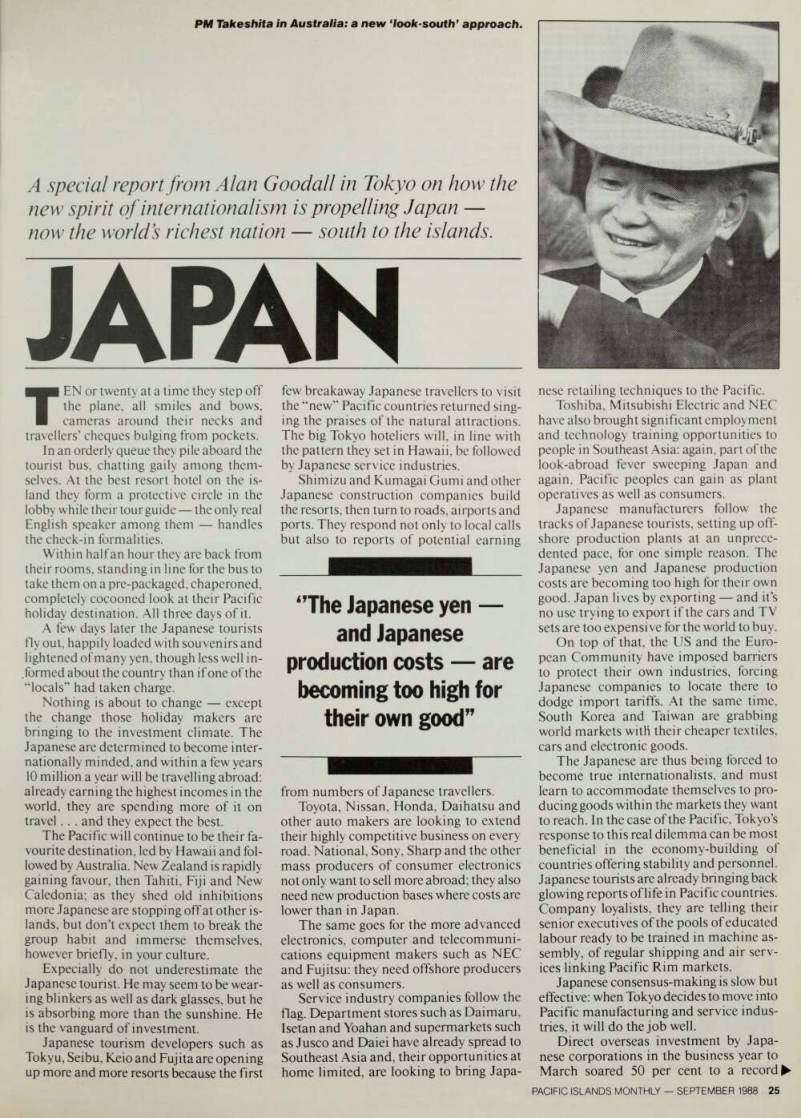
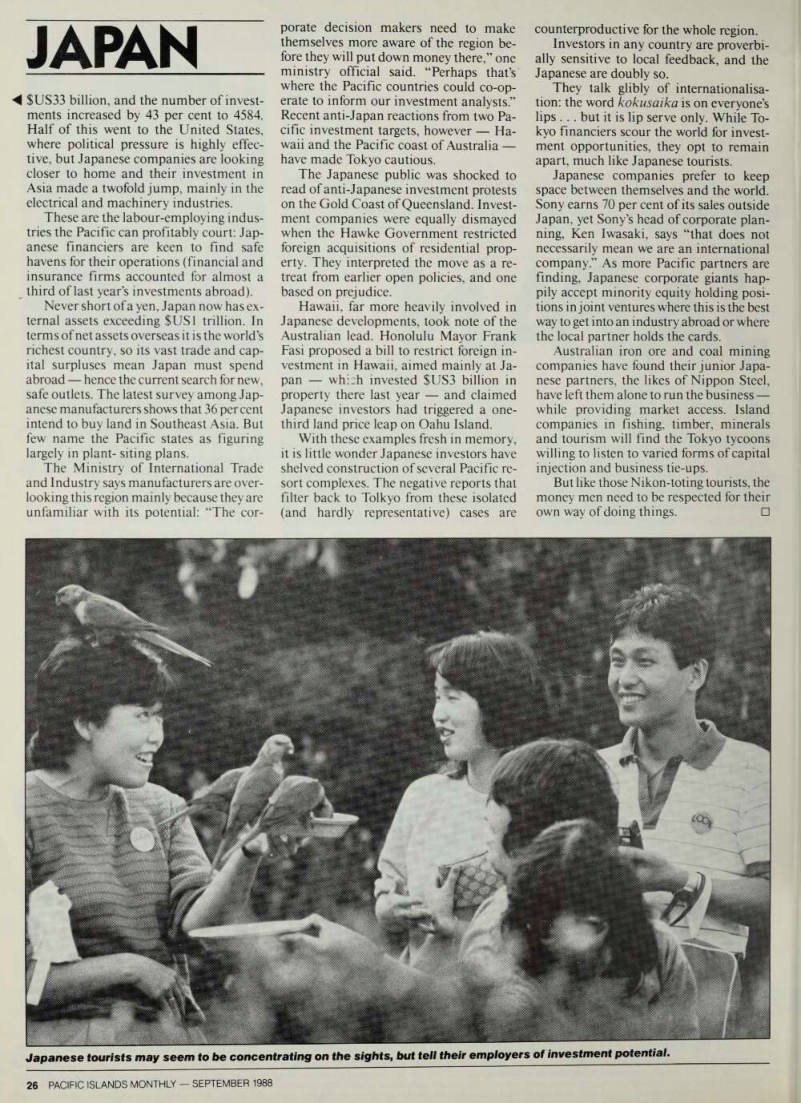
A special report from Alan Goodall in Tokyo on how the new spirit of internationalism is propelling Japan now the worlds richest nation south to the islands.
TEN or twenty at a time they step off the plane, all smiles and bows, cameras around their necks and travellers’ cheques bulging from pockets.
In an orderly queue they pile aboard the tourist bus, chatting gaily among them selves. At the best resort hotel on the is land they form a protective circle in the lobby while their tour guide the only real English speaker among them handles the check-in formalities.
Within half an hour they are back from their rooms, standing in line for the bus to take them on a pre-packaged, chaperoned, completely cocooned look at their Pacific holiday destination. All three days of it.
A few days later the Japanese tourists fly out, happily loaded with souvenirs and lightened of many yen, though less well in formed about the country than if one of the “locals” had taken charge.
Nothing is about to change except the change those holiday makers are bringing to the investment climate. The Japanese are determined to become inter nationally minded, and within a few years 10 million a year will be travelling abroad: already earning the highest incomes in the world, they are spending more of it on travel... and they expect the best.
The Pacific will continue to be their fa vourite destination, led by Hawaii and fol lowed by Australia. New Zealand is rapidly gaining favour, then Tahiti, Fiji and New Caledonia; as they shed old inhibitions more Japanese are stopping off at other is lands, but don’t expect them to break the group habit and immerse themselves, however briefly, in your culture.
Expecially do not underestimate the Japanese tourist. He may seem to be wear ing blinkers as well as dark glasses, but he is absorbing more than the sunshine. He is the vanguard of investment.
Japanese tourism developers such as Tokyu, Seibu, Keio and Fujita are opening up more and more resorts because the first
few breakaway Japanese travellers to visit the “new” Pacific countries returned sing ing the praises of the natural attractions.
The big Tokyo hoteliers will, in line with the pattern they set in Hawaii, be followed by Japanese service industries.
Shimizu and Kumagai Gumi and other Japanese construction companies build the resorts, then turn to roads, airports and ports. They respond not only to local calls but also to reports of potential earning
‘The Japanese yen and Japanese production costs are becoming too high for their own good”
from numbers of Japanese travellers.
Toyota, Nissan, Honda, Daihatsu and other auto makers are looking to extend their highly competitive business on every road. National, Sony, Sharp and the other mass producers of consumer electronics not only want to sell more abroad; they also need new production bases where costs are lower than in Japan.
The same goes for the more advanced electronics, computer and telecommuni cations equipment makers such as NEC and Fujitsu: they need offshore producers as well as consumers.
Service industry companies follow the flag. Department stores such as Daimaru, Isetan and Yoahan and supermarkets such as Jusco and Daiei have already spread to Southeast Asia and, their opportunities at home limited, are looking to bring Japa
nese retailing techniques to the Pacific.
Toshiba, Mitsubishi Electric and NEC have also brought significant employment and technology training opportunities to people in Southeast Asia: again, part of the look-abroad fever sweeping Japan and again. Pacific peoples can gain as plant operatives as well as consumers.
Japanese manufacturers follow the tracks of Japanese tourists, setting up off shore production plants at an unprece dented pace, for one simple reason. The Japanese yen and Japanese production costs are becoming too high for their own good. Japan lives by exporting and it’s no use trying to export if the cars and TV sets are too expensive for the world to buy.
On top of that, the US and the Euro pean Community have imposed barriers to protect their own industries, forcing Japanese companies to locate there to dodge import tariffs. At the same time, South Korea and Taiwan are grabbing world markets with their cheaper textiles, cars and electronic goods.
The Japanese are thus being forced to become true internationalists, and must learn to accommodate themselves to pro ducing goods within the markets they want to reach. In the case of the Pacific, Tokyo’s response to this real dilemma can be most beneficial in the economy-building of countries offering stability and personnel.
Japanese tourists are already bringing back glowing reports of life in Pacific countries.
Company loyalists, they are telling their senior executives of the pools of educated labour ready to be trained in machine as sembly, of regular shipping and air serv ices linking Pacific Rim markets.
Japanese consensus-making is slow but effective: when Tokyo decides to move into Pacific manufacturing and service indus tries, it will do the job well.
Direct overseas investment by Japa nese corporations in the business year to March soared 50 per cent to a record ►
PM Takeshita in Australia: a new ‘look-south’ approach.
M SUS 33 billion, and the number of invest ments increased by 43 per cent to 4584.
Half of this went to the United States, where political pressure is highly effec tive, but Japanese companies are looking closer to home and their investment in Asia made a twofold jump, mainly in the electrical and machinery industries.
These are the labour-employing indus tries the Pacific can profitably court: Jap anese financiers are keen to find safe havens for their operations (financial and insurance firms accounted for almost a third of last year’s investments abroad).
Never short of a yen, Japan now has ex ternal assets exceeding SUSI trillion. In terms of net assets overseas it is the world’s richest country, so its vast trade and cap ital surpluses mean Japan must spend abroad hence the current search for new, safe outlets. The latest survey among Jap anese manufacturers shows that 36 percent intend to buy land in Southeast Asia. But few name the Pacific states as figuring largely in plant- siting plans.
The Ministry of International Trade and Industry says manufacturers are over looking this region mainly because they are unfamiliar with its potential: “The cor
porate decision makers need to make themselves more aware of the region be fore they will put down money there,” one ministry official said. “Perhaps that’s where the Pacific countries could co-op erate to inform our investment analysts.”
Recent anti-Japan reactions from two Pa cific investment targets, however Ha waii and the Pacific coast of Australia have made Tokyo cautious.
The Japanese public was shocked to read of anti-Japanese investment protests on the Gold Coast of Queensland. Invest ment companies were equally dismayed when the Hawke Government restricted foreign acquisitions of residential prop erty. They interpreted the move as a re treat from earlier open policies, and one based on prejudice.
Hawaii, far more heavily involved in Japanese developments, took note of the Australian lead. Honolulu Mayor Frank Fasi proposed a bill to restrict foreign in vestment in Hawaii, aimed mainly at Ja pan wh::h invested SUS 3 billion in property there last year and claimed Japanese investors had triggered a one third land price leap on Oahu Island.
With these examples fresh in memory, it is little wonder Japanese investors have shelved construction of several Pacific re sort complexes. The negative reports that filter back to Tolkyo from these isolated (and hardly representative) cases are
counterproductive for the whole region.
Investors in any country are proverbi ally sensitive to local feedback, and the Japanese are doubly so.
They talk glibly of internationalisa tion; the word kokusaika is on everyone’s lips . . . but it is lip serve only. While To kyo financiers scour the world for invest ment opportunities, they opt to remain apart, much like Japanese tourists.
Japanese companies prefer to keep space between themselves and the world.
Sony earns 70 per cent of its sales outside Japan, yet Sony’s head of corporate plan ning, Ken Iwasaki, says “that does not necessarily mean we are an international company.” As more Pacific partners are finding, Japanese corporate giants hap pily accept minority equity holding posi tions in joint ventures where this is the best way to get into an industry abroad or where the local partner holds the cards.
Australian iron ore and coal mining companies have found their junior Japa nese partners, the likes of Nippon Steel, have left them alone to run the business while providing market access. Island companies in fishing, timber, minerals and tourism will find the Tokyo tycoons willing to listen to varied forms of capital injection and business tie-ups.
But like those Nikon-toting tourists, the money men need to be respected for their own way of doing things. □
Japanese tourists may seem to be concentrating on the sights, but tell their employers of investment potential.
Advertisements & other items, p. 27 (1 item)
Fl!) Pioneer
I choose my music with care. Sometimes it’s the oldies. Sometimes it’s the totally new. But there’s one kind I can’t stand —the kind that’s weak or distorted. That’s why my choice in a personal hi-fi is PERSON NA PLUS —the powerful system that hates distortion and noise as much as I do. My PERSONNA Z-90R has a huge 500 watts of peak music power output, and three-way speaker systems that sound bigger than all outdoors. The graphic equalizer with spectrum analyzer lets me tailor the sound to my tastes. And there’s the double, auto-reverse cassette deck, quartz-PLL synthesizer FM/AM tuner, full-auto turntable and the optional six-disc Multi-play CD player. But best of all—l can operate the whole system, including the volume, by remote control. At first, it looked too hard to use. Wrong! Pioneer made it easy. They made my choice easy, too. PERSONNA PLUS—also available in the Z-70R and Z-50R systems—is the choice I recommend to you.
The future of sound and vision.
For further information, please contact: Australia: Pioneer Electronics Australia Pty. Ltd. (Incorporated in Victoria), P-O. Box 295, Mordialloc, Victoria, 3195 Tel: 580-9911 Fiji Islands: Brijlal & Company, G.P.O. Box No. 362, Suva, Fiji Islands Tel: 22258 New Zealand: Monaco Corporation Ltd., 41 Poland Road, Glenfield, Auckland, New Zealand Tel: (09) 444-9144 Norfolk Island; Burnt Pine Traders Ltd., P.O. Box 21, Norfolk Island Vanuatu: Burns Philp (Vanuatu) Ltd., Vila, Vanuatu Nauru Island: Jacob Enterprises, P.O. Box N 0.4, Republic of Nauru Tahiti: Tahiti Hi-Fi, P.O. Box 848, Papeete, Tahiti New Caledonia; Menard Pacifique Sari, B.P. 3899, Noumea, New Caledonia Tel: 27.62*23 American Samoa: Transpac Corporation, P.O. Box 1477, Pago Pago, American Samoa 96799 Tel: 633-5224 Rarotonga; South Seas International Ltd., P.O. Box 49, Rarotonga, Cook Islands Tel: 2327
Aid For The “Home Town”
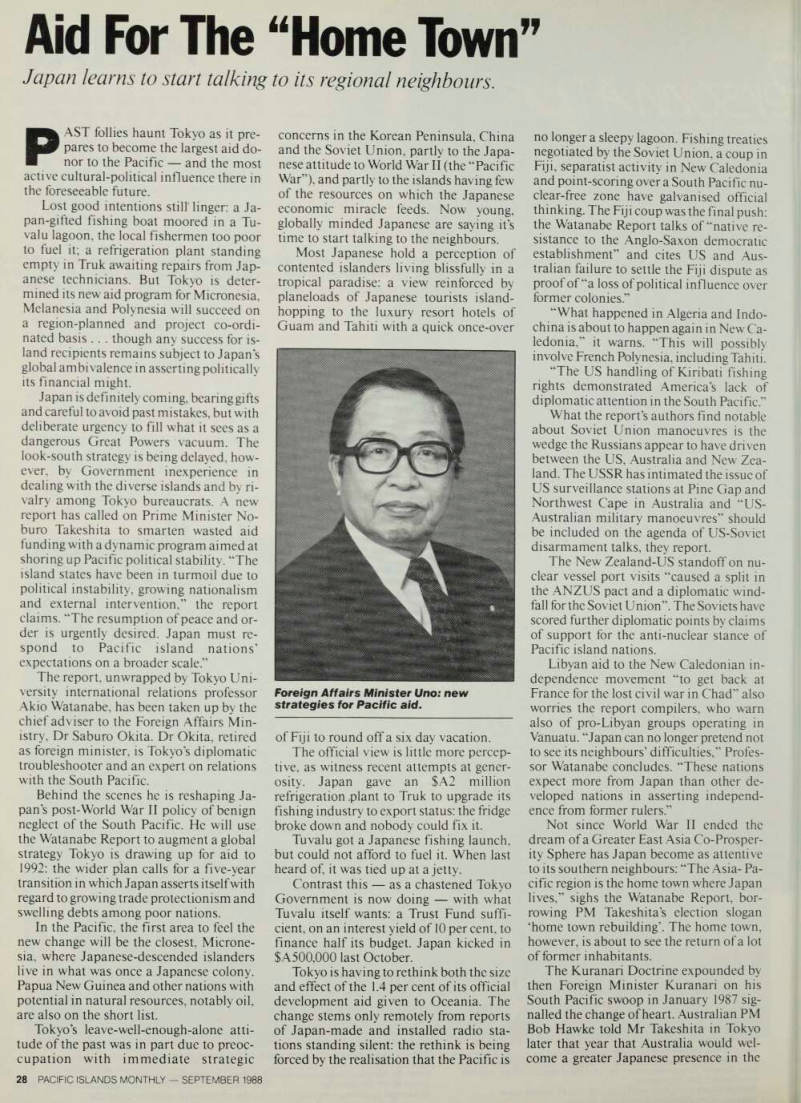
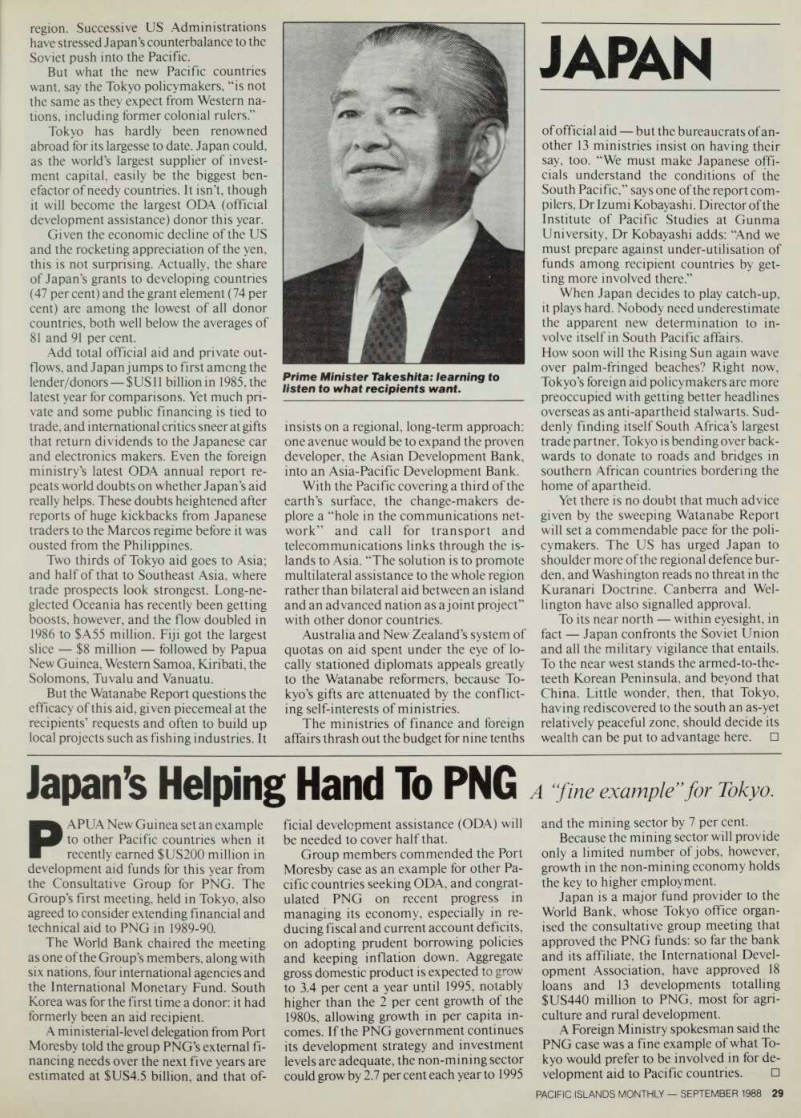
Japan learns to start talking to its regional neighbours.
PAST follies haunt Tokyo as it pre pares to become the largest aid do nor to the Pacific and the most active cultural-political influence there in the foreseeable future.
Lost good intentions still* linger: a Ja pan-gifted fishing boat moored in a Tu valu lagoon, the local fishermen too poor to fuel it; a refrigeration plant standing empty in Truk awaiting repairs from Jap anese technicians. But Tokyo is deter mined its new aid program for Micronesia, Melanesia and Polynesia will succeed on a region-planned and project co-ordi nated basis .. . though any success for is land recipients remains subject to Japan’s global ambivalence in asserting politically its financial might.
Japan is definitely coming, bearing gifts and careful to avoid past mistakes, but with deliberate urgency to fill what it sees as a dangerous Great Powers vacuum. The look-south strategy is being delayed, how ever, by Government inexperience in dealing with the diverse islands and by ri valry among Tokyo bureaucrats. A new report has called on Prime Minister No buro Takeshita to smarten wasted aid funding with a dynamic program aimed at shoring up Pacific political stability. “The island states have been in turmoil due to political instability, growing nationalism and external intervention,” the report claims. “The resumption of peace and or der is urgently desired. Japan must re spond to Pacific island nations’ expectations on a broader scale.”
The report, unwrapped by Tokyo Uni versity international relations professor Akio Watanabe, has been taken up by the chief adviser to the Foreign Affairs Min istry, Dr Saburo Okita. Dr Okita, retired as foreign minister, is Tokyo’s diplomatic troubleshooter and an expert on relations with the South Pacific.
Behind the scenes he is reshaping Ja pan’s post-World War II policy of benign neglect of the South Pacific. He will use the Watanabe Report to augment a global strategy Tokyo is drawing up for aid to 1992: the wider plan calls for a five-year transition in which Japan asserts itself with regard to growing trade protectionism and swelling debts among poor nations.
In the Pacific, the first area to feel the new change will be the closest, Microne sia, where Japanese-descended islanders live in what was once a Japanese colony.
Papua New Guinea and other nations with potential in natural resources, notably oil. are also on the short list.
Tokyo’s leave-well-enough-alone atti tude of the past was in part due to preoc cupation with immediate strategic
concerns in the Korean Peninsula, China and the Soviet Union, partly to the Japa nese attitude to World War II (the “Pacific War”), and partly to the islands having few of the resources on which the Japanese economic miracle feeds. Now young, globally minded Japanese are saying it’s time to start talking to the neighbours.
Most Japanese hold a perception of contented islanders living blissfully in a tropical paradise: a view reinforced by planeloads of Japanese tourists island hopping to the luxury resort hotels of Guam and Tahiti with a quick once-over
of Fiji to round off a six day vacation.
The official view is little more percep tive, as witness recent attempts at gener osity. Japan gave an SA2 million refrigeration plant to Truk to upgrade its fishing industry to export status: the fridge broke down and nobody could fix it.
Tuvalu got a Japanese fishing launch, but could not afford to fuel it. When last heard of, it was tied up at a jetty.
Contrast this as a chastened Tokyo Government is now doing with what Tuvalu itself wants: a Trust Fund suffi cient, on an interest yield of 10 per cent, to finance half its budget. Japan kicked in $A500,000 last October.
Tokyo is having to rethink both the size and effect of the 1.4 per cent of its official development aid given to Oceania. The change stems only remotely from reports of Japan-made and installed radio sta tions standing silent: the rethink is being forced by the realisation that the Pacific is
no longer a sleepy lagoon. Fishing treaties negotiated by the Soviet Union, a coup in Fiji, separatist activity in New Caledonia and point-scoring over a South Pacific nu clear-free zone have galvanised official thinking. The Fiji coup was the final push: the Watanabe Report talks of “native re sistance to the Anglo-Saxon democratic establishment” and cites US and Aus tralian failure to settle the Fiji dispute as proof of “a loss of political influence over former colonies.”
“What happened in Algeria and Indo china is about to happen again in New Ca ledonia,” it warns. “This will possibly involve French Polynesia, including Tahiti.
“The US handling of Kiribati fishing rights demonstrated America’s lack of diplomatic attention in the South Pacific.”
What the report’s authors find notable about Soviet Union manoeuvres is the wedge the Russians appear to have driven between the US, Australia and New Zea land. The USSR has intimated the issue of US surveillance stations at Pine Gap and Northwest Cape in Australia and “US- Australian military manoeuvres” should be included on the agenda of US-Soviet disarmament talks, they report.
The New Zealand-US standoff on nu clear vessel port visits “caused a split in the ANZUS pact and a diplomatic wind fall for the Soviet Union”. The Soviets have scored further diplomatic points by claims of support for the anti-nuclear stance of Pacific island nations.
Libyan aid to the New Caledonian in dependence movement “to get back at France for the lost civil war in Chad” also worries the report compilers, who warn also of pro-Libyan groups operating in Vanuatu. “Japan can no longer pretend not to see its neighbours’ difficulties,” Profes sor Watanabe concludes. “These nations expect more from Japan than other de veloped nations in asserting independ ence from former rulers.”
Not since World War II ended the dream of a Greater East Asia Co-Prosper ity Sphere has Japan become as attentive to its southern neighbours: “The Asia- Pa cific region is the home town where Japan lives,” sighs the Watanabe Report, bor rowing PM Takeshita’s election slogan ‘home town rebuilding’. The home town, however, is about to see the return of a lot of former inhabitants.
The Kuranari Doctrine expounded by then Foreign Minister Kuranari on his South Pacific swoop in January 1987 sig nalled the change of heart. Australian PM Bob Hawke told Mr Takeshita in Tokyo later that year that Australia would wel come a greater Japanese presence in the
Foreign Affairs Minister Uno: new strategies for Pacific aid.
region. Successive US Administrations have stressed Japan’s counterbalance to the Soviet push into the Pacific.
But what the new Pacific countries want, say the Tokyo policymakers, “is not the same as they expect from Western na tions, including former colonial rulers.”
Tokyo has hardly been renowned abroad for its largesse to date. Japan could, as the world’s largest supplier of invest ment capital, easily be the biggest ben efactor of needy countries. It isn’t, though it will become the largest ODA (official development assistance) donor this year.
Given the economic decline of the US and the rocketing appreciation of the yen, this is not surprising. Actually, the share of Japan’s grants to developing countries (47 per cent) and the grant element (74 per cent) are among the lowest of all donor countries, both well below the averages of 81 and 91 per cent.
Add total official aid and private out flows, and Japan jumps to first among the lender/donors SUSII billion in 1985, the latest year for comparisons. Yet much pri vate and some public financing is tied to trade, and international critics sneer at gifts that return dividends to the Japanese car and electronics makers. Even the foreign ministry’s latest ODA annual report re peats world doubts on whether Japan’s aid really helps. These doubts heightened after reports of huge kickbacks from Japanese traders to the Marcos regime before it was ousted from the Philippines.
Two thirds of Tokyo aid goes to Asia; and half of that to Southeast Asia, where trade prospects look strongest. Long-ne glected Oceania has recently been getting boosts, however, and the flow doubled in 1986 to SASS million. Fiji got the largest slice sB million followed by Papua New Guinea, Western Samoa, Kiribati, the Solomons, Tuvalu and Vanuatu.
But the Watanabe Report questions the efficacy of this aid, given piecemeal at the recipients’ requests and often to build up local projects such as fishing industries. It
insists on a regional, long-term approach: one avenue would be to expand the proven developer, the Asian Development Bank, into an Asia-Pacific Development Bank.
With the Pacific covering a third of the earth’s surface, the change-makers de plore a “hole in the communications net work” and call for transport and telecommunications links through the is lands to Asia. “The solution is to promote multilateral assistance to the whole region rather than bilateral aid between an island and an advanced nation as a joint project” with other donor countries.
Australia and New Zealand’s system of quotas on aid spent under the eye of lo cally stationed diplomats appeals greatly to the Watanabe reformers, because To kyo’s gifts are attenuated by the conflict ing self-interests of ministries.
The ministries of finance and foreign affairs thrash out the budget for nine tenths
of official aid but the bureaucrats of an other 13 ministries insist on having their say, too. “We must make Japanese offi cials understand the conditions of the South Pacific,” says one of the report com pilers, Dr Izumi Kobayashi. Director of the Institute of Pacific Studies at Gunma University, Dr Kobayashi adds: “And we must prepare against under-utilisation of funds among recipient countries by get ting more involved there.”
When Japan decides to play catch-up, it plays hard. Nobody need underestimate the apparent new determination to in volve itself in South Pacific affairs.
How soon will the Rising Sun again wave over palm-fringed beaches? Right now, Tokyo’s foreign aid policymakers are more preoccupied with getting better headlines overseas as anti-apartheid stalwarts. Sud denly finding itself South Africa’s largest trade partner, Tokyo is bending over back wards to donate to roads and bridges in southern African countries bordering the home of apartheid.
Yet there is no doubt that much advice given by the sweeping Watanabe Report will set a commendable pace for the poli cymakers. The US has urged Japan to shoulder more of the regional defence bur den, and Washington reads no threat in the Kuranari Doctrine. Canberra and Wel lington have also signalled approval.
To its near north within eyesight, in fact Japan confronts the Soviet Union and all the military vigilance that entails.
To the near west stands the armed-to-the teeth Korean Peninsula, and beyond that China. Little wonder, then, that Tokyo, having rediscovered to the south an as-yet relatively peaceful zone, should decide its wealth can be put to advantage here. □
Prime Minister Takeshita: learning to listen to what recipients want.
Japan’s Helping Hand To PNG
A ‘fine example”for Tokyo.
PAPUA New Guinea set an example to other Pacific countries when it recently earned SUS2OO million in development aid funds for this year from the Consultative Group for PNG. The Group’s first meeting, held in Tokyo, also agreed to consider extending financial and technical aid to PNG in 1989-90.
The World Bank chaired the meeting as one of the Group’s members, along with six nations, four international agencies and the International Monetary Fund. South Korea was for the first time a donor: it had formerly been an aid recipient.
A ministerial-level delegation from Port Moresby told the group PNG’s external financing needs over the next five years are estimated at SUS4.S billion, and that of-
ficial development assistance (ODA) will be needed to cover half that.
Group members commended the Port Moresby case as an example for other Pa cific countries seeking ODA, and congrat ulated PNG on recent progress in managing its economy, especially in re ducing fiscal and current account deficits, on adopting prudent borrowing policies and keeping inflation down. Aggregate gross domestic product is expected to grow to 3.4 per cent a year until 1995, notably higher than the 2 per cent growth of the 1980 s, allowing growth in per capita in comes. If the PNG government continues its development strategy and investment levels are adequate, the non-mining sector could grow by 2.7 per cent each year to 1995
and the mining sector by 7 per cent, Because the mining sector will provide only a limited number of jobs, however, growth in the non-mining economy holds the key to higher employment.
Japan is a major fund provider to the World Bank, whose Tokyo office organ ised the consultative group meeting that approved the PNG funds: so far the bank and its affiliate, the International Devel opment Association, have approved 18 loans and 13 developments totalling SUS44O million to PNG, most for agri culture and rural development.
A Foreign Ministry spokesman said the PNG case was a fine example of what To kyo would prefer to be involved in for de velopment aid to Pacific countries. □
Armed For Peace
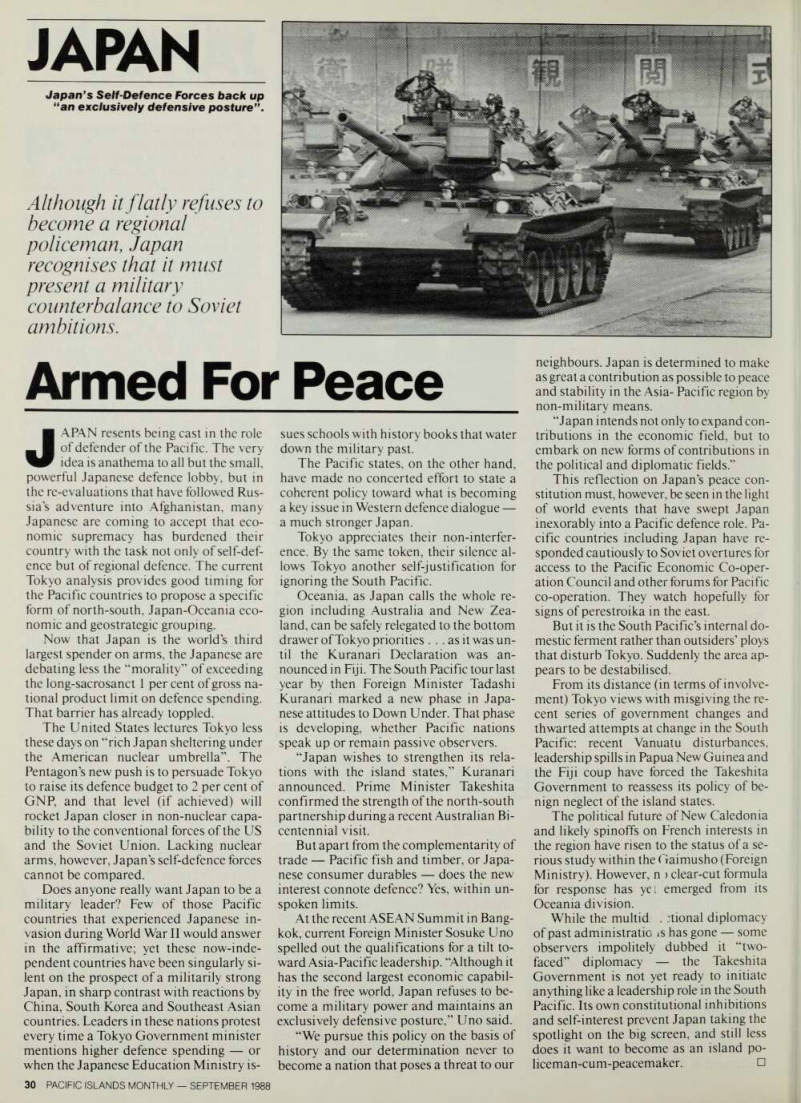
Although it flatly refuses to become a regional policeman, Japan recognises that it must present a military counterbalance to Soviet ambitions.
JAPAN resents being cast in the role of defender of the Pacific. The very idea is anathema to all but the small, powerful Japanese defence lobby, but in the re-evaluations that have followed Rus sia’s adventure into Afghanistan, many Japanese are coming to accept that eco nomic supremacy has burdened their country with the task not only of self-def ence but of regional defence. The current Tokyo analysis provides good timing for the Pacific countries to propose a specific form of north-south, Japan-Oceania eco nomic and geostrategic grouping.
Now that Japan is the world’s third largest spender on arms, the Japanese are debating less the “morality” of exceeding the long-sacrosanct 1 per cent of gross na tional product limit on defence spending.
That barrier has already toppled.
The United States lectures Tokyo less these days on “rich Japan sheltering under the American nuclear umbrella”. The Pentagon’s new push is to persuade Tokyo to raise its defence budget to 2 per cent of GNP, and that level (if achieved) will rocket Japan closer in non-nuclear capa bility to the conventional forces of the US and the Soviet Union. Lacking nuclear arms, however, Japan’s self-defence forces cannot be compared.
Does anyone really want Japan to be a military leader? Few of those Pacific countries that experienced Japanese in vasion during World War II would answer in the affirmative; yet these now-inde pendent countries have been singularly si lent on the prospect of a militarily strong Japan, in sharp contrast with reactions by China, South Korea and Southeast Asian countries. Leaders in these nations protest every time a Tokyo Government minister mentions higher defence spending or when the Japanese Education Ministry is
sues schools with history books that water down the military past.
The Pacific states, on the other hand, have made no concerted effort to state a coherent policy toward what is becoming a key issue in Western defence dialogue a much stronger Japan.
Tokyo appreciates their non-interfer ence. By the same token, their silence al lows Tokyo another self-justification for ignoring the South Pacific.
Oceania, as Japan calls the whole re gion including Australia and New Zea land, can be safely relegated to the bottom drawer of Tokyo priorities ... as it was un til the Kuranari Declaration was an nounced in Fiji. The South Pacific tour last year by then Foreign Minister Tadashi Kuranari marked a new phase in Japa nese attitudes to Down Under. That phase is developing, whether Pacific nations speak up or remain passive observers.
“Japan wishes to strengthen its rela tions with the island states,” Kuranari announced. Prime Minister Takeshita confirmed the strength of the north-south partnership during a recent Australian Bi centennial visit.
But apart from the complementarity of trade Pacific fish and timber, or Japa nese consumer durables does the new interest connote defence? Yes, within un spoken limits.
At the recent ASEAN Summit in Bang kok, current Foreign Minister Sosuke Uno spelled out the qualifications for a tilt to ward Asia-Pacific leadership. “Although it has the second largest economic capabil ity in the free world, Japan refuses to be come a military power and maintains an exclusively defensive posture,” Uno said.
“We pursue this policy on the basis of history and our determination never to become a nation that poses a threat to our
neighbours. Japan is determined to make as great a contribution as possible to peace and stability in the Asia- Pacific region by non-military means.
“Japan intends not only to expand con tributions in the economic field, but to embark on new forms of contributions in the political and diplomatic fields.”
This reflection on Japan’s peace con stitution must, however, be seen in the light of world events that have swept Japan inexorably into a Pacific defence role. Pa cific countries including Japan have re sponded cautiously to Soviet overtures for access to the Pacific Economic Co-oper ation Council and other forums for Pacific co-operation. They watch hopefully for signs of perestroika in the east.
But it is the South Pacific’s internal do mestic ferment rather than outsiders’ ploys that disturb Tokyo. Suddenly the area ap pears to be destabilised.
From its distance (in terms of involve ment) Tokyo views with misgiving the re cent series of government changes and thwarted attempts at change in the South Pacific: recent Vanuatu disturbances, leadership spills in Papua New Guinea and the Fiji coup have forced the Takeshita Government to reassess its policy of be nign neglect of the island states.
The political future of New Caledonia and likely spinoffs on French interests in the region have risen to the status of a se rious study within the Gaimusho (Foreign Ministry). However, n ) clear-cut formula for response has yet emerged from its Oceania division.
While the multid . :tional diplomacy of past administratio is has gone some observers impolitely dubbed it “two faced” diplomacy the Takeshita Government is not yet ready to initiate anything like a leadership role in the South Pacific. Its own constitutional inhibitions and self-interest prevent Japan taking the spotlight on the big screen, and still less does it want to become as an island po liceman-cum-peacemaker. □
Japan’s Self-Defence Forces back up “an exclusively defensive posture”.
Advertisements & other items, p. 31 (1 item)
Budget
All around the Pacific,
Budget means business
IC* s?*
OSOO
Wherever you travel on business throughout the Pacific, you can be sure Budget will be there to meet you.
And at all of Budget’s offices in the Pacific you can use your Corp-Rate card and guarantee yourself the best in vehicles, service and rates.
Budget drives your business dollar further. All around the Pacific. out me .racinc, you
Budget
rent a car **
Papua New Guinea, phone 254512'Fiji, phone 381555 • Vanuatu, phone 3170 • New Zealand, phone (09) 396-737 • Australia, phone (008) 331-331 (toll free) or 3206333 (Melb) • Solomon Islands, phone 23205 • American Samoa, phone 6332412 • Niue, phone 608 • Guam, phone 6465494 • Tahiti, phone 438079 * Hawaii, phone 8361700 • Western Samoa, phone 20561 • Tonga, phone 23510 • Cook Islands, phone 20888 • Philippines, phone 816 2210 •
KINSELLA BRC 1285
Hawaiians Fight To Save Their Beaches
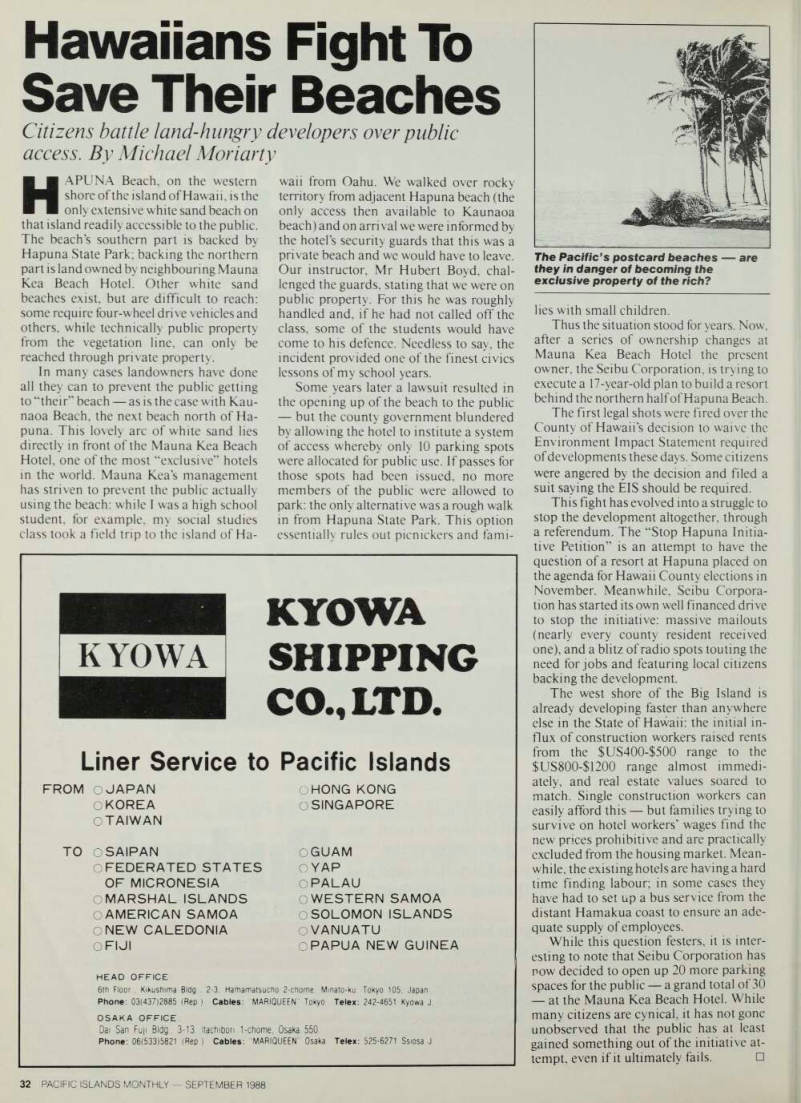
Save Their Beaches
Citizens battle land-hungry developers over public access. By Michael Moriarty
HAPUNA Beach, on the western shore of the island of Hawaii, is the only extensive white sand beach on that island readily accessible to the public.
The beach’s southern part is backed by Hapuna State Park; backing the northern part is land owned by neighbouring Mauna Kea Beach Hotel. Other white sand beaches exist, but are difficult to reach: some require four-wheel drive vehicles and others, while technically public property from the vegetation line, can only be reached through private property.
In many cases landowners have done all they can to prevent the public getting to “their” beach as is the case with Kau naoa Beach, the next beach north of Ha puna. This lovely arc of while sand lies directly in front of the Mauna Kea Beach Hotel, one of the most “exclusive” hotels in the world. Mauna Kea’s management has striven to prevent the public actually using the beach: while I was a high school student, for example, my social studies class took a field trip to the island of Ha
waii from Oahu. We walked over rocky territory from adjacent Hapuna beach (the only access then available to Kaunaoa beach) and on arrival we were informed by the hotel’s security guards that this was a private beach and we would have to leave.
Our instructor, Mr Hubert Boyd, chal lenged the guards, stating that we were on public property. For this he was roughly handled and. if he had not called off the class, some of the students would have come to his defence. Needless to say, the incident provided one of the finest civics lessons of my school years.
Some years later a lawsuit resulted in the opening up of the beach to the public but the county government blundered by allowing the hotel to institute a system of access whereby only 10 parking spots were allocated for public use. If passes for those spots had been issued, no more members of the public were allowed to park: the only alternative was a rough walk in from Hapuna State Park. This option essentially rules out picnickers and fami-
lies with small children.
Thus the situation stood for years. Now, after a series of ownership changes at Mauna Kea Beach Hotel the present owner, the Seibu Corporation, is trying to execute a 17-year-old plan to build a resort behind the northern half of Hapuna Beach.
The first legal shots were fired over the County of Hawaii’s decision to waive the Environment Impact Statement required of developments these days. Some citizens were angered by the decision and filed a suit saying the EIS should be required.
This fight has evolved into a struggle to stop the development altogether, through a referendum. The “Stop Hapuna Initia tive Petition” is an attempt to have the question of a resort at Hapuna placed on the agenda for Hawaii County elections in November. Meanwhile, Seibu Corpora tion has started its own well financed drive to stop the initiative: massive mailouts (nearly every county resident received one), and a blitz of radio spots touting the need for jobs and featuring local citizens backing the development.
The west shore of the Big Island is already developing faster than anywhere else in the State of Hawaii: the initial in flux of construction workers raised rents from the SUS4OO-$5OO range to the SUSBOO-$l2OO range almost immedi ately, and real estate values soared to match. Single construction workers can easily afford this but families trying to survive on hotel workers’ wages find the new prices prohibitive and are practically excluded from the housing market. Mean while, the existing hotels are having a hard lime finding labour; in some cases they have had to set up a bus service from the distant Hamakua coast to ensure an ade quate supply of employees.
While this question festers, it is inter esting to note that Seibu Corporation has now decided to open up 20 more parking spaces for the public a grand total of 30 at the Mauna Kea Beach Hotel. While many citizens are cynical, it has not gone unobserved that the public has at least gained something out of the initiative at tempt, even if it ultimately fails. □
The Pacific’s postcard beaches - are they in danger of becoming the exclusive property of the rich?
Advertisements & other items, p. 32 (1 item)
Co., Ltd.
KYOWA
KYOWA
SHIPPING
CO., LTD.
Liner Service to Pacific Islands
FROM OJAPAN OHONG KONG
OKOREA OSINGAPORE
©TAIWAN
TO OSAIPAN
O FEDERATED STATES
OF MICRONESIA
O MARSHAL ISLANDS
©AMERICAN SAMOA
©NEW CALEDONIA
©FIJI
©GUAM
©YAP
©PALAU
©WESTERN SAMOA
©SOLOMON ISLANDS
©VANUATU
©PAPUA NEW GUINEA
HEAD OFFICE
6th Floor , Kikushima Bldg , 2-3, Hamamatsucho 2-chome Mmato-ku. Tokyo 105, Japan Phone; 03(437)2885 (Rep ) Cables: MARIQUEEN Tokyo Telex: 242-4651 Kyowa J.
OSAKA OFFICE
Dai San Fuji Bldg. 3-13 Itachibon 1-chome, Osaka 550 Phone; 06(533)5821 (Rep ) Cables: MARIQUEEN" Osaka Telex: 525-6271 Ssiosa J
Mururoa Moves Shock Paris
French Polynesia
A Papeete seminar challenges France’s nuclear tests.
By David Robie
TAHITIAN Health Minister Jacqui Drollet invoked the spectre of Hi roshima at a week-long seminar on “peace and development” in Papeete last month. “We must dismiss the pernicious argument that the American nuclear bom bardment of Hiroshima was the only way to end the Second World War,” he said. “It wasn’t necessary to kill thousands of people with a crime against humanity.”
Turning to French nuclear tests in the South Pacific, he then said it was time to rename the deadly atoll; it should be called “Mururoa-shima”.
Drollet, leader of the anti-nuclear and pro-independence party la Mana Te Nu naa (and Minister for the Environment and Scientific Research in the coalition Government) was careful like other or ganisers of the seminar to avoid any anti-French tone, but the strong message from the conference and its list of de mands has both signalled a revival of anti nuclear sentiment in Tahiti.
“More than ever it is necessary to act objectively and dispassionately,” said Pa trick Howell, a Tahitian dentist and chair man of the organisation Tomite No Te Rai Hau (‘Blue Skies Committee’). “Speaking of nuclear issues is not being anti-French; it is taking up our responsibility for the fu ture of our country and our children.
“When a young person decides to leave the family home to seek his or her destiny, he or she isn’t anti-parents,” he explained.
“It’s simply that they want to be respon sible for their own future... It is the same with us. We are all Polynesians and we want to build the Tahiti of the future.”
The Rai Hau conference comprised representatives of most Tahitian political parties particularly la Mana and Tav ini Huiraatira (the Polynesian Liberation Front) the Protestant and Catholic churches, trade union leaders and envi ronmental associations.
Specialists from Australia, New Zea land and Japan also took part, including Australian biologist Dr Tilman Ruff, an authority on ciguatera; Auckland physi cian Dr Tony Atkinson, of the New Zea land branch of International Physicians for the Prevention of Nuclear War; and can cer specialist Dr Shigenobu Miyake of To kyo’s Kamigyo Hospital. They were greeted by Tahitian Premier Alexandre Leontieff and Papeete mayor (and Parlia mentary Speaker) Jean Juventin... to the annoyance of the administration.
Their brief was to review the impact on health, the economy, immigration, social life, culture and politics of the 25-year presence of the nuclear Pacific Experi
ments Centre (CEP) and the recent scaling down of CEP operations.
The Tahitian economy has been heav ily reliant on CEP, but the shift of its head quarters to Hao Atoll and a reduction of staff have renewed criticism of the eco nomic value of the testing program. Since 1968, the number of Tahitians employed by the program has dropped from 10,000 to 2000, out of a total labour force ofBo,ooo.
Unemployment is one of the gravest social problems facing the Tahitian Government.
Statistics indicate the French military is gradually disengaging itself from Tahiti, says Mr Drollet. “We must develop our own strategy for economic survival.”
Over the next few days the foreign del egation conferred with local clergy, civic leaders, doctors and politicians and con demned French nuclear policies. On Hi roshima Day, the delegates held a public meeting at Willy Bambride sports stad ium where the resolutions were presented and broadcast live on Radio Papeete.
Their demands, endorsed by Drollet (a marine biologist trained at the University of Toulouse) include: • To create a radiation epidemiology lab oratory under World Health Organisation supervision to study diseases linked to nuclear tests. The laboratory would inves tigate the relationship between ciguatera, pollution, contamination by radioactive fallout and cancer in Polynesia. • To create a health register of the 12,000 Polynesian workers who have been em ployed at Mururoa and Fangataufa atolls since tests began in 1966. The aim of the register would be to record the cause of death of those workers who have since died and to establish a checklist on the health of workers still living. • To demolish unused military bunkers and blockhouses on Hao, the headquar ters of the CEP, as the first step in reha bilitating the atoll’s environment. • To liaise with Tahiti’s social and eco nomic council to carry out research and propose ways in which the territory could become self-sufficient after the nuclear re seach centre is removed.
It is believed Drollet supported the conference to strengthen his hand in pushing through the demands as he is able to do under new ministerial powers.
Another member. Islands Minister Emile Vernaudon, also took part. Later the Prot estant Church, supported by more than 70 per cent of the 160,000 people of French Polynesia, again strongly condemned the nuclear tests (it first did so in 1963, the year France began building its Pacific testing
centre). “The church has always de nounced this vileness of mankind and the degradation of God’s creation,” said sec retary general John Doom.
Dr Atkinson described the health de mands of the seminar as a “remarkable breakthrough” in Tahiti. “Until now,” he said, “France has kept statistics classified and this move should expose the facts about the health of the islanders.”
Dr Atkinson told the conference French authorities had exploited the 1983 South Pacific scientific mission, led by Hugh At kinson, then director of the NZ National Radiation Laboratory, by claiming it had given the tests a clean bill of health. In fact, the mission found clear evidence that Mu ruroa is leaching radioactivity.
“The local papers tried to slur us in a mix-up over our names,” he said. Tony’
Atkinson was confused with ‘Hugh’ At kinson and the largest French daily in Pa peete, La Depeche de Tahiti , accused the conference organisers of trying to “trick”
Tahitians by introducing a New Zealander with the same name as the leader of the Pacific mission.
“They tried to say anti-French stirrers from Australia and New Zealand led the Pacific mission. But IPPNW is a world wide organisation representing more than 200,000 members, and is against Ameri can, Soviet and British nuclear testing all nuclear tests.”
Dr Atkinson believes the register of for mer and present Mururoa workers will give a more accurate picture of Tahiti’s sus pected health problems. Such information would provide data that could be com pared with well documented radiation-in duced illnesses in the Marshall Islands.
During the conference a row broke out after France’s new Environment Minister Drice Lalonde, a former anti-nuclear protester who sailed twice to Mururoa, claimed in Sydney that the testing had no negative effects on the environment.
The French branch of IPPNW chal lenged the French Government to back up this claim, saying Lalonde’s statement went against international scientific opinion.
Dr Franck Fauilhade, chairman of the group, said part of Mururoa atoll had col lapsed and the collapse had damaged coral reefs and had spread ciguatera poisoning 900 cases had been recorded in French Polynesia, he claimed.
However, while the French Govern ment was able to brush off the criticisms by French doctors, it will have a more dif ficult time opposing the Tahitian cancer register and laboratory supported by Health Minister Drollet. □
Pacific Report
□ In-Flight Maori Message
NEW Zealand Maori Affairs minister Koro Wetere has welcomed moves by Air New Zealand to include Maori in its in flight magazine. Pacific Way. The maga zine already includes stories in languages other than English, including Japanese.
□ Maori Head Laid To Rest
SERVED tattooed Maori head retrieved from an auction in London (see Pacific Is lands Monthly , July) was laid to rest on a hillside in North Auckland on July 22.
Burial of the oak casket containing the head followed a tangi on a nearby marae the day after it was brought from Britain by Maori elders.
The relic has been renamed tupuna maori (Maori ancestor) rather than mo komakai (tattooed slave, as it had been la belled in England), and was believed to have been taken from a burial cave during the 19205. It was probably purchased by a whaler on the ship Nimrod , which sailed to New Zealand from Australia.
It seems the whaler had a request from his brother in England for a couple of pre served heads; a descendant offered the head at auction and became international news when local protesters, then the Maori
Council in New Zealand, objected. In rit ual exchange, The Maori Council finally obtained the head in exchange for a green stone mere or war club.
□ Islanders “Too Fat”
A METABOLIC physician with the Can terbury Hospital Board, Christchurch, Russel Scott, says Maoris and Pacific Is landers have a “disproportionate tend ency” to be overweight.
Dr Scott said the tendency to be over fat could be blamed on environmental and cultural factors. There would always be problems when people had to adapt to a new environment, he said.
□ East-West Energy Seminar
ENERGY ministers and permanent sec retaries of 11 Pacific island nations met at Honolulu’s East-West Centre from August 10-12 to discuss regional energy trends, problems and possible solutions. Repre sentatives from Papua New Guinea, Fiji, Cook Islands, Federated States of Micro nesia, Kiribati, Marshall Islands, Palau, Solomon Islands, Tonga, Tuvalu and Western Samoa, in addition to represen tatives of oil companies operating in the region and international agencies, gath
ered under the auspices of the East-West Centre’s Resource Systems Institute and the United Nations Pacific Energy Devel opment Program.
“This was the first time such a high ranking group of Pacific energy officials came together for briefings on the energy situation in the region and internation ally,” said Fereidun Fesharaki, leader of the Centre’s Energy Program. “We hope this will be the first of a series of annual or biannual meetings” of officials from is land nations that are fully dependent on imported petroleum for their energy needs.
Key concerns of the meeting were pe troleum supply and pricing, electricity, foreign investment and energy security. Oil and energy companies represented in cluded Mobil Oil, Shell, British Petro leum, Pacific Resources Inc of Honolulu, Hawaiian Electric Company and the Apache Corporation.
Agencies sending observers were the Asian Development Bank, the US De partment of Energy’s Pacific Site Office, 'World Bank, the Hawaii Department of Business and Economic Development, Australia’s Department of Primary Indus tries and Energy, the Hawaii Natural En ergy Institute, the South Pacific Forum,
Pacific International Centre for High Technology Research, South Pacific Bu reau for Economic co-operation and the Co-ordinating Committee for Offshore Prospecting in South Pacific Waters.
□ Footprints Finds New Publisher
FOOTPRINTS on Malekula, reviewed by Nicolas Roth well in Pacific Islands Monthly, August, is available from Free Association Books in hardback or paper back (the former publisher, Salamander, is no longer operational) from Free As sociation, 26 Freegrove Road, London N 7 9RQ, United Kingdom.
□ Clue To Samoan Diabetes
RESEARCH by a New Zealand doctor into diabetes among American Indians could throw light on why Samoans in New Zea land demonstrate twice the incidence of diabetes as white New Zealanders. Dr Ste phen Lillioja, 36, conducted the study on a US National Institute of Health pro gram, looking at the Pima tribe at Gila River Indian reservation in Arizona/New Mexico; 50 per cent of the population there over 35 have diabetes.
He found that overweight adults with impaired glucose tolerance have a nor mally functioning pancreas. If they lose weight, the insulin they produce can be come more effective and so may prevent the onset of diabetes. “It is likely Samoans have exactly the same metabolic condi tion,” Dr Lillioja says.
□ Treaty Restores Fishing Rights
A TRIBUNAL set up to apply a 19th cen tury treaty to today’s needs has given New Zealand’s Maori people rights to the fish in significant stretches of their marine heritage. The ruling could hearten all native races resentful of commercial threats to traditional food sources.
The Waitangi Tribunal, mainly Maori in background and attitude but judicially constructed to rule on present-day claims under a treaty drawn up by Maori tribes and British settlers in 1840, heard evi dence last year from five northern Maori tribes and several trusts and corporations for both fisheries and land claims, part of a reaction by Maoris to NZ Government moves to disturb Crown titles by making corporations of former government departments.
Specifically, the tribunal examined government plans to introduce a fisheries quota management system and decided in a 340-page report that it contravened the Treaty of Waitangi by which the Crown of fered certain protections in exchange for sovereignty. The Ministry of Agriculture and Fisheries, however, continued to issue fisheries quotas. The High Court stopped it, and commercial fishermen, who suffer enough frustration from inroads by for eign trawlers, were angry.
A backlash was already evident against Maori activists and what was seen as“their” treaty.
The tribunal has effectively confirmed the tribes’ rights to NZ’s northern waters and directs the Crown to bargain for any right to commercial exploitation of fish eries off the coast of North Auckland.
“It is all too clear that over the years nu merous blatant and serious breaches have occurred of the treaty guarantee,” the de cision observes. The damage to the Mur iwhenua tribes had included the loss of a viable industry: “very substantial relief to the claimants is required in respect of past breaches, and to restore their fishing econ omy to what it might have been. There can be no once-and-for-all settlement. .. without a long-term program of rehabili tation to restore their ancestral associ ation with the seas.”
It found the fisheries quota manage ment system was in fundamental conflict with the principles and terms of the treaty, “yet need not be”. The tribunal also sug gested that it might be beneficial to both parties if an agreement or arrangement could be reached.
The Waitangi Tribunal has power only to recommend, but such is the treaty’s mana if not its legal standing that any Government that tried to buck it would invite trouble. Government spokesmen have variously assured all sides that exist ing fisheries law is unchanged, that Pak ehas have nothing to fear from the tribunal, and that the findings have important im plications for race relations.
□ Pacific On Tv
TELEVISION New Zealand is morn ing around the Pacific with a new series, Tagata Pasifika, which screens at 11.35 am each Saturday.
The series began with an examination of tourism development on Niue; the King of Tonga’s birthday celebrations were an other feature followed last month by Rar otonga’s Constitution Day festivals. Also scheduled are law theme programs show ing how Samoan matais can assist in cases involving their people and the New Zea land court system, and how two young Sa moan women qualified as lawyers.
Tagata Pasifika is presented by Susana Hukui and produced by Michael Evans.
□ New Qantas Island Services
QANTAS’s new services from Brisbane to the Solomon Islands offer opportunities for budget-conscious Australian travellers with two 737 services, operated jointly with Solomon Islands Airways, from Brisbane on Mondays and Thursdays. The three hour flight takes adventurous tourists to the Solomons’ small resorts that offer “soft” or “hard” adventure treks and excursions.
Qantas and Air Niugini will also cater for islands tourists with a twice- weekly joint service between Townsville, Queensland, and Port Moresby from Oc tober 30. The airlines will approach the Australian and PNG Governments for ap proval to start the services once final stud
ies are completed and airfare levels have been worked out.
A feasibility study found the existing flights from Port Moresby to Cairns could be extended to include Townsville on Mondays and Fridays, returning on Sat urdays and Mondays. Qantas Townsville manager Rod Plaister said the new flights would use Fokker F2B jets, which pres ently fly between Port Moresby and Cairns, and would carry joint Air Niugini and Qantas flight numbers.
□ Drug Conference In Pago Pago
THE South Pacific Commission’s seventh annual regional training course in drug identification and concealment methods was held in Pago Pago, American Samoa, from August 22 to September 2 under the direction of SPC health education spe cialist Manoa Baleo.
Attended by senior police and customs officers from Australia, New Zealand, the USA, INTERPOL, FBI and from other international agencies that deal with the illegal use, trafficking and illicit market ing of drugs, the training course provided valuable insights for the SPC members, as well as an opportunity for participants to learn how to identify drugs, the effects of drug abuse and the organisation and methods used by illegal traffickers.
□ Tole Mour Sets Sail
THE Marimed Foundation has recently seen the christening, dedication and bless ing and other events surrounding the maiden voyage of the Tole Mour, profiled in Pacific Islands Monthly , August.
The ship sailed late last month from its construction site in Seattle, Washington to the newly sovereign Republic of the Mar shall Islands, where the floating health care centre will provide assistance to the Mar shall Islands Health Ministry in serving the primary health care and public health education needs of thousands of isolated outer island residents.
□ Fiji’S Newest Resort
THE SAI.S million Tokoriki Island Re sort, the newest in Fiji, is expected to take its first guests in November with up to 20 beachfront bure units of a planned total of 30 completed.
The resort, about 18 nautical miles west of the port of Lautoka and 20 minutes by floatplane or helicopter from Nadi Inter national Airport, is being built under a joint venture by Newcastle businessmen Gordon Morris and Aldo Aloisi. When completed, Tokoriki’s facilities will in clude a tennis court, freshwater swim ming pool, two restaurants, a cocktail bar and boutique.
The resort’s main beach, about 1000 metres long, is on a safe lagoon with coral gardens for snorkellers nearby. Tokoriki Island also has a 94-metre-high hill that provides a 360-degree view of nearby is lands of the Mamanuca group and the Ya sawa Islands chain. □
Advertisements & other items, p. 34 (1 item)
Extraordinary!
Impressive! Exotic!
Papua New Guinea is a photographer’s dream.
You’ll find yourself running out of film because there is so much to photograph, especially when your cruising hotel, the Melanesian Discoverer has an 800 km view that changes every day. We have more adventurous ways for you to see our country, from the mighty Sepik River, to the Trobriands, to lush Madang and the Highlands. r~ Is* *1 ft 1 lA* M i' 0 e» v . s\» n \a^ e -J&o r L Phone or write to us for further information
Behind The Celebrations

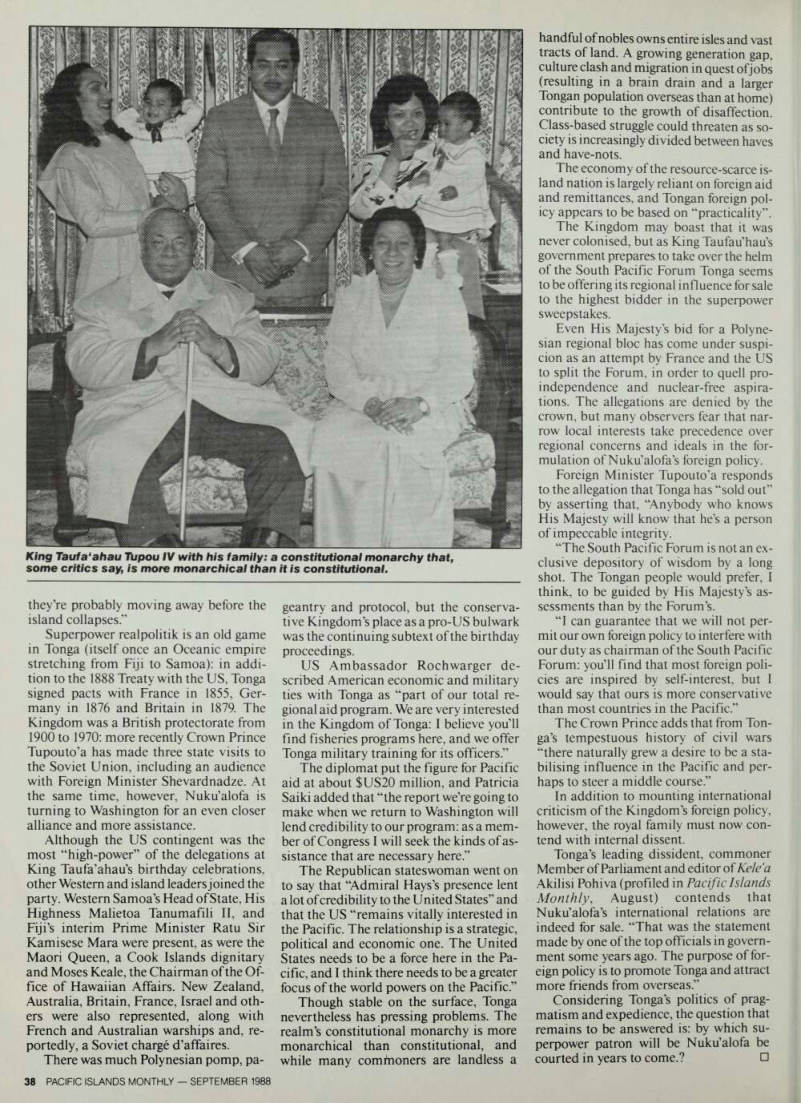
Tonga
Superpower rivalries and shifiting allegiances mark a
new era for the Pacific’s last monarchy.
By Ed Rampell
KING Taufa’ahau Tupou IV of Tonga’s 70th birthday served as a grand occasion both for festivities and a significant strategic re-alignment for the Kingdom of Tonga. A high-level American delegation flew to Nuku’alofa to sign a United States-Tonga Treaty of Amity, Commferce and Navigation, which* places the island realm firmly in Wash ington’s camp as the Friendly Islands pre pare to head the South Pacific Forum.
The US team included CINCPAC commander Admiral Ronald Hays, Ha waii Congresswoman Patricia Saiki, Am bassador to Tonga and Fiji Leonard Rochwarger, White House and State De partment officials, American Samoa’s Lieutenant Governor Eni Hunkin and for mer Governor Peter Coleman, Marine Corps and jazz bands and a US Navy war ship. Even President Reagan was there in the form of a videotape dealing with the Friendship Treaty, which was aired after representative Saiki and Minister for Def ence and Foreign Affairs Crown Prince Tuputo’a signed the concord. The US Congress had unanimously approved a resolution endorsing the Treaty the day before its signing at Nukualofa’s modern Foreign Ministry building.
The pact commemorates and renews a treaty originally passed in 1888 by Presi dent Grover Cleveland and King George Tupou I, the father of Tonga’s constitu
tional monarchy. The current accord pur ports to be a goodwill measure between the two nations, but in essence it appears to be a military agreement. The 1988 Treaty specifically refers to Article VI of the orig inal document: except for this clause, Tonga revoked the Treaty in 1920.
The significance of this action is that Article VI deals with the transit ofUS mil itary craft in Tongan territory. The King dom is one of the only members of the Forum to refuse to sign the South Pacific Nuclear Free Zone Treaty which the United States (as well as Britain and France) also declines to ratify. The United States and Tonga have instead approved a treaty guaranteeing transit of nuclear armed craft in the Tongan archipelago.
Congresswoman Saiki, apparently se lected by President Reagan to represent him because she is from Hawaii, told Pacific Islands Monthly. “Certainly, the military part of the Treaty is important in the sense that Tonga would like to remain
“Realpolitik is an old game in Tonga, itself once an Oceanic empire stretching from Fiji to Samoa”
under the nuclear umbrella of the United States. And the passage of our nuclear warships through Tonga will let them know that the United States does have a distinct presence in the Pacific.
“I do not support nuclear testing here in the Pacific: however, I feel strongly that the passage of nuclear vessels should be left to the various nations. I respect the deci sions made by Papua New Guinea, New Zealand and Australia, but at the same time I don’t feel that attitude must be im posed on Tonga. Tonga will make its own decisions, and we would certainly like to keep the transit of our warships through Tonga an open subject.”
At a brief press conference on July 4 the Sovereign’s actual birthday, as well as the United States’ Independence Day His Majesty seemed to further underscore
Tonga’s tilt toward Washington with sev eral remarks critical of Paris. Last July, King Taufa’ahau was in Tahiti seeking a closer relationship with France and Frencn aid with a post-Bastille Day trip to Muru'or Atoll. His Majesty then pro nounces the atomic atoll “safe” for both the environment and workers at the nu-
clear testing site, refusing to criticise the then approaching independence referen dum in New Caledonia . . . which, like France’s nuclear tests, had been strongly condemned by the South Pacific Forum.
However, taking note of the Socialists’ triumph in the recent French elections and the political demise both of former Prime Minister Jacques Chirac and Gaston Flosse’s cabinet-level portfolio of Pacific Affairs, King Taufa’ahau was markedly less bullish about Paris this July. Now that the Pacific Ministry, whose mission was to seek South Seas allies for France with promises of aid, has been dissolved, so has His Majesty’s closeness to the Elysee, though relations between Paris and Nukualofa generally remain good.
Concerning the atoll he once consid ered “safe”. King Taufa’ahau now says France may move its force defrappe to an other site because “there have been so many tests on Mururoa they’ve created gaping holes under the land and are con ducting some tests in the lagoon. I think ►
King George Tupou I left Tonga its constitution - and respect for a pragmatic brand of politics.
they’re probably moving away before the island collapses.”
Superpower realpolitik is an old game in Tonga (itself once an Oceanic empire stretching from Fiji to Samoa): in addition to the 1888 Treaty with the US, Tonga signed pacts with France in 1855, Germany in 1876 and Britain in 1879. The Kingdom was a British protectorate from 1900 to 1970: more recently Crown Prince Tupouto’a has made three state visits to the Soviet Union, including an audience with Foreign Minister Shevardnadze. At the same time, however, Nuku’alofa is turning to Washington for an even closer alliance and more assistance.
Although the US contingent was the most “high-power” of the delegations at King Taufa’ahau’s birthday celebrations, other Western and island leaders joined the party. Western Samoa’s Head of State, His Highness Malietoa Tanumafili 11, and Fiji’s interim Prime Minister Ratu Sir Kamisese Mara were present, as were the Maori Queen, a Cook Islands dignitary and Moses Keale, the Chairman of the Office of Hawaiian Affairs. New Zealand, Australia, Britain, France, Israel and others were also represented, along with French and Australian warships and, reportedly, a Soviet charge d’affaires.
There was much Polynesian pomp, pa-
geantry and protocol, but the conserva tive Kingdom’s place as a pro-US bulwark was the continuing subtext of the birthday proceedings.
US Ambassador Rochwarger de scribed American economic and military ties with Tonga as “part of our total re gional aid program. We are very interested in the Kingdom of Tonga: I believe you’ll find fisheries programs here, and we offer Tonga military training for its officers.”
The diplomat put the figure for Pacific aid at about SUS2O million, and Patricia Saiki added that “the report we’re going to make when we return to Washington will lend credibility to our program: as a mem ber of Congress I will seek the kinds of as sistance that are necessary here.”
The Republican stateswoman went on to say that “Admiral Hays’s presence lent a lot of credibility to the United States” and that the US “remains vitally interested in the Pacific. The relationship is a strategic, political and economic one. The United States needs to be a force here in the Pa cific, and I think there needs to be a greater focus of the world powers on the Pacific.”
Though stable on the surface, Tonga nevertheless has pressing problems. The realm’s constitutional monarchy is more monarchical than constitutional, and while many comhioners are landless a
handful of nobles owns entire isles and vast tracts of land. A growing generation gap, culture clash and migration in quest ofjobs (resulting in a brain drain and a larger Tongan population overseas than at home) contribute to the growth of disaffection.
Class-based struggle could threaten as so ciety is increasingly divided between haves and have-nots.
The economy of the resource-scarce is land nation is largely reliant on foreign aid and remittances, and Tongan foreign pol icy appears to be based on “practicality”.
The Kingdom may boast that it was never colonised, but as King Taufau’hau’s government prepares to take over the helm of the South Pacific Forum Tonga seems to be offering its regional influence for sale to the highest bidder in the superpower sweepstakes.
Even His Majesty’s bid for a Polyne sian regional bloc has come under suspi cion as an attempt by France and the US to split the Forum, in order to quell pro independence and nuclear-free aspira tions. The allegations are denied by the crown, but many observers fear that nar row local interests take precedence over regional concerns and ideals in the for mulation of Nukualofa’s foreign policy.
Foreign Minister Tupouto’a responds to the allegation that Tonga has “sold out” by asserting that, “Anybody who knows His Majesty will know that he’s a person of impeccable integrity.
“The South Pacific Forum is not an ex clusive depository of wisdom by a long shot. The Tongan people would prefer, I think, to be guided by His Majesty’s as sessments than by the Forum’s.
“I can guarantee that we will not per mit our own foreign policy to interfere with our duty as chairman of the South Pacific Forum: you’ll find that most foreign poli cies are inspired by self-interest, but I would say that ours is more conservative than most countries in the Pacific.”
The Crown Prince adds that from Ton ga’s tempestuous history of civil wars “there naturally grew a desire to be a sta bilising influence in the Pacific and per haps to steer a middle course.”
In addition to mounting international criticism of the Kingdom’s foreign policy, however, the royal family must now con tend with internal dissent.
Tonga’s leading dissident, commoner Member of Parliament and editor of Kele’a Akilisi Pohiva (profiled in Pacific Islands Monthly , August) contends that Nukualofa’s international relations are indeed for sale. “That was the statement made by one of the top officials in govern ment some years ago. The purpose of for eign policy is to promote Tonga and attract more friends from overseas.”
Considering Tonga’s politics of prag matism and expedience, the question that remains to be answered is: by which su perpower patron will be Nukualofa be courted in years to come.? □
King Taufa‘ahau Tupou IV with his family: a constitutional monarchy that, some critics say, is more monarchical than it is constitutional.
Advertisements & other items, p. 37 (1 item)
now servicing
Fuels and lubricants.
Plastics. Chemicals. Bitumen.
Aviation Services. Bunkering.
Shell has penetrated even more of the Pacific to widen its network of offices, terminals and
Network Shell
now servicing
even more
of the Pacific.
distributors as well as service stations.
Now r you can re-assess your source of supply, because Shell quality and value is close at hand, with the service to back it up.
REGIONAL OFFICES: (il AMfTI -T" 4.550. Also servicing Marshall Islands (Majuro), Northern Marianas (Saipan). Palau.
FIJI 6“ c ) 315 1 )33. Also serv icing Tonga, Cook Islands. American Samoa. Western Samoa • PAPTA NHW GITNEA 675 228 DO. Also servicing Solomon Island NEW CALEDONIA 68" 285 "20. Also servicing Tahiti. Vanuatu.
Sunia Charged With Fraud
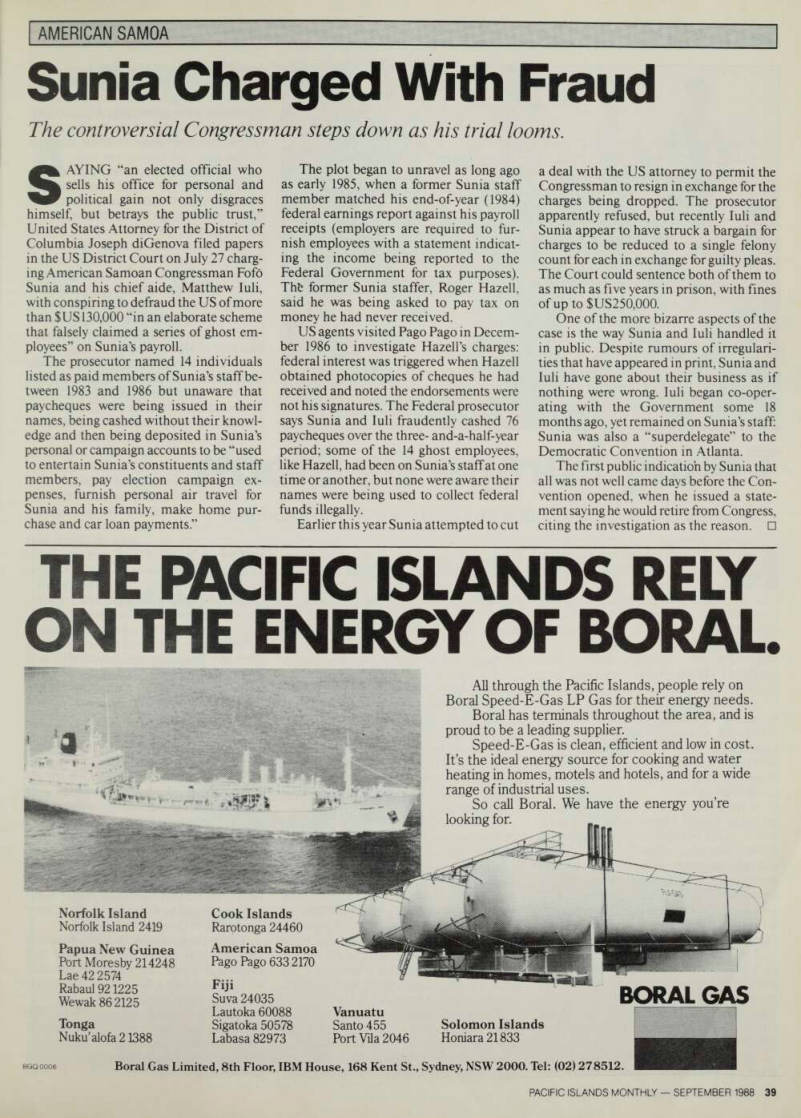
American Samoa
The controversial Congressman steps down as his trial looms.
SAYING “an elected official who sells his office for personal and political gain not only disgraces himself, but betrays the public trust,”
United States Attorney for the District of Columbia Joseph diGenova filed papers in the US District Court on July 27 charging American Samoan Congressman Fofo Sunia and his chief aide, Matthew luli, with conspiring to defraud the US of more than SUS 130,000 “in an elaborate scheme that falsely claimed a series of ghost employees” on Sunia’s payroll.
The prosecutor named 14 individuals listed as paid members of Sunia’s staff between 1983 and 1986 but unaware that paycheques were being issued in their names, being cashed without their knowledge and then being deposited in Sunia’s personal or campaign accounts to be “used to entertain Sunia’s constituents and staff members, pay election campaign expenses, furnish personal air travel for Sunia and his family, make home purchase and car loan payments.”
The plot began to unravel as long ago as early 1985, when a former Sunia staff member matched his end-of-year (1984) federal earnings report against his payroll receipts (employers are required to fur nish employees with a statement indicat ing the income being reported to the Federal Government for tax purposes).
Thfe former Sunia staffer, Roger Hazell, said he was being asked to pay tax on money he had never received.
US agents visited Pago Pago in Decem ber 1986 to investigate Hazell’s charges: federal interest was triggered when Hazell obtained photocopies of cheques he had received and noted the endorsements were not his signatures. The Federal prosecutor says Sunia and luli fraudently cashed 76 paycheques over the three- and-a-half-year period; some of the 14 ghost employees, like Hazell, had been on Sunia’s staff at one time or another, but none were aware their names were being used to collect federal funds illegally.
Earlier this year Sunia attempted to cut
a deal with the US attorney to permit the Congressman to resign in exchange for the charges being dropped. The prosecutor apparently refused, but recently lull and Sunia appear to have struck a bargain for charges to be reduced to a single felony count for each in exchange for guilty pleas, The Court could sentence both of them to as much as five years in prison, with fines of up to $U5250,000.
One of the more bizarre aspects of the case is the way Sunia and luli handled it in public. Despite rumours of irregulari ties that have appeared in print, Sunia and luli have gone about their business as if nothing were wrong. luli began co-oper ating with the Government some 18 months ago, yet remained on Sunia’s staff: Sunia was also a “superdelegate” to the Democratic Convention in Atlanta, The first public indication by Sunia that all was not well came days before the Con vention opened, when he issued a state ment saying he would retire from Congress, citing the investigation as the reason. □
Advertisements & other items, p. 39 (1 item)
The Mcific Islands Rely
ON THE ENERGY OF BORAL
- m mn ■ ■ - i All through the Pacific Islands, people rely on Boral Speed-E-Gas LP Gas for their energy needs.
Boral has terminals throughout the area, and is proud to be a leading supplier.
Speed-E-Gas is clean, efficient and low in cost.
It’s the ideal energy source for cooking and water heating in homes, motels and hotels, and for a wide range of industrial uses.
So call Boral. We have the energy you’re looking for.
Norfolk Island Norfolk Island 2419 Papua New Guinea Port Moresby 214248 Lae 422574 Rabaul 921225 Wewak 86 2125 Tonga Nukualofa 21388 Cook Islands Rarotonga 24460 American Samoa Pago Pago 6332170 Fiji Suva 24035 Lautoka 60088 Sigatoka 50578 Labasa 82973
BORAL GAS
Vanuatu Santo 455 Port Vila 2046 Solomon Islands Honiara 21833 Boral Gas Limited, Bth Floor, IBM House, 168 Kent St., Sydney, NSW 2000. Tel: (02) 278512.
Taking Europe By Storm
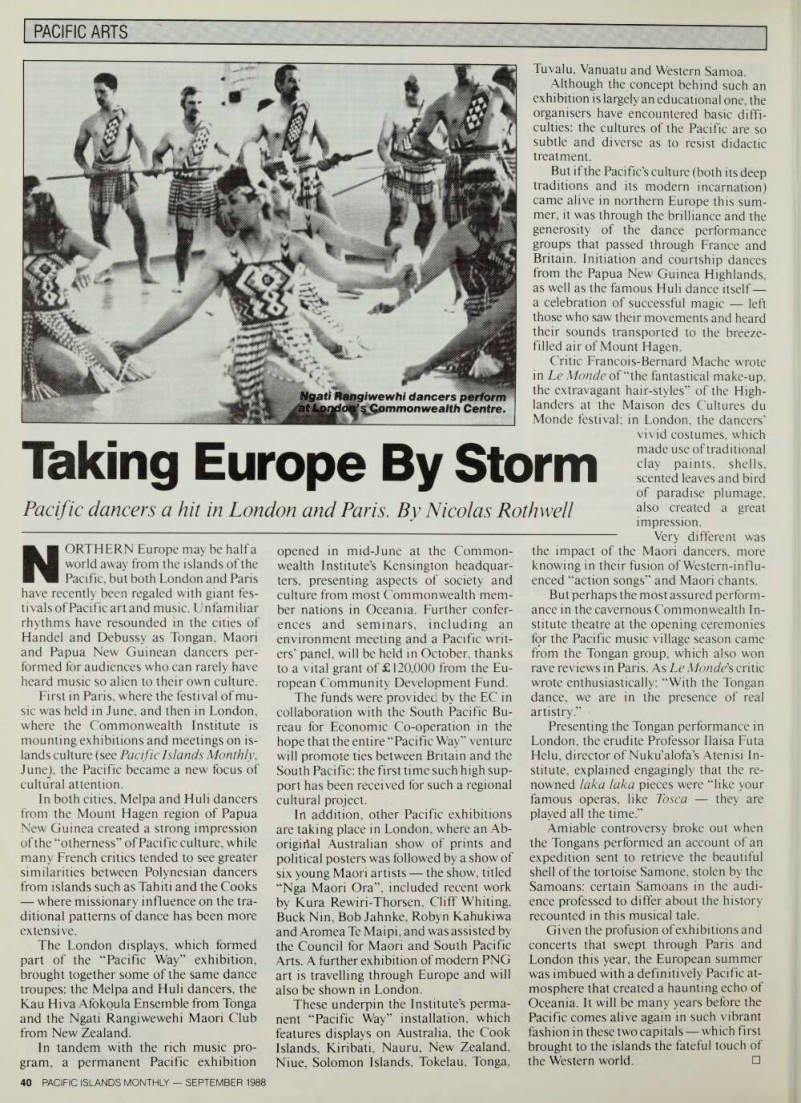
Pacific Arts
Pacific dancers a hit in London and Paris.
By Nicolas Rothwell
NORTHERN Europe may be half a world away from the islands of the Pacific, but both London and Paris have recently been regaled with giant fes tivals of Pacific art and music. Unfamiliar rhythms have resounded in the cities of Handel and Debussy as Tongan, Maori and Papua New Guinean dancers per formed for audiences who can rarely have heard music so alien to their own culture.
First in Paris, where the festival of mu sic was held in June, and then in London, where the Commonwealth Institute is mounting exhibitions and meetings on is lands culture (see Pacific Islands Monthly , June), the Pacific became a new focus of cultural attention.
In both cities, Melpa and Huli dancers from the Mount Hagen region of Papua New Guinea created a strong impression of the “otherness” of Pacific culture, while many French critics tended to see greater similarities between Polynesian dancers from islands such as Tahiti and the Cooks where missionary influence on the tra ditional patterns of dance has been more extensive.
The London displays, which formed part of the “Pacific Way” exhibition, brought together some of the same dance troupes: the Melpa and Huli dancers, the Kau Hiva Afokoula Ensemble from Tonga and the Ngati Rangiwewehi Maori Club from New Zealand.
In tandem with the rich music pro gram, a permanent Pacific exhibition
opened in mid-June at the Common wealth Institute’s Kensington headquar ters, presenting aspects of society and culture from most Commonwealth mem ber nations in Oceania. Further confer ences and seminars, including an environment meeting and a Pacific writ ers’ panel, will be held in October, thanks to a vital grant of £120,000 from the Eu ropean Community Development Fund.
The funds were provided by the EC in collaboration with the South Pacific Bu reau for Economic Co-operation in the hope that the entire “Pacific Way” venture will promote ties between Britain and the South Pacific: the first time such high sup port has been received for such a regional cultural project.
In addition, other Pacific exhibitions are taking place in London, where an Ab origirial Australian show of prints and political posters was followed by a show of six young Maori artists the show, titled “Nga Maori Ora”, included recent work by Kura Rewiri-Thorsen, Cliff Whiling, Buck Nin, Bob Jahnke, Robyn Kahukiwa and Aromea Te Maipi, and was assisted by the Council for Maori and South Pacific Arts. A further exhibition of modern PNG art is travelling through Europe and will also be shown in London.
These underpin the Institute’s perma nent “Pacific Way” installation, which features displays on Australia, the Cook Islands, Kiribati, Nauru, New Zealand, Niue, Solomon Islands, Tokelau, Tonga,
Tuvalu, Vanuatu and Western Samoa.
Although the concept behind such an exhibition is largely an educational one, the organisers have encountered basic diffi culties: the cultures of the Pacific are so subtle and diverse as to resist didactic treatment.
But if the Pacific’s culture (both its deep traditions and its modern incarnation) came alive in northern Europe this sum mer, it was through the brilliance and the generosity of the dance performance groups that passed through France and Britain. Initiation and courtship dances from the Papua New Guinea Highlands, as well as the famous Huli dance itself— a celebration of successful magic left those who saw their movements and heard their sounds transported to the breeze filled air of Mount Hagen.
Critic Francois-Bernard Mache wrote in Le Monde of “the fantastical make-up, the extravagant hair-styles” of the High landers at the Maison des Cultures du Monde festival; in London, the dancers’
vivid costumes, which made use of traditional clay paints, shells, scented leaves and bird of paradise plumage, also created a great impression.
Very different was
the impact of the Maori dancers, more knowing in their fusion of Western-influ enced “action songs” and Maori chants.
But perhaps the most assured perform ance in the cavernous Commonwealth In stitute theatre at the opening ceremonies for the Pacific music village season came from the Tongan group, which also won rave reviews in Paris. As Le Monde 1 s critic wrote enthusiastically: “With the Tongan dance, we are in the presence of real artistry.”
Presenting the Tongan performance in London, the erudite Professor Ilaisa Futa Helu, director of Nukualofa’s Atenisi In stitute, explained engagingly that the re nowned laka laka pieces were “like your famous operas, like Tosca they are played all the time.”
Amiable controversy broke out when the Tongans performed an account of an expedition sent to retrieve the beautiful shell of the tortoise Samone, stolen by the Samoans: certain Samoans in the audi ence professed to differ about the history recounted in this musical tale.
Given the profusion of exhibitions and concerts that swept through Paris and London this year, the European summer was imbued with a definitively Pacific at mosphere that created a haunting echo of Oceania. It will be many years before the Pacific comes alive again in such vibrant fashion in these two capitals which first brought to the islands the fateful touch of the Western world. □
Ngati Rangiwewhi dancers perform at London's Commonwealth Centre.
Brothers Behind Bars
Davidßobie reports on Vanuatu’s "politicalprisoners”.
ACROSS the barbed wire fence be hind the closed Vanuwespa stu dios in Port Vila, once the headquarters of one of the South Pacific’s most popular and radical music groups, is a drab, two-storeyed concrete villa. In the main room upstairs, the scene is depressing.
Five-year-old Virei Ayamiseba and three of her school-age playmates lie on the floor drawing on scraps of paper. They are barred from school.
Virei’s grandfather Dick, in his late 70s, sits dejectedly at a bare table and stares out the window. Virei’s mother, Mariana, doesn’t feel well and doesn’t want to talk to the foreign journalist. The stress is tak ing its toll. So Virei’s elder sister, 15-year old Isadora, and her aunt Emily, wife of percussionist William Ayemiseba, tell the story of their hardship since five of the seven men in the household musicians from the Black Brothers were arrested by the Vanuatu police two months ago and carted to the overcrowded Port Vila prison.
Refugees from Irian Jaya, the Black Brothers have been detained without
charge or trial. They and their 18 depend ents have become stateless people even their music has become blacklisted, in cluding their latest album. Border Cross ers, dedicated to the West Papuan refu gees who slip across the border into Papua New Guinea. “We have nothing; we have no food, no money. . . all our possessions have been sold,” says Mariana Ayami seba, finally agreeing to talk. “Noboby from the Government has visited us. No body cares.”
In walks her husband Andy, manager of the group and one of the detainees. He can only stay for a few minutes: he is being taken back to jail after being treated in hospital for a stomach illness.
“It’s the beginning of the end in this country,” Andy Ayamiseba says. He has no faith in promises made by the Lini Government.
The Black Brothers were first invited to Vanuatu by Hilda Lini, sister of the Prime Minister and now a Government MP, in 1979. They left Holland in 1983, were helped to set up in Port Vila by rebel cabinet minister Barak Sope, and became
fund-raisers for the ruling Vanuaaku Pati.
Their plight began in the wake of the May 16 riot and the power struggle between Lini and Sope. The Black Brothers were ac cused (without proof being advanced) of taking part in the riot.
Agust Rumwaropen, 39, and drummer Stevie Mambor, 35, were arrested during the post-riot purge but were later freed without charge. However, the group was served with expulsion orders on June 6.
When they failed to leave by the five-day deadline, the police jailed Andy Ayami seba, his brothers William and Christo pher, Rumwaropen and Mamboro. Only bass guitarist Benny Bettay, 35, remained free it is not clear why.
Prime Minister Lini and Government officials have been reluctant to discuss the issue. Though Australia is considering taking the group, it is understood key For eign Affairs officials in Canberra are op posed to such a move in case it offends Indonesia.
Meanwhile, the Black Brothers remain imprisoned without trial, waiting on the whim of officialdom. □
Advertisements & other items, p. 41 (1 item)
ML4IR --- Papua New Guinea's
nationwide airline connection to and
from the World.
DOMESTIC
Talair serves all provinces in P.N.G., many on a daily basis. No other airline comes close to serving the 130 ports a week that Talair does. Charter services also are available.
INTERNATIONAL
Using our computerised system
in any of our 12 International Travel Centres, we can book you anywhere in the world 0n...
planes, trains, luxury liners,
arrange rental cars, hostels, motels or hotels.
I I Panguna - 95 8020 • Arawa - 95 2113 • Mt. Hagen - 52 2465 Boroko - 25 7655 • Tabubil - 58 9228 • Goroka - 72 1355 • Lae - 42 2316 Madang - 82 2757 • Rabaul - 82 2882 • Wewak - 86 2012 Vanimo - 87 1180 • Port Moresby - 21 4766 • Waigani - 25 7877 Brisbane Metropolitan Area - 229 1177 Outside Brisbane - 008 777879 14L41R liil
ATA
QUALITY IN AIR TRANSPORT
Trade Winds
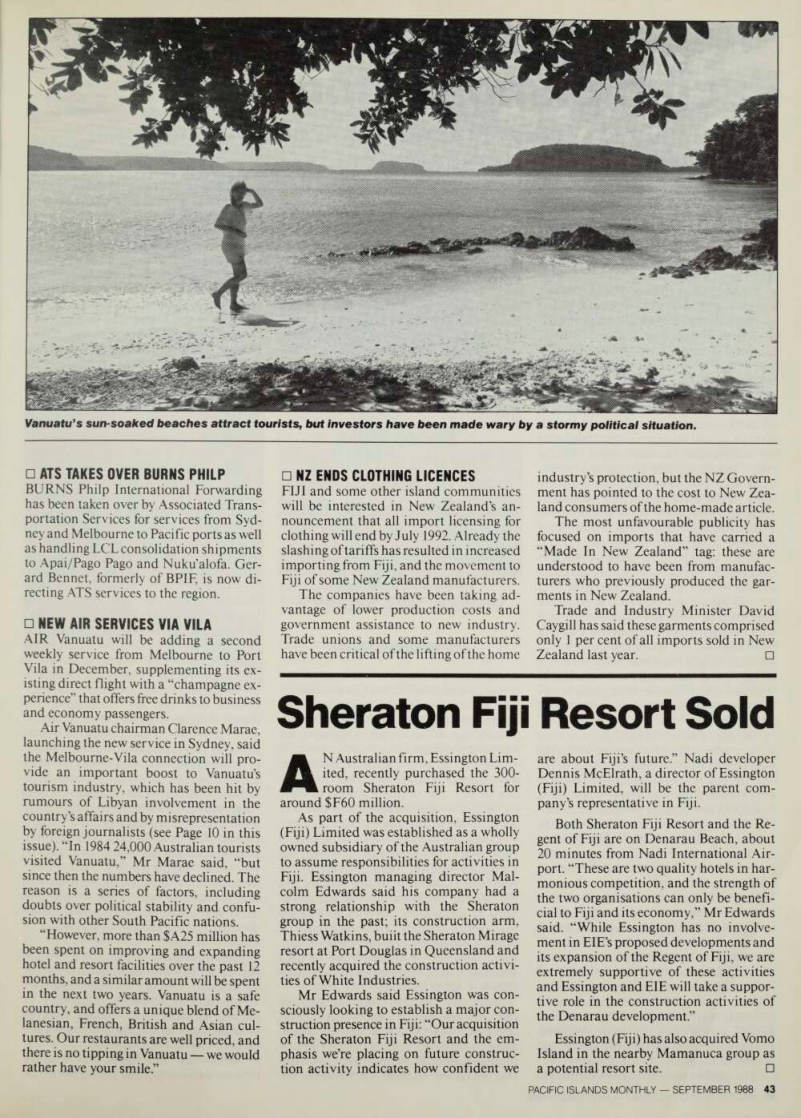
What Future For Vanuatu’s Finance Centre?
By Robin Bromby
TH E continuing constitutional prob lems in Vanuatu will almost cer tainly prove a setback for the nation’s fragile economy. While the recent political battles and one riot have been widely reported outside Vanuatu, the country remains calm. But the publicity could prove disastrous to an economy heavily dependent on tourism and the continued health of the finance centre.
What is worrying members of the fi nance centre in Port Vila is not so much the companies that now use it; they can be reassured. The troubles may deter new companies from setting up there, espe cially as Vanuatu’s reputation within fi nancial circles has taken previous batterings, most notably when relations were established with Libya.
It is not just Vanuatu that could suffer from the growing image South Pacific is a trouble spot: Trevor Clarke, managing di rector of the Cooks Island Trust Corpo ration, told Pacific Islands Monthly that businessmen who are familiar with the re gion will not be concerned, but that others may not be able to differentiate between various islands and could decide to steer clear of the Pacific altogether.
Offshore and tax-free centres are a growing business in the region. The Van uatu centre, established in 1971, now has 1200 companies and about 100 banks op erating from Port Vila. The Cook Islands, which passed its legislation in 1982, is now home to 1600 companies, including 20 banking operations.. Tonga has put off shore banking legislation in place, and The Samoa Times reported recently that the Western Samoan Government was con sidering legislation, soon to be tabled in Parliament, to establish an offshore bank ing system there (see “Pacific People” in this issue).
Flag-of-convenience shipping regis tries are also growing; Vanuatu’s lead in this direction is to be followed by Tuvalu and the Republic of the Marshall Islands.
Vanuatu needs the finance centre to be a continuing success. For the six months to June 30 1987, Vanuatu’s exports earned about SUS 7 million while imports cost SUS32.B million a deficit for six months of SUS2S.B million. The importance of in visibles such as financial transactions and tourism can be seen in such a situation, though the country is sure to continue to rely heavily on foreign aid.
One member of the Port Vila finance centre said Australian Newspapers had
made it sound as if chaos ruled in Vanu atu, when in fact the country was peaceful.
“We’ve had some clients who were nerv ous, but we’ve been able to call them and explain what is going on. But we might have frightened off some potential clients no one can really tell,” he said.
The majority of clients using Port Vila are large Asian operations or smaller fam ily companies owned by Australians or New Zealanders. The tax haven provides extensive secrecy protection (with heavy fines and prison sentences for breaches), no personal or coporate income taxes, no estate or gift duties, no capital gains taxes, no exchange controls and no participation in tax treaties. The most common vehicle for basing funds in Vanuatu (and other tax havens) is either a trust or a company, the latter earning tax free income through trusts or law firms. Alternatively, non res idents can use the finance centre by just having accounts with banks in Port Vila.
The finance centre had earlier set backs; soon after it was established a re bellion on the island of Santo against the central Government destroyed much con fidence in the nation as a reliable tax ha ven. Subsequently, the Libyan connection and a fishing deal with the Soviet Union raised doubts about just how stable the small South Pacific nation really was.
Whether or not the present political unrest will destabilise the government, the fear of such distruption is enough to frighten some investors.
Earlier this year, the Hong Kong and Shanghai Banking Corporation pulled out of Port Vila (as well as Suva and Honiara) because its operations were simply not sufficiently profitable. Westpac took over its business and now has two branches in Port Vila; previously the ANZ Bank had absorbed Barclays Bank and is currently spending $A500,000 extending its prem ises. The other bank operating in Vila is the Banque Indosuez.
The finance centre now employs 400 people and accounts for 12 per cent of the country’s gross domestic product.
Meanwhile, after a slow start there has been a recent increase in the number of ships registered under Vanuatu’s flag of convenience. Between 1981 and 1987 120 ships were registered, but in April one of the Vila-based trust companies reported that the registry contained 220 vessels and discussions were taking place with several major international fleets to move their ships on to the registry. Events in Panama may have contributed to renewed interest.
But it is the area of tax havens that there will be real competition. A top Vanuatu businessman says that the Cooks have very good legislation, and companies in Raro tonga work in a different time zone, which
gives them some advantage in dealing with the US. Eventually, he says, Western Sa moa and Tonga will win their shares of the offshore banking business: “They’re all vi able it just depends which one appeals to each different company.”
Trevor Clarke says the finance centre has taken great pains to develop a respect able image and to provide good quality service, both financial and legal. He says the Cooks centre has aimed at the higher end of the market, targeting large multi national companies.
The unknown quantity is Fiji. Earlier this year the Fiji Government was consid ering setting up a finance centre in Suva with similar tax haven provisions to those operating in Port Vila and Rarotonga. As reported at the time, the significance of the move is that the finance centre would al most certainly prosper at the expense of the others, simply because Fiji is consid ered the “hub” of the region.
Little more has been heard of the pro posal, but several months ago Finance Minister Josefata Kamikamica said that several international trading banks had discussed with the Fiji Government the impossibility of opening branches in the country. The minister declined to name the banks, but said he favoured more com petition in Fiji’s money market.
The Fijians have shown themselves to be eager to take measures that will boost economic growth; last December the Suva government introduced its tax free zones for export industries.
□ Fiji Customs Delays
AUSTRADE Fiji has advised all export ers dealing with the Republic that follow ing the arms shipment discoveries earlier in the year, all incoming sea and air cargo is being rigorously inspected by Fiji cus toms and security forces. As a result, de lays of up to two weeks have been experienced in clearing goods for consumption.
□ Anz To Open In Rarotonga
THE Australian and New Zealand Bank ing Group has received approval from the Cook Islands Monetary Board to estab lish a branch in Avarua, the financial and business district of Rarotonga.
Expected to open later this year, the branch will offer a range of banking serv ices, and according to ANZ Director for Americas and Asia Pacific Mr Roland Ish erwood, will “complement our already wide network of branches in the islands of the South Pacific.” The ANZ Banking Group has appointed Mr T Leadbeater, currently manager of the bank’s Victoria Parade, Suva, branch as manager of the Rarotonga branch.
□ Ats Takes Over Burns Philp
BURNS Philp International Forwarding has been taken over by Associated Trans portation Services for services from Syd ney and Melbourne to Pacific ports as well as handling LCL consolidation shipments to Apai/Pago Pago and Nukualofa. Ger ard Bennet, formerly of BPIF, is now di recting ATS services to the region.
□ New Air Services Via Vila
AIR Vanuatu will be adding a second weekly service from Melbourne to Port Vila in December, supplementing its ex isting direct flight with a “champagne ex perience” that offers free drinks to business and economy passengers.
Air Vanuatu chairman Clarence Marae, launching the new service in Sydney, said the Melbourne-Vila connection will pro vide an important boost to Vanuatu’s tourism industry, which has been hit by rumours of Libyan involvement in the country’s affairs and by misrepresentation by foreign journalists (see Page 10 in this issue). “In 1984 24,000 Australian tourists visited Vanuatu,” Mr Marae said, “but since then the numbers have declined. The reason is a series of factors, including doubts over political stability and confu sion with other South Pacific nations.
“However, more than SA2S million has been spent on improving and expanding hotel and resort facilities over the past 12 months, and a similar amount will be spent in the next two years. Vanuatu is a safe country, and offers a unique blend of Me lanesian, French, British and Asian cul tures. Our restaurants are well priced, and there is no tipping in Vanuatu we would rather have your smile.”
□ Nz Ends Clothing Licences
FIJI and some other island communities will be interested in New Zealand’s an nouncement that all import licensing for clothing will end by July 1992. Already the slashing of tariffs has resulted in increased importing from Fiji, and the movement to Fiji of some New Zealand manufacturers.
The companies have been taking ad vantage of lower production costs and government assistance to new industry.
Trade unions and some manufacturers have been critical of the lifting of the home
industry’s protection, but the NZ Govern ment has pointed to the cost to New Zea land consumers of the home-made article.
The most unfavourable publicity has focused on imports that have carried a “Made In New Zealand” tag: these are understood to have been from manufac turers who previously produced the gar ments in New Zealand.
Trade and Industry Minister David Caygill has said these garments comprised only 1 per cent of all imports sold in New Zealand last year. □
Vanuatu’s sun-soaked beaches attract tourists, but investors have been made wary by a stormy political situation.
Sheraton Fiji Resort Sold
AN Australian firm, Essington Lim ited, recently purchased the 300room Sheraton Fiji Resort for around SF6O million.
As part of the acquisition, Essington (Fiji) Limited was established as a wholly owned subsidiary of the Australian group to assume responsibilities for activities in Fiji. Essington managing director Mal colm Edwards said his company had a strong relationship with the Sheraton group in the past; its construction arm, Thiess Watkins, built the Sheraton Mirage resort at Port Douglas in Queensland and recently acquired the construction activi ties of White Industries.
Mr Edwards said Essington was con sciously looking to establish a major con struction presence in Fiji: “Our acquisition of the Sheraton Fiji Resort and the em phasis we’re placing on future construc tion activity indicates how confident we
are about Fiji’s future.” Nadi developer Dennis McElrath, a director of Essington (Fiji) Limited, will be the parent com pany’s representative in Fiji.
Both Sheraton Fiji Resort and the Re gent of Fiji are on Denarau Beach, about 20 minutes from Nadi International Air port. “These are two quality hotels in har monious competition, and the strength of the two organisations can only be benefi cial to Fiji and its economy,” Mr Edwards said. “While Essington has no involve ment in ElE’s proposed developments and its expansion of the Regent of Fiji, we are extremely supportive of these activities and Essington and EIE will take a suppor tive role in the construction activities of the Denarau development.”
Essington (Fiji) has also acquired Vomo Island in the nearby Mamanuca group as a potential resort site. □
Pacific Bishops “Ignored”
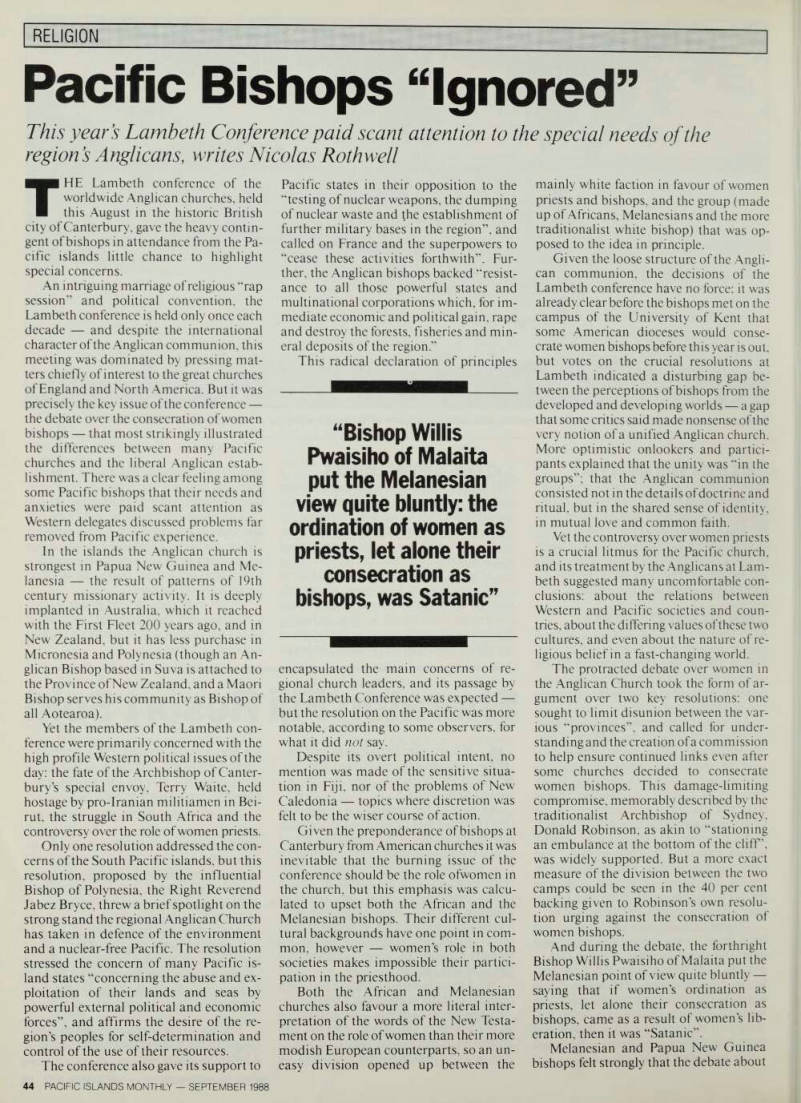
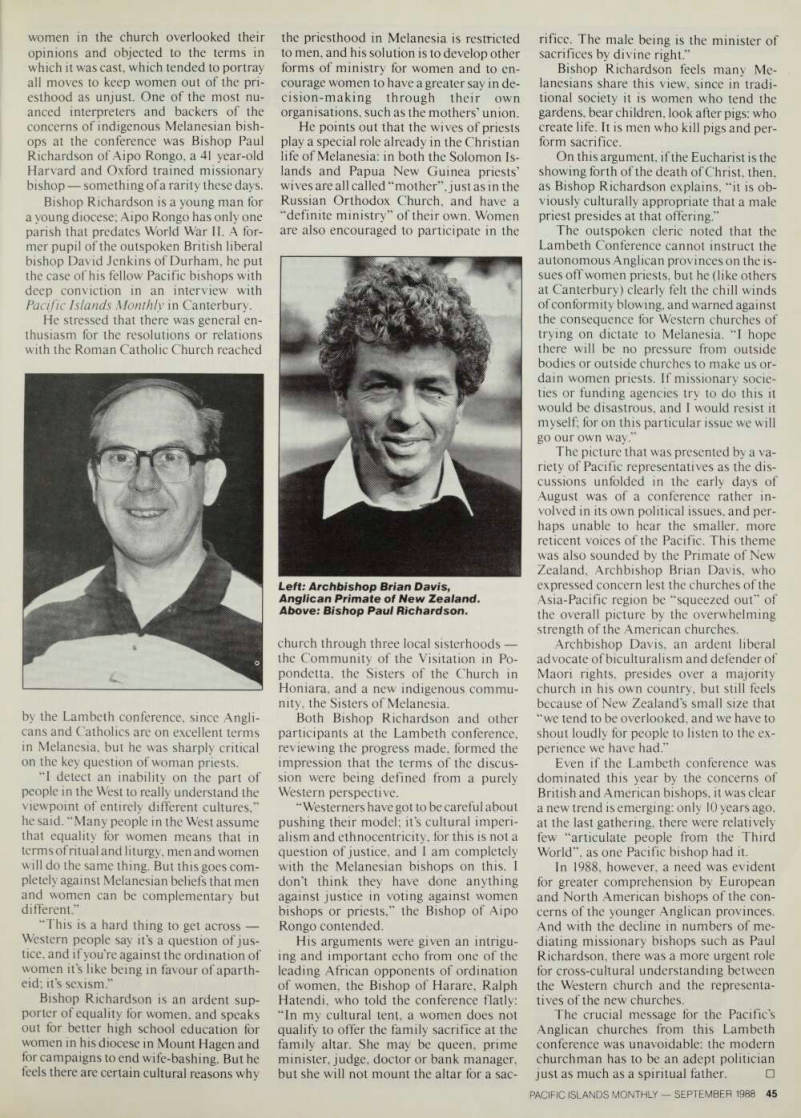
Religion
This year’s Lambeth Conference paid scant attention to the special needs of the region s Anglicans, writes Nicolas Rothwell
THE Lambeth conference of the worldwide Anglican churches, held this August in the historic British city of Canterbury, gave the heavy contin gent of bishops in attendance from the Pa cific islands little chance to highlight special concerns.
An intriguing marriage of religious “rap session” and political convention, the Lambeth conference is held only once each decade and despite the international character of the Anglican communion, this meeting was dominated by pressing mat ters chiefly of interest to the great churches of England and North America. But it was precisely the key issue of the conference the debate over the consecration of women bishops that most strikingly illustrated the differences between many Pacific churches and the liberal Anglican estab lishment. There was a clear feeling among some Pacific bishops that their needs and anxieties were paid scant attention as Western delegates discussed problems far removed from Pacific experience.
In the islands the Anglican church is strongest in Papua New Guinea and Me lanesia the result of patterns of 19th century missionary activity. It is deeply implanted in Australia, which it reached with the First Fleet 200 years ago, and in New Zealand, but it has less purchase in Micronesia and Polynesia (though an An glican Bishop based in Suva is attached to the Province of New Zealand, and a Maori Bishop serves his community as Bishop of all Aotearoa).
Yet the members of the Lambeth con ference were primarily concerned with the high profile Western political issues of the day: the fate of the Archbishop of Canter bury’s special envoy, Terry Waite, held hostage by pro-Iranian militiamen in Bei rut, the struggle in South Africa and the controversy over the role of women priests.
Only one resolution addressed the con cerns of the South Pacific islands, but this resolution, proposed by the influential Bishop of Polynesia, the Right Reverend Jabez Bryce, threw a brief spotlight on the strong stand the regional Anglican Church has taken in defence of the environment and a nuclear-free Pacific. The resolution stressed the concern of many Pacific is land states “concerning the abuse and ex ploitation of their lands and seas by powerful external political and economic forces”, and affirms the desire of the re gion’s peoples for self-determination and control of the use of their resources.
The conference also gave its support to
Pacific states in their opposition to the “testing of nuclear weapons, the dumping of nuclear waste and the establishment of further military bases in the region”, and called on France and the superpowers to “cease these activities forthwith”. Fur ther, the Anglican bishops backed “resist ance to all those powerful states and multinational corporations which, for im mediate economic and political gain, rape and destroy the forests, fisheries and min eral deposits of the region.”
This radical declaration of principles
“Bishop Willis Rwaisiho of Malaita put the Melanesian view quite bluntly: the ordination of women as priests, let alone their consecration as bishops, was Satanic”
encapsulated the main concerns of re gional church leaders, and its passage by the Lambeth Conference was expected but the resolution on the Pacific was more notable, according to some observers, for what it did not say.
Despite its overt political intent, no mention was made of the sensitive situa tion in Fiji, nor of the problems of New Caledonia topics where discretion was felt to be the wiser course of action.
Given the preponderance of bishops at Canterbury from American churches it was inevitable that the burning issue of the conference should be the role ofwomen in the church, but this emphasis was calcu lated to upset both the African and the Melanesian bishops. Their different cul tural backgrounds have one point in com mon, however women’s role in both societies makes impossible their partici pation in the priesthood.
Both the African and Melanesian churches also favour a more literal inter pretation of the words of the New Testa ment on the role of women than their more modish European counterparts, so an un easy division opened up between the
mainly white faction in favour of women priests and bishops, and the group (made up of Africans, Melanesians and the more traditionalist white bishop) that was op posed to the idea in principle.
Given the loose structure of the Angli can communion, the decisions of the Lambeth conference have no force: it was already clear before the bishops met on the campus of the University of Kent that some American dioceses would conse crate women bishops before this year is out, but votes on the crucial resolutions at Lambeth indicated a disturbing gap be tween the perceptions of bishops from the developed and developing worlds a gap that some critics said made nonsense of the very notion of a unified Anglican church.
More optimistic onlookers and partici pants explained that the unity was “in the groups”; that the Anglican communion consisted not in the details of doctrine and ritual, but in the shared sense of identity, in mutual love and common faith.
Vet the controversy over women priests is a crucial litmus for the Pacific church, and its treatment by the Anglicans at Lam beth suggested many uncomfortable con clusions: about the relations between Western and Pacific societies and coun tries, about the differing values of these two cultures, and even about the nature of re ligious belief in a fast-changing world.
The protracted debate over women in the Anglican Church took the form of ar gument over two key resolutions: one sought to limit disunion between the var ious “provinces”, and called for under standing and the creation of a commission to help ensure continued links even after some churches decided to consecrate women bishops. This damage-limiting compromise, memorably described by the traditionalist Archbishop of Sydney, Donald Robinson, as akin to “stationing an embulance at the bottom of the cliff’, was widely supported. But a more exact measure of the division between the two camps could be seen in the 40 per cent backing given to Robinson’s own resolu tion urging against the consecration of women bishops.
And during the debate, the forthright Bishop Willis Pwaisiho of Malaita put the Melanesian point of view quite bluntly saying that if women’s ordination as priests, let alone their consecration as bishops, came as a result of women’s lib eration, then it was “Satanic”.
Melanesian and Papua New Guinea bishops felt strongly that the debate about
women in the church overlooked their opinions and objected to the terms in which it was cast, which tended to portray all moves to keep women out of the pri esthood as unjust. One of the most nu anced interpreters and backers of the concerns of indigenous Melanesian bish ops at the conference was Bishop Paul Richardson of Aipo Rongo, a 41 year-old Harvard and Oxford trained missionary bishop something of a rarity these days.
Bishop Richardson is a young man for a young diocese; Aipo Rongo has only one parish that predates World War 11. A for mer pupil of the outspoken British liberal bishop David Jenkins of Durham, he put the case of his fellow Pacific bishops with deep conviction in an interview with Pacific Islands Monthly in Canterbury.
He stressed that there was general en thusiasm for the resolutions or relations with the Roman Catholic Church reached
by the Lambeth conference, since Angli cans and Catholics are on excellent terms in Melanesia, but he was sharply critical on the key question of woman priests.
“I detect an inability on the part of people in the West to really understand the viewpoint of entirely different cultures,” he said. “Many people in the West assume that equality for women means that in terms of ritual and liturgy, men and women will do the same thing. But this goes com pletely against Melanesian beliefs that men and women can be complementary but different.”
“This is a hard thing to get across Western people say it’s a question of jus tice, and if you’re against the ordination of women it’s like being in favour of aparth eid; it’s sexism.”
Bishop Richardson is an ardent sup porter of equality for women, and speaks out for better high school education for women in his diocese in Mount Hagen and for campaigns to end wife-bashing. But he feels there are certain cultural reasons why
the priesthood in Melanesia is restricted to men, and his solution is to develop other forms of ministry for women and to en courage women to have a greater say in de cision-making through their own organisations, such as the mothers’ union.
He points out that the wives of priests play a special role already in the Christian life of Melanesia: in both the Solomon Is lands and Papua New Guinea priests’ wives are all called “mother”, just as in the Russian Orthodox Church, and have a “definite ministry” of their own. Women are also encouraged to participate in the
church through three local sisterhoods the Community of the Visitation in Po pondetta, the Sisters of the Church in Honiara, and a new indigenous commu nity, the Sisters of Melanesia.
Both Bishop Richardson and other participants at the Lambeth conference, reviewing the progress made, formed the impression that the terms of the discus sion were being defined from a purely Western perspective.
“Westerners have got to be careful about pushing their model; it’s cultural imperi alism and ethnocentricity, for this is not a question of justice, and I am completely with the Melanesian bishops on this. I don’t think they have done anything against justice in voting against women bishops or priests,” the Bishop of Aipo Rongo contended.
His arguments were given an intrigu ing and important echo from one of the leading African opponents of ordination of women, the Bishop of Harare, Ralph Hatendi, who told the conference flatly; “In my cultural tent, a women does not qualify to offer the family sacrifice at the family altar. She may be queen, prime minister, judge, doctor or bank manager, but she will not mount the altar for a sac
rifice. The male being is the minister of sacrifices by divine right.”
Bishop Richardson feels many Me lanesians share this view, since in tradi tional society it is women who tend the gardens, bear children, look after pigs: who create life. It is men who kill pigs and per form sacrifice.
On this argument, if the Eucharist is the showing forth of the death of Christ, then, as Bishop Richardson explains, “it is ob viously culturally appropriate that a male priest presides at that offering.”
The outspoken cleric noted that the Lambeth Conference cannot instruct the autonomous Anglican provinces on the is sues off women priests, but he (like others at Canterbury) clearly fell the chill winds of conformity blowing, and warned against the consequence for Western churches of trying on dictate to Melanesia. “I hope there will be no pressure from outside bodies or outside churches to make us or dain women priests. If missionary socie ties or funding agencies try to do this it would be disastrous, and I would resist it myself; for on this particular issue we will go our own way.”
The picture that was presented by a va riety of Pacific representatives as the dis cussions unfolded in the early days of August was of a conference rather in volved in its own political issues, and per haps unable to hear the smaller, more reticent voices of the Pacific. This theme was also sounded by the Primate of New Zealand, Archbishop Brian Davis, who expressed concern lest the churches of the Asia-Pacific region be “squeezed out” of the overall picture by the overwhelming strength of the American churches.
Archbishop Davis, an ardent liberal advocate of biculluralism and defender of Maori rights, presides over a majority church in his own country, but still feels because of New Zealand’s small size that “we tend to be overlooked, and we have to shout loudly for people to listen to the ex perience we have had.”
Even if the Lambeth conference was dominated this year by the concerns of British and American bishops, it was clear a new trend is emerging: only 10 years ago, at the last gathering, there were relatively few “articulate people from the Third World”, as one Pacific bishop had it.
In 1988, however, a need was evident for greater comprehension by European and North American bishops of the con cerns of the younger Anglican provinces.
And with the decline in numbers of me diating missionary bishops such as Paul Richardson, there was a more urgent role for cross-cultural understanding between the Western church and the representa tives of the new churches.
The crucial message for the Pacific’s Anglican churches from this Lambeth conference was unavoidable: the modern churchman has to be an adept politician just as much as a spiritual father. □
Left: Archbishop Brian Davis, Anglican Primate of New Zealand.
Above: Bishop Paul Richardson.
Samoa’s Principled PM
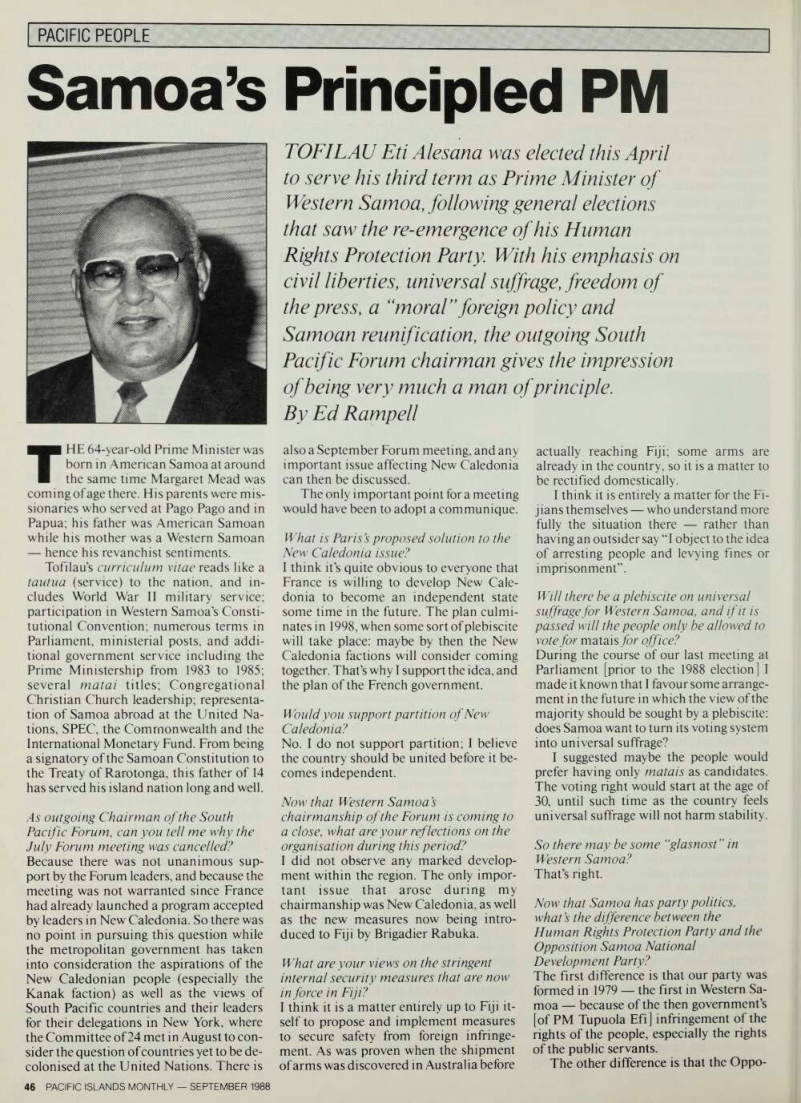
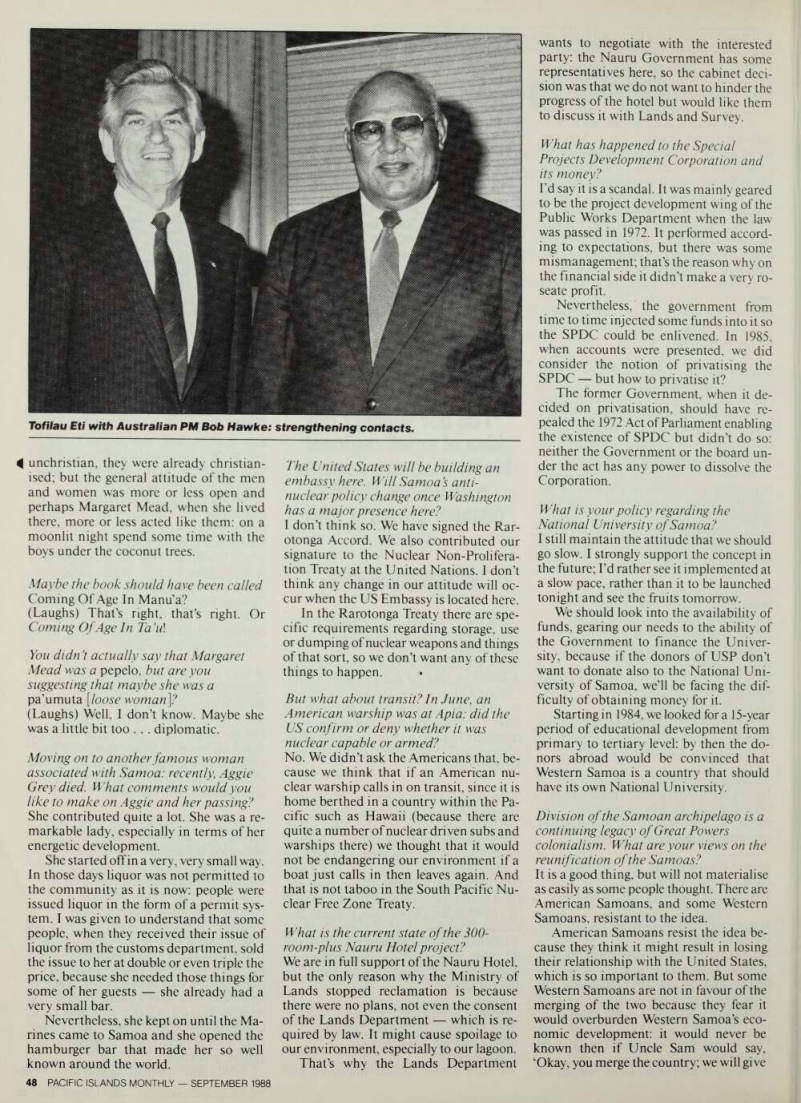
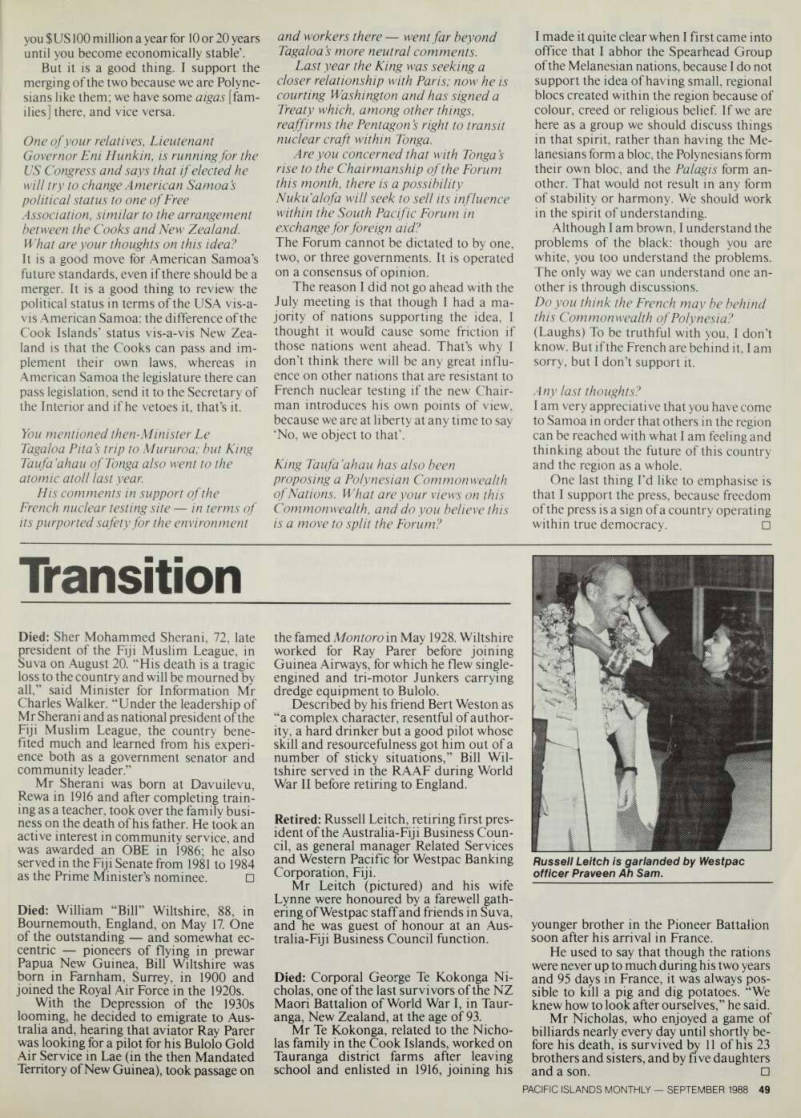
Pacific People
TOFILAU Eti Alesana elected this April to serve his third term as Prime Minister of Western Samoa, following general elections that saw the re-emergence of his Human Rights Protection Party. With his emphasis on civil liberties, universal suffrage, freedom of the press, a “moral” foreign policy and Samoan reunification, the outgoing South Pacific Forum chairman gives the impression of being very much a man ofprinciple.
By Ed Rampell
THE 64-year-old Prime Minister was born in American Samoa at around the same time Margaret Mead was coming of age there. His parents were mis sionaries who served at Pago Pago and in Papua; his father was American Samoan while his mother was a Western Samoan hence his revanchist sentiments.
Tofilau’s curriculum vitae reads like a tautua (service) to the nation, and in cludes World War II military service; participation in Western Samoa’s Consti tutional Convention; numerous terms in Parliament, ministerial posts, and addi tional government service including the Prime Ministership from 1983 to 1985; several matai titles; Congregational Christian Church leadership; representa tion of Samoa abroad at the United Na tions, SPEC, the Commonwealth and the International Monetary Fund. From being a signatory of the Samoan Constitution to the Treaty of Rarotonga, this father of 14 has served his island nation long and well.
As outgoing Chairman of the South Pacific Forum, can you tell me why the July Forum meeting was cancelled?
Because there was not unanimous sup port by the Forum leaders, and because the meeting was not warranted since France had already launched a program accepted by leaders in New Caledonia. So there was no point in pursuing this question while the metropolitan government has taken into consideration the aspirations of the New Caledonian people (especially the Kanak faction) as well as the views of South Pacific countries and their leaders for their delegations in New York, where the Committee of 24 met in August to con sider the question of countries yet to be de colonised at the United Nations. There is
also a September Forum meeting, and any important issue affecting New Caledonia can then be discussed.
The only important point for a meeting would have been to adopt a communique.
What is Paris’s proposed solution to the New Caledonia issue?
I think it’s quite obvious to everyone that France is willing to develop New Cale donia to become an independent state some time in the future. The plan culmi nates in 1998, when some sort of plebiscite will take place; maybe by then the New Caledonia factions will consider coming together. That’s why I support the idea, and the plan of the French government.
Would you support partition of New Caledonia?
No. I do not support partition; I believe the country should be united before it be comes independent.
Now that Western Samoa’s chairmanship of the Forum is coming to a close, what are your reflections on the organisation during this period?
I did not observe any marked develop ment within the region. The only impor tant issue that arose during my chairmanship was New Caledonia, as well as the new measures now being intro duced to Fiji by Brigadier Rabuka.
What are your views on the stringent internal security measures that are now in force in Fiji?
I think it is a matter entirely up to Fiji it self to propose and implement measures to secure safety from foreign infringe ment. As was proven when the shipment of arms was discovered in Australia before
actually reaching Fiji; some arms are already in the country, so it is a matter to be rectified domestically.
I think it is entirely a matter for the Fi jians themselves who understand more fully the situation there rather than having an outsider say “I object to the idea of arresting people and levying fines or imprisonment”.
Will there be a plebiscite on universal suffrage for Western Samoa, and if it is passed will the people only be allowed to vote for matais for office?
During the course of our last meeting at Parliament [prior to the 1988 election] I made it known that I favour some arrange ment in the future in which the view of the majority should be sought by a plebiscite: does Samoa want to turn its voting system into universal suffrage?
I suggested maybe the people would prefer having only matais as candidates.
The voting right would start at the age of 30, until such time as the country feels universal suffrage will not harm stability.
So there may be some “glasnost” in Western Samoa?
That’s right.
Now that Samoa has party politics, what ’s the difference between the Human Rights Protection Party and the Opposition Samoa National Development Party?
The first difference is that our party was formed in 1979 the first in Western Sa moa because of the then government’s [of PM Tupuola Efi] infringement of the rights of the people, especially the rights of the public servants.
The other difference is that the Oppo
sition party is not yet a firm party. For ex ample, you can see that it has changed its name three times; plus we seriously take into our policy the general public; ours is more or less the pragmatic party. We think of the rights of everyone.
If I see that rural people are not receiv ing what we are entertaining in Apia, we try to see how we can help people in the rural areas. For example, I will be travell ing to Savaii with five ministers for five days to go to each village to see what is necessary for them, development wise.
The Opposition does not truly operate on a set, expounded number of policies: before the election they didn’t have a plat form at all. But whenever we go to the gen eral election, we always have a platform spelt out for the people. Our platform for this coming three years emphasises elec trification, sealed roads and water supply for the whole country.
Is the main role of the Opposition simply to oppose your power bloc?
I think so. The Opposition’s notion is just to block the proposed activities of the HRPR While attending Commonwealth parliamentary procedural seminars I’ve discussed the role of the Opposition.
Its role does not mean it should object to or place difficulties in the path of the administration; the true role of the Op position is to check whether the Govern ment has thought out its programs well.
Rather than just criticising, they should also make an input.
During this year’s general election campaign, you charged that the SNDP received overseas money (which is illegal) and that you had proof. Is there an investigation into these allegations: and if so what are the results?
Well, to be frank with you, we have talked with some people involved with the bring ing in of this money to Samoa.
It was not from Hawaii; maybe it came through Hawaii some way, but we have been informed it came from Tahiti.
Are you suggesting that perhaps the French are behind some of these moves?
I don’t say the French government is in volved ... I was thinking of somebody in a responsible position in Tahiti.
Maybe Gaston Flosse, who was then Paris’s Pacific Minister?
Well, I don’t know; it could be (laughs).
Is there an official investigation into this illegal money?
No, not yet.. . We are discussing the pos sibility of launching one. It is proven nonetheless, because the Opposition lent some money to people in the country. Last week I was informed that one person had received money in the form of a loan from the Opposition party; well, a political party is not a bank.
We try to get money so we can pay for
expenses such as political campaign lea flets. But we are not here to give money to people, you know!
You signed the anti-nuclear Rarotonga Treaty. Considering that the French nuclear testing site is located in French Polynesia, do you believe the alleged illicit funding was an attempt to prevent an anti-nuclear leader becoming Prime Minister and Forum Chairman?
Well, I’m sorry I can’t answer that ques tion. But during the SNDP’s term of of fice, one of its ministers went to Mururoa at the invitation of either the French Government or Gaston Flosse. He was flown from here to Mururoa and on his re turn stated in Parliament that he ate fish there fish that were caught in the area and that they were not affected by ra dioactivity. I challenged him, saying those fish were from New Zealand.
“I do not support the idea of small regional blocs: if we are here as a group we should discuss things in that spirit”
What did you think of Le Tagaloa Pita s Mururoa trip, and was it officially sanctioned?
No. According to the Prime Minister [Vaai Kolone] he said he didn’t know. I said: “Prime Minister, you are also the Minis ter of Foreign Affairs. Was it the policy of your Government that you allow your ministers to go to a place we have explic itly rejected?” And the Prime Minister said he didn’t know . . .
Returning to the corruption issue: is it true that an HRPP MP was offered T 25,000 to switch over to the other side?
We were told it’s more than that... I signed an affidavit that if I switched from HRPP I’d have to pay the party T 150,000. There have been some members of our party who have been enticed by an offer of T 150,000 to switch to the Opposition, but that par ticular member said “I don’t think T 150,000 is sufficient. You must also pay all those who voted me into Parliament T 150,000 each!” And that is where the buck stopped.
Literally. Moving on: what does Western Samoa have to show today for more than a quarter of a century of
independence?
We have shown further improved eco
nomic development. When we first came into office in 1983, our foreign exchange holdings could only last three days.
Now our foreign reserve funds can last six or seven months. Also, we are going to have the Royal Samoan Hotel, an inter national five-star hotel, built. We’ve fin alised discussions now with the developer as well as the financiers, the Overseas Pri vate Investment Corporation of the United States. I think we are on the right course now to the beginning of the project.
What are your future economic development plans?
Since Samoa is still a country relying on agricultural products, we have launched a program to increase the agricultural sector by way of offering incentives to the plant ers. We have the land, but it is then a ques tion of the people; how we can urge the people to go. The best way we can do that is to subsidise the price, because though the Government would provide the funds to a certain extent, all over the world in the US, New Zealand and Europe the government has to subsidise the planters.
The fruits therefrom will be sold over seas, enabling us to earn foreign exchange and at the same time businesspeople will be entertaining results. So it is not an in vestment that will be wasted.
We are also looking into areas where we can attract more investors to develop in dustries here. As a matter of fact, I have been asked by some foreign entrepreneurs who’d like to establish fabric and garment factories here because labour costs over seas are so high. This includes Hong Kong, Taiwan, Korea even New Zealand and Australia. They think that with a very nominal labour cost in Samoa they’d like to invest here in this area.
What s the state of your offshore banking?ls that in operation now?' We still have another piece of legislation yet to be introduced in the House, but we can go ahead now. The Minister of Fi nance has received some people who’d like to take part, and a gentleman involved with offshore banking in Vanuatu and other countries was also interested.
There’s a controversy that’s been in the media for years now, and recently a documentary has been made about it, regarding Margaret Mead and her anthropological classic Coming Of Age In Samoa. What’s your personal opinion: was Mead a pepelo (liar)? (Laughs) I think she was not very accurate with her assessments, especially when she generalises about the Samoan people. You know, I go along with some local people’s point of view that Margaret Mead was in American Samoa at a young age and she went to Manu’a, a place regarded as se cluded in those days mind you, it’s more than 60 years ago and regarded as pri mitive, you know.
Well, I don’t mean to say that they were ►
4 unchristian, they were already christian ised; but the general attitude of the men and women was more or less open and perhaps Margaret Mead, when she lived there, more or less acted like them: on a moonlit night spend some time with the boys under the coconut trees.
Maybe the book should have been called Coming Of Age In Manu’a? (Laughs) That’s right, that’s right. Or Coming Of Age In Ta ’u\ You didn’t actually say that Margaret Mead was a pepelo, but are you suggesting that maybe she was a
pa’umuta [loose woman]?
(Laughs) Well, I don’t know. Maybe she was a little bit too . . . diplomatic.
Moving on to another famous woman associated with Samoa: recently, Aggie Grey died. What comments would you like to make on Aggie and her passing?
She contributed quite a lot. She was a re markable lady, especially in terms of her energetic development.
She started off in a very, very small way.
In those days liquor was not permitted to the community as it is now: people were issued liquor in the form of a permit sys tem. I was given to understand that some people, when they received their issue of liquor from the customs department, sold the issue to her at double or even triple the price, because she needed those things for some of her guests she already had a very small bar.
Nevertheless, she kept on until the Ma rines came to Samoa and she opened the hamburger bar that made her so well known around the world.
The United States will be building an embassy here. Will Samoa’s anti nuclear policy change once Washington has a major presence here?
I don’t think so. We have signed the Rar otonga Accord. We also contributed our signature to the Nuclear Non-Prolifera tion Treaty at the United Nations. I don’t think any change in our attitude will oc cur when the US Embassy is located here.
In the Rarotonga Treaty there are spe cific requirements regarding storage, use or dumping of nuclear weapons and things of that sort, so we don’t want any of these things to happen.
But what about transit? In June, an American warship was at Apia: did the US confirm or deny whether it was nuclear capable or armed?
No. We didn’t ask the Americans that, be cause we think that if an American nu clear warship calls in on transit, since it is home berthed in a country within the Pa cific such as Hawaii (because there are quite a number of nuclear driven subs and warships there) we thought that it would not be endangering our environment if a boat just calls in then leaves again. And that is not taboo in the South Pacific Nu clear Free Zone Treaty.
What is the current state of the 300room-plus Nauru Hotel project?
We are in full support of the Nauru Hotel, but the only reason why the Ministry of Lands stopped reclamation is because there were no plans, not even the consent of the Lands Department which is re quired by law. It might cause spoilage to our environment, especially to our lagoon.
That’s why the Lands Department
wants to negotiate with the interested party; the Nauru Government has some representatives here, so the cabinet deci sion was that we do not want to hinder the progress of the hotel but would like them to discuss it with Lands and Survey.
What has happened to the Special Projects Development Corporation and its money?
I’d say it is a scandal. It was mainly geared to be the project development wing of the Public Works Department when the law was passed in 1972. It performed accord ing to expectations, but there was some mismanagement; that’s the reason why on the financial side it didn’t make a very ro seate profit.
Nevertheless, the government from time to time injected some funds into it so the SPDC could be enlivened. In 1985, when accounts were presented, we did consider the notion of privatising the SPDC but how to privatise it?
The former Government, when it de cided on privatisation, should have re pealed the 1972 Act of Parliament enabling the existence of SPDC but didn’t do so: neither the Government or the board un der the act has any power to dissolve the Corporation.
What is your policy regarding the National University of Samoa?
I still maintain the attitude that we should go slow. I strongly support the concept in the future; I’d rather see it implemented at a slow pace, rather than it to be launched tonight and see the fruits tomorrow.
We should look into the availability of funds, gearing our needs to the ability of the Government to finance the Univer sity, because if the donors of USP don’t want to donate also to the National Uni versity of Samoa, we’ll be facing the dif ficulty of obtaining money for it.
Starting in 1984, we looked fora 15-year period of educational development from primary to tertiary level: by then the do nors abroad would be convinced that Western Samoa is a country that should have its own National University.
Division of the Samoan archipelago is a continuing legacy of Great Powers colonialism. What are your views on the reunification of the Samoas?
It is a good thing, but will not materialise as easily as some people thought. There are American Samoans, and some Western Samoans, resistant to the idea.
American Samoans resist the idea be cause they think it might result in losing their relationship with the United States, which is so important to them. But some Western Samoans are not in favour of the merging of the two because they fear it would overburden Western Samoa’s eco nomic development: it would never be known then if Uncle Sam would say, ‘Okay, you merge the country; we will give
Tofilau Eti with Australian PM Bob Hawke: strengthening contacts.
you SUS 100 million a year for 10 or 20 years until you become economically stable’.
But it is a good thing. I support the merging of the two because we are Polyne sians like them; we have some aigas [fam ilies] there, and vice versa.
One of your relatives, Lieutenant Governor Eni Hunkin, is running for the US Congress and says that if elected he will try to change American Samoa’s political status to one of Free Association, similar to the arrangement between the Cooks and New Zealand.
What are your thoughts on this idea?
It is a good move for American Samoa’s future standards, even if there should be a merger. It is a good thing to review the political status in terms of the USA vis-a vis American Samoa: the difference of the Cook Islands’ status vis-a-vis New Zea land is that the Cooks can pass and im plement their own laws, whereas in American Samoa the legislature there can pass legislation, send it to the Secretary of the Interior and if he vetoes it, that’s it.
You mentioned then-Minister Le Tagaloa Pita’s trip to Mururoa; but King Taufa’ahau of Tonga also went to the atomic atoll last year.
His comments in support of the French nuclear testing site in terms of its purported safety for the environment
and workers there went far beyond Tagaloa’s more neutral comments.
Last year the King was seeking a closer relationship with Paris; now he is courting Washington and has signed a Treaty which, among other things, reaffirms the Pentagon’s right to transit nuclear craft within Tonga.
Are you concerned that with Tonga’s rise to the Chairmanship of the Forum this month, there is a possibility Nukualofa will seek to sell its influence within the South Pacific Forum in exchange for foreign aid?
The Forum cannot be dictated to by one, two, or three governments. It is operated on a consensus of opinion.
The reason I did not go ahead with the July meeting is that though I had a ma jority of nations supporting the idea, I thought it would cause some friction if those nations went ahead. Thai’s why I don’t think there will be any great influ ence on other nations that are resistant to French nuclear testing if the new Chair man introduces his own points of view, because we are at liberty at any time to say ‘No, we object to that’.
King Taufa ’ahau has also been proposing a Polynesian Commonwealth of Nations. What are your views on this Commonwealth, and do you believe this is a move to split the Forum?
I made it quite clear when I first came into office that I abhor the Spearhead Group of the Melanesian nations, because I do not support the idea of having small, regional blocs created within the region because of colour, creed or religious belief. If we are here as a group we should discuss things in that spirit, rather than having the Me lanesians form a bloc, the Polynesians form their own bloc, and the Palagis form an other. That would not result in any form of stability or harmony. We should work in the spirit of understanding.
Although I am brown, I understand the problems of the black: though you are white, you 100 understand the problems.
The only way we can understand one an other is through discussions.
Do you think the French may be behind this Commonwealth of Polynesia? (Laughs) To be truthful with you, I don’t know. But if the French are behind it, I am sorry, but I don’t support it.
Any last thoughts?
I am very appreciative that you have come to Samoa in order that others in the region can be reached with what I am feeling and thinking about the future of this country and the region as a whole.
One last thing I’d like to emphasise is that I support the press, because freedom of the press is a sign of a country operating within true democracy. □
Transition
Died: Sher Mohammed Sherani, 72, late president of the Fiji Muslim League, in Suva on August 20. “His death is a tragic loss to the country and will be mourned by all,” said Minister for Information Mr Charles Walker. “Under the leadership of Mr Sherani and as national president of the Fiji Muslim League, the country bene fited much and learned from his experi ence both as a government senator and community leader.”
Mr Sherani was born at Davuilevu, Rewa in 1916 and after completing train ing as a teacher, took over the family busi ness on the death of his father. He took an active interest in community service, and was awarded an OBE in 1986; he also served in the Fiji Senate from 1981 to 1984 as the Prime Minister’s nominee. □ Died: William “Bill” Wiltshire, 88, in Bournemouth, England, on May 17. One of the outstanding and somewhat ec centric pioneers of flying in prewar Papua New Guinea, Bill Wiltshire was born in Farnham, Surrey, in 1900 and joined the Royal Air Force in the 19205.
With the Depression of the 1930 s looming, he dedded to emigrate to Aus tralia and, hearing that aviator Ray Parer was looking for a pilot for his Bulolo Gold Air Service in Lae (in the then Mandated Territory of New Guinea), took passage on
the famed Montoro 'm May 1928. Wiltshire worked for Ray Parer before joining Guinea Airways, for which he flew single engined and tri-motor Junkers carrying dredge equipment to Bulolo.
Described by his friend Bert Weston as “a complex character, resentful of author ity, a hard drinker but a good pilot whose skill and resourcefulness got him out of a number of sticky situations,” Bill Wil tshire served in the RAAF during World War II before retiring to England.
Retired: Russell Leitch, retiring first pres ident of the Australia-Fiji Business Coun cil, as general manager Related Services and Western Pacific for Westpac Banking Corporation, Fiji.
Mr Leitch (pictured) and his wife Lynne were honoured by a farewell gath ering of Westpac staff and friends in Suva, and he was guest of honour at an Aus tralia-Fiji Business Council function.
Died: Corporal George Te Kokonga Ni cholas, one of the last survivors of the NZ Maori Battalion of World War I, in Taur anga, New Zealand, at the age of 93.
Mr Te Kokonga, related to the Nicho las family in the Cook Islands, worked on Tauranga district farms after leaving school and enlisted in 1916, joining his
younger brother in the Pioneer Battalion soon after his arrival in France.
He used to say that though the rations were never up to much during his two years and 95 days in France, it was always pos sible to kill a pig and dig potatoes. “We knew how to look after ourselves,” he said.
Mr Nicholas, who enjoyed a game of billiards nearly every day until shortly be fore his death, is survived by 11 of his 23 brothers and sisters, and by five daughters and a son. □
Russell Leitch is garlanded by Westpac officer Praveen Ah Sam.
The Island Press
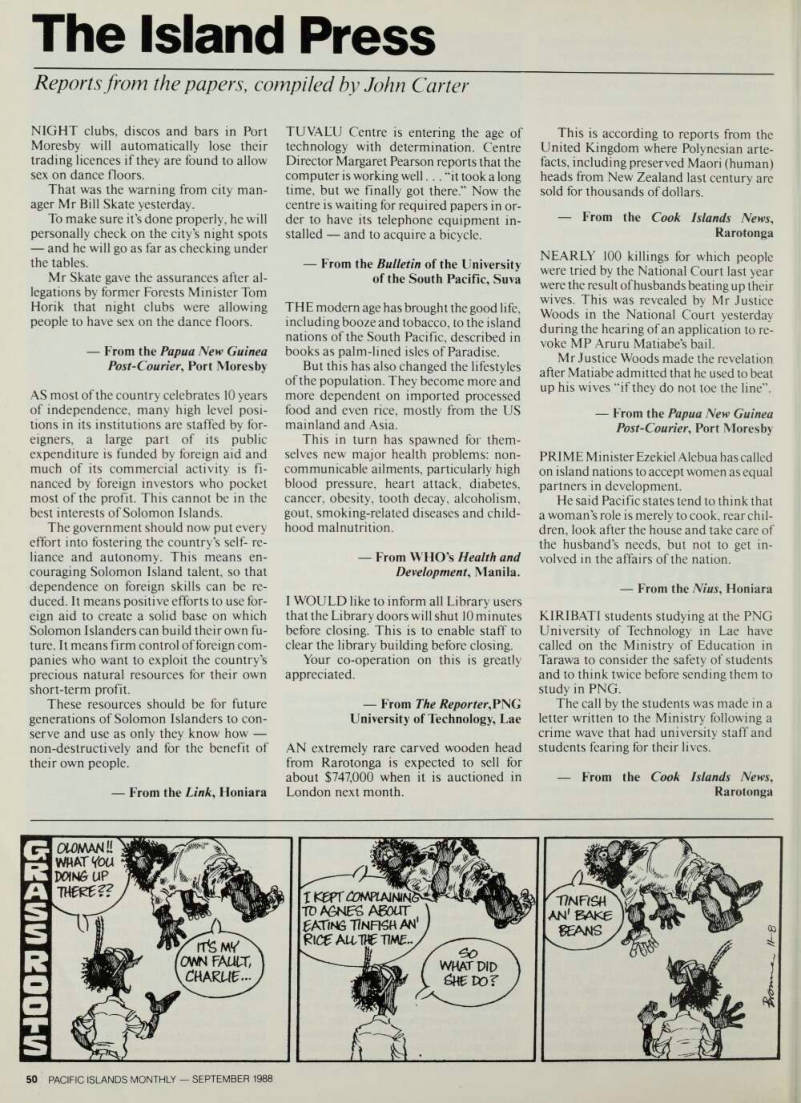
Reports from the papers, compiled by John Carter
NIGHT clubs, discos and bars in Port Moresby will automatically lose their trading licences if they are found to allow sex on dance floors.
That was the warning from city man ager Mr Bill Skate yesterday.
To make sure it’s done properly, he will personally check on the city’s night spots and he will go as far as checking under the tables.
Mr Skate gave the assurances after al legations by former Forests Minister Tom Horik that night clubs were allowing people to have sex on the dance floors.
From the Papua New Guinea Post-Courier , Port Moresby AS most of the country celebrates 10 years of independence, many high level posi tions in its institutions are staffed by for eigners, a large part of its public expenditure is funded by foreign aid and much of its commercial activity is fi nanced by foreign investors who pocket most of the profit. This cannot be in the best interests of Solomon Islands.
The government should now put every effort into fostering the country’s self- re liance and autonomy. This means en couraging Solomon Island talent, so that dependence on foreign skills can be re duced. It means positive efforts to use for eign aid to create a solid base on which Solomon Islanders can build their own fu ture. It means firm control of foreign com panies who want to exploit the country’s precious natural resources for their own short-term profit.
These resources should be for future generations of Solomon Islanders to con serve and use as only they know how non-destructively and for the benefit of their own people.
From the Link , Honiara
TUVALU Centre is entering the age of technology with determination. Centre Director Margaret Pearson reports that the computer is working we 11... “it took a long time, but we finally got there.” Now the centre is waiting for required papers in or der to have its telephone equipment in stalled and to acquire a bicycle.
From the Bulletin of the University of the South Pacific, Suva THE modern age has brought the good life, including booze and tobacco, to the island nations of the South Pacific, described in books as palm-lined isles of Paradise.
But this has also changed the lifestyles of the population. They become more and more dependent on imported processed food and even rice, mostly from the US mainland and Asia.
This in turn has spawned for them selves new major health problems: non communicable ailments, particularly high blood pressure, heart attack, diabetes, cancer, obesity, tooth decay, alcoholism, gout, smoking-related diseases and child hood malnutrition.
From WHO’s Health and Development , Manila.
I WOULD like to inform all Library users that the Library doors will shut 10 minutes before closing. This is to enable staff to clear the library building before closing.
Your co-operation on this is greatly appreciated.
From The Reporter, PNG University of Technology, Lae AN extremely rare carved wooden head from Rarotonga is expected to sell for about $747,000 when it is auctioned in London next month.
This is according to reports from the United Kingdom where Polynesian arte facts, including preserved Maori (human) heads from New Zealand last century are sold for thousands of dollars.
From the Cook Islands News , Rarotonga NEARLY 100 killings for which people were tried by the National Court last year were the result of husbands beating up their wives. This was revealed by Mr Justice Woods in the National Court yesterday during the hearing of an application to re voke MP Arum Matiabe’s bail.
Mr Justice Woods made the revelation after Matiabe admitted that he used to beat up his wives “if they do not toe the line”.
From the Papua New Guinea Post-Courier , Port Moresby PRIME Minister Ezekiel Alebua has called on island nations to accept women as equal partners in development.
He said Pacific states tend to think that a woman’s role is merely to cook, rear chil dren, look after the house and take care of the husband’s needs, but not to get in volved in the affairs of the nation.
From the A7i/s, Honiara KIRIBATI students studying at the PNG University of Technology in Lae have called on the Ministry of Education in Tarawa to consider the safety of students and to think twice before sending them to study in PNG.
The call by the students was made in a letter written to the Ministry following a crime wave that had university staff and students fearing for their lives.
From the Cook Islands News , Rarotonga
Pacific Stamp Box
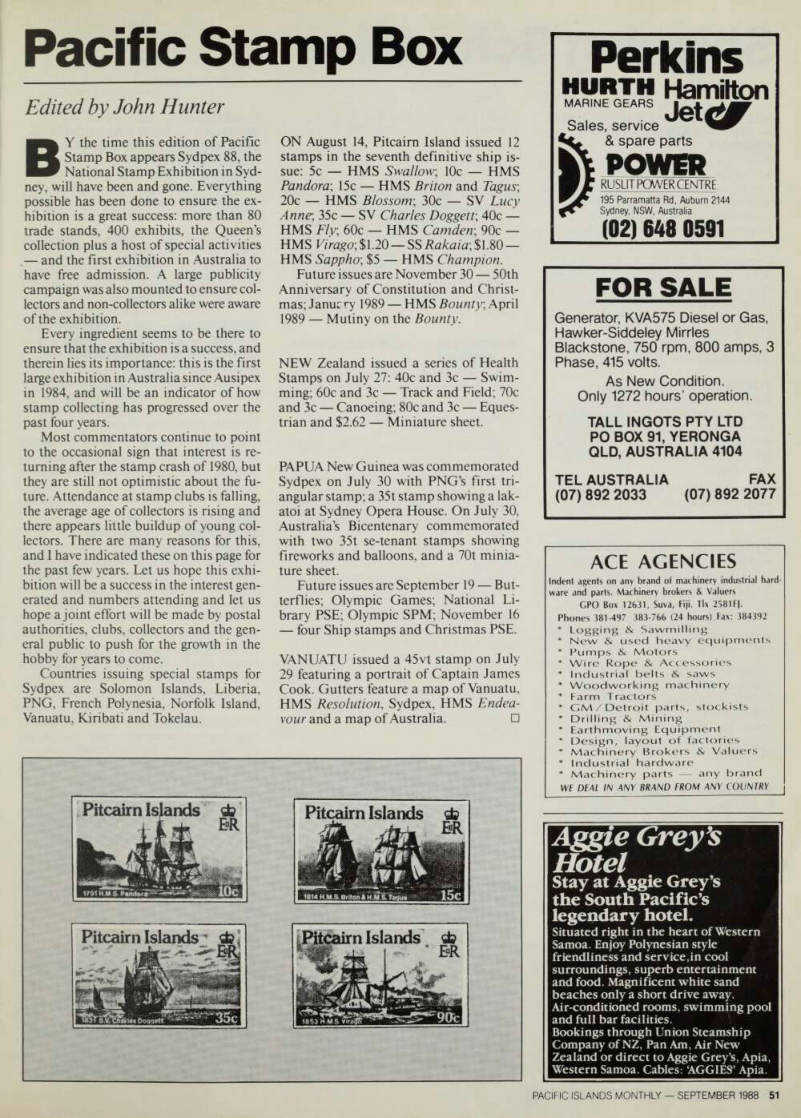
Edited by John Hunter
BY the time this edition of Pacific Stamp Box appears Sydpex 88, the National Stamp Exhibition in Syd ney, will have been and gone. Everything possible has been done to ensure the ex hibition is a great success: more than 80 trade stands, 400 exhibits, the Queen’s collection plus a host of special activities and the first exhibition in Australia to have free admission. A large publicity campaign was also mounted to ensure col lectors and non-collectors alike were aware of the exhibition.
Every ingredient seems to be there to ensure that the exhibition is a success, and therein lies its importance: this is the first large exhibition in Australia since Ausipex in 1984, and will be an indicator of how stamp collecting has progressed over the past four years.
Most commentators continue to point to the occasional sign that interest is re turning after the stamp crash of 1980, but they are still not optimistic about the fu ture. Attendance at stamp clubs is falling, the average age of collectors is rising and there appears little buildup of young col lectors. There are many reasons for this, and I have indicated these on this page for the past few years. Let us hope this exhi bition will be a success in the interest gen erated and numbers attending and let us hope a joint effort will be made by postal authorities, clubs, collectors and the gen eral public to push for the growth in the hobby for years to come.
Countries issuing special stamps for Sydpex are Solomon Islands, Liberia, PNG, French Polynesia, Norfolk Island, Vanuatu, Kiribati and Tokelau.
ON August 14, Pitcairn Island issued 12 stamps in the seventh definitive ship is sue: 5c HMS Swallow, 10c HMS Pandora, 15c HMS Briton and Tagus-, 20c HMS Blossom ; 30c SV Lucy Anne-, 35c SV Charles DoggetV, 40c HMS Fly, 60c HMS Camden-, 90c HMS Virago-, $1.20 SS Rakaia\ $l.BO HMS Sappho, $5 HMS Champion.
Future issues are November 30 50th Anniversary of Constitution and Christ mas; Janucry 1989 HMS Bounty, April 1989 Mutiny on the Bounty.
NEW Zealand issued a series of Health Stamps on July 27: 40c and 3c Swim ming; 60c and 3c Track and Field; 70c and 3c Canoeing; 80c and 3c Eques trian and $2.62 Miniature sheet.
PAPUA New Guinea was commemorated Sydpex on July 30 with PNG’s first tri angular stamp; a 35t stamp showing a lak atoi at Sydney Opera House. On July 30, Australia’s Bicentenary commemorated with two 35t se-tenant stamps showing fireworks and balloons, and a 70t minia ture sheet.
Future issues are September 19 But terflies; Olympic Games; National Li brary PSE; Olympic SPM; November 16 four Ship stamps and Christmas PSE.
VANUATU issued a 45vt stamp on July 29 featuring a portrait of Captain James Cook. Gutters feature a map of Vanuatu, HMS Resolution, Sydpex, HMS Endea vour and a map of Australia. □
Advertisements & other items, p. 51 (1 item)
Perkins
hurth Hamilton
MARINE GEARS I i ,^SSS
Sales, service & spare parts
POWER
RUSLIT POWER CENTRE
195 Parramatta Rd, Auburn 2144 Sydney, NSW, Australia (02) 648 0591
FOR SALE
Generator, KVAS7S Diesel or Gas, Hawker-Siddeley Mirrles Blackstone, 750 rpm, 800 amps, 3 Phase, 415 volts.
As New Condition.
Only 1272 hours’ operation.
TALL INGOTS PTY LTD
PO BOX 91, YERONGA
OLD, AUSTRALIA 4104
TEL AUSTRALIA FAX
(07) 892 2033 (07) 892 2077
ACE AGENCIES
Indent agents on any brand of machinery industrial hard ware and parts. Machinery brokers & Valuers CPO Box 12631, Suva, Fiji. Tlx 2581 F).
Phones 381-497 383-766 (24 hours), Fax: 384392 * Logging & Sawmilling * New & used heavy equipments * Pumps & Motors * Wire Rope & Accessories * Industrial belts & saws * Woodworking machinery * Farm Tractors * CM/Detroit parts, stockists * Drilling & Mining * Earthmoving Equipment * Design, layout of factories * Machinery Brokers & Valuers * Industrial hardware * Machinery parts any brand WE DEAL IN ANY BRAND FROM ANY COUNTRY
Aggie Grey’s
Hotel
Stay at Aggie Grey’s
the South Pacific’s
legendary hotel.
Situated right in the heart of Western Samoa. Enjoy Polynesian style friendliness and service,in cool surroundings, superb entertainment and food. Magnificent white sand beaches only a short drive away.
Air-conditioned rooms, swimming pool and full bar facilities.
Bookings through Union Steamship Company of NZ, Pan Am, Air New Zealand or direct to Aggie Grey’s, Apia, Western Samoa. Cables: ‘AGGIES’ Apia.
Shipping Schedules
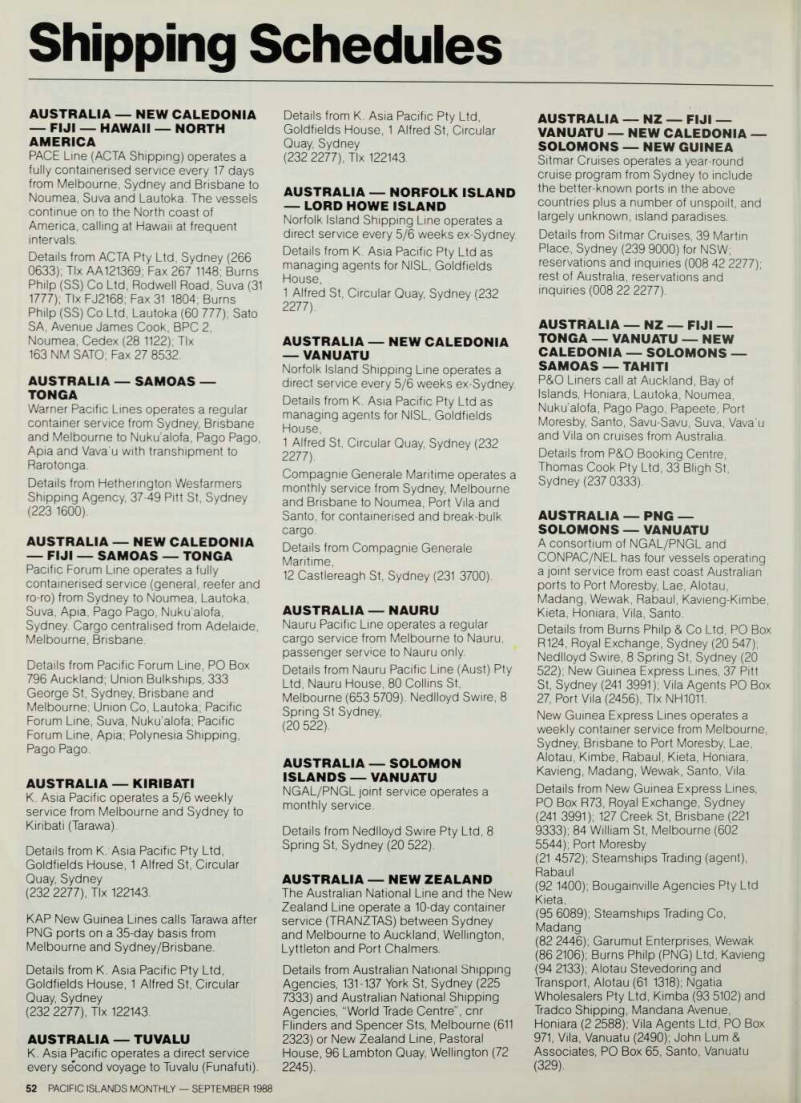
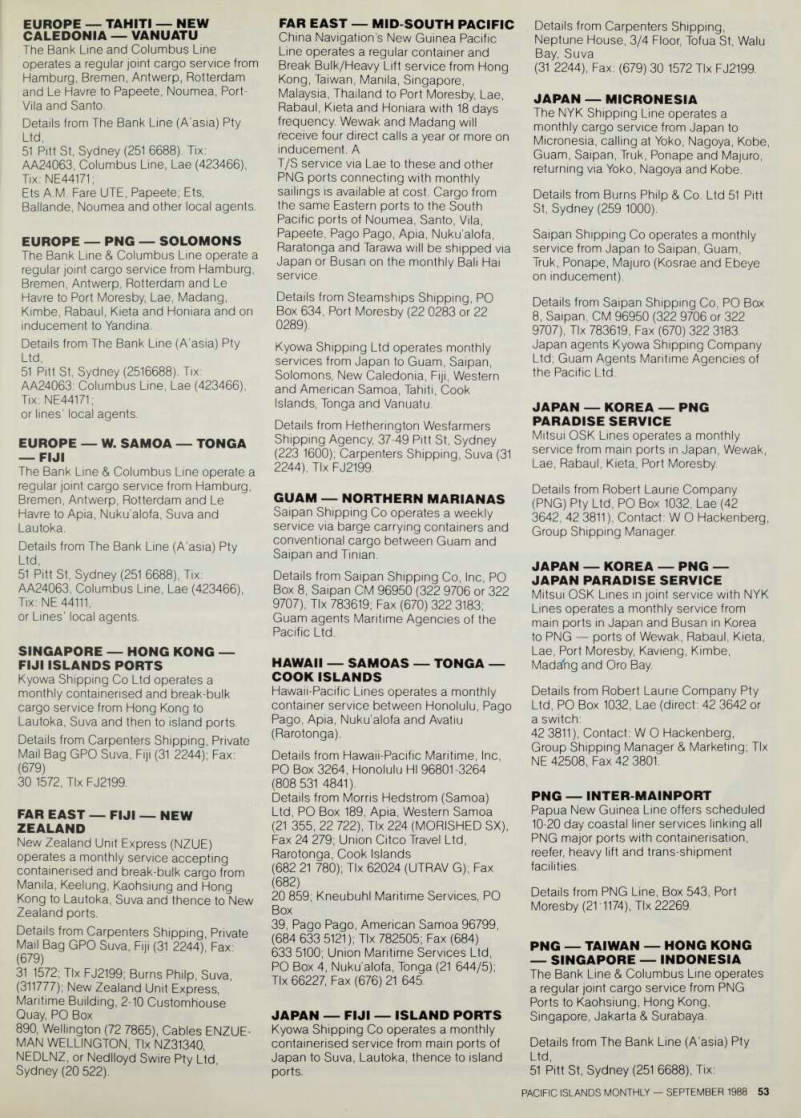
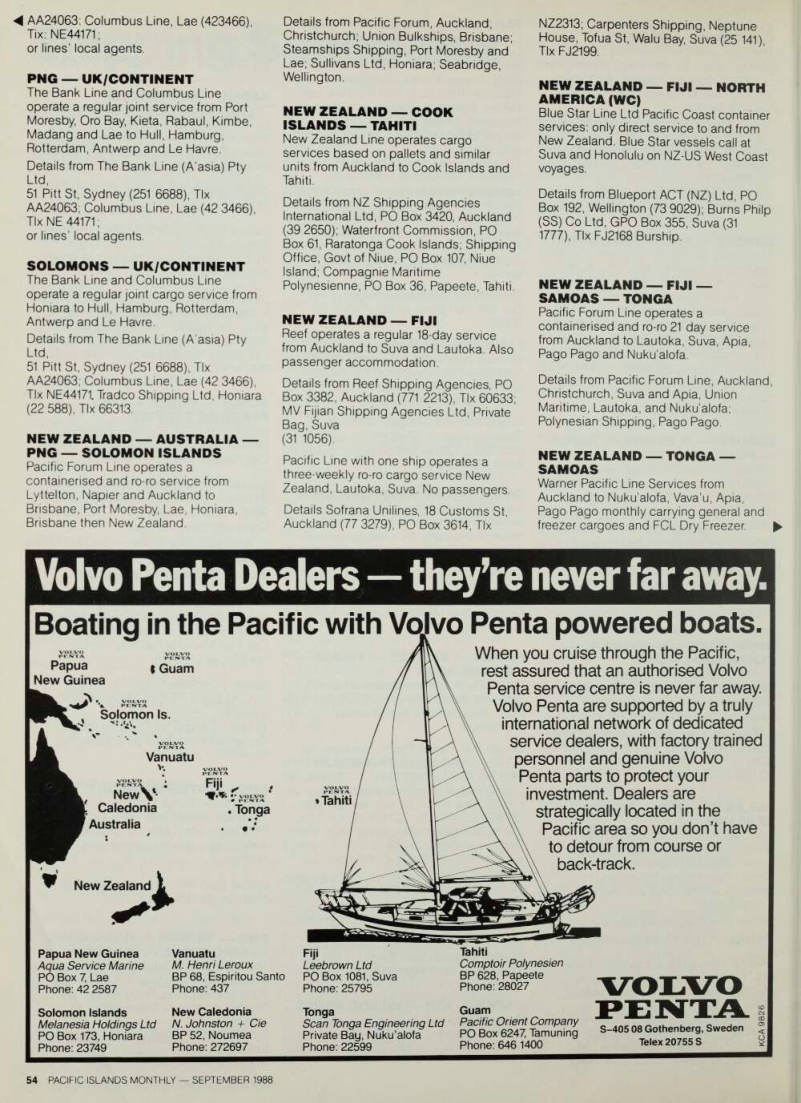
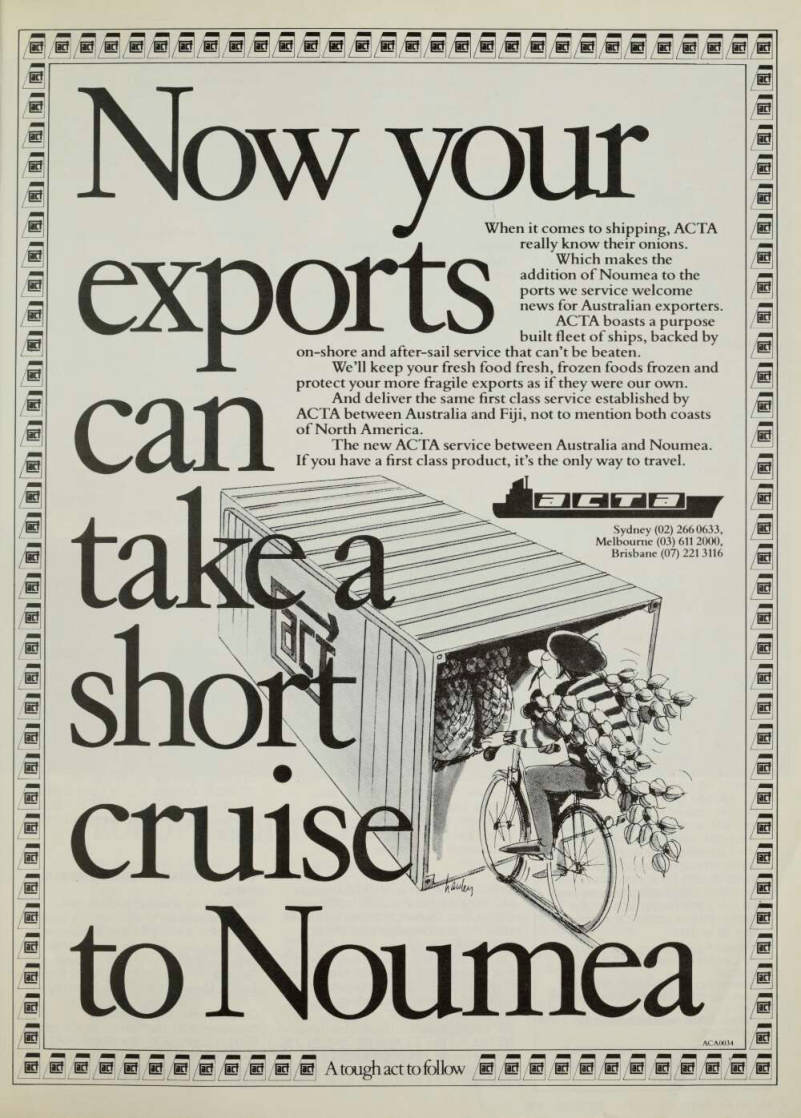
Australia New Caledonia
Fiji Hawaii North
America
PACE Line (ACTA Shipping) operates a fully containerised service every 17 days from Melbourne, Sydney and Brisbane to Noumea, Suva and Lautoka. The vessels continue on to the North coast of America, calling at Hawaii at frequent intervals.
Details from ACTA Pty Ltd, Sydney (266 0633); Tlx AA121369; Fax 267 1148; Burns Philp (SS) Co Ltd, Rodwell Road, Suva (31 1777); Tlx FJ2168; Fax 31 1804; Burns Philp (SS) Co Ltd, Lautoka (60 777); Sato SA, Avenue James Cook, BPC 2, Noumea, Cedex (28 1122); Tlx
163 Nm Sato; Fax 27 8532.
Australia Samoas
Tonga
Warner Pacific Lines operates a regular container service from Sydney, Brisbane and Melbourne to Nukualofa, Pago Pago, Apia and Vava’u with transhipment to Rarotonga.
Details from Hetherington Wesfarmers Shipping Agency, 37-49 Pitt St, Sydney (223 1600).
Australia New Caledonia
Fiji Samoas Tonga
Pacific Forum Line operates a fully containerised service (general, reefer and ro-ro) from Sydney to Noumea, Lautoka, Suva, Apia, Pago Pago, Nukualofa, Sydney. Cargo centralised from Adelaide, Melbourne, Brisbane.
Details from Pacific Forum Line, PO Box 796 Auckland; Union Bulkships, 333 George St, Sydney, Brisbane and Melbourne; Union Co, Lautoka; Pacific Forum Line, Suva, Nukualofa; Pacific Forum Line, Apia; Polynesia Shipping, Pago Pago.
Australia Kiribati
K. Asia Pacific operates a 5/6 weekly service from Melbourne and Sydney to Kiribati (Tarawa).
Details from K. Asia Pacific Pty Ltd, Goldfields House, 1 Alfred St, Circular Quay, Sydney (232 2277), Tlx 122143.
KAP New Guinea Lines calls Tarawa after PNG ports on a 35-day basis from Melbourne and Sydney/Brisbane.
Details from K. Asia Pacific Pty Ltd, Goldfields House, 1 Alfred St, Circular Quay, Sydney (232 2277), Tlx 122143.
Australia Tuvalu
K. Asia Pacific operates a direct service every second voyage to Tuvalu (Funafuti).
Details from K. Asia Pacific Pty Ltd, Goldfields House, 1 Alfred St, Circular Quay, Sydney (232 2277), Tlx 122143.
Australia Norfolk Island
Lord Howe Island
Norfolk Island Shipping Line operates a direct service every 5/6 weeks ex-Sydney.
Details from K. Asia Pacific Pty Ltd as managing agents for NISL, Goldfields House, 1 Alfred St, Circular Quay, Sydney (232 2277).
Australia New Caledonia
Vanuatu
Norfolk Island Shipping Line operates a direct service every 5/6 weeks ex-Sydney.
Details from K. Asia Pacific Pty Ltd as managing agents for NISL, Goldfields House, 1 Alfred St, Circular Quay, Sydney (232 2277).
Compagnie Generale Maritime operates a monthly service from Sydney, Melbourne and Brisbane to Noumea, Port Vila and Santo, for containerised and break-bulk cargo.
Details from Compagnie Generale Maritime, 12 Castlereagh St, Sydney (231 3700).
Australia —Nauru
Nauru Pacific Line operates a regular cargo service from Melbourne to Nauru, passenger service to Nauru only.
Details from Nauru Pacific Line (Aust) Pty Ltd, Nauru House, 80 Collins St, Melbourne (653 5709). Nedlloyd Swire, 8 Spring St Sydney, (20 522).
Australia Solomon
Islands Vanuatu
NGAL/PNGL joint service operates a monthly service.
Details from Nedlloyd Swire Pty Ltd, 8 Spring St, Sydney (20 522).
Australia New Zealand
The Australian National Line and the New Zealand Line operate a 10-day container service (TRANZTAS) between Sydney and Melbourne to Auckland, Wellington, Lyttleton and Port Chalmers.
Details from Australian National Shipping Agencies, 131-137 York St, Sydney (225 7333) and Australian National Shipping Agencies, “World Trade Centre”, cnr Flinders and Spencer Sts, Melbourne (611 2323) or New Zealand Line, Pastoral House, 96 Lambton Quay, Wellington (72 2245).
Australia Nz Fiji
Vanuatu New Caledonia
Solomons New Guinea
Sitmar Cruises operates a year-round cruise program from Sydney to include the better-known ports in the above countries plus a number of unspoilt, and largely unknown, island paradises.
Details from Sitmar Cruises, 39 Martin Place, Sydney (239 9000) for NSW: reservations and inquiries (008 42 2277): rest of Australia, reservations and inquiries (008 22 2277).
Australia Nz Fiji
Tonga Vanuatu New
Caledonia Solomons
Samoas Tahiti
P&O Liners call at Auckland, Bay of Islands, Honiara, Lautoka, Noumea, Nukualofa, Pago Pago, Papeete, Port Moresby, Santo, Savu-Savu, Suva, Vava'u and Vila on cruises from Australia.
Details from P&O Booking Centre, Thomas Cook Pty Ltd, 33 Bligh St, Sydney (237 0333).
Australia —Png
Solomons Vanuatu
A consortium of NGAL/PNGL and CONPAC/NEL has four vessels operating a joint service from east coast Australian ports to Port Moresby, Lae, Alotau, Madang, Wewak, Rabaul, Kavieng-Kimbe, Kieta, Honiara, Vila, Santo.
Details from Burns Philp & Co Ltd, PO Box R 124, Royal Exchange, Sydney (20 547); Nedlloyd Swire, 8 Spring St, Sydney (20 522); New Guinea Express Lines, 37 Pitt St, Sydney (241 3991); Vila Agents PO Box 27, Port Vila (2456), Tlx NHIOII.
New Guinea Express Lines operates a weekly container service from Melbourne, Sydney, Brisbane to Port Moresby, Lae, Alotau, Kimbe, Rabaul, Kieta, Honiara, Kavieng, Madang, Wewak, Santo, Vila.
Details from New Guinea Express Lines, PO Box R 73, Royal Exchange, Sydney (241 3991); 127 Creek St, Brisbane (221 9333); 84 William St, Melbourne (602 5544); Port Moresby (21 4572); Steamships Trading (agent), Rabaul (92 1400); Bougainville Agencies Pty Ltd Kieta, (95 6089); Steamships Trading Co, Madang (82 2446); Garumut Enterprises, Wewak (86 2106); Burns Philp (PNG) Ltd, Kavieng (94 2133); Alotau Stevedoring and Transport, Alotau (61 1318); Ngatia Wholesalers Pty Ltd, Kimba (93 5102) and Tradco Shipping, Mandana Avenue, Honiara (2 2588); Vila Agents Ltd, PO Box 971, Vila, Vanuatu (2490); John Lum & Associates, PO Box 65, Santo, Vanuatu (329).
Europe Tahiti New
Caledonia Vanuatu
The Bank Line and Columbus Line operates a regular joint cargo service from Hamburg, Bremen, Antwerp, Rotterdam and Le Havre to Papeete, Noumea, Port- Vila and Santo.
Details from The Bank Line (A’asia) Pty Ltd, 51 Pitt St, Sydney (251 6688). Tix: AA24063, Columbus Line, Lae (423466), Tix: NE44171; Ets A M. Fare UTE, Papeete; Ets, Ballande, Noumea and other local agents.
Europe Png Solomons
The Bank Line & Columbus Line operate a regular joint cargo service from Hamburg, Bremen, Antwerp, Rotterdam and Le Havre to Port Moresby, Lae, Madang, Kimbe, Rabaul, Kieta and Honiara and on inducement to Yandina.
Details from The Bank Line (A’asia) Pty Ltd, 51 Pitt St, Sydney (2516688). Tix: AA24063: Columbus Line, Lae (423466), Tix: NE44171; or lines’ local agents.
Europe W. Samoa Tonga
Fiji
The Bank Line & Columbus Line operate a regular joint cargo service from Hamburg, Bremen, Antwerp, Rotterdam and Le Havre to Apia, Nuku’alofa, Suva and Lautoka.
Details from The Bank Line (A’asia) Pty Ltd, 51 Pitt St, Sydney (251 6688), Tix: AA24063, Columbus Line, Lae (423466), Tix: NE 44111, or Lines’ local agents.
Singapore Hong Kong
Fiji Islands Ports
Kyowa Shipping Co Ltd operates a monthly containerised and break-bulk cargo service from Hong Kong to Lautoka, Suva and then to island ports.
Details from Carpenters Shipping, Private Mail Bag GPO Suva, Fiji (31 2244); Fax: (679) 30 1572, Tlx FJ2199.
Far East Fiji New
Zealand
New Zealand Unit Express (NZUE) operates a monthly service accepting containerised and break-bulk cargo from Manila, Keelung, Kaohsiung and Hong Kong to Lautoka, Suva and thence to New Zealand ports.
Details from Carpenters Shipping, Private Mail Bag GPO Suva, Fiji (31 2244), Fax (679) 31 1572; Tlx FJ2199; Burns Philp, Suva, (311777); New Zealand Unit Express, Maritime Building, 2-10 Customhouse Quay, PO Box 890, Wellington (72 7865), Cables ENZUE
Man Wellington, Tlx Nz31340,
NEDLNZ, or Nedlloyd Swire Pty Ltd Sydney (20 522).
Far East Mid-South Pacific
China Navigation’s New Guinea Pacific Line operates a regular container and Break Bulk/Heavy Lift service from Hong Kong, Taiwan, Manila, Singapore, Malaysia, Thailand to Port Moresby, Lae, Rabaul, Kieta and Honiara with 18 days frequency. Wewak and Madang will receive four direct calls a year or more on inducement. A T/S service via Lae to these and other PNG ports connecting with monthly sailings is available at cost. Cargo from the same Eastern ports to the South Pacific ports of Noumea, Santo, Vila, Papeete, Pago Pago, Apia, Nukualofa, Raratonga and Tarawa will be shipped via Japan or Busan on the monthly Bali Hai service.
Details from Steamships Shipping, PO Box 634, Port Moresby (22 0283 or 22 0289).
Kyowa Shipping Ltd operates monthly services from Japan to Guam, Saipan, Solomons, New Caledonia, Fiji, Western and American Samoa, Tahiti, Cook Islands, Tonga and Vanuatu.
Details from Hetherington Wesfarmers Shipping Agency, 37-49 Pitt St, Sydney (223 1600); Carpenters Shipping, Suva (31 2244), Tlx FJ2199.
Guam Northern Marianas
Saipan Shipping Co operates a weekly service via barge carrying containers and conventional cargo between Guam and Saipan and Tinian.
Details from Saipan Shipping Co, Inc, PO Box 8, Saipan CM 96950 (322 9706 or 322 9707), Tlx 783619; Fax (670) 322 3183; Guam agents Maritime Agencies of the Pacific Ltd.
Hawaii Samoas Tonga
Cook Islands
Hawaii-Pacific Lines operates a monthly container service between Honolulu, Pago Pago, Apia, Nukualofa and Avatiu (Rarotonga).
Details from Hawaii-Pacific Maritime, Inc, PO Box 3264, Honolulu HI 96801-3264 (808 531 4841).
Details from Morris Hedstrom (Samoa) Ltd, PO Box 189, Apia, Western Samoa (21 355, 22 722), Tlx 224 (MORISHED SX), Fax 24 279; Union Citco Travel Ltd, Rarotonga, Cook Islands (682 21 780); Tlx 62024 (UTRAV G); Fax (682) 20 859; Kneubuhl Maritime Services, PO Box 39, Pago Pago, American Samoa 96799, (684 633 5121); Tlx 782505; Fax (684) 633 5100; Union Maritime Services Ltd, PO Box 4, Nuku’alofa, Tonga (21 644/5); Tlx 66227, Fax (676) 21 645.
Japan Fiji Island Ports
Kyowa Shipping Co operates a monthly containerised service from main ports of Japan to Suva, Lautoka, thence to island ports.
Details from Carpenters Shipping, Neptune House, 3/4 Floor, Tofua St, Walu Bay, Suva (31 2244), Fax: (679) 30 1572 Tlx FJ2199.
Japan Micronesia
The NYK Shipping Line operates a monthly cargo service from Japan to Micronesia, calling at Yoko, Nagoya, Kobe, Guam, Saipan, Truk, Ponape and Majuro, returning via Yoko, Nagoya and Kobe.
Details from Burns Philp & Co. Ltd 51 Pitt St, Sydney (259 1000).
Saipan Shipping Co operates a monthly service from Japan to Saipan, Guam, Truk, Ponape, Majuro (Kosrae and Ebeye on inducement).
Details from Saipan Shipping Co, PC Box 8, Saipan, CM 96950 (322 9706 or 322 9707), Tlx 783619, Fax (670) 322 3183.
Japan agents Kyowa Shipping Company Ltd; Guam Agents Maritime Agencies of the Pacific Ltd.
Japan Korea Png
Paradise Service
Mitsui OSK Lines operates a monthly service from main ports in Japan, Wewak, Lae, Rabaul, Kieta, Port Moresby.
Details from Robert Laurie Company (PNG) Pty Ltd, PC Box 1032, Lae (42 3642, 42 3811), Contact; W O Hackenberg, Group Shipping Manager.
Japan Korea Png
Japan Paradise Service
Mitsui OSK Lines in joint service with NYK Lines operates a monthly service from main ports in Japan and Busan in Korea to PNG ports of Wewak, Rabaul, Kieta, Lae, Port Moresby, Kavieng, Kimbe, Mada'ng and Oro Bay.
Details from Robert Laurie Company Pty Ltd, PO Box 1032, Lae (direct: 42 3642 or a switch: 42 3811), Contact: W O Hackenberg, Group Shipping Manager & Marketing: Tlx NE 42508, Fax 42 3801.
Png Inter-Mainport
Papua New Guinea Line offers scheduled 10-20 day coastal liner services linking all PNG major ports with containerisation, reefer, heavy lift and trans-shipment facilities.
Details from PNG Line, Box 543, Port Moresby (21 1174), Tlx 22269.
Png Taiwan Hong Kong
Singapore Indonesia
The Bank Line & Columbus Line operates a regular joint cargo service from PNG Ports to Kaohsiung, Hong Kong, Singapore, Jakarta & Surabaya.
Details from The Bank Line (A’asia) Pty Ltd, 51 Pitt St, Sydney (251 6688), Tix:
<4 AA24063; Columbus Line, Lae (423466), Tix: NE44171; or lines’ local agents.
Png Uk/Continent
The Bank Line and Columbus Line operate a regular joint service from Port Moresby, Oro Bay, Kieta, Rabaul, Kimbe, Madang and Lae to Hull, Hamburg, Rotterdam, Antwerp and Le Havre.
Details from The Bank Line (A’asia) Pty Ltd, 51 Pitt St, Sydney (251 6688), Tlx AA24063; Columbus Line, Lae (42 3466), Tlx NE 44171; or lines’ local agents.
Solomons Uk/Continent
The Bank Line and Columbus Line operate a regular joint cargo service from Honiara to Hull, Hamburg, Rotterdam, Antwerp and Le Havre.
Details from The Bank Line (A’asia) Pty Ltd, 51 Pitt St, Sydney (251 6688), Tlx AA24063; Columbus Line, Lae (42 3466), Tlx NE44171. Tradco Shipping Ltd, Honiara (22 588), Tlx 66313.
New Zealand Australia
Png Solomon Islands
Pacific Forum Line operates a containerised and ro-ro service from Lyttelton, Napier and Auckland to Brisbane, Port Moresby, Lae, Honiara, Brisbane then New Zealand.
Details from Pacific Forum, Auckland, Christchurch: Union Bulkships, Brisbane; Steamships Shipping, Port Moresby and Lae; Sullivans Ltd, Honiara; Seabridge, Wellington.
New Zealand Cook
Islands Tahiti
New Zealand Line operates cargo services based on pallets and similar units from Auckland to Cook Islands and Tahiti.
Details from NZ Shipping Agencies International Ltd, PC Box 3420, Auckland (39 2650); Waterfront Commission, PC Box 61, Raratonga Cook Islands; Shipping Office, Govt of Niue, PO Box 107, Niue Island: Compagnie Maritime Polynesienne, PO Box 36, Papeete, Tahiti.
New Zealand —Fiji
Reef operates a regular 18-day service from Auckland to Suva and Lautoka. Also passenger accommodation.
Details from Reef Shipping Agencies, PO Box 3382, Auckland (771 2213), Tlx 60633; MV Fijian Shipping Agencies Ltd, Private Bag, Suva (31 1056).
Pacific Line with one ship operates a three-weekly ro-ro cargo service New Zealand, Lautoka, Suva. No passengers.
Details Sofrana Unilines, 18 Customs St, Auckland (77 3279), PO Box 3614, Tlx
NZ2313; Carpenters Shipping, Neptune House, Tofua St, Walu Bay, Suva (25 141) Tlx FJ2199.
New Zealand Fiji North
America (Wc)
Blue Star Line Ltd Pacific Coast container services; only direct service to and from New Zealand. Blue Star vessels call at Suva and Honolulu on NZ-US West Coast voyages.
Details from Blueport ACT (NZ) Ltd, PC Box 192, Wellington (73 9029); Burns Philp (SS) Co Ltd, GPO Box 355, Suva (31 1777), Tlx FJ2168 Burship.
New Zealand Fiji
Samoas Tonga
Pacific Forum Line operates a containerised and ro-ro 21 day service from Auckland to Lautoka, Suva, Apia, Pago Pago and Nukualofa.
Details from Pacific Forum Line, Auckland, Christchurch, Suva and Apia, Union Maritime, Lautoka, and Nukualofa; Polynesian Shipping, Pago Pago.
New Zealand Tonga
Samoas
Warner Pacific Line Services from Auckland to Nukualofa, Vava'u, Apia, Pago Pago monthly carrying general and freezer cargoes and FCL Dry Freezer.
A Details from McKay Shipping Ltd, 2nd Floor, Ferry Bldg, Quay St., Auckland PO Box 3 (39 0229). Cables MACSHIP, Tlx NZ2554f; Warner Pacific Line, Box 93, Nukualofa, Tonga; Mealelel (Western Samoa) Ltd, Private Bag Apia, Western Samoa; Burns Philp (SS) Co Ltd, PO Box 129, Pago Pago, American Samoa (633 2709), Cables 506, Burnsouth SB.
Nz Cook Islands
Aitutaki Niue
Cook Islands Line services Auckland, Rarotonga, Aitutaki, Niue monthly carrying general and freezer cargoes.
Details from McKay Shipping Ltd, 2nd Floor, Ferry Bldg, Quay St., Auckland/ PO Box 3, Auckland (39 0229). Cables
Macship, Tlx Nz2554; Fax 32 931.
South East Asia Fiji
Nedlloyd Lines (NZEAS) Service operates regular fast cargo service from Surabaya, Jakarta, Port Kelang, Bangkok and Singapore via New Zealand to Suva and Lautoka. Details from Carpenters Shipping, Neptune House, 3/4 Floor, Tofua St, Walu Bay, Suva. (31 2244) Fax: (679) 30 1572 Tlx: FJ2199
Tahiti New Caledonia
Vanuatu Solomon Islands
New Zealand Png
Singapore Europe
Polish Ocean Lines operates semi container type vessels to the following ports: from Papeete, Noumea, Santo, Vila, Yandina, Honiara, Auckland, Singapore, Port Kielang, Penang then to Mediterranean ports and Europe via the Suez Canal (other New Zealand ports subject to inducement).
Details from Universal Shipping Agencies Ltd, 7th Floor, 14 Emily PI., Auckland 1 (39 0931, 39 0727, 32 104), Tlx 21 517.
Taiwan Hong Kong
Singapore Indonesia
Png
The Bank Line & Columbus Line operate a regular joint cargo service from Kaohsiung, Hong Kong, Singapore, Jakarta, Surabaya to Papua New Guinea Ports.
Details from The Bank Line (A’asia) Pty Ltd, 51 Pitt St, Sydney (251 6688), Tlx: AA24063: Columbus Line, Lae (423466); Tlx: NE44171; or lines’ local agents.
Europe Tahiti New
Caledonia
Compagnie Generale Maritime operates services from Europe and Mediterranean ports to Papeete and Noumea using three ro-ro and multi-purpose vessels thus ensuring a bi-monthly sailing to and from.
Details from Compagnie Generale Maritime, 12 Castlereagh St, Sydney (2313700).
Europe Tahiti New
Caledonia New Zealand
Vanuatu Solomons Png
Europe
Polish Ocean Lines offers regular monthly sailings for containerised and break-bulk cargo, also conventional reefer space and reefer containers from Hamburg, Rotterdam, Dunkirk, Le Havre to Papeete, Noumea, Auckland, Santo, Honiara, Rabaul, Lae, Singapore, returning to Europe via Suez. Other ports in the South Pacific can be served directly with inducement or otherwise via trans shipment.
Details from Sotama, BP 9170, Papeete (42 7805), Tlx Sotama 373FP; SATO: BP, C 2 Noumea Cedex (27 2094), Tlx 163 NM; Universal Shipping Agencies, PO Box 2282 Auckland (30 930), Tlx 21517; Vanua Navigation, PO Box 44, Vila (2027), Tlx 1033; Melan Chine Shipping Co, PO Box 71, Honiara (21 678), Tlx 66335; Steamships Trading Co Ltd, PO Box 85, Lae (42 4666), Tlx 42423; Union Steamship Co NZ Ltd, PO Box 50. Apia (21 781), Tlx 225; Warner Pacific Line, PO Box 93, Nukualofa (22 088), Tlx 66219; Fiji Agents
Tba.
Europe Tahiti W Samoa
Fiji New Caledonia
Nedlloyd offers regular cargo services from Continental ports to Papeete, Apia, Fiji and New Caledonia.
Details Nedlloyd (Aust) Pty Ltd, Spring St, Sydney (27 3801); Carpenters Shipping, Ist Floor, Harbour Centre Bldg, 100 Thomson St, Suva (31 2244) Tlx 2199FJ and Vetari St, Lautoka (63 988), tlx 5215FJ.
Uk W Samoa Tonga
Fiji
The Bank Line and Columbus Line operate a regular joint cargo service from Hull, to Apia, Nukualofa, Suva and Lautoka.
Details from The Bank Line (A’asia) Pty Ltd, 51 Pitt St, Sydney (251 6688), Tlx: AA24063, Columbus Line, Lae (42 3466), Tlx NE 44111 or Line's local agents.
Uk Png Solomons
The Bank Line and Columbus Line operate a regular joint cargo service from Hull, to Port Moresby, Lae, Madang, Kimbe, Rabaul, Kieta and Honiara and on inducement to Yandina.
Details from The Bank Line (A'asia) Pty Ltd, 51 Pitt St, Sydney (251 6688), Tlx AA24063; Columbus Line, Lae (42 3466), Tlx: NE44171; or Line’s local agents.
Uk Tahiti New Caledonia
Vanuatu
The Bank Line and Columbus Line operate a regular joint cargo service from Hull, to Papeete, Noumea, Port-Vila and Santo.
Details from The Bank Line (A’asia) Pty Ltd, 51 Pitt St, Sydney (251 6688), Tlx AA24063, Columbus Line, Lae (42 3466), Tlx NE44171; Ets A.M. Fare DTE, Papeete; Ets Ballande, Noumea and other local agents.
Us Hawaii Micronesia
Png
PM&O Lines operates two fully self contained container vessels on a sailing frequency of every 30 days between the San Francisco Bay Area, Los Angeles, Honolulu and Majuro, Ebeye, Kosrae, Ponape, Truk, Saipan, Yap, Palau, Cebu, Davao, Manila, Lae, Kieta and Rabaul.
Details from PM&O Lines, 353 Sacramento St, San Francisco, California 94111 (415 421 5400), Tlx 278016 PMC UR; owner’s Representative PC Box 803, Saipan, NMI 96950 (234 6819), Tlx 783605
Cmcaa.
Advertisements & other items, pp. 54-57 (1 item)
Volvo Renta Dealers —they're never far away.
Boating in the Pacific with Volvo Renta powered boats. 1 Papua
iNew Guinea
VOLVO
Pi: IVTA
I Guam . Solomon Is. ,* t v Vanuatu v.
PF.NTA m
New\ v
Caledonia Australia F 'ji
• • VOLVO
* PENTA
. Tonga New Zealand i • Tahiti Papua New Guinea Aqua Service Marine PO Box 7, Lae Phone: 42 2587 Solomon Islands Melanesia Holdings Ltd PO Box 173, Honiara Phone: 23749 Vanuatu M. Henri Leroux BP 68, Espiritou Santo Phone: 437 New Caledonia N. Johnston + Cie BP 52, Noumea Phone: 272697
When you cruise through the Pacific,
rest assured that an authorised Volvo
Renta service centre is never far away.
Volvo Renta are supported by a truly
international network of dedicated
service dealers, with factory trained
personnel and genuine Volvo
Renta parts to protect your
investment. Dealers are
strategically located in the
Pacific area so you don’t have
to detour from course or
back-track.
Fiji Leebrown Ltd PO Box 1081, Suva Phone: 25795 Tonga Scan Tonga Engineering Ltd Private Bay, Nuku’alofa Phone: 22599 Tahiti Comptoir Polynesien BP 628, Papeete Phone:2Bo27 Guam Pacific Orient Company PO Box 6247, Tamuning Phone: 646 1400 S-405 08 Gothenberg, Sweden Telex 20755 S
Q m m s jm I a 5 E| a E E H 3 E E E
can
When it comes to shipping, ACTA really know their onions.
Which makes the addition of Noumea to the ports we service welcome news for Australian exporters.
ACTA boasts a purpose built fleet of ships, backed by on-shore and after-sail service that can’t be beaten.
We’ll keep your fresh food fresh, frozen foods frozen and protect your more fragile exports as if they were our own.
And deliver the same first class service established by ACTA between Australia and Fiji, not to mention both coasts of North America.
The new ACTA service between Australia and Noumea.
If you have a first class product, it’s the only way to travel.
Sydney (02) 2660633, Melbourne (03) 611 2000, Brisbane (07) 2213116 t r*
cruis
to Noum
M E jm /m E m E i? (0? w m M m jm If Bm? m? Hi? HI? H? Hi? @-B ®® A tough act to follow /B /S| /Hi? Hi? /Hi? ii? /5| /5| Hi? /W yS| /E|
Pacific Economic
Bulletin
volume 3 Number 1 is now published n
Have you taken out your
subscription?
The Bulletin monitors the economies of the South Pacific countries with a survey of current economic trends.
In this issue Macroeconomic policies under adverse conditions: the case of Fiji in 1987 are discussed by S. Siwatibau, the Governor of the Reserve Bank of Fiji. Other articles deal with expenditure and consumption patterns in Papua New Guinea, The Australian Joint Venture Scheme, management in developing Pacific island inshore fishery resources, Australian aid for education, Japanese aid policy and foreign and private investments. A statistical annex is kept up to date.
Available from Bibliotech, ANUTECH Pty Ltd, CPO Box 4, Canberra. ACT 2601 Australia.
Subscription: As2o Australia, US$l5 all other countries (1988. Volume 5, Numbers 1 and 2) Charges can be made to Bankcard or Mastercard.
Published by the National Centre for Development Studies, the Australian National University.
YOUR DIRECT EUROPEAN CONNECTION
a*
EUROPE-SOUTH PAaFIC JOINT SERVICE
The South Pacific Specialists offer facilities for shipment of: Containers (FCL/LCL) and Breakbulk Cargo plus reefer space and deeptanks for carriage of vegetable oils and other liquid bulk cargo.
Carriers also accept heavy lifts, overlength and cumbersome parcels.
D Ports of Service: Loading: Papeete, Apia, Suva, Lautoka, Noumea, Port Vila, Santo, Honiara, Port Moresby, Lae,Madang, Kimbe, Rabaul, Kieta, Darwin.
For: Rotterdam, Antwerp, Hamburg, Hull, Dunkirk, Le Havre.
Please contact our regional offices for further information: The Bank Line (Australasia) Pty. Ltd.
Suite 701, 51 Pitt Street Sydney N.S.W. 2000 Phone: 251 6688 Telex: 24063
ROUND THE WORLD SERVICE
Additional ports on enquiry.
P.O. Box 1667 Lae/Papua New Guinea Phone: 42 3466/42 3287 42 2481 Telex: Colline NE 44 171
THE BANK LINE LTD LONDON
COLUMBUS LINE REEDEREI GMBH HAMBURG
C0L0024
Afloat On A Sea Of Words
Out Of The Past
James Murray chronicles the great writers who were inspired by Oceania.
IF THE Pacific were ink and its myriad islands desks, it could not have at tracted more writers of a higher calibre than it hss for more than a century.
Moreover, the indigenous cultures of the Pacific are eloquent of the inspiration of its seascapes and landscapes: even your postcard writer seems to rise to greater heights than wish-you-were-here as a re sult of visiting islands that seem not so much to rise as to blossom from the ocean.
Among the authors who have derived inspiration from Pacific vistas, perhaps the greatest is Herman Melville (1819-1891).
For all the grandeur of his creative vision, Melville was born in New York City, and seemed destined for the kind of business career that enables so many of today’s Americans to enjoy Pacific cruises. The depression of 1837 changed his life, how ever, destroying the viability of his and his brother’s business.
In 1839, Melville sailed as a seaman in a ship bound for Liverpool. The voyage was no luxury cruise, but it did provide him with enough material for his first novel, Redburn. After a spell of teaching, Melville decided in 1841 that seafaring was preferable and took a berth aboard the whaling ship Acushnet out of Fairhaven, Massachussetts. After rounding the Horn, Acushnet cruised for six months in the Pa cific, stopping briefly at the Galapagos Is lands to capture sea turtles.
In 1842, Acushnet anchored at Nuku hiva in the Marquesas Islands: a landfall that may be said to have been the true making of Melville the writer. He jumped ship with a mate, Tobias Greene, because they could no longer endure the hardships of life aboard a whaler.
At first it must have seemed to Melville that they had jumped from the frying pan into the fire literally in this case, for they were captured by a cannibal tribe, the Ty pees. They were well, indeed idyllically, treated, yet they still feared the reputation of their hosts and left on the whaling ship Lucy Ann, an Australian vessel.
The immediate results of this experi ence were Typee, subtitled A Peep at Po lynesian Life (published 1846) and Omoo, subtitled A Narrative of Adventures in the South Seas (1847). Melville’s voyage aboard the Lucy Ann was to lead indi rectly to White Jacket: because of a sit down strike on board (it was an Australian vessel, after all) Melville was jailed in par adise otherwise known as Tahiti for several months. After his release he toured neighbouring islands, signed on another whaler and left the ship in Hawaii.
Melville’s seafaring also provided him
with the material for what is generally con sidered his greatest work, Moby Dick (1851). His saga of Captain Ahab and his pursuit of the Great White Whale, how ever, was not initially well received by the critics, and Melville must occasionally have considered the reputedly cannibal Typees preferable to the critics: after the publication of a succession of books, he gave up trying to live by his writing.
Robert Louis Stevenson (1850-1894) was a contemporary of Melville, though they did not meet. Where Melville sought transient adventure on Pacific Islands, Stevenson sought a home where he could stave off the effects of tuberculosis and did so at least to the extent of dying from a cerebral haemorrhage and not TB.
Stevenson studied engineering and law in his birthplace of Edinburgh, His best known work, Treasure Island, owes noth ing of its marvellous evocation of voyage and landfall to his experiences in the Pa cific, for it was published in 1883 and it was not until 1888 that Stevenson, his wife Fanny and stepson Lloyd Osborne sailed for the South Seas from San Francisco.
He was to spend the rest of his life in the South Seas. On his first voyage he vis ited the Marquesas, Tahiti and Hawaii. In 1890 he set off for Samoa and established himself at Vailima, where he was to be come known as Tusitala (Teller of Tales).
Stevenson is buried at Vailima and on his headstone is carved the epitaph he wrote for himself. It ends with the words: “. .. home is the hunter, Home from the hill, And the sailor home from the sea.”
It is an epitaph that also fits Jack Lon don (1876-1916), a writer whose real-life adventuring was the matrix for his fiction.
The Call of the Wild, White Fang and The Sea Wolf may be London’s best known works, but it is his travel book, The Cruise of the Snark, that celebrates the Pacific is lands: indeed, the inspiration for the cruise itself was Melville’s Typee.
Despite everything including a lub berly crew London’s creative energy was such that he wrote a steady 1000 words a day on his autobiographical novel, Martin Eden, after the Snark left San Francisco for the Pacific. After 27 such days, London saw something that compensated him for all his travail: the summit of Haleakala, towering out of the ocean.
The following day, the Snark rounded Diamond Head and sailed into Honolulu; the launch from the Hawaiian Yacht Club that came out to meet London carried newspapers with reports that his vessel had foundered with all hands.
He sailed from Hawaii for the Marque sas, fetching Nukuhiva after 60 days with out sighting another sail or smoke.
In Nukuhiva London rented the very house in which Robert Louis Stevenson had lived, and explored the areas where Melville had stayed.
After 12 days in the Marquesas London sailed for Hawaii, where once again he learned that the Snark had been sunk. Ob viously this was untrue, but his credit had been wrecked: he sailed to America on the Mariposa to reassure his creditors, did so, returned on the Mariposa and continued his cruise on the Snark to Tahiti, Bora Bora and on to Suva in Fiji.
From Fiji he cruised the Solomons, where he lived on a copra plantation “as near the edge of screaming savagery as any place to be found on this earth.”
His one novel to come out of this period was Adventure , set on a copra plantation.
It is not his best work. The Cruise of the Snark, plus about 30 short stories such as The House of Mapuhi, The Heathen and The Leper are, however, notable in the London canon.
There are those, notably Irving Stone in his classic Sailor on Horseback, who suggests that the cruise was no more than an unprofitable investment in material for writing. Despite this, London did sell the serial rights to Pacific Monthly for $7OOO a price any contemporary writer would be happy to receive but by 1909 Lon don had had enough. He arranged for the Snark to be sailed to Sydney. There it was auctioned, and was then used for black birding in the Solomon Islands.
Of modern writers, James Albert Michener, born 1907 in New York and still writing strongly, has done as much to cel ebrate the Pacific islands with a single work as any writer. The work was, of course, Tales of the South Pacific 1947): the basis for the Rodgers and Hammerstein musi cal, South Pacific. Ever since, Bali Hai has epitomised the magic of the islands.
Indeed, so strong is that island magic that it inspires the notion that William Shakespeare must somehow have had an account of them; for surely Prospero’s is land in The Tempest is Pacific in character.
As Caliban, who can have his counter part in raucous camera-toting tourists, said: “The isle is full of noises/sounds and sweet airs give delight and hurt not.”
To which Sebastian replied: “I think he will carry this island home in his pocket, and give it to his son for an apple.”
Antonio: “And, sowing the kernels of it in the sea, bring forth more islands.” □
Advertisements & other items, pp. 59-60 (1 item)
clarion
You could invite the Bremen animal band to join you on your travels, or simply slip a Clarion Car Stereo into your dashboard. Either way you get the finest stereo sound in a moving automobile. Of course, Clarion alone offers you advanced electronic features, a wide variety of models and unwavering reliability. And all with little or no food or water. So there's really no contest, is there? With Clarion, you'll drive happily ever after.
THE TRAVELLING BAND
A*
CO CARTRIDGE
- BASS +
► VOL/bal OFADER CLEAR PROG
ruNER/COMPACT DISC PLA
ver CDC7OOO
u i n n n ,~
1 U U.U on Och\
MAMU
CAIS PEL SYNTHESIZER TUNER/WBjTAL lOt
oOii
EB LEVEL INDIC4IUH BIGHT
SAM VF STEREO
PSS BAND ••T.MODE*
■■■ Mmm mmamam 9bhbb| hhhhi hh ■■■ 1 E 3 14 % B "A For further information Australia: Amalgamated Wireless (Australasia) Ltd., 112-118, Talavera Road, North Ryde NS W. 2113 / New Zealand: AWA New Zealand Limited, P.O. Box 50-248, Porirua / Fiji Islands: Brijlal & Co., Ltd., G.P.O. Box 362, Suva Tahiti: HI FI , VAIRAATOA. Avenue Chef Vairaatoa BP 1128, Papeete / New Caledonia: Caldis, B.PMI, Noumea Cedex / Guam: Micropac Audio Inc., P.O. Box 3478, Agana, Guam 96910, U.S.A. Tel: 472-8091, Cable Code: HIFI AUDIO AGANA / Vanuatu: The Sound Centre, P.O. Box 434, Vila I Cook Islands: South Seas International Ltd., P.O. Box 49, Rarotonga / Papua New Guinea: Hagemeyer (PN G.) Pty Ltd, P.O Box 1428, Boroko, Port Moresby.
Challenges Rewarded
Developing a new trend-setting car is a constant set of challenges faced on the drawing board, in the laboratory and, finally, on the test course.
For Mitsubishi Motors these challenges were embodied in a high-speed research vehicle, the Galant HSR. This prototype recorded cruising speeds in excess of 320km/h with exceptional stability and response, By incorporating state-of-the-art technologies in what was essentially an ordinary four-cylinder coupe, the HSR made everyday high-speed driving a reality.
But the HSR was designed to test these advanced technologies as they may be applied in a distinctive passenger vehicle.
Meeting this challenge resulted in the new Mitsubishi Galant—the reward of precise engineering and a gently organic design of warmth and emotion. An individualistic sedan that was voted Japanese Car of th Year only two months after its release.
Ultimately however, the final reward b longs to you.
Introducing the new Dtm £*■ qP &
MITSUBISHI QHLHNT
Precision in Action Mitsubishi Motors is now offering a free 36-page PR magazine featuring interesting articles and exciting photos. If interested, write to: P.l. Advertising, International Business Planning Department. Office of International Business, Mitsubishi Motors Corporation, 33-8, Shiba 5-chome, Minato-ku, Tokyo 108, Japan.
A
MITSUBISHI
MOTORS
AMERICAN SAMOA: MORRIS SCANLAN SERVICE INC. PO. Box 367, Pago Pago, Tel 633-5520/AUSTRALIA: MITSUBISHI MOTORS AUSTRALIA LTD. Box 1284, South Road. Clovelly Park, South Australia 5042, Tel (08) 275-7223/FIJI: NIVIS MOTOR & MACHINERY CO., LTD. GPO Box 150, Suva, Tel 383411 /FRENCH POLYNESIA (TAHITI): ETS-BREDIN FRERES ET FILS PO Box 21, Papeete, Tahiti, Tel 4-202-58/NEW CALEDONIA: SOCIETE D IMPORTATION D AUTO DU PACIFIQUE SUD S.A.
B P 438 Rond Point du Pacifique, Noumea, Tel 274144/NEW ZEALAND: MITSUBISHI MOTORS NEW ZEALAND LTD. Todd Park. Heriot Drive, Private Bag, Porirua, Tel 370-109/NORFOLK ISLAND: BORRYS LTD. P.O. Box 169, Norfolk Island, Tel. 2114/PAPUA NEW GUINEA: TOBA PTY. LTD. PO. Box 503. Port Moresby, Tel 21-7874/ SOLOMON ISLANDS: HARVEST PACIFIC LTD. G.PO Box 88. Honiara, Guadalcanal, Tel 30128/TONGA: SITANI MAFI CO., LTD. PO Box 83, Nuku ALOFA, Tel. 21-044/ VANUATU: SOCOMETRA BP 06 Routede Lagon, Port-Vila, Tel 2314/WESTERN SAMOA: AM. MACDONALD HOLDINGS LTD. PO Box 576, Apia, Tel 22022/SAIPAN/ POHNPE.I/MAJURO/KOSRAE/TRUK/YAP/BELAU: MICRONESIAN MOTORS, INC. 997 South Marine Drive. Tamuning. Guam 96911. Tel 646-6827