Pacific
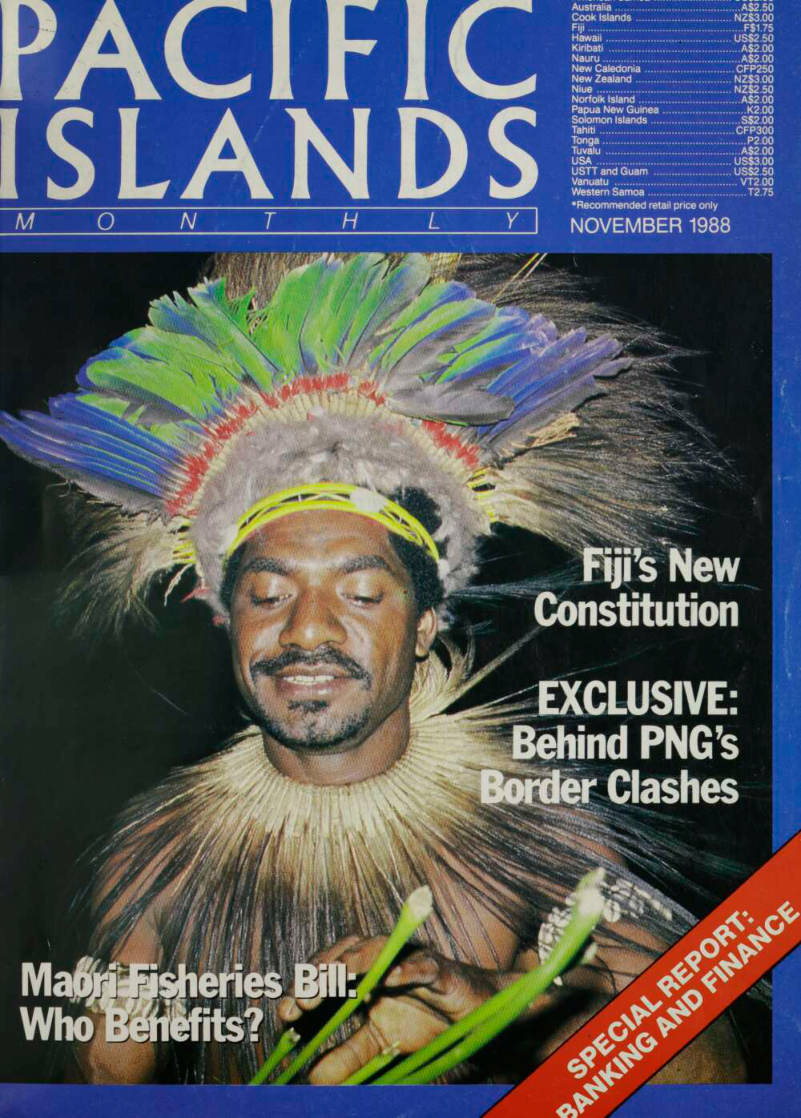
Islands
Monthly
Australia A 52.50 Cook Islands NZ$3.OO Fiji F 51.75 Hawaii US$2.5O Kiribati A 52.00 Nauru A 52.00 New Caledonia CFP2SO New Zealand NZ$3.OO Niue NZ$2.5O Norfolk Island A 52.00 Papua New Guinea K 2.00 Solomon Islands 552.00 Tahiti CFP3OO Tonga ; P 2.00 Tuvalu A 52,00
Usa Us$3.Oo
USTT and Guam US$2.5O Vanuatu VT2.00 Western Samoa T 2.75 * Recommended retail price only
November 1988
Fiji’s New Constitution
Png’S
Border Clashes
t
Advertisements & other items, pp. 2-6 (1 item)
A symphony on wheels
Our search for the
ultimate in rear wheel
control technology
makes every Mazda
driver a maestro.
Truly great music gives you a feeling of freedom and of joy. At Mazda, we believe this is also the feeling you should get from driving a truly great car; a car like the new Mazda 626.
Its unique suspension geometry is tuned with the precision of a Stradivarius. And the results are sensational. High speed lane changes become smooth legato passages.
Cornering loses its histrionic swerving. All that remains is extraoi dinary control.
What’s behind it all.
The reason is that Mazda has been concentrating on developing rear wheel suspension systems that actually help steer the car. It starteo with the award winning TTL suspension found on the 323 and the original 626.
I
The search for the ultimate ontinued with the development of 4-Wheel Steering system. What we earned in that search was applied to he development of our award /inning DTS System for the RX-7 nd the E-Link suspension for the 29. This continuous process of efinement has come full circle again o the new 626, and applied to its suspension. We’ve completely recalculated its suspension geometry to deliver a feeling of control that’s clearly superior and absolutely exhilarating.
Keeping on our toes.
It’s Mazda’s unique dedication to engineering the ultimate in rear wheel toe control and suspension technology that has resulted in such enjoyable driving in the Mazda 626.
And in fact, in all Mazda vehicles.
But don’t take our word for it.
Take one out for a drive, and become a maestro of the road.
New Mazda 626 Models and features shown may not be available in your area. Please consult your local Mazda dealer. This warranty is valid only in Australia.
Your kind of car. © Mazda Motor Corporation
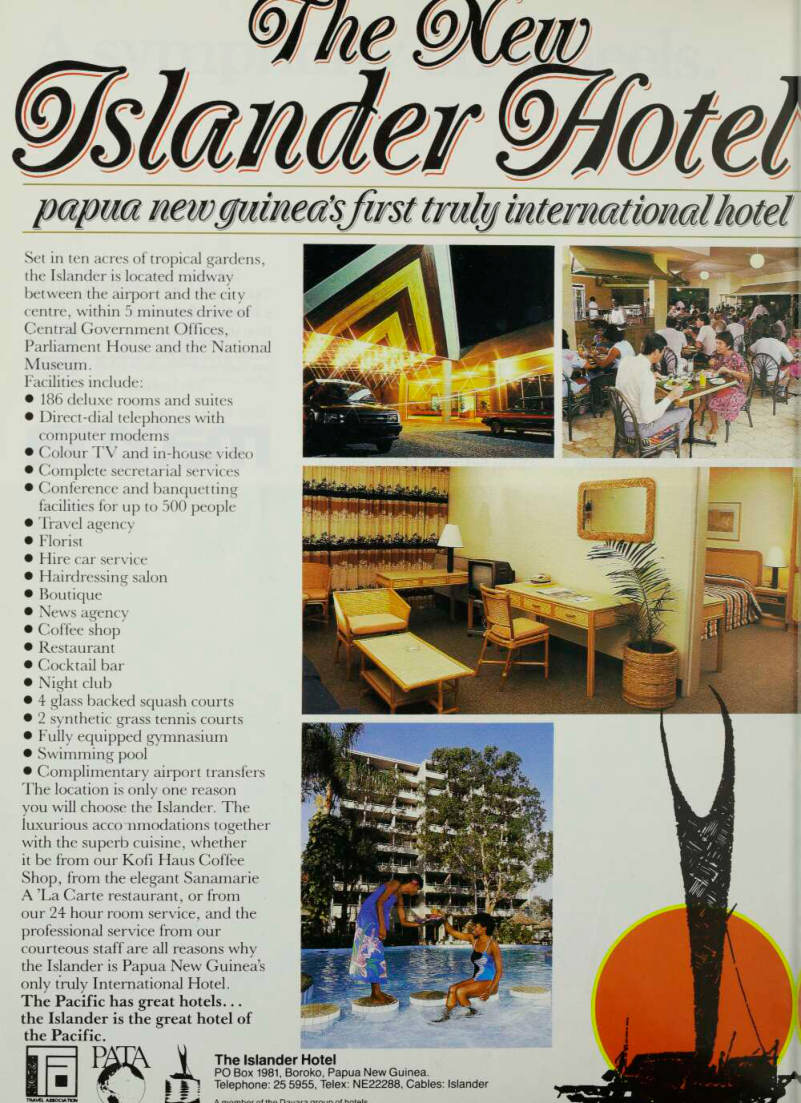
* r r % 3 Set in ten acres of tropical gardens, the Islander is located midway between the airport and the city centre, within 5 minutes drive of Central Government Offices, Parliament House and the National Museum.
Facilities include: • 186 deluxe rooms and suites • Direct-dial telephones with computer modems • Colour TV and in-house video Complete secretarial services Conference and banquetting facilities for up to 500 people Travel agency Florist Hire car service • Hairdressing salon
• Boutique
• News agency
Coffee shop
Restaurant Cocktail bar
Night club
4 glass backed squash courts 2 synthetic grass tennis courts
Fully equipped gymnasium
Swimming pool
Complimentary airport transfers
The location is only one reason you will choose the Islander. The luxurious accommodations together with the superb cuisine, whether it be from our Kofi Haus Coffee Shop, from the elegant Sanamarie A ’La Carte restaurant, or from our 24 hour room service, and the professional service from our courteous staff are all reasons why the Islander is Papua New Guinea’s
only truly International Hotel.
The Pacific has great hotels... the Islander is the great hotel of the Pacific. m B The Islander Hotel PO Box 1981, Boroko, Telephone: 25 5955, mAmkar r\i fKo H^i/nro * > Papua New Cables Telex NE22288 Guinea Islander
dm v sWvwt jJr&Jfr *V vV % >
9S3K * Cv’W
Wsssk
l!>^ s^i
aßssß@|>
«xp&^*s?’
wsw>
v v v > ifcjsr,:. fivfc V V -•- •* - » * • * ■ , . f^| " t t' V -V?
V V v V %Br<4f
vtvt %'%^4^
r -*V &■**& * t -, %JpK S i%P -. fpi v ?|P p* t W** v fjp v PP * \ J ■ l^* "Vs?* \ wl& ■
CSC
y V ’Vs<" m 1m <$ '# > m, ’ 4 *&&:4 s I ■ s* 5 * s ,■<» * ; // l» * =s % «? % ■ «* <# ** M ‘ - % % #■*" «* j « ■* - > *** ® * •a** *% ■« „ ■# - jg» ♦ * '4ss ♦., % /A £* 'g*- Qt ft- “> %*yj %* \> % %_ At % .$ x ®*-4 A A %* % . •• V > % %* )j %*> %= - % a, % a,♦ #% ,-s%* ;a% >4%A
JlMOmteKs)
*, -J A -I m ".* m ~*Sr
Pacific
Islands
Monthly
Vol 59 No 11
Voice Of The Pacific
November, ’BB
Cover Story i 6
Fiji’s interim government is faced with the difficulties of ‘selling’ a revised constitution that, critics argue, does little to safeguard the interests of all Fijians ... and at the same time ensuring its acceptance in the knowledge that rejection could see the reinstatement of a military government. That course would spell economic hardship: but how is Fiji to enshrine ethnic Fijian supremacy within a democracy? Fiji Times editor Vijendra Kumar looks at Fiji’s draft constitution.
Cover Photograph: Matthew Mckee/Sydney Freelance
Irian Java/Png Border Dispute Worsens 9
An exclusive report on skirmishes that could become a full-scale war NATIONAL POLL COULD RESOLVE PALAU'S COMPACT DEADLOCK 10 How the US elections could provide a long-awaited solution VICTORY OR APARTHEID? NZ DIVIDED OVER FISHING LAW 12 Maori activists claim a win, but some Kiwis fear for their livelihoods SOPE BACK IN PARLIAMENT . . . BUT FOR HOW LONG? 14 The rebel MP has returned, but Uni’s Vanua’aku Pati is unconcerned WHY PNG'S DEFENCE FORCE CAN'T FIGHT 15 Well trained but poorly equipped, could it handle conflict?
POWER TO THE PEOPLE THE PEOPLE OF KANAKY 18 A controversial new Him has caused a stir in Paris and Noumea HOT AND COLD IN ISLANDS ELECTIONS 21 Some of the USA’s most exciting and dullest polls held this month FUNAFUTI CELEBRATES A DECADE OF SELF-DETERMINATION 22 7 uvaluans gather to acknowledge 10 years of progress SPECIAL REPORT: FINANCE, BANKING AND INSURANCE 24 High costs, poor returns mean the region’s money markets are slow to grow COUNTRY HOSPITALITY WELCOMES CANADIANS TO FIJI 30 A world away from Suva, tradition holds sway in Nasau village PEACE TODAY, BUT A LEGACY OF WAR 32 New Georgia Island remembers its battlefield history "HASSLE-FREE" INVESTMENT A PRIORITY FOR RECOVERY 35 Fiji looks to the region for industry and investors
Rapanui: A Century With Chile 43
Easter Island has little reason to celebrate its centenary
Pacific People: Tonga's Cul
Tured Crown Prince 48
Heir to the throne Tupouto’a brings a touch of style to Nukualofa
Where The Written Word
Reigns 49
In the still of the tropical night, Tongans read and write
Deputy Editor Carson Creagh Art Director Samantha Foster Editorial Adviser John Carter Contributors Robin Bromby David Haden John Hunter Stuart Inder Vijendra Kumar Rex Matthews Grant McCall Diana McManus David S North Ed Rampelt Phyllis Reeve David Robie Nicolas Rothwell Frank Senge
Publisher and Managing Editor Geoffrey Hussey
Advertising Sales Sydney & Melbourne Warren Grey (02) 288 3521 Fergus Maclagan (02) 412 3918; Brisbane Robert Walker (07) 3710533 Adelaide - Hastwelt Williamson Representations (08)799522
Cover pnces are recommended retart only Registered toy Australia Post, pubfcation No NBPI2tO Copyright Frj» Times l imited Suva Fiji
Advertisements & other items, p. 5 (2 items)
Departments
OPINION 7
PACIFIC REPORT 36
ISLAND PRESS 38
TRADE WINDS 40
TROPICALITIES 46
TRANSITION 50
STAMPS 51
BOOK REVIEWS 52
SHIPPING 53
OUT OF THE PAST 58
5
PACIFIC ISLANDS MONTHLY NOVEMBER 1988
A Fiji Times Limited Production.
Founded 1930 (USPS 952480} 20 Gor- NBP 1210) is published monthly by Fiji N©Ws t c HOn ot, burry nIHS, NoW £Uiv«
FI C L AN^S
A Force For Peace
Opinion
A worried world could play its part containing PNG’s
deadly border dispute.
AUSTRALIA’S new Foreign Affairs Minister, Senator Gareth Evans, has won delighted support in the region for his recent extended tours of the South Pacific. Though his predecessor Bill Hayden (now Governor-General) was the vehicle of a long-overdue rapprochement be tween Canberra and the region’s states, his interests were clearly more metropolitan and he was an easy target for Australia’s Opposition for his alleged ‘neglect’ of the country’s Pacific neighbours.
And it is in that context that the Government, in its willingness to be a friend at all, has tripped over its own feet. While Australia donates massive amounts of aid, provides significant foreign exchange through trade and tourism, and cultivates a resources-purchasing relationship with the Republic of Indonesia, it is at the same time attempting to assure Pacific neighbours in particular Papua New Guinea of its unshakeable commitment to
their sovereignty.
At the same time as it offers military aid to PNG and rattles its somewhat blunt sabre in the direction of Indonesia’s military aggressiveness, the Au stralian Government fails to take realistic steps to counter the violence, border incursions and apparently racist-based arrogance that has seen Te PNG/Irian Jaya border become as hazardous to its residents as Viet n’s bloody Demilitarised Zone was in the 1960 s and 19705. It seems more important that Australia can purchase Indonesia’s oil and that Australians can continue to holiday in Bali than it is to be an effective brother to Papua New Guinea.
PNG’s outmoded, undersupplied and poorly equipped Defence Forces, though unquestionably well trained, highly motivated and competent, cannot mount an effective deterrent to Indonesia’s ceaseless violations of the Irian Jaya border, supposedly in search of OPM ‘bandits’. In the best Boy’s Own tradition of the heroic last stand, PNG’s soldiers are facing numerically superior forces that are better supplied, better armed and without compunc tion; no prizes for guessing which force has the higher number of ‘victories’ to its credit. As senior correspondent Frank Senge points out on Page 9, PNG’s uncomfortable relationship with its populous neighbour has deterio rated into what some observers fear is a desperate attempt to halt provoca tion designed to provide a casus belli for land- and resource-hungry In donesia.
There is no doubt that the PNGDF, in anything remotely resembling an equal contest, could give a good account of itself. Its soldiers are hardened by constant training in country that more than any Allied effort was re sponsible for the defeat of Imperial Japan’s confident, battle-experienced troops. But with obsolete weapons (and without the cash to upgrade im mediately), outdated transport (a numerical imbalance in helicopters, for example, of hundreds to one) and the certain knowledge that Australia would dither for as long as possible before throwing its own undermanned forces into the fray in support, PNG has had to resort to ineffectual interna tional forums such as the United Nations to protest the wanton killing of civilians, the deliberate violation of surveyed borders, and a series of ‘raids’ that have as their unstated aim the brutalisation of the civilian population on which the Free Papua Movement depends for its existence.
Liberal supporters of the OPM may coyly refer to ‘West Papua’ and dream of a day of liberation for that scarred territory; but Indonesia has already shown itself more than willing to ignore world opinion.
One possible solution is an adaptation of the proposal first voiced by Sir Julius Chan, repeated by former Defence Minister James Pokasui and re cently endorsed by Foreign Minister Michael Somare.
Instead of an unwieldy and limited PNG involvement in UN peacekeeping missions, or indeed in a proposed Pacific peacekeeping force, there is an obvious role for a UN-sponsored Pacific peacekeeping force (including a hefty PNGDF element) in supervising the troubled border. Indonesia may well listen a little more closely to an international force . . . which could also have as part of its duties the control of border incursions into Irian Jaya from Papua New Guinea. Such an action would remove, or at least render open to public scrutiny, the central justification for a hidden war that has seen many hundreds of innocent villagers killed, wounded or terrorised. □
Advertisements & other items, p. 7 (1 item)
Pacific
SLANDS
IVfONT H L Y 1
FIJI: Distribution, subscriptions and advertising: Fiji Times Limited, GPO Box 1167, Suva, Fiji Phone 31-4111, telex FJ2124 FRENCH POLYNESIA: Distribution: Hachette Pacifique 10 Ave Bruat, Papeete Phone 25-610 HAWAII: UNITED STATES: Distribution: PIM Hawaii, PO Box 22250, Honolulu, Hawaii, 96822 Advertising: Brian C Asgill, Apt 1308, 1676 Ala Moana Blvd , Honolulu Hawaii, 96815 Phone (808) 955-9718 JAPAN: Advertising and subscriptions: Universal Media Corporation, GPO Box 46, Tokyo Phone 666-3036, cable UNIMEDIA Tokyo, telex 2524665 MALAYSIA Advertising and subscriptions: Worldwide Media Services, 57 B Komplex Damai, Jin Dato Haji Eusoff, Kuala Lumpur Phone 63-9340, cables WORLDMEDIA Kuala Lumpur, telex 31533 VANUATU: Distribution; The Vanuatu Stationery and Book Centre, PO Box 557 Port Vila Advertising: Nor man Bros Bookshop Port Vila Phone 2232 NEW CALEDONIA: Distribution: Depot Centre de Presse Michel Pentecost CBP2, Noumea Phone 27 2434, 27-4729 NEW ZEALAND: Distribution: Gordon & Gotch, PO Box 584, 2 Carr Road, Mt Roskill, Auckland 4 Advertising: McKay International Media Reps Ltd, C/- Albany PO, Auckland 10, New Zealand Phone 413-9119 Telex NZ22701, FAX 413-9110 WELLINGTON: Ross Quaid Media, 1 Scholes Lane Petone (04) 68-7593, PO Box 38699, Petone PAPUA NEW GUINEA: Distribution: Gordon & Gotch, PO Box 3395, Port Moresby Phone 25-4551 25-4855 Advertising: Robert Walker, PO Box 600, Indooroopilly, Old Australia 4068 Phone (07) 371-0533 SOLOMON ISLANDS: Distribution and Advertising: The Bookshop, (Norman Bros ) PO Box 503, Honiara PHILIPPINES: Advertising: The GF Group, 12 San Ignacio St, Uroaneta Village, Makati, Metro Manila Phone 817 7299, telex 45950 and 4233 UNITED KINGDOM: F A Smyth and Associates, 23A Aylmer Parade, London N2OPO, England Phone (01 )340 5088, fax (01)341 9602 UNITED STATES MAINLAND: Advertising; Joshua B Powers Jr, Powers International Inc , Suite 708, 271 Madison Ave . New York, NY 10016 Phone 867-9680, Subscriptions PIM, Hawaii, PO Box 22250, Honolulu Hawaii, 96822
SUBSCRIPTIONS
American Samoa US$45 Australia AUSS3O Canada US$45 Cook Islands AUSS46 Fiji F $24 French Polynesia US$45 Guam US$45 Hawaii US$45 Japan US$3B Kiribati AUSS46 Micronesia US$35 Nauru AUSS42 New Caledonia US$32 New Zealand AUSS42 Niue AUSS46 Norfolk Island AUSS42 Northern Marianas US$36 Papua New Guinea AUSS42 Solomon Islands AUSS46 Tonga AUSS46 Tuvalu AUSS46 United Kingdom Stg£2B US (Mainland) US$45 Vanuatu AUSS42 Western Samoa AUSS6O Elsewhere AUSS63 Payments to Pacific Islands Monthly Subscriptions Dept, GPO Box 1167, Suva, Fiji Subscriptions rates includes the cost of airspeeding to all destinations set out above Direct airmail rates on application.
The Place of Culture
The West has to learn what the Pacific already knows about the ‘real stuff of
life.
PEOPLE of the Pacific know far better than the inheritors of European traditions how much their culture is themselves how it tells them who they are, where they fit into nature and the world. Western society has its stars of musical cul ture, both classical and rock, but it would not put a comparable effort into sharing the enjoyment of ordinary people of their own life as is regularly mounted in islands communities.
There is a danger, of course, that dances per formed as entertainment for tourists even arts that require periodic festivals to maintain them will become remote from the societies that developed them and no longer symbolise those societies. A dan ger only; it hasn’t happened yet in Fiji, for example.
The tourist taking comfort in the blunt sticks (rather than sharp axes) wielded by dancers would be mis taken to think these are not warrior people.
This was one subject under discussion at the re cent conference on Pacific literature at the Common wealth Institute in London (see Pacific Report), where participants looked at the interaction of writ ing and politics and noted the “link between political
upheavals and literary output”.
A healthy culture has to inform those in politics of what the values of the people really are: a healthy political regime is one where the values of the people are known and respected, even revered, and where politicians are engaged in enabling the fullest possi ble expression and enjoyment of those values.
Politics is how we make society and culture work. It is ‘the art of the possible’, a phrase hidden behind all too often by the politician seeking to tell people they cannot have what they want. The reason they cannot, say the politicians, is that they cannot afford it: the bottom line is money, and there is never enough of it.
The economic dimension is the basis of the whole social structure the sustaining dimension of life.
The trouble for too many in the West, however, is that money dominates rather than supports life.
The Western mind sees culture as an option, an extra; a form of relaxation from the ‘real stuff of life which is acquisition and control. The people of the Pacific has not yet lost the joy of celebrating who they are. It’s fine to dance or to write a book to let others see something of what you treasure, but it is real life to dance for yourself or write for the people you write about, so they can see themselves and learn to guard their treasures.
The people of the Pacific can hold for the world the true place of culture; to articulate and enhance the values the community’s economic effort should sustain; and that its political effort should enable. □
Advertisements & other items, p. 8 (1 item)
Ml Sea Digest
PI The South
THE PRIVATE NEWSLETTER
ON PACIFIC ISLANDS AFFAIRS
EVERY OTHER FRIDAY
SUBSCRIBE NOW
See coupon insert between pages 54-55.
FORUM SECRETARIAT
(formerly South Pacific Bureau for
Economic Cooperation [SPEC]
Applications are invited from citizens of member countries for the following positions within the FORUM SECRETARIAT (formerly the South Pacific Bureau for Economic Co-operation);
CHIEF ECONOMIST
The Nineteenth South Pacific Forum held recently in Tonga gave priority to the continued development of a strong and effective Economic Services Division within the Secretariat to assist Pacific island member countries of the Forum to improve their capabilities in economic analysis and planning A crucial step in this initiative will be the establishment of a new position of Chief Economist to assume responsibility for directing the activities of the expanded Division which, it is envisaged, will eventually comprise a team of five economists.
This is an exciting opportunity for an experienced, senior economist to make a substantial contribution to the economic development of the Pacific region.
Applicants should possess a sound, working knowledge of the economies of Pacific Island countries, including an appreciation of the problems of both the subsistence and monetised sectors. They should also possess advanced academic qualifications in economics or a related field, as well as proven abilities to work under pressure, to set priorities among a wide range of options and to manage staff effectively. Familiarity with donor government and agency procedures would be an advantage.
MANAGER REGIONAL PETROLEUM UNIT
The Regional Petroleum Unit [RPUJ is being createo under tne auspices of the Secretariat to provide specialist assistance to its member governments to improve existing petroleum supply and pricing arrangements on and on-going basis. The RPU will assist in ensuring that the costs of supply and marketing operations, in and between number countries, are minimised. It also aims at harmonizing the relationship between Governments and the oil companies represented in the South Pacific region, and at reducing the dependence of governments on short-term consultancies.
The RPU Manager will be required to direct and supervise the work of the unit and keep the Director of the Secretariat briefed on regional petroleum issues and the activities of the RPU. The manager will plan, direct and participate in studies concerning the supply of petroleum in the South Pacific; advise Member Governments as requested on issues relating to petroleum, particularly in relation to price control and contract negotiations. He/she will also represent the RPU on committees and meetings and maintain liaison with other groups working on petroleum issues in the Pacific The successful applicant will nave tertiary qualifications in engineering, economics. or other suitable qualifications associated with the oil industry. He/she must have at least 10 years experience in the oil industry and/or government positions associated with the oil industry, with particular experience in dealing with issues relating to both government and the oil industry He/she must also have the ability to manage and relate to people from a wide range of backgrounds, have good written and oral communication, and be willing to travel frequently throughout the region.
GENERAL INFORMATION
These senior level appointments will attract substantial remuneration packages, tax-free for non-Fiji citizens and payable in Fiji dollars, including housing or housing allowances, education and child allowances, superannuation payments and medical, life and travel insurance benefits. The appointees will be based at the Secretariat’s Headquarters in Suva. Fiji, but will be required to undertake extensive duty travel. Appointments would be for two years initially, renewable by mutual agreement.
Applications close on 10 December 1988. As it is intended to make the appointments as soon as possible, the successful applicants must be able to take up the positions shortly afterwards. Applications should contain full information on education and career backgrounds and should list names, addresses and telephone numbers of at least three referees with whom the applicants have been associated in professional capacities.
Applications should be addressed to: The Director Forum Secretariat GPO Box 856 Suva, Fiji Telephone: 312600; Telex: 2229 FJ; Fax; 302204 All enquiries should be made to Mr Rene Wilson, Deputy Director, on 312600 extension 202.
Behind The Border 'War'

Papua New Guinea
Frank Senge reports exclusively on PNG’s escalating border conflict.
N October 16, 17 And 18
this year a number of In donesian patrols crossed the border from Irian Jaya into the Papua New Guinea province of West Sepik.
The soldiers established temporary bases 300 metres into PNG. Each pat rol, consisting of about 100 men, was searching for the OPM supporters of Max Rumbiak, currently held prisoner
in Jayapura.
On October 22 another patrol cros sed the border to the PNG border vil lage of New Seram, where they took
eight prisoners including a mother, a
three-year-old child and another child, fi has been established by PNG intelli gence sources that the patrol was com manded by Second Lieutenant Sujari of 431 Battalion, based in Jayapura.
Seven prisoners were released after initial questioning, but a Mr Chris Elias was taken across the border to Skofro where he was questioned about his relationship with OPM rebels and his nationality. He was later taken to the border and released after being held for two days.
The kidnapping of PNG citizens and the incursions, totalling seven this year, have incensed PNG authorities and burnt a hole in the Treaty of Mutual Respect, Friendship and Co
operation recently signed by the two
countries. Immediately after the raids PNG authorities held a series of
‘emergency’ National Security Council
meetings, and relayed the usual pro test notes to Jakarta.
But after the latest incursion, the government is on edge: there is a feel ing that the incursions have occurred too often for Indonesian soldiers to have ‘misread’ their maps or for a ‘hot-headed’ junior commander to have defied orders in pursuit of Free
Papua Movement fighters.
One official said: “People are losing sleep over this. We are concerned ab out the three million people of PNG.”
Chairman of the Permanent Par
liamentary Committee on Foreign
Affairs and Defence Benias Sabumei put it aptly: “This time it was hos tages; next time there will be dead Papua New Guineans.”
Publicly, Foreign Affairs Minister
Michael Somare often referred to among OPM circles as “the silent fighter” proclaimed that PNG and Indonesia were still good friends. “We used to have a good rapport. There’s just those border incursions,” he said.
Privately, he is said to be fuming.
He has every reason to be: informa tion obtained exclusively by Pacific Is lands Monthly reveals that there is more to “just those border incursions” than meets the eye ... as Mr Somare is aware. It is apparent now that PNG
authorities, particularly in Foreign
Affairs and Defence, have indeed been losing sleep and have been
withholding information that might
alarm the public.
Two men, for example, were killed in PNG in April this year by Indone sian soldiers illegally camped there.
Indonesian troops are openly defying PNG Defence Force requests to move away from PNG, are setting up camp in PNG territory and mounting anti- OPM operations that last for weeks.
The killing occurred during a cross border raid on April 3. A Mr Hendri kus Tabuni was killed in the raid on
Hans Bomai Camp: the following day
there was another raid one kilometre into PNG. The Indonesians set up another camp from which many small patrols were carried out inside PNG territory, and in one of these patrols a Mr Elly Jikwa was shot dead and his body left by a riverbank.
Though both men are named, their nationality and whether they are OPM sympathisers or not is being withheld.
PNG Defence Force troops in the area made requests to the Indonesians to withdraw, but their commanding officer ret used until July 24.
PNG officials are convinced the ac tion was not due to any ‘navigational error’, as Indonesian troops were more than aware of the position of their camp in relation to the border maker. Tney are equally sure the ac tion had the full backing of higher military authorities and was not just (as Indonesia has claimed of other illegal border incursions) a matter of a
junior officer defying orders.
Officials said this was partly con firmed at a meeting between the PNG and Indonesian Defence Ministers in
May. Indonesian officials produced
falsified evidence that one border marker was 200 metres into Irian Jaya and accused PNGDF troops of cros sing into Irian Jaya.
On July 3, a helicopter carrying 13 armed Indonesian soldiers landed at the village of Irim Kwi in the Western Province, well inside PNG territory.
The patrol also established a camp there, chopping down some local fruit
trees in the process.
They were flown back to Irian Jaya on July 8 by helicopter; later that month, during a joint border survey, an Indonesian patrol shot at PNG sol diers at Ingemoit. Again PNG main tains its soldiers were shot at inside their own territory and, while they were under very strict instructions not to shoot, were forced to return fire to force a withdrawal.
PNG has already communicated that it considers the unprovoked attack on its soldiers “a fragrant violation of its territorial sovereignty and an act of aggression that violates and under
mines the principles of good neigh
bourly relations”. Indonesian soldiers involved allegedly did not wear proper uniforms for identity purposes as re
quired under international practice.
Mr Somare raised the matter with some heat in Parliament.
Then there was a series of incur sions in October into West Sepik pro vince — about which PNG has pro tested to Indonesia without success.
After the October incursions Port Moresby dispatched a strong protest to Indonesia, even threatening to boycott the Joint Border Committee meetings in Medan, Sumatra from November 7-9.
Receiving no response — in fact, a denial by Foreign Minister Ali Alatas was reported — PNG went to the meeting regardless, and informed the Indonesians that it would refer any further violations of the common bor der to the International Court of Jus tice in The Hague.
PNG has also presented a vague threat to both the OPM and the In donesian military that it would be tak
ing steps to “prevent illegal groups
from using its territory as a base from which illegal acts are launched”.
There is growing unease that the spirit of the treaty signed between the two countries is likely to be lost: “It’s setting the pace backwards,” one senior Foreign Affairs official said.
The treaty specifically mentions that Indonesia will not conduct military pursuit of OPM rebels without the knowledge of PNG, and then only on its own side of the border. However, one of the greatest difficulties in that is that the border is one of the least developed areas of the two countries.
There is no line of communication
Please turn to Page 16
Continued from Page 9
or effective means of transportation over land; no clear line delineates the border and there are only 13 cement markets set at intervals across the almost 300-kilometre-long border.
Traditional landowners have gar dens and homes on each side of the border: Papua New Guineans who live on the border speak fluent Bahasa In donesia, harbour OPM fighters and
make shopping trips into Jayapura
where goods are cheap (this is quite
legal, as they have border crossing
passes authorised and recognised by the two governments).
Throughout the border region peo ple are shifting their nationality at will whenever the situation suits them, simply for economic gain. If there is a project in PNG, those in Indonesia cross over: Papua New Guineans do likewise when there are jobs offering on the other side.
Already about 140 Papua New Gui nean citizens are border-crossers in the Indonesian district of Waris. PNG is negotiating for their return. But in the midst of this confusing situation
some 600 fully fledged OPM fighters
operate, irritating both governments.
PNG wants to protest to the OPM, too, but has nobody on whom to serve the protest and even less chance of it having any effect.
In the meantime, Foreign Relations and Defence Committee Chairman Sabumei has warned that: “The very existence of OPM has now become a serious threat to the lives of our Papua New Guinea citizens, and the government must accept that reality and do what it can to solve the prob lem once and for all.”
Apart from protests, negotiations
and development of the border, PNG can do little to stem border crossings for the present. It is caught in a dilemma if it allows the situation to continue, it might come to “dead Papua New Guineans” mistaken by In donesian forces for OPM fighters. If it reacts militarily, it could be dragging itself (and po sibly Australia) into a conflict with global consequences.
If PNG were to combine forces with Indonesia to wipe out the OPM thorn in both their sides, they risk the wrath of world humanitarian organisations and more importantly that of the Melanesian people . . . the greatest number of whom are PNG citizens.
However there is a nagging thought in the back of PNG’s leaders’ minds that the incursions are orchestrated with the aim of irritating PNG into doing something rash. It is a dilemma any PNG government would avoid at all costs, but one the present govern ment is finding itself increasingly pressured to face head on. □
Which Direction for Palau?
The Region
Ed Rampell reports on this month’s general elections
ON November 2 the Republic of Palau went to the polls to elect a new President, Vice President and National Congress (OEK) despite the fact that allega tions of wrongdoing have been raised against half of the presidential conten ders.
In the wake of President Lazarus Salii’s death the presidential sweep stakes consists of six men. Minister of Justice and interim President Thomas Remengesau Junior who, as Vice President, took over the remaining four months of the Salii presidency is running for a complete four-year term in office (in Palau, the President and Vice President do not run as a formal team, and then-VP Remenge sau had announced his candidacy prior to Salii’s death).
High Chief Ibedul Yutaka Gibbons, who finished a poor third in the 1984 general election, tossed his hat into the ring again in defiance of United States Congress accusations that he accepted a SUS 100,000 bribe from the IPSECO power project.
Ngchesar State Governor Moses Uludong has been accused in court of rape ... by the American attorney he
allegedly impregnated. The Palau
press has also alleged that the Gov
ernor misappropriated public funds,
though Uluclong denies the charges.
The former nuclear free and inde pendence advocate now supports Commonwealth status for Palau, which would make the Republic a US territory in perpetuity, but is believed by some Palauan observers of being a ‘spoiler’ with no chance of winning and making use of his candidacy only as leverage for a high appointee! post.
Businessman and Ngatpang State Governor Etpison, a strong advocate of the proposed Compact of Free Association between Palau and the USA, has won the support of the fac tion that had previously endorsed the late President Salii.
Minister of State John O Ngiraked is another pro-Compact candidate, but
perhaps the most interesting presiden
tial aspirant is Airai State Governor Roman Tmetuchl. In the 1980 and 1984 elections, Tmetuchl came in second to late President Haruo Re meliik and, though a strong conten der, did not run in the special 1985 election to replace Remeliik because relatives of his had been charged with (and were later convicted of) the presi dent’s Killing. However, according to
the American Civil Liberties Union and other bodies, the conviction proved to be a frame-up (allegedly to ensure Tmetuchl did not run in the special election) and the Appellate Di vision of the Palau Supreme Court ex onerated his family members. Now the family has been cleared, the most highly favoured contender against Re meliik is back in the running.
Governor Tmetuchl is being backed by anti-nuclear activists and by the Coalition for Open, Honest and Just Government, which has the support of a number of prominent Palauan lead ers including former Vice President Alfonso Oiterong and Senator Isidoro Rudimch. Tmetuchl is more critical of the proposed Compact than any of his opponents, and supports a renegotia tion of the treaty as well as US Con
gressional investigations into violence
and corruption in Palau. During his service as Palau’s political status nego tiator the Compact was seen as an in
terim 15-year period of intensive de velopment geared to full Palauan in dependence; but his successor none other than Lazarus Salii altered the term of the Compact to 50 years, with
the USA exercising military options in
the strategically located arcnipelago
for as long as Washington desired.
Vice Presidential candidates include Compact stalwart Delegate Kazuo Asa numa and Senator Kuniwo Nakamura, who is backed by the Coalition.
Palauans will also be selecting 16 members of the House of Delegates and 14 Senators. In the chief execu tive race a candidate needs a plurality to win, not a majority of votes cast: thus a new President could be elected with only 18 per cent of the vote.
The outcome of the general election will thus determine the future for this troubled Micronesian territory ... as well as that of Palau’s long deadlocked political status. □
Aloha, Alii Nui
Hawaii’s highest-ranking chief dies, aged 71.
By Ed Rampell
HAWAII’S highest ranking
chief, 71-year-old Helena Salazar Kalokuokamaile Elua, died on September 19, and her succes sor has been chosen as new leader of Ka Lahui Hawaii, the Hawaiian
Sovereign Nation.
Helena was a direct descendant of Queen Kaahumanu and King Kame hameha the Great, who unified the Hawaiian islands in the late 18th cen tury and who became the archipela go’s first monarch. Helena’s lineage also tied her to the rest of Hawaii’s royalty, which ruled until it was de posed in a United States-backed milit ary coup in 1893.
In March last year Ka Lahui held a Constitutional Convention that proc laimed the movement’s charter; according to these framed rules, the Hawaiian Nation’s governmental sys tem would become a sort of constitu tional monarchy led by the Alii Nui, who symbolises the Nation as a figure head with advisory powers concerning cultural and social traditions. The High Chief is also responsible for me appointment of an Alii Council, a Talking Chief . . . and a successor.
Helena Salazar was selected as Ka Lahui’s first Alii Nui, and in turn
chose her grandson Noa to succeed her. However, since Noa is only six years old, Helena’s 34-year-old daugh ter Owana Salazar will act as Kuhma Nui, or Prime Minister, until her son comes of age.
Ka Lahui claims a following of ab out 2000 members, but this self
proclaimed ‘shadow government’ is
not supported by all native Hawaiians: many consider the movement too radical, while Hayden Burgess, of the UN-affiliated World Council of In digenous Peoples, believes total inde pendence is the path to true Hawaiian
sovereignty.
On a more sensible level, Ka Lahui’s Kia Aina, or Governor, attorney Mili lani Trask, stresses that Hawaiians “must be realistic, given the fact that Hawaii is a State of the Union”. He points out that the United States has already fought one bloody civil war to suppress secession; and the existence of CINCPAC headquarters, a nuclear arsenal and a vast array of military installations in Hawaii have made the islands so strategically significant it is
simply impossible that Washington
would even consider restoring the monarchy and abandoning its mid- Pacific outpost. a
Advertisements & other items, p. 11 (1 item)
Experience
A NEW DRIVING
ST V vac: <* FK
A HIGHER STANDARD;
ALL NEW COROLLAS NOW COME WITH
TOYOTA MULTI-VALVE ENGINES.
Here is a blend of elegance and performance usually found only in big, luxury cars. That’s because Toyota believes everyone should enjoy the newest automotive advancements. And the latest example of this thinking is the all-new Corolla. It has an elegantly rounded shape to be proud of. And the high output and efficient multi-valve engine in all Corollas puts their performance in far better shape.
Expand your driving experience to new horizons with the all-new Corolla. Toyota World’s No. 1 producer of multi-valve engines.
TOYOTA
A Maori Victory... Or Is It?
New Zealand
Controversial fisheries bill hailed as a major victory for Maori aspirations and as apartheid. David Robie reports.
ATE last year, the New Zealand V Government gave eight nego ■■ tiators a six-month deadline to solve 148 years of Maori grievances over fishing rights. Now the country is embroiled in a bitter debate over what many regard as the most radical move ever made in the history of the 1840 Treaty of Waitangi, a aocument that promised the Maori people “full, ex clusive and undisturbed possession” of their fisheries.
The Maori Fisheries Bill proposes to hand over half of the country’s fishing rights to the Maori people. It is an undeniable victory for Maori aspira tions, and for former Maori Affairs Minister Matiu Rata. But critics regard the bill as flawed; leading NZ Maori Council members have condemned the forfeit of Maori rights as apar theid, saying it would inflame racial tension. Others have attacked what has been dubbed an “Idi Amin” clause that prohibits for all time fishing legal challenges under the treaty.
Government officials met Maori negotiators early in October in an effort to avoid court action against the Crown over the bill: 38 tribes had already filed claims involving the en tire New Zealand coastline, in an attempt to protect their rights, in the
High Court.
While many pakeha who domin ate the country’s 3.3 million popula tion are becoming increasingly ner vous about land claims under the trea ty, and the rise of Maori nationalism,
tne major political parties have been
unable to respond with clearsighted politics. Even a watered-down version of a national bill of rights has emerged that has dropped the treaty (included in the first draft) and will no longer be entienched as supreme law.
The handing back of 70 hectares of prime harbourside land at Bastion Point, near the affluent Auckland sub urb of Mission Bay, to the Ngati Whatua people earlier this year was hailed as a landmark decision by the Waitangi Tribunal. It must be re garded as one of the crucial turning points in Maori land rights issues and claims that now cover nearly three quarters of the country.
Recommendations over Bastion Point were among a series of con troversial decisions that have handed back a total of 38 pieces of land, worth SNZBS million, to Maori control since
1978. In one of the largest land claims yet to be heard, the Ngai Tahu tribe is seeking control over at least a third of the South Island. The tribunal was established in 1975 by a former Labour government to review claims under the Treaty of Waitangi, under which Maori chiefs ceded the govern ment of New Zealand to Queen Vic-
toria in return for protection of their traditional land and fisheries rights.
The tribunal had earlier upheld the Muriwhenua tribe’s claim to 5000 square kilometres of fishing waters in the North Island. Praising the ruling, Rata, Minister of Maori Affairs from 1972 to 1975, said at the time: “I be lieve this generation will be rewarded for the courage to front up to the
responsibilities the Treaty of Waitangi
demands of us.” Rata is also a tribunal elder and leader of the Mana Motu hake party; the first independent Maori political party in more than half a century and one that has been
steadily gaining ground.
While he was minister, Rata initiated
the 1970 Waitangi Tribunal Act hardly realising that it would make it possible for him to take the Muriwhe nua claim before the tribunal 13 years later. The claim led to an Appeal Court ruling in June 1987 calling on the government to find a way of safe guarding future Maori land claims on Crown Land before it was transferred to state-owned enterprises.
Following an interim tribunal ruling on the Muriwhenua claim, the High Court issued an injunction against the issue of new fishing quotas and the ban was extended to all fisheries in November 1987.
Rata was also one of the four Maori
negotiators with Tipene O’Regan,
for the Ngai Tahu tribe; Denese He nare, for the Tainui; and the chair man of the Maori Council, Sir Gra ham Latimer included in the team of eight named to draft an agreement crucial not only to the fishing industry and Maori rights, but to race relations in New Zealand.
Instead, the government stepped in and initiated its own solution m the form of the fisheries bill.
The bill means the Crown will give Maori people 2.5 per cent of fishing quotas about 16,000 tonnes of fish in the coming fishing season. For the next 19 years, Maori tribes would receive 2.5 per cent a year, but only if they had ‘substantially fished’ the pre vious year’s quota. Eventually Maori tribes would have the potential to con trol half the country’s commercial fisheries by the year 2008. The gov ernment would also give Maori tribes a subsidy of $2 million a year for five years to help them become established in the industry.
However, the big catch for the Maori people is Clause 17, which im poses a 20-year blanket ban on Maori claims before the Waitangi Tribunal; including those that are currently be fore the tribunal.
Leading Maori Council members have branded the forfeit of Maori rights to fisheries as apartheid. Sir Graham Latimer said Maoridom could not live with such a provision and its inclusion in the bill would split New Zealand. He told the national Sunday Times newspaper that Prime Minister David Lange had said it was an “Idi Amin clause” and Sir Graham had wrongly expected its withdrawal be fore the bill’s introduction. □
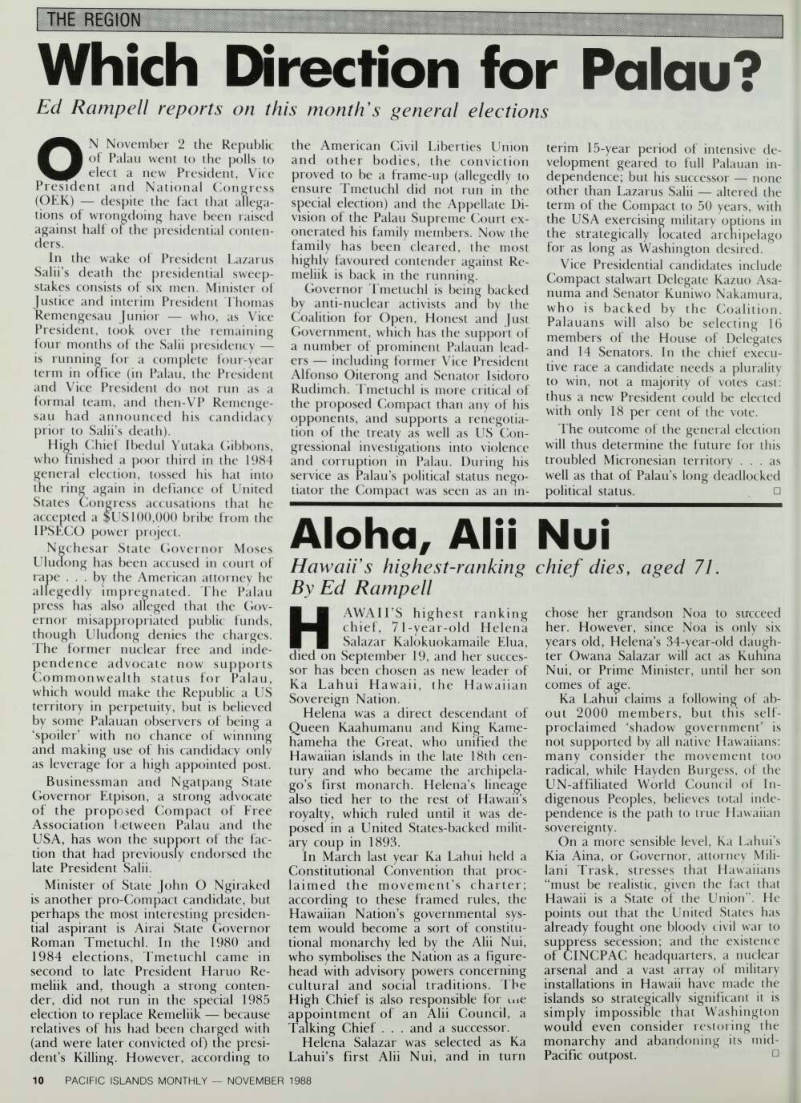
PM David Lange: embarrassment over the bill’s “Idi Amin” clause.
Advertisements & other items, p. 13 (1 item)
Budget
All around the Pacific,
Budget means business
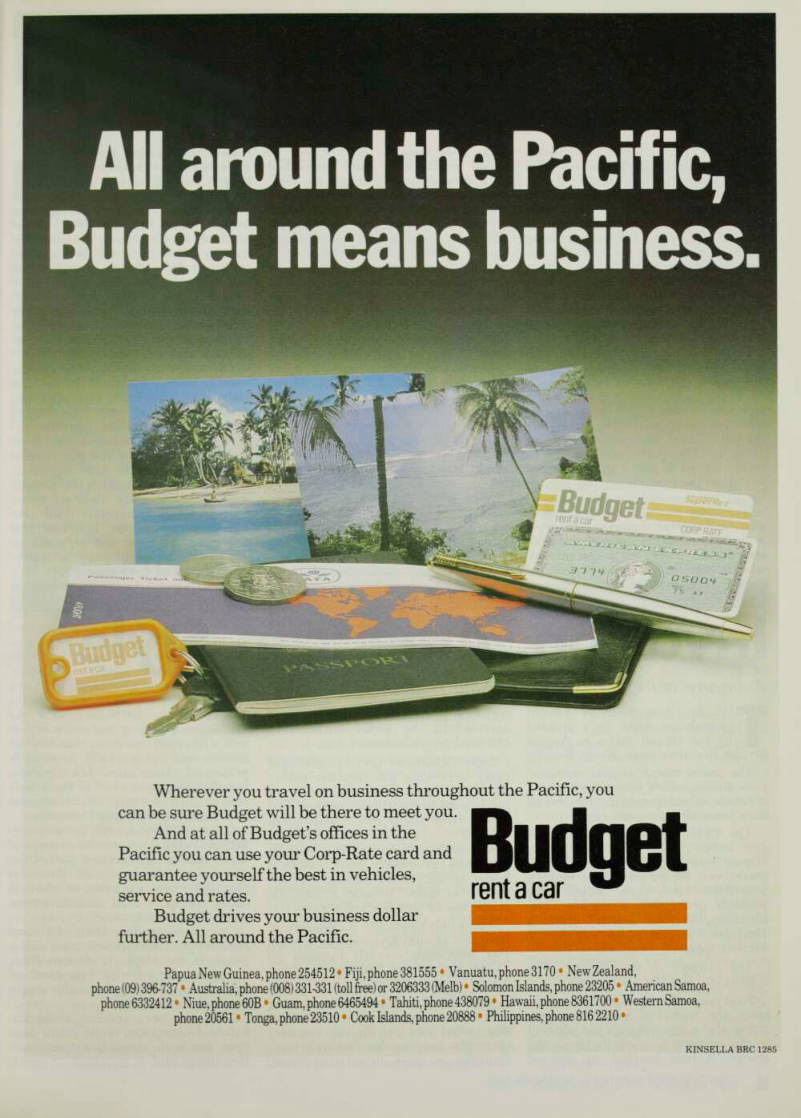
. * * Wherever you travel on business throughout the Pacific, you can be sure Budget will be there to meet you.
And at all of Budget’s offices in the Pacific you can use your Corp-Rate card and guarantee yourself the best in vehicles, service and rates.
Budget drives your business dollar further. All around the Pacific. our me racinc, you
Budget
rent a car w
Papua New Guinea, phone 254512* Fiji, phone 381555 • Vanuatu, phone 3170* New Zealand, phone (09) 396-737* Australia, phone (008) 331-331 (toll free) or 3206333 (Melb) • Solomon Islands, phone 23205* American Samoa, phone 6332412 • Niue, phone 608 • Guam, phone 6465494 • Tahiti, phone 438079 • Hawaii, phone 8361700 • Western Samoa, phone 20561 • Tonga, phone 23510 • Cook Islands, phone 20888 • Philippines, phone 816 2210 •
KINSELLA BRC 1285
Sope's Shock Return
Vanuatu
Rebel politician reinstated ... but for how long? By David Robie
DESPITE the scenes of jubilation in Vila by supporters of rebel Vanuatu politician Barak Sope to celebrate his reinstatement to Parliament on October 21, Prime Minister Father Walter Lini’s govern ment is confident it still holds a trump card in the form of coming by elections. Though the Vanuatu Court of Appeal upheld the case of Sope and the rest of the so-called Gang of Five, it rejected reinstatement appeals by 18 sacked members of the opposi tion Union of Moderate Parties.
Diplomatic sources predict the rul ing Vanua’aku Pati could win up to nine seats on December 12 which, added to its current 21 seats, would give it a strong majority. VP sources are even more confident, suggesting the party could win as many as 11 or 12 seats. The party would need an extra 10 seats to give it the 31 needed to change the constitution and provide the means to oust Sope again.
Becoming consolidated as a key fi gure in the political equation is lawyer Kalkot Mataskelekele, one of the draf ters of the party’s own constitution, who is standing as a candidate for
Vila. If he wins (as is expected) he would become even more entrenched as a powerbroker through his posi tions as party chairman, vice-president and an MP. Like Sope, Mataskelekele is from I Lira Island, but he gave cru cial party evidence to the Supreme
Court hearing that upheld Sope’s
ousting from Parliament during the constitutional crisis last July.
As this issue went to press the UMP was in disarray over the by-elections: a letter by ousted Opposition Leader Maxime Carlot to the Lini Govern ment calling for a general election was
rejected, and though Carlot and key
supporters talked of a boycott, others opposed such a move and the party appeared headed for a split. Even Carlot’s brother Anders, an MP for Efate Rural, was unsympathetic while another MP, Willie Jimmy, warned he would stand as an independent if a boycott went ahead.
Sope and the four dissident ex government MPs William Edgell, Charles Godden, Anatole Lingtamat and Jimmy Simon were sacked from Parliament after they attempted to press a no-confidence motion in the
leadership of Father Lini.
However, on October 21 the three judge Court of Appeal, presided over by Chief Justice Cooke along with judges from Papua New Guinea and Tonga, found that the VP’s ‘rule of conduct’ barring no-confidence mo tions by fellow party members was un constitutional. The court also ruled that a section of the parliamentary 1983 Vacation of Seats Act, which in sists on continuous political party membership for MPs, breached the freedom of speech clauses of the con stitution and was thus invalid.
The court victory, coming on the heels of Sope’s formation of his new Melanesian Progressive Pati and a con troversial meeting with Fiji’s Major- General Sitiveni Rabuka, gave his sup
porters a major morale boost. Sope
had been blamed by the government for the Vila riots of May 16, which erupted after a land rights protest, and caused damage totalling more than SA2 million and one death. He was later sacked as Tourism and Transport Minister and stripped of the powerful post of party secretary general he had held since 1974. □
Invasion, American Style
Tuvalu
A bizarre aid effort bewilders island recipients
THE far-flung atolls of Tuvalu (population 8500) were invaded by the United States in August l°r the first time since World War 11.
Ihe mam island of this resourcepoor nation, which recently celebrated a decade of independence, for several days resembled an army camp.
The US landing ship Arnold C Clinger sailed 3000 kilometres from Hawaii with a cargo of 10 25-tonne trucks, two 90,000 litre water tankers, a mobile crane, three jeeps, three portable generators, a satellite communications truck and 27 crew. A Hercules transport plane with 30 US soldiers followed e purpose of the exercise. The installation of eight water tanks.
Soon after the arrival of the Hercules, the Stars and Stripes was seen
rising above the women’s jail adjacent
to the airport used to house the troops. A field hospital was erected
and soon proved useful: three soldiers assembling the water tanks were admitted for dehydration.
Eight 13,000-litre prefabricated steel
tanks were soon put together before the aghast Tuvaluans: steel tanks are rarely used in the Pacific, because rust never gives them more than three years’ life . . . and that the tanks were bolted together using rubber washers presented yet another hitch. Tuvalu is home to the rubber-eating ‘knicker’ beetle, so called because it eats the elastic out of people’s knickers.
The whole operation is estimated to have cost around SAI million; Seventh Day Adventists recently installed 30 15,000-litre cement tanks in Tuvalu at a total cost of $27,000.
Irate Tuvalu officials were voicing concern to the Americans, tensions that spilled over into the handing over ceremony held in the country’s main maneaba, an open air meeting house.
Attending the gathering were six Tuvaluans including two senior minis ters and their wives, a handful of tourists and aid workers, 30 military
personnel, Suva-based US diplomat
Bob Benzinga, and chief of the army’s international military affairs division in Hawaii, Colonel Sam Hemmings.
In an ad-libbed speech Benzinga re flected Tuvalu concerns by saying the tanks were not the greatest part of the exercise the important part was that the army was able to show it could transport itself and its equip ment all that distance.
Our correspondent later overheard Hemmings, a soft-spoken man with a penchant for playing a Korean flute, discussing the exercise with some of his men in the bar of the tiny coun
try’s only hotel.
“I’ve just been reading about the war. You don’t know how close this is to a real live operation,”
Hemmings said. □
Keeping The Peace
Papua New Guinea
Frank Senge examines proposals for the PNGDF to serve in the Middle East
PESTERED by continuing
rumours of coups and at the same time accused of doing nothing, the Papua New Guinea De fence Force is preparing to defuse both sources of discord by sending troops on United Nations peacekeep ing missions abroad. UN General Secretary Mr Perez de Cuellar is re
portedly “most pleased” by PNG’s in
terest, and the PNG Defence Council has already endorsed the concept as do Prime Minister Rabbie Namaliu and Foreign Minister Michael Somare.
Only Cabinet and Parliament have yet to approve the decision (PNG’s constitution requires that Parliament formally endorse any involvement of PNG troops overseas), but does the force have the capacity to honour the
political initiative?
Many believe it is unready, and blame that situation on past political decisions. Following rumours of a coup in 1977 and again in 1982, the government put in place a manpower ceiling of 3000 personnel and cut budget allocations to the PNGDF.
As a result, many servicemen were retrenched and the force stagnated: a review undertaken last year revealed that morale had deteriorated, the force was under-equipped and salaries and conditions haa not improved since Independence in 1975.
Soldiers’ pay had fallen behind the rest of the workforce by as much as 70 per cent: the military average was be low K5O a week and personnel had
only managed to survive through sub
sidised food and housing and other allowances. The review also stated in no uncertain terms that the force is in real need of more recruits, more
equipment and more training.
Wnen the Wingti Government took office in 1987 Defence Minister James Pokasui himself a former PNGDF captain immediately moved to in crease the manpower ceiling to 5000plus and initiated a review of salaries and conditions. He also set up an in
vestigation into re-equippmg the
force. Soldiers were granted an im mediate across-the-board Kl 7 a week pay increase and negotiations were in stituted with PNG’s neighbours for the supply of uniforms and equipment. At the same time, reali : ng the danger of maintaining an idle army in peacetime (and on still severely limited re sources), Mr Pokasui suggested PNG troops be deployed in answer to inter-
national obligations, to “relieve frustration and complacency within the organisation”. (His submission to Cabinet had not been debated, however, when Mr Wingti was ousted by Rabbie Namaliu in July this year.) In September 1987 Mr Pokasui asked the Defence Force commander and Secretary for advice to the government on the implications of engaging in peacekeeping activities. A representation was made to Mr Perez de Cuellar, who accepted the initiative but because of budget constraints asked PNG to wait until its assistance was requested. PNG’s ambassador to the United States, Renagi Lohia, then proposed that in the interim PNG should request help from Fiji, the only small Pacific nation that has a military presence in the Middle East.
Under proposals endorsed earlier this year by the Defence Council, there was to have been an exchange of
senior officers between PNG’s and Fiji’s respective defence forces: three commissioned officers from PNG would be attached to the Fijian batta lion in the Middle East for six months, and at the same time PNG would re quest senior Fijian officers with ex perience in UN missions to be attached to the PNGDF to assist in the
latter’s training.
While the PNGDF is awaiting a rep ly to its Fijian exchange proposal, Mr Namaliu has said that he sees no prob lems with involving PNG troops in keeping the peace, except for scarce resources. He said PNG was a member of the United Nations and as such was required to meet its international
obligations and responsibilities.
Meanwhile, deputy Opposition lead
er Sir Julius Chan is maintaining his long-held view that PNG should first help establish a Pacific peacekeeping force. As Prime Minister in 1980, Sir Julius involved PNGDF troops for the first time in an overseas conflict when he dispatched them to help quell the Santo rebellion in Vanuatu. Since then he has repeatedly called for a regional peacekeeping force at forums in Au stralia and PNG: his comment on the proposal to engage PNG soldiers in UN peacekeeping missions was: “You cannot save the world if you just can not save yourself.” □
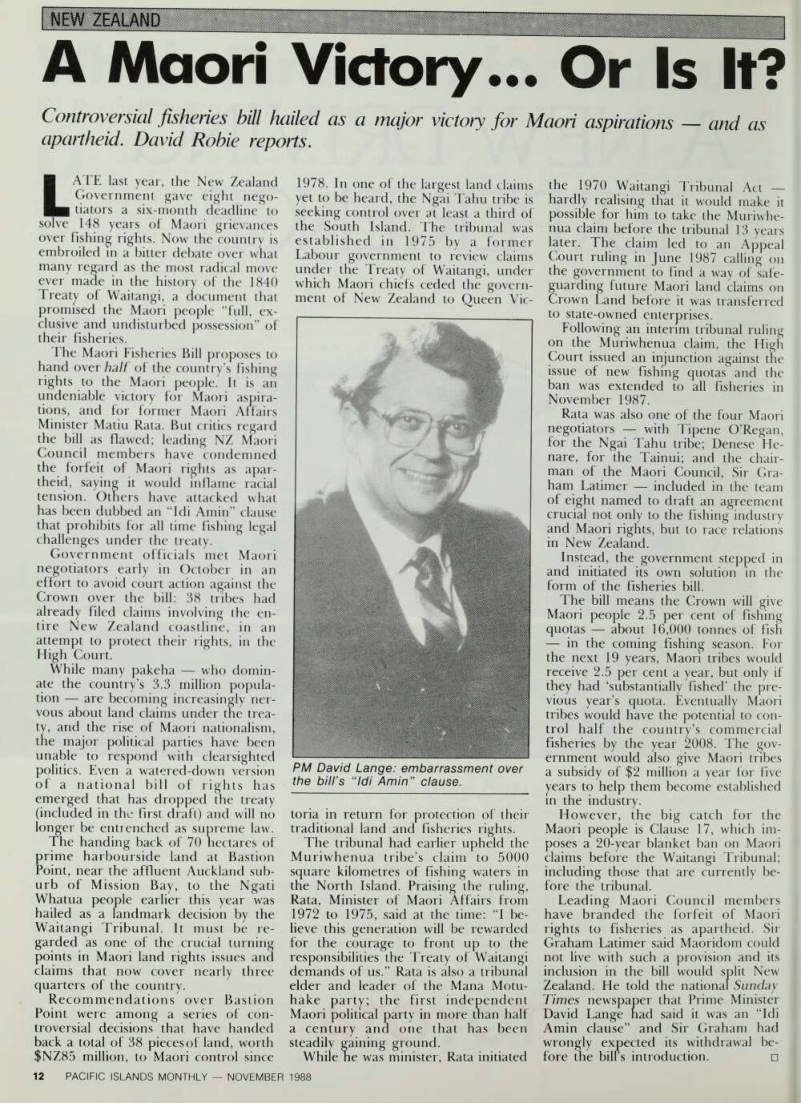
Above: Low pay and obsolete equip ment resulted in low morale. Left: Proposal author, former Defence Minister James Pokasui.
Charter For Fiji
Fiji
Radical New Charter For Fiji
Fiji Tunes editor Vijendra Kumar dissects Fiji’s draft Constitution a document that has already attracted controversy.
ANEW Constitution that gives
ethnic Fijians political sup
remacy appears certain to be
promulgated by presidential decree
within the next two or three months.
The deposed National Federation
Party-Labour Coalition has rejected
outright the draft constitution the in terim government published in early October: Coalition leader Dr Timoci Bavadra has described it as discrimina tory, not only against the Indian com munity but also against certain sec tions of the Fijian population.
The proposed constitution creates a unicameral chamber of 67 to 71 mem bers. Of these, 36 will be Fijians 28 elected by the 14 Fijian provinces and eight nominated by the Great Council of Chiefs. One of the eight nominees will have to be the commander for the armed forces: it is assumed this is to ensure that the army chief not only has a seat in Parliament but continues to hold the Home Affairs portfolio,
presently held by Major-General
Sitiveni Rabuka. Indians will have 22 seats, Rotumans one and ‘general elec tors’ (Europeans, Chinese and other
minority groups) eight.
In addition, the Prime Minister will have the right to nominate four more, from one or more ethnic communities, to his cabinet; those nominated will also become full members of the House.
All voting will be strictly on com munal rolls: that is, each ethnic group will elect its own representatives. This represents a departure from the abro gated 1970 Constitution, which allowed almost half the seats to be contested on cross-racial voting in what were known as national consti tuencies. People of all races had the right to vote for members from diffe rent communities in these constituen cies.
From colonial days, the Fijian population has been divided into 14 provinces for administrative purposes.
Each province has its own local coun cil. Now the 14 provinces will become Fijian constituencies as well: except for three provinces, all others will elect two members each to the new parlia
ment. The largest province of Ba will elect four and the two smallest Namosi and Serua one each.
It is not yet clear how the provinces will vote. People from different pro vinces are scattered all over the country; will they be able to vote for provincial candidates where they now live, or will they have to return to their ‘home’ provinces. Electoral reg ulations still to be drawn up will, it is
hoped, clarify the procedure.
Some Fijian people have expressed
reservations about provincial consti
tuencies. Many Fijians, while they have
a natural interest in the welfare of their home areas, will have no repre sentatives of their own for their pre sent place of domicile. However, most Fijians have expressed support for the draft constitution because it meets the
objectives of last year’s military coups
ensuring Fijian paramountcy m
Parliament.
Opposition has come largely from Indians, who say the draft constitution reduces them to virtual second-class citizens. It takes away the equality granted them in the 1970 constitution Handed down by the departing British colonial rulers.
The 104-page draft retains large sections of the 1970 constitution that deal with such matters as the Judica ture, the Ombudsman, finance and miscellaneous administrative details.
But there are several new features be sides the changes in the composition and structure of the parliament.
There is a new chapter on Fijian and Rotuman interests that provides for the protection and enhancement of the interests and rights of those groups. It says it shall be the responsi bility of Parliament and government to “promote and safeguard the in terests and aspirations” of these two communities so their cultures, tradi tions, social, educational and economic well-being are catered for.
The draft retains an independent
Judiciary but creates special Fijian
courts which existed under the Col onial Government, albeit with limited powers to deal with lawlessness and petty offences in Fijian villages. There
are only two sentences dealing with the Fijian courts, and they say in effect that Parliament will create them, prescribe their jurisdiction and powers and also determine the qualifications and tenure of their presiding officers.
Among emergency powers given to the President is the power to issue a proclamation of emergency if a situa tion arises considered prejudicial to the security of Fiji. Parliament will have to be summoned as soon as
possible to promulgate special laws to
meet the emergency. The draft retains the office of the Leader of Opposi tion, but the provision in the old con stitution requiring consultation with the Opposition on several matters of bipartisan interests has been removed.
In short, there may not be much dis cussion or consultation between the Government and the Opposition.
To prevent any kind of action against the military or other disci plined forces involved in the coups last year, the proposed constitution in corporates immunity for them from either criminal or civil prosecution.
Neither can anyone claim compensa tion from the state for any injury or damage to person or property caused during the violent events of last year.
Indians are concerned about what they perceive as the loss of secularism that formed the basis of the old con stitution. The new constitution says Fiji shall be a sovereign republic and shall uphold the “teachings of the Lord Jesus Christ”. Though the Bill of Rights in the draft guarantees reli gious freedom, Fiji’s Indians see an apparent contradiction between these guarantees and the founding princi
ples of the republic.
The charter on fundamental rights and freedom of the individual is essentially the same as in the 1970 constitution, and the interim govern ment has chosen this as its major sell ing point for the new charter.
The draft is presently before an advisory committee that has been asked to review it and to receive sub missions from the public. But recent statements by both Prime Minister Ratu Sir Kamisese Mara and coup leader Major-General Sitiveni Rabuka have made it clear few major changes, will be entertained. Both have said a rejection could see the army taking over government once again.
Hidden in the draft is probably the target date for the promulgation of the constitution. December 5, 1988 is the likely date, since a clause in the draft says all laws in force on that day shall become laws of the country under the new constitution.
After the advisory committee has made its recommendations the draft
will go before the Great Council of Chiefs. Once it has given its seal of approval the President, Ratu Sir Penaia Ganilau, will publish a decree giving effect to the constitution which will clear the way for elections some time next year. □
First Draft Fiji Constitution As
Agreed To By The Cabinet
Committee On The Constitution
Preamble
WHEREAS the people of Fiji have ex pressed their desire to have a new Con stitution for the advancement of their beliefs, rights and freedoms to replace the Constitution under which they attained Independence on 10th Octo ber 1970: AND WHEREAS they freely accept that it is desirous that the constitution of 1970 be replaced so that the will of the people may be truly set forth and
their hopes, aspirations and goals be
achieved and thereby enshrined: AND WHEREAS they re-affirm that the nation is founded upon principles that acknowledge the Deity and the teachings of the Lord Jesus Christ, the importance and place of the family in a free society with free institutions and unalterable and unalienable belief and faith in the fundamental rights and freedoms with which all brethren in the fellowship of men are possessed.
AND WHEREAS they re-con firm that Fiji is a democratic society in which all peoples may to the full extent of their capacity play some part in the institu tions of the national life and thereby develop and maintain due deference and respect for each other and the rule of law: AND WHEREAS they re-affirm that the indigenous people of Fiji are en dowed with their lands and the right to govern themselves for their advance ment and welfare: AND WHEREAS they re-assert their
recognition that the indigenous people
of Fiji in respecting the rights of their brethren to live in harmony are entitled to due deference to their customs and traditional way of life.
AND WHEREAS they reiterate their recognition that people and institutions remain free only when and for so long as freedom is founded upon respect for the spiritual and moral values of each other and a mutual observance of the rule of law . . .
Advertisements & other items, p. 17 (1 item)
Generators
FREE
to owners of
DIESEL
GENERATORS
In villages, resorts and in mining applications our proven diesel/battery equipment will;
• SAVE 65% TO 75%
OF FUEL
• GIVE 24 HOUR
POWER.
A Northern Territory, Australia government report says that our equipment can supply reliable power up to 40% cheaper than a stand-alone diesel generator.
At no cost to you we will prepare a report on the cost efficiency of your present generating set up compared with the cost of our equipment.
FOR DETAILS SEND TO:
POWERMAKERS PTY. LTD.
P.O. BOX 1083,
FYSHWICK 2609
AUSTRALIA.
PHONE: (062) 39 1015
FAX: (062) 39 1018
Please send me details of your Power equipment.
Name: Address: Phone; Size of diesel generator: Type of application: ..
DEALER INQUIRIES
WELCOME
Conflict and Courage
New Caledonia
A New Zealand film about the ‘Che Guevara of the Pacific’ and Kanak culture is causing a stir. By David Robie
WHEN Wellington filmmaker
Kathy Dudding set out three years ago to make a
documentary recording the Kanak
struggle for independence, she ex pected problems with French author ities. Fortunately, she completed her filming just three weeks before the bombing of the Rainbow Warrior ; and she and her crew encountered surpri singly little trouble.
But since her film, Kanaky Au Pouvoir (Power to the Kanak People) was completed it has been a different story. She has already become embroiled in controversy in Townsvil le, Queensland, where French journal ists covering the Pacific Festival of Arts in August tried to prevent the
documentary being shown.
They failed and it went ahead as scheduled, though the documentary is more likely to oe shown on foreign television screens before it is broadcast in Australia or New Zealand. A West German distributor is negotiating for world rights and other foreign film companies are interested. It was shown at the International Short Film and Video Festival in France in September and caused a stir.
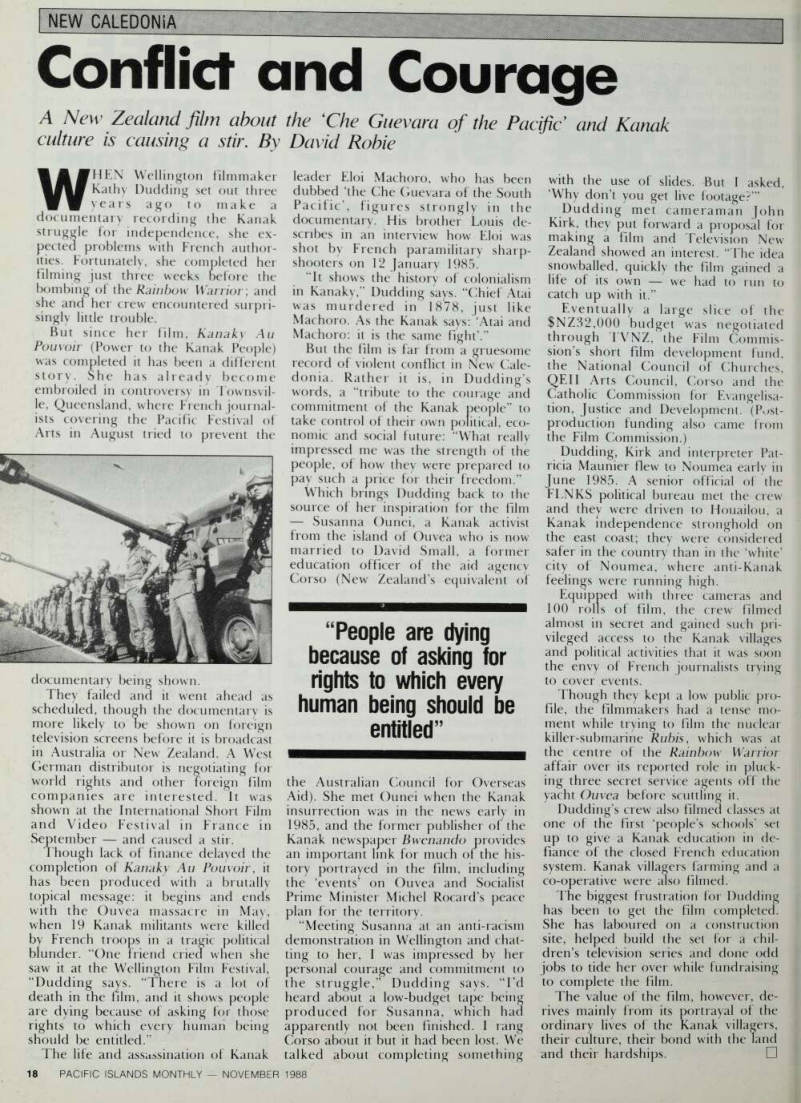
Though lack of finance delayed the completion of Kanaky Au Pouvoir, it has been produced with a brutally topical message: it begins and ends with the Ouvea massacre in May, when 19 Kanak militants were killed by French troops in a tragic political blunder. “One friend cried when she saw it at the Wellington Film Festival, “Dudding says. “There is a lot of death in the film, and it shows people are dying because of asking for those rights to which every human being should be entitled.”
The life and assassination of Kanak
leader Eloi Machoro, who has been dubbed ‘the Che Guevara of the South Pacific’, figures strongly in the documentary. His brother Louis de scribes in an interview how Eloi was
shot by French paramilitary sharp
shooters on 12 January 1985.
“It shows the history of colonialism in Kanaky,” Budding says. “Chief Atai was murdered in 1878, just like Machoro. As the Kanak says: Atai and Machoro: it is the same fight’.”
But the film is far from a gruesome record of violent conflict in New Cale donia. Rather it is, in Budding’s words, a “tribute to the courage and commitment of the Kanak people” to take control of their own political, eco nomic and social future: “What really impressed me was the strength of the people, of how they were prepared to pay such a price for their freedom.”
Which brings Budding back to the source of her inspiration for the film Susanna Ounei, a Kanak activist from the island of Ouvea who is now married to David Small, a former education officer of the aid agency Corso (New Zealand’s equivalent of
“People are dying because of asking for rights to which every human being should be entitled”
the Australian Council for Overseas Aid). She met Ounei when the Kanak insurrection was in the news early in 1985, and the former publisher of the Kanak newspaper Bwenando provides an important link for much of the his tory portrayed in the film, including the ‘events’ on Ouvea and Socialist Prime Minister Michel Rocard’s peace
plan for the territory.
“Meeting Susanna at an anti-racism demonstration in Wellington and chat ting to her, I was impressed by her personal courage and commitment to the struggle,” Budding says. “I’d heard about a low-budget tape being produced for Susanna, which had apparently not been finished. I rang Corso about it but it had been lost. We talked about completing something
with the use of slides. But I asked, ‘Why don’t you get live footage?’”
Budding met cameraman John
Kirk, they put forward a proposal for making a film and Television New Zealand showed an interest. “The idea snowballed, quickly the film gained a life of its own we had to run to catch up with it.”
Eventually a large slice of the
$NZ32,000 budget was negotiated
through TVNZ, the Film Commis sion’s short film development fund, the National Council of Churches, QEII Arts Council, Corso and the Catholic Commission for Evangelisa tion, Justice and Development. (Post production funding also came from the Film Commission.) Budding, Kirk and interpreter Pat ricia Maunier flew to Noumea early in June 1985. A senior official of the FLNKS political bureau met the crew and they were driven to Houailou, a
Kanak independence stronghold on
the east coast; they were considered safer in the country than in the ‘white’ city of Noumea, where anti-Kanak
feelings were running high.
Equipped with three cameras and 100 rolls of film, the crew filmed almost in secret and gained such pri vileged access to the Kanak villages and political activities that it was soon the envy of French journalists trying to cover events.
Though they kept a low public pro file, the filmmakers had a tense mo ment while trying to film the nuclear killer-submarine Rubis, which was at the centre of the Rainbow Warrior affair over its reported role in pluck ing three secret service agents off the yacht Ouvea before scuttling it.
Budding’s crew also filmed classes at one of the first ‘people’s schools’ set up to give a Kanak education in de fiance of the closed French education system. Kanak villagers farming and a co-operative were also filmed.
The biggest frustration for Budding has been to get the film completed.
She has laboured on a construction site, helped build the set for a chil dren’s television series and done odd jobs to tide her over while fundraising to complete the film.
The value of the film, however, de rives mainly from its portrayal of the ordinary lives of the Kanak villagers, their culture, their bond with the land and their hardships. □
Advertisements & other items, pp. 19-20 (1 item)
now servicing
Fuels and lubricants.
Plastics. Chemicals. Bitumen.
Aviation Services. Bunkering.
Shell has penetrated even more of the Pacific to widen its network of offices, terminals and
Network Shell
now servicing
even more
of the Pacific.
distributors as well as service stations.
Now you can re-assess your source of supply, because Shell quality and value is close at hand, with the service to back it up. REGIONAL OFFICES: GL AM 61 -T" 4350. Also servicing Marshall Islands (Majuro), Northern Marianas (Saipan), Palau.
FIJI 679 313 933. Also servicing Tonga, Cook Islands. American Samoa. Western Samoa • PAPUA NEW GUINEA 675 228 700. Also servicing Solomon Islands NEW CALEDONIA OS'" 285 "20. Also servicing Tahiti, Vanuatu.
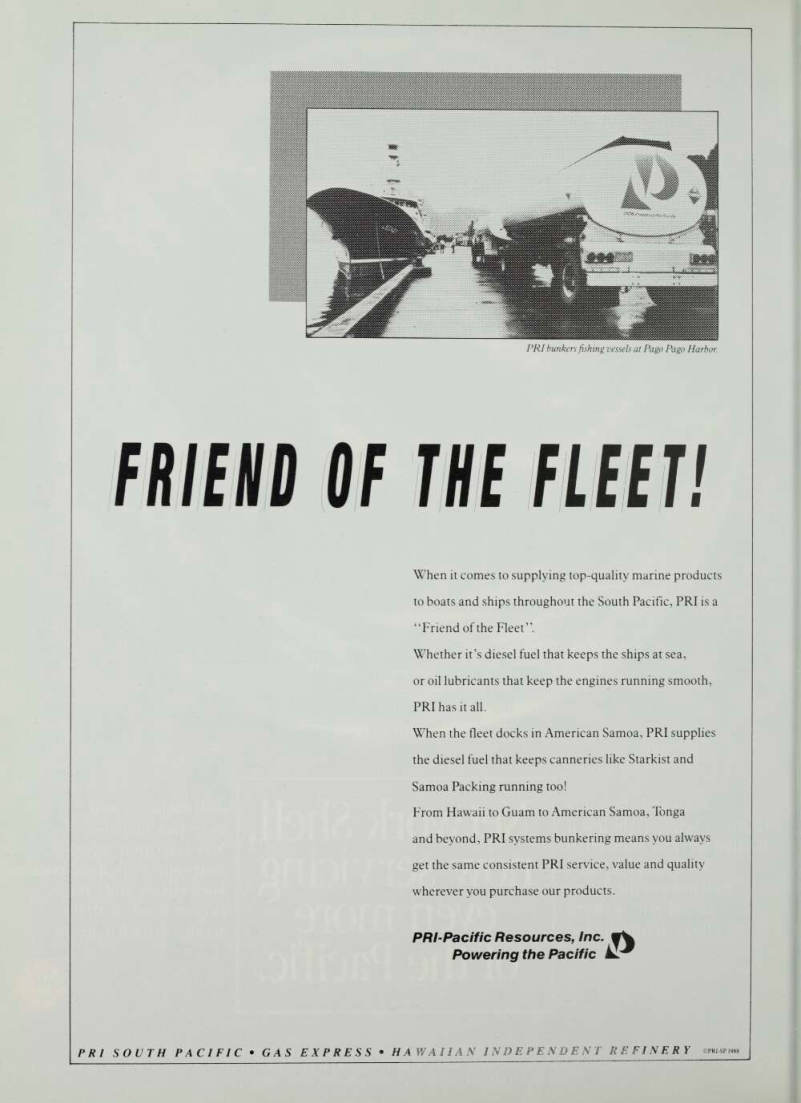
m PRI bunkers fishing vessels at Pago Pago Harbor.
fhihid of the fleet.'
When it comes to supplying top-quality marine products to boats and ships throughout the South Pacific, PRI is a “Friend of the Fleet”.
Whether it’s diesel fuel that keeps the ships at sea, or oil lubricants that keep the engines running smooth, PRI has it all.
When the fleet docks in American Samoa, PRI supplies the diesel fuel that keeps canneries like Starkist and Samoa Packing running too!
From Hawaii to Guam to American Samoa, Tonga and beyond, PRI systems bunkering means you always get the same consistent PRI service, value and quality wherever you purchase our products.
PRI-Pacific Resources, Inc. yV
Powering the Pacific kl**
PRI SOUTH PACIFIC • GAS EXPRESS • HAWAIIAN INDEPENDENT REFINERY ©pri-spwm
Polls Run Hot and Cool
United States
Tensions . . . and yawns ... as US islanders vote.
By David S North
THREE of the hottest election contests under the United States flag took place this month in the Pacific ... as well, it must be said, as a couple of the dullest.
Tnere were tight races for seats in the US House of Representatives in American Samoa, Guam and in Hon olulu, plus a collection of other races in those places. Here is how they shaped up at time of going to press.
Sitting Congresswoman Patricia F.
Saiki, a lonesome Republician in heavily Democratic Hawaii, faced a
tough fight against former East-West
Center executive Mary Bitterman, the Democratic candidate. A haole Caucasian Ms Bitterman had run the Centre’s communications program for years, and had served as a mem ber of the State Cabinet. Ms Saiki, a Japanese American and the first ever Republican to serve as a voting mem ber of the US House from Hawaii, had defeated a Democrat of Samoan ancestry two years ago in a close battle for an open seat.
The other races in Hawaii were dull. Senator Spark Matsunaga, a 72year-old Japanese-American Demo crat, took the primary earlier in the year by 87 per cent and won six years earlier with 82 per cent of the vote.
His nominal opponent, a Republican rancher from Molikai, is 70-year-old Maria Hustace.
Congressman Dan Akaka, a Demo crat whose district includes Honolulu’s suburbs and the outer islands, did not even have a Republican opponent. His third party foe is the libertarian candi date, Lloyd Malian. Malian is known to the Hawaii press for two reasons: no newspaper has a photo of him in its files, and he claims that he is a writer living underground in Puna while he investigates the hippy com munity on the Big Island.
There were state legislative elections as well, but the Democratic strangle hold was not threatened. The princip al Republican problem was to prevent the handful of sitting Republicans bolting to the Democrats: Virginia Isbell, a member of the lower house, made the switch this spring and the Republicans could not find anyone to run against her on the conservative west side of the Big Island.
Hawaii’s Democratic Governor, John Waihee, the first native Hawaiian to hold the post, is not up for a re election this year.
In Guam a surprisingly tough race
faced incumbent Congressman Ben Blaz, a Republican and former Marine Corps general. Somewhat formal in his approach, Blaz ran against the more casual but feisty Ben Pangelinan, onetime aide to former Democratic Governor Ricardo Bordallo and more recently a health administrator.
Blaz has now served in the House for two terms, and had an easy win two years ago.
Pangelinan gave Blaz a rough time for allegedly missing 20 of 21 impor tant votes in Congressional committee meetings. (The island delegates can vote in committee and in party cau cuses, but not on the floor of the
House of Representatives). Pangelinan
mounted a vigorous campaign, includ
ing biting political cartoons, and bene
fited from an endorsement from the dean of the Pacific delegation, Hawaii Democrat Senator Daniel Inouye who, by the way, has said he will be a candidate for tne powerful and soon to-be-vacant position of Democratic leader of the US Senate.
Bordallo, despite his troubles in the courts (see PIM , October), appeared to be making a comeback and ms allies may gain control of the Guam Senate, the one legislative body on the island; the Democrats had 12 seats to the Re publican’s eight as the election opened. The two ranking senate candidates in the September Democra tic primary were Bordallo’s wife Madeline and his former Lieutenant Governor, Eddie Reyes. Both were ex pected to be elected easily. The sitting Guam Governor, Republican Joe Ada, has two more years to his term.
The race for the 21-member Senate was considerably enlivened when the taxpaid phone bills of the members
were printed by the Pacific Daily
News . These showed that Republican leader of the Senate, Marilyn Manibu san (see PIM September 1986) had run up more than $12,000 in phone calls, mostly in Blaz’s office in Washington. The Senator with the next most expensive bill was the Speaker, Democrat Frank Gutierrez, who had a $ 10,000-plus bill.
The Governorship of American Samoa was very much on the line as incumbent Democrat Governor A P Lutali and former Governor Peter Tali Coleman fought it out for a four year term. Both houses of the Fono, the island legislature, were also up for grabs but in American Samoa un like Guam and Hawaii party labels
are not used in legislative races. The greatest suspense in the Pacific races were over who would succeed Fofo Sunia as the island’s Congressman in Washington. Seeking the seat were Lieutenant Governor Eni Hunkin, Coleman’s former Lieutenant Gov ernor Tufele Li’a and Territorial Pub lic Defender Soli Augmoeualago (who twice lost to Sunia) as well as several lesser candidates. Given the size of the field, and the fact that American Samoa (unusually for US elections) re quires an absolute majority in this con test, the chances were that the two ranking candidates would go into a second election, called a ‘runoff, in late November.
As for the presidential race, neither George Bush (shot down in the Pacific during World War II) nor Michael Dukakis, paid much attention to the area: Hawaii was regarded as one of the few states likely to vote Democra tic, and both Guam and American Samoa are excluded from presidential elections. □
Sunia Goes To Slammer
FOFO Sunia, until recently Amer ican Samoa’s delegate to the Un ited States House of Representa tives, is on the way to jail.
Sunia, who pleadea guilty to
misusing Congressional funds (see
PIM October) and resigned his seat, was sentenced to five to fif teen months in prison by a federal judge in Washington DC. His longtime administrative assistant, Matthew luli, drew three months.
Both paid steep civil fines as well $U565,000 m Sunia’s case.
The United States has sent half a dozen Congressrpen and one Senator to jail in the past decade; the government often (if not routinely) takes a tough stand
against corruption.
The American Samoa delegate’s offices remain open in Pago Pago and Washington, with Mrs Hana F Atuatasi as acting administrator (by appointment of the Clerk of the House of Representatives); she had been the disgraced congress man’s office manager. It is ex pected Sunia’s successor will take over in January.
Funafuti Celebrates
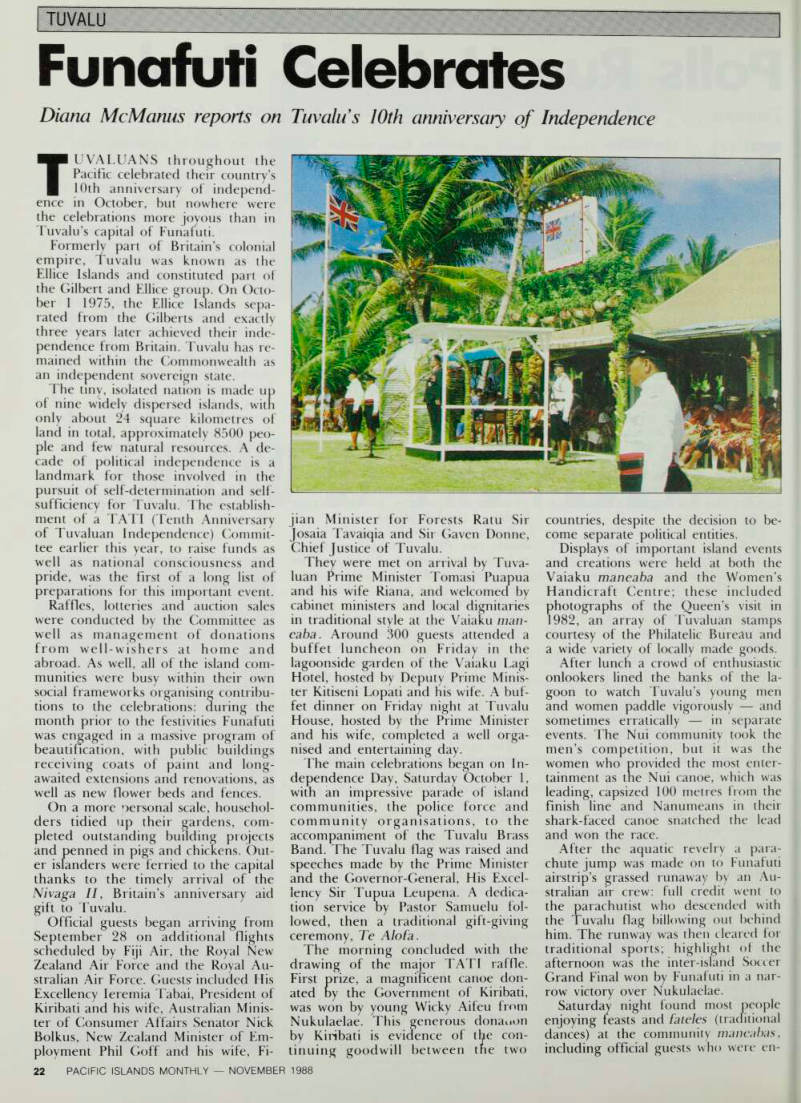
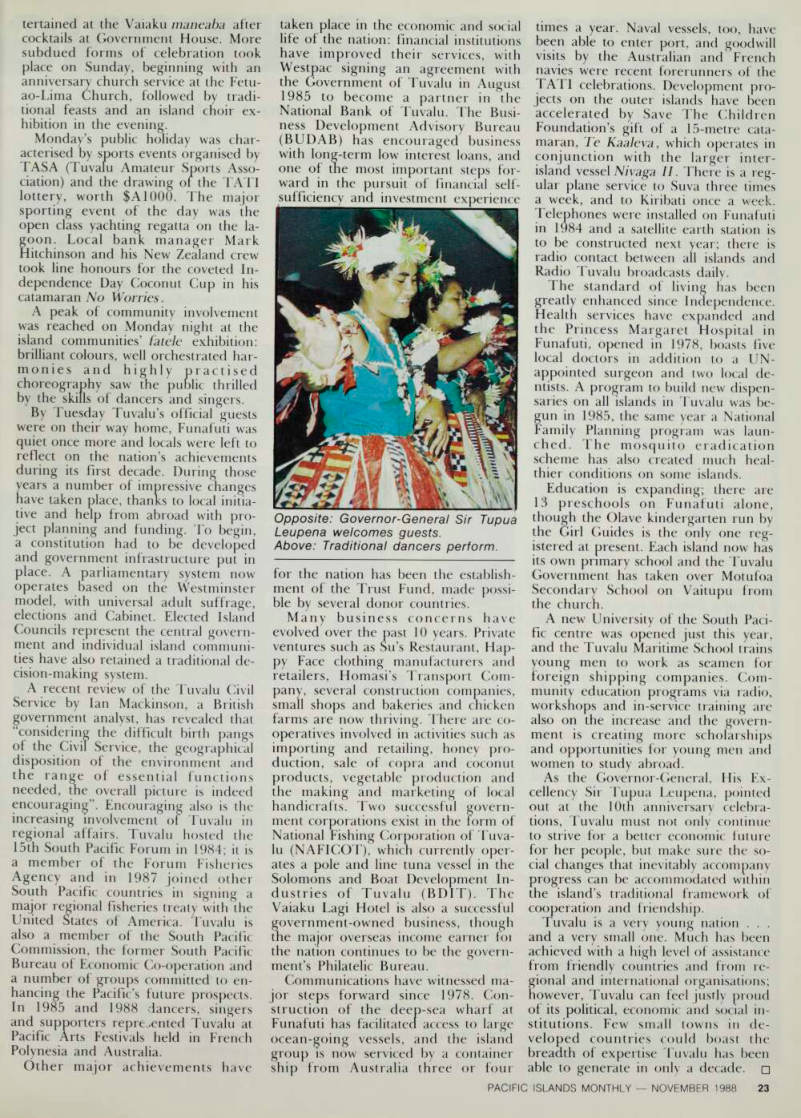
Tuvalu
Diana McManus reports on Tuvalu’s 10th anniversary of Independence
TUVALUANS throughout the
Pacific celebrated their country’s
10th anniversary of independ
ence in October, but nowhere were the celebrations more joyous than in Tuvalu’s capital of Funafuti.
Formerly part of Britain’s colonial empire, Tuvalu was known as the Ellice Islands and constituted part of the Gilbert and Ellice group. On Octo ber 1 1975, the Ellice Islands sepa rated from the Gilberts and exactly three years later achieved their inde pendence from Britain. Tuvalu has re mained within the Commonwealth as
an independent sovereign state.
The tiny, isolated nation is made up of nine widely dispersed islands, with only about 24 square kilometres of land in total, approximately 8500 peo ple and few natural resources. A de cade of political independence is a landmark for those involved in the pursuit of self-determination and self sufficiency for Tuvalu. The establish ment of a TATI (Tenth Anniversary of Tuvaluan Independence) Commit tee earlier this year, to raise funds as well as national consciousness and pride, was the first of a long list of preparations for this important event.
Raffles, lotteries and auction sales were conducted by the Committee as well as management of donations from well-wishers at home and abroad. As well, all of the island com munities were busy within their own social frameworks organising contribu tions to the celebrations: during the month prior to the festivities Funafuti was engaged in a massive program of
beautification, with public buildings
receiving coats of paint and long
awaited extensions and renovations, as well as new flower beds and fences.
On a more personal scale, househol ders tidied up their gardens, com
pleted outstanding building projects
and penned in pigs and chickens. Out er islanders were ferried to the capital thanks to the timely arrival of the Nivaga 11, Britain’s anniversary aid gift to Tuvalu.
Official guests began arriving from September 28 on additional flights scheduled by Fiji Air, the Royal New Zealand Air Force and the Royal Au stralian Air Force. Guests included His Excellency leremia Tabai, President of Kiribati and his wife, Australian Minis ter of Consumer Affairs Senator Nick Bolkus, New Zealand Minister of Em ployment Phil Goff and his wife, Fi-
jian Minister for Forests Ratu Sir Josaia Tavaiqia and Sir Gaven Donne, Chief Justice of Tuvalu.
They were met on arrival by Tuvaluan Prime Minister Tomasi Puapua and his wife Riana, and welcomed by cabinet ministers and local dignitaries in traditional style at the Vaiaku maneaba. Around 300 guests attended a buffet luncheon on Friday in the
lagoonside garden of the Vaiaku Lagi
Hotel, hosted by Deputy Prime Minister Kitiseni Lopati and his wife. A buffet dinner on Friday night at Tuvalu House, hosted by the Prime Minister and his wife, completed a well orga-
nised and entertaining day.
The main celebrations began on In-
dependence Day, Saturday October 1,
with an impressive parade of island communities, the police force and
community organisations, to the
accompaniment of the Tuvalu Brass Band. The Tuvalu flag was raised and speeches made by the Prime Minister and the Governor-General, His Excel-
lency Sir Tupua Leupena. A dedica-
tion service by Pastor Samuelu followed, then a traditional gift-giving ceremony, Te Alofa.
The morning concluded with the drawing of the major TATI raffle, First prize, a magnificent canoe donated oy the Government of Kiribati, was won by young Wicky Aifeu from Nukulaelae. This generous donation by Kiribati is evidence of the continuing goodwill between the two
countries, despite the decision to be come separate political entities.
Displays of important island events and creations were held at both the Vaiaku maneaba and the Women’s Handicraft Centre; these included photographs of the Queen’s visit in 1982, an array of Tuvaluan stamps courtesy of the Philatelic Bureau and a wide variety of locally made goods.
After lunch a crowd of enthusiastic onlookers lined the banks of the la goon to watch Tuvalu’s young men and women paddle vigorously and sometimes erratically in separate events. The Nui community took the men’s competition, but it was the women who provided the most enter tainment as the Nui canoe, which was leading, capsized 100 metres from the finish line and Nanumeans in their shark-faced canoe snatched the lead and won the race.
After the aquatic revelry a para chute jump was made on to Funafuti
airstrip’s grassed runaway by an Au
stralian air crew: full credit went to the parachutist who descended with the Tuvalu flag billowing out behind him. The runway was then cleared for traditional sports; highlight of the afternoon was the inter-island Soccer Grand Final won by Funafuti in a nar row victory over Nukulaelae.
Saturday night found most people
enjoying feasts and fateles (traditional dances) at the community maneabas, including official guests who were en
tertained at the Vaiaku maneaba after cocktails at Government House. More subdued forms of celebration took
place on Sunday, beginning with an
anniversary church service at the Fetu ao-Lima Church, followed by tradi tional feasts and an island choir ex hibition in the evening.
Monday’s public holiday was char
acterised by sports events organised by
TASA (Tuvalu Amateur Snorts Asso ciation) and the drawing of the TATI lottery, worth SAIOOO. The major sporting event of the day was the open class yachting regatta on the la goon. Local bank manager Mark Hitchinson and his New Zealand crew took line honours for the coveted In dependence Day Coconut Cup in his catamaran No Worries.
A peak of community involvement was reached on Monday night at the island communities’ fatele exhibition: brilliant colours, well orchestrated har
monies and highly practised
choreography saw the public thrilled by the skills of dancers and singers.
By Tuesday Tuvalu’s official guests were on their way home, Funafuti was quiet once more and locals were left to reflect on the nation’s achievements during its first decade. During those
years a number of impressive changes
nave taken place, thanks to local initia tive and help from abroad with pro
ject planning and funding. To begin,
a constitution had to be developed and government infrastructure put in place. A parliamentary system now operates based on the Westminster model, with universal adult suffrage, elections and Cabinet. Elected Island Councils represent the central govern ment and individual island communi ties have also retained a traditional de
cision-making system.
A recent review of the Tuvalu Civil Service by lan Mackinson, a British government analyst, has revealed that “considering the difficult birth pangs of the Civil Service, the geographical disposition of the environment and the range of essential functions needed, the overall picture is indeed encouraging”. Encouraging also is the increasing involvement of Tuvalu in regional affairs. Tuvalu hosted the 15th South Pacific Forum in 1984; it is a member of the Forum Fisheries Agency and in 1987 joined other South Pacific countries in signing a major regional fisheries treaty with the United States of America. Tuvalu is also a member of the South Pacific Commission, the former South Pacific Bureau of Economic Co-operation and a number of groups committed to en hancing the Pacific’s future prospects.
In 1985 and 1988 dancers, singers and supporters represented Tuvalu at Pacific Arts Festivals held in French Polynesia and Australia.
Other major achievements have
taken place in the economic and social life of the nation: financial institutions have improved their services, with Westpac signing an agreement with the Government of Tuvalu in August 1985 to become a partner in the National Bank of Tuvalu. The Busi
ness Development Advisory Bureau
(BUDAB) has encouraged business with long-term low interest loans, and one of the most important steps for ward in the pursuit of financial self sufficiency and investment experience
for the nation has been the establish ment of the Trust Fund, made possi ble by several donor countries.
Many business concerns have evolved over the past 10 years. Private ventures such as Su’s Restaurant, Hap py Face clothing manufacturers and retailers, Homasi’s Transport Com pany, several construction companies, small shops and bakeries and chicken farms are now thriving. There are co operatives involved in activities such as
importing and retailing, honey pro
duction, sale of copra and coconut
products, vegetable production and
the making and marketing of local handicrafts. Two successful govern ment corporations exist in the form of National Fishing Corporation of Tuva lu (NAFICOT), which currently oper ates a pole and line tuna vessel in the Solomons and Boat Development In dustries of Tuvalu (EDIT). The Vaiaku Lagi Hotel is also a successful
government-owned business, though
the major overseas income earner foi the nation continues to be the govern ment’s Philatelic Bureau.
Communications have witnessed ma jor steps forward since 1978. Con struction of the deep-sea wharf at Funafuti has facilitated access to large ocean-going vessels, and the island group is now serviced by a container ship from Australia three or four
times a year. Naval vessels, too, have been able to enter port, and goodwill visits by the Australian and French navies were recent forerunners of the TATI celebrations. Development pro jects on the outer islands have been accelerated by Save The Children Foundation’s gift of a 15-metre cata maran, Te Kaaleva , which operates in conjunction with the larger inter island vessel Nivaga 11 . There is a reg ular plane service to Suva three times a week, and to Kiribati once a week.
Telephones were installed on Funafuti in 1984 and a satellite earth station is to be constructed next year; there is radio contact between all islands and Radio Tuvalu broadcasts daily.
The standard of living has been
greatly enhanced since Independence.
Healtn services have expanded and the Princess Margaret Hospital in Funafuti, opened in 1978, boasts five local doctors in addition to a UN appointed surgeon and two local de ntists. A program to build new dispen saries on all islands in Tuvalu was be gun in 1985, the same year a National Family Planning program was laun ched. The mosquito eradication scheme has also created much heal thier conditions on some islands.
Education is expanding; there are 13 preschools on Funafuti alone,
though the Olave kindergarten run by
the Girl Guides is the only one reg istered at present. Each island now has its own primary school and the Tuvalu Government has taken over Motufoa Secondary School on Vaitupu from the church.
A new University of the South Paci fic centre was opened just this year, and the Tuvalu Maritime School trains young men to work as seamen for
foreign shipping companies. Com
munity education programs via radio, workshops and in-service training are also on the increase and the govern ment is creating more scholarships and opportunities for young men and women to study abroad.
As the Governor-General, His Ex
cellency Sir Tupua Leupena, pointed
out at the 10th anniversary celebra tions, Tuvalu must not only continue to strive for a better economic future for her people, but make sure the so cial changes that inevitably accompany progress can be accommodated within the island’s traditional framework of
cooperation and friendship.
Tuvalu is a very young nation . . . and a very small one. Much has been achieved with a high level of assistance from friendly countries and from re
gional and international organisations;
however, Tuvalu can feel justly proud of its political, economic and social in stitutions. Few small towns in de veloped countries could boast the breadth of expertise Tuvalu has been able to generate in only a decade. □
Opposite: Governor-General Sir Tupua Leupena welcomes guests.
Above: Traditional dancers perform.
Finance, Banking
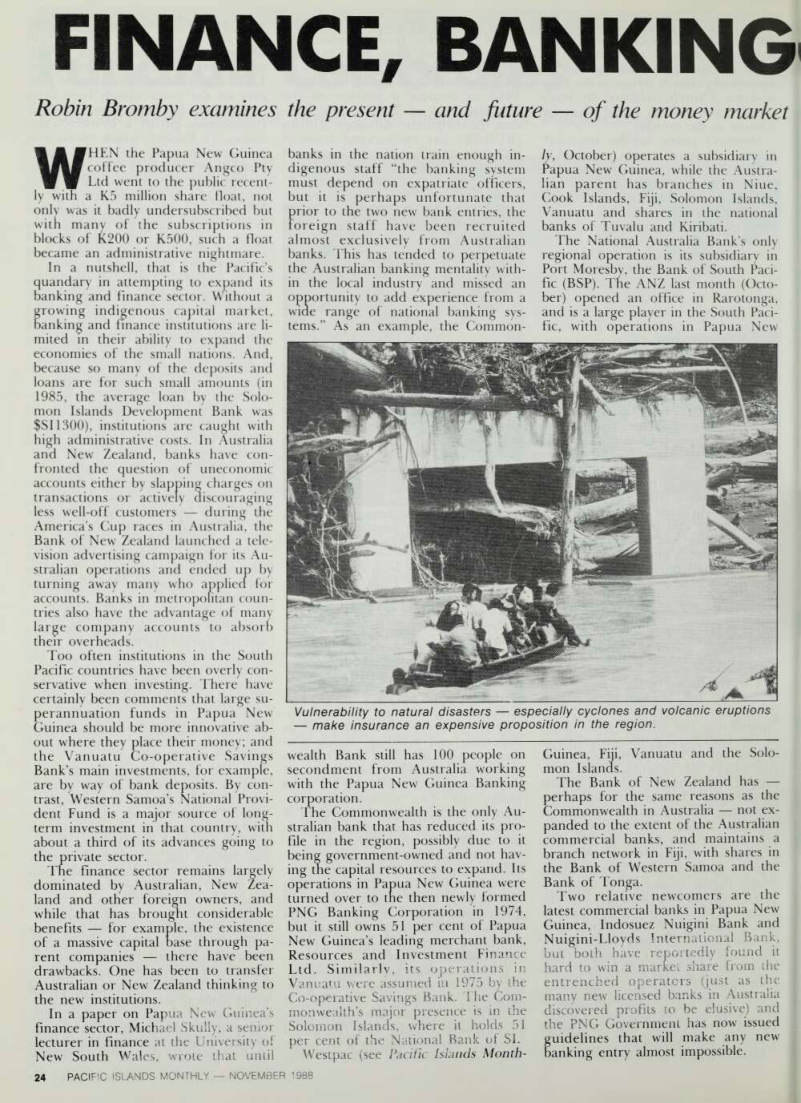
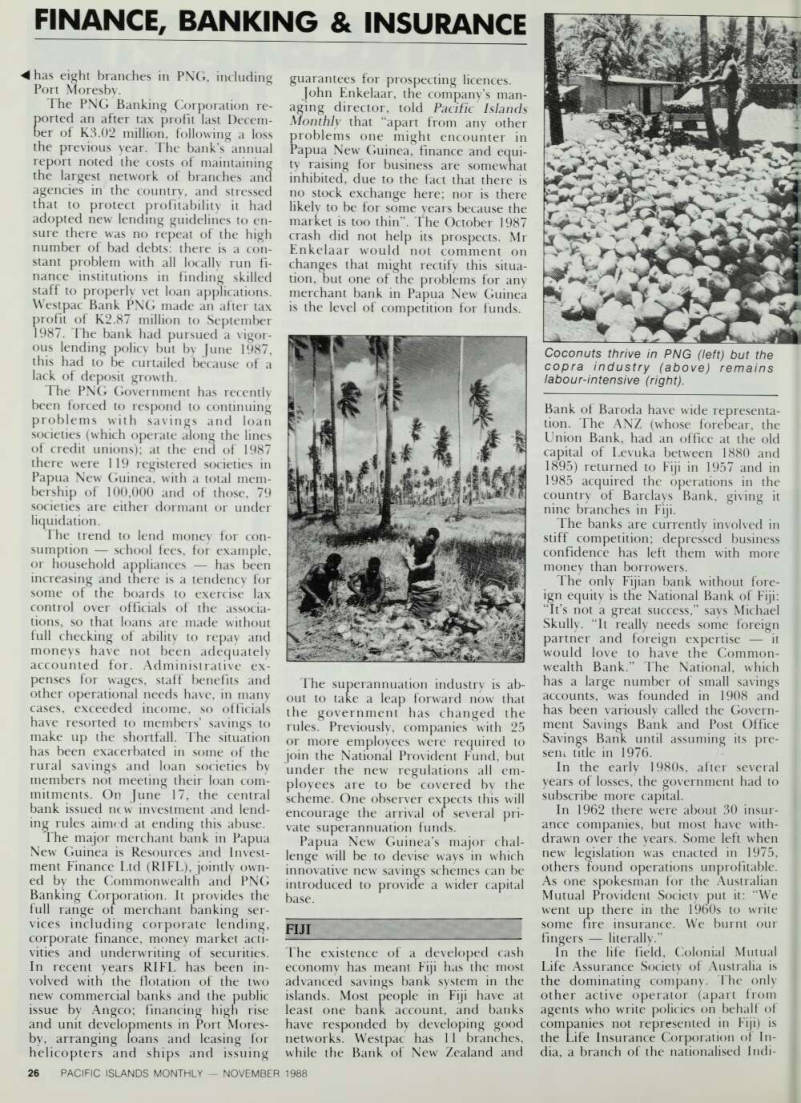
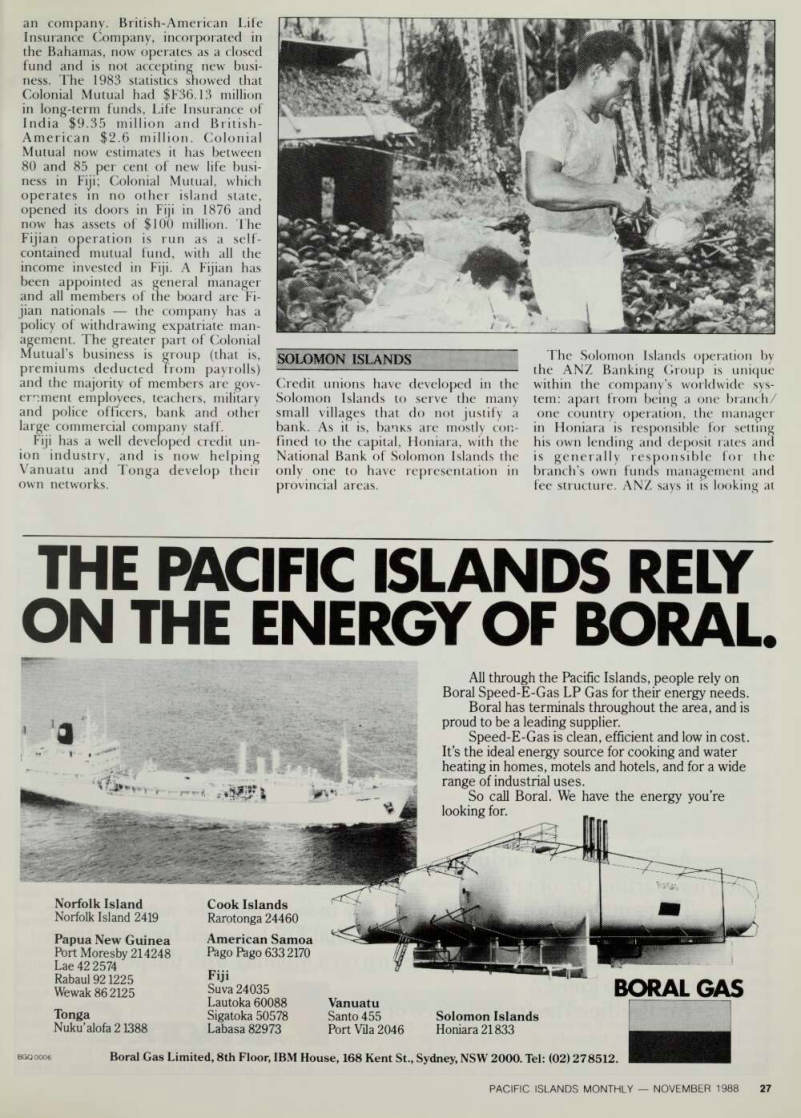
Robin Bromby examines the present and future of the money market
WHEN the Papua New Guinea
coffee producer Angco Pty
Ltd went to the public recent ly with a K 5 million share float, not only was it badly undersubscribed but with many of the subscriptions in blocks of K2OO or K5OO, such a float became an administrative nightmare.
In a nutshell, that is the Pacific’s
quandary in attempting to expand its
banking and finance sector. Without a
growing indigenous capital market,
banking and finance institutions are li mited in their ability to expand the economies of the small nations. And, because so many of the deposits and loans are for such small amounts (in 1985, the average loan by the Solo mon Islands Development Bank was SSI 1300), institutions are caught with high administrative costs. In Australia and New Zealand, banks have con fronted the question of uneconomic
accounts either by slapping charges on
transactions or actively discouraging
less well-off customers during the America’s Cup races in Australia, the Bank of New Zealand launched a tele vision advertising campaign for its Au stralian operations and ended up by turning away many who applied for accounts. Banks in metropolitan coun tries also have the advantage of many large company accounts to absorb their overheads.
Too often institutions in the South Pacific countries have been overly con servative when investing. There have certainly been comments that large su perannuation funds in Papua New Guinea should be more innovative ab out where they place their money; and
the Vanuatu Co-operative Savings
Bank’s main investments, for example, are by way of bank deposits. By con trast, Western Samoa’s National Provi dent Fund is a major source of long term investment in that country, with about a third of its advances going to the private sector.
The finance sector remains largely dominated by Australian, New Zea land and other foreign owners, and while that has brought considerable benefits for example, the existence of a massive capital base through pa rent companies there have been drawbacks. One has been to transfer Australian or New Zealand thinking to the new institutions.
In a paper on Papua New Guinea’s finance sector, Michael Skully, a senior lecturer in finance at the University of New South Wales, wrote that until
banks in the nation train enough in digenous staff “the banking system must depend on expatriate officers, but it is perhaps unfortunate that prior to the two new bank entries, the foreign staff have been recruited almost exclusively from Australian banks. This has tended to perpetuate the Australian banking mentality with in the local industry and missed an opportunity to add experience from a wide range of national banking sys tems.” As an example, the Common-
wealth Bank still has 100 people on secondment from Australia working with the Papua New Guinea Banking
corporation.
The Commonwealth is the only Australian bank that has reduced its profile in the region, possibly due to it being government-owned and not having the capital resources to expand. Its operations in Papua New Guinea were turned over to the then newly formed PNG Banking Corporation in 1974, but it still owns 51 per cent of Papua New Guinea’s leading merchant bank, Resources and Investment Finance Ltd. Similarlv, its operations in Vanuatu were assumed in 1975 by the Co-operative Savings Bank. The Commonweaith’s major presence is in the Solomon Islands, where it holds 51 per cent of the National Bank of SI.
Westpac (see Pacific Islands Month-
ly, October) operates a subsidiary in Papua New Guinea, while the Austra lian parent has branches in Niue, Cook Islands, Fiji, Solomon Islands, Vanuatu and shares in the national banks of Tuvalu and Kiribati, The National Australia Bank’s only
regional operation is its subsidiary in
Port Moresby, the Bank of South Paci fic (BSP). The ANZ last month (Octo ber) opened an office in Rarotonga, and is a large player in the South Paci fic, with operations in Papua New
Guinea, Fiji, Vanuatu and the Solo mon Islands.
The Bank of New Zealand has perhaps for the same reasons as the Commonwealth in Australia not ex panded to the extent of the Australian commercial banks, and maintains a branch network in Fiji, with shares in the Bank of Western Samoa and the Bank of Tonga.
Two relative newcomers are the latest commercial banks in Papua New Guinea, Indosuez Nuigini Bank and Nuigini-Lloyds International Bank, but both have reportedly found it hard to win a market share from the entrenched operators (just as the many new licensed banks in Australia discovered profits to be elusive) and the PNG Government has now issued guidelines that will make any new
banking entry almost impossible.
Vulnerability to natural disasters especially cyclones and volcanic eruptions make insurance an expensive proposition in the region.
in the South Pacific.
In the insurance field, again, the old established companies dominate. QBE, with its long affiliation with Burns Philp, is strong in Papua New Guinea, Fiji, Vanuatu and the French territor ies. Its main competitor in the general insurance market is the National In surance Company of New Zealand, which owns tne Southern Pacific In surance Company of Papua New Guinea, National Insurance of Fiji, National Insurance of Cook Islands, its own office in Solomon Islands and 30 per cent of National Pacific Insur ance in Apia . . . which also writes business in Tonga and American Samoa. The region’s business in life insurance is in its infancy in most ter ritories with the exception of Fiji, where the Colonial Mutual commands more than 80 per cent of that market.
The French territories are domin ated by banks partly or wholly owned
by the French Government, and with surplus funds remitted to Paris. The major bank in New Caledonia is the Banque de ITndochine et Suez. Fi nance companies in New Caledonia are linked to the banks and provide loans for real estate, consumer credit and business. Life insurance is mainly controlled by the French companies in that field, though QBE, through a loc al underwriting agent, has a major presence; QBE works through another agency, Arthur Chung, in French
Polynesia.
Papua New Guinea
There is a substantial school of thought in Port Moresby that the country has too many banks already;
the difficulties experienced by Nuigi
ni-Lloyd in moving its share issue would certainly support that. The large branch and agency network maintained by the PNG Banking Cor poration (215 at last count) and West pac provide coverage of most of the country. These banks, together with ANZ and BSP, are deeply involved in trade and finance links with Australia, which gives them a substantial com petitive edge over any newcomers.
The PNG Banking Corporation has vigorously lobbied the government not to issue any more banking licences, arguing that there is already sufficient competition, and it is understood that recent overtures from banking in terests in Singapore and Malaysia have been rebuffed.
Earlier this year the central bank, the Bank of Papua New Guinea, issued new requirements for appli cants for financial institutional li cences, remarking that while new en trants were welcomed, “the increasing
number of applicants, particularly
ones with little established financial background, necessitates a more rigor ous approach to assessment”. It added that tne government’s commitment to public sector spending, the repayment of large offshore commercial debts
and relatively depressed commodity
prices would mean private sector growth would need to he restrained.
At its May meeting the central bank laid down that new banks will have to show they can be self-sufficient within two years, offer services not presently available in PNG and that those ser vices are sought and that it has the capacity international finance markets and can maintain a capital adequacy ratio of 10 per cent of de
posits. Equally stringent requirements
were laid down for other financial in stitutions.
The banks have been affected by the restriction of equity by the central bank, but nevertheless, the major banks turned in comparatively good results. The Bank of South Pacific (87 per cent National Australia, 13 per cent local equity) returned an operat ing profit for the 1987 year of K 1.34 million, and showed increases in de posits and loans of 32.5 per cent and 45.2 per cent respectively. The bank^
◄ has eight branches in PNG, including
Port Moresby.
The PNG Banking Corporation re ported an after tax profit last Decem ber of K 3.02 million, following a loss the previous year. The bank’s annual report noted the costs of maintaining the largest network of branches and agencies in the country, and stressed that to protect profitability it had
adopted new lending guidelines to en
sure there was no repeat of the high number of bad debts; there is a con stant problem with all locally run fi nance institutions in finding skilled staff to properly vet loan applications.
Westpac Bank PNG made an after tax profit of K 2.87 million to September 1987. The bank had pursued a vigor ous lending policy but by June 1987, this had to be curtailed because of a
lack of deposit growth.
The PNG Government has recently been forced to respond to continuing problems with savings and loan societies (which operate along the lines of credit unions); at the end of 1987 there were 119 registered societies in Papua New Guinea, with a total mem bership of 100,000 and of those, 79 societies are either dormant or under
liquidation.
The trend to lend money for con sumption school fees, for example, or household appliances has been increasing and there is a tendency for some of the boards to exercise lax control over officials of the associa tions, so that loans are made without full checking of ability to repay and moneys have not been adequately accounted for. Administrative ex penses for wages, staff benefits and other operational needs have, in many cases, exceeded income, so officials have resorted to members’ savings to make up the shortfall. The situation has been exacerbated in some of the rural savings and loan societies by members not meeting their loan com mitments. On June 17, the central bank issued new investment and lend ing rules aimed at ending this abuse.
The major merchant bank in Papua New Guinea is Resources and Invest ment Finance Ltd (RIFL), jointly own ed by the Commonwealth and PNG
Banking Corporation. It provides the
full range of merchant banking ser
vices including corporate lending,
corporate finance, money market acti vities and underwriting of securities.
In recent years RIFL has been in volved with the flotation of the two new commercial banks and the public
issue by Angco; financing high rise
and unit developments in Port Mores
by, arranging loans and leasing for
helicopters and ships and issuing
guarantees for prospecting licences.
John Enkelaar, the company’s man aging director, told Pacific Islands Monthly that “apart from any other problems one might encounter in Papua New Guinea, finance and equi ty raising for business are somewhat inhibited, due to the fact that there is no stock exchange here; nor is there likely to be for some years because the market is too thin”. The October 1987 crash did not help its prospects. Mr Enkelaar would not comment on
changes that might rectify this situa
tion, but one of the problems for any merchant bank in Papua New Guinea is the level of competition for funds.
The superannuation industry is ab out to take a leap forward now that the government has changed the rules. Previously, companies with 25 or more employees were required to join the National Provident Fund, but under the new regulations all em ployees are to be covered by the scheme. One observer expects this will encourage the arrival of several pri vate superannuation funds.
Papua New Guinea’s major chal lenge will be to devise ways in which innovative new savings schemes can be introduced to provide a wider capital base.
Fiji
The existence of a developed cash economy has meant Fiji has the most advanced savings bank system in the islands. Most people in Fiji have at least one bank account, and banks
have responded by developing good
networks. Westpac has 11 branches, while the Bank of New Zealand and
Bank of Baroda have wide representa tion. The ANZ (whose forebear, the Union Bank, had an office at the old capital of Levuka between 1880 and 1895) returned to Fiji in 1957 and in 1985 acquired the operations in the country of Barclays Bank, giving it nine branches in Fiji.
The banks are currently involved in
stiff competition; depressed business
confidence has left them with more money than borrowers.
The only Fijian bank without fore ign equity is the National Bank of Fiji; “It’s not a great success,” says Michael
Skully. “It really needs some foreign
partner and foreign expertise it would love to have the Common wealth Bank.” The National, which has a large number of small savings accounts, was founded in 1908 and has been variously called the Govern ment Savings Bank and Post Office Savings Bank until assuming its pre sent title in 1976.
In the early 1980 s, after several years of losses, the government had to subscribe more capital.
In 1962 there were about 30 insur ance companies, but most have with drawn over the years. Some left when new legislation was enacted in 1975,
others found operations unprofitable.
As one spokesman for the Australian Mutual Provident Society put it: “We went up there in the 1960 s to write some fire insurance. We burnt our
fingers literally.”
In the life field, Colonial Mutual Life Assurance Society of Australia is the dominating company. The only other active operator (apart from agents who write policies on behalf of
companies not represented in Fiji) is
the Life Insurance Corporation of In dia, a branch of the nationalised Indi
Coconuts thrive in PNG (left) but the copra industry (above) remains labour-intensive (right).
an company. British-American Life
Insurance Company, incorporated in
the Bahamas, now operates as a closed fund and is not accepting new busi ness. The 1983 statistics showed that Colonial Mutual had |F36.13 million in long-term funds. Life Insurance of India $9.35 million and British- American $2.6 million. Colonial Mutual now estimates it has between 80 and 85 per cent of new life busi ness in Fiji; Colonial Mutual, which operates in no other island state, opened its doors in Fiji in 1876 and now has assets of SIOO million. The Fijian operation is run as a self contained mutual fund, with all the income invested in Fiji. A Fijian has been appointed as general manager and all members of the board are Fi jian nationals the company has a
policy of withdrawing expatriate man
agement. The greater part of Colonial Mutual’s business is group (that is,
premiums deducted from payrolls)
and the majority of members are gov
ernment employees, teachers, military
and police officers, bank and other large commercial company staff.
Fiji has a well developed credit un ion industry, and is now helping Vanuatu and Tonga develop their own networks.
Solomon Islands
Credit unions have developed in the Solomon Islands to serve the many small villages that do not justify a bank. As it is, banKs are mostly con fined to the capital, Honiara, with the National Bank of Solomon Islands the only one to have representation in
provincial areas.
The Solomon Islands operation by
the ANZ Banking Group is unique
within the company’s worldwide sys tem: apart from being a one branch/ one country operation, the manager in Honiara is responsible for setting his own lending and deposit rates and is generally responsible for the branch’s own funds management and fee structure. ANZ says it is looking at
4 ways of expanding into rural areas.
Meanwhile, Westpac’s market share in the Solomon Islands has jumped with the acquisition of Hongkong and Shanghai’s branch in Honiara.
At the end of 1987 the National Bank operated six branches and 47 agencies. In a year when the Solomons
experienced depressed world com
modity prices, cyclone damage to cop
ra and palm oil crops and the closure
of the country’s largest logging opera
tion, the bank managed to increase its after tax profit to $51596,185 (the continued decline in new lending re flected a further tightening by the Central Bank of Solomon Islands of private sector domestic credit. The bank still operates with seconded staff from the Commonwealth in Australia.
The Development Bank which, as in most Pacific states, acts as a conduit for funds from development agencies such as the Asian Development Bank has incurred heavy administrative costs by making micro loans, a good proportion of which are arrears. Many loans are out of less than $lOOO and the average is just $l3OO.
Westpac’s subsidiary, AGC Finance,
offers consumer funaing for cars and other items as well as for some agri cultural projects. Insurance is domin ated by the National Insurance Com pany of New Zealand; life insurance is
held mainly by expatriates through
offshore firms. While the National Provident Fund provides superannua tion cover for government, private sector superannuation in the Solo
mons is largely undeveloped.
Tonga
The Bank of Tonga, owned by the government, the Bank of Hawaii, the Bank of New Zealand and Westpac, returned a profit of T 5.427 million before tax for the year ended Decem ber, 1987; a 34 per cent increase on the previous year’s result. The bank’s
largest lending sector is for housing
(37 per cent), though commercial loans at 29 per cent form the fastest growing sector. The Bank of Tonga has invested some 55 per cent of its total assets as term deposits on over seas banks, where the average interest rate achieved was 14.8 per cent. It has agencies throughout the group.
In 1987, the Tonga Development Bank received lines of credit of SUS 2 million from the World Bank and SUSI million from the Asian Develop ment Bank, most of which (in line with government policy) will be chan neled into the private sector. Recently, the Development Bank changed its emphasis of lending away from agri culture and into secondary industry,
tourism and investment: in the past more than half the loans have been for agricultural projects, but about 85 per cent of advances have been for (ess than TlOOO, which has involved the bank in high administrative costs.
The main insurance companies operating in Tonga are New Zealand Insurance, QBE and Commercial Un ion. The government is planning to set up a National Provident Fund to
provide superannuation cover.
Vanuatu
The finance centre in Port Vila, and Vanuatu’s associated maritime regis ter, have been well charted in recent months. The country’s three commer cial banks ANZ, Westpac and In dosuez release no separate figures, but ANZ is clearly the lead player; it swallowed the Barclays operation in 1985, while Westpac took over the branch run by Hong Kong and Shan
ghai Banking Corporation earlier this
year. The withdrawal of the British and Hong Kong banks shows how hard, even in a tax free haven, it is for bankers to make a profit unless they are involved in a major way in the host country’s trade, as are the Austra lian and New Zealand banks.
Barclays was to have been involved in establishing the Commercial Bank of Vanuatu before it decided to move out, but the one troubled institution is
the Vanuatu Co-operative Savings
Bank, which maintains 95 agencies throughout the archipelago. It is the
repository for mainly small savings by
the indigenous population; Michael
Skully, in Financial Institutions and Markets in the South Pacific, shows that the bank’s main investment is by way of placing its money in other banks to earn interest lack of ex pert staff has prevented the Co-op Savings Bank from developing a loan function. In 1985 the bank accumu lated losses of VT 12.43 million, the cost of administering all the small de posits being a major drain on what income was earned.
Nevertheless, the bank has provided in areas the international banks ignore a service that would other wise not exist for the people of
Vanuatu. Similarly, the Development
Bank has been involved in high cost areas, mainly the extending of sub stantial high-risk micro loans.
Western Samoa
Western Samoa has a competitive banking climate but is nevertheless dominated by the Bank of Western Samoa, equally owned by the govern
ment and the Bank of New Zealand.
Its latest figure, to December, 1986, showed a profit of T 992,066 after tax, with deposits showing an overall growth of 23.8 per cent.
The Pacific Commercial Bank (Westpac 41.19 per cent, Bank of Hawaii 41.19, Western Samoa share holders 17.62 per cent) reported an after tax profit to December 1987 of T 276,114 against a background of heavy government regulation, with the exercise of credit restrictions through the commercial banks being a major
plank of economic policy.
Western Samoa’s finance sector saw the development of two other institu tions that reflected the years of rule by New Zealand: the Post Office Sav ings Bank (which grew during the years when the Bank of New Zealand showed no interest in offering in terest-bearing accounts, and which places its investments in bank deposits and government securities) and the Public Trust Office, acting as trustee and guardian it had assets of T 4 million in 1985 and was a major source of long-term housing finance, placing its funds in government secur ities in New Zealand, Western Samoa, Australia and Britain.
The National Provident Fund has assets nearing T4O million; about 40 per cent in government securities, but as much as 30 per cent invested with the private sector.
Kiribati
The Bank of Kiribati is the Republic’s main financial institution (Westpac 51 per cent, Republic of Kiribati 49 per cent). In the year to September 1987, profit was $A791,000 after tax a reduction on the previous year but the bank had to bear the cost of estab lishing a branch on Kiritimati Island.
On the other hand, the bank relied
for its continuing viability on profits
on foreign exchange trading and on
an investment portfolio.
Its annual report said that because of the structure of its international in vestments, the Bank of Kiribati was able to offer its customers attractive rates on their deposits.
Tuvalu
The National Bank of Tuvalu’s latest figures, to December, 1986, show an after tax profit of $A310,387, substan tially up on the previous year. The result was largely due to better returns on overseas investments: just under half of all new lending by the bank during the year was for renovations, conversions and building of new houses in Tuvalu, the rest being large ly advanced for development of new businesses and short term finance for the retail and construction sectors. □
Advertisements & other items, pp. 25-28 (2 items)
F?Tuttt^^
PTY. LTD.
117 York St, Sydney Cables: Henco Sydney.
C.P.O. Box 3949 Telephone: 261 1955.
For
specialised
and
personalised
buying
service
throughout
the
Pacific Islands
and the East.
LOCAL AGENTS AND
REPRESENTATION
PAPUA NEW GUINEA
RABAUL: M. & C. Seeto, P.O. Box 131, Rabaul.
Telephone 92 2919
FIJI
K. Witherington Ltd., P.O. Box 293, Suva.
Telephone 22 356.
VANUATU
John Lum & Associates, P.O. Box 65, Santo.
Telephone 329.
Exporters
General
THE PACIFIC ISLANDS RELY
ON THE ENERGY OF BORAL
, ' • a - Norfolk Island Norfolk Island 2419 Papua New Guinea Port Moresby 214248 Lae 422574 Rabaul 921225 Wewak 862125 Tonga Nukualofa 21388 Cook Islands Rarotonga 24460 American Samoa Pago Pago 6332170 Fiji Suva 24035 Lautoka 60088 Sigatoka 50578 Labasa 82973 Vanuatu Santo 455 Port Vila 2046 All through the Pacific Islands, people rely on Boral Speed-E-Gas LP Gas for their energy needs.
Boral has terminals throughout the area, and is proud to be a leading supplier.
Speed-E-Gas is clean, efficient and low in cost.
It’s the ideal energy source for cooking and water heating in homes, motels and hotels, and for a wide range of industrial uses.
So call Boral. We have the energy you’re looking for.
BORAL GAS
Solomon Islands Honiara 21833 Boral Gas Limited, Bth Floor, IBM House, 168 Kent St., Sydney, NSW 2000. Tel: (02) 278512.
ur ne
o I I I
111 oil
K '' I * 1 m \i: // » / As Fiji’s national airline, we’re proud to announce our Nadi-Tokyo service starting October 30.
That’s our fanfare, and we’re not shy in saying it’s the most exciting move forward for Air Pacific and tourism that Fiji has seen for some time.
Fly with us any Sunday and return on a Monday with the people you’ve come to know... mr ’
Air Pacific. The friendly face of Fiji,
w Aißpaciricir^
FIJI'S INTERNATIONAL AIRLINE
Finance, Banking & Insurance
A Village Opens Its Heart
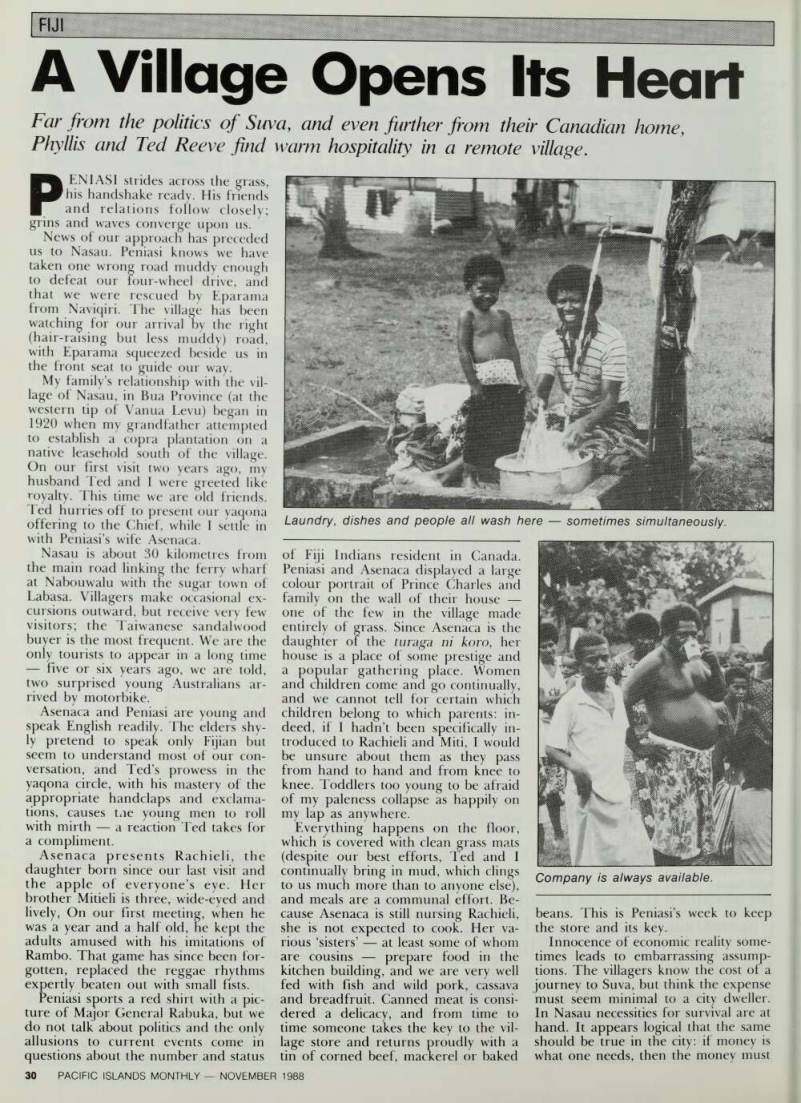
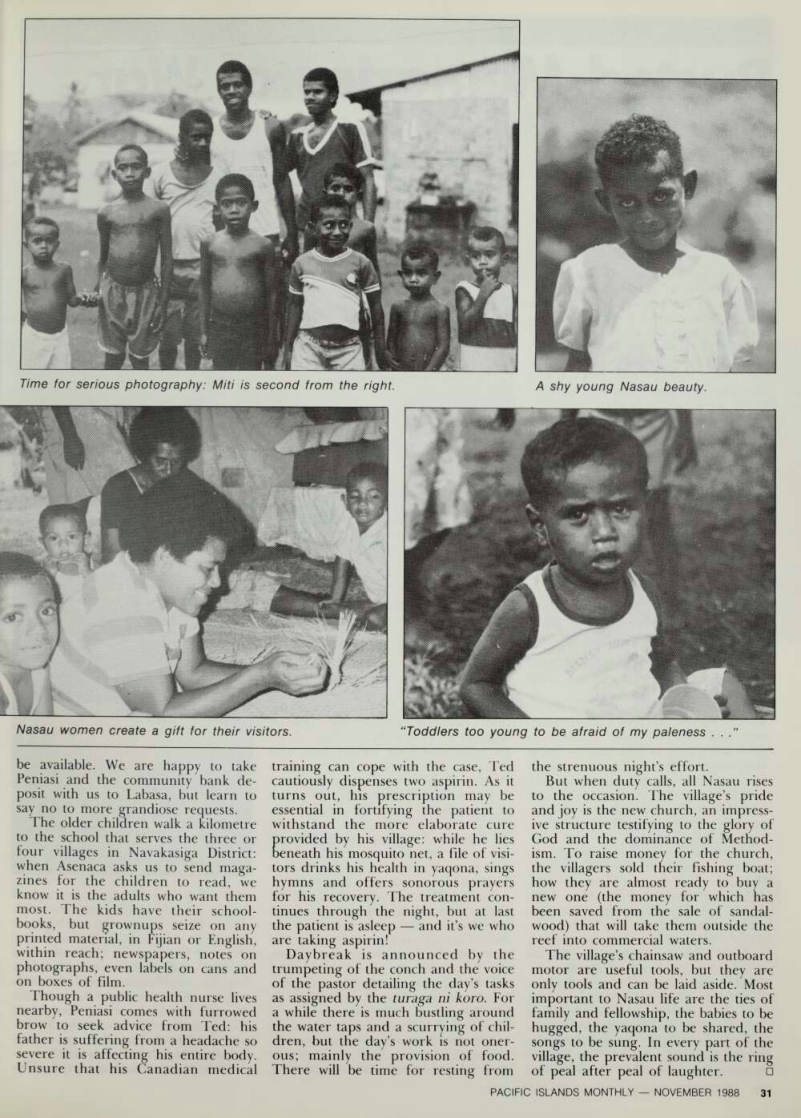
Fiji
Far from the politics of Suva, and even further from their Canadian home, Phyllis and Ted Reeve find warm hospitality in a remote village.
PENIASI strides across the grass, his handshake ready. His friends and relations follow closely; grins and waves converge upon us.
News of our approach has preceded us to Nasau. Peniasi knows we have taken one wrong road muddy enough to defeat our four-wheel drive, and that we were rescued by Eparama from Naviqiri. The village has been watching for our arrival by the right (hair-raising but less muddy) road, with Eparama squeezed beside us in the front seat to guide our way.
My family’s relationship with the vil lage of Nasau, in Bua Province (at the western tip of Vanua Levu) began in 1920 when my grandfather attempted to establish a copra plantation on a native leasehold south of the village.
On our first visit two years ago, my husband Ted and I were greeted like royalty. This time we are old friends.
Ted hurries off to present our yaqona offering to the Chief, while I settle in with Peniasi’s wife Asenaca.
Nasau is about 30 kilometres from the main road linking the ferry wharf at Nabouwalu with the sugar town of Labasa. Villagers make occasional ex cursions outward, but receive very few visitors; the Taiwanese sandalwood buyer is the most frequent. We are the only tourists to appear in a long time five or six years ago, we are told, two surprised young Australians ar rived by motorbike.
Asenaca and Peniasi are young and
speak English readily. The elders shy
ly pretend to speak only Fijian but seem to understand most of our con versation, and Ted’s prowess in the yaqona circle, with his mastery of the
appropriate handclaps and exclama
tions, causes toe young men to roll with mirth a reaction Ted takes for
a compliment.
Asenaca presents Rachieli, the daughter born since our last visit and the apple of everyone’s eye. Her brother Mitieli is three, wide-eyed and lively, On our first meeting, when he was a year and a half old, he kept the adults amused with his imitations of Rambo. That game has since been for gotten, replaced the reggae rhythms expertly beaten out with small fists.
Peniasi sports a red shirt with a pic ture of Major General Rabuka, but we do not talk about politics and the only allusions to current events come in questions about the number and status
of Fiji Indians resident in Canada.
Peniasi and Asenaca displayed a large colour portrait of Prince Charles and family on the wall of their house one of the few in the village made entirely of grass. Since Asenaca is the daughter of the turaga ni koro, her house is a place of some prestige and
a popular gathering place. Women
and children come and go continually, and we cannot tell for certain which children belong to which parents: in deed, if I hadn’t been specifically in troduced to Rachieli and Miti, I would be unsure about them as they pass from hand to hand and from knee to knee. Toddlers too young to be afraid of my paleness collapse as happily on
my lap as anywhere.
Everything happens on the floor, which is covered with clean grass mats (despite our best efforts, Ted and I
continually bring in mud, which clings
to us much more than to anyone else), and meals are a communal effort. Be cause Asenaca is still nursing Rachieli, she is not expected to cook. Her va rious ‘sisters’ at least some of whom are cousins prepare food in the kitchen building, and we are very well fed with fish and wild pork, cassava and breadfruit. Canned meat is consi dered a delicacy, and from time to time someone takes the key to the vil lage store and returns proudly with a tin of corned beef, mackerel or baked
beans. This is Peniasi’s week to keep the store and its key.
Innocence of economic reality some times leads to embarrassing assump tions. The villagers know the cost of a journey to Suva, but think the expense must seem minimal to a city dweller.
In Nasau necessities for survival are at hand. It appears logical that the same should be true in the city: if money is what one needs, then the money must
Laundry, dishes and people all wash here sometimes simultaneously.
Company is always available.
be available. We are happy to take Peniasi and the community bank deposit with us to Labasa, but learn to say no to more grandiose requests.
The older children walk a kilometre to the school that serves the three or four villages in Navakasiga District; when Asenaca asks us to send magazines for the children to read, we know it is the adults who want them most. The kids have their schoolbooks, but grownups seize on any
printed material, in Fijian or English,
within reach; newspapers, notes on photographs, even labels on cans and on boxes of film.
Though a public health nurse lives nearby, Peniasi comes with furrowed brow to seek advice from Ted: his father is suffering from a headache so severe it is affecting his entire body, Unsure that his Canadian medical
training can cope with the case, Ted
cautiously dispenses two aspirin. As it
turns out, his prescription may be essential in fortifying the patient to withstand the more elaborate cure provided by his village; while he lies beneath his mosquito net, a file of visi tors drinks his health in yaqona, sings hymns and offers sonorous prayers for his recovery. The treatment con tinues through the night, but at last the patient is asleep and it’s we who
are taking aspirin!
Daybreak is announced by the trumpeting of the conch and the voice of the pastor detailing the day’s tasks as assigned by the turaga ni koro. For a while there is much bustling around the water taps and a scurrying of chil dren, but the day’s work is not oner ous; mainly the provision of food, There will be time for resting from
the strenuous night’s effort.
But when duty calls, all Nasau rises to the occasion. The village’s pride and joy is the new church, an impress ive structure testifying to the glory of God and the dominance of Method ism. To raise money for the church, the villagers sold their fishing boat; how they are almost ready to buy a new one (the money for which has been saved from the sale of sandal wood) that will take them outside the reef into commercial waters, The village’s chainsaw and outboard motor are useful tools, but they are only tools and can be laid aside. Most important to Nasau life are the ties of family and fellowship, the babies to be hugged, the yaqona to be shared, the songs to be sung. In every part of the village, the prevalent sound is the ring of peal after peal of laughter. □
Time for serious photography: Miti is second from the right.
Nasau women create a gift for their visitors.
A shy young Nasau beauty.
“Toddlers too young to be afraid of my paleness
Rusted Memories of War
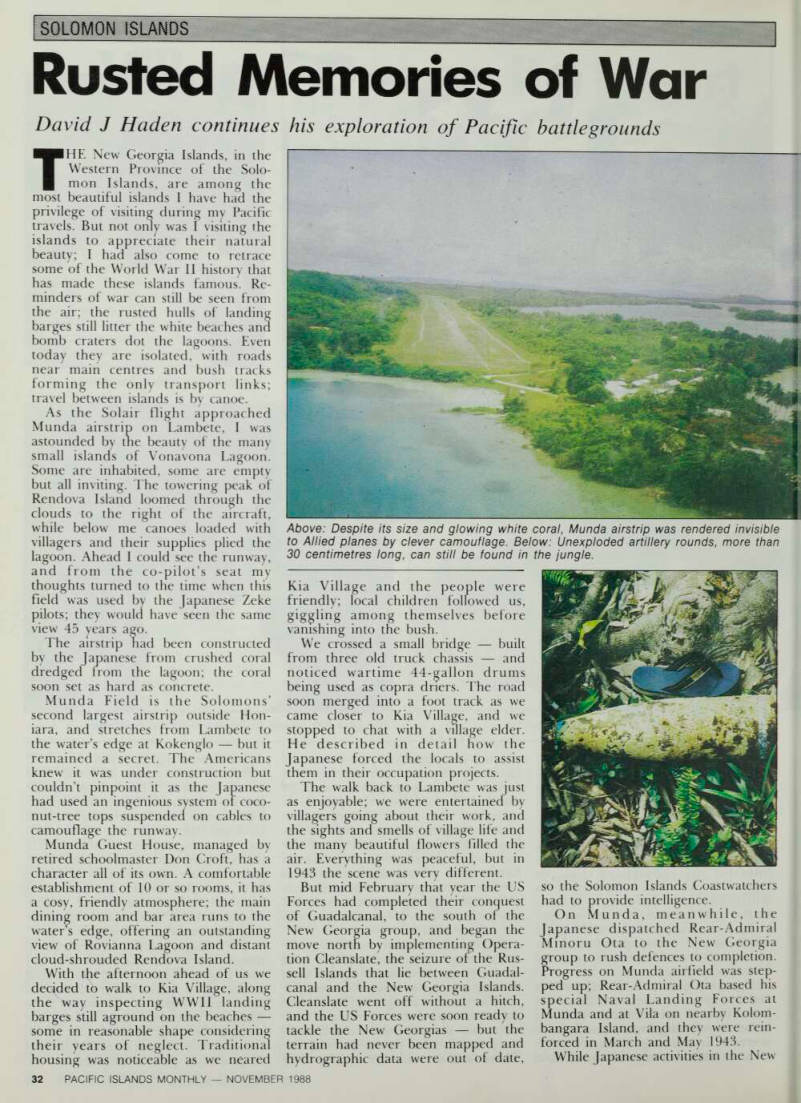
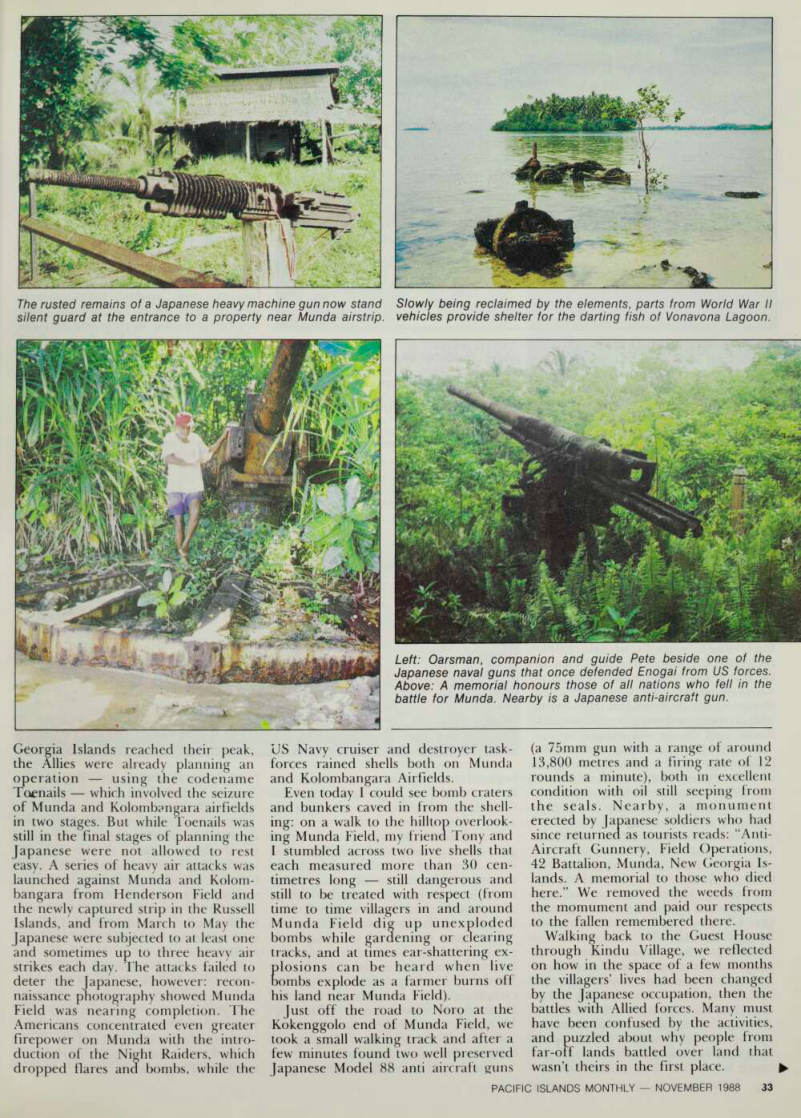
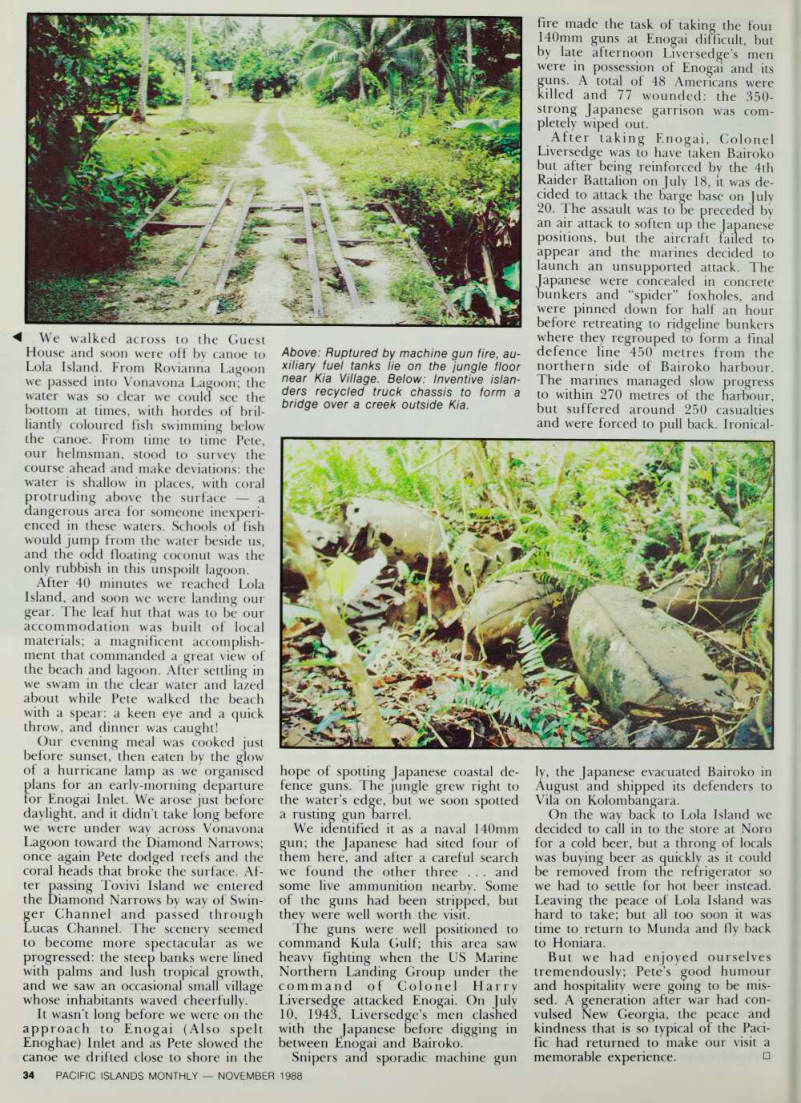
Solomon Islands
David J Haden continues his exploration of Pacific battlegrounds
THE New Georgia Islands, in the Western Province of the Solo mon Islands, are among the most beautiful islands I have had the
privilege of visiting during my Pacific
travels. But not only was I visiting the islands to appreciate their natural beauty; I had also come to retrace some of the World War II history that has made these islands famous. Re minders of war can still be seen from the air; the rusted hulls of landing barges still litter the white beaches and bomb craters dot the lagoons. Even today they are isolated, with roads near main centres and bush tracks forming the only transport links; travel between islands is by canoe.
As the Solair flight approached Munda airstrip on Lambete, I was astounded by the beauty of the many small islands of Vonavona Lagoon.
Some are inhabited, some are empty but all inviting. The towering peak of Rendova Island loomed through the clouds to the right of the aircraft, while below me canoes loaded with
villagers and their supplies plied the
lagoon. Ahead I could see the runway, and from the co-pilot’s seat my thoughts turned to the time when this field was used by the Japanese Zeke pilots; they would have seen the same view 45 years ago.
The airstrip had been constructed by the Japanese from crushed coral dredged from the lagoon; the coral soon set as hard as concrete.
Munda Field is the Solomons’ second largest airstrip outside Hon iara, and stretches from Lambete to the water’s edge at Kokenglo but it remained a secret. The Americans knew it was under construction but couldn’t pinpoint it as the Japanese had used an ingenious system of coco nut-tree tops suspended on cables to camouflage the runway.
Munda Guest House, managed by retired schoolmaster Don Croft, has a character all of its own. A comfortable establishment of 10 or so rooms, it has a cosy, friendly atmosphere; the main dining room and bar area runs to the
water’s edge, offering an outstanding
view of Rovianna Lagoon and distant cloud-shrouded Rendova Island.
With the afternoon ahead of us we decided to walk to Kia Village, along the way inspecting WWH landing barges still aground on the beaches some in reasonable shape considering their years of neglect. Traditional housing was noticeable as we neared
Kia Village and the people were friendly; local children followed us, giggling among themselves before vanishing into the bush.
We crossed a small bridge built from three old truck chassis and noticed wartime 44-gallon drums being used as copra driers. The road soon merged into a foot track as we came closer to Kia Village, and we stopped to chat with a village elder.
He described in detail how the Japanese forced the locals to assist them in their occupation projects.
The walk back to Lambete was just as enjoyable; we were entertained by villagers going about their work, and the sights and smells of village life and the many beautiful flowers filled the air. Everything was peaceful, but in 1943 the scene was very different.
But mid February that year the US Forces had completed their conquest of Guadalcanal, to the south of the New Georgia group, and began the
move north by implementing Opera
tion Cleanslate, the seizure of the Rus sell Islands that lie between Guadal canal and the New Georgia Islands.
Cleanslate went off without a hitch, and the US Forces were soon ready to tackle the New Georgias but the terrain had never been mapped and hydrographic data were out of date,
so the Solomon Islands Coastwatchers
had to provide intelligence.
On Munda, meanwhile, the
Japanese dispatched Rear-Admiral
Minoru Ota to the New Georgia group to rush defences to completion.
Progress on Munda airfield was step ped up; Rear-Admiral Ota based his special Naval Landing Forces at Munda and at Vila on nearby Kolom bangara Island, and they were rein forced in March and May 1943.
While Japanese activities in the New
Above: Despite its size and glowing white coral, Munda airstrip was rendered invisible to Allied planes by clever camouflage. Below: Unexploded artillery rounds, more than 30 centimetres long, can still be found in the jungle.
Georgia Islands reached their peak, the Allies were already planning an
operation using the codename
Toenails which involved the seizure of Munda and Kolombangara airfields in two stages. But while Toenails was still in the final stages of planning the Japanese were not allowed to rest easy. A series of heavy air attacks was launched against Munda and Kolombangara from Henderson Field and the newly captured strip in the Russell Islands, and from March to May the Japanese were subjected to at least one and sometimes up to three heavy air strikes each day. The attacks failed to deter the Japanese, however: reamnaissance photography showed Munda Field was nearing completion. The Americans concentrated even greater firepower on Munda with the introduction of the Night Raiders, which dropped flares and bombs, while the
US Navy cruiser and destroyer taskforces rained shells both on Munda and Kolombangara Airfields.
Even today I could see bomb craters and bunkers caved in from the shelling: on a walk to the hilltop overlooking Munda Field, my friend Tony and I stumbled across two live shells that each measured more than 30 centimetres long still dangerous and still to be treated with respect (from time to time villagers in and around Munda Field dig up unexploded bombs while gardening or clearing tracks, and at times ear-shattering explosions can be heard when live bombs explode as a farmer burns off his land near Munda Field).
Just off the road to Noro at the Kokenggolo end of Munda Field, we took a small walking track and after a few minutes found two well preserved Japanese Model 88 anti aircraft guns
(a 75mm gun with a range of around 13,800 metres and a firing rate of 12 rounds a minute), both m excellent condition with oil still seeping from the seals. Nearby, a monument erected by Japanese soldiers who had since returned as tourists reads: “Anti- Aircraft Gunnery, Field Operations, 42 Battalion, Munda, New Georgia Is lands. A memorial to those who died here.” We removed the weeds from the momument and paid our respects to the fallen remembered there.
Walking back to the Guest House through Kindu Village, we reflected on how in the space of a few months the villagers’ lives had been changed
by the Japanese occupation, then the
battles with Allied forces. Many must have been confused by the activities,
and puzzled about why people from
far-off lands battled over land that wasn’t theirs in the first place.
The rusted remains of a Japanese heavy machine gun now stand silent guard at the entrance to a property near Munda airstrip.
Slowly being reclaimed by the elements, parts from World War II vehicles provide shelter for the darting fish of Vonavona Lagoon.
Left: Oarsman, companion and guide Pete beside one of the Japanese naval guns that once defended Enogai from US forces.
Above: A memorial honours those of all nations who fell in the battle for Munda. Nearby is a Japanese anti-aircraft gun.
We walked across to the Guest House and soon were off by canoe to Lola Island. From Rovianna Lagoon we passed into Vonavona Lagoon; the water was so clear we could see the bottom at times, with hordes of bril liantly coloured fish swimming below the canoe. From time to time Pete, our helmsman, stood to survey the course ahead and make deviations: the water is shallow in places, with coral protruding above the surface a dangerous area for someone inexperi enced in these waters. Schools of fish would jump from the water beside us, and the odd floating coconut was the
only rubbish in this unspoilt lagoon.
After 40 minutes we reached Lola Island, and soon we were landing our gear. The leaf hut that was to be our accommodation was built of local
materials; a magnificent accomplish
ment that commanded a great view of the beach and lagoon. After settling in we swam in the clear water and lazed about while Pete walked the beach with a spear: a keen eye and a quick throw, and dinner was caught!
Our evening meal was cooked just before sunset, then eaten by the glow of a hurricane lamp as we organised
plans for an early-morning departure
for Enogai Inlet. We arose just before daylight, and it didn’t take long before we were under way across Vonavona Lagoon toward the Diamond Narrows; once again Pete dodged reefs and the coral heads that broke the surface. Af ter passing Tovivi Island we entered the Diamond Narrows by way of Swin ger Channel and passed through Lucas Channel. The scenery seemed to become more spectacular as we progressed: the steep banks were lined
with palms and lush tropical growth,
and we saw an occasional small village whose inhabitants waved cheerfully.
It wasn’t long before we were on the
approach to Enogai (Also spelt
Enoghae) Inlet and as Pete slowed the canoe we drifted close to shore in the
hope of spotting Japanese coastal de-
fence guns. The jungle grew right to the water’s edge, but we soon spotted a rusting gun barrel.
We identified it as a naval 140 mm gun; the Japanese had sited four of them here, and after a careful search we found the other three . . . and some live ammunition nearby. Some of the guns had been stripped, but they were well worth the visit.
The guns were well positioned to command Kula Gulf; this area saw heavy fighting when the US Marine Northern Landing Group under the command of Colonel Harry
Liversedge attacked Enogai. On July
10, 1943, Liversedge’s men clashed with the Japanese before digging in between Enogai and Bairoko.
Snipers and sporadic machine gun
fire made the task of taking the font 140 mm guns at Enogai difficult, but by late afternoon Liversedge’s men were in possession of Enogai and its guns. A total of 48 Americans were Killed and 77 wounded: the 350strong Japanese garrison was com
pletely wiped out.
After taking Enogai, Colonel
Liversedge was to have taken Bairoko but after being reinforced by the 4th Raider Battalion on July 18, it was de cided to attack the barge base on July 20. The assault was to be preceded by an air attack to soften up the Japanese positions, but the aircraft failed to appear and the marines decided to launch an unsupported attack. The Japanese were concealed in concrete bunkers and “spider” foxholes, and were pinned down for half an hour before retreating to ridgeline bunkers where they regrouped to form a final defence line 450 metres from the northern side of Bairoko harbour.
The marines managed slow progress to within 270 metres of the narbour, but suffered around 250 casualties and were forced to pull back. Ironical-
ly, the Japanese evacuated Bairoko in August and shipped its defenders to Vila on Kolombangara.
On the way back to Lola Island we decided to call in to the store at Noro for a cold beer, but a throng of locals was buying beer as quickly as it could be removed from the refrigerator so we had to settle for hot beer instead, Leaving the peace of Lola Island was hard to take; but all too soon it was time to return to Munda and fly back to Honiara.
But we had enjoyed ourselves
tremendously; Pete’s good humour
and hospitality were going to be mis sed. A generation after war had con vulsed New Georgia, the peace and kindness that is so typical of the Paci fic had returned to make our visit a memorable experience. □
Above: Ruptured by machine gun fire, au xiliary fuel tanks lie on the jungle floor near Kia Village. Below: Inventive islan ders recycled truck chassis to form a bridge over a creek outside Kia.
Delegation Seeks
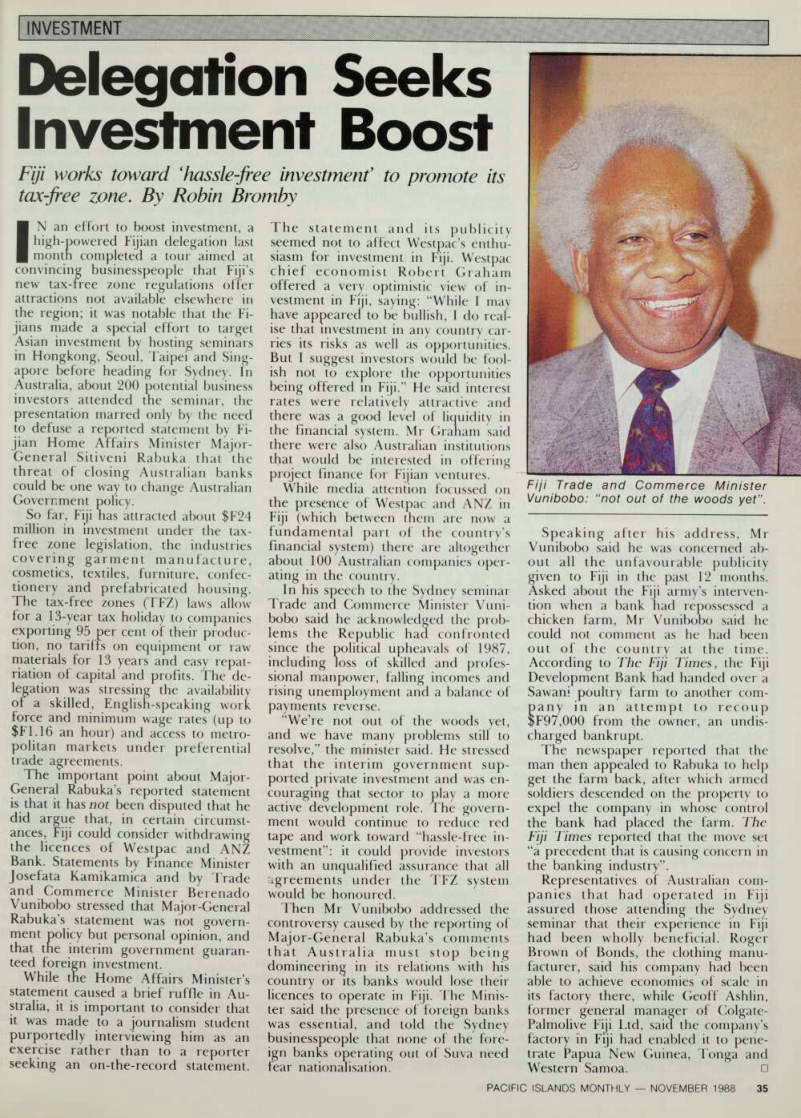
Investment
Delegation Seeks Investment Boost
Fiji works toward ‘hassle-free investment’ to promote its tax-free zone. By Robin Bromby
IN an effort to boost investment, a
high-powered Fijian delegation last
month completed a tour aimed at
convincing businesspeople that Fiji’s
new tax-free zone regulations offer attractions not available elsewhere in the region; it was notable that the Fi jians made a special effort to target Asian investment by hosting seminars
in Hongkong, Seoul, Taipei and Sing
apore before heading for Sydney. In Australia, about 200 potential business investors attended the seminar, the presentation marred only by the need to defuse a reported statement by Fi jian Home Affairs Minister Major- General Sitiveni Rabuka that the threat of closing Australian banks could be one way to change Australian
Government policy.
So far, Fiji has attracted about SF24 million in investment under the tax free zone legislation, the industries covering garment manufacture, cosmetics, textiles, furniture, confec
tionery and prefabricated housing.
The tax-free zones (TFZ) laws allow for a 13-year tax holiday to companies exporting 95 per cent of their produc tion, no tariffs on equipment or raw materials for 13 years and easy repat riation of capital and profits. The de
legation was stressing the availability
of a skilled, English-speaking work force and minimum wage rates (up to $F 1.16 an hour) and access to metro
politan markets under preferential
trade agreements.
The important point about Major- General Rabuka’s reported statement is that it has not been disputed that he did argue that, in certain circumst ances, Fiji could consider withdrawing the licences of Westpac and ANZ Bank. Statements by Finance Minister Josefata Kamikamica and by Trade and Commerce Minister Berenado Vunibobo stressed that Major-General Rabuka’s statement was not govern
ment policy but personal opinion, and
that the interim government guaran teed foreign investment.
While the Home Affairs Minister’s statement caused a brief ruffle in Au stralia, it is important to consider that it was made to a journalism student purportedly interviewing him as an exercise rather than to a reporter seeking an on-the-record statement.
The statement and its publicity seemed not to affect Westpac’s enthu siasm for investment in Fiji. Westpac chief economist Robert Graham offered a very optimistic view of in vestment in Fiji, saying: “While I may have appeared to be bullish, I do real ise that investment in any country car ries its risks as well as opportunities.
But I suggest investors would be fool ish not to explore the opportunities being offered m Fiji.” He said interest rates were relatively attractive and there was a good level of liquidity in the financial system. Mr Graham said there were also Australian institutions that would be interested in offering project finance for Fijian ventures.
While media attention focussed on the presence of Westpac and ANZ in Fiji (which between them are now a fundamental part of the country’s financial system) there are altogether about 100 Australian companies oper ating in the country.
In his speech to the Sydney seminar Trade and Commerce Minister Vuni bobo said he acknowledged the prob lems the Republic had confronted since the political upheavals of 1987, including loss of skilled and profes sional manpower, falling incomes and rising unemployment and a balance of payments reverse.
“We’re not out of the woods yet, and we have many problems still to resolve,” the minister said. He stressed that the interim government sup ported private investment and was en couraging that sector to play a more active development role. The govern ment would continue to reduce red tape and work toward “hassle-free in vestment”: it could provide investors with an unqualified assurance that all agreements under the TFZ system would be honoured.
Then Mr Vunibobo addressed the controversy caused by the reporting of Major-General Rabuka’s comments that Australia must stop being domineering in its relations with his country or its banks would lose their licences to operate in Fiji. The Minis ter said the presence of foreign banks was essential, and told the Sydney businesspeople that none of the fore ign banks operating out of Suva need fear nationalisation.
Speaking after his address, Mr Vunibobo said he was concerned ab out ail the unfavourable publicity given to Fiji in the past 12 months.
Asked about the Fiji army’s interven tion when a bank had repossessed a chicken farm, Mr Vunibobo said he could not comment as he had been out of the country at the time.
According to The Fiji Times, the Fiji Development Bank had handed over a Sawani poultry farm to another com pany in an attempt to recoup $F97,000 from the owner, an undis
charged bankrupt.
The newspaper reported that the man then appealed to Rabuka to help get the farm back, after which armed soldiers descended on the property to expel the company in whose control the bank had placed the farm. The Fiji Times reported that the move set “a precedent that is causing concern in
the banking industry”.
Representatives of Australian com
panies that had operated in Fiji
assured those attending the Sydney seminar that their experience in Fiji had been wholly beneficial. Roger Brown of Bonds, the clothing manu facturer, said his company had been able to achieve economies of scale in its factory there, while Geoff Ashlin, former general manager of Colgate- Palmolive Fiji Ltd, saia the company’s factory in Fiji had enabled it to pene trate Papua New Guinea, Tonga and Western Samoa. □
Fiji Trade and Commerce Minister Vunibobo: “not out of the woods yet”.
Pacific Report
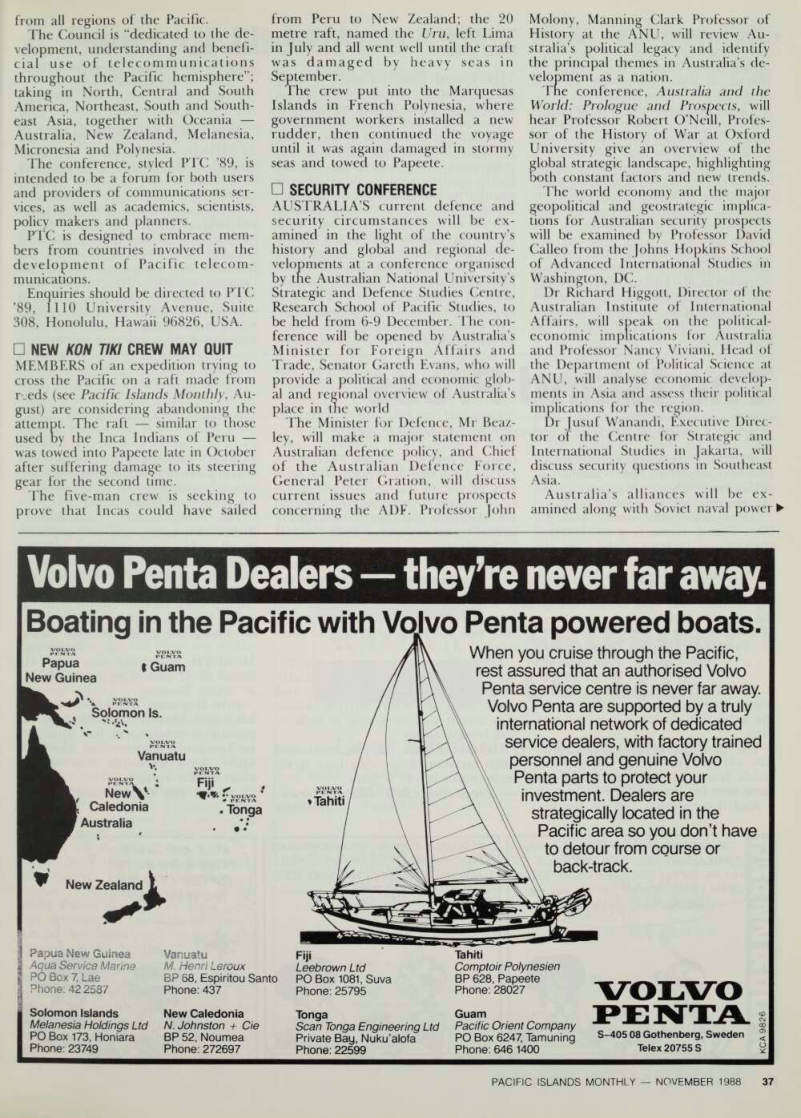
□ Australia-Pacific Conference
THE University of New South Wales’
Centre for South Pacific Studies will hold its first conference with the theme ‘Australia and the South Pacific in 1988’ from December 1-4 this year.
The conference is intended, in “a year of national rethinking and eva luation in 1988” to highlight Austra lia’s relations with the South Pacific, an area long ignored in the national consciousness. It will provide a bluep rint for future projects and activities of researchers at UNSW relating to the South Pacific.
Speakers include Mr Henry Naisali, director of the South Pacific Bureau for Economic Co-operation (SPEC), Professor R G Crocombe of the Uni versity of the South Pacific, and a range of highly qualified people in the fields of mineral development, health, women’s issues, trade, politics and humanities.
□ Aid For Fiji Agriculture
THE Asian Development Bank has approved a SUS2O million loan to Fiji
to help the country’s agricultural di
versification program. There will also be technical assistance grants totalling SUS 1,070,000. The loan, for 15 years with a three-year period of grace, will carry interest to be determined in accordance with the bank's pool-based variable lending rate system.
It is intended to support agricultu ral diversification and growth, leading to exports of agriculture-based manu
factured products. Working with pri
vate sector enterprises that will help relieve rural poverty, the program is expected to help cope with adverse environmental factors.
The technical assistance grants will
provide a farm-management informa
tion system, strengthen the project
formulation, evaluation and monitor
ing capabilities of key government
ministries, and help formulate the Northern Division Agricultural De
velopment Project.
□ Marshalls Wilderness Care
AN expedition organised by Hawaii’s
East-West Center is sailing the Mar shall Islands to determine if the gov ernment should establish protected, patrolled areas to preserve plant and animal species and archaeological sites.
The study is focusing initially on 10 uninhabited atolls in the northwest
Marshalls. “Illegal foreign fishing ex
ploitation may nave already damaged
marine life, particularly the turtle
population,” said Lawrence Hamilton, the study co-ordinator. He is also in vestigating reports that a US company is negotiating to use one of the atoll lagoon sites to dump millions of ton nes of garbage as landfill for eventual development of tourist facilities.
□ Tahiti Hosts Pidp Group
FOLLOWING the recent South Paci fic Forum in Tonga, representatives of seven Pacific nations met in Tahiti for the 14th standing committee meeting of the Pacific Islands Development Program. It was the first time such a meeting had been hosted by French
Polynesia, Tahiti having joined PIDP
last year with a special contribution of SUS4O,OOO, backed up by a SIOO,OOO donation from France. PIDP has its headquarters at the East-West Center in Hawaii.
□ Us Islands Population Boom
THE US Census Bureau reports that
population growth is skyrocketing in
islands under US jurisdiction in the Pacific. Numbers in Guam in 1987 were up 23.1 per cent over 1980, due
largely to migration and military per
sonnel movements from the Philip
pines. Guam’s population reached
139,400 in 1987.
The northern Marianas population increased by 21.1 per cent in the same period, to 20,300. American Samoa grew by 19 per cent to 38,400. In both cases growth was attributed mainly to increased births.
□ Aborigines Partner Bikinians
ABORIGINAL people from Mara linga in South Australia met recently with a delegation of five Bikini Islan ders who visited Australia at their own expense to discuss their common ex perience of seeing their homelands used as proving grounds for nuclear weapons after World War 11.
Tne Australian Department of Em
ployment, Education and Training’s
journal Aboriginal Employment and
Education reports on the similarity of the two situations. The US moved the 1500 people of Bikini while it tested hydrogen and atomic bombs on Bikini Atoll between 1946 and 1958: the Aborigines were also moved from their tribal lands to make way for Brit ish nuclear tests in the 19505.
Archie Barton, speaking for the Maralinga people, said “Like us, the Bikini Islanders are living a traditional lifestyle, and we are both concerned with the same thing”. That is, making
their homelands sate to live in again.
The Aborigines are seeking SA7 million in compensation from the Au stralian Government for resettlement, while the Bikini people are asking the US Government to scrape off the top 16 centimetres of soil from their is land, together with all plant life, as a prelude to restoration.
□ Nivaga Ii Welcomed To Tuvalu
A BEAUTIFUL day, throngs of peo
ple, dancing and a highly decorated
deep-sea wharf welcomed Tuvalu’s new inter-island ferry and cargo vessel Nivaga II as she arrived in Funafuti on September 5 after a long voyage
from England.
The SAIO million vessel, launched at Lowestoft, England, earlier this year, constitutes tnat country’s main thrust of aid to Tuvalu. Representa tives of Britain’s Overseas Develop ment Agency were on hand to film the arrival and its enthusiastic recep tion by the local community.
As tier gleaming white form came into view across Funafuti’s broad la goon, excitement ran high; a colourful regatta of yachts and workboats man ned by trainees from the Tuvalu Mari time School accompanied the Nivaga II across the final stretch of water to the wharf, where crowds of onlookers welcomed the arrival beneath a canopy adorned with palm fronds, ferns and flowers. The Nukulaelae Is land Group gave a tremendous display of songs and dancing as the boat drew up beside the wharf.
Nivaga II will replace the original
Nivanga, which has given almost 27 years of faithful service to the islands of Tuvalu. A handing-over ceremony took place at the wharf during the afternoon, and a reception was held that night at the Vaiaka Lagi Hotel.
Skipper Paueli Sione, who travelled with tne vessel on the voyage from England, has had little time to relax since his return! Already Nivaga II has made a trip to Fiji to collect the Nanumea dancing troupe returning from the Townsville Festival of Pacific Arts, and ferried hundreds of people from the outer islands to Funafuti for the Independence celebrations in early October.
□ Telecommunicators Confer
THE annual conference of the Pacific Telecommunications Council will be held at the Sheraton Waikiki Hotel in Hawaii from January 15-18, 1989. Il
will, as previously, bring together
academic and business participants
from all regions of the Pacific.
The Council is “dedicated to the de
velopment, understanding and benefi
cial use of telecommunications
throughout the Pacific hemisphere”;
taking in North, Central and South America, Northeast, South and South east Asia, together with Oceania Australia, New Zealand, Melanesia, Micronesia and Polynesia.
The conference, styled PTC ’B9, is intended to be a forum for both users and providers of communications ser vices, as well as academics, scientists,
policy makers and planners.
PTC is designed to embrace mem bers from countries involved in the development of Pacific telecom munications.
Enquiries should be directed to PTC ’B9, 1110 University Avenue, Suite 308, Honolulu, Hawaii 96826, USA. □ NEW KON TIKI CREW MAY QUIT MEMBERS of an expedition trying to cross the Pacific on a raft made from r-eds (see Pacific Islands Monthly, Au
gust) are considering abandoning the
attempt. The raft similar to those used by the Inca Indians of Peru was towed into Papeete late in October
after suffering damage to its steering
gear for the second time.
The five-man crew is seeking to prove that Incas could have sailed
from Peru to New Zealand; the 20 metre raft, named the Urn, left Lima in July and all went well until the craft
was damaged by heavy seas in
September.
The crew put into the Marquesas Islands in French Polynesia, where government workers installed a new rudder, then continued the voyage until it was again damaged in stormy seas and towed to Papeete.
□ Security Conference
AUSTRALIA’S current defence and security circumstances will be ex amined in the light of the country’s
history and global and regional de
velopments at a conference organised by trie Australian National University’s Strategic and Defence Studies Centre, Research School of Pacific Studies, to be held from 6-9 December. The con ference will be opened by Australia’s Minister for Foreign Affairs and Trade, Senator Gareth Evans, who will
provide a political and economic glob
al and regional overview of Australia’s place in the world The Minister for Defence, Mr Beaz ley, will make a major statement on Australian defence policy, and Chief of the Australian Defence Force, General Peter Gration, will discuss current issues and future prospects concerning the ADF. Professor John
Molony, Manning Clark Professor of History at the ANU, will review Au
stralia’s political legacy and identify
the principal themes in Australia’s de velopment as a nation, The conference, Australia and the World: Prologue and Prospects, will hear Professor Robert O’Neill, Profes sor of the History of War at Oxford University give an overview of the
global strategic landscape, highlighting
both constant factors and new trends, The world economy and the major
geopolitical and geostrategic implica
tions for Australian security prospects will be examined by Professor David Calleo from the Johns Hopkins School of Advanced International Studies in
Washington, DC.
Dr Richard Higgott, Director of the Australian Institute of International Affairs, will speak on the political economic implications for Australia and Professor Nancy Viviani, Head of the Department of Political Science at ANU, will analyse economic develop ments in Asia and assess their political
implications for the region,
Dr Jusuf Wanandi, Executive Direc tor of the Centre for Strategic and International Studies in Jakarta, will discuss security questions in Southeast Asia.
Australia’s alliances will be ex amined along with Soviet naval power
4 in the Pacific, US maritime strategy in the region and the prospects for Japanese rearmament and will be ex plored, as well as strategic develop ments in the Indian Ocean.
The conference will also include a session on arms control and disarma ment. Dr Graeme Cheeseman, Senior Research Fellow in the Peace Research Centre at ANU, will provide a critique of aspects of Australia’s defence policy and outline alternative approaches in cluding the possibility of a non offensive defence position for Au stralia.
The ANU is seeking expressions of interest in the conference; conference secretary is Mr J O Langtry, Strategic and Defence Studies Centre, Research School of Pacific Studies, ANU, GPO Box 4, Canberra, phone (062) 49 2276.
□ Thatcher In Favour Of Environ
Ment Care
THE United Kingdom seeks to “help countries of the South Pacific to use and manage their limited resources in a productive and, above all, sustain able way”, according to Chris Patten, Britain’s Minister for Overseas De velopment, to a conference on the Pacific environment at the Common wealth Institute in London. Last year Britain spent more than 10 million pounds on technical advice and train ing in the Solomon Islands, Vanuatu, Kiribati, Tuvalu, Fiji and Tonga.
Mr Patten quoted British Prime Minister Margaret Thatcher’s endorse ment of sustainable development and
appropriate growth as the only effec
tive means of tackling poverty or en
vironmental degradation and pollu
tion. In a remarkable speech to the Royal Society, Mrs Thatcher commit ted her Government to serious treat ment of environmental issues.
□ New Party For Cook Islands
A THIRD political party has been formed in the Cook Islands with the establishment of the Cook Islands Labour Party. Leader of the party, Mr Rena Ariki Jonassen, said his party will field a full slate of candidates to contest general elections to be held late this year or early in 1989. Mr Jonassen said the party will have no formal ties with the New Zealand Labour Party, but among its policies is a pledge to declare the Cooks a nuc lear-free zone and a ban on all nuc lear-armed ships entering its ports.
Advertisements & other items, p. 37 (1 item)
Kca9B26
Volvo Renta Dealers —they’re never far away.
Boating in the Pacific with Volvo Renta powered boats.
Papua New Guinea t Guam
VOLVO
*. PENTA
Solomon Is.
Vanuatu
RENTA
NewV*
Caledonia Australia Fiji „ Tonga New Zealand I Papua New Guinea Aqua Service Marine I PO Box 7, Lae 3 Phone; 42 2587 Solomon Islands Melanesia Holdings Ltd PO Box 173, Honiara Phone: 23749 * Tahiti
When you cruise through the Pacific,
rest assured that an authorised Volvo
Renta service centre is never far away.
Volvo Renta are supported by a truly
international network of dedicated
service dealers, with factory trained
personnel and genuine Volvo
Renta parts to protect your
investment. Dealers are
strategically located in the
Pacific area so you don’t have
to detour from course or
back-track.
Vanuatu M. Henri Leroux BP 68, Espiritou Santo Phone; 437 New Caledonia N. Johnston + Cie BP 52, Noumea Phone; 272697 Fiji Leebrown Ltd PO Box 1081, Suva Phone: 25795 Tonga Scan Tonga Engineering Ltd Private Bay, Nukualofa Phone: 22599 Tahiti Comptoir Polynesien BP 628, Papeete Phone: 28027 Guam Pacific Orient Company PO Box 6247, Tamuning Phone: 646 1400
VOLVO
S-405 08 Gothenberg, Sweden Telex 20755 S
KCA9B26
The Island Press
Reports from the papers, compiled by John Carter
A FORMER Defence Force colonel yesterday described the National In
telligence Organisation as an
“amateurish” spy organisation.
“It is a laughing stock,” said Mr Tom Poang, formerly a chief of op erations and Director of the Land ele ment in the PNGDF.
“It is unprofessional, undisciplined,
unsystematic in its intelligence gather
ing network and has failed to serve the security and intelligence interests of PNG”.
From the Papua New Guinea Post-Courier, Port Moresby A SOUTHERN Highlands clan has
rejected compensation payment for
the death of a clansman in a road acci dent.
The Leri clan of Pangia last Satur day refused to accept money and goods from the Yoarene clan of the same area for the death of Koino Oki.
And that case has become the first
from the region if not PNG.
The Leri clan is reported to have said no to any form of payment be cause nearly all rrtembers of the clan are Christians and they do not believe in making money out of deaths caused
by accidents.
From the Papua New Guinea Post-Courier, Port Moresby A WESTERN Samoan Rugby League team leaves New Zealand today with little wish to return according to their coach.
Eddie Moore says most of the 22man squad have found it “pretty tough” having to clean toilets and make beds in Maori mareas where they stayed well as having to walk to and from training.
He says a team can’t be motivated when members know they have to do such chores before a game.
From the Cook Islands News, Rarotonga
PUBLIC servants will have a short walking day next Monday and the pri vate sector is expected to follow all in the interest of beautification.
The Public Service Commissioner, Richard Chapman, in a memorandum to all public servants this week ex plained that the early cessation of work of non-essential services is to en able all employees to take part in com munity work such as cleaning up the roads, beaches, reserves and the like.
From the Cook Islands News, Rarotonga
HEALTH inspectors supervised the
burial of 32 tons of imported chicken at Nikao, Monday.
Part of a cargo consigned to Food land and Meatco Supermarkets, the perishable goods went bad after two refrigerated containers on the Urte broke down while the ship was en route to Rarotonga.
From the Cook Islands News, Rarotonga
A Feast of Literature
Pacific writers gather in London.
By Nicolas Rothwell
FAR from the South Pacific, the region’s best-known writers and literatures were sunk in debate on the future of Pacific letters last month at a conference arranged by the Commonwealth Institute in wintry London.
In the last event of its ‘Pacific Way’ season, the Institute assembled a group of internationally known writers from eight Commonwealth nations of the Pacific for a series of lectures, round-table discussions and presenta tions on the special problems that con front the region as it develops its own distinctive literary voice.
Among those present were Fijian short-story writer Subramani; a group of prominent New Zealand Maori au
thors, including Georgina Kamiria
Kirby of the Maori Women’s Develop ment Fund; Nora Vagi Brash of Papua New Guinea; and Tonga’s star novelist Epeli Hau’ofa though some of the invited guests, such as Vanuatu’s Grace Molisa, unfortunately could not attend. Other nations repre sented included the Solomon Islands, with Rexford Orotaloa; Western Samoa, with Tunumafona Apelu Aiavoa: and the Cook Islands, with Kauraka Kauraka.
At times the conference veered into contentious terrain, as the organisers had doubtless envisaged: a flyer distri buted by the Commonwealth Institute to whet the appetites of the jaded British press noted in titillating style that “each writer has experienced the dramatic and sometimes unwelcome changes occurring within South Pacific
societies today”.
Among the events arranged in con nection with the conference was the launch of the new collection of short stories by Subramani, titled The Fan tasy Eaters an appropriate highlight since the author himself, doubling in his role as leading academic expert on Pacific literature, gave a moving, allu sive keynote address that addressed this very topic: the destruction of fan tasies in the region.
His chief literary conclusion was that Tonga’s Epeli Hau’ofa, his col league from the University of the South Pacific and former deputy pri vate secretary to the King of Tonga, should be considered “possibly the Rabelais of the Pacific”.
But in his broader considerations on
regional politics and society Subrama
ni touched on the strange relation that exists, even in the Pacific, between fic tion and contemporary history: at once seeming to castigate Pacific wri ters for their lack of boldness and to
commiserate with them for their situa tion, he traced the “self-conscious, in
vented origins of regional writing”
and highlighted the link between poli tical upheavals and literary output going so far as to claim that writing in Vanuatu was given an impetus by the independence movement and has vir tually come to a standstill since the achievement of sovereignty.
“The innocence of the Pacific no longer exists,” he declaimed sadly, be fore launching into a sustained, soph isticated analysis of the Fiji coups that will win him few friends in Suva. “The disappointing fact that the reality we have known and valued may be a con struction was shown forth in one is land state, Fiji, where in a period of nine months government changed six times. Each time a new set of players appeared, with their own ioea of
ordering reality, taking the people
through a range of emotions jubila tion, nightmare, fear, and a terrible waiting for the ending. We witnessed how quickly political events can ‘de familiarise’ the world, in a way only certain kinds of fiction can.”
Subramani went on to suggest a new task for Pacific writers; the construc
tion of alternative realities, and the
dismantling of the unitary ideologies
that now dominate the region ideologies such as those of the ‘Pacific Way’ or the ‘Melanesian Way’. His re marks, he explained, were meant to be
provocative rather than derogatory,
out he made plain his dissatisfaction with the fact that today both politics and literature share a belief that there is just one primary reality “to which the Pacific must return”.
While not all writers at the confer ence would have endorsed Subrama ni’s overriding conviction that “things are not what they seem” and that a “certain form of post-modernist fiction may be the most appropriate” for the
fast-changing, multi-layered region,
there was some consensus that a new phase in Pacific writing is dawning. In
her introductory remarks Georgina
Kirby explained her own view that there were three Pacifies the old, the Pakeha, and the new creation formed from the mingling of the pre vious two. In the shaping of this amal gam, she suggested, today’s writers had a vital role in play.
She concluded with the wish that Pacific writers should continue to be a “unsettling” effect on the region’s peo f)le a hope that was certainly fulfill ed by the troubled sentiments ex
pressed during the conference’s
keynote session. □
Advertisements & other items, p. 39 (1 item)
Co., Ltd.
KYOWA
KYOWA
SHIPPING
CO., LTD.
Liner Service to Pacific Islands
FROM OJAPAN
OKOREA
©TAIWAN
OHONG KONG
OSINGAPORE
TO
O SAIPAN
O FEDERATED STATES
OF MICRONESIA
©MARSHAL ISLANDS
©AMERICAN SAMOA
©NEW CALEDONIA
©FIJI
©GUAM
©YAP
©PALAU
©WESTERN SAMOA
©SOLOMON ISLANDS
©VANUATU
©PAPUA NEW GUINEA
HEAD OFFICE
6th Floor , Kikushima Bldg 2-3, Hamamatsucho 2-chome Mmato-ku. Tokyo 105, Japan Phone: 03(437)2885 (Rep ) Cables: MARIQUEEN Tokyo Telex: 242-4651 Kyowa J
OSAKA OFFICE
Dai San Fuji Bldg 3-13 llachibon 1-chome. Osaka 550 Phone: 06(533)5821 (Rep ) Cables: MARIQUEEN Osaka Telex: 525-6271 Ssiosa J
Trade Winds
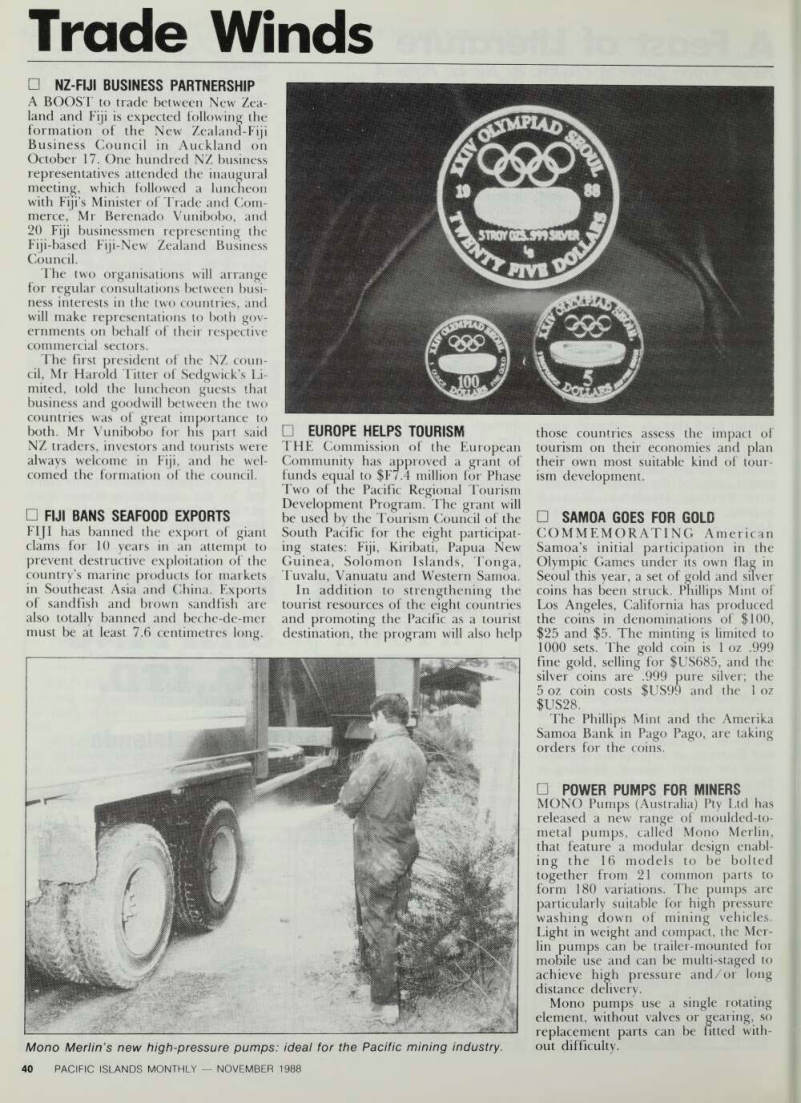
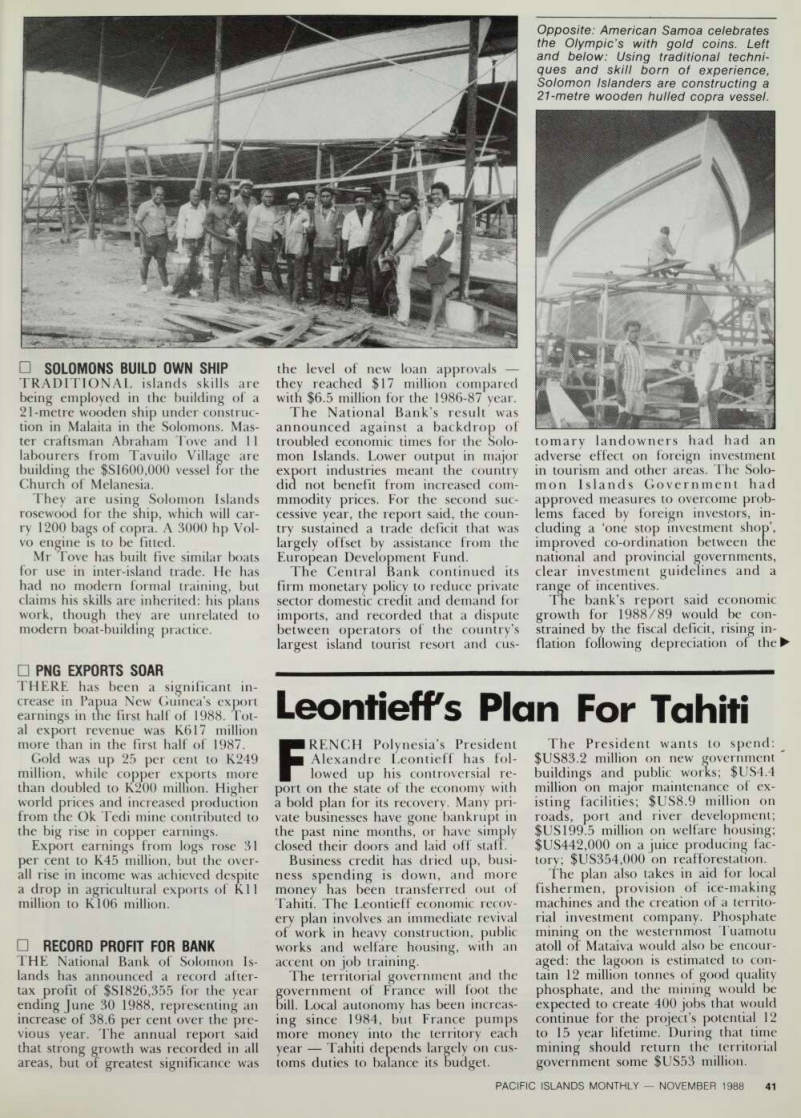
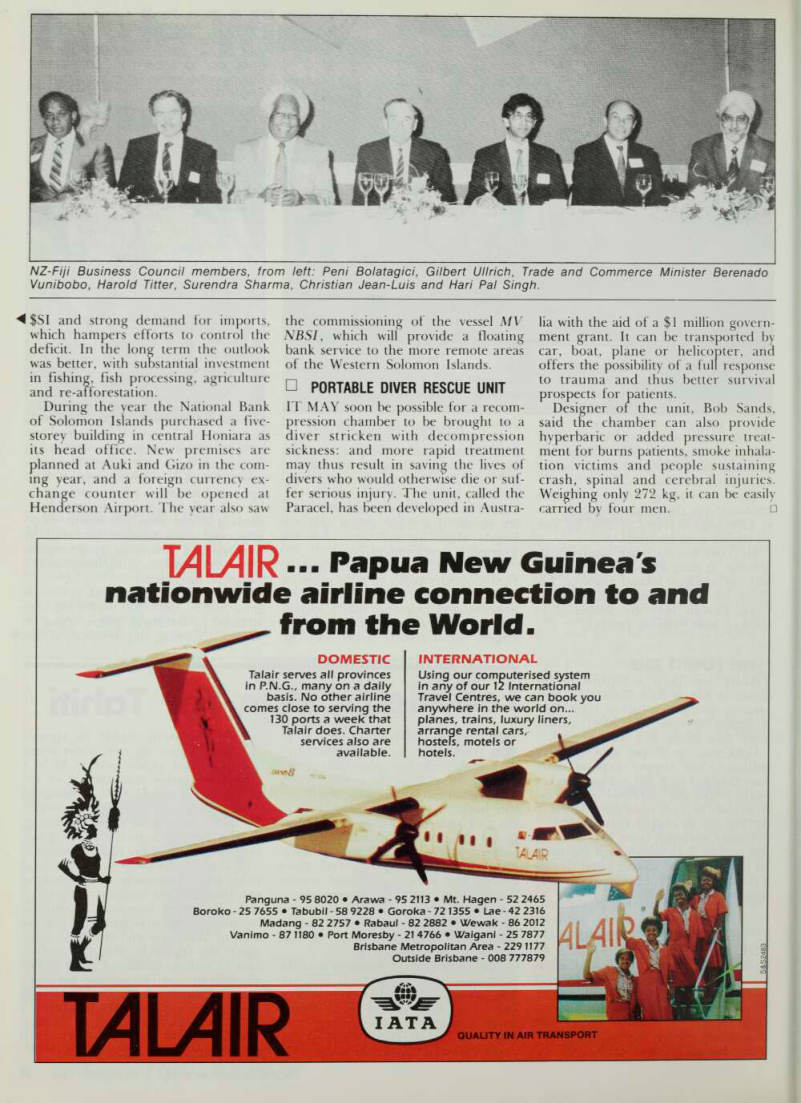
□ Nz-Fiji Business Partnership
A BOOST to trade between New Zea land and Fiji is expected following the formation of the New Zealand-Fiji Business Council in Auckland on October 17. One hundred NZ business
representatives attended the inaugural
meeting, which followed a luncheon with Fiji’s Minister of Trade and Com merce, Mr Berenado Vunibobo, and 20 Fiji businessmen representing the
Fiji-based Fiji-New Zealand Business
Council.
The two organisations will arrange for regular consultations between busi ness interests in the two countries, and will make representations to both gov ernments on behalf of their respective commercial sectors.
The first president of the NZ coun cil, Mr Harold Titter of Sedgwick’s Li mited, told the luncheon guests that business and goodwill between the two countries was of great importance to both. Mr Vunibobo for his part said NZ traders, investors and tourists were always welcome in Fiji, and he wel comed the formation of the council.
□ Fiji Bans Seafood Exports
FIJI has banned the export of giant clams for 10 years in an attempt to prevent destructive exploitation of the country’s marine products for markets in Southeast Asia and China. Exports of sandfish and brown sandfish are also totally banned and beche-de-mer must be at least 7.6 centimetres long.
□ Europe Helps Tourism
THE Commission of the European Community has approved a grant of funds equal to $F7.4 million for Phase Two of the Pacific Regional Tourism Development Program. The grant will be used by the Tourism Council of the South Pacific for the eight participat
ing states: Fiji, Kiribati, Papua New
Guinea, Solomon Islands, Tonga, Tuvalu, Vanuatu and Western Samoa.
In addition to strengthening the tourist resources of the eight countries and promoting the Pacific as a tourist destination, the program will also help
those countries assess the impact of tourism on their economies and plan their own most suitable kind of tour
ism development.
□ Samoa Goes For Gold
COMMEMORATING American Samoa’s initial participation in the Olympic Games under its own flag in Seoul this year, a set of gold and silver coins has been struck. Phillips Mint of Los Angeles, California has produced the coins in denominations of $lOO, $25 and $5. The minting is limited to 1000 sets. The gold coin is 1 oz .999 fine gold, selling for SUS6BS, and the silver coins are .999 pure silver; the soz coin costs SUS 99 and the 1 oz
Sus2B.
The Phillips Mint and the Amerika Samoa Bank in Pago Pago, are taking orders for the coins.
□ Power Pumps For Miners
MONO Pumps (Australia) Pty Ltd has released a new range of moulded-to metal pumps, called Mono Merlin, that feature a modular design enabl ing the 16 models to be bolted together from 21 common parts to form 180 variations. The pumps are particularly suitable for high pressure washing down of mining vehicles.
Light in weight and compact, the Mer lin pumps can be trailer-mounted for mobile use and can be multi-staged to achieve high pressure and/or long
distance delivery.
Mono pumps use a single rotating element, without valves or gearing, so replacement parts can be fitted with
out difficulty.
Mono Merlin’s new high-pressure pumps: ideal for the Pacific mining industry
□ Solomons Build Own Ship
TRADITIONAL islands skills are being employed in the building of a 21-metre wooden ship under construc tion in Malaita in the Solomons. Mas ter craftsman Abraham Tove and 11 labourers from Tavuilo Village are building the $81600,000 vessel for the Church of Melanesia.
They are using Solomon Islands rosewood for the ship, which will car ry 1200 bags of copra. A 3000 hp Vol vo engine is to be fitted.
Mr Tove has built five similar boats for use in inter-island trade. He has had no modern formal training, but claims his skills are inherited: his plans work, though they are unrelated to
modern boat-building practice.
□ Png Exports Soar
THERE has been a significant in crease in Papua New Guinea’s export earnings in the first half of 1988. Tot al export revenue was K 617 million more than in the first half of 1987.
Gold was up 25 per cent to K 249 million, while copper exports more than doubled to K2OO million. Higher world prices and increased production from tne Ok Tedi mine contributed to the big rise in copper earnings.
Export earnings from logs rose 31
per cent to K 45 million, but the over all rise in income was achieved despite a drop in agricultural exports of Kll million to KlO6 million.
□ Record Profit For Bank
THE National Bank of Solomon Is lands has announced a record after tax profit of $81826,355 for the year
ending June 30 1988, representing an
increase of 38.6 per cent over the pre vious year. The annual report said that strong growth was recorded in all areas, but of greatest significance was
the level of new loan approvals they reached $l7 million compared with $6.5 million for the 1986-87 year.
The National Bank’s result was announced against a backdrop of troubled economic times for the Solo mon Islands. Lower output in major export industries meant the country did not benefit from increased com mmodity prices. For the second suc cessive year, the report said, the coun try sustained a trade deficit that was largely offset by assistance from the
European Development Fund.
The Central Bank continued its firm monetary policy to reduce private sector domestic credit and demand for imports, and recorded that a dispute between operators of the country’s largest island tourist resort and cus-
tomary landowners had had an adverse effect on foreign investment in tourism and other areas. The Solo mon Islands Government had approved measures to overcome prob lems faced by foreign investors, in cluding a ‘one stop investment shop’, improved co-ordination between the national and provincial governments, clear investment guidelines and a range of incentives.
Tne bank’s report said economic growth for 1988/89 would be con strained by the fiscal deficit, rising in flation following depreciation of the ►
Opposite: American Samoa celebrates the Olympic’s with gold coins. Left and below: Using traditional techni ques and skill born of experience, Solomon Islanders are constructing a 21-metre wooden hulled copra vessel.
◄ SSI and strong demand for imports, which hampers efforts to control the deficit. In the long term the outlook was better, with substantial investment
in fishing, fish processing, agriculture
and re-afforestation.
During the year the National Bank of Solomon Islands purchased a fivestorey building in central Honiara as its head office. New premises are planned at Auki and Gizo in the commg year, and a foreign currency exchange counter will be opened at Henderson Airport. The year also saw
the commissioning of the vessel MV NBSI, which will provide a floating bank service to the more remote areas of the Western Solomon Islands. n pnRT . R| .. mu 11 wit “ rUnIABLb UlVtn KbbbUb UNI I IT MAY soon be possible for a recompression chamber to be brought to a diver stricken with decompression sickness: and more rapid treatment may thus result in saving the lives of divers who would otherwise die or suffer serious injury. The unit, called the Paracel, has been developed in Austra-
lia with the aid of a $1 million govern ment grant. It can be transported by car, boat, plane or helicopter, and offers the possibility of a full response to trauma and thus better survival prospects for patients.
Designer of the unit, Bob Sands, said the chamber can also provide hyperbaric or added pressure treat ment for burns patients, smoke inhala tion victims and people sustaining crash, spinal and cerebral injuries.
Weighing only 272 kg, it can be easily earned by four men.
NZ-Fiji Business Council members, from left: Peni Bolatagici, Gilbert Ullrich, Trade and Commerce Minister Serenade Vunibobo, Harold Titter, Surendra Sharma, Christian Jean-Luis and Hari Pal Singh.
LeontiefPs Plan For Tahiti
FRENCH Polynesia’s President
Alexandre Leontieff has followed up his controversial report on the state of the economy with a bold plan for its recovery. Many private businesses have gone bankrupt in the past nine months, or have simply closed their doors and laid off staff.
Business credit has dried up, business spending is down, and more money has been transferred out of Tahiti. The Leontieff economic recovery plan involves an immediate revival of work in heavy construction, public works and welfare housing, with an accent on job training. "
The territorial government and the government of France will foot the bill. Local autonomy has been increasing since 1984, but France pumps more money into the territory each year Tahiti depends largely on customs duties to balance its budget.
The President wants to spend: SUSB3.2 million on new government buildings and public works; SUS 4.4 million on major maintenance of ex isting facilities; SUSB.9 million on roads, port and river development; SUS 199,5 million on welfare housing; $U5442,000 on a juice producing fac tory; $U5354,000 on reafforestation, The plan also takes in aid for local
fishermen, provision of ice-making
machines and the creation of a territo rial investment company. Phosphate mining on the westernmost Tuamotu atoll of Mataiva would also be encour aged: the lagoon is estimated to con tain 12 million tonnes of good quality phosphate, and the mining would be expected to create 400 jobs that would continue for the project’s potential 12 to 15 year lifetime. During that time mining should return the territorial government some SUSS3 million.
Advertisements & other items, p. 42 (1 item)
T4L4Ir
I4MIR --- Papua New Guinea's
nationwide airline connection to and
from the World.
I it
DOMESTIC
Talair serves all provinces in P.N.G., many on a daily basis. No other airline comes close to serving the 130 ports a week that Talair does. Charter services also are available.
INTERNATIONAL
Using our computerised system
in any of our 12 International Travel Centres, we can book you anywhere in the world 0n...
planes, trains, luxury liners,
arrange rental cars, hostels, motels or hotels. • I
I4UIR
Panguna - 95 8020 • Arawa - 95 2113 • Mt. Hagen - 52 2465 Boroko - 25 7655 • Tabubil - 58 9228 • Goroka - 72 1355 • Lae - 42 2316 Madang - 82 2757 • Rabaul - 82 2882 • Wewak - 86 2012 Vanimo - 87 1180 • Port Moresby - 21 4766 • Waigani - 25 7877 Brisbane Metropolitan Area - 229 1177 Outside Brisbane - 008 777879
T4L4IR
w
ATA
QUALITY IN AIR TRANSPORT
Chile's Bitter Pacific Legacy
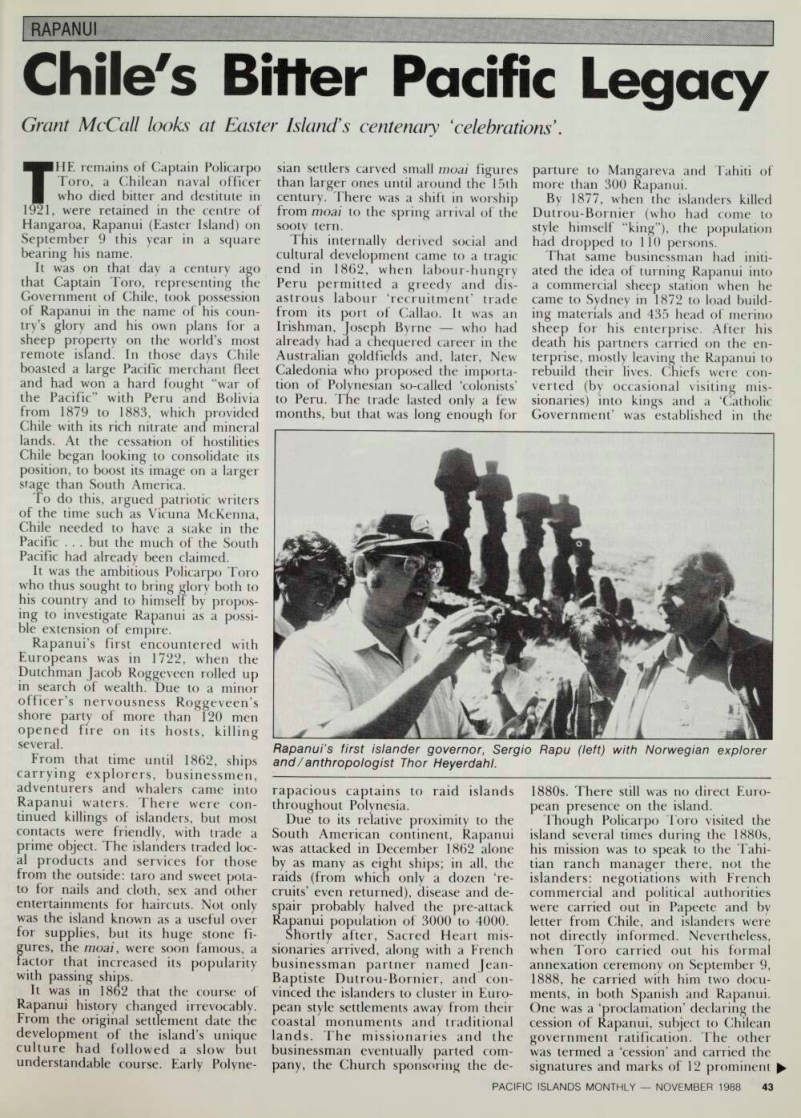
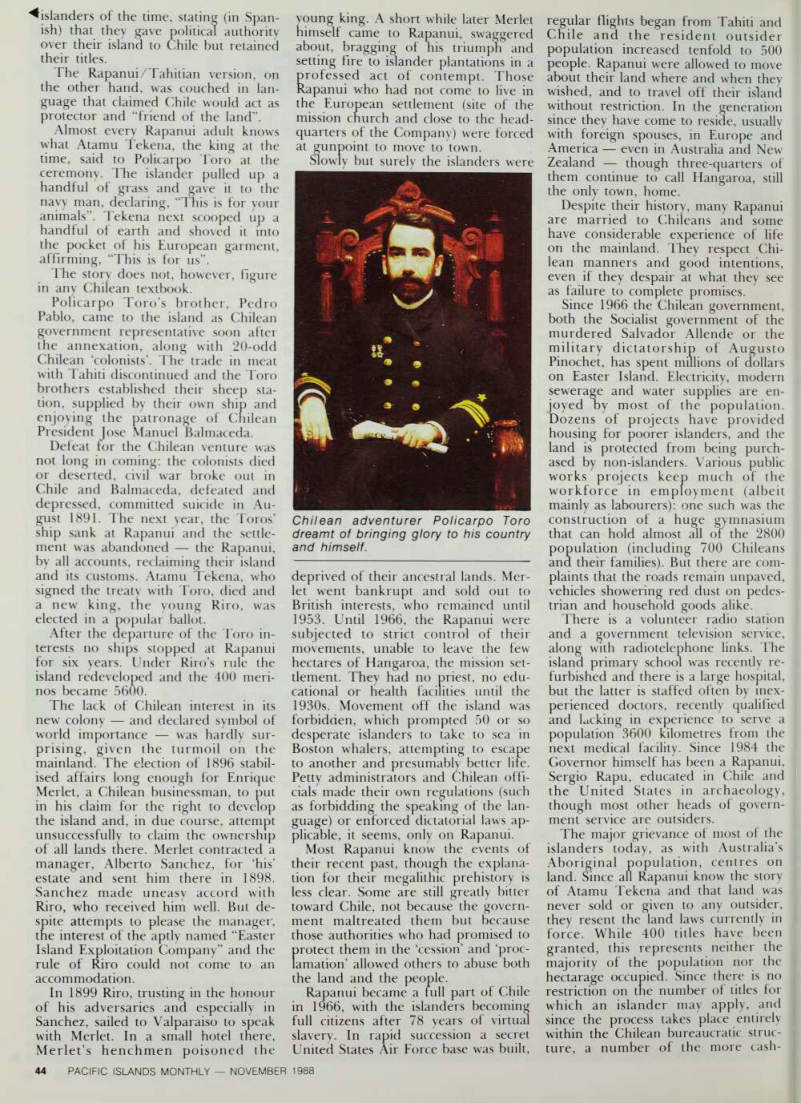
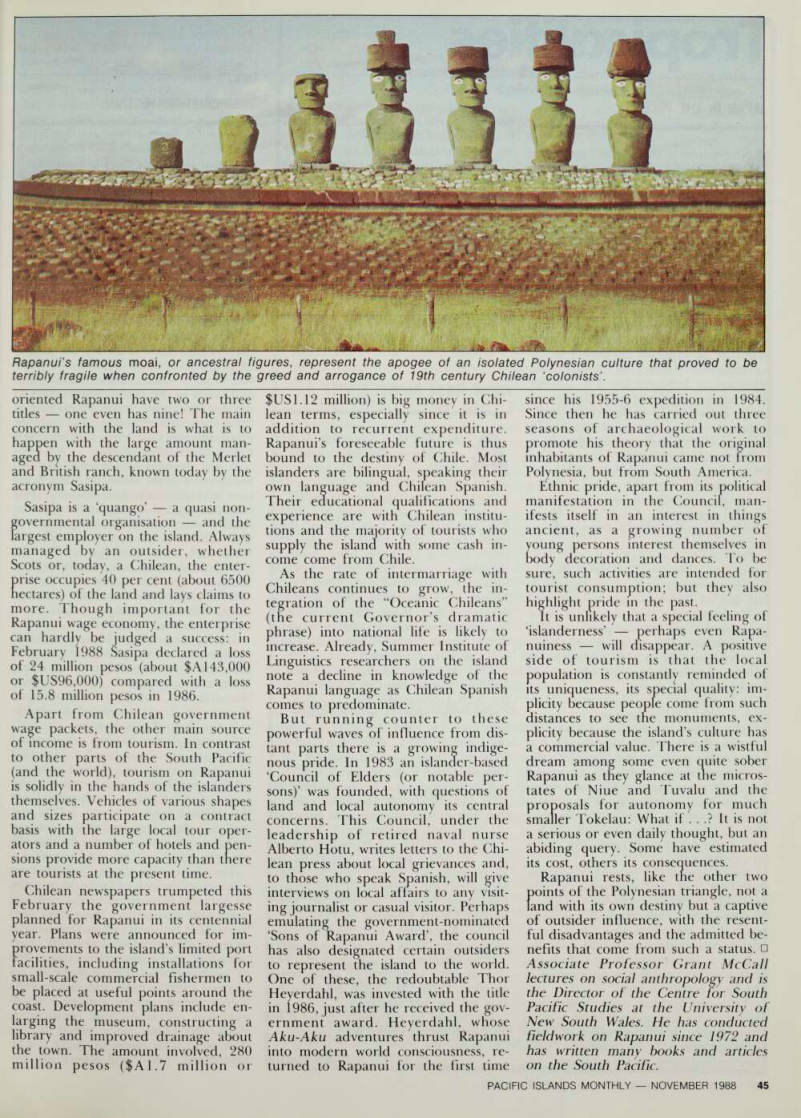
Rapanui
Grant McCall looks at Easter Island’s centenary
THE remains of Captain Policarpo
Toro, a Chilean naval officer who died bitter and destitute in 1921, were retained in the centre of Hangaroa, Rapanui (Easter Island) on September 9 this year in a square bearing his name.
It was on that day a century ago that Captain Toro, representing the Government of Chile, took possession of Rapanui in the name of his coun try’s glory and his own plans for a sheep property on the world’s most remote island. In those days Chile boasted a large Pacific merchant fleet and had won a hard fought “war of the Pacific” with Peru and Bolivia from 1879 to 1883, which provided Chile with its rich nitrate and mineral lands. At the cessation of hostilities Chile began looking to consolidate its position, to boost its image on a larger stage than South America.
To do this, argued patriotic writers of the time such as Vicuna McKenna, Chile needed to have a stake in the Pacific . . . but the much of the South Pacific had already been claimed.
It was the ambitious Policarpo Toro who thus sought to bring glory both to his country and to himself by propos ing to investigate Rapanui as a possi ble extension of empire.
Rapanui’s first encountered with Europeans was in 1722, when the Dutchman Jacob Roggeveen rolled up in search of wealth. Due to a minor officer’s nervousness Roggeveen’s shore party of more than 120 men opened fire on its hosts, killing several.
From that time until 1862, ships
carrying explorers, businessmen,
adventurers and whalers came into Rapanui waters. There were con tinued killings of islanders, but most contacts were friendly, with trade a prime object. The islanders traded loc al products and services for those from the outside: taro and sweet pota to for nails and cloth, sex and other entertainments for haircuts. Not only was the island known as a useful over for supplies, but its huge stone fi gures, the moai, were soon famous, a factor that increased its popularity
with passing ships.
It was in 1802 that the course of
Rapanui history changed irrevocably.
From the original settlement date the development of the island’s unique culture had followed a slow but understandable course. Early Polyne
sian settlers carved small moai figures than larger ones until around the 15th century. There was a shift in worship from moai to the spring arrival of the sooty tern.
This internally derived social and cultural development came to a tragic end in 1862, when labour-hungry Peru permitted a greedy and dis astrous labour ‘recruitment’ trade from its port of Callao. It was an Irishman, Joseph Byrne who had already had a chequered career in the Australian goldfields and, later, New Caledonia who proposed the importa tion of Polynesian so-called ‘colonists’ to Peru. The trade lasted only a few months, but that was long enough for
rapacious captains to raid islands
throughout Polynesia.
Due to its relative proximity to the South American continent, Rapanui was attacked in December 1862 alone by as many as eight ships; in all, the raids (from which only a dozen ‘reemits’ even returned), disease and despair probably halved the pre-attack Rapanui population of 3000 to 4000.
Shortly after, Sacred Heart missionaries arrived, along with a French businessman partner named Jean- Baptiste Dutrou-Bornier, and convinced the islanders to cluster in European style settlements away from their coastal monuments and traditional lands. The missionaries and the
businessman eventually parted com-
pany, the Church sponsoring the de-
parture to Mangareva and Tahiti of more than 300 Rapanui.
By 1877, when the islanders killed Dutrou-Bornier (who had come to style himself “king”), the population had dropped to 110 persons.
That same businessman had initi ated the idea of turning Rapanui into a commercial sheep station when he came to Sydney in 1872 to load build ing materials and 435 head of merino sheep for his enterprise. After his death his partners carried on the en
terprise, mostly leaving the Rapanui to
rebuild their lives. Chiefs were con verted (by occasional visiting mis sionaries) into kings and a ‘Catholic Government’ was established in the
1880 s. There still was no direct Euro pean presence on the island.
Though Policarpo Toro visited the island several times during the 1880 s, his mission was to speak to the Tahi tian ranch manager there, not the islanders: negotiations with French commercial and political authorities were carried out in Papeete and by letter from Chile, and islanders were not directly informed. Nevertheless, when Toro carried out his formal annexation ceremony on September 9, 1888, he carried with him two docu ments, in both Spanish and Rapanui.
One was a ‘proclamation’ declaring the cession of Rapanui, subject to Chilean government ratification. The other was termed a ‘cession’ and carried the signatures and marks of 12 prominent
Rapanui’s first islander governor, Sergio Rapu (left) with Norwegian explorer and/anthropologist Thor Heyerdahl.
of the time, stating (in Span
ish) that they gave political authority
over their island to Chile but retained their titles.
The Rapanui/Tahitian version, on the other hand, was couched in lan guage that claimed Chile would act as protector and “friend of the land”.
Almost every Rapanui adult knows what Atamu Tekena, the king at the time, said to Policarpo Toro at the ceremony. The islander pulled up a handful of grass and gave it to the navy man, declaring, “This is for your animals”. Tekena next scooped up a handful of earth and shoved it into the pocket of his European garment, affirming, “This is for us”.
The story does not, however, figure in any Chilean textbook.
Policarpo Toro’s brother, Pedro Pablo, came to the island as Chilean government representative soon after the annexation, along with 20-odd Chilean ‘colonists’. The trade in meat with Tahiti discontinued and the Toro brothers established their sheep sta tion, supplied by their own ship and enjoying the patronage of Chilean President Jose Manuel Balmaceda.
Defeat for the Chilean venture was not long in coming: the colonists died or deserted, civil war broke out in Chile and Balmaceda, defeated and depressed, committed suicide in Au gust 1891. The next year, the Toros’ ship sank at Rapanui and the settle ment was abandoned the Rapanui, by all accounts, reclaiming their island and its customs. Atamu Tekena, who signed the treaty with Toro, died and a new king, the young Riro, was elected in a popular ballot.
After the Departure of the Toro in
terests no ships stopped at Rapanui
for six years. Under Riro’s rule the island redeveloped and the 400 meri nos became 5600.
The lack of Chilean interest in its new colony and declared symbol of world importance was hardly sur prising, given the turmoil on the mainland. The election of 1896 stabil
ised affairs long enough for Enrique
Merlet, a Chilean businessman, to put in his claim for the right to develop the island and, in due course, attempt unsuccessfully to claim the ownership of all lands there. Merlet contracted a manager, Alberto Sanchez, for ‘his’ estate and sent him there in 1898.
Sanchez made uneasy accord with Riro, who received him well. But de spite attempts to please the manager, tne interest of the aptly named “Easter Island Exploitation Company” and the rule of Riro could not come to an accommodation.
In 1899 Riro, trusting in the honour of his adversaries and especially in Sanchez, sailed to Valparaiso to speak with Merlet. In a small hotel there, Merlet’s henchmen poisoned the
young king. A short while later Merlet himself came to Rapanui, swaggered about, bragging of his triumph and setting fire to islander plantations in a professed act of contempt. Those Rapanui who had not come to live in the European settlement (site of the mission church and close to the head quarters of the Company) were forced at gunpoint to move to town.
Slowly but surely the islanders were
deprived of their ancestral lands. Mer let went bankrupt and sold out to British interests, who remained until 1953. Until 1966, the Rapanui were subjected to strict control of their movements, unable to leave the few hectares of Hangaroa, the mission set tlement. They had no priest, no edu cational or health facilities until the 19305. Movement off the island was forbidden, which prompted 50 or so desperate islanders to take to sea in Boston whalers, attempting to escape to another and presumably better life.
Petty administrators and Chilean offi cials made their own regulations (such as forbidding the speaking of the lan guage) or enforced dictatorial laws ap
plicable, it seems, only on Rapanui.
Most Rapanui know the events of their recent past, though the explana tion for their megalithic prehistory is less clear. Some are still greatly bitter toward Chile, not because the govern ment maltreated them but because those authorities who had promised to protect them in the ‘cession’ and ‘proc lamation’ allowed others to abuse both the land and the people.
Rapanui became a full part of Chile in 1966, with the islanders becoming full citizens after 78 years of virtual slavery. In rapid succession a secret United States Air Force base was built,
regular flights began from Tahiti and
Chile and the resident outsider population increased tenfold to 500 people. Rapanui were allowed to move about their land where and when they wished, and to travel off their island without restriction. In the generation since they have come to reside, usually with foreign spouses, in Europe and America even in Australia and New
Zealand though three-quarters of
them continue to call Hangaroa, still the only town, home.
Despite their history, many Rapanui
are married to Chileans and some have considerable experience of life on the mainland. They respect Chi lean manners and good intentions, even if they despair at what they see as failure to complete promises.
Since 1966 the Chilean government, both the Socialist government of the murdered Salvador Allende or the
military dictatorship of Augusto
Pinochet, has spent millions of dollars on Easter Island. Electricity, modern sewerage and water supplies are en
joyed by most of the population.
Dozens of projects have provided housing for poorer islanders, and the
land is protected from being purch
ased by non-islanders. Various public works projects keep much of the workforce in employment (albeit mainly as labourers): one such was the construction of a huge gymnasium that can hold almost all of the 2800
population (including 700 Chileans
and their families). But there are com plaints that the roads remain unpaved, vehicles showering red dust on pedes trian and household goods alike.
There is a volunteer radio station and a government television service, along with radiotelephone links. The island primary school was recently re furbished and there is a large hospital, but the latter is staffed often by inex
perienced doctors, recently qualified
and lacking in experience to serve a population 3600 kilometres from the next medical facility. Since 1984 the Governor himself has been a Rapanui, Sergio Rapu, educated in Chile and the United States in archaeology, though most other heads of govern ment service are outsiders.
The major grievance of most of the islanders today, as with Australia’s
Aboriginal population, centres on
land. Since aU Rapanui know the story of Atamu Tekena and that land was never sold or given to any outsider, they resent the land laws currently in force. While 400 titles have been granted, this represents neither the majority of the population nor the hectarage occupied. Since there is no restriction on the number of titles for which an islander may apply, and since the process takes place entirely within the Chilean bureaucratic struc ture, a number of the more cash-
Chilean adventurer Policarpo Toro dreamt of bringing glory to his country and himself.
oriented Rapanui have two or three titles one even has nine! The main concern with the land is what is to happen with the large amount managea by the descendant of the Merlet and British ranch, known today by the
acronym Sasipa.
ie o a non OdMUd IS d UUdliyU d ClUdSl IlOIl” governmental organisation - and the
Pargest employer on the island. Always
managed by an outsider, whether Scots or, today, a Chilean, the enterprise occupies 40 per cent (about 6500 (tectares) of the land and lays claims to more. Though important for the Rapanui wage economy, the enterprise can hardly be judged a success- in February 1988 Sasipa declared a loss of 24 million pesos (about |A143,000 or 1U596,000) compared with a loss of 15 8 million pesos in 1986 ' ' Apart from Chilean government wage packets, the other main source of income is from tourism. In contrast to other parts of the South Pacific (and the world), tourism on Rapanui is solidly m the hands of the islanders themselves. Vehicles of various shapes and sizes participate on a contract basis with the large local tour operators and a number of hotels and pensions provide more capacity than there are tourists at the present time.
Chilean newspapers trumpeted this
February the government largesse
planned for Rapanui in its centennial year. Plans were announced for imprqvements to the island’s limited port facilities, including installations for small-scale commercial fishermen to be placed at useful points around the coast. Development plans include enlarging the museum, constructing a
library and improved drainage about
the town. The amount involved, 280 million pesos (JAI.7 million or
SUSI.I2 million) is big money in Chilean terms, especially since it is in addition to recurrent expenditure.
Rapanui’s foreseeable future is thus bound to the destiny of Chile. Most islanders are bilingual, speaking their own language and Chilean Spanish.
Their educational qualifications and • * * <i • experience are with Chilean mstitutions and the mmority of tourists who SU PP ! V the with some cash mcor " e c ° me from Chile.
As the rate . of intermarriage with Chlleans Brow’8 row ’ ln ‘eSratlon of the Oceanic Chileans (t , he currei " Governor s dramatic P hrase > “?> n .f l0 c nal '' fe ? I,ke ' y increase. Already, Summer Institute of Linguistics researchers on the island " ole a d , edme m knowledge of the Rapanui language as Chilean Spanish comes to predominate.
But rurm ing counter to these powerful waves of influence from distant p arts there is a growing indigenous p r id e . In 1983 an islander-based ‘Council of Elders (or notable persons)’ was founded, with questions of land and local autonomy its central concerns. This Council, under the leadership of retired naval nurse Alberto Hotu, writes letters to the Chi- ean p ress about local grievances and, to those who speak Spanish, will give interviews on local afmirs to any visit-
ing journalist or casual visitor. Perhaps
emulating the government-nominated
‘Sons of Rapanui Award’, the council has also designated certain outsiders to represent the island to the world.
One of these, the redoubtable Thor Heyerdahl, was invested with the title in 1986, just after he received the government award. Heyerdahl, whose Aku-Aku adventures thrust Rapanui into modern world consciousness, returned to Rapanui for the first time
since his 1955-6 expedition in 1984.
Since then he has carried out three seasons of archaeological work to promote his theory that the original inhabitants of Rapanui came not from Polynesia, but from South America, Ethnic pride, apart from its political manifestation in the Council, man • r ip I ifests itself in an interest in things ancient, as a growing number of voung persons interest themselves in body decoration and dances. To be sure, such activities are intended for contmuesto tourist consumption; but they also highlight pr.de in the past It is unlikely that a special feeling of lslanderness TT P erha P s ev . en RaPa nu.ness - will disappear. A positive side of tourism is hat the local population is constantly reminded of its uniqueness, its special quality: im plicity because people come from such distances to see the monuments, ex plicity because the island’s culture has a commercial value. There is a wistful dream among some even quite sober Rapanui as they glance at the micros tales of Niue and Tuvalu and the proposals for autonomy for much smaller Tokelau: What if . . .? It is not a serious or even daily thought, but an abiding query. Some have estimated its cost, others its consequences, Rapanui rests, like the other two points of the Polynesian triangle, not a land with its own destiny but a captive of outsider influence, with the resent ful disadvantages and the admitted be nefits that come from such a status. □ Associate Professor Grant McCall lectures on social anthropology and is the Director of the Centre for South Pacific Studies at the University of New South Wales. He has conducted fieldwork on Rapanui since 1972 and has written many books and articles on the South Pacific.
Rapanui’s famous moai, or ancestral figures, represent the apogee of an isolated Polynesian culture that proved to be terribly fragile when confronted by the greed and arrogance of 19th century Chilean ‘colonists’.
Tropkalities
Japan In The Pacific
■ N response to the special report on ■Japan’s Pacific plans Pacific Islands ■ Monthly, September; One or two decades ago it may have been debat able where Japan’s economy would be in the 21st century. Today it appears inevitable that Japan’s economy will be at the forefront.
Japan’s emergence as an economic superpower raises several questions on what role Pacific basin nations will play in “the Pacific century”. What sta tus will the basin nations acquire in a
Japanese-dominated environment?
Will they be Japanese backwater bana na republics (similar to the unequal relationship between the US and its
dependent southern neighbours of
Latin America) or respectable trade partners with Japan and the world (akin to US/Canada relationships)?
Perpetual dependence may require
reconciliation at a later date under less than peaceful circumstances. Leaders must take an in-depth look at develop mental strategies. Could the basin effort be unknowinglv careering to ward disaster?
In Latin America we see US
supported dictatorships controlling a
discordant peasantry a peasantry left out of the economic equation of modernisation. Only the elites have
prospered, squandering profits on US
and European consumer goods rather than re-investing in local growth in effect, preventing any chance of wealth trickling down.
In Nicaragua, the Philippines, Haiti and South Africa attempts at recon ciliation have resulted in bloodshed.
In the Pacific, Fiji’s upheaval was caused in part by an economically motivated ethnic rivalry. As an econo mic underclass, native Fijians deman ded political superiority. This time a general was on their side. Perhaps Rabuka’s plan of development will les sen dependency and move Fiji closer to modernisation.
New Caledonia represents a witches’ cauldron. As nickel mining profits continue to flow out of New Caledonia the indigenes are denied fair and
equitable opportunities. A French
withdrawal tomorrow would only re sult in a dependent New Caledonia, unless nickel profits are re-invested in the local economy now.
To avoid fretting over similar sce narios in future, today’s basin leaders must ensure that the bywords of basin development are, for example, reaf forestation not deforestation; re
investment not disinvestment; econo mic incentives not economic disincen tives; fisheries development not fisher
ies depletion, and equal opportunity.
The basin nations must become energetic self-starters to attract Japanese investment. Relying on ex ports to Japan and the rest of the world to drive development will only
deny opportunities for meaningful
modernisation. At all costs, the basin nations must prepare for trade agree ments offering opportunities for self
sufficiency and national pride.
G W Comstock
California
Usa
Know These Pacific Ships?
A MARITIME museum at Jer vis Bay on the South Coast of NSW is recording, with the aid of photographs and artifacts, the history of Jervis Bay for the public.
Huskisson, a small town on Jervis Bay, was a thriving boat-building town from 1864 until 1980. Of the 120 ships known to have been built in Huskisson, seven were built especially for the Papua New Guinea and Pacific Islands area. We have some informa tion on these ships, but are seeking any photographs, information or anec dotes about these ships that would help us in our research.
The Maclaren King was built in 1923 by Joseph Dent as a mission boat for New Guinea Mission.
The John Bolton was launched on February 11, 1933, arriving in Rabaul on June 1, 1933. This ship and the following ships were all built for W R Carpenter by R W Settrie 8c Son.
The Desikoko was launched May 28, 1934. In 1937 the Desikoko escaped the Rabaul volcano eruption but sank off Newcastle on January 9, 1947.
The Duranbah was launched on Au gust 5, 1936, and was seized by the Japanese on January 23, 1942.
However, she appears in the Austra lian New Zealand Register in 1946, and in Lloyds Register in 1947-48.
The Komaiwai, launched in 1947, escaped the Suva earthquake in 1953.
The Madang was launched in 1947.
The JBC, launched in 1949, was a wooden ketch. We have no informa tion on the last two ships.
We would be extremely grateful for any help readers may give us.
Vera Hatton
Tropicalities: Festival
IN 1971 I was asked to create and direct the first Pacific Festival of Arts, held in Suva in 1972. The object of the festival was to safeguard, resurrect and preserve the cultural heritage of the people of the Pacific islands. The concern of the South Pacific Commission in particular many of the leaders of island coun tries was that their cultures were
being stifled and endangered by the
impact of influence such as movies, television and pop music.
The first festival was a great success; for the first time in history the people of the islands came together to show the best of their dance, music, arts and crafts to the world. They began to understand and to respect the value of their own cultures; they saw and en joyed the work of their brothers and sisters from other islands.
It was decided to continue the fes tivals every four years, on each occa sion in a different host country. The emphasis and the reasons for the fes tivals were to remain the same; to show the best of each country’s cul tures and their development. It was never meant to be a forum for politic al activity; in fact the fourth festival scheduled for New Caledonia was can celled following attempts to transform it into a political platform.
Having been given the responsibility
to direct that first festival, I nave been involved as an adviser or as a very interested spectator in the festivals that followed. At the fifth festival, in Townsville, I was distressed to see the way the festival was heading.
Instead of the coming together of groups in brotherhood and friendship, at this last festival we saw a selfish emphasis on the unhealthy sponsoring of political activities. Even the festival logo did not follow the tradition that required it to embrace features common to all the Pacific; the sun, the Pacific Ocean and canoes.
The Townsville festival showed an unforgiveable lack of organisation; lit tle thought was given to helping the participating countries show their per formances to best advantage. Many were unable to present the full prog rams they had prepared for this festiv al programs that had been re hearsed over months and at consider able expense; there was no overall program of events and performers, Press and public were mostly in the dark as to what might or might not be performed, when and where on any
particular day.
This concerned many of the visiting delegation leaders who had been in volved in the other festivals. As a direct result of their wishes, and acting from my own concern about the festival’s future, I would like to restate some points I made in reports after the first and second festivals.
All future festivals should be held only in island countries. The islands of the South Pacific have a tradition of
hospitality; everybody becomes in
volved to welcome guests and honour them. In metropolitan countries this sense of tradition simply does not ex ist, and it is further marred by a mis informed media too often ignorant of Pacific affairs. In metropolitan coun tries the festival can also be a target or an opportune platform for poli tical activists, which is completely con trary to the aims of an arts festival. In Townsville one wondered if we were really attending a festival of the arts, so restrictive and rude was the army
of security personnel.
The metropolitan members of the South Pacific Commission France, Australia, New Zealand, England and the USA could best help this revival
by contributing financially to a Cultu
ral Fund. Even modest amounts set aside each year could accumulate in four years to create a worthwhile sum: for example, the millions the Austra lian Government gave for the Town sville festival could have provided $lOO,OOO each year for more than 50 years. This would have been much more valuable in supporting Pacific arts . . . and could have created good will for Australia that would have flowed throughout Oceania.
For each festival, half of this money could go to the host to help with the costs of feeding, housing and technical requirements. The rest could be di vided evenly among the South Pacific Commission nations that will partici pate in the next festival; this would give each a basic amount to start their own fund-raising to pay the costs of preparation and travel. What a boon this would be for small island coun tries! What a help to the Cook Islands, which has the responsibility of hosting the sixth festival in 1992.
I, like so many, feel very strongly that the festival is a worthwhile event, a ‘must’ for the South Pacific’s peoples if they are to retain their pride in their arts and cultures so these can survive and enrich the world. The fes tival must not be divisive: it must above all remain opposed to those ele ments that divide us, and instead should accent that which we can share: brotherhood, peace and joy. □
Victor Carell
Sydney Australia
Advertisements & other items, p. 47 (1 item)
Spec
X
FORUM SECRETARIAT
(formerly South Pacific Bureau for Economic
Co-operation [SPEC]
Applications are invited from citizens of member countries tor the following positions within the FORUM SECRETARIAT (formerly the South Pacific Bureau for Economic Co-operation):
PROJECT OFFICER (INVESTMENT AND INDUSTRY)
The successful candidate will be responsible for initiating measures to assist Forum Island Countries (FICs) in their efforts to promote investment and industry development. In particular, measures that will assist the production capability of firms in the FICs will be given emphasis.
The officer will be a member of the professional staff of the Trade Division and will be required to assist in a team effort on a wide variety of matters relating to trade, investment and industry promotion, and will undertake special assignments as directed.
Applicants for this position should be university graduates with a major in economics or commerce, or possess relevant industry experience. A minimum of five years experience in the commercial and/or public sector is essential. Experience in dealing with regional and international organisations would be an advantage.
INFORMATION AND PUBLICATIONS OFFICER
This is a new position, designed to establish effective information, publicity and publications services covering all aspects of the Secretariat’s work programme, political and other activities. The successful applicant will be responsible to the Secretariat’s Deputy Director (Policy, Development and Administration) for acquiring and distributing information materials required by member countries, liaising with regional and international media, issuing press releases as required, speech-writing, producing publications, newsletters, brochures and other promotional material, in addition to some public relations duties.
This is an exciting opportunity for an experienced and versatile person to make a substantial contribution to awareness of the role of the Forum Secretariat, both within and beyond the Pacific region. Applicants should have relevant tertiary qualifications, and/or equivalent experience, in the information, media or publications fields. They should also possess sound writing, photographic and commuications skills, and a working knowledge of editing, design, typesetting and the production of publications. Previous, relevant experience in the Pacific Islands region would be highly regarded.
GENERAL INFORMATION
These appointments will carry attractive remuneration packages, taxfree for non-Fiji citizens and payable in Fiji dollars, including housing or housing allowances, education and child allowances, superannuation payments and medical, life and travel insurance benefits. The appointees will be based at the Secretariat’s Headquarters in Suva, Fiji, but may be required to undertake periodic duty travel. Appointments would be for two years initially, renewable by mutual agreement.
Applications for both vacancies close on 16 January 1989. As it is intended to make the appointments as soon as possible, the successful applicants must be able to take up the positions shortly afterwards.
Applications should contain full information on education and career backgrounds and should list names, addresses and telephone numbers of at least three referees with whom the applicants have been associated in professional capacities.
Applications should be addressed to: The Director Forum Secretariat GPO Box 856 Suva, Fiji Telephone: 312600; Telex: 2229 FJ; Fax: 302204 All enquiries should be made to Mr Rene Wilson, Deputy Director, on 312600 extension 202.
Tonga's Cultured Crown Prince
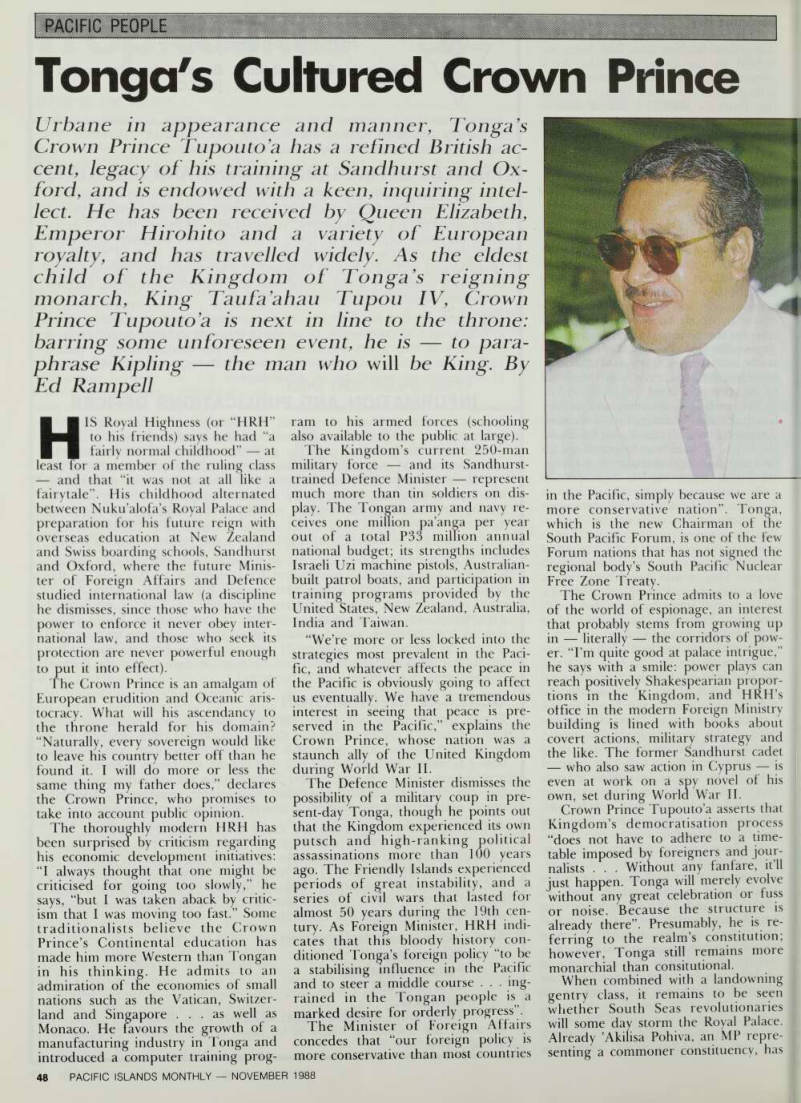
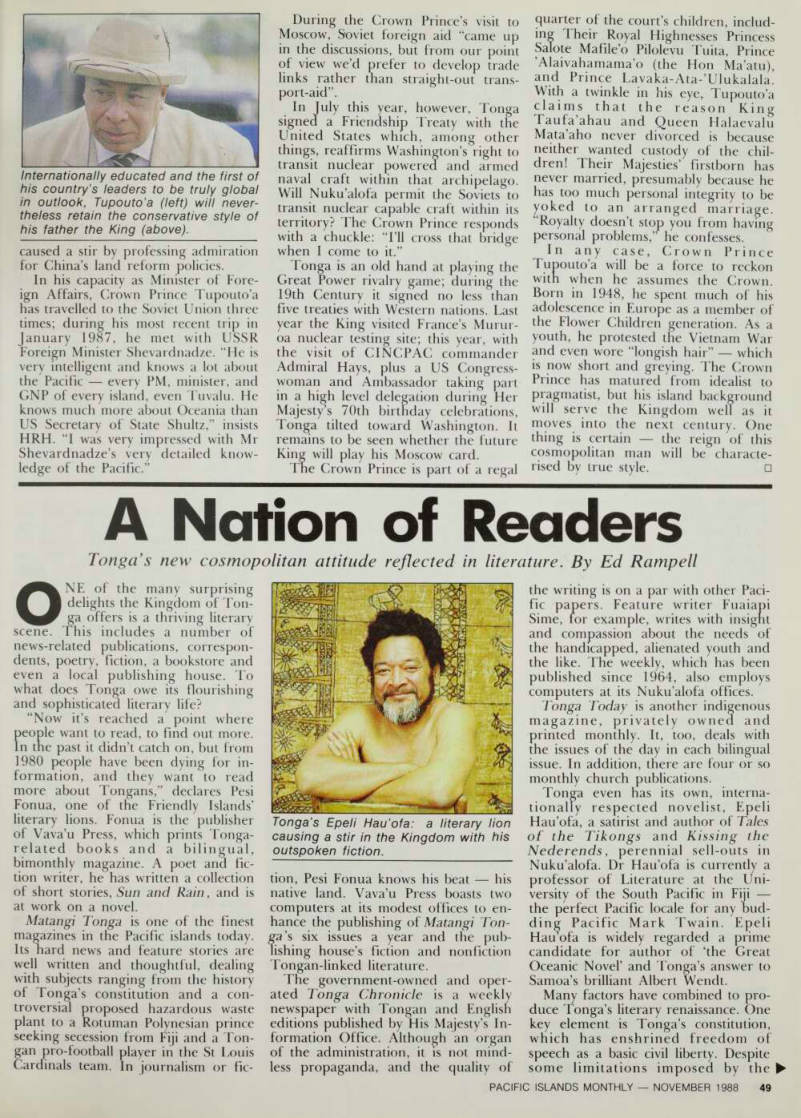
Pacific People
Urbane in appearance and manner, Tonga’s Crown Prince Tupouto’a has a refined British ac cent, legacy of his training at Sandhurst and Ox ford, and is endowed with a keen, inquiring intel lect. He has been received by Queen Elizabeth, Emperor Hirohito and a variety of European royalty, and has travelled widely. As the eldest child of the Kingdom of Tonga’s reigning monarch, King Taufa’ahau Tupou IV, Crown Prince Tupouto’a is next line to the throne: barring some unforeseen event, he is to para phrase Kipling the man who will be King. By
Ed Rampell
I IS Royal Highness (or “HRH”
to his friends) says he had "a
Jj fairly normal childhood” —at
least Tor a member of the ruling class and that “it was not at all like a fairytale”. His childhood alternated between Nukualofa’s Royal Palace and preparation for his future reign with overseas education at New Zealand and Swiss boarding schools, Sandhurst and Oxford, where the future Minis ter of Foreign Affairs and Defence studied international law (a discipline he dismisses, since those who have the power to enforce it never obey inter national law, and those who seek its
protection are never powerful enough
to put it into effect).
The Crown Prince is an amalgam of European erudition and Oceanic aris tocracy. What will his ascendancy to the throne herald for his domain?
“Naturally, every sovereign would like to leave his country better off than he found it. I will do more or less the same thing my father does,” declares the Crown Prince, who promises to take into account public opinion.
The thoroughly modern HRH has
been surprised by criticism regarding
his economic development initiatives: “I always thought that one might be criticised for going too slowly,” he says, “but I was taken aback by critic ism that I was moving too fast.” Some traditionalists believe the Crown Prince’s Continental education has made him more Western than Tongan in his thinking. He admits to an admiration of the economies of small nations such as the Vatican, Switzer land and Singapore ... as well as Monaco. He favours the growth of a
manufacturing industry in Tonga and
introduced a computer training prog
ram to his armed forces (schooling also available to the public at large).
The Kingdom’s current 250-man military force and its Sandhurst trainea Defence Minister represent much more than tin soldiers on dis play. The Tongan army and navy re ceives one million pa’anga per year out of a total P 33 million annual national budget; its strengths includes Israeli Uzi machine pistols, Australian built patrol boats, and participation in
training programs provided by the
United States, New Zealand, Australia, India and Taiwan.
“We’re more or less locked into the strategies most prevalent in the Paci fic, and whatever affects the peace in the Pacific is obviously going to affect us eventually. We have a tremendous interest in seeing that peace is pre served in the Pacific,” explains the Crown Prince, whose nation was a staunch ally of the United Kingdom during World War 11.
The Defence Minister dismisses the possibility of a military coup in pre
sent-day Tonga, though he points out
that the Kingdom experienced its own
putsch and high-ranking political
assassinations more than 100 years ago. The Friendly Islands experienced periods of great instability, and a series of civil wars that lasted for almost 50 years during the 19th cen tury. As Foreign Minister, HRH indi cates that this bloody history con
ditioned Tonga’s foreign policy “to be
a stabilising influence in the Pacific and to steer a middle course . . . ing rained in the Tongan people is a marked desire for orderly progress”.
The Minister of Foreign Affairs concedes that “our foreign policy is more conservative than most countries
in the Pacific, simply because we are a more conservative nation”. Tonga, which is the new Chairman of the South Pacific Forum, is one of the few Forum nations that has not signed the regional body’s South Pacific Nuclear Free Zone Treaty.
The Crown Prince admits to a love of the world of espionage, an interest that probably stems from growing up in literally the corridors of pow er. “I’m quite good at palace intrigue,” he says with a smile: power plays can
reach positively Shakespearian propor
tions in the Kingdom, and HRH’s office in the modern Foreign Ministry building is lined with books about covert actions, military strategy and the like. The former Sandhurst cadet who also saw action in Cyprus is even at work on a spy novel of his own, set during World War 11.
Crown Prince Tupouto’a asserts that Kingdom’s democratisation process “does not have to adhere to a time
table imposed by foreigners and jour
nalists . . . Without any fanfare, it’ll
just happen. Tonga will merely evolve
without any great celebration or fuss or noise. Because the structure is already there”. Presumably, he is re ferring to the realm’s constitution; however, Tonga still remains more monarchial than consitutional.
When combined with a landowning gentry class, it remains to be seen whether South Seas revolutionaries will some day storm the Royal Palace.
Already ’Akilisa Pohiva, an MP repre senting a commoner constituency, has
caused a stir by professing admiration for China’s land reform policies.
In his capacity as Minister of Fore ign Affairs, Crown Prince Tupouto’a has travelled to the Soviet Union three times; during his most recent trip in January 1987, he met with USSR Foreign Minister Shevardnadze. “He is very intelligent and knows a lot about the Pacific every PM, minister, and GNP of every island, even Tuvalu. He knows much more about Oceania than US Secretary of State Shultz,” insists HRH. “I was very impressed with Mr Shevardnadze’s very detailed know ledge of the Pacific.”
During the Crown Prince’s visit to Moscow, Soviet foreign aid “came up in the discussions, but from our point of view we’d prefer to develop trade links rather than straight-out trans
port-aid”.
In July this year, however, Tonga
signed a Friendship Treaty with the
United States which, among other
things, reaffirms Washington’s right to
transit nuclear powered and armed naval craft within that archipelago.
Will Nuku’alofa permit the Soviets to transit nuclear capable craft within its territory? The Crown Prince responds with a chuckle: “I’ll cross that bridge when I come to it.”
Tonga is an old hand at playing the Great Power rivalry game; during the 19th Century it signed no less than five treaties with Western nations. Last year the King visited France’s Murur oa nuclear testing site; this year, with the visit of CINCPAC commander
Admiral Hays, plus a US Congress
woman and Ambassador taking part in a high level delegation during Her
Majesty’s 70th birthday celebrations,
Tonga tilted toward Washington. It remains to be seen whether the future King will play his Moscow card.
The Crown Prince is part of a regal
quarter of the court’s children, includ ing Their Royal Highnesses Princess SaTote Mafile’o Pilolevu Tuita, Prince ’Alaivahamama’o (the Hon Ma’atu), and Prince Lavaka-Ata-’Ulukalala.
With a twinkle in his eye, Tupouto’a claims that the reason King Taufa’ahau and Queen Halaevalu Mata’aho never divorced is because neither wanted custody of the chil dren! Their Majesties’ firstborn has never married, presumably because he has too much personal integrity to be yoked to an arranged marriage.
“Royalty doesn’t stop you from having personal problems,” he confesses.
In any case, Crown Prince Tupouto’a will be a force to reckon with when he assumes the Crown.
Born in 1948, he spent much of his adolescence in Europe as a member of the Flower Children generation. As a youth, he protested the Vietnam War and even wore “longish hair” which is now short and greying. The Crown Prince has matured from idealist to pragmatist, but his island background will serve the Kingdom well as it moves into the next century. One thing is certain the reign of this cosmopolitan man will be characte rised by true style. □
Internationally educated and the first of his country’s leaders to be truly global in outlook, Tupouto’a (left) will never theless retain the conservative style of his father the King (above).
A Notion of Readers
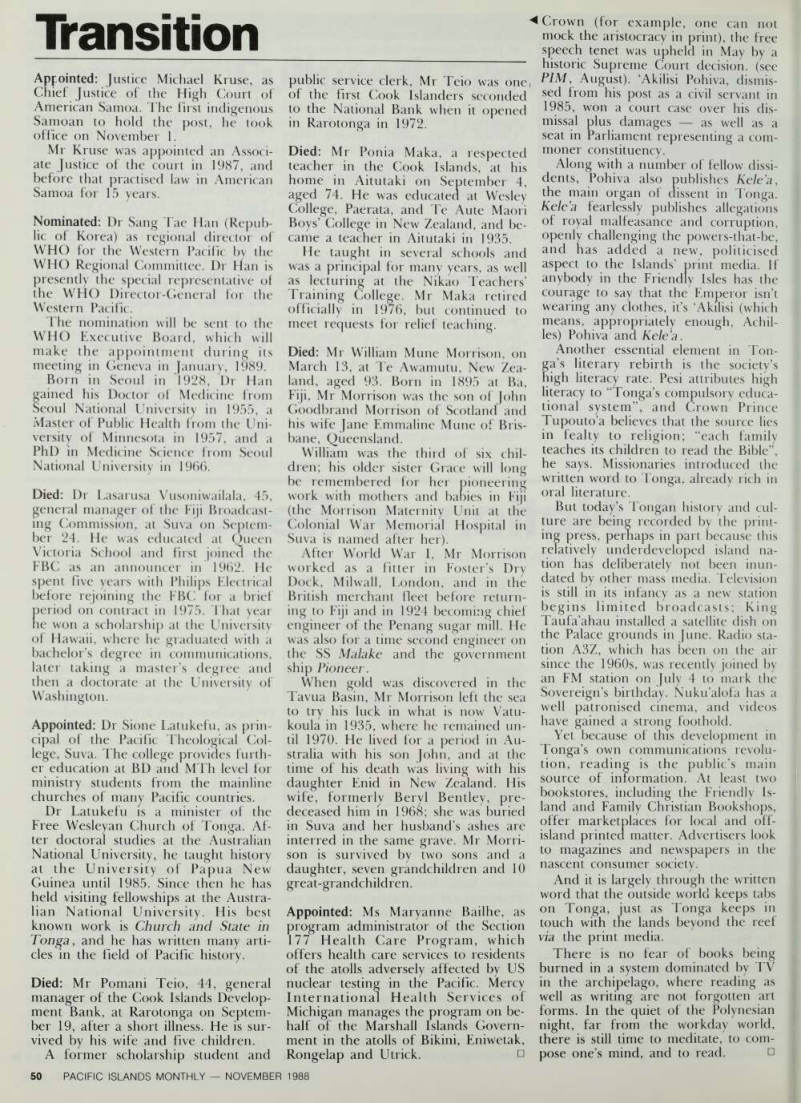
Tonga s new cosmopolitan attitude reflected in literature. By Ed Rampell
ONE of the many surprising delights the Kingdom of Ton ga offers is a thriving literary scene. This includes a number of news-related publications, correspon dents, poetry, fiction, a bookstore and even a local publishing house. To what does Tonga owe its flourishing
and sophisticated literary life?
“Now it’s reached a point where ale want to read, to find out more, e past it didn’t catch on, but from 1980 people have been dying for in formation, and they want to read more about Tongans,” declares Pesi Fonua, one of the Friendly Islands’ literary lions. Fonua is the publisher of Vava’u Press, which prints Tonga related books and a bilingual, bimonthly magazine. A poet and fic tion writer, he has written a collection of short stories, Sun and Rain , and is at work on a novel.
Matangi Tonga is one of the finest magazines in the Pacific islands today.
Its hard news and feature stories are well written and thoughtful, dealing
with subjects ranging from the history
of Tonga’s constitution and a con troversial proposed hazardous waste
plant to a Rotuman Polynesian prince
seeking secession from Fiji and a Ton gan pro-football player in the St Louis Cardinals team. In journalism or fic-
tion, Pesi Fonua knows his beat his native land. Vava’u Press boasts two computers at its modest offices to en hance the publishing of Matangi Ton ga's six issues a year and the pub lishing house’s fiction and nonfiction
Tongan-linked literature.
The government-owned and oper ated Tonga Chronicle is a weekly newspaper with Tongan and English
editions published by His Majesty’s In
formation Office. Although an organ of the administration, it is not mind less propaganda, and the quality of
the writing is on a par with other Paci fic papers. Feature writer Fuaiapi Sime, tor example, writes with insight and compassion about the needs of the handicapped, alienated youth and the like. The weekly, which has been published since 1964, also employs computers at its Nukualofa offices.
Tonga Today is another indigenous
magazine, privately owned and
printed monthly. It, too, deals with the issues of the day in each bilingual issue. In addition, there are four or so
monthly church publications.
Tonga even has its own, interna
tionally respected novelist, Epeli
Hau’ofa, a satirist and author of Tales of the Tikongs and Kissing the Nederends , perennial sell-outs in Nukualofa. Dr Hau’ofa is currently a professor of Literature at the Uni versity of the South Pacific in Fiji the perfect Pacific locale for any bud ding Pacific Mark Twain. Epeli
Hau’ofa is widely regarded a prime
candidate for author of ‘the Great Oceanic Novel’ and Tonga’s answer to Samoa’s brilliant Albert Wendt.
Many factors have combined to pro duce Tonga’s literary renaissance. One key element is Tonga’s constitution, which has enshrined freedom of speech as a basic civil liberty. Despite some limitations imposed by the
Tonga’s Epeli Hau’ofa: a literary lion causing a stir in the Kingdom with his outspoken fiction.
Transition
Appointed: Justice Michael Kruse, as Chief Justice of the High Court of American Samoa. The first indigenous Samoan to hold the post, he took office on November 1.
Mr Kruse was appointed an Associ ate Justice of the court in 1987, and before that practised law in American Samoa for 15 years.
Nominated: Dr Sang Tae Han (Repub lic of Korea) as regional director of WHO for the Western Pacific by the WHO Regional Committee. Dr Han is
presently the special representative of
the WHO Director-General for the Western Pacific.
The nomination will be sent to the WHO Executive Board, which will make the appointment during its meeting in Geneva in January, 1989.
Born in Seoul in 1928, Dr Han gained his Doctor of Medicine from Seoul National University in 1955, a Master of Public Health from the Uni versity of Minnesota in 1957, and a PhD in Medicine Science from Seoul National University in 1966.
Died: Dr Lasarusa Vusoniwailala, 45, general manager of the Fiji Broadcast ing Commission, at Suva on Septem ber 24. He was educated at Queen Victoria School and first joined the FBC as an announcer in 1962. He spent five years with Philips Electrical before rejoining the FBC for a brief period on contract in 1975. That year ne won a scholarship at the University of Hawaii, where he graduated with a bachelor’s degree in communications, later taking a master’s degree and then a doctorate at the University of
Washington.
Appointed: Dr Sione Latukefu, as prin cipal of the Pacific Theological Col
lege, Suva. The college provides furth
er education at BD and MTh level for ministry students from the mainline churches of many Pacific countries.
Dr Latukefu is a minister of the Free Wesleyan Church of Tonga. Af ter doctoral studies at the Australian
National University, he taught history
at the University of Papua New Guinea until 1985. Since then he has held visiting fellowships at the Austra lian National University. His best known work is Church and State in Tonga, and he has written many arti cles in the field of Pacific history.
Died: Mr Pomani Teio, 44, general manager of the Cook Islands Develop ment Bank, at Rarotonga on Septem ber 19, after a short illness. He is sur vived by his wife and five children.
A former scholarship student and
public service clerk, Mr Teio was one of the first Cook Islanders seconded to the National Bank when it opened in Rarotonga in 1972.
Died: Mr Ponia Maka, a respected teacher in the Cook Islands, at his home in Aitutaki on September 4, aged 74. He was educated at Wesley College, Paerata, and Te Ante Maori Boys’ College in New Zealand, and be came a teacher in Aitutaki in 1935.
He taught in several schools and was a principal for many years, as well as lecturing at the Nikao Teachers’
Training College. Mr Maka retired officially in 1976, but continued to meet requests for relief teaching.
Died: Mr William Mune Morrison, on March 13, at Te Awamutu, New Zea land, aged 93. Born in 1895 at Ba, Fiji, Mr Morrison was the son of John Goodbrand Morrison of Scotland and his wife Jane Emmaline Mune of Bris
bane, Queensland.
William was the third of six chil dren; his older sister Grace will long be remembered for her pioneering work with mothers and babies in Fiji (the Morrison Maternity Unit at the Colonial War Memorial Hospital in Suva is named after her).
After World War I, Mr Morrison worked as a fitter in Foster’s Dry Dock, Milwall, London, and in the British merchant fleet before return ing to Fiji and in 1924 becoming chief engineer of the Penang sugar mill. He was also for a time second engineer on the SS Malake and the government
ship Pioneer.
When gold was discovered in the Tavua Basin, Mr Morrison left the sea to try his luck in what is now Vatu koula in 1935, where he remained un til 1970. He lived for a period in Au stralia with his son John, and at the time of his death was living with his daughter Enid in New Zealand. His
wife, formerly Beryl Bentley, pre
deceased him in 1968; she was buried in Suva and her husband’s ashes are interred in the same grave. Mr Morri son is survived by two sons and a daughter, seven grandchildren and 10
great-grandchildren.
Appointed: Ms Maryanne Bailhe, as program administrator of the Section 177 Health Care Program, which offers health care services to residents of the atolls adversely affected by US nuclear testing in the Pacific. Mercy International Health Services of Michigan manages the program on be half of the Marshall Islands Govern ment in the atolls of Bikini, Eniwetak, Rongelap and Utrick. □
< Crown (for example, one can not mock the aristocracy in print), the free speech tenet was upheld in May by a historic Supreme Court decision, (see , PIM , August). ‘Akilisi Pohiva, dismis sed from his post as a civil servant in 1985, won a court case over his dis missal plus damages as well as a seat in Parliament representing a com
moner constituency.
Along with a number of fellow dissi dents, Pohiva also publishes Kele’a, the main organ of dissent in Tonga.
Kele’a fearlessly publishes allegations
of royal malfeasance and corruption,
openly challenging the powers-that-be,
and nas added a new, politicised aspect to the Islands’ print media. If anybody in the Friendly Isles has the courage to say that the Emperor isn’t wearing any clothes, it’s ‘Akilisi (which
means, appropriately enough, Achil
les) Pohiva and Kele’a.
Another essential element in Ton ga’s literary rebirth is the society’s
nigh literacy rate. Pesi attributes high
literacy to “Tonga’s compulsory educa
tional system”, and Crown Prince Tupouto’a believes that the source lies
in fealty to religion; “each family
teaches its children to read the Bible”, he says. Missionaries introduced the written word to Tonga, already rich in oral literature.
But today’s Tongan history and cul
ture are being recorded by the print ing press, perhaps in part because this
relatively underdeveloped island na
tion has deliberately not been inun dated by other mass media. Television is still in its infancy as a new station
begins limited broadcasts; King
Taufa’ahau installed a satellite dish on the Palace grounds in June. Radio sta tion A3Z, which has been on the air since the 19605, was recently joined by an FM station on July 4 to mark the Sovereign’s birthday. Nukualofa has a well patronised cinema, and videos have gained a strong foothold.
Yet because of this development in Tonga’s own communications revolu tion, reading is the public’s main source of information. At least two bookstores, including the Friendly Is land and Family Christian Bookshops, offer marketplaces for local and off island printed matter. Advertisers look to magazines and newspapers in the nascent consumer society.
And it is largely through the written word that the outside world keeps tabs on Tonga, just as Tonga keeps in touch with the lands beyond the reef via the print media.
There is no fear of books being burned in a system dominated by TV in the archipelago, where reading as well as writing are not forgotten art forms. In the quiet of the Polynesian night, far from the workday world, there is still time to meditate, to com pose one’s mind, and to read. □
Pacific Stamp Box
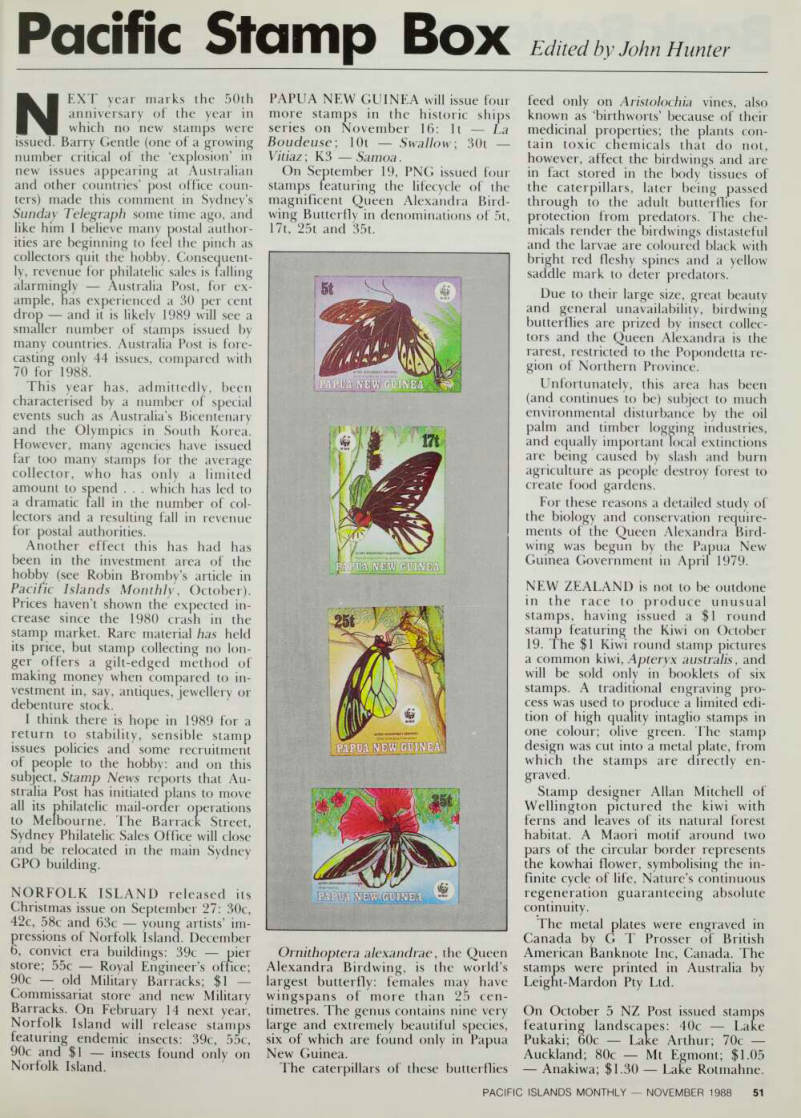
Edited by John Hunter
NEXT year marks the 50th anniversary of the year in which no new stamps were issued. Barry Gentle (one of a growing number critical of the ‘explosion’ in new issues appearing at Australian and other countries’ post office coun ters) made this comment in Sydney’s Sunday Telegraph some time ago, and like him I believe many postal author ities are beginning to feel the pinch as
collectors quit the hobby. Consequent
ly, revenue for philatelic sales is falling alarmingly Australia Post, for ex ample, has experienced a 30 per cent drop and it is likely 1989 will see a smaller number of stamps issued by many countries. Australia Post is fore
casting only 44 issues, compared with
70 for 1988.
This year has, admittedly, been characterised by a number of special events such as Australia’s Bicentenary and the Olympics in South Korea.
However, many agencies have issued far too many stamps for the average collector, who has only a limited amount to spend . . . which has led to a dramatic fall in the number of col lectors and a resulting fall in revenue for postal authorities.
Another effect this has had has been in the investment area of the hobby (see Robin Bromby’s article in Pacific Islands Monthly, October).
Prices haven’t shown the expected in crease since the 1980 crash in the stamp market. Rare material has held its price, but stamp collecting no lon ger offers a gilt-edged method of making money when compared to in vestment in, say, antiques, jewellery or
debenture stock.
I think there is hope in 1989 for a return to stability, sensible stamp issues policies and some recruitment of people to the hobby: and on this subject, Stamp News reports that Au stralia Post has initiated plans to move all its philatelic mail-order operations to Melbourne. The Barrack Street, Sydney Philatelic Sales Office will close and be relocated in the main Sydney
GPO building.
NORFOLK ISLAND released its Christmas issue on September 27: 30c, 42c, 58c and 63c young artists’ im pressions of Norfolk Island. December 6, convict era buildings: 39c pier store; 55c Royal Engineer’s office; 90c old Military Barracks; $1 Commissariat store and new Military Barracks. On February 14 next year, Norfolk Island will release stamps featuring endemic insects: 39c, 55c, 90c and $1 insects found only on Norfolk Island.
PAPUA NEW GUINEA will issue four more stamps in the historic ships series on November 16: It La Boudeuse ; lOt Swallow, 30t Vitiaz ; K 3 Samoa.
On September 19, PNG issued four stamps featuring the lifecycle of the magnificent Queen Alexandra Bird wing Butterfly in denominations of st, I7t, 25t and 35t.
Ornithoptera alexandrae, the Queen
Alexandra Birdwing, is the world’s largest butterfly: females may have wingspans of more than 25 cen timetres. The genus contains nine very
large and extremely beautiful species,
six of which are found only in Papua New Guinea.
The caterpillars of these butterflies
feed only on Aristolochia vines, also known as ‘birthworts’ because of their medicinal properties; the plants con tain toxic chemicals that do not, however, affect the birdwings and are in fact stored in the body tissues of
the caterpillars, later being passed
through to the adult butterflies for protection from predators. The che micals render the birdwings distasteful and the larvae are coloured black with bright red fleshy spines and a yellow saddle mark to deter predators.
Due to their large size, great beauty
and general unavailability, birdwing
butterflies are prized by insect collec tors and the Queen Alexandra is the rarest, restricted to the Popondetta re gion of Northern Province.
Unfortunately, this area has been (and continues to be) subject to much environmental disturbance by the oil palm and timber logging industries, and equally important local extinctions are being caused by slash and burn
agriculture as people destroy forest to
create food gardens.
For these reasons a detailed study of the biology and conservation require ments of the Queen Alexandra Bird wing was begun by the Papua New Guinea Government in April 1979.
NEW ZEALAND is not to be outdone in the race to produce unusual stamps, having issued a $1 round stamp featuring the Kiwi on October 19. The $1 Kiwi round stamp pictures a common kiwi, Apteryx australis, and will be sold only in booklets of six stamps. A traditional engraving pro cess was used to produce a limited edi tion of high quality intaglio stamps in one colour; olive green. The stamp design was cut into a metal plate, from which the stamps are directly en
graved.
Stamp designer Allan Mitchell of Wellington pictured the kiwi with ferns and leaves of its natural forest habitat. A Maori motif around two pars of the circular border represents the kowhai flower, symbolising the in finite cycle of life, Nature’s continuous
regeneration guaranteeing absolute
continuity.
The metal plates were engraved in Canada by G T Prosser of British American Banknote Inc, Canada. The
stamps were printed in Australia by
Leight-Mardon Pty Ltd.
On October 5 NZ Post issued stamps
featuring landscapes: 40c Lake
Pukaki; 60c Lake Arthur; 70c Auckland; 80c Mt Egmont; $1.05 Anakiwa; $1.30 Lake Rotmahne.
Book Reviews
Chuave Politics: Changing
Patterns Of Leadership In The
Papua New Guinean Highlands
by Wayne Warry. ANU Political and So cial Change Monograph No 4, SUSI 2.
Reviewed by JOHN CONNELL IT IS barely 50 years since Mick
Leahy, explorer and gold prospec
tor, crossed into what is now the Chuave district of Simbu (Chimbu) province in the Highlands of PNG.
So much has changed since that first fleeting contact that, for the Chuave people, “the past seems distant, cloudy and elusive”. Already it is interpreted in different ways; men delight in showing battle scars from wars fought before pacification while simultaneous ly stressing that pre-contact life was harsh, even evil.
Examining contemporary Simbu politics is no easier than recording his tory, not least because the Simbu have
a passion for politics. Virtually every
man aspires to be a big man, a leader in one or more spheres of activity, and every discussion and transaction has
political implications; rivals manoeuvre
in intricate circles of innuendo and in trigue to protect and enhance their reputations. The Simbu are agressive, argumentative and litigious, and in ev ery way leadership has become much more competitive since the 19305.
Wayne Warry has produced a finely
grained analysis of Chuave that does justice to the richness of contemporary politics and reveals that new political institutions have not been without
teething problems. Community gov
ernments were slow to develop, since many confused them with communist government and the missions were said to have taught that communism is “evil, Satan’s work and a portent of the second coming”. Warry himself, because of his interest in politics, was
initially regarded by villagers as an
agent of Satan! Fortunately, however, he managed to overcome this dis
advantage.
Chuave villagers have rapidly be come disillusioned and disenchanted with the local government councils thrust on them: their operations were poorly understood and promised pro jects often failed to materialise, funds were mismanaged and finance went primarily to the wards of councillors who sat on the finance committee.
Perhaps not surprisingly, the region
has contributed a new phrase, wokim sistim, to the Pidgin language.
Partly because of this ability to man
ipulate the system and because poli
tical leadership has retained its great
traditional significance politicians
remain more prestigious than businessmen. So, too, are the village court magistrates, whose local author ity is much greater than that of the councillors. Missions have created a further rank of new village leaders.
Nevertheless it is the emergence of wealthy businessmen, with vast incom es built on coffee, store and vehicle ownership, that so dramatically char acterises the contemporary Highlands of Papua New Guinea. In all these contexts the Chuave play out old struggles for power and authority in completely new arenas. Symbolic of the novelty of the new and of the vast changes to Chuave life is the role beer has come to play in transactions of any and every kind.
No ceremony is complete without gifts of beer. In parts of the High lands bottles of beer are so important that they have come to be known as “little pigs”, while pigs begin to fade into an earlier era. Drunkenness, moreover, has become the camouflage for challenging the authority of lead ers. Beer has played a manifold role
in transforming the Highlands.
Conventionally, most accounts of so cial, economic and political life in the
Highlands have thoroughly ignored
women, hitherto regarded as of little or no account in the important issues of life. Warry hammers another nail into the coffin of this particular myth
by revealing the extraordinary signifi
cance of Kafaina, or work meri (women’s work), a loose organisation linking thousands of women from different tribal and language areas and drawing them closer to economic and political equality with men. The new movement was sparked off as far back as 1953, when the coronation of Queen Elizabeth resulted in three
days’ public holiday, and many
Chuave then believed tnat the Queen, Jesus and God lived together in Heaven. For Chuave women Queen Elizabeth remains the symbol of a politically dominant woman.
Despite their new power women still have few political and legal rights in comparison to men: no woman has ever been elected to political office, their words are politely listened to but
ignored in practice, and though
women provide the bulk of labour they retain only a tiny share of the income from the coffee they grow.
Men, on the other hand, continue to both fear and mistrust women. Men strual blood still threatens men, and women are believed to be more closely in tune with the ancestral spirits new mission beliefs cannot challenge. All
Chuave witches are female.
Males may dominate public affairs but, in private, women’s power can be awesome. Women have, however, established a fundamental new rela tionship between female power, pro ductivity and material success. Kafaina groups run businesses, maintain sub stantial savings accounts and employ men; so the women in these groups have achieved an unprecedented de gree of political power and status.
They have created an alternative political domain where they dominate men: unable to join them, they have in some respects beaten them. Men mistrust, even fear, Kafaina groups.
Wayne Warry tells the tale well, though the detail and extensive cross references betray the signs of a doc toral thesis and are likely to discour age casual readers. It is rarely light
reading, despite many intriguing case
studies, but there are no better accounts of political change in the Highlands of PNG. With this substan tial illustrated volume the Australian National University has provided a real bargain in an era of extravagant
publishing. □
Integrated Renewable Re
Source Management For Us In
SULAR AREAS, Congress of the US Office of Technology Assessment (Washington, DC: Order No 052-003-
01055-1) Susib.
Reviewed by DAVID S NORTH FROM time to time Washington has been criticised for ignoring important Pacific issues wit ness the snail-like progress of the tuna treaty but this awkwardly titled document is quite different; a remark ably useful, thorough study of the re
gion’s ecological problems and what to
do about them. While the focus is on US-flag territories, much of it could be read profitably by island leaders in other Pacific jurisdictions.
The Office of Technological Assess ment (OTA), the newest of the think tanks attached to the United States Congress, has invested close to half a million dollars in this volume. A re search team headed by Alison L Hess has been working on it for several years; the report is based on both ex tensive OTA staff work and on 43
commissioned papers by specialists
such as Paul Callaghan and Lucius Eldredge of the University of Guam and the University of Hawaii’s Profes sor Robert Kiste (an occasional contri butor to Pacific Islands Monthly).
The report covers the inherent and
growing ecological problems in the is
lands, some efforts now under way to cope with these problems, and options the Congress has evolved to help solve them. The territories covered are Guam, American Samoa, the North ern Marianas, the Federated States of Micronesia, the Marshall Islands and, in the Caribbean, Puerto Rico and the
Virgin Islands.
An underlying thread in the discus sion of ecological matters is concern about the islands’ dependence on the United States. The report lists five fac tors as contributing to this depend ence: lack of full political status and benefits of statehood; scant natural re sources and large distances between is lands and markets; rapidly growing
populations; tropical resource charac
teristics with generally high natural
productivity but extreme vulnerability
to disruption; and common histories of resource degradation. One of the report’s great strengths is that it pro vides in its text and effective graphics, descriptions of the way different kinds of islands were formed and their vul nerability to a variety of assaults, from nature to Western civilisation.
Island resources have been buffeted
by typhoons, wars, exploitative mining
and fishing practices and widespread
thoughtlessness. (The villains are not all colonisers, it seems; island resi dents’ use of explosives in fishing and the virtual extinction of the Marianas fruit bat are not ignored.) On the more positive side, the OTA report provides Brief descriptions of a range of ecologically sound economic practices either under way or under study. The Pacific islands could, for example, do much more with two different kinds of fish: sharks and fish for First World aquariums. There is
unrealised potential for development
of the spice trade (high value agri cultural products that could be ship ped by plane), but there are problems.
It is difficult for an island grower to appreciate that one variety of cinna mon, for example, may be beloved in Europe but economically useless in the USA. Similarly, the once-bright prom ise of exports of black pepper from Pohnpei nas faded as quality control problems reduced sales.
OTA is an arm of Congress and it has made some recommendations, cal led ‘options’, to that body. There are in fact dozens of these, such as sugges tions that Congress support studies of typical small-scale farmers and ‘arti sanal’ fishermen so that appropriate technologies could be designed for them. Support for the retention of traditional skills such as the Palau Museum’s Master-Apprentice program is recommended, as is the educational work of Hawaii’s East-West Center.
Congress is also urged to provide
marketing assistance for the new agri cultural crops and aquacultural har vests discussed in the report.
This is a well-written, well-edited,
well-produced book though the
drawings are of higher quality than
the photographs. It is also a gentle book replete with careful research,
sound analysis and unthreatening
proposals. The authors are under standably pleased that one of their re commendations has already been adopted: the modest suggestion that the House of Representatives Subcom mittee on Insular Affairs be restored,
following a two-year lapse.
The history of resource exploitation and the horrors of war are covered rather too blandly: there are only mild suggestions that Washington’s sea of dollars has all but wiped out the in centive in many islands to engage in farm work. The options proposed are in research, education, dissemination and experimentation each sound in itself but there is little on more
grating subjects such as tighter regula
tions of exploitative commerce, invest ment of Government funds in island based enterprise, and removal of some of the subsidies that have so badly skewed life in the US islands.
These caveats aside, the Office of Technological Assessment has found the Pacific, and has done something useful about it. □
SONGS OF BELLONA by Jane Mink Rossen. Acta Ethnomusicologica Danica 4, 1987, 2 volumes Reviewed by DR ALLAN THOMAS ONE of the delights of the Fes tival of Pacific Arts is to see among the many cultural groups the dancers of Mungiki Island (Bellona) in the Solomon Islands. No one viewing the performance of this group can fail to oe impressed by the ancient classical arts displayed: res traint, dignity and power are manifest in the concentrating rhythm of the papa (sounding board), the distinctive costumes, the unusual circular dances (‘hovering like a shark’) and the ancient chants. For the people of Bel lona these are clearly treasures, but in the pantheon of Pacific arts they are also precious in that they are the sur vivors of arts taken westward from a Polynesian homeland some 30 or so generations ago. They may even rep resent (albeit with Melanesian mix tures, and later additions) early
Polynesian forms.
It comes, therefore, as a shock to learn that the local Christian missions prohibit the performance of these dances and that they have suspended from membership those who have taken part. This prohibition does not
seem to derive from any erotic quality or sacred purpose in the dances, but is simply church policy; of course, such
prohibitions were commonplace in
Pacific missions a century ago.
So the arts of Bellona may well
qualify as an endangered species. Only
a few fortunate circumstances provide for their continuing survival. The first of these is the chance for the arts to be shown at the Festival of Pacific Arts: this gives a focus for rehearsals and an incentive to teach younger people, as well as to counteract the
local prohibition.
The second support for tradition has come from a group of foreign scholars who have meticulously documented Bellona’s language, his tory, arts and culture. The recent two volume work by Jane Mink Rossen is a part of this documentation, immensely valuable to the Bellonese as it carefully probes the complexity of their music system, relying on the skill and know ledge of outstanding native scholars (some of whom have died since the work was begun). Like the best ethno musicology the work does not solely deal with scales, melodies and technic al detail though it does not neglect them, either; composers so often neg lected in Pacific music studies are named and a biographical sketch given. Dance is explored as an impor tant accompanying art in most per formances. Poetry, history, special ter minology and categories of music making are all documented, and the musical system presented is outstand ing for its quantity of terminology a feature unravelled with great care.
Jane Rossen also places herself in the study, with a record of her in volvement, as it is indeed essential for an ethnomusicologist if the particular qualities of a work are to be under stood. I particularly liked the ack nowledgment of the numan dimension of the music: when, after years of analysis in Denmark (of tapes re
corded by linguistic researchers) Jane
Rossen came to hear the music of Bel lona, she writes that: “the place, the context, and especially the people who sang and explained the songs, have enriched the music for me many times over. When listening ... I also re member the occasion on which a song was sung and the human being who sang it. How much stronger the asso ciations must be for a person who has lived on Mungiki all oi his or her life, whose father or grandfather is sing ing, and for whom the symbolic and historical implications of the song have
personal significance.”
This is a valuable work, sensitively undertaken and significant for scho lars and musicians throughout the Pacific especially for the Bellonese who wished that their music tradition be recorded for future generations. □
Shipping Schedules
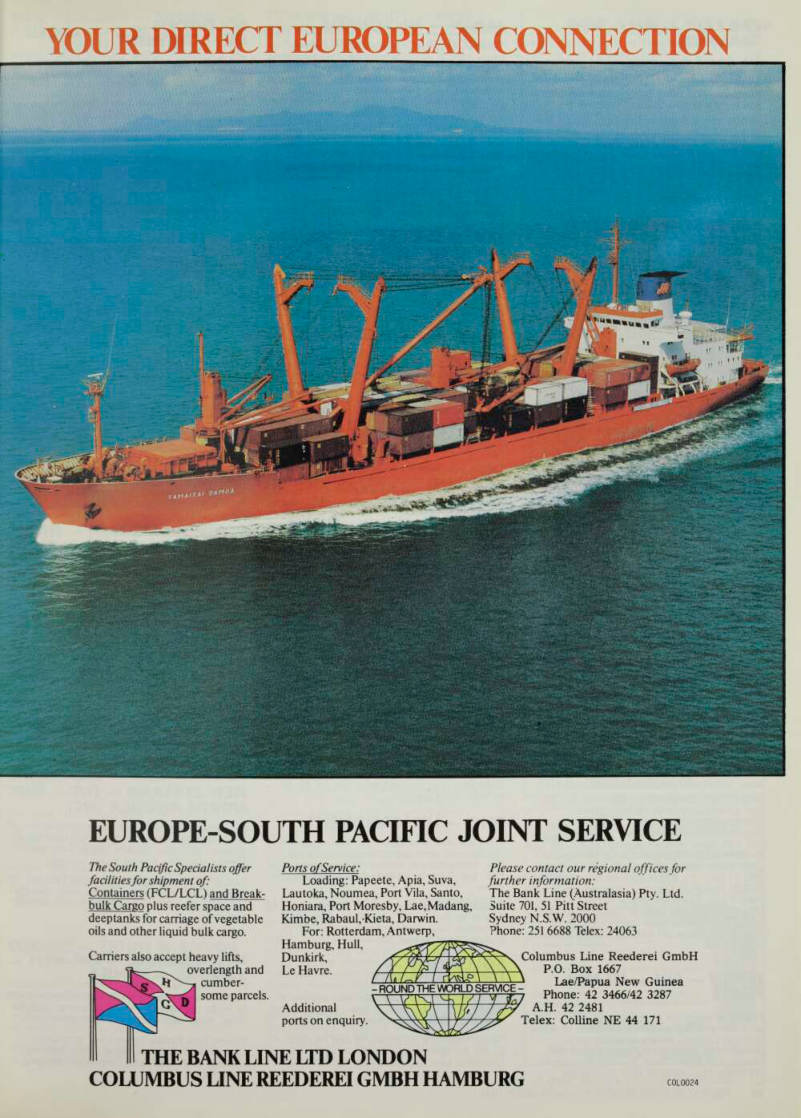
Australia New
Caledonia Fiji Hawaii
North America
PACE Line (ACTA Shipping) operates a fully containerised service every 17 days from Melbourne, Sydney and Brisbane to Noumea, Suva and Lautoka. The vessels continue on to the North coast of America, calling at Hawaii at frequent intervals.
Details from ACTA Pty Ltd, Sydney (266 0633); Tlx AA121369; Fax 267 1148; Burns Philp (SS) Co Ltd. Rodwell Road, Suva (31 1777); Tlx FJ2168; Fax 31 1804; Burns Philp (SS) Co Ltd, Lautoka (60 777); Sato SA, Avenue James Cook BPC 2, Noumea, Cedex (28 1122); Tlx 163 NM
Sato: Fax 27 8532.
Australia Samoas
Tonga
Warner Pacific Lines operates a regular container service from Sydney, Brisbane and Melbourne to Nuku’alofa, Pago Pago, Apia and Vava’u with transhipment to Rarotonga.
Details from Hetherington Wesfarmers Shipping Agency, 37-49 Pitt St, Sydney (223 1600).
Australia New
Caledonia Fiji
Samoas Tonga
Pacific Forum Line operates a fully containerised service (general, reefer and ro-ro) from Sydney to Noumea, Lautoka, Suva, Apia, Pago Pago, Nuku'alofa, Sydney. Cargo centralised from Ade laide, Melbourne, Brisbane.
Details from Pacific Forum Line, PO Box 796 Au ckland; Union Bulkships, 333 George St, Sydney, Brisbane and Melbourne; Union Co, Lautoka; Pacific Forum Line, Suva, Nuku’alofa; Pacific Forum Line, Apia; Polynesia Shipping, Pago Pago.
Australia Kiribati
K. Asia Pacific operates a 5/6 weekly service from Melbourne and Sydney to Kiribati (Tarawa).
Details from K, Asia Pacific Pty Ltd, Goldfields House, 1 Alfred St, Circular Quay, Sydney (232 2277), Tlx 122143.
KAP New Guinea Lines calls Tarawa after PNG ports on a 35-day basis from Melbourne and Sydney/Brisbane.
Details from K. Asia Pacific Pty Ltd, Goldfields House, 1 Alfred St, Circular Quay, Sydney (232 2277), Tlx 122143.
Australia Tuvalu
K. Asia Pacific operates a direct service every second voyage to Tuvalu (Funafuti).
Details from K. Asia Pacific Pty Ltd, Goldfields House, 1 Alfred St, Circular Quay, Sydney (232 2277), Tlx 122143.
Australia Norfolk
Island Lord Howe
Island
Norfolk Island Shipping Line operates a direct service every 5/6 weeks ex-Sydney.
Details from K. Asia Pacific Pty Ltd as managing agents for NISL, Goldfields House, 1 Alfred St, Circular Quay, Sydney (232 2277).
Australia New
Caledonia Vanuatu
Norfolk Island Shipping Line operates a direct service every 5/6 weeks ex-Sydney.
Details from K. Asia Pacific Pty Ltd as managing agents for NISL, Goldfields House, 1 Alfred St, Circular Quay, Sydney (232 2277).
Compagnie Generale Maritime operates a monthly service from Sydney, Melbourne and Brisbane to Noumea, Port Vila and Santo, for containerised and break-bulk cargo.
Details from Compagnie Generale Maritime 12 Castlereagh St, Sydney (231 3700).
Australia Nauru
Nauru Pacific Line operates a regular cargo service from Melbourne to Nauru, passenger service to Nauru only.
Details from Nauru Pacific Line (Aust) Pty Ltd, Nauru House, 80 Collins St, Melbourne (653 5709). Nedlloyd Swire, 8 Spring St Sydney, (20 522).
Australia Solomon
Islands Vanuatu
NGAL/PNGL joint service operates a monthly service.
Details from Nedlloyd Swire Pty Ltd, 8 Spring St, Sydney (20 522).
Australia New Zealand
The Australian National Line and the New Zealand Line operate a 10-day container service (TRANZTAS) between Sydney and Melbourne to Auckland, Wellington, Lyttleton and Port Chalmers.
Details from Australian National Shipping Agencies, 131-137 York St, Sydney (225 7333) and Australian National Shipping Agencies, “World Trade Centre", cnr Flinders and Spencer Sts, Melbourne (611 2323) or New Zealand Line, Pastoral House, 96 Lambton Quay, Wellington (72 2245).
Australia Nz Fiji
Vanuatu New
Caledonia Solomons
New Guinea
Sitmar Cruises operates a year-round cruise program from Sydney to include the better-known ports in the above countries plus a number of unspoilt, and largely unknown, island paradises.
Details from Sitmar Cruises, 39 Martin Place, Sydney (239 9000) for NSW; reservations and inquiries (008 42 2277); rest of Australia, reservations and inquiries (088 22 2277),
Australia Nz Fiji
Tonga Vanuatu New
Caledonia Solomons
S Amo As Tahiti
P&O Liners call at Auckland, Bay of Islands, Honiara, Lautoka, Noumea, Nuku’alofa, Pago Pago, Papeete, Port Moresby, Santo, Savusavu, Suva, Vava’u and Vila on cruises from Australia.
Details from P&O Booking Centre, Thomas Cook Pty Ltd, 33 Bligh St, Sydney (237 0333).
Australia Png
Solomons Vanuatu
A consortium of NGAL/PNGL and CONPAC/NEL has four vessels operating a
joint service from east coast Australian ports to Port Moresby, Lae, Alotau, Madang, Wewak, Rabaul, Kavieng-Kimbe, Kieta, Honiara, Vila, Santo.
Details from Burns Philp & Co Ltd, PO Box R 124, Royal Exchange, Sydney (20 547); Nedtloyd Swire, 8 Spring St, Sydney (20 522); New Guinea Express Lines, 37 Pitt St, Sydney (241 3991); Vila Agents PO Box 27, Port Vila
(2456), Tlx Nhioii.
New Guinea Express Lines operates a weekly container service from Melbourne, Sydney, Brisbane to Port Moresby, Lae, Alotau, Kimbe, Rabaul, Kieta, Honiara, Kavieng, Madang, Wewak, Santo, Vila.
Details from New Guinea Express Lines, PO Box R 73, Royal Exchange Sydney (241 3991); 127 Creek St, Brisbane (221 9333); 84 William St, Melbourne (602 5544); Port Moresby (21 4572); Steamships Trading (agent), Rabaul (92 1400); Bougainville Agencies Pty Ltd Kieta, (95 6089); Steamships Trading Co, Madang (82 2446); Graumut Enterprises, Wewak (86 2106); Burns Philp (PNG) Ltd, Kavieng (94 2133); Alotau Stevedoring and Transport, Alotau (61 1318); Ngatia Wholesalers Pty Ltd, Kimba (93 5102) and Tradco Shipping, Mandana Avenue, Honiara (2 2588); Vila Agents Ltd, PO Box 971, Vila, Vanuatu (2490); John Lum & Associates, PO Box 65, Santo, Vanuatu (329).
Europe Tahiti New
Caledonia Vanuatu
The Bank Line and Columbus Line operates a regular joint cargo service from Hamburg, Bremen, Antwerp, Rotterdam and Le Havre to Papeete, Noumea, Port Vila and Santo.
Details from The Bank Line (A’asia) Pty Ltd, 51 Pitt St, Sydney (251 6688), Tlx: AA24063, Columbus Line, Lae (423466), Tlx: NE44171; Ets A.M. Fare LITE, Papeete, Ets, Ballande, Noumea and other local agents.
Europe Png
Solomons
The Bank Line & Columbus Line operate a regular joint cargo service from Hamburg, Bremen, Antwerp, Rotterdam and Le Havre to Port Moresby, Lae, Madang, Kimbe, Rabaul, Kieta and Honiara and on inducement to Yandina.
Deta.is from The Bank Line (A'asia) Pty Ltd, 51 Pitt St, Sydney (251 6688). Tlx: AA24063, Columbus Line, Lae (423466), Tlx: NE44171; or lines’ local agents.
Europe W. Samoa
Tonga Fiji
The Bank Line & Columbus Line operate a regular joint cargo service from Hamburg, Bremen, Antwerp, Rotterdam and Le Havre to Apia, Nuku’alofa, Suva and Lautoka.
Details from The Bank Line (A’asia) Pty Ltd, 51 Pitt St, Sydney (251 6688), Tlx: AA24063, Columbus Line, Lae (423466), Tlx: NE 44111, or Lines’ local agents.
Singapore Hong Kong
Fiji Islands Ports
Kyowa Shipping Co Ltd operates a monthly containerised and break-bulk cargo service from Hong Kong to Lautoka, Suva and then to island ports.
Details from Carpenters Shipping, Private Mail Bag GPO Suva, Fiji (31 2244): Fax: (679) 30 1572, Tlx FJ2199.
4 Far East Fiji New
Zealand
New Zealand Unit Express (NZUE) operates a monthly service accepting containerised and break-bulk cargo from Manila, Keelung, Kaohsiung and Hong Kong to Lautoka, Suva and thence to New Zealand ports.
Details from Carpenters Shipping, Private Mail Bag GPO Suva. Fiji )(31 2244), Fax: (679) 31 1572: Tlx FJ2199; Burns Philp, Suva, (311 777); New Zealand Unit Express, Maritime Building. 2-10 Customhouse Quay. PO Box 890 Wellington (72 7865), Cables ENZUEMAN
Wellington, Tlx Nz31340, Nedlnz, Or
Nedlloyd Swire Pty Ltd, Sydney (20 522).
Far East Mid South
Pacific
China Navigation's New Guinea Pacific Line operates a regular container and Break Bulk-Heavy Lift service from Hong Kong, Taiwan, Manila, Singapore, Malaysia, Thailand to Port Moresby, Lae, Rabaul. Kieta and Honiara with 18 days frequency Wewak and Madang will receive four direct calls a year or more on inducement. A T/S service via Lae to these and other PNG ports connecting with monthly sailings is available at cost. Cargo from the same Eastern ports to the South Pacific ports of Noumea, Santo, Vila, Papeete, Pago Pago, Apia.
Nuk’j’alofa. Raratonga and Tarawa will be shipped via Japan or Busan on the monthly Bali Hai service.
Details from Steamships Shipping, PO Box 634, Port Moresby (22 0283 or 22 0289) Kyowa Shipping Ltd operates monthly services from Japan to Guam, Saipan, Solomons, New Caledonia, Fiji, Western and American Samoa, Tahiti. Cook Islands, Tonga and Vanuatu.
Details from Hetherington Wesfarmers Shipping Agency, 37-49 Pitt St. Sydney (223 1600); Carpenters Shipping, Suva (31 2244), Tlx FJ2199.
Guam Northern
Marianas
Saipan Shipping Co operates a weekly service via barge carrying containers and conventional cargo between Guam and Saipan and Tinian Details from Saipan Shipping Co, Inc, PO Box 8, Saipan CM 96950 (322 9706 or 322 9707), Tlx 783619; Fax (670)322 3183; Guam agents Maritime Agencies of the Pacific Ltd.
Hawaii Samoas
Tonga Cook Islands
Hawaii-Pacific Lines operates a monthly container service between Honolulu, Pago Pago, Apia, Nuku’alofa and Avatiu (Rarotonga) Details from Hawaii-Pacific Maritime, Inc, PO Box 3264, Honolulu HI (9680)-32641 (808 531 4841).
Details from Morris Hedstrom (Samoa) Ltd, PO Box 189, Apia, Western Samoa (21 355, 22 722), Tlx 224 (MORISHED SX), Fax 24 279; Union Citco Travel Ltd, Rarotonga, Cook Islands (682 21 780); Tlx 62024 (UTRAV G); Fax (682) 20 859: Kneubuhl Maritime Services, PO Box 39, Pago Pago, American Samoa 96799, (684 633 5121); Tlx 782505; Fax (684) 633 5100; Union Maritime Services Ltd, PO Box 4, Nuku’alofa, Tonga (21 644/5); Tlx 66227, Fax (676) 21 645.
Japan Fiji Island
Ports
Kyowa Shipping Co operates a monthly containerised service from main ports of Japan to Suva, Lautoka, thence to island ports.
Details from Carpenters Shipping, Neptune House. 3/4 Floor, Tofua St, Walu Bay, Suva (31 2244), Fax: (679)30 1572 Tlx FJ2199
Japan Micronesia
The NYK Shipping Line operates a monthly cargo service from Japan to Micronesia, calling at Yoko, Nagoya, Kobe, Guam, Saipan, Truk, Ponape and Majuro, returning via Yoko, Nagoya and Kobe.
Details from Burns Philp & Co. Ltd., 51 Pitt St Sydney (259 1000).
Saipan Shipping Co operates a monthly service from Japan to Saipan, Guam, Truk, Ponape, Majuro (Kosrae and Ebeye on inducement).
Details from Saipan Shipping Co, PO Box 8 Saipan, CM 96950 (322 9706 or 322 9707), Tlx 783619, Fax (670)322 3183.
Japan agents Kyowa Shipping Company Ltd; Guam Agents Maritime Agencies of the Pacific Ltd.
Japan Korea Png
Paradise Service
Mitsui OSK Lines operates a monthly service from main ports in Japan, Wewak, Lae, Rabaul, Kieta, Port Moresby.
Details from Robert Laurie Company (PNG) Ltd.
PO Box 1032, Lae (42 3642, 42 3811), Contact: W O Hackenberg, Group Shipping Man ager.
Japan Korea Png
Japan Paradise Service
Mitsui OSK Lines in joint service with NYK Lines operates a monthly service from main ports in Japan and Busan in Korea to PNG ports of Wewak, Rabaul, Kieta, Lae, Port Moresby, Kavieng, Kimbe, Madang and Oro Bay Details from Robert Laurie Company Pty Ltd, PO Box 1032, Lae (direct: 42 3642 or a switch: 42 3811), Contact: W O Hackenberg, Group Shipping Manager & Marketing; Tlx NE 42508, Fax 42 3801.
Png Inter-Mainport
Papua New Guinea Line offers scheduled 10-20 day coastal liner services linking all PNG major ports with containerisation, reefer, heavy lift and trans-shipment facilities.
Details from PNG Line, Box 543, Port Moresby (21 1174), Tlx 22269.
Png Taiwan Hong
Kong Singapore
Indonesia
The Bank Line & Columbus Line operates a regular joint cargo service from PNG Ports to Kaohsiung, Hong Kong, Singapore, Jakarta & Surabaya Details from The Bank Line (A’asia) Pty Ltd, 51 Pitt St, Sydney (251 6688), Tlx: AA24063: Columbus Line, Lae (423466), Tlx: NE 44111; or lines’ local agents.
Png Uk/Continent
The Bank Line and Columbus Line operate a regular joint service from Port Moresby, Oro Bay, Kieta, Rabaul, Kimbe, Madang and Lae to Hull, Hamburg, Rotterdam, Antwerp and Le Havre.
Details from The Bank Line (A’asia) Pty Ltd, 51 Pitt St. Sydney (251 6688), Tlx AA24063; Columbus Line. Lae (42 3466), Tlx NE44171; or lines’ local agents.
Solomons
Uk/Continent
The Bank Line and Columbus Line operate a regular joint cargo service from Honiara to Hull, Hamburg, Rotterdam, Antewrp and Le Havre, Details from The Bank Line (A’asia Pty) Ltd, 51 Pitt St, Sydney (251 6688), Tlx AA24063; Columbus Line, Lae (42 3466), Tlx NE44171; or lines’ local agents.
Solomons
Uk/Continent
The Bank Line and Columbus Line operate a regular joint cargo service from Honiara to Hull, Hamburg. Rotterdam, Antwerp and Le Havre Details from The Bank Line (A'asia) Pty Ltd 51 Pitt St, Sydney (251 6688), Tlx AA24063; Columbus Line, Lae (42 3466), Tlx NE 44171; Tradco Shipping Ltd, Honiara (22 588), Tlx 66313.
New Zealand Australia
Png Solomon
Islands
Pacific Forum Line operates a containerised and ro-ro service from Lyttleton, Napier and Auckland to Brisbane, Port Moresby, Lae, Honiara, Brisbane then New Zealand.
Details from Pacific Forum, Auckland, Christchurch; Union Bulkships, Brisbane; Steamships Shipping. Port Moresby and Lae; Sullivans Ltd, Honiara; Seabridge, Wellington.
New Zealand Cook
Islands Tahiti
New Zealand Line operates cargo services based on pallets and similar units from Auckland to Cook Islands and Tahiti.
Details from NZ Shipping Agencies International Ltd, PC Box 3420. Auckland (39 2650); Waterfront Commission, PO Box 61, Raratonga Cook Islands; Shipping Office, Govt of Niue, PO Box 107, Niue Island; Compagnie Maritime Polynesienne, PO Box 36, Papeete, Tahiti.
New Zealand Fiji
Reef operates a regular 18-day service from Auckland to Suva and Lautoka. Also passenger accommodation.
Details from Reef Shipping Agencies, PO Box 3382, Auckland (771 2213), Tlx 60633; MV Fijian Shipping Agencies Ltd, Private Bag, Suva (31 1056).
Pacific Line with one ship operates a three-weekly ro-ro cargo service New Zealand, Lautoka, Suva. No passengers.
Details Sofrana Unilines, 18 Customs St, Auckland (77 3279), PO Box 3614, Tlx NZ2313; Carpenters Shipping, Neptune House, Tofua St, Walu Bay, Suva (25 141), Tlx FJ2199.
New Zealand Fiji
North America (Wc)
Blue Star Line Ltd Pacific Coast container services: only direct service to and from New Zealand. Blue Star vessels call at Suva and Honolulu on NZ-US West Coast voyages.
Details from Blueport ACT (NZ) Ltd, PO Box 192, Wellington (73 9029); Burns Philp (SS) Co Ltd, GPO Box 355, Suva (31 1777), Tlx FJ2168 Burnship.
New Zealand Fiji
Samoas Tonga
Pacific Forum Line operates a containerised and ro ro 21 day service from Auckland to Lautoka, Suva, Apia, Pago Pago and Nuku’alofa.
Details from Pacific Forum Line, Auckland, Christchurch, Suva and Apia, Union Maritime.
Lautoka, and Nukualofa; Polynesian Shipping, Pago Pago.
New Zealand Tonga
Samoas
Warner Pacific Line Services from Auckland to Nuku’alofa, Vava’u, Apia, Pago Pago monthly carrying general and freezer cargoes and FCL Dry Freezer.
Details from McKay Shipping Ltd, 2nd Floor, Ferry Bldg, Ouay St., Auckland PO Box 3 (39 0229), Cables MACSHIP, Tlx NZ2554f; Warner Pacific Line, Box 93, Nuku’alofa, Tonga; Mealelel (Western S.'rnoa) Ltd, Private Bag Apia, Western Samoa, Burns Philp (SS) Co Ltd, PC Box 129, Pago Pago, American Samoa (633 2709), Burnsouth SB.
Nz Cook Islands
Aitutaki Niue
Cook Islands Line services Auckland, Raratonga, Aitutaki, Niue monthly carrying general and freezer cargoes.
Details from McKay Shipping Ltd. 2nd Floor, Ferry Bldg, Ouay St., Auckland/PO Box 3, Auckland (39 0229). Cables MACSHIP, Tlx NZ2554; Fax 32 931.
South East Asia Fiji
Nedlloyd Lines (NZEAS) Service operates regular fast cargo service from Surabaya, Jakarta, Port Kelang, Bangkok and Singapore via New Zealand to Suva and Lautoka. Details from Carpenters Shipping, Neptune House, 3/4 Floor, Tofua St, Walu Bay, Suva. (31 2244) Fax: (679) 30 1572 Tlx; FJ2199
Tahiti New Caledonia
Vanuatu Solomon
Islands New Zealand
Png Singapore
Europe
Polish Ocean Lines operates semi-container type vessels to the following ports; from Papeete, Noumea, Santo, Vila, Yandina, Honiara, Auckland, Singapore, Port Kielang, Penang then to Mediterranean ports and Europe via the Suez Canal (other New Zealand ports subject to inducement).
Details from Universal Shipping Agencies Ltd, 7th Floor, 14 Emily PI, Auckland 1 (39 0931, 39 0727, 32 104), Tlx 21 517.
Taiwan Hong Kong
Singapore Indonesia
Png
The Bank Line & Columbus Line operate a regular joint cargo service from Kaohsiung, Hong Kong, Singapore, Jakarta, Surabaya to Papua New Guinea Ports.
Details from The Bank Line (A’asia) Pty Ltd, 51 Pitt St, Sydney (251 6688), Tlx: AA24063: Columbus Line, Lae (423466), Tlx: NE44171; or lines' local agents.
Europe Tahiti W Samoa
Fiji New Caledonia
Compagnie Generale Maritime operates services from Europe and Mediterranean ports to Papeete and Noumea using three ro-ro and multi-purpose vessels thus ensuring a bi-monthly sailing to and from.
Details from Compagnie Generale Maritime, 12 Castlereagh St, Sydney (2313700).
Europe Tahiti New
Caledonia New Zealand
Vanuatu Solomons
Png Europe
Polish Ocean Lines offers regular monthly sailings for containerised and break-bulk cargo, also conventional reefer space and reefer containers from Hamburg, Rotterdam, Dunkirk, Le Havre to Papeete, Noumea, Auckland, Santo.
Honiara, Rabaul, Lae, Singapore, returning to Europe via Suez, Other ports in the South Pacific can be served directly with inducement or otherwise via transhipment.
Details from Sotama, BP 9170, Papeete (42 7805), Tlx Sotama 373FP; SATO; BP, 02 Noumea Cedex (27 2094), Tlx 163 NM; Universal Shipping Agencies, PO Box 2282 Auckland (30 930), Tlx 21517; Vanua Navigation, PO Box 44, Vila (2027), Tlx 1033; Melan Chine Shipping Co, PO Box 71, Honiara (21 678), Tlx 66335; Steamships Trading Co Ltd, PO Box 85, Lae. (42 4666), Tlx 42423; Union Steamship Co NZ Ltd, PO Box 50. Apia (21 781), Tlx 225; Warner Pacific Line, PO Box 93, Nukualofa (22 088), Tlx 66219; Fiji Agents TBA.
Europe Tahiti New
Caledonia
Nedlloyd offers regular cargo services from Continental ports to Papeete, Apia, Fiji and New Caledonia.
Details Nedlloyd (Aust) Pty Ltd, Spring St, Sydney (27 3801); Carpenters Shipping, Ist Floor, Harbour Centre Bldg, 100 Thomson St Suva (31 2244) Tlx 2199FJ and Vetari St, Lautoka (63 988), Tlx 5215FJ.
Uk W Samoa Tonga
Fiji
The Bank Line and Columbus Line operate a regular joint cargo service from Hull, to Apia, Nukualofa, Suva and Lautoka.
Details from The Bank Line (A’asia) Pty Ltd, 51 Pitt St, Sydney (251 6688), Tlx; AA24063: Columbus Line, Lae (423466), Tlx: NE44171; or lines’ local agents.
Uk Png Solomons
The Bank Line and Columbus Line operate a regular joint cargo service from Hull, to Port Moresby, Lae, Madang, Kimbe, Rabaul, Kieta and Honiara and on inducement to Yandina.
Details from The Bank Line (A’asia) Pty Ltd, 51 Pitt St, Sydney (251 6688). Tlx: AA24063: Columbus Line, Lae (423466), Tlx: NE44171; or lines’ local agents.
Uk Tahiti New
Caledonia Vanuatu
The Bank Line and Columbus Line operate a regular joint cargo service from Hull, to Papeete, Noumea, Port-Vila and Santo.
Details from The Bank Line (A’asia) Pty Ltd, 51 Pitt St, Sydney (251 6688), Tlx: AA24063: Columbus Line, Lae (423466), Tlx: NE44171; Ets A M. Fare UTE, Papeete, Ets Ballande, Noumea and other local agents.
Us Hawaii Micronesia
Png
PM&O Lines operates two fully self-contained container vessels on a sailing frequency of every 30 days between the San Francisco Bay Area, Los Angeles, Honolulu and Majuro, Ebeye, Kosrae, Ponape, Truk, Saipan, Yap, Palau, Cebu, Davao, Manila, Lae, Kieta and Rabaul.
Details from PM&O Lines, 353 Sacramento St, San Francisco, California 94111 (415 421 5400), Tlx 278016 PMC UR; owner’s Representative PO Box 803, Saipan, NMI 96950 (234 6819), Tlx
783605 Cmcaa.
Advertisements & other items, pp. 55-57 (1 item)
Your Direct European Connection
ili ijbi * mmm : S I
EUROPE-SOUTH PACIFIC JOINT SERVICE
The South Pacific Specialists offer facilities for shipment of: Containers (FCL/LCL) and Breakbulk Cargo plus reefer space and deeptanks for carriage of vegetable oils and other liquid bulk cargo.
Carriers also accept heavy lifts, overlength and cumbersome parcels.
CJ vIEj Ports of Service: Loading: Papeete, Apia, Suva, Lautoka, Noumea, Port Vila, Santo, Honiara, Port Moresby, Lae,Madang, Kimbe, Rabaul,Kieta, Darwin.
For: Rotterdam, Antwerp, Hamburg, Hull, Dunkirk, Le Havre.
ROUND THE WORLD SERVICE
Additional ports on enquiry.
Please contact our regional offices for further information: The Bank Line (Australasia) Pty. Ltd.
Suite 701, 51 Pitt Street Sydney N.S.W. 2000 Phone: 251 6688 Telex: 24063 Columbus Line Reederei GmbH P.O. Box 1667 Lae/Papua New Guinea Phone: 42 3466/42 3287 A.H. 42 2481 Telex: Colline NE 44 171
THE BANK LINE LTD LONDON
COLUMBUS LINE REEDEREI GMBH HAMBURG
C0L0024
ACE AGENCIES
Indent agents on any brand of machinery industrial hardware and parts. Machinery brokers & Valuers CPO Box 12631, Suva, Fiji. Tlx 2581 F|.
Phones 381-497 383-766 (24 hours) Fax: 384392 * Logging & Sawmilling * New & used heavy equipments * Pumps & Motors * Wire Rope & Accessories * Industrial belts & saws * Woodworking machinery * Farm Tractors * CM/Detroit parts, stockists * Drilling & Mining * Earthmoving Equipment * Design, layout of factories * Machinery Brokers & Valuers * Industrial hardware * Machinery parts any brand WE DEAL IN ANY BRAND FROM ANY COUNTRY
Aggie Grey's
Hotel
Stay at Aggie Grey’s
the South Pacific’s
legendary hotel.
Situated right in the heart of Western Samoa. Enjoy Polynesian style friendliness and service,in cool surroundings, superb entertainment and food. Magnificent white sand beaches only a short drive away.
Air-conditioned rooms, swimming pool and full bar facilities.
Bookings through Union Steamship Company of NZ, Pan Am, Air New Zealand or direct to Aggie Grey’s, Apia, Western Samoa. Cables: AGGIES’ Apia..
ivyflj-isANTIQUE
PACIFIC
ARTIFACTS
Send for details of items available.
I also stock old engravings & books.
Efficient postal service.
Write stating interests.
COLIN HINCHCLIFFE
12 QUEENS STAITH MEWS
YORK. UNITED KINGDOM
The established name as an economical
substitute for blockwork, timber walls &
partitions.
STYROCON will give you:
Excellent weather waterproofing PH Suva 362-699 Office 6 Factory: Wallada Industrial Estate, Lami, Suva.
PO Box 13766, Suva. Fax (679)301572.
Strong maintenance free wall surface Good sound Insulation Good hear Insulation Plenty of strength & solidity Good fire resistance Good cyclone & earthquake resistance USES: Fascia Panels. Sunscreens. Schools.
Hospitals, Hotels. Transportable Buildings C Partitions. Housing.
The most versatile structural panel on the
EXPORT HOUSING
HARTWELL ...
Joyita: The Mystery Lingers
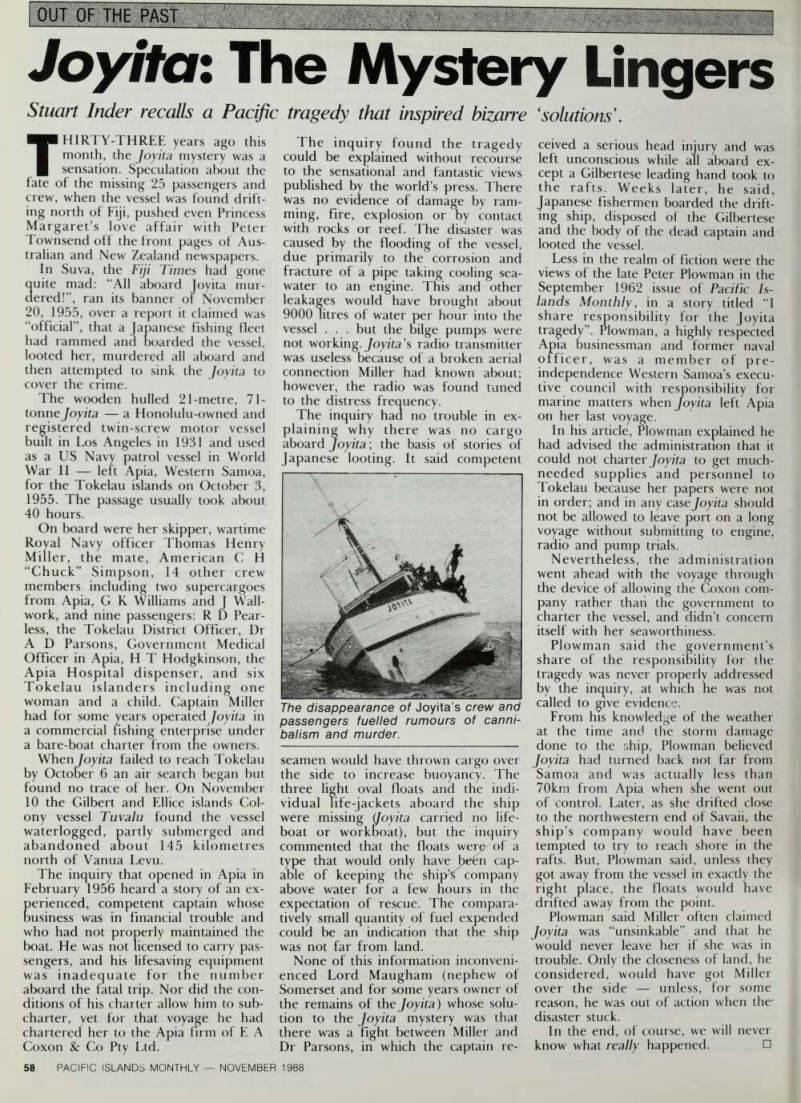
Out Of The Past
Stuart Inder recalls a Pacific tragedy that inspired bizarre ‘solutions’.
THIRTY-THREE years ago this month, the Joyita mystery was a sensation. Speculation about the fate of the missing 25 passengers and crew, when the vessel was found drift ing north of Fiji, pushed even Princess Margaret’s love affair with Peter Townsend off the front pages of Aus tralian and New Zealand newspapers.
In Suva, the Fiji Times had gone quite mad: “All aboard Joyita mur dered!”, ran its banner of November 20, 1955, over a report it claimed was “official”, that a Japanese fishing fleet had rammed and boarded the vessel, looted her, murdered all aboard and then attempted to sink the Joyita to cover the crime.
The wooden hulled 21-metre, 71tonne Joyita a Honolulu-owned and registered twin-screw motor vessel built in Los Angeles in 1931 and used as a US Navy patrol vessel in World War II left Apia, Western Samoa, for the Tokelau islands on October 3, 1955. The passage usually took about 40 hours.
On board were her skipper, wartime
Royal Navy officer Thomas Henry
Miller, the mate, American C H “Chuck” Simpson, 14 other crew members including two supercargoes from Apia, G K Williams and J Wall work, and nine passengers: R D Pear less, the Tokelau District Officer, Dr A D Parsons, Government Medical Officer in Apia, H T Hodgkinson, the
Apia Hospital dispenser, and six
Tokelau islanders including one woman and a child. Captain Miller had for some years operated Joyita in a commercial fishing enterprise under a bare-boat charter from trie owners.
When Joyita failed to reach Tokelau by October 6 an air search began but found no trace of her. On November 10 the Gilbert and Ellice islands Col ony vessel Tuvalu found the vessel
waterlogged, partly submerged and
abandoned about 145 kilometres north of Vanua Levu.
The inquiry that opened in Apia in February 1956 heard a story of an ex
perienced, competent captain whose
business was in financial trouble and who had not properly maintained the boat. He was not licensed to carry pas sengers, and his lifesaving equipment was inadequate for the number aboard the fatal trip. Nor did the con ditions of his charter allow him to sub charter, yet for that voyage he had chartered her to the Apia firm of E A Coxon & Co Pty Ltd.
The inquiry found the tragedy could be explained without recourse to the sensational and fantastic views published by the world’s press. There was no evidence of damage by ram
ming, fire, explosion or by contact
with rocks or reef. The disaster was caused by the flooding of the vessel, due primarily to the corrosion and fracture of a pipe taking cooling sea water to an engine. This and other leakages would have brought about 9000 litres of water per hour into the vessel . . . but the bilge pumps were not working. Joyita ’s radio transmitter was useless because of a broken aerial connection Miller had known about; however, the radio was found tuned to the distress frequency.
The inquiry had no trouble in ex plaining why there was no cargo aboard Joyita ; the basis of stories of Japanese looting. It said competent
seamen would have thrown cargo over the side to increase buoyancy. The three light oval floats and the indi vidual life-jackets aboard the ship were missing Joyita carried no life boat or workboat), but the inquiry commented that the floats a type that would only have befm cap able of keeping the company above water for a few hours in the expectation of rescue. The compara
tively small quantity of fuel expended
could be an indication that the ship was not far from land.
None of this information inconveni enced Lord Maugham (nephew of Somerset and for some years owner of the remains of the Joyita) whose solu tion to the Joyita mystery was that there was a fight between Miller and Dr Parsons, in which the captain re
ceived a serious head injury and was left unconscious while all aboard ex cept a Gilbertese leading hand took to the rafts. Weeks later, he said, Japanese fishermen boarded the drift ing ship, disposed of the Gilbertese and the body of the dead captain and looted the vessel.
Less in the realm of fiction were the views of the late Peter Plowman in the September 1962 issue of Pacific Is lands Monthly, in a story titled “I share responsibility for the Joyita
tragedy”. Plowman, a highly respected
Apia businessman and former naval officer, was a member of pre independence Western Samoa’s execu tive council with responsibility for marine matters when Joyita left Apia on her last voyage.
In his article, Plowman explained he had advised the administration that it could not charter Joyita to get much needed supplies and personnel to Tokelau because her papers were not in order; and in any case Joyita should not be allowed to leave port on a long voyage without submitting to engine, radio and pump trials.
Nevertheless, the administration went ahead with the voyage through the device of allowing the Coxon com pany rather than the government to charter the vessel, and didn’t concern itself with her seaworthiness.
Plowman said the government’s share of the responsibility for the tragedy was never properly addressed by the inquiry, at which he was not called to give evidence.
From his knowledge of the weather at the time and the storm damage done to the ship, Plowman believed Joyita had turned back not far from Samoa and was actually less than 70km from Apia when she went out of control. Later, as she drifted close to the northwestern end of Savaii, the ship’s company would have been tempted to try to reach shore in the rafts. But, Plowman said, unless they got away from the vessel in exactly the right place, the floats would have drifted away from the point.
Plowman said Miller often claimed Joyita was “unsinkable” and that he would never leave her if she was in trouble. Only the closeness of land, he considered, would have got Miller over the side unless, for some reason, he was out of action when the' disaster stuck.
In the end, of course, we will never know what really happened. □
The disappearance of Joyita’s crew and passengers fuelled rumours of canni balism and murder.
Advertisements & other items, pp. 59-60 (1 item)
0 Pioneer
f *r *7 l l dl5 r K ' ■'■ ith spectrum analyzer ■ Remote controllable, motor-driven volume MCD dir circuitry ■ Full-function remote control ■ Full-logic control ■ Dolby* B NR nd ■ 23cm cone woofer with elastic composite diaphragm developed fo choose my music with care. Sometimes it’s the oldies. Sometimes it’s the totally new. But there’s one kind I can’t stand —the kind that’s weak or distorted. That’s why my choice in a personal hi-fi is PERSONNA PLUS —the powerful system that hates distortion and noise as much as I do. My PERSONNA Z-90R has a huge 500 watts of peak music power output, and three-way speaker systems that sound bigger than all outdoors. The graphic equalizer with spectrum analyzer lets me tailor the sound to my tastes. And there’s the double, auto-reverse cassette deck, quartz-PLL synthesizer FM/AM tuner, full-auto turntable and the optional six-disc Multi-play CD player. But best of all —I can operate the whole system, including the volume, by remote control. At first, it looked too hard to use. Wrong! Pioneer made it easy. They made my choice easy, too. PERSONNA PLUS—also available in the Z-70R and Z-50R systems —is the choice I recommend to you.
The future of sound and vision.
For further information, please contact: Australia: Pioneer Electronics Australia Pty. Ltd. (Incorporated in Victoria), P-O. Box 295, Mordialloc, Victoria, 3195 Tel: 580-9911 Fiji Islands: Brijlal & Company, G.P.O. Box No. 362, Suva. Fiji Islands Tel: 22258 New Zealand: Monaco Corporation Ltd., 41 Poland Road, Glenfield, Auckland, New Zealand Tel: (09) 444-9144 Norfolk Island: Burnt Pine Traders Ltd., P.O. Box 21, Norfolk Island Vanuatu: Burns Philp (Vanuatu) Ltd., Vila, Vanuatu Nauru Island: Jacob Enterprises, P.O. Box N 0.4, Republic of Nauru Tahiti; Tahiti Hi-Fi, P.O. Box 848, Papeete, Tahiti New Caledonia: Menard Pacifique Sari, B.P. 3899, Noumea, New Caledonia Tel: 27.62*23 American Samoa; Transpac Corporation, P.O. Box 1477, Pago Pago, American Samoa 96799 Tel: 633-5224 Rarotonga: South Seas International Ltd., P.O. Box 49, Rarotonga, Cook Islands Tel: 2327
N i m
87- 88 JAF4NESE
me
CAR OF
THE YEAR
Challenges Rewarded
Developing a new trend-setting car is a constant set of challenges faced on the drawing board, in the laboratory and, finally, on the test course.
For Mitsubishi Motors these challenges were embodied in a high-speed research vehicle, the Galant HSR. This prototype recorded cruising speeds in excess of 320km/h with exceptional stability and response. By incorporating state-of-the-art technologies in what was essentially an m ordinary four-cylinder coupe, the HSR made everyday high-speed driving a reality.
But the HSR was designed to test these advanced technologies as they may be applied in a distinctive passenger vehicle.
Meeting this challenge resulted in the new Mitsubishi Galant—the reward of precise engineering and a gently organic design of warmth and emotion. An individualistic sedan that was voted Japanese Car of the Year only two months after its release.
Ultimately however, the final reward belongs to you.
Introducing the new
MITSUBISHI GRLRNT
Precision in Action << <o 00 Qr oc CO N-) A Mitsubishi Motors is now offering a free 36-page PR magazine featuring interesting articles and exciting photos. If interested, write to: P.l. Advertising, International Business Planning Department, Office of International Business, Mitsubishi Motors Corporation, 33-8, Shiba 5-chome, Minato-ku, Tokyo 108, Japan.
AMERICAN SAMOA: MORRIS SCANLAN SERVICE INC. PO Box 367, Pago Pago, Tel. 633-5520/AUSTRALIA: MITSUBISHI MOTORS AUSTRALIA LTD. Box 1284, South Road, Clovelly Park, South Australia 5042, Tel (08) 275-7223/FIJI: NIVIS MOTOR & MACHINERY CO., LTD. G PO Box 150, Suva. Tel 38341 1 /FRENCH POLYNESIA (TAHITI): ETS-BREDIN FRERES ET FILS PO Box 21, Papeete, Tahiti, Tel 4-202-58/NEW CALEDONIA: SOCIETE D IMPORTATION D AUTO DU PACIFIQUE SUD S.A B P 438 Rond Point du Pacifique, Noumea, Tel 274144/NEW ZEALAND: MITSUBISHI MOTORS NEW ZEALAND LTD. Todd Park, Heriot Drive, Private Bag, Porirua, Tel 370-109/NORFOLK ISLAND: BORRYS LTD PO Box 169, Norfolk Island, Tel 2114/PAPUA NEW GUINEA: TOBA PTY LTD PO Box 503, Port Moresby, Tel 21-7874/ SOLOMON ISLANDS: HARVEST PACIFIC LTD. G.PO Box 88. Honiara, Guadalcanal, Tel 30128/TONGA: SITANI MAPI CO.. LTD. PO Box 83, Nuku ALOFA, Tel. 21-044/ VANUATU: SOCOMETRA B P 06 Route de Lagon, Port-Vila, Tel. 2314/WESTERN SAMOA: A M MACDONALD HOLDINGS LTD. PO Box 576, Apia. Tel. 22022/SAIPAN/ POHNPEI/MAJURO/KOSRAE/TRUK/YAP/BELAU: MICRONESIAN MOTORS, INC. 997 South Marine Drive, Tamuning, Guam 96911, Tel 646-6827 A
MITSUBISHI
MOTORS