Pacific Islands
Monthly
INSIDE: FIRST EAST TIMOR, NEXT WEST PAPUA?
October 1999
'ml H
STriffi&i * fir sMijliP KWsrds \iQ) bv/eb*< tic *lip%fif|li
American Samoa US$2.5O; Australia A 53.50; Cook Islands NZ$3; Fiji F 52.50 Vat incl; FS Micronesia US$3; Kiribati A 52.50; Nauru A 52.50; Niue NZ$3; Norfolk As 3; New Caledonia cpf2so; New Zealand NZ53.45 incl GST; Northern Marianas USs3;Papua New Guinea M.gojPalau US$3; Marshall Islands US$3; Solomon Islands As 3; French Polynesia cpf3oo; Tonga P 3; USA US$3; Vanuatu VT22O; Western Samoa T 5.50. These are recommended prices only.
Advertisements & other items, p. 2 (1 item)
1-lh.
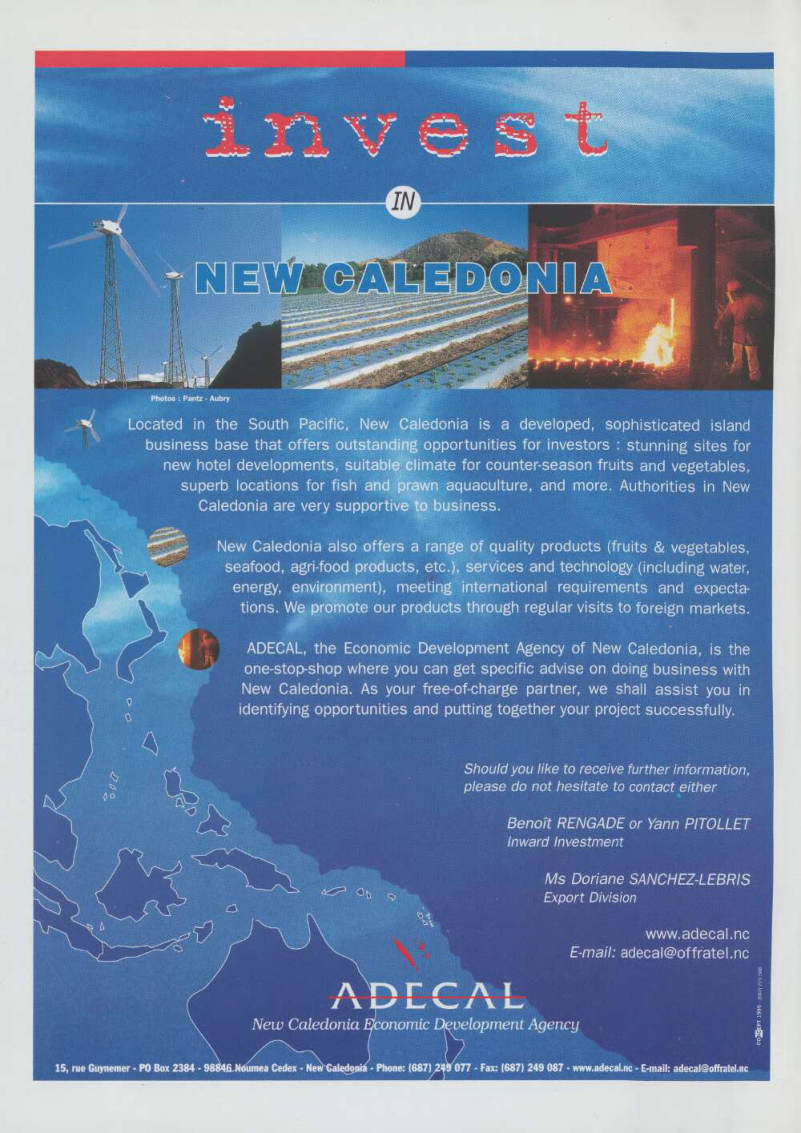
S' v./ ' *■ C3B m sm li Photos ; Pantz - Aubry Located in the South Pacific, New Caledonia is a developed, sophisticated island business base that offers outstanding opportunities for investors : stunning sites for new hotel developments, suitable climate for counter-season fruits and vegetables, superb locations for fish and prawn aquaculture, and more. Authorities in New Caledonia are very supportive to business. iff V A 00 o Oh n & b A i v 15, rue Guynemer - PO Box 2384 - 9 Cedex - New New Caledonia also offers a range of quality products (fruits & vegetables, seafood, agri-food products, etc.), services and technology (including water, energy, environment), meeting international requirements and expectations. We promote our products through regular visits to foreign markets.
ADECAL, the Economic Development Agency of New Caledonia, is the one-stop-shop where you can get specific advise on doing business with New Caledonia. As your free-of-charge partner, we shall assist you in identifying opportunities and putting together your project successfully.
Should you like to receive further information, please do not hesitate to contact either Benoit RENGADE or Vann PITOLLET Inward Investment Ms Doriane SANCHEZ-LEBRIS Export Division W >5 www.adecal.nc E-mail: [email protected] New Caledonia Economic Development Agency Phone: (687) 249 077 - Fax: (687) 249 087 • www.adecal.nc - E-mail: [email protected]
Pacificisms
Vol 69 No. 10
The News Magazine
October 1999
Alan Robinson Sophie Foster Hildebrand Michael Field, Giff Johnson, Sally Andrew. Sam Vulum, Ed Rampell, Alan Ah Mu. Brian Tobia.
David Barber (Wellington).
Jemima Garrett (Sydney) Manish Sharma Senior Regional Sales (South Pacific) Shayne Farah Hussein Tel (679) 304111,303244, Fax (679) 303809.
Sydney, Canberra: Bob Hill Media Representation. Tel (61-2) 4164245, Fax (61-2)4165064.
Brisbane: Jane Fewings Media and Advertising Associates Tel (61-7) 3378 4522, Fax (61-7) 3878 1071.
Adelaide: Hastwell Williamsons Representatives, Tel (61-8) 3799522, Fax (61-8) 3799735.
Melbourne: Brown Orr Fletcher Burrows (Aust) Pty Ltd.
Tel (61-3) 98265188, Fax (61-3) 98265644.
Auckland: McKay & Bowman, International Media Representatives Limited, Tel (64-9)4190561, Fax (64-9) 4192243.
Japan: Universal Media Corporation, Tokyo.
Tel (3)3266626741.
Cable: UNI-MEDIA Tokyo, Fax (3) 32626742.
Pacific Islands Monthly was founded in 1930
(Usps 9522480).
A Fiji Times Limited production.
Cover prices are recommended retail only. Registered by Australia Post, Publication No. NBPI2IO. © Copyright Fiji Times Limited, 177 Victoria Parade. Suva. Fiji.
Tel (679) 304111, fax (679) 303809.
Email: [email protected] PIM Website: http://www.pim.com.fj Pacific Islands Monthly is published monthly by Fiji Times Limited, a division of Nationwide News, 2 Holt Street. Surry Hills.
Sydney. NSW 2010.
Pacific Islands Monthly PO Box 1167. Suva, Fiji.
Printed by Quality Print Limited. 16 Anna Street. Walu Bay. Suva. Fiji.
Cover design/Layput by Manish Sharma While all care is taken with material submitted for publication, no responsibility is taken for misplaced items
Inside
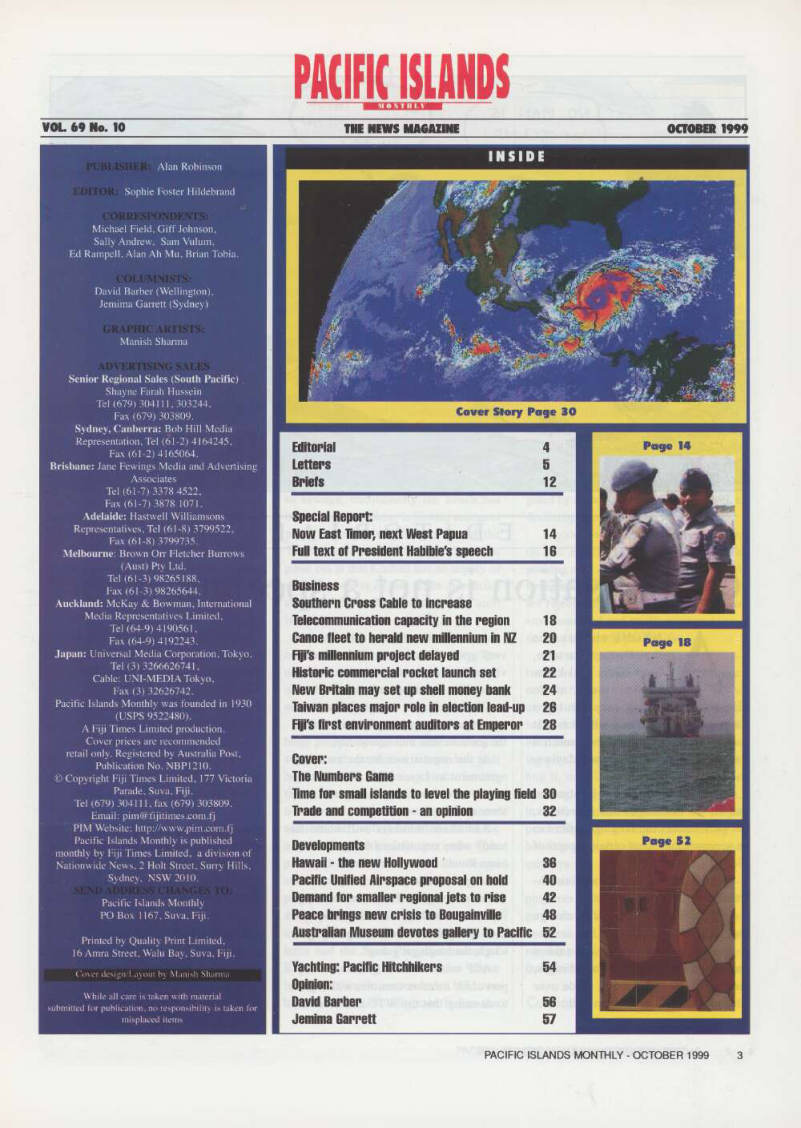
Cover Story Page 30
Editorial 4 Letters 5 Briefs 12 Special Report: Now East Timor, next West Papua 14 Full text of President Habibie's speech 16 Business Southern Cross Cable to increase Telecommunication capacity in the region 18 Canoe fleet to herald new millennium in NZ 20 Fiji's millennium project delayed 21 Historic commercial rocket launch set 22 New Britain may set up shell money bank 24 Taiwan places major role in election lead-up 26 Fiji's first environment auditors at Emperor 28 Cover: The Numbers Game Time for small islands to level the playing field 30 Trade and competition - an opinion 32 Oevelopments Hawaii - the new Hollywood 36 Pacific Unified Airspace proposal on hold 40 Oemand (or smaller regional jets to rise 42 Peace brings new crisis to Bougainville 48 Australian Museum devotes gallery to Pacific 52 Yachting: Pacific Hitchhikers 54 Opinion: David Barber 56 Jemima Garrett 57
Page 14
Page 18
Page 52
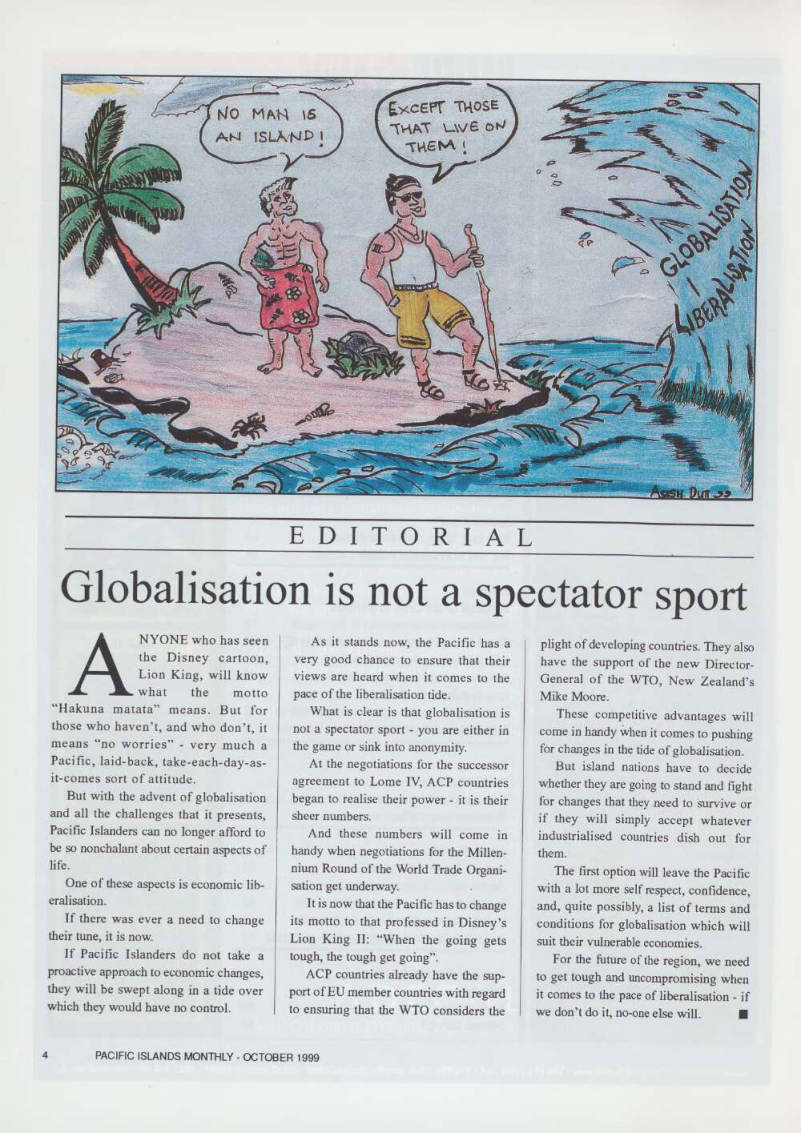
Globalisation is not a spectator sport
Editorial
ANYONE who has seen the Disney cartoon, Lion King, will know what the motto “Hakuna matata” means. But for those who haven’t, and who don’t, it means “no worries” - very much a Pacific, laid-back, take-each-day-as it-comes sort of attitude.
But with the advent of globalisation and all the challenges that it presents.
Pacific Islanders can no longer afford to be so nonchalant about certain aspects of life.
One of these aspects is economic lib eralisation.
If there was ever a need to change their tune, it is now.
If Pacific Islanders do not take a proactive approach to economic changes, they will be swept along in a tide over which they would have no control.
As it stands now, the Pacific has a very good chance to ensure that their views are heard when it comes to the pace of the liberalisation tide.
What is clear is that globalisation is not a spectator sport - you are either in the game or sink into anonymity.
At the negotiations for the successor agreement to Lome IV, AGP countries began to realise their power - it is their sheer numbers.
And these numbers will come in handy when negotiations for the Millen nium Round of the World Trade Organi sation get underway.
It is now that the Pacific has to change its motto to that professed in Disney’s Lion King II: “When the going gets tough, the tough get going”.
AGP countries already have the sup port of EU member countries with regard to ensuring that the WTO considers the
plight of developing countries. They also have the support of the new Director- General of the WTO, New Zealand’s Mike Moore.
These competitive advantages will come in handy when it comes to pushing for changes in the tide of globalisation.
But island nations have to decide whether they are going to stand and fight for changes that they need to survive or if they will simply accept whatever industrialised countries dish out for them.
The first option will leave the Pacific with a lot more self respect, confidence, and, quite possibly, a list of terms and conditions for globalisation which will suit their vulnerable economies.
For the future of the region, we need to get tough and uncompromising when it comes to the pace of liberalisation - if we don’t do it, no-one else will. ■
Letters
Clarifying executions
As the author of a recently published book advocating the return of capital punishment in New Zealand, I read your article on the Samoan assassina tion with considerable interest. Unfor tunately there were a number of errors in the sidebar story regarding the possi ble execution of Mr Kamu’s killers.
Firstly, the death penalty is not the mandatory sentence for murder in Tonga; it is an alternative to Life imprisonment. Which sentence is imposed is at the discretion of the sen
tencing Judge, and the King must
approve all executions. Secondly, the last execution - a double execution of two murderers - was in 1982 and not 1978.
Finally, you refer to the execution of “Walter” Bolton in 1957 in New Zealand as being described as a very unpleasant affair. James Bolton was indeed the last person hanged in New Zealand, and eyewitness accounts vary greatly as to the manner of his death, specifically whether or not he died of strangulation.
You mention the British Royal Com mission on capital punishment in your article. If your writer had read the Com mission’s report, he would have known that the Commission unreservedly accepted the evidence of Albert Pierre point, the most famous British execu tioner of the 20th century. Pierrepoint was responsible for the death by hang ing of about 700 people.
Pierrepoint told the Commission that in all of those executions not a sin gle one resulted in death by other than a broken neck. Lurid tales of decapita tions and strangulation are frequently used by persons opposed to capital pun ishment in order to influence the debate. They are untrue, and have been since the “long drop” method of hang ing - as practised by Britain and New Zealand - was introduced in the late 19th Century. It is perfectly correct that to ensure instant death by a broken neck
the hangman must be well trained and skilled in his task.
David Garrett,
Nuku 'alofa, Tonga
Need for balance
The Special Report on page nine of your July publication has prompted us to write to you. The article is a poorly writ ten piece heavy with vitriol and personal bias. Although in essence Field touches on some of the major development prob lems in South Tarawa and more particu larly those in Betio, the facts are exag gerated half truths using highly value
laden language full of negative implica
tions and meanings.
Firstly the statement that the residents of Betio have no sewage is not true some of the residents do have connection to sewage, traditionally the beach has been used. Yes, there is limited access to piped water as it is for the rest of the Tarawa residents. What Field does not point out is that Kiribati has no supply of surface water at all and relies on rainfall and the fresh water lens under the atoll islands.
Historically water has been and will continue to be a scarce commodity. The usual practice here is to use wells and most houses or family compounds have access to well water.
What Field does not report is that a huge project designed to address water supply and sanitation issues has just begun with the first component - institu tional strengthening of the Public Utili ties started, the community education section due to start in October and the engineering work early next year. This project has been four years in the design and development process and a few sim ple questions could have gained a bal anced perspective on what is under way to reduce the water and sanitation prob lems and the work the government of Kiribati has begun to resolve these issues. Betio is overcrowded and we have been unofficially told it has the
same population density as Hong Kong.
The government of Kiribati is work ing on turning the tide of outer-island to
Tarawa migration through active policy
of developing infrastructure and resources on key islands.
Re-settlement programmes and activ ities are also well underway on the Line Islands as were mentioned but there are other policies at work. Examples of this are the project islands of the Kiribati Solar Energy Company, the outer island activities of the atoll Seaweed Company and the building of nine outer island Junior Secondary Schools.
The foul smelling local concoction that the mothers sit around smoking is imported tobacco. Cigarettes are sold cheaply here to offset the falling sales elsewhere. Given the huge public anti smoking pressure in the western world, developing countries have become tar geted by tobacco companies faced with a declining western market.
A good piece could have been written on the ethical practices of cigarettes packing now illegal in the western world being sold up here or that products that are rejected in the western world due to environmental and health concerns con tinue to be sold in the Pacific.
The most offensive "and untrue sen tence in the whole article is: “Almost nobody has a job and as each day wears on the men pass their time in a haze induced by the thousands of cans of VB beer consumed, mainly in spartan drink ing pits.” Beer is not free and in order to buy it, cash is needed - if they are not working then this vitriolic statement is, in itself, a contradiction. Betio has a high percentage of government housing housing you can only get if government
employs you.
It is also a major industrial and shop ping area with a mix of private sector and government departments. All of these business and organisations do actually employ people. For those men who make their living in the subsistence sector, you
Continued overleaf
From previous page will see them lying on their kia kia (raised sleeping platform) during the middle of the day - a sensible thing to do in the tropical heat anyway. This reveals Field’s ignorance of the Pacific Island wide subsistence sector.
The majority of those “lazy and idle men” were probably out fishing or gathering food on the reef during the low tide while we were sleeping the night away. For many here on Tarawa, the traditional activity of night fishing is not a recreational sport but the responsibility and burden of feeding a family - life here can be very hard, sub sistence work is not conducted during the business hours of nine to five. The Foundation for the People of the South Pacific has been working in partnership with the government of Kiribati for 16 years. We could have provided infor mation and statistics on activities and
programmes which have been of positive benefit in the areas of health, environ ment, child survival, food security, and reproductive health, to name but a few.
Nor did the ministry of environment and social development or the two South Tarawa Urban Town Council initiatives on solid waste and environmental issues receive comment or acknowledgment by the writer. Along with the positive bene fits of the westernised cultures, there has also arrived an equally bewildering array of negative benefits. Kiribati like every other country in the world (western countries as well) is struggling to find new ways to deal with an increasing complex array of issues. Kiribati is no different to any other country; it is though one of the countries where it is not easy to hide issues (thank goodness).
This is not to deny that there are major issues regarding sanitation, water supply, HIV/AIDS, health and overcrowding but the article totally ignores the many and
varied initiatives and activities that are working to alleviate these. The worst aspect of this poorly researched and sarcastically written article is that it presents Kiribati and its people as idle, slothful and uncaring about themselves or the future of their children. And that is simply not true! The article had little journalistic value; it cannot be called current affairs or even human interest what indeed was the point of it?
The 161-Kiribati staff.
Foundation for the People of the South Pacific (FSP-K),
Tarawa, Kiribati
No "tpy" station

I am angered by the article by Michael Field, which made the non sense about the Chinese Tracking Sta-
Continued on page 8
From page 6
tion in Tarawa on July Issue of PIM. If you are a responsible editor, please carry my following statement on your respectable monthly, so as to give me a chance to tell the truth. The Chinese government and the government of Kiribati signed an agreement in 1996, through friendly consultation, on estab lishment of a China Space Tracking Telemetry and Command Station known as TT&C Station.
The TT&C Station is used for launch support for synchronous com munication satellite and launch vehicles in China, entirely for peaceful purpose and will not at any time be used for mil itary purpose. The equipment used in the Station is international standard for space tracking telemetry and command, and the installation in the Station is totally open to the public, as it has been the case.
We welcome foreign friends and technical experts to visit the Station, and foreign technical personnel can be employed to work in the Station.
However, Field ignored the facts and fabricated with his imagination that China’s TT&C Station is a “spy” sta tion, even after he had visited the Sta tion himself. He did this entirely to serve his ulterior motives, and it also shows his ignorance and lack of com
mon knowledge.
Yang Zhikuan,
Ambassador of the People’s Republic of China in Kiribati
Archives-October 1944
Further recollections of a decade in Fiji
By Na Matanivanua
ONE of Suva’s happiest and most democratic institutions was the Suva Yacht Club, formed and kept going by a band of enthusiastic young sea-lovers of both sexes. Suva Harbour was at its prettiest with the yacht Club’s fleet out in a harbour race. And then there were those very bright yachting weekends at Nukulau Island, when few got any sleep, but a good time was had by all in the manner of yachtsmen the world over.
Mention of the Yacht Club brings to mind one member who owned largish craft and decided one Christmas to give a party on board the ship, anchored out in the harbour. It was a bright turnout but one guest was evidently in some-
thing of a quandary as to correct dress for the occasion, so he compromised by arriving in the bathing shorts of the true small-boat man, topped with father’s tail coat and a bow tie in deference to the social nature of the function. As late in the evening he took an involuntary dip in the tide, it would be interesting to know what the father had to say about a salt water-soaked tail-coat.
SPORT has always played a big part in the life of Fiji, and there were some notable sporting events during the last
decade. An Australian ladies’ hockey team visited Suva and showed the local ladies’ team a thing or two; and, later, a local ladies’ team went to New Zealand and was virtually massacred by the New Zealand lasses.
New Zealand University cricket and hockey teams also visited, but undoubt edly the most notable sporting event was the visit of the Marie Rugby team.
For the first time in their lives, the Fijians were put on the field in boots.
Twenty minutes after the game started most of the boots were on the sidelines, and the Kai Viti then showed the Maoris something in speed. In the Test series, Fiji and New Zealand broke even - one game each and one draw. That visit led to the Fijian visit to New Zealand, when the island team put up a record as the only team to tour New Zealand and not lose a match. They won every match but one, which was drawn. ■
Advertisements & other items, pp. 6-11 (2 items)
Letters
xjelstra
TRADE MARK CAUTIONARY NOTICE
Notice is hereby given that Telstra Corporation Limited, a corporation duly organised and existing under the laws of Australia, and having ACN 051 775 556, the Corporate Secretary being located at 242 Exhibition Street, Melbourne, Australia is the sole proprietor of the following trade marks:- Used in respect of:— Telecommunications and communications equipment, apparatus and systems, including but not limited to electronic and optical telecommunications and communications equipment, apparatus and systems; satellite and earth station telecommunications and communications equipment, apparatus and systems; Telephone equipment, apparatus and systems, including but not hmited to telephone; telephone receivers; telephone handsets; telephone network, telephone exchanges, telephone switching, telephone answering, telephone card vending and telephone dialling equipment, apparatus and systems; Transmission, receiving and storage equipment, apparatus and systems, including but not limited to facsimile, telegraph, telex, teleprinting, cable and paging equipment, apparatus and systems; data and video networking and conferencing equipment, apparatus and systems; data message handling and switching equipment, apparatus and systems; digital equipment, apparatus and systems; electronic, voice, text and facsimile mail equipment, apparatus and systems; electronic directory equipment, apparatus and systems; Computer equipment, apparatus and systems, including but not limited to computer programs; computer software; computer hardware; computer terminals; computer memories; computer networking equipment, apparatus and systems; computer manuals m this class; modems; Video and audio equipment, apparatus and systems, including but not limited to sound and image recording, transmission and reproduction equipment, apparatus and systems; video cassettes and tapes; compact discs; records; digital, electric and electronic radio equipment, apparatus and systems; magnetic tapes; cinematographic, television and amusement equipment, apparatus and systems; amusement machines; All associated parts and accessories being goods m class 9, paper, cardboard and goods made from these materials; printed matter including directories, journals and manuals and all goods in class 16; advertising, promotional, consultancy and business services; compiling, arranging and publishing directories; telephone answering services; market research and statisticafservices; being services in class 35, repair installation, maintenance and construction services; being services in class 37, telecommunication services being services in class 38, amusement, entertainment, education and information services; multi-media services; being services in class 41, research services; computer programming services; retail and wholesaling services; consultancy services being services in Class 42'.
The said proprietor claims all rights in respect of the above trade marks and will take all necessary legal steps against any person or company infringing their said rights.
TELSTRA
C
xjelstra
~elstra
DAVIES COLLISON CAVE
PATENT ATTORNEYS
One Little Collins Street Level 10 AMP Building Melbourne, Victoria, 3000 10 Barrack Street Hobart Place Australia Sydney, New South Wales, 2000 Canberra City 2601
SCHOOLS • CHURCHES • GOVERNMENT • COMMERCIAL
Serving:
From Start...
STATE OF HAWAII
ENTIRE
SOUTH PACIFIC
INCLUDING:
• FIJI
• SAMOA
• TAHITI
• TONGA
• COOK ISLANDS
m. v..„
MICRONESIA:
FEDERATED STATES
OF MICRONESIA
GUAM
MARIANAS
II:,
MARSHALL
ISLANDS
Copymasters Hawaii can help you with all of your duplicating needs from start to finish. Featuring Duplo® Digital Duplicators, Copiers, Shredders, Laminators, Poster Printers, Collators, & Folding Equipment. We also sell Stencil & Duphcator Supplies, Paper Supply, and all brands of Copier Supplies, & Computers.
Copymasters Hawaii
96-1173 Waihona Street, Suite B-2 • Pearl City, HI 96782 Phone (808) 678-2263 • Fax (808) 456-5678
E-Mail: [email protected]
ToFinish...
copynmsters
ha.wa.ii
TRADE MARK CAUTIONARY NOTICE IN NAURU
Notice is hereby given that Mazda Motor Corporation, a Japanese company, of 3-1 Shinchi, Fuchu-cho, Aki-gun, Hiroshima, Japan is the sole proprietor in Nauru and elsewhere of the following trade mark:
TRIBUTE
used in respect of:- Automobiles, parts and fittings thereof, Engines for land vehicles; Suspension systems for land vehicles; Shock absorbers and springs for land vehicle suspension systems; Drive shafts for land vehicles; Wheel bearings and shaft couplings for land vehicles; Transmissions for land vehicles; Brakes for land vehicles; Alternating current motors for land vehicles; Direct current motors for land vehicles; Anti-theft alarms for land vehicles Class 12.
The said proprietor claims all rights in respect of the above trade mark and will take all necessary legal steps against any person or company infringing its said rights.
DAVIES COLLISON CAVE
Patent Attorneys One Little Collins Street Melbourne, Victoria 3000
AUSTRALIA
123790V2
Government offended by Kiri

bati stories
I WRITE to register the Kiribati
government’s most serious disappoint
ment with your magazine’s Special Report on Tarawa and Kiribati in your July 1999 issue. We were particularly offended by four articles entitled: “Tarawa’s main islet in appalling state’’,
“Kiribati tourism future looks bleak,”
Second radio station on Kiribati closed”, and “China sets up ‘spy’ station on Bon riki.” With all due respect to the author, government is of the opinion that the articles are far from being fair and factu al.
The author seems to have a pre-set perception about the government and people of Kiribati and was out to collect only what suits his perception. In the course of his information-gathering exer cise, he ends up with incorrect figures and data about Kiribati simply because he was relying almost entirely on sources that are not official.
It is regrettable that he has not done what is expected of any good journalist in a reputable magazine of giving the other side a chance to be heard. It is now necessary for government to provide the other side of the story, rather belatedly, in the hope that this could be published in your next issue.
It is regretted that a reputable maga zine has to be associated with comments and views that are totally disrespectful of Kiribati as a country and as a people, let alone their inaccuracies. Had the author made the time to see the relevant offices of government, he would have been pro vided with the following information, viz.- On “Tarawa’s main islet in appalling state”: 1. The problem of littering and beach contamination on Betio and South Tarawa is not as bad as reported and there are measures being put in place to try and improve the situation. Such mea sures include (a) the resolution of prob lems associated with squatting; (b) a government loan of 5DR7,271,000 equivalent to about AS 15 million for, among other things, the upgrading and extension of the sewerage system to include most households on South Tarawa and Betio; (c) the enacting of new legislation called the Environmental Act dealing with pollution and contami nation of the environment; and (d) social and economic programmes designed to make outer island life better so as to
counter the urban drift; 2. The population of Betio is 12,497 according to the 1995 census, not 28,000 as reported. In fact the reported figure is close to the combined census figure for both Betio and South Tarawa. 3. The author’s description of Betio “having great piles of human excre ment everywhere” and the Betio people having “no sewerage” and “living straight on the hard packed dirt” is not true at all. Of the 12,000 people, there are about 2,000 people or 240 house holds which are regarded as squatters and a large majority of these house holds have no proper toilet facilities or not connected with the main sewerage system which is functioning properly for the remaining 10,000 people on Betio; 3. It is not true that the Kiribati trust fund or the Revenue Equalisation Reserve Fund (RERF), as we call it, “has around 145 million pounds ster ling sitting in the Hong Kong and
Shanghai Bank”.
At the end of last year, the Fund had a value of about Ass7o million, not sit ting in the HSBC but held in the cus tody of State Street, while invested on our behalf by two management groups namely the HSBC and the Nikkam in accordance with the general guidelines set by the RERF committee which is chaired by the minister of finance.
The Ass7o million is equivalent to 228 million pounds sterling, not the 145 wrongly reported by the author; 5. The ruthlessness of the secondary entrance examination and selection referred to by the author is less true now than five years back as govern ment has embarked on a programme aimed at universal and free junior sec ondary school education throughout Kiribati that would do away with the secondary entrance examination.
On the employment side, govern ment has a vigorous programme of catalysing industrial and commercial developments for employment or income generating purposes. Currently
there are about 8,000 persons employed in full-time jobs and this means that one out of every ten I-Kiribati (from young to old) is employed; 6. Kiribati takes a very tough and firm approach in its negotiations with distant water fishing nations. Last year about $42 million was collected for fishing access fees, representing about 80 per cent of the 1998 budget; 7. There is no truth in the author’s comment that “a government decision last year not to allow freight aircraft into Bonriki Airport has limited the prospects for making much more” money from the fisheries.
In fact, the government was most keen to allow the air-freighter run between Tarawa and Australia but the operators of the service have not sub mitted a formal application for reasons that are not clear to the government, but most probably due to the apparent lack
of freight from Tarawa.
Government, being aware of the cur rent constraints, will, through its Devel opment Bank, be pushing for more investments in the fisheries sector geared for the high grade sashimi market in Japan using the air freighter service men tioned. At the same time, the two nation al fishing companies, Te Mautari Ltd and Outer Is Project, are undergoing a merg er exercise with a view to turn them into a more dynamic fish processor and exporter of high quality fish to Australia, Honolulu and Japan; 8. There are about 1700 I-Kiribati men employed as seafarers by the Ger man shipping companies, over 200 on Japanese fishing vessels and less on Korean vessels bringing back over $lO million in remittances.
The Kiribati seafarers on the German vessels in the past 30 years, since the inception of the seamanship programme
in the mid-sixties, know very well that they cannot be on equal pay as their European and Asian counterparts for the reason that they cost more in terms of their training to which the ship owners, through their South Pacific Marine Ser vices (SPMS) agency, contribute as well as in their recruitment and repatriation arrangements given the long distance travels involved between Kiribati and Europe and the isolation of Kiribati from the most economic airline routes.
However the Kiribati government does encourage both the German employers and the I-Kiribati seafarers through the SPMS and the Kiribati Over seas Seamen Union (KIOSU) to work together towards fair play based on hard economic and commercial facts so that whatever terms of employment and con ditions are agreed upon from time to time
Continued overleaf
From previous page
are fair and reasonable to both sides and are sustainable in the long run for the mutual benefit of the two sides; 9. Kiribati has no great desire to push the Japanese or anyone else to turn Kiritimati island into a major space port in the next millennium but it has welcomed the great interest of NASDA to use Kiritimati for such pur poses. The government is not blindly nor passionately rushing into the deal but cautiously examining the costs and benefits to Kiribati to ensure that the deal is fair and reasonable to both sides, both in the short and long run.
The same applies for the proposed 100-room Japanese-built hotel which Mitsubishi is negotiating in conjunc tion with the NASDA space project.
If these proposals do not materialise that is not the end of life or develop ment for Kiritimati island. Govern ment has other strategies in the pipeline for the economic development of the island should the NASDA pro ject fail to eventuate; On “Kiribati’s tourism future looks bleak”: 1. To say “that Kiribati tourism is pretty hopeless” is an insult to the gov ernment and people’s investment effort in the tourism business.
The government and the people of Kiribati believe that the problems cur
rently inhibiting the development of
tourism can be overcome and there are plans to address each one of them. It is only a matter of time before the Kiri bati people are capable of solving the problems mentioned in the articles; 2. The tourism that is most suitable for Kiribati is “the home stay tourism” - the kind of tourism that enables an overseas visitor to interact with the people at the family and village level.
This will require a lot of training and awareness for those village people who wish to play host to tourists so that the tourists have their basic needs met and have the opportunity to enjoy
our peaceful and communal way of life while, at the same time, our people can leam from their guests new ideas or skills for the betterment of their subsistence way of life; On “Second radio station on Kiribati closed”: Government believes in the cre ation of more radio stations and newspa pers to provide more variety and choices to the people but at the same time, there are media laws in Kiribati that every per son regardless of status must obey. The importation of radio equipment into Kiri bati and the establishment and operating of a radio station are governed by the Telecommunication Act 1983 that was assented to by the person complainant referred to in the article when he was
president.
The Act requires that a person must obtain an importation licence before he can import radio equipment into Kiribati and must obtain an operating licence before he can operate a radio station.
The station was ordered by the Telecommunication Authority not to go ahead with its broadcast as it was found that no importation licence had been obtained and the operational licence could not be issued until the question of importation licence has been resolved and the telecommunication regulations which were required under the principal Act for the regulating of radio licences had been formulated.
The radio station may proceed once it has cleared itself of the breach on the importation licence and has been proper ly licensed under the newly formulated regulations which model on the Newspa per Act and the Broadcasting and Publi cations Authority Act to ensure that the rights of both a media operator and any person likely to be affected by the action of the operator are equally safeguarded.
In any alleged breach of the law, the police are normally involved in the inves tigation exercise and this has to be car ried out in this case. The police were also asked to assist when the radio station refused to comply with the notice of the Telecommunication Authority to cease
transmission. The negative views expressed about government’s handling of the matter are well known in Kiribati as opposition views to which the pre sent government has duly responded and issued a clarification during the past two meetings of parliament to the satisfaction of the people of Kiribati.
On “China sets up ‘spy’ station at Bonriki’’: 1. The station is not located at Bonriki but at Temaiku village; 2. The government of Kiribati does not consider the building of an extrava gant looking embassy building and a space tracking telemetry and command station at Temaiku as China playing a sophisticated or strange game in Kiri bati.
While the Chinese government is the more appropriate body to respond to this comment, the Kiribati understand ing of the matter is that the Chinese embassy building in the Marshall Islands and in many other countries have the same design as the one built here in Tarawa and they usually look large because the same building or premises cater for both office space and living quarters for embassy staff.
As far as the station at Temaiku is concerned, Clause 2 of Article One of the agreement between the government of Kiribati and the government of the PRC explicitly states that “that the TT&C station is an integral part of China’s space TT&C station network for launch support for satellite and launch vehicles.
The Chinese government agrees that the TT&C station be used entirely for peaceful purposes and will not at any time be used for military purposes.”
The underlined sentence was not included in the China proposed draft but was one of the many changes that the Kiribati government introduced to the initial draft text proposed by the Chinese side during the 12 month-long negotiations between the two sides from September 1995 to September 1996. Any breach of this automatically leads to the termination of the agree
ment as stated in clause 3 of Article Eight. The other important insertions form the Kiribati side are the seven clauses under Article Two of the Agree ment which brings all the operating equipment and frequencies or telecom munication activities of the station under the supervision and control of the Telecommunication Act 1983.
The other safety clause that the gov ernment of Kiribati has inserted is Clause 4 of Article 8 which says that ‘This agreement shall be automatically terminated without the requirement of any party to give notice if either party breaks off diplomatic relations with the other party.” 3. There is nothing in the agreement to stop the government or the people of Kiribati from visiting the station but it is appreciated that the station cannot function efficiently and effectively if the entire area is left open for anyone to
enter at any time given the very critical tasks expected of the equipment in the launching of satellites. The need for pri vacy and restricted entry is therefore understandable and anyone wanting to visit the station is expected to have the courtesy of seeking permission in the way one would if he or she wants to visit a private home or office.
In fact, during the past three years, many people including overseas digni taries and technical experts have visited the station on arrangements made with the Chinese Embassy. Despite all these, the appropriate officers of the Telecom munication Authority have the power to go into the station at any time for any alleged breach of the Telecommunication Act by virtue of Article Two if the agree ment. 4. Had the author consulted the appro priate authorities of government, he would have been informed of the tough
negotiations that the Kiribati govern ment undertook to modify the Chi nese proposal into something fair, reasonable and mutually acceptable to both sides. The comment of the author that “the size of the deal with China was not known” is false as it is a well known fact that the govern ment of Kiribati struck a deal with China, as shown in the agreement, that the latter should pay an annual land lease airspace rental to the gov ernment of Kiribati - in the sum of $200,000 with a five per cent infla tion increase for each subsequent year for the first five-year period, followed by a review of rental and other fees for the sixth and subsequent years.
It took about one year of careful negotiations for the Kiribati govern ment to convince the Chinese govern-
Continued on page 19
ment to abandon its original offer in the initial agreement draft to provide Kiri bati with a television station in exchange for a free lease and to accept the Kiribati counter-proposal of an annual lease payment. 5. The tar-sealing of the road lead ing to the station is not part of the agreement but it was a request from the Kiribati government which was raised during the opening ceremony of the
station. At the time, the mud surface on the road was seriously ruined by heavy rain and flooding that it was becoming a serious communication problem for the people living in the area and the Chinese staff at the station.
Due to the delay in the road equip ment’s return from the outer islands and the late arrival of new equipment from China, the road was not started until mid-1998. The comment that “the Chinese a week before polling, tar sealed the road between the airport and
its base” is therefore not correct; 6. The government of Kiribati has a duty to honour and comply with the terms of the agreement as expected of the Chinese side and to also bring to the notice of the latter anything that may constitute a breach of the agree ment on the part of the latter and if the matter cannot be solved amicably then the agreement may be terminated.
The author’s conclusion that the sta-
Continued on page 22
tion is a spy station simply because “they have a discreet little place that they do not like people visiting” and also because “of the two satellite track ing dishes are aimed” may strike read ers who have not visited the station nor seen a copy of the agreement or those who are technically illiterate to be the greatest revelation of the century. How
ever, the technical experts of govern ment and other from outside who have double checked the technical assess ment of our own experts have not in the last three years made any finding to suspect that the agreement has been breached by the station and for the ter mination clause to be invoked.
Now that our people have just recovered from similar rumours that
were spread by opposition factions last year before the last election, it is regret table that the Pacific Islands Monthly decided to revive what our people refer to as the anti-China phantom story.
Rikiaua Takeke,
Press Liaison Officer (Ag.), Office of the Beretitenti, Government of Kiribati
Briefs
Fiji set up a Study Commission
on Corruption
Fiji's Prime Minister, Mahendra Chaudhry has announced the appoint ment of High Court Judge Daniel Fati aki as Chairperson of a three member Study Commission on Corruption.
The Commission will scrutinise laws relating to bribery and corruption in the public and private sector.
The Commission will look into the need to maintain public confidence in the integrity of Government and com mercial and business dealings; the ade quacy of present powers of investiga tion and rules of evidence to deal with this problem; the possible need for the establishment of a new independent body to deal with corruption enquiries and prosecutions; and to inquire into fraud and any related matters.
Chaudhry said the appointment underscored Governmentis will to introduce measures necessary for good governance based on democracy and the highest ethical values of integrity.
The other two members of the Study Commission will be announced shortly. PNS PNG investigates the Internal Revenue Commission An immediate investigation will be carried out into Papua New Guinea’s (PNG) legal and policy unit of the Internal Revenue Commission (IRC).
PNG’s Attorney General, Michael Gene requested the investigation after raising serious concerns over the State losing millions of Kina in court judge ments.
In a statement, Gene said it appears the Internal Revenue Commission often does not receive good legal advice when handling cases involving millions of Kina and in fact lost many of these cases.
He said the State now stands to loose millions more due to faulty legal advise from Internal Revenue Com
mission to past Governments and Minis ters. The Attorney General added this was one reason why he engaged lawyers from private firms to represent the Com mission in recent high profile tax related court proceedings including that of chief economic adviser, Doctor Hamidian- Rad.
Gene said the Commissioner General of the IRC, David Sode, has been advised of the investigation which will be carried out by two officers from the Attorney General’s department for a week-long period. PNS Tonga to host forum aimed at Pacific free trade zone Organisers of the Pacific 2000 Trade Fair, to be held in Tonga next year, say one of the main aims of the event is to help promote the establishment of a Pacific free trade zone.
The fair is being organised by the Tongan government, the Tongan trade agency, Tonga Trade and private busi ness, and will be funded by the South Pacific Forum Secretariat.
The chairman of the fair, Polynesian Airlines General Manager Paul Karalus says one of the main aims of the event is boosting inter-island trade in the Pacific.
“Traditionally, there was of course a lot of interchange between the islands. A lot of this was actually lost within the last 100 years with the more colonial model, where you had trading from cosmopoli tan countries, New Zealand, Australia, Europe and so on, into their particular dominions within the Pacific and then out again, and a lot of the cross-linkages between islands was lost.”
Karalus said organisers hope Tonga 2000 trade fair will enhance the proposed free trade idea in the region. PNS Samoa’s tourism earnings increase 7 per cent Tourism earnings increased by 7 per cent in the first seven months of this year compared to the same period last year,
according to the latest figures released by the Central Bank.
Up to July this year, tourism earn ings, the country's biggest earner, stood at $67 million (SUS 42 million).
Asa result of several international and regional meetings held in Samoa recently, earnings from tourism expanded a further eight percent to $ 12 million (SUS7.S million) in July, the bank says.
Exports valued at $32 million (SUS2O million) for the first seven months of the year were 23 percent higher - if compared to the same peri od last year. This figure excludes the proceeds from the one-off sale of the Forum Samoa ship in June. Fish accounted for 56 percent of exports up to July.
Kanak Chief elected head of New Caledonia Senate A high chief in New Caledonia has been elected the first Senate President of the French territory. Andre Thean- Hiouen is a traditional leader from the Arama area. He was elected for a one year term by the 15 other Senators.
The appointment of the 65-year-old as Senate President is part of changes being introduced under the Noumea Accord, which would eventually pro vide greater autonomy for the territory.
Thean-Hiouen and the other Sena tors were sworn in by the President, Jean Leques. The Senate comprises of Kanak traditional chiefs. PNS Fiji to host two international meetings next year Fiji is to host two international meetings late next year. Cabinet
recently approved recommendations
from the Ministry of Foreign Affairs and External Trade to host the Com monwealth Senior Officials and the 38th Colombo Plan Consultative Com mittee meetings in October and November next year. ■
Advertisements & other items, p. 13 (1 item)
F! Ba 5000/483A0999 -
v
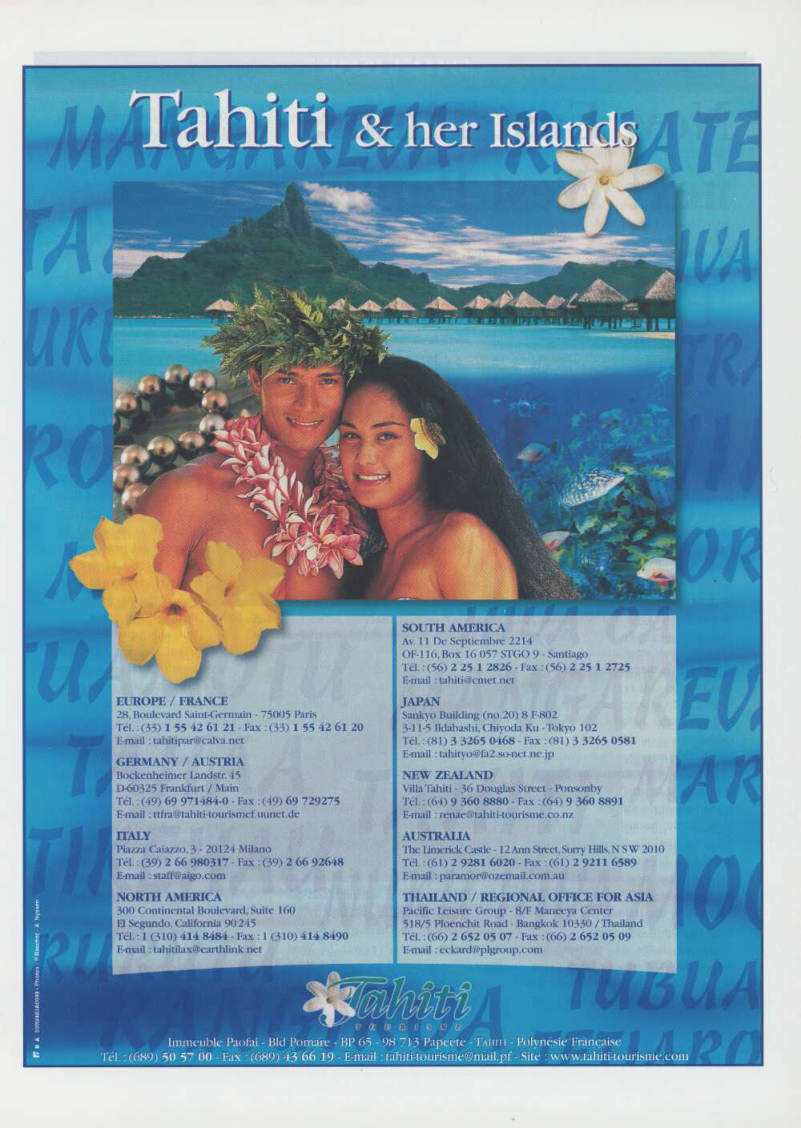
EUROPE/FRANCE
28, Boulevard Saint-Germain - 75005 Paris Tel.; (33) 1 55 42 61 21 - Fax : (33) 1 55 42 6l 20 E-mail : [email protected]
GERMANY / AUSTRIA
Bockenheimer Landstr. 45 D-60325 Frankfurt / Main Tel.: (49) 69 971484-0 - Fax : (49) 69 729275 E-mail : [email protected]
ITALY
Piazza Caiazzo, 3 - 20124 Milano Tel.; (39) 2 66 980317 - Fax : (39) 2 66 92648 E-mail : [email protected]
NORTH AMERICA
300 Continental Boulevard, Suite 160 El Segundo, California 90 245 Tel.; 1 (310) 414 8484 - Fax : 1 (310) 414 8490 E-mail: [email protected]
SOUTH AMERICA
Av. 11 De Septiembre 2214 OF-116, Box 16 057 STGO 9 - Santiago Tel.: (56) 2 25 1 2826 - Fax : (56) 2 25 1 2725 E-mail : [email protected]
JAPAN
Sankyo Building (n 0.20) 8 F-802 3-11-5 lldabashi, Chiyoda Ku - Tokyo 102 Tel.; (81) 3 3265 0468 - Fax ; (81) 3 3265 0581 E-mail ; [email protected]
NEW ZEALAND
Villa Tahiti - 36 Douglas Street - Ponsonby Tel.; (64) 9 360 8880 - Fax : (64) 9 360 8891 E-mail: [email protected]
AUSTRALIA
The limerick Castle -12 Ann Street, Surry Hills, NSW 2010 Tel.: (61) 2 9281 6020 - Fax : (61) 2 9211 6589 E-mail; [email protected]
THAILAND / REGIONAL OFFICE FOR ASIA
Pacific Leisure Group - 8/F Maneeya Center 518/5 Ploenchit Road - Bangkok 10330 /Thailand Tel.; (66) 2 652 05 07 - Fax : (66) 2 652 05 09 E-mail ; [email protected] v a 9 a e < m, rj Immeuble Paofai - Bid Pomare - BP 65 - 98 713 Papeete -Tahiti - Polynesie Francaise Tel.: (689) 50 57 00 - Fax : (689) 43 66 19 - E-mail; [email protected] - Site : www.tahiti-tourisme.com
next West Papua
Special Report
Now East Timor, next West Papua
By Otto Ondawame
EAST Timorese’s unanimous vote for independence is the beginning of the road to freedom for Indonesia’s “colonies”.
The events of August 30, 1999 will
undoubtedly inspire others
struggling to disentangle
themselves from the Indone
sian regime, in particular
West Papua (the western hall of the island of New Guinea that the Indonesians call Irian Jay a).
There are some who would prefer to call West Papua a “territory” rather than a “colony”, but, whatev er the semantics, one thing is obvious - Indonesia’s annexa tion of West Papua in 1962 will increasingly be scruti nised by the international
community in the near future. It is also conspicuous that regardless of what Jakarta and the international commu nity says, the balkanisation of the Indonesian archipelago seems inevitable. The reasons are obvious.
In many ways the nation-state of Indonesia is an artificial construction of the post world war era.
Secondly, because of the oppres sion, exploitation and genocide propa gated by a Javanese-dominated cen tralised power structure, civil society is bound to react. In a way, in the last fifty years, the Indonesian state has been digging its own grave.
On the issue of independence, despite the indifference of the interna tional community, West Papua has always resisted Indonesian rule.
But the struggle has been long ignored by the rest of the world perhaps because it serves their political, strate gic and economic interest to do so.
Indeed the people of West Papua seem to be victims of international political conspiracy dictated by the cold war era.
Australia, the USA and their Western allies denied West Papuans’ right of self-determination and independence because of their attempts to prevent the spread of communism through Indone sia and to Australia and the Pacific Islands. Consequently, West Papuans had to pay the price for the interests of Western countries.
The underlying interests of these countries were exposed in sbs’s Date Line programme on August 26, 1999.
Because of pressures from Western countries (especially Australia and the USA) and with the knowledge of the United Nations, the Dutch government the former colonial power in West Papua - was forced to transfer West Papua to Indonesia.
This was made official by the New
York Agreement of 15 August 1962, signed by the Dutch and the Indone sians and blessed by the USA and the UN.
Six years later, West Papua's annexation was completed by the administration of the Act of Free Choice of 1969 - musyawarah (con sultation) as it is referred to by the Indonesians.
For West Papuans this was an act “free of choice” and a mockery of internationally accepted norms. Only 1,025 Indonesian-appointed “repre sentatives” voted on behalf of a pop
ulation of more than 800,000 Papuans.
Administered under gun point, the participants in the act of free choice voted to be a part of Indonesia.
Through this process West Papuans were denied their right to have one-person one-vote as accepted by international practices. In effect, there was never a proper referendum to allow |West Papuans to choose their political status.
But, although the interna tional community knew
that musyawarah - a Javanese village tradition for consultation, not a refer endum - was unlawful and violated the people’s right to have one-person one vote, they endorsed it because it served their political interests.
Hence, the people of West Papua were never given the opportunity to vote for independence. Instead they were merely “consulted” about their integration with Indonesia.
Some say that this means that the international community contributed to West Papua’s forceful integration with Indonesia.
This, for West Papuans, was the beginning of a new era of colonial ism.
In today’s world, colonialism, as a political tool, is out of place. East
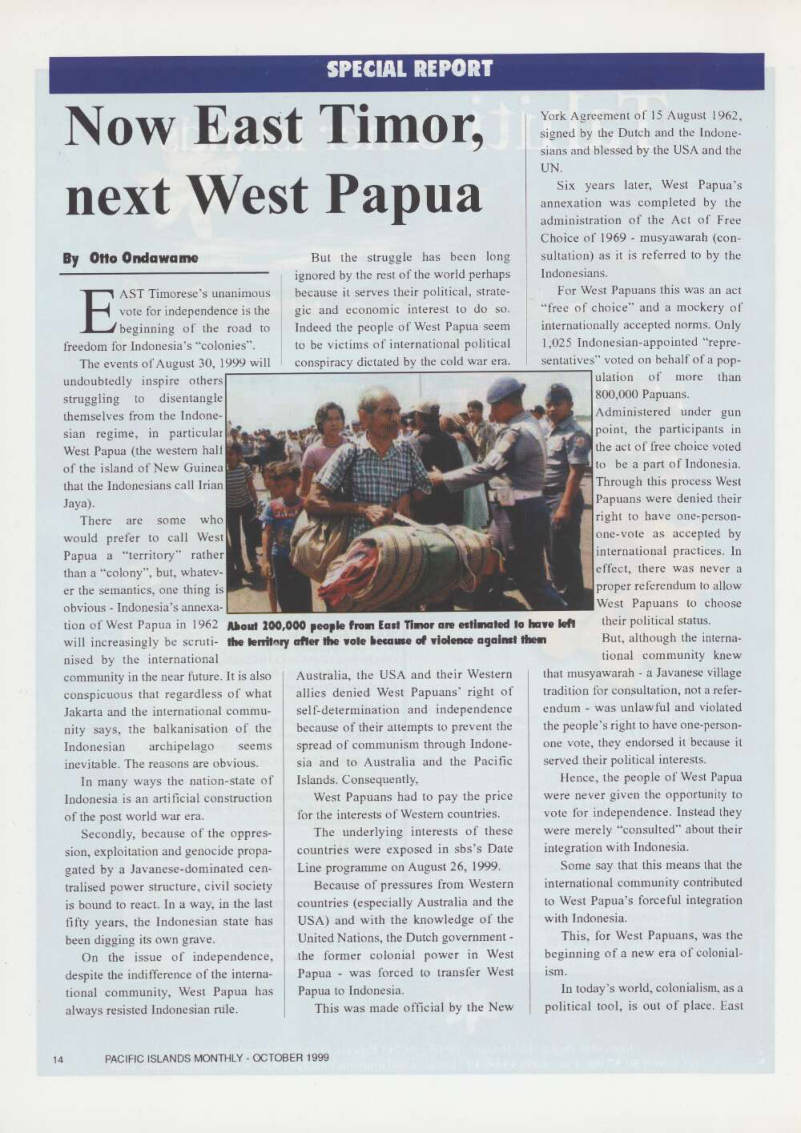
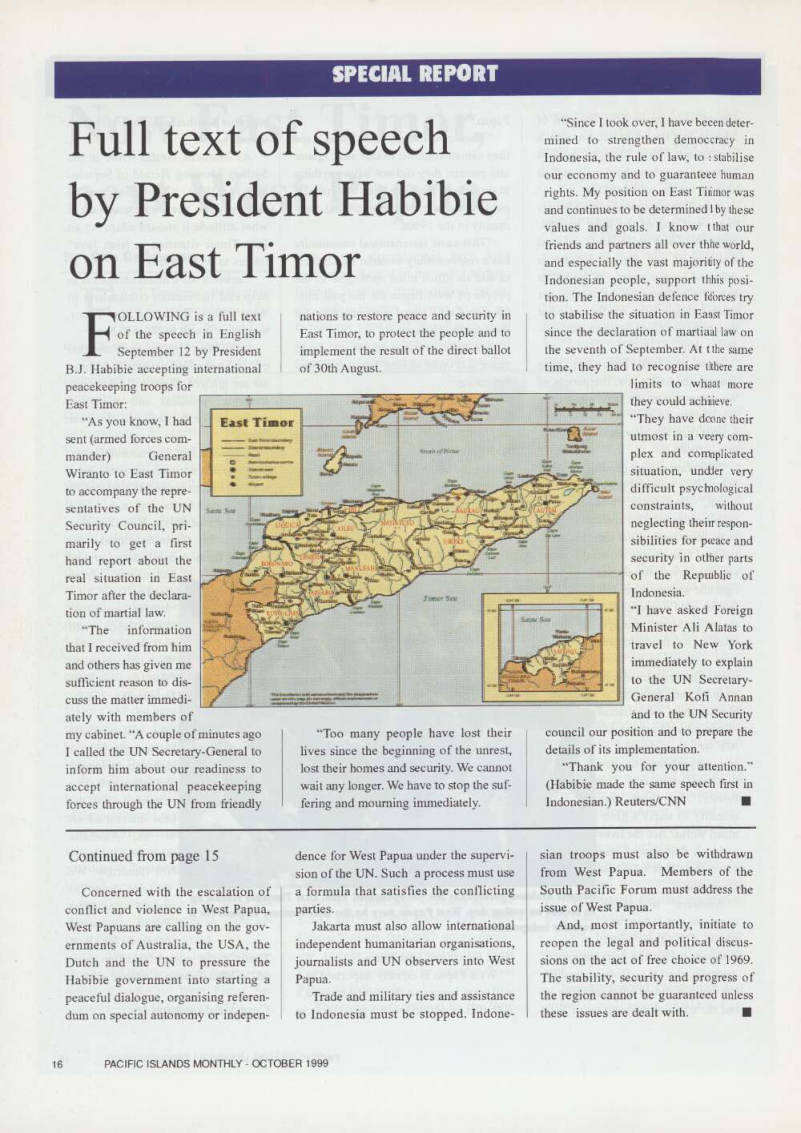
About 200,000 people from East Timor are estimated to have left the territory after the vote because of violence against them
Timor has proven that, in spite of Jakarta and the global community’s propaganda, the struggle against Indonesian colonialism will end in victory for the colonised.
East Timor’s independence brings to an end one of the most painful,
oppressive and exploitative colonial
legacies of our region. Jakarta is defeated by the people at the ballot box. East Timorese in voting for independence have confirmed what the world has always known, but cho sen to deny.
Now that East Timor has gone through the ballot box, the people of West Papua want the same opportuni ty to determine their political status a right they say was denied to them in the 19605.
“We want to be a people free from Indonesia’s colonial grasp and enjoy peace, democracy, freedom and social progress. Our questions have to be answered: What can the inter national community, especially west
ern countries, do to set right the wrongs done dur ing the cold war era? Has the political and strategic interests of the cold war now overtaken by eco nomic interests manifest ed in western multination al companies’ exploitation of our natural resources?
Are we, as a people, of less importance to you than our minerals and forests? Is there any morality in today’s glob alised world? Are the lives of black Papuans of less value than that of white
Europeans?”
Answers to these questions are indeed not
simple. The simple truth,
however, is that the governments of Australia, the USA, Holland, and the UN have a moral responsibility to end the colonial subjugation of West
Papua.
“They owe that to us. It is an issue they cannot continue to side step, ignore and pretend they did not have anything to do with it. We have been victims of a political pawn by the international com munity in the 19605.
“That same international community has a responsibility to assist us. Canber ra and its allies must apologise to the people of West Papua for the past mis takes and take moral accountability for their future,” he says.
Australia’s commitment to bring peace and order to East Timor is a good beginning.
There is more to come.
As a powerful member of the region, and torn between the South Pacific and Southeast Asia, Australia will not escape the obligations to bring peace to
the region.
It is in Australia’s interest to do so.
Dotted along its strategic buffer line are the issues of Guadalcanal in the Solomon islands, Bougainville in PNG,
West Papua and East Timor.
West Papua is equally important and
will soon become a thorn on Australia’s side if it is not addressed quickly. It is
an issue Canberra cannot afford to ignore.
As Michelle Gratin wrote in the Sydney Morning Herald of Septem ber 14, 1999, “Australia may be faced in a few years with questions of what attitude it should adopt to an East Timor situation in Irian Jaya” (refers to West Papua).
Canberra has a moral obligation to help end Indonesian colonialism in West Papua. Today its East Timor, tomorrow it will be West Papua.
If the West Papuan cause and that of other colonised peoples in Indone sia are ignored, there will be serious
strategic, political and economic
problems for Australia in the near future.
Australia and international com munity must recognise that the pres ence of Indonesia and the role of its armed forces in the region will be a cause for instability. It is therefore pertinent that the international com munity finds a mechanism to end
Indonesian colo nialism.
“We, the people of West Papua, will not sit and watch.
We will continue to
fight against
Indonesian colo nialism.
“We will continue to struggle for our rights to determine our future and to be respected. For the best interest of all of us, Australia must respond now.
Not tomorrow. We do not want to repeat in West Papua what occurred in East
Timor in the post referendum peri od,” a West Papuan academic said.
Continued on page 16
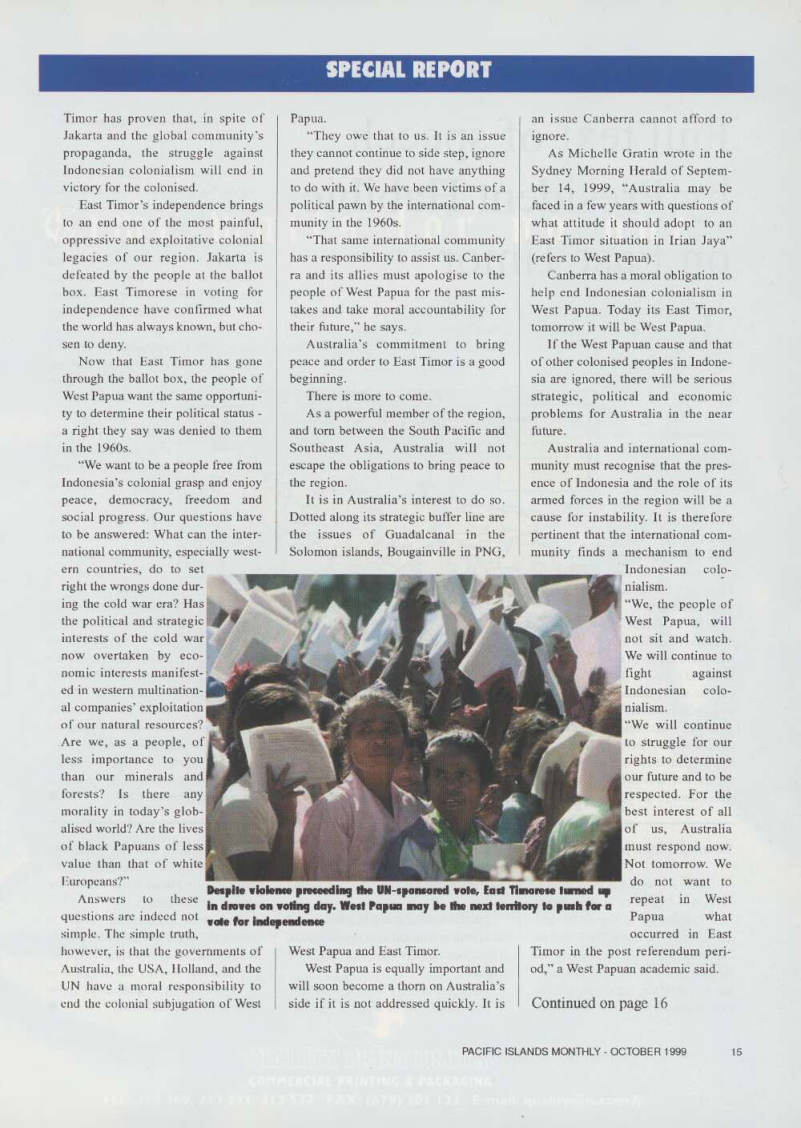
Despite violence proceeding the UN-sponsored vole. East Timorese turned up in droves on voting day. West Papua may be the next territory to push for a vale for independence.
Continued from page 15
Concerned with the escalation of conflict and violence in West Papua, West Papuans are calling on the gov ernments of Australia, the USA, the Dutch and the UN to pressure the Habibie government into starting a
peaceful dialogue, organising referen
dum on special autonomy or indepen
dence for West Papua under the supervi sion of the UN. Such a process must use a formula that satisfies the conflicting
parties.
Jakarta must also allow international independent humanitarian organisations, journalists and UN observers into West Papua.
Trade and military ties and assistance to Indonesia must be stopped. Indone
sian troops must also be withdrawn from West Papua. Members of the South Pacific Forum must address the issue of West Papua.
And, most importantly, initiate to reopen the legal and political discus sions on the act of free choice of 1969.
The stability, security and progress of the region cannot be guaranteed unless these issues are dealt with. ■
by President Habibie
Full text of speech by President Habibie on East Timor
Following is a full text of the speech in English September 12 by President B.J. Habibie accepting international
peacekeeping troops for East Timor: “As you know, I had sent (armed forces com mander) General Wiranto to East Timor to accompany the repre sentatives of the UN
Security Council, pri
marily to get a first hand report about the real situation in East Timor after the declara tion of martial law.
“The information that I received from him and others has given me sufficient reason to dis cuss the matter immedi ately with members of
my cabinet. “A couple of minutes ago I called the UN Secretary-General to inform him about our readiness to accept international peacekeeping forces through the UN from friendly
nations to restore peace and security in East Timor, to protect the people and to implement the result of the direct ballot of 30th August.
“Too many people have lost their lives since the beginning of the unrest, lost their homes and security. We cannot wait any longer. We have to stop the suf
fering and mourning immediately.
“Since I took over, I have beeen deter mined to strengthen democcracy in Indonesia, the rule of law, to : stabilise our economy and to guaranteee human rights. My position on East Tiiimor was and continues to be determined 1 by these values and goals. I know tthat our friends and partners all over thhe world, and especially the vast majoritity of the Indonesian people, support thhis posi tion. The Indonesian defence ftforces try to stabilise the situation in Eaast Timor since the declaration of martiaal law on the seventh of September. At tthe same time, they had to recognise tlthere are
limits to whaat more they could achiiieve.
“They have dcone their utmost in a veery com plex and comnplicated situation, undler very
difficult psychological
constraints, without neglecting theiir respon sibilities for pteace and security in otfher parts of the Repuiblic of Indonesia.
“I have asked Foreign Minister Ali Alatas to travel to New York immediately to explain to the UN Secretary- General Kofi Annan and to the UN Security
council our position and to prepare the details of its implementation.
“Thank you for your attention.” (Habibie made the same speech first in Indonesian.) Reuters/CNN ■
Advertisements & other items, p. 17 (1 item)
I iSi
u
urr
SShteii#- X ■M m M * • .-f »f/ V , ■ - "
I I m Km •• * . f f ■ ■I mss ■ = . .. mm i mmW '--wi
I iSi
fa ; Things get left to the last minute or a deadline is brought forward and every thing is required urgently. Sound familiar? Deadlines have always been part of the print industry and at Quality Print we know that you sometimes need your printing “yesterday”. We rarely miss a realistic deadline and if you have a really urgent job we’ll keep the presses running all night if necessary.
It is this kind of service that makes us one of the best printers in the Pacific. And we now have three full colour printing presses which also makes us the largest in the region.
We offer an extensive range of printing services from multi colour printing, special packaging and binding to UV gloss finishing, laminating and die-cutting. Call us or visit our “Pride in Print” printshop for a free quote.
COMMERCIAL PRINTING & PACKAGING
313 369,313 311,313 537. FAX: (679) 301 133. E-mail: [email protected]
capacity in the region
Business
Southern Cross cable to increase telecommunication capacity in the region
By Sophie Foster Hildebrand
WORK on the much-needed Southern Cross cable, which will provide up to 120 times more
cable transmission capac ity for the region, is on track.
The Auckland-Hawaii segment of the Southern Cross cable, which is designed to remove the bandwidth bottleneck between Australasia and the United, is now being laid.
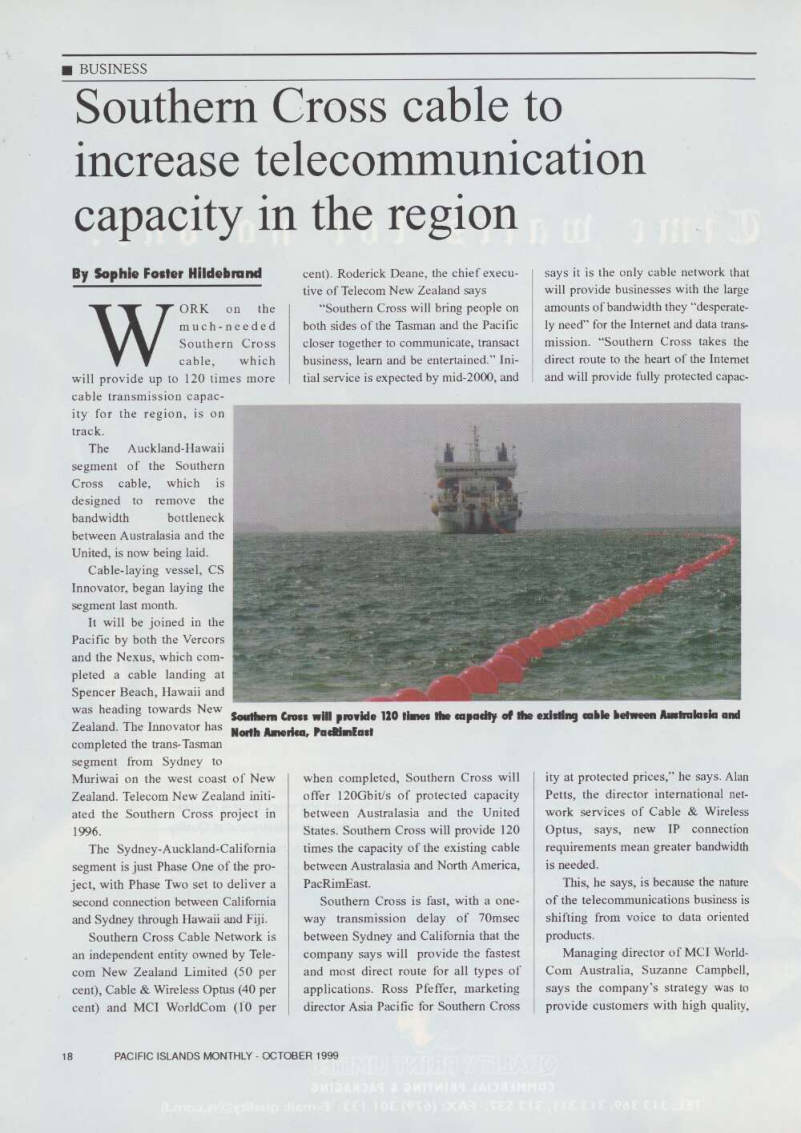
Cable-laying vessel, CS Innovator, began laying the segment last month.
It will be joined in the Pacific by both the Vercors and the Nexus, which com pleted a cable landing at Spencer Beach, Hawaii and was heading towards New Zealand. The Innovator has completed the trans-Tasman segment from Sydney to
Muriwai on the west coast of New Zealand. Telecom New Zealand initi ated the Southern Cross project in 1996.
The Sydney-Auckland-California
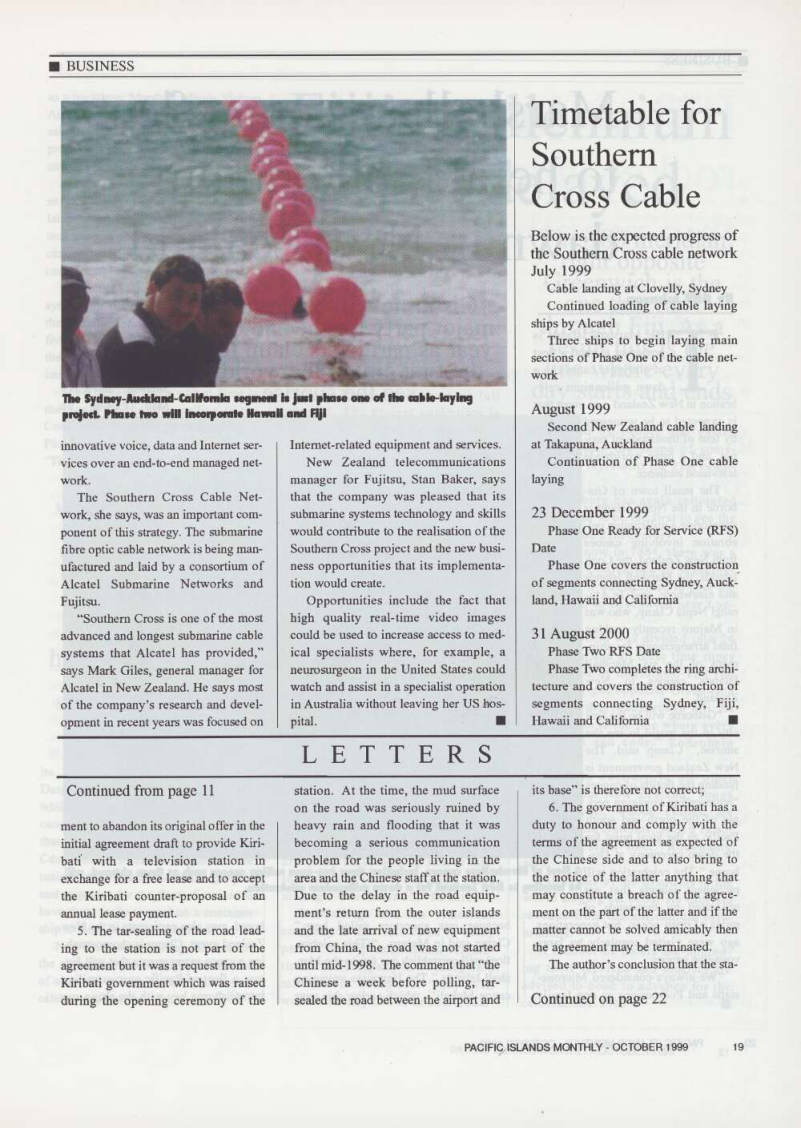
segment is just Phase One of the pro ject, with Phase Two set to deliver a second connection between California and Sydney through Hawaii and Fiji.
Southern Cross Cable Network is an independent entity owned by Tele com New Zealand Limited (50 per cent), Cable & Wireless Optus (40 per cent) and MCI World Com (10 per
cent). Roderick Deane, the chief execu tive of Telecom New Zealand says “Southern Cross will bring people on both sides of the Tasman and the Pacific closer together to communicate, transact business, learn and be entertained.” Ini tial service is expected by mid-2000, and
when completed. Southern Cross will offer 120Gbit/s of protected capacity between Australasia and the United States. Southern Cross will provide 120 times the capacity of the existing cable between Australasia and North America, PacßimEast.
Southern Cross is fast, with a one way transmission delay of 70msec between Sydney and California that the company says will provide the fastest and most direct route for all types of
applications. Ross Pfeffer, marketing
director Asia Pacific for Southern Cross
says it is the only cable network that will provide businesses with the large amounts of bandwidth they “desperate ly need” for the Internet and data trans mission. “Southern Cross takes the direct route to the heart of the Internet and will provide fully protected capac
ity at protected prices,” he says. Alan Petts, the director international net work services of Cable & Wireless Optus, says, new IP connection requirements mean greater bandwidth is needed.
This, he says, is because the nature of the telecommunications business is shifting from voice to data oriented
products.
Managing director of MCI World- Com Australia, Suzanne Campbell, says the company’s strategy was to
provide customers with high quality.
Southern Cross will provide 120 times the capacity of the existing cable between Australasia and North America, PacRimEast
innovative voice, data and Internet ser vices over an end-to-end managed net work.
The Southern Cross Cable Net work, she says, was an important com ponent of this strategy. The submarine fibre optic cable network is being man ufactured and laid by a consortium of Alcatel Submarine Networks and
Fujitsu.
“Southern Cross is one of the most advanced and longest submarine cable systems that Alcatel has provided,” says Mark Giles, general manager for Alcatel in New Zealand. He says most of the company’s research and devel opment in recent years was focused on
Internet-related equipment and services.
New Zealand telecommunications manager for Fujitsu, Stan Baker, says that the company was pleased that its submarine systems technology and skills would contribute to the realisation of the Southern Cross project and the new busi ness opportunities that its implementa tion would create.
Opportunities include the fact that high quality real-time video images could be used to increase access to med ical specialists where, for example, a neurosurgeon in the United States could watch and assist in a specialist operation in Australia without leaving her US hos
pital. ■
Hie Sydney-Auckland-Califomia segment is Just phase one of the cable-laying project. Phase two will incorparale Hawaii and Fiji
Timetable for Southern Cross Cable
Southern Cross Cable
Below is the expected progress of the Southern Cross cable network
July 1999
Cable landing at Clovelly, Sydney Continued loading of cable laying ships by Alcatel Three ships to begin laying main sections of Phase One of the cable net work
August 1999
Second New Zealand cable landing at Takapuna, Auckland Continuation of Phase One cable laying 23 December 1999 Phase One Ready for Service (RFS) Date Phase One covers the construction of segments connecting Sydney, Auck land, Hawaii and California 31 August 2000 Phase Two RFS Date Phase Two completes the ring archi tecture and covers the construction of segments connecting Sydney, Fiji, Hawaii and California ■
Advertisements & other items, p. 19 (1 item)
Letters
19
PACIFICJSLANDS MONTHLY - OCTOBER 1999
Continued from page 11
■ BUSINESS
Marshallese canoe fleet
to herald millennium dawn in New Zealand
By Giff Johnson
THE Marshall Islands is preparing to send a fleet of outrigger canoes to a dawn millennium cele bration in New Zealand - an event that
is expected to be witnessed by tens of thousands of peo ple, and a huge worldwide television audience.
The small town of Gis borne in the North Island is sponsoring a millennium cel ebration involving canoes from New Zealand, the Cook j Islands, the Marshall Islands! and elsewhere, said Te Atu-1
rangi Nepia Clamp, who was
in Majuro recently making
final arrangements for ship ment of the six Marshall Islands canoes to New Zealand.
“Gisborne will be the first city in the world to see the
sunrise,” Clamp said. The!
New Zealand government is I funding the flotilla of canoes 1
“representing voyaging peo- ]
pie of the north and south] Pacific as the focal point for the dawn ceremony at Gis-1 borne.” The celebration wilfi reconnect islands that are'
separated by thousands of miles of open ocean, but generations ago were visited regularly by large voyaging canoes.
“We always considered Microne sians and Polynesians as one family
Gisborne will be hosting a major party for the end of tbe year as part of its claim to be the first city in the world to see the sunrise
because our ancestors sailed here,”
Clamp said in Majuro. “(This celebra tion) will reestablish our ties to the Mar shall Islands.” The Hawaiian voyaging canoe Makali’i, which earlier this year
completed the his toric voyage con necting Polynesia with Micronesia with the famed
Satawal navigator
Mau Piailug on
board, may also participate in the New Zealand event. Clamp is choreograph ing a canoe extravaganza that will fea ture a fleet of Pacific canoes sailing into Gisborne bay with the rising sun
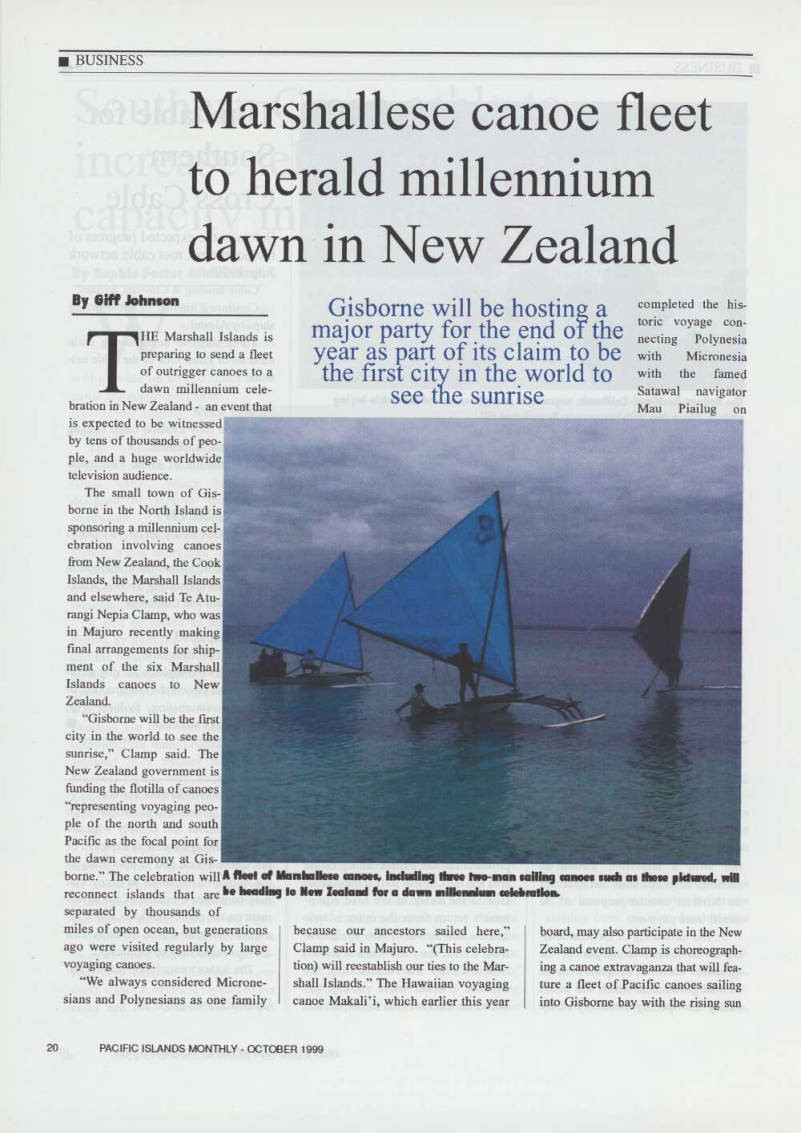
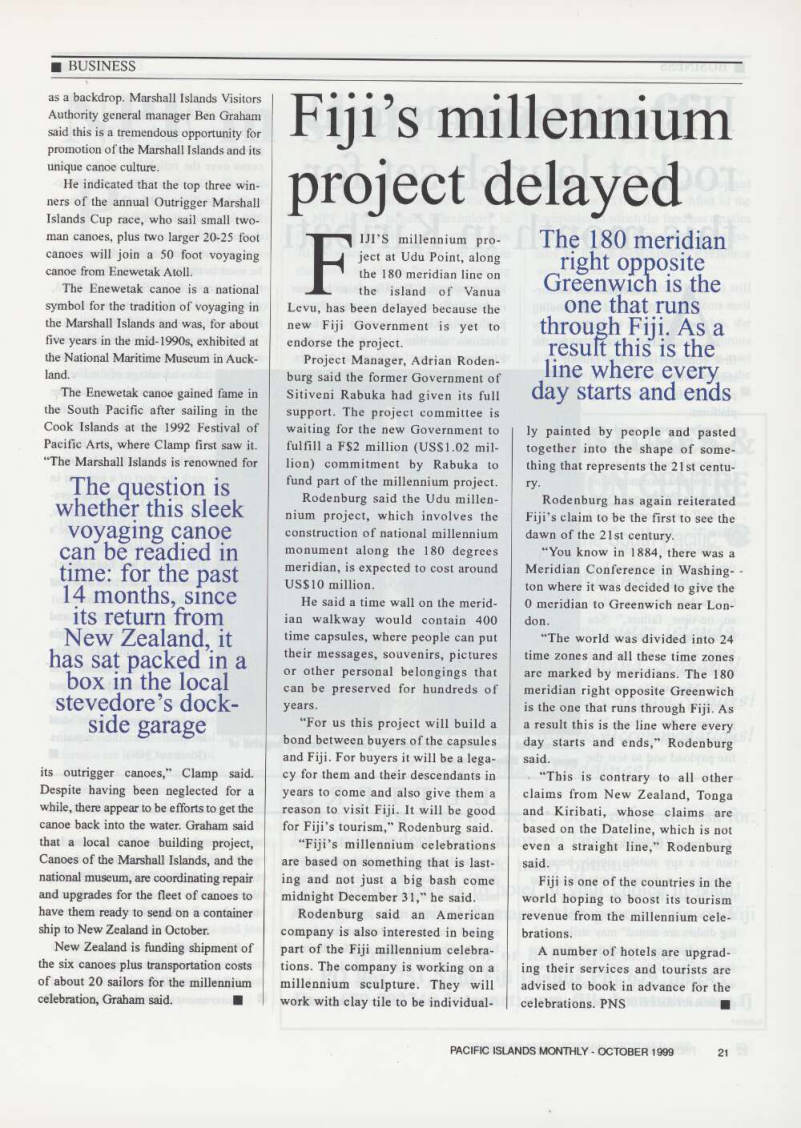
A fleet of Marshallese canoes, including three two-man sailing canoes such as these pictured, still be heading to Nest Zealand for a dawn millennium celebration.
as a backdrop. Marshall Islands Visitors Authority general manager Ben Graham said this is a tremendous opportunity for promotion of the Marshall Islands and its unique canoe culture.
He indicated that the top three win ners of the annual Outrigger Marshall Islands Cup race, who sail small two man canoes, plus two larger 20-25 foot canoes will join a 50 foot voyaging canoe from Enewetak Atoll.
The Enewetak canoe is a national symbol for the tradition of voyaging in the Marshall Islands and was, for about five years in the mid-19905, exhibited at the National Maritime Museum in Auck land.
The Enewetak canoe gained fame in the South Pacific after sailing in the Cook Islands at the 1992 Festival of Pacific Arts, where Clamp first saw it.
“The Marshall Islands is renowned for
The question is whether this sleek voyaging canoe can be readied in time: for the past 14 months, since its return from New Zealand, it has sat packed in a box in the local stevedore’s dock side garage
its outrigger canoes,” Clamp said.
Despite having been neglected for a
while, there appear to be efforts to get the canoe back into the water. Graham said that a local canoe building project, Canoes of the Marshall Islands, and the national museum, are coordinating repair and upgrades for the fleet of canoes to have them ready to send on a container ship to New Zealand in October.
New Zealand is funding shipment of the six canoes plus transportation costs of about 20 sailors for the millennium celebration, Graham said. ■
project delayed
Fiji’s millennium project delayed
FIJI’S millennium pro ject at Udu Point, along the 180 meridian line on the island of Vanua Levu, has been delayed because the new Fiji Government is yet to endorse the project.
Project Manager, Adrian Roden burg said the former Government of Sitiveni Rabuka had given its full support. The project committee is waiting for the new Government to fulfill a Fs2 million (US$l.O2 mil lion) commitment by Rabuka to fund part of the millennium project.
Rodenburg said the Udu millen nium project, which involves the construction of national millennium monument along the 180 degrees meridian, is expected to cost around US$lO million.
He said a time wall on the merid ian walkway would contain 400 time capsules, where people can put their messages, souvenirs, pictures or other personal belongings that can be preserved for hundreds of years.
“For us this project will build a bond between buyers of the capsules and Fiji. For buyers it will be a lega cy for them and their descendants in years to come and also give them a reason to visit Fiji. It will be good for Fiji’s tourism,” Rodenburg said.
“Fiji’s millennium celebrations are based on something that is last ing and not just a big bash come midnight December 31,” he said.
Rodenburg said an American company is also interested in being part of the Fiji millennium celebra tions. The company is working on a millennium sculpture. They will work with clay tile to be individual-
The 180 meridian
right opposite
Greenwich is the one that runs through Fiji. As a result this is the line where every day starts and ends
ly painted by people and pasted together into the shape of some thing that represents the 21st centu ry.
Rodenburg has again reiterated Fiji’s claim to be the first to see the dawn of the 21st century.
“You know in 1884, there was a Meridian Conference in Washing ton where it was decided to give the 0 meridian to Greenwich near Lon don.
“The world was divided into 24 time zones and all these time zones are marked by meridians. The 180 meridian right opposite Greenwich is the one that runs through Fiji. As a result this is the line where every day starts and ends,” Rodenburg said.
“This is contrary to all other claims from New Zealand, Tonga and Kiribati, whose claims are based on the Dateline, which is not even a straight line,” Rodenburg said.
Fiji is one of the countries in the world hoping to boost its tourism revenue from the millennium cele brations.
A number of hotels are upgrad ing their services and tourists are advised to book in advance for the celebrations. PNS ■
Historic commercial
rocket launch set for this month in Kiribati
AN international consor tium led by Boeing
plans to make history
this month with the first commercial space launch of a
rocket with a functional
payload from a floating
platform.
Early reports said the launch was scheduled for last month but Sea Launch says it would take more time to prepare for the event than a liftoff last month would allow.
“We take it one day at a time. But if it means we lose a little time, we’d rather have a delayed success than an on-time failure,” Sea Launch spokesman Terrance Scott said. No specific launch date has been set, he said. Meanwhile, mission operators have continued to prepare the Zenit-3SL booster rocket and its satel lite payload and to test the
launch systems. The Ukrainian booster rocket is set to blast into space from a platform in Kiribati, carrying a commu nications satellite owned by Hughes Electronics, part of General Motors.
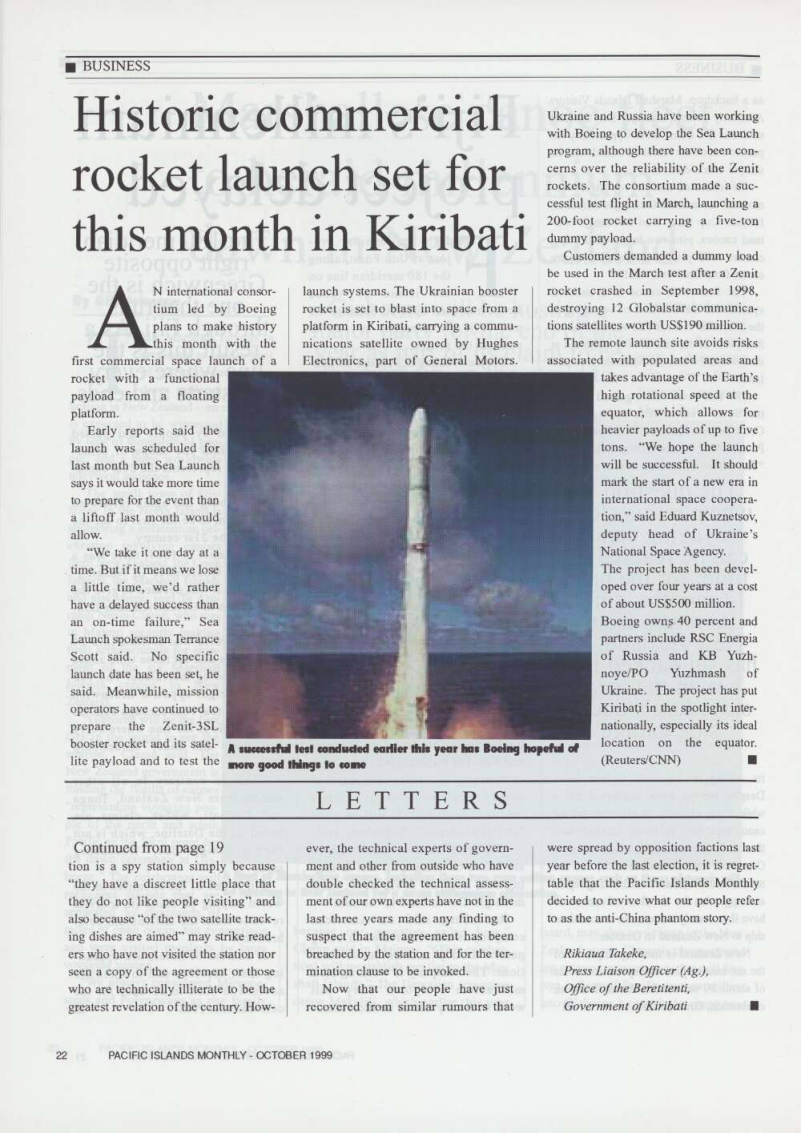
Ukraine and Russia have been working with Boeing to develop the Sea Launch program, although there have been con cerns over the reliability of the Zenit rockets. The consortium made a suc cessful test flight in March, launching a 200-foot rocket carrying a five-ton
dummy payload.
Customers demanded a dummy load be used in the March test after a Zenit rocket crashed in September 1998, destroying 12 Globalstar communica tions satellites worth US$l9O million.
The remote launch site avoids risks associated with populated areas and
takes advantage of the Earth’s high rotational speed at the equator, which allows for heavier payloads of up to five tons. “We hope the launch will be successful. It should mark the start of a new era in international space coopera tion,’’ said Eduard Kuznetsov, deputy head of Ukraine’s National Space Agency.
The project has been devel oped over four years at a cost of about USSSOO million.
Boeing owns 40 percent and partners include RSC Energia of Russia and KB Yuzh noye/PO Yuzhmash of Ukraine. The project has put Kiribati in the spotlight inter
nationally, especially its ideal
location on the equator. (Reuters/CNN) ■
A successful test conducted earlier this year has Boeing hopeful of note good things to come
Advertisements & other items, p. 22 (1 item)
Letters
22
PACIFIC ISLANDS MONTHLY - OCTOBER 1999
Continued from page 19
■ BUSINESS
NPF in share sell-off
PAPUA New Guinea’s National Provident Fund (NPF) will sell its interests in two resource projects and use the proceeds to clear its debt, says managing director Henry Fabila.
The fund has publicly announced its intention to sell its shares in Cue Energy Resources, but not its interest in High lands Pacific. According to the fund’s status report, which was sent out to mem bers last month, the sale of its shares in the two companies are part of a debt reduction strategy.
NPF’s total debt as at August 6, 1999, was K 107,879,310, while its total gross assets were K 269,788,000. Fabila said
PNG committee to
investigate ‘fast money
schemes’
PAPUA New Guinea prime minister.
Sir Mekere Morauta, has announced the formation of a special committee to examine the operations of so-called “fast money schemes” in the country.
He made the decision after meeting with heads of departments and statutory authorities, and representatives of the fast-money schemes. A statement from the Prime Minister said details of the committee’s membership and terms of reference are being worked out.
“The aim is to bring the fast-money schemes under the umbrella of the law of the country relating to financial institu tions, and to provide investors in the schemes with the same protection that people who use banks enjoy,” Sir Mekere said. “This means if the schemes want to continue operating, they will have to do so on the basis of all other financial insti tutions such as banks, savings and loan societies and credit unions.”
The decision follows an agreement between the Prime Minister and the fast money scheme operators. ■
they were aiming to reduce the debt to below K2O million by the end of the year.
NPF is the largest shareholder in Highlands Pacific, with more than 70,000 shares or a 35.18 per cent stake in the miner. Highlands Pacific is planning to develop the million dollar Ramu nick el/cobalt project in Madang Province.
The fund recently sold its sharehold ing in Collins and Leahy after the Swire group of companies launched a takeover bid for the company. The fund had expected a share price of A 53.32 a share
for the Collins and Leahy stock but had to settle for A 51.50 a share. Most of the companies in which the fund has equities in have dwindled because of their expo sure to Papua New Guinea’s resource sector, Fabila said.
He also reiterated that the fund will not undertake any new investments until it has repaid its outstanding debts, the board prepares and ratifies a “rigorous investment procedure” and its new asset allocation guidelines are presented to the Government for consideration. ■
Advertisements & other items, p. 23 (1 item)
Fiji Island Adventures &
TOURIST INFORMATION CENTRE
Member of the Tourism Council of the South Pacific @ Fiji Budget Hotel & Tour Operators Association See us far excellent deals on outer islands .
Overnight Stay! $ island Safarisl
c History Sightseeing! 4 TO heel Safari Scuba (Zruises and TOeddin^s!
Talk to us first we live here ... book direct and ask for: Free independent information on latest deals!
Free booking services and many options!
Free airport transfers to hotel of your choice in Nadi!
Free greet on arrival & maps. Also general info on Fiji Write to us now or [email protected] PO Box 251 Nadi Fiji Islands Ph: 679 700243 Fax: 679 702746 Internet:www.fijiadventures.com.fj
history with innovative
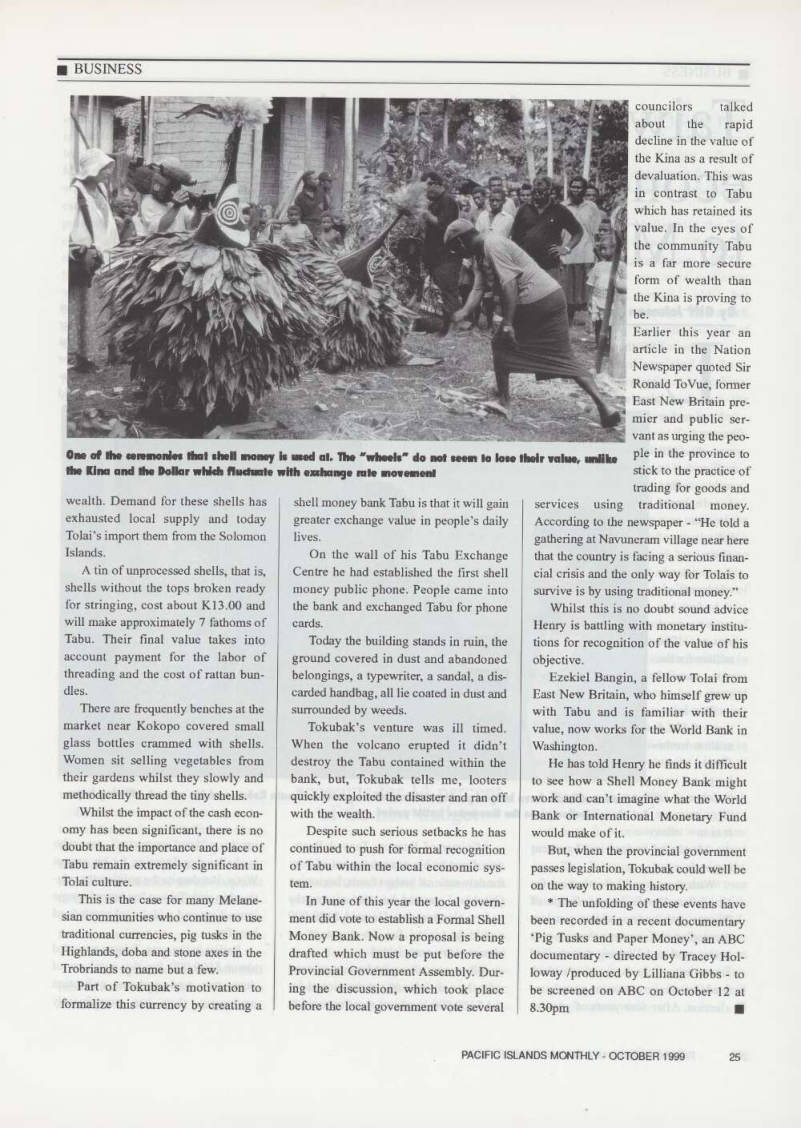
New Britain could make history with innovative shell money bank
Story and pictures by Liz Thompson
WHEN the volcano erupted in Rabaul in Sep tember 1994 people were ready for it. The town was geared for such an emergency but despite all precautions the radio
announced a transi tion from stage 2 to stage 4 in a matter of minutes.
Fortunately most of the locals had seen the Guinea Fowl leave their home in the warm ash on the volcano’s side. The fact the ash was too hot for them was a sign there was not long to go and almost everybody left.
Whilst the volcano itself killed no one, it did destroy Rabaul - a once thriving town with a colourful mar ket. Streets filled with people, hotels and small business now stand smothered in a coat of compressed ash that is metres deep.
One of the volcano’s casualties was a Tabu Exchange Centre that had only recently been established by Henry Tokubak, a politician in local government. Tokubak is the prime advocator of dual currency in East New Britain.
His dream was to create an insti
tution through which local people could exchange their Tabu - traditional shell money made from tiny white shells pierced and threaded onto long strips of rattan - for Kina (PNG’s currency).
The bank would also provide a ser vice for those who no longer have time nor the traditional skills to create Tabu but need to acquire it for traditional cere monies. Ceremonies frequently involve
complex exchange relationships and obligations in which Tabu plays a very
important role.
For many of those who have left the village and gone to live in Port Moresby or other urban centers it is extremely important that they are able to access tra ditional wealth when returning home to
participate in ceremonies.
Tabu has been a part of Tolai cul ture for centuries. A fathom of Tabu, approximately two meters, would contain around 300-400 shells depending on the shell size and would have an approximate value of K 3.50.
It is used daily in small quantities a bag of rice or tinned fish might cost half a fathom, tobacco, fruit or vegeta bles from the market even less - and
occasionally in larger quantities.
The normal bride price payment today is 200 fathoms of Tabu and there might be many hundreds of fath oms accumulated on individual shell money wheels.
Shell money is stored in giant wheels for safekeeping and represents persons’ wealth and status. When someone dies their shell money wealth is divided between family members and the deceased person’s community, a process ensuring a con tinuous re-distribution of custom
The Tabu Exchange Centre had been established by Henry Tobubak, a politician in local government.
Tokubak is the prime advocator of dual currnecy in East New Britain
wealth. Demand for these shells has exhausted local supply and today Tolai’s import them from the Solomon Islands.
A tin of unprocessed shells, that is, shells without the tops broken ready for stringing, cost about K 13.00 and will make approximately 7 fathoms of Tabu. Their final value takes into account payment for the labor of threading and the cost of rattan bun dles.
There are frequently benches at the market near Kokopo covered small glass bottles crammed with shells.
Women sit selling vegetables from their gardens whilst they slowly and methodically thread the tiny shells.
Whilst the impact of the cash econ omy has been significant, there is no doubt that the importance and place of Tabu remain extremely significant in Tolai culture.
This is the case for many Melane sian communities who continue to use traditional currencies, pig tusks in the Highlands, doba and stone axes in the Trobriands to name but a few.
Part of Tokubak’s motivation to formalize this currency by creating a
shell money bank Tabu is that it will gain
greater exchange value in people’s daily
lives.
On the wall of his Tabu Exchange Centre he had established the first shell money public phone. People came into the bank and exchanged Tabu for phone cards.
Today the building stands in ruin, the ground covered in dust and abandoned belongings, a typewriter, a sandal, a dis carded handbag, all lie coated in dust and surrounded by weeds.
Tokubak’s venture was ill timed.
When the volcano erupted it didn’t destroy the Tabu contained within the bank, but, Tokubak tells me, looters quickly exploited the disaster and ran off with the wealth.
Despite such serious setbacks he has continued to push for formal recognition of Tabu within the local economic sys tem.
In June of this year the local govern ment did vote to establish a Formal Shell Money Bank. Now a proposal is being drafted which must be put before the Provincial Government Assembly. Dur
ing the discussion, which took place
before the local government vote several
councilors talked about the rapid decline in the value of the Kina as a result of devaluation. This was in contrast to Tabu which has retained its value. In the eyes of the community Tabu is a far more secure form of wealth than the Kina is proving to be.
Earlier this year an article in the Nation Newspaper quoted Sir Ronald To Vue, former East New Britain pre mier and public ser vant as urging the peo ple in the province to stick to the practice of trading for goods and
services using traditional money.
According to the newspaper - “He told a gathering at Navuneram village near here that the country is facing a serious finan cial crisis and the only way for Tolais to survive is by using traditional money.”
Whilst this is no doubt sound advice Henry is battling with monetary institu tions for recognition of the value of his
objective.
Ezekiel Bangin, a fellow Tolai from East New Britain, who himself grew up with Tabu and is familiar with their value, now works for the World Bank in
Washington.
He has told Henry he finds it difficult to see how a Shell Money Bank might work and can’t imagine what the World Bank or International Monetary Fund would make of it.
But, when the provincial government passes legislation, Tokubak could well be on the way to making history. * The unfolding of these events have been recorded in a recent documentary ‘Pig Tusks and Paper Money’, an ABC documentary - directed by Tracey Hol loway /produced by Lilliana Gibbs - to be screened on ABC on October 12 at 8.30 pm ■
One of the ceremonies that shell money is used at. The "wheels” do not seem to lose their value, unlike the Kina and the Dollar which fluctuate with exchange rale movement
Taiwan plays major
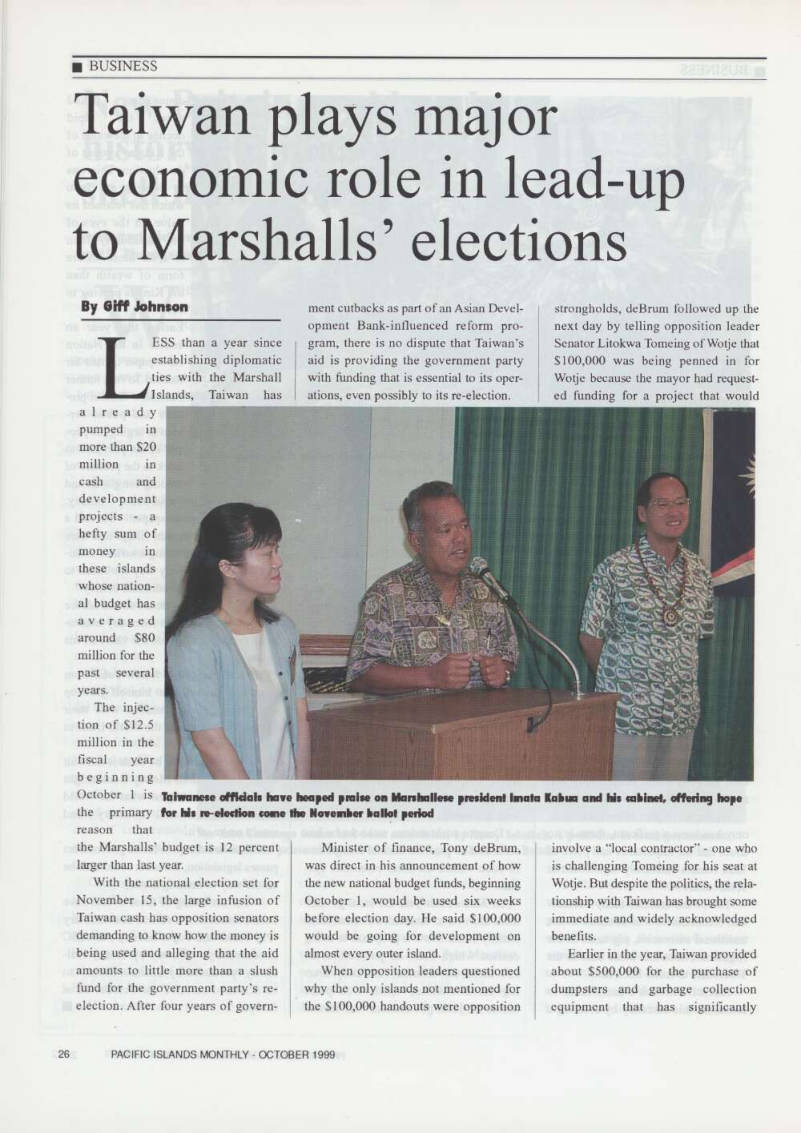
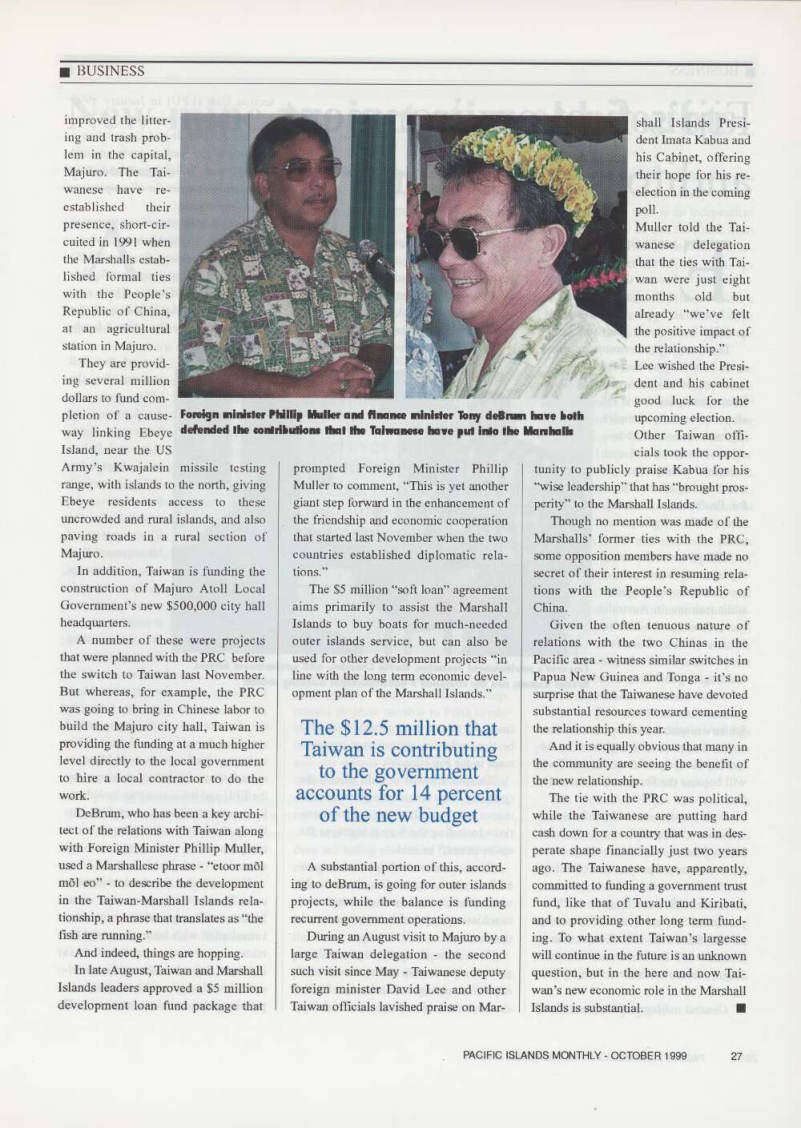
economic role in lead-up to Marshalls’ elections
By Giff Johnson
LESS than a year since
establishing diplomatic
ties with the Marshall Islands, Taiwan has
already
pumped in
more than $2O million in cash and development projects - a hefty sum of money in these islands whose nation al budget has averaged around $BO million for the past several years.
The injec
tion of $12.5 million in the fiscal year
beginning
October 1 is
the primary
reason that
the Marshalls’ budget is 12 percent larger than last year.
With the national election set for November 15, the large infusion of Taiwan cash has opposition senators demanding to know how the money is being used and alleging that the aid amounts to little more than a slush fund for the government party’s re election. After four years of govern
ment cutbacks as part of an Asian Devel opment Bank-influenced reform pro gram, there is no dispute that Taiwan’s aid is providing the government party with funding that is essential to its oper ations, even possibly to its re-election.
Minister of finance, Tony deßrum, was direct in his announcement of how the new national budget funds, beginning October 1, would be used six weeks before election day. He said $lOO,OOO would be going for development on almost every outer island.
When opposition leaders questioned why the only islands not mentioned for the $lOO,OOO handouts were opposition
strongholds, deßrum followed up the next day by telling opposition leader Senator Litokwa Tomeing of Wotje that SIOO,OOO was being penned in for Wotje because the mayor had request ed funding for a project that would
involve a “local contractor” - one who is challenging Tomeing for his seat at Wotje. But despite the politics, the rela tionship with Taiwan has brought some immediate and widely acknowledged benefits.
Earlier in the year, Taiwan provided about $500,000 for the purchase of dumpsters and garbage collection equipment that has significantly
Taiwanese officials have heaped praise on Marshallese president Inala Kokin and his cabinet, offering hope for his re-election cone the Novenmber ballot period
improved the litter ing and trash prob lem in the capital, Majuro. The Tai wanese have re established their presence, short-cir cuited in 1991 when the Marshalls estab lished formal ties with the People's Republic of China, at an agricultural station in Majuro.
They are provid ing several million dollars to fund com pletion of a cause
way linking Ebeye
Island, near the US
Army’s Kwajalein missile testing
range, with islands to the north, giving Ebeye residents access to these uncrowded and rural islands, and also paving roads in a rural section of Majuro.
In addition, Taiwan is funding the construction of Majuro Atoll Local Government’s new 5500,000 city hall headquarters.
A number of these were projects that were planned with the PRC before the switch to Taiwan last November.
But whereas, for example, the PRC was going to bring in Chinese labor to build the Majuro city hall, Taiwan is providing the funding at a much higher level directly to the local government to hire a local contractor to do the work.
Deßrum, who has been a key archi tect of the relations with Taiwan along with Foreign Minister Phillip Muller, used a Marshallese phrase - “etoor mol mol eo” - to describe the development in the Taiwan-Marshall Islands rela tionship, a phrase that translates as “the fish are running.”
And indeed, things are hopping.
In late August, Taiwan and Marshall Islands leaders approved a $5 million development loan fund package that
prompted Foreign Minister Phillip Muller to comment, “This is yet another giant step forward in the enhancement of the friendship and economic cooperation that started last November when the two countries established diplomatic rela tions.”
The $5 million “soft loan” agreement aims primarily to assist the Marshall Islands to buy boats for much-needed outer islands service, but can also be used for other development projects “in line with the long term economic devel opment plan of the Marshall Islands.”
The $12.5 million that
Taiwan is contributing
to the government
accounts for 14 percent
of the new budget
A substantial portion of this, accord ing to deßrum, is going for outer islands projects, while the balance is funding recurrent government operations.
During an August visit to Majuro by a large Taiwan delegation - the second such visit since May - Taiwanese deputy foreign minister David Lee and other Taiwan officials lavished praise on Mar
shall Islands Presi dent Imata Kabua and his Cabinet, offering their hope for his re election in the coming poll.
Muller told the Tai wanese delegation that the ties with Tai wan were just eight months old but already “we’ve felt the positive impact of
the relationship.”
Lee wished the Presi dent and his cabinet good luck for the upcoming election.
Other Taiwan offi cials took the oppor
tunity to publicly praise Kabua for his “wise leadership” that has “brought pros perity” to the Marshall Islands.
Though no mention was made of the Marshalls’ former ties with the PRC, some opposition members have made no secret of their interest in resuming rela tions with the People’s Republic of China.
Given the often tenuous nature of relations with the two Chinas in the Pacific area - witness similar switches in Papua New Guinea and Tonga - it’s no surprise that the Taiwanese have devoted substantial resources toward cementing the relationship this year.
And it is equally obvious that many in the community are seeing the benefit of the new relationship.
The tie with the PRC was political, while the Taiwanese are putting hard cash down for a country that was in des perate shape financially just two years ago. The Taiwanese have, apparently, committed to funding a government trust fund, like that of Tuvalu and Kiribati, and to providing other long term fund ing. To what extent Taiwan’s largesse will continue in the future is an unknown question, but in the here and now Tai wan’s new economic role in the Marshall Islands is substantial. ■
Foreign minister Phillip Muller and finance minister Tony deBrum have both defended the contributions that the Taiwanese have put into the Marshalls
auditors at Emperor
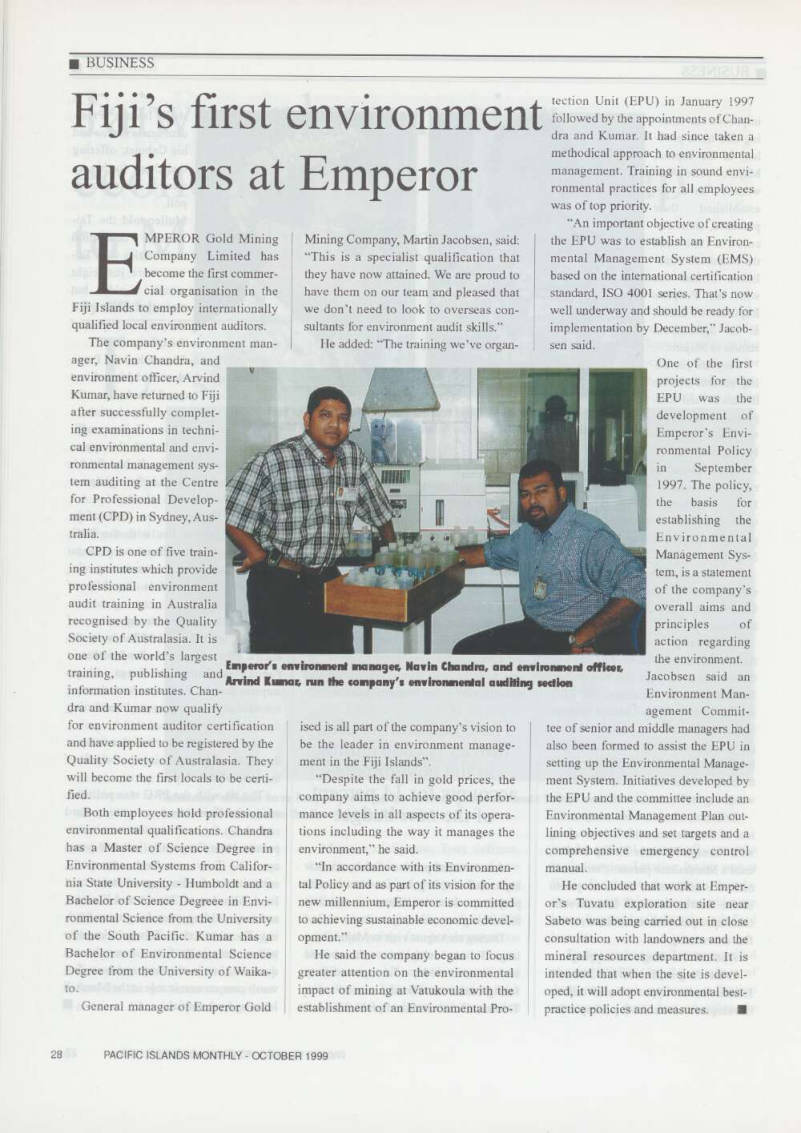
Fiji’s first environment auditors at Emperor
EMPEROR Gold Mining
Company Limited has become the first commer cial organisation in the
Fiji Islands to employ internationally
qualified local environment auditors.
The company’s environment man ager, Navin Chandra, and
environment officer, Arvind Kumar, have returned to Fiji after successfully complet ing examinations in techni cal environmental and envi ronmental management sys tem auditing at the Centre for Professional Develop ment (CPD) in Sydney, Aus tralia.
CPD is one of five train
ing institutes which provide
professional environment audit training in Australia recognised by the Quality Society of Australasia. It is one of the world’s largest
training, publishing and
information institutes. Chan
dra and Kumar now qualify for environment auditor certification and have applied to be registered by the Quality Society of Australasia. They will become the first locals to be certi fied.
Both employees hold professional environmental qualifications. Chandra has a Master of Science Degree in Environmental Systems from Califor nia State University - Humboldt and a Bachelor of Science Degreee in Envi ronmental Science from the University of the South Pacific. Kumar has a Bachelor of Environmental Science Degree from the University of Waika to.
General manager of Emperor Gold
Mining Company, Martin Jacobsen, said: “This is a specialist qualification that they have now attained. We are proud to have them on our team and pleased that we don’t need to look to overseas con sultants for environment audit skills.”
He added; “The training we’ve organ-
ised is all part of the company’s vision to be the leader in environment manage ment in the Fiji Islands”.
“Despite the fall in gold prices, the company aims to achieve good perfor mance levels in all aspects of its opera tions including the way it manages the environment,” he said.
“In accordance with its Environmen tal Policy and as part of its vision for the new millennium, Emperor is committed to achieving sustainable economic devel opment.”
He said the company began to focus greater attention on the environmental impact of mining at Vatukoula with the establishment of an Environmental Pro
tection Unit (EPU) in January 1997 followed by the appointments of Chan dra and Kumar. It had since taken a methodical approach to environmental management. Training in sound envi ronmental practices for all employees was of top priority.
“An important objective of creating the EPU was to establish an Environ mental Management System (EMS) based on the international certification standard, ISO 4001 series. That’s now well underway and should be ready for implementation by December,’’ Jacob sen said.
One of the first projects for the EPU was the development of Emperor’s Envi ronmental Policy in September 1997. The policy, the basis for establishing the Environmental Management Sys tem, is a statement of the company’s overall aims and principles of action regarding the environment.
Jacobsen said an Environment Man
agement Commit tee of senior and middle managers had also been formed to assist the EPU in setting up the Environmental Manage ment System. Initiatives developed by the EPU and the committee include an Environmental Management Plan out lining objectives and set targets and a comprehensive emergency control manual.
He concluded that work at Emper or’s Tuvatu exploration site near Sabeto was being carried out in close consultation with landowners and the mineral resources department. It is intended that when the site is devel oped, it will adopt environmental best practice policies and measures. ■
Emperor's environment manager, Navin Chandra, and environment officer, Arvind Kumar, ran the company's environmental auditing section
ANOTHER environ
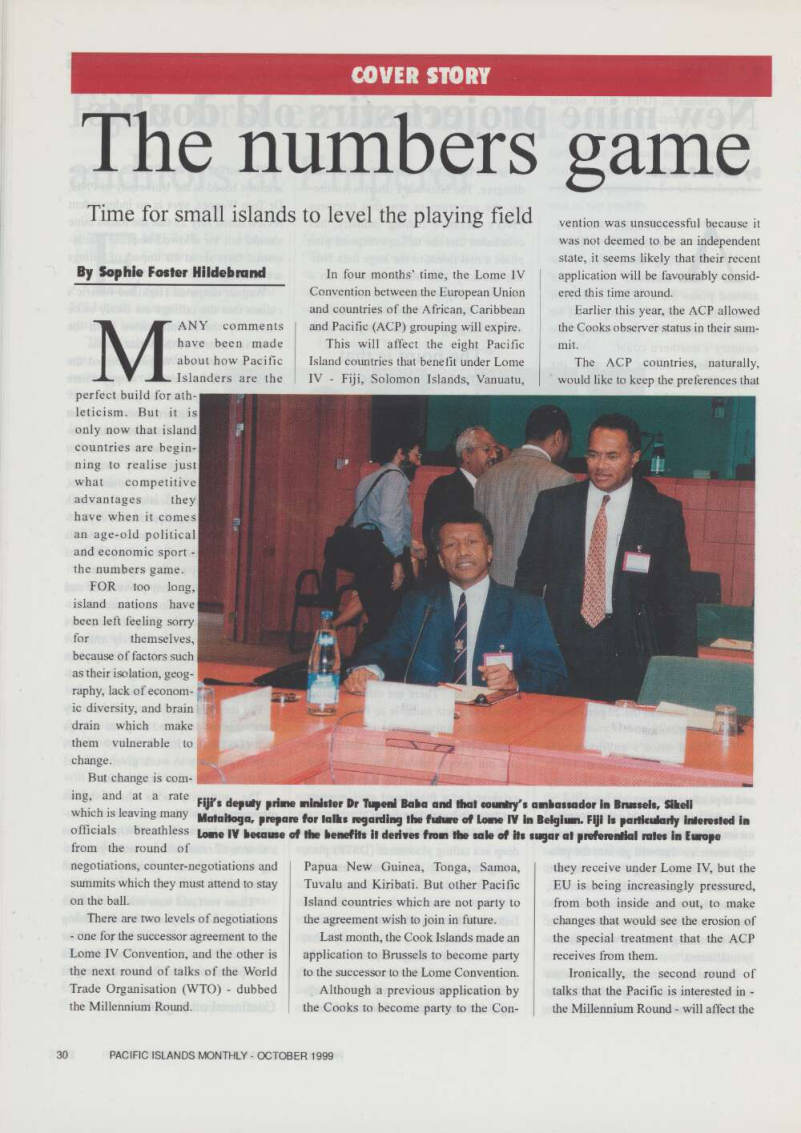
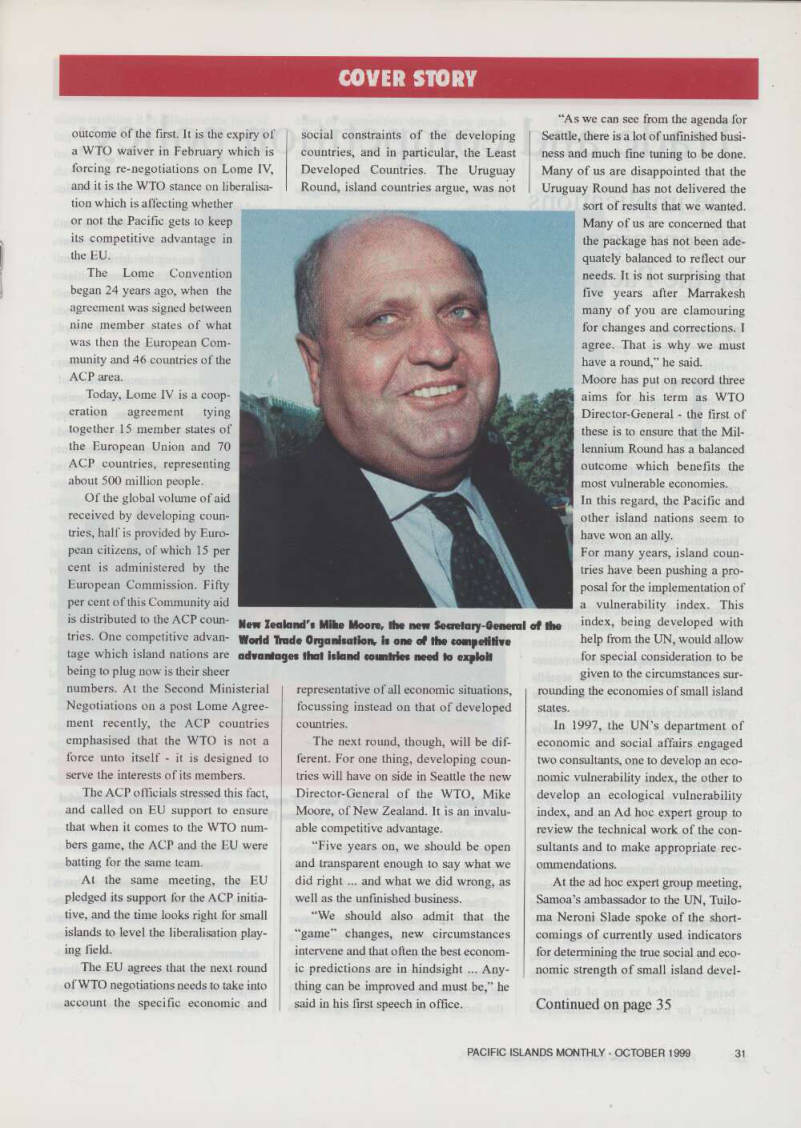
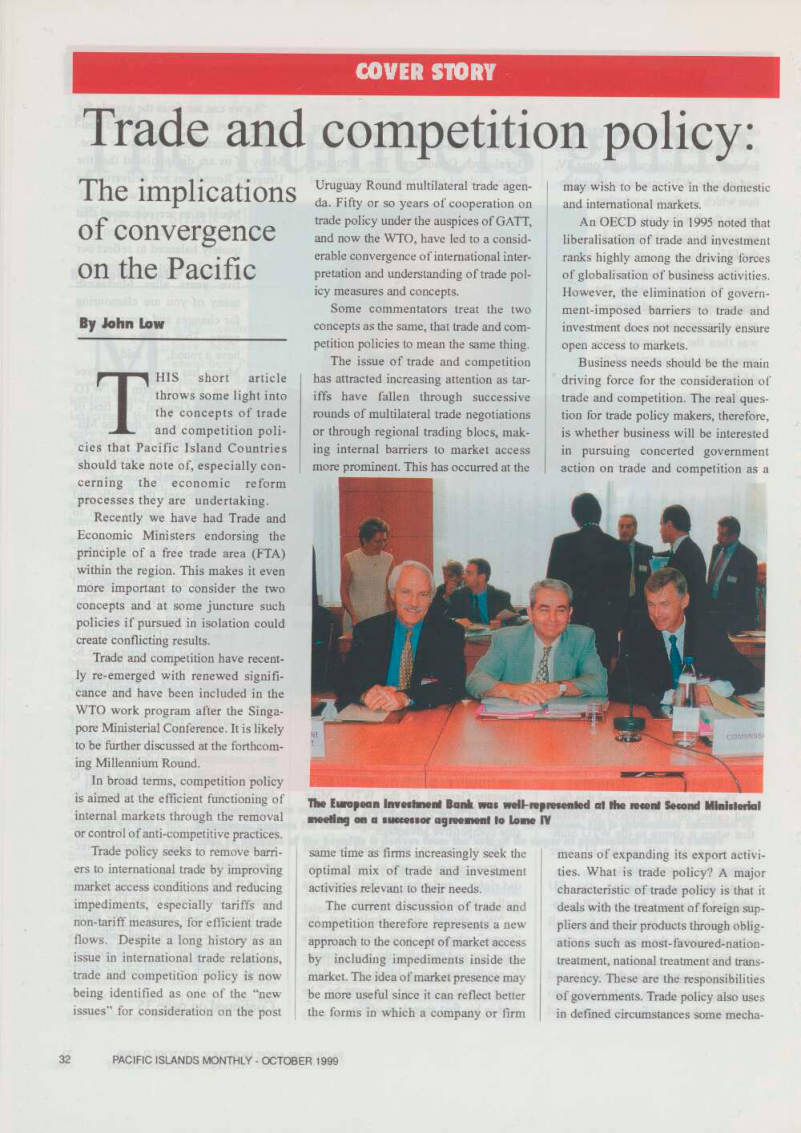
New mine project stirs old doubts
By Kevin Pamba
mental row is brew ing in Papua New Guinea, this time around plans for a US$B3B million nickel mine whose tailings will be dumped into the sea along the country’s northern coast.
The furore comes just after the release of scientific reports confirming serious damage to river systems and livelihoods by the 15-year dumping of tailings from the Ok Tedi copper mine into the sea. The Ok Tedi case has raised questions about the sustainability of mines with poor tailings disposal records - the same doubts about the pro posed Ramu nickel mine.
The operator and majority owner of the Ramu mine, Highlands Pacific Ltd, says the sea disposal of tailings will bring very minimal environmental harm during the project’s 20-year lifes pan. Highlands Pacific, 65 percent owned by PNG interests and 35 percent Australian, hopes to start the Ramu pro ject by yearend. The project is estimat ed to add 15 percent to the exports of PNG, a little less than the 20 percent Ok Tedi was contributing.
The Ramu mine’s environmental plan was given to the Office of Envi ronment and Conservation in February and is pending government approval.
In this plan and in media advertise ments, Highlands Pacific Ltd says tail ings materials that will go into the pris tine Vitiaz Basin along PNG’s northern cost are “fundamentally non-toxic, marine environmental effects are fore cast to be minimal and short term (while) existing fisheries will be entire
ly unaffected.”
But independent scientists, activists and even government agencies like the National Fisheries Authority, who
reviewed the mine's environmental plan, disagree. The National Fisheries Author ity, the government arm that oversees PNG's lucrative fishing industry, has concluded that the tailings disposal plan poses a real threat to the huge tuna fish ing industry and other fisheries. In a March 31 report leaked to media, the authority lists PNG’s problems with huge mines, ranging from the Panguna mine
“The point is that mining has not achieved sustained economies nor improves social struc tures in PNG.
It has broken down families and leaves crippling economic sit uations at all levels of PNG society,” the fisheries authority said
in Bougainville island, the Misima gold mine in Milne Bay province and the Ok Tedi mine near the border with Indone sia. It added: “There are other develop mental projects suitable to PNG condi tions and mining is not one of them because it is environmentally destructive and our people have always been sus tained at the local level by the continuing existence of a functional environment, not large industrial projects.”
But Highlands Pacific defends its deep sea tailing placement (DSTP) plan, citing studies by its Australian environ mental consultant, NSR Consultants.
It notes that other countries like Indonesia, Canada and Turkey have sim ilar mine disposal systems. It says that predictions of tailings deposits over 20 years show that less than two percent of basin floor will be covered by mine tail ings, and that what sediment is created
will be buried anyway. But an American scientist based at the University of PNG, Dr Tom Wagner, says in an independent review dated July 21 that the Ramu mine should not be allowed because funda mental facts about the impact of tailings
are missing.
Wagner disputed Highland Pacific’s claims that the tailings are likely to be buried by the sedimentation from the rivers in the area of the Vitiaz Basin.
In an interview, Wagner termed the work of NSR Consultants “sloppy where very important points are glossed over.”
He reviewed the information on request of the Office of Environment and Con servation. His report notes three major areas missed by the widely circulated reports prepared by NSR Consultants, including the identification of toxins in the tailings, the consequences of deposit ing tailings solids and associated metals in the seabed, and effects of ingestion of tailings solids by marine organisms.
Ingested tailings may prove toxic and are an avenue for toxins to be accumulat ed in the food chain. Wagner also says the threat of volcanic activity must be addressed, since the nickel refinery plant is to be located near Long Island Vol cano, a highly active volcano.
But the National Fisheries Authority warns that the proposed deep sea tailings plan (DSTP) for Ramu, at 150 metres deep, is unlikely to work given the cur rent dynamics of the Vitiaz basin.
The authority adds the fisheries resources of the Bismarck Sea are valu able as food security for PNG, as well as a source of renewable revenue-generat ing source that may be hurt by the nickel
mine project.
“These reef and tuna resources of the Bismarck Sea rely on the continuing clean and productive environment of the Bismarck Sea,” it said. The fisheries body points out that the current largest
Continued on page 43
Continued from page 29
tuna fleet of PNG is based in the Madang coastline, along with sediment flows nat urally from the Vitiaz Basin that is to receive the tailings.
It concludes that the Ramu project is “unsustainable” economically and envi ronmentally. The mine would also breed problems such as alcoholism and sexually transmitted diseases among locals and mine workers, disruption of subsistence lifestyles that are based on food self-suffi ciency, and food losses.
Critics say these undercut the propo nents’ statements that the Ramu project which will also produce some cobalt - will be genuinely economically viable and among the lowest-cost mines.
Expected annual sales from Ramu are put at 260-270 million dollars a year. The estimated value of benefits to locals, the provincial and national governments in
compensation, royalties and taxes is some 103.5 million dollars, proponents say. The Ramu nickel resource was first discovered by the Australian Bureau of Mineral Resources in 1962, but High lands Pacific became involved in 1997 after acquiring a stake in a company that had interest in the resource. The Ameri can firm Nord Pacific Ltd is a minor owner of the Ramu project.
Looking back at PNG’s record with mines, the Fisheries Authority added that “all the other (big) mines still leave Papua New Guinea worse off and not better.”
“The Panguna mine crippled PNG for ten years economically and as a people coping with large mines. The Ok Tedi Mine has had million kina lawsuits, while 200 kilometers of the Fly River lies dead, while the people downstream look for water and fish,” it pointed out.
“Once mining stops, the money stops.”
(Ips) ■
The numbers game
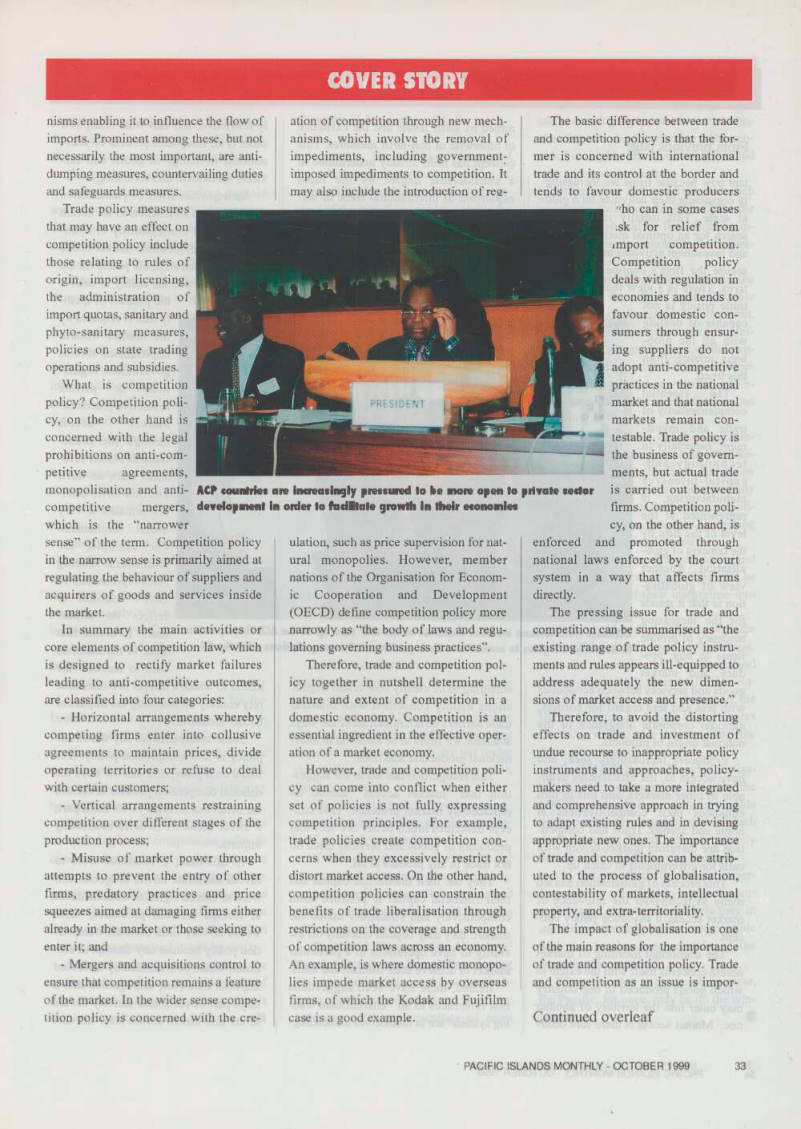
Cover Story
Time for small islands to level the playing field
By Sophie Foster Hildebrand
MANY comments
have been made about how Pacific Islanders are the
perfect build for ath leticism. But it is only now that island countries are begin ning to realise just what competitive advantages they have when it comes an age-old political and economic sport - I the numbers game.
FOR too long, island nations have been left feeling sorry j for themselves, I because of factors such as their isolation, geog- raphy, lack of econom- ! ic diversity, and brain drain which make them vulnerable to
change.
But change is com ing, and at a rate which is leaving many officials breathless from the round of
negotiations, counter-negotiations and summits which they must attend to stay on the ball.
There are two levels of negotiations - one for the successor agreement to the Lome IV Convention, and the other is the next round of talks of the World Trade Organisation (WTO) - dubbed the Millennium Round.
In four months’ time, the Lome IV Convention between the European Union and countries of the African, Caribbean and Pacific (ACP) grouping will expire.
This will affect the eight Pacific Island countries that benefit under Lome IV - Fiji, Solomon Islands, Vanuatu,
Papua New Guinea, Tonga, Samoa, Tuvalu and Kiribati. But other Pacific Island countries which are not party to the agreement wish to join in future.
Last month, the Cook Islands made an application to Brussels to become party to the successor to the Lome Convention.
Although a previous application by
the Cooks to become party to the Con
vention was unsuccessful because it was not deemed to be an independent state, it seems likely that their recent application will be favourably consid ered this time around.
Earlier this year, the ACP allowed the Cooks observer status in their sum mit.
The ACP countries, naturally, would like to keep the preferences that
they receive under Lome IV, but the EU is being increasingly pressured, from both inside and out, to make changes that would see the erosion of the special treatment that the ACP receives from them.
Ironically, the second round of talks that the Pacific is interested in the Millennium Round - will affect the
Fiji's deputy prime minister Dr Tupeni Baba and that country's ambassador in Brussels, Sikeli Matailoga, prepare for talks regarding the future of Lome IV in Belgium. Fiji is particularly interested in Lome IV because of the benefits it derives from the sale of its sugar at preferential rales in Europe
outcome of the first. It is the expiry of a WTO waiver in February which is forcing re-negotiations on Lome IV, and it is the WTO stance on liberalisa
tion which is affecting whether or not the Pacific gets to keep its competitive advantage in the EU.
The Lome Convention began 24 years ago, when the agreement was signed between nine member states of what was then the European Com munity and 46 countries of the ACP area.
Today, Lome IV is a coop eration agreement tying together 15 member states of the European Union and 70 ACP countries, representing about 500 million people.
Of the global volume of aid
received by developing coun
tries, half is provided by Euro pean citizens, of which 15 per cent is administered by the European Commission. Fifty per cent of this Community aid is distributed to the ACP coun tries. One competitive advan tage which island nations are being to plug now is their sheer
numbers. At the Second Ministerial Negotiations on a post Lome Agree ment recently, the ACP countries emphasised that the WTO is not a force unto itself - it is designed to serve the interests of its members.
The ACP officials stressed this fact, and called on EU support to ensure that when it comes to the WTO num bers game, the ACP and the EU were batting for the same team.
At the same meeting, the EU pledged its support for the ACP initia tive, and the time looks right for small islands to level the liberalisation play
ing field.
The EU agrees that the next round of WTO negotiations needs to take into account the specific economic and
social constraints of the developing countries, and in particular, the Least Developed Countries. The Uruguay Round, island countries argue, was not
representative of all economic situations, focussing instead on that of developed countries.
The next round, though, will be dif ferent. For one thing, developing coun tries will have on side in Seattle the new Director-General of the WTO, Mike Moore, of New Zealand. It is an invalu able competitive advantage.
“Five years on, we should be open and transparent enough to say what we did right ... and what we did wrong, as well as the unfinished business.
“We should also admit that the “game” changes, new circumstances intervene and that often the best econom ic predictions are in hindsight ... Any thing can be improved and must be,” he said in his first speech in office.
“As we can see from the agenda for Seattle, there is a lot of unfinished busi ness and much fine tuning to be done.
Many of us are disappointed that the Uruguay Round has not delivered the
sort of results that we wanted.
Many of us are concerned that the package has not been ade quately balanced to reflect our needs. It is not surprising that five years after Marrakesh many of you are clamouring for changes and corrections. I agree. That is why we must have a round,” he said.
Moore has put on record three aims for his term as WTO Director-General - the first of these is to ensure that the Mil lennium Round has a balanced outcome which benefits the most vulnerable economies.
In this regard, the Pacific and other island nations seem to have won an ally.
For many years, island coun tries have been pushing a pro posal for the implementation of a vulnerability index. This index, being developed with help from the UN, would allow for special consideration to be given to the circumstances sur
rounding the economies of small island states.
In 1997, the UN's department of economic and social affairs engaged two consultants, one to develop an eco nomic vulnerability index, the other to
develop an ecological vulnerability
index, and an Ad hoc expert group to review the technical work of the con sultants and to make appropriate rec ommendations.
At the ad hoc expert group meeting, Samoa’s ambassador to the UN, Tuilo ma Neroni Slade spoke of the short comings of currently used indicators for determining the true social and eco nomic strength of small island devel-
Continued on page 35
New Zealand's Mike Moore, the new Secretary-General of the World Trade Organisation is one of the competitive advantages that island countries need to exploit
Continued from page 31
oping states. He said there was a need for a full and proper understanding of vulnerability based on a technical assess ment of the specific variables suitable for building vulnerability indices, which is necessary for small island developing states to plan and seek from the interna tional community vital support for their efforts at sustainable development.
After two days of discussions, the expert group agreed that vulnerability indices are meant to reflect relative eco nomic and ecological susceptibility to exogenous shocks, in other words, the risk of a country being affected by such shocks.
The vulnerability index is designed to identify which group of countries exceed a threshold of vulnerability at which they are particularly susceptible to risks and warrant special attention from agencies
providing assistance.
At the same time the index and its components are intended to provide a multi-dimensional approach to the iden tification of programmes designed to reduce individual countries’ exposure to exogenous factors that may affect their
development.
A UN study has found that as a group, small island developing states are more vulnerable than other groups of develop ing countries, and that the vulnerability referred to is structural vulnerability that depends on factors which are not under the control of national authorities when the shocks occur.
The indicators should reflect expo sure to shocks, that is to say, their magni tude and their probability, If such a proposal is accepted by the international community, the vulnerabili ty index will change the way island nations are considered by aid agencies and developed countries.
The 1996 UN report of the High-level Panel Meeting on Island Developing Countries said: “Given the particularly acute resource constraints and the volatility of export earnings of most
island developing countries, internation al assistance should continue to be pro vided on highly concessional terms and over a long time-frame.
Other terms and conditions of such assistance including the procedures for aid delivery should be flexible and sim plified in order to respond to the vulner ability of these countries.”
Many island developing countries, the report said, were faced with a double competitive challenge in the short run, first because of the erosion of trade pref erences, and second because of the gen
erally limited capacity of island develop
ing countries to meet new trading oppor tunities in terms of competitiveness and
reliability of supply.
“For some island developing coun tries, therefore, little or no benefit is like ly to be gained in the short run; a few island developing countries may actually be net losers due to losses in competi tiveness and slow progress in seizing
trading opportunities,” it said.
For this reason, the economic and ecological vulnerability indices will be the cornerstone of their integration into the world economy.
With world-wide disillusion with the pace of liberalisation and globalisation, there is no doubt that Pacific Island countries, through their ACP-EU rela tionship and their participation in the UN’s Alliance of Small Island States (AOSIS), will be able to press home the sheer advantage of numbers.
The EU says that the “rapid globalisa tion of the economy as sanctioned by the GATT agreement is not very favourable to those least developed countries which the Maastricht Treaty cites as priority beneficiaries of EU development aid.
“In fact, standards for economic per formance as measured in terms of com petitiveness on external markets may in some cases be temporarily incompatible with the development priorities of the countries in question.”
When it comes to the numbers game, the Pacific, for once, may be on the win ning team. ■
Trade and competition policy:
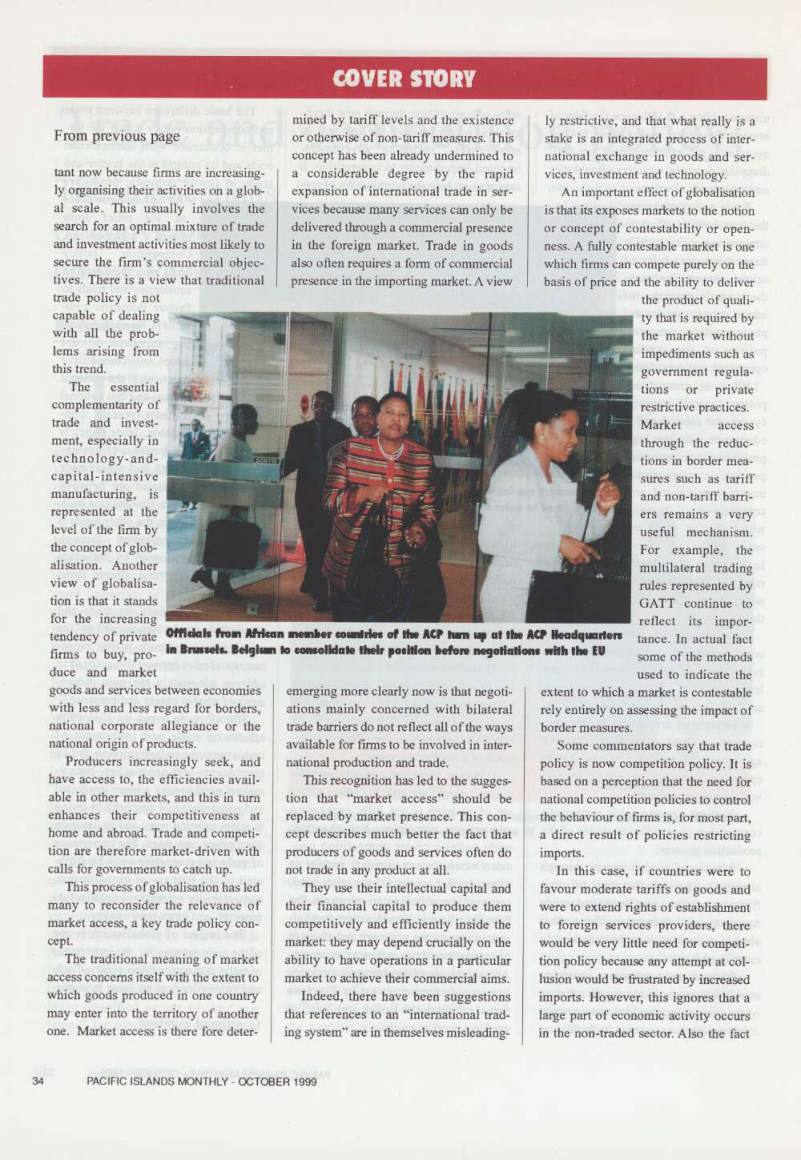
The implications of convergence on the Pacific
By John Low
THIS short article throws some light into the concepts of trade and competition poli cies that Pacific Island Countries should take note of, especially con cerning the economic reform processes they are undertaking.
Recently we have had Trade and Economic Ministers endorsing the principle of a free trade area (FTA) within the region. This makes it even more important to consider the two concepts and at some juncture such policies if pursued in isolation could create conflicting results.
Trade and competition have recent ly re-emerged with renewed signifi cance and have been included in the WTO work program after the Singa pore Ministerial Conference. It is likely to be further discussed at the forthcom ing Millennium Round.
In broad terms, competition policy is aimed at the efficient functioning of internal markets through the removal or control of anti-competitive practices.
Trade policy seeks to remove barri ers to international trade by improving market access conditions and reducing impediments, especially tariffs and non-tariff measures, for efficient trade flows. Despite a long history as an issue in international trade relations, trade and competition policy is now being identified as one of the “new issues” for consideration on the post
Uruguay Round multilateral trade agen da. Fifty or so years of cooperation on trade policy under the auspices of GATT, and now the WTO, have led to a consid erable convergence of international inter pretation and understanding of trade pol icy measures and concepts.
Some commentators treat the two concepts as the same, that trade and com petition policies to mean the same thing.
The issue of trade and competition has attracted increasing attention as tar iffs have fallen through successive rounds of multilateral trade negotiations
or through regional trading blocs, mak
ing internal barriers to market access more prominent. This has occurred at the
same time as firms increasingly seek the optimal mix of trade and investment activities relevant to their needs.
The current discussion of trade and competition therefore represents a new approach to the concept of market access by including impediments inside the market. The idea of market presence may be more useful since it can reflect better the forms in which a company or firm
may wish to be active in the domestic and international markets.
An OECD study in 1995 noted that liberalisation of trade and investment ranks highly among the driving forces of globalisation of business activities.
However, the elimination of govern ment-imposed barriers to trade and investment does not necessarily ensure open access to markets.
Business needs should be the main driving force for the consideration of trade and competition. The real ques tion for trade policy makers, therefore, is whether business will be interested in pursuing concerted government action on trade and competition as a
means of expanding its export activi ties. What is trade policy? A major characteristic of trade policy is that it deals with the treatment of foreign sup
pliers and their products through oblig
ations such as most-favoured-nation treatment, national treatment and trans parency. These are the responsibilities of governments. Trade policy also uses in defined circumstances some mecha
The European Investment Bank was well-represented at the recent Second Ministerial meeting on a successor agreement to Lome IV
nisms enabling it to influence the flow of imports. Prominent among these, but not necessarily the most important, are anti dumping measures, countervailing duties and safeguards measures.
Trade policy measures that may have an effect on competition policy include those relating to rules of
origin, import licensing,
the administration of import quotas, sanitary and
phyto-sanitary measures,
policies on state trading
operations and subsidies.
What is competition policy? Competition poli cy, on the other hand is concerned with the legal prohibitions on anti-com
petitive agreements,
monopolisation and anti
competitive mergers,
which is the “narrower
sense” of the term. Competition policy in the narrow sense is primarily aimed at regulating the behaviour of suppliers and acquirers of goods and services inside the market.
In summary the main activities or core elements of competition law, which is designed to rectify market failures leading to anti-competitive outcomes, are classified into four categories: - Horizontal arrangements whereby competing firms enter into collusive agreements to maintain prices, divide operating territories or refuse to deal with certain customers; - Vertical arrangements restraining competition over different stages of the
production process;
- Misuse of market power through attempts to prevent the entry of other
firms, predatory practices and price
squeezes aimed at damaging firms either already in the market or those seeking to enter it; and - Mergers and acquisitions control to ensure that competition remains a feature of the market. In the wider sense compe tition policy is concerned with the cre
ation of competition through new mech anisms, which involve the removal of
impediments, including government
imposed impediments to competition. It
may also include the introduction of ree-
ulation, such as price supervision for nat ural monopolies. However, member nations of the Organisation for Econom ic Cooperation and Development (OECD) define competition policy more narrowly as “the body of laws and regu
lations governing business practices”.
Therefore, trade and competition pol icy together in nutshell determine the nature and extent of competition in a domestic economy. Competition is an essential ingredient in the effective oper ation of a market economy.
However, trade and competition poli cy can come into conflict when either set of policies is not fully expressing competition principles. For example, trade policies create competition con cerns when they excessively restrict or distort market access. On the other hand, competition policies can constrain the benefits of trade liberalisation through restrictions on the coverage and strength of competition laws across an economy.
An example, is where domestic monopo lies impede market access by overseas firms, of which the Kodak and Fujifilm case is a good example.
The basic difference between trade and competition policy is that the for mer is concerned with international trade and its control at the border and tends to favour domestic producers
■'ho can in some cases .sk for relief from
import competition.
Competition policy
deals with regulation in economies and tends to favour domestic con sumers through ensur
ing suppliers do not
adopt anti-competitive
practices in the national market and that national markets remain con testable. Trade policy is the business of govern ments, but actual trade is carried out between
firms. Competition poli
cy, on the other hand, is
enforced and promoted through national laws enforced by the court system in a way that affects firms
directly.
The pressing issue for trade and competition can be summarised as “the existing range of trade policy instru ments and rules appears ill-equipped to address adequately the new dimen sions of market access and presence.”
Therefore, to avoid the distorting effects on trade and investment of undue recourse to inappropriate policy
instruments and approaches, policy
makers need to take a more integrated and comprehensive approach in trying to adapt existing rules and in devising appropriate new ones. The importance of trade and competition can be attrib uted to the process of globalisation, contestability of markets, intellectual property, and extra-territoriality.
The impact of globalisation is one of the main reasons for the importance of trade and competition policy. Trade and competition as an issue is impor-
Continued overleaf
ACP countries are increasingly pressured lo be more open la private sector development in order lo faciliate growth in their economies
From previous page tant now because firms are increasing ly organising their activities on a glob al scale. This usually involves the search for an optimal mixture of trade and investment activities most likely to secure the firm’s commercial objec tives. There is a view that traditional trade policy is not
capable of dealing with all the prob lems arising from this trend.
The essential complementarity of trade and invest ment, especially in
technology-and
capital-intensive manufacturing, is represented at the level of the firm by the concept of glob alisation. Another view of globalisa tion is that it stands for the increasing tendency of private firms to buy, pro duce and market
goods and services between economies with less and less regard for borders, national corporate allegiance or the national origin of products.
Producers increasingly seek, and have access to, the efficiencies avail able in other markets, and this in turn enhances their competitiveness at home and abroad. Trade and competi tion are therefore market-driven with calls for governments to catch up.
This process of globalisation has led many to reconsider the relevance of market access, a key trade policy con cept.
The traditional meaning of market access concerns itself with the extent to which goods produced in one country may enter into the territory of another one. Market access is there fore deter
mined by tariff levels and the existence or otherwise of non-tariff measures. This concept has been already undermined to a considerable degree by the rapid expansion of international trade in ser vices because many services can only be delivered through a commercial presence in the foreign market. Trade in goods also often requires a form of commercial presence in the importing market. A view
emerging more clearly now is that negoti ations mainly concerned with bilateral trade barriers do not reflect all of the ways available for firms to be involved in inter national production and trade.
This recognition has led to the sugges tion that “market access” should be replaced by market presence. This con cept describes much better the fact that producers of goods and services often do not trade in any product at all.
They use their intellectual capital and their financial capital to produce them competitively and efficiently inside the market: they may depend crucially on the ability to have operations in a particular market to achieve their commercial aims.
Indeed, there have been suggestions that references to an “international trad ing system” are in themselves misleading
ly restrictive, and that what really is a stake is an integrated process of inter national exchange in goods and ser vices, investment and technology.
An important effect of globalisation is that its exposes markets to the notion or concept of contestability or open ness. A fully contestable market is one which firms can compete purely on the basis of price and the ability to deliver
the product of quali ty that is required by the market without impediments such as government regula tions or private restrictive practices.
Market access through the reduc tions in border mea sures such as tariff and non-tariff barri ers remains a very useful mechanism.
For example, the
multilateral trading
rules represented by GATT continue to reflect its impor tance. In actual fact some of the methods used to indicate the
extent to which a market is contestable rely entirely on assessing the impact of border measures.
Some commentators say that trade policy is now competition policy. It is based on a perception that the need for national competition policies to control the behaviour of firms is, for most part, a direct result of policies restricting
imports.
In this case, if countries were to favour moderate tariffs on goods and were to extend rights of establishment to foreign services providers, there would be very little need for competi tion policy because any attempt at col lusion would be frustrated by increased imports. However, this ignores that a large part of economic activity occurs in the non-traded sector. Also the fact
Officials from African member countries of the ACP turn up at the ACP Headquarters in Brussels. Belgium to consolidate their position before negotiations with the EU
is that fewer countries have undertaken the necessary complementary liberalisa tion within their domestic economies.
The reality is that many international ly traded goods and services contain some intellectual property component.
Therefore, agreements to license patents and intellectual property pose some spe cial challenges for competition policy.
This is the case when they give license holders access to specified terri tories only, or if they are confined to par ticular products.
Several commentators have observed that in the absence of laws to protect intellectual property, such agreements might well be found illegal by competi tion authorities.
Extra-territoriality is an issue of gen eral concern in international trade and investment, in particular in the applica tion of domestic competition laws, as well as some other laws by the United States.
Such measures can have a consider able effect on the ability of others to compete in third markets. For example, the United Helms-Burton legislation passed recently, which is aimed at restor ing democracy in Cuba, effectively pre vents third country firms from investing in Cuba.
This is so because they can be liable to punitive damages awarded by the United States courts to the previous own ers of property located in Cuba.
However, there is a view that some degree of extra-territoriality in the administration of competition law may be inevitable.
Some claim that the state is justified in applying such competition rules to conduct abroad that is detrimental to its economy or to control transnational cor porations that might otherwise be able to escape the reach of the law. If you accept this argument than the real problem would be its abuse and it will be costly. * The views expressed are that of the author, John Low, and not necessarily of the Forum Secretariat where he is employed as Resources Advisor. ■
Advertisements & other items, pp. 33-34 (2 items)
Cover Story
Cover Story
new Hollywood
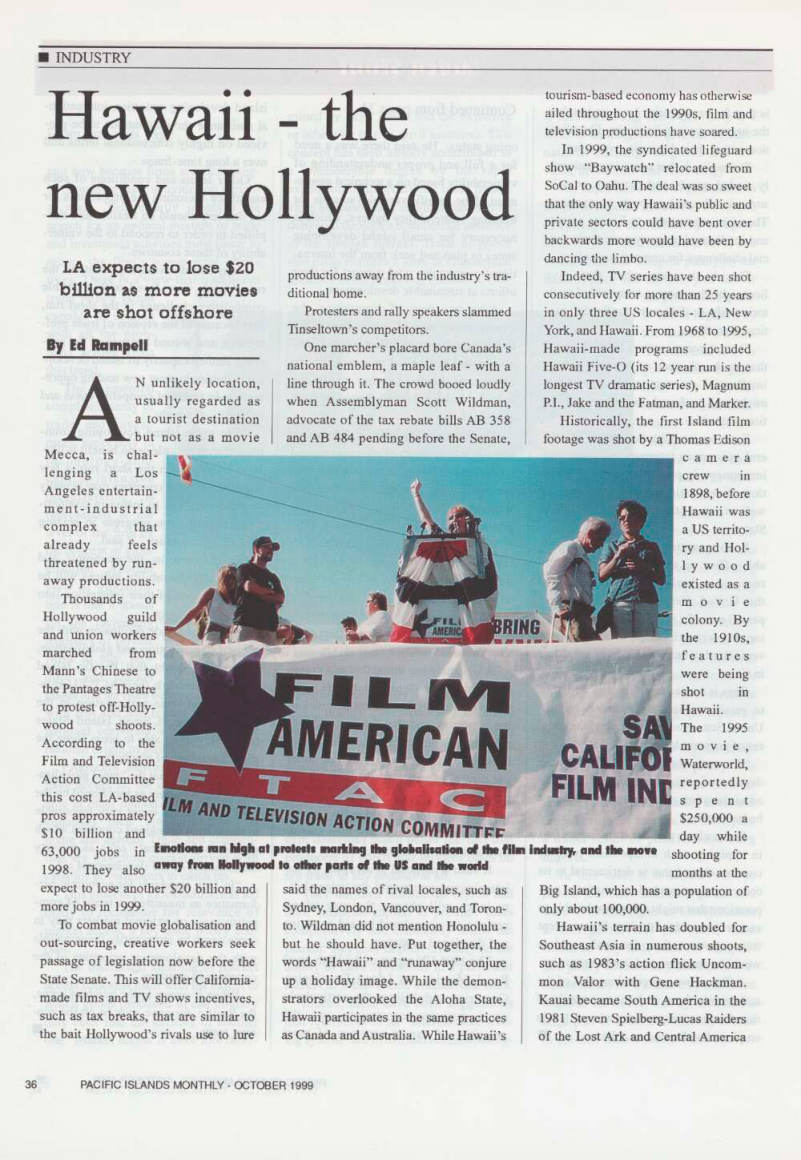
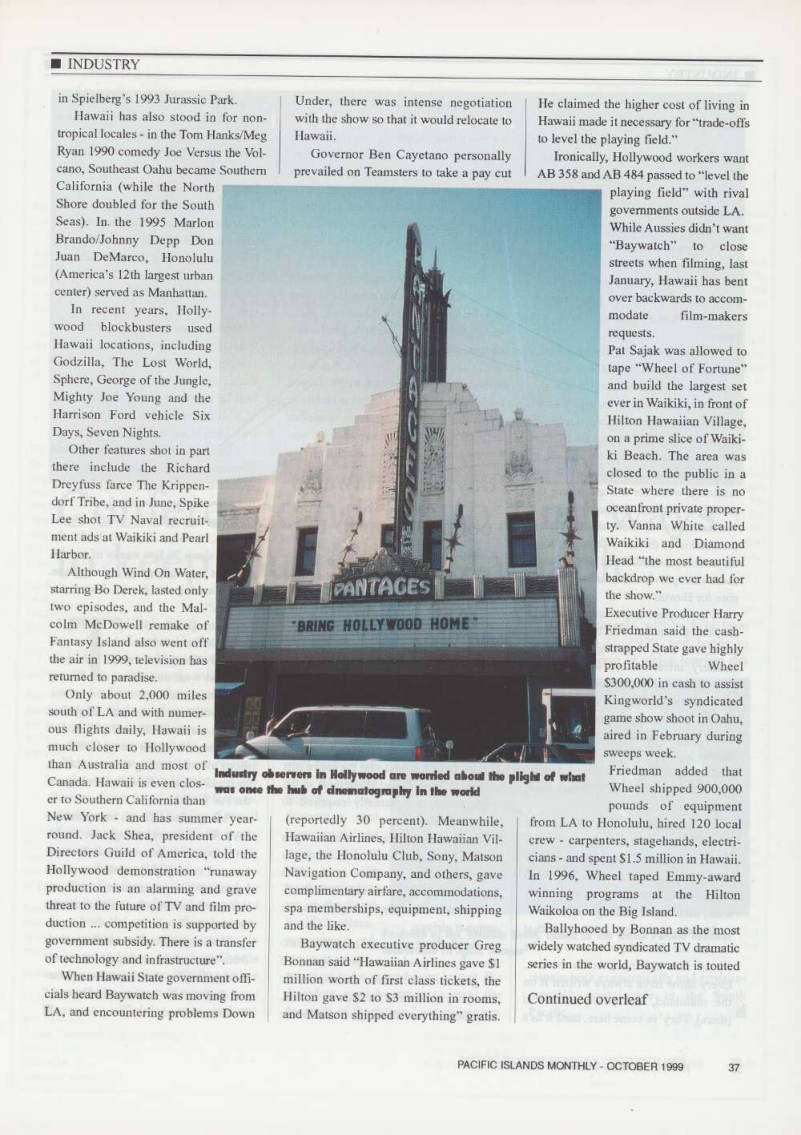
Industry
Hawaii - the new Hollywood
LA expects to lose $2O billion as more movies are shot offshore
By Ed Rampell
AN unlikely location, usually regarded as a tourist destination but not as a movie
Mecca, is chal lenging a Los Angeles entertain ment-industrial complex that
already feels
threatened by run away productions.
Thousands of Hollywood guild and union workers marched from Mann’s Chinese to the Pantages Theatre to protest off-Holly wood shoots.
According to the Film and Television Action Committee this cost LA-based pros approximately $lO billion and
63,000 jobs in 1998. They also
expect to lose another $2O billion and more jobs in 1999.
To combat movie globalisation and out-sourcing, creative workers seek passage of legislation now before the State Senate. This will offer California made films and TV shows incentives, such as tax breaks, that are similar to the bait Hollywood’s rivals use to lure
productions away from the industry’s tra ditional home.
Protesters and rally speakers slammed
Tinseltown’s competitors.
One marcher’s placard bore Canada’s national emblem, a maple leaf - with a line through it. The crowd booed loudly when Assemblyman Scott Wildman, advocate of the tax rebate bills AB 358 and AB 484 pending before the Senate,
said the names of rival locales, such as Sydney, London, Vancouver, and Toron to. Wildman did not mention Honolulu but he should have. Put together, the words “Hawaii” and “runaway” conjure up a holiday image. While the demon strators overlooked the Aloha State, Hawaii participates in the same practices as Canada and Australia. While Hawaii’s
tourism-based economy has otherwise ailed throughout the 19905, film and television productions have soared.
In 1999, the syndicated lifeguard show “Baywatch” relocated from SoCal to Oahu. The deal was so sweet that the only way Hawaii’s public and private sectors could have bent over backwards more would have been by dancing the limbo.
Indeed, TV series have been shot consecutively for more than 25 years in only three US locales - LA, New York, and Hawaii. From 1968 to 1995, Hawaii-made programs included Hawaii Five-O (its 12 year run is the longest TV dramatic series), Magnum PL, Jake and the Fatman, and Marker.
Historically, the first Island film footage was shot by a Thomas Edison
camera crew in 1898, before Hawaii was a US territo ry and Hol -Iyw o o d existed as a movie colony. By the 1910 s, features were being shot in Hawaii.
The 1995 movie, Waterworld, reportedly spent $250,000 a day while
shooting for months at the
Big Island, which has a population of only about 100,000.
Hawaii’s terrain has doubled for Southeast Asia in numerous shoots, such as 1983’s action flick Uncom mon Valor with Gene Hackman.
Kauai became South America in the 1981 Steven Spielberg-Lucas Raiders of the Lost Ark and Central America
Emotions ran high at protests marking the globalisation of the film industry, and the move away from Hollywood to other parts of the US and the world
in Spielberg’s 1993 Jurassic Park.
Hawaii has also stood in for non tropical locales - in the Tom Hanks/Meg Ryan 1990 comedy Joe Versus the Vol cano, Southeast Oahu became Southern
California (while the North Shore doubled for the South Seas). In. the 1995 Marlon
Brando/Johnny Depp Don
Juan DeMarco, Honolulu (America’s 12th latest urban center) served as Manhattan.
In recent years, Holly wood blockbusters used Hawaii locations, including Godzilla, The Lost World, Sphere, George of the Jungle, Mighty Joe Young and the Harrison Ford vehicle Six Days, Seven Nights.
Other features shot in part there include the Richard Drey fuss farce The Krippen dorf Tribe, and in June, Spike Lee shot TV Naval recruit ment ads at Waikiki and Pearl Harbor.
Although Wind On Water, starring Bo Derek, lasted only two episodes, and the Mal colm McDowell remake of Fantasy Island also went off the air in 1999, television has returned to paradise.
Only about 2,000 miles south of LA and with numer ous flights daily, Hawaii is much closer to Hollywood than Australia and most of Canada. Hawaii is even clos er to Southern California than
New York - and has summer year round. Jack Shea, president of the Directors Guild of America, told the Hollywood demonstration “runaway production is an alarming and grave threat to the future of TV and film pro duction ... competition is supported by government subsidy. There is a transfer of technology and infrastructure”.
When Hawaii State government offi cials heard Baywatch was moving from LA, and encountering problems Down
Under, there was intense negotiation with the show so that it would relocate to Hawaii.
Governor Ben Cayetano personally
prevailed on Teamsters to take a pay cut
(reportedly 30 percent). Meanwhile, Hawaiian Airlines, Hilton Hawaiian Vil lage, the Honolulu Club, Sony, Matson Navigation Company, and others, gave complimentary airfare, accommodations, spa memberships, equipment, shipping and the like.
Baywatch executive producer Greg Bonnan said “Hawaiian Airlines gave $1 million worth of first class tickets, the Hilton gave $2 to $3 million in rooms, and Matson shipped everything” gratis.
He claimed the higher cost of living in Hawaii made it necessary for “trade-offs to level the playing field.”
Ironically, Hollywood workers want AB 358 and AB 484 passed to “level the
playing field” with rival governments outside LA.
While Aussies didn’t want “Baywatch” to close streets when filming, last January, Hawaii has bent over backwards to accom modate film-makers requests.
Pat Sajak was allowed to tape “Wheel of Fortune” and build the largest set ever in Waikiki, in front of Hilton Hawaiian Village, on a prime slice of Waiki ki Beach. The area was closed to the public in a State where there is no oceanfront private proper ty. Vanna White called Waikiki and Diamond Head “the most beautiful backdrop we ever had for the show.”
Executive Producer Harry Friedman said the cash strapped State gave highly profitable Wheel $300,000 in cash to assist Kingworld’s syndicated game show shoot in Oahu, aired in February during sweeps week.
Friedman added that Wheel shipped 900,000 pounds of equipment
from LA to Honolulu, hired 120 local crew - carpenters, stagehands, electri cians - and spent $1.5 million in Hawaii.
In 1996, Wheel taped Emmy-award winning programs at the Hilton Waikoloa on the Big Island.
Ballyhooed by Bonnan as the most widely watched syndicated TV dramatic series in the world, Baywatch is touted
Continued overleaf
Industry observers in Hollywood are wonted about the plight of what was once the hub of cinematography in the world
From previous page as a major boost to Hawaii’s top indus try, tourism. The service providers that cooperate with Baywatch Hawaii expect to benefit through screen credit, mentions, and product placement which Bonnan said he pioneered on TV.
One hundred million viewers in 148 countries and 40 languages watch the providers’ products on the program twice a week, for a run expected to last years.
Honolulu producer and tourism offi cial April Masini claimed 9.25 million Americans watch Baywatch on the USA network. Masini, an avid booster of Island-based productions, said each Baywatch episode is equal to 10 min utes of advertising for Hawaii. It is worth the advertising equivalent of $29 million a week for a State where the number of visitors declined.
According to Bonnan, the latest incarnation of the show featuring biki nis and barechested hunks will do much more than provide international expo sure for Hawaii.
What is more important, he says, is Baywatch Hawaii will build a com plete, one stop, A through Z film/TV industry infrastructure in the Aloha State. Diamond Head Studios was built when Hawaii Five-O was shot in Hawaii. Bonnan said as part of its deal with Baywatch Hawaii, the State agreed to make “the best underwater tank ever used for motion picture or television production”- with local labour.
The tank will be left in the maritime State after the lifeguard drama eventu ally leaves Hawaii, and the producer added Baywatch Hawaii will expand Diamond Head Studios with other addi tions, such as new editing facilities.
Bonnan went on to declare that “we’re the first show ever to do the whole film-making process here ...
Every show have always written it on the mainland, and post-produced it [there]. They’ve come here, used it as a
backlot: ‘gee, it’s a pretty palm tree, but we don’t need your people, your talent, we don’t need anything, we don’t even need your money, and we don’t care what money we put into the industry.
We’ll come here, shoot it, see ya. We’ll go home and do the important stuff there on the mainland where people know what they’re doing.’ I found that insult ing.”
Bonnan said “everybody thought before that they had to come over here and bring everybody: makeup, hair, wardrobe, directors, writers, producers, editors, prop men, grips, electricians ...
Well, that’s a joke. The talent is here.
Nobody just took the time to go out and find it and train it.” Bonnan maintained using much local talent, from Hawaiian actors Kala’i Miller, Jason Mamoa, and Stacey Kamano to assistant editors, is a
Bay watch Hawaii’s biggest contribution to the 50th State’s economy - and its biggest threat to LA craft guilds and unions - could be a totally self-suffi cient Hawaii-based film/TV industry
raison d’etre of Baywatch Hawaii. He is only bringing eight crew members to Hawaii from LA, and said the entire cast and crew, from David Hasselhoff to the writers, are contractually required to relocate to Hawaii.
But Baywatch Hawaii, which began shooting July 8 in Kauai, is not the only television show to shoot in the 50th State. Two episodes of cable TV’s Pacif ic Blue were recently made in Oahu, for summer airings.
Pacific Blue pumped $1.5 million into Hawaii, and producers reportedly said if all goes well with these shows, Pacific Blue may relocate to the Islands. Masini, who helped land the Baywatch, Pacific
Blue, Wheel of Fortune, and Miss Uni verse productions for Hawaii, said a TV talent contest type show, Destina tion Stardom, is being based there, too.
Even independent film-makers are finding Hawaii a haven.
David Cunningham grew up on the Big Island, where he shot Beyond Par adise, the first feature shot on the Big Isle since Waterworld, and which, the director said, “had less than a week’s total budget” of the Kevin Costner
epic.
His LA-based company, Pray For Rain Pictures, is set to shoot its next feature - a $lO-$ 15 million W.W.11 drama set in Southeast Asia - on loca tion in Kauai. It is the site of many W.W.11 pictures, such as Frank Sina tra’s 1965 None But the Brave.
Cunningham said, “independent
filmmakers bring less money, but they spread it out evenly [while] big pic tures give money to a few.”
He added that with studio block busters, such as Jurassic Park, the majors shoot “a few weeks of second unit, get the background, and are gone.
I’m planning to be in Kauai for months.”
Cunningham said that in Hawaii, he held “seminars on how to launch a pro ject and editing, and trained local peo ple, who went on to work for Disney and commercials”.
Hawaii born and raised Edgy Lee made a career for herself in LA. But she returned home in the mid-1990s to
shoot award winning documentaries,
such as Paniolo O Hawaii, Cowboys of the Far West.
“Many of us [Hawaii transplants to LA’s film industry] thought we could n’t move back here - boy, is that not true ... I’m very glad to relocate where I grew up. Everyone assumes that you can’t do it here, but there’s 10 times the enthusiasm.”
The cooperation Baywatch receives
from the public and private sector
means “they’re showing other produc
ers they can do business in Hawaii,”
Bonnan stressed. ■
to keep tourism sustainable
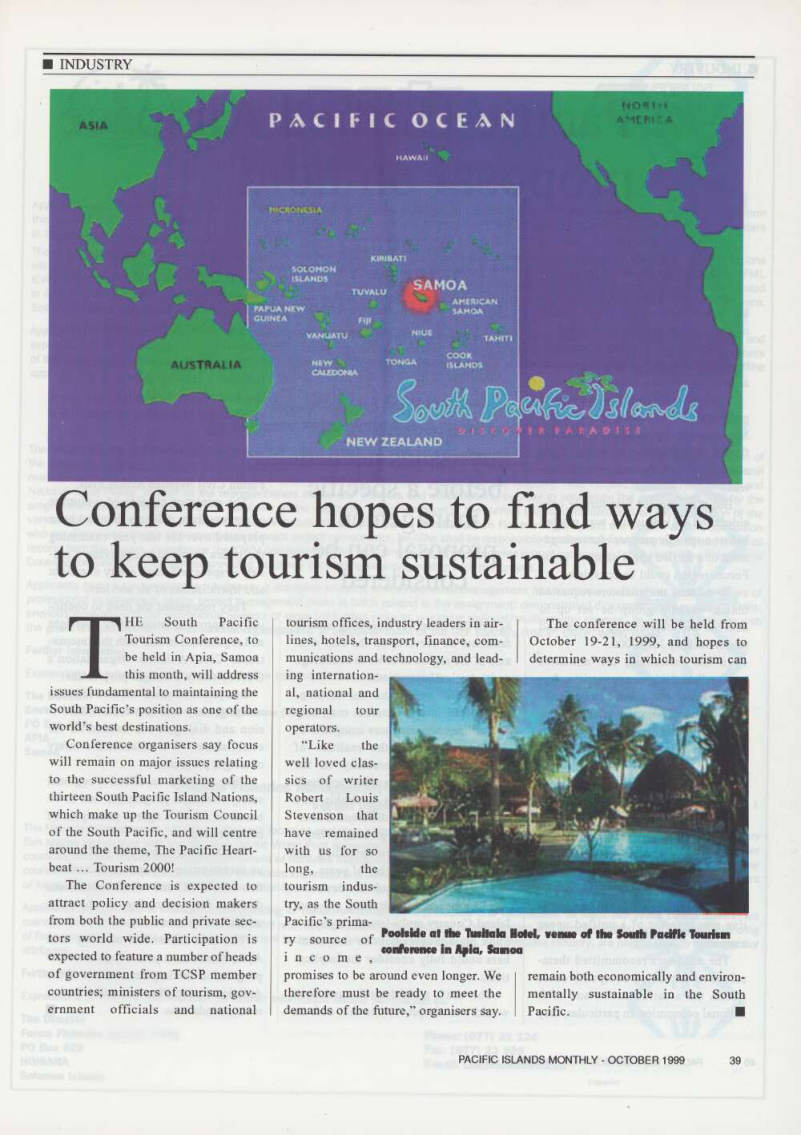
Conference hopes to find ways to keep tourism sustainable
THE South Pacific Tourism Conference, to be held in Apia, Samoa this month, will address issues fundamental to maintaining the South Pacific’s position as one of the world’s best destinations.
Conference organisers say focus will remain on major issues relating to the successful marketing of the thirteen South Pacific Island Nations, which make up the Tourism Council of the South Pacific, and will centre around the theme, The Pacific Heart beat ... Tourism 2000!
The Conference is expected to attract policy and decision makers from both the public and private sec tors world wide. Participation is expected to feature a number of heads of government from TCSP member countries; ministers of tourism, gov ernment officials and national
tourism offices, industry leaders in air lines, hotels, transport, finance, com munications and technology, and lead
ing internation al, national and regional tour operators.
“Like the well loved clas sics of writer Robert Louis Stevenson that have remained with us for so
long, the
tourism indus try, as the South Pacific’s prima ry source of income,
promises to be around even longer. We therefore must be ready to meet the demands of the future,” organisers say.
The conference will be held from October 19-21, 1999, and hopes to determine ways in which tourism can
remain both economically and environ mentally sustainable in the South Pacific. ■
Poolside at the Tusitala Hotel, venue of the South Pacific Tourism conference in Apia, Samoa
proposal on hold

Pacific Unified Airspace proposal on hold
A PROPOSAL for a Pacific Unified Air space management jL, will not be considered until key issues involved in the process are studied.
This was one of the decisions made by the Forum civil aviation ministeri al meeting in Nadi, Fiji last month.
The ministers considered a report, proposing a Pacific Upper Airspace Management organisation, which con firmed the benefits to be gained from a unified air traffic management sys tem.
But they decided that further con sideration of key issues was needed before a specific proposal for manage ment of a unified upper airspace in the Forum region could be considered.
To do this, the ministers requested that a working group be set up to address the outstanding issues and report back by July 2000.
In the meantime, the ministers resolved that, where appropriate, for mal arrangements needed to be estab lished between Forum Island Coun tries and air traffic service providers to address some of the anomalies that currently exist.
They further directed that arrange ments be implemented where the value of the contribution of Forum Island Countries to overflight services be established and recompensed. The ministers said that these arrangements should be included as part of any future arrangements for the coopera tive management of a unified upper airspace.
The ministers recommitted them selves to enhancing competitiveness within the aviation sector and their national economies. In particular, they
Aviation ministers confirm benefits to be gained from unified airspace but decide further consideration of key issues needed before a specific management proposal can be considered
agreed that there was a pressing need to facilitate air services on the east-west axis of the region in order to encourage multi-destination tourism.
They also agreed that the develop ment of an internal market may help FIC airlines become more competitive.
However, given the realities of smallness and vulnerability in the region, they agreed a gradual approach to liberalisation was desirable and could be based on the differential liber alisation of market segments, aviation freedom rights and on spreading the adjustment over a number of years.
It was further agreed that countries would proceed with drafting a Forum Island Country multi-lateral single avi ation market agreement so that mem bers could fully consider the implica tions.
The draft multi-lateral agreement would contain provisions that address
the concerns of member states includ ing the need for an adequate phase-in period; competition/dispute resolution and safeguards as well as ownership and control of airlines operating within a Forum Island Country single aviation market.
The Forum aviation officials will consider a draft agreement in the sec ond half of 2000 before making recom mendations to aviation ministers and the Forum.
Last month’s meeting was to review the progress in implementing the 1998 Forum Civil Aviation Action Plan.
The ministers considered a number of reports from officials that had been prepared over the last year examining the issues involved in achieving a uni fied airspace; effective safety oversight and liberalisation of air services.
They recognised the need to contin ually improve aviation safety oversight and regulations in line with the Interna tional Civil Aviation Organisation’s (ICAO) safety oversight programme.
In a joint statement released after the meeting, they said that further discus sion and dialogue was needed on the establishment of a collaborative safety oversight programme.
They said that an effective regional safety oversight programme had to be based on ICAO’s agreed principles of collaboration.
The Steering Committee will contin ue investigating the options in associa tion with ICAO and submit recommen dations for alternative mechanisms within twelve months.
The next ministerial meeting is in Apia, Samoa next year to again review progress in the implementation of the Aviation Action Plan and make further recommendations. ■
Advertisements & other items, p. 41 (1 item)
anno
Strategic Action Program for International
Waters in the Pacific Islands Region
Applications are invited for the positions of Project Manager/lnternational Waters and Fisheries Management Adviser. These positions will form the basis of the Project Coordinating Unit for the GEF/UNDP funded project to Implement the Strategic Action Program for International Waters in the Pacific Islands Region.
The long-term objective of this project is to conserve and sustainbly manage the coastal and ocean resources in the Pacific Region. Targeted actions will be carried out in two complementary areas: Integrated Coastal and Watershed Management (ICWM) and Oceanic Fisheries Management (OFM).
ICWM will focus on freshwater management, Marine Protected Areas, coastal fisheries and waste management. The Project Manager will be located in Apia, Samoa, with the South Pacific Regional Environment Programme (SPREP). The Fisheries Management Adviser will be located in Honiara, Solomon Islands, with the Forum Fisheries Agency (FFA).
Applications for each post should be accompanied by a detailed curriculum vitae containing full personal details, information on qualifications and experience for the position, previous appointments, current position and salary, names, addresses and telephone and/or fax contact numbers of three persons associated with the applicant professionally and who would be prepared to provide testimonials. An indication of how soon the applicant would be available should also be indicated. Applications close on 15 November 1999.
Project Manager/lnternational Waters
South Pacific Regional Environment Programme (SPREP)
The Project Manager shall be contracted to SPREP and responsible for the overall coordination of all aspects of the general implementation of the Strategic Action Programme for the international Waters of the Pacific Islands. In particular, he/she will be responsible for the overall management and supervision of the UNDP/GEF project. He/She shall liaise directly with the Regional Task Forces, National Task Forces and National Focal Points, as well as the representatives of the GEF partners and other donors, in order to coordinate the annual work plan for the programme. The work plan will provide guidance on the day-to-day implementation of the current project document and on the integration of the various donor funded parallel initiatives. This will include close coordination with the Forum Fisheries Agency and the South Pacific Commission who are responsible for the implementation of major project components. He/She shall be responsible for all substantive, managerial and financial reports from the Project, in particular the ICWM component of the programme. He/She will provide overall supervision for all staff in the Programme Coordination Unit (PCU) as well as providing guidance concerning external relations for the project.
Applicants must have an advanced degree in a discipline relevant to environmental management and institution building; at least ten years of professional experience in senior project management posts in fields related to the assignment: demonstrated diplomatic and negotiating skills; previous experience in the operational aspects of large UN-funded projects or similar regional/multi-country projects, as well as familiarity with the goals and procedures of international organizations, in particular those of the GEF partners (UNDP, UNEP, World Bank).
Further information Expressions of interest and requests for further information should be directed to: The Director South Pacific Regional Environment Programme (SPREP) PO Box 240 Phone: (685) 21 929
APIA Fax: (685) 20 231
Samoa E-mail: [email protected]
Oceanic Fisheries Management Fisheries Management Adviser
Forum Fisheries Agency
The Fisheries Management Adviser position will focus on assisting in the development of strategies to conserve and manage the highly migratory fish stocks associated with the Western Pacific Warm Pool ecosystem. Specifically, this position will be responsible for assisting FFA member countries with the coordination and development of fisheries management arrangements. Such arrangements are designed to help FFA member countries assess the biological, economic and social implications of alternative fisheries management strategies in the context of the management of highly migratory fish stocks. The Fisheries Management Adviser will be required to travel extensively, mainly within the Pacific region.
Applicants should have a thorough understanding of fisheries management principles and techniques, at least five years practical fisheries management experience, demonstrated analytical and research capabilities, and sound presentation and communication skills. An understanding of fisheries science, particularly stock assessment techniques, international fisheries law, and the tuna industry, are helpful though not essential attributes.
Further Information Expressions of interest and requests for further information should be directed to: The Director Forum Fisheries Agency (FFA) PO Box 629
HONIARA
Solomon Islands Phone: (677) 21124 Fax: (677) 23 995 E-mail: [email protected] 115244V1
regional jets to rise
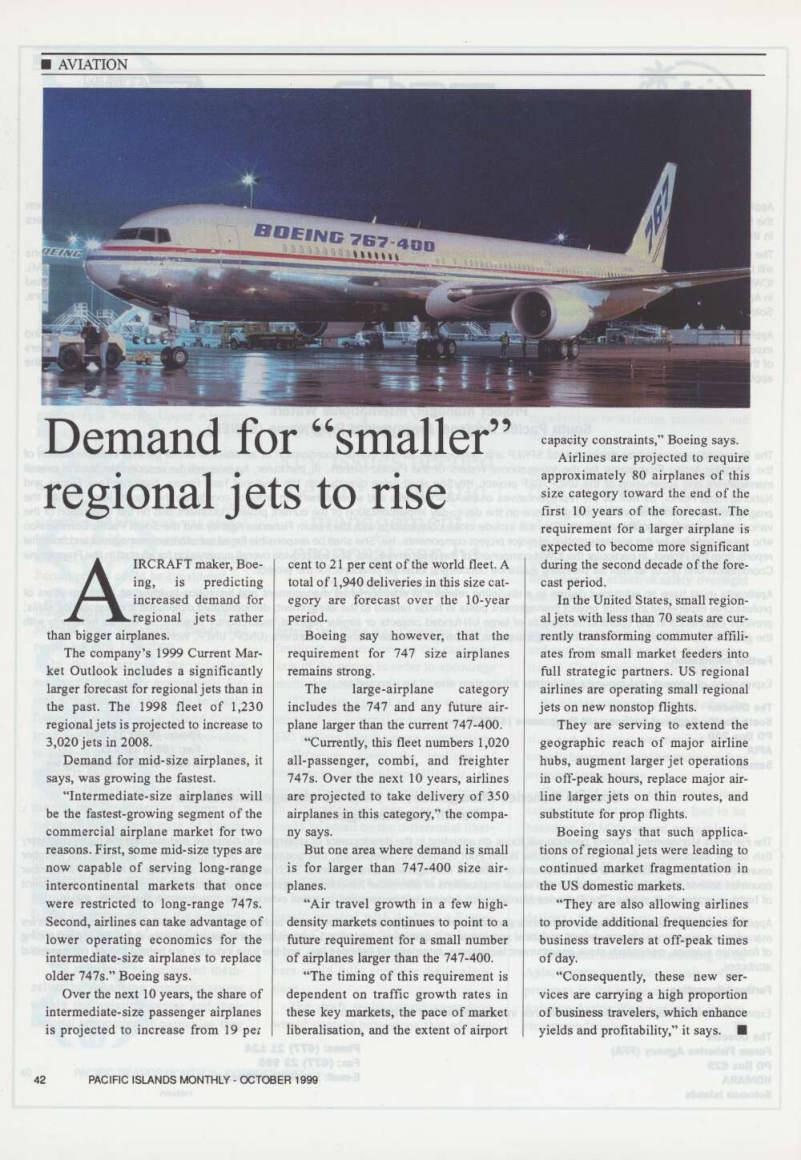
Aviation
Demand for “smaller” regional jets to rise
AIRCRAFT maker, Boe ing, is predicting increased demand for
regional jets rather
than bigger airplanes.
The company’s 1999 Current Mar ket Outlook includes a significantly larger forecast for regional jets than in the past. The 1998 fleet of 1,230 regional jets is projected to increase to 3,020 jets in 2008.
Demand for mid-size airplanes, it says, was growing the fastest.
“Intermediate-size airplanes will be the fastest-growing segment of the commercial airplane market for two reasons. First, some mid-size types are now capable of serving long-range intercontinental markets that once were restricted to long-range 7475.
Second, airlines can take advantage of lower operating economics for the
intermediate-size airplanes to replace
older 7475.” Boeing says.
Over the next 10 years, the share of intermediate-size passenger airplanes is projected to increase from 19 pet
capacity constraints,” Boeing says.
Airlines are projected to require approximately 80 airplanes of this size category toward the end of the first 10 years of the forecast. The requirement for a larger airplane is expected to become more significant during the second decade of the fore cast period.
In the United States, small region al jets with less than 70 seats are cur rently transforming commuter affili ates from small market feeders into full strategic partners. US regional airlines are operating small regional jets on new nonstop flights.
They are serving to extend the geographic reach of major airline hubs, augment larger jet operations in off-peak hours, replace major air line larger jets on thin routes, and substitute for prop flights.
Boeing says that such applica tions of regional jets were leading to continued market fragmentation in the US domestic markets.
“They are also allowing airlines to provide additional frequencies for business travelers at off-peak times
of day.
“Consequently, these new ser
vices are carrying a high proportion
of business travelers, which enhance yields and profitability,” it says. ■
cent to 21 per cent of the world fleet. A total of 1,940 deliveries in this size cat egory are forecast over the 10-year
period.
Boeing say however, that the requirement for 747 size airplanes remains strong.
The large-airplane category includes the 747 and any future air plane larger than the current 747-400.
“Currently, this fleet numbers 1,020 all-passenger, combi, and freighter 7475. Over the next 10 years, airlines are projected to take delivery of 350 airplanes in this category,” the compa ny says.
But one area where demand is small is for larger than 747-400 size air planes.
“Air travel growth in a few high density markets continues to point to a future requirement for a small number of airplanes larger than the 747-400.
“The timing of this requirement is dependent on traffic growth rates in these key markets, the pace of market liberalisation, and the extent of airport
ANSETT Worldwide
places new 737s with Aloha Airlines
Aviation Services has leased two new Boeing 737-700 s to Hawaii-based Aloha Airlines which intends using the aircraft to launch flights to the US mainland.
The Next Generation 737 s are part of a five-plane Ansett Worldwide order.
The first, configured with 12 first class and 112 economy seats, will enter service in mid-November and joins 19 737-200 s in the Aloha fleet. The second -700 will be delivered in December.
Ansett Worldwide is a joint venture of the TNT Post Group N.V., the Dutch postal and transport company, and the News Corporation, the international multi-media company.
Ansett Worldwide is the world’s third largest aircraft-operating lessor, with more than 100 modern jet trans port aircraft in its leasing portfolio.
“The leading edge technology of these airplanes opens a number of new business opportunities for Aloha,” saod Glenn Zander, Aloha president and chief operating officer. “We were pleased to do buisness with Ansett Worldwide to ensure the smooth intro duction of a new type into our fleet.”
Charles Graham, chief executive officer of Ansett worldwide said: “This Aloha deal is a good example of what we do best. We were able to identify Aloha’s requiremnet and supply these two aircraft within a strict timetable.
Aloha is a new customer and we look forward to helping this airline grow its business.” ■
Advertisements & other items, p. 43 (1 item)
Hook Up With The Leader!
Pacific Ocean Producers
is the leader in
monofilament longline
system technology.
We offer special service to the South Pacific Islands, Australia and New Zealand. • Lindgren-Pitman gear, complete hydraulic systems, design and installation or monofilament longline systems including operations training. • Extensive Tuna and Swordfish supplies, bottom fishing gear, fish handling supplies and bait. • Duralumes Lightstick - the latest in lightsticks technology, extended light output, often used two nights, 5-year shelf life, not affected by moisture, easy-to- handle shipping carton. All popular colors available - green, blue, pink, yellow, white, violet and ultra-violet for best fishing results. • Wide selection of trolling equipment: over 180 different colors of trolling skirts and a large selection of lure heads/ • Weekly shipments to the South Pacific Islands, Australia and New Zealand.
FREE CATALOG AVAILABLE ON REQUEST
Please direct all inquiries to the Export Department: 965-B North Nimitz Highway Honolulu, HI 96817, USA.
Telephone: (808) 537-2905 Facsimile: (808) 536-3225 Shop on line for your convenience; www.pop-hawaii.com Toll Free Number 1-800-144-488 A
Pacific
Ocean
Producers
PTC2000: A new vision for the 21st century
Advertising Feature
THE Pacific Telecommunica tions Council (PTC) is an international non-profit, non
governmental membership
organisation, with members from the four comers of the Earth, that was founded in Honolulu in 1980 to bring together all those who have an interest in telecommu nications in the vast Pacific Hemisphere. It serves the digital information age through a major annual conference, regional semi nars, a respected quarterly magazine and a variety of other activities.
The annual Pacific Telecommunica tions Conference is held each year In Janu ary and has grown to become one of the most important regular events held in Hawaii. Its impact extends far beyond the more than 1,600 participants who attend, as it serves to focus the attention of the
major providers, operators, manufacturers,
policy-makers, regulators, technologists, lawyers, scientists, academics and others who share an interest in the development and beneficial use of telecommunications in the region. Worldwide membership with more than 600 members has grown steadi ly for the past 20 years.
The Board of Trustees, the supreme body of the organisation, is elected by the members based on an allocation of seats by type of member and by region to assure representation of a broad cross-section of the membership. The Executive Board is chosen by the Board of Trustees, which also appoints Chairs and Vice-chairs o head several standing and ad hoc committees.
Reflecting the breadth of the organisation, Presidents and Chairs have come from Mexico, the USA, Canada, Japan, Aus tralia, Korea, New Zealand and Hong Kong. Chris Vonwiller of Australia is presently chairman of the Board of Trustees and Jane Hurd of the United States is PTC’s President. Other officers and committee chairs represent a cross-sec tion of the Pacific Hemisphere.
In these times, when even Chief Execu tive Officers must deal with responses
from impersonal automated telephone
answering systems, the Council prides itself on being a “people-centred” organi sation. The personal contacts formed through the Council in the amicable and informal environment of the annual confer ence and seminars are a primary benefit of
membership.
In many ways, the PTC is unique in the world of telecommunications, broadcast ing, informatics, and digital media. It serves as a focal point and a meeting place to iron out otherwise intractable problems and to transact business. In short, PTC is the place to be in the world’s most dynam ic growth region in telecommunications.
PIC2OOO - A New Vision for the
21st Century
PTC’s 22nd annual Pacific Telecommu nications Conference, PTC2OOO, will open in Honolulu on Sunday, January 30, 2000, at the Hilton Hawaiian village in the heart of Waikiki. The four-day event is one of the largest conferences that takes place every year in Hawaii.
Internet emphasis
The advent of the Internet has funda mentally changed the nature of this confer ence. At PTC’99, about 80 per cent of the sessions included some reference to the Internet or technology associated with the Internet, whereas only six years ago, the Internet did not even appear in the subject index of the Proceedings.
One of the hallmarks of PTC’s annual conference is the availability of the confer
ence Proceedings to all participants during
the conference. At PTC’99, for the first time, there were no printed Proceedings.
Instead, presentations were available dur ing the conference on PlanetPTC (www.ptc.org) for attendees and members and were sent out in CD-ROM format to all registered participants after the confer ence. Plenary sessions and super sessions were Webcast, thereby opening a window to the world from Waikiki. Similar arrange ments are foreseen for PTC2OOO.
Submarine cablet Submarine cable systems provide Hawaii’s lifelines to the world. Partly
because of Hawaii’s location as a land ing and transit place for several existing and planned trans-Pacific cables, PTC’s annual conference attracts more sessions on submarine cables and systems than most telecommunications conferences.
A round table on submarine and fibre optic systems will be featured at PTC2OOO as well as a concurrent ses sion.
Hot topics
The conference will include al topics of current interest in telecommunications and the other convergence industries, special attention will be given the topic of Regulatory issues and the Internet.
Workshops and panels will also focus on a number of country, regional o global issues and means for financing needed developments. More than 1700 regis tered participants are expected at PTC2OOO. A much greater number of visitors will view the exhibits, which are open to the public. Such a large event now attracts numerous peripheral activi ties sponsored by related organisation, as well as PTC executive and committee that will be held on January 30. Social activities are always well-attended.
PTC2OOO will feature a Super Bowl Party and a lively opening reception on the lagoon lawn, the Web broadcast from PTC’s Planet PTC web site of Plenary and other major sessions will open a global window on the conference. Con ference information and on-line registra tion are available at
http://www.ptc.org/confindex.hlml.
New members who join before the conference receive a substantial reduc tion in the conference registration fee.
Other important benefits available to members include the PTCWeb Mem bers’ Bulletin, which brings up-to-the minute news on developments in the convergence industries every two weeks, the PTR (Pacific Telecommunications Review) quarterly journal of the Coun cil, and an online Membership Directo ry- ■
French
Development
Flosse warns Nuclear Free and Independent Pacific conference
Polyne
sia’s pres ide n t Gaston Flosse warned
the Nuclear Free and Independent Pacific conference, held in Pape’ete late last month, not to interfere in politics, Radio One reported.
Flosse, in an interview with the pri vate radio, welcomed the conference which took place for the first in French
Polynesia.
“I say welcome, maeva, that is if they come here to visit our country, meet the French Polynesians and look at our liv ing standards, social progress. If this is so, that’s good, but if they came here to lecture us or interfere in our country’s politics, I say ‘this is not your place’.”
The Bth NFIP conference, organised by the Fiji-based Pacific Concerns Resource Center (PCRC), was held over six days with a hundred delegates from the Pacific islands and beyond attend
ing.
This year’s theme was “For justice, for truth and for independence”. Pro independence leader Oscar Temaru’s Tavini party was the host. Topics dis cussed included self-determination for
the French Pacific territories and the legacy of nuclear testing in the region, organiser Nick Maclellan said.
“Former workers, military personnel who served at the bases, face many problems. As we come to the end of the decade, it’s also the end of the UN has declared as the decade for the eradica tion of colonialism around the world.
Yet sadly there are still many Pacific countries that haven’t achieved their right to self-determination.”
“The NFIP Movement has tried to organise a conference here in Te Ao Maohi since 1980 but was not allowed.
We tried to organise a conference here in 1983, it was not possible.
“We tried again in 1990, it was not possible. In 1991 we tried to have an executive board meeting here, it still was not possible. In 1994 we tried again, it was not possible. This is the first time it has been possible for us to organise a major conference here,”
PCRC director Lopeti Senituli said.
“So this is a historic occasion. It is also historic in the other sense that the NFIP Movement was founded in 1975, the year that East Timor was invaded by Indonesia.
“In 1999 East Timor for the first time exercised their right to self-deter mination. The question is, when will the people of French-occupied Polynesia be allowed to exercise their right to self determination?”
But Flosse countered; “Most of them do not know French Polynesia. They might have been led to believe that the French Polynesian people live in chains and misery. So let them have a look around, let them talk to the French Polynesians, I think this will be an eye opener for them.”
“I’m asking those from the Pacific island countries: who among you has a comprehensive medical, health and communication coverage like ours ?
Who has a minimum wage of 100.000 CFP (1,000 US dollars) per month? So I say wel come, look around and
tell everyone back home what you saw.
This country is denuclearised. This country is decolonised.
“I was the one who went to Fiji to sign the Rarotonga Treaty on behalf of France. We made the right choice.
French Polynesians made the right choice and they will stick to it,” Flosse said.
The NFIP Movement unites com munity based and non-government organisations from 25 countries around the region.
The Tahiti conference brought together representatives of the member organisations of the NFIP Movement: church groups, independence move ments, land rights activists, women’s
rights campaigners, environmental
groups and peace movements.
The first Nuclear Free Pacific Con ference was held in 1975 at the Univer sity of the South Pacific (USP) in Suva, Fiji. Since then, there have been con ferences in: Pohnpei, Federated States of Micronesia (1978); Honolulu, Hawaii (1980); Port Vila, Vanuatu
(1983); Manila, the Philippines (1987);
Pawarenga, Aotearoa / New Zealand (1990) and Suva, Fiji (1996).
Keynote speakers, panel discussions
and workshops focused on five major sub-themes: the struggle for self-deter mination and independence in the Pacific, into the new millennium, the new arms race in the Pacific, human Rights and good governance in the Pacific, globalisation and its impact on Pacific economies, conserving our environment for our children, a confer ence release said.
Temaru pointed out that although invited by the conference, French assis tant overseas minister Jean-Jack Queyranne, who was in Tahiti on an official visit during the conference, couldn’t attend due to a “ busy sched ule”. ■
Advertisements & other items, p. 45 (1 item)
I Engine I
WAREHOUSE
BMW
Bedford Cummins Daihatsu Detroit Deutz Ford Gardner Hmo Isuzu Iveco Komatsu Kubota
PHONE
643-6938122
FAX
643-6938120 mm New Zealand email: blairs9dear.net.NZ
NEW ARRIVALS
330, Cummins 504, Dentz' 4cly F 41913. Leyland 411 Turbo Lister STI, 513, HR3, Scania DSII- - Intercooled 354 hp, Mazda RF
Supercharger, Toyota 3CR, 3CT-EFI,
2C-11, 2L-11T-EFI, 3L, IW, IHDT-FTI-EFI
Intercooler, Isuzu 6881, 4BBDIT, Detroit 6V92 Silver Dismantling
MACK FR797 RST 6x4
Non-Govern
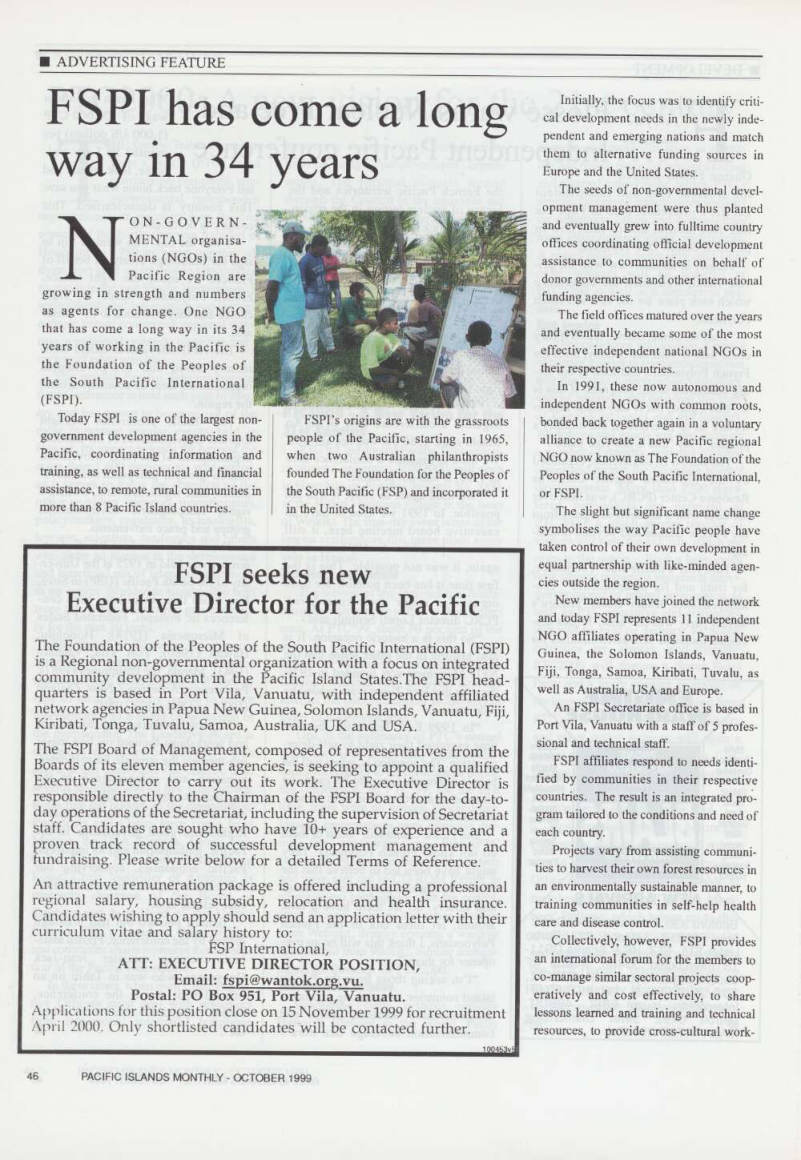
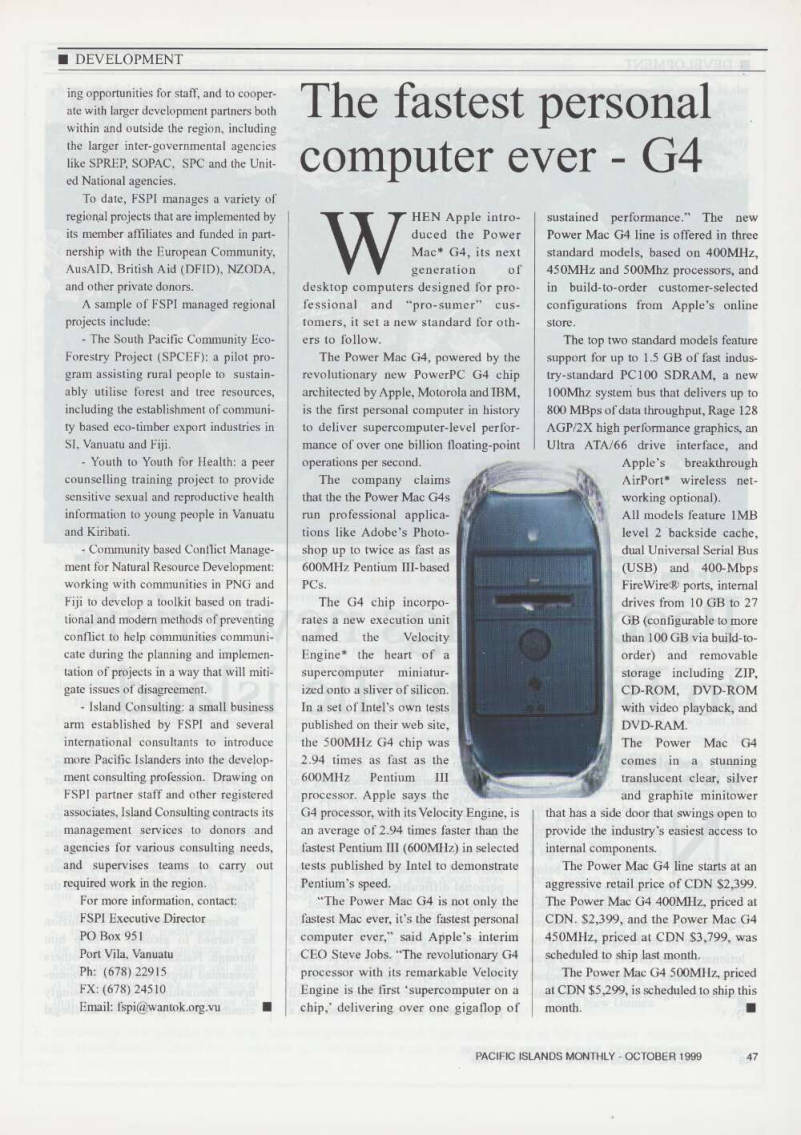
FSPI has come a long way in 34 years
MENTAL organisa tions (NGOs) in the Pacific Region are growing in strength and numbers as agents for change. One NGO that has come a long way in its 34 years of working in the Pacific is the Foundation of the Peoples of the South Pacific International
(Fspi).
Today FSPI is one of the largest non government development agencies in the Pacific, coordinating information and training, as well as technical and financial assistance, to remote, rural communities in more than 8 Pacific Island countries.
FSPI’s origins are with the grassroots people of the Pacific, starting in 1965, when two Australian philanthropists founded The Foundation for the Peoples of the South Pacific (FSP) and incorporated it in the United States.
Initially, the focus was to identify criti cal development needs in the newly inde pendent and emerging nations and match them to alternative funding sources in Europe and the United States.
The seeds of non-governmental devel opment management were thus planted and eventually grew into fulltime country offices coordinating official development assistance to communities on behalf of donor governments and other international
funding agencies.
The field offices matured over the years and eventually became some of the most effective independent national NGOs in their respective countries.
In 1991, these now autonomous and independent NGOs with common roots, bonded back together again in a voluntary alliance to create a new Pacific regional NGO now known as The Foundation of the Peoples of the South Pacific International, or FSPI.
The slight but significant name change symbolises the way Pacific people have taken control of their own development in equal partnership with like-minded agen cies outside the region.
New members have joined the network and today FSPI represents 11 independent NGO affiliates operating in Papua New Guinea, the Solomon Islands, Vanuatu, Fiji, Tonga, Samoa, Kiribati, Tuvalu, as well as Australia, USA and Europe.
An FSPI Secretariate office is based in Port Vila, Vanuatu with a staff of 5 profes sional and technical staff.
FSPI affiliates respond to needs identi fied by communities in their respective countries. The result is an integrated pro gram tailored to the conditions and need of each country.
Projects vary from assisting communi ties to harvest their own forest resources in an environmentally sustainable manner, to training communities in self-help health care and disease control.
Collectively, however, FSPI provides an international forum for the members to co-manage similar sectoral projects coop eratively and cost effectively, to share lessons learned and training and technical resources, to provide cross-cultural work
ing opportunities for staff, and to cooper ate with larger development partners both within and outside the region, including
the larger inter-governmental agencies
like SPREP, SOPAC, SPC and the Unit ed National agencies.
To date, FSPI manages a variety of regional projects that are implemented by its member affiliates and funded in part
nership with the European Community,
AusAID, British Aid (DFID), NZODA, and other private donors.
A sample of FSPI managed regional
projects include:
- The South Pacific Community Eco- Forestry Project (SPCEF): a pilot pro gram assisting rural people to sustain ably utilise forest and tree resources, including the establishment of communi ty based eco-timber export industries in SI, Vanuatu and Fiji. - Youth to Youth for Health: a peer
counselling training project to provide
sensitive sexual and reproductive health information to young people in Vanuatu and Kiribati. - Community based Conflict Manage ment for Natural Resource Development: working with communities in PNG and Fiji to develop a toolkit based on tradi tional and modern methods of preventing conflict to help communities communi
cate during the planning and implemen
tation of projects in a way that will miti gate issues of disagreement. - Island Consulting; a small business arm established by FSPI and several international consultants to introduce more Pacific I slanders into the develop ment consulting profession. Drawing on FSPI partner staff and other registered associates. Island Consulting contracts its management services to donors and agencies for various consulting needs, and supervises teams to carry out required work in the region.
For more information, contact: FSPI Executive Director PO Box 951 Port Vila, Vanuatu Ph: (678)22915 FX: (678) 24510 Email: [email protected] ■
Advertisements & other items, p. 46 (1 item)
Executive Director for the Pacific
FSPI seeks new
The Foundation of the Peoples of the South Pacific International (FSPI) is a Regional non-governmental organization with a focus on integrated community development in the Pacific Island States. The FSPI headquarters is based in Port Vila, Vanuatu, with independent affiliated network agencies in Papua New Guinea, Solomon Islands, Vanuatu, Fiji, Kiribati, Tonga, Tuvalu, Samoa, Australia, UK and USA.
The FSPI Board of Management, composed of representatives from the Boards of its eleven member agencies, is seeking to appoint a qualified Executive Director to carry out its work. The Executive Director is responsible directly to the Chairman of the FSPI Board for the day-today operations of the Secretariat, including the supervision of Secretariat staff. Candidates are sought who have 10+ years of experience and a proven track record of successful development management and fundraising. Please write below for a detailed Terms of Reference.
An attractive remuneration package is offered including a professional regional salary, housing subsidy, relocation and health insurance.
Candidates wishing to apply should send an application letter with their curriculum vitae and salary history to: FSP International,
ATT: EXECUTIVE DIRECTOR POSITION,
Email: [email protected].
Postal: PO Box 951, Port Vila, Vanuatu.
Applications for this position close on 15 November 1999 for recruitment April 2000. Only shortlisted candidates will be contacted further.
computer ever - G4
The fastest personal computer ever - G4
WHEN Apple intro duced the Power Mac* G 4, its next generation of desktop computers designed for pro fessional and “pro-sumer” cus tomers, it set a new standard for oth ers to follow.
The Power Mac G 4, powered by the revolutionary new PowerPC G 4 chip architected by Apple, Motorola and'lßM, is the first personal computer in history to deliver supercomputer-level perfor mance of over one billion floating-point operations per second.
The company claims that the the Power Mac G4s
run professional applica
tions like Adobe’s Photo shop up to twice as fast as 600 MHz Pentium 111-based PCs.
The G 4 chip incorpo
rates a new execution unit named the Velocity Engine* the heart of a supercomputer miniatur ized onto a sliver of silicon.
In a set of Intel’s own tests published on their web site, the 500 MHz G 4 chip was 2.94 times as fast as the 600 MHz Pentium 111 processor. Apple says the
G 4 processor, with its Velocity Engine, is an average of 2.94 times faster than the fastest Pentium 111 (600 MHz) in selected tests published by Intel to demonstrate Pentium’s speed.
“The Power Mac G 4 is not only the fastest Mac ever, it’s the fastest personal computer ever,” said Apple’s interim CEO Steve Jobs. “The revolutionary G 4 processor with its remarkable Velocity Engine is the first ‘supercomputer on a
chip,' delivering over one gigaflop of
sustained performance.” The new Power Mac G 4 line is offered in three standard models, based on 400 MHz, 450 MHz and 500Mhz processors, and in build-to-order customer-selected configurations from Apple’s online store.
The top two standard models feature support for up to 1.5 GB of fast indus try-standard PC 100 SDRAM, a new IOOMhz system bus that delivers up to 800 MBps of data throughput, Rage 128 AGP/2X high performance graphics, an Ultra ATA/66 drive interface, and
Apple’s breakthrough
AirPort* wireless net
working optional).
All models feature IMB level 2 backside cache, dual Universal Serial Bus (USB) and 400-Mbps FireWire® ports, internal drives from 10 GB to 27 GB (configurable to more than 100 GB via build-to order) and removable storage including ZIP,
Cd-Rom, Dvd-Rom
with video playback, and
Dvd-Ram.
The Power Mac G 4 comes in a stunning translucent clear, silver and graphite minitower
that has a side door that swings open to provide the industry’s easiest access to internal components.
The Power Mac G 4 line starts at an aggressive retail price of CDN $2,399.
The Power Mac G 4 400 MHz, priced at CDN. $2,399, and the Power Mac G 4 450 MHz, priced at CDN $3,799, was scheduled to ship last month.
The Power Mac G 4 500 MHz, priced at CDN $5,299, is scheduled to ship this month. ■
to Bougainville island
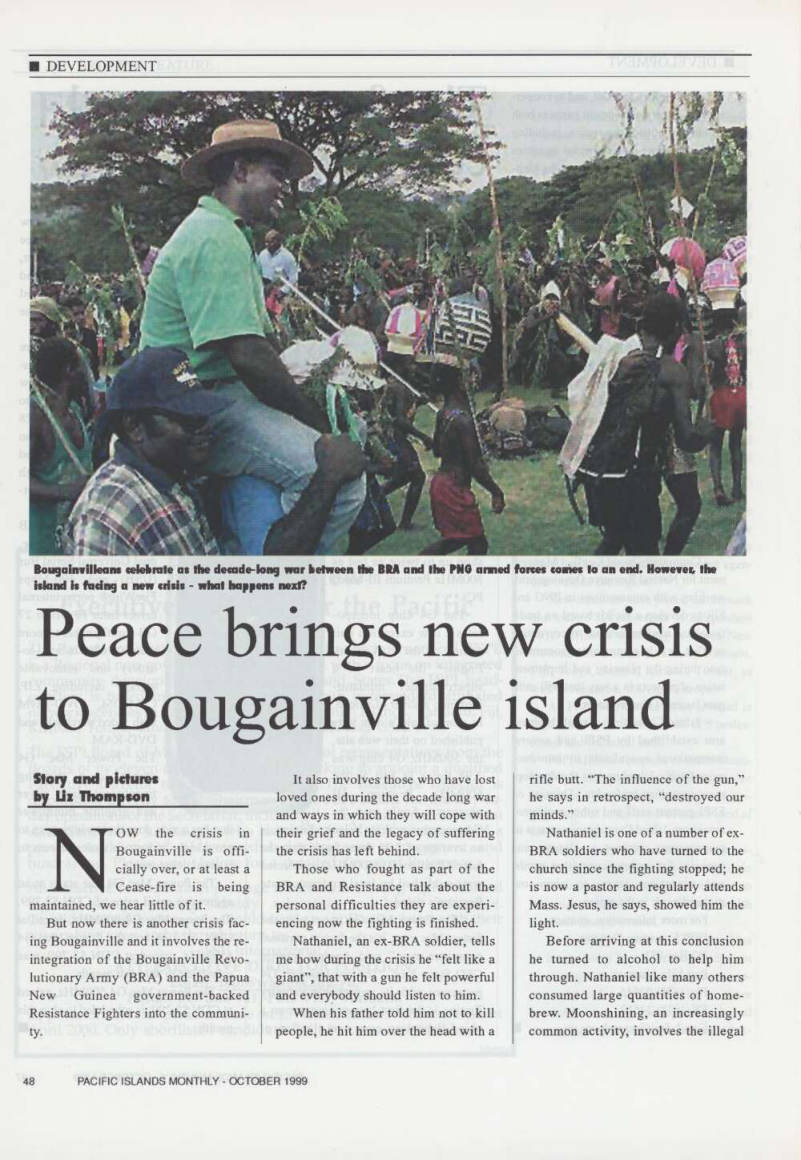
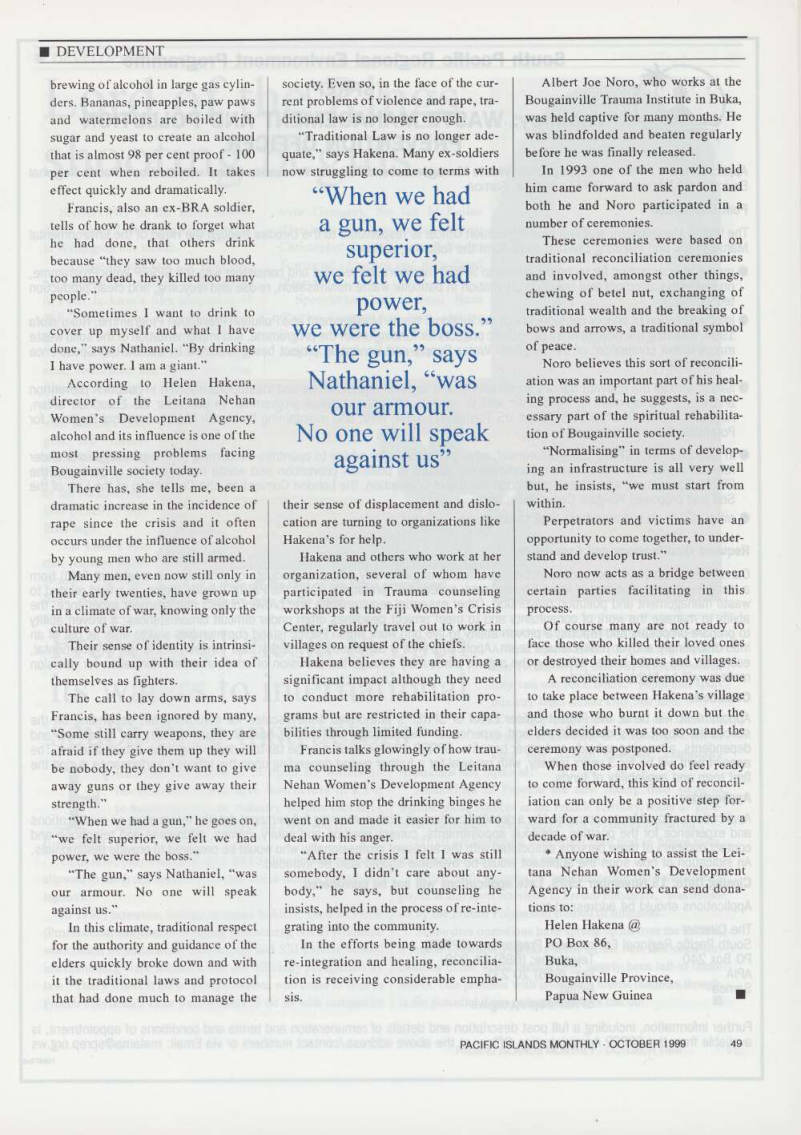
Peace brings new crisis to Bougainville island
Story and picture* by Ui Thompson
NOW the crisis in Bougainville is offi cially over, or at least a Cease-fire is being maintained, we hear little of it.
But now there is another crisis fac ing Bougainville and it involves the re integration of the Bougainville Revo lutionary Army (BRA) and the Papua New Guinea government-backed Resistance Fighters into the communi ty-
It also involves those who have lost loved ones during the decade long war and ways in which they will cope with their grief and the legacy of suffering the crisis has left behind.
Those who fought as part of the BRA and Resistance talk about the personal difficulties they are experi encing now the fighting is finished.
Nathaniel, an ex-BRA soldier, tells me how during the crisis he “felt like a giant”, that with a gun he felt powerful and everybody should listen to him.
When his father told him not to kill people, he hit him over the head with a
rifle butt. “The influence of the gun,” he says in retrospect, “destroyed our minds.”
Nathaniel is one of a number of ex- BRA soldiers who have turned to the church since the fighting stopped; he is now a pastor and regularly attends Mass. Jesus, he says, showed him the
light.
Before arriving at this conclusion he turned to alcohol to help him through. Nathaniel like many others consumed large quantities of home
brew. Moonshining, an increasingly
common activity, involves the illegal
Bougainvilleans celebrate as the decade-long war between the BRA and the PNG aimed forces conies to an end. However the island is facing a new crisis - what happens next?
brewing of alcohol in large gas cylin ders. Bananas, pineapples, paw paws and watermelons are boiled with sugar and yeast to create an alcohol that is almost 98 per cent proof - 100 per cent when reboiled. It takes
effect quickly and dramatically.
Francis, also an ex-BRA soldier, tells of how he drank to forget what he had done, that others drink because “they saw too much blood, too many dead, they killed too many
people.”
“Sometimes I want to drink to cover up myself and what I have done,” says Nathaniel. “By drinking I have power. I am a giant.”
According to Helen Hakena, director of the Leitana Nehan Women’s Development Agency, alcohol and its influence is one of the most pressing problems facing
Bougainville society today.
There has, she tells me, been a dramatic increase in the incidence of rape since the crisis and it often occurs under the influence of alcohol by young men who are still armed.
Many men, even now still only in their early twenties, have grown up in a climate of war, knowing only the culture of war.
Their sense of identity is intrinsi cally bound up with their idea of themselves as fighters.
The call to lay down arms, says Francis, has been ignored by many, “Some still carry weapons, they are afraid if they give them up they will be nobody, they don’t want to give away guns or they give away their
strength.”
“When we had a gun,” he goes on, “we felt superior, we felt we had power, we were the boss.”
“The gun,” says Nathaniel, “was our armour. No one will speak against us.”
In this climate, traditional respect for the authority and guidance of the elders quickly broke down and with it the traditional laws and protocol that had done much to manage the
society. Even so, in the face of the cur rent problems of violence and rape, tra ditional law is no longer enough.
“Traditional Law is no longer ade quate,” says Hakena. Many ex-soldiers now struggling to come to terms with
“When we had a gun, we felt
superior,
we felt we had power, we were the boss.”
“The gun,” says Nathaniel, “was our armour.
No one will speak against us”
their sense of displacement and dislo cation are turning to organizations like Hakena’s for help.
Hakena and others who work at her organization, several of whom have participated in Trauma counseling workshops at the Fiji Women’s Crisis Center, regularly travel out to work in villages on request of the chiefs.
Hakena believes they are having a significant impact although they need to conduct more rehabilitation pro grams but are restricted in their capa bilities through limited funding.
Francis talks glowingly of how trau ma counseling through the Leitana Nehan Women’s Development Agency helped him stop the drinking binges he went on and made it easier for him to deal with his anger.
“After the crisis I felt I was still somebody, I didn’t care about any body,” he says, but counseling he insists, helped in the process of re-inte
grating into the community.
In the efforts being made towards
re-integration and healing, reconcilia
tion is receiving considerable empha sis.
Albert Joe Noro, who works at the Bougainville Trauma Institute in Buka, was held captive for many months. He was blindfolded and beaten regularly before he was finally released.
In 1993 one of the men who held him came forward to ask pardon and both he and Noro participated in a number of ceremonies.
These ceremonies were based on traditional reconciliation ceremonies and involved, amongst other things, chewing of betel nut, exchanging of traditional wealth and the breaking of bows and arrows, a traditional symbol of peace.
Noro believes this sort of reconcili ation was an important part of his heal ing process and, he suggests, is a nec essary part of the spiritual rehabilita tion of Bougainville society.
“Normalising” in terms of develop ing an infrastructure is all very well but, he insists, “we must start from within.
Perpetrators and victims have an opportunity to come together, to under stand and develop trust.”
Noro now acts as a bridge between certain parties facilitating in this process.
Of course many are not ready to face those who killed their loved ones or destroyed their homes and villages.
A reconciliation ceremony was due to take place between Hakena’s village and those who burnt it down but the elders decided it was too soon and the ceremony was postponed.
When those involved do feel ready to come forward, this kind of reconcil iation can only be a positive step for ward for a community fractured by a decade of war. * Anyone wishing to assist the Lei tana Nehan Women's Development Agency in their work can send dona tions to: Helen Hakena @ PO Box 86, Buka,
Bougainville Province,
Papua New Guinea ■
Advertisements & other items, p. 50 (1 item)
(Sprep)
South Pacific Regional Environment Programme
Vacancy: WASTE MANAGEMENT AND POLLUTION
PREVENTION OFFICER
Applications are invited for the position of Waste Management and Pollution Prevention Officer with the South Pacific Regional Environment Pogramme (SPREP) in Apia, Samoa.
Post Description The Waste Management and Pollution Prevention Officer is responsible to the Director through the Head of the Environmental Management and Planning Division to perform the following duties: • providing or arranging for technical advice to SPREP members, on request and consistent with the SPREP Work Programme, on waste management and pollution prevention in paticular waste minimisation, re-use and recycling, and clean production technology. • implementation of priority components of the Regional Waste Management and Pollution Prevention Programme, Nuku’alofa 1994, including the development of specific projects for funding under the programme, and implementation of the solid waste management component of the Regional Water Supply and Sanitation project being executed by the SOPAC Geoscience Commission. • liaison with all the relevant donors, international and regional organisations and institutions involved in pollution prevention and waste management in the Pacific and in implementing the regional programme, in particular the European Union, Australia, NZ WHO, UNEP, USEPA (of US Territories), lAEA, IMO, and maintaining links with the International Register for Potentially Toxic Chemicals; • in conjuction with SPREP’s Legal Counsel, advise or arrange for advice to countries concerning their legal obligations under relevant regional and international conventions related to pollution prevention and waste management, in particular the SPREP Convention, and related protocols, the Basel Convention, the London Convention, the Convention of the Law of the Sea and proposed Waigani Convention: and • other duties as required from time to time.
Required Qualifications and Experience Candidates must have appropriate tertiary qualifications (preferably with post-graduate qualifications in a relevant field) from a recognised institution and at least 5 years’ work experience, preferably within the Pacific islands region, in a field related to waste management and pollution prevention. Other essential requirements are: proven project management experience: the ability to manage the work of consultants and to meet project deadlines often under difficult circumstances: a proven ability to prepare proposals and reports: a proven ability to live and work within Pacific island communities and to work as pat of an inter-disciplinary and/or multi-cultural team. Applicants with a demonstrated interest and involvement in the environmental, economic and social issues affecting the region, particularly through the provision of environmental information for decision makers, will be highly regarded.
Conditions Appointment will be at the Project Officer Level of SPREP’s authorised salary scales for contract staff, depending on the successful applicant’s qualifications and experience. The package will include annual return airfares for appointee and dependents, a housing subsidy and other benefits. SPREP remuneration may be tax-free depending upon circumstances. The appointment will be for 3 years initially, with renewal for a further period depending upon the officer’s performance during the first term and availability of funds.
Applications Applications should be accompanied by a detailed curriculum vitae containing full personal details, information on qualifications and experience for the position, previous appointments, current position and salary, names, addresses and telephone and contact numbers of three persons associated with the applicant professionally, who would be prepared to provide testimonials.
An indication of how soon the applicant would be available should also be included.
Closing Date: 15 November 1999. Late applications will not be considered.
Applications should be addressed to; The Director South Pacific Regional Environment Programme (SPREP) PO Box 240 Telephone: (685) 21 929
APIA Fax: (685) 20 231
Samoa E-mail: [email protected]. ws Further information, including a full post description and details of remuneration and terms and conditions of appointment, is available from the SPREP Administration Officer at the above address/contact numbers or via Email: [email protected]
shooting begins
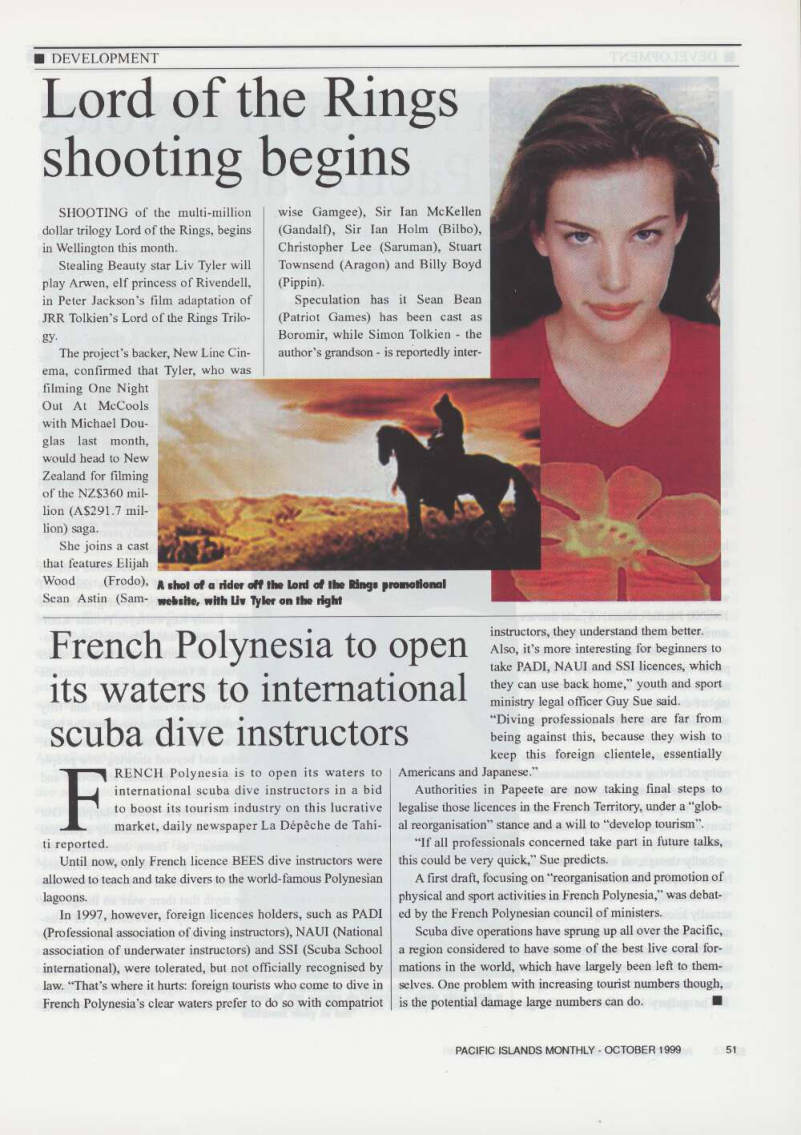
Lord of the Rings shooting begins
SHOOTING of the multi-million dollar trilogy Lord of the Rings, begins in Wellington this month.
Stealing Beauty star Liv Tyler will play Arwen, elf princess of Rivendell, in Peter Jackson’s film adaptation of JRR Tolkien’s Lord of the Rings Trilo gy- The project’s backer. New Line Cin ema, confirmed that Tyler, who was
filming One Night Out At McCools with Michael Dou glas last month, would head to New Zealand for filming of the NZ$36O mil lion (A 5291.7 mil lion) saga.
She joins a cast that features Elijah Wood (Frodo), Sean Astin (Sam
wise Gamgee), Sir lan McKellen (Gandalf), Sir lan Holm (Bilbo), Christopher Lee (Saruman), Stuart Townsend (Aragon) and Billy Boyd (Pippin).
Speculation has it Sean Bean (Patriot Games) has been cast as Boromir, while Simon Tolkien - the author’s grandson - is reportedly inter-
A shot of a rider off The Lord of the Rings promotional website, with Liv Tyler on the right
scuba dive instructors
French Polynesia to open its waters to international scuba dive instructors
FRENCH Polynesia is to open its waters to international scuba dive instructors in a bid to boost its tourism industry on this lucrative market, daily newspaper La Depeche de Tahi ti reported.
Until now, only French licence BEES dive instructors were allowed to teach and take divers to the world-famous Polynesian lagoons.
In 1997, however, foreign licences holders, such as PADI (Professional association of diving instructors), NAUI (National association of underwater instructors) and SSI (Scuba School international), were tolerated, but not officially recognised by law. “That’s where it hurts: foreign tourists who come to dive in French Polynesia’s clear waters prefer to do so with compatriot
instructors, they understand them better.
Also, it’s more interesting for beginners to take PADI, NAUI and SSI licences, which they can use back home,” youth and sport ministry legal officer Guy Sue said.
“Diving professionals here are far from being against this, because they wish to keep this foreign clientele, essentially
Americans and Japanese.”
Authorities in Papeete are now taking final steps to legalise those licences in the French Territory, under a “glob al reorganisation” stance and a will to “develop tourism”.
“If all professionals concerned take part in future talks, this could be very quick,” Sue predicts.
A first draft, focusing on “reorganisation and promotion of physical and sport activities in French Polynesia,” was debat ed by the French Polynesian council of ministers.
Scuba dive operations have sprung up all over the Pacific, a region considered to have some of the best live coral for mations in the world, which have largely been left to them selves. One problem with increasing tourist numbers though, is the potential damage large numbers can do. ■
Australian Museum devotes
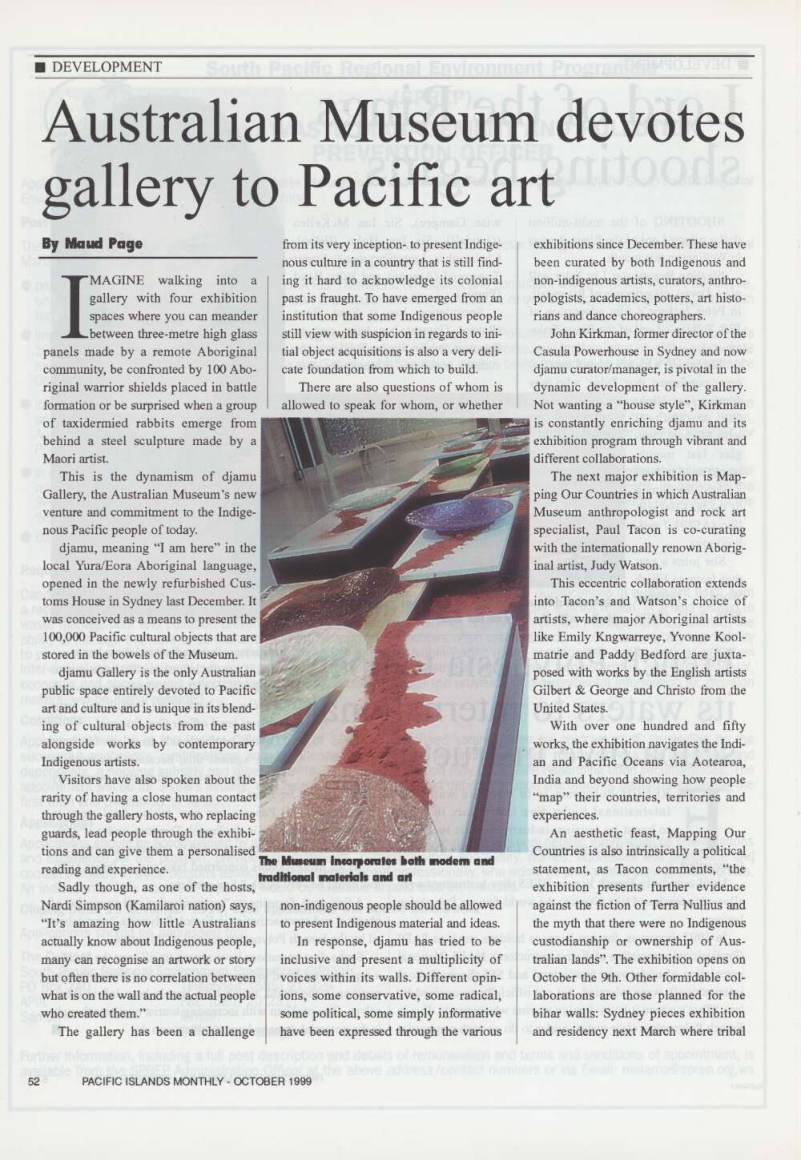
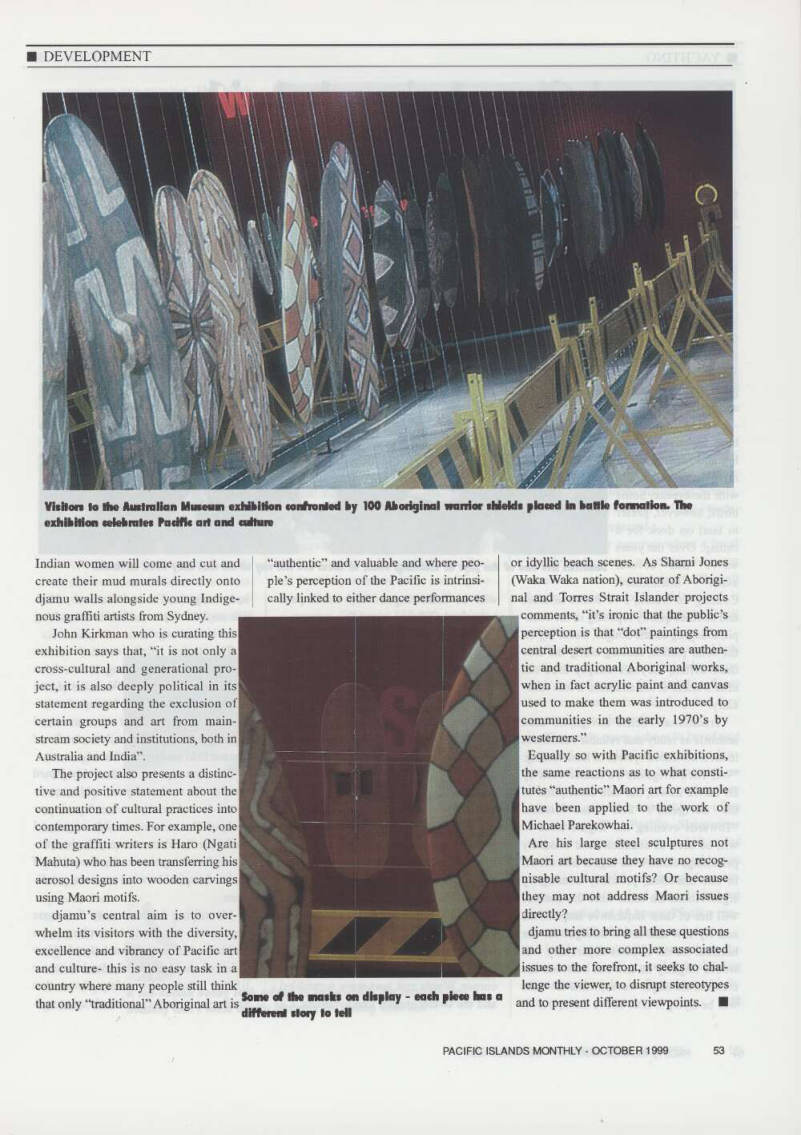
gallery to Pacific art
By Maud Page
IMAGINE walking into a gallery with four exhibition spaces where you can meander between three-metre high glass panels made by a remote Aboriginal community, be confronted by 100 Abo riginal warrior shields placed in battle formation or be surprised when a group of taxidermied rabbits emerge from behind a steel sculpture made by a Maori artist.
This is the dynamism of djamu Gallery, the Australian Museum’s new venture and commitment to the Indige nous Pacific people of today. djamu, meaning “I am here” in the local Yura/Eora Aboriginal language, opened in the newly refurbished Cus toms House in Sydney last December. It was conceived as a means to present the 100,000 Pacific cultural objects that are stored in the bowels of the Museum. djamu Gallery is the only Australian public space entirely devoted to Pacific art and culture and is unique in its blend ing of cultural objects from the past alongside works by contemporary Indigenous artists.
Visitors have also spoken about the rarity of having a close human contact through the gallery hosts, who replacing guards, lead people through the exhibi tions and can give them a personalised reading and experience.
Sadly though, as one of the hosts, Nardi Simpson (Kamilaroi nation) says, “It’s amazing how little Australians actually know about Indigenous people, many can recognise an artwork or story but often there is no correlation between what is on the wall and the actual people who created them.”
The gallery has been a challenge
from its very inception- to present Indige nous culture in a country that is still find ing it hard to acknowledge its colonial past is fraught. To have emerged from an institution that some Indigenous people still view with suspicion in regards to ini tial object acquisitions is also a very deli cate foundation from which to build.
There are also questions of whom is allowed to speak for whom, or whether
non-indigenous people should be allowed to present Indigenous material and ideas.
In response, djamu has tried to be inclusive and present a multiplicity of voices within its walls. Different opin ions, some conservative, some radical, some political, some simply informative have been expressed through the various
exhibitions since December. These have been curated by both Indigenous and non-indigenous artists, curators, anthro pologists, academics, potters, art histo rians and dance choreographers.
John Kirkman, former director of the Casula Powerhouse in Sydney and now
djamu curator/manager, is pivotal in the
dynamic development of the gallery.
Not wanting a “house style”, Kirkman ! is constantly enriching djamu and its i exhibition program through vibrant and [ different collaborations.
The next major exhibition is Map ping Our Countries in which Australian Museum anthropologist and rock art specialist, Paul Tacon is co-curating with the internationally renown Aborig inal artist, Judy Watson.
This eccentric collaboration extends into Tacon’s and Watson’s choice of artists, where major Aboriginal artists like Emily Kngwarreye, Yvonne Kool matrie and Paddy Bedford are juxta posed with works by the English artists Gilbert & George and Christo from the United States.
With over one hundred and fifty works, the exhibition navigates the Indi an and Pacific Oceans via Aotearoa, India and beyond showing how people “map” their countries, territories and
experiences.
An aesthetic feast. Mapping Our Countries is also intrinsically a political statement, as Tacon comments, “the exhibition presents further evidence against the fiction of Terra Nullius and the myth that there were no Indigenous custodianship or ownership of Aus tralian lands”. The exhibition opens on October the 9th. Other formidable col laborations are those planned for the bihar walls: Sydney pieces exhibition and residency next March where tribal
The Museum incorporates both modem and traditional materials and art
Indian women will come and cut and create their mud murals directly onto djamu walls alongside young Indige nous graffiti artists from Sydney.
John Kirkman who is curating this exhibition says that, “it is not only a cross-cultural and generational pro ject, it is also deeply political in its statement regarding the exclusion of certain groups and art from main stream society and institutions, both in Australia and India”.
The project also presents a distinc-1 tive and positive statement about the continuation of cultural practices into contemporary times. For example, one of the graffiti writers is Haro (Ngati Mahuta) who has been transferring his aerosol designs into wooden carvings using Maori motifs. djamu’s central aim is to over whelm its visitors with the diversity, excellence and vibrancy of Pacific art and culture- this is no easy task in a country where many people still think that only “traditional” Aboriginal art is '
“authentic” and valuable and where peo ple’s perception of the Pacific is intrinsi cally linked to either dance performances
or idyllic beach scenes. As Shami Jones (Waka Waka nation), curator of Aborigi nal and Torres Strait Islander projects
comments, “it’s ironic that the public’s perception is that “dot” paintings from central desert communities are authen tic and traditional Aboriginal works, when in fact acrylic paint and canvas used to make them was introduced to communities in the early 1970’s by westerners.”
Equally so with Pacific exhibitions, the same reactions as to what consti tutes “authentic” Maori art for example have been applied to the work of Michael Parekowhai.
Are his large steel sculptures not Maori art because they have no recog nisable cultural motifs? Or because they may not address Maori issues
directly?
djamu tries to bring all these questions and other more complex associated ! issues to the forefront, it seeks to chal
lenge the viewer, to disrupt stereotypes an( j to present different viewpoints. ■
Visitors to the Australian Museum exhibition confronted by 100 Aboriginal warrior shields placed in battle formation. The exhibition celebrates Pacific art and culture
Some of the masks an display - each piece has a different story to tell
Sailing
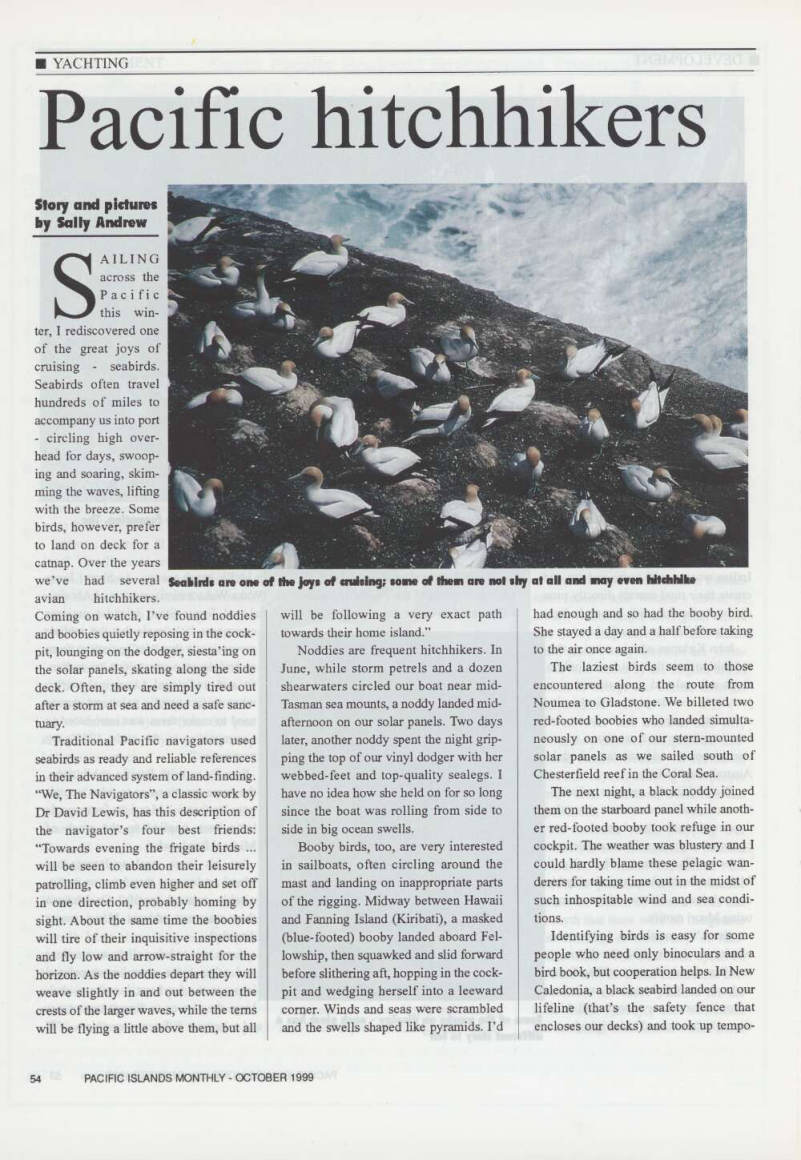
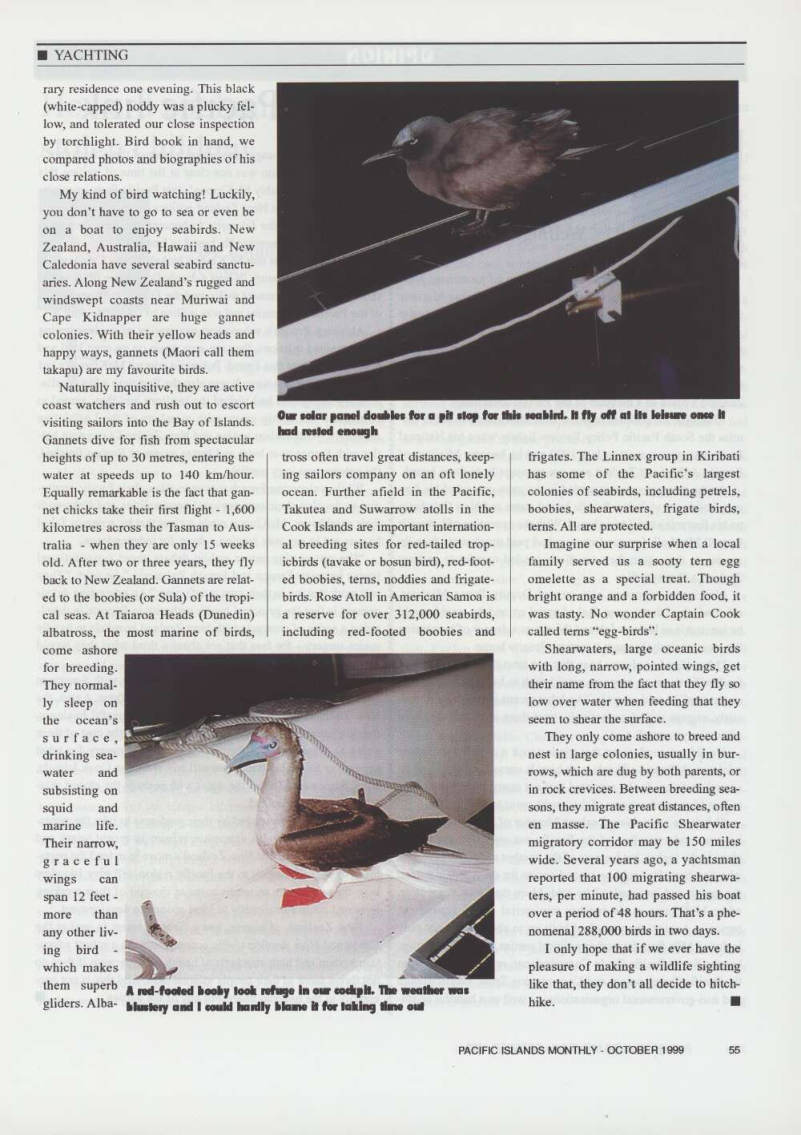
Yachting
Pacific hitchhikers
Story and pictures by Sally Andrew
Sailing
across the Pacific this win ter, I rediscovered one of the great joys of cruising - seabirds.
Seabirds often travel hundreds of miles to accompany us into port - circling high over head for days, swoop ing and soaring, skim ming the waves, lifting with the breeze. Some birds, however, prefer to land on deck for a catnap. Over the years we’ve had several avian hitchhikers.
Coming on watch, I’ve found noddies and boobies quietly reposing in the cock pit, lounging on the dodger, siesta’ing on the solar panels, skating along the side deck. Often, they are simply tired out after a storm at sea and need a safe sanc tuary.
Traditional Pacific navigators used seabirds as ready and reliable references in their advanced system of land-finding.
“We, The Navigators”, a classic work by Dr David Lewis, has this description of the navigator’s four best friends: “Towards evening the frigate birds ... will be seen to abandon their leisurely patrolling, climb even higher and set off in one direction, probably homing by sight. About the same time the boobies will tire of their inquisitive inspections and fly low and arrow-straight for the horizon. As the noddies depart they will weave slightly in and out between the crests of the larger waves, while the terns will be flying a little above them, but all
will be following a very exact path towards their home island.”
Noddies are frequent hitchhikers. In June, while storm petrels and a dozen shearwaters circled our boat near mid- Tasman sea mounts, a noddy landed mid afternoon on our solar panels. Two days later, another noddy spent the night grip ping the top of our vinyl dodger with her webbed-feet and top-quality sealegs. I have no idea how she held on for so long since the boat was rolling from side to side in big ocean swells.
Booby birds, too, are very interested in sailboats, often circling around the mast and landing on inappropriate parts of the rigging. Midway between Hawaii and Fanning Island (Kiribati), a masked (blue-footed) booby landed aboard Fel lowship, then squawked and slid forward before slithering aft, hopping in the cock pit and wedging herself into a leeward corner. Winds and seas were scrambled and the swells shaped like pyramids. I’d
had enough and so had the booby bird.
She stayed a day and a half before taking to the air once again.
The laziest birds seem to those encountered along the route from Noumea to Gladstone. We billeted two red-footed boobies who landed simulta neously on one of our stern-mounted solar panels as we sailed south of Chesterfield reef in the Coral Sea.
The next night, a black noddy joined them on the starboard panel while anoth er red-footed booby took refuge in our cockpit. The weather was blustery and I could hardly blame these pelagic wan derers for taking time out in the midst of such inhospitable wind and sea condi tions.
Identifying birds is easy for some people who need only binoculars and a bird book, but cooperation helps. In New Caledonia, a black seabird landed on our lifeline (that’s the safety fence that encloses our decks) and took up tempo
Seabirds are one of the Joys of crafting; tone of them are not shy at all and may even hitchhike
rary residence one evening. This black
(white-capped) noddy was a plucky fel
low, and tolerated our close inspection by torchlight. Bird book in hand, we
compared photos and biographies of his
close relations.
My kind of bird watching! Luckily, you don’t have to go to sea or even be on a boat to enjoy seabirds. New Zealand, Australia, Hawaii and New Caledonia have several seabird sanctu aries. Along New Zealand’s rugged and windswept coasts near Muriwai and Cape Kidnapper are huge gannet colonies. With their yellow heads and happy ways, gannets (Maori call them takapu) are my favourite birds.
Naturally inquisitive, they are active coast watchers and rush out to escort visiting sailors into the Bay of Islands.
Gannets dive for fish from spectacular heights of up to 30 metres, entering the water at speeds up to 140 km/hour.
Equally remarkable is the fact that gan net chicks take their first flight - 1,600 kilometres across the Tasman to Aus tralia - when they are only 15 weeks old. After two or three years, they fly back to New Zealand. Gannets are relat ed to the boobies (or Sula) of the tropi cal seas. At Taiaroa Heads (Dunedin) albatross, the most marine of birds,
come ashore for breeding.
They normal ly sleep on the ocean’s surface, drinking sea water and subsisting on squid and marine life.
Their narrow, graceful wings can span 12 feet more than any other liv ing bird which makes them superb gliders. Alba-
tross often travel great distances, keep ing sailors company on an oft lonely ocean. Further afield in the Pacific, Takutea and Suwarrow atolls in the Cook Islands are important internation al breeding sites for red-tailed trop icbirds (tavake or bosun bird), red-foot ed boobies, terns, noddies and frigate birds. Rose Atoll in American Samoa is a reserve for over 312,000 seabirds, including red-footed boobies and
frigates. The Linnex group in Kiribati has some of the Pacific’s largest colonies of seabirds, including petrels, boobies, shearwaters, frigate birds, terns. All are protected.
Imagine our surprise when a local family served us a sooty tern egg omelette as a special treat. Though bright orange and a forbidden food, it was tasty. No wonder Captain Cook called terns “egg-birds”.
Shearwaters, large oceanic birds with long, narrow, pointed wings, get their name from the fact that they fly so low over water when feeding that they seem to shear the surface.
They only come ashore to breed and nest in large colonies, usually in bur rows, which are dug by both parents, or in rock crevices. Between breeding sea sons, they migrate great distances, often en masse. The Pacific Shearwater migratory corridor may be 150 miles wide. Several years ago, a yachtsman reported that 100 migrating shearwa ters, per minute, had passed his boat over a period of 48 hours. That’s a phe nomenal 288,000 birds in two days.
I only hope that if we ever have the pleasure of making a wildlife sighting like that, they don’t all decide to hitch hike. ■
A red-fooled booby look refuge in our cockpit. The weather was blustery and I could hardly blame it for taking lime out
Our solar panel doubles for a pit slop for this seabird. It fly off at its leisure once it had rested enough
McKinnon maintains NZ-Pacific link
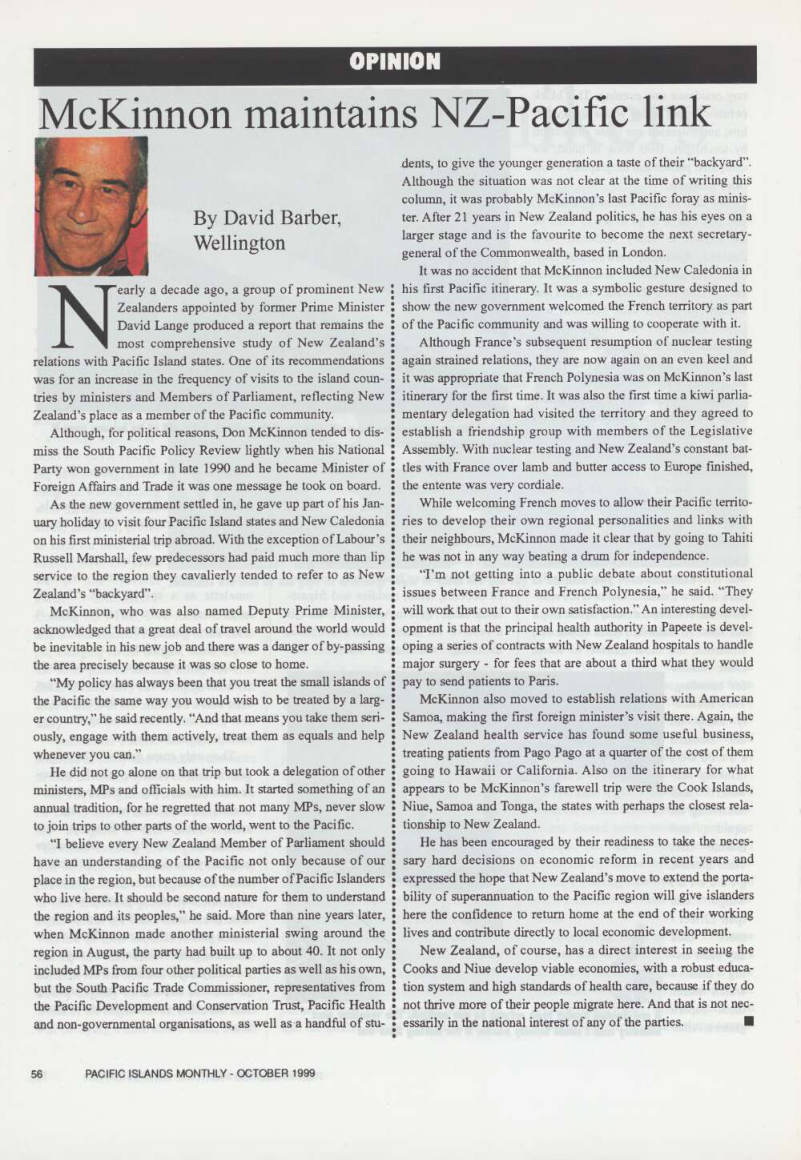
Opinion
By David Barber, Wellington
Nearly a decade ago, a group of prominent New Zealanders appointed by former Prime Minister David Lange produced a report that remains the most comprehensive study of New Zealand’s relations with Pacific Island states. One of its recommendations was for an increase in the frequency of visits to the island coun tries by ministers and Members of Parliament, reflecting New Zealand’s place as a member of the Pacific community.
Although, for political reasons, Don McKinnon tended to dis miss the South Pacific Policy Review lightly when his National Party won government in late 1990 and he became Minister of Foreign Affairs and Trade it was one message he took on board.
As the new government settled in, he gave up part of his Jan uary holiday to visit four Pacific Island states and New Caledonia on his first ministerial trip abroad. With the exception of Labour’s Russell Marshall, few predecessors had paid much more than lip service to the region they cavalierly tended to refer to as New Zealand’s “backyard”.
McKinnon, who was also named Deputy Prime Minister, acknowledged that a great deal of travel around the world would be inevitable in his new job and there was a danger of by-passing the area precisely because it was so close to home.
“My policy has always been that you treat the small islands of the Pacific the same way you would wish to be treated by a larg er country,” he said recently. “And that means you take them seri ously, engage with them actively, treat them as equals and help whenever you can.”
He did not go alone on that trip but took a delegation of other ministers, MPs and officials with him. It started something of an annual tradition, for he regretted that not many MPs, never slow to join trips to other parts of the world, went to the Pacific.
“I believe every New Zealand Member of Parliament should have an understanding of the Pacific not only because of our place in the region, but because of the number of Pacific Islanders who live here. It should be second nature for them to understand the region and its peoples,” he said. More than nine years later, when McKinnon made another ministerial swing around the region in August, the party had built up to about 40. It not only included MPs from four other political parties as well as his own, but the South Pacific Trade Commissioner, representatives from the Pacific Development and Conservation Trust, Pacific Health and non-governmental organisations, as well as a handful of stu
jdents, to give the younger generation a taste of their “backyard”.
Although the situation was not clear at the time of writing this column, it was probably McKinnon’s last Pacific foray as minis ter. After 21 years in New Zealand politics, he has his eyes on a larger stage and is the favourite to become the next secretary general of the Commonwealth, based in London.
It was no accident that McKinnon included New Caledonia in his first Pacific itinerary. It was a symbolic gesture designed to show the new government welcomed the French territory as part of the Pacific community and was willing to cooperate with it.
Although France’s subsequent resumption of nuclear testing again strained relations, they are now again on an even keel and it was appropriate that French Polynesia was on McKinnon’s last itinerary for the first time. It was also the first time a kiwi parlia mentary delegation had visited the territory and they agreed to establish a friendship group with members of the Legislative Assembly. With nuclear testing and New Zealand’s constant bat tles with France over lamb and butter access to Europe finished, the entente was very cordiale.
While welcoming French moves to allow their Pacific territo ries to develop their own regional personalities and links with their neighbours, McKinnon made it clear that by going to Tahiti he was not in any way beating a drum for independence.
“I’m not getting into a public debate about constitutional issues between France and French Polynesia,” he said. “They will work that out to their own satisfaction.” An interesting devel opment is that the principal health authority in Papeete is devel oping a series of contracts with New Zealand hospitals to handle major surgery - for fees that are about a third what they would pay to send patients to Paris.
McKinnon also moved to establish relations with American Samoa, making the first foreign minister’s visit there. Again, the New Zealand health service has found some useful business, treating patients from Pago Pago at a quarter of the cost of them going to Hawaii or California. Also on the itinerary for what appears to be McKinnon’s farewell trip were the Cook Islands, Niue, Samoa and Tonga, the states with perhaps the closest rela tionship to New Zealand.
He has been encouraged by their readiness to take the neces sary hard decisions on economic reform in recent years and expressed the hope that New Zealand’s move to extend the porta bility of superannuation to the Pacific region will give islanders here the confidence to return home at the end of their working lives and contribute directly to local economic development.
New Zealand, of course, has a direct interest in seeing the Cooks and Niue develop viable economies, with a robust educa tion system and high standards of health care, because if they do not thrive more of their people migrate here. And that is not nec essarily in the national interest of any of the parties. ■
Howard apologises to the stolen children
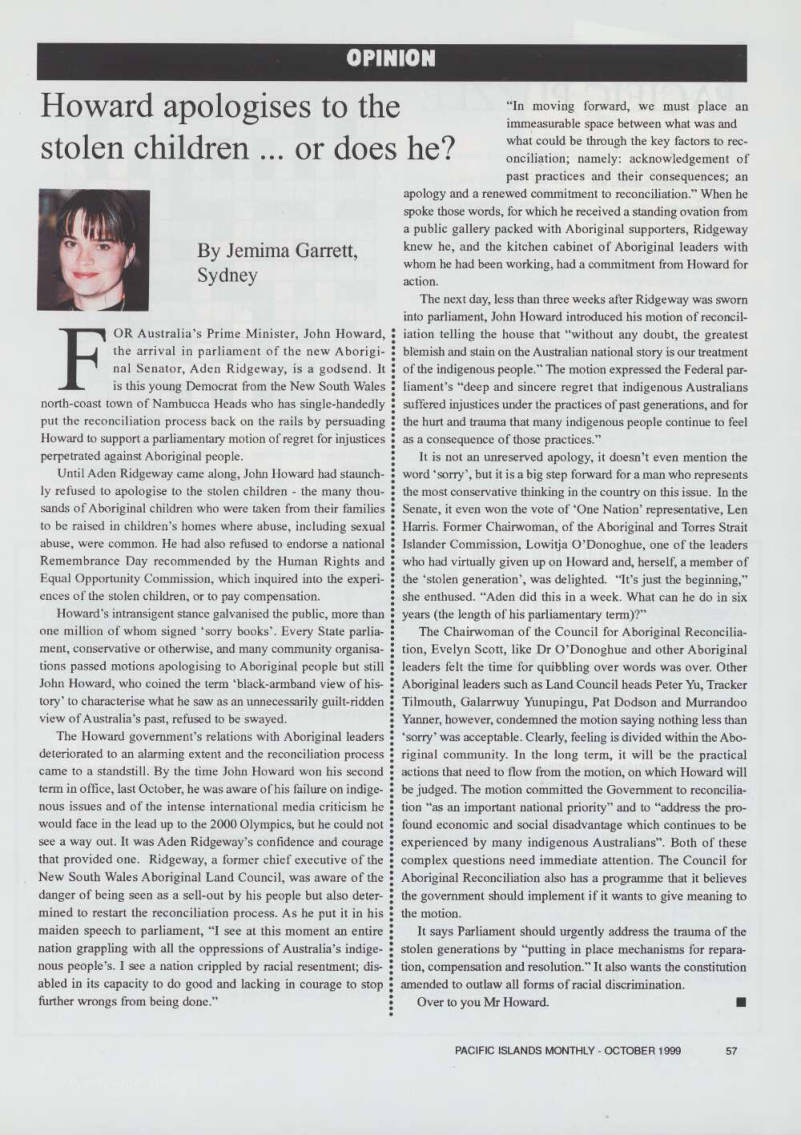
stolen children ... or does he?
By Jemima Garrett, Sydney
FOR Australia’s Prime Minister, John Howard, the arrival in parliament of the new Aborigi nal Senator, Aden Ridgeway, is a godsend. It is this young Democrat from the New South Wales north-coast town of Nambucca Heads who has single-handedly put the reconciliation process back on the rails by persuading Howard to support a parliamentary motion of regret for injustices perpetrated against Aboriginal people.
Until Aden Ridgeway came along, John Howard had staunch ly refused to apologise to the stolen children - the many thou sands of Aboriginal children who were taken from their families to be raised in children’s homes where abuse, including sexual abuse, were common. He had also refused to endorse a national Remembrance Day recommended by the Human Rights and Equal Opportunity Commission, which inquired into the experi ences of the stolen children, or to pay compensation.
Howard’s intransigent stance galvanised the public, more than one million of whom signed ‘sorry books’. Every State parlia ment, conservative or otherwise, and many community organisa tions passed motions apologising to Aboriginal people but still John Howard, who coined the term ‘black-armband view of his tory’ to characterise what he saw as an unnecessarily guilt-ridden view of Australia’s past, refused to be swayed.
The Howard government’s relations with Aboriginal leaders deteriorated to an alarming extent and the reconciliation process came to a standstill. By the time John Howard won his second term in office, last October, he was aware of his failure on indige nous issues and of the intense international media criticism he would face in the lead up to the 2000 Olympics, but he could not see a way out. It was Aden Ridgeway’s confidence and courage that provided one. Ridgeway, a former chief executive of the New South Wales Aboriginal Land Council, was aware of the danger of being seen as a sell-out by his people but also deter mined to restart the reconciliation process. As he put it in his maiden speech to parliament, “I see at this moment an entire nation grappling with all the oppressions of Australia’s indige nous people’s. I see a nation crippled by racial resentment; dis abled in its capacity to do good and lacking in courage to stop further wrongs from being done.”
“In moving forward, we must place an immeasurable space between what was and what could be through the key factors to rec
onciliation; namely: acknowledgement of
past practices and their consequences; an
apology and a renewed commitment to reconciliation.” When he spoke those words, for which he received a standing ovation from a public gallery packed with Aboriginal supporters, Ridgeway knew he, and the kitchen cabinet of Aboriginal leaders with whom he had been working, had a commitment from Howard for action.
The next day, less than three weeks after Ridgeway was sworn into parliament, John Howard introduced his motion of reconcil iation telling the house that “without any doubt, the greatest blemish and stain on the Australian national story is our treatment of the indigenous people.” The motion expressed the Federal par liament’s “deep and sincere regret that indigenous Australians suffered injustices under the practices of past generations, and for the hurt and trauma that many indigenous people continue to feel as a consequence of those practices.”
It is not an unreserved apology, it doesn’t even mention the word ‘sorry’, but it is a big step forward for a man who represents the most conservative thinking in the country on this issue. In the Senate, it even won the vote of ‘One Nation’ representative, Len Harris. Former Chairwoman, of the Aboriginal and Torres Strait Islander Commission, Lowitja O’Donoghue, one of the leaders who had virtually given up on Howard and, herself, a member of the ‘stolen generation’, was delighted. “It’s just the beginning,” she enthused. “Aden did this in a week. What can he do in six years (the length of his parliamentary term)?”
The Chairwoman of the Council for Aboriginal Reconcilia tion, Evelyn Scott, like Dr O’Donoghue and other Aboriginal leaders felt the time for quibbling over words was over. Other Aboriginal leaders such as Land Council heads Peter Yu, Tracker Tilmouth, Galarrwuy Yunupingu, Pat Dodson and Murrandoo Yanner, however, condemned the motion saying nothing less than ‘sorry’ was acceptable. Clearly, feeling is divided within the Abo riginal community. In the long term, it will be the practical actions that need to flow from the motion, on which Howard will be judged. The motion committed the Government to reconcilia tion “as an important national priority” and to “address the pro found economic and social disadvantage which continues to be experienced by many indigenous Australians”. Both of these complex questions need immediate attention. The Council for Aboriginal Reconciliation also has a programme that it believes the government should implement if it wants to give meaning to the motion.
It says Parliament should urgently address the trauma of the stolen generations by “putting in place mechanisms for repara tion, compensation and resolution.” It also wants the constitution amended to outlaw all forms of racial discrimination.
Over to you Mr Howard. ■
Pacific Puzzle
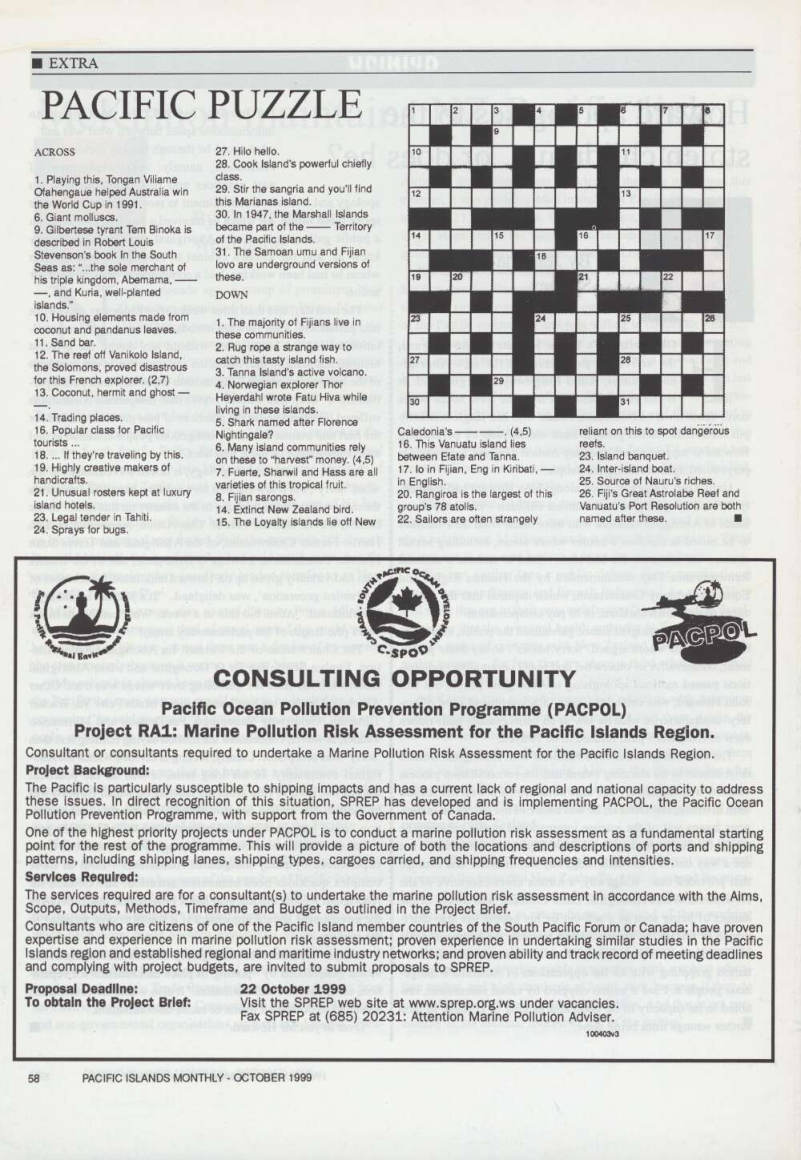
Extra
Across
I. Playing this, Tongan Viliame Ofahengaue helped Australia win the World Cup in 1991. 6. Giant molluscs. 9. Gilbertese tyrant Tern Binoka is described in Robert Louis Stevenson’s book In the South Seas as: “...the sole merchant of his triple kingdom, Abemama, —, and Kuria, well-planted islands." 10. Housing elements made from coconut and pandanus leaves. 11. Sand bar. 12. The reef off Vanikolo Island, the Solomons, proved disastrous for this French explorer. (2,7) 13. Coconut, hermit and ghost 14. Trading places. 16. Popular class for Pacific tourists... 18. ... If they’re traveling by this. 19. Highly creative makers of handicrafts. 21. Unusual rosters kept at luxury island hotels. 23. Legal tender in Tahiti. 24. Sprays for bugs.
27. Hilo hello. 28. Cook Island’s powerful chiefly class. 29. Stir the sangria and you’ll find this Marianas island. 30. In 1947, the Marshall Islands became part of the Territory of the Pacific Islands. 31. The Samoan umu and Fijian lovo are underground versions of these.
Down
1. The majority of Fijians live in these communities. 2. Rug rope a strange way to catch this tasty island fish. 3. Tanna Island’s active volcano, 4. Norwegian explorer Thor Heyerdahl wrote Fatu Hiva while living in these islands. 5. Shark named after Florence
Nightingale?
6. Many island communities rely on these to “harvest” money. (4,5) 7. Fuerte, Sharwil and Hass are all varieties of this tropical fruit. 8. Fijian sarongs. 14. Extinct New Zealand bird. 15. The Loyalty islands lie off New
Caledonia’s . (4,5) 16. This Vanuatu island lies between Efate and Tanna. 17. lo in Fijian, Eng in Kiribati, in English. 20. Rangiroa is the largest of this group’s 78 atolls. 22. Sailors are often strangely
reliant on this to spot dangerous reefs. 23. Island banquet. 24. Inter-island boat. 25. Source of Nauru’s riches. 26. Fiji’s Great Astrolabe Reef and Vanuatu’s Port Resolution are both named after these. ■
Advertisements & other items, pp. 58-60 (1 item)
Consulting Opportunity
j I % / c.^poO
gpu
Pacific Ocean Pollution Prevention Programme (PACPOL) Project RAI: Marine Pollution Risk Assessment for the Pacific Islands Region.
Consultant or consultants required to undertake a Marine Pollution Risk Assessment for the Pacific Islands Region.
Project Background: The Pacific is particularly susceptible to shipping impacts and has a current lack of regional and national capacity to address these issues. In direct recognition of this situation, SPREP has developed and is implementing PACPOL, the Pacific Ocean Pollution Prevention Programme, with support from the Government of Canada.
One of the highest priority projects under PACPOL is to conduct a marine pollution risk assessment as a fundamental starting point for the rest of the programme. This will provide a picture of both the locations and descriptions of ports and shipping patterns, including shipping lanes, shipping types, cargoes carried, and shipping frequencies and intensities.
Services Required: The services required are for a consultant(s) to undertake the marine pollution risk assessment in accordance with the Aims, Scope, Outputs, Methods, Timeframe and Budget as outlined in the Project Brief.
Consultants who are citizens of one of the Pacific Island member countries of the South Pacific Forum or Canada: have proven expertise and experience in marine pollution risk assessment: proven experience in undertaking similar studies in the Pacific Islands region and established regional and maritime industry networks: and proven ability and track record of meeting deadlines and complying with project budgets, are invited to submit proposals to SPREP.
Proposal Deadline: 22 October 1999 To obtain the Project Brief: Visit the SPREP web site at www.sprep.org.ws under vacancies.
Fax SPREP at (685) 20231: Attention Marine Pollution Adviser. 100403V3
f®bfU o ,y j}d>i jf S a -5 * * 'p* :■
■ill
J
ZZz~zz*.
ZZ:Z
i?
Cfe- . 5 a;:. « : ... ■ w w fc* . :
ill
3 1508 0087718 b 7 P mi Three airlines, three continents, ten time zones, and every mile counts towards higher status in your frequent flyer program. Yes, it was a great trip.
www.star-alliance.com
TM
STAR ALLIANCE
The airline network for Earth.
WBm&m
"f, * mm Mil . i I _. ■' » .• «■’
' !-./ : • : i .
SWMKM
CRUISER
■ ms
No^hall
engers
?sfe ••
Toyota Land Cruiser stays on top
Toyota Land Cruiser 100 dominates the world of 4x4s. None other can match its robust power,
provided by superior engine technology.
It gives breathtaking performance, backed by an amazingly rugged suspension that can take you anywhere you want to go, on road or off.
Nevertheless, riding in a Toyota Land Cruiser 100 is like travelling in a luxurious sedan. Its more than ample room inside contains all the comforts and conveniences you’d expect of a winner.
Remember this. Only Toyota's advanced technology can create the symphony of power, performance, and lavish comfort you find in Land Cruiser 100. No wonder it's the champion. Again.
E) OEy Di
STATION WAGON
DISTRIBUTORS/DEALERS
NORFOLK ISLAND BORRY’S PTY LTD. PH 22114
SOLOMON ISLANDS ELA MOTORS PH 30314
VANUATU ASCO MOTORS PH 22341
COOK ISLANDS PACIFIC MOTORS LTD, PH 20700
TOYOTA
KIRIBATI TARAWA MOTORS PH 21090
PAPUA NEW GUINEA ELA MOTORS PH 3229400
TAHITI NIPPON AUTOMOTO PH 429819
SAMOA ASCO MOTORS PH 20800
FIJI ASCO MOTORS PH 384888
NEW CALEDONIA S.IAP. PH 275562
TONGA ASCO MOTORS PH 23500
AMERICAN SAMOA ASCO MOTORS PH 633-4281