Advertisements & other items, pp. 1-2 (2 items)
hjfgj
PACIFIC ISLANDS
MONTHLY
INSIDL FORIM HAKES HINDR RECWIRY
NOVEMBER 1999
hjfgj
AND
k ' ;
.MAUL
m Sn
American Samoa US$2.5O; Australia A 53.50; Cook islands NZ $3; Fiji F 52.50 Vat Incl; FS Micronesia US$3; Kiribati A 52.50; Nauru A 52.50; Niue NZ$3; Norfolk As 3; New Caledonia cpf2so; New Zealand NZ53.45 incl GST; Northern Marianas US$3; Papua New Guinea K 4.90; Palau US$3; Marshall Islands US$3; Solomon Islands As 3; French Polynesia cpf3oo; Tonga P 3; USA US$3; Vanuatu VT22O; Western Samoa T 5.50. These are recommended prices only
Shipping your goods
around the Pacific...
in
Bruce Johnson
Sales Executive XYZ Shipping, based in Europe.
Started in the shipping industry when he joined XYZ Shipping 12 months ago. He services Auckland customers for the Pacific leg of the round-the-world service. Prior to that, was employed as a sales rep with a computer company.
Has no discretion on the tariff. Reports to the National Sales Manager, who has greater authority, however all decisions are referred to Pricing Division, Europe.
Tammy Hamawi
Line Manager/Commercial
Director Director and shareholder with PDL Eine, a privately owned company whose sole purpose is to cater for trade in the South Pacific.
Based in Head Office, Auckland.
Fifteen years in the shipping industry, working her way up from Shipping Clerk to Supervisor. PDL Eine Manager since 1994.
Has total discretion when dealing with customers without referral to other Managers Ambition: To play a significant role in the success and growth of PDF through superlative customer service.
... who would you rely
on?
At PACIFIC DIRECT LINE our people run the line. Our structure is streamlined and decisions are made so our clients' needs are met simply, efficiently and quickly.
PDL is a family business that has operated in the Pacific since 1968. Thirty-two years of dedication to providing freight and logistics services in the region.
PDL carries agricultural supplies, foodstuffs, building supplies and machinery plus other cargoes from New Zealand and Australia to almost every Pacific Island nation.
C
PDL
For further information contact Pacific Direct Line, Auckland Phone 0064 9 358 5256 Fax 0064 9 358 4833
Pacific Islands
Monthly
Vol 69 No. 11
The News Magazine
Novimbebi999
Alan Robinson Sophie Foster Hildebrand Michael Field. Giff Johnson, Sally Andrew, Sam Vulum.
Ed Rampell, Alan Ah Mu. Brian Tobia.
David Barber (Wellington), Jemima Garrett (Sydney) Benina Magnus, Sovaia Ditoga Senior Regional Sales (South Pacific) Shayne Farah Hussein Tel (679) 304111, 303244.
Fax (679) 303809.
Sydney, Canberra: Bob Hill Media Represen tation, Tel (61-2)4164245, Fax (61-2)4165064.
Brisbane: Jane Fewings Media and Advertising Associates Tel (61-7) 3378 4522, Fax (61-7) 3878 1071.
Adelaide: Hastwell Williamsons Representa tives, Tel (61-8) 3799522, Fax (61-8) 3799735.
Melbourne: Brown Orr Fletcher Burrows (Aust) Pty Ltd.
Tel (61-3) 98265188, Fax (61-3) 98265644.
Auckland: McKay & Bowman, International Media Representatives Limited, Tel (64-9) 4190561.
Fax (64-9) 4192243.
Japan: Universal Media Corporation, Tokyo, Tel (3) 3266626741, Cable: UNI-MEDIA Tokyo.
Fax (3) 32626742.
Pacific Islands Monthly was founded in 1930
(Usps 9522480).
A Fiji Times Limited production.
Cover prices are recommended retail only. Registered by Australia Post. Publi cation No. NBPI2IO. © Copyright Fiji Times Limited, 177 Victoria Parade, Suva, Fiji.
Tel (679) 304111. fax (679) 303809.
Email: [email protected] PIM Website: http://www.pim.com.fj Pacific Islands Monthly is published monthly by Fiji Times Limited, a division of Nationwide News, 2 Holt Street, Surry Hills, Sydney, NSW 2010.
Pacific Islands Monthly PO Box 1167, Suva. Fiji.
Printed by Quality Print Limited, 16 Anna Street. Walu Bay, Suva. Fiji.
Cover design/Layout by Penina Magnus & Sovaia Ditoga All care, but no responsibility taken for material submitted for publication
Inside
Editorial 4 Letters 5 Briefs 9 Special Report: Forum makes minor recovery from irrelevance 10 A decade of forums 12 TCSP focus on private sector to boost tourism 14 Business: Ragg predicts riches in brewery trade 17 Whales bring good fortune to Jonah's land 18 Small business - the key to conservation 21 French propose ambitious satellite TV 22 Shark fin anyone? 23 Sewage - a problem not to be treated lightly 24 Qantas profit increases 38 per cent 25 NZ makes it easier to retire in the tropics 27 The Internet: it's all about addressing demand 37 Pacific moves to deal with marine spills 40 Cover: A financial ruck and maul - Smaller nations penalised by rugby's commercialism 30 - 34 Politics: Health protests shake up Marshalls 42 Small islands gain support at special UN session 44 Development: HIV positive Maire Bopp wins Media freedom Award 48 A 'read' letter day for Tonga's royals 50 Te Vaka returns after third successful Euro tour 52 Yachting: Cruising Ku-ring-gai 54 Opinion: David Barber/Max Quanchi 56
Page 10
Page 48
Page 50
Cover Story Page 30
Time for a serious re-think of sport

Editorial
THE performance of Pacific Island teams at this year’s Rugby World Cup is, no doubt, one to be proud of.
Not only did teams from Fiji, Samoa, and Tonga make it to the tourna ment under great financial pressure, but they took the global vision of island rugby to new heights.
Island teams face great challenges in their bid to compete at International level.
First and foremost, many developed world teams do not want to play the small er nations, and when they do, a second, sometimes third, -string team is fielded.
Money is another problem, but one that has been a huge thorn in the side since the game’s march to professionalism.
Island nations can no longer hold their top players at home, and watch them leave their shores one by one.
But this may not be such a bad
thing, because it allows the rugby players to make a living, while at the same time, gaining valuable overseas experience. The only factor that the island rugby unions must contend with is whether or not, these players contracts allow for them to be released for Internationals.
As far as sponsorship goes, advertis ers have never really dished out big bucks for sport, and it seems unlikely that they ever will.
The relatively smaller population sizes in the region mean smaller markets, thus smaller advertising and sponsorship dollars.
Island rugby and other sports in the region seem to be getting penalised by the commercialisation of what was once an arena where all were equal - sport.
Today, you are only as equal as your merchandising, heart rate monitors and agent say you are, and for island players,
the high tech new world of sport is a far cry from the reality that they have to deal with every day.
Rugby, like many other sports in the region, needs to get its act together.
One problem that needs to be tack led as soon as possible is the lack of accountability within rugby union and other sport governing bodies in Pacific Island countries.
If island countries are to live up to their full potential on the field, they have to be backed by people who are on-the-ball off-field.
This means using the expertise of people trained in marketing, merchandis ing, media management, fund-raising and
lobbying.
Goodness knows they will need every cent they can get if they are to front up to the big guns of sport throughout the world. ■
Letters
Disappointment over PINA
Whilst it is good to read the flowery and colorful descriptive ‘words’ of pride by the PINA executive in awarding the winners of this year’s ‘Freedom Award’ and “Best Newspaper Award”, one wonders what is the PINA stance on the current Solomon Islands government “media ban?” - an issue that tests the very foundation of media freedom and democracy.
As a journalist from that part of the Pacific currently studying and enjoying the “freedom of expression” in Fiji, it is disheartening to see that the recent Pacific Islands News Association convention which ended in Suva this week, had failed miserably to raise the issue.
It is rather bizarre that PINA, a regional media body that had consistently over the years claimed to be standing for ‘freedom of expression,’ failed to even raise the issue. Isn’t this a “Big joke” to talk about and even celebrating ‘freedom awards’ when a member country is exactly fighting a losing battle against a notorious government media ban?
While it is understood that the PINA president, four months ago during the initial stage of the media ban, condemned the Solomon Islands government decree, it should not be a one off affair. There should be a constant pressure(s) not only from the local media, but the region - especially from a media organization like PINA - with its worldwide connection(s). The Media Association of Solomon Islands (MASI) had proved that it could not fight it all alone. As of today, the “media ban” in Solomon Islands is still intact.
Surprisingly, at the end of the five day PINA conference, attended by media tycoons, senior regional media executives and so-called professional journalists through out the region, none of them even cared to say a “single-word” about the current government ‘media ban’ in Solomon Islands. It makes one wonder on whether or not the silence over the issue has been due to the PINA President’s media business interest in Solomon Islands (a co owner of the newly established FM radio stations - PAOA). Whatever explanation the
PINA executive would give, its action has failed the people of Solomon Islands, who have been deprived of their democratic rights and the freedom of express that ‘cherished’ and enjoyed by regional countries whose media executives and representatives were attending the PINA convention in Fiji.
Shocking to note that the local co owner of the PAOA FM radio station in the Solomon Islands, who is the owner publisher of the Solomon Star ? and the general manager of our only nation-wide broadcasting radio station, the Solomon Islands Broadcasting Station (SIBC), attended the convention but left without a trace of their presence. It causes one to wonder - what are these media executives really standing for. Aren’t they supposed to be ‘promoters and protectors’ of media freedom?
Their silence should be a cause of concern for any right-thinking journalist from the region and especially Solomon Islands, who cares about ‘freedom of expression’ which is the main essence of democracy. Yet in the midst of this silence, PINA announced its ‘media freedom awards,’ without any reference to the hardship the media industry in Solomon Islands is currently facing.
It is rather obvious that with the current ‘club’ of media tycoons with huge business interests in the region, the issue of fighting for ‘media freedom' is no longer in their agenda, but clearly substituted by entrepreneurs’ interests.
This new development had seen in the media industry compromising of ‘freedom of expression’ in return for governments’ favor. Such an issue had painted a negative image of the Pacific, while putting the PINA media freedom award(s) like a - “Governments-Media
Reciprocity Award.”
It is my sincere hope that PINA and its Solomon Islands’ media industry members stop pretending and redirect their focus for the promotion of media freedom in our beloved country. And the protection of our ‘democratic’ rights and the lives of our innocent people whose very existence are under threats by the Solomon Islands
government current “designed media ban.”
Duran Angiki
Journalism Program University of the South Pacific Republic of Fiji
unemployment
One option to resolve unemployment
It is widely known that Fiji has the most accessible, mature, sustainably managed, quality (insect free), plantation mahogany, in substantial and consistent qualities, in the world today.
Fiji’s mahogany timber will soon be harvested in commercial quantities. The processing of this valuable resource into finished products, such as furniture and furniture products, will provide at least 10,000 jobs for the male youth of Fiji.
The question arises: “Should Fiji, with its great mahogany resource, ensure that a well developed value-added timber industry is created immediately, providing much-needed job opportunities and foreign exchange or should Fiji sell its valuable mahogany plantations to a foreign company, with management rights to export raw and/or semi processed timber.”
Mahogany could be responsible for
Continued next page
Continued from previous page
bringing in some four billion dollars of net foreign exchange over the next 35 years and creating thousands of jobs, particularly for the young male workforce who are not necessarily attracted to the garment industry.
With proper government policy in place, major foreign furniture companies (and there are a number interested) would have no alternative but to establish their manufacturing operations in Fiji NOW (not after five years of the raw timber being exported) either independently or in joint venture with local operators, creating these much needed job opportunities. It is timely that a transparent policy be in place to ensure that only the full potential of this unique
and valuable mahogany is realised.
Within the next five years, like Indonesia and Malaysia, Fiji could then have a thriving, internationally acclaimed furniture industry, with at least 10 major international furniture manufacturing companies, processing mahogany into fine furniture products, and employing thousands of young men on good wages.
Elizabeth Clayton,
CHE International Furniture Ltd, Suva, Fiji
Advertisements & other items, p. 5 (1 item)
■ engine!
WAREHOUSE
BMW
Bedford Cummins Daihatsu Detroit Deutz Ford Gardner Hmo Isuzu Iveco Komatsu Kubota
PHONE
643-6938122
PAX
643-6938120 mm New Zealand email: [email protected] Subaru Leyland Mazda Mercedes Mitsubishi
MAN.
Nissan Perkins Suzuki Toyota Volvo Yanmar
New Engines x
Hyundai/Mitsubishi equivalent
4D56 Turbo fits Pajero 6D16 188/2900 128/2000 Isuzu 4JB Mazda R 2
Parts Division
New/Used Cylinder Head tested 4D56 many models, starters Engine parts Transmissions for most models
Generator Sets
Komatsu 29KVA Yanmar 150KVA
Trauma in jungle captivity-a

former hostage speaks
Reading the Solomon Star issue No. 1460 September 30, my attention was drawn to its front-page story headlined
“Alebua Urged To Plea For
Hostages”.
It brought a flash memory into my mind, fully remembering my teen life in the Philippines jungle, when I was held hostage and captive by the CHDF (Civilian Home Defense Force), notorious armed thugs of the Marcos Martial Law regime.
I was taken hostage - for almost three agonising long months - for being a suspected supporter of the then “Kabataang Makabayan” - an association of youths from both the students and peasants who opposed the martial law regime of Ferdinand Marcos.
I still remember how my captors used to tie my hands in my back and let me roll in muddy ricefields when it was
Continued next page
Continued from previous page
raining, and stand in an open field under the sun with nothing to eat or drink.
The suffering still lingers in my mind when I read about the incidents happening now in the Solomons. I cried for those innocent people just as if I was the one still being held in captivity.
I know how Peter Tahani, Jason Fioga, Johnson Laumanu, Akwai, Davies Reykol, Olomea, David Aro, Riiagalo, George Bibira, Pati Ladomea, Rex Maenukua, John Bira, Takankwao, Andrew Kofela and Makasi felt being held captive by those roving Gwale Militants whom I am sure are being manipulated like robots by their leaders like what Marcos did to my captors then.
The only difference between their and my experiences is that I was held captive by a group attached to the Philippine Government’s military - like what happened in East Timor - while the Solomon Islanders are being held hostage by group(s) of militants with unknown motives and agendas.
What are these Gwale Militants fighting for? I thought they already agreed to a peace deal with the Solomon Islands government.
The worst thing that can happen to you is to be held captive - against your will, without knowing if your captors will kill you right there and then, or if you will be freed unharmed in the next couple of hours.
One of the greatest sorrows of human existence is that some people aren’t happy merely to be alive but find their happiness only in the misery of others.
For almost three months in captivity, I experienced all sorts of punishment imaginable - where I suffered trauma or “emotional shock”. I was freed, not by my captors, but, by the very people whom they suspected I was supporting - the Kabataang Makabayan and their very own people’s army.
I will not be surprised if these Malaitans held captive by the Gwale Militants suffer similar trauma to mine, and are freed by their own people.
After these Malaitans are freed, what will the health Department, the Red Cross
and the NGOs do to help them regain and reconnect their lives?
How would one go about treating over a dozen people for post-traumatic stress? The difficulties involved are considerable - especially in chronic cases or where the person in question doesn’t want to be treated.
It is difficult to know even where to begin, given “patients” with various personalities. Such a task may actually be
impossible.
But perhaps they can heal themselves and one another individually, at least to some degree, and thereby plant the seeds of a new sane and biologically benign culture.
In order to do so, it would seem vital that the government agencies concerned familiarise themselves with what is presently known about trauma treatment and recovery.
How will these people respond?
Accordingly, victims of human-induced disasters often show more stress then victims of natural disasters because of the perceived need to find parties to blame.
Whatever the eventual circumstances, it seems that groups in differing geographic areas, and in differing economic conditions, will react in dissimilar ways.
In the case of a breakdown in communication and control, those who are more dependent on high tech will likely suffer much more than those who are still somewhat accustomed to locally filling their basic needs.
Over the short term, we are likely to see acts of extraordinary heroism alongside extreme examples of opportunism and stupidity. But what about the long-range
prognosis?
As a former hostage myself, I’m willing to share my experience and the technique I personally used in recovery which is to leam to feel my repressed grief and rage as well as my repressed joy.
The fact that we are now coming to understand how the human psyche typically deals with trauma is cause for hope: Perhaps a significant number of people will experience civilisation’s crisis as a catharsis that will reach all the way to the roots of our ancient, irrational fear of nature, and help
us learn to live in peace with the world, with one another, and with ourselves as I experienced a year after my release from
captivity.
I understand from some information that reached me through the grapevine that these Malaitans held hostage by the Gwales are still alive even though their state of being and health are said to be unknown.
To those militants who are holding these people against their will, I beg you to
show mercy and charity by unconditionally
releasing your hostages as they are innocents.
I am willing to be an intermediary for the release of these hostages, if needed, being a neutral person.
To the militants, the greatest achievement of whatever you are fighting for is to release your hostages unconditionally at the earliest possible time as an act of charity that will be remembered well by the people of Solomon Island, your very own people. Charity begins at home, and I’m quite sure that charity will win the hearts of thousands.
Ramon Jim Quitales
Honiara, Solomon Islands
In defence of
Archives-November 1944
In defence of contract labour
By H S M Robinson, Secretary of the Melanesian Mission, Sydney
“INDENTURED” is perhaps an unfortunate word - a word associated with the bad old days and, in the minds of so many people, associated with “forced” or compulsory labour. There are not a few who regard it as something akin to a modified form of “slavery” - and, of course, the exploitation of the poor native.
Indentured, really, is merely
another word for contract labour. A vast amount of nonsense is talked and written about the matter and idealists are often a bit of a nuisance. Indeed, many - some known to the writer - don’t seek the facts of the situation, as it is today, but look merely for confirmation of their own preconceived, ill-based ideas.
I do not pose as an expert; but I have travelled much; I have sought the views and experiences of many competent to judge; visited many of the islands of the
South Seas on more than one occasion; know something at first hand of the native peoples of other countries - and particularly those far removed from the usual trade and tourist routes.
I know the views of the missionaries, and their difficulties, and I warmly sympathise with them; the views, also, of the trader and planter. And, frankly, I hold no brief for “Big Business”. All my sympathies are with the native - while having nothing whatever in common with the over-class-conscious product of a
degenerate democracy.
It may be taken that the white man has lost none of his acquisitiveness, and that development will take place - inevitably.
Now, how can this be carried out best in the interest of the native, the real owner of the
land? ! know of the so-called octopus grip of the “Big Firms”. I have met and talked with both sides, and have seen the native as comparatively few white people have seen him.
Just what are the objections to contract labour? What is contract labour?
Is it not merely an agreement between a plantation employer and a prospective native labourer who desires to work on the plantation? The contract or agreement has been drawn up by the Administration - the conditions provide ample security for the native. The employer is assured of labour, for a pre-determined time - failing which he could not carry on. Even a member of the class-conscious coterie informed the House of Representatives that “the favourable attitude of the natives to the cause of the Allied Nations is believed by the Government to be due, to a great extent, to the sympathetic administration of native affairs by past administrations ... etc.,” which doesn’t go to show any undue anxiety concerning ill-treatment or exploitation. No - the native knows full well that his position is secure, and that he can obtain immediate redress from the local DOs. ■
Advertisements & other items, pp. 7-8 (1 item)
hAM*, your say*
Send Letters to the Editor to: Pacific islands Monthly, P 0 Box 1167,
Suva, Fiji
OR Email;
PIM Website: www.pim.com.fj
TRADE MARK CAUTIONARY NOTICE
Notice is hereby given that Telstra Corporation Limited, a corporation duly organised and existing under the laws of Australia, and having ACN 051 775 556, the Corporate Secretary being located at 242 Exhibition Street, Melbourne, Australia is the sole proprietor of the following trade marks:- Used in respect of:— Telecommunications and communications equipment, apparatus and systems, including but not limited to electronic and optical telecommunications and communications equipment, apparatus and systems; satellite and earth station telecommunications and communications equipment, apparatus and systems; Telephone equipment, apparatus and systems, including but not limited to telephone; telephone receivers; telephone handsets; telephone network, telephone exchanges, telephone switching, telephone answering, telephone card vending and telephone dialling equipment, apparatus and systems; Transmission, receiving and storage equipment, apparatus and systems, includingbut not limited to facsimile, telegraph, telex, teleprinting, cable and paging equipment, apparatus and systems; data and video networking and conferencing equipment, apparatus and systems; data processing, message handling and switching equipment, apparatus and systems; digital equipment, apparatus and systems; electronic, voice, text and facsimile mail equipment, apparatus and systems; electronic directory equipment, apparatus and systems; Computer equipment, apparatus and systems, including but not limited to computer programs; computer software; computer hardware; computer terminals; computer memories; computer networking equipment, apparatus and systems; computer manuals in this class; modems; Video and audio equipment, apparatus and systems, including but not limited to sound and image recording, transmission and reproduction equipment, apparatus and systems; video cassettes and tapes; compact discs; records; digital, electric and electronic radio equipment, apparatus and systems; magnetic tapes; cinematographic, television and amusement equipment, apparatus and systems; amusement machines; All associated parts and accessories being goods in class 9, paper, cardboard and goods made from these materials; printed matter including directories, journals and manuals and all goods in class 16; advertising, promotional, consultancy and business services; compiling, arranging and publishing directories; telephone answering services; market research and statisticalservices; being services in class 35, repair installation, maintenance and construction services; being services in class 37, telecommunication services being services in class 38, amusement, entertainment, education and information services; multi-media services; being services in class 41, research services; computer programming services; retail and wholesaling services; consultancy services being services in Class 42'.
The said proprietor claims all rights in respect of the above trade marks and will take all necessary legal steps against any person or company infringing their said rights.
TELSTRA
~elstra
~elstra
DAVIES COLLISON CAVE
PATENT ATTORNEYS
One Little Collins Street Level 10 Melbourne, Victoria, 3000 10 Barrack Street Australia Sydney, New South Wales, 2000 AMP Building Hobart Place Canberra City 2601
Briefs
Fiji’s domestic carrier to begin new service to Tonga Air Fiji will this month introduce a new service between Fiji’s Nausori Airport and Fua’amotu Airport.
Manager Airline Operations, Arthur Whippy, told Radio Tonga News that the new weekly flight begins on the first week of this month. Air Fiji’s Brasilia turbo-prop 30seater aircraft will operate the flight expect ed to take an hour and forty minutes. He says the plane could be pressurised and can fly up to a height of 30-thousand feet.
Air Fiji hopes to expand to two flights a week, and could operate three times by the end of this month on Mondays, Wednesdays and Fridays, according to Mr. Whippy.
The tentative schedule would leave Nausori at eight Fiji Time arriving Fua’amo tu at 11.40 later in the morning. The return flight would leave Tonga one hour later. At present, Tonga is two hours ahead of Fiji.
Whippy was in Nuku’alofa to meet officials from govermnent, airlines and the tourism sector.
He says he received favourable recep tion from his various discussions. The new service would cater for passengers wanting to travel direct to Suva instead of going through Nadi. This will be Air Fiji’s second international flight having served Funafuti in Tuvalu for about two months now. PNS Vanuatu court confirms
anti-pyramid scheme ruling
The Supreme Court of Vanuatu has ordered a company convicted of using a pyramid selling scheme in the northern Aus tralian state of Queensland to return $300,000 they had transferred to Vanuatu 18 months ago.
Radio Australia Pacific correspondent Kevin McQuillan reports that the action was taken by the Competition and Consumer Commission.
“In 1998, the federal court in Bris bane ruled that Golden Sphere International, a Vanuatu-registered company, had breached the Trade Practices Act. It ordered company directors Pamela Reynolds and Victor Cot trill to pay $550,000 into a trust, to compen sate members of the public who’d been caught by the scheme. But only $292,000 was paid and the commission said the rest had been transferred to Vanuatu.
“The Supreme Court in Vila has now ruled that the money must be sent back to Australia, along with 10 percent interest.
“Armed with the court ruling, the
commission will now access the company’s bank accounts in Vila, saying its decision to pursue the company overseas has been vin dicated. (Radio Australia) Australia and Fiji agree to new talks on SPARTECA agreement.
Australia has agreed to talks for anew agreement with Fiji to succeed the current SPARTECA agreement.
Fiji Prime Minister Mahendra
Chaudhry, addressing the joint Fiji/Australia
and Australia Fiji Business Council meeting in Suva, said he had written to his Australian counterpart, John Howard, on the matter and Howard had responded by reaffirming Aus tralia’s commitment to strengthening bilater al relations with Fiji.
Howard’s letter said, “The Australian Government appreciates how important the trade dimension to our relationship is for Fiji, particularly for the textile, clothing and footwear industry. Your suggestion that we initiate discussions at the earliest opportuni ty is, one I would support as it is important that officials clarify the issues thoroughly and identify viable options for the future.”
“I would be aiming to see these mat ters concluded satisfactorily prior to the next meeting of foreign ministers scheduled for mid December,” Howard’s letter said.
Chaudhry said with these anticipated direct Government to Government talks the two Councils needed to work together to work out an arrangement beneficial to the two countries. On Fiji’s domestic front, Chaudhry said latest indications on Fiji’s economy is positive with real GDP for 1999 forecast to expand by over 7 percent.
“Copra production has increased fur ther by 18.5 per cent in the first seven months of the year, with total production of sugar at the end of the crushing season expected to more than double from 2 million tonnes of cane.” He said his Government had reduced costs of doing business with tele phone charges, power and water and further reductions expected next year.
“We will work with industry in increasing productivity and their internation al competitiveness in overseas markets.”
The Prime Minister also assured all investors that his Government would honour all existing commitments of special conces sions, but said the business sector must acknowledge that concessions granted would be reviewed periodically.
“My Government recognises the cru cial role of private entrepreneurs as the key to increased growth in the economy and is
committed to building a constructive part nership to create prosperity for all in Fiji as we move into the next millennium.” PNS PNG’s parliament to ratify over 26 conventions for the country’s workforce Papua New Guinea’s Tripartite Coun cil is moving to ratify more than 26 conven tions for the country’s workforce in the November parliament session. Council members from the Labour and Employment and the Trade and Industry Departments including the Workers Unions resolved to have the ratification’s made during a closed
door meeting at parliament.
The new Labour and Employment Minister, Claris Haiveta, said it is pertinent this is done immediately by a competent authority in line with conditions set by the International Labour Organisation, which PNG is a member of.
Haiveta said parliament has never rat ified any conventions, most of which were initially inherited from Australia including those introduced after Independence. Haive ta said the process of drafting the legislation is almost completed and he is confident the Bill will be tabled in this month’s parliament session. The Bill will cover Labour Laws Reform, Terms and Conditions, Industrial Relations and Workers Compensation.
Meanwhile prime minister Sir Mekere Morauta announced the Council will expand its membership to also include parliamentar ians as it is the single largest sector in terms of formal and informal employment and the major area for sustainable employment growth for the future. PNS
Tonga’s vanilla beans attracting
Japan
Tonga’s size and quality of vanilla beans has attracted potential marketing opportunities in Japan. The market potential was revealed to Government representatives while on a recent fact finding tour with vari ous markets destinations in Japan. Trade officer, Saimone Vuki said positive feedback was given to them in regards to the length of the beans measuring up to 28 centimetres.
Tongatrade shipped two tonnes of A and B-grade vanilla last month and prices were as high as US$45 for each grade.
The prices compared favourably to
the current level of 25-dollars or up to 30dollars in the traditional markets in the Unit ed States and Germany. Trial export of vanil-
Continued on page 14
Continued from page 9
la to Japan began during the first part of the year with an initial volume of 20 kilograms.
Japan says if Tonga maintains its high quali ty, the price could be between 1-hundred and-50 to 2-hundred-and-50 dollars, similar to the treatment given to vanilla from French Polynesia.
Saimone said vanilla growers in the Kingdom especially those in Vava’u should not lose hope for the future of the market, as further negotiations are continuing to secure better and reliable market opportunities.
Pns
Solomon Islands receives for the first time the biggest group of Peace Corps from United States Solomon Islands will receive for the first time the largest recruitment contingent of Peace Corps volunteers by the first week of this month. Country Director of Peace Corps Volunteer Service in Solomon Islands Wesley Mukoyama said 44 new Peace Corps volunteers will arrive in Solomon Islands from the United States of America Novem ber 8.
The volunteers will take up two-year assignment contracts with secondary schools, community high schools, rural training centres, youth development projects and environmental education in the country.
Peace Corps has been providing vol unteer service to Solomon Islands since 1971. There are 73 Peace Corps volunteers currently working in the country. Under the new expansion of services initiative, new volunteers will also be engaged in youth and women development programmes, environ mental and health and agricultural pro grammes. In the past programmes concen trated on teaching in secondary education, community high and rural training centres.
Pns
Million dollar Fiji trade event set for year 2000 Fiji’s premier trade event, the Bula Fiji Tourism Exchange (BFTE) 2000 is set to take place from 16th-19th May 2000. The BFTE Committee Chairman David Voss confirmed this. According to Voss, they were very pleased with the results of BFTE99 with the increase in number for both Buyer
and Seller companies registered for busi ness.
He stated that BFTE2OOO would be bigger and better with a strong focus on improving the quality of buyers and sellers.
For its 2000 event, the Committee has set a target of attracting 125 Buyer companies and 120 Seller companies to Fiji, which is an increase of 32 percent and 15 percent respec tively for Buyers and Sellers over this year’s event.
A key attraction for Buyers has been the inclusion of neighbouring South Pacific destinations in the event such as Tonga, Samoa, Cook Islands, Solomon Islands, and Papua New Guinea. A much larger contin gent from the Pacific Islands including Tahi ti is expected to participate as Seller Desti nations in next year’s event.
There has also been a conscious effort to work together with the other key trade events within the region that happen around the same time. Registration forms for Buyers will be sent out by mid-October and any interested Buyers are to contact the Commit tee Secretariat for further information. PNS ■
Forum makes minor recovery from irrelevance
By Michael Held
IT could have been just another day in paradise - but it was better than that.
The depleted ranks of the leaders of the Pacific were gathering on a dockside in Palau. Only seven of the 16 had been to a forum before as a leader. The chemistry was all wrong. New Zealand Prime Minis ter Jenny Shipley, dressed in blue silk, seemed puzzled at the little man in shorts and stripped tee-shirt. He was Nauruan President Rene Harris. Australian deputy prime minister John Anderson looked and
sounded like a school boy on his first boat trip while Solomon Prime Minister Bartholomew Ulufa’alu kept
his perpetual
scowl in place.
This was the beginning of the 30th annual South Pacific Forum, an organ isation in trouble.
And then a shark flicked across the bay, just a little one, but enough to drive the mullet fleeing in every direction, some under the luxury launch to take the
leaders out to Carp Island.
By chance, a week or so before, Kiribati President Teburoro Tito had paint ed a picture of the dangers he saw global forces represented for places like his.
“It’s like a small fish being asked to have a shark in a small lagoon, the shark will have his own agenda.”
The night before the boat trip out to the retreat Palau’s President Kuniwo Nakamura noted “an apparent inability of the forum to move beyond discussion and actually implement initiatives in some areas, even when a consensus has been reached.”
“It is true that the failure to follow through on initiatives, resolutions at times
can make the Forum appear to be more a debating society than a vital and effective multinational tool.”
Last year, in the Federated States of Micronesia, the forum nearly died as the Pohnpei hosts overwhelmed it with intru sive security and a free reign on officials who were allowed to set the agenda, write the communique and basically run the show.
The net effect was a meaningless organisa tion.
Proof of this came this year with a poor turnout of leaders. Australian Prime
Minister John Howard, Fiji Prime Minister Mahendra Chaudhry and Papua New Guinea’s Sir Mekere Morauta all found it easy to stay away. Shipley was not going either but then the New Zealand election date was set for the end of November and campaigning required she pose for photo opportunities in Darwin with the New Zealand soldiers headed for Darwin. So she did her Palau duty then flew out to Darwin.
The retreat decided, among other things, that Tito, the veteran with five forums under his belt, could talk to the press about what happened that day.
He has a trade union background but in the divisive world of Kiribati he has often given the impression of being stuffy and
unapproachable - protected by an ever pre sent Kiribati policeman. But for the small press corps in a class room at the Palau Community College he was in a relaxed mood - delivering the news that the forum had survived.
The name had been changed, he began, to the Pacific Islands Forum, but everybody had decided to keep to the same meeting scheduled and process rather than change. Australia, always a reluctant partner in the Forum, had wanted the summits every two years. A climate
change position had been restated while leaders had heard reports on the United Nations small island state con ference and got around to defin
ing how
“observers” could join the forum.
New Caledonia and the UN were admitted as observers while
French Polynesia
was recognised as a potential observer and the
Philippines was
admitted as a dia logue partner.
Tito relaxed into tough ques tions on how the
process had worked in the past, simply acknowledging that until recently the communique had been taken over by offi cials. Leaders were taking it back.
“The leaders feel they should be chewing more meat rather than just swal lowing the meat,” he said.
The forum had accepted the idea of a forum free trade area, setting up a decade long process.
His interview with Pacnews in which he referred to a shark in the lagoon had been taken as Kiribati opposition to the free trade zone. Tito corrected this impression. It was “global forces” that were the shark, and there was nothing
Continued next page
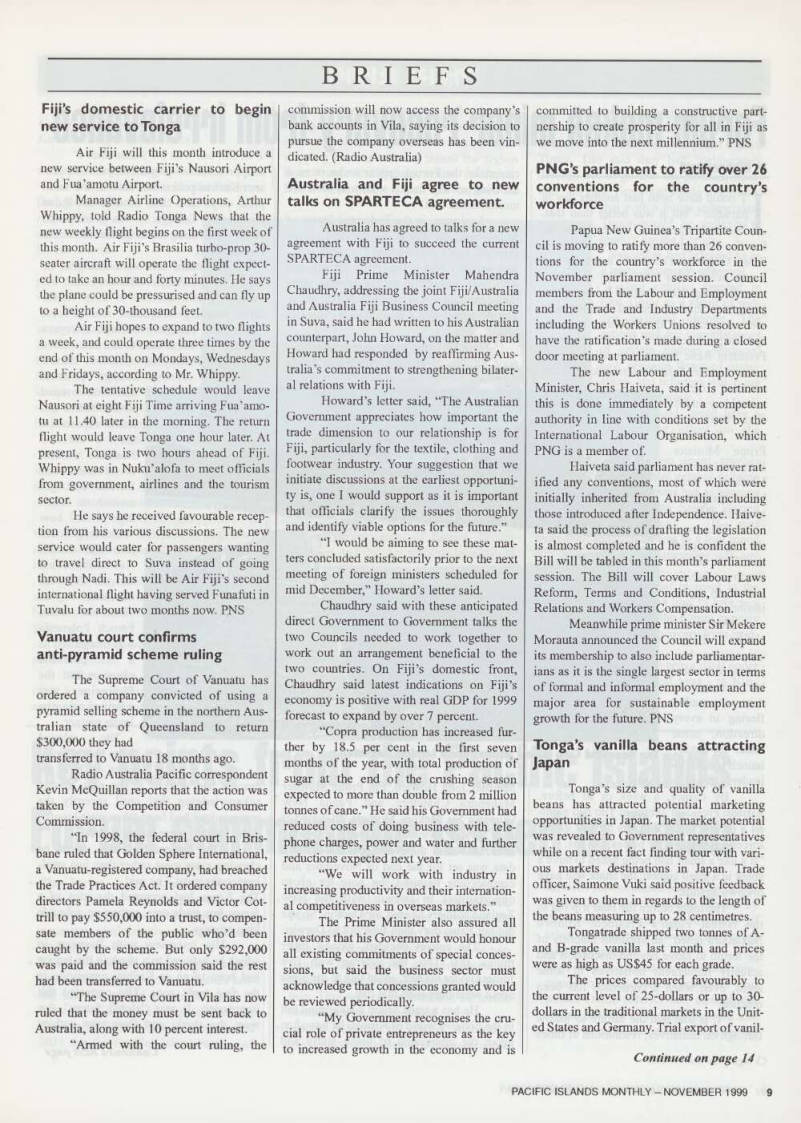
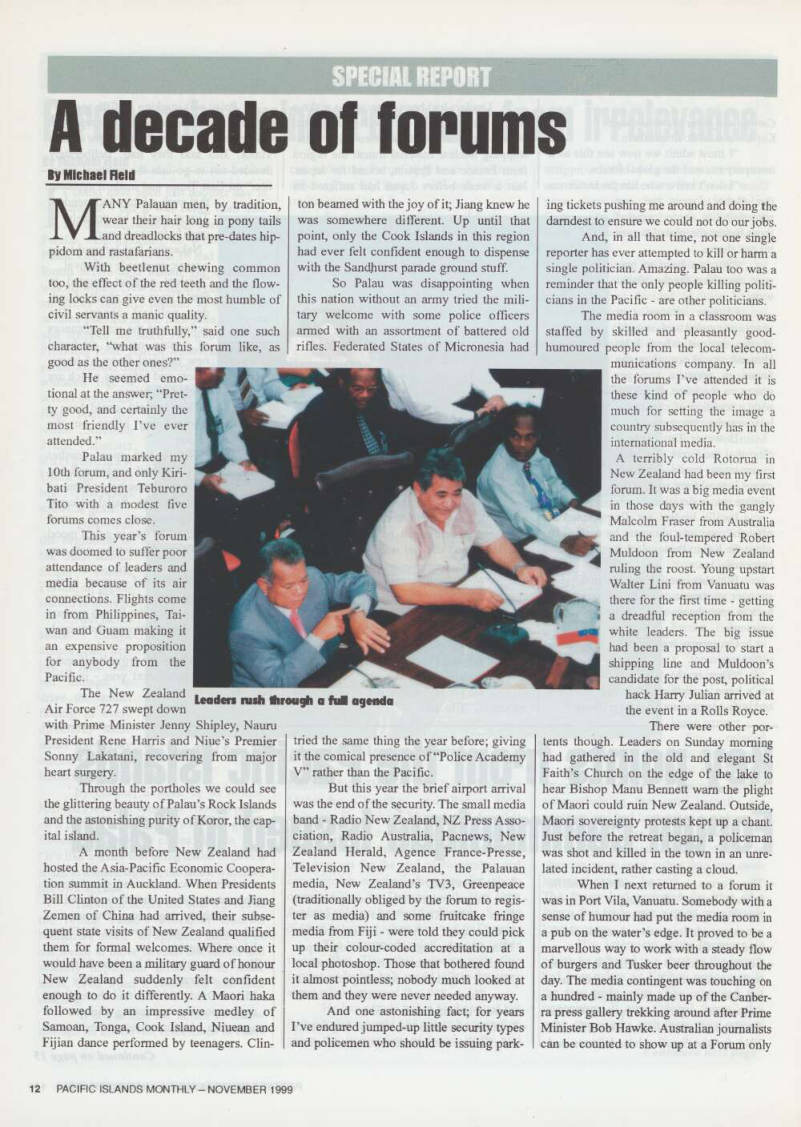
The beautiful Carp Island where Forum leaders retreated
Continued from previous page
Kiribati could do about them.
“I must admit we now see this as a necessity to meet the global forces.
“I don’t know who has the button on the global forces but our
responsibility is to respond them before the global waves hit our shores.
“We just have to pre pare ourselves for the global waves.”
Climate change two years ago caused a crisis with in the summit when John Howard would not allow the forum to adopt a stronger stance on the issue. Breaking with a tradition of consensus he insisted on his approach.
However Tito made it clear that the forum was back in consensus mode - and this meant it would not review the climate stance decision.
Pacific leaders are disappointed at what they see as a slowness by nations to adopt the Kyoto Protocols that specify car bon emissions.
But they would not be making a stronger statement as to do so “would go back to open the wounds” of the forum two years ago.
Consensus was reached to make a softer statement.
“That is the way life works. We can’t have everything. It’s like husband and wife, you cannot have everything.”
Leaders had been expected to make a strong statement on the nuclear shipment issue which last month saw two ships trans shipping nuclear material transit the region from France and Britain, bound for Japan.
Just a week before Japan had suffered its
worst nuclear accident.
But Tito said the Pacific was con scious that the shipments were part of the economic development of France, Britain and Japan and did not want to take strong action.
“We know they are doing it for devel opment ... We do not want to cut off the tap... We have got to be fair.”
Tito acknowledge that previous
forums had issued stronger communiques on this but pointed out the majority of the cur rent leadership was new.
“We are not advancing as quickly as we could,” Tito said.
Palau was marking its fifth anniver sary of independence, making its reporters at least rather sensitive to the plight of East Timor. Tito said they had “deliberately decided not to go into the political situa tion” on East Timor and made it apparent
that even a future independent Timor would be unlikely to qualify for the Forum.
Nakamura had referred to as a tragic manmade upheaval.
“Violent conflict erupted in East Timor as a result of sud den political change. The actions and the circumstances of certain nations produced new regional flows of immi grants and refugees which are likely to continue.”
This, he said, could have a destabilising effect on the region.
The leaders spent another day in formal session refining
the communique that came out as Samoan Prime Minister Tuilaepa Sailele elected himself Forum spokesman. It was more than apparent he was in a foul mood and declined to answer questions with any detail.
He ended his brief moment in the limited media sun with a line: “I love you all.” No thanks to him, the Forum appears to have made a minor recovery from irrel evance.
It gets a chance to prove itself under tough circumstances next year - in Kiri bati. ■
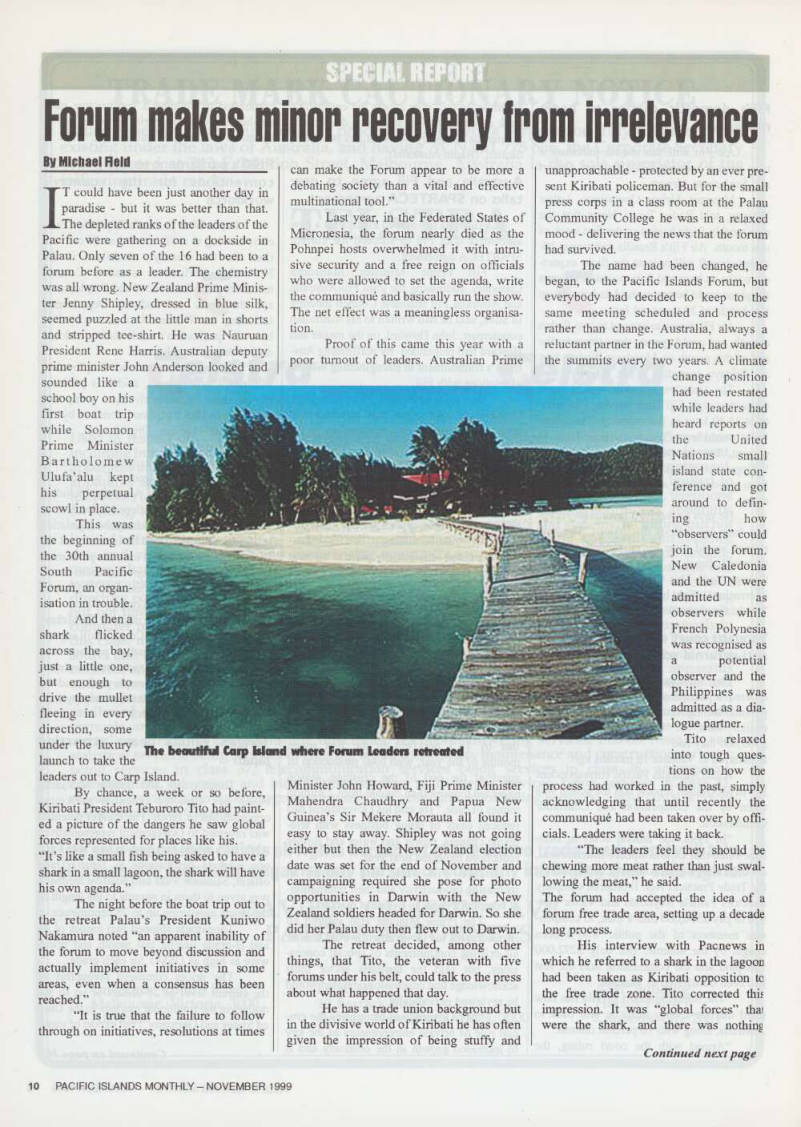
Forum Leaders are taken out on the launch "Virgo" towards Carp Island
Key points from the Pacific Islands
Forum communique issued in Palau
• The Forum is to be called “Pacific Islands Forum” following a one year transition period to allow time for the necessary administrative changes associ ated with the change. • Leaders endorsed in principle a free trade area among Forum members not ing that this would be implemented in stages over a period of up to 2009 for developing Forum Island Countries and 2011 for the Smaller Island States and
Least Developed Countries. • The Forum endorsed the “Forum Aviation Plan : 1999 Review” and supported the convening of a further Forum Aviation Ministers Meeting in 2000, noting, in par ticular, the special circumstances of Smaller Island States with respect to avia tion. This will create a unified air traffic control system Pacific-wide. • Leaders reiterated the critical importance of efficient and effective communications
services for economic and social devel opment and the constraints placed by the relatively high cost structures of telecommunication networks for Forum Island Countries. • The Forum reiterated its view that ship ments of radioactive materials and Mixed Oxide (MOX) fuel through the region posed a continuing concern and agreed to adopt a consistent position on
Continued on page 15
Continued from page 11
the issue, taking into account the risks of an accident occurring and the conse quences of such an accident. • The Forum noted there had been no fur ther signatures or ratification of the Raro tonga Treaty since 1997 and reiterated its call upon the United States to ratify the Protocols to the Treaty. • The Forum welcomed progress in devel oping a vulnerability index and reiterated its call for a comprehensive vulnerability index, encompassing such factors as environmental and capacity considera tions that could be broadly applied and included in the criteria for determining Least Developed Country status and for deciding on concessional aid and trade treatment. • Leaders welcomed the increasing interest
in the Forum and its related meetings and endorsed the following criterion for observership by Pacific Territories: “A Pacific Island territory on a clear path to achieving self-government or indepen dence may be eligible for observer status at the Forum, subject to the approval of Forum Leaders”. • Leaders agreed that the Forum Fisheries Agency Vessel Monitoring System needs to be fully implemented by all FFA mem bers within two years. Leaders reaf firmed the importance of a coordinated regional approach to the issue of main taining fish stocks at a sustainable level in the Western and Central Pacific. • The Leaders recalled the positive out comes of the inaugural South Pacific Forum-Japan Leaders’ Summit held in October 1997 in Tokyo and the recent
communication with the Government of Japan concerning a possible follow-up Summit in the near future. The Forum highlighted the importance of the Sum mit in expanding further, the already strong links between the region and Japan and tasked the Secretariat to pur sue discussions with Japan on the timing of the next Summit. • Leaders warmly commended the strong contribution of South Pacific Forum members to regional security, in partner ship with one another and with the inter national community. Leaders indicated their willingness and desire to provide practical support, as required and within their resources, for UN operations in East Timor, including for the current INTER FET operation. ■
A decade of forums
By Michael Held
MANY Palauan men, by tradition, wear their hair long in pony tails and dreadlocks that pre-dates hip pidom and rastafarians.
With beetlenut chewing common too, the effect of the red teeth and the flow ing locks can give even the most humble of civil servants a manic quality.
“Tell me truthfully,” said one such character, “what was this forum like, as
good as the other ones?”
He seemed emo tional at the answer; “Pret ty good, and certainly the most friendly I’ve ever attended.”
Palau marked my 10th forum, and only Kiri bati President Teburoro Tito with a modest five forums comes close.
This year’s forum was doomed to suffer poor attendance of leaders and media because of its air connections. Flights come in from Philippines, Tai wan and Guam making it an expensive proposition for anybody from the Pacific.
The New Zealand Air Force 727 swept down
with Prime Minister Jenny Shipley, Nauru President Rene Harris and Niue’s Premier Sonny Lakatani, recovering from major heart surgery.
Through the portholes we could see the glittering beauty of Palau’s Rock Islands and the astonishing purity of Koror, the cap ital island.
A month before New Zealand had hosted the Asia-Pacific Economic Coopera tion summit in Auckland. When Presidents Bill Clinton of the United States and Jiang Zemen of China had arrived, their subse quent state visits of New Zealand qualified them for formal welcomes. Where once it would have been a military guard of honour New Zealand suddenly felt confident enough to do it differently. A Maori haka followed by an impressive medley of Samoan, Tonga, Cook Island, Niuean and Fijian dance performed by teenagers. Clin
ton beamed with the joy of it; Jiang knew he was somewhere different. Up until that point, only the Cook Islands in this region had ever felt confident enough to dispense with the Sandhurst parade ground stuff.
So Palau was disappointing when this nation without an army tried the mili tary welcome with some police officers armed with an assortment of battered old rifles. Federated States of Micronesia had
tried the same thing the year before; giving it the comical presence of “Police Academy V” rather than the Pacific.
But this year the brief airport arrival was the end of the security. The small media band - Radio New Zealand, NZ Press Asso ciation, Radio Australia, Pacnews, New Zealand Herald, Agence France-Presse, Television New Zealand, the Palauan media, New Zealand’s TV3, Greenpeace (traditionally obliged by the forum to regis ter as media) and some fruitcake fringe media from Fiji - were told they could pick up their colour-coded accreditation at a local photoshop. Those that bothered found it almost pointless; nobody much looked at them and they were never needed anyway.
And one astonishing fact; for years I’ve endured jumped-up little security types and policemen who should be issuing park
ing tickets pushing me around and doing the damdest to ensure we could not do our jobs.
And, in all that time, not one single reporter has ever attempted to kill or harm a single politician. Amazing. Palau too was a reminder that the only people killing politi cians in the Pacific - are other politicians.
The media room in a classroom was staffed by skilled and pleasantly good humoured people from the local telecom
munications company. In all the forums I’ve attended it is these kind of people who do much for setting the image a country subsequently has in the international media.
A terribly cold Rotorua in New Zealand had been my first forum. It was a big media event in those days with the gangly Malcolm Fraser from Australia and the foul-tempered Robert Muldoon from New Zealand ruling the roost. Young upstart Walter Lini from Vanuatu was there for the first time - getting a dreadful reception from the white leaders. The big issue had been a proposal to start a shipping line and Muldoon’s candidate for the post, political hack Harry Julian arrived at the event in a Rolls Royce.
There were other por
tents though. Leaders on Sunday morning had gathered in the old and elegant St Faith’s Church on the edge of the lake to hear Bishop Manu Bennett warn the plight of Maori could ruin New Zealand. Outside, Maori sovereignty protests kept up a chant.
Just before the retreat began, a policeman was shot and killed in the town in an unre lated incident, rather casting a cloud.
When I next returned to a forum it was in Port Vila, Vanuatu. Somebody with a sense of humour had put the media room in a pub on the water’s edge. It proved to be a marvellous way to work with a steady flow of burgers and Tusker beer throughout the day. The media contingent was touching on a hundred - mainly made up of the Canber ra press gallery trekking around after Prime Minister Bob Hawke. Australian journalists can be counted to show up at a Forum only
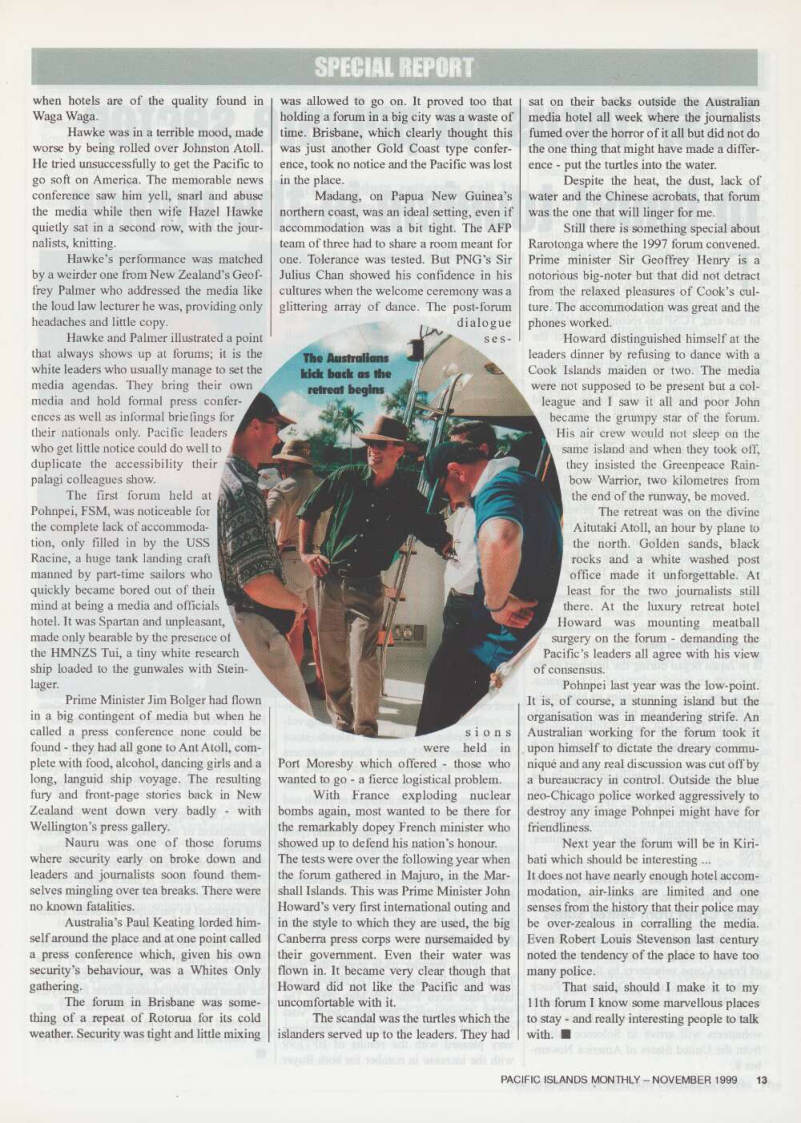
Leaden rush through a full agenda
when hotels are of the quality found in Waga Waga.
Hawke was in a terrible mood, made worse by being rolled over Johnston Atoll.
He tried unsuccessfully to get the Pacific to go soft on America. The memorable news conference saw him yell, snarl and abuse the media while then wife Hazel Hawke quietly sat in a second row, with the jour nalists, knitting.
Hawke’s performance was matched by a weirder one from New Zealand’s Geof frey Palmer who addressed the media like the loud law lecturer he was, providing only headaches and little copy.
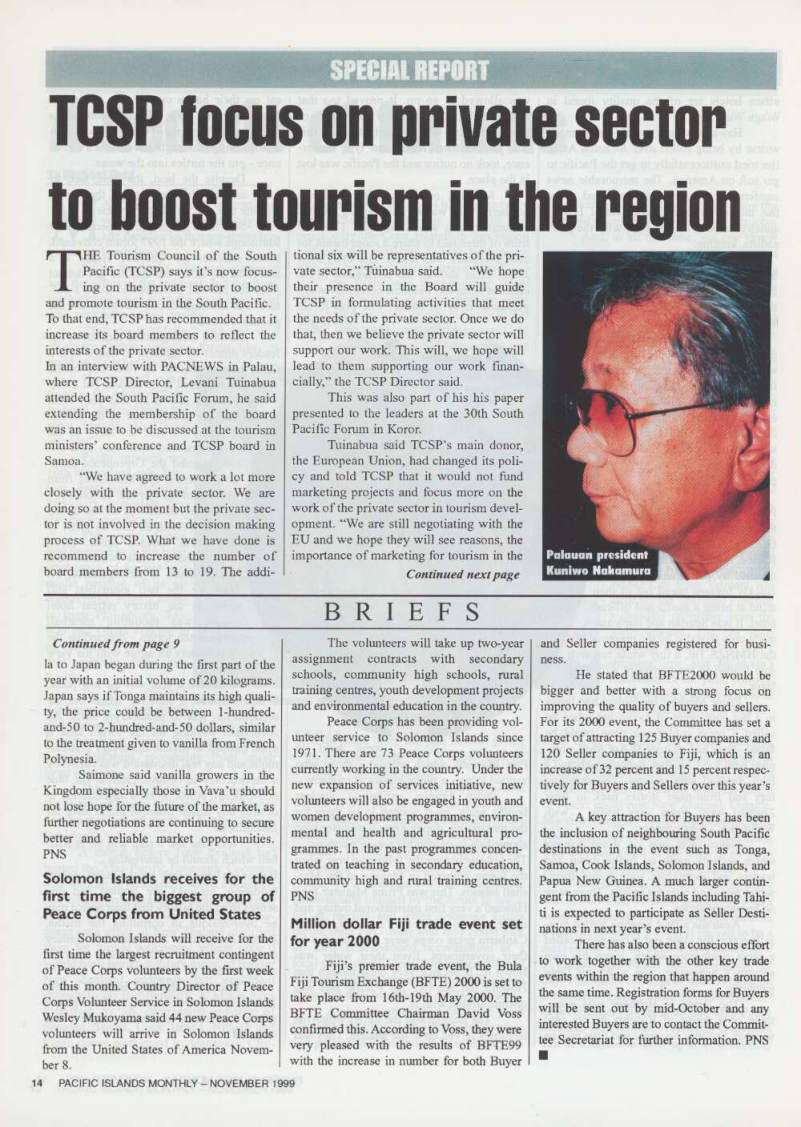
Hawke and Palmer illustrated a point that always shows up at forums; it is the white leaders who usually manage to set the media agendas. They bring their own media and hold formal press confer ences us well as informal briefings for their nationals only. Pacific leaders who get little notice could do well to fl duplicate the accessibility their palagi colleagues show. j The first forum held at HuBBT Pohnpei, FSM, was noticeable for the complete lack of accommoda tion, only filled in by the USS P; Racine, a huge tank landing craft manned by part-time sailors who quickly became bored out of their BIL [ mind at being a media and officials hotel. It was Spartan and unpleasant, made only bearable by the presence of !BBj the HMNZS Tui, a tiny white research ship loaded to the gunwales with Stein- ll lager.
Prime Minister Jim Bolger had flown in a big contingent of media but when he called a press conference none could be found - they had all gone to Ant Atoll, com plete with food, alcohol, dancing girls and a
long, languid ship voyage. The resulting
fury and front-page stories back in New Zealand went down very badly - with
Wellington’s press gallery.
Nauru was one of those forums where security early on broke down and leaders and journalists soon found them selves mingling over tea breaks. There were no known fatalities.
Australia’s Paul Keating lorded him self around the place and at one point called a press conference which, given his own security’s behaviour, was a Whites Only
gathering.
The forum in Brisbane was some thing of a repeat of Rotorua for its cold weather. Security was tight and little mixing
was allowed to go on. It proved too that holding a forum in a big city was a waste of time. Brisbane, which clearly thought this was just another Gold Coast type confer ence, took no notice and the Pacific was lost in the place.
Madang, on Papua New Guinea’s northern coast, was an ideal setting, even if acconmiodation was a bit tight. The AFP team of three had to share a room meant for one. Tolerance was tested. But PNG’s Sir Julius Chan showed his confidence in his cultures when the welcome ceremony was a glittering array of dance. The post-forum
dialogue ses-
sio n s
were held in
Port Moresby which offered - those who wanted to go -a fierce logistical problem.
With France exploding nuclear bombs again, most wanted to be there for the remarkably dopey French minister who showed up to defend his nation’s honour.
The tests were over the following year when the forum gathered in Majuro, in the Mar shall Islands. This was Prime Minister John Howard’s very first international outing and in the style to which they are used, the big Canberra press corps were nursemaided by their government. Even their water was flown in. It became very clear though that Howard did not like the Pacific and was uncomfortable with it.
The scandal was the turtles which the islanders served up to the leaders. They had
sat on their backs outside the Australian media hotel all week where the journalists fumed over the horror of it all but did not do the one thing that might have made a differ ence - put the turtles into the water.
Despite the heat, the dust, lack of water and the Chinese acrobats, that forum was the one that will linger for me.
Still there is something special about Rarotonga where the 1997 forum convened.
Prime minister Sir Geoffrey Henry is a notorious big-noter but that did not detract from the relaxed pleasures of Cook’s cul ture. The accommodation was great and the
phones worked.
Howard distinguished himself at the leaders dinner by refusing to dance with a Cook Islands maiden or two. The media were not supposed to be present but a col k league and I saw it all and poor John mk became the grumpy star of the forum.
His air crew would not sleep on the Hi same island and when they took off, H| they insisted the Greenpeace Rain- HH k° w W a m° r ’ two kilometres from fV";H •l 10 e'nd of the runway, be moved.
HHP The retreat was on the divine WBm Aitutaki Atoll, an hour by plane to H| the north. Golden sands, black H rocks and a white washed post H office made it unforgettable. At least for the two journalists still there. At the luxury retreat hotel Howard was mounting meatball surgery on the forum - demanding the f Pacific’s leaders all agree with his view of consensus.
Pohnpei last year was the low-point.
It is, of course, a stunning island but the organisation was in meandering strife. An Australian working for the forum took it upon himself to dictate the dreary commu nique and any real discussion was cut off by a bureaucracy in control. Outside the blue neo-Chicago police worked aggressively to destroy any image Pohnpei might have for friendliness.
Next year the forum will be in Kiri bati which should be interesting ...
It does not have nearly enough hotel accom modation, air-links are limited and one senses from the history that their police may be over-zealous in corralling the media.
Even Robert Louis Stevenson last century noted the tendency of the place to have too
many police.
That said, should I make it to my 11th forum I know some marvellous places to stay -and really interesting people to talk with. ■
to boost tourism in the region
TCSP focus on private sector to boost tourism in the region
TFEE Tourism Council of the South Pacific (TCSP) says it’s now focus ing on the private sector to boost and promote tourism in the South Pacific.
To that end, TCSP has recommended that it increase its board members to reflect the interests of the private sector.
In an interview with PACNEWS in Palau, where TCSP Director, Levani Tuinabua attended the South Pacific Forum, he said extending the membership of the board was an issue to be discussed at the tourism ministers’ conference and TCSP board in Samoa.
“We have agreed to work a lot more closely with the private sector. We are doing so at the moment but the private sec tor is not involved in the decision making process of TCSP. What we have done is recommend to increase the number of board members from 13 to 19. The addi
tional six will be representatives of the pri vate sector,” Tuinabua said. “We hope their presence in the Board will guide TCSP in formulating activities that meet the needs of the private sector. Once we do that, then we believe the private sector will support our work. This will, we hope will lead to them supporting our work finan cially,” the TCSP Director said.
This was also part of his his paper presented to the leaders at the 30th South Pacific Forum in Koror.
Tuinabua said TCSP’s main donor, the European Union, had changed its poli cy and told TCSP that it would not fund marketing projects and focus more on the work of the private sector in tourism devel opment. “We are still negotiating with the EU and we hope they will see reasons, the importance of marketing for tourism in the
Continued next page
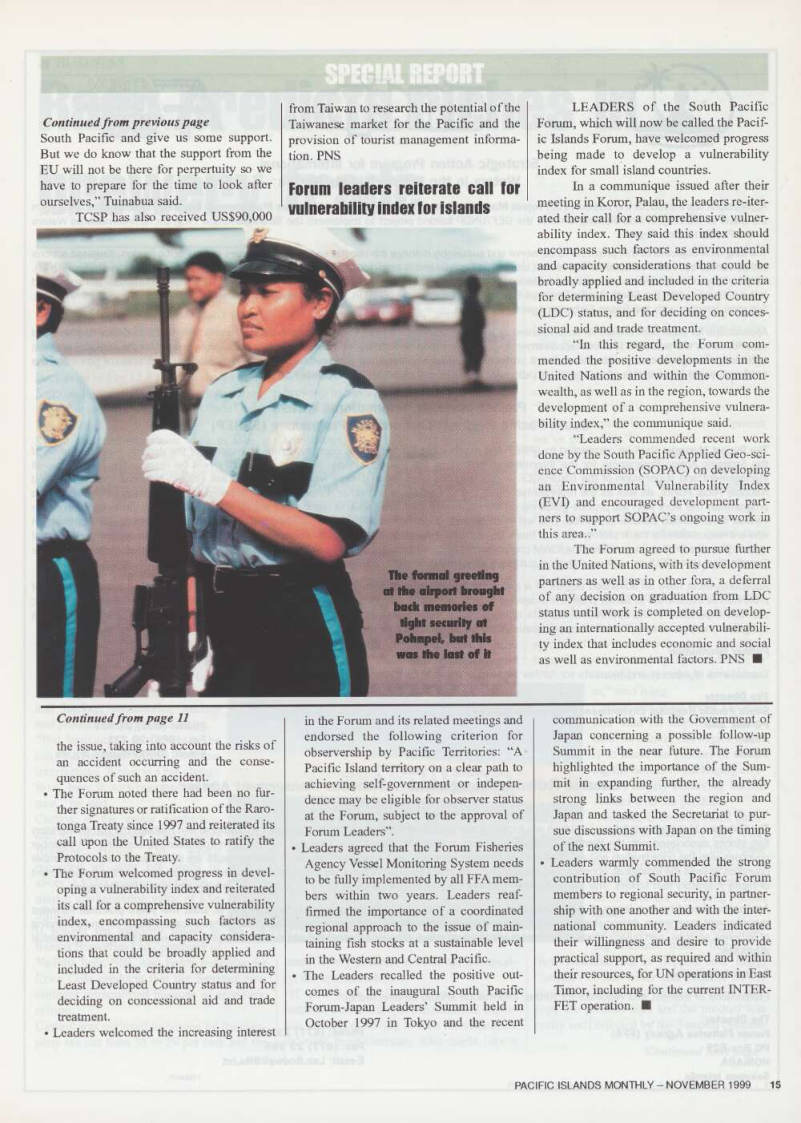
Palauan president Kuniwo Nakamura
Continued from previous page
South Pacific and give us some support.
But we do know that the support from the EU will not be there for perpertuity so we have to prepare for the time to look after ourselves,” Tuinabua said.
TCSP has also received US$9O,OOO
from Taiwan to research the potential of the Taiwanese market for the Pacific and the provision of tourist management informa tion. PNS
Forum leaders reiterate call for
vulnerability index for islands
LEADERS of the South Pacific Forum, which will now be called the Pacif ic Islands Forum, have welcomed progress
being made to develop a vulnerability
index for small island countries.
In a communique issued after their meeting in Koror, Palau, the leaders re-iter ated their call for a comprehensive vulner ability index. They said this index should encompass such factors as environmental and capacity considerations that could be broadly applied and included in the criteria for determining Least Developed Country (LDC) status, and for deciding on conces sional aid and trade treatment.
“hi this regard, the Forum com mended the positive developments in the United Nations and within the Common wealth, as well as in the region, towards the development of a comprehensive vulnera bility index,” the communique said.
“Leaders commended recent work done by the South Pacific Applied Geo-sci ence Commission (SOPAC) on developing an Environmental Vulnerability Index (EVI) and encouraged development part ners to support SOPAC’s ongoing work in this area..”
The Forum agreed to pursue further in the United Nations, with its development partners as well as in other fora, a deferral of any decision on graduation from LDC status until work is completed on develop ing an internationally accepted vulnerabili ty index that includes economic and social as well as environmental factors. PNS ■
The formal greeting at the airport brought back memories of tight security at Pohnpei, but this was the last of it
Advertisements & other items, p. 16 (1 item)
Cutup A 3
SlnXLbty)
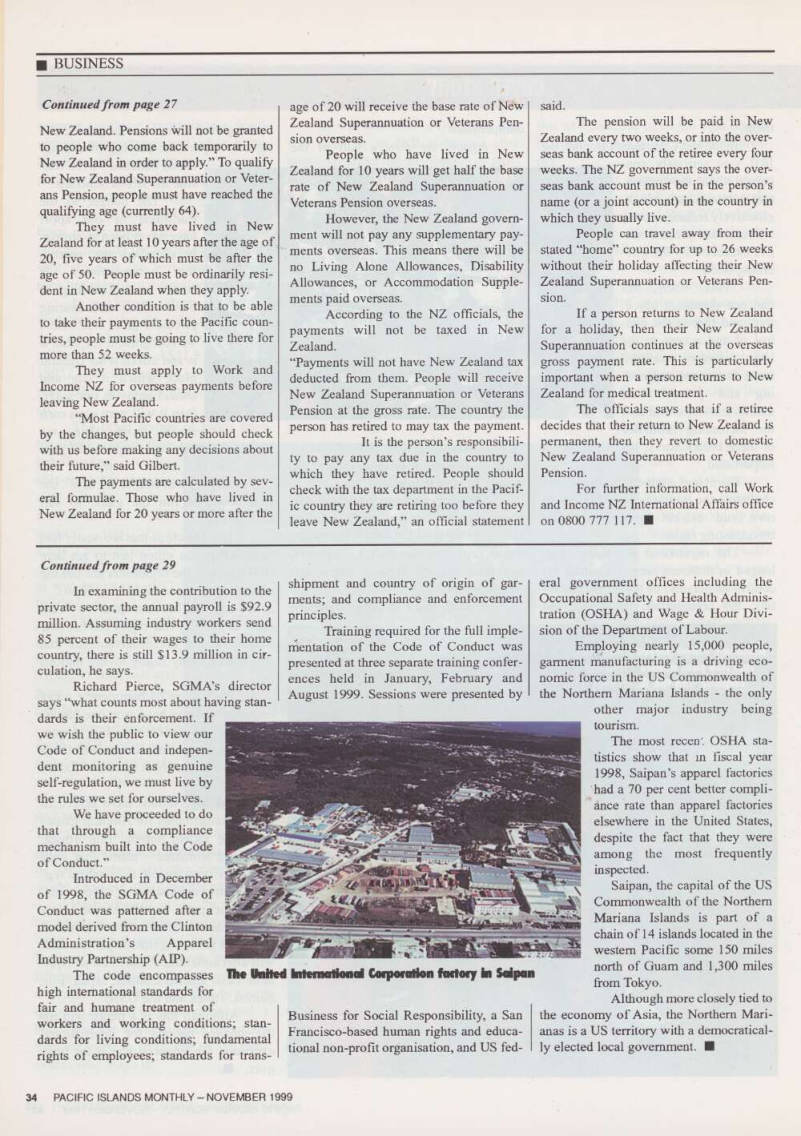
Strategic Action Program for International
Waters in the Pacific Islands Region
Applications are invited for the positions of Project Manager/lnternatlonal Waters and Fisheries Management Adviser. These positions will form the basis of the Project Coordinating Unit for the GEF/UNDP funded project to Implement the Strategic Action Program for International Waters in the Pacific Islands Region.
The long-term objective of this project is to conserve and sustainbly manage the coastal and ocean resources in the Pacific Region. Targeted actions will be carried out in two complementary areas: Integrated Coastal and Watershed Management (ICWM) and Oceanic Fisheries Management (OFM).
ICWM will focus on freshwater management, Marine Protected Areas, coastal fisheries and waste management. The Project Manager will be located in Apia, Samoa, with the South Pacific Regional Environment Programme (SPREP). The Fisheries Management Adviser will be located in Honiara, Solomon Islands, with the Forum Fisheries Agency (FFA).
Applications for each post should be accompanied by a detailed curriculum vitae containing full personal details, information on qualifications and experience for the position, previous appointments, current position and salary, names, addresses and telephone and/or fax contact numbers of three persons associated with the applicant professionally and who would be prepared to provide testimonials. An indication of how soon the applicant would be available should also be indicated. Applications close on 15 November 1999.
Project Manager/lnternational Waters
South Pacific Regional Environment Programme (SPREP)
The Project Manager shall be contracted to SPREP and responsible for the overall coordination of all aspects of the general implementation of the Strategic Action Programme for the International Waters of the Pacific Islands. In particular, he/she will be responsible for the overall management and supervision of the UNDP/GEF project. He/She shall liaise directly with the Regional Task Forces, National Task Forces and National Focal Points, as well as the representatives of the GEF partners and other donors, in order to coordinate the annual work plan for the programme. The work plan will provide guidance on the day-to-day implementation of the current project document and on the integration of the various donor funded parallel initiatives. This will include close coordination with the Forum Fisheries Agency and the South Pacific Commission who are responsible for the implementation of major project components. He/She shall be responsible for all substantive, managerial and financial reports from the Project, in particular the ICWM component of the programme. He/She will provide overall supervision for all staff in the Programme Coordination Unit (PCU) as well as providing guidance concerning external relations for the project.
Applicants must have an advanced degree in a discipline relevant to environmental management and institution building: at least ten years of professional experience in senior project management posts in fields related to the assignment; demonstrated diplomatic and negotiating skills; previous experience in the operational aspects of large UN-funded projects or similar regional/multi-country projects, as well as familiarity with the goals and procedures of international organizations, in particular those of the GEF partners (UNDP, UNEP, World Bank).
Further Information Expressions of interest and requests for further information should be directed to: The Director South Pacific Regional Environment Programme (SPREP) PO Box 240
APIA
Samoa Phone: (685) 21 929 Fax: (685) 20 231
E-mail: [email protected]
Oceanic Fisheries Management Fisheries Management Adviser
Forum Fisheries Agency
The Fisheries Management Adviser position will focus on assisting in the development of strategies to conserve and manage the highly migratory fish stocks associated with the Western Pacific Warm Pool ecosystem. Specifically, this position will be responsible for assisting FFA member countries with the coordination and development of fisheries management arrangements. Such arrangements are designed to help FFA member countries assess the biological, economic and social implications of alternative fisheries management strategies in the context of the management of highly migratory fish stocks. The Fisheries Management Adviser will be required to travel extensively, mainly within the Pacific region.
Applicants should have a thorough understanding of fisheries management principles and techniques, at least five years practical fisheries management experience, demonstrated analytical and research capabilities, and sound presentation and communication skills. An understanding of fisheries science, particularly stock assessment techniques, international fisheries law, and the tuna industry, are helpful though not essential attributes.
Further Information Expressions of interest and requests for further information should be directed to: The Director Forum Fisheries Agency (FFA) Phone: (677) 21124 PO Box 629 Fax: (677) 23 995 HONIARA E-mail; [email protected] Solomon Islands n5244vi
Ragg predicts riches in
Business
Ragg predicts riches in brewery trade
By Alan Ah Mu
WHEN he found that the German managers locked a toilet for their exclusive use at Samoa Brew eries Ltd, Hugh F. Ragg was clearly upset.
As general manager/director of Carlton Brewery (Fiji) Ltd, Ragg was in Apia in last month to sign a deal for Carlton and United Breweries to buy 12.8 per cent shares of the Samoan brewery off Brauhaase Internation al Management and 4.5 per cent from Grove International.
“What happens when you want to take a piss?” he asked someone before ordering that the facility be kept open for local staff.
With new shares to go with those bought back in July, Carlton increased its SBL majority stake from 51 to 68.3 per cent. But the company has no intention to replace Brauhaase as managers, leaving that to local staff now promoted to senior management
positions.
“As far a§ we are concerned as the investor in the company here, Samoa Breweries is a Samoan company, and it is our intention that it be run by Samoans. We don’t expect to have any expatriates within the company,
we will support the company from Fiji in terms of technical advice
and backup, engineering backup
and product backup,” said Ragg.
“But basically ... it’s going to be run by Samoan people, without interference. Which is a big change from how it was operated in the past,” he said.
Carlton is the major production arm of the brewing giant Fosters
Brewing Group Ltd., which
recorded an after tax profit of about As3so million and with a market capitalisation value of AsB billion.
It bought the majority shares in Samoa Breweries Ltd - producer of
Vailima beer. SBL also holds franchise for Coca Cola products that the Samoan gov ernment relinquished because of economic reform.
Carlton was attracted to Samoa by the com pany tax cut from 35 to 29 per cent and the
abolition of the 15 per cent tax on repatriat ed dividends, both of which become effec tive January next year.
“It encourages investment,” said Ragg.
Carlton’s move creates stronger economic links between Samoa and Fiji - where Carl ton owns 63 per cent of Carlton Brewery (Fiji) Ltd. The Fiji-based company has a brewery in Suva and a distillery in Lautoka.
Being part of a group as big as Fosters means access to “huge support services for technology,” said Ragg and benefits from the company’s buying power.
“Just to give you a small example: Samoa Breweries has being buying malt, which is the major raw material for beer at 90 dollars a ton more than we pay in Fiji, and that’s on an FOB basis so we can immediately get a gain here of 90 dollar per ton Australian.
“Various spare parts could be purchased at a far better price by a huge group rather than by a small individual company.
“The other thing of course is that in the past because the company has been under the management of a German company, Brauhaase, the sheer distance away has
made it very difficult to back up, technical ly, the operation here.
“If you have a major break down for instance that needs specific technical exper tise, instead of having to wait for somebody to come from Germany who might take a
week to 10 days, you’ve got people an hour and a half away in Fiji, you’ve got people four hours away in Australia. And in Aus tralia, in particular, Carlton has a large num ber of machines which are similar to the ones Samoa Breweries use so we already
have the expertise, knowledge of operating,
repairing and so on of this type of sophisti
cated equipment.
“I have to tell you the equipment you have here now is much better than the equipment we’ve got in Fiji.”
Ragg said they will not commit suicide with such a universally accepted product and tamper with Vailima beer or change its name.
But Carlton could add another product or two along the diversification route they took in Fiji where after 35 years of putting out only one brand of beer they now have 17 different products.
“There’s a real opportunity here to do some thing similar: bring in the raw spirit or the bulk spirit from Fiji, mix it here with the spirit and have similar products available here. So that you can buy a gin and tonic or
a vodka and orange or whatev er,” said Ragg.
Carlton has spent about $l3 mil lion Tala on improving equip ment at Samoa Breweries main ly to make the process of clean ing the bottles to packaging elec tronic, largely removing human contact with the product.
“Nothing is broken,” said quali ty control manager, Ray Faa mau, of bottles as they were being packaged by machine, as opposed to smashes resulting from bottles slipping from hands.
Dominion Breweries tried mak ing Vailima under license in
New Zealand, but it flopped said Ragg, “because of the water and because of the container perhaps, they couldn’t completely copy the product here and the product was pretty well rejected by the Samoan commu-
Continued next page
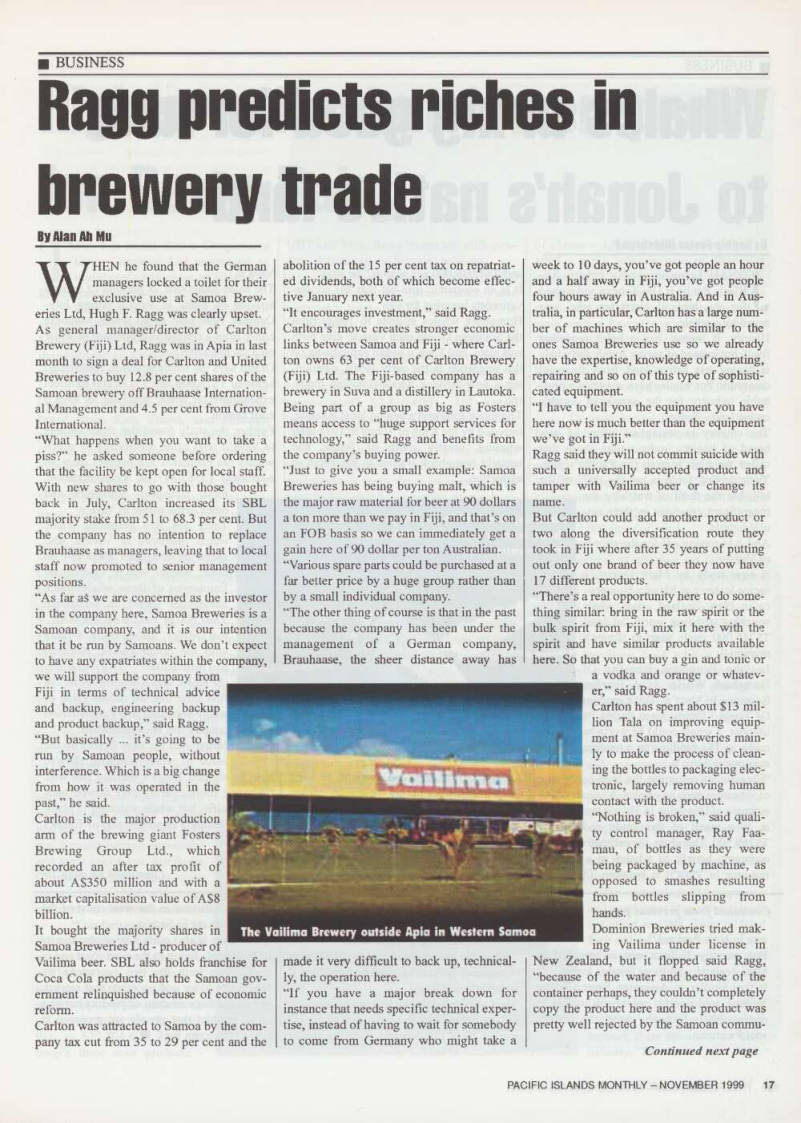
The Vailima Brewery outside Apia in Western Samoa
Continued from previous page
nity in New Zealand.”
But recently Vailima was re-launched in New Zealand with those lessons learnt.
It was similar in American Samoa where Vailima sold poorly, consumers unable to distinguish it from the American brands, said Faamau.
They then increased the alcohol content from 4.9 per cent to 6.7 per cent and Amer ican Samoans took to it, he said.
“We would like to see export to the Samoan community in Australia and further afield if possible,” said Ragg.
“And maybe in conjunction with Carlton in Fiji, we would like to have a look at the US market. Now, I understand, there are almost
as many Samoans in the west coast of the US as there are in Samoa.
“Also there is also quite a large community of Fiji people living in the west coast and in conjunction with the two operations we would like to try and penetrate that market, not with a huge amount of product but as a niche product that people are prepared to pay a little extra for.” ■
Whales bring good fortune

to Jonah's native land
By Sophie Foster Hildebrand
JONAH Lomu may be a famous All- Black, but he is also Tongan and named for the biblical character who was saved by a whale.
History, it seems, has a habit repeating itself, but instead of saving Jonah, the whale is saving his native land from financial downturn. For whales have spawned a prof itable industry for the people of Jonah’s native land - Tonga.
The country is seeing an influx of new breed of hunters, quite unlike those that sailed the high seas in the Pacific’s past.
Their driving force is not the thrill of the
kill, but the thrill of watching the magnificent creatures in their nat ural habitat.
And it is paying off for the people of Vava’u.
A new study by Mark Grams, a senior lecturer at Massey Universi ty in New Zealand, cites whale watching at being worth “at least T 5746,000 each year to Tonga’s tourism.”
In “the Economic Benefits Of Humpback Whales As A Tourism Resource In Vava’u, The Kingdom Of Tonga,” Grams says, during its lifetime, a whale could be worth as much as Tsl.6million as a tourism resource in Vava’u.
“Economists recognise the ‘non-use’ value of resources such as whales. A conservative estimate of this value in Vava’u was arrived at as a result of this study and totaled T 5269,500. Therefore, the estimated overall economic benefit of whales as a tourism resource in Vava’u is between T 5998,000
and T$ 1,036,000 per season,” he says.
It is an economic spin-off that has conser vationists jumping for joy.
Humpback whales migrate to Tonga from the Southern Ocean each year, to give birth and mate, and Vava’u began capitalising on this migration in the early 19905, develop
ing a now-thriving whale-watching indus
try.
The move followed a ban on local whaling, imposed by the King of Tonga in 1978 after whaling, mostly south of Tonga, had brought humpback whales to the brink of extinction.
Around 30 whales are thought to visit Vava’u each week during the season, conse quently each whale can be valued at around T 530,000 per annum as a tourism resource, Orams says. Over an expected 50-year life span, one whale could be worth as much as Tsl.6 million as a tourism resource in
Vava’u.
The study found that 78 per cent of tourists arriving by plane in Vava’u during July- October 1999 paid to go whale watching either from a commercial operator or while on a yacht charter.
Grams says the whale watchers contributed between T 578,000 and T 5116,000 in direct expenditure on whale watching in Vava’u each season.
Further, the study found that those visitors to Vava’u who came specifically to watch whales (an estimated 378 people) spent an additional T 5567,847 on accommodation,
food, transport, souvenirs and other items whilst in Vava’u.
There are five permitted whale watch operators in Vava’u who spend an estimated T 554,464 on their whale watch operations.
Employees of those whale watch businesses spend an additional T 544,000 in Vava’u each season.
Sue Miller, Biodiversity Officer with the South Pacific Regional
Environmental Programme
(SPREP), says a new survey is “the first time that the actual value of whale-watching in a Pacific Island country has been quantified.”
Miller said the new figures on the value of whale watching showed
how far-sighted Tonga’s whaling ban was.
“Whaling profits hardly ever flowed back to the Pacific, but whale-watching is plain ly an increasingly important part of Tonga’s economy.”
Continued on page 20
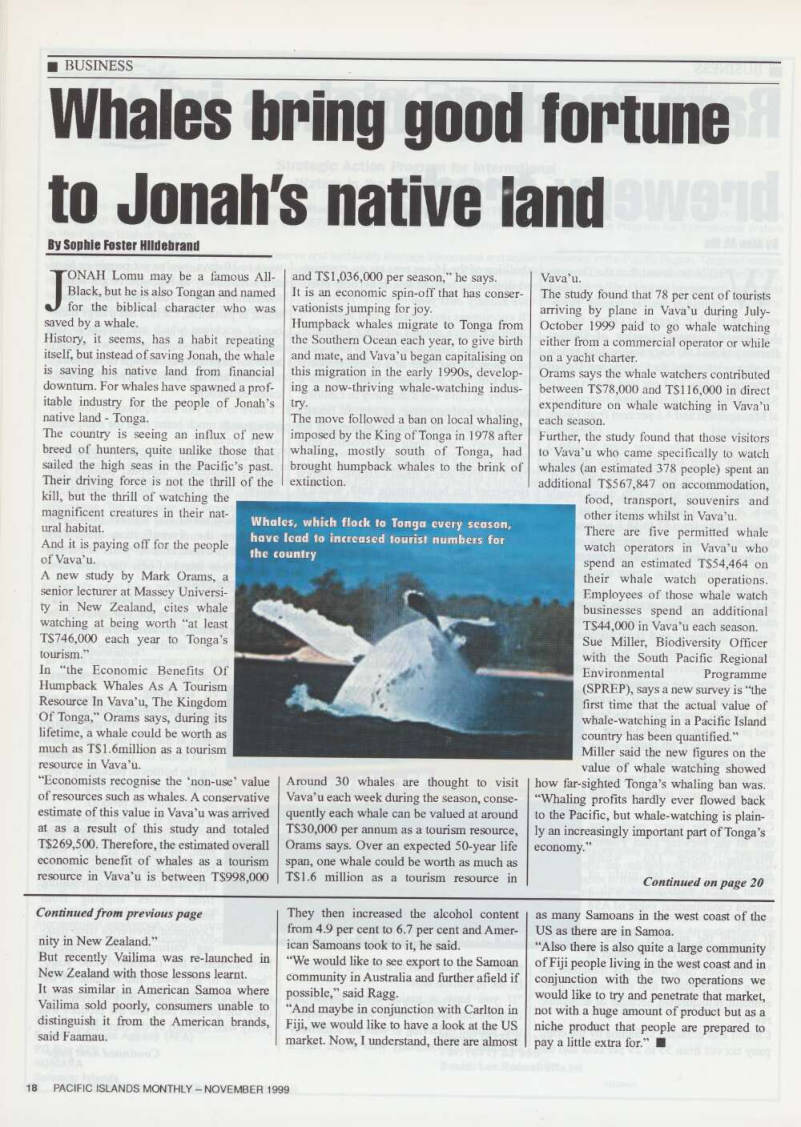
Whales, which flock to Tonga every season, have lead to increased tourist numbers for the country
Continued from page 18
She said there was great potential for expan sion in this field, providing backing for Pacific Island countries that supported the proposal for establishment of a South Pacif ic Whale Sanctuary. “Internally, whale watching is estimated to bring in US$ 504 million each year, and this figure continues to grow. Dr Oram's research shows clearly that whale-watching could provide a grow ing source of tourism income in the Pacific, in years to come.”
To date, seven Pacific island countries - American Samoa, the Cook Islands, French
Polynesia, New Caledonia, Niue, Samoa and the Solomon Islands - have asked SPREP for advice on whale-watching oper ations.
Miller said a Whale Sanctuary in the South Pacific would increase public awareness of the region’s attraction as a whale-watching venue, thus encouraging more tourists inter ested in whale-watching to choose the Pacific rather than other parts of the world.
The growth of whale watching internation ally has been spectacular, Orams says, with it now occurring in over 70 countries and estimated to be worth more than US$ 550 million each year in revenue.
Last year’s South Pacific Forum meeting
agreed that a South Pacific Whale Sanctu ary proposal should be developed.
Orams study found that tourists visiting Tonga are strongly opposed to whaling.
Asked whether the hunting of whales at a particular location would reduce their likeli hood of visiting that area, 62 per cent of yacht visitors and 78 per cent of air holiday makers agreed that it would. “These attitu dinal tests show, not surprisingly, that the great majority of visitors to Vava’u are opposed to any consumptive use of whales.
This is important, because it reveals that any change in the protective status of whales and resumption of whaling prac tices, even on a small scale, would likely displace a large proportion of the current visitors to Vava’u. Thus, there is an ‘oppor tunity cost’ with regard to use of the whales in Vava’u. It appears highly unlikely that a whale watching industry could co-exist with a lethal ‘use’ of whales in Vava’u,’’
Orams says.
But with a royal decree backing a Tongan whaling ban and the economic spin-offs from whale watching increasing, it seems unlikely that the people of Jonah’s native land will do anything to jeopardise their good fortune. ■
78 per cent of tourists arriving by plane in Vava'u during July-October 1999 paid to go whale watching either from a commercial operator or while on a yacht cjarter
Higher sales but lower profit
for Rewa Dairy
THE Fiji-based Rewa Cooperative
Dairy Company Ltd announced an initial profit before tax of F 5115,764 for the year to December 31, 1998.
Following tax deductions and a deci sion by the company board to allocate $lOO,OOO from 1998 earnings to a bonus for shareholders of $300,000 in 1999, profit was reduced to $17,063.
Addressing shareholders at the Coop’s Extraordinary General Meeting, board chair, Ram Chand, said although profit fell short of 1997, it was still a signif icant achievement in an economy affected by a severe downturn.
He added that value of sales, at $27,206,603, was the best result in the com pany’s history and illustrated ability to hold its position in the market, even during recession.
In 1998, Rewa Coop recorded its highest-ever intake of milk at 12,456,712 litres which it attributed largely to a contin uing campaign to raise fanning standards.
Total payout for milk supplies was $4,633,739, six per cent more than in 1997.
Shareholders’ equity at year’s end was more than $6 million. Cost of sales was $21,929,714 above the 1997 result of $18,911,421.
“The main reason for this increase was the substantial extra cost imposed by the 20 per cent devaluation of the Fiji dollar in January 1998,” said Chand.
“Devaluation aimed to protect employment, maintain compet
itiveness and preserve foreign reserves. The downside was that imports became expensive and some prices rose. For Rewa Coop, it brought higher costs for purchases which added sig nificantly to our overheads.
“Our farmers, along with the rest of the population, had to cope with the increased costs of living and the effect of drought on pasture quality and water supplies,” he said. Over all sales volume rose $2.6 mil lion to $27,206,603 with the coop’s three core products -
UHT Life Milk, Rewa Butter and milk pow der - generating the biggest increases.
Life Milk sales were up 213,000 litres to 8,532,900 litres. Sales value increased from $8,594,100 in 1997 to $9,002,100.
The milk powder market, said Chand, was intensively competitive for the year. Despite this, the Coop managed to boost milk powder sales to 1321 metric tonnes worth $7,310,400 - 112 metric tonnes and nearly $lOO,OOO more than 1997.
“We progressed with plans to start local manufacture of milk powder with investment in spray dryer equipment. Milk powder is crucially important to our busi ness. Profits from this product enable us to preserve financial viability and meet our commitments to farmer-shareholders and the new blending operation will help create jobs and income opportunities in dairy
provinces.
“Rewa Coop has a special responsi bility to our rural shareholders. Concessions we have previously received from govern ment have been granted in recognition of this role.”
Rewa Butter gained in sales mainly from increasing its market share against competition from margarine. Value of sales was $8,336,200 - 20.4 per cent higher than 1997. Production was up by 71 metric tonnes to 1,321 metric tonnes.
The Coop sold 140,400 kilogrammes
of cheese - 3,800 kilogrammes more than 1997 - for a sales income of $915,500, against $825,700 the previous year. Con sumption picked up as a number of new restaurants and fast-food outlets opened in main centres. Rewa Coop’s prices are lower than prices for overseas cheese.
Through a more concentrated mar keting effort in schools, fun Flavour sales improved. The company sold 402,900 litres valued at $666,400.
Demand was up for Rewa’s cultured food, including fresh and sour cream, cot tage cheese and yoghurt. These products earned $323,200 (1997: $302,100) from 101,000 kilogranunes sold (1997 : 92,900 kilogrammes). In its first full year, Tarumba Juice generated sales revenue of $151,300 from 125,000 litres of juice.
Dairy fanners continued to benefit from a number of schemes and farm devel opment initiatives. The company incurred cost of operating chilling centres at Naluwai, Waidawara and Waidalice for farmers which went up from $250,000 in 1997 to $313,226 in 1998.
A revolving fund scheme provided alternative source of finance for farm main tenance and upgrading. Loans granted in 1998 totaled $440,676 for 118 farmers. This compared to $328,611 for 101 farmers in 1997.
Chand said: “Through prudent man agement and concentrated marketing and promotion, we were able to keep our results
positive and maintain our obliga tions to shareholders. We responded to the demands of 1998 by focussing on the future and how we should best develop our industry.”
He concluded: “Management and employees showed outstand ing effort in 1998. They fulfilled their obligations to the Coop and its owners.” “As always, we owe a debt of gratitude to the people and government of the Fiji Islands for their strong support for Rewa’s products. Without that support, there would be no dairy industry.” ■
The Rewa Daily factory Is located on the outskirts of Suva, Fiji's capital
Advertisements & other items, p. 20 (1 item)
ToFinish...
SC H GOES
CM I RCHES
GOVERNMENT
COMMERCIAL
Serving:
STATE OF HAWAII
ENTIRE
SOUTH PACIFIC.
INCLUDING:
FIJI
SAMOA
TAHITI
TONGA
COOK ISLANDS
I
MICRONESIA;
FEDERATED STATES
OF MICRONESIA
GLAM
MARIANAS
MARSHALL
ISLANDS
Copymasters Hawaii can help you with all of your duplicating needs from start to finish. Featuring Duplo® Digital Duplicators, Copiers, Shredders, Laminators, Poster Printers, Collators, & Folding Equipment. We also sell Stencil & Duplicator Supplies, Paper Supply, and all brands of Copier Supplies, & Computers.
Copymasters Hawaii
96-1173 Waihona Street. Suite B-2 • Pearl City. HI 96782 Phone (808) 678-2263 • Fax (808) 456-5678
E-Mail: [email protected]
ToFinish...
copymasters
hawaii
Small business-the key to conservation
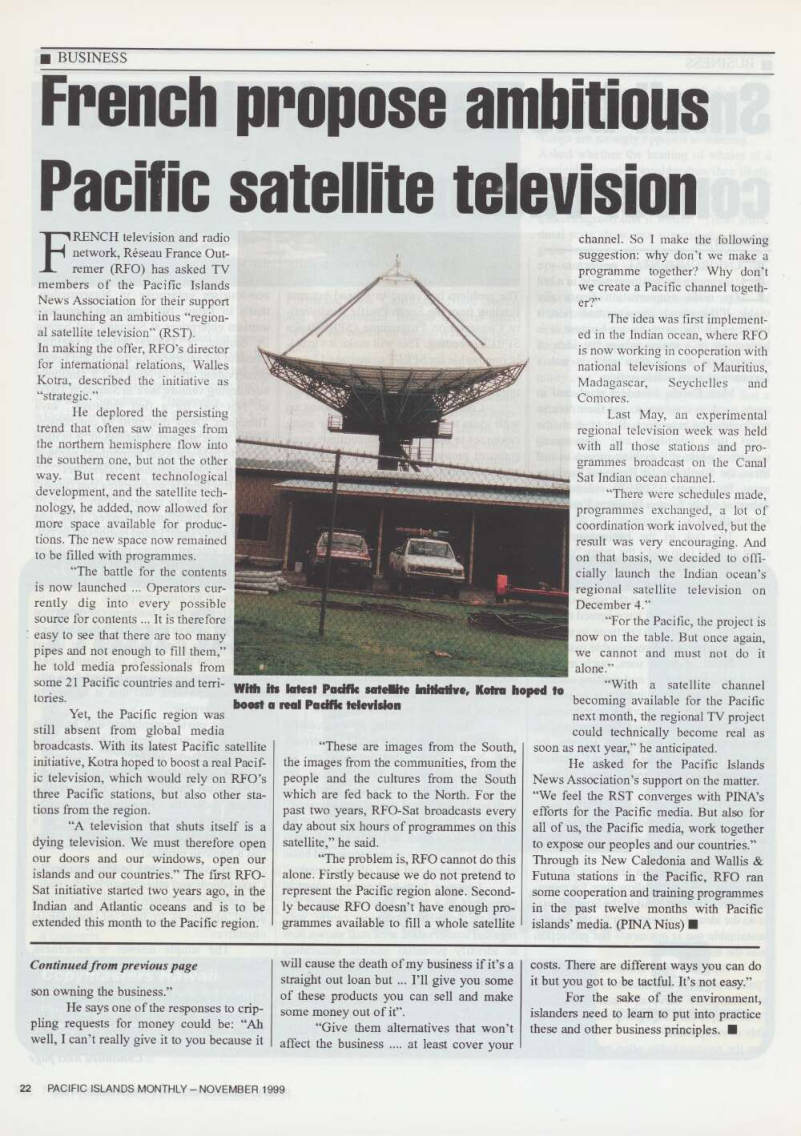
conservation
By Alan Ah Mu
Environmental protectors are taking on the business world in a bid to make conservation financially viable. If this sounds like a contradiction, it becomes all the more harder because it is happening in a region where the idea of conservation for its own sake is not a favourite or even viable option.
Most Pacific Islanders want, and in cases need, to continue to use their diverse environmental resources. But to push the point that islanders can conserving resources while still making money out of them, the South Pacific Regional Environ ment Programme (SPREP) enlisted the expertise of the Samoa Business Enterprise Centre (SBEC).
The task of the business/environ ment alliance is to make the many “conser vation areas” now established in the region generate income to provide for their owners and conserve resources at the same time.
Most communities that have agreed to con servation areas wish to continue to use the natural resources in a sustainable manner.
Some of these uses, such as fire wood, artisanal fishing and shifting cultiva tion, are essentially subsistence in nature.
Others, such as handicrafts, eco-tourism, nut oil production or dried fish production, are undertaken to earn cash income for school fees, cooking oil and various processed foodstuffs and a range of con sumer goods.
Tamarii Tutangata, director of SPREP, says, “Conservation for the sake of conservation has never been a concept close to us from the Pacific.”
Imposing tapu on resources for cer tain periods of time to allow time for regen eration is a historic habit in the South Pacif ic so the idea of conservation for the sake of sustainable use is not new - but protection was the servant of use.
Tapu and other traditional sanctions “passed on from our ancestors were aimed at community survival,” said Tutangata.
“Nowadays, they call this process sustain
able development.”
But the process today often runs on a big
ger scale with relatively large areas parti tioned off for conservation.
The problem has come to a head because funding from the South Pacific Biodiversi ty Conservation Programme (SPBCP) for SPREP is ending. This will make it virtual ly impossible for SPREP to manage 17 con servation areas in 12 countries in the region.
Communities now have to come up with ideas to protect the areas while using resources to make money to continue envi ronment protection programmes and sup port themselves.
Enter the regional workshop of 22 participants held in Apia in September, called Conservation Enterprises and Income Generating Activities: A Skills Development Programme and Workshop for SPBCP-supported Conservation Areas.
Tutangata says this will be “the ultimate test of success and represents a very chal lenging stage of each conservation area.”
It’s hard, he said, to set up a small enterprise that aims at conserving natural resources while providing revenues because it involves reconciling three key elements: Pacific cultures, nature conserva tion and hard-core business decisions.
“The odds of setting up a successful business anywhere in the world are already slim. Now imagine that not only are we looking at promoting ventures that are financially viable but they also need to be both ecologically and socially sustainable,” he says. “To achieve this we need a bit more than hard work and dedication to con servation. We need a no-nonsense and basic business training and a set of benchmarks.”
Learning how to manage conserva tion areas as a small business started last year at the SBEC training centre with regional conservation area staff shown how
to identify potential income generating
activities, assess financial and operational feasibility and prepare basic business plans.
In the year following the first workshop, five small enterprises in four different con servation areas were being set up, mainly
following business plans developed during
that workshop.
“I can name a community sea-kayaking eco-tourism enterprise in Ngaremeduu, that’s in Palau, two small budding eco tourism enterprises at Saanapu and Sataoa in Samoa, a Direct Micro-Expelling Coconut oil enterprise in the Huvalu Forest conservation area in Niue and a rainforest beekeeping venture here in Samoa at Uafa to. Not bad for a first initiative,” says Tutangata. “Now that most of our conser vation areas are well established, it is time for us to help our local community partners turn them into sustainable endeavours.”
But there is another area that conser vationists have to contend with - lack of discipline regarding finances that has caused many small island businesses to fail.
Samoa’s veteran finance minister, Tuilaepa Sailele Malielegaoi says just when a busi ness starts to generate profit, the urge crops up to use it for other purposes.
He says small business operators that fail forget to save part of the profit to keep the enterprise alive. But within the island communities themselves, the business per son “expected to give much more than oth ers,” Tuilaepa said, and this is helping to kill off enterprise.
But environmentalists and business do have a common ground, he says - the
struggle for sustainability.
Apete Meredith, principal consultant of Bioglobal Pacific, one of the workshop trainers, said the communal pressure to siphon profit away from the needs of a business to other communal matters is not
just a Samoan problem.
He says it exists in Fiji, Tonga, the Cook Islands and other South Pacific coun tries where “too often people tend to put social objectives in front of commercial
objectives”.
The simple answer is awareness, Meredith says, to explain what business is about.
“That’s an added (risk) factor in business in the islands,” said Meredith. “It’s a very dif ficult issue. And the emphasis is on the per-
Continued next page
Continued from previous page
son owning the business.”
He says one of the responses to crip pling requests for money could be: “Ah well, I can’t really give it to you because it
will cause the death of my business if it’s a straight out loan but ... I’ll give you some of these products you can sell and make some money out of it”.
“Give them alternatives that won’t affect the business ... at least cover your
costs. There are different ways you can do it but you got to be tactful. It’s not easy.”
For the sake of the environment, islanders need to leam to put into practice these and other business principles. ■
French propose ambitious
Pacific satellite television
FRENCH television and radio network, Reseau France Out remer (RFO) has asked TV members of the Pacific Islands News Association for their support in launching an ambitious “region al satellite television” (RST).
In making the offer, RFO’s director for international relations, Walles Kotra, described the initiative as “strategic.”
He deplored the persisting
trend that often saw images from the northern hemisphere flow into the southern one, but not the other way. But recent technological development, and the satellite tech nology, he added, now allowed for more space available for produc tions. The new space now remained to be filled with programmes.
“The battle for the contents is now launched ... Operators cur rently dig into every possible source for contents ... It is therefore easy to see that there are too many pipes and not enough to fill them,” he told media professionals from some 21 Pacific countries and terri tories.
Yet, the Pacific region was still absent from global media
broadcasts. With its latest Pacific satellite initiative, Kotra hoped to boost a real Pacif ic television, which would rely on RFO’s three Pacific stations, but also other sta tions from the region.
“A television that shuts itself is a dying television. We must therefore open our doors and our windows, open our islands and our countries.” The first RFO- Sat initiative started two years ago, in the Indian and Atlantic oceans and is to be extended this month to the Pacific region.
“These are images from the South, the images from the communities, from the people and the cultures from the South which are fed back to the North. For the past two years, RFO-Sat broadcasts every day about six hours of programmes on this satellite,” he said.
“The problem is, RFO cannot do this alone. Firstly because we do not pretend to represent the Pacific region alone. Second ly because RFO doesn’t have enough pro grammes available to fill a whole satellite
channel. So I make the following suggestion: why don't we make a programme together? Why don’t we create a Pacific channel togeth er-’
The idea was first implement ed in the Indian ocean, where RFO is now working in cooperation with national televisions of Mauritius, Madagascar, Seychelles and Comores.
Last May, an experimental regional television week was held with all those stations and pro grammes broadcast on the Canal Sat Indian ocean channel.
“There were schedules made, programmes exchanged, a lot of coordination work involved, but the result was very encouraging. And on that basis, we decided to offi cially launch the Indian ocean’s regional satellite television on December 4.”
“For the Pacific, the project is now on the table. But once again, we cannot and must not do it alone.”
“With a satellite channel becoming available for the Pacific next month, the regional TV project
could technically become real as soon as next year,” he anticipated.
He asked for the Pacific Islands News Association’s support on the matter.
“We feel the RST converges with PINA’s efforts for the Pacific media. But also for all of us, the Pacific media, work together to expose our peoples and our countries.”
Through its New Caledonia and Wallis & Futuna stations in the Pacific, RFO ran some cooperation and training programmes in the past twelve months with Pacific islands’ media. (PINA Nius) ■
With its latest Pacific satellite initiative, Kotra hoped to boost a real Pacific television
Shark fin anyone?
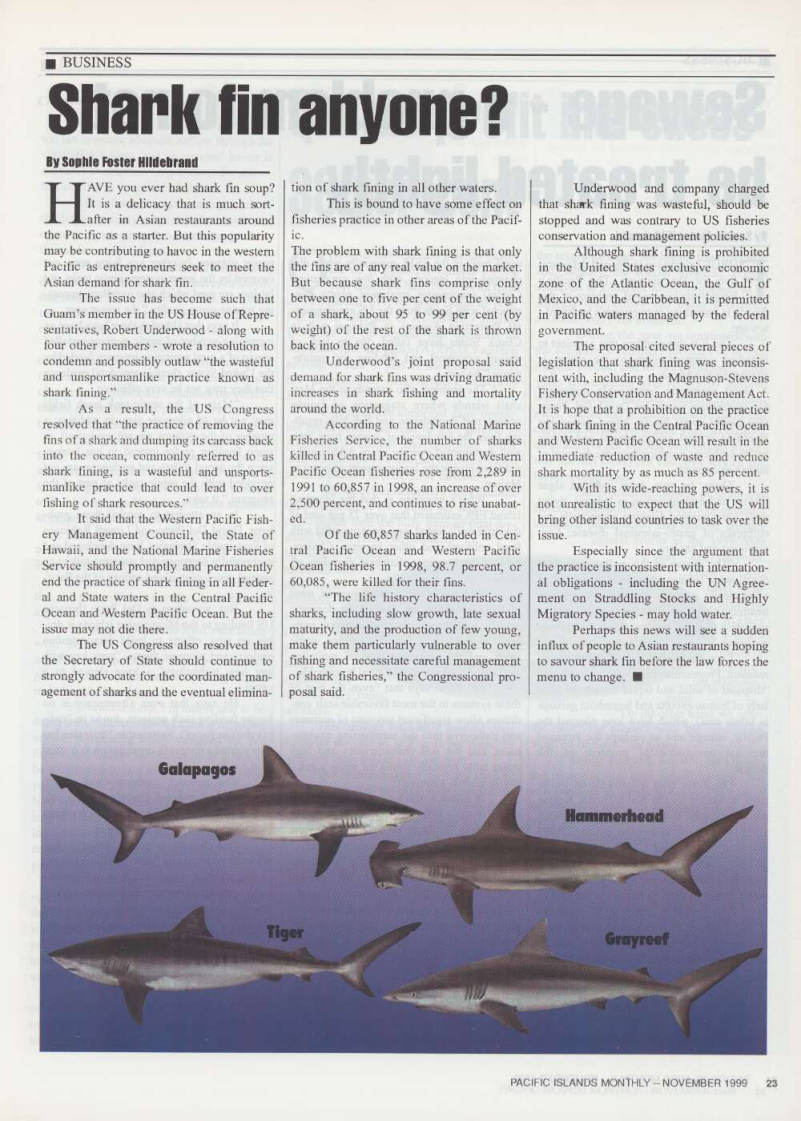
By Sophie Foster Hildebrand
HAVE you ever had shark fin soup?
It is a delicacy that is much sort after in Asian restaurants around the Pacific as a starter. But this popularity may be contributing to havoc in the western Pacific as entrepreneurs seek to meet the Asian demand for shark fin.
The issue has become such that Guam’s member in the US House of Repre sentatives, Robert Underwood - along with four other members - wrote a resolution to condemn and possibly outlaw “the wastefi.il and unsportsmanlike practice known as shark fining.”
As a result, the US Congress resolved that “the practice of removing the fins of a shark and dumping its carcass back into the ocean, commonly referred to as shark fining, is a wasteful and unsports manlike practice that could lead to over fishing of shark resources.”
It said that the Western Pacific Fish ery Management Council, the State of Hawaii, and the National Marine Fisheries Service should promptly and permanently end the practice of shark fining in all Feder al and State waters in the Central Pacific Ocean and -Western Pacific Ocean. But the issue may not die there.
The US Congress also resolved that the Secretary of State should continue to strongly advocate for the coordinated man agement of sharks and the eventual elimina
tion of shark fining in all other waters.
This is bound to have some effect on fisheries practice in other areas of the Pacif ic.
The problem with shark fining is that only the fins are of any real value on the market.
But because shark fins comprise only between one to five per cent of the weight of a shark, about 95 to 99 per cent (by weight) of the rest of the shark is thrown back into the ocean.
Underwood’s joint proposal said demand for shark fins was driving dramatic increases in shark fishing and mortality around the world.
According to the National Marine Fisheries Service, the number of sharks killed in Central Pacific Ocean and Western Pacific Ocean fisheries rose from 2,289 in 1991 to 60,857 in 1998, an increase of over 2,500 percent, and continues to rise unabat ed.
Of the 60,857 sharks landed in Cen tral Pacific Ocean and Western Pacific Ocean fisheries in 1998, 98.7 percent, or 60,085, were killed for their fins.
“The life history characteristics of sharks, including slow growth, late sexual maturity, and the production of few young, make them particularly vulnerable to over fishing and necessitate careful management of shark fisheries,” the Congressional pro posal said.
Underwood and company charged that shark fining was wasteful, should be stopped and was contrary to US fisheries conservation and management policies.
Although shark fining is prohibited in the United States exclusive economic zone of the Atlantic Ocean, the Gulf of Mexico, and the Caribbean, it is permitted in Pacific waters managed by the federal government.
The proposal- cited several pieces of legislation that shark fining was inconsis tent with, including the Magnuson-Stevens Fishery Conservation and Management Act.
It is hope that a prohibition on the practice of shark fining in the Central Pacific Ocean and Western Pacific Ocean will result in the immediate reduction of waste and reduce shark mortality by as much as 85 percent.
With its wide-reaching powers, it is not unrealistic to expect that the US will bring other island countries to task over the issue.
Especially since the argument that the practice is inconsistent with internation al obligations - including the UN Agree ment on Straddling Stocks and Highly Migratory Species - may hold water.
Perhaps this news will see a sudden influx of people to Asian restaurants hoping to savour shark fin before the law forces the menu to change. ■
Sewage-a problem to not
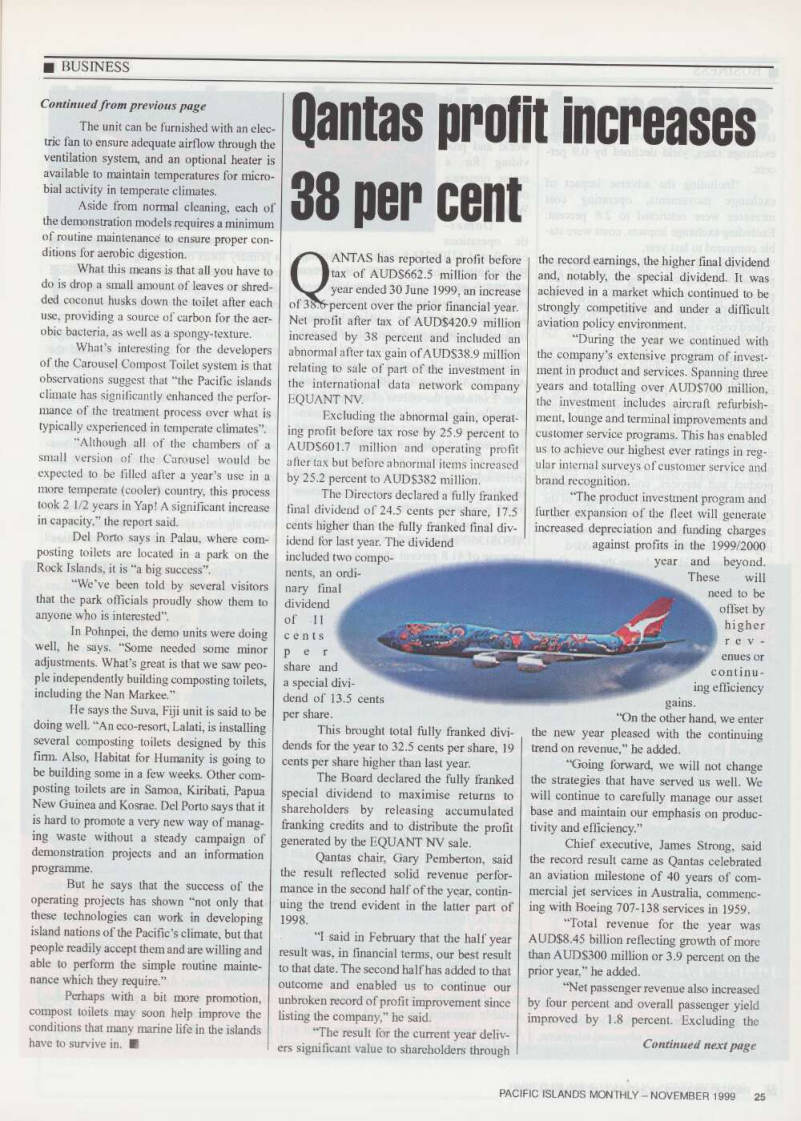
be treated lightly
By Sophie Foster Hildebrand
FORGET rising sea levels and deforesta tion for the moment. The Pacific’s biggest environmental problem of this decade is something in everyone’s backyard sewage.
And it is this problem that a project to introduce compost toilets to the region is attempting to address.
A report promoting “sustainable strategies” for controlling waste, by David Del Porto, says nearly every Pacific Island nation has identified critical environmental and public health problems resulting from the disposal of human excrement.
These, he says, have indfcided algae blooms and eutrophication in lagoons, dying reefs, contaminated drinking water wells and outbreaks of gastro-intestinal disease, Lep tospirosis and cholera.
“The causes of this pollution include overflowing latrines and privies, water-sealed toilet, septic systems, piggeries and sewage treatment plans as well as the complete lack of sanitation facilities in some places,” Del Porto continues.
Even the South Pacific Regional Envi ronment Programme (SPREP) has said that “disposal of solid and liquid wastes (particu larly of human excreta and household garbage in urban area), which have long plagued the Pacific, emerge now as perhaps the foremost regional environmental problem of the decade.”
Del Porto cites a Land-Based Pollu tants Inventory for the South Pacific Region which estimated that 21,675 tonnes of BOD, 12,252 tonnes of suspended solids, 10,499 tonnes of nitrogen and 1,250 tonnes of phos phorous enter the South Pacific Ocean each year from domestic wastewater, making it the major source of these pollutants in the region.
The Federated States of Micronesia’s
(FSM) National Environmental Management
Strategy (NEMS) calls the disposal of sewage along with solid wastes “one of the most trou blesome environmental problems...” they face, and cites increasing marine pollution from sewage in almost all state centres.
“A number of studies have found sewage pollution to be adversely affecting
coral reefs in the FSM, especially when dis charged into lagoons with low circulation.
Central wastewater treatment plants con structed with funds from the US environmen tal Protection Agency in Pohnpei and in Chuuk States have failed due to lack of trained personnel and funding for mainte nance,” he says.
The problem also extends to the Mar shall islands where stagnation of lagoon waters, reef degradation and fish kills result ing from the low levels of oxygen have been well documented over the years. Additionally, red tides plague the lagoon waters adjacent to
Majuro.
What’s worrying is that the Marshall Island EPA estimated that over 75 per cent of the rural wells tested were contaminated with fecal coliform and other bacteria. Cholera, typhoid, and various diarrheal disorders all occur.
With very little industry present, most of these problems are blamed on domestic sewage, with the greatest contamination prob lems believed to be from pit latrines, septic tanks and the complete lack of sanitation facilities for 60 per cent of rural households.
Del Porto says that “even the best of these systems in the most favorable soils con ditions allow significant amounts of nutrients and pathogens into the surrounding environ ment, and the soil characteristics and high water table typically found on atolls signifi cantly inhibits treatment”
In addition, the lack of proper mainte nance, due to a lack of equipment to pump out septic tanks, is likely to have degraded the performance of these systems even further.
Forty percent of the population in the Repub lic of Palau is served by a secondary sewage treatment plant in the Koror, which is general
ly thought to provide adequate treatment.
However the Koror State government has recently expressed concern over the possible contamination of Malakal Harbor, into which
the plant discharges.
“Some low-lying areas served by the system experience periodic back-flows of sewage which run into mangrove areas due to mechanical failures with pumps and electrical
power outages. In other low lying areas not covered by the sewer system, septic tanks and latrines are used which also overflow, impact ing marine water quality,” the report says.
It says that although there have been an increasing number of septic systems installed as part of a rural sanitation program funded by the United States, there is anecdotal evidence that they may not be very effective.
“Many of the septic tank leach fields may not be of adequate size. In addition, a number of the systems are not used at all, as some families prefer instead to use latrines since the actual toilets and enclosures are not provided with the septic tanks as part of the program,” it says.
In an attempt to combat these prob lems, David Del Porto and Lowell Robinson of Sustainable Strategies, have developed and successfully demonstrated compost toilets on several developing island nations of the Pacif ic.
But, according to Del Porto, because US funding to the Micronesian islands is dry ing up now, efforts to build demonstration projects and promote them - “very key with any new technology” - have slowed to a crawl.
He says that even Greenpeace is no longer funding such projects, due to its “radi cal shift in focus”. Sustainable Strategies has now started a nonprofit organisation to contin ue the work.
The carousel compost toilet system uses a four-chambered fibreglass waste col lection tank for batch digestion, which rotates on a pivot inside an outer container.
One chamber is located directly below the toilet pedestal and filled over the course of several months’ usage. When it is filled, the tank is rotated so that this first chamber is iso lated from receiving fresh wastes, and the next chamber is positioned below the pedestal.
After all four chambers have been filled (about two years with recommended useage) the waste in the first chamber is com pletely digested into humus and can be removed so that the chamber is ready to be used again.
Continued next page
Continued from previous page
The unit can be furnished with an elec tric fan to ensure adequate airflow through the ventilation system, and an optional heater is available to maintain temperatures for micro bial activity in temperate climates.
Aside from normal cleaning, each of the demonstration models requires a minimum of routine maintenance to ensure proper con ditions for aerobic digestion.
What this means is that all you have to do is drop a small amount of leaves or shred ded coconut husks down the toilet after each use, providing a source of carbon for the aer obic bacteria, as well as a spongy-texture.
What’s interesting for the developers of the Carousel Compost Toilet system is that observations suggest that “the Pacific islands climate has significantly enhanced the perfor mance of the treatment process over what is typically experienced in temperate climates”.
“Although all of the chambers of a small version ol the Carousel would be expected to be tilled after a year’s use in a more temperate (cooler) country, this process took 2 1/2 years in Yap! A significant increase in capacity,” the report said.
Del Porto says in Palau, where com posting toilets are located in a park on the Rock Islands, it is “a big success”.
“We’ve been told by several visitors that the park officials proudly show them to anyone who is interested”.
In Pohnpei, the demo units were doing well, he says. “Some needed some minor adjustments. What’s great is that we saw peo
ple independently building composting toilets,
including the Nan Markee.”
He says the Suva, Fiji unit is said to be doing well. “An eco-resort, Lalati, is installing
several composting toilets designed by this
firm. Also, Habitat for Humanity is going to be building some in a few weeks. Other com posting toilets are in Samoa, Kiribati, Papua New Guinea and Kosrae. Del Porto says that it is hard to promote a very new way of manag ing waste without a steady campaign of demonstration projects and an information programme.
But he says that the success of the operating projects has shown “not only that these technologies can work in developing island nations of the Pacific’s climate, but that people readily accept them and are willing and able to perform the simple routine mainte nance which they require.”
Perhaps with a bit more promotion, compost toilets may soon help improve the conditions that many marine life in the islands have to survive in. ■
Qantas profit increases
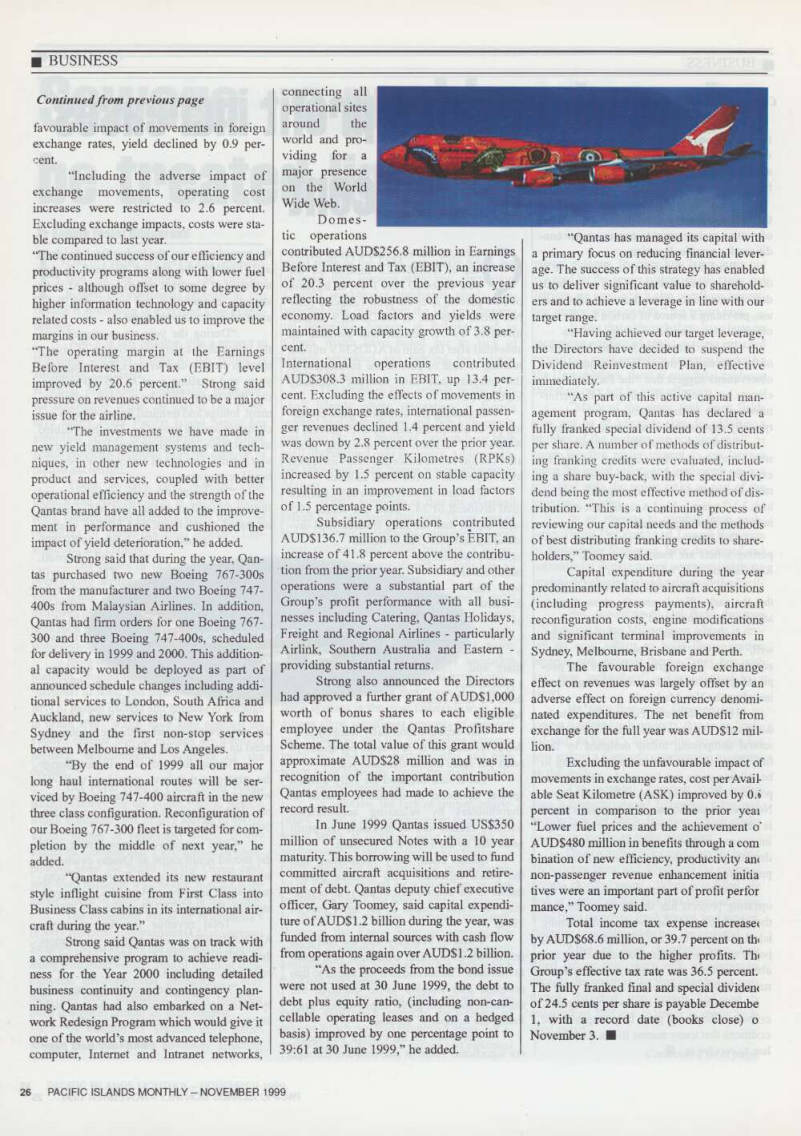
38 per cent
QANTAS has reported a profit before tax of AUD5662.5 million for the year ended 30 June 1999, an increase percent over the prior financial year.
Net profit after tax of AUDS42O.9 million increased by 38 percent and included an abnormal after tax gain ofAUDS3B.9 million relating to sale ot part of the investment in the international data network company
Equant Nv.
Excluding the abnormal gain, operat ing profit before tax rose by 25.9 percent to AUDS6OI.7 million and operating profit alter tax but before abnormal items increased by 25.2 percent to AUDS3B2 million.
The Directors declared a fully franked final dividend of 24.5 cents per share, 17.5 cents higher than the fully franked final div idend for last year. The dividend included two compo nents. an ordi
nary final dividend j&t of ! 1 -Ip cents per share and a special divi dend of 13.5 cents per share.
This brought total fully franked divi dends for the year to 32.5 cents per share, 19 cents per share higher than last year.
The Board declared the fully franked special dividend to maximise returns to shareholders by releasing accumulated franking credits and to distribute the profit generated by the EQUANT NV sale.
Qantas chair, Gary Pemberton, said the result reflected solid revenue perfor mance in the second half of the year, contin uing the trend evident in the latter part of 1998.
“I said in February that the half year result was, in financial terms, our best result to that date. The second half has added to that outcome and enabled us to continue our unbroken record of profit improvement since listing the company,” he said.
“The result for the current year deliv ers significant value to shareholders through
the record earnings, the higher final dividend and, notably, the special dividend. It was achieved in a market which continued to be strongly competitive and under a difficult aviation policy environment.
“During the year we continued with the company’s extensive program of invest ment in product and services. Spanning three years and totalling over AUDS7OO million, the investment includes aircraft refurbish ment, lounge and terminal improvements and customer service programs. This has enabled us to achieve our highest ever ratings in reg ular internal surveys of customer service and brand recognition.
“The product investment program and further expansion of the fleet will generate increased depreciation and funding charges against profits in the 1999/2000 year and beyond.
These will need to be offset by
higher
fre v enues or continu
ing efficiency
gains.
“On the other hand, we enter the new year pleased with the continuing trend on revenue,” he added.
“Going forward, we will not change the strategies that have served us well. We will continue to carefully manage our asset base and maintain our emphasis on produc
tivity and efficiency.”
Chief executive, James Strong, said the record result came as Qantas celebrated an aviation milestone of 40 years of com mercial jet services in Australia, commenc ing with Boeing 707-138 services in 1959.
“Total revenue for the year was AUDSB.4S billion reflecting growth of more than AUDS3OO million or 3.9 percent on the prior year,” he added.
“Net passenger revenue also increased by four percent and overall passenger yield
improved by 1.8 percent. Excluding the
Continued next page
Continued from previous page
favourable impact of movements in foreign exchange rates, yield declined by 0.9 per cent.
“Including the adverse impact of exchange movements, operating cost increases were restricted to 2.6 percent.
Excluding exchange impacts, costs were sta ble compared to last year.
“The continued success of our efficiency and productivity programs along with lower fuel prices - although offset to some degree by higher information technology and capacity related costs - also enabled us to improve the margins in our business.
“The operating margin at the Earnings
Before Interest and Tax (EBIT) level improved by 20.6 percent.'’ Strong said pressure on revenues continued to be a major issue for the airline.
“The investments we have made in new yield management systems and tech niques, in other new technologies and in product and services, coupled with better operational efficiency and the strength of the Qantas brand have all added to the improve ment in performance and cushioned the impact of yield deterioration,” he added.
Strong said that during the year, Qan tas purchased two new Boeing 767-300 s from the manufacturer and two Boeing 747- 400 s from Malaysian Airlines. In addition, Qantas had firm orders for one Boeing 767- 300 and three Boeing 747-400 s, scheduled for delivery in 1999 and 2000. This addition al capacity would be deployed as part of announced schedule changes including addi tional services to London, South Africa and Auckland, new services to New York from Sydney and the first non-stop services between Melbourne and Los Angeles.
“By the end of 1999 all our major long haul international routes will be ser viced by Boeing 747-400 aircraft in the new three class configuration. Reconfiguration of our Boeing 767-300 fleet is targeted for com pletion by the middle of next year,” he added.
“Qantas extended its new restaurant style inflight cuisine from First Class into Business Class cabins in its international air
craft during the year.”
Strong said Qantas was on track with a comprehensive program to achieve readi ness for the Year 2000 including detailed
business continuity and contingency plan
ning. Qantas had also embarked on a Net work Redesign Program which would give it one of the world’s most advanced telephone, computer, Internet and Intranet networks,
connecting all operational sites around the world and pro viding for a
major presence
on the World Wide Web.
Domes tic operations
contributed AUDS2S6.B million in Earnings Before Interest and Tax (EBIT), an increase of 20.3 percent over the previous year reflecting the robustness of the domestic economy. Load factors and yields were maintained with capacity growth of 3.8 per cent.
International operations contributed AUDS3OB.3 million in EBIT, up 13.4 per cent. Excluding the effects of movements in foreign exchange rates, international passen ger revenues declined 1.4 percent and yield was down by 2.8 percent over the prior year.
Revenue Passenger Kilometres (RPKs) increased by 1.5 percent on stable capacity resulting in an improvement in load factors of 1.5 percentage points.
Subsidiary operations contributed
AUDSI36.7 million to the Group’s EBIT, an increase of 41.8 percent above the contribu tion from the prior year. Subsidiary and other operations were a substantial part of the Group’s profit performance with all busi nesses including Catering, Qantas Holidays, Freight and Regional Airlines - particularly Airlink, Southern Australia and Eastern providing substantial returns.
Strong also announced the Directors had approved a further grant of AUDS 1,000 worth of bonus shares to each eligible employee under the Qantas Profitshare Scheme. The total value of this grant would approximate AUDS2B million and was in recognition of the important contribution Qantas employees had made to achieve the record result.
In June 1999 Qantas issued US$35O million of unsecured Notes with a 10 year maturity. This borrowing will be used to fund committed aircraft acquisitions and retire ment of debt. Qantas deputy chief executive officer, Gary Toomey, said capital expendi ture of AUDSI.2 billion during the year, was funded from internal sources with cash flow from operations again over AUDSI.2 billion.
“As the proceeds from the bond issue were not used at 30 June 1999, the debt to
debt plus equity ratio, (including non-can
cellable operating leases and on a hedged basis) improved by one percentage point to 39:61 at 30 June 1999,” he added.
“Qantas has managed its capital with a primary focus on reducing financial lever age. The success of this strategy has enabled us to deliver significant value to sharehold ers and to achieve a leverage in line with our target range.
“Having achieved our target leverage, the Directors have decided to suspend the Dividend Reinvestment Plan, effective immediately.
“As part of this active capital man agement program, Qantas has declared a fully franked special dividend of 13.5 cents per share. A number of methods of distribut ing franking credits were evaluated, includ ing a share buy-back, with the special divi dend being the most effective method of dis tribution. “This is a continuing process of reviewing our capital needs and the methods of best distributing franking credits to share holders,” Toomey said.
Capital expenditure during the year predominantly related to aircraft acquisitions (including progress payments), aircraft reconfiguration costs, engine modifications and significant terminal improvements in Sydney, Melbourne, Brisbane and Perth.
The favourable foreign exchange effect on revenues was largely offset by an adverse effect on foreign currency denomi nated expenditures. The net benefit from exchange for the full year was AUDSI2 mil lion.
Excluding the unfavourable impact of movements in exchange rates, cost per Avail able Seat Kilometre (ASK) improved by 0 i percent in comparison to the prior yeai “Lower fuel prices and the achievement o' AUDS4BO million in benefits through a com bination of new efficiency, productivity am non-passenger revenue enhancement initia tives were an important part of profit perfor mance,” Toomey said.
Total income tax expense increase! by AUDS6B.6 million, or 39.7 percent on tin prior year due to the higher profits. Thi Group’s effective tax rate was 36.5 percent.
The fully franked final and special dividem of 24.5 cents per share is payable Decembe 1, with a record date (books close) o November 3. ■
in the tropics


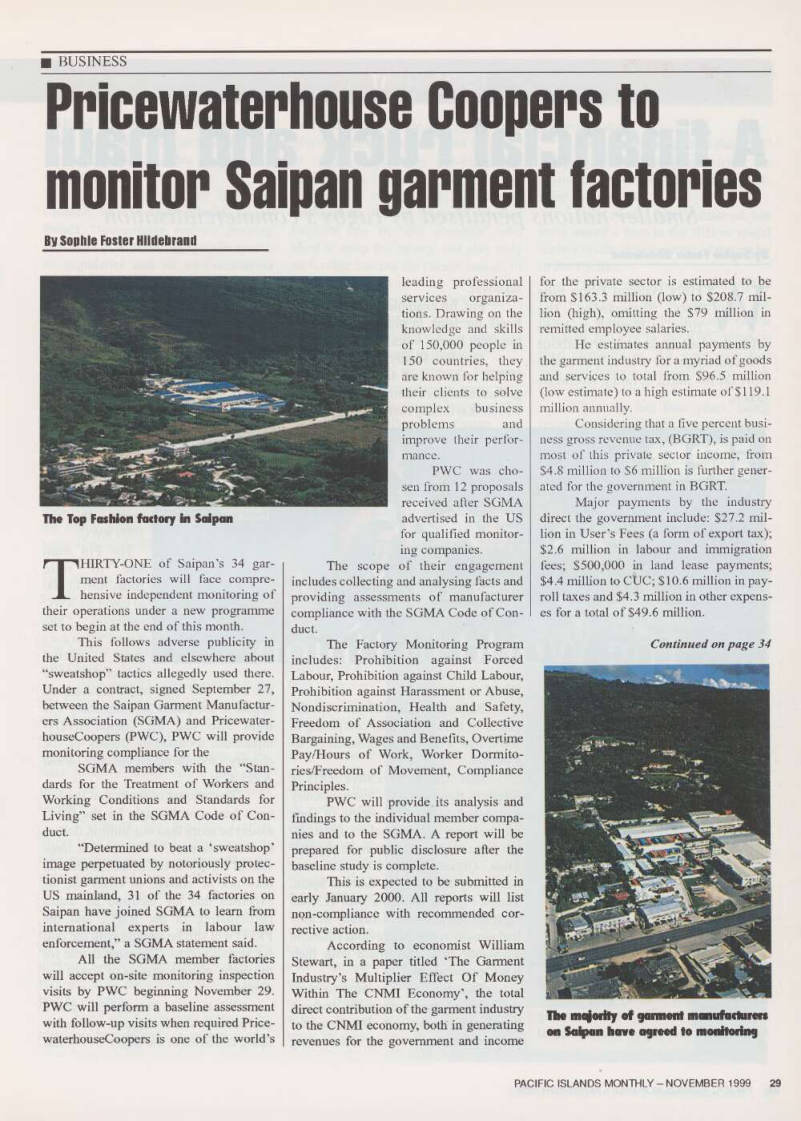
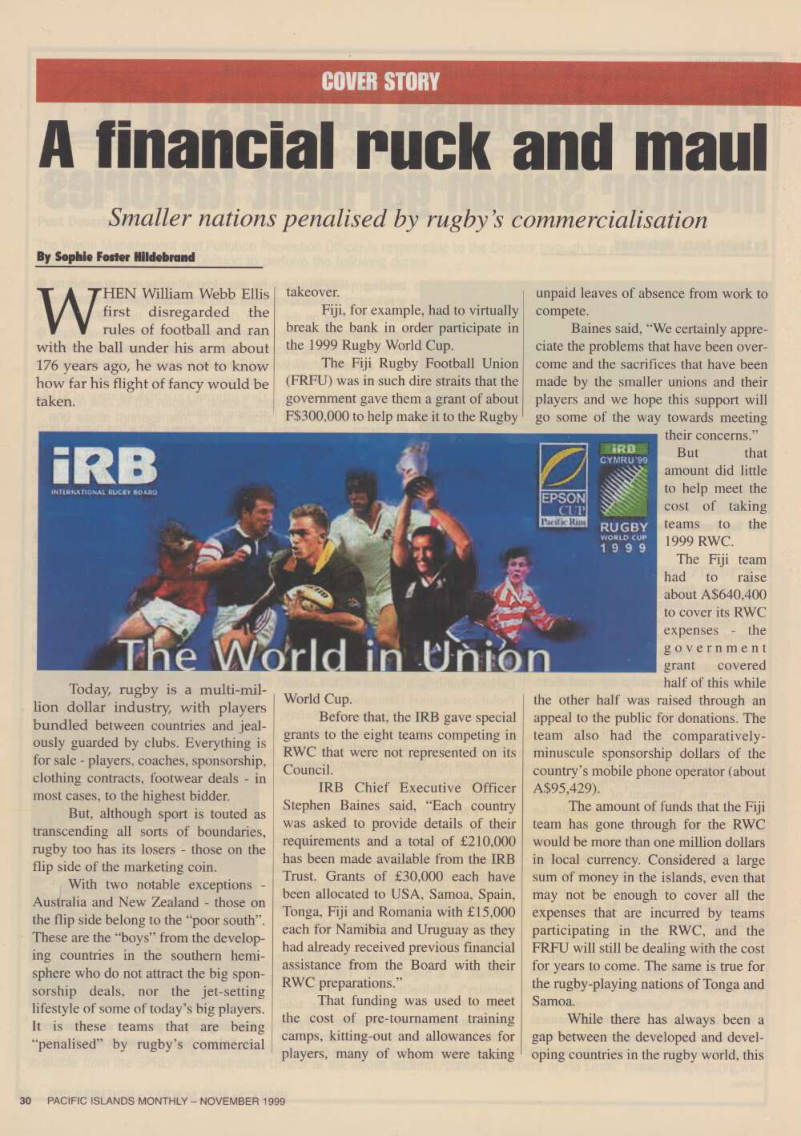
NZ makes it easier to retire in the tropics
By Sophie Foster Hildebrand
FOR some people, the thought of retir ing in an island country, with sunny days and moonlit nights is appealling.
But one problem has been the collection of
superannuation.
New Zealand has decided to do something about the problem and from the beginning of last month, anybody living in New Zealand who qualifies for New Zealand Superannuation or Veterans Pen sion can take their pension with them if they retire to certain Pacific countries.
NZ prime minister Jenny Shipley announced the new initiative in February this year that extended the existing Special Portability Arrangement to include more Pacific countries and increased the rate of
payment will be increased for some people.
The new system covers American Samoa, Northern Mariana Islands, Cook Islands, Palau, Federated States of Micronesia, Papua New Guinea, Fiji, Pit cairn Island, French Polynesia, Samoa, Guam, Solomon Islands, Kiribati, Tokelau, Marshall Islands, Tonga, Nauru, Tuvalu, New Caledonia, Vanuatu, Niue, and Wallis and Futuna. According to NZ officials, there are no ethnic criteria.
“Anyone can apply to have their New Zealand Superannuation or Veterans Pension paid to them in the listed Pacific countries. The option is not limited only to people of Pacific country descent,” a press statement said.
But retirees have to beware of cer
tain provisions which must be fulfilled to qualify for the deal.
Barbara Gilbert, Manager Interna tional Affairs office of Work and Income NZ says “It’s important that people are aware that only those who already qualify residentially for a New Zealand pension are included in this change. If they are not sure they should contact us.”
Gilbert said “people who usually live in Pacific countries will not qualify unless they already get a New Zealand pension.”
“People who are already living in Pacific countries cannot apply for New Zealand Superannuation or Veterans Pen sion, even if they have previously lived in
Continued on page 34
Continued from page 27
New Zealand. Pensions will not be granted to people who come back temporarily to New Zealand in order to apply.” To qualify for New Zealand Superannuation or Veter ans Pension, people must have reached the
qualifying age (currently 64).
They must have lived in New Zealand for at least 10 years after the age of 20, five years of which must be after the age of 50. People must be ordinarily resi dent in New Zealand when they apply.
Another condition is that to be able to take their payments to the Pacific coun tries, people must be going to live there for more than 52 weeks.
They must apply to Work and Income NZ for overseas payments before leaving New Zealand.
“Most Pacific countries are covered by the changes, but people should check with us before making any decisions about their future,” said Gilbert.
The payments are calculated by sev eral formulae. Those who have lived in New Zealand for 20 years or more after the
age of 20 will receive the base rate of New Zealand Superannuation or Veterans Pen sion overseas.
People who have lived in New Zealand for 10 years will get half the base rate of New Zealand Superannuation or Veterans Pension overseas.
However, the New Zealand govern ment will not pay any supplementary pay ments overseas. This means there will be no Living Alone Allowances, Disability Allowances, or Accommodation Supple ments paid overseas.
According to the NZ officials, the payments will not be taxed in New Zealand.
“Payments will not have New Zealand tax deducted from them. People will receive New Zealand Superannuation or Veterans Pension at the gross rate. The country the person has retired to may tax the payment.
It is the person’s responsibili ty to pay any tax due in the country to which they have retired. People should check with the tax department in the Pacif ic country they are retiring too before they leave New Zealand,” an official statement
said.
The pension will be paid in New Zealand every two weeks, or into the over seas bank account of the retiree every four weeks. The NZ government says the over seas bank account must be in the person’s name (or a joint account) in the country in which they usually live.
People can travel away from their stated “home” country for up to 26 weeks without their holiday affecting their New Zealand Superannuation or Veterans Pen sion.
If a person returns to New Zealand for a holiday, then their New Zealand Superannuation continues at the overseas gross payment rate. This is particularly important when a person returns to New Zealand for medical treatment.
The officials says that if a retiree decides that their return to New Zealand is permanent, then they revert to domestic New Zealand Superannuation or Veterans Pension.
For further information, call Work and Income NZ International Affairs office on 0800 777 117. ■
Advertisements & other items, pp. 27-28 (1 item)
Buiboards Banners
A •Division of «... .;
"ff Ilf II 9
m HI
Computer cut-out signs
Buiboards Banners
Shops front signs
Frame board
A liwmmmir
A complete sign shop for all your signs requirement.
L/JL 18 Disraeli Road Phone: (679) 306100 Fax: (67 P.0.80x 16149, S Graphic Systems Ltd. i c s v s@xoomh I 16811
(32>
South Pacific Regional Environment Programme
(SPREP)
Vacancy: WASTE MANAGEMENT AND POLLUTION
PREVENTION OFFICER
Applications are invited for the position of Waste Management and Pollution Prevention Officer with the South Pacific Regional Environment Pogramme (SPREP) in Apia, Samoa.
Post Description The Waste Management and Pollution Prevention Officer is responsible to the Director through the Head of the Environmental Management and Planning Division to perform the following duties: • providing or arranging for technical advice to SPREP members, on request and consistent with the SPREP Work Programme, on waste management and pollution prevention in paticular waste minimisation, re-use and recycling, and clean production technology. • implementation of priority components of the Regional Waste Management and Pollution Prevention Programme, Nuku’alofa 1994, including the development of specific projects for funding under the programme, and implementation of the solid waste management component of the Regional Water Supply and Sanitation project being executed by the SOPAC Geoscience Commission. • liaison with all the relevant donors, international and regional organisations and institutions involved in pollution prevention and waste management in the Pacific and in implementing the regional programme, in particular the European Union, Australia, NZ WHO, UNEP, USEPA (of US Territories), lAEA, IMO, and maintaining links with the International Register for Potentially Toxic Chemicals; in conjuction with SPREP’s Legal Counsel, advise or arrange for advice to countries concerning their legal obligations under relevant regional and international conventions related to pollution prevention and waste management, in particular the SPREP Convention, and related protocols, the Basel Convention, the London Convention, the Convention of the Law of the Sea and proposed Waigani Convention; and • other duties as required from time to time.
Required Qualifications and Experience Candidates must have appropriate tertiary qualifications (preferably with post-graduate qualifications in a relevant field) from a recognised institution and at least 5 years’ work experience, preferably within the Pacific islands region, in a field related to waste management and pollution prevention. Other essential requirements are: proven project management experience; the ability to manage the work of consultants and to meet project deadlines often under difficult circumstances; a proven ability to prepare proposals and reports; a proven ability to live and work within Pacific island communities and to work as pat of an inter-disciplinary and/or multi-cultural team. Applicants with a demonstrated interest and involvement in the environmental, economic and social issues affecting the region, particularly through the provision of environmental information for decision makers, will be highly regarded.
Conditions Appointment will be at the Project Officer Level of SPREP’s authorised salary scales for contract staff, depending on the successful applicant’s qualifications and experience. The package will include annual return airfares for appointee and dependents, a housing subsidy and other benefits. SPREP remuneration may be tax-free depending upon circumstances. The appointment will be for 3 years initially, with renewal for a further period depending upon the officer’s performance during the first term and availability of funds.
Applications Applications should be accompanied by a detailed curriculum vitae containing full personal details, information on qualifications and experience for the position, previous appointments, current position and salary, names, addresses and telephone and contact numbers of three persons associated with the applicant professionally, who would be prepared to provide testimonials.
An indication of how soon the applicant would be available should also be included.
Closing Date: 15 November 1999. Late applications will not be considered.
Applications should be addressed to: The Director South Pacific Regional Environment Programme (SPREP) PO Box 240 Telephone: (685) 21 929
APIA Fax: (685) 20 231
Samoa E-mail: [email protected] Further information, including a full post description and details of remuneration and terms and conditions of appointment, is available from the SPREP Administration Officer at the above address/contact numbers or via Email: [email protected] 100472v2
monitor Saipan garment factories
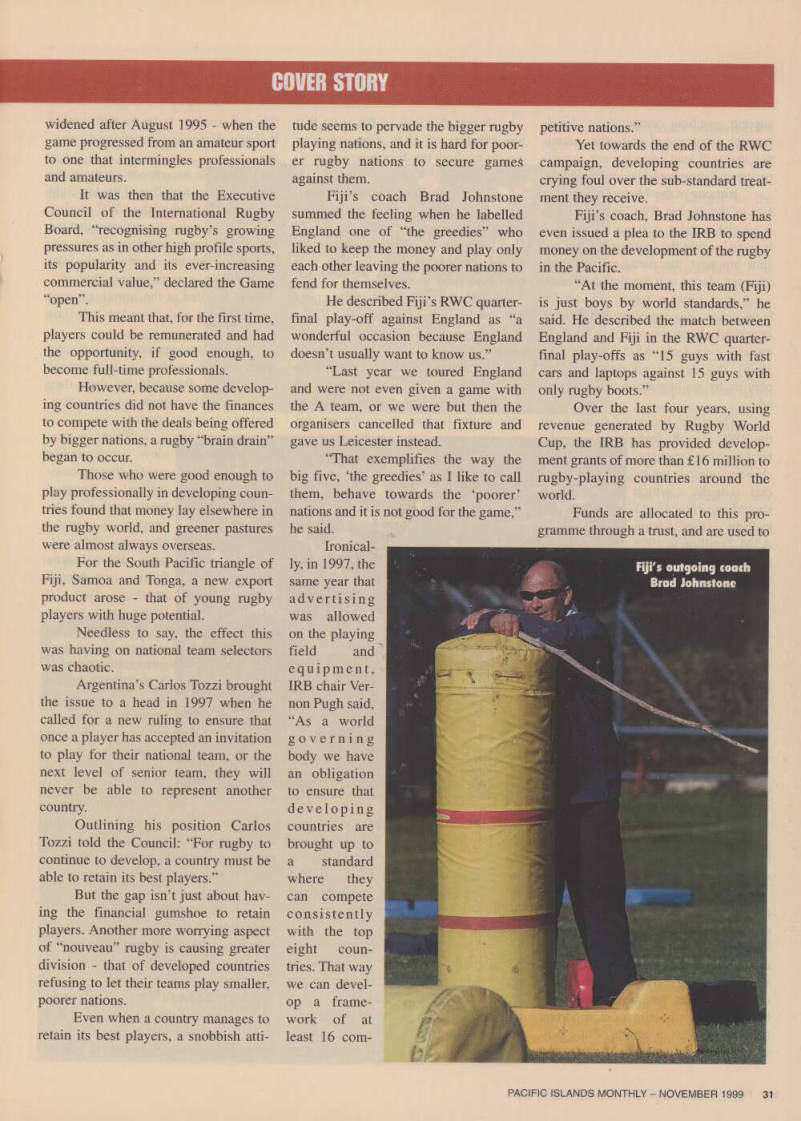
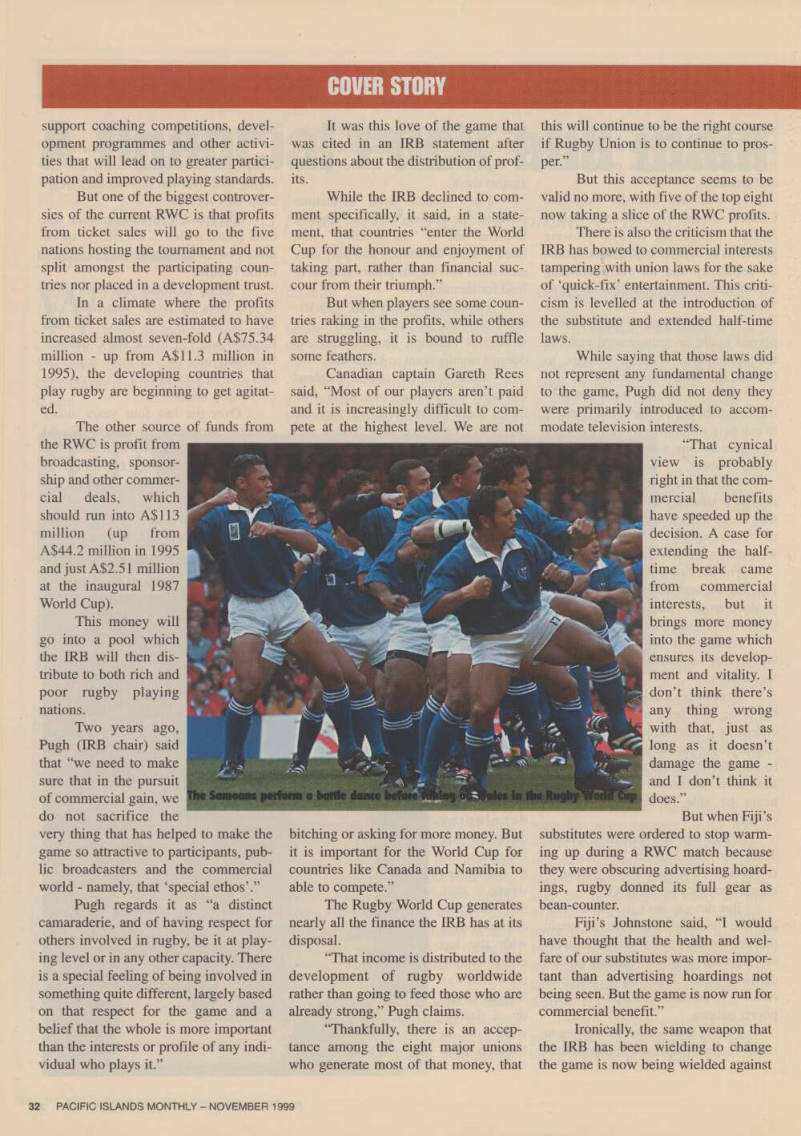
Pricewaterhouse Coopers to monitor Saipan garment factories
By Sophie Foster Hildebrand
THIRTY-ONE of Saipan’s 34 gar ment factories will face compre hensive independent monitoring of their operations under a new programme set to begin at the end of this month.
This follows adverse publicity in the United States and elsewhere about “sweatshop” tactics allegedly used there.
Under a contract, signed September 27, between the Saipan Garment Manufactur ers Association (SGMA) and Pricewater houseCoopers (PWC), PWC will provide
monitoring compliance for the
SGMA members with the “Stan dards for the Treatment of Workers and Working Conditions and Standards for Living” set in the SGMA Code of Con duct.
“Determined to beat a ‘sweatshop’ image perpetuated by notoriously protec tionist garment unions and activists on the US mainland, 31 of the 34 factories on Saipan have joined SGMA to learn from international experts in labour law enforcement,” a SGMA statement said.
All the SGMA member factories will accept on-site monitoring inspection visits by PWC beginning November 29.
PWC will perform a baseline assessment with follow-up visits when required Price waterhouseCoopers is one of the world’s
leading professional
services organiza tions. Drawing on the knowledge and skills of 150,000 people in 150 countries, they are known for helping their clients to solve complex business problems and improve their perfor mance.
PWC was cho sen from 12 proposals received after SGMA advertised in the US for qualified monitor ing companies.
The scope of their engagement includes collecting and analysing facts and providing assessments of manufacturer compliance with the SGMA Code of Con duct.
The Factory Monitoring Program includes: Prohibition against Forced Labour, Prohibition against Child Labour, Prohibition against Harassment or Abuse, Nondiscrimination, Health and Safety, Freedom of Association and Collective Bargaining, Wages and Benefits, Overtime Pay/Hours of Work, Worker Dormito ries/Freedom of Movement, Compliance Principles.
PWC will provide its analysis and findings to the individual member compa nies and to the SGMA. A report will be prepared for public disclosure after the baseline study is complete.
This is expected to be submitted in early January 2000. All reports will list non-compliance with recommended cor rective action.
According to economist William Stewart, in a paper titled ‘The Garment Industry’s Multiplier Effect Of Money Within The CNMI Economy’, the total direct contribution of the garment industry to the CNMI economy, both in generating revenues for the government and income
for the private sector is estimated to be from $163.3 million (low) to $208.7 mil lion (high), omitting the $79 million in remitted employee salaries.
He estimates annual payments by the garment industry for a myriad of goods and services to total from $96.5 million (low estimate) to a high estimate of $119.1
million annually.
Considering that a five percent busi ness gross revenue tax, (BGRT), is paid on most of this private sector income, from $4.8 million to $6 million is further gener ated for the government in BGRT.
Major payments by the industry direct the government include: $27.2 mil lion in User’s Fees (a form of export tax); $2.6 million in labour and immigration fees; $500,000 in land lease payments; $4.4 million to CUC; $10.6 million in pay roll taxes and $4.3 million in other expens es for a total of $49.6 million.
Continued on page 34
The Top Fashion factory in Saipan
The majority of garment manufacturers on Saipan have agreed to monitoring
Continued from page 29
In examining the contribution to the private sector, the annual payroll is $92.9 million. Assuming industry workers send 85 percent of their wages to their home country, there is still $13.9 million in cir culation, he says.
Richard Pierce, SGMA’s director says “what counts most about having stan
dards is their enforcement. If we wish the public to view our Code of Conduct and indepen
dent monitoring as genuine
self-regulation, we must live by the rules we set for ourselves.
We have proceeded to do
that through a compliance
mechanism built into the Code of Conduct.”
Introduced in December of 1998, the SGMA Code of Conduct was patterned after a model derived from the Clinton
Administration’s Apparel
Industry Partnership (AIP).
The code encompasses
high international standards for fair and humane treatment of workers and working conditions; stan dards for living conditions; fundamental rights of employees; standards for trans
shipment and country of origin of gar ments; and compliance and enforcement principles.
Training required for the full imple mentation of the Code of Conduct was presented at three separate training confer ences held in January, February and August 1999. Sessions were presented by
Business for Social Responsibility, a San Francisco-based human rights and educa tional non-profit organisation, and US fed
eral government offices including the Occupational Safety and Health Adminis tration (OSHA) and Wage & Hour Divi sion of the Department of Labour.
Employing nearly 15,000 people, garment manufacturing is a driving eco nomic force in the US Commonwealth of the Northern Mariana Islands - the only
other major industry being
tourism.
The most recent OSHA sta tistics show that m fiscal year
1998, Saipan’s apparel factories
had a 70 per cent better compli ance rate than apparel factories elsewhere in the United States, despite the fact that they were among the most frequently inspected.
Saipan, the capital of the US Commonwealth of the Northern Mariana Islands is part of a chain of 14 islands located in the western Pacific some 150 miles north of Guam and 1,300 miles
from Tokyo.
Although more closely tied to
the economy of Asia, the Northern Mari anas is a US territory with a democratical ly elected local government. ■
The United International Corporation factory in Saipan
A financial ruck and maul
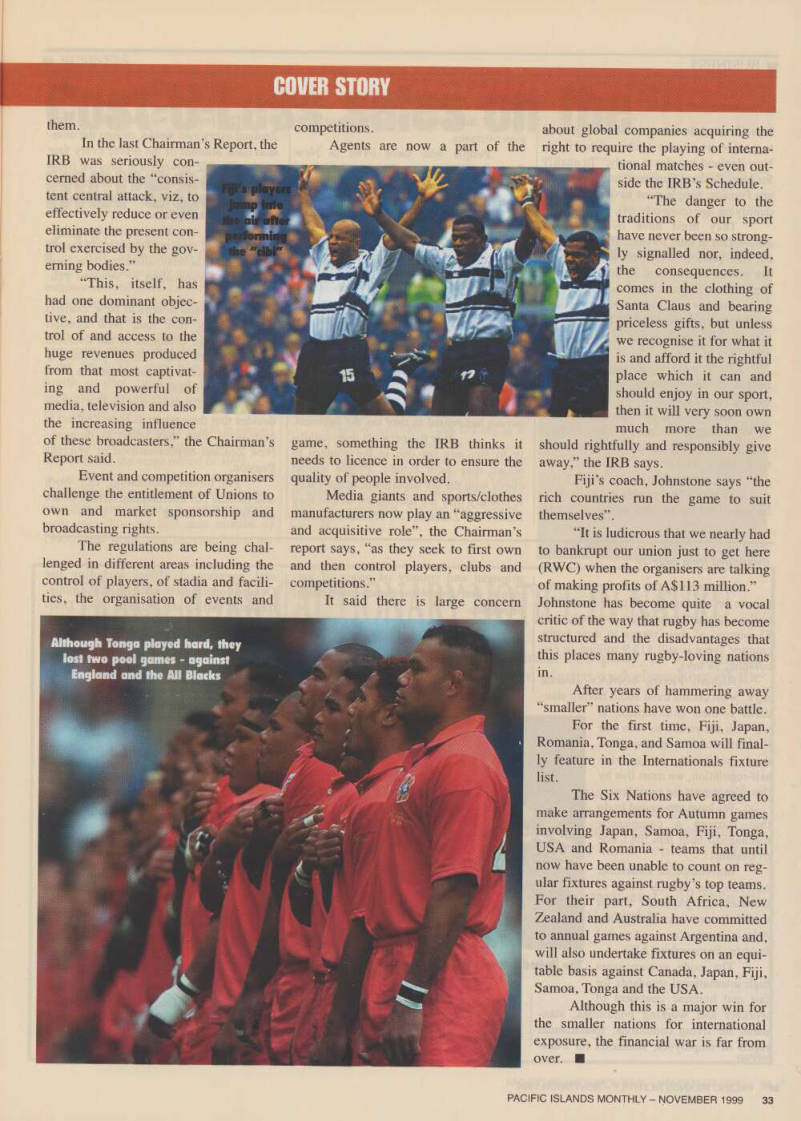
Cover Story
A financial ruck and maul Smaller nations penalised by rugby’s commercialisation
By Sophie Foster Hildebrand
WHEN William Webb Ellis first disregarded the rules of football and ran with the ball under his arm about 176 years ago, he was not to know how far his flight of fancy would be taken.
Today, rugby is a multi-mil lion dollar industry, with players bundled between countries and jeal ously guarded by clubs. Everything is for sale - players, coaches, sponsorship, clothing contracts, footwear deals - in most cases, to the highest bidder.
But, although sport is touted as transcending all sorts of boundaries, rugby too has its losers - those on the flip side of the marketing coin.
With two notable exceptions - Australia and New Zealand - those on the flip side belong to the “poor south”.
These are the “boys” from the develop ing countries in the southern hemi sphere who do not attract the big spon sorship deals, nor the jet-setting lifestyle of some of today’s big players.
It is these teams that are being “penalised” by rugby’s commercial
takeover.
Fiji, for example, had to virtually break the bank in order participate in the 1999 Rugby World Cup.
The Fiji Rugby Football Union (FRFU) was in such dire straits that the government gave them a grant of about F 5300,000 to help make it to the Rugby
World Cup.
Before that, the IRB gave special grants to the eight teams competing in RWC that were not represented on its Council.
IRB Chief Executive Officer Stephen Baines said, “Each country was asked to provide details of their requirements and a total of £210,000 has been made available from the IRB Trust. Grants of £30,000 each have been allocated to USA, Samoa, Spain, Tonga, Fiji and Romania with £15,000 each for Namibia and Uruguay as they had already received previous financial assistance from the Board with their RWC preparations.”
That funding was used to meet the cost of pre-tournament training camps, kitting-out and allowances for players, many of whom were taking
unpaid leaves of absence from work to compete.
Baines said, “We certainly appre ciate the problems that have been over come and the sacrifices that have been made by the smaller unions and their players and we hope this support will go some of the way towards meeting
their concerns.”
But that amount did little to help meet the cost of taking teams to the
1999 Rwc.
The Fiji team had to raise about A 5640,400 to cover its RWC expenses - the government grant covered half of this while
the other half was raised through an appeal to the public for donations. The team also had the comparatively minuscule sponsorship dollars of the country’s mobile phone operator (about A 595,429).
The amount of funds that the Fiji team has gone through for the RWC would be more than one million dollars in local currency. Considered a large sum of money in the islands, even that may not be enough to cover all the expenses that are incurred by teams participating in the RWC, and the FRFU will still be dealing with the cost for years to come. The same is true for the rugby-playing nations of Tonga and Samoa.
While there has always been a gap between the developed and devel oping countries in the rugby world, this
widened after August 1995 - when the game progressed from an amateur sport to one that intermingles professionals and amateurs.
It was then that the Executive Council of the International Rugby Board, “recognising rugby’s growing pressures as in other high profile sports, its popularity and its ever-increasing commercial value,” declared the Game “open”.
This meant that, for the first time, players could be remunerated and had the opportunity, if good enough, to become full-time professionals.
However, because some develop ing countries did not have the finances to compete with the deals being offered by bigger nations, a rugby “brain drain” began to occur.
Those who were good enough to play professionally in developing coun tries found that money lay elsewhere in the rugby world, and greener pastures were almost always overseas.
For the South Pacific triangle of Fiji, Samoa and Tonga, a new export product arose - that of young rugby players with huge potential.
Needless to say, the effect this was having on national team selectors was chaotic.
Argentina’s Carlos Tozzi brought the issue to a head in 1997 when he called for a new ruling to ensure that once a player has accepted an invitation to play for their national team, or the next level of senior team, they will never be able to represent another country.
Outlining his position Carlos Tozzi told the Council: “For rugby to continue to develop, a country must be able to retain its best players.”
But the gap isn’t just about hav ing the financial gumshoe to retain players. Another more worrying aspect of “nouveau” rugby is causing greater division - that of developed countries refusing to let their teams play smaller, poorer nations.
Even when a country manages to retain its best players, a snobbish atti
tude seems to pervade the bigger rugby playing nations, and it is hard for poor er rugby nations to secure games against them.
Fiji’s coach Brad Johnstone summed the feeling when he labelled England one of “the greedies” who liked to keep the money and play only each other leaving the poorer nations to fend for themselves.
He described Fiji’s RWC quarter final play-off against England as “a wonderful occasion because England doesn’t usually want to know us.”
“Last year we toured England and were not even given a game with the A team, or we were but then the organisers cancelled that fixture and gave us Leicester instead.
“That exemplifies the way the big five, ‘the greedies’ as I like to call them, behave towards the ‘poorer’ nations and it is not good for the game,” he said.
Ironical ly, in 1997, the same year that advertising was allowed on the playing field and equipment, IRB chair Ver non Pugh said, “As a world governing body we have an obligation to ensure that
developing
countries are brought up to a standard where they can compete consistently with the top eight coun tries. That way we can devel op a frame work of at least 16 corn
petitive nations.”
Yet towards the end of the RWC campaign, developing countries are crying foul over the sub-standard treat ment they receive.
Fiji’s coach, Brad Johnstone has even issued a plea to the IRB to spend money on the development of the rugby in the Pacific.
“At the moment, this team (Fiji) is just boys by world standards,” he said. He described the match between England and Fiji in the RWC quarter final play-offs as “15 guys with fast cars and laptops against 15 guys with only rugby boots.”
Over the last four years, using revenue generated by Rugby World Cup, the IRB has provided develop ment grants of more than £l6 million to rugby-playing countries around the world.
Funds are allocated to this pro gramme through a trust, and are used to
Fiji's outgoing coach Brad Johnstone
support coaching competitions, devel
opment programmes and other activi ties that will lead on to greater partici
pation and improved playing standards.
But one of the biggest controver sies of the current RWC is that profits from ticket sales will go to the five nations hosting the tournament and not split amongst the participating coun tries nor placed in a development trust.
In a climate where the profits from ticket sales are estimated to have increased almost seven-fold (A 575.34 million - up from A 511.3 million in 1995), the developing countries that play rugby are beginning to get agitat ed.
The other source of funds from
the RWC is profit from
broadcasting, sponsor
ship and other commer cial deals, which should run into Asll3 million (up from A 544.2 million in 1995 and just A 52.51 million at the inaugural 1987
World Cup).
This money will go into a pool which the IRB will then dis tribute to both rich and poor rugby playing nations.
Two years ago, Pugh (IRB chair) said that “we need to make sure that in the pursuit of commercial gain, we do not sacrifice the
very thing that has helped to make the game so attractive to participants, pub lic broadcasters and the commercial world - namely, that ‘special ethos’.”
Pugh regards it as “a distinct camaraderie, and of having respect for others involved in rugby, be it at play ing level or in any other capacity. There is a special feeling of being involved in something quite different, largely based on that respect for the game and a belief that the whole is more important than the interests or profile of any indi vidual who plays it.”
It was this love of the game that was cited in an IRB statement after questions about the distribution of prof its.
While the IRB declined to com ment specifically, it said, in a state ment, that countries “enter the World Cup for the honour and enjoyment of taking part, rather than financial suc cour from their triumph.”
But when players see some coun tries raking in the profits, while others are struggling, it is bound to ruffle some feathers.
Canadian captain Gareth Rees said, “Most of our players aren’t paid and it is increasingly difficult to com pete at the highest level. We are not
bitching or asking for more money. But it is important for the World Cup for countries like Canada and Namibia to able to compete.”
The Rugby World Cup generates nearly all the finance the IRB has at its disposal.
“That income is distributed to the development of rugby worldwide rather than going to feed those who are already strong,” Pugh claims.
“Thankfully, there is an accep tance among the eight major unions who generate most of that money, that
this will continue to be the right course if Rugby Union is to continue to pros per.”
But this acceptance seems to be valid no more, with five of the top eight now taking a slice of the RWC profits.
There is also the criticism that the IRB has bowed to commercial interests tampering with union laws for the sake of ‘quick-fix’ entertainment. This criti cism is levelled at the introduction of the substitute and extended half-time laws.
While saying that those laws did not represent any fundamental change to the game, Pugh did not deny they were primarily introduced to accom modate television interests.
“That cynical view is probably right in that the com mercial benefits have speeded up the decision. A case for extending the half time break came from commercial interests, but it brings more money into the game which ensures its develop ment and vitality. I don’t think there’s any thing wrong with that, just as long as it doesn’t damage the game and I don’t think it does.”
But when Fiji’s
substitutes were ordered to stop warm ing up during a RWC match because they were obscuring advertising hoard ings, rugby donned its full gear as bean-counter.
Fiji’s Johnstone said, “I would have thought that the health and wel fare of our substitutes was more impor tant than advertising hoardings not being seen. But the game is now run for commercial benefit.”
Ironically, the same weapon that the IRB has been wielding to change the game is now being wielded against
The Samoans perform a battle dance before llking on Wales in the Rugby World Cup
them.
IRB was seriously con cerned about the “consis tent central attack, viz, to effectively reduce or even eliminate the present con trol exercised by the gov erning bodies.”
“This, itself, has had one dominant objec tive, and that is the con trol of and access to the huge revenues produced from that most captivat ing and powerful of media, television and also the increasing influence
In the last Chairman’s Report, the
of these broadcasters,” the Chairman’s Report said.
Event and competition organisers challenge the entitlement of Unions to own and market sponsorship and
broadcasting rights.
The regulations are being chal lenged in different areas including the control of players, of stadia and facili ties, the organisation of events and
competitions.
Agents are now a part of the
game, something the IRB thinks it needs to licence in order to ensure the quality of people involved.
Media giants and sports/clothes manufacturers now play an “aggressive and acquisitive role”, the Chairman’s report says, “as they seek to first own and then control players, clubs and competitions.”
It said there is large concern
about global companies acquiring the right to require the playing of interna
tional matches - even out side the IRB’s Schedule.
“The danger to the traditions of our sport have never been so strong ly signalled nor, indeed, the consequences. It comes in the clothing of Santa Claus and bearing priceless gifts, but unless we recognise it for what it is and afford it the rightful place which it can and should enjoy in our sport, then it will very soon own much more than we
should rightfully and responsibly give away,” the IRB says.
Fiji’s coach, Johnstone says “the rich countries run the game to suit themselves”.
“It is ludicrous that we nearly had to bankrupt our union just to get here (RWC) when the organisers are talking of making profits of Asll3 million.”
Johnstone has become quite a vocal critic of the way that rugby has become structured and the disadvantages that this places many rugby-loving nations in.
After years of hammering away “smaller” nations have won one battle.
For the first time, Fiji, Japan, Romania, Tonga, and Samoa will final ly feature in the Internationals fixture list.
The Six Nations have agreed to make arrangements for Autumn games involving Japan, Samoa, Fiji, Tonga, USA and Romania - teams that until now have been unable to count on reg ular fixtures against rugby’s top teams.
For their part, South Africa, New Zealand and Australia have committed to annual games against Argentina and, will also undertake fixtures on an equi table basis against Canada, Japan, Fiji, Samoa, Tonga and the USA.
Although this is a major win for the smaller nations for international exposure, the financial war is far from over. ■
Fiji's players jump into the air after performing the "cibi"
Although Tonga played hard, they lost two pool games-against England and the All Backs
Cost-U-Less sales on the increase

increase
COST-U-LESS’ Suva, Fiji store has been acknowledged for helping its parent company gain a 25 per cent increase in total sales for the third quarter of 1999 over the previous year’s result.
A company statement said that the sales increase was primarily due to two new stores opened after third quarter 1998 - the Suva, Fiji store which opened in fourth quarter 1998 and the Curacao, Netherlands Antilles store which opened in first quarter 1999.
Net income was $753,000 in second quarter 1999 year-to-date, compared to $387,000 for the same period in 1998.
“This represents an increase of $365,000 or 95 per cent over second quar ter 1998 year-to-date,” a company state ment said. For the first nine months of 1999, same store sales increased nine per
cent compared to the same period in 1998.
The company also announced sever al management changes in September. Jef frey Meder was named president and chief executive officer, replacing Michael J Rose who retained his title as chairman of the board.
Roy W Sorenson was named chief financial officer, replacing Martin Moore, who had served as interim chief financial officer since mid-July. Moore remains con troller of the company.
Founded in 1989, Cost-U-Less is a leading operator of non-membership ware house “club-style” stores with 11 locations: Hawaii (2); Guam (2); the US Virgin Islands (2); Fiji (2); Curacao, Netherlands Antilles; American Samoa and Sonora, CA. ■
The Cost-U-less outlet in Suva, Fiji
Advertisements & other items, p. 35 (1 item)
Trade Mark Cautionary Notice In Nauru
Notice is hereby given that Mazda Motor Corporation, a Japanese company, of 3-1 Shinchi, Fuchu-cho, Aki-gun, Hiroshima, Japan is the sole proprietor in Nauru and elsewhere of the following trade mark:
TRIBUTE
used in respect of:~ Automobiles, parts and fittings thereof. Engines for land vehicles; Suspension systems for land vehicles; Shock absorbers and springs for land vehicle suspension systems; Drive shafts for land vehicles; Wheel bearings and shaft couplings for land vehicles; Transmissions for land vehicles; Brakes for land vehicles; Alternating current motors for land vehicles; Direct current motors for land vehicles; Anti-theft alarms for land vehicles Class 12.
The said proprietor claims all rights in respect of the above trade mark and will take all necessary legal steps against any person or company infringing its said rights.
DAVIES COLLISON CAVE
Patent Attorneys
One Little Collins Street Melbourne, Victoria 3000
AUSTRALIA
123790v2
almost complete
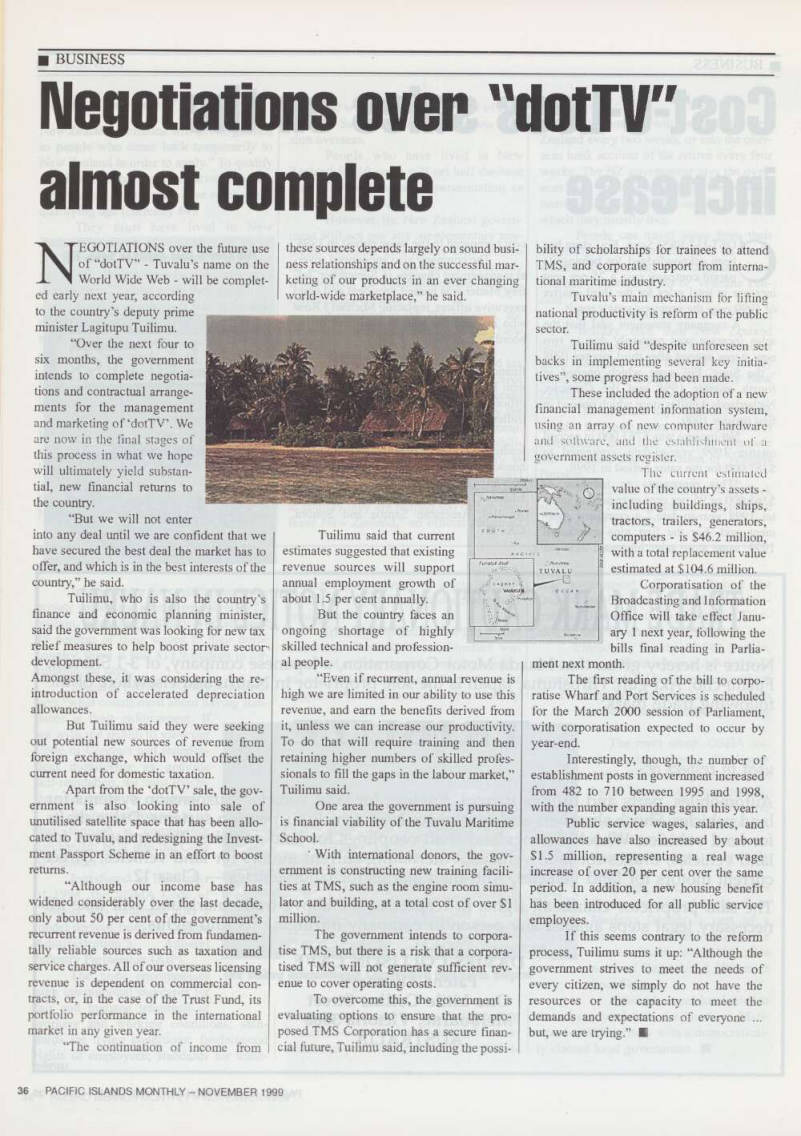
Negotiations over "dotTV" almost complete
Negotiations over the future use of “dotTV” - Tuvalu’s name on the World Wide Web - will be complet
ed early next year, according to the country’s deputy prime minister Lagitupu Tuilimu.
“Over the next four to six months, the government intends to complete negotia tions and contractual arrange ments for the management and marketing of‘dotTV’. We are now in the final stages of this process in what we hope will ultimately yield substan tial, new financial returns to the country.
“But we will not enter into any deal until we are confident that we have secured the best deal the market has to offer, and which is in the best interests of the country,” he said.
Tuilimu, who is also the country’s finance and economic planning minister, said the government was looking for new tax relief measures to help boost private sector development.
Amongst these, it was considering the re introduction of accelerated depreciation allowances.
But Tuilimu said they were seeking out potential new sources of revenue from foreign exchange, which would offset the current need for domestic taxation.
Apart from the ‘dotTV’ sale, the gov ernment is also looking into sale of unutilised satellite space that has been allo cated to Tuvalu, and redesigning the Invest ment Passport Scheme in an effort to boost returns.
“Although our income base has widened considerably over the last decade, only about 50 per cent of the government’s recurrent revenue is derived from fundamen tally reliable sources such as taxation and service charges. All of our overseas licensing revenue is dependent on commercial con tracts, or, in the case of the Trust Fund, its portfolio performance in the international market in any given year.
“The continuation of income from I
these sources depends largely on sound busi ness relationships and on the successful mar keting of our products in an ever changing world-wide marketplace,” he said.
Tuilimu said that current estimates suggested that existing revenue sources will support annual employment growth of about 1.5 per cent annually.
But the country faces an
ongoing shortage of highly
skilled technical and profession al people.
“Even if recurrent, annual revenue is high we are limited in our ability to use this revenue, and earn the benefits derived from it, unless we can increase our productivity.
To do that will require training and then retaining higher numbers of skilled profes sionals to fill the gaps in the labour market,”
Tuilimu said.
One area the government is pursuing is financial viability of the Tuvalu Maritime School.
' With international donors, the gov ernment is constructing new training facili ties at TMS, such as the engine room simu lator and building, at a total cost of over $1 million.
The government intends to corpora tise TMS, but there is a risk that a corpora tised TMS will not generate sufficient rev enue to cover operating costs.
To overcome this, the government is evaluating options to ensure that the pro posed TMS Corporation has a secure finan cial future, Tuilimu said, including the possi-
bility of scholarships for trainees to attend TMS, and corporate support from interna tional maritime industry.
Tuvalu’s main mechanism for lifting national productivity is reform of the public sector.
Tuilimu said “despite unforeseen set backs in implementing several key initia tives”, some progress had been made.
These included the adoption of a new financial management information system, using an array of new computer hardware and software, and the establishment of a government assets register.
The current estimated value of the country’s assets -
including buildings, ships,
tractors, trailers, generators, computers - is $46.2 million, with a total replacement value estimated at $104.6 million.
Corporatisation of the Broadcasting and Information Office will take effect Janu ary 1 next year, following the bills final reading in Parlia
ment next month.
The first reading of the bill to corpo ratise Wharf and Port Services is scheduled for the March 2000 session of Parliament, with corporatisation expected to occur by year-end.
Interestingly, though, the number of establishment posts in government increased from 482 to 710 between 1995 and 1998, with the number expanding again this year.
Public service wages, salaries, and allowances have also increased by about $1.5 million, representing a real wage increase of over 20 per cent over the same period. In addition, a new housing benefit has been introduced for all public service
employees.
If this seems contrary to the reform process, Tuilimu sums it up: “Although the government strives to meet the needs of every citizen, we simply do not have the resources or the capacity to meet the demands and expectations of everyone ... but, we are trying.” ■
addressing market demands
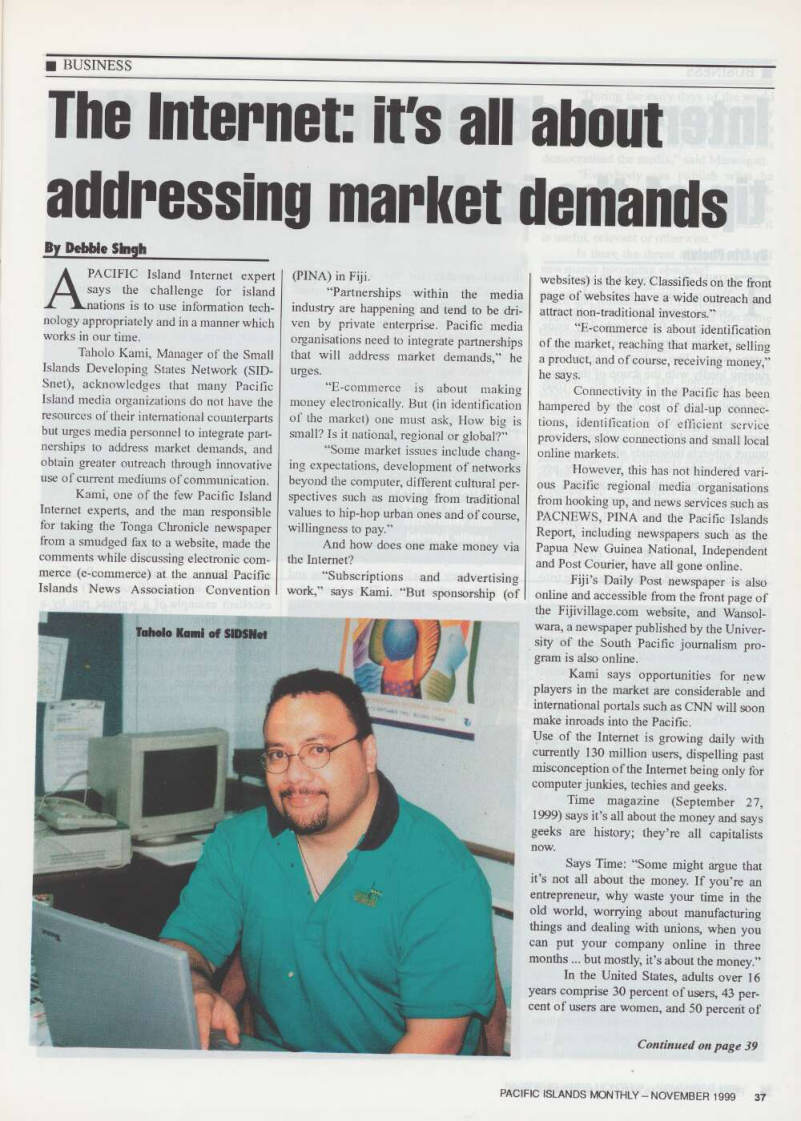
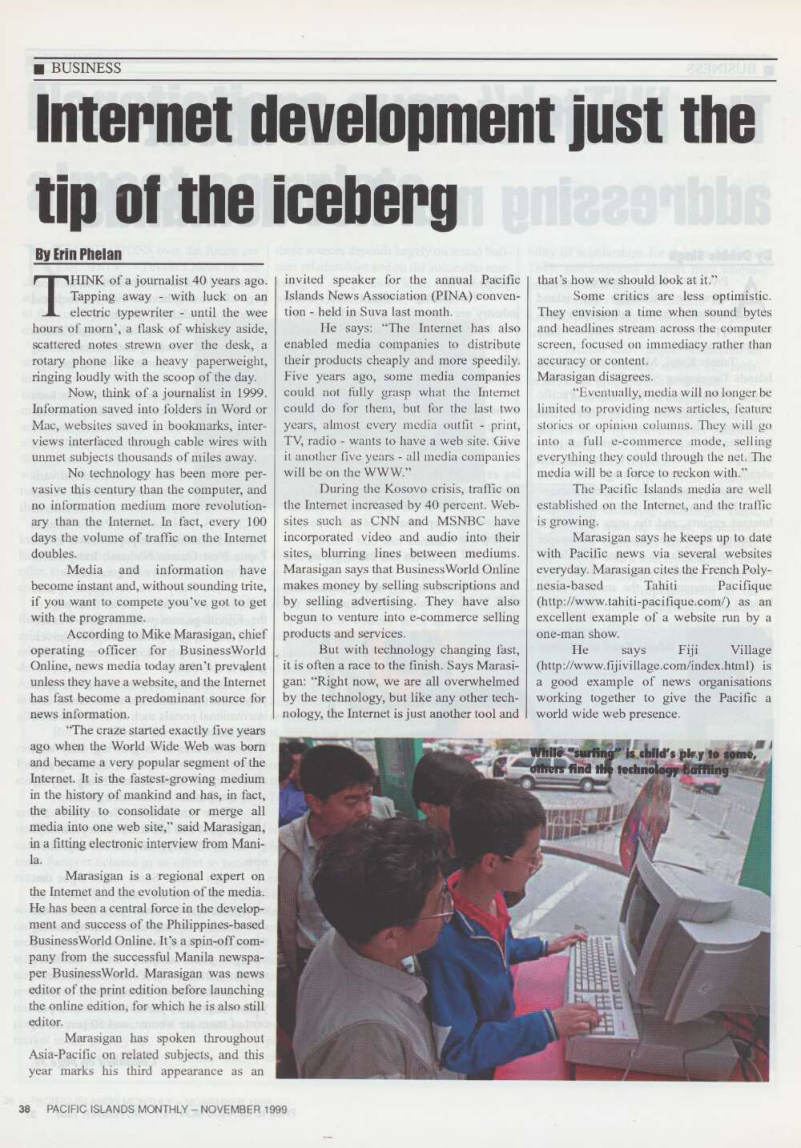

The Internet: it's all about addressing market demands
By Debbie Singh
A PACIFIC Island Internet expert says the challenge for island nations is to use information tech nology appropriately and in a manner which works in our time.
Taholo Kami, Manager of the Small Islands Developing States Network (SID- Snet), acknowledges that many Pacific Island media organizations do not have the resources of their international counterparts but urges media personnel to integrate part nerships to address market demands, and obtain greater outreach through innovative use of current mediums of communication.
Kami, one of the few Pacific Island Internet experts, and the man responsible for taking the Tonga Chronicle newspaper from a smudged fax to a website, made the comments while discussing electronic com merce (e-commerce) at the annual Pacific Islands News Association Convention
(PINA) in Fiji.
“Partnerships within the media industry are happening and tend to be dri ven by private enterprise. Pacific media organisations need to integrate partnerships that will address market demands,” he mges.
“E-commerce is about making money electronically. But (in identification ol the market) one must ask, How big is small? Is it national, regional or global?”
“Some market issues include chang ing expectations, development of networks beyond the computer, different cultural per spectives such as moving from traditional values to hip-hop urban ones and of course, willingness to pay.”
And how does one make money via the Internet?
“Subscriptions and advertising
work,” says Kami. “But sponsorship (of
websites) is the key. Classifieds on the front page of websites have a wide outreach and attract non-traditional investors.”
“E-commerce is about identification of the market, reaching that market, selling a product, and of course, receiving money,” he says.
Connectivity in the Pacific has been hampered by the cost of dial-up connec tions, identification of efficient service providers, slow connections and small local online markets.
However, this has not hindered vari ous Pacific regional media organisations from hooking up, and news services such as PACNEWS, PINA and the Pacific Islands Report, including newspapers such as the Papua New Guinea National, Independent and Post Courier, have all gone online.
Fiji’s Daily Post newspaper is also online and accessible from the front page of the Fijivillage.com website, and Wansol wara, a newspaper published by the Univer sity of the South Pacific journalism pro gram is also online.
Kami says opportunities for new players in the market are considerable and international portals such as CNN will soon make inroads into the Pacific.
Use of the Internet is growing daily with currently 130 million users, dispelling past misconception of the Internet being only for computer junkies, techies and geeks.
Time magazine (September 27, 1999) says it’s all about the money and says geeks are history; they’re all capitalists now.
Says Time: “Some might argue that it’s not all about the money. If you’re an entrepreneur, why waste your time in the old world, worrying about manufacturing things and dealing with unions, when you can put your company online in three months ... but mostly, it’s about the money.”
In the United States, adults over 16 years comprise 30 percent of users, 43 per cent of users are women, and 50 percent of
Continued on page 39
Taholo Kami of SIDSNET
Continued from page 37
users are between the 16-34 age bracket.
Kami manages the SlDSnet project, which is a direct outcome of the 1994 Unit ed Nations Conference on Sustainable Development in Barbados.
SlDSnet is a global Internet project linking 42 small island states in the Pacific, Indian Ocean, African and Caribbean regions.
In its first phase, which expires next month, the project is providing training in the use of the Internet in 12 Pacific coun tries.
The SlDSnet front page mirrors sites of various regional organizations such as the South Pacific Forum Secretariat, South Pacific Regional Environment Programme, SOPAC, University of the South Pacific and the Caribbean Conservation Association.
The site and its news wire cover var ious themes such as trade, biodiversity and climate change and search engines allow users to search popular websites. The popu larity of the site has been demonstrated by its increasing number of hits, which have jumped from 103,000 to 200,000 in the past three months. ■
With technology changing at an ever-increasing rate, islanders need to Jump on the
bandwagon now
Internet development just the tip
tip of the iceberg
By Erin Phelan
THINK of a journalist 40 years ago.
Tapping away - with luck on an electric typewriter - until the wee hours of morn’, a flask of whiskey aside, scattered notes strewn over the desk, a rotary phone like a heavy paperweight, ringing loudly with the scoop of the day.
Now, think of a journalist in 1999.
Information saved into folders in Word or Mac, websites saved in bookmarks, inter views interfaced through cable wires with unmet subjects thousands of miles away.
No technology has been more per vasive this century than the computer, and no information medium more revolution ary than the Internet. In fact, every 100 days the volume of traffic on the Internet doubles.
Media and information have become instant and, without sounding trite, if you want to compete you’ve got to get with the programme.
According to Mike Marasigan, chief operating officer for Business World Online, news media today aren’t prevalent unless they have a website, and the Internet has fast become a predominant source for news information. ‘The craze started exactly five years ago when the World Wide Web was born and became a very popular segment of the Internet. It is the fastest-growing medium in the history of mankind and has, in fact, the ability to consolidate or merge all media into one web site,” said Marasigan, in a fitting electronic interview from Mani la.
Marasigan is a regional expert on the Internet and the evolution of the media.
He has been a central force in the develop ment and success of the Philippines-based Business World Online. It’s a spin-off com pany from the successful Manila newspa per Business World. Marasigan was news editor of the print edition before launching the online edition, for which he is also still editor.
Marasigan has spoken throughout
Asia-Pacific on related subjects, and this year marks his third appearance as an
invited speaker for the annual Pacific Islands News Association (PINA) conven tion - held in Suva last month.
He says: “The Internet has also enabled media companies to distribute
their products cheaply and more speedily.
Five years ago, some media companies could not fully grasp what the Internet could do for them, but for the last two years, almost every media outfit - print, TV, radio - wants to have a web site. Give it another five years - all media companies will be on the WWW.”
During the Kosovo crisis, traffic on the Internet increased by 40 percent. Web sites such as CNN and MSNBC have incorporated video and audio into their sites, blurring lines between mediums.
Marasigan says that Business World Online makes money by selling subscriptions and by selling advertising. They have also begun to venture into e-commerce selling products and services.
But with technology changing fast, it is often a race to the finish. Says Marasi gan: “Right now, we are all overwhelmed by the technology, but like any other tech nology, the Internet is just another tool and
that’s how we should look at it.”
Some critics are less optimistic.
They envision a time when sound bytes and headlines stream across the computer screen, focused on immediacy rather than accuracy or content.
Marasigan disagrees.
“Eventually, media will no longer be limited to providing news articles, feature stories or opinion columns. They will go into a full e-commerce mode, selling everything they could through the net. The media will be a force to reckon with.”
The Pacific Islands media are well established on the Internet, and the traffic
is growing.
Marasigan says he keeps up to date with Pacific news via several websites everyday. Marasigan cites the French Poly nesia-based Tahiti Pacifique (http://www.tahiti-pacifique.com/) as an excellent example of a website run by a one-man show.
He says Fiji Village (http://www.fijivillage.com/index.html) is a good example of news organisations working together to give the Pacific a world wide web presence.
While "surfing" is child's play to some, others find the technology baffling
“During the early days of the world wide web, people were saying: everybody can be a publisher. That’s true and that’s how I understand the way the Internet has democratised the media,” said Marasigan.
“Everybody can publish what he wants to publish even if it is garbage. The Internet can give anybody the power to express or distribute information whether it is useful, relevant or otherwise.”
Is there the threat of the traditional newspaper becoming obsolete?
“I don’t think so, but maybe their reach and influence will be reduced,” said Marasigan. “We must remember that some developing regions do not have access to electricity or computers.”
Not entirely true. Recently Somalia became one of the last countries in the world to get connected, however access to phone lines - required for the Internet - is limiting the reach. Die Pacific suffers from the same problem and hi many countries such as Fiji - one company has a monopoly on the cable wires.
Opening up the market for competition will allow the Internet to grow - and it is
growing fast.
Says Marasigan: “We ain’t seen nothing yet.” (PINA Nius) ■
Pacific Islanders can benefit from the accessiblity that Internet allows
marine spills
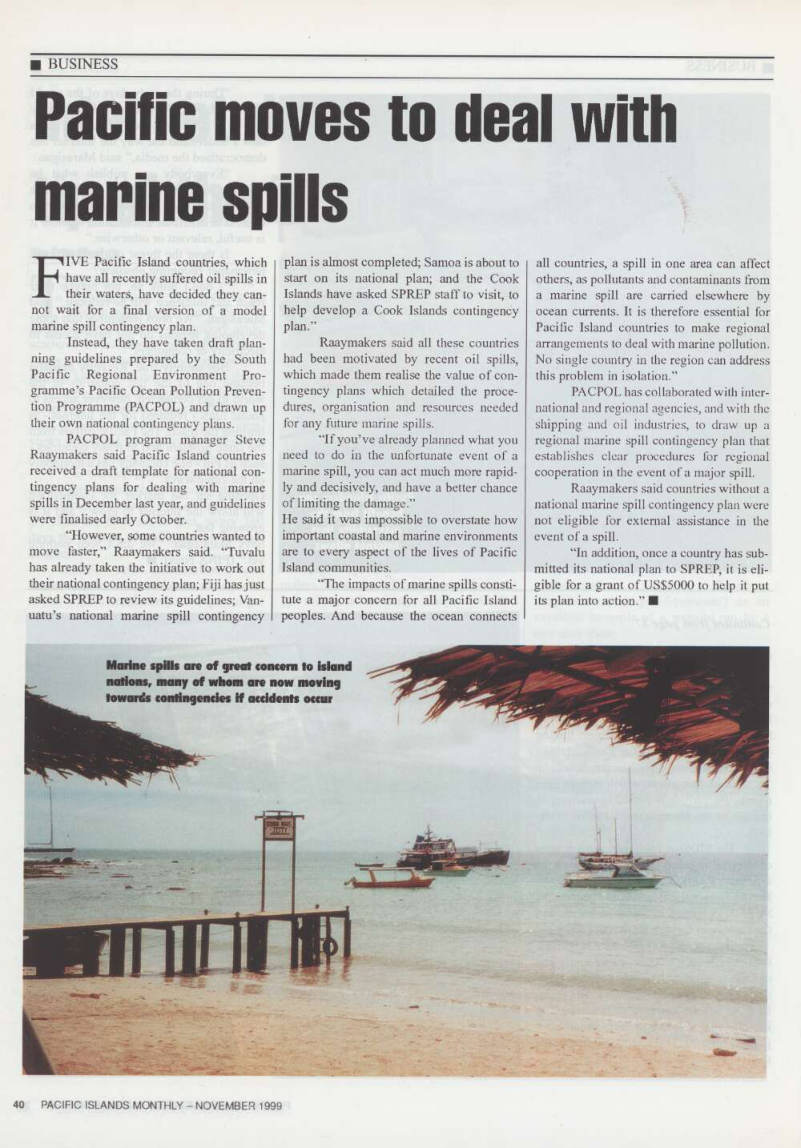
Pacific moves to deal with marine spills
FIVE Pacific Island countries, which have all recently suffered oil spills in their waters, have decided they can not wait for a final version of a model
marine spill contingency plan.
Instead, they have taken draft plan ning guidelines prepared by the South Pacific Regional Environment Pro gramme’s Pacific Ocean Pollution Preven tion Programme (PACPOL) and drawn up their own national contingency plans.
PACPOL program manager Steve Raaymakers said Pacific Island countries received a draft template for national con
tingency plans for dealing with marine
spills in December last year, and guidelines were finalised early October.
“However, some countries wanted to move faster,” Raaymakers said. “Tuvalu has already taken the initiative to work out their national contingency plan; Fiji has just asked SPREP to review its guidelines; Van uatu’s national marine spill contingency
plan is almost completed; Samoa is about to start on its national plan; and the Cook Islands have asked SPREP staff to visit, to
help develop a Cook Islands contingency
plan.”
Raaymakers said all these countries had been motivated by recent oil spills, which made them realise the value of con tingency plans which detailed the proce dures, organisation and resources needed for any future marine spills.
“If you’ve already planned what you need to do in the unfortunate event of a marine spill, you can act much more rapid ly and decisively, and have a better chance
of limiting the damage.”
He said it was impossible to overstate how important coastal and marine environments are to every aspect of the lives of Pacific Island communities.
“The impacts of marine spills consti tute a major concern for all Pacific Island peoples. And because the ocean connects
all countries, a spill in one area can affect others, as pollutants and contaminants from a marine spill are carried elsewhere by ocean currents. It is therefore essential for Pacific Island countries to make regional arrangements to deal with marine pollution.
No single country in the region can address this problem in isolation.”
PACPOL has collaborated with inter national and regional agencies, and with the shipping and oil industries, to draw up a regional marine spill contingency plan that establishes clear procedures for regional cooperation in the event of a major spill.
Raaymakers said countries without a national marine spill contingency plan were not eligible for external assistance in the event of a spill.
“In addition, once a country has sub mitted its national plan to SPREP, it is eli gible for a grant of US$5OOO to help it put its plan into action.” ■
Marine spills are of great concern to island nations, many of whom are now moving towards contingencies if accidents occur
Southern Cross begins laying
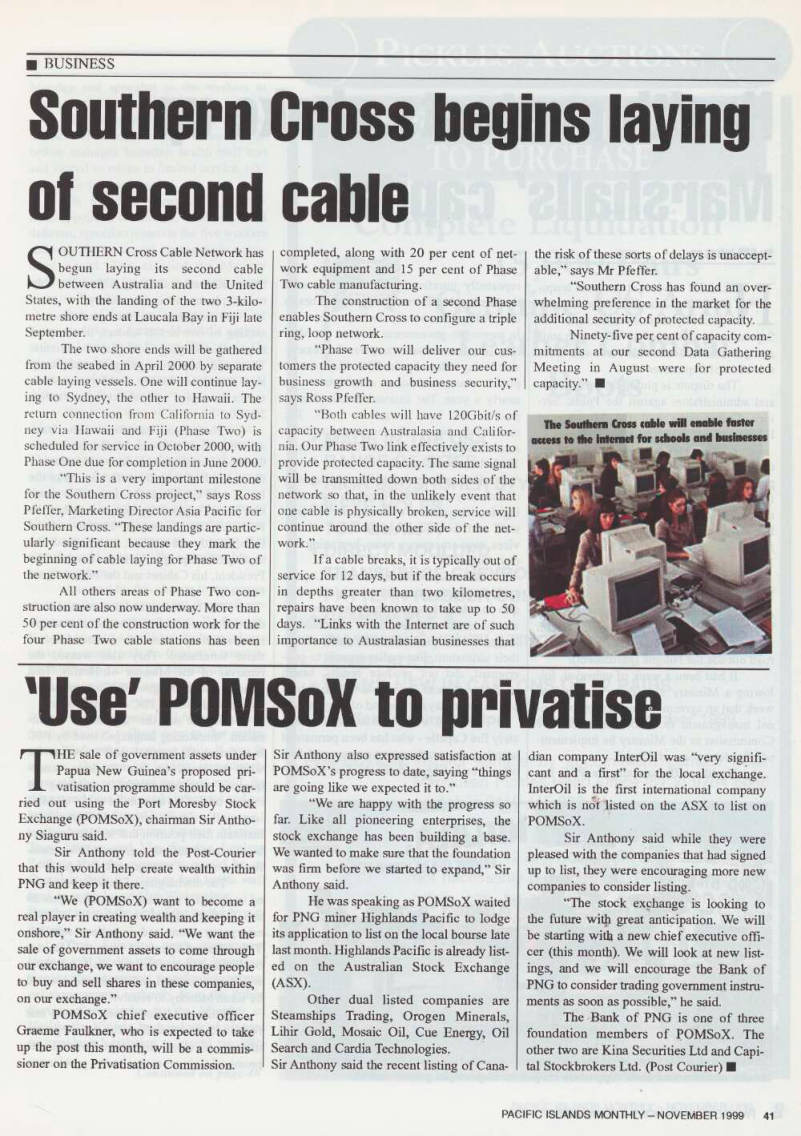
of second cable
SOUTHERN Cross Cable Network has begun laying its second cable between Australia and the United States, with the landing of the two 3-kilo metre shore ends at Laucala Bay in Fiji late September.
The two shore ends will be gathered Irom the seabed in April 2000 by separate cable laying vessels. One will continue lay ing to Sydney, the other to Hawaii. The return connection from California to Syd ney via Hawaii and Fiji (Phase Two) is scheduled for service in October 2000, with Phase One due for completion in June 2000.
“This is a very important milestone for the Southern Cross project,” says Ross Pfeffer, Marketing Director Asia Pacific for Southern Cross. “These landings are partic ularly significant because they mark the beginning of cable laying for Phase Two of the network.”
All others areas of Phase Two con struction are also now underway. More than 50 per cent of the construction work for the four Phase Two cable stations has been
completed, along with 20 per cent of net work equipment and 15 per cent of Phase Two cable manufacturing.
The construction of a second Phase enables Southern Cross to configure a triple ring, loop network.
“Phase Two will deliver our cus tomers the protected capacity they need for business growth and business security,” says Ross Pfeffer.
“Both cables will have 120Gbit/s of capacity between Australasia and Califor nia. Our Phase Two link effectively exists to provide protected capacity. The same signal will be transmitted down both sides of the network so that, in the unlikely event that one cable is physically broken, service will continue around the other side of the net work.”
If a cable breaks, it is typically out of service for 12 days, but if the break occurs in depths greater than two kilometres, repairs have been known to take up to 50 days. “Links with the Internet are of such importance to Australasian businesses that
the risk of these sorts of delays is unaccept able,” says Mr Pfeffer.
“Southern Cross has found an over whelming preference in the market for the additional security of protected capacity.
Ninety-five per cent of capacity com mitments at our second Data Gathering Meeting in August were for protected capacity.” ■
The Southern Cross cable will enable faster access to the internet for schools and businesses
'Use' POMSOX to privatise
THE sale of government assets under Papua New Guinea’s proposed pri vatisation programme should be car ried out using the Port Moresby Stock Exchange (POMSoX), chairman Sir Antho ny Siaguru said.
Sir Anthony told the Post-Courier that this would help create wealth within PNG and keep it there.
“We (POMSoX) want to become a real player in creating wealth and keeping it onshore,” Sir Anthony said. “We want the sale of government assets to come through our exchange, we want to encourage people to buy and sell shares in these companies, on our exchange.”
POMSoX chief executive officer Graeme Faulkner, who is expected to take up the post this month, will be a commis sioner on the Privatisation Commission.
Sir Anthony also expressed satisfaction at POMSoX’s progress to date, saying “things are going like we expected it to.”
“We are happy with the progress so far. Like all pioneering enterprises, the stock exchange has been building a base.
We wanted to make sure that the foundation was firm before we started to expand,” Sir
Anthony said.
He was speaking as POMSoX waited for PNG miner Highlands Pacific to lodge its application to list on the local bourse late last month. Highlands Pacific is already list ed on the Australian Stock Exchange
(Asx).
Other dual listed companies are Steamships Trading, Orogen Minerals, Lihir Gold, Mosaic Oil, Cue Energy, Oil Search and Cardia Technologies.
Sir Anthony said the recent listing of Cana
dian company Inter Oil was “very signifi cant and a first” for the local exchange.
Inter Oil is the first international company which is not listed on the ASX to list on
Pomsox.
Sir Anthony said while they were pleased with the companies that had signed up to list, they were encouraging more new companies to consider listing.
“The stock exchange is looking to the future witji great anticipation. We will be starting with a new chief executive offi cer (this month). We will look at new list ings, and we will encourage the Bank of PNG to consider trading government instru ments as soon as possible,” he said.
The Bank of PNG is one of three foundation members of POMSoX. The other two are Kina Securities Ltd and Capi tal Stockbrokers Ltd. (Post Courier) ■
Marshalls' capital
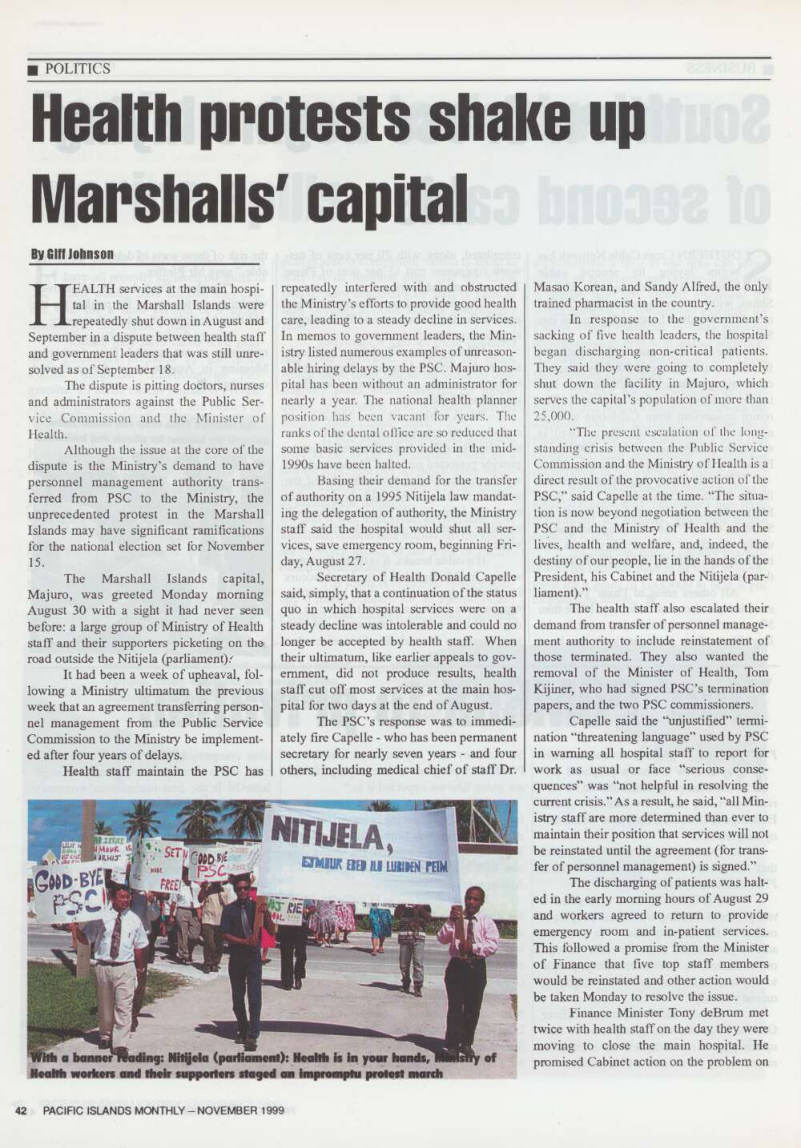

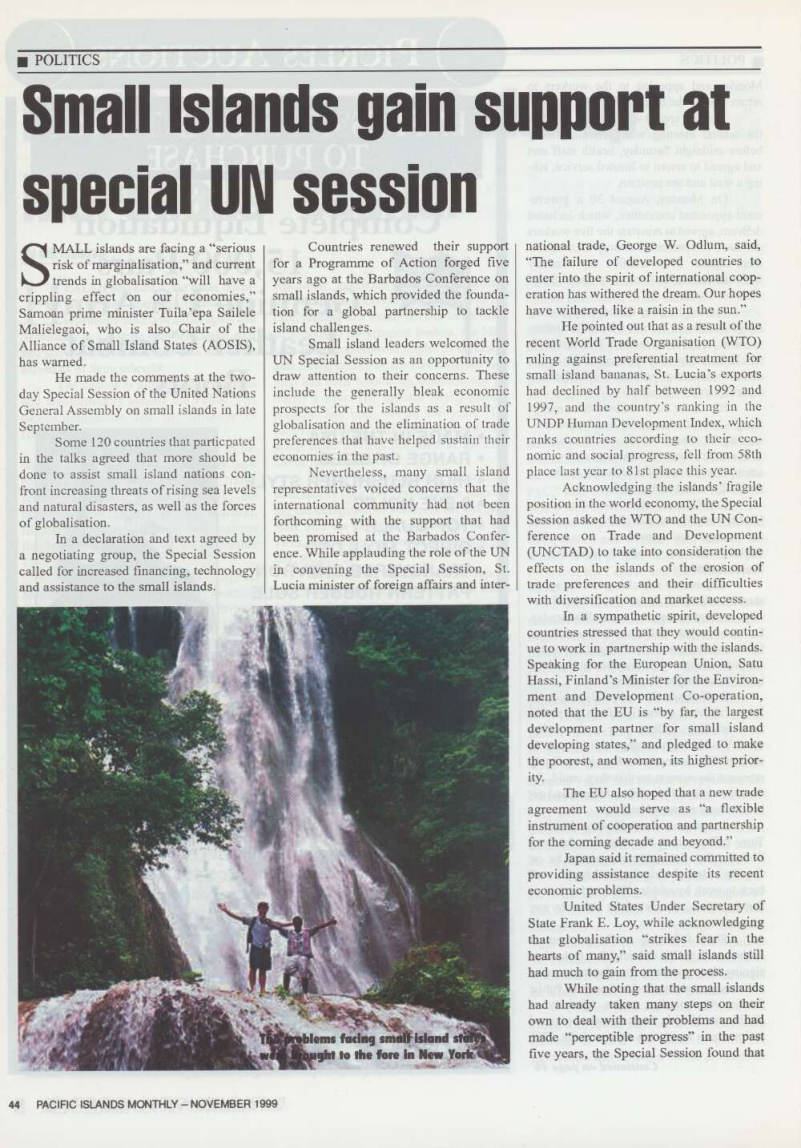
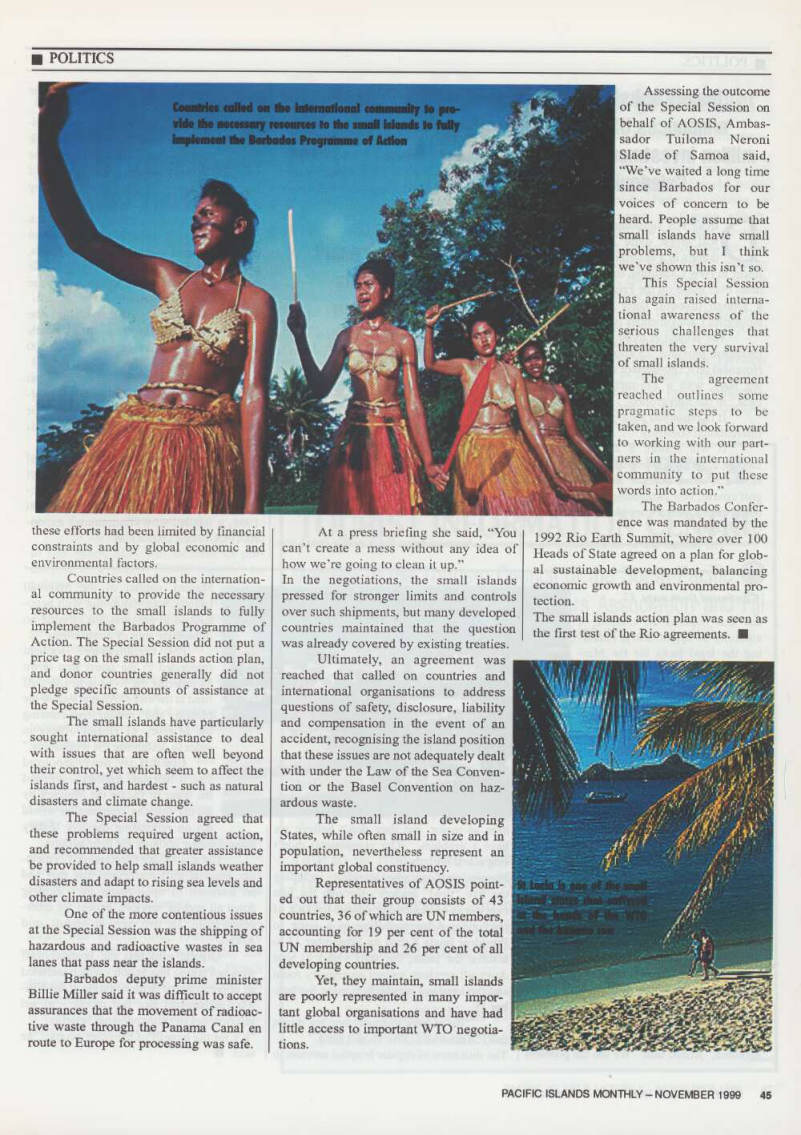
Politics
Health protests shake up Marshalls' capital
By Gift Johnson
HEALTH services at the main hospi tal in the Marshall Islands were repeatedly shut down in August and September in a dispute between health staff and government leaders that was still unre solved as of September 18.
The dispute is pitting doctors, nurses and administrators against the Public Ser vice Commission and the Minister of Health.
Although the issue at the core of the dispute is the Ministry’s demand to have
personnel management authority trans
ferred from PSC to the Ministry, the unprecedented protest in the Marshall Islands may have significant ramifications for the national election set for November 15.
The Marshall Islands capital, Majuro, was greeted Monday morning August 30 with a sight it had never seen before: a large group of Ministry of Health staff and their supporters picketing on the road outside the Nitijela (parliament)/ It had been a week of upheaval, fol
lowing a Ministry ultimatum the previous
week that an agreement transferring person nel management from the Public Service Commission to the Ministry be implement ed after four years of delays.
Health staff maintain the PSC has
repeatedly interfered with and obstructed the Ministry’s efforts to provide good health care, leading to a steady decline in services.
In memos to government leaders, the Min istry listed numerous examples of unreason able hiring delays by the PSC. Majuro hos pital has been without an administrator for nearly a year. The national health planner position has been vacant for years. The ranks of the dental office are so reduced that some basic services provided in the mid -1990s have been halted.
Basing their demand for the transfer of authority on a 1995 Nitijela law mandat ing the delegation of authority, the Ministry staff said the hospital would shut all ser vices, save emergency room, beginning Fri day, August 27.
Secretary of Health Donald Capelle said, simply, that a continuation of the status quo in which hospital services were on a steady decline was intolerable and could no longer be accepted by health staff. When their ultimatum, like earlier appeals to gov ernment, did not produce results, health staff cut off most services at the main hos pital for two days at the end of August.
The PSC’s response was to immedi ately fire Capelle - who has been permanent secretary for nearly seven years - and four others, including medical chief of staff Dr.
Masao Korean, and Sandy Alfred, the only trained pharmacist in the country.
In response to the government’s sacking of five health leaders, the hospital
began discharging non-critical patients.
They said they were going to completely shut down the facility in Majuro, which serves the capital’s population of more than 25,000.
“The present escalation of the long standing crisis between the Public Service Commission and the Ministry of Health is a direct result of the provocative action of the PSC,” said Capelle at the time. “The situa tion is now beyond negotiation between the PSC and the Ministry of Health and the lives, health and welfare, and, indeed, the destiny of our people, lie in the hands of the President, his Cabinet and the Nitijela (par liament).”
The health staff also escalated their demand from transfer of personnel manage ment authority to include reinstatement of those terminated. They also wanted the removal of the Minister of Health, Tom Kijiner, who had signed PSC’s termination papers, and the two PSC commissioners.
Capelle said the “unjustified” termi nation “threatening language” used by PSC in warning all hospital staff to report for work as usual or face “serious conse quences” was “not helpful in resolving the current crisis.” Asa result, he said, “all Min istry staff are more determined than ever to maintain their position that services will not be reinstated until the agreement (for trans fer of personnel management) is signed.”
The discharging of patients was halt ed in the early morning hours of August 29 and workers agreed to return to provide emergency room and in-patient services.
This followed a promise from the Minister of Finance that five top staff members would be reinstated and other action would be taken Monday to resolve the issue.
Finance Minister Tony deßrum met twice with health staff on the day they were moving to close the main hospital. He promised Cabinet action on the problem on
With a banner readingF Nitijela (parliament): Health is in your hands, Rinis try of Health workers and their supporters staged an impromptu protest march
Monday and appealed to the workers to return to staff the hospital.
His first appeal was rejected but after the second meeting with deßmm shortly before midnight Saturday, health staff met and agreed to return to limited service, tak ing a wait and see position.
On Monday, August 30 a govern ment-appointed committee, which included deßrum, agreed to reinstate the five workers and have the personnel management agree ment signed. This satisfied the Ministry staff sufficiently for them to re-open all ser vices on Tuesday.
Part of the plan included appointing Kjnja Andrike, a former Marshalls ambas sador to Japan, to be the new PSC chair. He would then help with approval of the agree ment transferring personnel management authority to the Ministry.
But fewer than 48 hours later, every thing - except emergency room services was again closed briefly on Wednesday.
This was in protest of what they said was an attempt by the minister of health to change the deal reached earlier in the week.
Capelle said that the Minister of Health was proposing to change the person nel management agreement -a move that Capelle said was totally unacceptable to health workers.
Angered by this change in the agree ment, the hospital again shut down all ser vices, except emergency room. Wednesday.
But an hour and a half later, the hospital was back to normal, with the Cabinet’s commit tee intervening to get the agreement back on track, according to Capelle.
Staff from the hospital, which is located across a sports field from the parlia ment building, walked over to the parlia ment Wednesday morning while it was in session. Government leaders immediately recessed the session so that they could, for the second time that week, intervene and get health services turned back on.
Assurances from Finance Minister
Tony deßrum and Vice Speaker Jurelang
Zedkaia that the agreement would be on Capelle’s desk for signing had health staff
back to work by midday Wednesday.
But that wasn’t the end of the matter by any means.
The following week, government leaders told health officials that instead of signing the agreement transferring person nel management authority from the Public Service Commission to the Ministry of Health, the Nitijela leaders instead planned to introduce legislation to repeal the 1995
Continued on page 46
Continued from page 37
law that requires the transfer of authority to the Ministry, remov ing the legal basis for the Min istry’s demand that this authority be transferred, he indicated.
“It’s frustrating and disap
pointing,” Capelle said. “The bot tom line is we’re asking to be
given the opportunity to provide
better services to the peopled’
But, he said, “we were probably naive to think that these were rea sonable people who were con cerned with the well-being of the
people.”
This process has shown that the lead ers involved are “only concerned with retaining their power.”
Health officials said that after new PSC chair Kinja Andrike signed the agree ment after his appointment, they expected it would move forward. But the two other commissioners - Francis Horiuchi and Don ald Matthew - who had fired the five health staff refused to sign.
“People here who know their jobs appealed to the proper authorities about a problem,” Alfred said. “We see the problem
here as major, but they don’t believe we have a problem. (Our complaints) didn’t ring a bell with them.”
Hospital staff continued working - including the five “fired” leaders - through the first two weeks of September despite the lack of resolution. After appealing in a letter to President Imata Kabua on September 13 to resolve the issue, the staff voted to shut down all services, except emergency room and the inpatient wards, beginning Septem ber 15.
“We’re back to square one but minus one,” Alfred said. “We’re still fired.”
The shutdown of regular hospital services in
Majuro, capital of the Marshall Islands, was continuing with nego tiations in progress but offering no immediate sign of a resolution.
PSC Commissioner Horiuchi responded to the latest shut down by ordering the five top health staff fired at the end of August vacate the Ministry and “refrain from entering the Ministry of Health offices in order to destabilise the work force.”
Late that day, newly appointed PSC Chairman Andrike softened the order to vacate the Ministry by saying that the commission would act on reinstating the five if they
make a public apology for their actions.
But at a Friday (September 17) meet ing, hospital staff reaffirmed that they had no intention of apologising for shutting down all regular services, except for emer gency room, for two days in August, said Alfred.
Capelle said that the hospital staff were not taking this action - which included an unprecedented demonstration at the Niti jela (parliament) late last month - to get salary raises or other personal benefits.
“It’s for the benefit of the other people,” he said. ■
Flanked by police officers, Marshall Islands health staff march into the grounds of the Nitijela (parliament) to press their demands for action.
Advertisements & other items, p. 43 (1 item)
Complete Liquidation
Pickles Auctions
EXPRESSIONS OF INTEREST
TO PURCHASE
Complete Liquidation
15,000 Pairs
Genuine US Army
Leather Combat
Boots
• MADE IN THE USA
• RANGE OF SIZES
• HIGH BLUSHCHER STYLE
• 9 EYE HOLES
• TOP QUALITY
• DIRECT MOULDED
TRANSVERSE CHEVRON
PATTERN RUBBER SOLE
• REMOVABLE &
WASHABLE VENTILATING
INNER SOLE
• BRAND NEW IN CARTONS OF 12 PAIRS Offers’closing 5.00 pm Tuesday 30 November 1999 INSPECTION: Inspect sample by appointment contact Peter Macqueen Pickles Head Office (61 2) 9704 6666 or mobile 0419 415 223.
TERMS: Tenders will be accepted on a per pair basis in multiples of 12 only. The highest or any offer will not necessarily be accepted. Tender details and offers can be made via our internet site at www.pickles.com.au (click tender). A buyers premium of 10% will apply to all successful offers. 36-40 Harp St, Belmore, Australia 61 2 9704 6666 www.pickles.com.au Members of the Auctioneers & Valuers Association of Australia (Inc.) A.C.N. 003 417 650 • SYDNEY • CANBERRA • NEWCASTLE • ADELAIDE • BRISBANE • HOBART
Small Islands gain support at special UN session
special UN session
SMALL islands are facing a “serious risk of marginalisation,” and current trends in globalisation “will have a crippling effect on our economies,”
Samoan prime minister Tuila’epa Sailele Malielegaoi, who is also Chair of the Alliance of Small Island States (AOSIS), has warned.
He made the comments at the two day Special Session of the United Nations General Assembly on small islands in late September.
Some 120 countries that particpated in the talks agreed that more should be done to assist small island nations con front increasing threats of rising sea levels and natural disasters, as well as the forces
of globalisation.
In a declaration and text agreed by a negotiating group, the Special Session called for increased financing, technology and assistance to the small islands.
Countries renewed their support for a Programme of Action forged five years ago at the Barbados Conference on small islands, which provided the founda tion for a global partnership to tackle
island challenges.
Small island leaders welcomed the UN Special Session as an opportunity to draw attention to their concerns. These include the generally bleak economic prospects for the islands as a result of globalisation and the elimination of trade preferences that have helped sustain their economies in the past.
Nevertheless, many small island representatives voiced concerns that the international community had not been forthcoming with the support that had been promised at the Barbados Confer ence. While applauding the role of the UN in convening the Special Session, St.
Lucia minister of foreign affairs and inter-
national trade, George W. Odium, said, “The failure of developed countries to enter into the spirit of international coop eration has withered the dream. Our hopes have withered, like a raisin in the sun.”
He pointed out that as a result of the recent World Trade Organisation (WTO) ruling against preferential treatment for small island bananas, St. Lucia’s exports had declined by half between 1992 and 1997, and the country’s ranking in the UNDP Human Development Index, which ranks countries according to their eco nomic and social progress, fell from 58th place last year to 81st place this year.
Acknowledging the islands’ fragile
position in the world economy, the Special Session asked the WTO and the UN Con ference on Trade and Development (UNCTAD) to take into consideration the effects on the islands of the erosion of trade preferences and their difficulties with diversification and market access.
In a sympathetic spirit, developed
countries stressed that they would contin ue to work in partnership with the islands.
Speaking for the European Union, Satu Hassi, Finland’s Minister for the Environ
ment and Development Co-operation,
noted that the EU is “by far, the largest development partner for small island developing states,” and pledged to make the poorest, and women, its highest prior
ity.
The EU also hoped that a new trade agreement would serve as “a flexible instrument of cooperation and partnership for the coming decade and beyond.”
Japan said it remained committed to providing assistance despite its recent
economic problems.
United States Under Secretary of State Frank E. Loy, while acknowledging that globalisation “strikes fear in the hearts of many,” said small islands still had much to gain from the process.
While noting that the small islands had already taken many steps on their own to deal with their problems and had made “perceptible progress” in the past five years, the Special Session found that
The problems facing small island stares we[?] brought to the fore in New Yor[?]
these efforts had been limited by financial constraints and by global economic and environmental factors.
Countries called on the internation al community to provide the necessary resources to the small islands to fully implement the Barbados Programme of Action. The Special Session did not put a price tag on the small islands action plan, and donor countries generally did not pledge specific amounts of assistance at the Special Session.
The small islands have particularly sought international assistance to deal with issues that are often well beyond their control, yet which seem to affect the islands first, and hardest - such as natural disasters and climate change.
The Special Session agreed that these problems required urgent action, and recommended that greater assistance be provided to help small islands weather disasters and adapt to rising sea levels and other climate impacts.
One of the more contentious issues at the Special Session was the shipping of hazardous and radioactive wastes in sea lanes that pass near the islands.
Barbados deputy prime minister Billie Miller said it was difficult to accept assurances that the movement of radioac tive waste through the Panama Canal en route to Europe for processing was safe.
At a press briefing she said, “You can’t create a mess without any idea of how we’re going to clean it up.”
In the negotiations, the small islands pressed for stronger limits and controls over such shipments, but many developed countries maintained that the question was already covered by existing treaties.
Ultimately, an agreement was reached that called on countries and international organisations to address questions of safety, disclosure, liability and compensation in the event of an accident, recognising the island position that these issues are not adequately dealt with under the Law of the Sea Conven tion or the Basel Convention on haz ardous waste.
The small island developing States, while often small in size and in population, nevertheless represent an important global constituency.
Representatives of AOSIS point ed out that their group consists of 43 countries, 36 of which are UN members, accounting for 19 per cent of the total UN membership and 26 per cent of all developing countries.
Yet, they maintain, small islands are poorly represented in many impor tant global organisations and have had little access to important WTO negotia tions.
Assessing the outcome of the Special Session on behalf of AOSIS, Ambas sador Tuiloma Neroni Slade of Samoa said, “We’ve waited a long time since Barbados for our voices of concern to be heard. People assume that small islands have small problems, but I think we’ve shown this isn’t so.
This Special Session has again raised interna tional awareness of the serious challenges that threaten the very survival of small islands.
The agreement reached outlines some pragmatic steps to be taken, and we look forward to working with our part ners in the international community to put these words into action.”
The Barbados Confer ence was mandated by the
1992 Rio Earth Summit, where over 100 Heads of State agreed on a plan for glob al sustainable development, balancing economic growth and environmental pro tection.
The small islands action plan was seen as the first test of the Rio agreements. ■
Countries called on the international community to pro vide the necessary resources to the small islands to fully implement the Barbados Programme of Action
St Lusla is one of the [?] Island stares [?] on the [?] and the [?]
Disney subsidiary
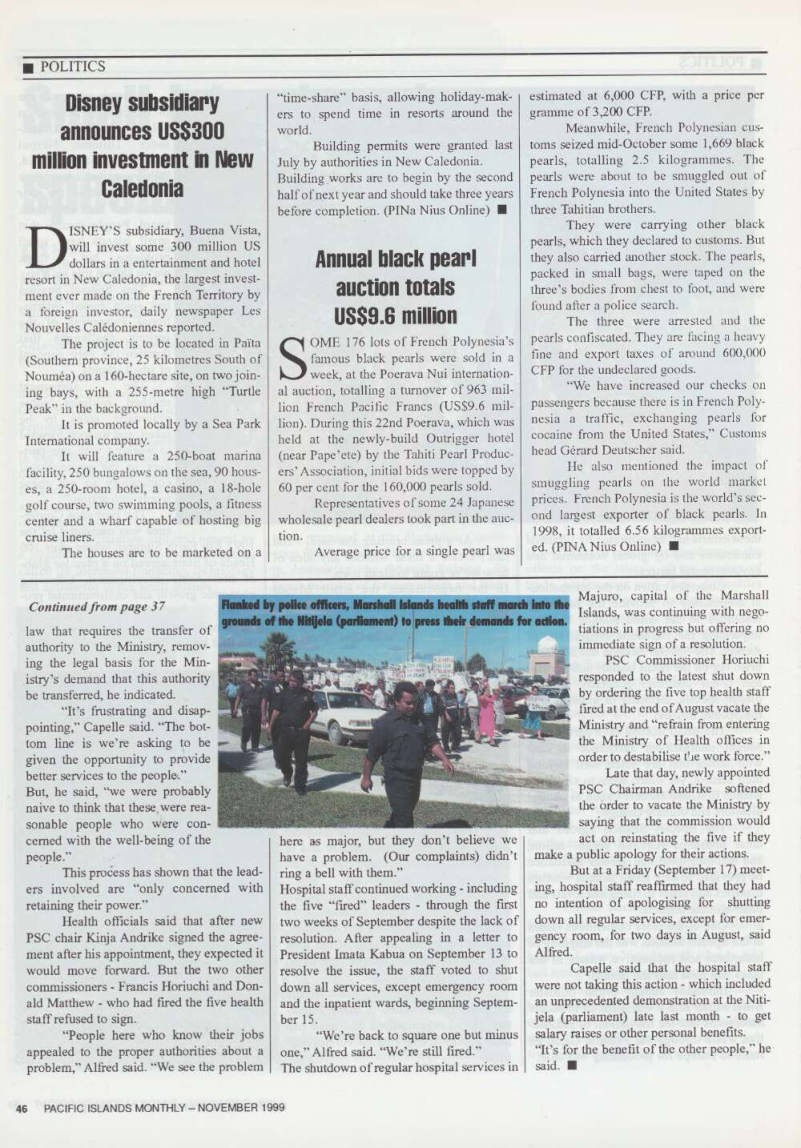
announces US$300 million investment in New Caledonia
DISNEY’S subsidiary, Buena Vista, will invest some 300 million US dollars in a entertainment and hotel resort in New Caledonia, the largest invest ment ever made on the French Territory by a foreign investor, daily newspaper Les Nouvelles Caledoniennes reported.
The project is to be located in Pai’ta (Southern province, 25 kilometres South of Noumea) on a 160-hectare site, on two join ing bays, with a 255-metre high “Turtle Peak” in the background.
It is promoted locally by a Sea Park International company.
It will feature a 250-boat marina facility, 250 bungalows on the sea, 90 hous es, a 250-room hotel, a casino, a 18-hole golf course, two swimming pools, a fitness center and a wharf capable of hosting big cruise liners.
The houses are to be marketed on a
“time-share” basis, allowing holiday-mak ers to spend time in resorts around the world.
Building permits were granted last July by authorities in New Caledonia.
Building works are to begin by the second half of next year and should take three years before completion. (PINa Nius Online) I
US$9.6 million
Annual black pearl auction totals US$9.6 million
SOME 176 lots of French Polynesia’s famous black pearls were sold in a week, at the Poerava Nui internation al auction, totalling a turnover of 963 mil lion French Pacific Francs (USS9.6 mil lion). During this 22nd Poerava, which was held at the newly-build Outrigger hotel (near Pape’ete) by the Tahiti Pearl Produc ers’ Association, initial bids were topped by 60 per cent for the 160,000 pearls sold.
Representatives of some 24 Japanese wholesale pearl dealers took part in the auc tion.
Average price for a single pearl was
estimated at 6,000 CFP, with a price per gramme of 3,200 CFP.
Meanwhile, French Polynesian cus toms seized mid-October some 1,669 black pearls, totalling 2.5 kilogrammes. The pearls were about to be smuggled out of French Polynesia into the United States by three Tahitian brothers.
They were carrying other black pearls, which they declared to customs. But they also carried another stock. The pearls, packed in small bags, were taped on the three’s bodies from chest to foot, and were found after a police search.
The three were arrested and the pearls confiscated. They are facing a heavy fine and export taxes of around 600,000 CFP for the undeclared goods.
“We have increased our checks on passengers because there is in French Poly nesia a traffic, exchanging pearls for cocaine from the United States,” Customs head Gerard Deutscher said.
He also mentioned the impact of smuggling pearls on the world market prices. French Polynesia is the world’s sec ond largest exporter of black pearls. In 1998, it totalled 6.56 kilogrammes export ed. (PINANius Online) ■
by 5,000 tonnes
Main nickel producer to boost production by 5,000 tonnes by 2001
NEW Caledonia’s Societe Le Nick el (SEN) is to boost its annual nickel production by 5,000 tonnes per year by 2001, SEN President Yves Rambaud said late October.
“Our short term target is to produce 62,000 tonnes yearly, as opposed to 57,000 in 1999, with a production cost 15 per cent lower compared to 1998,” Rambaud said after SLN’s annual general meeting of the Board of Directors.
World nickel prices have recently gone up from a less than two US dollars per pound to a current 3.2 dollars.
Rambaud estimated the current world demand on nickel was slightly above the one million ton mark.
“In the middle run, in between three to five years, SEN will increase its pro duction to a yearly 70,000 tonnes,” he
pointed out.
“We will spend most of the year 2000 studying the feasibility of such a tar get, because this will impact on the com pany’s strategy for the next ten years,” he said.
Costs could be reduced through a down sizing of the workforce.
SLN’s main nickel melting plant is located in Noumea, with extraction sites
throughout the territory.
Two other projects, one in the South, promoted by Canadian group Inco, the other in the North, led by another Canadian investor, Falconbridge, are cur rently under construction.
SLN’s mother group, Eramet, was privatised in February this year, with the French government becoming a minority shareholder (30 per cent), the rest being now held by private interests.
Through exploitation of manganese,
nickel and special ores, Eramet, which employs 17,000 people worldwide, has made a turnover of 17 billion French Francs (over three billion US dollars) last financial year. In the past ten years, Eram et’s turnover has increased eight-fold.
(PINA Nius Online) ■
French Polynesia to get more self-government
French Polynesia will have greater
self-government, including the right
to negotiate agreements in the Pacif ic, following a vote in the French Senate.
The Senate approved a bill passed in June by the Lower House, the National Assembly, that widens Papeete’s powers while falling short of independence from France.
Under the bill, the archipelago of 110 islands dotted across a territory as big as Europe but with only 220,000 inhabitants, will be considered by the French adminis tration as “an overseas country” - a new term in French political lexicon - rather than an “overseas territory”.
That means the establishment of “Polynesian citizenship” as well as the right of the Papeete government “to engage
negotiations with Pacific states on interna tional accords”.
The new status, which can only be enacted after a reform of the French Consti tution, provides for Paris to continue to manage areas such as foreign affairs, defence, currency, law and order, electoral laws and justice. Unlike legislation last year concerning its sister South Pacific territory, New Caledonia, the bill does not provide for an independence referendum.
Instead it states that “French Polyne sia govern itself freely and democratically
within the (French) Republic.”
It is now up to French President Jacques Chirac to convene a special meet ing of both houses of the French parliament, expected in January, to amend the constitu tion in line with the bill. AFP ■
Advertisements & other items, p. 47 (1 item)
Wistory Sightseeing! 4 Wheel Safari Tours!
FIJI ISLAND ADVENTURES &
TOURIST INFORMATION CENTRE
Member of the Tourism Council of the South Pacific m Fiji Budget Hotel & Tour Operators Association and Fiji Ecotourism Association.
See us for excellent deals on outer islands.
Overnight Stay! Treffing Island Safaris!
Wistory Sightseeing! 4 Wheel Safari Tours!
Surfing Scuha Diving! ‘Budget Accommodations!
Cruises and Weddings!
Talk to us first we live here ... book direct and ask for: Free independent information on latest deals!
Free booking services and many options!
Free airport transfers to hotel of your choice in Nadi!
Free greet on arrival & maps. Also general info on Fiji Write to us now or [email protected] PO Box 251 Nadi Fiji Islands Ph: 679 700243 Fax: 679 702746 Internefcwww.fijiadventures.com.fj 118692V2
HIV positive Maire Bopp wins
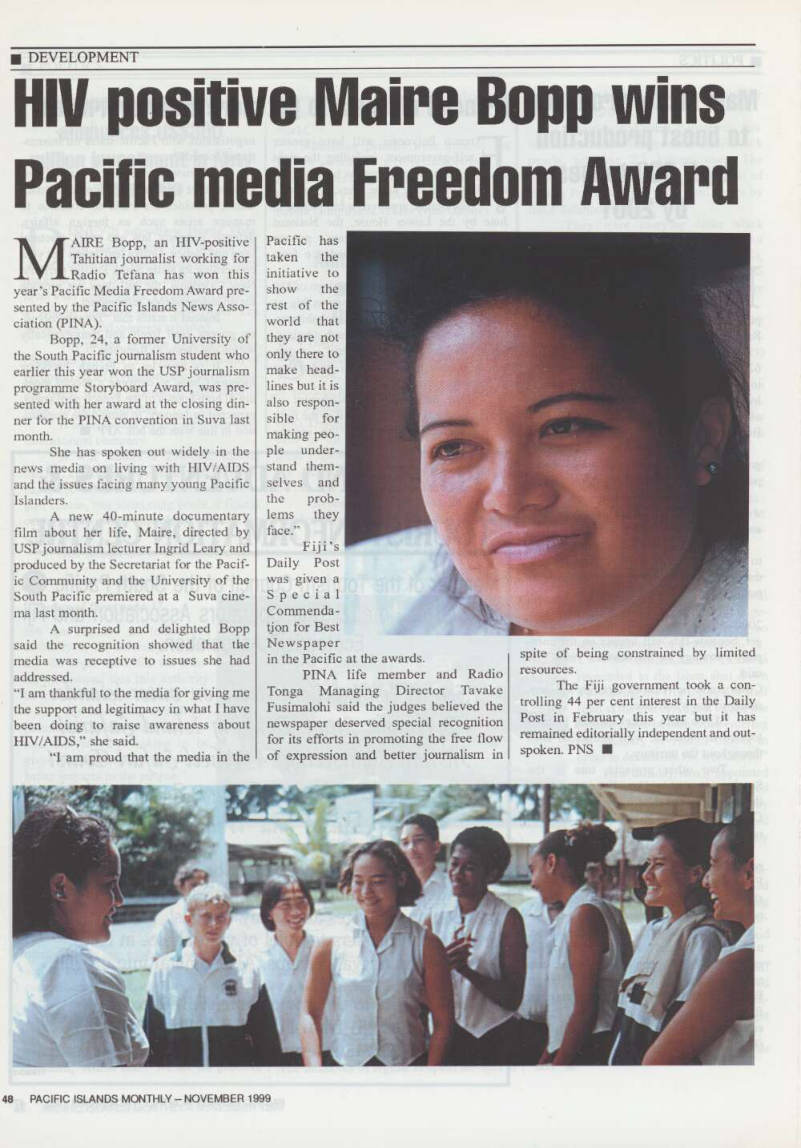
Development
HIV positive Maire Bopp wins Pacific media Freedom Award
MAIRE Bopp, an HIV-positive
Tahitian journalist working for
Radio Tefana has won this year’s Pacific Media Freedom Award pre sented by the Pacific Islands News Asso ciation (PINA).
Bopp, 24, a former University of the South Pacific journalism student who earlier this year won the USP journalism programme Storyboard Award, was pre sented with her award at the closing din ner for the PINA convention in Suva last month.
She has spoken out widely in the news media on living with HIV/AIDS and the issues facing many young Pacific Islanders.
A new 40-minute documentary film about her life, Maire, directed by USP journalism lecturer Ingrid Leary and produced by the Secretariat for the Pacif ic Community and the University of the South Pacific premiered at a Suva cine ma last month.
A surprised and delighted Bopp said the recognition showed that the media was receptive to issues she had addressed.
“I am thankful to the media for giving me the support and legitimacy in what I have been doing to raise awareness about HIV/AIDS,” she said.
“I am proud that the media in the
Pacific has taken the initiative to show the rest of the world that they are not only there to make head lines but it is also respon sible for
making peo
ple under stand them selves and
the prob
lems they face.”
Fiji’s
Daily Post
was given a
Special
Commenda tion for Best Newspaper
in the Pacific at the awards.
PINA life member and Radio Tonga Managing Director Tavake Fusimalohi said the judges believed the newspaper deserved special recognition for its efforts in promoting the free flow of expression and better journalism in
spite of being constrained by limited resources.
The Fiji government took a con trolling 44 per cent interest in the Daily Post in February this year but it has remained editorially independent and out spoken. PNS ■
Tax change threatens gas project
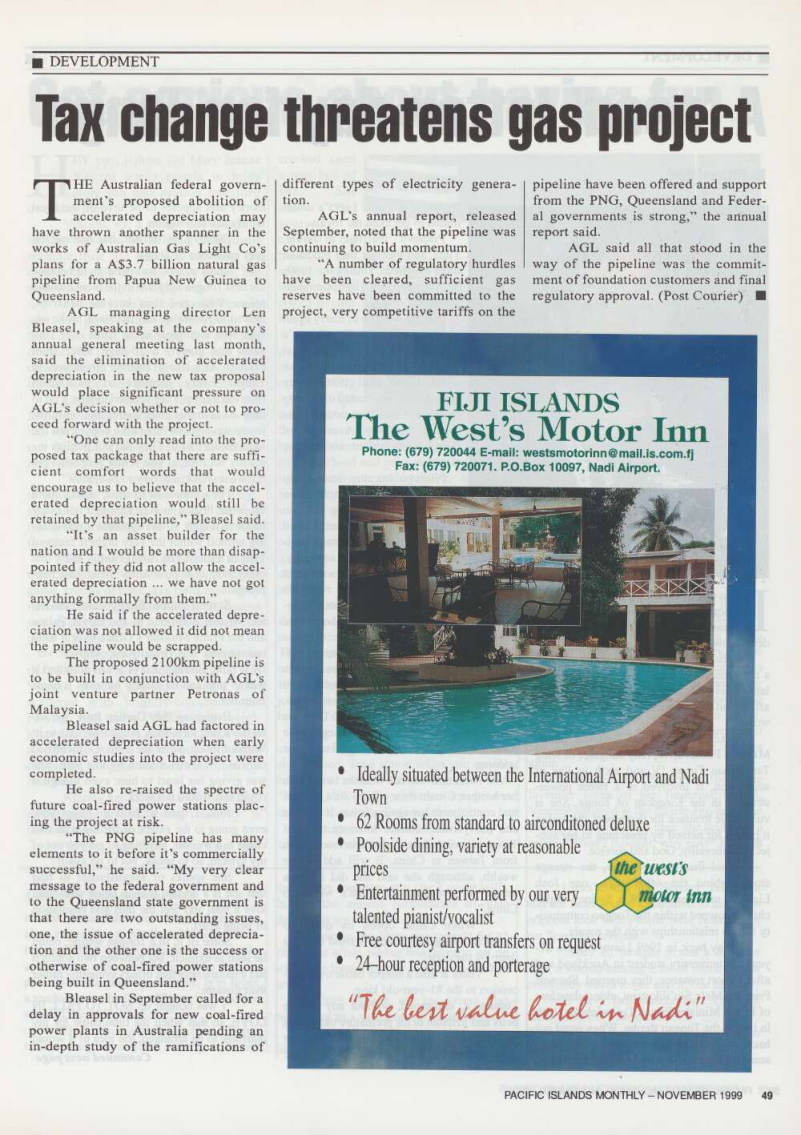
THE Australian federal govern ment’s proposed abolition of accelerated depreciation may have thrown another spanner in the works of Australian Gas Light Co’s plans for a A 53.7 billion natural gas pipeline from Papua New Guinea to Queensland.
AGL managing director Len Bleasel, speaking at the company’s annual general meeting last month, said the elimination of accelerated depreciation in the new tax proposal would place significant pressure on AGL’s decision whether or not to pro ceed forward with the project.
“One can only read into the pro posed tax package that there are suffi cient comfort words that would encourage us to believe that the accel erated depreciation would still be retained by that pipeline,” Bleasel said.
“It’s an asset builder for the nation and I would be more than disap pointed if they did not allow the accel erated depreciation ... we have not got anything formally from them.”
He said if the accelerated depre ciation was not allowed it did not mean the pipeline would be scrapped.
The proposed 2100 km pipeline is to be built in conjunction with AGL’s joint venture partner Petronas of Malaysia.
Bleasel said AGL had factored in accelerated depreciation when early economic studies into the project were completed.
He also re-raised the spectre of future coal-fired power stations plac ing the project at risk.
“The PNG pipeline has many elements to it before it’s commercially successful,” he said. “My very clear message to the federal government and to the Queensland state government is that there are two outstanding issues, one, the issue of accelerated deprecia tion and the other one is the success or otherwise of coal-fired power stations being built in Queensland.”
Bleasel in September called for a delay in approvals for new coal-fired power plants in Australia pending an in-depth study of the ramifications of
different types of electricity genera tion.
AGL’s annual report, released September, noted that the pipeline was continuing to build momentum.
“A number of regulatory hurdles have been cleared, sufficient gas reserves have been committed to the project, very competitive tariffs on the
pipeline have been offered and support from the PNG, Queensland and Feder al governments is strong,” the annual report said.
AGL said all that stood in the way of the pipeline was the commit ment of foundation customers and final regulatory approval. (Post Courier) ■
Advertisements & other items, p. 49 (1 item)
TlCc- it&pt
FIJI ISLANDS
The West’s Motor Inn
Phone: (679) 720044 E-mail: [email protected] Fax: (679) 720071. P.0.80x 10097, Nadi Airport. -^s mmmi mJ' Ideally situated between the International Airport and Nadi Town 62 Rooms from standard to airconditoned deluxe Poolside dining, variety at reasonable
prices JMUvesfs
Entertainment performed by our very \nwur inn talented pianist/vocalist Free courtesy airport transfers on request 24-hour reception and porterage
TlCc- it&pt
n
A 'read' letter day for Tonga
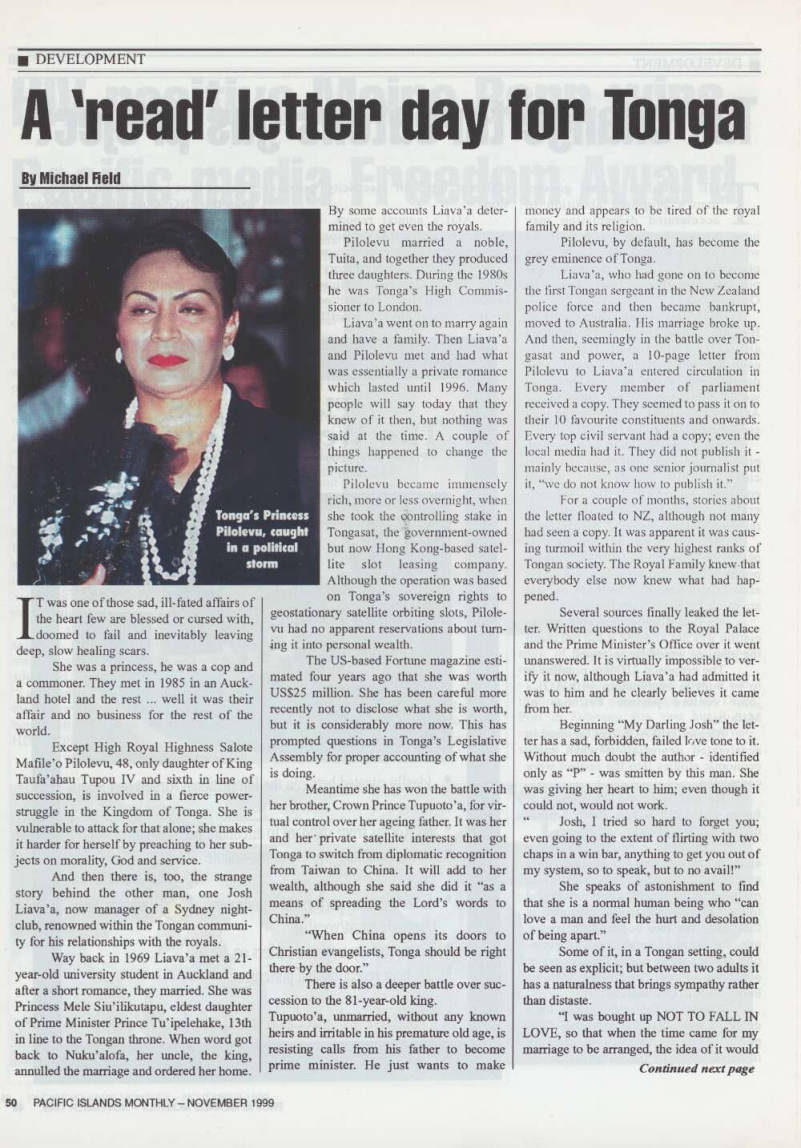
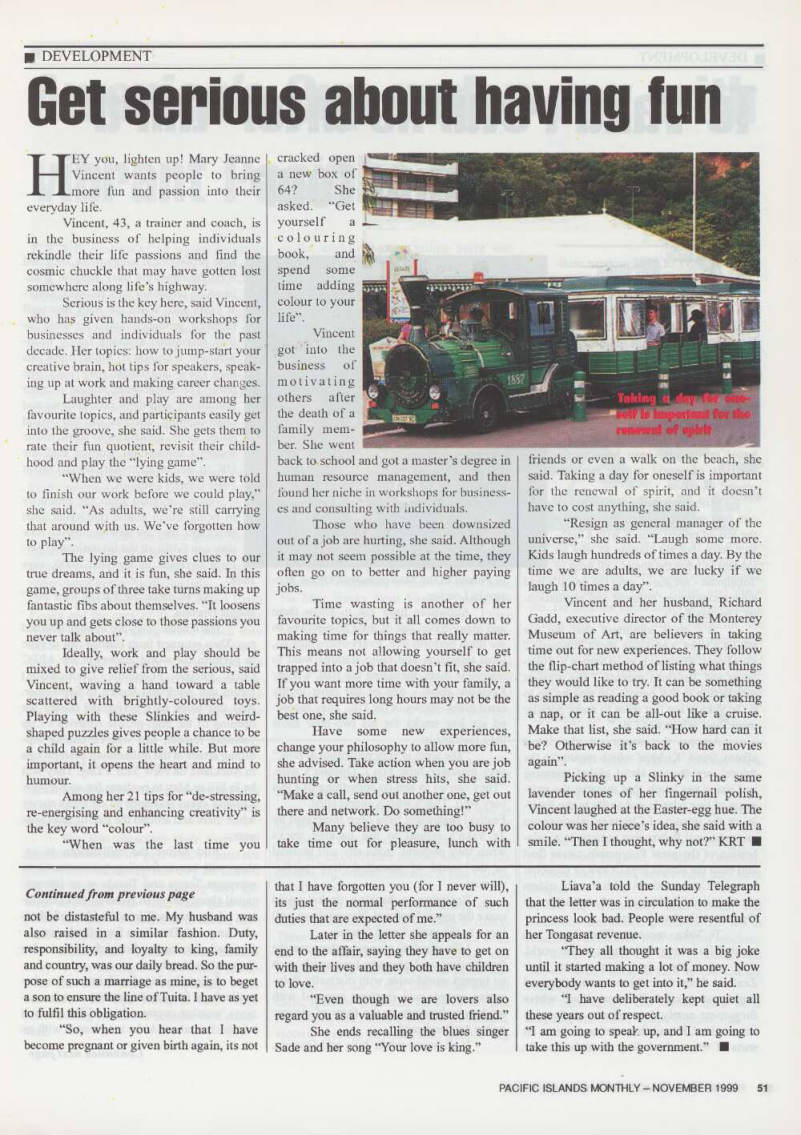
By Michael Reid
IT was one of those sad, ill-fated affairs of the heart few are blessed or cursed with, doomed to fail and inevitably leaving
deep, slow healing scars.
She was a princess, he was a cop and a commoner. They met in 1985 in an Auck land hotel and the rest ... well it was their affair and no business for the rest of the world.
Except High Royal Highness Salote
Mafile’o Pilolevu, 48, only daughter of King Taufa’ahau Tupou IV and sixth in line of succession, is involved in a fierce power struggle in the Kingdom of Tonga. She is vulnerable to attack for that alone; she makes it harder for herself by preaching to her sub jects on morality, God and service.
And then there is, too, the strange story behind the other man, one Josh Liava’a, now manager of a Sydney night club, renowned within the Tongan communi ty for his relationships with the royals.
Way back in 1969 Liava’a met a 21year-old university student in Auckland and after a short romance, they married. She was Princess Mele Siu’ilikutapu, eldest daughter of Prime Minister Prince Tu’ipelehake, 13th in line to the Tongan throne. When word got back to Nuku’alofa, her uncle, the king, annulled the marriage and ordered her home.
By some accounts Liava’a deter mined to get even the royals.
Pilolevu married a noble, Tuita, and together they produced three daughters. During the 1980 s he was Tonga’s Fligh Commis sioner to London.
Liava’a went on to marry again and have a family. Then Liava’a and Pilolevu met and had what was essentially a private romance which lasted until 1996. Many people will say today that they knew of it then, but nothing was said at the time. A couple of things happened to change the
picture.
Pilolevu became immensely rich, more or less overnight, when she took the controlling stake in Tongasat, the ‘government-owned but now Hong Kong-based satel lite slot leasing company.
Although the operation was based on Tonga’s sovereign rights to
geostationary satellite orbiting slots, Pilole vu had no apparent reservations about turn ing it into personal wealth.
The US-based Fortune magazine esti mated four years ago that she was worth US$25 million. She has been careful more recently not to disclose what she is worth, but it is considerably more now. This has
prompted questions in Tonga’s Legislative
Assembly for proper accounting of what she
is doing.
Meantime she has won the battle with her brother, Crown Prince Tupuoto’a, for vir tual control over her ageing father. It was her and her’private satellite interests that got Tonga to switch from diplomatic recognition from Taiwan to China. It will add to her wealth, although she said she did it “as a means of spreading the Lord’s words to China.”
“When China opens its doors to
Christian evangelists, Tonga should be right
there by the door.”
There is also a deeper battle over suc cession to the 81-year-old king.
Tupuoto’a, unmarried, without any known heirs and irritable in his premature old age, is resisting calls from his father to become prime minister. He just wants to make
money and appears to be tired of the royal family and its religion.
Pilolevu, by default, has become the grey eminence of Tonga.
Liava’a, who had gone on to become the first Tongan sergeant in the New Zealand police force and then became bankrupt, moved to Australia. His marriage broke up.
And then, seemingly in the battle over Ton gasat and power, a 10-page letter from Pilolevu to Liava’a entered circulation in Tonga. Every member of parliament received a copy. They seemed to pass it on to their 10 favourite constituents and onwards.
Every top civil servant had a copy; even the local media had it. They did not publish it mainly because, as one senior journalist put it, “we do not know how to publish it.”
For a couple of months, stories about the letter floated to NZ, although not many had seen a copy. It was apparent it was caus ing turmoil within the very highest ranks of Tongan society. The Royal Family knew that everybody else now knew what had hap
pened.
Several sources finally leaked the let ter. Written questions to the Royal Palace and the Prime Minister’s Office over it went unanswered. It is virtually impossible to ver ify it now, although Liava’a had admitted it was to him and he clearly believes it came from her.
Beginning “My Darling Josh” the let ter has a sad, forbidden, failed love tone to it.
Without much doubt the author - identified only as “P” - was smitten by this man. She was giving her heart to him; even though it could not, would not work.
“ Josh, I tried so hard to forget you; even going to the extent of flirting with two chaps in a win bar, anything to get you out of my system, so to speak, but to no avail!”
She speaks of astonishment to find that she is a normal human being who “can love a man and feel the hurt and desolation
of being apart.”
Some of it, in a Tongan setting, could be seen as explicit; but between two adults it has a naturalness that brings sympathy rather than distaste.
“I was bought up NOT TO FALL IN LOVE, so that when the time came for my marriage to be arranged, the idea of it would
Continued next page
Tonga's Princess Pilolevu, caught in a political storm
Continued from previous page
not be distasteful to me. My husband was also raised in a similar fashion. Duty,
responsibility, and loyalty to king, family
and country, was our daily bread. So the pur pose of such a marriage as mine, is to beget a son to ensure the line of Tuita. I have as yet to fulfil this obligation.
“So, when you hear that I have become pregnant or given birth again, its not
that I have forgotten you (for I never will), its just the normal performance of such duties that are expected of me.”
Later in the letter she appeals for an end to the affair, saying they have to get on with their lives and they both have children to love.
“Even though we are lovers also regard you as a valuable and trusted friend.”
She ends recalling the blues singer Sade and her song “Your love is king.”
Liava’a told the Sunday Telegraph that the letter was in circulation to make the princess look bad. People were resentful of her Tongasat revenue.
“They all thought it was a big joke until it started making a lot of money. Now everybody wants to get into it,” he said.
“I have deliberately kept quiet all
these years out of respect.
“I am going to speak up, and I am going to take this up with the government.” ■
Get serious about having fun
HEY you, lighten up! Mary Jeanne Vincent wants people to bring more fun and passion into their everyday life.
Vincent, 43, a trainer and coach, is in the business of helping individuals rekindle their life passions and find the cosmic chuckle that may have gotten lost somewhere along life’s highway.
Serious is the key here, said Vincent, who has given hands-on workshops for businesses and individuals for the past decade. Her topics; how to jump-start your creative brain, hot tips for speakers, speak ing up at work and making career changes.
Laughter and play are among her
favourite topics, and participants easily get
into the groove, she said. She gets them to rate their fun quotient, revisit their child
hood and play the “lying game”.
“When we were kids, we were told to finish our work before we could play,” she said. “As adults, we're still carrying that around with us. We’ve forgotten how to play”.
The lying game gives clues to our true dreams, and it is fun, she said, hi this game, groups of three take turns making up fantastic fibs about themselves. “It loosens you up and gets close to those passions you never talk about”.
Ideally, work and play should be mixed to give relief from the serious, said Vincent, waving a hand toward a table scattered with brightly-coloured toys.
Playing with these Slinkies and weird shaped puzzles gives people a chance to be a child again for a little while. But more important, it opens the heart and mind to humour.
Among her 21 tips for “de-stressing,
re-energising and enhancing creativity” is
the key word “colour”.
“When was the last time you
cracked open a new box of 64? She asked. “Get
yourself a
colouring book, and spend some time adding colour to your life”.
Vincent got into the business of
motivating
others after the death of a
family mem
ber. She went
back to school and got a master’s degree in human resource management, and then found her niche in workshops for business es and consulting with individuals.
Those who have been downsized out of a job are hurting, she said. Although it may not seem possible at the time, they often go on to better and higher paying jobs.
Time wasting is another of her favourite topics, but it all comes down to making time for things that really matter.
This means not allowing yourself to get trapped into a job that doesn’t fit, she said.
If you want more time with your family, a job that requires long hours may not be the best one, she said.
Have some new experiences, change your philosophy to allow more fun, she advised. Take action when you are job hunting or when stress hits, she said.
“Make a call, send out another one, get out there and network. Do something!”
Many believe they are too busy to take time out for pleasure, lunch with
friends or even a walk on the beach, she said. Taking a day for oneself is important for the renewal of spirit, and it doesn’t have to cost anything, she said.
“Resign as general manager of the universe,” she said. “Laugh some more.
Kids laugh hundreds of times a day. By the time we are adults, we are lucky if we laugh 10 times a day”.
Vincent and her husband, Richard Gadd, executive director of the Monterey Museum of Art, are believers in taking time out for new experiences. They follow the flip-chart method of listing what things they would like to try. It can be something as simple as reading a good book or taking a nap, or it can be all-out like a cruise.
Make that list, she said. “How hard can it be? Otherwise it’s back to the movies
again”.
Picking up a Slinky in the same lavender tones of her fingernail polish, Vincent laughed at the Easter-egg hue. The colour was her niece’s idea, she said with a smile. “Then I thought, why not?” KRT ■
Taking a dau for one self Is Important for the remewal of spirlt
successful Euro tour
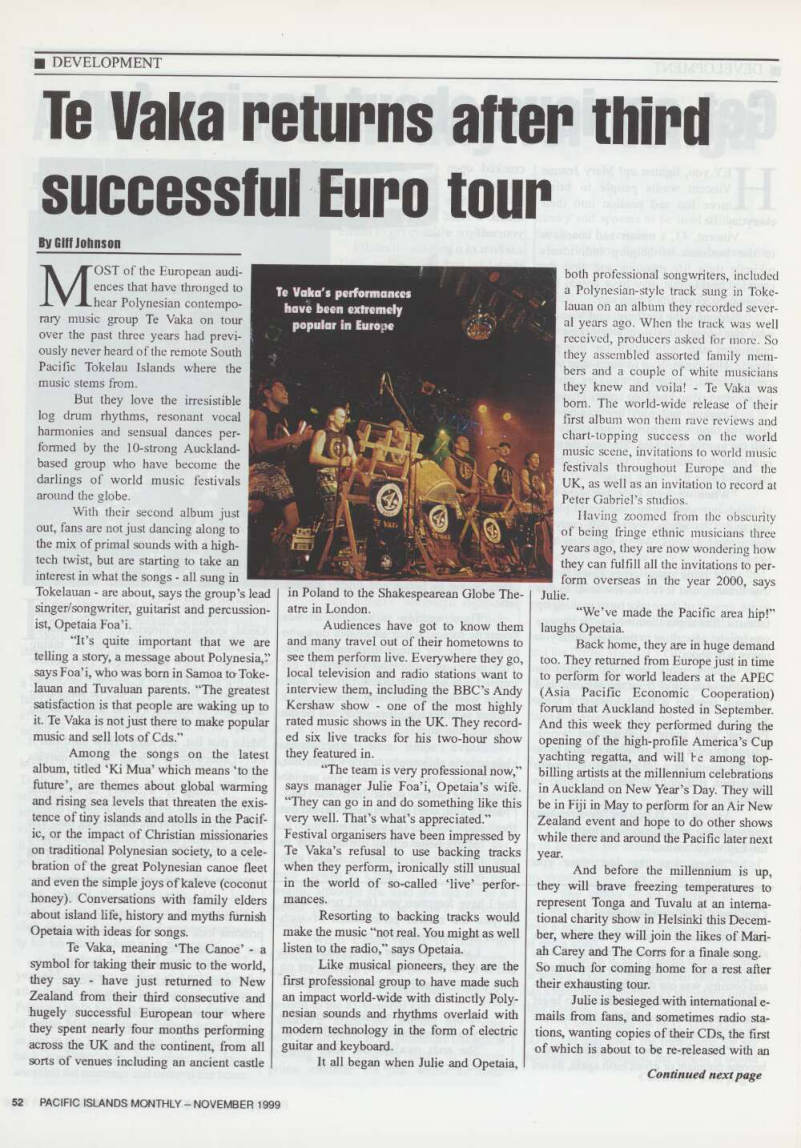
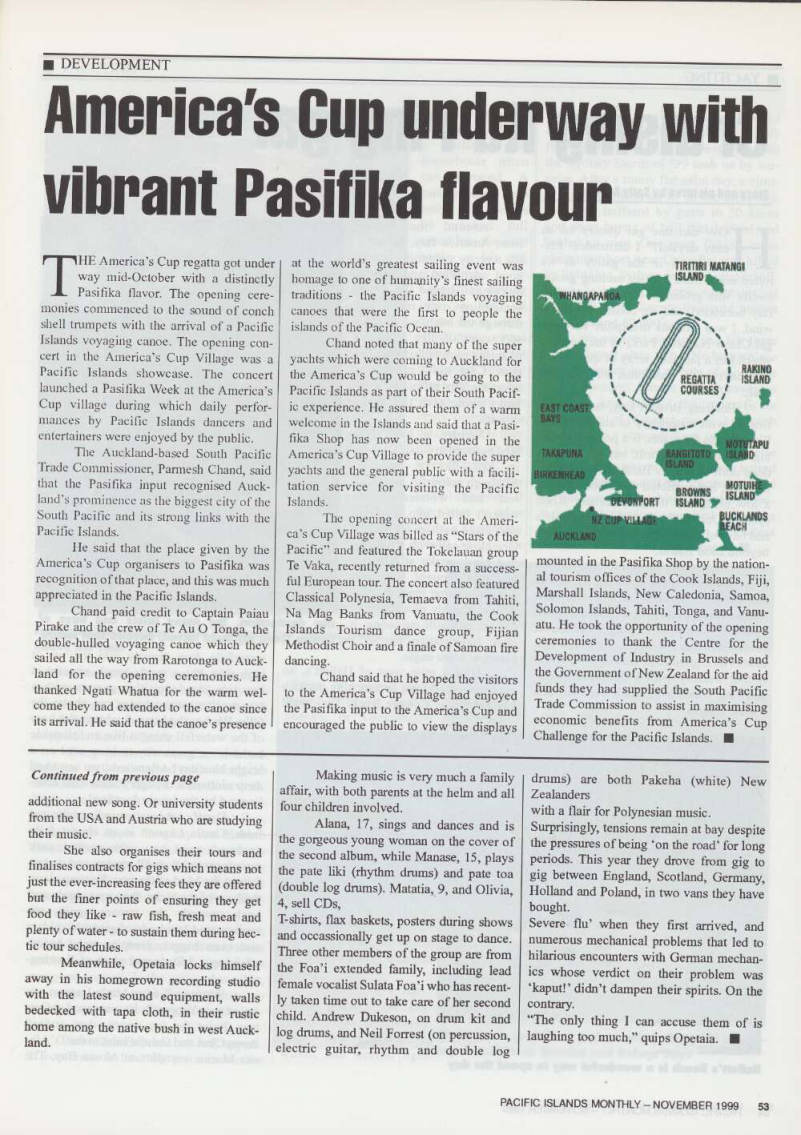
Te Vaka returns after third successful Euro tour
By Gift Johnson
MOST of the European audi ences that have thronged to hear Polynesian contempo rary music group Te Vaka on tom over the past three years had previ ously never heard of the remote South Pacific Tokelau Islands where the music stems from.
But they love the irresistible log drum rhythms, resonant vocal harmonies and sensual dances per formed by the 10-strong Auckland based group who have become the darlings of world music festivals around the globe.
With their second album just out, fans are not just dancing along to the mix of primal sounds with a high tech twist, but are starting to take an interest in what the songs - all sung in
Tokelauan - are about, says the group’s lead singer/songwriter, guitarist and percussion ist, Opetaia Foa’i.
“It’s quite important that we are telling a story, a message about Polynesia,” says Foa’i, who was born in Samoa ta Toke lauan and Tuvaluan parents. “The greatest satisfaction is that people are waking up to it. Te Vaka is not just there to make popular music and sell lots of Cds.”
Among the songs on the latest album, titled ‘Ki Mua’ which means ‘to the future’, are themes about global warming and rising sea levels that threaten the exis tence of tiny islands and atolls in the Pacif ic, or the impact of Christian missionaries on traditional Polynesian society, to a cele bration of the great Polynesian canoe fleet and even the simple joys of kaleve (coconut honey). Conversations with family elders about island life, history and myths furnish Opetaia with ideas for songs.
Te Vaka, meaning ‘The Canoe’ - a symbol for taking their music to the world, they say - have just returned to New Zealand from their third consecutive and hugely successful European tour where they spent nearly four months performing across the UK and the continent, from all sorts of venues including an ancient castle
Audiences have got to know them and many travel out of their hometowns to see them perform live. Everywhere they go, local television and radio stations want to interview them, including the BBC’s Andy Kershaw show - one of the most highly rated music shows in the UK. They record ed six live tracks for his two-hour show they featured in.
“The team is very professional now,” says manager Julie Foa’i, Opetaia’s wife.
“They can go in and do something like this very well. That’s what’s appreciated.”
Festival organisers have been impressed by Te Vaka’s refusal to use backing tracks when they perform, ironically still unusual in the world of so-called ‘live’ perfor mances.
Resorting to backing tracks would make the music “not real. You might as well listen to the radio,” says Opetaia.
Like musical pioneers, they are the first professional group to have made such an impact world-wide with distinctly Poly nesian sounds and rhythms overlaid with modem technology in the form of electric guitar and keyboard.
It all began when Julie and Opetaia,
both professional songwriters, included a Polynesian-style track sung in Toke lauan on an album they recorded sever al years ago. When the track was well received, producers asked for more. So they assembled assorted family mem bers and a couple of white musicians they knew and voila! - Te Vaka was born. The world-wide release of their first album won them rave reviews and chart-topping success on the world music scene, invitations to world music festivals throughout Europe and the UK, as well as an invitation to record at Peter Gabriel’s studios.
Having zoomed from the obscurity of being fringe ethnic musicians three years ago, they are now wondering how they can fulfill all the invitations to per form overseas in the year 2000, says
Julie.
“We’ve made the Pacific area hip!” laughs Opetaia.
Back home, they are in huge demand too. They returned from Europe just in time to perform for world leaders at the APEC (Asia Pacific Economic Cooperation) forum that Auckland hosted in September.
And this week they performed during the opening of the high-profile America’s Cup yachting regatta, and will be among top billing artists at the millennium celebrations in Auckland on New Year’s Day. They will be in Fiji in May to perform for an Air New Zealand event and hope to do other shows while there and around the Pacific later next year.
And before the millennium is up, they will brave freezing temperatures to represent Tonga and Tuvalu at an interna tional charity show in Helsinki this Decem ber, where they will join the likes of Mari ah Carey and The Corrs for a finale song.
So much for coming home for a rest after their exhausting tour.
Julie is besieged with international e mails from fans, and sometimes radio sta tions, wanting copies of their CDs, the first of which is about to be re-released with an
Continued next page
in Poland to the Shakespearean Globe The atre in London.
Te Vaka's performances have been extremely popular in Europe
Continued from previous page
additional new song. Or university students from the USA and Austria who are studying their music.
She also organises their tours and finalises contracts for gigs which means not just the ever-increasing fees they are offered but the finer points of ensuring they get food they like - raw fish, fresh meat and plenty of water - to sustain them during hec tic tour schedules.
Meanwhile, Opetaia locks himself away in his homegrown recording studio with the latest sound equipment, walls bedecked with tapa cloth, in their rustic home among the native bush in west Auck land.
Making music is very much a family affair, with both parents at the helm and all four children involved.
Alana, 17, sings and dances and is the gorgeous young woman on the cover of the second album, while Manase, 15, plays the pate liki (rhythm drums) and pate toa (double log drums). Matatia, 9, and Olivia, 4, sell CDs, T-shirts, flax baskets, posters during shows and occassionally get up on stage to dance.
Three other members of the group are from the Foa’i extended family, including lead female vocalist Sulata Foa’i who has recent ly taken time out to take care of her second child. Andrew Dukeson, on drum kit and log drums, and Neil Forrest (on percussion, electric guitar, rhythm and double log
drums) are both Pakeha (white) New Zealanders with a flair for Polynesian music.
Surprisingly, tensions remain at bay despite the pressures of being ‘on the road’ for long periods. This year they drove from gig to gig between England, Scotland, Germany, Holland and Poland, in two vans they have bought.
Severe flu’ when they first arrived, and numerous mechanical problems that led to hilarious encounters with German mechan ics whose verdict on their problem was ‘kaput!’ didn’t dampen their spirits. On the contrary.
“The only thing I can accuse them of is laughing too much,” quips Opetaia. ■
America's Cup underway with vibrant Pasifika flavour
vibrant Pasifika flavour
THE America’s Cup regatta got under way mid-October with a distinctly Pasifika flavor. The opening cere monies commenced to the sound of conch shell trumpets with the arrival of a Pacific Islands voyaging canoe. The opening con cert in the America’s Cup Village was a Pacific Islands showcase. The concert launched a Pasifika Week at the America’s
Cup village during which daily perfor
mances by Pacific Islands dancers and entertainers were enjoyed by the public.
The Auckland-based South Pacific Trade Commissioner, Parmesh Chand, said that the Pasifika input recognised Auck land s prominence as the biggest city of the South Pacific and its strong links with the Pacific Islands.
He said that the place given by the America’s Cup organisers to Pasifika was recognition of that place, and this was much appreciated in the Pacific Islands.
Chand paid credit to Captain Paiau Pirake and the crew of Te Au O Tonga, the double-hulled voyaging canoe which they sailed all the way from Rarotonga to Auck land for the opening ceremonies. He thanked Ngati Whatua for the warm wel come they had extended to the canoe since its arrival. He said that the canoe’s presence
at the world’s greatest sailing event was homage to one of humanity’s finest sailing traditions - the Pacific Islands voyaging canoes that were the first to people the islands of the Pacific Ocean.
Chand noted that many of the super yachts which were coming to Auckland for the America’s Cup would be going to the Pacific Islands as part of their South Pacif ic experience. He assured them of a warm welcome in the Islands and said that a Pasi fika Shop has now been opened in the America’s Cup Village to provide the super yachts and the general public with a facili tation service for visiting the Pacific Islands.
The opening concert at the Ameri ca’s Cup Village was billed as “Stars of the Pacific ’ and featured the Tokelauan group Te Vaka, recently returned from a success ful European tour. The concert also featured Classical Polynesia, Temaeva from Tahiti, Na Mag Banks from Vanuatu, the Cook Islands Tourism dance group, Fijian Methodist Choir and a finale of Samoan fire
dancing.
Chand said that he hoped the visitors to the America’s Cup Village had enjoyed the Pasifika input to the America’s Cup and encouraged the public to view the displays
mounted in the Pasifika Shop by the nation al tourism offices of the Cook Islands, Fiji, Marshall Islands, New Caledonia, Samoa, Solomon Islands, Tahiti, Tonga, and Vanu atu. He took the opportunity of the opening ceremonies to thank the Centre for the Development of Industry in Brussels and the Government of New Zealand for the aid funds they had supplied the South Pacific Trade Commission to assist in maximising economic benefits from America’s Cup Challenge for the Pacific Islands. ■
Cruising Ku-ring-gai
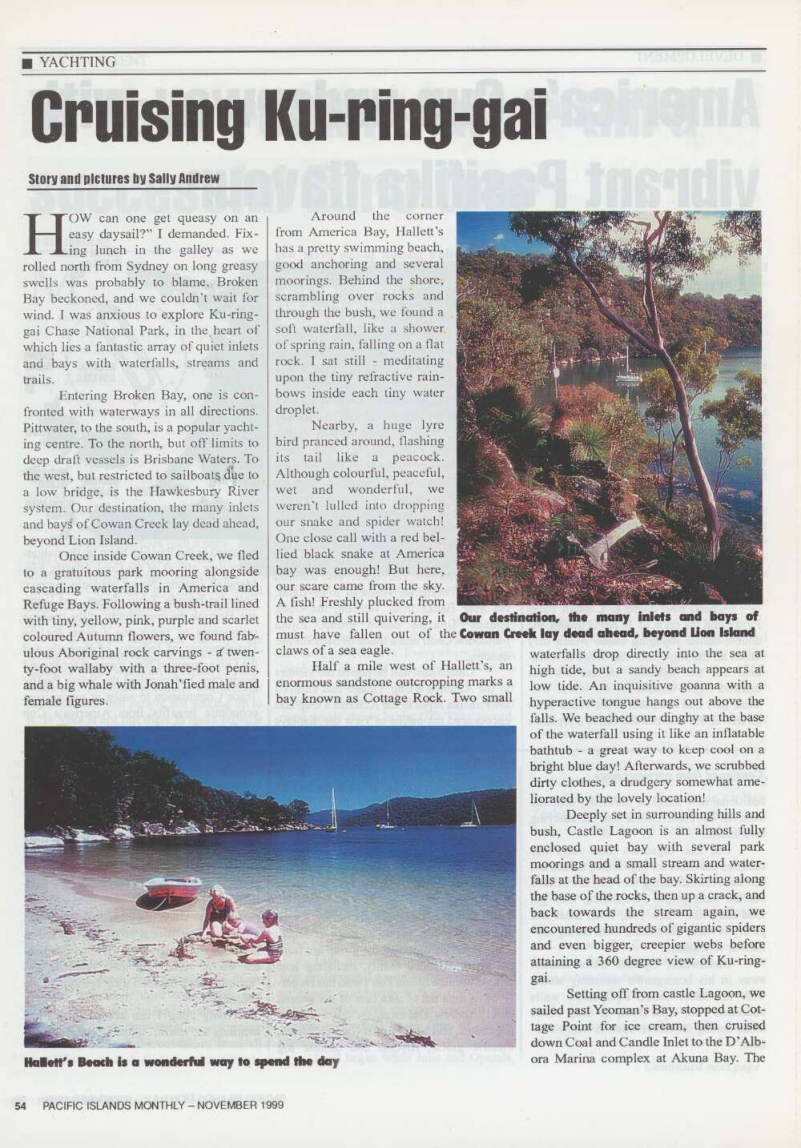
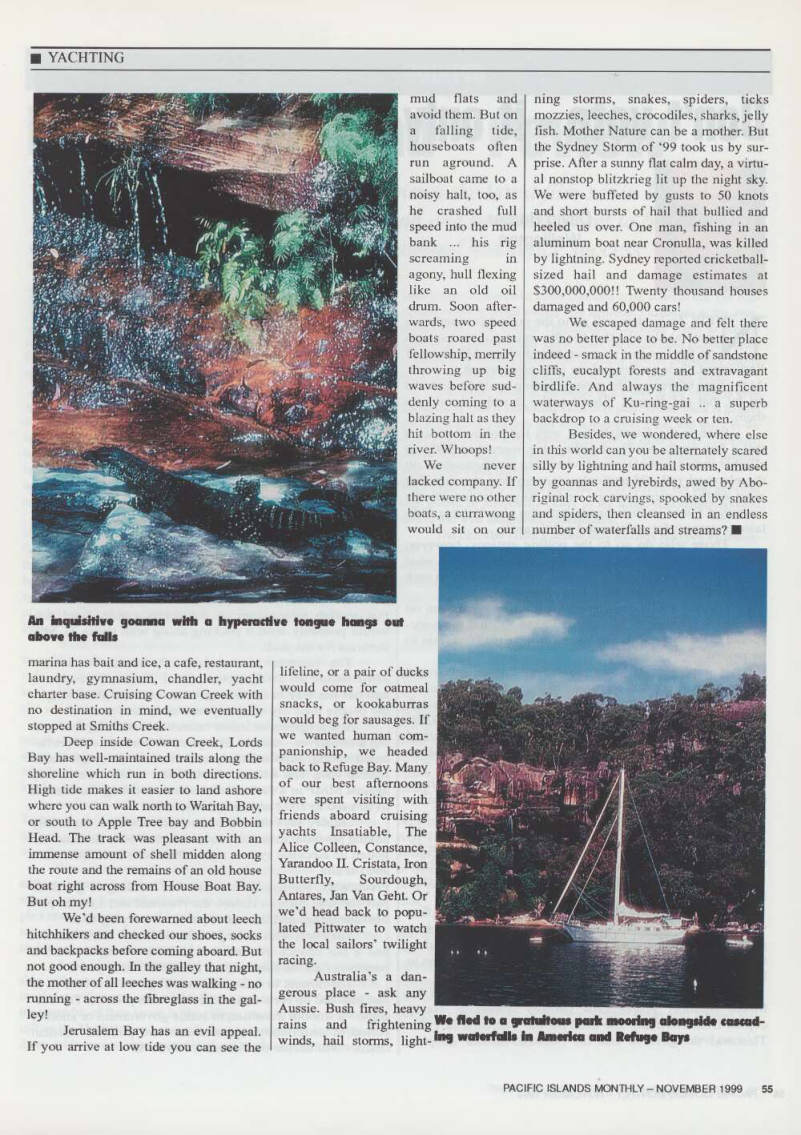
Yachting
Story and pictures by Sally Andrew
HOW can one get queasy on an easy daysail?” I demanded. Fix ing lunch in the galley as we rolled north from Sydney on long greasy swells was probably to blame. Broken Bay beckoned, and we couldn't wait for wind. I was anxious to explore Ku-ring gai Chase National Park, in the heart of which lies a fantastic array of quiet inlets and bays with waterfalls, streams and trails.
Entering Broken Bay, one is con fronted with waterways in all directions.
Pittwater, to the south, is a popular yacht ing centre. To the north, but off limits to deep draft vessels is Brisbane Waters. To the west, but restricted to sailboats due to a low bridge, is the Hawkesbury River system. Our destination, the many inlets and bays of Cowan Creek lay dead ahead, beyond Lion Island.
Once inside Cowan Creek, we fled
to a gratuitous park mooring alongside
cascading waterfalls in America and Refuge Bays. Following a bush-trail lined with tiny, yellow, pink, purple and scarlet coloured Autumn flowers, we found fab ulous Aboriginal rock carvings - twen ty-foot wallaby with a three-foot penis, and a big whale with Jonah’fied male and
female figures.
Around the corner from America Bay, Hallett’s has a pretty swimming beach,
good anchoring and several
moorings. Behind the shore, scrambling over rocks and through the bush, we found a soft waterfall, like a shower of spring rain, falling on a flat rock. I sat still - meditating upon the tiny refractive rain bows inside each tiny water
droplet.
Nearby, a huge lyre
bird pranced around, flashing
its tail like a peacock.
Although colourful, peaceful, wet and wonderful, we weren’t lulled into dropping our snake and spider watch!
One close call with a red bel lied black snake at America bay was enough! But here, our scare came from the sky.
A fish! Freshly plucked from the sea and still quivering, it
must have fallen out of the
claws of a sea eagle.
Half a mile west of Hallett’s, an enormous sandstone outcropping marks a bay known as Cottage Rock. Two small
waterfalls drop directly into the sea at high tide, but a sandy beach appears at low tide. An inquisitive goanna with a hyperactive tongue hangs out above the falls. We beached our dinghy at the base of the waterfall using it like an inflatable bathtub - a great way to keep cool on a bright blue day! Afterwards, we scrubbed dirty clothes, a drudgery somewhat ame liorated by the lovely location!
Deeply set in surrounding hills and bush, Castle Lagoon is an almost fully enclosed quiet bay with several park moorings and a small stream and water falls at the head of the bay. Skirting along the base of the rocks, then up a crack, and back towards the stream again, we encountered hundreds of gigantic spiders and even bigger, creepier webs before attaining a 360 degree view of Ku-ring
gai.
Setting off from castle Lagoon, we sailed past Yeoman’s Bay, stopped at Cot tage Point for ice cream, then cruised down Coal and Candle Inlet to the D’Alb ora Marina complex at Akuna Bay. The
Halltt's Beach is a wonderful way to spend the day
Our destination, the many inlets and bays of Cowan Creek lay dead ahead, beyond lion Island
marina has bait and ice, a cafe, restaurant,
laundry, gymnasium, chandler, yacht
charter base. Cruising Cowan Creek with no destination in mind, we eventually stopped at Smiths Creek.
Deep inside Cowan Creek, Lords Bay has well-maintained trails along the shoreline which run in both directions.
High tide makes it easier to land ashore where you can walk north to Waritah Bay, or south to Apple Tree bay and Bobbin Head. The track was pleasant with an immense amount of shell midden along the route and the remains of an old house boat right across from House Boat Bay.
But oh my!
We’d been forewarned about leech hitchhikers and checked our shoes, socks and backpacks before coming aboard. But not good enough. In the galley that night, the mother of all leeches was walking - no running - across the fibreglass in the gal
ley!
Jerusalem Bay has an evil appeal.
If you arrive at low tide you can see the
lifeline, or a pair of ducks would come for oatmeal snacks, or kookaburras would beg for sausages. If we wanted human com panionship, we headed back to Refuge Bay. Many of our best afternoons were spent visiting with friends aboard cruising yachts Insatiable, The Alice Colleen, Constance, Yarandoo 11. Cristata, Iron Butterfly, Sourdough, Antares, Jan Van Geht. Or we’d head back to popu lated Pittwater to watch the local sailors’ twilight
racing.
Australia’s a dan gerous place - ask any Aussie. Bush fires, heavy rains and frightening winds, hail storms, light
mud flats and avoid them. But on a falling tide, houseboats often run aground. A sailboat came to a noisy halt, too, as he crashed full speed into the mud bank ... his rig
screaming in
agony, hull flexing like an old oil drum. Soon after wards, two speed boats roared past
fellowship, merrily
throwing up big waves before sud
denly coming to a
blazing halt as they hit bottom in the river. Whoops!
We never lacked company. If there were no other boats, a currawong would sit on our
ning storms, snakes, spiders, ticks mozzies, leeches, crocodiles, sharks, jelly fish. Mother Nature can be a mother. But the Sydney Storm of ‘99 took us by sur prise. After a sunny flat calm day, a virtu al nonstop blitzkrieg lit up the night sky.
We were buffeted by gusts to 50 knots and short bursts of hail that bullied and heeled us over. One man, fishing in an aluminum boat near Cronulla, was killed
by lightning. Sydney reported cricketball
sized hail and damage estimates at $300,000,000!! Twenty thousand houses damaged and 60,000 cars!
We escaped damage and felt there was no better place to be. No better place indeed - smack in the middle of sandstone cliffs, eucalypt forests and extravagant birdlife. And always the magnificent waterways of Ku-ring-gai .. a superb backdrop to a cruising week or ten.
Besides, we wondered, where else in this world can you be alternately scared silly by lightning and hail storms, amused by goannas and lyrebirds, awed by Abo riginal rock carvings, spooked by snakes and spiders, then cleansed in an endless number of waterfalls and streams? ■
An inquisitive goanna with a hyperactive tongue hangs out above the falls
We fled to a gratuitous park mooring alongside cascad ing waterfalls In America and Refuge Bays
Don't vote-it only encourages them!
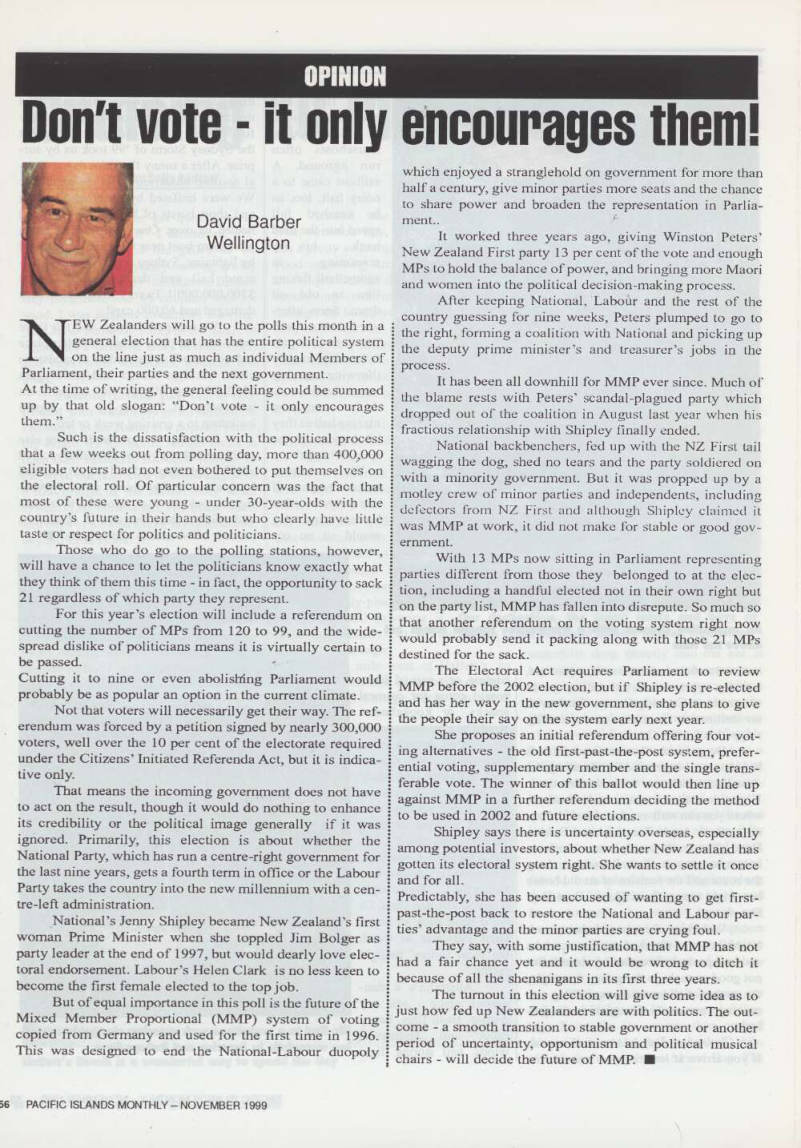
Opinion
NEW Zealanders will go to the polls this month in a general election that has the entire political system on the line just as much as individual Members of Parliament, their parties and the next government.
At the time of writing, the general feeling could be summed up by that old slogan: “Don’t vote - it only encourages them.”
Such is the dissatisfaction with the political process that a few weeks out from polling day, more than 40(3,000 eligible voters had not even bothered to put themselves on the electoral roll. Of particular concern was the fact that most of these were young - under 30-year-olds with the country’s future in their hands but who clearly have little taste or respect for politics and politicians.
Those who do go to the polling stations, however, will have a chance to let the politicians know exactly what they think of them this time - in fact, the opportunity to sack 21 regardless of which party they represent.
For this year’s election will include a referendum on cutting the number of MPs from 120 to 99, and the wide spread dislike of politicians means it is virtually certain to be passed.
Cutting it to nine or even abolishing Parliament would probably be as popular an option in the current climate.
Not that voters will necessarily get their way. The ref erendum was forced by a petition signed by nearly 300,000 voters, well over the 10 per cent of the electorate required under the Citizens’ Initiated Referenda Act, but it is indica
tive only.
That means the incoming government does not have to act on the result, though it would do nothing to enhance its credibility or the political image generally if it was ignored. Primarily, this election is about whether the National Party, which has run a centre-right government for the last nine years, gets a fourth term in office or the Labour Party takes the country into the new millennium with a cen tre-left administration.
National’s Jenny Shipley became New Zealand’s first woman Prime Minister when she toppled Jim Bolger as party leader at the end of 1997, but would dearly love elec toral endorsement. Labour’s Helen Clark is no less keen to become the first female elected to the top job.
But of equal importance in this poll is the future of the Mixed Member Proportional (MMP) system of voting copied from Germany and used for the first time in 1996.
This was designed to end the National-Labour duopoly
which enjoyed a stranglehold on government for more than half a century, give minor parties more seats and the chance to share power and broaden the representation in Parlia ment..
It worked three years ago, giving Winston Peters’
New Zealand First party 13 per cent of the vote and enough MPs to hold the balance of power, and bringing more Maori and women into the political decision-making process.
After keeping National, Labour and the rest of the country guessing for nine weeks, Peters plumped to go to the right, forming a coalition with National and picking up the deputy prime minister’s and treasurer’s jobs in the process.
It has been all downhill for MMP ever since. Much of the blame rests with Peters’ scandal-plagued party which dropped out of the coalition in August last year when his
fractious relationship with Shipley finally ended.
National backbenchers, fed up with the NZ First tail wagging the dog, shed no tears and the party soldiered on with a minority government. But it was propped up by a motley crew of minor parties and independents, including defectors from NZ First and although Shipley claimed it was MMP at work, it did not make for stable or good gov ernment.
With 13 MPs now sitting in Parliament representing parties different from those they belonged to at the elec tion, including a handful elected not in their own right but on the party list, MMP has fallen into disrepute. So much so that another referendum on the voting system right now would probably send it packing along with those 21 MPs destined for the sack.
The Electoral Act requires Parliament to review MMP before the 2002 election, but if Shipley is re-elected and has her way in the new government, she plans to give the people their say on the system early next year.
She proposes an initial referendum offering four vot ing alternatives - the old first-past-the-post system, prefer ential voting, supplementary member and the single trans ferable vote. The winner of this ballot would then line up against MMP in a further referendum deciding the method to be used in 2002 and future elections.
Shipley says there is uncertainty overseas, especially among potential investors, about whether New Zealand has gotten its electoral system right. She wants to settle it once and for all.
Predictably, she has been accused of wanting to get first past-the-post back to restore the National and Labour par ties’ advantage and the minor parties are crying foul.
They say, with some justification, that MMP has not had a fair chance yet and it would be wrong to ditch it because of all the shenanigans in its first three years.
The turnout in this election will give some idea as to just how fed up New Zealanders are with politics. The out come - a smooth transition to stable government or another period of uncertainty, opportunism and political musical chairs - will decide the future of MMP. ■
David Barber Wellington
In a savage land-review
Opinion
From Brisbane, Max Quanchi reviews the latest film set in Papua New Guinea s Trobriand Islands and one he thinks is set to become a minor classic and international box-office success
IN a savage land, just released in Australia by producer and direc tor Bill Bennett, has the appearance of a formula film. With a set piece lovers triangle, exotic location, missionaries, traders and ending with key characters caught in the onset of World War II in the Pacific, it has a plot and characters instantly recognisable to theatre audiences.
Movie goers will like the naked villagers, the jungles and coasts of Papua New Guinea, strange and amazingly photographed rituals and a sort of boys-own adventure full of stereotyped villains, heroines and heroes. Two anthropologists, a young and recently married Aus tralian couple, arrive for fieldwork in a coastal village in the Tro briands in 1941 and earnestly start asking questions, taking pho tographs, scribbling down observations and interviews in notebooks and then tapping away at the typewriter.
It is a simple enough story and has a ring of historical truth about it with references to the anthropologist Malinowskis earlier fieldwork on the same island. In 1923, a young woman had travelled from South Australian to Papua and when Philippa Bridges reported back to the Royal Geographical Society branch in Adelaide she noted cynically that in Papua there was “a population of 2000 white people of whom 1782 write articles about anthropology for the Sydney Bul letin.”
When Philippa Bridges was in Papua, Frank Hurley was also there filming Pearls and savages, which went on to screenings in Aus tralia, England and the USA with considerable box-office success. A book with the same title was equally popular. Outsiders still write arti cles and books, and now they make feature films As the anthropologists In a savage land, Evelyn and Phillip, progress from being outsiders to being accepted into the village’s secret, customary rituals, exchanges and ceremonies, they confront the island’s resident pearl trader, the resident Scottish missionary and the local patrol officer and government administrator.
Audiences will be intrigued by sequences of swirling, noisy Trobriands style cricket, dances, mourning rituals and village archi tecture, cooking and games. This is convincingly depicted and verges
on a documentary style of filming.
Wandering conspicuously through this panorama are the two anthropologists, their marriage gradually falling apart as the woman rejects her gendered subordination in both the marriage and the cou ple’s research work. In seeking information on the role of women and sexual relations in the village, eventually her behaviour threatens the traditional position of power held by village men.
A sub-plot revolves around the two anthropologist’s relation ship with other European residents, though these scenes are a little overladen with posture and cliche. But an argument with the trader on the verandah of their house in the village, another during a courtesy call on the Magistrate and one with the missionary over burial proce dures, while presented in a simplified and confrontational manner, do
indeed raise controversial issues common in the colonial era. The Mis sionary wants to avoid secular and territorial challenges to his evan gelical work; the District Officer and Magistrate wants to prevent ideas from circulating that might upset the established colonial order of master-native relationships and the trader ignores everything except profit in pursuit of better pearls and favourable bartering terms.
The trader, Mick, is portrayed as a friend of the villagers even though he is clearly exploiting them over pearl prices. Mick is helpful and attentive to villagers and anthropologists alike, and early in the film, just gets on with his business of making money. This characteri sation differs from the cameo violent, drunk, psychopath or pathetic trader of film and fiction.
Mick’s role salvages traders from the list of colonial era bad guys and may indeed be historically closer to the actual relationship resident traders had with indigenous communities.
The film also raises a debate only recently resolved by regula tion in Island nations, regarding the relationship between indigenous intellectual property and foreign researchers. When Evelyn secretly photographs a couple making love in a cave is she exercising the legit imate right of anthropologists to gather evidence?
When Phillip argues that he is adding to the world’s knowledge of itself, does this excuse his prying, intrusive behaviour and ulti mately his appropriation of this villages indigenous knowledge?
He argues that his altruism is preferable to the trader’s barter ing of mouth organs for pearls. The trader replies that at least he pays the villagers and questions the anthropologist for using details of vil lage rituals and practices to gain a professorship or to publish a best selling monograph. These debates about fieldwork have raged for much of the 20th century. The film also has a feminist critique running through all these events, starting with the marriage (mostly of conve nience) necessary to get a university grant for the fieldwork and sur facing in debates over their respective research work.
It is also the agenda behind some over-the-top utterances from the District Magistrate and Phillip’s obsessive behaviour as the mar riage disintegrates. Evelyn’s subsequent experiences alone in another village, her adoption of Trobriand mourning custom when Phillip dies of dysentery and her later assertion of her own sexuality could have been easily trivialised, but instead become the central motif of the film.
It is a film about Evelyn. The role should make Maya Stange into the next Australian acting success story. Theatre audiences might miss these nuances, derived as they are from earlier and current anthropological and historical debates. Readers of Conrad and Kipling and students of the colonial era will immediately recognise that the plot is a reasonable reconstruction of documented and similarly ambiguous meetings on the frontier between indigenous peoples and
Continued next page
Continued from previous page
officials.
In this context, In a savage land will earn a place alongside Black Robe and At the play in the fields of the Lord and others as a critical film of the first contact, white-meets-black genre.
On the popular level, the majority of viewers will respond to the idea of expeditions in foreign lands, the romance that develops between Evelyn and the trader and the complications that arise with the approaching Japanese invasion.
The opening in Adelaide is conventional the student falling for her professor is a familiopm^j§'|>j^.^iw ie action quickly moves to the tropics.
The ending involves a jump back to Evelyn’s successful but lonely life as a best-selnhg anthropologist. It
anthropologists, traders, missionaries and colonial
is a stock-in-trade twisting, romantic ending that audiences will have seen before, but will still enjoy. When an early cut of the film was screened at a conference in Sydney in July this year it was severely criticised by anthropologists including many indigenous scholars. Pro ducer and Director Bill Bennett admitted at a pre-release screening in Brisbane in October that he had been tinkering with details of the films for most the year so it will interesting to see how the final ver sion is received.
In a savage land will no doubt be criticised for exploiting indigenous wisdom, traditions and culture and the amateur actors, and for misrepresenting the Trobriands, but these crimes, surely to be debated further, will not detract from the film’s popular reception in suburban theatres. * Max Quanchi is a senior lecturer in the Asia-Pacific Studies Pro gram, School of Humanities and Social Science, QUT. ■
Pacific Puzzle
Extra
Across: 6.
1. Navigation light 7. 5. FSM’s island of the Sleeping Lady 9. Small southern Fiji island in a con- 8. stant state of shock? 11. Cook’s title 12. Island of pines discovered by 11 10.
Across in 1774 13. Out Tim’s confused about promising 15.
Pacific industry 14. Catalogues the way boat heels over 16. Wharf 18. New Zealanders 21. Canal gateway to the Pacific 22. Old name for “cluster of eight” coun try 23. Island “loyal” to New Caledonia? 26. Rusting relics of war found on many Pacific islands 29. Beneficial book if you haven’t got a clue 32. Spot to steer at sea 33. Fiji’s Rewa River town 34. Rig Toni changed after troubles in 17.
Noumea in the 1980 s 18 35. Initially, nutrition universally tasted in the Pacific 19 36. Futuna’s friend 20. 37. Tuvalu collectibles 24. 25.
Down: 27.
2. Long-term island residents from far, far away 28. 3. Woodcarving, weaving ... and 29. whalers? 4. Kiribati’s first president, leremia 30.
Tabai, called this island north of Tabi teuea home 31. 5. Raft Thor Heyerdahl sailed from Peru to the Tuamotus (3,4)
Prawn’s little pal Southernmost Tun garu island Tasty molluscs which make beauti ful borders Pieces of wood used to walk on water hi his book Follow ing the Equator, this author said of Fiji’s beachcombers: “They lived worth less lives of sin and luxury ... Only one of them had any ambition; he was an Irishman named Connor. He tried to raise a family of 50 children and scored 48. He died lament ing his failure.”
Small cove Tongan island, north of Tofua, sounds like it won the boxing bout Koro or Coral Nudibranchs (3,5) Reef’s pincushions Outgoings that bring in the money Marquesas island east of Nuku Hiva (2,4)
Dolphin college?
Paul Gaugin’s resting place on Hiva Oa, the Marquesas The de Brums call this island in the Marshall’s Ratak Chain home More eager to have some Papua New Guinea cash
Answers To The October
Pacific Puzzle
ACROSS: 1. Rugby. 6. Clams. 9. Aranuka. 10. Roofs. 11. Shoal. 12. La Perouse. 13.
Crabs. 14. Markets. 16. Economy. 18. Air. 19. Artists. 21. Resorts. 23. Franc. 24.
Fumigates. 27. Aloha. 28. Ariki. 29. Sarig an. 30. Trust. 31. Ovens.
DOWN: 1. Rural. 2. Grouper. 3. Yasur. 4.
Marquesas. 5. Nurse. 6. Cash crops. 7.
Avocado. 8. Sulus. 14. Moa. 15. East coast. 16. Erromanga. 17. Yes. 20. Tuamotu. 22.
Ratline. 23. Feast. 24. Fer.y. 25. Guano. 26. Ships
Advertisements & other items, pp. 59-60 (1 item)
Cojeept 1999 :(63T)275 566
•V \r* . ■V C 3 IN D O . : ' vmt Photos : Pantz - Aubry I:;- Located in the South Pacific, New Caledonia is a developed, sophisticated island business base that offers outstanding opportunities for investors : stunning sites for new hotel developments, suitable climate for counter-season fruits and vegetables, superb locations for fish and prawn aquaculture, and more. Authorities in New Caledonia are very supportive to business.
New Caledonia also offers a range of quality products (fruits & vegetables, seafood, agri-food products, etc.), services and technology (including water, energy, environment), meeting international requirements and expectations. We promote our products through regular visits to foreign markets.
ADECAL, the Economic Development Agency of New Caledonia, is the one-stop-shop where you can get specific advise on doing business with New Caledonia. As your free-of-charge partner, we shall assist you in identifying opportunities and putting together your project successfully.
Should you like to receive further information, please do not hesitate to contact either Benoit RENGADE or Yann PITOLLET Inward Investment Ms Doriane SANCHEZ-LEBRIS Export Division <0 *s* o b A / V 15, rue Guynemer PO Box 2384 - \>\ www.adecal.nc E-mail: [email protected] r.r- a i Mmm* A New Caledonia Economic Development Agency mca Cedex • New Caledowa - Phone: - Fax: (687| 249 087 - www.adecat.nc - E-mail: [email protected]
COJEePT 1999 :(63T)275 566
3 /V * , ;
PAC
Z: *w m z i
No challengers -
Toyota Land Cruiser stays on top
Toyota Land Cruiser 100 dominates the world of 4x4s. None other can match its robust power, provided by superior engine technology.
It gives breathtaking performance, backed by an amazingly rugged suspension that can take you anywhere you want to go, on road or off.
Nevertheless, riding in a Toyota Land Cruiser 100 is like travelling in a luxurious sedan. Its more than ample room inside contains all the comforts and conveniences you'd expect of a winner.
Remember this. Only Toyota's advanced technology can create the symphony of power, performance, and lavish comfort you find in Land Cruiser 100. No wonder it's the champion. Again.
STATION WAGON
R
® TOYOTA
DISTRIBUTORS / DEALERS
NORFOLK ISLAND HORRY'S PTV LTD PH 22114 KIRIBATI TARAWA MOTORS PH 21090 FIJI ASCO MOTORS PH 384888 SOLOMON ISLANDS ELAMOTORS PH 30314 PAPUA NEW GUINEA ELAMOTORS PH 3229400 NEWCALEDONIA S.I.A.P. PH 275562 VANUATU ASCO MOTORS PH 22341 TAHITI NIPPON AUTOMOTO PH 429819 TONGA ASCO MOTORS PH 23500 COOK ISLANDS PACIFIC MOTORS LTD. PH 20700 SAMOA ASCO MOTORS PH 20800 AMERICAN SAMOA ASCO MOTORS PH 633-4281