Monthly
Pacific Islands
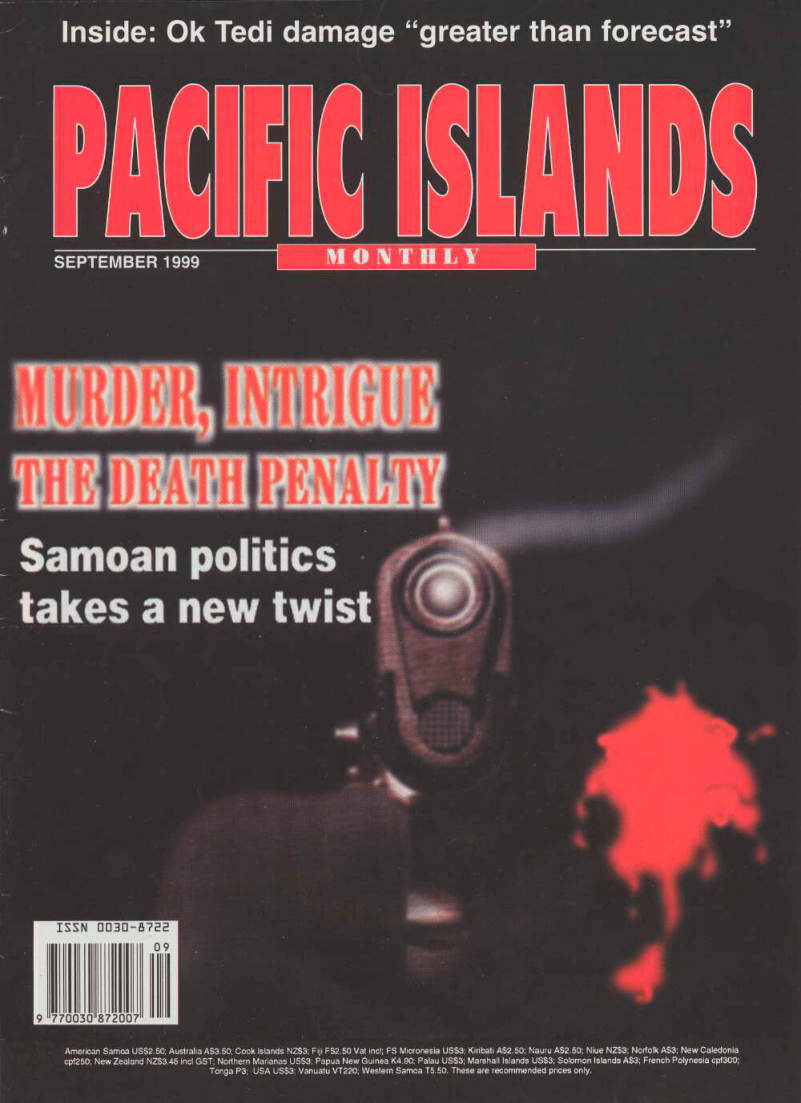
Inside: Ok Tedi damage “greater than forecast”
September 1999
[ j \ rT" 1
Samoan oolitics
%r tfci 111 UI I Mr II ill i%Aiii ♦ iiifjrf IcllmfErS a li€r\nf
American Samoa US$2,5O; Australia A 53.50; Cook Islands NZS3; Fiji F 52.50 Vat incl; FS Micronesia US$3; Kiribati A 52.50; Nauru A 52.50; Niue NZ$3; Norfolk As 3; New Caledonia cpf2so; New Zealand NZ53.45 incl GST; Northern Marianas US$3; Papua New Guinea K 4.90; Palau US$3; Marshall Islands US$3; Solomon Islands As 3; French Polynesia cpf3oo; Tonga P 3; USA US$3; Vanuatu VT22O; Western Samoa T 5.50. These are recommended prices only.
Advertisements & other items, p. 2 (1 item)
Sports
gm - • mm •- • • ■
Supporting Fiji s
m 0? t i m •v ; i
TALK TO THE WORLD
Fiji International Telecommunications Limited provides services equal to the world’s best. And while the digital technology used here everyday is the finest in the world, we’re already looking to the technology of tomorrow.
So, don’t be surprised if you find it in use in Fiji first.
Fiji International Telecommunications Limited, Mercury House, 158 Victoria Parade, PO Box 59, Suva, Fiji Islands.
Telephone (679) 312 933, Fax (679) 301 025, Email [email protected] • Website http://www.fintel.com.fj
Pacific Islands
Monthly
Vol 69 No. 9
The News Magazine
September 1999
Alan Robinson Sophie Foster Hildebrand Michael Field, Giff Johnson, Sally Andrew, Sam Vulum, Ed Rampell, Alan Ah Mu, Brian Tobia.
David Barber (Wellington), Jemima Garrett (Sydney) Shekhar Rattan, Reuben Pickering. Faizal Khan Senior Regional Sales (South Pacific) Shayne Farah Hussein Tel (679)304111,303244.
Fax (679) 303809.
Sydney, Canberra: Bob Hill Media Represen tation. Tel (61-2)4164245, Fax (61-2) 4165064.
Brisbane: Jane Fewings Media and Advertising Associates Tel (61-7) 3378 4522.
Fax (61-7) 3878 1071.
Adelaide: Hastwell Williamsons Representa tives. Tel (61-8) 3799522, Fax (61-8) 3799735.
Melbourne; Brown Orr Fletcher Burrows (Aust) Pty Ltd.
Tel (61-3)98265188.
Fax (61-3) 98265644.
Auckland: McKay & Bowman. International Media Representatives Limited.
Tel (64-9)4190561, Fax (64-9) 4192243.
Japan: Universal Media Corporation. Tokyo, Tel (3) 3266626741.
Cable; UNI-MEDIA Tokyo.
Fax (3) 32626742.
Pacific Islands Monthly was founded in 1930
(Usps 9522480).
A Fiji Times Limited production.
Cover prices are recommended retail only. Registered by Australia Post. Publi cation No. NBPI2IO. © Copyright Fiji Times Limited, 177 Victoria Parade. Suva, Fiji.
Tel (679) 304111. fax (679) 303809.
Email: [email protected] PIM Website: http.7/www.pim.comij Pacific Islands Monthly is published monthly by Fiji Times Limited, a division of Nationwide News, 2 Holt Street, Surry Hills, Sydney. NSW 2010.
Pacific Islands Monthly POBox 1167, Suva. Fiji.
Printed by Quality Print Limited. 16 Amra Street. Wain Bay. Suva. Fiji.
Cover design/Layout by Shekhar Rattan All care, but no responsibility taken for material submitted for publication
Briefs 7_
Inside
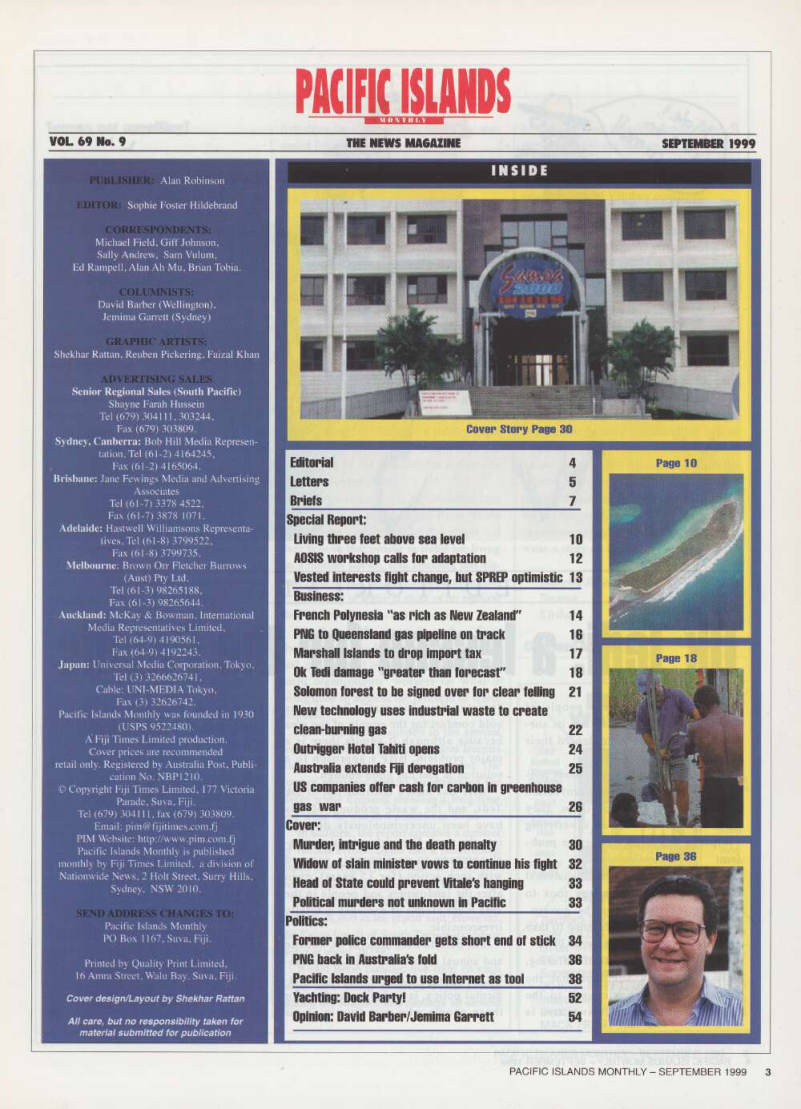
Cover Story Page 30
Editorial 4 Letters 5
Briefs 7_
Special Report: Living three feet above sea level 10 AOSIS workshop calls for adaptation 12 Vested interests fight change, but SPREP optimistic 13 Business; French Polynesia "as rich as New Zealand" 14 PNG to Queensland gas pipeline on track 16 Marshall Islands to drop import tax 17 Ok Tedi damage "greater than forecast" 18 Solomon forest to be signed over for clear felling 21 New technology uses industrial waste to create clean-burning gas 22 Outrigger Hotel Tahiti opens 24 Australia extends Fiji derogation 25 US companies offer cash (or carbon in greenhouse gas war 20 Cover: Murder, intrigue and the death penalty 30 Widow of slain minister vows to continue his fight 32 Head of State could prevent Vitale's hanging 33 Political murders not unknown in Pacific 33 Politics: Former police commander gets short end of stick 34 PNG back in Australia's fold 36 Pacific Islands urged to use Internet as tool 38 Yachting: Dock Party! 52 Opinion: David Barber/Jemima Garrett 54
Page 10
Page 18
Page 36
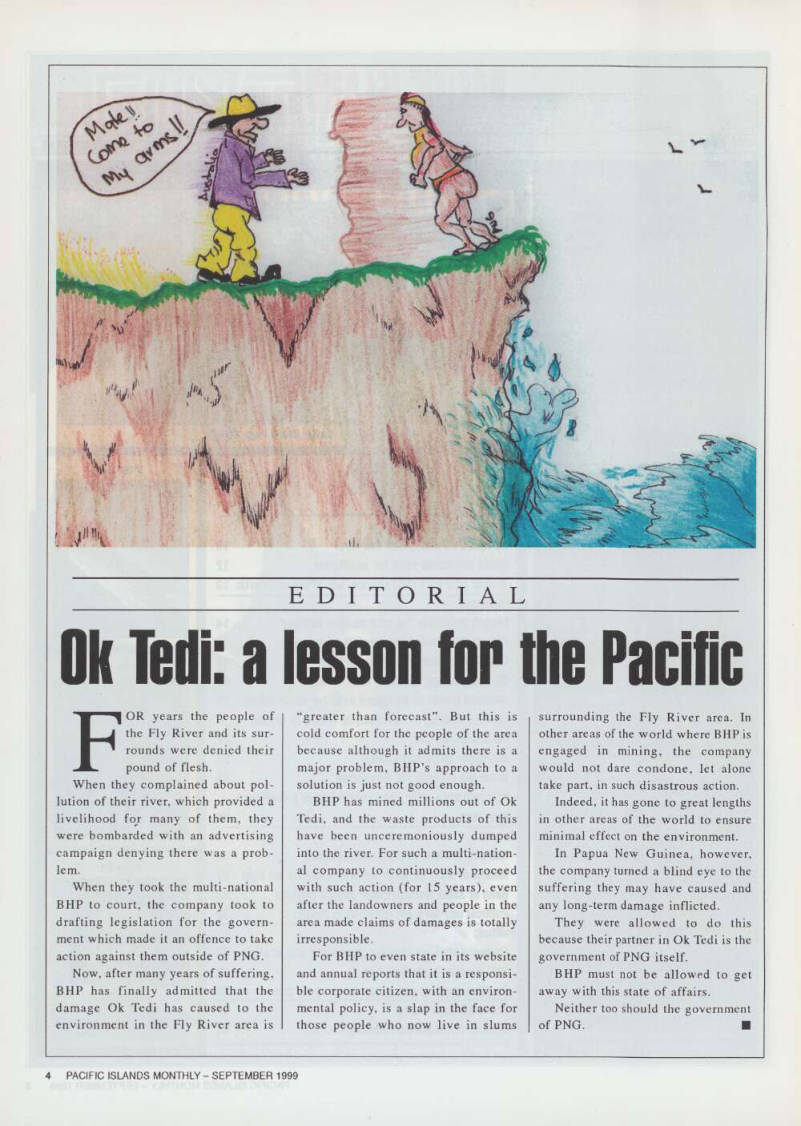
Ok Tedi: a lesson for the Pacific
Editorial
FOR years the people of the Fly River and its sur rounds were denied their pound of flesh.
When they complained about pol lution of their river, which provided a livelihood for many of them, they were bombarded with an advertising
campaign denying there was a prob
lem.
When they took the multi-national BHP to court, the company took to drafting legislation for the govern ment which made it an offence to take action against them outside of PNG.
Now, after many years of suffering, BHP has finally admitted that the damage Ok Tedi has caused to the environment in the Fly River area is
“greater than forecast”. But this is cold comfort for the people of the area because although it admits there is a major problem, BHP’s approach to a solution is just not good enough.
BHP has mined millions out of Ok Tedi, and the waste products of this have been unceremoniously dumped into the river. For such a multi-nation al company to continuously proceed with such action (for 15 years), even after the landowners and people in the area made claims of damages is totally irresponsible.
For BHP to even state in its website and annual reports that it is a responsi ble corporate citizen, with an environ mental policy, is a slap in the face for those people who now live in slums
surrounding the Fly River area. In other areas of the world where BMP is engaged in mining, the company would not dare condone, let alone take part, in such disastrous action.
Indeed, it has gone to great lengths in other areas of the world to ensure minimal effect on the environment.
In Papua New Guinea, however, the company turned a blind eye to the suffering they may have caused and
any long-term damage inflicted.
They were allowed to do this because their partner in Ok Tedi is the government of PNG itself.
BHP must not be allowed to get away with this state of affairs.
Neither too should the government of PNG. ■
Letters
Tarawa not appalling?
Where would journalism be without a touch of hyperbole? Commonly we accept a degree of writer subjectivism as an embellishment to the facts because it cre ates a suitable mental picture for the reader.
Yet Michael Field’s “article” (Tarawa main islet in appalling state, July 99) shows elab oration of near cosmic proportion.
Imagine if you can “great piles of human excrement everywhere.” Err, excuse me, what are we talking about here, people or elephants? I believe the average human stool would be maybe 3 inches by 2 inches across, 1 inch deep. To create a “pile” would mean roughly 20 - 25 humans stand ing on the same spot and making their deposit. Hard to believe?
There’s no denying the abject state of the environment in Betio (and much of South Tarawa) and its effects on public health. Quite simply there is not yet the infrastructure in place to cope with the influx of imported materials and people.
Kiribati, even in its far flung location, is as subject to the strains of globalisation as anywhere. And nowhere is this more evi dent than in Betio (which, by the way, had a population under the 1995 census of 10,300, not 28,000).
Yet the implication that “just about any where does” as a toilet is crassly over-exag gerated. Contrary to the article, Betio does have a sewage system (albeit arcane) serv ing those who can afford to construct prop er toilet and connections. Many people can not pay for toilet facilities and therefore have to use the beach. But except for those living in bush areas on outer islands, people do not freely excrete anywhere as the arti cle implies. They merely take the only option open to them.
Whilst I understand the picture that the report is trying to paint, unfortunately it has become obsessed with shades of brown and has failed to look for other brighter colours.
These include the SAPHE project that aims to address sanitation and public health problems, progress in developing environ mental protection legislation and various educational and awareness schemes that are slowly changing local habits. At least there
fore there are silver linings, unlike the sce narios for sea level rise.
Michael Phillips,
Kiribati
Berio report too negative
I wish to thank PIM for excellent cover age of some of the issues in Kiribati that have not received that much attention by the local media here in Kiribati.
However, I was dismayed to read one of the special reports under the headline “Tarawa’s main islet in appalling state,” (PIM July 1999). I think the report is a bit sensational, biased, prejudicial and racist.
I grew up in Betio, which the report calls "... the cesspit of disease - a public health disaster waiting to happen”. But I have not been struck by the diseases that it seems to be so concerned about.
The report’s tone is so alarming that those who have never visited Betio would be forgiven - after reading the report - if they believe that people in Betio are living on a rubbish strewn, foul smelling and dis ease ridden islet, full of human excrement.
The story of Betio is more of an opinion
than an objective piece of reporting.
Nowhere in the report do we hear from the locals, Betio health workers, council and government officials, or non-govem ment organisations’ workers on what is being done to address the problem of waste disposal.
The only person quoted in the special report is Kiribati’s former president leremia Tabai who shouldn’t have commented. The former president should have tackled the Betio waste disposal problem a long time ago when he was in a position to do so.
In addition, the report contains a number of factual errors. Betio has a functioning piped sewerage system built in 1978. But not all houses are connected to the system.
It has a population of less than 10,000 and not 28,000 as the report said. However, the figure for all of South Tarawa including Betio is about 28,000.
It said Betio families live right on each other and ailing children roam crying among the shanties and mothers sit around
smoking a foul smelling concoction. It then went on to say that almost nobody has jobs and as each day wears on the men pass their time in a haze induced by the thou sands of cans of VB they consumed.
PIM should carefully study the I-Kiri bati way of life before writing such gross
ly misleading and overly generalised state
ments. Does PIM really mean that Betio children are a sickly lot, or did it just hap pen to see one or two children crying and suddenly every child in Betio is ailing.
Does PIM really believe that “almost nobody” has a job in Betio and all the men do nothing but drink? It’s a pity the report seems to aim a telescope only at the dirty and filthy face of Betio because it didn’t see the beaming and smiling faces of the rest of the healthy children that are so numerous on the islet. The foul smelling smoke mentioned is a favourite of both the women and men in Kiribati. But why did the report use a negative term to describe a smoke favoured by I-Kiribati? I uige PIM to be more objective and fair next time you write a story on Betio.
Taoroba Takenteiti
Tarawa Kiribati
Continued on page 6
Advertisements & other items, p. 5 (1 item)
■engine!
BMW
Bedford Cummins Daihatsu Detroit Deutz Ford Gardner Hmo Isuzu Iveco Komatsu Kubota
WAREHOUSE
PHONE
643-6938122
PAX
643-6938120
umi
New Zealand
email: [email protected]
NEW ARRIVALS
'Bedford 330, Cummins 504, Dentz'
4cly F 41913. Leyland 411 Turbo
Lister STI, ST3, HR3, Scania DSII-
- Interceded 354 hp, Mazda RF
Supercharger, Toyota 3CR, 3CT-EFI,
2C-11, 2L-lIT-EFI, 3L, IW, IHDT-FTI-EFI
Intercooler, Isuzu 6881, 4BBDIT,
Detroit 6V92 Silver Dismantling
MACK FR797 RST 6x4
Subaru Leyland Mazda Mercedes Mitsubishi
MAN.
Nissan Perkins Suzuki Toyota Volvo Yanmar
Insightful coverage of Solomons
Your coverage of the Ethnic Tension in Solomon Islands was quite insightful, even reading it from within Solomon Islands.
There is an obvious overview under standing of the Solomon Islands multi lingual and multi-ethnic and multi-island groupings, even when portrayed from the perspective only of the Malaita-Guadal canal tension.
There is a specific portrayal of the sad ness surrounding the whole issue: The institutionalising of an ethnic-based enmity between two specific groups in the country; the loss of joy in the so called “Happy Isles”; and the absence of innovative political leadership in Honiara.
The absence of innovative political leadership in Honiara is not just another
sad aspect of the ethnic tension here. This is the core of the sad story in the whole country. Here, the political representatives are elders and leaders from their own con stituencies (mainly language groups or groups of islands with a related cultural his tory). It is logical, therefore, to see how the inward-looking political thinking of Honiara influences the views and perspec tives of the voters in the constituencies, and vice-versa.
This inward-looking political perspec tive is expected in a former colony of unre lated histories prior to colonisation, based on the necessary primordial loyalties of the people. And this inward-looking political perspective is the barrier between the poli tics here now and the innovative political leadership we need for a little island nation of our nature and background into the new millennium, given our specific regional surrounding to start with.
Even more sadly, this entrenched inward-looking political perspective in the country based on language and island
groupings will ensure that the situation is not ever going to get better from a nation al development perspective.
There have always been potentials for political, economic, and cultural growth and confidence for the various groups in the country.
But these potentials need to be devel oped in a concerted (national) manner, to give these potentials a wider (national) population base for political and econom ic “Home Base”. (This is a political inter pretation and internalising of the notion of “Scale Economy” if one wonders.) It is sad to have such potentials sacrificed purely because of impatience and short sightedness given the blindfold of
inward-looking views.
Angikinui Francis Takiika
Federation of Solomon Islands Youth Honiara Solomon Islands
Continued on page 8
Information wanted
Archives-September 1944
Incidence of S. Pacific
hurricanes to be studied
The director of Meteorological Ser
vices in Fiji, Flight-Lieutenant Ralph
Dyer, intends to make an intensive study of the incidence of hurricanes in the South Pacific area.
For this study, he is anxious to collect all possible details of past serious storms affecting Fiji or other Pacific islands.
He would like to enlist the aid of any residents of the South Pacific who could loan, for copying, any photographs of written or printed details of past hurri canes and hurricane damage.
All documents and photographs received will be treated with extreme care and will be returned as soon as copies are
completed.
All material should be registered and addressed to the Director of Meteorological Services, Box 288, Suva.
The full address of the sender should be enclosed in order to ensure safe return.
Flight-Lieutenant Dyer asks particularly
for these details; The date of the storm; the locality affected and the approximate track of the storm.
It should also include the severity of the storm and damage done - illustrated by pho
tographs, if possible.
Finally, any relevant weather observa tions made at the time should be included.
Traders have their troubles
MANGAIA, June - The small, indepen dent storekeepers of this island find life difficult these days. Their lot, like that of Gilbert’s policeman, is not a happy one.
The “small” store has to make, in order to survive, large profits on a very small stock. Usually the trader doesn’t benefit; it is the Administration that gets this money!
And now, to make matters worse, profits are “fixed”.
Result: Several cases of alleged profi teering, and two of unlicensed selling of goods - one man being penalised to the extent of 16 pounds and 15 shillings.
Nobody holds a brief for the calculat ing profiteer. But the small traders could be assisted in legitimate business y a reduction in their licence fees (at present five pounds yearly). Then, they could carry on without resorting to illegal stratagems of the kind described. ■
Advertisements & other items, p. 6 (1 item)
Letters
PACIFIC ISLANDS MONTHLY - SEPTEMBER 1999
Continued from page 5
Briefs
A hung Parliament in the Cook Islands, voters prepare (or a by-election RAROTONGA - The future of the Cook Islands government hinges on an upcom
ing by-election.
It has been called after the country’s Court of Appeals declared null and void, the government’s one-seat majority. The decision leaves the Cook Islands with a hung parliament, 12 seats to 12 with one seat vacant.
The leader of the opposition Democrat ic Alliance Party (DAP), Doctor Terepai Moate said his party could end up with a majority of one, allowing it to form gov ernment.
“If we win that seat in the by-election, that means our number goes up from 10 to 11, plus the two members who are support ing us in forming a government. That will give us a majority of one,” Doctor Moate said.
Doctor Moate said if that happens, then he could become the new Prime Minister of Cook Islands. The DAP leader said he was not surprised at all by the Appeals court decision.
“That’s what we expected, actually we thought the outright win would mean our candidate would regain his seat.
“Now we are excited about that. Now that something has gone in our favour the rest is to fight the by-election. We are ready to fight it out,” Dr Moate said.
The seat, which has now been deemed vacant, was won with the slimmest majori ty of just one vote by former deputy Prime Minister Inatio Akaruru.
The result was immediately challenged by the opposition Democratic Alliance
Party.
The decision adds to the confusion after
long serving Prime Minister Sir Geoffrey
Henry resigned last month and handed power to veteran politician Doctor Joe Williams. PNS PNG Premier ceils for competition once
Air Niugini privatised
PORT MORESBY - PNG Prime Minis ter Sir Mekere Morauta is keen on an open
skies policy to make airfares affordable to travellers.
He told parliament in early August when Air Niugini is privatised, other airlines should be invited in to compete with it on both its international and domestic trunk routes.
Sir Mekere said, in response to a series of questions from Sir Rabbie Namaliu, that Air Niugini was a prime candidate for sale under the government’s privatisation policy.
Sir Rabbie had expressed concern about the high airfares being charged on passen gers and asked about the status of privatising Air Niugini.
“Air Niugini is one of the candidates for execution,” Sir Mekere said in response, adding that many of the government’s statu tory bodies were in bad shape and they should have gone “under the hammer” already.
He said that he hoped that when priva tised, whoever took over the airline would ensure the travelling public was offered an “affordable and reliable” service.
“I would like to see a fairly open skies policy, both internationally and domestical ly. An open skies policy, particularly on trunk routes,” Sir Mekere said.
On privatisation generally, the Prime Minister said at this stage, each of the (statu tory) companies had different characters and needed to be carefully assessed before being offered for sale.
“Some of them are ready to be privatised.
The others require careful management to prevent asset evaluation from being dimin ished, and Air Niugini I believe is one of those,” he said. PNS Air New Zealand increase capacity between Nadi and Lns Angeles SUVA - Air New Zealand is increasing capacity between Nadi and Los Angeles by 19 per cent from December this year.
This changeover means that the Friday service, which is now a 8767-300, will be
replaced by a 8747-400 flight.
This will bring additional 200 seats and is on key day of the week northbound from Nadi to Los Angeles and southbound on Sat urday from Los Angeles to Nadi and onward
to Auckland. “This provides connections from the UK and the European markets as well,” said Chris Hunter, Air New Zealand’s Pacific Islands manager. PNS Outgoing Kiribati Chief Justice praised for restoring confidence in the country's
judicial system
TARAWA - Kiribati’s Chief Justice for the past four years, Richard Lussick, who in 1998 imprisoned an entire magistrate lands court bench, left the country August 12 after completing his contract.
During a farewell banquet, President Teburoro Tito praised Justice Lussick for his services to Kiribati.
The President said Justice Lussick raised the standard of professionalism in Kiribati’s courts and restored the confi dence of I-Kiribati in the judicial and legal system, which was in danger of being eroded in the past years.
Justice Lussick was also credited with disposing off many outstanding cases and making inroads into the backlog of appeal cases.
President Tito said the outgoing Chief Justice raised the profile of Kiribati on the world legal stage when he was elected the Pacific regional Vice President of the Commonwealth Magistrates and Judges Association.
For his part, Justice Lussick said he had done his work efficiently because of strong government support.
He said the I-Kiribati should be thank ful they have a government that strictly observes the doctrines of judicial indepen dence and the separation of powers.
Justice Lussick will be going on to Samoa for a new appointment. PNS King of Tonga commissions new tele
phone exchange
NUKU’ALOFA - Tonga’s King Tau fa’ahau Tupou IV officially commissioned the island nation’s new telephone exchange mid-August.
His Majesty made the first call from the
Continued on page 8
Royal Palace to Princess Pilolevu Tuita at her residence of Mahinafekite, Nukualo fa.
The conversation used a video tele phone that enables the two parties to view each other.
The new system converts the old ana logue system to digital features. Accord ing to the Tonga Telecommunication Commission (TTC), the project should alleviate customers’ complaints regarding the poor service quality of telephone num bers starting with prefixes of 21, 22, 31 and 41.
With the latest development all tele phone exchanges in Tonga are now in the digital mode.
Tonga Telecommunications Commis sion has invested about 4.5 million Pa’an ga in upgrading and replacing the tele phone exchanges in Nuku’alofa, Mu’a, Masilamea and ‘Eua.
The equipment for the project were procured from the Ericsson Limited of
Australia and funds were obtained from a loan from the Export Finance Insurance Company of Australia and the equity of the Commission. All TTC customers will now be able to access the special features of the new exchange system, including call wait ing, third-party conference, call diversion, malicious call tracing, message waiting with call answering service and caller identifica tion.
Under the project, over 10,000 addition al lines will be made available. PNS PNG AIDS conference notes "frightening trend"
RABAUL - Papua New Guinea is proba bly one of the most difficult places in the world to develop effective counter measures against the rapid spread of the HIV/AIDS, according to the National AIDS Council Secretariat director Clement Malau.
Speaking at the start of a week-long Islands Regional HIV/AIDS workshop, Dr Malau said among the factors involved in making the job difficult for government and
Non Government Organisations (NGO’s) workers was the cultural and geographical diversity of the country.
He told some 30 participants from the five islands provinces that since the first HIV case was detected in 1987, national reports indicated that PNG had a frighten ing trend of recording over 600 new cases of HIV and over 150 news cases of AIDS each year.
“This is still an estimate of the real sit uation.
“As of March this year 185 new cases of HIV infections and 41 cases of AIDS have been detected in the country,” Dr Malau said.
He said that HIV/A IDS was particular ly affecting the young sexually active and economically important members of the country, adding that the virus was pre
dominantly being spread through unpro
tected sexual intercourse.
Dr Malau said given the socio-econom ic and geopolitical diversity, constructive planning was needed for an effective national response to HIV/AIDS. PNS ■
Australia's role in Kiribati patrol
boat
Your article “Korean fishing access in Kiribati in doubt” (PIM July 1999, page 13) gave the false impression that the Kiribati Patrol Boat is led by an Aus tralian.
The Patrol Boat provided to the gov ernment of Kiribati by the Australian government under the Defence Co-oper ation Programme is commanded and crewed by members of the Kiribati Police Maritime Wing. All of these per sonnel are I-Kiribati nationals.
Australia continues to support this programme by providing surveillance and technical advisors to assist the Kiri bati government in the protection of its maritime resources. The Australian Defence Force personnel in Kiribati are advisers and that is their prime function.
Decisions on all matters operational and
otherwise rest with the relevant Kiribati authorities. By way of background, you should be aware that Australia has pro vided a total of 22 patrol boats to 12 countries within the Pacific region.
Australian Defence Force Advisers support these in each country.
The Pacific Patrol Boat programme has been extremely successful with the countries involved all developing a sig nificant capability to protect their very valuable and important maritime resources. In many cases, this has result ed in substantial increases in revenue to governments from the granting of fishing licences.
K. R. Eglen,
Commander RAN, Defence Adviser South Pacific
Correction of a name
This is regarding an article I read in your July Issue 1999 Vol. 69 No. 7, on
page 40 titled “Remittance, assault and deportation - an NZ debate” by Barbara Dreaver. The story is about Ben Kwong.
In the article Ben Kwong has been reported as Ben Kwong Make ran. This is incorrect as he is my nephew and not entitled to use my given name as his patronymic. The series of incidents and offences which Ben committed have hurt the family a great deal. It seems he has claimed my given name seeking some benefit from the association.
Being a senior public servant here in Kiribati myself, perhaps Ben hopes to gain some measure of relief from the ret ribution of justice. I believe you are probably reporting facts as they come to you, but it would be appreciated if you could remedy the error in your next issue.
Captain Makeran Kwong,
Kiribati Shipping Services Limited
Continued on page 14
Advertisements & other items, pp. 8-9 (2 items)
Letters
8
BRIEFS
PACIFIC ISLANDS MONTHLY - SEPTEMBER 1999
Continued from page 7
Continued from page 6
Department Of Public Works
AMERICAN SAMOA GOVERNMENT
PAGO PAGO, AMERICAN SAMOA 96799
The Division of Architectural & Engineering within the Department of Public Works, American Samoa Government, located in the South Pacific has three (3) openings. • 1. General Manager of Architectural and Engineering Division performs professional architectural work in the planning, designing, reviewing of new structures, alteration and repairing of existing buildings, etc and overall management of the division; also performs other related duties assigned. Must have a Bachelor's Degree in Architectural/Design. Ten yrs of working experience in the same field; 5 of -which is management level. Must possess a current/valid professional registration license. • 2. Architect 111 performs professional and architectural work in the planning and designing of new buildings and alteration and repairing of existing buildings and structures; also perform other related duties. Must have a Bachelor's Degree in Architectural/Design or related engineering subjects from accredited institution plus 6 yrs. of progressively responsible working experience in the same or related field; 3 of which in supervisory level. Must possess a current/valid
professional registration license.
• 3. Engineer 111 performs professional designing/structural engineering work and other related duties. Must have a Bachelor's degree in Engineering (Design/Structural) or related field from an accredited institution plus 5 yrs. of progressively responsible working experience in engineering; 2 of which is supervisory capacity.
All are contract positions of 2 years subject to renewal with the American Samoa Government.
The starting salaries for these positions are from U5537,000.00p.a to U 5540,000.00 p.a. Base salary will be adjusted according to experience.
American Samoa is one of the islands in the South Pacific which is ideal for the water sport enthusiast with plenty of fishing, sailing, scuba diving, snorkelling and swimming.
Please send resume along with copies of your academic achievement records, certification and so forth to: Mr. Laautuilevanu Tue Deputy Director for Finance/Personnel Division Department of Public Works American Samoa Government Pago Pago, American Samoa 96799 131937
Living three feet above sea level
Special Report
Living three feet above sea level brings home climate change message
By GIFF Johnson
HOLDING an interna tional climate change meeting in the low lying atoll nation of the Marshall Islands injected a dose of reality about living at sea level for officials from countries as far distant from the Pacific as Scandinavia.
Landing at Majuro international airport
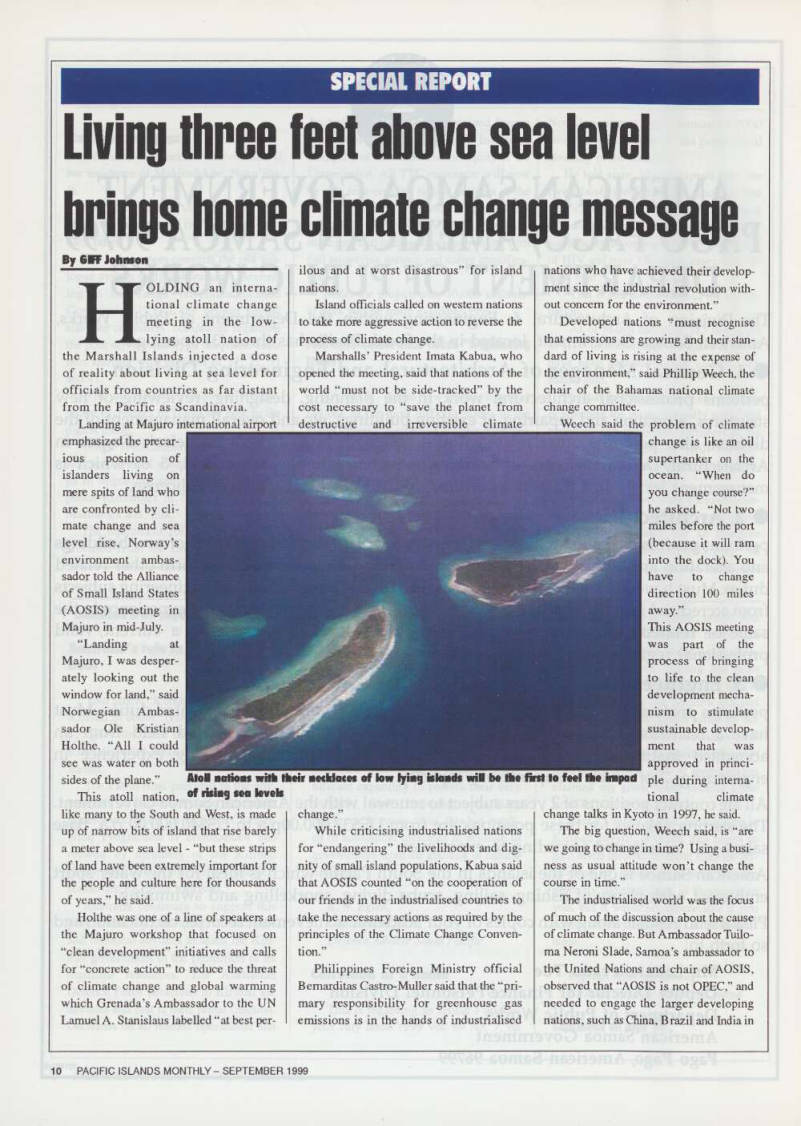
emphasized the precar ious position of islanders living on mere spits of land who are confronted by cli mate change and sea level rise, Norway’s environment ambas sador told the Alliance of Small Island States (AOSIS) meeting in Majuro in mid-July.
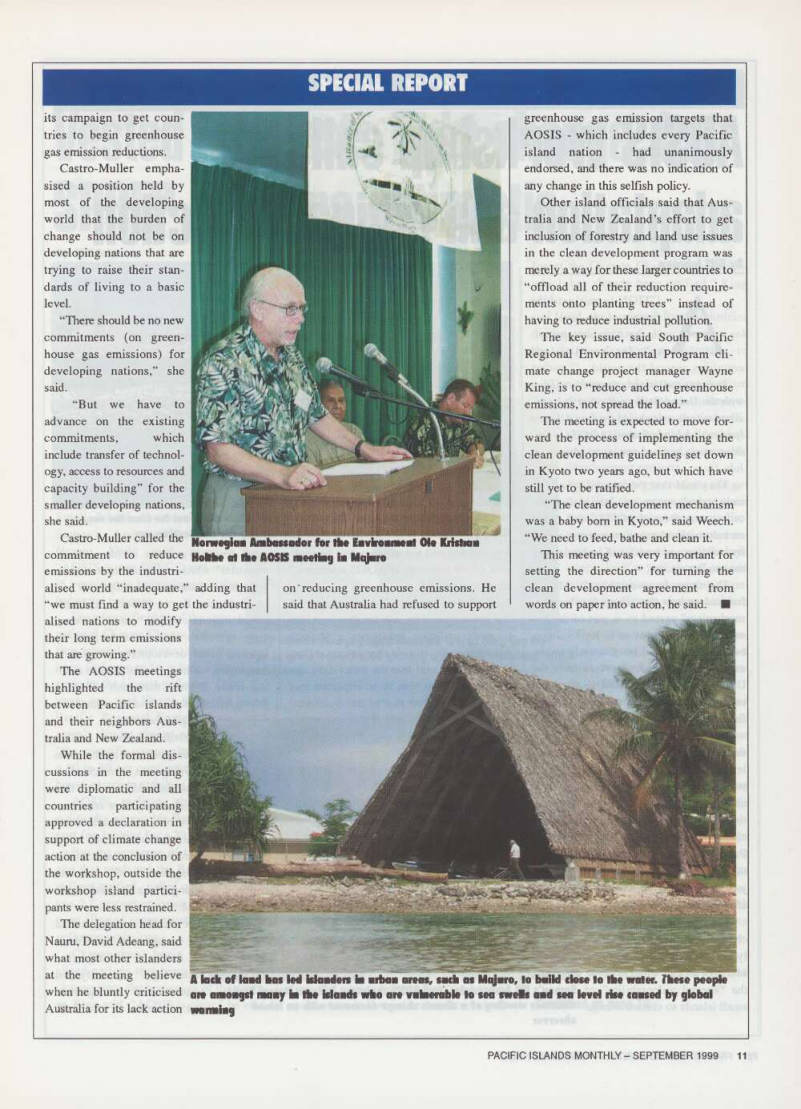
“Landing at Majuro, I was desper ately looking out the window for land,” said Norwegian Ambas sador Ole Kristian Holthe. “All I could see was water on both sides of the plane.”
This atoll nation,
like many to the South and West, is made up of narrow bits of island that rise barely a meter above sea level - “but these strips of land have been extremely important for the people and culture here for thousands of years,” he said.
Holthe was one of a line of speakers at the Majuro workshop that focused on “clean development” initiatives and calls for “concrete action” to reduce the threat
of climate change and global warming
which Grenada’s Ambassador to the UN Lamuel A. Stanislaus labelled “at best per
ilous and at worst disastrous” for island nations.
Island officials called on western nations to take more aggressive action to reverse the process of climate change.
Marshalls’ President Imata Kabua, who opened the meeting, said that nations of the world “must not be side-tracked” by the cost necessary to “save the planet from destructive and irreversible climate
change.”
While criticising industrialised nations for “endangering” the livelihoods and dig nity of small island populations, Kabua said that AOSIS counted “on the cooperation of our friends in the industrialised countries to take the necessary actions as required by the principles of the Climate Change Conven tion.”
Philippines Foreign Ministry official
Bemarditas Castro-Muller said that the “pri mary responsibility for greenhouse gas emissions is in the hands of industrialised
nations who have achieved their develop ment since the industrial revolution with out concern for the environment.”
Developed nations “must recognise that emissions are growing and their stan dard of living is rising at the expense of the environment,” said Phillip Weech, the chair of the Bahamas national climate change committee.
Weech said the problem of climate
change is like an oil supertanker on the ocean. “When do you change course?” he asked. “Not two miles before the port (because it will ram into the dock). You have to change direction 100 miles away.”
This AOSIS meeting was part of the process of bringing to life to the clean
development mecha
nism to stimulate
sustainable develop
ment that was
approved in princi
ple during interna
tional climate
change talks in Kyoto in 1997, he said.
The big question, Weech said, is “are we going to change in time? Using a busi ness as usual attitude won’t change the course in time.”
The industrialised world was the focus of much of the discussion about the cause of climate change. But Ambassador Tuilo ma Neroni Slade, Samoa’s ambassador to the United Nations and chair of AOSIS, observed that “AOSIS is not OPEC,” and needed to engage the larger developing nations, such as China, Brazil and India in
Atoll nations with their necklaces of low lying islands will be the first to feel the impact of rising sea levels
its campaign to get coun
tries to begin greenhouse
gas emission reductions.
Castro-Muller empha sised a position held by most of the developing world that the burden of change should not be on developing nations that are trying to raise their stan dards of living to a basic level.
“There should be no new commitments (on green house gas emissions) for developing nations,” she said.
“But we have to advance on the existing commitments, which include transfer of technol ogy, access to resources and capacity building” for the smaller developing nations, she said.
Castro-Muller called the commitment to reduce emissions by the industri
alised world “inadequate,” adding that “we must find a way to get the industri
alised nations to modify their long term emissions that are growing.”
The AOSIS meetings highlighted the rift between Pacific islands and their neighbors Aus tralia and New Zealand.
While the formal dis cussions in the meeting were diplomatic and all countries participating approved a declaration in support of climate change action at the conclusion of the workshop, outside the
workshop island partici
pants were less restrained.
The delegation head for Nauru, David Adeang, said what most other islanders at the meeting believe when he bluntly criticised Australia for its lack action
on*reducing greenhouse emissions. He said that Australia had refused to support
greenhouse gas emission targets that AOSIS - which includes every Pacific island nation - had unanimously endorsed, and there was no indication of any change in this selfish policy.
Other island officials said that Aus tralia and New Zealand’s effort to get inclusion of forestry and land use issues in the clean development program was merely a way for these larger countries to “offload all of their reduction require ments onto planting trees” instead of having to reduce industrial pollution.
The key issue, said South Pacific Regional Environmental Program cli mate change project manager Wayne King, is to “reduce and cut greenhouse emissions, not spread the load.”
The meeting is expected to move for ward the process of implementing the clean development guidelines set down in Kyoto two years ago, but which have still yet to be ratified.
“The clean development mechanism was a baby bom in Kyoto,” said Weech.
“We need to feed, bathe and clean it.
This meeting was very important for setting the direction” for turning the clean development agreement from words on paper into action, he said. ■
A lach of load has led islanders in urban areas, sach as Majuro, to build close to the water. These people are amongst many in the islands who are vul[?]erable to sea swells and sea level rise cansed by global warming
Norwegian Ambassador for the Environment Ole Kristian Holthe at the AOSIS meeting in Mayjuro
adaptation and mitigation action
AOSIS workshop calls for adaptation and mitigation action
By Giff Johnson
ACTION to mitigate the impact of sea level rise is the “highest priori ty” for small island countries around the world.
Twenty small island countries, together with the United States and other industri alised nations, concluded the first Alliance for Small Islands States (AOSIS) work shop on clean development in Majuro on July 16.
They said that “vulnerability assess ment and adaptation are of the highest pri ority to members of AOSIS,” and called on industrialised nations to support capac ity building and transfer of technology to the smaller nations.
The three-day workshop in Majuro focused on how the “clean development mechanism” agreed to as part of the cli mate change convention in Kyoto, Japan two years ago could be effectively imple mented. It included observers from the US, Australia, New Zealand, England and other European nations who joined in the
final statement.
The statement from the three-day workshop is an excel lent outcome considering the workshop included industri alised nations, and will advance the process for getting action on clean development, South Pacific Regional Environmen tal Program climate change pro ject manager Wayne King said after the meeting concluded.
The hosting of the climate change meeting in the low lying coral atoll nation of the Marshall Islands brought home
the “special vulnerability” of
small islands to climate change
and “underlined the urgency and serious ness of the concerns of AOSIS countries,” the statement said.
While emphasising the importance of domestic actions by industrialised nations to meet pollution reductions guidelines agreed to in the climate change convention, the statement said that the clean develop ment mechanism “can be an important tool for complying with part of these commit-
ment through projects in (developing) countries” which can assist these nations to “achieve sustainable development.”
Under the Kyoto Protocol, industri alised nations can get “credits” toward their agreed-to emission reductions by funding clean development projects in developing nations. But the Majuro meet ing made it clear that such off-shore efforts by industralised nations must have
tangible benefits.
“Certified emission reduc tions generated by the clean
development mechanism
must be additional to that which would have otherwise occurred and should have real, measureable and long term benefits related to the mitigation of climate change,” the final statement said.
The AOSIS meeting called for further work to be done on the issue of adaptation technology, especially for coastal zone management and protection. ■
Samoa's UN Ambassador and AOSIS chairman Tuiloma Neroni Slade discusses wording of a climate change document with an island observer
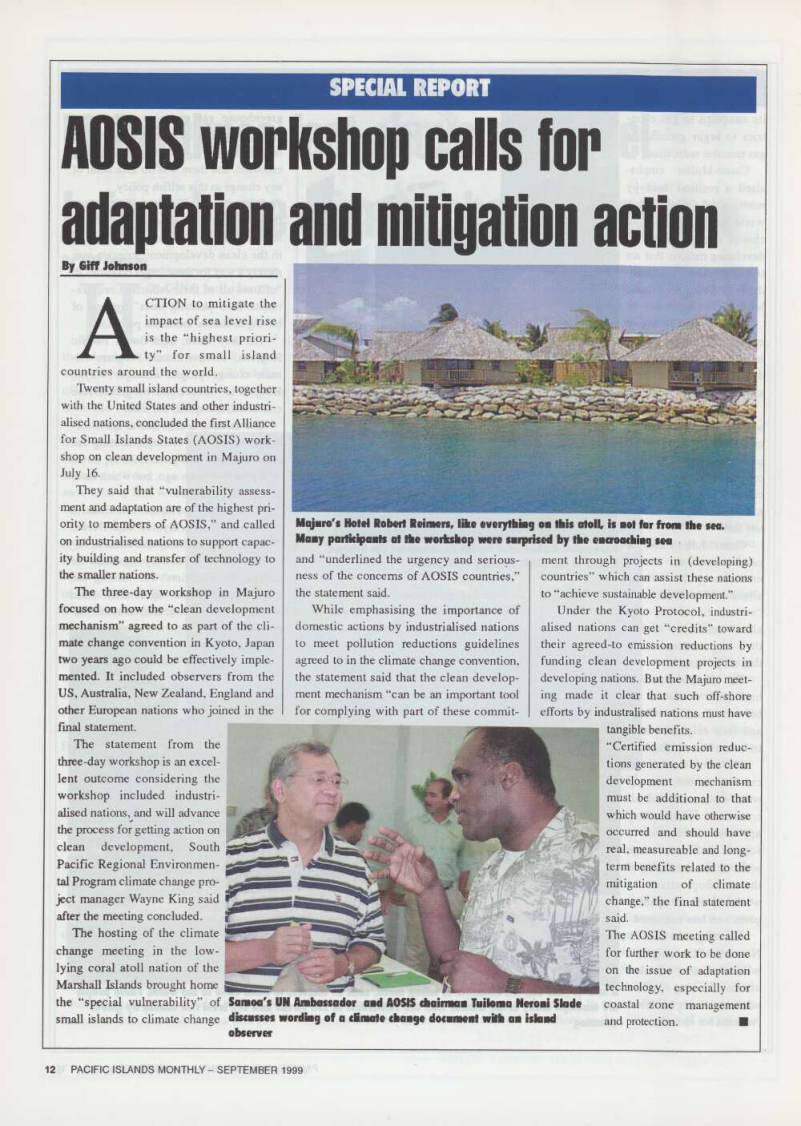
Majuro's Hotel Robert Reimers, like everything on this atoll, is not far from the sea.
Many partkicipants at the workshop were surprised by the encroaching sea
SPREP remains optimistic
Vested interests fight change, but SPREP remains optimistic
By Giff Johnson
The $64 question is how do you get big, industrialised nations to reduce green house gas emissions enough to halt - or at least limit - the progress of climate change when the actions needed require fundamental
change in the way people are liv ing their lives?
Small islands that are leading the clarion call for greenhouse gas reductions may be on the front line of the consequent rising sea levels, but as the Association of Small Island States chairman, Samoa’s Ambassador Tuiloma Neroni Slade said recently, “AOSIS is not OPEC,” and isn’t in a position to force change in the industrial nations.
Despite ratification of the inter national Climate Change Conven tion several years ago, there has been little move to reduce emis
sions by the biggest polluters. Two
years ago, said Wayne King, the South Pacific Regional Environmental Pro gram’s climate change project manager, “the scientific community recommended a 60-to-8C per cent reduction in green house gasses to stabilize the situation.”
AOSIS, realising that this was a politically impossible figure to gain sup port for, lobbied for a 20 per cent cut.
But the outcome of talks two years ago that produced the Kyoto Protocol still not ratified - called only for an aver age 5.2 percent emission reduction, and even allowed some countries to increase pollution emissions.
Change must begin with industri alised nations that have fueled climate change since the beginning of the centu ry, King said. “AOSIS is clear,” he said.
“The large industrialised countries must make a commitment.”
But, he noted, the US, for one, has questioned why there is no action from large developing nations on greenhouse gas reductions. “We’re insignificant by comparison,” he said.
“But we’re doing scientific studies.
looking at our own greenhouse gas emis sions” to demonstrate a commitment to the process.
King believes that one of the troubles is that some of the industrialised coun tries have “lost focus” on climate change.
The attention of many countries shift ed onto the Kyoto Protocol of late 1997 because of the many new proposals put forward, including such plans as a so called “clean development mechanism” to encourage environmentally-friendly alternative energy and sustainable devel
opment projects.
But, said King, the Kyoto Protocol is not yet ratified. At a meeting of small island countries in Bonn, Germany in June, the consensus was that “we have to make sure industrialised nations don’t
forget the Climate Change Convention, which has already been ratified,” King said.
“Until the industrialised countries demonstrate progress, how can they ask the larger developing countries to reduce?”
The clean development mechanism
proposed in Kyoto is an innova tive way to involve the industri alised nations in helping develop ing countries to fund sustainable development projects.
Yet because bigger nations can get “credits” that count toward their required greenhouse gas reduc tions, small countries are con cerned that the big nations will simply look at “off-shore” actions without making change at home, where the climate change problem is.
“The clean development mecha nism is great,” King said. “But it must be supplemental to domes tic actions.”
While the record of industrialised nations leaves much to be desired from the AOSIS viewpoint, there is some blue sky on the horizon as far as King is con cerned.
First, he said, there is an increasing amount of scientific evidence on their side now.
“It’s only in the last several years that climate change negotiators are obtaining clear scientific knowledge on the effects of climate change,” he said.
“Previously, there wasn’t much research available. Now we’re getting the scientific information and it’s prov ing to be a great to help our negotiators (in the climate change convention
Continued on page 16
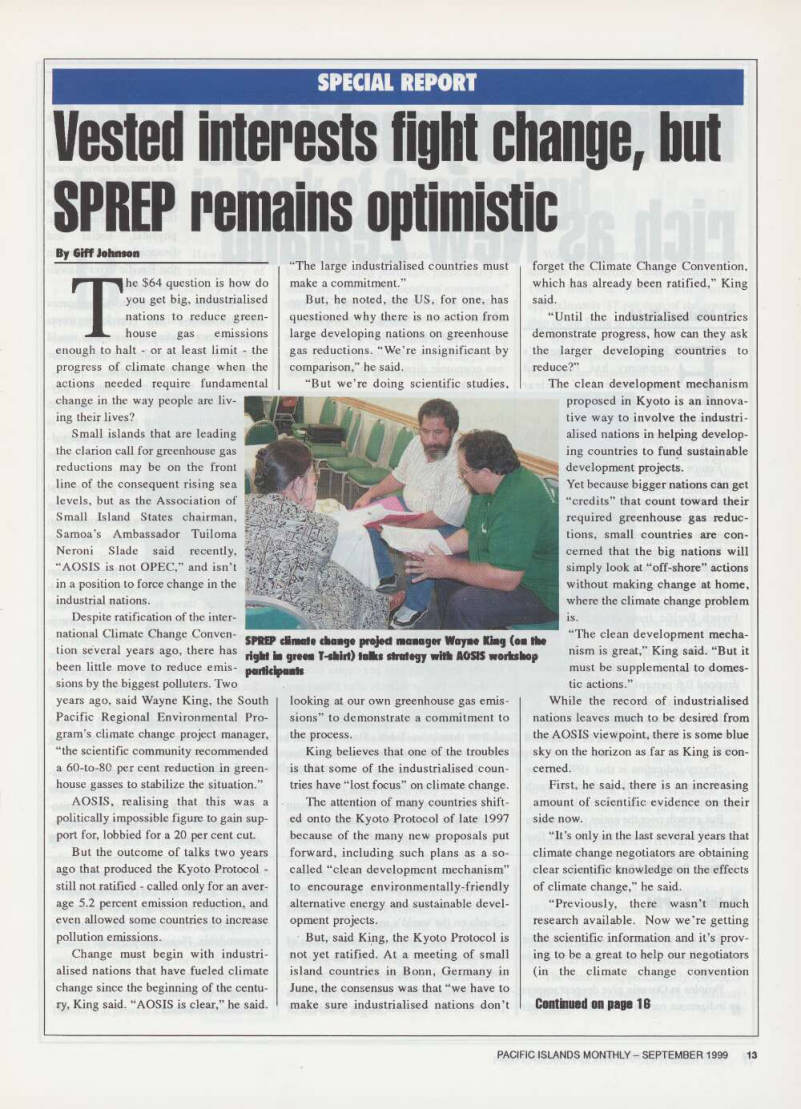
SPREP climate change project manager Wayne King (on the right in green T-shirt) talks strategy with AOSIS workshop participants
Continued from page 13
process).”
Another major obstacle has been and continues to be huge multinational corpo rations who see their bottom line profits imperiled by all this talk of greenhouse gas reductions.
Governments are under great pressure from “corporations who have a vested interest in keeping emissions” where they are. “But slowly, we’re seeing some changes,” he said. “A number of large
corporations have begun to turn around and look at issues more positively,” giv ing consideration to investing in renew able energy and sustainable development initiatives.”
Pacific islands, he said, intend to play their part in the emission reduction process - however minor that may be.
They will continue pressing their case internationally for industrialised nations to take bigger and continuous steps to slow climate change.
With an increasing volume of knowl edge now available about the effects of climate change and sea level rise, it may be possible to get the public worried about the problem and motivated to take action.
This is possible not just in the smaller nations but where it will count most toward policy change.
That is, not in the Pacific, but in coun tries such as the United States, Australia and in Europe. ■
Politics in PIM
Tuvalu’s ambassador to Fiji should be spelled Enele Sopoaga, instead of Enele Sapoaga.
Peoples in Oceania give deepest respect to indigenous names of families, and their
birthright home islands. Such names equal ly identify personal history, as well as geo graphical positions of islanders, and their islands on the world’s map.
Local names in the Federated States of Micronesia (FSM) reveal the meaning of the concept of “consocio personhood”.
In Tuvalu, familial names are cyclical in process. They maintain strong bondage of
dynamic harmony in good fellowship, and jealously guard the every lasting suste nance of local knowledge. Your correspon dent’s attempt to represent local names is commendable. Please keep trying.
Taumanu Penan,
Ringwood North, Victoria, Australia
rich as New Zealand"
Business
French Polynesia "as rich as New Zealand"
By Michael Field
FRENCH Polynesia’s
economy has recovered from the end of nuclear testing with its gross domestic product growing and its per capita income making it as rich as New Zealand.
France used Mururoa and Fangataufa atolls from 1963 until 1996 when the bases, 1300 kilometres south-east of Tahi ti, were closed. Its associated activities were the major revenue sources.
When testing ended Paris established the Contract for Development, an econom ic development programme from 1996 to 2006, currently worth around 18 billion French Pacific franc (US$2lO million)
annually.
The Bank of Hawaii said when nuclear
testing stopped gross domestic product
dropped 0.6 percent and in the following year rose only one percent.
It has grown since with a strong 4.1 percent in 1997 and a 3.1 percent rise in 1998.
“Every indication is that 1999 will be another year of growth, perhaps as much as another 3-s,percent,” the bank said.
But growth over the entire post-nuclear period has been slower than the last five
years of the nuclear testing era. “The con clusion of nuclear testing in French Polyne sia meant a significant change in regime and, therefore, a cause for potentially seri ous economic disruption in the territory,” the bank said.
“Given this change and France’s own fiscal problems, French Polynesia’s eco nomic growth of the last three years, how ever modest, is an achievement. Also notable is the fact that this growth occurred
while income-generating assets, mainly
hotels, were being built in order to create jobs in the years to come.”
The ending of testing removed the main issue causing social discontent.
The independence movement had peaked as its supporters now had to con vince the majority of voters to accept a pos sible decline in living standards in return of
political independence.
The bank says French Polynesia now has the second highest per capita income among the Pacific Islands after Guam and is now equal to that of New Zealand.
The Contract had led to the construction of new hotels in Tahiti, Bora Bora and Moorea and the creation of a new carrier, Air Tahiti Nui. Aggregate income and employment levels were rising from 1996.
“French Polynesia is expected to remain a stable and predictable market, as it has been throughout most of its association
with France,” the bank said.
“In addition to the beauty of its natural environment and its tropical quality of life, French Polynesia has the most complete basic physical, social and financial infrastructure in the Pacific after Hawaii and Guam.”
The Bank says the territory’s resources are still under-utilised. Transfer payments from France funding consumption would remain at the core of the economy and the basis of high living standards.
“France will maintain transfer pay ments close to the current level until 2006 when a policy review may occur... It is unrealistic to expect that a totally self-suf ficient economy will ever exist in the islands.
However, the current push in that direction is not only useful in the long run, but has also given the territory an economic boost that may not have occurred otherwise...
“While there is room for speculation on France’s long-term intent in French Polynesia, there is no indication that France, even under a Socialist regime is seeking an exit. If France had any inten tion of leaving the Pacific, it would have done so two years ago when the current Socialist government in Paris first came to power.”
The territory has accepted its links with France were legitimate and long term.
“Anecdotal evidence suggests that dis content in French Polynesia may have peaked with only a quarter of the Territo
rial Assembly held by the pro-indepen
dence movement.” ■
Advertisements & other items, p. 14 (1 item)
14
PACIFIC ISLANDS MONTHLY - SEPTEMBER 1999
Letters: Continued from page 8
Bank of Hawaii to acquire 5.8 million
shares in Bank of Queensland
BANK of Hawaii, the principal subsidiary of Pacific Century Finan cial Corporation (NYSE:BOH), has announced its intention to acquire 5.8 million shares, or approximately 10 per cent, of the outstanding common stock of
the Bank of Queensland.
The shares will be issued at
A U D $ 5.9 7
(approximately U 553.94 per share), with 50 per cent of the purchase price to be paid in cash on issue and the remainder due February 27, 2001.
The transac tion is expected to close in 1999’s third quarter, pending regulatory approval.
In November 1997, Bank of
Hawaii and the Bank of Queensland announced a strategic alliance designed to enable both companies to broaden their geographic reach in the Pacific Rim. The alliance involved the sharing of products and services, expertise and facilities.
In April 1998, Bank of Hawaii acquired 5.4 million Bank of Queensland convert ible notes, a transaction that raised approx imately AUDS3I million (approx. US$22 million) in new capital for the Australian bank.
“This stock investment by Bank of Hawaii will provide a source of capital that
will assist us as we continue to build our
business lending portfolio, particularly to
small and medium Queensland enterprises,” said John Dawson, chief executive officer of the Bank of Queensland.
The Bank of Queensland is experiencing solid growth in its markets, especially in the areas of housing and consumer lending.
For the quarter ended May 31, 1999, the Bank of Queensland posted $464 million in lending approvals, an increase of 24 per cent over the same period last year. “This trans action will strengthen and enhance the strategic alliance between our two banks that began in 1997,” said Richard J. Dahl, president of Bank of Hawaii.
“Our partnership with the Bank of Queensland has been mutually beneficial, enabling us to leverage our existing pres ence in the major Pacific markets and to extend our financial services throughout the Asia-Pacific region.”
With the current proposed investment and the convertible notes acquired in 1998, Bank of Hawaii will control approximately 17 per cent of the owner ship of the Bank of Queensland.
“We are extremely pleased with the growth prospects in the state of Queens land and are impressed with the manage
merit talent in the bank,” said Dahl.
“Australia is an important part of our overall Pacific strategy, and this latest investment solidifies our posi tion.”
Bank of Hawaii, headquartered in Honolulu, is the 50th state’s largest financial institu tion and the princi pal subsidiary of Pacific Century Financial Corpora tion, a holding company with assets of US$l4.9 billion.
Through its net work of branches,
in-store branches, ATMs and on-line ser vices, Bank of Hawaii provides varied financial services to businesses, govern ments and consumers in Hawaii, the West and South Pacific, Asia and on the US Mainland.
Bank of Queensland, established in 1874 and headquartered in Brisbane, Aus tralia, is a commercial bank with 95 loca tions throughout the state of Queensland, located in northeastern Australia.
The bank has approximately AUDS2.S billion (approximately US$l.75 billion) in assets. ■
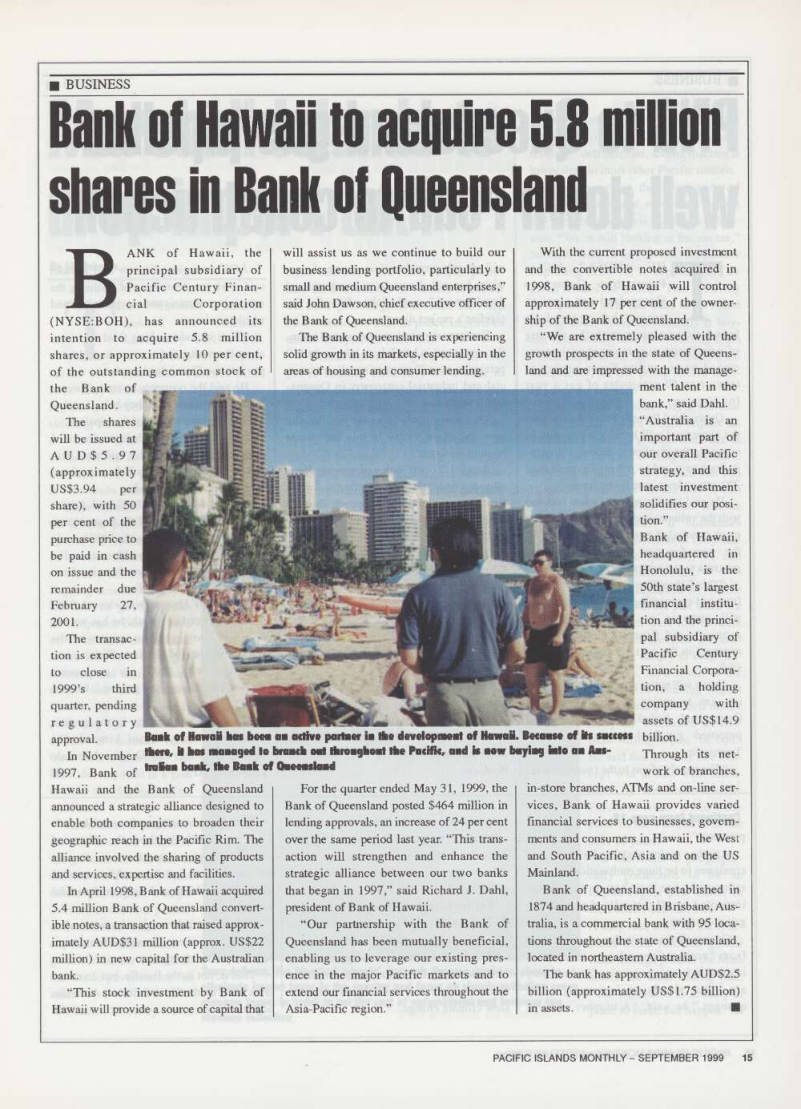
Busk of Hawaii has bees an active portner in the development of Hawaii. Because of its success there, it has managed to branch out throughout the Pacific, and is now buying into an Aus tralian bank, Ike Bank of Queensland
PNG to Queensland gas pipeline
well down road to construction
THE AUDS3.7 billion Papua New Guinea to
Queensland gas pipeline
project has secured its foundation volumes with the signing of a preliminary agreement with state owned power utility Ergon energy to take up to 50 petajoules of gas a year for 20 years.
Queensland Premier Peter Beattie said the agreement will boost gas volumes to come via the pipeline to around 100 peta joules a year and to potentially more than 200 petajoules a year in the future.
He said the Ergon load, when coupled with the volumes under the Energex agree ment concluded two weeks ago, opened the way for gas proponents to now progress to the next stage of development.
“This $95 million stage will involve the front end engineering and design work and will progress in parallel with final approvals and financial close which is expected in the next 12 months,” Beattie said.
Ergon will act as an aggregator supply ing gas to major customers in north
Queensland, including Stanwell Corp’s
proposed gas-fired power station in Townsville.
“The supply of gas to the (north) region
will not only provide a clean source of elec tricity but will also assist to boost regional development,” said John Powell, the
pipeline’s project director.
Energex, also state-owned, signed a sim ilar agreement in late July to take up to 130 petajoules over 20 years to supply commer cial and industrial customers in Queens land’s south-east.
The agreements are subject to the approval of respective boards and share holding ministers.
Around 20 petajoules of gas has been allocated under the Energex tranche for the first stage of Comalco’s proposed alumina refinery in Gladstone.
Comalco is undertaking feasibility stud ies and is yet to decide on a site in Glad stone or one in Malaysia for the proposed
refinery.
Gas for the pipeline project will initially flow from the oil producing Kutubu and Gobe fields in the southern highlands of PNG and later from the Hides field, north west of Kutubu.
First gas is anticipated in late 2002 or
early 2003.
AGL and Petronas will build, own and operate the $1.5 billion pipeline stretching 2,500 kilometres from the PNG boarder to Brisbane.
AGE managing director Len Bleasel said work was continuing of finalising the
remaining administrative, planning and
regulatory issues.
These include making final decisions about the most satisfactory route to deliver gas into the Queensland market.
He said the contracts in north Queens land were important as they helped under pin the total economics of the pipeline.
“At this stage we believe financial close can be achieved by mid next year and then the pipeline could be completed by early in 2003,” he said.
Beattie, who was in PNG mid-August for the official signing of the Ergon agree ment, held meetings with PNG’s new prime minister Sir Mekere Morauta to dis cuss the benefits that would arise from development of the pipeline.
“Since Sir Mekere was elected PNG prime minister last month, he has wasted no time in coming up to speed with the project and one of his first official meet ings was with PNG gas proponents Chevron to discuss the project,” Beattie said.
Upstream participants in the project
include Chevron Niugini Limited, Oil Search Limited, and Orogen Minerals Limited. (AAP) ■
drop import tax?
Marshall Islands to drop import tax?
By Giff Johnson
The Marshall Islands stunned the business community earlier this year by slashing import taxes. Now Marshalls’ Finance Min ister Tony deßrum is at it again, say ing the government is seriously con sidering eliminating all import taxes a move aimed at both reducing enforcement headaches and coming into line with a proposed South Pacif ic free trade zone.
Since deßrum took over the Finance portfolio a year ago, he has repeatedly shak en up conventional wisdom to breathe life back into a flagging economy. Early in his term he got the Asian Development Bank to back off its demand that a value added tax (VAT) be imple mented, and then reduced taxes and has pushed Finance into the business of collecting the millions of dollars of overdue taxes from local businesses. The latest development is a plan to make the Marshalls a free trade zone.
Elimination of the import tax will be to the benefit of the government because to enforce the current import duties will require a major increase in customs person nel, deßrum said. “The expense of enforcement is greater than the benefit of this tax to government,” he said.
Finance Secretary David
Blake said that it is a much simpler proce dure for the Ministry of Finance to collect the three percent gross revenue tax from local businesses than to police imports to ensure 100 percent collection.
“We can enforce the gross revenue tax, but to identify containers we’d need to triple the size of customs and pass new leg islation,” Blake said.
But a key problem remains: more than half of all local businesses are behind in their tax payments or haven’t paid at all.
According to Blake, of 362 local business es identified, only 160 are current on taxes.
Import taxes currently provide about
18 percent of the RMFs “discretionary revenue,” deßrum said, adding that this is lower than in most other Pacific nations.
Whether or not the elimination of import duties would extend to alcohol and tobacco products is still under discus sion. “We’re still looking at the sin tax,” he said. But, in any event, businesses importing items for re-export would be given rebates, he added. This is having an impact on local fuel sales to the Asian
fishing fleet, which increasingly is buy
ing fuel locally instead of fueling from mother ships in the lagoon because of the competitive, tax free prices offered local ly- The minister wouldn’t say if elimina tion of import duties would require an increase in business gross revenue tax as well as income taxes to bring in revenues.
He said the Ministry of Finance was still “crunching numbers” to see how it will
meet revenue needs. But, he emphasised, “if businesses and the government cooperate (on tax collection), we can remain where we are.”
Deßrum remarked wryly that the policy in the past when tax collections were low because of lax government enforce ment was simply to keep rais ing taxes. As a result of the government reducing import taxes on many products earlier this year, “businesses are now more willing to pay,” he said.
He said that the duty free con cept was in line with initia tives by the South Pacific Forum to create a free trade zone in the Pacific over the next 10 years.
The Marshalls is geographi cally positioned to be an import-export port center in the Pacific, deßrum said.
A duty free zone in the Mar shalls would stimulate greater trade through ports in the Mar shalls, he said, adding that, “The legislation is actually in place to make this happen.” ■
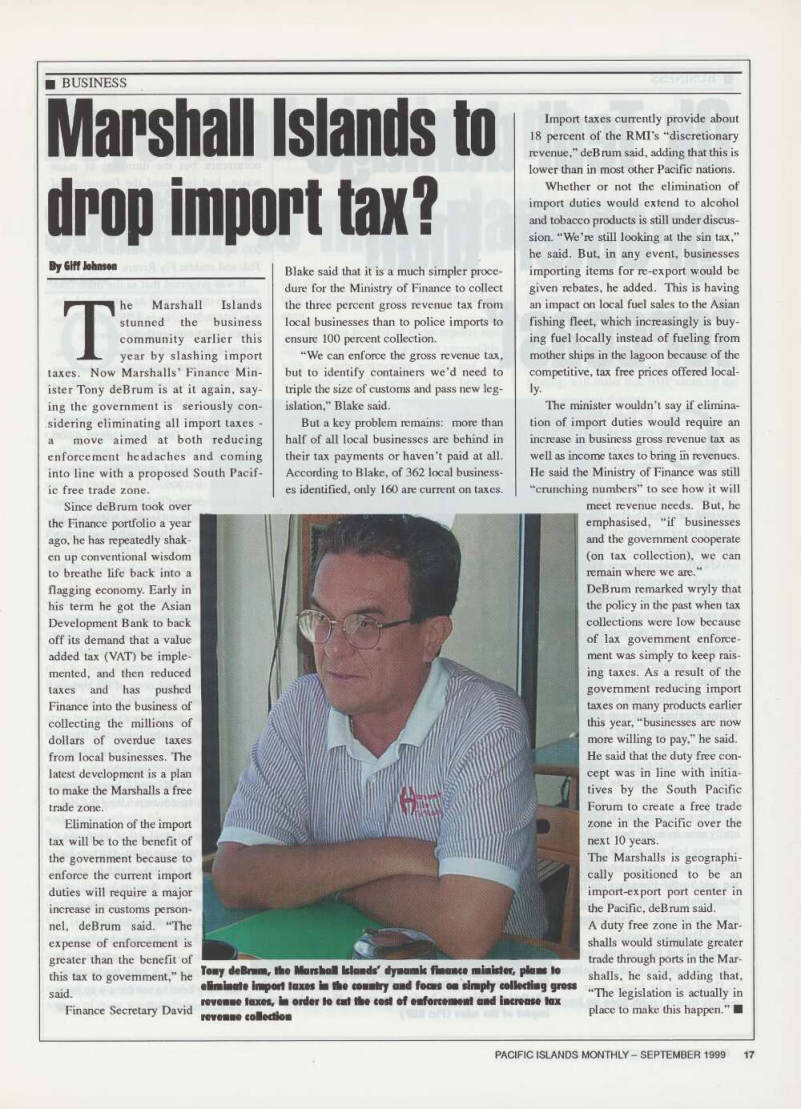
Tony deBrum, the Marshal Islands' dynamic finance minister, plans to eliminate import taxes in the country and focus on simply collecting gross revenue taxes, in order to cut the cost of enforcement and increase lax revenue collection
'greater than
Ok Tedi damage 'greater than forecast'
OK Tedi Mining Limited (OTML) has admitted that discharge from waste
dumps at the Ok Tedi copper mine in Western province had caused excessive flooding in a major river system, killing fish and vegetation.
OTML, majority owned by BHP, released reports in Papua New Guinea (PNG) mid-August verify ing earlier studies that the environ mental effects of the mine on areas around the Ok Tedi and Fly Rivers would be greater and more damag ing than anticipated.
OTML managing director Dr Roger Higgins said greater environ mental damage could leave the company open to claims by local landowners for higher compensa tion than is currently paid by
Otml.
“The environmental effects gen erally arise from the fact that by dis charging tailings which is eroded from our waste dumps into the river, we add to the already significant sediment flow of that river, exceed ing its capacity to transport sedi ment,” Dr Higgins said.
“Sediment fills up the bottom part of the channel, causing the river to flood over its banks more fre quently than it otherwise would.”
Dr Higgins said the increased flooding affected the capacity of vegetation sur rounding the rivers to cope with “getting its feet wet,” which led to defoliation, the death
of some trees, and a change in the type of vegetation near the river system.
Flooding along the river was a regular occurrence but the dumping of mine waste had increased the frequency of flooding in parts of the river from one quarter of each year to half of each year.
The flooding currently affected 400 to 500 square kilometres in the lower Ok Tedi and middle Fly Rivers.
It was projected that as the mine con tinued to operate until its anticipated clo sure date in 2010, up to 1,350 square kilo metres could eventually be affected.
Local areas would continue to be dam aged beyond the mine’s closure because contaminated sediment would still be moved through the river system.
Dr Higgins said the environmental damage had so far affected about 4,000 people in the lower Ok Tedi and middle Fly but that could eventually climb to
8,000 or 9,000.
The increased sediment in the rivers had smothered marine habitats and led to a “significant reduction in fish numbers.”
“It may get somewhat worse,” Dr
Higgins said.
But he said there were still more fish than required by the local people for subsistence purposes, and testing had shown that fish were still fit for con
sumption.
Dr Higgins said none of the options considered by Ok Tedi to halt the
pollution - including a tailings dam,
and dredging the lower Ok Tedi would have the desired environmen tal affect or were too risky.
He said OTML was in regular con tact with landowners along the river system.
“There’s no doubt that while they feel that they are entitled to be com pensated for damage - and we accept that - they see that the mine is the principal thing that creates benefits for them in the area,” he said.
“There is virtually no other form of economic activity or government activity, so they (the landowners) are very keen to see for a way for it to continue.” PNS ■
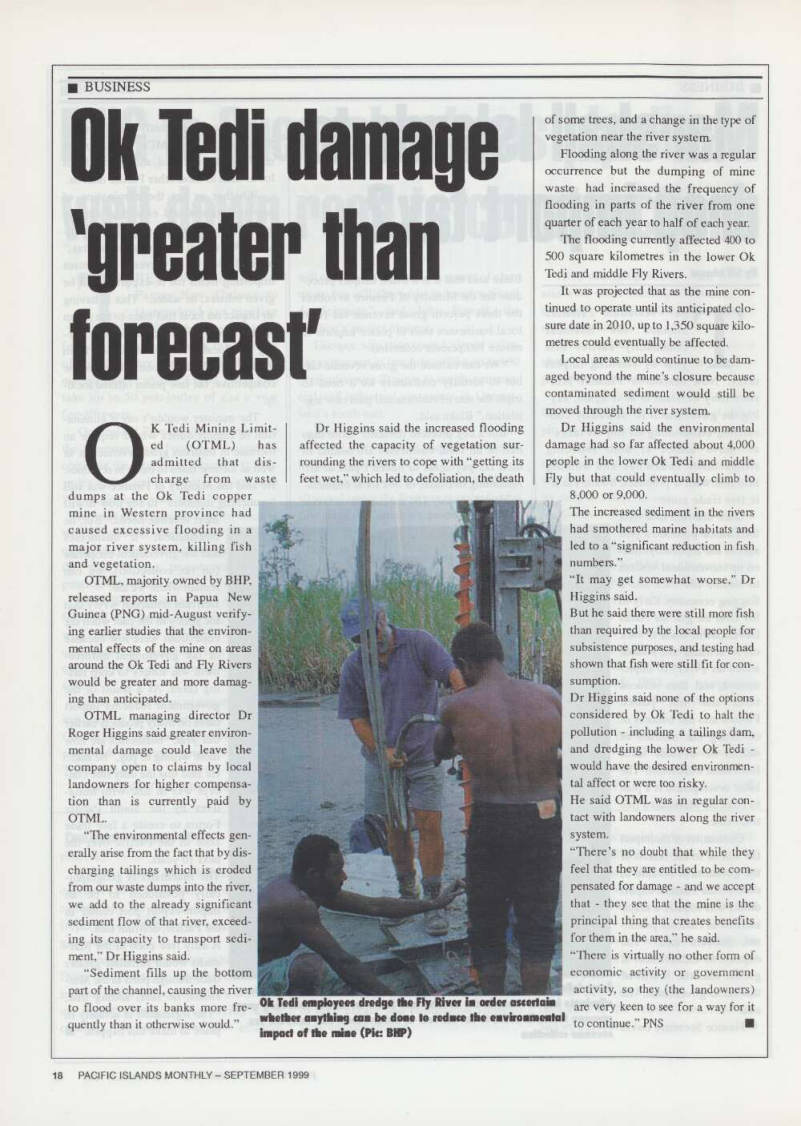
Ok Tedi employees dredge the Fly River in order ascertain whether anything can be done to reduce the environmental impact of the mine (Pic: BHP)
Beyind admission, no
solution to mino donum
By Bob Burton
ONE of Australia’s biggest mining compa nies has admitted major environment damage by a project in runs in Papua New
Guinea, but this does not necessarily bring a happy ending to the controversy.
The pressure has now shift ed to the near-bankrupt govern ment of Papua New Guinea and whether it can, and will, insist that Australia’s Broken Hill Proprietary (BHP) clean up the damage wrought by the Ok Tedi mine.
“The mine simply can’t continue to operate as it is.
There have to be changes made in the regulatory regime,” the Port Moresby-based manager of Ok Tedi Mining, Vincent Bull, told IPS.
“Obviously it is up to the state to make those judgments having taken into account the social, economic and environ mental interests that have to be accommodated,” he added.
BHP, which hopes the gold and copper mine’s future will be resolved at its November board meeting, released reports showing damage from mine waste that for well over a decade has flowed down the Ok Tedi river and destroyed food gardens, fishing grounds and villagers.
Four years after it ran an advertising campaign proclaiming that the 90 million tonnes of mine waste it dumped each year
into the Ok Tedi river were ‘ ’virtually iden tical” to natural sediment, BHP admitted its error.
“With the benefit of these reports and 20/20 hindsight, the mine is not compatible with our environmental values and the Company should never have become
involved,” said BHP managing director and chief executive officer Paul Anderson.
The environmental reports were released at a meeting of local government.
community and church leaders in Port
Moresby on August 11.
But despite BHP’s admission, commu nity groups in PNG are not optimistic that new Prime Minister Mekere Morauta, who was a founding director of Ok Tedi Mining, will insist that BHP clean up the
damage.
After all, the PNG gov ernment - which has a 30 percent stake on the Ok Tedi mine - is in dire straits.
Having taken office only in mid-July, the Morauta government is struggling to negotiate a financial rescue package with the International Monetary Fund and find enough revenue to cover social services.
With the Ok Tedi mine accounting for one-fifth of PNG exports, Morauta is under intense pressure that the mine continues.
On August 10, he launched an emergency mini-budget including tax changes designed to encourage mining and oil development to bring more hard currency into the country.
Activists say BHP’s responsibility does not end with the release of the environmental reports, which the firm
was forced to commission in 1996 after a legal settlement to a class action suit
Continued on page 20
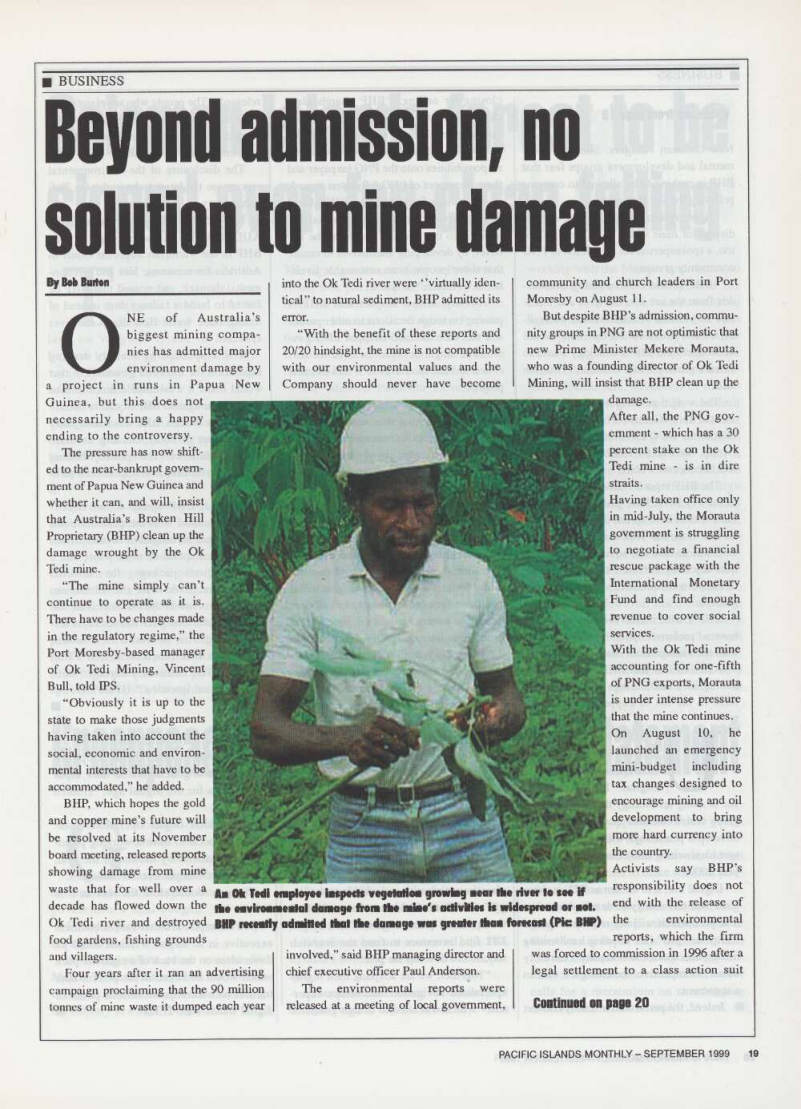
An Ok Tedi employee {aspects vegetalion growing near the river to see if the environmrntal damage from the mine's activities is widespread or not.
BHP receatly admitted that the damage was greater than forecast (Pic: BHP)
New Guinean villagers. Some environ mental and development groups fear that BHP is pushing to be allowed to continue polluting the Ok Tedi river.
“River systems should not be used to dispose of mine waste,” said Brian Brun ton, a spokesperson for a coalition of PNG community groups.
“BHP should cease pushing overbur den from the ore into the river and a new safe way should be found to deal with tail ings, even if this means the mine should be smaller, and new technology found to extract greater metal content,” Brunton said.
The coalition includes the Environ mental Law Centre, PNG Alliance of NGOs, the NGO Environmental Working Group, the Pacific Heritage Foundation and Greenpeace Pacific.
The BHP reports confirm that fisheries in the Fly River have been damaged and mine wastes have spread down 1,000 kilo metres of the Ok Tedi and Fly Rivers and across more than 100 square kilometres of land adjoining the river, killed large areas of forests and smothered village vegetable gardens.
BHP’s Bull insists the firm does not have a “preferred option” on how to deal with the damage from mine wastes.
Activists fear that BHP is considering adding its shareholdings in the Ok Tedi mine to the list of copper projects it is
closing or selling. “BHP shareholders should bear the environmental cost of (any) mine closure, and should not be allowed to offload their environmental responsibilities onto the PNG taxpayer and the government of PNG,” Brunton argued.
“If mining finishes early, BHP share holders should carry any cost of social dis location to the affected people of the Fly River, by developing alternatives to ensure that those people have sustainable liveli hoods in future,” he added.
Already, critics suspect that BHP is passing on tough decisions to other parties - in this case the cash-strapped PNG gov ernment caught between the need for rev enues and the ill effects of a flawed mine project.
They say BHP’s actions echo the approach of one of the world’s leading public-relations crisis managers, US-based Peter Sandman, who has advised BHP and other Australian mining firms to defuse local opposition by “outsourcing” hard decisions.
“Offer communities the choice of either insisting on environmental clean-up or trade possible benefits from the company for other social services,” Sandman has said. “This is a way of getting external groups to face hard choices, and of out sourcing controversial decisions that would have little credibility if made within the company.” Bull denies BHP is out sourcing the problem, but is unapologetic for not inviting the landowners who sued BHP to the briefing where the report was
released. “The people who are plaintiffs in the court case are represented by those elected representatives on their local gov ernment council,” he said.
The disclosure of the environmental reports are the latest twist in the Ok Tedi controversy.
In 1995, the PNG landowners filed a AUDS4 billion damage claim against BHP in the Victorian Supreme Court in Australia for economic loss and environ mental damage, and argued that BHP be forced to build a tailings dam instead of letting mine waste flow down the river systems.
BHP responded by secretly drafting legislation for the PNG government that would make it a criminal offence to take legal action against BHP in courts outside Papua New Guinea. BHP was found guilty of contempt of court, causing its share prices to plummet. (The contempt finding was later overturned on appeal on a tech nicality).
Stunned, BHP agreed to an out-of court settlement with the plaintiffs, one that included investigation of alternatives for proper disposal of mine waste and a compensation package for affected landowners. Even with the admission, groups involved in the Ok Tedi issue are not persuaded that BHP has learnt its les son. Asked what he would do if he was starting Ok Tedi from scratch, BHP’s Bull paused before cautiously saying; “Well, that’s a good question.” (IPS/PINA on line) ■
Upstart
Cold War making come back in high-tech pen
technology company Digital Ink Inc is using technology that
gives cruise missiles deadly accuracy to develop a pen it says will be able to con vert handwriting into computer text by the year 2000.
Digital Ink, also known as DI2, is using Cold War technology to develop the wire less pen, which will not require a special computer “pad” like existing handwriting recognition tools, the company’s minority owner, Competitive Technologies, said in a statement.
Indeed, the pen would instantly convert
a person’s handwriting on any surface into digital form for further use in a computer or other electronic device.
“The co-founders of DI2 are world class inventors with remarkable technolo gy,” said Peter Holden, an executive at
Competitive Technologies, which helped
DI2 find investors to fund the research required to develop the pen.
“Together, we are adapting their highly specialised navigation and sensor exper tise - which was used to design guidance
systems for cruise missiles in the Cold War - toward the development of a new generation of data input devices for the digital age,” Holden said.
DI2, which began operations mid- August, expects to have a working proto type of the device by the end of the year,
according to Competitive Technologies.
The pen would store the text as it is written.
For example, Holden said a business executive in an airport terminal could jot down ideas on the back of a cigarette pack which would be stored in the pen for later transfer onto a computer, cellular phone or digital watch. REUTERS ■
Advertisements & other items, p. 20 (1 item)
20
PACIFIC ISLANDS MONTHLY - SEPTEMBER 1999
Continued from page 19
■ BUSINESS
Solonon Islands forest is he
signed over for clear telling
THE government of the Solomon Islands has signed over 10,000 hectares of rainforest land on Vangunu Island in Marovo Lagoon to the logging company Syl vania Timber Products at a special ceremony in Honiara.
This is despite the Government’s pre vious promise to await the outcome of an intensive area-wide planning process that has been looking at economic alternatives to Sylvania’s oil palm plantation propos al.
Sylvania is proposing to clear fell some 6,000 hectares of land, known as Lot 16, to establish an oil palm plantation.
The company has also expressed inter est in extending the oil palm plantation into surrounding areas of virgin rainforest held under customary tenure.
Oil palm, which is grown for its oil by product, is notorious throughout the Pacific because it wipes out native forests, strips soils of nutrients and pollutes near by rivers and reefs through soil run-off.
The signing-over ceremony at Parliament House took place despite strong opposition from the landowners represented by the Marovo Butubutu Development Founda tion and the Marovo Council of Chiefs. The landowners have fought Sylvania’s plan to clear fell Lot 16 for the past three years.
The Marovo Butubutu Development Foundation and Marovo Council of Chiefs argue that clear-felling the land will have dramatic environmental impacts including high levels of soil erosion on land and silta tion of Marovo Lagoon which is being pro posed for listing as a World Heritage site.
They are also concerned about oil palm’s high nutrient demand that is likely to deplete the weathered volcanic soils of the island, increasing the need for massive doses of nitrate and phosphate fertilisers.
The people fear that the fertiliser would leach straight through the topsoil and into the coral-rich lagoon where it would gener ate ecologically dangerous levels of eutrophication. WWF, through its five year-old Community Resource Conserva tion and Development project has been
working with the Marovo landowners to research alternative developments for Lot 16. Proposals include sustainable agricultural and forestry alternatives such as replanting the areas Sylvania has already logged with Balsa (a high value export commodity that requires no indus trial infrastructure, bulldozers or roads unlike oil palm); growing high value fruit and vegetables for domestic and tourist markets; and developing the ecotourism potential of Marovo Lagoon. 'Only a very few of the landowners of Marovo were made aware of the intended sign over. At a meeting in May with Solomon prime minister, Bartholomew Ulufa’alu, the landowners were assured that no decision would be made until the Gov ernment received an alternative develop ment proposal agreed by all the Marovo landowners. However, since then, there has been major civil unrest in the country arising from long-held tensions between the Maiaitan and Guadalcanal communi ties. This led to the imposition of a State of Emergency which is still in force. ■
Greenpeace applauds log tax reinstatement
Greenpeace wel
comed the reinstate ment of log export taxes to 1998 levels as announced in the Papua New guinea government’s mini-budget.
Forests specialist Brian Brunton says it’s a good move.
“We congratulate prime minister Sir Mekere Morauta and urge him not to listen to loggers who threaten the taxes will bring the industry to a halt,” Brunton said.
The Forest Industry Association claims the reinstatement of the taxes will mean loggers won’t be able to pay royalties to landowners.
Brunton rubbishes this claim, and asks Sir Mekere to now look at the role the FIA plays on the Forest Authority Board.
“As far as we are concerned, the FIA shouldn’t be sitting on that board at all,” he said.
Greenpeace and other environmental non-govemment organisations have been
vocal in their opposition of last year’s decision to reduce log taxes.
“The tax reductions allowed foreign logging companies to make windfall prof its”, said Brunton.
“It led to an increase in export log ging. Export logging is the main cause of forest loss in Papua New Guinea. It is in this environment that we urge the govern ment of Sir Mekere to consider our earlier calls for a moratorium on new logging concessions,” Brunton said. ■
New technology uses industrial waste
to create clean-burning gas
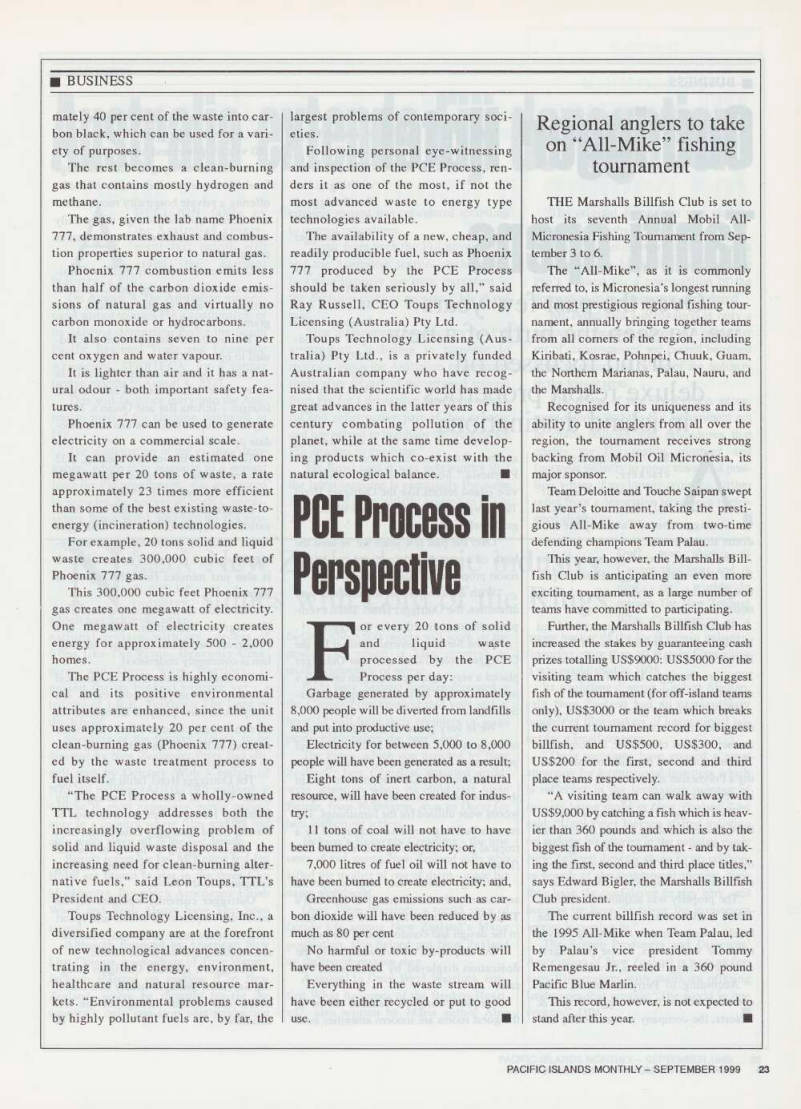
THERE have been many people who wished that rubbish would be put to good use, and not just dumped to create health and environ mental timebombs.
Now an Australian company is push ing product that it claims uses munici pal and industrial rubbish to create energy.
After many years of development the first commercial-size PCE Process unit was demonstrated at Toups Tech nology Licensing’s Environmental Solutions Division R & D centre head quarters in Tampa Bay, Florida, USA on July 27th, 1999.
The proprietary process is said to turn hydrocarbon-based solid and liquid waste, from household or industrial, into a clean-burning fuel and carbon black.
Now this technology is to be intro duced throughout Asia-Pacific, Africa, the Middle East and the Indian sub-con tinent through Touts Technology Licensing (Australia) Pty Ltd.
Third world countries, islands, small towns, large municipalities and manu facturing plants, are seen as prime can didates for full utilisation of this tech nology.
Hydrocarbon-based garbage repre sents approximately 86 per cent of our
waste stream. Most finds its way into landfills, while the balance is inciner ated.
This traditional method of disposal presents two serious environmental problems: landfills produce leachate, or ‘garbage juice’ a toxic runoff that can contaminate groundwater; incin erators have toxic emissions, includ ing ‘fly ash,’ which often escapes into
the atmosphere.
TTL’s unique PCE Process, on the other hand, treats hydrocarbon-based waste in a closed system without releasing harmful emissions, fluids or solids to the environment. The non burning system transforms approxi
The proprielary process is said lo turn hydrocarbon-based solid aad liquid waste, from household or industrial, into a dean-burning fuel and carbon black. Third world countries, islands, small towns, large municipalities and manufacturing plants, are seen as prime candidates for full utilisation of this technology
mately 40 per cent of the waste into car bon black, which can be used for a vari ety of purposes.
The rest becomes a clean-burning gas that contains mostly hydrogen and methane.
The gas, given the lab name Phoenix 777, demonstrates exhaust and combus tion properties superior to natural gas.
Phoenix 777 combustion emits less than half of the carbon dioxide emis sions of natural gas and virtually no carbon monoxide or hydrocarbons.
It also contains seven to nine per cent oxygen and water vapour.
It is lighter than air and it has a nat ural odour - both important safety fea tures.
Phoenix 777 can be used to generate electricity on a commercial scale.
It can provide an estimated one megawatt per 20 tons of waste, a rate approximately 23 times more efficient than some of the best existing waste-to energy (incineration) technologies.
For example, 20 tons solid and liquid waste creates 300,000 cubic feet of Phoenix 777 gas.
This 300,000 cubic feet Phoenix 777 gas creates one megawatt of electricity.
One megawatt of electricity creates energy for approximately 500 - 2,000 homes.
The PCE Process is highly economi cal and its positive environmental attributes are enhanced, since the unit uses approximately 20 per cent of the clean-burning gas (Phoenix 777) creat ed by the waste treatment process to fuel itself.
“The PCE Process a wholly-owned TTL technology addresses both the
increasingly overflowing problem of
solid and liquid waste disposal and the increasing need for clean-burning alter native fuels,” said Leon Toups, TTL’s President and CEO.
Toups Technology Licensing, Inc., a
diversified company are at the forefront of new technological advances concen trating in the energy, environment, healthcare and natural resource mar kets. “Environmental problems caused by highly pollutant fuels are, by far, the
largest problems of contemporary soci eties.
Following personal eye-witnessing and inspection of the PCE Process, ren ders it as one of the most, if not the most advanced waste to energy type
technologies available.
The availability of a new, cheap, and readily producible fuel, such as Phoenix 777 produced by the PCE Process should be taken seriously by all,” said Ray Russell, CEO Toups Technology Licensing (Australia) Pty Ltd.
Toups Technology Licensing (Aus tralia) Pty Ltd., is a privately funded Australian company who have recog nised that the scientific world has made great advances in the latter years of this century combating pollution of the planet, while at the same time develop ing products which co-exist with the natural ecological balance. ■
Perspective
PCE Process in Perspective
For every 20 tons of solid and liquid waste processed by the PCE Process per day: Garbage generated by approximately 8,000 people will be diverted from landfills and put into productive use; Electricity for between 5,000 to 8,000 people will have been generated as a result; Eight tons of inert carbon, a natural resource, will have been created for indus try; 11 tons of coal will not have to have been burned to create electricity; or, 7,000 litres of fuel oil will not have to have been burned to create electricity; and, Greenhouse gas emissions such as car bon dioxide will have been reduced by as much as 80 per cent No harmful or toxic by-products will have been created Everything in the waste stream will have been either recycled or put to good use. ■
Regional anglers to take
on “All-Mike” fishing
tournament
THE Marshalls Billfish Club is set to host its seventh Annual Mobil All- Micronesia Fishing Tournament from Sep tember 3 to 6.
The “All-Mike”, as it is commonly referred to, is Micronesia’s longest running and most prestigious regional fishing tour nament, annually bringing together teams from all comers of the region, including Kiribati, Kosrae, Pohnpei, Chuuk, Guam, the Northern Marianas, Palau, Naum, and the Marshalls.
Recognised for its uniqueness and its ability to unite anglers from all over the region, the tournament receives strong backing from Mobil Oil Micronesia, its major sponsor.
Team Deloitte and Touche Saipan swept last year’s tournament, taking the presti gious All-Mike away from two-time defending champions Team Palau.
This year, however, the Marshalls Bill fish Club is anticipating an even more exciting tournament, as a large number of teams have committed to participating.
Further, the Marshalls Billfish Club has increased the stakes by guaranteeing cash prizes totalling US$9OOO: US$5OOO for the visiting team which catches the biggest fish of the tournament (for off-island teams only), US$3OOO or the team which breaks the current tournament record for biggest billfish, and US$5OO, US$3OO, and US$2OO for the first, second and third place teams respectively.
“A visiting team can walk away with US$9,OOO by catching a fish which is heav ier than 360 pounds and which is also the biggest fish of the tournament - and by tak ing the first, second and third place titles,” says Edward Bigler, the Marshalls Billfish Qub president.
The current billfish record was set in the 1995 All-Mike when Team Palau, led by Palau’s vice president Tommy Remengesau Jr., reeled in a 360 pound Pacific Blue Marlin.
This record, however, is not expected to stand after this year. ■
Outrigger Hotel
Tahiti opens
Over the past few years we’ve seen the birth of a new brand focussed on deluxe resort properties in island destinations
AMIDST popping fire crackers, a Chinese lion dance and colour ful Tahitian fanfare, the Outrigger hotel Tahiti opened its doors to the public.
The deluxe, oceanfront resort is the first of three to six Outrigger Hotel proper ties planned for the islands of French Poly nesia.
Situated on a picturesque oceanfront location with panoramic views of Papeete Harbour and the island of Moorea, the 200-room Outrigger Hotel Tahiti features many unique and luxurious touches.
These include a grand staircase, pan danus-decorated vaulted ceiling with mother-of-pearl chandelier, custom-made Tahitian quilts, and beautiful murals evok ing a Polynesian ambiance and decor rem iniscent of a romantic bygone era.
The Outrigger Hotel Tahiti is built on the 6.2 acre site of the former hotel Tahiti - the 1960 s gathering place originally owned by the late Hawaiian restaurateur and businessman Spencer F. Weaver, Jr.
The property was acquired in 1996 by Tahiti businessman Louis Wane. The hotel’s location makes it uniquely conve nient for vacationers, cruise passengers and international business travellers.
According to Perry Sorenson, chief operating officer for Outrigger Hotels & Resorts, the company is considering fur
ther expansion in French Poly nesia.
“These are exciting times
for Outrigger,”
Sorenson said.
“The Outrigger
Hotel Tahiti is now open. The Outrigger Moo r e a Lagoon will open in mid -2000. The Out rigger Bora Bora is in the design stage.
And we’re considering
another three possible resorts in French Polynesia.” Sorenson added that full-ser vice island resorts like the Outrigger Hotel Tahiti represents the future face of Outrig ger Hotels & Resorts.
“Over the past few years we’ve seen the birth of a new brand focussed on deluxe resort properties in island destinations.
“With its exceptional architecture and amenities, the Outrigger Hotel Tahiti exem plifies the new direction for Outrigger.”
Wayne Sterling, general manager for the Outrigger Hotel Tahiti, said that Outrigger placed a very high importance on creating a hotel that would be true to its special loca tion.
“We’re very proud of the Tahitian sense of design that is reflected in the rooms and public areas of the property,” Sterling said.
Traditional Tahitian colours were used in the guest rooms and richly appointed exotic woods were utilised for the furnishings. Hie resort’s buildings are also surrounded by a tropical garden displaying native plants and flowers.
Sterling credits the resort’s special ambiance to the involvement of the hotel’s Tahiti-based owners, Louis and Lulu Wane, in the design and construction of the hotel.
“Our employees are overwhelmed by the dedication displayed by the owners,” he said.
Complementing the Tahitian theme in the guest rooms are modem amenities such
as air-conditioning, refrigerator, in-room
safe, coffee maker, cable TV, data port, 110 volt a/c power and Janai.
An exclusive Voyagers Club concierge level of accommodations is also available, offering a private hospitality room, exten sive library and club lounge where daily continental breakfast and evening snacks are served.
Other resort amenities include a busi ness centre, swimming pool, Jacuzzi, complete water sports activities pro gramme and shops.
The health and fitness centre is sched uled to open in 2000.
Dining options include Moevai, an “over-water” restaurant, and two cocktail lounges - TeAma Bar and Quinn’s. Meet ing and banquet facilities can accommo date up to 500 persons.
To celebrate the resort’s opening, a 35 per cent discount off regular rates is avail able until December 18, 1999.
Located five minutes from Faa’a Inter national Airport (PPT), the Outrigger Hotel Tahiti is one of the most conve niently situated properties on the island. It is also just minutes from the capital of Papeete.
Tahiti has an average temperature of 79 degrees Fahrenheit. Tahitian and French are the official languages but Eng lish is commonly understood.
The French Pacific Franc is the local currency but major credit cards are accepted. A valid passport is required for all non-French citizens. Most visitors are required to have a visa and all must have an outbound ticket.
The Outrigger Hotel Tahiti is owned by Louis Wane of Tahiti and managed by Outrigger Hotels & Resorts, a division of Hawaii-based Outrigger Enterprises, Inc., the largest lodging company in Hawaii and one of the fastest growing lodging companies in the Pacific.
Outrigger currently operates or has under development 45 hotels and resort condominium units in Hawaii, Microne sia, Australia and the South Pacific.
Outrigger’s affiliate, Outrigger Lodg
ing Services, manages nearly two dozen hotels and resorts throughout the US mainland. ■
Australia extends Fiji derogation

A DECISION taken by the Australian govern ment last month will assist the garment industry in Fiji.
On August 4, the Australian govern ment agreed to grant Fiji a continuation of its existing derogation under the South Pacific Regional Trade and Economic Agreement, SPARTECA, for a further twelve months to August 4, 2000.
This will facilitate entry into the Aus tralian market for clothing produced in Fiji.
The continuation of the existing dero gation, which is in response to a request from the Fiji government, was announced in Suva by the Australian High Commis sioner, Susan Boyd, who said the Fiji gov
eminent request was considered according to normal procedures.
“Input from both the Fiji government and the Australian textile, clothing and footwear industry has been important in the decision-making process,” Ms Boyd said.
“The information provided by the Fiji government, including in response to requests which the Australian government made after receipt of the original request from Fiji for a derogation, has been a help ful and constructive part of that process and has helped to highlight the importance Fiji attaches to this issue.”
Ms Boyd said it was noteworthy that the latest outcome is essentially the same as the derogation initially granted to Fiji in 1998.
The original derogation was granted for twelve months in May 1998.
A further continuation for three months was granted in May this year to enable Fiji’s request for a continuation of the derogation to be adequately considered.
Ms Boyd said a derogation is only a temporary measure related to a particular set of circumstances and cannot be relied upon to secure the future of the industry in the longer term.
The terms of the SPARTECA agree ment require that the Fiji government put in place policies and procedures that enable the Fiji textile, clothing and footwear industry to move towards a posi tion where it no longer requires further relief from a derogation to achieve prefer ence eligibility. ■
New Zealand movie industry
shines with Lord of the Rings
Ne V/
Zealand’s movie industry, which has achieved inter
national acclaim with the success of films like The Piano, Heavenly Crea tures and Once Were Warriors, is poised for its biggest venture yet - a trilogy of J.R.R. Tolkien’s The Lord of
the Rings.
Shooting of the fantasy classic, to be directed by New Zealander Peter Jackson, will start by October. With a budget of NZ$36O milllion (AUD5279.2 million), it will be th most expensive movie project ever in a country where film-making has only really taken off in the last decade.
British actors Sir lan McKellen and lan Holm are tipped to star in the three-film blockbuster, for which Americans Elijah Wood and Sean Austin have also been signed.
Although financed by American New Line Cinema, a subsidiary of Time Warner, Jackson insisted on making it in New Zealand, where he recently bought the country’s only one-stop post-production
facility. About 500 people will work on the production, which is also reported to require thousands of extras.
Eight New Zealand features screened at the Cannes Film Festival this year and at least 12 will have their premiers or go to productionh before the year’s end.
The Piano, which was directed by New Zealander Jane Campion, attracted world wide attention when its child star Anna Paquin, from Wellington, won an Oscar for best supporting actress.
Jackson’s Heavenly Creatures - the true story of two young New Zealand girls who killed the mother of one of them - made his name worldwide.
Once Were Warriors, a torrid saga of family life among New Zealand’s Marie population, also helped put New Zealand on the movie-making map.
A sequel to Once Were Warriors, enti tled What Becomes of the Broken-Heart ed?, also written by Marie author Alan
Duff, was shown at Cannes this year and is now on worldwide release. The New Zealand Film Commission is a
major backer of the local movie industry, financing more than 60 feature films since it was established in 1978.
Its marketing director, Lindsay Shelton, said New Zealand had an extraordinary number of film-makers of international tal ent for a small country.
“Their successes have proved a great attraction for international investors which is reflected in the increasing number of movies being made in New Zealand,” he said. “Until Peter Jackson started insisting on making his movies in the country, every New Zealand director chose to go offshore in search of the investment money. Now they have the confidence to stay here, and because we have the talent, the investment money is coming in.”
The Screen Producers and Directors’
Association of New Zealand is wooing for eign film-makers with publicity offering landscapes that provide “The world in one country”. DPA ■
US companies offer to trade cash
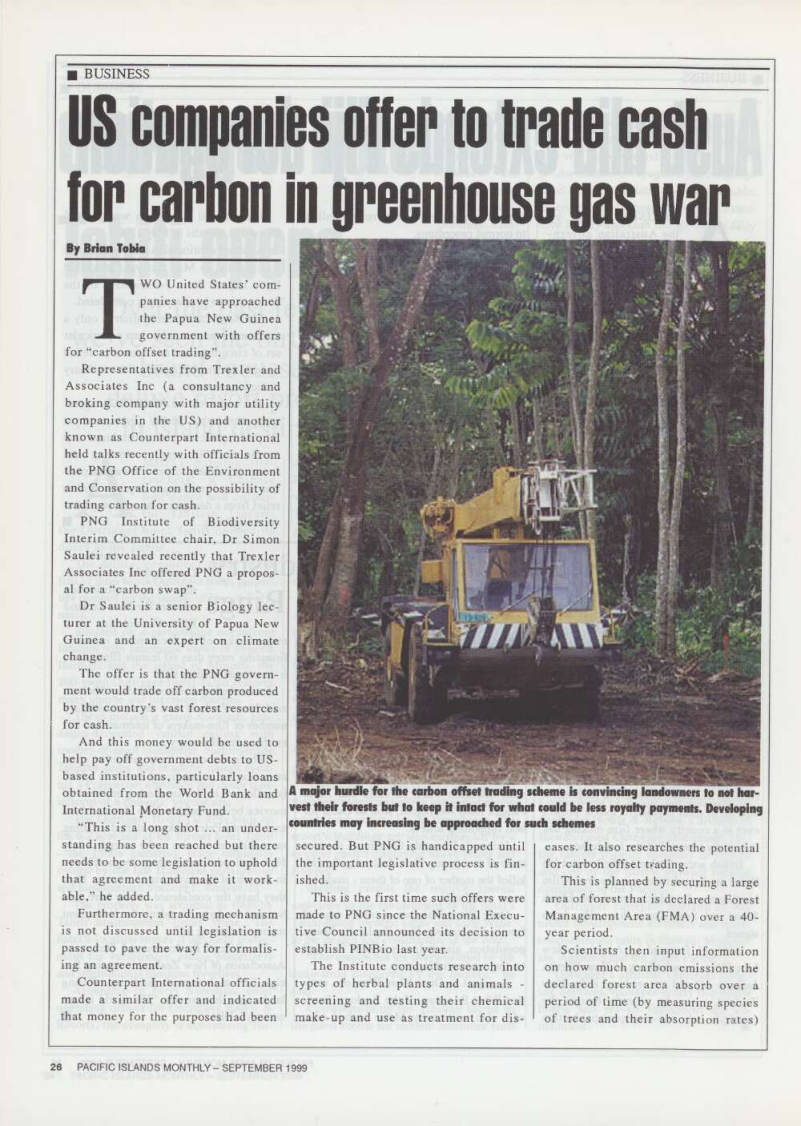
for carbon in greenhouse gas war
By Brian Tobia
TWO United States’ com panies have approached the Papua New Guinea government with offers for “carbon offset trading”.
Representatives from Trexler and Associates Inc (a consultancy and broking company with major utility companies in the US) and another known as Counterpart International held talks recently with officials from the PNG Office of the Environment and Conservation on the possibility of trading carbon for cash.
PNG Institute of Biodiversity Interim Committee chair, Dr Simon Saulei revealed recently that Trexler Associates Inc offered PNG a propos al for a “carbon swap”.
Dr Saulei is a senior Biology lec turer at the University of Papua New Guinea and an expert on climate change.
The offer is that the PNG govern ment would trade off carbon produced by the country’s vast forest resources for cash.
And this money would be used to help pay off government debts to US based institutions, particularly loans obtained from the World Bank and International Monetary Fund.
“This is a long shot ... an under standing has been reached but there needs to be some legislation to uphold that agreement and make it work able,” he added.
Furthermore, a trading mechanism is not discussed until legislation is passed to pave the way for formalis ing an agreement.
Counterpart International officials made a similar offer and indicated that money for the purposes had been
secured. But PNG is handicapped until the important legislative process is fin ished.
This is the first time such offers were made to PNG since the National Execu tive Council announced its decision to establish PINBio last year.
The Institute conducts research into types of herbal plants and animals screening and testing their chemical make-up and use as treatment for dis
eases. It also researches the potential for carbon offset trading.
This is planned by securing a large area of forest that is declared a Forest Management Area (FMA) over a 40year period.
Scientists then input information on how much carbon emissions the declared forest area absorb over a period of time (by measuring species of trees and their absorption rates)
A major hurdle for the carbon offset trading scheme is convincing landowners to not har vest their forests but to keep it intact for what could be less royalty payments. Developing countries may increasing be approached for such schemes
and set the swap or trading rate. But Dr Saulei said the hurdle would be persuading landowner groups in PNG to agree to pursue this revenue raising option rather than logging.
He said there had to be wider con sultation with investors and resource owners. This is necessary because the first project of a similar nature in the southern part of the New Ireland province had failed.
Another US company, Compac, had an agreement with Lak landown ers under which US$2 million was to be paid to them in exchange for con serving 12,000 hectares of forests.
Because developed
countries can only
reduce to about 5.2
per cent by 2020,
developing countries
are required to adopt
a system called Green
Development Mecha
nism to make a sub
stantial reduction in
greenhouse gases
The landowners reneged on the deal and allowed the forest area to be logged. Because of huge royalty ben efits to landowners from logging, it is hard to persuade them to choose car
bon trading.
But Dr Saulei said they could ben efit through royalties from an intact forest or royalties from forest which would no longer exist after logging.
Carbon offset trading option is also being plugged because of the biodi versity in PNG’s forests.
They hold various kinds of medici nal plants and animals that could be developed later for better returns.
The proposal is also in with the Kyoto Protocol. Because developed countries can only reduce to about 5.2 per cent by 2020, developing coun tries are required to adopt a system called Green Development Mecha nism to make a substantial reduction
in greenhouse gases. This conserves forests that can offset or absorb huge quantities of emissions. Developed countries would then compensate their developing country partner.
But the legal approach to the issue of carbon offset trading and ownership of property rights of forest products is proving to be a problem.
Lawyers from the Attorney Gener al’s office are trying two options - a multi-party MOU and a Joint Articles of Association with the International institute of Environment and Develop ment (IIED).
But these options, suggested by an AusAID representative, were not appealling to PNG. PNG believes there is a need to have a mechanism in place through which PINBio must raise its own revenue.
“PNG cannot afford to have the patent of local medicinal plants and herbs taken over by foreign pharma ceutical companies.
“What they will do is make products from our flora and fauna species ... they will therefore own the property rights and only pay us levy,” he added.
This issue was raised with lIED but the PNG parliament has to pass legis lation to safeguard PNG’s rights over its noble products. “While this legisla tion is a long way away, the discovery of noble products are already happen ing and we are missing out,” he said.
State lawyers were advised to look at appropriate legislation to safeguard PNG’s property rights. It is still unclear what stage the lawyers are at in terms of drafting the legislation.
The patent right of a product remains with whoever is developing it and not where the product originated from.
Once developed, the proposed leg islation has to go through a long process from the office of the Environ ment and Conservation to the minister, to the National Executive Council and then to parliament.
Because of the lengthy process, it is imperative that it get off the ground soon because the discovery of products are already at an advanced stage. ■
Advertisements & other items, p. 27 (1 item)
Marks
NOTICE
KIKKOMAN
TRADE
MARKS
Notice is hereby given that Kikkoman Corporation, a corporation duly organised and existing under the laws of Japan, of 339, Noda, Noda City, Chiba, Japan, is the sole proprietor in Nauru and elsewhere of the following Trade Marks:
KIKKOMAN
Used in respect of the following: Coffee, tea, cocoa, sugar, rice, tapioca, sago, coffee substitutes, flour, and preparations made from cereals, bread, biscuits, cakes, pastry and confectionery, ices, honey, treacle, yeast, baking powder, salt, mustard, pepper, vinegar, sauces, spices, ice.
The proprietor claims all rights in respect of the above Trade Marks and will take all necessary legal steps against any person or company infringing those rights.
F.B. RICE & CO.
PATENT ATTORNEYS,
Sydney, Australia 124127V1
New tax presents a vat full of problems
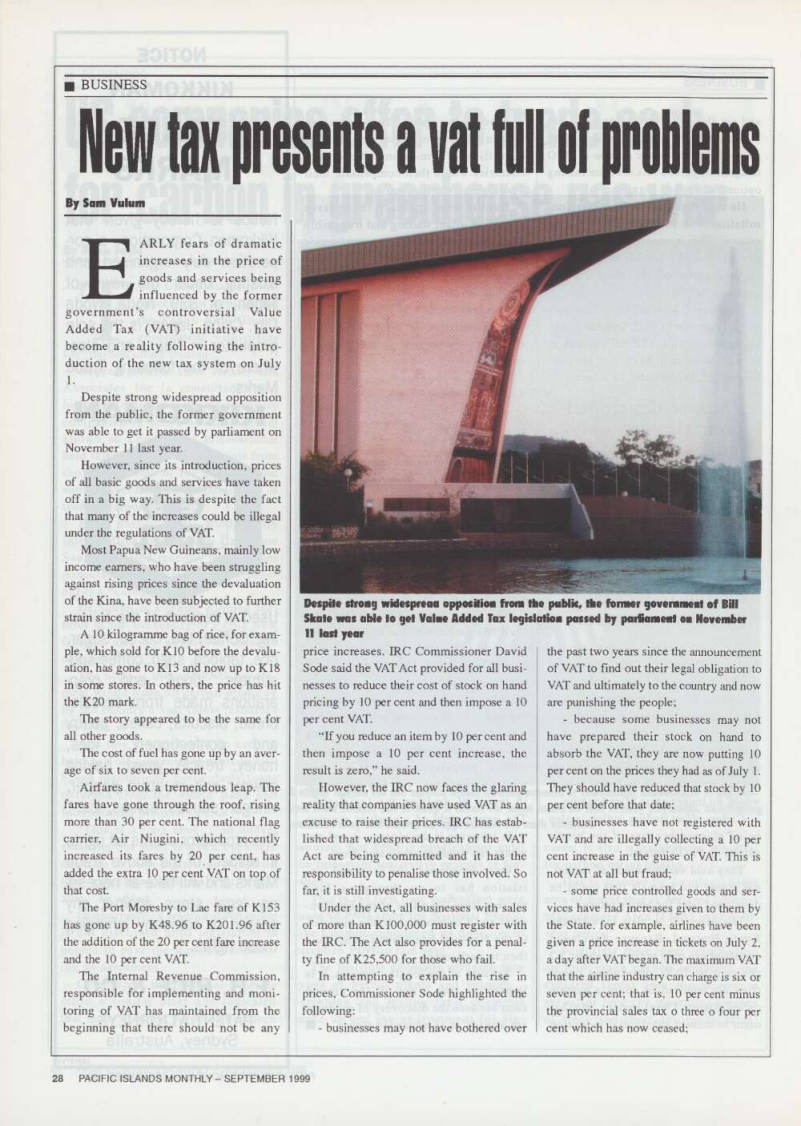
By Sam Vulum
EARLY fears of dramatic increases in the price of
goods and services being
influenced by the former government’s controversial Value Added Tax (VAT) initiative have become a reality following the intro duction of the new tax system on July 1.
Despite strong widespread opposition
from the public, the former government was able to get it passed by parliament on November 11 last year.
However, since its introduction, prices of all basic goods and services have taken off in a big way. This is despite the fact that many of the increases could be illegal under the regulations of VAT.
Most Papua New Guineans, mainly low income earners, who have been struggling
against rising prices since the devaluation
of the Kina, have been subjected to further strain since the introduction of VAT.
A 10 kilogramme bag of rice, for exam ple, which sold for KlO before the devalu ation, has gone to Kl 3 and now up to KlB in some stores. In others, the price has hit the K2O mark.
The story appeared to be the same for all other goods.
The cost of fuel has gone up by an aver age of six to seven per cent.
Airfares took a tremendous leap. The fares have gone through the roof, rising more than 30 per cent. The national flag carrier, Air Niugini, which recently increased its fares by 20 per cent, has added the extra 10 per cent VAT on top of that cost.
The Port Moresby to Lae fare of K 153 has gone up by K 48.96 to K 201.96 after the addition of the 20 per cent fare increase and the 10 per cent VAT.
The Internal Revenue Commission, responsible for implementing and moni toring of VAT has maintained from the beginning that there should not be any
the past two years since the announcement of VAT to find out their legal obligation to VAT and ultimately to the country and now
are punishing the people;
- because some businesses may not have prepared their stock on hand to absorb the VAT, they are now putting 10 per cent on the prices they had as of July 1.
They should have reduced that stock by 10 per cent before that date; - businesses have not registered with VAT and are illegally collecting a 10 per cent increase in the guise of VAT. This is not VAT at all but fraud; - some price controlled goods and ser vices have had increases given to them by the State, for example, airlines have been given a price increase in tickets on July 2, a day after VAT began. The maximum VAT that the airline industry can charge is six or seven per cent; that is, 10 per cent minus the provincial sales tax o three o four per cent which has now ceased;
price increases. IRC Commissioner David Sode said the VAT Act provided for all busi nesses to reduce their cost of stock on hand pricing by 10 per cent and then impose a 10 per cent VAT.
“If you reduce an item by 10 per cent and then impose a 10 per cent increase, the result is zero,” he said.
However, the IRC now faces the glaring reality that companies have used VAT as an excuse to raise their prices. IRC has estab lished that widespread breach of the VAT Act are being committed and it has the responsibility to penalise those involved. So far, it is still investigating.
Under the Act, all businesses with sales of more than K 100,000 must register with the IRC. The Act also provides for a penal ty fine of K 25,500 for those who fail.
In attempting to explain the rise in prices, Commissioner Sode highlighted the
following:
- businesses may not have bothered over
Despite strong widespread opposition from the public, the former government of Bill Skate was able to get Value Added Tax legislation passed by parliament on November 11 last year
- the Kina devaluation will always influence the price of goods and this has been evident at all other times apart from July 1. Most of the stock now being sold by the ships is old stock which will have been imported when the Kina was low.
VAT was introduced to broaden the tax base of the country by reducing the import duty rates to enable manufacturing and local or domestic producers to be more efficient.
Areas free of VAT are education, health, banking fees and interests, the finance industry, export of manufacturing
goods and primary products.
VAT replaces the old 15.5 per cent tax on goods and services, which comprised an import duty of 11 per cent, a drought levy of 1.5 per cent and a provincial sales tax of 3.0 per cent.
Anti-VAT campaigners, including MPs,
Morobe governor Luther Wenge and Cen tral governor Tedi Diro, had foreseen the negative impact but their attempts to delay VAT’s introduction failed.
Governor Wenge, in particular, stood out with this legal action threat over the introduction of VAT in the Morobe
province but his around-the-provinces
anti-VAT campaign could not win enough support.
Both leaders, with several other con cerned MPs staged a rally in Port Moresby in an effort to drum up public support, but their efforts also failed.
The leaders feared that the provinces, who were once benefiting from the three per cent sale tax, might miss out under VAT because all their share of revenue would be distributed from a central trust fund held at the Bank of PNG.
They also argued that although the VAT was good for PNG, the timing was not right, especially when the country was going through all sorts of economic prob lems.
However, the former government, which was under extreme pressure by a forecasted shortfall in its revenue collec tion for 1999 and possible legal action in the event of a delay, could not afford to defer the VAT’s introduction. As it was, it did no help ensure the survival of that gov ernment. ■
US bankruptcy
South Pacific Iridium in good form despite US bankruptcy
THE South Pacific arm of the satellite telephone consortium Iridium has reassured southern cus tomers it would be business as usual following the financial restructure of its US-based operations.
Iridium LLC, in Washington, announced mid-August it would pursue a comprehensive financial restructure through a voluntary Chapter 11 filing in the US Bankruptcy Court in Delaware.
But a statement issued by Iridium South Pacific said it was an indepen dent Australian telecommunications carrier majority-owned by Japanese electronics and telecommunications giants DDI Corporation and Kyocera
Corporation and traded separately from Iridium LLC.
“While we are confident Iridium LLC will successfully restructure in the US, in reality it has no operational impact on Iridium South Pacific,” the company’s chief executive officer Carl ton lennings said. “We will continue to
provide excellent and uninterrupted
global service to our customers.”
Jennings said the South Pacific busi ness was robust and had grown signifi
cantly since it implemented sharpened
value for customers through simplified satellite call and equipment pricing on July 1. Iridium phones are especially popular for mining and agricultural industries. (AAP) ■
Black pearl production to be
stepped up in the Marshall Islands
PRODUCTION of pearl
oysters is being stepped
up in the Marshalls fol lowing successful har vests of high-quality pearls.
After more than five years of painstak ing research, Black Pearls of Micronesia (BPOM), is expanding its hatchery and farm in Majuro to move into larger volume commercial production, according to Dale Sarver, president of the company.
They are attempting to follow in the footsteps of companies in French Polyne sia and the Cook Islands. These island countries have managed to turn pearl pro
duction into multi-million dollar indus tries employing hundreds of islanders.
The French Polynesian industry is the most developed in the region, while the Cook Island one still has teething prob lems.
“As well as expanding BPOM’s own nucleus’ farm, we would like to involve Marshallese partners in developing satel lite farms in the surrounding lagoon,”
Sarver said, adding that BPOM is ready to begin this expansion.
A recent “harvest has shown that this lagoon can produce superb pearls,” Sarv er said. (AFP) ■
Murder, intrigue and death penalty
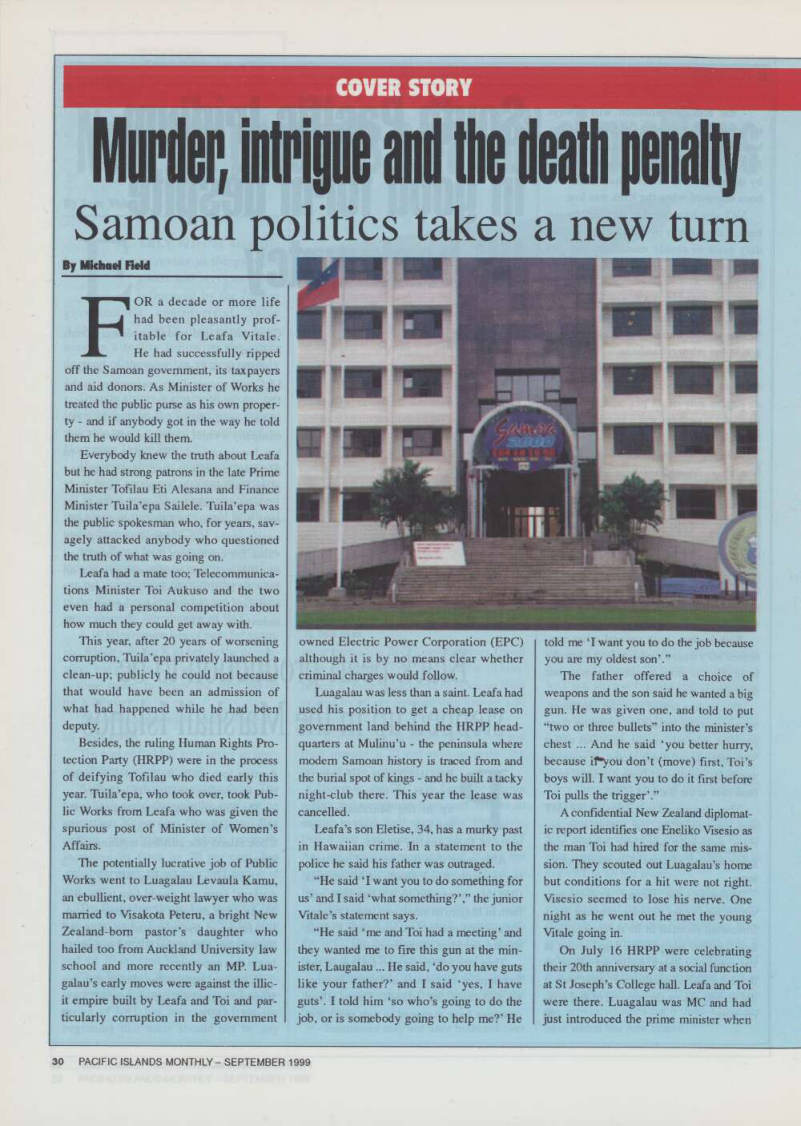
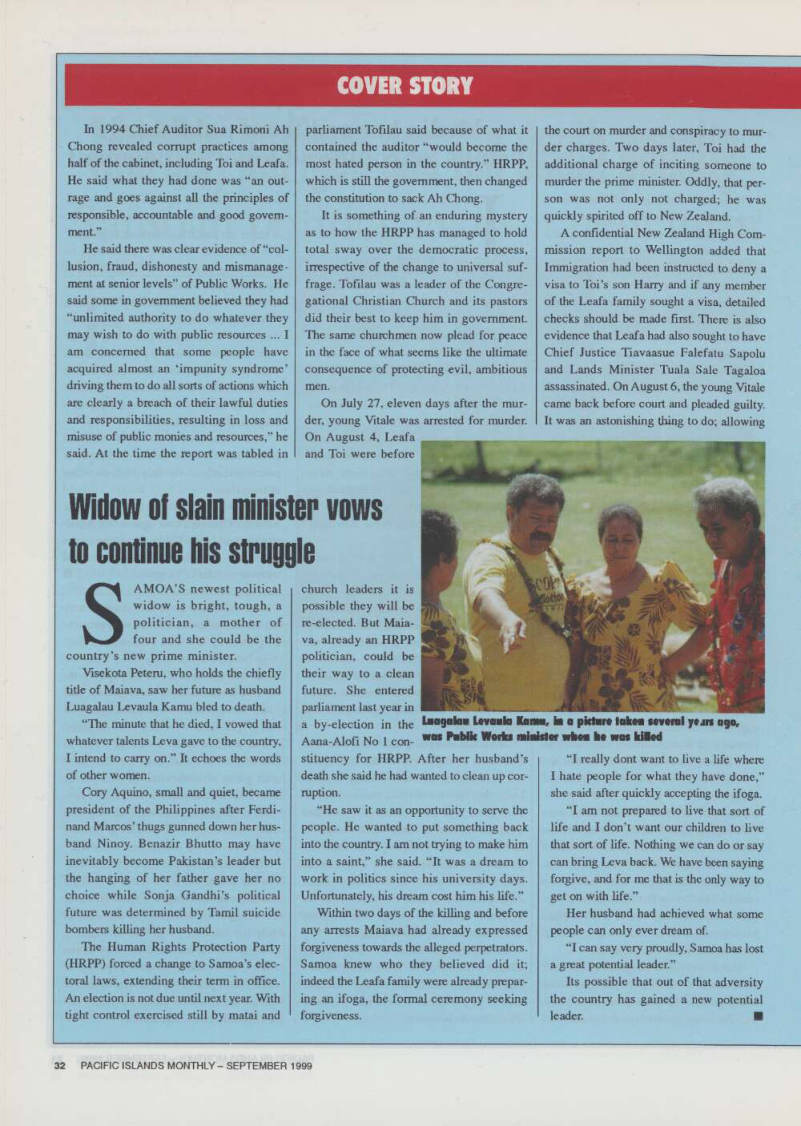
Cover Story
Murder, intrigue and death penalty Samoan politics takes a new turn
By Michael Field
FOR a decade or more life
had been pleasantly prof
itable for Leafa Vitale.
He had successfully ripped off the Samoan government, its taxpayers and aid donors. As Minister of Works he treated the public purse as his own proper ty - and if anybody got in the way he told them he would kill them.
Everybody knew the truth about Leafa but he had strong patrons in the late Prime Minister Tofilau Eti Alesana and Finance Minister Tuila’epa Sailele. Tuila’epa was the public spokesman who, for years, sav agely attacked anybody who questioned the truth of what was going on.
Leafa had a mate too; Telecommunica tions Minister Toi Aukuso and the two even had a personal competition about how much they could get away with.
This year, after 20 years of worsening corruption, Tuila’epa privately launched a clean-up; publicly he could not because that would have been an admission of what had happened while he had been
deputy.
Besides, the ruling Human Rights Pro tection Party (HRPP) were in the process of deifying Tofilau who died early this year. Tuila’epa, who took over, took Pub lic Works from Leafa who was given the spurious post of Minister of Women’s Affairs.
The potentially lucrative job of Public Works went to Luagalau Levaula Kamu, an ebullient, over-weight lawyer who was married to Visakota Peteru, a bright New Zealand-bom pastor’s daughter who hailed too from Auckland University law school and more recently an MR Lua galau’s early moves were against the illic it empire built by Leafa and Toi and par ticularly corruption in the government
owned Electric Power Corporation (EPC) although it is by no means clear whether criminal charges would follow.
Luagalau was less than a saint. Leafa had used his position to get a cheap lease on government land behind the HRPP head quarters at Mulinu’u - the peninsula where modem Samoan history is traced from and the burial spot of kings - and he built a tacky night-club there. This year the lease was cancelled.
Leafa’s son Eletise, 34, has a murky past in Hawaiian crime. In a statement to the police he said his father was outraged.
“He said T want you to do something for us’ and I said ‘what something?’,” the junior Vitale’s statement says.
“He said ‘me and Toi had a meeting’ and they wanted me to fire this gun at the min ister, Laugalau ... He said, ‘do you have guts like your father?’ and I said ‘yes, I have guts’. I told him ‘so who’s going to do the job, or is somebody going to help me?’ He
told me ‘I want you to do the job because you are my oldest son’.”
The father offered a choice of weapons and the son said he wanted a big gun. He was given one, and told to put “two or three bullets” into the minister’s chest ... And he said ‘you better hurry, because if"you don’t (move) first, Toi’s boys will. I want you to do it first before
Toi pulls the trigger’.”
A confidential New Zealand diplomat ic report identifies one Eneliko Visesio as the man Toi had hired for the same mis sion. They scouted out Luagalau’s home but conditions for a hit were not right.
Visesio seemed to lose his nerve. One night as he went out he met the young Vitale going in.
On July 16 HRPP were celebrating their 20th anniversary at a social function at St Joseph’s College hall. Leafa and Toi were there. Luagalau was MC and had just introduced the prime minister when
his cell phone rang. He walked off the stage to take it. Through the brick lattice the junior Vitale cocked his .223 rifle and switched off the safety.
“I seen him talking on the cell phone.
Leva talking on the cell phone, he was standing there,” he said in his confession.
“I put the gun mouth, the barrel between the bricks, and just pulled the trigger. The gun was pointed at Leva’s left-side. There was a loud bang, it was really loud, a big fire came out the front, then I pulled the gun and started running straight to the front.”
Luagalau, mortally wounded, but alive, is said to have cried out: “masofa, masofa” (broken) or “masofasofa” (to die).
His wife had been in the audience and thought the bang was an electrical malfunc tion. Then she saw them carrying her hus band to the pick-up truck which took him to hospital. Doctors struggled for 20 min utes. “From their faces I could tell things were bad,” she said. “I touched him and he was cold; the loss of blood was too great.
Then they started doing CPR and I realised we were losing him.”
The young Vitale, meanwhile, did not know if he had hit the minister, only find ing out when he met his father later that night. “I told him ‘is Leva died?’ and he said ‘yes, you got him on the right spot’.
My father was so happy. His pleasure was released from his body.”
This most political of murders was quickly de-politicised. A New Zealand For eign Affairs official slammed reports which termed it an assassination while Tuila’epa went into the same kind of curious denial.
“To me it was probably a personal grudge against the minister, or it is proba bly the work of a nut,” he said. There were “wild speculations” on the motives but he doubted it was political. “To me it is one of these incidents which the police are investi gating. It could happen to anybody. In a country like Samoa that killing could hap pen to anybody, any one of us. We don’t have security with us, this is a free country,
we walk everywhere unguarded.”
If it was political Luagalau could have been shot at a “much safer place where no one is present. His home is one such place, and there are hundreds and hundreds of
places when he could have been killed.”
In a surprising move he called in New Zealand police experts. It was ironic - the last political killing in Samoa had been those carried out by New Zealand Police in 1929 when they killed an unarmed Tupua Tamasese Lealofi 111 and members of the Mau Movement.
What was intriguing about this case was that in the 11 days between the killing and the first arrest, rumours quickly figured Leafa and Toi - for obvious reason. In 1992 Fatu Tielu was EPC financial controller when he refused to write out a cheque to Leafa’s personal company. The minister phoned him and told him he would shoot him. It went to court but the New Zealand magistrate. Bill Dillon, ruled there was no evidence Leafa was going to act on his threat. Leafa’s lawyer was Luagalau.
Last year the editor of the Weekly Samoa Post, Molesi Taumaoe, claimed Leafa had threatened him, saying: “I am the kind of guy who can always hire a hitman if I cannot do it myself.”
None of this is news in Samoa. It was well known but Leafa and Toi were protect ed by the way in which Samoa had effec tively become a one party state. And the HRPP was no stranger to corruption; its very first prime minister, Va’ai Kolone, had to step down when he was found guilty of corrupt practices over his own election.
Tofilau too had made a strange effort to conceal the fact that once he had been found guilty of cattle stealing. And yet, in the end, the circumstances were hardly pro found or important and were tied up in a chiefly battle not of his making. But the attempt at cover up was all his own work.
The local newspaper editor, Sano Mali fa of the Observer, ran a series of articles outlining various charges. Tupua Tamasese was vilified for bringing up the subject while the Observer was had its printing operation destroyed in a mystery arson attack - now being linked by police to Leafa. Destroyed in the fire were copies of Malifa’s novel which painted a barely fic tional picture of corrupt Samoa.
In 1994 Chief Auditor Sua Rimoni Ah Chong revealed corrupt practices among half of the cabinet, including Toi and Leafa.
He said what they had done was “an out rage and goes against all the principles of responsible, accountable and good govern ment.”
He said there was clear evidence of “col lusion, fraud, dishonesty and mismanage ment at senior levels” of Public Works. He said some in government believed they had “unlimited authority to do whatever they may wish to do with public resources ... I am concerned that some people have acquired almost an ‘impunity syndrome’ driving them to do all sorts of actions which are clearly a breach of their lawful duties and responsibilities, resulting in loss and misuse of public monies and resources,” he said. At the time the report was tabled in
parliament Tofllau said because of what it contained the auditor “would become the most hated person in the country.” HRPP, which is still the government, then changed the constitution to sack Ah Chong.
It is something of an enduring mystery as to how the HRPP has managed to hold total sway over the democratic process, irrespective of the change to universal suf frage. Tofllau was a leader of the Congre gational Christian Church and its pastors did their best to keep him in government.
The same churchmen now plead for peace in the face of what seems like the ultimate consequence of protecting evil, ambitious men.
On July 27, eleven days after the mur der, young Vitale was arrested for murder.
On August 4, Leafa and Toi were before
the court on murder and conspiracy to mur der charges. Two days later, Toi had the additional charge of inciting someone to murder the prime minister. Oddly, that per son was not only not charged; he was quickly spirited off to New Zealand.
A confidential New Zealand High Com mission report to Wellington added that Immigration had been instructed to deny a visa to Toi’s son Harry and if any member of the Leafa family sought a visa, detailed checks should be made first. There is also evidence that Leafa had also sought to have Chief Justice Tiavaasue Falefatu Sapolu and Lands Minister Tuala Sale Tagaloa assassinated. On August 6, the young Vitale came back before court and pleaded guilty.
It was an astonishing thing to do; allowing
no room for any appeal at all. He was sen tenced to death by hanging. It was hardly a plea-bargain worth having but he turned state’s evidence against his father. He was moved to jail on Savai’i for his protection, and his family sent to New Zealand. As this article was going to publication. New Zealand Foreign Minister Don McKinnon was in Samoa where a confidential report written by New Zealand High Commission er Mac Price was leaked.
It was his theory that the events had not been part of a coup attempt. “Rather it is that of a thug running amok. To suggest that he was trying to take over the government ascribes in our view far too much system, reason and structure to his actions.
“What we see is a man increasingly out of control as his empire of corruption in the public sector headed for extinction, and he resorted with growing desperation to what
he was been threatening to do to a large number of people for a long time - killing those who stood in his way.”
Opposition Leader Tupua Tamasese Efi, who for years had been a Jeremiah on the consequences of corruption now notes that Ah Chong had also exposed irregularities and corruption in the Inland Revenue, Cus toms and Treasury, for which departments Tuila’epa had ministerial responsibility.
“If we do not address constructively the cultural, political, economic and spiritual environment which spawned violence, we are condemned to repeat violence in a worse form.” * PIM correspondent Michael Field worked for former prime minister Tupuola Efi in the late 1970 s and was present for the creation of the Human Rights Protection Party. Tupuola is now Tupua Tamasese Efi, leader of the Samoan Opposition. ■
Media banned from publishing
details of confessed killer’s statement
JUSTICE Andrew Wilson of the Supreme Court has granted an interim injunc tion ordering media in Apia not to publish, broadcast or distribute a statement given by convicted killer, Alatise Leafa Vitale, on July 30, 1999.
Attorney General, Brenda Heather filed the injunction that was delivered to all government and private media in Samoa mid-August. The statement referred to by the injunction is believed to be Vitale’s confession to the murder of Public Works minister, Luagalau Levaula Kamu, which the “60 minutes” pro gramme produced by Television New Zealand, has revealed in New Zealand.
The injunction bans even reference to the existence or contents of the statement in email.
It also covers the distribution of “any overseas publication or broadcast which
contains: (i) extracts from the said state ment; (ii) references to the said statement; in either the English or Samoan language.”
The injunction stops the “publishing or broadcasting any recorded report or video tape from New Zealand of the documen tary ‘6O Minutes’ produced by Television New Zealand which refers to the said statement.” The injunction refers to the “said statement made by Alatise Leafa Vitale on 30 July 1999 at the Apia Police Station which was witnessed by Detective Inspector Steve Shortland and Detective Sergeant Phillip Kirkham.”
The detectives were New Zealand police officers who helped the Samoan police investigate the July 16th shooting of Luagalau.
Alatise’s statement is relevant to the Attorney General’s case against Toi Auku so Cain and Leafa Vitale, according to the injunction. Both have also been charged with the murder of Luagalau. ■
Widow of slain minister vows
to continue his struggle
SAMOA’S newest political
widow is bright, tough, a politician, a mother of four and she could be the country’s new prime minister.
Visekota Peteru, who holds the chiefly title of Maiava, saw her future as husband Luagalau Levaula Kamu bled to death.
“The minute that he died, I vowed that whatever talents Leva gave to the country, I intend to carry on.” It echoes the words of other women.
Cory Aquino, small and quiet, became president of the Philippines after Ferdi nand Marcos’ thugs gunned down her hus band Ninoy. Benazir Bhutto may have inevitably become Pakistan’s leader but the hanging of her father gave her no choice while Sonja Gandhi’s political future was determined by Tamil suicide bombers killing her husband.
The Human Rights Protection Party (HRPP) forced a change to Samoa’s elec toral laws, extending their term in office.
An election is not due until next year. With tight control exercised still by matai and
church leaders it is
possible they will be
re-elected. But Maia va, already an HRPP politician, could be their way to a clean future. She entered parliament last year in a by-election in the Aana-Alofi No 1 con
stituency for HRPP. After her husband’s death she said he had wanted to clean up cor ruption.
“He saw it as an opportunity to serve the people. He wanted to put something back into the country. I am not trying to make him into a saint,” she said. “It was a dream to work in politics since his university days.
Unfortunately, his dream cost him his life.”
Within two days of the killing and before any arrests Maiava had already expressed forgiveness towards the alleged perpetrators.
Samoa knew who they believed did it; indeed the Leafa family were already prepar ing an ifoga, the formal ceremony seeking
forgiveness.
“I really dont want to live a life where I hate people for what they have done,” she said after quickly accepting the ifoga.
“I am not prepared to live that sort of life and I don’t want our children to live that sort of life. Nothing we can do or say can bring Leva back. We have been saying forgive, and for me that is the only way to get on with life.”
Her husband had achieved what some people can only ever dream of.
“I can say very proudly, Samoa has lost a great potential leader.”
Its possible that out of that adversity the country has gained a new potential leader. ■
Luagolau Levanla Ka[?], in a picture taken several yeare ago, was Public Works minister when he was killed
Head of State could prevent Vitale's hanging
LEI Mau and Fa’agase Faase’e shared a common fate - they were hanged in Samoa’s decaying Tafa’i gata Prison. Whether Eletise Leafa Vitale joins them on a gibbet largely rests with Head of State Malietoa Tanumafili II who, under Samoa’s constitution, has a big degree of discretion over commuting death sentences.
Death is the mandatory for murder but independent Samoa has never executed any body. Each time, eventually, Malietoa exer cises Clause 110 of the constitution and commutes the sentence to life imprison ment. The section gives him the right to “act in his discretion after consultation” with a minister designated by the prime minister.
New Zealand bought hanging to Samoa.
Police Chief Arthur Braisby reported that on 10 July 1928 “Chinese coolie No 4515 Le Mau, was executed at the Prison for the murder of Chinese coolie No 5479. This being the first execution since British occu pation of Samoa."
The last hanging in Samoa was that of Fa’agase Faase’e in 1951. Tonga, which also has the mandatory death sentence.
hanged a man as recently as 1978. Then Police Minister Noble ‘Akau’ola carried out the deed.
One of the basic questions Samoa has to consider over the death sentence are the horrible mechanics of carrying it out.
The last ever hanging in New Zealand, the 1957 hanging of Walter Bolton, was illustrative of the problems. He strangled slowly on the end of the rope.
“The last execution at Mount Eden was a very unpleasant one,” the attending doctor later wrote.
Hanging is supposed to break a person’s neck; the weight, speed and knot snapping the cervical vertebrae like a match.
If the hangman miscalculates he can behead the prisoner - or, worse, slowly strangle him. In some cases the hangman has had to grab hold of the prisoners legs to hasten the awful death by strangulation.
One of the odd features of hanging is that the bodies are seldom given back to rel atives.
The reason was noted in a 1949 British Royal Commission on Capital Punishment.
“Hanging leaves the body with the neck
elongated.” ■
murders not
Political murders not unknown in the Pacific
* Tupua Tamasese Lealofi m was call ing for peace on an Apia street on Decem ber 29, 1929 when a New Zealand police man got him in the sights of his .303 rifle and squeezed off a bullet.
Before he died the next day, the high chief said: “My blood has been spilt for Samoa. I am proud to give it. Do not dream of avenging it, as it was spilt in maintain ing peace. If I die, peace must be main tained at any price.” * On August 17, 1953, New Zealand’s Resident Commissioner on Niue, Hector Larsen, was hacked to death by three Niueans as he lay in his bed. It turned out he had beaten and abused hundreds of Niueans in his time.
The Queen Mother signed the death warrant for the three and they were flown back from New Zealand, sitting on the gal lows that were to hang them. They were spared at the last moment. * In New Caledonia, Kanak militants Eloi Machoro and Marcel Nonaro were killed by French soldiers on January 12, 1985.
On May 4, 1989, president Jean-Marie Tjibaou and Yeiwene Yeiwene of the Kanak Socialist National Liberation Front were shot dead on the island of Ouvea, in the Loyalty Islands, New Caledonia. * Palau’s founding President Haruo Remeliik was shot dead in a gangland style assassination on June 30, 1985. The cir cumstances and background of that death have never been fully explained. * During the Bougainville war, the province’s Premier Theodore Miriung was shot dead as he ate dinner with his family on October 12, 1996. Later inquiries point ed strongly at PNG soldiers carrying out the act because they believed he was lean ing towards the island’s rebels. ■
Former Solomon police
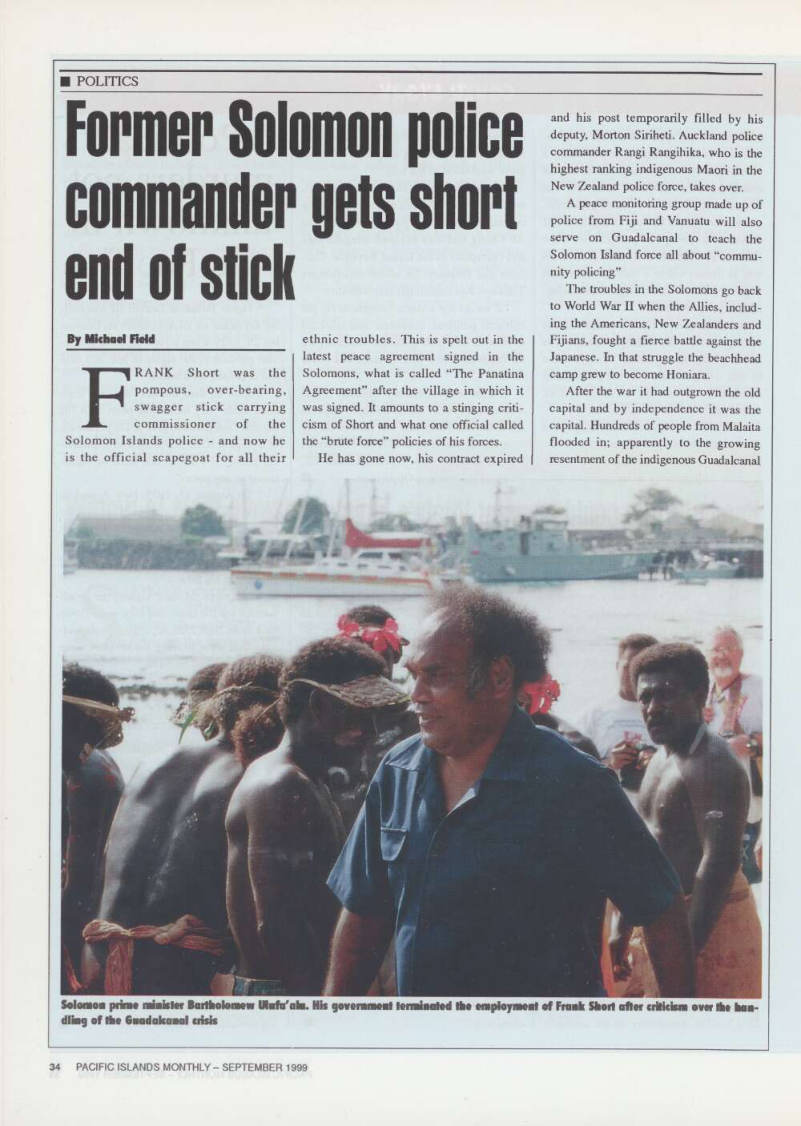
Politics
Former Solomon police commander gets short end of stick
By Michael Field
ethnic troubles. This is spelt out in the latest peace agreement signed in the Solomons, what is called “The Panatina Agreement” after the village in which it was signed. It amounts to a stinging criti cism of Short and what one official called the “brute force” policies of his forces.
He has gone now, his contract expired
FRANK Short was the
pompous, over-bearing,
swagger stick carrying commissioner of the Solomon Islands police - and now he is the official scapegoat for all their
and his post temporarily filled by his deputy, Morton Siriheti. Auckland police commander Rangi Rangihika, who is the highest ranking indigenous Maori in the New Zealand police force, takes over.
A peace monitoring group made up of police from Fiji and Vanuatu will also serve on Guadalcanal to teach the Solomon Island force all about “commu nity policing”
The troubles in the Solomons go back to World War II when the Allies, includ ing the Americans, New Zealanders and Fijians, fought a fierce battle against the Japanese. In that struggle the beachhead camp grew to become Honiara.
After the war it had outgrown the old capital and by independence it was the capital. Hundreds of people from Malaita flooded in; apparently to the growing resentment of the indigenous Guadalcanal
Solomon prime minister Bartholomew Ulufa'alu. His government terminated the employment of Frank Short after criticism over the han dling of the Guadakaual crisis
population. By last year, egged on by the provincial Guadalcanal government of Premier Ezekiel Alebua, a guerrilla force grew up. aimed at driving out the Malai tans. It rejoiced under a variety of names until settling on the interchangeable Guadalcanal Liberation Army or Isatabu
Freedom Fighters.
A series of attacks saw thousands of Malaitans flee from the Guadalcanal
countryside, becoming refugees in
Honiara. Several fatal attacks on villages closed the oil palm industry, sending the police and its para-military Police Field Force onto attack.
Undoubtedly better armed than the
guerrillas their approach, led by Short,
was less than conciliatory.
As the situation worsened Morton Sir iheti advised Short not to take the
approach adopted.
“Siriheti, who has had experience with separatist groups on Bougainville, told Short that brute force was wrong and so Siriheti was virtually fired by Short who
preferred the tough policing options,” a
well-placed diplomatic source said.
When Short’s contract expired in July the government declined to renew it. Short wrote closing briefing papers for the gov ernment but Siriheti declined to pass them on.
In June former Fiji Prime Minister Sitiveni Rabuka and Commonwealth deputy director Ade Adefuye arrived in the Solomons and attempted to broker peace.
Short made no secret of his dislike at the peace route, and his contempt for Rabuka. He urged the Fijian not to say anything and suggested Rabuka was on the militant side.
In the Commonwealth camp Short was quickly identified as the main impediment to a solution and both Rabuka and Ade fuye called for his dismissal, particularly after he nearly destroyed a peace treaty
signing by having police search delegates.
Two peace documents were duly signed and although the oil palm industry remains at a standstill, there were other signs that the conflict was nearing an end.
Then at the end of July on Mount Austen on Honiara's outskirts a fightfight
between the PFF and the militants saw four of the militants killed.
The Commonwealth team quickly returned and by August 12 they had the Panatina Agreement signed.
It is a remarkable indictment of Short’s
gruff style.
Foreign Minister Patteson Oti declined to say whether the Panatina Agreement was aimed at repairing Short’s damage. Other sources however make it clear that this was precisely what it was about and in part the document itself says so.
Policing, it says, was part of the peace and those who signed Panatina “regret that a meeting of this nature did not take place right after the conclusion of the Honiara Peace Accord’’.The Panatina Agreement was signed by Rabuka, Oti, Siriheti, Ale bua and Police Minister Robin Mesepitu.
It said they had a full discussion on the problems of implementation of the earlier accord and noted concerns “about the man ner in which the police had been carrying out its functions of the maintenance of law and order in Guadalcanal”.
It resolved that the police “will hence forth promote a community policing con cept in all parts of Solomon Islands... This policy will combine effective maintenance of law and order with a determination to project and promote a friendly image to the
populace.”
“Minimum force” will be used while “a massive public relations campaign” will be mounted to show that police activities are directed not against law abiding citizens but against “a few criminal elements”.
It said the militants will return to their villages and “will begin a systematic laying down of arms”.
The agreement says the activities of the para-military Police Field Force and the Rapid Response Unit will be scaled down.
“Police activities will be limited to the normal maintenance of law and order. Gov ernment will in due course lift the state of emergency.”
Adefuye, a Nigerian who has quickly
come to learn more about the Pacific than most, told PIM the militants had already begun moving around without arms.“ There is an absolute peace, people are free to move about now,” he said. ■
Advertisements & other items, p. 35 (1 item)
Fellowship
Te Puna Ma'auranga o Aotearoa
¥ NATIONAL LIBRARY
OF NEW ZEALAND
Research
Fellowship
The Research Fellowship aims to encourage the scholarly use of the National Library’s collections, which include the specialist collections of the Alexander Turnbull Library, and the production of publications based on them.
Applications proposing the reproduction of collections of documents, or the production of major guides to collections and similar “access tools” will also be considered.
The VALUE of the fellowship is up to $45,000. Normally only one fellowship will be awarded annually. It is tenable for 12 months and the recipient will be expected to be based primarily at the National Library for the term of the tenure.
Research undertaken is to lead to public presentation through publications, in scholarly or popular form, in any medium which will promote the objectives of the fellowship.
Applications Close 30 September 1999 Conditions of award, guidelines to applicants and application forms can be obtained from: The Secretary National Library Research Fellowship Committee National Library of New Zealand PC Box 12 349 Wellington Telephone: 64-4-474 3120 Facsimile: 64-4-474 3063 e-mail: [email protected]
PNG back in Australia's fold
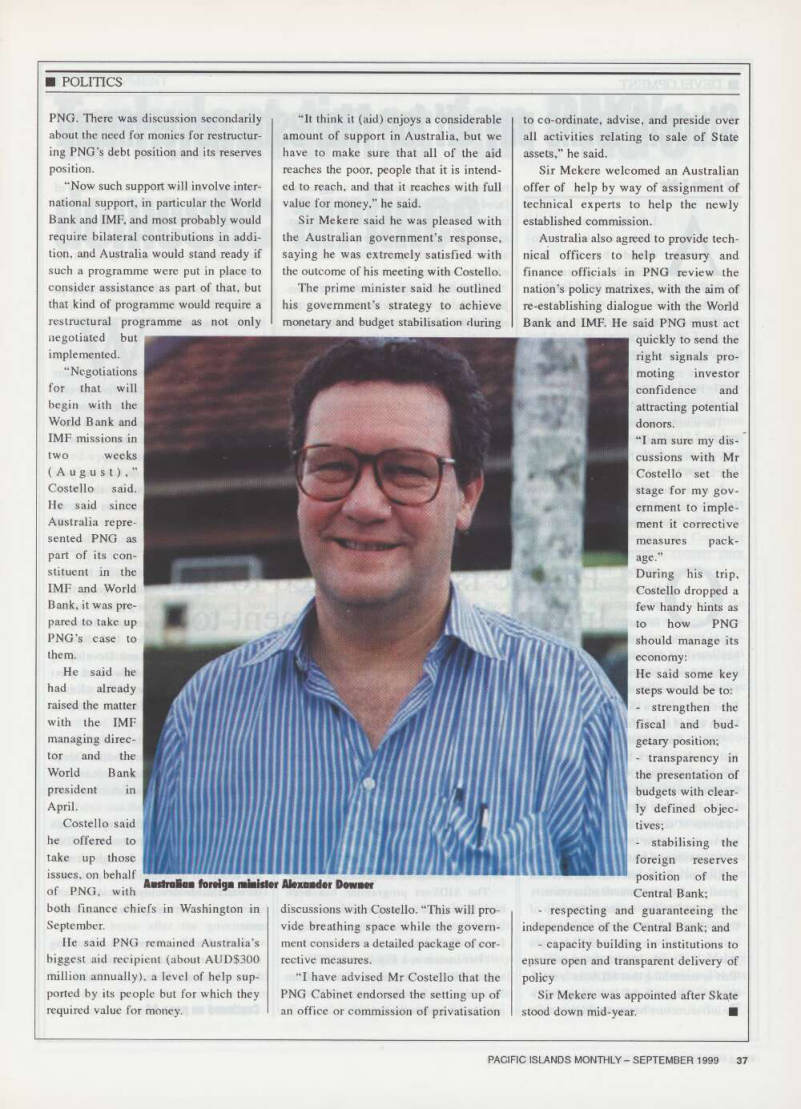
‘We will do what we can to help Papua New Guinea through this difficult period. It is an illustration in the Australian concept of mate ship. Papua New Guinea and Australia being mates forever’ - Alexander Downer
By Sam Vulum
AFTER the sudden scare of losing its nearest neighbour from under its folds, Australia has pulled out all the stops when it comes to lavishing Papua New Guinea with atten tion.
Two days after Australian Treasurer, Peter Costello, left Papua New Guinea, the Australian foreign minister Alexan der Downer, arrived in Port Moresby.
The tone being pushed: mateship.
Downer said Australia wouldn’t let its “mate” PNG down in the rescue of the economy.
“Papua New Guinea has big problems with its budget, it has problems with the level of its foreign reserves, and it’s going to work hard to solve them.
“The message we have for the new government is that Australia is a country that has special relationship with Papua New Guinea, it has always done, and we won’t let Papua New Guinea down.
“We will do what we can to help Papua New Guinea through this difficult
period.
“It is an illustration in the Australian concept of mateship. Papua New Guinea and Australia being mates forever, and that relationship will continue.”
As minister responsible for the aid budget, Downer announced that a new aid treaty between the two countries, governing aid over the next three years, would be signed in December. Downer said the previous government of Bill
Skate had gone through “a rather difficult period” because it did not want anything to do with International Monetary Fund and the World Bank.
But now, after months of fruitless talks between the IMF, the World Bank and the previous PNG government over economic rescue loans, Australia is stepping in to offer a glimmer of hope for PNG.
The previous government pursued var ious avenues to get funds for economic rescue including the IMF, the World Bank, the Kredit Bank of Belgium and a bond issue sale, but these negotiations failed.
The last attempt by the Skate govern ment to source offshore loans from Tai wan was aborted when it lost office.
But the new government of Sir Mekere Morauta has been given a commitment by Australia of a more concerted effort towards fresh negotiations.
The commitment also marks a “new era” in the relationship between politi cians of both countries - something that had become stale in recent years.
As part of Australia’s commitment, it will immediately advance a lump sum payment of AUDS3O million (about Ksl million) of next year’s budget support grant, which would otherwise have been
paid in monthly installments.
Costello, who visited PNG in July, said after meeting the new prime minister that his country would help the new govern ment’s initiatives to restore the ailing economy, both in the planning and imple mentation stages. He said Australia would also continue to make representations and
work with the World Bank, the IMF and other donors to turn the economy around.
Costello expressed concern about the state of the economy especially the country’s foreign reserves that he said had deteriorated and were now in “sub stantial deficit”.
Commodity exports were also not doing well, he said.
“Sir Mekere has assured me that his government and he are committed to economic restructure, that he sees this as absolutely necessary for securing the country’s future, and I, in turn, assured him that the Australian government stands ready to assist in providing tech nical support and assistance and man power, that we will be looking to the mission of the World Bank and the IMF to discuss a programme for PNG.”
Costello said Australia and the World Bank, the IMF and international mar kets and institutions would be looking to the mini budget planned for this month as a first sign of the govern ment’s direction.
“Australia’s position is, and remains, that it will be engaged in help which will be closely tied to economic restruc ture,” he said.
“Obviously there is a need for enor mous restructuring here in PNG in rela tion to the budget, in relation to the financial situation, and we think that the best chance is for the government to proceed with the programme that Sir Mekere has laid down, as a real oppor tunity to secure the economic future for
PNG. There was discussion secondarily about the need for monies for restructur ing PNG’s debt position and its reserves
position.
“Now such support will involve inter national support, in particular the World Bank and IMF, and most probably would require bilateral contributions in addi tion, and Australia would stand ready if such a programme were put in place to consider assistance as part of that, but that kind of programme would require a restructural programme as not only
negotiated but
implemented.
“Negotiations
for that will begin with the World Bank and IMF missions in two weeks (August),”
Costello said.
He said since Australia repre sented PNG as part of its con stituent in the IMF and World Bank, it was pre pared to take up PNG’s case to them.
He said he
had already
raised the matter with the IMF
managing direc
tor and the World Bank
president in
April.
Costello said he offered to take up those issues, on behalf of PNG, with
both finance chiefs in Washington in September.
He said PNG remained Australia's biggest aid recipient (about AUDS3OO million annually), a level of help sup ported by its people but for which they required value for money.
“It think it (aid) enjoys a considerable amount of support in Australia, but we have to make sure that all of the aid reaches the poor, people that it is intend ed to reach, and that it reaches with full value for money,” he said.
Sir Mekere said he was pleased with the Australian government’s response, saying he was extremely satisfied with the outcome of his meeting with Costello.
The prime minister said he outlined his government’s strategy to achieve monetary and budget stabilisation during
discussions with Costello. “This will pro vide breathing space while the govern ment considers a detailed package of cor rective measures.
“I have advised Mr Costello that the PNG Cabinet endorsed the setting up of an office or commission of privatisation
to co-ordinate, advise, and preside over all activities relating to sale of State assets,” he said.
Sir Mekere welcomed an Australian offer of help by way of assignment of technical experts to help the newly established commission.
Australia also agreed to provide tech nical officers to help treasury and finance officials in PNG review the nation’s policy matrixes, with the aim of re-establishing dialogue with the World Bank and IMF. He said PNG must act
quickly to send the right signals pro moting investor confidence and attracting potential donors.
“I am sure my dis cussions with Mr Costello set the stage for my gov ernment to imple ment it corrective measures pack age.”
During his trip, Costello dropped a few handy hints as to how PNG should manage its economy: He said some key steps would be to: - strengthen the fiscal and bud getary position; - transparency in the presentation of budgets with clear ly defined objec tives; - stabilising the
foreign reserves
position of the Central Bank;
- respecting and guaranteeing the independence of the Central Bank; and - capacity building in institutions to ensure open and transparent delivery of policy Sir Mekere was appointed after Skate stood down mid-year. ■
Australian foreign minister Alexnader Downer
Student loans pay off for Moresby government
Development
By Brain Tobia
A LOAN scheme for ter tiary students, intro duced by the Port
Moresby government
in Papua New Guinea, is proving to be a success.
The first of its kind in the country, the National Capital District Commission gives grants of K 250,000 per annum, which are managed by the University of PNG. The loan scheme is expected to be self-financing in five years.
The scheme was an initiative of former PNG prime minister Bill Skate while he was governor of the National Capital Dis trict in 1997.
It assists tertiary students from Port
Moresby attending various institutions
throughout the country by paying their
tuition fees. Many students and parents faced financial hardship after the introduc tion of a User-Pays system by the govern ment of Sir Julius Chan. The policy covered all services by the government, including education and health.
UPNG deputy registrar (Academic), Ben jamin Naing, was optimistic about the scheme that he said would see its first repay ments before the end of 1999.
He said over K 100,000 had been spent on loans to students who met the NCD govern ment criteria. All beneficiaries of the loan scheme in 1997 and for the first two terms this year were from UPNG. But for the first time since its establishment, a loan has been approved for a student who will study at the University of Technology in Lae this term.
The scheme will be extended to other institutions, particularly Unitech, Pacific Adventist University and the Institute of
Business Studies. IBS is a sub-branch of
Upng.
Students who originate from the NCD or who have lived in Port Moresby for more than five years are eligible for the scheme.
NCD provides the grants of up to K 250,000 which is put into a trust account managed by UPNG and then lent to eligible students.
Upon completion of studies and beginning work, students repay loans with accumulated interest of five per cent per year from the date of acquisition.
Allocation of loans are made on merit or for needy students who are not in receipt of any other scholarship.
The scheme was put on hold last year due to non-commitment by the NCD government but this year it is back on track. ■
ONE of
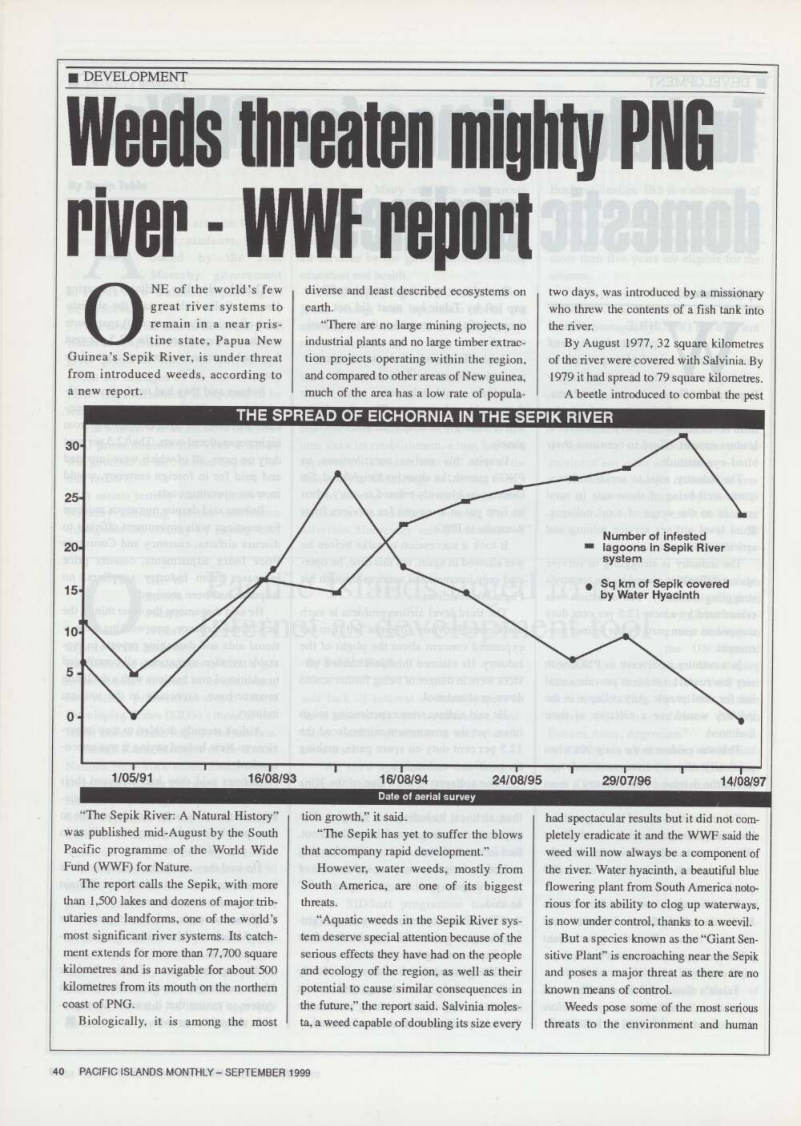
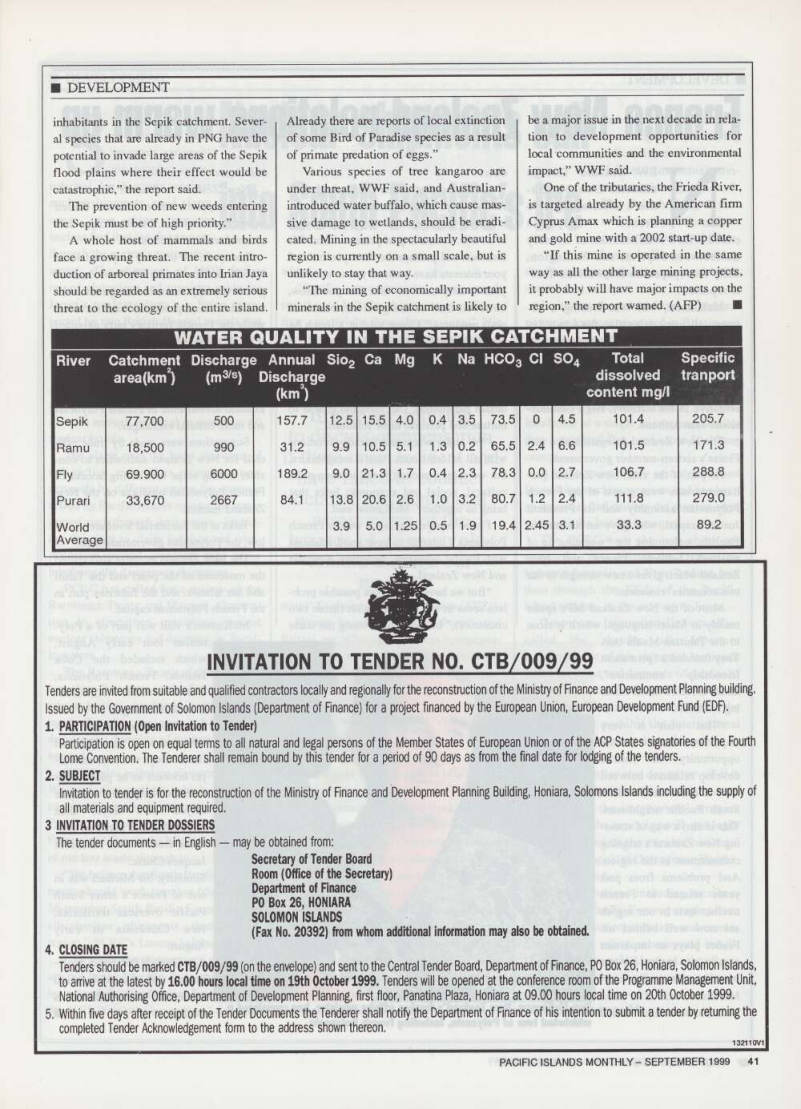
Pacific Islands urged to use Internet as development tool
the few Pacific Island experts on the Internet
has described the medium as “God’s gift to the islands” in terms of its addressing two issues pertinent to Small Island Developing States (SIDS) - those of iso lation and of small, fragmented markets.
Taholo Kami, Manager of the United Nations New York-based Small Island Developing States Network (SlDSnet) Internet project says despite being rela tively expensive for the Pacific Islands in terms of access costs, the Web still works out cheaper in the long term.
It provides instant access to over 150 million people in relevant markets and greatly reduces communication costs.
“In the Pacific, we are on the tip of the iceberg and are still yet to see appli cations apart from email and Web pages
that will directly impact development.
This is something that SlDSnet is inter ested in,” he said. “A lack of appropri ate infrastructure has meant higher costs
By Debbie Singh
and lack of interest in development in areas most needy such as education, med icine, health, governance and even e commerce.
“We need applications that work in today’s limited Pacific Island infrastruc tures, not just tomorrow’s ideal afford able and fast connections,” Kami said.
SlDSnet has managed to obtain some 153.000 hits on its website from over 90 countries in the past month - a total of 50.000 more than in the preceding month.
The SlDSnet programme has been highlighting success stories from small island states and also acting as a catalyst for specific initiatives.
“For instance, a Fiji-based NGO can access SlDSnet development news from Mauritius or Jamaica or the NGO can post its own news on the site.
“SlDSnet has also filed reports from key global confer ences leading to the UN Special
Session for Small Island Developing States to be held in New York next month, including the 1998 climate change (COP 4) conference held in Buenos Aires, Argentina.”
SlDSnet is a community of 42 Pacif ic, Caribbean, Atlantic, Indian Ocean and African small island nations con nected through a global Internet based network.
It aims to improve the way in which people in developing countries live, work and communicate through increas ing access to information, in particular on sustainable development issues and provides for virtual global connected ness.
In the Pacific, the project is working in the Solomon Islands, Vanuatu, Papua New Guinea, Federated States of
Continued on page 44
Continued from page 38
Micronesia, Kiribati, Nauru, Tuvalu, Tonga, Samoa, the Cook Islands and Tokelau.
Workshops planned for the Pacific region between now and December include the use of the Internet as a devel opment tool in the areas of distance edu cation and tele-medicine and general overviews of the SlDSnet project.
SlDSnet is also working with the gov ernment of Tokelau to provide local email access before the end of 1999.
When the Alliance of Small Island States (AOSIS) agreed on the Barbados Programme of Action following the SIDS
meeting in Bridgetown, B rbados in 1994, they underscored the importance of information and information technology in the process of achieving sustainable development.
This resulted in the concept of a glob al information network being developed and implemented through SlDSnet.
Last year. Pacific island leaders from the region’s 16 independent South Pacif ic Forum member states also endorsed SlDSnet activities in the region as part of efforts to implement the Barbados Pro gramme of Action.
The internet is the fastest growing industry in the world, and with changes taking place every day, the Pacific cannot afford to be left behind. ■
Turbulent times for PNG's
domestic airlines
By Sam Vulum
WHILE political
power-play and
infighting continue to overshadow Papua New Guinea’s real problems, the severity of threats against the third level airline industry is such that leaders cannot afford to continue their
blind-eye attitude.
The industry, vital to social and eco nomic well-being of thousands in rural area, is on the verge of total collapse.
Third level airlines service mining and agricultural industries.
The industry is struggling to survive against difficulties caused by the country's struggling economy. The situation was exacerbated by a new 12.5 per cent duty stamped on spare parts by the former gov ernment.
In a country as diverse as PNG, with very few roads, air services provide a vital link for rural people. Any collapse in the industry would see a collapse of their livelihood.
This was evident in the early 90s when politically driven bureaucratic red tape forced the demise of the country’s most successful third level airline, Talair.
Talair was then one of the largest third level airlines in the world. It served almost 300 main ports and rural airstrips through out the country and employed about 800
people.
Its Australian owner, Sir Dennis Buchanan shut down business and returned home after the government refused to approve the permit for an expa
triate employer.
Talair’s closure hit hard on the rural population. Some had to wait years before the return of air services.
Several new operations started to fill the gap left by Talair but most did not have strong profit bases to survive the tough busi ness climate.
Unlike Talair, where the service routes reached most remote destinations, the new operations could only serve areas where they could make money. Thus the places where money was scarce missed out com
pletely.
Despite his earlier contributions to PNG’s growth, let alone his Knighthood, Sir Dennis was blatantly refused re-entry when he first put in a request for services from Australia to PNG.
It took a succession of talks before he was allowed in again, but this time, he oper ated only international services through his Flight West Airlines.
The third level airline problem is such that Central Province governor Ted Diro has expressed concern about the plight of the industry. He claimed third level airline ser vices were in danger of being further scaled down or abandoned.
He said airlines were experiencing tough times, yet the government reintroduced the 12.5 per cent duty on spare parts, making the position even tougher.
“The collapse of the value of the Kina has hit many businesses, but none greater than airlines, including Air Niugini. The payments on leased aircraft have blown out, fuel is much dearer, international landing and other charges have risen, and the cost of imported spare parts has gone up as well,” he said.
“The airline operators have been warn ing the government for months that their viability is coming into real doubt.
“The government has done absolutely nothing to help the industry, and now it imposes a duty which can only worsen the financial position of all airlines,” he said.
Third level airline, Airlink’s managing director, Colin Buhner, said the abolish ment of exemptions on air craft spare parts and the re-imposition of the 12.5 per cent duty had increased operational costs of air transport.
Buhner said they had not been accord ed dialogue with the government to con sider increases in airfares resulting from higher operational costs. The 12.5 per cent duty on parts, all of which were imported and paid for in foreign currency, would increase operating costs.
Buhner said despite numerous requests for meetings with government officials to discuss airfares, currency and Consumer Price Index adjustments, counter price increases from industry suppliers, no response had been received.
He said that among the other things, the lack of maintenance, non-working naviga tional aids and damaging reports in rep utable aviation magazines, all contributed to additional cost burdens with a declining revenue-base, especially in the tourism industry.
Airlink recently decided to stop its ser vices to New Ireland saying it was uneco nomical.
Bubner said they had analysed their operational runs to New Ireland and dis covered that they only had about three to four people including cargo travelling in some parts of the province.
He said they would be cutting services to areas in East and West New Britain provinces for the same reason.
If the economic situation improved, he said, Airlink would consider returning ser vices to those areas.
The government of Sir Mekere Morauta has promised to review the tax system to ensure that it was the least pos sible obstacle to growth. ■
Weeds threaten mighty PNG
river - WWF report
ONE of the world’s few great river systems to remain in a near pris tine state, Papua New Guinea’s Sepik River, is under threat from introduced weeds, according to a new report.
“The Sepik River: A Natural History” was published mid-August by the South Pacific programme of the World Wide Fund (WWF) for Nature.
The report calls the Sepik, with more than 1,500 lakes and dozens of major trib utaries and landforms, one of the world’s most significant river systems. Its catch ment extends for more than 77,700 square kilometres and is navigable for about 500 kilometres from its mouth on the northern coast of PNG.
Biologically, it is among the most
diverse and least described ecosystems on earth.
“There are no laige mining projects, no industrial plants and no large timber extrac tion projects operating within the region, and compared to other areas of New guinea, much of the area has a low rate of popula
tion growth,” it said.
“The Sepik has yet to suffer the blows that accompany rapid development.”
However, water weeds, mostly from South America, are one of its biggest threats.
“Aquatic weeds in the Sepik River sys tem deserve special attention because of the serious effects they have had on the people and ecology of the region, as well as then potential to cause similar consequences in the future,” the report said. Salvinia moles ta, a weed capable of doubling its size every
two days, was introduced by a missionary who threw the contents of a fish tank into the river.
By August 1977, 32 square kilometres of the river were covered with Salvinia. By 1979 it had spread to 79 square kilometres.
A beetle introduced to combat the pest
had spectacular results but it did not com pletely eradicate it and the WWF said the weed will now always be a component of the river. Water hyacinth, a beautiful blue flowering plant from South America noto rious for its ability to clog up waterways, is now under control, thanks to a weevil.
But a species known as the “Giant Sen sitive Plant” is encroaching near the Sepik and poses a major threat as there are no known means of control.
Weeds pose some of the most serious threats to the environment and human
inhabitants in the Sepik catchment. Sever al species that are already in PNG have the potential to invade large areas of the Sepik flood plains where their effect would be catastrophic,” the report said.
The prevention of new weeds entering the Sepik must be of high priority.”
A whole host of mammals and birds face a growing threat. The recent intro duction of arboreal primates into Irian Jaya should be regarded as an extremely serious threat to the ecology of the entire island.
Already there are reports of local extinction of some Bird of Paradise species as a result of primate predation of eggs.”
Various species of tree kangaroo are under threat, WWF said, and Australian introduced water buffalo, which cause mas sive damage to wetlands, should be eradi cated. Mining in the spectacularly beautiful region is currently on a small scale, but is unlikely to stay that way.
“The mining of economically important minerals in the Sepik catchment is likely to
be a major issue in the next decade in rela tion to development opportunities for local communities and the environmental impact,” WWF said.
One of the tributaries, the Frieda River, is targeted already by the American firm Cyprus Amax which is planning a copper and gold mine with a 2002 start-up date.
“If this mine is operated in the same way as all the other large mining projects, it probably will have major impacts on the region,” the report warned. (AFP) ■
Water Quality In The Sepik Catchment
River Catchment
area (km 2 )
Discharge Annual
(m 3/s ) Discharge
(km 3 ) CM O W Ca Mg K Na O O X Cl so 4 Total dissolved
content mg/l
Specific
tranport
Sepik 77,700 500 157.7 12.5 15.5 4.0 0.4 3.5 73.5 B 4.5 101.4 205.7 Ramu 18,500 990 31.2 9.9 10.5 5.1 1.3 0.2 65.5 rS 6.6 101.5 171.3 Fly 69.900 6000 189.2 9.0 21.3 1.7 0.4 2.3 78.3 0.0 2.7 106.7 288.8 Purari World Average 33,670 2667 84.1 13.8 3.9 20.6 5.0 2.6 1.25 1.0 0.5 3.2 1.9 80.7 19.4 1.2 2.45 2.4 3.1 111.8 33.3 279.0 89.2
Advertisements & other items, p. 41 (2 items)
■ Development
Invitation To Tender No. Ctb/009/99
Tenders are invited from suitable and qualified contractors locally and regionally for the reconstruction of the Ministry of Finance and Development Planning building.
Issued by the Government of Solomon Islands (Department of Finance) for a project financed by the European Union, European Development Fund (EDF). 1. PARTICIPATION (Open Invitation to Tender) Participation is open on equal terms to all natural and legal persons of the Member States of European Union or of the ACP States signatories of the Fourth Lome Convention. The Tenderer shall remain bound by this tender for a period of 90 days as from the final date for lodging of the tenders.
2. SUBJECT
Invitation to tender is for the reconstruction of the Ministry of Finance and Development Planning Building, Honiara, Solomons Islands including the supply of all materials and equipment required.
3 INVITATION TO TENDER DOSSIERS
The tender documents in English may be obtained from: Secretary of Tender Board Room (Office of the Secretary) Department of Finance
PO Box 26, HONIARA
SOLOMON ISLANDS
(Fax No. 20392) from whom additional information may also be obtained.
4. CLOSING DATE
Tenders should be marked CTB/009/99 (on the envelope) and sent to the Central Tender Board, Department of Finance, PO Box 26, Honiara, Solomon Islands, to arrive at the latest by 16.00 hours local time on 19th October 1999. Tenders will be opened at the conference room of the Programme Management Unit, National Authorising Office, Department of Development Planning, first floor, Panatina Plaza, Honiara at 09.00 hours local time on 20th October 1999. 5. Within five days after receipt of the Tender Documents the Tenderer shall notify the Department of Finance of his intention to submit a tender by returning the completed Tender Acknowledgement form to the address shown thereon. 132110V1
Franco-New Zealand relations warm up
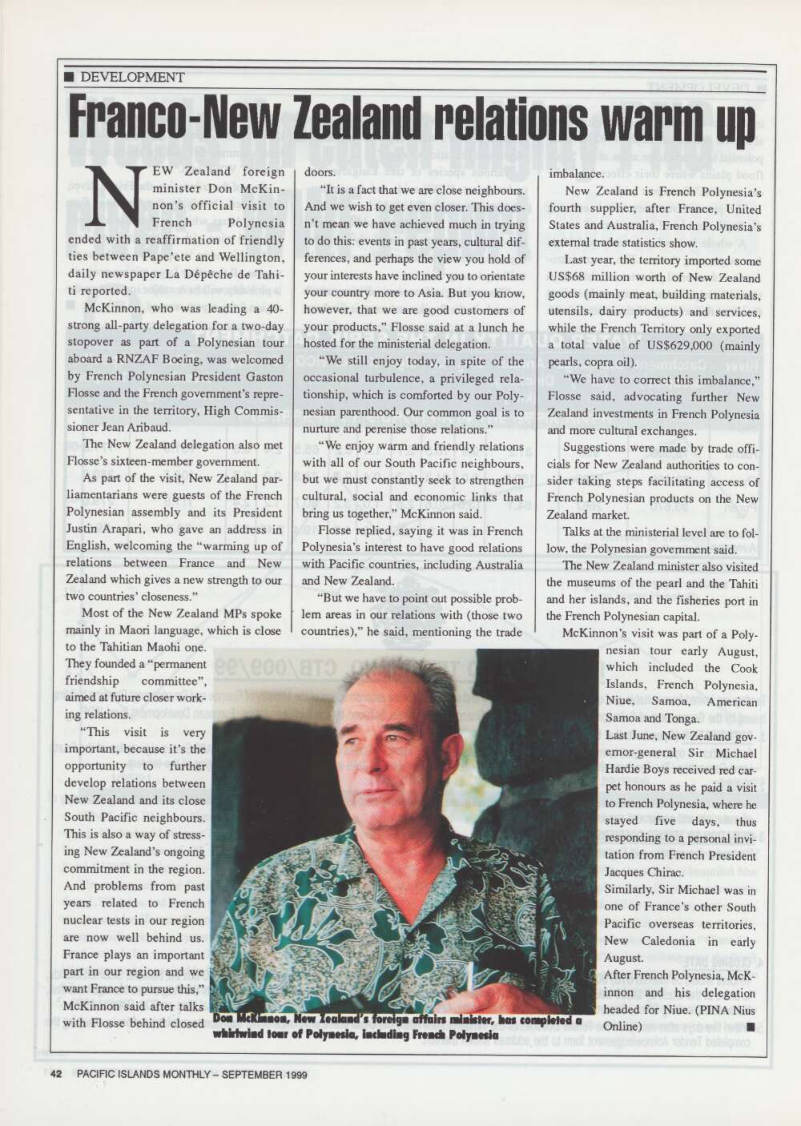
NEW Zealand foreign
minister Don McKin non’s official visit to French Polynesia ended with a reaffirmation of friendly ties between Pape’ete and Wellington, daily newspaper La Depeche de Tahi ti reported.
McKinnon, who was leading a 40strong all-party delegation for a two-day stopover as part of a Polynesian tour aboard a RNZAF Boeing, was welcomed by French Polynesian President Gaston Flosse and the French government’s repre sentative in the territory, High Commis sioner Jean Aribaud.
The New Zealand delegation also met Flosse’s sixteen-member government.
As part of the visit. New Zealand par liamentarians were guests of the French Polynesian assembly and its President Justin Arapari, who gave an address in English, welcoming the “warming up of relations between France and New Zealand which gives a new strength to our two countries’ closeness.”
Most of the New Zealand MPs spoke mainly in Maori language, which is close
to the Tahitian Maohi one.
They founded a “permanent
friendship committee”,
aimed at future closer work
ing relations.
“This visit is very important, because it’s the opportunity to further develop relations between New Zealand and its close South Pacific neighbours.
This is also a way of stress
ing New Zealand’s ongoing
commitment in the region.
And problems from past years related to French nuclear tests in our region are now well behind us.
France plays an important part in our region and we want France to pursue this,”
McKinnon said after talks with Flosse behind closed
doors.
“It is a fact that we are close neighbours.
And we wish to get even closer. This does n’t mean we have achieved much in trying to do this: events in past years, cultural dif ferences, and perhaps the view you hold of your interests have inclined you to orientate your country more to Asia. But you know, however, that we are good customers of your products,” Flosse said at a lunch he hosted for the ministerial delegation.
“We still enjoy today, in spite of the occasional turbulence, a privileged rela tionship, which is comforted by our Poly nesian parenthood. Our common goal is to nurture and perenise those relations.”
“We enjoy warm and friendly relations with all of our South Pacific neighbours, but we must constantly seek to strengthen cultural, social and economic links that bring us together,” McKinnon said.
Flosse replied, saying it was in French Polynesia’s interest to have good relations with Pacific countries, including Australia and New Zealand.
“But we have to point out possible prob lem areas in our relations with (those two countries),” he said, mentioning the trade
imbalance.
New Zealand is French Polynesia’s fourth supplier, after France, United States and Australia, French Polynesia’s external trade statistics show.
Last year, the territory imported some US$6B million worth of New Zealand
goods (mainly meat, building materials,
utensils, dairy products) and services, while the French Territory only exported a total value of U 55629,000 (mainly pearls, copra oil).
“We have to correct this imbalance,”
Flosse said, advocating further New Zealand investments in French Polynesia and more cultural exchanges.
Suggestions were made by trade offi cials for New Zealand authorities to con sider taking steps facilitating access of French Polynesian products on the New Zealand market.
Talks at the ministerial level are to fol low, the Polynesian government said.
The New Zealand minister also visited the museums of the pearl and the Tahiti and her islands, and the fisheries port in the French Polynesian capital.
McKinnon’s visit was part of a Poly
nesian tour early August, which included the Cook Islands, French Polynesia, Niue, Samoa, American Samoa and Tonga.
Last June, New Zealand gov ernor-general Sir Michael Hardie Boys received red car pet honours as he paid a visit to French Polynesia, where he stayed five days, thus responding to a personal invi tation from French President
Jacques Chirac.
Similarly, Sir Michael was in one of France’s other South Pacific overseas territories, New Caledonia in early August.
After French Polynesia, McK innon and his delegation headed for Niue. (PINA Nius Online) ■
Don Mckinnon, New Zealand's foreign affairs milkier, has completed a whirtwind tour of Polynesia, including french Polynesia
SOUTH Pacific
Nuclear shipments sail into South Pacific's ire
activists and gov ernments are seek ing tougher inter national legal action against nuclear shipments, amid alarm over two ships carrying nuclear fuel that are due to pass through the region’s waters this
month. The shipment of MOX fuel mixed plutonium and uranium oxide for Japan’s nuclear plants - is being trans ported by two British-flagged vessels that left Britain and France in mid-July en route to Japan.
Local activists say the ‘Pacific Pintail’ and ‘Pacific Teal’ carry an estimated 446 kg of plutonium in 40 nuclear fuel ele ments - enough material to construct 60 nuclear bombs.
The alarm over the latest shipment of radioactive material is prompting new demands by different groups for stronger action by Pacific islands against the trans port of such through their waters - includ ing the right to claim liability and com pensation should accidents take place
involving the dangerous shipments.
PCRC has called for a review of the Rarotonga Treaty and Waigani Conven tion to strengthen provisions against nuclear shipments and dumping in Pacif ic waters.
The Rarotonga Treaty of 1985 created a nuclear-free zone in the South Pacific,
where testing, production and deploy
ment of nuclear weapons and explosion devices and dumping of nuclear waste are banned.
PCRC also called on signatories to the Waigani Convention, which bans the export of hazardous wastes to the South Pacific, to apply pressure on Japan, France and Britain to halt the shipments of nuclear waste through it.
“We believe that South Pacific govern ments should work together (through the 16-member South Pacific Forum) to end all nuclear shipments through the region,” PCRC’s Losena Salabula said.
“Currently the shipments of plutonium
are not banned by the Rarotonga Treaty for a South Pacific Nuclear Free Zone, or the 1995 Waigani Convention,” Salabula
added.
“Pacific governments must work together to halt the shipments of radioac tive materials through our seas,” Nic McLellan, education research developer at PCRC, said, adding that any accident threatens the marine resources of Pacific
“Japan, France and
Britain are refusing
to discuss compensation
if there is an accident and
have failed to conduct
detailed environmental
assessments of the
hazards of shipping plu
tonium through our
region”
states’ Exclusive Economic Zones (EEZs).
Worse, he added, “Japan, France and Britain are refusing to discuss compensa tion if there is an accident and have failed to conduct detailed environmental assess ments of the hazards of shipping plutoni um through our region.”
The PCRC has joined Greenpeace International and the South Pacific Forum in criticising Japan, France and the United Kingdom over the shipment of MOX reac tor fuel.
In a statement issued last week, the sec retary general of the Fiji-based South Pacific Forum (SPF) Secretariat, Noel Levi, said: “We note the assurances by the shipping states of the safety measures that are said to be in place.”
But he said the Forum Secretariat had so far “been unable to convince and com pel France, Japan and the United Kingdom to begin discussions on a liability regime for compensating the region for potential economic losses that could be caused to tourism, fisheries and the environment in
the event of an accident involving a ship carrying radioactive materials even if there is no actual envi ronment damage caused.”
The British-flagged ves sels journeyed from Bar row in Britain and Cher bourg in France, carrying
the first commercial shipment of MOX reactor fuel to Japan.
Japan has the waste from its nuclear power industry reprocessed in Britain and France, a procedure that involves separat ing uranium and plutonium from used nuclear fuel to reuse the plutonium.
Plutonium is a highly radioactive ele ment that is produced in nuclear reactors.
Inhalation of a single microgram, smaller than a speck of dust, can cause fatal lung cancer.
It is the most highly prized fuel used for making nuclear weapons and has been an essential fuel driving the nuclear arms race over the last half century.
The PCRC says the two ships are expected to pass through the Tasman Sea between Australia and New Zealand, and then through the EEZs of the Pacific island nations, on the way up to Japan.
Greenpeace International’s Suva office called the sketchy, after-departure announcement of this shipment “an insult to the concerns and demands of dozens of enroute nations.” Pacific island countries should take all possible action to ban the transport and prohibit the international trade in weapons-usable plutonium, it added.
“Coming after the departure of this dangerous shipment, this announcement fully reveals the transporters’ arrogant disregard for the sovereign will and legit imate concerns of the enroute nations,”
Samantha Magick of Greenpeace Interna tional Suva said.
“Enroute nations including members of the South Pacific Forum grouping have demanded prior consultation and resolu tion of urgent safety, security and liabili ty issues,” she said.“lnstead, they have received an after-the-fact ultimatum of
Continued on page 44
Continued from page 43
intent. This is truly an international scan dal.” In 1992, the United States govern ment required Japan to send an armed warship to escort the plutonium ship ‘Akatsuki Maru’.
This ship passed between Australia and New Zealand and then through the FEZ of Pacific nations, including the Solomon Islands, New Caledonia, Vanu atu and the Federated States of Microne sia.
This time, in efforts to cut costs, the two British-flagged ships bearing the MOX reactor fuel are only armed with 30 mm guns and staffed with UK Atom ic Energy Authority officers.
“Such efforts are a publicity stunt and will not deter a real terrorist attack,”
PCRC said in a statement.
The Caribbean countries earlier opposed the shipment of spent nuclear fuel from Japan to Sellafield in the Unit ed Kingdom via the Panama Canal, which is the shortest route.
In a July 16 statement, the heads of the Caribbean Community (Caricom) which include Commonwealth nations such as the Bahamas, Jamaica, Barbados and Guyana, said they were outraged at the callous and contemptuous disregard of their appeals by France, United Kingdom and Japan to desist from what they called the dangerous misuse of the Caribbean sea.
Previous shipments of high-level radioactive waste travelled through Pacific waters in 1995, 1997 and 1998.
But in spite of clear legal require ments governing the latest shipment, critics say the Clinton administration is unwilling to object to the inadequacy of the security arrangements on the ‘Pacific Pintail’ and ‘Pacific Teal’ to avoid diplo matic headaches with France, Japan and the United Kingdom.
Nearly four tonnes of Japan’s plutoni um are stored at Sellafield in Britain and nearly 16 tonnes at the La Hague repro cessing plan in France. Another 40 tonnes is due to be separated from Japan ese spent reactor fuel over the next five to eight years. (IPS) ■
it is pulling out of New Caledonia
AOM French airline denies rumours it is pulling out of New Caledonia
AOM French airlines, which links New Cale donia to metropolitan France, denied rumours that it was pulling out of its Noumea destination, an AOM representative told daily newspaper Les Nouvelles Caledoniennes.
The company’s denial came after the announcement a planned third weekly flight to and from Paris, scheduled to take place at the end of August, was finally can celled, because AOM hasn’t found a plane (ideally an Airbus A 340-200) to cater for it.
Airbus’s ordering books are currently full.
“Noumea is one of our most difficult destinations, with Papeete (French Polyne sia), because it’s the furthest.
So distance, operations and airport taxes
impose high costs,” AOM representative in
New Caledonia Regis Babey said.
However, he added, the company saw some merit in flights from New Caledon ian: they fill planes on AOM France’s domestic routes.
“30 per cent of the New Caledonian pas sengers, once in France, go to the French
provinces, not Paris.”
“AOM is not pulling out. Its build up is
quite clear.
We began with one flight a week, now we have three.
We have continuously improved com fort with new DC 10s and recently a new business class.
We haven’t invested all this for noth
ing.”
However, he conceded on another note, that “one cannot spontaneously create a further 200 passengers a week (on the Paris-Noumea route).”
“One has to watch the market, stimu late it and wait.
We’re staying on the New Caledonian market, even if it’s slowing down at the moment, it is bound to develop.
And let’s not forget we’re in a region where two large events are to happen next year, the America’s Cup and the Sydney
Olympics.”
AOM is to be taken over shortly by a consortium consisting of Swissair and another financial concern.
Apart from AOM, Air France also links New Caledonia to Paris via Tokyo. (PINA Nius Online) ■
Advertisements & other items, p. 45 (1 item)
Telstra
TRADE MARK CAUTIONARY NOTICE
Notice is hereby given that Telstra Corporation Limited, a corporation duly organised and existing under the laws of Australia, and having ACN 051 775 556, the Corporate Secretary being located at 242 Exhibition Street, Melbourne, Australia is the sole proprietor of the following trade marks:-
~elstra ~elstra
Used in respect of:— Telecommunications and communications equipment, apparatus and systems, including but not limited to electronic and optical telecommunications and communications eqmpment, apparatus and systems; satellite and earth station telecommunications and communications equipment, apparatus and systems; Telephone equipment, apparatus and systems, including but not limited to telephone; telephone receivers; telephone handsets; telephone network, telephone exchanges, telephone switching, telephone answering, telephone card vending and telephone dialling equipment, apparatus and systems; Transmission, receiving and storage equipment, apparatus and systems, including but not limited to facsimile, telegraph, telex, teleprinting cable and paging equipment, apparatus and systems; data and video networking and conferencing equipment, apparatus and systems; data processing, message handling and switching equipment, apparatus and systems; digital equipment, apparatus and systems; electronic, voice, text and facsimile mail equipment, apparatus and systems; electronic directory equipment, apparatus and systems; Computer equipment, apparatus and systems, including but not limited to computer programs; computer software; computer hardware; computer terminals; computer memories; computer networking equipment, apparatus and systems; computer manuals in this class; modems; Video and audio equipment, apparatus and systems, including but not limited to sound and image recording transmission and reproduction equipment, apparatus and systems; video cassettes and tapes; compact discs; records; digital, electric and electronic radio equipment, apparatus and systems; magnetic tapes; cinematographic, television and amusement equipment, apparatus and systems; amusement machines; All associated parts and accessories being goods in class 9, paper, cardboard and goods made from these materials; printed matter including directories, journals and manuals and all goods in class 16; advertising, promotional, consultancy and business services; compiling arranging and publishing directories; telephone answering services; market research and statisticafservices; being services in class 35, repair installation, maintenance and construction services; being services in class 37, telecommunication services being services in class 38, amusement, entertainment, education and information services; multi-media services; being services in class 41, research services; computer programming services; retail and wholesaling services; consultancy services being services in Class 42'.
The said proprietor claims alt rights in respect of the above trade marks and will take all necessary legal steps against any person or company infringing their said rights.
DAVIES COLLISON CAVE
PATENT ATTORNEYS
One Little Collins Street Level 10 AMP Building Melbourne, Victoria, 3000 10 Barrack Street Hobart Place Australia Sydney, New South Wales, 2000 Canberra City 2601
Ain Calèdonie International still awaits French

tax officials' green light to buy Boeing-767
NEW Caledonia’s inter national airline. Air Caledonie Internation al, is still waiting final approval from French government’s tax authorities in order to get exemp tions on the planned purchase of a second Boeing aircraft, daily newspaper Les Nouvelles Caledoniennes reported.
In July, following a decision made by its board of directors, Air Caledonie Inter national (Aircalin), announced its inten tion to buy a second Boeing, a 767.
The move was seen as a surprise, as competitor Airbus was also bidding.
Aircalin explained a Boeing would suit better its needs and would be easier to
maintain, because of the large fleet of simi lar aircraft in the region. But the request made to French tax officials by Aircalin to get an exemption (a benefit granted to French overseas territories investment pro jects) was yet to be answered.
The New Caledonian airline had already lost one place in the Boeing production line in Seattle (United States), since the order has not yet been fully confirmed, Aircalin officials told Les Nouvelles.
The company says the original request was made last April and after the decision was made to buy the Boeing, they got fur ther requests from the French tax depart ment on July 9. They claim they answered four days later.
The deadline for French taxes depart
ment to answer the request was July 20, which has now been extended to another three months. The delay was disrupting plans at Aircalin to place an order in time to introduce the B-767 by November next year, company officials added.
It had obtained a small delay from Boeing, which had accepted, as a sign of understanding of the complex administra tive procedure, to push back the ordering deadline, Early August, five senior marketing executives from Boeing, assuming the deal would eventually get the nod from Paris, spent five days in the French Terri tory to further discuss the purchase with Aircalin management. (PINA Nius Online) ■
Calèdonie ticket price
Maintenance costs total 24 per cent of Air Calèdonie ticket price
MAIN PENANCE costs make up to 24 per cent of the ticket price in New Cale donia’s domestic airline, Air Caledonie, a yearly 560 million CFP (5.6 million US dollars), the daily newspaper Les Nou velles Caledoniennes reported.
This included regular replacements of costly spare parts such as propellers for the French-built, 50 seater ATR-42, which makes most of the company’s fleet.
“Initially, the bill for a propeller is over ten million CFP (US$100,000). But because it’s under guarantee, we bring this down to 2.2 million CFP,” Air Cal’s technical manager Pierre Cornu
explained.
Another costly part is the tyres, which need to be replaced every 550 landings.
And undercarriages need changing even more often: Air Cal applies a 400touchdown lifespan policy. (PINA Nius Online) ■
Polynesian fishermen strike deal for exports
SIX French Polynesian fish ing companies formed into a cooperative have signed a deal with an export com pany to guarantee regular opening of their catch overseas, daily newspaper La Depeche de Tahiti reported.
The deal, signed early August, between the concern, named “Armement Cooperatif de Polynesie -ACP- Polynesian Fishing Cooperative” and “Pacifique Aquaculture Services”, covers comprehensive market ing of their tuna catch.
“Pacifique Aquaculture Services -PAS-” has similar partnership deals with fishing companies in New Caledonia and Korea, whereby PAS purchases all of its partners’ catch and sells 95 per cent of it typically to American Samoa’s canneries, California and France.
The remaining unexported five per cent are sold locally.
In exchange, the fishing companies
undertake to conform to the required export
quality standards.
Early August, ACP increased its fleet to
14 ships with the delivery of a Fiji-built, 177 million French Pacific Francs (US$l.77 million) tuna fishing vessel “Oiseau des lies” (Islands Bird).
The vessel is the fourth of a five-unit order placed with Fiji Shipyards by ACP.
All ships are of similar class.
The purchase was financed through an agreement between ACP and th European Development Fund.
ACP president Gilles Le Boucher, while receiving the ship, said it would be mainly used to catch tuna for the export market.
“For export, there’s no problem, the growth is exponential. It’s so big, actually, that we have to be careful because other Pacific islands are currently watching us and trying to catch up with us,” he said.
“For instance, in Fiji, I’ve seen recently people coming from the United States, Europe, trying to set up fish processing units, based on the same kind that we are currently implementing,” he pointed out.
PAS’s aim is to reach a catch of some 1,100 tonnes this year and build up to 4,000 by 2003. (PINA Nius Online) ■
Noumea
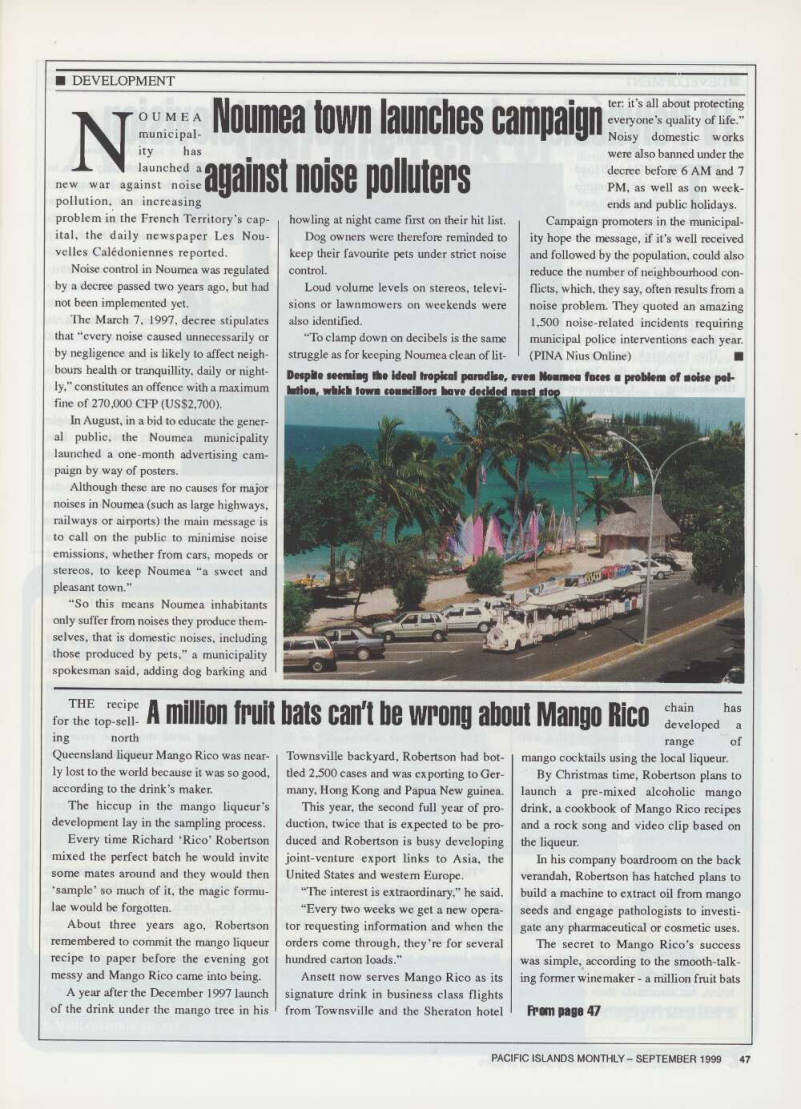
town launches campaign against noise polluters
municipal ity has launched a new war against noise pollution, an increasing
problem in the French Territory’s cap ital, the daily newspaper Les Nou velles Caledoniennes reported.
Noise control in Noumea was regulated by a decree passed two years ago, but had not been implemented yet.
The March 7, 1997, decree stipulates that “every noise caused unnecessarily or by negligence and is likely to affect neigh bours health or tranquillity, daily or night ly,” constitutes an offence with a maximum fine of 270,000 CEP (U 552,700).
In August, in a bid to educate the gener al public, the Noumea municipality launched a one-month advertising cam paign by way of posters.
Although these are no causes for major noises in Noumea (such as large highways, railways or airports) the main message is to call on the public to minimise noise emissions, whether from cars, mopeds or stereos, to keep Noumea “a sweet and pleasant town.”
“So this means Noumea inhabitants only suffer from noises they produce them selves, that is domestic noises, including those produced by pets,” a municipality spokesman said, adding dog barking and
howling at night came first on their hit list.
Dog owners were therefore reminded to keep their favourite pets under strict noise control.
Loud volume levels on stereos, televi sions or lawnmowers on weekends were also identified.
“To clamp down on decibels is the same struggle as for keeping Noumea clean of lit
ter: it’s all about protecting everyone’s quality of life.”
Noisy domestic works were also banned under the decree before 6 AM and 7 PM, as well as on week ends and public holidays.
Campaign promoters in the municipal ity hope the message, if it’s well received and followed by the population, could also reduce the number of neighbourhood con flicts, which, they say, often results from a noise problem. They quoted an amazing 1,500 noise-related incidents requiring municipal police interventions each year. (PINA Nius Online) ■
Despite seeming the ideal tropical paradise, even Noumea faces a problem of noise pol lution, which town councilors have decided must stop
A million fruit bats can't be wrong about Mango Rico
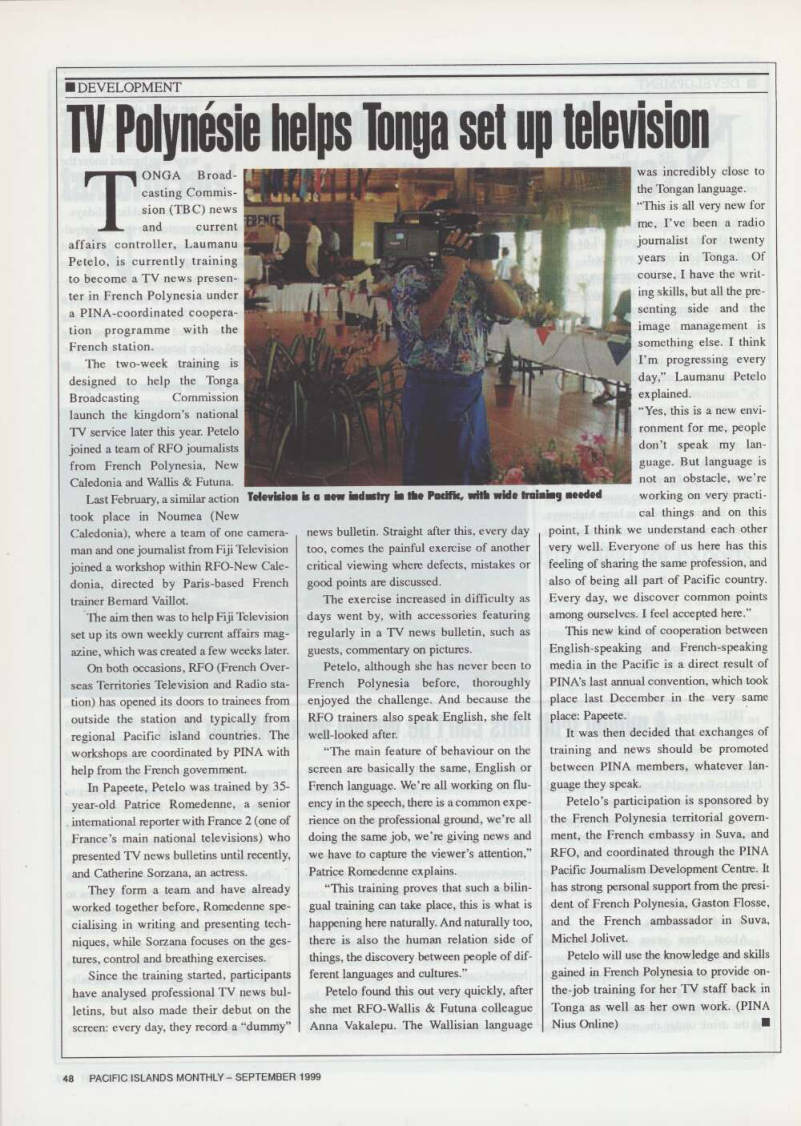

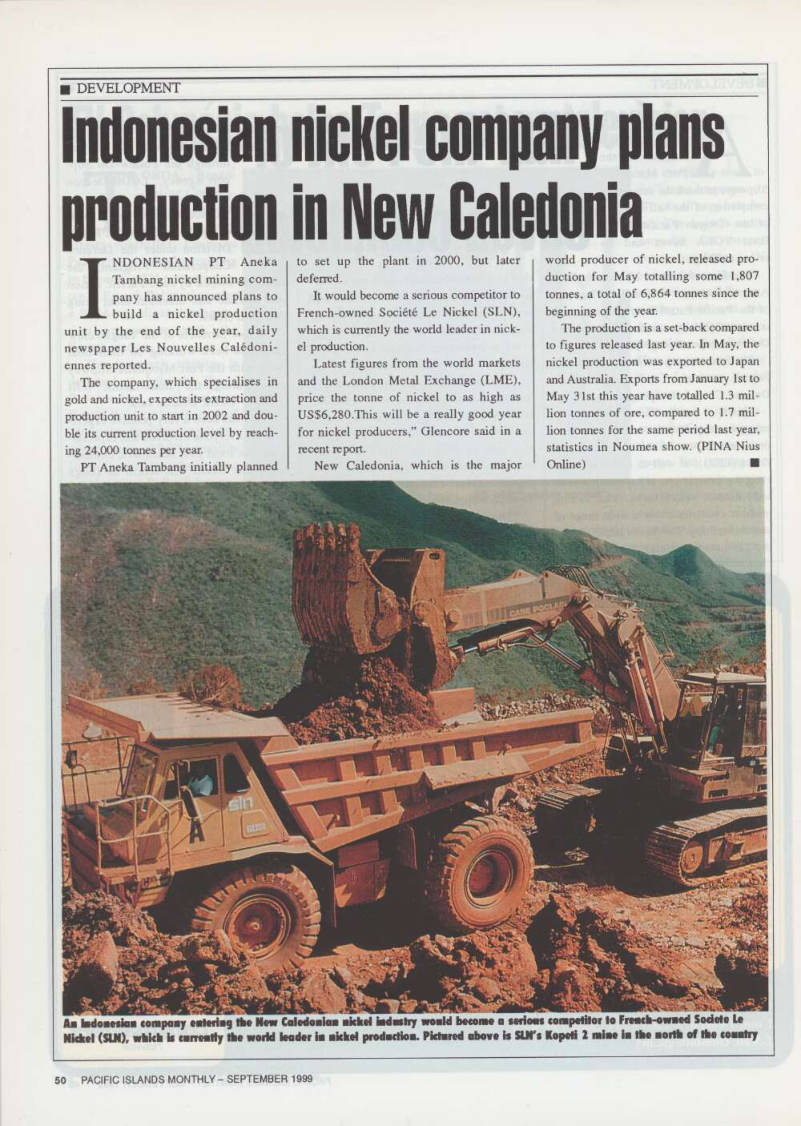
THE recipe for the top-sell ing north
Queensland liqueur Mango Rico was near ly lost to the world because it was so good, according to the drink’s maker.
The hiccup in the mango liqueur’s development lay in the sampling process.
Every time Richard ‘Rico’ Robertson mixed the perfect batch he would invite some mates around and they would then ‘sample’ so much of it, the magic formu lae would be forgotten.
About three years ago, Robertson remembered to commit the mango liqueur recipe to paper before the evening got messy and Mango Rico came into being.
A year after the December 1997 launch of the drink under the mango tree in his
Townsville backyard, Robertson had bot tled 2,500 cases and was exporting to Ger many, Hong Kong and Papua New guinea.
This year, the second full year of pro duction, twice that is expected to be pro duced and Robertson is busy developing joint-venture export links to Asia, the United States and western Europe.
“The interest is extraordinary,” he said.
“Every two weeks we get a new opera tor requesting information and when the orders come through, they’re for several hundred carton loads.”
Ansett now serves Mango Rico as its signature drink in business class flights from Townsville and the Sheraton hotel
chain has developed a range of
mango cocktails using the local liqueur.
By Christmas time, Robertson plans to launch a pre-mixed alcoholic mango drink, a cookbook of Mango Rico recipes and a rock song and video clip based on the liqueur.
In his company boardroom on the back verandah, Robertson has hatched plans to build a machine to extract oil from mango seeds and engage pathologists to investi gate any pharmaceutical or cosmetic uses.
The secret to Mango Rico’s success was simple, according to the smooth-talk ing former winemaker - a million fruit bats
From page 47
From page 47 can’t be wrong. And in a town where just about everyone has a mango tree in the backyard, it seems obvious that a former South Australian vintner would come up with an alcoholic concoction made from mangoes.
Robertson had decided on a career change when he moved to Townsville in 1987, but the lack of a locally-made alco holic drink in north Queensland kept him awake at night.
Finally, he began experimenting with mangoes, using the skins of the golden fruit to produce an aromatic alcohol.
From the experimentation. Mango Rico evolved with the help of the afore mentioned taste-testing friends - and a panel of psychologists employed to inter pret the drinking public's reaction to the drink.
The final product was a clear, deli ciously mango-scented, sweet liqueur with 20 per cent alcohol by volume. Pack aged in an elegant tall bottle. Mango Rico retails for about AUDS2S. AAP ■
TONGA Broad
TV Polynèsie helps Tonga set up television
casting Commis sion (TBC) news and current affairs controller, Laumanu Petelo, is currently training to become a TV news presen ter in French Polynesia under a PINA-coordinated coopera tion programme with the French station.
The two-week training is designed to help the Tonga Broadcasting Commission launch the kingdom’s national TV service later this year. Petelo joined a team of RFO journalists from French Polynesia, New Caledonia and Wallis & Futuna.
Last February, a similar action
took place in Noumea (New Caledonia), where a team of one camera man and one journalist from Fiji Television joined a workshop within RFO-New Cale donia, directed by Paris-based French trainer Bernard Vaillot.
The aim then was to help Fiji Television set up its own weekly current affairs mag azine, which was created a few weeks later.
On both occasions, RFO (French Over seas Territories Television and Radio sta tion) has opened its doors to trainees from outside the station and typically from regional Pacific island countries. The workshops are coordinated by PINA with help from the French government.
In Papeete, Petelo was trained by 35year-old Patrice Romedenne, a senior international reporter with France 2 (one of France’s main national televisions) who presented TV news bulletins until recently, and Catherine Sorzana, an actress.
They form a team and have already worked together before, Romedenne spe
cialising in writing and presenting tech
niques, while Sorzana focuses on the ges tures, control and breathing exercises.
Since the training started, participants have analysed professional TV news bul letins, but also made their debut on the screen: every day, they record a “dummy”
news bulletin. Straight after this, every day too, comes the painful exercise of another critical viewing where defects, mistakes or good points are discussed.
The exercise increased in difficulty as days went by, with accessories featuring regularly in a TV news bulletin, such as guests, commentary on pictures.
Petelo, although she has never been to French Polynesia before, thoroughly enjoyed the challenge. And because the RFO trainers also speak English, she felt well-looked after.
“The main feature of behaviour on the screen are basically the same, English or French language. We’re all working on flu ency in the speech, there is a common expe rience on the professional ground, we’re all doing the same job, we’re giving news and we have to capture the viewer’s attention,”
Patrice Romedenne explains.
“This training proves that such a bilin gual training can take place, this is what is happening here naturally. And naturally too, there is also the human relation side of things, the discovery between people of dif ferent languages and cultures.”
Petelo found this out very quickly, after she met RFO-Wallis & Futuna colleague Anna Vakalepu. The Wallisian language
was incredibly close to
the Tong an language.
“This is all very new for me, I’ve been a radio journalist for twenty years in Tonga. Of course, I have the writ ing skills, but all the pre senting side and the image management is something else. I think I’m progressing every day,” Laumanu Petelo
explained.
“Yes, this is a new envi ronment for me, people don’t speak my lan guage. But language is not an obstacle, we’re working on very practi cal things and on this
point, I think we understand each other very well. Everyone of us here has this feeling of sharing the same profession, and also of being all part of Pacific country.
Every day, we discover common points among ourselves. I feel accepted here.”
This new kind of cooperation between
English-speaking and French-speaking
media in the Pacific is a direct result of PINA’s last annual convention, which took place last December in the very same
place: Papeete.
It was then decided that exchanges of training and news should be promoted between PINA members, whatever lan guage they speak.
Petelo’s participation is sponsored by the French Polynesia territorial govern ment, the French embassy in Suva, and RFO, and coordinated through the PINA Pacific Journalism Development Centre. It has strong personal support from the presi dent of French Polynesia, Gaston Flosse, and the French ambassador in Suva, Michel Jolivet.
Petelo will use the knowledge and skills gained in French Polynesia to provide on the-job training for her TV staff back in Tonga as well as her own work. (PINA Nius Online) •
Television is a new industry in the Pacific, with wide training needed
Savea completed
Half-life refit of Savea completed
A Ceremony
was held on August 6 at the
Port Macquarie
Slipways to mark the successful completion of the half-life refit of the Tongan Pacific Patrol Boat VOEA Savea and its return to Tonga.
The Savea is one of 22 boats built in Australia between 1987 and 1997 as part of the Pacific Patrol Boat project which is Australia’s largest and most successful Defence cooperation project.
The boats were provided to 12 Pacific Forum countries under Australia’s Defence Cooperation program.
This is to enable Forum countries to manage and police the resources within their extensive Exclusive Economic Zones (EEZs), as well as undertake sov ereignty protection, search and rescue and disaster relief tasks. The Forum member countries cover a wide range of aquatic territory. The Savea is the 13th of the 22 boats to undergo a half-life refit
that includes ultrasound and x-ray exami nation of the boat before any structural repairs are done, upgrading essential equipment such as the radar, internal and external repainting and a complete over haul of the engines and machinery.
“The half-life refit is particularly important as it ensures the boats are main tained in peak condition to enable Pacific nations to continue to carry out the impor tant task of protecting their 200 mile exclusive economic zones and their fish ing resources,” Lieutenant Commander Tony Deacon, Director of the project said.
“The project’s success has been based on Australia’s ability to provide not just the boats but training for the crews, the
half-life refits and through-life logistic and technical support through the Follow-On Sup port Agency,” LCDR Deacon said.
“Although the project is fund ed by the International Policy Division under the Defence Cooperation Program, the
boats are owned by each Pacific nation who operate and maintain them using their own crews.”
“Senior members of the Tongan crew have also been working on their boat
along with the Port Macquarie Slipway
crew during the three-month refit process,” LCDR Deacon said.
“This has been a very positive experi ence for everyone involved and especial ly for the local Port Macquarie commu nity.” The Savea will return to Tonga with its own crew after the refit is com pleted. The refits are carried out in build order and the Lomor from the Marshall Islands will be the 14th boat to undergo a refit starting this month. ■
Advertisements & other items, p. 49 (1 item)
ToFinish...
SCHOOLS
CHURCHES
From Start...
Copymasters Hawaii can help you with all of your duplicating needs from start to finish. Featuring Duplo® Digital Duplicators, Copiers, Shredders, Laminators, Poster Printers, Collators, & Folding Equipment. We also sell Stencil & Duplicator Supphes, Paper Supply, and all brands of Copier Supphes, & Computers.
Copymasters Hawaii
96-1173 Waihona Street, Suite B-2 • Pearl City, Hi 96782 Phone (808) 678-2263 • Fax (808) 456-5678
E-Mail: [email protected]
GOVERNMENT • COMMERCIAL
Serving:
STATE OF HAWAII
ENTIRE
SOUTH PACIFIC,
INCLUDING:
Fiji
SAMOA
TAHITI
TONGA
COOK ISLANDS
MICRONESIA:
FEDERATED STATES
OF MICRONESIA
GUAM
MARIANAS
MARSHALL
ISLANDS
PALAU
ToFinish...
copymasters
hawaii
production in New Caledonia
Indonesian nickel company plans production in New Caledonia
Indonesian Pt Aneka
Tambang nickel mining com pany has announced plans to build a nickel production unit by the end of the year, daily newspaper Les Nouvelles Caledoni
ennes reported.
The company, which specialises in gold and nickel, expects its extraction and production unit to start in 2002 and dou ble its current production level by reach ing 24,000 tonnes per year.
PT Aneka Tambang initially planned
to set up the plant in 2000, but later deferred.
It would become a serious competitor to French-owned Societe Le Nickel (SEN), which is currently the world leader in nick el production.
Latest figures from the world markets and the London Metal Exchange (LME), price the tonne of nickel to as high as USs6,2Bo.This will be a really good year for nickel producers,” Glencore said in a recent report.
New Caledonia, which is the major
world producer of nickel, released pro duction for May totalling some 1,807 tonnes, a total of 6,864 tonnes since the beginning of the year.
The production is a set-back compared to figures released last year. In May, the nickel production was exported to Japan and Australia. Exports from January Ist to May 31st this year have totalled 1.3 mil lion tonnes of ore, compared to 1.7 mil lion tonnes for the same period last year, statistics in Noumea show. (PINA Nius Online) •
An indonesian company entering the New Caledonion nickel industry would become a serious competitor to French-owaed Sodete Le Nickel (SIN), which is currently the world leader in nickel productioa. Pictured above is SIN'S Kopeti 2 mine in the north of the country
Advertisements & other items, p. 50 (1 item)
■ Development
Traditional
Landowners receive discount to take over Naked nickel mine
landowners of the Naketi nickel mine (north of Noumea) have obtained a further discount on the price they’ll have to pay to take over the site
from affluent Ballande group of com panies, but tension on the site is still high, RFO-radio reported.
“We were a little bit apprehensive after what happened last weekend, we thought the landowners wouldn’t turn up. They did and it’s a good sign,” Ballande industries mining director Jean-Jacques Nekito said.
In July, Ballande announced it would sell its Naketi exploitation to SMN (Societe des Mines de Naketi) for a “symbolic Franc”, with a clause to pay off the company’s assets in kind with future nickel productions.
At a meeting early August, Bal lande offered that the company’s assets, valued at some 360 million
CFP (US$3.6 million) at their replace ment worth to date, be estimated at their accounting, depreciated value only, thus bringing down the cost by 30 per cent.
But Wilfrid Mai’s MKM (Mai Kouaoua Mines), another mining com pany that intended to work on the same site, was told to leave and offered small contracts elsewhere in New Caledonia. Since July, tensions between the two companies have esca lated, causing roadblocks and the destruction of houses and machinery.
A group of youngsters from the vil lage attacked the MKM camp and burnt down barracks and industrial
machinery on the MKM min ing site waiting to be disman tled. The camp has been ran sacked, front doors smashed, equipment burnt. And on Monday night trucks win dows were smashed again,”
MKM director Alain Vasseur
said. Gendarmes from nearby Canala arrested someone involved in the van dalism, but they later had to release him after being caught in a roadblock.
“Law and order is no longer there,”
Vasseur complained.
A trench had to be dug to bar access to all vehicles on the MKM camp, until the company removes some 400million CFP worth of equipment.
“We’re being kicked out, we accept to leave and on top of that, we should go and leave our machinery?,”
Vasseur asks. Mining activities on the Nakety site have been paralysed for the last three and a half months. (PINA Nius Online) ■
Advertisements & other items, p. 51 (2 items)
■ Development
Executive Director for the Pacific
FSPI seeks new
The Foundation of the Peoples of the South Pacific International (FSPI) is a Regional non-governmental organization with a focus bn integrated community development in the Pacific Island States. The FSPI headquarters is based in Port Vila, Vanuatu, with independent affiliated network agencies in Papua New Guinea, Solomon Islands, Vanuatu, Fiji, Kiribati, Tonga, Tuvalu, Samoa, Australia, UK and USA.
The FSPI Board of Management, composed of representatives from the Boards of its eleven member agencies, is seeking to appoint a qualified Executive Director to carry out its work. The Executive Director is responsible directly to the Chairman of the FSPI Board for the day-today operations of the Secretariat, including the supervision of Secretariat staff. Candidates are sought who have 10+ years of experience and a proven track record of successful development management and fundraising. Please write below for a detailed Terms of Reference.
An attractive remuneration package is offered including a professional regional salary, housing subsidy, relocation and health insurance.
Candidates wishing to apply should send an application letter with their curriculum vitae and salary history to: FSP International,
ATT: EXECUTIVE DIRECTOR POSITION,
Email: [email protected].
Postal: PO Box 951, Port Vila, Vanuatu.
Applications for this position close on 15 November 1999 for recruitment April 2000. Only shortlisted candidates will be contacted further. ims&i
Dock party!
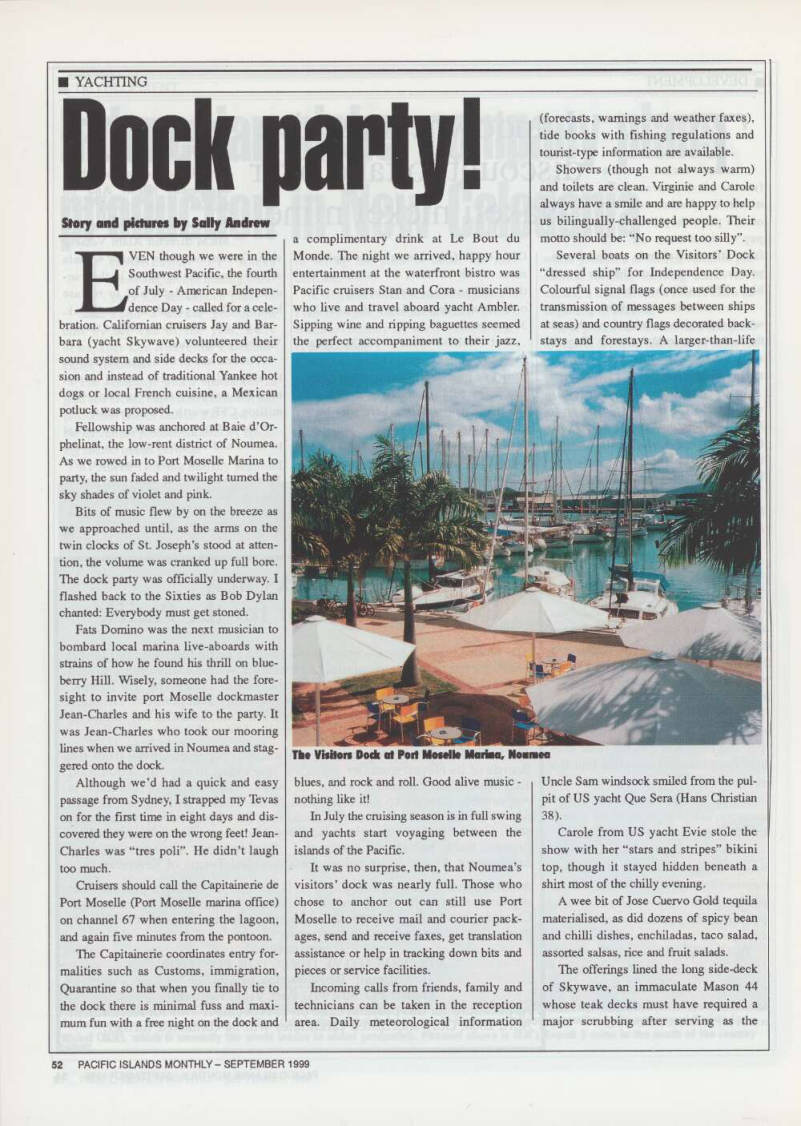
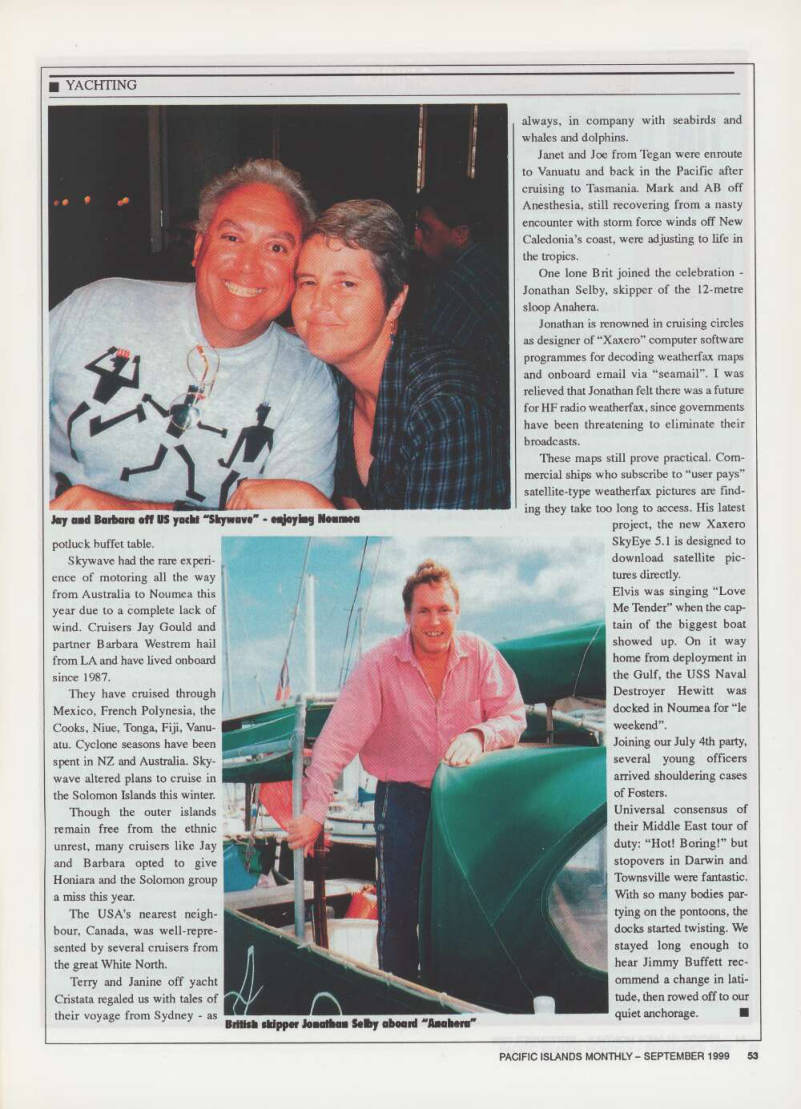
Yachting
Story and pictures by Sally Andrew
EVEN though we were in the Southwest Pacific, the fourth of July - American Indepen dence Day - called for a cele bration. Californian cruisers Jay and Bar bara (yacht Skywave) volunteered their sound system and side decks for the occa sion and instead of traditional Yankee hot dogs or local French cuisine, a Mexican potluck was proposed.
Fellowship was anchored at Baie d’Or phelinat, the low-rent district of Noumea.
As we rowed in to Port Moselle Marina to party, the sun faded and twilight turned the sky shades of violet and pink.
Bits of music flew by on the breeze as we approached until, as the arms on the twin clocks of St. Joseph’s stood at atten tion, the volume was cranked up full bore.
The dock party was officially underway. I flashed back to the Sixties as Bob Dylan chanted: Everybody must get stoned.
Fats Domino was the next musician to bombard local marina live-aboards with strains of how he found his thrill on blue berry Hill. Wisely, someone had the fore sight to invite port Moselle dockmaster Jean-Charles and his wife to the party. It was Jean-Charles who took our mooring lines when we arrived in Noumea and stag gered onto the dock.
Although we’d had a quick and easy passage from Sydney, I strapped my Tevas on for the first time in eight days and dis covered they were on the wrong feet! Jean- Charles was “tres poll”. He didn’t laugh too much.
Cruisers should call the Capitainerie de Port Moselle (Port Moselle marina office) on channel 67 when entering the lagoon, and again five minutes from the pontoon.
The Capitainerie coordinates entry for malities such as Customs, immigration, Quarantine so that when you finally tie to the dock there is minimal fuss and maxi mum fun with a free night on the dock and
a complimentary drink at Le Bout du Monde. The night we arrived, happy hour entertainment at the waterfront bistro was Pacific cruisers Stan and Cora - musicians who live and travel aboard yacht Ambler.
Sipping wine and ripping baguettes seemed the perfect accompaniment to their jazz.
(forecasts, warnings and weather faxes), tide books with fishing regulations and tourist-type information are available.
Showers (though not always warm) and toilets are clean. Virginie and Carole always have a smile and are happy to help
us bilingually-challenged people. Their
motto should be: “No request too silly”.
Several boats on the Visitors’ Dock “dressed ship” for Independence Day.
Colourful signal flags (once used for the transmission of messages between ships at seas) and country flags decorated back stays and forestays. A larger-than-life
blues, and rock and roll. Good alive music nothing like it!
In July the cruising season is in full swing and yachts start voyaging between the islands of the Pacific.
It was no surprise, then, that Noumea’s visitors’ dock was nearly full. Those who chose to anchor out can still use Port Moselle to receive mail and courier pack ages, send and receive faxes, get translation assistance or help in tracking down bits and pieces or service facilities.
Incoming calls from friends, family and technicians can be taken in the reception area. Daily meteorological information
Uncle Sam windsock smiled from the pul pit of US yacht Que Sera (Hans Christian 38).
Carole from US yacht Evie stole the show with her “stars and stripes” bikini top, though it stayed hidden beneath a shirt most of the chilly evening.
A wee bit of Jose Cuervo Gold tequila materialised, as did dozens of spicy bean and chilli dishes, enchiladas, taco salad, assorted salsas, rice and fruit salads.
The offerings lined the long side-deck of Skywave, an immaculate Mason 44 whose teak decks must have required a major scrubbing after serving as the
The Visitors Dock at Port Moselle Marina Noumea
potluck buffet table.
Sky wave had the rare experi ence of motoring all the way from Australia to Noumea this year due to a complete lack of wind. Cruisers Jay Gould and partner Barbara Westrem hail from LA and have lived onboard since 1987.
They have cruised through Mexico, French Polynesia, the Cooks, Niue, Tonga, Fiji, Vanu atu. Cyclone seasons have been spent in NZ and Australia. Sky wave altered plans to cruise in the Solomon Islands this winter.
Though the outer islands remain free from the ethnic unrest, many cruisers like Jay and Barbara opted to give Honiara and the Solomon group a miss this year.
The USA’s nearest neigh bour, Canada, was well-repre sented by several cruisers from the great White North.
Terry and Janine off yacht Cristata regaled us with tales of their voyage from Sydney - as
always, in company with seabirds and whales and dolphins.
Janet and Joe fromTegan were enroute to Vanuatu and back in the Pacific after cruising to Tasmania. Mark and AB off Anesthesia, still recovering from a nasty encounter with storm force winds off New Caledonia’s coast, were adjusting to life in
the tropics.
One lone Brit joined the celebration - Jonathan Selby, skipper of the 12-metre sloop Anahera.
Jonathan is renowned in cruising circles as designer of “Xaxero” computer software programmes for decoding weatherfax maps and onboard email via “seamail”. I was relieved that Jonathan felt there was a future for HF radio weatherfax, since governments have been threatening to eliminate their broadcasts.
These maps still prove practical. Com mercial ships who subscribe to “user pays” satellite-type weatherfax pictures are find ing they take too long to access. His latest
project, the new Xaxero Sky Eye 5.1 is designed to download satellite pic tures directly.
Elvis was singing “Love Me Tender” when the cap tain of the biggest boat showed up. On it way home from deployment in the Gulf, the USS Naval Destroyer Hewitt was docked in Noumea for “le weekend”.
Joining our July 4th party, several young officers arrived shouldering cases of Fosters.
Universal consensus of their Middle East tour of duty: “Hot! Boring!” but stopovers in Darwin and Townsville were fantastic.
With so many bodies par tying on the pontoons, the docks started twisting. We stayed long enough to hear Jimmy Buffett rec ommend a change in lati tude, then rowed off to our quiet anchorage. ■
Joy and Barbara off US yacht "Skywave" - enjoying Noumea
British skipper Jonathan Sel[?]y aboard "Anahera"
Advertisements & other items, p. 53 (1 item)
■ Yachting
Polynesians
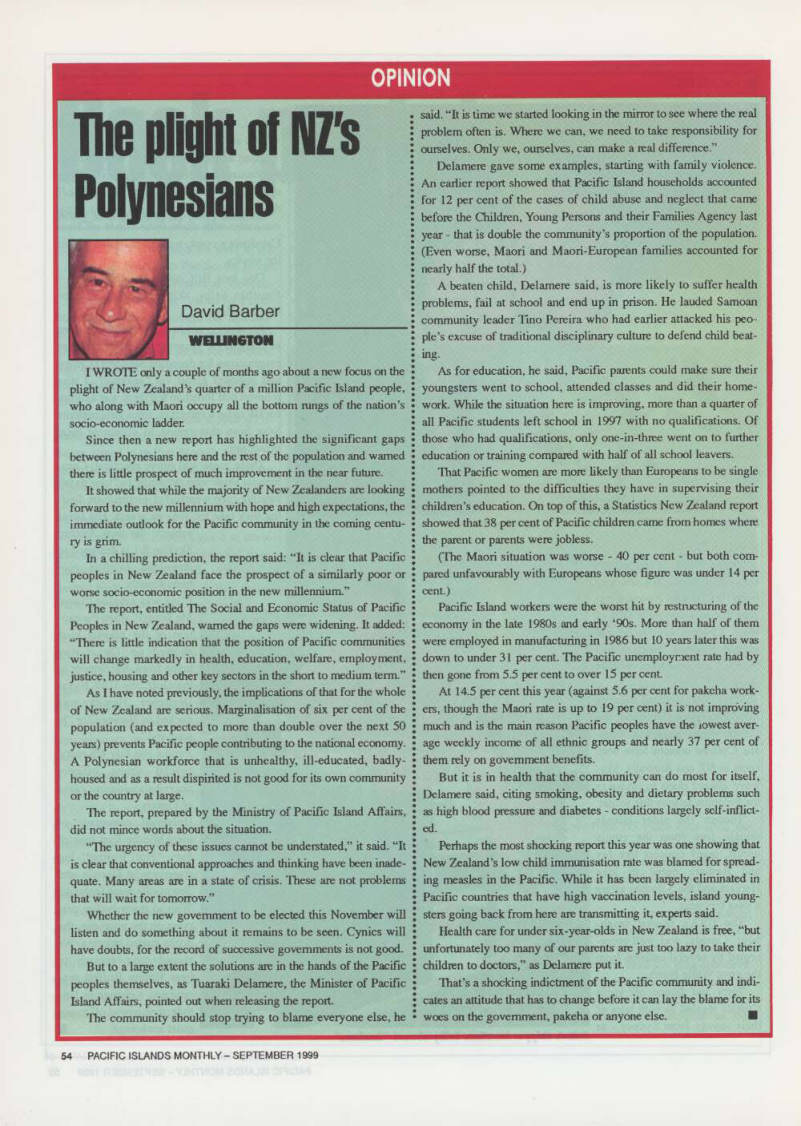
Opinion
Hie plight of NZ's Polynesians
I WROTE only a couple of months ago about a new focus on the plight of New Zealand’s quarter of a million Pacific Island people, who along with Maori occupy all the bottom rungs of the nation’s socio-economic ladder.
Since then a new report has highlighted the significant gaps between Polynesians here and the rest of the population and warned there is little prospect of much improvement in the near future.
It showed that while the majority of New Zealanders are looking forward to the new millennium with hope and high expectations, the immediate outlook for the Pacific community in the coming centu ry is grim.
In a chilling prediction, the report said: “It is clear that Pacific peoples in New Zealand face the prospect of a similarly poor or worse socio-economic position in the new millennium.”
The report, entitled The Social and Economic Status of Pacific Peoples in New Zealand, warned the gaps were widening. It added: “There is little indication that the position of Pacific communities will change markedly in health, education, welfare, employment, justice, housing and other key sectors in the short to medium term.”
As I have noted previously, the implications of that for the whole of New Zealand are serious. Maiginalisation of six per cent of the population (and expected to more than double over the next 50 years) prevents Pacific people contributing to the national economy.
A Polynesian workforce that is unhealthy, ill-educated, badly housed and as a result dispirited is not good for its own community or the country at large.
The report, prepared by the Ministry of Pacific Island Affairs, did not mince words about the situation.
“The urgency of these issues cannot be understated,” it said. “It is clear that conventional approaches and thinking have been inade quate. Many areas are in a state of crisis. These are not problems that will wait for tomorrow.”
Whether the new government to be elected this November will listen and do something about it remains to be seen. Cynics will have doubts, for the record of successive governments is not good.
But to a large extent the solutions are in the hands of the Pacific peoples themselves, as Tuaraki Delamere, the Minister of Pacific Island Affairs, pointed out when releasing the report.
The community should stop trying to blame everyone else, he
said. “It is time we started looking in the minor to see where the real problem often is. Where we can, we need to take responsibility for ourselves. Only we, ourselves, can make a real difference.”
Delamere gave some examples, starting with family violence.
An earlier report showed that Pacific Island households accounted for 12 per cent of the cases of child abuse and neglect that came before the Children, Young Persons and their Families Agency last year - that is double the community’s proportion of the population. (Even worse, Maori and Maori-European families accounted for nearly half the total.) A beaten child, Delamere said, is more likely to suffer health problems, fail at school and end up in prison. He lauded Samoan community leader Ttno Pereira who had earlier attacked his peo ple’s excuse of traditional disciplinary culture to defend child beat ing.
As for education, he said. Pacific parents could make sure their youngsters went to school, attended classes and did their home work. While tire situation here is improving, more than a quarter of all Pacific students left school in 1997 with no qualifications. Of those who had qualifications, only one-in-three went on to further education or training compared with half of all school leavers.
That Pacific women are more likely than Europeans to be single mothers pointed to the difficulties they have in supervising their children’s education. On top of this, a Statistics New Zealand report showed that 38 per cent of Pacific children came from homes where the parent or parents were jobless. (The Maori situation was worse - 40 per cent - but both com pared unfavourably with Europeans whose figure was under 14 per cent.) Pacific Island workers were the worst hit by restructuring of the economy in the late 1980 s and early ‘9os. More than half of them were employed in manufacturing in 1986 but 10 years later this was down to under 31 per cent. The Pacific unemployment rate had by then gone from 5.5 per cent to over 15 per cent At 14.5 per cent this year (against 5.6 per cent for pakeha work ers, though the Maori rate is up to 19 per cent) it is not improving much and is the main reason Pacific peoples have the lowest aver age weekly income of all ethnic groups and nearly 37 per cent of them rely on government benefits.
But it is in health that the community can do most for itself, Delamere said, citing smoking, obesity and dietary problems such as high blood pressure and diabetes - conditions largely self-inflict ed.
Perhaps the most shocking report this year was one showing that New Zealand’s low child immunisation rate was blamed for spread ing measles in the Pacific. While it has been largely eliminated in Pacific countries that have high vaccination levels, island young sters going back from here are transmitting it, experts said.
Health care for under six-year-olds in New Zealand is free, “but unfortunately too many of our parents are just too lazy to take their children to doctors,” as Delamere put it.
That’s a shocking indictment of the Pacific community and indi cates an attitude that has to change before it can lay the blame for its woes on the government, pakeha or anyone else. ■
David Barber
Wellington
Lessons from an oil spill
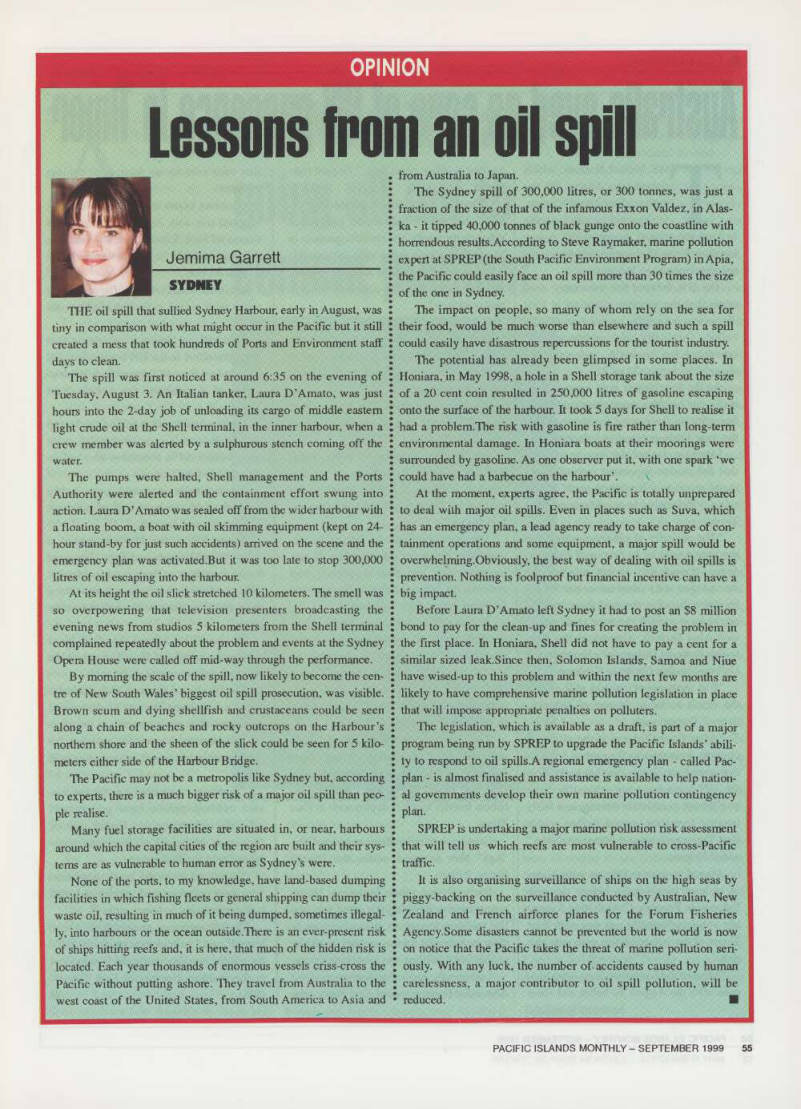
THE oil spill that sullied Sydney Harbour, early in August, was tiny in comparison with what might occur in the Pacific but it still created a mess that took hundreds of Ports and Environment staff days to clean.
The spill was first noticed at around 6:35 on the evening of Tuesday, August 3. An Italian tanker, Laura D’Amato, was just hours into the 2-day job of unloading its cargo of middle eastern light crude oil at the Shell terminal, in the inner harbour, when a crew member was alerted by a sulphurous stench coming off the water.
The pumps were halted, Shell management and the Ports Authority were alerted and the containment effort swung into action. Laura D’Amato was sealed off from the wider harbour with a floating boom, a boat with oil skimming equipment (kept on 24hour stand-by for just such accidents) arrived on the scene and the emergency plan was activated. But it was too late to stop 300,000 litres of oil escaping into the harbour.
At its height the oil slick stretched 10 kilometers. The smell was so overpowering that television presenters broadcasting the evening news from studios 5 kilometers from the Shell terminal complained repeatedly about the problem and events at the Sydney Opera House were called off mid-way through the performance.
By morning the scale of the spill, now likely to become the cen tre of New South Wales’ biggest oil spill prosecution, was visible.
Brown scum and dying shellfish and crustaceans could be seen along a chain of beaches and rocky outcrops on the Harbour’s northern shore and the sheen of the slick could be seen for 5 kilo meters either side of the Harbour Bridge.
The Pacific may not be a metropolis like Sydney but, according to experts, there is a much bigger risk of a major oil spill than peo
ple realise.
Many fuel storage facilities are situated in, or near, harbouis around which the capital cities of the region are built and their sys tems are as vulnerable to human error as Sydney’s were.
None of the ports, to my knowledge, have land-based dumping facilities in which fishing fleets or general shipping can dump their waste oil, resulting in much of it being dumped, sometimes illegal ly, into harbours or the ocean outside. There is an ever-present risk of ships hitting reefs and, it is here, that much of the hidden risk is located. Each year thousands of enormous vessels criss-cross the Pacific without putting ashore. They travel from Australia to the west coast of the United States, from South America to Asia and
from Australia to Japan.
The Sydney spill of 300,000 litres, or 300 tonnes, was just a fraction of the size of that of the infamous Exxon Valdez, in Alas ka - it tipped 40,000 tonnes of black gunge onto the coastline with horrendous results. According to Steve Raymaker, marine pollution expert at SPREP (the South Pacific Environment Program) in Apia, the Pacific could easily face an oil spill more than 30 times the size of the one in Sydney.
The impact on people, so many of whom rely on the sea for their food, would be much worse than elsewhere and such a spill could easily have disastrous repercussions for the tourist industry.
The potential has already been glimpsed in some places. In Honiara, in May 1998, a hole in a Shell storage tank about the size of a 20 cent coin resulted in 250,000 litres of gasoline escaping onto the surface of the harbour. It took 5 days for Shell to realise it had a problem. The risk with gasoline is fire rather than long-term environmental damage. In Honiara boats at their moorings were surrounded by gasoline. As one observer put it, with one spark ‘we could have had a barbecue on the harbour’. v At the moment, experts agree, the Pacific is totally unprepared to deal with major oil spills. Even in places such as Suva, which has an emergency plan, a lead agency ready to take charge of con tainment operations and some equipment, a major spill would be overwhelming. Obviously, the best way of dealing with oil spills is prevention. Nothing is foolproof but financial incentive can have a big impact.
Before Laura D’Amato left Sydney it had to post an $8 million bond to pay for the clean-up and fines for creating the problem in the first place. In Honiara, Shell did not have to pay a cent for a similar sized leak. Since then, Solomon Islandsr, Samoa and Niue have wised-up to this problem and within the next few months are likely to have comprehensive marine pollution legislation in place that will impose appropriate penalties on polluters.
The legislation, which is available as a draft, is part of a major program being run by SPREP to upgrade the Pacific Islands’ abili ty to respond to oil spills.A regional emergency plan - called Pac plan - is almost finalised and assistance is available to help nation al governments develop their own marine pollution contingency
plan.
SPREP is undertaking a major marine pollution risk assessment that will tell us which reefs are most vulnerable to cross-Pacific traffic.
It is also organising surveillance of ships on the high seas by piggy-backing on the surveillance conducted by Australian, New Zealand and French airforce planes for the Forum Fisheries Agency. Some disasters cannot be prevented but the world is now on notice that the Pacific takes the threat of marine pollution seri ously. With any luck, the number of accidents caused by human carelessness, a major contributor to oil spill pollution, will be reduced. ■
Jemima Garrett
Sydney
Australia eyed as core of UN presence in Timor
Development
THE United Nations, which delayed to August 30 the vote on East Timor’s future, is expected to ask Australia to form the core of an armed UN peace keeping force if the territory votes for independence from Indonesia.
The UN delayed the vote amid con cerns that the security situation in East Timor was not conducive to a free and fair ballot. Originally, the plebiscite was scheduled for August 8, and was later changed to August 21 or 22.
As the East Timor vote neared, Aus tralia put in place contingency plans in line with on-the-ground assessments that the most likely outcome is independence.
Likewise, leaked documents indicate that Indonesian-supported paramilitaries could resort to a ‘scorched-earth’ policy when withdrawing to neighbouring West Timor.
“The majority of observers think that the vote would be in favour of indepen dence, though you cannot rule out the intimidation and violent tactics carried out by the militia for the past three months might have eroded the vote somewhat,” said Alan Dupont, director at the Aus tralian National University’s Strategic and Defense Studies Centre in Canberra.
“But most people would still expect the result to be in favour of indepen dence,” Dupont said.
“After the ballot and if the situation changes, Indonesia no longer has jurisdic tion over East Timor - so that is the time the UN force becomes critical because you’ll need to maintain security in a fairly lengthy transition period before a new East Timor government comes into play,”
added Dupont.
Also of concern to Dupont is the hiatus of at least two months before the new Indonesian People’s Consultative Assem bly votes to formally cut ties with East Timor, if the independence vote gets car ried.
“Most of the focus now is on what hap pens after the August 30 ballot and there
are two problem areas here,” Dupont con tinued.
“There is a two-month period after the ballot before the Indonesian parliament votes on the result, and the first question to be asked is who’s going to be responsible for security during that difficult period, assuming that the vote goes in favour of independence.”
According to a secret Indonesian gov ernment report leaked recently, there is a strong likelihood that a sharp increase in violence will accompany a result favour
ing independence.
The document dated July 3 and signed by H R Gamadi, special assistant to Gen eral Feisal Tandjung, coordinating minister of politics and security, calls on the Indonesian govern ment to confirm its commitment to the militias by “empowering the pro-integra tion forces.”
The document calls on Jakarta to pre pare West Timor for a huge influx of pro integrationists and their supporters, and instructs the paramilitaries to destroy vital facilities during their withdrawal.
In August, the Australian media, quot ing diplomatic and church sources, warned that 400 to 500 assault rifles, grenades and mortars are being held in various Kodim (Indonesian military district command) posts along the West Timor frontier, ready to be handed out to the militias.
The Melbourne-based ‘Age’ daily reported that Australian Army First Brigade - a 2,800 strong, readily deploy able unit based in Darwin - would con tribute heavily to a UN deployment in East Timor.
Quoting Australian defence sources, the ‘Age’ also reported while the United States, Britain, Portugal and other European Union countries may have logistic input into any UN military operation, it has been made clear to Australia these countries would be unable - or unwilling - to contribute troops.
Last month, Australian foreign minister Alexander Downer visited East Timor - the
first visit ever by an Australian cabinet minister.
Canberra hopes the visit will improve bilateral ties with Indonesia, free of the stigma of East Timor, after a permanent political solution is found through the August 30 vote.
Activists want Downer to be more pro active with regard to the troubled territo ry- “We call on Downer to ensure that Australia offers to the UN troops that will go in before the poll,” urged Bob Wesley- Smith of Australians for a Free East Timor.
Wesley-Smith said it will be too late to go in if Indonesia-sponsored militia vio lence breaks out in a massive way before the arrival of the troops.
“Strategically it would pose a big headache with the huge loss of innocent Timorese lives,” he said.
Hours before the UN announced a delay, Nobel laureate and East Timorese leader Jose Ramos Horta said in Manila: “The conditions simply do not exist for a truly genuine, democratic ballot to take place.”
“It would be a total fraud, a fraud against the people of East Timor and the international community,” he said.
The Dili-based Yayasan Hak (Founda tion for Legal and Human R'ghts) noted in a report that while securit/ in the capi tal had improved in recent months, “in remote areas terror and intimidation still persist.”
“Violence committed by the Indone sian military, police, local government officials and militia has forced tens of thousands of people to leave their vil lages,” said the Hak report.
“In several areas, the local population who were terrorised and intimidated, fled to the mountains or forest areas.”
The UN secretary general Kofi Annan himself said “intimidation by armed mili tia groups remains particularly prevalent in the western districts of East Timor.”
(Ips) ■
cement position
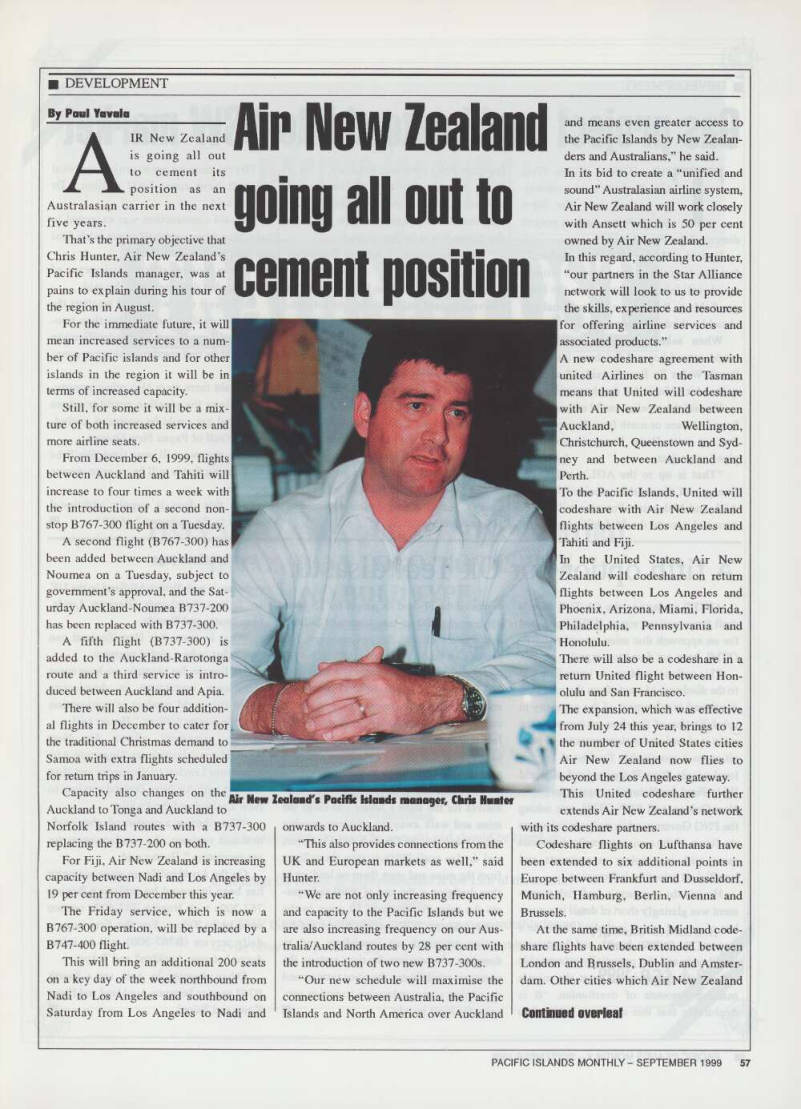
Air New Zealand going all out to cement position
By Paul Yavala
AIR New Zealand is going all out to cement its position as an Australasian carrier in the next five years.
That’s the primary objective that Chris Hunter, Air New Zealand’s Pacific Islands manager, was at pains to explain during his tour of the region in August.
For the immediate future, it will mean increased services to a num ber of Pacific islands and for other islands in the region it will be in terms of increased capacity.
Still, for some it will be a mix ture of both increased services and more airline seats.
From December 6. 1999, flights between Auckland and Tahiti will increase to four times a week with the introduction of a second non stop 8767-300 flight on a Tuesday.
A second flight (8767-300) has been added between Auckland and Noumea on a Tuesday, subject to government’s approval, and the Sat urday Auckland-Noumea 8737-200 has been replaced with 8737-300.
A fifth fiight (8737-300) is added to the Auckland-Rarotonga route and a third service is intro duced between Auckland and Apia.
There will also be four addition al flights in December to cater for the traditional Christmas demand to Samoa with extra flights scheduled for return trips in January.
Capacity also changes on the j
Auckland to Tonga and Auckland to
Norfolk Island routes with a 8737-300 replacing the 8737-200 on both.
For Fiji, Air New Zealand is increasing capacity between Nadi and Los Angeles by 19 per cent from December this year.
The Friday service, which is now a 8767-300 operation, will be replaced by a
8747-400 flight.
This will bring an additional 200 seats on a key day of the week northbound from Nadi to Los Angeles and southbound on Saturday from Los Angeles to Nadi and
onwards to Auckland.
“This also provides connections from the UK and European markets as well,” said Hunter.
“We are not only increasing frequency
and capacity to the Pacific Islands but we are also increasing frequency on our Aus tralia/Auckland routes by 28 per cent with the introduction of two new 8737-300 s.
“Our new schedule will maximise the connections between Australia, the Pacific Islands and North America over Auckland
and means even greater access to the Pacific Islands by New Zealan ders and Australians,” he said.
In its bid to create a “unified and sound” Australasian airline system.
Air New Zealand will work closely with Ansett which is 50 per cent owned by Air New Zealand.
In this regard, according to Hunter, “our partners in the Star Alliance network will look to us to provide the skills, experience and resources for offering airline services and
associated products.”
A new codeshare agreement with united Airlines on the Tasman means that United will codeshare with Air New Zealand between
Auckland, Wellington,
Christchurch, Queenstown and Syd ney and between Auckland and Perth.
To the Pacific Islands, United will codeshare with Air New Zealand flights between Los Angeles and Tahiti and Fiji.
In the United States, Air New Zealand will codeshare on return flights between Los Angeles and Phoenix, Arizona, Miami, Florida, Philadelphia, Pennsylvania and Honolulu.
There will also be a codeshare in a return United flight between Hon olulu and San Francisco.
The expansion, which was effective from July 24 this year, brings to 12 the number of United States cities Air New Zealand now flies to beyond the Los Angeles gateway.
This United codeshare further extends Air New Zealand’s network
with its codeshare partners.
Codeshare flights on Lufthansa have been extended to six additional points in Europe between Frankfurt and Dusseldorf, Munich, Hamburg, Berlin, Vienna and Brussels.
At the same time, British Midland code share flights have been extended between London and Brussels, Dublin and Amster dam. Other cities which Air New Zealand
Continued overleaf
Ail New Zealand's Pacific Islands manager, Chris Hunter
From previous page
codeshares with British Midland in the UK are Belfast, Edinburgh, Glasgow, Leeds, Manchester and Teeside.
What is more. Air New Zealand can now boast to be a global operator.
“In Europe, for example, we have spent significant investment in developing
round-the-world product in conjunction
with Singapore Airlines,” Hunter said.
The agreement allows Air New Zealand to codeshare on Singapore Air lines from London to Singapore and then connect with Air New Zealand services to New Zealand and the Pacific.
“Then there is a number of other prod ucts and ventures of a similar nature we are promoting,” Hunter said.
On the Auckland/Japan route, capacity has been increased by replacing Boeing 767-300 s with Boeing 747-400 s on two services to Tokyo. For the first time, a daily service (8767-300) will be intro duced between Auckland and Tokyo.
Other changes in Asia are a fourth 8767 service between Auckland and Hong Kong and Taipei. ■
Gas project could extend into NSW market
THE AUDS3.7 billion PNG Gas Project could eventual ly extend into the New South Wales market, project director John Powell said.
He told a Morgan Stockbroking break fast late August that the proposed project, which will initially stretch from the PNG gas fields to Brisbane, expected final go ahead by third quarter next year.
When asked whether the pipeline could extend beyond Brisbane into New South Wales Dr Powell said: “I can see quite a bit of logic for that happening.”
He said the pipeline could extend south from Brisbane or north from Newcastle to link up with Duke Energy’s proposed pipeline project.
“That is up to the AGL’s and Duke Energy’s of this world to decide,” he said.
AGL and Malaysia’s Petronas will build, own and operate the $1.5 billion pipeline
from the PNG border to Brisbane.
Dr Powell said the PNG Gas Project was not concerned about the Shell/Wood side Petroleum proposal to pipe gas from the Timor Sea into Queensland.
“They are probably three or four years behind us,” he said.
He said the PNG Gas Project operator Chevron would welcome the competition, because it should encourage greater use of gas.
“We’d like the market to grow and competition enables growth,” he said.
The PNG Gas Project expects to finalise the front end engineering and design work as well as reach financial close within the next 12 to 14 months.
Preliminary agreements were recently signed with the Queensland government owned power utilities Energex and Ergon Energy, securing foundation volumes of 180 petajoules.
“By the time we get to project approval we will have spent $lOO million,” Dr Powell said.
He said construction was expected to take about two-and-half years with first gas delivered in late 2002.
“We’re looking at ways and means of bringing that date forward,” he said.
Dr Powell said with good weather the pipeline could be built in less than two and-a-half years and near specification gas could be delivered to customers soon er.
He said there were also other opportu nities along the pipeline corridor where additional gas could be accessed, includ ing the Gulf of Papua New Guinea.
“I’m sure we will over time. We’ll be encouraging that is will be an open-access
pipeline.
“All that does is supply additional security to the customer,” (AAP) ■
A fifth option for Ok Tedi disaster
AFTER reviewing the Ok Tedi mine’s draft future options report, WWF has called for an approach that mine operators BHP OTML have not dared to suggest.
This option would see an immediate end to the discharge of waste from the mine, the continued involvement of the company in rehabilitation of the river system after the mine is closed and a clear program of tran sition to a sustainable livelihood for the local people. Peter Hunnam, head of World Wide Fund for Nature’s program in Papua New Guinea, said BHP-OTML was asking the PNG Government to make decisions on the future of the environmentally disastrous mine with incomplete assessments and insufficient scientific information.
He said the company’s draft risk assess ment was glaringly short of detail in a num ber ftf the mine’s and long-term livelihoods and the potentially catastrophic effect^ofj the mine’s massive amounts of overburden. “It is deplorable that this company, which has
exploited the Fly and its people for 15 years by dumping 700 million tonnes of tailings and waste rock into the environment, has produced a report that is so startlingly short on fundamental detail,” Peter Hunnam said.
“At the very least, the PNG Government and the local people deserve a report that is complete and takes into consideration the fact that thousands of people will continue to live with this mineis toxic legacy for the next several generations.”
The company presented just four alter natives for the mine’s future - to close the mine and walk away; to continue pouring mine waste into the Ok Tedi and Fly Rivers and dredge until 2010; to pipe the tailings from the mine and store them on land; or to stop dredging at the end of 1999 and oper ate the mine for the next 10 years in the same manner. WWF wants to see a fifth option activated: an immediate end to dumping of waste into the river system; the company rehabilitates the river system; and supporting a comprehensive transition pro gram for local people. ■
Advertisements & other items, pp. 59-60 (1 item)
Trading Post
PACIFIC ISLANDS
Til HUM ""
TRADING POST CAN WORK
WONDERS FOR YOU...
Promote your business, or service, sell your household items, cars or heavy machinery etc.
ONLY AUSS2 (OR EQUIVALENT) PER WORD.
NO COMPANY LOGO. NO DISPLAY.
NO BOLD TYPE.
Just forward your Advertisement together with payment to:
PACIFIC ISLANDS MONTHLY "Trading Post”,
PO Box 1167, Suva, Fiji.
Conditions: 1. All Advertisements are subject to acceptance and approval of publisher. 2. Advertisements are published as space permits; we cannot guarantee date of insertion. 3. All advertisements must be prepaid and should be typed or printed clearly 4. Deadline for receipt of advertisements is the 15th of the month prior to issue. 5. PACIFIC ISLANDS MONTHLY assumes no responsibility for any service other than publishing paid advertisements in this section.
rt
I PAc
. , 2.- 3>- ■ & s-- ... ■ «a 2W . 1 M i 3R * * aw 8
No challengers -
Toyota Land Cruiser stays on top
Toyota Land Cruiser 100 dominates the world of 4x4s. None other can match its robust power, provided by superior engine technology.
It gives breathtaking performance, backed by an amazingly rugged suspension that can take you anywhere you want to go, on road or off.
Nevertheless, riding in a Toyota Land Cruiser 100 is like travelling in a luxurious sedan. Its more than ample room inside contains all the comforts and conveniences you'd expect of a winner.
Remember this. Only Toyota's advanced technology can create the symphony of power, performance, and lavish comfort you find in Land Cruiser 100. No wonder it's the champion. Again.
'A\
STATION WAGON
DISTRIBUTORS /DEALERS
NORFOLK ISLAND BORRY’S PTY LTD. PH 22114
SOLOMON ISLANDS ELA MOTORS PH 30314
VANUATU ASCO MOTORS PH 22341
COOK ISLANDS PACIFIC MOTORS LTD. PH 20700
<SB> TOYOTA
FIJI ASCO MOTORS PH 384888
NEW CALEDONIA S.I.A.P. PH 275562
TONGA ASCO MOTORS PH 23500
AMERICAN SAMOA ASCO MOTORS PH 633-4281