
Pacific Islands
Monthly
INSIDE: A daunting task for PNG’s new PM
August 1999
% " % ™-m, ttmmmmk , TT f § I § § if "i I i j iji I j- a j#! u
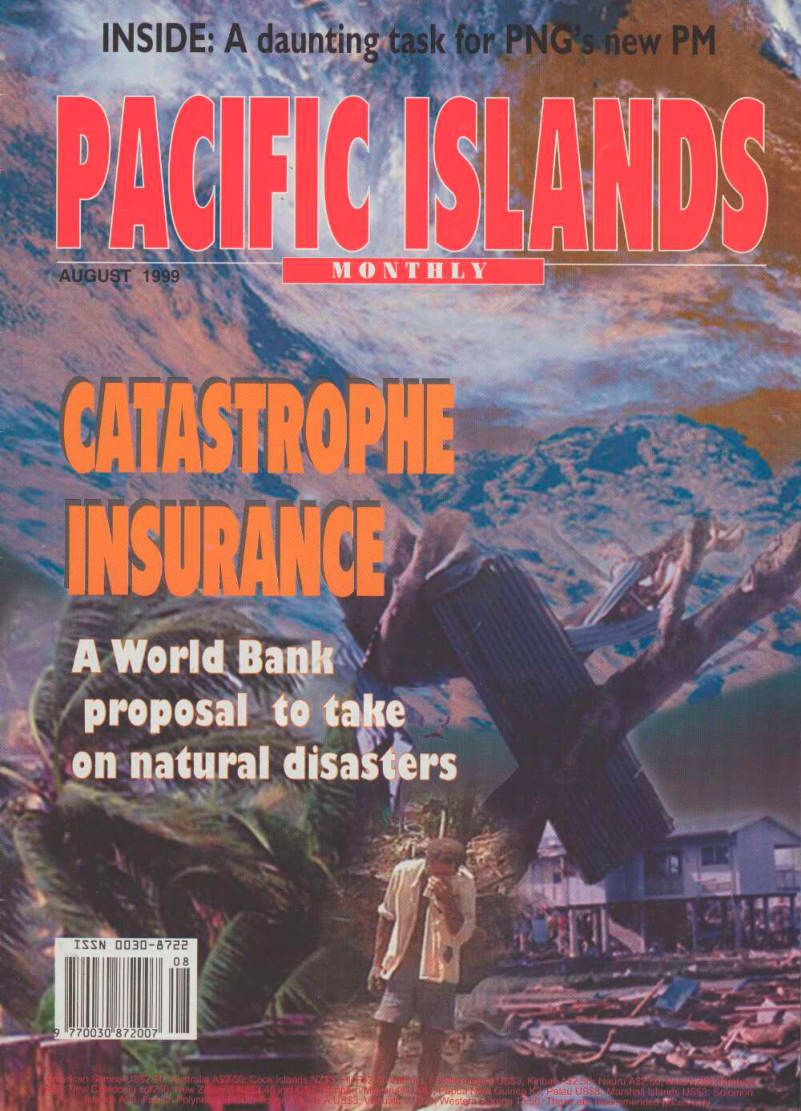
A World Bank proposal to take on natural disasters
-'ll? - ' ■:'.•■■& * ■ ?Jr ■'I? *•■ !# s r-» •? VMW i «-i«&,..#» * . ■■ iBimitfii ill ni
Advertisements & other items, p. 2 (1 item)
The All-Terrain Conqueror
Sne 4 Building upon a tradition of distinction and pride, the reigning King of 4 Wheel Drive attains an even greater pinnacle in 4x4 excellence. Renowned rough road performance and rugged dependability are further refined in the Land Cruiser 100 series.
Available from Asco Motors throughout Fiji.
Asco Motors
<® TOYOTA
SUVA PH 384888 • WALU BAY PH 307808 • SIGATOKA PH 500577 • NADI PH 721777 LAUTOKA PH 662855 • BA PH 674406 • TAVUA PH 680152 • LABASA PH 811688
Pacific Islands

Monthly
The Hews Magazine
Alan Robinson Sophie Foster Hildebrand Michael Field, Gift’ Johnson, Sally Andrew, Sam Vulum, Ed Rampell, Alan Ah Mu, Brian Tobia.
David Barber (Wellington), Jemima Garrett (Sydney) Shekhar Rattan, Reuben Pickering, Faizal Khan Senior Regional Sales (South Pacific) Shayne Farah Hussein Tel (679) 304111,303244, Fax (679) 303809.
Sydney, Canberra: Bob Hill Media Representation, Tel (61-2) 4164245, Fax (61-2)4165064.
Brisbane: Jane Fewings Media and Advertising Associates Tel (61-7) 3378 4522, Fax (61-7) 3878 1071.
Adelaide: Hastwell Williamsons Representatives, Tel (61-8) 3799522, Fax (61-8)3799735.
Melbourne: Brown Orr Fletcher Burrows (Aust) Pty Ltd.
Tel (61-3) 98265188, Fax (61-3) 98265644.
Auckland: McKay & Bowman. International Media Representatives Limited.
Tel (64-9)4190561, Fax (64-9)4192243.
Japan: Universal Media Corporation, Tokyo.
Tel (3) 3266626741.
Cable; UNI-MEDIA Tokyo.
Fax (3) 32626742.
Pacific Islands Monthly was founded in 1930
(Usps 9522480).
A Fiji Times Limited production.
Cover prices are recommended retail only. Registered by Australia Post.
Publication No. NBPI2IO. © Copyright Fiji Times Limited, 177 Victoria Parade, Suva, Fiji.
Tel (679) 304111. fax (679) 303809.
Email: [email protected]
PIM Website: http://www.pim.com.fj Pacific Islands Monthly is published monthly by Fiji Times Limited, a division of Nationwide News, 2 Holt Street, Surry Hills, Sydney, NSW 2010.
Pacific Islands Monthly PO Box 1167, Suva, Fiji.
Printed by Quality Print Limited, 16 Amra Street, Walu Bay, Suva, Fiji.
Cover design/Layout by Shekhar Rattan While all care is taken with material submitted for publication, no responsibility is taken for misplaced items
Briefs 7_
Inside
Cover Story Page 26
Editorial 4 Letters 5
Briefs 7_
Special Report: A daunting task ahead (or new PNG PM 8 'Wonderful two years' - Skate 9 Diplomatic tug-of-war and neo-colonialist tendencies 10 Fiji, Vanuatu could be next diplomatic battleground 11 Business Niue National Airline to get off the ground 12 Asian fishermen return in force to Marshalls 14 Pafco makes breakthrough in US market 15 'lllegal' competitors hurting PNG banks 16 Emperor denies claims about lost royalties 18 Vailima waits out the bidding process 19 Innovative tourism campaign for Madang 20 Fiji sugar to spend millions on research centre 22 Bikini's sharks and shipwrecks hit big-time 24 Cover: Catastrophe Insurance - A World Bank proposal to take on natural disasters 26 Tsunami victims rebuilding their lives: aid worker 29 Developments FEMM fatale: Pacific's unhappy affair with reform 30 Fragmented regional shipping could hinder FTA 32 How to prepare for 21 st Century tech explosion! 35 Politics; Fragile peace for Solomons 38 Yachting: Molokai or bust 54 Opinion: David Barber/Jemima Garrett 56
Page 8
Page 20
Page 38
Harness the power of catastrophes
Editorial
SMALL Island States, including the Pacific,
have been pushing for the develop ment of a Vulnerability Index for as long as can be remembered.
Their smallness, it is argued, means that they are vulnerable to changes in ways that other countries are not. For this reason, they argue they should not be treated the same as other developing countries when it comes to aid and international obliga tions. Now, the World Bank has recognised this vulnerability.
Small states, it agrees, are more vulnerable to the impact of a single natural disaster because of their smallness and lack of economic diver sification.
But instead, of providing a hand out, the Bank has proposed a hand-up - a scheme that would see the Pacific helping itself, rather than being helped from outside.
This Small States Regional Cata strophe Insurance Programme seems so logical, it is absurd that it hasn’t been proposed before.
In the simplest of terms, govern ments, insurance companies, and multi-lateral financial institutions set up a fund - which could apply between a few countries or all Pacific countries - which is used to provide reinsurance for island insurers.
Because it is subsidised by govern ments and funded on low interest by the multi-laterals, this would allow insurance companies to reduce their premiums, thus allowing more people to get insured. The combination of increased markets and better reinsur ance costs would mean that the insur ance companies will not be arguing.
The wider coverage and lower costs mean that catastrophes may not be as
catastrophic in the islands.
Insurance is an essential element of business anywhere in the world, and one most often taken for granted.
But in the Pacific, as it is in the Caribbean, insurance is often the pre rogative of the rich and well-to-do, while anyone else, small business included, is left grabbing at straws during a catastrophe.
With such a scheme in place, gov ernments would not have to worry about natural disasters interfering with an investor’s decision to stay or not. Indeed, it would not have to worry about spending too much money or getting unplanned loans when a catastrophe strikes.
There is no doubt that the Cata strophe Insurance scheme will have to be carefully investigated and planned, but, perhaps, on this one, the region may be on to something. ■
Letters
Information needed on MSG Sum mit
We are a company currently exporting fresh fruit, vegetables, dairy products, small goods, into the Pacific region - predominantly - Nauru, Solomon Islands, Vanuatu and Guam.
I am interested in receiving infor mation concerning the Micronesian Spearhead Group and was wonder ing if someone could provide the appropriate source.
Additionally, I believe that there is a group conference to be held shortly. Can you please advise dates and the location. Any information that you can provide would be appreciated.
Debra MacLeod
Partner Aerial Fresh Foods info@aerialfreshfoods. com.au (Editor’s Note; Try contacting the Foreign Affairs departments of any Melanesian country. The group con ference that you refer to was held in Vanuatu last month, around the same time as the Forum Economic
Ministers Meeting.)
Solomon pre-history source
I’m researching for a book I’m working on and wondered if per haps anyone knew of a source for early and pre-history of the Solomon islands/Melanesia, specif
ically on early English entangle
ments and any supernatural and demonology via religious or cultur
al practices.
Any help would be thoroughly appreciated and noted at publica tion.
Susan R. Acevedo [email protected]
Toxic baby food
Canada - Nurses Unions blast soy protein baby foods for “Gender Bender” effects, altering sexual development of children.
United States - Food and Drug Administration poisons experts attack health claims for soy prod ucts, citing evidence of brain atro phy, reproductive malformations, thyroid disease and more. See www.soyonline.service.co.nz for more details. The NZ. government has known of these dangers since 1994 and has chosen not to inform other Pacific nations.
Dick James and Valerie James
lennium
Painting a city blue for Hie mil lennium
I know that every once in a while, strange, funny or interesting mes sages are being sent from news agencies throughout the world. This message will be another one.
Because, to celebrate the new millennium, the city of Sortland, Norway, will be painted blue!
Various shades of blue will be applied with a touch of contrasting colours. The blue will constitute a “motif’, a movement, a form that changes from space to space; Each facade will be given its own identi ty, creating a unity which rests on a foundation of coloured concrete.
The aim is to, among other things, organise a somewhat confus ing image into an exciting blue townscape, to generate positive energy to inhabitants and visitors and to prove the force of an idea: The Art of the Impossible.
Sverre Bjorstad Graff 7030 Trondheim Norway
Send Letters to the Editor to: [email protected]
Status of women
I am a graduate student at the University of Canterbury in New Zealand. I am currently researching a paper on the status of women in both Tonga and Vanuatu. I was wondering if someone could help me at all with information and how I may obtain them. Any other infor mation on relevant websites for these subjects would also be much appreciated. Thank you very much and keep up the good work on a
great magazine!
Clare Allison
Pacific Island stews
I have been doing research on finding recipes for soup (or stew type dish) from the Pacific Islands: Nauru, Kiribati, Micronesia, Vanu atu, Tuvalu. I have not been able to locate any such recipes.
Can anyone tell me how to find such recipes?
Carolyn Halt
Advertisements & other items, p. 5 (1 item)
■Engine I
BMW
Bedford Cummins Daihatsu Detroit Deutz Ford Gardner Hmo Isuzu Iveco Komatsu Kubota
WAREHOUSE
PHONE
643-6938122
PAX
643-6938120 mm
New Zealand
email: [email protected] Subaru Leyland Mazda Mercedes Mitsubishi
MAN.
Nissan Perkins Suzuki Toyota Volvo Yanmar
NEW ARRIVALS
"Bedford 330, Cummins 504, Dentz'
4cly F 41913. Leyland 411 Turbo
Lister STI, ST3, HR3, Scania DSII-
- Intercooled 354 hp, Mazda RF
Supercharger, Toyota 3CR, 3CT-EFI,
2C-11, 2L-lIT-EFI, 3L, IW, IHDT-FTI-EFI
Intercooler, Isuzu 6881, 4BBDIT,
Detroit 6V92 Silver Dismantling
MACK FR797 RST 6x4
Queensland Cattle licks

Archive's-August 1944
Havoc among N. Cale
donian herds
AN epizootic tick, of which this coun try has hitherto been free, is playing havoc with New Caledonian cattle on both sides of the island.
The chief of the Veterinary Service attributes the outbreak to the waiving of quarantine restrictions “when the Japan ese were at our gates”.
He believes that, undoubtedly, the tick was introduced by horses imported from Queensland. It will be recalled that prior to Guadalcanal, a regiment of US cavalry, mostly Texans, were mounted with horses imported from Australia. Incidentally, one of the transports bringing horses here was sunk by enemy action, and several hun dred horses were lost. The US remount
depot was situated on the Ducos Peninsula, close to Noumea, and it was from this area that the tick outbreak began to spread among cattle. In a recent lengthy statement, the chief veterinarian discusses symptoms caused by tick bites, and ways and means of destroying the ticks, which do most damage during the hot season.
Hie Irrepressible Parers
FRESH laurels are coming the way of Damien Parer, who has been filming the recent fighting on Guam for Paramount
News. Until he resigned last year, he was ace cameraman for the Australian Depart ment of Information in the Middle East and New Guinea. A recent despatch from Guam by the Melbourne “Herald” war cor respondent, Denis Warner, says: “The Marines think of him as a sort of legendary figure the bullets cannot touch.
Four of their own corps’ cameramen have been killed in the fighting here, but none took the same risks as Parer to get what he calls “the best action pictures I have taken this war”.
“In the final fight for Orote airstrip, where Japanese resistance was easily the fiercest of the campaign, Parer preceded the infantry, following the tanks on foot.
He was not injured, but many infantrymen, sheltering in fox-holes behind him, were killed and wounded by machine-gun bul lets and mortars. Parer came back to press headquarters that night exhausted, but the happy possessor of remarkably close action pictures.” ■
Advertisements & other items, p. 6 (1 item)
ToFinish...
SCHOOLS • CHURCHES
From Start..
m Copymasters Hawaii can help you with all of your duplicating needs from start to finish. Featuring Duplo® Digital Duplicators, Copiers, Shredders, Laminators, Poster Printers, Collators, & Folding Equipment. We also sell Stencil & Duplicator Supplies, Paper Supply, and all brands of Copier Supplies, & Computers.
Copymasters Hawaii
96-1173 Waihona Street, Suite B-2 • Pearl City, HI 96782 Phone (808) 678-2263 • Fax (808) 456-5678
E-Mail: [email protected]
GOVERNMENT
COMMERCIAL
Serving:
STATE OF MWAH
ENTIRE
SOUTH PACIFIC
INCLUDING:
FIJI
SAMOA
TAHITI
TONGA
COOK ISLANDS
MICRONESIA:
FEDERATED STATES
OF MICRONESIA
GUAM
MARIANAS
MARSHALL
ISLANDS
palm:
ToFinish...
copymasters
hawaii
Briefs
Cost of electricity to decrease in Fiji SUVA, Fiji - Electricity rates in Fiji will drop one and a half cents per unit this month.
A statement by the Fiji Electricity
Authority (FEA) said there would be another similar reduction in August of next year.
FEA Chairman Lionel Yee said the reduction in rates would apply to commer cial, industrial, domestic and institutional customers.
Yee said the reduction was made possi ble by the continuing decrease in FEA’s total debt, which fell from FJDS344 mil lion (US$l76 million) in 1987 to FJDSI23 million (U 5562.9 million) this year.
He said the reduction was made possi ble by localizing offshore loans and the prepayment of debts.
Reacting to the announcement, the Fiji Chamber of Commerce welcomed the rate drop, saying it was time the FEA imple mented the cuts.
“The reduction is welcome because we have been hearing this for years and noth ing has been done,” said Chamber Chair man Himmat Lodhia.
Vanuatu's GDP grows marginally PORT Vila, Vanuatu - Vanuatu’s gross domestic product (GDP) has grown by 0.2 percent so far this year despite an earlier forecast of a decline.
Finance Minister Sela Molissa said the
GDP improved despite the negative
impact of riots, the devaluation of the Vanuatu currency and the Asian economic crisis. The Ministry of Finance earlier had forecast negative growth this year due to a fall in tourist numbers resulting from damage to an Air Vanuatu plane. The air craft was put out of service for a time after hitting a hailstorm near Sydney, Australia.
The country’s economic growth results
primarily from improvements in the agri
culture sector, particularly a boom in kava exports.
Last year, kava exports increased ten fold compared with 1997, resulting in rev enue worth $ll million. (Radio Australia)
Air Niugini wins international tender for Vietnam Airlines deal PORT Moresby, PNG - Air Niugini won a contract to wet lease its second Airbus to Vietnam Airlines, its managing director Andrew Ogil announced.
He confirmed that the Airbus had been leased to provide scheduled services for Vietnam Airlines, operating from Ho Chi Minh City to Sydney, Melbourne, Osaka and Hanoi.
The lease existed for two weeks last month, beginning July 5 and ended July 17.
Included in the agreement was the pro vision of an Air Niugini flight crew, which consisted of two pilots, two engineers and six flight attendants.
Mr. Ogil said Air Niugini was proud to have won the lucrative contract against stiff competition from other major regional air lines, adding the contract generated a sig nificant amount of commercial revenue towards the airline’s cash flow situation.
Air Niugini maintained its normal inter national scheduled services during the wet lease arrangement. (The National) JAL boosts flights to Saipan SAIPAN, Northern Marianas - Buoyed by the positive results of its additional flights, Japan Airlines has decided to operate 10 charter flights in July and August from the cities of Osaka, Nagoya and Fukuoka in a move to boost visitor arrivals in the CNMI.
Despite the absence of charter flights last month. JAL ferried a total of 16,692 Japanese tourists, which resulted in a 113 percent jump in the number of travelers over the same period last year.
The June 1999 total included 10,824 passengers from Tokyo and 5,868 from Osaka.
JAL’s share of the total number of tourists arriving in the CNMI from Japan during January-May 1999 was over 50 per cent.
From June 21-22, 1999, Yukiharu Enomoto, JAL District Manager, and Kaishun Nishigaya, Sales Manager, visited JAL’s sales office in Osaka, Nagoya and
Fukuoka where they discussed the opera tion of more charter flights.
They were joined by MVA Managing Director Perry Tenorio, Board Chairman Dave M. Sablan, Marketing Director Nor man Berg and Lt. Gov. Jesus R. Sablan.
During the trip, MVA presented its promotional plans to the airline’s sales personnel in those cities.
Since last year, JAL has been continu ing to assist the Commonwealth in its pro motional campaign in order to recapture its lost market share in Japan.
Worried about the fate of its huge investment on the island, JAL had been offering charter flights and discounted rates to lure more visitors to the islands.
The airline invested more than $l5O mil lion during the past 15 years for such pro jects as La Fiesta San Roque Shopping Plaza, Hotel Nikko Saipan and Tropical Laundry & Linen Services. (Saipan Tri bune).
Japan assists Tonga's vanilla and watermelon exports NUKU’ALOFA, Tonga - A Japanese company has donated testing equipment for use in improving and expanding Tonga’s vanilla and watermelon export businesses.
The vanilla testing equipment also will be able to be used to test the quality of kava and other crops that are dried before export.
The other testing kit, for watermelon, can be used on squash pumpkins, papaya (paw paw) and a variety of other fruits.
Two representatives from the Nittsu
Shoji Company presented the equipment,
worth US$2,OOO, to Tonga’s Commerce Minister, Dr. Massaso Paunga.
The equipment will be used initially to test vanilla and watermelons selected for shipment to Japan. The machines will help Tongan exporters meet the exact product quality standards required by
Japan traders.
Tonga’s Trade Division will be in charge of operating the two machines. (PACNEWS/Radio Tonga) II
A daunting task ahead for new PNG PM
Special Report
FOREIGN investors give
Papua New Guinea’s
newly elected prime min
ister a better chance than his predecessors of salvaging his country’s economy. Sir Mekere Morauta, 53, was elected by an over whelming majority of 99 votes to East New Britain Governor Francis Koimanrea’s five votes mid-July.
But the task facing PNG’s seventh
prime minister is daunting.
The former central banker won
overwhelming parliamentary backing
mid-July and said he would seek World Bank help in ordering the chaotic finances of the Pacific island nation.
“The sad truth is that the reality is even worse than it seems,” Morauta said after being sworn in.
The Bank’s response will be criti cal to his efforts to restore confi dence in the resource-based econo
my, rebuild foreign exchange
reserves and tackle poverty and ram pant crime.
Perhaps the most pressing issue was whether to extract the Pacific island nation from a deal to recog nise wealthy Taiwan. Morauta has since withdrawn diplomatic recogni tion.
Morauta’s predecessor Bill Skate took a U 552.35 billion (A 53.57 bil lion) shopping list with him when he went to Taiwan to broker a diplomat ic recognition deal last month.
Taiwan denies it bought the ties of its 29th ally.
But there is no doubt PNG needs help to boost reserves that have dwindled to an all-time low of US$B9.2 million (A$ 135.48 million).
It also needs the US$lOO million (A$ 151.88 million) it makes annual ly from exporting timber logs to China, infuriated by the Taiwan deal.
The handful of international com panies still operating in PNG have
cautious hopes for Morauta, educated by missionaries and at PNG universi ties. In 1970, he graduated with a Bachelor of Economics degree from the University of Papua New Guinea.
The University of Technology in Lae awarded him an honorary doctorate of Technology in 1987.
Aged 53, he has
been an economist,
a banker and
businessman, and
he retains a
reputation for probity
In 1990, he was bestowed the title of Knight Bachelor by the Queen and he was elected to Parliament as the member for Moresby North-West dur ing the 1997 national general elec tions.
He was fisheries’ minister from April 1998 to June 1999, until dumped in an unprecedented move by then prime minister Bill Skate.
“We have a prime
minister who understands
business and financial
management,” said Greg
Anderson, head of PNG’s
Chamber of Mines
Sir Mekere was the Managing Director of the Papua New Guinea Banking Corporation from 1983 to 1992. From 1993 to 1994, he was the Governor of the Bank of Papua New Guinea. From 1994 to 1997, he was executive chair of Morauta Invest ments, Ltd. (Delta Seafoods and Morauta and Associates). Aged 53, he has been an economist, a banker and
businessman, and he retains a repu tation for probity.
“We have a prime minister who understands business and financial management,” said Greg Anderson, head of PNG’s Chamber of Mines.
Oil company Chevron is hoping some political stability will con vince enough Australian industrial companies to commit to natural gas supplies from its giant PNG gas fields to justify building an under sea pipeline to Queensland.
“Our relationship with overseas customers can only be enhanced by the new government,” Chevron’s PNG country manager Keli Taureka said.
Morauta spent a year as governor of the Bank of Papua New Guinea in the early 1990 s before being sacked by a previous prime minister. Since then, the value of PNG’s kina has tumbled from more than 90 US cents to around 38 cents.
Morauta has adjourned parlia ment until the middle of this month while he reviewed the Taiwan deal and sought to gorge a strategy to draw the World Bank and Interna tional Monetary Fund back into talks they abandoned under Skate.
During Skate’s two-year rule, inflation rose from around four per cent to more than 13 per cent. No one knows how high the unemploy ment rate really is this country of 4.6 million. Even those with jobs often fall below the poverty line.
Per capita income averages less than US$35O (A 5532) a year.
Rather than take low-paying jobs, young people from squatter camps around Port Moresby are reg ularly recruited into “raskol” gangs blamed for much of PNG’s street crime and burglaries. Unchecked public spending has done little to
Continued on page 34
improve social services, but has dou bled the balance of payments deficit to 264 million kina (Asls2 million) last year from 123 million in 1997.
Mining and petroleum account for some 25 per cent of PNG’s .gross domestic product and up to 80 per cent of export revenues.
The government owns minority stakes in most mine projects, but leaves daily operations up to foreign partners.
Most of the commodities plucked from PNG are sold in US dollars overseas.
Mining companies such as Aus tralia’s Broken Hill Pty Co Ltd and Placer Dome Inc of Canada, had been pleading with Skate for tax reform to
encourage more exploration with lit tle success.
“Morauta has a difficult task ahead of him,” said Paul Coleman of Anglo- Australian miner Rio Tinto Ltd.
Ron Senior, chief financial officer of PNG’s largest single employer, New Britain Palm Oil Ltd, said the country’s politics had little impact on its operations.
However, just before Morauta’s election New Britain indefinitely postponed a planned float on the Aus tralian Stock Exchange without explanation.
Newspapers speculated this was related to the Taiwan deal, which New Britain’s 80 per cent owner Kulim Berhad of Malaysia feared could hurt exports to China.
(Reuters) ■
'Wonderful two years'-Skate
THIS is the full transcript of the announcement by the now for mer Papua New Guinea prime minister Bill Skate that he was resigning.
“I want to announce my resignation as the prime minister of this great nation. It has been a wonderful two years working as the Prime Minister of this country. I want to thank all the Christians around the country who have prayed for me and my government and all my 41 members who are still solid behind me. l am now calling all my members who have left to return to this Government and support it because this is the government they have formed
and this is the government they must see that it serves its five years.
“I thank my family and all the people in NCD who have supported me. This is not a vote of no-confidence, it is a vote of confidence and trust.
“I have been betrayed by my friends. I have been betrayed by those with ulte rior motives, I intend to ten der my letter of resignation to the Governor General by 10 o’clock tomorrow morn
ing.
“In the meantime, I will
obtain legal opinion to be acting Prime Minister until July 13 when Parliament will decide. I am calling on the Opposi tion to support the government because this is the government that made radical changes under my leadership, this is the government that the people want.
“I am proud to be the first Papuan Prime Minister. I would also like to thank the New Guinea Island leaders, Momase and the Highlands leaders who have sup ported my government.
“It has not been an easy decision for me. It is not that I am running away from my responsibilities but to show the people of Papua New Guinea that Bill Skate is a
different leader altogether, a leader who is not hungry for power, a leader who wants to put people’s interest first. This is why I’ve made the decision to resign.
“Secondly, I want this government to continue by implementing the decisions that I have introduced. I think I have learnt from my mistakes and I hope to return in year 2002 a better person and a stronger Prime Minister.
“I have also returned from Taiwan, it’s not a new thing, all the leaders have been talking about it but have no guts to make the decision. I think the decision made on behalf of the people of Papua New Guinea
is to look north, friends to all and enemies to none. I am waiting for Roy Yaki to return from Taiwan and make a press statement on behalf of the government on what transpired in Taiwan.
I call upon all law abiding citizens of Papua New Guinea, I ask all my supporters right throughout the National Capital Dis trict to cooperate with the police and the investors and support the police to make sure that there are no law and order prob lems.
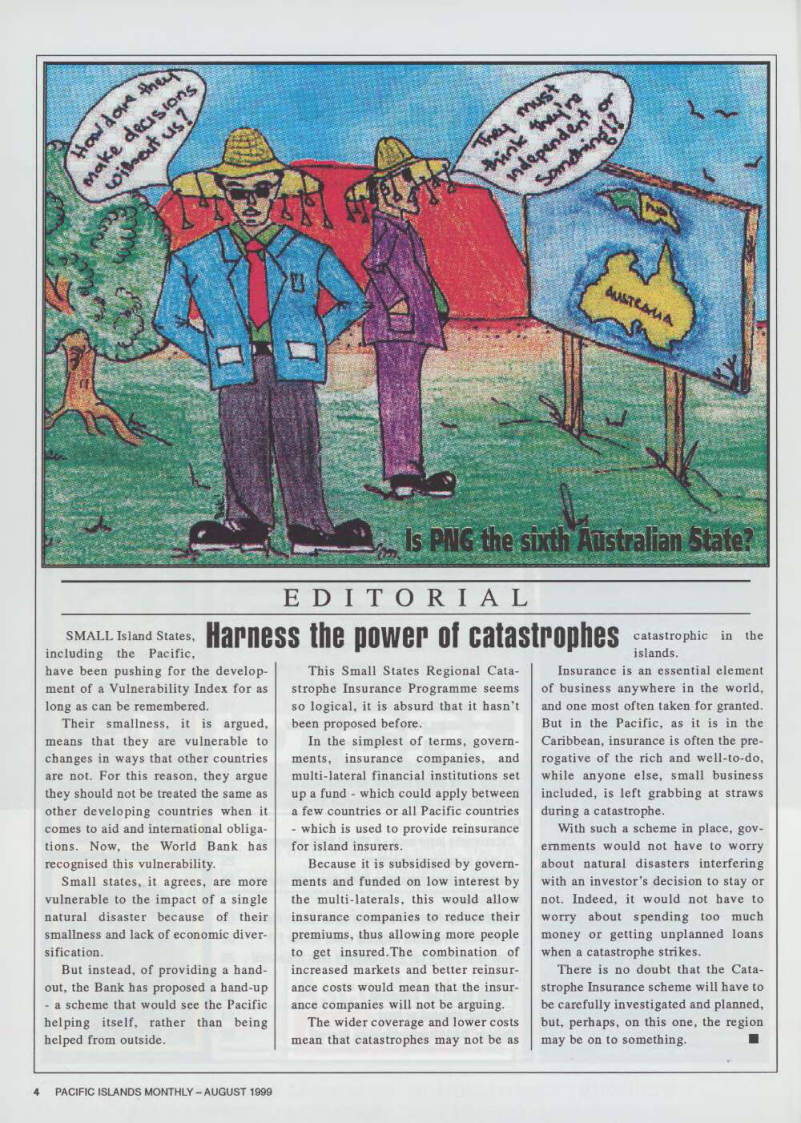
“I am sad to say that Australia thinks that PNG is their state. Australians think that they can continue dictating to us.
“They must now understand that Papua
New Guinea is more matured and sover eign state, they must respect us. Aus tralians are equally trading with Taiwan and why shouldn’t we go further and strengthen our relationship in that friend ship. I thank the media, one way or the other you have crucified me but at the same time you have taught me something, you have made me a better person, I say thank you and god bless Papua New Guinea and support my government.
“The Opposition and those that have left me, after betraying me, I forgive you, I want you back, come back and support your government. We will now be camp
ing out, all my boys will start moving to our camp where we will consolidate, and we’ll return and form the government on July 13. My resignation is very simple, politics has been very volatile and fluid, I cannot afford to lose any of my mem bers.
I have to keep them with me, it’s got nothing to do with Aus tralian influence in me. It is said that Australians are putting up Sir Mekere Morauta, but Papua New Guineans should decide who should be Prime Minister “I am resigning basically to sta bilise politics. I have to give the
investors the confidence that the govern ment does not need to be changed because if there has to be change, it has to be change within the government caucus.
“If it has been found that I am the obstacle, it is better to remove that obsta cle to get the government moving, and I choose that, for the good of investors and Papua New Guinea.
“It has nothing to do with the Aus tralian influence here.
“I would still have the number, but it won’t be good for Papua New Guinea by going to the floor of Parliament. There is no motion on the floor (of Parliament). We are consolidating to move forward.” ■
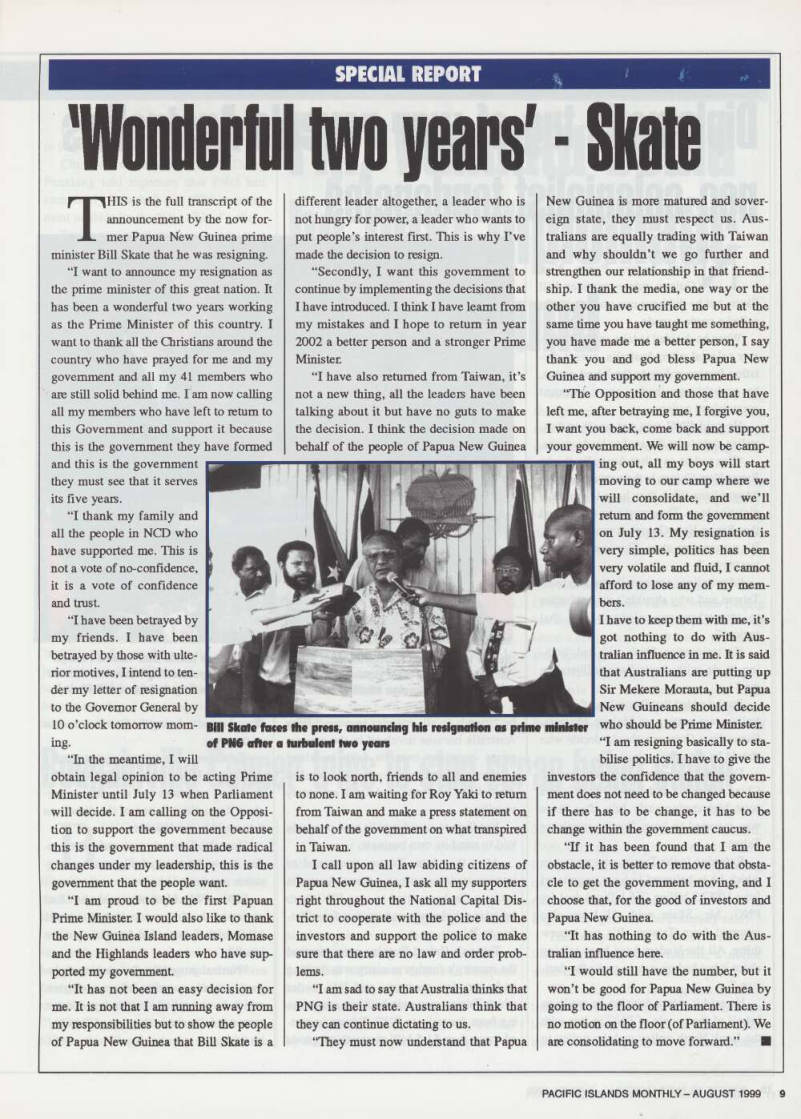
Bill Skate faces the press, announcing his resignation as prime minister of PNG after a turbulent two years
neo-colonialist tendencies
Diplomatic tug-of-war reveals Australia's neo-colonialist tendencies
NOT many people may have liked former Papua New Guinea prime minister Bill Skate, but he did have one good trait - he called a spade a spade.
When he decided to take on PNG’s for mer colonial ruler, Australia, over it dic tating foreign policy to the island nation, he probably touched a nerve amongst many island nations.
He said PNG was not another Aus tralian state to be dictated to by Australia.
“I’m sad to say that Australia thinks Papua New Guinea is their state,” he said.
“Australians think they have to continue dictating to us. They must now understand that Papua New Guinea is more mature.
It’s a sovereign state. They must respect our views.”
“Australians are equally trading with Taiwan and why shouldn’t we go further to strengthen our relations with that region?”
His resignation, Skate said, had “noth ing to do with Australians influencing me.”
But he added that it was “sad that Aus tralians are putting up Mekere Morauta.
Papua New Guineans should decide who should be the prime minister.”
Diplomatic tensions between Taiwan, China, Australia and Papua New Guinea were high during early July after Skate was reported to have flown secretly to
Taipei.
Referring to the Taiwan controversy in which he is believed to have negotiated for a US$2.3 billion (K 6 billion) deal for PNG, Mr. Skate said: “I have also returned from Taiwan. It’s not a new thing. All the leaders have been talking about it but had no guts to make the deci sion.”
He said it was a decision he made on behalf of the people of PNG in line with the Look North policy and the policy to
be “friends to all, enemies to none.” Why Australia became involved in the process raises questions over its faith in island nations to control their destiny. China asked Australia to intervene, and it did, extremely vocally.
Needless to say, Australia was promptly told to mind its own business.
After that fuss, Taiwan threatened to impose trade sanctions against Australia because Canberra tried to stop PNG from switching diplomatic recognition from Bei jing to Taipei.
Taiwan’s United Evening news reported the country’s foreign ministry was drafting trade sanction measures mid-July, under which Taiwan may switch its iron ore sourc ing from Australia to PNG. Taiwan import ed more than $1.5 billion worth of goods
from Australia during the first five months of this year.
Taiwanese foreign ministry acting
spokesman Henry Chen said PNG is rich in natural resources and stepping up pur chase from allies is one of the directions that could be considered.
How the Taiwanese government han dles the withdrawal of dilpomatic recog nition remains to be seen.
PNG PM Morauta said he had reviewed the documents linked to a del made with Taiwan and found they were invalid.
“Normal procedures for opening diplo matic relations with other countries, which have applied since independence, were not followed in the case of Taiwan,” he said.
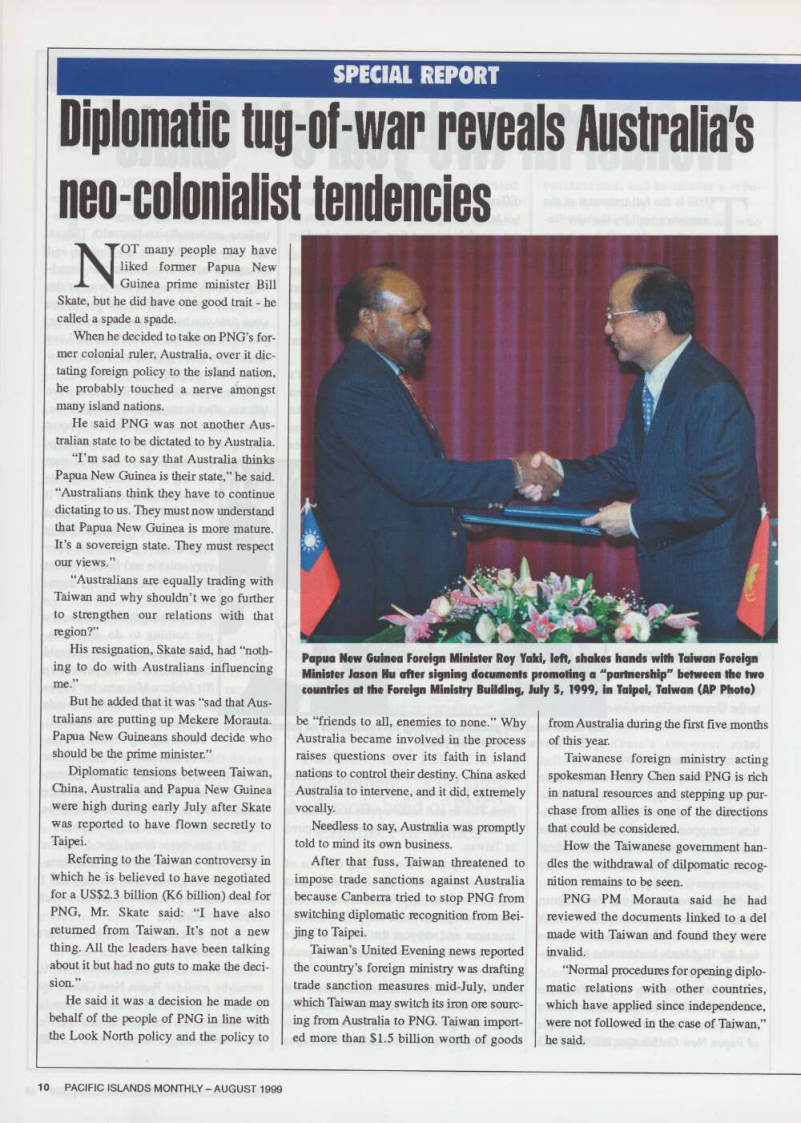
Papua New Guinea Foreign Minister Roy Yaki, left, shakes hands with Taiwan Foreign Minister Jason Hu alter signing documents promoting a "partnership" between the two countries at the Foreign Ministry Building, July 5, 1999, in Taipei, Taiwan (AP Photo)
He said his government would return to its previous “one-China” policy.
Chinese Ambassador to PNG Zhang Penxiang told reporters that PNG had completely breached the 1976 commit ment to abide by the “One China” policy.
Zhang reminded the government that China, as one of the permanent member states of the United Nations Security Council, had actively supported PNG in its effort to safeguard its national sover eignty and territorial integrity over the question of Bougainville.
On the matter of trade relations.
Ambassador Zhang said trade between PNG and China had risen to about US$l5O million in favor of PNG. This, he said, constituted two thirds of China’s trade with South Pacific countries.
PNG exports to China include oil, gold and timber while China’s exports to PNG are mainly light industrial and textile goods, hand tools, food and electronic appliances.
China built the Sir John Guise Sports Stadium, an agricultural experimental sta tion in Kandep, Enga, village houses in Henganofi, Eastern Highlands and the Markham Valley High School in Morobe.
China has also given US$3O million in “soft” loans for the Papa-Lealea salt pro ject. It seems that all’s fair in a diplomatic tug-of-war, and a bargaining chip is only a bargaining chip if the competition says it is. ■
be next diplomatic
Fiji, Vanuatu could be next diplomatic battleground
FIJI and Vanuatu could be the next states targeted by Taiwan after it persuaded Papua New Guinea to switch diplomatic recognition to Taipei from Beijing, Taipei local media said early July. PNG has reversed the
recognition but encouraged by its victory
over China, Taiwan may also keep an eye on the two tiny Pacific states, the cable tele vision TVBS said.
As PNG had previously done, the pair have signed agreements with Taipei to recognise its statehood, while stopping short of full recognition.
Both countries have growing trade links with Taiwan and receive large amounts of aid from the Asian country. Taiwanese fish ermen has also been fishing in Fiji for a number of years.
Asked to comment on the report, acting foreign ministry spokesman Henry Chen said: “For consideration of diplomatic inter ests, we would like to conduct engagement with any country.”
“Just as (foreign) minister (Jason) Hu said, in our efforts to promote diplomacy, we’ll never be reluctant to knock on any door that could be tapped, and nor will we be reluctant to shake hands that could be shook.”
PNG was, for a short time, the 29th country to recognise Taiwan, which Beijing has regarded as a breakaway province ever since a civil war in 1949 led to the island state splitting from the mainland.
In January, Taipei made its first diplo matic win over rival China this year when Macedonia switched diplomatic recognition from Beijing to Taipei. (AFP) ■
Bougainville Copper tries to stop scrap being stolen
Bougainville copper Ltd has launched court action to stop scrap metal being taken illegally from its moth-balled operations on the strife-tom Papua New Guinea island.
The company said it appeared build ings and equipment at the towns of Lolo ho, Arawa and the Panguna mine were being destroyed for the sourcing of scrap metal.
“The company has taken court action to have this illegal industry stopped,” the
company said in its half-year report.
“The cost of start-up of operations will increase as a result and adds to the eco nomic uncertainty of resuming produc tion.”
The mine was the trigger for the seces sionist crisis on the island that escalated in 1989 after disgruntled land owners demanded billions of dollars in compen sation and complained of environmental damage caused by the mine.
Bougainville Copper, majority-owned by Rio Tinto Ltd, posted a net profit of
$2.7 million for the six months to June 30, 1999, a 12 per cent gain on the $2.4 mil lion posted in the previous corresponding half. “The primary reason for the profit is due to the interest on funds invested in Papua New guinea,” the company said.
The company emphasised, even with the resumption of operations, a major write-down of assets will be required.
“The value of the kina against the Aus tralian and United States dollars continues to be of concern, as does the economic sit uation within Papua New Guinea. (AAP)
Niue National Airline to get off
Business
Niue National Airline to get off the ground this month
By Sophie Foster Hildebrand
WHY would a country with about 1800 people, dubbed the smallest self governing state in the world, want an airline?
Tourism, says recently appointed Niuean premier, Sani Lakatani.
“It’s the number one industry in Niue.
For the last 10 years we made that our main economic development,” he says. “Over the last 10 years we invested almost NZ$2O million in the industry and I think we would be foolish if we let it go. Now we’ll establish an airline to hopefully bring
tourists to Niue.”
Niue National Air line will be run by newly formed compa ny, Coral Air. It is headed by former Polynesian chief executive officer, Garth Percival.
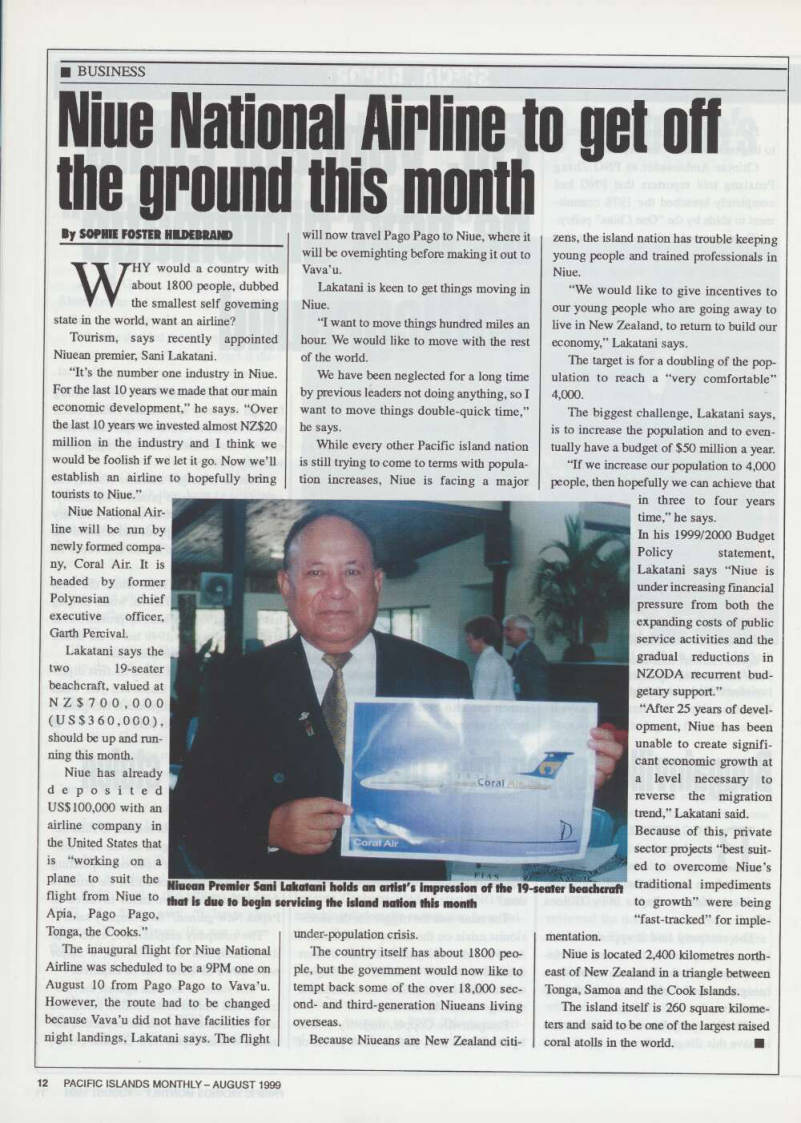
Lakatani says the two 19-seater beachcraft, valued at
Nz$7Oo,Ooo
(US$3 60,000), should be up and run ning this month.
Niue has already deposited US$lOO,OOO with an airline company in the United States that is “working on a plane to suit the flight from Niue to
Apia, Pago Pago,
Tonga, the Cooks.”
The inaugural flight for Niue National Airline was scheduled to be a 9PM one on August 10 from Pago Pago to Vava’u.
However, the route had to be changed because Vava’u did not have facilities for night landings, Lakatani says. The flight
will now travel Pago Pago to Niue, where it will be overnighting before making it out to Vava’u.
Lakatani is keen to get things moving in Niue.
“I want to move things hundred miles an hour. We would like to move with the rest of the world.
We have been neglected for a long time by previous leaders not doing anything, so I want to move things double-quick time,” he says.
While every other Pacific island nation is still trying to come to terms with popula tion increases, Niue is facing a major
under-population crisis.
The country itself has about 1800 peo ple, but the government would now like to tempt back some of the over 18,000 sec ond- and third-generation Niueans living overseas.
Because Niueans are New Zealand citi
zens, the island nation has trouble keeping young people and trained professionals in Niue.
“We would like to give incentives to our young people who are going away to live in New Zealand, to return to build our economy,” Lakatani says.
The target is for a doubling of the pop ulation to reach a “very comfortable” 4,000.
The biggest challenge, Lakatani says, is to increase the population and to even tually have a budget of $5O million a year.
“If we increase our population to 4,000 people, then hopefully we can achieve that
in three to four years time,” he says.
In his 1999/2000 Budget Policy statement, Lakatani says “Niue is under increasing financial pressure from both the expanding costs of public service activities and the gradual reductions in NZODA recurrent bud getary support.”
“After 25 years of devel opment, Niue has been unable to create signifi cant economic growth at a level necessary to reverse the migration trend,” Lakatani said.
Because of this, private sector projects “best suit ed to overcome Niue’s traditional impediments to growth” were being “fast-tracked” for imple
mentation.
Niue is located 2,400 kilometres north east of New Zealand in a triangle between Tonga, Samoa and the Cook Islands.
The island itself is 260 square kilome ters and said to be one of the largest raised coral atolls in the world. ■
Niuean Premier Sani Lakatani holds an artist's impression of the 19-seater beachcraft that is due to begin servicing the island nation this month
Advertisements & other items, p. 13 (1 item)
Telstra
TRADE MARK CAUTIONARY NOTICE
Notice is hereby given that Telstra Corporation Limited, a corporation duly organised and existing under the laws of Australia, and having ACN 051 775 556, the Corporate Secretary being located at 242 Exhibition Street, Melbourne, Australia is the sole proprietor of the following trade marks:- Used in respect of:— Telecommunications and communications equipment, apparatus and systems, including but not limited to electronic and optical telecommunications and communications eqmpment, apparatus and systems; satellite and earth station telecommunications and communications equipment, apparatus and systems; Telephone equipment, apparatus and systems, including but not limited to telephone; telephone receivers; telephone handsets; telephone network, telephone exchanges, telephone switching, telephone answering, telephone card vending and telephone dialling equipment, apparatus and systems; Transmission, receiving and storage equipment, apparatus and systems, including but not limited to facsimile, telegraph, telex, teleprinting, cable and paging equipment, apparatus and systems; data and video networking and conferencing equipment, apparatus and systems; data processing, message handling and switching equipment, apparatus and systems; digital equipment, apparatus and systems; electronic, voice, text and facsimile mail equipment, apparatus and systems; electronic directory equipment, apparatus and systems; Computer equipment, apparatus and systems, including but not limited to computer programs; computer software; computer hardware; computer terminals; computer memories; computer networking equipment, apparatus and systems; computer manuals in this class; modems; Video and audio equipment, apparatus and systems, including but not limited to sound and image recording, transmission and reproduction equipment, apparatus and systems; video cassettes and tapes; compact discs; records; digital, electric and electronic radio equipment, apparatus and systems; magnetic tapes; cinematographic, television and amusement equipment, apparatus and systems; amusement machines; All associated parts and accessories being goods in class 9, paper, cardboard and goods made from these materials; printed matter including directories, journals and manuals and all goods in class 16; advertising, promotional, consultancy and business services; compiling, arranging and publishing directories; telephone answering services; market research and statisticalservices; being services in class 35, repair installation, maintenance and construction services; being services in class 37, telecommunication services being services in class 38, amusement, entertainment, education and information services; multi-media services; being services in class 41, research services; computer programming services; retail and wholesaling services; consultancy services being services in Class 42', The said proprietor claims all rights in respect of the above trade marks and will take all necessary legal steps against any person or company infringing their said rights.
DAVIES COLLISON CAVE
PATENT ATTORNEYS
TELSTRA
~elstra
One Little Collins Street Melbourne, Victoria, 3000 Australia Level 10 10 Barrack Street Sydney, New South Wales, 2000 AMP Building Hobart Place Canberra City 2601
Asian fishermen return in force to Marshall Islands
by Gift Johnson
OPROVING that last year’s
fishing boom in the Marshall Islands was not a one-off affair, Asian purse seiners and fish carriers returned in force to Majuro in June. But, say Marshall Islands Marine Resources Authority (MIMRA) officials, the seven carrier transshipment vessels and more than 20 purse seiners that have anchored in
Majuro’s lagoon is only a fraction of the tuna transship ment activity that the capital will see in the next several months.
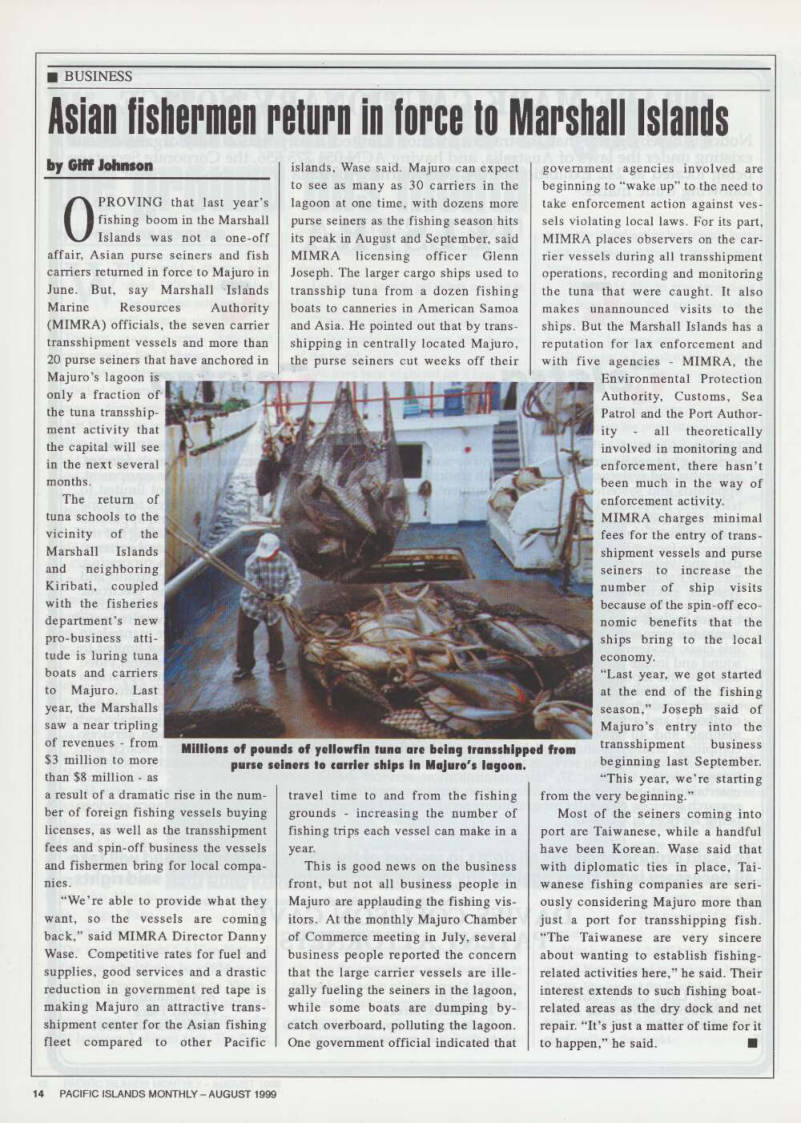
The return of tuna schools to the vicinity of the Marshall Islands and neighboring Kiribati, coupled with the fisheries department’s new pro-business atti tude is luring tuna boats and carriers to Majuro. Last year, the Marshalls saw a near tripling of revenues - from $3 million to more than $8 million - as
a result of a dramatic rise in the num
ber of foreign fishing vessels buying
licenses, as well as the transshipment fees and spin-off business the vessels and fishermen bring for local compa nies.
“We’re able to provide what they want, so the vessels are coming back,” said MIMRA Director Danny Wase. Competitive rates for fuel and supplies, good services and a drastic reduction in government red tape is making Majuro an attractive trans shipment center for the Asian fishing fleet compared to other Pacific
islands, Wase said. Majuro can expect to see as many as 30 carriers in the lagoon at one time, with dozens more purse seiners as the fishing season hits its peak in August and September, said MIMRA licensing officer Glenn Joseph. The larger cargo ships used to transship tuna from a dozen fishing boats to canneries in American Samoa and Asia. He pointed out that by trans shipping in centrally located Majuro, the purse seiners cut weeks off their
travel time to and from the fishing grounds - increasing the number of fishing trips each vessel can make in a year.
This is good news on the business front, but not all business people in
Majuro are applauding the fishing vis
itors. At the monthly Majuro Chamber of Commerce meeting in July, several business people reported the concern that the large carrier vessels are ille gally fueling the seiners in the lagoon, while some boats are dumping by catch overboard, polluting the lagoon.
One government official indicated that
government agencies involved are beginning to “wake up” to the need to take enforcement action against ves sels violating local laws. For its part, MIMRA places observers on the car rier vessels during all transshipment operations, recording and monitoring the tuna that were caught. It also makes unannounced visits to the ships. But the Marshall Islands has a reputation for lax enforcement and with five agencies - MIMRA, the
Environmental Protection Authority, Customs, Sea Patrol and the Port Author ity - all theoretically involved in monitoring and enforcement, there hasn’t been much in the way of
enforcement activity.
MIMRA charges minimal fees for the entry of trans shipment vessels and purse seiners to increase the number of ship visits because of the spin-off eco nomic benefits that the ships bring to the local economy.
“Last year, we got started at the end of the fishing season,” Joseph said of Majuro’s entry into the transshipment business beginning last September.
“This year, we’re starting
from the very beginning.”
Most of the seiners coming into port are Taiwanese, while a handful have been Korean. Wase said that with diplomatic ties in place, Tai wanese fishing companies are seri
ously considering Majuro more than
just a port for transshipping fish.
“The Taiwanese are very sincere about wanting to establish fishing related activities here,” he said. Their interest extends to such fishing boat related areas as the dry dock and net repair. “It’s just a matter of time for it to happen,” he said. ■
Millions of pounds of yellowfin tuna are being transshipped from purse seiners to carrier ships in Majuro's lagoon.
through in the US
Pafco makes a break through in the US
THE Pacific Fishing Company (Pafco) has negotiated a five-year agreement for supplying tuna to Bumble Bee Seafood Inc, a major Ameri
can firm.
Pafco general manager Mitieli Baleivanualala said it was an exciting breakthrough for the company.
“We have made an important advance in the world’s largest single tuna market.
This will help us to secure the jobs of our workers and concentrate on long-term development.”
An immediate priority is for Pafco to invest about $7 million for expansion and improvement to its factory at Levuka, Ovalau. The upgrade will lift factory stan dards to comply fully with international production and hygiene requirements, par ticularly those of the US Food And Drug Administration and the European Union (EU).
Pafco, majority-owned by the govern ment, operates Ovalau’s main industry canning and processing high quality tuna for international customers. It provides employment for up to 600 local people.
Baleivanualala signed the Bumble Bee agreement at the US firm’s head office in San Diego, California.
Douglas Hines, Bumble Bee’s vice president resourcing and business develop ment, was the other signatory. Also present was Pafco’s chair Kalivati Bakani.
Pafco receives a processing fee for sup plying the American company with a min imum of 15,000 tonnes of tuna annually to be packed as loins for canning in Califor nia. Price details are confidential, in line with the terms of the agreement.
“Although we are not permitted to divulge the price as a matter of commer cial confidentiality, I can say that we have negotiated a very fair deal that provides a win-win situation for all parties con cerned,” Baleivanualala said.
“More importantly, this deal has pro vided a platform for Pafco to gradually move away from its reliance on preferen tial trade arrangements into free trade.”
Sales to Bumble Bee will now account for most of Pafco’s business. Pafco tuna is
also exported to Europe.
“EU market arrangements will remain important to our business in the next 10 to 15 years. They will provide the grace period for Pafco to fully move into the global free trade environment.”
Baleivanualala said; “WeTe proud our products are highly regarded and in demand by some of the most discerning consumers.”
“We place great emphasis on quality and environmental factors. Our tuna comes from unpolluted waters and is caught by vessels using dolphin-friendly fishing meth ods.”
Pafco, Baleivanualala said, is also com mitted to conservation and sustainability. It has access to the world’s richest tuna fish ery which contributes 50 per cent of the world’s global catch. The fishery is being
managed as a lasting resource for the Pacific region.
Planned renovations and refurbish ment form part of a five-year busi ness plan to ensure Pafco meets its obligations under the bumble Bee
contract. Improvements will include: - New cookers and baskets for the pre cooked product, new boiler and conveyors, anew fish conditioning system and fish
meal dryer, new butchering and thawing
system and an upgraded laboratory facility; - Better ventilation, new canteen, staff change room and launderette and possibly a day care centre; - Reorganised production flow and reconstruction of certain areas of the facto ry.
Baleivanualala said Pafco must constant ly enhance efficiency to remain competitive and get the maximum return from tuna pro cessing. “We have to be ready for a world trade environment which demands high pro ductivity and an ability to compete without preferential trade arrangements.” ■
Advertisements & other items, p. 15 (1 item)
Hook Up With The Leader!
Pacific Ocean Producers
is the leader in H n
monofilament longline
system technology.
We offer special service to the South Pacific Islands, Australia and New Zealand. • Lindgren-Pitman gear, complete hydraulic systems, design and installation or monofilament longline systems including operations training. • Extensive Tuna and Swordfish supplies, bottom fishing gear, fish handling supplies and bait. • Duralumes Lightstick - the latest in lightsticks technology, extended light output, often used two nights, 5-year shelf life, not affected by moisture, easy-to- handle shipping carton. All popular colors available - green, blue, pink, yellow, white, violet and ultra-violet for best fishing results. • Wide selection of trolling equipment: over 180 different colors of trolling skirts and a large selection of lure heads.' • Weekly shipments to the South Pacific Islands, Australia and New Zealand.
FREE CATALOG AVAILABLE ON REQUEST
Please direct all inquiries to the Export Department: 965-B North Nimitz Highway Honolulu, HI 96817, USA.
Telephone: (808) 537-2905 Facsimile: (808) 536-3225
Pacific
Ocean
Producers
Shop on line for your convenience; www.pop-hawaii.com Toll Free Number ,1-800-144-488
"Illegal" competitors'100 per cent
interest rate hurting PNG's banks
DOES your bank offer you 100 per cent interest on your savings? If it is like most other banks in the world, it probably does not.
But for the people of Papua New Guinea, 100 per cent interest is prov ing to be a lure that is driving them away from commercial banks, towards “get-rich-quick” financial schemes.
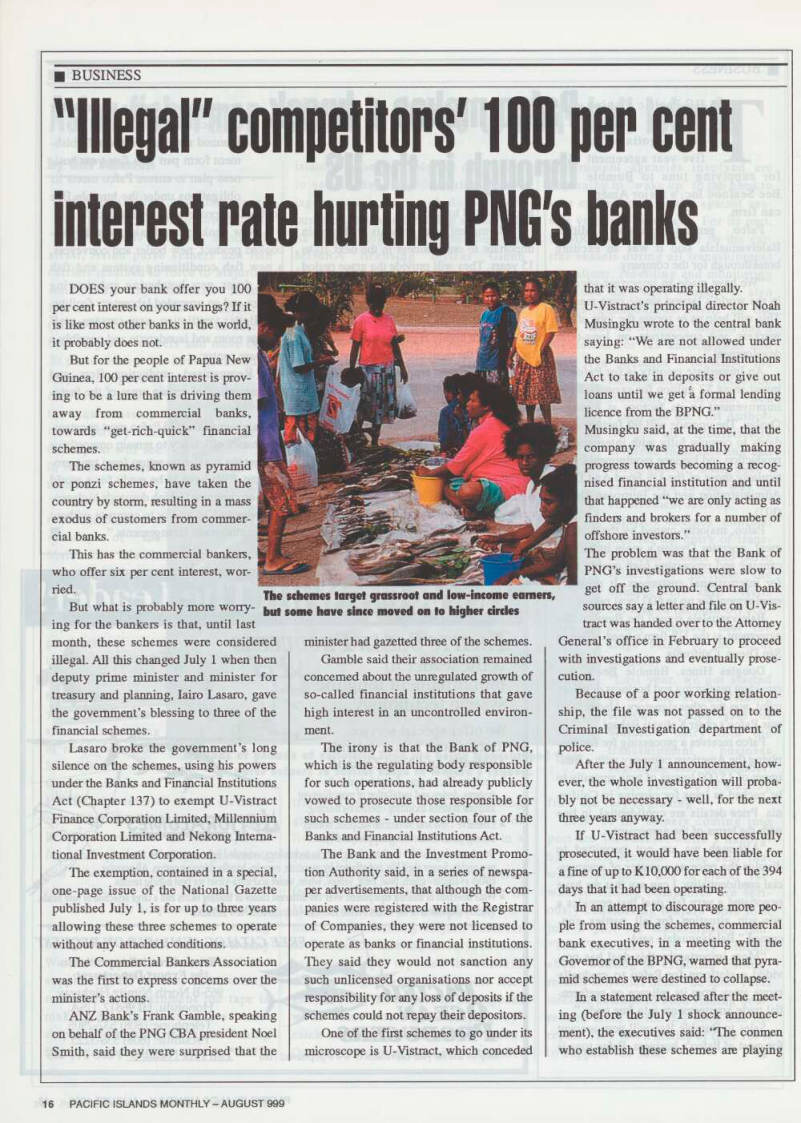
The schemes, known as pyramid or ponzi schemes, have taken the country by storm, resulting in a mass exodus of customers from commer cial banks.
This has the commercial bankers, who offer six per cent interest, wor ried.
But what is probably more worry ing for the bankers is that, until last
month, these schemes were considered illegal. All this changed July 1 when then deputy prime minister and minister for treasury and planning, lairo Lasaro, gave the government’s blessing to three of the financial schemes.
Lasaro broke the government’s long silence on the schemes, using his powers under the Banks and Financial Institutions Act (Chapter 137) to exempt U-Vistract Finance Corporation Limited, Millennium Corporation Limited and Nekong Interna tional Investment Corporation.
The exemption, contained in a special, one-page issue of the National Gazette published July 1, is for up to three years allowing these three schemes to operate without any attached conditions.
The Commercial Bankers Association was the first to express concerns over the minister’s actions.
ANZ Bank’s Frank Gamble, speaking on behalf of the PNG CB A president Noel Smith, said they were surprised that the
minister had gazetted three of the schemes.
Gamble said their association remained concerned about the unregulated growth of so-called financial institutions that gave high interest in an uncontrolled environ ment.
The irony is that the Bank of PNG, which is the regulating body responsible for such operations, had already publicly vowed to prosecute those responsible for such schemes - under section four of the Banks and Financial Institutions Act.
The Bank and the Investment Promo tion Authority said, in a series of newspa per advertisements, that although the com
panies were registered with the Registrar
of Companies, they were not licensed to operate as banks or financial institutions.
They said they would not sanction any such unlicensed organisations nor accept responsibility for any loss of deposits if the schemes could not repay their depositors.
One of the first schemes to go under its microscope is U-Vistract, which conceded
that it was operating illegally.
U-Vistract’s principal director Noah Musingku wrote to the central bank saying: “We are not allowed under the Banks and Financial Institutions Act to take in deposits or give out loans until we get a formal lending licence from the BPNG.”
Musingku said, at the time, that the company was gradually making progress towards becoming a recog nised financial institution and until that happened “we are only acting as finders and brokers for a number of offshore investors.”
The problem was that the Bank of PNG’s investigations were slow to get off the ground. Central bank sources say a letter and file on U-Vis tract was handed over to the Attorney
General’s office in February to proceed with investigations and eventually prose cution.
Because of a poor working relation ship, the file was not passed on to the Criminal Investigation department of
police.
After the July 1 announcement, how ever, the whole investigation will proba bly not be necessary - well, for the next three years anyway.
If U-Vistract had been successfully prosecuted, it would have been liable for a fine of up to KlO,OOO for each of the 394 days that it had been operating.
In an attempt to discourage more peo ple from using the schemes, commercial bank executives, in a meeting with the Governor of the BPNG, warned that pyra mid schemes were destined to collapse.
In a statement released after the meet ing (before the July 1 shock announce ment), the executives said: “The conmen who establish these schemes are playing
The schemes target grassrool and low-income earners, but some have since moved on to higher circles
on the gullibility and naivety of people who don’t understand the enormous risks of investing in these schemes.”
“The prospers) of each scheme and the early investors, who put their money in when the scheme still has momentum, will receive their interest and most will proba bly get their money back. However, when the scheme begins to falter, then people will lose their money. These conmen are greedy, they operate out of self-interest and they don’t care whether you lose your money or not.”
The fact of the matter is that the com mercial banks just cannot match the 100 per cent interest of the schemes. Also, unlike the banks, interest is immediate on deposits in the schemes - the least being a month - while banks offer longer periods of maturity (at six per cent interest).
For their part, the commercial bankers admitted that 100 per cent is the driving force.“lt is true that some individuals at attracted by 100 per cent rates of interest and are prepared to take the enormous risk of investing their hard-earned savings,” they said.
“However,” their statement added, “you shouldn’t complain when the cookie jar is empty and it becomes evident that you have lost your money; and you can bet your life on the fact that the ‘greedy ones’ will have eaten all the cookies and will have disap peared with the cookie jar.”
In retaliation, the commercial banks resolved to not allow accounts to be operat ed by the schemes unless a licence could be produced which showed that they could legally act as financial institutions.
But if the scheme operators had been silent until then, they certainly lashed out after the CBA statement.
Supporters of the schemes argued that commercial bankers were bitter because the organisations had entered a business that, at one time, was exclusive to them.
They claim the schemes came about as a direct result of the frustration of the small people who were not able to meet the lend ing criteria of the established banks - which was described as onerous, burdensome and, at times, unnecessary. Because of the crite ria, ordinary Papua New Guineans were alienated from meaningful participation in
the economy or from improving their way of life, the supporters claim. The bank’s biggest concern was the mass withdrawal of depositor’s funds from cheque books, supersaver accounts, passbooks and IBDs, they said.
The directors of Coral Pacific Interna tional argued that the company was offering a service that banks and financial institu tions were not able to provide to ordinary people.
“The grassroots, ordinary people,
including unemployed youth, are benefit ting immensely from the service. They all appreciate the service which has directly led to the decrease in criminal activities in Port Moresby.
“The people involved live among the people. They know and understand the problems of the people in a country faced with difficult economic times.
We are working to secure the invest ments of our customers.”
The directors lashed out at banks and their executives, whom, they claimed “live
in ivory towers, drive expensive cars - all at the expense of the small people who deposit their funds with them.”
The directors alleged that the banks “double, triple, quadruple the money the simple ordinary people deposit with them and they do not pass the benefit to the peo ple.
The banks in the country need to be seriously regulated and over-hauled and to be made accountable to the needs of Papua New Guineans.
We need to have a banking ombudsman appointed to review and sanction the arbi trary behaviour of banks.
“We are paying some of the highest interest rates charges and penalty rates in the world while the banks are enjoying some of the highest profit margins in the world against a backdrop of falling econo my and failing national business.”
The scheme supporters claimed the government had to move quickly to set up a banking ombudsman to “prevent revolt by the small people on the streets”. ■
Advertisements & other items, p. 17 (1 item)
Fiji Island Adventures S
TODBIST INFORMATION CENTRE
See ue fan exeeUent deale OvenniyAt Stay! *7 leAAiny *leland Safanie!
"Ttietony, SiyAteeeiny! 4 Ti/Aeei Safatni Soane!
Sanfany Sccdta. Satiny! Suyet /tceonunodatione! @nuieee and Talk to us first -we live here... book direct and ask for: Free independent information on latest deals!
Free booking services and many options!
Free airport transfers to hotel of your choice in Nadi!
Free greet on arrival & maps. Also general info on Fiji Write to us now or [email protected] PO Box 251 Nadi Fiji Islands Ph: 679 700243 Fax: 679 702746 Internetwww.fijiadventures.com.fj
about lost revalues
Emperor denies claims about lost revalues
FIJI’S Emperor Gold Mining
Co. (EGM), Ltd denied claims made in the country’s Senate that the Fiji Government lost F$ 3 million (US$ 1.6 million) dollars in gold royalties resulting from the mine’s operations.
Senator Atu Bain claimed in the Upper House early July that both the Government and landowners have become “victims of this dubious tax deal between EGM and the previous Government of Sitiveni Rabuka.”
EGM’s General Manager, Martin Jacobsen, said Senator Bain failed to recognise that during the same year
(1992 -1997), the company invested almost F$ 50 million (US$ 26 million) in capital expenditures on projects designed to improve and modernise the mine.
“In the last five years, it is pertinent to point out that Emperor has not paid out any dividend to its shareholders.
All surplus income was reinvested into the company”, Jacobsen said.
Senator Bain said between 1992 - 1997, gold sales from EGM totaled FJDS36S.I million (U 55186.2 million).
Of that amount, the Fiji Government only received F$ 874, 000 (US$ 445, 000) in gold royalties.
Emperor denied the Senator’s alle gation that the State and landowners are victims of the royalty system.
Jacobsen said Senator Bain also failed to recognise that Emperor paid out in excess of F$ 10.5 million (US$ 5.46 million) in gold export taxes.
“Emperor holds freehold title over a major portion of the mining title, therefore Emperor would be victims of its own action! How Senator Bain can claim the tax deal negotiated between Emperor and the previous Government was ‘dubious’ is beyond me,” Jacobsen said.
He said Fiji’s mining regulation empowers the Director of Mineral Resources, with the approval of the Minister responsible, to reduce the royalty rate of five percent. The Tax agreement allows EGM a royalty rate of 2.5 percent of adjusted chargeable income.
“I wish to assure Senator Bain that all royalty payments are done legally, in accordance with the conditions of the agreement and the mining leas
es,” EGM’s General Manag er said.
In another development, the mine has announced that 2,000 people employed by EGM will not be immediate ly affected by another drop I in the price of gold on the world market. The Bank of England announced that it had sold 25 tons of gold reserves, which caused the price of gold to drop to its lowest amount in 20 years.
The price of gold fell by 30 cents an ounce to F$ 257 (US$ 133.60) an ounce after the Bank of England announcement.
Jacobsen said gold prices
have been on the decline since 1997 and EGM had earlier been forced to reduce its workforce by 500.
EGM is owned by Australian Emperor Mines, Ltd. (PAC
News) ■
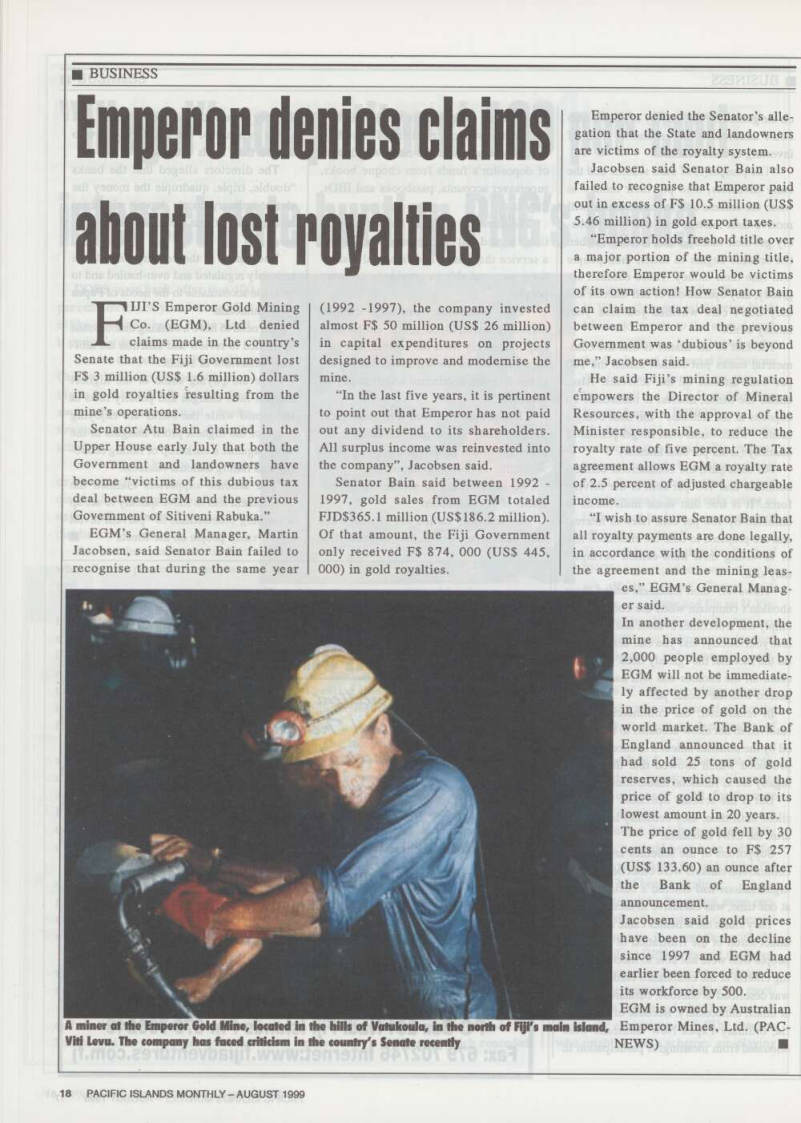
A miner at the Emperor Gold Mine, located in the hills of Valukoula, in the north of Fiji's main island, Viti Leva. The company has faced criticism in the country's Senate recently
Vailima wails
out the bidding process
IT is no secret that Carlton Brewery (Fiji) Limited is interested in buy ing shares in one of Samoa’s suc cess stories, the producers of Vailima, Samoa Breweries.
And the Samoans know it.
Samoan prime minister Tuilaepa Sailele Malielegaoi was not giving any thing away at the recent Forum Economic Ministers’ Meeting in Apia, saying the government knew that the Fiji brewer was interested but that it would wait to see what bids it received for company shares.
Samoa Breweries Limited began oper ation in 1978, as a joint venture between the government of Samoa and a German company Haase Braurei.
For their part, the success of the busi ness is not the only deciding factor in CBL’s interest in Samoa.
CBL general manager, Hugh Ragg says Samoa’s “decision to reduce tax on divi dend has made it an attractive proposition for us to invest in Samoa.”
Apart from reducing tax on dividend, the Samoans have also reduced income tax rates, and reduced company taxation.
Vailima, known as “Samoa’s Very Own Beer”, is produced and bottled on the out skirts of Apia, and was Gold Medal win ner at the World Monde Selection Beer Awards in 1990, 1992, 1995, and 1998.
Initially Samoa Breweries produced only Vailima Beer and a range of in-house soft drinks. In 1982, it acquired the fran chise for bottling San Miguel Beer, but this association ceased in 1990.
In 1984, it acquired the franchise to bottle Coca Cola and allied brands like Fanta Orange, Sprite and Mello Yello. In 1991, it began bottling EKU Bavaria beer under licence to Erste Kulmbacher Actien brauerei AG.
Carlton Brewery (Fiji) Limited pro duces Fiji Bitter, Fiji Gold, Fiji Export and
has recently begun, in conjunction with its subsidiary. South Pacific Distilleries, pro ducing ready-mixed alcoholic beverages such as Bounty Rum and Coke in a can.
Vailima is the name of a small mountain village in Samoa where Robert Louis Stevenson lived out the last years of his life.
The Samoans named him ‘Tusitala’ - The teller of Tales. His residence still stands there as a monument to these buccaneer days. According to Samoa Breweries, the word Vailima literally translated means.
‘Water in the hand’.
“The origins of the word goes back to a legend about a couple crossing the island of Upolu over the mountain range which runs nearly the length of the island.
When they reached where Vailima village is now, the man was nearly dying of thirst.
Having no other means at all of fetching water, the woman used the palms of her hands to fetch water from a nearby stream from which her husband drank, thus restoring his strength,” it says. ■
Advertisements & other items, p. 19 (1 item)
1U (Lottl
FIJI ISLANDS
The West’s Motor Tun
Phone: (679) 720044 E-mail: [email protected] Fax: (679) 720071. P.0.80x 10097, Nadi Airport. mm m r-.sS m Ideally situated between the International Airport and Nadi Town 62 Rooms from standard airconditoned deluxe to
Poolside dining
variety at reasonable m urns meter prices
Entertainment performed by
inn our very
talented piamst/vocalist
Free courtesy airport transfers request on 24 hour reception and porterage
1U (Lottl
Innovative campaign hopes to put
Madang back on the tourism map
By Frands Tekei
CALLED “the prettiest town in the Pacific” (Lonely Planet Travel Survival Kit), Madang
town has been the envy of both for eign and domestic travellers.
Papua New Guineans know this harbourside town with its pic turesque setting as simply “Beauti
ful Madang”.
But Madang, in recent years, has lost its beauty, its pride and its fame.
Like every growing PNG town, Madang is experiencing an unprece dented influx of people, influenced by large investments that are, in turn, attracted by the town’s peace ful and safe investment climate.
These include a meat cannery, cocoa research establishment, cigarette manufacturer WH Wills (PNG) Ltd.,
and RD Tuna Canners - PNG’s first tuna processing plant. The largest of these investments is the KB3B million Ramu- Nickel project that is expected to begin construction early next year.
Thus, the sudden increase in popula tion has naturally led to more lawlessness and urban problems.
With these factors and the worsening national economic situation, a breakdown in attitude resulting in lawlessness and care lessness has crept deep into the heart of
Madang town where beauty matters most.
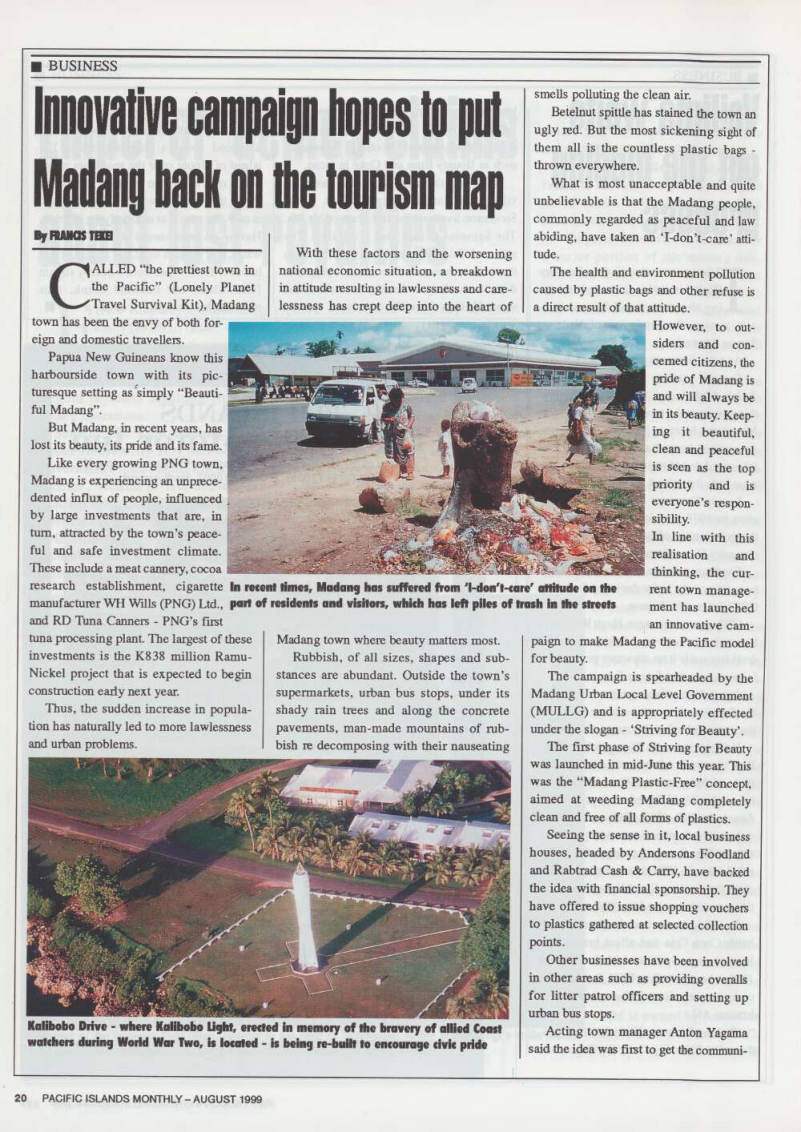
Rubbish, of all sizes, shapes and sub stances are abundant. Outside the town’s supermarkets, urban bus stops, under its shady rain trees and along the concrete pavements, man-made mountains of rub bish re decomposing with their nauseating
smells polluting the clean air.
Betelnut spittle has stained the town an ugly red. But the most sickening sight of them all is the countless plastic bags -
thrown everywhere.
What is most unacceptable and quite unbelievable is that the Madang people, commonly regarded as peaceful and law abiding, have taken an T-don’t-care’ atti tude.
The health and environment pollution caused by plastic bags and other refuse is a direct result of that attitude.
However, to out siders and con cerned citizens, the pride of Madang is and will always be in its beauty. Keep ing it beautiful, clean and peaceful is seen as the top priority and is everyone’s respon sibility.
In line with this realisation and thinking, the cur rent town manage ment has launched an innovative cam
paign to make Madang the Pacific model for beauty.
The campaign is spearheaded by the Madang Urban Local Level Government (MULLG) and is appropriately effected under the slogan - ‘Striving for Beauty’.
The first phase of Striving for Beauty was launched in mid-June this year. This was the “Madang Plastic-Free” concept, aimed at weeding Madang completely clean and free of all forms of plastics.
Seeing the sense in it, local business houses, headed by Andersons Foodland and Rabtrad Cash & Carry, have backed the idea with financial sponsorship. They have offered to issue shopping vouchers to plastics gathered at selected collection
points.
Other businesses have been involved in other areas such as providing overalls for litter patrol officers and setting up urban bus stops.
Acting town manager Anton Yagama said the idea was first to get the communi
Kalibobo Drive - where Kalibobo Light, erected in memory of the bravery of allied Coast watchers during World War Two, is located - is being re-built to encourage civic pride
In recent times, Madang has suffered from 'I-don't-care' attitude on the part of residents and visitors, which has left piles of trash in the streets
ty involved and then ensuring that the campaign was successful and ongoing.
“It is a community oriented thing. We want the community to be involved. We want the community to feel responsible.”
He said the Madang Plastic-Free con cept was working well, with other urban centres throughout the country expressing interest in it.
“We are getting rid of plastics. This is to make an awareness that plastics are not wanted ... Eventually within the next 12 to 24 months, Madang will be plastic free.”
“We hope everyone in the country and the Pacific follows our example.”
With the Madang Plastic-Free cam paign implemented, town authorities are now looking at other initiatives they have outlined. These include a ban on betelnut sales and chewing in public areas and within the town boundaries, registration of dogs and removal of stray dogs. Kali bobo Drive - where Kalibobo Light, erect ed in memory of the bravery of allied Coast watchers during World War Two, is located - is also being built. There are fencing regulations to see the end of barbed wire and razor wire fences in resi dential areas. Trees would also be planted along the main roads and overgrown ones pruned or eliminated. The long-term aim, according to Yagama is not only to ensure Madang retained its beautiful image but much more so, to make it the Pacific heart and soul for tourism, hospitality, peace and natural beauty.
“We want to be the model for the Pacific in terms of natural beauty and peace. We want other centres (in PNG) to clean our towns and cities clean and beau tiful. We want our friends in the Pacific to keep their towns and cities clean, beauti ful and peaceful as well.”
According to Yagama, all the initia tives of the campaign would be imple mented step-by-step, smoothly and effec tively until Beautiful Madang was no
longer Striving for Beauty but continuing
its environmentally friendly campaign to become once again “the prettiest town in the Pacific” - with the hope that other PNG urban centres and those in the Pacif ic imitate their concept. ■
World trade growth
slower in 1998
THE rate of growth in the volume of world merchandise exports slowed to 3.5 per cent in 1998, from over 10 per cent in 1997, due largely to continuing economic contraction in much of Asia.
World output growth slipped to 2 per cent in 1998, compared to 3 per cent in 1997. Although trade growth still exceeded output growth in 1998, it was by a smaller margin than the average for the 19905.
Export growth in 1999 is expected to match that of 1998, but for this projection to be realiised, trade growth will have to accelerate during the course of 1999.
This projection also assumes that slow ing output growth in the United States and Western Europe will be offset somewhat by recovery in Asia. A faster than expected slowdown in the United States or Western Europe, or slower recovery in Asia, would clearly imply export volume growth below 3.5 percent in 1999.
These are among the findings of the WTO's first report on trade developments last year and the outlook for this year.
The report found that, in 1998, an increase in the supply of many primary commodities coincided with a slowdown in economic activity, leading to a sharp drop in commodity prices.
Prices of non-fuel commodities and crude oil fell by 15 per cent and more than 30 per cent, respectively.
Although prices of manufactures
decreased as well, prices of primary com modities decreased much faster (for the second year in a row).
As the oil price decline accelerated dur ing the course of the year, the year-over year change in December 1998 exceeded 40 per cent.
For non-fuel primary commodities, the period of weaker prices started earlier and
moderated in the second half, with the result that the decline at the end of the year (about 10 per cent) was smaller than the annual average for 1998.
Oil exporters have yet to feel the full impact of lower spot oil prices on their
export earnings.
Investment and government expendi ture is likely to be curtailed in 1999. Import levels will contract further, as such a steep price decline cannot be fully absorbed by a reduction in foreign exchange reserves.
As noted earlier, the steep fall in fuel prices affects in particular the export earn ings of the Middle East and Africa. Besides the 11 member countries of OPEC, in about another eight countries fuel exports account for more than one half of export earnings.
It is important to note that in the first quarter of 1999, the spot oil price recov ered from its low level in December 1998 following the announcement of production cuts by oil producers. It remains to be seen whether this upward trend will continue or the present price gains will prove sustain able.
While these trends will lead to down ward adjustments in the imports of oil exporting countries in 1999, related income gains in oil-importing countries will at least partially offset this contrac tionary tendency in world trade.
Exporters of agricultural products are a larger group than oil exporters. The decline in agricultural prices therefore affected a larger number of countries, but generally less dramatically than the oil exporters.
This is for two reasons.
First, the decline in agricultural product prices was less steep than for oil. Second, the exporters of agricultural products gen erally depend less on a single commodity than do the fuel exporters. ■
dollar research centre

Fiji sugar to start multi-million dollar research centre
FIJI’S biggest commercial enterprise, sugar, will be taking a step in a new direction if it can obtain funding for an independent research centre to help modernise sugar cane farming and sugar production.
Preliminary estimates on funding envisage approximately FJDSS.3 million for construction and about FJDS7OO,OOO for equipment for the centre.
The sugar cane research advisory com mittee is preparing a detailed scheme for acquiring land, constructing laboratories
and other technical infrastructure and staffing.
Committee chair and deputy chief executive of the Fiji Sugar Market ing Company, Kaliopate Tavola, says they have not completed analysis of funding options but foreign aid would be sought for establishment costs.
He says research is a crucial part of a strategic plan for sugar industry reform.
To be introduced over 20 years, the plan
proposes major change
in all aspects of Fiji’s
biggest commercial enterprise.
Growing, processing and exporting
sugar provides a livelihood for more than 22,000 farmers and 3000 mill workers.
In total, it is estimated that about one third of Fiji’s population is dependent in some way on sugar revenue, with industry earnings one of the biggest contributors to the economy.
However, unless milling and farming
standards are improved, Fiji will not be able to compete internationally.
The Sugar Commission of Fiji believes that a strategic plan adopted in 1997 was the key to the industry’s survival, pointing the way to better milling, transport, harvesting and farming.
Six industry sub-committees are imple menting the first stages of the plan.
“Research has always been important and this is recognised as we map out the future development of sugar production,” says Tavola. “Excellent work has been done in the past on creating new cane varieties
and providing farm advice.”
But Tavola said the current research cen tre - run by the Fiji Sugar Corporation - had suffered from loss of skills and shortage of funds.
In addition, he said, cane growers had no direct involvement or voice in FSC research although they contributed to its costs.
“We want the new centre to highlight
excellence, to act as a showcase for what our industry can become. At the same time, it will provide valuable practical and scientific support for the millers and growers to help them increase efficiency and output.”
“A continuing commitment to research will pay good dividends for everyone in the industry. The return on the money invested will be very high.”
The next step in the process is the com missioning of initial design and architec tural drawings.
Meanwhile, committee members have
progressed with draft legislation for the estab lishment of the centre.
Tavola says the centre’s broad objectives, as out lined in the proposed legislation, will be to boost the productivity of the sugar industry. It will work to improve the quantity and quality of sugar cane and identify ways of producing addi tional products from cane.
The centre will have a wide mandate for techni cal and scientific research and investiga tion. This will cover pro
duction, harvesting,
transport or processing of sugar. There will be concentration on preventing pest infestation, enhancing the ability of land to sustain sugar crops and protection of the environment.
A Board of Directors will represent all sectors of the industry and an advisory committee will make recommendations to the Board on research programmes and technical matters. ■
Locomotive drivers take cane to the mill. If the new research centre goes ahead, overhauling the rail system will come under their mandate
Advertisements & other items, p. 23 (1 item)
Sports
Supporting Fiji's
’ V-* ■:ru X Fiji International Telecommunications Limited provides services equal to the world’s best. And while the digital technology used here everyday is the finest in the world, we’re already looking to the technology of tomorrow.
So, don’t be surprised if you find it in use in Fiji first. [ * ■
TALK TO THE WORLD
Fiji International Telecommunications Limited, Mercury House, 158 Victoria Parade, PO Box 59, Suva, Fiji Islands.
Telephone (679) 312 933, Fax (679) 301 025, Email [email protected] • Website http://www.fintel.com.fj
Bikini's shirks and shipwrecks
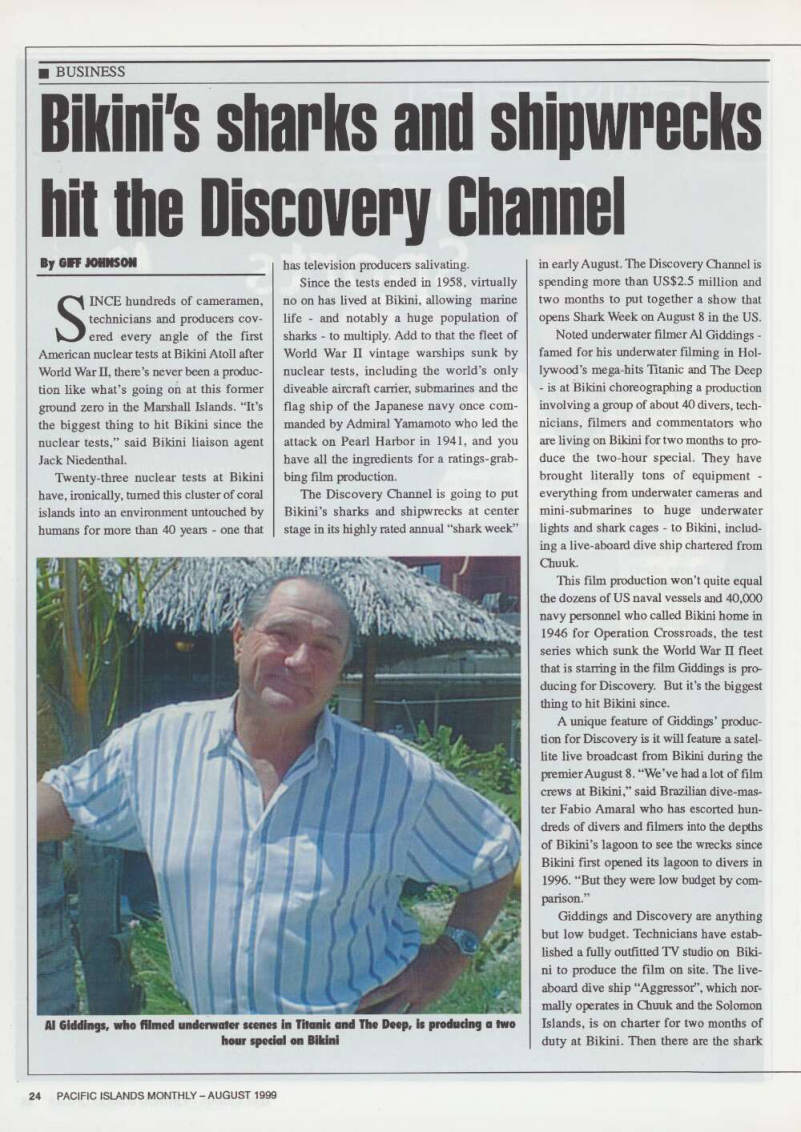
hit the Discovery Channel
By Giff Johnson
SINCE hundreds of cameramen, technicians and producers cov ered every angle of the first American nuclear tests at Bikini Atoll after World War 11, there’s never been a produc tion like what’s going oh at this former ground zero in the Marshall Islands. “It’s the biggest thing to hit Bikini since the nuclear tests,” said Bikini liaison agent Jack Niedenthal.
Twenty-three nuclear tests at Bikini have, ironically, turned this cluster of coral islands into an environment untouched by humans for more than 40 years - one that
has television producers salivating.
Since the tests ended in 1958, virtually no on has lived at Bikini, allowing marine life - and notably a huge population of sharks - to multiply. Add to that the fleet of World War II vintage warships sunk by nuclear tests, including the world’s only diveable aircraft carrier, submarines and the flag ship of the Japanese navy once com manded by Admiral Yamamoto who led the attack on Pearl Harbor in 1941, and you have all the ingredients for a ratings-grab bing film production.
The Discovery Channel is going to put Bikini’s sharks and shipwrecks at center stage in its highly rated annual “shark week”
in early August. The Discovery Channel is spending more than US$2.5 million and two months to put together a show that opens Shark Week on August 8 in the US.
Noted underwater filmer A 1 Giddings famed for his underwater filming in Hol lywood’s mega-hits Titanic and The Deep - is at Bikini choreographing a production involving a group of about 40 divers, tech nicians, filmers and commentators who are living on Bikini for two months to pro duce the two-hour special. They have brought literally tons of equipment everything from underwater cameras and mini-submarines to huge underwater lights and shark cages - to Bikini, includ ing a live-aboard dive ship chartered from Chuuk.
This film production won’t quite equal the dozens of US naval vessels and 40,000 navy personnel who called Bikini home in 1946 for Operation Crossroads, the test series which sunk the World War II fleet that is starring in the film Giddings is pro ducing for Discovery. But it’s the biggest thing to hit Bikini since.
A unique feature of Giddings’ produc tion for Discovery is it will feature a satel lite live broadcast from Bikini during the premier August 8. “We’ve had a lot of film crews at Bikini,” said Brazilian dive-mas ter Fabio Amaral who has escorted hun dreds of divers and filmers into the depths of Bikini’s lagoon to see the wrecks since Bikini first opened its lagoon to divers in 1996. “But they were low budget by com
parison.”
Giddings and Discovery are anything but low budget. Technicians have estab lished a fully outfitted TV studio on Biki ni to produce the film on site. The live aboard dive ship “Aggressor”, which nor mally operates in Chuuk and the Solomon Islands, is on charter for two months of duty at Bikini. Then there are the shark
Al Giddings, who filmed underwater scenes in Titanic and The Deep, is producing a two hour special on Bikini
cages and shark suits. The shark suit resembles medieval armor and, Amara hopes, will insure that he stays in the lime light for a few years following the Dis covery production. But one of Giddings’ underwater photographers found out dur ing late June that a shark cage didn’t offer him much protection while working in the shark pass. The filmer was located about 15 feet underwater in the cage as techni cians above “chummed” the water with bait to drive the sharks into a feeding fren zy. The problem was the current kept pushing the bait toward the cage. A shark chasing the bait - large hunks of bloody meat - slipped into the cage through one of the “windows” at the top, and suddenly the filmer found himself literally face to face with a sizeable grey reef shark. He tried pushing it back out the hole of the cage with his feet, but that didn’t work so he moved to the bottom of the cage.
But the shark decided that might be a way out and soon the filmer was forced to the top of the cage. According to Karen Sauer, who was above the cage on the ship, the shark was getting quite riled up and the filmer figured he’d better get out of there and opened the top of the cage.
But it was still about eight feet up to the bottom of the boat and there were so many sharks roaming the space that there was no way for him to evacuate the cage.
Finally, technicians on board the ship managed to haul the cage back on board with both filmer and diver inside.
The filmer was unharmed and the shark dumped back over the side. This event was filmed and, no doubt, will be part of the Discovery production, raising ratings when it goes on air in August.
With more than 40 people at Bikini for two months, Amaral said his dive compa ny cancelled all but two of the dive groups that were previously scheduled to visit Bikini while the Discovery production is in progress.
But, he said, the cancellations won’t hurt the dive business at Bikini.
“The exposure that we’ll get from this is way bigger than anything else we’ve had,” he said. “Nothing keeps the story (of Bikini) alive more than going live on Dis covery.” ■
Nestle's Pacific sales surged
46 per cent last year
SWISS -owned food and drinks giant, Nestle, recorded a massive surge in Pacific Island sales last year. Nestle’s Pacific Islands sales jumped 46 per cent in the year to December 31 to reach AUDSI24 million.
This was added to sale of Nestle Aus tralia products, resulting in a tripling of profit for the company.
The Sydney group, maker of everything
from Milo and Nescafe coffee to Minties and Go-Cat cat food, lifted net earnings from $10.2 million to $36.4 mil lion in the year to December 31.
All but $6.4 million of the latest profit was returned as a dividend to Nestle Aus tralia’s parent company.
According to its company information.
Nestle has four factories in the Pacific, two of which are in Fiji, one in New Caledonia, and one in Papua New Guinea.
The company also has an office in French Polynesia. In Australia, Nestle has 15 factories and there are four in New Zealand.
In its accounts lodged with the Aus tralian Securities and Investments Commis sion, Nestle described the sharp profit
improvement as simply “satisfactory”.
But it was an impressive result, given that overall sales (including the Pacific Islands result), grew just 6.7 per cent to $1.92 billion.
The results show pre-term earnings jumped from $72.1 million from $29.7 mil lion, with lower interest and depreciation charges playing a part in the improvement.
Nestle did not dissect the result. Its short, six-sentence review made mention of the major expansion of its ice cream plant at Mulgrave in Melbourne, a project that has reportedly underpinned big market gains by the company’s ice cream business over the Australian summer.
It also referred to the commissioning of new plant at Dennington, in south-west Victoria and noted a logistics restructuring
which consoli dated a num ber of ware houses into two national distribution centres in Melbourne and Sydney.
Based on 1997 results, Nes tle’s foods and beverages business.
which covers Nescafe and International Roast coffee, Nesquik milk drinks, Milo, Sunshine milk powder, Maggi culinary products and Lean Cuisine frozen foods, accounts for about 44 per cent of the group’s sales. Nestle confectionary, mak ers of Minties, Kit Kat, Smarties and Life Savers, accounts for 22.5 per cent. Nestle Dairy Products, which includes yoghurts, desserts, and Peters ice cream brands, such as Drumstick and Billabong, the Friskies Pet Care division and the food services and industrial supplies business account for the balance. The highest paid director, presum ably Em Pope, who resigned as managing director on March 1,1998, or his successor Bradley Alford, took home between AUDS94O,OOO to $950,000. It seems that food and bevereages may be the industry to get into. Nestle Pacific Islands manager Raymond Chan, based in Sydney, was on leave and not available for comment when this issue went to press. ■
Catastrophe Insurance

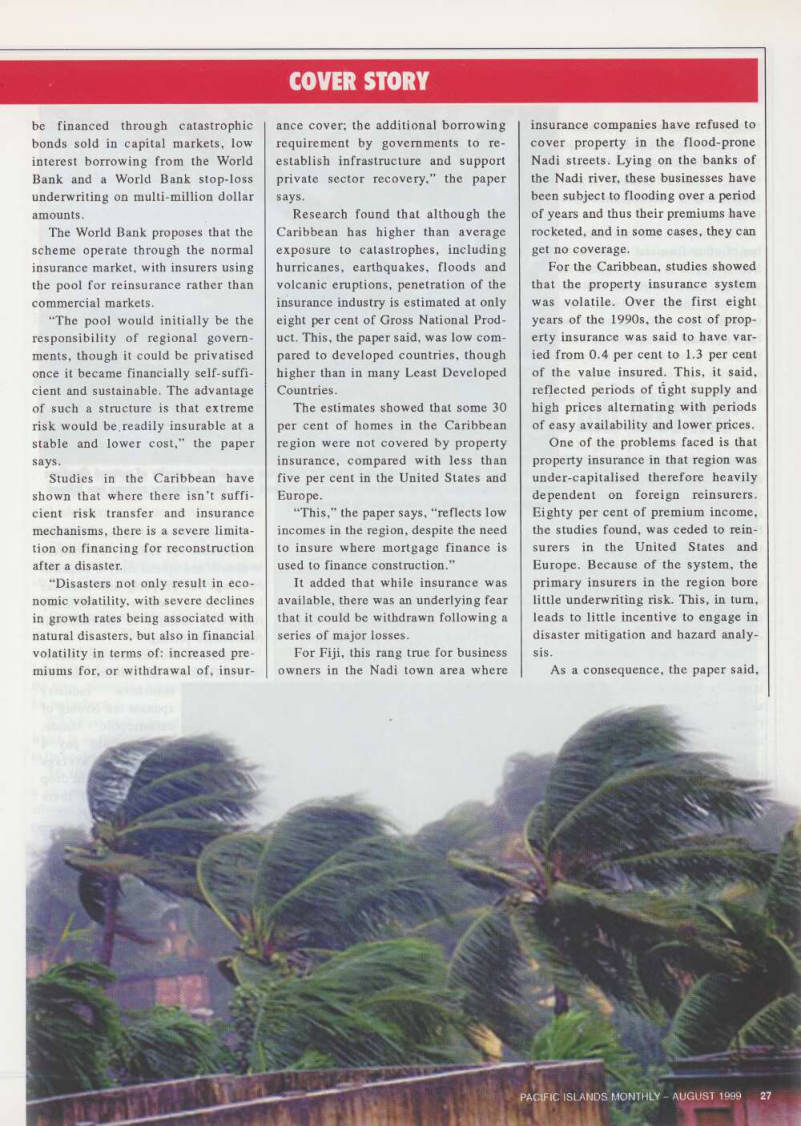
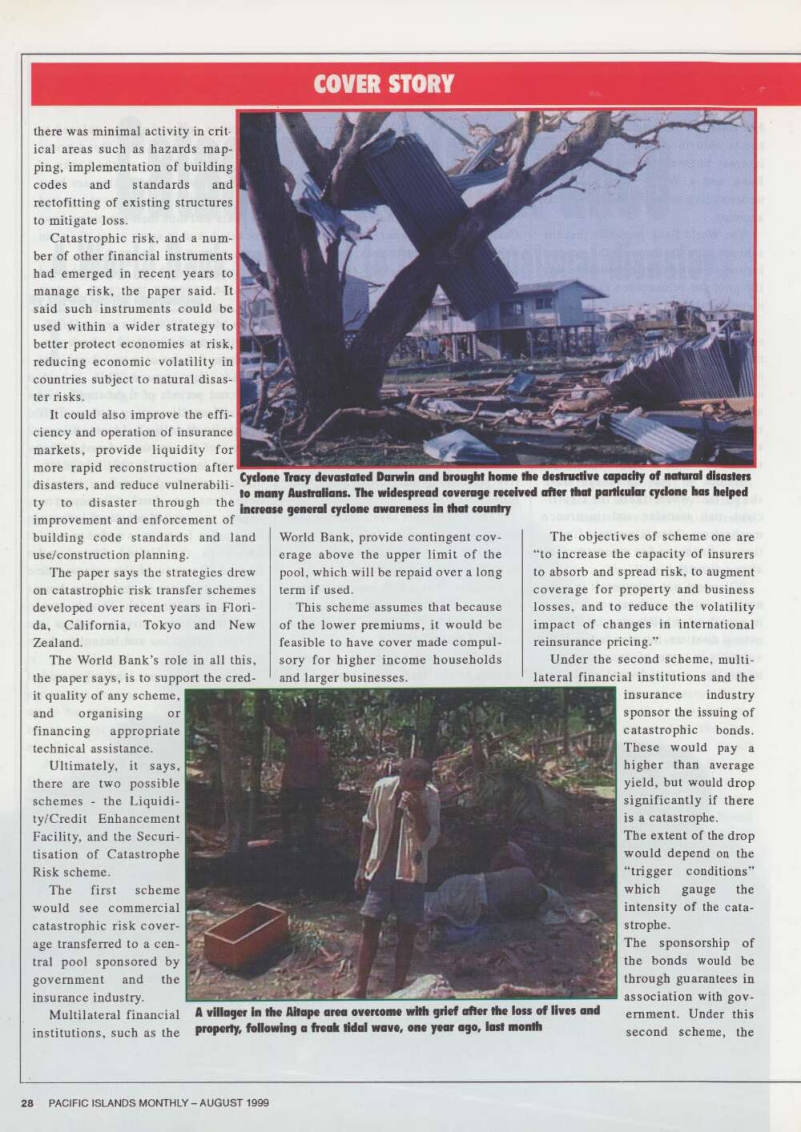
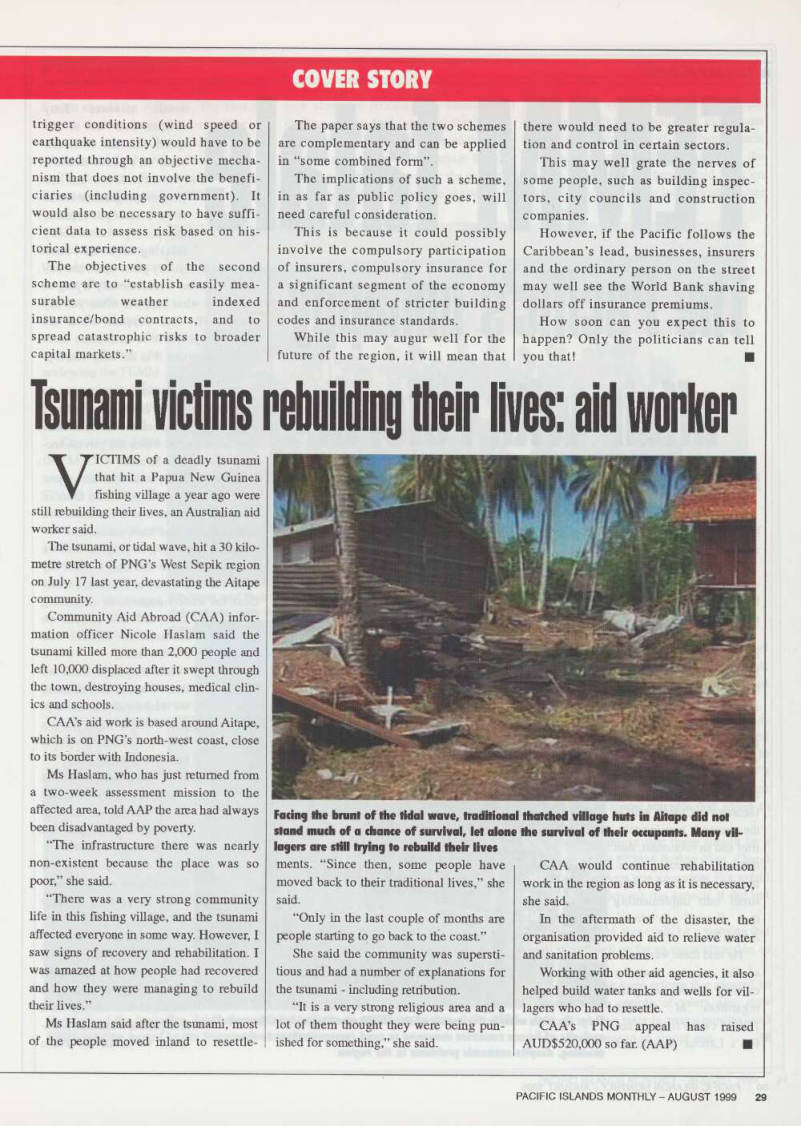
Cover Story
Catastrophe Insurance A World Bank proposal to take on natural disasters
By Sow Foster Hildebrand
IF you never thought you’d see the day the World Bank helped lower your insurance premi ums for disaster coverage, think again. That day may not be too far off, if a recent proposal for a Small
States Regional Catastrophe Insur
ance Programme goes ahead.
“DISASTERS do happen,” the advertisements say, “Are you prepared?”. For peo
pie in the South Pacific, this message is relayed often just before the cyclone
season of Novem ber to April, but no matter how much preparation is conducted, these small island economies contin ue to be vulnera ble to natural cata strophes.
Now, the World
Bank has decided to step in to even the odds for such countries with its proposal on a Small States Regional Cat astrophe Insurance Pro gramme.
Investigations by the World Bank found that natural disasters of a cata strophic nature were a “significant source of economic instability” for countries such as those of the Pacific.
A paper summarising the World Bank proposal, for a scheme that pro vides coverage for catastrophe insur ance, was put before the Forum Eco
nomic Ministers Meeting (FEMM) in Apia, Samoa last month. ‘Catastrophe Insurance: A Proposal’ said that further investigation by the World Bank “revealed that the high cost of re-establishing infrastructure further hindered economic performance after a nat-
ural dis aster, while a pattern of sharp increases in insurance premiums after catastroph ic disasters limited the ability of the private sector to maintain commercial insurance cover.”
FEMM decided that an analysis of
the proposal would be worthwhile and has called for appropriate strate gies to be developed in that area fol lowing the Caribbean example.
The incentives for setting up such a scheme, the paper says, is that there will be benefits all round. For insur ers, it would mean an expanded mar ket and stable reinsurance costs. For government, there would be wider
coverage of property at risk that should be offset by arrange ments to cover non-insurable risk to low income house holds and small business.
The World Bank estab lished a pilot pro gramme in the Caribbean, with repre sentatives from gov ernments, insurance companies and the private sector. Their work in progress was reported to the Con ference on Small States, held in St Lucia in February this year, where Forum represen tatives and the World
Bank agreed that work should begin on developing a similar scheme for the Pacific.
The initial strategy was to get
some idea of the situation first including the nature and magnitude of natural catastrophes in the Caribbean, the insurance market and its short
comings in dealing with catastrophes.
Since then, the Caribbean scheme has gone to explore how the risk can be dealt with through a regional
underwriting pool. This, they say, can
be financed through catastrophic bonds sold in capital markets, low interest borrowing from the World Bank and a World Bank stop-loss underwriting on multi-million dollar amounts.
The World Bank proposes that the scheme operate through the normal insurance market, with insurers using the pool for reinsurance rather than commercial markets.
“The pool would initially be the responsibility of regional govern ments, though it could be privatised once it became financially self-suffi cient and sustainable. The advantage of such a structure is that extreme risk would be,readily insurable at a stable and lower cost,” the paper says.
Studies in the Caribbean have shown that where there isn’t suffi cient risk transfer and insurance mechanisms, there is a severe limita tion on financing for reconstruction after a disaster.
“Disasters not only result in eco nomic volatility, with severe declines in growth rates being associated with natural disasters, but also in financial volatility in terms of: increased pre miums for, or withdrawal of, insur
ance cover; the additional borrowing requirement by governments to re establish infrastructure and support private sector recovery,” the paper says.
Research found that although the Caribbean has higher than average exposure to catastrophes, including hurricanes, earthquakes, floods and volcanic eruptions, penetration of the insurance industry is estimated at only eight per cent of Gross National Prod uct. This, the paper said, was low com pared to developed countries, though higher than in many Least Developed Countries.
The estimates showed that some 30 per cent of homes in the Caribbean region were not covered by property insurance, compared with less than five per cent in the United States and Europe.
“This,” the paper says, “reflects low incomes in the region, despite the need to insure where mortgage finance is used to finance construction.”
It added that while insurance was available, there was an underlying fear that it could be withdrawn following a series of major losses.
For Fiji, this rang true for business owners in the Nadi town area where
insurance companies have refused to cover property in the flood-prone Nadi streets. Lying on the banks of the Nadi river, these businesses have been subject to flooding over a period of years and thus their premiums have rocketed, and in some cases, they can get no coverage.
For the Caribbean, studies showed that the property insurance system was volatile. Over the first eight years of the 19905, the cost of prop erty insurance was said to have var ied from 0.4 per cent to 1.3 per cent of the value insured. This, it said, reflected periods of tight supply and high prices alternating with periods of easy availability and lower prices.
One of the problems faced is that property insurance in that region was under-capitalised therefore heavily dependent on foreign reinsurers.
Eighty per cent of premium income, the studies found, was ceded to rein surers in the United States and Europe. Because of the system, the primary insurers in the region bore little underwriting risk. This, in turn, leads to little incentive to engage in disaster mitigation and hazard analy sis.
As a consequence, the paper said,
there was minimal activity in crit- j ical areas such as hazards map-| ping, implementation of building! codes and standards and
rectofitting of existing structures
to mitigate loss.
Catastrophic risk, and a num ber of other financial instruments had emerged in recent years to manage risk, the paper said. It said such instruments could be used within a wider strategy to better protect economies at risk, reducing economic volatility in countries subject to natural disas ter risks.
It could also improve the effi ciency and operation of insurance markets, provide liquidity for more rapid reconstruction after disasters, and reduce vulnerabili ty to disaster through the improvement and enforcement of
building code standards and land use/construction planning.
The paper says the strategies drew on catastrophic risk transfer schemes developed over recent years in Flori da, California, Tokyo and New Zealand.
The World Bank’s role in all this, the paper says, is to support the cred
it quality of any scheme, and organising or financing appropriate technical assistance.
Ultimately, it says, there are two possible schemes - the Liquidi ty/Credit Enhancement Facility, and the Securi tisation of Catastrophe Risk scheme.
The first scheme would see commercial catastrophic risk cover age transferred to a cen tral pool sponsored by government and the insurance industry.
Multilateral financial institutions, such as the
World Bank, provide contingent cov erage above the upper limit of the pool, which will be repaid over a long term if used.
This scheme assumes that because of the lower premiums, it would be feasible to have cover made compul sory for higher income households and larger businesses.
The objectives of scheme one are “to increase the capacity of insurers to absorb and spread risk, to augment coverage for property and business losses, and to reduce the volatility impact of changes in international reinsurance pricing.”
Under the second scheme, multi lateral financial institutions and the
insurance industry sponsor the issuing of catastrophic bonds.
These would pay a higher than average yield, but would drop significantly if there is a catastrophe.
The extent of the drop would depend on the “trigger conditions” which gauge the intensity of the cata strophe.
The sponsorship of the bonds would be through guarantees in association with gov ernment. Under this second scheme, the
A villager in the Aitape area overcome with grief after the loss of lives and property, following a freak tidal wave, one year ago, last month
Cyclone Tracy devastated Darwin and brought home the destructive capacity of natural disasters to many Australians. The widespread coverage received after that particular cyclone has helped increase general cyclone awareness in that country
trigger conditions (wind speed or earthquake intensity) would have to be reported through an objective mecha nism that does not involve the benefi ciaries (including government). It would also be necessary to have suffi cient data to assess risk based on his
torical experience.
The objectives of the second scheme are to “establish easily mea surable weather indexed insurance/bond contracts, and to spread catastrophic risks to broader capital markets.”
The paper says that the two schemes are complementary and can be applied in “some combined form”.
The implications of such a scheme, in as far as public policy goes, will need careful consideration.
This is because it could possibly
involve the compulsory participation
of insurers, compulsory insurance for a significant segment of the economy and enforcement of stricter building codes and insurance standards.
While this may augur well for the future of the region, it will mean that
there would need to be greater regula tion and control in certain sectors.
This may well grate the nerves of some people, such as building inspec tors, city councils and construction
companies.
However, if the Pacific follows the Caribbean’s lead, businesses, insurers and the ordinary person on the street may well see the World Bank shaving dollars off insurance premiums.
How soon can you expect this to happen? Only the politicians can tell you that! ■
Tsunami victims rebuilding their lives: aid worker
VICTIMS of a deadly tsunami that hit a Papua New Guinea fishing village a year ago were still rebuilding their lives, an Australian aid worker said.
The tsunami, or tidal wave, hit a 30 kilo metre stretch of PNG’s West Sepik region on July 17 last year, devastating the Aitape community.
Community Aid Abroad (CAA) infor mation officer Nicole Haslam said the tsunami killed more than 2,000 people and left 10,000 displaced after it swept through the town, destroying houses, medical clin ics and schools.
CAA’s aid work is based around Aitape, which is on PNG’s north-west coast, close to its border with Indonesia.
Ms Haslam, who has just returned from a two-week assessment mission to the affected area, told AAP the area had always
been disadvantaged by poverty.
“The infrastructure there was nearly non-existent because the place was so poor,” she said.
“There was a very strong community life in this fishing village, and the tsunami affected everyone in some way. However, I saw signs of recovery and rehabilitation. I was amazed at how people had recovered and how they were managing to rebuild their lives.”
Ms Haslam said after the tsunami, most of the people moved inland to resettle-
ments. “Since then, some people have moved back to their traditional lives,” she said.
“Only in the last couple of months are people starting to go back to the coast.”
She said the community was supersti tious and had a number of explanations for the tsunami - including retribution.
“It is a very strong religious area and a lot of them thought they were being pun ished for something,” she said.
CAA would continue rehabilitation work in the region as long as it is necessary, she said.
In the aftermath of the disaster, the organisation provided aid to relieve water and sanitation problems.
Working with other aid agencies, it also helped build water tanks and wells for vil lagers who had to resettle.
CAA’s PNG appeal has raised
Audss2O,Ooo So Far. (Aap) ■
Facing the brunt of the tidal wave, traditional thatched village huts in Aitape did not stand much of a chance of survival, let alone the survival of their occupants. Many vil lagers are still trying to rebuild their lives
FEMM fatale
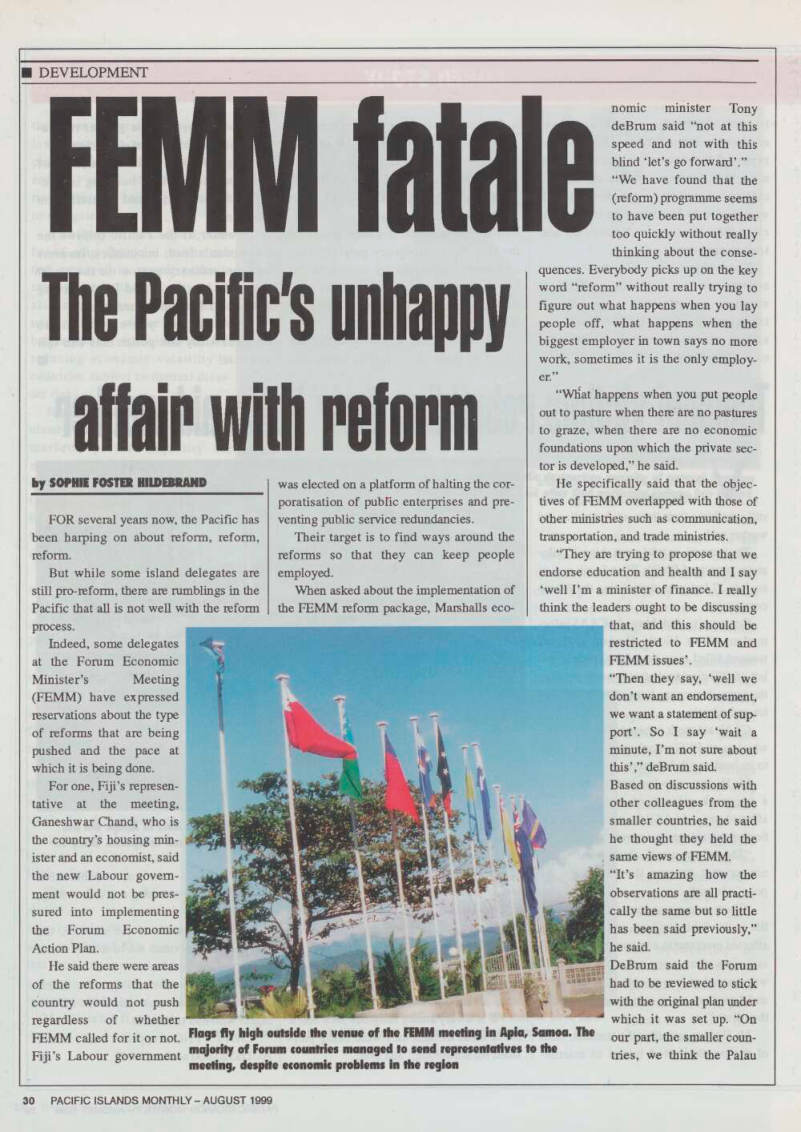

Development
The Pacific's unhappy affair with reform
By Sophie Foster Hildebrand
FOR several years now, the Pacific has been harping on about reform, reform, reform.
But while some island delegates are still pro-reform, there are rumblings in the Pacific that all is not well with the reform
process.
Indeed, some delegates at the Forum Economic
Minister’s Meeting
(FEMM) have expressed reservations about the type of reforms that are being pushed and the pace at which it is being done.
For one, Fiji’s represen tative at the meeting, Ganeshwar Chand, who is the country’s housing min ister and an economist, said the new Labour govern ment would not be pres sured into implementing the Forum Economic Action Plan.
He said there were areas of the reforms that the country would not push regardless of whether FEMM called for it or not.
Fiji’s Labour government
was elected on a platform of halting the cor poratisation of public enterprises and pre venting public service redundancies.
Their target is to find ways around the reforms so that they can keep people employed.
When asked about the implementation of the FEMM reform package, Marshalls eco-
nomic minister Tony deßrum said “not at this speed and not with this blind ‘let’s go forward’.”
“We have found that the (reform) programme seems to have been put together too quickly without really thinking about the conse
quences. Everybody picks up on the key word “reform” without really trying to figure out what happens when you lay people off, what happens when the biggest employer in town says no more work, sometimes it is the only employ er.”
“WHat happens when you put people out to pasture when there are no pastures to graze, when there are no economic foundations upon which the private sec tor is developed,” he said.
He specifically said that the objec tives of FEMM overlapped with those of other ministries such as communication, transportation, and trade ministries.
“They are trying to propose that we endorse education and health and I say ‘well I’m a minister of finance. I really think the leaders ought to be discussing
that, and this should be restricted to FEMM and FEMM issues’.
“Then they say, ‘well we don’t want an endorsement, we want a statement of sup port’. So I say ‘wait a minute. I’m not sure about this’,” deßrum said.
Based on discussions with other colleagues from the smaller countries, he said he thought they held the same views of FEMM.
“It’s amazing how the observations are all practi cally the same but so little has been said previously,” he said.
Deßrum said the Forum had to be reviewed to stick with the original plan under which it was set up. “On our part, the smaller coun tries, we think the Palau
Flags fly high outside the venue of the FEMM meeting in Apiu, Samoa. The majority of Forum countries managed to send representatives to the meeting, despite economic problems in the region
Forum should be different. The idea is that all the homework has been done so here it is, sign off. But it’s not, I don’t think, the original concept,” he said.
The Solomons finance minister, Alpha Kimata, also thought that FEMM should be overhauled.
“I think there is a need for a review of the objectives since we are forming into further small groups like the MSG and the other groups. We should look at reviewing the FEMM as our umbrella body for small groups with in FEMM,” he said.
Kimata agreed that the MSG was a lot more advanced than FEMM in a lot of its economic reform dealings. As far as FEMM targets for tar iff reduction, he said the Solomons had already introduced reform in the area under its MSG oblig ations.
He said that the Solomons reform pro gramme had been a bit advanced but there were other internal factors which could
now slow the process. The Guadalcanal civil unrest, he said, had cost the govern ment about S$ 10,000. But he said there had been no assessment of the damage that had been done to the economy or the repercus sions, and that cost would be significantly
higher.
Deßrum warned that ministers would have to carefully weigh up the pros and cons of laying off large numbers of civil servants.
He said when the layoff of people occurred in the Marshalls, all their loans and other accounts with the banks there became delinquent. This, he said, had the effect of making the banks hold back on new loans or issuing loans with higher interest.
The experience of having large numbers
of suddenly unemployed people meant that
others held back on their savings and investments.
“It affects a lot more than meets the eye.
And then they (lenders/banks) go off and write reports that there is no confidence in investment in the Marshalls. If you lay off a thousand people and you’re the biggest employer in town, where’s that going to leave you?”
Deßrum thinks that there should be a review of the FEMM Action Plan. Chand said even if there was no review, Fiji would just not implement the aspects it did not like.
For FEMM, this could be a warning that all is not well as far as mass attraction to reform goes.
Indeed, the same reform that seemed so irresistible a couple of years ago, now leaves a bitter taste in many mouths, and may even come to an abrupt end. ■
Members of the Australian delegation settle in to listen to opening speeches at the 1999 FEMM meeting hosted by the Samoan government
Ministers and their support staff gel cosy for a group shot. Along the first two rows are the heads of delegations, with their officials at the back. Tony deBrum is sealed second from right, Ganeshwar Chand is standing third from left in the second row, with Alpha Kimata seventh from left in the same row
Fragmented regional shipping
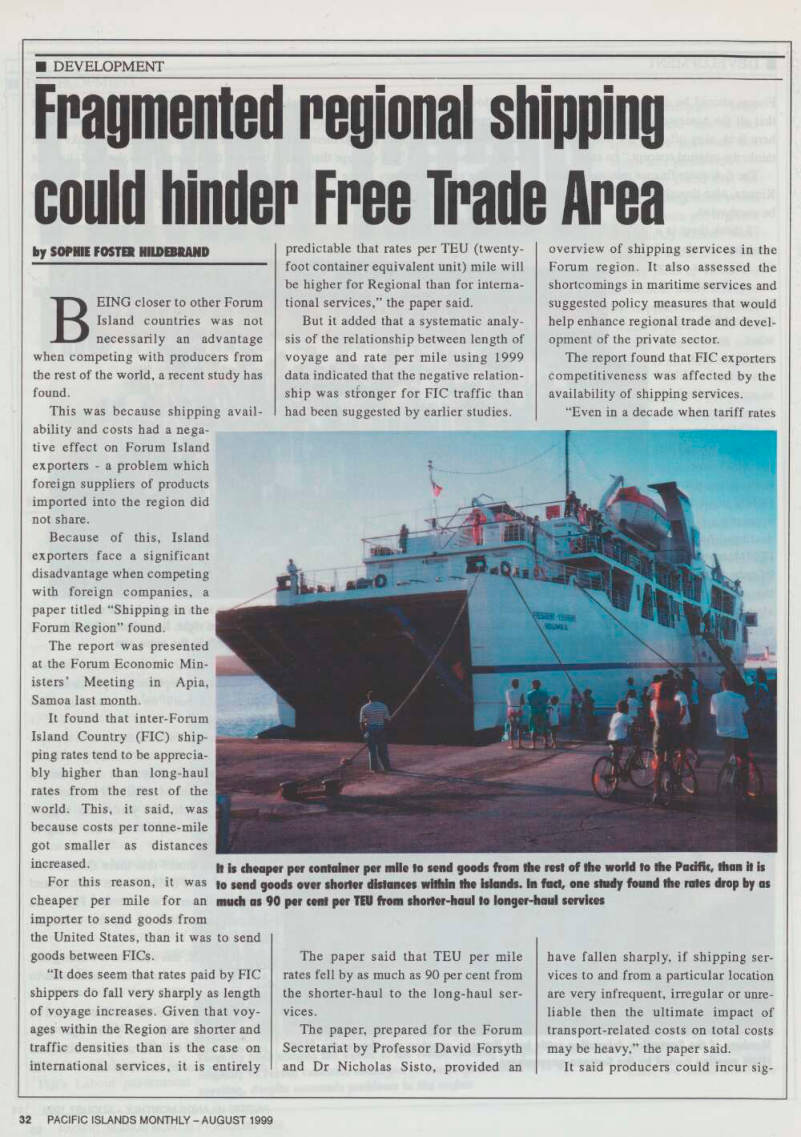

could hinder Free Trade Area
By Sophie Foster Hildebrand
BEING closer to other Forum Island countries was not necessarily an advantage when competing with producers from the rest of the world, a recent study has found.
This was because shipping avail
ability and costs had a nega tive effect on Forum Island exporters - a problem which foreign suppliers of products imported into the region did not share.
Because of this, Island exporters face a significant disadvantage when competing with foreign companies, a paper titled “Shipping in the Forum Region” found.
The report was presented at the Forum Economic Min isters’ Meeting in Apia, Samoa last month.
It found that inter-Forum Island Country (FIC) ship ping rates tend to be apprecia bly higher than long-haul rates from the rest of the world. This, it said, was because costs per tonne-mile got smaller as distances increased.
For this reason, it was cheaper per mile for an importer to send goods from
the United States, than it was to send goods between FICs.
“It does seem that rates paid by FIC shippers do fall very sharply as length of voyage increases. Given that voy ages within the Region are shorter and traffic densities than is the case on international services, it is entirely
predictable that rates per TEU (twenty foot container equivalent unit) mile will be higher for Regional than for interna tional services,” the paper said.
But it added that a systematic analy sis of the relationship between length of voyage and rate per mile using 1999 data indicated that the negative relation ship was stronger for FIC traffic than had been suggested by earlier studies.
The paper said that TEU per mile rates fell by as much as 90 per cent from the shorter-haul to the long-haul ser vices.
The paper, prepared for the Forum Secretariat by Professor David Forsyth and Dr Nicholas Sisto, provided an
overview of shipping services in the Forum region. It also assessed the shortcomings in maritime services and suggested policy measures that would help enhance regional trade and devel opment of the private sector.
The report found that FIC exporters competitiveness was affected by the
availability of shipping services.
“Even in a decade when tariff rates
have fallen sharply, if shipping ser vices to and from a particular location are very infrequent, irregular or unre liable then the ultimate impact of transport-related costs on total costs may be heavy,” the paper said.
It said producers could incur sig
It is cheaper per container per mile to send goods from the rest of the world to the Pacific, than it is to send goods over shorter distances within the islands. In fact, one study found the rates drop by as much as 90 per cent per TEU from shorter-haul to longer-haul services
nificant costs through delays in avail ability of transportation and orders may be lost because of inability to deliver on schedule.
It said that while shipping costs per container may have fallen, the need to use lengthy routings in some cases because of a lack of port-to-port ser vices could also significantly add to costs.
It gave the example of the increase in shipping costs caused by the absence of direct services from Fiji to the three MSG countries to the West.
The study found that one effect of the formation of an FTA would be to increase the demand for intra-FIC freight transportation, almost all of which would be in the form of shipping.
A simulation exercise found that an FTA would increase the amount of trade
between FICs, increase FIC exports, and marginally reduce imports from the rest of the world.
The increase in trade between FICs is expected to be about US$l2.6 mil lion.
But the study found that while ship ping services to the rest of the world were adequate, the regional shipping map was fragmented.
“Given that much of the increase in trade expected to result from the forma tion of a FTA involves PNG imports, and imports and exports of Vanuatu, it appears that a problem of adequacy of shipping services may arise,” the paper said.
It added that is this was the case, some of the benefits expected from the FTA might be lost.
The report said that it was possible
that the potential increase in the import trade of PNG and Vanuatu from other FICs “may be sufficient to render a viable direct service from the three Western MSG countries to the rest of the FICs - a case of demand induced supply of a kind fairly common in mar ket economies.”
But it said that the projected increase in the trade of FSM, Nauru, Marshall Islands and Palau was so small that the lack of good shipping links to other FICs would have little bearing on the overall impact of the FTA.
Shipping has always been a vehicle for trade in the region, from the early islanders to the colonialists and now the neo-colonialists.
Now, though, the very competitive ness of businesses in the region could hinge on it. ■
PNG issues new polymer bank note
PAPUA New Guinea last month issued a new look 50 Kina bank note, which became legal tender from Monday 28 June.
The new polymer - or plastic - K5O note and the old K5O paper note will be allowed to circulate concurrently for six months before the outdated paper note is withdrawn from circulation.
Bank of Papua New Guinea Gover nor, Mr. Morea Vele, said the main security features of the new note included: - The note was made from polymer substrate; - A see-through window with a print ed Bank of PNG logo, 50 PNG micro lettering and an embossed 50; - A shadow image of the Bank of PNG logo, which is visible when held to the light; and - Raised printing of designs on the front and back of the note.
PNG made history in 1991 by becoming the first country outside Aus
tralia to issue a 2 Kina polymer bank note, to commemorate that year’s South Pacific Games.
“The K 2 note is our high circulation bank note and in the polymer substrate, its lifespan has increased to two years compared to a four to six month lifes pan of the K 2 paper note,” Mr. Vele said.
“The notes circulate much longer because of the physical strengths and properties of the polymer substrate.”
“Our experience shows that the fre quency of our stock replenishments and related costs of printing K 2 notes have been markedly reduced,” he said.
Mr. Vele said the plastic notes were advantageous in countries like PNG, where the climate includes high humid ity and high average rainfall.
Polymer notes would also reduce the incidence of counterfeiting legal tender, Mr. Vele said, adding that it was becom ing a problem with paper notes.
He said many people would have
seen a counterfeit K5O paper note, while a number of advertisements have been placed in newspapers by the BPNG explaining the difference between genuine bank notes and coun terfeit notes.
With the introduction of digital
printing and technology, counterfeiters
could reproduce paper bank notes more easily and quickly, forcing the BPNG to consider more secure alternatives.
Opposition leader Bernard Narokobi welcomed the new note, saying the ini tiative would help curtail the circula tion of counterfeit bank notes in the country.
“At this juncture of the currency cri sis in the country, the new K5O bank note issue is a sign of confidence by the central bank in its efforts towards returning normalcy within the currency market,” Mr. Narokobi said.
The new 50 Kina note was produced jointly by Bank of Papua New Guinea, and Note Printing Australia. ■
Advertisements & other items, p. 34 (2 items)
I ftiMH task far Pi PM
34
PACIFIC ISLANDS MONTHLY-AUGUST 1999
Continued from page 8
I ftiMH task far Pi PM
■ DEVELOPMENT
www.pim.com.fj
Visit PIM on the World Wide Web @ www.pim.com.fj where you can email Letters to the Editor direct or breeze through previous editions in our online Archives.
The website is updated on the first of every month when the magazine goes on the streets.
Subscriptions can also be placed online.
If you prefer snail mail, please write to: The Editor, PIM, POBox 1167, Suva, Fiji
INVITATION TO TENDER NO. CTB/009/99
Tenders are invited from suitable and qualified contractors locally and regionally for the reconstruction of the Ministry of Finance and Development Planning building.
Issued by the Government of Solomon Islands (Department of Finance) for a project financed by the European Union, European Development Fund (EDF). 1. PARTICIPATION (Open Invitation to Tender) Participation is open on equal terms to all natural and legal persons of the Member States of European Union or of the AGP States signatories of the Fourth Lome Convention. The Tenderer shall remain bound by this tender for a period of 90 days as from the final date for lodging of the tenders.
2. SUBJECT
Invitation to tender is for the reconstruction of the Ministry of Finance and Development Planning Building, Honiara, Solomons Islands including the supply of all materials and equipment required.
3 INVITATION TO TENDER DOSSIERS
The tender documents in English may be obtained from: Secretary of Tender Board Room (Office of the Secretary) Department of Finance
PO Box 26, HONIARA
SOLOMON ISLANDS
(Fax No. 20392) from whom additional information may also be obtained.
4. CLOSING DATE
Tenders should be marked CTB/009/99 (on the envelope) and sent to the Central Tender Board, Department of Finance, PO Box 26, Honiara, Solomon Islands, to arrive at the latest by 16.00 hours local time on 19th October 1999. Tenders will be opened at the conference room of the Programme Management Unit, National Authorising Office, Department of Development Planning, first floor, Panatina Plaza, Honiara at 09.00 hours local time on 20th October 1999. 5. Within five days after receipt of the Tender Documents the Tenderer shall notify the Department of Finance of his intention to submit a tender by returning the completed Tender Acknowledgement form to the address shown thereon. 132110V1
Century technology explosion

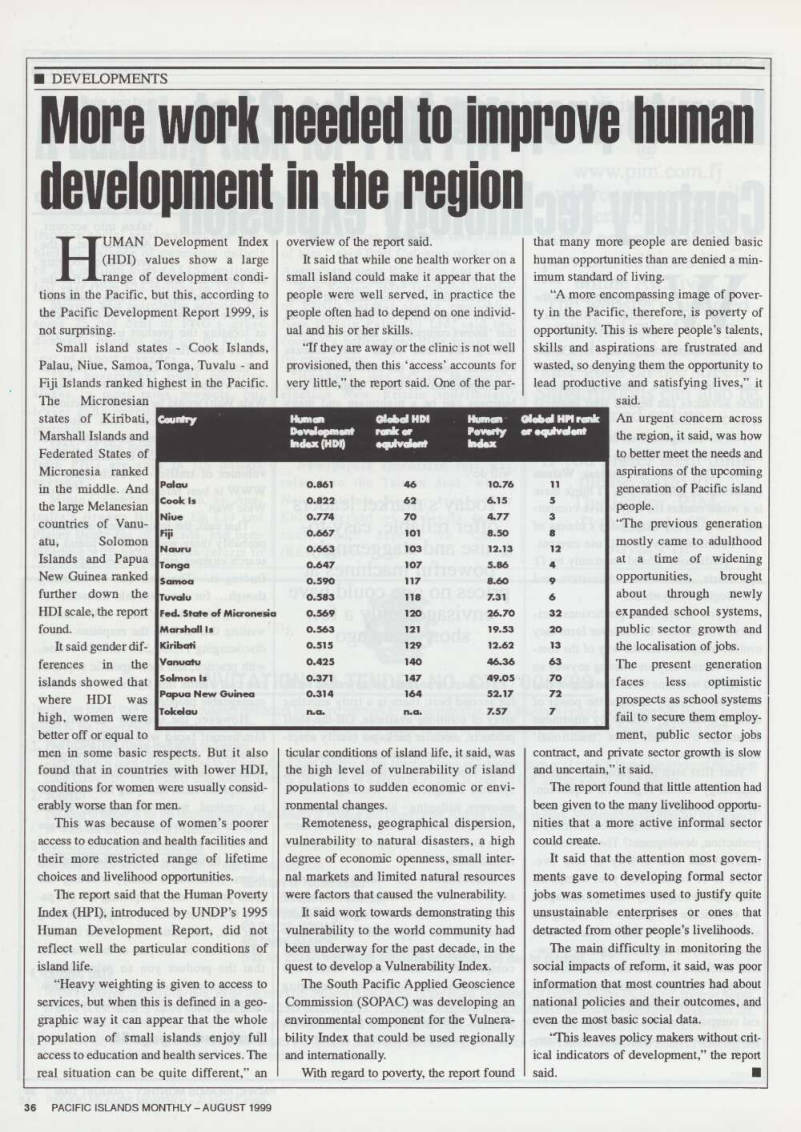
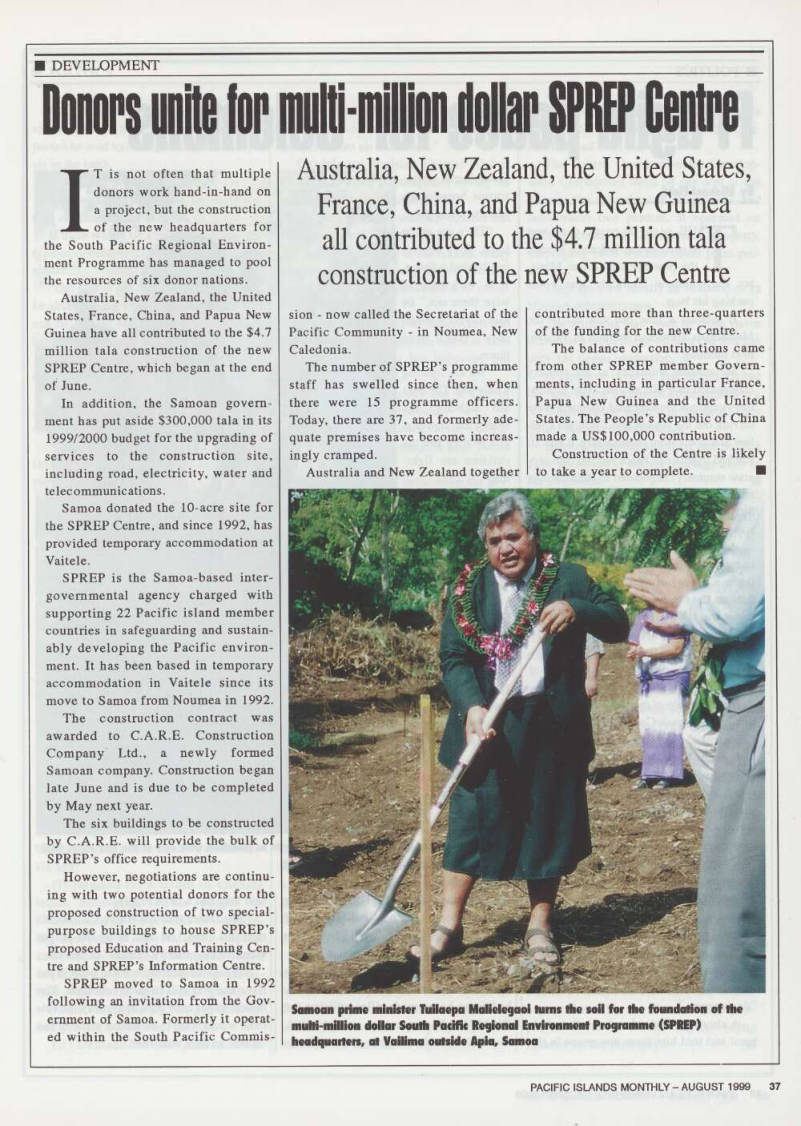
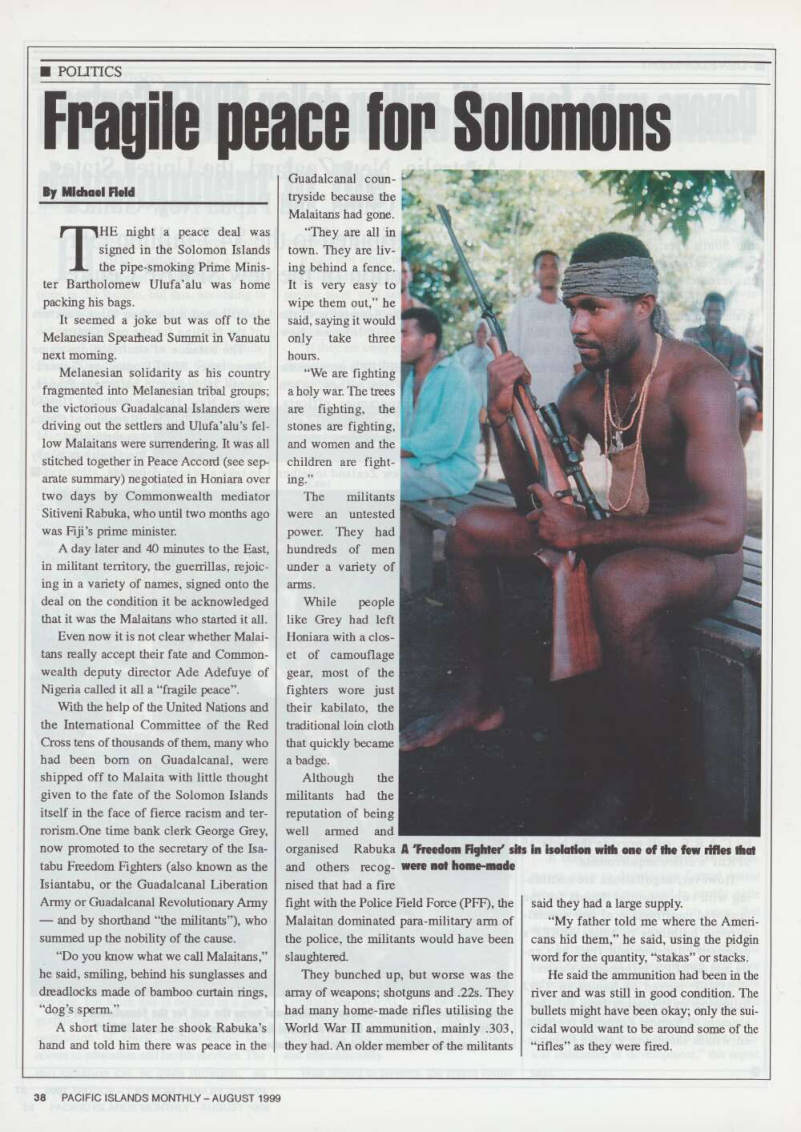
How to prepare for the 21st Century technology explosion
WITH the year 2000 almost upon us, and the dreaded Millennium Bug about to follow the Dodo into extinction, perhaps now is the ideal time to consider the huge advances made in Information Technology and how these advances can benefit your business in the 21st century.
Not all managers, even those at the top, can view the future through the eyes of an oracle. The words of Thomas Watson (Chairman of IBM, 1943) - “I think there is a world market for maybe five comput ers. “ Is a far cry from today’s claims of “All businesses use, or will use comput ers” - predictions echoed constantly by IT Specialists, Government Ministers and futurologists everywhere.
Are you taking these predictions seri ously? You should! In whatever form they evolve, computers are the way of the fore seeable future; they are coming anyway so you should welcome them. Businesses that do so and willingly embrace the power of today’s technology will enjoy enormous advantage over their more ‘traditional’
c ontemporaries.
Your first step in joining the ‘age of technology’ should begin with a question: How can I make technology work for me -
accounting, marketing, administration,
production, development? The answers are manifest and lead swiftly to step two, which is of course, buy your computer.
Although swamped by variety, managers will experience few pains when buying the actual ‘box’. Today’s market leaders offer reliable, easy-to-use and staggeringly pow erful machines at prices no one could have envisaged only a few short years ago. The final step is the procurement of software and computer services. These are the dan gerous fields that buyers must tread care
fully: here today and gone tomorrow out fits; pirates that sell everything but exper tise and support, and of course the friend that ‘knows computers’ - they are all there, veiling the real skills that success demands. Locating the software package or computer service that is ‘right’ for your business can be a nightmare and many managers, exhausted or unhappy at the cost of such searches, succumb to the pres sure of time and accept products that... ‘will do’.
‘Today’s market leaders
offer reliable, easy-to
use and staggeringly
powerful machines at
prices no one could have
envisaged only a few
short years ago’
Yet there is no need for anyone to settle for second best; there is a truly amazing array of solutions available. Off-the-shelf products, modular packages (easily adapt ed to client requirements), bespoke solu tions, Consultants, Internet developers, systems designers, IT training, disaster recovery, authoring - literally thousands of proven products and services - and there are a number of ways open for companies to find them: Consultants - IT Consultants offer expertise. From location and testing of
products or services to design, provision,
installation and support of complex com
pany specific applications they provide
comprehensive and accurate advice and information. The downside to engaging such expertise is of course the cost.
Charges, usually daily rate per consultant,
can run from £4OO to £2OOO and above -
and one must bear in mind that the con sultant’s role is very often that of the ‘middle man’, and
the ‘provider’s’
costs must also be taken into account.
Added to that, is the problem of locating
the consultant that can actually offer the expertise you require - in many cases this exercise can prove every bit as difficult as locating the product or service you require in the first place.
Internet Search Engines - Wonderful tools without which the WWW (World Wide Web) would be rendered practically useless. All of them, ‘Alta Vista™’, ‘Yahoo’, ‘lnfoseek’ and the rest do a great job... unless your ISP is handling large volumes of traffic - at such times the WWW is best referred to as the ‘World Wide Wait’.
That said, the information you want is probably there waiting to be found and search engines are more then capable of finding it. The task can be daunting though... for example, ask ‘lnfoseek’ for a listing of ‘software’ sites - at the time of writing this article, the response was a discouraging 17,353,519 sites. Of course, with practice, and more specific requests, one can whittle this figure down to more
manageable proportions.
However, the searcher can still find him/herself faced with hundreds, if not thousands, of sites to browse through in search of the required product or service.
Perhaps the most annoying factor one has to contend with when using search engines is the overuse of ‘forms’ in place of detailed contact information.
It is infuriating when, after spending hours (sometimes many) locating the ideal product and completing the obliga tory form, one receives a reply informing you that, that particular provider is locat ed in some obscure part of the world and that the product you so painstakingly selected is not available at your location.
Search engines, although relatively inex-
Conlinued on page 58
pensive to use, can take a large lump of time out of a manager’s working week!
CD-ROM - The Computer Software & Services 2000 CD-ROM, available from Learned Information is a comprehensive guide to the UK IT industry.
Listing over 5,000 companies and 12,000 products it is an extremely useful reference tool for the industry’s heavy user, that is, Solution Providers, Resellers and Consultants.
However, at £470.00 including online updating services for one year, this excel lent tool is probably too expensive for occasional use by companies seeking a single software product or a particular computer service. Product and service pro files are somewhat heavily weighted in favour of technical information.
Computer Megastores - In today’s mar ketplace Computer Megastores are to be found in most major towns and cities doing to the local computer shop what the supermarket chains have done to the local grocer.
It is the way of today’s world, and when one looks at what these giants, such as ‘PC World’ and ‘Time’, have to offer it is diffi cult to argue against them.
With pre-configured machines, shelves
piled high with peripherals and add-ons,
thousands of ‘shrink-wrapped’ software packages, plus networking and support services the Megastores seem to offer everything the SoHo (small office/home office) and leisure market could ask for.
Companies seeking industry specific
software, technical applications or special ist services will probably not find what they want in the Megastore.
Also, quality of support services and technical advice depends on the availabili
ty and ability of staff at a particular loca tion and can vary. Too often the customer is faced with hours of waiting whilst the instore ‘experts’ wander around in appar ent bewilderment.
Direct Sales - Like the Computer Megastores, Direct Sales outlets such as ‘DIRECT focus’, ‘SMC direct’, ‘lnsight’, and ‘Software Warehouse’, supply both a huge variety of hardware and peripheral
The advent of the
‘open all hours’ Internet
and the rapid growth in
online buying
will allow more and
more businesses to
select their suppliers
from an ever-widening
global marketplace
products, and the full range of ‘shrink wrapped’ software. Pricing is very com petitive and next day delivery is fast becoming the norm. Sales and manage ment are usually helpful and for the most part offer good advice on the products that they sell.
The disadvantages of buying from a direct sales company can be, insufficient technical support (buyers may find them selves ‘referred to the manufacturer’ when problems occur), lengthy phone calls when seeking support (one rarely has the prob lem with sales, but when asking for sup port it seems that the caller is always placed in a queue), and the inevitable delays incurred when faulty goods have to be repaired or replaced.
Provider’s Solution - An increasing number of software product and computer service providers are adding their exper tise to a new online service: the ‘Virtual
Community of Soft ware Providers’
(Vcsp).
A growing community, with members around the world, the VcSP provides a unique link to today’s IT solutions by offering detailed profiles of all member’s
products and services at one address on the Internet. A specially written, in house facility helps the user to search the data base and all product/service profiles give access to full provider details.
A powerful back-up service is also pro vided for users who cannot locate the product/service that matches their require ments. In such instances ‘VcSP User Ser vices’ will carry out an advanced search on the users behalf - to take advantage of this service one has to complete the ‘Requirements’ form on the VcSP web site (or alternatively, supply details of require ment via email or fax).
Optional registration is an additional feature for users, but it is worth considera tion.
Responding to managers and owners, who have stated that “it is good practice to stay ‘up-to-date’ and maintain an aware ness of what the marketplace has to offer”, VcSP will ‘e-mail’ details of new soft ware products that have a particular rele vance to all registered businesses. Perhaps the most unusual aspect of ‘VcSP User Services’ (found at www.vcsp.com) is that they are provided without charge!
As we depart the 20th Century one thing is certain; the business arena will become even more competitive.
The advent of the ‘open all hours’ Inter net and the rapid growth in online buying will allow more and more businesses to select their suppliers from an ever-widen
ing global marketplace.
Staying on top of your market, or even just keeping up, will be vital and informa tion will play a major role in every busi ness.
Selection of software that meets the needs of your business, every day, could be the key that opens the door to future success! ■
development in the region
More work needed to improve human development in the region
HUMAN Development Index (HDI) values show a large range of development condi tions in the Pacific, but this, according to the Pacific Development Report 1999, is not surprising.
Small island states - Cook Islands, Palau, Niue, Samoa, Tonga, Tuvalu - and Fiji Islands ranked highest in the Pacific.
The Micronesian
states of Kiribati, Marshall Islands and Federated States of Micronesia ranked in the middle. And the large Melanesian countries of Vanu atu, Solomon Islands and Papua New Guinea ranked further down the HDI scale, the report found.
It said gender dif ferences in the islands showed that where HDI was high, women were better off or equal to
men in some basic respects. But it also found that in countries with lower HDI, conditions for women were usually consid erably worse than for men.
This was because of women’s poorer access to education and health facilities and their more restricted range of lifetime choices and livelihood opportunities.
The report said that the Human Poverty Index (HPI), introduced by UNDP’s 1995 Human Development Report, did not reflect well the particular conditions of island life.
“Heavy weighting is given to access to services, but when this is defined in a geo graphic way it can appear that the whole population of small islands enjoy full access to education and health services. The real situation can be quite different,” an
overview of the report said.
It said that while one health worker on a small island could make it appear that the people were well served, in practice the people often had to depend on one individ ual and his or her skills.
“If they are away or the clinic is not well provisioned, then this ‘access’ accounts for very little,” the report said. One of the par-
ticular conditions of island life, it said, was the high level of vulnerability of island populations to sudden economic or envi ronmental changes.
Remoteness, geographical dispersion, vulnerability to natural disasters, a high degree of economic openness, small inter nal markets and limited natural resources were factors that caused the vulnerability.
It said work towards demonstrating this vulnerability to the world community had been underway for the past decade, in the quest to develop a Vulnerability Index.
The South Pacific Applied Geoscience Commission (SOPAC) was developing an environmental component for the Vulnera bility Index that could be used regionally and internationally.
With regard to poverty, the report found
that many more people are denied basic human opportunities than are denied a min imum standard of living.
“A more encompassing image of pover ty in the Pacific, therefore, is poverty of opportunity. This is where people’s talents, skills and aspirations are frustrated and wasted, so denying them the opportunity to lead productive and satisfying lives,” it
said.
An urgent concern across the region, it said, was how to better meet the needs and aspirations of the upcoming generation of Pacific island people.
“The previous generation mostly came to adulthood at a time of widening opportunities, brought about through newly expanded school systems, public sector growth and the localisation of jobs.
The present generation faces less optimistic prospects as school systems fail to secure them employ ment, public sector jobs
contract, and private sector growth is slow and uncertain,” it said.
The report found that little attention had been given to the many livelihood opportu nities that a more active informal sector could create.
It said that the attention most govern ments gave to developing formal sector jobs was sometimes used to justify quite unsustainable enterprises or ones that detracted from other people’s livelihoods.
The main difficulty in monitoring the social impacts of reform, it said, was poor information that most countries had about national policies and their outcomes, and even the most basic social data.
“This leaves policy makers without crit ical indicators of development,” the report said. ■
Country
liimai
Development
bidex (HDI)
Olobd HDI renker
equivalent
Humtsi
Poverty
hdtx
OlobdHPIra*
or equlvdent
Palau 0.861 46 10.76 11 Cook Is 0.822 62 6.15 5 Niue 0./74 70 4.77 3
Fiji
0.667 101 8.50 8 Nauru 0.663 103 12.13 12
Tonga
0.647 107 5.86 4 Samoa 0.590 117 8.60 9 Tuvalu 0.583 118 7.31 6 Fed. State of Micronesia 0.569 120 26.70 32 Marshall Is 0.563 121 19,53 20 Kiribati 0.515 129 12.62 13 Vanuatu 0.425 140 46.36 63 Salmon Is 0.371 147 49.05 70 Papua New Guinea 0.314 164 52.17 72 Tokelau n.a. n.a. 7.57 7
Donors unite tor multi-million dollar SPREP Centre
Australia, New Zealand, the United States, France, China, and Papua New Guinea all contributed to the $4.7 million tala construction of the new SPREP Centre
IT is not often that multiple donors work hand-in-hand on a project, but the construction of the new headquarters for the South Pacific Regional Environ ment Programme has managed to pool the resources of six donor nations.
Australia, New Zealand, the United States, France, China, and Papua New Guinea have all contributed to the $4.7 million tala construction of the new SPREP Centre, which began at the end of June.
In addition, the Samoan govern ment has put aside $300,000 tala in its 1999/2000 budget for the upgrading of services to the construction site, including road, electricity, water and telecommunications.
Samoa donated the 10-acre site for the SPREP Centre, and since 1992, has provided temporary accommodation at Vaitele.
SPREP is the Samoa-based inter governmental agency charged with supporting 22 Pacific island member countries in safeguarding and sustain ably developing the Pacific environ ment. It has been based in temporary accommodation in Vaitele since its move to Samoa from Noumea in 1992.
The construction contract was awarded to C.A.R.E. Construction Company Ltd., a newly formed Samoan company. Construction began late June and is due to be completed by May next year.
The six buildings to be constructed by C.A.R.E. will provide the bulk of SPREP’s office requirements.
However, negotiations are continu ing with two potential donors for the proposed construction of two special purpose buildings to house SPREP’s proposed Education and Training Cen tre and SPREP’s Information Centre.
SPREP moved to Samoa in 1992 following an invitation from the Gov ernment of Samoa. Formerly it operat ed within the South Pacific Commis
sion - now called the Secretariat of the Pacific Community - in Noumea, New Caledonia.
The number of SPREP’s programme staff has swelled since then, when there were 15 programme officers.
Today, there are 37, and formerly ade quate premises have become increas
ingly cramped.
Australia and New Zealand together
contributed more than three-quarters of the funding for the new Centre.
The balance of contributions came from other SPREP member Govern ments, including in particular France, Papua New Guinea and the United States. The People’s Republic of China made a US$lOO,OOO contribution.
Construction of the Centre is likely to take a year to complete. ■
Samoan prime minister Tuilaepa Malielegaoi turns the soil for the foundation of the multi-million dollar South Pacific Regional Environment Programme (SPREP) headquarters, at Vailima outside Apia, Samoa
Fragile peace for Solomons

Politics
By Michael Field
THE night a peace deal was signed in the Solomon Islands the pipe-smoking Prime Minis ter Bartholomew Ulufa’alu was home packing his bags.
It seemed a joke but was off to the Melanesian Spearhead Summit in Vanuatu next morning.
Melanesian solidarity as his country fragmented into Melanesian tribal groups; the victorious Guadalcanal Islanders were driving out the settlers and Ulufa’alu’s fel low Malaitans were surrendering. It was all stitched together in Peace Accord (see sep arate summary) negotiated in Honiara over two days by Commonwealth mediator Sitiveni Rabuka, who until two months ago was Fiji’s prime minister.
A day later and 40 minutes to the East, in militant territory, the guerrillas, rejoic ing in a variety of names, signed onto the deal on the condition it be acknowledged that it was the Malaitans who started it all.
Even now it is not clear whether Malai tans really accept their fate and Common wealth deputy director Ade Adefuye of Nigeria called it all a “fragile peace”.
With the help of the United Nations and the International Committee of the Red Cross tens of thousands of them, many who had been bom on Guadalcanal, were shipped off to Malaita with little thought given to the fate of the Solomon Islands itself in the face of fierce racism and ter rorism. One time bank clerk George Grey, now promoted to the secretary of the Isa tabu Freedom Fighters (also known as the Isiantabu, or the Guadalcanal Liberation
Army or Guadalcanal Revolutionary Army
and by shorthand “the militants”), who summed up the nobility of the cause.
“Do you know what we call Malaitans,” he said, smiling, behind his sunglasses and dreadlocks made of bamboo curtain rings,
“dog’s sperm.”
A short time later he shook Rabuka’s hand and told him there was peace in the
Guadalcanal coun tryside because the Malaitans had gone.
“They are all in town. They are liv ing behind a fence.
It is very easy to wipe them out,” he said, saying it would only take three hours.
“We are fighting a holy war. The trees are fighting, the stones are fighting, and women and the children are fight ing.”
The militants were an untested power. They had hundreds of men under a variety of arms.
While people
like Grey had left Honiara with a clos et of camouflage gear, most of the fighters wore just their kabilato, the traditional loin cloth that quickly became a badge.
Although the militants had the reputation of being well armed and I
organised Rabuka
and others recog nised that had a fire
fight with the Police Field Force (PFF), the Malaitan dominated para-military arm of the police, the militants would have been slaughtered.
They bunched up, but worse was the array of weapons; shotguns and ,225. They had many home-made rifles utilising the World War II ammunition, mainly .303, they had. An older member of the militants
said they had a large supply.
“My father told me where the Ameri cans hid them,” he said, using the pidgin word for the quantity, “stakas” or stacks.
He said the ammunition had been in the river and was still in good condition. The bullets might have been okay; only the sui cidal would want to be around some of the “rifles” as they were fined.
A 'Freedom Fighter' sits in isolation with one of the few rifles that were not home-made
Grey claimed they had a magic formula to protect them from PFF bullets; one sus pected he read too many Wilbur Smith nov els in the bank.
Rabuka had a more professional eye.
“The weapons they have are shotguns, they are short-range weapons.
If there was to be a teal hammer and pin type of operation they would have to sur render.
“But that is not the solution; you might be able to kill a few of them, but you will not be able to kill the ideology that they have.”
The peace accord is little more than a surrender.
Malaitan Premier David Oeta signed on after a lamentation in which he used the word “victim” many times.
“Malaita province becomes a victim between national government and Malaita province,” he said.
“Our people will always abide by the laws of this country. As you will witness there has been no retaliation.”
Guadalcanal Premier Ezekiel Alebua said he had never contemplated having his signature on a peace accord.
His people did not want the conflict and desired to return to their villages.
“It is sad that many of our friends, many of our people and many of our leaders, regard the people of Guadalcanal as crimi nals.
“I appeal to you all to understand that my people are not criminals, that it is most unfortunate that what has happened has
happened.”
So now the Solomons has a kind of peace, but is in economic min.
Warning travel advisories from Welling ton, Canberra and Washington have put an end to tourism.
During the worst of the troubles the gov
emment published For Sale notices on its shares in Solomon Islands Plantations Lim ited that had been closed.
The British Commonwealth Develop ment Corporation owns 68 per cent of the shares, the government 30 percent and landowners two percent. It operated on 6300 hectares of Guadalcanal property, employing 1800 workers in oil palm pro cessing.
They are now mostly in Malaita, or in Honiara refugee camps.
The militants also want to close down Australia’s Gold Ridge Mining Ltd that has only just begun production.
A Japanese investor last month visited the area before a planned'commitment to a 35 million dollar mining investment. They pulled out given the tensions.
Bigotry, personal ambition and politics
have all served to deliver a savage blow to the Solomons. ■
The Heniara Peace Accord
Extracts
from t h e Honiara peace accord, signed after talks on June
28 at the Forum Fisheries Agency in Honiara. Commonwealth Special Envoy Sitiveni Rabuka presided over the deal.
We, the participants, hereby: 1) Resolve to eschew violence as a means of resolving the crisis and cooperate with the Commonwealth Special Envoy in his efforts to find a lasting solution. 2) Observe that since 1978 the issues which repeatedly appeared in the demands of Guadalcanal and which has been at the root of the current cri sis are: (i) Demand for a return of alienate lands belonging to the people of Guadalcanal in the process of develop ing Honiara as the National Capital and those alleged to have been acquired illegally by migrating Malai tans who form the largest group of workers employed by the government and private sectors in Honiara. (ii) Demand for Compensation for
the murders of Guadalcanal people by individual Malaitans and a desire to put an end to this. (iii) The demand that a state gov ernment be established in Guadalcanal and other provinces in order to achieve in Guadalcanal; control over sale and use of land; control over distribution of wealth derived from Guadalcanal province and control over migration of people form other provinces to Guadalcanal. (iv) Failure of successive Govern ments to respond satisfactorily to these demands led to the formation of a militant Guadalcanal group to press these demands by harassing Malaitans living and working in the National Capital, Honiara and the surroundings.
This has in recent times led to the enforced return of Malaitans; some of whom have spent all their lives in Guadalcanal, to their territory and has involved the loss of property and tremendous amount of discomfort.
(3) Recognize that Bartholomew Ulu fa’alu’s govern ment has attempt ed to deal with the crisis.
(4) Recognize that the above attempts could have constituted the starting point for a lasting solution.
The implementation of aspects of the memorandum of understanding in particular the payment of 2.5 million into a Reconciliation Trust Account to be held by the Guadalcanal province in recognition of the social costs being borne by the indigenous people of Guadalcanal as a result of the capital being located in Honiara is a step in the right direction.
It is however observed that this action has not been sufficiently well communicated to all sections of the
Guadalcanal community in particular
the militants.
Effective steps to ensure that this is done should be taken immediately. * It was suggested that further action be taken to alleviate the handi cap suffered by the Guadalcanal peo ple as a result of the capital being located in the territory. ■
Media under fire for coverage of Guadalcanal crisis
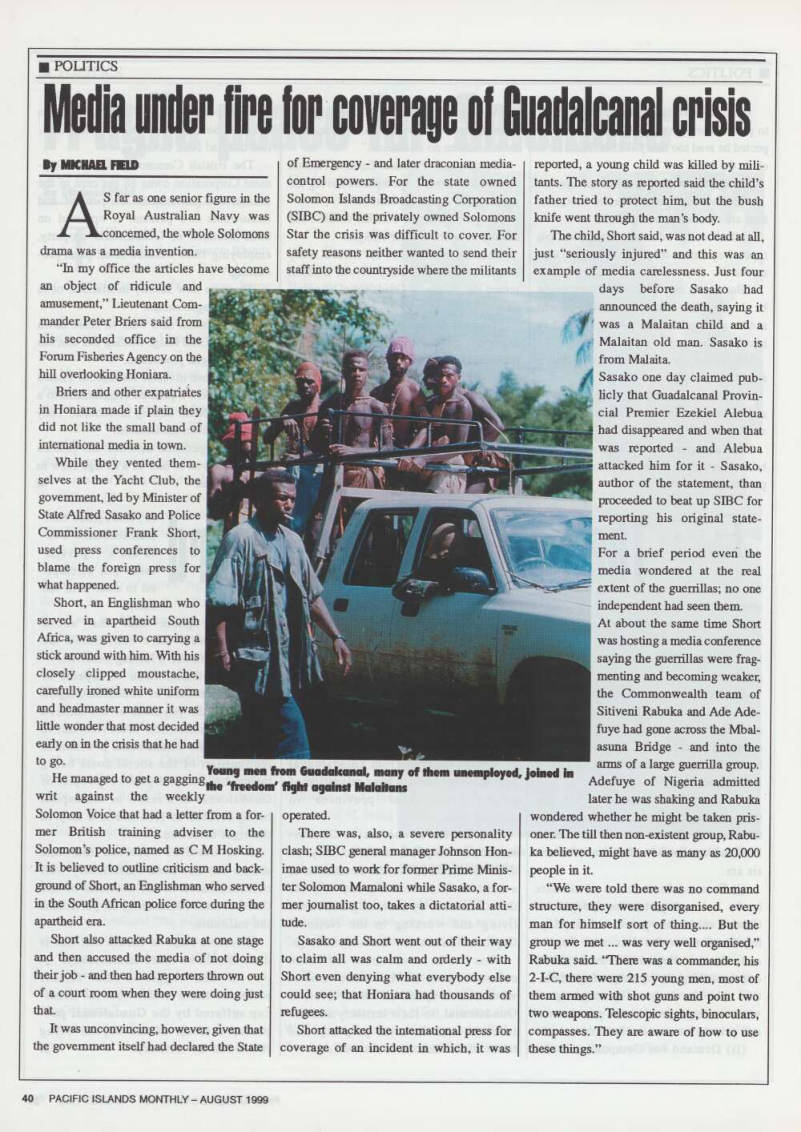
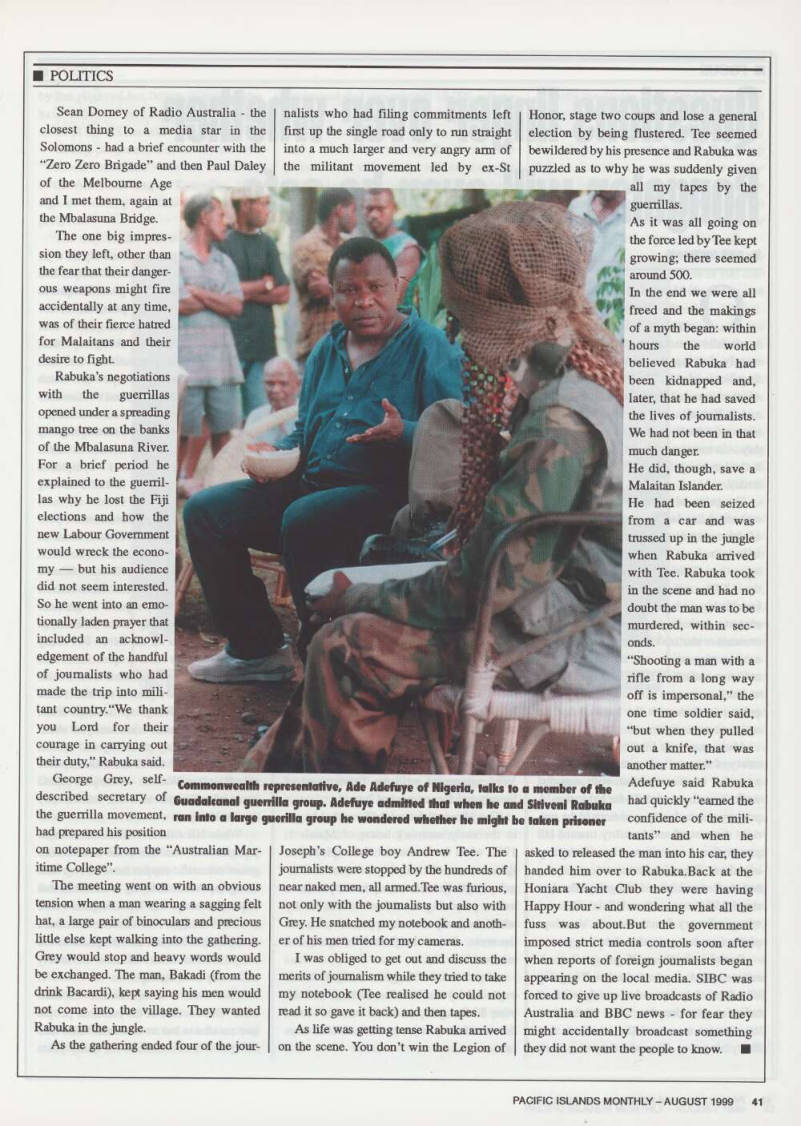
By Michael Field
AS far as one senior figure in the Royal Australian Navy was concerned, the whole Solomons drama was a media invention.
“In my office the articles have become
an object of ridicule and amusement,” Lieutenant Com mander Peter Briers said from his seconded office in the Forum Fisheries Agency on the hill overlooking Honiara.
Briers and other expatriates in Honiara made if plain they did not like the small band of international media in town.
While they vented them selves at the Yacht Club, the government, led by Minister of State Alfred Sasako and Police Commissioner Frank Short, used press conferences to blame the foreign press for
what happened.
Short, an Englishman who served in apartheid South Africa, was given to carrying a stick around with him. With his closely clipped moustache, carefully ironed white uniform and headmaster manner it was little wonder that most decided early on in the crisis that he had to go.
He managed to get a gagging! writ against the weekly
Solomon Voice that had a letter from a for mer British training adviser to the Solomon’s police, named as C M Hosking.
It is believed to outline criticism and back ground of Short, an Englishman who served in the South African police force during the apartheid era.
Short also attacked Rabuka at one stage and then accused the media of not doing their job - and then had reporters thrown out of a court room when they were doing just that.
It was unconvincing, however, given that the government itself had declared the State
of Emergency - and later draconian media control powers. For the state owned
Solomon Islands Broadcasting Corporation
(SIBC) and the privately owned Solomons Star the crisis was difficult to cover. For safety reasons neither wanted to send their staff into the countryside where the militants
operated.
There was, also, a severe personality clash; SIBC general manager Johnson Hon imae used to work for former Prime Minis ter Solomon Mamaloni while Sasako, a for mer journalist too, takes a dictatorial atti tude.
Sasako and Short went out of their way to claim all was calm and orderly - with Short even denying what everybody else could see; that Honiara had thousands of
refugees.
Short attacked the international press for coverage of an incident in which, it was
reported, a young child was killed by mili tants. The story as reported said the child’s father tried to protect him, but the bush knife went through the man’s body.
The child, Short said, was not dead at all, just “seriously injured” and this was an example of media carelessness. Just four
days before Sasako had announced the death, saying it was a Malaitan child and a Malaitan old man. Sasako is from Malaita.
Sasako one day claimed pub licly that Guadalcanal Provin cial Premier Ezekiel Alebua had disappeared and when that was reported - and Alebua attacked him for it - Sasako, author of the statement, than proceeded to beat up SIBC for reporting his original state ment.
For a brief period even the media wondered at the real extent of the guerrillas; no one independent had seen them.
At about the same time Short was hosting a media conference
saying the guerrillas were frag
menting and becoming weaker,
the Commonwealth team of Sitiveni Rabuka and Ade Ade fuye had gone across the Mbal asuna Bridge - and into the arms of a large guerrilla group.
Adefuye of Nigeria admitted later he was shaking and Rabuka
wondered whether he might be taken pris oner. The till then non-existent group, Rabu ka believed, might have as many as 20,000 people in it.
“We were told there was no command structure, they were disorganised, every man for himself sort of thing... But the group we met... was very well organised,”
Rabuka said. “There was a commander, his 2-I-C, there were 215 young men, most of them armed with shot guns and point two two weapons. Telescopic sights, binoculars, compasses. They are aware of how to use these things.”
Young men from Guadalcanal, many of them unemployed, joined in the 'freedom' fight against Malaitans
Sean Domey of Radio Australia - the closest thing to a media star in the Solomons - had a brief encounter with the “Zero Zero Brigade” and then Paul Daley
of the Melbourne Age and I met them, again at the Mbalasuna Bridge.
The one big impres
sion they left, other than the fear that their danger ous weapons might fire accidentally at any time, was of their fierce hatred for Malaitans and their desire to fight.
Rabuka’s negotiations
with the guerrillas opened under a spreading mango tree on the banks of the Mbalasuna River.
For a brief period he explained to the guerril las why he lost the Fiji elections and how the new Labour Government would wreck the econo my but his audience did not seem interested.
So he went into an emo tionally laden prayer that included an acknowl edgement of the handful of journalists who had made the trip into mili tant country.“We thank you Lord for their courage in carrying out their duty,” Rabuka said.
George Grey, self described secretary of the guerrilla movement, had prepared his position
on notepaper from the “Australian Mar
itime College”.
The meeting went on with an obvious tension when a man wearing a sagging felt hat, a large pair of binoculars and precious little else kept walking into the gathering.
Grey would stop and heavy words would be exchanged. The man, Bakadi (from the drink Bacardi), kept saying his men would not come into the village. They wanted Rabuka in the jungle.
As the gathering ended four of the jour
nalists who had filing commitments left first up the single road only to run straight into a much larger and very angry arm of the militant movement led by ex-St
Joseph’s College boy Andrew Tee. The
journalists were stopped by the hundreds of near naked men, all armed. Tee was furious, not only with the journalists but also with Grey. He snatched my notebook and anoth er of his men tried for my cameras.
I was obliged to get out and discuss the merits of journalism while they tried to take my notebook (Tee realised he could not read it so gave it back) and then tapes.
As life was getting tense Rabuka arrived on the scene. You don’t win the Legion of
Honor, stage two coups and lose a general election by being flustered. Tee seemed bewildered by his presence and Rabuka was puzzled as to why he was suddenly given
all my tapes by the guerrillas.
As it was all going on the force led by Tee kept growing; there seemed around 500.
In the end we were all freed and the makings of a myth began: within hours the world believed Rabuka had been kidnapped and, later, that he had saved the lives of journalists.
We had not been in that much danger.
He did, though, save a Malaitan Islander.
He had been seized from a car and was tressed up in the jungle when Rabuka arrived with Tee. Rabuka took in the scene and had no doubt the man was to be murdered, within sec onds.
“Shooting a man with a rifle from a long way off is impersonal,” the one time soldier said, “but when they pulled out a knife, that was another matter.”
Adefuye said Rabuka had quickly “earned the confidence of the mili tants” and when he
asked to released the man into his car, they handed him over to Rabuka. Back at the Honiara Yacht Club they were having Happy Horn: - and wondering what all the fuss was about. But the government imposed strict media controls soon after
when reports of foreign journalists began
appearing on the local media. SIBC was forced to give up live broadcasts of Radio Australia and BBC news - for fear they might accidentally broadcast something they did not want the people to know. ■
Commonwealth representative, Ade Adefuye of Nigeria, talks to a member of the Guadalcanal guerrilla group. Adefuye admitted that when he and Sitiveni Rabuka ran into a large guerilla group he wondered whether he might be taken prisoner
Questions linger over whether
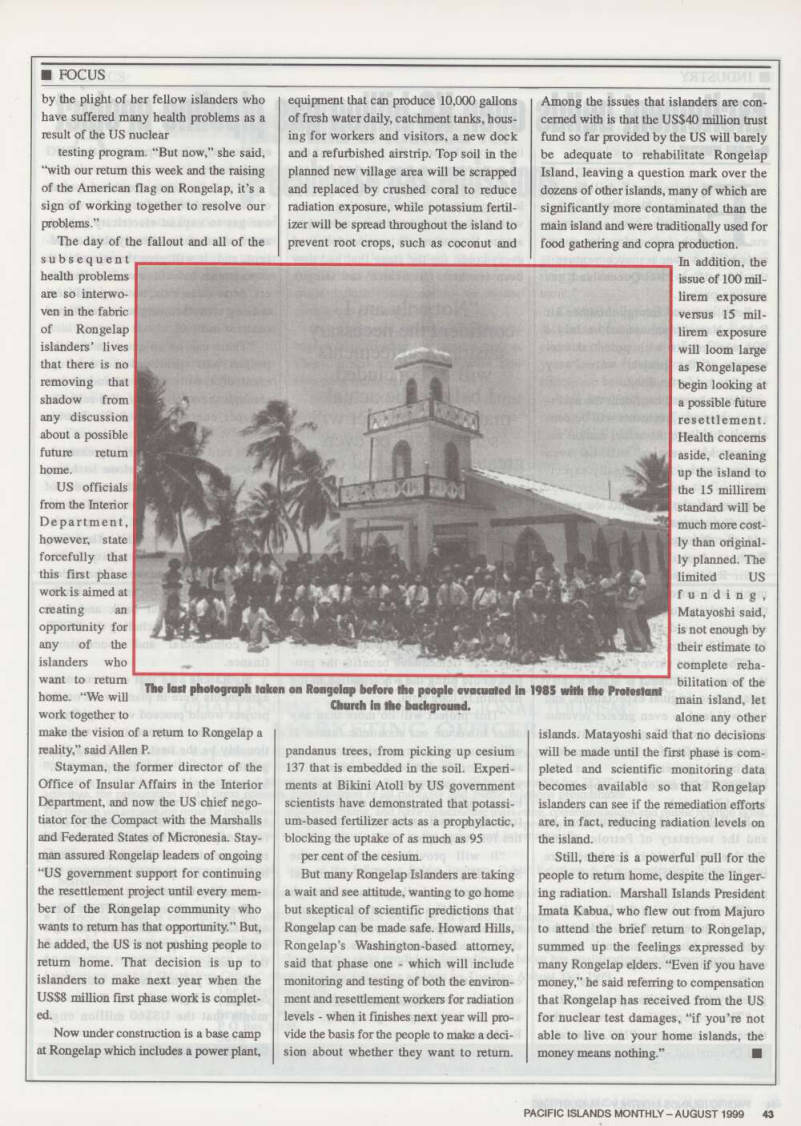
Focus
Questions linger over whether Rongelap will ever be safe
By Giff Johnson
ON March 1, 1954 the sun rose in the West for Rongelap
islanders, bringing hydrogen
bomb fallout, radiation sickness and, ulti mately, forcing the people to evacuate their home islands. The blast at Bikini was 45 years ago, but Rongelap Islander Mwe nadrik Kebinli - and the small group still alive who were on Rongelap that fateful day - remember the day of the Bravo hydrogen bomb test as if it happened yes terday.
Rongelap islanders, with US funding, embarked late last year on the first phase of cleanup and rehabilitation of Rongelap Island, the main island in an atoll that has more than 60 islands. The initial work of the US$B million resettlement project (establishing a base camp, required infra structure including a power plant, reverse osmosis water making units, a dock and runway renovation, and starting remedial radiation-reduction measures) is expected to finish early next year, confronting Ron gelap islanders with the hard choice: to return or not to return.
Many questions linger about the future safety of this atoll, despite conclusions by a number of scientists that, with remedial work, it can be made safe for habitation. A primary reason for the questions is the out right distrust of and hostility toward US
government scientists by Rongelap
islanders. The scientists and doctors who had studied and treated Rongelap islanders since 1954 came from US laboratories whose primary functions were develop ment of nuclear weapons and energy.
Decisions by these US government sci entists and doctors resulted in Rongelap islanders being exposed to unsafe levels of radiation over decades, while all the time the doctors reassured the islanders that everything was fine and they shouldn’t
worry. Finally, earlier this year, the US gov ernment’s Brookhaven National Laboratory, which had operated a medical program for Rongelap and Utrik, another fallout-affect ed atoll, since 1954 - without any outside supervision or peer review - was replaced by a Hawaii-based health organisation that won the contract through a competitive bid which has restored a measure of confidence in the medical treatment islanders are now
receiving.
But that’s just one of the concerns. When Rongelap and US officials agreed to the cleanup and resettlement plan in 1994, they approved an agreement which calls for reducing the exposure to man-made radia tion on Rongelap to 100 millirems per year.
Late last year, however, the Nuclear Claims Tribunal in Majuro adopted - over strenuous objections from scientists from US laborato ries - a much more stringent US Environ mental Protection Agency guideline for cleanup situations of 15 millirem. There is a move to have this standard adopted by the Nitijela (parliament) as the national require ment for all cleanups in the Marshall Islands. The realisation that the earlier 100 millirem agreement is out-of-step with the more health-conscious EPA-standard has Rongelap leaders taking a hard look at the 1994 agreement with the Department of Energy and Department of Interior.
The Marshall Islands’ Chernobyl began in the early morning hours of March 1, 1954, when the Bravo test was exploded on Bikini, about 100 miles to the west of Ron gelap Atoll. Kebinli was up in the pre-dawn hours, preparing breakfast for her family when suddenly the sun appeared to rise in the west. It was the fireball of the Bravo test, at 15 megatons the largest nuclear bomb exploded by the US. But Kebinli and the other 81 Rongelap islanders wouldn’t learn that until they were evacuated two days later.
“A bright light came out of the west and a short time later I heard a sound like thunder,” she said. “The ground began to shake and the pots and pans fell off the table.” Within a few hours, a snow-like ash began falling on Rongelap. Not warned to take precautions, children played in the radioactive powder which fell in the drinking water and contaminat ed the food. Soon after their evacuation, 48 hours after the Bravo test, Rongelap islanders experienced radiation skin bums, nausea and hair loss - symptoms similar to victims of the atomic bombing of Hiroshima.
US Atomic Energy Commission doc tors allowed the people to return home in 1957 to a heavily contaminated environ ment, but one the US officials claimed was safe for resettlement. Brookhaven National Laboratory reports at the time even refer to Rongelap as one of the most radioactive spots on the Earth. For many years Rongelap leaders questioned the safety of the environment. The health concerns reached a peak in the mid-1980s and, in 1985, Rongelap Senator Jeton Anjain led the entire community of about 400 people as they picked up and moved - with the aid of the ill-fated Greenpeace ship Rainbow Warrior - to Mejatto Island
in nearby Kwajalein Atoll, where they
remain today.
While US scientists dismissed Ronge lap islanders’ concerns at the time, subse quent scientific studies have shown that Rongelap Atoll has levels of radiation that
require cleanup. The US Congress voted
a US$45 million resettlement trust fund in the mid-1990s and the first phase of the rehabilitation effort is now seriously underway at Rongelap.
“We want to return home,” Kebinli said. “But because of the radiation people had no choice but to evacuate.” She said that she’s been saddened for many years
by the plight of her fellow islanders who have suffered many health problems as a result of the US nuclear testing program. “But now,” she said, “with our return this week and the raising of the American flag on Rongelap, it’s a sign of working together to resolve our problems.”
The day of the fallout and all of the
subsequent health problems are so interwo ven in the fabric
of Rongelap
islanders’ lives that there is no
removing that
shadow from any discussion about a possible future return home.
US officials from the Interior
Department,
however, state forcefully that this first phase work is aimed at
creating an
opportunity for any of the islanders who want to return home. “We will work together to
make the vision of a return to Rongelap a reality,” said Allen P.
Stayman, the former director of the Office of Insular Affairs in the Interior Department, and now the US chief nego tiator for the Compact with the Marshalls and Federated States of Micronesia. Stay man assured Rongelap leaders of ongoing “US government support for continuing the resettlement project until every mem ber of the Rongelap community who wants to return has that opportunity.” But, he added, the US is not pushing people to return home. That decision is up to islanders to make next year when the US$B million first phase work is complet ed.
Now under construction is a base camp at Rongelap which includes a power plant,
equipment that can produce 10,000 gallons
of fresh water daily, catchment tanks, hous ing for workers and visitors, a new dock and a refurbished airstrip. Top soil in the planned new village area will be scrapped and replaced by crushed coral to reduce radiation exposure, while potassium fertil izer will be spread throughout the island to prevent root crops, such as coconut and
pandanus trees, from picking up cesium 137 that is embedded in the soil. Experi ments at Bikini Atoll by US government scientists have demonstrated that potassi um-based fertilizer acts as a prophylactic, blocking the uptake of as much as 95 per cent of the cesium.
But many Rongelap Islanders are taking a wait and see attitude, wanting to go home but skeptical of scientific predictions that Rongelap can be made safe. Howard Hills,
Rongelap’s Washington-based attorney,
said that phase one - which will include monitoring and testing of both the environ ment and resettlement workers for radiation levels - when it finishes next year will pro vide the basis for the people to make a deci sion about whether they want to return.
Among the issues that islanders are con cerned with is that the US$4O million trust fund so far provided by the US will barely be adequate to rehabilitate Rongelap Island, leaving a question mark over the dozens of other islands, many of which are significantly more contaminated than the main island and were traditionally used for food gathering and copra production.
In addition, the issue of 100 mil lirem exposure versus 15 mil lirem exposure will loom large
as Rongelapese
begin looking at
a possible future resettlement.
Health concerns aside, cleaning up the island to the 15 millirem standard will be much more cost ly than original ly planned. The limited US
funding,
Matayoshi said,
is not enough by their estimate to complete reha bilitation of the main island, let alone any other
islands. Matayoshi said that no decisions will be made until the first phase is com pleted and scientific monitoring data becomes available so that Rongelap islanders can see if the remediation efforts are, in fact, reducing radiation levels on the island.
Still, there is a powerful pull for the people to return home, despite the linger ing radiation. Marshall Islands President Imata Kabua, who flew out from Majuro to attend the brief return to Rongelap, summed up the feelings expressed by many Rongelap elders. “Even if you have money,” he said referring to compensation that Rongelap has received from the US for nuclear test damages, “if you’re not able to live on your home islands, the money means nothing.” ■
The lasi photograph taken on Rongelap before the people evacuated in 1985 with the Protestant Church in the background.
Excitement builds oven K8 billion gas pipeline project


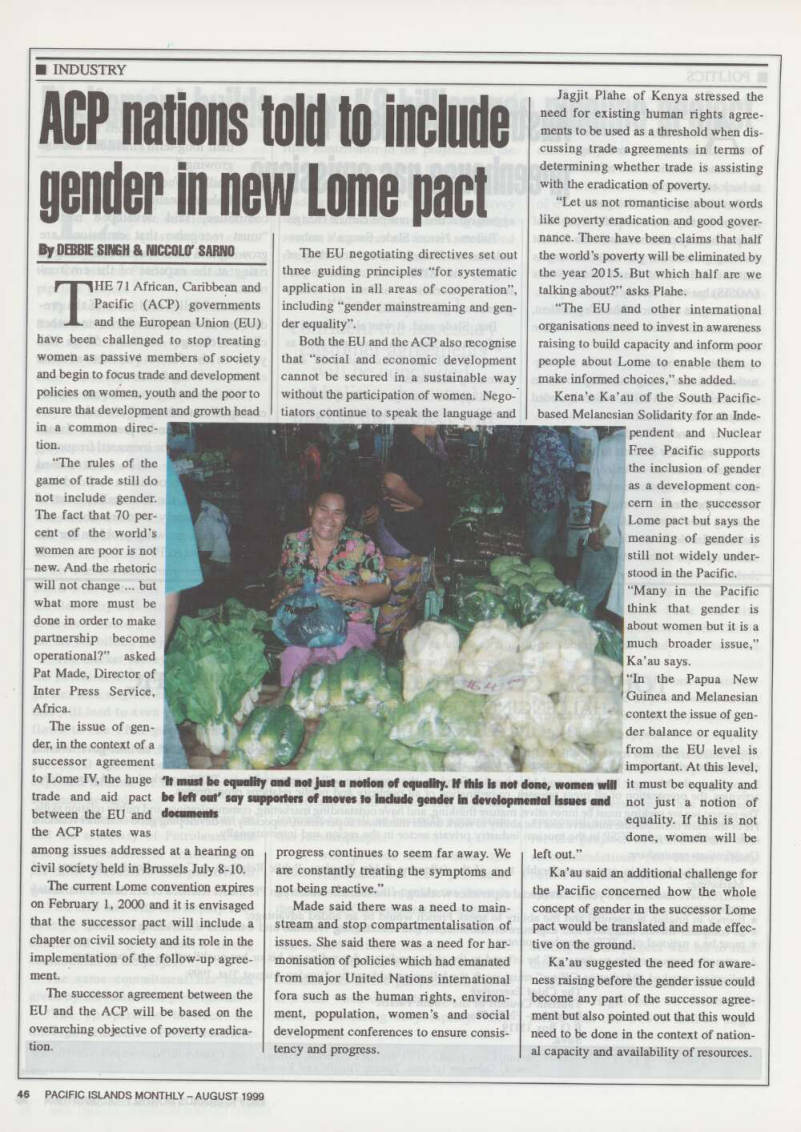
Industry
By Sam Vulum
Excitement is building in
Papua New Guinea after
positive developments in
the quest for the coun try’s biggest ever resource venture -
the K 8 billion PNG/Queensland gas
pipeline project.
Petroleum and Energy minister Sir Rabbie Namaliu announced on July 4 that agreements with potential cus tomers of the project were “very close” to being finalised.
“Not only am I confident the neces sary customer agreements will be con cluded, I believe the actual market the project will service will be even greater than we had originally expect ed.”
He made the comments on return from discussions with project partners and the Queensland government in Brisbane, Australia.
Sir Rabbie said long-term agree ments with customers in Queensland the electricity authorities and industri al users - would give the green light
for the K 8 billion project.
“The market survey has confirmed the potential demand is significantly greater than original expectations, and that will lead to even greater revenue flows to the PNG government, and greater benefits for landowners and provincial governments, over the expected lifetime of the project and beyond,” he said.
Sir Rabbie said the discussions he and the secretary of Petroleum and Gas Joe Gabut held in Brisbane were the most productive and positive to date.
“We also met with the Deputy Pre mier of Queensland Jim Elder, who confirmed his government’s strong commitment to the project.
The same commitment has been given by the Australian government.
“The co-operation between the three governments - PNG, Australia and Queensland - has been a most pos
itive contributor to the project, and the stage that has now been reached.”
Sir Rabbie said Oil Search, as the leading partner in the marketing survey with AGL, which has been engaged to secure long-term customers, deserved every credit for the stage that had now been reached. Oil Search and Oregon
“Not only am I
confident the necessary
customer agreements
will be concluded,
I believe the actual
market the project will
service will be even
greater than we had origi
nally expected”
- Sir Rabbie Namalui,
PNG’s Energy and Petro
leum minister
are meeting most of the costs at present and should be commended for their efforts, he said.
The minister said he wanted to again stress the tremendous benefits the pro ject would bring the whole nation in the medium to long term.
“This project will do more than any other to secure our economic future. It will become the largest single revenue source for the national government. It will give export income a much needed boost, and it will provide real jobs and training as well as business opportuni ties for our people.
“It will provide landowners, the South Highlands and Gulf provincial government, and all provinces through the National Gas Corporation, with sub
stantial, long-term royalty, revenue
sharing and dividend benefits.
“It will provide a real boost to the communities of the gas producing area at a time when oil production in these areas is declining very rapidly,” Sir Rabbie said.
The minister said the project will
enable major development of the PNG gas industry.
“It will facilitate the development of our own LNG industry, the use of our gas to expand electricity supply, and to do so more cheaply than at pre sent, and, it will give the stimulus to downstream industries such as fertilis ers, petro-chemicals, bottling and steel
coating manufacturing to be developed
onshore in PNG.
“There can be no question that the project will spearhead the develop ment of a wide range of industries, through the availability of a reliable, cheaper energy source,” Sir Rabbie said.
He said that long-term agreements with customers were close to being concluded was a significant vote of confidence in PNG, as well as the nation’s resource sector.
Discussions on the financing requirements of local equity in the project were well advanced, he added, with very positive discussions with the Asian Development bank and with Japanese lenders, including the OECF, for commercial and concessional finance.
Sir Rabbie said that once customer agreements were in place, work on the project would proceed very rapidly.
“When that happens, it will unques tionably be the best news Papua New guinea has had since independence,” he said.
The government has already approved a draft environmental plan for the project, with conditions and recommendations for further study before a final plan is submitted for approval by the minister.
The project’s external affairs man ager Cliff Leggoe said detailed engi neering for the project was set to start this month.
He told journalists on a tour of the Southern Highlands oil fields last month that the US$6O million engi-
Continued on page 48
From page 44
neering work would be carried out by a joint venture between Kvaemer, Egis and Bechtel. Market concerns over long-term supply issues were removed after an agreement between Oil Search and Exxon in May to allow Hides gas to be used for the project.
This let the way open for propo nents of the project to finalise deals with gas buyers and consumers, which was due for completion mid last month.
Hides 4, which was drilled last year, substantially increased the reserves at the Hides field and extended the height of the proven vertical gas column to 1238 metres from the previous 890 metres from Hides 1 and 2.
There are now adequate reserves in the Hides field to underpin the project, as well as consider a Lique fied Natural Gas project.
Last month also, interim authori sation was given to leading marketer, Allgas Energy, to negotiate gas sales agreements for the project in Queensland, allowing Chevron, the developer, to concentrate on other pressing issues.
Allgas will continue negotiations with Comalco, which is yet to com mit to the project as a buyer, even though it signed a memorandum of understanding with Chevron to nego tiate for gas purchases.
Comalco is undecided on whether to build its planned alumina refinery at Gladstone, Queensland or in Malaysia. Building it in Queensland will allow it to buy gas from the pro ject. Leggoe said Chevron and part ners in the project were confident that the signing up buyers would be complete by the end of July.
But even if Comalco does not sign up, the developers believe there is enough demand to meet the required levels for project development. Good news for the struggling economy of Papua New Guinea. ■
greenhouse gas amissions
Australia criticised tor greenhouse gas amissions
Australia has been criticised for its lack of action in reducing greenhouse emissions and refusal to back emission targets.
David Adeang, the delegation
head of the tiny central Pacific republic of Naum, bluntly criticised Australia for not backing greenhouse gas emission targets that the Alliance of Small Island States (AOSIS) has unanimously endorsed.
Adeang, an advisor to Naum’s president, said Australia should do more to reduce emissions.
Adeang was speaking outside an inter national climate change meeting hosted in the Marshalls by AOSIS, which included every Pacific island nation.
Other island officials said efforts by Australia and New Zealand to have forestry and land use issues included in the clean development programme were just to “off load all their reduction requirements onto planting trees” instead of having to reduce pollutiomlnside the meeting, island officials called on all western nations to take more
aggressive action to reverse climate change.
Tuiloma Neroni Slade, Samoa’s ambas sador to the United Nations and chair of AOSIS, said AOSIS must continue to per suade industrialised nations to reduce greenhouse gas emissions.
But, Slade said, it was also critical to engage large developing countries such as China, Brazil and India that were also increasing emissions.
Philippines foreign ministry official Bemarditas Castro-Muller called the com mitment to reduce emissions on the part of the industrialised world “inadequate”.
Castro-Muller said the “primary respon sibility for greenhouse gas emissions is in the hands of industrialised nations who have achieved their development since the industrial revolution without con cern for the environment.
“We must find a way to get the industrialised nations to modify their long-term emissions that are
growing.”
Phillip Weech, the chair of the Bahamas national climate change
committee, said developed nations “must recognise that emissions are growing and their standard of living is rising at the expense of the environ ment.”
Castro-Muller said most of the pre dictions about sea level rise and other climate changes were for 50 to 100 years in the future but “the adverse effects are being felt now.”
“All developing countries are experi encing climate change,” she said.
Marshall Islands president Imata Kabua talked of the increased frequency of storm surges which have caused ocean waves on occasion to flood into the islands of the Marshalls, most of which are barely a metre above sea level. It is a growing problem for the small islands.(AFP) ■
Advertisements & other items, p. 45 (1 item)
Tourism Council Of The South Pacific
CHALLENGING POSITION IN REGIONAL TOURISM
MARKETING OFFICER
Applications are invited for the position of Marketing Officer in the Tourism Council of the South Pacific (TCSP), an inter-governmental organisation with 13 South Pacific member countries*, and based in Suva, Fiji.
Reporting to the Manager Marketing and Membership Services, the appointee will be responsible for TCSP's marketing and promotional activities, the preparation of all press releases, co-ordination of all publicity and public relations programmes.
The person we are seeking must be innovative, mature thinking, and have outstanding marketing, communications and public relation skills.
He or she must demonstrate initiative and the ability to work under minimum supervision, especially, in developing good customer relations and image building for TCSP in the tourism industry private sector in the region and internationally.
Qualifications required are:
★ a university degree in one, or preferably two, of the following fields: Tourism, Public Relations & Communication, Business and
Marketing;
★ and/or have had at least 5 years commercial experience working in the tourism industry in PR, media relations or in a Sales & Marketing environment; ★ fluency in English is essential and the ability to speak French would be an added advantage; ★ be computer literate and have had exposure on the Internet and maintaining Websites and e-mail as a marketing tool; and ★ must be a national of a TCSP member country.
An attractive remuneration package will be offered to the right candidate depending on his or her qualifications and experience.
Applications marked "Marketing Officer" must reach the following address by Tuesday August 31st, 1999: The Chief Executive Tourism Council of the South Pacific Level 3 FNPF Place P O Box 13119 Suva. ★ Member countries of TCSP—American Samoa, Cook Islands, Fiji, French Polynesia, Kiribati, New Caledonia, Niue, Papua New Guinea, Samoa, Solomon Islands, Tonga, Tuvalu and Vanuatu.
ACP nations told to include
gender in new Lome pact
By Debbie Singh & Niccolo' Sarno
THE 71 African, Caribbean and Pacific (AGP) governments and the European Union (EU) have been challenged to stop treating women as passive members of society and begin to focus trade and development policies on women, youth and the poor to ensure that development and growth head
in a common direc tion.
“The rules of the game of trade still do not include gender.
The fact that 70 per cent of the world’s women are poor is not new. And the rhetoric will not change ... but what more must be done in order to make
partnership become
operational?” asked Pat Made, Director of Inter Press Service, Africa.
The issue of gen der, in the context of a successor agreement to Lome IV, the huge trade and aid pact between the EU and the AGP states was
among issues addressed at a hearing on civil society held in Brussels July 8-10.
The current Lome convention expires on February 1, 2000 and it is envisaged that the successor pact will include a chapter on civil society and its role in the implementation of the follow-up agree ment.
The successor agreement between the EU and the AGP will be based on the overarching objective of poverty eradica tion.
The EU negotiating directives set out three guiding principles “for systematic application in all areas of cooperation”,
including “gender mainstreaming and gen
der equality”.
Both the EU and the AGP also recognise that “social and economic development cannot be secured in a sustainable way without the participation of women. Nego tiators continue to speak the language and
progress continues to seem far away. We are constantly treating the symptoms and not being reactive.”
Made said there was a need to main stream and stop compartmentalisation of issues. She said there was a need for har monisation of policies which had emanated from major United Nations international fora such as the human rights, environ ment, population, women’s and social development conferences to ensure consis tency and progress.
Jagjit Plahe of Kenya stressed the need for existing human rights agree ments to be used as a threshold when dis cussing trade agreements in terms of determining whether trade is assisting with the eradication of poverty.
“Let us not romanticise about words like poverty eradication and good gover nance. There have been claims that half the world’s poverty will be eliminated by the year 2015. But which half are we talking about?” asks Plahe.
“The EU and other international organisations need to invest in awareness raising to build capacity and inform poor people about Lome to enable them to make informed choices,” she added.
Kena’e Ka’au of the South Pacific based Melanesian Solidarity for an Inde-
I pendent and Nuclear Free Pacific supports the inclusion of gender as a development con cern in the successor Lome pact but says the meaning of gender is still not widely under stood in the Pacific.
“Many in the Pacific think that gender is about women but it is a much broader issue,”
Ka’au says.
“In the Papua New Guinea and Melanesian context the issue of gen der balance or equality from the EU level is important. At this level, it must be equality and not just a notion of equality. If this is not done, women will be
left out.”
Ka’au said an additional challenge for the Pacific concerned how the whole concept of gender in the successor Lome pact would be translated and made effec tive on the ground.
Ka’au suggested the need for aware ness raising before the gender issue could become any part of the successor agree ment but also pointed out that this would need to be done in the context of nation al capacity and availability of resources.
'It must be equality and not just a notion of equality. If this is not done, women will be left out' say supporters of moves to include gender in developmental issues and documents
“The first time I heard about Lome was in April this year but some work has begun on awareness raising in PNG (Papua New Guinea) through the Pacific Concerns Resource Centre and a few European NGOs,” Ka’au said.
“To be honest, we need to look at home first before looking elsewhere,” he said, adding that in the Pacific there exist ed a need also to consider governments that were not responding to people’s needs. “How can we get the EU to assist us to bring about good governance using our own definitions of development?”
Ramesh Jaura, Chair of the Global Cooperation Council in Bonn, Germany said there is a need to look beyond the successor Lome pact in terms of the democratisation of international relations.
He said there is a need for treaties and mechanisms for monitoring these treaties, and said it is civil society’s role to demand more transparent measures of democratisation in terms of trade, aid and investment.
Brita Bastogi, of the Brussels-based Eurostep Network of European NGOs said: ‘“They (negotiators) have said gen der is a cross-cutting issue.’”
“But there are no mechanisms in the ACP mandate (for negotiations) to imple ment measures related to gender.”
Calls for the engendering of develop ment policies from their evolutionary stages have also been heard in Brussels but Hellen Felter, Vice-President of the European Women’s Lobby agreed with Ka’au in that, even among negotiators: “People don’t know what gender is.”
The ACP negotiating directive brings together gender and youth issues under the same chapter.
Felter said that out of 20 appointe ments on July 9 as European Commis sioners at the executive branch of the European Union, the European Commis sion, only five were women.
“And gender has to do also with changing the structure that has been put up by men,” she said, pointing out that at the conference “there was not one female chair. And that is Europe,” she added, suggesting that the situation is worse in most ACP nations. ■
modern-day empire
Carpenters build a modern-day empire
WHEN Morris Hedstrom’s Suva main store burnt down during the week before Christmas last year, the news came as a shock to many people.
In the space of a few hours, one of the capital’s landmarks had been razed to the ground. What was left was only a shell of what had become the hub of Suva city.
For the Carpenters group, owners of Morris Hedstrom, rebuilding the store became a matter of priority. But it was also important that the new building retain its familiar structure but be modem enough to cater for the shopper in the 21st century. It was an ideal opportunity to start afresh.
The history and origins of Carpenters Fiji Limited date back to as early as 1921, and since then the Carpenters group of companies have established itself as the largest private sector enterprise in the Fiji Islands.
But more than that, the group is one of the few large international companies committed solely to investment in the Pacific, with just three employees based outside the region - one in London and two in Sydney. Carpenters Group chief execu tive, Kenneth Clemens says “overall Car penters employ some 6,500 people of whom approximately 1,800 are in Fiji, 4,500 in Papua New Guinea and some 200 in Tonga and Samoa.”
Far from hiding in the shadows of its Morris Hedstrom operation, the company is involved in a range of commercial activ ities involving most sectors of the econo my. Apart from the wholesale and retail trade with MHs, the company is also into automotive and heavy equipment trade,
ship repair services, manufacturing, ship
agency and allied services, property devel opment and large scale agricultural under
takings.
“Carpenters aim to be the market leader or one of the market leaders in each and every business in which it is involved,” Clemens says.
In Papua New Guinea, as well as operating motor vehicle and builders hardware distribution businesses, the company has the largest copra crushing mill in the Pacific, crushing up to 70,000 tonnes of copra annually, he says.
The company also owns and operates copra and cocoa plantations on the coast and tea and coffee estates in the high lands of PNG. Clemens says Carpenters “are far and above the largest tea pro ducer in Papua New guinea and one of the leading coffee producers.
Every month 50 or 60 containers of Carpenters agricultural exports leave Papua New Guinea ports for overseas markets as well as bulk tank ships loaded with coconut oil.” One of the areas that Carpenters has advanced in over the years is air freight forwarding.
Earlier this year, the company invested a further FJDSI million to expand its premises at Nadi International Airport in Fiji.
The expansion means that they now have a greater capacity to chill, store, de-consolidate and load export cargo, says Carpenters Shipping and Transport general manager, Shiri Ram.
“The growth of export industry means there is a great demand for, and limited airline cargo space available. In turn, facilities such as Carpenters Air freight’s warehouse are in high demand.
We have addressed that need by dou bling our capacity to accommodate the increasing volume of airline cargo,” he said.
Carpenters Airfreight Forwarding is an approved LATA agent. ■
Internet banking - it's friendlier


than the real world
AUSTRALIAN banks are find ing cyberspace a more friend
ly place to service and acquire
customers as the ongoing public furore over bank branch closures and fees dent their collective image in the physical world.
Certainly their efforts on the Web are proving a lot more popular, and potential ly more profitable, then even the most
optimistic of early forecasts.
There are already more than 300,000 customers using various bank Internet ser vices and that number is likely to break through one million in total by 2001.
And within five years banks are confi dent they will have a million Internet cus tomers each.
By that time, visiting a bank’s website will be as familiar as visiting a branch or withdrawing money from an ATM or EFT POS machine.
Each of the four major Australiasian banks and St George Ltd, which pioneered Internet banking in Australia through Advance Bank, now has a presence on the Web that matches most of their non-cash branch services and in some areas, such as on-line stockbroking, exceed them.
Neither Westpac Banking Corp nor
Commonwealth Bank of Australia Ltd are shy about projecting usage rates to total millions each within the next five years.
Commonwealth said potentially 100 per cent of its customer base could be ser viced on-line in around five years, even though many of those customers still will do more of their banking face to face than on-line.
“Internet technologies and Internet pro tocols will become the core customer interface,” Commonwealth’s head of on line services Stephen Coulter said.
Westpac’s head of on-line services Jonathan Poole said the bank’s Internet
customer usage was growing so fast that setting a growth target could be counter
productive.
“It’s hard to say, to the point where set ting a figure might be a bit limiting,” Poole said.
Who’s using it?
At this stage the banks agree their Inter net customers mirror, and in some cases exceed, the demographic of the typical Internet user.
There are already
more than 300,000
customers using various
bank Internet services
and that number is
likely to break through
one million
in total by 2001
That is, someone who is tertiary educat ed, has a high income and is more respon sive to new technology than the population average.
It is not coincidental that person is exactly the kind of customer that all the banks want to have because they are poten tially much more profitable than average customers.
Internet users are more skewed to high er incomes, more likely to have a loan, have a credit card, and have higher transaction values and balances.
Commonwealth’s Coulter said such cus tomers are ten times as profitable as the average customer.
And they are also proving to be very
loyal.
St George’s Internet channel manager Rupert Blatch said the bank’s Internet cus tomers had proven themselves incredibly
loyal since Advance began the service in 1995.
Westpac and Commonwealth agree.
And Wizard Financial Service’s Andrew Inwood noted that its research also showed that Web customers were some of the “stickiest” customers in finan cial services.
“They are incredibly sticky, and the more services you offer them the stickier they get - just like they had got caught in a real web,” Inwood said.
Westpac’s Poole said also that the bank’s Internet customers were ten times as profitable as average customers.
Their higher net worth was one of the main reasons Westpac’s Internet opera tions were already profitable on cost-ver sus-revenue basis.
Other banks were more coy in their revenue predictions but Poole said West pac’s Internet operations would be prof itable on that basis by next year.
A key component in Commonwealth’s quick ascent to profitability has undoubt edly been its Internet and phone based dis count stock broking service, Com Sec.
The service, which is the second most visited Internet site in Australia, has been a huge success for the bank and has prompted a raft of copy cat actions by the
other majors.
Both St George and ANZ Banking Corp have already unveiled their intention to offer broking but each of those has teamed up with another player to provide the stockbroking services.
St George has teamed up with HSBC and ANZ is in bed with etrade.
Westpac said it will follow the Com Sec model and have a wholly owned on-line stockbroking service by next year.
National Australia Bank Ltd has had discussions with several brokers about establishing some form of share trading
facility for its customers but it said it was a long way from deciding on the nature of the facility or on a broking firm with whom to form an alliance.
Who’s best?
Ranking the bank’s Internet sites is extraordinarily difficult as each site to a degree reflects the time it was introduced and the different customer profile of each bank.
The first sites tend to have been designed with less features initially but as each is scaled up with new services or upgraded it tends to overtake the earlier ones.
Recent research from New Media, a Melbourne based research house, found National Australia’s site was the most fully featured.
New Media was hardest on St George which it described as having “limited func tion and design” but St George’s site was pro rata the most popular of all the banks’
Internet sites and its proportion of cus tomer usage at three per cent outstripped the others.
St George’s Blatch added that the banks customers were happy with the site’s ser vices.
The low functionality could have been explained by the fact that St George had pioneered most of the services that the other banks’ had since copied.
That could also explain why National Australia’s site was seen as being the most polished - it also being the youngest of the sites.
But whatever New Media’s rankings, all the banks’ internally generated research indicates almost all of their customers are more than satisfied with the services each bank provides.
What might stop it?
Security remains the biggest concern but with the advent of 128 encryption all the banks are confident that issue has been solved.
Potential customers are still concerned but it is now a matter of education more than anything else, the banks believe.
Professor Mark Sneddon, a member of the federal government’s committee on electronic commerce, said the high level of encryption made it extremely difficult to
hack into banks’ computers and they were basically secure. The biggest weakness in the system in fact was the customers’ own personal computers.
Sneddon said “ethical hackers” employed by overseas banks had managed to hack into customer accounts through cus tomer computers but so far there had been little evidence of fraud.
The other barrier potentially limiting growth is the computer itself.
While computer use is increasingly widespread their mainstream presence is still limited by the keyboard and the speed of line connections to the Web.
But as cable delivery of on-line services becomes more widespread so will the Inter net’s access speed and the deliverability of non-keyboard based Internet services such as web TV.
When transferring money or paying a bill is as easy as turning on the TV - or dialling on the mobile (as Commonwealth will offer later this year) the boom will real ly start. Whatever it there going to be next?
(Aap) ■
When you access the Westpac Banking Corporation website, this is what will great you if you ask for the online banking service. There are a wide range of other services that can be performed while you're online (Pic: Westpac Banking Corporation)
Kokoda Trail: PNG's biggest attraction
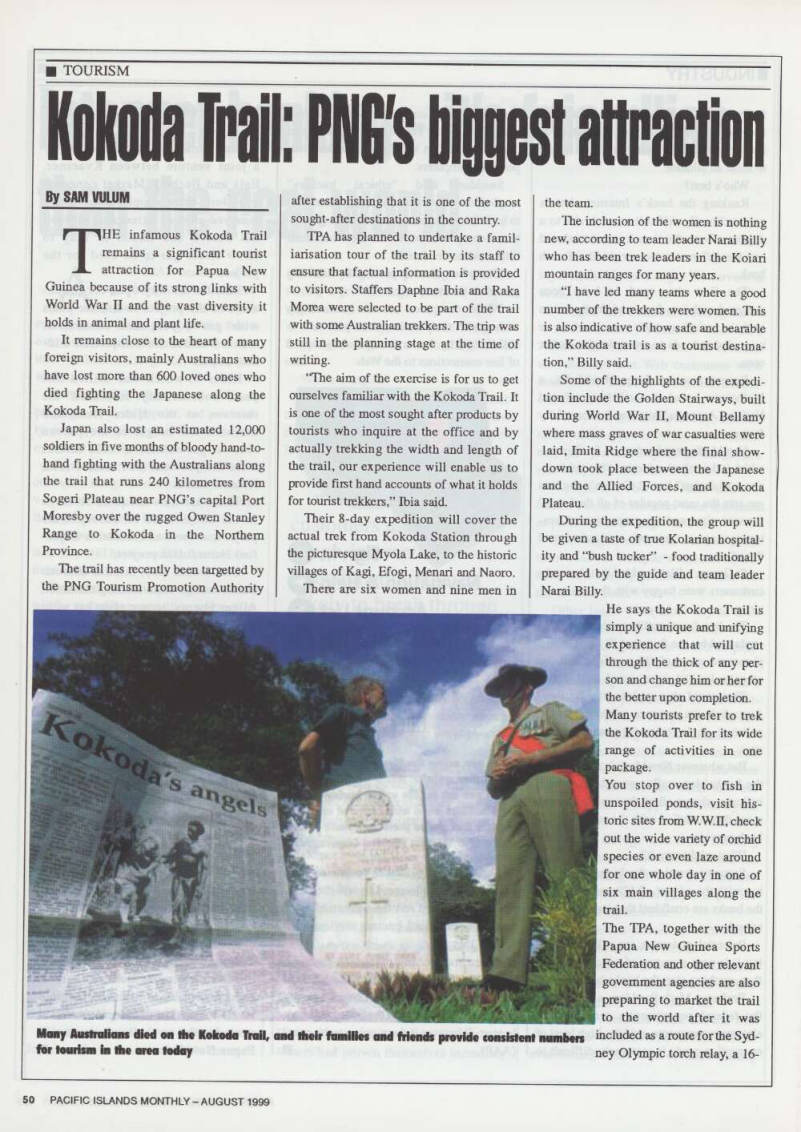
Tourism
By Sam Vulum
THE infamous Kokoda Trail remains a significant tourist attraction for Papua New Guinea because of its strong links with World War II and the vast diversity it holds in animal and plant life.
It remains close to the heart of many foreign visitors, mainly Australians who have lost more than 600 loved ones who
died fighting the Japanese along the
Kokoda Trail.
Japan also lost an estimated 12,000 soldiers in five months of bloody hand-to hand fighting with the Australians along the trail that runs 240 kilometres from Sogeri Plateau near PNG’s capital Port Moresby over the rugged Owen Stanley Range to Kokoda in the Northern Province.
The trail has recently been targetted by the PNG Tourism Promotion Authority
after establishing that it is one of the most sought-after destinations in the country.
TPA has planned to undertake a famil iarisation tour of the trail by its staff to ensure that factual information is provided to visitors. Staffers Daphne Ibia and Raka Morea were selected to be part of the trail with some Australian trekkers. The trip was still in the planning stage at the time of writing.
“The aim of the exercise is for us to get ourselves familiar with the Kokoda Trail. It is one of the most sought after products by tourists who inquire at the office and by actually trekking the width and length of the trail, our experience will enable us to provide first hand accounts of what it holds for tourist trekkers,” Ibia said.
Their 8-day expedition will cover the actual trek from Kokoda Station through the picturesque Myola Lake, to the historic villages of Kagi, Efogi, Menari and Naoro.
There are six women and nine men in
the team.
The inclusion of the women is nothing new, according to team leader Narai Billy who has been trek leaders in the Koiari mountain ranges for many years.
“I have led many teams where a good number of the trekkers were women. This is also indicative of how safe and bearable the Kokoda trail is as a tourist destina tion,” Billy said.
Some of the highlights of the expedi tion include the Golden Stairways, built during World War 11, Mount Bellamy where mass graves of war casualties were laid, Imita Ridge where the final show down took place between the Japanese and the Allied Forces, and Kokoda Plateau.
During the expedition, the group will be given a taste of true Kolarian hospital ity and “bush tucker” - food traditionally prepared by the guide and team leader Narai Billy.
He says the Kokoda Trail is simply a unique and unifying experience that will cut through the thick of any per son and change him or her for the better upon completion.
Many tourists prefer to trek the Kokoda Trail for its wide range of activities in one package.
You stop over to fish in unspoiled ponds, visit his toric sites from W.W.n, check out the wide variety of orchid species or even laze around for one whole day in one of six main villages along the trail.
The TPA, together with the Papua New Guinea Sports Federation and other relevant government agencies are also preparing to market the trail to the world after it was
included as a route for the Syd ney Olympic torch relay, a 16-
Many Australians died on the Kokoda Trail, and their families and friends provide consistent numbers for tourism in the area today
day sweep through the South Pacific in 2000.
After being lit at a special ceremony in Greece, the Olympic torch will travel to Guam, the Federated States of Micronesia, Nauru and Solomon Islands before arriv ing in PNG.
The relay will then visit Vanuatu, Samoa, American Samoa the cook Islands, Tonga, Fiji and New Zealand before trav elling to Australia.
By extending the run through the Pacif ic, the 2000 Olympics will mark the biggest relay in the history of the games.
By the end of the Australian leg, the torch will have been carried by almost 12000 runners across 60,000 kilometres and through 14 countries.
Australian prime minister John Howard said apart from the Olympic rings, the Olympic torch was the most memorable and evocative Olympic sym bol.
“Just as we want the torch relay in Aus tralia to touch the broadest cross-section of the Australian community and Aus tralian experience, so too do we want to showcase the lives of our near neighbours of the region and help reveal to the world a little more of the rich history and culture of the Oceania region and its people,”
Howard said.
In preparation for the event, about 15 volunteers from the Kokoda Memorial Foundation Pty Limited of Australia were in the country in July upgrading roads in the area.
The foundation is an Australian non profit organisation whose goals are to bring improvements for the Kokoda Trail villages and monuments to the fallen World War II heroes in the area.
The trail is a significant World War II landmark. After Japanese plans for a sea invasion of Port Moresby were checked by the Battle of the Coral sea and Battle of Midway, the Japanese switched to a land assault via the remote mountain trail through jungle and across rivers.
They were repelled by the Australian troops in the five month battle. The Aus
tralians were supported by Papuans,
whom they referred to as the “fuzzy wuzzy angels”. ■
EU aid halt to hurt
Pacific tourism
A EUROPEAN Union deci sion to stop granting for eign aid to promote tourism would damage South Pacific economies that rely heavily on the industry, officials warned mid-July.
The main tourism body for a dozen Pacific countries fears the EU deci sion will strip its member nations of almost all the funds they spend inter nationally on advertising and promo tion as travel destinations.
Tourism Council of the South Pacific chief executive Levani Tuinabua said the new policy might work in the Caribbean and Africa, but failed to take into account the isola tion and smaller size of Pacific nations.
“The European prescription will not work because the needs of the Pacific are quite different from the Caribbean and Africa,” he said.
In a new policy published last November, the EU announced that tourism marketing and promotion would not qualify for foreign aid under the Lome Convention.
Funds formerly marked for tourism would instead be switched to “humane resource development,” pri vate sector assistance and environ mental preservation projects.
Tuinabua said the change will cost the member states most of the US$l.5 million (A 52.28 million) it spends annually on promotion and advertis ing and will strike at the heart of many Pacific economies.
The South Pacific should be treat
ed as a special case because the region is far more isolated, smaller and poorer than African, Indian Ocean and Caribbean beneficiaries of European aid, he said.
A delegation of Pacific tourism ministers was considering visiting EU headquarters in Brussels to argue the case, he said.
The council represents 13 national tourist offices ranging from Tuvalu, whose nine atolls and 10,000 Polyne sian people get some 300 tourists a year, to Fiji, which receives nearly 400,000 tourists.
The loss would impact badly on such small countries as Tuvalu, Kiri bati, Niue, Tonga, the Solomon Islands and Vanuatu.
This is because these countries haven’t the funds to make a market ing impact in North America and Europe, where more prosperous nations spend millions on promotion.
Fiji and Tahiti, the South Pacific’s two main destinations, each spend about US$6 million (A 59.11 million) annually on promotion, but also rely heavily on the council for participa tion in major world tourism fairs in Europe and America.
Nearly all Pacific Island countries rate tourism as their main foreign exchange earner and in some cases, main economic hope for the future.
The council expects that visitors to the region in 1999 will reach one mil lion for the first time. Now, the search will be on to find a new donor or lobby the EU to stay. (AP) ■
Australians' Olympic "whinging"
Sports
Australians' Olympic "whinging" leaves sour after-taste
SNIPING about Sydney’s Olympics is starting to make Australians look like a pack of whingers.
The grizzling - “we don’t want Americans marching in our opening ceremony! We can’t have Olympic volleyball on our Bondi Beach! The tickets cost way too much!” - is enough to induce a severe case of cul tural cringe.
Sydney became the envy of hun dreds of cities across the world in 1993 when it won the chance to host the biggest show in history - the Millenni um Olympic Games.
Ten thousand of the fastest, fittest and most talented athletes from 198 nations - flanked by 15,000 members of the international media - will make Australia the centre of attention at the start of a new century.
The 2000 Games will bring a record television audience of 25 billion peo ple worldwide, a stream of big-spend ing tourists and priceless publicity.
Australia can shake off its ocker Down Under image and showcase its cosmopolitan and egalitarian society-, its technological edge and its corpo rate sophistication.
Yet, as the spotlight moves towards Sydney, what does it highlight?
Parochial bleating about marching
bands and complaints about Olympic venues - a fine example of NIMBY (not in my back yard) syndrome in practice.
And how is this being viewed abroad? Well, a Californian newspaper columnist called Australians a “bunch of low-down back-stabbing rats”, obnoxious drunks and former convicts.
London’s Daily Telegraph
described Sydney’s Games as “listing badly in a remarkably wide sea of
sleaze”, in a recent feature article that began with an unflattering description of a residents’ protest at Bondi Beach.
In Switzerland, where the Interna tional Olympic Committee has its head quarters, officials are puzzled as to why Sydney’s Games seem to be triggering such a hostile response from the locals.
“Why do Australians hate the Olympics?” one member growled at journalists after a recent meeting.
“Do you want them to fail?”
The lOC has only itself to blame for its soiled image since the lid was blown on corruption and vote-buying among some of its members this year. The star performance by Australian lOC delegate Phil Coles in the scandal has done noth ing to lift the Games’ image at home.
But this does not mean the Games themselves, and the athletes who are fulfilling a lifelong dream, should be denigrated.
The lOC official responsible for checking that Sydney’s Games go to plan, Jacques Rogge, is trying to look on the bright side of the uproar over the use of foreign marching bands at Syd ney’s opening ceremony.
“If you look at it with some distance, if people are discussing which bands will march, it’s a sign that all the rest is going well,” he said. “They’re not wor ried about venues, the organising com mittee or the Australian team - they’re worried about bands.”
In perspective, given the scandals afflicting the Olympic “family” this year, Sydney’s Games planners have managed to do their work without any real dramas to date.
The sports facilities are being built on time and largely to budget. None of the sponsors have pulled out. The Games look set to break even - even to make a tidy profit. Sure, many Sydney
residents must feel as if they’re living in a giant construction zone.
The inner-city traffic seems con stantly gridlocked, the CBD is a clam our of jackhammers and the airport is a mess.
But at least it’s temporary - in other world capitals, like New York and London, transport chaos is just a part of life.
And when the work is finished, a year from now, Sydney will boast new roads, a pedestrian-friendly CBD, spa cious new airport terminals and the world’s most modem sporting venues.
A study by Arthur Anderson esti mates the Games could add 1.2 per cent to Australia’s gross domestic product, generating up to A 56.5 mil lion in direct economic activity.
The Tourism Forecasting Council estimates the Games will lure 1.6 mil lion extra visitors.
The Olympics will do more to lift Australia’s international profile than the taxpayer-funded trade and tourist commissions could ever dream of
achieving.
Australia is among only six coun tries in the world given a chance to host the Olympics twice.
Sydney came perilously close to losing the Games to Beijing - winning by just 45 votes to 43.
The point that Sydney’s bid team promised sports funding to African delegates on the eve of the crucial vote has not been lost on international observers.
Sydney is lucky to be hosting the 2000 Olympics. The Games will only last 17 days.
So it’s about time the knockers stop
harping on about the potential prob
lems and appreciate the opportunities that the Olympics will bring. ■
international recognition
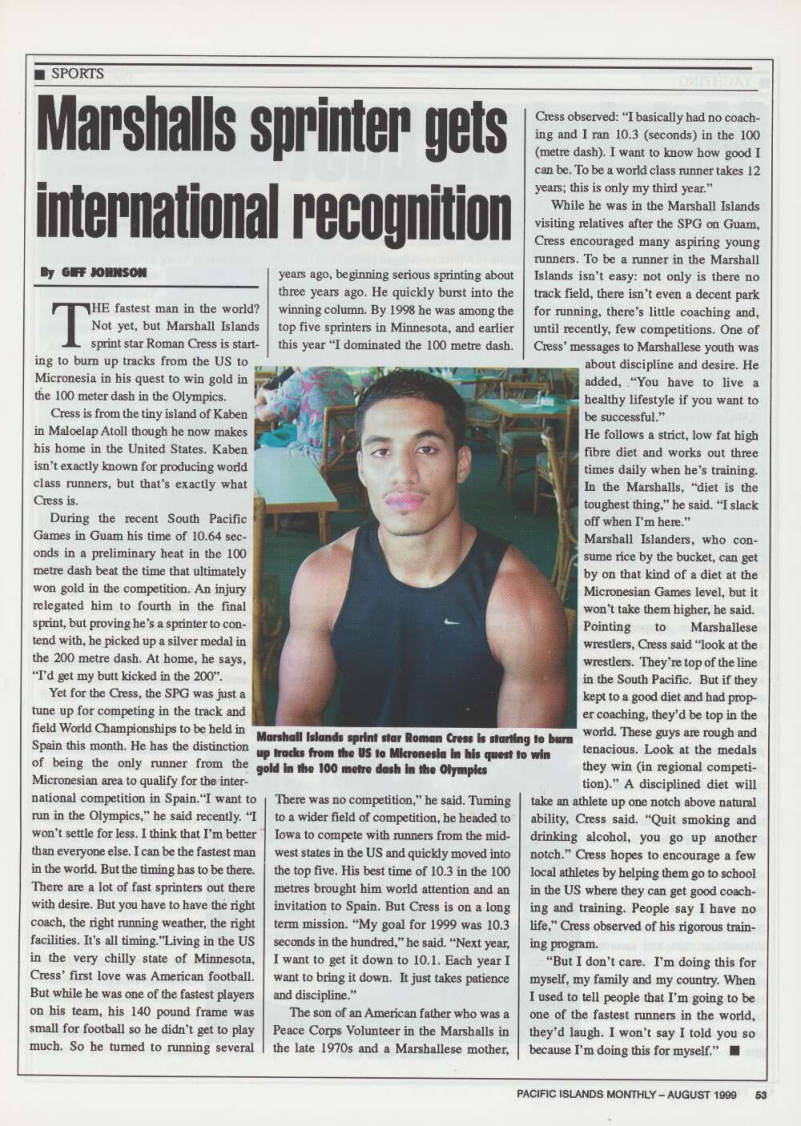
Marshalls sprinter gets international recognition
By Giff Johnson
THE fastest man in the world?
Not yet, but Marshall Islands sprint star Roman Cress is start
ing to bum up tracks from the US to Micronesia in his quest to win gold in the 100 meter dash in the Olympics.
Cress is from the tiny island of Kaben in Maloelap Atoll though he now makes his home in the United States. Kaben isn’t exactly known for producing world class runners, but that’s exactly what Cress is.
During the recent South Pacific Games in Guam his time of 10.64 sec onds in a preliminary heat in the 100 metre dash beat the time that ultimately won gold in the competition. An injury relegated him to fourth in the final sprint, but proving he’s a sprinter to con tend with, he picked up a silver medal in the 200 metre dash. At home, he says, “I’d get my butt kicked in the 200”.
Yet for the Cress, the SPG was just a tune up for competing in the track and I field World Championships to be held in Spain this month. He has the distinction of being the only runner from the Micronesian area to qualify for the inter
national competition in Spain. “I want to run in the Olympics,” he said recently. “I won’t settle for less. I think that I’m better than everyone else. I can be the fastest man in the world. But the timing has to be there.
There are a lot of fast sprinters out there with desire. But you have to have the right coach, the right running weather, the right facilities. It’s all timing.”! .iving in the US in the very chilly state of Minnesota, Cress’ first love was American football.
But while he was one of the fastest players on his team, his 140 pound frame was small for football so he didn’t get to play much. So he turned to running several
years ago, beginning serious sprinting about three years ago. He quickly burst into the winning column. By 1998 he was among the top five sprinters in Minnesota, and earlier this year “I dominated the 100 metre dash.
There was no competition,” he said. Turning to a wider field of competition, he headed to lowa to compete with runners from the mid west states in the US and quickly moved into the top five. His best time of 10.3 in the 100 metres brought him world attention and an invitation to Spain. But Cress is on a long term mission. “My goal for 1999 was 10.3 seconds in the hundred,” he said. “Next year, I want to get it down to 10.1. Each year I want to bring it down. It just takes patience
and discipline.”
The son of an American father who was a Peace Corps Volunteer in the Marshalls in the late 1970 s and a Marshallese mother.
Cress observed: “I basically had no coach ing and I ran 10.3 (seconds) in the 100 (metre dash). I want to know how good I can be. To be a world class runner takes 12 years; this is only my third year.”
While he was in the Marshall Islands visiting relatives after the SPG on Guam, Cress encouraged many aspiring young runners. To be a runner in the Marshall Islands isn’t easy: not only is there no track field, there isn’t even a decent park for running, there’s little coaching and, until recently, few competitions. One of Cress’ messages to Marshallese youth was
about discipline and desire. He added, “You have to live a healthy lifestyle if you want to be successful.”
He follows a strict, low fat high fibre diet and works out three times daily when he’s training.
In the Marshalls, “diet is the toughest thing,” he said. “I slack off when I’m here.”
Marshall Islanders, who con sume rice by the bucket, can get by on that kind of a diet at the Micronesian Games level, but it won’t take them higher, he said.
Pointing to Marshallese wrestlers, Cress said “look at the wrestlers. They’re top of the line in the South Pacific. But if they kept to a good diet and had prop er coaching, they’d be top in the world. These guys are rough and tenacious. Look at the medals they win (in regional competi tion).” A disciplined diet will
take an athlete up one notch above natural ability, Cress said. “Quit smoking and drinking alcohol, you go up another notch,” Cress hopes to encourage a few local athletes by helping them go to school in the US where they can get good coach ing and training. People say I have no life,” Cress observed of his rigorous train ing program.
“But I don’t care. I’m doing this for myself, my family and my country. When I used to tell people that I’m going to be one of the fastest runners in the world, they’d laugh. I won’t say I told you so because I’m doing this for myself.” ■
Marshall Islands sprint star Roman Cress is starting to burn up tracks from the US to Micronesia in his quest to win gold in the 100 metre dash in the Olympics
Molokai or bust
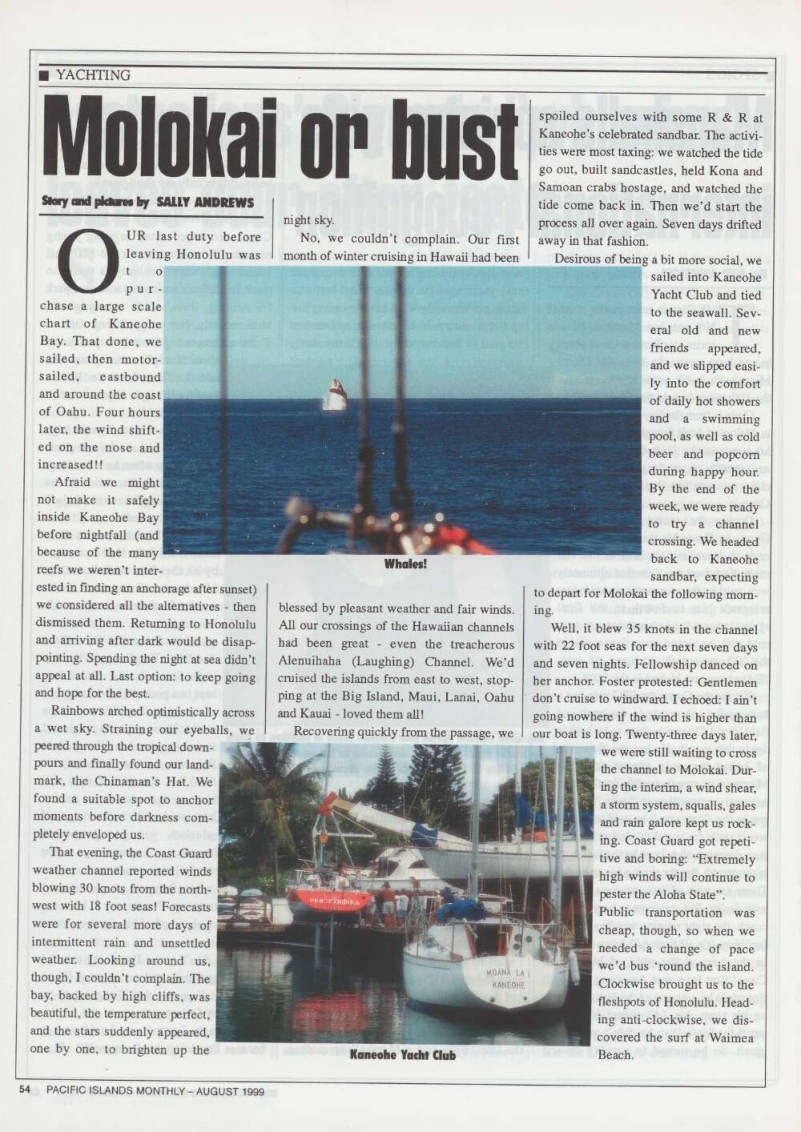
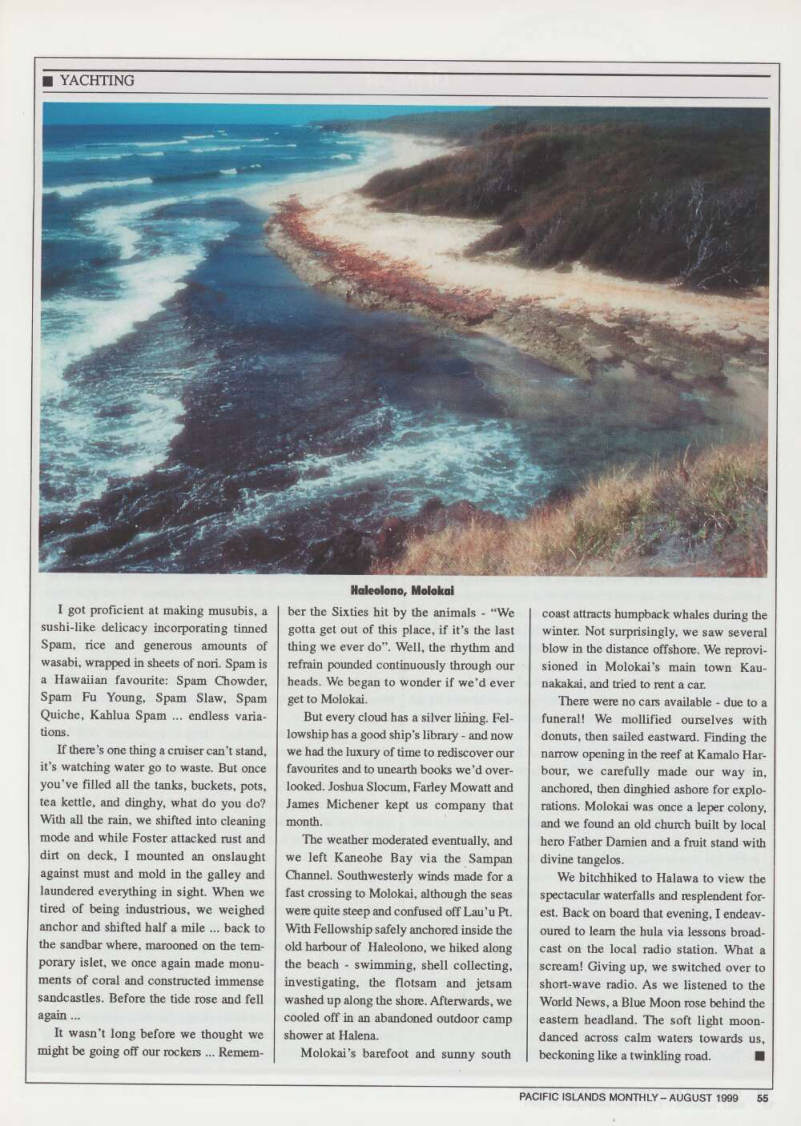
Yachting
Sony aid pictures by SAIIY ANDREWS
OUR last duty before leaving Honolulu was ‘ 0 I pur
chase a large scale chart of Kaneohe Bay. That done, we sailed, then motor sailed, eastbound and around the coast of Oahu. Four hours later, the wind shift ed on the nose and increased!!
Afraid we might not make it safely inside Kaneohe Bay before nightfall (and because of the many ' reefs we weren’t inter
ested in finding an anchorage after sunset) we considered all the alternatives - then dismissed them. Returning to Honolulu and arriving after dark would be disap pointing. Spending the night at sea didn’t appeal at all. Last option: to keep going and hope for the best.
Rainbows arched optimistically across a wet sky. Straining our eyeballs, we
peered through the tropical down pours and finally found our land mark, the Chinaman’s Hat. We found a suitable spot to anchor moments before darkness com pletely enveloped us.
That evening, the Coast Guard weather channel reported winds blowing 30 knots from the north west with 18 foot seas! Forecasts were for several more days of intermittent rain and unsettled weather. Looking around us, though, I couldn’t complain. The bay, backed by high cliffs, was beautiful, the temperature perfect, and the stars suddenly appeared, one by one, to brighten up the
night sky.
No, we couldn’t complain. Our first month of winter cruising in Hawaii had been
blessed by pleasant weather and fair winds.
All our crossings of the Hawaiian channels had been great - even the treacherous Alenuihaha (Laughing) Channel. We’d cruised the islands from east to west, stop ping at the Big Island, Maui, Lanai, Oahu and Kauai - loved them all!
Recovering quickly from the passage, we
spoiled ourselves with some R & R at Kaneohe’s celebrated sandbar. The activi ties were most taxing: we watched the tide go out, built sandcastles, held Kona and Samoan crabs hostage, and watched the tide come back in. Then we’d start the process all over again. Seven days drifted away in that fashion.
Desirous of being a bit more social, we
sailed into Kaneohe Yacht Club and tied to the seawall. Sev eral old and new friends appeared, and we slipped easi ly into the comfort of daily hot showers and a swimming pool, as well as cold beer and popcorn during happy hour.
By the end of the week, we were ready to try a channel crossing. We headed back to Kaneohe
sandbar, expecting
to depart for Molokai the following morn ing.
Well, it blew 35 knots in the channel with 22 foot seas for the next seven days and seven nights. Fellowship danced on her anchor. Foster protested: Gentlemen don’t cruise to windward. I echoed: I ain’t going nowhere if the wind is higher than our boat is long. Twenty-three days later,
we were still waiting to cross the channel to Molokai. Dur ing the interim, a wind shear, a storm system, squalls, gales and rain galore kept us rock ing. Coast Guard got repeti
tive and boring: “Extremely
high winds will continue to pester the Aloha State”.
Public transportation was cheap, though, so when we needed a change of pace we’d bus ‘round the island.
Clockwise brought us to the fleshpots of Honolulu. Head ing anti-clockwise, we dis covered the surf at Waimea Beach.
Whales!
Kaneohe Yacht Club
I got proficient at making musubis, a sushi-like delicacy incorporating tinned Spam, rice and generous amounts of wasabi, wrapped in sheets of nori. Spam is a Hawaiian favourite: Spam Chowder,
Spam Fu Young, Spam Slaw, Spam
Quiche, Kahlua Spam ... endless varia tions.
If there’s one thing a cruiser can’t stand, it’s watching water go to waste. But once you’ve filled all the tanks, buckets, pots, tea kettle, and dinghy, what do you do?
With all the rain, we shifted into cleaning mode and while Foster attacked rust and dirt on deck, I mounted an onslaught against must and mold in the galley and laundered everything in sight. When we tired of being industrious, we weighed anchor and shifted half a mile ... back to the sandbar where, marooned on the tem porary islet, we once again made monu ments of coral and constructed immense sandcastles. Before the tide rose and fell
again...
It wasn’t long before we thought we might be going off our rockers ... Remem
ber the Sixties hit by the animals - “We gotta get out of this place, if it’s the last thing we ever do”. Well, the rhythm and refrain pounded continuously through our heads. We began to wonder if we’d ever get to Molokai.
But every cloud has a silver lining. Fel lowship has a good ship’s library - and now we had the luxury of time to rediscover our favourites and to unearth books we’d over looked. Joshua Slocum, Farley Mowatt and James Michener kept us company that month.
The weather moderated eventually, and we left Kaneohe Bay via the Sampan Channel. Southwesterly winds made for a fast crossing to Molokai, although the seas were quite steep and confused off Lau’u Pt.
With Fellowship safely anchored inside the old harbour of Haleolono, we hiked along the beach - swimming, shell collecting, investigating, the flotsam and jetsam washed up along the shore. Afterwards, we cooled off in an abandoned outdoor camp shower at Halena.
Molokai’s barefoot and sunny south
coast attracts humpback whales during the winter. Not surprisingly, we saw several blow in the distance offshore. We reprovi sioned in Molokai’s main town Kau nakakai, and tried to rent a car.
There were no cars available - due to a funeral! We mollified ourselves with donuts, then sailed eastward. Finding the narrow opening in the reef at Kamalo Har bour, we carefully made our way in, anchored, then dinghied ashore for explo rations. Molokai was once a leper colony, and we found an old church built by local hero Father Damien and a fruit stand with
divine tangelos.
We hitchhiked to Halawa to view the spectacular waterfalls and resplendent for est. Back on board that evening, I endeav oured to learn the hula via lessons broad cast on the local radio station. What a scream! Giving up, we switched over to short-wave radio. As we listened to the World News, a Blue Moon rose behind the eastern headland. The soft light moon danced across calm waters towards us, beckoning like a twinkling road. ■
Haleolono, Molokai
"quality" migrants
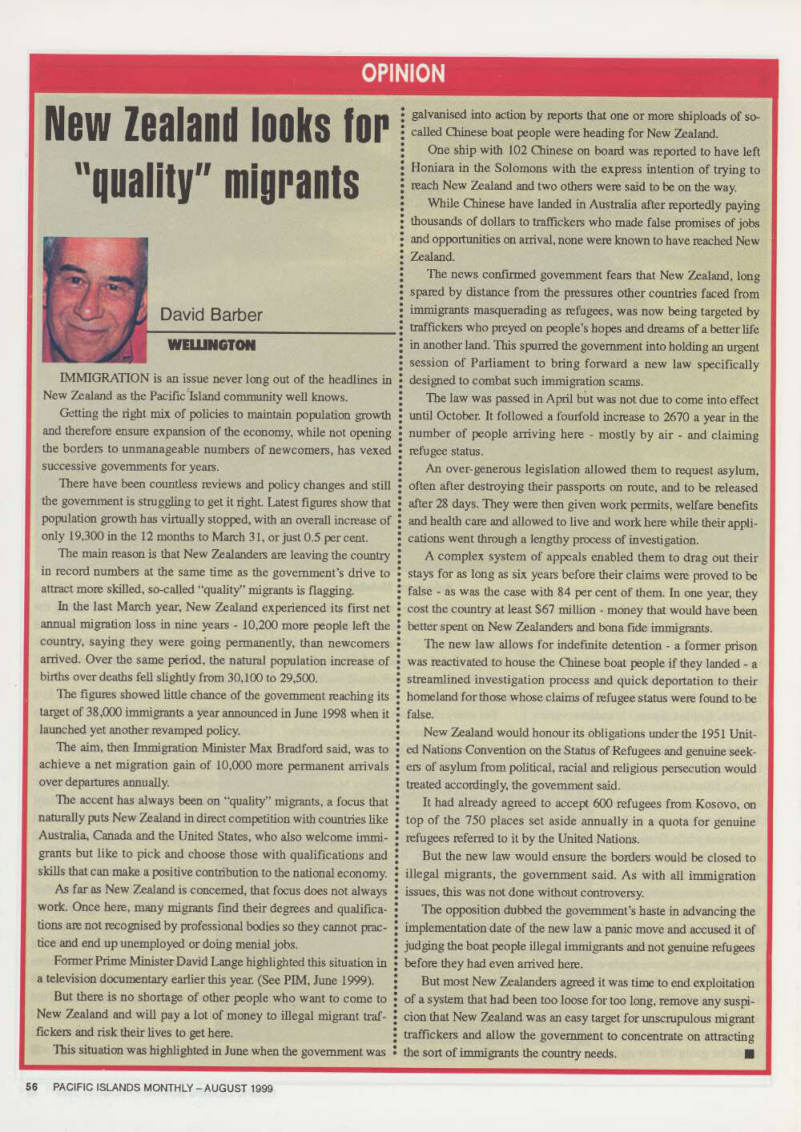
Opinion
New Zealand looks for "quality" migrants
IMMIGRATION is an issue never long out of the headlines in New Zealand as the Pacific Island community well knows.
Getting the right mix of policies to maintain population growth and therefore ensure expansion of the economy, while not opening the borders to unmanageable numbers of newcomers, has vexed successive governments for years.
There have been countless reviews and policy changes and still the government is struggling to get it right. Latest figures show that population growth has virtually stopped, with an overall increase of only 19,300 in the 12 months to March 31, or just 0.5 per cent.
The main reason is that New Zealanders are leaving the country in record numbers at the same time as the government’s drive to attract more skilled, so-called “quality” migrants is flagging.
In the last March year. New Zealand experienced its first net annual migration loss in nine years - 10,200 more people left the country, saying they were going permanently, than newcomers arrived. Over the same period, the natural population increase of births over deaths fell slightly from 30,100 to 29,500.
The figures showed little chance of the government reaching its target of 38,000 immigrants a year announced in June 1998 when it launched yet another revamped policy.
The aim, then Immigration Minister Max Bradford said, was to achieve a net migration gain of 10,000 more permanent arrivals
over departures annually.
The accent has always been on “quality” migrants, a focus that naturally puts New Zealand in direct competition with countries like Australia, Canada and the United States, who also welcome immi grants but like to pick and choose those with qualifications and skills that can make a positive contribution to the national economy.
As far as New Zealand is concerned, that focus does not always work. Once here, many migrants find their degrees and qualifica tions are not recognised by professional bodies so they cannot prac tice and end up unemployed or doing menial jobs.
Former Prime Minister David Lange highlighted this situation in a television documentary earlier this year. (See PIM, June 1999).
But there is no shortage of other people who want to come to New Zealand and will pay a lot of money to illegal migrant traf fickers and risk their fives to get here.
This situation was highlighted in June when the government was
galvanised into action by reports that one or more shiploads of so called Chinese boat people were heading for New Zealand.
One ship with 102 Chinese on board was reported to have left Honiara in the Solomons with the express intention of trying to reach New Zealand and two others were said to be on the way.
While Chinese have landed in Australia after reportedly paying thousands of dollars to traffickers who made false promises of jobs and opportunities on arrival, none were known to have reached New Zealand.
The news confirmed government fears that New Zealand, long spared by distance from the pressures other countries faced from immigrants masquerading as refugees, was now being targeted by traffickers who preyed on people’s hopes and dreams of a better life in another land. This spurred the government into holding an urgent session of Parliament to bring forward a new law specifically designed to combat such immigration scams.
The law was passed in April but was not due to come into effect until October. It followed a fourfold increase to 2670 a year in the number of people arriving here - mostly by air - and claiming
refugee status.
An over-generous legislation allowed them to request asylum, often after destroying their passports on route, and to be released after 28 days. They were then given work permits, welfare benefits and health care and allowed to five and work here while their appli cations went through a lengthy process of investigation.
A complex system of appeals enabled them to drag out their stays for as long as six years before their claims were proved to be false - as was the case with 84 per cent of them. In one year, they cost the country at least $67 million - money that would have been better spent on New Zealanders and bona fide immigrants.
The new law allows for indefinite detention - a former prison was reactivated to house the Chinese boat people if they landed - a streamlined investigation process and quick deportation to their homeland for those whose claims of refugee status were found to be false.
New Zealand would honour its obligations under the 1951 Unit ed Nations Convention on the Status of Refugees and genuine seek ers of asylum from political, racial and religious persecution would treated accordingly, the government said.
It had already agreed to accept 600 refugees from Kosovo, on top of the 750 places set aside annually in a quota for genuine refugees referred to it by the United Nations.
But the new law would ensure the borders would be closed to illegal migrants, the government said. As with all immigration issues, this was not done without controversy.
The opposition dubbed the government’s haste in advancing the implementation date of the new law a panic move and accused it of judging the boat people illegal immigrants and not genuine refugees before they had even arrived here.
But most New Zealanders agreed it was time to end exploitation of a system that had been too loose for too long, remove any suspi cion that New Zealand was an easy target for unscrupulous mi grant traffickers and allow the government to concentrate on attracting the sort of immigrants the country needs. ■
David Barber
Wellington
Alarming new greenhouse research
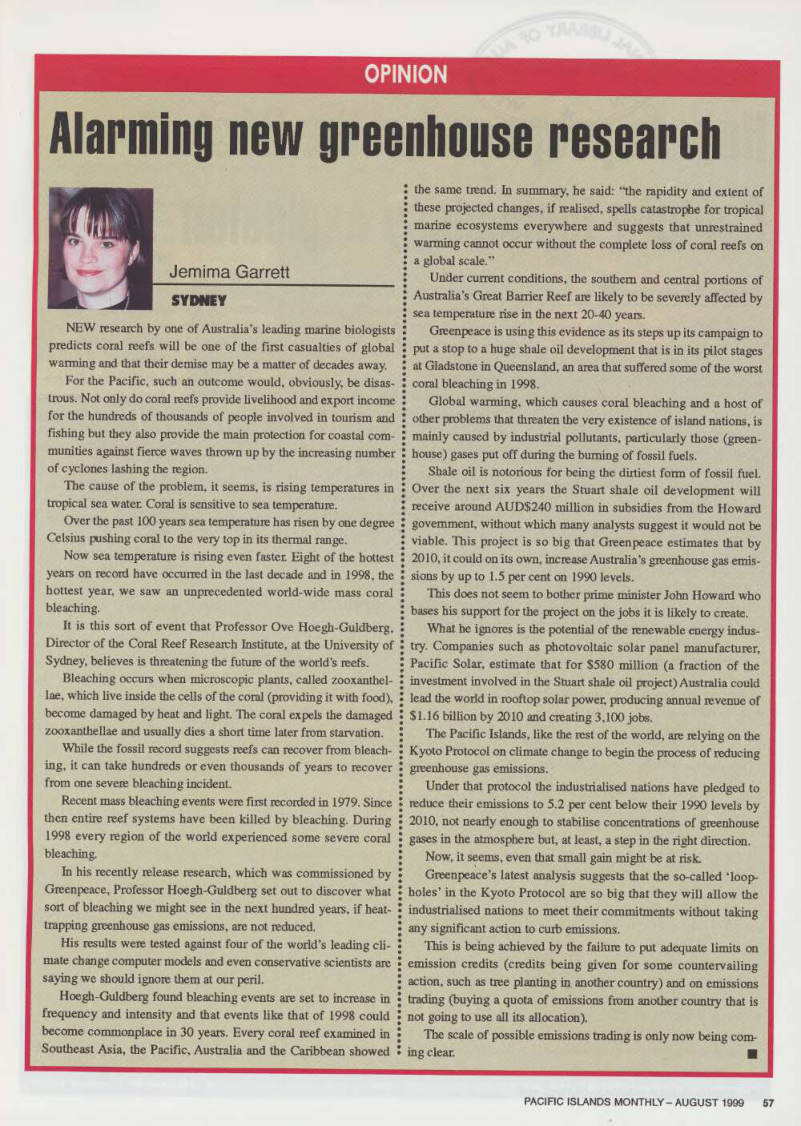
NEW research by one of Australia’s leading marine biologists predicts coral reefs will be one of the first casualties of global warming and that their demise may be a matter of decades away.
For the Pacific, such an outcome would, obviously, be disas trous. Not only do coral reefs provide livelihood and export income for the hundreds of thousands of people involved in tourism and fishing but they also provide the main protection for coastal com munities against fierce waves thrown up by the increasing number of cyclones lashing the region.
The cause of the problem, it seems, is rising temperatures in tropical sea water. Coral is sensitive to sea temperature.
Over the past 100 years sea temperature has risen by one degree Celsius pushing coral to the very top in its thermal range.
Now sea temperature is rising even faster Eight of the hottest years on record have occurred in the last decade and in 1998, the hottest year, we saw an unprecedented world-wide mass coral
bleaching.
It is this sort of event that Professor Ove Hoegh-Guldberg, Director of the Coral Reef Research Institute, at the University of Sydney, believes is threatening the future of the world’s reefs.
Bleaching occurs when microscopic plants, called zooxanthel lae, which live inside the cells of the coral (providing it with food), become damaged by heat and light. The coral expels the damaged zooxanthellae and usually dies a short time later from starvation.
While the fossil record suggests reefs can recover from bleach ing, it can take hundreds or even thousands of years to recover from one severe bleaching incident.
Recent mass bleaching events were first recorded in 1979. Since then entire reef systems have been killed by bleaching. During 1998 every region of the world experienced some severe coral
bleaching.
In his recently release research, which was commissioned by Greenpeace, Professor Hoegh-Guldberg set out to discover what sort of bleaching we might see in the next hundred years, if heat trapping greenhouse gas emissions, are not reduced.
His results were tested against four of the world’s leading cli mate change computer models and even conservative scientists are saying we should ignore them at our peril.
Hoegh-Guldberg found bleaching events are set to increase in frequency and intensity and that events like that of 1998 could become commonplace in 30 years. Every coral reef examined in Southeast Asia, the Pacific, Australia and the Caribbean showed
the same trend. In summary, he said: “the rapidity and extent of these projected changes, if realised, spells catastrophe for tropical marine ecosystems everywhere and suggests that unrestrained warming cannot occur without the complete loss of coral reefs on a global scale.”
Under current conditions, the southern and central portions of Australia’s Great Barrier Reef are likely to be severely affected by sea temperature rise in the next 20-40 years.
Greenpeace is using this evidence as its steps up its campaign to put a stop to a huge shale oil development that is in its pilot stages at Gladstone in Queensland, an area that suffered some of the worst coral bleaching in 1998.
Global warming, which causes coral bleaching and a host of other problems that threaten the very existence of island nations, is mainly caused by industrial pollutants, particularly those (green house) gases put off during the burning of fossil fuels.
Shale oil is notorious for being the dirtiest form of fossil fuel.
Over the next six years the Stuart shale oil development will receive around AUDS24O million in subsidies from the Howard government, without which many analysts suggest it would not be viable. This project is so big that Greenpeace estimates that by 2010, it could on its own, increase Australia’s greenhouse gas emis sions by up to 1.5 per cent on 1990 levels.
This does not seem to bother prime minister John Howard who bases his support for the project on the jobs it is likely to create.
What he ignores is the potential of the renewable energy indus try. Companies such as photovoltaic solar panel manufacturer, Pacific Solar, estimate that for SSBO million (a fraction of the investment involved in the Stuart shale oil project) Australia could lead the world in rooftop solar power, producing annual revenue of $1.16 billion by 2010 and creating 3,100 jobs.
The Pacific Islands, like the rest of the world, are relying on the Kyoto Protocol on climate change to begin the process of reducing greenhouse gas emissions.
Under that protocol the industrialised nations have pledged to reduce their emissions to 5.2 per cent below their 1990 levels by 2010, not nearly enough to stabilise concentrations of greenhouse gases in the atmosphere but, at least, a step in the right direction.
Now, it seems, even that small gain might be at risk.
Greenpeace’s latest analysis suggests that the so-called ‘loop holes’ in the Kyoto Protocol are so big that they will allow the industrialised nations to meet their commitments without taking any significant action to curb emissions.
This is being achieved by the failure to put adequate limits on emission credits (credits being given for some countervailing action, such as tree planting in another country) and on emissions trading (buying a quota of emissions from another country that is not going to use all its allocation).
The scale of possible emissions trading is only now being com ing clear. ■
Jemima Garrett
Sydney
Advertisements & other items, pp. 58-60 (2 items)
Century technology explosion
58
PACIFIC ISLANDS MONTHLY - AUGUST 1999
Continued from page 35
How to imepare for the 21 st Century technology explosion
■ BUSINESS
r. i-'V*. s— -i-'V - ,
■- V / 0 ; —r ‘ a '<f . •v* nt: Photos : Marit - Pantz - Trompas » D O _A_ I ; ■: .
"■■- • ' • • New Caledonia is a developped, sophisticated island business base that offers outstanding opportunities for investors : stunning sites for new hotel developments, suitable climate for counterseason fruits, vegetables and tropical flowers, superb locations for fish and prawn aquaculture, and more. Authorities in New Caledonia are very supportive to business. - ADECAL, the Economic Development Agency of New Caledonia, is the one-stop shop where investors can get specific advice on doing business in New Caledonia.
As your free-of-charge partner, we shall assist you in identifying opportunities and putting together your project successfully.
Should you like to receive further information, please do not hesitate to contact either Vann PITOLLET or Benoit RENGADE.
E-mail: [email protected] a r r* a i
/ V LX V I
New Caledonia Economic Development Bureau 15, rue Guynemer - PO Box 2384 - 98846 Noumea Cedex - New Caledonia ■ Phone: (687) 249 077 - Fax: (687) 249 087 - E-mail: [email protected] >2BepT 1998 . (687) 275 566
M i q
Frc,
- r -:. • ...
2 . SH’eUNES
KWi *jg sibr. , kS* :-# n
No challengers -
Toyota Land Cruiser stays on top
Toyota Land Cruiser 100 dominates the world of 4x4s. None other can match its.robust power,
provided by superior engine technology.
It gives breathtaking performance, backed by an amazingly rugged suspension that can take you anywhere you want to go, on road or off.
Nevertheless, riding in a Toyota Land Cruiser 100 is like travelling in a luxurious sedan. Its more than ample room inside contains all the comforts and conveniences you'd expect of a winner.
Remember this. Only Toyota's advanced technology can create the symphony of power, performance, and lavish comfort you find in Land Cruiser 100. No wonder it's the champion. Again. mm
STATION WAGON
DISTRIBUTORS/DEALERS
NORFOLK ISLAND BORRY’S PTYLTD. PH 22114
SOLOMON ISLANDS ELA MOTORS PH 30314
VANUATU ASCO MOTORS PH 22341
COOK ISLANDS PACIFIC MOTORS LTD. PH 20700
<sg) TOYOTA
KIRIBATI TARAWA MOTORS PH 21090
PAPUA NEW GUINEA ELA MOTORS PH 3229400
TAHITI NIPPON AUTOMOTO PH 429819
SAMOA ASCO MOTORS PH 20800
FIJI ASCO MOTORS PH 384888
NEW CALEDONIA S LAP. PH 275562
TONGA ASCO MOTORS PH 23500
AMERICAN SAMOA ASCO MOTORS PH 633-4281