Logging

Pacific Islands
Monthly
Samoa’s marchers keep up the pressure
March 1998
Logging
j ’ ; ,v; ". -• • - -4••-••-■- ■ : The axe falls
Port Vila Riot:
Now The Aftermath
American Samoa US$2 50: Australia AS3 50: Cook Islands NZS3; Fiji F 58.50 Vat me!: FS Micronesia USS 3: Kiribati A 52.50: Nauru A 52.50; Niue NZ$3; Norfolk ASS; New Caledonia epKSO: Mini Zealand NFS. 5 45 tool GSI: Northern Mananas US$3. Papua New Guinea K 3; Patau USS 3: Marshall islands US$3; Solomon islands ASS: French Polynesia cpfSOO; Tonga P 3; USA US$3: Vanuatu VT22O; Western Samoa 15.50, These are recommended prices only.
Advertisements & other items, p. 2 (1 item)
{U}F Telikom Png
M Hmv p i
mCr%
0 n 2 m '1 M t \rX *• K.
I J v y ■ «?;/; ft «ay Ml P I ... x: ■w- * m m ill K ] •m.-* . . * JF i ! 'M ' f . - We accept For further Information please contact:
VISA
m Tellkom Phone Card Sales Pay Phone Business Unit PO Box 361 Waigani, NCD Papua New Guinea Jmt quote ym card number snd expiry date end we will terward your requirement!, Telephone: (675) 300 6093 Facsimile: (875) 3005060
{U}f TELIKOM PNG
%y aAiuu to&’r is- rt&erUq inttUruj /
Pacific Islands
Monthly
Vol 69 No. 3
The News Magazine
March 1998
PUBLISHER: Alan Robinson ACTING EDITOR: Bernadette Hussain SENIOR WRITER: Bernadette Hussain
Correspondents:
Sally Andrew, Patrick Decloitre, Giff Johnson. Chris Peteru, Susan Prokop, Atama Raganivatu, Michael Field, Liz Thompson, Lili Tuwai, Sam Vulum, lan Williams COLUMNISTS: David Barber (Wellington), Jemima Garrett (Sydney), Debbie Singh (South Pacific Commission).
GRAPHIC ARTISTS: James Ranuku, Josefa Bola, Andrew Williams
Advertising Sales
Senior Regional Sales (South Pacific) Shabana Naaz Kailesh Kumar Tel (679) 304111,303244, Fax (679) 303809.
Sydney, Canberra: Bob Hill Media Representation. Tel (61-2) 4164245, Fax (61-2)4165064.
Brisbane: Jane Fewings Media and Advertising Associates Tel (61-7) 3378 4522, Fax (61-7)3878 1071.
Adelaide: Hastwell Williamsons Representatives, Tel (61-8) 3799522, Fax (61-8) 3799735.
Melbourne: Brown Orr Fletcher Burrows (Aust) Pty Ltd.
Tel (61-3) 98265188, Fax (61-3) 98265644.
Auckland: McKay & Bowman, International Media Representatives Limited, Tel (64-9)4190561, Fax (64-9)4192243.
Japan: Universal Media Corporation. Tokyo, Tel (3) 3266626741, Cable: UNI-MEDIA Tokyo, Fax (3) 32626742.
Pacific Islands Monthly was founded in 1930
(Usps 9522480).
A Fiji Times Limited production.
Cover prices are recommended retail only. Registered by Australia Post, Publication No. NBPI2IO. © Copyright Fiji Times Limited, 177 Victoria Parade, Suva, Fiji.
Tel (679) 304111, fax (679) 303809.
Email: [email protected]
PIM Website: http://www.pim.com.fj Pacific Islands Monthly is published monthly by Fiji Times Limited, a division of Nationwide News, 2 Holt Street, Surry Hills, Sydney, NSW 2010.
Send Address Changes To:
Pacific Islands Monthly PO Box 1167 Suva, Fiji.
Typeset and printed by The Fiji Times Limited, 177 Victoria Parade, Suva, Fiji.
Layout and cover design by Andrew Williams
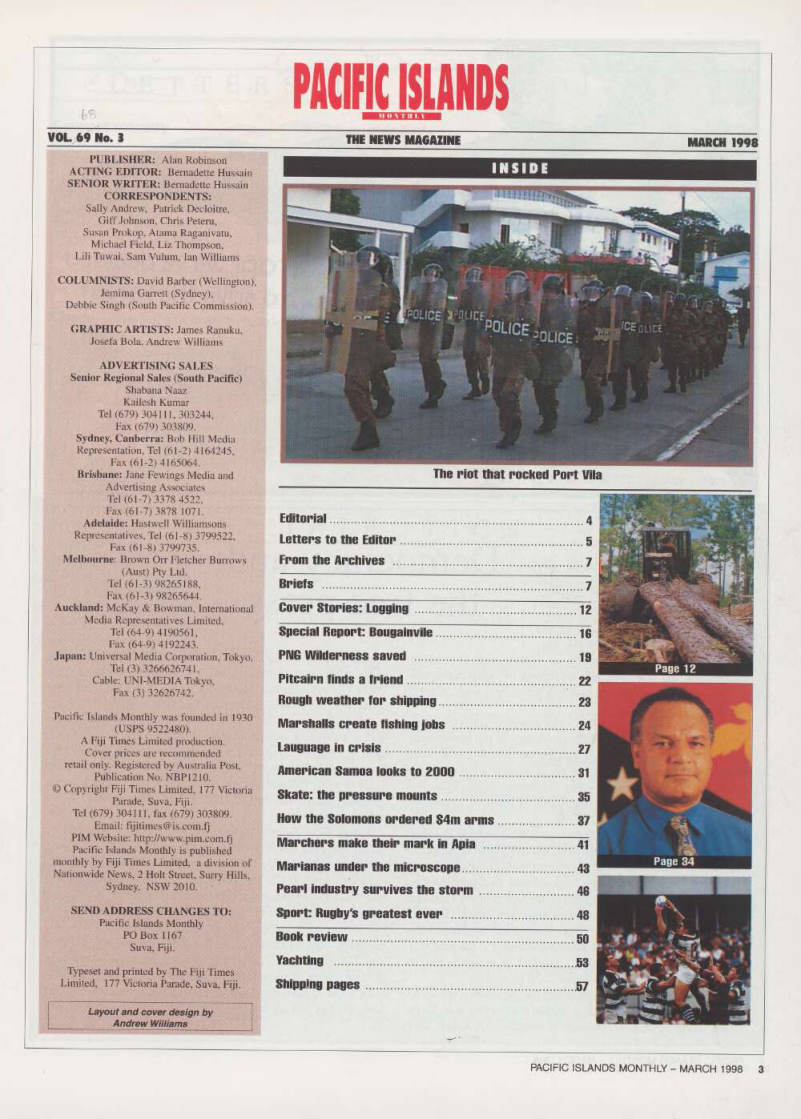
Inside
Editorial 4 Letters to the Editor 5 From the Archives 7 Briefs 7 Cover Stories: Logging 12 Special Report: Bougainvile 16 PNG Wilderness saved 19 Pitcairn finds a friend 22 Rough weather for shipping 23 Marshalls create fishing jobs 24 Lauguage in crisis 27 American Samoa looks to 2000 31 Skate: the pressure mounts 35 How the Solomons ordered s4m arms 37 Marchers make their mark in Apia 4T Marianas under the microscope 43 Pearl industry survives the storm 46 Sport: Rugby's greatest ever 48 Book review 50 Yachting 53 Shipping pages 57
Page 12
Page 34
The riot that rocked Port Vila
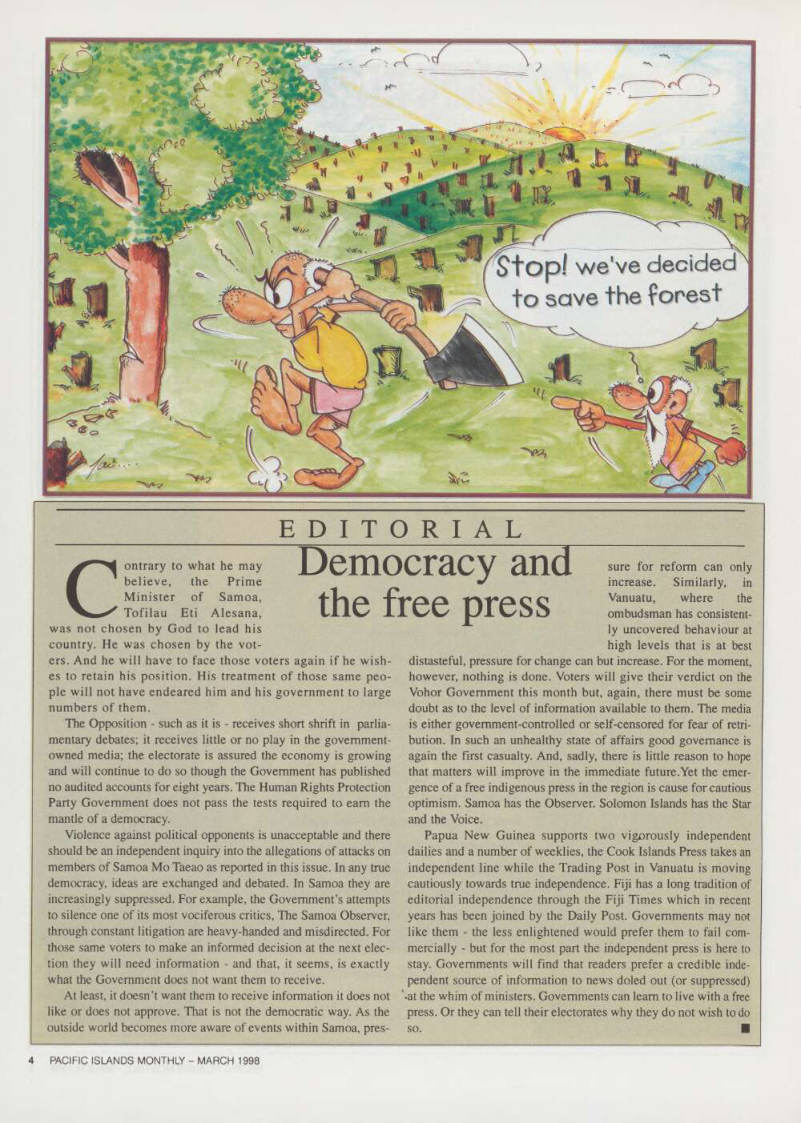
Democracy and
Editorial
Democracy and the free press
Contrary to what he may believe, the Prime Minister of Samoa, Tofilau Eti Alesana, was not chosen by God to lead his country. He was chosen by the vot
ers. And he will have to face those voters again if he wish es to retain his position. His treatment of those same peo ple will not have endeared him and his government to large numbers of them.
The Opposition - such as it is - receives short shrift in parlia mentary debates; it receives little or no play in the government owned media; the electorate is assured the economy is growing and will continue to do so though the Government has published no audited accounts for eight years. The Human Rights Protection Party Government does not pass the tests required to earn the mantle of a democracy.
Violence against political opponents is unacceptable and there should be an independent inquiry into the allegations of attacks on members of Samoa Mo Taeao as reported in this issue. In any true democracy, ideas are exchanged and debated. In Samoa they are increasingly suppressed. For example, the Government’s attempts to silence one of its most vociferous critics, The Samoa Observer, through constant litigation are heavy-handed and misdirected. For those same voters to make an informed decision at the next elec tion they will need information - and that, it seems, is exactly what the Government does not want them to receive.
At least, it doesn’t want them to receive information it does not like or does not approve. That is not the democratic way. As the outside world becomes more aware of events within Samoa, pres
sure for reform can only increase. Similarly, in Vanuatu, where the ombudsman has consistent ly uncovered behaviour at high levels that is at best
distasteful, pressure for change can but increase. For the moment, however, nothing is done. Voters will give their verdict on the Vohor Government this month but, again, there must be some doubt as to the level of information available to them. The media is either government-controlled or self-censored for fear of retri bution. In such an unhealthy state of affairs good governance is again the first casualty. And, sadly, there is little reason to hope that matters will improve in the immediate future. Yet the emer gence of a free indigenous press in the region is cause for cautious optimism. Samoa has the Observer. Solomon Islands has the Star and the Voice.
Papua New Guinea supports two vigorously independent dailies and a number of weeklies, the Cook Islands Press takes an independent line while the Trading Post in Vanuatu is moving cautiously towards true independence. Fiji has a long tradition of editorial independence through the Fiji Times which in recent years has been joined by the Daily Post. Governments may not like them - the less enlightened would prefer them to fail com mercially - but for the most part the independent press is here to stay. Governments will find that readers prefer a credible inde pendent source of information to news doled out (or suppressed) •at the whim of ministers. Governments can leam to live with a free press. Or they can tell their electorates why they do not wish to do so. ■
Garment Industry
Dear Madam Prof Ron Duncan’s letter (PIM January) regretfully reflects the view of an academ ic which lacks the knowledge on what
really happens in the market place
“SPARTECA” was formed way back in 1982 to give countries in the Forum group an opportunity of providing employment for their peoples with the knowledge that any development in this region could well be at the expense of jobs in Australia and New Zealand.
They had to pick “Labour Intensive Industries” to soak up this labour and of course they chose, among others, the high est labour intensive industry, that being the
clothing industry.
One should be in no doubt whatsoever that without the benefits of SPARTECA there would not be the clothing industry that exists today in Fiji.
The clothing industry, in Fiji comprises
about 70 firms employing in all about 14,000. Some 25 per cent of these firms are very efficient and have used the oppor tunities under SPARTECA to become more world competitive and are now exporting to the USA and Europe.
The remainder are still below world competitive standards and will find it pro gressively harder to compete as duties are reduced on clothing imports into Australia and New Zealand from non Forum Group countries.
The only short term “saving grace’” that these firms have is that provided they remain reasonably competitive and pro vide a quick turnover service to Australia and New Zealand, a service that is not available from our near Asian neighbours, the longer they will be able to remain in business.
But eventually the hot breath of Asian competition will force them to become more world competitive.
Philip M Levy
TCF Consultant Brisbane.
Talk to me
Dear Sir My name is Sam Ward. I am 43 years
old and I am totally blind.
However, even without sight I am aware of the beauty of the Pacific Ocean and many of the island nations that dot the area. I am anxious to leam more about a number of South Pacific nations.
I have always felt that one of the best ways to leam about an area is to talk with the people who live there. I am looking for people that would be willing to correspond with me on cassette tape in the following locations; American and Western Samoa, the Cook and Solomon Islands, Kiribati, Christmas and Easter Islands, Fiji (both Suva and Nadi), Port Moresby, Wewak, Rabaul if there is anything still left of it and Mount Hagen, PNG, New Caledonia, Palau, Tonga, Tuvalu, Tahiti and Vanuatu.
I am especially interested in hearing local radio programmes on tape, especially any news and weather bulletins that might be broadcast in English.
I am also very interested in hearing some of the island music that is so popular in that part of the world. I am especially interested in hearing recordings of Radio Cook Islands and- Radio Ikerangi from Avarua, the SIBC from Honiara, Radio Tonga channels 1 and 2, VLU2 from Christmas Island, Radio Kiribati, Radio Vanuatu and 98 FM from Port Vila, the NBC from PNG and some recordings of
Fijian radio.
In short, I am interested in hearing any local radio programme that you think would give me an idea of the local flavour, atmosphere and personality of your coun try or city. I would also like to hear sam ples of the various Pidgin dialects that are spoken throughout the South Pacific since linguistics is another interest of mine.
I also have a very intense interest in geography. I have not been able to locate any braille maps that give a good picture of this vast area of the South Pacific. My only braille map is from 1938 and it is very incorrect and incomplete.
I would like to know how many of these South Pacific cities are laid out geographi cally. In other words, what is the general shape of each city?
What are the names of the two streets at the main intersection of town or don’t these cities have a city centre or downtown area?
What are the most prominent or impor
tant buildings in each city?
And what are the names of some of the department stores, restaurants and hotels?
What gives each city its own distinctive character, in other words, what distinguish es Avarua from Honiara from Nuku’alofa from Port Vila? And what is the population of each city?
I am also putting together a computer database of all the weather bureau tele phone numbers of the world, as well as telephone numbers you can call to get a recorded weather forecast.
I know that very few cities in the South Pacific have automatic telephone weather recording numbers but I would like to know the phone numbers for the weather offices in cities like Apia, Bonriki, Palau, Tuvalu as well as Suva and Nadi, Fiji.
I am sure that for some of you, talking into a microphone may at first seem like a frightening experience but you don’t have to fill up the whole tape with talking.
The nice thing is that you can include sounds of the street, radio, music and of course you can always read both news items and even the local advertisements from your local newspaper. That would interest me very much indeed!
Once you have tried tape corresponding I think you’ll agree with me that it is a very friendly and personal way to correspond.
Obviously for me as a blind person I prefer tapes as opposed to printed letters.
And perhaps some of you English teachers out there could turn this request into a class project. I hope through this article to make some new friends from the South Pacific.
No one can have too many friends in this world and I hope to learn something about the culture, history and geography of an area of the world that has truly captivat ed and fascinated me for many years.
Thanks so much for publishing this letter.
Sam Ward
10, Guelph Street Georgetown, ON
L7G 3Y9
Canada
A state of war

Dear Madam Despite repeated overtures to the
United States Congress and the Clinton administration for a peaceful settlement of claims, a state of war continues to exist over control of the atoll commonly referred to as Wake Island.
The weapons employed in this icold wari are pen and paper. The battleground is framed over a legacy of more than 2000 years of ownership, use and control by Marshallese ancestors of King Murjel Hermios, First Monarch of the Kingdom and Paramount Chief of the Northern Atolls of the Ratak Archipelago. The bat tle formally began in 1993.
Over the course of the decade, the Kingdom has established its autonomy by asserting allodial and traditional rights of the King under universal principles of human rights, the common law, interna tional law and articles of the United Nations Charter.
No threat has been made to the security of the United States and no resistance has been encountered. A similar atmosphere of disregard by world news and other media reverberates hollow. In fact, ide fac to! recognition via correspondence from U.S. agencies and officials and diplomatic
recognition from foreign states during the
past four years would fill a volume.
The government of the Kingdom is in possession of substantial assets it is willing to market to secure funding for peaceful settlement of the conflict with the United States. They are available to be used as col lateral to secure a development loans or to be converted to negotiable financial instru ments. Prime banks in Pacific Rim nations, Europe or South America are now encour aged to assist the government of the Kingdom with their development through one of the following: 1. Debt Collateralization - a very sub stantial debt has been perfected against the United States Department of Interior in the hundreds of millions (US). 2. Treasury Bill - a bill in the amount of 3.7 million (US) is available for immediate
funding.
3. Contract Obligation - under a treaty with a South Pacific state, a contract was signed in which the Kingdom will receive 10% of all revenue derived from a major commercial and financial development project in the North Pacific. 4. War Bonds - the Kingdom has a pro
gram to issue bearer bonds backed by assets or gold and traded in world markets outside U.S. jurisdiction. 5. Gold Stamps - the inaugural issue of gold stamps is in the final stages of pro duction.
Several remarkably unique features are designed into the stamps to make them very collectible and affordable. Sales are based on daily fix on the New York exchange market for gold bullion. 6. Programs - specific developments include: a) international spaceport b) international free trade zone c) fisheries d) maritime services e) mineral exploration and recovery f) satellite and telecommunications g) nuclear waste eradication h) financial, trust and fiduciary services For more information, see the web site of the Kingdom: http:!/www.enenkio.wakeis land.org Please direct specific inquiries for particulars to the USA Legation of the Kingdom by phone or fax, or mail to Post Office Box 8441, Honolulu, Hawaii, USA 96830. U
Advertisements & other items, p. 6 (2 items)
L E Tters To The Editor
Round Tea Bags
Specially selected teas from the highlands of PNG,blended to give a smooth and satisfying cup of tea. wm ■ ■ i mr M W 1
WARREN PLANTATION
SB SB (MI HAGEN > PTY LTD fr P.O. Box 95, Mt Hagen Papua New Guinea Telephone: 545 1335 Fax: 545 1239
From The Archives
August 1944
Award for heroism Lieutenant W. J. Read, RANVR, for merly an assistant district officer in New Guinea, was awarded the American Distinguished Cross for “extraordinary heroism in action”. The award was made while Lieutenant Read was in Bougainville.
New bishop
The Right Rev Victor Foley was conse crated as Vicar Apostolic of Fiji on August 6. The consecrating prelate was the Right Rev Joseph Damand, Vicar Apostolic of Samoa. The Vicar Apostolic of the Northern Solomons, the Right Rev Thomas Wade, and the Vicar Apostolic of New Caledonia, the Right Rev Edward
Pacifist wb
Bresson also took part in the cere mony.
Seabees fame The fame of the American Seabees (naval construc tion battalion) is as great in the
Gilberts as it is in the Solomons, says Mr Harold Copper back in Suva, Fiji, after a tour of the Gilbert and Ellice Islands.
It was the Seabees who cleaned up the mess on Betio (Tarawa) and converted it, within a few days, into a ready-for-use American base. Betio today is so shorn of its coconuts as to be little rfiore than a flat coral platform.
Lunching with some American officers, Mr Cooper said they complained bitterly of the monotonous flatness of the atoll on which fate and the army has seen fit to cast them.
“Hell,” was the comment of one bored officer, “why don’t we get the Seabees to build us a mountain?”
Possible cure for malaria American scientists think they may have discovered a cure for malaria. For security reasons the nature of the drug is entirely hush-hush and it is believed at this stage that the treatment contains an ele ment of danger.
The scientists have been aided by vol unteers from the Atlanta (Georgia) peni tentiary who allowed themselves to be infected by anopheles mosquitoes.
These experiments were considered necessary because neither quinine nor atre bin effect a complete cure for malaria and the new drug might revolutionise treatment in combat areas. ■
Briefs
Six charged over deaths of five women Six men face murder charges over the deaths of five women suspected of witchcraft after the deaths of a number of people and animals at Navi village near Goroka in the Papua New Guinea’s high lands.
The women were hacked to death or strangled.
Arms shipments arrive Three containers of military equipment arrived in Honiara despite repeated attempts by the Solomon Islands Government to have them stopped.
The Prime Minister Bartholomew Ulufa’alu had asked Australia and New Zealand to intercept the shipments ordered by his predecessor Solomon Mamaloni. (see page 36).
Car dealers welcome import duty relief The Fiji Motor Traders Association welcomed finance minister Jim Ah Koy’s decision to reduce import duty on new vehicles.
The association spokesman Nitish Niranjan said the January devaluation of the Fiji dollar had had a devastating effect on the industry.
Employees warned over poker machines American Samoa’s senate president Lutu Fuimaono warned employees found playing poker machines that they would be sacked.
The warning applied whether or not the workers were playing the machines on their own time.
Call to dump big spenders
The Tebbutt-Times opinion poll in Fiji
found that the majority of people believed that ministers or senior civil servants should be sacked or demoted for over
spending their budgets.
Record number of candidates A record 220 applications had been received when nominations of candidates in Vanuatu’s March 6 general election closed.
Independents top the list with 63 candi
dates, while nine political parties are con testing the poll.
Passengers grounded
Air Nauru passengers had to be re-rout ed to their destinations after their flight was grounded in The Philippines.
The flight, which was grounded for 12 days, mostly affected travellers heading for Nauru and Kiribati. ■
Advertisements & other items, p. 7 (1 item)
INVESTOR seeks business
opportunity in Pacific region.
With established progressive islands company.
Offering considerable expertise in Heavy Engineering Procurement, Automotive, Marine & Hardware.
Good computer skills.
All proposals to Brian Chariton, NZ. Fax: 64 6 876-0363/9745. 102262V3
The Vneproit
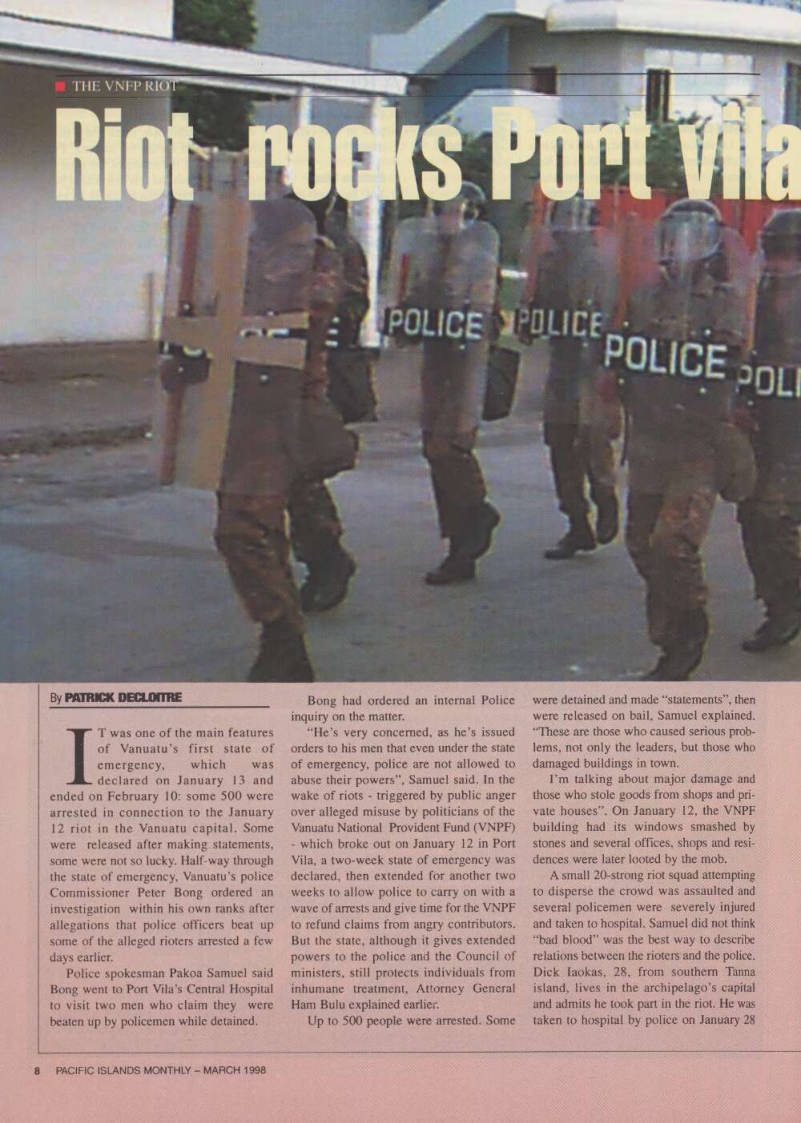
Riot rocks Port vila
By Patrick Decloitre
IT was one of the main features of Vanuatu’s first state of emergency, which was declared on January 13 and ended on February 10: some 500 were arrested in connection to the January 12 riot in the Vanuatu capital. Some were released after making statements, some were not so lucky. Half-way through the state of emergency, Vanuatu’s police Commissioner Peter Bong ordered an investigation within his own ranks after allegations that police officers beat up some of the alleged rioters arrested a few days earlier.
Police spokesman Pakoa Samuel said Bong went to Port Vila’s Central Hospital to visit two men who claim they were beaten up by policemen while detained.
Bong had ordered an internal Police inquiry on the matter.
“He’s very concerned, as he’s issued orders to his men that even under the state of emergency, police are not allowed to abuse their powers”, Samuel said. In the wake of riots - triggered by public anger over alleged misuse by politicians of the Vanuatu National Provident Fund (VNPF) - which broke out on January 12 in Port Vila, a two-week state of emergency was declared, then extended for another two weeks to allow police to carry on with a wave of arrests and give time for the VNPF to refund claims from angry contributors.
But the state, although it gives extended powers to the police and the Council of ministers, still protects individuals from inhumane treatment, Attorney General Ham Bulu explained earlier.
Up to 500 people were arrested. Some
were detained and made “statements”, then were released on bail, Samuel explained.
“These are those who caused serious prob lems, not only the leaders, but those who damaged buildings in town.
I’m talking about major damage and those who stole goods from shops and pri vate houses”. On January 12, the VNPF building had its windows smashed by stones and several offices, shops and resi dences were later looted by the mob.
A small 20-strong riot squad attempting to disperse the crowd was assaulted and several policemen were severely injured and taken to hospital. Samuel did not think “bad blood” was the best way to describe relations between the rioters and the police.
Dick laokas, 28, from southern Tanna island, lives in the archipelago’s capital and admits he took part in the riot. He was taken to hospital by police on January 28
with a broken jaw. He claims he was beat en by policemen after being arrested earli er at his home in the shanty town of Blacksands, home to this island communi ty. “They took me to the prison and they started hitting my hands with stones. I fell on the ground, then they hit me with their boots. I lost consciousness. Someone told them to stop, that’s not how you arrest someone.
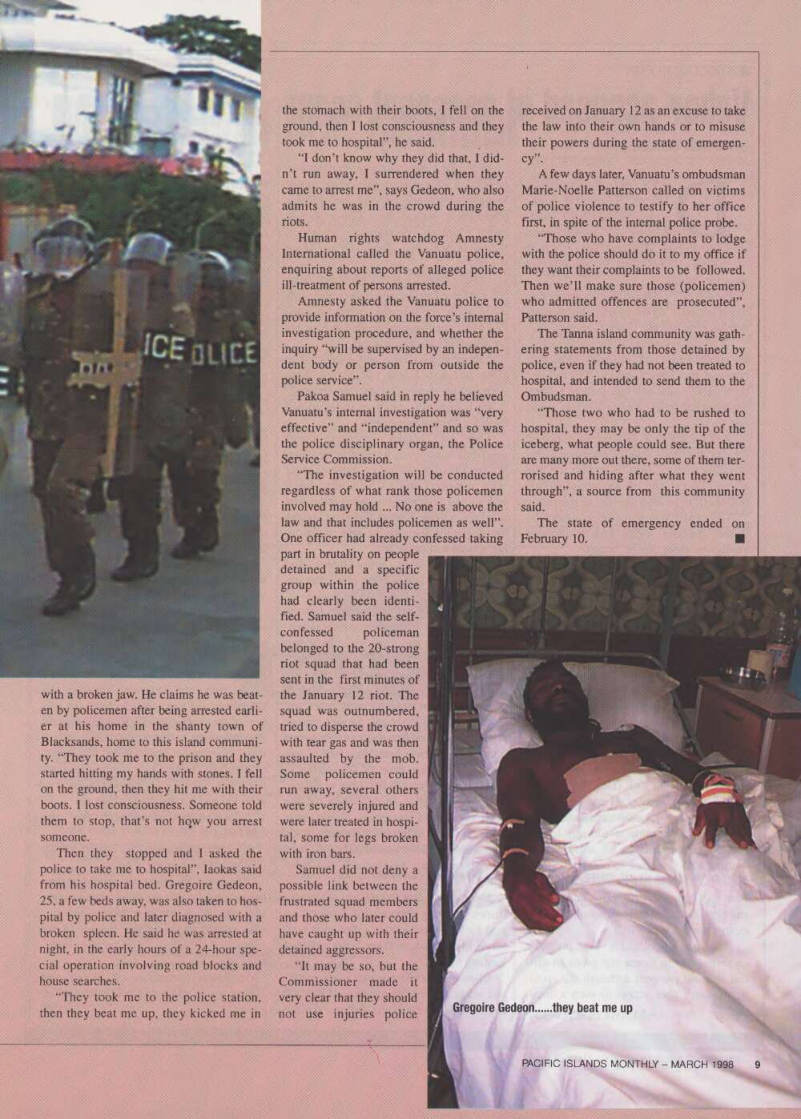
Then they stopped and I asked the police to take me to hospital”, laokas said from his hospital bed. Gregoire Gedeon, 25, a few beds away, was also taken to hos pital by police and later diagnosed with a broken spleen. He said he was arrested at night, in the early hours of a 24-hour spe cial operation involving road blocks and house searches.
“They took me to the police station, then they beat me up, they kicked me in
the stomach with their boots, I fell on the ground, then I lost consciousness and they took me to hospital”, he said.
“I don’t know why they did that, I did n’t run away, 1 surrendered when they came to arrest me”, says Gedeon, who also admits he was in the crowd during the riots.
Human rights watchdog Amnesty International called the Vanuatu police,
enquiring about reports of alleged police
ill-treatment of persons arrested.
Amnesty asked the Vanuatu police to provide information on the force’s internal investigation procedure, and whether the inquiry “will be supervised by an indepen dent body or person from outside the police service”.
Pakoa Samuel said in reply he believed Vanuatu’s internal investigation was “very effective” and “independent” and so was the police disciplinary organ, the Police Service Commission.
“The investigation will be conducted regardless of what rank those policemen involved may hold ... No one is above the law and that includes policemen as well”.
One officer had already confessed taking
part in brutality on people detained and a specific group within the police had clearly been identi fied. Samuel said the self confessed policeman belonged to the 20-strong riot squad that had been sent in the first minutes of the January 12 riot. The squad was outnumbered, tried to disperse the crowd with tear gas and was then assaulted by the mob.
Some policemen could run away, several others were severely injured and were later treated in hospi tal, some for legs broken with iron bars.
Samuel did not deny a possible link between the frustrated squad members and those who later could have caught up with their detained aggressors.
“It may be so, but the Commissioner made it very clear that they should not use injuries police
received on January 12 as an excuse to take the law into their own hands or to misuse their powers during the state of emergen cy”.
A few days later, Vanuatu’s ombudsman Marie-Noelle Patterson called on victims of police violence to testify to her office first, in spite of the internal police probe.
“Those who have complaints to lodge with the police should do it to my office if they want their complaints to be followed.
Then we’ll make sure those (policemen) who admitted offences are prosecuted”, Patterson said.
The Tanna island community was gath ering statements from those detained by police, even if they had not been treated to hospital, and intended to send them to the Ombudsman.
“Those two who had to be rushed to hospital, they may be only the tip of the iceberg, what people could see. But there are many more out there, some of them ter rorised and hiding after what they went through”, a source from this community said.
The state of emergency ended on February 10. ■
Gregoire Gedeon... they beat me up
Vohor accused of passport scam
Special Report
By Patrick Decloitre
DAYS before Vanuatu’s March 6 general elec tion, the country’s hard
hitting ombudsman
accused Prime Minister Serge Vohor of taking US$6O,OOO in an alleged passport scam.
French-bom Marie-Noelle Patterson, has released a series of damning reports that have shaken the Vohor Government.
A report released in December, alleg ing politicians had misused Vanuatu’s National Provident Fund (VNPF) to grant themselves loans and buy private houses, triggered discontent among Vanuatu work ers.
A riot ensued on January 12, followed the day after by a state of emergency. But last December again, a report on the alleged illegal sale of Vanuatu passports turned out to be only the first of a series.
The report was actually requested by Prime Minister Vohor and his former Foreign minister, Willie Jimmy.
The two, in a heated exchange last September, accused each other of master minding the scheme which began to sur face at the time.
In her first report on the issue last December, Patterson alleged a 33-year-old South Korean, Jae Yong (Richard) Jung, was promoting the concept of an “immi gration scheme”. It purported to arrange, through a “Resort Las Vegas” company, for the immigration into Vanuatu of up to 80,000 Asians at a pace of 4,000 per year.
The report says Jung would have promised the Vanuatu government earn ings of 40 billion vatu (US$33O million) from the sale of passports and citizenship packages (about 1.8 million vatu apiece, of which 700,000 vatu would go to the
Vanuatu government).
Jung also promised to build a US$lOO million, 350-room hotel resort and a casino “that can compete with those in Australia and New Zealand” in Toukoutouk (15 kilo metres west of Port Vila).
Jung was appointed a Vanuatu trade commissioner to Korea and given an offi cial Vanuatu passport, although this posi tion doesn’t give access to such a docu ment.
In the first passport report, Patterson unveils an alleged scam purporting to sell Vanuatu diplomatic, official and ordinary passports to Asians from China, Korea,
Japan, Taiwan, Singapore, Malaysia,
Indonesia, Vietnam, Cambodia and Hong Kong.
“The bottom line is that Mr Vohor knew full well that foreign nationals do not qual ify to apply for Vanuatu citizenship until they have continuously resided in Vanuatu for 10 years”, Patterson wrote.
Patterson said Jung was convicted in 1992 in South Korea afid served three years jail for stealing military equipment.
He is currently believed to be wanted there for forging securities.
Late in January, another report described how Vohor, independence father Walter Lini (in charge of Justice), four other ministers and 13 MPs reproduced and signed virtually the same letter and sent copies to the Korean President, asking him to pardon Jung for the sake of “build ing up national projects”.
“Mr Jung truly loves Korea and Vanuatu more than anyone else”, the let ters all said.
Early in February, another report on the same issue, but with different foreign pro tagonists, came out: this time, Patterson directly accused Vohor of “criminal con spiracy” in an alleged passports sale scam.
In her third report on the passports issue, Patterson also accused other top leaders, including Vohor’s former foreign minister Willie Jimmy and Principal Immigration officer Jean-Marc Bell of cor ruption, accusing them of conspiring to illegally issue Vanuatu passports to Asians.
She said Vohor, in exchange for the swift issuing of passports, would have received some US$6O,OOO, whereas Jimmy and other officials would have received free plane tickets to Australia and other
gifts.
She names a Jian Peng Chen, a Chinese citizen, as being appointed in January last year by Vohor as Vanuatu’s honorary con sul to Macau, where there is no recorded Vanuatu citizen.
Chen had met Vohor one week earlier and made two payments of US$lOO,OOO and 500,000 Hong Kong dollars “for the
good and wellbeing of the people of Vanuatu”, Patterson writes.
But Foreign Affairs told her they never saw the money.
In June last year, the report goes on, Chen came back to Vanuatu with another Chinese, Larry Yu, who was promptly appointed Vanuatu Trade Commissioner in Cambodia, a country Vanuatu has no trade links with.
She says Cambodian authorities never
approved the appointment.
Chen later obtained another ten Vanuatu passports for family and friends, all Chinese.
Vohor strongly denied any involvement in the scheme saying Patterson’s report may be “a very good story”, but that it was “imaginary” ... “insulting” ... “false” ...
“unfounded” and ... “a slap in the face”.
The Vanuatu Prime Minister threatened to take legal action against the ombudsman for her accusations, saying she was “play ing politics” less than one month ahead of general elections.
“I only made a recommendation to the President and the citizenship commission, this is not my area, I don’t control this”, he said last December.
Vohor said the money was collected for his Union of Moderate Parties’ congress
transportation expenses.
Jimmy said he acted on Vohor’s orders to issue official and diplomatic Vanuatu passports to Chen and Yu. He also noted Patterson’s attacks coincided with a sensi tive pre-electoral time. And he should know; two years ago, also ahead of the December 1995 general elections, he was one of the ombudsman’s first high-seated victims, when a report on Jimmy’s liquor shop “Nambawan Bottle Shop” was target ed. Patterson replied to Vohor and Jimmy’s rejections, saying all her reports were doc umented and backed by evidence.
“There is no imagination in there”, she told national radio.
“To date, no one has ever challenged the contents of my reports in court”.
She noted the constitution empowered her to “enquire into the conduct of any per son or body”, either after receiving a pri vate complaint, or at the request of the council of ministers, or of her own initia tive.
Patterson recommended Vohor and Jimmy resign and never hold public office
again. ■
VANUATU’S Civil
Minister in sex scandal
By Patrick Decloitre
Aviation and Telecommunications minister Demis Lango was also targeted by Patterson: she alleged he had sex with three women the same night last year. In a damning report, ombudsman Marie-Noelle Patterson alleges Lango took three women to his office after a party last July 25 at night.
After he got the women to drink, the minister had sex with two consenting women, she writes. The third one was allegedly raped. Before she went to the ombudsman, she had filed a complaint with the police. “Lango locked both the interior and exterior doors, came towards her, grabbed and continued to grab her by the collar of her T-shirt”, Patterson reports after interviewing the alleged victim.
“Because her T-shirt was extra large it came off her when she was struggling to get free from Minister Lango, leaving her only in her bra and underpants. (He) continued to hold on to her, pushed her to the floor and had sex with her. She managed to push Mr Lango off her, collected her clothes, and ran outside crying and put her clothes back on”, the report goes on. In a manner of reply to the ombudsman’s allegations, Lango sent a traditional chief to the investigator’s office to say the matter had been settled in “cus tom” and some 100,000 vatu (US$B2O) paid by Lango for having an affair with... yet another woman, unrelated to the report.
Patterson recommends Lango, as a mem ber of Vanuatu’s parliament at the time of the facts and still a minister of state, should not hold a ministerial position in future.
She also asks Prime Minister Serge Vohor (who presides over the Union of
Moderate Parties to which Lango belongs)
to publicly reprimand him for breaching
the leadership code. “On top of its custom ary principles, Vanuatu’s constitution states it is founded on traditional Melanesian values, faith in God, and
Christian principles.
Mr Lango has respected neither of these principles in a Christian country where the motto is In God We Stand”, Patterson told national radio.
“Aside from the personal question of adultery and of forcing intercourse without consent, there is the national question of what kind of behaviour is to be expected from not only officials but Ministers”, she wrote.
Vohor later commented reporting on officials’ private lives was not in line with Vanuatu’s customs and Christian princi ples. “I don’t think she should talk about sex. All these details, this is too much. The ombudsman’s office is not entitled to judge a man.
“Maybe soon the ombudsman office will be teaching the people of Vanuatu about sex”, Vohor said on national radio. ■
Advertisements & other items, p. 11 (1 item)
For Sale
mmiM
Fiji Times Limited offers the business and assets of its commercial printing division.
Print World, for sale as a total package. This is a rare opportunity to acquire one of the largest and most sophisticated printing operations in Fiji.
Assets offered for sale include plant, equipment, and stock.
The major pieces of plant and equipment include: • Komori Offset 4 Colour Press and 2 Colour Press • Wohlenburg Guillotine • Jagenburg Presses (2) • Nebiola Die Cutting Machine • Heidelberg Presses (3) • and a wide range of other machines.
Stock items include paper, ink, carton board and general stock.
Indicative non-binding offers are to be lodged at Price Waterhouse, 6th Floor, Dominion House, Suva, Fiji by 27 February 1998. A refundable deposit of F 55,000 is to accompany all offers.
All offers will be shortlisted. A due diligence process will commence soon thereafter. Final binding offers are to be received from shortlisted buyers by 20 March 1998.
All enquiries should be directed to either Dhiraj Hemraj or Sikeii Tuinamuana of Price Waterhouse, Suva. Contact details are: PO Box 156, Suva, Fiji.
Phone: (679) 313955 Fax: (679) 300981 E-mail: dhiraj—hemraj @ australia.notes.pw.com sikeii —tuimanuana @ australia.notes.pw.com.
Price Waterhouse
Logging: The axe falls
Cover Story
By Sam Vulum
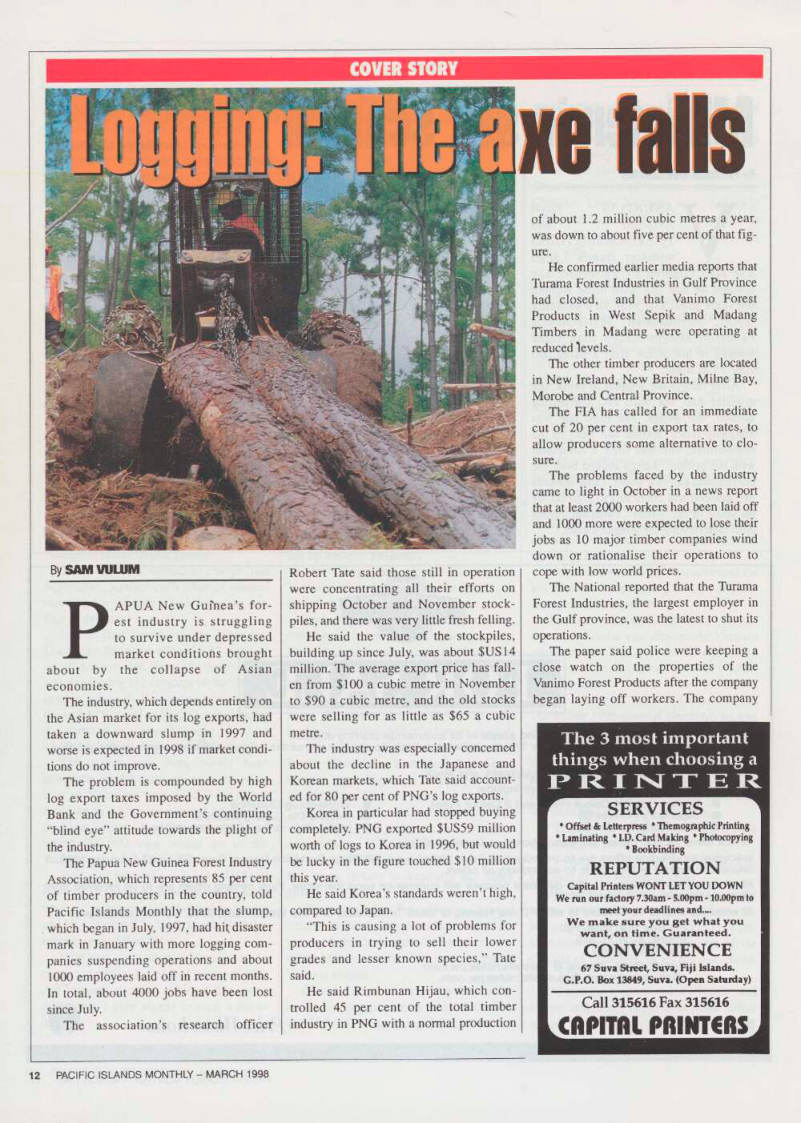
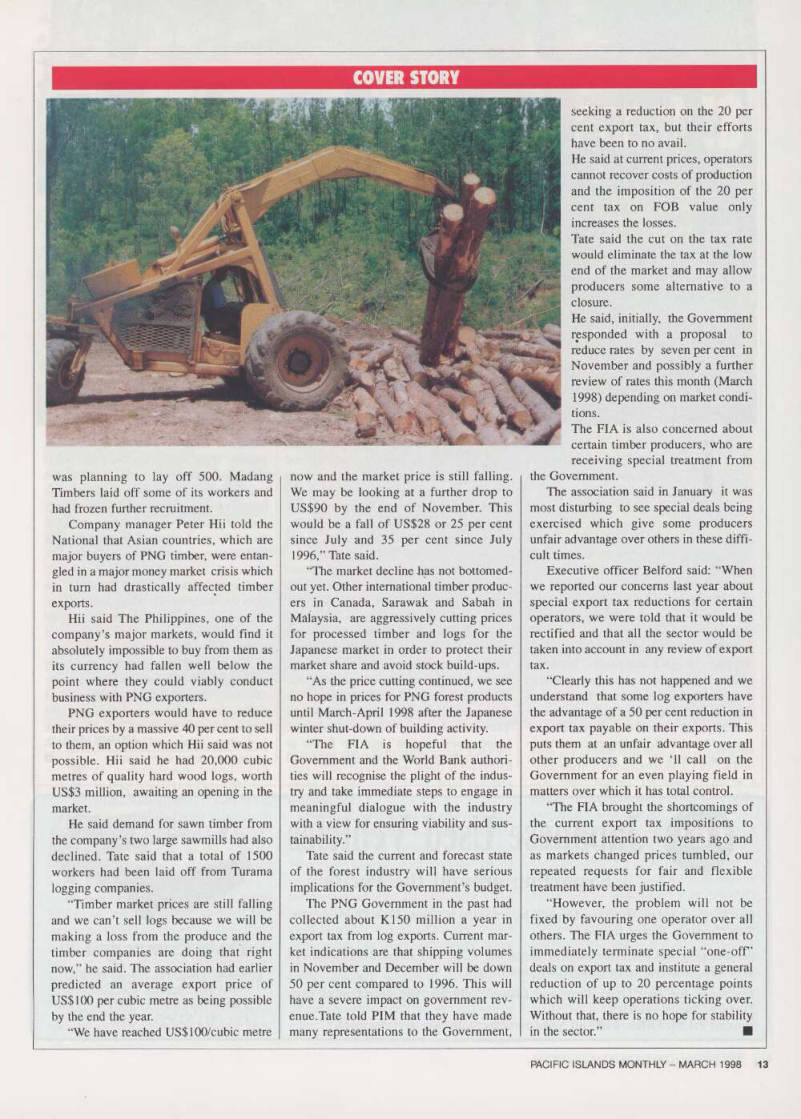
PAPUA New Guinea’s for est industry is struggling to survive under depressed market conditions brought about by the collapse of Asian economies.
The industry, which depends entirely on the Asian market for its log exports, had taken a downward slump in 1997 and worse is expected in 1998 if market condi tions do not improve.
The problem is compounded by high log export taxes imposed by the World Bank and the Government’s continuing “blind eye” attitude towards the plight of the industry.
The Papua New Guinea Forest Industry Association, which represents 85 per cent of timber producers in the country, told Pacific Islands Monthly that the slump, which began in July, 1997, had hit disaster mark in January with more logging com
panies suspending operations and about
1000 employees laid off in recent months.
In total, about 4000 jobs have been lost
since July.
The association’s research officer
Robert Tate said those still in operation were concentrating all their efforts on shipping October and November stock piles, and there was very little fresh felling.
He said the value of the stockpiles, building up since July, was about SUSI 4 million. The average export price has fall en from $lOO a cubic metre in November to $9O a cubic metre, and the old stocks were selling for as little as $65 a cubic metre.
The industry was especially concerned about the decline in the Japanese and Korean markets, which Tate said account ed for 80 per cent of PNG’s log exports.
Korea in particular had stopped buying completely. PNG exported SUSS9 million worth of logs to Korea in 1996, but would be lucky in the figure touched $lO million this year.
He said Korea’s standards weren’t high, compared to Japan.
“This is causing a lot of problems for producers in trying to sell their lower grades and lesser known species,” Tate said.
He said Rimbunan Hijau, which con trolled 45 per cent of the total timber industry in PNG with a normal production
of about 1.2 million cubic metres a year, was down to about five per cent of that fig ure.
He confirmed earlier media reports that Turama Forest Industries in Gulf Province had closed, and that Vanimo Forest Products in West Sepik and Madang Timbers in Madang were operating at reduced levels.
The other timber producers are located in New Ireland, New Britain, Milne Bay, Morobe and Central Province.
The FIA has called for an immediate cut of 20 per cent in export tax rates, to allow producers some alternative to clo sure.
The problems faced by the industry came to light in October in a news report that at least 2000 workers had been laid off and 1000 more were expected to lose their jobs as 10 major timber companies wind down or rationalise their operations to cope with low world prices.
The National reported that the Turama Forest Industries, the largest employer in the Gulf province, was the latest to shut its operations.
The paper said police were keeping a close watch on the properties of the Vanimo Forest Products after the company began laying off workers. The company
was planning to lay off 500. Madang Timbers laid off some of its workers and had frozen further recruitment.
Company manager Peter Hii told the National that Asian countries, which are major buyers of PNG timber, were entan gled in a major money market crisis which in turn had drastically affected timber exports.
Hii said The Philippines, one of the company’s major markets, would find it absolutely impossible to buy from them as its currency had fallen well below the point where they could viably conduct business with PNG exporters.
PNG exporters would have to reduce their prices by a massive 40 per cent to sell to them, an option which Hii said was not possible. Hii said he had 20,000 cubic metres of quality hard wood logs, worth US$3 million, awaiting an opening in the market.
He said demand for sawn timber from the company’s two large sawmills had also declined. Tate said that a total of 1500 workers had been laid off from Turama
logging companies.
“Timber market prices are still falling and we can’t sell logs because we will be making a loss from the produce and the timber companies are doing that right now,” he said. The association had earlier predicted an average export price of US$lOO per cubic metre as being possible by the end the year.
“We have reached US$lOO/cubic metre
now and the market price is still falling.
We may be looking at a further drop to US$9O by the end of November. This would be a fall of US$2B or 25 per cent since July and 35 per cent since July 1996,” Tate said.
“The market decline has not bottomed out yet. Other international timber produc ers in Canada, Sarawak and Sabah in Malaysia, are aggressively cutting prices for processed timber and logs for the Japanese market in order to protect their market share and avoid stock build-ups.
“As the price cutting continued, we see no hope in prices for PNG forest products until March-April 1998 after the Japanese winter shut-down of building activity.
“The FIA is hopeful that the Government and the World Bank authori ties will recognise the plight of the indus try and take immediate steps to engage in
meaningful dialogue with the industry
with a view for ensuring viability and sus
tainability.”
Tate said the current and forecast state of the forest industry will have serious implications for the Government’s budget.
The PNG Government in the past had collected about Kl5O million a year in export tax from log exports. Current mar ket indications are that shipping volumes in November and December will be down 50 per cent compared to 1996. This will have a severe impact on government rev enue. Tate told PIM that they have made many representations to the Government,
seeking a reduction on the 20 per cent export tax, but their efforts have been to no avail.
He said at current prices, operators cannot recover costs of production and the imposition of the 20 per cent tax on FOB value only increases the losses.
Tate said the cut on the tax rate would eliminate the tax at the low end of the market and may allow producers some alternative to a closure.
He said, initially, the Government responded with a proposal to reduce rates by seven per cent in November and possibly a further review of rates this month (March 1998) depending on market condi tions.
The FIA is also concerned about certain timber producers, who are
receiving special treatment from the Government.
The association said in January it was most disturbing to see special deals being exercised which give some producers unfair advantage over others in these diffi cult times.
Executive officer Belford said; “When we reported our concerns last year about special export tax reductions for certain operators, we were told that it would be rectified and that all the sector would be taken into account in any review of export tax.
“Clearly this has not happened and we understand that some log exporters have the advantage of a 50 per cent reduction in export tax payable on their exports. This puts them at an unfair advantage over all other producers and we ‘ll call on the Government for an even playing field in matters over which it has total control.
“The FIA brought the shortcomings of the current export tax impositions to Government attention two years ago and as markets changed prices tumbled, our repeated requests for fair and flexible treatment have been justified.
“However, the problem will not be fixed by favouring one operator over all others. The FIA urges the Government to immediately terminate special “one-off’ deals on export tax and institute a general reduction of up to 20 percentage points which will keep operations ticking over.
Without that, there is no hope for stability in the sector.” ■
Advertisements & other items, p. 12 (1 item)
Capitol Print6As
The 3 most important
things when choosing a
PRINTER
SERVICES
• Offset & Letterpress * Themographic Printing ♦Laminating • I.D. Card Making ’Photocopying ♦ Bookbinding
REPUTATION
Capital Printers WONT LET YOU DOWN We run our factory 7.30 am -5.00 pm -10.00 pm to meet your deadlines and.-.
We make sure you get what you want, on time. Guaranteed.
CONVENIENCE
67 Suva Street, Suva, Fiji Islands.
G.P.O. Box 13849, Suva. (Open Saturday) Call 315616 Fax 315616
CAPITOL PRINT6AS
SI faces a bleak future
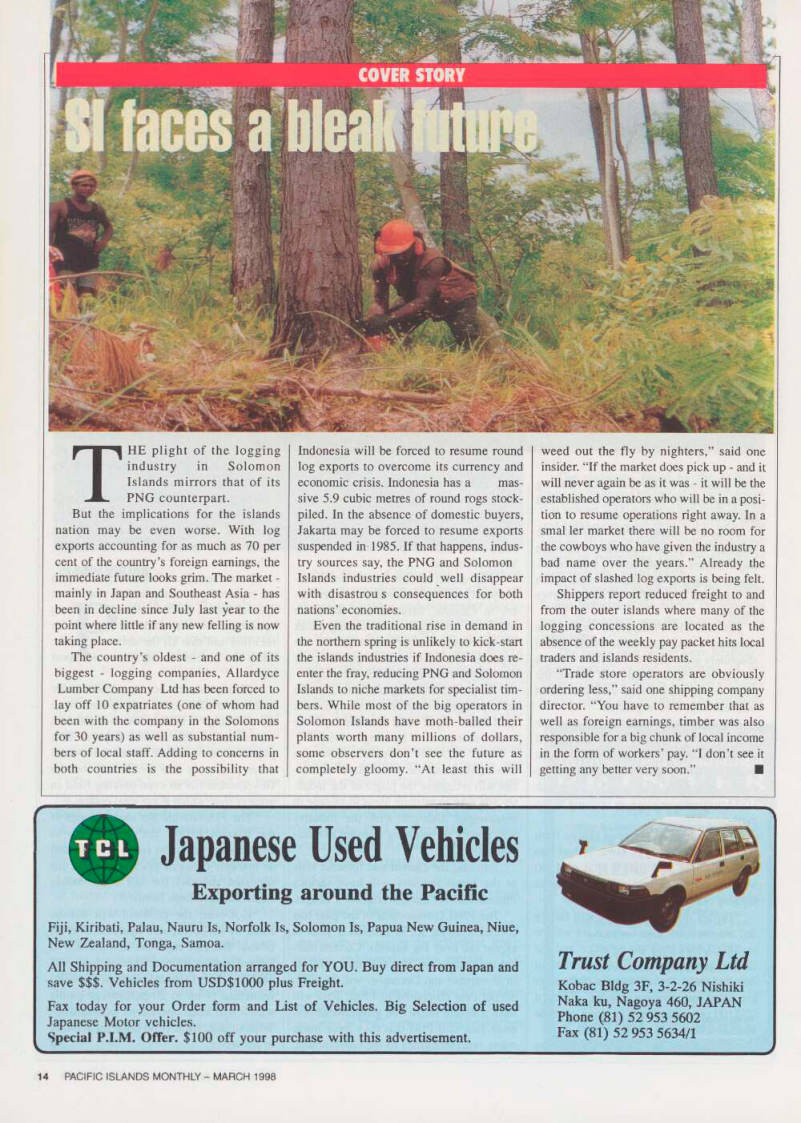
THE plight of the logging industry in Solomon Islands mirrors that of its PNG counterpart.
But the implications for the islands nation may be even worse. With log exports accounting for as much as 70 per cent of the country’s foreign earnings, the immediate future looks grim. The market mainly in Japan and Southeast Asia - has been in decline since July last year to the point where little if any new felling is now
taking place.
The country’s oldest - and one of its biggest - logging companies, Allardyce Lumber Company Ltd has been forced to lay off 10 expatriates (one of whom had been with the company in the Solomons for 30 years) as well as substantial num bers of local staff. Adding to concerns in both countries is the possibility that
Indonesia will be forced to resume round log exports to overcome its currency and economic crisis. Indonesia has a mas sive 5.9 cubic metres of round rogs stock piled. In the absence of domestic buyers, Jakarta may be forced to resume exports suspended in 1985. If that happens, indus try sources say, the PNG and Solomon Islands industries could well disappear with disastrou s consequences for both nations’ economies.
Even the traditional rise in demand in the northern spring is unlikely to kick-start the islands industries if Indonesia does re enter the fray, reducing PNG and Solomon Islands to niche markets for specialist tim bers. While most of the big operators in Solomon Islands have moth-balled their plants worth many millions of dollars, some observers don’t see the future as completely gloomy. “At least this will
weed out the fly by nighters,” said one insider. “If the market does pick up - and it will never again be as it was - it will be the established operators who will be in a posi tion to resume operations right away. In a smaller market there will be no room for the cowboys who have given the industry a bad name over the years.” Already the impact of slashed log exports is being felt.
Shippers report reduced freight to and from the outer islands where many of the logging concessions are located as the absence of the weekly pay packet hits local traders and islands residents.
“Trade store operators are obviously ordering less,” said one shipping company director. “You have to remember that as well as foreign earnings, timber was also responsible for a big chunk of local income in the form of workers’ pay. “I don’t see it getting any better very soon.” ■
Advertisements & other items, p. 14 (1 item)
in Japanese Used Vehicles
Exporting around the Pacific
Fiji, Kiribati, Palau, Nauru Is, Norfolk Is, Solomon Is, Papua New Guinea, Niue, New Zealand, Tonga, Samoa.
All Shipping and Documentation arranged for YOU. Buy direct from Japan and save sss. Vehicles from USDSIOOO plus Freight.
Fax today for your Order form and List of Vehicles. Big Selection of used Japanese Motor vehicles.
Special P.I.M. Offer. $lOO off your purchase with this advertisement. r
Trust Company Ltd
Kobac Bldg 3F, 3-2-26 Nishiki Naka ku, Nagoya 460, JAPAN Phone (81) 52 953 5602 Fax (81) 52 953 5634/1
Everybody loses

By Samvulum
IN a follow-up report, FIA research officer Tate said the PNG Government stands to lose about SUS9O million in
foreign exchange earnings and SUS3O
million in tax revenue as the worsen ing Asian economic crisis creates havoc for the PNG timber industry.
He said landowners would lose about SUSI 2 million in royalties and .other pay ments. A January survey by the FIA cover ing its members who operate about 70 per cent of the industry revealed the widespread impact of the crisis in Asia - PNG’s traditional export market.
Tate said that since the crisis began at the end of last year 3530 Papua New
Guineans and 436 expatriates had lost their jobs. The figures, he said, represented about 30 per cent of the total industry workforce.
Of the 21 companies surveyed, Tate said 13 had ceased production altogether while the rest were operating at an average 30 per cent capacity with emphasis placed on reading, maintenance and production for processing only. He said there was a total of 332,600 cubic metres of timber in stock of which only 174,200 cubic metres were subject to sales negotiation while 46,000 cubic metres worth about SUS 4 million had been written off. Tate said the companies predicted significant falls in production and exports this year compared with 1997. Forward estimates, he said,
were for production of 2.5 to 2.7 million cubic metres and exports of 1.7 to 2.3 mil lion cubic metres. He said: “This is a decline of approximately 1 million n cubic metres on the 1997 level.
The losses to the industry participants based on these figures would be: foreign exchange loss of SUS9O million, losses to government tax revenue of K3O million and losses to landowners from royalties and other payments of KlB million.
“Overseas export demand for PNG timber products and logs is at a low point wdth buyers unwilling to commit themselves to further shipments, even at low prices.” Tate said the outlook for employment in the industry was bleak and could worsen if the market conditions deteriorated further. ■
Advertisements & other items, p. 15 (1 item)
Cover Story
The Lincoln Agreement
Bougainville
By Michael Field
I feel compelled by the grace of God that the time has come to say ‘sorry’ and ask for your forgiveness.”
Those were the remarkable words of Papua New Guinea Prime Minister Bill Skate to the war-weary people of Bougainville who are now giving peace a chance after 10 years of being the victims of one of the world’s truly forgotten wars.
The conflict had a long gestation but burst into the open on November 22, 1988, when a worker at the huge Panguna copper mine on the island raided Bougainville Copper Ltd’s armoury and stole explosives before destroying company installations.
That worker was Francis Ona, soon to be the president of the break-away state.
On December 23, 1988, PNG declared a state of emergency on Bougainville and civil war was under way.
To the few who watched, it was appar ent last year that the war was nearlyover neither side could hope to effect a military victory and the formal end came in the gentile surroundings of one of New
Zealand’s leading agricultural colleges,
Lincoln University.
There, on January 23, 1998, the oppos ing sides in the war signed the Lincoln Agreement on Peace, Security and Development on Bougainville which acknowledged “the suffering, pain and loss on all sides of the conflict that they have agreed to end forever”. They renounced the use of armed forces and violence and set April 30, 1998, as the date for ending the current truce and replacing it with a “permanent and irrevocable ceasefire”.
It was an intriguing document for the two issues it did not directly address.
It was a war of independence, yet the Lincoln Agreement makes no reference to
I the issue. It was also something of an I environmental war over the Panguna h mine. The mine is not mentioned.
The absence of the two issues is, how- I ever, a master-stroke. Plainly neither are I off the agenda and will, in time, be debat- I e d. but Lincoln was about “promoting
I reconciliation between Bougainvilleans
* and with other individuals, groups and . organisations in Papua New Guinea”.
I Towards the end of the war it was pre
f dominantly Bougainvillean killing
I Bougainvillean. The agreement requires
I more talks on “the political issue” before ’ the end of June this year and as they will I be on Bougainville they are likely to be key to the permanent peace. Ona might I even attend.
I He was not at Lincoln and the deal was
signed instead by Bougainville Interim
Government vice-president Joseph Kabui who had, for nearly a year, led the drive for peace. Ona’s own stance remained a mystery, although the presence of four of his senior commanders from “A Company” was taken as a strong sign that he endorsed what was happening. Mr Kabui said Bougainville could not be part of PNG under the current Constitution, adding the rebels expected the Lincoln talks to pave the way for negotiations on constitutional change.
“We are here to undertake substantive negotiation on those processes of change that will have to take place in the forth coming months and years,” Mr Kabui said.
“It is the position of the (rebels) that the answer to our problems does not lie in the PNG Constitution. That, in fact, the PNG Constitution can no longer be applied to Bougainville.
“The violation of the Bougainvillean people’s fundamental human rights by instruments of the PNG Constitution, and violation of the Constitution itself by suc cessive PNG governments, at any time that it suited them to do so throughout this con flict, means to us that the Constitution can no longer be applied to Bougainville in its present state.” He said his people were “seeking a solution based on the funda mental human right of self-determination”.
Australian Foreign Minister Alexander Downer showed some of the thinking
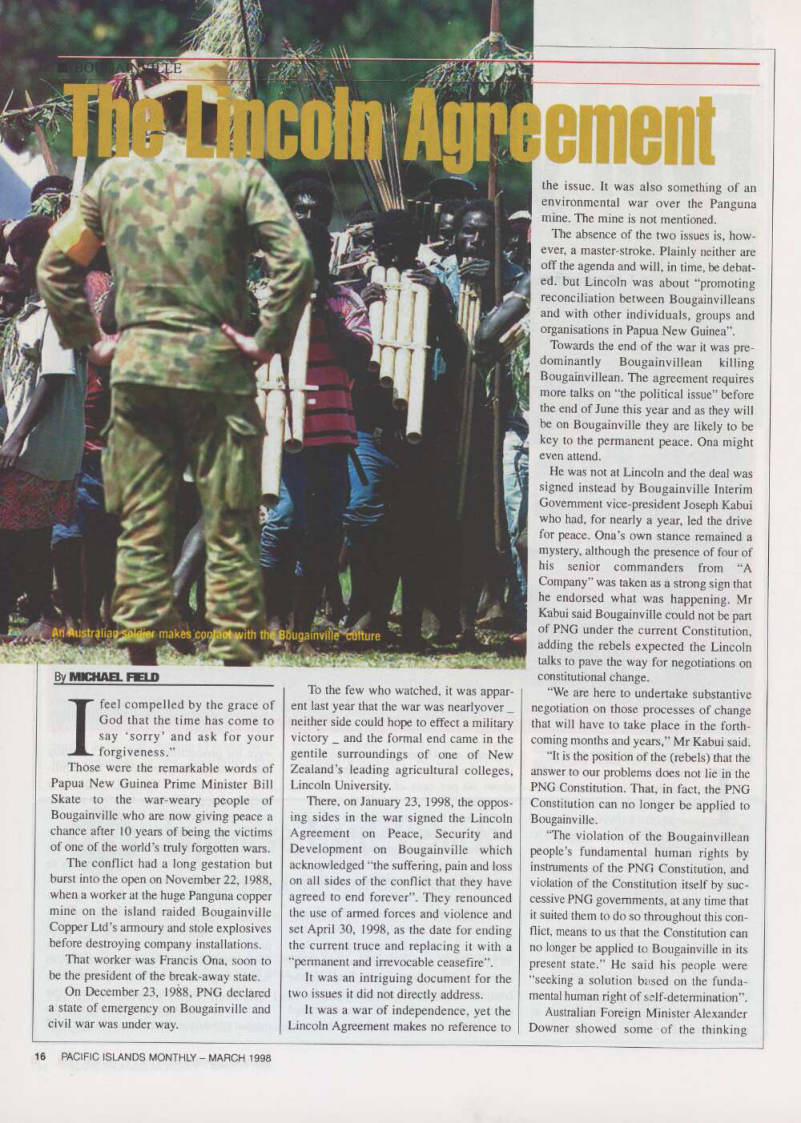
An Australian soldier makes contact with the Bougainville culture
going on over Panguna by saying he had worked very hard “to make sure we keep the mine completely out of sight for all of these talks. It is the most emotive and the most difficult issue of all.”
Mr Skate, in domestic trouble anyway, now has within his grasp the possibility of ending the draining conflict that has cost so much in lives. With the deal signed, Mr Skate released an open letter to the people of Bougainville in which he said a final ceasefire should not have taken nine years to achieve. Quoting Isaiah he urged all par ties to “forget the past”.
“Forget the former things; do not dwell on the past. See, I am doing a new thing ...
Do you not perceive it? I am making a way through the desert and streams in the waste land.” During the talks Mr Skate announced the bounties on the heads of the rebels would be lifted and those living in exile could now return home safely. The rebels had K 5250,000 rewards, dead or alive, placed on them. “Paying bounties for the death of enemies is not how my Government does things.
Those days are gone,” Mr Skate said.
Mr Kabui, welcomed the agreement, and thanked New Zealand for seeing the need to restart peace talks last year. “In Bougainville people are once again smil ing. The fear that has surrounded them in the last nine years of war in Bougainville is gradually disappearing,” he said.
“People are once again experiencing freedom of movement, freedom of associ ation . . . normal day-to-day living.”
The war was mostly fought behind a blockade which kept aid agencies and the media out. To this day it is not clear how many people have died. The estimated pop ulation of Bougainville in the late 1980 s was around 160,000 people. There is no independent confirmation of the death toll but it has become something of a mantra to say that 20,000 people died directly or indi rectly from the war. We may never really know. The island’s infrastructure has been destroyed or left to decay. Schools have been closed for nine years and a genera tion of children has been without educa tion.
There are 30,000-40,000 displaced peo ple living in 35 Government care centres on Bougainville. Australia and New Zealand have committed themselves to
rebuilding Bougainville with Australia
promising Asl3o million over the next five years for reconstruction. ■
THE government of Papua New Guinea, the Bougainville Transitional Government, Bougainville Resistance Force, the Bougainville Interim Government, the Bougainville Revolutionary Army and Bougainville Leaders (the “Parties”) having met in Lincoln University, Christchurch, New Zealand, from 19-23 January 1998: Praying for the Almighty’s forgiveness, guidance and blessing for their common endeavours; Emphasising their firm commitment to peace by building on the achieve ments in the Burnham Truce and the Cairns Commitment; Acknowledging the suffer ing, pain and loss on all sides of the conflict that they have agreed to end forever; Committing themselves to peace, reconciliation and working together for the common good; Engaging in a process of consultation and co-oper ation, initiated by Bougainvillean leaders, which they will continue; Hereby agree;
1. Peaceful Means
The parties will co-operate to achieve and maintain peace by peaceful means.
They also pledge to renounce the use of armed forces and violence, and agree to resolve any differences, by consultation,
both now and in the future. They confirm also their respect for human rights and the rule of law.
2. Extension Of
The Truce
The parties agree to extend the period of the Truce currently in force to the 30th of April 1998 to allow for consultation as regards the establish ment of the ceasefire.
3. Cease Fire
3.1 A permanent and irrevocable ceasefire will take effect in
Bougainville at 2400 hours on 30 April 1998. 3.2 The parties will co-operate to reduce fear in Bougainville and take urgent steps to co-operate in promoting public aware ness of, and respect for, the ceasefire. 3.3 Immediately the ceasefire takes effect, the parties will refrain from use of arms, ammunition, explosives and other instruments of death, injury or destruction
in Bougainville.
3.4 The parities will not manufacture, trade or distribute weapons and ammuni tions. 3.5 The parties will co-operate in accor dance with law in reporting and preventing the use, manufacture, importation, sale, trade, exchange of weapons and ammuni tions. 3.6 The parties will co-operate with the successor to the TMG in recording, locat ing and arranging disposal of all arms, ammunitions, explosives and other instru ments of death, injury and destruction, including parts and ingredients of all the parties in Bougainville.
4. Withdrawal Of Defence
Force From Bougainville
The parties agree to a phased withdraw al of the PNG Defence Force from Bougainville subject to restoration of civil
authority.
5. Peace Monitoring Group
5.1 The Papua New Guinea National Government undertakes to conclude the arrangements required for deployment of the successor to the neutral regional Truce Monitoring Group (TMG) by no later than 30 April 1998
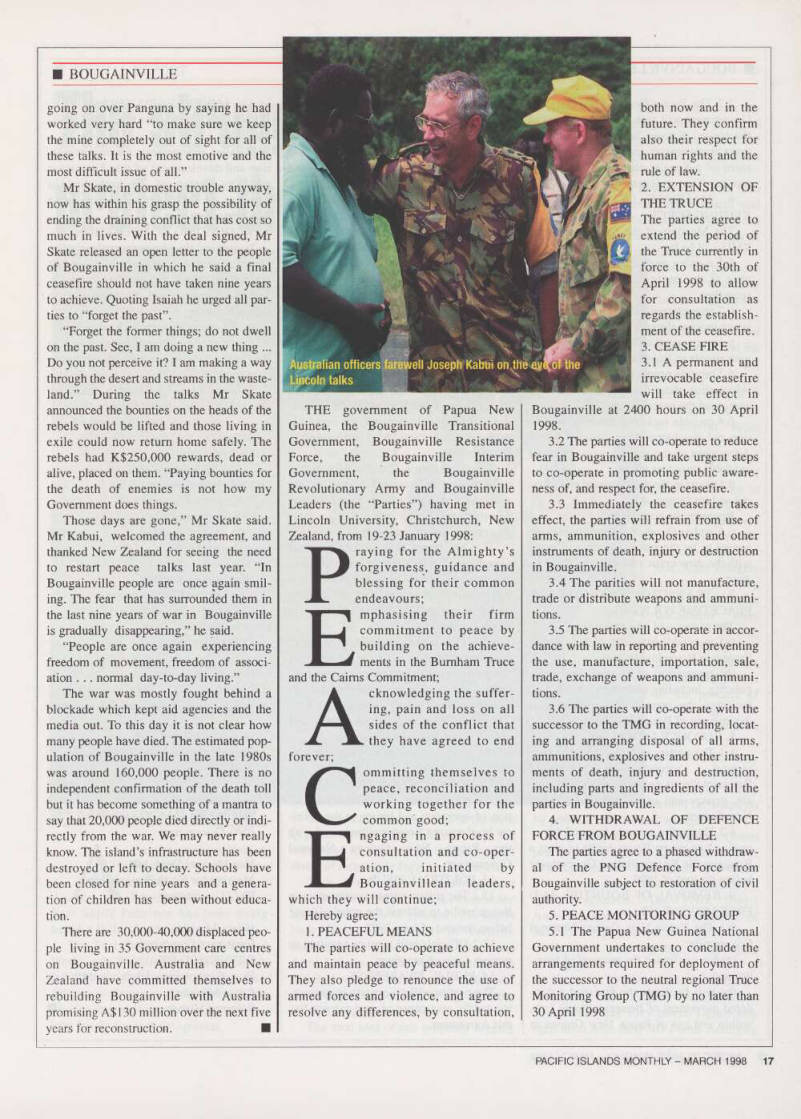
Australian officers farewell Joseph Kabui on the eve of the Lincoln talks
5.2 The Papua New Guinea National Government will seek the endorsement of the United Nations Security Council for these arrangements, including the appoint ment of a Special observing mission to monitor these arrangements.
6. Mandate Of The Peace
Keeping Force
The Mandate of the Successor to the TMG will be to; 6.1 monitor and report on the compli ance of the parties to all aspects of the ceasefire; 6.2 promote and instil confidence in the peace process through its presence, good offices and interactions with people in Bougainville;
6.3 provide people in Bougainville with
information about the ceasefire and other aspects of the peace process; 6.4 provide such assistance in restora tion and development consistent with this Agreement as the parties may agree and available resources allows. 6.5 assist in the development and train ing and institution of a Bougainville constabulary. 6.6 and such other matters as may be agreed to by the parties which will assist with the democratic resolution of the situ ation.
7. Transition To Civilian
Peacetime Policing
The parties will co-operate in: (a) re-establishing the Village Court System in Bougainville; and (b) restoration of civilian peacetime policing, including arrangements that will facilitate the recruitment, training and
deployment of Bougainvillean police.
8. Reconciliation
8.1 The parties will co-operate in pro moting reconciliation between Bougainvilleans and with other individu als, groups and organisations in Papua New Guinea. 8.2 The parties agree to free and demo cratic elections on Bougainville to elect a Bougainville Reconciliation Government before the end of 1998.
9. Removal Of Bounties And
Free Movement
9.1 The Papua New Guinea National Government: (a) has confirmed the removal of boun ties and: (b) will facilitate the free and unhin dered movement of Bougainvilleans into, within and out of Papua New Guinea in
accordance with law:
10. Amnesty And Pardon
The Papua New Guinea National Government will:- (a) grant amnesty to persons involved in crisis-related activities on all sides; (b) following receipts of advice from the Advisory Committee on the Power of Mercy, recommend pardons for persons convicted of crisis related offences.
11. Restoration And Develop
Ment
11.1 The parities will co-operate in restoration and development in Bougainville in both the public and private sectors, with particular emphasis on rural areas. 11.2 The Papua New Guinea National Government will seek appropriate forms of assistance from international organisa tions, foreign governments and organisa tions for restoration and development in Bougainville. 11.3 Assistance for restoration and development in Bougainville will, to the maximum practical extent, be sought and administered so as to promote
Bougainvillean participation.
11.4 The Papua New Guinea National Government will prepare an Indicative program in consultation with the parties to help secure funding and other resources to assist in restoration and development in
Bougainville.
11.5 The parties agree to co-operate in restoring normalcy, including the return of Bougainvilleans in care centres to their vil lages and resuming development in Bougainville by acting without delay to: (a) facilitate communications and access to villages on Bougainville (b) provide essential services, such as health and education.
12. Consultation And Liaison
The parties agree to promote consulta tion co-operation and liaison at the politi cal level among Bougainvilleans and with the Papua New Guinea National Government.
13. Political Issue
13.1 The parties agree to meet again in Bougainville to address the political issue before the end of June 1998. 13.2 Officials will meet as required to prepare for such meetings.
14. Public Awareness
The parties will co-operate in promot ing public awareness of, and respect for, this Agreement.
15. Annexes To This Agree
Ment And Subsidiary Arrange
Ments
Detailed arrangements for implementa tion and development of this Agreement may, by agreement, be embodied in Annexes or subsidiary arrangements to this Agreement.
16. Ongoing Co-Operation
In signing this Agreement the parties whose signatures appear below commit themselves to working together for peace, justice, security and development in Bougainville by: (a) co-operating with each other; and (b) promoting a bipartisan approach in the National Parliament and the communi ty as a whole.
Done at Lincoln, Christchurch, New Zealand this 23rd day of January 1998.
Signed:
Sir John Kaputin Mr Joseph Kabui Chief Negotiator Vice President PNG Government Bougainville Interim Government Hon Sam Akoitai MP General Sam Kauona Minister for Bougainville Affairs Commander BRA PNG Government Hon. Gerard Sinato Premier Bougainville Transitional Government Hon John Momis, MP Member for Bougainville Regional PNG Government Hon. Michael Laimo MP Member for South Bougainville PNG Government Hon Michael Ogio, MP Member for North Bougainville PNG Government Hilary Masiria Resistance Commander
Witnessed By;
Hon. Bartholomew Ulufa’alu, MP Prime Minister Solomon Islands. ■
protect the Hunstein
The struggle to protect the Hunstein
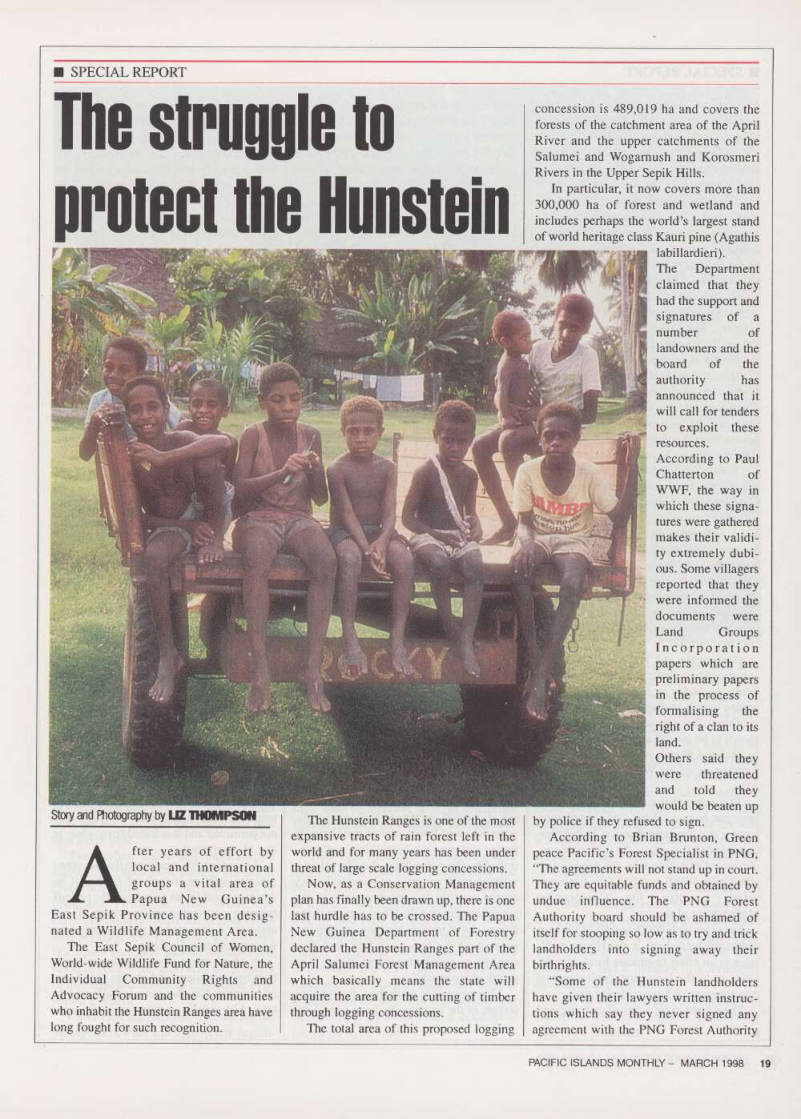
After years of effort by local and international groups a vital area of Papua New Guinea’s East Sepik Province has been desig nated a Wildlife Management Area.
The East Sepik Council of Women, World-wide Wildlife Fund for Nature, the
Individual Community Rights and
Advocacy Forum and the communities who inhabit the Hunstein Ranges area have long fought for such recognition.
The Hunstein Ranges is one of the most expansive tracts of rain forest left in the world and for many years has been under threat of large scale logging concessions.
Now, as a Conservation Management plan has finally been drawn up, there is one last hurdle has to be crossed. The Papua New Guinea Department of Forestry declared the Hunstein Ranges part of the April Salumei Forest Management Area which basically means the state will acquire the area for the cutting of timber through logging concessions.
The total area of this proposed logging
concession is 489,019 ha and covers the forests of the catchment area of the April River and the upper catchments of the Salumei and Wogamush and Korosmeri Rivers in the Upper Sepik Hills.
In particular, it now covers more than 300,000 ha of forest and wetland and includes perhaps the world’s largest stand of world heritage class Kauri pine (Agathis
labillardieri).
The Department claimed that they had the support and signatures of a number of landowners and the board of the authority has announced that it will call for tenders to exploit these resources.
According to Paul Chatterton of WWF, the way in which these signa tures were gathered makes their validi ty extremely dubi ous. Some villagers reported that they were informed the documents were
Land Groups
Incorporation papers which are preliminary papers in the process of
formalising the
right of a clan to its land.
Others said they were threatened and told they would be beaten up
by police if they refused to sign.
According to Brian Brunton, Green peace Pacific’s Forest Specialist in PNG, “The agreements will not stand up in court.
They are equitable funds and obtained by undue influence. The PNG Forest Authority board should be ashamed of itself for stooping so low as to try and trick landholders into signing away their
birthrights.
“Some of the Hunstein landholders have given their lawyers written instruc tions which say they never signed any agreement with the PNG Forest Authority
Story and Photography by LIZ THOMPSON
that any agreement signed, have been
signed by people without proper authority
who are not traditional landholders; that the FMA was done through the backdoor dealings and they want FMA cancelled.”
“A member of the Ambunti Council of Women who was present at the time of the signing of some agreements has said in writing that landowners were told that their lawyers know about the forms they were about to sign. If this statement is true then some of the signatures to the FMA have been obtained by fraud, as the Forest Authority never contacted the landholders lawyers, and went out of their way to ensure the lawyers could be present when the FMAs were signed.
“The Forest Authority knows that the landholders were represented by ICRAF’s lawyers and they nevertheless went on and dealt directly with landholders in order to secure their consent to what are substan dard one-sided and unfair agreements.
“Landholders report the involvement of Martin Golman, a senior officer in the PNG Forest Authority in obtaining the sig natures of some of the landholders to the FMA. Golman knew full well that ICRAF lawyers represented some of the Hunstein Ranges landholders. He, nevertheless, went ahead and persuaded landholders who had no opportunity to consult with their lawyers over the text of a contract that is worth hundreds of millions of kina, to sign that contract.”
Greenpeace and ICRAF are currently spearheading a challenge to the right of the Forest Authority to declare this FMA. All parties in this challenge seem to feel very confident that the claims will easily be shown to be invalid and that the FMA will be declared illegal, paving the way to the formalising of the Wildlife Management Area.
This somewhat substantial hiccup has been just one on a long road towards pro tecting the Hunstein Ranges. In prepara tion for what they see as the inevitable con clusion of this epic tale, the landowners along with WWF and ESCOW have pre pared a plan for Conservation Management of the area.
For years both WWF and ESCOW have conducted workshops in the Hunstein vil lages in an effort to educate local commu nities as to the long term environmental consequences of large scale logging.
They have done a lot of training and
gone out on numerous patrols with com munity members. All the rules which now form the outline for the WMA were work shopped, long talks were had, games were played in the village helping work out land boundaries and individual communities’ needs.
According to Chatterton representatives of these organisations have spent at least a couple of weeks in each village in the Hunstein, in many, much more. They have, he says, been “helping them think things through, draw maps of their land, we have gone out and looked at parts of the envi ronment important to them, talked about what aspects of their culture are most important to them, lots of stuff has been written down and there has been a great deal of talking”.
It is through this sustained and resilient effort that awareness as to the need for environmental protection has been raised.
It is now widely appreciated that large scale logging is not sustainable, that it does damage gardens, that frequently the landowners do not benefit or receive ade quate compensation from logging compa nies.
It is this raised awareness, in conjunc tion with the steady promotion of econom ic alternatives to logging which has led to the gradually increased support of the local community for the establishement of a
Wma.
To replace the cash earned through the logging of trees, both WWF and ESCOW have promoted, among other things, the development of eco-tourism. Communities are realising it is the very idea than an area has been classified a Wildlife Management Area which attracts tourists.
According to Chatterton, when he first went up to the Hunstein in 1991 there were about five to 10 tourists coming into the region each year. “Now”, he says, “there are about 200 each year who stay in the guest house at Wagu, one of the Hunstein Range villages. It’s been fairly well con trolled by the community, they’ve set up a walking track and trips to waterfalls, they charge tourists to stay overnight in the guest house they built. They want to make money out of tourists but they are also try ing to work out how to fit them into their community without having to change their practices too much”.
This economic issue has, for various sectors of the community, been one of the
main deterrents to creating a Wildlife Management Area in the Hunstein Ranges.
The desire to earn an income is increas ingly compelling as traditional life becomes more and more entwined in the cash economy. It is this issue, which has, to a large extent, divided the community and hence made it difficult to present a united front. It is this unity of objectives which has had to be achieved before it was possible to draw up a plan of Conservation
Management.
A conservation committee has been set up to deal with creating, maintain and ensuring the enforcement of the rules of the WMA.
This committee is comprised of one representative of each land group in the area as well as other persons from each vil lage who acts as a chair for that village.
These committee members are appointed through discussion among all adult mem bers of each land group. The rules not only apply to the local community but to all those visitors entering the park area.
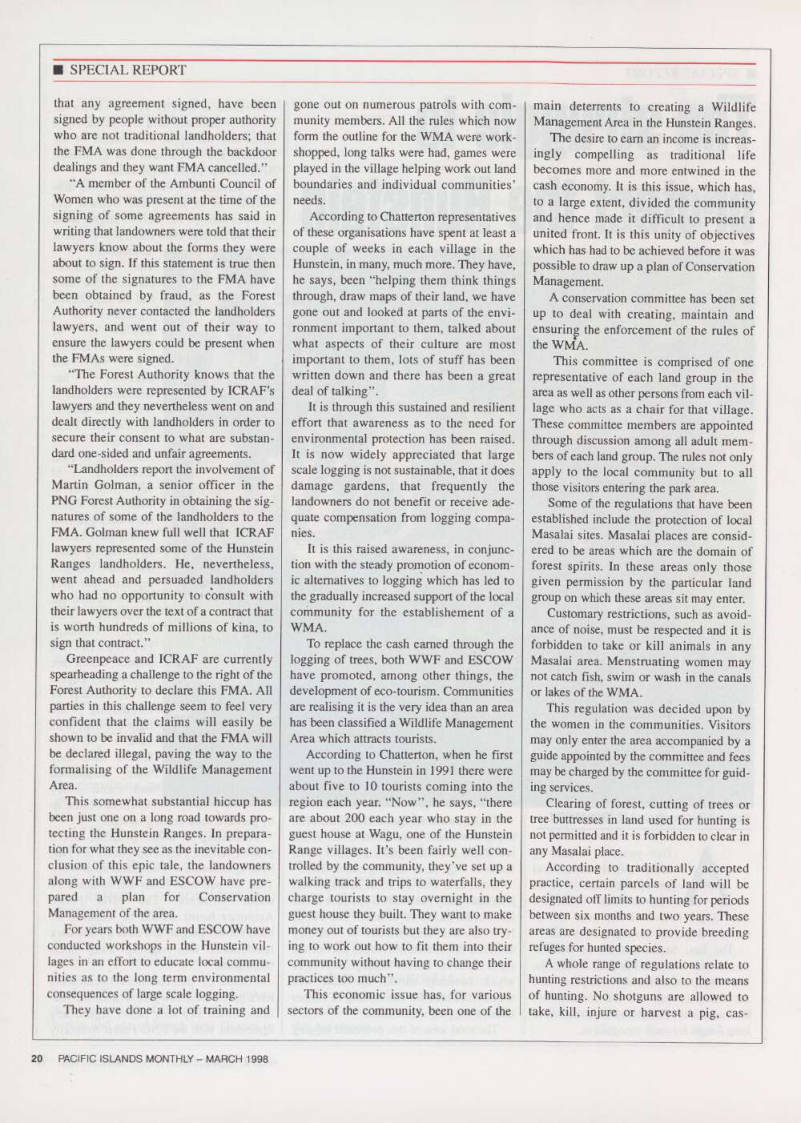
Some of the regulations that have been established include the protection of local Masalai sites. Masalai places are consid ered to be areas which are the domain of forest spirits. In these areas only those given permission by the particular land group on which these areas sit may enter.
Customary restrictions, such as avoid ance of noise, must be respected and it is forbidden to take or kill animals in any Masalai area. Menstruating women may not catch fish, swim or wash in the canals or lakes of the WMA.
This regulation was decided upon by the women in the communities. Visitors may only enter the area accompanied by a guide appointed by the committee and fees may be charged by the committee for guid ing services.
Clearing of forest, cutting of trees or tree buttresses in land used for hunting is not permitted and it is forbidden to clear in any Masalai place.
According to traditionally accepted
practice, certain parcels of land will be designated off limits to hunting for periods between six months and two years. These
areas are designated to provide breeding
refuges for hunted species.
A whole range of regulations relate to hunting restrictions and also to the means of hunting. No shotguns are allowed to take, kill, injure or harvest a pig, cas-
sowary, crocodile with a child, bird of par adise or Victoria Crowned Pigeon.
Diving masks are not permitted to aid in the catching of fish in lakes or streams in the area. The WMA allows only small development activities which do not dam age the environment and which provide significant control to landowners.
Portable sawmills are only allowed in one specified area of a river tributary each year and the mill must be moved to a new area every year.
The outline states that unauthorised excavation, exploration, mining, drilling or protecting shall not be conducted or undertaken with the Area. While this expresses the sentiments and desires of the landowners it does not reflect the national law which generally sees all minerals and resources below the ground as the property of the state and therefore extractable even within a WMA.
Chatterton suggests that formulating the Management Plan and appropriate regula
tions has, no occasions, meant the resur rection of old traditions that have been relaxed. In this way, elder villagers sug gest that younger children are learning more of the old ways.
One can only hope now, after all this groundwork has been done, that ICRAF and Green peace manage to push the Forestry departments FMA out. To do this they will be running a legal challenge against the state on behalf of the landown ers.
This legal challenge will demand both damages and punitive damages on the basis that the communities were falsely led to sign the documents. Warongoi commu nity in East New Britain recently won a case against Kerawara Pty Ltd and Richard Gault Pty Ltd and were granted K 200,000 in damages and K 2 1 million in punitive damages. According to Chatterton there is no hope that the state will win the case and be allowed to log an area that is in his opin ion likely to be World
Heritage listed within the next five years and almost defiantly listed as a Ramsar site, so recognised under the Ramsar Convention of Wetlands as a place of international significance.
In the longer term the laws need to be overhauled so that these absurdities cannot occur, so that it is no longer possible for logging concessions or oil palm plantations to be dropped over the top of Wildlife Management Areas against the owners wishes and Wildlife Management Areas actually to do something to protect the environment.
WWF has just received Auss6 million from the Dutch government to expand the work they have been doing in the Hunstein area to Ambunti district in the upper Sepik.
This will help them establish small scale businesses and a number of community
development projects.
Both of which are part of providing an alternative source of income, so allowing land to be protected. ■
Pitcairn finds its saviour
By Michael Field
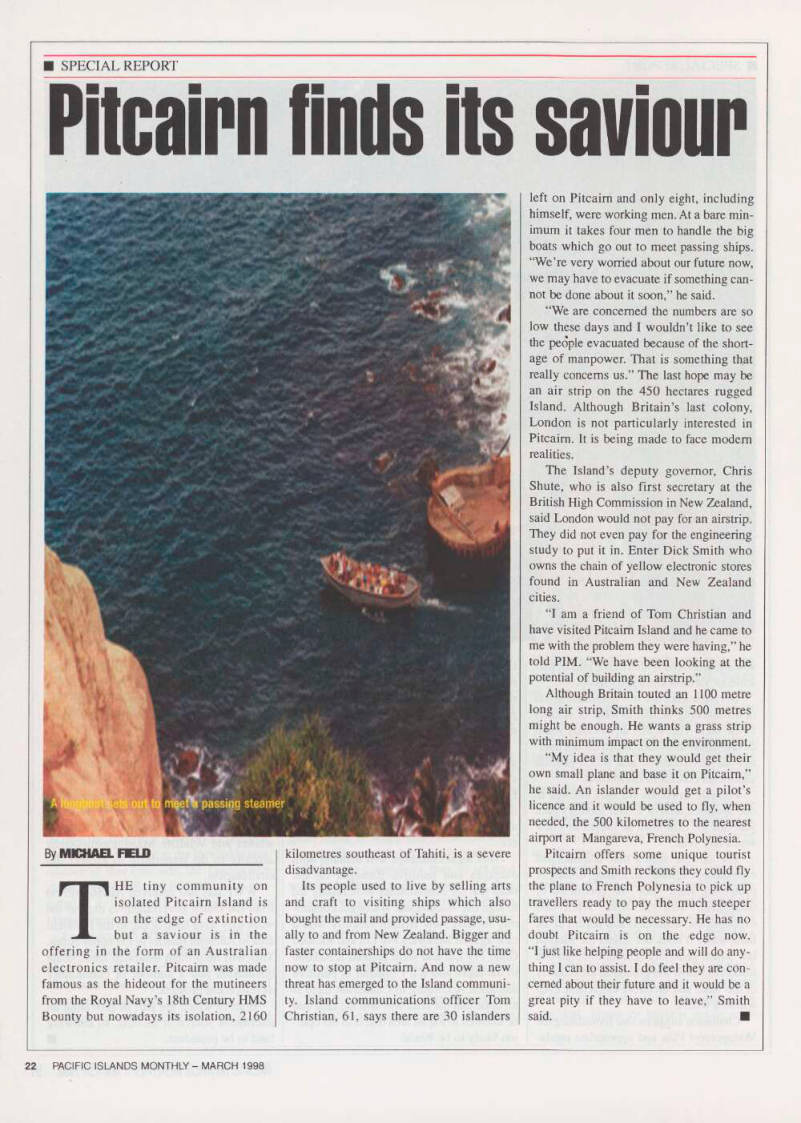
THE tiny community on isolated Pitcairn Island is on the edge of extinction but a saviour is in the offering in the form of an Australian electronics retailer. Pitcairn was made famous as the hideout for the mutineers from the Royal Navy’s 18th Century HMS Bounty but nowadays its isolation, 2160
kilometres southeast of Tahiti, is a severe
disadvantage.
Its people used to live by selling arts and craft to visiting ships which also bought the mail and provided passage, usu ally to and from New Zealand. Bigger and faster containerships do not have the time now to stop at Pitcairn. And now a new threat has emerged to the Island communi ty. Island communications officer Tom Christian, 61, says there are 30 islanders
left on Pitcairn and only eight, including himself, were working men. At a bare min imum it takes four men to handle the big boats which go out to meet passing ships.
“We’re very worried about our future now, we may have to evacuate if something can not be done about it soon,” he said.
“We are concerned the numbers are so low these days and I wouldn’t like to see the people evacuated because of the short age of manpower. That is something that really concerns us.” The last hope may be an air strip on the 450 hectares rugged Island. Although Britain’s last colony, London is not particularly interested in Pitcairn. It is being made to face modem realities.
The Island’s deputy governor, Chris Shute, who is also first secretary at the British High Commission in New Zealand, said London would not pay for an airstrip.
They did not even pay for the engineering study to put it in. Enter Dick Smith who owns the chain of yellow electronic stores found in Australian and New Zealand cities.
“I am a friend of Tom Christian and have visited Pitcairn Island and he came to me with the problem they were having,” he told PIM. “We have been looking at the potential of building an airstrip.”
Although Britain touted an 1100 metre long air strip, Smith thinks 500 metres might be enough. He wants a grass strip with minimum impact on the environment.
“My idea is that they would get their own small plane and base it on Pitcairn,” he said. An islander would get a pilot’s licence and it would be used to fly, when needed, the 500 kilometres to the nearest airport at Mangareva, French Polynesia.
Pitcairn offers some unique tourist prospects and Smith reckons they could fly the plane to French Polynesia to pick up travellers ready to pay the much steeper fares that would be necessary. He has no doubt Pitcairn is on the edge now.
“I just like helping people and will do any thing I can to assist. I do feel they are con cerned about their future and it would be a great pity if they have to leave,” Smith said. ■
A longboat sets out to meet a passing steamer
Marshall islanders
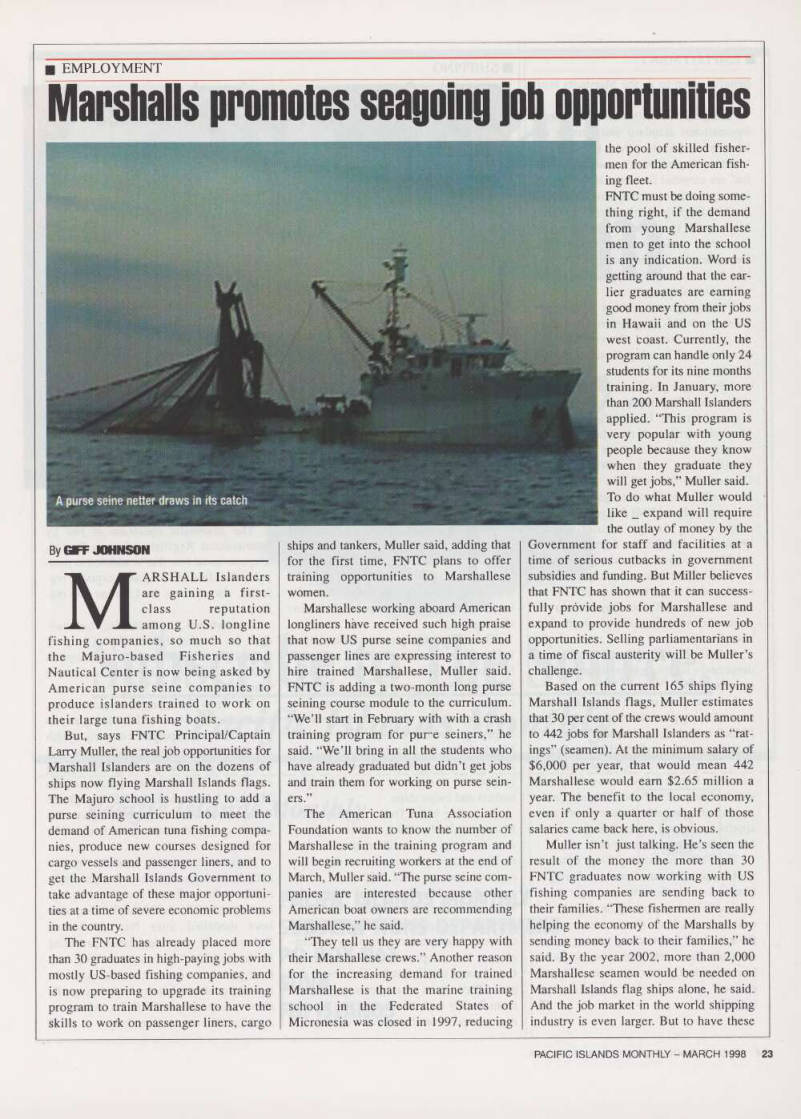
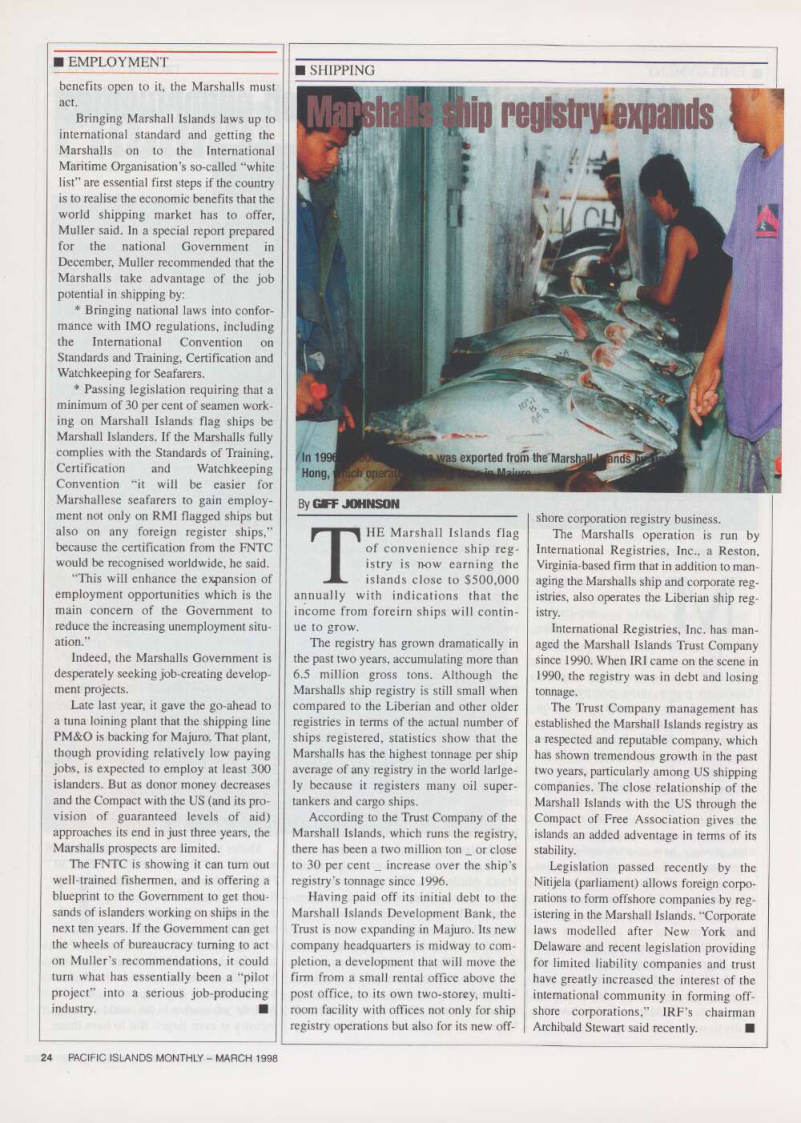
Employment
Marshalls promotes seagoing job opportunities
By Giff Johnson
Marshall islanders
are gaining a first
class reputation
among U.S. longline fishing companies, so much so that the Majuro-based Fisheries and Nautical Center is now being asked by American purse seine companies to produce islanders trained to work on their large tuna fishing boats.
But, says FNTC Principal/Captain Larry Muller, the real job opportunities for Marshall Islanders are on the dozens of ships now flying Marshall Islands flags.
The Majuro school is hustling to add a purse seining curriculum to meet the demand of American tuna fishing compa nies, produce new courses designed for cargo vessels and passenger liners, and to get the Marshall Islands Government to take advantage of these major opportuni ties at a time of severe economic problems in the country.
The FNTC has already placed more than 30 graduates in high-paying jobs with mostly US-based fishing companies, and is now preparing to upgrade its training program to train Marshallese to have the skills to work on passenger liners, cargo
ships and tankers, Muller said, adding that for the first time, FNTC plans to offer training opportunities to Marshallese women.
Marshallese working aboard American
longliners have received such high praise
that now US purse seine companies and passenger lines are expressing interest to hire trained Marshallese, Muller said.
FNTC is adding a two-month long purse seining course module to the curriculum.
“We’ll start in February with with a crash training program for pur~e seiners,” he said. “We’ll bring in all the students who have already graduated but didn’t get jobs and train them for working on purse sein ers.”
The American Tuna Association Foundation wants to know the number of Marshallese in the training program and will begin recruiting workers at the end of March, Muller said. “The purse seine com panies are interested because other American boat owners are recommending Marshallese,” he said.
“They tell us they are very happy with their Marshallese crews.” Another reason for the increasing demand for trained Marshallese is that the marine training school in the Federated States of Micronesia was closed in 1997, reducing
the pool of skilled fisher men for the American fish
ing fleet.
FNTC must be doing some thing right, if the demand from young Marshallese men to get into the school is any indication. Word is getting around that the ear lier graduates are earning good money from their jobs in Hawaii and on the US west boast. Currently, the program can handle only 24 students for its nine months training. In January, more than 200 Marshall Islanders applied. “This program is very popular with young people because they know when they graduate they will get jobs,” Muller said.
To do what Muller would like expand will require the outlay of money by the
Government for staff and facilities at a time of serious cutbacks in government subsidies and funding. But Miller believes that FNTC has shown that it can success fully provide jobs for Marshallese and expand to provide hundreds of new job
opportunities. Selling parliamentarians in
a time of fiscal austerity will be Muller’s challenge.
Based on the current 165 ships flying Marshall Islands flags, Muller estimates that 30 per cent of the crews would amount to 442 jobs for Marshall Islanders as “rat ings” (seamen). At the minimum salary of $6,000 per year, that would mean 442 Marshallese would earn $2.65 million a year. The benefit to the local economy, even if only a quarter or half of those salaries came back here, is obvious.
Muller isn’t just talking. He’s seen the result of the money the more than 30 FNTC graduates now working with US
fishing companies are sending back to
their families. “These fishermen are really helping the economy of the Marshalls by sending money back to their families,” he said. By the year 2002, more than 2,000 Marshallese seamen would be needed on Marshall Islands flag ships alone, he said.
And the job market in the world shipping industry is even larger. But to have these
A purse seine netter draws in its catch
benefits open to it, the Marshalls must act.
Bringing Marshall Islands laws up to international standard and getting the Marshalls on to the International Maritime Organisation’s so-called “white list” are essential first steps if the country is to realise the economic benefits that the world shipping market has to offer, Muller said. In a special report prepared for the national Government in December, Muller recommended that the Marshalls take advantage of the job
potential in shipping by:
* Bringing national laws into confor mance with IMO regulations, including the International Convention on Standards and Training, Certification and Watchkeeping for Seafarers.
* Passing legislation requiring that a
minimum of 30 per cent of seamen work ing on Marshall Islands flag ships be Marshall Islanders. If the Marshalls fully complies with the Standards of Training, Certification and Watchkeeping Convention “it will be easier for Marshallese seafarers to gain employ ment not only on RMI flagged ships but also on any foreign register ships,” because the certification from the FNTC would be recognised worldwide, he said.
“This will enhance the expansion of employment opportunities which is the main concern of the Government to reduce the increasing unemployment situ ation.”
Indeed, the Marshalls Government is
desperately seeking job-creating develop
ment projects.
Late last year, it gave the go-ahead to a tuna Joining plant that the shipping line PM&O is backing for Majuro. That plant,
though providing relatively low paying
jobs, is expected to employ at least 300 islanders. But as donor money decreases and the Compact with the US (and its pro vision of guaranteed levels of aid) approaches its end in just three years, the Marshalls prospects are limited.
The FNTC is showing it can turn out well-trained fishermen, and is offering a blueprint to the Government to get thou sands of islanders working on ships in the next ten years. If the Government can get the wheels of bureaucracy turning to act on Muller’s recommendations, it could turn what has essentially been a “pilot project” into a serious job-producing
industry. ■
Marshalls ship registry expands
Shipping
By Giff Johnson
THE Marshall Islands flag
of convenience ship reg istry is now earning the islands close to $500,000 annually with indications that the income from foreirn ships will contin ue to grow.
The registry has grown dramatically in the past two years, accumulating more than 6.5 million gross tons. Although the Marshalls ship registry is still small when compared to the Liberian and other older registries in terms of the actual number of ships registered, statistics show that the Marshalls has the highest tonnage per ship average of any registry in the world larlge ly because it registers many oil super tankers and cargo ships.
According to the Trust Company of the Marshall Islands, which runs the registry, there has been a two million ton or close to 30 per cent increase over the ship’s registry’s tonnage since 1996.
Having paid off its initial debt to the Marshall Islands Development Bank, the Trust is now expanding in Majuro. Its new company headquarters is midway to com pletion, a development that will move the firm from a small rental office above the post office, to its own two-storey, multi room facility with offices not only for ship registry operations but also for its new off
shore corporation registry business.
The Marshalls operation is run by International Registries, Inc., a Reston, Virginia-based firm that in addition to man aging the Marshalls ship and corporate reg istries, also operates the Liberian ship reg
istry.
International Registries, Inc. has man aged the Marshall Islands Trust Company since 1990. When IRI came on the scene in 1990, the registry was in debt and losing tonnage.
The Trust Company management has established the Marshall Islands registry as a respected and reputable company, which has shown tremendous growth in the past two years, particularly among US shipping companies. The close relationship of the Marshall Islands with the US through the Compact of Free Association gives the islands an added adventage in terms of its
stability.
Legislation passed recently by the Nitijela (parliament) allows foreign corpo rations to form offshore companies by reg istering in the Marshall Islands. “Corporate laws modelled after New York and Delaware and recent legislation providing for limited liability companies and trust have greatly increased the interest of the international community in forming off shore corporations,” IRF’s chairman Archibald Stewart said recently. ■
In 1996 [?] was exported from the Marshall Islands by [?] Hong, which operate[?] in Maiure
Advertisements & other items, pp. 24-26 (2 items)
I Employment
IBM Pentium
To Win an
Subscribe to The Source.
Pacific Islands Monthly
Pacific Islands Monthly
AFFIX
STAMP
HERE
PACIFIC ISLANDS MONTHLY
SUBSCRIPTIONS DEPARTMENT
PO BOX 1167
SUVA
FIJI ISLANDS
For almost 70 years, Pacific Islands Monthly has been and still is the authority on political, business and social issues within the Pacific. And now, every 12 month subscription received before the 31st of March, 1998, goes into a draw to win an IBM Pentium Notebook*. You could even give a gift subscription to enter but it must be before the closing date. As well as the entry into the draw, you will also receive the latest news from the region. Fill in the subscription form below and send it along with payment to Pacific Islands Monthly, Subscription Department, PO Box 1167, Suva, Fiji. Or call PIM on (679) 304 111 or fax us on (679) 303 809/(679) 307 460.
Subscribe to The Source.
Pacific Islands Monthly
*Rates include Airspeeding to all destinations Conditions of Entry 1. To enter, subscriptions must be made before March 31st, 1998 which automatically enters the subscriber into the draw for the Pentium Notebook Computer, 2. Entry is open to all subscribers except employees of The Fiji Times Ltd, Pacific Islands Monthly, and Wilson Addison Ltd. 3. Subscribers need to subscribe for 12 months to qualify. 4. The winner of the Pentium Notebook will be published in Pacific Islands Monthly Magazine, May Issue, 1998 and will be notified by registered mail. 5. The winner will receive their prize within one month of the draw. 6. The prize must be taken as offered and is not redeemable. 7. In the event of any dispute the decision of the promoter is final and no correspondence will be entered into.
YES! I wish to subscribe to The Source and receive a chance to win an IBM Pentium Notebook Computer! □ Cheque/Bank Draft/Money Order made payable to Pacific Islands Monthly □ Please charge my credit card: (VISA / AMEX / MASTERCARD)
12 ISSUE
SUBSCRIPTION
Rate A Rate B Rate C I Rate D Rate E □ □ Signature: Expiry date: Mr/Mrs/Ms: Delivery Address: Postal Address; This is a
□ Renewal
□ New Subscription Country; Fax:
A language in crisis

Culture
By Florence Syme-Buchanan
Educators and Cook Islands Maori language enthusiasts have fears that the Cook Islands tongue will continue to disappear unless something is done to rescue it on a nationwide scale. The Cook
Islands language is being used less and less.
Only a fraction of advertisements on television are in Maori. Of the three newspapers, only the daily will carry an article in Maori and that per haps only once a week.
The language makes up less than
half of what’s spoken on either radio station.
The official language of Parliament’s Hansard debates is English, business and government let terheads are in English and casual conversations amongst Cook Islanders, especially in Rarotonga, are
A fact well known for many years by educators is that too many Cook Islands school children, such these Atiu primary school kids, are entering school without the advantages of a firm language base.
more often held in English.
A Ministry of Education policy of bi-lingual education has been in place for a number of years, but its success has been limited..
The Ministry has grudgingly acknowledged too many children were still entering school and more dis turbingly, high school with only limit ed comprehension or communication skills in either English or Maori.
Because of this, many were failing and
dropping out.
To find out why, the Ministry of Education contracted Language Consultant Elaine Lameta from New Zealand to carry out a comprehensive study of the problems in the Cook Islands and produce a report.
That report would be used to for mulate language policies for the Ministry.
But typical of Cook Islands govern ment behaviour, the report is being kept hush - hush by the Ministry of Education , ossibly because it discuss es how the Ministry has failed to fully address and cope with the language
problem.
Elaine Lameta spent two and a half months in the Cooks collecting data and conducting her study. The main areas of concern were leaked by an educatorconcerned over the disappear ance of the Cook Islands language and the fact that “so little is being done to save our mother tongue.”
Lameta has made bold recommen dations - one of the most significant is that the country needs an Official Language Act recognising Maori and a statutory body, possibly modelled on the New Zealand Language Commission.
This body would ensure the preser vation and increased usage of the Maori language. In her study Lameta points to part of the language problem starting at home. Parents are not teaching their children the language they speak best and for most this would be Maori.
Many parents place more impor tance on their children learning English. They struggle to teach their children in the English language even
though they speak it poorly.
The end result is the child speaks
little Maori and has very limited read ing comprehension and communica tion skills in English.
The Ministry of Education source says parents “have to be convinced that they have to put more effort in, if they speak Maori better, then teach their kids in Maori.”
“Parents are not doing the kids a favour by teaching poor English.”
Having a strong language base, whichever one it may be, gives any child an advantage at school, says the source.
Lameta also points to the various Cook Islands dialects as being some thing which the Ministry of Education must address. She supports the con cept that children have the right to be taught - at least for most of their pri mary years - whatever dialect is spo ken on their home island.
A Pukapuka student has to sit Grade Six National Exams in the Rarotongan dialect. Pukapukan Maori and Rarotongan Maori are virtually two separate languages. The language problems, says the source, have been around for many years but the Ministry of Education “hasn’t
acknowledged the problem,” the
source says.
The source believes it could take up to ten years to put the language situa tion right and past small, sporadic efforts to address the issue havehad only limited success.
What is recognised is that it will take a major, national effort to elevate the use of Maori and give eloquence
in the language prestige.
Language problems aren’t unique to the Cook Islands. But Elaine Lameta’s study notes in New Zealand where Maori had virtually died out 15 years ago, there’s now a lot more respect and awareness for the lan guage. Much more Maori is spoken in New Zealand today and proficiency in the language carries considerable sta tus. New Zealand public servants who are bilingual in English and Maori are often paid more.
But why bother with Maori when English, the international language of business is far more useful to a Cook Islander, particularly when overseas?
Director of the Curriculum Unit Gill
Vaiimene says the importance of Cook Islands Maori can’t be stressed enough.
“Its the language of our heritage and our culture, it gives pride and builds self-esteem in young people who can speak it, because of this, those who are fluent in Maori and English are more likely to succeed in life than those who aren’t.”
Minister of Education Ngereteina Puna says he’s all for raising the sta tus of the Cook Islands Maori lan guage.
He’s now awaiting the final report from'Lameta. The language policies that will be drafted from the report will first haveto be approved by the Minister. Once this has been done, workshops will be run to familiarise teachers with the new policies and new programmes will be developed.
It’s expected a lotmore Maori reading material will be developed for Cook Islands schools.
Puna wants to take the Maori lan guage issue further by making spoken Maori “one of the requirements before being given permanent residence.” He would eventually like to see this legis lated and although Puna hasn’t “set out to convince” his Cabinet col leagues some do agree with him while others haven’t expressed a firm view on the issue yet.
He says at present “permanent resi dence applicants don’t seem to be tak ing much notice of the Maori lan guage” and “being a Cook Islander is being able to speak the language and people who wanted to adopt the coun try as their home should learn Cook Islands Maori.”
Minister Puna believes Cook
Islands society is showing signs that
the native tongue could die “if we don’t do something about it quickly.”
“In ordinary conversation, a lot of our people are more comfortable speaking English, in our churches English has become the language the sacred songs are sung in and sermons are preached.” The minister would like to see more obvious public sup port for the concept of those wanting permanent residence first learning the language, but to date, there’s been very little. ■
Brain drain: The best and
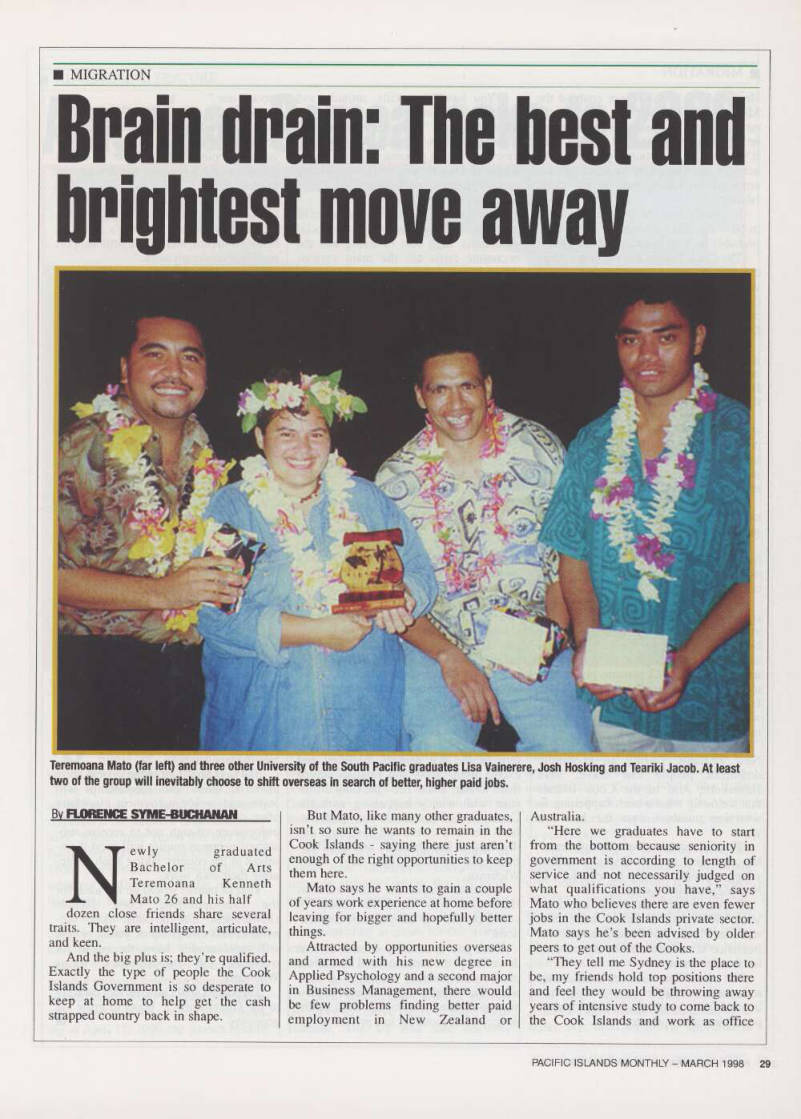
Migration
Brain drain: The best and brightest move away
By Florence Syme-Buchanan
Newly graduated
Bachelor of Arts Teremoana Kenneth Mato 26 and his half dozen close friends share several traits. They are intelligent, articulate, and keen.
And the big plus is; they’re qualified.
Exactly the type of people the Cook Islands Government is so desperate to keep at home to help get the cash strapped country back in shape.
But Mato, like many other graduates, isn’t so sure he wants to remain in the Cook Islands - saying there just aren’t enough of the right opportunities to keep them here.
Mato says he wants to gain a couple of years work experience at home before
leaving for bigger and hopefully better
things.
Attracted by opportunities overseas
and armed with his new degree in
Applied Psychology and a second major
in Business Management, there would
be few problems finding better paid
employment in New Zealand or
Australia.
“Here we graduates have to start from the bottom because seniority in government is according to length of service and not necessarily judged on what qualifications you have,” says Mato who believes there are even fewer jobs in the Cook Islands private sector.
Mato says he’s been advised by older peers to get out of the Cooks.
“They tell me Sydney is the place to be, my friends hold top positions there and feel they would be throwing away years of intensive study to come back to the Cook Islands and work as office
Teremoana Mato (far left) and three other University of the South Pacific graduates Lisa Vainerere, Josh Hosking and Teariki Jacob. At least two of the group will inevitably choose to shift overseas in search of better, higher paid jobs.
clerks.” Mato’s skills have enabled the Ministry of Education to establish the new position of Career Counsellor and he’s hoping to be paid $24,000 a year.
It’s unlikely the young graduate will actually get that salary as educators are amongst the lowest paid in the Cook Islands.
It’s likely Mato will choose to work in New Zealand or Australia where he’ll probably be paid in excess of $30,000.
The Cook Islands has experienced an exodus of young people since 1991 which has serious implications on the country’s social and economic well being, warns South Pacific Commission Demographer Gerald Haberkom.
Except for Niue whose population of just 2000 people is the result of massive emigration to New Zealand, the Cook Islands’ position is in stark contrast with the rest of the Pacific.
Statistics Haberkom has collected show in 1991 there were 3800 young people in the Cooks - by 1996 that figure had dropped to 3000. For a country of
just 19,000 people “that’s quite phenom
enal ,” says Haberkom.
“If left unabated, the Cook Islands can end up with a dormant population of
just old people.”
He says most productive workers have left which will have “serious eco nomic and social consequences on the
country.”
The demographer says the “problem is a vicious circle as the few remaining young people feel compelled to leave because they have no peers.” Haberkom says the Cooks population growth, or near lack of it at 0.2 percent, is also due to the “incredible advantage of Cook Islanders having New Zealand passports which has relieved the country of any
over-population problems.
Over 40,000 Cook Islanders live in New Zealand. During an economic downturn people can leave, says Haberkom. And in the Cook Islands that’s exactly what’s been happening in worrying numbers over the last two years.
There’s concern that a “brain drain” has occurred in the Cooks - skilled younger people leaving to seek jobs in New Zealand and Australia.
University of Bradford educated Vaine Wichman, a former economist with the Ministry of Finance and now a freelance consultant makes no excuses for the Government.
She says there have been some reforms in the public sector making hir ing and firing similar to the employment principles of the private sector.
“You have the skills, attitude and qualifications, in that order, and you have the job.” “However there is still some disbelief with the new public ser vice recruitment process, as at the senior levels of the service, political coercing and influence still prevails,” says Wichman.
Limited job opportunities, absence of adequate welfare benefits, fewer social attractions, high cost of living and the economic crisis are the main reasons which keep Cook Islanders from return ing in their thousands. Probably just as well.
The infrastructure of main island Rarotonga could not support a big, per manent population increase - the island is already struggling to support its 50,000 visitors a year.
An increase in tourism is much need ed by the country which has been in the throes of a crippling economic crisis for over two years.
But first, water, electricity, solid and liquid waste disposal and an ineffective government Environmental Service seri ously need upgrading to cope with a tourism boom. Wichman says the prob lem in recent times is that the Government expects to expand new infrastructure arrangements without
ensuring existing infrastructure was
improved on a par.
Added to that she says is the Government’s financial mismanagement “and so maintenance on existing infras tructure such as roads, water and airports was deferred in favour of less essential priorities, for example trips to exotic places for Government officials.” From an economic point of view, emmigration in response to land, population and eco nomic pressures has acted as a safety valve in times of recession.
“New Zealand is an example - at the turn of the last century qualified and excess Irish, Scots and English moved there to start a new life - the only differ ence with what’s happening with the Cooks now is that skills and qualifica tions aren’t in excess and the Cooks can ill afford to lose this skill and qualifica tion base at this stage, says Vaine Wichman.”
Wichman shares the same view as Haberkom, who warns the exodus of young people will have serious implica tions.
Both say a casualty of the current downturn in the economy will be the loss of the economically active at a time when the country needs their energies most to sustain the transition from a pub lic sector led economy to a private sector
growth one.”
Wichman says probably one of the attributes lacking in the economically active,qualified and skilled group of young people; is the attitude to set up private sector initiatives and businesses on their own.
“There still is that attitude of working for someone and getting a pay packet rather than putting all one’s energies behind a dream, and with a little support making that dream work.”.
She points out the few displaced pub lic servants who have remained in the country and developed viable private sector initiatives, have been surprised with their achievements and wondered why they have stayed in the public sec tor for so long.
“Unfortunately, these cases aren’t common for the majority of displaced public and private sector employees who have been put off work and the option of migrating to dole queues and employ ment opportunities overseas is more attractive.”
The Government’s economic policies point to supporting and growing the pro ductive sectors of agriculture, marine resources, tourism and offshore banking and home industry type initiatives.
Since the inception of the reform in March 1996 these sectors are still adjust ing and finding a way to grow, and it appears with a fiscal shortfall projected for March 1998, the country will still be a few years lagging behind the ambitious reform targets of March 1996.
Wichman says what this means for current and future levels of young people coming out of schools is that education standards will still be wanting.
Due to the lack of adequate funding “the quality of service delivery in educa tion and health is ebbing, and isn’t expected to improve for at least the next two to three years.”
She says this’ll mean the system stays as it is; those with scholarships will leave and seek employment elsewhere after studies are completed, and those unfortunate enough not to receive sub sidised overseas studies will exert them selves in the country taking a job or cre ating their own work.
That of course would be the ideal for the ever-optimistic Cook Islands Government. But the most likely sce nario is that this group of young people will more readily leave the island for
overseas job opportunities warns
Wichman.
This could well cause further disarray to the Government’s plans to grow the economy. ■
American Samoa looks to 2000
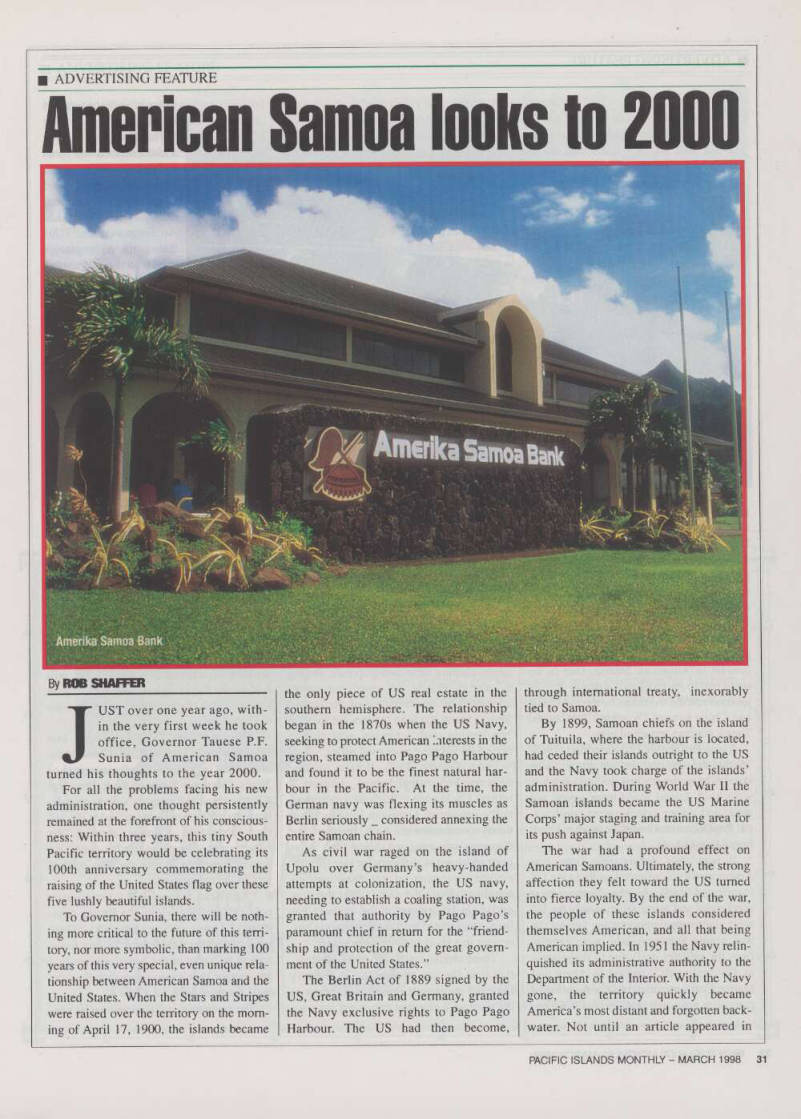
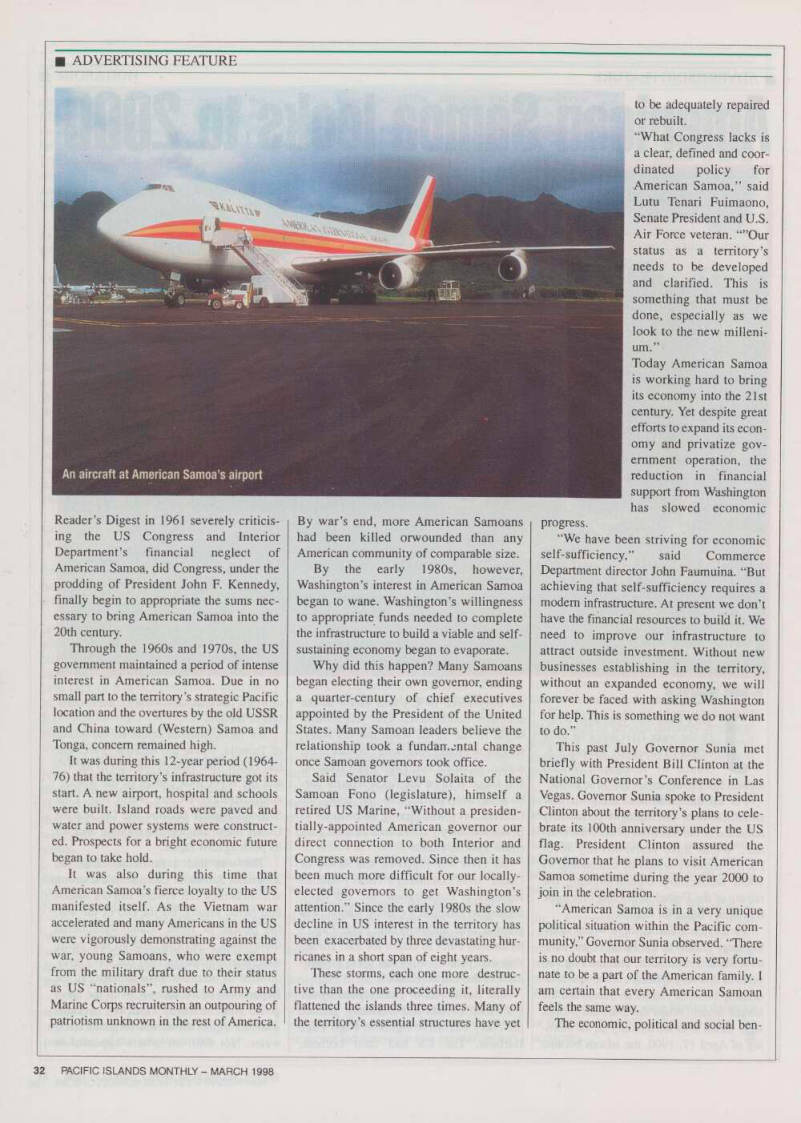
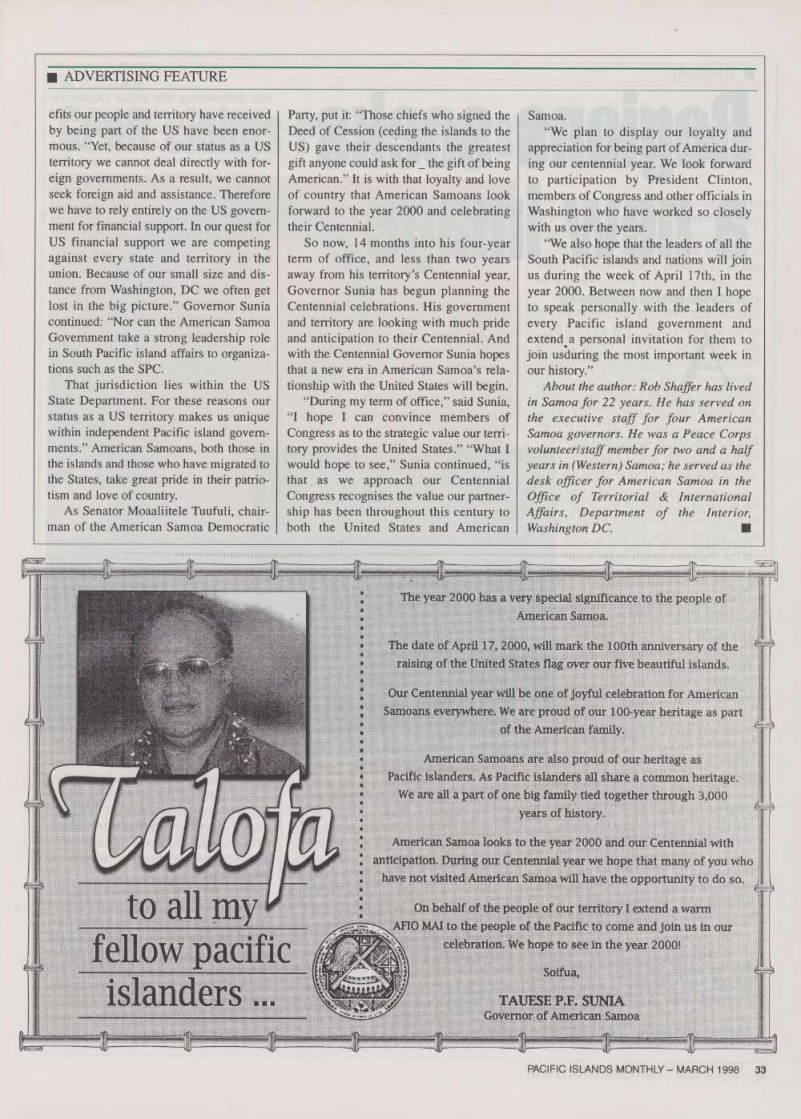
Advertising Feature
By Rob Shaffer
JUST over one year ago, with in the very first week he took office, Governor Tauese P.F.
Sunia of American Samoa turned his thoughts to the year 2000.
For all the problems facing his new administration, one thought persistently remained at the forefront of his conscious ness: Within three years, this tiny South Pacific territory would be celebrating its 100th anniversary commemorating the raising of the United States flag over these five lushly beautiful islands.
To Governor Sunia, there will be noth ing more critical to the future of this terri tory, nor more symbolic, than marking 100 years of this very special, even unique rela tionship between American Samoa and the United States. When the Stars and Stripes were raised over the territory on the morn ing of April 17, 1900, the islands became
the only piece of US real estate in the southern hemisphere. The relationship began in the 1870 s when the US Navy, seeking to protect American interests in the region, steamed into Pago Pago Harbour and found it to be the finest natural har bour in the Pacific. At the time, the German navy was flexing its muscles as Berlin seriously considered annexing the entire Samoan chain.
As civil war raged on the island of Upolu over Germany’s heavy-handed attempts at colonization, the US navy, needing to establish a coaling station, was granted that authority by Pago Pago’s paramount chief in return for the “friend ship and protection of the great govern ment of the United States.”
The Berlin Act of 1889 signed by the US, Great Britain and Germany, granted the Navy exclusive rights to Pago Pago Harbour. The US had then become,
through international treaty, inexorably tied to Samoa.
By 1899, Samoan chiefs on the island of Tuituila, where the harbour is located, had ceded their islands outright to the US and the Navy took charge of the islands’ administration. During World War II the Samoan islands became the US Marine Corps’ major staging and training area for its push against Japan.
The war had a profound effect on American Samoans. Ultimately, the strong affection they felt toward the US turned into fierce loyalty. By the end of the war, the people of these islands considered themselves American, and all that being American implied. In 1951 the Navy relin quished its administrative authority to the Department of the Interior. With the Navy gone, the territory quickly became America’s most distant and forgotten back water. Not until an article appeared in
Amerika Samoa Bank
Reader’s Digest in 1961 severely criticis ing the US Congress and Interior Department’s financial neglect of American Samoa, did Congress, under the prodding of President John F. Kennedy, finally begin to appropriate the sums nec essary to bring American Samoa into the 20th century.
Through the 1960 s and 19705, the US government maintained a period of intense interest in American Samoa. Due in no small part to the territory’s strategic Pacific location and the overtures by the old USSR and China toward (Western) Samoa and Tonga, concern remained high.
It was during this 12-year period (1964- 76) that the territory’s infrastructure got its start. A new airport, hospital and schools were built. Island roads were paved and water and power systems were construct ed. Prospects for a bright economic future began to take hold.
It was also during this time that American Samoa’s fierce loyalty to the US manifested itself. As the Vietnam war accelerated and many Americans in the US
were vigorously demonstrating against the
war, young Samoans, who were exempt from the military draft due to their status as US “nationals”, rushed to Army and Marine Corps recruitersin an outpouring of patriotism unknown in the rest of America.
By war’s end, more American Samoans had been killed orwounded than any American community of comparable size.
By the early 1980 s, however, Washington’s interest in American Samoa began to wane. Washington’s willingness to appropriate funds needed to complete the infrastructure to build a viable and self sustaining economy began to evaporate.
Why did this happen? Many Samoans began electing their own governor, ending a quarter-century of chief executives appointed by the President of the United States. Many Samoan leaders believe the relationship took a fundamental change once Samoan governors took office.
Said Senator Levu Solaita of the Samoan Fono (legislature), himself a retired US Marine, “Without a presiden tially-appointed American governor our direct connection to both Interior and Congress was removed. Since then it has been much more difficult for our locally elected governors to get Washington’s attention.” Since the early 1980 s the slow decline in US interest in the territory has been exacerbated by three devastating hur ricanes in a short span of eight years.
These storms, each one more destruc tive than the one proceeding it, literally flattened the islands three times. Many of the territory’s essential structures have yet
to be adequately repaired
or rebuilt.
“What Congress lacks is a clear, defined and coor dinated policy for American Samoa,” said Lutu Tenari Fuimaono, Senate President and U.S.
Air Force veteran. “”Our status as a territory’s needs to be developed and clarified. This is something that must be done, especially as we look to the new milleni um.”
Today American Samoa is working hard to bring its economy into the 21st century. Yet despite great efforts to expand its econ omy and privatize gov ernment operation, the reduction in financial support from Washington has slowed economic
progress.
“We have been striving for economic self-sufficiency,” said Commerce Department director John Faumuina. “But achieving that self-sufficiency requires a modem infrastructure. At present we don’t have the financial resources to build it. We need to improve our infrastructure to attract outside investment. Without new businesses establishing in the territory, without an expanded economy, we will forever be faced with asking Washington for help. This is something we do not want to do.”
This past July Governor Sunia met briefly with President Bill Clinton at the National Governor’s Conference in Las Vegas. Governor Sunia spoke to President Clinton about the territory’s plans to cele brate its 100th anniversary under the US flag. President Clinton assured the Governor that he plans to visit American Samoa sometime during the year 2000 to join in the celebration.
“American Samoa is in a very unique political situation within the Pacific com munity,” Governor Sunia observed. “There is no doubt that our territory is very fortu nate to be a part of the American family. I am certain that every American Samoan feels the same way.
The economic, political and social ben
An aircraft at American Samoa’s airport
efits our people and territory have received by being part of the US have been enor mous. “Yet, because of our status as a US territory we cannot deal directly with for eign governments. As a result, we cannot seek foreign aid and assistance. Therefore we have to rely entirely on the US govern ment for financial support. In our quest for US financial support we are competing against every state and territory in the union. Because of our small size and dis tance from Washington, DC we often get lost in the big picture.” Governor Sunia continued: “Nor can the American Samoa Government take a strong leadership role in South Pacific island affairs to organiza tions such as the SPC.
That jurisdiction lies within the US State Department. For these reasons our status as a US territory makes us unique within independent Pacific island govern ments.” American Samoans, both those in the islands and those who have migrated to the States, take great pride in their patrio tism and love of country.
As Senator Moaaliitele Tuufuli, chair man of the American Samoa Democratic
Party, put it: “Those chiefs who signed the Deed of Cession (ceding the islands to the US) gave their descendants the greatest gift anyone could ask for the gift of being American.” It is with that loyalty and love of country that American Samoans look forward to the year 2000 and celebrating their Centennial.
So now, 14 months into his four-year term of office, and less than two years away from his territory’s Centennial year, Governor Sunia has begun planning the Centennial celebrations. His government and territory are looking with much pride and anticipation to their Centennial. And with the Centennial Governor Sunia hopes that a new era in American Samoa’s rela tionship with the United States will begin.
“During my term of office,” said Sunia, “I hope I can convince members of Congress as to the strategic value our terri tory provides the United States.” “What I would hope to see,” Sunia continued, “is that as we approach our Centennial Congress recognises the value our partner ship has been throughout this century to both the United States and American
Samoa.
“We plan to display our loyalty and appreciation for being part of America dur ing our centennial year. We look forward to participation by President Clinton, members of Congress and other officials in Washington who have worked so closely with us over the years.
“We also hope that the leaders of all the South Pacific islands and nations will join us during the week of April 17th, in the year 2000. Between now and then I hope to speak personally with the leaders of every Pacific island government and extend a personal invitation for them to join usduring the most important week in our history.”
About the author: Rob Shaffer has lived in Samoa for 22 years. He has served on the executive staff for four American Samoa governors. He was a Peace Corps volunteer!staff member for two and a half years in (Western) Samoa; he served as the desk officer for American Samoa in the Office of Territorial & International Affairs, Department of the Interior, Washington DC. ■
Advertisements & other items, p. 33 (1 item)
fellow pacific
to all my
islanders...
& The year 2000 has a very special significance to the people of American Samoa.
The date of April 17, 2000, will mark the 100th anniversary of the raising of the United States flag over our five beautiful islands.
Our Centennial year will be one of joyful celebration for American Samoans everywhere. We are proud of our 100-year heritage as part of the American family.
American Samoans are also proud of our heritage as Pacific islanders. As Pacific Islanders all share a common heritage.
We are all a part of one big family tied together through 3,000 years of history.
American Samoa looks to the year 2000 and our Centennial with anticipation. During our Centennial year we hope that many of you who have not visited American Samoa will have the opportunity to do so.
On behalf of the people of our territory I extend a warm AFIO MAI to the people of the Pacific to come and join us in our celebration. We hope to see in the year 2000!
Soifua, '
TAUESE P.F. SUNIA
Governor of American Samoa
Regions seeks
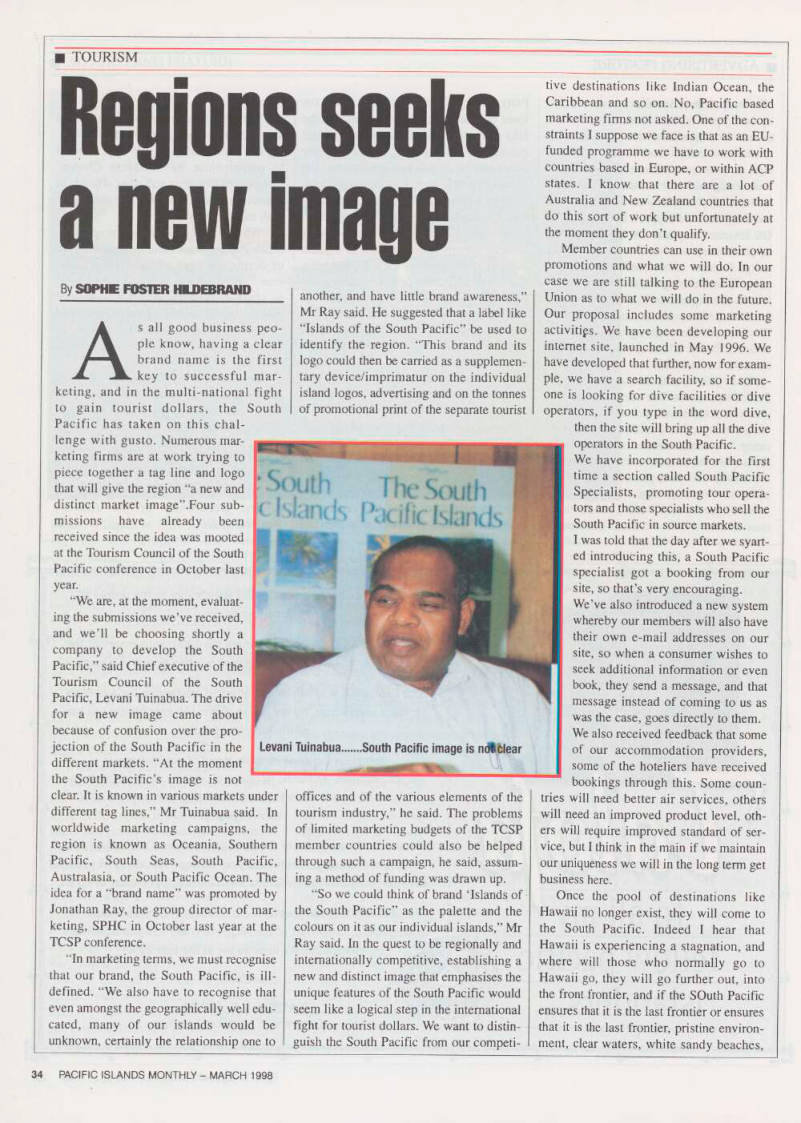
Tourism
Regions seeks a new image
By Sophie Foster Hilderrand
As all good business peo ple know, having a clear brand name is the first key to successful mar keting, and in the multi-national fight to gain tourist dollars, the South
Pacific has taken on this chal lenge with gusto. Numerous mar keting firms are at work trying to piece together a tag line and logo that will give the region “a new and distinct market image”. Four sub missions have already been received since the idea was mooted at the Tourism Council of the South Pacific conference in October last year.
“We are, at the moment, evaluat ing the submissions we’ve received, and we’ll be choosing shortly a company to develop the South Pacific,” said Chief executive of the Tourism Council of the South Pacific, Levani Tuinabua. The drive for a new image came about because of confusion over the pro jection of the South Pacific in the different markets. “At the moment the South Pacific’s image is not
clear. It is known in various markets under different tag lines,” Mr Tuinabua said. In worldwide marketing campaigns, the region is known as Oceania, Southern Pacific, South Seas, South Pacific, Australasia, or South Pacific Ocean. The idea for a “brand name” was promoted by Jonathan Ray, the group director of mar keting, SPHC in October last year at the TCSP conference.
“In marketing terms, we must recognise that our brand, the South Pacific, is ill defined. “We also have to recognise that even amongst the geographically well edu cated, many of our islands would be unknown, certainly the relationship one to
another, and have little brand awareness,”
Mr Ray said. He suggested that a label like “Islands of the South Pacific” be used to identify the region. “This brand and its logo could then be carried as a supplemen tary device/imprimatur on the individual island logos, advertising and on the tonnes of promotional print of the separate tourist
offices and of the various elements of the tourism industry,” he said. The problems of limited marketing budgets of the TCSP member countries could also be helped through such a campaign, he said, assum ing a method of funding was drawn up.
“So we could think of brand ‘lslands of the South Pacific” as the palette and the colours on it as our individual islands,” Mr Ray said. In the quest to be regionally and
internationally competitive, establishing a
new and distinct image that emphasises the unique features of the South Pacific would seem like a logical step in the international fight for tourist dollars. We want to distin guish the South Pacific from our competi
tive destinations like Indian Ocean, the Caribbean and so on. No, Pacific based marketing firms not asked. One of the con straints I suppose we face is that as an EU funded programme we have to work with countries based in Europe, or within ACP states. I know that there are a lot of Australia and New Zealand countries that do this sort of work but unfortunately at the moment they don’t qualify.
Member countries can use in their own promotions and what we will do. In our case we are still talking to the European Union as to what we will do in the future.
Our proposal includes some marketing activities. We have been developing our internet site, launched in May 1996. We have developed that further, now for exam ple, we have a search facility, so if some one is looking for dive facilities or dive operators, if you type in the word dive,
then the site will bring up all the dive operators in the South Pacific.
We have incorporated for the first time a section called South Pacific
Specialists, promoting tour opera
tors and those specialists who sell the South Pacific in source markets.
I was told that the day after we syart ed introducing this, a South Pacific specialist got a booking from our site, so that’s very encouraging.
We’ve also introduced a new system whereby our members will also have their own e-mail addresses on our site, so when a consumer wishes to seek additional information or even book, they send a message, and that message instead of coming to us as was the case, goes directly to them.
We also received feedback that some of our accommodation providers, some of the hoteliers have received
bookings through this. Some coun tries will need better air services, others will need an improved product level, oth ers will require improved standard of ser vice, but I think in the main if we maintain our uniqueness we will in the long term get business here.
Once the pool of destinations like Hawaii no longer exist, they will come to the South Pacific. Indeed I hear that Hawaii is experiencing a stagnation, and where will those who normally go to Hawaii go, they will go further out, into the front frontier, and if the SOuth Pacific ensures that it is the last frontier or ensures that it is the last frontier, pristine environ ment, clear waters, white sandy beaches,
Levani Tuinabua... South Pacific image is not clear
Graft claims raise pressure on Skate
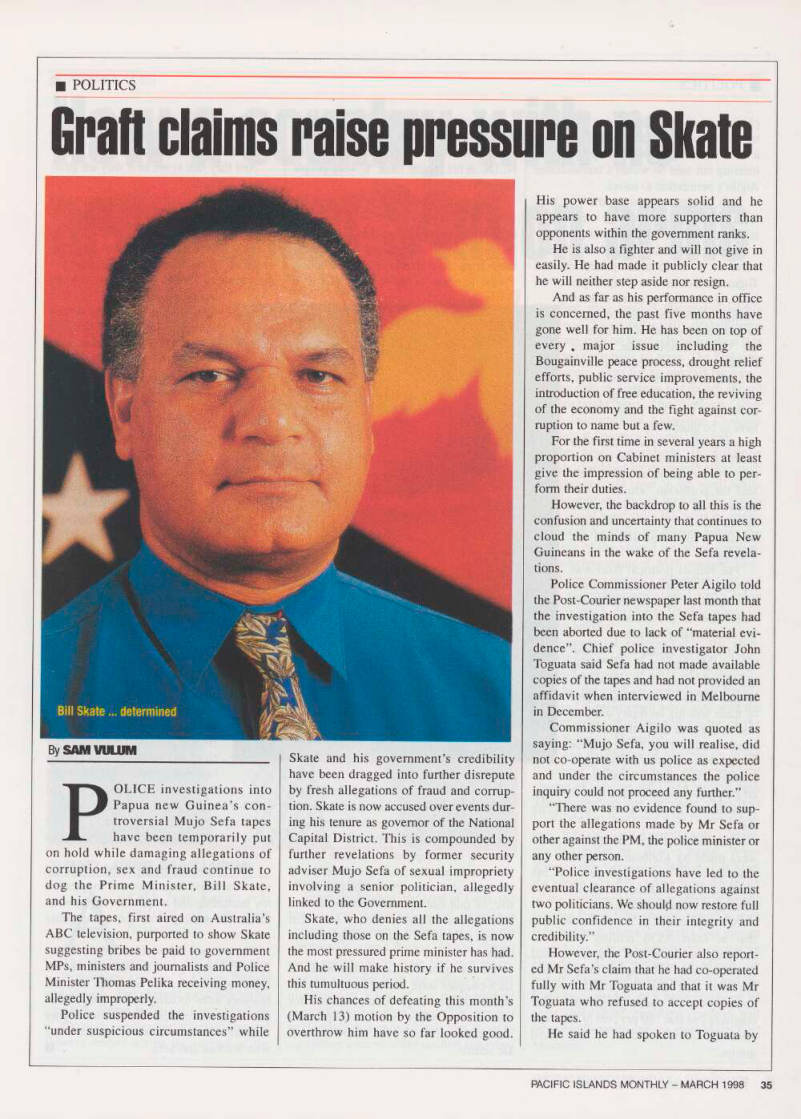
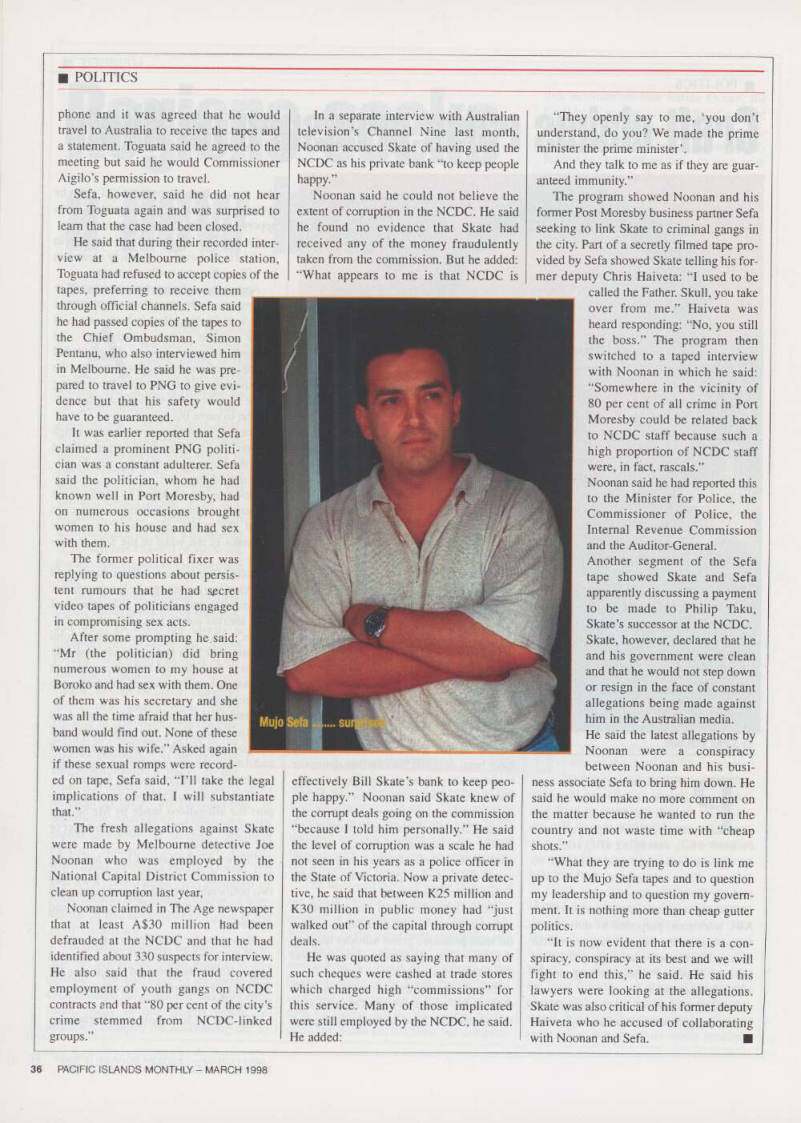
Politics
By Sam Vulum
POLICE investigations into Papua new Guinea’s con troversial Mujo Sefa tapes have been temporarily put on hold while damaging allegations of corruption, sex and fraud continue to dog the Prime Minister, Bill Skate, and his Government.
The tapes, first aired on Australia’s ABC television, purported to show Skate suggesting bribes be paid to government MPs, ministers and journalists and Police Minister Thomas Pelika receiving money, allegedly improperly.
Police suspended the investigations “under suspicious circumstances” while
Skate and his government’s credibility have been dragged into further disrepute by fresh allegations of fraud and corrup tion. Skate is now accused over events dur ing his tenure as governor of the National Capital District. This is compounded by further revelations by former security adviser Mujo Sefa of sexual impropriety involving a senior politician, allegedly linked to the Government.
Skate, who denies all the allegations including those on the Sefa tapes, is now the most pressured prime minister has had.
And he will make history if he survives this tumultuous period.
His chances of defeating this month’s (March 13) motion by the Opposition to overthrow him have so far looked good.
His power base appears solid and he appears to have more supporters than opponents within the government ranks.
He is also a fighter and will not give in easily. He had made it publicly clear that he will neither step aside nor resign.
And as far as his performance in office is concerned, the past five months have gone well for him. He has been on top of every . major issue including the Bougainville peace process, drought relief efforts, public service improvements, the introduction of free education, the reviving of the economy and the fight against cor ruption to name but a few.
For the first time in several years a high proportion on Cabinet ministers at least give the impression of being able to per form their duties.
However, the backdrop to all this is the confusion and uncertainty that continues to cloud the minds of many Papua New Guineans in the wake of the Sefa revela tions.
Police Commissioner Peter Aigilo told the Post-Courier newspaper last month that the investigation into the Sefa tapes had been aborted due to lack of “material evi dence”. Chief police investigator John Toguata said Sefa had not made available copies of the tapes and had not provided an affidavit when interviewed in Melbourne in December.
Commissioner Aigilo was quoted as saying: “Mujo Sefa, you will realise, did not co-operate with us police as expected and under the circumstances the police inquiry could not proceed any further.”
“There was no evidence found to sup port the allegations made by Mr Sefa or other against the PM, the police minister or any other person.
“Police investigations have led to the eventual clearance of allegations against two politicians. We should now restore full public confidence in their integrity and
credibility.”
However, the Post-Courier also report ed Mr Sefa’s claim that he had co-operated fully with Mr Toguata and that it was Mr Toguata who refused to accept copies of the tapes.
He said he had spoken to Toguata by
Bill Skate... determined
phone and it was agreed that he would travel to Australia to receive the tapes and a statement. Toguata said he agreed to the meeting but said he would Commissioner
Aigilo’s permission to travel.
Sefa, however, said he did not hear from Toguata again and was surprised to leam that the case had been closed.
He said that during their recorded inter view at a Melbourne police station, Toguata had refused to accept copies of the
tapes, preferring to receive them through official channels. Sefa said he had passed copies of the tapes to the Chief Ombudsman, Simon Pentanu, who also interviewed him in Melbourne. He said he was pre pared to travel to PNG to give evi dence but that his safety would have to be guaranteed.
It was earlier reported that Sefa claimed a prominent PNG politi cian was a constant adulterer. Sefa said the politician, whom he had known well in Port Moresby, had on numerous occasions brought women to his house and had sex with them.
The former political fixer was replying to questions about persis tent rumours that he had secret video tapes of politicians engaged in compromising sex acts.
After some prompting he,said: “Mr (the politician) did bring numerous women to my house at Boroko and had sex with them. One of them was his secretary and she was all the time afraid that her hus band would find out. None of these women was his wife.” Asked again if these sexual romps were record
ed on tape, Sefa said, “I’ll take the legal implications of that. I will substantiate that.”
The fresh allegations against Skate were made by Melbourne detective Joe Noonan who was employed by the National Capital District Commission to clean up corruption last year, Noonan claimed in The Age newspaper that at least As3o million had been defrauded at the NCDC and that he had identified about 330 suspects for interview.
He also said that the fraud covered employment of youth gangs on NCDC contracts and that “80 per cent of the city’s crime stemmed from NCDC-linked groups.”
In a separate interview with Australian television’s Channel Nine last month, Noonan accused Skate of having used the NCDC as his private bank “to keep people
happy.”
Noonan said he could not believe the extent of corruption in the NCDC. He said he found no evidence that Skate had received any of the money fraudulently taken from the commission. But he added; “What appears to me is that NCDC is
effectively Bill Skate’s bank to keep peo ple happy.” Noonan said Skate knew of the corrupt deals going on the commission “because I told him personally.” He said the level of corruption was a scale he had not seen in his years as a police officer in the State of Victoria. Now a private detec tive, he said that between K 25 million and K3O million in public money had “just walked out” of the capital through corrupt deals.
He was quoted as saying that many of such cheques were cashed at trade stores which charged high “commissions” for this service. Many of those implicated were still employed by the NCDC, he said.
He added:
“They openly say to me, ‘you don’t understand, do you? We made the prime minister the prime minister’.
And they talk to me as if they are guar anteed immunity.”
The program showed Noonan and his former Post Moresby business partner Sefa seeking to link Skate to criminal gangs in the city. Part of a secretly filmed tape pro vided by Sefa showed Skate telling his for mer deputy Chris Haiveta: “I used to be
called the Father. Skull, you take over from me.” Haiveta was heard responding: “No, you still the boss.” The program then switched to a taped interview with Noonan in which he said: “Somewhere in the vicinity of 80 per cent of all crime in Port Moresby could be related back to NCDC staff because such a high proportion of NCDC staff were, in fact, rascals.”
Noonan said he had reported this to the Minister for Police, the Commissioner of Police, the Internal Revenue Commission and the Auditor-General.
Another segment of the Sefa tape showed Skate and Sefa apparently discussing a payment to be made to Philip Taku, Skate’s successor at the NCDC.
Skate, however, declared that he and his government were clean and that he would not step down or resign in the face of constant allegations being made against him in the Australian media.
He said the latest allegations by Noonan were a conspiracy between Noonan and his busi
ness associate Sefa to bring him down. He said he would make no more comment on the matter because he wanted to run the country and not waste time with “cheap shots.”
“What they are trying to do is link me up to the Mujo Sefa tapes and to question my leadership and to question my govern ment. It is nothing more than cheap gutter
politics.
“It is now evident that there is a con spiracy, conspiracy at its best and we will fight to end this,” he said. He said his lawyers were looking at the allegations.
Skate was also critical of his former deputy Haiveta who he accused of collaborating with Noonan and Sefa. ■
Mujo Seta... surprised
How a country with no
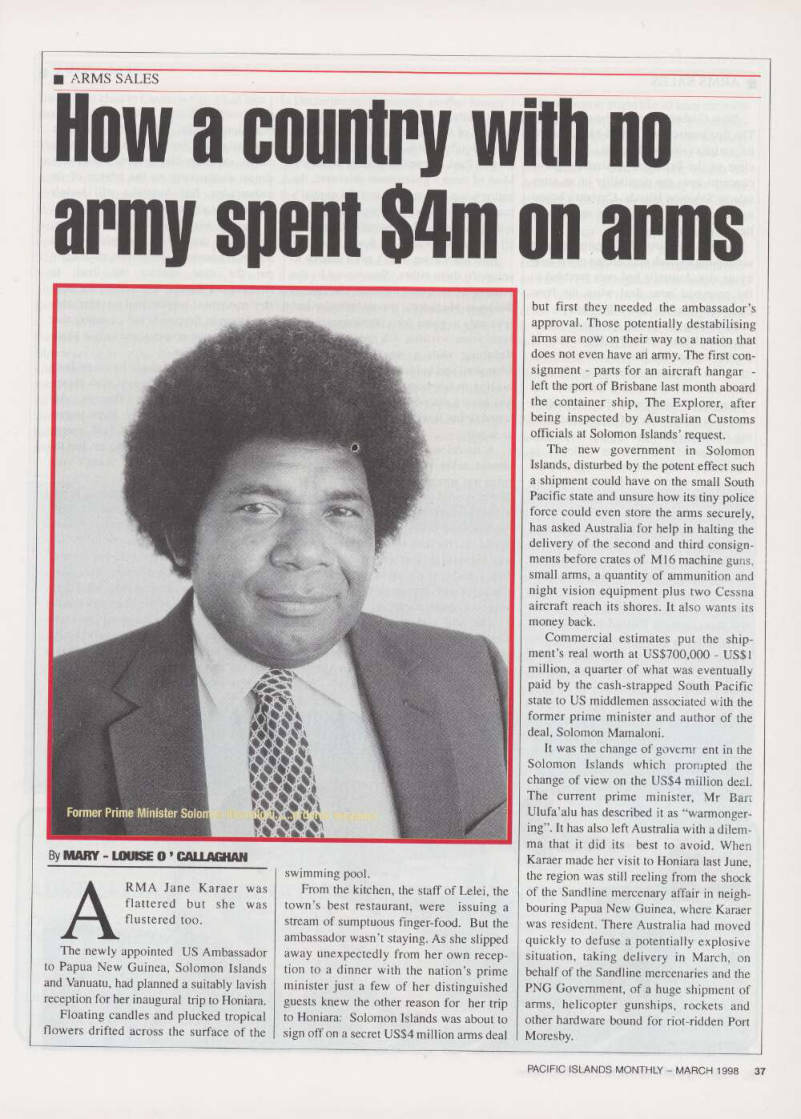
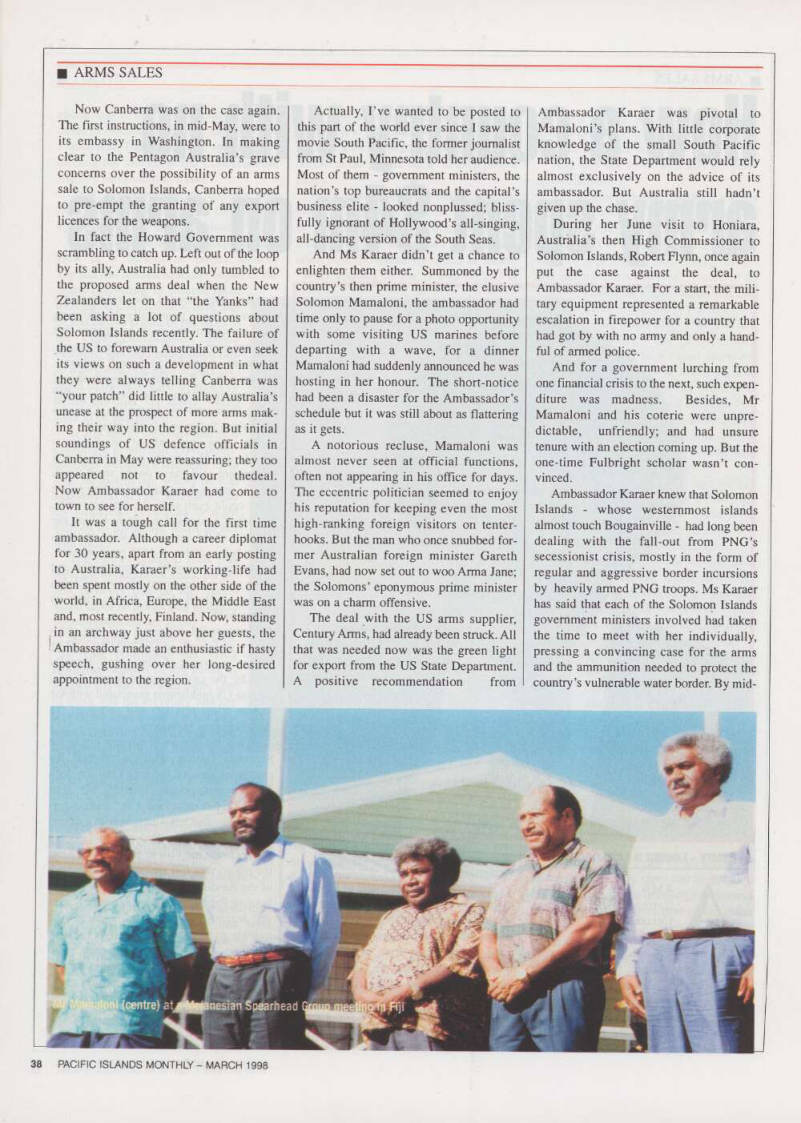
Arms Sales
How a country with no army spent $4m on arms
By Mary - Louise O' Callaghan
ARMA Jane Karaer was flattered but she was flustered too.
The newly appointed US Ambassador to Papua New Guinea, Solomon Islands and Vanuatu, had planned a suitably lavish reception for her inaugural trip to Honiara.
Floating candles and plucked tropical flowers drifted across the surface of the
swimming pool.
From the kitchen, the staff of Lelei, the town’s best restaurant, were issuing a stream of sumptuous finger-food. But the ambassador wasn’t staying. As she slipped away unexpectedly from her own recep tion to a dinner with the nation’s prime minister just a few of her distinguished guests knew the other reason for her trip to Honiara: Solomon Islands was about to sign off on a secret US$4 million arms deal
but first they needed the ambassador’s
approval. Those potentially destabilising
arms are now on their way to a nation that does not even have ari army. The first con signment - parts for an aircraft hangar left the port of Brisbane last month aboard the container ship. The Explorer, after
being inspected by Australian Customs
officials at Solomon Islands’ request.
The new government in Solomon Islands, disturbed by the potent effect such a shipment could have on the small South Pacific state and unsure how its tiny police force could even store the arms securely, has asked Australia for help in halting the delivery of the second and third consign ments before crates of Ml 6 machine guns, small arms, a quantity of ammunition and night vision equipment plus two Cessna aircraft reach its shores. It also wants its money back.
Commercial estimates put the ship ment’s real worth at US$7OO,OOO - US$l million, a quarter of what was eventually paid by the cash-strapped South Pacific state to US middlemen associated with the former prime minister and author of the deal, Solomon Mamaloni.
It was the change of governr ent in the Solomon Islands which prompted the change of view on the US$4 million deal.
The current prime minister, Mr Bart Ulufa’alu has described it as “warmonger ing”. It has also left Australia with a dilem ma that it did its best to avoid. When Karaer made her visit to Honiara last June, the region was still reeling from the shock of the Sandline mercenary affair in neigh bouring Papua New Guinea, where Karaer was resident. There Australia had moved quickly to defuse a potentially explosive situation, taking delivery in March, on behalf of the Sandline mercenaries and the PNG Government, of a huge shipment of arms, helicopter gunships, rockets and other hardware bound for riot-ridden Port
Moresby.
Former Prime Minister Solom[?]llo[?]i... prdered wea[?]s
Now Canberra was on the case again.
The first instructions, in mid-May, were to its embassy in Washington. In making clear to the Pentagon Australia’s grave concerns over the possibility of an arms sale to Solomon Islands, Canberra hoped to pre-empt the granting of any export licences for the weapons.
In fact the Howard Government was scrambling to catch up. Left out of the loop by its ally, Australia had only tumbled to the proposed arms deal when the New Zealanders let on that “the Yanks” had been asking a lot of questions about Solomon Islands recently. The failure of the US to forewarn Australia or even seek its views on such a development in what they were always telling Canberra was “your patch” did little to allay Australia’s unease at the prospect of more arms mak ing their way into the region. But initial soundings of US defence officials in Canberra in May were reassuring; they too appeared not to favour thedeal.
Now Ambassador Karaer had come to town to see for herself.
It was a tough call for the first time ambassador. Although a career diplomat for 30 years, apart from an early posting to Australia, Karaer’s working-life had been spent mostly on the other side of the world, in Africa, Europe, the Middle East and, most recently, Finland. Now, standing , in an archway just above her guests, the Ambassador made an enthusiastic if hasty speech, gushing over her long-desired appointment to the region.
Actually, I’ve wanted to be posted to this part of the world ever since I saw the movie South Pacific, the former journalist from St Paul, Minnesota told her audience.
Most of them - government ministers, the nation’s top bureaucrats and the capital’s business elite - looked nonplussed; bliss
fully ignorant of Hollywood’s all-singing,
all-dancing version of the South Seas.
And Ms Karaer didn’t get a chance to enlighten them either. Summoned by the country’s then prime minister, the elusive Solomon Mamaloni, the ambassador had time only to pause for a photo opportunity with some visiting US marines before departing with a wave, for a dinner Mamaloni had suddenly announced he was hosting in her honour. The short-notice had been a disaster for the Ambassador’s schedule but it was still about as flattering as it gets.
A notorious recluse, Mamaloni was almost never seen at official functions, often not appearing in his office for days.
The eccentric politician seemed to enjoy his reputation for keeping even the most high-ranking foreign visitors on tenter hooks. But the man who once snubbed for mer Australian foreign minister Gareth Evans, had now set out to woo Arma Jane; the Solomons’ eponymous prime minister was on a charm offensive.
The deal with the US arms supplier, Century Arms, had already been struck. All that was needed now was the green light for export from the US State Department.
A positive recommendation from
Ambassador Karaer was pivotal to Mamaloni’s plans. With little corporate knowledge of the small South Pacific nation, the State Department would rely almost exclusively on the advice of its ambassador. But Australia still hadn’t given up the chase.
During her June visit to Honiara, Australia’s then High Commissioner to Solomon Islands, Robert Flynn, once again put the case against the deal, to Ambassador Karaer. For a start, the mili tary equipment represented a remarkable escalation in firepower for a country that had got by with no army and only a hand ful of armed police.
And for a government lurching from one financial crisis to the next, such expen diture was madness. Besides, Mr Mamaloni and his coterie were unpre dictable, unfriendly; and had unsure tenure with an election coming up. But the one-time Fulbright scholar wasn’t con vinced.
Ambassador Karaer knew that Solomon Islands - whose westernmost islands almost touch Bougainville - had long been dealing with the fall-out from PNG’s secessionist crisis, mostly in the form of regular and aggressive border incursions by heavily armed PNG troops. Ms Karaer has said that each of the Solomon Islands government ministers involved had taken the time to meet with her individually, pressing a convincing case for the arms and the ammunition needed to protect the country’s vulnerable water border. By mid-
Mr Mamatoni (centre) at a Melanesian Spearhead Group meeting in Fiji
June it was clear to Canberra that it had lost the race.
Three of the four licences were granted.
The State Department only declined, in the end, to facilitate the Solomons’ request for rockets and M 72 anti-armour weapons. But as the rest of arms and aircraft began their slow journey south, Solomons went to the polls, the government changed hands and peace broke out on nearby Bougainville.
The unfriendly border crossings ceased. In time the new prime minister, Bart Ulufa’alu, uncovered evidence of the extraordinary $4 million deal.
According to him there is no sign of a formal contract, simply a letter signed by Mamaloni authorising his long-time friend and associate, an American amateur avia tor, Patrick Murphy, to purchase the arms on behalf of the SI Government.
Anxious to stop delivery of the arms, and recoup the funds, Ulufa’alu wrote immedi ately to the big man: Bill Clinton.
In December he discovered another former Solomons prime minister, Francis Billy Hilly, was on his way to attend a Moonies conference in Washington; Ulufa’alu asked him to hand deliver his letter to the presi dent.
But diplomatic wires became crossed and the envelope came home again. Another copy sent to the US Embassy in Port Moresby also apparently went astray.
Ambassador Karaer has confirmed that a reply was eventually forthcoming from Washington: once the licences were grant ed, the issue became a commercial matter in which the US Government has no power to intervene, it said.
It also pointed out that the amount apparently spent on the arms doesn’t tally with the commercial value of the equip ment listed on the licences. Last month Ulufa’alu met with the Australian Foreign Minister, Alexander Downer, and suggest ed that the Australian
Government might like to keep the arms and pick up the tab. Canberra is consider ing the request as a matter of urgency.
Solomon Mamaloni is incensed. In a four page letter to Ulufa’alu last month he defended the deal describing the prime minister’s decision to stop delivery of the shipment, as “treason”.
“The fact is the Solomon Islands Government successfully pulled this diffi cult deal through with the mightiest power on earth (USA)...unlike some other third world countries it has done the right things, at the very beginning, in presenting its case to Washington.” Mamaloni, makes no men tion of the discrepancy in costs. Perhaps Ambas’sador Karaer would now agree: Hollywood didn’t even get close.
Mary-Louise O’ Callaghan is the South Pacific correspondent of The Australian newspaper where this article first appeared. ■
Advertisements & other items, p. 38 (1 item)
■ Arms Sales
Voters have the right to know
IN his reply to Mamaloni, Prime Minister Ulufa’alu points out that there was no Cabinet endorsement of the arms deal, a foreigner seemed to have unlimited authority to act as agent and that there was no contract or other documentation for the deal.
“As a long-serving and former Prime Minister, I am sure you know very well that these are certainly not normal proce dures in Solomon Islands under the consti tution.”
He says the Government has already paid out US$3.5 million while calls for
more cash are still being received. He also questions Mamaloni’s claim that Australia was unable to assist in providing arms.
“Again,” he writes, “the absence of the office file on this matter made it impossi ble to confirm this.”
The Prime Minister says the agent, Patrick Murphy, “confronted enormous difficulties in securing the necessary per mits from' the United States State Department” and that, as a result, the Solomon Islands New York mission “was dragged on to the scene.”
He adds; “Your assertion that greater damage had been done to our sovereignty
as a result of exposing the unprocedural way in which your government acted to procure the arms is nothing less than a per sonal opinion. Solomon Islanders wished you had recognised that responsibility a lit tle sooner and acted to stop the country’s economic slide.”
In a thinly veiled reference to the previ ous government’s record, Ulufa’alu writes: “No-one including your goodself should be left in any doubt about the Government’s determination to right the wrongs of the past. Cases of irregular prac tices (such as the arms procurement deal, the highly suspicious H2O fuel project) so synonymous with past administration will continue to be exposed.
Don’t you agree that the voters have the right to know? Of course, you do! ” B
Advertisements & other items, p. 39 (1 item)
Australian International Shipping Services Pty Ltd
Providing Container Consolidated Services , Full Container Loads , Airfreight Forwarding and Purchase Order Tracking Services to: — American Samoa, Cook Islands, Fiji, Guam, Kiribati, New Zealand, Niue, Norfolk Island, New Caledonia, Nauru, Papua New Guinea, Solomon Islands, Tahiti, The Federated States of Micronesia, Tonga, Vanuatu and Western Samoa.
Offices in Melbourne and Sydney
TEL:— 61-3-93351477 FAX:— 61-3-93380115 EMAIL:— A-I-S-S.COM
protests gather momentum
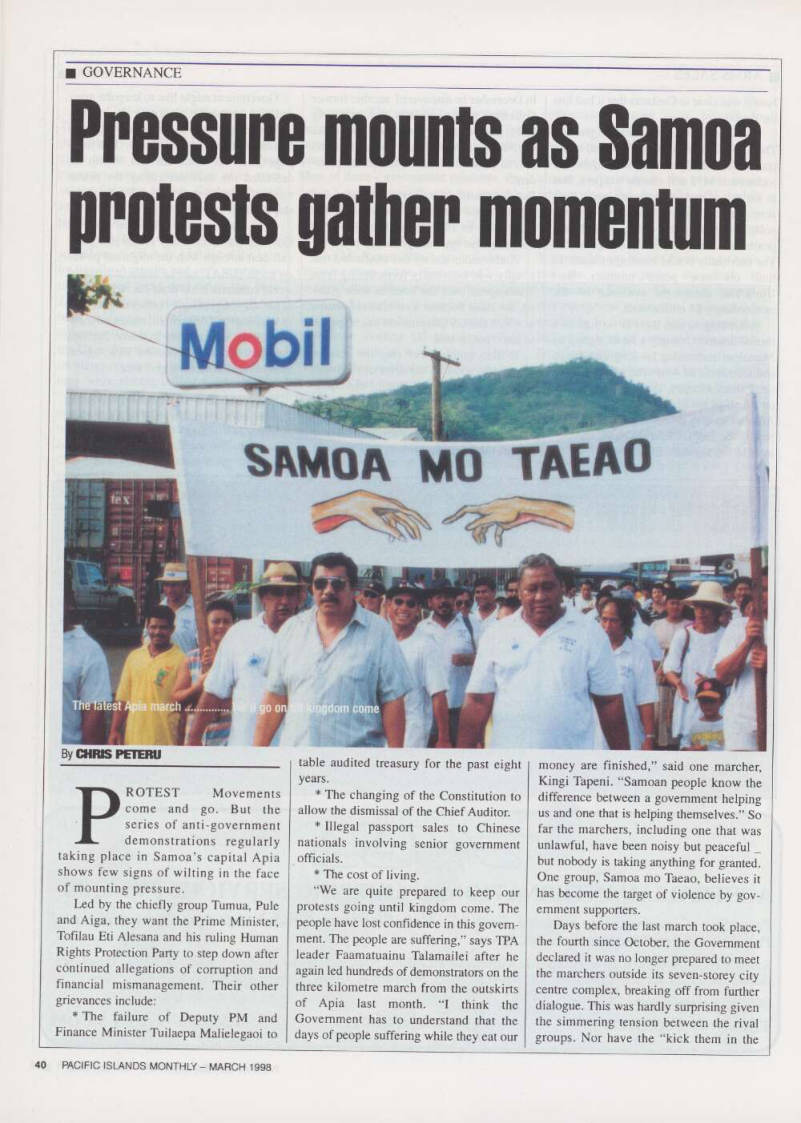
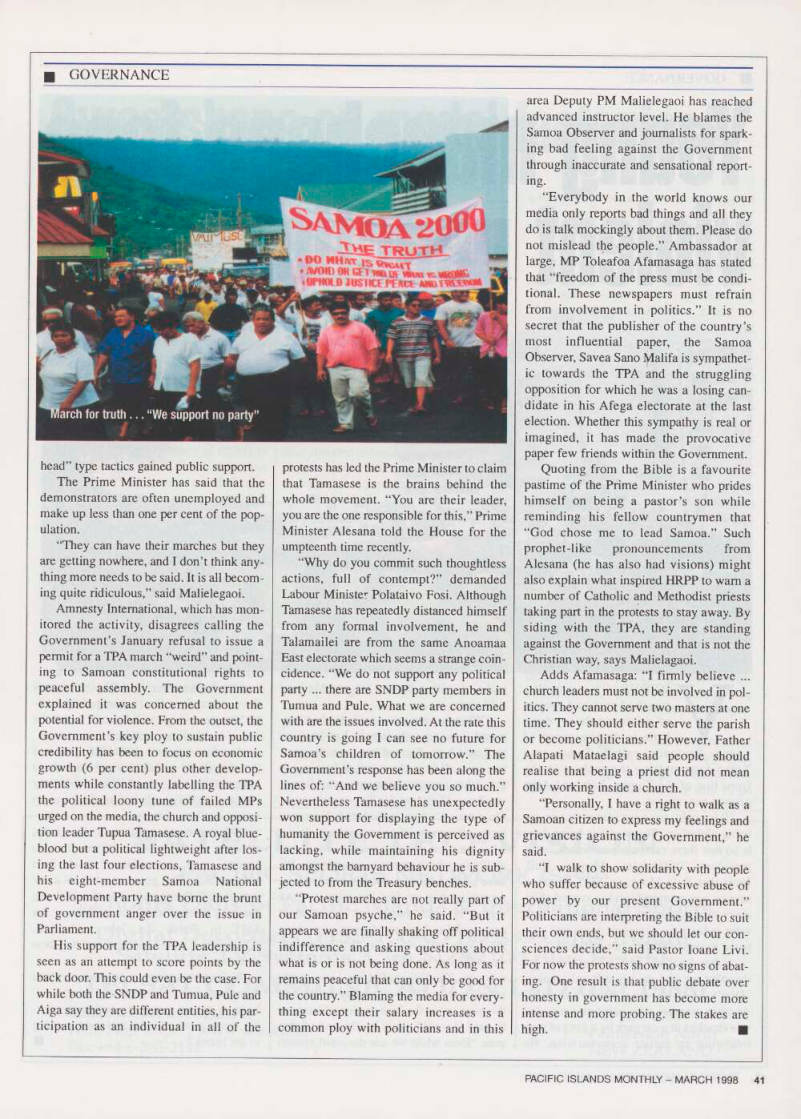
Governance
Pressure mounts as Samua protests gather momentum
By Chris Peteru
PROTEST Movements
come and go. But the series of anti-government
demonstrations regularly
taking place in Samoa’s capital Apia shows few signs of wilting in the face of mounting pressure.
Led by the chiefly group Tumua, Pule and Aiga, they want the Prime Minister, Tofilau Eti Alesana and his ruling Human Rights Protection Party to step down after continued allegations of corruption and financial mismanagement. Their other grievances include: * The failure of Deputy PM and Finance Minister Tuilaepa Malielegaoi to
table audited treasury for the past eight years. * The changing of the Constitution to allow the dismissal of the Chief Auditor. * Illegal passport sales to Chinese nationals involving senior government officials. * The cost of living.
“We are quite prepared to keep our protests going until kingdom come. The people have lost confidence in this govern ment. The people are suffering,” says TPA leader Faamatuainu Talamailei after he again led hundreds of demonstrators on the three kilometre march from the outskirts of Apia last month. “I think the Government has to understand that the days of people suffering while they eat our
money are finished,” said one marcher, Kingi Tapeni. “Samoan people know the difference between a government helping us and one that is helping themselves.” So far the marchers, including one that was unlawful, have been noisy but peaceful but nobody is taking anything for granted.
One group, Samoa mo Taeao, believes it has become the target of violence by gov ernment supporters.
Days before the last march took place, the fourth since October, the Government declared it was no longer prepared to meet the marchers outside its seven-storey city centre complex, breaking off from further dialogue. This was hardly surprising given the simmering tension between the rival groups. Nor have the “kick them in the
The latest Apia march... Well go on [?] kingdom come
head” type tactics gained public support.
The Prime Minister has said that the demonstrators are often unemployed and make up less than one per cent of the pop ulation.
“They can have their marches but they are getting nowhere, and I don’t think any thing more needs to be said. It is all becom ing quite ridiculous,” said Malielegaoi.
Amnesty International, which has mon itored the activity, disagrees calling the Government’s January refusal to issue a permit for a TPA march “weird” and point ing to Samoan constitutional rights to peaceful assembly. The Government explained it was concerned about the potential for violence. From the outset, the
Government’s key ploy to sustain public
credibility has been to focus on economic growth (6 per cent) plus other develop ments while constantly labelling the TPA the political loony tune of failed MPs urged on the media, the church and opposi tion leader Tupua Tamasese. A royal blue blood but a political lightweight after los ing the last four elections, Tamasese and his eight-member Samoa National Development Party have borne the brunt of government anger over the issue in Parliament.
His support for the TPA leadership is seen as an attempt to score points by the back door. This could even be the case. For while both the SNDP and Tumua, Pule and Aiga say they are different entities, his par ticipation as an individual in all of the
protests has led the Prime Minister to claim that Tamasese is the brains behind the whole movement. “You are their leader, you are the one responsible for this,” Prime Minister Alesana told the House for the umpteenth time recently.
“Why do you commit such thoughtless actions, full of contempt?” demanded Labour Minister Polataivo Fosi. Although Tamasese has repeatedly distanced himself from any formal involvement, he and Talamailei are from the same Anoamaa East electorate which seems a strange coin cidence. “We do not support any political party ... there are SNDP party members in Tumua and Pule. What we are concerned with are the issues involved. At the rate this country is going I can see no future for Samoa’s children of tomorrow.” The Government’s response has been along the lines of: “And we believe you so much.”
Nevertheless Tamasese has unexpectedly won support for displaying the type of humanity the Government is perceived as
lacking, while maintaining his dignity
amongst the barnyard behaviour he is sub jected to from the Treasury benches.
“Protest marches are not really part of our Samoan psyche,” he said. “But it appears we are finally shaking off political indifference and asking questions about what is or is not being done. As long as it remains peaceful that can only be good for the country.” Blaming the media for every thing except their salary increases is a common ploy with politicians and in this
area Deputy PM Malielegaoi has reached advanced instructor level. He blames the Samoa Observer and journalists for spark
ing bad feeling against the Government
through inaccurate and sensational report
ing.
“Everybody in the world knows our media only reports bad things and all they do is talk mockingly about them. Please do not mislead the people.” Ambassador at large, MP Toleafoa Afamasaga has stated that “freedom of the press must be condi tional. These newspapers must refrain from involvement in politics.” It is no secret that the publisher of the country’s most influential paper, the Samoa Observer, Savea Sano lyialifa is sympathet ic towards the TPA and the struggling opposition for which he was a losing can didate in his Afega electorate at the last election. Whether this sympathy is real or imagined, it has made the provocative paper few friends within the Government.
Quoting from the Bible is a favourite pastime of the Prime Minister who prides himself on being a pastor’s son while reminding his fellow countrymen that “God chose me to lead Samoa.” Such prophet-like pronouncements from Alesana (he has also had visions) might also explain what inspired HRPP to warn a number of Catholic and Methodist priests taking part in the protests to stay away. By siding with the TPA, they are standing against the Government and that is not the Christian way, says Malielagaoi.
Adds Afamasaga: “I firmly believe ... church leaders must not be involved in pol itics. They cannot serve two masters at one time. They should either serve the parish or become politicians.” However, Father Alapati Mataelagi said people should realise that being a priest did not mean only working inside a church.
“Personally, I have a right to walk as a Samoan citizen to express my feelings and grievances against the Government,” he said.
“I walk to show solidarity with people who suffer because of excessive abuse of power by our present Government.”
Politicians are interpreting the Bible to suit their own ends, but we should let our con sciences decide,” said Pastor loane Livi.
For now the protests show no signs of abat ing. One result is that public debate over honesty in government has become more intense and more probing. The stakes are high. ■
march for truth ... “We support no party”
Young marchers face
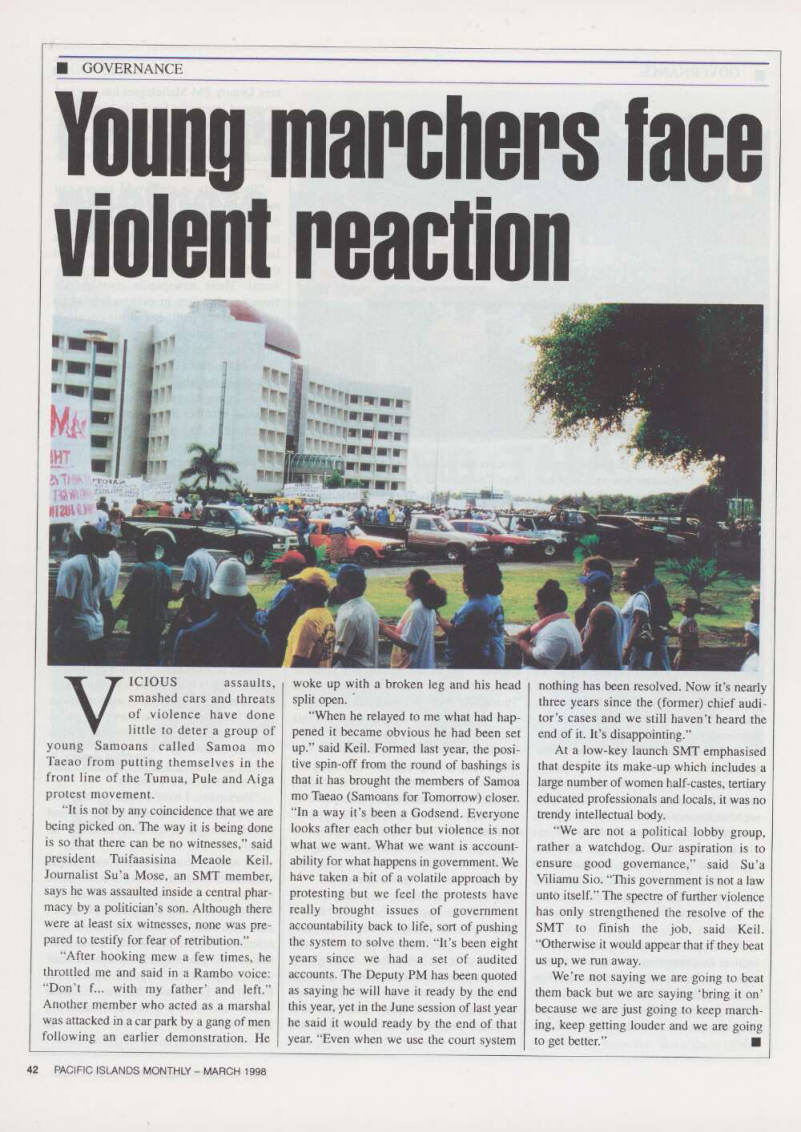
violent reaction
woke up with a broken leg and his head split open.
“When he relayed to me what had hap pened it became obvious he had been set up.” said Keil. Formed last year, the posi tive spin-off from the round of bashings is that it has brought the members of Samoa mo Taeao (Samoans for Tomorrow) closer.
“In a way it’s been a Godsend. Everyone looks after each other but violence is not what we want. What we want is account ability for what happens in government. We have taken a bit of a volatile approach by protesting but we feel the protests have really brought issues of government accountability back to life, sort of pushing the system to solve them. “It’s been eight years since we had a set of audited accounts. The Deputy PM has been quoted as saying he will have it ready by the end this year, yet in the June session of last year he said it would ready by the end of that year. “Even when we use the court system
VICIOUS assaults,
smashed cars and threats of violence have done little to deter a group of young Samoans called Samoa mo Taeao from putting themselves in the front line of the Tumua, Pule and Aiga protest movement.
“It is not by any coincidence that we are being picked on. The way it is being done is so that there can be no witnesses,” said president Tuifaasisina Meaole Keil.
Journalist Su’a Mose, an SMT member, says he was assaulted inside a central phar macy by a politician’s son. Although there were at least six witnesses, none was pre pared to testify for fear of retribution.”
“After hooking mew a few times, he throttled me and said in a Rambo voice: “Don’t f... with my father’ and left.”
Another member who acted as a marshal was attacked in a car park by a gang of men following an earlier demonstration. He
nothing has been resolved. Now it’s nearly three years since the (former) chief audi tor’s cases and we still haven’t heard the end of it. It’s disappointing.”
At a low-key launch SMT emphasised that despite its make-up which includes a large number of women half-castes, tertiary educated professionals and locals, it was no
trendy intellectual body.
“We are not a political lobby group, rather a watchdog. Our aspiration is to ensure good governance,” said Su’a Viliamu Sio. “This government is not a law unto itself.” The spectre of further violence has only strengthened the resolve of the SMT to finish the job, said Keil.
“Otherwise it would appear that if they beat us up, we run away.
We’re not saying we are going to beat them back but we are saying ‘bring it on’ because we are just going to keep march ing, keep getting louder and we are going to get better.” ■
Sweatshops or model factories?
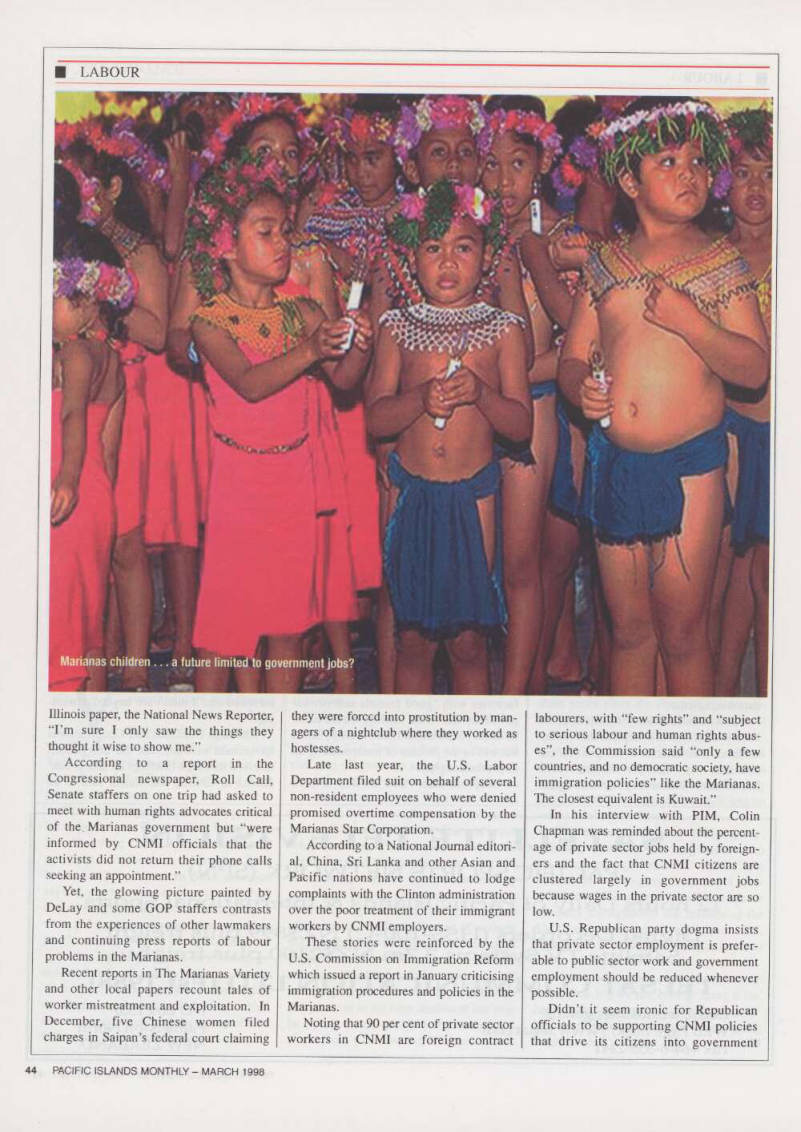

Labour
Marianas labour laws under the microscope
By Susan Prokop
Tourist arrivals dip 17 per cent”, read the headline in the December 4, 1997 Marianas Variety. “They Came. They Saw. They Golfed” read another headline in the January 20, 1998 New York Times about U.S.
Congressional visits to the Marianas.
Were Members of Congress trying to bolster an important part of the territory’s economy? Not exactly. A spate of Congressional visitors to CNMI through out 1997 was just part of the well-funded campaign by the government of CNMI to stop legislation to extend U.S. immigration and minimum wage laws to the Marianas.
Over the past year, U.S. critics of CNMI immigration and labour policies stepped up their attempts to toughen territory stan dards in these areas [see PIM July 1997], Fighting back, the CNMI government brought to the islands at its own expense seven members of Congress, their fami lies, and over 75 staff members. The total tab for these trips has been put at well over $500,000.
This is in addition to the $l.l million a year the CNMI government spent to retain legal and lobbying representation in the nation’s capital.
Most of those making the trip to CNMI have been Republican representatives and staffers. This reflected astute political cal culations by CNMI’s leaders since Republicans hold the majority in Congress.
Thus, they have the power to advance or stop legislation of interest to the territo ry. The most notable of these GOP visitors was Congressman Tom DeLay of Texas, who is third in seniority among the leader ship in the House of Representatives.
On a visit to CNMI over the December Congressional holiday recess, DeLay was feted by outgoing Governor Froilan Tenorio, who was defeated for re-election by Pedro Tenorio.
Froilan Tenorio had been an outspoken opponent of U.S. efforts to change immi gration and labour policy in CNMI. DeLay also attended a dinner sponsored by Hong Kong magnate, Willie Tan, whose garment factories have been fined millions of dol lars by the U.S. Labor Department for numerous violations of worker health and
safety standards.
Among the staffers making the trek to CNMI in 1997 was Colin Chapman, an aide to GOP Congressman Don Young of Alaska, the chairman of the House Natural Resources Committee, which has jurisdic tion over the Marianas. Chapman’s group met with representatives from the CNMI Department of Labor and Immigration, the governor’s office and the legislature.
According to Chapman, they toured factories with “good records and not-so good records.” One facility, whose name he could not recall, had been fined by DoLI but was in the process of imolementing an
improvement plan.
Chapman said, “this showed to us a
willingness to make improvements and get up to standards.” He reported that the Congressional staffers and Marianas offi cials talked about the islands’ economy and its dependence on Asian tourism and the
garment industry.
Chapman cautioned against any changes that could adversely affect the strong CNMI economy and which might ultimately affect U.S. taxpayers.
“If that’s taken a\yay, [i.e. the income CNMI derives from foreign factories that use guest worker labour] it will have to be replaced by Uncle Sam”, implying that the federal treasury is actually saving money by allowing CNMI to operate as it always has.
The funds expended by CNMI have apparently been money well spent. DeLay assured his generous hosts that efforts to impose U.S. minimum wage laws and immigration controls would go nowhere as long as he was in the Congressional lead ership. Impressed by his tour of Willie Tan’s factories, DeLay was quoted in Pacific Daily News complimenting the conditions of one facility which, “although by U.S. mainland standards could be criti cised, are very clean.”
Referring to descriptions of Marianas factories as debilitating sweatshops, DeLay added, “and the air conditioning surprised me. I didn’t see anybody sweat ing.”
Although Marianas and Congressional
spokesmen insisted that the delegations received thorough briefings on labour con ditions in CNMI, one staffer said to an
Illinois paper, the National News Reporter, “I’m sure I only saw the things they thought it wise to show me.”
According to a report in the Congressional newspaper, Roll Call, Senate staffers on one trip had asked to meet with human rights advocates critical of the Marianas government but “were informed by CNMI officials that the activists did not return their phone calls
seeking an appointment.”
Yet, the glowing picture painted by DeLay and some GOP staffers contrasts from the experiences of other lawmakers and continuing press reports of labour problems in the Marianas.
Recent reports in The Marianas Variety and other local papers recount tales of worker mistreatment and exploitation. In December, five Chinese women filed charges in Saipan’s federal court claiming
they were forced into prostitution by man agers of a nightclub where they worked as hostesses.
Late last year, the U.S. Labor Department filed suit on behalf of several non-resident employees who were denied promised overtime compensation by the Marianas Star Corporation.
According to a National Journal editori al, China, Sri Lanka and other Asian and Pacific nations have continued to lodge complaints with the Clinton administration over the poor treatment of their immigrant workers by CNMI employers.
These stories were reinforced by the U.S. Commission on Immigration Reform which issued a report in January criticising immigration procedures and policies in the Marianas.
Noting that 90 per cent of private sector workers in CNMI are foreign contract
labourers, with “few rights” and “subject to serious labour and human rights abus es”, the Commission said “only a few countries, and no democratic society, have immigration policies” like the Marianas.
The closest equivalent is Kuwait.”
In his interview with PIM, Colin Chapman was reminded about the percent age of private sector jobs held by foreign ers and the fact that CNMI citizens are clustered largely in government jobs because wages in the private sector are so low.
U.S. Republican party dogma insists that private sector employment is prefer able to public sector work and government employment should be reduced whenever possible.
Didn’t it seem ironic for Republican officials to be supporting CNMI policies that drive its citizens into government
Marianas children ... a future limited to government jobs?
jobs? Chapman replied that such a ques tion was “getting a little complicated twisting things around.
“The interest of the people in CNMI is in growing their economy and lessening their dependence on federal support. It’s a different culture down there than what we have in the U.S. You may be comparing apples and oranges.”
After a January trip to CNMI for the inauguration of Pedro Tenorio,
Congressman George Miller, [D-
Califomia] author in the House of Representatives of the Marianas Reform Bill, came away with a somewhat different perspective than his GOP counterparts.
Travelling at U.S., not CNMI expense, the California Democrat and two staffers spent five days in the Commonwealth meeting with members of the legislature, the new Governor, representatives of the business community, and federal labour and law enforcement officials.
In talks with the new government about worker rights, immigration and law enforcement, Miller said officials “impressed me with their understanding of the extent of the problems and their com
mitment to decisive action.”
Nevertheless, Miller remained “deeply troubled about the ability of the Commonwealth-run immigration system to protect foreign workers from exploita tion, abandonment and fraud.”
His scepticism stemmed from several meetings with church leaders and human rights advocates and guest workers fearful to come forward publicly with their charges.
In scenes reminiscent of a spy novel.
Miller’s group found notes slipped under their hotel doorways inviting them to clan destine night-time meetings where they heard of continued abuse of vulnerable immigrants.
These rendezvous introduced the U.S. visitors to Bangladeshis defrauded of their savings by “job brokers” and left jobless and forced to beg for survival.
Several Philippines women told of being kept in locked compounds and deprived of their legal entry documents by their employers. Commenting on these experiences, Miller said, “I have visited barracks.
I have talked late into the night in
churches with destitute and frightened men and women, thousands of miles from their homes, who are victims of this system.”
Statements by U.S. and Marianas offi cials after the January discussions were conciliatory. Gov. Pedro Tenorio has promised a less confrontational stance in dealing with the United States than his pre decessor, Froilan. And, Congressman Miller acknowledged that some factory owners “are committed to operating responsible businesses that treat their employees with dignity.”
However, Miller still insists that prob lems in the immigration system must be dealt with quickly.
As senior Democrat on the House Resources Committee, Miller will release a report on his trip later this spring to keep the issue of CNMI reform alive. Despite declarations by Tom DeLay and other Republican leaders to the contrary, George Miller says he will continue pressing to restore integrity to the immigration and labour systems in the Marianas.
Said Miller, “as we say, justice delayed is justice denied, and additional delays are intolerable.” ■
Advertisements & other items, pp. 43-45 (2 items)
Satellite Television
PACIFIC SPORTS NETWORK (SPN)
hours Daily of Facific Islands International Sports Digital Decorders (HSS-100-C) NZ$B99 plus freight Satellite TV Systems 3.7 m NZ$2lOO plus freight
TELSAT COMMUNICATION LTD (Est 1988)
Email: [email protected] WEB Page http://www.telsat.com Fax +64-6-355-2141 P O Box 1537 Palmerston North
NEW ZEALAND.
SECOND HAND CONTAINERS
WHERE AND WHEN YOU WANT THEM IN THE PACIFIC If you need a flexible and safe storage space we have the ideal solution for you. Our second hand containers provide instant secure storage. Guaranteed to be wind and waterproof these containers are ideal for both temporary and longterm storage in Pacific conditions.
We can deliver to any island in the Pacific within a month and our rates have got to be the lowest you will find. All you need to do is tell us how many you want.
CONTACT:
PASCALS MARCONNET, BP 4757 NOUMEA, NEW CALEDONIA. TEU (687) 28 7450. FAX: (687) 26 3248
■ Labour
Peanl industry weathers the storm
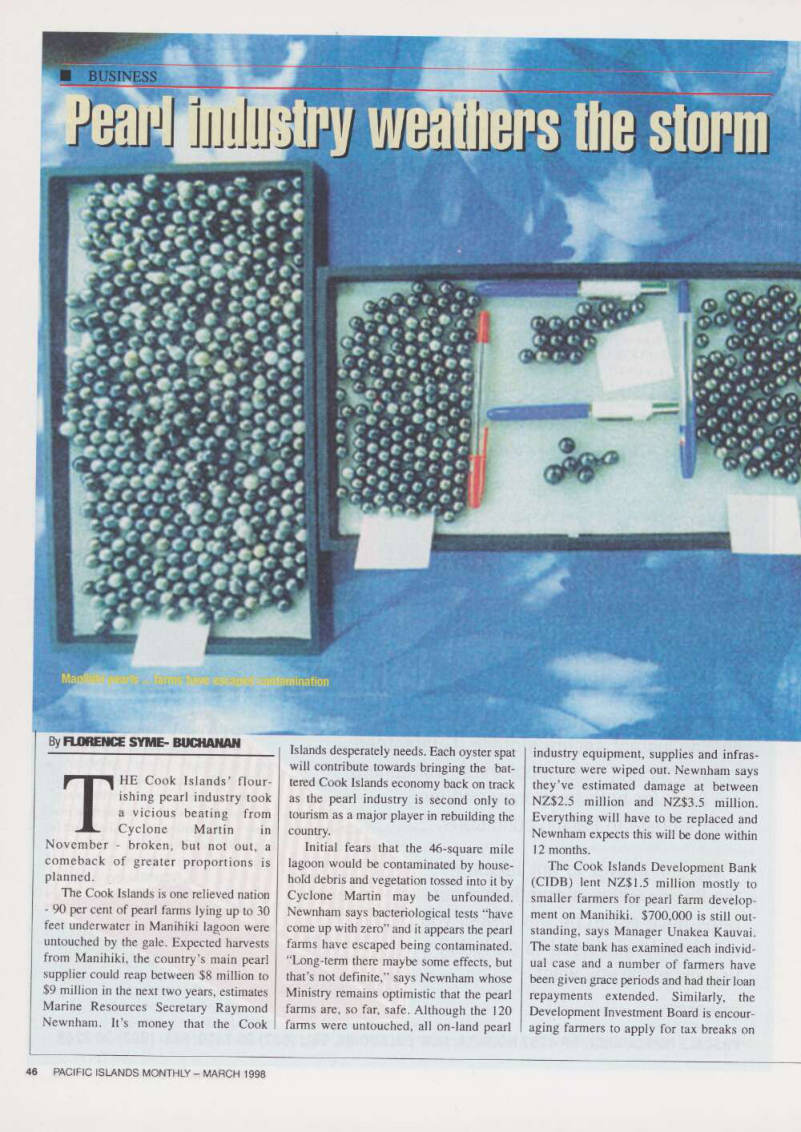
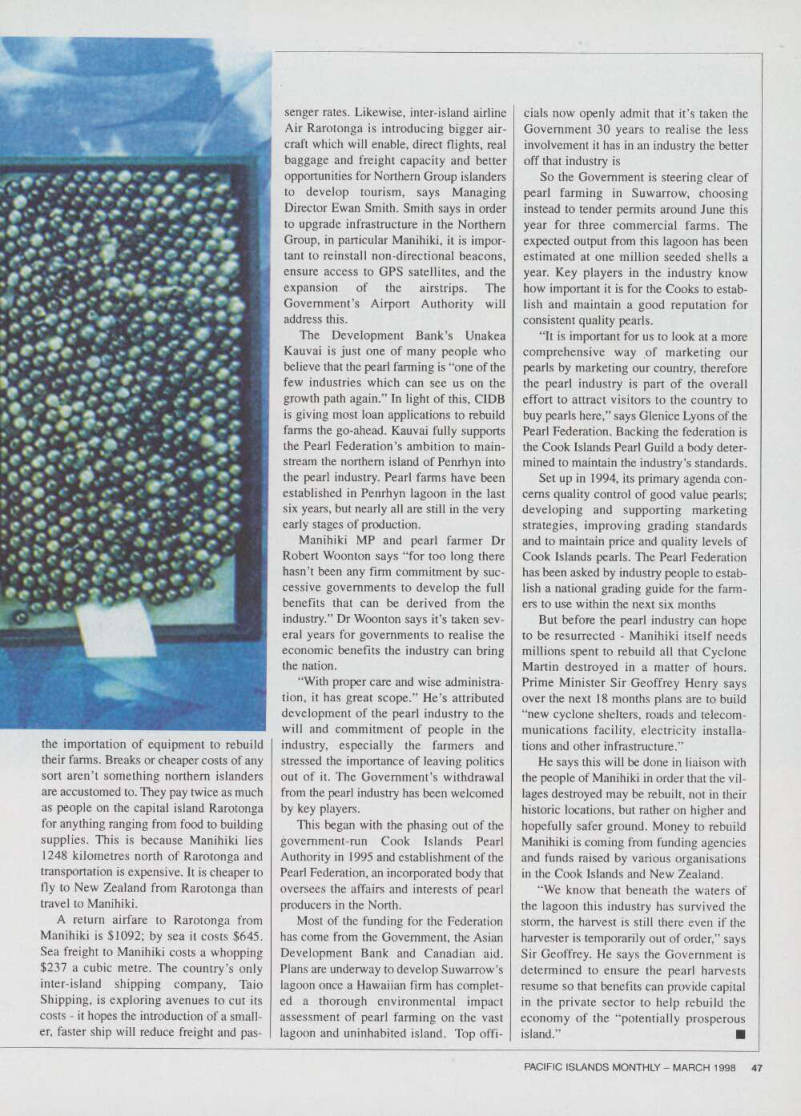
Business
By Florence Syme-Buchanan
THE Cook Islands’ flour
ishing pearl industry took
a vicious beating from Cyclone Martin in November - broken, but not out, a comeback of greater proportions is planned.
The Cook Islands is one relieved nation - 90 per cent of pearl farms lying up to 30 feet underwater in Manihiki lagoon were untouched by the gale. Expected harvests from Manihiki, the country’s main pearl supplier could reap between $8 million to $9 million in the next two years, estimates Marine Resources Secretary Raymond Newnham. It’s money that the Cook
Islands desperately needs. Each oyster spat will contribute towards bringing the bat tered Cook Islands economy back on track as the pearl industry is second only to tourism as a major player in rebuilding the country.
Initial fears that the 46-square mile lagoon would be contaminated by house hold debris and vegetation tossed into it by Cyclone Martin may be unfounded.
Newnham says bacteriological tests “have come up with zero” and it appears the pearl farms have escaped being contaminated.
“Long-term there maybe some effects, but that’s not definite,” says Newnham whose Ministry remains optimistic that the pearl farms are, so far, safe. Although the 120 farms were untouched, all on-land pearl
industry equipment, supplies and infras tructure were wiped out. Newnham says they’ve estimated damage at between NZ$2.5 million and NZ$3.5 million.
Everything will have to be replaced and Newnham expects this will be done within 12 months.
The Cook Islands Development Bank (CIDB) lent NZ$l.5 million mostly to smaller farmers for pearl farm develop ment on Manihiki. $700,000 is still out standing, says Manager Unakea Kauvai.
The state bank has examined each individ ual case and a number of farmers have been given grace periods and had their loan repayments extended. Similarly, the Development Investment Board is encour aging farmers to apply for tax breaks on
Manhiki pearls... farms have escaped contamination
the importation of equipment to rebuild their farms. Breaks or cheaper costs of any sort aren’t something northern islanders are accustomed to. They pay twice as much as people on the capital island Rarotonga for anything ranging from food to building supplies. This is because Manihiki lies 1248 kilometres north of Rarotonga and transportation is expensive. It is cheaper to fly to New Zealand from Rarotonga than travel to Manihiki.
A return airfare to Rarotonga from Manihiki is $1092; by sea it costs $645.
Sea freight to Manihiki costs a whopping $237 a cubic metre. The country’s only inter-island shipping company, Taio Shipping, is exploring avenues to cut its costs - it hopes the introduction of a small er, faster ship will reduce freight and pas
senger rates. Likewise, inter-island airline
Air Rarotonga is introducing bigger air
craft which will enable, direct flights, real
baggage and freight capacity and better
opportunities for Northern Group islanders to develop tourism, says Managing Director Ewan Smith. Smith says in order to upgrade infrastructure in the Northern Group, in particular Manihiki, it is impor tant to reinstall non-directional beacons, ensure access to GPS satellites, and the expansion of the airstrips. The Government’s Airport Authority will address this.
The Development Bank’s Unakea Kauvai is just one of many people who believe that the pearl farming is “one of the few industries which can see us on the growth path again.” In light of this, CIDB is giving most loan applications to rebuild farms the go-ahead. Kauvai fully supports the Pearl Federation’s ambition to main stream the northern island of Penrhyn into the pearl industry. Pearl farms have been established in Penrhyn lagoon in the last six years, but nearly all are still in the very early stages of production.
Manihiki MP and pearl farmer Dr Robert Woonton says “for too long there hasn’t been any firm commitment by suc cessive governments to develop the full benefits that can be derived from the industry.” Dr Woonton says it’s taken sev eral years for governments to realise the economic benefits the industry can bring the nation.
“With proper care and wise administra tion, it has great scope.” He’s attributed development of the pearl industry to the will and commitment of people in the industry, especially the farmers and stressed the importance of leaving politics out of it. The Government’s withdrawal from the pearl industry has been welcomed by key players.
This began with the phasing out of the govemment-run Cook Islands Pearl Authority in 1995 and establishment of the Pearl Federation, an incorporated body that oversees the affairs and interests of pearl producers in the North.
Most of the funding for the Federation has come from the Government, the Asian Development Bank and Canadian aid.
Plans are underway to develop Suwarrow’s lagoon once a Hawaiian firm has complet ed a thorough environmental impact assessment of pearl farming on the vast lagoon and uninhabited island. Top offi
cials now openly admit that it’s taken the Government 30 years to realise the less involvement it has in an industry the better off that industry is So the Government is steering clear of
pearl farming in Suwarrow, choosing
instead to tender permits around June this year for three commercial farms. The expected output from this lagoon has been estimated at one million seeded shells a year. Key players in the industry know how important it is for the Cooks to estab lish and maintain a good reputation for consistent quality pearls.
“It is important for us to look at a more comprehensive way of marketing our pearls by marketing our country, therefore the pearl industry is part of the overall effort to attract visitors to the country to buy pearls here,” says Glenice Lyons of the Pearl Federation. Backing the federation is the Cook Islands Pearl Guild a body deter mined to maintain the industry’s standards.
Set up in 1994, its primary agenda con cerns quality control of good value pearls; developing and supporting marketing
strategies, improving grading standards
and to maintain price and quality levels of Cook Islands pearls. The Pearl Federation has been asked by industry people to estab lish a national grading guide for the farm ers to use within the next six months But before the pearl industry can hope to be resurrected - Manihiki itself needs millions spent to rebuild all that Cyclone Martin destroyed in a matter of hours.
Prime Minister Sir Geoffrey Henry says over the next 18 months plans are to build “new cyclone shelters, roads and telecom
munications facility, electricity installa
tions and other infrastructure.”
He says this will be done in liaison with the people of Manihiki in order that the vil lages destroyed may be rebuilt, not in their historic locations, but rather on higher and hopefully safer ground. Money to rebuild Manihiki is coming from funding agencies and funds raised by various organisations in the Cook Islands and New Zealand.
“We know that beneath the waters of the lagoon this industry has survived the storm, the harvest is still there even if the harvester is temporarily out of order,” says Sir Geoffrey. He says the Government is determined to ensure the pearl harvests resume so that benefits can provide capital in the private sector to help rebuild the economy of the “potentially prosperous island.” ■
greatest rugby
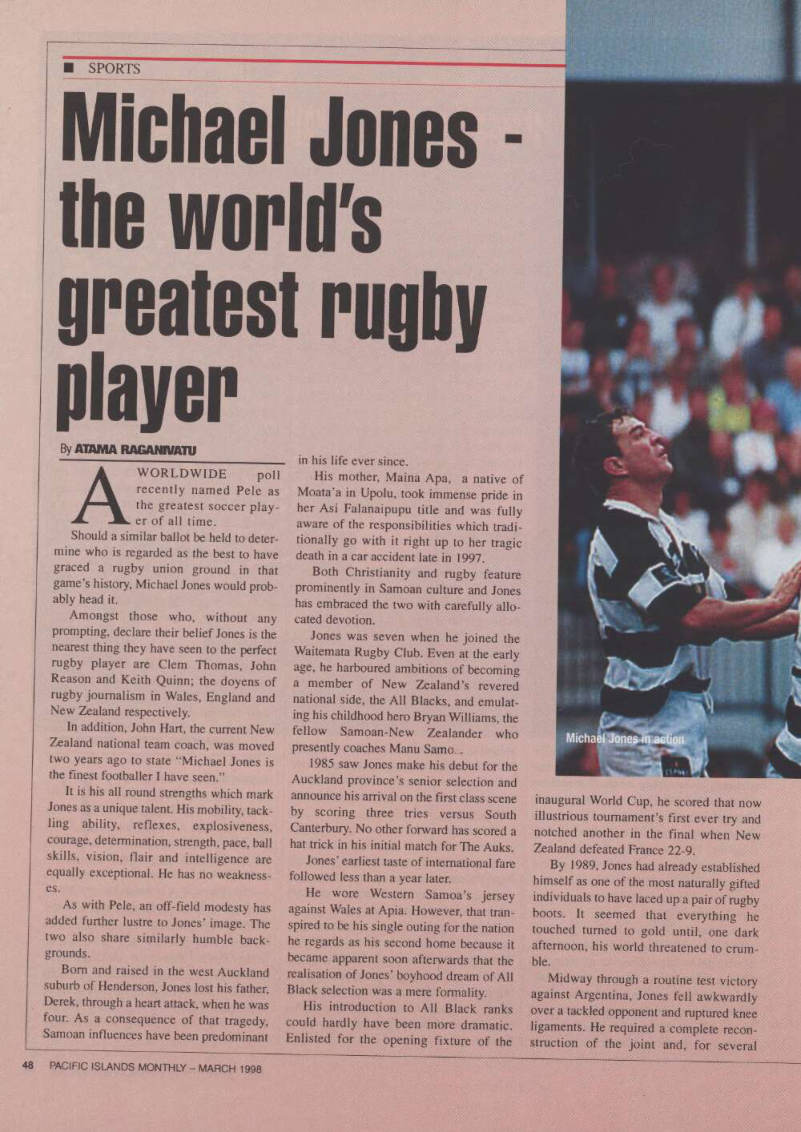
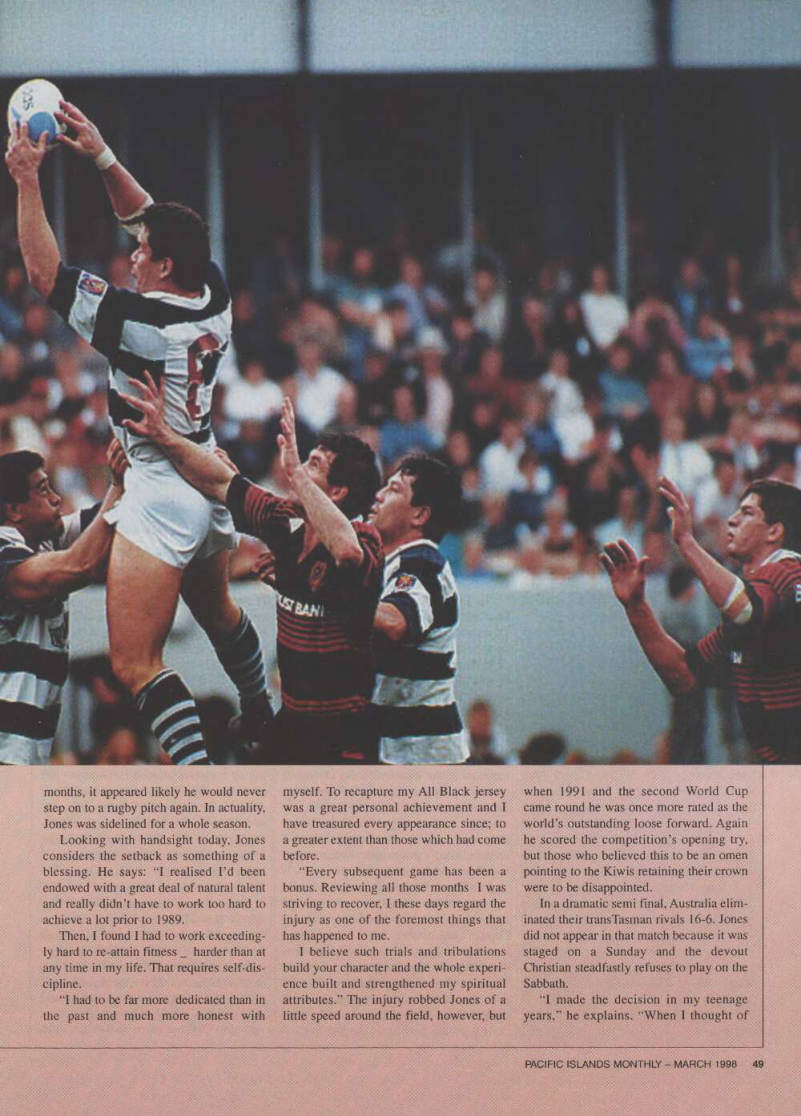
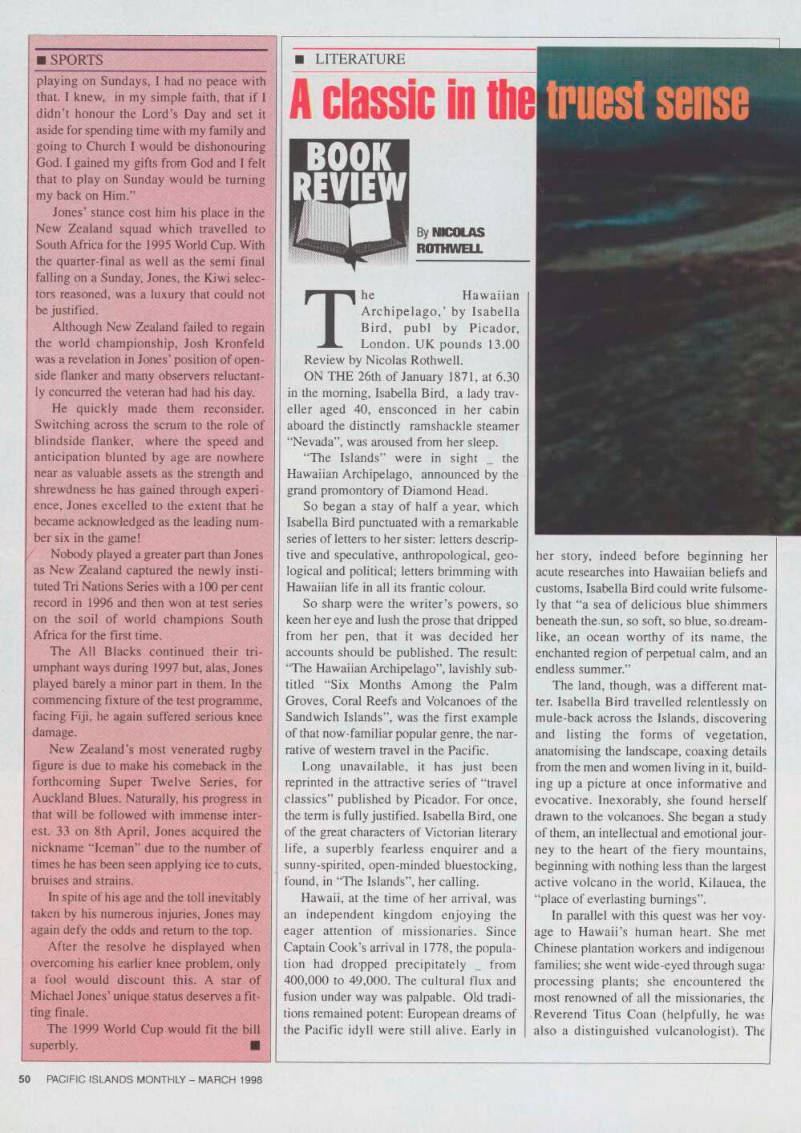
Sports
Michael Jones the world's greatest rugby player
By Atama Raganivatu
A Worldwide Poll
recently named Pele as the greatest soccer play er of all time.
Should a similar ballot be held to deter mine who is regarded as the best to have graced a rugby union ground in that game’s history, Michael Jones would prob ably head it.
Amongst those who, without any prompting, declare their belief Jones is the nearest thing they have seen to the perfect rugby player are Clem Thomas, John Reason and Keith Quinn; the doyens of rugby journalism in Wales, England and New Zealand respectively.
In addition, John Hart, the current New Zealand national team coach, was moved two years ago to state “Michael Jones is the finest footballer I have seen.”
It is his all round strengths which mark Jones as a unique talent. His mobility, tack ling ability, reflexes, explosiveness, courage, determination, strength, pace, ball skills, vision, flair and intelligence are equally exceptional. He has no weakness es.
As with Pele, an off-field modesty has added further lustre to Jones’ image. The two also share similarly humble back grounds.
Bom and raised in the west Auckland suburb of Henderson, Jones lost his father, Derek, through a heart attack, when he was four. As a consequence of that tragedy, Samoan influences have been predominant
. in his life ever since.
His mother, Maina Apa, a native of Moata’a in Upolu, took immense pride in her Asi Falanaipupu title and was fully aware of the responsibilities which tradi tionally go with it right up to her tragic death in a car accident late in 1997.
Both Christianity and rugby feature prominently in Samoan culture and Jones has embraced the two with carefully allo cated devotion.
Jones was seven when he joined the Waitemata Rugby Club. Even at the early age, he harboured ambitions of becoming a member of New Zealand’s revered national side, the All Blacks, and emulat ing his childhood hero Bryan Williams, the fellow Samoan-New Zealander who presently coaches Manu Samo... 1985 saw Jones make his debut for the Auckland province’s senior selection and announce his arrival on the first class scene by scoring three tries versus South Canterbury. No other forward has scored a hat trick in his initial match for The Auks.
Jones’ earliest taste of international fare followed less than a year later.
He wore Western Samoa’s jersey against Wales at Apia. However, that tran spired to be his single outing for the nation he regards as his second home because it became apparent soon afterwards that the realisation of Jones’ boyhood dream of All Black selection was a mere formality.
His introduction to All Black ranks could hardly have been more dramatic.
Enlisted for the opening fixture of the
inaugural World Cup, he scored that now illustrious tournament’s first ever try and notched another in the final when New Zealand defeated France 22-9.
By 1989, Jones had already established himself as one of the most naturally gifted individuals to have laced up a pair of rugby boots. It seemed that everything he touched turned to gold until, one dark afternoon, his world threatened to crum ble.
Midway through a routine test victory
against Argentina, Jones fell awkwardly over a tackled opponent and ruptured knee ligaments. He required a complete recon struction of the joint and, for several
Michael Jones in action
months, it appeared likely he would never step on to a rugby pitch again. In actuality, Jones was sidelined for a whole season.
Looking with handsight today, Jones considers the setback as something of a blessing. He says: “I realised Td been endowed with a great deal of natural talent and really didn’t have to work too hard to achieve a lot prior to 1989.
Then, 1 found I had to work exceeding ly hard to re-attain fitness harder than at any time in my life. That requires self-dis cipline.
“I had to be far more dedicated than in the past and much more honest with
myself. To recapture my All Black jersey was a great personal achievement and I have treasured every appearance since; to a greater extent than those which had come before.
“Every subsequent game has been a bonus. Reviewing all those months I was striving to recover, I these days regard the injury as one of the foremost things that has happened to me.
I believe such trials and tribulations build your character and the whole experi ence built and strengthened my spiritual attributes.” The injury robbed Jones of a little speed around the field, however, but
when 1991 and the second World Cup came round he was once more rated as the world’s outstanding loose forward. Again he scored the competition’s opening try, but those who believed this to be an omen pointing to the Kiwis retaining their crown were to be disappointed.
In a dramatic semi final, Australia elim inated their transTasman rivals 16-6. Jones did not appear in that match because it was staged on a Sunday and the devout Christian steadfastly refuses to play on the Sabbath. ‘I made the decision in my teenage years,” he explains. "When I thought of
playing on Sundays, I had no peace with that. I knew, in my simple faith, that if I didn’t honour the Lord’s Day and set it aside for spending time with my family and going to Church I would be dishonouring God. I gained my gifts from God and I felt that to play on Sunday would be turning my back on Him.”
Jones’ stance cost him his place in the New Zealand squad which travelled to South Africa for the 1995 World Cup. With the quarter-final as well as the semi final falling on a Sunday, Jones, the Kiwi selec tors reasoned, was a luxury that could not be justified.
Although New Zealand failed to regain the world championship, Josh Kronfeld was a revelation in Jones’ position of open side flanker and many observers reluctant ly concurred the veteran had had his day.
He quickly made them reconsider.
Switching across the scrum to the role of blindside flanker, where the speed and anticipation blunted by age are nowhere near as valuable assets as the strength and shrewdness he has gained through experi ence, Jones excelled to the extent that he became acknowledged as the leading num ber six in the game!
Nobody played a greater part than Jones as New Zealand captured the newly insti tuted Tri Nations Series with a 100 per cent record in 1996 and then won at test series on the soil of world champions South Africa for the first time.
The All Blacks continued their tri umphant ways during 1997 but, alas, Jones played barely a minor part in them. In the commencing fixture of the test programme, facing Fiji, he again suffered serious knee
damage.
New Zealand’s most venerated rugby figure is due to make his comeback in the forthcoming Super Twelve Series, for Auckland Blues. Naturally, his progress in that will be followed with immense inter est. 33 on Bth April, Jones acquired the nickname “Iceman” due to the number of times he has been seen applying ice to cuts, bruises and strains.
In spite of his age and the toll inevitably taken by his numerous injuries, Jones may again defy the odds and return to the top.
After the resolve he displayed when overcoming his earlier knee problem, only a fool would discount this. A star of Michael Jones’ unique status deserves a fit
ting finale.
The 1999 World Gup would fit the bill superbly. ■
The Hawaiian
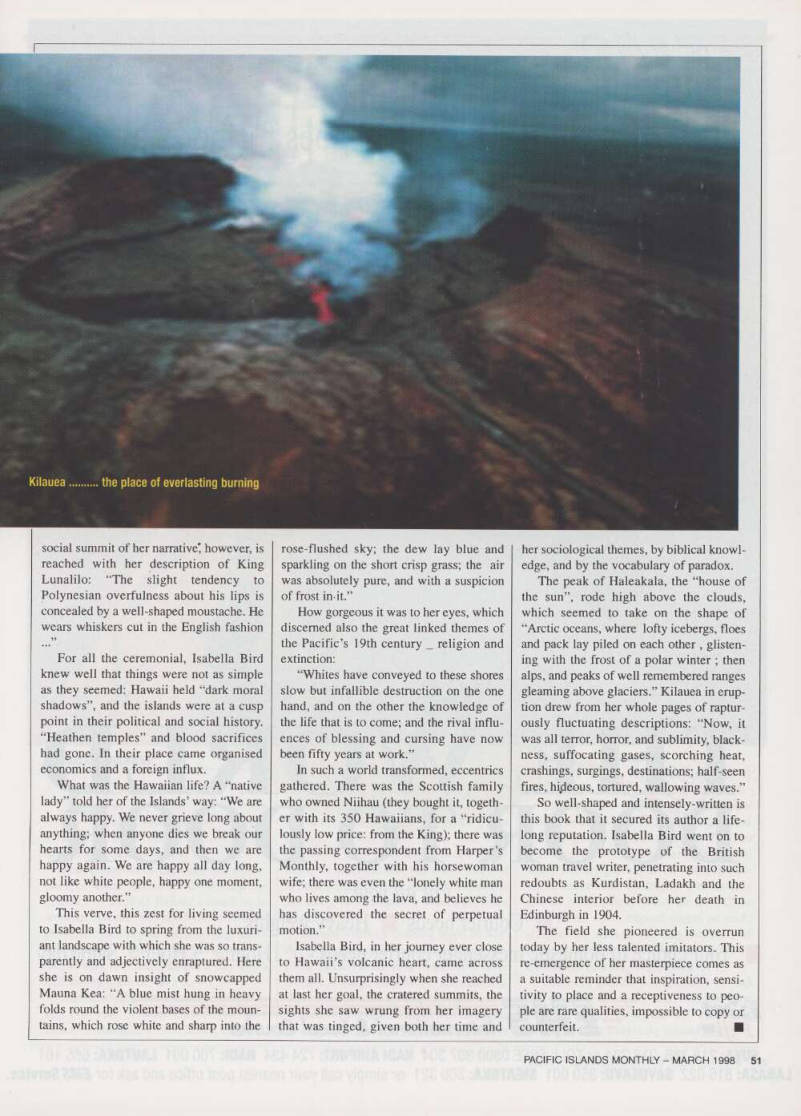
Literature
A classic in the truest sense
By Nicolas
Rothwell
The Hawaiian
Archipelago,’ by Isabella Bird, publ by Picador, London. UK pounds 13.00 Review by Nicolas Rothwell.
ON THE 26th of January 1871, at 6.30 in the morning, Isabella Bird, a lady trav eller aged 40, ensconced in her cabin aboard the distinctly ramshackle steamer “Nevada”, was aroused from her sleep.
“The Islands” were in sight the Hawaiian Archipelago, announced by the grand promontory of Diamond Head.
So began a stay of half a year, which Isabella Bird punctuated with a remarkable series of letters to her sister: letters descrip tive and speculative, anthropological, geo
logical and political; letters brimming with
Hawaiian life in all its frantic colour.
So sharp were the writer’s powers, so keen her eye and lush the prose that dripped from her pen, that it was decided her accounts should be published. The result: “The Hawaiian Archipelago”, lavishly sub titled “Six Months Among the Palm Groves, Coral Reefs and Volcanoes of the Sandwich Islands”, was the first example of that now-familiar popular genre, the nar rative of western travel in the Pacific.
Long unavailable, it has just been reprinted in the attractive series of “travel classics” published by Picador. For once, the term is fully justified. Isabella Bird, one of the great characters of Victorian literary life, a superbly fearless enquirer and a
sunny-spirited, open-minded bluestocking,
found, in “The Islands”, her calling.
Hawaii, at the time of her arrival, was an independent kingdom enjoying the eager attention of missionaries. Since Captain Cook’s arrival in 1778, the popula tion had dropped precipitately from 400,000 to 49,000. The cultural flux and fusion under way was palpable. Old tradi tions remained potent: European dreams of the Pacific idyll were still alive. Early in
her story, indeed before beginning her acute researches into Hawaiian beliefs and customs, Isabella Bird could write fulsome ly that “a sea of delicious blue shimmers beneath the.sun, so soft, so blue, so.dream like, an ocean worthy of its name, the enchanted region of perpetual calm, and an endless summer.”
The land, though, was a different mat ter. Isabella Bird travelled relentlessly on mule-back across the Islands, discovering and listing the forms of vegetation, anatomising the landscape, coaxing details from the men and women living in it, build ing up a picture at once informative and evocative. Inexorably, she found herself drawn to the volcanoes. She began a study of them, an intellectual and emotional jour ney to the heart of the fiery mountains, beginning with nothing less than the largest active volcano in the world, Kilauea, the “place of everlasting burnings”.
In parallel with this quest was her voy age to Hawaii’s human heart. She met Chinese plantation workers and indigenous families; she went wide-eyed through sugai processing plants; she encountered the most renowned of all the missionaries, the Reverend Titus Coan (helpfully, he was also a distinguished vulcanologist). The
social summit of her narrative' however, is reached with her description of King Lunalilo: “The slight tendency to Polynesian overfulness about his lips is concealed by a well-shaped moustache. He wears whiskers cut in the English fashion For all the ceremonial, Isabella Bird knew well that things were not as simple as they seemed: Hawaii held “dark moral shadows”, and the islands were at a cusp point in their political and social history.
“Heathen temples” and blood sacrifices had gone. In their place came organised economics and a foreign influx.
What was the Hawaiian life? A “native lady” told her of the Islands’ way: “We are always happy. We never grieve long about anything; when anyone dies we break our hearts for some days, and then we are happy again. We are happy all day long, not like white people, happy one moment, gloomy another.”
This verve, this zest for living seemed to Isabella Bird to spring from the luxuri ant landscape with which she was so trans parently and adjectively enraptured. Here she is on dawn insight of snowcapped Mauna Kea: “A blue mist hung in heavy folds round the violent bases of the moun tains, which rose white and sharp into the
rose-flushed sky; the dew lay blue and sparkling on the short crisp grass; the air was absolutely pure, and with a suspicion of frost in-it.”
How gorgeous it was to her eyes, which discerned also the great linked themes of the Pacific’s 19th century religion and extinction: “Whites have conveyed to these shores slow but infallible destruction on the one hand, and on the other the knowledge of the life that is to come; and the rival influ ences of blessing and cursing have now been fifty years at work.”
In such a world transformed, eccentrics gathered. There was the Scottish family who owned Niihau (they bought it, togeth er with its 350 Hawaiians, for a “ridicu lously low price: from the King); there was the passing correspondent from Harper’s Monthly, together with his horsewoman wife; there was even the “lonely white man who lives among the lava, and believes he has discovered the secret of perpetual motion.”
Isabella Bird, in her journey ever close to Hawaii’s volcanic heart, came across them all. Unsurprisingly when she reached at last her goal, the cratered summits, the sights she saw wrung from her imagery that was tinged, given both her time and
her sociological themes, by biblical knowl edge, and by the vocabulary of paradox.
The peak of Haleakala, the “house of the sun”, rode high above the clouds, which seemed to take on the shape of “Arctic oceans, where lofty icebergs, floes and pack lay piled on each other , glisten ing with the frost of a polar winter ; then alps, and peaks of well remembered ranges gleaming above glaciers.” Kilauea in erup tion drew from her whole pages of raptur ously fluctuating descriptions: “Now, it was all terror, horror, and sublimity, black ness, suffocating gases, scorching heat,
crashings, surgings, destinations; half-seen
fires, hideous, tortured, wallowing waves.”
So well-shaped and intensely-written is this book that it secured its author a life long reputation. Isabella Bird went on to become the prototype of the British woman travel writer, penetrating into such redoubts as Kurdistan, Ladakh and the Chinese interior before her death in Edinburgh in 1904.
The field she pioneered is overrun today by her less talented imitators. This re-emergence of her masterpiece comes as a suitable reminder that inspiration, sensi tivity to place and a receptiveness to peo ple are rare qualities, impossible to copy or counterfeit. ■
Kilauea... the place of everlasting burning
Advertisements & other items, p. 52 (1 item)
Door To Door
International & Local Courier
Fiji’s own courier company goes further than Fiji I* r\ \ *s.
givey
DOOR TO DOOR
For all your: ■ Courier needs ■ Heavyweights Your choice of domestic messenger courier needs - / IHour / 3 Hour / Same day Fiji* International & Local Courier SUVA: 218 388, 218 304 or TOLL FREE 0800 307 304 NADI AIRPORT: 724 434 NADI: 700 001 LAUTOKA: 665 161 LABASA: 816 022 SAVUSAVU: 850 001 SIGATOKA: 500 321 or simply call your nearest post office and ask for fMSService.
Red sky in the morning
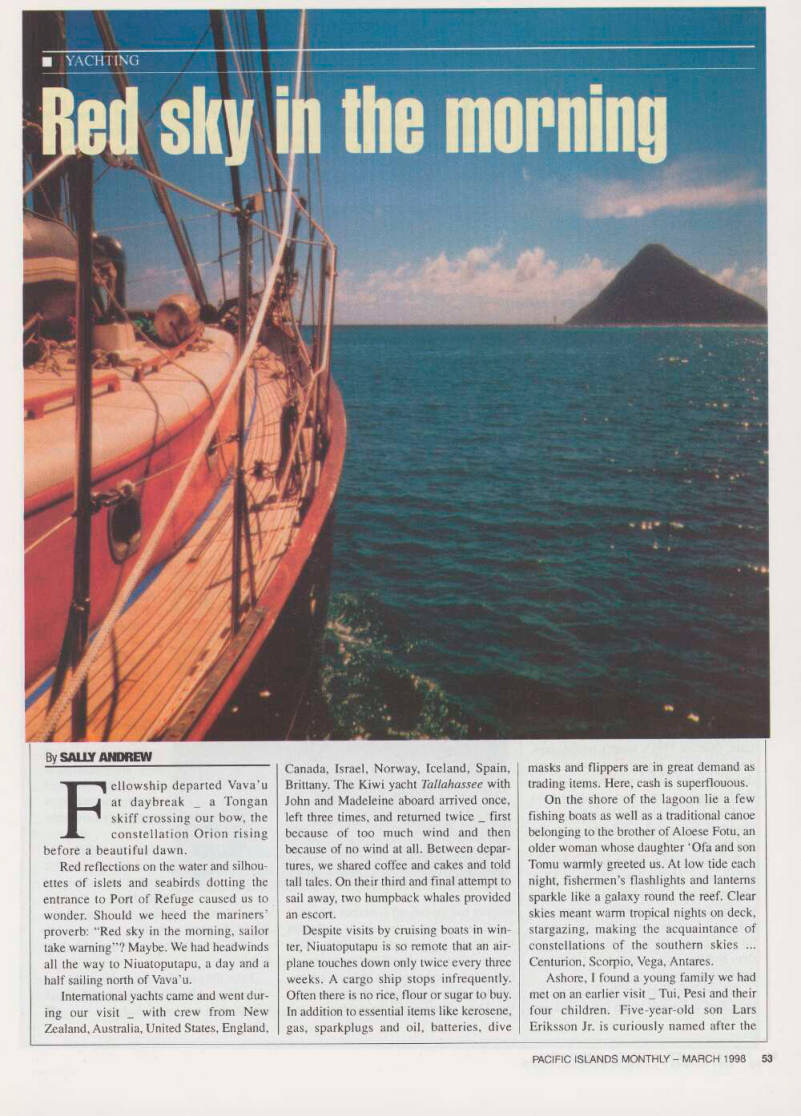
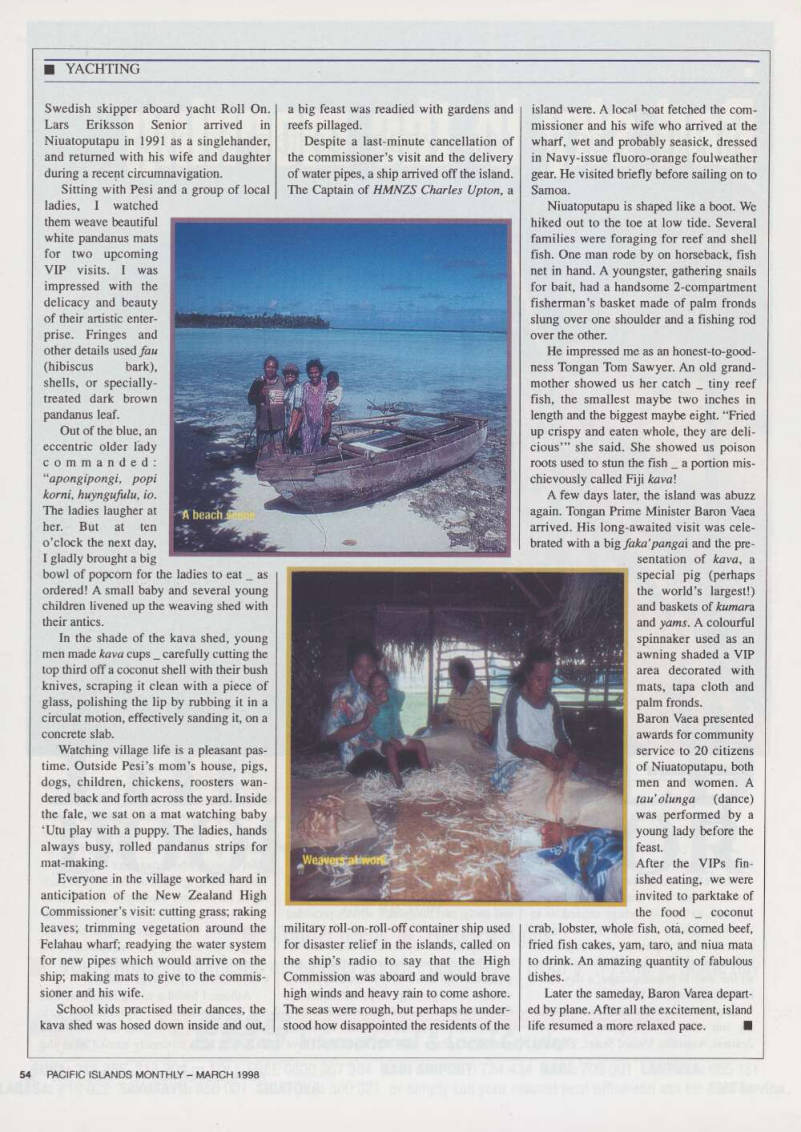
Yachting
By Sally Andrew
Fellowship departed Vava’u
at daybreak a Tongan skiff crossing our bow, the constellation Orion rising before a beautiful dawn.
Red reflections on the water and silhou ettes of islets and seabirds dotting the entrance to Port of Refuge caused us to wonder. Should we heed the mariners’ proverb: “Red sky in the morning, sailor take warning”? Maybe. We had headwinds all the way to Niuatoputapu, a day and a half sailing north of Vava’u.
International yachts came and went dur ing our visit with crew from New Zealand, Australia, United States, England,
Canada, Israel, Norway, Iceland, Spain, Brittany. The Kiwi yacht Tallahassee with John and Madeleine aboard arrived once, left three times, and returned twice first because of too much wind and then because of no wind at all. Between depar tures, we shared coffee and cakes and told tall tales. On their third and final attempt to sail away, two humpback whales provided an escort.
Despite visits by cruising boats in win ter, Niuatoputapu is so remote that an air plane touches down only twice every three weeks. A cargo ship stops infrequently.
Often there is no rice, flour or sugar to buy.
In addition to essential items like kerosene, gas, sparkplugs and oil, batteries, dive
masks and flippers are in great demand as trading items. Here, cash is superflouous.
On the shore of the lagoon lie a few fishing boats as well as a traditional canoe belonging to the brother of Aloese Fotu, an older woman whose daughter ‘Ofa and son Tomu warmly greeted us. At low tide each night, fishermen’s flashlights and lanterns sparkle like a galaxy round the reef. Clear skies meant warm tropical nights on deck,
stargazing, making the acquaintance of
constellations of the southern skies ...
Centurion, Scorpio, Vega, Antares.
Ashore, I found a young family we had met on an earlier visit Tui, Pesi and their four children. Five-year-old son Lars Eriksson Jr. is curiously named after the
Swedish skipper aboard yacht Roll On.
Lars Eriksson Senior arrived in Niuatoputapu in 1991 as a singlehander, and returned with his wife and daughter
during a recent circumnavigation.
Sitting with Pesi and a group of local ladies, I watched
them weave beautiful white pandanus mats for two upcoming VIP visits. I was impressed with the delicacy and beauty of their artistic enter prise. Fringes and other details used fau (hibiscus bark), shells, or specially treated dark brown pandanus leaf.
Out of the blue, an eccentric older lady commanded: u apongipongi, popi korni, huyngufulu, io.
The ladies laugher at her. But at ten o’clock the next day, I gladly brought a big
bowl of popcorn for the ladies to eat as ordered! A small baby and several young children livened up the weaving shed with their antics.
In the shade of the kava shed, young men made kava cups carefully cutting the top third off a coconut shell with their bush knives, scraping it clean with a piece of glass, polishing the lip by rubbing it in a circulat motion, effectively sanding it, on a concrete slab.
Watching village life is a pleasant pas time. Outside Pesi’s mom’s house, pigs, dogs, children, chickens, roosters wan dered back and forth across the yard. Inside the fale, we sat on a mat watching baby ‘Utu play with a puppy. The ladies, hands
always busy, rolled pandanus strips for
mat-making.
Everyone in the village worked hard in anticipation of the New Zealand High Commissioner’s visit: cutting grass; raking leaves; trimming vegetation around the Felahau wharf; readying the water system for new pipes which would arrive on the ship; making mats to give to the commis sioner and his wife.
School kids practised their dances, the kava shed was hosed down inside and out,
a big feast was readied with gardens and reefs pillaged.
Despite a last-minute cancellation of the commissioner’s visit and the delivery of water pipes, a ship arrived off the island.
The Captain of HMNZS Charles Upton, a
military roll-on-roll-off container ship used for disaster relief in the islands, called on the ship’s radio to say that the High Commission was aboard and would brave high winds and heavy rain to come ashore.
The seas were rough, but perhaps he under stood how disappointed the residents of the
island were. A local boat fetched the com missioner and his wife who arrived at the wharf, wet and probably seasick, dressed in Navy-issue fluoro-orange foulweather gear. He visited briefly before sailing on to Samoa.
Niuatoputapu is shaped like a boot. We hiked out to the toe at low tide. Several families were foraging for reef and shell fish. One man rode by on horseback, fish net in hand. A youngster, gathering snails for bait, had a handsome 2-compartment fisherman’s basket made of palm fronds slung over one shoulder and a fishing rod over the other.
He impressed me as an honest-to-good ness Tongan Tom Sawyer. An old grand mother showed us her catch tiny reef fish, the smallest maybe two inches in length and the biggest maybe eight. “Fried up crispy and eaten whole, they are deli cious’” she said. She showed us poison roots used to stun the fish a portion mis chievously called Fiji kava\ A few days later, the island was abuzz again. Tongan Prime Minister Baron Vaea arrived. His long-awaited visit was cele brated with a big faka’pangai and the pre
sentation of kava, a
special pig (perhaps
the world’s largest!) and baskets of kumara and yams. A colourful spinnaker used as an awning shaded a VIP area decorated with mats, tapa cloth and
palm fronds.
Baron Vaea presented awards for community service to 20 citizens of Niuatoputapu, both men and women. A tau’olunga (dance) was performed by a young lady before the feast.
After the VIPs fin ished eating, we were invited to parktake of the food coconut
crab, lobster, whole fish, ota, corned beef, fried fish cakes, yam, taro, and niua mata to drink. An amazing quantity of fabulous dishes.
Later the sameday, Baron Varea depart ed by plane. After all the excitement, island life resumed a more relaxed pace. ■
A beach scene
Weavers at work
A step backwards
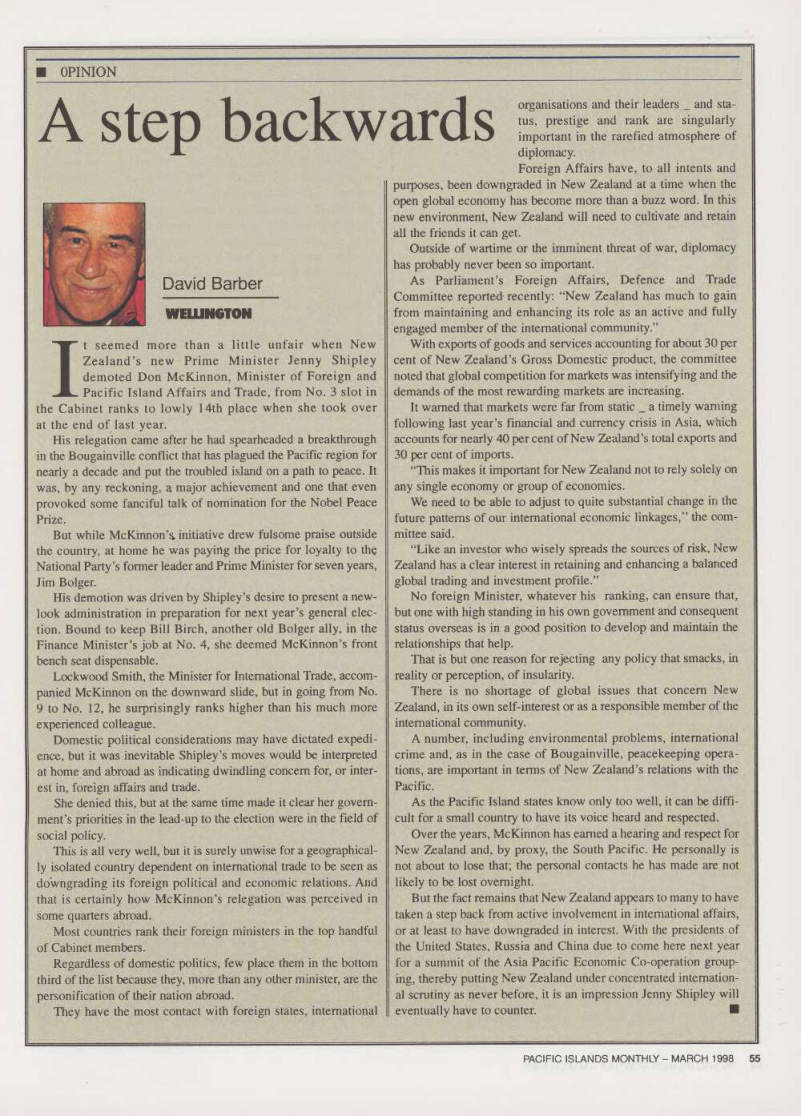
Opinion
It seemed more than a little unfair when New Zealand’s new Prime Minister Jenny Shipley demoted Don McKinnon, Minister of Foreign and Pacific Island Affairs and Trade, from No. 3 slot in the Cabinet ranks to lowly 14th place when she took over at the end of last year.
His relegation came after he had spearheaded a breakthrough in the Bougainville conflict that has plagued the Pacific region for nearly a decade and put the troubled island on a path to peace. It was, by any reckoning, a major achievement and one that even provoked some fanciful talk of nomination for the Nobel Peace Prize.
But while McKinnon’s, initiative drew fulsome praise outside the country, at home he was paying the price for loyalty to the National Party’s former leader and Prime Minister for seven years, Jim Bolger.
His demotion was driven by Shipley’s desire to present a new look administration in preparation for next year’s general elec tion. Bound to keep Bill Birch, another old Bolger ally, in the Finance Minister’s job at No. 4, she deemed McKinnon’s front bench seat dispensable.
Lockwood Smith, the Minister for International Trade, accom panied McKinnon on the downward slide, but in going from No. 9 to No. 12, he surprisingly ranks higher than his much more experienced colleague.
Domestic political considerations may have dictated expedi ence, but it was inevitable Shipley’s moves would be interpreted at home and abroad as indicating dwindling concern for, or inter est in, foreign affairs and trade.
She denied this, but at the same time made it clear her govern ment’s priorities in the lead-up to the election were in the field of social policy.
This is all very well, but it is surely unwise for a geographical ly isolated country dependent on international trade to be seen as downgrading its foreign political and economic relations. And that is certainly how McKinnon’s relegation was perceived in some quarters abroad.
Most countries rank their foreign ministers in the top handful of Cabinet members.
Regardless of domestic politics, few place them in the bottom third of the list because they, more than any other minister, are the personification of their nation abroad.
They have the most contact with foreign states, international
organisations and their leaders and sta tus, prestige and rank are singularly important in the rarefied atmosphere of
diplomacy.
Foreign Affairs have, to all intents and
purposes, been downgraded in New Zealand at a time when the open global economy has become more than a buzz word. In this new environment. New Zealand will need to cultivate and retain all the friends it can get.
Outside of wartime or the imminent threat of war, diplomacy has probably never been so important.
As Parliament’s Foreign Affairs, Defence and Trade Committee reported recently: “New Zealand has much to gain from maintaining and enhancing its role as an active and fully engaged member of the international community.”
With exports of goods and services accounting for about 30 per cent of New Zealand’s Gross Domestic product, the committee noted that global competition for markets was intensifying and the demands of the most rewarding markets are increasing.
It warned that markets were far from static a timely warning following last year’s financial and currency crisis in Asia, which accounts for nearly 40 per cent of New Zealand’s total exports and 30 per cent of imports.
“This makes it important for New Zealand not to rely solely on any single economy or group of economies.
We need to be able to adjust to quite substantial change in the future patterns of our international economic linkages,” the com mittee said.
“Like an investor who wisely spreads the sources of risk. New Zealand has a clear interest in retaining and enhancing a balanced global trading and investment profile.”
No foreign Minister, whatever his ranking, can ensure that, but one with high standing in his own government and consequent status overseas is in a good position to develop and maintain the relationships that help.
That is but one reason for rejecting any policy that smacks, in reality or perception, of insularity.
There is no shortage of global issues that concern New Zealand, in its own self-interest or as a responsible member of the international community.
A number, including environmental problems, international crime and, as in the case of Bougainville, peacekeeping opera tions, are important in terms of New Zealand’s relations with the Pacific.
As the Pacific Island states know only too well, it can be diffi cult for a small country to have its voice heard and respected.
Over the years, McKinnon has earned a hearing and respect for New Zealand and, by proxy, the South Pacific. He personally is not about to lose that; the personal contacts he has made are not likely to be lost overnight.
But the fact remains that New Zealand appears to many to have taken a step back from active involvement in international affairs, or at least to have downgraded in interest. With the presidents of the United States, Russia and China due to come here next year for a summit of the Asia Pacific Economic Co-operation group ing, thereby putting New Zealand under concentrated internation al scrutiny as never before, it is an impression Jenny Shipley will eventually have to counter. ■
David Barber
Wellington
for Australia
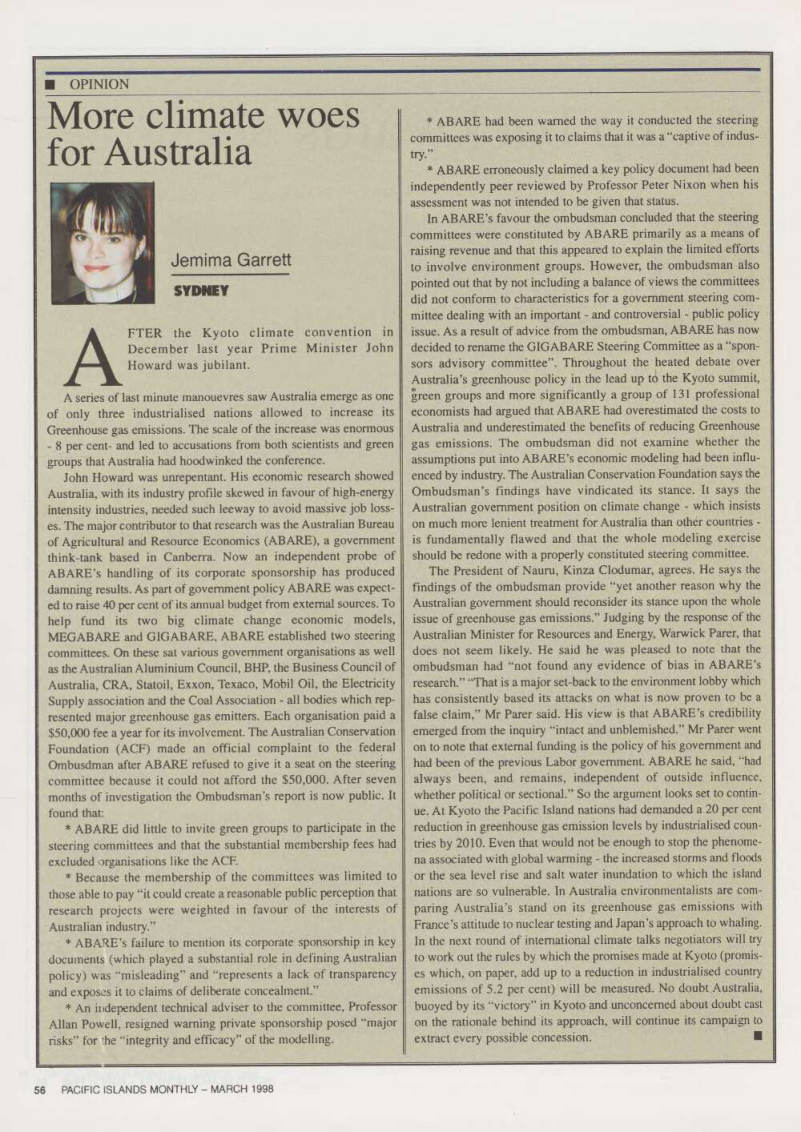
More climate woes for Australia
AFTER the Kyoto climate convention in December last year Prime Minister John Howard was jubilant.
A series of last minute manouevres saw Australia emerge as one of only three industrialised nations allowed to increase its Greenhouse gas emissions. The scale of the increase was enormous - 8 per cent- and led to accusations from both scientists and green groups that Australia had hoodwinked the conference.
John Howard was unrepentant. His economic research showed Australia, with its industry profile skewed in favour of high-energy intensity industries, needed such leeway to avoid massive job loss es. The major contributor to that research was the Australian Bureau of Agricultural and Resource Economics (ABARE), a government think-tank based in Canberra. Now an independent probe of ABARE’s handling of its corporate sponsorship has produced damning results. As part of government policy ABARE was expect ed to raise 40 per cent of its annual budget from external sources. To help fund its two big climate change economic models, MEGABARE and GIGABARE, ABARE established two steering committees. On these sat various government organisations as well as the Australian Aluminium Council, BHP, the Business Council of Australia, CRA, Statoil, Exxon, Texaco, Mobil Oil, the Electricity Supply association and the Coal Association - all bodies which rep resented major greenhouse gas emitters. Each organisation paid a $50,000 fee a year for its involvement. The Australian Conservation Foundation (ACF) made an official complaint to the federal Ombusdman after ABARE refused to give it a seat on the steering committee because it could not afford the $50,000. After seven months of investigation the Ombudsman’s report is now public. It found that: * ABARE did little to invite green groups to participate in the steering committees and that the substantial membership fees had excluded organisations like the ACF. * Because the membership of the committees was limited to those able to pay “it could create a reasonable public perception that research projects were weighted in favour of the interests of
Australian industry.”
* ABARE’s failure to mention its corporate sponsorship in key documents (which played a substantial role in defining Australian policy) was “misleading” and “represents a lack of transparency and exposes it to claims of deliberate concealment.” * An independent technical adviser to the committee, Professor Allan Powell, resigned warning private sponsorship posed “major risks” for the “integrity and efficacy” of the modelling.
* ABARE had been warned the way it conducted the steering committees was exposing it to claims that it was a “captive of indus try.” * ABARE erroneously claimed a key policy document had been independently peer reviewed by Professor Peter Nixon when his assessment was not intended to be given that status.
In ABARE’s favour the ombudsman concluded that the steering committees were constituted by ABARE primarily as a means of raising revenue and that this appeared to explain the limited efforts to involve environment groups. However, the ombudsman also pointed out that by not including a balance of views the committees did not conform to characteristics for a government steering com mittee dealing with an important - and controversial - public policy issue. As a result of advice from the ombudsman, ABARE has now decided to rename the GIGABARE Steering Committee as a “spon sors advisory committee”. Throughout the heated debate over Australia’s greenhouse policy in the lead up to the Kyoto summit, green groups and more significantly a group of 131 professional economists had argued that ABARE had overestimated the costs to Australia and underestimated the benefits of reducing Greenhouse gas emissions. The ombudsman did not examine whether the assumptions put into ABARE’s economic modeling had been influ enced by industry. The Australian Conservation Foundation says the Ombudsman’s findings have vindicated its stance. It says the Australian government position on climate change - which insists on much more lenient treatment for Australia than other countries is fundamentally flawed and that the whole modeling exercise should be redone with a properly constituted steering committee.
The President of Nauru, Kinza Clodumar, agrees. He says the findings of the ombudsman provide “yet another reason why the Australian government should reconsider its stance upon the whole issue of greenhouse gas emissions.” Judging by the response of the Australian Minister for Resources and Energy, Warwick Parer, that does not seem likely. He said he was pleased to note that the ombudsman had “not found any evidence of bias in ABARE’s research.” “That is a major set-back to the environment lobby which has consistently based its attacks on what is now proven to be a false claim,” Mr Parer said. His view is that ABARE’s credibility emerged from the inquiry “intact and unblemished.” Mr Parer went on to note that external funding is the policy of his government and had been of the previous Labor government. ABARE he said, “had always been, and remains, independent of outside influence, whether political or sectional.” So the argument looks set to contin ue. At Kyoto the Pacific Island nations had demanded a 20 per cent reduction in greenhouse gas emission levels by industrialised coun tries by 2010. Even that would not be enough to stop the phenome na associated with global warming - the increased storms and floods or the sea level rise and salt water inundation to which the island nations are so vulnerable. In Australia environmentalists are com paring Australia’s stand on its greenhouse gas emissions with France’s attitude to nuclear testing and Japan’s approach to whaling.
In the next round of international climate talks negotiators will try to work out the rules by which the promises made at Kyoto (promis es which, on paper, add up to a reduction in industrialised country emissions of 5.2 per cent) will be measured. No doubt Australia, buoyed by its “victory” in Kyoto and unconcerned about doubt cast on the rationale behind its approach, will continue its campaign to extract every possible concession. ■
Jemima Garrett
Sydney
Shipping
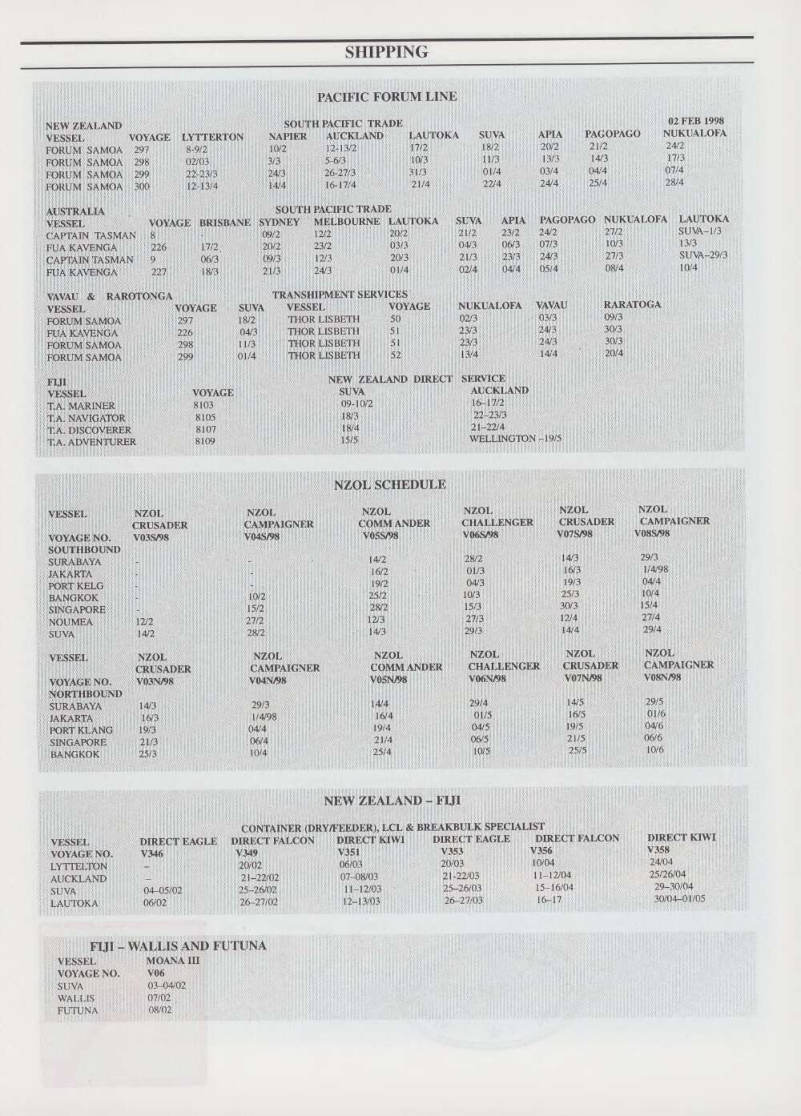
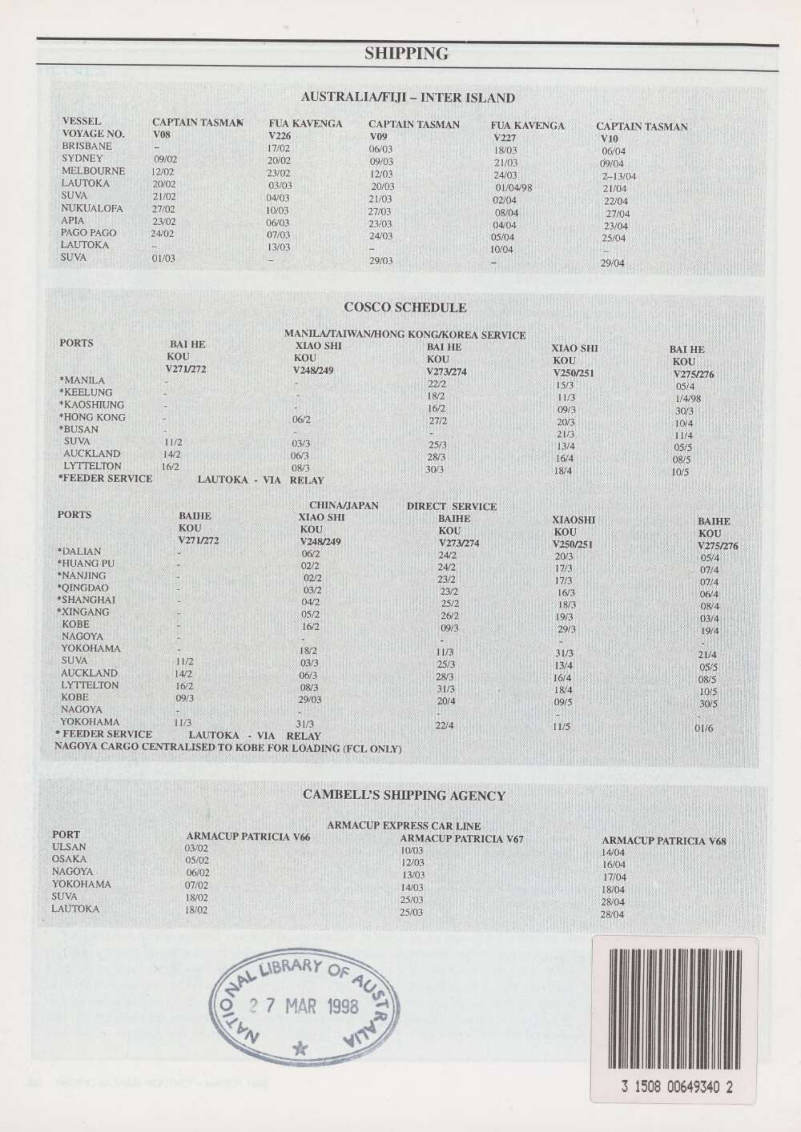
Pacific Forum Line
Nzol Schedule
New Zealand - Fiji
New Zealand
South Pacific Trade
02 Feb 1998
Vessel Voyage
Lytterton
Napier Auckland
Lautoka Suva
Apia
Pagopago
Nukualofa
Forum Samoa 297
8-9/2 10/2 12-13/2 17/2 18/2 20/2 21/2 24/2
Forum Samoa 298
02/03 3/3 5-6/3 10/3 11/3 13/3 14/3 17/3
Forum Samoa 299
22-23/3 24/3 26-27/3 31/3 01/4 03/4 04/4 07/4
Forum Samoa 300
12-13/4 14/4 16-17/4 21/4 22/4 24/4 25/4 28/4
Australia
South Pacific Trade
Vessel Voyage Brisbane
Sydney Melbourne
Lautoka
Suva Apia
Pagopago Nukualofa Lautoka
Captain Tasman 8
. 09/2 12/2 20/2 21/2 23/2 24/2 27/2
Suva-1/3
Fua Kavenga 226
17/2. 20/2 23/2 03/3 04/3 06/3 07/3 10/3 13/3
Captain Tasman 9
06/3 09/3 12/3 20/3 21/3 23/3 24/3 27/3
Suva-29/3
Fua Kavenga 227
18/3 21/3 24/3 01/4 02/4 04/4 05/4 08/4 10/4
Vavau & Rarotonga
Transhipment Services
Raratoga
Vessel
Voyage
Suva Vessel
Voyage
Nukualofa
Vavau
Forum Samoa
297 18/2
Thor Lis Beth
50 02/3 03/3 09/3
Fua Kavenga
226 04/3
Thor Lisbeth
51 23/3 24/3 30/3
Forum Samoa
298 11/3
Thor Lisbeth
51 23/3 24/3 30/3
Forum Samoa
299 01/4
Thor Lisbeth
52 13/4 14/4 20/4
Fiji
New Zealand Direct
Service
Vessel
Voyage
Suva
Auckland
T.A. Mariner
8103 09-10/2 16-17/2
T.A. Navigator
8105 18/3 22-23/3
T.A. Discoverer
8107 18/4 21-22/4
T.A. Adventurer
8109 15/5
Wellington
-19/5
Vessel
Nzol
Nzol
Nzol
Nzol
Nzol
Nzol
Crusader
Campaigner
Comm Ander
Challenger
Crusader
Campaigner
Voyage No.
V03S/98 V04S/98 V05S/98 V06S/98 V07S/98 V08S/98
Southbound
Surabaya
14/2 28/2 14/3 29/3
Jakarta
. - 16/2 01/3 16/3 1/4/98
Port Kelg
. . 19/2 04/3 19/3 04/4
Bangkok
. 10/2 25/2 10/3 25/3 10/4
Singapore
. 15/2 28/2 15/3 30/3 15/4
Noumea
12/2 27/2 12/3 27/3 12/4 27/4
Suva
14/2 28/2 14/3 29/3 14/4 29/4
Vessel
Nzol
Nzol
Nzol
Nzol
Nzol
Nzol
Crusader
Campaigner
Comm Ander
Challenger
Crusader
Campaigner
Voyage No.
V03N/98 V04N/98 V05N/98 V06N/98 V07N/98 V08N798
Northbound
Surabaya
14/3 29/3 14/4 29/4 14/5 29/5
Jakarta
16/3 1/4/98 16/4 01/5 16/5 01/6
Port Klang
19/3 04/4 19/4 04/5 19/5 04/6
Singapore
21/3 06/4 21/4 06/5 21/5 06/6
Bangkok
25/3 10/4 25/4 10/5 25/5 10/6
Vessel
Voyage No.
Lyttelton
Auckland
Suva
Lautoka
Container (Dry/Feeder), Lcl & Breakbulk Specialist
DIRECT EAGLE DIRECT FALCON DIRECT KIWI DIRECT EAGLE DIRECT FALCON
V346 V349 V351 V353 V356
20/02 06/03 20/03 10/04 21-22/02 07-08/03 21-22/03 11-12/04 04-05/02 25-26/02 11-12/03 25-26/03 15-16/04 06/02 26-27/02 12-13/03 26-27/03 16-17
Direct Kiwi
V358 24/04 25/26/04 29-30/04 30/04-01/05
Fiji -
Wallis And Futuna
Vessel
Moana Iii
Voyage No.
V06
Suva
03-04/02
Wallis
07/02
Futuna
08/02
Australia/Fiji - Inter Island
Cosco Schedule
Cambell’S Shipping Agency
Vessel
Captain Tasman
Fua Kavenga
Captain Tasman
Fua Kavenga
Captain Tasman
Voyage No.
Vos
V226 V09 V227 V10
Brisbane
- 17/02 06/03 18/03 06/04
Sydney
09/02 20/02 09/03 21/03 09/04
Melbourne
12/02 23/02 12/03 24/03 2-13/04
Lautoka
20/02 03/03 20/03 01/04/98 21/04
Suva
21/02 04/03 21/03 02/04 22/04
Nukualofa
27/02 10/03 27/03 08/04 27/04
Apia
23/02 06/03 23/03 04/04 23/04
Pago Pago
24/02 07/03 24/03 05/04 25/04
Lautoka
- 13/03 10/04
Suva
01/03 - 29/03 - 29/04
Ports
Manila/Taiwan/Hong Kong/Korea Service
Bai He
Xiao Shi
Bai He
Xiao Shi
Bai He
Kou
Kou
Kou
Kou
Kou
* Manila
V271/272 V248/249 V273/274 22/2 V250/25I 15/3 V275/276 05/4
♦Keelung
- - 18/2 11/3 1/4/98
♦Kaoshiung
- - 16/2 09/3 30/3
♦Hong Kong
- 06/2 27/2 20/3 10/4
♦Busan
- - . 21/3 11/4
Suva
11/2 03/3 25/3 13/4 05/5
Auckland
14/2 06/3 28/3 16/4 08/5
Lyttelton
16/2 08/3 30/3 18/4 10/5
♦Feeder Service
Lautoka - Vta
Relay
China/Japan
Direct Service
Ports
Baihe
Xiao Shi
Baihe
Xiaoshi
Baihe
Kou
Kou
Kou
Kou
Kou
♦Dalian
V271/272 V248/249 06/2 V273/274 24/2 V250/25I 20/3 V275/276 05/4
♦Huang Pu
- 02/2 24/2 17/3 07/4
♦Nanjing
- 02/2 23/2 17/3 07/4
♦Qingdao
- 03/2 23/2 16/3 06/4
♦Shanghai
- 04/2 25/2 18/3 08/4
♦Xingang
- 05/2 26/2 19/3 03/4
Kobe
- 16/2 09/3 29/3 19/4
Nagoya
Yokohama
18/2 11/3 31/3 21/4
Suva
11/2 03/3 25/3 13/4 05/5
Auckland
14/2 06/3 28/3 16/4 08/5
Lyttelton
16/2 08/3 31/3 18/4 10/5
Kobe
09/3 29/03 20/4 09/5 30/5
Nagoya
Yokohama
11/3 31/3 22/4 11/5 01/6
♦ Feeder Service
Lautoka - Via
Relay
NAGOYA CARGO CENTRALISED TO KOBE FOR LOADING (FCL ONLY)
Port
Armacup Patricia V66
Armacup Express Car Line
Armacup Patricia V67
Armacup Patricia V68
Ulsan
03/02 10/03 14/04
Osaka
05/02 12/03 16/04
Nagoya
06/02 13/03 17/04
Yokohama
07/02 14/03 18/04
Suva
18/02 25/03 28/04
Lautoka
18/02 25/03 28/04
Advertisements & other items, pp. 58-60 (2 items)
Shipping
ledonia
<f (S 1 v
/fit '
its XZ-f
ledonia
*»♦* New Caledonia’s tourist industry is fairly new but has been consistently growing over the past few years. Major hotel chains have already set up operations, like Accor Asia Pacific, Club Med, Le Meridien Hotels and SPHC Parkroyal.
In view of the good results achieved, this is the ideal time to launch further developments in Noumea as well as on remote seaside locations.
ADECAL, the Economic Development Agency of New Caledonia, is the one-stop shop where investors can get specific advice on doing business in New Caledonia.
As your free-of-charge partner, we shall assist you in identifying site opportunities and putting together your project successfully.
Should you like to receive further information on hotel investment opportunities in New Caledonia, please do not hesitate to contact Mr Yann Pitollet or Mr Benoit Rengade. & m 1200 100000 80000 1992 1993 1994 1996 1997 A I I V 15, rue Guynemer •PO Box 2384 • 98846 Noumea Cedex New Caledonia Ph: (687) 249 077 • Fax; (687) 249 087 E-mail: [email protected] Tel. (687) 27 66 33 ■ Fax (687) 27 40 08
w i Sill hHHb UhhHhl ?3(v ■ Wlfil t. ‘ ■i 'f * WK m m Sll|| I • ' - '■ j-
KIAORA! BULAVINAKA!
MAEVA! ALOHA!
HOWEVER WE SAY IT,
IT MEANS WELCOME!
Budaet
Fiji 722 636 Papua New Guinea 325 4111 Vanuatu 231/0 New Caledonia 262 009 Hawaii 838 I 111 Western Samoa 20561 Australia 1300 362 848 New Zealand 0800 652 227