Tourism

Pacific Islands
Monthly
Inside: Samoa’S Changing Finances
April 1998
Tourism
Where is it heading? ... *
American Samoa US$2.5O; Australia A 53.50; Cook Islands NZ$3; Fiji F 52.50 Vat incl; FS Micronesia US$3; Kiribati A 52.50; Nauru A 52.50; Niue NZ$3; Norfolk As 3; New Caledonia cpf2so; New Zealand NZ53.45 incl GST; Northern Marianas US$3; Papua New Guinea K 3; Palau US$3; Marshall Islands US$3; Solomon Islands As 3; French Polynesia cpf3oo; Tonga P 3: USA US$3; Vanuatu VT22O; Western Samoa T 5.50. These are recommended prices only.
Advertisements & other items, p. 2 (1 item)
\W\\ Telikom Png
& i 3 1 S ■r M to \ :/• ■ - >“ p #; f n ; It * 1 Zrfi xf m®f We accept For further information please contact:
VISA
Just quote your card number and expiry date and we will forward your requirements.
Telikom Phone Card Sales Pay Phone Business Unit PO Box 351 Waigani, NCD Papua New Guinea Telephone: (675) 300 5093 Facsimile: (675) 3005060
\W\\ TELIKOM PNG
\ I* ■ enj&’n g- rte&U&f J
Pacific Islands
Monthly
Vol 68 No. 4
The News Magazine
April 1998
PUBLISHER: Alan Robinson ACTING EDITOR: Bernadette Hussain SENIOR WRITER: Bernadette Hussain
Correspondents:
Sally Andrew, Patrick Decloitre, Gift Johnson, Chris Peteru, Susan Prokop, Atama Raganivatu, Michael Field, Liz Thompson, Lili Tuwai, Sam Vulum, lan Williams COLUMNISTS: David Barber (Wellington), Jemima Garrett (Sydney), Debbie Singh (South Pacific Commission).
GRAPHIC ARTISTS: James Ranuku, Josefa Bola, Andrew Williams
Advertising Sales
Senior Regional Sales (South Pacific) Shabana Naaz Kailesh Kumar Tel (679) 304111, 303244, Fax (679) 303809.
Sydney, Canberra: Bob Hill Media Representation, Tel (61-2) 4164245, Fax (61-2) 4165064.
Brisbane: Jane Fewings Media and Advertising Associates Tel (61-7) 3378 4522, Fax (61-7) 3878 1071.
Adelaide: Hastwell Williamsons Representatives, Tel (61-8) 3799522, Fax (61-8) 3799735.
Melbourne: Brown Orr Fletcher Burrows (Aust) Pty Ltd.
Tel (61-3) 98265188, Fax (61-3) 98265644.
Auckland: McKay & Bowman, International Media Representatives Limited, Tel (64-9) 4190561, Fax (64-9) 4192243.
Japan: Universal Media Corporation, Tokyo, Tel (3) 3266626741, Cable: UNI-MEDIA Tokyo, Fax (3) 32626742.
Pacific Islands Monthly was founded in 1930
(Usps 9522480).
A Fiji Times Limited production.
Cover prices are recommended retail only. Registered by Australia Post, Publication No. NBPI2IO. © Copyright Fiji Times Limited, 177 Victoria Parade, Suva, Fiji.
Tel (679) 304111, fax (679) 303809.
Email: [email protected] PIM Website; http://www.pim.com.fj Pacific Islands Monthly is published monthly by Fiji Times Limited, a division of Nationwide News, 2 Holt Street, Surry Hills, Sydney, NSW 2010.
Send Address Changes To:
Pacific Islands Monthly PO Box 1167 Suva, Fiji.
Typeset and printed by The Fiji Times Limited, 177 Victoria Parade, Suva, Fiji.
Layout and cover design by Andrew Williams
Inside
Briefs 4 Letters to the Editor 5 From the Archives 8 Special Report 10 Cover Stories: Tourism 30 Samoa's changing finances 14 "Black smokers" offer Pacific gold 17 Bleak economic outlook continues 20 Battle among the royals 22 Cooks government accused of protectionism 23 Whatever happen to PH2II? 24 Ombudsman's office in the Cooks 26 No change in Vanuatu parliament 28 Skate survives moves to dethrone him 37 A Samoa's bid to ban Samoa's name change fails 38 Advertising Features 39 Arts and Culture 45 Sports 48 Book Review 52 Yachting 53 Opinions 55
Page 10
Page 45
Cover Story: Tourism, where is it heading?
Briefs
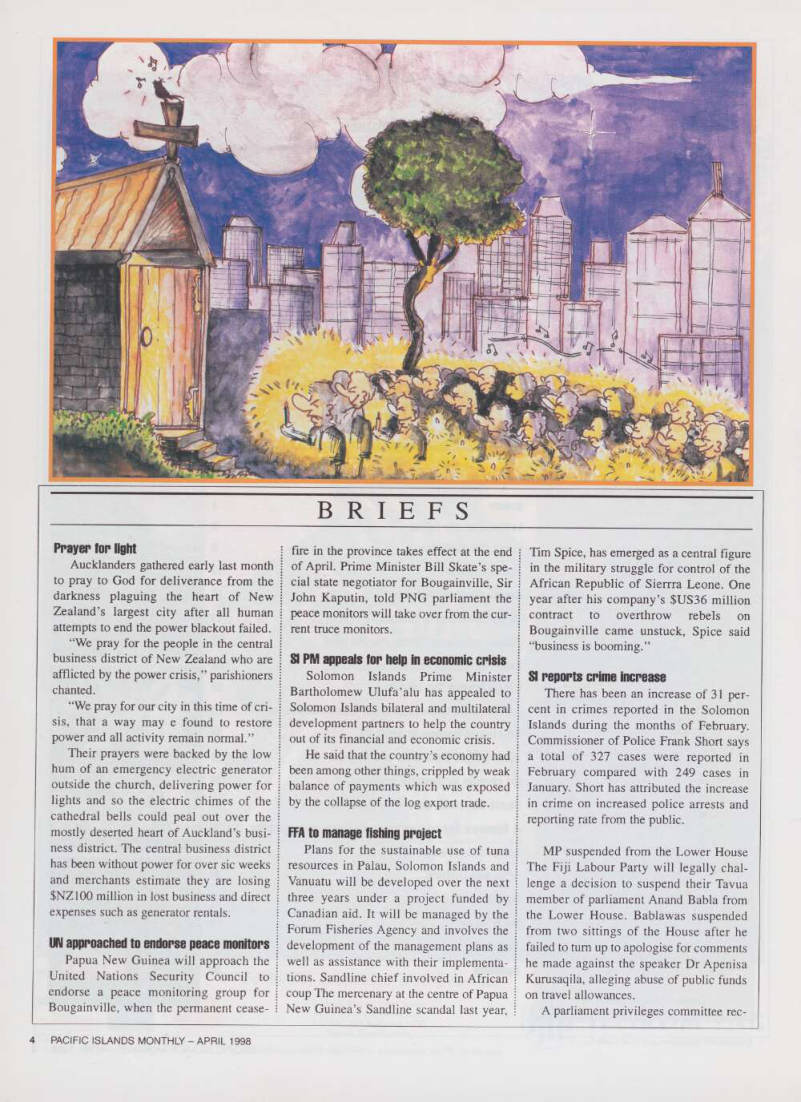

Prayer for light
Aucklanders gathered early last month to pray to God for deliverance from the darkness plaguing the heart of New Zealand’s largest city after all human attempts to end the power blackout failed.
“We pray for the people in the central business district of New Zealand who are afflicted by the power crisis,” parishioners chanted.
“We pray for our city in this time of cri sis, that a way may e found to restore power and all activity remain normal.”
Their prayers were backed by the low hum of an emergency electric generator outside the church, delivering power for lights and so the electric chimes of the cathedral bells could peal out over the mostly deserted heart of Auckland’s busi ness district. The central business district has been without power for over sic weeks and merchants estimate they are losing SNZIOO million in lost business and direct expenses such as generator rentals.
UN approached to endorse peace monitors Papua New Guinea will approach the United Nations Security Council to endorse a peace monitoring group for Bougainville, when the permanent cease
fire in the province takes effect at the end of April. Prime Minister Bill Skate’s spe cial state negotiator for Bougainville, Sir John Kaputin, told PNG parliament the peace monitors will take over from the cur rent truce monitors.
SI PM appeals (or help in economic crisis Solomon Islands Prime Minister Bartholomew Ulufa’alu has appealed to Solomon Islands bilateral and multilateral development partners to help the country out of its financial and economic crisis.
He said that the country’s economy had been among other things, crippled by weak balance of payments which was exposed by the collapse of the log export trade.
FFA to manage fishing project Plans for the sustainable use of tuna resources in Palau, Solomon Islands and Vanuatu will be developed over the next three years under a project funded by Canadian aid. It will be managed by the Forum Fisheries Agency and involves the development of the management plans as well as assistance with their implementa tions. Sandline chief involved in African coup The mercenary at the centre of Papua New Guinea’s Sandline scandal last year,
Tim Spice, has emerged as a central figure in the military struggle for control of the African Republic of Sierrra Leone. One year after his company’s SUS 36 million contract to overthrow rebels on Bougainville came unstuck, Spice said “business is booming.”
Si reports crime increase There has been an increase of 31 per cent in crimes reported in the Solomon Islands during the months of February.
Commissioner of Police Frank Short says a total of 327 cases were reported in February compared with 249 cases in January. Short has attributed the increase in crime on increased police arrests and reporting rate from the public.
MP suspended from the Lower House The Fiji Labour Party will legally chal lenge a decision to suspend their Tavua member of parliament Anand Babla from the Lower House. Bablawas suspended from two sittings of the House after he failed to turn up to apologise for comments he made against the speaker Dr Apenisa Kurusaqila, alleging abuse of public funds on travel allowances.
A parliament privileges committee rec
ommended that Babla apologise or face suspension. The suspension ruling of the “second option” was handed down by the deputy speaker, Dewarkar Prasad. Prasad says he took the second option of the priv ileges committee because Babla was not present in the House and did not send an apology or informed the House of his absence.
Government to establish Cl Investment
Corporation
Cook Islands Prime Minister Sir Geoffrey Henry has introduced a bill in parliament to establish a corporation to be known as the Cook Islands Investment Corporation. He says the corporation will function to administer and manage crown assets and shareholding interests.
It will also control and manage the undertaking of all statutory corporations and manage all property (excluding cus tomary land), ownership rights to minerals and natural resources held either by or on behalf of the crown. It will also manage all property vested in the Cook Islands Government Property Corporation.
Sir Geoffery says one of its principle objectives is to ensure the efficient, prof itable and professional as well as the sus tainable management of government assets and statutory corporations.
Government questioned on decision to allow large fishing boats in People in Samoa have enquired about the government’s decision to allow larger fishing boats to fish in the country. Deputy Prime Minister Tuilaepa Sailele Malielegaoi announced that large fishing boats will be allowed to fish beyond the country’s 50 mile fishing zone currently
swarmed with smaller fishing craft.
The public’s enquiries raised with the fisheries department is focused on incen tives for the proposed decision by govern ment and the 60 percent shareholding for locals if its a partnership venture. Tuilaepa has made it dear that all big fishing boats will need to register their catches with the fisheries division and customs in Apia before allowed to sell their catches locally and overseas.
Telecommunications giant joins Pacific group The operator of the world’s largest telecommunications network, SITA, has joined the Pacific Islands Telecommunications Association (PITA) as a full member. SITA, which formed 50 years, has its headquarters in Geneva and employs more than 4000 people world wide.
Its 650 customers include airlines, aerospace companies, airports, govern ment organisations, travel distribution and computer reservation systems. PITA was formed late last year to represent the inter ests of telecommunication customers and organisations from the 18 Pacific Island nations including Australia, New Zealand and the United States.
NZ to cut back its presence on B'ville The New Zealand government will be scaling down on its manpower and other resources involved in truce monitoring on Bougainville, parties involved in the peace process agreed at a meeting in Canberra that Australia will take over com mand and control of the Truce Monitoring Group from New Zealand.
NZ deputy high commisoner Neil
Robinson said that the proposal to scale down was simply because the resources
being used were becoming disproportion
ate to the reasons for their being there.
New Zealand has between 100 and 150 soldiers working together with soldiers from Australia, Fiji, Vanuatu and Solomon Islands in the Truce Monitoring Group.
Fiji AG orders inquiry into MPs involved in white collar crimes Fiji’s attorney general, Ratu Etuate Tavail, has ordered an inquiry into parlia mentarians who are allegedly involved in white collar crime. The allegations were made by the member for Lau, Viliame Saulekaleka Tunidau in the Lower Flouse.
Ratu Etuate says he’s written to the Home Affairs Minister to ask Police Commissioner Isikia Savua to carry out an investigation and if necessary lay charges, he says the inquiry will forecast on the offi cial corruption which links with white col lar crime which is costing the country mil lions of dollars.
Ban on whaling to continue Tonga’s secretary of fisheries, ‘Akau’ola says ban on whaling in the country should continue in efforts to save and preserve whale stock in Tongan and neighbouring waters. ‘Akau’ola made the comment following a recent meeting in Canada of the World Council of Whaling. ‘Akau’ola believes that despite the slight increase in the number of whales, the ban should continue to further replenish the stock on Tongan waters. He says sea areas of Ha’apai and Vava’u islands are ideal breeding grounds for humpback and sperm whales. H
Letters To The Editor
Cooks situation not as negative
Dear Madam, The February issue of PIM included an article entitled ‘Cooks situation likely to worsen in 1998’. I am not going to suggest that the Cooks Islands has not had, and does not have, financial problems but I am equally sure that if somebody was asked to write as negative an article as they possi bly could on the Cook Islands economy, that article would take the prize.
For many of the years after it became a self-governing nation in 1965, the Cook Islands government was sustained by large dollars of aid particularly from New Zealand. About a decade ago that aid began to decline but the civil service con tinued to expand. In 1987 the democratic government launched into an ambitious project to build a large Sheraton Hotel.
However, the Italian construction compa ny which was meant to build the hotel became insolvent having been paid DMSI million of loan monies from the Italian lending bank although this expenditure bore no relation to the value of the work actually completed. The project continued to be fraught with problems. Most of those problems the Cook Islands government had no control over. The project finally ground to a halt near the end of 1993.
The debt arising from the ill-fated hotel project is under negotiation with the Italian authorities and, with the disputed sum amounting to NZ$9O million (SUS4Bm) (not NZ$l2O million as stated in the story), it makes up the bulk of government debt.
In respect to the remaining government debt, being about NZ$B3 million (USs4sm), Standard & Poors have noted that although the amount of debt is high the interest rate burden on the bulk of those debts is relatively low. Furthermore, gov ernment is, and has for some time now, been paying its debts when they fall due while, at the same time, reducing historic debt. Standard & Poors predict a stable outlook and improved rating for the Cook Islands in the future, as long as it can pro duce a balanced budget as it has done.
In 1996 the Cook Islands government, with the assistance of the Asian Development Bank, launched its economic reform programme. Restructuring the pub lic sector was quickly identified as a mea
sure to reduce spending and improve effi ciency. Accordingly, the public service has been downsized by two-thirds and redun dant workers have shifted to private employment. Standard & Poors on this matter remarked, “Until last year, 44 per cent of the workforce were civil servants, a number that has since fallen by half as a result of fiscal austerity.” Yet, remarkably, output appears to have grown as redundant workers shifted to private employment.
In May of 1996, a new Public Service Act was passed vesting in the heads of ministries discretion over the appointment of their staff. Prior to this, the appointment of public servants was highly centralised.
In July of 1996, the Ministry of Finance and Economic Management (MFEM Act) was put in place. This imposed new responsibilities on government to be fis cally responsible. It made heads of min istries responsible for their own staff. The Ministry of Works Environment and Physical Planning was closed, not because government had run out of money as the article implies, but because that ministry had spent its allocated budget. The tempta tion for government was to close the min istry but to prop it up notwithstanding it had overspent. It refused to do this. While one or two ministries had trouble living within their means the great majority did not and the new system whereby heads of ministries are left to get on with the job without outside interference has over
whelming support.
The MFEM Act also requires three year budget forecasting and increases the reporting requirements and accountability to the public for the expenditure of monies.
Also in July 1996 the Public Expenditure Review Committee and Audit Act passed.
The Act created an independent ‘watch dog’ committee which scrutinises public expenditure and the management of public money, and is designed to hold every ser vant of the crown and the politicians them selves accountable for the expenditure and management of public monies. Already, it has proved itself to be no paper tiger.
In addition to improving accountability to the public, government has also sought to improve the level of consultation with the public about major policy decisions. It set up a National Development Council made up representatives from the Chamber of Commerce, non-govemment organisa
tions, traditional leaders, religious adviso ry council and other community bodies.
The Cooks Islands government is possibly the only government in the world that cir culates to an organisation representing the community, copies of its draft budget for comment. In addition two national retreats have been held where a large number of people have been invited to formulate pro posals for government action, resolutions have been made and government has instructed ministries to take appropriate steps for their implementation.
In September 1996, a Development Investment Board manned by people from the private sector was established to pro mote trade, investment and business in the Cook Islands. While overall policy direc tion remains the responsibility of cabinet, the board is responsible for determining the merits of individual cases. In June 1997, a goods and services type of tax, similar to that which operates in New Zealand, was introduced. Simultaneously, a new income tax regime was brought in which lowered rates of taxation and pro vided a number of incentives for those wishing to invest in the country. For exam ple, the Act provides that from income before tax can be deducted a 100 percent allowance for depreciation on newly
acquired assets.
There is no doubt the privatisation and asset sales programme has not moved for ward as speedily as government would have wished. However, it is quite mislead ing to describe it as ‘disastrous’ as the arti cle did. Prior to the reform process govern ment held a monopoly on the importation of liquor. This was reversed when the industry was deregulated and the govern ment owned liquor store was sold. Less than two years into the reform implemen tation not only the liquor store but also the Aitutaki Lagoon Resort Hotel, the
Rarotongan Hotel, Government Printing
Services, Government Computer Services and government’s controlling share in Telecom have all been sold. Meanwhile television and radio broadcasting, rubbish collection and a myriad of other functions have been privatised. The privatisation and sale of more state functions and public
assets is currently being negotiated.
In respect to the Rarotongan there was no cash upfront offer of NZ$5 million (SUS2.7m) as the article claimed and gov
emment has no regrets disposing of a hotel which was costing taxpayers more than half a million dollars a year to maintain.
To assess the reform programme the Cook Islands government invited respect ed international credit agency, Standard & Poors, to give an appraisal of the country’s economic performance and reform pro gramme thus far. Although Standard & Poors acknowledged the existence of vul nerable financial position, it says the long term outlook for the Cook Islands is stable.
Reform measures such as fiscal disci pline and transparency, private sector led growth, reduction in spending, selling of assets and public service restructuring have been endorsed by Standard & Poors.
The only evidence I know of ‘Cooks situation likely to worsen in 1998’ is Air New Zealand’s decision to temporarily use 767 s rather than 747 s to fly into Rarotonga thus reducing passenger loading and hence the number of tourists, and the possibility the ‘Asian crisis’ may, by its impact on New Zealand, reduce the number of tourists from that country visiting here.
Standard & Poors do not occur with the view that things are likely to worsen and I think most will take more cognisance vis a vis the economy of the views of some of the world’s best economists than they will of the article which does little credit to the publishers of a reputable magazine.
Brian Mason
Deputy Chief of Staff Office of Prime Minister Government of the Cooks Islands
Adoption in the Marshalls
Dear Madam, As an adoptive mother of a Marshallese son and the Marshall Islands Program Director for Children’s House International Adoption Agency, I read your article on US adoptions in the Marshalls in the February issue of PIM with great inter est. I commend you as I believe that over all the article was accurate and informa tive. However, I was a little concerned when I read the heading that adoptions are becoming a major “industry” in the Marshalls. I feel that the word industry connotes commodities which are bartered, bargained for or bought. Adoptions are complex and require the services of many people to bring them to completion.
Families are paying for these services and not for the children. Countless hours of hard work done by many people are neces sary for just one adoption.
I would like to add a personal side to this story. The internet has been a great tool in educating families about adoption and children in need around the world. To be able to dial up a website and successfully “shop” for a child just doesn’t happen.
Each adoptive family has had a unique and often difficult journey that has lead them to adoption. Each birth family made its own similar trek which brought them to the decision of putting their child up for adop tion. It is a demanding venture for both parties. It has been my experience that Marshallese families have thought long and hard about their child’s future before deciding to make an adoption plan for him or her. It is a very difficult decision that has come with great personal sacrifice.
Time and time again I have been awed by the courage and love the Marshallese fam ilies have demonstrated throughout this process.
We have yet to have an adoptive family return from their adoption in the Marshalls without being profoundly affected by the experience. They feel a tremendous obli gation to their child, his birth family, and his native land. They are excited about communicating with the birth family and updating them with letters and pho tographs. They fully desire to take their child back to the islands. Support groups for families with children from the Marshalls have been formed so that fami lies can better educate themselves about the culture of their child’s past so that it can also be part of his present and future.
Built into the fee of every adoption is a humanitarian donation of SUSSOO. This money is used to improve the lives of the Marshallese and is dispersed to various organisations in need. Donations of dia pers, milk formula and clothes are also sent. We realise this is small compared to the need but are doing what we can to improve the situation.
Again, thank you for taking the time to report on a sensitive and complex issue and we welcome any questions or comments you have concerning the issue of adop tions.
Stefani Ellison
1633 North 110 West Orem, UT USA 84057
Murderer or liar?
Dear Madam I have lived in the South Pacific for nearly seven years and in that time have been witness to widespread corruption and public servants who serve only themselves and not the people. But I am a bit confused in the matter of Papua New Guinea Prime Minister Bill Skate.
Alcohol fog is a poor excuse with regards to claiming to be the “godfather” of the rascals and boasting to be a partici pant in a brutal murder. The question is simple Mr Skate. Are you a murderer or are you a liar? Now you are refusing to speak anything but the two official lan guages of PNG. Good for the rest of us, now we don’t have to listen to you.
Craig Uhler
P O Box 262 Savusavu Fiji Islands
Kyoto achieves effective response
to climate change
Dear Madam, The contribution by Jemima Garrett to the January edition of PIM is disappoint ingly misleading. Contrary to Ms Garrett’s suggestion, Kyoto was not a “climate debacle” and neither did Australia’s posi tion “threaten the very future of the agree ment”. The Kyoto Protocol represents a significant first step in achieving an effec tive international response to climate change. Australia worked very hard to achieve such an outcome and was very pleased to be part of it. Australia has unquestionably taken on its equal share of the burden of the international response to global warming. Australia’s target repre sents a reduction in emissions growth from business-as-usual levels equal to the aver age cut of 30 percent applying to devel oped countries as a group. This is a chal
lenging but realistic undertaking.
The outcome in Kyoto, through a set of negotiated differentiated target as a means of meeting the overall Annex I reduction of 5.2 percent on 1990 levels, recognised not only the particular circumstances of Australia, but those of all Annex I coun tries. Iceland, Norway and at least five members of the European Union (Sweden, Spain, Portugal, Ireland and Greece) all have or are likely to have emission targets
above the level they had in 1990.
These EU countries are likely to be assigned emission increases in the range of five to 40 percent under a specially agreed “emission bubble” between the 15 EU members. To single out Australia for a target which restricts emission growths rather than one which imposes an absolute reduction misses the point.
Differences in individual country emis sion targets under the Kyoto Protocol reflect differences between countries in the economic impact of greenhouse gas abate ment. A regime which imposed dispropor tionately higher costs on some countries purely because of their economic structure and composition of trade which have been
inequitable.
More importantly, such an approach would have been unsustainable over the longer-term, diminishing the environmen tal effectiveness of the agreement. The inclusion in the Kyoto Protocol of provi sions which recognise changes in emission levels resulting from changes in land-use and forestry has safeguarded the principle of comprehensiveness.
This means that all human activities
which generate greenhouse gas emissions are included, removing the scope to dis guise emission producing activities.
Efforts made by Australia since 1990 to reduce emissions from land clearing are part of an accounting of all Australian emission related activities.
The Kyoto Protocol is a landmark agreement in the fight against climate change. It contains realistic and equitable targets rather than rhetoric and undeliver
able promises.
Australia will not shirk from its respon sibility to share the burden of international action and has already begun to implement the measures required to meet its contribu tion.
Meg McDonald
Australia Ambassador for the Environment
Advertisements & other items, p. 6 (1 item)
Letters To The Editor
6
PACIFIC ISLANDS MONTHLY - APRIL 1998
Dirty Politics
Dear Madam After reading your article entitled “Leadership Struggle In Tuvalu” by Michael Field in the February issue of PIM, I cannot help but to interrogate the
quality and the competence of the journal ist. Being an islander and with great respect for your magazine reputed as con taining articles with quality and facts, one has to ask with second thoughts whether the media is there to inform us or to fool us. To start with, I would like to address myself to the author, Mr Field, for his neg ativity on this country is very evident. I would certainly think that being a journal
ist requires neutrality especially on politi
cal issues.
What I gathered from your logic is that you seem to imply or reduce the existence of a nation or a person to materialism.
What struck me even more is that your name doesn’t hint on any Pacific origin, yet your article seems to reflect our popu lar way of thinking where one likes to rejoice in the downfall of another. On a theoretical level, the way you approached the subject has failed to convince the read ers that you stand firm on facts, even though you constantly cite your sources.
In addition, you seem to comment on Tuvalu in comparison with developed states. In this case your comparative method is out of date. I believe that one
has to dig through our social and cultural history in order to understand the political and economical universe of the Pacific.
I wonder what kind of readers you are trying to satisfy. Are you trying to satisfy the so-called “way of thinking of our soci ety” or to explain the political universe ?
One may even lead to think that the motive of your writing lies in commercial reasons.
The absence of neutrality in your writing is accentuated by a lot of judgements on val ues - so by the end of it, I cannot find the main purpose of your comments, neither did I learn anything new.
Your article appears in under the Politics banner, so I will try to present a rebuttal on a political and economical level. Browsing through your article once again, one will be surprised to find that the only political term used doesn’t appear until the end of the article: the “artificial state”, implying that a state can only exist through infrastructure, yet you fail to define the deeper meaning of a “Nation- State”. I believe that the feeling of national unity is not necessarily based on material
success, but more on the people’s con sciousness. From the little I know and if you were familiar with the political envi ronment in the Pacific, you would have noticed that the elements that you enumer ated on Tuvalu are common to the political arena of the Pacific or the developing world.
Another surprising factor is the way you bring in religion as an argument to your political debate. From your sarcasm, one would think that you take yourself as God in a position to judge who should be a Godly nation and who shouldn’t be. Since we are still on political levels, you high lighted on the “dirty politics” in Tuvalu, I cannot help but to refer to your article as a
“dirty political” one.
You may oppose me by your revendi cation on the freedom of the media. I am very conscious of the fact that you are the fourth power in society, but the game of “checks and balances” gives me the right to question the quality of your information.
I am an active reader, not a sponge, and enjoy reflecting on issues published by the
media. You may even try to convince me with the fact that you have access to politi cians, but it is more on the way you anal yse the situation and transmit it to me that counts. To voice out these type of news, there are no doubt special magazines for that. . You, the media as an entity of power, should reflect on your limits. There is a basic principle that you seem to forget : Anything is permitted until it troubles the neighbour’s sphere. I do believe that you, as an entity, are within the boundaries of this principle. Your role is to educate and inform the public, and help us to enrich our knowledge on issues. So to conclude, I am readdressing myself to the author : Your implications that Tuvalu is filled with “dirty politics” are contradictory to the logic of your comments. Your article clear ly and surely shows that you have indirect ly contributed to this phenomena of “dirty
politics”.
Concerned Readers
Bale And Temoana
Advertisements & other items, p. 7 (2 items)
Letters To The Editor
Round Tea Bags
Specially selected teas from the highlands of PNG,blended to give a smooth and satisfying cup of tea. i ■ m m MM
WARREN PLANTATION
(MI HAGEN) PTY LTD
P.O. Box 95, Mt Hagen Papua New Guinea Telephone: 545 1335 Fax: 545 1239
From The Archives
August 1944
Yaqona - the national drink One Suva institution, which no one who lived in Suva will forget, is Jimmy Muir’s yaqona saloon.
There every morning, the town’s kava drinkers assembled for their morning bowl, and to swap the latest gossip from the beach. Some there were who had their own private bilos (coconut cups) embellished with a silver nameplate, and there was
many a gath ering of dis
tinguished,
and not so
distinguished
citizens in the little backroom behind the booksellers shop. The yaqona habit
was one that most residents formed. At one time, there was a bowl of kava in practical ly every government office, and one mag istrate, in the middle of listening to some dispute between a couple of Indians as to the ownership of a fowl, or the boring
Pacific Islands
details of how some dusky taxi driver failed to keep to the left, used to the adjourn court during the morning and retire to the back veran da for a bowl.
There was a period
of prohibition in the government circles, during the reign of a certain colonial secre tary, who decided that yaqona was a perni cious habit and banned it from the build ings. There were one or two die-hards who kept their bowls hidden away in the strong room. Even in the exalted circles of the Legislative Council there was a bowl in the veranda at adjournment time, when the Colony’s legislators forgot their differ ences and quaffed the refreshing harmless beverage. Described as the comer stone of Fijian ceremonial, the preparation and serving of yaqona plays a tremendous part in Fijian affairs. Every new governor has to quaff a bowl when he is first greeted by the chiefs. Even royalty is not exempt. The ceremony is an adjunct of the reception of
a chief and not matter how unpalatable the newcomer may find yaqona at first taste, he is courtesy bound to quaff it, and spin the bilo back to the bowl.
Cotton in Papua Cotton, surely, has a future in Papua.
According to official reports, attempts in the past failed because unsuitable land was chosen. It can, and has, however, been grown to profit in Papua. There was the experience of one small landholder who starved bankruptcy with the help of a hasti ly planted area of cotton. Some of the lighter coastal lands in the territory seem to actually cry out at one as one passes, “Try me for cotton!”. Kapok should be a payable sideline on a Papuan plantation
and in the drier
districts yield
and quality are fair. But the grower should make very partic ular inquiries in the way the prod uct is marketed in Australia. ■
Established 1930
Advertisements & other items, pp. 8-12 (2 items)
Letters To. The Editor
8
PACIFIC ISLANDS MONTHLY - APRIL 1998
Japanese Used Vehicles
Exporting around the Pacific
Fiji, Kiribati, Palau, Nauru Is, Norfolk Is, Solomon Is, Papua New Guinea, Niue, New Zealand, Tonga, Samoa.
All Shipping and Documentation arranged for YOU. Buy direct from Japan and save sss. Vehicles from USDSIOOO plus Freight.
Fax today for your Order form and List of Vehicles. Big Selection of used Japanese Motor vehicles.
Special P.I.M. Offer. $lOO off your purchase with this advertisement. r
Trust Company Ltd
Kobac Bldg 3F, 3-2-26 Nishiki Naka ku, Nagoya 460, JAPAN Phone (81) 52 953 5602 Fax (81) 52 953 5634/1
REPLACEMENT
BMW
Bedford Cummins Daihatsu Detroit Deutz Ford Gardner Hino Isuzu Iveco Komatsu Kubota Phone: 643 6938122 Fax: 643 6938120 Email: [email protected]
BLAIRS
PO Box 14 Geraldine New Zealand Subaru Leyland Mazda Mercedes Mitsubishi
MAN.
Nissan Perkins Suzuki Toyota Volvo Yanmar
• DIESEL •PETROL
TRANSMISSIONS
•New Parts 'Second Hand Parts
SPECIAL
'As new isuzu Industrial Stationery diesel engines' Model C240,4cy1, 2369 cc, 52hp odn 2500 rpm Suitable: Generator, Waterpump, Forklift, Loader
LIMITED SUPPLY
The hand that nocks the cradle
Special Report
By Sophie Foster Hilderrand
A favourite feminist say ing is ‘the hand that rocks the cradle rules the world’, but in Samoa, known as the Cradle of Polynesia, the hands that rule the country are rocking their world.
Rife with allegations and counter-alle gations of corruption, political bribery, abuse of power, and vast unaccountability, Samoa is at a critical point in its develop mental history. 1998 will make it the eighth year running since the Samoan gov ernment last audited their accounts.
During that time, the trade deficit gap has continued to widen and the spill-over into the lives of the average Samoan is
increasing.
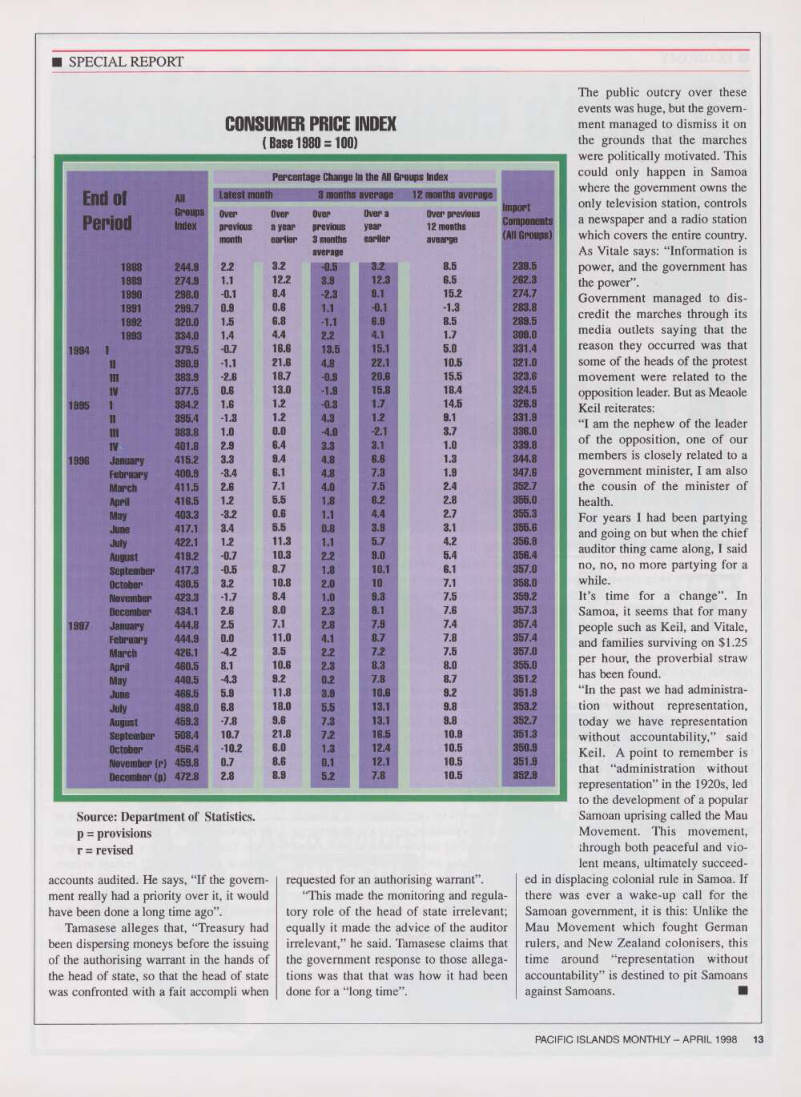
According to the Central Bank of Samoa (CBS) economic indicators, the overall trade deficit for the 12 months to December 1997 stood at 218.79 million tala (SUS7O m). But the biggest problem facing Samoans, is the soaring inflation rate which is currently double the govern ment’s target.
The average inflation rate for 1997 was 10.5 percent, a figure which most govern ment officials agree is high.
“The only worrying factor for us is our inflation rate. Our inflation rate at the end of last year was very high compared to our trading partners, to Fiji for instance,” CBS governor Papali’i Tommy Scanlan told
Pim.
“But there is a problem with the index that we are using. It’s got a very high weighting of the taro , and the taro as you know has been very badly affected by this blight that we had since 1992. So our department of statistics is revising our index now.
“We have an underlying index which calculated by us and the treasury and we are looking'at about six or seven and a half percent inflation. Our target rate is about four to five percent so that’s the main wor rying factor at the moment,” Scanlan said.
In December the Consumer Price Index (CPI) rose 2.8 percent, a figure which was nine percent higher than the same month in 1996. According to CBS, that particular month’s rise in the CPI was “caused main
ly by a 4.9 percent increase in the “Food” group sub-index which recorded higher prices for taro and fresh fish”. Despite this, Samoan finance minister and deputy prime minister Tuilaepa Sailele Malielegaoi says the country is “on course”.
“We are on course in the sense that we have put in place policies. “If we keep adopting these policies then we are on a proper economic target,” he says.
For all intents and purposes, the gov ernment seems to have lost touch with the reality of living in modem-day Samoa.
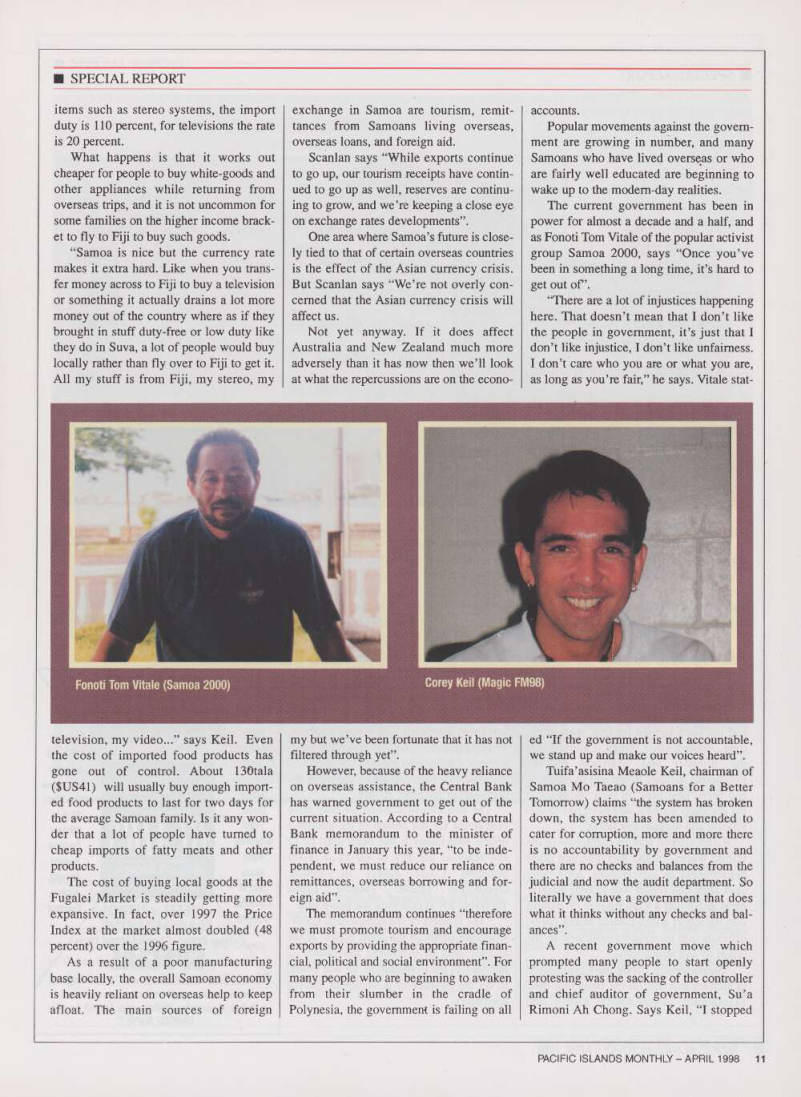
As local businessman, Corey Keil, pro prietor of Magic FM9B, put it: “It looks good on the surface, but scratch below and people are hurting”.
The cost of delivering an essential ser vice such as electricity to the consumer is astoundingly high, standing at about 100 tala (SUS3I) per month, at the very least says one family, for most households.
High rates of duty placed on imports, regardless of the fact that there are no local substitutes for most goods, make it very difficult to sustain increases in the standard of living. For what are considered luxury
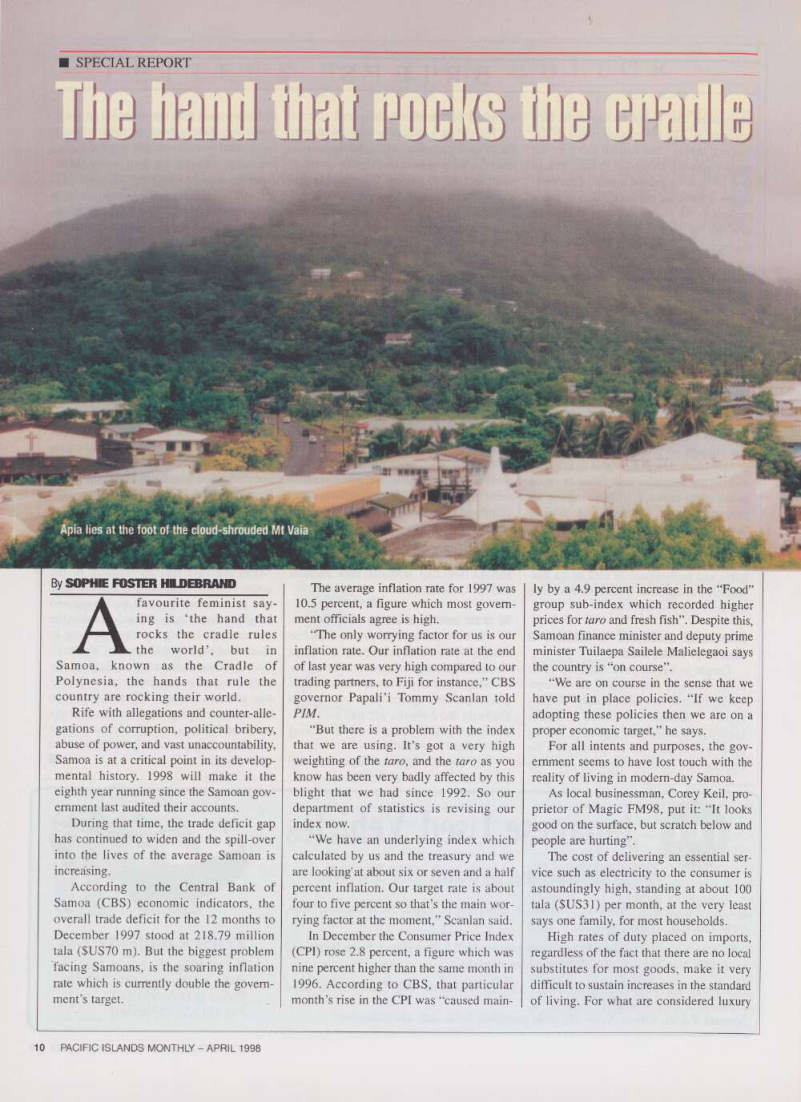
Apia ties at the foot of the cloud-shrouded Mt Vaia
items such as stereo systems, the import duty is 110 percent, for televisions the rate is 20 percent.
What happens is that it works out cheaper for people to buy white-goods and other appliances while returning from overseas trips, and it is not uncommon for some families on the higher income brack et to fly to Fiji to buy such goods.
“Samoa is nice but the currency rate makes it extra hard. Like when you trans fer money across to Fiji to buy a television or something it actually drains a lot more money out of the country where as if they brought in stuff duty-free or low duty like they do in Suva, a lot of people would buy locally rather than fly over to Fiji to get it.
All my stuff is from Fiji, my stereo, my
television, my video...” says Keil. Even the cost of imported food products has gone out of control. About 130tala (SUS4I) will usually buy enough import ed food products to last for two days for the average Samoan family. Is it any won der that a lot of people have turned to cheap imports of fatty meats and other products.
The cost of buying local goods at the Fugalei Market is steadily getting more expansive. In fact, over 1997 the Price Index at the market almost doubled (48 percent) over the 1996 figure.
As a result of a poor manufacturing base locally, the overall Samoan economy is heavily reliant on overseas help to keep afloat. The main sources of foreign
exchange in Samoa are tourism, remit tances from Samoans living overseas, overseas loans, and foreign aid.
Scanlan says “While exports continue to go up, our tourism receipts have contin ued to go up as well, reserves are continu ing to grow, and we’re keeping a close eye on exchange rates developments”.
One area where Samoa’s future is close ly tied to that of certain overseas countries is the effect of the Asian currency crisis.
But Scanlan says “We’re not overly con cerned that the Asian currency crisis will affect us.
Not yet anyway. If it does affect Australia and New Zealand much more adversely than it has now then we’ll look at what the repercussions are on the econo
my but we’ve been fortunate that it has not filtered through yet”.
However, because of the heavy reliance on overseas assistance, the Central Bank has warned government to get out of the current situation. According to a Central Bank memorandum to the minister of finance in January this year, “to be inde pendent, we must reduce our reliance on remittances, overseas borrowing and for
eign aid”.
The memorandum continues “therefore we must promote tourism and encourage exports by providing the appropriate finan cial, political and social environment”. For many people who are beginning to awaken from their slumber in the cradle of Polynesia, the government is failing on all
accounts.
Popular movements against the govern ment are growing in number, and many Samoans who have lived overseas or who are fairly well educated are beginning to wake up to the modern-day realities.
The current government has been in power for almost a decade and a half, and as Fonoti Tom Vitale of the popular activist group Samoa 2000, says “Once you’ve been in something a long time, it’s hard to get out of’.
“There are a lot of injustices happening here. That doesn’t mean that I don’t like the people in government, it’s just that I don’t like injustice, I don’t like unfairness.
I don’t care who you are or what you are, as long as you’re fair,” he says. Vitale stat-
ed “If the government is not accountable, we stand up and make our voices heard”.
Tuifa’asisina Meaole Keil, chairman of Samoa Mo Taeao (Samoans for a Better Tomorrow) claims “the system has broken down, the system has been amended to cater for corruption, more and more there is no accountability by government and there are no checks and balances from the judicial and now the audit department. So literally we have a government that does what it thinks without any checks and bal ances”.
A recent government move which
prompted many people to start openly
protesting was the sacking of the controller and chief auditor of government, Su’a Rimoni Ah Chong. Says Keil, “I stopped
Fonoti Tom Vitale (Samoa 2000)
Corey Keil (Magic FM98)
being a bystander when that happened”.
In August last year the chief auditor was dismissed from his position after he filed a case against a Commission of Inquiry appointed by government. Since that time, he is still waiting for a decision from the Supreme Court in Samoa.
The events which preceded that move shocked many people. In the June 1994 session of parliament, the Auditor’s Report was tabled in the House of
Representatives.
The report stated that public accounts had not been audited for five years at the time. Among other things it alleged that the minister and chairman of the Polynesian Airlines Board and its directors had been “negligent” in their “dealings in the company’s affairs and gave rise to sig nificant and unrepayable debts”.
It also alleged serious corruption in the Public Works, Inland Revenue and other departments of government, Ah Chong says after that report was tabled, govern ment appointed a Commission of Inquiry into the report which cleared senior public officials and ministers mentioned in the report of any wrongdoing.
“Subsequently I took the Commission of Inquiry to court on the basis that their examination lacked natural justice, and
also government for setting up such a Commission, and also certain things that government did in relation to the position of chief auditor,” he says.
This matter is still to be decided in court. However, Ah Chong says “’’When I took the matter to the court because it was a constitutional issue to be dealt with by the court, they suspended me”.
“They issued another suspension to me when the first one expired and then later on, because they still couldn’t dismiss me, they amended the Constitution, and after that I was dismissed,” Ah Chong explains.
In April 1997, using its majority in par liament, the Samoan government amended the country’s Constitution to allow for the dismissal of the chief auditor.
The amendment allowed for only three year terms for the person in the auditor’s office. Previously it had been until he or she reached the age of 60 as it is for Supreme Court judges in Samoa.
Opposition Leader Tuiatua Tupua Tamasese Efi in opposing the move said “The framers of the constitution under stood the perils of the audit office. If the auditor was to discharge his duties as intended in the Constitution, he was bound to tax the patience of government and the
legislators.
Our forebears wanted to make very sure that the grounds for dismissal were misbe haviour or of infirmity or body or mind and not resistance to legitimate audit reporting”.
According to Ah Chong, up to the time that he was dismissed from the position, he Was still given no cooperation to get those
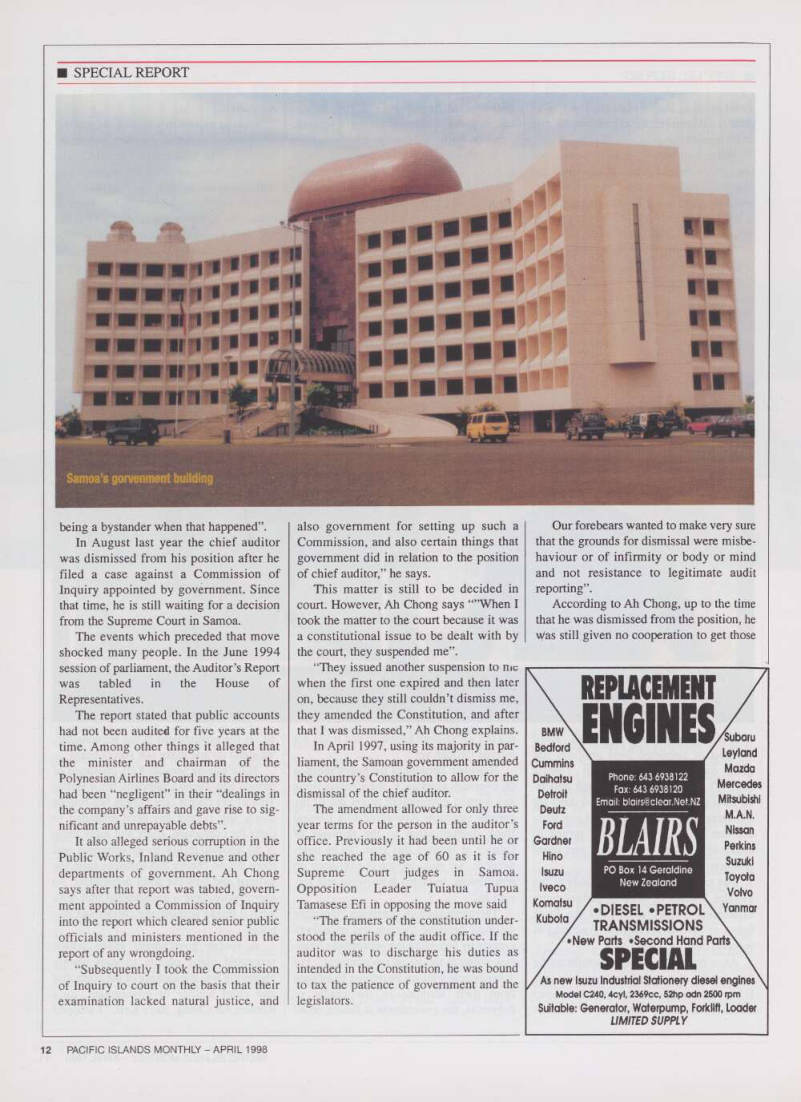
Samoa’s gorvenment building
Consumer Price Index
(Base 1980 = 100)
Source: Department of Statistics, p = provisions r = revised
accounts audited. He says, “If the govern ment really had a priority over it, it would have been done a long time ago”.
Tamasese alleges that, “Treasury had been dispersing moneys before the issuing of the authorising warrant in the hands of the head of state, so that the head of state was confronted with a fait accompli when
requested for an authorising warrant”.
“This made the monitoring and regula tory role of the head of state irrelevant; equally it made the advice of the auditor irrelevant,” he said. Tamasese claims that the government response to those allega tions was that that was how it had been done for a “long time”.
The public outcry over these events was huge, but the govern ment managed to dismiss it on the grounds that the marches were politically motivated. This could only happen in Samoa where the government owns the only television station, controls a newspaper and a radio station which covers the entire country.
As Vitale says: “Information is power, and the government has
the power”.
Government managed to dis credit the marches through its media outlets saying that the reason they occurred was that some of the heads of the protest movement were related to the opposition leader. But as Meaole Keil reiterates: “I am the nephew of the leader of the opposition, one of our members is closely related to a government minister, I am also the cousin of the minister of health.
For years I had been partying and going on but when the chief auditor thing came along, I said no, no, no more partying for a while.
It’s time for a change”. In Samoa, it seems that for many people such as Keil, and Vitale, and families surviving on $1.25 per hour, the proverbial straw has been found.
“In the past we had administra tion without representation, today we have representation without accountability,” said Keil. A point to remember is that “administration without representation” in the 19205, led to the development of a popular Samoan uprising called the Mau Movement. This movement, through both peaceful and vio lent means, ultimately succeed
ed in displacing colonial rule in Samoa. If there was ever a wake-up call for the Samoan government, it is this: Unlike the Mau Movement which fought German rulers, and New Zealand colonisers, this time around “representation without accountability” is destined to pit Samoans against Samoans. ■
Percentage Change In the All Groups index
End of
All Latest month 3 months average 12 months average Groups Over Over Over Over a Over previous Import
Period
Index previous a year previous year 12 months Components month earlier 3 months earlier avearge (All Groups) 2.2 3.2 average 3.2 8.5 239.5 1988 244.9 -0.5 1989 274.9 1.1 12.2 3.9 12.3 6.5 262.3 1990 298.0 -0.1 8.4 -2.3 9.1 15.2 274.7 1991 299.7 0.9 0.6 1.1 -0.1 -1.3 283.8 1992 320.0 1.5 6.8 -1.1 6.9 8.5 289.5 1993 334.0 1.4 4.4 2.2 4.1 1.7 309.0 1994 1 379.5 -0.7 16.6 13.5 15.1 5.0 331.4 II 390.9 -1.1 21.6 4.8 22.1 10.5 321.0 in 383.9 -2.6 18.7 -0.9 20.6 15.5 323.6 IV 377.5 0.6 13.0 -1.9 15.8 18.4 324.5 1995 1 384.2 1.6 1.2 -0.3 1.7 14.5 328.9 II 395.4 -1.3 1.2 4.3 1.2 9.1 331.9 m 383.8 1.0 0.0 -4.0 -2.1 3.7 336.0 IV 401.8 2.9 6.4 3.3 3.1 1.0 339.8 1996 January 415.2 3.3 9.4 4.8 6.6 1.3 344.8 February 400.9 -3.4 6.1 4.8 7.3 1.9 347.6 March 411.5 2.6 7.1 4.0 7.5 2.4 352.7 April 416.5 1.2 5.5 1.8 6.2 2.8 355.0 May 403.3 -3.2 0.6 1.1 4*4 2.7 355.3 June 417.1 3.4 5.5 0.8 3.9 3.1 355.6 July 422.1 1.2 11.3 1.1 5.7 4.2 356.9 August 419.2 -0.7 10.3 2.2 9.0 5.4 356.4 September 417.3 -0.5 8.7 1.8 10.1 6.1 357.0 October 430.5 3.2 10.8 2.0 10 7.1 358.0 November 423.3 -1.7 8.4 1.0 9.3 7.5 359.2 December 434.1 2.6 8.0 2.3 9.1 7.6 357.3 1997 January 444.8 2.5 7.1 2.8 7.9 7.4 357.4 February 444.9 0.0 11.0 4.1 8.7 7.8 357.4 March 426.1 -4.2 3.5 2.2 7.2 7.5 357.0 April 460.5 8.1 10.6 2.3 8.3 8.0 355.0 May 440.5 -4.3 9.2 0.2 7.8 8.7 351.2 June 466.5 5.9 11.8 3.9 10.6 9.2 351.9 July 498.0 6.8 18.0 5.5 13.1 9.8 353.2 August 459.3 -7.8 9.6 7.3 13.1 9.8 352.7 September 508.4 10.7 21.8 7.2 16.5 10.9 351.3 October 456.4 -10.2 6.0 1.3 12.4 10.5 350.9 November (r) 459.8 0.7 8.6 0.1 12.1 10.5 351.9 December (p) 472.8 2.8 8.9 5.2 7.8 10.5 352.9
Advertisements & other items, p. 13 (1 item)
Racific Islands Monthly - April 1998
■ SPECIAL REPORT
Samoa’s changing finances

Economy
By Sophie Foster Hildebrand
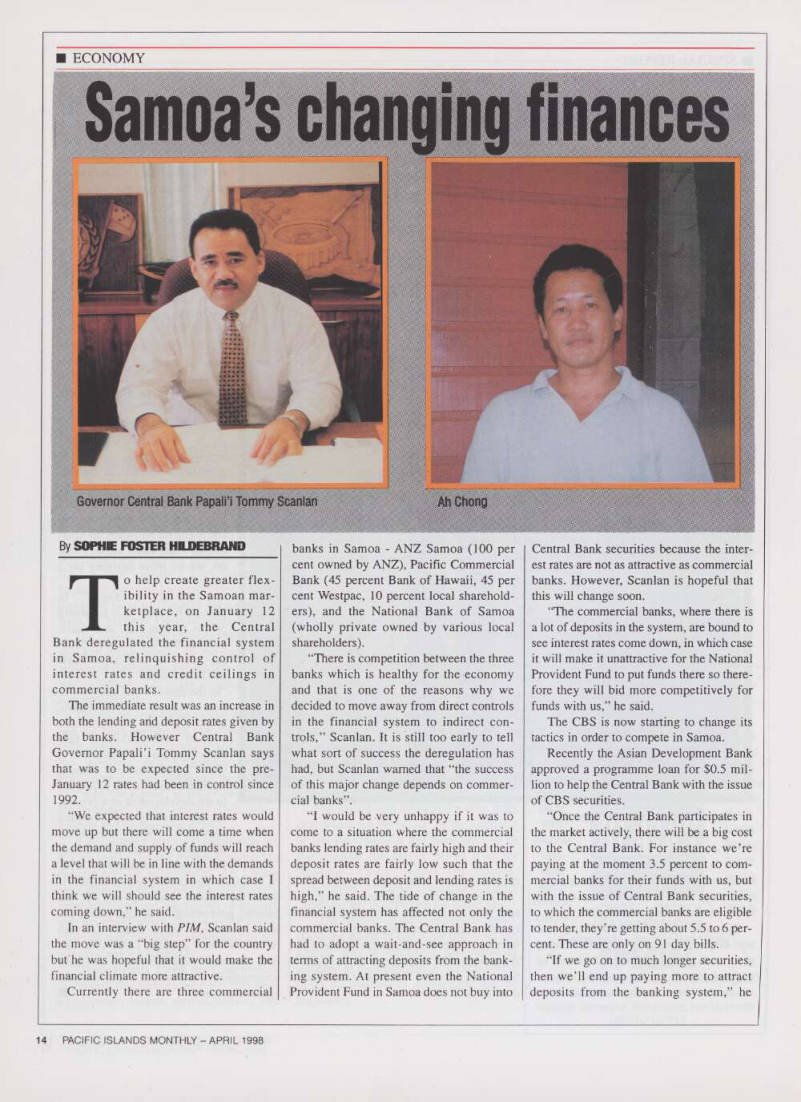
To help create greater flex ibility in the Samoan mar ketplace, on January 12 this year, the Central Bank deregulated the financial system in Samoa, relinquishing control of interest rates and credit ceilings in commercial banks.
The immediate result was an increase in both the lending and deposit rates given by the banks. However Central Bank Governor Papali’i Tommy Scanlan says that was to be expected since the pre- January 12 rates had been in control since 1992.
“We expected that interest rates would move up but there will come a time when the demand and supply of funds will reach a level that will be in line with the demands in the financial system in which case I think we will should see the interest rates coming down,” he said.
In an interview with PIM, Scanlan said the move was a “big step” for the country but he was hopeful that it would make the financial climate more attractive.
Currently there are three commercial
banks in Samoa - ANZ Samoa (100 per cent owned by ANZ), Pacific Commercial Bank (45 percent Bank of Hawaii, 45 per cent Westpac, 10 percent local sharehold ers), and the National Bank of Samoa (wholly private owned by various local shareholders).
“There is competition between the three banks which is healthy for the economy and that is one of the reasons why we decided to move away from direct controls in the financial system to indirect con trols,” Scanlan. It is still too early to tell what sort of success the deregulation has had, but Scanlan warned that “the success of this major change depends on commer cial banks”.
“I would be very unhappy if it was to come to a situation where the commercial banks lending rates are fairly high and their deposit rates are fairly low such that the spread between deposit and lending rates is high,” he said. The tide of change in the financial system has affected not only the commercial banks. The Central Bank has had to adopt a wait-and-see approach in terms of attracting deposits from the bank ing system. At present even the National Provident Fund in Samoa does not buy into
Central Bank securities because the inter est rates are not as attractive as commercial banks. However, Scanlan is hopeful that this will change soon.
“The commercial banks, where there is a lot of deposits in the system, are bound to see interest rates come down, in which case it will make it unattractive for the National Provident Fund to put funds there so there fore they will bid more competitively for funds with us,” he said.
The CBS is now starting to change its tactics in order to compete in Samoa.
Recently the Asian Development Bank approved a programme loan for $0.5 mil lion to help the Central Bank with the issue of CBS securities.
“Once the Central Bank participates in the market actively, there will be a big cost to the Central Bank. For instance we’re paying at the moment 3.5 percent to com mercial banks for their funds with us, but with the issue of Central Bank securities, to which the commercial banks are eligible to tender, they’re getting about 5.5 to 6 per cent. These are only on 91 day bills.
“If we go on to much longer securities, then we’ll end up paying more to attract deposits from the banking system,” he
Governor Central Bank Papali’i Tommy Scanlan
Ah Chong
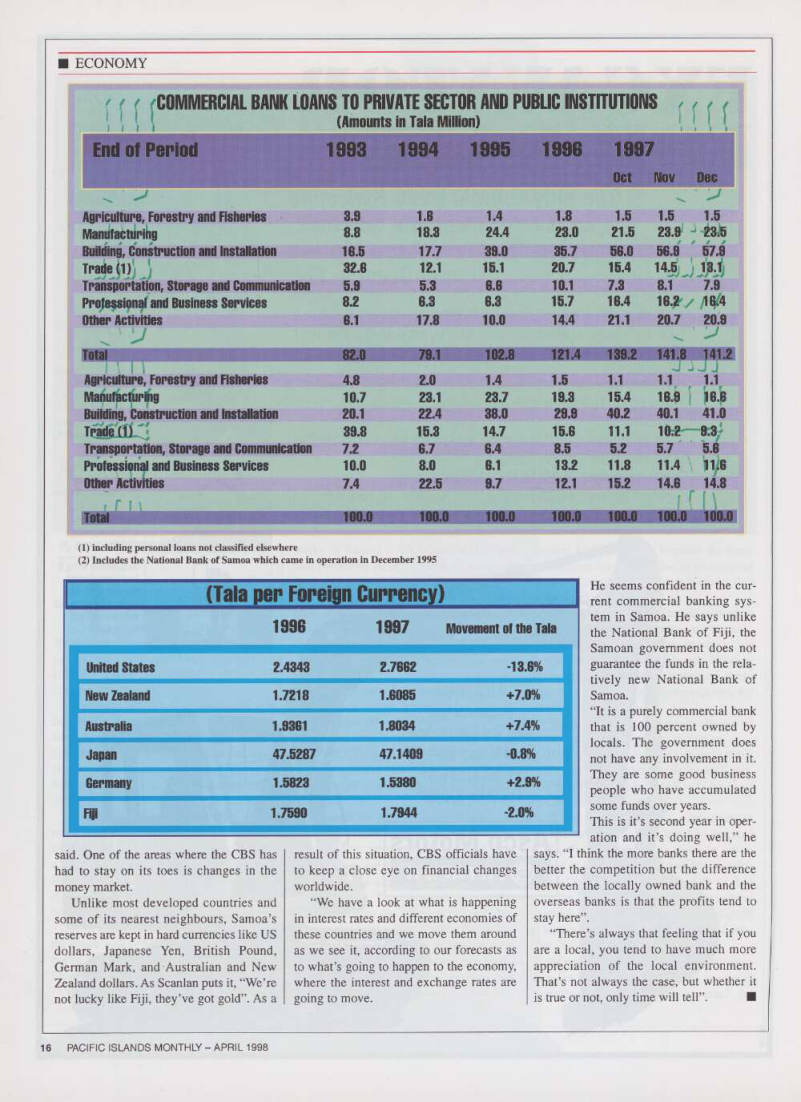
COMMERCIAL BANK LOANS TO PRIVATE SECTOR AND PUBLIC INSTITUTIONS (Amounts in Tala Million)
(1) including personal loans not classified elsewhere (2) Includes the National Bank of Samoa which came in operation in December 1995
said. One of the areas where the CBS has had to stay on its toes is changes in the money market.
Unlike most developed countries and some of its nearest neighbours, Samoa’s reserves are kept in hard currencies like US dollars, Japanese Yen, British Pound, German Mark, and Australian and New Zealand dollars. As Scanlan puts it, “We’re not lucky like Fiji, they’ve got gold”. As a
result of this situation, CBS officials have to keep a close eye on financial changes worldwide.
“We have a look at what is happening in interest rates and different economies of these countries and we move them around as we see it, according to our forecasts as to what’s going to happen to the economy, where the interest and exchange rates are going to move.
He seems confident in the cur rent commercial banking sys tem in Samoa. He says unlike the National Bank of Fiji, the Samoan government does not guarantee the funds in the rela tively new National Bank of Samoa.
“It is a purely commercial bank that is 100 percent owned by locals. The government does not have any involvement in it.
They are some good business people who have accumulated some funds over years.
This is it’s second year in oper ation and it’s doing well,” he
says. “I think the more banks there are the better the competition but the difference between the locally owned bank and the overseas banks is that the profits tend to stay here”.
“There’s always that feeling that if you are a local, you tend to have much more appreciation of the local environment.
That’s not always the case, but whether it is true or not, only time will tell”. ■
End of Period
1993 1994 1995 1996 1997 Oct Nov Dec Agriculture, Forestry and Fisheries 3.9 1.6 1.4 1.8 1.5 1.5 1.5 Manufacturing 8.8 18.3 24.4 23.0 21.5 23.9 J 23.5 Building, Construction and Installation 16.5 17.7 39.0 35.7 56.0 56.9 57.9 Trade fl)) j 32.6 12.1 15.1 20.7 15.4 Transportation, Storage and Communication 5.9 5.3 6.6 10.1 7.3 8.1 7.9 Professional and Business Services 8.2 6.3 6.3 15.7 16.4 16.£v /16/4 Other Activities 6.1 17.8 10.0 14.4 21.1 20.7 20.9 J Total 82.0 79.1 102.8 121.4 139.2 141.8 141.2 Agriculture, Forestry and Fisheries 4.8 2.0 1.4 1.5 1.1 1.1 1.1 Manufacturing 10.7 23.1 23.7 19.3 15.4 16.9 16.6 Building, Construction and Installation 20.1 22.4 38.0 29.9 40.2 40.1 41.0
Tpaj^SU.
39.8 15.3 14.7 15.6 11.1 10:2—9:3/ Transportation, Storage and Communication 7.2 6.7 6.4 8.5 5.2 5.7 5.6 Professional and Business Services 10.0 8.0 6.1 13.2 11.8 11.4 \ 11/6 Other Activities 7.4 22.5 9.7 12.1 15.2 14.6 14.8 ' r , . f ( ( \ r / I \ 1 \ I 1 Total 100.0 100.0 100.0 100.0 1 100.0 100.0 100.0
(Tala per Foreign Currency)
1996 1997 Movement of the Tala United States 2.4343 2.7662 -13.6% New Zealand 1.7218 1.6085 +7.0% Australia 1.9361 1.8034 +7.4% Japan 47.5287 47.1409 -0.8% Germany 1.5823 1.5380 +2.9% Fiji 1.7590 1.7944 -2.0%
Advertisements & other items, p. 15 (1 item)
For Sale
llll>
One only Hitachi EX6O Hydraulic
Excavator available ex-stock,
currently on display at Asco Motors
mm |» r% ■ ■■■
Nadi Branch, Fip.
This machine is offered for sale at below replacement cost.
Full technical specifications are available on request.
WORKING RANGES
Key Features The advanced Optimum Hydraulic System ( OHS ) provides a high degree of independence. This enables quick and smooth operations.
Short swing radius and low noise design for urban construction.
Rated engine HP -40 kW (55PSI) Operating weight -6,300 kg (13,9001 b) Backhoe bucket - PCSA heaped, 0.11-0.34m 3 (0.14-o.44cu.yd) i CECE heaped, 0.10-0.30m 3
SI Mi
Simultaneous swing and straight line travel are made easy by the OHS which overcomes the natural machine tendency to curve during combined operations.
Simultaneous straight line travel and boom/ arm / bucket operations are simple,The OHS overcomes curving during steep slope climbing.
Simultaneous swing & boom/arm/bucket operation enhances loading capabilities and vertical trench wall ram =|U l#l /I (0) ease,
ENQUIRIES
■lB Please contact John Van Campenhout Asco Motors Suva Fiji Ph 679 384857 Fax(679 370309
Asco Motors
3> HITACHI
!LI m m
"Black smokers" offer Pacific new riches
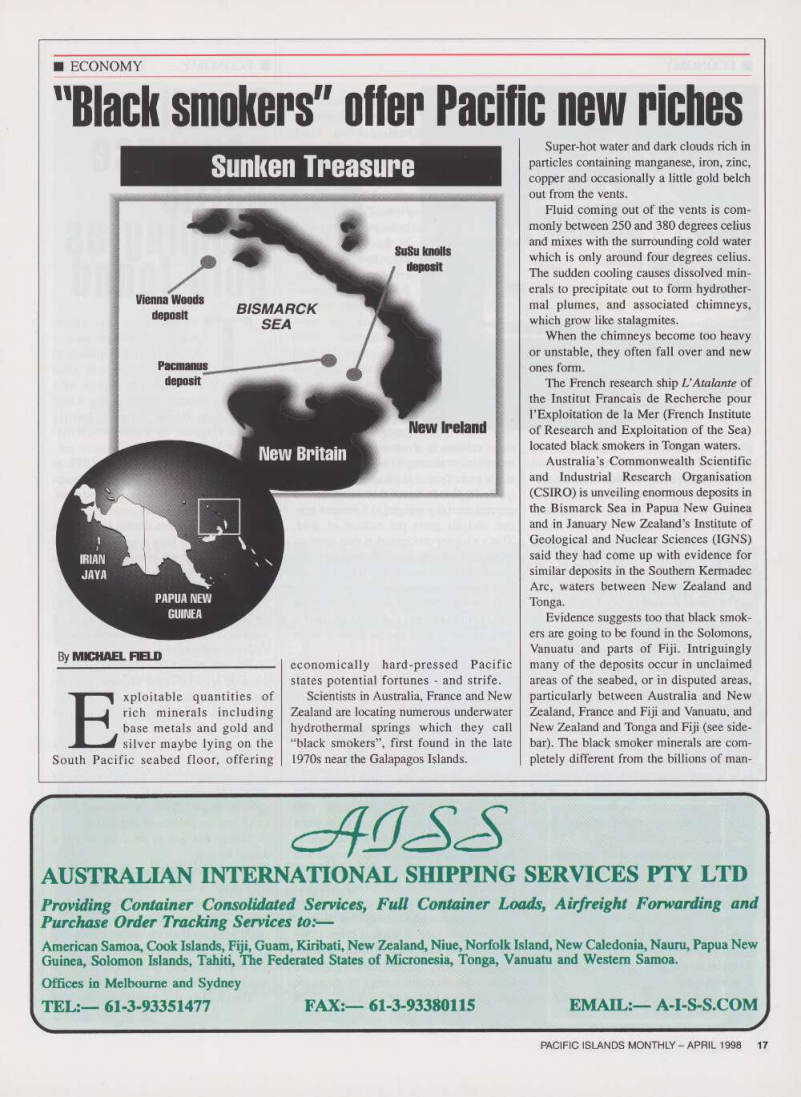
Sunken Treasure
By Michael Held
Exploitable quantities of
rich minerals including base metals and gold and silver maybe lying on the South Pacific seabed floor, offering
economically hard-pressed Pacific states potential fortunes - and strife.
Scientists in Australia, France and New Zealand are locating numerous underwater hydrothermal springs which they call “black smokers”, first found in the late 1970 s near the Galapagos Islands.
Super-hot water and dark clouds rich in particles containing manganese, iron, zinc, copper and occasionally a little gold belch out from the vents.
Fluid coming out of the vents is com monly between 250 and 380 degrees celius and mixes with the surrounding cold water which is only around four degrees celius.
The sudden cooling causes dissolved min erals to precipitate out to form hydrother mal plumes, and associated chimneys, which grow like stalagmites.
When the chimneys become too heavy or unstable, they often fall over and new ones form.
The French research ship L’Atalante of the Institut Francais de Recherche pour I’Exploitation de la Mer (French Institute of Research and Exploitation of the Sea) located black smokers in Tongan waters.
Australia’s Commonwealth Scientific and Industrial Research Organisation (CSIRO) is unveiling enormous deposits in the Bismarck Sea in Papua New Guinea and in January New Zealand’s Institute of Geological and Nuclear Sciences (IGNS) said they had come up with evidence for similar deposits in the Southern Kermadec Arc, waters between New Zealand and Tonga.
Evidence suggests too that black smok ers are going to be found in the Solomons, Vanuatu and parts of Fiji. Intriguingly many of the deposits occur in unclaimed areas of the seabed, or in disputed areas, particularly between Australia and New Zealand, France and Fiji and Vanuatu, and New Zealand and Tonga and Fiji (see side bar). The black smoker minerals are com pletely different from the billions of man-
ganese nodules - rich in manganese, cobalt, nickel and copper and in places platinum and gold - that are scattered across the sea floor in parts of the world and offer poten tial wealth to places like the Cook Islands.
In PNG the black smoker deposits are in the Manus Basin, part of the Bismarck Sea.
“We know from samples that the deposits are extremely rich, but we don’t know yet how thick they are and if they can be mined profitably,” Dr Ray Binns of the CSIRO’s Exploration and Mining Division told PIM. They have collected samples from two areas, all revealing high levels of gold, silver and zinc.
“On dry land, finds like this would be called bonanza figures.” The samples were collected from shallow waters, about 1200 to 1700 metres deep.
A PNG registered company, Nautilus Minerals Corporation, has already won the right to explore the Manus Basin ores over the next two years to see if they can be mined commercially. Dr Binns said a lot more work was needed on the deposits to see if they are exploitable.
“The indications are very promising.”
He had seen the bizarre world of undersea vents. “It is weird, black smoke and strange shapes.” The black smokers pro ducing the deposits may also exist all the way from New Zealand to Tonga and across into the Lau and south Fiji basins, IGNS mineral geologist Dr Cornel de Ronde suggests.
“Actually we don’t know, the work has
never been done,” he said. L’Atalante, he said, located black smokers on the Valu Fa Ridge south of Tonga and a once secret US Navy-Royal New Zealand Navy
hydrophone network
in the South Pacific keeps hearing volcanic eruptions on the sea floor, events common ly associated with the formation of new
hydrothermal vent
fields. New Zealand found their minerals by chance when the government research ship Tangaroa in 1996 dredged up from a vol
cano caldera in a water depth of 1500 metres mineral samples which almost cer tainly came from a black smoker.
Dr De Ronde found they contained 18 percent zinc (by weight), 15 percent cop per, and six parts per million of gold.
That’s a higher concentration than some on shore gold mining areas. He said there are about 25 places worldwide where signifi cant hydrothermal mineral deposits have been recorded on the ocean floor. What makes New Zealand and PNG unusual is the presence of gold and the shallow depth at which the vents occur.
Dr De Ronde rates the discovery of black smokers as one of the “sexier dis coveries” in earth science in the past 20 years. Until then, no one was sure how to account for the iron and manganese dis solved in the world’s oceans.
It seems much of it comes from black smokers. Most of the world’s lead, zinc and copper massive sulphide deposits which are being mined today began, mil lions of years ago, at similar ocean vents and over time were tectonically uplifted to the earth’s surface. A research cruise will be mounted next year to look at what is in the Kermadec Arc/Havre Trough area and early next century Dr de Ronde hopes they will be able to send a submersible down to take a closer look at what is there. “We only have an indication of what is on the Kermadec Arc, he said, adding; *’ We know more about the surface of the moon than about the bottom of the ocean.” ■
Advertisements & other items, p. 17 (1 item)
Australian International Shipping Services Pty Ltd
Providing Container Consolidated Services , Full Container Loads , Airfreight Forwarding and Purchase Order Tracking Services to: — American Samoa, Cook Islands, Fiji, Guam, Kiribati, New Zealand, Niue, Norfolk Island, New Caledonia, Nauru, Papua New Guinea, Solomon Islands, Tahiti, The Federated States of Micronesia, Tonga, Vanuatu and Western Samoa.
Offices in Melbourne and Sydney
TEL:— 61-3-93351477 FAX:— 61-3-93380115 EMAIL:— A-I-S-S.COM
looming as
Pacific resource battle looming as gold found
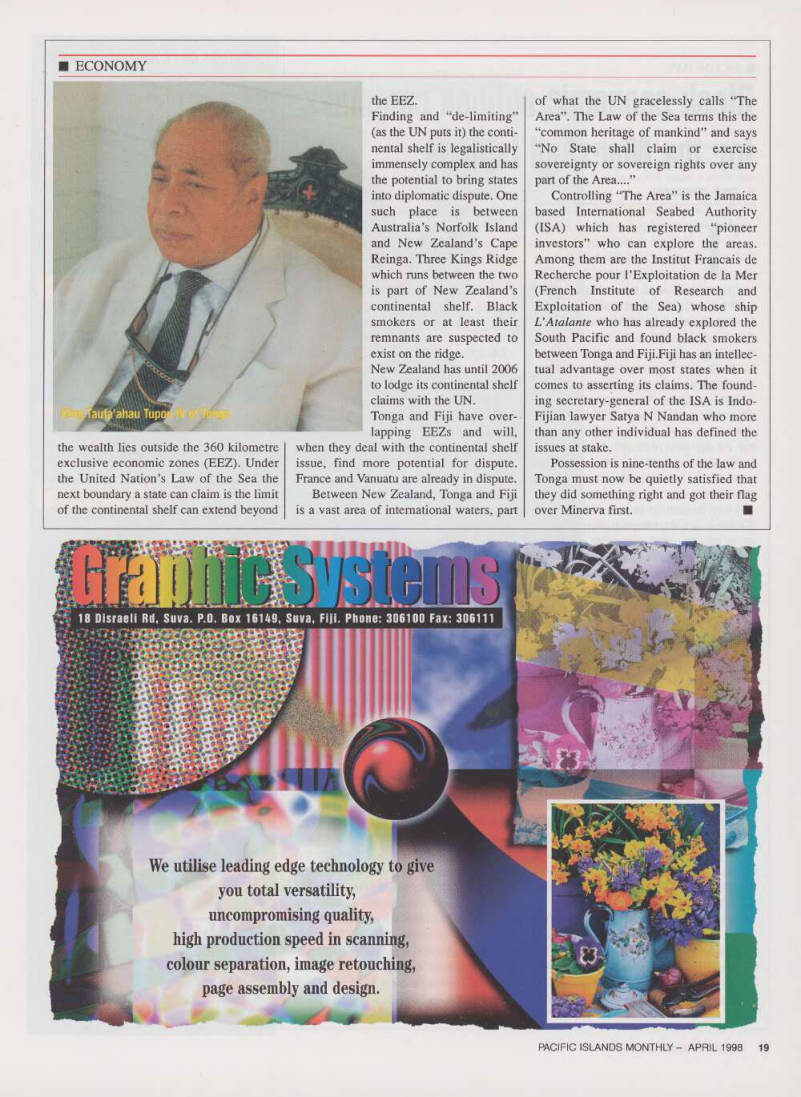
The scene in the waters south of Tonga had a kind of farcical quality to it as King Taufa’ahau Tupou IV stood on the bridge of a ship and solemn saluted his king
dom’s flag flying from a hastily
erected flagpole on a reef which dis appeared at high tide.
The incident occurred in 1972 at Minerva Reef after an American group, the Oceanic Life Research Foundation, laid claim to the island.
Although Minerva cannot be lived on
permanently the king was outraged and
despatched his prime minister, army and a group of prisoners (to be used as labour ers to build a platform) there.
Minerva is marginally closer to Fiji territory than to Tonga, but the king claimed it anyway and at the time nobody challenged the claim.
Fiji and New Zealand might, in time, come to regret this for Minerva is in an area potentially rich in black smokers and its zinc, lead and possibly gold and silver.
Dr Ray Binns of Australia’s Commonwealth Scientific and Industrial Research Organisation’s Exploration and Mining Division said the scientific dis coveries of the Pacific seabed could put a lot of heat on politicians and diplomats.
“There has got to be a lot of work done,” he said.
Other experts involved worry that the bulk of the scientific work carried out on the South Pacific seabed is Japanese and French. The French side, one source says, could back up their claims to ownership of open ocean seabed floor.
“If you don’t do the work you cannot make the claim,” one expert said.
The problem is a simple one; much of
the wealth lies outside the 360 kilometre exclusive economic zones (EEZ). Under the United Nation’s Law of the Sea the next boundary a state can claim is the limit of the continental shelf can extend beyond
the EEZ.
Finding and “de-limiting” (as the UN puts it) the conti nental shelf is legalistically
immensely complex and has
the potential to bring states into diplomatic dispute. One such place is between Australia’s Norfolk Island and New Zealand’s Cape
Reinga. Three Kings Ridge
which runs between the two is part of New Zealand’s continental shelf. Black smokers or at least their remnants are suspected to exist on the ridge.
New Zealand has until 2006 to lodge its continental shelf claims with the UN.
Tonga and Fiji have over lapping EEZs and will.
when they deal with the continental shelf issue, find more potential for dispute.
France and Vanuatu are already in dispute.
Between New Zealand, Tonga and Fiji is a vast area of international waters, part
of what the UN gracelessly calls “The Area”. The Law of the Sea terms this the “common heritage of mankind” and says “No State shall claim or exercise sovereignty or sovereign rights over any part of the Area...”
Controlling “The Area” is the Jamaica based International Seabed Authority (ISA) which has registered “pioneer investors” who can explore the areas.
Among them are the Institut Francais de Recherche pour TExploitation de la Mer (French Institute of Research and Exploitation of the Sea) whose ship L’Atalante who has already explored the South Pacific and found black smokers between Tonga and Fiji. Fiji has an intellec tual advantage over most states when it comes to asserting its claims. The found ing secretary-general of the ISA is Indo- Fijian lawyer Satya N Nandan who more than any other individual has defined the issues at stake.
Possession is nine-tenths of the law and Tonga must now be quietly satisfied that they did something right and got their flag over Minerva first. ■
King Taufa'shau Tupou IV of Tongs
Advertisements & other items, pp. 18-19 (2 items)
18
■ ECONOMY
PACIFIC ISLANDS MONTHLY - APRIL 1998
■ ECONOMY
\t r
BO We utilise leading edge technology to give you total versatility, uncompromising quality, high production speed in scanning, colour separation, image retouching, page assembly and design.
PP' mk |B| 0 m vm B&4 1
Bleak economic outlook continues
lor the Marshall Islands
By Off Johnson
The promise of a nearly SUS 7 million Asian Development Bank loan to shore up failing health, sanitation, water and power operations on Ebeye Island is welcome news for the beleaguered Marshall Islands. But
Ebeye’s desperate situation - ongoing
for the past two years - has become increasingly synonymous with the state of this north Pacific nation’s eco nomic situation. The real question is what will pull the Marshalls out of its current economic malaise that has forced the government to layoff close to 25 percent of its work force, and the private sector into similar contrac tions.
Long dependent on now-diminishing American aid, the Marshall Islands has lit tle in the way of a productive economy.
While the ADB has become a major player in the islands during the past five years, there is scant optimism that an economic recovery is on the horizon. Moreover, rela tions between the Marshalls and the ADB have been rocky since late 1997 when dis putes over loan conditions began surfacing with increasing vehemence.
While the Marshalls will received more than SUSI billion from the US during the life of the Compact of Free Association that ends in 2001, the country has been unable to stimulate a productive economy with those resources. During the first 10 years of the Compact with America, the Marshalls engineered a series of multi-mil lion dollar loans using the guarantee of 15 years of US payments as collateral. Those funds were used up heavily on infrastruc ture and failed government-sponsored business ventures. Now, the government is obligated to pay upwards of SUS2O million annually to the banks that lent the money - 25 percent of its national budget - at a time when Compact funding from the US is declining.
When the ADB came on the scene in the early 19905, they were given the red carpet treatment. By the mid-19905, loans to
revamp public elementary education, to implement primary health care programs and to start a locally-based long line fish ing industry were in progress, followed shortly by a loan to improve fresh water and sewer services on Majuro. Meanwhile, Technical Assistance (TA) was providing training, funding and personnel to develop programs and strategies in a variety of gov ernment agencies. In the mid-19905, one ADB official called the Marshalls one of the fastest moving countries for imple menting loans and TAs.
The government’s increasingly poor economic outlook led the ADB and the government to agree to a major govern ment reform programme beginning in 1995. The aim was to cutback the govern ment work force, end subsidies to govern ment agencies, improve business opera tions of utilities, bolster the private sector, and democratise the Marshalls government system in ADB jargon, increase the “trans parency” in government operations and emphasise “good governance”.
While the Marshalls has marched ahead with the reduction in force and slashed subsidies to most government agencies, the good governance objective remains elu sive. Loans in education, health and water continue to move forward, but for six months the ADB has held up the second draw down of the loan for the govern ment’s reform program because the gov ernment has not met conditions of the loan.
Although this hasn’t stopped some of the reform objectives from continuing to be carried out, it is becoming increasingly problematic for Air Marshall Islands, which was to be the recipient of SUS 2 mil lion of the SUS3.S million second phase loan payment.
Two key conditions that the ADB has set are the hiring of a qualified general manager to run the airline free of govern ment interference and public release of a controversial commission of inquiry report into financial abuses at the Marshall Islands Social Security Administration.
President Imata Kabua fired AMl’s last expatriate manager in August after just eight months on the job, and it has taken
AMI until March to appoint a new manag er. Release of the report on the investiga tion into Social Security has been promised since last year by the president, but earlier this year he reopened the probe. The initial report commissioned by the late President Amata Kabua, which has never been offi cially released, implicated one of the cur rent president’s key cabinet ministers (along with program administrators) in the misuse of hundreds of thousands of dollars of Social Security retirement funds.
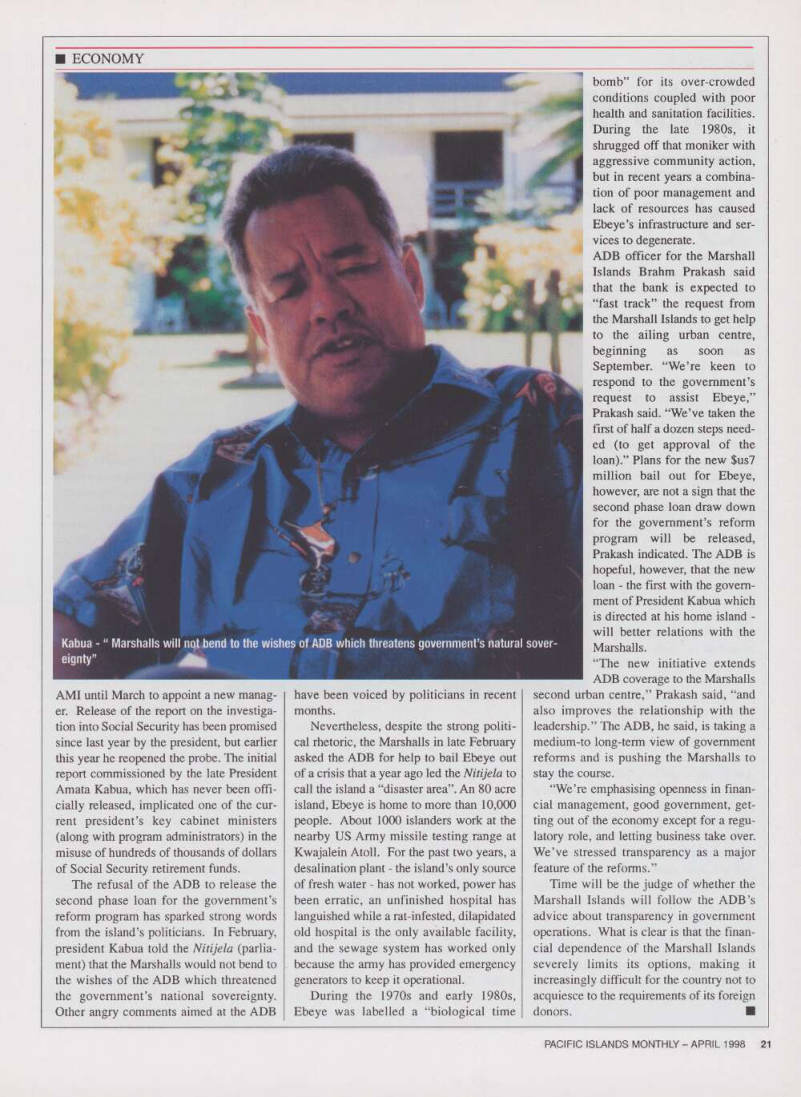
The refusal of the ADB to release the second phase loan for the government’s reform program has sparked strong words from the island’s politicians. In February, president Kabua told the Nitijela (parlia ment) that the Marshalls would not bend to the wishes of the ADB which threatened the government’s national sovereignty.
Other angry comments aimed at the ADB
have been voiced by politicians in recent months.
Nevertheless, despite the strong politi cal rhetoric, the Marshalls in late February asked the ADB for help to bail Ebeye out of a crisis that a year ago led the Nitijela to call the island a “disaster area”. An 80 acre island, Ebeye is home to more than 10,000 people. About 1000 islanders work at the nearby US Army missile testing range at Kwajalein Atoll. For the past two years, a desalination plant - the island’s only source of fresh water - has not worked, power has been erratic, an unfinished hospital has languished while a rat-infested, dilapidated old hospital is the only available facility, and the sewage system has worked only because the army has provided emergency generators to keep it operational.
During the 1970 s and early 1980 s, Ebeye was labelled a “biological time
bomb” for its over-crowded conditions coupled with poor health and sanitation facilities.
During the late 1980 s, it shrugged off that moniker with
aggressive community action,
but in recent years a combina tion of poor management and lack of resources has caused Ebeye’s infrastructure and ser vices to degenerate.
ADB officer for the Marshall Islands Brahm Prakash said that the bank is expected to “fast track” the request from the Marshall Islands to get help to the ailing urban centre, beginning as soon as September. “We’re keen to respond to the government’s request to assist Ebeye,”
Prakash said. “We’ve taken the first of half a dozen steps need ed (to get approval of the loan).” Plans for the new sus7 million bail out for Ebeye, however, are not a sign that the second phase loan draw down for the government’s reform program will be released, Prakash indicated. The ADB is hopeful, however, that the new loan - the first with the govern ment of President Kabua which is directed at his home island will better relations with the Marshalls.
“The new initiative extends ADB coverage to the Marshalls
second urban centre,” Prakash said, “and also improves the relationship with the leadership.” The ADB, he said, is taking a medium-to long-term view of government reforms and is pushing the Marshalls to stay the course.
“We’re emphasising openness in finan cial management, good government, get ting out of the economy except for a regu latory role, and letting business take over.
We’ve stressed transparency as a major feature of the reforms.”
Time will be the judge of whether the Marshall Islands will follow the ADB’s advice about transparency in government operations. What is clear is that the finan cial dependence of the Marshall Islands severely limits its options, making it increasingly difficult for the country not to acquiesce to the requirements of its foreign donors. ■
Kabua - “ Marshalls will not bend to the wishes of ADB which threatens government’s natural sover eignty”
Advertisements & other items, p. 20 (1 item)
Rhujh
SUPPLIERS OF PROFESSIONAL SOUND
SYSTEMS,
MUSICAL INSTRUMENTS, AUDIO VIDEO
PLUGS AND CABLES.
AGENTS WANTED, INDIVIDUAL ENQUIRIES WELCOMED.
MXA-3500
350 WATTS POWERFUL P.A. AMPLIFIER
8 CHANNEL MIXER & 5 BAND GRAPHIC EQUALIZER Offering Hi-Fi Sound for Musical Programmes PROFESSIONAL HIGH POWERED SPEAKER SYSTEMS SAX-150 150 W •Public Address Applictions -Sound Reinforcement for Theatres • Live Music Concerts -Studio Monitors • Musical Instruments like Guitar, Keyboard Etc. m
THREE POWER SOURCE AMPLIFIERS UTR-40
‘AC-220-240V 'DC-12-14V CAR BAIT. 'DRY CELLS 12V
30 WATTS 45 WATTS ( Max)
ECLIPSE 20
I The Eclipse 20 features 6 mono channels, 6 stereo channels (comprisingof mic input and stereo line inputs), plus dedicated steroe channel, optimised for tape and CD, and separate stereo Aux input.
Height 170 mm Width 622 mm Depth 456 mm Weight 22.6 Kg Va *
RHUJH
SHARMA MUSIC CENTRE
P.0.80X 135 NADI FIJI
PHONE: (679) 701 436 FAX: (679) 702 155
CONTACT NOW FOR A FREE CATALOGUE
Battle among the royals
Business
By Michael Feld
Sibling rivalry has broken
out in Tonga’s royal family with brother and sister struggling for control of the kingdom’s lucrative but secretive satellite operations. And it comes at a time when a Supreme Court judge labelled King Taufa’ahau Tupou IV “an authoritar ian ruler” who ignores
requests to account for his actions.
Both the claim and the fight revolve, in part, around Tongasat, which has the exclusive right to lease out Tonga’s equatorial satellite slots. Although the whole scheme was the idea of a grieving American, Tongasat is now 60 percent owned by the king’s only daughter.
Princess Pilolevu Tuita, who according to Forbes, the US business magazine, has made a personal US$25 million.
According to the weekly Times of Tonga, Crown Prince Tupouto’a wants a piece of the action and has launched a bid to end Tongasat’s rights. He is in partnership with three American partners in a com pany called Diligence.
Tupouto’a is already working with a group of Americans making money on the Internet and he controls access to Tonga’s domain name which is “to”. In the increas ingly crowded Internet this is a useful Domain name and the Crown Prince has set up an automatic registration site on the Web called Tonic, for the Tongan Network Information Centre. It runs on a computer at the Tongan consulate in San Francisco, the kingdom’s only outpost in the United States.
What is intriguing about Tongasat and the Internet is that both have become the private fiefdoms of the royals and the country’s government has no control or income from the activities. The money
goes into royal pockets.
Neither Tupouto’a or Pilolevu did the hard work on Tongasat.
Tonga, one of the world’s poorest states with just 100,000 people, came into the satellite business by chance. Mats Nilson, a senior official of the International Telecommunications Satellite Consortium, went to Tonga for a holiday after the death of his wife. There he came up with a scheme to get around what was a gentle-
man’s agreement that Intelsat member nations only take up equatorial geostation ary orbital slots they actually need.
Tonga, although its own minuscule communications needs were handled by Cable and Wireless, took up Nilson’s pro posal and a decade ago claimed 16 orbital slot entitlement to be managed by
Tongasat. In subsequent negotiations
Tongasat reached a deal to use seven slots in key positions over Indonesia. The Times said Tupouto’a has asked cabinet and the Privy Council to terminate his sister’s exclusive rights. The newspaper said the king, who chairs the council, was believed to be more sympathetic to Pilolevu. It claims Tongasat has not paid to the gov ernment the royalties that it should and it
comes as government officials here com plain about what the Times said were “exorbitant salaries” to Pilolevu and her staff. Tongasat has filed an action in the Supreme Court seeking an injunction against the government, to stop its alleged interference with Tongasat’s operation.
The documentation has, however, been kept secret and government officials, embarrassed over a brawl by the royals for money, are keeping silent. The failure of the royals to account for themselves was underlined by Tonga Supreme Court Justice Daniel Finnigan. He had before
him pro-democracy Tongan MP ‘Akilisi Pohiva answer two charges of criminal libel result ing from an interview he had done with the Wall Street Journal. The article had one quote from Pohiva - “the King is a dictator” - and a series of unattributed claims that the
royal family was guilty of leg
erdemain, or financial trickery over the sale of Tongan pass ports and Tongasat. Finnigan, a
long serving New Zealand
jurist, dismissed the charges
against Pohiva but in a lengthy judgement said the king was “a dictator is factually and legally wrong”.
But in an extraordinary com mentary Finnigan suggested that what Pohiva has said about the lack of accountability over the royal purse was “in general legally and/or factually accu rate”. While the Journal quot
ed Pohiva as saying the king was a dicta tor, Finnigan noted that in his own Tongan newspaper, Kele’a, Pohiva did not make such a statement.
“It is not shown to my satisfaction that the accused actually said that, but if he did then, in their context those words can only mean ‘The King is an authoritarian ruler who ignores my repeated request for accountability by himself and his minis ters’,” Finnigan said.
“If he said this, it appears to me to be the truth. Taking account of his evidence by the accused during the trial is appears to me not surprising that his attempts to obtain accountability in a system of gov ernment which does not provide for it are ignored.” ■
Crown prince Tupulo’a of Tonga
of protectionism
Shipping
Cooks government accused
People are having to pay more for imported goods because there is only one freight provider in the country
By Florence Syme-Buchanan
Dawdling by the Cook Islands government to deregulate international shipping has earned it the unwelcome accusation of protec tionism and tacitly supporting a possi ble rip-off of consumers. The Cook Islands Chamber of Commerce believes people are paying up to SNZ2 million (SUSIm) more for imported goods than they should be. Chamber president Brett Porter says it’s because of the high freight component charged by sole service provider, Cook Islands National Line, a company in which the government has a 30 percent shareholding. Cook Islands National Line is the sole licensee for inter national shipping into the Cook Islands, a position the company holds by the grace of government and the minister of shipping.
The shipping portfolio was handed to relative cabinet newcomer Tupou Faireka in November last year by Prime Minister Sir Geoffrey Henry. After haggling with the government for over two years and get ting nowhere, the Chamber of Commerce Importers Council is taking a tougher stance. It wants the government to justify its stated shipping policy of just one licence to one service provider to operate into Rarotonga. . To date, there has been little action from the minister who says he is still wait ing for clarification on a number of details.
Among these is the assurance Faireka wants that any new service would not adversely affect Cook Islands National Line operations or arrangements between the shipping company and produce exporters. Faireka denies the government is protecting CINL The government obtained a 30 percent share in CINL over 10 years ago and sources reveal that the investment is yet to return one dollar. What that shareholding may cost the taxpayer is
not known, nor are details of any benefits.
George Ellis, a director and shareholder of the company argues that to deregulate international shipping would threaten the security of the current service - in shipping and aviation (both international and inter islands).
The Cook Islands experience over the last quarter of a century has proved con clusively that there is room for only one established operator in each market. Each sector has demonstrated the same lessons which the Chamber seems to ignore, says Ellis. Ellis says Pacific shipping is in a state of crisis with too many ships chasing too little cargo. He claims established regional operator, Pacific Forum Line, is one such company experiencing difficul ties. According to Ellis, desperate over seas shipowners are offering “good deals” in an effort to break into the Cook Islands market, but this would only be short term.
The shipping director went as far as to say the motives of the Chamber of Commerce are “suspicious” and the body’s “short-termism breathtaking.” The Chamber contends deregulation ultimately will mean cheaper freight rates to the whole of the Cook Islands and will be reflected in the cost of goods to all con sumers. Importers believe they are paying between 20 and 30 percent more than they should for freight. CINL charges more for freight to the Cook Islands than other countries it services.
To justify this, Ellis says the company has to go to other ports to try and find extra cargo to break even or survive and has to follow rates set by competition in order to get cargo. “We aren’t convinced of this the Cook Islands trade offers a lucrative add-on to regional carriers,” says Porter. In a position paper to Sir Geoffrey when he was shipping minister, the Chamber said the government should have a shipping
policy compatible with the government’s
economic reform policies.
“It should enable contestability, compe tition and the operation of natural market forces,” read the position paper. The Chamber feels the government’s delay in
deciding licensing policy has enabled a
monopoly to become deeply entrenched.
“The government’s actions (or lack of) in this matter give rise to suspicions that the monopoly is supported and may be permit ted to continue to exist for as long as the proprietors of the CINL wish it to do so.”
Shipping licences are issued at the discre tion of the minister and because of this, some business people say Sir Geoffrey’s and now Tupou Faireka’s failure to respond to the needs of importers is pro tectionism. Faireka says that’s “rubbish.”
He says he’s reluctant to issue any licences until he’s completely satisfied this would n’t jeopardise the service Cook Islands people presently have from CINL.
“If the monopoly is working for the Cook Islands, then we will leave it as it is.”
He said the Chamber of Commerce has asked the government to grant them a ship ping licence, which they would in turn give “to someone they are comfortable with.”
“Like hell we’re going to do this,” says Faireka. “What about our own entrepreneurial groups,” asked the Minister who says they have fears the Chamber could pass the licence on to a for eign operator that the government would not approve of.
Faireka says many business people are happy with existing shipping and have told him this. He would not name any, except to say they were from the southern outer island of Aitutaki.Two other companies have expressed interest in servicing the Cooks as an add-on to existing business in the region. One company, NZ Pacific Container Line, the biggest in the region, first applied in 1992 and again in 1995 to operate to the Cooks. A letter the compa ny sent to Trade and Transport Secretary Henry Puna in November 1996 indicated the possibility of a reduction in freight rates of between 20 and 30 percent.
“Importers have lost confidence in dealing with the secretary. The government’s
intransigence is totally unacceptable and at
odds with the stated reform policy which insists on open market delivery of services to the public.”
Porter says "we’ve come to the end of the line here, it’s time now that govern ment justifies their policy stance on ship
ping.” ■
Whatever happened to PH211?
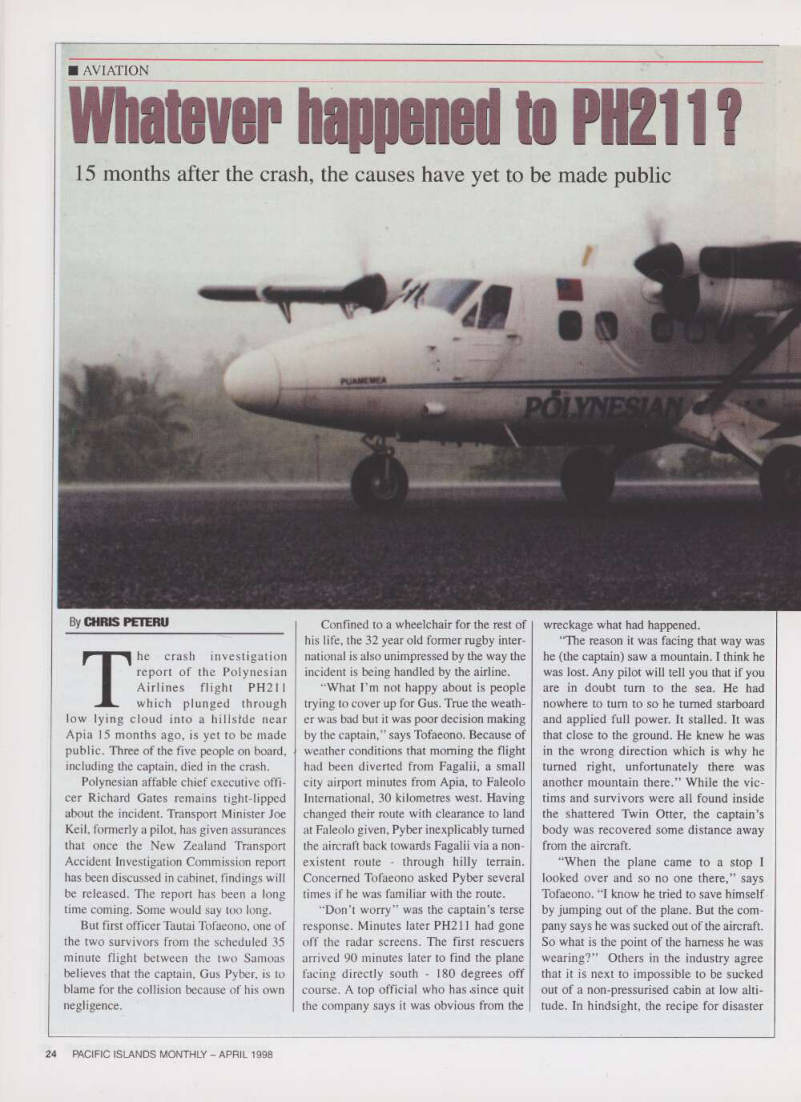
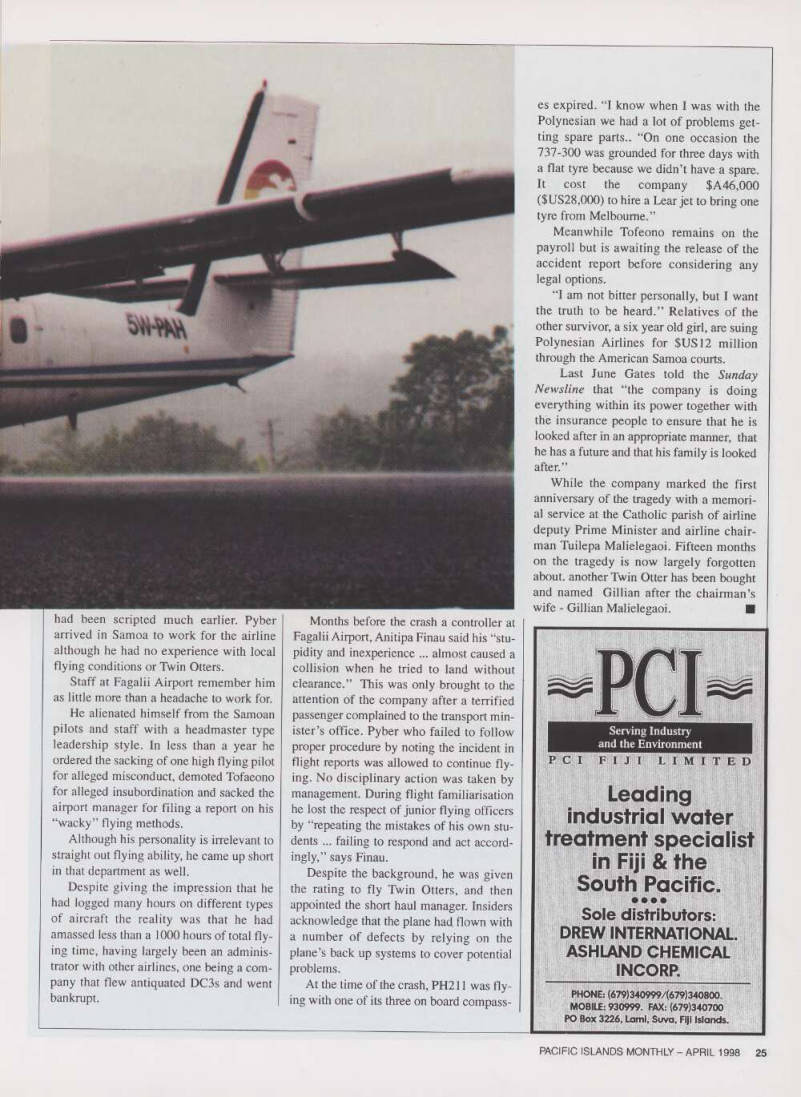
Aviation
Whatever happened to PH211? 15 months after the crash, the causes have yet to be made public
By Chris Peteru
The crash investigation report of the Polynesian Airlines flight PH2II which plunged through low lying cloud into a hillside near Apia 15 months ago, is yet to be made public. Three of the five people on board, including the captain, died in the crash.
Polynesian affable chief executive offi cer Richard Gates remains tight-lipped about the incident. Transport Minister Joe Keil, formerly a pilot, has given assurances that once the New Zealand Transport Accident Investigation Commission report has been discussed in cabinet, findings will be released. The report has been a long time coming. Some would say too long.
But first officer Tautai Tofaeono, one of the two survivors from the scheduled 35 minute flight between the two Samoas believes that the captain, Gus Pyber, is to blame for the collision because of his own negligence.
Confined to a wheelchair for the rest of his life, the 32 year old former rugby inter national is also unimpressed by the way the incident is being handled by the airline.
“What I’m not happy about is people trying to cover up for Gus. True the weath er was bad but it was poor decision making by the captain,” says Tofaeono. Because of weather conditions that morning the flight had been diverted from Fagalii, a small city airport minutes from Apia, to Faleolo International, 30 kilometres west. Having changed their route with clearance to land at Faleolo given, Pyber inexplicably turned the aircraft back towards Fagalii via a non existent route - through hilly terrain.
Concerned Tofaeono asked Pyber several times if he was familiar with the route.
"Don’t worry” was the captain’s terse response. Minutes later PH2II had gone off the radar screens. The first rescuers arrived 90 minutes later to find the plane facing directly south - 180 degrees off course. A top official who has .since quit the company says it was obvious from the
wreckage what had happened.
“The reason it was facing that way was he (the captain) saw a mountain. I think he was lost. Any pilot will tell you that if you are in doubt turn to the sea. He had nowhere to turn to so he turned starboard and applied full power. It stalled. It was that close to the ground. He knew he was in the wrong direction which is why he turned right, unfortunately there was another mountain there.” While the vic tims and survivors were all found inside the shattered Twin Otter, the captain’s body was recovered some distance away from the aircraft.
“When the plane came to a stop I looked over and so no one there,” says Tofaeono. “I know he tried to save himself by jumping out of the plane. But the com pany says he was sucked out of the aircraft.
So what is the point of the harness he was wearing?” Others in the industry agree that it is next to impossible to be sucked out of a non-pressurised cabin at low alti tude. In hindsight, the recipe for disaster
had been scripted much earlier. Pyber arrived in Samoa to work for the airline although he had no experience with local flying conditions or Twin Otters.
Staff at Fagalii Airport remember him as little more than a headache to work for.
He alienated himself from the Samoan pilots and staff with a headmaster type leadership style. In less than a year he ordered the sacking of one high flying pilot for alleged misconduct, demoted Tofaeono for alleged insubordination and sacked the airport manager for filing a report on his
“wacky” flying methods.
Although his personality is irrelevant to straight out flying ability, he came up short in that department as well.
Despite giving the impression that he
had logged many hours on different types of aircraft the reality was that he had amassed less than a 1000 hours of total fly ing time, having largely been an adminis trator with other airlines, one being a com pany that flew antiquated DC3s and went bankrupt.
Months before the crash a controller at Fagalii Airport, Anitipa Finau said his “stu pidity and inexperience ... almost caused a collision when he tried to land without clearance.” This was only brought to the attention of the company after a terrified passenger complained to the transport min ister’s office. Pyber who failed to follow proper procedure by noting the incident in flight reports was allowed to continue fly ing. No disciplinary action was taken by
management. During flight familiarisation
he lost the respect of junior flying officers by “repeating the mistakes of his own stu dents ... failing to respond and act accord ingly,” says Finau.
Despite the background, he was given the rating to fly Twin Otters, and then appointed the short haul manager. Insiders acknowledge that the plane had flown with a number of defects by relying on the plane’s back up systems to cover potential problems.
At the time of the crash, PH2II was fly ing with one of its three on board compass
es expired. “I know when I was with the Polynesian we had a lot of problems get ting spare parts.. “On one occasion the 737-300 was grounded for three days with a flat tyre because we didn’t have a spare.
It cost the company $A46,000 (SUS2B,OOO) to hire a Lear jet to bring one tyre from Melbourne.”
Meanwhile Tofeono remains on the payroll but is awaiting the release of the accident report before considering any legal options.
“I am not bitter personally, but I want the truth to be heard.” Relatives of the other survivor, a six year old girl, are suing Polynesian Airlines for SUSI 2 million through the American Samoa courts.
Last June Gates told the Sunday Newsline that “the company is doing everything within its power together with the insurance people to ensure that he is looked after in an appropriate manner, that he has a future and that his family is looked after.”
While the company marked the first anniversary of the tragedy with a memori al service at the Catholic parish of airline deputy Prime Minister and airline chair man Tuilepa Malielegaoi. Fifteen months on the tragedy is now largely forgotten about, another Twin Otter has been bought and named Gillian after the chairman’s wife - Gillian Malielegaoi. ■
Advertisements & other items, p. 25 (1 item)
Leading
Serving Industry and the Environment
PCI FIJI LIMITED
industrial water
treatment specialist
in Fiji & the South Pacific. • ••• Sole distributors:
DREW INTERNATIONAL.
ASHLAND CHEMICAL
INCORP.
PHONE: (679)340999/(679)340800.
MOBILE; 930999. FAX: (679)340700
PO Box 3226, Lami, Suva, FIJI Islands.
not giving the public its money's worth
Review
Ombudsman's office in the Cooks not giving the public its money's worth
By Florence Syme- Buchanan
The Cook Islands Ombudsman’s Office has been reviewed and closely
examined following
widespread public criticism and con cern levelled over what it costs com pared to what it achieves each year.
The examination, by the government appointed and powerful Public Expenditure Review Committee has pro duced a report which suggests the country isn’t getting its money’s worth.
In light of this and the economic cli mate, PERCA has recommended changing the Ombudsman Act to provide an option that the Ombudsman be paid only for time taken to investigate complaints received and to report to parliament. The PERCA report is concerned only with the opera tions of the Ombudsman’s Office from 1992, when it was taken over by Henry Brown, former deputy public service com missioner. His term of office expires in 1999 and the ombudsman cannot be removed except for serious breach of legis lation. Since 1995 Brown has failed to make any reports to parliament, as required by law. His excuse - the office did not have access to a computer “This is considered unacceptable. There are other options available - using the ser vices of a public typist, or approaching other departments for assistance,” stated the PERCA report. Those cases investigat ed within its jurisdiction gave the office an average of one case per month during Brown’s first 12 month term and less than one case a month between 1993 to 1994.
Total cost of maintaining the office during this time amounted to SNZ2O9,IOB(SUS 113,403). The only test of output from this office is the annual report,” states PERCA. And because reports covering the 1995 - 1997 period have not been tabled it has been difficult to verify the number of cases Brown claims to have investigated.
PERCA confirmed that between 1996
to 1997 no cases were investigated and no report was prepared by the ombudsman office, which for several months had no electricity, telephone or facsimile. During
this time the ombudsman continued to receive his total salary of $NZ55,519(5U530,109) . In its conclu sions, the committee makes several points
- the first being despite the small caseload, the position needs to be retained because of the Constitutional role it fulfils.
In an official statement to the chairman of PERCA Mike Mitchell, and now attached to the report, ombudsman Brown said the independence of the office would
be questioned and investigations preju
diced if staff from another ministry were able to access confidential documents.
“There is nowhere in the world and in the fraternity of the office of the ombuds man where the activities of the ombuds man has been shared with other govern ment activities,” wrote Brown. Brown feels amending the Act would be viewed within the region as a “deliberate attempt by vested interest groups to reduce the authority of the ombudsman’s office”. Or it could be viewed as a matter of a laugh ing stock by other countries. We either have an ombudsman’s office or none at all,” said Brown. In an earlier interview.
Brown said 80 percent of the work done by the office is purely advisory as com plainants “refuse to put things in black and white and provide documents to support their case.” The position of ombudsman is one of the highest paid in the country. The Ombudsman’s Act provides that his salary should be fixed by an Order in Council and his travelling allowance should be equal to that of cabinet ministers under the Civil List Act.
There appears to be a departure from the Act in the Ombudsman’s remuneration - while it does fix an annual salary, it goes further and pays an annual non-taxable allowance of $lO,OOO. Perks include first class return air tickets for the ombudsman, his wife and one other member of his fam ily to New Zealand to spend part of his 20 days leave holidaying there. If first class seats are not available, the ombudsman is entitled to business class seats. But Brown complained in his statement that he hasn’t been able to take up this entitlement because of funding constraints. There’s also a car - imported duty free - provided by government which also foots mainte nance, repairs and running costs. The ombudsman’s salary has the advantage of being entitled to cost of living adjustments provided to public servants and including any adjustments made to the salaries of members of parliament.
The ombudsman office has had bud getary problems since the Cook’s econom ic decline forcing two staff into redundan
cy during the government cutbacks. The two staff weren’t paid for six months prior to losing their jobs and are taking legal action over the matter. Their termination may be why Brown failed to conduct any investigations last year as the ombudsman had said he definitely can’t cope with the work load without two extra staff. The National Development Council which reviewed the first budget figures last year recommended that the office of the ombudsman undergo big cuts.
Statutory bodies each have their own
C isMi TO );!; mn*. TOry ; ■ v■ e; ■ ' : ■■ ■ ■ nu 1< ft I lift;! whether its conclusions are ever taken up by Cabinet remains to be seen. ■
Advertisements & other items, pp. 26-27 (2 items)
A Boat
ISABEL DEVELOPMENT COMPANY LIMITED
HAS
FOR
LiC
Ql r* -V: A unique opportunity has arisen to purchase this vessel, which is in excellent condition.
PARTICULARS:
• Length 25m, Vitex hull and decking • 11 years old (built in 1987) • Main propulsion unit - volvo 121 C, 300 HP, 1800 RPM • Capacity - 90 tonnes, can carry 90 cubic metres of general cargo, 70 passengers • Accommodation -4 cabin x 4 bunks, 1 office, 2 officer cabins at bridge, 12 bunks in crew cabins
Price $U5245,000
or $AU0350,000 This is a reluctant sale due to the need for us to acquire a larger vessel.
All enquiries should be directed to General Manager Isabel Development Company Ltd P O Box 92, Honiara, Solomon Islands Tel (677) 22122/22126 Fax (677) 22009
South Pacific Regional Environment Programme (SPREP)
Vacancy: Programme Officer (Socio-Economics), SPBCP
Applications are invited for the position of Programme Officer (Socio- Economics) for the South Pacific Regional Environment Programme (SPREP) in Apia, Samoa.
Post Description The Programme Officer (Socio-Economics) SPBCP assists participating member governments and communities with the management of a series of diverse conservation areas ( terrestrial, marine and combined) in which there are agreed criteria for the sustainable use of the area’s natural resources. S/He is responsible for: •planning and implementing publicity and awareness programme of the SPBCP and the Conservation Area (CA) concept in each of the participating countries and the region generally, leading to Conservation Area (CA) proposals; •managing the identification and evaluation process of potential CAs in each of the participating countries; •organising and conduct/ take part in participatory planning and management training and education for CA personnel where appropriate; •providing technical assistance and advice on socio-economic issues/ matters associated with conservation area development and management; •planning, assisting and coordinating research into socioeconomic aspects of conservation and development; •preparation and submission of CA project proposals and development and implementation of CA plans, with specific responsibilities for sustainable development and sustainable income generating activities; •providing necessary assistance to Conservation Area Officers and Coordinating Committees in support of sustainable development and biodiversity conservation activities; •other duties as directed by the Programme Manager from time to time.
Required Qualifications And Experience Candidates must have appropriate tertiary qualifications (preferably with post-graduate qualifications in a relevant field) from a recognised institution and at least 5 years work experience preferably within the Pacific Islands region, in a field related to this position. Other essential requirements are: proven project management experience; the ability to manage the work of consultants; a proven ability to work as a part of a inter-disciplinary and /or multi-cultural team; the ability to meet project deadlines (often under difficult circumstances); a proven ability to prepare proposals and reports; a proven ability to live and work within Pacific Island communities. Applicants with a demonstrated interest and involvement in the environmental, economic and social issues affecting the region, particularly as they relate to conservation areas and other operations of the SPBCP, will be highly regarded.
Conditions Appointment will be at the Project Officer Level of SPREP’S authorised salary scales for contract staff, depending on The successful applicant's qualifications and experience.
The package will include annual return airfares for appointee and dependents, a housing subsidy and other benefits. SPREP remuneration may be tax - free depending upon circumstances .The appointment will be for 3 years initially, with renewal for a further 3 years depending upon the officer's performance during the first term and depending on the availability of funds.
Applications Applications should be accompanied by a detailed curriculum vitae containing full personal details, information on qualifications and experience for the position, previous appointments, current position and salary, names, address and telephone and fax contact numbers of three persons associated with the applicant professionally and who would be prepared to provide testimonials. An indication of how soon the applicants would be available should be indicated.
Closing Date: 30 April 1998 Applications should be addressed to; The Director South Pacific Regional Environment Programme (SPREP) P.O Box 240 Telephone; (685)21929 APIA Facsimile ; (685) 20231 Samoa E-Mail: [email protected] Further information, including a full post description and details of remuneration and terms and conditions of appointment is available from the SPREP Administration Officer.
■ Review
a heavy anti-corruption campaign
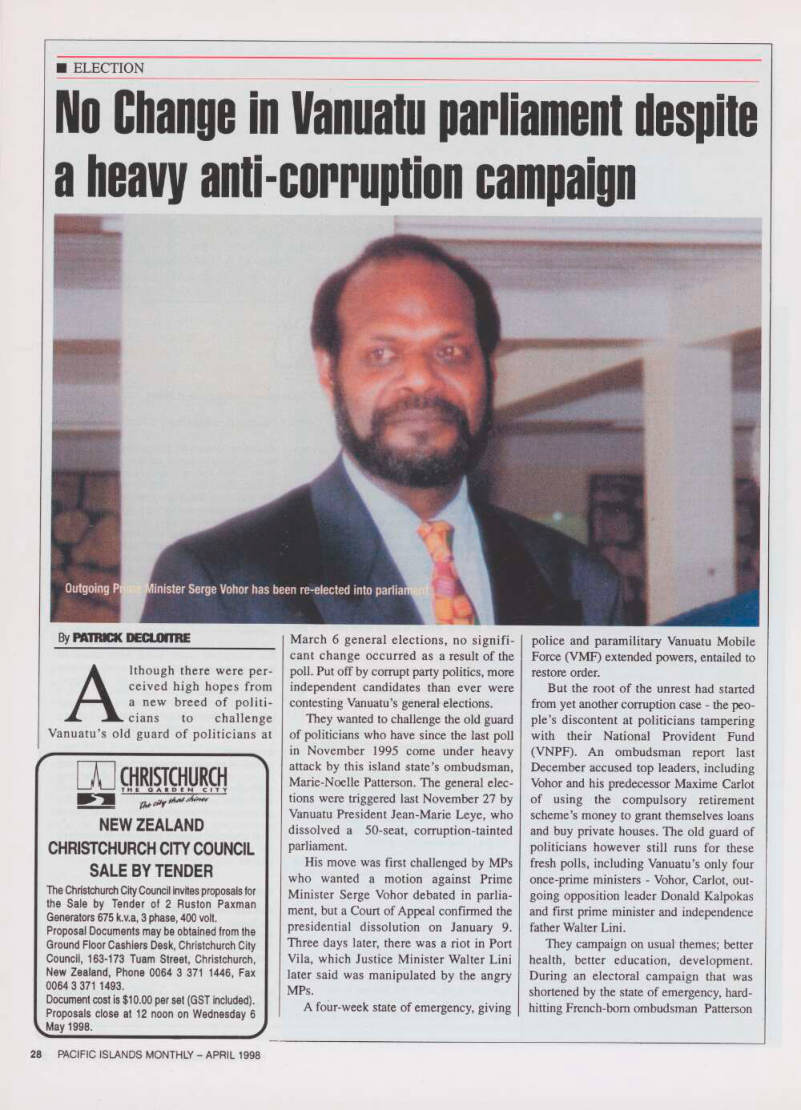
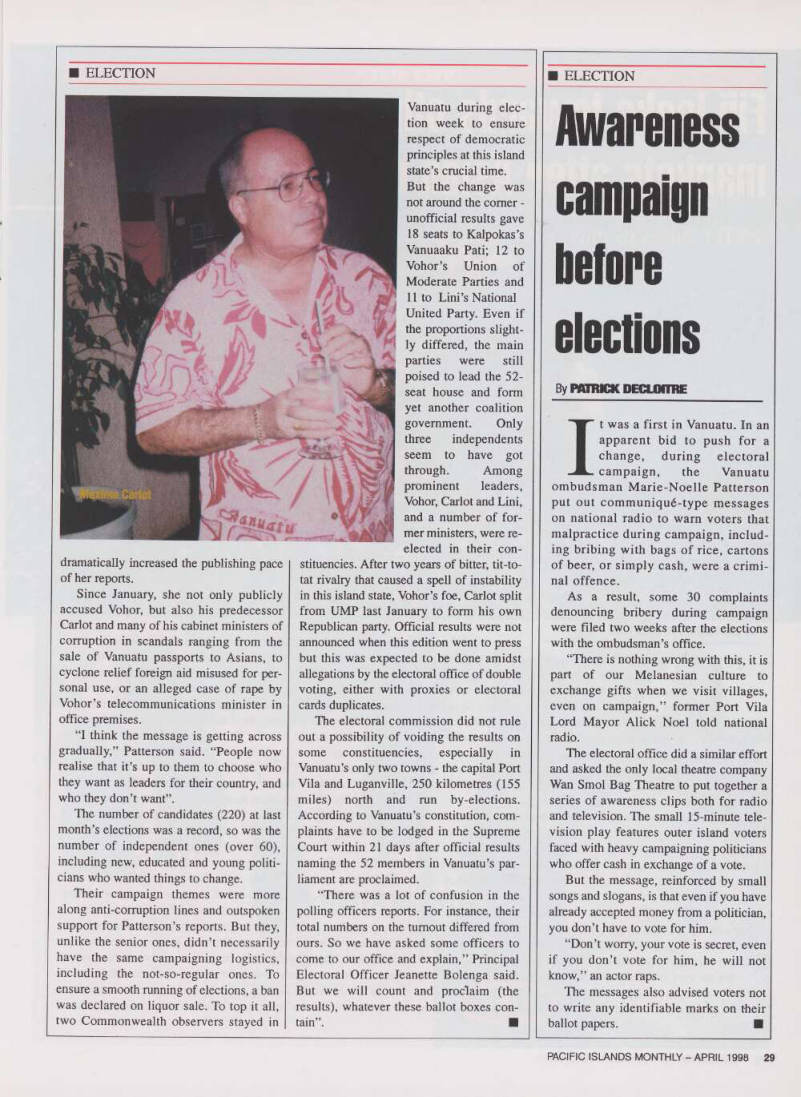
Election
No Change in Vanuatu parliament despite a heavy anti-corruption campaign
By Patrick Decloitre
Although there were per ceived high hopes from a new breed of politi cians to challenge Vanuatu’s old guard of politicians at
March 6 general elections, no signifi cant change occurred as a result of the poll. Put off by corrupt party politics, more independent candidates than ever were contesting Vanuatu’s general elections.
They wanted to challenge the old guard of politicians who have since the last poll in November 1995 come under heavy attack by this island state’s ombudsman, Marie-Noelle Patterson. The general elec tions were triggered last November 27 by Vanuatu President Jean-Marie Leye, who dissolved a 50-seat, corruption-tainted parliament.
His move was first challenged by MPs who wanted a motion against Prime Minister Serge Vohor debated in parlia ment, but a Court of Appeal confirmed the presidential dissolution on January 9.
Three days later, there was a riot in Port Vila, which Justice Minister Walter Lini later said was manipulated by the angry MPs.
A four-week state of emergency, giving
police and paramilitary Vanuatu Mobile Force (YMF) extended powers, entailed to restore order.
But the root of the unrest had started from yet another corruption case - the peo ple’s discontent at politicians tampering with their National Provident Fund (VNPF). An ombudsman report last December accused top leaders, including Vohor and his predecessor Maxime Carlot of using the compulsory retirement scheme’s money to grant themselves loans and buy private houses. The old guard of politicians however still runs for these fresh polls, including Vanuatu’s only four once-prime ministers - Vohor, Carlot, out going opposition leader Donald Kalpokas and first prime minister and independence father Walter Lini.
They campaign on usual themes; better health, better education, development.
During an electoral campaign that was shortened by the state of emergency, hard hitting French-bom ombudsman Patterson
Outgoing Prime Serge Vohor has been re-elected into Parliament
dramatically increased the publishing pace of her reports.
Since January, she not only publicly accused Vohor, but also his predecessor Carlot and many of his cabinet ministers of corruption in scandals ranging from the sale of Vanuatu passports to Asians, to cyclone relief foreign aid misused for per sonal use, or an alleged case of rape by Vohor’s telecommunications minister in office premises.
“I think the message is getting across gradually,” Patterson said. “People now realise that it’s up to them to choose who they want as leaders for their country, and who they don’t want”.
The number of candidates (220) at last month’s elections was a record, so was the number of independent ones (over 60), including new, educated and young politi cians who wanted things to change.
Their campaign themes were more
along anti-corruption lines and outspoken
support for Patterson’s reports. But they, unlike the senior ones, didn’t necessarily have the same campaigning logistics, including the not-so-regular ones. To ensure a smooth running of elections, a ban was declared on liquor sale. To top it all, two Commonwealth observers stayed in
Vanuatu during elec tion week to ensure respect of democratic principles at this island state’s crucial time.
But the change was not around the comer unofficial results gave 18 seats to Kalpokas’s Vanuaaku Pati; 12 to Vohor’s Union of Moderate Parties and 11 to Lini’s National United Party. Even if the proportions slight ly differed, the main parties were still poised to lead the 52seat house and form yet another coalition
government. Only
three independents
seem to have got
through. Among
prominent leaders, Vohor, Carlot and Lini, and a number of for mer ministers, were re elected in their con
stituencies. After two years of bitter, tit-to tat rivalry that caused a spell of instability in this island state, Vohor’s foe, Carlot split from UMP last January to form his own Republican party. Official results were not announced when this edition went to press but this was expected to be done amidst allegations by the electoral office of double voting, either with proxies or electoral cards duplicates.
The electoral commission did not rule out a possibility of voiding the results on some constituencies, especially in Vanuatu’s only two towns - the capital Port Vila and Luganville, 250 kilometres (155 miles) north and run by-elections.
According to Vanuatu’s constitution, com plaints have to be lodged in the Supreme Court within 21 days after official results naming the 52 members in Vanuatu’s par liament are proclaimed.
“There was a lot of confusion in the polling officers reports. For instance, their total numbers on the turnout differed from ours. So we have asked some officers to come to our office and explain,” Principal Electoral Officer Jeanette Bolenga said.
But we will count and proclaim (the results), whatever these ballot boxes con tain”. ■
Maxime Carlot
Advertisements & other items, p. 28 (1 item)
Xi Christchurch
1 1 THE GARDEN CITY
NEW ZEALAND
CHRISTCHURCH CITY COUNCIL
SALE BY TENDER
The Christchurch City Council invites proposals for the Sale by Tender of 2 Ruston Paxman Generators 675 k.v.a, 3 phase, 400 volt.
Proposal Documents may be obtained from the Ground Floor Cashiers Desk, Christchurch City Council, 163-173 Tuam Street, Christchurch, New Zealand, Phone 0064 3 371 1446, Fax 0064 3 371 1493.
Document cost is $lO.OO per set (GST included).
Proposals close at 12 noon on Wednesday 6 May 1998.
campaign
Awareness campaign before elections
By Patrick Decloitre
It was a first in Vanuatu. In an apparent bid to push for a change, during electoral campaign, the Vanuatu ombudsman Marie-Noelle Patterson put out communique-type messages on national radio to warn voters that malpractice during campaign, includ ing bribing with bags of rice, cartons of beer, or simply cash, were a crimi nal offence.
As a result, some 30 complaints denouncing bribery during campaign were filed two weeks after the elections with the ombudsman’s office.
“There is nothing wrong with this, it is part of our Melanesian culture to exchange gifts when we visit villages, even on campaign,” former Port Vila Lord Mayor Alick Noel told national radio.
The electoral office did a similar effort and asked the only local theatre company Wan Smol Bag Theatre to put together a series of awareness clips both for radio and television. The small 15-minute tele vision play features outer island voters faced with heavy campaigning politicians who offer cash in exchange of a vote.
But the message, reinforced by small songs and slogans, is that even if you have already accepted money from a politician, you don’t have to vote for him.
“Don’t worry, your vote is secret, even if you don’t vote for him, he will not know,” an actor raps.
The messages also advised voters not to write any identifiable marks on their ballot papers. ■
Advertisements & other items, p. 29 (1 item)
29
PACIFIC ISLANDS MONTHLY - APRIL 1998
■ ELECTION
■ ELECTION
Fiji loote towards other
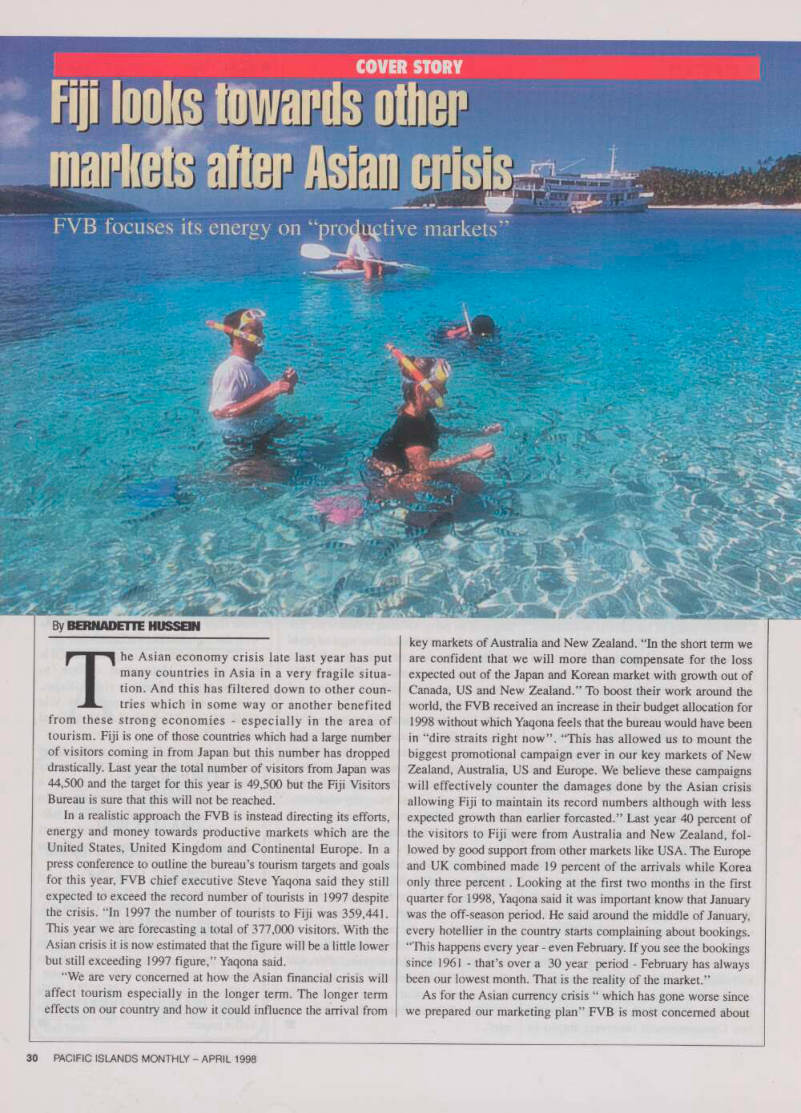
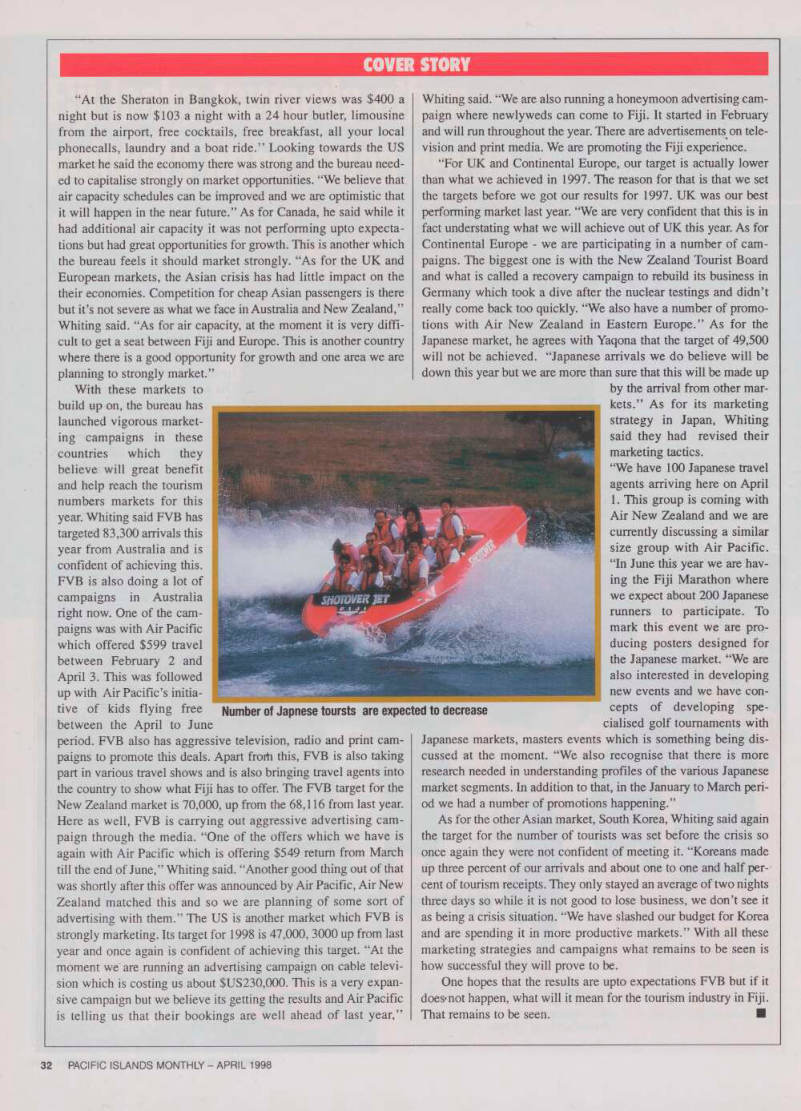
Cover Story
Fiji loote towards other marketer Asian crisis FVB focuses its energy on “productive markets”
By Bernadette Hussein
The Asian economy crisis late last year has put many countries in Asia in a very fragile situa tion. And this has filtered down to other coun tries which in some way or another benefited from these strong economies - especially in the area of tourism. Fiji is one of those countries which had a large number of visitors coming in from Japan but this number has dropped drastically. Last year the total number of visitors from Japan was 44,500 and the target for this year is 49,500 but the Fiji Visitors Bureau is sure that this will not be reached.
In a realistic approach the FVB is instead directing its efforts, energy and money towards productive markets which are the United States, United Kingdom and Continental Europe. In a press conference to outline the bureau’s tourism targets and goals for this year, FVB chief executive Steve Yaqona said they still expected to exceed the record number of tourists in 1997 despite the crisis. “In 1997 the number of tourists to Fiji was 359,441.
This year we are forecasting a total of 377,000 visitors. With the Asian crisis it is now estimated that the figure will be a little lower but still exceeding 1997 figure,” Yaqona said.
“We are very concerned at how the Asian financial crisis will affect tourism especially in the longer term. The longer term effects on our country and how it could influence the arrival from
key markets of Australia and New Zealand. “In the short term we are confident that we will more than compensate for the loss expected out of the Japan and Korean market with growth out of Canada, US and New Zealand.” To boost their work around the world, the FVB received an increase in their budget allocation for 1998 without which Yaqona feels that the bureau would have been in “dire straits right now”. “This has allowed us to mount the biggest promotional campaign ever in our key markets of New Zealand, Australia, US and Europe. We believe these campaigns will effectively counter the damages done by the Asian crisis allowing Fiji to maintain its record numbers although with less expected growth than earlier forcasted.” Last year 40 percent of the visitors to Fiji were from Australia and New Zealand, fol lowed by good support from other markets like USA. The Europe and UK combined made 19 percent of the arrivals while Korea only three percent . Looking at the first two months in the first quarter for 1998, Yaqona said it was important know that January was the off-season period. He said around the middle of January, every hotellier in the country starts complaining about bookings.
“This happens every year - even February. If you see the bookings since 1961 - that’s over a 30 year period - February has always been our lowest month. That is the reality of the market.”
As for the Asian currency crisis “ which has gone worse since we prepared our marketing plan” FVB is most concerned about
its impact on the markets outside which is Australia, New Zealand and possible others. “But right now bookings out of Australia, New Zealand and US are on par with that from last year. We are seeing very intense competition coming in. We are also seeing sit
uations where airlines are can celling many of their services and one is Korean Airlines which from March 29 can celled all its flights into Fiji.”
He added that with all that was happening with the Asian economy it was important to point out that the Fiji tourism sector was not having a crisis but had a greater challenge ahead.
“It is not disastrous, maybe a little softer than last year,”
Yaqona said. He added that airlines such as Air New Zealand and Fiji’s national air line, Air Pacific had a vital role to play in offsetting the loss in the Asian markets. “The court
hearing particularly co-sharing agreement between New Zealand and United Airlines will clearly push ahead our case in the US as well as beyond those shores. “United Airlines is selling Fiji as a
destination through its 35,000 travel agencies in the US as well as in Canada and Europe. It has put Fiji in its computer system as a United destination. “This will see passengers booked to come to Fiji through Air New Zealand’s flight out of Los Angeles from all
over the US, Canada and Europe. “Similarly, with the court hearing between Air Pacific and American Airlines, we will again increase the saleability of Fiji by this system in the US as well as Europe.
“We believe that this will assist a great deal in our efforts to try and continue the growth of arrivals into Fiji in the year 1998.” FVB marketing manag er Bill Whiting outlined the marketing strategy for this year.
He said that it was important to target strongly and maximise visitor arrivals while they could.
“We are facing competition with cheap Asian packages such Asian holidays where top class
hotel in various parts of Asia are offering very cheap rates up to $l2 per night in a four star hotel or a five star hotel in Kuala Lumpur, Malaysia, for $39 as a stopover with Malaysian Airlines.
“At the Sheraton in Bangkok, twin river views was $4OO a night but is now $lO3 a night with a 24 hour butler, limousine from the airport, free cocktails, free breakfast, all your local phonecalls, laundry and a boat ride.” Looking towards the US market he said the economy there was strong and the bureau need ed to capitalise strongly on market opportunities. “We believe that air capacity schedules can be improved and we are optimistic that it will happen in the near future.” As for Canada, he said while it had additional air capacity it was not performing upto expecta tions but had great opportunities for growth. This is another which the bureau feels it should market strongly. “As for the UK and European markets, the Asian crisis has had little impact on the their economies. Competition for cheap Asian passengers is there but it’s not severe as what we face in Australia and New Zealand,”
Whiting said. “As for air capacity, at the moment it is very diffi cult to get a seat between Fiji and Europe. This is another country where there is a good opportunity for growth and one area we are
planning to strongly market.”
With these markets to build up on, the bureau has launched vigorous market ing campaigns in these countries which they believe will great benefit and help reach the tourism numbers markets for this year. Whiting said FVB has targeted 83,300 arrivals this year from Australia and is confident of achieving this.
FVB is also doing a lot of campaigns in Australia right now. One of the cam paigns was with Air Pacific which offered $599 travel between February 2 and April 3. This was followed up with Air Pacific’s initia- J live of kids flying free between the April to June
period. FVB also has aggressive television, radio and print cam paigns to promote this deals. Apart frorh this, FVB is also taking part in various travel shows and is also bringing travel agents into the country to show what Fiji has to offer. The FVB target for the New Zealand market is 70,000, up from the 68,116 from last year.
Here as well, FVB is carrying out aggressive advertising cam paign through the media. “One of the offers which we have is again with Air Pacific which is offering $549 return from March till the end of June,” Whiting said. “Another good thing out of that was shortly after this offer was announced by Air Pacific, Air New Zealand matched this and so we are planning of some sort of advertising with them.” The US is another market which FVB is strongly marketing. Its target for 1998 is 47,000, 3000 up from last year and once again is confident of achieving this target. “At the moment we are running an advertising campaign on cable televi sion which is costing us about $U5230,000. This is a very expan sive campaign but we believe its getting the results and Air Pacific is telling us that their bookings are well ahead of last year,”
Whiting said. “We are also running a honeymoon advertising cam paign where newlyweds can come to Fiji. It started in February and will run throughout the year. There are advertisements on tele vision and print media. We are promoting the Fiji experience.
“For UK and Continental Europe, our target is actually lower than what we achieved in 1997. The reason for that is that we set the targets before we got our results for 1997. UK was our best performing market last year. “We are very confident that this is in fact understating what we will achieve out of UK this year. As for Continental Europe - we are participating in a number of cam paigns. The biggest one is with the New Zealand Tourist Board and what is called a recovery campaign to rebuild its business in Germany which took a dive after the nuclear testings and didn’t really come back too quickly. “We also have a number of promo tions with Air New Zealand in Eastern Europe.” As for the Japanese market, he agrees with Yaqona that the target of 49,500 will not be achieved. “Japanese arrivals we do believe will be down this year but we are more than sure that this will be made up
by the arrival from other mar kets.” As for its marketing strategy in Japan, Whiting said they had revised their
marketing tactics.
“We have 100 Japanese travel agents arriving here on April 1. This group is coming with Air New Zealand and we are
currently discussing a similar
size group with Air Pacific.
“In June this year we are hav ing the Fiji Marathon where we expect about 200 Japanese runners to participate. To mark this event we are pro
ducing posters designed for
the Japanese market. “We are also interested in developing new events and we have con cepts of developing spe cialised golf tournaments with
Japanese markets, masters events which is something being dis cussed at the moment. “We also recognise that there is more research needed in understanding profiles of the various Japanese market segments. In addition to that, in the January to March peri od we had a number of promotions happening.”
As for the other Asian market. South Korea, Whiting said again the target for the number of tourists was set before the crisis so once again they were not confident of meeting it. “Koreans made up three percent of our arrivals and about one to one and half per cent of tourism receipts. They only stayed an average of two nights three days so while it is not good to lose business, we don’t see it as being a crisis situation. “We have slashed our budget for Korea and are spending it in more productive markets.” With all these marketing strategies and campaigns what remains to be seen is how successful they will prove to be.
One hopes that the results are upto expectations FVB but if it does 1 not happen, what will it mean for the tourism industry in Fiji.
That remains to be seen. ■
Number of Japnese toursts are expected to decrease
Advertisements & other items, p. 31 (2 items)
Cover Story
Water We
anufacturer's of
Wetsuits of any
For Local and Export Enquiries - Contact P.0.80x 2154 Nadi, Fiji Islands Phone/Fax: (679) 724292 ism
ear
restopo its parauise image
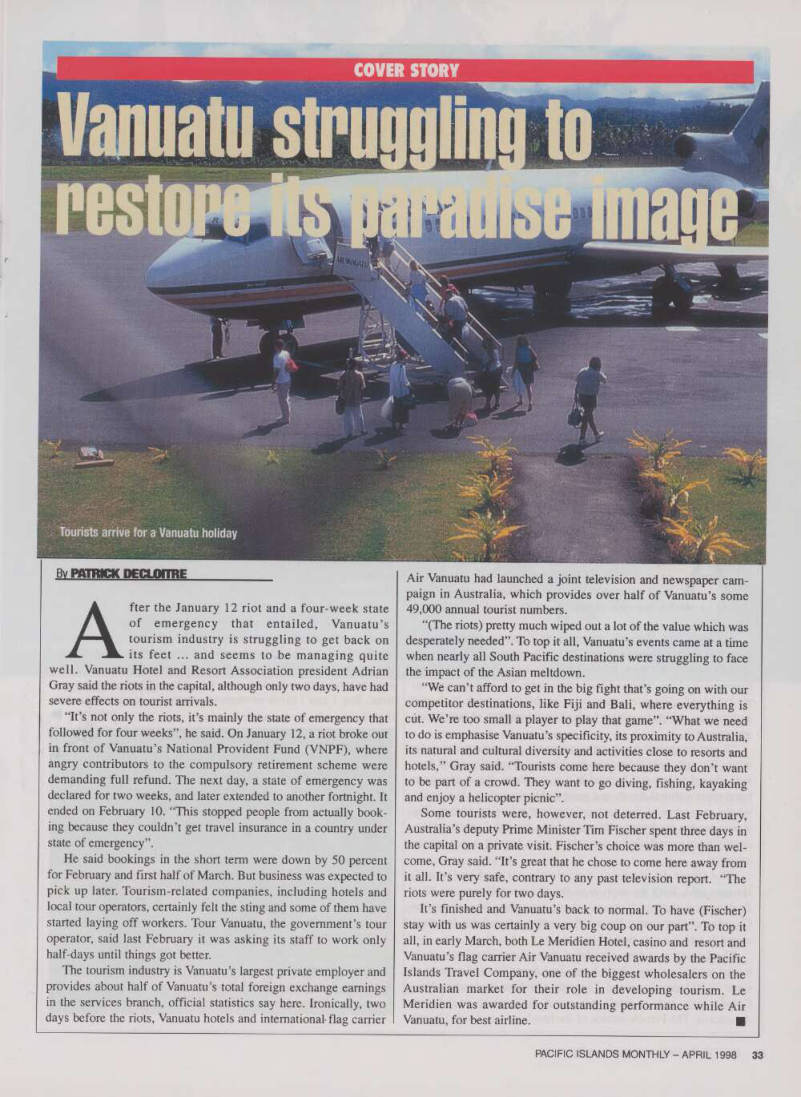
Van uatu struggling to restopo its parauise image
Bv Patrick Decloitre
After the January 12 riot and a four-week state of emergency that entailed, Vanuatu’s tourism industry is struggling to get back on its feet ... and seems to be managing quite well. Vanuatu Hotel and Resort Association president Adrian Gray said the riots in the capital, although only two days, have had severe effects on tourist arrivals.
“It’s not only the riots, it’s mainly the state of emergency that followed for four weeks”, he said. On January 12, a riot broke out in front of Vanuatu’s National Provident Fund (VNPF), where angry contributors to the compulsory retirement scheme were demanding full refund. The next day, a state of emergency was declared for two weeks, and later extended to another fortnight. It ended on February 10. “This stopped people from actually book ing because they couldn’t get travel insurance in a country under state of emergency”.
He said bookings in the short term were down by 50 percent for February and first half of March. But business was expected to pick up later. Tourism-related companies, including hotels and local tour operators, certainly felt the sting and some of them have started laying off workers. Tour Vanuatu, the government’s tour operator, said last February it was asking its staff to work only half-days until things got better.
The tourism industry is Vanuatu’s largest private employer and provides about half of Vanuatu’s total foreign exchange earnings in the services branch, official statistics say here. Ironically, two days before the riots, Vanuatu hotels and international- flag carrier
Air Vanuatu had launched a joint television and newspaper cam paign in Australia, which provides over half of Vanuatu’s some 49,000 annual tourist numbers.
“(The riots) pretty much wiped out a lot of the value which was desperately needed”. To top it all, Vanuatu’s events came at a time when nearly all South Pacific destinations were struggling to face the impact of the Asian meltdown.
“We can’t afford to get in the big fight that’s going on with our competitor destinations, like Fiji and Bali, where everything is cut. We’re too small a player to play that game”. “What we need to do is emphasise Vanuatu’s specificity, its proximity to Australia, its natural and cultural diversity and activities close to resorts and hotels,” Gray said. “Tourists come here because they don’t want to be part of a crowd. They want to go diving, fishing, kayaking and enjoy a helicopter picnic”.
Some tourists were, however, not deterred. Last February, Australia’s deputy Prime Minister Tim Fischer spent three days in the capital on a private visit. Fischer’s choice was more than wel come, Gray said. “It’s great that he chose to come here away from it all. It’s very safe, contrary to any past television report. “The riots were purely for two days.
It’s finished and Vanuatu’s back to normal. To have (Fischer) stay with us was certainly a very big coup on our part”. To top it all, in early March, both Le Meridien Hotel, casino and resort and Vanuatu’s flag carrier Air Vanuatu received awards by the Pacific Islands Travel Company, one of the biggest wholesalers on the Australian market for their role in developing tourism. Le Meridien was awarded for outstanding performance while Air Vanuatu, for best airline. ■
Tourists arrive for a Vanuatu holiday
Advertisements & other items, p. 33 (1 item)
Cover Story
Away from the beaten tracks
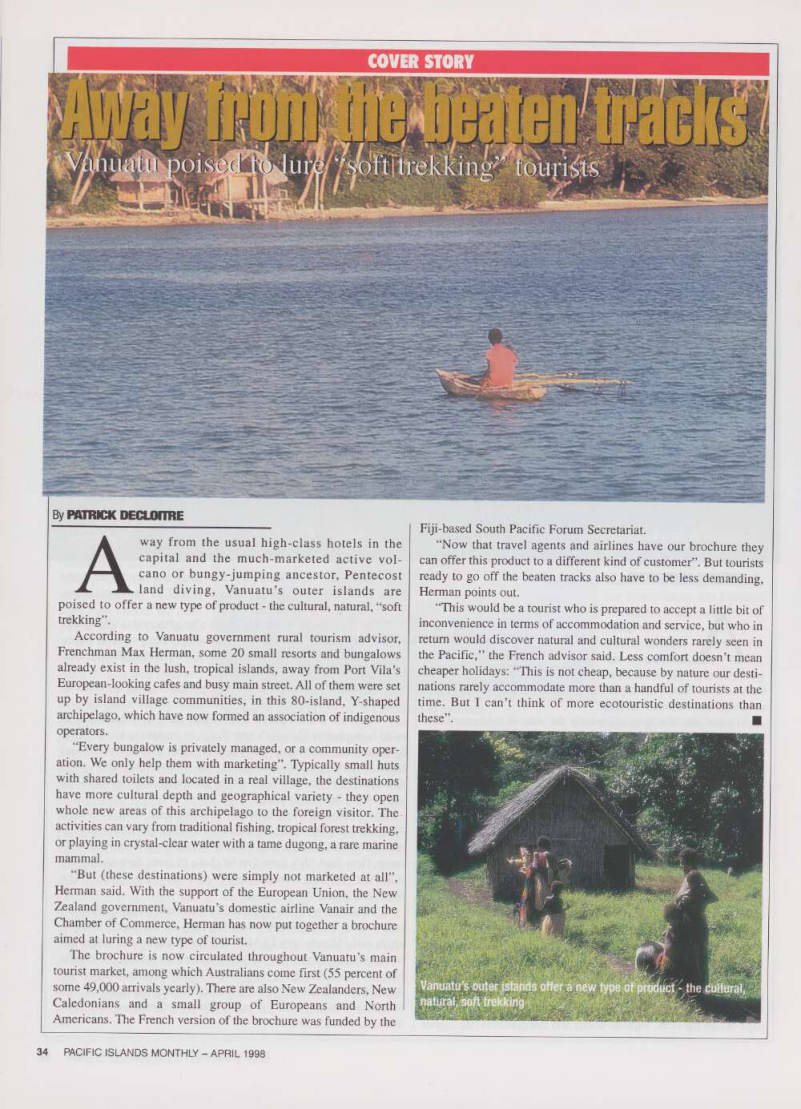
Vanuatu poised to lure "soft trekking" tourists
By Patrick Decloitre
Fiji-based South Pacific Forum Secretariat.
“Now that travel agents and airlines have our brochure they can offer this product to a different kind of customer”. But tourists ready to go off the beaten tracks also have to be less demanding, Herman points out.
“This would be a tourist who is prepared to accept a little bit of inconvenience in terms of accommodation and service, but who in return would discover natural and cultural wonders rarely seen in the Pacific,” the French advisor said. Less comfort doesn’t mean cheaper holidays: “This is not cheap, because by nature our desti nations rarely accommodate more than a handful of tourists at the time. But I can’t think of more ecotouristic destinations than these”. b
Away from the usual high-class hotels in the capital and the much-marketed active vol cano or bungy-jumping ancestor, Pentecost land diving, Vanuatu’s outer islands are poised to offer a new type of product - the cultural, natural, “soft
trekking”.
According to Vanuatu government rural tourism advisor.
Frenchman Max Herman, some 20 small resorts and bungalows already exist in the lush, tropical islands, away from Port Vila’s European-looking cafes and busy main street. All of them were set up by island village communities, in this 80-island, Y-shaped archipelago, which have now formed an association of indigenous operators.
“Every bungalow is privately managed, or a community oper ation. We only help them with marketing”. Typically small huts with shared toilets and located in a real village, the destinations have more cultural depth and geographical variety - they open whole new areas of this archipelago to the foreign visitor. The activities can vary from traditional fishing, tropical forest trekking, or playing in crystal-clear water with a tame dugong, a rare marine mammal.
“But (these destinations) were simply not marketed at all”, Herman said. With the support of the European Union, the New Zealand government, Vanuatu’s domestic airline Vanair and the Chamber of Commerce, Herman has now put together a brochure aimed at luring a new type of tourist.
The brochure is now circulated throughout Vanuatu’s main tourist market, among which Australians come first (55 percent of some 49,000 arrivals yearly). There are also New Zealanders, New Caledonians and a small group of Europeans and North Americans. The French version of the brochure was funded by the
Vanuatu's outer islands offer a new type of product - the cultural, natural, soft trekking.
Advertisements & other items, p. 34 (1 item)
Cover Story
Samoa's tourism fture looks bleak
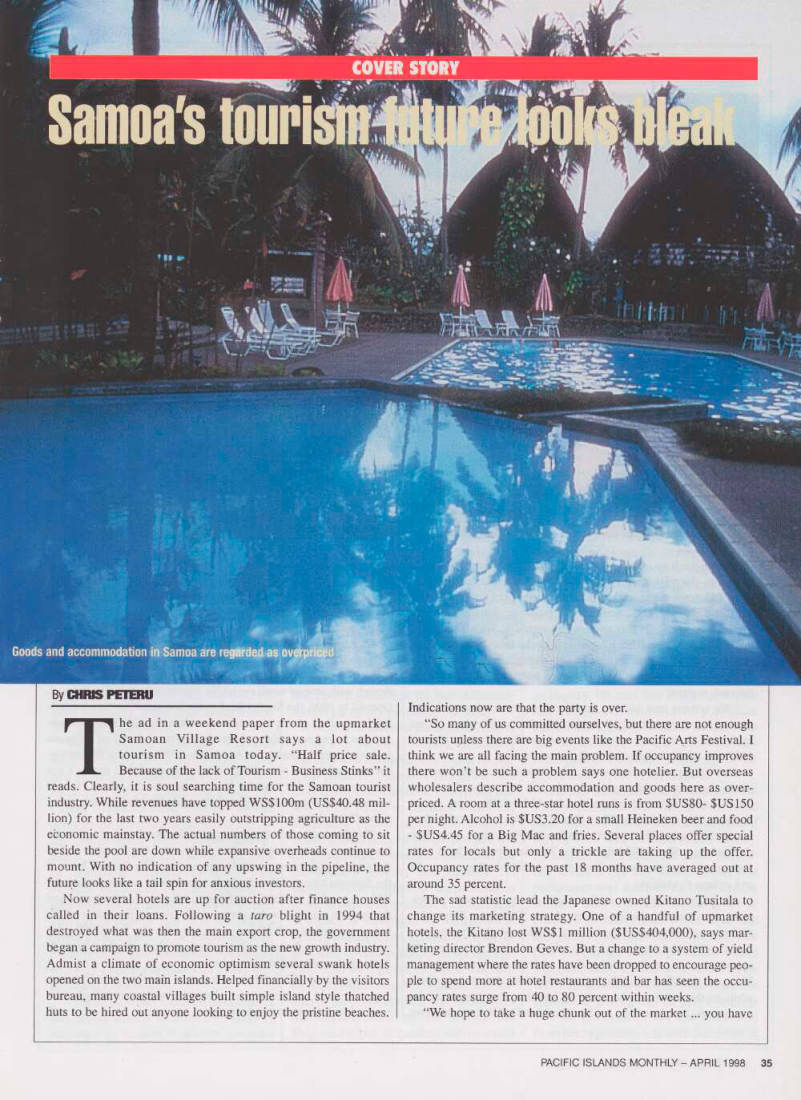
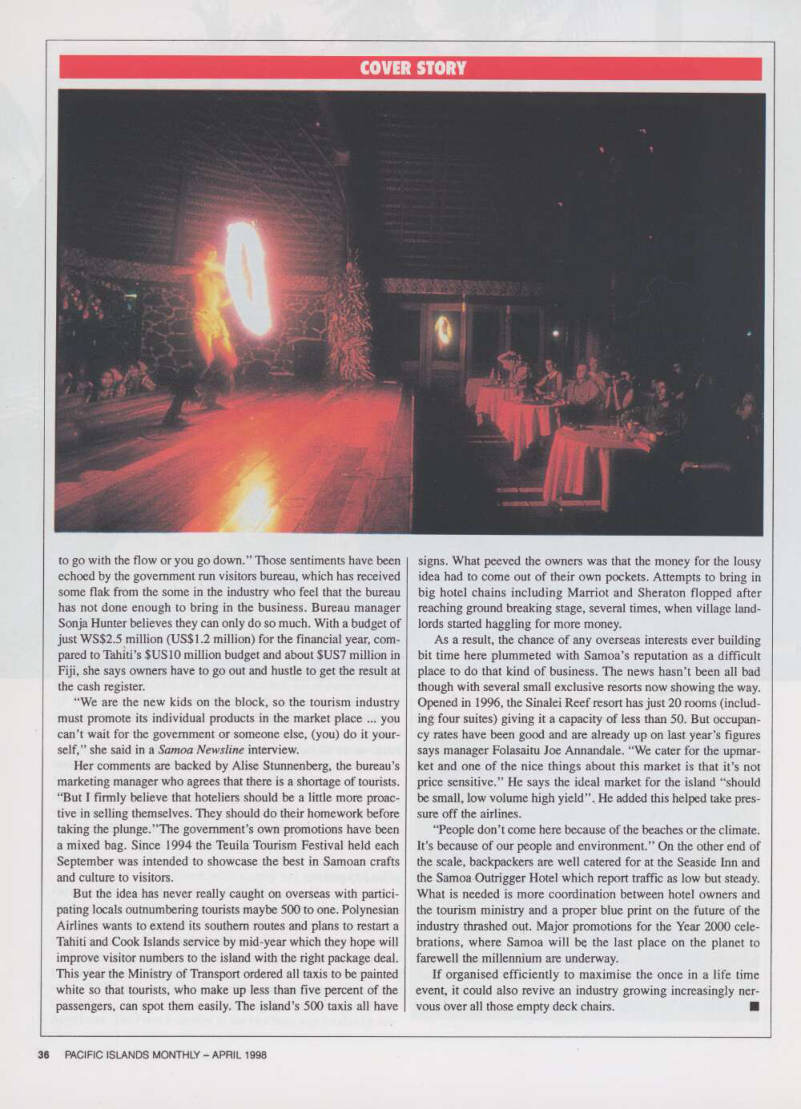
By Chris Peteru
The ad in a weekend paper from the upmarket Samoan Village Resort says a lot about tourism in Samoa today. “Half price sale.
Because of the lack of Tourism - Business Stinks” it reads. Clearly, it is soul searching time for the Samoan tourist industry. While revenues have topped WSsloom (U 5540.48 mil lion) for the last two years easily outstripping agriculture as the economic mainstay. The actual numbers of those coming to sit beside the pool are down while expansive overheads continue to mount. With no indication of any upswing in the pipeline, the future looks like a tail spin for anxious investors.
Now several hotels are up for auction after finance houses called in their loans. Following a taro blight in 1994 that destroyed what was then the main export crop, the government began a campaign to promote tourism as the new growth industry.
Admist a climate of economic optimism several swank hotels opened on the two main islands. Helped financially by the visitors bureau, many coastal villages built simple island style thatched huts to be hired out anyone looking to enjoy the pristine beaches.
Indications now are that the party is over.
“So many of us committed ourselves, but there are not enough tourists upless there are big events like the Pacific Arts Festival. I think we are all facing the main problem. If occupancy improves there won’t be such a problem says one hotelier. But overseas wholesalers describe accommodation and goods here as over priced. A room at a three-star hotel runs is from SUSBO- SUSISO per night. Alcohol is SUS3.2O for a small Heineken beer and food - $U54.45 for a Big Mac and fries. Several places offer special rates for locals but only a trickle are taking up the offer.
Occupancy rates for the past 18 months have averaged out at around 35 percent.
The sad statistic lead the Japanese owned Kitano Tusitala to change its marketing strategy. One of a handful of upmarket hotels, the Kitano lost WS$l million (SUSS4O4,OOO), says mar keting director Brendon Geves. But a change to a system of yield management where the rates have been dropped to encourage peo ple to spend more at hotel restaurants and bar has seen the occu pancy rates surge from 40 to 80 percent within weeks.
“We hope to take a huge chunk out of the market ... you have
Goods and accommodation in Samoa are regarded as overpriced
to go with the flow or you go down.” Those sentiments have been echoed by the government run visitors bureau, which has received some flak from the some in the industry who feel that the bureau has not done enough to bring in the business. Bureau manager Sonja Hunter believes they can only do so much. With a budget of just WS$2.5 million (US$l.2 million) for the financial year, com pared to Tahiti’s SUS 10 million budget and about SUS 7 million in Fiji, she says owners have to go out and hustle to get the result at the cash register.
“We are the new kids on the block, so the tourism industry must promote its individual products in the market place ... you can’t wait for the government or someone else, (you) do it your self,” she said in a Samoa Newsline interview.
Her comments are backed by Alise Stunnenberg, the bureau’s marketing manager who agrees that there is a shortage of tourists.
“But I firmly believe that hoteliers should be a little more proac tive in selling themselves. They should do their homework before taking the plunge.’’The government’s own promotions have been a mixed bag. Since 1994 the Teuila Tourism Festival held each September was intended to showcase the best in Samoan crafts and culture to visitors.
But the idea has never really caught on overseas with partici pating locals outnumbering tourists maybe 500 to one. Polynesian Airlines wants to extend its southern routes and plans to restart a Tahiti and Cook Islands service by mid-year which they hope will improve visitor numbers to the island with the right package deal.
This year the Ministry of Transport ordered all taxis to be painted white so that tourists, who make up less than five percent of the passengers, can spot them easily. The island’s 500 taxis all have
signs. What peeved the owners was that the money for the lousy idea had to come out of their own pockets. Attempts to bring in big hotel chains including Marriot and Sheraton flopped after reaching ground breaking stage, several times, when village land lords started haggling for more money.
As a result, the chance of any overseas interests ever building bit time here plummeted with Samoa’s reputation as a difficult place to do that kind of business. The news hasn’t been all bad though with several small exclusive resorts now showing the way.
Opened in 1996, the Sinalei Reef resort has just 20 rooms (includ ing four suites) giving it a capacity of less than 50. But occupan cy rates have been good and are already up on last year’s figures says manager Folasaitu Joe Annandale. “We cater for the upmar ket and one of the nice things about this market is that it’s not price sensitive.” He says the ideal market for the island “should be small, low volume high yield”. He added this helped take pres sure off the airlines.
“People don’t come here because of the beaches or the climate.
It’s because of our people and environment.” On the other end of the scale, backpackers are well catered for at the Seaside Inn and the Samoa Outrigger Hotel which report traffic as low but steady.
What is needed is more coordination between hotel owners and the tourism ministry and a proper blue print on the future of the industry thrashed out. Major promotions for the Year 2000 cele brations, where Samoa will be the last place on the planet to farewell the millennium are underway.
If organised efficiently to maximise the once in a life time event, it could also revive an industry growing increasingly ner vous over all those empty deck chairs. ■
Advertisements & other items, p. 35 (1 item)
iVi ;VJ
Skate survives moves to dethrone him
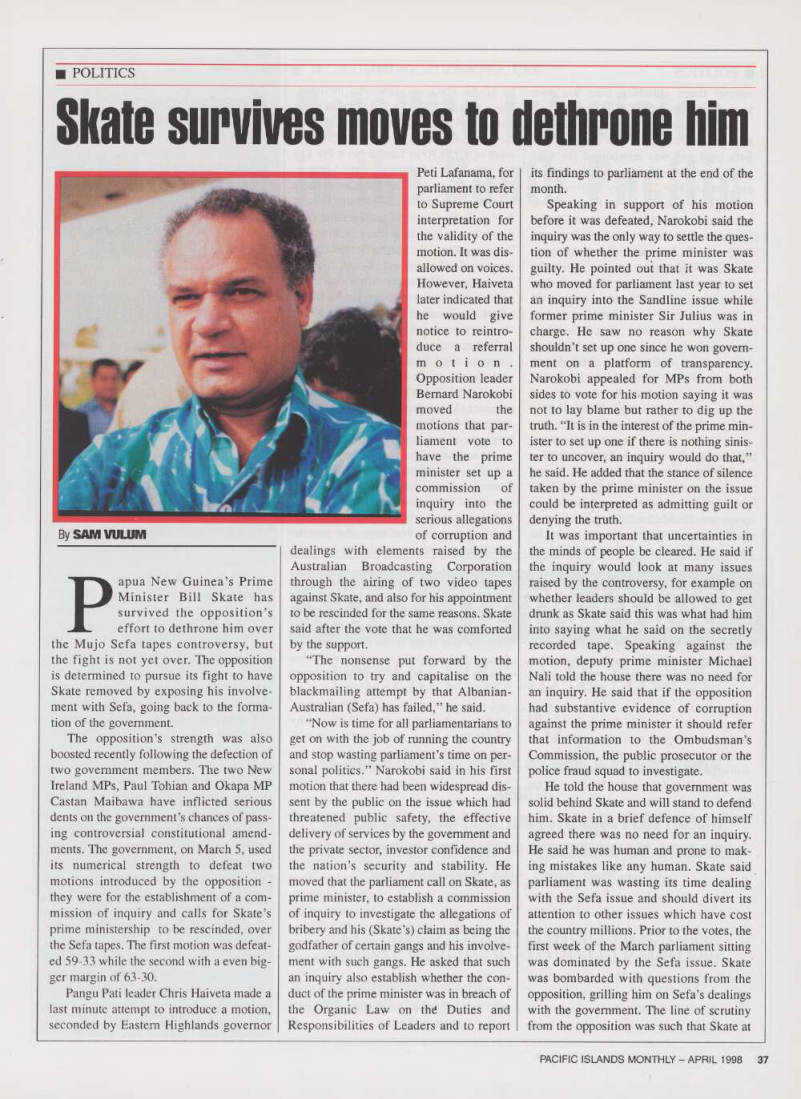
Politics
By Sam Vulum
Papua New Guinea’s Prime Minister Bill Skate has survived the opposition’s effort to dethrone him over the Mujo Sefa tapes controversy, but the fight is not yet over. The opposition is determined to pursue its fight to have Skate removed by exposing his involve ment with Sefa, going back to the forma tion of the government.
The opposition’s strength was also boosted recently following the defection of two government members. The two New Ireland MPs, Paul Tohian and Okapa MP Castan Maibawa have inflicted serious dents on the government’s chances of pass ing controversial constitutional amend ments. The government, on March 5, used its numerical strength to defeat two motions introduced by the opposition they were for the establishment of a com mission of inquiry and calls for Skate’s prime ministership to be rescinded, over the Sefa tapes. The first motion was defeat ed 59-33 while the second with a even big ger margin of 63-30.
Pangu Pati leader Chris Haiveta made a last minute attempt to introduce a motion, seconded by Eastern Highlands governor
Peti Lafanama, for parliament to refer to Supreme Court
interpretation for
the validity of the motion. It was dis allowed on voices.
However, Haiveta later indicated that he would give notice to reintro duce a referral motion.
Opposition leader
Bernard Narokobi moved the motions that par liament vote to have the prime minister set up a commission of inquiry into the
serious allegations
of corruption and
dealings with elements raised by the
Australian Broadcasting Corporation
through the airing of two video tapes against Skate, and also for his appointment to be rescinded for the same reasons. Skate said after the vote that he was comforted by the support.
“The nonsense put forward by the opposition to try and capitalise on the blackmailing attempt by that Albanian- Australian (Sefa) has failed,” he said.
“Now is time for all parliamentarians to get on with the job of running the country and stop wasting parliament’s time on per sonal politics.” Narokobi said in his first motion that there had been widespread dis sent by the public on the issue which had threatened public safety, the effective delivery of services by the government and the private sector, investor confidence and the nation’s security and stability. He moved that the parliament call on Skate, as prime minister, to establish a commission of inquiry to investigate the allegations of bribery and his (Skate’s) claim as being the godfather of certain gangs and his involve ment with such gangs. He asked that such an inquiry also establish whether the con duct of the prime minister was in breach of the Organic Law on thd Duties and Responsibilities of Leaders and to report
its findings to parliament at the end of the month.
Speaking in support of his motion before it was defeated, Narokobi said the inquiry was the only way to settle the ques tion of whether the prime minister was guilty. He pointed out that it was Skate who moved for parliament last year to set an inquiry into the Sandline issue while former prime minister Sir Julius was in charge. He saw no reason why Skate shouldn’t set up one since he won govern ment on a platform of transparency.
Narokobi appealed for MPs from both sides to vote for his motion saying it was not to lay blame but rather to dig up the truth. “It is in the interest of the prime min ister to set up one if there is nothing sinis ter to uncover, an inquiry would do that,” he said. He added that the stance of silence taken by the prime minister on the issue could be interpreted as admitting guilt or denying the truth.
It was important that uncertainties in the minds of people be cleared. He said if the inquiry would look at many issues raised by the controversy, for example on whether leaders should be allowed to get drunk as Skate said this was what had him into saying what he said on the secretly recorded tape. Speaking against the motion, deputy prime minister Michael Nali told the house there was no need for an inquiry. He said that if the opposition had substantive evidence of corruption against the prime minister it should refer that information to the Ombudsman’s Commission, the public prosecutor or the police fraud squad to investigate.
He told the house that government was solid behind Skate and will stand to defend him. Skate in a brief defence of himself agreed there was no need for an inquiry.
He said he was human and prone to mak ing mistakes like any human. Skate said
parliament was wasting its time dealing
with the Sefa issue and should divert its attention to other issues which have cost the country millions. Prior to the votes, the first week of the March parliament sitting was dominated by the Sefa issue. Skate was bombarded with questions from the
opposition, grilling him on Seta’s dealings
with the government. The line of scrutiny from the opposition was such that Skate at
several times stumbled over his own answers and gave conflicting responses.
In the course of the question and answer session, parliament was told that Sefa paid and was reimbursed for trips
taken by prominent lawyer Peter Donigi
and former MP Sir Barry Holloway to study Hong Kong’s anti corruption laws; tried to entice Skate into corrupt deals with between K3O million (SUSI4m) and K4om (SUSI9m) invoiced the govern ment for K 100,000 for cost incurred in the lead-up to its formation including the tai loring of suits for MPs and had been paid half of this money and funds were still being raised to pay off the balance.
Parliament also heard a claim by Markham MP Andrew Baing that Ombudsman Commission lawyer Gred Toop had been offered the job of public prosecutor in return got “suppressing” 22 leadership charges against Skate. Skate admitted to some of the claims and denied others.
However, more questions had been fired at him which he refused to answer, adding that his lawyers were working on the case.
Former prime minister and East Sepik governor Sir Michael Somare tabled in parliament a PNG Post receipt which he said was evidence of K2000(5U5952) hav ing being paid to Forests Minister Dr Fabian Pok by Sefa. Dr Pok denied receiv ing any money, however, the opposition as of March 10 was expected to have tabled in parliament copies of receipts of various expenses allegedly met by Sefa for Skate’s Tufi Camp during the lead up to the for mation of the government.
It was at Tufi, in the northern province, where Skate consolidated his support.
Opposition sources said they had obtained from Sefa several receipts purposing to show payment of security, tailoring of suits, provision of medical services and purchase of beddings and food items for Skate’s team. These receipted costs, totalling about K 28,000 (SUSI3m) were met by Sefa through his ... making compa ny Globe PNG Pty Ltd. While Sefa claims he spent K 500,000 on Skate and the Tufi Camp during the elections, the prime min ister has admitted in parliament of the group receiving help totalling K 100,000 for which they repaid half the amount.
Receipts to be tabled show that a security firm The Corps (PNG) on May last year invoiced Skate for K 8343 for the provision of armed security. There is no evidence of this payment being made. Copies of cheques for several other payments made
by Globe PNG are, however, included.
These are of a K 2500 payment made to Dr Lam and Associates for the provision of medical consultancy and service; the pay ment of K 758.70 to Tamasi No 6 Pty Ltd for the supply of mattresses, bed sheets, pillows and towels to the Tufi Camp, and a payment of K 1518.60 to Marwin Motors for luncheon. Copies of invoices and cash payment receipts show that Lok Poy Wai Tailoring Pty Ltd charged Sefa K 10,435 for the sale of shoes and suits to 29 MPs.
The names of MPs who benefited, com plete with tailoring sizes are listed. Badili Meats also invoiced Sefa for K 2011.80 for the cash payment of a large supply of meat.
The opposition has also vowed not to support the government’s proposed amendments to the Constitution aimed at creating stability in the office of the prime minister. The amendments will make it tougher for the opposition to move motions of no confidence against the prime minister. The changes would also see the abolishment of the National Executive Council and vest the executive powers of government placed in six-man “government caucus committee.” A suc cessful motion to discharge the govern ment caucus committee will face a general election.
Skate who was accused of trying to pro tect his tenure in office by introducing the changes, said he was putting his job on the line in order to achieve greater political stability and instil more investor confi dence. The opposition said it will also oppose the government’s other important bill which is for the establishment of an anti-corruption commission. The commis sion argued, among other things, why should there be another special commis sion when the existing organisations like the public prosecutor and the public solic itor offices, the police force, the army, the national and supreme courts lack manpow er and funding? Narokobi also asked: “What guarantee is there that a new com mission will not generate into a malfunc tioning institution, open to exploitation and manipulation by evil-minded heads of government through appointments to achieve political ends?” In a state of the nation address broadcasted by EMTV on March 2, Skate said that corruption was rife in the country and this was the best means to stamp it out.
“There are several alleged corrupt deals that have robbed our nation of public money.” Skate said. ■
name change

American Samoa's bid lo ban Samoa’s name change fails
By Chris Peteru
Samoan passport holders have been allowed into
neighbouring American
Samoa after legislation seeking to ban them faltered at a final hurdle of the upper house sen ate.
Within days of Samoa announcing its new name back in August, American Samoa tabled a bill to ignore the name change and reject anyone carrying Samoan passports into the territory.
Recently the bill was voted through its second reading. But in an unusual move that runs against normal proce dures, at the third and final reading - that would have all but made the bill law - the 18 members agreed to a postponement for the document to committee level for some fine tuning.
The eleventh hour maneuvering turned out to be the best course to take to avoid a unprecedented stand off that would have burnt everyone’s fingers.
What had bothered Samoan politi cians a bit and their American Samoan cousins in the 18 member upper house senate even more was the provision rejecting Samoan passport holders from entering their five islands.
Representative Suemalo Seti Lopa, the key figure in pushing the tough action, has dug in over removing the passport clause “as that’s the teeth of the bill”. Insiders say that other senate mem bers had been quietly suggesting to Lopa
that the only teeth missing by not removing the clause will be their own.
Even scarier than dental repair bills was the cost of severing economic links worth millions of dollars to both islands. Several thousand Samoans form the labour base of the territory, many working menial jobs in the huge US based fish canneries many locals avoid.
With about 60 percent of cannery employees from across the way, Congressman Eni Faleomavaega Hunkin says passport busting was a bad idea from the start. “To treat these people as second class citizens would only have resulted in more economic hardships for all Samoans.
The territory’s well being is very much dependent on people from the state of Samoa decreasing unemployment and reducing tax revenues for the government he told journalist Monica Miller.
“The bill does absolutely nothing to pro mote a better political social and economic relationship with the state of Samoa.
While American Samoa with a popula tion of 19,000 feels the Samoa name was hijacked because they were not consulted, political leaders on both sides agree that tec nically it was a fair call.
The governor Tauese Sunia who holds the power to veto senate decisions and for merly opposed the bill because of the pass port clause, has come out in support of the revamped document.
Hunkin noted that American Samoa vol untarily called itself by that name when it signed a Treaty of Cession with the US where as Samoa was involuntarily stuck with the designation as part of the division of the Samoan Islands by colonial powers.
“We should support not chastise our borthers and sisters as they seek to shed their remnants of colonialism.”
Samoan Prime Minister Tofilau Eti Alesana qualified the move in a bill that he tabled by explaining that since joining the United Nations in 1967, the island state had only been called Samoa.
The change was made for easier recog nition internationally. Some believe that a passport scandal the prime minister (who holds the immigration portfolio) has contin ually tried to distance himself from, could explain why it took 20 years before anything was done to give Samoa her pre colonial identity. A resolution from the American Samoa senate to the Samoan parliament stating the name change was inappropriate will be sent. ■
Advertisements & other items, p. 38 (1 item)
38
■ POLITICS
PACIFIC ISLANDS MONTHLY - APRIL 1998
■ POLITICS
Satellite television

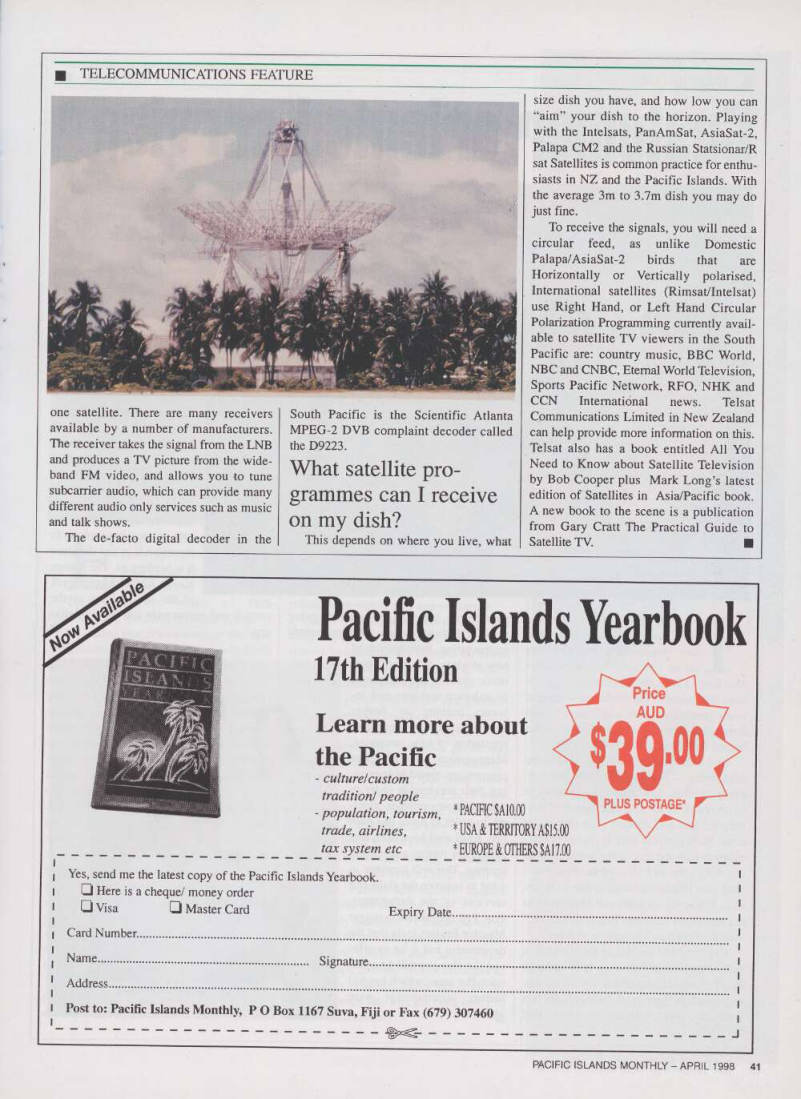
Telecommunications Feature
Satellite television in the South Pacific
What is satellite televi sion? It consist of the most visible component, a parabolic reflector.
The dish/antenna is a device that focuses the microwave signals coming from the satellites much as the mirror in a reflecting telescope concentrates the light from dis tant g axis.
A device containing a motor that is used to swing the satellite dish east and west to allow it to focus on individual satellites, which may be as close to one another as 2 degrees of arc. Actuator ms are most com monly found in 18- and 24-inch lengths (the longer the arm, the wider the arc that the dish can “see”.
In addition, a more expensive aiming mechanism, called a “horizon-to-horizon”
mount, is capable of more precise aiming (important on Ku band and closely-spaced satellites), as well as being able see the entire satellite arc from your location given no physical obstructions between the dish and the satellite.
There is the LNB. This component amplifies the very weak signals from the dish and then converts them to a more suit able band of frequencies. LNB stands for Low Noise Block-converter.
There is also a device called an LNBF, which combines the LNB and Feed Horn into a single unit.
The LNBF device uses a simpler method for adjusting the polarity (voltage right on the LNB cable). However if the LNB part goes bad, you need to replaced. An LNBF is especially suitable for dedicated opera tions, such as a smaller dish used for only
one satellite. There are many receivers available by a number of manufacturers.
The receiver takes the signal from the LNB and produces a TV picture from the wide band EM video, and allows you to tune subcarrier audio, which can provide many different audio only services such as music and talk shows.
The de-facto digital decoder in the
South Pacific is the Scientific Atlanta MPEG-2 DVB complaint decoder called the D 9223.
What satellite pro
grammes can I receive
on my dish?
This depends on where you live, what
size dish you have, and how low you can “aim” your dish to the horizon. Playing with the Intelsats, PanAmSat, Asia Sat-2, Palapa CM2 and the Russian Statsionar/R sat Satellites is common practice for enthu siasts in NZ and the Pacific Islands. With the average 3m to 3.7 m dish you may do
just fine.
To receive the signals, you will need a circular feed, as unlike Domestic Palapa/AsiaSat-2 birds that are
Horizontally or Vertically polarised,
International satellites (Rimsat/Intelsat) use Right Hand, or Left Hand Circular Polarization Programming currently avail able to satellite TV viewers in the South Pacific are: country music, BBC World, NBC and CNBC, Eternal World Television, Sports Pacific Network, RFO, NHK and CCN International news. Telsat Communications Limited in New Zealand can help provide more information on this.
Telsat also has a book entitled All You Need to Know about Satellite Television by Bob Cooper plus Mark Long’s latest edition of Satellites in Asia/Pacific book.
A new book to the scene is a publication from Gary Cratt The Practical Guide to Satellite TV. ■
Advertisements & other items, pp. 39-41 (1 item)
Satellite Television
PACIFIC SPORTS NETWORK
(SPN)
12 HOURS DAILY OF PACIFIC ISLANDS & INTERNATIONAL
SPORTS
DIGITAL DECODERS (HSS-100-C) NZ$B99 PLUS FREIGHT
THE FOLLOWING SATELLITE TV PROGRAMES ARE AVAILABLE: ROC, CNN, CMT, NBC, CNBC, RFO etc etc.
TELSAT COMMUNICATIONS LTD (Estl9BB)
Email; [email protected] WEB page http://www.telsat.com Fax + 64-6-355-2141 PO Box 1537 Palmerston North
NEW ZEALAND.
* t /k m^ .
veCOn
ections
In busings, having the right connections can make the difference between being stuck on the ground or reaching for the stars. In this age of high tech, global telecommunications it is reassuring to know that Fiji has the right connections. Fiji International Telecommunications Limited (FINTEL) links Fiji to the rest of the world through undersea cables and via satellite... providing you with a wide range of high quality international services to satisfy all your business and personal communications requirements. Call us now on toll free 0800 3t5 718
\y *2
Pacific Islands Yearbook
17th Edition
Learn more about
the Pacific
- culture!custom tradition! people - population, tourism, trade, airlines, tax system etc
* PACIFIC SAIO.OO
* USA & TERRITORY ASI 5.00
* EUROPE & CITHERS SAI 7.00
Price
AUD
00
PLUS
POSTAGE
Yes, send me the latest copy of the Pacific Islands Yearbook.
Q Here is a cheque/ money order Q Visa Q Master Card Expiry Date, Card Number.
N ame Signature Address Post to: Pacific Islands Monthly, P O Box 1167 Suva, Fiji or Fax (679) 307460 J
Customer oriented service
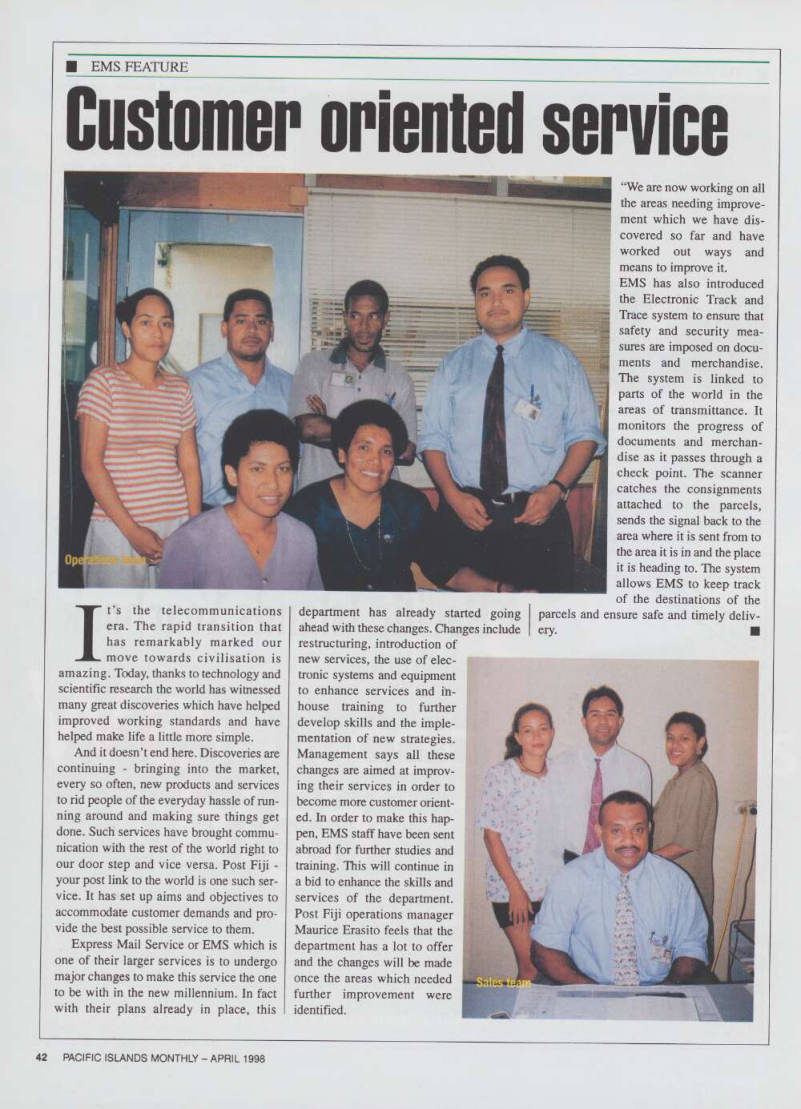
Ems Feature
It’s the telecommunications era. The rapid transition that has remarkably marked our move towards civilisation is amazing. Today, thanks to technology and scientific research the world has witnessed many great discoveries which have helped improved working standards and have helped make life a little more simple.
And it doesn’t end here. Discoveries are continuing - bringing into the market, every so often, new products and services to rid people of the everyday hassle of run ning around and making sure things get done. Such services have brought commu nication with the rest of the world right to our door step and vice versa. Post Fiji your post link to the world is one such ser vice. It has set up aims and objectives to accommodate customer demands and pro vide the best possible service to them.
Express Mail Service or EMS which is one of their larger services is to undergo major changes to make this service the one to be with in the new millennium. In fact with their plans already in place, this
department has already started going ahead with these changes. Changes include
restructuring, introduction of new services, the use of elec tronic systems and equipment to enhance services and in house training to further develop skills and the imple mentation of new strategies.
Management says all these changes are aimed at improv ing their services in order to become more customer orient ed. In order to make this hap pen, EMS staff have been sent abroad for further studies and training. This will continue in a bid to enhance the skills and services of the department.
Post Fiji operations manager Maurice Erasito feels that the department has a lot to offer and the changes will be made once the areas which needed further improvement were identified.
“We are now working on all
the areas needing improve
ment which we have dis covered so far and have worked out ways and means to improve it.
EMS has also introduced the Electronic Track and Trace system to ensure that safety and security mea sures are imposed on docu ments and merchandise.
The system is linked to parts of the world in the areas of transmittance. It monitors the progress of documents and merchan dise as it passes through a check point. The scanner catches the consignments attached to the parcels, sends the signal back to the area where it is sent from to the area it is in and the place it is heading to. The system allows EMS to keep track of the destinations of the
parcels and ensure safe and timely deliv ery. ■
Sales team
Providing a door to door service

EMS or Express Mail Service is the premium product of any post office in the world.
These are the words of Peni Naivaluwaqa, the EMS manager in Fiji.
He added that the nearing of the new millennium was more the reason why EMS had to improve its services. In order to pre pare itself for the new millennium the com pany is improving its services to accom modate the complex and postal needs of customers and to satisfy its role as a premi um product. Naivaluwaqa said as the pre mium product of the Post Fiji system it was important that the services provided were efficient and competitive.
“EMS has added value where you pay a price that is cheaper than any other courier company but the service is the same,” he said. He said that delivery with EMS was faster and efficient as it was a door to door service and goods are guaranteed to be safe and secure as they are delivered. EMS offers both domestic and international ser vices. In order to provide a better and more efficient services, the company has moved to a bigger and better office.
“This is the beginning of our transi tion,” Naivaluwaqa said. “We have an excellent and dynamic sales team who are
well versed on providing the best services for customers. These people will target new accounts and discover new markets while at the same time establish a close relationship with clients and customers.
As for future plans, Naivaluwaqa said EMS hoped to impose a one day delivery service in major postal centres, however, messengers will soon be equipped with a fleet communications system.
“This system will ensure that messen gers are contacted on time and anywhere in their line of work.” The equipment is slightly larger than a mobile phone and messengers can easily carry them around.
If customers find that they have received the wrong parcel or have other problems they can reach these messengers by phone. The system is easy to use and makes the EMS services more reliable and efficient. EMS is also looking at installing an accounting software to help speed up their work. Further development include more vehicles for the sales team.
Presently there are 17 EMS outlets in Fiji. The staff and management with their commitment, initiative and customer first attitude hope to make their customers as satisfied as possible. EMS has it all for their customers and will get even better in the new millennium. ■
Advertisements & other items, pp. 43-44 (2 items)
■ Ems Feature
Neon
Lightbox Computer-cut
Vinyl/graphics
Fabricated letter Banner Reflective car Road sign Vinyl sti Shop 1,1-7 Rewa St., Flagstaff Suva Ph : (679) 300900 Fax : (679) 300905 Shop 3 Grace Bros Bldg. 538 Main St. Nadi.
P.O Box 2922 Nadi. Fiji Ph : (679) 703966 Fax : (679) 703968
IPI
International & Local Courier
Fiji’s own courier company goes further than Fiji 0* y-lhi mm yo'O{ : m . m as ii mi m ■ ■■■.. 1": mm m ♦ ‘Vn LD
DOOR
For all your:
■ Courier needs ■ Heavyweights
Your choice of domestic messenger courier needs - / IHour / 3 Hour / Same day
iJDst
Fiji*
International & Local Courier
SUVA: 218 388, 218 304 or TOLL FREE 0800 307 304 NADI AIRPORT: 724 434 NADI: 700 001 LAUTOKA: 665 161 LARASA: 816 022 SAVUSAVU: 850 001 SIGATOKA: 500 321 or simply call your nearest post office and ask for f/UsService.
Keeping the culture alive

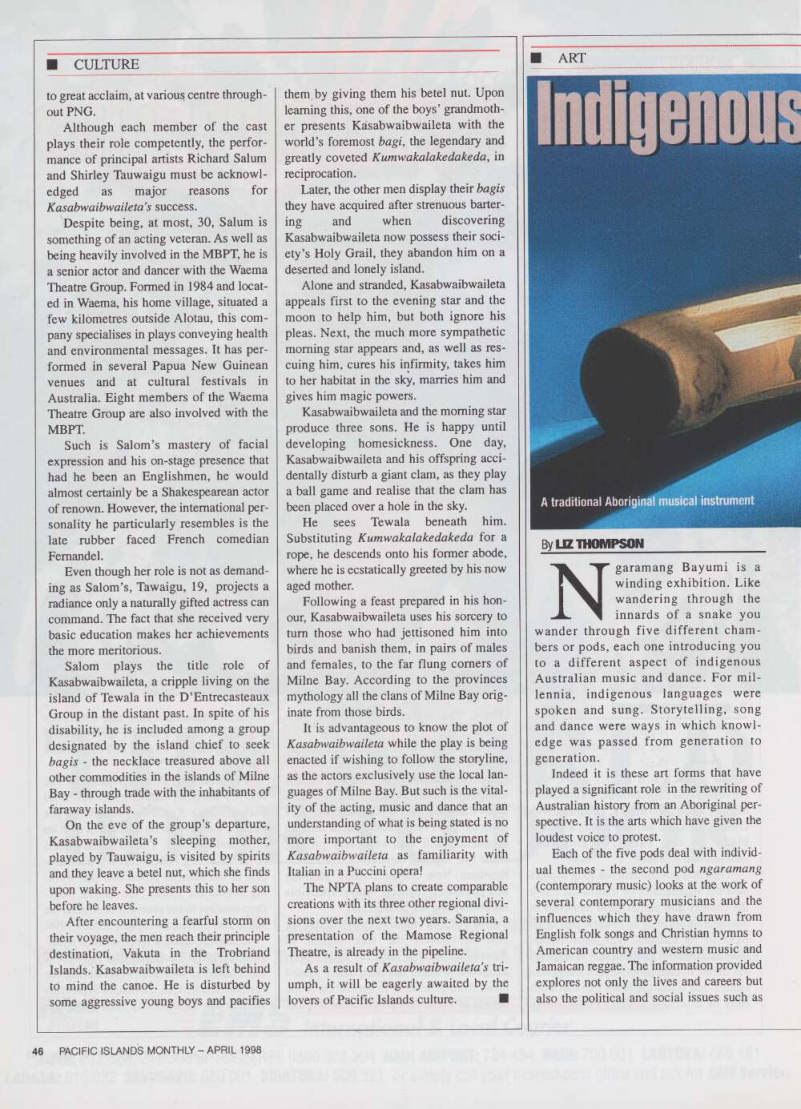
Culture
By Atama Raganivatu
All peoples of the Pacific, are justifiably, proud of their own rich cultural inheritances.
Nevertheless, for colour, excitement, energy and diversity, Papua New Guinea’s native culture holds a unique place in the Pacific region and, indeed, the world.
The PNG government has long appreci ated the significance of traditional arts in the country and places great emphasis on maintaining them as an integral part of the lives of its citizens. The state backed National Cultural Commission is responsi ble for the overall promotion of indigenous culture and funds the body that can truth fully be described as PNG’s artistic flag
ship - The National Performing Arts Troupe.
Formed in 1996 as a result of a merger between the nation’s two best known the atrical organisations, the National Theatre Company of Port Moresby and Goroka’s Raun Raun, the NTPA is divided into five sections. The Port Moresby based national production unit oversees every project, while four regional theatres - located in the Southern, New Guinea Islands, Momase and Highlands districts - are responsible for performing the productions.
The NTPA’s initial major undertaking was to convert the folk legend of Kasabwaibwaileta into a stage play.
Kasabwaibwaileta has been orally passed down from generation to generation in the islands of Milne Bay province-for an inde
terminable amount of time and, it has been suggested, is the Pacific’s equivalent of Greek mythology’s Jason and the Golden Fleece.
The Milne Bay Provincial Theatre, The NTPA’s southern outpost, was entrusted with bringing Kasabwaibwaileta to life and this they have done admirably, both on stage and on video. Thanks to the effects of the 30 strong MBPT cast and six mem bers of the national production unit work ing behind the scenes, the theatre work shop concept to the premiere at Alotau, the Milne Bay provincial capital, in May 1996.
Kasabwaibwaileta received such a pos itive reception in Alotau that the MBPT was chosen to represent PNG during the Festival Arts in Apia, Samoa, in September 1996. It has subsequently been presented.
PNG'S native culture holds a unique in the Pacific region and indeed, the world
to great acclaim, at various centre through out PNG.
Although each member of the cast plays their role competently, the perfor mance of principal artists Richard Salum and Shirley Tauwaigu must be acknowl edged as major reasons for Kasabwaibwaileta’s success.
Despite being, at most, 30, Salum is something of an acting veteran. As well as being heavily involved in the MBPT, he is a senior actor and dancer with the Waema Theatre Group. Formed in 1984 and locat ed in Waema, his home village, situated a few kilometres outside Alotau, this com
pany specialises in plays conveying health
and environmental messages. It has per formed in several Papua New Guinean venues and at cultural festivals in Australia. Eight members of the Waema Theatre Group are also involved with the
Mbpt.
Such is Salom’s mastery of facial expression and his on-stage presence that had he been an Englishmen, he would almost certainly be a Shakespearean actor of renown. However, the international per sonality he particularly resembles is the late rubber faced French comedian Femandel.
Even though her role is not as demand ing as Salom’s, Tawaigu, 19, projects a radiance only a naturally gifted actress can command. The fact that she received very basic education makes her achievements the more meritorious.
Salom plays the title role of Kasabwaibwaileta, a cripple living on the island of Tewala in the D’Entrecasteaux Group in the distant past. In spite of his disability, he is included among a group designated by the island chief to seek bagis - the necklace treasured above all other commodities in the islands of Milne Bay - through trade with the inhabitants of
faraway islands.
On the eve of the group’s departure, Kasabwaibwaileta’s sleeping mother, played by Tauwaigu, is visited by spirits and they leave a betel nut, which she finds upon waking. She presents this to her son before he leaves.
After encountering a fearful storm on their voyage, the men reach their principle destination, Vakuta in the Trobriand Islands. Kasabwaibwaileta is left behind to mind the canoe. He is disturbed by
some aggressive young boys and pacifies
them by giving them his betel nut. Upon learning this, one of the boys’ grandmoth er presents Kasabwaibwaileta with the world’s foremost bagi, the legendary and greatly coveted Kumwakalakedakeda, in reciprocation.
Later, the other men display their bagis they have acquired after strenuous barter ing and when discovering Kasabwaibwaileta now possess their soci ety’s Holy Grail, they abandon him on a deserted and lonely island.
Alone and stranded, Kasabwaibwaileta appeals first to the evening star and the moon to help him, but both ignore his pleas. Next, the much more sympathetic morning star appears and, as well as res cuing him, cures his infirmity, takes him to her habitat in the sky, marries him and gives him magic powers.
Kasabwaibwaileta and the morning star produce three sons. He is happy until developing homesickness. One day, Kasabwaibwaileta and his offspring acci dentally disturb a giant clam, as they play a ball game and realise that the clam has been placed over a hole in the sky.
He sees Tewala beneath him.
Substituting Kumwakalakedakeda for a rope, he descends onto his former abode, where he is ecstatically greeted by his now aged mother.
Following a feast prepared in his hon our, Kasabwaibwaileta uses his sorcery to turn those who had jettisoned him into birds and banish them, in pairs of males and females, to the far flung comers of Milne Bay. According to the provinces mythology all the clans of Milne Bay orig inate from those birds.
It is advantageous to know the plot of Kasabwaibwaileta while the play is being enacted if wishing to follow the storyline, as the actors exclusively use the local lan guages of Milne Bay. But such is the vital ity of the acting, music and dance that an understanding of what is being stated is no more important to the enjoyment of Kasabwaibwaileta as familiarity with Italian in a Puccini opera!
The NPTA plans to create comparable creations with its three other regional divi sions over the next two years. Sarania, a presentation of the Mamose Regional Theatre, is already in the pipeline.
As a result of Kasabwaibwaileta’s tri umph, it will be eagerly awaited by the lovers of Pacific Islands culture. ■
Indigenous Australian music and dance
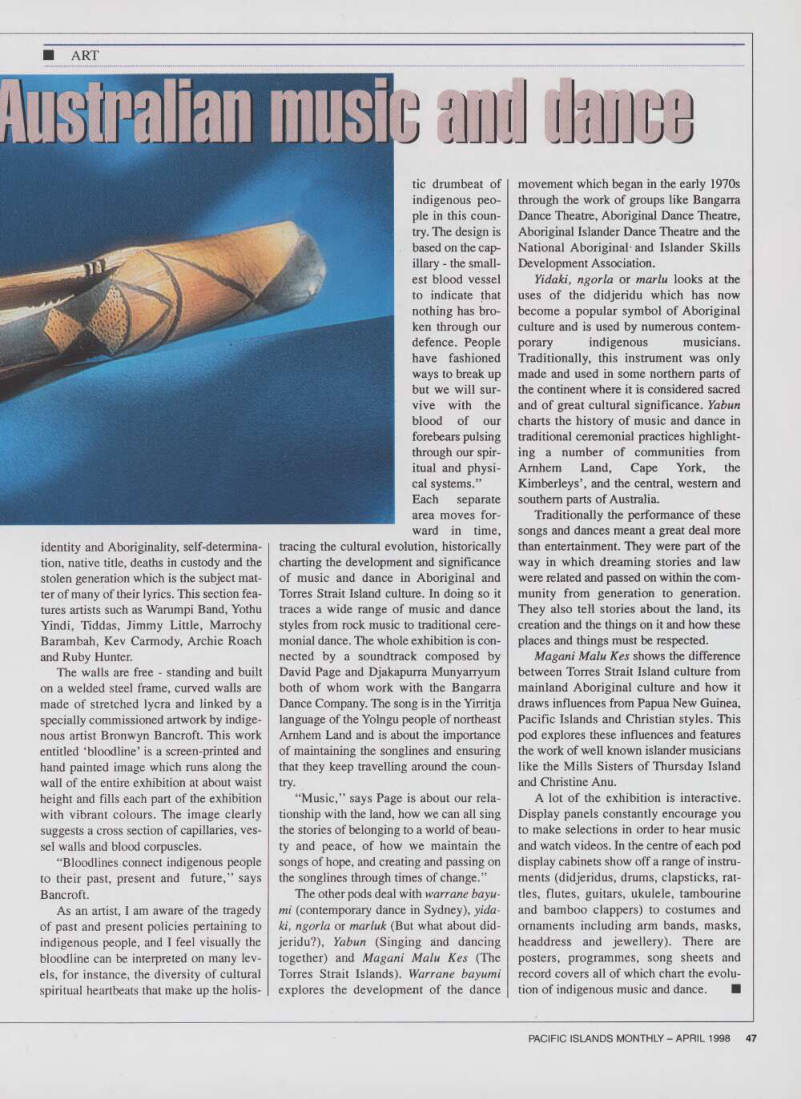
Art
By Liz Thompson
Ngaramang Bayumi is a winding exhibition. Like wandering through the innards of a snake you wander through five different cham bers or pods, each one introducing you to a different aspect of indigenous Australian music and dance. For mil lennia, indigenous languages were spoken and sung. Storytelling, song and dance were ways in which knowl edge was passed from generation to
generation.
Indeed it is these art forms that have played a significant role in the rewriting of Australian history from an Aboriginal per spective. It is the arts which have given the loudest voice to protest.
Each of the five pods deal with individ ual themes - the second pod ngaramang (contemporary music) looks at the work of several contemporary musicians and the influences which they have drawn from English folk songs and Christian hymns to American country and western music and Jamaican reggae. The information provided explores not only the lives and careers but also the political and social issues such as
A traditional Aboriginal musical instrument
identity and Aboriginally, self-determina
tion, native title, deaths in custody and the stolen generation which is the subject mat ter of many of their lyrics. This section fea tures artists such as Warumpi Band, Yothu Yindi, Tiddas, Jimmy Little, Marrochy Barambah, Kev Carmody, Archie Roach and Ruby Hunter.
The walls are free - standing and built on a welded steel frame, curved walls are made of stretched lycra and linked by a specially commissioned artwork by indige nous artist Bronwyn Bancroft. This work entitled ‘bloodline’ is a screen-printed and hand painted image which runs along the wall of the entire exhibition at about waist height and fills each part of the exhibition with vibrant colours. The image clearly suggests a cross section of capillaries, ves sel walls and blood corpuscles.
“Bloodlines connect indigenous people to their past, present and future,” says Bancroft.
As an artist, I am aware of the tragedy of past and present policies pertaining to indigenous people, and I feel visually the bloodline can be interpreted on many lev els, for instance, the diversity of cultural spiritual heartbeats that make up the holis
tic drumbeat of indigenous peo ple in this coun try. The design is based on the cap illary - the small est blood vessel to indicate that nothing has bro ken through our defence. People have fashioned ways to break up but we will sur vive with the blood of our
forebears pulsing
through our spir itual and physi cal systems.”
Each separate area moves for ward in time,
tracing the cultural evolution, historically charting the development and significance of music and dance in Aboriginal and Torres Strait Island culture. In doing so it traces a wide range of music and dance styles from rock music to traditional cere monial dance. The whole exhibition is con nected by a soundtrack composed by David Page and Djakapurra Munyarryum both of whom work with the Bangarra Dance Company. The song is in the Yirritja language of the Yolngu people of northeast Amhem Land and is about the importance of maintaining the songlines and ensuring that they keep travelling around the coun try.
“Music,” says Page is about our rela tionship with the land, how we can all sing the stories of belonging to a world of beau ty and peace, of how we maintain the songs of hope, and creating and passing on
the songlines through times of change.”
The other pods deal with warrane bayu mi (contemporary dance in Sydney), yida ki, ngorla or marluk (But what about did
jeridu?), Yabun (Singing and dancing
together) and Magani Malu Kes (The Torres Strait Islands). Warrane bayumi explores the development of the dance
movement which began in the early 1970 s through the work of groups like Bangarra Dance Theatre, Aboriginal Dance Theatre, Aboriginal Islander Dance Theatre and the National Aboriginal- and Islander Skills
Development Association.
Yidaki, ngorla or marlu looks at the uses of the didjeridu which has now
become a popular symbol of Aboriginal
culture and is used by numerous contem porary indigenous musicians.
Traditionally, this instrument was only made and used in some northern parts of the continent where it is considered sacred and of great cultural significance. Yabun charts the history of music and dance in
traditional ceremonial practices highlight
ing a number of communities from Amhem Land, Cape York, the Kimberleys’, and the central, western and southern parts of Australia.
Traditionally the performance of these songs and dances meant a great deal more than entertainment. They were part of the way in which dreaming stories and law were related and passed on within the com
munity from generation to generation.
They also tell stories about the land, its creation and the things on it and how these places and things must be respected.
Magani Malu Kes shows the difference between Torres Strait Island culture from mainland Aboriginal culture and how it draws influences from Papua New Guinea, Pacific Islands and Christian styles. This pod explores these influences and features the work of well known islander musicians like the Mills Sisters of Thursday Island and Christine Anu.
A lot of the exhibition is interactive.
Display panels constantly encourage you to make selections in order to hear music and watch videos. In the centre of each pod display cabinets show off a range of instru ments (didjeridus, drums, clapsticks, rat tles, flutes, guitars, ukulele, tambourine and bamboo clappers) to costumes and ornaments including arm bands, masks, headdress and jewellery). There are posters, programmes, song sheets and record covers all of which chart the evolu tion of indigenous music and dance. ■
Advertisements & other items, p. 47 (1 item)
ill I o (pTnMlTTilhKlj iJjJj_ J_ iJJjL»eJ
PACIFIC ISLANDS MONTHLY - APRIL 1998
■ ART
Die end for Vaega
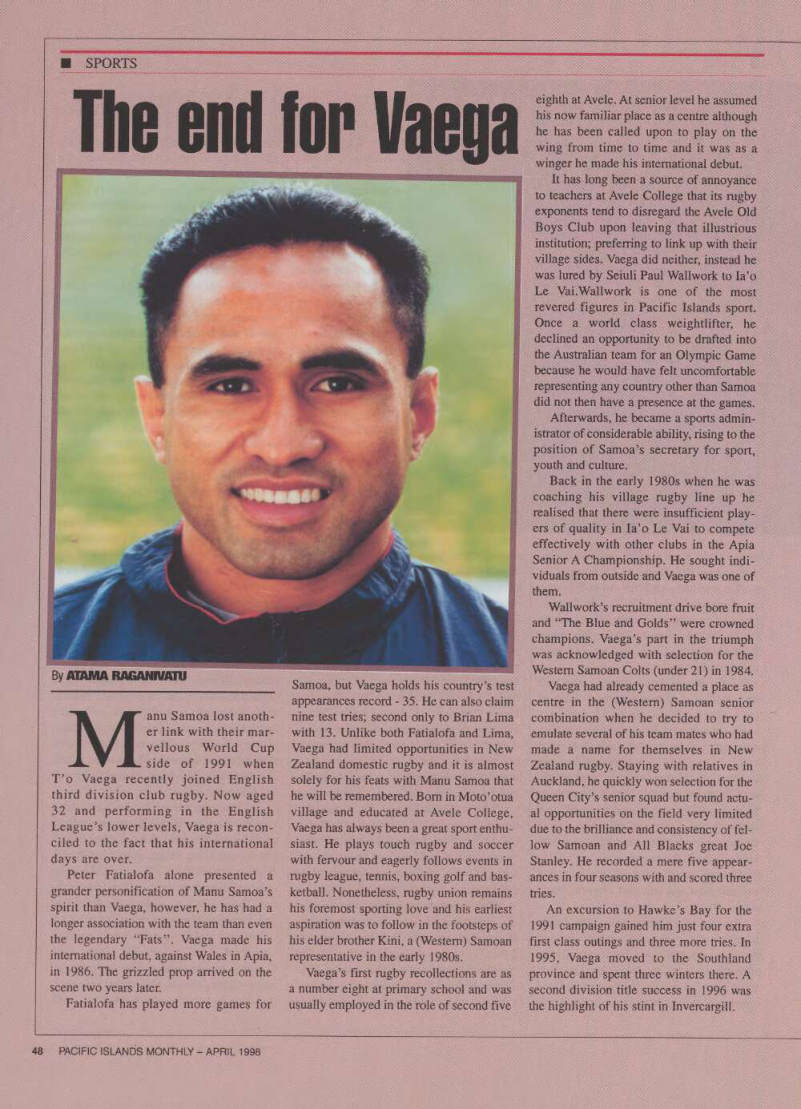
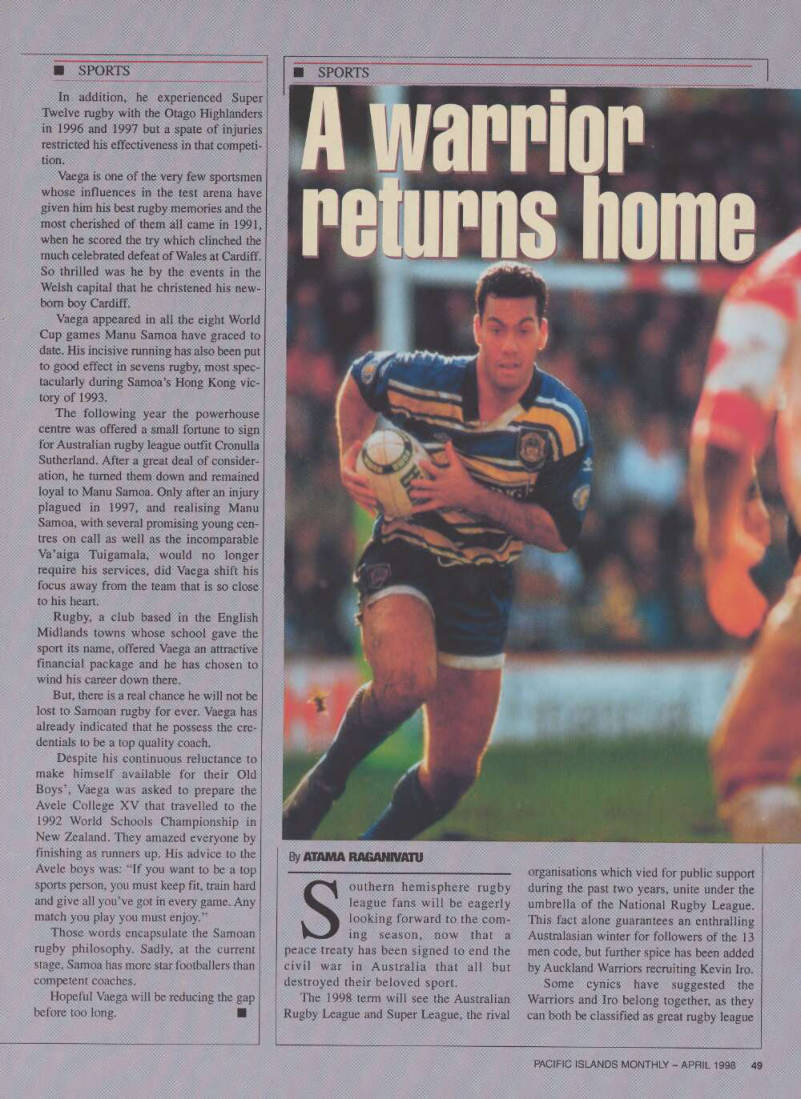
Sports
By Atama Raganivatu
Manu Samoa lost anoth er link with their mar vellous World Cup side of 1991 when T’o Vaega recently joined English third division club rugby. Now aged 32 and performing in the English League’s lower levels, Vaega is recon ciled to the fact that his international days are over.
Peter Fatialofa alone presented a grander personification of Manu Samoa’s spirit than Vaega, however, he has had a longer association with the team than even the legendary “Fats”. Vaega made his international debut, against Wales in Apia, in 1986. The grizzled prop arrived on the scene two years later.
Fatialofa has played more games for
Samoa, but Vaega holds his country’s test appearances record - 35. He can also claim nine test tries; second only to Brian Lima with 13. Unlike both Fatialofa and Lima, Vaega had limited opportunities in New Zealand domestic rugby and it is almost solely for his feats with Manu Samoa that he will be remembered. Bom in Moto’otua village and educated at Avele College, Vaega has always been a great sport enthu siast. He plays touch rugby and soccer with fervour and eagerly follows events in rugby league, tennis, boxing golf and bas ketball. Nonetheless, rugby union remains his foremost sporting love and his earliest aspiration was to follow in the footsteps of his elder brother Kini, a (Western) Samoan representative in the early 1980 s.
Vaega’s first rugby recollections are as a number eight at primary school and was usually employed in the role of second five
eighth at Avele. At senior level he assumed his now familiar place as a centre although he has been called upon to play on the wing from time to time and it was as a winger he made his international debut.
It has long been a source of annoyance to teachers at Avele College that its rugby exponents tend to disregard the Avele Old Boys Club upon leaving that illustrious institution; preferring to link up with their village sides. Vaega did neither, instead he was lured by Seiuli Paul Wallwork to la’o Le Vai. Wall work is one of the most revered figures in Pacific Islands sport.
Once a world class weightlifter, he declined an opportunity to be drafted into the Australian team for an Olympic Game because he would have felt uncomfortable representing any country other than Samoa did not then have a presence at the games.
Afterwards, he became a sports admin istrator of considerable ability, rising to the position of Samoa’s secretary for sport, youth and culture.
Back in the early 1980 s when he was coaching his village rugby line up he realised that there were insufficient play ers of quality in la’o Le Vai to compete effectively with other clubs in the Apia Senior A Championship. He sought indi viduals from outside and Vaega was one of them.
Wallwork’s recruitment drive bore fruit and “The Blue and Golds” were crowned champions. Vaega’s part in the triumph was acknowledged with selection for the Western Samoan Colts (under 21) in 1984.
Vaega had already cemented a place as centre in the (Western) Samoan senior combination when he decided to try to emulate several of his team mates who had made a name for themselves in New Zealand rugby. Staying with relatives in Auckland, he quickly won selection for the Queen City’s senior squad but found actu al opportunities on the field very limited due to the brilliance and consistency of fel low Samoan and All Blacks great Joe Stanley. He recorded a mere five appear ances in four seasons with and scored three tries.
An excursion to Hawke’s Bay for the 1991 campaign gained him just four extra first class outings and three more tries. In 1995, Vaega moved to the Southland province and spent three winters there. A second division title success in 1996 was the highlight of his stint in Invercargill.
In addition, he experienced Super Twelve rugby with the Otago Highlanders in 1996 and 1997 but a spate of injuries restricted his effectiveness in that competi tion.
Vaega is one of the very few sportsmen whose influences in the test arena have given him his best rugby memories and the most cherished of them all came in 1991, when he scored the try which clinched the much celebrated defeat of Wales at Cardiff.
So thrilled was he by the events in the Welsh capital that he christened his new born boy Cardiff.
Vaega appeared in all the eight World Cup games Manu Samoa have graced to date. His incisive running has also been put to good effect in sevens rugby, most spec tacularly during Samoa’s Hong Kong vic tory of 1993.
The following year the powerhouse centre was offered a small fortune to sign for Australian rugby league outfit Cronulla Sutherland. After a great deal of consider ation, he turned them down and remained loyal to Manu Samoa. Only after an injury plagued in 1997, and realising Manu Samoa, with several promising young cen tres on call as well as the incomparable Va’aiga Tuigamala, would no longer require his services, did Vaega shift his focus away from the team that is so close to his heart.
Rugby, a club based in the English Midlands towns whose school gave the sport its name, offered Vaega an attractive financial package and he has chosen to wind his career down there.
But, there is a real chance he will not be lost to Samoan rugby for ever. Vaega has already indicated that he possess the cre dentials to be a top quality coach.
Despite his continuous reluctance to make himself available for their Old Boys’, Vaega was asked to prepare the Avele College XV that travelled to the 1992 World Schools Championship in New Zealand. They amazed everyone by finishing as runners up. His advice to the Avele boys was: “If you want to be a top sports person, you must keep fit, train hard and give all you’ve got in every game. Any match you play you must enjoy.”
Those words encapsulate the Samoan rugby philosophy. Sadly, at the current stage. Samoa has more star footballers than competent coaches.
Hopeful Vaega will be reducing the gap before too long. ■
returns home
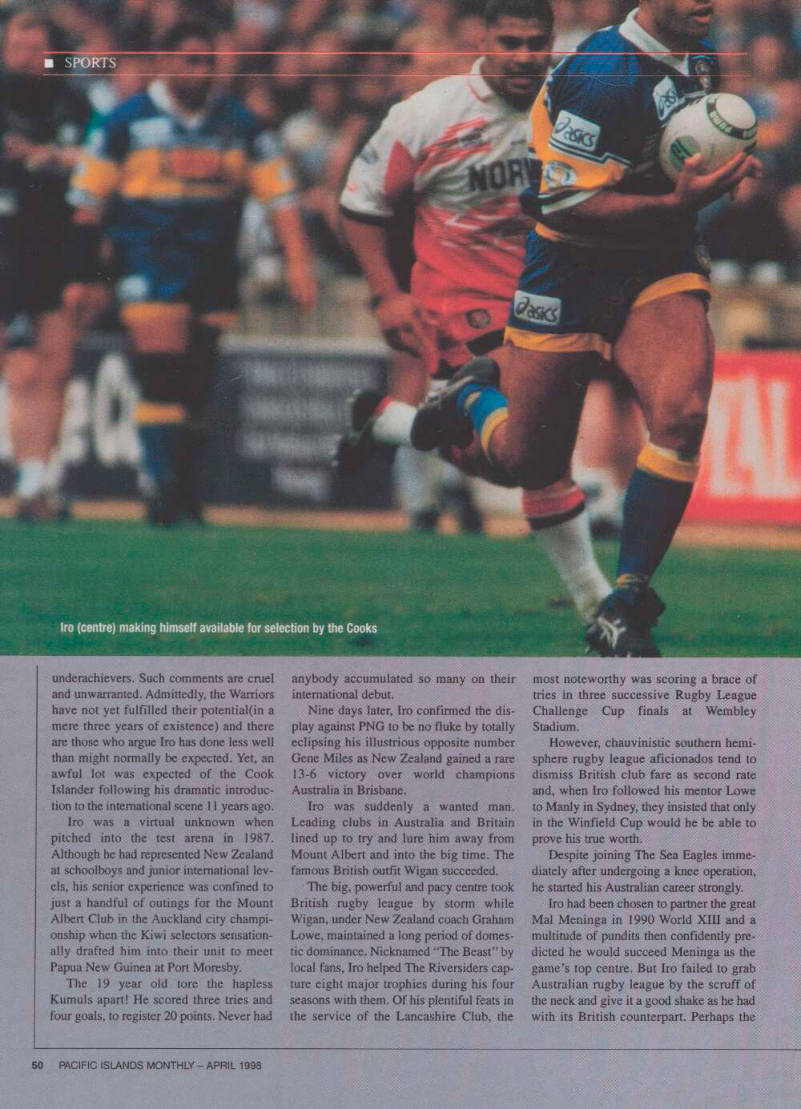
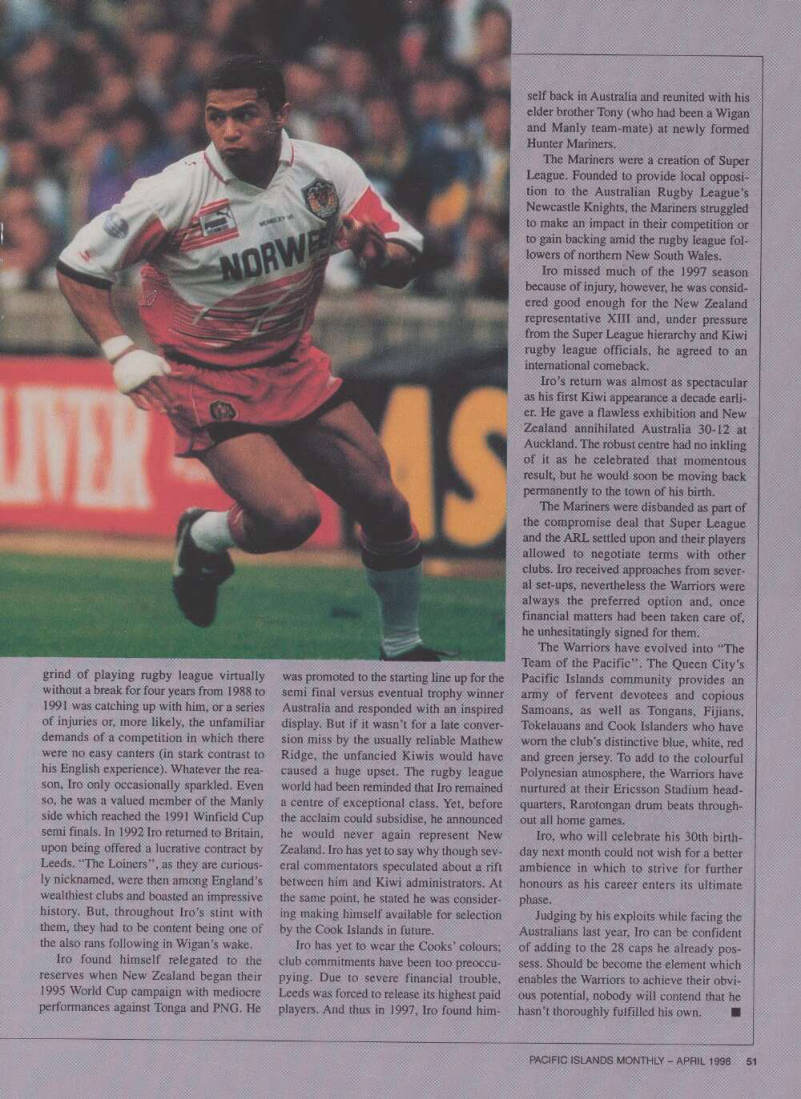
A warrior returns home
By Atama Raganivaiu
Southern hemisphere rugby
league fans will be eagerly looking forward to the coming season, now that a peace treaty has been signed to end the civil war in Australia that all but destroyed their beloved sport.
The 1998 term will see the Australian Rugby League and Super League, the rival
organisations which vied for public support during the past two years, unite under the umbrella of the National Rugby League.
This fact alone guarantees an enthralling Australasian winter for followers of the 13 men code, but further spice has been added by Auckland Warriors recruiting Kevin Iro.
Some cynics have suggested the Warriors and Iro belong together, as they can both be classified as great rugby league
underachievers. Such comments are cruel and unwarranted. Admittedly, the Warriors have not yet fulfilled their potential(in a mere three years of existence) and there are those who argue Iro has done less well than might normally be expected. Yet, an awful lot was expected of the Cook Islander following his dramatic introduc tion to the international scene 11 years ago.
Iro was a virtual unknown when pitched into the test arena in 1987.
Although he had represented New Zealand at schoolboys and junior international lev els, his senior experience was confined to just a handful of outings for the Mount Albert Club in the Auckland city champi onship when the Kiwi selectors sensation ally drafted him into their unit to meet Papua New Guinea at Port Moresby.
The 19 year old tore the hapless Kumuls apart! He scored three tries and four goals, to register 20 points. Never had
anybody accumulated so many on their international debut.
Nine days later, Iro confirmed the dis play against PNG to be no fluke by totally eclipsing his illustrious opposite number Gene Miles as New Zealand gained a rare 13-6 victory over world champions Australia in Brisbane.
Iro was suddenly a wanted man.
Leading clubs in Australia and Britain lined up to try and lure him away from Mount Albert and into the big time. The famous British outfit Wigan succeeded.
The big, powerful and pacy centre took British rugby league by storm while Wigan, under New Zealand coach Graham Lowe, maintained a long period of domes tic dominance. Nicknamed “The Beast” by local fans, Iro helped The Riversiders cap ture eight major trophies during his four seasons with them. Of his plentiful feats in the service of the Lancashire Club, the
most noteworthy was scoring a brace of tries in three successive Rugby League Challenge Cup finals at Wembley Stadium.
However, chauvinistic southern hemi sphere rugby league aficionados tend to dismiss British club fare as second rate and, when Iro followed his mentor Lowe to Manly in Sydney, they insisted that only in the Winfield Cup would he be able to prove his true worth.
Despite joining The Sea Eagles imme diately after undergoing a knee operation, he started his Australian career strongly.
Iro had been chosen to partner the great Mai Meninga in 1990 World XIII and a multitude of pundits then confidently pre dicted he would succeed Meninga as the game’s top centre. But Iro failed to grab Australian rugby league by the scruff of the neck and give it a good shake as he had with its British counterpart. Perhaps the
Iro (centre) making himself available for selection by the Cooks
grind of playing rugby league virtually without a break for four years from 1988 to 1991 was catching up with him, or a series of injuries or, more likely, the unfamiliar demands of a competition in which there were no easy canters (in stark contrast to his English experience). Whatever the rea son, Iro only occasionally sparkled. Even so, he was a valued member of the Manly side which reached the 1991 Winfield Cup semi finals. In 1992 Iro returned to Britain, upon being offered a lucrative contract by Leeds. “The Loiners”, as they are curious ly nicknamed, were then among England’s wealthiest clubs and boasted an impressive history. But, throughout Iro’s stint with them, they had to be content being one of the also rans following in Wigan’s wake.
Iro found himself relegated to the reserves when New Zealand began their 1995 World Cup campaign with mediocre performances against Tonga and PNG. He
was promoted to the starting line up for the semi final versus eventual trophy winner Australia and responded with an inspired display. But if it wasn’t for a late conver sion miss by the usually reliable Mathew Ridge, the unfancied Kiwis would have caused a huge upset. The rugby league world had been reminded that Iro remained a centre of exceptional class. Yet, before the acclaim could subsidise, he announced he would never again represent New Zealand. Iro has yet to say why though sev eral commentators speculated about a rift between him and Kiwi administrators. At the same point, he stated he was consider ing making himself available for selection by the Cook Islands in future.
Iro has yet to wear the Cooks’ colours; club commitments have been too preoccu pying. Due to severe financial trouble, Leeds was forced to release its highest paid players. And thus in 1997, Iro found him-
The Mariners were a creation of Super lowers of northern New South Wales. ered good enough for the New Zealand representative XIII and, under pressure from the Super League hierarchy and Kiwi rugby league officials, he agreed to an international comeback.
Iro’s return was almost as spectacular as his first Kiwi appearance a decade earli er. He gave a flawless exhibition and New Zealand annihilated Australia 30-12 at Auckland. The robust centre had no inkling of it as he celebrated that momentous result, but he would soon be moving back permanently to the town of his birth.
The Mariners were disbanded as part of the compromise deal that Super League and the ARL settled upon and their players allowed to negotiate terms with other clubs. Iro received approaches from sever al set-ups, nevertheless the Warriors were always the preferred option and, once financial matters had been taken care of, he unhesitatingly signed for them.
The Warriors have evolved into “The Team of the Pacific”. The Queen City’s Pacific Islands community provides an army of fervent devotees and copious Samoans, as well as Tongans, Fijians, Tokelauans and Cook Islanders who have worn the club’s distinctive blue, white, red and green jersey. To add to the colourful Polynesian atmosphere, the Warriors have nurtured at their Ericsson Stadium head quarters, Rarotongan drum beats through out all home games.
Iro, who will celebrate his 30th birth day next month could not wish for a better ambience in which to strive for further honours as his career enters its ultimate phase.
Judging by his exploits while facing the Australians last year, Iro can be confident of adding to the 28 caps he already pos sess. Should be become the element which enables the Warriors to achieve their obvi ous potential, nobody will contend that he hasn’t thoroughly fulfilled his own. ■
Advertisements & other items, p. 49 (1 item)
49
■ SPORTS
PACIFIC ISLANDS MONTHLY - APRIL 1998
■ SPORTS
In search of paradise
Literature
By Nicolas
Rothwell
IN the mid 19305, a young Norwegian couple, disen chanted with their own civili sation, decided to escape the chains of their circumstances. They searched for the most unspoilt spot on earth to spend a year long honeymoon immersed in scientific and social experiment. They chose the Marquesas, remotest of all the island groups of French Polynesia.
“We wanted to see if the two of us could resume the kind of life abandoned by our ancestors.” So began the much-charted intellectual and geographic adventures of Thor Heyerdahl.
Green was the Earth on the Seventh Day, part memoir, part ecological tract, reprises the engaging tale of Heyerdahl’s Marquesan sojourn, first published in his Fatu-Hiva. It also provides a clue to the pattern of the Kon-Tiki explorer’s restless life, and connects the theorist of Pacific Voyaging with the impassioned advocate of green causes. Heyerdahl, as Oceanic scholars know all too well, is an effective, high-profile communicator of his own con victions - he has a firm belief that early colonisation of Polynesia from South America occurred - with committed per suasiveness, he has re-enacted the skills of ancient navigators: and he has championed the harmonious virtues of pre-technologi cal civilisation.
These are among the best-known of his enthusiasms and they combine in Green Was The Earth, a work written in grand ret rospect from Heyerdahl’s new Peruvian home, where he can gaze out on pyramids built long ago, according to Inca legend, by the vanished priest-king Kon-Tiki.
The Heyerdahls, Thor and Liv, spent a
bracing year in their Marquesan paradise.
It turned out to be disease-ridden, socially
troubled and depopulated.
The collision of their idealism with colonial reality is played out against the backdrop of sombre expectations: they were waiting for the outbreak .of World War.
“The spectacular progress of the mod em world”, felt Heyerdahl, “had by-passed any ethical standard.” The island of Fatu- Hiva, by contrast, offered perilous canoe escapades in which our hero is suspended between death and life; climbs along the razor-thin mountain ridges; unusual meet ings with ghost-like hermit crabs.
Eccentric figures appear: the Protestant pastor whose flock is limited to himself and the sexton; the erudite copra plantation owner Henry Lie of Hiva Oa, who rejoices in his pulley-controlled house; even Tei Tetua, the last surviving ex-cannibal on Fatu-Hiva.
The youthful Heyerdahl’s professional orientation is set by his stumbling across
the now-famous Marquesan sculptures:
magnificent colossi plunged in jungle foliage, “with round eyes as big as life belts and grotesque mouths drawn out in diabolical grins wide enough to swallow a human body.”
This encounter, and reflection on the style and subjects of the statuary, helped set the course of Heyerdahl’s life-long cru sade. If the carvings resembled South American stonework, then ocean voyagers must have preceded them; and if the Pacific had been so crossed, the Atlantic and other oceans may well also have been early avenues of cultural dissemination and of commerce.
Heyerdahl, like a good number of Western explorers and intellectual beach combers, has long been obsessed with Easter Island, where he discerns not mere ly an American connection, but an envi ronmental message.
Care for planet earth, indeed, is the great theme of his later years, and this book makes plain that it was his initial, all consuming motivation - the cause that brought him in search of an imagined pris tine Pacific.
Treeless, shattered Easter Island, so movingly described in later Heyerdahl
books, has its own Marquesan analogue here - the uninhabited Motane Island, where “man and environment had both perished together” and nothing could be found but endless skeletons of animals and a few starving sheep.
“Never before had the sun, the very intensity of the sunlight, given me the same feeling as when a full moon shines on a cemetery. The white trees stood like tombstones over a pillaged graveyard; there were skulls and bones everywhere. It was midnight at noon.”
Perhaps unsurprisingly, despite the best intentions, the journey to the promised
island proved a temporary delight. Tropical
existence in the midst of a harsh landscape eventually palled, even if the Heyerdahls found a degree of calm and freedom on Fatu-Hiva that stayed with them in memo ry long after.
They felt, though, “an urge, an inconve nient need, to return to civilisation. But we did not want to be a single step father from nature than life in our part of the world made necessary.”
“Liv,” said Heyerdahl to his wife, and with these words he finished his first book on his Marquesan idyll, “One cannot buy a ticket to paradise.” For a summary work, though, and for one by the grand old man of geographic endeavour and exploration science, something rather more portentous was obviously felt to be necessary by way of conclusion, and Green Was The Earth offers its reader another 50 pages of epi logue, most of it in the form of a popular science exposition of cosmology and bio logical evolution retold in terms of the story of the seven days of creation.
End-game comes in the form of an invocation, a testament to Heyerdahl’s own children - both advice and moral message: “As we did before you, you may wonder forever why you were bom and what the purpose of life may be,” he muses: “Inside us is eternity and infinity, and there is where you will find both paradise and hell.
That is where God and the devil have their
battleground.”
And so, not a moment too soon, Green Was The Earth on The Seventh Day clos es, attempting with its last breath, much as its author has throughout his entire exis tence, to bridge two separate worlds.
Green was the Earth on the Seventh Day, by Thor Heyerdahl published by Little Brown, 1997. SA3S ■
Charting Stewart Island
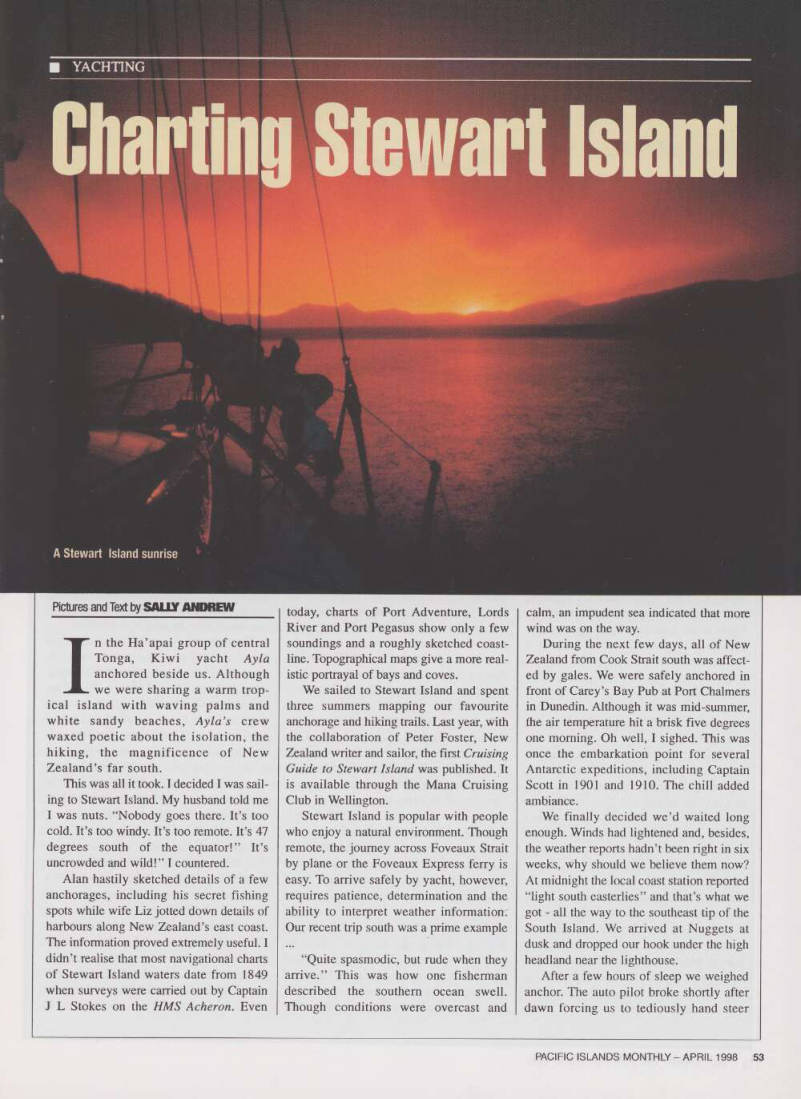
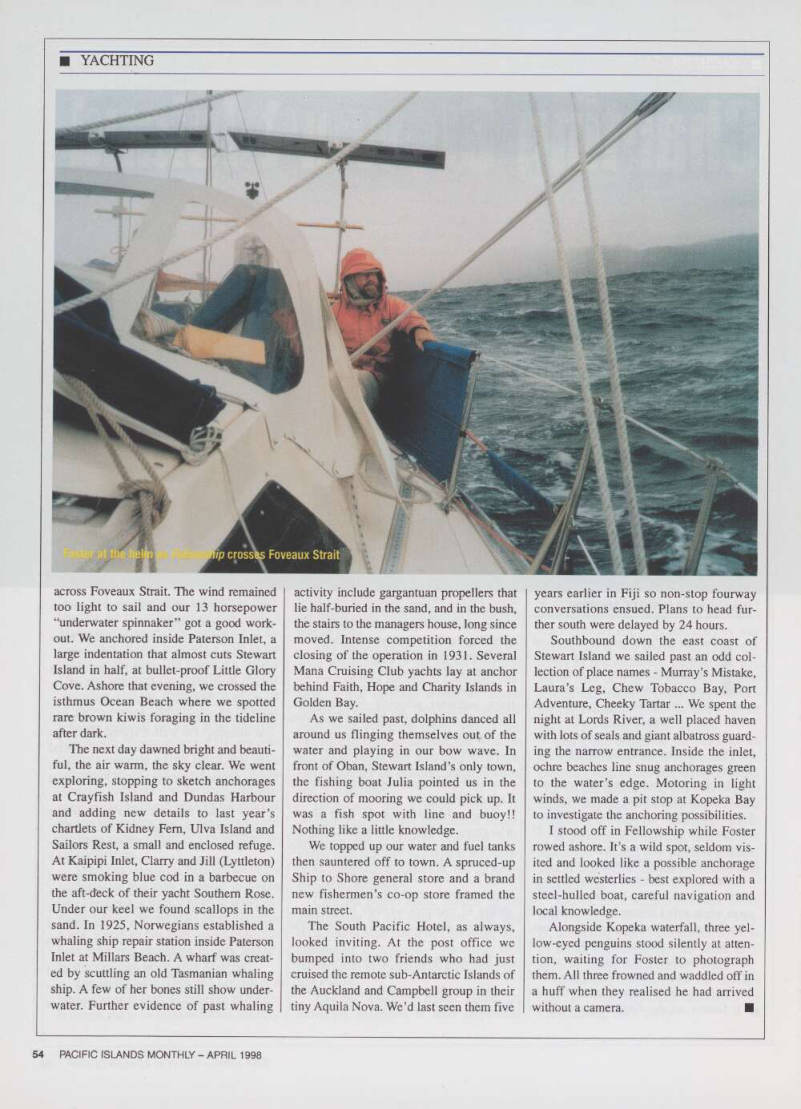
Yachting
Pictures and Text by SALLY ANDREW
In the Ha’apai group of central Tonga, Kiwi yacht Ayla anchored beside us. Although we were sharing a warm trop ical island with waving palms and white sandy beaches, Ayla’s crew waxed poetic about the isolation, the hiking, the magnificence of New Zealand’s far south.
This was all it took. I decided I was sail ing to Stewart Island. My husband told me I was nuts. “Nobody goes there. It’s too cold. It’s too windy. It’s too remote. It’s 47 degrees south of the equator!” It’s uncrowded and wild!” I countered.
Alan hastily sketched details of a few anchorages, including his secret fishing spots while wife Liz jotted down details of harbours along New Zealand’s east coast.
The information proved extremely useful. I didn’t realise that most navigational charts of Stewart Island waters date from 1849 when surveys were carried out by Captain J L Stokes on the HMS Acheron. Even
today, charts of Port Adventure, Lords River and Port Pegasus show only a few soundings and a roughly sketched coast line. Topographical maps give a more real istic portrayal of bays and coves.
We sailed to Stewart Island and spent three summers mapping our favourite anchorage and hiking trails. Last year, with the collaboration of Peter Foster, New Zealand writer and sailor, the first Cruising Guide to Stewart Island was published. It is available through the Mana Cruising Club in Wellington.
Stewart Island is popular with people who enjoy a natural environment. Though remote, the journey across Foveaux Strait by plane or the Foveaux Express ferry is easy. To arrive safely by yacht, however, requires patience, determination and the ability to interpret weather information: Our recent trip south was a prime example “Quite spasmodic, but rude when they arrive.” This was how one fisherman described the southern ocean swell.
Though conditions were overcast and
calm, an impudent sea indicated that more wind was on the way.
During the next few days, all of New Zealand from Cook Strait south was affect ed by gales. We were safely anchored in front of Carey’s Bay Pub at Port Chalmers in Dunedin. Although it was mid-summer, the air temperature hit a brisk five degrees one morning. Oh well, I sighed. This was once the embarkation point for several Antarctic expeditions, including Captain Scott in 1901 and 1910. The chill added ambiance.
We finally decided we’d waited long enough. Winds had lightened and, besides, the weather reports hadn’t been right in six weeks, why should we believe them now?
At midnight the local coast station reported “light south easterlies” and that’s what we got - all the way to the southeast tip of the South Island. We arrived at Nuggets at dusk and dropped our hook under the high headland near the lighthouse.
After a few hours of sleep we weighed anchor. The auto pilot broke shortly after dawn forcing us to tediously hand steer
A Stewart Island sunrise
across Foveaux Strait. The wind remained too light to sail and our 13 horsepower “underwater spinnaker” got a good work out. We anchored inside Paterson Inlet, a large indentation that almost cuts Stewart Island in half, at bullet-proof Little Glory Cove. Ashore that evening, we crossed the isthmus Ocean Beach where we spotted rare brown kiwis foraging in the tideline after dark.
The next day dawned bright and beauti ful, the air warm, the sky clear. We went
exploring, stopping to sketch anchorages
at Crayfish Island and Dundas Harbour and adding new details to last year’s chartlets of Kidney Fern, Ulva Island and Sailors Rest, a small and enclosed refuge.
At Kaipipi Inlet, Clarry and Jill (Lyttleton) were smoking blue cod in a barbecue on the aft-deck of their yacht Southern Rose.
Under our keel we found scallops in the sand. In 1925, Norwegians established a whaling ship repair station inside Paterson Inlet at Millars Beach. A wharf was creat ed by scuttling an old Tasmanian whaling ship. A few of her bones still show under water. Further evidence of past whaling
activity include gargantuan propellers that lie half-buried in the sand, and in the bush, the stairs to the managers house, long since moved. Intense competition forced the closing of the operation in 1931. Several Mana Cruising Club yachts lay at anchor behind Faith, Hope and Charity Islands in
Golden Bay.
As we sailed past, dolphins danced all around us flinging themselves out of the water and playing in our bow wave. In front of Oban, Stewart Island’s only town, the fishing boat Julia pointed us in the direction of mooring we could pick up. It was a fish spot with line and buoy!!
Nothing like a little knowledge.
We topped up our water and fuel tanks then sauntered off to town. A spruced-up Ship to Shore general store and a brand new fishermen’s co-op store framed the main street.
The South Pacific Hotel, as always, looked inviting. At the post office we bumped into two friends who had just cruised the remote sub-Antarctic Islands of the Auckland and Campbell group in their tiny Aquila Nova. We’d last seen them five
years earlier in Fiji so non-stop fourway conversations ensued. Plans to head fur ther south were delayed by 24 hours.
Southbound down the east coast of Stewart Island we sailed past an odd col lection of place names - Murray’s Mistake, Laura’s Leg, Chew Tobacco Bay, Port Adventure, Cheeky Tartar ... We spent the night at Lords River, a well placed haven with lots of seals and giant albatross guard ing the narrow entrance. Inside the inlet, ochre beaches line snug anchorages green to the water’s edge. Motoring in light winds, we made a pit stop at Kopeka Bay to investigate the anchoring possibilities.
I stood off in Fellowship while Foster rowed ashore. It’s a wild spot, seldom vis ited and looked like a possible anchorage in settled westerlies - best explored with a steel-hulled boat, careful navigation and
local knowledge.
Alongside Kopeka waterfall, three yel low-eyed penguins stood silently at atten tion, waiting for Foster to photograph them. All three frowned and waddled off in a huff when they realised he had arrived without a camera. ■
Foser at the helin as feltowsnip crosses Foveaux Strait
Zealand’s welfare system
Opinion
Moves to reform New Zealand’s welfare system
David Barber
Welungton
By the end of this month, New Zealanders should have told the government how they want the country’s welfare system reformed.
Well, some will have - those who bothered to read the 30- page booklet on the subject sent to all 1.3 million households in the land in February and the attached questionnaire and mailed back their responses.
The worry is, of course, that those who will be most affected by changes in the system - the 362,000 New Zealanders who are receiving welfare benefits - are the least likely to participate in the government’s consultative exercise. And that, as we all know, includes a large number of the Pacific Island community and a lot of Maori. (While the overall unemployment rate is around 6.7 per cent, for instance, for Pacific Islands people it has long been above 15 percent and for Maori even higher).
At the heart of the issue is the government’s proposed “Code of Social and Family Responsibility”, which was published in Cook Islands Maori, Samoan, Tongan and Maori, as well as English and Chinese, so there is no excuse for a poor response from the island community.
Behind it is a clear message: The country can no longer afford the cradle-to-grave care the government once offered every New Zealander. It is time for individuals to take responsibility for themselves. That means everything from rediscovering the work ethic to looking after their kids, managing their budgets, keeping fit and stop smoking to reduce health costs.
“A consensus needs to be established about what the govern ment, on behalf of the taxpayer, can do and what New Zealanders and their families must do for themselves,”
Prime Minister Jenny Shipley told Parliament. When she launched the process, there was inevitably suspicion that she was using public consultation to try to build a mandate for sweeping welfare reform, confident that the silent majority of New Zealanders want a shake-up of the benefit structure.
Whatever the goal, it’s clear that something needs to be done.
The government’s bill for health, welfare, education and pensions has soared from $l2 million to NZ$6B.5 million a day in under two decades. More than half of this goes on wel
fare payments, now the main source of income for about one-in five of the working age population. Even more worrying, nearly 30 percent of children live in families dependent on benefits. Most of these are living in sole parent families, sadly a high proportion of them Pacific Island people and even more Maori.
“The government cannot continue to increase funding of pro grammes seeking to solve problems when the answers sometimes lie elsewhere in the complex areas of personal and family rela
tionships, responsibilities and self-discipline,” Shipley said.
New Zealanders, she rightly said, were worried about issues like children’s health, fatherless families, young people at risk, mental illness and unemployment, and she called for an “open, searching, honest and if necessary provocative” debate on social policy as a precursor to change. Critics certainly saw the proposed code as provocative. Shipley insisted it would apply to all New Zealanders, not just beneficiaries, and she denied charges that she was setting the scene for another across-the-board cut in benefits as she did in 1991 when Social Welfare Minister.
The code sets out 11 basic “expectations”, which few people could disagree with, though it is obvious many play lip service to them. They range from parents should love and care for their chil dren, to people should keep themselves healthy and beneficiaries should actively seek work. But a series of “discussion points” in the booklet provided pointers to the government’s thinking. They asked whether beneficiaries who don’t work should do communi ty service, whether parents who don’t make their kids go to school should lose their benefits, whether income support should be linked to child health checks and immunisation and whether peo ple who repeatedly sought emergency help should be made to have free budget advice.
And Deputy Prime Minister Winston Peters, who dreamed up the idea of a code of social responsibility in the first place, fanned fears of a clamp down on benefits. “Every New Zealander knows of somebody ripping off the welfare system,” he told Parliament.
“Social welfare is crippling the taxpayers of this country.”
Opposition parties predictably attacked the code. Labour lead er Helen Clark saying it was draconian and would attempt to “rank people’s needs, playing widows, children, single parents and oth ers off against one another”.
Said her social welfare spokesman Steve Maharey; “If benefi ciaries do not meet these expectations then they are going to find their benefits cut. It is obvious that’s what they’re going to do, otherwise this whole exercise is pointless.
“The government has begun its war on what is left of the wel fare state.” Some reform is inevitable. The extent of it remains to be seen. The government may well have made up its mind. But if people don’t take advantage of the opportunity to tell the politi cians what they think, they have only themselves to blame if they don’t like the outcome. ■
The new face
of investment in the Pacific
Jemima Garrett
Sydney
Until the last few years if you were a busi nessperson in the Pacific looking for venture capital you had a hard road to hoe. There were no major venture capital providers in the region and if you visited those in Sydney or any other nearby centre you would probably be offered a deal which required a 100 percent per annum return on investment.
Not a very attractive prospect, especially if you were looking for venture capital over a period of five years or more. In many cases you would not be offered a deal at any price. The high rate of return asked in Australia and New Zealand is still a problem but there is now an alternative the SUSI 7 million Kula Fund announced by Chief Emeka Anyouku, the Secretary General of the Commonwealth when he visited the Pacific recently.
In fact, the Kula Fund has been up and running for 10 months and it is one of a crop of new venture capital providers established by development agencies working with the private sector. The difference with the Kula Fund is its vision for its future. Ashley Emberson-Bain, the regional manager of the Commonwealth Development Corporation, is the man overseeing the Kula Fund and he has nothing short of a breath-takingly ambitious plan for it.
He wants to have all his investment capital placed with in three years. Once the first Kula Fund is proving a suc cess he plans to go on and crack the Australian and New Zealand market by attracting superannuation funds and other big institutional investors to put their money into a second Kula Fund. This would be a major breakthrough. It would mean Pacific island business had come of age and that it had won the confidence of the most conservative ele ments of business in neighbouring developed countries.
At the moment those big funds have written-off the Pacific believing firstly, that the quality of the deal flow is not present (ie that they can not get the returns they want) and secondly, that the quantity of the deal flow is not there (that there are not enough investment opportunities to make the whole thing worth their while). It’s a similar story with the venture capital providers. The generally slow economic growth in the Pacific makes it unattractive and with little local knowledge it is hard for them to identify good
prospects. To top it off the cost of trips to supervise their investments (both in terms of airfares and accomodation and time lost from the office) makes these investments almost impossible.
That is where Emberson-Bain believes he has the advan tage - with local knowledge and the experience in finance in the Pacific. Still, he knows it will be a difficult task. To prove to outside institutions that the Pacific offers viable investment opportunities, the Kula Fund must be run along purely commercial lines and set a commercial rate of return on its investments. That rate is around 30 percent per annum but it is not daunting Emberson-Bain.
“We have a strong pipeline of investments and I must say it becomes stronger by the day,” Emberson-Bain told PIM. “I hope to have dispersed 46 percent of the fund by the end of the year,” he said. The first Kula Fund invest ment went into the very successful Fiji company. Pacific Green, which transforms coconut trees which are past their use-by date as coconut producers into sawn timber and fur niture.
The Kula Fund investment is helping Pacific Green to expand into architectural products and building supplies.
For businesses without the amazing growth necessary to return full commercial rates on venture capital invest ments, there are subsidised options such as the Brisbane based Pacific Islands Investment Fund (PIIF) operated by the World Bank’s International Finance Corporation (IFC) or the Pacific capital Investment Fund (PCIF) run by the CDC in Port Moresby.
Perhaps more interesting to businesses just starting out or ready to expand but not sure of the way to go about it, are services of the South Pacific Project Facility (SPPF) in Sydney. It offers help with everything from business plans and feasibility studies through to finance and training, at a fraction of the usual cost. What all these new breed of finance and advice services have in common is a philoso phy of self-reliance and an aversion to any business which is relying on preferential trade deals.
“We don’t want to invest in companies that are ... suc cessful commercially because they have some kind of trade preference or protection,” said Emberson-Bain. On compa nies using the SPARTECA trade preferences into Australia and New Zealand (such as many of Fiji’s garment manu facturers) Emberson-Bain is wary.
“We would look at those carefully because ultimately those preferences are not sustainable,” he said. The busi ness proposals that are winning support are in areas where the Pacific has a lasting competitive advantage - in tourism, any sort of fishing, fish processing or fishing sup port services and in environmentally-friendly logging or timber processing. Emberson-Bain has projects in most of those areas on his books and from a range of countries. With shrinking aid flows, the region is being forced to look at alternative sources of capital to finance its economic growth requirements.
“Our attitude is that the Kula Fund is part of an initia tive that will hopefully bring private sector capital into the Pacific,” said Emberson-Bain. ■
Shipping
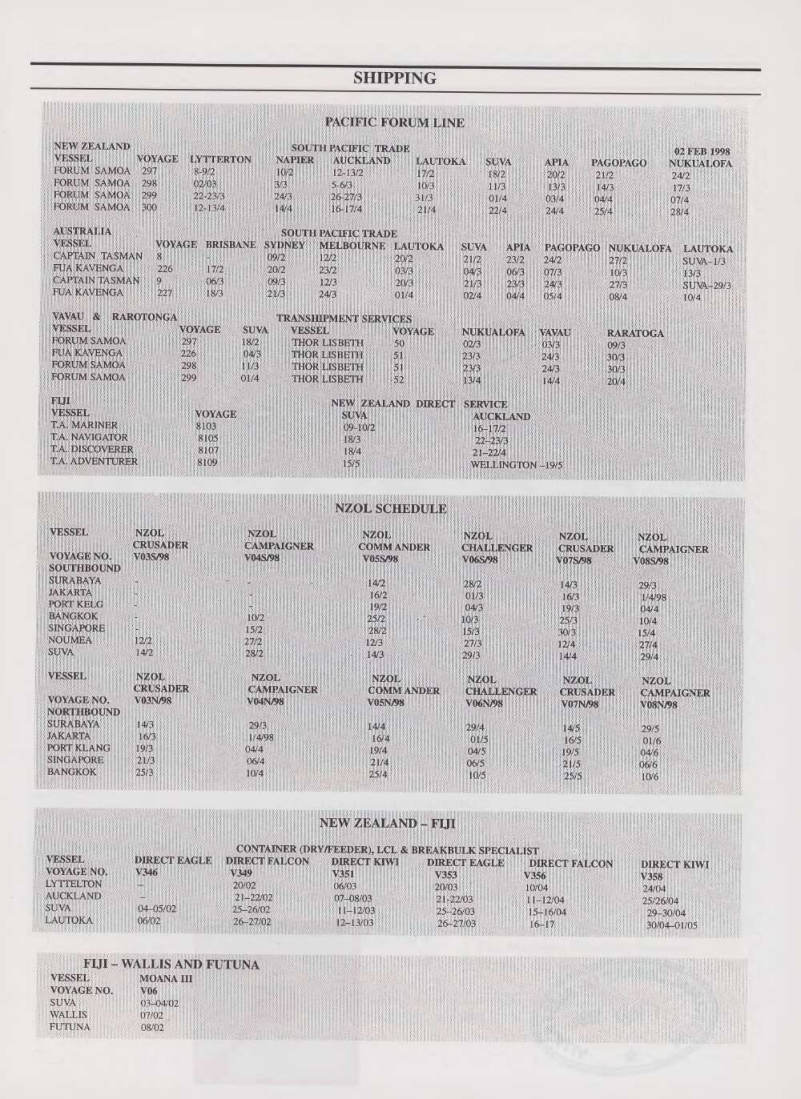
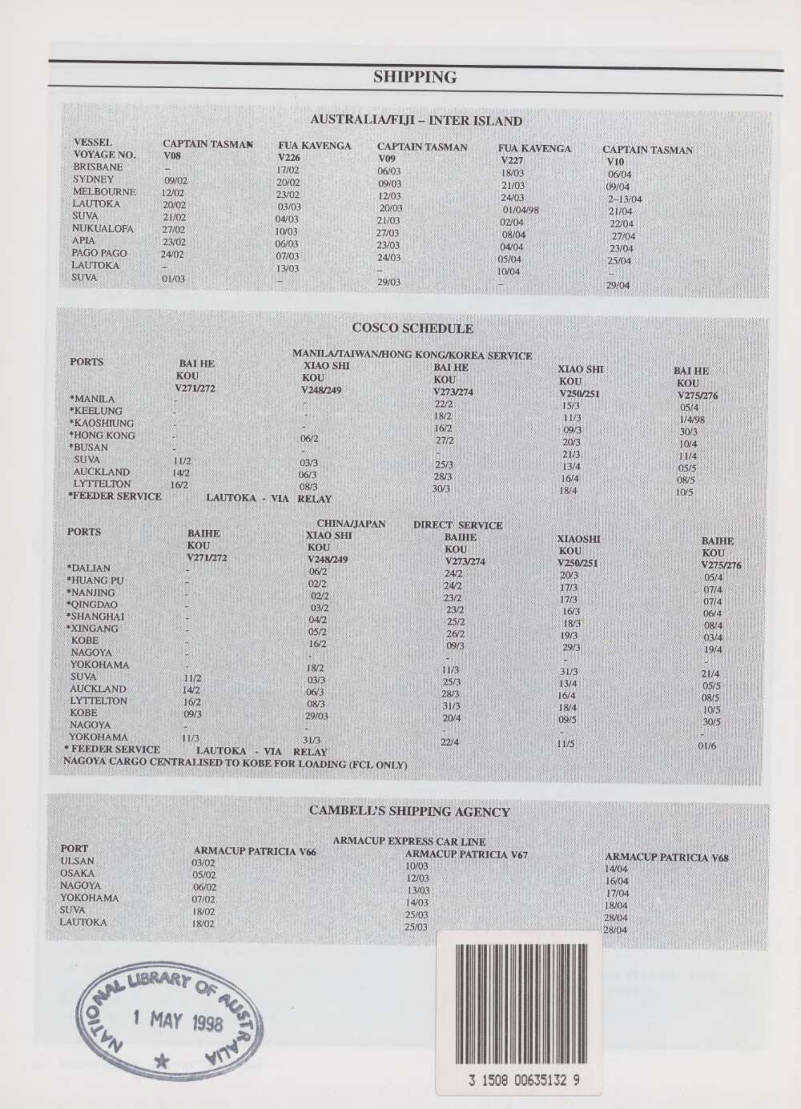
Pacific Forum Line
Nzol Schedule
New Zealand - Fiji
New Zealand
South Pacific Trade
02 Feb 1998
Vessel Voyage
Lytterton
Napier Auckland
Lautoka
Suva
Apia
Pagopago
Nukualofa
Forum Samoa
297 8-9/2 10/2 12-13/2 17/2 18/2 20/2 21/2 24/2
Forum Samoa
298 02/03 3/3 5-6/3 10/3 11/3 13/3 14/3 17/3
Forum Samoa
299 22-23/3 24/3 26-27/3 31/3 01/4 03/4 04/4 07/4
Forum Samoa
300 12-13/4 14/4 16-17/4 21/4 22/4 24/4 25/4 28/4
Australia
South Pacific Trade
Vessel
Voyage Brisbane
Sydney Melbourne
Lautoka
Suva
Apia
Pagopago Nukualofa Lautoka
Captain Tasman 8
- 09/2 12/2 20/2 21/2 23/2 24/2 27/2
Suva-1/3
Fua Kavenga
226 17/2. 20/2 23/2 03/3 04/3 06/3 07/3 10/3 13/3
Captain Tasman
9 06/3 09/3 12/3 20/3 21/3 23/3 24/3 27/3
Suva-29/3
Fua Kavenga
227 18/3 21/3 24/3 01/4 02/4 04/4 05/4 08/4 10/4
Vavau & Rarotonga
Transhipment Services
Vessel
Voyage
Suva Vessel
Voyage
Nukualofa
Vavau
Raratoga
Forum Samoa
297 18/2
Thor L1Sbeth
50 02/3 03/3 09/3
Fua Kavenga
226 04/3
Thor Lisbeth
51 23/3 24/3 30/3
Forum Samoa
298 11/3
Thor Lisbeth
51 23/3 24/3 30/3
Forum Samoa
299 01/4
Thor Lisbeth
52 13/4 14/4 20/4
Fiji
New Zealand Direct
Service
Vessel
Voyage
Suva
Auckland
T.A. Mariner
8103 09-10/2 16-17/2
Ta. Navigator
8105 18/3 22-23/3
T.A. Discoverer
8107 18/4 21- -22/4
T.A. Adventurer
8109 15/5
Wellington
-19/5
Vessel
Nzol
Nzol
Nzol
Nzol
Nzol
Nzol
Voyage No.
Southbound
Crusader
Campaigner
Comm Ander
Challenger
Crusader
Campaigner
V03S/98 V04S/98 V05S/98 V06S/98 V07S/98 V08S/98
Surabaya
- - 14/2 28/2 14/3 29/3
Jakarta
- - 16/2 01/3 16/3 1/4/98
Port Kelg
- - , 19/2 04/3 19/3 04/4
Bangkok
- 10/2 25/2 10/3 25/3 10/4
Singapore
- 15/2 28/2 15/3 30/3 15/4
Noumea
12/2 27/2 12/3 27/3 12/4 27/4
Suva
14/2 28/2 - 14/3 29/3 14/4 29/4
Vessel
Nzol
Nzol
Nzol
Nzol
Nzol
Nzol
Voyage No.
Northbound
Crusader
Campaigner
Comm Ander
Challenger
Crusader
Campaigner
V03N/98 V04N/98 V05N/98 V06N/98 V07N/98 V08N/98
Surabaya
14/3 29/3 14/4 29/4 14/5 29/5
Jakarta
16/3 1/4/98 16/4 01/5 16/5 01/6
Port Klang
19/3 04/4 19/4 04/5 19/5 04/6
Singapore
21/3 06/4 21/4 06/5 2J/5 06/6
Bangkok
25/3 10/4 25/4 10/5 25/5 10/6
Container (Dry/Feeder), Lcl & Breakbulk Specialist
Vessel
Direct Eagle
Direct Falcon
Direct Kiwi
Direct Eagle
Direct Falcon
Direct Kiwi
Voyage No.
V346 V349 V351 V353 V356 V358
Lyttelton
- 20/02 06/03 20/03 10/04 24/04
Auckland
- 21-22/02 07-08/03 21-22/03 11-12/04 25/26/04
Suva
04-05/02 25-26/02 11-12/03 25-26/03 15-16/04 29-30/04
Lautoka
06/02 26-27/02 12-13/03 26-27/03 16-17 30/04-01/05
Fiji-
Wallis And Futuna
Vessel
Moana Iii
Voyage No.
V06
Suva
03-04/02
Wallis
07/02
Futuna
08/02
Australia/Fiji - Inter Island
Cosco Schedule
Cambell’S Shipping Agency
Vessel
Voyage No.
Captain Tasmam
Vos
Fua Kavenga
V226
Captain Tasman
V09
Fua Kavenga
V227
Captain Tasman
V10
Brisbane
Sydney
Melbourne
Lautoka
09/02 12/02 20/02 17/02 20/02 23/02 03/03 06/03 09/03 12/03 20/03 18/03 21/03 24/03 01/04/98 06/04 09/04 2-13/04 21/04
Suva
Nukualofa
21/02 27/02 04/03 10/03 21/03 27/03 02/04 08/04 22/04 27/04
Apia
Pago Pago
Lautoka
Suva
23/02 24/02 01/03 06/03 07/03 13/03 23/03 24/03 29/03 04/04 05/04 10/04 23/04 25/04 29/04
Ports
Manela/Taiwan/Hong Kong/Korea Service
Bai He Xiao Shi
Bai He
Xiao Shi
Bai He
* Manila
Kou Kou
V271/272 V248/249
Kou
V273/274
Kou
V250/251
Kou
V275/276
*Kjeelung
22/2 15/3 05/4
♦Kaoshiung
♦Hong Kong
♦Busan
06/2 18/2 16/2 27/2 1 1/3 09/3 20/3 1/4/98 30/3 10/4
Suva
Auckland
Lyttelton
♦Feeder Service
H/2 03/3 14/2 06/3 16/2 08/3
Lautoka - Via Relay
25/3 28/3 30/3 21/3 13/4 16/4 18/4 11/4 05/5 08/5 10/5
Ports
China/Japan
Direct Service
Baihe Xiao Shi
Baihe
Xiaoshi
Baihe
Kou Kou
Kou
Kou
Kou
♦Dalian
♦Huang Pu
♦Nanjing
♦Qingdao
♦Shanghai
♦Xingang
Kobe
Nagoya
V27I/272 V248/249
06/2 02/2 02/2 03/2 04/2 05/2 16/2 V273/274 24/2 24/2 23/2 23/2 25/2 26/2 09/3 V250/251 20/3 17/3 17/3 16/3 18/3 19/3 29/3 V275/276 05/4 07/4 07/4 06/4 08/4 03/4 19/4
Yokohama
Suva
Auckland
Lyttelton
Kobe
Nagoya
18/2 11/2 03/3 14/2 06/3 16/2 08/3 09/3 29/03 11/3 25/3 28/3 31/3 20/4 31/3 13/4 16/4 18/4 09/5 21/4 05/5 08/5 10/5 30/5
Yokohama
♦ Feeder Service
11/3 31/3
Lautoka - Via Relay
22/4 11/5 01/6 NAGOYA CARGO CENTRALISED TO KOBE FOR LOADING (FCL ONLY)
Port
Ulsan
Osaka
Nagoya
Yokohama
Suva
Lautoka
Armacup Patricia V66
03/02 05/02 06/02 07/02 18/02 18/02
Armacup Express Car Line
Armacup Patricia V67
10/03 12/03 13/03 14/03 25/03 25/03
Armacup Patricia V68
14/04 16/04 17/04 18/04 28/04 28/04
Advertisements & other items, pp. 58-60 (2 items)
Shipping
Stamping Fiji'
■ini
11VV 1 1(11 LI V IV
Collect the World Cup Stamp issue and commemorate Fiji’s victory at the 1997 Rugby World Cup Sevens m * t * M 250 IJ IJ IJ IJ a
FIJIANS WIN THE
RUGBY WORLD CUP SEVENS 1997
FIJIANS WIN THE
RUGBY WORIO CUP SEVENS 1997
FIJIANS WIN THE
RUGBY WORLD CUP SEVENS 1997
FIJIANS WIN THE
RUGBY WORLD CUP SEVENS 1997
ml warm
MNIM
mJm
k
Upso‘s
50 IJ IJ»50 FIJI RUGBY WORLD CUP SEVENS CHAMPIONS 1997
MELROSE CUP
i FIJI - SEVEN TIMES WINNERS OF HONG KONG SEVENS Now available at all major Post Offices Presentation Pack - $lO.OO Souvenir Sheet (above) - $6.00 First Day Cover - 6.00 & $2.00 /iW
Fiji*
For more information: The Manager, Philatelic Bureau, PO Box 100, Suva, Fiji Islands.
Mail orders are also welcome. Major credit cards accepted on mail orders: AMERICAN EXPRESS,
MASTER CARD, VISA CARD, DINERS CLUB.
r
KIAORA! BULAVINAKA!
MAEVA! ALOHA!
HOWEVER WE SAY IT,
IT MEANS WELCOME!
Budget
Fiji 722 636 Papua New Guinea 325 4111 Vanuatu 23170 New Caledonia 262 009 Hawaii 838 1111 Western Samoa 20561 Australia 1300 362 848 New Zealand 0800 652 227 / am