Pacific Blands
Monthly
Inside: Leadership Struggle On Tuvalu
February 1998
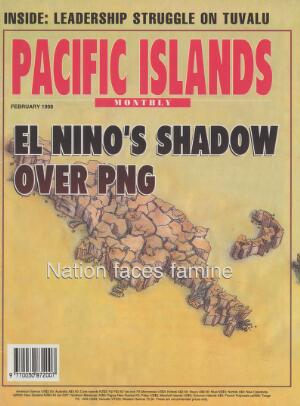
F L Mino S Shadow
t
American Samoa US$2.5O; Australia A 53.50; Cook Islands NZ$3; Fiji F 52.50 Vat incl; FS Micronesia US$3; Kiribati A 52.50; Nauru A 52.50; Niue NZ$3; Norfolk As 3; New Caledonia cpf2so; New Zealand NZ53.45 incl GST; Northern Marianas US$3; Papua New Guinea K 3; Palau US$3; Marshall Islands US$3; Solomon Islands As 3; French Polynesia cpf3oo; Tonga P 3; USA US$3; Vanuatu VT22O; Western Samoa T 5.50. These are recommended prices only.
Advertisements & other items, p. 2 (1 item)
Caledonia
<f H ‘ o J r' / A'
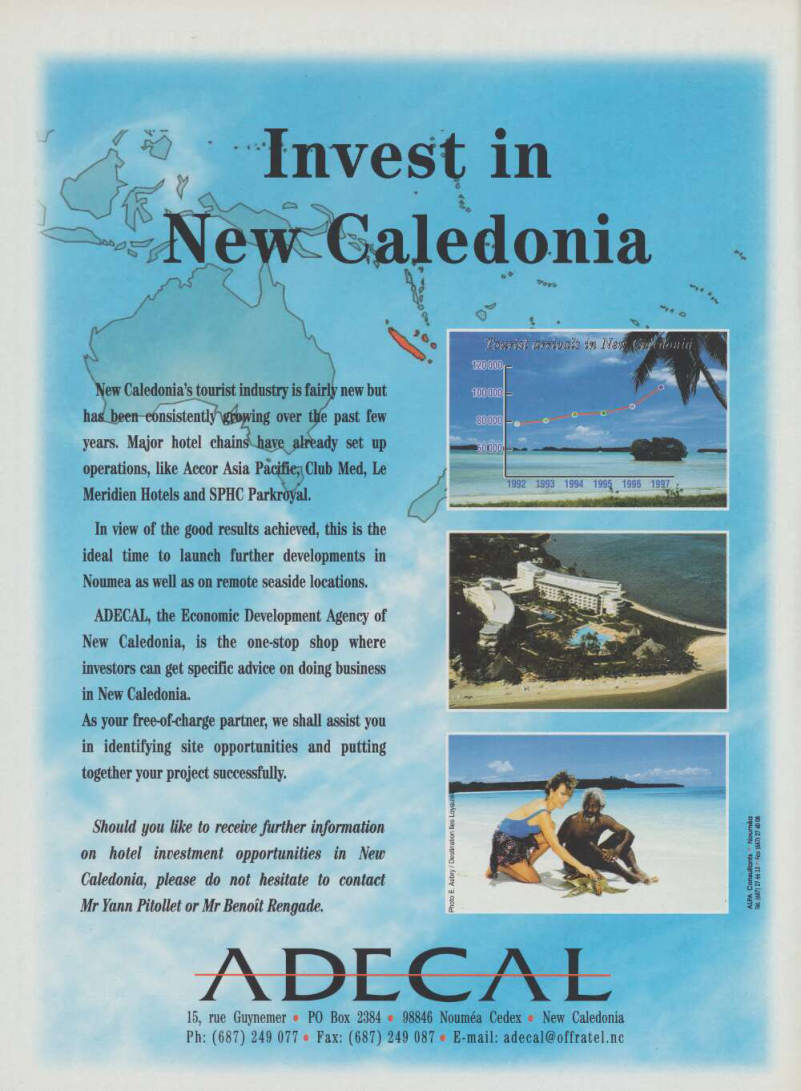
Invest in
New Caledonia’s tourist industry is fairly new but hasbeen tonsistently growing over the past few years. Major hotel chainS have already set up operations, like Accor Asia Pacific, Club Med, Le Meridien Hotels and SPHC Parkroyal.
In view of the good results achieved, this is the ideal time to launch further developments in Noumea as well as on remote seaside locations.
ADECAL, the Economic Development Agency of New Caledonia, is the one-stop shop where investors can get specific advice on doing business in New Caledonia.
As your free-of-charge partner, we shall assist you in identifying site opportunities and putting together your project successfully.
Should you like to receive further information on hotel investment opportunities in New Caledonia, please do not hesitate to contact Mr Yam Pitollet or Mr Benoit Rengade.
AOE
O 1201000 -hi ii mi mm
iIOOOOO
80000 1992 1393 1994 1906 1997 g s Eg 3 c-j O „ 2 i A I I V 15, rue Guyneraer • PO Box 2384 « 98846 Noumea Cedex 9 New Caledonia Ph: (687) 249 077 . Fax: (687) 249 087 . E-mail: [email protected]
Pacific Islands
Monthly
Vol 68 Ho. 2
The Hews Magazihe
February 1998
PUBLISHER: Alan Robinson ACTING EDITOR: Bernadette Hussain SENIOR WRITER: Bernadette Hussain
Correspondents:
Sally Andrew, Patrick Decloitre, Giff Johnson, Chris Peteru, Susan Prokop, Atama Raganivatu, Michael Field, Liz Thompson, Lili Tuwai, Sam Vulum, lan Williams, Florence Syme-Buchanan COLUMNISTS: David Barber (Wellington), Jemima Garrett (Sydney), Debbie Singh (South Pacific Commission).
GRAPHIC ARTISTS: James Ranuku, Josefa Bola, Andrew Williams
Advertising Sales
Senior Regional Sales (South Pacific) Shabana Naaz Tel (679) 304111, 303244, Fax (679) 303809.
Sydney, Canberra: Bob Hill Media Representation, Tel (61-2) 4164245, Fax (61-2)4165064.
Brisbane: Jane Fewings Media and Advertising Associates Tel (61-7) 3378 4522, Fax (61-7) 3878 1071.
Adelaide: Hastwell Williamsons Representatives. Tel (61-8) 3799522, Fax (61-8) 3799735.
Melbourne: Brown Orr Fletcher Burrows (Aust) Pty Ltd.
Tel (61-3) 98265188, Fax (61-3) 98265644.
Auckland: McKay & Bowman, International Media Representatives Limited, Tel (64-9) 4190561, Fax (64-9) 4192243.
Japan: Universal Media Corporation, Tokyo, Tel (3) 3266626741.
Cable: UNI-MEDIA Tokyo, Fax (3) 32626742.
Pacific Islands Monthly was founded in 1930
(Usps 9522480).
A Fiji Times Limited production.
Cover prices are recommended retail only. Registered by Australia Post, Publication No. NBPI2IO. © Copyright Fiji Times Limited, 177 Victoria Parade, Suva, Fiji.
Tel (679) 304111, fax (679) 303809.
Email: [email protected] PIM Website: http://www.pira.com.fj Pacific Islands Monthly is published monthly by Fiji Times Limited, a division of Nationwide News, 2 Holt Street, Surry Hills, Sydney, NSW 2010.
Send Address Changes To:
Pacific Islands Monthly POBox 1167 Suva, Fiji.
Typeset and printed by The Fiji Times Limited, 177 Victoria Parade, Suva, Fiji.
Layout and cover design by Josefa Bola
Inside
Cover Story: Drought in PNG worsens
Editorial 4 Letters to the Editor 5 From the Archives 7 Briefs 7 Fiji dollar drops 20 per cent 8 Special Report: US adoptions a major industry 9 Cover stories: Drought in PNG worsens 14 Uproar in Vanuatu 24 Skate on thin ice 27 Dengue epidemic hits Fiji 28 A chance to start anew 29 Apocalypse over ... peace now in Bougainville 32 Airline tragedy prompts family support act 34 Leadership struggle on Tuvalu 35 Freedom's gains and setbacks in the Pacific 37 Legal tender controversy 38 Cooks' situation likely to worsen in 1998 39 Preserving sacred burial caves 40 Manu - Pacific's pride in Hollywood 42 Sports 43 Culture, Art, Book Review 47 The magic of pine and teachers 52 Opinion 54
Page 9
Page 32
Page 46
Guinea despite

Editorial
As nearly a quar ter of the popu lation of Papua New Guinea
suffers in varying degrees
from the ravages of the worst drought in memory, the world and the region has rushed in with aid.
Australia, New Zealand and Fiji are the front runners.
But it has been evident, once again, that aid delivery is no simple task - especially in times of crisis.
Food shipments have been mobbed. Aid personnel - even the military - have felt threatened as desperate villagers descended on food supplies.
That the scope of the crisis caught PNG and the rest of the region off guard, is undeniable.
But who could possibly have planned for such a tragedy at a time of year when the rain is normally so reliable?
Of course, it’s the El Nino effect - the Pacific Ocean warming phenomenon that has delivered such catastrophic consequences.
Nothing, it seems, can be done to prevent - or even predict - its ravages.
Countries like PNG with their rugged terrain and consequent ly poor infrastructure are especially vulnerable.
If PNG possessed good roads from Port Moresby and coastal centres into the interior, the delivery of aid would be so much easier.
Aid reaches Papua New Guinea despite difficulties
As it is, almost every thing has to go by air and much of that by helicopter. It’s expen sive and it’s slow. But at least it’s being done.
No praise is too high for the people in the air and on the ground who
are doing their utmost to ensure that all the hungry receive a fair share of what’s available.
It’s often not a popular task as desperate people adopt desper ate measures but the aid teams have performed well under the most difficult of circumstances.
But it’s clearly not over. With drought comes disease and it’s entirely possible that we have not seen the worst of this tragedy that is likely, according to reliable estimates, to affect up to a mil lion people on the PNG side of the island alone.
What’s likely to be happening across the border in Irian Jaya is too terrible to contemplate as Indonesia struggles with its cur rency and economic crises.
As always, on both sides of the border, the very young and the very old are among the first to suffer.
Reliable figures are hard to come by but there will already have been deaths from the drought and there are probably many more to come. That’s why it is so vital for the aid effort to con tinue. PNG’s neighbours have reacted positively thus far. The effort has to be maintained. ■
Letters To The Editor

Fishing for red herrings
Dear Madam, I am still reeling from shock after read ing the article by Kalinga Seneviratne titled Women and Fisheries which was fea tured in the PIM for December 1997 (pp 21 - 22). The article makes reference to me on various occasions and suggests that comments were made by myself in an interview with a representative of the mag azine.
On reading the article, I managed to catch quite a few red herrings as the article is riddled with misinformation. I would, therefore, like to take this opportunity to set the record straight.
I do not recall speaking to a journalist of PIM. When I asked others who Kalinga Seneviratne was I was told that this was the gentleman who visited the SPC Noumea headquarters in February 1997. It is true that I spoke to Mr Seneviratne but he was not introduced to me or others in the SPC Fisheries Programme as a journal ist of PIM. We were told that Mr
Seneviratne was interested in learning about the programme activities of SPC. It is not unusual that we have members of the public dropping in for information and advice so I was only too happy to discuss the SPC Women’s Fisheries Development Project with Mr Seneviratne.
I am not the former head of the fisheries management section of the Ministry of Marine Resources in the Cook Islands. My former post was Director of Fisheries Research. I did not state that the SPC Women’s Fisheries Development Project was set up after many studies found that, although women were involved in fisheries in many ways, they were not given the nec essary support by governments.
The project was actually set up at the request of government representatives of SPC member countries.
I did not state that in countries such as Fiji, even the new canneries set up by for eign companies employ mainly women.
First of all, I have no knowledge of new canneries being set up by foreign compa nies in Fiji which employ mainly women.
Secondly, the only work I have done in Fiji has entailed my working with the Fiji Fisheries Division in carrying out a socio economic impact assessment of the kai fishery in the Ba province.
The kind of harvesting carried out by women in the fisheries sector differs according to the socio-cultural context in which the women live. Those who do har vest in the inshore area use a variety of methods, including gleaning for shellfish and crustaceans, netting, and handlining.
The needs of women in the sector differ from country to country, and as such you cannot, talk about the needs of Pacific fish erwomen in general terms.
I did not head the SPC Women’s Fisheries Development Project in 1991. I have only been with the p roject since February 1995.
The SPC fisheries programme provides a number of training courses based on requests from member countries. Training is provided in the areas of capture fish eries, post harvest techniques, safety at sea, seafaring, fisheries extension work and so
forth. The representatives to workshops are not determined by SPC but are nominated by governments. As such the SPC fisheries programme does not give priority to any group in the sector (such as fishermen) as the programme does not determine who
attends workshops.
I did not state ... “when I was working in Cook Islands, money would come and it was not specifically targeted for women”.
First of all, as the former director of Fisheries Research in the Cook Islands, I worked with research officers to imple ment research programmes on trochus, giant clam, black lipped pearl oyster, ciguatera, milkfish, freshwater prawn, and coral reef monitoring.
My work focused on researching marine stock. I would therefore have no cause to make such a statement concerning lack of support for women’s fisheries activities.
Secondly, the Cook Islands Ministry of Marine Resources does not have a gender bias when it comes to supporting the activ ities of those in the fisheries sector. The
ministry provides support as requested
from members of the fishing community.
Often fisheries activities are carried out on a family or community level.
This means that technical support pro vided is provided to the family or commu nity not specifically to men or women. The statement made in the PIM article there fore, has no basis.
I have not segregated the fisheries income of various countries. Anyone working in fisheries departments can tell you how difficult it would be to find data on domestic fisheries. I did not carry out a study on how clam fisheries contributed to the national economy. In December 1996,1 worked as part of an Integrated Coastal Fisheries Management Project team that carried out research on the kai fishery in the Ba province.
The team was comprised of staff from the Fiji Fisheries Division, and SPC Fisheries Coastal Fisheries staff. The study comprising a biological stock assessment, micro biological studies, and a socio-eco nomic village survey, was carried out to assist in developing management guide lines for the kai fishery.
In conclusion, I would like to say, that the article has probably done more harm than good to women who are involved in fisheries activities. Criticising govern
ments is not the way to win recognition and support for women in the fisheries sec tor. Rather than create a climate of conflict at the national level, the aim should be to help build a network of support between women in the fisheries sector, and those in government and non government agencies.
Patricia Tuara
SPC Women’s Fisheries Development Officer
Advertisements & other items, p. 5 (1 item)
(Mi Hagen) Pty Ltd
■ tt t Specially selected teas from the highlands of PNG,blended to give a smooth and satisfying cup of tea.
PNG
M fi SH ' m
WARREN PLANTATION
(MI HAGEN) PTY LTD
' : me. 5%: I m m IH P.O. Box 95, Mt Hagen Papua New Guinea Telephone: 545 1335 Fax: 545 1239
RNZI’s excellent cyclone reports
keeps has region in the know
Dear Madam, Hats off to Radio New Zealand International (RNZI) for their excellent shortwave weather reporting of Cyclones Ron, Susan and Katrina as they tracked across the Pacific in early January.
Gale, storm and cyclone warnings and alerts were updated regularly and directed to residents of the Cook Islands, Samoa, Wallis and Futuna, Kingdom of Tonga, Fiji, Vanuatu and the Solomon Islands.
Reports for Vanuatu included important tracking map details as well. Keep up the good work.
Thanks Radio New Zealand! You pro vide a wonderful public service.
Sally Andrew and Foster Goodfellow
Sydney, Australia
PIM keeping the region upto
date with issues
Dear Madam, I have been a reader of the Pacific Islands Monthly for a long time and have always found it enjoyable. I have always been interested in the issues affecting our region and your magazine does a great job in bringing these issues up to date.
I also leam a lot regarding our region through your magazine and I would like to thank PIM for that.
I would also love to have some pen friends to write and correspond with in the region so that I can leam about different cultures and traditions.
I am a 21 year old male student and my
interests are sports, religion, travelling, meeting people and learning new cultures and languages.
I would love to hear from anyone in my age group who share my interests.
Hiro H Paul
PO Box 2171 Lae Morobe Province Papua New Guinea
Looking for newspapers
Dear Madam, As a collector of newspapers I have been updating my collection and find indeed to replace or add copies of newspapers from the Pacific Islands area.
It would be very much appreciated if any of your readers within your circulation area could either contact me regarding this or forward me copies of their local newspa pers. I have none from Guam, American Samoa, Nauru, Tahiti among other islands.
Any assistance your readers can provide would be greatly appreciated. All corre spondence will be replied to.
Alan R Webb
8 Petersen Street Sarina Queensland 4737 Australia
Letters to the editor should be addressed to: The Editor Pacific Islands Monthly P O Box 1167 Suva
Fiji
Correction
In a picture caption on Page 32 of the November issue of PIM, the Rarotongan queen. Pa Upokotini Ariki was wrongly udentified as the one seated in the middle.
Pa Ariki is in fact the woman standing on the right in the brown outfit.
The error is regretted.
Advertisements & other items, p. 6 (1 item)
Letters To The Editor
6
PACIFIC ISLANDS MONTHLY - FEBRUARY 1998
From The Archives
February 1931
Shipment of liquors
All sorts of difficulties are placed in the way of firms desiring to ship spirituous liquors to certain Pacific territories. The regulations are the result of representa tions made by missionary organisations, who desire to protect natives against the evils of liquors traffic. But if the European population of the islands cannot get liquor from Australia, they get it from other coun tries which impose no such regulations.
The net result is that Australian shippers are considerably handicapped in competi tion with traders of other countries. It is a matter concerning which many protests have been lodged but officialdom goes on
its own stub born way.
The regula tions, for instance, compels Australian
exporters to send certain liquors to Noumea, from which port they are reshipped to other territories. Without the
Pacific Islands
regulation they would be shipped direct, and considerable expense avoided.
This applies par ticularly to wine, gin and whisky.
Rapid growth
of Indian population The population of Fiji is curiously divided. There are over 4000 Europeans.
The native population numbers 90,000 and the natives, of course., are largely the landowners. The Indians, brought in origi nally to work the sugar plantations, are now 65,000. They are largely engaged in agriculture, and are rapidly overhauling the
native population. And there are 1000 Chinese.
The Indians are now a power to be reckoned with in the Colony’s economy. They have in many countries become wealthy, and all the
motor cars ((some 700) are driven and
mostly owned by Indians.
New Hebrides farce
As a result of foolish laws the British planters in the New Hebrides are being driven out of business. The French planters, working under French laws are permitted to use cheap indentured Tonkinese labour but the British planters are not allowed to import Asiatics for this purpose and, as a result, they must either work their plantations at a heavy loss as compared with the French; or seek French instead of British citizenship; or sell out to the French. As a matter of fact, many of them are following the latter course. In 1927, a British Commission, recommend ed that the British planters be allowed to import indentured labourer - but nothing has been done since. The result is that the New Hebrides plantations are gradually being passed over to the French and the labourers, and the valuable trade, which Australia has hitherto done with the British section of the New Hebrides is, of course, being transferred to France. ■
Established 1930
Briefs
Samoa Journal has new partners Two businessmen and a journalist have bought 50 per cent of American Samoa’s troubled weekly Samoa Journal and Advertiser in an attempt to review the ter ritory’s second newspaper. Former manag ing director Robert Matthew King, whose family still owns 50 per cent, said that director of telecommunications Aleki Sene, former congressman Fofo Sunia and journalist Ryan Thompson are their new partners.
Compensation paid out
A total of 740,000 tale ($U5430,000) was paid out by Samoa’s Accident Compensation Board last year to those involved in motor vehicle injuries, works accidents.
Statistics recorded by the board showed that 140 motor vehicle accidents were reported to the office in 1997 with 37 fatal ities.
Protesters to be charged Samoa’s police commissioner, Asi Blacklock, says the 2000 anti-government protesters who took part in a protest march last month on government house will be charged. The protester including two Catholic priests will be charged for march ing with a police permit. The march which was planned for was cancelled but the protesters took to the streets in total defi ance of the police warning.
Calls for an independent inquiry Fiji’s Labour Party has written to the Prime Minister Sitiveni Rabuka demand ing an independent inquiry into allegations of abuse of parliamentary funds highlight ed in a working audit paper. Party Leader Mahendra Chaudhry made the call in a reply to Rabuka’s letter which outlined why an inquiry should not be held.
Rabuka said the auditor general Michael Jacobs had clarified that allega tions about abuse of funds were not from a
completed audit report but a working paper, therefore, no inquiry should be held.
He said an inquiry can only be held in par liament’s public accounts committee finds any impropriety in the final audit report.
But Chaudhry says he disagrees, adding that the accounts committee’s work will be hindered as certain members are also implicated in the report. ■
Advertisements & other items, p. 7 (1 item)
Surgical Supplies
PRECISION
SALE
First Grade German Lap Chole and General Surgical Instruments selling at cost and below while stocks last.
Japanese Rigid Scopes at cost.
Please fax enquiries to 61738328400
Fijian dollar drops 20 per cent
Economy
The Fijian dollar, last
month, was devalued by 20 per cent in an effort by government to jolt the economy. The Reserve Bank of Fiji gov ernor Ratu Jone Kubuabola said the econo my was currently very weak and the mid term outlook had deteriorated in recent months after developments in global cur rency and commodities markets. The gov ernor said the adjustment in the exchange rate was made because the past perfor mance of the economy was largely due to the export sector which appeared to have stalled; the consequential appreciation of the Fiji dollar against the Australian and New Zealand dollar had made exports con siderably expensive in those markets; of the large depreciation of currencies in southeast Asian countries and adverse international price movements of major export commodities like sugar and gold.
Ratu Jone said the potential adverse effect of these developments could be sub stantial under the present economic climate and there was a need to “act when we are in a strong position” when reserves remain at comfortable levels.
He said there already had been reports of substantial redundancies in some sec tors. He added that while these develop ments were yet to be quantified, it is clear that we need to act now to assist the export sector and protect jobs and incomes.
He added that the devaluation will among other things improve the competi tiveness of Fiji’s export; make locally pro duced goods cheaper than those imported; promote overseas investment and increase demand for locally produced and prop up employment and income.
But while he said that the move was a good one, there are many who felt that the 20 per cent devaluation was too high and too difficult to justify.
Ratu Jone added that higher wages will mean fewer jobs and productivity increas es should be the only consideration in such an increase.
“While there is no doubt that inflation will pick up in the coming months as the prices of imported products rise, any addi tional price increases, for example through the effect of higher wages, will erode the
competitive advantage that the devaluation many provide,” he said.
“If employment is to be sustained in the wake of the adverse global developments, wages cannot be increased in line with higher prices. To do so would see our prod ucts priced out of the global market and unemployment rise.”
He said RBF will continue to exercise monetary policy with a view of containing inflation, which is expected to return to current low levels once the temporary impact of the currency adjustment passes.
He said the policy adjustment by the bank was not the only response needed to sustain the economy in the current climate.
The Fiji Employers Federation said surely the judicious management of the floated Fiji dollar could have achieved what the RBF and the Minister of Finance was expecting the achieve in terms of the immediate effect on Fiji’s tourism compet itiveness, by taking a lower percentage devaluation and then working the exchange weighing on the six currencies in Fiji’s currency basket.
It said Fiji’s reputation as a base for for eign investment will not be enhanced by this move. It said no investor, event the most pragmatic, liked the thought of his capital denuded by the stroke of a pen, whereas he was more likely to view gradu al currency movements in a more consider able light. The federation also said that the effects on the consumer prices index would be more than the private sector had antici
pated in coming months, with increases in all imported goods having to be reflected in retail prices.
The local business community also hit out at government for this move.
The Fiji Retailers Association called for a reversal of the decision after questioning its justification. It labelled the move as “shocking, crazy, ridiculous and uncalled for.
Businessmen said they would now have to offset the new increase in prices of imported goods with income made over the festive season. Association president Himmat Lodhia said this meant businesses that bought goods in November and December and sold them at the peak time in December, now have to pay the price of
being enterprising.
The Fiji Chamber of Commerce and Industry said it was not surprised by the move as the overvaluing if the Fiji dollar had been evident for some time. It also said that the move would greatly affect busi nesses. It said that while the devaluation would have some benefits for the econo my, it would still be counteracted by the high costs incurred in other sectors.
It said there will be tough times ahead and there can’t be any benefits in the future unless we are prepared to make the adjust ments. The Fiji Council of Social Services said the poor will be the hardest hit.
It said the community will have to brace itself for more job losses and its follow-on effects, hence increase in social problems.
It added that this situation had been pre cipitated by the financial turmoil in Asia and signals the fact that over reliance on market forces needs to be examined.
It said that there was a need for govern ment and the business sector to work together to minimise the impact.
“It is our only hope that the business sector will not put up prices by 20 per cent overnight as items in stock presently has not been affected and consumers should not be unnecessarily burdened.
“And maybe the nation needs to look at other alternatives to attract tourism and investment in the country. Promotion of local food, craft and unique local architec ture will have longer term effect on attract ing tourism then devalued dollar.” ■
US adoptions becoming a major
Special Report
industry in the Marshalls
Reports by GIFF JOHNSON
There were just a handful of adoptions of Marshallese children by Hjj
American families in 1996 - in 1997 the number in
Majuro leaped an astound
ing 700 percent to more than 60 children. At least four web sites on the Internet in 1997 began advertising the availability of Marshall Islands chil dren for adoption, and two of them are replete with full colour photographs of prospective kids awaiting adoption.
And interest among Americans in adopting Marshallese children has reached such a level that even the Marshall Islands Visitors Authority office in Majuro is receiving inquiries about adop tions. So why all the interest in adopting Marshall Islands children? For one, it’s relative ly quick and the bureaucratic red tape normally associated with international adoptions is
minimal for US citizens wanting to adopt a non-American, adopting a Marshallese baby has the flavour of a domestic adop tion, as one of the web sites notes. There are many Americans who want to adopt non-US kids and with the Compact of Free Association arrangement between the US and the Marshalls, “It is easy for Marshallese children to migrate to the US,” said Majuro attorney John Silk.
"All they need is a Marshall Islands passport.” From a Marshallese perspec tive, the increasing number of adoptions is a sign of the economic times, the facts of life in a country where women have, on average, close to six children each.
Increasingly, as the government imple
ments a reform program cutting back its work force while increasing charges for services, the ripple effect throughout the community has been one of layoffs and
hardships, with many families for the first time coming face to face with the reality that they cannot put food on the table for their children.
Local attorneys who take the adop tions through the court system in Majuro say that the vast majority of parents who are putting their children up for adoption have low incomes and large families.
They are looking to provide a better future for their children, said Silk, who handled more than a third (22) of the adoptions to Americans last year. While these adoptions in Majuro are to Americans who fly in from the US, Silk points out that many Americans living at the army’s missile testing base in
Kwajalein Atoll also have begun adopting Marshallese children living on Ebeye Island. Both Silk and attorney Dennis Reeder, who handled 24 adoptions last year, said that the Marshallese are not ’'selling” babies to Americans. The parents do not receive money for the adoptions, they said. “The adoptions,” said Reeder, “are developing because people are run ning out of money and can’t support their large families, and there are people here locally who look for children to be adopt
ed. None of the lawyers will locate children. We only do the legal work.”
The economic situation in the Marshall Islands has deterio rated from the euphoric early days of the Compact with the US, beginning in 1986, when funds for everything from airline operations to govern ment payroll were plentiful.
Now, roughly a quarter of the annual budget more than SUS2O million in 1998 is devoted to debt servicing, and the government is mid way through a reduction in force that has resulted in a contraction of the private sector, that is primarily based on recirculating government payroll dollars.
With Majuro’s population now about half of the nation’s 60,000 and some two-thirds of the population crowded into the two urban centres, economic pressures are intensifying on urban
families who do not have the gardening or
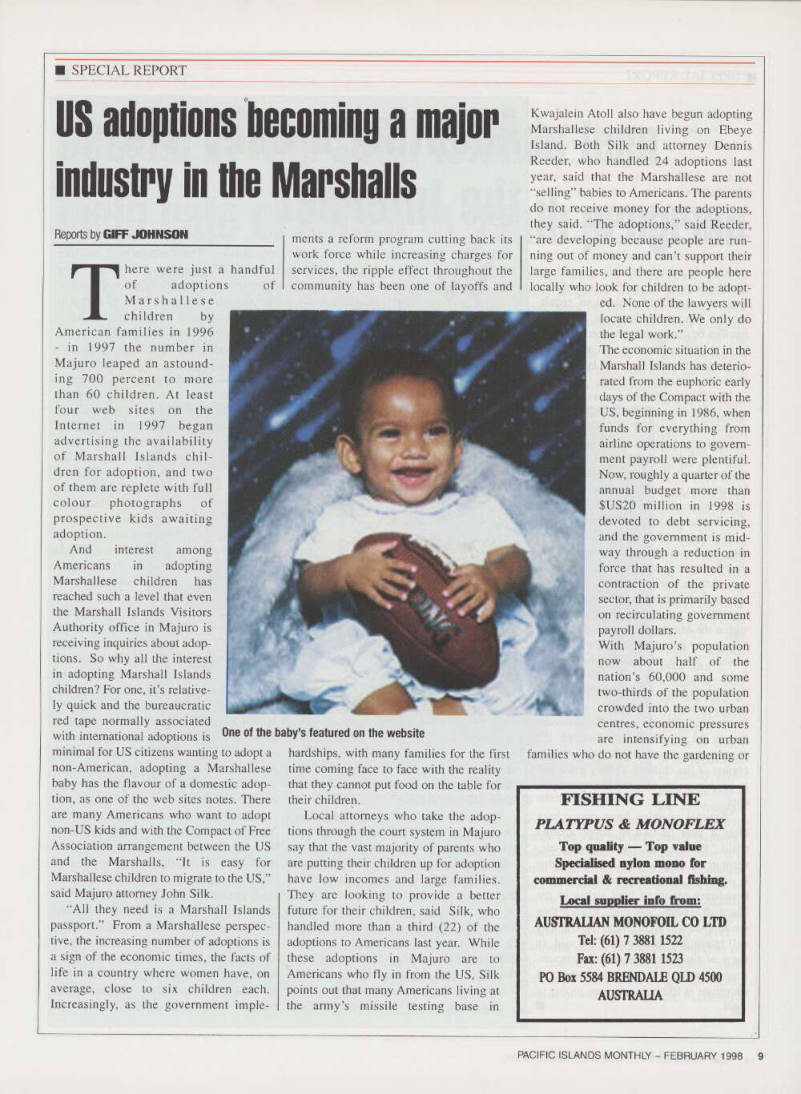
One of the baby’s featured on the website
outer islanders.
“I’ve heard some people criticise these adoptions,” Silk said. “But if some one is willing to provide a good home for these children, you can’t stop Marshallese parents from making their own decisions.” There has been an occa sional negative comment voiced in the Nitijela (parliament), but the Marshall Islanders involved clearly have a positive view of the adoptions. Silk pointed out that the High Court itself has established a rigorous standard for adoptions, requir ing that a home study of the American families be conducted by a licensed agen cy in the US before they can adopt chil dren, even though Marshall Islands law does not require this.
“We always ask the parents on the wit ness stand (in court), ‘did anyone force you to put your child up for adoption?’ and ‘are you being provided any money for this?’,” Silk said. “The answer is always ‘no’.” The biggest question that Marshallese parents have about the adop tion process, Silk said, is can their chil dren come back to the Marshall Islands?
He said that he explains that before they reach adulthood at the age of 18, they have no choice of their own. But once they’ve reached adulthood, they can choose to return to the Marshall Islands, he said. It’s not like customary adoption within the Marshall Islands, said Reeder.
“They may not see their children again,” he said. This is explained to them before hand, and in a few cases parents have decided not to go ahead with the adoption process upon learning this, said both Reeder and Silk. However, Reeder noted that in the adoptions he’s handled, the parents have been required to provide photos of the children as they grow and to keep in touch with the biological par ents.
“Several couples have come back after a year or two to adopt another child,” Reeder said. An important ele ment in the adoptions by outsiders is that it does not strip the children of their hereditary claim to land rights in the Marshall Islands, Silk said. Even if they are adopted and go to live in the US, they still retain their land rights,” he sajd. In view of the current economic circum stances in the Marshalls, the number of adoptions is likely to continue to rise in 1998. ■
Advertisements & other items, p. 9 (1 item)
Fishing Line
PLATYPUS & MONOFLEX
Top quality Top value Specialised nylon mono for commercial & recreational fishing.
Local supplier info from:
AUSTRALIAN MONOFOIL CO LTD
Tel: (61) 7 3881 1522 Fax; (61) 7 3881 1523
PO Box 5584 BRENDALE QLD 4500
AUSTRALIA
Adopting a baby via
the Internet
Want to adopt a child?
Just dial up the Internet web site of Hearts & Homes for Children, and you can find biographies of five Marshallese children, complete with colour photographs, ready for adoption. Or spin the dial over to the Wasatch International Adoptions web site and you can find out about adopt ing kids from Bulgaria, China, Marshall Islands, Moldova and
Vietnam.
Wasatch is based in Utah, Hearts & Homes lists a Florida mailing address and a Costa Rica phone number. Another, Children’s House International, is also based in Utah, while For the Love of a Child is an Oklahoma-based child placing
agency. When recently visiting the Hearts & Homes site, it turned out that more than 1900 people have checked into the site since it was set up in five months ago.
While only a fraction of those are actually adopting, the number of contacts is indica tive of the growing business of adoptions in the Marshall Islands.
Hearts & Homes says that the agency is “an international relief organisation that believes that every child deserves to have sufficient food and water on a daily basis, medical services when necessary, and at least a basic education.” It also notes that it is working “primarily in the Marshall Islands and placing children from infancy up to six years old.” The web site tells you that “the children (for adoption) are pri marily living in one-parent families where it is most difficult to make ends meet.”
The Wasatch web site provides similar
information: “The (Marshallese) children are not in orphanages, but many are living in poverty. Parents are giving up their chil dren with the hope that their children will survive and have a better chance at life.”
Wasatch points out that because of the Compact with the US, Americans do not need to go through the US Immigration and Naturalisation Service to process this inter national adoption, as they would with most of other countries. These are international “adoptions with a domestic flavour,” it
says.
The costs listed for adopting a Marshall Islander vary dra matically. Wasatch, at the low end, esti mates the cost at SUS72SO not includ ing air fares, hotels and related costs for the parents travel ling to the Marshalls to adopt.
Children’s House lists the costs at about SUSBOOO. At
the other extreme is For the Love of a Child, offering adoptions at a minimum of SUS 14,000 per child. Of that, the agency is taking SUSSOOO for the service of locating and brokering the adoption, while more than SUS7OOO is listed as fees and costs for translator, guide and social worker in the Marshall Islands.
Wasatch estimates the total cost to the Americans adopting a Marshallese child to be about SUS72SO, including the place ment fee ($US1800), application fee (SUSSOO), program fee (SUSSOO), home study review ($US100), foreign govern ment fees (SUS37OO) and humanitarian.
While some of the adoption agencies are making a hefty fee, lawyers who handle the legal process in the Marshall Islands say that no money is being given to the Marshallese parents of the children being adopted. ■
Decline in Marshall Islands teen
birth rate credited to youth program
A big decline in the rate of teenage pregnancy in the Marshall Islands is being credited to a youth peer education program that has
led an aggressive family planning pro
motion campaign aimed at teens.
The rate of teen births in the Marshalls
dropped more than 37 percent between 1991 and 1996, according to a report prepared jointly by the Queen’s Health Systems in Hawaii and the Ministry of Health in Majuro.
It’s an impor tant development that shows “the message is get ting out to young people,” said Just i n a Langidrik, the assistant secre tary for primary health care at the ministry. During the 1980 s, the Marshall Islands
had one of the world’s highest growth rates at 4.24 per cent annually. That has declined into the high three per cent range, accord ing to the Ministry of Health. The number of births to teenage mothers has rapidly declined since 1991, when it was 124 per 1000 teens. In 1996, the number of births dropped to 78 per thousand, according to Queen’s official Mele Look and Bureau of Health and Statistics staff Ibrahim Nasiru.
Look was brought in by the ministry to independently review the work of the non governmental organisation Youth to Youth
in Health, which has sponsored health edu cation programs and training for young Marshall Islanders since 1986. Look cred ited Youth to Youth in Health and the min istry’s family planning program with stim ulating the decline in teen births. “Youth to Youth in Health has been the primary, and almost exclusive, health education effort
targeting the teen population,” Look saidf/ “Their work can be credited with a sig nificant proportion of this dramatic decline.” She pointed out Youth to Youth in health promotion was able to achieve this success “through close collaboration
with the Ministry of family plan
ning clinics.” The youth program com bines music, dance and theatre in its health promotion and training program, activities that Look said are key reasons the program has been effective in communicating with island teens. She suggested that using
island culture and oral traditions, “particu larly songs and theatre, is an important component of the success factor.” Look highly commended the youth program, saying “it will be important for the Marshalls to share its accomplishment with this health educatioh model with other Pacific Island nations.”
While the over all population rate also declined during the six year peri od, it only went down by 9.4 per cent. After a big drop from 1991 to 1992 (from 131 to 117 births per 1000 women), the overall birth rate has ranged from 118-122 per 1000 women since then.
Langidrik said that one particu
larly positive
development of
Youth to Youth in the promotion of family plan ning was that a lot of teenage
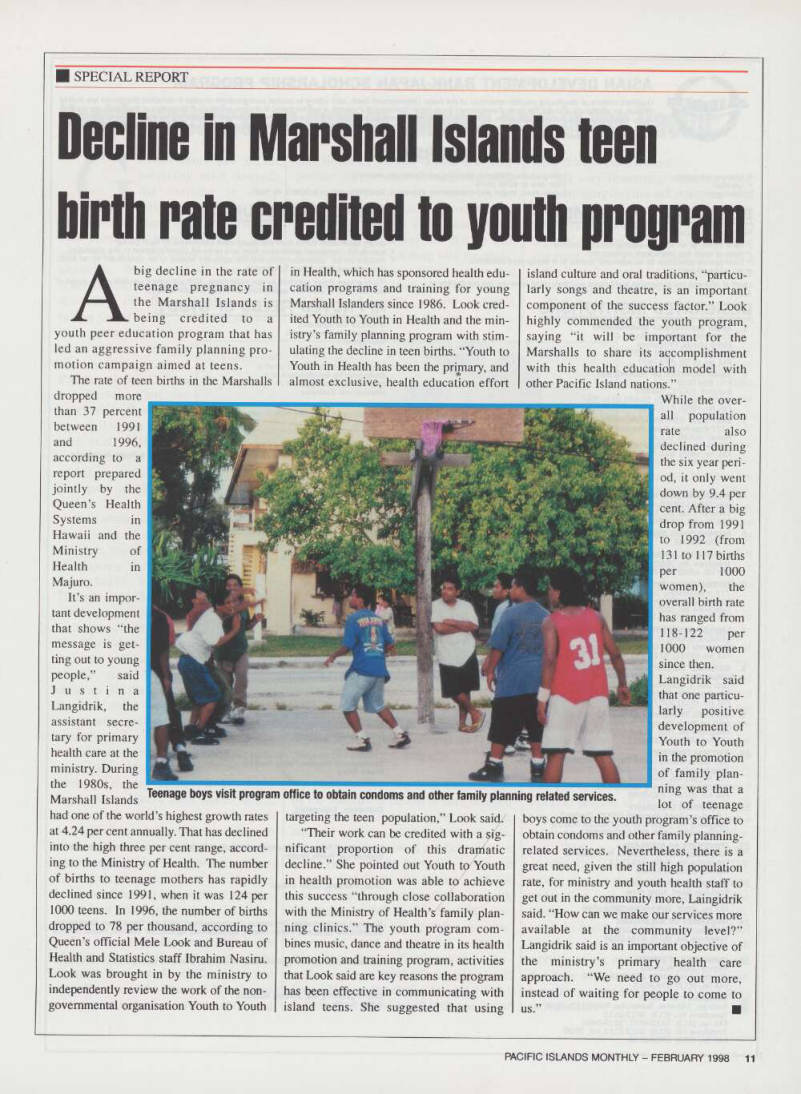
boys come to the youth program’s office to obtain condoms and other family planning related services. Nevertheless, there is a great need, given the still high population rate, for ministry and youth health staff to get out in the community more, Laingidrik said. “How can we make our services more available at the community level?”
Langidrik said is an important objective of the ministry’s primary health care approach. “We need to go out more, instead of waiting for people to come to us.” ■
Teenage boys visit program office to obtain condoms and other family planning related services.
Advertisements & other items, p. 12 (1 item)
Eligibility Requirements
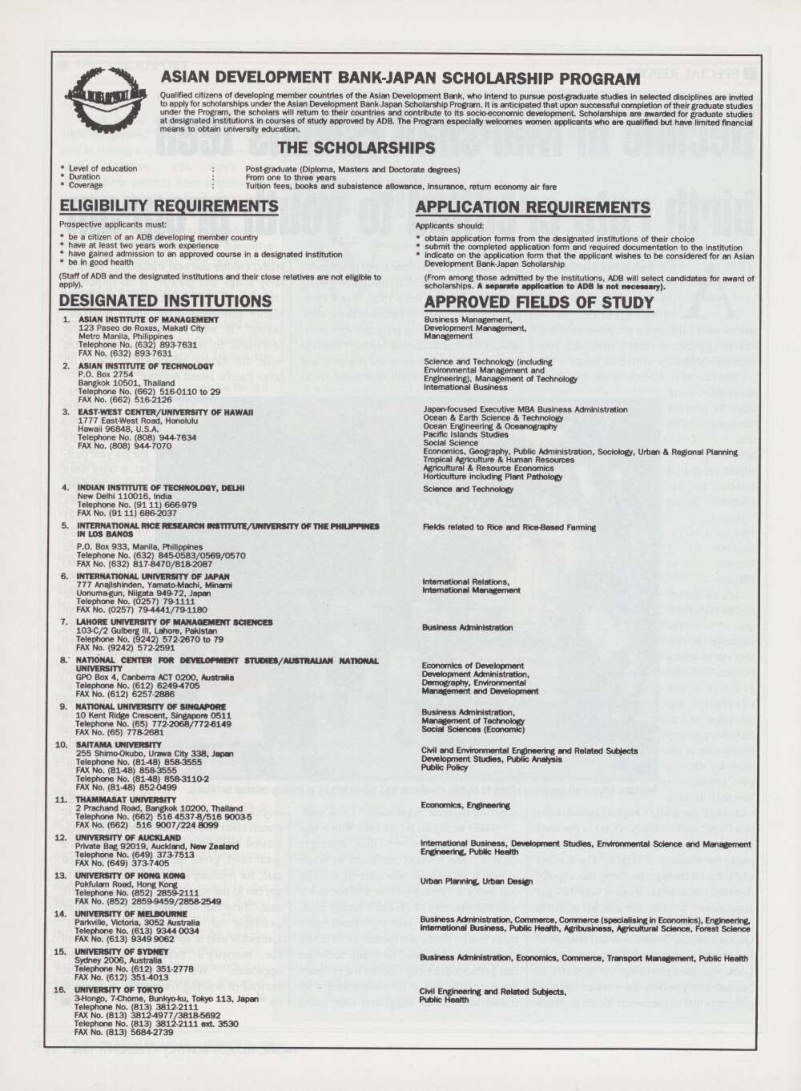
ASIAN DEVELOPMENT BANK-JAPAN SCHOLARSHIP PROGRAM
Qualified citizens of developing member countries of the Asian Development Bank, who intend to pursue post-graduate studies in selected disciplines are invited to apply for scholarships under the Asian Development Bank-Japan Scholarship Program. It is anticipated that upon successful completion of their graduate studies under the Program, the scholars will return to their countries and contribute to its socio-economic development Scholarships are awarded for graduate studies at designated institutions in courses of study approved by ADB. The Program especially welcomes women applicants who are qualified but have limited financial means to obtain university education.
THE SCHOLARSHIPS
♦ Level of education ♦ Duration ♦ Coverage Post-graduate (Diploma, Masters and Doctorate degrees) From one to three years Tuition fees, books and subsistence allowance, insurance, return economy air fare
ELIGIBILITY REQUIREMENTS
Prospective applicants must; ♦ be a citizen of an ADB developing member country ♦ have at least two years work experience ♦ have gained admission to an approved course in a designated institution ♦ be in good health (Staff of ADB and the designated institutions and their close relatives are not eligible to apply).
DESIGNATED INSTITUTIONS
1. ASIAN INSTITUTE OF MANAGEMENT
123 Paseo de Roxas, Makati City Metro Manila, Philippines Telephone No. (632) 893-7631
FAX No. (632) 893-7631
2. ASIAN INSTITUTE OF TECHNOLOGY
P.O. Box 2754 Bangkok 10501, Thailand Telephone No. (662) 516-0110 to 29
FAX No. (662) 516-2126
3. EAST-WEST CENTER/UNIVERSITY OF HAWAII
1777 East-West Road, Honolulu Hawaii 96848, U.S.A.
Telephone No. (808) 944-7634
FAX No. (808) 944-7070
4. INDIAN INSTITUTE OF TECHNOLOGY, DELHI
New Delhi 110016, India Telephone No. (9111) 666-979
FAX No. (9111) 686-2037
5. INTERNATIONAL RICE RESEARCH INSTITUTE/UNIVERSITY OF THE PHILIPPINES
IN LOS BANOS
P.O. Box 933, Manila, Philippines Telephone No. (632) 8450583/0569/0570
FAX No. (632) 817-8470/818-2087
6. INTERNATIONAL UNIVERSITY OF JAPAN
777 Anajlshinden, Yamato-Machi, Minami Uonumagun, Niigata 949-72, Japan Telephone No. (0257) 79-1111
FAX No. (0257) 79-4441/79-1180
7. LAHORE UNIVERSITY OF MANAGEMENT SCIENCES
1030/2 Gulberg 111, Lahore, Pakistan Telephone No. (9242) 572-2670 to 79
FAX No. (9242) 572-2591
8. NATIONAL CENTER FOR DEVELOPMENT STUDIES/AUSTRALIAN NATIONAL
UNIVERSITY
GPO Box 4, Canberra ACT 0200, Australia Telephone No. (612) 62494705
FAX No. (612) 6257-2886
9. NATIONAL UNIVERSITY OF SINGAPORE
10 Kent Ridge Crescent, Singapore 0511 Telephone No. (65) 772-2068/772-6149
FAX No. (65) 7782681
10. SAITAMA UNIVERSITY
255 ShimoOkubo, Urawa City 338, Japan Telephone No. (8148) 8583555
FAX No. (8148) 8583555
Telephone No. (8148) 8583110-2
FAX No. (8148) 8520499
11. THAMMASAT UNIVERSITY
2 Prachand Road, Bangkok 10200, Thailand Telephone No. (662) 516 4537-8/516 90035
FAX No. (662) 516 9007/224 8099
12. UNIVERSITY OF AUCKLAND
Private Bag 92019, Auckland, New Zealand Telephone No. (649) 3737513
FAX No. (649) 373-7405
13. UNIVERSITY OF HONG KONG
Pokfulam Road, Hong Kong Telephone No. (852) 2859-2111
FAX No. (852) 2859-9459/28582549
14. UNIVERSITY OF MELBOURNE
Parkville, Victoria, 3052 Australia Telephone No. (613) 9344 0034
FAX No. (613) 9349 9062
15. UNIVERSITY OF SYDNEY
Sydney 2006, Australia Telephone No. (612) 351-2778
FAX No. (612) 3514013
16. UNIVERSITY OF TOKYO
3-Hongo, 7-Chome, Bunkyo-ku, Tokyo 113, Japan Telephone No. (813) 3812-2111
FAX No. (813) 38124977/38185692
Telephone No. (813) 3812-2111 ext 3530
FAX No. (813) 5684-2739
APPLICATION REQUIREMENTS
Applicants should: * obtain application forms from the designated institutions of their choice * submit this completed application form and required documentation to the institution * indicate on the application form that the applicant wishes to be considered for an Asian Development Bank-Japan Scholarship (From among those admitted by the institutions, ADB will select candidates for award of scholarships. A separata application to ADB Is not necessary).
APPROVED FIELDS OF STUDY
Business Management, Development Management, Management Science and Technology (including Environmental Management and Engineering), Management of Technology International Business Japan-focused Executive MBA Business Administration Ocean & Earth Science & Technology Ocean Engineering & Oceanography Pacific Islands Studies Social Science Economics, Geography, Public Administration, Sociology, Urban & Regional Planning Tropical Agriculture & Human Resources Agricultural & Resource Economics Horticulture including Plant Pathology Science and Technology Fields related to Rice and Rice-Based Fanning International Relations, International Management Business Administration Economics of Development Development Administration, Demography, Environmental Management and Development Business Administration, Management of Technology Social Sciences (Economic) Civil and Environmental Engineering and Related Subjects Development Studies, Public Analysis Public Policy Economics, Engineering International Business, Development Studies, Environmental Science and Management Engineering, Public Health Urban Planning, Urban Design Business Administration, Commerce, Commerce (specialising in Economics), Engineering, International Business, Public Health, Agribusiness, Agricultural Science, Forest Science Business Administration, Economics, Commerce, Transport Management Public Health Civil Engineering and Related Subjects, Public Health
Health statistics, or how to cause a row hi the Pacific
Growth rates and infant mortality tend towards the extreme in many island countries. After 10 or more years of primary health care promotion in most islands, how ever, and with the support of regional
agencies, improvements are being
made in many key health areas. Infant mortality, for example, though still taking the life of 33 children each day,
has gone down in every country with the apparent exception of Papua New Guinea and Tuvalu (but the numbers in Tuvalu are so small - just several each year - that one or two extra baby deaths and the rate increases 50 per cent over
night).
But when you start citing some of the most dire stats, you run the risk of drawing the ire of local health officials.
That’s because the statis tics themselves can cause their share of commotion.
The Marshall Islands has had, and still has, some of the most sobering statistics in the region (like an eight percent annual urban growth rate, more than twice the birth rate, and an average of just under six children per
mother). But in certain areas, major improvements have been made. Often, however, old statistics continue to be quot
ed, particularly by regional agencies, even
when there has been a dramatic turnaround. It irks island health workers making legitimate efforts to improve health conditions to hear regional agencies using their countries as examples of the “worst.”
The infant mortality rate (IMR) in the Marshall Islands, for example, is now hotly disputed. In the early 1980 s, the infant mortality rate in the Marshall Islands was an astronomical 68 per thousand (behind
only Kiribati, PNG and Vanuatu in a “com petition” no one wants to lead). According to one local health worker, however, the 1988 census data actually showed that the infant mortality rate (IMR) had dipped substantially, to the mid-50s. But, he said, regional agencies assisting with the analy sis of the data simply didn’t believe that the IMR could have improved this much.
That condescending attitude resulted in the IMR being listed at 68 again, he said.
By 1996, however, the IMR was reported by the Ministry of Health to have dropped to 27 per thousand, a number that some regional agencies view with scepticism.
The 1988 census showed a definite decline in the IMR, and the trend has continued into the mid-19905, the Ministry official said. If regional agency officials had not dismissed the IMR data in the 1988 cen sus, there would be little question about the downward trend, he said. But in figures released by the Pacific Community (for merly the South Pacific Commission) and United Nations Population Fund (UNFPA) in December, the Marshall IMR rate is still
more than 60 per thousand.
“It’s very frustrating when they (the regional agencies) use old statistics,” said Justina Langidrik, the Marshalls assistant secretary for primary health care. “The regional agencies act like we’re not doing anything. There’s a lot going on, but it’s not reflected in some of the statistics that are being distributed worldwide.”
Ten years ago, it was hard to get a statistic worth the paper it was written on
in the Marshalls. But since the early 19905, the Ministry of Health in the Marshalls - like many of its counterparts in the region - has devel oped a competent vital statistics office that now produces annual statisti cal reports, as does the national planning office.
So island health workers believe that they are not just blowing hot air when they contest what the regional “experts” broadcast about their key health indicators.
A UNICEF report in 1996 is another example.
It said that the rate of immunisation in the Marshalls had dropped substantially in almost all categories. But the Ministry of Health statistics show some increases or only slight decreases between 1992
and 1994. Measles coverage improved from 53 percent of the population to 59 percent, while polio coverage showed a small decline from 66 percent to 62 per cent. Oddly, say health officials, a number of statistics included in the UNICEF report, such as the death rate of children under five, are not even kept by Ministry. Langidrik doesn’t want to min imise the health problems facing Marshall Islanders. But she’d like the island health workers to get some credit for the areas that have seen improvement. “We’re not just sitting behind our desks reading nov els,” she said. ■
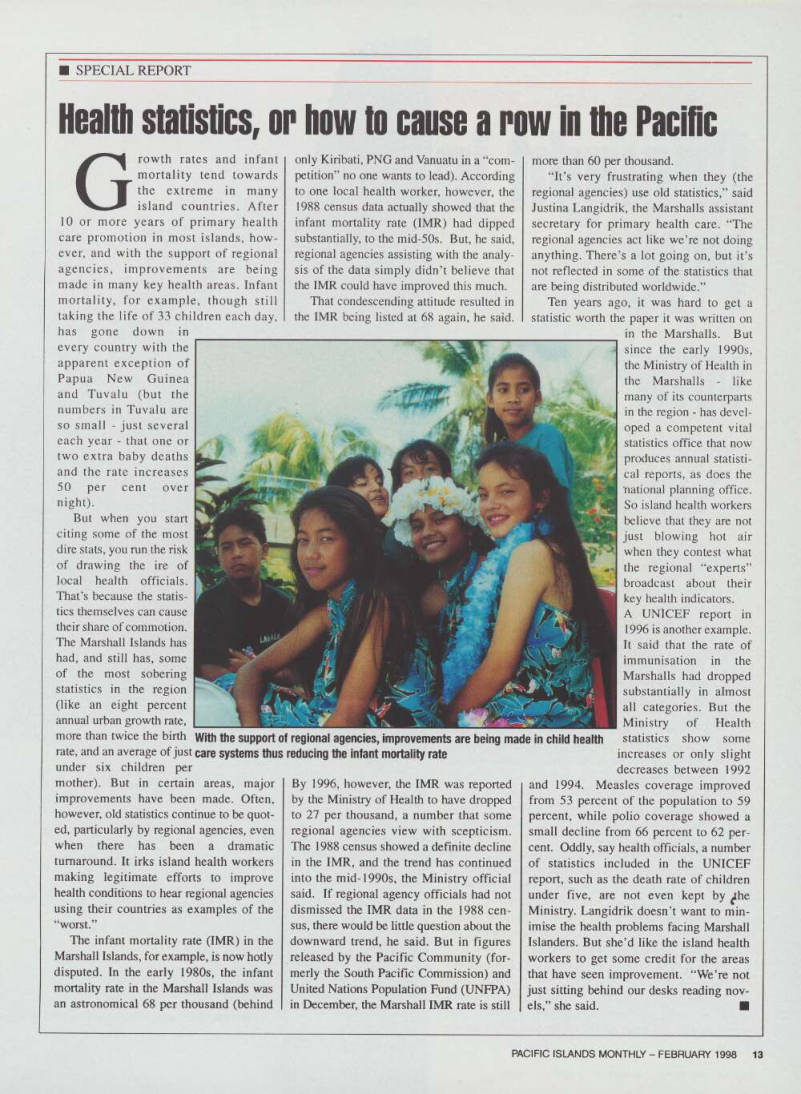
With the support of regional agencies, improvements are being made in child health care systems thus reducing the infant mortality rate
Drought in
Cover Stories
Png
worsens
By Sam Vulum
While the world celebrated Christmas and New Year, Papua New Guineans, took stock of what had been a troublesome 1997 and braced themselves for what looks to be another difficult year.
The government, which is still struggling to come out from deep political crisis, appears to be more concerned about staying in power than delivering much needed ser vices to the people.
The credibility of the government, dragged into great disrepute by former Prime Minister Sir Julius Chan’s regime through the Sandline Crisis and other controver sial deals, was given more whipping through the Mujo Sefa videotapes scandal involving Prime Minister Bill Skate.
While some positive developments towards peace have been achieved on Bougainville, the country’s other woes seem to have either remained stagnant or have taken a downward slide. The endemic law and order problem, falling commodity prices, a confused public service resulting from government’s surprise and drastic decisions, and a fluctuating economy are some of the
pressing problems at hand.
However, the devastating impacts of the El Nino related drought appears to be the most worrying. It has so far claimed some 500 lives. The deaths were a result of starvation and drought related diseases.
Expert estimates have it that up to 695,000 people entered 1998 at risk of starvation with some areas possi ble missing out on drought aid completely.
A leading Australian aid agency CARE Australia’s field worker Daryl Ainsworth told the Australian Associated Press that the Aziana Mission, south of Goroka town in Eastern Highlands province, had received no aid when he visited the area on Christmas Eve.
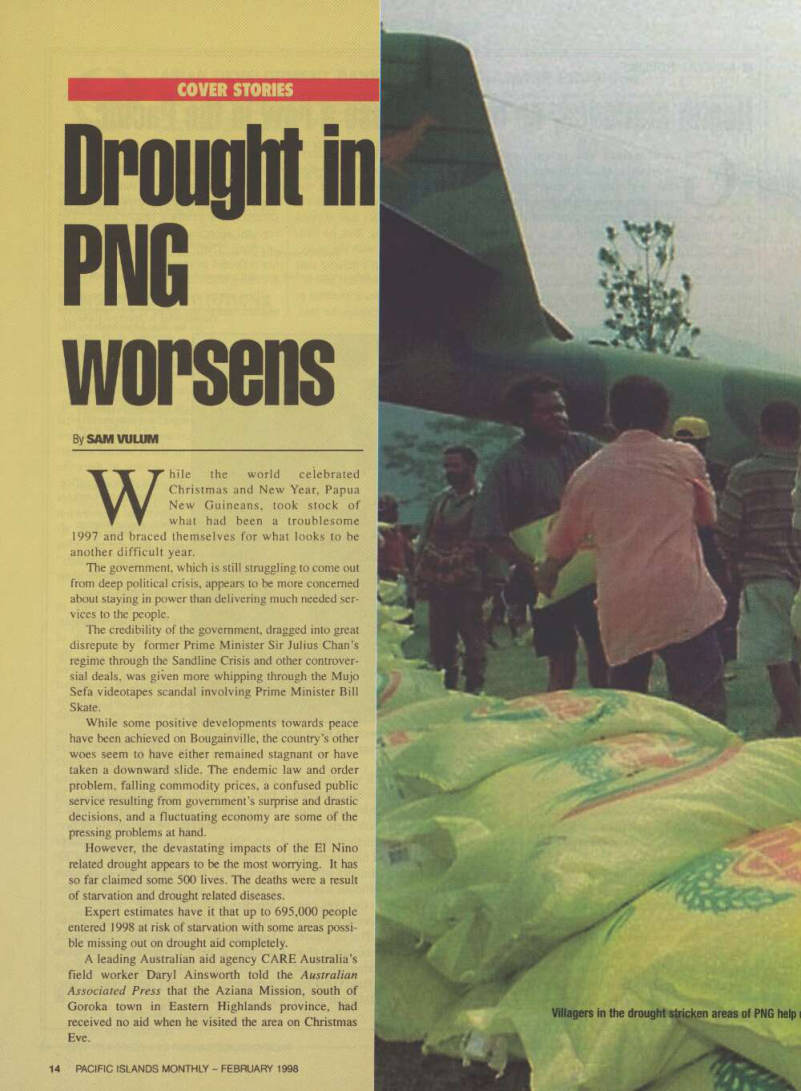
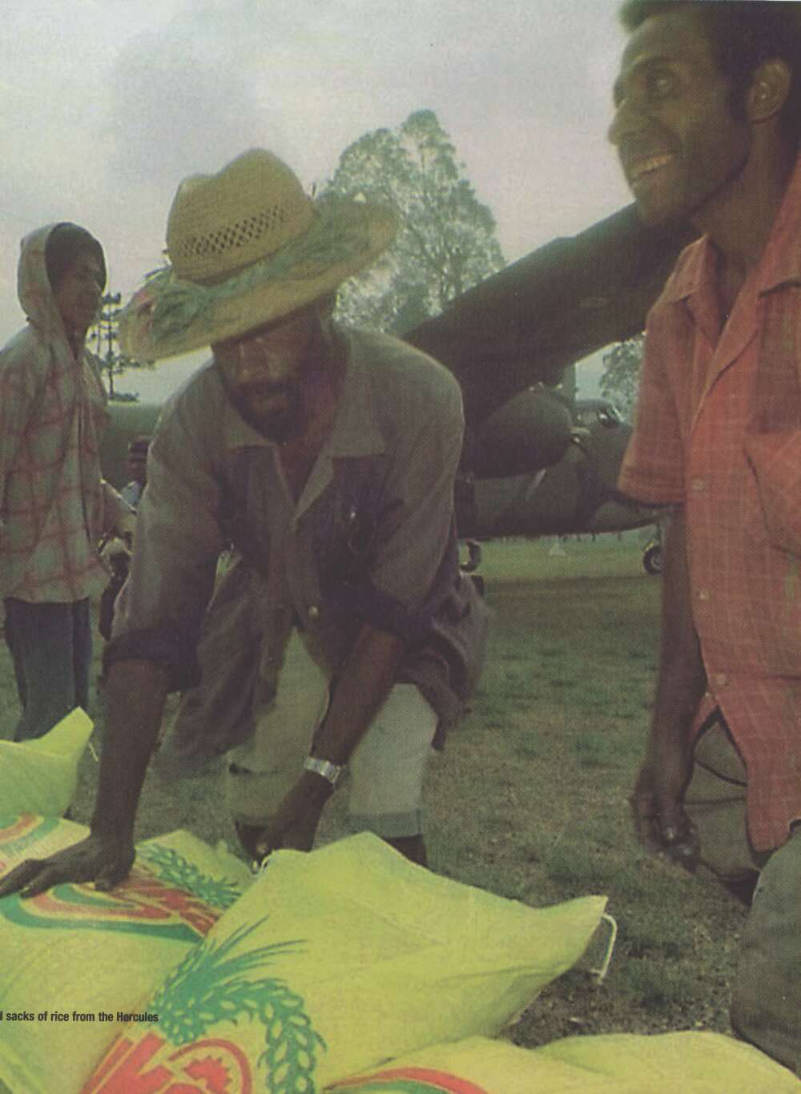
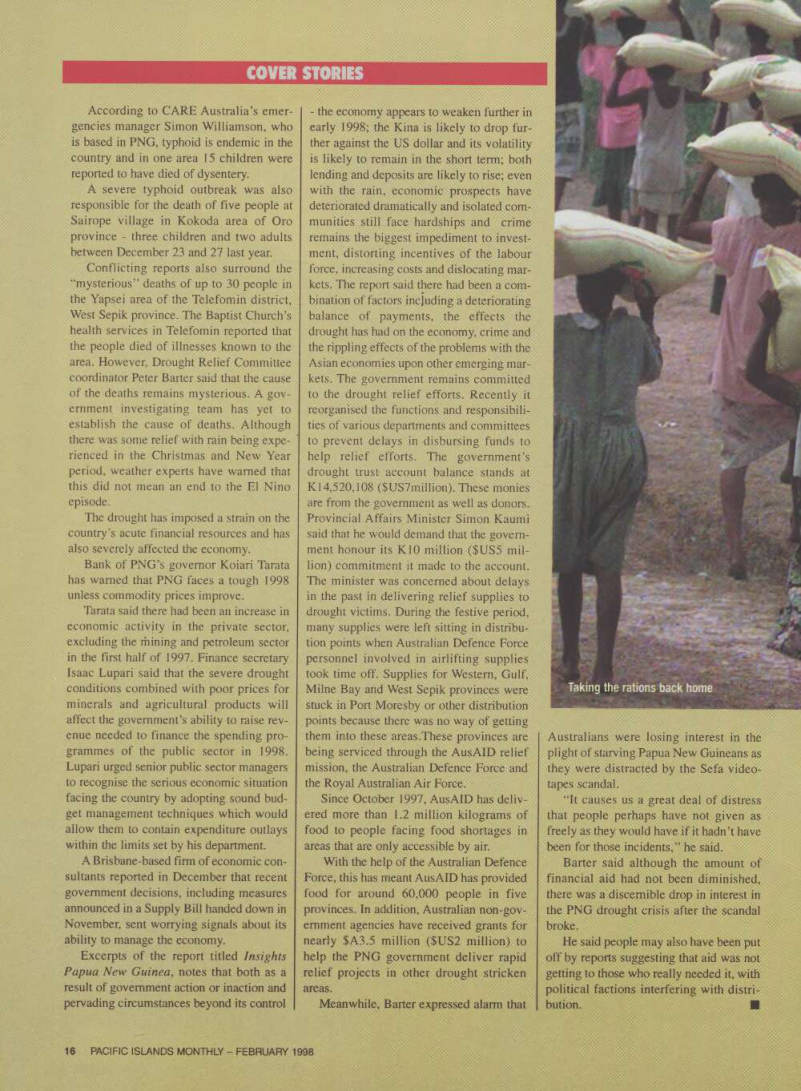
Villagers in the drought stricken areas of PNG help [?]
[?] sacks of rice from the Hercules
According to CARE Australia’s emer gencies manager Simon Williamson, who is based in PNG, typhoid is endemic in the country and in one area 15 children were reported to have died of dysentery.
A severe typhoid outbreak was also responsible for the death of five people at Sairope village in Kokoda area of Oro province - three children and two adults between December 23 and 27 last year.
Conflicting reports also surround the “mysterious” deaths of up to 30 people in the Yapsei area of the Telefomin district, West Sepik province. The Baptist Church’s health services in Telefomin reported that the people died of illnesses known to the area. However, Drought Relief Committee coordinator Peter Barter said that the cause of the deaths remains mysterious. A gov ernment investigating team has yet to establish the cause of deaths. Although there was some relief with rain being expe rienced in the Christmas and New Year period, weather experts have warned that this did not mean an end to the El Nino episode.
The drought has imposed a strain on the country’s acute financial resources and has also severely affected the economy.
Bank of PNG’s governor Koiari Tarata has warned that PNG faces a tough 1998 unless commodity prices improve.
Tarata said there had been an increase in economic activity in the private sector, excluding the mining and petroleum sector in the first half of 1997. Finance secretary Isaac Lupari said that the severe drought conditions combined with poor prices for minerals and agricultural products will affect the government’s ability to raise rev enue needed to finance the spending pro grammes of the public sector in 1998.
Lupari urged senior public sector managers to recognise the serious economic situation facing the country by adopting sound bud get management techniques which would allow them to contain expenditure outlays within the limits set by his department.
A Brisbane-based firm of economic con sultants reported in December that recent government decisions, including measures announced in a Supply Bill handed down in November, sent worrying signals about its ability to manage the economy.
Excerpts of the report titled Insights Papua New Guinea, notes that both as a result of government action or inaction and pervading circumstances beyond its control
- the economy appears to weaken further in early 1998; the Kina is likely to drop fur ther against the US dollar and its volatility is likely to remain in the short term; both lending and deposits are likely to rise; even with the rain, economic prospects have deteriorated dramatically and isolated com munities still face hardships and crime remains the biggest impediment to invest ment, distorting incentives of the labour force, increasing costs and dislocating mar kets. The report said there had been a com bination of factors including a deteriorating balance of payments, the effects the drought has had on the economy, crime and the rippling effects of the problems with the Asian economies upon other emerging mar kets. The government remains committed to the drought relief efforts. Recently it reorganised the functions and responsibili ties of various departments and committees to prevent delays in disbursing funds to help relief efforts. The government’s drought trust account balance stands at K 14,520,108 (sUS7million). These monies are from the government as well as donors.
Provincial Affairs Minister Simon Kaumi said that he would demand that the govern ment honour its KlO million (SUSS mil lion) commitment it made to the account.
The minister was concerned about delays in the past in delivering relief supplies to drought victims. During the festive period, many supplies were left sitting in distribu tion points when Australian Defence Force personnel involved in airlifting supplies took time off. Supplies for Western, Gulf, Milne Bay and West Sepik provinces were stuck in Port Moresby or other distribution points because there was no way of getting them into these areas. These provinces are being serviced through the AusAID relief mission, the Australian Defence Force and the Royal Australian Air Force.
Since October 1997, AusAID has deliv ered more than 1.2 million kilograms of food to people facing food shortages in areas that are only accessible by air.
With the help of the Australian Defence Force, this has meant AusAID has provided food for around 60,000 people in five provinces. In addition, Australian non-gov ernment agencies have received grants for nearly $A3.5 million (SUS 2 million) to help the PNG government deliver rapid relief projects in other drought stricken areas.
Meanwhile, Barter expressed alarm that
Australians were losing interest in the plight of starving Papua New Guineans as they were distracted by the Sefa video tapes scandal.
“It causes us a great deal of distress that people perhaps have not given as freely as they would have if it hadn’t have been for those incidents,” he said.
Barter said although the amount of financial aid had not been diminished, there was a discernible drop in interest in the PNG drought crisis after the scandal broke.
He said people may also have been put off by reports suggesting that aid was not getting to those who really needed it, with political factions interfering with distri bution. ■
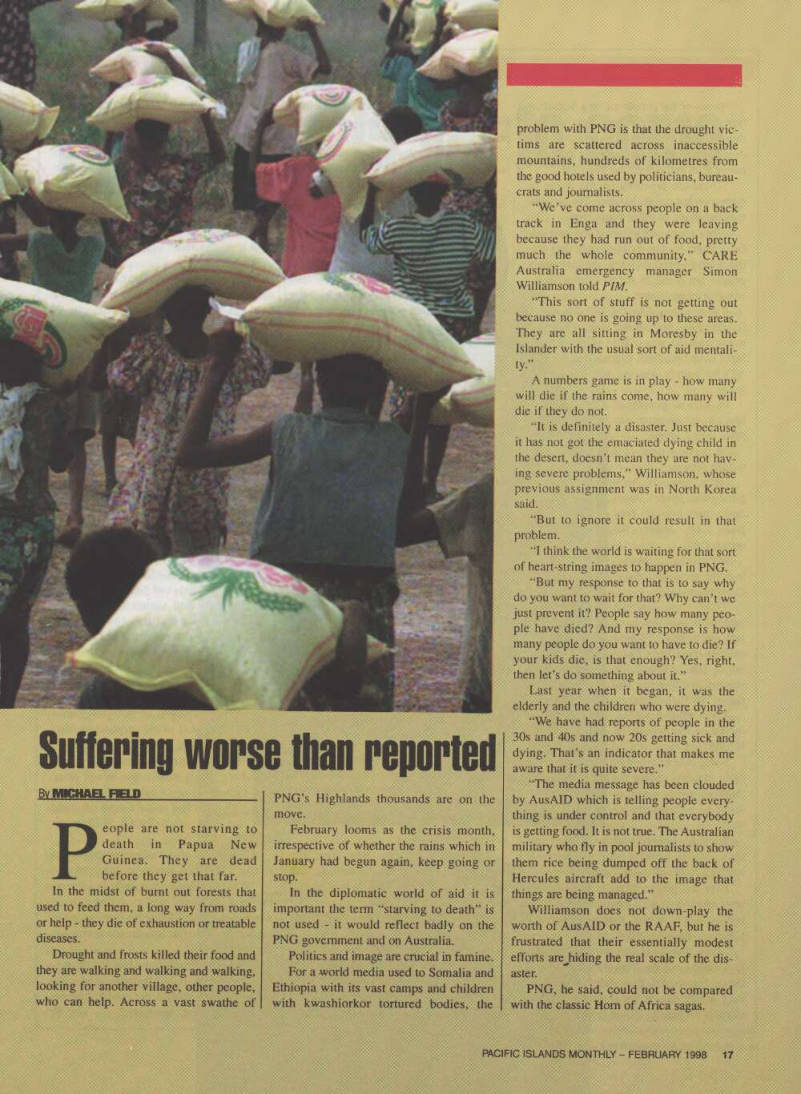
Taking the rations back home
Suffering worse than reported
By Michael Field
People are not starving to death in Papua New Guinea. They are dead before they get that far.
In the midst of burnt out forests that used to feed them, a long way from roads or help - they die of exhaustion or treatable diseases.
Drought and frosts killed their food and they are walking and walking and walking, looking for another village, other people, who can help. Across a vast swathe of
PNG’s Highlands thousands are on the move.
February looms as the crisis month, irrespective of whether the rains which in January had begun again, keep going or stop.
In the diplomatic world of aid it is important the term “starving to death” is not used - it would reflect badly on the PNG government and on Australia.
Politics and image are crucial in famine.
For a world media used to Somalia and Ethiopia with its vast camps and children with kwashiorkor tortured bodies, the
problem with PNG is that the drought vic tims are scattered across inaccessible mountains, hundreds of kilometres from the good hotels used by politicians, bureau crats and journalists.
“We’ve come across people on a back track in Enga and they were leaving because they had run out of food, pretty much the whole community,” CARE Australia emergency manager Simon Williamson told PIM.
“This sort of stuff is not getting out because no one is going upko these areas.
They are all sitting in Moresby in the Islander with the usual sort of aid mentali ty.”
A numbers game is in play - how many will die if the rains come, how many will die if they do not.
“It is definitely a disaster. Just because it has not got the emaciated dying child in the desert, doesn’t mean they are not hav ing severe problems,” Williamson, whose previous assignment was in North Korea said.
“But to ignore it could result in that
problem.
“I think the world is waiting for that sort of heart-string images to happen in PNG.
“But my response to that is to say why do you want to wait for that? Why can’t we just prevent it? People say how many peo ple have died? And my response is how many people do you want to have to die? If your kids die, is that enough? Yes, right, then let’s do something about it.”
Last year when it began, it was the elderly and the children who were dying.
“We have had reports of people in the 30s and 40s and now 20s getting sick and dying. That’s an indicator that makes me aware that it is quite severe.”
“The media message has been clouded by AusAlD which is telling people every thing is under control and that everybody is getting food. It is not true. The Australian military who fly in pool journalists to show them rice being dumped off the back of Hercules aircraft add to the image that
things are being managed.”
Williamson does not down-play the worth of AusAID or the RAAF, but he is frustrated that their essentially modest efforts arejiiding the real scale of the dis aster.
PNG, he said, could not be compared with the classic Horn of Africa sagas.
“Some of the people are in a Somalian type state but it is not the collective type thing where you could walk across the desert and see people tumbling down en masse with starvation,” he told PIM.
“There are probably people dying of starvation but no one has seen that because they are dying of other things first.
“They are in isolated areas and very dif ficult to get to. The more isolated they are, the more in need they are, the less likely people are going to get to them with any type of assistance.”
It is not helped by the 700 dif- J ferent ethnic groups, the lack of m roads and the way whole vil- JH lages have been “self evacuat ed” by people leaving for jS
food. F
In Africa, people in famine congregated, in PNG they disperse.
“It is much more of a hidden disaster.”
Great swamps have gone and rivers have dried up, leaving foul pools of water for
mosquitoes.
Malaria is steeply up in some areas, typhoid is claiming many.
“You see whole swaths of land that have just been burnt, whole valleys have been burnt out. The ground is cracked with great fis sures,” Williamson says.
The wildlife has gone, including that which the
Highlanders ate.
Some rain returned in
early January, ending the
plight of people forced to drink contaminated water.
Some kaukau or sweet potato has come back onto the markets but it is “miserable stuff’ of little value - and great expense.
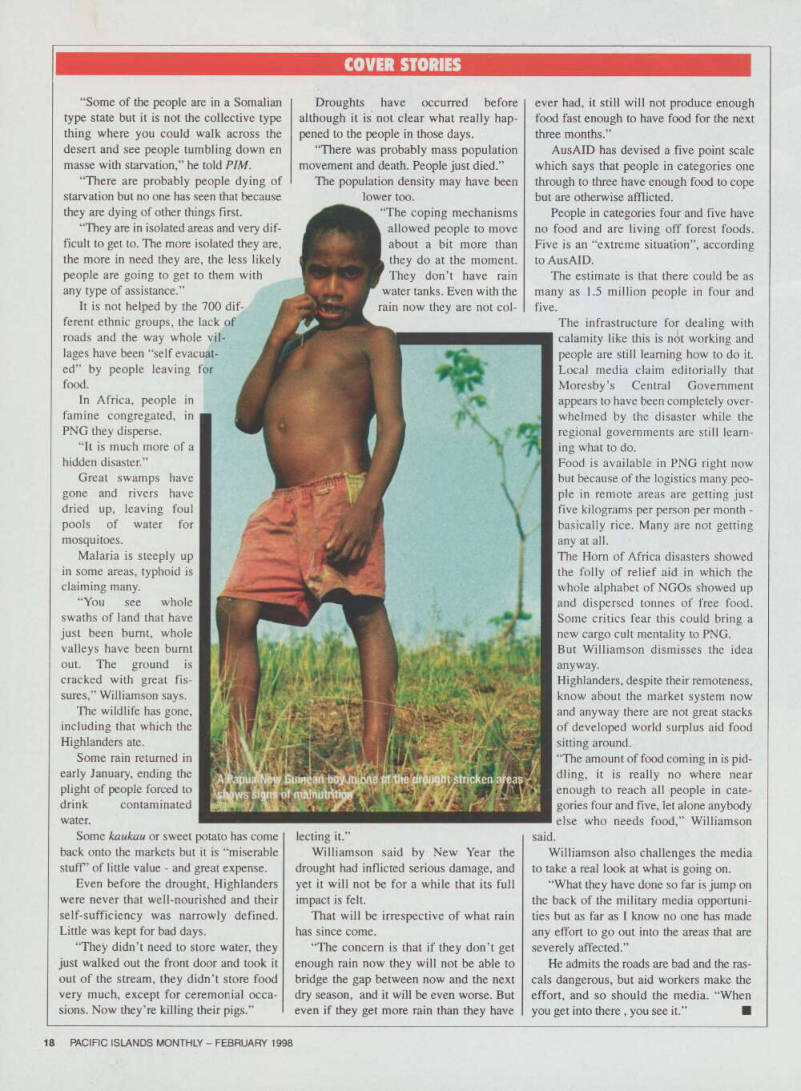
Even before the drought, Highlanders were never that well-nourished and their self-sufficiency was narrowly defined.
Little was kept for bad days.
“They didn’t need to store water, they just walked out the front door and took it out of the stream, they didn’t store food very much, except for ceremonial occa
sions. Now they’re killing their pigs.”
Droughts have occurred before although it is not clear what really hap pened to the people in those days.
“There was probably mass population movement and death. People just died.”
The population density may have been lower too.
“The coping mechanisms allowed people to move 1 a bout a bit more than they do at the moment.
They don’t have rain water tanks. Even with the rain now they are not col-
lecting it.”
Williamson said by New Year the drought had inflicted serious damage, and yet it will not be for a while that its full impact is felt.
That will be irrespective of what rain has since come.
“The concern is that if they don’t get enough rain now they will not be able to bridge the gap between now and the next dry season, and it will be even worse. But even if they get more rain than they have
ever had, it still will not produce enough food fast enough to have food for the next three months.”
AusAID has devised a five point scale which says that people in categories one through to three have enough food to cope but are otherwise afflicted.
People in categories four and five have no food and are living off forest foods.
Five is an “extreme situation”, according to AusAID.
The estimate is that there could be as many as 1.5 million people in four and five.
The infrastructure for dealing with calamity like this is not working and people are still learning how to do it.
Local media claim editorially that Moresby’s Central Government appears to have been completely over whelmed by the disaster while the regional governments are still learn ing what to do.
Food is available in PNG right now but because of the logistics many peo ple in remote areas are getting just five kilograms per person per month basically rice. Many are not getting any at all.
The Horn of Africa disasters showed the folly of relief aid in which the whole alphabet of NGOs showed up and dispersed tonnes of free food.
Some critics fear this could bring a new cargo cult mentality to PNG.
But Williamson dismisses the idea anyway.
Highlanders, despite their remoteness, know about the market system now and anyway there are not great stacks of developed world surplus aid food
sitting around.
“The amount of food coming in is pid dling, it is really no where near enough to reach all people in cate gories four and five, let alone anybody else who needs food,” Williamson
said.
Williamson also challenges the media to take a real look at what is going on.
“What they have done so far is jump on the back of the military media opportuni ties but as far as I know no one has made any effort to go out into the areas that are
severely affected.”
He admits the roads are bad and the ras cals dangerous, but aid workers make the effort, and so should the media. “When you get into there , you see it.” ■
A Papua New Guinean boy in one of the drought stricken areas shows signs of malnutrition
The worse Is yet to come
By Sam Vulum
A father hacked his son to death in the Enga
province after the boy
dug up the sweet potato which his father was saving for the whole family while in the Madang province, a child was killed and his mother was severely burnt in a bush fire.
Two examples of the many tragic sto
ries coming out from the devastating impacts of the prolonged El Nino drought being felt throughout Papua New Guinea since July 1997. For the 1.5 million people affected, as cited by the Australian Agency for International Development (AusAID) January assess ment report, the core of the their livelihood - their gar dens - have been reduced to nothing but barren, dry and withering landscapes and their drinking water has completely dried up.
Raging bush fires contin ue to sweep through many areas causing massive destruction to the environ ment as well as food gar dens and houses.
About 500 people have died so far either from star vation or drought related diseases. The death rate would have been worse had it not been for relief support.
The AusAID report said the number of people badly affected by the drought dou bled from 500,000 three months earlier.
One of the authors of the report said the figure will rise again in the next few months, with the worst con ditions expected in February and March.
“The worst is about to
happen,” Australian National University
agronomist Mike Bourke said.
“These numbers will continue to grow with each passing month. “Even if widespread heavy rain falls soon, the num bers will grow because of the delay between planting and harvesting food gar dens.”
The scale of the problems that require urgent attention are several times greater than those which occurred following widespread frost and drought in 1972-
1973. Most stories about people suffering
and struggling against the drought and
frost were reported in the worst affected areas of Southern Highlands, Western Highlands, Enga and Eastern Highland
provinces.
In these areas, most families had noth ing to eat and were surviving on ferns and other wild plants before help came. In the coastal areas, people live on famine food mainly fruit trees and sea food.
Those who can afford to store food, had
to live with very high prices.
In the Highlands, young women, previously one of the priced asset of any fam ily, have become valueless.
They are being used as means of survival - given away to men without any form of bride price pay ment. In the Marian area of the Enga province, two women were paid for (as bride price) with 10 bags of 25 kilogram rice.
Pigs, another highly regarded wealth in the region, were traded well below their normal price value. A community leader from Lakalap in the Enga province, Kepas Kiplan said he sold a KBOO (SUS4OO) pig for Kl5O
(Sus7S).
“My family’s lives are
more important than that of a pig,” Kiplan. “Prices for trade store goods are very high, therefore, any little money we find is used to buy rice for the evening meal.”
In the Margarima area of Enga, people were reported to be using what little money they had to buy wheat meal flour. And this was being mixed into a dough and roasted with hot stones because people
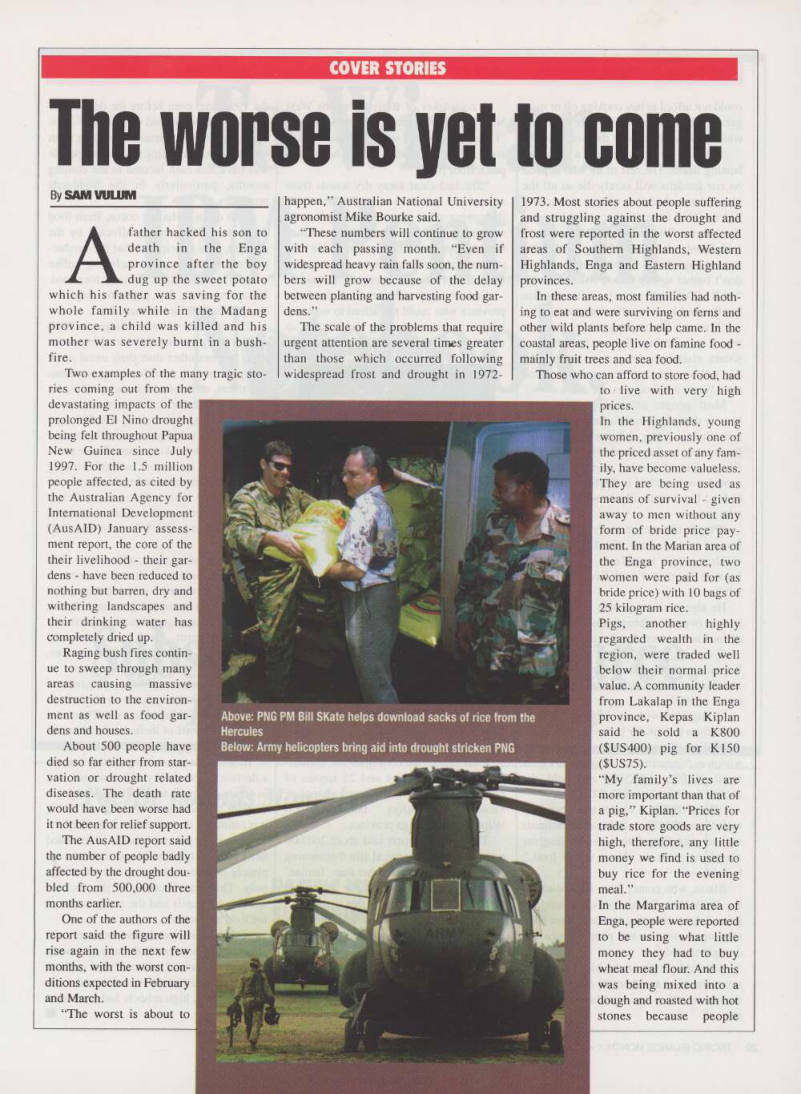
Above: PNG PM Bill Skate helps download sacks of rice from the Hercules
Below: Army helicopters bring aid into drought stricken PNG
could not afford to buy cooking oil or mar garine. Those with money were fortunate while chose without were the worst hit.
“Only the money men stand a chance of beating death. The rest of us who depend on our gardens will surely die as all the plants have died,” a village councillor Kaima Dend from another worst hit area, Tambul, the Western Highlands province, said. Dend, who was half way through his second bag of rice for his family said: “I don’t bother to buy tinned fish,” he said.
“At K 1.70 (US 85 cents) ... after my rice has finished I cannot afford anymore.
“It sounds like an exaggeration because we all look healthy. But our brothers and sisters elsewhere see green leaves. We don’t. When the green leaves die, our food dies. When our food dies, we die.”
Most people affected have become heavily depended on their family members and relatives living and working in towns for money to buy food. Health worker Saniyo Oki of Tambul said the little he earned was stretched to the limit as he had to feed his own family as well as distant relatives.
“People like me are really wasting their reserve money. I am afraid many of my children won’t be able to go to school because by then I will have no money left.”
He also said that people lived on wild lettuce, overripe cabbage leaves and pieces of kaukau that were barely palatable.
Sixty-year old Susana Clara, from Kerepia in Tambul, described the drought and frost as worse than what she experi enced in 1972.
“I migrated with my family to Mendi and Lalibu to look for bananas,” she said.
William Korekola was another father who was compelled to slaughter his boar worth KlOOO (US$5OO) and sold the cooked meat for just K5O (SUS2S).
“These days it is harder to gather food to feed my family and domestic animals such as pigs. Therefore, I had to slaughter one pig to get some money to buy food,” he said.
Blaise, who comes from Bali Island in the West New Britain province said, “I guess I don’t have any choice. I have been sending money to my people since the
drought started.”
Although people on the island are in the same situation as others in other parts of the country, they have not been receiving any aid.
A co-worker of Blaise with the West New Britain provincial government said, “I shed tears when I was told about my kid sister, braving all odds to save her potato patch from fire.
“She had clear away dry weeds from around the patch to stop the fire from destroying what was her family’s only remaining garden. I’ve made a commit ment to support my family during this time of crisis and will continue to do so until they recover from the drought,” he said.
Some hungry villagers from the Enga province who could not afford to wait any longer, resorted to looting and holding up trucks along the Okuk Highway to get their
share of supplies. However, this forced trucking companies to stop their cartage of relief supplies into Enga province and Tari in the Southern Highlands province.
Transport company Pagini Transwest Joint Venture suspended all its trucks from transporting relief supplied into the two affected areas. Two consignments, consist ing 25 tonnes of rice and 25 tonnes of cooking oil were stolen despite a police escort in Waliya boomgate in
Wapenamanda, Enga province.
The AusAID report said about 260,000 people were in a critical life threatening situation, with no food other than ‘famine’ foods or bush foods available and about 980,000 were approaching this situation.
“The food that is available is probably less than half of that normally produced and is of poor quality,” said the report.
Villagers are spending their cash reserves, selling assets and changing spending patterns to buy imported food.
Rice sales in 1997 ran at 25 percent above
the 1996 rate, even before the delivery of significant food aid had commenced. Now that the main coffee season is coming to an end and assets are being sold, many people will have less cash income in the coming months, particularly in the highlands
provinces.
Cash crops including cocoa, fresh food and betel nut are being affected by the drought. It is anticipated that the produc tion of most cash crops including coffee will be reduced soon in many locations.
Villagers report that pigs and dogs are dying because of insufficient food.
The majority of rural villages in PNG
are currently getting their drinking water
from sources other than their usual ones.
Many are getting them from larger streams and rivers, some of which are heavily con taminated with human and animal waste.
It is estimated that about 130,000 rural villagers are currently experiencing critical problems with drinking water. These prob lems include an almost lack of drinking water or access to only brackish water or contaminated water. There is sufficient water to process sago in some locations, particularly in parts if Western and Gulf provinces.
Fires are widespread, with smoke haze so severe at times that aircraft movements are being restricted - even at major air ports. Extensive area of grassland, forest, economic trees, sago palm and nipa stands have been burnt. Field teams recorded many reports of damage to food gardens, dwelling as well as to some tree crops.
In many parts of PNG, villagers and local health workers report an increase in diarrhoea and skin infections. There are also many reports of increases in other dis eases, including pneumonia and malaria.
In some places, nursing mothers report a decline in the quality of breast milk and in others, villagers are attributing deaths to drought related causes. Throughout PNG, it is estimated that more than half of all the community or primary schools were closed before the school holidays, either com
pletely or operated during the mornings
only. This was because of the lack of stamina by pupils and the need to search for food and water.
Other institutions in the most severely affected locations were threatened mainly because of lack of water. These include hospitals, health centres, sub-health cen tres, aid posts, high schools and corrective institutes. ■
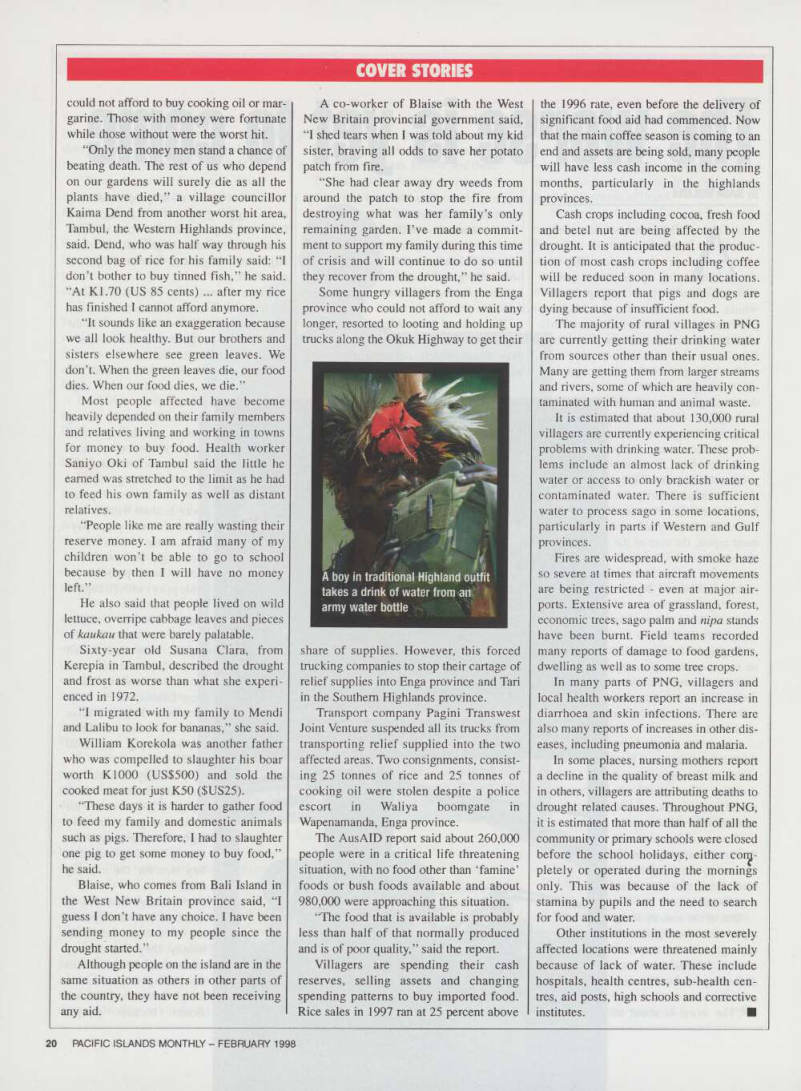
A boy in traditional Highland outfit takes a drink of water from an army water bottle
Advertisements & other items, pp. 19-22 (2 items)
Cover Stories
IBM Pentium
To Win an IBM Pentium Subscribe to The Source.
Pacific Islands Monthly
Pacific Islands Monthly
PACIFIC ISLANDS MONTHLY
SUBSCRIPTIONS DEPARTMENT
PO BOX 1167
SUVA
FIJI ISLANDS
AFFIX
STAMP
HERE
For almost 70 years, Pacific Islands Monthly has been and still is the authority on political, business and social issues within the Pacific. And now, every 12 month subscription received before the 31st of March, 1998, goes into a draw to win an IBM Pentium Notebook*. You could even give a gift subscription to enter but it must be before the closing date. As well as the entry into the draw, you will also receive the latest news from the region. Fill in the subscription form below and send it along with payment to Pacific Islands Monthly, Subscription Department, PO Box 1167, Suva, Fiji. Or call PIM on (679) 304 111 or fax us on (679) 303 809/(679) 307 460.
Subscribe to The Source.
Pacific Islands Monthly
*Rates include Airspeeding to all destinations Conditions of Entry 1. To enter, subscriptions must be made before March 31st, 1998 which automatically enters the subscriber into the draw for the Pentium Notebook Computer. 2. Entry is open to all subscribers except employees of The Fiji Times Ltd, Pacific Islands Monthly, and Wilson Addison Ltd. 3- Subscribers need to subscribe for 12 months to qualify. 4. The winner of the Pentium Notebook will be published in Pacific Islands Monthly Magazine, May Issue, 1998 and will be notified by registered mail. 5. The winner will receive their prize within one month of the draw. 6. The prize must be taken as offered and is not redeemable. 7. In the event of any dispute the decision of the promoter is final and no correspondence will be entered into.
YES! I wish to subscribe to The Source and receive a chance to win an IBM Pentium Notebook Computer! □ Cheque/Bank Draft/Money Order made payable to Pacific Islands Monthly j Please charge my credit card: (VISA / AMEX / MASTERCARD)
12 ISSUE
SUBSCRIPTION
Rate A j Rate B I Rate C I Rate D Rate E Signature: Expiry date: Mr/Mrs/Ms: Delivery Address: Postal Address: This is a
□ Renewal
n New Subscription Country: Fax:
Curable diseases claim lives
By Sam Vulum
A combination of malaria, pneumonia and dysen tery claimed the lives of about 30 people in the Yapsie area of Telefomin district in the West Sepik Province.
According to Dr John Foote, the medi cal officer in charge of the Baptist Health Services in Telefomin, the people in the Yapsei sub-district had died from diseases normal to the area.
It was earlier reported that several peo ple had died from a “mysterious” disease, raising panic among government authori ties.
Dr Foote said a medical team from his hospital had visited the area and had yet to furnish a written report on the situation. At the time this story went to press, Dr Foote was unable to confirm the number of deaths.
“The ongoing strategy is left to the health team in Yapsei to provide surveil lance and treatment. If necessary, we will send another patrol out to the area.”
He said the dysentery outbreak was probably caused by people drinking con taminated water. The drought had dried up most of the streams and villagers had turned to use alternate water sources which he said were often contaminated with ani mal and human waste.
The government’s Drought Relief Committee coordinator, Peter Barter, told PIM that people did not die of starvation since food had been sent to Yapsei and other areas of Telefomin by air from Madang. He claimed that these people were better fed and cared for than those in other parts of the country.
In another threatening development, a severe outbreak of typhoid at Sairope vil lage in the Kokoda area of the Oro province claimed five lives.
A medical team was dispatched from Kokoda on December 30 when it was first reported. Blood samples tested at the Popondetta General Hospital confirmed positive. The team detected 82 cases with similar symptoms and commenced treat ment. Testing of water samples and venous blood revealed that out of 12 samples, six
were positive typhoid cases. The symp toms were similar to those who died -
severe abdominal pain, vomiting, frequent
diarrhoea and fever.
Those severely affected were hospi talised,and underwent treatment.
Sohe MP and Education Vice Minister Dr John Waiko, whose electorate is also affected, directed the Oro administrator to release a vehicle to the medical team and also requested the list of medical supplies needed. Dr Waiko called on the provincial
health authorities to be on the alert by reg ular contact with their officers at the out stations and aid posts to stop the outbreak before more people died, particularly dur ing and after the drought period.
The drought also forced people to go into the bush to search for edible wild food.
In one case in the Eastern Highlands province, seven members of a family died
from alleged poisoning after eating wild
mushrooms on Christmas Eve. All died within hours of eating the mushrooms four children and three adults.
According to the hospital spokesman
Dr John Millen, as far as he knew, these were the first reported case in the area of
people dying from eating poisonous mush
rooms. In another incident in the nearby
Western Highlands province, an elderly
woman was recovering at the Kudjip Nazarene Hospital from mushroom poi soning. The deaths caused concern among Highlanders for whom mushrooms become part of the diet during this time of the year.
It is widely known that during
Christmas holidays, children collect mush rooms from the bush and sell them at road side stalls.
A post-mortem was carried out on three of the seven bodies at Goroka and speci mens were sent to Port Moresby to deter mine the cause of deaths. Results were pending when this edition went to press.
However, a leading fresh food supplier in the highlands, Fresh Produce Development Co., Limited alleged that the seven people died from chemical poison ing. The chemical, Gramoxone, is widely used in coffee gardens and other planta tions to control broad-levelled weeds and grasses.
The company’s regional horticulturist Klaas Johan Osinga said almost all agri cultural stores in PNG sold Gramoxone.
He said the active ingredient inside the chemical called Paraquat was also an active ingredient of paracol, sold by some agricultural stores. He said Paraquat was highly toxic to animals and people and one teaspoon was enough to kill a person, if swallowed.
Osinga said most people in PNG were not aware of the dangers of agrochemicals.
“Gramoxone may have contributed to the death of the seven people if they had collected mushrooms in plantations where Gramoxone had been sprayed regularly.
The mushrooms may have accumulated Gramoxone, especially if they had been growing for a long time.
Meanwhile, the director of the Forest Research Institute in Lae, Terry Wara, indi cated that he would undertake an investi gation into the species of mushrooms blamed for the deaths.
Wara made the commitment following
concerns expressed by a private consultant
and mycologist that a formal investigation should be carried out to verify whether the mushrooms were infact poisonous.
Whyong Nangi, a mycologist with con
sulting firm Niugini Forestry Supplies,
said the mushrooms were known to the people in the area and was an edible
species.
Nangi said the institute should provide some handy hints to people on which types of mushrooms were good for human con sumption. ■
Uproar in Vanuatu
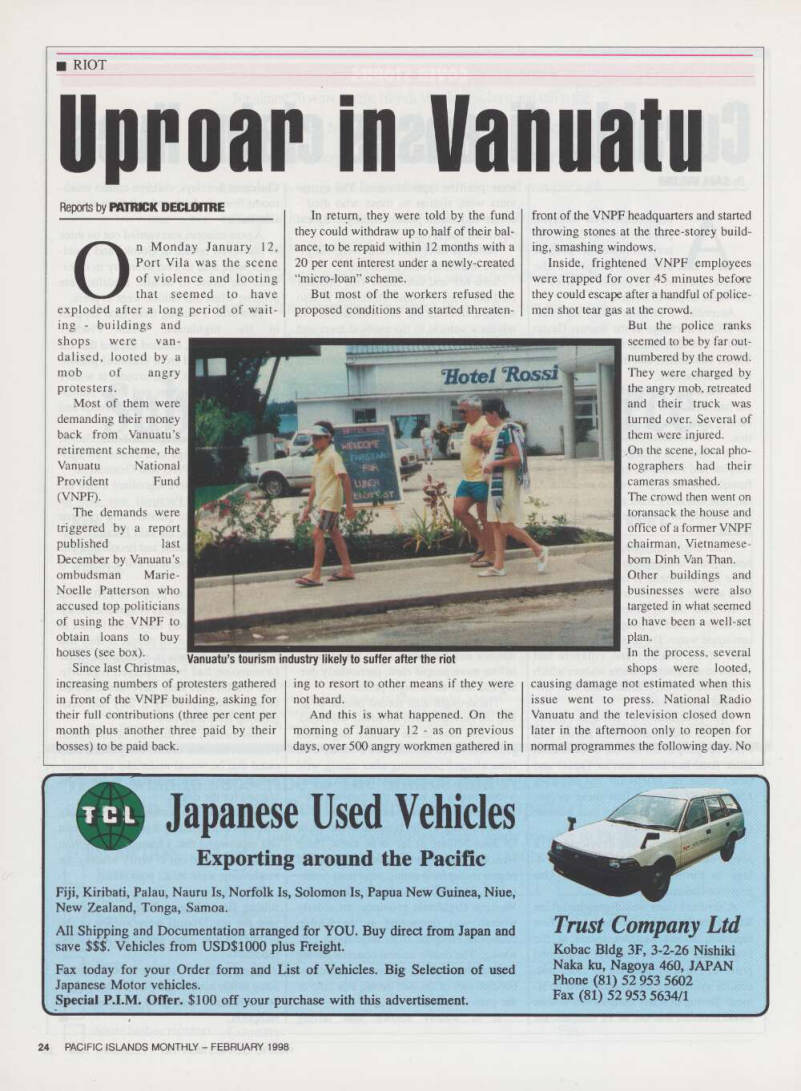
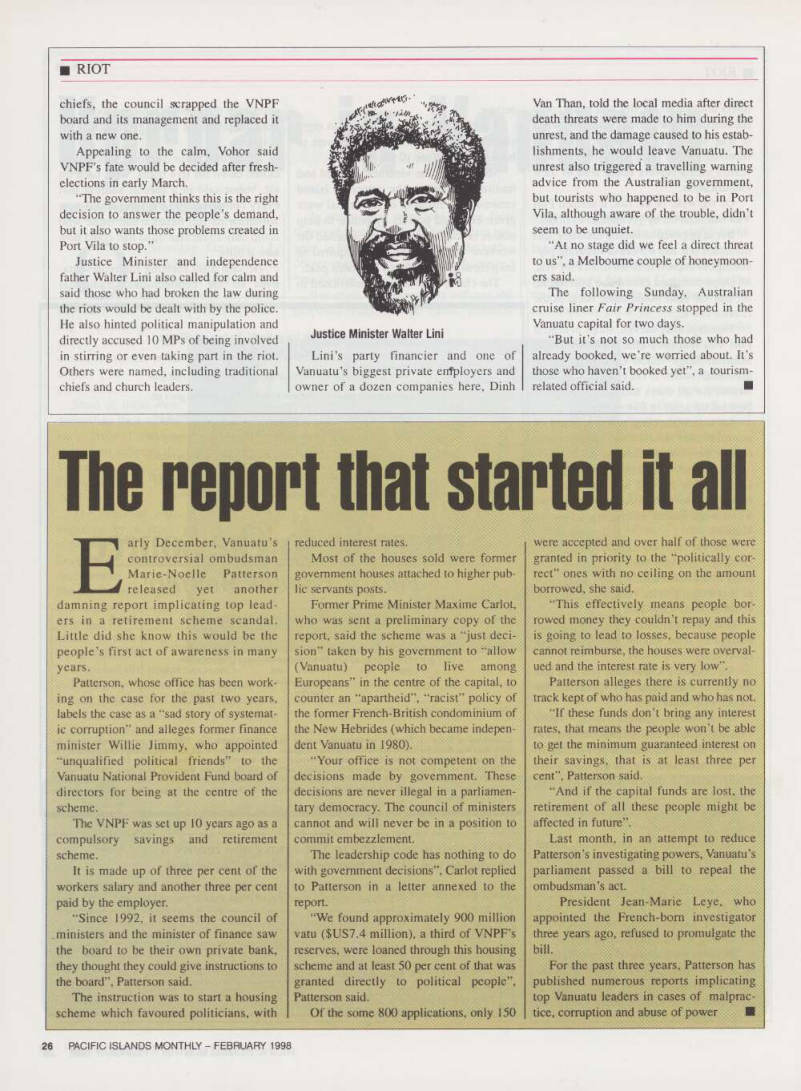
Riot
Reports by PATRICK DECLOITRE
On Monday January 12,
Port Vila was the scene of violence and looting that seemed to have exploded after a long period of wait
ing - buildings and
shops were van dalised, looted by a mob of angry protesters.
Most of them were demanding their money back from Vanuatu’s retirement scheme, the Vanuatu National Provident Fund
(Vnpf).
The demands were triggered by a report published last December by Vanuatu’s ombudsman Marie- Noelle Patterson who accused top politicians of using the VNPF to obtain loans to buy houses (see box).
Since last Christmas,
increasing numbers of protesters gathered in front of the VNPF building, asking for their full contributions (three per cent per month plus another three paid by their bosses) to be paid back.
In return, they were told by the fund they could withdraw up to half of their bal ance, to be repaid within 12 months with a 20 per cent interest under a newly-created “micro-loan” scheme.
But most of the workers refused the proposed conditions and started threaten-
ing to resort to other means if they were not heard.
And this is what happened. On the morning of January 12 - as on previous days, over 500 angry workmen gathered in
front of the VNPF headquarters and started throwing stones at the three-storey build
ing, smashing windows.
Inside, frightened VNPF employees were trapped for over 45 minutes before they could escape after a handful of police men shot tear gas at the crowd.
But the police ranks seemed to be by far out numbered by the crowd.
They were charged by the angry mob, retreated and their truck was turned over. Several of them were injured. ,On the scene, local pho tographers had their cameras smashed.
The crowd then went on toransack the house and office of a former VNPF chairman, Vietnamese born Dinh Van Than.
Other buildings and businesses were also targeted in what seemed to have been a well-set plan.
In the process, several shops were looted,
causing damage not estimated when this issue went to press. National Radio Vanuatu and the television closed down later in the afternoon only to reopen for normal programmes the following day. No
Vanuatu’s tourism industry likely to suffer after the riot
direct allusion to the riot was made, only references to “the current situation” when it was absolutely necessary. They had received threats from some rioters, who feared media reports could lead to their identification.
On the wake of the riot, it seemed Port Vila had been hit by yet another cyclone.
But as opposed to natural disasters, this manmade one had a more devastating psy chological impact. In down town Port Vila, all shops remained closed and boarded up for fear the mob would come back, as the rumour had it.
Two days after the riot, shops in central Port Vila reopened after a call by Prime Minister Serge Vohor. Until early in the afternoon, when it only needed another rumour for all stores and businesses to be boarded up again in five minutes.
An urgent meeting of the council of ministers later resolved to allow everyone to have their contributions back.
On January 13, President Jean-Marie Leye, saying he had acted on Vohor’s request, spoke on national radio to declare a two-week state of emergency, a first for Vanuatu.
“For the last two days, some of have taken the law into their own hands. I’m sorry to see our beautiful town of Port Vila as it is today. I never believed our people could do this,” Leye said in his national address - explaining the emergency state was to “restore peace in our country”.
“Of course, I know what you feel bad about (...) Please take my speech as the speech of a father”.
In a radio address later, Vohor explained that his cabinet took the decision to allow life in Vanuatu to come back to normal and allow a newly-appointed VNPF board of directors to do its work undisturbed.
“There won’t be any more distur bances,” Vohor said.
Under the Vanuatu Constitution, a state of emergency can be declared “in case of natural calamity”, to “prevent a threat” or to restore public order.
It gives extended powers to the council of ministers, which can make regulations for dealing with the public emergency.
This included a ban of all meeting of more than three persons. Weddings were also banned and churches had to apply to the government before holding a religious
service.
Restrictions were also applied to night clubs operations and all meetings were to be dispersed before 10 pm.
Meanwhile, the violence stopped and traditional chiefs in the numerous island communities residing in the capital were given extended powers by police to help restore law and order. They centralised the workers’ demands and were required to keep them quiet until they had been paid.
The chiefs were also commissioned to
encourage their people who had looted the stores to return the stolen good back to the
police.
After the radio station, which was closed down for five hours, went back on air, Vohor said in a special address that every contributor to the fund could now withdraw its full balance and those who could only so far take up to half could now take it fully.
He said after meeting the representa tives of the communities’ traditional
chiefs, the council scrapped the VNPF board and its management and replaced it with a new one.
Appealing to the calm, Vohor said VNPF’s fate would be decided after fresh elections in early March.
“The government thinks this is the right decision to answer the people’s demand, but it also wants those problems created in Port Vila to stop.”
Justice Minister and independence father Walter Lini also called for calm and said those who had broken the law during the riots would be dealt with by the police.
He also hinted political manipulation and directly accused 10 MPs of being involved in stirring or even taking part in the riot.
Others were named, including traditional chiefs and church leaders.
Lini’s party financier and one of Vanuatu’s biggest private enfployers and owner of a dozen companies here, Dinh
Van Than, told the local media after direct death threats were made to him during the unrest, and the damage caused to his estab lishments, he would leave Vanuatu. The unrest also triggered a travelling warning advice from the Australian government, but tourists who happened to be in Port Vila, although aware of the trouble, didn’t seem to be unquiet.
“At no stage did we feel a direct threat to us”, a Melbourne couple of honeymoon ers said.
The following Sunday, Australian cruise liner Fair Princess stopped in the Vanuatu capital for two days.
“But it’s not so much those who had already booked, we’re worried about. It’s those who haven’t booked yet”, a tourism related official said. ■
Justice Minister Walter Lini
Advertisements & other items, pp. 24-25 (1 item)
A Japanese Used Vehicles
Exporting around the Pacific
Fiji, Kiribati, Palau, Nauru Is, Norfolk Is, Solomon Is, Papua New Guinea, Niue, New Zealand, Tonga, Samoa.
All Shipping and Documentation arranged for YOU. Buy direct from Japan and save sss. Vehicles from USDSIOOO plus Freight.
Fax today for your Order form and List of Vehicles. Big Selection of used Japanese Motor vehicles.
Special P.I.M. Offer. $lOO off your purchase with this advertisement. r
Trust Company Ltd
Kobac Bldg 3F, 3-2-26 Nishiki Naka ku, Nagoya 460, JAPAN Phone (81) 52 953 5602 Fax (81) 52 953 5634/1
For almost 70 years, Pacific Islands Monthly has been and still is the authority on political, business and social issues within the Pacific. And now, every 12 month subscription received before the 31st of March, 1998, goes into a draw to win an IBM Pentium Notebook*. You could even give a gift subscription to enter but it must be before the closing date. As well as the entry into the draw, you will also receive the latest news from the region. Fill in the subscription form below and send it along with payment to Pacific Islands Monthly, Subscription Department, PO Box 1167, Suva, Fiji. Or call PIM on (679) 304 111 or fax us on (679) 303 809/(679) 307 460.
Subscribe to The Source.
Pacific Islands Monthly
‘Rates include Airspeeding to all destinations Conditions of Entry 1. To enter, subscriptions must be made before March 31st, 1998 which automaticaUy enters the subscriber into the draw for the Pentium Notebook Computer. 2. Entry is open to all subscribers except employees of The Fiji Times Ltd, Pacific Islands Monthly, and Wilson Addison Ltd. 3. Subscribers need to subscribe for 12 months to qualify. 4. The winner of the Pentium Notebook will be published in Pacific Islands Monthly Magazine, May Issue, 1998 and will be notified by registered mail. 5. The winner will receive their prize within one month of the draw. 6. The prize must be taken as offered and is not redeemable. 7. In the event of any dispute the decision of the promoter is final and no correspondence will be entered into.
YES! I wish to subscribe to The Source and receive a chance to win an IBM Pentium Notebook Computer! 12 ISSUE „ □ Cheque/Bank Draft/Money Order made payable to Pacific Islands Monthly SUBSCRIPTION j— p) ease charge my credit card: (VISA / AMEX / MASTERCARD) □ RateA I 1 1 1 1 I 1 1 1 1 I 1 1 1 1 Rate B
□ RateC
Rate D Rate E This is a
□ Renewal
Signature: Expiry date: Mr/Mrs/Ms: Delivery Address; Postal Address: □ New Subscription Country: Fax:
The report that started it all
Early December, Vanuatu’s controversial ombudsman Marie-Noelle Patterson released yet another damning report implicating top lead ers in a retirement scheme scandal.
Little did she know this would be the people’s first act of awareness in many years.
Patterson, whose office has been work ing on the case for the past two years, labels the case as a “sad story of systemat ic corruption” and alleges former finance minister Willie Jimmy, who appointed “unqualified political friends” to the Vanuatu National Provident Fund board of directors for being at the centre of the scheme.
The VNPF was set up 10 years ago as a compulsory savings and retirement scheme.
It is made up of three per cent of the workers salary and another three per cent paid by the employer.
“Since 1992, it seems the council of ministers and the minister of finance saw the board to be their own private bank, they thought they could give instructions to the board”, Patterson said.
The instruction was to start a housing scheme which favoured politicians, with
reduced interest rates.
Most of the houses sold were former government houses attached to higher pub lic servants posts.
Former Prime Minister Maxime Carlot, who was sent a preliminary copy of the report, said the scheme was a “just deci sion” taken by his government to “allow (Vanuatu) people to live among Europeans” in the centre of the capital, to counter an “apartheid”, “racist” policy of the former French-British condominium of the New Hebrides (which became indepen dent Vanuatu in 1980).
“Your office is not competent on the decisions made by government. These decisions are never illegal in a parliamen tary democracy. The council of ministers cannot and will never be in a position to commit embezzlement.
The leadership code has nothing to do with government decisions”, Carlot replied to Patterson in a letter annexed to the report.
“We found approximately 900 million vatu (SUS 7.4 million), a third of VNPF’s reserves, were loaned through this housing scheme and at least 50 per cent of that was granted directly to political people”, Patterson said.
Of the some 800 applications, only 150
were accepted and over half of those were granted in priority to the “politically cor rect” ones with no ceiling on the amount borrowed, she said.
“This effectively means people bor rowed money they couldn’t repay and this is going to lead to losses, because people cannot reimburse, the houses were overval ued and the interest rate is very low”.
Patterson alleges there is currently no track kept of who has paid and who has not.
“If these funds don’t bring any interest rates, that means the people won’t be able to get the minimum guaranteed interest on their savings, that is at least three per cent”, Patterson said.
“And if the capital funds are lost, the retirement of all these people might be affected in future”.
Last month, in an attempt to reduce Patterson’s investigating powers, Vanuatu’s parliament passed a bill to repeal the ombudsman’s act.
President Jean-Marie Leye, who
appointed the French-bom investigator
three years ago, refused to promulgate the bill.
For the past three years, Patterson has
published numerous reports implicating
top Vanuatu leaders in cases of malprac tice, corruption and abuse of power ■
Skate on thin ice
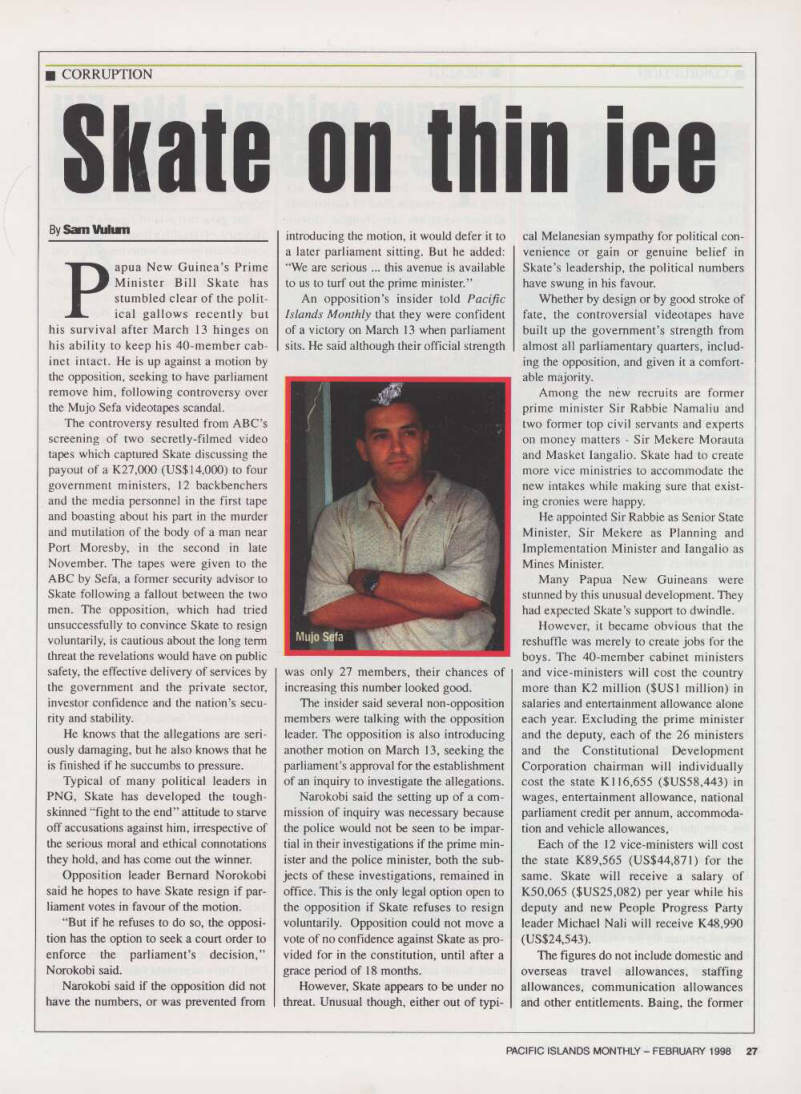
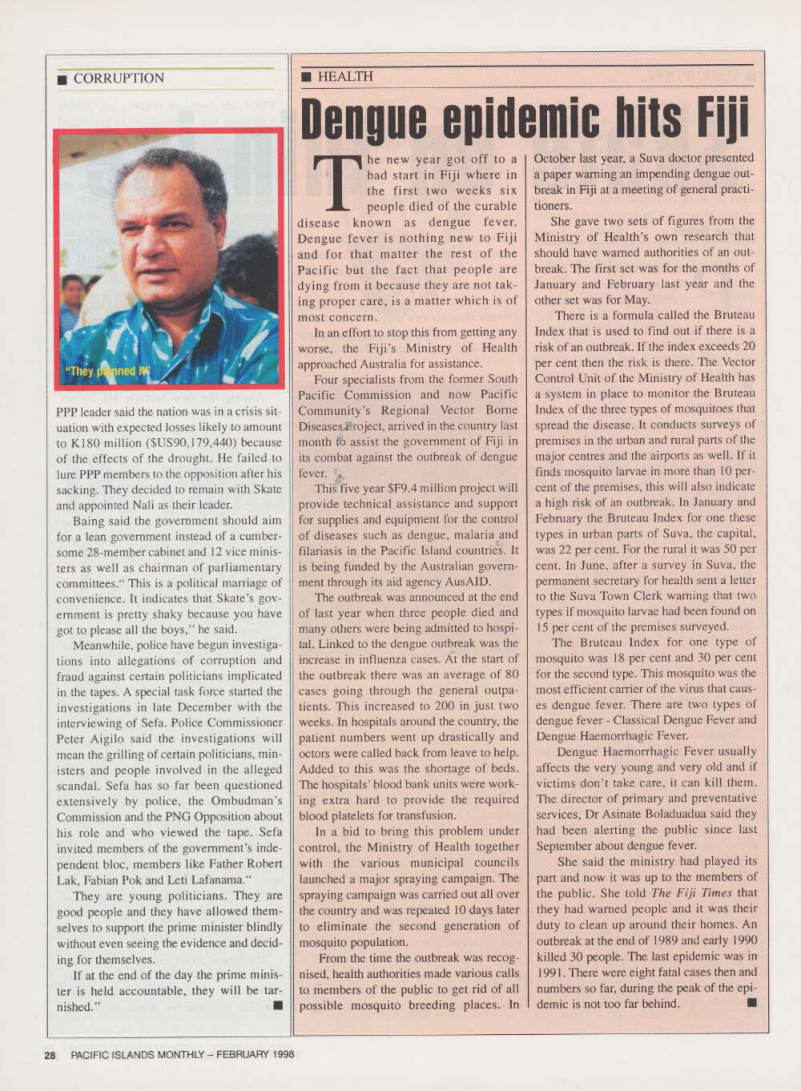
Corruption
By Sam Vulum
Papua New Guinea’s Prime Minister Bill Skate has stumbled clear of the polit ical gallows recently but his survival after March 13 hinges on his ability to keep his 40-member cab inet intact. He is up against a motion by the opposition, seeking to have parliament remove him, following controversy over the Mujo Sefa videotapes scandal.
The controversy resulted from ABC’s screening of two secretly-filmed video tapes which captured Skate discussing the payout of a K 27,000 (US$l4,OOO) to four government ministers, 12 backbenchers and the media personnel in the first tape and boasting about his part in the murder and mutilation of the body of a man near Port Moresby, in the second in late November. The tapes were given to the ABC by Sefa, a former security advisor to Skate following a fallout between the two men. The opposition, which had tried unsuccessfully to convince Skate to resign voluntarily, is cautious about the long term threat the revelations would have on public safety, the effective delivery of services by the government and the private sector, investor confidence and the nation’s secu rity and stability.
He knows that the allegations are seri ously damaging, but he also knows that he is finished if he succumbs to pressure.
Typical of many political leaders in PNG, Skate has developed the tough skinned “fight to the end” attitude to starve off accusations against him, irrespective of the serious moral and ethical connotations they hold, and has come out the winner.
Opposition leader Bernard Norokobi said he hopes to have Skate resign if par liament votes in favour of the motion.
“But if he refuses to do so, the opposi tion has the option to seek a court order to enforce the parliament’s decision,”
Norokobi said.
Narokobi said if the opposition did not have the numbers, or was prevented from
introducing the motion, it would defer it to a later parliament sitting. But he added; “We are serious ... this avenue is available to us to turf out the prime minister.”
An opposition’s insider told Pacific Islands Monthly that they were confident of a victory on March 13 when parliament sits. He said although their official strength
was only 27 members, their chances of increasing this number looked good.
The insider said several non-opposition members were talking with the opposition leader. The opposition is also introducing another motion on March 13, seeking the parliament’s approval for the establishment of an inquiry to investigate the allegations.
Narokobi said the setting up of a com mission of inquiry was necessary because the police would not be seen to be impar tial in their investigations if the prime min ister and the police minister, both the sub jects of these investigations, remained in office. This is the only legal option open to the opposition if Skate refuses to resign voluntarily. Opposition could not move a vote of no confidence against Skate as pro vided for in the constitution, until after a grace period of 18 months.
However, Skate appears to be under no threat. Unusual though, either out of typi
cal Melanesian sympathy for political con venience or gain or genuine belief in Skate’s leadership, the political numbers have swung in his favour.
Whether by design or by good stroke of fate, the controversial videotapes have built up the government’s strength from almost all parliamentary quarters, includ ing the opposition, and given it a comfort able majority.
Among the new recruits are former prime minister Sir Rabbie Namaliu and two former top civil servants and experts on money matters - Sir Mekere Morauta and Masket langalio. Skate had to create more vice ministries to accommodate the new intakes while making sure that exist
ing cronies were happy.
He appointed Sir Rabbie as Senior State Minister, Sir Mekere as Planning and Implementation Minister and langalio as Mines Minister.
Many Papua New Guineans were stunned by this unusual development. They had expected Skate’s support to dwindle.
However, it became obvious that the reshuffle was merely to create jobs for the boys. The 40-member cabinet ministers and vice-ministers will cost the country more than K 2 million (SUSI million) in salaries and entertainment allowance alone each year. Excluding the prime minister and the deputy, each of the 26 ministers and the Constitutional Development Corporation chairman will individually cost the state K 116,655 ($U558,443) in wages, entertainment allowance, national parliament credit per annum, accommoda tion and vehicle allowances, Each of the 12 vice-ministers will cost the state K 89,565 (U 5544,871) for the same. Skate will receive a salary of K 50,065 ($U525,082) per year while his
deputy and new People Progress Party
leader Michael Nali will receive K 48,990 (U 5524,543).
The figures do not include domestic and overseas travel allowances, staffing allowances, communication allowances and other entitlements. Baing, the former
Mujo Seta
PPP leader said the nation was in a crisis sit uation with expected losses likely to amount to KlBO million ($U590,179,440) because of the effects of the drought. He failed to lure PPP members to the opposition after his sacking. They decided to remain with Skate and appointed Nali as their leader.
Baing said the government should aim for a lean government instead of a cumber some 28-member cabinet and 12 vice minis ters as well as chairman of parliamentary committees." This is a political marriage of convenience. It indicates that Skate’s gov ernment is pretty shaky because you have got to please all the boys,” he said.
Meanwhile, police have begun investiga tions into allegations of corruption and fraud against certain politicians implicated in the tapes. A special task force started the investigations in late December with the interviewing of Sefa. Police Commissioner Peter Aigilo said the investigations will mean the grilling of certain politicians, min isters and people involved in the alleged scandal. Sefa has so far been questioned extensively by police, the Ombudman’s Commission and the PNG Opposition about his role and who viewed the tape. Sefa invited members of the government’s inde pendent bloc, members like Father Robert Lak, Fabian Pok and Leti Lafanama."
They are young politicians. They are good people and they have allowed them selves to support the prime minister blindly without even seeing the evidence and decid ing for themselves.
If at the end of the day the prime minis ter is held accountable, they will be tar nished.” ■
“They mined it"
Dengue epidemic hits Fiji
Health
The new year got off to a bad start in Fiji where in the first two weeks six people died of the curable disease known as dengue fever.
Dengue fever is nothing new to Fiji and for that matter the rest of the Pacific but the fact that people are dying from it because they are not tak ing proper care, is a matter which is of most concern.
In an effort to stop this from getting any worse, the Fiji’s Ministry of Health approached Australia for assistance.
Four specialists from the former South Pacific Commission and now Pacific Community’s Regional Vector Borne DiseasesJ'roject, arrived in the country last month to assist the government of Fiji in its combat against the outbreak of dengue fever.
This five year $F9.4 million project will provide technical assistance and support for supplies and equipment for the control of diseases such as dengue, malaria and filariasis in the Pacific Island countries. It is being funded by the Australian govern ment through its aid agency AusAID.
The outbreak was announced at the end of last year when three people died and many others were being admitted to hospi tal. Linked to the dengue outbreak was the increase in influenza cases. At the start of the outbreak there was an average of 80 cases going through the general outpa tients. This increased to 200 in just two weeks. In hospitals around the country, the patient numbers went up drastically and octors were called back from leave to help.
Added to this was the shortage of beds.
The hospitals’ blood bank units were work ing extra hard to provide the required blood platelets for transfusion.
In a bid to bring this problem under control, the Ministry of Health together with the various municipal councils launched a major spraying campaign. The spraying campaign was carried out all over the country and was repeated 10 days later to eliminate the second generation of
mosquito population.
From the time the outbreak was recog nised, health authorities made various calls to members of the public to get rid of all
possible mosquito breeding places. In
October last year, a Suva doctor presented a paper warning an impending dengue out break in Fiji at a meeting of general practi tioners.
She gave two sets of figures from the Ministry of Health’s own research that should have warned authorities of an out break. The first set was for the months of January and February last year and the other set was for May.
There is a formula called the Bruteau Index that is used to find out if there is a risk of an outbreak. If the index exceeds 20 per cent then the risk is there. The Vector Control Unit of the Ministry of Health has a system in place to monitor the Bruteau Index of the three types of mosquitoes that spread the disease. It conducts surveys of premises in the urban and rural parts of the major centres and the airports as well. If it finds mosquito larvae in more than 10 per cent of the premises, this will also indicate a high risk of an outbreak. In January and February the Bruteau Index for one these types in urban parts of Suva, the capital, was 22 per cent. For the rural it was 50 per cent. In June, after a survey in Suva, the permanent secretary for health sent a letter to the Suva Town Clerk warning that two types if mosquito larvae had been found on 15 per cent of the premises surveyed.
The Bruteau Index for one type of mosquito was 18 per cent and 30 per cent for the second type. This mosquito was the most efficient carrier of the virus that caus es dengue fever. There are two types of dengue fever - Classical Dengue Fever and Dengue Haemorrhagic Fever.
Dengue Haemorrhagic Fever usually affects the very young and very old and if victims don’t take care, it can kill them.
The director of primary and preventative services. Dr Asinate Boladuadua said they had been alerting the public since last September about dengue fever.
She said the ministry had played its part and now it was up to the members of the public. She told The Fiji Times that they had warned people and it was their duty to clean up around their homes. An outbreak at the end of 1989 and early 1990 killed 30 people. The last epidemic was in 1991. There were eight fatal cases then and numbers so far, during the peak of the epi demic is not too far behind. ■
A chance to start anew
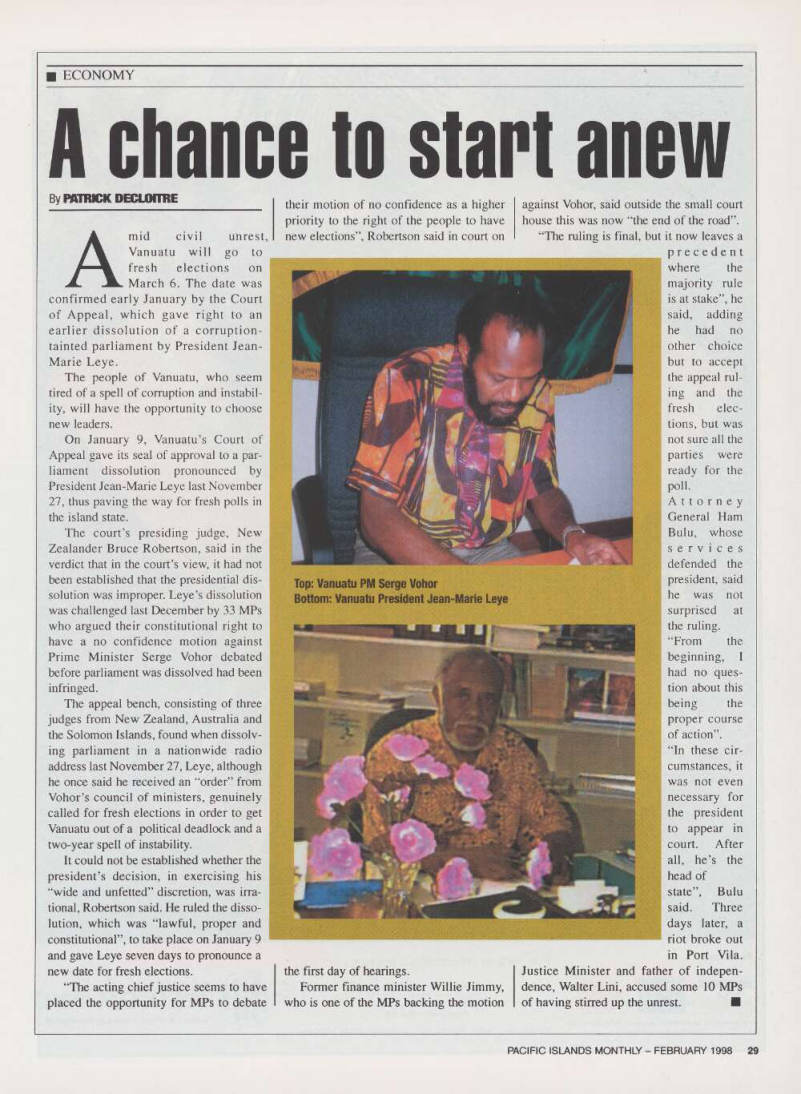
Economy
By Patrick Decloitre
Amid civil unrest, Vanuatu will go to fresh elections on March 6. The date was confirmed early January by the Court of Appeal, which gave right to an earlier dissolution of a corruption tainted parliament by President Jean- Marie Leye.
The people of Vanuatu, who seem tired of a spell of corruption and instabil ity, will have the opportunity to choose new leaders.
On January 9, Vanuatu’s Court of Appeal gave its seal of approval to a par liament dissolution pronounced by President Jean-Marie Leye last November 27, thus paving the way for fresh polls in the island state.
The court’s presiding judge, New Zealander Bruce Robertson, said in the verdict that in the court’s view, it had not been established that the presidential dis solution was improper. Leye’s dissolution was challenged last December by 33 MPs who argued their constitutional right to have a no confidence motion against Prime Minister Serge Vohor debated before parliament was dissolved had been infringed.
The appeal bench, consisting of three judges from New Zealand, Australia and the Solomon Islands, found when dissolv ing parliament in a nationwide radio address last November 27, Leye, although he once said he received an “order” from Vohor’s council of ministers, genuinely called for fresh elections in order to get Vanuatu out of a political deadlock and a two-year spell of instability.
It could not be established whether the president’s decision, in exercising his “wide and unfetted” discretion, was irra tional, Robertson said. He ruled the disso lution, which was “lawful, proper and constitutional”, to take place on January 9 and gave Leye seven days to pronounce a new date for fresh elections.
“The acting chief justice seems to have placed the opportunity for MPs to debate
their motion of no confidence as a higher priority to the right of the people to have new elections”, Robertson said in court on
the first day of hearings.
Former finance minister Willie Jimmy, who is one of the MPs backing the motion
against Vohor, said outside the small court house this was now “the end of the road”.
“The ruling is final, but it now leaves a
precedent
where the majority rule is at stake”, he said, adding he had no other choice but to accept the appeal rul ing and the fresh elec tions, but was not sure all the
parties were
ready for the poll.
Attorney General Ham Bulu, whose services defended the president, said he was not surprised at the ruling.
“From the beginning, I had no ques tion about this being the proper course of action”.
“In these cir cumstances, it was not even necessary for
the president
to appear in court. After all, he’s the head of state”, Bulu said. Three days later, a riot broke out in Port Vila.
Justice Minister and father of indepen dence, Walter Lini, accused some 10 MPs of having stirred up the unrest. ■
Top: Vanuatu PM Serge Vohor
Bottom: Vanuatu President Jean-Marie Leye
Advertisements & other items, pp. 30-31 (1 item)
«Ih)telikom png
-*5 - £ r bs ■> 7 y\ w <*' m m m - ❖ ,V\ ?t ii &n We accept Just quote your card number and expiry date and we will forward your requirements.
For further information please contact: Tettkom Phone Card Sales Pay Phone Business Unit PO Box 351 Waigani, NCD Papua New Guinea Telephone: (675) 300 5093 Facsimile: (675) 3005060
' ® AAO4O ficxs-vss- rWtCUf J
i V fc . w Slfl ■&1
One for all cleaning.
One for all markets.
Number one in the world.
The Big Green Clean Machine. A powerful three function cleaning machine system.
Deep Cleaning Dry Vacuuming Wet Vacuum Dealers Wanted Contact:
BISSELL Inc., P.O. Box 1888
Grand Rapids, Michigan 49501 USA ■f* § • JT -4 J' M mm mmm m m mmt 4 Telephone 616 453-4451 Fax 616 453-1383 Telex 432 0165 BISL UI
Life’s messy. Clean it up!"
p Made in the U.S.A.
Apocalypse over...peace
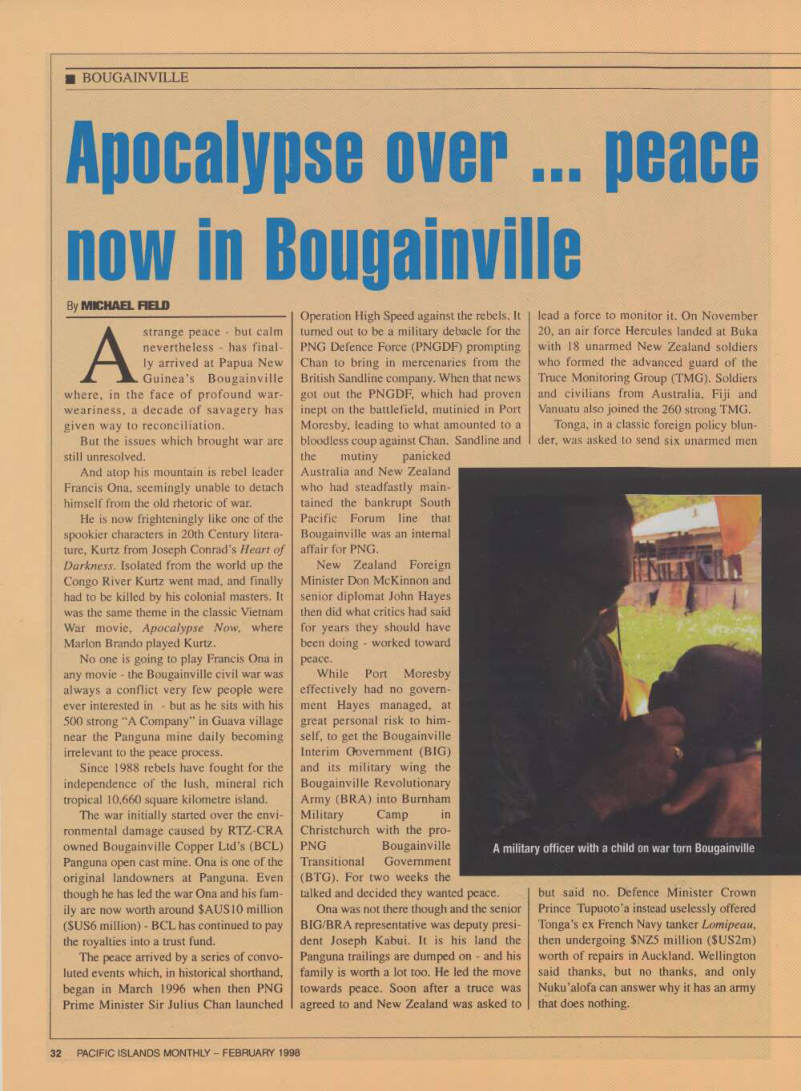
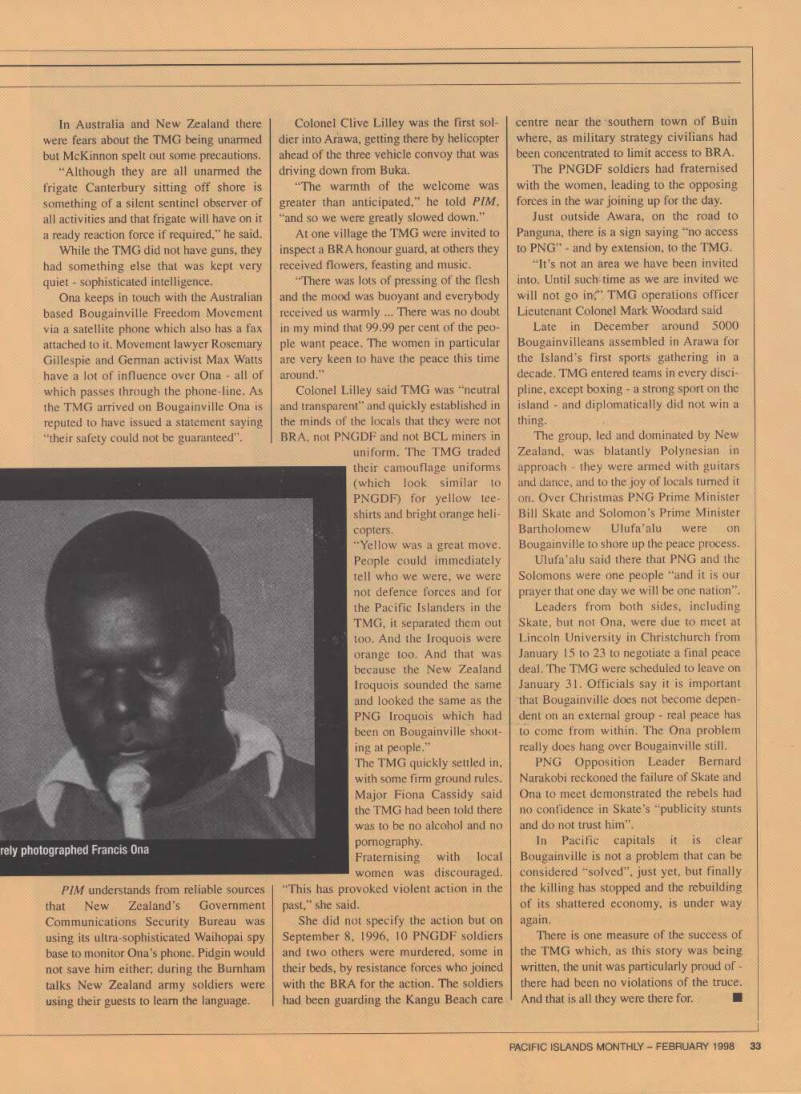
Bougainville
Apocalypse over...peace now in Bougainville
By Michael Field
A strange peace - but calm nevertheless - has final ly arrived at Papua New
Guinea’s Bougainville
where, in the face of profound war weariness, a decade of savagery has given way to reconciliation.
But the issues which brought war are still unresolved.
And atop his mountain is rebel leader Francis Ona, seemingly unable to detach himself from the old rhetoric of war.
He is now frighteningly like one of the spookier characters in 20th Century litera ture, Kurtz from Joseph Conrad’s Heart of Darkness. Isolated from the world up the Congo River Kurtz went mad, and finally had to be killed by his colonial masters. It was the same theme in the classic Vietnam War movie, Apocalypse Now, where Marlon Brando played Kurtz.
No one is going to play Francis Ona in any movie - the Bougainville civil war was always a conflict very few people were ever interested in - but as he sits with his 500 strong “A Company” in Guava village near the Panguna mine daily becoming irrelevant to the peace process.
Since 1988 rebels have fought for the independence of the lush, mineral rich tropical 10,660 square kilometre island.
The war initially started over the envi ronmental damage caused by RTZ-CRA owned Bougainville Copper Ltd’s (BCL) Panguna open cast mine. Ona is one of the original landowners at Panguna. Even though he has led the war Ona and his fam ily are now worth around SAUSIO million (SUS 6 million) - BCL has continued to pay the royalties into a trust fund.
The peace arrived by a series of convo luted events which, in historical shorthand, began in March 1996 when then PNG Prime Minister Sir Julius Chan launched
Operation High Speed against the rebels. It turned out to be a military debacle for the PNG Defence Force (PNGDF) prompting Chan to bring in mercenaries from the British Sandline company. When that news got out the PNGDF, which had proven inept on the battlefield, mutinied in Port Moresby, leading to what amounted to a bloodless coup against Chan. Sandline and the mutiny panicked
Australia and New Zealand who had steadfastly main tained the bankrupt South Pacific Forum line that Bougainville was an internal affair for PNG.
New Zealand Foreign Minister Don McKinnon and senior diplomat John Hayes then did what critics had said for years they should have been doing - worked toward peace.
While Port Moresby effectively had no govern ment Hayes managed, at great personal risk to him self, to get the Bougainville Interim Government (BIG) and its military wing the
Bougainville Revolutionary
Army (BRA) into Burnham Military Camp in Christchurch with the pro-
PNG Bougainville
Transitional Government (BTG). For two weeks the
talked and decided they wanted peace.
Ona was not there though and the senior BIG/BRA representative was deputy presi dent Joseph Kabui. It is his land the Panguna trailings are dumped on - and his family is worth a lot too. He led the move towards peace. Soon after a truce was agreed to and New Zealand was asked to
lead a force to monitor it. On November 20, an air force Hercules landed at Buka with 18 unarmed New Zealand soldiers who formed the advanced guard of the Truce Monitoring Group (TMG). Soldiers and civilians from Australia, Fiji and Vanuatu also joined the 260 strong TMG.
Tonga, in a classic foreign policy blun der, was asked to send six unarmed men
but said no. Defence Minister Crown Prince Tupuoto’a instead uselessly offered Tonga’s ex French Navy tanker Lomipeau, then undergoing SNZS million (SUS2m) worth of repairs in Auckland. Wellington said thanks, but no thanks, and only Nuku’alofa can answer why it has an army that does nothing.
A military officer with a child on war torn Bougainville
In Australia and New Zealand there were fears about the TMG being unarmed but McKinnon spelt out some precautions.
“Although they are all unarmed the frigate Canterbury sitting off shore is something of a silent sentinel observer of all activities and that frigate will have on it a ready reaction force if required,” he said.
While the TMG did not have guns, they had something else that was kept very
quiet - sophisticated intelligence.
Ona keeps in touch with the Australian based Bougainville Freedom Movement via a satellite phone which also has a fax attached to it. Movement lawyer Rosemary Gillespie and German activist Max Watts have a lot of influence over Ona - all of which passes through the phone-line. As the TMG arrived on Bougainville Ona is reputed to have issued a statement saying “their safety could not be guaranteed”.
PIM understands from reliable sources that New Zealand’s Government Communications Security Bureau was using its ultra-sophisticated Waihopai spy base to monitor Ona’s phone. Pidgin would not save him either; during the Burnham talks New Zealand army soldiers were using their guests to leam the language.
Colonel Clive Lilley was the first sol dier into Arawa, getting there by helicopter ahead of the three vehicle convoy that was driving down from Buka.
“The warmth of the welcome was greater than anticipated,” he told PIM, “and so we were greatly slowed down.”
At one village the TMG were invited to inspect a BRA honour guard, at others they received flowers, feasting and music.
“There was lots of pressing of the flesh and the mood was buoyant and everybody received us warmly ... There was no doubt in my mind that 99.99 per cent of the peo ple want peace. The women in particular are very keen to have the peace this time around.”
Colonel Lilley said TMG was “neutral and transparent” and quickly established in the minds of the locals that they were not BRA, not PNGDF and not BCL miners in
uniform. The TMG traded their camouflage uniforms (which look similar to PNGDF) for yellow tee shirts and bright orange heli copters.
“Yellow was a great move.
People could immediately tell who we were, we were not defence forces and for the Pacific Islanders in the TMG, it separated them out too. And the Iroquois were orange too. And that was because the New Zealand Iroquois sounded the same and looked the same as the PNG Iroquois which had been on Bougainville shoot ing at people.”
The TMG quickly settled in, with some firm ground rules.
Major Fiona Cassidy said the TMG had been told there was to be no alcohol and no pornography.
Fraternising with local women was discouraged.
“This has provoked violent action in the past,” she said.
She did not specify the action but on September 8, 1996, 10 PNGDF soldiers and two others were murdered, some in their beds, by resistance forces who joined with the BRA for the action. The soldiers had been guarding the Kangu Beach care
centre near the southern town of Buin where, as military strategy civilians had been concentrated to limit access to BRA.
The PNGDF soldiers had fraternised with the women, leading to the opposing forces in the war joining up for the day.
Just outside Awara, on the road to Panguna, there is a sign saying “no access to PNG” - and by extension, to the TMG.
“It’s not an area we have been invited into. Until such time as we are invited we will not go inf’ TMG operations officer Lieutenant Colonel Mark Woodard said Late in December around 5000 Bougainvilleans assembled in Arawa for the Island’s first sports gathering in a decade. TMG entered teams in every disci pline, except boxing - a strong sport on the island - and diplomatically did not win a thing.
The group, led and dominated by New Zealand, was blatantly Polynesian in approach - they were armed with guitars and dance, and to the joy of locals turned it on. Over Christmas PNG Prime Minister Bill Skate and Solomon’s Prime Minister Bartholomew Ulufa’alu were on Bougainville to shore up the peace process.
Ulufa’alu said there that PNG and the Solomons were one people “and it is our prayer that one day we will be one nation”.
Leaders from both sides, including Skate, but not Ona, were due to meet at Lincoln University in Christchurch from January 15 to 23 to negotiate a final peace deal. The TMG were scheduled to leave on January 31. Officials say it is important that Bougainville does not become depen dent on an external group - real peace has to come from within. The Ona problem really does hang over Bougainville still.
PNG Opposition Leader Bernard Narakobi reckoned the failure of Skate and Ona to meet demonstrated the rebels had no confidence in Skate’s “publicity stunts and do not trust him”.
In Pacific capitals it is clear Bougainville is not a problem that can be considered “solved”, just yet, but finally the killing has stopped and the rebuilding of its shattered economy, is under way
again.
There is one measure of the success of the TMG which, as this story was being written, the unit was particularly proud of there had been no violations of the truce.
And that is all they were there for. ■
[?]ely photographed Francis Ona
Airline tragedy prompts family support act
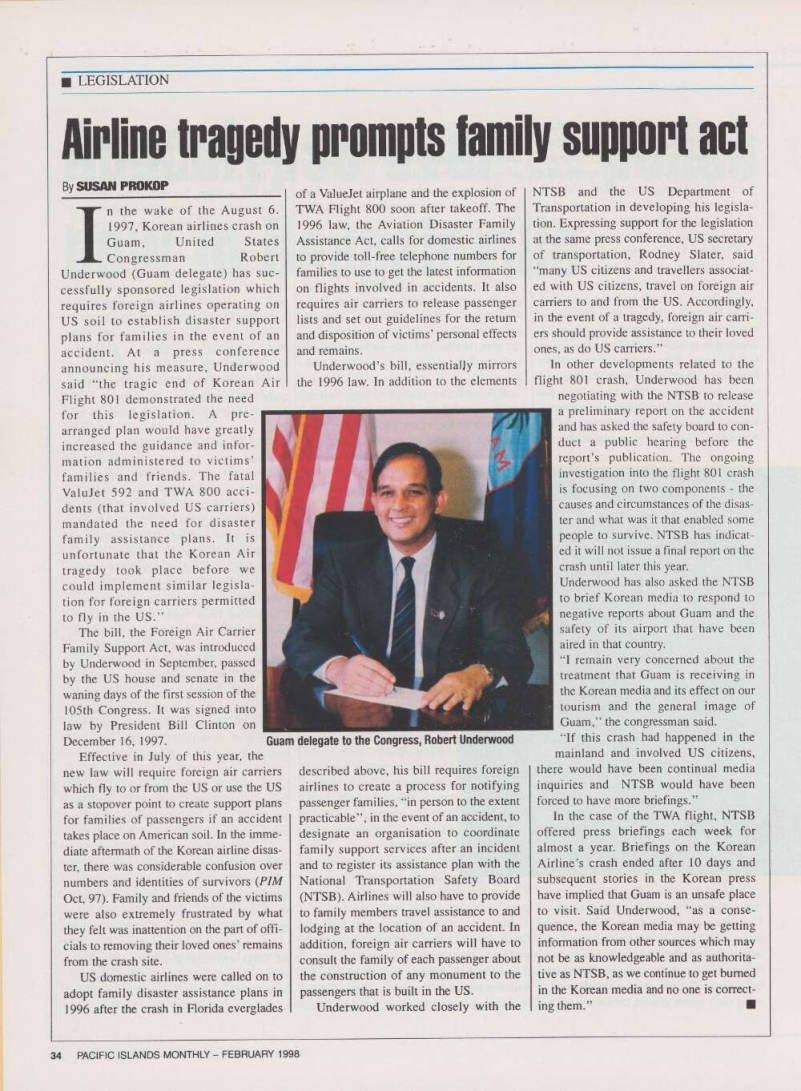
Legislation
By Susan Prokop
In the wake of the August 6. 1997, Korean airlines crash on Guam, United States Congressman Robert Underwood (Guam delegate) has suc cessfully sponsored legislation which requires foreign airlines operating on US soil to establish disaster support plans for families in the event of an accident. At a press conference announcing his measure, Underwood said “the tragic end of Korean Air
Flight 801 demonstrated the need for this legislation. A pre arranged plan would have greatly increased the guidance and infor mation administered to victims’ families and friends. The fatal ValuJet 592 and TWA 800 acci dents (that involved US carriers) mandated the need for disaster family assistance plans. It is unfortunate that the Korean Air tragedy took place before we could implement similar legisla tion for foreign carriers permitted to fly in the US.”
The bill, the Foreign Air Carrier Family Support Act, was introduced by Underwood in September, passed by the US house and senate in the waning days of the first session of the 105th Congress. It was signed into law by President Bill Clinton on December 16, 1997.
Effective in July of this year, the new law will require foreign air carriers which fly to or from the US or use the US as a stopover point to create support plans for families of passengers if an accident takes place on American soil. In the imme diate aftermath of the Korean airline disas ter, there was considerable confusion over numbers and identities of survivors (PIM Oct, 97). Family and friends of the victims were also extremely frustrated by what they felt was inattention on the part of offi cials to removing their loved ones’ remains from the crash site.
US domestic airlines were called on to adopt family disaster assistance plans in 1996 after the crash in Florida everglades
of a Value Jet airplane and the explosion of TWA Flight 800 soon after takeoff. The 1996 law, the Aviation Disaster Family Assistance Act, calls for domestic airlines to provide toll-free telephone numbers for families to use to get the latest information on flights involved in accidents. It also requires air carriers to release passenger lists and set out guidelines for the return and disposition of victims’ personal effects and remains.
Underwood’s bill, essentially mirrors the 1996 law. In addition to the elements
described above, his bill requires foreign airlines to create a process for notifying passenger families, "in person to the extent practicable”, in the event of an accident, to designate an organisation to coordinate family support services after an incident and to register its assistance plan with the
National Transportation Safety Board
(NTSB). Airlines will also have to provide to family members travel assistance to and lodging at the location of an accident. In addition, foreign air carriers will have to consult the family of each passenger about the construction of any monument to the passengers that is built in the US.
Underwood worked closely with the
NTSB and the US Department of Transportation in developing his legisla tion. Expressing support for the legislation at the same press conference, US secretary of transportation, Rodney Slater, said “many US citizens and travellers associat ed with US citizens, travel on foreign air carriers to and from the US. Accordingly, in the event of a tragedy, foreign air carri ers should provide assistance to their loved ones, as do US carriers.”
In other developments related to the flight 801 crash, Underwood has been
negotiating with the NTSB to release a preliminary report on the accident and has asked the safety board to con duct a public hearing before the
report’s publication. The ongoing
investigation into the flight 801 crash is focusing on two components - the causes and circumstances of the disas ter and what was it that enabled some people to survive. NTSB has indicat ed it will not issue a final report on the crash until later this year.
Underwood has also asked the NTSB to brief Korean media to respond to negative reports about Guam and the safety of its airport that have been aired in that country.
“I remain very concerned about the treatment that Guam is receiving in the Korean media and its effect on our tourism and the general image of Guam,” the congressman said.
“If this crash had happened in the
mainland and involved US citizens, there would have been continual media inquiries and NTSB would have been forced to have more briefings.”
In the case of the TWA flight, NTSB offered press briefings each week for almost a year. Briefings on the Korean Airline’s crash ended after 10 days and subsequent stories in the Korean press have implied that Guam is an unsafe place to visit. Said Underwood, “as a conse quence, the Korean media may be getting information from other sources which may not be as knowledgeable and as authorita tive as NTSB, as we continue to get burned in the Korean media and no one is correct ing them.” ■
Guam delegate to the Congress, Robert Underwood
Leadership struggle on Tuvalu
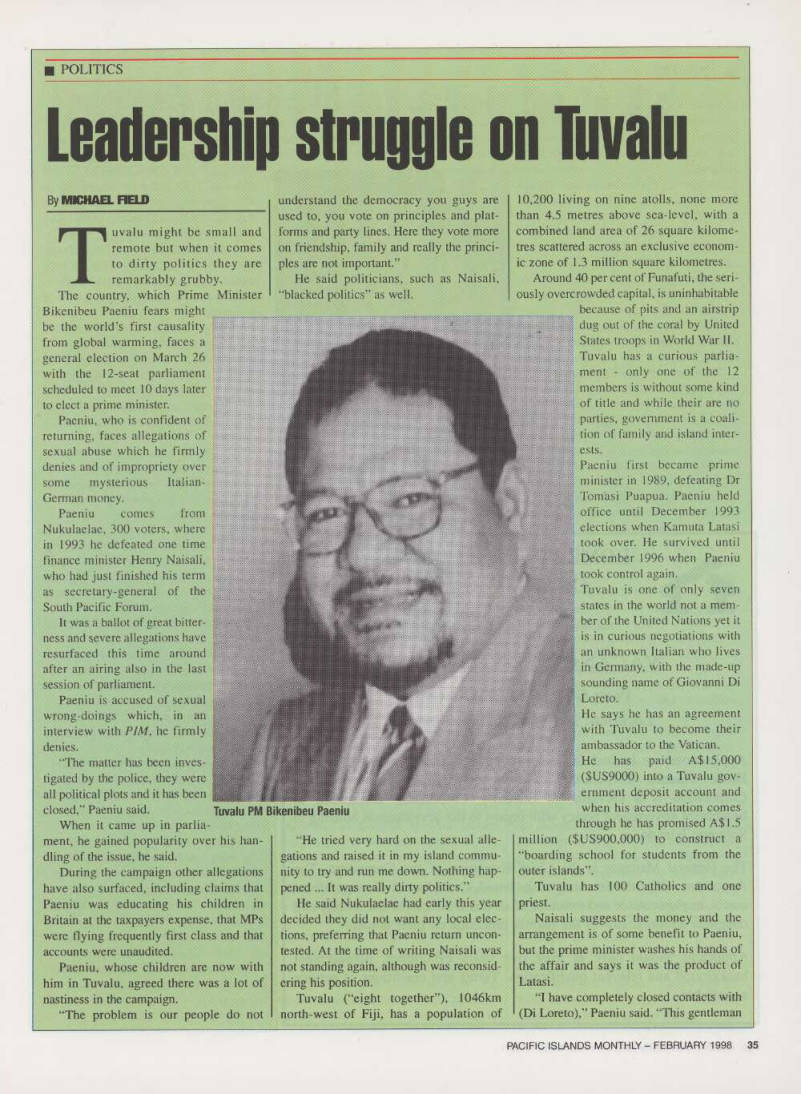
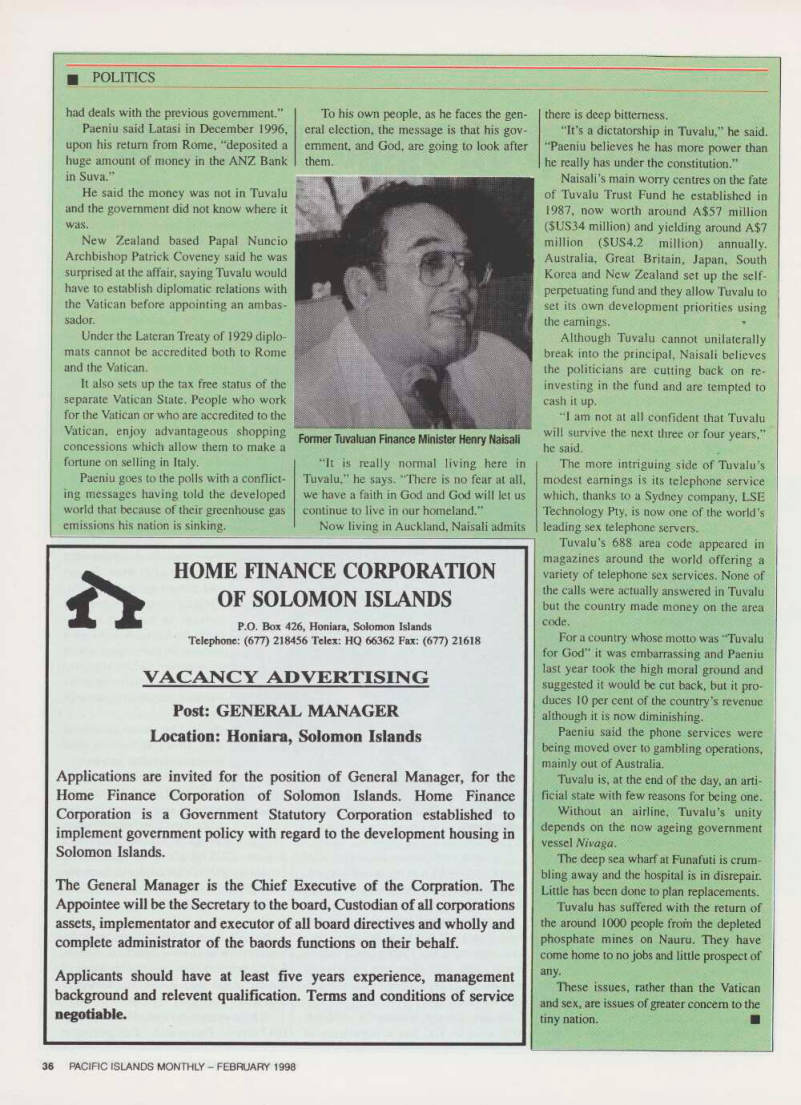
Politics
By Michael Field
Tuvalu might be small and remote but when it comes to dirty politics they are remarkably grubby.
The country, which Prime Minister
Bikenibeu Paeniu fears might be the world’s first causality from global warming, faces a general election on March 26 with the 12-seat parliament scheduled to meet 10 days later to elect a prime minister.
Paeniu, who is confident of returning, faces allegations of sexual abuse which he firmly denies and of impropriety over some mysterious Italian- German money.
Paeniu comes from Nukulaelae, 300 voters, where in 1993 he defeated one time finance minister Henry Naisali, who had just finished his term as secretary-general of the South Pacific Forum.
It was a ballot of great bitter ness and severe allegations have resurfaced this time around after an airing also in the last session of parliament.
Paeniu is accused of sexual wrong-doings which, in an interview with PIM, he firmly denies.
“The matter has been inves tigated by the police, they were all political plots and it has been closed,” Paeniu said.
When it came up in parlia ment, he gained popularity over his han dling of the issue, he said.
During the campaign other allegations have also surfaced, including claims that Paeniu was educating his children in Britain at the taxpayers expense, that MPs were flying frequently first class and that accounts were unaudited.
Paeniu, whose children are now with him in Tuvalu, agreed there was a lot of nastiness in the campaign.
“The problem is our people do not
understand the democracy you guys are used to, you vote on principles and plat forms and party lines. Here they vote more on friendship, family and really the princi ples are not important.”
He said politicians, such as Naisali, “blacked politics” as well.
“He tried very hard on the sexual alle gations and raised it in my island commu nity to try and run me down. Nothing hap pened ... It was really dirty politics.”
He said Nukulaelae had early this year decided they did not want any local elec tions, preferring that Paeniu return uncon tested. At the time of writing Naisali was not standing again, although was reconsid ering his position.
Tuvalu (“eight together”), 1046 km north-west of Fiji, has a population of
10,200 living on nine atolls, none more than 4.5 metres above sea-level, with a combined land area of 26 square kilome tres scattered across an exclusive econom ic zone of 1.3 million square kilometres.
Around 40 per cent of Funafuti, the seri ously overcrowded capital, is uninhabitable
because of pits and an airstrip dug out of the coral by United States troops in World War 11.
Tuvalu has a curious parlia ment - only one of the 12 members is without some kind of title and while their are no parties, government is a coali ■ tion of family and island inter i ests.
I Paeniu first became prime minister in 1989, defeating Dr Tom'asi Puapua. Paeniu held office until December 1993 elections when Kamuta Latasi took over. He survived until ; December 1996 when Paeniu I took control again.
Tuvalu is one of only seven states in the world not a mem ber of the United Nations yet it is in curious negotiations with I an unknown Italian who lives I in Germany, with the made-up I sounding name of Giovanni Di
Loreto.
I He says he has an agreement i with Tuvalu to become their I ambassador to the Vatican. ;He has paid A$ 15,000 i (SUS9OOO) into a Tuvalu gov- I ernment deposit account and when his accreditation comes through he has promised Asl.s
million ($US900,000) to construct a “boarding school for students from the outer islands”.
Tuvalu has 100 Catholics and one
priest.
Naisali suggests the money and the arrangement is of some benefit to Paeniu, but the prime minister washes his hands of the affair and says it was the product of Latasi.
“I have completely closed contacts with (Di Loreto),” Paeniu said. “This gentleman
Tuvalu PM Bikenibeu Paeniu
had deals with the previous government.”
Paeniu said Latasi in December 1996, upon his return from Rome, “deposited a huge amount of money in the ANZ Bank in Suva.”
He said the money was not in Tuvalu and the government did not know where it was.
New Zealand based Papal Nuncio Archbishop Patrick Coveney said he was surprised at the affair, saying Tuvalu would have to establish diplomatic relations with the Vatican before appointing an ambas sador.
Under the Lateran Treaty of 1929 diplo mats cannot be accredited both to Rome and the Vatican.
It also sets up the tax free status of the separate Vatican State. People who work for the Vatican or who are accredited to the
Vatican, enjoy advantageous shopping
concessions which allow them to make a fortune on selling in Italy.
Paeniu goes to the polls with a conflict ing messages having told the developed world that because of their greenhouse gas emissions his nation is sinking.
To his own people, as he faces the gen eral election, the message is that his gov ernment, and God, are going to look after them.
“It is really normal living here in Tuvalu,” he says. “There is no fear at all, we have a faith in God and God will let us continue to live in our homeland.”
Now living in Auckland, Naisali admits
there is deep bitterness.
“It’s a dictatorship in Tuvalu,” he said.
"Paeniu believes he has more power than he really has under the constitution.”
Naisali’s main worry centres on the fate of Tuvalu Trust Fund he established in 1987, now worth around Ass 7 million (SUS 34 million) and yielding around As 7 million (SUS 4.2 million) annually.
Australia, Great Britain, Japan, South Korea and New Zealand set up the self perpetuating fund and they allow Tuvalu to set its own development priorities using
the earnings.
Although Tuvalu cannot unilaterally
break into the principal, Naisali believes the politicians are cutting back on re investing in the fund and are tempted to cash it up.
“I am not at all confident that Tuvalu will survive the next three or four years,” he said.
The more intriguing side of Tuvalu’s modest earnings is its telephone service which, thanks to a Sydney company, LSE Technology Pty, is now one of the world’s leading sex telephone servers.
Tuvalu’s 688 area code appeared in magazines around the world offering a variety of telephone sex services. None of the calls were actually answered in Tuvalu but the country made money on the area code.
For a country whose motto was “Tuvalu for God” it was embarrassing and Paeniu last year took the high moral ground and suggested it would be cut back, but it pro duces 10 per cent of the country’s revenue although it is now diminishing.
Paeniu said the phone services were
being moved over to gambling operations,
mainly out of Australia.
Tuvalu is, at the end of the day, an arti ficial state with few reasons for being one.
Without an airline, Tuvalu’s unity depends on the now ageing government vessel Nivaga.
The deep sea wharf at Funafuti is crum bling away and the hospital is in disrepair.
Little has been done to plan replacements.
Tuvalu has suffered with the return of the around 1000 people from the depleted phosphate mines on Nauru. They have come home to no jobs and little prospect of any.
These issues, rather than the Vatican and sex, are issues of greater concern to the tiny nation. ■
Former Tuvaluan Finance Minister Henry Naisali
Advertisements & other items, p. 36 (1 item)
Of Solomon Islands
HOME FINANCE CORPORATION
P.O. Box 426, Honiara, Solomon Islands Telephone: (677) 218456 Telex: HQ 66362 Fax: (677) 21618
VACANCY ADVERTISING
Post: GENERAL MANAGER
Location: Honiara, Solomon Islands Applications are invited for the position of General Manager, for the Home Finance Corporation of Solomon Islands. Home Finance Corporation is a Government Statutory Corporation established to implement government policy with regard to the development housing in Solomon Islands.
The General Manager is the Chief Executive of the Corpration. The Appointee will be the Secretary to the board, Custodian of all corporations assets, implementator and executor of all board directives and wholly and complete administrator of the baords functions on their behalf.
Applicants should have at least five years experience, management background and relevent qualification. Terms and conditions of service negotiable.
Freedom's gains and setbacks in the Pacific
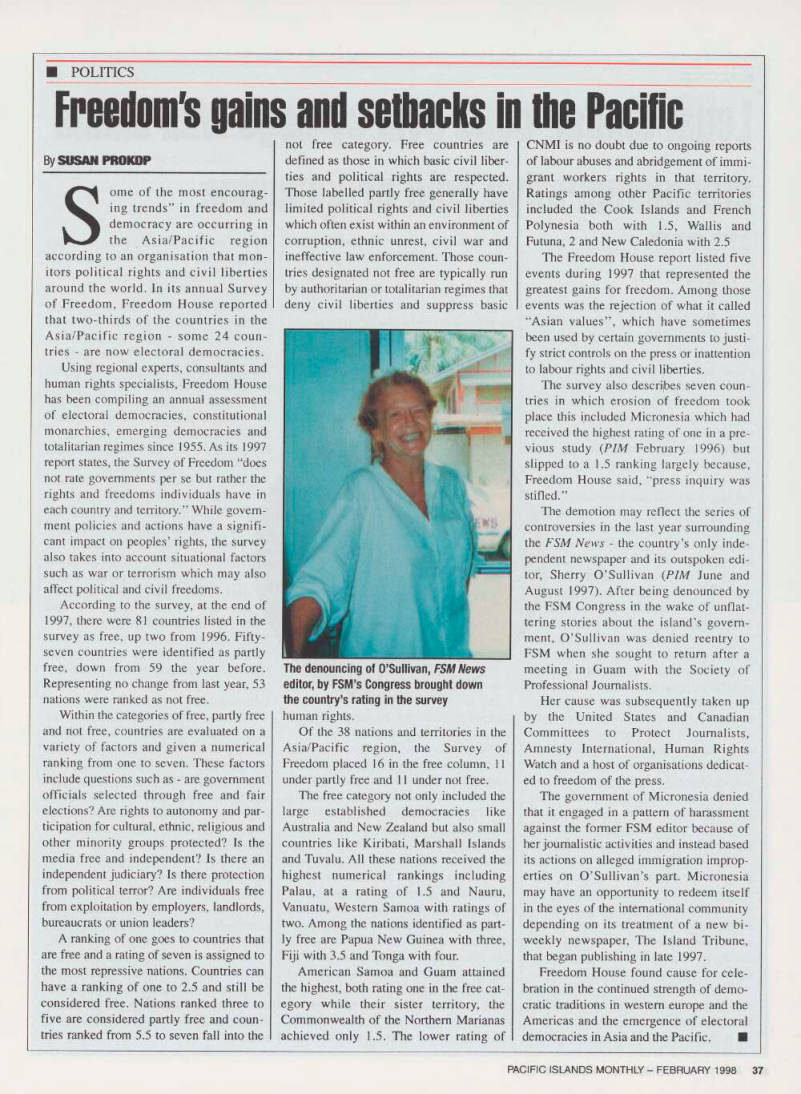
By Susan Prokop
Some of the most encourag ing trends” in freedom and
democracy are occurring in
the Asia/Pacific region according to an organisation that mon itors political rights and civil liberties around the world. In its annual Survey of Freedom, Freedom House reported that two-thirds of the countries in the Asia/Pacific region - some 24 coun tries - are now electoral democracies.
Using regional experts, consultants and human rights specialists, Freedom House has been compiling an annual assessment of electoral democracies, constitutional monarchies, emerging democracies and totalitarian regimes since 1955. As its 1997 report states, the Survey of Freedom “does not rate governments per se but rather the rights and freedoms individuals have in each country and territory.” While govern ment policies and actions have a signifi cant impact on peoples’ rights, the survey also takes into account situational factors such as war or terrorism which may also affect political and civil freedoms.
According to the survey, at the end of 1997, there were 81 countries listed in the survey as free, up two from 1996. Fifty seven countries were identified as partly free, down from 59 the year before.
Representing no change from last year, 53 nations were ranked as not free.
Within the categories of free, partly free and not free, countries are evaluated on a variety of factors and given a numerical ranking from one to seven. These factors include questions such as - are government officials selected through free and fair elections? Are rights to autonomy and par ticipation for cultural, ethnic, religious and other minority groups protected? Is the media free and independent? Is there an
independent judiciary? Is there protection
from political terror? Are individuals free from exploitation by employers, landlords, bureaucrats or union leaders?
A ranking of one goes to countries that are free and a rating of seven is assigned to the most repressive nations. Countries can have a ranking of one to 2.5 and still be considered free. Nations ranked three to five are considered partly free and coun tries ranked from 5.5 to seven fall into the
not free category. Free countries are defined as those in which basic civil liber ties and political rights are respected.
Those labelled partly free generally have limited political rights and civil liberties which often exist within an environment of corruption, ethnic unrest, civil war and ineffective law enforcement. Those coun tries designated not free are typically run by authoritarian or totalitarian regimes that deny civil liberties and suppress basic
human rights.
Of the 38 nations and territories in the Asia/Pacific region, the Survey of Freedom placed 16 in the free column, 11 under partly free and 11 under not free.
The free category not only included the large established democracies like Australia and New Zealand but also small countries like Kiribati, Marshall Islands and Tuvalu. All these nations received the
highest numerical rankings including
Palau, at a rating of 1.5 and Nauru, Vanuatu, Western Samoa with ratings of two. Among the nations identified as part ly free are Papua New Guinea with three, Fiji with 3.5 and Tonga with four.
American Samoa and Guam attained the highest, both rating one in the free cat egory while their sister territory, the Commonwealth of the Northern Marianas achieved only 1.5. The lower rating of
CNMI is no doubt due to ongoing reports of labour abuses and abridgement of immi grant workers rights in that territory.
Ratings among othbr Pacific territories included the Cook Islands and French Polynesia both with 1.5, Wallis and Futuna, 2 and New Caledonia with 2.5 The Freedom House report listed five events during 1997 that represented the greatest gains for freedom. Among those events was the rejection of what it called “Asian values”, which have sometimes been used by certain governments to justi fy strict controls on the press or inattention to labour rights and civil liberties.
The survey also describes seven coun tries in which erosion of freedom took place this included Micronesia which had received the highest rating of one in a pre vious study (PIM February 1996) but slipped to a 1.5 ranking largely because, Freedom House said, “press inquiry was stifled.”
The demotion may reflect the series of controversies in the last year surrounding the FSM News - the country’s only inde pendent newspaper and its outspoken edi tor, Sherry O’Sullivan (PIM June and August 1997). After being denounced by the FSM Congress in the wake of unflat tering stories about the island’s govern ment, O’Sullivan was denied reentry to FSM when she sought to return after a meeting in Guam with the Society of Professional Journalists.
Her cause was subsequently taken up by the United States and Canadian Committees to Protect Journalists, Amnesty International, Human Rights Watch and a host of organisations dedicat ed to freedom of the press.
The government of Micronesia denied that it engaged in a pattern of harassment against the former FSM editor because of her journalistic activities and instead based its actions on alleged immigration improp erties on O’Sullivan’s part. Micronesia may have an opportunity to redeem itself in the eyes of the international community depending on its treatment of a new bi weekly newspaper, The Island Tribune, that began publishing in late 1997.
Freedom House found cause for cele bration in the continued strength of demo cratic traditions in western europe and the Americas and the emergence of electoral democracies in Asia and the Pacific. ■
The denouncing of O’Sullivan, FSM News editor, by FSM’s Congress brought down the country’s rating in the survey
Legal tender controversy dogs Marshalls

Economy
Legal tender controversy dogs Marshalls commemorative coin programme
By Giff Johnson
The filing of two lawsuits against the Marshall Islands at the end of 1997 by German coin collectors has put the spotlight on the govern ment’s claim that its commemorative coins are “legal tender”. The legal action resulted from the government’s refusal to redeem the tens of thou sands of dollars in coins that the two Germans arrived in Majuro with.
Since the late 1980 s, the Marshall Islands has issued $5 to $5O denomination coins depicting everything from moon landings and to famous personalitie. In J sales promotions, the coins are described as “legal tender” of the j Marshall Islands because this increas- §| ; es their value to collectors. But when M l the two German coin collectors % attempted to redeem more than » SUS 100,000 worth of these coins in l| May, government halted the redemption 1 programme claiming that a fraud was being perpetrated on the government.
Government officials estimate as much as SUS2O million in commemorative coins have been issued since the programme began. If collectors attempted to redeem all these coins, it could bankrupt the govern ment, which is already facing major bud get cuts as a result of decrease in foreign aid. Despite the “legal tender” claims of the Marshalls, its redemption policies “ are not very welcoming” said a recent article in World Coin News titled, “ Marshall Islands repudiates ‘legal tender’ coins”.
The Marshall Islands has been “rela tively lucky” with what us, in fact, a non redemption policy for its coins, said the
coin collecting industry publication,
adding that, “While (this policy) has caused some upset in the collecting com munity, it has not attracted negative atten tion from regulators on US mainland.”
“Unicover Corp. (which produces the coins), for example, regularly sends sam ple coins to the consumer protection peo ple in the Wyoming State attorney gener
al’s office and otherwise maintains good relations with that office. A journalist called that office a couple of years ago to ask about the problem that what Unicover called ‘legal tender’ was not, in fact, treat ed as legal tender in Majuro. He was told that Unicover was a pillar of the Cheyene business community. Similarly, American collectors who have tried to interest law enforcement officials within the US post office and
I Ii
t h e Federal Trade Commission (on the legal tender issue) have gotten nowhere.”
The October and November lawsuits filed by local attorney Carl B Ingram, indi cates that collectors will be taking matters into their own hands. Ashton J Fruhling from Germany is seeking $U5118,372.72 in damages and Alexander D Gayck is ask ing for $U539,444.14 - which, in addition to the value of their coins. Court papers say that Fruhling bought 2200 $5O coins “in
reliance upon government’s representation
that the coins were ‘legal tender’ and redeemable in US dollars”. Coin specula tors purchase commemorative coins and then redeem them to earn a profit. In early May, both Fruhling and Gayck came to the Marshalls to redeem their coins. Over a three-day period, Fruhling was able to redeem 60 coins but the government refused to pay for an additional 190 it had
initially accepted from Fruhling, and later
returned them to him and suspended all further redemption. Government officials at the time said they were in the process of reviewing the entire coin programme, including the agreement with US based Unicover Corporation which issues the coins and the government’s procedures for redemption of coins. Ingram said he pre ferred not to go to court on the matter. “It’s sad because it’s a waste of money. But we’re being forced into it because the gov ernment failed to reply to us with the 90 day period for the (administrative) claim we filed first.” For its part, the Marshall , Islands government believes that some it German dealers selling Marshall 11 Islands commemorative coins are El attempting to defraud the programme ■ by selling high volume of coins at low ill prices to buyers who them attempt to ■i redeem these coins in Majuro at their r fW face value. Finance Minister Ruben if Zackhras said that after the Germans F came to Majuro in May, the government launched an investigation into the matter.
Concern that Unicover Corporation was part of the problem have been erased, fol lowing a visit Zackhras made to the Unicover centre recently.
“We are satisfied with Unicover,” he said. But Zackhras believes that the prob lem lies with some German coin dealers who purchase the coins at wholesale prices from Unicover. “We found some odd deal ings between individual buyers and agents in Germany,” he said. Zackhras said that henceforth, the government will maintain a strict redemption policy that allows for a maximum of 10 coins per day to be redeemed, and requires that the person cashing in coins be the original buyer. The question is, how the Marshall Islands High Court will rule on the German collectors claims that are based on legal tender issue.
If it rules that the government has to offer a “customer friendly” redemption policy, in contrast to the current situation, it could out government at risk for having to buy literally millions of dollars worth of coins. ■
Cooks situation likely to worsen in 1998
Economy
By Florence Syme-Buchanan
The Cook Islands govern ment is having to learn the hard way on how to function under a new set of rules, after lurching from crisis to crisis in the last four years.
But that rough ride is not over - as the country bade farewell to 1997 it also wel comed a new load of financial woes and
political squabbling.
Financial advisers are hoping that the lessons learnt this time around by govern ment will mean an end to years of extrava gance and indifference to cash flow prob lems. For the second time in two years, the government has had to impose belt tight ening that’s leaving ministries gasping for survival and many public servants out of
jobs.
Former Finance Minister and now Prime Minister Sir Geoffrey Henry was forced to reign in the government’s 24 ministries and agencies and demand a 10 percent across the board cutback in spend ing.
Savings of NZ$3.5 million (US$l.B million) have to be made or the govern ment will plunge into a crisis of extraordi nary proportions with borrowing to bail it out no longer a viable option. The country is already up to its neck in debt owing NZ$2O3 million (US$lO7 million).
Government has a NZ$l.3 million (U 55690,000) deficit and some ministries and offices have run out of money. It’s also partially the result of government failing to earn what it expected to from income and company taxes.
The Ministry of Finance was over opti mistic - estimating there would be earnings of NZ$42 million (US$22 million) from income and company taxes this fiscal year.
With eight months till the end of the 1997/98 financial year the NZ539.9 mil lion (US$2O.6 million) budget has proven inadequate for many government entities.
One of the biggest ministries, Works, Environment and Physical Planning
(MOWEPP) was suspended indefinitely
just before Christmas. Fifty-eight workers lost their jobs.
MOWEPP Minister Tom Marsters resigned in disgust over what he claims
was Sir Geoffrey’s failure to keep his word and channel more funds to the ministry whose budget and staff had already been slashed by more than three-quarters.
The Ministry of Health, already trying
to maintain services with skeleton staff and an anorexic budget could not afford to make the compulsory 10 percent cuts.
Instead it will try to make a contribu tion by way of revenue earned from charg ing 16 year olds and old age pensioners under the user pays health care system.
That move has been hugely unpojslilar, but health secretary Roro Daniel has said there are no other options.
Others in big trouble are Ministry of Agriculture, Parliamentary Services and the Head of State Office. More job losses are expected. Sir Geoffrey has reasoned that cutbacks are more attractive than increased taxes. He said raising revenue is an attractive option, but not if it means increasing taxes as this will backfire.
He said government will also be look ing at selling more assets and re-adjusting budgetary allocations. To date, the govern ment’s asset sales programme has been dis astrous.
Little cash has been obtained from what was expected to be the Cook Islands sale of the century and a way of helping the country clamber out of its massive debt.
The former state-owned Rarotongan Hotel went to Cook Islander Tata Crocombe - but because of the nature of the deal it entered into, government has yet to receive the NZ$3.5 million (US$l.B million) sale price for the property.
The new owner also owes government NZ$2 million (US$l.l million) spent on refurbishing the hotel for last year’s South Pacific Forum.
A cash upfront offer of NZ$5 million (US$2.6 million) for the Rarotongan Hotel by an Asian businessman was apparently turned down by the prime minister in favour of the deal with Crocombe.
A report into the handling of the sale by the powerful Public Expenditure and Review Committee has been completed.
Its findings are expected to cause a major upheaval when tabled in parliament.
Sir Geoffrey said while the sale of more assets is part of the
government’s agenda, arguably any
monies raised should be to retire debt rather than to fund recurrent expenditure In other words, says Sir Geoffrey, don’t sell the family jewels to buy the groceries.
A senior government official says govern ment had two options, either to trim the fat that still exists or tell international credi tors that no debts would be paid this year.
This would have damaged govern ment’s credibility. The official says there are still inefficiencies within gbvemment which can be fixed - saving money.
Cabinet is understood to be questioning some of Sir Geoffrey’s 1997 priorities which have included expanding the prime minister’s office and foreign affairs, host ing the Forum during an economic depres sion and allocating NZ$9 million (US$4.7 million) to the new Ministry of Outer Islands Development. This ministry has spent only a third of its budget. Some gov ernment officials are expecting a frantic spending spree to justify its lion’s share allocation as the financial year draws to a close. Cabinet has been publicly accused of being fiscally irresponsible and failing to prioritise by the Chamber of Commerce and National Development Council. Cost saving recommendations made by the two groups have been repeatedly rejected by cabinet. And while the government is try ing to overcome its seemingly endless financial woes, the resignation of Marsters’ bodes ill for the governing Cook Islands Party (CIP).
Marsters, a foundation member of the party, has been CIP secretary for decades and commands a big following within its ranks. The former minister has ruled out accepting another ministerial position under Sir Geoffrey saying he and his cur rent administration have lost the plot.
Other than to say he’ll always remain a CIP, Marsters is not commenting on his political future. Political observers say its unlikely he’ll join either faction of the divided Opposition Democratic Alliance Party. The speculation is that Marsters may join with former politician and Coole Islands High Commissioner to New Zealand laveta Short and form a new party.
Should that happen, the union will be formidable. ■
Preserving sacred buri[?] caves
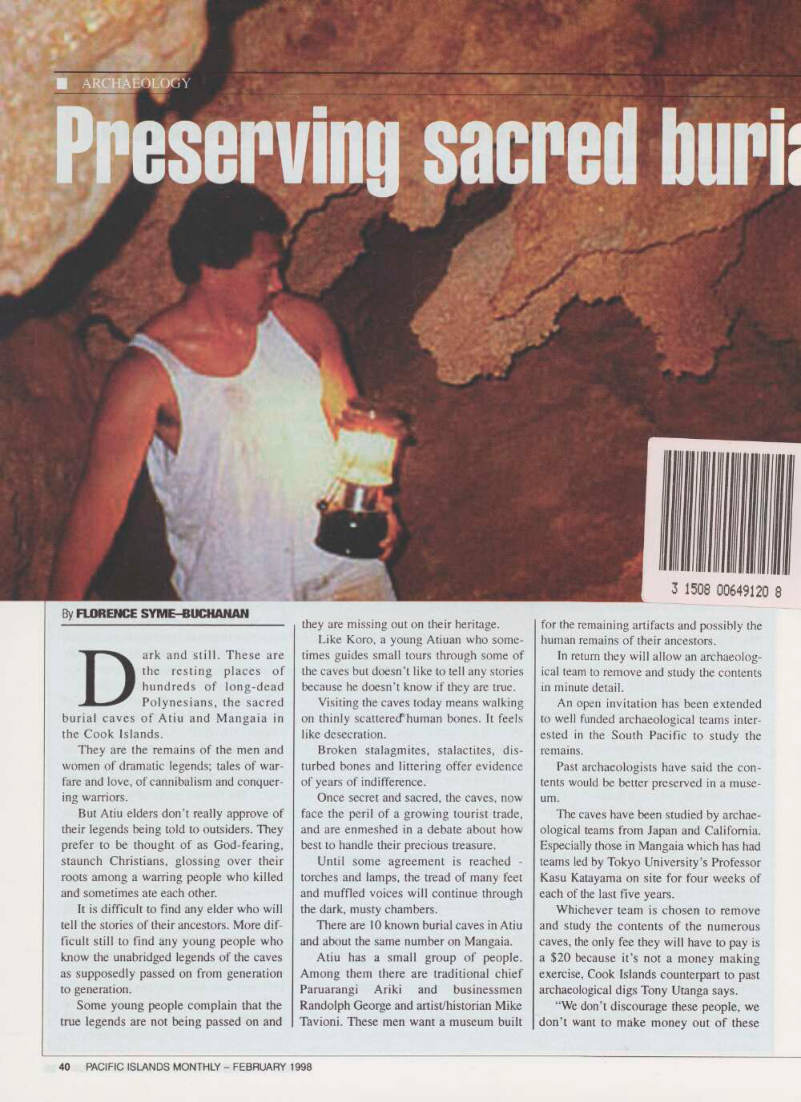
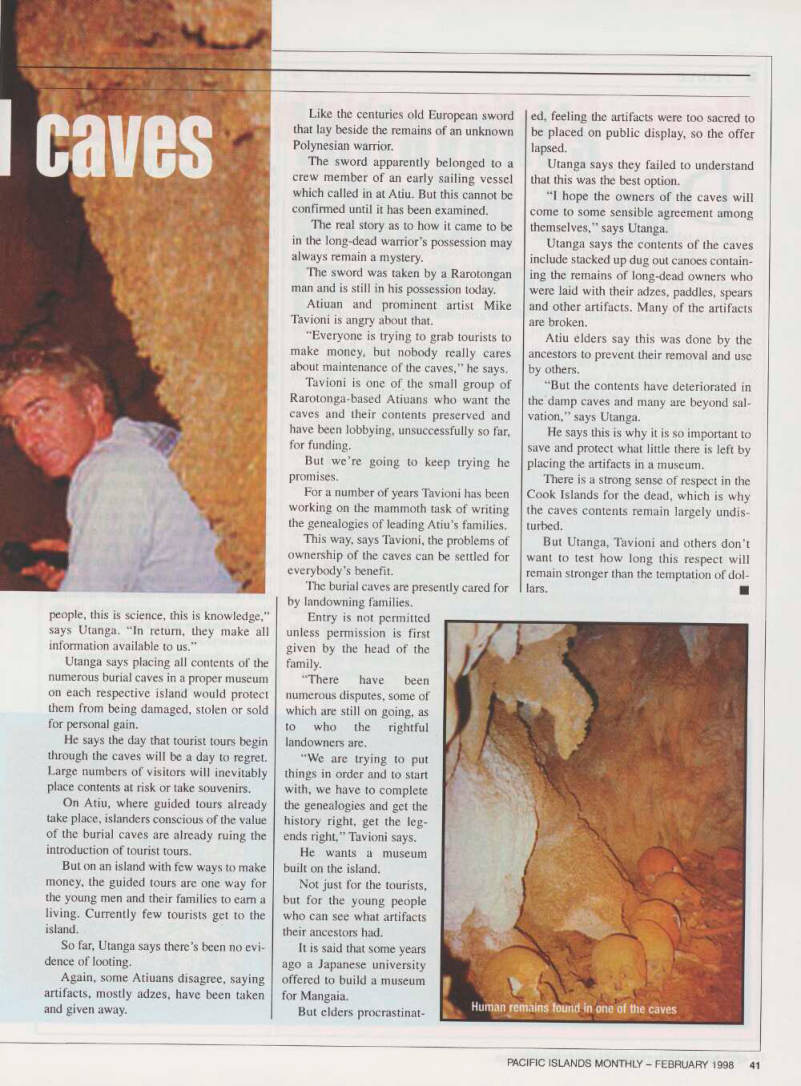
Archaeology
By Florence Syme-Buchanan
Dark and still. These are the resting places of hundreds of long-dead Polynesians, the sacred burial caves of Atiu and Mangaia in the Cook Islands.
They are the remains of the men and women of dramatic legends; tales of war fare and love, of cannibalism and conquer ing warriors.
But Atiu elders don’t really approve of their legends being told to outsiders. They prefer to be thought of as God-fearing, staunch Christians, glossing over their roots among a warring people who killed and sometimes ate each other.
It is difficult to find any elder who will tell the stories of their ancestors. More dif ficult still to find any young people who know the unabridged legends of the caves as supposedly passed on from generation to generation.
Some young people complain that the true legends are not being passed on and
they are missing out on their heritage.
Like Koro, a young Atiuan who some times guides small tours through some of the caves but doesn’t like to tell any stories because he doesn’t know if they are true.
Visiting the caves today means walking on thinly scattered^human bones. It feels like desecration.
Broken stalagmites, stalactites, dis turbed bones and littering offer evidence of years of indifference.
Once secret and sacred, the caves, now face the peril of a growing tourist trade, and are enmeshed in a debate about how best to handle their precious treasure.
Until some agreement is reached torches and lamps, the tread of many feet and muffled voices will continue through the dark, musty chambers.
There are 10 known burial caves in Atiu and about the same number on Mangaia.
Atiu has a small group of people.
Among them there are traditional chief Paruarangi Ariki and businessmen Randolph George and artist/historian Mike Tavioni. These men want a museum built
for the remaining artifacts and possibly the human remains of their ancestors.
In return they will allow an archaeolog ical team to remove and study the contents in minute detail.
An open invitation has been extended to well funded archaeological teams inter ested in the South Pacific to study the remains.
Past archaeologists have said the con tents would be better preserved in a muse um.
The caves have been studied by archae ological teams from Japan and California.
Especially those in Mangaia which has had teams led by Tokyo University’s Professor Kasu Katayama on site for four weeks of each of the last five years.
Whichever team is chosen to remove and study the contents of the numerous caves, the only fee they will have to pay is a $2O because it’s not a money making exercise, Cook Islands counterpart to past archaeological digs Tony Utanga says.
“We don’t discourage these people, we don’t want to make money out of these
people, this is science, this is knowledge,” says Utanga. “In return, they make all information available to us.”
Utanga says placing all contents of the numerous burial caves in a proper museum on each respective island would protect them from being damaged, stolen or sold for personal gain.
He says the day that tourist tours begin through the caves will be a day to regret.
Large numbers of visitors will inevitably place contents at risk or take souvenirs.
On Atiu, where guided tours already take place, islanders conscious of the value of the burial caves are already ruing the introduction of tourist tours.
But on an island with few ways to make money, the guided tours are one way for the young men and their families to earn a living. Currently few tourists get to the island.
So far, Utanga says there’s been no evi dence of looting.
Again, some Atiuans disagree, saying artifacts, mostly adzes, have been taken and given away.
Like the centuries old European sword that lay beside the remains of an unknown
Polynesian warrior.
The sword apparently belonged to a crew member of an early sailing vessel which called in at Atiu. But this cannot be confirmed until it has been examined.
The real story as to how it came to be in the long-dead warrior’s possession may always remain a mystery.
The sword was taken by a Rarotongan man and is still in his possession today.
Atiuan and prominent artist Mike Tavioni is angry about that.
“Everyone is trying to grab tourists to make money, but nobody really cares about maintenance of the caves,” he says.
Tavioni is one of the small group of Rarotonga-based Atiuans who want the caves and their contents preserved and have been lobbying, unsuccessfully so far,
for funding.
But we’re going to keep trying he promises.
For a number of years Tavioni has been working on the mammoth task of writing the genealogies of leading Atiu’s families.
This way, says Tavioni, the problems of ownership of the caves can be settled for everybody’s benefit.
The burial caves are presently cared for
by landowning families.
Entry is not permitted unless permission is first given by the head of the
family.
“There have been numerous disputes, some of which are still on going, as to who the rightful landowners are.
“We are trying to put things in order and to start with, we have to complete the genealogies and get the history right, get the leg ends right,” Tavioni says.
He wants a museum built on the island.
Not just for the tourists, but for the young people who can see what artifacts their ancestors had.
It is said that some years
ago a Japanese university
offered to build a museum
for Mangaia.
But elders procrastinat
ed, feeling the artifacts were too sacred to be placed on public display, so the offer
lapsed.
Utanga says they failed to understand that this was the best option.
“I hope the owners of the caves will come to some sensible agreement among themselves,” says Utanga.
Utanga says the contents of the caves include stacked up dug out canoes contain ing the remains of long-dead owners who were laid with their adzes, paddles, spears and other artifacts. Many of the artifacts are broken.
Atiu elders say this was done by the ancestors to prevent their removal and use by others.
“But the contents have deteriorated in the damp caves and many are beyond sal vation,” says Utanga.
He says this is why it is so important to save and protect what little there is left by placing the artifacts in a museum.
There is a strong sense of respect in the Cook Islands for the dead, which is why the caves contents remain largely undis turbed.
But Utanga, Tavioni and others don’t want to test how long this respect will remain stronger than the temptation of dol lars. ■
Human remains found in one of the caves
Manu-Pacific's pride in Hollywood
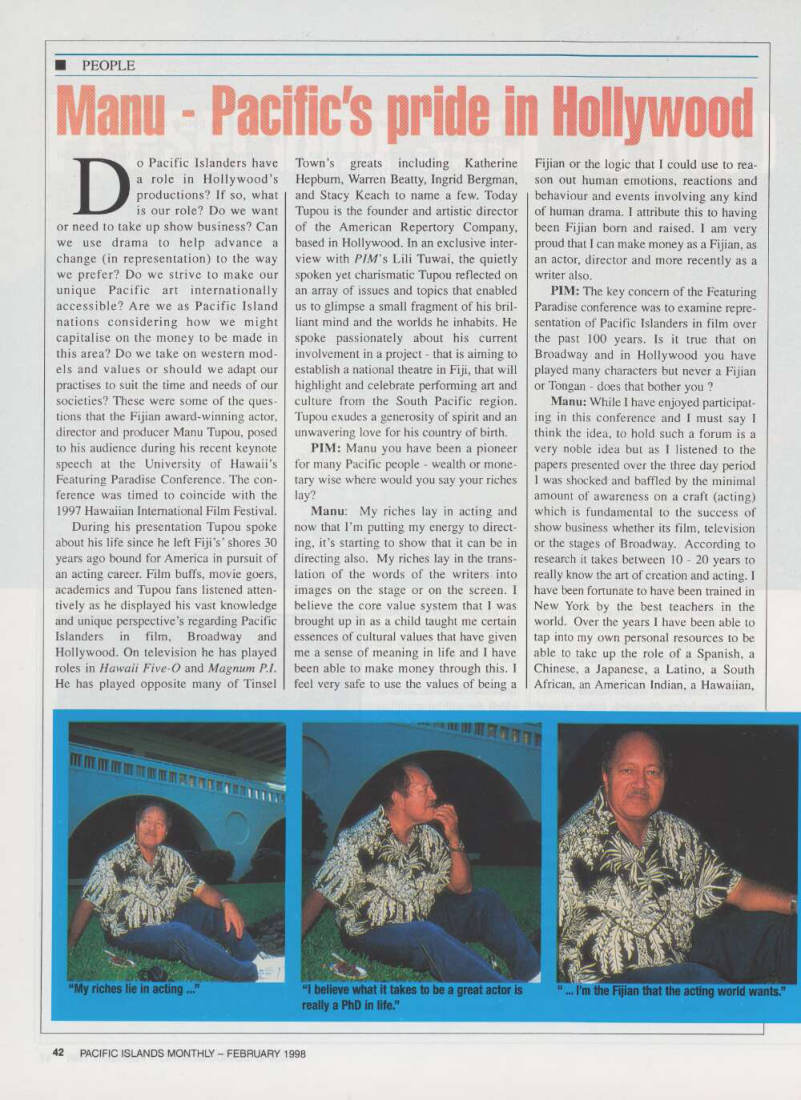
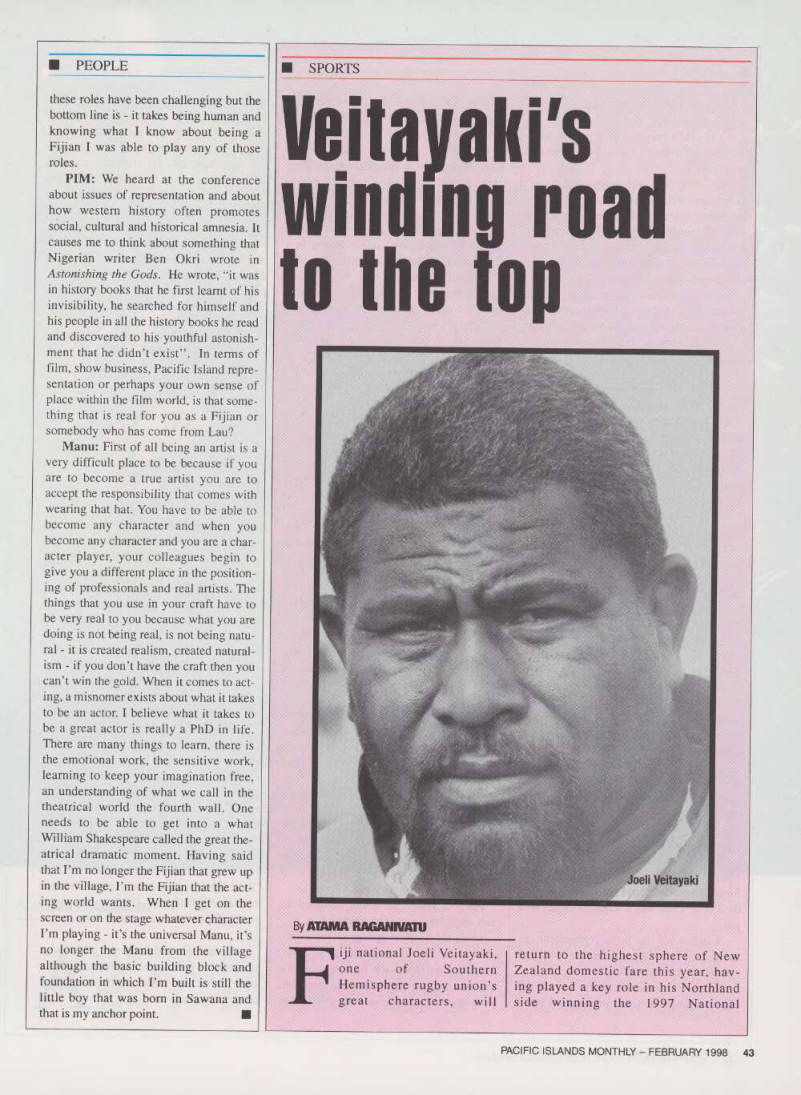
People
Do Pacific Islanders have a role in Hollywood’s productions? If so, what is our role? Do we want or need to take up show business? Can we use drama to help advance a change (in representation) to the way we prefer? Do we strive to make our unique Pacific art internationally accessible? Are we as Pacific Island nations considering how we might capitalise on the money to be made in this area? Do we take on western mod els and values or should we adapt our practises to suit the time and needs of our societies? These were some of the ques tions that the Fijian award-winning actor, director and producer Manu Tupou, posed to his audience during his recent keynote speech at the University of Hawaii’s Featuring Paradise Conference. The con ference was timed to coincide with the 1997 Hawaiian International Film Festival.
During his presentation Tupou spoke about his life since he left Fiji’s’ shores 30 years ago bound for America in pursuit of an acting career. Film buffs, movie goers, academics and Tupou fans listened atten tively as he displayed his vast knowledge and unique perspective’s regarding Pacific Islanders in film, Broadway and Hollywood. On television he has played roles in Hawaii Five-0 and Magnum P.I.
He has played opposite many of Tinsel
Town’s greats including Katherine
Hepburn, Warren Beatty, Ingrid Bergman,
and Stacy Keach to name a few. Today Tupou is the founder and artistic director of the American Repertory Company, based in Hollywood. In an exclusive inter view with PlM’ s Lili Tuwai, the quietly spoken yet charismatic Tupou reflected on an array of issues and topics that enabled us to glimpse a small fragment of his bril liant mind and the worlds he inhabits. He spoke passionately about his current involvement in a project - that is aiming to establish a national theatre in Fiji, that will highlight and celebrate performing art and culture from the South Pacific region.
Tupou exudes a generosity of spirit and an unwavering love for his country of birth.
PIM: Manu you have been a pioneer for many Pacific people - wealth or mone tary wise where would you say your riches lay?
Manu: My riches lay in acting and now that I’m putting my energy to direct ing, it’s starting to show that it can be in directing also. My riches lay in the trans lation of the words of the writers into images on the stage or on the screen. I believe the core value system that I was brought up in as a child taught me certain essences of cultural values that have given me a sense of meaning in life and I have been able to make money through this. I feel very safe to use the values of being a
Fijian or the logic that I could use to rea son out human emotions, reactions and behaviour and events involving any kind of human drama. I attribute this to having been Fijian born and raised. I am very proud that I can make money as a Fijian, as an actor, director and more recently as a writer also.
PIM: The key concern of the Featuring Paradise conference was to examine repre sentation of Pacific Islanders in film over the past 100 years. Is it true that on Broadway and in Hollywood you have played many characters but never a Fijian or Tongan - does that bother you ?
Manu: While I have enjoyed participat ing in this conference and I must say I think the idea, to hold such a forum is a very noble idea but as I listened to the papers presented over the three day period I was shocked and baffled by the minimal amount of awareness on a craft (acting) which is fundamental to the success of show business whether its film, television or the stages of Broadway. According to research it takes between 10-20 years to really know the art of creation and acting. I have been fortunate to have been trained in New York by the best teachers in the world. Over the years I have been able to tap into my own personal resources to be able to take up the role of a Spanish, a Chinese, a Japanese, a Latino, a South African, an American Indian, a Hawaiian,
“My riches lie in acting...”
“I believe what it takes to be a great actor is really a PhD in life.”
“...I’m the Fijian that the acting world wants.”
these roles have been challenging but the bottom line is - it takes being human and knowing what I know about being a Fijian I was able to play any of those roles.
PIM: We heard at the conference about issues of representation and about how western history often promotes social, cultural and historical amnesia. It causes me to think about something that Nigerian writer Ben Okri wrote in Astonishing the Gods. He wrote, i4 it was in history books that he first leamt of his invisibility, he searched for himself and his people in all the history books he read and discovered to his youthful astonish ment that he didn’t exist”. In terms of film, show business, Pacific Island repre sentation or perhaps your own sense of place within the film world, is that some thing that is real for you as a Fijian or somebody who has come from Lau?
Manu: First of all being an artist is a very difficult place to be because if you are to become a true artist you are to accept the responsibility that comes with wearing that hat. You have to be able to become any character and when you become any character and you are a char acter player, your colleagues begin to give you a different place in the position ing of professionals and real artists. The things that you use in your craft have to be very real to you because what you are doing is not being real, is not being natu ral - it is created realism, created natural ism - if you don’t have the craft then you can’t win the gold. When it comes to act ing, a misnomer exists about what it takes to be an actor. I believe what it takes to be a great actor is really a PhD in life.
There are many things to leam, there is the emotional work, the sensitive work,
learning to keep your imagination free,
an understanding of what we call in the theatrical world the fourth wall. One needs to be able to get into a what William Shakespeare called the great the atrical dramatic moment. Having said that I’m no longer the Fijian that grew up in the village, I’m the Fijian that the act ing world wants. When I get on the screen or on the stage whatever character I’m playing - it’s the universal Manu, it’s no longer the Manu from the village although the basic building block and foundation in which I’m built is still the little boy that was bom in Sawana and that is my anchor point. ■
veitayaki's
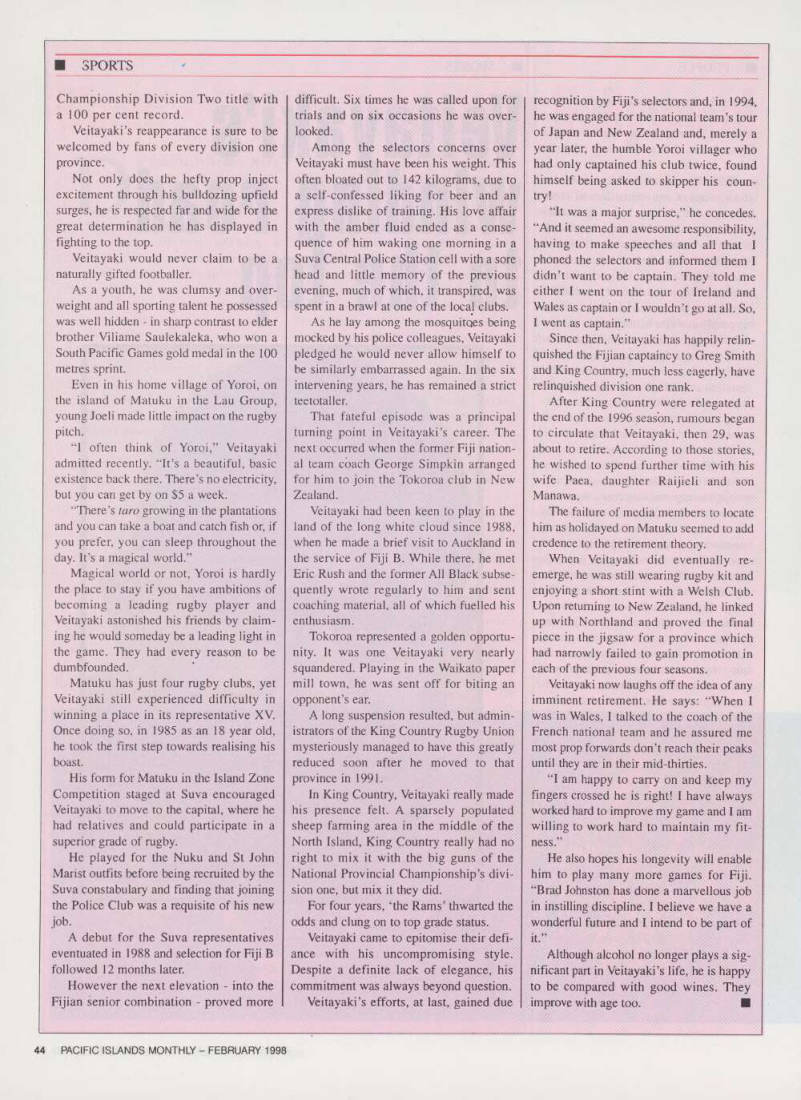
Sports
veitayaki's winding road to the top
By Atama Raganivatu
Fiji national Joeli Veitayaki, one of Southern Hemisphere rugby union’s great characters, will
return to the highest sphere of New Zealand domestic fare this year, hav ing played a key role in his Northland side winning the 1997 National
Joeli Veitayaki
Championship Division Two title with a 100 per cent record.
Veitayaki’s reappearance is sure to be welcomed by fans of every division one province.
Not only does the hefty prop inject excitement through his bulldozing upfield surges, he is respected far and wide for the great determination he has displayed in fighting to the top.
Veitayaki would never claim to be a naturally gifted footballer.
As a youth, he was clumsy and over weight and all sporting talent he possessed was well hidden - in sharp contrast to elder brother Viliame Saulekaleka, who won a South Pacific Games gold medal in the 100 metres sprint.
Even in his home village of Yoroi, on the island of Matuku in the Lau Group, young Joeli made little impact on the rugby pitch.
“I often think of Yoroi,” Veitayaki admitted recently. “It’s a beautiful, basic existence back there. There’s no electricity, but you can get by on $5 a week.
“There’s taro growing in the plantations and you can take a boat and catch fish or, if you prefer, you can sleep throughout the day. It’s a magical world.”
Magical world or not, Yoroi is hardly the place to stay if you have ambitions of becoming a leading rugby player and Veitayaki astonished his friends by claim ing he would someday be a leading light in the game. They had every reason to be dumbfounded.
Matuku has just four rugby clubs, yet Veitayaki still experienced difficulty in winning a place in its representative XV.
Once doing so, in 1985 as an 18 year old, he took the first step towards realising his boast.
His form for Matuku in the Island Zone Competition staged at Suva encouraged Veitayaki to move to the capital, where he had relatives and could participate in a
superior grade of rugby.
He played for the Nuku and St John Marist outfits before being recruited by the Suva constabulary and finding that joining the Police Club was a requisite of his new
job.
A debut for the Suva representatives eventuated in 1988 and selection for Fiji B followed 12 months later.
However the next elevation - into the Fijian senior combination - proved more
difficult. Six times he was called upon for trials and on six occasions he was over looked.
Among the selectors concerns over Veitayaki must have been his weight. This often bloated out to 142 kilograms, due to a self-confessed liking for beer and an express dislike of training. His love affair with the amber fluid ended as a conse quence of him waking one morning in a Suva Central Police Station cell with a sore head and little memory of the previous evening, much of which, it transpired, was spent in a brawl at one of the local clubs.
As he lay among the mosquitoes being
mocked by his police colleagues, Veitayaki
pledged he would never allow himself to be similarly embarrassed again. In the six intervening years, he has remained a strict teetotaller.
That fateful episode was a principal turning point in Veitayaki’s career. The next occurred when the former Fiji nation al team coach George Simpkin arranged for him to join the Tokoroa club in New Zealand.
Veitayaki had been keen to play in the land of the long white cloud since 1988, when he made a brief visit to Auckland in the service of Fiji B. While there, he met Eric Rush and the former All Black subse quently wrote regularly to him and sent coaching material, all of which fuelled his enthusiasm.
Tokoroa represented a golden opportu nity. It was one Veitayaki very nearly squandered. Playing in the Waikato paper mill town, he was sent off for biting an
opponent’s ear.
A long suspension resulted, but admin istrators of the King Country Rugby Union mysteriously managed to have this greatly reduced soon after he moved to that province in 1991.
In King Country, Veitayaki really made
his presence felt. A sparsely populated sheep farming area in the middle of the North Island, King Country really had no right to mix it with the big guns of the National Provincial Championship’s divi sion one, but mix it they did.
For four years, The Rams’ thwarted the odds and clung on to top grade status.
Veitayaki came to epitomise their defi ance with his uncompromising style.
Despite a definite lack of elegance, his
commitment was always beyond question.
Veitayaki’s efforts, at last, gained due
recognition by Fiji’s selectors and, in 1994, he was engaged for the national team’s tour of Japan and New Zealand and, merely a year later, the humble Yoroi villager who had only captained his club twice, found himself being asked to skipper his coun try!
“It was a major surprise,” he concedes.
“And it seemed an awesome responsibility, having to make speeches and all that I phoned the selectors and informed them I didn’t want to be captain. They told me either I went on the tour of Ireland and Wales as captain or I wouldn’t go at all. So, I went as captain.”
Since then, Veitayaki has happily relin quished the Fijian captaincy to Greg Smith and King Country, much less eagerly, have relinquished division one rank.
After King Country were relegated at the end of the 1996 season, rumours began to circulate that Veitayaki, then 29, was about to retire. According to those stories, he wished to spend further time with his wife Paea, daughter Raijieli and son Manawa.
The failure of media members to locate him as holidayed on Matuku seemed to add credence to the retirement theory.
When Veitayaki did eventually re emerge, he was still wearing rugby kit and enjoying a short stint with a Welsh Club.
Upon returning to New Zealand, he linked up with Northland and proved the final piece in the jigsaw for a province which had narrowly failed to gain promotion in each of the previous four seasons.
Veitayaki now laughs off the idea of any imminent retirement. He says; “When I was in Wales, I talked to the coach of the French national team and he assured me most prop forwards don’t reach their peaks until they are in their mid-thirties.
“I am happy to carry on and keep my fingers crossed he is right! I have always worked hard to improve my game and I am willing to work hard to maintain my fit ness.”
He also hopes his longevity will enable him to play many more games for Fiji.
“Brad Johnston has done a marvellous job in instilling discipline. I believe we have a wonderful future and I intend to be part of it.”
Although alcohol no longer plays a sig nificant part in Veitayaki’s life, he is happy to be compared with good wines. They improve with age too. ■
A Chip of the old block
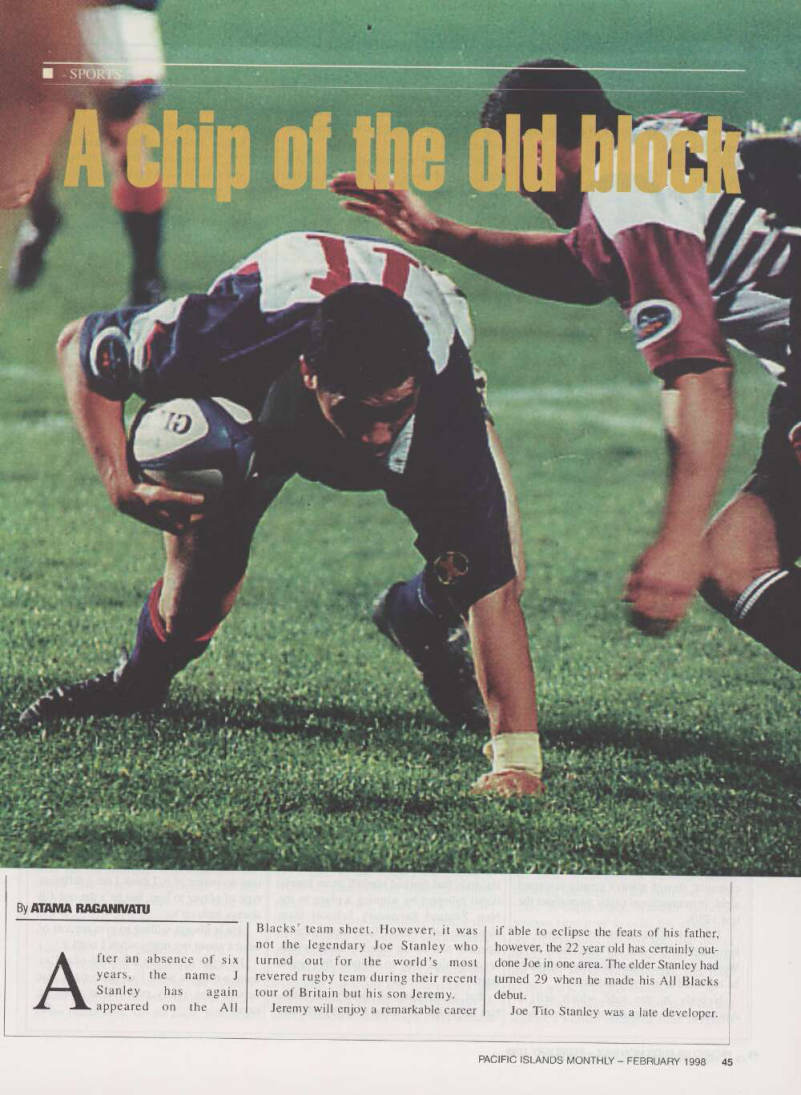
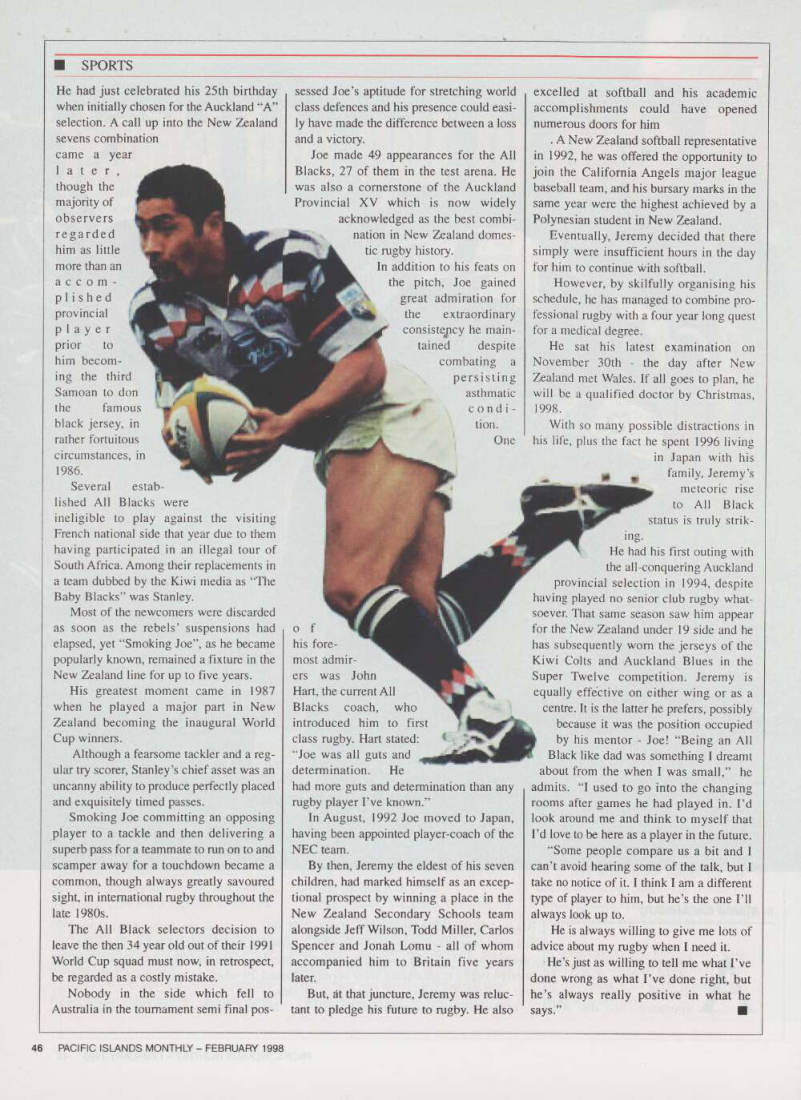
By Atama Raganivatu
After an absence of six years, the name J Stanley has again appeared on the All
Blacks' team sheet. However, it was not the legendary Joe Stanley who turned out for the world’s most revered rugby team during their recent tour ot Britain but his son Jeremy.
Jeremy will enjoy a remarkable career
if able to eclipse the feats of his father, however, the 22 year old has certainly out done Joe in one area. The elder Stanley had turned 29 when he made his All Blacks debut.
Joe Tito Stanley was a late developer.
He had just celebrated his 25th birthday when initially chosen for the Auckland “A” selection. A call up into the New Zealand sevens combination
came a year later, though the m majority of 4| observers ■ regarded him as little \ more than an acco m - j plis h e d ' provincial player n prior to him becom ing the third Samoan to don the famous black jersey, in rather fortuitous circumstances, in 1986.
Several estab lished All Blacks were ineligible to play against the visiting French national side that year due to them having participated in an illegal tour of South Africa. Among their replacements in a team dubbed by the Kiwi media as “The Baby Blacks” was Stanley.
Most of the newcomers were discarded as soon as the rebels’ suspensions had elapsed, yet “Smoking Joe”, as he became popularly known, remained a fixture in the New Zealand line for up to five years.
His greatest moment came in 1987 when he played a major part in New Zealand becoming the inaugural World
Cup winners.
Although a fearsome tackier and a reg ular try scorer, Stanley’s chief asset was an uncanny ability to produce perfectly placed and exquisitely timed passes.
Smoking Joe committing an opposing player to a tackle and then delivering a superb pass for a teammate to run on to and scamper away for a touchdown became a common, though always greatly savoured
sight, in international rugby throughout the
late 1980 s.
The All Black selectors decision to leave the then 34 year old out of their 1991 World Cup squad must now, in retrospect, be regarded as a costly mistake.
Nobody in the side which fell to Australia in the tournament semi final pos
sessed Joe’s aptitude for stretching world class defences and his presence could easi ly have made the difference between a loss and a victory.
Joe made 49 appearances for the All Blacks, 27 of them in the test arena. He was also a cornerstone of the Auckland Provincial XV which is now widely
acknowledged as the best combi nation in New Zealand domes tic rugby history. ln addition to his feats on ■K the pitch, Joe gained great admiration for the extraordinary jf consistency he main r Jjm tained despite combating a persisting asthmatic condi |F tion.
' <***'A One
o f * fore most admir ers was John Hart, the current All Blacks coach, who introduced him to first A class rugby. Hart stated; i "Joe all guts and determination. He had more guts and determination than any rugby player I’ve known.”
In August, 1992 Joe moved to Japan, having been appointed player-coach of the NEC team.
By then, Jeremy the eldest of his seven children, had marked himself as an excep tional prospect by winning a place in the New Zealand Secondary Schools team alongside Jeff Wilson, Todd Miller, Carlos Spencer and Jonah Lomu - all of whom accompanied him to Britain five years later.
But, at that juncture, Jeremy was reluc tant to pledge his future to rugby. He also
excelled at softball and his academic accomplishments could have opened numerous doors for him . A New Zealand softball representative in 1992, he was offered the opportunity to
join the California Angels major league
baseball team, and his bursary marks in the same year were the highest achieved by a Polynesian student in New Zealand.
Eventually, Jeremy decided that there simply were insufficient hours in the day for him to continue with softball.
However, by skilfully organising his schedule, he has managed to combine pro fessional rugby with a four year long quest for a medical degree.
He sat his latest examination on November 30th - the day after New Zealand met Wales. If all goes to plan, he will be a qualified doctor by Christmas, 1998.
With so many possible distractions in his life, plus the fact he spent 1996 living in Japan with his m 9 family, Jeremy’s meteoric rise “ lo All Black status is truly strik jKfr ' He had his first outing with fr the all-conquering Auckland provincial selection in 1994, despite having played no senior club rugby what soever. That same season saw him appear for the New Zealand under 19 side and he has subsequently worn the jerseys of the Kiwi Colts and Auckland Blues in the Super Twelve competition. Jeremy is equally effective on either wing or as a centre. It is the latter he prefers, possibly because it was the position occupied ■ by his mentor - Joe! “Being an All * Black like dad was something I dreamt about from the when I was small,” he admits. “I used to go into the changing rooms after games he had played in. I’d look around me and think to myself that I’d love to be here as a player in the future.
“Some people compare us a bit and I can’t avoid hearing some of the talk, but I take no notice of it. I think I am a different type of player to him, but he’s the one I’ll always look up to.
He is always willing to give me lots of advice about my rugby when I need it.
He’s just as willing to tell me what I’ve done wrong as what I’ve done right, but he’s always really positive in what he says.” ■
Women on women
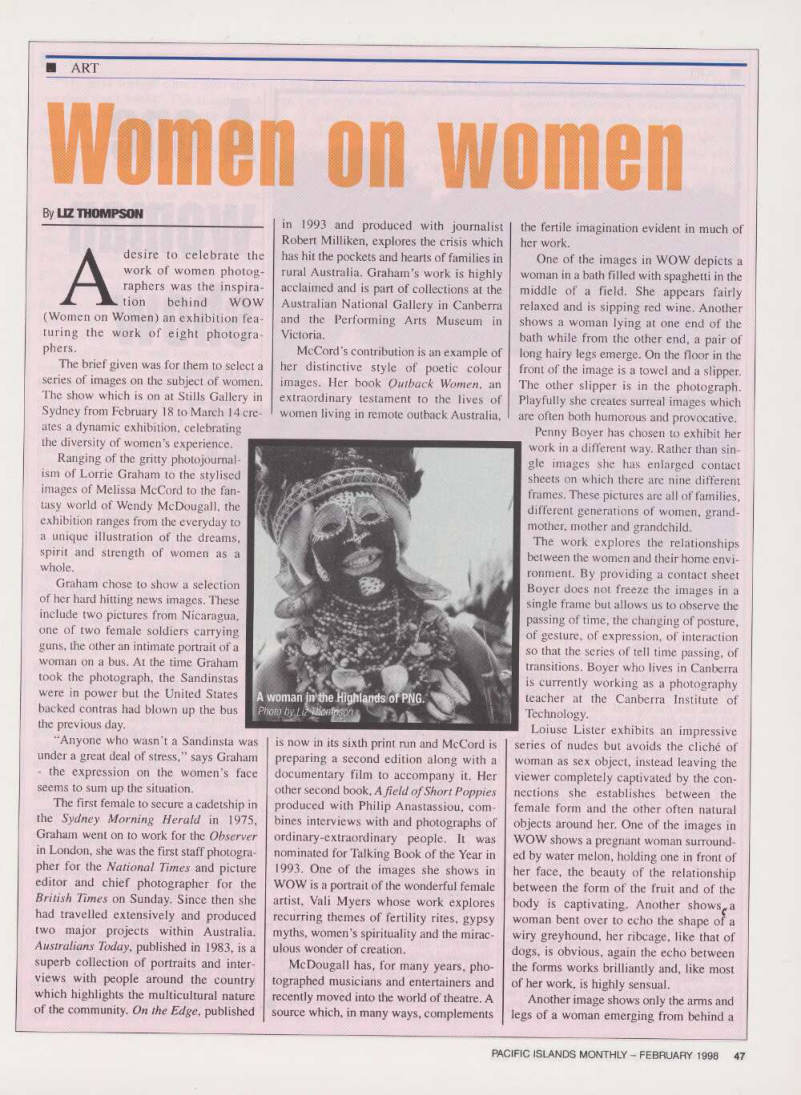
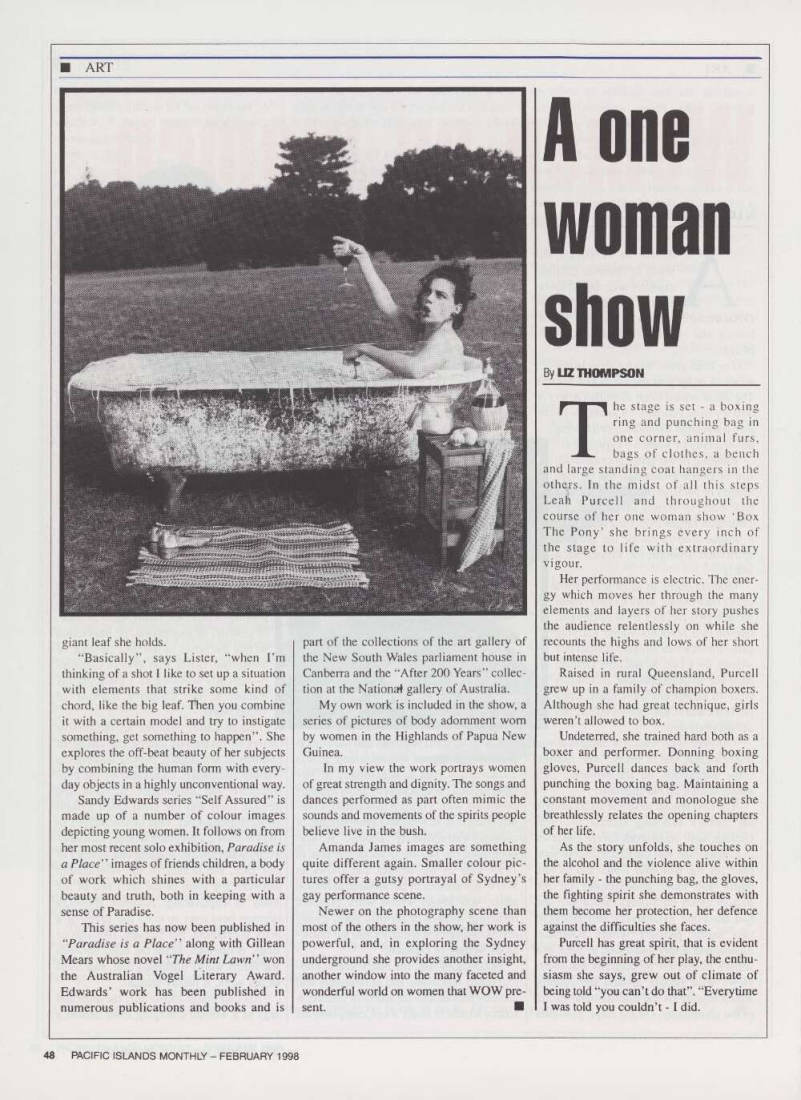
Art
By Liz Thompson
A desire to celebrate the work of women photog raphers was the inspira tion behind WOW (Women on Women) an exhibition fea turing the work of eight photogra phers.
The brief given was for them to select a series of images on the subject of women.
The show which is on at Stills Gallery in Sydney from February 18 to March 14 ere
ates a dynamic exhibition, celebrating the diversity of women’s experience.
Ranging of the gritty photojournal
ism of Lorrie Graham to the stylised images of Melissa McCord to the fan tasy world of Wendy McDougall, the exhibition ranges from the everyday to a unique illustration of the dreams, spirit and strength of women as a whole.
Graham chose to show a selection of her hard hitting news images. These include two pictures from Nicaragua, one of two female soldiers carrying guns, the other an intimate portrait of a woman on a bus. At the time Graham took the photograph, the Sandinstas were in power but the United States backed contras had blown up the bus the previous day.
“Anyone who wasn’t a Sandinsta was under a great deal of stress,” says Graham - the expression on the women’s face seems to sum up the situation.
The first female to secure a cadetship in the Sydney Morning Herald in 1975, Graham went on to work for the Observer in London, she was the first staff photogra pher for the National Times and picture editor and chief photographer for the British Times on Sunday. Since then she had travelled extensively and produced two major projects within Australia.
Australians Today, published in 1983, is a superb collection of portraits and inter views with people around the country which highlights the multicultural nature of the community. On the Edge, published
in 1993 and produced with journalist Robert Milliken, explores the crisis which has hit the pockets and hearts of families in rural Australia. Graham’s work is highly acclaimed and is part of collections at the Australian National Gallery in Canberra and the Performing Arts Museum in Victoria.
McCord’s contribution is an example of her distinctive style of poetic colour images. Her book Outback Women, an extraordinary testament to the lives of women living in remote outback Australia,
is now in its sixth print run and McCord is preparing a second edition along with a documentary film to accompany it. Her other second book, A field of Short Poppies produced with Philip Anastassiou, com bines interviews with and photographs of ordinary-extraordinary people. It was nominated for Talking Book of the Year in 1993. One of the images she shows in WOW is a portrait of the wonderful female artist, Vali Myers whose work explores recurring themes of fertility rites, gypsy myths, women’s spirituality and the mirac ulous wonder of creation.
McDougall has, for many years, pho tographed musicians and entertainers and recently moved into the world of theatre. A source which, in many ways, complements
the fertile imagination evident in much of her work.
One of the images in WOW depicts a woman in a bath filled with spaghetti in the middle of a field. She appears fairly relaxed and is sipping red wine. Another shows a woman lying at one end of the bath while from the other end, a pair of long hairy legs emerge. On the floor in the front of the image is a towel and a slipper.
The other slipper is in the photograph.
Playfully she creates surreal images which are often both humorous and provocative.
Penny Boyer has chosen to exhibit her work in a different way. Rather than sin gle images she has enlarged contact sheets on which there are nine different frames. These pictures are all of families, different generations of women, grand mother, mother and grandchild.
The work explores the relationships between the women and their home envi ronment. By providing a contact sheet Boyer does not freeze the images in a single frame but allows us to observe the passing of time, the changing of posture, of gesture, of expression, of interaction so that the series of tell time passing, of transitions. Boyer who lives in Canberra is currently working as a photography teacher at the Canberra Institute of
Technology.
Loiuse Lister exhibits an impressive
series of nudes but avoids the cliche of woman as sex object, instead leaving the viewer completely captivated by the con nections she establishes between the female form and the other often natural objects around her. One of the images in WOW shows a pregnant woman surround ed by water melon, holding one in front of her face, the beauty of the relationship between the form of the fruit and of the
body is captivating. Another
woman bent over to echo the shape of a wiry greyhound, her ribcage, like that of dogs, is obvious, again the echo between the forms works brilliantly and, like most of her work, is highly sensual.
Another image shows only the arms and legs of a woman emerging from behind a
A woman in the Highlands of PNG.
Photo by Liz Thompson
giant leaf she holds.
“Basically”, says Lister, “when I’m thinking of a shot I like to set up a situation with elements that strike some kind of chord, like the big leaf. Then you combine it with a certain model and try to instigate something, get something to happen”. She explores the off-beat beauty of her subjects by combining the human form with every day objects in a highly unconventional way.
Sandy Edwards series “Self Assured” is made up of a number of colour images depicting young women. It follows on from her most recent solo exhibition, Paradise is a Place ” images of friends children, a body of work which shines with a particular beauty and truth, both in keeping with a sense of Paradise.
This series has now been published in "Paradise is a Place ” along with Gillean Mears whose novel “The Mint Lawn ” won the Australian Vogel Literary Award.
Edwards’ work has been published in numerous publications and books and is
part of the collections of the art gallery of the New South Wales parliament house in Canberra and the “After 200 Years” collec tion at the National gallery of Australia.
My own work is included in the show, a series of pictures of body adornment worn by women in the Highlands of Papua New Guinea.
In my view the work portrays women of great strength and dignity. The songs and dances performed as part often mimic the sounds and movements of the spirits people believe live in the bush.
Amanda James images are something
quite different again. Smaller colour pic
tures offer a gutsy portrayal of Sydney’s gay performance scene.
Newer on the photography scene than most of the others in the show, her work is powerful, and, in exploring the Sydney
underground she provides another insight,
another window into the many faceted and wonderful world on women that WOW pre sent. ■
A one
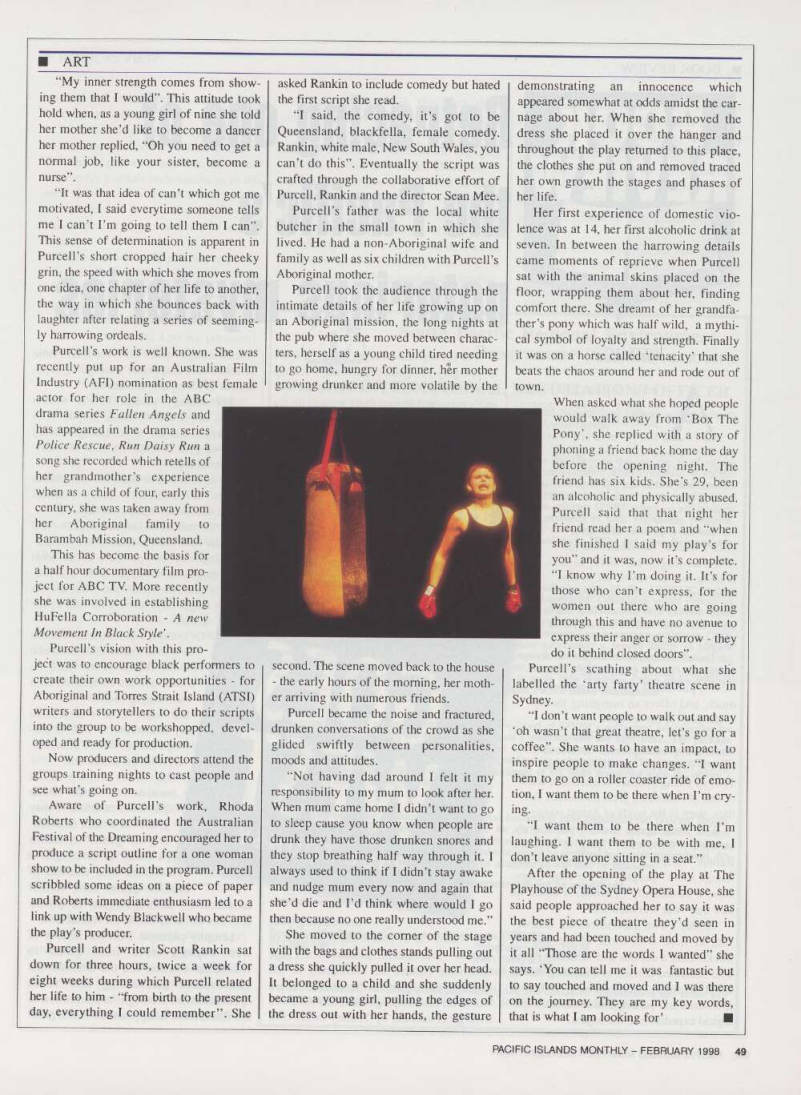
woman show
By Liz Thompson
The stage is set - a boxing ring and punching bag in one corner, animal furs, bags of clothes, a bench and large standing coat hangers in the others. In the midst of all this steps Leah Purcell and throughout the course of her one woman show 'Box The Pony’ she brings every inch of the stage to life with extraordinary vigour.
Her performance is electric. The ener gy which moves her through the many elements and layers of her story pushes the audience relentlessly on while she recounts the highs and lows of her short but intense life.
Raised in rural Queensland, Purcell grew up in a family of champion boxers.
Although she had great technique, girls weren’t allowed to box.
Undeterred, she trained hard both as a boxer and performer. Donning boxing gloves, Purcell dances back and forth punching the boxing bag. Maintaining a constant movement and monologue she breathlessly relates the opening chapters of her life.
As the story unfolds, she touches on the alcohol and the violence alive within her family - the punching bag, the gloves, the fighting spirit she demonstrates with them become her protection, her defence against the difficulties she faces.
Purcell has great spirit, that is evident from the beginning of her play, the enthu siasm she says, grew out of climate of being told “you can’t do that”. “Everytime I was told you couldn’t - I did.
“My inner strength comes from show ing them that I would”. This attitude took hold when, as a young girl of nine she told her mother she’d like to become a dancer her mother replied, “Oh you need to get a normal job, like your sister, become a nurse”.
“It was that idea of can’t which got me motivated, I said everytime someone tells me I can’t I’m going to tell them I can”.
This sense of determination is apparent in Purcell’s short cropped hair her cheeky grin, the speed with which she moves from one idea, one chapter of her life to another, the way in which she bounces back with laughter after relating a series of seeming ly harrowing ordeals.
Purcell’s work is well known. She was recently put up for an Australian Film Industry (AFI) nomination as best female
actor for her role in the ABC drama series Fallen Angels and has appeared in the drama series Police Rescue, Run Daisy Run a song she recorded which retells of her grandmother’s experience when as a child of four, early this century, she was taken away from her Aboriginal family to Barambah Mission, Queensland.
This has become the basis for a half hour documentary film pro ject for ABC TV. More recently she was involved in establishing HuFella Corroboration - A new Movement In Black Style’.
Purcell’s vision with this pro
ject was to encourage black performers to create their own work opportunities - for Aboriginal and Torres Strait Island (ATSI) writers and storytellers to do their scripts into the group to be workshopped, devel oped and ready for production.
Now producers and directors attend the groups training nights to cast people and see what’s going on.
Aware of Purcell’s work, Rhoda Roberts who coordinated the Australian Festival of the Dreaming encouraged her to produce a script outline for a one woman show to be included in the program. Purcell scribbled some ideas on a piece of paper and Roberts immediate enthusiasm led to a link up with Wendy Blackwell who became the play’s producer.
Purcell and writer Scott Rankin sat down for three hours, twice a week for eight weeks during which Purcell related her life to him - “from birth to the present day, everything I could remember”. She
asked Rankin to include comedy but hated the first script she read.
“I said, the comedy, it’s got to be Queensland, blackfella, female comedy.
Rankin, white male, New South Wales, you can’t do this”. Eventually the script was crafted through the collaborative effort of Purcell, Rankin and the director Sean Mee.
Purcell’s father was the local white butcher in the small town in which she lived. He had a non-Aboriginal wife and family as well as six children with Purcell’s
Aboriginal mother.
Purcell took the audience through the intimate details of her life growing up on an Aboriginal mission, the long nights at the pub where she moved between charac ters, herself as a young child tired needing to go home, hungry for dinner, her mother growing drunker and more volatile by the
second. The scene moved back to the house - the early hours of the morning, her moth er arriving with numerous friends.
Purcell became the noise and fractured, drunken conversations of the crowd as she glided swiftly between personalities, moods and attitudes.
“Not having dad around I felt it my responsibility to my mum to look after her.
When mum came home I didn’t want to go to sleep cause you know when people are drunk they have those drunken snores and they stop breathing half way through it. I always used to think if I didn’t stay awake and nudge mum every now and again that she’d die and I’d think where would I go then because no one really understood me.”
She moved to the corner of the stage with the bags and clothes stands pulling out a dress she quickly pulled it over her head.
It belonged to a child and she suddenly became a young girl, pulling the edges of the dress out with her hands, the gesture
demonstrating an innocence which appeared somewhat at odds amidst the car nage about her. When she removed the dress she placed it over the hanger and throughout the play returned to this place, the clothes she put on and removed traced her own growth the stages and phases of her life.
Her first experience of domestic vio lence was at 14, her first alcoholic drink at seven. In between the harrowing details came moments of reprieve when Purcell sat with the animal skins placed on the floor, wrapping them about her, finding comfort there. She dreamt of her grandfa ther’s pony which was half wild, a mythi cal symbol of loyalty and strength. Finally it was on a horse called ‘tenacity’ that she beats the chaos around her and rode out of town.
When asked what she hoped people would walk away from ‘Box The Pony’, she replied with a story of phoning a friend back home the day before the opening night. The friend has six kids. She’s 29, been an alcoholic and physically abused.
Purcell said that that night her friend read her a poem and “when she finished I said my play’s for you” and it was, now it’s complete.
“I know why I’m doing it. It’s for those who can’t express, for the women out there who are going through this and have no avenue to express their anger or sorrow - they do it behind closed doors”.
Purcell’s scathing about what she labelled the ‘arty farty’ theatre scene in
Sydney.
“I don’t want people to walk out and say ‘oh wasn’t that great theatre, let’s go for a coffee”. She wants to have an impact, to inspire people to make changes. “I want them to go on a roller coaster ride of emo tion, I want them to be there when I’m cry
ing.
"I want them to be there when I’m laughing. I want them to be with me, I don’t leave anyone sitting in a seat.”
After the opening of the play at The Playhouse of the Sydney Opera House, she said people approached her to say it was the best piece of theatre they’d seen in years and had been touched and moved by it all “Those are the words I wanted” she says. ‘You can tell me it was fantastic but to say touched and moved and I was there on the journey. They are my key words, that is what I am looking for’ ■
Book Review
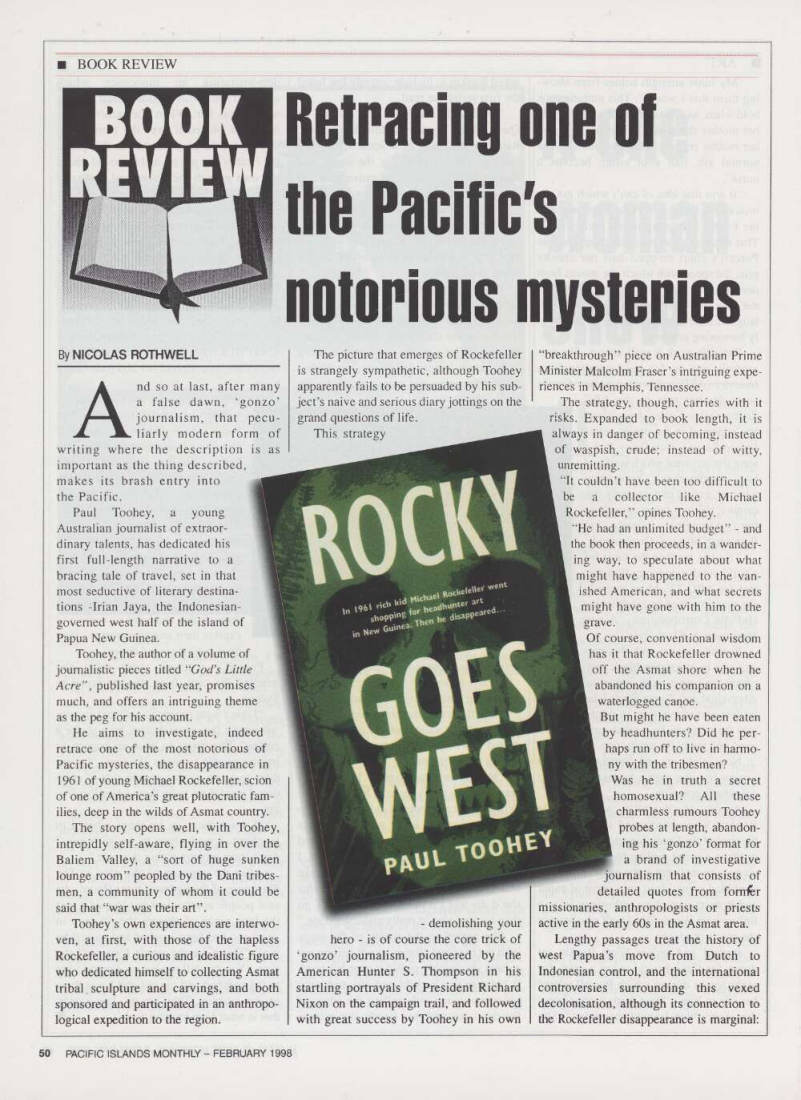
By Nicolas Rothwell
And so at last, after many a false dawn, ‘gonzo’ journalism, that pecu liarly modern form of writing where the description is as important as the thing described, makes its brash entry into the Pacific.
Paul Toohey, a young Australian journalist of extraor dinary talents, has dedicated his first full-length narrative to a bracing tale of travel, set in that most seductive of literary destina tions -Irian Jaya, the Indonesian governed west half of the island of Papua New Guinea.
Toohey, the author of a volume of journalistic pieces titled “ God’s Little
Acre” , published last year, promises
much, and offers an intriguing theme as the peg for his account.
He aims to investigate, indeed retrace one of the most notorious of Pacific mysteries, the disappearance in 1961 of young Michael Rockefeller, scion of one of America’s great plutocratic fam ilies, deep in the wilds of Asmat country.
The story opens well, with Toohey, intrepidly self-aware, flying in over the Baliem Valley, a “sort of huge sunken lounge room” peopled by the Dani tribes men, a community of whom it could be said that “war was their art”.
Toohey’s own experiences are interwo ven, at first, with those of the hapless Rockefeller, a curious and idealistic figure who dedicated himself to collecting Asmat tribal sculpture and carvings, and both sponsored and participated in an anthropo logical expedition to the region.
notorious mysteries
Retracing one of the Pacific's notorious mysteries
The picture that emerges of Rockefeller is strangely sympathetic, although Toohey apparently fails to be persuaded by his sub ject’s naive and serious diary jottings on the grand questions of life.
This strategy
- demolishing your hero - is of course the core trick of
‘gonzo’ journalism, pioneered by the
American Hunter S. Thompson in his startling portrayals of President Richard Nixon on the campaign trail, and followed with great success by Toohey in his own
“breakthrough” piece on Australian Prime Minister Malcolm Fraser’s intriguing expe riences in Memphis, Tennessee.
The strategy, though, carries with it risks. Expanded to book length, it is i anger of becoming, instead i, crude; instead of witty, ’t have been too difficult to collector like Michael ler,” opines Toohey. 1 an unlimited budget” - and c then proceeds, in a wander y, to speculate about what have happened to the van- American, and what secrets have gone with him to the 3urse, conventional wisdom it that Rockefeller drowned the Asmat shore when he ndoned his companion on a terlogged canoe, it might he have been eaten / headhunters? Did he per aps run off to live in harmo ly with the tribesmen?
Was he in truth a secret homosexual? All these charmless rumours Toohey
probes at length, abandon
ing his ‘gonzo’ format for a brand of investigative mrnalism that consists of detailed quotes from forrrfer missionaries, anthropologists or priests active in the early 60s in the Asmat area.
Lengthy passages treat the history of west Papua’s move from Dutch to Indonesian control, and the international controversies surrounding this vexed decolonisation, although its connection to the Rockefeller disappearance is marginal:
Michael had swum from his canoe before the mini-crisis erupted.
What kind of young man was the absent anti-hero at this book’s frustrating centre?
The kind of person, at any rate, who could write in his journals such sentences as this one. “I became immersed in that pent-up excitement that is only contained by the realisation that impetuosity would lead to disaster.”
Toohey, however, fails to find any poise or edge of individual character in the
words he quotes from Rockefeller, or the reminiscences he coaxes from the friends and colleagues still alive to share them.
Nor are the Asmat a strong presence in the pages of Rocky Goes West.
The Papuans who appear stand briefly in the haunting spotlight of Toohey’s prose, only to fall back into oblivion.
Attention is focused rather on the gallery of colonials; misfits and eccentric inves tigators, both private and anthropologi cal, caught up on the fringes of the story - there is the ludicrous Frank Monte, ever keen to strike a deal for the film rights to the Rockefeller saga; there are the scien tists and adventurers of the Asmat world, such as Tobias Schneebaum and Carleton Gajdusek, who are respectively given cameo roles by Toohey as gay and pedophile. Did anyone help our author solve the mystery? Are we any the wiser?
Of course not. The point of ‘gonzo’ jour nalism, and of 'gonzo’ travel writing, is that it mocks its own formulas.
Yet Toohey’s considerable literary and conceptual powers seem, in this book at least, ill-served by his chosen model.
Rocky Goes West is a long book about little, its core sections strung together from unfocused interviews with bit play ers, its oddly conventional narrative relieved only by brief, startling flashes of poetic insight: at one point, a Macassan is sitting unworried at the prow of a long boat, “as if he’s absorbing the sea’s dan gers on your behalf.”
Such moments, though, are rare.
Repeatedly I found myself wearying of the hostile, embittered tone Toohey adopts towards his subject: it is at least arguable that Rockefeller, whatever he may have been, has, through the strange circumstances of his disappearance and the establishment of his art collection at the heart of New York’s greatest muse um, done more to increase the world’s knowledge of the Asmat than any other
well-meaning westerner. This book, then, must go down as a puzzling failure, anoth er of ‘gonzo’ journalism’s missed opportu nities to catch and marvel at the engaging otherness of the far Pacific. There are, in the last pages of Rocky Goes West, tantalis ing glimpses of what might have been, as Toohey returns to his strength, and lets rip with a travel writer’s fantasy of weirdness, modulating from the cargo cult devoted to ABC newsreader Rosemary Church, via some intriguing ideas on Asmat sacrifice,
onto an ironised solution of the Rockefeller mystery - in which Michael meets and runs away with and is eventually killed by Amelia Earhart’s jungle daughter. Who?
Well, that’s another story it would have made a splendid magazine article, but alas, all this joyful lightness comes too late to save Rocky from the lead weight of its own intent.
Rocky Goes West, by Paul Toohey, publ by Duffy and Snellgrove, Sydney Australia, $A 19.95. ■
Advertisements & other items, p. 51 (2 items)
■ Book Review
Programme (SPREP)
South Pacific Regional Environment
Vacancy: INTERNATIONAL NEGOTIATIONS OFFICER
Applications are invited for the position of International Negotiations Officer with the South Pacific Regional Environmental Programme (SPREP) in Apia, Samoa.
Post Description The International Negotiations Officer is responsible to the Director through the Head of the Environmental Management and Planning j Division for co-ordination, SPREP) support to Pacific island country (PIC) participation at on-going UNFCCC subsidiary bodies and related environment negotiations, preparation of briefing material on latest developments in the science and politics of climate change and related environment issues and produce relevant SPREP policy and position papers, technical assistance and advice to PICs on preparations of their negotiating positions, coordination of media and public information related to climate change, develop proposals for activities to strengthening green house gas emission reductions in PlC’s, and other duties as may be required from time to time.
Required Qualifications and Experience Candidates should have extensive knowledge and understanding of the UNFCCC and/or international environment negotiations and Pacific island countries. Candidates would require an appropriate tertiary qualification (preferably with post-graduate qualifications in a relevant field) from a recognised institution and at least 5 years’ work experience, preferably within the Pacific islands region, in a field related to climate change and international environment negotiations. Other essential requirements are proven project management experience; a proven ability to prepare concise, easily understood and accurate briefs and reports on complex environmental issues; the ability to manage the work of scientists and consultants; a proven ability to work as a part of an interdisciplinary and/or multi-cultural team; the ability to meet tight deadlines (often under difficult circumstances); and an ability to live and work within Pacific island communities.
Conditions Appointment will be at the Project Officer/Advisor Level of SPREP’s authorised salary scales for contract staff depending on the successful applicant’s qualifications and experience. The package will include annual return airfares for appointee and dependents, a housing subsidy and other benefits. SPREP remuneration may be tax-free depending upon circumstances. The appointment will be for 2 years initially, with renewal up to a maximum of six years depending upon the officer’s performance and on die availability of funds.
Applications Applications should be accompanied by a detailed curriculum vitae containing full personal details, information on qualifications and experience for the position, previous appointments, current position and salary, names, addresses and telephone and/or fax contact numbers of three persons associated with the applicant professionally and who would be prepared to provide testimonials. An indication of how soon the applicant would be available should also be indicated.
Closing Date: 13 March 1998. Late applications will not be considered.
Applications should be addressed to: The Director South Pacific Regional Environment Programme (SPREP) PO Box 240 Telephone: (685) 21929 Apia Fax; (685) 20231 Samoa E-mail: [email protected] Further information, including a full post description and details of remuneration and terms and conditions of appointment, is available from the SPREP Administration Officer. m
The magic of pine and teachers
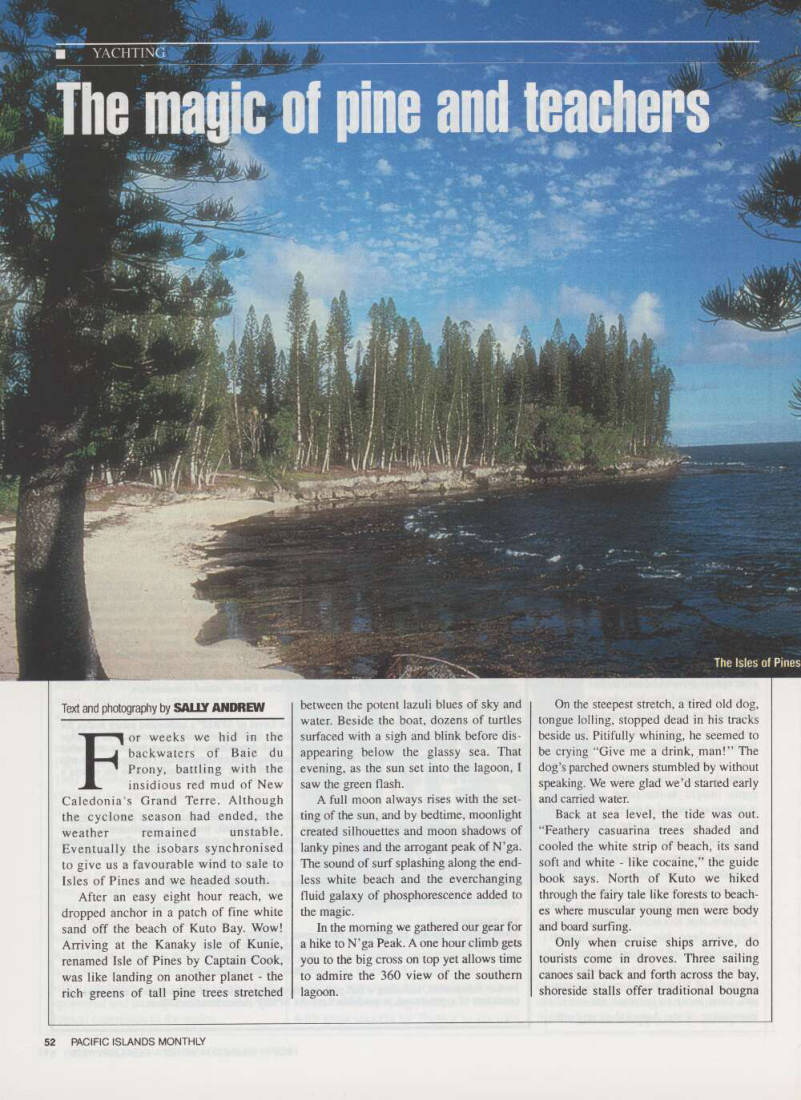
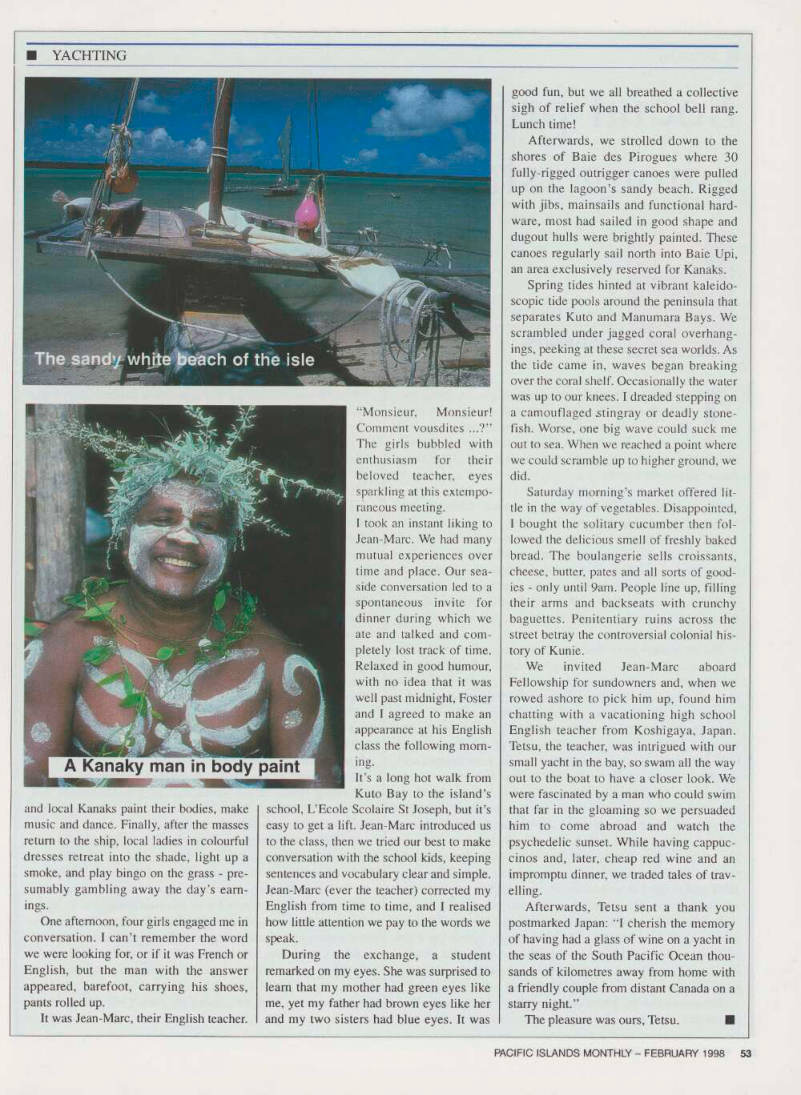
Yachting
Text and photography by SALLY ANDREW
For weeks we hid in the backwaters of Baie du Prony, battling with the insidious red mud of New Caledonia’s Grand Terre. Although the cyclone season had ended, the weather remained unstable.
Eventually the isobars synchronised to give us a favourable wind to sale to Isles of Pines and we headed south.
After an easy eight hour reach, we dropped anchor in a patch of fine white sand off the beach of Kuto Bay. Wow!
Arriving at the Kanaky isle of Kunie, renamed Isle of Pines by Captain Cook, was like landing on another planet - the rich greens of tall pine trees stretched
between the potent lazuli blues of sky and water. Beside the boat, dozens of turtles surfaced with a sigh and blink before dis appearing below the glassy sea. That evening, as the sun set into the lagoon, I saw the green flash.
A full moon always rises with the set ting of the sun, and by bedtime, moonlight created silhouettes and moon shadows of lanky pines and the arrogant peak of N’ga.
The sound of surf splashing along the end less white beach and the everchanging fluid galaxy of phosphorescence added to
the magic.
In the morning we gathered our gear for a hike to N’ga Peak. A one hour climb gets you to the big cross on top yet allows time to admire the 360 view of the southern lagoon.
On the steepest stretch, a tired old dog, tongue lolling, stopped dead in his tracks beside us. Pitifully whining, he seemed to be crying “Give me a drink, man!” The dog’s parched owners stumbled by without speaking. We were glad we’d started early and carried water.
Back at sea level, the tide was out.
“Feathery casuarina trees shaded and cooled the white strip of beach, its sand soft and white - like cocaine,” the guide book says. North of Kuto we hiked through the fairy tale like forests to beach es where muscular young men were body and board surfing.
Only when cruise ships arrive, do tourists come in droves. Three sailing canoes sail back and forth across the bay, shoreside stalls offer traditional bougna
The Isles of Pines
and local Kanaks paint their bodies, make music and dance. Finally, after the masses return to the ship, local ladies in colourful dresses retreat into the shade, light up a smoke, and play bingo on the grass - pre sumably gambling away the day’s earn ings.
One afternoon, four girls engaged me in conversation. I can’t remember the word we were looking for, or if it was French or English, but the man with the answer appeared, barefoot, carrying his shoes, pants rolled up.
It was Jean-Marc, their English teacher.
“Monsieur, Monsieur!
Comment vousdites ...?”
The girls bubbled with enthusiasm for their beloved teacher, eyes sparkling at this extempo raneous meeting. 1 took an instant liking to Jean-Marc. We had many mutual experiences over time and place. Our sea side conversation led to a spontaneous invite for dinner during which we ate and talked and com pletely lost track of time.
Relaxed in good humour, with no idea that it was well past midnight, Foster and I agreed to make an appearance at his English class the following morn ing.
It’s a long hot walk from Kuto Bay to the island’s
school, L’Ecole Scolaire St Joseph, but it’s easy to get a lift. Jean-Marc introduced us to the class, then we tried our best to make conversation with the school kids, keeping sentences and vocabulary clear and simple.
Jean-Marc (ever the teacher) corrected my English from time to time, and I realised how little attention we pay to the words we
speak.
During the exchange, a student remarked on my eyes. She was surprised to learn that my mother had green eyes like me, yet my father had brown eyes like her and my two sisters had blue eyes. It was
good fun, but we all breathed a collective sigh of relief when the school bell rang.
Lunch time!
Afterwards, we strolled down to the shores of Baie des Pirogues where 30 fully-rigged outrigger canoes were pulled up on the lagoon’s sandy beach. Rigged with jibs, mainsails and functional hard ware, most had sailed in good shape and dugout hulls were brightly painted. These canoes regularly sail north into Baie Upi, an area exclusively reserved for Kanaks.
Spring tides hinted at vibrant kaleido scopic tide pools around the peninsula that separates Kuto and Manumara Bays. We scrambled under jagged coral overhang ings, peeking at these secret sea worlds. As the tide came in, waves began breaking over the coral shelf. Occasionally the water was up to our knees. I dreaded stepping on a camouflaged .stingray or deadly stone fish. Worse, one big wave could suck me out to sea. When we reached a point where we could scramble up to higher ground, we did.
Saturday morning’s market offered lit tle in the way of vegetables. Disappointed, I bought the solitary cucumber then fol lowed the delicious smell of freshly baked bread. The boulangerie sells croissants, cheese, butter, pates and all sorts of good ies - only until 9am. People line up, filling their arms and backseats with crunchy baguettes. Penitentiary ruins across the street betray the controversial colonial his tory of Kunie.
We invited Jean-Marc aboard Fellowship for sundowners and, when we rowed ashore to pick him up, found him chatting with a vacationing high school English teacher from Koshigaya, Japan.
Tetsu, the teacher, was intrigued with our small yacht in the bay, so swam all the way out to the boat to have a closer look. We were fascinated by a man who could swim that far in the gloaming so we persuaded him to come abroad and watch the psychedelic sunset. While having cappuc cinos and, later, cheap red wine and an impromptu dinner, we traded tales of trav
elling.
Afterwards, Tetsu sent a thank you postmarked Japan; “I cherish the memory of having had a glass of wine on a yacht in the seas of the South Pacific Ocean thou sands of kilometres away from home with a friendly couple from distant Canada on a
starry night.”
The pleasure was ours, Tetsu. ■
The sandy white beach of the isle
A Kanaky man in body paint
Social problems at a high
Opinion
Social problems at a high among islanders in NZ
I’m sorry, but this column is going to be about sub jects Pacific Island people would rather not discuss.
They are, in fact, subjects most people probably don’t like to talk about, but it does not help anyone to sweep them under the table - least of all New Zealand’s 200,000-odd Pacific Island community.
They, more than most, need to face up to them, bring them out into the open and thereby see if they can do something about the awful problems facing their people.
I’m talking about abortion, car crashes and suicide, and it’s a regrettable fact that these three topics affect Pacific Island folk in New Zealand more than other sector of society. Two reports pub lished here late last year highlighted the situation.
One revealed that statistically every Pacific Island woman in this country has at least one abortion in her lifetime. That’s a sta tistical average.
Not all women have abortions, but some have two, three or even more, which skews the average and casts a cloud over every one. The other report disclosed that car crashes and suicides are to blame for the deaths of most young Pacific people here.
Two out of three island youths aged between 15 and 24 die tragically in this way. Both documents indicate that the Pacific Island population’s general state of health is poor and much needs to be done to lift it to a par with the rest of the New Zealand soci ety. The government is hoping to do that with its “Strategic Initiatives for the Health of Pacific People in New Zealand”, the first such strategy exclusively directed at the community. But island people themselves bear the main responsibility for dealing with the abortion problem. It is not exclusive to them - the num ber of legal operations performed in New Zealand reached a record 14,805 last year and the abortion rate at 17.7 for every 1000 women aged 15 to 44 was the fourth highest in the Western world, after the United States, Australia and Sweden.
But the rate for Pacific Island women was 32 per 1000, com pared with 18.8 for Maori and 12.6 for Pakeha. About 6 per cent of island women aged 20-24 had an abortion, compared with 2.7 percent of Europeans. Among the 25-39 age group, the island rate was nearly three times that of the Europeans.
This shows that the island community has a particular problem in this area - and the underlying reason according to experts here
is precisely because people don’t want to talk about it.
Island people, they say, have a traditional reluctance to discuss sex. Young people are afraid to talk about it with their parents and other authority figures and the young and old alike are reluctant to go to doctors and family planning clinics for help with contracep tion.
It-is not a result of traditional Pacific Island culture, which used'to be very open about sex, some say. They put it down more to the Puritanism introduced by early missionaries and a failure of society to adapt to a more modem outlook.
The Abortion Supervisory Committee’s annual report noted (not only of Pacific Island people): “Most New Zealand parents have difficulty dealing with health and sexuality.” Many, it said, did not have the confidence, knowledge or skills to teach their children. The answer, it argued, not unreasonably, lie with educa tion.
It said double standards of the past, when reproductive health was “closeted and separated off from the main curriculum” hadled to confusion, guilt and an unrealistic approach to children’s natu ral curiosity and desire to learn. “This lack of openness about sex ual matters in New Zealand society is reflected in the increasing abortion rate,” the committee said. “Too many young adults leave school with an inadequate knowledge of relationships and meth ods of contraception.”
Ideally, it said, teaching should begin at primary school before children become sexually active. But at present, only 50 per cent of secondary schools have sexual health education class es, let alone the junior level. Abortion is always controversial, raising passions on bothsides, and publication of the latest figures, coinciding with the 20th anniversary of the contraception, The Sterilisation and Abortion Act, inevitably revived demands from the religiously biased for changes to the law. But if a safe abortion service is not provided, there will be illegal abortions and people would die, the committee said.
Which brings us back to the other report, which noted that sui cide among Pacific Island youths was rising at a faster rate than any other ethnic group. But it is not just a matter of young people
dying in tragic circumstances.
Pacific Island people have the highest rates of rheumatic fever, heart disease, dietary disease and obesity in the country. They are 10 times more likely to get tuberculosis while the hospitalisation rate for infants is nearly 40 per cent higher than the national rate.
There are many reasons for all this, including low incomes, inadequate housing and a low level of education. The govern ment’s move to devise a strategy specifically for Pacific islanders’ health is a step in the right direction, if long overdue. But I cannot help thinking that positive signs of determination by the island community to tackle its own problems is also long overdue.
Discussing some of those subjects they don’t like talking about would be a good start. ■
David Barber
Wellington
PNG drought-is
the world listening?
Aid agencies accustomed to dealing with humanitarian emergencies across the world are now rating Papua New Guinea’s drought as ‘very significant’ on a global scale yet by mid-January it had still received hardly any media cover age outside the region and contributions from international donors (other than Australia) have been small.
Why is the world not heeding PNG’s plea’s for help? The first signs of the brewing disaster began to filter out of PNG in July and August when it became clear that lack of rain and frosts in the highlands had killed subsistence crops. By late September, the Australian government aid agency, AusAlD, was sufficiently wor ried to go onto a full-scale emergency footing. Within days it had responded to PNG’s requests for advisors to assist with the first detailed assessment of the problem, Australian Defence Force training flights were re-routed to make food drops in Western Province and SAUD2SO,OOO (SUS 151,227) was released to the Australian High Commission in Port Moresby for drought relief.
In Australia, those moves prompted the first flurry of media coverage of the issue, on radio, television and in the newspapers.
That coverage began some stirrings of activity in community organisations, most notably the Returned Servicemen’s League (RSL) whose members remembered what Papua New Guinean’s had done to help them during World War II and were keen to see what they could do in return.
Since then, despite the growing severity of the situation in PNG, coverage of the drought has been sporadic. The ABC, the only media organisation with a full-time correspondent in Port Moresby, has been providing frequent and in-depth coverage, the Special Broadcasting Service has been doing its best on a shoestring budget and Channel Seven has sent a correspondent to PNG. The newspapers have done relatively little and, surprisingly radio, with its ability to ring people on-the-spot at anytime, has emerged as the most important source of information.
Usually, in humanitarian crises it is television coverage that drives community response. Pictures from international agencies roll off daily satellite feeds into television newsrooms and onto the evening bulletin, stirring the heart and opening the purse strings of viewers. For PNG those agency pictures are not available and Australian television networks must send their own correspon dents if they want stories, a costly venture made more so by PNG’s difficult terrain and the fact that those worst affected by the drought live in the most remote areas. In Australia, media cover age of the drought has been complicated by other PNG stories -
such as the astounding claims by Prime Minister Bill Skate and allegations of corruption resulting from video tapes filmed secret ly by one of Skate’s former advisors. Those stories not only pushed the drought off the news agenda but, according to aid agen cies, slowed the flow of donations as people became concerned their money may not reach the people for whom it was intended.
Back in September, the early media coverage of the drought, in Australia, played a crucial role in alerting the world’s media to the growing difficulties in PNG. Most of the world’s major newspa pers and media organisations base their Pacific correspondents in Sydney. Although they are all aware of the deteriorating situation, few have filed major stories and fewer still visited PNG.
Of the six major Japanese news organisations based in Sydney only one, Asahi Simbun (a national newspaper with a circulation of over 10 million a day), has published a story on the drought.
Japan’s public broadcaster NHK has access to all ABC footage but by mid-January it had gone no further than the floor in NHK’s Sydney edit booth.
The Japanese, are not the only media lacking interest in the plight of those affected by the drought in PNG. CNN, renowned for its ability to broadcast from all parts of the globe and crucial for its role as an international opinion leader, has not yet visited drought ravaged areas and the New York Times has also not made mention of the drought. When pressed by Pacific Islands Monthly for their reasons for not covering the drought, some correspon dents were unabashed in saying simply that not enough people had died yet. Others said the fact that the landscape still looked green and that people were not gathered in huge refugee camps (as in Rwanda or Somalia) made the story difficult to convey on film.
Almost all Sydney-based media organisations said there was a lack of interest in the story from their.editors at their home-base.
Even organisations such as the BBC suffered this difficulty.
Recently, a BBC crew went to PNG and produced a series of reports on the drought which, because of lack of editorial interest in London, ran only on the World Service and not in Britain.
Response to the drought has also been slow from international aid donors. Back in October, PNG’s Minister for Provincial and Local Government Affairs, Simon Kaumi, wrote to donors in unequivocal terms. “The extent of this disaster ... is now unparal leled with any other natural calamity since PNG gained its inde pendence in 1975,” he told them. “The cost will be of such mag nitude that it will exceed the nation’s capacity to bear” Kaumi said. The minister went on to ask donors to provide “to their fullest ability” cash, goods in kind and personnel capable of providing technical assistance. By early January, Japan, New Zealand, Fiji, South Korea, the People’s Republic of China, France, the European Union, Britain and the United States had all given some thing but together it added up to only a little over US$2 million. A small effort compared with AUDSI6 million (SUS 9.6 million) put in by Australia and the 19 million Kina (SUS9.S million) by PNG.
By February PNG will have entered what is predicted to be the worst phase of the drought with 45 per cent of the rural population (1.4 million people) with little or no food in their gardens, famine food being stripped from the bush and children and old people dying. If more help does not come soon the scale of the disaster, and the deaths, will escalate rapidly. The international media based in Sydney are planning visits to PNG in February and March. If they had gone earlier, and donors acted faster, it is very likely that the enormity of the tragedy could have been reduced. ■
Jemima Garrett
Sydney
Turning words into action
It has been over two years since the United Nations Fourth World Conference on Women was con vened. And emphasis is now on monitoring actions to implement commitments made at that global gathering of over 30,000 in 1995.
In Beijing, China, was where it “all happened’ (so to speak) after over 150 of the world’s governments pledged to honour com mitments made in a Global Plan of Action (GPA) designed to address concerns and advance the status of women international ly- The key word following the conference was action’, particu larly at national level, to implement commitments and honour promises made before the international community in China.
But how far has the Pacific come since Beijing? And what is being done to ensure countries are keeping their side of the bar gain in terms of turning words into actions and promises into real ity at national level?
The Pacific Women’s Resource Bureau (PWRB) at the Pacific Community (formerly known as the South Pacific Commission) has, through a sub-regional consultation in December 1997, devised an implementation strategy for monitoring commitments made by the Pacific Island governments following their endorse ment of the Pacific Platform for Action (PPA).
The PPA was endorsed at the Sixth Triennial Conference of Women and Ministerial meeting in New Caledonia in 1994. The 22 island governments and administrations of the Pacific Island region served by the Community have formally recognised the importance of incorporating women into national and regional development activities.
The PPA lists 13 critical areas of concern to Pacific Island women and is the mandate of regional governments to ensure the advancement of women. Bearing this in mind, national focus points for women need to refocus on the PPA as having unprece dented commitments of governments and administrations in the
region.
The draft implementation strategy devised in December 1997, is in the format of a log frame which will serve as a regional tool to monitor actions on commitments on a six monthly basis. It will illustrate how to turn the vision of PPA into reality. It will become a framework for action.
This draft strategy will be presented to the PWRB’s 22 gov ernment women’s focal points for evaluation and comment in the
first half of this year.
The PWRB will also take a lead role in the development of
national advocacy strategies through sub-regional caucuses.
Since the Beijing conference, there has been a lack of demon strable evidence that much has been achieved in implementation of commitments made at that conference.
It is generally agreed that while the PPA was unprecedented in its significance on the road to Beijing, the return from China has been quiet and uneventful.
Through this implementation strategy, the PWRB as the regional lead coordinating agenecy for the advancement of Pacific women, is aiming to assist countries with actions targeted on national areas of focus. These actions will be determined, agreed to and owned by countries.
This mechanism will become the basis for coordinating, man aging and monitoring progress on implementation of the PPA and will further define and streamline the Community's technical assistance programme at national level.
The PPA is the authoritative document of objectives and strate gies for the advancement of women in the Pacific, until the Year 2000. The document contains the voice of Pacific women, their identity, issues, their vision of the future and their role in shaping it.
It is the baseline document, designed to ensure the full equali ty of Pacific women and their participation in development. From a monitoring viewpoint, indicators can be drawn from the PPA to assess the impact of programmes relating to the critical areas of concern. The PPA aims to accelerate the full and equal participa tion of women and men in all areas including economic and polit ical decision-making, protection of human rights and addressed critical areas of concern to ensure Pacific women and men can work together to ensure sustainable development.
The PPA is now three years old. An extensive evaluation of the PPA in December 1996 regrouped the document’s 13 critical areas of concern into five strategy areas to enable clearer identification, monitoring and implementation of programmes to achieve these goals and account for emerging needs.
These strategic areas of focus include; Physical quality of life; empowerment in economic, social, legal and political areas; enhancement and protection of women’s and indigenous people’s rights; contribution of women to the realisation of just and peace ful societies in the Pacific and institutional arrangements and mechanisms.
This regrouping was endorsed by the Seventh Triennial Conference of Women in Noumea in June 1997. The conference also mandated the bureau to re-evaluate the PPA and devise a mechanism to ensure effective monitoring of commitments made at Beijing, including those outlined in the 1994 Noumea Declaration.
The draft implementation strategy devised in December 1997 is the mechanism with which to ensure Pacific commitments to advance the status of women come alive. It is designed to assist governments to continue to turn commitments into actions and promises into reality towards the Year 2000 and beyond. ■
Debbie Singh
Spc, Noumea
Advertisements & other items, pp. 57-60 (3 items)
llil pi||||
SHIPPING
SHIPPING SCHEDULES FOR SHIPPING SERVICES (Fiji) LTD.
AUSTRALIA-NEW ZEALAND-FIJI-WEST COAST NORTH AMERICA SERVICES
NORTHBOUND SHUTTLE SERVICE
WEEK 44/97 :
WES I COAST NORTH AMERICA-EUI-NE W ZEALAND-AUSTRALIA SERVICE
SOUTH ROUND SHUTTLE SERVICE
SOUTHERN CROSS SHIPPING
AUSTRALIA- FIJI-PACIFIC ISLANDS
BURNS PHILIP SHIPPING AGENCIES (FIJI) LTD
AGENCY VESSELS MOVEMENTS
MANILA/TAIWAN7HONG KONG/ KOREA SERVICE
VESSEL j/gi
COLUMBIA CAL,
COLUMBIA STAR
BRISBANE STAR
COLUMBUS CAL.
ARGENTINA STAR
BRISBANE STAR
COLUMBUS CAL.
ARGENTINA STAR
BRISBANE STAR
COLUMBUS CAL.
ARGENTINA STAR
VOYAGE
052N 04 IN
O'ON
053N 002N 03 IN 054N 003N
iiiiil
055N
iiiili
MELBOURNE,
0*#U 23-24/11 07-08 12 21-22/12 i 142/01 25-26/01
mmm
01.-02/03 15-16/03 39-30/03 19-20/04
SYDNEY
'05 07/U 26-28'11 10-12/12 24-20/12 1446/01 28*30/01 11-13/02 04 06,-03 (8-20/61 81-03/04 22-24/04
AUCKLAND :
11-13/J1 02-03/12 16-17/12 30-31/12 ' 20 21/01 .• 03-04/02 17-18/02 10-11.03 24-25/03 07-08/04 28-29/04
SUVA 1 '
15-16/ n ' 06-07/12 20-31/12 . 03-04/01 24-25/01 07*08/02 221-22/02 14-15/63 28-29/03 U-12/04 02-03/05
LOS ANGELES
28/11-01/12 20-22/12 03-05/01 1749/01 07-09/02 21-23/02 0709/03 28-30/03 11-13/04 35-27/04 16-18/05 V: .
VANCOUVER ”
0404/12 25-25/12 08-08/01 22-22/01 12*12/02 26*26/63 12.12/03 02*02/04 16*16/04 • 30-30/04 221-214)5
SEATTLE
03-03/12 24-24/12 07/07/01 21-21/01 !1-11/02 35-25/02 11 11.03 01-01/04 15-15/04 29-29/04 20-2005
OAKLAND
01-01/12 22-22/12 05-05/01 lO-lOOl (»;(K)02 23-23/02 09-09/03 30-30*03 13-13/04 27-27/04 IS 18/05
NEWYORK
05-05/1)2 27- 16-lOffll 24-24/1 14-14/2 28- 14-140 04.0404 18-18/04 02*02/05 Mg g gnp //m" mm I \ ; mini.
SCHEDULE
VESSEL
V:
WEST COAST NORTH AMERICA
Fill
SUVA
NBWZBALND*
—yni"Ki and *■ v * ' yfyfy
VOYAGE
SEATLE
VANCOUVER
OAKLAND i;
LOSANGEl
BRISBANE STAR
AGHNT1NA STAR
BRISBANE STAR
ARGENTINA STAR
Brisbane star
ARGENTINA STAR
OIOS
0O2S 0I1S 003$ 032$ 004$ - 12-12/11 17 17/12 31-31/12 04-04/02 18-18/02 25-23/03 13-13/i1
iR-is/12 iiiiii
01-01/01 03-05/02 \9-l9m 26-20103 14-14/11 10-19/12 02-02/01 06-06/02 20-20/02 27-274)3 15 17/11 20-22/12 03-05/01 07-09/02 21-23/02 28-30/03 i 03-04/01 17-18/01 21-22/02 07-08/03 11-12*04 03-03/12 07-07/01 21-21‘01 25-25/02 n-n/03 J<-15/01 ill 07 08,12 11-12/01 : 25-26/01 01-02/03 15-W03 .4 19-20,04 10-12/12 14-16/01 28-30*01 04-06/03 18-20/03 ■- 22-24/04
VESSEL ' W
PRINCESS CAIWYN
PRINCESS CATHRYN
VOYAGE
W
iiiiiii
GLADSTONE
wn 01/01
SYDNEY
CM/IJ
iiiiiii
BRISBANE SANTO VILA
o-m 09/12 H/12 02/0} - 07/01 09/01
SUVA
W2
iliili
FUNAFUTI
17M2
ISO}
WA11 IS
19/12 17/01 imi 18/01
PAGO
22/12 20/01
VA'VAU
24/12
iiiiiii
NUKU’AUOFA
20/01 24/01
Gl-ADSJONE
2 11/12 2<»'Oi
— — SOUTHEAST ASlA.Fin DIRECT SFRVtrrc
VOYAGE NO,
NZQL
COMMANDER
V21S/97
lp5 nzol
CHALLENGER
vzzsm
NZOL ,
CRUS AOER a
V23S/97 ""
NZOL
campaigner
vzmm >.
tt
COMMANDER
5 "' V1S/98
NZOL tH'"
CHALLENGER
V02S/98
SURABAYA
JAKARATA
PORT KELANG
BANKOK
SINGAPORE
NOUMEA
SUVA
iin$ 14/11 09/11 1S/H 27/n 29/H
— SOUTHBOUND
14H1 16/U 19/11 25/1 i 3om 12/12 14&2 '' mil 01/12 > .04/12 10/12 15/12 27/12 29/12 14/12 16/12 19/12 25/12 • 50/12 12/1/99 1401 29/12 01/01 04/01 10/05
i5/oi iiiii
27/1 voYMmud.
N/OI
COMMANDER
V21 f®?
NZOL
CHAU, ENGER
V22N/97
NZOL
CRUS ADER
V23N/97
NZOL
CAMPAIGNER
V24N/97 '
A n NZOL , - /"
" COMMANDER .||
V0IN 99
NZOL
CHALLENGER
Si V20S/98 iiliilS
SURABAYA
MKARATA
PORTKELANG
SINGAPORE
BANKOK
14-12 16/12 10/12 21/12 25/12 ■v 29/12 01/01/98 04/01 , own 10/01 14/01 ifr&l 19/01 21/01 25/01 29/01 ' (0/02 04/02 06/02 14/02 16/02 19/02 21/02 35/02 28/02 01/03 04/03 06/03 10/03
PORTS
BA I HE KOU
V267;268
XIAO SHI KOU
V244/245
BAf HE KQU
V269/270 m KjAQmtKOXl ;
KBELONG
KAOSHIUNG
HONG KONG
BUSAN
SUVA
AUCKLAND '
LYTTELTON
FEEDER .SERVICE LAUTUKA■
18/11
llil pi|||
26/11
VIA RELAY
09/11 10/11 07/11 16/11 06/11
Hip if f
LV12 16/12 30/11 01/12 28/U ' 07/12 27/11 31/12 03/01/98
■' 05/01 iiliiisiiii®
17/12 15/12 26/12 27/12 21/01 24/01 26/01
CHINA /JAPAN DIRECT SERVICE
NEWZEALAND- FIJI
CONTAINER IDRY/RE£FER).LCL &BREAKBCLK SPECIALIST
NEPTUNE SHIPPING AGENCY
SERVING FIJI DIRECT FROM NEW ZEALAND AND AU STRALIA
NEW ZEALAND-FIJI DIRECT SERIVJCB
PORIS
BATHE KOU
V267/268
XIAO SHI KOI)
V244/245
BAl HE KOU
vimmct
XIAOSHi KOU
V246/247
DALIAN
sk 14/11 » !- M 1 05/12 ', 1 " " 27/12
HUANOPU
14/11 05/12 23/12
NANJING
iiiiiiillili
llli /ilffliilii;;:;
06/112 27/12
QINGDAO
iiiiigjiiiig
BVXt
22/12
SHANGHAI
- 03/12 24-12
XINOANG
- 04/12 26/12
KOBE
02-03/1! 13/12 J" 05/01
NAGOYA
YOKOHAMA
04-05/il 26'11
&m Wmm
07/01
SUVA
18/ It ji/u 21/01
AUCKLAND
22-23/11 iyta 03/01/08 24/01
LYTTELTON
1 i-26/ll 05/01 26/01
KOBE
13-14/12 05-01'98 26/01 16/02
NAGOYA
YOKOHAMA
15-16/32 07.di m 28/01 18/02 Femm service lautoka-via relaynagoya cargo centrausw to kobe for WAomo (Fa. osm
VESSEL
DIRECT FALCON
DIRECT TUf t
DIRECT KIWI
DIRECT EAGLE
DIRECT TLT
DIRECT EALCON
VOYAGE NO.
vi&> V243 V337 V339 V244 V 342
LYTTELTON
U11 22/ii 2$/tl m2 13/12 1 2/1/98
AUCKLAND
16-16/f ! 25-26/i i 29-30/11 ■ 13-14/12 16-17/12 3-4/1
SUVA
mi 2-3/12 3/12 17/12 23-2V12 7/1
LAUtOKA
20/U 4/12 4/12 18/12 23-24/12 m
* Etft TOISLANDPORTS AND AUSTRALIA
VESSEL ; V
SOUTH QUEEN
MGANAIII
ARIKI PACIFIC
SOUTH QUEEN
TUI PACIFIC
SOUTH (RISEN
voyage Na
VISE
V02 VJ g
V19E V V.-'
. V03 V20E
SUVA
* 8-9/n 13m 21/11 2/13 1 ""wm
LAUTOKA
VIA SUVA
- W "
V1ASU
NUKUALOFA
* \ 23/11 20/12
APIA
wM&MMM
. 24/11 21/12
PaGOPAGO
11/11 14/11 25/1 i : 4/12 22/ia
WALUS
- 13/U 27/U ,24/12
FUTUNA
- 12/11 28/1! 25/12
SUVA
mi
iiiiiiiiii
m m WMMfMk. i 30/U 27A2
SYDNEY
i.vn
iiiiiiiiiii
- 7/12 .
MELBOURNE
1801 ill i.-:- 2 . > 10/12
iiiiilii
BRISBANE
u«m - - 10/12 - 7/1
CARGO CENTRALISED AT SYDNEY '
ttiillllwll
VESSEL-ii
VOYAGE NO. M
AUCKLAND -• LYTTLETON
TAURANGA:
i AUCKLAND
lautoka //
SUVA
CAPITAINE WALLIS
5 ' '% 404/1! 7-7/1
liiilii!
11/12/11 18-18/11 19-19/11
CAPITAINE WAUJS
6 25-75/1 i 28-28/11 l-l ffi 2-3/12 9-0/12 10-10/12
CAPITAINE WALLIS
7 54-14/12 17-17/52 20-20/12 21-21/12 26 27'12 29-29'12
CAPITAINE WALLIS
8 6-6/1 5-5/1 12-12/1 13-14/1 20-20/1 21-21/1
CAPITAINE WALLIS
9 26-26/1 30-30/1 W2 4-4/2 10U0/2 ll-tl/2 ", tb- AUSTRALIA FIJI -DIRECT SERVICE ' ' < ' > ',
VESSEL
VOYAGE NO. ••
BRISBANE SYDNEY 0
MlllKilRNl
LAUTOKA
SUVA
OAPlTAiNE TASMAN
liiii
2-3/11 6-7/11 10-11/11 19-19/11 20^20/11
CAPITAINE. TASMAN
27-2S/H 30/11-1/12 4-5/12 13-13/12 15-16/12
CAPITAINE TASMAN
5 22-22/12 24-24/12 27-27/12 ' SH 11 -
CAPITAINE TASMAN
6 5-5/1 8-9/1 12-13/1 20-20/1 2I-2U1
FUl-APIA-PAGOPACrO-FUTUNA-WALOS NOUMEA SERVICE
VESSEL
VOYAGE NO
SUVA ' APIA PAGOPACO
• FUTUNA p
WALLIS /
FUTUNA
NOUMEA.
MOANA III
3 8-9/11 - --1 ll/fl/Il - II 14-16/11 17-17/11 21. 22/11
MOANA 111
4 25-26/11 27-27/11 28-30/11 1-1/12 MOANA ill s 3-4/12 6-6/12 9 9'12 10-10/12 14 15/12
MOANA III
6 18-18/12 22-22/12 23-25/12 26-26/12 + % s *■
; MOANA HI
7 29-29/12 31-31/12 - 03/1-4/1 5-5/1
9-lCKI
0'\C' ' 5 v I 'aK' '
Shipping
Grand Pacific Life Insurance, Ltd.
In decades of commitment, we’ve gained your trust and built an
understanding that comes only
from sharing your life and working with you side by side, as our local
agents have for generations.
So whether you’re thinking in terms of today or generations to come, Grand Pacific Life will be here in
the Pacific, fulfilling our promises
and continuing our commitment begun decades ago.
American Samoa Mark Solofa Pacific Insurance & Finance, Inc, Mark Solofa, GA Phone: 684-699 5796 Samoa Mark Solofa Pacific Insurance & Finance, Inc, Mark Solofa, GA Phone: 685-24059 Federated States of Micronesia Chuuk State Pacific Basin insurance & General Services, Inc.
Kachutosy Paulus, GA Phone: 691-330-2606
Oor
Commitment
Is A Powerful
Force.
/ Pohnpei Actouka Executive Insurance Underwriters Marcefmo Actouka, GA Marideil Actouka, Life Manager Phone: 691-320-5331 Guam Great National Insurance Underwriters, Inc. Dornie Bumagat Jr,, GA Phone:67l-646-5736 Pacific Financial Corporation Eduardo Camacho, GA Phone; 671-646-1990 -M Sill
IMP
ft
•Sir:-
sift
mm.
Takagi & Associates George Takagi, GA Pamela Cruz, Life Manager Phone:67l-475-4373 Marshall Islands Marshalls Insurance Agency Jerry Kramer, GA Phone: 69? 625-3366 Saipan Pacific Basin Insurance Underwriters, Inc.
Mary Ann Milne, GA Phone; 670-234-7861 Pacifica Insurance Underwriters, Inc Norman Tenorio, GA Phone: 670-234-6267
Grand Pacific Life Insurance, Ltd.
A member of the Finance Factors Family Serving The Pacific Islands For 30 Years Takagi & Associates George Takagi, GA Laurie Sturges, Branch Manager Phone: 670-322-8117 Tonga Peseti Ma'afu Insurance & Finance, Ltd, Peseti Ma'afu, GA Phone: 676-24-777
KIAORA! BULAVINAKA!
MAEVA! ALOHA!
HOWEVER WE SAY IT,
IT MEANS WELCOME!
Budget Fiji 722 636 Papuo New Guinea 325 4111 Vanuatu 23170 New Caledonia 262 009 Hawaii 838 1111 Western Samoa 20561 Australia 1300 362 848 New Zealand 0800 652 227