Pacific

Islands
Monthly
October, 1949
Vol. XX. No. 3.
stablished 1930.
I Registered at the G.P.0., Sydney, )or transmission by post as a newspaper ]
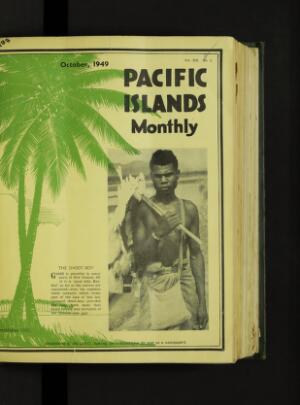
The Shoot-Boy
GAME is plentiful in many parts of New Guinea. All of it is “good fella Kai- Kai” as far as the natives are concerned —even the common white cockatoo which forms part of the load of this lad.
Licensed shoot-boys provided the only fresh meat that many miners and recruiters of the interior ever had.
Advertisements & other items, pp. 2-4 (3 items)
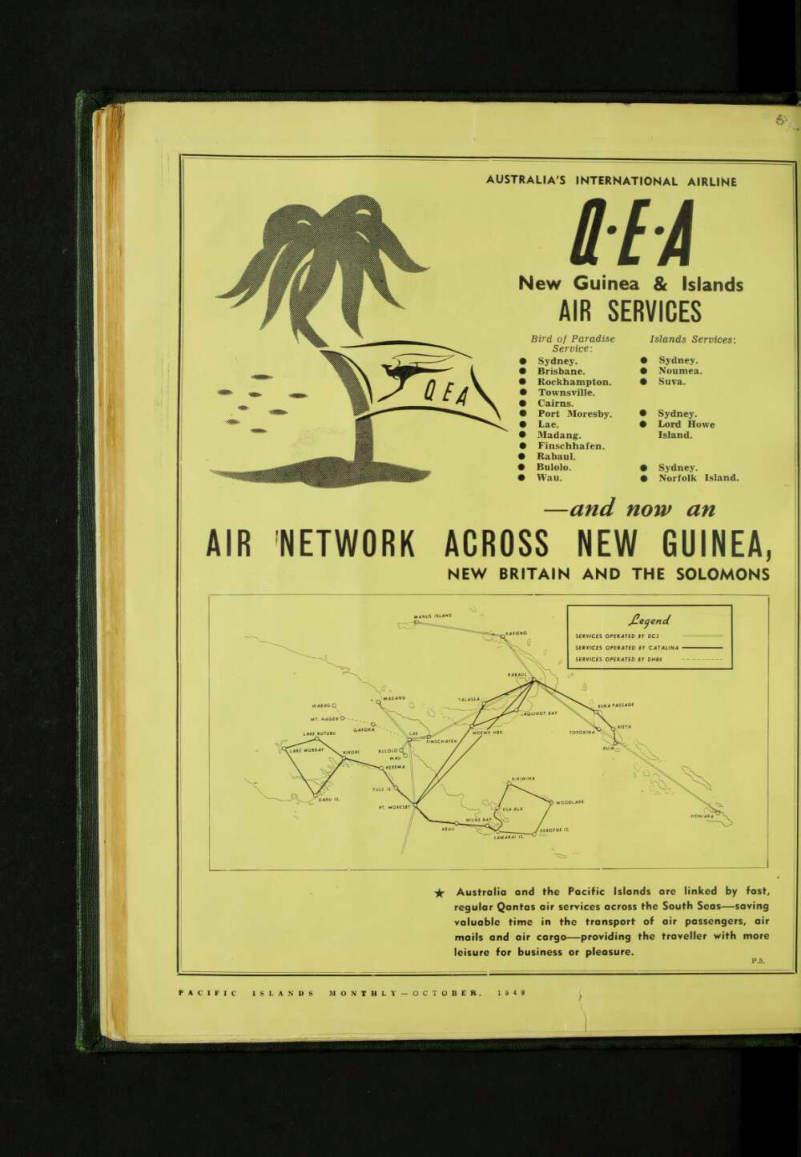
Air Network Across New Guinea,
AUSTRALIA'S INTERNATIONAL AIRLINE
af 4
New Guinea & Islands
AIR SERVICES
AIR NETWORK ACROSS NEW GUINEA,
NEW BRITAIN AND THE SOLOMONS
MANUS ISLAND
Jleqend
ejem
SERVICES OPERATED BY DC3
SERVICES OPERATED BY CATALINA
SERVICES OPERATED BY DHB4
\l BUKA PASSAGE
LAKE KUTUBU
kekema ir Australia and the Pacific Islands are linked by fast, regular Qantas air services across the South Seas—saving valuable time in the transport of air passengers, air mails and air cargo—providing the traveller with more leisure for business or pleasure.
P. 5.
.. r-- Csatsas
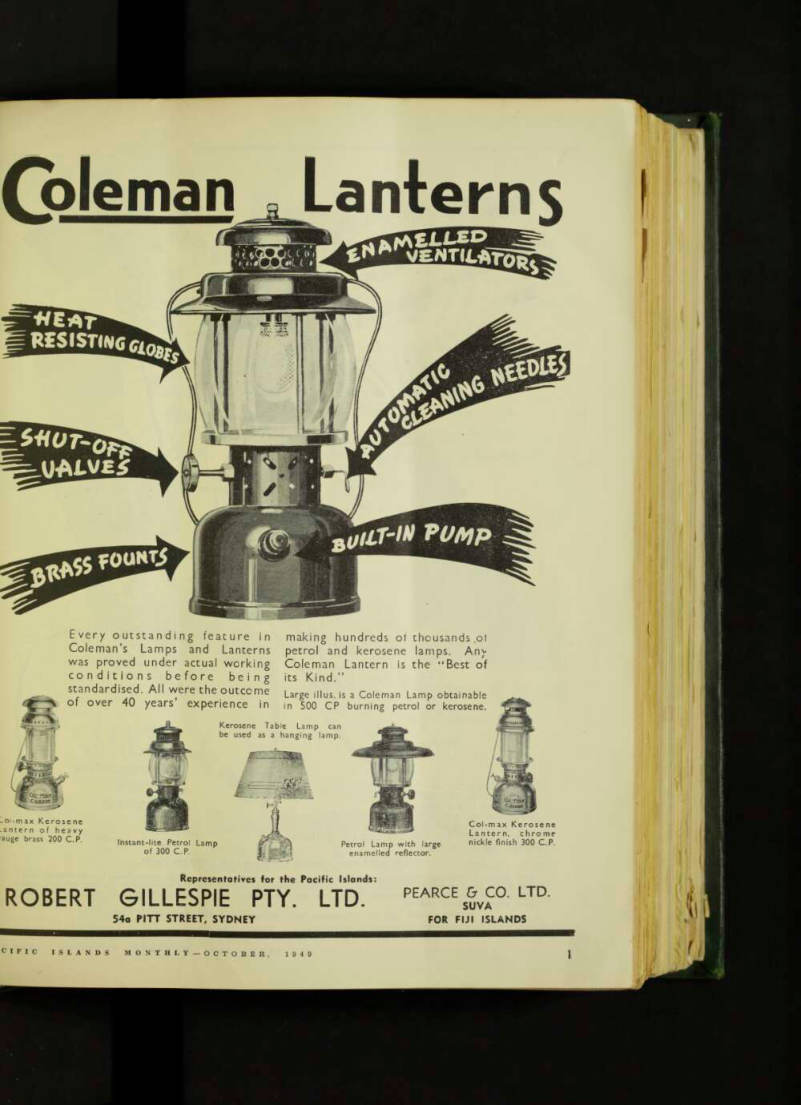
Every outstanding feature in
Coleman’s Lamps and Lanterns was proved under actual working conditions before being standardised. All were the outcome of over 40 years’ experience in making hundreds of thousands.of
petrol and kerosene lamps. Any
Coleman Lantern is the “Best of its Kind.”
Large illus. is a Coleman Lamp obtainable in 500 CP burning petrol or kerosene. -oi-max Kerosene .antern of heavy auge brass 200 C.P.
Kerosene Table Lamp can be used as a hanging lamp.
Instant-lite Petrol Lamp of 300 C.P.
Hr Petrol Lamp with large enamelled reflector.
Col-max Kerosene Lantern, chrome nickle finish 300 C.P.
Representatives for the Pacific Islands:
ROBERT GILLESPIE PTY. LTD
540 PITT STREET, SYDNEY
PEARCE & CO. LTD.
SUVA
FOR FIJI ISLANDS
h o n v. % \ VK VVy "S \ a I V?** «fe» j f| *«>
rtS
<&r m mm ** i» * rAt- * /N.
V £ * > hlj * tv fb* V
'ZIJ
m *'\ fW* % $ -•- V m »'*
the
services
s
SOUTH
M
MSiTte
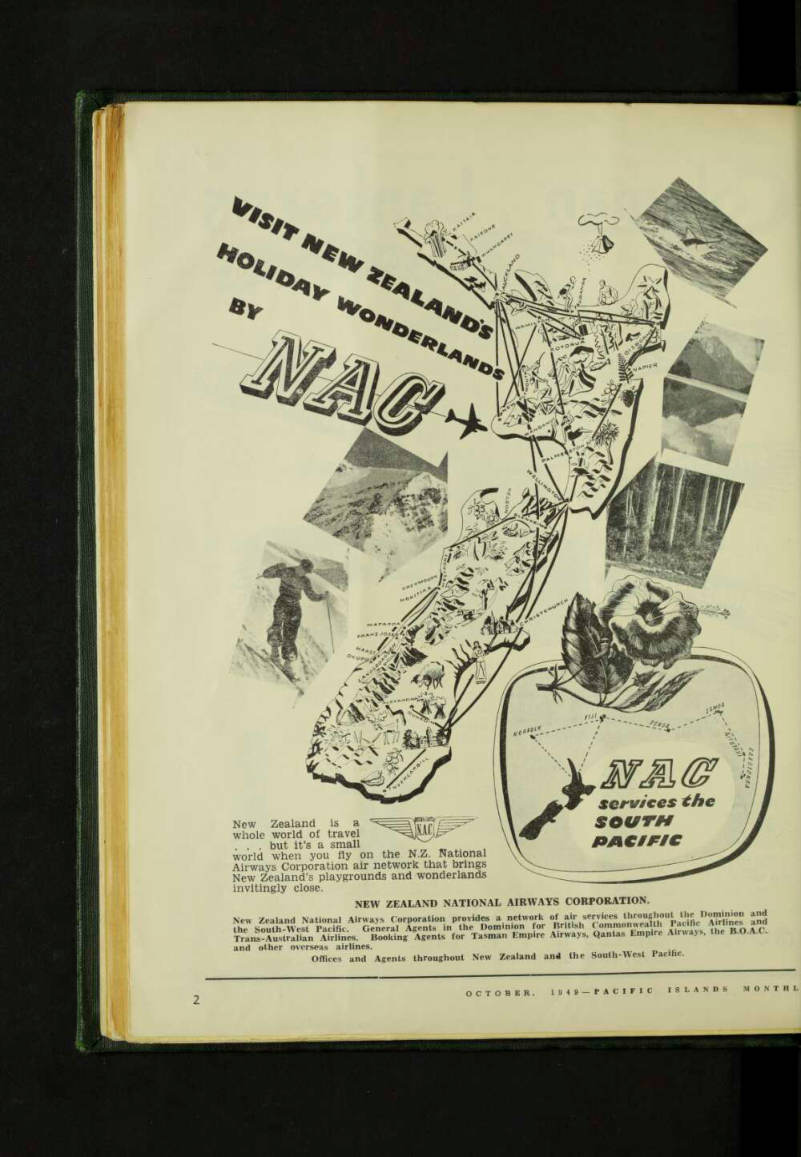
New Zealand is a whole world of travel . . , but it’s a small <ir world when you fly on the N.Z. National Airways Corporation air network that brings New Zealand’s playgrounds and wonderlands invitingly close.
NEW ZEALAND NATIONAL AIRWAYS CORPORATION.
New Zealand National Airways Corporation provides a. network of and the South-West Pacific. General Agents in the Dominion for British Commonwealth P 1 R A Q Trans-Australian Airlines. Booking Agents for Tasman Empire Airways, Qantas Empire Airways, the B.U.A.c and other overseas airlines.
Offices and Agents throughout New Zealand and the South-West Pacific.
1
CIFIC ISLANDS MONTHLY OCTOBER, 1949
2
OCTOBER, 19 4 9 -PACIFIC ISLANDS MONTHL
Index to Advertisers
is Akun & Co. . 69 minium Union . 59 plion (A/sia) . 95 ins, Wm. ... 61 tralian Health ervices . . 41, 103 ;er, W. Jno. Pty. 48 ik of NSW ... 44 hell, Gwynn & 76 den, Wynne S. . 43 dford (Eng.) . 103 xland Rae Pty. 100 ndell, Spence . 65 □infields, Ltd. . 24 nton & Co. . . 20 ge, James ... 89 ns Philp (NG) . 57 ns Philp (NH) . 68 ns Philp (SS) . 47 ns Philp Trust . 36 ting, A. H. td 26 am, T., & Sons, ;d. 77 le’s Studios . . 32 penter, W. R. & Ltd., 82, cov. iv. penter, W. R. i’iji), Ltd. ... 91 rmosan ... 15 sifted Advertise ents 103 rlock Co., Ltd. . 35 mial Meat Co. . 92 er Watson (NG) 67 solidated Mail rders 16 nmond Radio . 30 stex” 87 ningham, R. H.
Co 96 gar, Gedye & alloch, Ltd. . 3 ison Paints, Ltd. 68 aghy, M., & ins 45 aid. A. 8., Ltd. oickland) ... 71 aid. A. 8., Ltd.
Rarotonga) . . 85 trolux ... 82 lore Poultry . . 63 ilissements onald (Tahiti) 45 i Sherington, d 64 rett, Davidson Matthey Pty.. d. . . . . . 104 rick Hotel ... 40 ey’s Gin ... 70 ispie, Robt., Pty. d 1, 31 espie, Robt. 1G), Ltd. . 63, 90 Bspie Bros. . . 76 don’s Gin ... 37 gh & Co., E. J. 68 nd Pacific Hotel 4 ?ory, A., Pty., ,d. 71 ve & Sons, W. 76 mrsen, Lars, ins Pty., Ltd. . 33 raiian Club ... 28 iz & Co. Pty., ;d 93 co 73 lingway obertson In itute 97 ver, Francis . . 39 licks Pty., Ltd. 72 rnational Trad g Co. pty., Ltd. 87 cson. S. Went orth 15 ress Bros. . . 102 per Refrigera ts Pty.. Ltd., 27, 75 nedy. Captain . 95 r Bros. Pty., ... 81, 100 lak (,A/asia) ty 62 ynos. Inc. ... 42 •sen, W., & Co. 19 ak. Robert . . 23 ft Walker Cheese o. Pty., Ltd. . . 83 . George ... 85 )ng Chong Bros. 16 arus, D. M. & • W, . .. . . .19 >oney, N. F., & o. ... 59
Manning & Manning 27 “Mendaco” ... 33 Merrillees, J. C., Pty., Ltd 94 Millers, Ltd. ... 84 Morris, Hedstrom . 12 Motor Tractors Pty., Ltd 86 McHrath’s Pty., Ltd. 20 National Associa tion for Preven tion of Tubercu losis 27 Nelson & Robertson 79 “Nixoderm” ... 84 Nordman, Oscar G. 73 NZ National Air ways Corporation 2 Pacific School of Music 23 Pacific Islands Society 44 Pacific Is. Trading Co 29 Pacific Islands Year Book ... 13 Pan American World Airways . 14 Perkins (Aust.) Pty., Ltd 98 Qantas Empire Air ways ... cov. ii.
Qld. Insurance Co., Ltd 75 Qld. Merchants Supplies ... 74 Reed, Wm. E. . .25 Reynolds, K. (Yacht Darnley) . . 18. 77 Riverstone Meat Co 32 Robinson, G. H., Pty., Ltd. . 93. 102 Rohu, Sil . . . .31 Scott, J., Pty.. Ltd. 80 Shell Co. of Aust., Ltd 48 Smith. G G., & Co..
Ltd 22 Southern Pacific In surance Co., Ltd. 67 Spartan Paints . . 78 Steamships Trading Co.. Ltd. . . 41, 60 Stewarts & Lloyds 40 Stratton & Co., Ltd. ... 17 Sullivan. C., Pty..
Ltd 80 Swaan, Dr. Wm. . 71 Swallow & Ariell, Ltd 58 Tallerman & Co. . 29 Taylor. Allen, & Co. 79 Thornycroft ... 97 Three Pines Boat Service ... 101 Tilley Lamp Co., Ltd. ... 46 Tillock & Co. . . 81 Tongan Photos Bureau 84 Tooth & Co. . cov, iii.
Tyneside Engineer ing Co., Ltd. . . 43 Union Mfg. & Ex port Co.. Ltd. . 38 USL Batteries ... 69 Vacuum Oil Co. . . 34 Ventura Trading Co. Pty., Ltd.. 28, 69. lOl Vincent Bros. ... 58 Vincent Chem. Co, 39 Wakefield, Green wood & Co. ... 21 Watson. Wm. H. . 25 Watson. Victor, Ltd. 21 West, Harry ... 94 Williams, Dr. ... 35 Widdop. H.. & Co. 64
Wius. W. D. & H.
O. (Aust.), Ltd. . 66 Wrieht. E., & Co.
Ptv.. Ltd 81 Wright & Co. . 99 Wilson. W. F., & Son 83 Willreed Agencies Pty.. Ltd. ... 88 Wunderlich. Ltd. . 24 Yacht Darnley lB. 77 Yachts for Sale 9l, 103 Yorkshire Insur ance Co., Ltd. 37 Young, A. H.. & E. 16
Advertisements & other items, p. 5 (2 items)
3
ISLANDS MONTHLY OCTOBER, 1949
Don’t Delay
Get a 60 h.p. LISTER Diesel
You need not he held up for want of an engine for your boat! An order now will ensure immediate delivery of a Lister 60 h.p. diesel— the marine engine that invites comparison. Price for price, performance for performance, the Lister 60 h.p. diesel is the greatest value on the market to-day!
NOTE THESE OUTSTANDING FEATURES OF THE LISTER 60 H.P. DIESEL • “ Simplato ” Heat Exchanger a revolutionarysystem of fresh water cooling. • Robust design and easy accessibility for maintenance, • “ Listard ” (Van der Horst Patents) liners and C.A.V. fuel injection equipment, • Electric starting. • And many other outstanding advantages.
Dangar, Gedye & Mallogh ltd.
10-14 YOUNG STREET, CIRCULAR QUAY, SYDNEY
NOW!
Cable Address: “DANGARS”
Marine Workshop: Careening Cove, Sydney.
Telephone: 8U5095
Tel.: XAI9II
In This Issue:
Editorial: “More Plans and Planners for Papua-New Guinea” .. .. 5 Red Penetration in Pacific Islands 6 Fiji is 75 years a Crown Colony .. 7 New Guinea Native Murderers Not to Hang .. 7 Sequel to NG Timber Inquiry— Farrell Goes Free 7 New Buildings in Noumea .. .. 7 Effect of Devalued £ in Pacific Countries 8 Why Mr. Richards?—New Appoint ment to Nauru 9 BGD Party Explores Sepik 9 Sautot Asks “Millions Question” .. 9 Carpenters’ Profits 10 More Officials for Some New Guinea Districts 10 Operation “Bang” is Cancelled .. 10 New Attorney-General for Fiji ... 10 Dick America is Dead 11 Heir to the Cocos Islands —Further Information about the Clunies Ross Family 13 Sydney-N. Guinea Air Fares Go Up 13 Air France Begins Service to N.
Caledonia 15 Press Censorship for New Guinea? 15 BP Service to Norfolk, Lord Howe May Cease 16 The Fourth Session of South Pacific Commission 17 The Rebirth of Rabaul —A T. ibute to the Officials Who Made it Possible 21 District Officers Confer in N. Guinea 24 Kieta Notes 24 Future Use of Fiji Lands —Issues Which May Affect Indian-Fijian Relationship 25
More Japs Found in New Guinea .. 27 Tragic Problem of the Half Caste— NG Administration Takes Blun dering Step 28 Death for Chinese Murderer on Ocean Island 29 Canada Criticises Fiji Bananas .. 31 Shortage of Prison Workers in Fiji 32 “Useless” Officials in New Caledonia —and High Cost of Living .. .. 32 Notes from Solomon Islands .. .. 33 Union Steamship Coy’s Bronze- Green Ships 33 CSR Coy’s Generous Gift to Fiji Anti-TB Fund 35 Empty Drums from S-W Pacific Solve One Fiji Problem .. 36 New Caledonia’s Problems —Need for New Industries 37 Tahiti Notes 39 Suva Rainfall as Abnormal as Usual 40 New Stamps Issued for Cook Islands 41 Some Western Samoa Residents May Be Stateless 41 Rabaul’s New District Officer .. .. 43 US Decoration for Bougainville Resident 44 Air and Sea Services for Tokelau Islands 44 Suva Airport Landowners 45 Sydney-Nadi in Six Hours! .. .. 47 Mobile Clinic for Fiji Child-Welfare 47 Postal Union Stamps for WPHC .. 48 Fate of Amelia Earhart 48 Territories “Talk Talk” 49 Samoans —Where Do You Live? .. 50 Miss Perkins Went Reefing .. .. 50 Norfolk Is. Whaling is Not for Weaklings 51 Fiji Has Been 75 Years a British Crown Colony 52 Tropicalities 53
Mysterious Ruins of Trobriand Islands 55 You Must Not Export Zebu Bulls From Fiji 53 Notes from Madang 53 Missionary’s View of Nauru Adminis tration 59 Pay and Allowances for FMF .. .. 59 How the US Deals with Filaria .. 61 Moresby Has Electricity—“ Just Like Sydney” 61 Rabaul’s Best Cricketers 62 Samoan Stowaways are Disillu sioned, Now 62 CIPA Still Has Ambitious Plans .. 6?
Suva to be in Big Yacht Race .. .. 6J Muddle in Indonesia e' Mangaia May Lose its Famous Coral Stairway 7] Fiji’s Army is an All-Fijian Show 71 Phosphate Workers Return to Man gaia 75 The P-NG Permits System .. .. 7i Radio Licences in Fiji 7!
Panic in Royal Navy 43 Years Ago '/( Small Plane Wrecked in New Guinea 7!
An Optimist on Norfolk Island .. 8: Rabaul Roundabout 8- Plane and Shipping Services .. .. 8!
Notes from Eastern Papua .. .. 9' Strange Case of Angoram Police-Boy 9!
The Month in Moresby 10: 150 Headmen Meet Government .. 10: Commercial, Markets, etc 10- OBITUARY: Jack Ellis, 9; “Did America,” 11; M. Jules Henri Auffroy 40; Cliff Haydon, 43; Fiti Sopo’aga 45; C. W. Aidney, 63; E. B. Ayris, 7 Mrs. D. English, 7.
INDUSTRIES: Gold, 6; Oil, 7; Copra 10, 47; Rubber, 48.
ORGANISATIONS: Polynesian Club, 6 NG Women’s Club, Sydney, 6; NC Scholarship Fund, 40; New Guinei Club, 87; New Britain Ladies’ Glut 87; Rabaul Tennis Association. 87 RSSAILA, Rabaul, 87.
Advertisements & other items, p. 6 (1 item)
" -*** \Ib
* '”
STAVrf**
Pacific Islands Monthly
The Newspaper-Magazine of the South Seas
I Registered at the G.P.0., Sydney , for transmission by post as a newspaper'] Published Once Each Month and Circulated in Australia and New Zealand and in the following Pacific Territories and Islands Groups:
strallan Territory of Papua, istee Territory (Australia) of New Guinea, stralian Territory of Norfolk Island. w Zealand Territory of Cook Islands, istee Territory (NZ) of Western Samoa, tish Colony of Fiji.
British Solomon Islands Protectorate.
British Protectorate of Tongan Islands.
British Crown Colony of Gilbert and Ellice Islands.
Trustee Territory of Nauru.
British and French Condominium of New Hebrides.
French Colony of New Caledonia.
French Colony of Oceania (Tahiti, etc.).
American Territory of Eastern Samoa.
American Territory of Hawaiian Islands.
Owned and Produced by Pacific Publications Pty., Ltd., Union House, 247 George Street, Sydney.
Telephone: General Office and Advertising, BW 5037.
). Box 3408
gistered Address for Telegrams, Radiograms, and Cables: “Pacpub,” Sydney.
Contributions.
;icles. Stories, and Photographs dealing with Pacific Islands subjects are invited and will be paid for on publication.
Subscription Rates.
Per Annum, Pre-paid, Including Postage.
Australia, New Zealand. Fiji New Guinea, Papua, Western Samoa, Cook Islands, Tonga, British Solomons, Gil bert and Ellice Colony, Nauru, and United Kingdom 18 0 ewhere $2.50 £1 1 0 gle Copies 1 9
Editor and Publisher:
R. W. Robson, F.R.G.S.
Assistant Editor: JUDY TUDOR.
General Office: Union House, 247 George Street.
Sydney. Telephone: BW 5037.
Business Manager: Selwyn Hughes
Representative In London.
J. T. Wallis, Coronation House, 4 Lloyds Avenue, London, E.C.3, from whom may be obtained copies of Pacific Islands Monthly, Pacific Is. Year Book, advertising schedules, etc.
Representative In U.S.A.
Pacific Islands Trading Co., 244 California St., San Francisco. U.S.A,
Agents.
The following are authorised to receive sub scriptions for Pacific Islands Monthly:— Burns, Philp & Co., Ltd., and Burns, Philp (South Sea) Co., Ltd. All branches.
W. R. Carpenter & Co., Ltd. All branches.
Morris, Hedstrom, Ltd. All branches.
Steamships Trading Co., Papua. All branches.
Steele’s Central Store, Suva, Fiji.
C. A. Adams, Lautoka, Fiji.
Cook Islands Trading Co., Rarotonga, Cook Is.
Oscar Nordman, Papeete, Tahiti.
Islands Branches and Representatives of W. H.
Grove «fe Sons, Ltd., Auckland, New Zealand.
Ed. Pentecost, Noumea, New Caledonia.
Soclete Gubbay Kerr et Cle, Noumea, New Caledonia.
)L. Xx. No. 3.
October, 1949.
i 1/9 Per Copy Price ) Prepaid, p.a.; 18/- Aust.
I In USA, p.a.: $2.50.
Papua-New Guinea!
More Plans and Planners For Papua-New Guinea!
NEW and a quite remarkable stage , has been reached in the history of cialist Administration in Papua-New linea, three or four years, the Australian vernment has been under sharp and Teasing criticism, by Australians, be ise of its neglect of European interests the Islands; the absurd lengths to ich it has gone in its preoccupation :h “native welfare”; its attempts to itrol trade and transport; and its all •-apparent hatred of private enterprise.
Slow, ironically, it is furiously on the fensive against attacks made upon its ands administration by the Red and ik gentlemen of the United Nations, on 3 grounds that it is enslaving, oppress j and exploiting the natives, and is Llty of deplorable capitalistic trends, lere has been nothing quite so piquant, • years, as the spectacle of Mr. Reg. illigan and Mr. J. D. L. Hood, at Lake ccess, defending the administration of ■. Ward against the charges of the Mus /ite Soldatoff and the Filipino Ingles, it the natives were grossly underpaid, der-educated, over-taxed, over-worked, d were not sufficiently consulted in re ion to government. Messrs. Halligan d Hood tried hard to explain that these 3 mostly primitive Stone Age people, 10 may be brought along towards self vernment only gently and by degrees; t they merely got the surly and snarl- I rejoinders that are so typical of the ids on the UNO war-path.
Phat was in July. At the end of Sep nber, at Lake Success, the same Idatoff, with a Polish Red and a couple other irresponsibles, set out again in 11 sail after Australia. Here, for ample, is Soldatoff, in a typical out rst:—
“There is not one native inhabitant of New Guinea who can take any part in the adminis tration of the Territory.
“New Guinea is administered solely by Aus tralian officials.
“On Nauru Island the wages paid to the native inhabitants range from £A.6O to £A.7O a year for a worker with a family of four.
“This money is just enough to allow for the purchase of 1 lb. of carrots or half a pound of tomatoes for each individual daily.
“Clearly to live on such wages is impossible.”
Just like that. He cannot accept the facts that there is no New Guinea native capable of carrying out administration duties; that the handful of natives on Nauru rarely work, because they derive such liberal revenues from phosphate royalties; and that the safest and soundest policy is to leave these natives entirely to their own way of life, under which they are well-fed, comfortable and happy.
The newspapers have been reporting much of the Soldatoff sort of rubbish.
They should defeat the game of the Com munists by ignoring such discussions.
PERHAPS, in these circumstances, we may find an explanation for the an nouncement made on October 11 by the Australian Prime Minister, that a Cabinet sub-committee and an inter departmental committee have been set up to consider a five-year development plan for Papua-New Guinea.
The development plan covers economic, social, educational, political, and financial aspects.
Mr. Chifley said the inter-departmental com mittee will comprise representatives of the De partments of External Territories, Treasury, External Affairs. Works and Housing, Com merce and Agriculture, and the Administrator of Papua-New Guinea,
A representative of the Commonwealth Bank of Australia will join the meetings as an ob server.
The Cabinet sub-committee will include the Minister for External Territories, Mr. E, J, Ward (chairman); the Prime Minister; the Minister for External Affairs, Dr. H. V. Evatt; the Minister for Works, Mr. N. Lemmon, and the Minister for Commerce, Mr. R. T, Pollard.
A few days earlier, on October 6, it was announced in the Commonwealth Gazette that the Department of External Territories had formed a new “research and development division,” which will — • Prepare, co-ordinate, and develop plans for the economic, social, and educational ad vancement of the external territories of Papua and New Guinea, Norfolk Island, and Nauru; • Organise research into all matters dealing with the administration of those territories; • Deal with Commonwealth obligations affect ing the external territories made under inter national agreements.
The Department now is seeking an Assistant-Secretary for the Division, at a salary of between £1,170 and £1,450. He must have a degree or diploma in agricul ture or economics, “as well as experience of the Territories.”
It is not stated that the 5-years’ plan ties in with the new sub-division plan; but presumably they are complementary, if not inter-woven.
THERE is nothing at all wrong with the idea of more intensive development of the Papua-New Guinea area ac cording to a plan based on science and practical knowledge. But, with the events of the past five or six years very fresh in mind, we may be pardoned if we ex press doubts concerning both the honesty of the proposal and the value of the plan proposed.
The announcement is strangely timed in relation to both the attack at Lake Success, and the Australian General Election on December 10. Canberra has shown ridiculous sensitivity regarding dis cussions at Lake Success. Some Chinese labourers at Nauru created a disturbance when they resisted repatriation, and were
quite properly disciplined. A few natives have been babbling to Communist agents.
But some Red in the United Nations made a howl about it, and about “downtrodden natives” (the Nauru natives probably are the richest and most pampered in the Pacific), whereupon an Australian Minister dropped everything, dashed off to Nauru, removed the Administrator, and made all sorts of pathetic appeals and assurances to the Trusteeship Council.
Communist delegates at Lake Success, hitting back at Australia because Aus tralia has moved to let daylight in on Red oppression in Bulgaria, Roumania and Hungary, have made charges in respect of conditions in New Guinea that are. on the face of them, ridiculous. They should have been treated by Canberra in the way that South Africa treated the Russians’ attempt to interfere in Southwest Africa.
But Canberra, in these matters, takes its time from Dr. Evatt, who has a sort of United Nations complex; and it is im possible to escape the suspicion that this proposed machinery for a Five Years’
Plan is merely a little window-dressing for the delectation of the United Nations.
If it were otherwise, why should §uch a proposal be advanced on the eve of a general election, in which there is at least a 50-50 chance that the Socialist Govern ment and all its much-criticised works will be swept away?
IF it were honest, it is quite a good pro posal. But it may be pointed out that the Territories have had a sur feit of Plans and Planners, and the elaborate machinery of the bureaucrats, and all they ask for now is some honest to-goodness administration by some prac tical men who can keep their heads out of the clouds and their feet on the hard and unromantic earth.
We may not forget the Army Research Council of around 1943-4, and the horde of anthropologists, academicians and star spangled colonels which descended upon New Guinea, complete with special trans port and happy batmen, to prepare for Mr. Ward a series of Plans which gave us the Production Control Board, the Government Shipping Monopoly, the Native Labour Ordinance, and the most disheartened and frustrated public service ever known in the history of New Guinea.
As far as we know, not one experienced non-official Territorian was then taken officially into council; and it looks as if the new Five Years’ Plan is going to be marked by the same reluctance to ac cept advice from non-officials. This hatred of people who live by individualism and private enterprise, and this child like faith in the wisdom of the bureau crat and the Planner, are typical of the Canberra set-up. By a strange coinci dence it is typical, too, of the administra tions which flourish behind the Iron Curtain. It is a super-planner, one Cripps, who has brought Britain to the brink of ruin.
It is interesting to note that, just at the moment when Canberra is trying to impress the world with its Five Years’
Plan for the development of New Guinea, and making passionate promises for the betterment of Nauru, it proposes to ap point, as Administrator of Nauru, an inconspicuous South Australian Labour politician, who probably never has seen a coconut palm, and certainly has not had one hour’s practical experience of tropical administration. Need more be said?
Major H. S. N. Robinson has resigned from the general secretaryship of the Melanesian Mission. For 25 years he has been general secretary and treasurer of the Diocese of Melanesia and he has served four bishops. His successor will be Mr. H. W. Bullen.
The Polynesian Club
MANY Pacific people have been to the recent Monday evening gatherings of the Sydney Polynesian Club.
Among the visitors were Matelot Guy Herve, husband of Huguette Richmond, of Haapape-Mahina, Tahiti, who brought a party of matelots from the French Sloop of-War, Francis Gamier. These lively young visitors gave an entertainment of French Chansonettes.
Other visitors were M. and Madame Boshier with their daughter, Odette Christian, and her two daughters, Janette and Lorette; and Madame Antoinette Mourin and M. Francis Laborde, of Noumea.
A farewell visit was made by the artist, Mr. C. McPhee, who has now returned to Samoa; Frank Sprowet, Tony Andrews and Jack Burley, of Suva.
Visitors included Mrs. Ina Mahomet and radioman Frank Bennett: former Fiji residents Mrs. Carrie Day, nee McPhee— who recently came over from Auckland; Mr. and Mrs. D. C. McKea and son John, and Mr. and Mrs. N. Lardelli—all originally of Labasa, Fiji, and Mrs. M.
Constantine, formerly of New Guinea. This last group, with Mr. and Mrs. G. Annis, Truda Cameron of Tonga, Nathalie Wahlen, formerly of Rabaul. and Club President Leonard Moran, combined to make up a bright party to celebrate the birthday of young Gerry Annis, of Suva.
New Guinea Women's
Club, Sydney
Extraordinary Meeting:
An Extraordinary general meet ing of members of the New Guinea Women’s Club of Sydney will be held in the Club Rooms, 77 King Street, at 8 p.m., on October 28. Matter for attention will be the proposal of Miss Dorothy Stewart, secretary of the New Guinea Memorial Scholarship Fund, that a fund be formed that will be applicable to all States in the Common wealth—at present scholarships are available only to children who attend school in Victoria.
A full attendance of members is desired.
Children’S Christmas
PARTY: A Christmas party for any child of New Guinea re sidents or ex-residents, who is in Sydney at that time, will be held in the Club rooms on the afternoon of December 19, 1949.
The names of children up to and including those 12 years of age, should be sent to the Secretary of the Club as soon as possible in order that invitations can be issued.
Adults’ Party: A Christ
mas party for adults will be held at the Club rooms on December 22. Further details will be given later.
Bulolo Gold Dredging Limited
FOR the month of August six BGD dredges handled 1,119,000 yards of gravel for a total recovery of ap proximately 6,082 ounces of fine gold.
No. 3 Dredge was out of commission.
Red Penetration
Pacific Delegates Summoned to
Communist Conference in China
IT has been pointed out on several occasions in this journal since the end of the Pacific War that the over-running of Asia by Muscovite Communists almost certainly will mean the Red penetration of the Pacific Islands Territories, via the East Indies and Australia.
The following AAP- Reuter despatch from Singapore was published in a few Australian newspapers early in Septem ber. It speaks for itself: TOP Communists from Asia, Australia, Polynesia, and Micronesia have been summoned to a conference to open in Peiping on November 15.
A Communist master plan for the Pacific will be hammered out at the con ference, according to the Asian-owned Sunday Tribune (Singapore). The paper adds: “Unlike the notorious Calcutta con ference of February last year, where Soviet delegates secretly gave orders for an armed revolt throughout South-east Asia, the Communists this time have made no attempt to conceal their purpose.
“Invitations and the agenda have gone out under the auspices of the Communist sponsored World Federation of Trade Unions.
May Be Difficulties
THE Tribune says that the delegate; have been warned to expect diffi culties in securing passports and visas for their journeys.
The importance of the conference has been emphasised and representatives urged to overcome difficulties at all costs “Among the Communist parties whicl: have already accepted invitations is tht Australian Communist Party,” the Tribune adds. “Its delegates are expected to go via Prague to Moscow, which is noy the only open route to Peiping.
“Delegates from Malaya, Siam, and In donesia will either use secret overland routes into China, dodge the Nationalisl blockade in coasting junks, or try to slip unnoticed through Hongkong.
“The agenda for the conference include: reports on activity in Australia and Asia.’
The Tribune says that Liu Ning-yi the Western-educated “strong man” o: the Chinese Communist labour movement elaborated the agenda in a broadcast frorr Peiping and “left no room to doubt it: revolutionary aims.”
Midas Found
All On Board Are Well
From Our Own Correspondent
Rabaul, Oct. 14.
THE schooner, Midas, from Numa Nums Plantation, Bougainville, which hac not been heard of since leavim Sohano for Rabaul on September 28, witl Mr. and Mrs. Drummond Thomson (er route to Rabaul) aboard, and for whicl an intensive search has been in pro gress, has been located at Cape Bali, or the south-west coast of New Britain.
All aboard are well, and Midas is nov being towed to Rabaul by Mr. Harolc Koch’s vessel, Two Brothers.
The Midas, out of control, appears t< have been blown right across the stretcl of empty ocean between Northen Bougainville and Cape Bali.
The Administration has expressed it appreciation to the masters of the vessel Comworks and Eros, the aircraft pilots the RTC and OTC radio operators, am the Rabaul Harbour-master, for thei: help in the search.
Advertisements & other items, p. 8 (1 item)
6
OCTOBER, 1949 PACIFIC ISLANDS MONTH LI!
7 5 Years Ago
Fiji's Deed of Cession
|N October 10, 1874, the Fiji Deed of f Cession was signed by Cakabau and the High Chiefs. It was as follows; “We, King of Fiji, together with other high Chiefs of Fiji, hereby give our country, Fiji, unreservedly to her Britannic Majesty, Queen of Great Britain and Ireland. And we trust and fully repose in her that she will rule Fiji justly and affectionately, that we may continue to live in peace and pros- D€rity ** The King of Fiji, Cakabau, sent his mous war-club, insignia of his right to lie, to Queen Victoria of England, with is message:— . , .
“With this emblem of the past he sends his love to her Majesty, saying that he fully confides in her and her children who, succeeding her, shall be come Kings of Fiji, to exercise a watch ful control over the welfare of h?£ children and people.”
In 1931, 57 years later, King George V England sent the war-club back to ji to be used as the Mace in the
Dlony’s Legislative Council.
And on October 10, 1949—exactly 75 !a rs after the Deed of Cession was ynec i—King George VI of England sent 3 the people of Fiji the following mes g6“it is now 75 years since your fore fathers, by a signal act of faith, en trusted their country to the care and guidance of Queen Victoria.
“Since that time she and her succes sors on the British throne have watched with interest and satisfaction the notable progress which has been made by the people of the colony.
“I remember with pleasure my visit to Fiji in 1927, and I have every hope and confidence that the umted efforts of all my people in the colony, sustained by a common loyalty to the Crown, will bring happiness and prosperity to them and their descendants in future years.
The message was broadcast to the ;ople of Fiji by the Governor (Sir Brian reeston) on October 10, and it made a
;ry happy impression.
Native Land Rights
As the matter of the future ownership ’ Fiji lands is now receiving some atten an, and is closely tied in with the circurn ances of the Cession, it may be noted lat Sir Hercules Robinson (Governor J New South Wales, who represented ritain at the Cession) gave the follow ig explicit assurance to King Cakabau; “That all lands which can be shown to have been fairly and honestly ac quired by the whites shall be secured to them; that all lands which are now m the actual use or occupation of any tribe shall be set apart for them; and that all the residue of the land shall go to the Government, not for the per sonal advantage of her Majesty or the members of any Government, but tor the general good, for the purposes ot rule and order.”
Industry
More Tax For Ng Gold
4 USTRALIA is considering the sugges \ tion that, as the New Guinea gold industry, under devaluation, is now etting a return worth £15,000,000 an lually, it should be forced to pay dgher taxes. . , Minister Ward told this to Labour lember Beazley, who asked whether the ndustry should not be “specifically levied ipon for the native welfare fund.”
The industry already is heavily taxed, >er medium of gold royalty, customs luties, transportation, etc.
Not To Hang!
Socialist Government and Native Murderers
IT was officially announced in Can berra at the end of September that Australian Territories Minister Ward had arranged the commutation of the sentence of death, imposed on a Papuan murderer, to imprisonment for life.
Mr Tom K. Bowes was murdered in Papua about April 21 last by two natives, Nikula Miripai and Hariha Mehea.
Nikula was sentenced to death, but sentence of death, although recorded against one native was not pronounced.
It is part of the Socialist creed that, no matter what crime a man may commit, he shall not be executed. It is an idiotic creed —all sorts of human monsters in New South Wales, found guilty of de liberate murder and of abominable sex crimes, who unquestionably should have been put out of existence, are now serving sentences in Australian gaols. Some ac tually have been released on “good con duct” grounds and have promptly com mitted new crimes.
It is a further development of Socialistic stupidity to apply such a policy to the primitive natives of Papua and New Guinea. Even if there are some fine distinctions of law and ethics to justify Socialist policy in white communities, there is no justification whatever for its application to primitive natives. There is only one way to impress upon the native mind the seriousness of murder— especially the murder of a European—and that is the ruthless imposition of the death penalty. Further murders of Euro peans in New Guinea by “flash” natives may be laid at the door of the Wardist Administration.
New Buildings In Noumea
Residence For US Consul : Houses For SPC
From Our Own Correspondent
Noumea, Oct. 1.
THE Municipal Council of Noumea has agreed to sell to the United States Government an area of 40 acres (4,000 sq. metres) on Semaphore Hill, ad joining the Chateau d’Eau, for 600,000 francs (about £4,000 stg.). The Ameri cans intend to build their new Consulate on this fine site.
The US Consul’s temporary residence, overlooking Magenta, suffered in last season’s cyclone. Since Mr. MacVittie arrived, in wartime, as the first US Consul, the consular offices have been situated in town, near the Bank of Indo china. The new Semaphore building will combine residence and office space.
At its meeting on Sept. 27, Noumea Council considered a suggestion from the French Minister for Overseas Territories that it should undertake the construction of housing accommodation for members of the South Pacific Commission’s staff.
The idea was that the town would get a loan for building the houses which would then be rented to the Commission.
The Council decided that such house building is beyond its legitimate role. To show goodwill, however, it was agreed to supply the land rent-free to whatever or ganisation, French or New Caledonian, undertook the building of the five houses contemplated. The site selected is at Mont Coffyn, on the far side of Anse Vata beach.
Two Tragic Deaths
Late News:
Pt. Moresby, Oct. 11.
MAJOR E. B. Ayris, who was flown here for an urgent operation immediately after he had arrived from Australia to take over the secretaryship of the Kokopo Club, died early on October 8.
Rabaul, Oct. 13.
A JEEP, driven by Mrs. J. Rigg, wife of chief clerk at Kokopo, carrying Mrs.
Dorothy English, wife of ADO at Kokopo, ran over a 60-ft. embankment on October 12. Mrs. English died from her injuries. Mrs. Rigg is badly hurt, but will recover. Her infant was un harmed.
Farrell Goes Free
Extraordinary Sequel To NG Timber Inquiry
WHEN the Royal Commissioner, Mr.
Justice Ligertwood, reported to the Australian Prime Minister on the New Guinea timber lease scandal, he ab solved Minister E. J. Ward from blame; but he stated in the plainest possible language that the villian of the piece was a gentleman named Edward Farrell.
Farrell and “Jock” Garden formed a syndicate for the exploitation of timber leases which allegedly had been granted to Ray Parer. There were no such leases, Farrell, a shady character, by devious means induced the Queensland timber firm of Hancock & Gore Ltd., to pay no less than £50,000 for certain rights in connection with the alleged leases; and it was Farrell who received and distributed the money.
Numerous charges arose out of the cir cumstances, and were heard during 1948 and 1949. “Jock” Garden was sentenced to imprisonment on one charge; but Gar den, his son Harcourt, and Ray Parer were found not guilty of conspiracy.
Farrell w T as not tried with the Gardens and Parer, as was intended, because medical evidence was brought to show that he was ill. When the jury found the Gardens and Parer not guilty it was officially decided, apparently, that the charges against Farrell should be with drawn.
But the subsequent inquiry by the Royal Commissioner indicated that Farrell was guilty of a number of things—and the Royal Commissioner did not hesitate to say so, in the most deliberate and public way.
It was generally assumed that Farrell would be brought to trial immediately.
But, early in October, it was announced that the situation had been examined by the Federal and State Crown Law auth orities, and no action would be taken against Farrell. The Federal people blame the State—and it is not clear whom the State blames.
The net result of it all is that “Jock”
Garden is branded a criminal and remains in gaol; while Farrell, who seems to have been the principal in the whole sorry business, goes scott free. The opinion of the average Australian man-in-the-street cannot be printed in this respectable journal.
Mr. Pat Costello, of Suva, who is at present in Australia, has been on a visit to the Murrumbidgee Irrigation Area, investigating the rice-growing industry.
Effect Of Devalued £Stg. In Pacific Countries
Should Act As Stimulant To Gold-Mining Industry
THE £ Sterling was devalued in Sep tember by the British Socialist Government in the hope that it might thereby stave off financial and political disaster. It is a vain hope. It is expected that the British Socialist Government will be out of office within a few months —and in all history no British Government ever more richly de served defeat and disgrace. But that is another story.
So far as the South Pacific countries are concerned, the effect of devaluation has not been immediately apparent. That is because, when the £ Sterling was de valued by over 30 per cent, in relation to the American Dollar, practically all the other Currencies in the Sterling group were likewise devalued.
This, perhaps, was unexpected—but it was inevitable. All the Pacific countries in the Sterling group (the British Com monwealth countries and France and Holland) dare not put their own econo mies out of gear by refusing to keep in step with the English £.
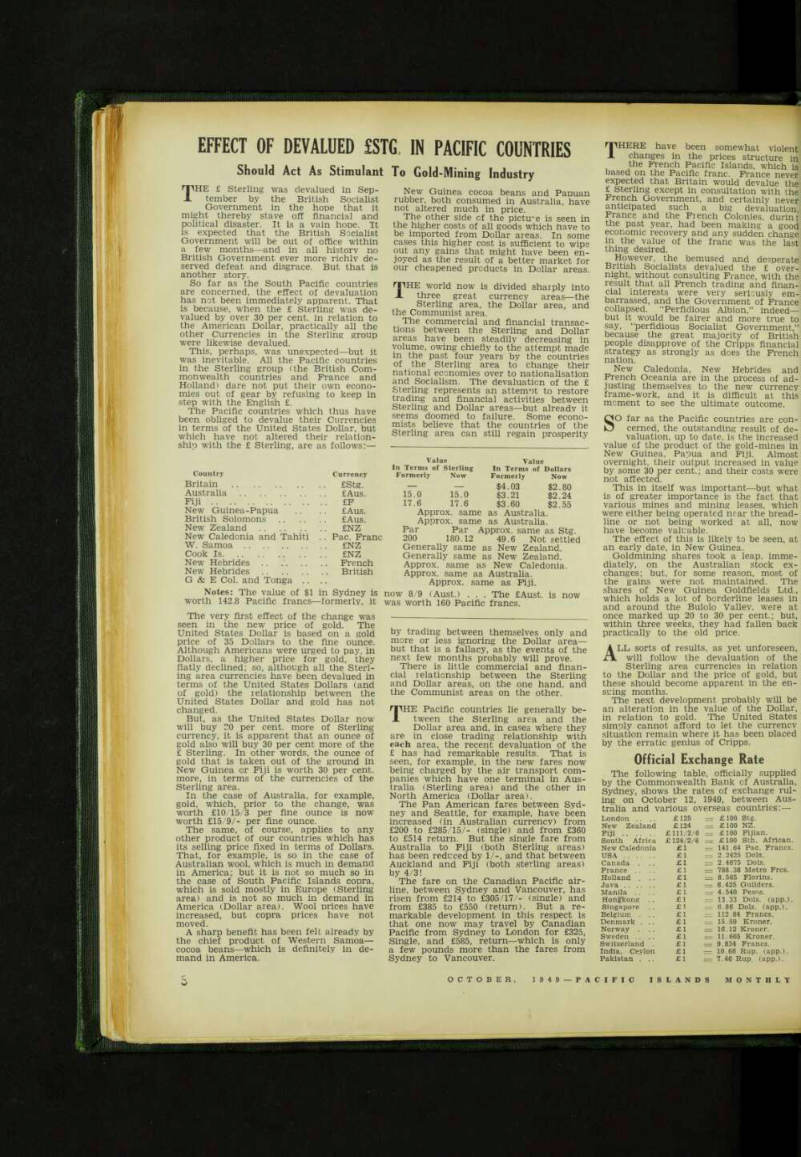
The Pacific countries which thus have been obliged to devalue their Currencies in terms of the United States Dollar, but which have not altered their relation ship with the £ Sterling, are as follows; —
The very first effect of the change was seen in the new price of gold. The United States Dollar is based on a gold price of 35 Dollars to the fine ounce.
Although Americans were urged to pay, in Dollars, a higher price for gold, they flatly declined: so, although all the Sterl ing area currencies have been devalued in terms of the United States Dollars (and of gold) the relationship between the United States Dollar and gold has not changed.
But, as the United States Dollar now will buy 30 per cent, more of Sterling currency, it is apparent that an ounce of gold also will buy 30 per cent more of the £ Sterling. In other words, the ounce of gold that is taken out of the ground in New Guinea or Fiji is worth 30 per cent, more, in terms of the currencies of the Sterling area.
In the case of Australia, for example, gold, which, prior to the change, was worth £lO/15/3 per fine ounce is now worth £l5/9/- per fine ounce.
The same, of course, applies to any other product of our countries which has its selling price fixed in terms of Dollars.
That, for example, is so in the case of Australian wool, which is much in demand in America; but it is not so much so in the case of South Pacific Islands copra, which is sold mostly in Europe (Sterling area) and is not so much in demand in America (Dollar area). Wool prices have increased, but copra prices have not moved.
A sharp benefit has been felt already by the chief product of Western Samoa— cocoa beans—which is definitely in de mand in America.
New Guinea cocoa beans and Papuan rubber, both consumed in Australia, have not altered much in price.
The other side of the picture is seen in the higher costs of all goods which have to be imported from Dollar areas. In some cases this higher cost is sufficient to wipe out any gains that might have been en joyed as the result of a better market for our cheapened products in Dollar areas.
THE world now is divided sharply into three great currency areas —the Sterling area, the Dollar area, and the Communist area.
The commercial and financial transac tions between the Sterling and Dollar areas have been steadily decreasing in volume, owing chiefly to the attempt made in the past four years by the countries of the Sterling area to change their national economies over to nationalisation and Socialism. The devaluation of the £ Sterling represents an attempt to restore trading and financial activities between Sterling and Dollar areas—but already it seems doomed to failure. Some econo mists believe that the countries of the Sterling area can still regain prosperity
by trading between themselves only and more or less ignoring the Dollar area — but that is a fallacy, as the events of the next few months probably will prove.
There is little commercial and finan cial relationship between the Sterling and Dollar areas, on the one hand, and the Communist areas on the other.
THE Pacific countries lie generally be tween the Sterling area and the Dollar area and, in cases where they are in close trading relationship with each area, the recent devaluation of the £ has had remarkable results. That is seen, for example, in the new fares now being charged by the air transport com panies which have one terminal in Aus tralia (Sterling area) and the other in North America (Dollar area).
The Pan American fares between Syd ney and Seattle, for example, have been increased (in Australian currency) from £2OO to £285/15/- (single) and from £360 to £514 return. But the single fare from Australia to Fiji (both Sterling areas) has been reduced by 1/-, and that between Auckland and Fiji (both sterling areas) by 4/3!
The fare on the Canadian Pacific air line, between Sydney and Vancouver, has risen from £214 to £305/17/- (single) and from £385 to £550 (return). But a re markable development in this respect is that one now may travel by Canadian Pacific from Sydney to London for £325, Single, and £585, return—which is only a few pounds more than the fares from Sydney to Vancouver.
THERE have been somewhat violent changes in the prices structure in the French Pacific Islands, which is based on the Pacific franc. France never expected that Britain would devalue the £ Sterling except in consultation with the French Government, and certainly never anticipated such a big devaluation France and the French Colonies, durin; the past year, had been making a good economic recovery and any sudden change in the value of the franc was the last thing desired.
However, the bemused and desperate British Socialists devalued the £ over night, without consulting France, with the result that all French trading and finan cial interests were very seriously em barrassed, and the Government of France collapsed. “Perfidious Albion,” indeed— but it would be fairer and more true to say, “perfidious Socialist Government,” because the great majority of British people disapprove of the Cripps financial strategy as strongly as does the French nation.
New Caledonia, New Hebrides and French Oceania are in the process of ad justing themselves to the new currency frame-work, and it is difficult at this moment to see the ultimate outcome.
SO far as the Pacific countries are con cerned, the outstanding result of de valuation, up to date, is the increased value of the product of the gold-mines in New Guinea, Papua and Fiji. Almost overnight, their output increased in value by some 30 per cent.; and their costs were not affected.
This in itself was important—but what is of greater importance is the fact that various mines and mining leases, which were either being operated near the bread line or not being worked at all, now have become valuable.
The effect of this is likely to be seen, at an early date, in New Guinea.
Goldmining shares took a leap, imme diately, on the Australian stock ex changes; but, for some reason, most of the gains were not maintained. The shares of New Guinea Goldfields Ltd., which holds a lot of borderline leases in and around the Bulolo Valley, were at once marked up 20 to 30 per cent.; but, within three weeks, they had fallen back practically to the old price.
ALL sorts of results, as yet unforeseen, will follow the devaluation of the Sterling area currencies in relation to the Dollar and the price of gold, but these should become apparent in the en suing months.
The next development probably will be an alteration in the value of the Dollar, in relation to gold. The United States simply cannot afford to let the currency situation remain where it has been placed by the erratic genius of Cripps.
Official Exchange Rate
The following table, officially supplied by the Commonwealth Bank of Australia, Sydney, shows the rates of exchange rul ing on October 12, 1949, between Aus tralia and various overseas countries; — London ... £ 125 = £ 100 Stg.
New Zealand £124 £lOO NZ.
Fiji £lll/2/6 = £lOO Fijian.
South Africa £124/2/6 = £lOO Sth. African.
New Caledonia £1 = 141.64 Pac. Francs.
USA £1 = 2.2425 Dols.
Canada ... £1 = 2.4675 Dols.
Prance ... £1 = 788.38 Metro Frcs.
Holland . .. £1 = 8.565 Florins.
Java £1 = 8.425 Guilders.
Manila ... £1 = 4.540 Pesos.
Hongkong .. £1 =13.33 Dols. (app.).
Singapore .. £1 = 6.86 Dols. (app.).
Belgium ... £1 = 112.84 Francs.
Denmark ... £1 =15.59 Kroner.
Norway . .. £1 =16.12 Kroner.
Sweden ... £1 = 11.665 Kroner.
Switzerland . £1 = 9.834 Francs.
India, Ceylon £1 =10.66 Rup. (app.).
Pakistan ... £1 = 7.46 Rup. (app.).
t Value Value In Terms of Sterling In Terms of Dollars Country Currency Formerly Now Formerly Now Britain .. £Stg, — $4.03 $2.80 Australia 15.0 15.0 $3.21 $2.24 Fiji .. £F 17.6 17.6 $3.60 $2.55 New Guinea-Papua £Aus.
Approx, same as Australia.
British Solomons £Aus.
Approx, same as Australia.
New Zealand £NZ Par Par Annrox. same as Ste-.
New Caledonia and Tahiti .. Pac. Franc 200 180.12 49.6 Not settled W. Samoa £NZ Generally same as New Zealand.
Cook Is £NZ Generally same as New Zealand.
New Hebrides French Approx, same as New Caledonia.
New Hebrides British Approx, same as Australia.
G & E Col. and Tonga ..
Approx, same as Fiji.
Notes: The value of $1 in Sydney is now 8/9 (Aust.) . . .
The £Aust. is now worth 142.8 Pacific francs —formerly, it was worth 160 Pacific francs.
Why Mr. Richards?
Another Political Appointment to Island Administration?
r was reported from Canberra on October 10 that Mr. R. S. Richards, Leader of the Socialist Opposition in 3 South Australian Parliament, is likely be appointed Administrator of Nauru, tere were 240 applicants for the £1,500 job. The appointment has to be ap jved by Britain and New Zealand, who ; jointly responsible with Australia for s Administration.
Editorial Note
|R. RICHARDS may be South Aus- L tralia’s most worthy citizen. We know nothing about him, except that was originally a miner and carpenter, 1 he went into the State Parliament by ; usual channel of the Trades Hall, ere is nothing on record to show that knows the first thing about tropical ninistration.
I large proportion of Australia’s public ces, from the Governor-General down rds, have been filled by Socialist Party cgers-on—undistinguished Party hacks, ifessional politicians and rejected Par nentarians, whose only claim to ap ntment is their unswerving lovaltv to i Party machine. t is bad enough to see such people in vernorships, Consular jobs, Commis nerships, and so forth. It is literally cening to see the same foul system ap jd to the major appointments in the nfic Islands.
Vithin the public services of the Aus lian Territories there are scores of 1-educated men, who have brought a cial aptitude and half a lifetime of Lning to the difficult job of governing tropical regions for which Australia responsible. Either as heads of De tments or as District Officers, they rn the tricky and difficult task of ad listration; and they surely are itled to expect that, when Adminis torships become vacant, they shall re first refusal. Yet, for 20 years, their ims have been consistently passed over, .ally in favour of some out-of-work )our politician, military officer or listerial favourite.
Ixcept in three cases (General Griffith.
New Guinea, in 1932; Captain B. R. ney, in Norfolk Island, in 1932, and . Ridgway, in Nauru, in 1946) we can recollect one appointment to a major ninistrative position in the Islands, ing the last 20 years, where the ap ntee had had any previous training in pical administration—or, indeed, I any obvious qualifications for the t.
'here can be only two explanations: ber the Territories services are lentably short of capable men; or lalism’s policy of “Spoils to the Vic influences all of these Islands jointments. We can say, most de tely, that the first alternative is not explanation. There are a dozen men the Papua-New Guinea public service, lay, who are completely capable of ng any tropical Administratorship hin the gift of the Canberra politi cs.
Ve can also say that the Canberra tern of selecting Labour Party hacks skilled jobs is not only completely dis lest—it also is most disheartening for Territory services men who have sn of their best.
Bgd Party Explores
The Sepik
Gold and Timber is the Quest
ON August 2, a party of three Bulolo Gold Dredging Company’s men (in cluding Mr. Wells, a mining engineer, and a botanist) left the gov ernment station at Angoram, Sepik River, New Guinea, by boat to explore the upper reaches of the muddy Sepik, for gold and timber.
As most of the expedition is in un controlled territory, Mr. E. D. Robinson, who was ADO at Marienberg, lower down the river, in its head-hunting days, was declared their leader. Better known as “Sepik Robbie,” he has had many ad ventures on the river, either alone, or with the late Father Kirschbaum. There is no one better qualified to control primi tive natives.
By the beginning of September it was expected that the expedition would have moved right up into the headwaters of the Sepik, near Green River, finishing the last stages by canoe.
This is the second post-war attempt by BGD to find payable gold in this area. About two years ago, Mr. H. Horn did what was described as some “serious work” for the company high up the Kurasimeri. The venture was later abandoned—but BGD never did say any thing concerning prospects "there,, olne way or another. Double canoes with a powerful outboard-motor took care of transport on that occasion.
To attempt to turn the mud of the Sepik into gold is no new venture. Not unsuccessful attempts have been made in the past in the Karowori district, Tamo River, around Mt. Garamambu, etc.
Schmidt, of unhappy memory, Beckett, Eichhorn, senior and junior, and Bill MacGregor are some of the best-known forerunners of the present BGD move.
A new aspect this time is the double survey—for timber as well as gold.
Whether successful or not, the ex pedition is bound to bring about some sort of gold-rush—no doubt many will suddenly feel drawn by the magnetic charm of the otherwise detested mos quito-infested Sepik.—PAT.
Fuel Oil In The Islands
IN the Papua-New Guinea Gazette of September 7 tenders are invited for the purchase of considerable quan tities of aviation spirit and oil, which are lying at some of the villages and beaches of Goodenough Island, Eastern Papua.
There is no indication of how long the goods have been there—but presumably they are a heritage of the war, which moved out of this area at least 5 years ago. There are many traders who might have liked to tender for this fuel and oil —now in desperately short supply—but the invitation to tender was published on September 7 and tenders closed in Port Moresby on September 23.
Mr. L. A. G. Hooke, Managing Director of Amalgamated Wireless of Australia, Ltd., has been appointed a director of British Commonwealth Pacific Airlines, which operates a trans-Pacific air ser vice and which is owned jointly by Aus tralia (50 per cent.), New Zealand (30 per cent.), and Britain (20 per cent.). Mr.
Hooke will represent Britain. Other mem bers of the Board are Sir Leonard Isitt and Messrs. A. W. Coles, and G. P. N.
Watt.
Questions
Sautot Asks
About Millions
THERE are many people who would like the strange political events in New Caledonia, in 1940-42, to be for gotten; but staunch old Henri Sautot keeps stirring them up, and asking questions.
Sautot, then Resident Commissioner in the New Hebrides, was the first high official of Colonial France to declare for De Gaulle in the black days of 1940. Soon after, with Australian help, he became Governor of New Caledonia, and he did a splendid job there in co-operation with the Americans.
Then came the former monk, the mysterious Thierry D’Argenlieu, to be come French High Commissioner in the Pacific. He and Sautot clashed, and he succeeded in getting Sautot, virtually under arrest, shipped away to an African governorship.
After that, to use an American phrase, D’Argenlieu “really went to town.” A lot of very queer things happened, before D’Argenlieu returned to Europe—to be come head of the Free French Navy, and eventually to return to his monastery, “Papa” Sautot, now rethed, is back in Noumea as a private citizen, and he keeps on demanding information about the D’Argenlieu regime. He asks, for in stance, what became of the 1,300,000 American dollars, which D’Argenlieu found in the coffers of the Immigration Department in London early in 1942. No one seems able to answer.
Another matter that Sautot asks questions about is an alleged gift of nearly one million francs by D’Argen lieu to two of his cronies— a matter which was severely commented upon a couple of years later by Governor Tallec.
Tallec said that these two men “made a profit out of France’s misery”; and now Sautot is again pressing the matter upon the notice of the public.—Own Corres pondent.
Death Of Mr. Jack Ellis
THE death occurred in Sydney on October 6 of Mr. John Ellis, lately of the Solomons. He was best known as “Jack” Ellis.
Mr. Ellis was born at Bangor, Wales, about 1876. He came to Australia and took a job in the Moresby, running to the Solomons. He left the vessel in 1903 and started at Tulagi, in the practice of his trade of a sail-maker.
For some time he assisted the late Mr.
Dick Laycock in his business as a store keeper, but he continued his sail-making business, which, in latter years, he carried on in conjunction with the Customs and Forwarding Agency, until the evacuation caused by the Japanese invasion.
“Jack” was one of the “old hands” of the Solomons, and always held the respect and confidence of the people of the Pro tectorate.
Steamships Trading Co. Has
a Good Year
THE well-known Papuan company, Steamships Trading Co., Ltd., which operates stores and plantations all over the Territory reports a profit of £50,907 for the year ended July 31. In the previous year the profit was £38,908.
Preference and ordinary shares again receive 10 per cent. —which leaves over £25,000 to be carried forward in P/L Account.
Advertisements & other items, p. 11 (1 item)
9
CIFIC ISLANDS MONTHLY OCTOBER, 1949
Carpenters’ Profits
Interesting Sidelight on Trading Policies
A PROFIT of £80,194 (compared with £75,665 in the previous year) was made in the financial year ended June 30 by W. R. Carpenter and Co., Ltd., of Sydney—which now is virtually a holding company for a group of lively subsidiary companies trading in the Pacific.
The Co. is paying the usual 10 per cent, on the subscribed capital (£775,000); but it informs shareholders that, in accord ance with last year’s resolutions, half of the subscribed capital is now to be re turned.
With the remaining half of its sub scribed capital, and reserves In the vicinity of half a million, the Co. still will have ample working capital; while its liability to shareholders will be so re duced that on a normal annual profit it could, if it wished, pay a 20 per cent, dividend.
It is very interesting to note how the two big Sydney companies which were founded on Pacific Islands trade have guarded their interests in tne past couple of decades against the threat of Socialist intrusions. Burns Philp & Co. have transferred a very large proportion of their activities from Islands trade and transport to Australian mainland distrinow own important and growing chains of big stores in Queens land and New South Wales. What they lose on the swings of Wardist hate of private enterprise in Melanesia, they more than gain on the merry-go-rounds of retail distribution in the Eastern States.
Carpenters have followed a somewhat different plan. Their fortunes were built on copra, and before World War II they did not like what they could see in the control of the copra market by a world wide monopoly. So they set out on a policy of carrying the copra in their own ships to their own crushing mills; and to-day, through subsidiary and associ ated companies, they control a line oi very good ships, and crushing mills in Fiji, Canada and New Guinea. Their Pondo establishment, which was stamped out of existence in the Jap invasion of New Guinea, has been replaced by a bigger and better establishment near Madang.
Like the BP policy, it is a very good example of how to keep all your eggs out of one basket.
In these days of irresponsible Socialist administration, there is a lesson here for all big organisations which have been founded on individual initiative and pri vate enterprise.
The Carpenter balance sheet shows that the Co. is prepared for the return of capital. On June 30, the cash on hand totalled £404,444; and there was over £1,160,000 invested in subsidiaries.
To Discuss Taxation
THE Assistant Commissioner of In land Revenue, Fiji (Mr. R. B. Ack land) is to go to London shortly to discuss taxation matters with the Colonial Office and the Board of Inland Revenue in the United Kingdom.
He will be concerned in particular with proposals for double taxation relief.
More Officials For Some NG
Districts
IT is likely that Lae and Rabaul Dis tricts, New Guinea, will become Grade 3 districts—that is, they will have a Grade 3 District Officer at the head of affairs (Mr. H. Niall, in Lae; Mr. J. K. McCarthy in Rabaul); with possibly a Grade 1 man to assist.
The names of the second District Officers for these districts have not been announced yet, but it is presumed that they will be young men who are now due for promotion from the position of As sistant District Officer.
This will release the Grade 3 officer from a great deal of desk work with which he is burdened at the moment, and which often prevents his visiting his out stations.
In addition to these officers, there pro bably will be a third District Officer (Grade 2) who will be the local magis trate, whose work is of a specialised character and for which considerable ex perience is necessary.
The work of the Assistant District Officer will then be purely with the local natives—a big job in a district like Rabaul.
Whether this multiplicity of officials is desirable is a moot point; but it prob ably is necessary in the post-war era that has made a fetish of rules, regu lations and red-tape. The job of the senior official in war-torn New Guinea to-day is no sinecure.
There have also been some changes in the construction and functions of the Native Labour Department. During the period of the Provisional Administration this Department appeared to act quite independently of the Department of District Services, with the result that in some Districts there was friction be tween the local District Officer and the Native Labour Officer. It is to be hoped that the changes that have been made will be of benefit to the general public, for whom the Native Labour Department has particular significance.
Of Fiji
Awahou In Distress North Of Fiji
IT was reported on October 9 that the 'small motor-ship, Awahou, was in a sinking condition about 150 miles north of Fiji, and that the Carpenter ship Lakemba was hurrying to her aid.
The Awahou has been running for some time in the inter-island service of the High Commission |or the Western Pacific.
But she was sold recently to Tony Carr, of Sydney, and the equipment and engines had been recently overhauled.
It is understood that Captain Hay, who ran the vessel for WPHC, was still in charge and that he had a crew of Euro nesians and Fijians.
Later: The Awahou is being towed to a Fiji port by Fiji Government vessel Degei.
Their First Whale
Norfolk Is. Oct. 5.
THE new whaling company killed its first whale off the coast of Npr folk Island to-day. Louis Bataille was the successful harpoonist.
A description of the industry entitled, “Norfolk Island Whaling is not for Weak lings,” is published in our Magazine Section, on page 51.
Operation ‘Bang’ Is
Cancelled
Another Plan For New Guinea Bombs
From Our Own Correspondent
Pt. Moresby, Oct. 5.
THE plan to detonate thousands of tons of bombs at Tadji, New Guinea, in one gigantic explosion, has now been abandoned.
It was hoped to get valuable scientific information from the explosion but, after considering the proposal for more than a year, the authorities decided there were too many difficulties.
Seismographical stations would have had to be set up in the area, the native population evacuated within a radius ol about ten miles, and compensation paic to them for any damage.
The Civil Aviation Department was al so concerned about possible damage tc Tadji aerodrome, which is two mile; from the bomb dump. Tadji was a bi£ RAAF base during the war.
The RAAF, which is handling the dis posal of the dump, is now considering de-lousing the bombs, or destroying then in a series of small explosions.
Demolition Party In Rabaui
Area
From Our Own Correspondent RABAUL, October 6.
THE Australian Army Bomb Demoli tion Party arrived in Rabaul o: September 26 and it is anticipate! that it will remain in the area for som time. Many individual bombs, as wel as piles of bombs, have already been lo cated and are ready for demolition. Th Port Moresby radio station recently sen out a request that any person knowifi the whereabouts of bombs to report thei position at once to the authorities s that as many bombs as possible may b demolished during the visit of the partj As noted elsewhere, some bombs hid den in grass some distance out o Rabaul exploded of their own accord, i: early September.
Copra Prices In French
Territories
THE French marketing organisatio known as GNAPO informed tt Papeete Chamber of Agricultui early in September that it would cor tinue to purchase copra, at a probabl rate of $165, FOB.
This rate, however, probably has bee modified by the new rates following tt devaluation on September 25.
A Tahiti report says that between Ju] 1 and August 31, the price of so-calle “Tuamotu” copra was fixed at 7.50 fran( the kilo, FOB.
New Attorney General
For Fiji
MR. B. A. DOYLE, has been appointe Attorney General, Fiji, in succei sion to Mr. J. H. Vaughan, who; appointment as Chief Justice was ar nounced recently.
Mr. Doyle has been Fiji Solicit General since January, 1948. Befoi coming to Fiji he served in Trinidad an Uganda. Mr. Doyle has acted as A torney General for the past year whi Mr. Vaughan has been on leave.
Advertisements & other items, p. 12 (1 item)
10
OCTOBER, 1949 PACIFIC ISLANDS MONTHL
‘Dick America' Is
Dead
Famous Old Negro Sailor of
the Solomons
FAMOUS old man of the Solomon Islands, Dick America (otherwise George Washington Ezekiel Richard 1, a negro, born in Philadelphia, USA), d at the Marist Mission Station, linoni, San Cristoval, on September 24.
According to Mr. Henry Kuper—to om Mr. Richardson entrusted his jers several years ago—Mr. Richardson d at the age of 83. He passed away icefully as a result of old age, well ended by the European staff of Wai li Mission station. He left two sons 1 two daughters, and 28 grandchildren the Solomons.
Having spent his younger days in square-rigged sailing ships, where he be came a first-rate sailor, he eventually went t 0 Thursday Island. As sailmaker and, later, as master of pearling luggers, he became well-known all over Torres Straits and in Northern Queensland ports.
In 1905, he arrived in the Solomons in the employ of Captain Charley Butchard and Mr. G. R. Younger, now of Nono, Russell Islands, BSIP. They arrived in the lugger Manila, one of the fastest sailing craft the Solomons have ever seen, and they went beche-de-mer fishing on the east coast of Malaita—quite a dangerous undertaking at that time.
Richardson married a Malaita girl, the marriage being legally performed by Captain Butcnara.
The beche-de-mer venture proved suc cessful, and Captain Butchard took the proceeds in the schooner Clara Jackson to Canton, and sold the lot there very profitably.
Richardson joined the newly-appointed
staff of Lever’s Pacific Plantations, and was sent out by them to Graciosa Bay, Santa Cruz Islands, as assistant manager to Mr. Matthews. Graciosa Bay was a beauty spot—and was also notable for its six-feet bows and bone-tipped arrows, which invariably produced tetanus. How ever, Richardson and his wife prospered; and they were later transferred to Maru Bay, in the Arosi district of San Cristoval, where he traded, and planted up Lever’s property with coconuts. His two sons, Sgt.-Major Richardson, of the BSIP Armed Constabulary and Edwin Richardson, chief steward on the RCS Kurimarau, were born during this time.
RICHARDSON started out on his own account and planted out a piece of land called Marou, also in the Arosi District. Owing mostly to his good nature, he lost this property.
Temporary employment as overseer, fishing for beche-de-mer, etc., gave him what his simple needs required. He was always an enthusiastic gardener, and his food gardens were an example to natives.
Himself a Negro, Richardson proudly refused any assistance from natives, though he gave freely to them. His motto was “Going to paddle my own canoe.” He was always accepted by all Oldtimers as “a thorough white man.”
His own frequent remark, that he was the first white man on Makira, was accepted by Oldtimers as “one of his George Washingtons.”
His actual name was George Washing ton Ezekiel Richardson; but when he first went to the shipping office to sign his first articles and gave this name, the shipping Master said, “None of that!
Your name is Ezekiel Richardson, and, take my advice, next time you come before me make it Dick.”
So in the Solomons, he was generally known as “Dick America.”
Captain Alan Villiers, of the square rigged ship, Joseph Conrad, who called at Santa Anna and spent four days there, left his name to posterity describing, in a whole chapter in his book, “The Cruise of the Conrad,” the two old “sea dogs” he found there—Ezekiel Richardson and Henry Kuper.
Though hampered by the loss of one arm, destroyed in an accident when dy namiting fish, “Dick America” will surely manage to climb the long rope ladder to Heaven which all true square rigged sailors have to do to get there.
Home is the sailor.
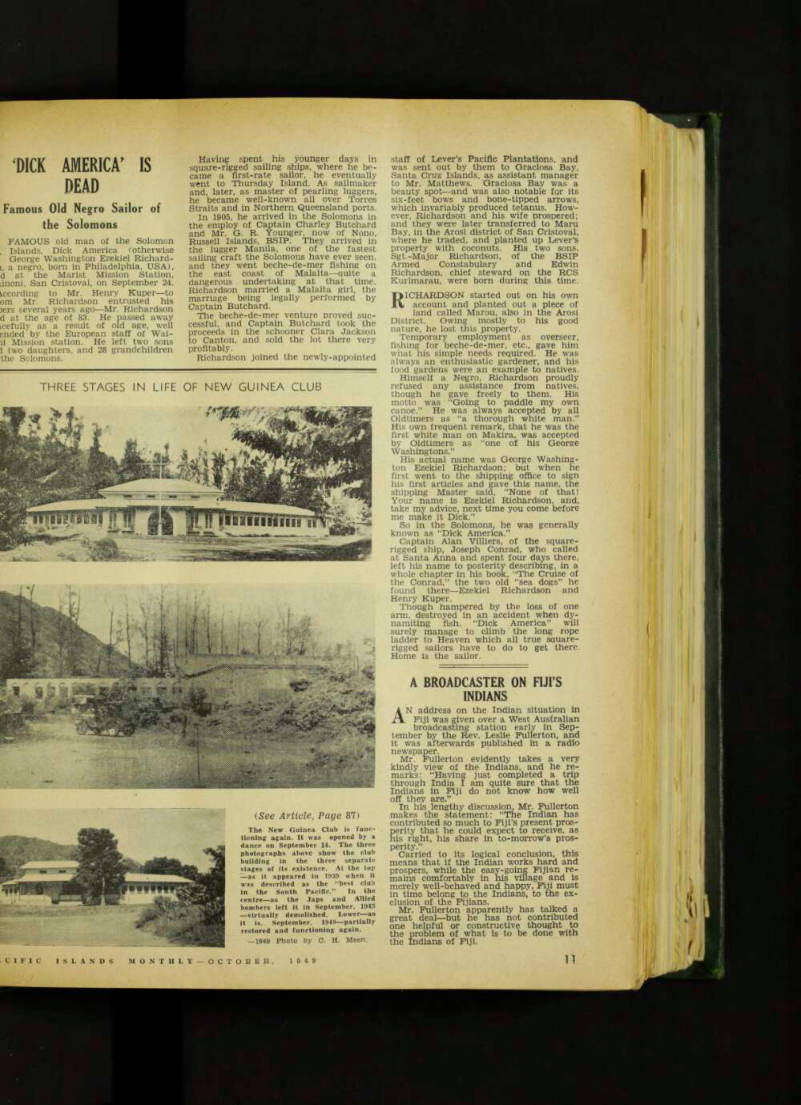
Three Stages In Life Of New Guinea Club
(See Article, Page 87)
The New Guinea Club is func tioning again. It was opened by a dance on September 14. The three photographs above show the club building in the three separate stages of its existence. At the top —as it appeared in 1939 when it was described as the “best club in the South Pacific.” In the centre—as the Japs and Allied bombers left it in September, 1945 —virtually demolished. Lower—as it is, September, 1949—partially restored and functioning again. —1949 Photo by C. H. Meen.
A Broadcaster On Fiji's
Indians
AN address on the Indian situation in Fiji was given over a West Australian broadcasting station early in Sep tember by the Rev. Leslie Fullerton, and it was afterwards published in a radio newspaper.
Mr. Fullerton evidently takes a very kindly view of the Indians, and he re marks: “Having just completed a trip through India I am quite sure that the Indians in Fiji do not know how well off they are.”
In his lengthy discussion, Mr. Fullerton makes the statement: “The Indian has contributed so much to Fiji’s present pros perity that he could expect to receive, as his right, his share in to-morrow’s pros perity.”
Carried to its logical conclusion, this means that if the Indian works hard and prospers, while the easy-going Fijian re mains comfortably in his village and is merely well-behaved and happy, Fiji must in time belong to the Indians, to the ex clusion of the Fijians.
Mr. Fullerton apparently has talked a great deal —but he has not contributed one helpful or constructive thought to the problem of what is to be done with the Indians of Fiji.
Advertisements & other items, pp. 13-14 (2 items)
11
CIFIC ISLANDS MONTHLY OCTOBER, 1949
Morris Hedstrom Limited
General Merchants, Importers and Exporters,
Shipowners, Plantation Owners,
Commission and Insurance Agents
HEAD OFFICE
SUVA, FIJI
Established 1868
SERVICE IN THE SOUTH PACIFIC TERRITORIES
rpHROUGH our Large Establishments in Suva and our Numerous Branches, we distribute a wide and comprehensive range of General Merchandise and provide almost every kind of service. Our departments and associated businesses include:
DRAPERY
MOTOR SALES
AND SERVICE
TOBACCO
TIMBER AND
BUILDING
GROCERY
CONFECTIONERY
HARDWARE
ELECTRICAL
LIQUORS
DRUGS
Branches Throughout Fiji, Samoa and Tonga
There is a Branch or Agent of Morris Hedstrom Limited in every Town in the Three Territories.
We are Sole Agents in these Territories for British Drug Houses Ltd.
Electrolux Ltd.
Ford Motor Co.
General Electric Co. Ltd.
Goodyear Tyre & Rubber Co.
B, A. Hjorth & Co. (Primus Products) Imperial Chemical Industries Ltd.
International Harvester Export Co.
Matson Navigation Company Max Factor and Co. Inc.
Ransomes, Sims Gr Jefferies Ltc Ruston & Hornsby Ltd.
Vacuum Oil Co. Pty. Ltd.
Yorkshire Copper Works Ltd. r n • - - ' .; . ’ * V- ■v’
Morris Hedstrom Limited are LLOYD'S AGENTS in Fiji and Samoa.
IN AUSTRALIA:
IN GREAT BRITAIN:
Morris Hedstrom (Aust.) Pty. Ltd. Morris Hedstrom Limited, Asbestos House, 65 York Street, SYDNEY Africa House, Kingswoy, LONDON
[?]Eir To The Cocos Islands
Further Information About the Clunies Ross Family
N the Pacific Islands Monthly of November, 1948, and January, 1949, there were articles about the Clunies oss family, owners of the Cocos Keeling lands, in the Indian Ocean.
The first article was a condemnation of ports and articles which had been pub jhed in newspapers in Britain and merica. They suggested that there had ;en difficulty to finding the heir to lunies Ross IV, who died in 1944 during Japanese air raid on the Cocos Keeling lands.
Soon after that, we received further formation and, in January last we were )le to state that Clunies Ross IV had ien married in the ’Twenties; that Mr. id Mrs. Ross had had a son in 1928, iat the lad was educated in England, id that this young man—then in Singa ire—had accepted his heritage and was ry fond of the Cocos Islands and would :e to carry on the old Ross tradition.
We now have learned that irresponsible id sensational newspaper stories, which 3re in circulation in 1948, and which ggested that there had been something regular in the family of Clunies Ross JTV, lvc caused distress and annoyance to the unies Ross family. There appears never have been any justification for the lissing Heir” story; the British Colonial ffice and the Singapore Government ?re acquainted with all the circum ances, and were in constant touch with e Clunies Ross family, and with young r. Clunies Ross, who became heir after e death of his father in 1944. They rticularly resent a statement that there is no record of the birth of young r. Clunies Ross at Somerset House. The rth was properly registered, and there e in Sydney certificates of birth relating Clunies Ross V, and to his two sisters.
To make the situation clear, the line of ccession of the Clunies Ross family may shown thus:— Clunies Ross I (John) settled in Cocos seling in 1825, and took possession of e little group, and died in 1854.
Clunies Ross II (John George) married Malayan lady of high rank, and reigned Dm 1854 unti his death in 1871.
Clunies Ross 111 (George) succeeded s father in 1871; and—in recognition of e family’s benevolent rule over the ands—Queen Victoria, in 1886 con med the Clunies Ross claim to obsolute •ssession of the islands.
Clunies Ross IV (John Sydney) suc ked in 1910, and died during a Japanese r raid on the islands in 1944. He married iss Rose Alexandra Nash in Fulham irish Church, London, on June 8, 1925. rere were four children, and the eldest n (John Cecil) was born in London on Dvember 29, 1928. After the death of unies Ross IV, Mrs. Ross re-married, t second husband being the manager of e Cocos Island cable station.
Clunies Ross V (John Cecil) was edu ted in England, but he has been living Cocos and in Singapore in recent years. ; he will be 21 years old next month fovember) it is presumed that he will en formally take over his father’s estate the Cocos Keeling islands.
The Clunies Ross family was interested the Christmas Island Phosphate Co., d., which before 1900 acquired Christ as Island (a very rich phosphate island •out 530 miles from Cocos Keeling). In 48, this Christmas Island Company was Id for no less than £2,750,000 to the Aus alian and New Zealand Governments.
For any annoyance and distress caused e members of the Clunies Ross family r the article in our issue of November,
1948 (which was a partial summary of an incorrect report published in a British newspaper) the Pacific Islands Monthly expresses regret, and tenders an un qualified apology.
Sydney-N. Guinea Air
Fares Go Up QEA Under Govt. Control Still Makes Profit
ON September 15, air fares on the Qantas Bird of Paradise Service (Australia-New Guinea) went up by about 10 per cent. The increase was necessary, reports Qantas Empire Air ways, to take care of a steady rise in operating costs and is similar to an in crease made by Australian domestic air lines a few months ago.
IN a report of Qantas Empire Airways, Ltd., tabled in the Australian parlia ment on October 7, it was shown that the company had made a net profit of £104,384 for the nine months ending De cember 31, 1948. (The report, of course, covers all Qantas’ airline activities —not just the Bird of Paradise Service). This is £24,484 better than the profit earned for the year that ended on March 31, 1948.
The report was the first to cover a financial period during which the com pany was entirely owned by the Com monwealth Government.
The report says that the increase in profit was mainly caused by the intro duction of Constellation aircraft.
Although the total profit for the period was higher, the result for the nine months represented a return of 7.27 per cent, on paid-up capital, against 15.26 per cent, for the profit in the previous year.
This lower return was caused by the £2,000,000 increase of capital in June, 1948, which financed the purchase of the Constellations.
Trading profit for the nine months totalled £178,332, £73,948 being set aside for taxation.
“Pre-Galvanised Iron”
Bishop Museum Man Seeks Primitive Native Scenes
From Our Own Correspondent
Honiara, Oct. 2.
AMERICAN Bill Murnan, in his unique stainless steel 30-ft. yawl South Seas 11, arrived here, at Kukum, on October 1, his formaldehyde tank on deck stuffed with curious sea creatures and his kodachrome movie camera at the ready for interesting local colour shots.
Mr. Murnan, as recorded in an earlier issue of PIM, is collecting material and films for the Bishop Museum, Honolulu, and is making a leisurely study of Pacific potentialities on his way around the world. He came here from the New Hebrides and will go on to Port Moresby after a week’s stay, fetching up later at the Great Barrier Reef.
His films of life in native villages are preserved by the Bishop Museum as a record for posterity of primitive customs and habits, before they give way to out side influences. But, as he says, the “galvanised iron influence” is liable to crop up anywhere these days and, in one hard-boiled Fiji village, a fee of £3O was suggested for arranging what he wished to photograph.
Mr. Murnan hopes to get some in teresting colour shots on the island of Savo, off Guadalcanal.
Advertisements & other items, pp. 15-16 (3 items)
13
ACIFIC ISLANDS MONTHLY OCTOBER, 1949
Year Book
PACIFIC ISLANDS
1950 EDITION
Will Be Published Late in
December
THIS is now the world’s Standard Reference Book on the Islands of the Pacific. There have been five earlier Editions—in 1932, 1935, 1939, 1942 and 1944. The 1944 Edition, which was called the Wartime Edition, carried a great deal of material dealing with the Pacific War, and contained 384 pages and many Inset Maps.
Since the end of the Pacific War, in 1945, practically every Territory; in the Pacific has been subject to farreaching changes of a political, social and commercial character.
Consequently, the 1944 Edition has been completely revised, so as to show these numerous changes.
The hook has been enlarged to take care of a great deal of additional matter. There are, for example, new sections dealing with Air Transportation, the Trusteeship Territories, the South Pacific Commission, the new market background behind the Copra Industry, and so on. There are new and improved maps.
Every Territory and Islands Group is described in detail — geography, history, administration, population, commerce, education, health, etc.
There is a complete directory of all the Christian Missions operating in the South Pacific Islands. The Index has been checked and enlarged.
There is a complete History and Chronology of the Pacific War (1941-1945).
Production has been much delayed by Australia’s economic and industrial troubles, but the new book is now scheduled for publication about December 20. PRICE: 21/- Australian—s2.so Add 6d., or 6c. for Postage The Edition is limited, so please order your copy early.
Pacific Publications Pty., Ltd.
Union House, 247 George St.,
Sydney
(or P 0 Box 3408, Sydney)
Fly Pan American to the U. S. A.
V & & soanv m i SB Downstairs club lounge —on the new $ double-decked Clippers to California.
Enjoy all these Extras!
You can fly straight through in
or stop over in lovely Hawaii can go on to California in new Clippers* Your choice of gateway cities, too .. . Los Angeles San Francisco Portland or Seattle. NO EXTRA COST for any of these Pan American extras!
Call your travel agent , or SUVA: Bank of N.S.W. Bldg. (Tel. 664) NOUMEA: Rue Jean Jaures (Tel. 85) fLYI *c r v •Trade Marks, Pan American Airways, Inc.
SPEED YOUR PARCEL BY CLIPPER CARGO
Pan American Airways, Inc., Ltd., Incorporated in U.S.A. . / 4f ° Sr
14
OCTOBER, 1949 PACIFIC ISLANDS MONTHL
Air France Begins Service To New Caledonia
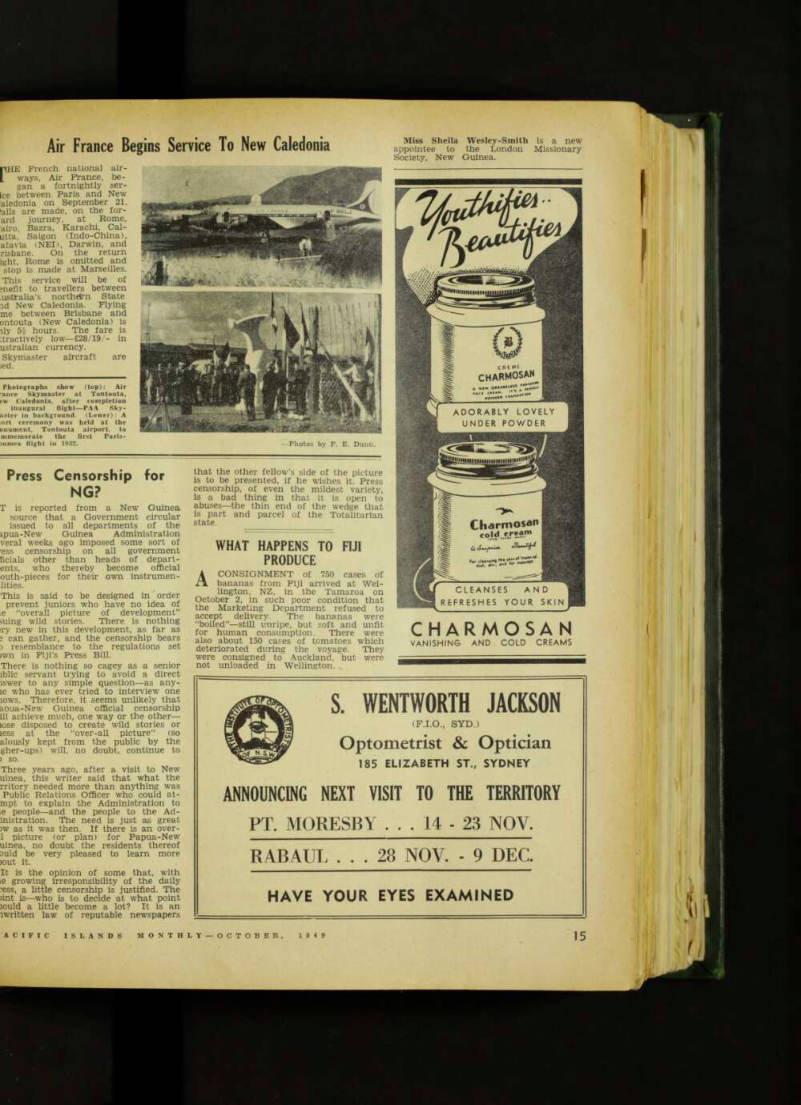
CHE French national air ways, Air France, be gan a fortnightly ser ice between Paris and New aledonia on September 21. tells are made, on the for ard journey, at Rome, airo, Bazra, Karachi, Cal utta, Saigon (Indo-China), atavia (NED, Darwin, and risbane. On the return ight, Rome is omitted and stop is made at Marseilles.
This service will be of mefit to travellers between .ustiralia’s northern State id New Caledonia. Flying me between Brisbane and ontouta (New Caledonia) is ily 5h hours. The fare is :tractively low —£28/19/- in ustralian currency.
Skymaster aircraft are >ed.
Photographs show (top): Air [?]ance Skymaster at Tontouta, [?]ew Caledonia, after completion inaugural flight—PAA Sky master in background. (Lower): A [?]ort ceremony was held at the monument Tontouta airport, to commemorate the first Paris [?]umea flight in 1932.
—Photos by F. E. Dunn.
Press Censorship for NG?
NG?
T is reported from a New Guinea source that a Government circular issued to all departments of the ipua-New Guinea Administration veral weeks ago imposed some sort of ess censorship on all government licials other than heads of depart ents, who thereby become official outh-pieces for their own instrumen lities.
This is said to be designed in order prevent juniors who have no idea of ie “overall picture of development” suing wild stories. There is nothing iry new in this development, as far as 3 can gather, and the censorship bears ) resemblance to the regulations set iwn in Fiji’s Press Bill.
There is nothing so cagey as a senior iblic servant trying to avoid a direct iswer to any simple question—as any le who has ever tried to interview one lows. Therefore, it seems unlikely that apua-New Guinea official censorship ill achieve much, one way or the other — Lose disposed to create wild stories or less at the “over-all picture” (so alously kept from the public by the gher-ups) will, no doubt, continue to > so.
Three years ago, after a visit to New uinea, this writer said that what the rritory needed more than anything was Public Relations Officer who could at mpt to explain the Administration to ie people—and the people to the Ad inistration. The need is just as great )w as it was then. If there is an over -1 picture (or plan) for Papua-New uinea, no doubt the residents thereof 3uld be very pleased to learn more >out it.
It is the opinion of some that, with ie growing irresponsibility of the daily 'ess, a little censorship is justified. The >int is—who is to decide at what point lould a little become a lot? It is an iwritten law of reputable newspapers
that. °tb er fellow’s side of the picture is t 0 be presented, if he wishes it. Press censorship, of even the mildest variety, is a bad thing in that it is open to abuses—the thin end of the wedge that 1 ® P ai ’t and parcel of the Totalitarian state.
Produce
What Happens To Fiji
A CONSIGNMENT of 750 cases of bananas from Fiji arrived at Wel lington, NZ, in the Tamaroa on October 2, in such poor condition that the Marketing Department refused to accept delivery. The bananas were “boiled”—still unripe, but soft and unfit for human consumption. There were also about 150 cases of tomatoes which deteriorated during the voyage. They were consigned to Auckland, but were not unloaded in Wellington.
Miss Sheila Wesley-Smith is a new appointee to the London Missionary Society, New Guinea.
Advertisements & other items, pp. 17-18 (2 items)
15
ACIFIC ISLANDS MONTHLY OCTOBER, 1949
S. Wentworth Jackson
9
CRIME
CHARMOSAN
i mw F AC C ..an Mina" adorably lovely
UNDER POWDER
Charmosan
coldcream C-. .1 ..M »*'" 0< i.tl.
CLEANSES AND
REFRESHES YOUR SKIN
CHARMOSAN
VANISHING AND COLD CREAMS
S. WENTWORTH JACKSON
(F. 1.0., SYD.)
Optometrist & Optician
185 ELIZABETH ST., SYDNEY
ANNOUNCING NEXT VISIT TO THE TERRITORY
PT. MORESBY ... 14 - 23 NOV.
RABAUI
28 NOV. - 9 DEC.
HAVE YOUR EYES EXAMINED
A. H. & E. Young
Established over 30 years .
ISLAND BUYING
AGENTS
Planters 7 and Traders' Requirements purchased at wholesale prices.
Original Invoices Supplied.
Correspondence Invited.
Sydney Office:
60 HUNTER ST., SYDNEY
Phone: BW 7365 Cables; “Malayta,” Sydney.
t
SYPHONS
With a Sparklet Bulb the Sparklet Syphon is recharged immediately from your own water supply with the utmost ease and economy. A constant supply of soda water is thus ensured without the inconvenience of storing syphons or bottles.
PLUS 3/- POSTAGE
ANYWHERE IN PACIFIC.
69/6 Extra Sparklet Bulbs for use in syphon, 8/9 dozen.
CONSOLIDATED MAIL ORDERS
HALIFAX BUILDINGS, 26 O’CONNELL ST., SYDNEY.
KWONG CHONG BROTHERS
General MerchmUs and Planters
Have now re-established their business on their original pre-war site, and are carrying stocks of Trading and Plantation requirements. All enquiries welcomed and service assured.
Sydney Representatives:
NELSON & ROBERTSON PTY., LTD.,
Electra House, 12 Spring Street, Sydney, N.S.W.
KWONG CHONG BROTHERS
KEMARERE STREET, RABAUL
May Cease
BP Service to Norfolk , Lord Howe May Cease
UNLESS the Australian Government is willing to pay a substantial subsidy to Burns Philp & Co., Ltd., the com pany will cut out its present steamship service to Norfolk Island and Lord Howe Island. The Minister for External Ter ritories said, on October 7, that “the matter is being examined,”
Before the war Burns, Philp Line steamer, Morinda, ran on a frequent and regular schedule to the two islands — there was an average of two trips to these islands from Sydney in approxi mately five weeks. The service was adequately subsidised by the Australian Government, as were Island services to Papua, New Guinea and the British Solomon Islands.
During the war, all Australian shipping was taken over by the Shipping Board and subsidies lapsed. When the ships were ultimately handed back to their owners after the war, no shipping agree ments, such as had existed in relation to the above territories, were renewed.
Norfolk Island and Lord Howe, under existing post-war conditions, are barren
fields for the ship-owner. Air services from Sydney and New Zealand have skimmed the cream of the passenger trade and the carrying of cargo is a one way traffic Due to the fact that Norfolk and Lord Howe produce those products which are already grown by Australian mainland producers, they are not permitted to ex port—a state of affairs that is supported by Australian politicians who are con cerned only with the votes of mainland constituents. Add to this the fact that there are no ports or even sheltered anchorages at the islands—unloading must be done by surf boats, under dangerous conditions and often in bad weather.
Aircraft, which have done a great deal in the post-war era to end the isolation of Norfolk and Lord Howe cannot supply all the material needs of the inhabitants.
Withdrawal of their only sea connection with Australia will be a great blow to them, notwithstanding the fact that they have been promised a Government ship “sometime in the future.” Since the end of the war, BP ships have been calling there only once every three months.
There is no good reason, however, why a private shipping company should con tinue, for mere sentiment’s sake, to ser vice ports that are uneconomic. The socialist government of Australia has done nothing to ease the lot of Australian ship owners.
If subsidies were in order for Norfolk and Lord Howe before the war, they are doubly necessary to-day when Australian industrial conditions are such that the owning of ships has been reduced to little else but an unprofitable and prolonged headache.
Malaria Routed
A MOMENTOUS stage was reached in the progress achieved by the Cyprus Medical Department, when it was an nounced that the malaria-carrying Anopheles mosquito, the greatest enemj Cyprus has ever had, has been banished from the Island. For the previous foui months no mosquitoes had been traced ir Cyprus.
Dr. Horace Shelley, Director of Medica: Services, described this achievement as “one of the most important events in th€ history of Cyprus.” The work of eradica tion was started in 1913 under Sir Ronald Ross, and the whole scheme, now com pleted, cost £220,000 —nearly 9s. per heac of the Island’s population.
Advertisements & other items, p. 18 (1 item)
16
OCTOBER, 1949 PACIFIC ISLANDS MONTHL
South Pacific
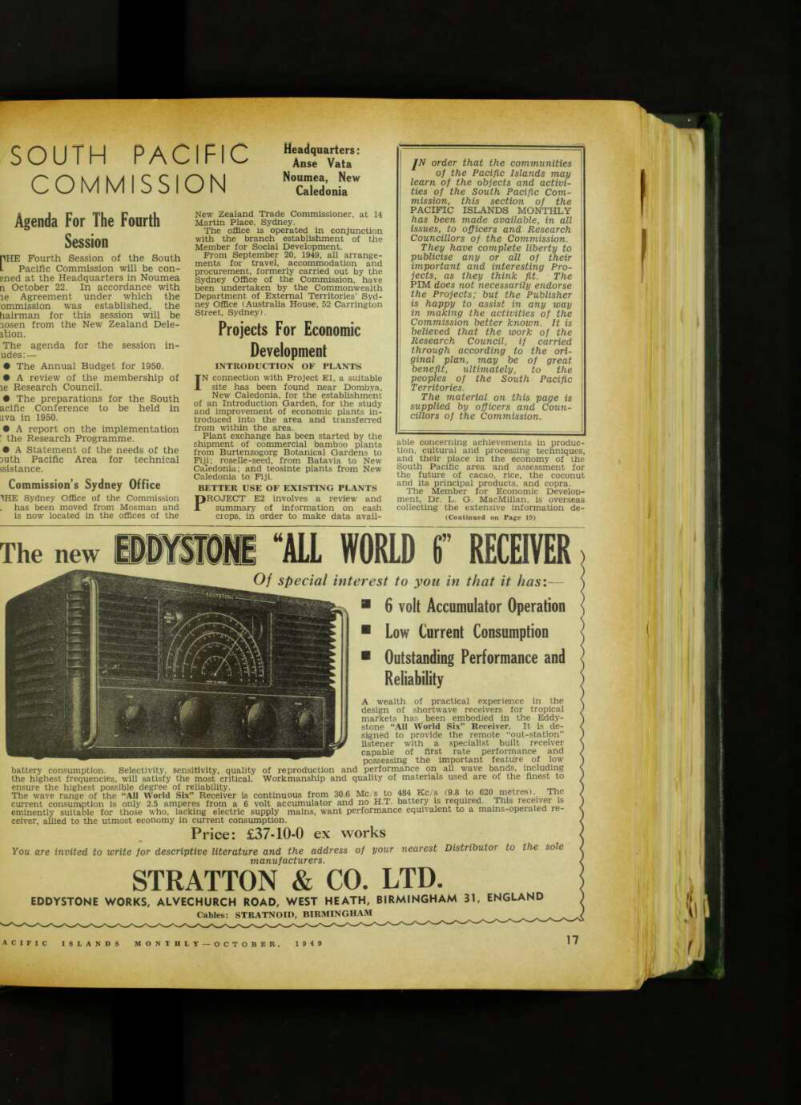
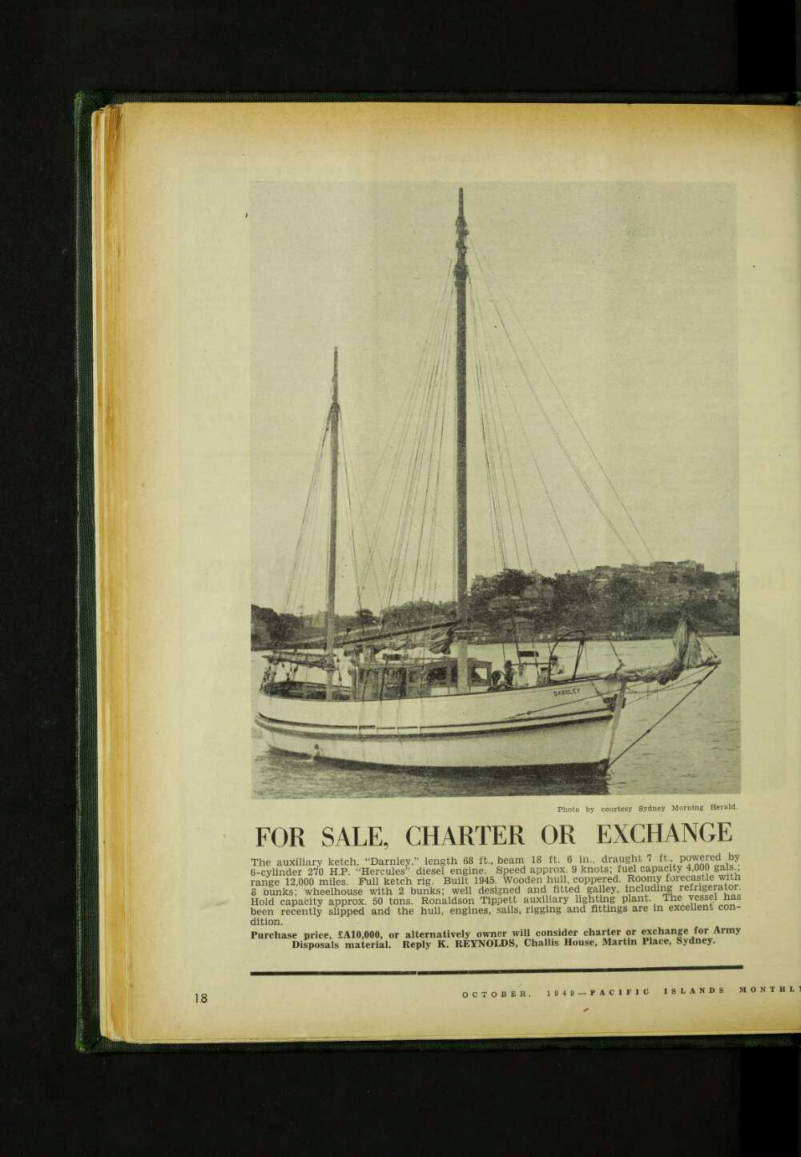
Commission
Headquarters: Anse Vata Noumea, New Caledonia
Agenda For The Fourth
Session
HHE Fourth Session of the South L Pacific Commission will be con ened at the Headquarters in Noumea n October 22. In accordance with ic Agreement under which the ommission was established, the hairman for this session will be losen from the New Zealand Dele tion.
The agenda for the session in udes:— • The Annual Budget for 1950. • A review of the membership of le Research Council. • The preparations for the South acific Conference to be held in uva in 1950. • A report on the implementation : the Research Programme. • A Statement of the needs of the 3uth Pacific Area for technical >sistance.
Commission’s Sydney Office
Sydney Office of the Commission has been moved from Mosman and is now located in the offices of the
New Zealand Trade Commissioner, at 14 Martin Place, Sydney.
The office is operated in conjunction with the branch establishment of the Member for Social Development.
From September 20, 1949, all arrange ments for travel, accommodation and procurement, formerly carried out by the Sydney Office of the Commission, have been undertaken by the Commonwealth Department of External Territories’ Syd ney Office (Australia House, 52 Carrington Street, Sydney).
Projects For Economic
Development
Introduction Of Plants
IN connection with Project El, a suitable site has been found near Dombya, New Caledonia, for the establishment of an Introduction Garden, for the study and improvement of economic plants in troduced into the area and transferred from within the area.
Plant exchange has been started by the shipment of commercial bamboo plants from Burtenzogorg Botanical Gardens to Fiji; roselle-seed, from Batavia to New Caledonia; and teosinte plants from New Caledonia to Fiji.
Better Use Of Existing Plants
PROJECT E 2 involves a review and summary of information on cash crops, in order to make data avail
able concerning achievements in produc tion, cultural and processing techniques, and their place in the economy of the South Pacific area and assessment for the future of cacao, rice, the coconut and its principal products, and copra.
The Member for Economic Develop ment, Dr. L. G. MacMillan, is overseas collecting the extensive information de
(Continued on Page 19)
tianded by this Project, which can only ,e gathered by personal contact and in estigation. He has attended the icientific Conference on the Conserva ion and Utilisation of Natural Resources, Dnvened by the United Nations Organisa ion at Lake Success.
Crops On The Atolls
CHE Deputy Chairman of the Research Council, Dr. L. G. M. Baas Becking, has gathered a great deal of litera ire and has begun a study of the role of Igal cover in the soil formation of a oral island near Noumea. This work is eing undertaken in connection with Pro ;ct E 6, which is designed to improve ish and subsistence crops and handi rafts, and to widen the commercial oportunities of the peoples of the atolls ad low islands. It is proposed to employ soil scientist especially for this Project.
Other Investigations
i N inventory of some of the larger \ fishes will be made during 1950 in collaboration with specialists of the istitut Francais d’Oceanie.
It is proposed to publish a technical andbook on Insect Pests of the South acific area. A working list of the ;onomically-important insects of New aledonia and the New Hebrides has sen received from the Entomologist of le Institut Francais d’Oceanie, M. Cohic.
A list of timbers of the South Pacific :gion and their properties is being pre ired, together with a list of useful [Otics which can be introduced.
The lines of co-operation between the istitut Francais d’Oceanie and the ommission have been formally estab >hed, and considerable laboratory space ; the Institut has been placed at the sposal of the Research Council. The eputy Chairman and Dr. Massal intend i start laboratory work in October.
Projects For Better Health
Visit To South-East Islands
Research Council Member for Health, Dr. E. Massal; on June 10 commenced a tour of Fiji, Tahiti.
Dok Archipelago and Samoa. During iis tour, Dr. Massal discussed the Health •ojects approved by the Commission with ficers of the Administrations, scientists, id private individuals, in considerable stall, and assessed the needs of the rea with a view to the formulation of sw projects.
Project HI, for improving, extending id accelerating the collection and dis mination of epidemiological intelligence, r using temporarily the facilities of the )uth Pacific Health Service, in Suva, is been implemented. Agreement has ;en reached with the South Pacific ealth Service, and appropriate arrange ents are being made for the participa -3n of all South Pacific Territories.
The Member for Health has studied the larantine regulations in force in the irious territories in the Area, and action ssigned to achieve standardisation will i deferred, pending the issue in the near iture of the Sanitary Conventions by the r orld Health Organisation.
Utrition And Infant Welfare
'iHE Member for Health has discussed, . in all the territories visited, many aspects of the problems of infant and aternal welfare, and nutrition and diet, » affecting the indigenous peoples.
The information available on these roblems is qualitative and remains very idefinite. The South Pacific Health ervice intends to establish a “Nutrition Cap” in the territories within its scope, hich will be of considerable use.
To Fight Tuberculosis
THE Member for Health has studied various localities in the territories visited in order to ascertain where the special research team, as envisaged in Project H3 —Tuberculosis, could best operate.
The special team will commence its operations early in 1950, in order to com pare the different antigens and methods used in tuberculin tests, and the radio graphic appearances in different races at different ages, in order to produce simple techniques suitable for use under field conditions.
“Dr. Massal is visiting Australia to exa mine the availability and suitability of equipment, etc., for this project.
(Continued Next Page)
Technical Staff
THE problems relating to the training of technical staff in the field of Health have been studied by Dr.
Massal, and the requirements in this re gard will be incorporated in the Survey being conducted as Social Development Project SI of the facilities for professional and technical training in the Area, with a view to future development.
Secretary-General In Australian
and Dutch New Guinea
THE Secretary-General, Mr. W. D. For syth, returned to Noumea early in October after an official visit to
Australian and Dutch territories in New Guinea.
In a tour of two weeks, the Secretary- General conferred with the Administra tors of the territories on South Pacific Commission affairs, particularly in regard to the South Pacific Conference to be held at Suva in April next, and met the heads of Departments and the District Officers at their Conference in Port Moresby.
Mr. Forsyth visited several administra tive centres, including Hiratugu, Madang, Wewak, Hollandia and Mount Hagen, and made contact with field officers carrying out medical, educational and agricultural work. He was greatly impressed by the work being carried on for the advance ment of the peoples of the territories.
Social Development
Modern Aids In Islands Education
ALTHOUGH work has been done on all of his 10 Projects, Mr. H. E. Maude (Council Member for Social Develop ment) has given particular attention in recent weeks to those concerned with vocational training and the use of visual aids in education.
There is real need for vocational train ing facilities in all South Pacific groups, and plans are afoot for inter-territorial collaboration, in this respect.
Fiji will lend its Supervisor of Tech nical Services, Mr. R. A. Derrick, MBE, AMISE, and early next year he will exa mine the technical and professional training available in all Territories, with a view to developing a practical, compre hensive plan for the South Pacific. Pre liminary data now is being collected for him.
Mr. Maude reports that Australia has loaned Mr. A. L. Moore, MA, B. Ed., of the Office of Education, and he will forthwith visit the South Pacific main centres and demonstrate the use of the 16 mm. sound and silent projector, and the 35 mm. strip film projector, for use in education. These visual aids are being increasingly used in colonial administration —they are es pecially valuable in medical and agricul tural demonstrations. Mr. Moore, a highly qualified man, will report very fully to the Council on organisation, apparatus, techniques and supply of suitable film.
It is proposed to establish a suitable centre for research workers and others interested in South Pacific Social De velopment, where technical help can be given and data exchanged. Persons in terested are invited to make contact with Mr. Maude in Sydney—PO Box 5254, or Telephone BW 7606.
Advertisements & other items, pp. 19-22 (2 items)
17
ACIFIC ISLANDS MONTHLY OCTOBER, 1949
The New Ddvsrie All World 6 Receiver
p order that the communities of the Pacific Islands may learn of the objects and activities of the South Pacific Commission, this section of the
PACIFIC ISLANDS MONTHLY
has been made available, in all issues, to officers and Research Councillors of the Commission.
They have complete liberty to publicise any or all of their important and interesting Projects, as they think fit. The PIM does not necessarily endorse the Projects; but the Publisher is happy to assist in any way in making the activities of the Commission better known. It is believed that the work of the Research Council, if carried through according to the original plan, may be of great benefit, ultimately, to the peoples of the South Pacific Territories.
The material on this page is supplied by officers and Councillors of the Commission.
The new DDVSRIE ALL WORLD 6 RECEIVER Of special interest to you in that it :
6 volt Accumulator Operation
Low Current Consumption
Outstanding Performance and
Reliability
A wealth of practical experience in the design of shortwave receivers for tropical markets has-been embodied in the Eddystone “All World Six” Receiver. It is designed to provide the remote “out-station” listener with a specialist built receiver capable of first rate performance and possessing the important feature of low battery consumption. Selectivity, sensitivity, quality of reproduction and performance on all wave hands, including the highest frequencies, will satisfy the most critical. Workmanship and quality of materials used are of the finest to ensure the highest possible degree of reliability. . ... T , , 0 + QO x rr,^ The wave range of the “All World Six” Receiver is continuous from 30.6 Mc/s to 484 Kc/s <9.8 toi 620 metres). The current consumption is only 2.5 amperes from a 6 volt accumulator and no H.T. battery is required. This receiver is eminently suitable for those who, lacking electric supply mains, want performance equivalent to a mams-operated receiver, allied to the utmost economy in current consumption.
Price: £37-10-0 ex works
You are invited to write for descriptive literature and the address of your nearest Distributor to the sole manufacturers .
STRATTON & CO. LTD.
EDDYSTONE WORKS, ALVECHURCH ROAD, WEST HEATH, BIRMINGHAM 31, ENGLAND
Cables: STRATNOID, BIRMINGHAM
' • ' 1 i i Photo by courtesy Sydney Morning Herald.
FOR SALE, CHARTER OR EXCHANGE
rhe auxiliary ketch, “Darnley,” length 68 ft., beam 18 ft. 6 in., draught 7 ft v powered by J-cylinder 270 H.P. "Hercules” diesel engine. Speed approx. 9 knots; fuel capacity 4,ouu gais., 'ange 12,000 miles. Full ketch rig. Built 1945. Wooden hull, coppered. Roomy forecastle witn 3 bunks; wheelhouse with 2 bunks; well designed and fitted galley, mcludmg refrigerate .
Hold capacity approx. 50 tons. Ronaldson Tippett auxiliary lighting plant. The vessel nas 3een recently slipped and the hull, engines, sails* rigging and fittings are in excellent coniition.
Purchase price, £AIO,OOO, or alternatively owner will consider charter or exchange for Army Disposals material. Reply K. REYNOLDS, Challis House, Martin Place, Sydney.
Buy at Wholesale Rates
To my many Islands Friends and others: If you require Stores, Cane Furniture, Household Furniture, etc., at wholesale rates, I am prepared to buy same for you for a moderate commission.
Do not purchase any yacht or vessel for Islands purposes until I have inspected it for you.
After 22 years in the Solomon Islands, I know your requirements—it is worth my commission to save you from making mistakes in purchases.
“LAZ” oi the Solomons.
D. M. & E. W. LAZARUS,
Storekeepers,
I Salvia Ave., Bankstown. UY 1818 Bankers: Commonwealth Bank of Australia (Bankstown Branch).
SIMPLEX MARINE ENGINES
SIMPLEX MARINE ENGINES.
The finest range of marine petrol engines for small craft.
Made in 3 HP, 5 HP, 10/12 HP, 15/20 HP. The 3 larger models with built-in reverse gear. Suitable for all craft to 25 ft. long.
SIMPLEX 5 H.P.
Illustrated are the popular Simplex 5 HP, singlecylinder, and the new model 20 HP, 4 cylinder.
The 20 HP is fitted with electric starter and generator and built-in reverse. Ask for specifications.
SIMPLEX 20 H.P.
fl
KAYEN KEROSENE LAMPS
TALL TABLE
LAMP.
KAYEN KEROSENE LAMPS.
The most reliable and efficient of all kerosene pressure lamps. Burn for 10 hours on 1 1 pints of kerosene. Fitted with doubly supported mantle, insect protected. All main fittings of brass with stainless steel cleaning wire and jet. Will not flicker in the strongest wind. Absolutely safe.
All Purpose Lamp, 89/-. Tall Table Lamp, 104/-.
Immediate delivery. Trade inquiries invited.
I
LANTERN.
W. Kopsen & Co. Pty. Ltd.
SHIPCHANDLERS Cr MARINE ENGINEERS
376-382 KENT STREET, SYDNEY. PHONE: MA 6336 (9 lines).
Cables: KOPSEN, Sydney
PRODUCING UNIFORM GOOD RESULTS SINCE 1868
Flour
ALWAYS ASK FOR IT
HAVE YOU TRIED
McILRATH’ S pt, m. For Groceries
202 Pitt St., Sydney,
IF NOT , DO SO NOW —and you will receive complete satisfaction
—it is promised you
EVERY ORDER —large or small, has the same careful attention as if you purchased in person.
FOR YOUR CONVENIENCE—our Service Department will be pleased to purchase all your general household requirements and include them with your grocery order, there y saving extra freight and charges.
TO ENSURE PERISHABLE GOODS ARRIVING AT DESTINATION IN GOOD CONDITION, they are supplied in tins wherever necessary.
HIGHLY PERISHABLE GOODS—such as Butter, Cheese, Bacon, Eggs, Fruit and Vegetables, etc., are carried in the ship's refrigerator.
Varied Stocks of Essential Foods are Available, including Cakes (in tins) > 1 Spirits, Liqueurs, Cider, Cordials and Pure Fruit Juices, together with Allsopp s English Beer Wb oz. bottles) in 4 doz. case lots.
ALL SHIPMENTS, EXCLUDING DECK CARGO, ARE COVERED AGAINST PILLAGE, THEFT
A ism NON-DELIVERY
SPECIAL GIFT HAMPERS for friends in GREAT BRH'AW are available for immediate despatch, priced from 12/6 to 35/- each. Delivery in Good Condition Guaranteea.
Prices include packing, postage and insurance to the United Kingdom.
WRITE FOR DESCRIPTIVE LEAFLET
202 PITT ST., SYDNEY, AUSTRALIA
Cable Address: “ROTUNDA,” SYDNEY VV itll Li ruxt
McILRATH’S PTY. LTD,
The Rebirth Of Rabaul
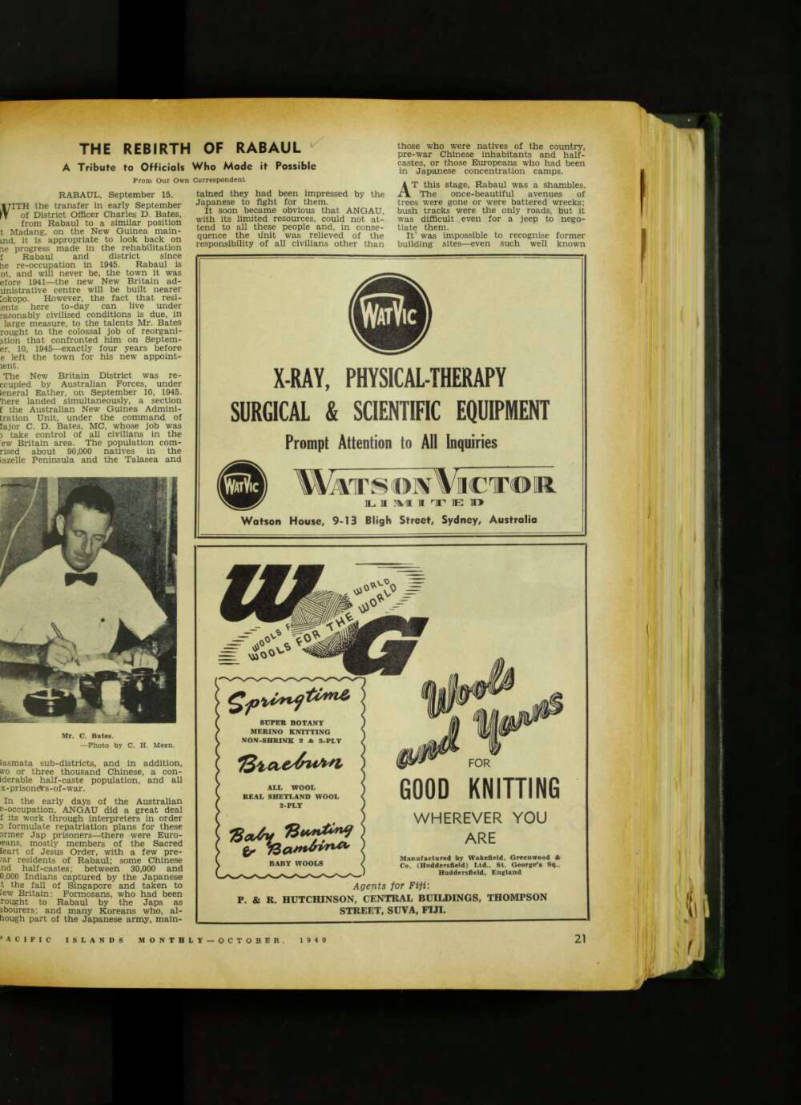

A Tribute to Officials Who Made it Possible
From Our Own Correspondent
RABAUL, September 15. 171 TH the transfer in early September of District Officer Charles D. Bates, from Rabaul to a similar position t Madang, on the New Guinea main md, it is appropriate to look back on tie progress made in the rehabilitation f Rabaul and district since tie re-occupation in 1945. Rabaul is ot, and will never be, the town it was efore 1941—the new New Britain ad ilnistrative centre will be built nearer Fokopo. However, the fact that resi ents here to-day can live under sasonably civilised conditions is due, in large measure, to the talents Mr. Bates rought to the colossal job of reorgani ation that confronted him on Septem er, 10, 1945 —exactly four years before e left the town for his new appoint lent.
The New Britain District was re ccupied by Australian Forces, under Feneral Father, on September 10, 1945. here landed simultaneously, a section f the Australian New Guinea Admini tration Unit, under the command of lajor C. D. Bates, MC, whose job was ) take control of all civilians in the ew Britain area. The population com rised about 90,000 natives in the razelle Peninsula and the Talasea and
rasmata sub-districts, and in addition, cvo or three thousand Chinese, a con iderable half-caste population, and all x-prisonefrs-of-war.
In the early days of the Australian e-occupation, ANGAU did a great deal f its work through interpreters in order d formulate repatriation plans for these ermer Jap prisoners—there were Euro leans, mostly members of the Sacred leart of Jesus Order, with a few pre war residents of Rabaul; some Chinese nd half-castes; between 30,000 and 0,000 Indians captured by the Japanese t the fall of Singapore and taken to Few Britain: Formosans, who had been rought to Rabaul by the Japs as ibourers; and many Koreans who, al though part of the Japanese army, main
tained they had been impressed by the Japanese to fight for them.
It soon became obvious that ANGAU. with its limited resources, could not at tend to all these people and, in conse quence the unit was relieved of the responsibility of all civilians other than
those who were natives of the country, pre-war Chinese inhabitants and half castes, or those Europeans who had been in Japanese concentration camps.
AT this stage, Rabaul was a shambles.
The once-beautiful avenues of trees were gone or were battered wrecks; bush tracks were the only roads, but it was difficult even for a jeep to nego tiate them.
It' was impossible to recognise former building sites —even such well known
Mr. C. Bates. —Photo by C. H. Meen.
es as the District Office, Post Office, ;w Guinea Club, etc. Men returning, iging to see some relic of the past, ild not even locate the places where ;ir own homes had been, rhe local native villages were in a nilar state of destruction, and this jition was made worse when 120,000 panese prisoners and Formosans were icentrated in 15 camps, many of them native village land which necessi ed the removal of natives to other less table areas. However, due to the orts of ANGAU officers, combined with establishment of BMD HQ, with onel Jones in charge of District vices, a more sympathetic attitude s adopted towards the natives and ne real rehabilitation work commenced m about April, 1946. Since that date ;ives have returned to pre-war village ;s, and new villages, although not up pre-war standards, have been built, rhe work of rehabilitating these tives was tremendous as food trees 3 galip, bread-fruit and coconut were npletely destroyed in some parts, tive land throughout the Gazelle ninsula and inhabited coastal ;ions of New Britain, had been taken ;r entirely by the enemy during their npation and for four years the :ives had been thus deprived of most their arable land. n June, 1946, New Britain reverted to il administration control and the mer officer in charge of ANGAU, Mr.
D. Bates, was appointed District Eicer, New Britain, with headquarters Rabaul.
'Tom that time the rehabilitation pro imme received added impetus—Army frictions could no longer interfere ;h the return of Europeans to their
plantations, and ttte natives to their villages. Shortage of materials, lack of equipment of all descriptions hampered progress, however, although with close co-operation between Administration and all sections of the New Britain com munity, plans were dovetailed and pro gress became noticeable. Within one year fifteen plantations were producing much-needed copra, hundreds of native villages had been reformed, and an edu cation programme for the natives com menced in October, 1945. When Mr.
Boisen, Education Officer, arrived in Rabaul, mid-1946, he had an active going programme as a basis for his work.
Mr. Bbisen was the right choice for this work —he was known and loved by all the local natives, and his enthusi asm together with unceasing work, put the Education programme for natives in the Rabaul district on a sound basis, RABAUL in pre-war days was the focal point of all business within the Territory, and during the early post-war period it began to regain that position. Business houses were re established, Burns Philp and Co., Ltd., New Guinea Company, Ltd., Colyer Watson, Limited commenced to trade again. Chinatown, a Shadow of its former self, struggled back into existence.
The first meeting of the Town Council of Rabaul’s Chinatown was held in the Mayor’s Office in September, 1945, and from this commenced the programme for the re-establishment of the Chinese community.
In the replanning of the Rabaul town ship it was decided to reconstruct on the pre-war sites, open up pre-war roads within the township and establish new wharves and other public utilities as near as practicable, to those which were in
existence before the war. Much has yet to be done.
All buildings in Rabaul are of a temporary construction due to the pro posed removal of the New Britain head quarters to Kokopo. Contour survey of the new town site has commenced and it is anticipated that within five years all Administration officers will be es tablished there. A re-habilitation pro gramme would not be complete without the revival of sporting bodies. With the money received from War Damage In surance this has been made possible, sup plemented by the funds raised by the individual organisations. To-day we have a playing field equal to none in the Terxitc/ry where cricket, baseball, afad tennis are played. Our swimming pool is almost reconstructed.
This is only a very brief story of the rebirth of a town; to tell it in detail would take a volume.
Advertisements & other items, pp. 23-25 (4 items)
21
* A C I F I C ISLANDS MONTHLY OCTOBER. 1949
X-Ray, Physical-Therapy
SURGICAL & SCIENTIFIC EQUIPMENT
Prompt Attention to All Inquiries
'ATS
]L II 7VII BTTED
Watson House, 9-13 Bligh Street, Sydney, Australia
- - , <0 0* qo v '
SUPER BOTANY
MERINO KNITTING
NON-SHRINK 2 A 3-PLY
‘B'HX&VTifrn,
FOR
ALL WOOL
REAL SHETLAND WOOL
2-PLY
BABY WOOLS
GOOD KNITTING
WHEREVER YOU
ARE
Manufactured by Wakefield, Greenwood & Co. (Huddersfield) Ltd., St. George’s Sq. ( Huddersfield, England
Agents for Fiji :
P. & R. HUTCHINSON, CENTRAL BUILDINGS, THOMPSON
STREET, SUVA, FIJI.
THE SHAPE OF THINGS TO COME
When Dollars Become Available for Motor Vehicles 1950 Studehaker Land Cruiser INSERTED (as a matter of interest) BY
G. G. Smith & Company Limited
Distributors for Papua
jacijic
m /
sc[[ool^Hu7 i
WFjl
LEARN TO PLAY the Hawaiian Steel Guitar or Ukulele in the modern manner. Complete postal course available. Full details free ... no obligation. Send 4d. in stamps for full particulars to
SECRETARY.
PACIFIC SCHOOL OF MUSIC
P.O. Box 487, Palmerston North, New Zealand.
IN THIS PART OF THE WORLD TOO/ r^"~) , , ,* A S:.r
UN I r £C
c if
Vr / £ E A A / 43 > *CA«ou«
AfISMAU
sr 6s 5?«» ; i.4# —-rv ut&ASt& -~, C<?££* ‘ M t£
■JJL**
3v\«iOl» -> %fi*mnnu tf *T* i<r*
JET!
ST -t:
s©fls£; *
r** **»* •x •v Throughout the Pacific, as with other parts of the world, ROBERT KOSAK, representing leading English, Continental and U.S.A. manufacturers, offers all the advantages of an old-established importexport service.
ISLAND PRODUCTS
SOLD ON ALL
WORLD MARKETS
ON A COMMISSION
BASIS
Inquiries invited
ROBERT KOSAK
Exporters and Manufacturers’ Representatives,
77 KING STREET, SYDNEY, AUSTRALIA
Cable Address: “ROKOSTRA,” Sydney.
Bankers: National Bank of Australasia, Ltd., Sydney. •n _l, XTnnr firm Hi W n.l PS RvdnftV.
22
OCTOBER. 1949 PACIFIC ISLANDS MONTHL
23
ACIFIC ISLANDS MONTHLY OCTOBER, 1949
District Officers
Confer
In New Guinea
From Our Own Correspondent
Pt. Moresby, Sept. 30.
DISTRICT Officers held their annual conference in Moresby from Sep tember 14 to 22 and discussed, among other things, the formation of village councils and courts, as provided
for in the Papua and New Guinea Act.
In its usual style, the Administration issued little information about the con ference.
Among those who addressed the gathering were the Administrator (Col.
J. K. Murray), the Secretary-General of the South Pacific Commission (Mr. W.
D. Forsyth) and the Regional Director of the Civil Aviation Department (Mr.
J. S. Arthur).
Mr. Forsyth was here on a two weeks’ visit, during which he went to Lae,
Madang, Wewak, Nondugl, Garoka and Hollandia. He made the visit to gain first-hand knowledge of the Territory’s problems. He returned to Australia and Noumea at the end of September.
Kieta Notes
Kieta, Ng, Sept. 15.
ON August 4, ceremonies commenced here to mark the Golden Jubilee of the Bougainville Marist Mission. An imposing party of ecclesiastical dignitaries, who arrived on the Mission yacht, in cluded Bishop Wade, of Bougainville; Bishop Sharmack, of Rabaul; Bishop Ark feld of Wewak and Bishop Appleman, of Alexishaven. 'The Mission received con gratulations and good wishes from all over the world. * * * There was some anxiety when the MV Kokoda arrived in this port with a 3-ton tip-truck for Headmaster John Cox, as well as water-piping, cement and build ing material. The old wharf is far from safe, and it was not known whether Cap tain Rassmussen would adopt the usual method of floating the truck ashore on hatch-covers laid across surf-boats. So Mr. Cox built a substantial raft of bush timber, attached to 30 petrol-drums. But Captain Rassmussen, after personally examining the situation, laid his vessel very skilfully alongside, and swung the 3-tonner onto the decrepit wharf, whence it was got safely ashore without accident. * * * Like all ports in this Territory, Kieta and the district around are very seriously handicapped by lack of port facilities, a small official barge, roadmaking plant, and bridges. The paramount need is a wharf with a water pipe-line. There is a surprising amount of small shipping com ing into Kieta, chief town of Bougain ville, but under present conditions it is under a handicap. * * * Mr. Maclaughlan (Chief Clerk) and his wife left in August, on leave. Mr. and Mrs. “Jimmy” Joyce, of Iwi Plantation, have gone to Australia on leave, and Mr. and Mrs. Gaskell have taken over. Mr.
Wong Parrish, ADO, is going away on long leave, and will be relieved by Mr.
Maclartney, Assistant ADO at Sohana. * • • The American LST 533 returned tc these waters in August and. anchoring off Arawa Plantation, made this snot the centre of final surveying operations in this vicinity. Following q petrol stove explosion, three of the USA personnel were severely burnt, and were rushed by barge to Kieta, on the 15th, for medical treatment. Fortunately, Dr. Pike was at Kieta, and he and his able assistant, Gordon Lansdowne, quickly made the in jured men comfortable. They were then taken to the USA hospital at Guadalcanal by the LST.
Mr. and Mrs. J. A. Michener, well known American journalists, have been recently in Australia, en route to some of the South Pacific Islands. He may be remembered as an American Navy officer during wartime in New Hebrides, New Caledonia and Norfolk Island, etc.
He wrote a delightful book (Tales from the South Pacific) during his war ser vice which had a wide vogue, and was awarded a Pulitzer Prize in 1948 for the best fiction story of the year. A play called “South Pacific,” based on Michener’s book had been making a re cord-breaking run on Broadway. The book was reviewed in PIM in February, 1948.
Advertisements & other items, p. 26 (1 item)
Broohfields Ltd.
mm. %k
The New WUNDERLICH SINK UNIT
is available in Stainless Steel, 4', 4'6", 5' and 6’ long, with a lustrous, rustless, smooth "Wunderbrite" finish that is easy to keep spick and span.
Ask your local Hardware Merchant, 'phone MX 241 I or write to Wunderlich Limited, Box 474, G.P.0., Sydney, tor prices and leaflet.
COMBINATION SINK & DRAINER
BROOHFIELDS Ltd.
Suppliers of Building Hardware Ship Chandlery, Paint Materials &
WRITE DIRECT TO:
Broomfields Ltd., 152 Sussex Street, Sydney
The Future Use Of Fiji Lands
Issues Which May Affect Indian-Native Relationships
From Our Own Correspondent
SUVA, Sept. 29. iSa further step in the long-drawn-out \ struggle between the European- Fijian communities, on the one side, nd the Indian community, on the other, i relation to the future control of Fiji nds, the Native Land Trust Board has iblished details of the first areas which :e to be reserved for the exclusive use f the Fijian owners. These areas are in le Yasawa Group, and in the Lautoka a district, between Vatia Wharf and Lida Point.
This first reservation marks the start the final phase of the huge task carried it by a Commission headed by the Se ctary for Fijian Affairs (Ratu Sir Lala ikuna) with the object of reserving ,ose parts of their own country which e Fijian people require for their present id future needs.
This development has grown out of the Element of Indians in Fiji, and the phe menal increase in the Indian population recent decades. In the same period, e decrease in the Fijian native popula m has been halted, and turned into a ;ady and satisfactory natural increase, inevitably, the point was reached—some or 15 years ago—when the Indians’ de mds for land came into conflict with lat the British rulers of Fiji believe to the necessary and proper provision of id for the native Fijians.
Considerable areas of land, not then re ired by the Fijians, had been leased to ! Indians, and improved by the Indians; d, naturally, the Indians sought an ir rocable title over those lands. Inability obtain such titles caused strong feeling
among the Indians. To find, for the issue a basis of fundamental justice, the British had to go back into history.
The Fijians, as the original inhabitants were entitled to the lands of Fiji. That was recognised by the British when they became party to the Deed of Cession, in 1874. Ever since, they have regarded themselves as trustees for the care of the natives’ lands.
The arrival and settlement of the Indians belong to the post-Cession period.
The facts that the Indians have chosen to settle in Fiji, and to breed at a rate that is almost without precedent, give them no pre-emptive right to Fijian lands.
Whatever claim the Indians may properly make to Fiji lands can be taken care of only after the claims of the Fijians, both present and prospective, have been pro vided for.
The Indian leaders contest this argu ment very bitterly; but they cannot escape the fact that the British standpoint is based on fundamental justice.
When the discussions came to a head.
in the ’thirties, the British were unable to lay down any procedure, because it was then difficult to say (a) what were the present and future needs of the Fijians (b) what lands were actually available to meet those needs and (c) what really were the rights of the Indian lessees. The necessary inquiry was placed about 1940 in the hands of a Commission headed by Sir Lala Sukuna and—with serious interruption caused by the 1942-45 war operations—it has been going on ever since. The importance of the Commis sion’s report and recommendations, to the future of Fiji, cannot be exaggerated.
The first result is the demarcation of Fijian land reserves. The Indians are strongly opposed to the general plan; and, as time goes on, much more will be heard of it. But, so far as the British- Fiji administration is concerned, the facts have been ascertained, a policy has been framed, and a plan has been put into operation. That plan will not be aban doned, without very good reason.
The future use of Fiji lands is the key to the future of Fiji. In that respect, each community there now knows exactly where it stands.
OF the area that is now set aside in these first reservations, 1,687 acres are at present leased. Seventy-three of the leases, or parts of leases, totalling 294 acres, will expire before the end of 1950. The remainder will expire at various times in the following 50 years, and the present lessees will be required to vacate the land only as the leases ex pire.
In some cases the area affected is only a small portion of a lease, the rest of the lease being outside the reserved areas.
The foregoing refers to the Yasawas- Northwest area. Inquiries regarding each land-owning group in the Colony are pro ceeding.
As investigations are completed in each area, the pieces of land necessary to meet the Fijian owners’ requirements in full, both now and in the foreseeable future, will be proclaimed as native reserves.
Reserved land can be leased or other wise disposed of by the owners only to other Fijians, and then only with the consent of the Native Land Trust Board.
It is on the continued ownership of, and access to, land on which to live and on which to grow food and fuel and house building material and crops for marketing that their happiness and progress primarily depend.
Help For Lessees
MANY of those lessees who will be re quired when their leases expire to move from land which is included in the Native Reserves will wish to find other land outside the reserves.
A committee has been appointed in the Western District with the following terms of reference;—
(1) To assist persons displaced from Native Reserves to find new accommoda tion outside the Native Reserves. (2) To submit for consideration bv a Central Committee proposals for making available for settlement new areas outside the Reserves.
The Central Committee will be ap pointed shortly and committees will be appointed in due course in the Northern and Eastern Districts.
The District Commissioner Western is chairman of the committee for the Wes tern District, and the remaining members of the committee are the District En gineer Lautoka, Mr. C. L. Langdale, Mr.
Tulsi Ram Sharma, Lautoka, Mr. C. E.
Whitehead, Roko Tui Nadroga and Navosa and Mr. E. A. Potts.
Advertisements & other items, pp. 27-28 (2 items)
25
CIFIC ISLANDS MONTHLY OCTOBER, 1949
William H. Watso
BUY ON THE BEST MARKET!
When you buy through us you buy at lowest prices.
YOU RECEIVE ORIGINAL INVOICES AT IN-
VOICED COST. Enquiries invited for all plantation and trading requirements. Island products sold on commission basis.
WILLIAM E. REED
(Established 36 years).
BROKER AND AGENT,
145 a GEORGE ST., CIRCULAR QUAY, SYDNEY Cables: “WILREED,” Sydney.
ESTABLISHED 1930 —
WILLIAM H. WATSO
RAROTONGA, COOK ISLANDS
Wholesale and Retail Trader
LICENSED STAMP DEALER
Agent For:-
BRITISH TRADERS' INSURANCE CO.
CORONA & L. C. SMITH TYPEWRITERS
KAISER & FRAZER MOTOR CARS
B.S.A. CYCLES AND MOTOR CYCLES
AMERICAN LEAD PENCIL CO.
WHITES AVIATION LTD.
Manufacturers of: FOOTWEAR, ALL CLASSES SUITABLE FOR NATIVE TRADING . . . M.O.P. PRODUCTS, INCLUDING ROUND EAR-RING BLANKS AND BU1TON BLANKS Exporter of: “Rarotonga” Hula-Skirts.
Sea-Shell Necklaces.
M.O.P. Jewellery.
Island Produce.
Cable Address: “Watson” Rarotonga Wholesale and Retail Inquiries Invited.
Prepared to Consider Agencies for all Class of Goods.
Importer of: Textiles.
General Hardware.
Fancy Goods.
General Merchandise.
Bankers: Bank of New Zealand, Auckland.
A. H. BUNTING LIMITED
SAMARAI PAPUA
Presents the NEW
C.S.A. ENGLISH DUAL FREEZE
m in* a "1
MORE THAN A REFRIGERATOR—A FREEZER AS
WELL—FRESH VEGETABLES, FRUIT, MEAT AT
ANY TIME—AND SO SMALL A COST
DIMENSIONS: Overall 42 in. wide. 21 in. deep. 36 in. high.
REFRIGERATOR CAPACITY: 4 CUBIC FEET.
ZERO DEEP FREEZE STORAGE SPACE: U CUBIC FEET
ALL ALUMINIUM CABINET.
STAINLESS STEEL TOP.
RUSTLESS.
240 VOLT A.C. 50 CYCLES.
ALSO AVAILABLE—IIO VOLT A.C.—SLIGHTLY EXTRA.
PRICE; £152/10/6. F. 0.8., SAMARAI.
SOLE AGENTS IN PAPUA/NEW GUINEA FOR;
SAMARAI AGENTS FOR:
Vacuum Oil Co. Pty., Ltd.
South British Insurance Co.
National Mutual Life Association Polarizers (U.K.), Ltd.— Polaroid* Sun Glasses.
C.S.A. Industries Eng.— Dual Freeze Refrigerators.
Webley & Scott, Ltd.— Shot Guns, Air Pistols, etc.
Le Bryan Group Products (Great Britain) Ltd.— Power master Electric Refrigerators.
“Getula.”—Nylon Monofilament Fish Lines. ♦ Trade mark patented in U.S.A., Great Britain, and other countries^
REGULAR SUPPLIES OF EASTERN GOODS
A. H. BUNTING LIMITED - SAMARAI
WHOLESALE & RETAIL MERCHANTS IMPORTERS PLANTERS
More Japs Found In
N. Guinea
Pt. Moresby, Oct. 6.
ANOTHER seven Japanese soldiers were found recently in a village in the Finisterre Ranges. They had been hiding among the natives for nearly five years. Their clothes were ragged and they were suffering from malnu trition. They will be sent to Manus to join Jap war criminals there.
Only a few weeks ago, two Jap soldiers came out of hiding near Saidor.
Twenty-four Japs have been found in this area since the war ended.
Advertisements & other items, pp. 29-30 (1 item)
Small Bottling Plants
NAPT
TUBERCULOSIS
causes great injury to health
in tropical and sub-tropical
countries, but it can be
controlled.
For 5/- a year, leaflets and magazines will be sent to you.
And if you will write to us, we shall he glad to help you in any way possible.
Tavistock House North, Tavistock Square, London, W.C.1., England.
NATIONAL ASSOCIATION FOR THE
PREVENTION OP TUBERCULOSIS.
FENCING MATERIALS
TRADE TOBACCO
NOW AVAILABLE
STEEL FENCING POSTS, BARBED TIE Cr FENCING WIRE NO. 8 GALVANISED WIRE at £69/10/- per ton of 10,000 yds. In 1 cwt. coils.
NO. 10 GALVANISED WIRE at £7O/10/- per ton of 15,151 yds. In 1 cwt. coils. 17 GAUGE TIE WIRE. GALVANISED, at £77 per ton of 85,000 yds. In 28 lb. coils.
GAUGE BARBED WIRE at £77 per ton of 8,100 yds. In 1 cwt. coils.
“Iowa” type. 4 spikes, 3 in. between barbs. Double wire.
ALSO WIRE NETTING, GALVANISED. 12 in., 36 in. and 42 in. widths x li in. mesh or II in. mesh. 17 gauge.
All prices quoted ex-Bond, Sydney
MANNING & MANNING
8A CASTLEREAGH STREET, SYDNEY
Telegraphic and Cable Address: “MANSTOCKS,” Sydney.
Telephones: BW 9076, BW 6030, BW 7405.
Small Bottling Plants
NOW AVAILABLE
Automatic Electric Carbonators . . . Crown Sealing Machines Bottle Filling Machines . . . Labelling Machines Syrup Dispensers Bottle Cleaning Machines.
KASPER REFRIGERATORS PTY. LTD
77 RAILWAY PARADE, ERSKINEVILLE, N.S.W., AUSTRALIA LA 1326
PLAY ALL
THE LATEST
HITS
MANDOLINE-BANJO
Hawa.ian Steel Guitar Hill-Billy Guitar Cow-Boy Guitar Spanish Guitar Ukulele
in 30 Minutes!
LEARN
THE
Play a Tune at your first Lesson
NO TEDIOUS SCALES OR
EXERCISES
The Hawaiian Club will teach you in the comfort of your own home, and the cost is only 2/6 per week. Send for full parti culars of the Hawaiian Club’s specialised Postal Courses.
Post this Coupon today
• To The Hawaiian Club, r _. .
Kembla Building, 1 58 Margaret St., Sydney, a Please send me by return mail complete details of your Home • Study Course. Tell me how I can obtain an Hawaiian Steel Guitar, Spanish Guitar, Hill- Billy Guitar, Ukulele, Mandolin and Banjo-Mandolin. • Name • Address This Offer obtainable ONLY from the above address. 4516
SOLVE YOUR POWER PROBLEMS
WITH AN
ARMSTRONG SIDDELEY
Aircooled Diesel Engine, 5/6, 7/8, 12/16 H.P.
DESIGNED FOR
Power Generating e All Plant Operation
FEATURES:
• COLD STARTING
• PRESSURE LUBRICATION
• FUEL ECONOMY
• COMPACT
• LOW WEIGHT
• BUILT TO OPERATE IN ANY
CLIMATE
IMMEDIATE DELIVERY
Sole Pacific Agents :
VENTURA TRADING COMPANY PTY. LTD.
26 BRIDGE STREET, SYDNEY.
CABLES, “VENTURA,” SYDNEY.
Represented by P. & R. HUTCHINSON, Suva. H. G. EEKHOFF, Lae, T.N.G.
Tragic Problem Of The Half-Caste
New Guinea Administration Takes One Blundering Step
Prom Our Own Correspondent
Pt. Moresby, Oct. 3.
HALF-CASTES were advanced a step closer to European status when it was quietly announced recently that they would be allowed to travel on buses provided for Europeans, provided they are reasonably dressed.
Moresby residents complained indig nantly when they found that half-castes were occupying seats while white women had to stand.
Some women said they feared that natives would have less respect for them once they saw them mingling with half castes.
People are wondering how long it will
be before half-castes are crowding the picture theatre, the dance halls and the hotels. Many residents realise that half castes will have to be accepted into the European community eventually, just as they have been in Australia; but resi dents say that this should be done only when the natives have been raised to a much higher standard. At present any effort to merge half-castes into the European community will result only in a serious drop in European prestige.
If Colonel Murray thinks this is un important, he should try to imagine his own reaction if one of his houseboys greeted him with cordial familiarity.
Environment, Not Mixed Blood, Is The Trouble
EDITORIAL NOTE. —There is far more than that to the social problem of the half-caste in the Pacific Islands. There are thousands of people of mixed blood in the score or more of Territories in the Pacific Ocean; and the great majority ot them are worthy folk, en titled on their personal qualities to take equal status of citizenship with Euro peans.
Of course, there are two classes of half castes. There are the products of formal unions between Europeans and natives — found mostly in Polynesia and Micro nesia—and these people brought up usually in European fashion, take then places in the community beside Euro peans, as a matter of custom and of right. There are very many people of mixed blood who now occupy influential positions in all the Territories from the New Hebrides eastward to Tahiti.
The other class—the often unhappy re sult of casual and irregular unions—is met with mostly in Melanesia. More often than not, the white father is either unknown, or is a low-class man who takes no responsibility for his off spring. These children often are left entirely to the care of the native mother and, except for missionary help are brought up as natives, and have only
native status and native outlook. They present an outstanding example of the influence of environment over heredity.
There are a number in Papua and New Guinea; and the European residents quite properly object to close association with them, except in particular cases.
As our correspondent says, the granting of European status to native-trained half-castes would only weaken the in fluence of the Europeans with the natives. The tendency must be resisted —quite enough harm has been done al ready by the intrusion of Socialist prin ciples and impractical Brown Brother concepts into tropical administration.
There is nothing at all disgraceful in the fact that one has mixed blood. Some of the most desirable people in and around the Pacific are the products of what has been called miscegenation.
There are few children more attractive, as a type, than the product of European- Polynesian unions—unless they are the products of Chinese-Polynesian unions, who usually are notable for intelligence, industry and good looks. Although the children of European-Melanesian unions are usually less desirable, anyone who knows the Western Pacific will have known half-castes who, in all the quali ties of good citizenship, are equal to the European, and are better than many.
The solution of the problem lies in the training of the individual half-caste baby. In Polynesia and Micronesia, where marriage between European and native is common, the child is given a European background; and, even if it grows up in a native community, its way of life is not so far removed from that of the poorer Europeans. The consequence is that it usually is socially acceptable and economically valuable.
When the half-caste child is left to grow up, without direction, in a primi tive Melanesian native community, it seldom is different, in mentality and social usefulness, from the natives. If it should be different in mentality, and made sensitive to the stigma of its birth and status, it can become socially dangerous and undesirable.
If the New Guinea Administration has any true understanding of the tragic problem of the half-caste, it will start much further back than is indicated by its new, flat-footed rule that half-castes shall have omnibus equality with Euro peans. It will sternly discourage all ex cept legitimate unions between whites and natives; and, if there should be un wanted illegitimate babies, then it will see that they are taken early into proper care and training, and given a chance to develop European status.
Death For Chinese
Murderer
Suva Sequel To Ocean Island Tragedy
Prom Our Own Correspondent SUVA, Sept. 26.
“T DID not do it,” replied Tai Shek, 1 when asked if he had anything to say before the death sentence was imposed on him to-day for the murder Df William Thomas Allen, an engineer, if the British Phosphate Commission, at Dcean Island, on April 26. The story of ihe protracted police inquiry was told in September PIM.
Throughout his week-long trial at the Supreme Court, Suva, Tai Shek (a young Chinese) maintained a passive com )osure. In the words of the judge, he iid not admit anything.
Owing to the illness of the Acting Chief Fustice, the former Chief Magistrate (Mr.
C. G. D. Higginson) had been ap >ointed to the bench for the trial.
Assessors Divided
The five assessors (Messrs. W. G. Carey, R. Denton, R. G. Evetts, R. O. Free nan and T. F. French) failed to reach i unanimous recommendation, three of hem saying “guilty” and two “not uilty.”
The evidence covered a good deal of round that has already been given wide üblicity.
The principal facts were that Mr. dlen was found stabbed to death in the edroom, and Mrs. Allen in the lounge f their house at Ocean Island. In his amming up, the judge said it was pos
sible that Mrs. Allen had been a witness of the murder of her husband and had been pursued and stabbed while she was endeavouring to telephone for help (The telephone line had been severed ap parently with a knife).
Knife And Footprints
A blood-stained knife had been found 60 yards from the house. It could have inflicted the fatal wounds, but the prose
cution failed to establish a direct con nection between the knife and Tai Shek.
Blood-stained footprints in the Allens’ house were made by shoes similar to shoes possessed by the prisoner, but, again no direct link was proved.
No motive was suggested. Nothing was said about motive.
His Honour said that the case depended entirely on the evidence of right-hand and left-hand thumb and palm prints
found at the bedroom window. The prints were such as would be made by a person getting through the window.
An Australian fingerprint expert had taken prints of every person in Ocean [sland and had stated his absolute be lief that the prints at the window were those of Tai Shek.
The murder, said his Honour, had been committed between 2 a.m. and 5 a.m. in April 26, and Tai Shek, who had an alibi for the early part of the night, when he was seen in his bed, had no alibi for the period from 1.45 a.m. until 1 a.m.
There was no tittle of evidence to sup 3ort a defence allegation that the prints it the window were forgeries, said the judge.
Clothing Question
During the hearing of evidence it had ieen stated that there was a consider able amount of blood in the two rooms, [t had been pointed out that no blood stains had been found on clothing be onging to Tai Shek and that the ac cused man had no opportunity of wasti ng or disposing of any blood-stained Nothing. In his summing up the judge suggested the possibility that the murder lad been committed by a naked man who vould have had ample time to wash in he sea.
Addressing the prisoner, the judge aid; “In my opinion the evidence clearly iroves that it was you who committed he murder, and I find you guilty of the nurder with which you are charged.”
The case for the Crown was con lucted by Mr, Gordon Bryce and that for he defence by Mr. H. Maurice Scott.
Advertisements & other items, pp. 31-32 (2 items)
29
ACIFIC ISLANDS MONTHLY OCTOBER, 1949
Taliennan & Company Pty. Limited
60 YORK STREET, SYDNEY, N.S.W.
Also Brisbane, Melbourne, Adelaide, Perth.
Buying Agents of all Australian Products .
Sole Exporters for numerous Australian
Manufacturers
Careful and Prompt Attention to all Enquiries Send us your inquiries which will have our careful and prompt attention.
WRITE FOR DETAILED PRICE LIST
Cable Address: “FRESHET”
For the RIGHT TIME Rely on WESTCLOX The finest, smartest clocks in Westclox history—that’s what Westclox has in store for you! A wide range of stunning clocks for every room— spring-wound and electric alarm models—wall clocks for your kitchen and time clocks for the living room— yes, wrist and pocket watches, too— all with traditional Westclox dependability and smartness that have made Big Ben and other members of this time-keeping family famous all over the world.
“It’s a Westclox” is the finest thing you can say about a clock or watch.
Some Westclox have luminous dials that you can see in the dark.
You can buy any Westclox with confidence. Look for that trade mark on the dial of the next clock or watch you buy. jgi®
• QUALITY •
• RELIABILITY •
10 Jtsnui Baby Ben—His alarm may be adjusted to loud or soft. Quiet tick. Made in two finishes— ivory and gold colour; alsio black with nickel trim.
CHIME alarm
BIG
BEN
Big Ben is made two ways—There’s Big Ben Loud Alarm with booming intermittent call. If you want a more gentle awakening, there’s Big Ben Chime Alarm which first calls you with soft chimes. If you ignore these chimes, there’s a loud call in reserve.
PACIFIC ISLANDS TRADING CO.
244 CALIFORNIA ST., SAN FRANCISCO, CALIF., U.S.A.
CRAMMOND
“KING OF THE AIR” TROPICAL RECEIVERS
Are the result of more than twenty years’ concentrated effort by Mr. Alfred Crammond (present managing director) and staff of skilled engineers, now led by Mr.
Jack Chesterfield, of A.W.A. fame, to produce the world’s best tropical receivers.
Have we succeeded? You may well ask. We publish the proof in a letter written by the manager of a huge organisation operating in the Territory. (Name on application.)
Here’s the proof!
THE CRAMMOND TROPIC EAGLE
The Manager, Crammond Radio Co. Pty. 8 Queen Street,
BRISBANE. B7.
Ltd., Dear Sir, — We have for acknowledgment your letter dated 26th July, and would advise that we delayed replying to same until after we had thoroughly tested the “King of the Air” under local conditions.
We now have much pleasure in advising you that the radio opened up to our entire satisfaction, and has proved to be a set of high standard workmanship, ideally suited for tropical operation. Range and selectivity fully warrant the claims made for this set.
For your information, we propose sending this set to one of our field constructions areas within the next few weeks, and we will then ask the staff located in that area whether they are interested in the proposed Country Listeners’ Club as detailed in the attachment to your letter under reply. We consider the formation of such a Club a step in the right direction, and shall be pleased to advise you further in this regard in the near future.
Yours faithfully, (Signed)
ADMINISTRATIVE MANAGER.
FEATURES:
Completely sealed, built in moisture absorber, continuous coverage 16- 150 metres short-wave, full broadcast coverage.
Parts infra-red ray tropic - proofed. Unlimited range. ■■ Crammond’s announce an addition to the Tropic Eagle range for use on A.C. or vibrator. Other models-—alLdry cell, vibrator, and all electric.
THE CRAMMOND TROPIC PORTABLE
FEATURES:
Infra-red ray tropic-proofed, moisture-proofed bondwood cabinet. Short-wave coverage 16-150 metres; full broadcast coverage. All dry cell, A.C. 110 or 240, and vibrator or A.C., or vibrator only.
Easy terms available wherever you live.
The Country Listeners’ Club is now in full operation. The monthly club magazine has gone to press. Particulars on request of this boon to country listeners.
Write to Tropical Division.
CRAMMOND RADIO
TROPICRL DIVISION
HO 8 QUEEN STREET ,
Inquiry Began
How “Ocean Island” Murder Inquiry Began
Prom Our Own Correspondent
Suva. Oct. 3.
AUSTRALIAN reports that the Ocean Island murder investigation was started in April as a result of an appeal by the Commissioner of Police in Fiji to the Premier of Queensland are officially denied at Suva.
The first move was made by the British Phosphate Commissioners, who asked the Australian Prime Minister for assistance in tracing the murderer of Mr. W. Allen (an employee of the Commission) and his wife. This request was referred to the Queensland Premier, who made two police officers available.
The Queensland authorities, who mis takenly supposed that Ocean Island came within his jurisdiction, then asked the Commissioner of Police at Suva to ar range for certain preliminary steps at thfe island. This request the Commis sioner passed on to the Western Pacific High Commission.
An unofficial sidelight on the general overseas haziness about the Ocean Island and WPHC set-up, as well as of South Pacific geography, was the fact that after the news of the murders had seeped out by way of Australia, a press agency rep
resentative at Suva was bombarded with cablegrams from London, Sydney and elsewhere —all based on the assumption that Ocean Island was no more than a launch trip away from Fiji.
Canada Criticises Fiji
Bananas
Prom Our Own Correspondent
Suva, Oct. 3.
FIJI bananas have always been highly regarded in the southern hemis phere, but Fiji’s banana exports to Canada cannot compare in appearance with South American bananas, reports the Colony’s Senior Agricultural Officer (Mr. B. E. V. Parham), who is visiting North America. Only the best fruit at the right stage of maturity should be shipped, he says.
Mr. Parham adds that a reduction in the time between cutting and shipping, and the control of leaf-spot disease, are imperative.
Vancouver merchants admit that Fiji’s bananas are of superior flavour, but strongly urge the replacement of the Veimama variety with Gros Michel, which is much better for cool storage transport and handling.
M. Henri Loste, a director of Maison Ballande, of Bordeaux, Noumea, and the New Hebrides, has been made an Officer of the Legion of Honour.
Advertisements & other items, pp. 33-34 (1 item)
Robert Gillespie Pit It?
OUR HANDS MAKE GOOD ARMS
For your Fishing and Shooting Wants Consult Us.
Lithgow .22 Cal. Repeating Rifles ... £ll 14 0 Post Lithgow .22 Cal. Single Shot 5 1 3j Extra.
SI L RO H U 143 ELIZABETH STREET, SYDNEY.
*mX m i r is D AH classes of merchandise purchased for Island clients throughout the South-west Pacific.
Island produce sold on Australian and overseas markets on o commission basis.
ROBERT GILLESPIE PIT IT?
54. PITT ST.,SYDNEY-PHONES-8W4782- 81305
Cable fadress-: “ROBifeGlLL.^ydne:?**
KODAK FILMS
and all Photographic Supplies
WHOLESALE AND RETAIL
CAINE'S STUDIOS
P.O. Box 8, Suva Photographers. Est. 1904.
Write for free price lists.
ililiii
MENU
foods
s Corned Beef
• Hampe * Luncheon P°* • r ‘ m rv • Camp P*® • de Foie « Sausages and
Vegetables
e Bacon Rashers s Irish Stew * Spaghetti, Tomato Beef Sausages » i C^ncaOeS Pate de Beet
Beef Stelh Pudding •
Braised Beef Stea Vienna Sausag ‘ Stew K .. ev ; Tomato Soup
•sir', »ssss.—
. . o <r<r< Prices
ALL
\z Imperial goods are prepared from prime selected stock by the largest meat-processing organisation in Australia. You can be sure of top-quality when you order "Imperial."
Imperial
CANNED FOODS
ARE FLAVOUR-SEALED!
RIVERSTONE MEAT CO
PTY. LTD.
5-7 O'Connell Street, Sydney.
Fiji Representative: Pearce & Co. Ltd., Suva.
Fiji Short of Prison Workers
WITH a 70-hours week, it was difficult to recruit suitable persons as warders, states the annual report of Fiji’s Prisons Department. In 1948, 12 warders who had to be dismissed were recruits who were found to be unsuitable for the work. Of 50 defaulters, 31 were guilty of neglect of duty while in charge of prisoners.
The report adds that the Government has agreed to increase the prison staff by one-third in a three-years period. This will ultimately permit the working of a 48-hours week.
‘Useless’ Officials And
Hcl
Plea For New Caledonia
Prom Our Own Correspondent
Noumea, Oct. 1.
rTHHE New Caledonian administration X and its French officials came in for scathing criticism from the Presi dent of the General Council, Monsieur H. Bonneaud, at an extraordinary session in Noumea called to consider ways and means of implementing plans for the Colony’s development.
Monsieur Bonneaud’s address came with all the more force as he only re cently returned from a visit to France, where he was received by the President of the Republic and the Minister for Overseas France. He praised the work of the Colony’s representatives in Paris, Messrs. Gervoline, Lafleur, Bicjon and Mage, who (he said) had done their best to get a better deal for the Colony.
Monsieur Bonneaud in particular charged that the administration was top-heavy and rotten with red tape. He urged that expenditure should be re viewed and that officials found unpro ductive be sent back to France. All the Colony needed in the way of outside officials, he said, was French technicians to equip and organise agriculture and train local staffs with a view to develop ing small industries and increasing pro ductiveness of tl)e principal industry— mining—on which the balance of trade depended. He described his speech as a cry of alarm against an incapable and unwieldy administrative machine. France, he said, must stop sending out useless officials.
He also urged that attention should be paid to economic geography in order to reduce the cost of living, which was excessive in comparison with tha/t in neighbouring lands. The position was that they were four days from Australia and New Zealand, and three weeks from the United States, and yet were obliged to make large purchases in France or Indo-China at excessive prices because France would not make foreign exchange available.
They were quite ready—indeed, anxious—to buy all that France could send them at competitive prices; but when they were forced to pay from 50 to 100 per cent, more for goods that were readily obtainable nearer at hand, the result in living costs was disastrous. This state of things applied, for example, to rice (which they were compelled to get from Indo-China) to cement, and many other necessities.
He therefore advocated a freer economy combined with an effective system of price control, and also suggested that all local municipalities should send in their views on the general economic and political situation.
For the past 21 years, he said, the Council had passed measures intended to transform the island and give ifs in habitants productive and profitable work. Instead, dilatoriness and evasive ness on the executive side had put the island to sleep.
A price order issued in Fiji recently increased the maximum selling price of New Zealand butter at Suva from 2/9i per lb. to 3/2 per lb., and made the usual provision for an additional Id for sales in other areas. This rise of 41 d a pound is due to an increase in the New Zealand FOB price for butter.
The Solomon Islands
From Our Own Correspondent
Honiara, Sept. 6.
MR. T. CRAWFORD, KC, of Sydney, has accepted the appointment of Acting Chief Magistrate and Legal Adviser to the BSIP Government during the six months’ absence on leave of Mr.
W. T. Charles, from early October. ♦ ♦ * Mr. Eric Spring, assistant manager of Morris Hedstrom, Ltd., Sydney, arrived at Honiara on September 21 to relieve Mr.
E. V. Lawson, manager of the Trade Scheme, for three months, while Mr.
Lawson is on leave in Australia. ♦ * ♦ After three years in the Protectorate as Postmaster, Honiara, Mr. Hugh Ragg ivas regretfully farewelled by Honiara residents when he left by TOA, on Sep tember 23, for Suva, via Sydney. Mr.
Ragg will take up duties in Suva GPO.
Mr. Manning, formerly of Suva, is the lew Protectorate Postmaster. ♦ ♦ ♦ Visiting shipping in BSI waters was varied in September after a slack period, nfluenced by Sydney strikes. Morinda arrived on September 7 with much leeded supplies, and loaded 644 tons of ;opra for Sydney. Titan Bank berthed he following day with much-needed no tor spirit and lubricants; her outward ;argo was 1,700 tons of copra for the Jnited Kingdom. LST Rawhiti, under :harter to Messrs. Carpenters, sailed the )revious week for Suva with thousands of ;mpty drums and oil tanks for Carpen ers‘ crushing mills at Walu Bay.
A two-day visit by HMAS Bataan, on ler way to Brisbane from Japan, stirred loniara into pleasant activity on Sep ember 20-21.
Advertisements & other items, pp. 35-36 (1 item)
Asthma Curbed
In 3 Minutes
Since the discovery of Mendaco by a famous physician sufferers can get relief from Asthma. Mendaco does away with expensive injections and offensive smokes.
All you do is to take 2 tasteless tablets with meals and Mendaco starts circulating through the blood in 10 minutes. You breathe easily and freely. Your nerves relax, you get good, fresh, pure air into your lungs, and vigour returns.
Sleep Like a Baby
Thousands of former sufferers from Asthma say that the very first dose of Mendaco brought them glorious ease and comfort, and that they slept soundly the very first night. Then their vigour returned and they felt healthier and stronger, and 5 to 10 years younger. The reason for this is that Mendaco acts in natural ways to overcome the effects of Asthma. (1) It removes the mucus or phlegm; (2) It relaxes thousands of tiny muscles in your bronchial tubes so that the air can get in and out of your lungs; (3) It promotes body vigour, and stimulates the building of rich, revitalised blood.
No Asthma for Five Years
Mendaco not only brings almost Immediate results, free breathing and comfort and enables you to sleep, but also builds up the system to ward off future attacks. Mr.
J. R. writes: “I was almost dead with Asthma. Had Inst 4-0 lbs. in weight, snf-
fered coughing every night—couldn’t sleep.
Mendaco stopped spasms first night. I have had no Asthma since in over 2 years.”
Mrs. A. W. writes: “I had Asthma for 25 years. After using Mendaco I can sleep all night and have not had an attack since taking it.” Mrs. G. E. C. writes: “I bless the day I first heard of Mendaco. What a godsend it is to a poor woman like me who for 35 years never knew what It was to have a good night’s rest. The constant fight between Asthma and sleep was wearing me down, but I feel now I want to forget my past suffering.”
Benefits Immediate
The very first dose of Mendaco goes right to work circulating through your blood and helping nature rid you of the effects of Asthma. Try Mendaco under an iron-clad money back guarantee. You be the judge.
If you don’t feel fully satisfied after taking Mendaco just return the package and the purchase price will be refunded. Get Mendaco from your chemist to-day and see how well you sleep to-night and how much better you will feel.
RELIEVES ASTHMA
Mendaco
Now in 2 sizes 6/- and 12/-
MARINE ENGINES
HALVORSEN’S HAVE FOR IMMEDIATE DELIVERY:
“UNDERWOOD” 3 H.P. —2 Cycle—with built in Clutch -Petrol MORRIS “VEDETTE” 4 Cylinder 6/12 H.P. Petrol or Kerosene MORRIS “NAVIGATOR” 4 Cylinder 12/24 H.P. Petrol or Kerosene MORRIS “COMMODORE” 6 Cylinder 20/40 H.P. Petrol or Kerosene CHRYSLER “CROWN” 6 Cylinder 45/102 H.P. Petrol CHRYSLER “ROYAL” 8 Cylinder 55/132 H.P. Petrol Available soon: “LEYLAND” DIESEL MARINE 6 Cylinder 85 H.P.
Further particulars from the distributors :
LARS HALVORSEN SONS PTV. LTD.
WATERVIEW ST., RYDE ( s £Xa y °' )> HAW.
Telegrams: Halvorsens, Sydney. ’Phone; Ryde 705
• FREE EXPERT PROPELLER ADVICE
Grime
does
3b, I ■ • : % * 0 w X*
Sc M
VACUUM
QUIIITY PRODUCT
your
ine Clean
with
A clean engine gives perfect lubrication, improved performance, longer engine life, quicker starting and complete protection at all speeds and temperatures.
VACUUM OIL COMPANY PTY. LTD.
ILOIL
M 493
Inter-Racial
Skirmish
Over Fijian Hair
SUVA, Sept. 26.
AFIJIAN-EUROPEAN skirmish in the press has provided one of Fiji’s few recent bright spots.
Wrote a Fijian: “Europeans used to wear their hair long, but European men and many women have discarded long hair, doubtless for hygienic reasons. Yet, though we hear often enough that the Fijians are extremely susceptible to in troduced diseases, many Fijians, includ ing the police, are unable to take ad vantage of head protection against the rain because of ‘big hair’ —which is any thing but a waterproof head-covering, as any policeman will testify.”
An explosive European retorted that— (l) to say that European short hair be came the fashion because of hygienic common-sense was balderdash; (2) if long hair or even powdered wigs re turned as an accepted convention, Euro peans would meekly comply and Asiatics would rush to follow; (3) if it could be shown that Fijian health suffered be cause of long hair he would recant; but (4) too many young Fijians believe that ‘progress” means the discarding of 3verything that makes for Fijian indi viduality and the adoption of “every stupid alien convention that leads to wards the evolution of pseudo-Westem ;rs.”
He added: “In all British countries the Fijian is respected primarily because he s a Fijian” and points out that the Fijian policeman’s ‘big hair’ is as much i distinction as the British Gardsman’s >earskin.
CSR Coy's Generous
Gift To Fiji Anti-TB Fund
x . SUVA. Oct. 3.
Y making a straight-out gift of £3,000 plus a promise of £750 every year for five years (a total contribution of £6,750), the Colonial Sugar Refinery Company has given Fiji’s War Memorial Anti-TB Appeal its biggest boost to date.
The company, which is frequently abused by the ill-informed as a monster of imperialist-capitalist exploitation, is unquestionably the Colony’s most generous and most consistent supporter of humanitarian and patriotic causes In 1920 it headed the list of donations for the Colonial War Memorial Hospital with £5,000, and its unostentatious backing of projects ranging from Fijian child welfare to schemes benefiting its own Indian tenants is not as well publicised as it should be.
To date the fund is close to £12,000, of which the Suva area has produced £5,000.
These figures, however, are somewhat mis leading, as the officially listed donations are well behind the sums known to have been raised by dozens of organisations throughout the Colony and not yet paid in.
In the meantime, European correspon dents in the press are again raising a howl of indignant protest at the alto gether disproportionate contributions from the Fijian people. There is little doubt that the attitude of many respon sible Europeans is: This time the Fijians ought to have been politely asked to keep out, or at least not permitted to make contributions unreasonably beyond their resources.
With this comes the disturbing thought
that if the other races were left to see to the War Memorial Fund without the Fijians, it would almost certainly sink.
The engagement has been announced of Miss Elizabeth Ann Tait, daughter of Mr. and Mrs. W. Tait late of Rabaul, New Guinea and now of Port Moresby to Mr. K. N. Padget, of Koitaki Planta tions, Ltd., Port Moresby.
Cannot Sleep
If You
Feel Fit For Nothing.
You may be anaemic or bloodless, for this ailment j)lays havoc with your health and nervous energy. You feel terribly nervy; suffer headaches and dizzy spells, have poor appetite, cannot sleep at night —losing those precious hours of rest and recovery, essential for your health and fitness.
Many people have recovered from these miseries by taking Dr. Williams’ Pink Pills, which have reinvigorafed, strength ened their systems and banished the vague pains and weariness. Dr. Williams’ Pink Pills always help to enrich and increase the blood supply, giving beneficial help to the nerves, tissues and organs of the body. With enriched blood you cannot help feeling happier, sleeping better, be coming reinvigorated.
Stop anaemia making you a suffering Invalid without delay. Take Dr. Williams’
Pink Pills and soon notice the difference In your eyes, skin, nerves and general health. At all chemists and stores.
Advertisements & other items, pp. 37-38 (2 items)
35
ACIFIC ISLANDS MONTHLY OCTOBER, 1949
Carrlock Co. Ltd.
Telegram: "CARRLOCK" P.O. Box 2140, Hong Kong
2nd Floor, Queen's Bldg., Chafer Road, HONG KONG
General Merchants Commission Agents
Exporters and Shippers of All Kinds of Merchandise To the Pacific Islands Representatives of Leading Manufacturers
in HONG KONG
INQUIRIES INVITED
'THAT
ITT*
EXECUTOR TRUSTEE ATTORNEY
The Answer to
Isolation
Isolation never assists the private executor to carry out his obligations. His inability to secure immediate sound advice may well prove disastrous as some decisions cannot be postponed. However, you can avoid this danger by appointing Burns Philp Trust Company Limited as your executor or trustee. Similarly, your unsought responsibilities as an executor may be transferred to the Company s capable directors and experienced officers.
Full * details of the Company’s many services are given in “Hands That Never Leave The Wheel”.
A complimentary copy of this useful booklet can be obtained from any branch of Burns Philp (South Sea) Company Limited, Burns Philp (New Guinea) Limited, or direct from the head office of this Company.
DIRECTORS:
James Burns Joseph Mitchell P. T. W. Black Eric Priestley Lee MANAGER: L. S. Parker SECRETARY: E. R. Overton, F.F.I.A.
Burns Philp Trust
COMPANY LIMITED
Constituted by Special Act of the N.S.W. Parliament
HEAD OFFICE: 7 BRIDGE STREET, SYDNEY
TEL.; BU 5901 BOX 543, G.P.0., SYDNEY
Solomons
Drums From The
Brought To The Help Of Important New Fiji Industry
WHEN, after apparently endless war time and post-war difficulties in volving machinery and materials had been surmounted, the big crushing mill at Walu Bay, Suva, was completed by Messrs. W. R. Carpenter (Fiji) Ltd., and coconut-oil and meal began to flow out in increasing quantities, the furrows cleared from the brow of Mr. W. Grainger Johnson and his fellow directors.
It had been a mighty struggle; but the completion in 1948 of the big enterprise gave a certain guarantee of stability to at least one section of the copra industry.
Fiji generally rejoiced with them. In any country, the establishment of a secondary industry, based like this on a primary industry, is a notable occasion.
Their troubles were not oyer, how ever. They had the machinery and the copra, the oil and the transport and the market. But oil needed containers; and the post-war world was desperately short of oil containers of every description. The major oil companies have been fighting each other for 40-gallon drums—the kind of commodity that the workers of the world, preoccupied with their Socialistic world-wide spree, simply decline to pro duce in quantity.
The furrows returned to the forehead of “Tui” Johnson. The “containers bottleneck’' kept him awake at night. No use producing coconut oil at Walu Bay if there was nothing to put it in. The story of how containers were located, and tracked down, and secured in the face of bitter opposition, so that the wheels could keep turning at Walu Bay, would fill a book.
Some echoes of the struggle were heard when, a couple of weeks ago, the LST Rawhiti came into Suva port from the Solomons, literally staggering under thousands and thousands of empty oil drums, which had been salvaged by Carpenter interests in and around the islands of Melanesia. Someone said there were 17,000 drums—but it did not seem that the “Landing Ship Tank” could ac commodate that many.
The LST Rawhiti is New Zealand owned, and is a kind of Jack-of-all-trades in Pacific Islands transport. Her last job was the carriage of a large number of cattle from Auckland to the Solomon Islands plantations. She just opened her bows in Auckland, and the cattle were driven in; and she did the same thing on the Islands beaches, and the cattle walked out onto the plantations.
The drums, unloaded in Suva, have been added to the other drums that have been scraped off wartime islands and forgotten, overgrown air-strips. The container situation is much better, and Carpenters’
Suva director is again smiling and put ting on weight.
Whales Off New Caledonia
Noumea, Sept. 20.
A SCHOOL of whales recently appeared near Moindu, New Caledonia, and they followed the tug Andre Bal lande, of the Noumea Lightering Co., along the west coast of the island.
The school also was sighted from Anse Vata beach, Noumea.
About 100 years ago, in the days of the great trader, James Paddon, before the French took possession of New Cale donia, a regular look-out for whales was kept along this coast, and the sailors were always in readiness to give chase.
New Caledonia’S
Problems
Need For New Industries
From Our Own Correspondent
Noumea, Sept. 20.
THE domestic problems of New Cale donia cover a wide field. They range from the high cost of living, to the urgent need for establishing industries likely to earn additional overseas revenue for the country.
Addressing the New Caledonian General Council the Governor General, M.
Cournarie, said that an effort would have to be made to lower the cost of living.
He pointed out that, with an approxi mate increase in the European popula tion of 500 per annum, the problem arose of providing jobs for young New Caledonians in their own country.
As part of Noumea’s post-war recon struction scheme, the harbour’s so-called “little quay” has been rebuilt. Already small ships can use this quay, which is 125 yards long. A shed is to be built alongside and the quay is likely to be much used by the island’s coastal ship ping.
Tourist Trade Wanted
THE Government contemplates spend ing 25 million francs on the im provement of hotel accommodation and the encouragement of tourisme. The Government will co-operate in the build ing of a large tourist hotel at Anse Vata beach. Other grants are planned for country hotels, and the new spa at the Crouen Valley.
It is believed that New Caledonia could develop a large and profitable tourist in dustry.
Politics Interrupt Java Labour
Supply
THE second contingent of Javanese workers from Batavia, numbering about 500, is expected to reach New Caledonia about October 13, on the Saint Loubert Bie. This should assist in dustry generally—indentured labour has been in short supply for a long time.
However, owing to the political situa tion in the Netherland East Indies, the recruitment of Javanese for work in New Caledonia is becoming more and more difficult. The Governor-General told the General Council at its recent extra ordinary session in Noumea that infor mation from both Java and Paris showed that the Indonesian Govern ment, at the moment, was opposed to any further recruiting for New Cale donia.
Anomalies In Food Prices
THE authorities in New Caledonia have decided to ask Australia to lower the price of flour sold to the French Colony, to correspond with the Aus tralian home price, which is several pounds under the export price. The New Hebrides benefits from this re duction, but New Caledonia is charged the full export price. As a good neighbour of the Commonwealth, New Caledonia would like to be given special treatment, and put on a par with the Condominium.
Significant of the increase of price in French colonial products is the fact that Noumea stores charge 19.30 francs per kilo for Martinique sugar, whereas Aus tralian sugar sells for 12.40 francs. Local confectioners and sweet manufacturers are protesting because the Government of New Caledonia forces them to use the Martinique sugar, Mr. G. N. Nettleton, Fiji Government Architect, has gone to the United King dom on leave.
Dr. D. W. Hoodless, who was principal of the Central Medical School. Suva, until he retired a few years ago, has been ap pointed a Temporary Medical Officer in the Fiji Medical Department and has been posted to Nadi Airport.
A missionary rally will be held at the Chapter, House, St. Paul’s Cathedral, Mel bourne on October 25, when the Bishop of New Guinea, The Rt. Rev. P. N. W.
Strong, will be among the speakers.
Advertisements & other items, pp. 39-40 (1 item)
live
THE
YORKSHIRE
INSURANCE
CO. LTD.
(Incorporated in England)
ALL CLASSES OF
INSURANCE
Including Fire Motor Guarantee Accident Workers Marine Island Representatives:
PORT MORESBY: E. A. James
RABAUL; G. B. Black LAE: New Guinea Industries Ltd.
MADANG: R. MacGregor SUVA: Williams & Gosling Ltd.
NOUMEA: Y. Mortensen
NORFOLK ISLAND:
A. E. Martin
m m m
live
Gordon's
Stands Sup*uMfui
By Appointment Gin Distillers to H.M. King George VI Tanqueray, Gordon & Co. Ltd.
it ■J £ H«««
NEW ZEALAND
OFFERS
SHIPPING AND TRADE
to the Residents of New
Caledonia, New Hebrides,
Gilbert Islands, Ellice
Islands, British Solomon
Islands and New Guinea.
We are operating a shipping service throughout the above Islands. All goods ordered will be delivered without delay. Should large orders be contemplated we will arrange for a representative to visit you with
samples and discuss the transaction.
Many classes of general merchandise are available at competitive prices and for early delivery. i
COfHS
SAWN TIMBER.
PLYWOODS.
WAIjLBOARDS.
PAINTS.
VARNISHES.
BUILDING PAPER.
ASBESTOS
SIDINGS.
FURNITURE.
CANDLES.
WASHING SOAP.
TOILET SOAP.
TENNIS SHOES.
LEATHER BOOTS
AND SHOES.
LEATHER SOLES
AND HEELS.
LEATHER BELTING.
LEATHER BENDS,
ETC.
SEEDS (INCLUDING
BLUE & MAPLE
PEAS).
LIVESTOCK.
FROZEN MEATS.
TINNED MEATS.
TINNED PISH.
FROZEN PISH.
BUTTER.
CHEESE.
DRIED MILK, ETC.
TINNED
VEGETABLES.
TINNED SOUPS.
CUSTARD POWDER.
BAKING POWDER.
COFFEE ESSENCE.
POTATOES. FRESH
AND CANNED.
ONIONS.
CORDIALS.
BEER.
We are also buyers of Islands Produce of every description and we can provide shipping. Our selh
ing organisation is world-wide.
BUYING OR SELLING—WE CAN HELP YOU
& c
UNION MANUFACTURING
& EXPORT CO. LTD.
G.P.O. Box 1060, Wellington, NEW ZEALAND
Cables: "UMEC", Wellington
★ 1/49/P.
Tahiti Notes
Tourist Bureau Re-opened
From Our Own Correspondent
Papeete, Sep. 28.
)N August 5, “Le Syndicat dTnitiative des Etablissements Fraincais de I’Oceanie” (Tourist Bureau) con ened, after being in abeyance since 1939, vhen their building was destroyed by ire.
The Bureau discussed various plans pro osed by the Governor, to further Tourism a the Colony.
Accommodation for the Bureau will be rovided next to the Custom Shed, and member list opened.
[Onours For Papeete, Noumea,
Vila
FT was proposed by Messrs. Henri L Georges Gaignard & Maurice Bichon, Counsellors of the French Union, nd unanimously accepted by the rational Assembly, that the Republic of 'ranee present the Cross of the Legion f Honour to the towns of Noumea, 'apeete and Port Vila for their patriotic ttitude and high devotion to the cause f freedom during World War 11. (The voice of Fighting Prance —that of [enri Sautot—was first heard at Vila in uly, 1940. New Caledonia and Tahiti allied to General de Gaulle shortly fterwards —the first French Colonies to o so officially.)
Tropical Island Available
k N Englishman, Mr. Frank Homes, has \ decided to retire from his beautiful island of Tupai, situated 120 miles rom Papeete, and 8 miles from Bora lora.
With a shimmering blue lagoon (where seaplane could easily alight) a fine iimate, 150,000 coconut trees, tropical :uits, excellent buildings and equipment, ae island has everything necessary for n enjoyable and stimulating existence, ‘here is even a reputed hidden treasure ) which the owner reserves the right to percentage if found within the next 3 year period. Anyone interested should rite to Mr. Oscar Nordman, PIM agent t Papeete.
Troubles Of Tahiti Visitor
i FEW weeks ago, Mr. Paul Wiser, owner TL of the trim little yacht Loafer, took an overdose of sleeping tablets. He as hurried to Papeete Hospital, where e was quickly restored to health.
Now we hear that the Loafer, with the wner and one passenger, Madame Mil red Dupont, aboard, has been wrecked on le reef at the island of Tetiaroa. All ands escaped injury, although the essel is reckoned a total loss, being be ond repair, and uninsured.
A Fine Gesture
CO show their appreciation of the people and Administration of Tahiti, Mr. and Mrs. Gueroro, of Honolulu, ave sent a cheque for 200 dollars to the Governor, to be divided between the 'rench Red Cross, Social Work for 1914-18 'eterans, and Association of the Free 'rench.
Personal Notes
L/fONSIEUR and Madame Guilpan an nounce that on July 23, in Paris, their daughter Yvette was married o Monsieur Claude Allart.
LIONSIEUR and Madame George Hunt ▼1 wish to apologise to their many friends among the officials and üblic of Tahiti because, owing to the hort time available before the departure f the Waitemata, they were unable to ay personal calls, but they leave with lany treasured memories of the kindness nd hospitality of the offiicials and people f these islands, and wish to convey to hem their very cordial appreciation.
laorana, Tahiti. Mr. Hunt, for some months* acted as British Consul here, during the absence on leave of Mr.
Henderson.
Grand Fair
ON Saturday afternoon September 3, the Grand Fair of the Protestant Schools was opened by His Excel lency the Governor. The magnificently decorated stalls, with attractive attend ants, offered to the numerous visitors a splendid array of local products. The fair took place at the Place Albert, in the open air. The bar-buffet was well patronised, while dancing under the stars was a welcome added attraction.
Amenities For Faa’A
ANEW pass has been blasted in the coral reef which encircles the bay at Faa’a. Formerly the fishermen, in order to fish from the outer reef, had to canoe several kilometres in the lagoon in order to find an opening in the coral to reach the reef. The opening was made under the direction of the Office of Public Works. The Office has also announced its intention to instal underground tele phone wires and new water pipes.
ON September 3, the Sporting Society of Faa’a held its annual Ball. By the sea shore, under the twinkling stars and waving palms, a very happy
throng danced to an excellent orchestra.
The Governor and Madame Anziana, with Monsieur Millaud, President of the Assembly, and his wife, were among those present. The ball was given under the efficient direction of Mr. and'Mrs. Mar moyet.
New Arrivals
M. JACQUES CHEGARAY, Secretary- General of the well-known Parisian Catholic Review, Temoignage Chre tein, has arrived by the SS Saggitaire.
He will spend two months in Tahiti and then will return to Prance to continue his excellent worE.
Miss Ethel Nordman also arrived by the same vessel, to visit her family. She will leave on the SS Ville d’Amiens in October for Port Vila.
We welcome the arrival of Captain Blackwood, Cook Islands Medical Officer, who is visiting Tahiti for a few weeks’ rest. He is accompanied by Dr. Tourneux.
American Yachts At Papeete
UNDER sailing master Captain Ralph A. Schrader, accompanied by his student friends, Herman Bosch, James and Jack Land, and Robert Burton,, the 8-tons yacht Hunakai arrived in port 51 days out from San
Francisco, via the Marquesas and the Tuamotus. After a short stay, she set sail for Honolulu.
The fine schooner yacht Seaward, cap tained by Mr. C. A. Williams, sailed into Papeete Harbour after 31 days at sea from Honolulu. The captain’s wife, Helen, with son and daughter, Chance and Charlen, were also aboard.
The much-travelled lady, Miss Jessie T. Horn, signed on as stewardess, while a son of the Skipper by a former marriage, Mr. Charles A. Williams, completed the crew. The two passengers, Mr. and Mrs.
John Healy Lynch, expect tb stay six months in Tahiti. The Seaward is the sister ship of the famous Mariner which won the San Francisco-Tahiti race in 1925. She was owned by Captain L. A.
Norris, who was drowned at Sansalito, California, in 1931.
Death Of Prominent Lawyer
WE regret to announce the death of lawyer Jules Henri Auffray, at the age of 83, on September 13. He had been a resident of Tahiti for 60 years. He was Officer of the Academy, Officer of the Black Star of Benin, and had been at one time secretary to Mayor Francois Cardella. He had been an invalid for several years. His funeral was attended by the lawyers of the Colony, with many officials and friends. He leaves one daughter, Mile. Helene.
Advertisements & other items, pp. 41-42 (2 items)
39
ACIFIC ISLANDS MONTHLY OCTOBER, 1949
Vince
FRANCIS HOOVER
4 Castlereagh Street, Sydney Cables: Petwer, G.P.0., Box 4623.
ISLAND TRADERS
All classes of merchandise supplied. Careful attention given to big and small orders.
OVER 25
YEARS OF
RELIEF!
SWIFT 3-WAY RELIEF
From HEADACHE and 'J all Nerve and Muscular Pain!
' Vincent’s a.p.c Powders and Tablets are a combination of three valuable medicinal ingredients and bring swift 3-way relief! Vincent’s is prepared to the original therapeutic prescription containing Aspirin to relieve pain, Phenacetin to reduce temperature, Caffeine to stimulate the nervous system. Vincent’s A.P.C quickly relieves Headache, and all nerve and muscular pain!
VINCE
-mjMSn-
Q.6D.&
vTn~cTnXS
SAFEST & BEST.'
4r V Stewarts and Lloyds (Australia) pt y . Ltd.
Manufacturers of "S&L" PIPES and FITTINGS for GAS, WATER, STEAM and other purposes.
AND Distributors of:
MILD STEEL BARS, PLATES and SECTIONS;
GALVANISED IRON; BOLTS and NUTS; ELECTRODES
and WELDING EQUIPMENT.
Stewarts and Lloyds (Australia) pt y . Ltd.
SYDNEY WAREHOUSE - - - Herbert Street, St. Leonards BRISBANE WAREHOUSE - Montague Road, South Brisbane MELBOURNE WAREHOUSE - - City Road, South Melbourne Telegraphic Address: "Tubes' ' — Sydney, Brisbane or Melbourne
The Garrick Hotel
i* X- -
5 ’ ' Utf
SUVA
FIJI
This well-known Hotel is centrally situated in Suva's main business quarter :: Modern accommodation provides comfort in all climatic conditions :: Only the best of Beers, Spirits and Wines is served Telephone: 80. VINCE COSTELLO, Proprietor.
Suva Rainfall As
“Abnormal” As Usual
SUVA, Sept. 26.
SUVA’S “abnormal season” in 1949 — most people would say that Suva’s seasons always are abnormal—con tinues to produce rainfall figures that passed the silly stage long ago. Sep tember’s rainfall is close to 20 in. hav ing beaten the previous September re cord in the third week, and the year’s total to date is about 178 in., with more coming down at the time of writing. The previous record for a full year was 170.74 in. in 1921. The only record not broken by the first nine months of 1949 is that for 12 consecutive months. Between June, 1938, and May, 1939, the rainfall was 212.13 in.
New Guinea Scholarship
Fund
WE last acknowledged contributions to the New Guinea Memorial Scholar ship Fund on January 31. However, the fund has kept on growing since then, although not in the spectacular fashion that it did in the first year of its life.
The honorary secretary of the fund, Miss Dorothy Stewart, of the Cosmopolitan Hotel, Rabaul, New Guinea, will be happy to receive your donations. She advises us that contributions so far this year have been as follows: —
Acknowledged to January 31, 1949 £3,586 16 11 Anzac Day Collection at Cosmopolitan Hotel, Rabaul, TNG .. 28 0 0 A. J McDaniell, US Forces, Rabaul 9 6 NGVR Re-union Committee, Bulolo 20 4 5 N. P. H. Woods, Rabaul 2 0 0 W. Rowe, Kokopo 2 0 0 Max Ailwood, Rabaul 1 0 0 Johnny Young, Rabaul 5 0 0 Mrs. A. Robinson. Rabaul .. .. 5 0 Dorothy Stewart Baby-sitting fee from Mrs. B. Sherman .. 5 0 Allan J. Clarke, Madang 3 3 0 NGVR Association, Bulolo .. 7 19 9 Anon, Wau. New Guinea 5 0 0 L. F. D. Carter, Marrawah Hotel, Marrawah, Tasmania 2 2 0 New Guinea Company employees, Rabaul, Celebration collection surplus 2 8 0 Total to September 30, 1949 .. £3,666 13 7
New CI Stamps Issued
From Our Own Correspondent MANGAIA, Cook Is.
ON August 1, the new printing of Island stamps, showing views of the prin cipal isles of the Group and some of the northern atolls, was placed on sale in the Mangaia PO, which is also the office of the Resident Agent.
The new issue is printed upon paper a little thinner than previously used, and is backed with the same unreliable gum as of old. It has long been a tradition here that the NZ Government is very economical with the adhesive, when stamps for Cl are being processed. On the other hand, the new stamps are all of a very generous size, quite twice that of the older issue.
In view of Mangaia’s isolation, there is not the rush for first day covers that would be seen in a more accessible Pacific centre.
A new and admirable concomitant of the great occasion, was the issue to Mangaia Post Office of a cancelling stamp, marking envelopes “Mangaia, Cook Islands,” with, of course, the date. The old date stamp, a veteran of 30 years’ ser vice, had on it “Mangaia, NZ,” which at times caused some confusion between the island and a New Zealand town of the name of Manaia. The outmoded cancell ing-stamp will presumably be returned to GHQ in Rarotonga; though its right place, in view of its age, is the Cl Museum upon that island.
The old Captain Cook head Cl postage stamp is obsolete now, as are the over printed NZ “Royal Family” issue, the 2d. yellow with view of the discovery of an island by early Polynesian navigators; and all the rest of the sheets current up to 1948. From a collector’s point of view, the new stamps are not works of art, and their colour-scheme is a little crude. As a publicity stunt, however, the maps of
various Cl upon them are of value in defining for collectors (and the general public) the exact location of the archi pelago, often wrongly associated with Hawaii.
May Be “Stateless”
Some W. Samoan Residents
THE national status of the people of Western Samoa is to be altered. The majority are now classified as British protected persons, but, as a result of re organisation of nationality laws through out the British Commonwealth, they will now come within a new category as New Zealand protected persons. This change complies with the wishes of Samoan rep resentatives.
Describing the present position as com plex and under constant examination by the administering authority, the annual report of the Island Territories Depart ment (of NZ), says the national status of Europeans in Samoa is dependent upon the nationality of a direct male ancestor from whom, in the majority of cases, they derive their European status. As a result there are considerable groups of
Europeans of British, American, German and Chinese nationality and others in smaller numbers who are nationals of many other States. Many, who have not retained their full rights of nationality, may have become Stateless persons.
The report adds that national status is not, in general, a basis for the restric tion of personal rights. In a period of emergency, however, those who are de clared to be enemy aliens suffer various disabilities.
New Zealand Herald.
Fatal Road Accident In Apia
APIA, Sept. 19.
A FATAL road accident occurred on September 11, at Togafuafua, Apia, when the Samoan driver of a lorry ran over a 10-year-old Samoan boy, caus ing fatal injuries.
The driver, Poe Pouesi, drove away, leaving his victim lying on the road. The child was picked up by another car and taken to Apia Hospital, where he died shortly after admittance. The driver was later apprehended by the police and will be prosecuted.
Advertisements & other items, pp. 43-44 (1 item)
Steamships Trading Company Ltd.
DON’T PUT UP WITH
needless suffering. Safe, effective treatment for tropical diseases, rheumatic conditions, digestive troubles, skin diseases, nerves, weakness, complaints of men and of women, and all forms of acute or chronic bodily ailments.
Specialist advice freely given without obligation. Use Air Mail. Consult to-day The Superintendent,
AUSTRALIAN HEALTH SERVICES
156 Castlereagh St., SYDNEY
STEAMSHIPS TRADING COMPANY LTD.
PORT MORESBY AND SAMARA I PAPUA
Wholesale & Retail Merchants, Planters, Sawmillers, Engineers, Slip
Proprietors, Shipping, Customs and Insurance Agents.
MANAGING AGENTS for:
SAWMILLERS & TRADERS LTD.
CORAL SEAS INSURANCE CO. LTD.
ACME BAKERY COMPANY.
MARIBOI RUBBER LTD.
RUBBERLANDS LTD.
KEREMA RUBBER PLANTATIONS LTD.
COCOALANDS LTD.
AGENCIES;
BANKERS & TRADERS INSURANCE CO. LTD.
VACUUM OIL CO. PTY., LTD.
DIRECTORATE OP SHIPPING—Papua—New
Guinea Division.
ROYAL PACKET NAVIGATION CO.
KOKE BAGU PTY., LTD.
TRANS OCEANIC AIRWAYS.
GUINEA AIR TRADERS.
DISTRIBUTORS IN PAPUA for;
ARMSTRONG-HOLLAND PTY., LTD. INTERNATIONAL HARVESTER CO. OF AUST. LTD.
Earth Moving and Logging Equipment. International Trucks, WXLLYS-OVERLAND EXPORT CORPORATION. McCormack Deering Farming Machinery, Jeep cars, etc. Defender Refrigerators.
SYDNEY AGENTS: NELSON Cr ROBERTSON PTY. LTD., 12 SPRING STREET
Your teeth
sparkle
with new
lustre
You save money
at the same
time with
KOL YNOS
3? <s> la o •s>. % o>, VA iT.
L/C *> *r. )>; d !lu i) \ r 07^ Yes! Kolynos does save you money. Kolynos lasts longer because it is highly concentrated. Half an inch on a dry brush is all you need to leave your teeth surgically clean
and gleaming. Always ask for Kolynos.
DENTAL
CREAM
(§LCANS BETTER-®sres BETTER- &ASTS LONGER
Fatal Accident At Wewak
Death of Mr. Cliff Haydon
Asa result of a tragic aeroplane acci t\ dent, Mr. Cliff Haydon died at Wewak, New Guinea, on September ,9.
Three days previously he had been truck by the revolving blades of a itationary aircraft; head wounds were nflicted and in spite of skilled medical Mention he died without regaining con ciousness. Details of the accident are acking, but it appears that he was struck /hen he ran to the aircraft to throw side a blazing drum of petrol which /ould have set the plane on fire.
He was 31, the only child of Mr. and Irs. W. A. Haydon of Lae, NG, and an Id Territorian—he went to New Guinea /hen about 17.
In 1938 he joined Guinea Airways en ineering staff in Lae and was with that rm until the outbreak of war. He was member of the NGVR and later, in .ustralia, joined the RAAF; from which srvice Guinea Airways, in 1942, asked for is release. He was with them as a ground ngineer in South Australia and Northern 'erritory for a year and then joined NGAU and returned to the Territory.
On his release in 1946 he joined Man ated Airlines Ltd., at Lae as chief ngineer and 22 months ago went to ribbes Sepik Airways at Wewak where e remained until his death.
He had many friends in all parts of the erritory. His body was taken by air to ae for burial but before the plane left fewak a short ceremony was held. A nit of the native constabulary formed guard and a bugler sounded the Last ost as the casket was carried past raped in flags and banked with flowers.
Rabaul's New Do
From Our Own Correspondent
Rabaul, Sept. 8.
MR. J. K. MCCARTHY, formerly District Officer. Madang, New Guinea, arrived in Rabaul to-day. accompanied by his wife. He will take over the duties of District Officer.
Rabatil, from Mr. C. D. Bates (District Officer) and Mr. W. E. Sansom (acting DO) on the morning of September 9, and will depart at once for the District Officers’ Conference to be held in Port Moresby.
Mr. W. E. Sansom, who was Acting District Officer, Rabaul, while Mr. C. D.
Bates was on leave, will depart on the same plane on transfer to Port Moresby.
Commander William Burrows, who has spent the past couple of years in Africa and Europe, left London for Fiji, via New Zealand, at the end of Sep tember. He proposes to make his per manent home in Fiji.
Why Some W. Samoa Officials
Are Misfits
MORE or less in criticism of itself, the New Zealand Department of Island Territories, in a recent report, says that the method of recruiting admini strative officers for Western Samoa is “haphazard” and has too high a per centage of failures.
European officials in Western Samoa, unlike those in Fiji or New Guinea, are not men trained for colonial administra tion but are New Zealand public servants seconded to Western Samoa for a term —usually three years. Men of ability are not usually anxious for this, with the result that Western Samoa gets some officials who are clearly misfits.
The Department feels that it is de sirable for officials to have an under standing of Samoan society. It hopes to add to its establishment men who have achieved success in the Islands, who after a period in the department in NZ “may be posted to Samoa in a state of greater awareness of the work ahead.”
Advertisements & other items, pp. 45-46 (2 items)
43
PACIFIC ISLANDS MONT HLY OCTOBER, 1949
Wynne S. Breden Pty. Ltd.
SHIPWRIGHTS, BOAT BUILDERS ENGINEERS.
"PHOENIX SHIPYARDS", NEWCASTLE, N.S.W.
Designers, Builders & Outfitters of ISLAND Vessels Work Boats, Cargo Boats and Auxiliary Craft up to 200 tons.
M AO/ REDUCTION INf
Mt\j/0 LABOUR COSTS
with the CHULA Patent COPRA DRYER
This remarkable Dryer also
• PRODUCES 12 TONS OF COPRA PER WEEK at the rate of 2 Tons every 24 hours. • PRODUCES COPRA OF HIGHER OIL CONTENT.
• IS SIMPLE AND
QUICK TO ERECT.
THE INVENTORS AND MANUFACTURERS OF
THE "CHULA" COPRA DRYER ALSO MAKE
DESICCATED COCONUT
MACHINERY
TYNESIDE FOUNDRY &
ENGINEERING CO. LTD.
ELSWICK • NEWCASTLE-ON-TYNE • ENGLAND
Established 1898.
Telegrams & Cables: "FOUNDRY, NEWCASTLE-ON-TYNE" . Codes: ABC, sth & 6th Eds.
A a s
sal
m & □ Write for Catalogues of
CHULA
COPRA DRYERS
Capacities from 1,000 to 10,000 nuts per day.
THE PACIFIC ISLANDS SOCIETY
(Founded 1937) Visitors from the Pacific Islands to Sydney, or persons interested in Island affairs, are invited to communicate with the Honorary Secretary of the above Society which was formed to constitute a social centre for those interested in the Pacific Islands, Regular meetings and social gatherings, with lectures, are held at History House, 8 Young Street, Sydney, on the fourth Wednesday of each month, at 8 p.m.
Address for correspondence:—
THE PACIFIC ISLANDS SOCIETY
Box 2434, G.P.0., Sydney.
WORLD
at ?/am
k.
Business men everywhere are trying to expand trade with other countries.
Many of them rely on the Bank of New South Wales for • Introductions to oversea importers and exporters; • Credit information about people overseas with whom they wish to do business; • Information about exchange rates and controls; • Finance to import or export; • Facilities for making payments abroad, or receiving payments from overseas; • Arrangements for business visits abroad.
These men have the world at their finger tips, for they can turn to the specialized overseas, information and travel departments of the "Wales” and its 7,000 over-
sea correspondents.
You, too, can consult and use
BANK OF
NEW SOUTH WALES
FIRST BANK IN AUSTRALIA
Incorporated in New South Walei with limited liability
Us Decoration For Ng
Resident
IN the fighting in Bougainville in mid -1944, Mr. Wallace Brown (then a sergeant with ANGAU), won the US Bronze Star for valour. The war moved away from those parts and it was five years later (September 11, 1949), before presentation of the decoration could be made.
The presentation was made by Lieutenant L. Hamer, of the. US Army, at Torikina, Bougainville, in *a ceremony that was attended by over 200 natives
from Sisivie and surrounding villages.
They afterwards made merry with a native sing-sing.
The citation which goes with Mr.
Brown’s award reads: “‘Sergeant Wallace Brown, Australian New Guinea Administrative Unit, dis tinguished himself by heroic achievement at Bougainville Island from July 20 to August 3, 1944, while attached to Ameri can Forces. With native scouts on two occasions he led patrols with marked suc cess. He conducted one patrol deep into hostile territory to investigate enemy activity in the village of Sisivie and, moving along trails unknown to the enemy, the patrol took hostile troops completely by surprise and killed 20 of the enemy. Leading a second patrol to observe results of an air strike, Sgt.
Brown discovered an occupied bivouac area, guided his patrol silently into firing position and attacked and destroyed 20 troops.”
Mr. Wallace Brown went first to New Guinea in 1921—and is still there, in Torikina, Bougainville. He is an old boy of The King’s School, Parramatta and Brisbane Grammar School, served in World War I with the AIF overseas, and during his service with the 2nd AIF was Mentioned in Despatches.
Air And Sea Service For
Tokelau Islands
ARRANGEMENTS are to be made for a regular three-monthly air service to the Tokelau Islands (a very small group about 4 degrees due north of Apia, W. Samoa), by Catalina flying-boats of the Royal New Zealand Air Force. In addition, in view of the difficulty ex perienced in chartering ships to make trading and official visits to the group, inquiries are being made by the NZ Government with a view to the purchase of a suitable vessel.
The population is now increasing steadily, and because of the traditional mode of living together on the leeward side of one islet and leaving the re maining areas for plantation purposes, one island, Fakaofo, is becoming seriously overcrowded and at some time in the near future it may become necessary to settle some of the population on other suitable islets.
Overseas Yachts in Apia
From Our Own Correspondent APIA, September 19.
TWO overseas yachts have recently called at Apia, Western Samoa, in the course of Pacific cruises.
The yacht, Cariad I, arrived on August 29 from Pago Pago. The owner, A. U.
Flitton, is a South African from Cape town. The Cariad II left on Septemoei 2.
The Australian yacht, Kurewa III, arrived on September 10 from Pago Page on her return trip from Honolulu after she had taken part in the Trans-Pacific yacht race from Los Angeles to Hono lulu. She left Apia on September 17 on her return trip to Australia.
A son, John Lionel, was born to Mr, and Mrs. Lionel Mansfield, of Kokopo New Guinea, at the Rabaul Hospital or September 2. Mrs. Mansfield was formerly Miss Marjorie Allen, oi Gilalum Plantation, Kokopo.
Death Of Prominent Samoan
Teacher
From Our Own Correspondent APIA, September 19.
ON August 31 Samoa lost an outstand ing personality by the death of Fiti Sopo’aga, who had dedicated his life to the teaching and training of Samoan youth.
His life was one of unselfish and unremitting work in the cause of attain ing better educational standards for Samoans. He was loved and respected by all who knew him professionally and socially. Devoted to his work and deeply conscientious, Fiti Sopo’aga was a true leader and father to the young Samoans; liis example and influence will long be remembered.
He was born in 1900, and won a scholarship in 1920 which took him to 3t. Stephen’s Maori Agricultural Col lege in NZ. In 1924 he returned to Samoa and was appointed Assistant Master the Avele Government Boys’
School. In 1931 he went for theological training to the LMS Theological Col ege at Malua, and later became Head naster at the London Missionary Society School at Vaitupu in the Ellice Islands.
Back in Samoa in 1937 he was appointed ;eacher at the LMS Leulumoega Boys’ 3igh School and selected to accompany ;he LMS Secretary, Mr. Goodall, of Lon ion, on a survey of all LMS outposts n the South Eastern Pacific. In 1944 le was appointed Vice-Principal of the IMS, Boys’ School at Apia. He is sur vived by his wife and one son.
Mr. and Mrs. H. R. Greening, of Suva, ?iji were in Sydney in September, en ■oute for home, after six months holi lay in Europe.
Suva Airport
Landowners Will Have to Hand Over in 1950
OWNERS and occupiers of land required for the international airport at Suva Point, Fiji, will not be required to give up possession of the land until 1950.
An announcement, issued in Suva in August, said, “In December, 1948, the South Pacific Air Transport Council re commended that the international airport in Fiji should be located at Suva Point.
This recommendation was, of course, sub ject to acceptance by all the Governments concerned and this acceptance has now been given by all, provisionally. Final acceptance, involving actual directions for constructional work to commence will not be given until land and engineering surveys have been completed and a close estimate of cost prepared.
“A survey of the site is now being un dertaken, but ever since notice was given of intention to acquire the necessary land, the Government of Fiji has been con cerned with two points:—Firstly, to mini mise the disturbance to the owners and occupiers of the land in question; and secondly, to give as much opportunity as possible for them to find other areas in which to re-settle.
“It is now apparent that the survey and estimating period will not be completed until early in 1950, and owners and occu piers will not be required to yield up possession until then. Government will, however, be prepared to purchase and take possession of lands prior to that date, if the owners or occupiers so desire.
“Even after legal possession has been taken, it is likely that there will be an interval of some months before Govern ment requires to enter into actual occu pation of the bulk of the land in order
to enable work to be started. During this period persons to be displaced will be permitted to remain on the land if they so wish. In this way it is hoped that persons affected will be given the fullest opportunity of finding other areas in which to live.”
Major A. H. Diffey, of the Fiji Mili tary Forces, received the MBE (Military Division) in the Last Birthday Honours.
Advertisements & other items, pp. 47-48 (1 item)
Etablissements Donald Tahiti
KANGAROO BRAND
Ropes,
Cordage,
and Twines for every purpose Backed by 86 years of service Manufactured by:
M. DONAGHY AND SONS,
Pfy. Ltd., Geelong and Sydney.
Fiji Representatives:
PEARCE AND CO.
LIMITED
P.O. BOX 237, SUVA
ETABLISSEMENTS DONALD TAHITI
HEAD OFFICE—QUAI DU COMMERCE—PAPEETE
TELEGRAPHIC ADDRESS—“DONALD, PAPEETE”
General Merchants (Wholesale & Retail) & Shipowners
Importers & Exporters—Branches Throughout Marquesas Islands
Lloyd’s Agents
A. B. DONALD, LTD.
ASSOCIATE AUCKLAND, NEW ZEALAND.
A. B. DONALD, LTD.
HOUSES: RAROTONGA, COOK ISLANDS.
DOMINION FRUIT CO.,
SUVA, FIJI ISLANDS.
Agents and Distributors for:
FRANCE:
HENNESSY COGNACS
MARIE BRIZARD & ROGER
LIQUEURS
CHARLES HEIDSIECK
CHAMPAGNES
PERRIER WATER
GRUBER BEER
U.S.A.:
GENERAL STEAMSHIP CORP.
RADIO CORP. OF AMERICA
BROWN & WILLIAMSON, LTD.
CIGARETTES: LUCKY STRIKE,
WINGS, OLD GOLD
CHAMPION SPARK PLUG CO.
RAINIER BEER
ENGLAND:
RECKITTS & COLMAN
(OVERSEAS), LTD.
PHILLIPS BICYCLES
THE BANK LINE LTD.
NEW ZEALAND:
VACUUM OIL CO. PTY., LTD.
PETROLEUM PRODUCTS
SWEDEN:
HJORTH & CIE
PRIMUS STOVES
Sydney Agents:
BURNS, PHILP A CO., LTD.
London Agents:
BURNS, PHILP A CO., LTD.
San Francisco Agents:
BURNS, PHILP CO. OP
FRANCISCO.
Agents in France:
HARTH A CIE, PARIS.
A. BICKART. MARSEILLES.
TIL
RECD
£ampJ
f
THE QUEEN” T.L. 106
Height 21J"
THE PRINCESS” T.L. 136
Height 161”
BURNS ORDINARY PARAFFIN 300 CANDLE POWER
GIVES TWO EVENINGS’ LIGHT ON ONE FILLING: |i PINTS THE TILLEY LAMP COMPANY LTD. of ENGLAND London Offices and Showrooms: SACSCVILLE STREET, PICCADILLY, W.l
REPRESENTATION;
MELBOURNE: T. H. Bentley, Pty. Ltd., 123-125 William Street, Melbourne, C.l TASMANIA : Mr. H. V. Sellars, 108 a Charles Street, Launceston.
FIJI : Mr. K. Witherington, 2 Burns Philp Buildings, Suva.
Papua-N. Guinea Copra
Agreement With United Kingdom
HULL text of the announcement 1 made by Australian External
Territories Department on September
13, in respect of the copra agreement for Papua-New Guinea, is as
follows ;—
THE Minister for External Territories to-day announced the signing of a contract with the United Kingdom Government for the purchase of copra from the Territory of Papua and New Guinea.
The contract is for a period of 9 years from March 1, 1949, and covers the copra production of the Territory of Papua and New Guinea that is surplus to the requirements of the Territory and of Australia for home consumption. Pro vision has been made for the release of supplies from the contract if mutually agreed between the two Governments as being necessary in any special circum stances.
The price for Pair Merchantable Sun Dried grade, FOB at Territory ports, is £4B sterling per ton with provision for premiums up to £l/5/- per ton, or dis counts up to 12/6 per ton, for other grades. The price for each subsequent year will not be more than 10 per cent, higher or lower than the preceding year and will be negotiated before the end of the preceding year.
The Minister said that for many years prior to the war the copra industry of the Territory had suffered severely in consequence of the unpayable prices offering on world markets. The present
agreement would provide a basis for the development of a long term plan for the stabilisation of the industry which would be worked out in consultation with the producers.
Sydney-Nadi In Six Hours
12 Minutes
From Our Own Correspondent SUVA, Sept. 19.
THE BCPA DC6 Resolution, com manded by Captain John Kessey, lowered the Sydney-Nadi com mercial flight record by 18 minutes on September 14. The flight took six hours 12 minutes.
Volunteer Unit For
Papua-New Guinea
Prom Our Own Correspondent RABAUL, August 30.
MAJOR J. J. S. Hobbs, of Australian Army Intelligence, Northern Com mand, visited Papua-New Guinea in August and conducted a survey for the possible formation of a force similar to the old New Guinea Volunteer Rifles.
A special meeting was called by the Rabaul branch of the RSSAILA, when Major Hobbs addressed a well-attended meeting. The idea of forming a similar unit to the NGVR was given an enthu siastic reception.
New Mobile Clinic For Fiji Child Welfare
THIS handsome vehicle is a new mobile child-welfare clinic designed and built by Fiji Public Works Depart ment for the Suva-Rewa area.
Cost of the vehicle has been met by a donation of £750 made by the Colonial Sugar Refining Company in 1948.
Mr. Albert Hoeflich of the PWD is the designer; it was built under his supervision.
The clinic has two com partments—one for sterilising instruments and dispensing medicines; the other for ex amining babies and interview ing their mothers. Careful planning has resulted in full
use of all space and special attention has been given to ventilation.
The new clinic will be used in alternate weeks by the Health Sister, Suva (Miss
Photo by Fiji Public Relation Office.
A. M. Walton) and the Health Sister, Wainibokase (Miss N. Hill). It will re place a vehicle that became unserviceable at the end of 1948.
The projected Fijian Rugby tour of »Australia is unlikely to take place be fore 1952, and the possibility of a Fijian cricket tour in the 1951-52 season is now being discussed.
Advertisements & other items, pp. 49-50 (1 item)
Burns Philp (South Sea) Co. Ltd
Registered Office: SUVA, FIJI
Code Address: "BURNSOUTH"
ISLAND TRADERS AND SHIPOWNERS "
General Merchants (Wholesale and Retail)
Shipping, Customs, and General Agents
Representatives for :
QUEENSLAND INSURANCE CO., LTD. BURNS PHILP TRUST CO., LTD.
Distributing Agents for:
SHELL COMPANY (P. 1.), LTD. FERGUSON TRACTORS STANDARD MOTOR CAR COMPANY CROSSLEY MARINE ENGINES
BRANCHES:
FIJI—
SUVA.
LEVUKA.
LAUTOKA.
LAB AS A.
BA.
SIGATOKA.
ROTUMA ISLAND.
NORFOLK IS
SAMOA—
APIA.
PAGO PAGO.
TONGA-
NUKUALOPA.
HAAPAI.
VAVAU.
NIUE IS
Sydney Agents:
BURNS, PHILP & CO., LTD.,
7 Bridge Street.
London Agents:
BURNS, PHILP & CO., LTD.,
35 Crutched Friars, E.C.3.
San Francisco Agents:
BURNS, PHILP CO. OP SAN FRANCISCO,
Matson Building, 215 Market Street, Agencies Throughout the World.
VETERINARY
INSTRUMENTS
For Sheep and Cattle can be
Supplied Immediately
EARMARKERS.
SPEYING INSTRUMENTS.
BULLRINGS.
FIRE BRANDS.
EMASCULATORS.
W. JNO. BAKER
PTY. LTD.
3 Hunter Street, Sydney, N.S.W., Australia
No. 4 in SHELL’S “Australian Artists” Series. -?/ FOCAL POINTS IN THE FLOW OF OIL with a scene interpreted by Donald Friend.
Shell’s oil wharf and tank farm on Gore Bay, Sydney Harbour, where overseas tankers unload their cargoes of liquid fuels, lubricants, bitumen and crude oil, gave Donald
Friend imaginative inspiration for
a illustration. Donald Friend is one of the younger Australian artists considered worthy of representation in our National Art Galleries.
In this scene at Gore Bay, the oil “installation” is an integral part of
the landscape, aptly symbolising
how the use of oil products is an integral part of our daily lives.
Though simplified here by the
SHELL
artist’s pictorial treatment, these enormous “ installations ” are in
reality highly complex, and a
marvel of technical organisation, Lifetimes of Shell experience ensure the efficient economical operation of this important unit in the chain of distribution which brings oil products from overseas to Australia’s motor vehicles, power plants, machinery and homes.
Donald Friend's colourful rendition of this illustration will be published by Shell as occasion offers.
You can be sure of
SHELL
The Shell Company of Australia Ltd. (Inc. in Great Britain)
Postal Union Stamps For
Wphc Islands
Prom Our Own Correspondent SUVA, Sept. 11.
THE Western Pacific High Commis sion has announced that Pitcairn Island postage stamps (2£d., 3d., 6d., and 1/- sterling) commemorating the 75th anniversary of the Postal Union will be on sale at the Commission’s Suva offices for three months from October 10.
The Postal Union anniversary stamps of the Gilbert and Ellice Islands Colony (Id., 2d., 3d., and 1/- Australian), will be sold for the same period at the main Post Office in the G. and E.I. Colony.
It is not generally known that Phor mium Tenax plants from New Zealand (the common “flax”), imported into St.
Helena 35 years ago have flourished to such an extent that the production of hemp fibre is now the island’s main industry. Most of the 1,000 tons of hemp fibre annually exported goes to England, to be made into light cord.
Investigation Into
Commonwealth Investigation Into Papuan Rubber Industry Temporary Assistance for Planters
THE Commonwealth Government an nounced in September that it has agreed temporarily to assist the pro ducers of Papua in the marketing of rubber. The Minister for External Ter ritories stated that this step had been taken owing to the difficulties experi enced since March this year by Papuan rubber producers in disposing of the produce in Australia.
Rubber has not been shipped from the Territory since the end of March as, from that date, most of the No. 1 grade rubber (comprising about 85 per cent, of the output of the Territory) could be sold only at the price for No. 2 grade.
The planters declined to sell at that price and stocks have been accumulated in Port Moresby and Sydney.
The Australian Government has now arranged for a complete investigation to be undertaken by technical officers into the cost of production in the Territory and other aspects of the industry, and pending the results of that investigation, the Government has advised planters that it will purchase No. 1 grade rubber at the price appropriate to that grade and sell it to the best advantage ac cording to the market.
The Minister said that rubber grow ing was commenced in Papua in 1916 and is regarded as an important industry in the development of the Territory and as a source of supply of an essential raw. material for Australia.
The normal output of rubber from the Territory is about 1,200 tons per annum, but during the war this rate of production was increased by at least 50 per cent, and made a valuable con tribution to allied war supplies.
It is hoped that as a result of the in vestigation that is being undertaken it will be possible for the industry to be firmly established as a permanent source of supply for Australia.
Fate Of Amelia Earhart
IT is reported in American newspapers that a former marine lieutenant said that he had picked up information during the war which led him to believe that the noted airwoman, Amelia Earhart (Mrs. Putnam), had been taken prisoner bv the Japanese.
Amelia Earhart disappeared mysteri ously in 1937 after she left Lae (New Guinea) for Howland Island, when on a round-the-world flight. She was accom panied by a navigator. Her mother said that she was sure Amelia had been im prisoned and later killed by the Japanese.
Mr. Alvin Fitak, who served with a marine anti-aircraft unit, said in Califor nia on August 4 that he had turned his information over to the air-woman’s mother. He claimed that he had been talking to a native in the Marshall Islands who had once worked in a cargo ship ply ing between the islands and the United States and spoke English.
“He asked me what had become of the ‘white lady aviator,’ ” Mr. Fitak said. “He told me that she had been held prisoner by the Japanese and later taken from the island.” ———=== Mr. C. R. Turbet, of the Department of Agriculture, Fiji, has been transferred to the Colonial Veterinary Service, Nyasa land, East Africa.
Magazine Section
Territories Talk-Talk
By "Tolala"
THERE are few links with the past which create greater nostalgic feeling than old newspapers. I have been browsing through some old copies of “The Rabaul Times,” and one—dated eight years ago (October 10, 1941) —tells of District Officer Gregory sentencing a native labourer to six months for con suming intoxicating liquor; and another five labourers collecting one to two weeks i.h.l. for gambling . . . R. Melrose, re tiring Superintendent of Rabaul Red Cross E. S. Company, reported receipts from May, 1940, to September, 1941, amounted to £1,562 . . . The vulcano logical Report mentioned 16 tremors for the week and “dust emission was mild.” . . . G. W. L. Townsend proceeded on leave to Australia. . . . Anzac House (in the old Military camp) on September 30 had been opened one month . , . Mr.
Curtin had recently formed his govern ment and Senator Fraser was Minister for the Territories . . . Rabaul ALP Branch was formed. Tom McLaren was chairman, Vic. Florance secretary, Bert Gaskin treasurer and Committee mem bers were R. L. Clark and T. Walsh , . .
The Mayflower II sailed with Bob Mel rose and Pat Holmes for Lae to estab lish the new administrative HQ over on the mainland . . . There were extracts from letters from the lads in the Middle East: “Soldier” Williams, J. R. V.
Graham, Gordon Clarke, Graham Mir field, Lloyd Hurrell, Dr. Backhouse and K. W. Burston . . . What waters have flowed beneath the bridge since those days! * * * BISHOP STRONG, of New Guinea, who was senior chaplain during the war to the lands in NG and now has re cently returned from a conference over seas, gave a talk over the ABC network at the beginning of the month and delved in to a bit of Papua’s old history. While ad vocating the “pro-native” policy, he re marked that the rights .of Europeans should not be ignored. It is to be hoped that this fair-minded remark does not go unheeded in the right (or perhaps one should say the “left”) quarters. He regretted that the present NG policy had become so much a political party issue.
The Bishop is a man who has been around a bit. Before his ordination, in 1923, he had a commission in the Royal Engineers, then took his BA at Cam bridge and a year after entering the Church took his Master’s degree. ♦ ♦ ♦ THE war certainly put places like Gona, Buna and Milne Bay on the map and made them everyday names, but it took Peace and Philan thropist Hallstrom for Nondugl to be widely-known and now, I suppose, it is one of the most-discussed places in the Territory. Artist Bill Dobell added to its fame when he went into raptures over a local native lass’ qualities as a model. During his stay in the NG high lands he had Nip Blood to show him the sights. Now, back in Sydney, Bill Dobell is returning the compliment by show ing Mrs. “Nip” the local spots of in terest, and that does not go unrecorded by Sydney’s social writers.
In a report of the “Naughty Nineties Ball” held in Sydney last month one read of Mrs. Blood’s attendance there when she “wore a gown of Guipure lace and salmon pink chiffon, which had be longed to Queen Emma of Samoa.” A bit mixed as to the late Mrs. Kolbe’s monarchial rights; but then, after a Naughty Nineties Ball anyone might be in a bit of a fog—even a social reporter!
Before the war Nip was, among other things, the star pitcher for the Admini stration baseball team in Rabaul. • ♦ ♦ MR. JACK HALLSTROM, son of E. J. returned at the beginning of the month on Malaita, bringing with him some alleged new species of birds of-paradise—for zoological purposes, not for millinery adornment (for the latter is still outside the law for some absurd reason, which is based on ornithological misinformation). I remember that when the Hagen-Sepik patrol, about ten years ago, reported the finding of a new species of BOP there was some controversy in ornithological circles as to whether its claims as a discovery were justified. In these days we are inclined to “discover” all sorts of phenomena in NG, only to find later that foreign scientists (usually with old German expeditions) had them classified 40 years ago. The late Lord Moyne, on his trip up the Sepik some years ago, “discovered” a race of pygmies—until a Catholic Father pointed out that he had contacted them years before. Jack Hallstrom mentions (or a reporter mentions for him) meeting up with “natives with Semitic features.”
That is certainly not an unusual hap pening in that portion of the highlands of NG. * * * TALKING over the matter of “dis coveries” in NG with old Bill, while he sipped his lemonade which Madge had carefully poured out, he told me of the time, some 30-odd years ago up in the Territory, when he thought he had found a new species of orchid. Proudly he sent it South and suggested it be named after himself. But he found that, strangely enough, it was already called
by his name —had been classified 20 years previously and named after a Governor of Fiji, where the orchid was first found.
Breaking fresh trails in NG is not so easy. It is surprising how often it is found that, at the end of an “unbroken trail,” there lies hidden in the under growth a rusty bulamakaiu tin tossed there by a trail-breaker years before. ♦ * ♦ MENTION last month of the disinter ment of the Chinese Nationalists in Rabaul (PIM page 8) recalls to mind the night before their execution when the Japs regaled the prisoners with a sumptuous feast of chicken and other delicacies, which were consumed in blissful ignorance of what the morrow held for them.
Incidentally, that well-known Chinese merchant, the late T. C. Wee, was amongst those to be executed, but, after digging his own grave, was peremptorily withdrawn from the condemned party and sent about his business. He did not escape the Grim Reaper, however, for he was reported to have been drowned while attempting to land in a canoe down the South Coast a few months later. ♦ * * BROTHER APPLEDORE, arriving in Sydney recently from the Kariru Mission, off the Aitape coast, New Guinea, recalled the time w'hen the Japs invaded the island of Kariru and took away 30 missionaries, including seven Sisters, by ship. Later, they were all thrown overboard and drowned. That was one of the many incidents which stick in one’s mind and make it diffi cult to kiss and be friends as General MacArthur has suggested. Perhaps his reason is more economic than ethic. ♦ * * BITS AND PIECES: After internment for three and a half years in Hong Kong during the War. Elizabeth Mosey, a one-time popular matron in Rabaul, has died in Ceylon. She smoothed many a fevered brow in the Namanula Hospital . . . Richard Russel Pugh has passed to his rest at the age (Continued next page)
of 59. Latterly he was general manager for the COR. Old Islanders will re member him best as the dapper, dash ing Collector of Customs at Tulagi . . .
Gerald McPhee from Djaul Island, was married to Margaret Murphy, of Dul wich Hill, on September 9 and sails in Bulolo this month for his island off the New Ireland coast . . . Mrs. Winifred Godson (her husband has a rubber plan ation in Papua) had her Elizabeth Bay flat burgled last month and lost property valued at a couple of thousand pounds.
Captain Cook was there . . . in 1769
M. and Mdme. Tony Bambridge, Jr., rest beside memorial at Port Venus. Inscription on tablet reads: “This memorial, erected by Cptn. James Cook to commemorate the observance of the transit of Venus, June 3rd, 1769, was restored and fenced round by the local administration at Tahiti, and this plate was placed here by the Royal Society and the Royal Geographical Society in 1901. —Photo by Lex Halliday.
Samoans, Where Do
Yon Live? ( Contributed)
LAST week I picked my way through a group of piglets and ascended the rickety steps of the post office at Yan Yow, in Thailand, and the follow ing conversation ensued between the Postmaster and myself : M.: I wish to register a letter to Samoa (handing it over).
P.M.: You will tell me the country of destination, pliss?
M.: Samoa is the country, and Apia is the town, shown on the letter.
P.M.; In America?
M.: Not America. In the South Sea Islands.
P.M.: In Europe?
M.: Not Europe. Samoa is a group of islands in the Pacific Ocean, between Australia and America.
P.M.: Ha, America. That is United States.
M.: Not in America, in the South Sea Islands.
P.M.: You will wait, pliss. I will look in the book. (Produces a large book, Vol. ii, published in accordance with the In ternational Berne Convention, I think.
I remember using one when nostmaster at Tulagi. BSI, in the early 20’s).
P.M.: Ha. Samoa, California (rather triumphantly). Samoa is in America.
M.: No. Not America. Please look in Volume I of the book, for Apia.
P.M. (after doing so, reads); Apia, Samoa (lies).
M.: You see, Samoa is in the Islands, “lies” in brackets means Islands.
P.M.: But Samoa is in California. The book says so.
M.: That is not the same place. Per haps a hick town there.
P.M.: Hick town? But you tell me Apia is the town.
M.: Yes, Apia is the town and Samoa is the country in the South Sea Islands, not in America. Will you tell me how much it will cost to register the letter if I send it to America?
P.M. (after weighing, etc.): 5 baht 20 satangs.
M.: Very well, I will pay that much, and when the letter reaches Bangkok, perhaps they will know there where Samoa is.
P.M. (handing me a receipt): Yes, pliss, in America? ?
M. (wearily): Not America.
P.M.: In Europe?
The last query I heard in a raised voice as I was descending the rickety steps and again picked my way through the group of piglets, and out through the place where there had been a gate in former years.
All the foregoing is strictly accurate.
The letter did reach its destination (by air mail) for to-day I had a reply to it.
Reefing
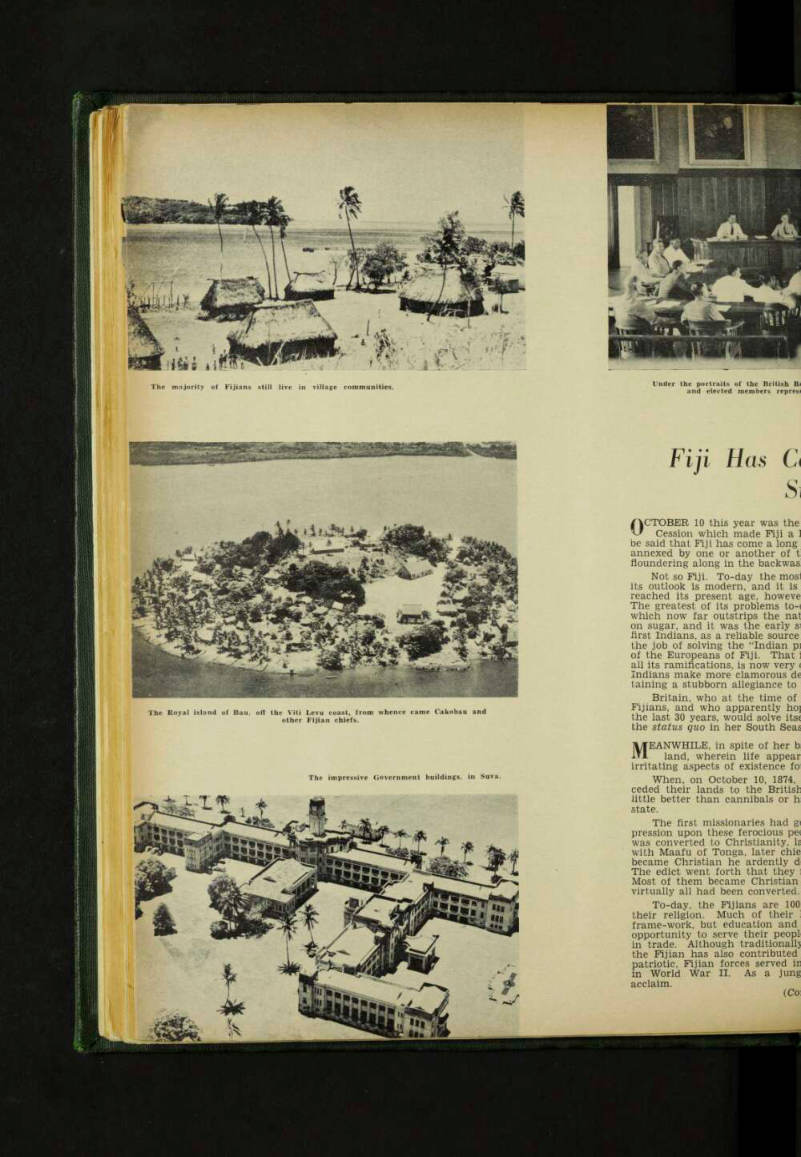
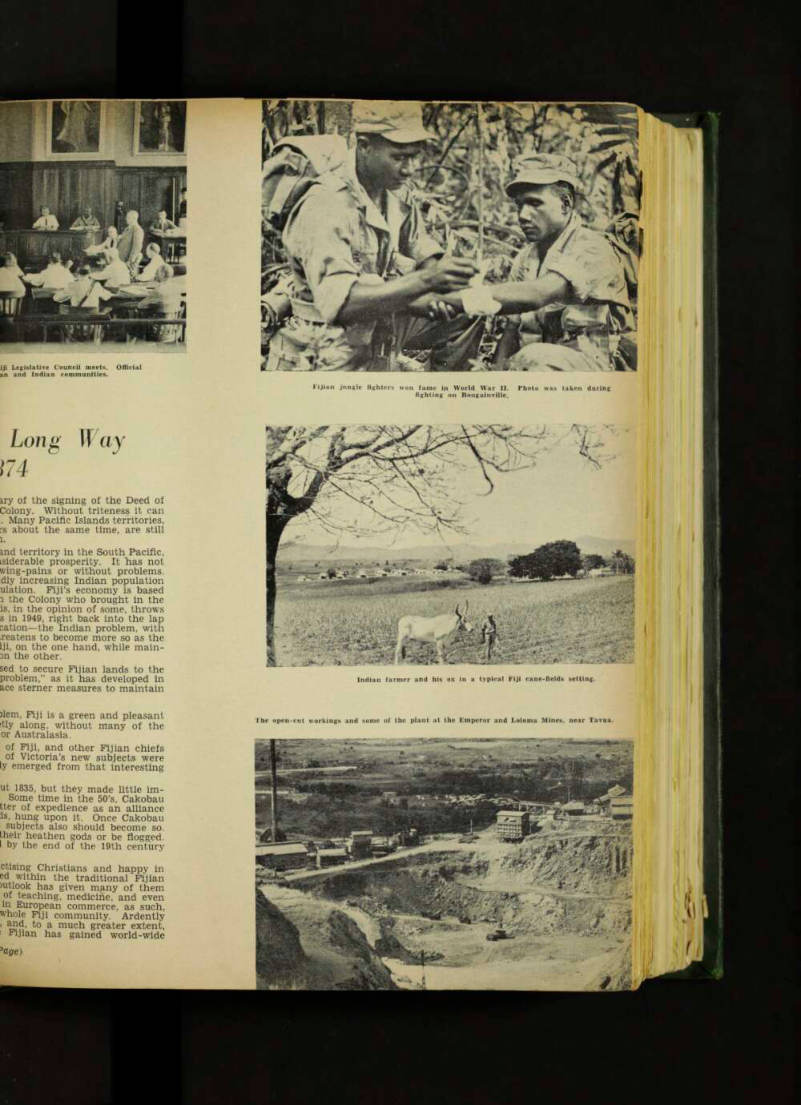
Miss Perkins went Reefing
A Short Story by Gib Jewell
LIKE a grotesque impatient bird, lean with hunger and excited by the proximity of abundant food, Miss Perkins bent and searched, straightened and bent again to search among the nooks and crannies of the uncovered coral reef.
She was a tall, angular woman, with the lined and worn face typical of middle-aged school mistresses. A huge, straw hat flopped about her head. She wore a "white sun suit, which sheepishly revealed her gaunt, reddish nakedness.
She carried a large cane basket.
The basket was already heavy with shells and pieces of coral plus several of the more fantastic oddities abounding in the mild, blue waters of the great reef. With squelching sand-shoes, Miss Perkins moved carefully through the lank sea grass, and the mattered seaweed of the shelving pool before her.
And, just as carefully, she placed the dripping basket on top of a tall nigger head on the far side of the pool. It will be alright there for a minute or two, she thought.
Although she had been there many times in her wistful dreams, although she had been lecturing on the reef for years, it was the first time she had ever seen it. It fascinated her. An odd phrase —some half-forgotten undertone, some words she had read or spoken, darted across her eager mind—“A coral reef it self is a great cemetery.’’ No, she cor rected herself, it was: “A great coral cemetery!’’ Fiddlesticks, she thought angrily. She knew, now, how to de scribe a coral reef, especially an ex posed reef like this one, which at low tide was not a pleasant sight.
What had been, a few hours earlier, a living fairyland of vivid colours, of flashing movement, of sparkling beauty, was now a drab brown wasteland. All about her Miss Perkins could hear its curious cracklings and the sucking noises of it, and she knew that although the reef seemed dead and rotting, it was very alive. She could hear a billion whispering voices, feel a billion micro scopic eyes staring at her. Round cold eyes, frightened eyes, fierce eyes, glar ing eyes, eyes that had no bodies, bodies that had no eyes, bodies that crushed to death, struck suddenly, pierced, poisoned, shammed, fought, or fled for very life . . . The rotting reef was alive: there was no cemetery there. She thrilled as the paradox flashed through her mind: The reef was alive alright: It was alive with death!
STIRRED by theses strange thoughts surging through her usually prosaic mind, Miss Perkins looked at her surroundings with a deepened interest.
So avid had been her search for shells that she found, with surprise, that she had unwittingly worked her way almost clear to the outer edge of the reef. Be side her, the shallow pools of the reef gave way to wider, deeper stretches of water, and with a start, Miss Perkins realised they linked with the sea itself.
She gazed incredulously at that whispering expanse of silken water.
When she had first begun her reefing it had seemed so remote, almost miles away. Certainly something that had not to be considered for hours. Now, it was barely five yards away, and she sus pected that it was coming nearer every second.
She turned her head. Half a mile away, the dazzling coral beach, like a ribbon of silver, carelessly thrown at the feet of the green atoll blinked vacantly at her.
There was no movement on it.
The rest of the party had gone.
She was alone!
Quickly she turned in the direction of the rocky point off which she had last seen the Velita. She had seen it half a dozen times that afternoon, floating like a tired seagull on the blue water, but now the white (launch, too, was gone.
Odd fragments of her lecture sprang into her mind (she could hear herself speaking to the hot, bored class room— for years she had been speaking thus, and the words had had no significance.
Now they were emphatic, and real): “In some parts of the Barrier Reef, the tide rises and falls 22 feet!’’
She felt a gentle tugging at her legs, and glancing down, saw the water swirling there, eddying around and be tween her knobby knees. It chuckled as it tugged at her.
With horror the graveness of her po sition struck her. She was alone on the outer edge of a wide reef, and the tide was racing in!
But Miss Perkins did not panic—yet.
She sucked in a breath of air, jutted her phin, threw back her bony shoulders, and reminded; herself that she could easily regain the beach.
But supposing she did, what then?
Had the launch really gone? Was she to be stranded on that lonely little atoll? How long would it be before they missed her?
Then her practical, school-teacher mind briskly took command of her roving thoughts. Fiddlesticks, she muttered. But there was no time to lose. Already the drab, exposed reef was littered with little pools shining like a shower of new silver coins. Best get moving, she told herself.
HER hand reached for the basket on the tall niggerhead and clasped in stead the green satin mouth of a tiny clam. The clam spouted like a minute whale. A jet of water geysered into the air; showered over Miss Per kins.
But she did not feel it, or hear it, or see it. She was staring breathlessly a few feet in front of her, into the mur muring water of the rising pool in which she stood. She was staring at some thing that moved there. All thoughts of her loneliness, of the racing tide were forgotten; her shining eyes watching the creeping object.
It was a nearly nautilus, she told her self, half unbelieving. And it was a large one—larger than she had ever seen or heard of; larger than she be lieved possible.
It was walking on its arms, huge shell uppermost.
Miss Perkins’ racing mind fluttered into the future. She did not see the nautilus as it was —crawling, dirty and almost perfectly camouflaged, on the bottom of the pool, a yard in front of her. Instead, she saw it, animal re moved, the shell, cleaned and beautiful, glowing with its lovely soft iridescence, occupying pride of place on the green baize table in her study at St. Anne’s.
She could hear the envious voices of the curious teachers, and pupils too, and her own careless voice saying: “Yes—it’s not too bad. Picked it up on the Barrier last time I was up there.’’
Stealthily, she moved onto the creep ing nautilus. Suddenly her right hand flashed, quick as a bullet, through the clear water. But she was not quite silent, of fast enough. The nautilus sensed the speeding hand, ejected water from its funnel, and shot, jet-like, ahead of the bubbling tracer trail.
Miss Perkins had thrown everything into that suicide dive. With a loud splash, and a despairing gurgle she fell into the three-feet deep pool. She fell on her right hand. Her left hand thrashed wildly over, and with a dis gusted shiver she felt her fingers close round something, soft and slimy, and strangely hard, too. Her first impulse was to release it but her fingers refused her shocked brain’s demand and, as she struggled to her feet, the frightening knowledge that her spectacles were gone and that her straw hat was drifting fast away, was offset by the wonderful feel ing that, there, clutched firmly in her left hand was the huge, dripping, nautilus!
Hair clinging stickily to her head, and the sheepish sun suit, now that it was wet, revealing more of her scrawny figure than it should, Miss Perkins brought the nautilus close to her eyes.
She examined it carefully. It was a beauty! It was perfect!
But her feeling of triumph was short lived. Now that her glasses were gone, a feeling of helplessness came over her.
The loss of the hat made itself felt too —the late afternoon sun beat on her exposed head, and the glare almost blinded her. Now, faintly afraid, she peered in the direction of the beach.
There was a shining expanse of water, about 30 feet wide, between herself and the now blurred remainder of the ex posed reef. She could see the beach but vaguely. It seemed a mile away.
The creeping water was sucking at her legs where she stood. It was already three inches above her knees, and the tug of it was more urgent than before.
The silken water had silently surrounded her. There was no escape.
(Continued on page 56)
A sob came from Miss Perkins.
Clumsily she forced her way through the swirling tide to the niggerhead. It was slippery at the base, and climbing it with the use of only one hand was not a pleasant task. She was torn and bleeding freely from a dozen jagged cuts before she reached its top. But she still clutched the nautilus firmly in her left hand.
She stood there. Trembling with ex haustion and fear she swayed. One leg shot out sidewards as she struggled to regain her balance. Her foot struck the basket which sprang into the air. Its contents showered away from it, as it smacked into the hungry sea. For a second it whirled in an eddy, then, half submerged, bottom up, it rushed away with the tide towards the island.
Miss Perkins was very afraid now. She peered about, her aching eyes frantic with fear. There was nothing but the ever-expanding sheet of water. But after the first frightening rush of the tide it seemed to rise much slower. As she watched the level of the sea creep up, she realised what a fool she had been not to have tackled the long wade to the beach instead of climbing the niggerhead.
Maybe there was still time, she thought. If she dived in now, she would have to swim for a while; then she could wade the remainder of the journey.
Placing the nautilus to one side, she bent and unlaced her sandshoes. She tied the laces together, and placed the joined shoes so that she carried them one each side of her neck. They would be necessary when she was wading. Even as she placed them about her neck, she noticed the nautilus. It was slowly moving towards the edge of the niggerhead.
Alarmed, she sprang towards it, and bent to grasp it. Away went the sand shoes, slithering over her bowed head.
They hit the niggerhead, and bounced off it into the swirling sea. Miss Per kins, nautilus in her hand again, watched them weave their way through the clear water. They zig-zagged down.
They had almost reached the bottom when suddenly a racing shadow flashed across the path of the shoes, there was a swirl, and they vanished.
Aghast, Miss Perkins stepped back, the razor-edge on the niggerhead sliced deep into her heel and she realised she dared not swim ashore. She felt faint.
She shivered. It was getting cooler.
WITH tropic speed the sun was set ing behind the squat island. Soon it would be gone, and Miss Per kins would be alone in the shadows of the evening; alone in the greedy im mensity of the sea.
It was then that she really panicked.
She began to scream, wildly crying into the approaching evening. Sadly the echo of her piercing sobs floated lazily back from the empty bay. Suddenly at her feet, stinging the gash in her heel, she felt the sea as it whispered over the top of the niggerhead. The burning of the salt in her wound, shocked her from
her hysteria.
There was no hope now, she told her self dully. This was the end. This was it.
Then, suddenly, she thought she heard the faint throbbing of an engine. She held her breath. There it was again!
Hope surged in her heart, and fear too.
She could not see the launch, but from the increasing volume of its engine noise she knew that it was approaching her.
Her hands fluttered down, and even as
she hastily unwrapped the white sun top from her body, even in the extreme urgency of the situation, she blushed.
For a second she hesitated; for a second her prim, spinster mind told her it was indecent, then her hand flashed up waving the white sun-top.
She seemed then to be standing on the darkening surface of the water. Her hair streamed behind her, as her head tossed vigorously with the thrashing movement of her arms. In one hand she waved the sun-top, in the other, the nautilus. It looked as though she were naked.
And over and over she cried, “Here!
I’m here! Come here! Over here!”
Then she saw the shadowv outline of the launch and despair clutched her heart. The launch was not the white Velita, and it was not coming towards her. It was racing past her, away from her! The more she waved, the louder she screamed, and the further the mysterious launch raced away. The wash of it nearly swept her off the nigger head, and for a time all her attention wac required to keep her precarious hold. In her struggle to do so, the sun ton was lost. The launch’s wash sub sided.
Panting, she straightened up. Night was approaching fast, but all feeling seemed to have left Miss Perkins. The reaction from her near-rescue left her numb, an inert mass of shivering fle^h.
She was standing thus, dumblv watch ing the darkening water when the faint beam of the approaching searchlight crept over the water and moved along the beach; left the beach and began to sweep the bav. It lingered on Miss Per kins and then shyly moved away from her.
It became brighter again, as it hesi tantly arched across the bay. Coyly it danced along the water. As it slowly approached Miss Perkins on its return ing sweep, her frozen brain snapped.
This was her last chance, and there was onlv one thing to be done.
This time she did not hesitate. Swiftly .'■he bent and for a moment she splashed in the sucking tide. There was a shower of water, then madly she waved her white shorts above her head.
Now the searchlight became blinding as the launch sped towards her, churn ing the quiet waters of the bay into a seething mass of glittering fish. The sea boiled about her as the dazzled gar fish left the water, jumping blindly. One or two struck Miss Perkins as the search ing light passed over her, but she did not feel them.
Suddenly the light stopped, then, more sure of itself, it returned to her, and held Miss Perkins in its blinding glare, as she stood gaunt and naked, knee deep in the swirling water, waving madly.
She never thought of her nakedness; she did not care. The Velita could have been the Queen Mary, and the ten breathless watchers, ten thousand, for all she cared. She was conscious only of a great weariness., and the wonderful relief that was flooding her dazed mind.
She sobbed a little as they lifted her, blanketed her tired body, and carried her gently to a bunk.
She was asleep before they could give her brandy, but she still held the giant nautilus in her left hand. * * * MISS PERKINS went reefing, and her reefing trip taught three people three separate lessons: It taught Miss Perkins, the school
mistress, the amateur naturalist, proud possessor of the largest-known nautilus shell, never to linger on a reef when the tide is making.
It taught Jenson, the owner of the Velita, the master of trips to the barrier, always to count his heads be fore returning home, and to leave a dinghy handy for the reefers.
And it taught O’Leary, ex-drunken fisherman from the Hull River, the bene fits of sobriety. To his external regret, he had been a little tipsy that never-to be-forgotten evening when he saw the mermaid in Naida Bay. “Sure,” he says excitedly, “there she was all white in the evenin’! Her breasts pointin’ at me, and she wavin’ a piece of seaweed in one hand, and a grinnin’ skull in the other. She was dancin’ as light as a feather on two fathoms of water. I tell you, I’ll niver forget the sight of her.
Niver! She almost lured me onto that bombie there! I swear it’s true! I swear to God it’s true!”
These days O’Leary haunts Naida Bay.
He does little fishing. He never drinks, and he carries a camera. For no one on the Hull River will believe his story.
for Weaklings
Norfolk Island Whaling is Not for Weaklings
By Vernon Wheatley
EVERY year whales from the Arctic wastes south of New Zealand pass Norfolk Island on their annual trip to warmer latitudes where they breed.
During this period—from July to Novem ber or December—it is not uncommon to see the mammals close inshore, and, on calm evenings, one can clearly hear the detonation as they slap the surface of the water with their flukes, in play.
The blue or hump-back whale is the most common in Norfolk waters, but in January an occasional sperm whale puts in an appearance. The blue whale is com paratively less risky to kill than a sperm.
It seems that the sperm whale has twenty-feet jaws and can easily crush a small boat and its crew.
Although the present company operat ing at Norfolk Island—The South Seas Whaling and Sharking Company—have only recently begun operations, the whale ing industry was formerly carried on for very many years by the Islanders them selves, operating from the same site located at Ball Bay.
The Islanders’ whale-boats, mere 30-foot wooden craft, were rowed or sailed, and each crew operated in conjunction with another. Also, between all crew members
there was complete under standing. This was essential, for the mistake of one could lead to the death of all.
Usually two craft put out and one would never make an independent kill —one craft would always stand by ready to lend a hand, if necessary.
When you are within almost touching-distance of a whale, 60 or 70 feet long, it is wise to be prepared for any emergency. A whale’s weight is calculated at the rate of one ton to each foot of length.
THE Island whalers had to be tough to tackle a whale in an open boat.
Their harpoons and lances were hand-thrown and the boat had to be carefully placed alongside so that the harpoon could be thrust home through the thick skin and the mass of blubber.
Iron nerve was essential.
No panic was permitted in a tight situation. As an example they quote the oc casion when one boat was searching off Garnet Reef and a whale surfaced —beneath the boat! The crew sat like images. The whale carried the boat on its back across the entrance of Ball Bay (about a mile) before it submerged off Flat Rock.
During their unenviable ex perience not one member of the crew spoke or showed signs of strain.
New recruits to the crews had only one chance to prove themselves. If they showed signs of panic or spoke during the critical moments before the kill, they were not after
wards selected as crew members. Dis obedience of the skipper’s orders meant automatic disqualification. Usually, new crew members who looked likely to panic were hit over the head and temporarily knocked out. This seemingly harsh measure was necessary for the safety of tne rest 01 tne , cvew - Once the whale was killed, its mouth was literally sewn up before it was towed to shore. Sewing the mouth was essen tial, as the lower jaw dropped, thus in creasing resistance to towing. Similarly, towing tail-first causes the flukes to ex tend from the carcase at an angle of 90 deg., thus causing an even greater resis tance. The Company, by the way, plan to tow tail-first, after cutting the fluke muscles and sinews thus allowing the flukes to fold back from their closed position as soon as towing movement is started, The Islanders cut and boiled the blubber on shore under somewhat primitive conditions, but the oil was generally of a high grade. War-time restrictions brought a halt to their whaling and re cently the Company acquired their assets, hoping to streamline the industry as there are Plenty of whales for the taking,
(Continued on page 58)
Typical coastline, Norfolk Island.
THE Company was started by Mr. and Mrs. Max Picard of Hamilton (NZO, and Captain K. Hansen, who has been responsible for the erection of most of the buildings and the plant, including winches, petrol engines, choppers and cutters and also the re-installation of the boiling pots. In this work he has been ably assisted by Messrs. Stan and Bill Buffet, Johnny Young, R. Quintal, of the Island, and Les D’Arcy of New Zealand.
Nestling at the foot of the steep hills which slope down to Ball Bay, the build ings do not offend the eye. The scenery and general surroundings are beautiful, and one would expect a whaling factory to be out of place in such a spot. Strangely, it is not. The buildings are unobstrusive and face a concrete apron running into the sea. On the apron the whales will be flensed and the strips of blubber will be hauled up a slide. The product will be pumped out at the other side of the building as oil, awaiting shipments over seas.
Last year the Company, with an un usual run of bad luck, tried to operate against many difficulties. A launch was acquired but it was not suited for the job.
It lacked that extra touch of speed and the weighty harpoon gun held its bow down. The Company have now acquired a chaser from Cook Strait (NZ) with a speed of 30 knots and more, plus a record of over 100 whales killed.
The original launch broke down after the beginning of the previous season and precious time was lost in making only temporary repairs. When all seemed set fair, the Island ran out of petrol. So the Company ceased operations for the season. However, this may have been to the ultimate good, for extra time was thus available for improvements, modifications and additions to the existing plant.
The Company deserves full credit for its virile approach to seemingly insur mountable difficulties, particularly m re gard to the lack of facilities and supplies.
A big problem lies ahead as there is in adequate road access to the Bay, while the anchorage also is not of the best like all Bays on the Island, it is suitable only when the wind is fair.
If the Company meets with the success it deserves, it will automatically have a bearing on the future economy of the Island.
Fiji Has C[?] Long Way
S[?]74
OCTOBER lO this year was the Cession which made Fiji a ] be said that Fiji has come a long annexed by one or another of t floundering along in the backwas!
Not so Fiji. To-day the mosl its outlook is modern, and it is reached its present age, howeve The greatest of its problems to-< which now far outstrips the nat on sugar, and it was the early si first Indians, as a reliable source the job of solving the “Indian pi of the Europeans of Fiji. That i all its ramifications, is now very < Indians make more clamorous de taining a stubborn allegiance to Britain, who at the time of Fijians, and who apparently hoj the last 30 years, would solve itse the status quo in her South Seas Meanwhile, in spite of her h land, wherein life appear irritating aspects of existence foi When, on October 10, 1874, ceded their lands to the British little better than cannibals or h state.
The first missionaries had g< pression upon these ferocious pe( was converted to Christianity, Is with Maafu of Tonga, later chie became Christian he ardently d' The edict went forth that they ] Most of them became Christian virtually all had been converted.
To-day, the Fijians are 100 their religion. Much of their i frame-work, but education and opportunity to serve their peopl in trade. Although traditionally the Fijian has also contributed patriotic, Fijian forces served in in World War 11. As a jung acclaim. (Co:
Under the portraits of the British R< and elected members repres<
The majority of Fijians still live in village communities.
The Royal island of Bau, off the Viti Levu coast, from whence came Cakobau and other Fijian chiefs.
The impressive Government buildings, in Suva.
iry of the signing of the Deed of Colony. Without triteness it can . Many Pacific Islands territories, rs about the same time, are still i. md territory in the South Pacific, isiderable prosperity. It has not wing-pains or without problems, dly increasing Indian population ulation. Fiji’s economy is based i the Colony who brought in the is, in the opinion of some, throws s in 1949, right back into the lap cation —the Indian problem, with reatens to become more so as the iji, on the one hand, while main cn the other. sed to secure Fijian lands to the problem,” as it has developed in ace sterner measures to maintain )lem, Fiji is a green and pleasant itly along, without many of the or Australasia. of Fiji, and other Fijian chiefs of Victoria’s new subjects were ly emerged from that interesting ut 1835, but they made little im- Some time in the 50’s, Cakobau tter of expedience as an alliance is, hung upon it. Once Cakobau subjects also should become so. their heathen gods or be flogged.
I by the end of the 19th century ctising Christians and happy in ed within the traditional Fijian mtlook has given many of them of teaching, medicine, and even m European commerce, as such, whole Fiji community. Ardently ’ and, to a much greater extent, : Fijian has gained world-wide 'age)
Fiji Legislative Council meets. Official [?]an and Indian communities.
Fijian jungle lighters won fame in World War II. Photo was taken during fighting on Bougainville.
Indian farmer and his ox in a typical Fiji cane-fields setting.
The open-cut workings and some of the plant at the Emperor and Loloma Mines, near Tavua.
The Indian, although he is a problem, has contributed a great deal to the wealth and prosperity of the Colony. The majority are still peasant farmers, but many have be come the small shopkeepers and tailors of the towns; they have entered the professions; and the transport industry is completely in their hands.
SHORTLY after the capital was moved from Levuka, on Ovalau, to Suva, which has developed into a fine town of impressive build ings, fine homes and public institu tions. Around the sugar centres, in other parts of the Group, other large towns have grown. The whole Colony is well-roaded, and Nadi, on north west Viti Levu, the present inter national airport, has become a Pacific aerial cross-roads. In 1950 or 1951 it is expected that the inter national airport will be moved to a new site near Suva.
There are deep-water harbours for ships of all tonnages at Suva and Levuka, from whence go the copra, coconut oil, canned pineapples, sugar and bananas to help feed a hungry world. From the huge Emperor Gold mines at Tavua, go the gold ingots that help to provide the British Commonwealth with elusive Yankee dollars.
Advertisements & other items, p. 55 (1 item)
Long Way
!74
Tropicalities
AN interesting feature in the Aus tralian Broadcasting Commission’s Walkabout session on October 4, was called Plumed Shepherds of the Wahgi— which told primarily of the Hallstrom sheep experiment at Nondugl, in the New Guinea Central Highlands, and something of the history of the valley and the people who live therein.
Much of the feature was recorded by ABC’s Colin Simpson when he visited the area recently with a party that in cluded Mr. E. J. Hallstrom, William Dobell, the Australian artist, and Sena tor Armstrong.
For once, the ABC was historically correct and gave the credit of European discovery of the valley where it was due —to the Leahy brothers who were prospectors, and to Mr. Jim Taylor, of the New Guinea Administration who made the difficult journey in the early thirties. This fact got barest mention (although it is one of the most fascinat ing stories in British colonial history), but it may correct the general belief of Australians that the New Guinea High lands were discovered by Mr. Hallstrom, of refrigerator fame. * * ♦ THE Nondugl sheep experimental sta tion is in charge of Mr. N. Blood, an old Territorian, who has his wife and young daughter Susan with him. Interviewed by Simpson, he told the story of how he first saw the High lands during the war when he brought a party, who were getting away from the Japs, over the mountains from the Sepik country. One of many interesting
points that emerged from his talk, was that kunai grass, which so many Terri torians have gazed at in the past—and said: Ah! The beef it would raise! —is no good for stock raising. The Kunai at Nondugl has been rooted out and kikuyu, perennial rye and clover grown in its place. Mr. Blood did this by divid ing the grazing area up into one acre plots, arid calling tenders among the local inhabitants for getting the kunai out. He was rushed by eager natives who accomplished the job with nothing more elaborate in the way of equipment than pointed sticks. They were paid in shell money.
The original 300-odd sheep (Romney Marsh, to withstand the wet climate— the Highlands get about 100 inches of rain a year) have now become, with the recent lambing, 1,400.
Mrs. Blood, who was born in Apia, Western Samoa, and lived most of her life around Sydney until she went to New Guinea about 14 years ago, told something of their interesting life in the Wahgi Valley, and the natives’ re action to her year-old Susan. Pressed by Mr. Simpson, she admitted that she liked the local natives well enough and added “. . . and that, considering I have lived 14 years in the Territory, is something! ”
It was a good feature, notwithstanding the fact that Senator Armstrong was served up at the end as the piece de resistence, to speak his bit about the sanctity of trusteeship and that there must be no exploitation, etc.—J. * * * FROM Daily Mirror, Sydney: Philan thropist E. J. Hallstrom is delighted that a new species of parrot, Psittacus Hallstromi, is going to bear his name. He’s an amateur parrot expert.
Leader of the expedition which recently captured the new birds in New Guinea, Captain Neptune (“Nep”) Blood, also has a species of bird named after him.
The Museum authorities named the lucky creature, a brilliant Bird of Para dise, “Paradisia Bloodi” (careful with your pronunciation!) ♦ * * 11HE rationing of petrol in New Cale donia was abolished in September.
In Australia, however, it has been re-imposed at the urgent request of Prime Minister Chifley. The system was wiped out in June last, on appeal to the High Court. There is held to be significance in the fact that the only big communities in the world which now have to suffer petrol-rationing are the Socialist governed countries of Britain, Australia and New Zealand. * * * ONE of our more advanced Native Medical Orderlies in Central New Guinea was determined to give his first-born a European name. As the time drew near, he still hadn’t decided on a name and he approached the Medical Assistant who rattled off all the Christian names he could think of.
None suited, however, and the NMO left for his outstation. A couple of months later he was back, and when asked what he had finally called the child, replied—“ Vaseline.” Probably that can be counted as at least appropriate for a NMO’s offspring—“A.”
THE limited English vocabulary of teachers in the outer Cook Islands, and their incapacity for assimilat ing any word or phrase not within their previous experience, have often been a source of innocent merriment to visitors.
The story is told of a lady visitor to one of the islands who was much in trigued by the pulchritude of a little native girl, who had her hair done in “corkscrew” ringlets, once the favoured coiffure of a youthful US film-starlet.
The white lady visitor had with her the usual interpreter—to wit, one of the island school-teachers.
Beaming upon the mother of the at tractive village infant, the tourist turned to her interpreter: “Tell her that her little girl looks just like Shirley Temple,” she said to the Man of Letters, a dungaree-clad youth of 20.
The interpreter, after a moment’s hesi tation poured upon the proud dame a string of Polynesian syntax. The proud mother, instead of beaming back, favored the white lady with unloving eye-daggers; which, after the procession moved on, gave her, as the French put it, furiously tg, think. It was plain that the compliment had not made the hit expected!
“Did you tell her just what I said?” asked the bestower of compliments.
“Yes, missis,” replied the Master of Arts.
“And what did you say in Maori to her?” the tourist-lady next wanted to know.
“Oh, I say her the same you tell me.
I say her, ‘The missis she say youlr daughter look like a surly, damn’ fool!”
Moral: When in need of interpreta tion, seek, in the Cook Islands, a Maori speaking European for your guide! * * * A HALF-PAGE of photographs of scenes in and around Port Moresby —photographs taken, apparently, to show native progress under Ward-ism— was published in the Adelaide News on September 28. One picture is entitled; “Native boys work beside white girls in the Port Moresby telephone exchange.
This is part of the Administration policy to make Papua and the mandated Terri tory eventually independent of outside labour.” The photograph shows five persons sitting in a row, shoulders almost touching, before a switchboard —two white girls and three native men.
It was too much for one former resi dent of the Territories —Dr. C. M. Deland, of Adelaide. He wrote a scathing letter to the newspaper, and asked “how are they going to stop undue familiarity by natives towards white women if they allow this sort of thing?” •i* H* *l® THE New Guinea Administration is finally doing something about hous ing its personnel in the Central Highlands.
Pre-fab. houses of the Bulolo type have recently been flown into Kerowagi for erection in the Chimba Sub-District and others have been erected already at Goroka and Kainantu.—“W.” ♦ * ♦ JAMES CAMERON, of the Camerons of Lochiel, lives the life of a king on the island of Kitavo in the Trobri and Group (Eastern Papua). He has a small lighting plant using about half a pint of petrol a week. A few days ago 500 40-gallon drums of petrol landed on his beach. They’d been jettisoned from a ship in distress.—Sydney Sun.
Advertisements & other items, p. 56 (1 item)
54
OCTOBER, 194 9 PACIFIC ISLANDS MONTHLY
A Long Way Since 1874 (Continued from page 53)
The Mysterious Ruins of the Trobriands
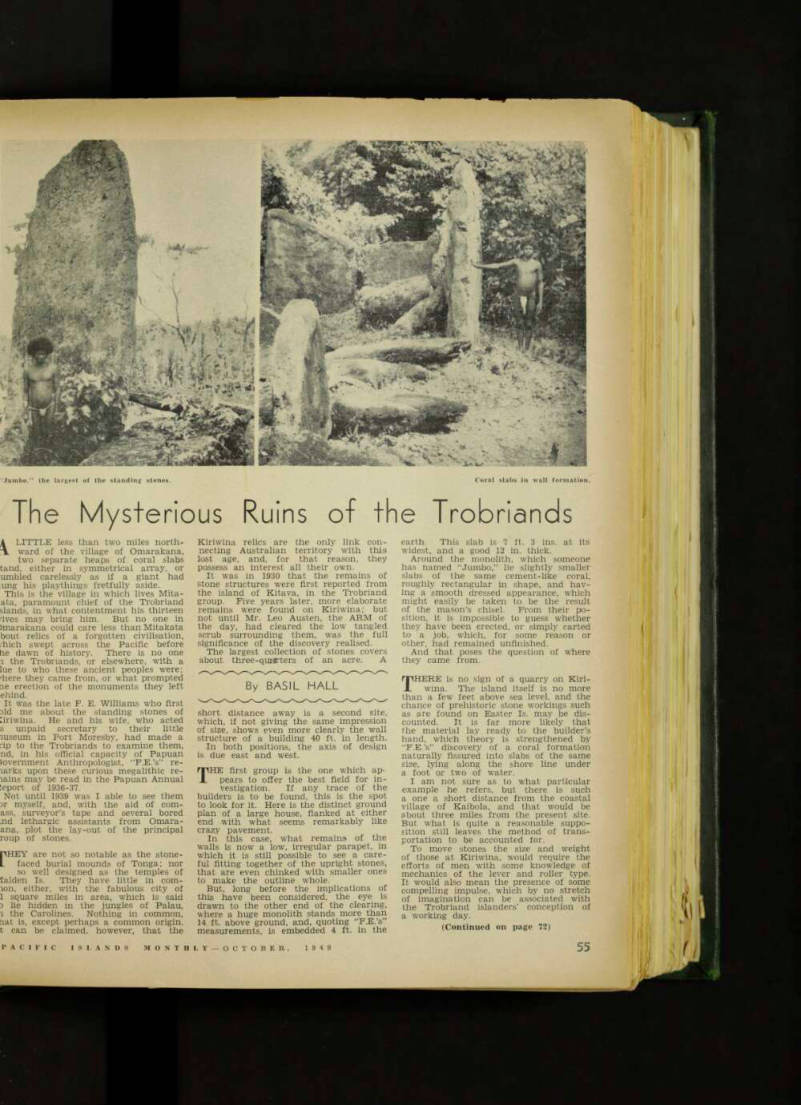
A LITTLE less than two miles north \ ward of the village of Omarakana, two separate heaps of coral slabs tand, either in symmetrical array, or umbled carelessly as if a giant had ung his playthings fretfully aside.
This is the village in which lives Mita ata, paramount chief of the Trobriand slands, in what contentment his thirteen dves may bring him. But no one in )marakana could care less than Mitakata bout relics of a forgotten civilisation, /hich swept across the Pacific before be dawn of history. There is no one i the Trobriands, or elsewhere, with a lue to who these ancient peoples were; diere they came from, or what prompted tie erection of the monuments they left ehind.
It Was the late F. E. Williams who first ild me about the standing stones of firiwina. He and his wife, who acted s unpaid secretary to their little luseum in Port Moresby, had made a :ip to the Trobriands to examine them, nd, in his official capacity of Papuan Government Anthropologist, “F.E.’s” re larks upon these curious megalithic re lains may be read in the Papuan Annual Report of 1936-37.
Not until 1939 was I able to see them ir myself, and, with the aid of com ass, surveyor’s tape and several bored ,nd lethargic assistants from Omara ana, plot the lay-out of the principal roup of stones. rHEY are not so notable as the stone faced burial mounds of Tonga; nor so well designed as the temples of lalden Is. They have little in com mon, either, with the fabulous city of 1 square miles in area, which is said i lie hidden in the jungles of Palau, i the Carolines. Nothing in common, bat is, except perhaps a common origin, t can be claimed, however, that the
Kiriwina relics are the only link con necting Australian territory with this lost age, and, for that reason, they possess an interest all their own.
It was in 1930 that the remains of stone structures were first reported from the island of Kitava, in the Trobriand group. Five years later, more elaborate remains were found on Kiriwina; but not until Mr. Leo Austen, the ARM of the day, had cleared the low tangled scrub surrounding them, was the full significance of the discovery realised.
The largest collection of stones covers about three-quarters of an acre. A
By Basil Hall
short distance away is a second site, which, if not giving the same impression of size, shows even more clearly the wall structure of a building 40 ft. in length.
In both positions, the axis of design is due east and west.
THE first group is the one which ap pears to offer the best field for in vestigation. If any trace of the builders is to be found, this is the spot to look for it. Here is the distinct ground plan of a large house, flanked at either end with what seems remarkably like crazy pavement.
In this case, what remains of the walls is now a low, irregular parapet, in which it is still possible to see a care ful fitting together of the upright stones, that are even chinked with smaller ones to make the outline whole.
But, long before the implications of this have been considered, the eye is drawn to the other end of the clearing, where a huge monolith stands more than 14 ft. above ground, and, quoting “F.E.’s” measurements, is embedded 4 ft. in the
earth. This slab is 7 ft. 3 ins. at its widest, and a good 12 in. thick.
Around the monolith, which someone has named “Jumbo,” lie slightly smaller slabs of the same cement-like coral, roughly rectangular in shape, and hav ing a smooth dressed appearance, which might easily be taken to be the result of the mason’s chisel. From their po sition, it is impossible to guess whether they have been erected, or simply carted to a job, which, for some reason or other, had remained unfinished.
And that poses the question of where they came from.
THERE is no sign of a quarry on Kiri wina. The island itself is no more than a few feet above sea level, and the chance of prehistoric stone workings such as are found on Easter Is. may be dis counted. It is far more likely that the material lay ready to the builder’s hand, which theory is strengthened by “F.E.’s” discovery of a coral formation naturally fissured into slabs of the same size, lying along the shore line under a foot or two of water.
I am not sure as to what particular example he refers, but there is such a one a short distance from the coastal village of Kaibola, and that would be about three miles from the present site.
But what is quite a reasonable suppo sition still leaves the method of trans portation to be accounted for.
To move stones the size and weight of those at Kiriwina, would require the efforts of men with some knowledge of mechanics of the lever and roller type.
It would also mean the presence of some compelling impulse, which by no stretch of imagination can be associated with the Trobriand islanders’ conception of a working day.
(Continued on page 72)
"Jumbo,” the largest of the standing stones.
Coral slabs in wall formation.
THIS is not to infer that the local in habitants are bone-lazy. Left to their own devices, the men will fish, dive for beche-de-mer or pearls in the three-fathoms lagoon from a canoe of their own construction. From the region of Boitala comes the most intricate wood carving, and, in general, the form and finish of common articles such as lime spatulas, shows an artistic sense that is very rare indeed.
Their gardens are justly famous for yams, grown in sufficient quantities to give the group an exportable surplus.
Add to all this, the time the ordinary man spends playing with his children, and it will be seen that little remains for the indecorous string games of the cat’s cradle order, with which my so called assistants were now amusing themselves in the shade.
They had long since exhausted the antics of measurement, and it remained for me to try photography. This is still a tender memory, for a colony of ferocious ants drove me yelping from the only tree high enough to make a bird’s eye picture possible. There was a moral here, if only I could have spoken the Trobriand tongue!
Yet even those who could meet the people on the common ground of language, were never told about the standing stones of Kiriwina. Brontislaw Malinowski, whose fascinating books have given the people of the group a place in literature * never learned about them, though he spoke the language well.
Neither did Charley Lumley, the late Rafael Brudo, or any other of the old hands receive a hint of their existence, and nowhere in song or story do these relics find a place in Trobriand folk lore.
These are the facts as my note books record them. But for the tragic fate of F. E. Williams in a wartime air-crash in New Guinea, there might have been something more to add. As it is, the standing stones of Kiriwina are “done finish” until research takes up the chal lenge. —“Argonauts of the Western Pacific,” etc.
Advertisements & other items, pp. 58-60 (3 items)
56
NORFOLK IS. WHALING
(Continued from Page 51)
OCTOBER, 1949 PACIFIC ISLANDS MONTHLY
MISS PERKINS WENT REEFING
(Continued from page 51)
57
ACIPIC ISLANDS MONTHLY— O C T O B E R , 1949
Burns Philp (New Guinea) Limited
General Merchants (Wholesale and Retail)
Shipping, Customs and General Agents
Head Office: PORT MORESBY, PAPUA
BRANCHES:
NEW GUINEA: Rabaul, Kokopo, Lae Cr Madang.
PAPUA: Samarai.
QUEENSLAND INSURANCE CO. LTD.
LLOYDS OF LONDON
BURNS PHILP TRUST CO. LTD.
BURNS, PHILP Cr CO. LTD.
All States.
BURNS, PHILP & CO. LTD.
"London House", 35 Crutched Friars, E.C.3. ‘'feURNS, PHILP CO. OF SAN FRANCISCO INC. 510 Matson Building.
Distributing Agents, Territory of Papua-New Guinea for:
SHELL COMPANY OF AUSTRALIA LIMITED
Petroleum Products
GENERAL MOTORS CORPORATION
Chevrolet, Buick, Pontiac and Oldsmobile Cars Chevrolet and GMC Trucks Frigidoire Refrigerators
VAUXHALL MOTORS LIMITED
Vauxholl Cars and Bedford Trucks R. A. LISTER & CO. BRISTOL Producers of Petrol, Parrafin and Diesel Engines Pumps and Lighting plants
RUSTON HORNSBY LIMITED
Engines
CROSSLEY MARINE ENGINES
REPRESENTATIVES FOR:
AUSTRALIAN AGENTS:
LONDON AGENTS:
SAN FRANCISCO AGENTS:
4 H.P. Single Cylinder Model.
VINCO Inboard Launch
Engines.
Suitable Boats. 10 ft. to 22 ft.
For over 20 years the most efficient and popular make in Australia. 2 % H.P., £39/10/-; 4 H.P.. £55; 8 H.P. (Twin), £lO3, F. 0.8., Sydney. Prices include Clutch and Equipment.
Write for Free 16-Page Illustrated Booklet.
VINCENT BROS.
44 Wentworth Park Rd., Glebe,
Sydney.
I m limited y 7 Bakers of the best biscuits S/9620
You Must Not Export Zebu
Bulls Fiji Still Has a Long List of Prohibitions
IN September, control was relaxed on some exports from the Colony of Fiji. Export licences are still re quired, however, for numerous items.
Restrictions still apply to export of goods imported from outside the sterling area; to the export of butter, ghee, cement, animal feeding stuffs, wheat, flour and sharps, meats, oils and fats, most/ of which can be imported into Fiji only under licence.
Scotch whisky must not be exported without a licence from the Comptroller of Customs—but anything up to a quart may be taken from the Colony by an outgoing passenger, a through passenger, or a member of a ship’s crew.
A licence from the Comptroller of Cus toms is required also for the export of locally produced sugar. A general licence has, however, been granted to cover the export by parcel post of quanti ties of sugar up to 11 pounds in weight.
Various Orders require exporters to obtain export licences from the Director of Agriculture for copra and copra pro ducts, dhalls, maize, sacks and rice and rice products.
The permission of the Colonial Secre tary is required for the export of whales’ teeth, pearl and ivory breast plates, ivory necklaces, and non-domestic birds or their plumage.
The Governor-in-Council must grant permission before sandalwood, o(r pure or half-bred Zebu bulls can be exported, and the Governor’s permission is re quired for the export of silver coin.
Licences must be obtained from the Financial Secretary for the export of gold coin, gold bullion, or foreign currency and for the export to a non sterling area of philatelic stamps in consignments of a value of over £5.
The export of Kauri gum from the Colony is prohibited completely.
Notes From Madang
From a Special Correspondent BRIGHT and breezy Ralph Cambridge, big-shot plantation inspector for “Carpenters,” was here the other day; and genial Tony Corlass, Ralph’s contemporary, also paid us a call. What those two old stalwarts don’t know about coconuts and native labour isn’t worth knowing.
Glad to see “Ned” O’Brien and wife back from South. The old battler was lucky to get over a bad bout of pneu monia. He did not respond to injections —but a glass of cold beer probably saved his life!
Those poor police-boys! How would you like to be garbed in that heavy blue serge and have two yards of the material wrapped around your loins? Why don’t they give them something sensible and comfortable —light and suitable for the tropics?
There should be no deaths in Madang when Dr. and Mrs. Theo. Braun arrive shortlv, and take up residence at the elaborate native hospital a few miles on the Madang side The amiable doctor is a genius with the knife, and an authority on tropical diseases, and he and his charming wife will be a valued ac quisition to the district.
Pastor and Mrs. Gander. Seventh Day Mission, shortly leave Madang on the new £9,000 motor-vessel, Leleman, for the Sepik, where they will make their new home. Mr. and Mrs. L. H. Barnard fpid child, also of the Seventh Day Mission, recently left Madang for Mt. Hagen. Mr.
Barnard will open up a leprosarium there.
Bright, dapper little John Siegers, a Malayan, who was brought to NG 37 years ago by the German regime, spent some time at Madang recently with his sister.
John is produce, shipping and customs man for Colyer. Watsons, Rabaul, and can rightly claim to be one of NG’s hardest and most conscientious toilers.
Mr. N. Cochrane has been appointed a District Magistrate in Fiji and will leave England on September 24 to take up his new post. Mr. Cochrane was educated at King William’s College, Isle of Man, and called to the Bar in June, 1938. Up to the time of his appointment to Fiji he was a practising barrister in the Leeward Islands.
Administration
Missionary’S Views Of Nauru
From Our Brisbane Correspondent ACCORDING to the Rev. J. Robinson, a Congregational missionary on Nauru, none of the Australian Ad ministrative staff on the island can sneak the Nauruan language.
He was of the opinion that the Admin istration could not really know the natives when none of its representatives, including the Native Affairs’ Officer, could speak the language.
Although the language was difficult to learn, his wife spoke it well after being there a little over two years.
The Administration had done nothing to rehabilitate the Nauruans, he said.
There was not one organisation on Nauru sponsored by the Administration, which had sought in any way to do that. Schools had to a certain extent been re-organised, but not adequately.
Mr. Robinson said that a housing scheme for natives was operating on the island, but the British Phosphate Com mission had organised it, not the Aus tralian Administration.
Mr. A. W. Small is now in New Zealand on vacation leave, prior to retirement after 39 years’ service with the Govern ment of Fiji. He was appointed a clerk in the Native Department in 1910, and for the greater part of his service he has been connected with Fijian affairs.
He was, for a time, Fijian interpreter at the Supreme Court, and later ap pointed a member of the Board of Examiners in the Fijian language. For over two years he was responsible for the weekly Tuesday night broadcasts in Fijian from ZJV. Mr. Small served over seas in the 1914-18 war with the Second Fiji Reinforcements.
Allowances
Fiji Military Forces Pay And
KATES of pay and allowances for the Fiji Military Forces were announced at the end of August. They vary from 3/- per day for privates under 21 (3/6 if over 21) to 57/6 per day for Colonels (on appointment—after two years’ service in rank the pay is 60/- per day).
Marriage allowances have been fixed at 8/- per day for Lieutenant-Colonels and
Colonels, grading off to 2/- per day for privates.
It is interesting to note that the pay for a Major, on appointment, is 40/- per day —which is equivalent to the ruling rate in Australia for a rough carpenter.
A daughter, Ann Elizabeth, was born to Mr. and Mrs. R. A. Harrison, alt Namanula Hospital, Rabaul, New Guinea, on September 20, 1949. Mr. Harrison is director of the Seventh Day Adventist Mission, Manus.
Advertisements & other items, pp. 61-62 (1 item)
Quantity Of New Plumbing Fittings
FOR SALE
GALVANISED AND BLACK FITTINGS,
in. to 6 in.
BRASS COCKS, 818, BALL, ETC., in. to 1 in. 3 in. and 4 in. Johns Pattern Gate and Check Valve.
Write for Complete Catalogue.
N. F. MALONEY & CO.,
Agents, Port Moresby, PAPUA Cab. add: MALCO. P.M.
Corrugated Aluminium Roofing Sheets*
i u
Bffl
i *
COOL
LIGHT
PERMANENT
A building material has now emerged which can meet the huge demand for homes, schools, industrial
buildings — Corrugated Aluminium Roofing Sheets.
As a protection against sun heat, Corrugated Aluminium Roofing has proved most effective. No special maintenance is required; no protective painting is necessary ; and Corrugated Aluminium Roofing * for every resists the corrosive atmosphere of marine and industrial regions.
Corrugated Aluminium Roofing is available as listed here: GAUGES: 26, 24, 23, 22. 20 and 18 s.w.g.
WIDTHS: 26" or 32" (Eight 3" corrugations and ten 3" corrugations respectively).
LENGTHS: 6', 7', 8', 9', 10', 11' and 12' in exact feet. of construction
ALUMINIUM UNION LIMITED
(Incorporated in the Dominion of Canada) Principal British Commonwealth Distributor of Aluminium Ocean House, 34 Martin Place, Sydney. An ALUMINIUM LIMITED Company.
Sales Agents for New Zealand Richardson McCabe & Co. Ltd.
Wellington — Auckland — Christchurch Sales Agents for Fiji, Western Samoa and Tonga: Morris Hedstrom Limited Suva, Fiji
HEAVY MACHINERY AND EQUIPMENT
FOR THE ISLANDS TERRITORIES
Steamships Trading Company Ltd.
AUTOMOTIVE and MACHINERY DEPARTMENT
Distributors in Papua and New Guinea for —
MOTOR CARS
ROOTS, LTD.—Hillman Minx —Humber Hawk— Humber Snipe and Sunbeam —Talbot Cars.
WILLYS-OVERLAND —Universal Jeeps—Jeepsters —Jeep Station Waggons.
Papua only.
ROAD TRANSPORT
INTERNATIONAL HEAVY DUTY MOTOR
TRUCKS —15 cwt. to 8 tons Gross Carrying Capacity. Utility Bodies—Platform Bodies— Tippers—Semi-Trailers—Low Loaders, etc.
AGRICULTURAL MACHINERY
McCORMICK-DEERING FARM TRACTORS, all
sizes, Wheel and Crawler Types.
FARM MACHINERY to suit every Purpose— Ploughs Harrows Cultivators Planters Harvesters Grass-Mowers Hay Rakes & Power Pressers —Chaff Cutters —Feed Grinders —Hammer Mills, Etc.
RICE-MILLING MACHlNERY—Hullers—Pearlers Polishers Threshers & Dressers Seed Graders —Aspirators—also Complete Mills from 100 to 3,000 lb. capacity rice per hour.
EARTH-MOVING EQUIPMENT
Bullgraders Dozers Excavators Front End Loaders—Road Graders —Road-Rippers—Waggon Scoops—Quarry Dumpers—Bitumen Sprayers, Etc.
TIMBER LOGGING AND
MILLING EQUIPMENT
Diesel Logging Tractors—Timber Trucks —Timber Jinkers —Log Haulers —Tractor Logging Winches —Truck Mounted Loading Gr Front End Pull Winches—Wire Rope, Etc.
SAW-MILLING MACHINERY Circular Saw
Benches—Circular Rack Saws Gr Log Mills up to 31 " depth of cut.
INDUSTRIAL EQUIPMENT
DIESEL STATIONARY ENGINES—from 5 h.p.
upward, all purposes.
DIESEL MARINE ENGINES—from 5 h.p. upward W/Reverse Gr Reducing Gears.
OUTBOARD MOTORS—2i to 22 h.p.
MOBILE CRANES—Wharf Gr Material Handling, 1 to 5 tons Capacity.
PUMPS & PUMPING PLANTS—Agriculture- Mining and General Purpose Pumps.
ELECTRIC GENERATING SETS—sizes to suit every purpose—A.C.-D.C. current.
ELECTRIC MOTORS—GENERATORS—FractionaI
sizes upwards—A.C. and D.C. current.
GANG Gr POWER GRASS MOWERS—Municipal,
Golf Course and Airfield use.
REFRIGERATORS
ELECTRIC COMPRESSOR and KEROSENE
OPERATED Food Storage Capacity. Models 4 to 7 Cubic Feet.
AUTOMOTIVE EQUIPMENT
STORAGE BATTERIES—for every purpose—Car —Truck—Radio—Marine—Lighting sets.
TYRES Gr TUBES—Cars —Trucks—Tractors— Industrial Equipment.
HYDRAULIC LIFTING JACKS—i ton to 10 ton capacity.
GENERAL CAR AND TRUCK ACCESSORIES—
Electrical Gr Hydraulic Replacements—Clutch Linings, Brake Linings, Etc.
Adequate stocks of spare parts are available for all vehicles and machinery at our
SERVICE PARTS DEPOT
PORT MORESBY
t
How The Us Deals With
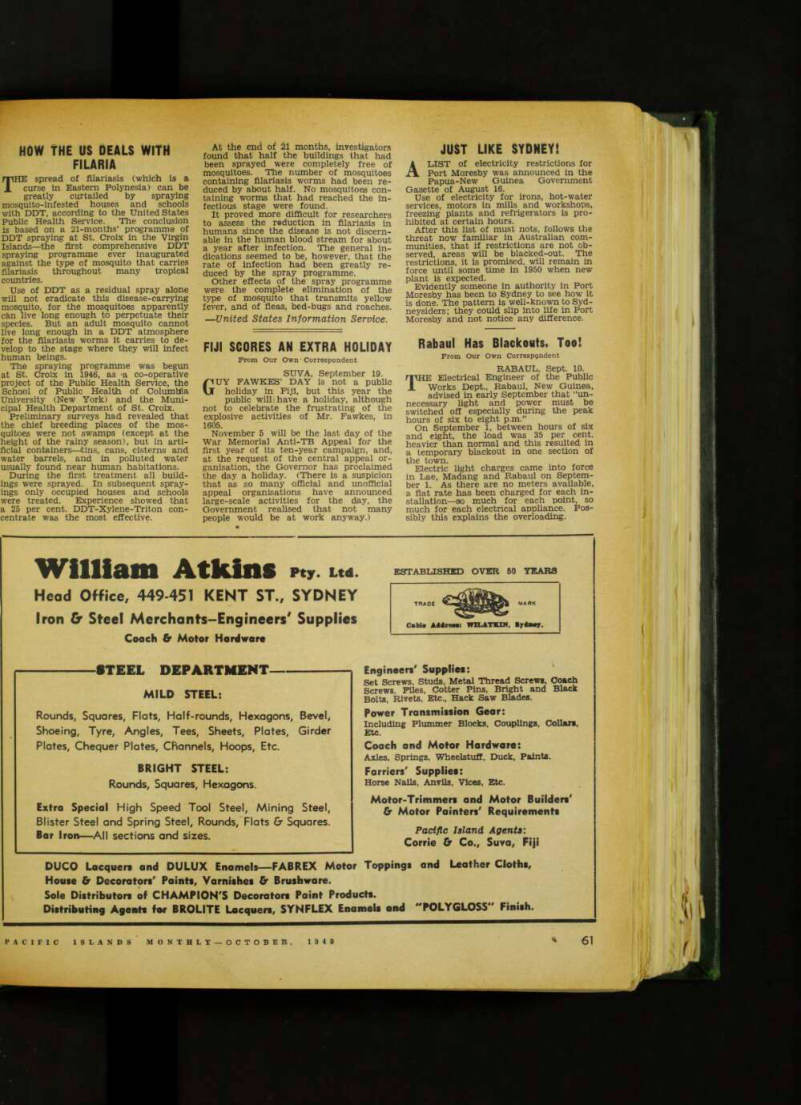
Filaria
THE spread of filariasis (which is a curse in Eastern Polynesia) can be greatly curtailed by spraying mosquito-infested houses and schools with DDT, according to the United States Public Health Service. The conclusion is based on a 21-months’ programme of DDT spraying at St. Croix in the Virgin Islands—the first comprehensive DDT spraying programme ever inaugurated against the type of mosquito that carries filariasis throughout many tropical countries.
Use of DDT as a residual spray alone will not eradicate this disease-carrying mosquito, for the mosquitoes apparently can live long enough to perpetuate their species. But an adult mosquito cannot live long enough in a DDT atmosphere for the filariasis worms it carries to de velop to the stage where they will infect human beings.
The spraying programme was begun at St. Croix in 1946, as -a co-operative project of the Public Health Service, the School of Public Healtih of Columbia University (New York) and the Muni cipal Health Department of St. Croix.
Preliminary surveys had revealed that the chief breeding places of the mos quitoes were not swamps (except at the height of the rainy season), but in arti ficial containers—tins, cans, cisterns and water barrels, and in polluted water usually found near human habitations.
During the first treatment all build ings were sprayed. In subsequent spray ings only occupied houses and schools were treated. Experience showed that a 25 per cent. DDT-Xylene-Triton con centrate was the most effective.
At the end of 21 months, investigators found that half the buildings that had been sprayed were completely free of mosquitoes. The number of mosquitoes containing filariasis worms had been re duced by about half. No mosquitoes con taining worms that had reached the in fectious stage were found.
It proved more difficult for researchers to assess the reduction in filariasis in humans since the disease is not discern able in the human blood stream for about a year after infection. The general in dications seemed to be, however, that the rate of infection had been greatly re duced by the spray programme.
Other effects of the spray programme were the complete elimination of the type of mosquito that transmits yellow fever, and of fleas, bed-bugs and roaches. —United States Information Service.
Fiji Scores An Extra Holiday
From Our Own Correspondent SUVA, September 19.
GUY FAWKES’ DAY is not a public holiday in Fiji, but this year the public will have a holiday, although not to celebrate the frustrating of the explosive activities of Mr. Fawkes, in 1605.
November 5 will be the last day of the War Memorial Anti-TB Appeal for the first year of its ten-year campaign, and, at the request of the central appeal or ganisation, the Governor has proclaimed the day a holiday. (There is a suspicion that as so many official and unofficial appeal organisations have announced large-scale activities for the day, the Government realised that not many people would be at work anyway.)
Just Like Sydney!
A LIST of electricity restrictions for Port Moresby was announced in the Papua-New Guinea Government Gazette of August 16.
Use of electricity for irons, hot-water services, motors in mills and workshops, freezing plants and refrigerators is pro hibited at certain hours.
After this list of must nots, follows the threat now familiar in Australian com munities, that if restrictions are not ob served, areas will be blacked-out. The restrictions, it is promised, will remain in force until some time in 1950 when new plant is expected.
Evidently someone in authority in Port Moresby has been to Sydney to see how it is done. The pattern is well-known to Syd neysiders; they could slip into life in Port Moresby and not notice any difference.
Rabaul Has Blackouts, Too!
From Our Own Correspondent
Rabaul, Sept. 10.
THE Electrical Engineer of the Public Works Dept., Rabaul, New Guinea, advised in early September that “un necessary light and power must be switched off especially during the peak hours of six to eight p.m.”
On September 1, between hours of six and eight, the load was 35 per cent, heavier than normal and this resulted in a temporary blackout in one section of the town.
Electric light charges came into force in Lae, Madang and Rabaul on Septem ber 1. As there are no meters available, a flat rate has been charged for each in stallation —so much for each point, so much for each electrical appliance. Pos sibly this explains the overloading.
Advertisements & other items, p. 63 (1 item)
Willia
I I
Atkins Pty. Ltd.
Head Office, 449-451 KENT ST., SYDNEY
Iron & Steel Merchants-Engineers' Supplies
Coach fir Motor Hardware
ESTABLISHED OVER 50 YEARS
Cable Address: WXLATKXN, Sydney.
STEEL DEPARTMENT
MILD STEEL:
Rounds, Squares, Flats, Half-rounds, Hexagons, Bevel, Shoeing, Tyre, Angles, Tees, Sheets, Plates, Girder Plates, Chequer Plates, Channels, Hoops, Etc.
BRIGHT STEEL:
Rounds, Squares, Hexagons.
Extra Special High Speed Tool Steel, Mining Steel, Blister Steel and Spring Steel, Rounds, Flats & Squares.
Bor Iron—All sections and sizes.
Engineers' Supplies:
Set Screws, Studs, Metal Thread Screws, Coach Screws. Piles, Cotter Pins, Bright and Black Bolts, Rivets, Etc., Hack Saw Blades.
Power Transmission Gear: Including Plummer Blocks, Couplings, Collars, Etc.
Coach and Motor Hardware: Axles, Springs, WheelstuJff, Duck, Paints.
Farriers' Supplies: Horse Nails, Anvils, Vices, Etc.
Motor-Trimmers and Motor Builders' fir Motor Painters' Requirements Pacific Island Agents : Corrie fir Co., Suva, Fiji DUCO Lacquer* and DULUX Enamels—FAßßEX Motor Topping* and Leather Cloth*, House & Decorators' Points, Varnishes fir Brushwore.
Sole Distributors of CHAMPION'S Decorators Point Products.
Distributing Agent* for BROLITE Lacquer*, SYNFLEX Enamel* and "POLYGLOSS" Fini*h.
These Are Rabaul District's Best
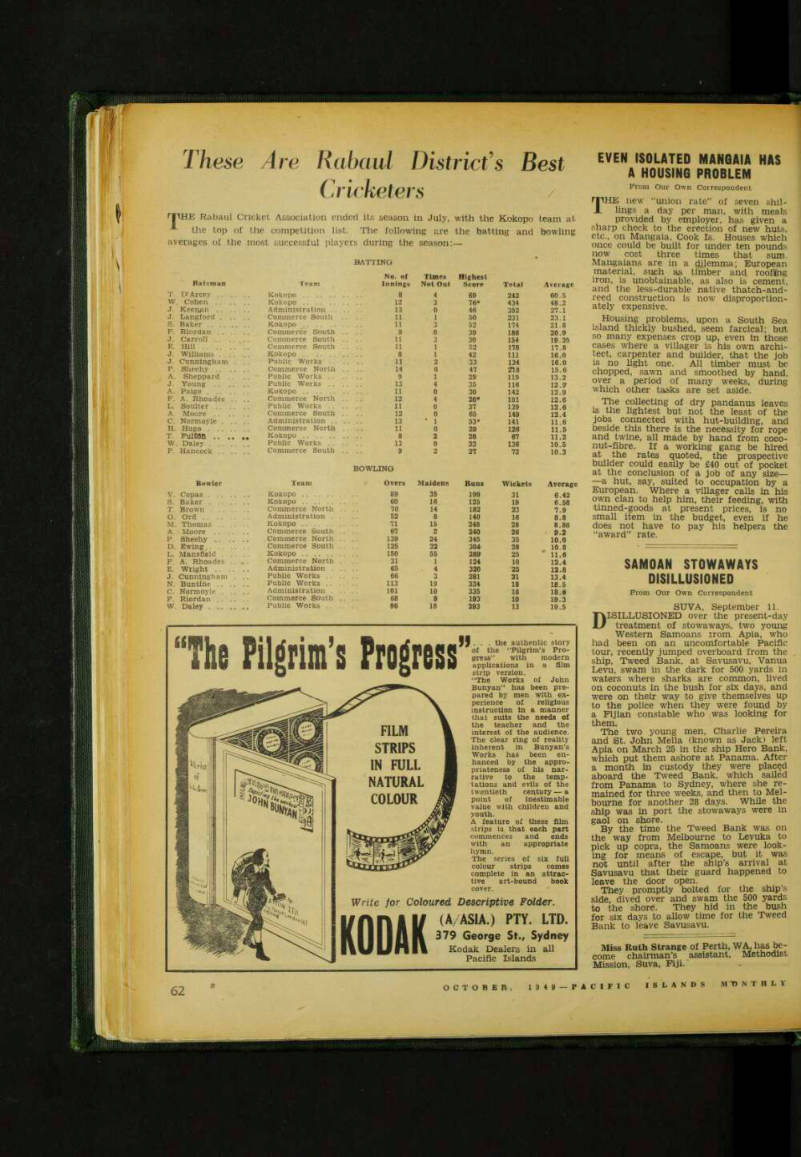
Cricketers
rfIHE Rabaul Cricket Association ended its season in July, with the Kokopo team at A the top of the competition list. The following are the batting and bowling averages of the most successful players during the season:—
T.
Batsman D’Arcey Team Kokopo
Hatting
No, of Innings Times Not Out 4 Highest Score 69 Total 242 Average 60.5 W Cohen Kokopo 12 3 76* 434 48.2 J.
Keenan Administration .. 13 0 46 352 27.1 J.
Langford Commerce South 11 1 50 231 23.1 S.
Baker Kokopo 11 3 52 174 21.8 F.
Riordan Commerce South 9 0 39 188 20.9 J.
Carroll Commerce South 11 3 30 154 19.25 E.
Hill Commerce South 11 1 52 178 17.8 J.
Williams Kokopo 8 1 42 111 16.0 J.
Cunningham . ..
Public Works . . 11 2 33 134 16.0 P.
Sheehy Commerce North 14 0 47 218 15.6 A.
Sheppard Public Works .. 9 1 29 119 13.2 J.
Young Public Works .. 13 4 35 116 12.S A.
Paige Kokopo 11 0 30 142 12.9 F.
A. Rhoades .. ..
Commerce North 12 4 26* 101 12.6 L.
Soulter Public Works .. 11 0 37 139 12.6 A.
Moore Commerce South 12 0 65 149 12.4 C.
Normoyle Administration .. 13 * 1 53* 141 11.6 H.
Hugo Commerce North 11 0 29 126 11.5 T.
FulWH Kokopo 8 2 28 67 11.2 W.
Daley Public Works .. 13 0 22 136 10.5 P.
Hancock Commerce South 9 2 27 72 10.3
Bowling
Bowler Team Overs Maidens Buns Wickets Average V.
Copas Kokopo 89 35 199 31 6.42 s.
Baker Kokopo 60 16 125 19 6.58 T.
Brown Commerce North .. 70 14 182 23 7.9 G.
Ord Administration . . 52 8 140 16 8.8 M.
Thomas Kokopo 71 15 248 28 8.86 A.
Moore Commerce South .. 67 2 240 26 9.2 P.
She'ehy Commerce North . . 139 24 345 35 10.0 D.
Ewing Commerce South .. 125 22 304 28 10.8 L.
Mansfield ...
Kokopo 150 55 289 25 11.6 F.
A. Rhoades .. <.
Commerce North . , 31 1 124 10 12.4 E.
Wright Administration . .. 65 4 320 25 12.8 J.
Cunningham . .
Public Works . . . , 66 3 281 21 13.4 N.
Buntine Public Works .. .. 113 19 334 18 18.5 C.
Normoyle ...
Administration . .. 101 10 335 18 18.6 P.
Riordan .. .. .
Commerce South .. 68 9 193 10 19.3 w.
Daley Public Works .. . . 86 10 293 13 19.5
Even Isolated Mangaia Has
A Housing Problem
From Our Own Correspondent THE new “union rate” of seven shil lings a day per man. with meals provided by employer, has given a sharp check to the erection of new huts, etc., on Mangaia. Cook Is. Houses which once could be built for under ten pounds now cost three times that sum Mangaians are in a dilemma; European material, such as timber and roofing iron, is unobtainable, as also is cement, and the less-durable native thatch-and reed construction is now disproportion ately expensive.
Housing problems, upon a South Sea island thickly bushed, seem farcical; but so many expenses crop up, even in those cases where a villager is his own archi tect, carpenter and builder, that the job is no light one. All timber must be chopped, sawn and smoothed by hand, over a period of many weeks, during which other tasks are set aside.
The collecting of dry pandanus leaves is the lightest but not the least of the jobs connected with hut-building, and beside this there is the necessity for rope and twine, all made by hand from coco nut-fibre. If a working gang be hired at the rates quoted, the prospective builder could easily be £4O out of pocket at the conclusion of a job of any size— —a hut, say, suited to occupation by a European. Where a villager calls in his own clan to help him, their feeding, with tinned-goods at present prices, is no small item in the budget, even if he does not have to pay his helpers the “award” rate.
Samoan Stowaways
Disillusioned
From Our Own Correspondent SUVA, September 11.
DISILLUSIONED over the present-day treatment of stowaways, two young Western Samoans irom Apia, who had been on an uncomfortable Pacific tour, recently jumped overboard from the ship, Tweed Bank, at Savusavu, Vanua Levu, swam in the dark for 500 yards in waters where sharks are common, lived on coconuts in the bush for six days, and were on their way to give themselves up to the police when they were found by a Fijian constable who was looking for them.
The two young men, Charlie Pereira and St. John Mella (known as Jack) left Apia on March 25 in the ship Hero Bank, which put them ashore at Panama. After a month in custody they were placed aboard the Tweed Bank, which sailed from Panama to Sydney, where she re mained for three weeks, and then to Mel bourne for another 28 days. While the ship was in port the stowaways were in gaol on shore.
By the time the Tweed Bank was on the way from Melbourne to Levuka to pick up copra, the Samoans were look ing for means of escape, but it was not until after the ship’s arrival at Savusavu that their guard happened to leave the door open.
They promptly bolted for the ship’s side, dived over and swam the 500 yards to the shore. They hid in the bush for six days to allow time for the Tweed Bank to leave Savusavu.
Miss Ruth Strange of Perth, WA, has be come chairman’s assistant, Methodist Mission, Suva, Fiji.
Advertisements & other items, p. 64 (1 item)
The Pilgrim’s Progress”
a
FILM
STRIPS
IN FULL
NATURAL
COLOUR
j °Hn s
KODAK
. . . the authentic story of the “Pilgrim’s Progress” with modern applications in a film strip version.
“The Works of John Bunyan” has been prepared by men with experience of religious instruction in a manner that suits the needs of the teacher and the interest of the audience.
The clear ring of reality inherent in Bunyan’s Works has been enhanced by the appropriateness of his narrative to the temptations and evils of the twentieth century a point of inestimable value with children and youth.
A feature of these film strips is that each part commences and ends with an appropriate hymn.
The series of six full colour strips comes complete in an attractive art-bound book cover.
Write for Coloured Descriptive Folder.
(A/ASIA.) PTY. LTD.
379 George St., Sydney
Kodak Dealers in all Pacific Islands
Fijians Ask For More
Savings Banks
SUVA, Sept. 19.
BEQA, an island famous for its fire walking natives and successful co operative enterprises of its all-Fijian nhabitants, has ended another legend— his time that all prosperous Fijians get id of their money as soon as they receive t.
A young man of Beqa, I. C. Nakaiwalu, ias been looking into the savings bank [uestion and has come up with a sharp irod for the Government. He points out hat as soon as the limited number of copra-planters (who produce learly two-thirds of Fiji’s copra) became rosperous, private enterprise in various orms descended on them from all direc ions, but the Government slipped up and ailed to provide savings bank facilities, "he result was inevitable. (As an illus ration of this point there is the fact that t the beginning of 1948 a tiny centre in r anua Levu had no Indian tailor. At the nd of the year it possessed six—all lourishing or they wouldn’t be there.) Nakaiwalu quotes the example of Gau, rhere a Government savings bank has een started by the head teacher of a 'ijian school with encouraging results, [e adds: “Most of the Fijians have been iven unlimited opportunities for wasting loney, but none whatever for saving it.”
Cuthbert’s Misima Goldmine Ltd. re orts that in the period from August 23 o September 22, the mill at Misima Eastern Papua) ran for 15 days, and esults were: Ore crushed, 420 tons; bul on produced, 540 ounces; gold contents, 2 ounces; silver contents, 115 ounces.
Death Of Mr. C. W. Aidney
MR. CYRIL W. AIDNeV died at the Colonial War Memorial Hospital, Suva, on September 17, at the age of 62. He had been a well-known busi nessman in Fiji for many years.
Mr. Aidney was born at Stoke-on-Trent.
England. As a young man he went to New Zealand and later to Fiji, in 1910.
He was with the original firm of Morris, Hedstrom, Ltd., at Levuka, and was sec retary of the company after its amalga mation with the Suva firm of Henry Marks and Co., Ltd. In the early 1920’s he went to Tonga as manager for Morris, Hedstrom, and in 1934 returned to Suva as manager for Sturt Ogilvie and Co. Ltd.
In 1937 he relinquished this post to be come a director of Williams and Gosling, Ltd., a business which he controlled until his death.
For several years in the war period, Mr.
Aidney was Price Controller, and he was secretary of the Copra Board from its establishment until he resigned last year.
He was a member of the Suva Bowling Club, the Defence Club and the Northern Club, Lautoka, as well as of the Auckland Stock Exchange. In 1920 he was a mem ber of the Levuka Municipal Council, which was then an elected body.
Mr. Aidney is survived by his wife and sons, Messrs. Basil and Don Aidney, who are engaged with Williams and Gosling, Ltd. Another son, William, died in Auck land. NZ, in 1943.
There was a large attendance at the funeral, including representatives of the principal Suva firms, the Mayor and pre sident of the Suva Chamber of Commerce (of which Mr. Aidney was formerly secretary), and the presidents of the De
fence and Bowling Clubs. The service was conducted by the Rector of Holy Trinity Pro-Cathedral (the Rev. H. W.
Figgess).
Advertisements & other items, p. 65 (2 items)
63
ACIFIC ISLANDS MONTHLY OCTOBER, 1948
Batteries
COLE’S
Tropic-Seasoned
CHICKENS
Pure WHITE LEGHORNS and
First-crosses: R.l. Red x W.L. or Australorp x W.L.
Bred in the sub-tropics and seasoned to your climate.
All Breeders guaranteed Government blood-tested. 25’s 50’s 100’s £ s. d. £ s. d. £ s. d.
W.L. .. 110 0 212 6 415 0 Crosses 111 6 215 0 500 Plus Air Freight
ED. COLE,
Enmore Poultry Farm, Cairns, N.Q.
m f a Y
BATTERIES
are tigers for work
*9 It is impossible to build a better battery than the Masse. Every part of a Masse Battery is of one hundred per cent, quality . . . every stage of its manufacture is carried out in the Masse factory. When you recommend a Masse Battery to your customer, you can do so, with the utmost confidence that it will give him more starts and longer service.
ROBERT GILLESPIE JSC. LTD.
RABAUL AND LAE
Dear Butter In
Fiji
THE price of Navua butter has followed that of the Rewa product by going up 2d. to 2/6 a pound. With New Zealand butter (which contains con siderably less water than the local pro duct) over 3/-, butter is to-day a scarce luxury for a great many people in Fiji, and frequent, if unspecific, references to the fact that high-quality margarine will probably be made here in a few months are widely welcomed.
The Advisory Committee on Agri culture has recommended that price con trols should be removed from local butter. During the committee’s dis cussion it was emphasised that if the industry secured the lifting of controls it would forfeit any claim to tariff pro tection in future. Canon W. G. Thomas, Anglican Mission, Dogura, Papua, recently visited Perth, WA on Mission business.
No Illusions Left
By Vernon Wheatley
AWAY from the political arena, we Islanders receive all ouk* political material second-hand, either by newspaper or via the radio.
Many think that this is a very good thing. One can always light the fire with the newspaper and we can adjust the radio.
But in spite of all our care, some in telligible sounds came to our ears. We find that several puzzling questions have been answered—and we have no illusions left. Carefully collected data is given below.
QUESTION: What is political propa ganda?
ANSWER: Anything favourable to the party it suits.
QUESTION: X, heated by the trials and tribulations of an intensive cam paign, called candidate Y a swindler, a
liar, a cad, and an oppressor of the poor.
How did Y reply?
ANSWER? By calling X a common swindler, an unmitigated liar, an un principled liar, a bare-faced cad and a dog-robber.
QUESTION: Candidate O guaranteed all persons over 60 £l2 per month. Can didate P promised £l4 to all over fifty.
Candidate Q promised £l6, plus free burial for all over forty. Candidate R promised precisely nil. How many votes did R receive?
ANSWER: Four. He was married— and two of his electors were hopelessly intoxicated.
QUESTION; Candidate U had a pleas ing personality and a cultivated “tooth paste ad.” smile. Candidate V had a soothing and wonderfully persuasive radio voice. Candidate W promised the world and a bit more. Who was elected?
ANSWER: 'Candidate “Honest John T,” who lied and lied with a touch of genius. He also had the snappiest fleet of cars at his disposal and bought the most free beer for the down-trodden worker.
QUESTION: (a) What is a Socialist Candidate? (b) What is a candidate who opposes Socialism.
ANSWER: (a) One who is prepared to stand by the people 100 per cent, (b) One who is prepared to stand by the people 100 per cent.
So now you know why we have no illusions left.
The Rev. Stewart Jurse, of the Presby terian church, Noumea, New Caledonia arrived in Sydney by plane, seriously ill, on September 25. He was transferred at once to a plane for Melbourne, where he will receive specialist attention.
Advertisements & other items, p. 66 (1 item)
..Widdop
Better for School Books <
They stand the rough end tumble. They're lighter end easier to carry.
Ask first for
SCHOOL CASES
'MABf BV
FORD SHERINGTON LTD.
GJiPIPSHi
■ •: mm mm&mss?
A* ■;■: r*» 120 H.P.
Direct reversing ;ii
..WIDDOP
DIESEL ENGINES
5 H*P TO 300 H P
H • WIDDOP & CO LTD
GREENGATE KEIGHLEY ENGLAND
Telephone: Keighley 3727-8 Telegrams: Widdop Keighley. Codes: A.B.C. 6th Edition, Bentley’s, Bentley’s Second
Sara.
iMBAIiSLVL
-V- -■ S ms
iiiii
r «««
CI PA Still Has
Ambitious Plans
From Our Own Correspondent MANGAIA, Cook Is. rHE “revised” Cl Progressive Associa tion, which has acquired some degree of renewed mana in the outer slands since it began to run an inter sland Fairmile launch, would appear to lave ambitious developments in view.
Local adherents talk of a chain of As ociation stores and orange-exporting lepots in the non-atoll islands of the Iroup; and a similar line-up of copra tations in the northern portion, which oes not produce any fruit. The exact osition of the IMD under this new order f Cl commerce has not been defined; mt it is evidently assumed that the Jovernment of NZ will respectfully step side and let the CIPA have control of rarketing, through channels developed riginally by private exporting enterprise nd, later, by the Marketing Division hen the Socialist politicians of New lealand commenced their experiments ith island oranges.
A point not yet clear is the exact line here the CIPA begins and the Govern lent stops—it is hinted that the Associa on is so heavily in debt to the NZ overnment that it has no real power of [dependent action since the purchase of re ship.
“Sinn Fein” Mangaia has always been fertile field for anti-Administration ropaganda; and its present faith in >ming developments, and a pan-Ameri in trading system, is great. There is, Dwever, no apparent sign of panic among le members of the established local hamber of commerce” —the leading rms appear to feel reasonably competent weather the crisis.
Humorists, adapting the pronuncia- Dn by adherents of the initials of the nbitious Association, suggest that its ores might take, for their advertising 3gan, the motto “Cheaper”!
Whether CIPA goods will actually be against powerful competition, remains be seen.
Suva To Be In Big Yacht Race
lUVA yachtsmen are building a special ) 18 ft. yacht to compete in the Jas.
J. Giltinan world 18 ft. champion lip trophy contest in Auckland next muary. In a letter to Mr, D. H. :elton, secretary of the Auckland Fly g Squadron, which is sponsoring the ntest, a Suva official says the boat is :pected to be completed about mid- Dvember.
It will then compete with Clover, (the ,cht mentioned when Fiji Challenged r the trophy) in a series of selection ials. Clover is said to be a modified -class 18-footer.
This is an international contest, in lich 18 ft., unballasted, single-hulled chts from any country may compete, itries are expected from places as far /ay as Hongkong and Brisbane. Con filing body is the New South Wales 18 Yacht Club, which presented the and the next contest is scheduled r Auckland.
New Guinea Martyrs’ Day was observed St. Paul’s Cathedral, Melbourne on sptember 2, when Archdeacon A. J. lompson of Samarai, was the celebrant a Memorial Communion. This Day mmemorates the murder of Anglican ission sisters and priests in New Guinea r the Japs in 1942.
Advertisements & other items, pp. 67-68 (3 items)
65
ACIFIC ISLANDS MONTHLY OCTOBER, 1949
Kerr Brothers Pty. Ltd.
■# Made in the Australian Branch Factory of
BLUNDELL SPENCE & CO., LTD., Hull,
B. & S. SUPER PREPARED PAINT embodies the knowledge and experience gained from nearly 140 years of Paint manufacture.
Tested and proved for tropical conditions, B. & S. PREPARED PAINT is also available in a special Lead-free series for use in volcanic and other sulphurous regions. (Specify B. & S.-Series 2301).
Ask for supplies of these and other BLUN- DELL Paints and Enamels from your local Storekeeper, or write for particulars and colour-cards to the Agent tor Pacific Islands :
KERR BROTHERS PTY. LTD.
4 YORK STREET, SYDNEY
An ornate example of historical
keys, this XVlth Century
French key features the sporting motif in its club and animal carvings. It seems to have been the key to a Duke’s country
lodge.
« v'- / a: m s sm
The key
to smoking pleasure
CAPSTAN
FINE CUT
NAVY CUT
TOBACCOS
or 1657./.48
66
OCTOBER, 1949 PACIFIC ISLANDS MONTH L Y
Muddle In Indonesia
Americans At Last Awakening To South Pacific’s Danger
)URING August and September, con ferences between Dutch and Indonesian representatives were •oceeding in Europe—mostly at The ague—concerning the formation of a etherlands-Indonesian Union, and the iplementation of the agreements ached, this year, for the government of e Unted States of Indonesia.
The history of events in the East Indies ice the end of the Pacific War has been iblished regularly in this journal. Right Dm early 1946, following the surrender Japan, we have never altered our view at — • The Dutch, who were our valiant lies, and who suffered cruelly in World ar 11, were deserted at the end of the ir by Britain and America, and given i aid in the herculean task of restoring der in the Netherlands Indies. • The Japanese in the East Indies, len they knew Japan would be defeated, t up a puppet government of intensely iti-Dutch Indonesians, called the Re blican Government. With the assistance the Japs—who were left undisturbed in e East Indies for a long time after the p surrender —this Government strongly sisted the return of the Dutch to Indo sia. • Slowly and painfully, the Dutch re sembled their forces, and proceeded to store their rule (which represented law id order) in Indonesia. There were ells of fighting between Dutch and In nesians (“Republicans”)—in which the donesians showed no military prowess latever. • Step by step, the Dutch restored order
over all the archipelagoes, except a sec tion of Java based on Jok.iakarta. Their troops gradually drove the Indonesians into the central and western parts of Java. • Just when it seemed that the Dutch had the situation in hand (about the end of 1948) the Leftist elements in the United Nations interfered, and forced the Dutch to resume conferences with the “Republicans,” with a view to stopping further fighting and recognising the “nationalist aspirations” of the Indone sians. • Although it was well known that (a) the Indonesians could not be trusted to adhere faithfully to any agreement, (b) the Indonesians were intensely anti- European and strongly influenced by Communism and (c) the “Republicans” had the active support of pro-Communist organisations (e.g., the refusal of the Communist wharf-labourers of Australia to handle any Dutch ships), the Dutch were obliged to dismiss their leading officials in the East Indies, and enter into the discussions which led directly to the recent conferences in The Hague.
THE present situation is that the Dutch now have agreed—with manifest re luctance—to a sort of partnership with the Indonesians in the government of the forthcoming United States of Indonesia.
Meanwhile, the Americans #re awaken ing to the fact that they, quite uninten tionally (through leaving the whole matter to the United Nations) have be trayed the Dutch.
This matter is of great importance to Australia and New Zealand, and all com
munities in the South Pacific. If the Dutch are not supported in Indonesia, the Indonesians will get complete control over the archipelagoes of the East Indies, and thus in turn will provide the Asiatics and Communists of Asia with an open road to the desirable, under-populated lands of the South.
America Waking Up
SOME five months ago, the United States newspapers, belatedly trying to as certain the true position in Indo
nesia, sent a party of 15 correspondents on a tour of the East Indies. The latter reported generally in favour of the Dutch, and against the plan to give sovereign power to the Indonesians before the Indonesians were competent to exercise it.
Nearly all those correspondents were killed in an air crash. One of the survivors, Mr. William R. Matthews, the editor of the Arizona Daily Star, on August 22, delivered a public address in Los Angeles. The following are some interesting extracts.
“In a diplomatic way, we have been highly incompetent. We have pursued and are to-day pursuing a negative policy of abdication and appeasement. . . . We followed it in Indonesia, where, behind the skirts of the United Nations, we tried
to hide our support of the Jap puppet government of Sukarno and its close alliance, until one year ago, with the Communists. The results are now ap paient in Indonesia where the Dutch, out of respect for us, have bowed to our de mands. In a year or two chaos can easily come out of this situation, “From what I saw of that great archi pelago stretching 3,000 miles along the equator, Indonesia can be restored and become an asset, rather than a liability, if we abandon our past political in fantilism and slippery diplomatic intrigue, I do not believe that good international relations can be built by betraying friends, or making unnecessary trouble for them, “The Dutch were our loyal friends during those trying years of 1940 and 1941.
They denied, at our request, oil and other supplies to the Japanese. I met some of the men who, as officials of the Dutch Government in Indonesia, gave us that help. They went to prison camps, while many of their associates died or were killed.
“Imagine their surprise when they came out of those prison camps in August, 1945, and found a Jap puppet, in close association with Communists, claiming to be the government of Indonesia. I talked with that puppet in June. He admitted that he had collaborated with the Japanese, and that he had been closely allied with Communists. His excuse was that he was working for Indonesian inde pendence.
“The Dutch, after playing ball with us as they had, were naturally surprised that they should be treated coldly by our government. They were even more sur prised to see our government, at Austra lian insistence, allow the United Nations to be used as a front to discredit them and increase the prestige of the Jap pup pet by recognising him as a belligerent!
Anti-Dutch Elements
T KNOW why we did it. We thought X Ve were playing smart politics, just as we did in Eastern Europe and China, by assuming the Communists ex pressed the will of the people and would be democratic. We adopted a cold blooded policy of assuming that the Dutch were through; that we were going to become the friendly sponsors of a native government, which we imagined would become a stable and friendly one.
“I am not going to recount the detailed events that took place between 1945 and as recently as this year, except to say that our American record is a questionable arid costly one. By supporting the Dutch in restoring order, by avoiding interference in internal politics, we could have saved ourselves uncounted millions. We could have allowed a naturally prosperous region to be restored with comparatively little help. But now it could have been a great help. By now it could have been a great wealth-producing area, not needing one cent from us.
“We have messed things up, all right, and the prospects are that it is going to cost us much money, if not lives. Our policy has been anti-Dutch. The members of our party saw it and heard it. Our diplomatic officials treated us coldly. They resented the coming of our party.
“What is more, top military observers of the United Nations were openly anti- Dutch. Newton, of Scripps-Howards papers, stayed behind when our party left Jogjakarta to watch developments as the Dutch evacuated. Pour lower-rank Aussies and three American military ob servers for the United Nations sought him out to plead with him that their reports were being diluted and slanted into anti- Dutch reports to the United Nations by the top military observers. Newton quoted line and verse.
“The top American and Australian mili ry observers were openly anti-Dutch id pro-Republican. When they tried to Isify about the Dutch evacuation and ie Republican entry, he called them liars their faces. He had seen the very thing ,ey were trying to lie about.
“All of our group were shocked by the e of the power of the United Nations the World to be unfair in the destinies the people. For our government to be party to such abuse made most of us hamed and angry. . . .
“The Dutch were frank in confessing eir mistakes. They admitted that they id moved too slowly in satisfying native pirations. Quite correctly and honestly, ey saw the danger and possible futility granting immediate independence. But ey had formulated a wise plan of adual independence, which we dis edited by our direct support of the Dlence of Sukarno and his Communist [ies.
What Of The Future
all parties have agreed (and the .1 meetings are in progress in the Hague to-day) that the Dutch will msfer sovereignty around January 1, 50, to a new government being formed, be known as the United States of In nesia. Jt will represent a coalition of ideralists and Republicans.
“A part of the consideration for this ant of independence is a Netherlands donesian Union of equal sovereignties. r this means the Dutch hope to work t a programme of Dutch tutelage, as tance in government and economic de lopment. I hope the Indonesians share this ambition. . . , ‘The Indonesians have had little par mentary experience. They have a lefully small service group. A very large rcentage of the people are illiterate. As ey develop and train an Indonesian my, the native military will occupy a
more and more dominating role. Along with this, we saw a bit of the jealousy that is already developing among the various ‘liberating’ groups. The prospects for a struggle for dominance among the present individual liberators appears almost certain, unless someone Tike the Dutch has the authority to exercise re straint.
“Unless we support the Dutch in exer cising this restraint and tempering the enthusiastic hopes of the Indonesians,
chaos will develop. The stage is set by the widely seperated islands for a disin tegration which no native army for many years to come can control alone. With Dutch guidance, it can be done.
“At this point, the Communist menace will become serious. The probable chaos and anarchy that are in prospect unless the Dutch have some power of restraint, will create a revolutionary situation which the Communists always count on develop ing. (Continued on Page 71)
“If America and the United Nations do )t support the Dutch in the basic need being responsible for law and order, nerica will have to step in, because we ust not let the Communists seize this rategic crossroads and comparatively jalthy region by our default.
“Lacking other outside help, the people 11 be in the midst of chaos and anarchy, id will turn to the Communist direction a means of relief. The Communists 11 quickly restore order and their own w, by means of terror. They will recruit itive armies by force. They will have e will to do it. What has happened in lina will happen in Indonesia.
“If we support the Dutch, we shall not ly promote the welfare of the Indo sians, but of ourselves. We shall relieve rselves of a political and economic :adache. The Dutch know the native nguages; the educated natives know itch. The Dutch are humane, just as imane as Americans.
“These islands, under law and order id safety for investments, can bloom th prosperity. But, if we continue to nk on native competency, as we have en doing, we shall make a costly [stake.”
Advertisements & other items, pp. 69-72 (3 items)
67
ACIFIC ISLANDS MONTHLY OCTOBER, 1949
>™mwwr2^
m
SPECIALISING IN
PACIFIC ISLAND INSURANCES
FIRE—MOTOR VEHICLE
MARINE-HULLS AND CARGO
EMPLOYER’S LIABILITY
BONDS —In accordance with
ADMINISTRATION ORDINANCES.
COPRA INSURED FROM DRIER
TO BUYER.
AND ALL OTHER CLASSES ARRANGED
AT LOWEST CURRENT RATES.
Established Agencies throughout the Territory of Papua and New Guinea.
Managing Agents: New Guinea Company, Limited.
Island Representative: G. D. A. Kent, Babaol Branch.
SOUTHERN PACIFIC INSURANCE
CO., LTD.
HEAD OFFICE: 60 HUNTER STREET,
XL
COLYER WATSON U s.)
was«i* v aeeK , .:MKaß*aaei
>™mwwr2^
Wholesale and Retail Merchants. Shipowners. Sawmillers.
General Engineers. Customs and Shipping Agents.
Catering for all Plantation Supplies. Buyers of Island Produce.
Plantation Owners and Managing Agents.
Agents for:— Australia-West Pacific Line.
China Navigation Co.
Canton Insurance Office, Ltd.
Union Assurance Society, Ltd.
Aust. T. & G. Mutual Life Society, Ltd.
Guinea Air Traders, Ltd.
cotter
Sydney.
VKATSOM
n.
Melbourne,
WTO.
Brisbane-
c<> L TO.
rcb ' •qje Uingl° n » Distributing Agents in New Guinea for:— Hillman, Humber, Sunbeam-Talbot \ Chrysler and Plymouth Cars.
Commer, Karrier and Fargo Trucks.
Willys Overland Jeeps.
G.M. Marine and Industrial Engines.
Olympic Tyres and Cables.
Hygeia Dissolvenators.
Sherwin-Williams Paints.
Prefect Refrigerators.
Mullard Radios.
Aladdin Lamps.
Ewo Beer, Snowflake Unsweetened Evaporated Milk.
CpHidlted
I
For Tropical conditions
Velvene Water Paint and Davison's Zinc Base Paints are used extensively throughout the islands and Mandated Territories on Government and Private buildings, giving full satisfaction under severe tropical conditions.
DAVISON PAINTS LTD.
BOX 24, AUBURN, N.S.W.
BURNS PHILP (New Hebrides) LTD.
Registered Office: VILA, NEW HEBRIDES
Branch Office at SANTO
Exporters, importers and General Merchants
(Retail and Wholesale) Commission, Shipping
and Customs Agents
Representatives for BURNS PHILP TRUST COMPANY LIMITED, QUEENS- LAND INSURANCE CO., LTD., and LLOYDS OF LONDON. Agents for SOCIETE DES PETROLES SHELL DES ILES FRANC AISES DU PACIFIQUE, and numerous overseas manufacturers of all classes of merchandise.
Sydney Agents: Bams, Philp & Co., Ltd., 7 Bridge Street.
San Francisco Agents: Burns, Philp Co. of San Francisco, Matson Building, 215 Market Street.
London Agents: Baras, Philp & Co., Ltd., 35 Crutched Friars, E.C.3.
£. J. GOUGH e* CO
1 Bond Street, Sydney, Australia Tel. BU 2195. Box 3615 G.P.O.
SUPPLIERS OF GENERAL MERCHANDISE TO LEADING FIRMS THROUGHOUT THE
PACIFIC ISLANDS
Exporters ... Importers Manufacturers' Representatives Bankers: Bank of N.S.W. Bank of Adelaide. Comptoir Nat. d’Escompte de Paris.
Cable Address: “SEAFOODS,” SYDNEY, Codes: Bentley’s, 2nd and Comp. Phrase; A.8.C., sth and 6th; Peterson, 2nd and 3rd; Banking; Acme.
U.S.L.
BATTERIES
FOR
MOTOR CAR AND TRUCK
SOLE DISTRIBUTORS for NEW GUINEA, PAPUA
AND PACIFIC ISLANDS.
VENTURA TRADING COMPANY PTY. LTD.
26 BRIDGE STREET, SYDNEY
Cables: “VENTCEA,” Sydney.
Telephone 136.
Telegrams: “AKUN,” RABAUL.
ALOIS AKUN & COMPANY
RABAUL, TERRITORY OF NEW GUINEA
Also at 180 NATHAN ROAD, KOWLOON, HONG KONG
Planters, Shipowners and General Merchants
WE CARRY STOCKS OF:—
(1) Embroidered Silkwear. Carved Camphor- (3) Cotton Piece Goods suitable for trade and wood Boxes. Eastern Fancy goods. issues. (2) The Best of Beers, in different brands — "Three Horse"—"San Miguel" "Red (4) Trade goods of all descriptions: Wholesale Horse"—"Allsopp's". and Retail.
Prompt attention to all orders
Sydney Representatives: NELSON & ROBERTSON PTY., LTD., Electra House, 12 Spring St., Sydney, N.S.W.
DON'T SAY GIN
G I N DON'T SAY
DON’T SAY G I N
lIH DON'T SAY
DON'T SAY gIU
G I M DON'T SAY
DON'T SAY f i lIV
T
I |% DON'T SAY
DON'T SAY G I n
GIN DON'T SAY
DON'T SAY GIN
GIN DON'T SAY
CISBT ■'SBB&. T
I M
DON'T SAY G I M
GIN DON'T SAY
DON'T SAY GIN
GIN DON'T SAY
DON'T SAY GIN
GIN DON'T SAY
DON'T SAY G I N
GIN DON'T SAY
DON'T SAY GIN
GIN DON'T SAY
DON'T SAY GIN
GIN DON'T SAY
DON'T SAY G I N
DON'T SAY GIN
G SAY
DON
m DO
DON'T SAY G I N
■AWjX vw
I M DON'T SAY
DON'T SAY GIN
DON'T SAY
v m s AY «Ot/ %
WHS
ITo °u r
SAY
* y<*ti ey im T «*te
DON"
GIN DON'T 1
DON'T SAY G I M
DON'T SAY GIN
G I/ j *Ldont say
DO G D T ft SAY
don't ppppGl M
DON'T SAY GIM
G I M DON'T SAY
DON'T SAY GIM
DON'T SAY
M Y S AY ♦ N Mi fho *
SAY
*4s * IN
T SAY
IM T
DON'T
GIM DON'T
DON'T SAY. GIN DON'
Telegrams and Cables: “GELBETS,” Melbourne.
Address all inquiries to:
W. & A. GILBEY LTD.
33 ROSSLTN STREET, WEST MELBOURNE.
Telegrams and Cables: “GELBETS.” Sydney.
109 REGENT STREET, SYDNEY.
69
ACIFIC ISLANDS MONTHLY OCTOBER, 1949
Angaia May Lose Its
Famous Coral Stairway
From Our Own Correspondent MANGAIA, Cook Is.
IHE great stone escalade leading from the beach to the village of Makatea upon the clifftop at Mangaia Island (it one of the “sights” of the island) may m become a graded highway for motor iffic, if plans for a new road, to begin the top of the steps and emerge behind e LMS mission, come to fruition, rhe working plan apparently contem ites the filling-up of the stairway hich is of great blocks of coral lime >ne, a foot high) with rocks, to ease its ff gradient; this filling will be covered th finer material, and lastly with earth, i secure an outlet for the road thus ide, it will be necessary to breach the ill of the mission-compound, and run e road through by the side of the urch—a matter on which the London issionary Society (in England) must •st be consulted, and permission ob ined.
As things stand, the only traffic road and runs from Tua-ati, at the extremity Kaumata Village, up into the cliff lage by a very long detour. This road elf did not exist until it was made by e NZ Public Works Department in 1930 a laborious task, involving the expendi re of much dynamite and arduous iman effort.
The Morikau road, if it does emerge )m the blueprint stage, will not present ch formidable problems; the destruc >n, however, of the ancient escalade, eated in heathen days by incalculable fort, without the aid of any labour-saving vices whatever, is deplorable from an chaeological point of view. These are ys, though, when such matters are not Id as important as the necessity for a :ick way to get orange-cargoes down the beach. The Morikau would cer inly bear any tonnage carted over ,it; e cement wall at its outer edge, how er, is not strong, for it actually stands, ring to the subsidence of supporting rth and stones, on nothing, and has en in that state for many years.
The new 5,600 ton motor ship, Braeside, lilt for Burns, Philp and Co., Ltd., for ie Australia-Singapore service, is due in ydney on her maiden voyage early in ovember.
Show
Fiji’S Army Is An All-Fijian
From Our Own Correspondent
Suva. Oct. 3.
WITH the exception of New Zealand officers and instructors and a solitary part-European, every member of Fiji’s new Army units, now undergoing a three months’ training course at Nasese Barracks, Suva, is a Fijian.
All the troops are drawn from the two Territorial companies which, with the Band, kept the Fiji Military Forces a going concern between early 1948 and the establishment of the regular Army in August, 1949.
Without thought of pay or any other return, these Fijians have voluntarily at tended weekly parades, and the Fijian NCO’s and prospective NCO’s have at tended additional week-end courses.
The Army Is still virtually an all-
Piijan concern, consisting of men who are prepared to give loyal service regardless of whether it is rewarded or not.
The Rev. Father Boileau, one of the leading priests in New Caledonia, was re ceived by the Pope during his recent European visit.
Advertisements & other items, pp. 73-74 (2 items)
71
ACIFIC ISLANDS MONTHLY OCTOBER, 1948
A. B. Donald Ltd.
Songs of the South Seas!
Inspirations. Cheer. Uplift.
Cover: Feathery Palms, Tropical Flowers, Native Girl. Ideal Gift or Souvenir. 5/-. Post free.
Order from :
Dr. Wm. SWAAN
c/o 3735 West Tenth Ave., Vancouver, B.C.
A. B. DONALD Ltd.
AUCKLAND
ISLAND TRADERS & GENERAL MERCHANTS
P.O. Box 1509. Cables & Telegrams, "Kingdom," Auckland
A. GREGORY FIT, LTV.
IMPORTERS, EXPORTERS AND
MANUFACTURERS
Leather Saddlery and Paint Merchants ALL CLASSES OF LEATHER SUPPLIED FROM STOCK Apply direct to: A. GREGORY PTY, LTD, 107 York St., Sydney
PiCK\HOWH
Australian Open
and Professional
Golf Champion
says: m "We’re a family of Herlicks drinkers at home. We agree it's the most nourishing
of all food drinks."
“Playing championship golf is a matter of skill and concentration plus plenty of hard work”, says Ossie. “You need all those to get to the top and you need to be really fit to stay there, too. I’ve proved that Horlicks gives me the nourishment and that extra energy which makes all the difference.”
The full, satisfying flavour of Horlicks comes from a careful blend of fresh, full-cream milk and the nutritive extracts of malted barley and wheat. It is Nature’s flavour . . . that’s why you never tire of it.
Many people drink Horlicks simply because they enjoy that distinctive flavour. Others drink it because they need it to build them up ... to nourish the body and nerves . . . and to induce deep, Rich in these food values
refreshing sleep. But whatever
the reason everyone enjoys Horlicks. Equally delicious hot or cold.
OSSIE PICKWORTH holds both the Open and Australian Professional titles a double player has ever won. “Playing golf for a living is strenuous and tiring 99 says Ossie , “ that’s why I like Horlicks.
I find it the most nourishing food drink of all. 9 * 'S
‘ iS>f
v/tam/nbi when mixed as directed Ask your storekeeper for
HORLICKS
8-oz. tin 2 2 16-oz. tin 3 f 6 Prices slightly higher In country areas
Who Is Miss Baksh From Fiji?
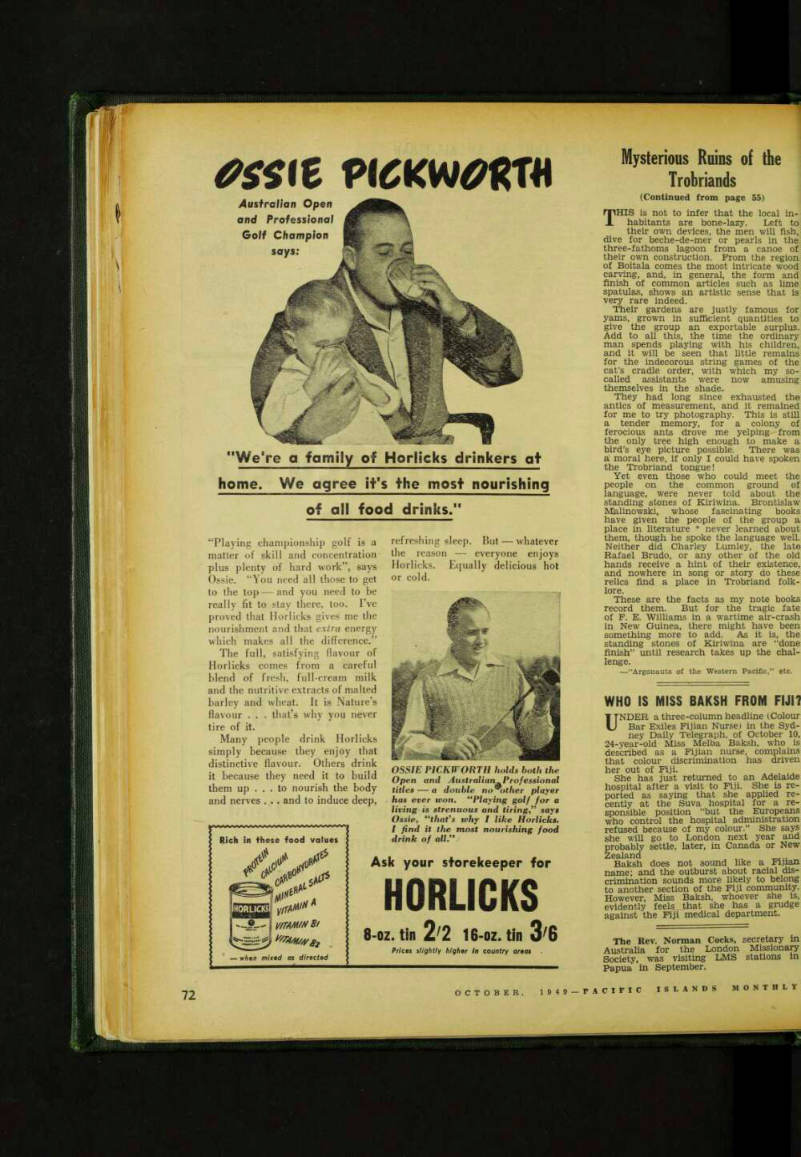
UNDER a three-column headline (Colour Bar Exiles Fijian Nurse) in the Syd ney Daily Telegraph, of October 10, 24-year-old Miss Melba Baksh, who is described as a Fijian nurse, complains that colour discrimination has driven her out of Fiji.
She has just returned to an Adelaide hospital after a visit to Fiji. She is re ported as saying that she applied re cently at the Suva hospital for a re sponsible position “but the Europeans who control the hospital administration refused because of my colour.” She says she will go to London next year and probably settle, later, in Canada or New Zealand Baksh does not sound like a Fi.nan name; and the outburst about racial dis crimination sounds more likely to belong to another section of the Fiji community.
However, Miss Baksh, whoever she is, evidently feels that she has a grudge against the Fiji medical department.
The Rev. Norman Cocks, secretary in Australia for the London Missionary Society, was visiting LMS stations in Papua in September.
Advertisements & other items, p. 74 (1 item)
Mysterious Ruins of the
72
CIFIC ISLANDS MONTHLY
Mysterious Ruins of the Trobriands (Continued from page 55)
OCTOBER, 1949 PA
Phosphate Workers Return
To Mangaia
From Our Own Correspondent MANGAIA, Cl, Sept. 2.
HHE contingent of Mangaian labourers L who departed in January for work at the Makatea phosphate fields, re irned a few weeks ago to their home land, and are now awaiting re igagement.
There was great excitement when the 3 Roybank arrived off the reef, and the en were ferried ashore, with all the iscellaneous items of “trade,” from litars to bicycles, that had been pur lased at the French island, where goods, tally unprocurable here, are on sale in r ery store.
As usual, each returnee had a Chinese jdarwood chest to contain the less-bulky ophies of his period abroad; and these >xes, shining new as they are, aroused me envy in those who have to keep ecious Sunday clothes in a mere suit se, for Cl stores are quite unable to pply the chests, even in the smallest :es.
This Makatea term has been less for nate, for separated families and lovers, an previous ones. One youth arrived bare time to attend his mother’s meral —she had died while the Roybank is halfway between Rarotonga and mgaia.
Others, expecting to be met by their eethearts, found the girls gone where ench scent and dress-lengths have no lue. These tragic occurrences cast mething of a gloom upon the usually y scene; those who found all well at ime were correspondingly relieved. It not a mere coincidence that the songs Central Polynesia lay stress upon part
ing and farewells; he who leaves his island has no certainty that those who were on the beach to see him off will be there to welcome him back again. In spite of that possibility, however, locals are not dis couraged, and the phosphate diggings re main an El Dorado for the youth of Mangaia Island.
Noumea, New Caledonia, welcomes the offer, made recently, to provide a free course of study at an Australian Uni
versity or Technical College for a New Council 1 has asked Governor t? thank Noumea, believes Caledonian students wll ° , would benefit most are those specialising in agriculture and cattle a ? d Jjf. considers that Australian ing! ” thlS direCtl ° n are outstand -
Advertisements & other items, pp. 75-76 (3 items)
73
ACIFie ISLANDS MONTHLY OCTOBER, 1949
Tahiti
To Shipmasters and Visitors
When calling at Tahiti, and seeking SHIPS SUPPLIES and FRESH
PROVISIONS, see—
OSCAR G. NORDMAN
Supply Agent for Messageries Maritimes, Union S.S. Co. of N.Z., Ltd., Matson- Oceanic Line, United States Line, General S.S. Corp., Etc.
We supply general Service—lnformation about the Islands— Real! Estate Service—Make Reservations—Act as Shipping Agents
OSCAR G. NORDMAN
Ship Chandler
PAPEETE, TAHITI
Wire before your arrival to
OCEANIC PAPEETE—Our
registered cable address.
FOR
h
SMOOTH HANDS
Y J \S I & tL rw< 5®5 y & V du
MAKE-UP
\ BASE
y* M -* *v
'K y'C
w* 5v A N Nf o '< S'
SMOOTH
SKIM
These goods are stocked by all the leading stores of the Pacific Islands. Order through your usual channels. Further enquiries to: J. C. g Merrillees Pty. Ltd., Sydney
TO-DAY’S MOST OUTSTANDING
RADIO !
m as
The Triple Throat
KRIESLER
Sealed RADIO
OUTSTANDING VALUE!—WORLD RANGE
12,500 miles range guaranteed.
Sealed
MIDGET—A.C.
(Illustrated Above) A Triple Throat sealed Radio, midget in size, mighty in performance . . . incorporates the unique Sound Vibrator Bridge that brings to midget radio the tonal quality of the true musical instrument. World range, too.
MODEL 11-20 WORLD RANGE. 18 Gns.
F. 0.8. BRIS.
Sealed
TABLE MODEL—A.C.
Here is your dream radio come true —the powerful, full size Triple Throat sealed Table Model . . . the most exciting radio ever built. Features the big console dial, beauty back and front, world range—plus the triple throat that gives you three times the entertainment value.
MODEL 11-7 WORLD RANGE.
25J Gns.
F. 0.8. BRIS.
BATTERY
MODELS-
FREIGHT OFFER. Your radio will be despatched immediately by air or sea. We will pay up to 75 per cent, of freight cost, depending on distance. are also available.
Please write for full details and price.
Send your order to, or obtain further particulars from:
Queensland
MERCHANTS SUPPLIES
143-145 QUEEN STREET, BRISBANE, Q'LD.
74
OCTOBER, 19 4 9 -PACIFIC ISLANDS MONT H L 7
The Ng ‘Permits’ System
Letter to the Editor
READ with interest, in your September issue, your article —“Do You Wish to Enter Papua-N. Guinea.” As I have it returned from a visit to Parma—a mtry in which I spent 30 years of my inhood prior to being evacuated in Feb iry, 1942—it is possible your readers uld like to know what I had to do to ; the necessary permit. }n April 20, 1949, I wrote to the Secre cy, Department of External Territories, nberra, asking for the necessary permit, is Department replied on April 28, say ; that the matter had been taken up ;h the Administrator at Port Moresby i that I would be advised as soon as reply was received; and at the same xe they enclosed a form for me to fill Phe questions I had to answer were newhat like those asked in applying a Passport. The only difference I ild see was that I did not have to >ply a photograph. had to state why I wished to visit the mtry, the period I proposed staying, e the colour of my eyes and hair —and ew other questions. little later, I was advised from Can ■ra that my visit had been approved, 1 the Permit would be issued in Bris le, after I had obtained the necessary arance from the Income Tax Office. >oon after receiving this letter I went ng to the Income Tax Office to see )ut my clearance. I was informed that ras a little early, as the custom was not grant the clearance until about three eks before the boat sailed. I had to it a week, and was then supplied with form in which I had to set out full ;ails of all my assets.
When I brought this form back, the Income Tax official remarked: “I note that you have a credit in the Bank, so it is necessary to obtain a statement from the Bank to verify this.”
I obtained this statement, and took it along and the Income Tax official checked the balance, and returned it to me. He then said: “I note that you have an Agent looking after your property. So we will get this firm to guarantee your Income Tax.” And he gave me a form for the firm to fill in. This was the final form to be completed to get my clearance from the Income Tax office.
I left for Papua on July 12, 1949.
I am, etc..
Brisbane.
Percy J. Wood.
Editorial Note. —This absurd and cum bersome system has been in operation since the end of the war. It is unlikely to be removed while the Australian Socialist Government remains in office, because the Socialist idea of government is expressed in “Controls and More Con trols,” and the constant whittling away of all forms of individual freedom.
Radio Licences In Fiji
OF the 1,874 radio licences in force in Fiji in 1948, 972 were in the Suva area and 902 in the country, states the annual report of the Public Relations Office. Europeans held 1,143 licences, Indians 539, Fijians 69, and others 66. Hotels and clubs accounted for 57.
The appointment of Mr. Pat Costello, of Suva, as a member of the Executive Council, of Fiji, has been extended by H.M. Government for another year.
Advertisements & other items, pp. 77-78 (2 items)
75
ACIFIC ISLANDS MONTHLY OCTOBER, 1948
CASPER Superior
QUEENSLAND
INSURANCE
COMPANY
LIMITED
(Incorporated 1886 In Australia),
ASSETS EXCEED £5,000,000
Head Office :
QUEENSLAND
INSURANCE BUILDING,
80-82 PITT STREET, SYDNEY.
Specialists in South Seas Fire,
Marine & Accident Insurances
Apply to:
FIJI. —Branch Office: I. B. Chalmers, Manager, Burns Philp (South Sea) Co., Ltd.
VILA. —Burns Philp (South Sea) Co., Ltd.
Comptolrs Francais Des Nouvelles Hebrides (Marine).
NOUMEA.—L. & W. Johnston.
NEW GUlNEA.—Manager for the Territory of New Guinea and Papua, W. A.
Anderson.
PORT MORESBY—SAMARAI—LAE
—MADANG—RABAUL.
Burns, Philp (New Guinea), Ltd.
PAGO PAGO.
Burns Philp (South Sea) Co., Ltd.
G. H. C. Reid & Co.
OTHER SOUTH SEA ISLANDS.
Burns Philp (South Sea) Co., Ltd.
Also to any of the Company's Offices in Australia or Hew Zealand.
CASPER Superior
Kasper Superior Soda Fountain of all stainless steel welded construction surfaces.
SODA FOUNTAINS
Complete with ICE CREAM
MAKING MACHINE
Specially designed for TROPICAL CONDITIONS Complete fountains, including metal rust-proof surround, carbonators and refrigerator units shipped from Australia through your agent.
For beauty, for low lifetime cost, for convenience, for dependability, for profit-making power, “Kasper” Fountains stand supreme in Australia to-day. The “Kasper” Fountain is years ahead of conventional models. Every detail has been thoroughly worked out and tested in the factory and in use.
“Kasper” superior fountains are of all steel, lifetime construction with stainless steel, WELDED surfaces and chromeplated fittings. Adequate cork board insulation helps assure lowest operating costs.
ORDER NOW AND AVOID DELAY
Kasper Refrigerators Pty. Ltd.
77 Railway Parade, Erskineville, N.S.W., Australia Telephone: LA 1 826
LON DON-SUVA
ECT
via
PANAMA
C <* For Sailings and Further Particulars Apply To:—
BETHELL, GWYN & CO.
138 LEADENHALL ST.,
LONDON, E.C.3.
BURNS PHILP (SOUTH SEA)
CO., LTD.,
SUVA.
GILLESPIE
The Flour
- SYDN'EY -
TRADE
MARK
’S of the Islands
W. H. GROVE & SONS
Limited
Established 1896.
AUCKLAND
Island Traders. p -°- BOX 49 °- Telegraphic and Cable Address: “Grove”, Auckland.
Entrust Your Orders to the Firm with Fifty Years Practical Experience in the Island Trade.
Shippers of all classes of New Zealand products.
Representing English Manufacturers throughout the Cook and Society Islands, Fiji, Tonga, Samoa, Niue, New Hebrides, the Solomon Islands and New Caledonia.
In FIJI as—W. H. Grove fir Sons (Fiji) Ltd.
Panic In Royal
Navy
A “Smell” of 43 Years Ago
By Neville Chatfield
WHEN I read the article “The Nay Shows the Flag,” in your Augus issue, I wondered whether that war ship had gone into Nekufetau (in th Ellice Islands, 60 miles north-wes of Funafuti). I was reminded of a long ago visit to Nukufetau, and the first tim I saw a warship in Funafuti Lagoon—an what a welcome sight it was.
I also was reminded of the only oc casion'when I ever heard of a panic i the Royal Navy.
One morning in 1906, when I wa supercargo in the SS Titus, under Cap tain Voy, coming up to the island c Nukufetau from Viatupu, we sighted th masts of a much more/ heavily sparre vessel than an ordinary trading ship, ove the tops of the coconut trees.
In those days, at Nukufetau, there wa a dear old native who was always know as “Billy the Pilot,” because the captain of the BP and Lever Bros, trading vessel always allowed Billy to come aboard an allegedly pilot their vessels into th lagoon.
In answer to our question as to wha ship was anchored in the lagoon, Bill told us the vessel was His Majesty’s Shi Torch, and he felt very honoured that h had piloted her into the lagoon.
We spent the day trading with th natives—there never was much copra a that island —and picked up some nativ passengers for Funafuti.
We asked Billy when the Torch wa leaving, and he said 7 ajn. We tol Billy that the Captain of any of Hi Majesty’s ships was the direct represent ative of His Majesty the King and, a such, more respect was always paid t him than to the Captain of a tradin vessel. As we were sailing at 6 a.m Captain Voy told Billy to be aboard a 5 a.m. when he and I would teach hh how to address the Captain of the Tore and what to say to him.
Punctually at 5 a.m., Billy came aboar and I fitted him out in a white patre suit, and Captain Voy gave him one of hi old Captain’s caps, with a Mcllwraitl McEacharn badge in the front. Afte spending some time teaching him how t salute the quarter deck, and why, we sai goodbye to him and told him to see tha he did not get wet in his canoe whil going to the Torch, and thus spoil his nei suit and wet the deck of the man-o’-wai because the Captain might be annoyed.
Everybody who had anything to do wit! natives in those days knows how the loved a strong perfume. Well, as Bill was leaving us, I put iodoform in the cuff of his trousers, and in every pocket h had.
ON the way to Funafuti, the Torch kep about six miles behind the Titu until after noon sights were takei and we found that we had a curren against us, and we realised that it woul( take us all our time to get into Punafut lagoon that evening. One does no usually trv to take a ship into a lagooi when the sun is low down on the horizon Shortly after 2 p.m. the Torch passed u and by 4 p.m. was out of sight. Th( Torch could do a good nine knots wherea the Titus was flat out to do seven knots At 6 p.m. we arrived at the entrance to the Funafuti Lagoon, and we saw th< Torch was anchored off the village.
Captain Voy said to me: “As the Torcl is in, I am going in.” iU Off we went, steering a course for th<
eaeon which used to be in the middle f the lagoon. One always steered for iiis, prior to altering course towards the MS native church.
The Captain of the Torch, with the eye of the Royal Navy, jeing Captain Voy’s intention to bring le Titus in, promptly turned on his jarchlight, flashing it alternately onto ie beacon, then onto the LMS Church i shore; and by these means we came ifely up to our anchorage inside the orch’s anchorage. i S soon as we had safely anchored, E put the two copra-boats in the water and had our evening meal, Captain oy asked me if I would go on board ie Torch and thank the Captain for his loughtfulness and great help with his archlight.
Feeling full of importance, as one does , the full age of 21 years, I gladly ac pted the opportunity of going aboard a an-o’-war. I fitted out a boat’s crew ith new lava-lavas, (made out of a thorn of Horrocks’s 36 in. A 1 calico) ive them a bit of drill in up-ending rs and taking them inboard when >ing alongside a vessel, and started off r the Torch, arriving at one bell (7.45 tn.).
I was met at the top of the gangway by e First Lieutenant and taken to the mtain’s cabin, where I spent a pleasant Llf-hour expressing my thanks on be tlf of Burns, Philp & Co. and the iptain of the Titus. The First eutenant then knocked on the door and Id the Captain that the officers would :e to entertain me in the wardroom.
I thought that this was a most urteous and hospitable gesture, and adly accepted the invitation. It did ►t strike me that the jaw of Number ie was set in a grim and forbidding iy.
In the wardroom I encountered all the
traditional hospitality of the British Navy —but there was an edge to it. And K^Sl, 1 .SSfffiSH*s® SS Bo^ , P** had made inquiries, and they held me personally responsible for having “perfumed" Billy the Pilot. P They h Sm bee vJ an 3 used ’ and happy, to welcome Billy aboard, in his full regalia. ™ ey ?? od
l?k? n m ’
he moved thm-e W as afSntSh ever fte moved ’ tnere was a frantic rush
bv officers and men to set to windward of hirti 8 jward “The'damned stuff was in his feet" comnlained one vouner officer “"Wherever he walked—and all ovei^the Sfare-he left Ws stlnk behind hm "
They bore with him heroically until they got outside the lagoon and then they h ™ y sWpped him aWay ’ the rest of that voyage, from Nukufetau to Funafuti, they had men scrubbing and holystoning the decks, try
,ng to remove the smell of iodoform from “But I think it’s still around,” said dumber One, sniffing suspiciously. Can t tOU smell it?”
They gave me a lively ten minutes; but, is the story proceeded, there were roars ,f laughter. I did not leave until 4 Bells 10 am.), and I have never forgotten that nerry meeting and their delightful hosvitality.
Advertisements & other items, pp. 78-80 (4 items)
76
OCTOBER, 1949 PACIFIC ISLANDS MONTHL
77
&CIFIC ISLANDS MONTHLY OCTOBER, 1949
Thomas Bbown & Sons Ltd.
DISPOSALS GOODS WANTED
The owner of the 68 ft. auxiliary Ketch Darnley,” ideally suited and equipped for Island trade, is prepared to consider exchanging this vessel for Army Disposals material, timber stand or logs.
See full-page advertisement of the "Darnley" on Page 18 of this issue.
THOMAS BBOWN & Sons Ltd.
Merchants, Manufacturers and Distillers Wines and Spirits, Foodstuffs, Drapery, Clothing, Textiles, Stationery, Hardware, and Fancy Goods.
Our Manufactures :
TOPS FOODSTUFFS, ESQUIRE SHIRTS AND CLOTHING,
BEENLEIGH POT STILL RUM, DUNCAN'S GIN, MARTIN'S
AUSTRALIAN WHISKY, GRAND ESTATE BRANDY, ETC.
Special attention given to Island inquiries
EAGLE STREET, BRISBANE
Defy the Rain and Sun!
PRODUCTS
Are Specially Prepared for use in
the Tropics and will preserve your property
SPARTAN PAINTS & ENAMELS ARE
ECONOMICAI DURABLE . . . WASHABLE
. . . NON-FADING
Made from finest pigments and available in a wide range of colours.
Transforms drab, uninteresting woodwork, canework, metal, etc., into articles of lasting beauty.
SPARTAN PAINTS. Easy to apply; brush on evenly; cover large areas and dry out to a perfect finish.
SPARTAN ENAMELS. Quick-drying and recommended for all jobs in and around the house. Dries dust free within 2 hours and sets with a wear-resisting hardness overnight.
Other Spartan lines:—AUTO LACQUERS AND PRIMERS, DURA- FLEX SYNTHETIC ENAMELS, CAR POLISH AND CLEANER, AUTO WAX, SUPER FLOOR GLOSS FOR FLOORS, INDUSTRIAL
ENAMELS AND LACQUERS.
A
.re PARCO
PAINT
A f/ Ask to see the
SPARTAN PAINT AND
ENAMEL COLOUR
CHARTS.
Choose from the lovely range available.
Prevents Dry-Rot & Termite Ravages in
TIMBERS, CANVAS, TARPAULINS, ROPES, JUTE GOODS, TENTS,
SAILS, NETS, ETC.
Hardiproof (Green) and Hardiproof (Clear) can be safely applied to all types of wood, textile fabrics and renders them immune to fungus attack.
Hardiproof (Green) is guaranteed to contain 20 per cent, of Copper Napthenate, and can be dipped, sprayed or brushed.
Is insoluble in water and does not leach out like other preservatives.
SPARTAN PRODUCTS ARE PROVED. USE THEM!
SPARTAN PAINTS PTY. LIMITED.
102-104 King Street, Melbourne, Victoria, Australia
78
OCTOBER, 1949 PACIFIC ISLANDS MONTH
Husbands And Wives In
Primitive N. Guinea
From Our Own Correspondent
Pt. Moresby, Oct. 3.
a NEW GUINEA native whose wife wanted to leave him, set fire to his house and burnt her and another lative woman to death. The native, Jara, was sentenced to death in the Supreme Court at Kundiawa.
This was one of 12 murder cases dealt nth by Mr. Justice Bignold during his ecenti Supreme Court circuit in New guinea. v A native woman, Ebaramet, who killed ier husband’s other wife, was sentenced o three years’ gaol, at Garoka, for tiurder. She killed her fellow wife with n axe because the woman was unfaith ul to their husband. The husband him elf had forgiven the woman for her apse.
Rev. A. Crookes Hull, organising secre ,ary of the Methodist Overseas Mission, ias announced that a leper hospital will >e built at Übula, Normandy .Island, *apua. When completed the hospital will >e able to treat 80 patients.
No More Village
Dogs in Cook Is.
From Our Own Correspondent MANGAIA, Cook Is.
THERE exists in Cook Island native vil lages, numbers of ill-kept, verminous dogs, of a breed dubious in all re spects. These animals are the descen dants of a few mongrels imported long ago, and in spite of periodical reduction of their numbers by distemper, etc., they have gone on breeding over the years.
A new edict, from the Administration, has ordered the immediate destruction of all bitches, on penalty of a heavy fine for neglect of the ordinance.
Village dogs have long been a pest here.
They were ferocious at certain times of the year, and liable to attack pedestrians and small children, or even horses; while unguarded piglets and wandering hens were also unsafe. In addition, the dogs’ habit of licking the taps of village rain tanks, to catch the few drops of water remaining after natives had filled their
dcfgs the fragments of coconut-shredder their perquisite by right The kming of a u bitches will at least prevent the further propagation of these unpleasant animals. What is to happen when the male dogs at length die off is not indicat ed; one presumes that after that, the island win be dogless ’ unless a new and better strain be then imported ancL DrecL
Small Plane Wrecked In
N. Guinea
From Our Own Correspondent
Pt. Moresby. Oct. 6.
AQANTAS Fox Moth crash-landed a few hundred yards short of Taipini airstrip, in Papua, on October 3.
Pilot Len McNeil and one native pas senger received cuts and other minor injuries. Two other native passengers were unhurt. The plane was wrecked.
Advertisements & other items, p. 81 (1 item)
Nelson & Robertson
Allen Taylor & Co. Ltd.
COMMERCIAL ROAD, ROZELLE,
SYDNEY
Sowmillers and Wholesale Suppliers of Hardwoods for Constructional Purposes GIRDERS . . . PILES . , . POLES . . . SLEEPERS, Etc.
EXPORTING TO PACIFIC ISLANDS SINCE 1893
NELSON and ROBERTSON Pty. Ltd.
Established 1895
Shipowners - Brokers and
Islands Merchants
All classes merchandise purchased at Best Wholesale Prices Original Invoices supplied to Island Clients. Cocoa Beans, Copra, Rubber, Trochus Shell and All Islands Produce Sold on > Commission.
Entrust your requirements to the firm with fifty years' practical experience in the Pacific Islands.
Prompt attention given to all inquiries
NELSON & ROBERTSON
12 SPRING STREET, SYDNEY, AUSTRALIA
Telegraphic Address: IVAN, SYDNEY.
PTY.
LTD,
Overloaded Canoe
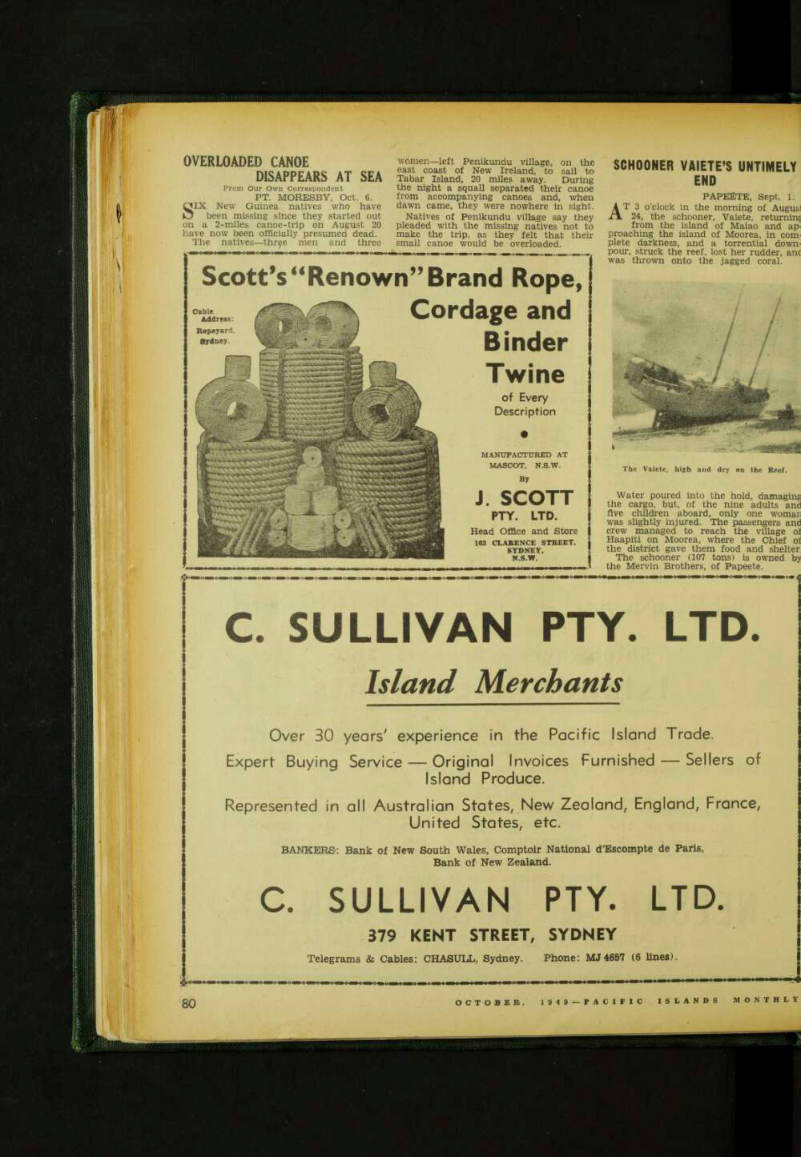
Disappears At Sea
Prom Our Own Correspondent
Pt. Moresby, Oct. 6.
SIX New Guinea natives who have been missing since they started out on a 2-miles canoe-trip on August 20 have now been officially presumed dead.
The natives—three men and three
women—left Penikundu village, on the east coast of New Ireland, to sail to Tabar Island, 20 miles away. During the night a squall separated their canoe from accompanying canoes and, when dawn came, they were nowhere in sight.
Natives of Penikundu village say they pleaded with the missing natives not to make the trip, as they felt that their small canoe would be overloaded.
Schooner Vaiete’S Untimely
End
Papeete, Sept. 1.
AT 3 o’clock in the morning of Augusl 24, the schooner, Vaiete, returning from the island of Maiao and ap proaching the island of Moorea, in com plete darkness, and a torrential down pour, struck the reef, lost her rudder, anc was thrown onto the jagged coral.
Water poured into the hold, damaging the cargo, but, of the nine adults and five children aboard, only one woman was slightly injured. The passengers and crew managed to reach the village of Haapiti on Moorea, where the Chief of the district gave them food and shelter The schooner (107 tons) is owned by the Mervin Brothers, of Papeete.
The Vaiete, high and dry on the Reef.
Advertisements & other items, p. 82 (1 item)
C. Sullivan Pty. Ltd.
Scott’s “Renown” Brand Rope,
Cordage and
Binder
Twine
Cable Address: Ropeyard, Sydney. ■ *—m
of Every
Description
MANUFACTURED AT
MASCOT, N.S.W.
J. SCOTT
PTY. LTD.
Head Office and Store
163 CLARENCE STREET,
SYDNEY,
N.S.W.
C. SULLIVAN PTY. LTD.
Island Merchants
Over 30 years' experience in the Pacific Island Trade.
Expert Buying Service Original invoices Furnished Sellers of Island Produce.
Represented in all Australian States, New Zealand, England, France, United States, etc.
BANKERS': Bank of New South Wales, Comptoir National d’Escompte de Paris.
Bank of New Zealand.
C. SULLIVAN PTY. LTD.
379 KENT STREET, SYDNEY
Telegrams & Cables; CHASULL, Sydney. Phone: MJ4657 (6 lines).
Norfolk Is.

An Optimist On
By Vernon Wheatley
BECAUSE nearly everything that can be produced on fertile Norfolk Island can be grown also in Aus ;ralia, and because NI has no votes and Australia is ruled by politicians, NI has >ecome the Cinderella of the Pacific rerritories. A lonely place—noted mainly or economic stagnation.
To give some credit where credit is due, lowever, one may comment on the Aus ralian Government’s plans to erect a nodern tourist hotel for NI. This hotel nay alter the Island’s whole economy.
I use the word “may” deliberately. A ourist hotel is not sufficient. No tourist, iving in the proposed modern hotel, rould put up with the lack of amenities finch now distinguish NI.
The roads are deplorable—simply be ause the Administration has only limited imds and lacks suitable road-forming lachinery. There also is a lack of labour, aused by the Administration’s failure to ay wages comparable, shall we say, with hose of the Department of Works and lousing now in operation here.
Vehicle owners, particularly the taxi rivers, comment with intense feeling on ne state of the roads.. Their main prries consist of broken springs, bent e-rods and general steering troubles, heir repairs are costly, as most of the r eighty replacements have to be air •eighted in.
It is no use having a modern hotel if e lack the services to go with it. Emily ay is a lovely little spot. The Bay is le only all-weather bathing beach, but sadly lacks shelter trees, and one misses le kiosk, found on mainland beaches, here one can have a cup of tea or a fid drink.
The tourist may enjoy excellent fishing t many spots around the coast; but there no organised service whereby one can ay to be taken on a launch for a day’s jort on the deep-sea fishing grounds.
HHE Island’s scenery and climate may L attract the tourist, but the average tourist wants more than climate and :enery. He wants service—better roads, sign-post or two to show him on his ay, and, if he desires liquor, a less zarre way of obtaining it. If he wants bottle of old and bold, to-day, he has i make his way down to the Bond Store >pen on Fridays for a few hours only), icure his bottle and retire to his room i drink furtively. (All this, I hear imoured, will be changed when the hotel erected. It is said that the Bond Store ill be transferred to the hotel.) The easiest way to get brandy here to have a “chit” from some aged per »n. One local identity obtained brandy ir some years on the “strength” of his Jar old granny—who had been deceased ►me twenty years!
N the past, industry in NI has been more or less an initial optimistic hope, rapidly followed bv disillusion ed and degeneration. The passion uit pulp factory faded to a ghostly ladow of its former self because of— • Lack of support, as time passed. • Too few cultivated areas of fruit. • Too much reliance on wild crops, which were the food of the parrots. • Lack of a suitable scheme to en courage the growers and workers. A bonus scheme would have kept the ball rolling.
The butter factory went to the wall be luse of crippling mechanical break
downs, and lack of high-cream-content herds, coupled with deteriorating pasturage and other minor set-backs.
The fishing industry folded up when the boats were lost through wreckage.
The lemon juice scheme gave way be cause of various factors. Some genius discovered that the artificial product was cheaper than the genuine article, (continued on Page 83)
The new whaling company has not had inch luck, to date. The “hoodoo” which itended the Company’s operations in the )48 season seems to be with them in 149. They recently lost their tug boat, hich vanished beneath the waves. The Prospects in the banana business were isy for a while. Then the chicanery of ie merchants made itself felt. Then .me the embargo Growers walked off ie land simply because they had no ternative.
All is not lost, for someone with vision ay regenerate any of these industries.
J It is true that the butter factory is ing brought into operation once more, id we hope it will relieve NI of its esent shortage. That is, if some bright ark with no ethics does not buy the oduce at inflated prices and ship it /ay to Vila or Suva. Export is a good ing—but not when exportation leaves e population desperately short. The irion call attending the projected reening of the butter factory is: “We’ll able to export.’’ We hope they can — ter the public here has been served.
There are opportunities here for a proessive man or firm. The advantages s; No taxes; freedom from crippling d niggling rules, regulations, pronun- .tions, controls and what-have-you.
The disadvantages are: Lack of transrt—air to NZ once a week, air to Aus- •vice °fs Ce sk a etchv— We anchor ge for lacr electrlcity P We have 'jjeen Dmised an early electricity supply, and b Government proposes to operate a )dern ship on this run. Perhaps, when 3 Government hotel is in operation, the ■ services will be increased,
Advertisements & other items, pp. 83-84 (2 items)
Marys
t
Box 3838 GPO, Cable Address, “Care” Sydney.
Sydney. Australia.
ISLAND MERCHANTS
4 YORK ST., SYDNEY
All kinds Island Produce sold on commission. All merchandise purchased at best wholesale price and original invoices supplied.
Use our 50 years’ experience as Island Merchants.
J
AUNT
MARYS
BAKING POWDER
For the best in delicious baking results A product of TILLOGK AND GO. PTY. LTD. manufacturers of all the famous Aunt Mary’s Pure Foods
There is only one
ELECTROLUX
THE MODERN KEROSENE-OPERATED REFRIGERATOR
THAT ACHIEVES THE MIRACLE OF ICE FROM HEAT
Lasting Efficiency, Silent Operation, Streamlined Beauty
IMMEDIATE
DELIVERY
» ■ n ■ PP»' Also Available Model
LKSSO
51 cub. ft. Capacity Economically operated by kerosene, with a simple precision-built freezing unit that has no moving parts and is GUARANTEED FOR
FIVE (5) YEARS.
Only obtainable from:
NEW GUINEA COMPANY, LIMITED.
Rabaul, Madang, Lae, Kavieng.
J. R. CLAY & CO., LTD., Port Moresby.
W. R. CARPENTER & CO. (Sol. Is.), LTD., Tulagi.
For New Hebrides, Butaritari, Noumea, New Caledonia. Apply— Model LKSSI
PRICES ON APPLICATION.
Storage capacity; 5i cub. ft. (approx.); shelf area, 9 sq. ft. food shelves, six—five removable; 2 self-supporting when half drawn. Ice-making: Four trays —5 lb. ice per freezing: 80 cubes. Fuel consumption: 1.8 pints kerosene per day (approx.).
Height: 4 ft. 10 in. Depth: 2 ft. 3i in.
Weight, unpacked, 406 lb. Packed, 574 lb.
W, R. CARPENTER & CO. LTD. Head Office; 16 O'Connell St., Sydney, N. S. Wales
82
OCTOBER, 1949 PACIFIC ISLANDS MONTHLI
Of Guiding And Guitar
Music
Prom Our Own Correspondent MANGAIA, Cook Is.
THE Girl Guide Movement on Mangaia Island was one year old on August 18. On that date they held a birth day party, with appropriate celebrations, which included a giant cake, probably the largest ever baked for an occasion upon this island. It towered above the table on which it was displayed. The eggs for the great cake were provided by Guides. The cake-materials, icing, etc., were the contribution of the local Guide Mistress, Mrs. W. H. Ryan, wife of Major Ryan, OBE, who is Resident Agent of the island.
Even allowing for the inevitable falling out of girls whose interest declines with the wearing-off of the novelty of being in uniform, or whose behaviour has not been Guide-like, the strength of the Company keeps up, the number of Man gaian damsels in it never going below 100.
School-teachers form the commissioned officer group, under the authority of the Guide Mistress, who has brought them to a commendable stage of efficiency and smartness.
The Anniversary party was followed by an evening social and dance, the music for which was supplied by the Guides’ orchestra of guitars and ukuleles.
Mangaia has not yet acquired a band of instruments capable of leading the ac companiment of bases and ukes, the solo portions of the melody being taken by vocalists in chorus.
Since the showing locally of the talkie, “Waikiki Melody,’ featuring Hawaiian hula-dancing of genuine artistry and re finement (plus good music), our local
virtuosi have lost face a little—a state of affairs that might be remedied by the training of a few players upon mandolin, banjo, etc.
Mr. Peter Hughes, secretary of the BSI Government, accomplished the first sec tion of his journey to the UK on six months’ leave, in HMAS Bataan, which called at Honiara on her way from Japan to Brisbane.
Mr. Charles Barrett, well-known naturalist, with Mrs. Barrett recently re turned to their home in Melbourne after several months in Papua-New Guinea.
Advertisements & other items, pp. 85-86 (2 items)
83
ACIFIC ISLANDS MONTHLY OCTOBER, 1949
Sale
MACHINERY FOR
NEW, RE CONDITIONED
AND SECOND-HAND
LOCOMOTIVES: Steam and I.C. TRUCKS:
20 and 12 ton. RAILS: 500 tons, 30 lb. per yard, 30 ft. length. MARINE BOILER —as new, 9 ft. x 9 ft. HYDRO-ELECTRIC
PLANTS AND PELTON WHEELS: All
sizes.
Pumps, Winches, Compressors, Batteries, Tables, Boilers, etc.
All classes of second-hand and new machinery.
MINERAL SPECIMENS SUPPLIED,
BOUGHT AND EXCHANGED.
ASSAYS AND REPORTS.
Enquiries Invited.
WILLIAM F. WILSON & SON
Engineers, Contractors
The Problem Work Specialists Mining—Salvage—Construction —Consulting.
P.O. BOX 5078 A.A., G.P.0.,
MELBOURNE.
Cable and Telegraphic Address:
“WILFORBSON,” MELBOURNE.
Look for KRAFT
and find QUALITY
The unchanging quality of Kraft foods is a byword wherever fine foods find appreciation. In their constant vigilance over quality, Kraft experts have achieved even more than just that, for hand in hand with Kraft quality goes flavour perfection and food value of a very high order.
Wherever you see the name “Kraft”, buy confidently, and remember, “Red Feather” foods are made by Kraft too. No finer foods can be found.
Export Division,
Kraft Walker Cheese Co. Pty. Ltd.,
Riverside Ave., South Melbourne,
AUSTRALIA.
fiSS. ! 2Sr r. a m
KRAFT
ifiTU
Three famous Kraft Foods
notv available
in full supply everywhere.
VEGEMITE the delicious, healthful yeast extract. One of the richest known sources of the important Vitamin B complex. Strongly recommended in all areas where fresh vegetables are scarce. A little does a power of good.
KRAFT CHEDDAR CHEESE a
creamy-smooth, choice processed cheddar.
Rich in Vitamins A, B and D, calcium, phosphorus, and other nutrients of milk.
Always fresh whether in the attractive blue can or in its hygienic foil wrapping. Not too sharp not too mild just too good for words.
BONOX pre-digested beef in its tastiest and most assimilable form, A valuable food for its high content of niacin (the anti-pellagric factor), and a powerful digestive stimulant. Dissolve in hot water for an appetising drink, or use as a spread or a flavouring for cooked dishes. Eat it and drink it for a lift!
ART POSTCARDS OF
TONGA
Per Dozen (Including a Tin-Can Mail Cover), Postage Paid: 6/- (or one US Dollar).
TONGAN PHOTOS BUREAU
Nukualofa, Tonga
Every Branch Of
ENGINEERING and BUILDING CONSTRUCTION
MILLERS LTD.
SUVA and LAUTOKA
Sawmillers and Timber Merchants; Shipwrights and Sailmakers; Joinery and Furniture Manufacturers; Upholsterers; Plumbers; Electricians; Hardware Merchants; Motor Dealers.
AOENOIEB:
Chevrolet, Bedford, Vauxhall, Nash Motors. Firestone Tyres.
Fetters Marine and Stationary Engines. G.E.C. Radio Sets.
British Australian Lead Manufacturers Pty., Ltd., Atlas Assurance Co., Ltd.
There is no need to send to Australia or New Zealand for Repairs or Replacements. We can give you a sound Quotation and guarantee First-Class Workmanship
Pimples and Bad Skin Fought in 24 Hours
Since the discovery of Nlxoderm by an American physician it is no longer necessary for anyone to suffer from ugly, disgusting and disfiguring skin blemishes such as Eczema, Pimples, Rash, Ringworm, Psoriasis, Acne, Blackheads, Scabies and Red Blotches. Don’t let a bad skin make you feel inferior and cause you to lose your friends. Clear your skin this new scientific way.
A New Discovery
Nlxoderm is an ointment, but different from any ointment you have ever seen or felt. It is a new discovery, and Is not greasy but feels almost like a powder when you apply It. It penetrates rapidly into the pores and fights the cause of surface skin blemishes. Nlxoderm contains 9 Ingredients which fight skin troubles In these 3 ways. I.—lt fights and kills the microbes or parasites often responsible for skin disorders. 2—lt stops itching, burning and smarting in 7 to 10 minutes, and cools and soothes the skin. 3.—lt helps nature heal the skin clear, soft and velvety smooth.
Works Fast
Because Nlxoderm Is scientifically compounded to fight skin troubles, It works fast.
It stops the itching, burning and smarting In a few minutes, then starts to work Immediately. clearing and healing your skin, making it softer, whiter and velvety smooth
In Just a day or two your mirror will tell you that here at last is the scientific treatment you have been needing to clear your skin—the treatment to make you look more attractive, to help you win friends. Nixoderm has brought clearer, healthier skins to thousands, such as Mr. Bob Weedon, Edmund Street, Fremantle, who writes: “I was troubled with pimples ever since I was 13, and have spent pounds and pounds on so-called cures without results. I then tried Nixoderm with astounding effect.
The pimples seemed to fade away, and after a week there was not the slightest trace of them.”
Satisfaction Guaranteed
Get Nixoderm from your chemist or store to-day. Look in the mirror in the morning and you will be amazed at the Improvement.
Then Just keep on using Nixoderm for one week and at the end of that time it must have made your skin soft, clear, smooth and magnetically attractive—must give you the kind of skin that will make you admired wherever you go, or you simply return the empty package and your money will be refunded in full. Get Nixoderm from your chemist or store to-day.
The guarantee protects you.
Nixoderm 2 & 4/-
For Skin Sores, Pimples and Itch.
Rabaul Round About
From Our Own Correspondent
Rabaul, Oct. 6.
THE Rabaul Tennis Club held a farewell party in. September to speed on their way two Canadian sisters, Misses Dorothy and Louise Bridges. Dorothy has been the Club’s secretary since its post war reorganisation. The Club’s president, Mr, E. V. Smythe, in making a presenta tion to Dorothy stated it was due mostly to her efforts, assisted by sister Louise, that Rabaul residents are enjoying the privilege of playing on the Rabaul Club courts.
Mrs. J. R. Keenan, on behalf of th lady members, said that the highest idej at which one can aim in the tronics life that was theirs was to endeavour 1 leave each place better than they fouri it. Dorothy and Louise had succeeded i doing this—they had left the Rabai Tennis Club as their achievement.
Miss Dorothy Bridges was a member ( the staff of the Department of Educatic and was also acting secretary to the Ne Britain Ladies’ Club. Louise was Cht Librarian at the Rabaul library and it due to her experience and good tas that the Rabaul library is the pleasai and comfortable spot that we have t< day. * LOUD explosions disturbed residents c September 9. Investigation show* that grass fires had caused the e: plosion of three bombs, at different ii tervals, half way between Rabaul ar Kokopo and close to the main road.
There must be still hundreds of undi covered bombs in this area. It is impo sible to locate them as they are overgrov with secondary jungle growth in mai parts. *
The Rev. W. E. Moran, Anglic*
Minister from Lae, visited Raba between September 12 and 20. Cor munion services were held in Rabai Kokopo and Kerevat.
He visited his parishioners and invest gated the work of the Anglican cor munity, discussing with the Provision Church Council and the Ladies Gui. the problems which arise when, witho guidance of a minister, the people ther selves endeavour to re-build a Chur which is without a building. He pa tribute to the Masonic folk for th< generosity in allowing their hall to used for Sunday services and stated aga that the Quonsett huts which have be ordered from Manus will fill the ter porary need for a Rabaul church. The is no news yet of their anticipat arrival. * A WELL-KNOWN resident of t Rabaul district, Captain Jimr Duncan, was given a send-off by 1 son, Norman, and his daughter-m-la Dorothy, on the eve of his departure i Australia on October 1. He expected join the SS Admiral Chase in Lae. will be recalled that, for many years, Ca tain Duncan was master of the Admi: Chase.
Now that he has retired from the & maybe Rabaul will see more of him. I plantation, Rapopo, is rumoured to be possible site for the new Administrat: centre of New Britain District and present surveyors are at work carryi out the preliminaries for the To 1 Planning people. A SON, Gerald Alexander, was born Mr. and Mrs. A. R. Savage of Kurak kal, Rabaul, on October 3, at t Rabaul hospital.
Mr and Mrs. Savage had the misfj tune to lose their home in a fire f weeks before the baby was born. < learning of the news, Rabaul peq rallied around the young couple who h suffered a serious loss. They would L now to express their gratitude and thar to all those residents who helped the especially Miss Dorothy Stewart, secret of the Church of England Guild: Si . retary and members of the RSL. i
few Britain Ladies’ Club and the Vuna
ope Mission.
IyfAJOR E. B. iyyRIS, who arrived ll at Rabaul in MV Bulolo, in early October, to take over the manage lent of the Kokopo Club, was admitted, nmediately on arrival, to the Rabaul ospital and on the first plane available as flown to Port Moresby for immediate
ospitalisation there.
The Major is a well-known Territorian ut has been South for some years. This iece of bad luck was, no doubt, as disap ointing to him as it was to Kokopo ;sidents. * iMR. J. CROMBIE, solicitor of Port fl Moresby, was taken seriously ill while visiting Rabaul in early Oc )ber. He was admitted to the Rabaul ospital until his wife arrived by plane •om Port Moresby. Mr. and Mrs. Crom ie decided to return to Moresby in the ulolo. ♦ JTATRON HANLON, of Rabaul hospital, rl returned on the October Bulolo after leave in Australia. Matron Stock, ho relieved her, departed shortly after ards by air for leave in Australia.
Also returning by Bulolo were Sister enry, after leave in Tasmania, her home; id Mr. and Mrs. lan Skinner and two )ung sons. Mr. Skinner will take up uties in the Talasea Sub-District as DO there. Mr. Kerry Lean, former atrol Officer at Talasea. arrived in abaul on September 6 to take up duties ; the Rabaul Sub-district Office. He as accompanied by his attractive wife id young son, The Rev. J. Green will shortly take up Drk with the London Missionary So- Bty, Papua.
Wing Commander J. M. Checketts, DSO, DFC, left Fiji on September 12 for duty with the New Zealand Air Depart ment, after which he will probably go to England for a year’s staff course. He will be succeeded as commanding officer of the RNZAF at Laucala Bay by Wing- Commander R. Webb, DSO, DFC, who has been assistant air member for per sonnel at the Air Department, Welling ton, ;&nce 1946. Wing Commander
Checketts will long be remembered in Fiji for the quick sympathy he showed in organising many of the RNZAF “mercy missions” during emergencies in the remote islands of the Group. The most famous of these was the air lift to Lau after the hurricane disaster in December, 1948, when RNZAF co-opera tion with the Government prevented much suffering and probably saved many lives.
Advertisements & other items, pp. 86-88 (4 items)
84
OCTOBER. 19 4 9 -PACIFIC ISLANDS MONTHI
85
ACIFIC ISLANDS MONTHLY OCTOBER, 1949
George Kui
★ Specialist in ladies’ and gentlemen s wear. Eastern fancy goods, embroidered silk wear, embroidered linen table sets, carved camphorwood trunks, cane furniture, curios, etc.
LARGE SHIPMENT AND VARIETY ARRIVES WITH
EVERY HONG KONG BOAT
GENERAL MERCHANT & IMPORTER
Always Prompt Attention and Service.
RABAUL
A. B. DONALD LIMITED
RAROTONGA COOK ISLANDS
TELEGRAPHIC ADDRESS: “DONALD, RAROTONGA.”
General Merchants (Wholesale & Retail) and Shipowners Importers & Exporters Branches Throughout Cook Islands Fire, Marine & Motor Vehicles Insurance Agents for Yorkshire
Insurance Co.
Lloyd’s Agents.
Agents and Distributors for : ENGLAND.—Austin Cars & Trucks, Pye Radios. Dunlop Rubber Co., Ltd., Vauxhall Cars & Trucks, R. A. Lister & Co., Ltd., Phillips' Cycles, Marples Tools.
U.S.A.—Remington Rand Corp., Radio Ootp. of America, Champion Spark Plug Co., Firestone Tyres, General Steamship Corp.
NEW ZEALAND.—Vacuum Oil Co. Pty., Ltd.. Petroleum Products.
AUSTRALlA.—Wunderlich, Ltd., Cement Asbestos Products.
NORWAY.—O. Mustad & Sons, Pish Hooks.
SWEDEN.—B. A. Hjorth & Co., Primus Products.
Sydney Agents : London Agents : San Francisco Agents'.
BURNS, PHILP ft CO., LTD. BURNS, PHILP ft CO., LTD. BURNS, PHILP CO. OF SAN FRANCISCO.
Head Office:— A. B. DONALD, LTD., Auckland.
Associate Houses: — ETABLISSEMENTS DONALD, Tahiti, Papeete, Society Islands.
DOMINION FRUIT CO., Suva, Fiji Islands.
CODES: Bentley's Complete Phrase ACME
IDEAL FOR THE ISLANDS...
The Famous
ATCO Products!
ATCO—BOATIMPELLER
W Arc • Simple to handle • Light—easily carried Surprisingly economical It's easy starting, has smooth power and gives trouble-free performance.
ATCOSCYTHE
m . iro 'III in Cut time and labour costs with this dependable machine. It's eight to twelve times as rapid as hand-scything. Ideal for cutting long grass, weeds, tall undergrowth, etc.
Just fill in the coupon below for illustrated booklets which will be sent post free.
A
MOTOR TRACTORS PTY. LTD.
369-385 Wattle Street. Ultimo, Sydney Please send me Atco Booklets.
NAME.
ADDRESS.
ATCO MOTOR MOWER
There's a full range from the 12 and 14 inch models up to the 17, 20, 28 and 34 inch for big-area requirements. The ATCO is a self-contained unit and will go anywhere.
MOTOR TRACTORS
PTY. LIMITED
369-385 Wattle Street, Ultimo, Sydney Telegrams: “Sellmotors,” Sydney.
86
OCTOBER, 1949 PACIFIC ISLANDS MONTHL
Sport and Social Life Are Not
Missing From Rabaul
IF residents of Rabaul and district, New Guinea, are dull and bored it must be their own fault. We have received many reports of social and sports events held there recently and run them, for convenience, into one section. With the ex ception of some notes on the opening of the New Guinea Club, the reports come from jut Rabaul correspondent.
(See Photographs, Page 11)
A FTER some months of reconstruction fV the New Guinea Club of Rabaul was re-opened with a social and dance >n the evening of September 14. The ;lub was decorated for the occasion in ts own colours—gold and green—and by i p.m. 80 members, wives and friends had issembled. This number was, of course, mall in comparison with those who rent along to Club balls in the pre-war lays. But, in the reconstructed club .ccommodation is still limited and mem icrs were allowed only one guest.
In declaring the Club open, Mr. A. J. •raskin, president, called for two ninutes silence in memory of those ormer members who would not return. ?he dance must, indeed, have had many >oignant memories for several of the /omen who were there—Mrs. P. Coote nd Mrs. “Tommy” Targett, for example, ioth widowed since happier pre-war days.
The majority of the guests were pre /ar Territorians, now past the lapper stage—the youngest men were pproaching 40, and only an odd ounger-set girl appeared in the crowd, he atmosphere was, however, informal nd happy. With an interval for a uscious buffet supper, guests, some of /horn had not danced for years, tripped nadly back and forth on unpractised eet to the tunes provided by a Pana rope until 1 a.m., and, at the end, voted t a most enjoyable affair.
Much of the credit for the success of he dance goes to Mr. Ray Galloway, the irst post-war member and secretary of he Club.
Although a liquor licence had not been ranted the Club on the night of its pening, this has since come through and nembers are now permitted to use the flub for this purpose between 11 a.m. nd 1 p.m. and from 4 p.m. to 11 p.m.
Mr. Eric Pettison is at present manager if the Club.
New Britain Ladies' Club
rHE New Britain Ladies’ Club hopes soon to see building work begin on their club premises. The site elected is that of the pre-war Agnes Visdom Library, After much delay, imber has been delivered to the scene )f operations and construction is ex acted to proceed forthwith.
A carnical for the nights of October r and 8 was being organised, proceeds o go towards furnishing the Club when :ompleted.
Various games were to be a feature of he carnival —Hoop-la, Housie, Chocolate Vheel, Horse-racing Wheel, Crown and Anchor, Darts, Under and Over 7, and lomething somewhat more obscure with he delightful name of Esmeralda. In iddition, there were to be hot-dog stands, lake and sweet stalls, soft drinks, raffles, 3tc.
The Club, by its efforts, hopes to smooth the lot of New Britain women generally—and out-ports visitors to Rabaul in particular.
Rabaul Tennis Association
IN the first of a series of Association competition tennis in Rabaul on
October 2, Burns Philp “A” team defeated the Rabaul Club “A” team, 48 to 38 games, on the Rabaul Club’s courts; on the same day Carpenters “B” Team defeated Burns Philp “B” team 47 to 31 games on the Burns Philp courts.
Great interest was shown in these matches and it is felt that the Association competitions will revive tennis in Rabaul.
There are six teams in the Competition, the other teams being Colyer, Watson, and Rabaul Club “B” team.
The Committee of the Association is an energetic one and it is hoped that now competitive tennis is under way, even greater interest will be shown.
RSSAILA, Rabaul Branch
AT a General Meeting of the RSSAILA, Rabaul Sub-branch, three trustees were appointed: Mr. C. Normoyle, Mr. G. Renton, Mr. E. Britten. The committee moved, and the members ap proved, that Debentures be issued up to £3,000, and a company be floated to handle same for the purpose of pro viding funds to build the club-house.
A Quonset hut has been acquired from Manus and should arrive in Rabaul within one month; work of erection will commence immediately.
Since the revival of the Rabaul sub branch a month or so ago, the very active committee has made rapid pro gress. The club has now approximately 130 members, a dramatic society and a Ladies Auxiliary.
The Ladies Auxiliary held a Housie- Housie evening at the Administration Mess on Friday, September 23 —a most enjoyable evening was had, and a few pounds were added to the funds.
Advertisements & other items, pp. 89-90 (2 items)
Linoleum
Rid Kidneys Of
Poisons And Acids
If you suffer sharp, stabbing pains, if joints are swollen, It shows your blood Is poisoned through faulty kidney action. Other symptoms of Kidney Disorders are Backache, Aching Joint* and Limbs, Sciatica, Neuritis, Lumbago, Sleepless Nights, Dizziness, Nervousness, Circles under Eyes, Loss of Energy and Appetite and Frequent Headaches and Colds, etc. Ordinary medicines can’t help much because you must get to the root cause of the trouble.
The Cystex treatment is specially compounded to soothe, tone and clean kidneys and bladder and remove acids and poisons from your system safely, quickly and surely, yet contains no harmful or dangerous drugs. Cystex works In 3 ways to end your troubles. 1. Starts killing the germs which are attacking your Kidneys, Bladder and Urinary System in two hours, yet Is absolutely harmless to human tissue. 2. Gets rid of health-destroying, deadly poisonous acids with which your system has become saturated. 3. Strengthens and reinvigorates the kidneys, protects from the ravages of disease-attack on the delicate filter organism, and stimulates the entire system.
Praised by One-time Sufferers Cystex is approved by one-time sufferers in 73 countries from the troubles shown above.
Mr. Reg Thomas, Townsville, Queensland, recently wrote: “My Joints were all stiff, I had leg pains, my back used to ache day and night.
My bladder was weak. I had headaches and no appetite. The first dose of Cystex helped me and before I finished three boxes my health and strength came back.”
Guaranteed to Satisfy or Money Back Get Cystex from your chemist or store to-day.
Give it a thorough test. Cystex is guaranteed to make you feel younger, stronger, better U every way, or your money back If you return the empty package.
Now in 2 sizes—4/-, •/-.
GUARANTEED CVStfiX
Treatment w for Your Kidneys, Bladder, Rheumatism.
Livraison IMMEDIATE LINOLEUM ECOSSAIS IMPORTE
delivery immediate
(fe t m 26 O’Connell Street, Sydney.
Cables: “Mondial,” Sydney Halifax House Phone: BL 1543.
IMPORTED
LINOLEUM
Ideal for Island Conditions. Long Wearing Hessian Back. Cork based. Full range of colours, patterned or plain. Full rolls (30 yards by 6 ft.) only supplied. Order to-day through your Trading House for delivery by first boat.
Ideal pour les pays tropicaux. D’une durabilite sans pareille, a base de liege convert en tone de chanvre. Dessins ou unis. Rouleaux de 30 par 6 pieds de large. Commandez aujourd hui chez votre Agent pour livraison par premier bateau.
TAY SIDE Linoleum distributed by :
INTERNATIONAL TRADING
PTY. LTD.
4 Lines With Many Island Uses
1. B.T.H. FILM PROJECTOR
This portable, simply-operated precision-made 16 mm. sound film projector—made in England by British Thomson-Houston, Ltd. — gives high fidelity reproduction of sound and picture. Is equally efficient with silent films. Study these outstanding features: Films easily threaded. Brilliant Screen Illumination. High Fidelity Sound Reproduction. Easily Maintained. Unit construction enables easy removal for servicing or replacement. Our experienced shipping department can attend to supply from Australia by sea or air all available films on loan or purchase basis.
2. SPECIALLY DESIGNED TRADE BOATS
We can supply—and arrange for delivery to any destination —sturdy trade boats especially designed for Island conditions.
A special feature is the standard design 40 ft. trade boat, constructed solidly throughout of high quality Queensland timbers and powered with Lister Marine diesel engine. This roomy craft, ideal for Missions, Traders, Planters, etc., has accommodation for 4 and will carry 10 tons of cargo. A SPLENDID ALL-ROUND WORK BOAT. Smaller and larger craft, 35 ft., 45 ft. and 50 ft. along similar lines can be constructed to order. Economically priced.
3. RAMBLER AUTO BIKE
This British-made 98 c.c. Rambler Auto Bike is equipped with 26/lf in. chromium-plated wheels.
Tyre size: 26 in. x 2 in. Engine: Villiers De Luxe; bore and stroke, 50 x 50 mm. Automatic lubrication. Petrol consumption up to 150 m.p.g.
Special short wheel base design. Chrome-plated handle bars, fitted with rubber grips, complete with controls. Replacement parts, including tyres, readily available.
Projector, with 2,000 ft. reels and 4 in. lens, threaded and ready for operation.
Note that all controls are conveniently situated on one side of the projector.
4. RO6INCRAFT
PRESSURE JET
A Kerosene Pressure Jet Thermal Unit wi many uses for Dairies, Hospitals, Homi Guest Houses, Hotels, Shops, Boat Shet etc. Lighting kerosene gives instant hes The pressure jet throws an intense bl flame against the baffle, the heat beb controlled at will by the valve on the stora unit. Unit comprises heating unit ai flexible copper tube with a 3i gallon capaci storage container complete with pressu gauge, pump control tap, etc.
' Send for full details of the products featured above to: •r,
WILLREED AGENCIES PTY. LTD
A WILLREED Executive is visiting the United Kingdom and the Continent in January. He will be pleased to handle any representation or commission. 145 a George Street, Circular Quay, Sydney Cable Address: “REEDAGE” SYDNEY.
88
OCTOBER, 1949 PACIFIC ISLANDS MONTHL
Shipping And Plane Services
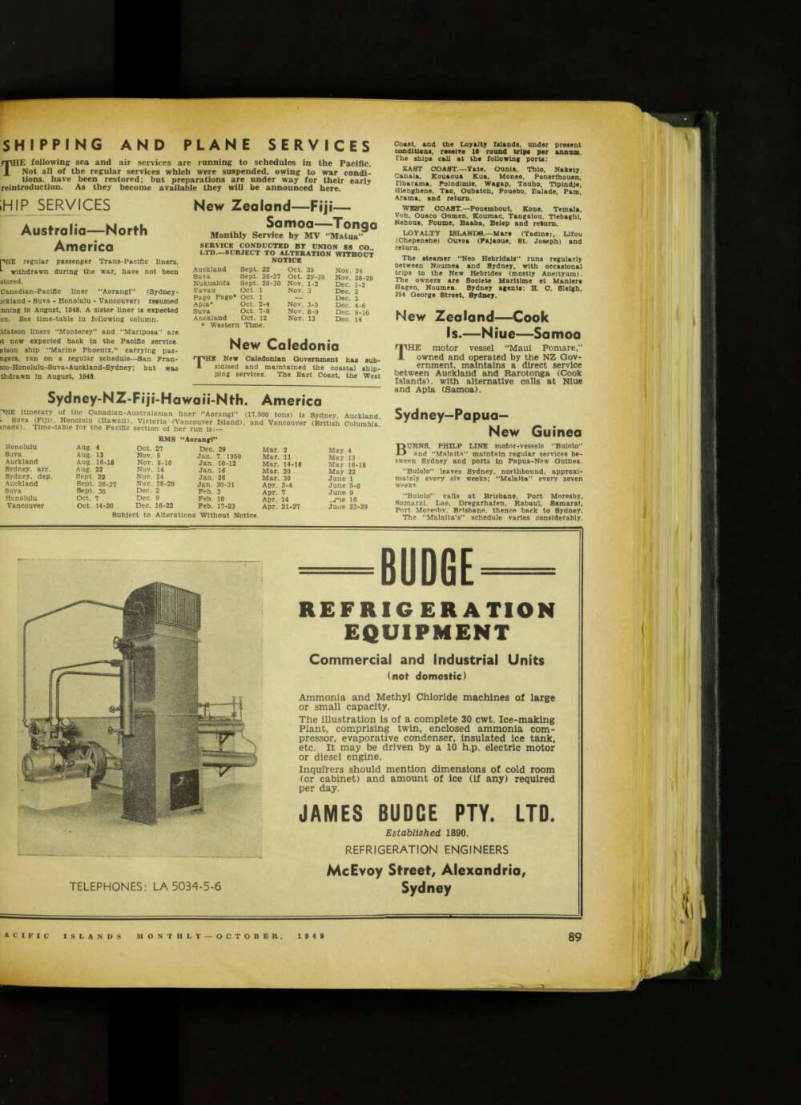
rE following sea and air services are running to schedules in the Pacific.
Not all of the regular services which were suspended, owing to war condi tions. have been restored; but preparations are under way for their early reintroduction. As they become available they will be announced here.
Samoa—Tonga
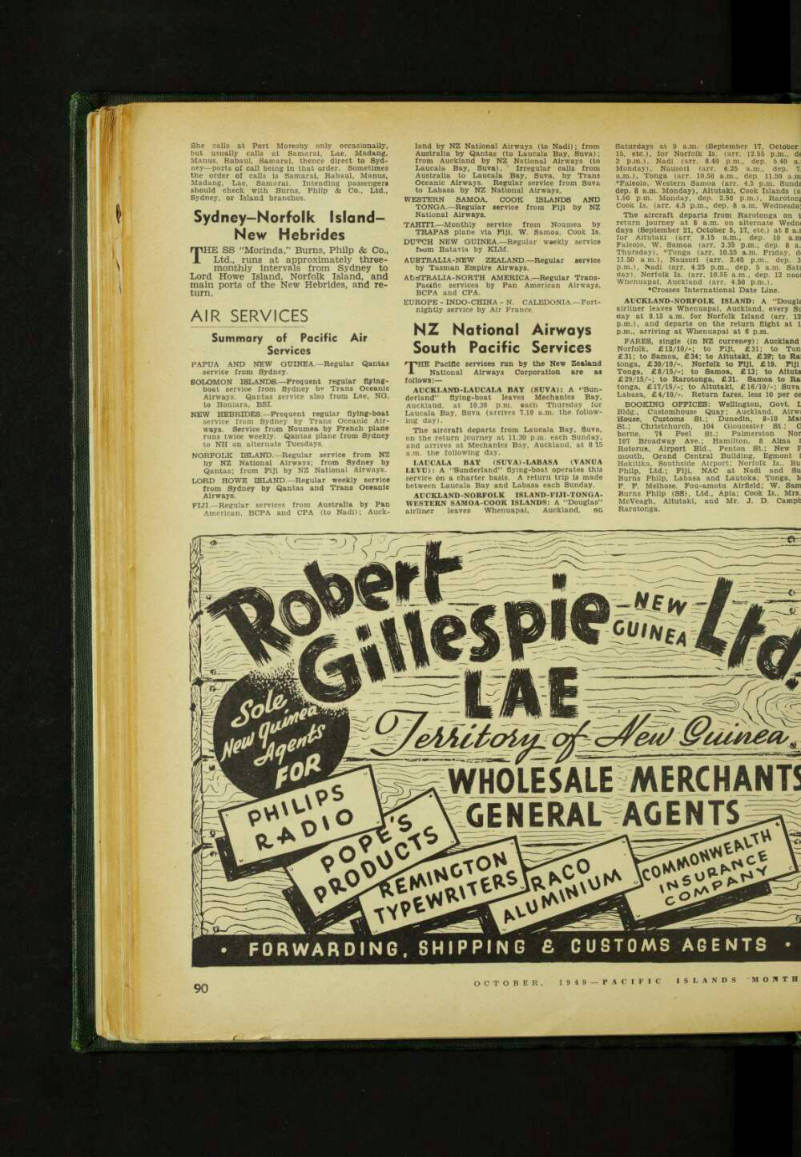
Ship Services
Australia—North
America
HHE regular passenger Trans-Pacific liners, withdrawn during the war, have not been stored.
Canadian-Pacific liner “Aorangi” (Sydney ickland - Suva - Honolulu - Vancouver) resumed nnlng In August, 1948. A sister liner is expected on. See time-table in following column.
Matson liners “Monterey” and “Mariposa” are »t now expected back in the Pacific service, atson ship “Marine Phoenix,” carrying pas ngers, ran on a regular schedule—San Pran sco-Honolulu-Suva-Auckland-Sydney; but was thdrawn In August, 1948.
Sydney-NZ-Fiji-Hawaii-Nth. America
''HE Itinerary of the Canadian-Australasian liner "Aorangi” (17,500 tons) Is Sydney, Auckland ‘ ? u . va Honoiulu (Hawaii), Victoria (Vancouver Island), and Vancouver (British Columbia mada). Time-table for the Pacific section of her run is: ’
New Zealand—Fiji—
Samoa—Tonga
Monthly Service by MV “Matua”
Service Conducted By Union 88 Co
Ltd.—Subject To Alteration Without
Notice
Auckland Sept. 22 Oct. 25 Nov. 24 Suva Sept. 26-27 Oct. 29-30 Nov. 28-29 Nukualofa Sept. 29-30 Nov. 1-2 Dec. 1-2 Vavau Oct. 1 Nov. 3 Dec. 3 Pago Pago* Oct. 1 Dec. 3 Apia* Oct. 2-4 Nov. 3-5 Dec. 4-6 Suva Oct. 7-8 Nov. 8-9 Dec. 9-10 Anckland Oct. 12 Nov. 13 Dec. 14 * Western Time.
New Caledonia
THE New Caledonian Government has sub sidised and maintained the coastal ship ping services. The East Coast, the West
Coast, and the Loyalty Islands, under present conditions, receive 10 round tripe per annum.
The ships call at the following ports: EAST COAST.—Yate, Ounia, Thlo, Nakety.
Canala, Kouaoua Kua, Moneo, Ponerlhouen, ribarama, Polndlmle, Wagap, Touho, Tlplndje, Hlenghene, Tao, Oubatch, Pouebo, Balade, Pam, Arama, and return.
WEST COAST.—Pouembout, Kone, Temala, Voh, Ouaco Oomen, Koumac, Tangalou, Tlebaghl, Nehoue, Poume, Baaba, Belep and return.
LOYALTY ISLANDS—Mare (Tadlne), LHou (Chepenehe) Ouvea (Fajaoue, Bt. Joseph) and return.
The steamer “Neo Hebridals” runs regularly between Noumea and Sydney, with occasional trips to the New Hebrides (mostly Aneltyum).
The owners are Soclete Maritime et Manlers Hagen, Noumea. Sydney agents: H. C. Sleigh, 254 George Street, Sydney.
New Zealand—Cook
Is.—Niue—Samoa
THE motor vessel “Maui Pomare,” owned and operated by the NZ Gov ernment, maintains a direct service between Auckland and Rarotonga (Cook Islands), with alternative calls at Niue and Apia (Samoa).
Sydney-Papua-
New Guinea
BURNS, PHILP LINE motor-vessels “Bulolo'’ and “Malnita.” maintain regular services be tween Sydney and ports in Papua-New Guinea.
“Bulolo” leaves Sydney, northbound, approxi mately every six weeks; “Malalta” every seven weeks.
“Bulolo” calls at Brisbane. Port Moresby.
Samaral, Lae, Dregarhafen, Rabaul, Samarai.
Port Moresby. Brisbane, thence back to Sydney.
The “Malaita’s” schedule varies considerably.
Honolulu Aug. 4
Rms
Oct. 27 “Aoranri”
Dec. 29 Mar. 2 May 4 May 13 May 16-18 Suva Aug. 13 Nov. 5 Jan. 7. 1950 Mar. 11 Auckland Aug. 10-18 Nov. 8-10 Jan. 10-12 Mar. 14-16 Sydney, arr.
Aug. 22 Nov. 14 Jan. 16 Mar. 20 May 22 Sydney, dep.
Sept. 22 Nov. 24 Jan. 26 Mar. 30 June 1 Auckland Sept. 26-27 Nov. 28-29 Jan. 30-31 Apr. 3-4 June 5-6 Suva Sept. 30 Dec. 2 Peb. 3 Apr. 7 June 9 Honolulu Oct, 7 Dec. 9 Feb. 10 Apr. 14 16 Vancouver Oct. 14-20 Dec. 16-22 Feb. 17-23 Apr. 21-27 June 23-29 Subject to Alterations Without Notice.
She calls at Port Moresby only occasionally, but usually calls at Samarai, Lae, Madang.
Manus, Rabaul, Samarai, thence direct to Syd ney—ports of call being in that order. Sometimes the order of calls is Samarai, Rabaul, Manus, Madang, Lae, Samarai. Intending passengers should check with Burns, Philp & Co., Ltd., Sydney, or Island branches.
Sydney-Norfolk Island-
New Hebrides
THE SS “Morinda,” Burns, Philp & Co., Ltd., runs at approximately three monthly intervals from Sydney to Lord Howe Island, Norfolk Island, and main ports of the New Hebrides, and re turn.
Advertisements & other items, p. 91 (2 items)
89
ACIFIC ISLANDS MONTHLY OCTOBER, 1949
Budge
TELEPHONES: LA 5034-5-6
REFRIGERATION
EQUIPMENT
Commercial and industrial Units
(not domestic) Ammonia and Methyl Chloride machines of large or small capacity.
The illustration is of a complete 30 cwt. Ice-making Plant, comprising twin, enclosed ammonia compressor, evaporative condenser, insulated ice tank, etc. It may be driven by a 10 h.p. electric motor or diesel engine.
Inquirers should mention dimensions of cold room (or cabinet) and amount of ice (if any) required per day.
JAMES BUDGE PTY. LTD.
Established 1890.
REFRIGERATION ENGINEERS
McEvoy Street, Alexandria,
Sydney
Air Services
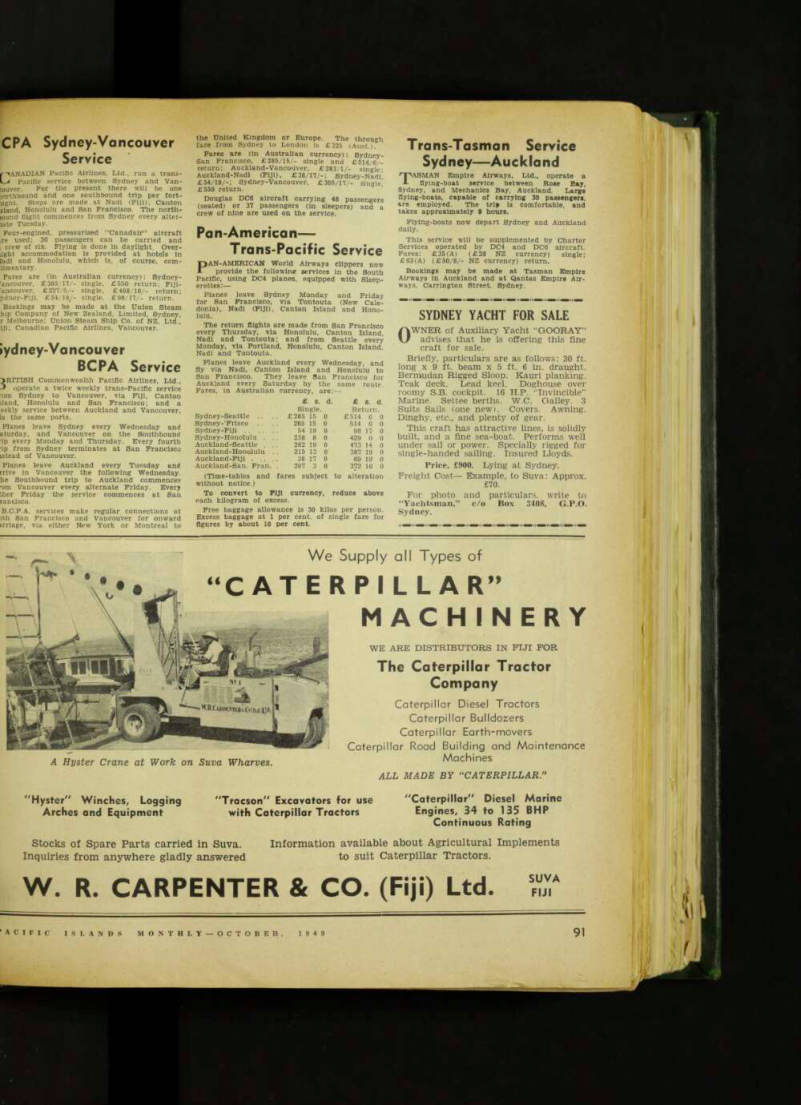
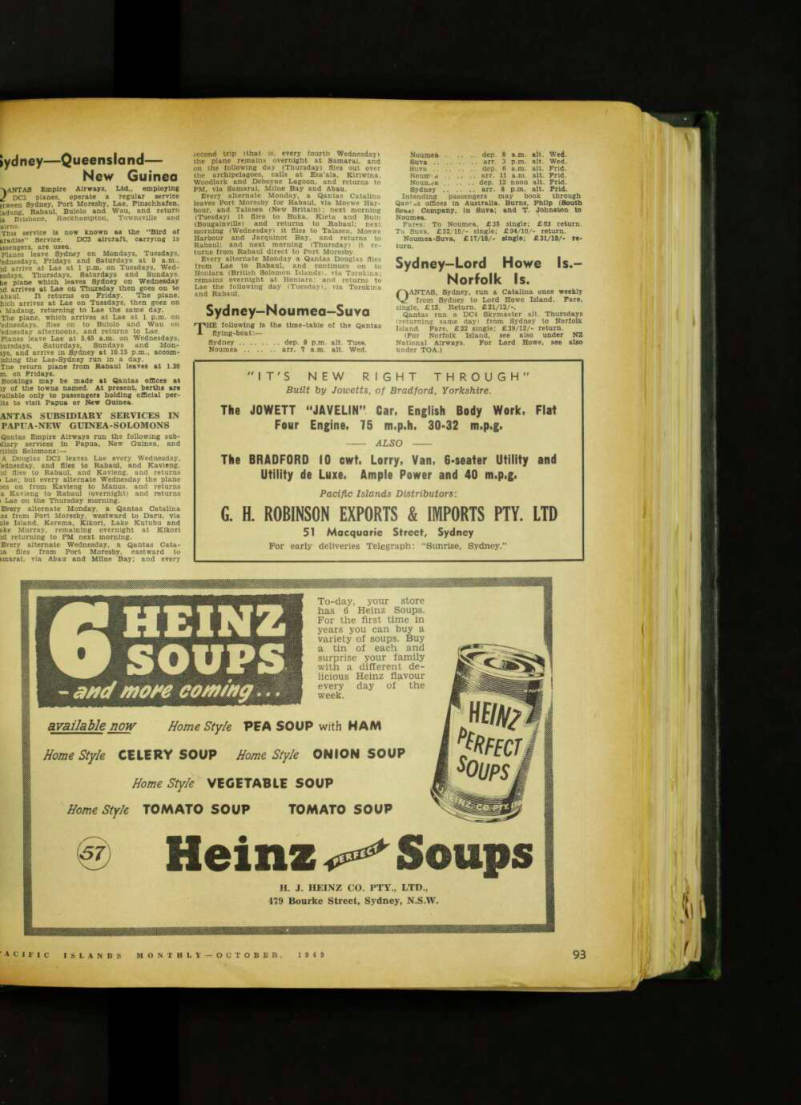
Summary of Pacific Air
Services
PAPUA AND NEW GUlNEA.—Regular Qantas service from Sydney.
SOLOMON ISLANDS.—Frequent regular flying boat service from Sydney bv Trans Oceanic Airways. Qantas service also from Lae, NG, to Honiara, BSI.
NEW HEBRlDES.—Frequent regular flying-boat service from Sydney by Trans Oceanic Air ways. Service from Noumea by French plane runs twice weekly. Qantas plane from Sydney to NH on alternate Tuesdays.
NORFOLK ISLAND.—Regular service from NZ by NZ National Airways; from Sydney by Qantas; from Fiji by NZ National Airways.
LORD HOWE ISLAND —Regular weekly service from Sydney by Qantas and Trans Oceanic Airways.
FlJl. —Regular services from Australia by Pan American, BCPA and CPA (to Nadi); Auck
land by NZ National Airways (to Nadi); from Australia by Qantas (to Laucala Bay, Suva); from Auckland by NZ National Airways (to Laucala Bay, Suva). Irregular calls from Australia to Laucala Bay, Suva, by Trans Oceanic Airways. Regular service from Suva to Labasa by NZ National Airways.
Western Samoa, Cook Islands And
TONGA. —Regular service from Fiji by NZ National Airways.
TAHlTl.—Monthly service from Noumea by TRAPAS plane via Fiji, W. Samoa, Cook Is.
DUTCH NEW GUINEA. —Regular weekly service f*om Batavia by KLM.
AUSTRALIA-NEW ZEALAND.—ReguIar service by Tasman Empire Airways.
AUSTRALIA-NORTH AMERICA.—Regular Trans pacific services by Pan American Airways,
Bcpa And Cpa.
Europe - Indo-China - N. Caledonla.—Fort
nightly service by Air France.
NZ National Airways
South Pacific Services
THE Pacific services run by the New Zealand National Airways Corporation are as follows: —
Auckland-Laucala Bay (Suva): A “Sun
derland” flying-boat leaves Mechanics Bay, Auckland, at 10.30 p.m. each Thursday for Laucala Bay, Suva (arrives 7.10 a.m. the follow ing day).
The aircraft departs from Laucala Bay, Suva, on the return journey at 11.30 p.m. each Sunday, and arrives at Mechanics Bay, Auckland, at 8 15 a.m. the following day.
Laucala Bay (Suva)-Labasa (Vanua
LEVU): A “Sunderland” flying-boat operates this service on a charter basis. A return trip is made between Laucala Bay and Labasa each Sunday,
Auckland-Norfolk Island-Fiji-Tonga
Western Samoa-Cook Islands: A “Douglas”
airliner leaves Whenuapai, Auckland, on
Saturdays at 9 a.m. (September 17, October 15, etc.), for Norfolk Is. (arr. 12.55 p.xn., d( 2 p.m.), Nadi (arr. 8.40 p.m., dep. 5.40 a.
Monday), Nausori (arr. 6.25 a.m., dep. 7 a.m.), Tonga (arr. 10.50 a.m., dep. 11.50 a.m •Faleolo, Western Samoa (arr. 4.5 p.m. Sund£ dep. 8 a.m. Monday), Aitutaki, Cook Islands (a 1.50 p.m. Monday, dep. 2.50 p.m.), Rarotonj Cook Is. (arr. 4.5 p.m., dep. 8 a.m. Wednesda; The aircraft departs from Rarotonga on t return journey at 8 a.m. on alternate Wedm days (September 21, October 5, 17, etc.) at 8 a.i for Aitutaki (arr. 9.15 a.m,, dep. 10 a.m Faleolo, W. Samoa (arr. 3.35 p.m., dep. 8 a.
Thursday), *Tonga (arr. 10.55 a.m. Friday, d< 11.50 am.), Nausori (arr. 2.40 p.m., dep. 3 p.m.), Nadi (arr. 4.25 p.m., dep. 5 a.m. Sati day), Norfolk Is. (arr. 10.55 a.m., dep. 12 nooi Whenuapai, Auckland (arr. 4.50 p.m.). •Crosses International Date Line.
Auckland-Norfolk Island: A ‘Dough
airliner leaves Whenuapai, Auckland, every St day at 8.15 a.m. for Norfolk Island (arr. 12 p.m.), and departs on the return flight at 1 p.m., arriving at Whenuapai at 6 p.m.
PARES, single (in NZ currency): Auckland Norfolk, £l2/10/-; to Fiji, £3l; to Ton £3l; to Samoa, £34; to Aitutaki, £39; to Ra tonga, £39/10/-. Norfolk to FIJI, £l9. FIJI Tonga, £B/15/-; to Samoa, £l3; to Altuta £29/15/-; to Rarotonga, £3l. Samoa to Ra tonga, £l7/15/-; to Aitutaki, £l6/10/-; Suva Labasa, £4/10/-. Return fares, less 10 per ce BOOKING OFFICES; Wellington, Govt. I Bldg., Customhouse Quay; Auckland, Airwi House, Customs St.; Dunedin, 8-10 Mai St.; Christchurch, 104 Gloucester St.; C borne, 74 Peel St.; Palmerston Nor 107 Broadway Ave.; Hamilton, 8 Alma J Rotorua, Airport Bid., Fenton St.; New I mouth, Grand Central Building, Egmont !
Hokitika, Southside Airport; Norfolk Is., Bu Philp, Ltd.; Fiji, NAC at Nadi and Su Burns Philp, Labasa and Lautoka; Tonga, F. P, Melhose, Fou-amotu Airfield; W. Sam Burns Philp (SS), Ltd., Apia; Cook Is., Mrs.
McVeagh, Aitutaki, and Mr. J, D. Campt Rarotonga.
CPA Sydney-Vancouver
Service
C CANADIAN Pacific Airlines, Ltd., run a trans- A Pacific service between Sydney and Van souver. For the present there will be one lorthbound and one southbound trip per fort ilght. Stops are made at Nadi (Fiji). Canton sland, Honolulu and San Francisco. The north »ound flight commences from Sydney every alter late Tuesday.
Pour-engined, pressurised "Canadair” aircraft ,re used: 36 passengers can be carried and , crew of six. Flying is done in daylight. Over light accommodation is provided at hotels in fadi and Honolulu, which Is, of course, com limentary.
Fares are (in Australian currency): Sydney ancouver, £305/17/- single, £550 return; Fiji ancouver, £227/5/- single, £4OB/10/- return; ydney-Fiji, £54/19/- single. £9B/17/- return.
Bookings may be made at the Union Steam hip Company of New Zealand, Limited, Sydney, r Melbourne: Union Steam Ship Co. of NZ, Ltd., 1J1; Canadian Pacific Airlines, Vancouver.
iydney-Voncouver
BCPA Service
BRITISH Commonwealth Pacific Airlines, Ltd., J operate a twice weekly trans-Paciflc service •om Sydney to Vancouver, via Fiji, Canton Hand, Honolulu and San Francisco; and a eekly service between Auckland and Vancouver, la the same ports.
Planes leave Sydney every Wednesday and aturday, and Vancouver on the Southbound •ip every Monday and Thursday. Every fourth ■ip from Sydney terminates at San Francisco istead of Vancouver.
Planes leave Auckland every Tuesday and rrlve in Vancouver the following Wednesday, he Southbound trip to Auckland commences ■om Vancouver every alternate Friday. Every ther Friday the service commences at San rancisco.
B.C.P.A. services make regular connections at )th San Francisco and Vancouver for onward irriage, via either New York or Montreal to
the United Kingdom or Europe. The through fare from Sydney to London is £325 (Aust.).
Fares are (in Australian currency): Sydney- San Francisco, £285/15/- single and £514/6/return; Auckland-Vancouver, £283/1/- single - Auckland-Nadi (Fiji), £3B/17/-; Sydney-Nadi’ £54/19/-; Sydney-Vancouver, £305/17/- single’ £550 return.
Douglas DC6 aircraft carrying 48 passengers (seated) or 37 passengers (in sleepers) and a crew of nine are used on the service.
Pan-American—
Trans-Pacific Service
PAN-AMERICAN World Airways clippers now provide the following services in the South Pacific, using DC4 planes, equipped with Sleep erettes: — Planes leave Sydney Monday and Friday for San Francisco, via Tontouta (New Cale donia), Nadi (Fiji), Canton Island and Hono lulu.
The return flights are made from San Francisco every Thursday, via Honolulu, Canton Island, Nadi and Tontouta; and from Seattle every Monday, via Portland, Honolulu, Canton Island, Nadi and Tontouta.
Planes leave Auckland every Wednesday, and fly via Nadi, Canton Island and Honolulu to San Francisco. They leave San Francisco for Auckland every Saturday by the same route.
Fares, in Australian currency, are:—
(Time-tables and fares subject to alteration without notice.) To convert to FIJI currency, reduce above each kilogram of excess.
Free baggage allowance is 30 kilos per person.
Excess baggage at 1 per cent, of single fare for figures by about 10 per cent.
Trans-Tasman Service
Sydney—Auckland
TASMAN Empire Airways, Ltd., operate a flying-boat service between Rose Bay, Sydney, and Mechanics Bay, Auckland. Large flying-boats, capable of carrying 30 passengers, are employed. The trip is comfortable, and takes approximately 8 hours.
Flying-boats now depart Sydney and Auckland daily.
This service will be supplemented by Charter Services operated by DC4 and DC6 aircraft.
Fares; £35 (A) (£2B NZ currency) single; £63 (A) (£5O/8/- NZ currency) return.
Bookings may be made at Tasman Empire Airways in Auckland and at Qantas Empire Air ways, Carrington Street, Sydney.
£ s. d. £ s. d.
Single. Return.
Sydney-Seattle .. .. £285 15 0 £514 6 0 Sydney-’Prlsco .. .. 285 15 0 514 6 0 Sydney-Piji 54 19 0 98 17 0 Sydney-Honolulu . .. 238 8 0 429 0 0 Auckland-Seattle . .. 262 19 0 473 14 0 Auckland-Honolulu . . 215 13 0 387 19 0 Auckland-Plji 38 17 0 69 IS' 0 Auckland-San. Fran. . 207 3 0 372 16 0
Sydney —Queensland —
New Guinea
"VANTAB Empire Airways, Ltd., employing 2 DC3 planes, operate a regular service etween Sydney, Port Moresby, Lae, Flnschhafen, [adang, Rabaul, Bulolo and Wau. and return ia Brisbane, Rockhampton, Townsville and aims.
This service is now known as the "Bird of aradlse” Service. DC3 aircraft, carrying 19 issengers, are usea.
Planes leave Sydney on Mondays, Tuesdays, r ednesdays, Fridays and Saturdays at 9 a.m., id arrive at Lae at 1 p.m. on Tuesdays, Wed esdays, Thursdays, Saturdays and Sundays, he plane which leaves Sydney on Wednesday id arrives at Lae on Thursday then goes on to abaul. It returns on Friday. The plane, hich arrives at Lae on Tuesdays, then goes on i Madang, returning to Lae the same day.
The plane, which arrives at Lae at 1 p.m. on 'ednesdays, flies on to Bulolo and Wau on 'ednesday afternoons, and returns to Lae.
Planes leave Lae at 5.45 a.m. on Wednesdays, lursdays, Saturdays, Sundays and Mon lys, and arrive in Sydney at 10.15 p.m., accom ishing the Lae-Sydney run in a day.
The return plane from Rabaul leaves at 1.30 m. on Fridays.
Bookings may be made at Qantas offices at ly of the towns named. At present, berths are rallable only to passengers holding official per ils to visit Papua or New Guinea.
Antas Subsidiary Services In
Papua-New Guinea-Solomons
Qantas Empire Airways run the following sub diary services in Papua, New Guinea, and ritish Solomons: — A Douglas DCS leaves Lae every Wednesday, ednesday, and flies to Rabaul, and Kavieng, id flies to Rabaul, and Kavieng, and returns i Lae; but every alternate Wednesday the plane jes on from Kavieng to Manus, and returns a Kavieng to Rabaul (overnight) and returns i Lae on the Thursday morning.
Every alternate Monday, a Qantas Catalina es from Port Moresby, westward to Daru, via ale Island, Kerema, Kikori, Lake Kutubu and ake Murray, remaining overnight at Kikori id returning to PM next morning.
Every alternate Wednesday, a Qantas Cata la flies from Port Moresby, eastward to imarai, via Abau and Milne Bay; and every
second trip (that is, every fourth Wednesday) the plane remains overnight at Samarai, and on the following day (Thursday) flies out over the archipelagoes, calls at Esa’ala, Kiriwina, Woodlark and Deboyne Lagoon, and returns to PM, via Samarai, Milne Bay and Abau.
Every alternate Monday, a Qantas Catalina leaves Port Moresby for Rabaul, via Moewe Har bour, and Talasea (New Britain); next morning (Tuesday) it flies to Buka, Kieta and Buin (Bougainville) and returns to Rabaul; next morning (Wednesday) it flies to Talasea, Moewe Harbour and Jacquinot Bay, and returns to Rabaul; and next morning (Thursday) it re turns from Rabaul direct to Port Moresby.
Every alternate Monday a Qantas Douglas flies from Lae to Rabaul, and continues on to Honiara (British Solomon Islands), via Torokina; remains overnight at Honiara: and returns to Lae the following day (Tuesday), via Torokina and Rabaul.
Sydney-Noumea-Suva
THE following Is the time-table of the Qantas flying-boat:— Sydney dep. 9 p.m. alt. Tue*.
Noumea arr. 7 a.m. alt. Wed.
Noumea dep. 8 a.m. ait. Wed.
Suva arr. 3 p.m. alt. Wed.
Suva dep. 6 a.m. alt. Frid.
Nouro a arr. 11 a.m. alt. Frid.
Noumaa .. .. .. dep. 12 noon alt. Frid.
Sydney arr. 8 p.m. alt. Frid.
Intending passengers may book through offices in Australia. Burns, Philp (South Seas) Company, In Suva; and T. Johnston In Noumea.
Fares: To Noumea. £35 single: £63 return.
To Suva, £52/10/- single; £94/10/- return.
Noumea-Suva, £l7/10/- single; £3l/10/- re turn.
Sydney—Lord Howe ls.-
Norfolk Is.
Q ANT AS, Sydney, run a Catalina once weekly from Sydney to Lord Howe Island. Fare, single, £l2. Return, £2l/12/-.
Qantas run a DC4 Skymaster alt. Thursdays (returning same day) from Sydney to Norfolk Island. Fare, £22 single; £39/12/- return. (For Norfolk Island, see also under NZ National Airways. For Lord Howe, see also under TOA.)
Sydney—New Hebrides
A QANTAS plane leaves Sydney for New Hebrides on alternate Tuesdays. It flies via Noumea and Port Vila to Santo, and returns.
New Caledonia-
New Hebrides
'T'RAPAS (French Air Line) operates a service A between Noumea and the New Hebrides.
The plane leaves Noumea every Tuesday, and
flies direct to Vila and Santo, and returns. Re turn fare for the journey, Noumea-Santo. is approximately £42 Australian.
N. Caledonia-Tahiti
'T'RAPAS (Societe Francais de Transports A Aeriens du Pacific Sud-Noumea) runs a monthly service from New Caledonia to Tahiti.
Departing at 8 a.m. from Noumea, every third Thursday, the plane flies via Fiji (Nadi), Western Samoa (Faleolo), Cook Islands (Aitu taki) to Papeete, where it arrives at about 11.40 a.m. two days later. One evening is spent in
Nadi and one night in Aitutaki. The plane r< turns by the same route in the following weel Fare from Noumea to Papeete is 16,000 Pacif francs single, and 28,800 return. (160 Pacif francs equal £1 Australian.) While the plar is at Papeete it runs one round trip betwee Papeete and Bora Bora.
KLM Dutch New Guinea
Service
K.L.M. Royal Dutch Airlines run a reguli weekly service from Batavia to Dutch Ne Guinea, via Sourabaya, Makassar and Ambo: on the following schedule: Batavia dep. Sunda; at 10.30 a.m., Biak Island arr. Mondays ; 4.40 p.m.; dep. Tuesdays at 6 a.m., Holland arr. Tuesdays at 8.10 a.m. On the retui journey the aircraft leaves Hollandia at 9 a.i On Tuesdays; Biak Island arr. 11.10 a.m., de 12.15 p.m. on Tuesdays; and Batavia arr. 6 p.i on Wednesdays.
The aircraft used are C. 475, a type of DC and the single fares are Batavia-Biak Islar £A80; Batavia-Hollandia £A9I/15/-; and Bi: Island-Hollandia £AII/15/-, Return fart double single.
France— I ndo-China—
N. Caledonia
r F'HE French national airways, Air Franc ■*- runs a fortnightly service between Pai and New Caledonia, and return. Stops are mai at Rome (forward journey) or Marseilles (r turn journey) Cairo, Bazra. Karachi, Calcutt Saigon. Batavia, Darwin, Brisbane.
DC4 Skymasters are used in the service.
Fare between Brisbane and Tontouta (Nc Caledonia) has been fixed, for the present £2B/19/- (Australian).
TOA Services
TRANS Oceanic Airways run the followii Pacific services:— SYDNEY-EORD HOWE IS.: A regular for nightly service with large four-engine flyin boats from Rose Bay. Fare: £ll single; £ return. Free baggage allowance 50 lb Exce baggage and freight rate 6d. per lb.
SYDNEY-NEW HEBRIDES: A regular monthly rvice with large four-engine flying-boats from dney, via Noumea (overnight stop), to Vila d Espiritu Santo. Fare: Sydney-Vila, £45; dney-Santo, £5O; Noumea-Vila. £l2/10/-, umea-Santo. £lB/15/-. Freight: Sydney-Vila, . per lb.; Sydney-Santo, 2/3.
Sydney-Solomon Islands: A Regular
mthly service from Sydney, via New Cale nia and New Hebrides to Tulagi, Solomon ands. This service is frequently extended to igatou, in the Russell Islands, and calls are netimes made at Vanikoro. in the Santa Cruz oup. Fares; Sydney-Tulagi, £65. Free bag ge allowance, 60 lb.; excess baggage and ight, 3/- per lb.
Advertisements & other items, pp. 92-96 (6 items)
October, 1949 Pacific Islands Month
pvTu-
v : V MM ~-jr yv
'eAAlh
'utneas
pvTu-
\V>S
WHOLESALE MERCHANTS
S>
GENERAL^ACENTS
*P ■*yv VV>
FORWARDING, SHIPPING 6 CUSTOMS AGENTS
SYDNEY YACHT FOR SALE
OWNER of Auxiliary Yacht “GOORAY” advises that he is offering this fine craft for sale.
Briefly, particulars are as follows: 30 ft. long x 9 ft. beam x 5 ft. 6 in. draught.
Berrriudan Rigged Sloop. Kauri planking.
Teak deck. Lead keel. Doghouse over roomy S.B. cockpit. 16 H.P. “Invincible”
Marine. Settee berths. W.C. Galley. 3 Suits Sails (one new). Covers. Awning, Dinghy, etc., and plenty of gear.
This craft has attractive lines, is solidly built, and a fine sea-boat. Performs well under sail or power. Specially rigged for single-handed sailing. Insured Lloyds.
Price, £9OO. Lying at Sydney.
Freight Cost — Example, to Suva: Approx. £7O.
For photo and particulars, write to “Yachtsman,” c/o Box 3408, G.P.O.
Sydney.
- H* • : V \ WM»wii»fnnn^mw> 4 A Hyster Crane at Work on Suva Wharves.
We Supply all Types of
“CATERPILLAR”
MACHINERY
WE ARE DISTRIBUTORS IN FIJI FOR
The Caterpillar Tractor
Company
Caterpillar Diesel Tractors Caterpillar Bulldozers Caterpillar Earth-movers Caterpillar Road Building and Maintenance Machines
ALL MADE BY “CATERPILLAR.”
Hyster" Winches, Logging Arches and Equipment Tracson" Excavators for use with Caterpillar Tractors 'Caterpillar" Diesel Marine Engines, 34 to 135 BHP Continuous Rating Stocks of Spare Parts carried in Suva. Information available about Agricultural Implements Inquiries from anywhere gladly answered to suit Caterpillar Tractors.
W. R. CARPENTER & CO. (Fiji) Ltd.
SUVA
FIJI
7a Va 7a
BRONTE
BRAND:
From
Australia 1
Finest Fi
Stock ..
Chili Con Came Braised Steak and Onions Curried Beef Curried Mutton Steak and Onions Mutton and Peas Irish Stew Beef Steak Pudding Corned Beef Hash Corned Beef Loaf With Cereal Mutton Broth Mulligatawny Soup Tomato Soup Vegetable Soup From the finest fat stock and the rid
est vegetables in Australia we produ
these high-grade canned meats ar
soups. BRONTE BRAND meat
hotmeals and soups are delicious flavoured and are made froi
ONLY meats and vegctabl
of the highest quality. . . . ★
THE COLONIAL WHOLESALE MEAT CO.
PTY. LTD.
Canning Factory, State Abattoirs, Homebush Bay, Sydney.
N.S.W.
PHONES:
PHONE; UM 8436.
CABLE ADDRESS:
WOOLMILL. SYDNEY.
p m i
"IT'S NEW RIGHT THROUGH"
Built by Jowetts, of Bradford, Yorkshire.
The JOWETT “JAVELIN” Car, English Body Work. Flat Four Engine, 75 m.p.h. 30-32 m.p.g.
ALSO
The BRADFORD 10 cwt. Lorry, Van, 6-seater Utility and Utility de Luxe. Ample Power and 40 m.p.g.
Pacific Islands Distributors : G. H. ROBINSON EXPORTS & IMPORTS PTY. LTD 51 Macquarie Street, Sydney For early deliveries Telegraph; “Sunrise, Sydney.”
HEINZ
SOUPS
- and more coming..
To-day, your store has 6 Heinz Soups.
For the first time in years you can buy a variety of soups. Buy a tin of each and surprise your family with a different delicious Heinz flavour every day of the week. available now Home Style PEA SOUP with HAM Home Style CELERY SOUP Home Style ONION SOUP
Home Style VEGETABLE SOUP
Home Style TOMATO SOUP TOMATO SOUP
? Rfect
*oups
37
Heinz X Soups
H. J. HEINZ CO. PTY., LTD.,
479 Bourke Street, Sydney, N.S.W.
Sails, Covers, Awnings
TENTS, TARPAULINS, and ail classes CANVAS GOODS for industrial and home use FLAGS AND PENNANTS FOR CLUBS AND ASSOCIATIONS Send your inquiries through your agent,
to HARRY WEST
"SYDNEY'S SAILMAKER"
DUKE ST. (WATERFRONT) EAST BALMAIN, SYDNEY, N.S.W.
Phone: WBIIOS, W 82284.
CHAPMANS Fruit Juice Cordials
ALL FLAVOURS.
CALIFORNIAN BISCUIT CO.
SWEET & FANCY BISCUITS
In the following varieties, packed for export; SCOTCH, SHORTBREAD, MONTE-
CARLO, COCONUT, CHOC-CARLO, RUMI-CHOC, CREAM-COCONUT, DATE
SLICE.
COVERWELL PAINT CO.
HIGH-GRADE PAINTS, VARNISHES AND ENAMELS.
The above products are available for immediate shipment, are of Australian manufacture, and of highest quality If unable to obtain supplies locally, write direct to the SOLE AGENTS FOR THE PACIFIC ISLANDS :
J. C. MERRILLEES PTY. LTD.
Telegrams: “MERRILLEES,” Sydney 104 Hunter Street, Sydney.
Agents in Fiji HUNTS AGENCY, SUVA.
91
ACIFIC ISLANDS MONTHLY OCTOBER, 1949
92
OCTOBER, 1949 PACIFIC ISLANDS MONTHI
93
ACIFIC ISLANDS MONTHLY OCTOBER, 1949
94
OCTOBER, 1949 PACIFIC ISLANDS MONTHL
Papua-NG Local
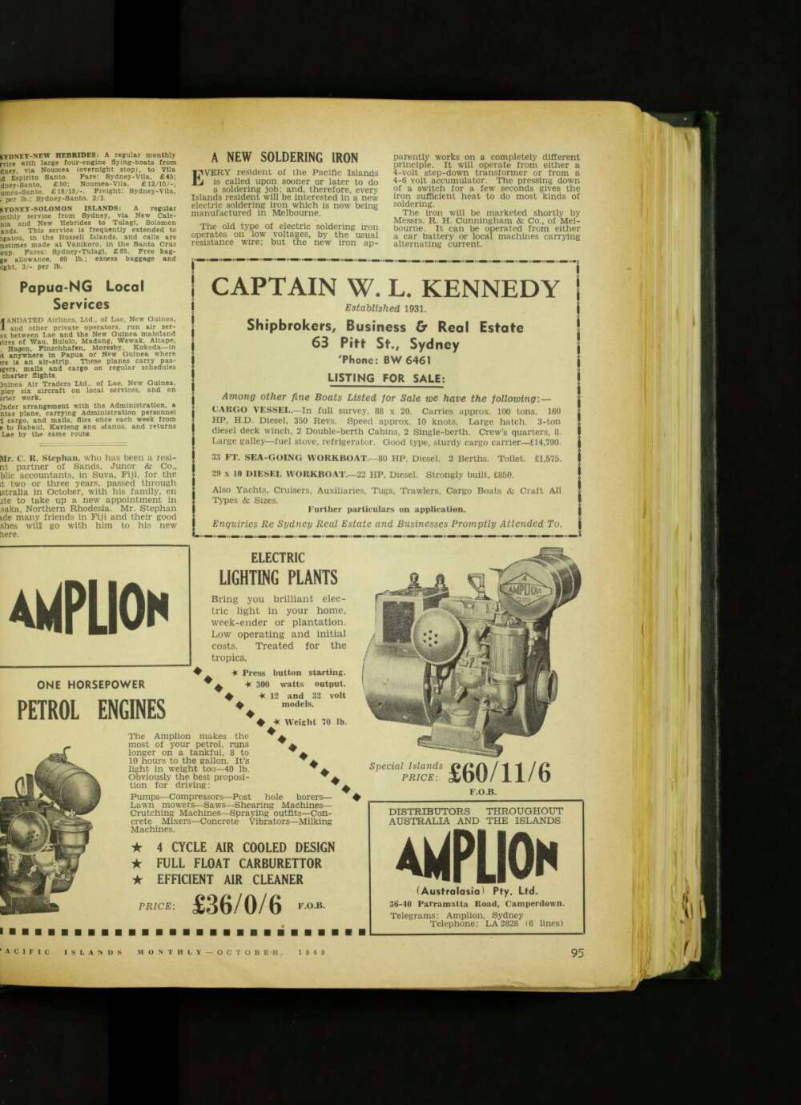
Services
lANDATED Airlines, Ltd., of Lae, New Guinea, and other private operators, run air ser es between Lae and the New Guinea mainland litres of Wau, Bulolo, Madang, Wewak. Aitape, Hagen, Plnschhafen, Moresby, Kokoda—in it anywhere in Papua or New Guinea where >re is an air-strip. These planes carry pas igers, mails and cargo on regular schedules charter flights. guinea Air Traders Ltd., of Lae. New Guinea, ploy six aircraft on local services, and on irter work.
Jnder arrangement with the Administration, a ntas plane, carrying Administration personnel 1 cargo, and mails, flies once each week from 8 to Rabaul, Kavieng ana Manus, and returns Lae by the same route.
Mr. C. R. Stephan, who has been a resi nt partner of Sands, Junor & Co., blic accountants, in Suva, Fiji, for the it two or three years, passed through istralia in October, with his family, en ite to take up a new appointment in saka, Northern Rhodesia. Mr. Stephan ide many friends in Fiji and their good shes will) go with him to his new here.
A New Soldering Iron
EVERY resident of the Pacific Islands is called upon sooner or later to do a soldering job; and, therefore, every Islands resident will be interested in a new electric soldering iron which is now being manufactured in Melbourne.
The old type of electric soldering iron operates on low voltages, by the usual resistance wire; but the new iron ap
parently works on a completely different principle. It will operate from either a 4-volt step-down transformer or from a 4-6 volt accumulator. The pressing down of a switch for a few seconds gives the iron sufficient heat to do most kinds of soldering.
The iron will be marketed shortly by Messrs. R. H. Cunningham & Co., of Mel bourne. It can be operated from either a car battery or local machines carrying alternating current.
Advertisements & other items, pp. 97-98 (3 items)
95
ACIFIC ISLANDS MONTHLY OCTOBER, 1949
aKPUOh
CAPTAIN W. L. KENNEDY
Established 1931.
Shipbrokers, Business & Real Estate
63 Pitt St,, Sydney
'Phone: BW 6461
LISTING FOR SALE:
Among other fine Boats Listed for Sale we have the following :— CARGO VESSEL.—In full survey, 88 x 20. Carries approx. 100 tons. 160 HP, H.D. Diesel, 350 Revs. Speed approx. 10 knots. Large hatch. 3-ton diesel deck winch, 2 Double-berth Cabins, 2 Single-berth. Crew’s quarters, 8.
Large galley—fuel stove, refrigerator. Good type, sturdy cargo carrier—£l4,7oo. 33 FT. SEA-GOING WORKBOAT.— BO HP, Diesel. 2 Berths. Toilet. £1,575. 29 xlO DIESEL WORKBOAT.— 22 HP, Diesel. Strongly built, £B5O.
Also Yachts, Cruisers, Auxiliaries, Tugs, Trawlers, Cargo Boats & Craft All Types & Sizes.
Further particulars on application.
Enquiries Re Sydney Real Estate and Businesses Promptly Attended To.
aKPUOh
ONE HORSEPOWER
PETROL ENGINES
ELECTRIC
LIGHTING PLANTS
Bring you brilliant electric light in your home, week-ender or plantation.
Low operating and initial costs. Treated for the tropics. -K Press button starting. * + * 300 watts output. + 12 and 32 volt models. ♦ * Weight 70 lb. hole borers — The Amplion makes the most of your petrol, runs longer on a tankful, 8 to 10 hours to the gallon. It’s light in weight too—4o lb.
Obviously the best proposition for driving; Pumps—Compressors—Post Lawn mowers—Saws—Shearing Machines— Crutching Machines—Spraying outfits —Concrete Mixers —Concrete Vibrators —Milking Machines.
★ 4 CYCLE AIR COOLED DESIGN
★ FULL FLOAT CARBURETTOR
★ EFFICIENT AIR CLEANER
91 m Special Islands
PRICE :
£6O/11/6 F. 0.8.
PRICE ;
£36/0/6 F. 0.8.
DISTRIBUTORS THROUGHOUT
AUSTRALIA AND THE ISLANDS.
aMPLIOh
(Australasia) Pty. Ltd. 36-40 Parramatta Road, Camperdown.
Telegrams: Amplion, Sydney Telephone: LA 2828 (6 lines)
BRITISH
lifSfili
MADE
ALL WORLD SIX RECEIVER
Model 710
OPERATES FROM A 6 VOLT ACCUMULATOR
COMBINES EXCELLENT PERFORMANCE WITH
ECONOMICAL CURRENT CONSUMPTION
The Eddystone ALL WORLD SIX Superheterodyne receiver has been developed specially for the Overseas Listener who lacks a mains electricity supply. It will give consistently good reception of short and medium wave broadcasting stations in any part of the World and under widely varying climatic conditions.
SPECIAL FEATURES:
it Consumption only 2.5 amperes. it Miniature valves. it Robust construction. it Finished for tropical service. it Mechanical bandspread logging. it Wide frequency coverage (620 to 10 metres). it Large, accurately calibrated scale. it Flywheel loaded tuning. it High quality reproduction (Push-pull output). it Provision for extension speaker and gramophone pick-up.
ENGLISH LIST PRICE : £37/10/- {Sterling).
Special Tropical-type 6-volt Accumulator. Capacity. 102 A.H.
ENGLISH LIST PRICE: £9/18/6 {Sterling).
AVAILABLE FOR IMMEDIATE DELIVERY
THE AUSTRALIAN FACTORY REPRESENTATIVES:
R. H. CUNNINGHAM & CO.
62 STANHOPE ST., MALVERN, VICTORIA
Cables: "CUNNIG," Melb.
96
OCTOBER, 1949 PACIFIC ISLANDS MONTHL
Astern Papua
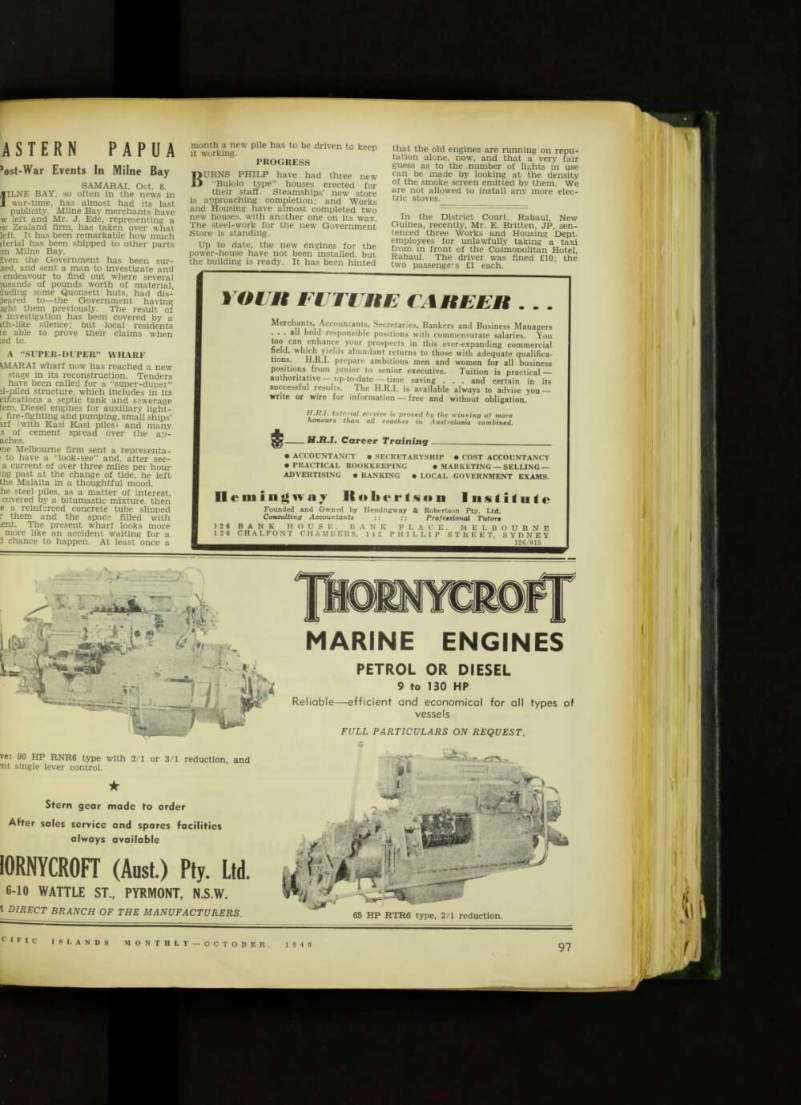
Post-War Events In Milne Bay
Samarai, Oct. 8.
lILNE BAY, so often in the news in war-time, has almost had its last publicity. Milne Bay merchants have w left and Mr. J. Ede, representing a iw Zealand firm, has taken over what left. It has been remarkable how much iterial has been shipped to other parts ;m Milne Bay.
Sven the Government has been sur sed, and sent a man to investigate and endeavour to find out where several msands of pounds worth of material, iluding some Quonsett huts, had dis peared to—the Government having ight them previously. The result of ! investigation has been covered by a ith-like silence; but local residents re able to prove their claims when red to.
A “Super-Duper” Wharf
VMARAI wharf now has reached a new stage in its reconstruction. Tenders have been called for a “super-duper” jl-piled structure, which includes in its cifications a septic tank and sewerage tern, Diesel engines for auxiliary light , fire-fighting and pumping, small ships’ irf (with Kasi Kasi piles) and many s of cement spread over the ap aches. me Melbourne firm sent a representa i to have a “look-see” and, after see a current of over three miles per hour ing past at the change of tide, he left the Malaita in a thoughtful mood, he steel piles, as a matter of interest, covered by a bitumastic mixture, then e a reinforced concrete tube slipped r them and the space filled with ient. The present wharf looks more more like an accident waiting for a 1 chance to happen. At least once a
month a new pile has to be driven to keep it working.
Progress
BURNS PHILP have had three new “Bulolo type” houses erected for their staff. Steamships’ new store is approaching completion; and Works and Housing have almost completed two new houses, with another one on its way.
The steel-work for the new Government Store is standing.
Up to date, the new engines for the power-house have not been installed, but the building is ready. It has been hinted
( that the ° ld running on repu tation alone, now, and that a very fair guess as to the number of lights in use can be made b y looking at the density of tbe smoke screen emitted by them. We J£® n ° t allowed to install any more elec tnc stoves -_ .
In the District Court, Rabaul, New Guinea, recently, Mr. E. Britten, JP, sen fenced three Works and Housing Dept,
fJsm°S?front* of Jsmo^nlhfn
Rateml The driver was the two each ’ 1 passenge.s ti eacn.
Advertisements & other items, pp. 99-100 (3 items)
97
CIFIC ISLANDS MONTHLY— .OCTOBER, 1949
IORNYCROFT (Aust.) Ply. ltd.
YOUR FUTURE CAREER
Merchants, Accountants, Secretaries, Bankers and Business Managers ... all hold responsible positions with commensurate salaries. You too can enhance your prospects in this ever-expanding commercial ,d, which yields abundant returns to those with adequate qualifications. H.R.I. prepare ambitious men and women for all business positions from junior to senior executive. Tuition is practical authoritative— up-to-date time saving . . . and certain in its successful results. The H.R.I, is available always to advise you write or wire for information free and without obligation.
H.R.I. tutorial service is proved by the winning of more honours than all coaches in Australasia combined.
H.R.I. Career Training • ACCOUNTANCY e SECRETARYSHIP • COST ACCOUNTANCY
• PRACTICAL BOOKKEEPING • MARKETING SELLING
ADVERTISING • BANKING • LOCAL GOVERNMENT EXAMS.
Hemingway Robertson Institute
J 2 6 1 2 6 Founded and Owned by Hemingway & Robertson Pty. Ltd.
Consulting Accountants Professional Tutors
BANK HOUSE. BANK
CHALFONT CHAMBERS, 142
PLACE. MELBOURNE
PHILLIP STREET, SYDNEY
126/815
ve: 90 HP RNR6 type with 2/1 or 3/1 reduction, and int single lever control. ★ Stern gear made to order After sales service and spares facilities always available
IORNYCROFT (Aust.) Ply. ltd.
6-10 WATTLE ST., PYRMONT, N.S.W.
1 direct branch of the manufacturers.
MARINE ENGINES
PETROL OR DIESEL
9 to 130 HP Reliable—efficient and economical for all types of vessels
FULL PARTICULARS ON REQUEST.
4 65 HP RTR6 type, 2/1 reduction.
RUSSELL NEWBERY MARINE
DIESEL ENGINES
“RN” British Marine Diesel Engines are unequalled by any other engine on the market for their remarkable economy in operation, yet ability to withstand the hardest duty. “RN” engines have attained world-wide popularity because the complete combustion of the injected oil spray into the charge of highly compressed air has been the subject of the closest scientific study by Russell Newbery research department for many years. The fact that engines totalling many thousands of horse-power incorporating the “RN” patent combustion chamber are in successful operation in all parts of the world should give potential users confidence; in selecting an “RN” engine, they are dealing with acknowledged Diesel engine specialists.
The illustration below shows an “RN” DM4 type fitted with “RN” patented fluid-operated reverse gear-box. Added distinctive features which should be given the most careful consideration are as under: — © Removable wet liners.
Cylinder heads are specially designed to obtain extremely high turbulence, resulting in perfect combustion at all loads and speeds, combined with quiet running and low operating cost.
Valves are positioned horizontally and can be easily and quickly removed without removing cylinders.
C.A.V. fuel system.
Cold starting—hand or electric.
Reverse gear—hand or fluid operated by remote control. The below schedule shows details of the range of Russell Newbery Marine Diesel Engines Model Designation .. ..
Two-stroke or Four-stroke Number of Cylinders ..
Normal B.H.P Maximum B.H.P Speed Range, R.P.M Full details and specifications available from Mr. C. C. EVANS, c/o Bonk of New South Woles, Port Moresby
-PERKINS (Aust.) PTY. LIMITED
Bowden Street, Alexandria, N.S.W.
With Branches at
BRISBANE MELBOURNE
ADELAIDE
October, 19 4 9 -Pacific Islands Mont*
Rabaul Couples Marry
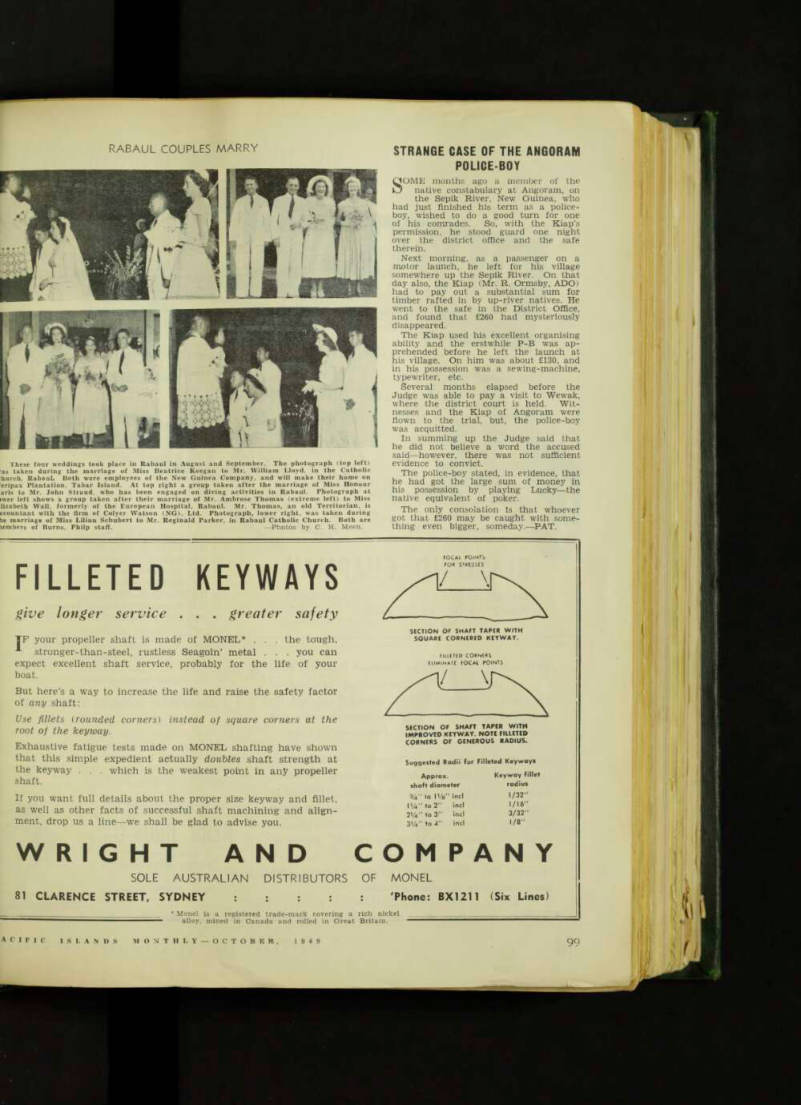
These four weddings took place in Rabaul in August and September. The photograph (top left) as taken during the marriage of Miss Beatrice Keegan to Mr. William Lloyd, in the Catholic hurch, Rabaul. Both were employees of the New Guinea Company, and will make their home on eripax Plantation, Tabar Island. At top right a group taken after the marriage of Miss Honour arls to Mr. John Straud, who has been engaged on diving activities in. Rabaul. Photograph at >wer left shows a group taken after their marriage of Mr. Ambrose Thomas (extreme left) to Miss lizabeth Wall, formerly of the European Hospital, Rabaul. Mr. Thomas, an old Territorian, is ccountant with the firm of Colyer W'atson (NG). Ltd. Photograph, lower right, was taken during lie marriage of Miss Lilian Schubert to Mr. Reginald Parker, in Rabaul Catholic Church. Both are [?]embers of Burns, Philp staff. —Photos by C. H. Meen.
Strange Case Of The Angoram
Police-Boy
QOME months ago a member of the lO native constabulary at Angoram, on the Sepik River, New Guinea, who had just finished his term as a police boy, wished to do a good turn for one of his comrades. So, with the Kiap’s permission, he stood guard one night over the district office and the safe therein.
Next morning, as a passenger on a motor launch, he left for his village somewhere up the Sepik River. On that day also, the Kiap (Mr. R. Ormsby, ADO) had to pay out a substantial sum for timber rafted in by up-river natives. He went to the safe in the District Office, and found that £260 had mysteriously disappeared.
The Kiap used his excellent organising ability and the erstwhile P-B was ap prehended before he left the launch at his village. On him was about £l3O, and in his possession was a sewing-machine, typewriter, etc.
Several months elapsed before the Judge was able to pay a visit to Wewak, where the district court is held. Wit nesses and the Kiap of Angoram were flown to the trial, but, the police-boy was acquitted.
In summing up the Judge said that he did not believe a word the accused said —however, there was not sufficient evidence to convict.
The police-boy stated, in evidence, that he had got the large sum of money in his possession by playing Lucky—the native equivalent of poker.
The only consolation Is that whoever got that £260 may be caught with some thing even bigger, someday.—PAT.
Advertisements & other items, pp. 101-102 (3 items)
99
ACIFIC ISLANDS MONTHLY OCTOBER. 194
Filleted Keyways Alh
FOCAL POINTS
give longer service . . . greater safety L- - „ TF your propeller shaft is made of MONEL* . . . the tough, stronger-than-steel, rustless Seagoin’ metal . . . you can expect excellent shaft service, probably for the life of your boat.
But here’s a way to increase the life and raise the safety factor of any shaft: Use fillets (rounded corners) instead of square corners at the
root of the keyway.
Exhaustive fatigue tests made on MONEL shafting have shown that this simple expedient actually doubles shaft strength at the keyway . . . which is the weakest point in any propeller shaft.
If you want full details about the proper size keyway and fillet, as well as other facts of successful shaft machining and alignment, drop us a line—we shall be glad to advise you.
SECTION OF SHAFT TAPIR WITH
SQUARE CORNERED KEYWAY.
FIUETEO CORNERS
ELIMINATE fOCAI POINTS
SECTION OF SHAFT TAPER WITH
IMPROVED KEYWAY. NOTE FILLETED
CORNERS OF GENEROUS RADIUS.
Suggested Radii for Filleted Keyways Approx, shaft diameter 34" to M/a" incl 11/4" to 2" incl 2Va" to 3" incl SVa" to 4" incl Keyway fillet radius 1/32" 1/16" 3/32" 1/8"
WRIGHT AND COMPANY
SOLE AUSTRALIAN DISTRIBUTORS OF MONEL
81 CLARENCE STREET, SYDNEY : : : : : 'Phone: BXI2II (Six Lines) * Monel is a registered trade-mark covering a rich nickel alloy, mined in Canada and rolled in Great Britain.
I i \ i I (
Invite your enquiries ,*
for
BLAXLAND CHAPMAN PRODUCTS
from their sole
mif' c
sl6 oUo^
%o*' *** Jr t* * // *r - I
NOW IN PRODUCTION
BLAXLAND CHAPMAN
MARINE ENGINES • WONDER LAUNCHES
PUMPS AND ENGINEERING PRODUCTS
3i H.P. Blaxland 5/7 H.P. Blaxland 2i H.P. Blaxland- -3 H.P. Blaxland 4i H.P. Blaxland- -6/8 H.P. Blaxland 10 H.P. Blaxland 20 H.P. Blaxland- Pup Marine Engine.
Twin Marine Engine.
Chapman Standard Pup. -Chapman Master Pup. -Chapman Super Pup. -Chapman Greyhound. -Chapman Seadog. ■Chapman Twin Seadog. rpHE recent acquisition by Blaxland Rae Pty., Ltd., of the well-known engineering business of Chapman & Sherack, has already resulted in enhanced organisation and in improvements and additions to a notable range of engineering lines.
With the appointment of Messrs. Kerr Bros. Pty., Ltd., as our Sole Pacific Distributors, therefore, Island Residents may rely on prompt attention to their enquiries and orders for Blaxland-Chapman Marine Engines, Launches, Pumps and other Engineering requirements within our range. Moreover, residents will be kept fully and regularly informed, through this magazine, of all Blaxland-Chapman developments in the coming months.
All engines of 4i H.P. and upwards are reversible by a mere flick of the Blaxland- Chapman patented magneto. Since no reserves of stock are held, orders for forward delivery should be placed now.
CHAPMAN WONDER LAUNCHES
Ideal for Island service and already acclaimed far and wide for style, performance and seaworthiness. Available in 16 ft. x 6 ft. open and half-cabin models and 18 ft. x 7 ft. halfcabin models powered with Blaxland or Blaxland-Chapman Engines.
Enquiries are invited.
KERR BROS.
4 YORK STREET,
SYDNEY, AUSTRALIA
Box 3838, G.P.O.
Cables: “CARE,” Sydney.
October, 1949 Pacific Islands Month!
The Month In Moresby
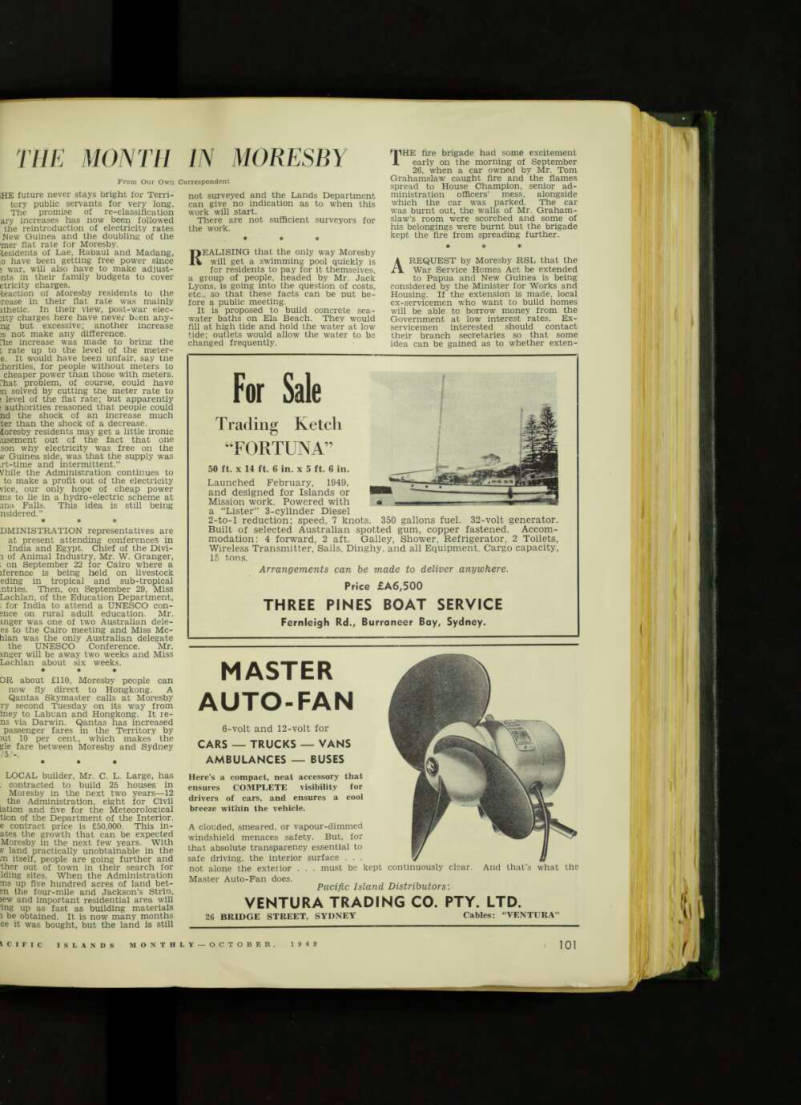
From Our Own Correspondent
iHE future never stays bright for Terri tory public servants for very long.
The promise of re-classification ary increases has now been followed the reintroduction of electricity rates New Guinea and the doubling of the mer flat rate for Moresby.
Residents of Lae, Rabaul and Madang, 0 have been getting free power since ; war, will also have to make ad.iust nts in their family budgets to cover ctricity charges. leaction of Moresby residents to the rease in their flat rate was mainly ithetic. In their view, post-war elec ;ity charges here have never been any ng but excessive; another increase ;s not make any difference. [he increase was made to bring the t rate up to the level of the meter e. It would have been unfair, say tne horities, for people without meters to cheaper power than those with meters, [hat problem, of course, could have in solved by cutting the meter rate to 1 level of the flat rate; but apparently i authorities reasoned that people could nd the shock of an increase much ter than the shock of a decrease, loresby residents may get a little ironic lusement out of the fact that one son why electricity was free on the v Guinea side, was that the supply was ,rt-time and intermittent.” yhile the Administration continues to to make a profit out of the electricity vice, our only hope of cheap power ms to lie in a hydro-electric scheme at Lina Falls. This idea is still being nsidered.” ♦ * * DMINISTRATION representatives are at present attending conferences in India and Egypt. Chief of the Divi i of Animal Industry, Mr. W. Granger, ; on September 22 for Cairo where a iference is being held on livestock eding in tropical and sub-tropical ntries. Then, on September 29, Miss Lachlan, of the Education Department, ; for India to attend a UNESCO con mce on rural adult education. Mr. mger was one of two Australian dele es to the Cairo meeting and Miss Me dian was the only Australian delegate the UNESCO Conference. Mr. mger will be away two weeks and Miss Lachlan about six weeks. ♦ ♦ ♦ OR about £llO, Moresby people can now fly direct to Hongkong. A Qantas Skymaster calls at Moresby ry second Tuesday on its way from iney to Labuan and Hongkong. It re ns via Darwin. Qantas has increased passenger fares in the Territory by mt 10 per cent., which makes the gle fare between Moresby and Sydney /5/-. • * * LOCAL builder, Mr. C. L. Large, has . contracted to build 25 houses in Moresby in the next two years—l 2 the Administration, eight for Civil iation and five for the Meteorological tion of the Department of the Interior, e contract price is £50,000. This in ates the growth that can be expected Moresby in the next few years. With v land practically unobtainable in the m itself, people are going further and ther out of town in their search for Iding sites. When the Administration ;ns up five hundred acres of land bet sn the four-mile and Jackson’s Strio, lew and important residential area will ing up as fast as building materials i be obtained. It is now many months ce it was bought, but the land is still
not surveyed and the Lands Department can give no indication as to when this work will start.
There are not sufficient surveyors for the work. ♦ * ♦ REALISING that the only way Moresby will get a swimming pool quickly is for residents to pay for it themselves, a group of people, headed by Mr. Jack Lyons, is going into the question of costs, etc., so that these facts can be put be fore a public meeting.
It is proposed to build concrete sea water baths on Ela Beach. They would fill at high tide and hold the water at low tide; outlets would allow the water to be changed frequently.
THE fire brigade had some excitement early on the morning of September 26, when a car owned by Mr. Tom Grahamslaw caught fire and the flames spread to House Champion, senior ad ministration officers’ mess, alongside which the car was parked. The car was burnt out, the walls of Mr. Graham slaw’s room were scorched and some of his belongings were burnt but the brigade kept the fire from spreading further. * * ♦ A REQUEST by Moresby RSL that the War Service Homes Act be extended to Papua and New Guinea is being considered by the Minister for Works and Housing. If the extension is made, local ex-servicemen who want to build homes will be able to borrow money from the Government at low interest rates. Ex servicemen interested should contact their branch secretaries so that some idea can be gained as to whether exten
sion of the Act to the Territory would be justified. * ♦ TWO big Christmas tree parties will be held in Moresby this December —one by the Murray Heights Club on the 10th and one by the RSL on the 17th.
The RSL is restricting its party to child ren of members as it considers that there
are now too many children here to en tertain them at one party. Even with this limit, the RSL is expecting 200 children at its party. * * * TWELVE trainee drillers, whom the Australasian Petroleum Company sent to America for a nine months’ training course, have returned to Aus tralia and nine are already in Papua. One trainee, Mr. H. F. Eggington, was con sidered newsworthy in Australia by virtue of the fact that he brought back an American wife whom he married a year ago when she was only 15. * * ♦ SEX offences by natives against Euro pean women are increasing in Moresby. One of the most common offences is “entering a dwelling with in tent to indecently insult or annoy,” for which the maximum penalty is a year’s gaol. Cases of this sort arise every few weeks. It is not generally known that a conviction for this type of offence auto matically debars a native from entering any town in Papua—a wise practice which should never be discontinued.
Moresby police are usually successful in tracing native sex offenders and normally, they treat these offences with appropriate seriousness; but in one case recently the investigating officer made it clear to the woman concerned that he thought it was all rather funny. Perhaps his attitude would have been different if the woman had been the wife of a high Government official. * * * THE Movaru Variety Company’s first presentation, “Blue Horizon of 1949,” was well received. More than 500 people attended the performances at the Papuan Theatre on September 27 and October 4 and some people had to be turned away. Half the proceeds will go to the Red Cross. Producer George Red knap is already planning another show, “Vogues of 1950,” which will be staged at the end of January. * * * THE brief Rugby League season in Moresby has ended impressively with a sports afternoon during which races and other contests were held and two football matches were played. A good crowd attended, indicating that
public interest will be high for the nea season, which begins about April. In th main football match, the Maganis, wh were beaten only once this season, de feated Paga Hill, 3-nil. An Old Buffer match resulted in a win for Grout Gorillas over Field’s Foxes by 5 to 3.
Next season it is hoped to have tb ground in better condition, to have moi teams and to make a trip to New Guinei Wau invited a Moresby team to visit thei this year but funds were not availatal It might be a good idea in future if tt home and the visiting team combine to raise the cost of a visit. Gate taking would reduce the cost to the home team • ♦ ♦
Mr. Graham Svensen And Mil
Frances Hibberd were married at tl Moresby Registry Office on Septen ber 22. Witnesses were Miss Betty Bak( and TMr. Hal Herriott. Mr. Svensen acting curator of parks and gardens. Tl couple have made their home at Kila. * * *
Miss Ivy Grahamslaw, Of Ot
married Mr. Frank Middleton, < APC, at the Catholic Churc Moresby, on October 3. Miss Dali; Baldwin was bridesmaid and Mr. Mi( Middleton, the bridegroom’s brother, wi best man. The reception was held at tl golf club. Mr. and Mrs. Middleton w: spend their honeymoon in Australia. • * ♦ AT St. John’s Church of England ( October 1, Miss Jean Ross, of Stear ships Trading Company, was marri( to Mr. Ron Auld, of the Civil Aviatk Department. Miss Alma Youngblutt w bridesmaid and Mr. George Buckley be man. The couple will make their hor in Moresby. ♦ ♦ ♦ RECENT births in Moresby included son to Mr. and Mrs. Vince Neilse: a son to Mr. and Mrs. Max Lan a daughter to Mr. and Mrs. Harold Foie a daughter to Mr. and Mrs. Large; son to Mr. and Mrs. George Gough; son to Mr. and Mrs. lan Loudon: and son to Mr. and Mrs. Warren Steele. * * ♦ AMONG those who. arrived in Mores on the last Bulolo were the Direct of Shipping, Mr. Leighton, who h been on sick leave for many months; IV A. W. Anderson: Mrs. I. Grenville; M B. Hawks; Miss J. Niness; Mr. H. Tr mayne; and Miss V. Roberts. * * * Mr. and Mrs. Nigel Moon, who we married in Sydney recently, have r turned to Moresby. Mrs. Moon w formerly Miss Jane Ferrier. * * • Mr. and Mrs. H. Briggs and M: Dorothy Briggs left on the October Buk to spend their leave in Sydney and M( bourne.
Advertisements & other items, pp. 103-104 (2 items)
101
ICIFIC ISLANDS MONTHLY OCTOBER, 1949
For Sale
Trading Ketch
“FORTUNA”
50 ft. x 14 ft. 6 in. x 5 ft. 6 in.
Launched February, 1949, and designed for Islands or Mission work. Powered with a “Lister” 3-cylinder Diesel 2-to-l reduction; speed, 7 knots. 350 gallons fuel. 32-volt generator.
Built of selected Australian spotted gum, copper fastened. Accommodation: 4 forward, 2 aft. Galley, Shower, Refrigerator, 2 Toilets, Wireless Transmitter, Sails, Dinghy, and all Equipment. Cargo capacity, 15 tons.
Arrangements can he made to deliver anywhere.
Price £A6 / 500
THREE PINES BOAT SERVICE
Fernleigh Rd., Burraneer Bay, Sydney.
fe mm
MASTER
AUTO-FAN
6-volt and 12-volt for
CARS TRUCKS VANS
AMBULANCES BUSES
Here’s a compact, neat accessory that ensures COMPLETE visibility for drivers of cars, and ensures a cool breeze within the vehicle.
A clouded, smeared, or vapour-dimmed windshield menaces safety. But, for that absolute transparency essential to safe driving, the interior surface . . . not alone the exterior . . . must be kept continuously clear.
Master Auto-Fan does.
Pacific Island Distributors'.
VENTURA TRADING CO. PTY. LTD
And that’s what the
26 BRIDGE STREET, SYDNEY
Cables: “VENTURA”
G. H. Robinson
Exports & Imports Pty., Ltd.
ISLAND SUPPLIES
of all kinds—Selected and Shipped to order at lowest possible prices—Piecegoods in Wool, Cotton and Silk, Under and Outerwear, Manchester, Drapery, Grocery, Hardware, Engineers and Leathergoods trade supplies a specialty.
Indents and Transhipments arranged. Large or small orders treated with equal care.
Use our 25 years’ extensive experience.
Enquiries solicited to —
G. H. ROBINSON
Exports & Imports Pty., Ltd. 51 Macquarie Street, Sydney, N.S.W.
Telegrams: Sunrise, Sydney.
Letters: Box 3317, G.P.0., Sydney.
PANEL PLANER &
THICKNESSER
This No. 702 “JEFFWOOD” Panel Planer is ideally suited for the island woodworker. Body is solid cast. Will plane timber 12 in. x 4 in. Cutter head and spindle are in one piece mounted on ball bearings. 3 feed speeds combined with spring loaded clutch.
Prompt delivery assured. Also 14 in. Saw Benches and Spindle Moulders.
Write direct to manufacturers’.
JEFFRESS BROS.
Northgate Rd., Northgate,
BRISBANE, Q.
I I , - ■K : ” J
Fiji Postal Union Stamps
STAMPS to mark the 75th anniversa of the foundation of the Univen Post Union will be on sale in P on October 10.
They will be of the values 2d., 3d., 8 and 1/6, and will remain on sale for thi months, unless supplies are exhaust before then.
An amount of £4OO from Stamps J Missions, a major project of the Ai tralian Luther League, has been donat for a New Guinea Lutheran Missi Hospital, and another £4OO will be ma available for equipment if necessary
150 Head Men
[?]eet ‘Government’ In The Solomons
From Our Own Correspondent
Honiara. Oct. 3.
:OGEST week for Solomon Islanders in the history of the Protectorate opened to-day when 150 headmen assistant headmen from all over the up were officially welcomed to tiara by the Acting Resident Com sioner (Mr. J. A. Germond) in a irful ceremony. his marked the opening of the Head i’s Conference, the first of its kind ;he Protectorate, designed for an ex nge of ideas between Government and dmen, and to afford headmen a nee of seeing for themselves the new ital and the work being done there he visitors’ week includes visits to the r ernment radio station, hospital, work ps, Hu experimental farm, Police s and gaol, Government Trade eme; and talks by heads of Govern it departments on relevant subjects. iy will inspect new houses under con iction here, and see the long aided Bailey bridge, now being erected r the Matanikau river, concert and wholesale feast will mark close of the conference on October
Little Drilling In Papua
In September
iE Australasian Petroleum Company Pty., Ltd., has issued the following report upon the progress of oil ling operations in Papua in Sep iber: >roi: The hole has been deepened 3 feet, from 4,043 feet to 5,076 feet, [ohoro: The depth remains at 2,323 t. Reaming operations have been in gress to clean out the hole, fpoia: The depth remains at 2,662 t. The hole is being reamed to bottom h the new pressure drilling equipment allow drilling to proceed, lalalaua and Wana: Area preparation i been in progress at both these sites; iponents of the new outfits are being ted in Port Moresby in preparation for patch to the field.
Invitation To Sponsor A
Useful Immigrant
HERE are organisations in Australia carrying on the voluntary work of assisting selected residents of Britain emigrate to the South Pacific countries.
Dne such organisation is directed by *. E. J. Shelton, Secretary of the Com ttee on Emigration, 37 Florrie Street, Doloowin, N. 3, Brisbane, and Mr. Shelton anxious to get into communication with y resident of Australia or the Islands io would like to assist in the good work nominating a selected emigrant.
Vlr. Shelton has available, and will post anyone interested, copies of detailed ts of emigrants who are seeking a place Australia or the Islands. The lists re full details of such people—their age, mily conditions and their technical d other experience. The nomination one of these families might easily solve e staff or labour problem of some Pacific ands employer. Anyone assisting such tivity is, apart from anything else, doing od service for the Empire.
Advertisements & other items, p. 105 (2 items)
103
A CIFIC ISLANDS MONTHLY OCTOBER. 1949
Yacht For Sale
Classified Ad vertisments
BIRTH
BURSTON. —On October 9, at Cootamundra District Hospital, N.S.W., to Mr. and Mrs. K. W. (Jack) Burston, of Namatanai, New Ireland, formerly of Madang, New Guinea—a son. Both well.
POSITION WANTED
COMPETENT CLERK, 28, experienced in tropical administration, and in dealing with Pacific Islands natives, desires position at Port Moresby, Papua, February, 1950. Married accommodation required. Reply: “Clerk,” c/o Box 3408, G.P.0., Sydney
MEDICAL
SLIM-TABS —the new effective treatment.
Guaranteed harmless. No tiresome exercises, no starvation dieting. Follow simple directions and reduce up to 7 lb. in a week. Send 20/by air mail to-day to Australian Health Services, 156 Castlereagh Street, Sydney.
SNAIL SHELLS WANTED
WANTED.—Land Snail Shells from New Guinea, Papua, Solomon Islands, and any part of Indonesia.—W. H. Weeks, 508 Willoughby Avenue, Brooklyn, New York, U.S.A.
FOR SALE BY TENDER
FREEHOLD COCONUT PLANTATION.—Known as
Guntershohe Plantation, of 400 hectares (approx. 1.000 acres) and planted with approximately 40.000 fully bearing coconut palms. Situated four miles from Massawa Bay, Bainings, along newly reconstructed Government Road.
Massawa Bay, Bainings, is 39 miles by sea from Rabaul; or, alternatively, 15 miles by North Coast Road, plus 10 miles across Weber Bay.
No buildings are yet erected. Average monthly copra, tonnage approximately 16 to 21 tons, or more. Proved excellent cocoa country.
Highest or any tender not necessarily accepted.
Tenders should be addressed to Mrs. M. Rooke, C/- Mr. Dudley Jones, Solicitor, RABAUL, T.N.G.
TENDERS
TENDERS, endorsed “Tenders for Hakau Plantation,” are invited by the undersigned and will be received until 5 p.m. on 19th November, 1949, for the purchase of the following: Hakau Plantation. —Situated on the north-east coast of Bougainville, in the Territory of New Guinea. An “all-weather” and “all ship” anchorage at Tiop; highest point 300 ft. above sea level, well watered by two good streams, capable of driving Pelton wheel.
Title.—Freehold, Total area: 645 acres. Planted area: 270 acres.
Trees.—Robusta Coffee: 130 acres (60 acres terraced): 56,550 trees planted 1936-37-38.
Cocoa. —l4o acres, planted originally in 1936 to 1941. with 26,880 trees.
The estate is overgrown with secondary growth.
A subsidy towards clearing the secondary growth will be paid to the successful tenderer by the War Damage section when satisfactory evidence is produced to it that the work has been completed or well advanced.
Terms. —The property will be sold subject to the consent of the Administrator of the Territory of Papua-New Guinea. On acceptance of tender, 25 per cent, of tender price to be deposited and the balance is to be paid upon the execution of a conveyance of the property.
The highest or any tender will not necessarily be accepted.
THE SECRETARY.
HAKAU COFFEE ESTATE LIMITED,
O/- Burns Philp Trust Co., Ltd., 7 Bridge Street, Sydney, N.S.W.
Classified Advts. (Cont.)
WANTED TO BUY
SEA SHELLS. —First quality sea shells—send for details of requirements to: — Gbres, 62 Albert Ave., Springvale, Victoria, Australia.
RETURN THANKS
JOHN McNAMARA and nis parents wish to thank the Doctors and Nursing Staff at Wau and Lae Hospitals, New Guinea Goldfields, Ltd., Captain Burt and his Co-pilot, and Sister Weir (who flew with me to Brisbane) for kindness and attention to me in my accident on the Wau- Lae Road four and a half months ago.— (Signed) John McNamara.
AGENCIES
PART-TIME AGENCY. Good money can be earned by becoming one of our agents for the sale of' Made to Measure Suits, Suit Lengths, and Outfitting. Excellent commission, and every support given to genuine applicants. Full particulars sent on hearing from you. Why not write now to: The Mail Order Dept., P.O. Box No. 171, Bradford, England.
Yacht For Sale
At Papeete, Tahiti
M The “Kerrigan”
The “KORRIGAN” is a Double- Ender Cabin, Archer type, Cutter- Rigged, Marconi Yacht. 32 ft., 10 ft. beam, 6 ft. draught. Lead keel, Mahogany planked, copper riveted and copper sheathed. Her auxiliary engine was built in France from the best materials and workmanship.
Recently Refitted for a Cruise to South America.
The Best Combination of Speed, Safety and Comfort.
Now in Papeete Harbour, Tahiti, for sale at a reasonable price.
For particulars, apply to MR.
WALKER, Ship Builder, Papeete, Tahiti.
Telegraphic Address: “SHIP WALK,”
Papeete, Tahiti.
Islands Produce
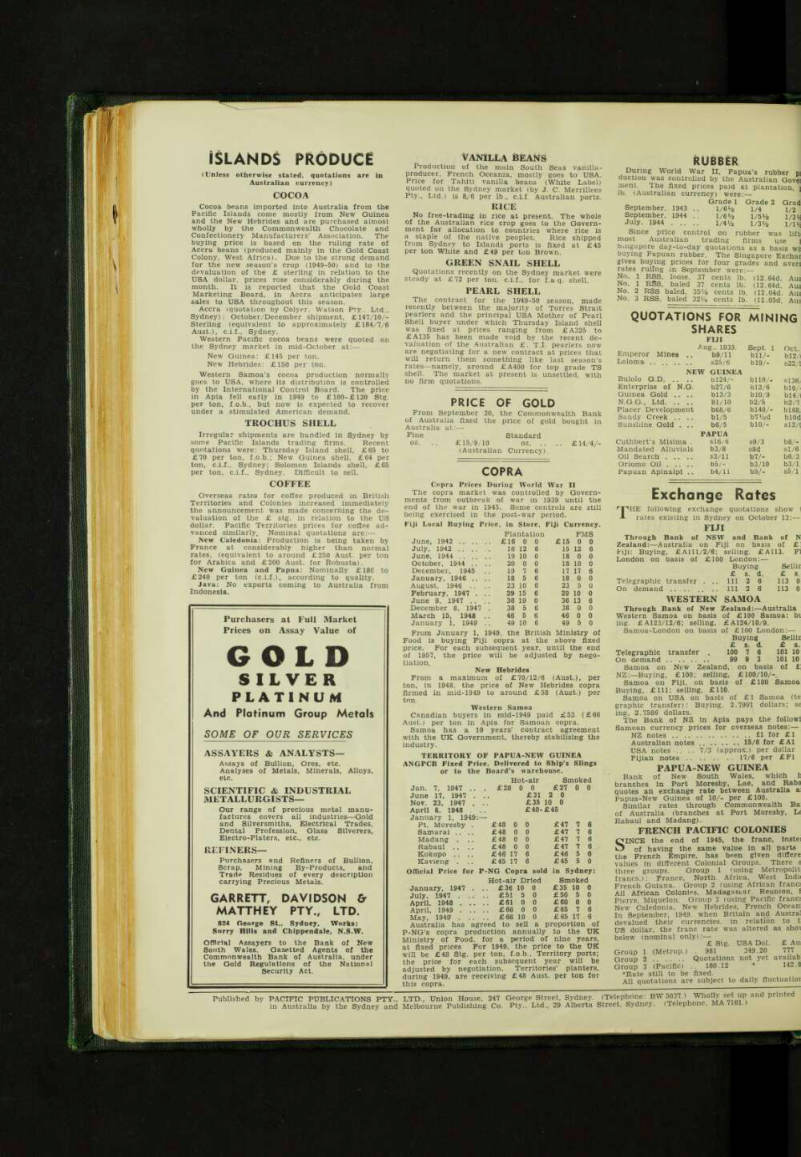
(Unless otherwise stated, quotations are in Australian currency)
Cocoa
Cocoa l>eans imported into Australia from the Pacific Islands come mostly from New Guinea and the New Hebrides and are purchased almost wholly by the Commonwealth Chocolate and Confectionery Manufacturers’ Association. The buying price is based on the ruling rate of Accra beans (produced mainly in the Gold Coast Colony, West Africa). Due to the strong demand for the new season’s crop (1949-50) and to the devaluation of the £ sterling in relation to the USA dollar, prices rose considerably during the month. It is reported that the Gold Coast Marketing Board, in Accra anticipates large sales to USA throughout this season.
Accra (quotation by Colyer. Watson Pty.. Ltd..
Sydney): October/December shipment, £147/10/- Sterling (equivalent to approximately £lB4/7/6 Aust.), c.i.f., Sydney.
Western Pacific cocoa beans were quoted on the Sydney market in mid-October at:— New Guinea: £145 per ton.
New Hebrides: £l5O per ton.
Western Samoa’s cocoa production normally goes to USA, where its distribution is controlled by the International Control Board. The price in Apia fell early in 19'49 to £lOO-£l2O Stg. per ton, f.0.b., but now is expected to recover under a stimulated American demand.
Trochus Shell
Irregular shipments are handled in Sydney by some Pacific Islands trading firms. Recent quotations were: Thursday Island shell, £65 to £7O per ton, f.0.b.; New Guinea shell, £64 per ton, c.i.f., Sydney; Solomon Islands shell, £65 per ton, c.i.f., Sydney. Difficult to sell.
Coffee
Overseas rates for coffee produced in British Territories and Colonies increased immediately the announcement was made concerning the de valuation of the £ stg. in relation to the US dollar. Pacific Territories prices for coffee ad vanced similarly. Nominal quotations are:— New Caledonia: Production is being taken by France at considerably higher than normal rates, (equivalent to around £250 Aust. per ton for Arabica and £2OO Aust. for Robusta).
New Guinea and Papua: Nominally £lBO to £240 per ton (c.i.f.), according to quality.
Java: No exports coming to Australia from Indonesia.
vanilla beans
Production of the main South Seas vanilla producer, French Oceania, mostly goes to USA.
Price for Tahiti vanilla beans (White Label) quoted on the Sydney market (by J. C. Merrillees Pty., Ltd.) is 8/6 per lb., c.i.f, Australian ports.
Rice
No free-trading in rice at present. The whole of the Australian rice crop goes to the Govern ment for allocation to countries where rice is a staple of the native peoples. Rice shipped from Sydney to Islands ports is fixed at £45 per ton White and £49 per ton Brown.
Green Snail Shell
Quotations recently on the Sydney market were steady at £72 per ton, c.i.f., for f.a q. shell.
Pearl Shell
The contract for the 19*49-50 season, made recently between the majority of Torres Strait pearlers and the principal USA Mother of Pearl Shell buyer under which Thursday Island shell was fixed at prices ranging from £A325 to £AI3S has been made void by the recent de valuation of the Australian £. T.I. pearlers now are negotiating for a new contract at prices that will return them something like last season’s rates—namely, around £A4OO for top grade TS shell. The market at present is unsettled, with no firm quotations.
Advertisements & other items, p. 106 (1 item)
Price Of Gold
From September 20, the Commonwealth Bank of Australia fixed the price of gold bought in Australia at:— Fine Standard oz. .. £ 15/9/10 oz £ 14/4/- (Australian Currency).
Copra
Prices During World War II The copra market was controlled by Govern ments from outbreak of war in 1939 until the end of the war in 1945. Some controls are still being exercised in the post-war period.
Fiji Local Buying Price, in Store, Fiji Currency.
From January 1, 1949, the British Ministry of Food is buying Fiji copra at the above fixed price. For each subsequent year, until the end of 1957, the price will be adjusted by nego tiation.
New Hebrides From a maximum of £7O/12/6 (Aust.), per ton, in 1948. the price of New Hebrides copra firmed in mid-1949 to around £5B (Aust.) per ton.
Western Samoa Canadian buyers in mid-1949 paid £53 (£66 Aust.) per ton in Apia for Samoan copra.
Samoa has a 10 years’ contract agreement with the UK Government, thereby stabilising the industry.
Territory Of Papua-New Guinea
ANGPCB Fixed Price. Delivered to Ship’s Slings or to the Board’s warehouse.
Official Price for P-NG Copra sold in Sydney:
Australia has agreed to sell a proportion of P-NG’s copra production annually to the UK Ministry of Food, for a period of nine years, at fixed prices For 1949, the price to the UK will be £4B Stg. per ton. f.0.b.. Territory ports; the price for each subsequent year will be adjusted by negotiation. Territories’ planters, during 1949, are receiving £4B Aust. per ton for this copra.
Plantation FMS June, 1942 £16 0 0 £15 0 0 July, 1942 16 12 6 15 12 6 June, 1944 19 10 0 18 0 0 October. 1944 ... 20 0 0 18 10 0 December. 1945 .. 19 7 6 17 17 6 January, 1946 ... 18 5 6 18 0 0 August. 1946 ... 23 10 6 23 5 0 February. 1947 ... 29 15 6 29 10 0 June 9. 1947 ... 36 19 0 36 13 6 December 8. 1947 . 38 5 6 38 0 0 March 15, 1948 .. 46 5 6 46 0 0 January 1, 1949 .. 49 10 6 49 5 0
Hot-air Smoked Jan. 7. 1947 .. . £28 0 0 £27 0 0 June 17, 1947 . .. £31 2 0 Nov. 23, 1947 ... £35 10 0 April 8. 1948 .. £40-£45 January 1, 1949:— Pt. Moresby . £48 0 0 £47 7 6 Samaral .. .. £48 0 0 £47 7 6 Madang ... £48 0 0 £47 7 6 Rabaul .. .. £48 0 0 £47 7 6 Kokopo .. .. £46 17 6 £46 5 0 Kavieng . .. £45 17 6 £45 5 0
Hot-air Dried Smoked January, 1947 . .. £36 10 0 £35 10 0 July. 1947 . .. £51 5 0 £50 5 0 April. 1948 . . . .. £61 0 0 £60 0 0 April, 1949 . . . . . £ 66 0 0 £65 7 6 May, 1949 . .. .. £66 10 0 £65 17 6
Rubber
During World War 11, Papua’s rubber pi duction was controlled by the Australian Govei ment. The fixed prices paid at plantation, j lb. (Australian currency) were:—
Since price control on rubber was lift most Australian trading firms use 1 Singapore day-to-day quotations as a basis wr buying Papuan rubber. The Singapore Exchai gives buying prices for four grades and aven rates ruling In September were:— No. 1 RSS, loose. 37 cents lb. (12.64 d. Aus No, l RSS, baled 37 cents lb. (12.64 d. Aus No. 2 RSS baled, 35Vs cents lb. (12.04 d. Aus No. 3 RSS, baled 32 x /4 cents lb. (ll.OSd. Aus
September. 1943 .
Grade 1 1/6 V 2 Grade 2 1/4 Grad 1/2 1/3 V.
September, 1944 . 1/6 y 2 1/5 y 2 July. 1944 1/4 v 2 1/3 y 2 1/1 l A
Quotations For Mining
Shares
Fiji
New Guinea
Papua
Aug.. 1939.
Sept. 1 Oct.
Emperor Mines . b9/ll bll/- bl2/i Loloma S25/6 bl9/- s22/l
Bulolo G.D bl24/- buoy- sl36/ Enterprise of N.G. b27/6 b!2/6 bio/- Guinea Gold .. .. bl3/3 blO/9 bl4/i N.G.G., Ltd bl/10 b2/5 b2/7 Placer Development b68/6 bl40/- bl68, Sandy Creek .. .. bl/5 b7Vad blOd Sunshine Gold . .. b6/5 blO/- sl2/<
Cuthbert’s Misima .
S16/6 S9/3 b8/- Mandated Alluvials b3/8 s8d sl/6 Oil Search 53/11 b7/b6/3 Oriomo Oil b5/b3/10 b3/l Papuan Apinaipl .. b4/l 1 b5/s5/l
Exchange Rates
THE following exchange quotations show 1 rates existing in Sydney on October 13;—
Fiji
Through Bank of NSW and Bank of N Zealand:—Australia on Fiji on basis of £: Fiji: Buying, £Alll/2/6; selling. £AII3. Fi London on basis of £lOO London;—
Western Samoa
Through Bank of New Zealand:—Australia Western Samoa on basis of £100 Samoa: bv ing. £ A123/12/6; selling, £A124/10/9.
Samoa-London on basis of £100 London; —
Samoa on New Zealand, on basis of £1 NZ:—Buying, £100; selling, £100/10/-.
Samoa on Fiji, on basis of £100 Samoa Buying, £111; selling, £110.
Samoa on USA on basis of £1 Samoa (te graphic transfer): Buying, 2.7991 dollars; se ing, 2.7586 dollars.
The Bank of NZ in Apia pays the followi Samoan currency prices for overseas notes:— NZ notes £1 for £1 Australian notes 15/6 for £A1 USA notes .. .. 7/3 (approx.) per dollar Fijian notes 17/6 per £F1
Papua-New Guinea
Bank of New South Wales, which h branches in Port Moresby, Lae, and Raba quotes an exchange rate between Australia a: Papua-New Guinea of 10/- per £100.
Similar rates through Commonwealth Ba of Australia (branches at Port Moresby, L i Rabaul and Madang).
French Pacific Colonies
SINCE the end of 1945, the franc, instei of having the same value in all parts the French Empire, has been given differe values in different Colonial Groups. There a three groups. Group 1 (using Metropolit francs.): France, North Africa, West Indi< French Guiana. Group 2 (using African francs Ail African Colonies, Madagascar. Reunion, £ Pierre, Miquelon. Group 3 (using Pacific francs New Caledonia, New Hebrides, French Ocean: In September, 1949, when Britain and Austral devalued their currencies, in relation to t US dollar, the franc rate was altered as sho\ below (nominal only):— £ Stg. USA Dol. £ Aui Group 1 (Metrop.) . 981 349.20 777 Group 2 Quotations not yet availab Group 3 (Pacific) .. 180.12 • 142.8 ♦Rate still to be fixed.
All quotations are subject to daily fiuctuatior
Buying Sellir £ s. d. £ 6.
Telegraphic transfer . .. Ill 2 6 113 0 On demand .. Ill 2 6 113 0
Buying Sellir £ s. d. £ s.
Telegraphic transfer . 100 7 6 101 10 On demand 99 9 3 101 10
Advertisements & other items, pp. 106-108 (3 items)
Published by PACIFIC PUBLICATIONS PTY., LTD., Union House, 247 George Street, Sydney. (Telephone: BW 5037.) Wholly set up• and printed
in Australia by the Sydney and Melbourne Publishing Co. Pty.. Ltd., 29 Alberta Street, Sydney. (Telephone. MA 7 0 .
Gold
Purchasers at Full Market Prices on Assay Value of
SILVER
PLATINUM
And Platinum Group Metals
SOME OF OUR SERVICES
ASSAYERS & ANALYSTS—
A.ssays of Bullion, Ores, etc.
Analyses of Metals, Minerals, Alloys, etc.
SCIENTIFIC & INDUSTRIAL
METALLURGISTS—
Our range of precious metal manufactures covers all industries—Gold and Silversmiths, Electrical Trades, Dental Profession, Glass Silverers, Electro-Platers, etc., etc.
REFINERS—
Purchasers and Refiners of Bullion, Scrap. Mining By-Products, and Trade Residues of every description carrying Precious Metals.
GARRETT, DAVIDSON &
MATTHEY PTY., LTD.
824 George St.. Sydney. Works: Snrry Hills and Chippendale, N.S.W.
Official Assayers to the Bank of New South Wales. Gazetted Agents of the Commonwealth Bank of Australia, under the Gold Regulations of the National Security Act.
Tooth’S
'V&*
jgs jr
ood company deserves the best, and it is a thoughtful and discerning* host who serves his guests sparkling K.B. Lager. For “K. 8.” adds enjoyment to any gathering, and it’s one drink that’s appreciated by everybody, men and women alike.
G
TOOTH’S
LAGER
K8.35.FP
MERCHANTS. & SHIP OWNERS
Wm Capital £500,000
ESTABLISHED 1914
COPRA MERCHANTS & MILLERS
ASSOCIATED COMPANIES THROUGHOUT THE PACIFIC ISLANDS
IN LONDON
Buyers and exporters of all kinds of Islands produce. Copra Merchants and Millers.
Agents for Australian, European and American Manufacturers. Distributors of every description of merchandise.
Thirty years of Pacific Islands development and service.
REGULAR CARGO
PACIFIC
w.
Head Office:
AND PASSENGER SERVICE BETWEEN EUROPE AND
ISLAND PORTS WAS ESTABLISHED BY
R. CARPENTER Cr CO. LTD.
16 O'CONNELL STREET, SYDNEY.
Cable Address:
CAMOHE.
Telephone BW 4421.
Postal Address: P.O. Box No. 168, Sydney.
PACIFIC" ISLANDS MONTHLY OCTOBER, 1949