Pacific
Islands
Monthly
November, 1949
Vol. XX. No. 4.
Established 1930.
I Registered at the G.P.0., Sydney , jor transmission by post as a newspaper ]
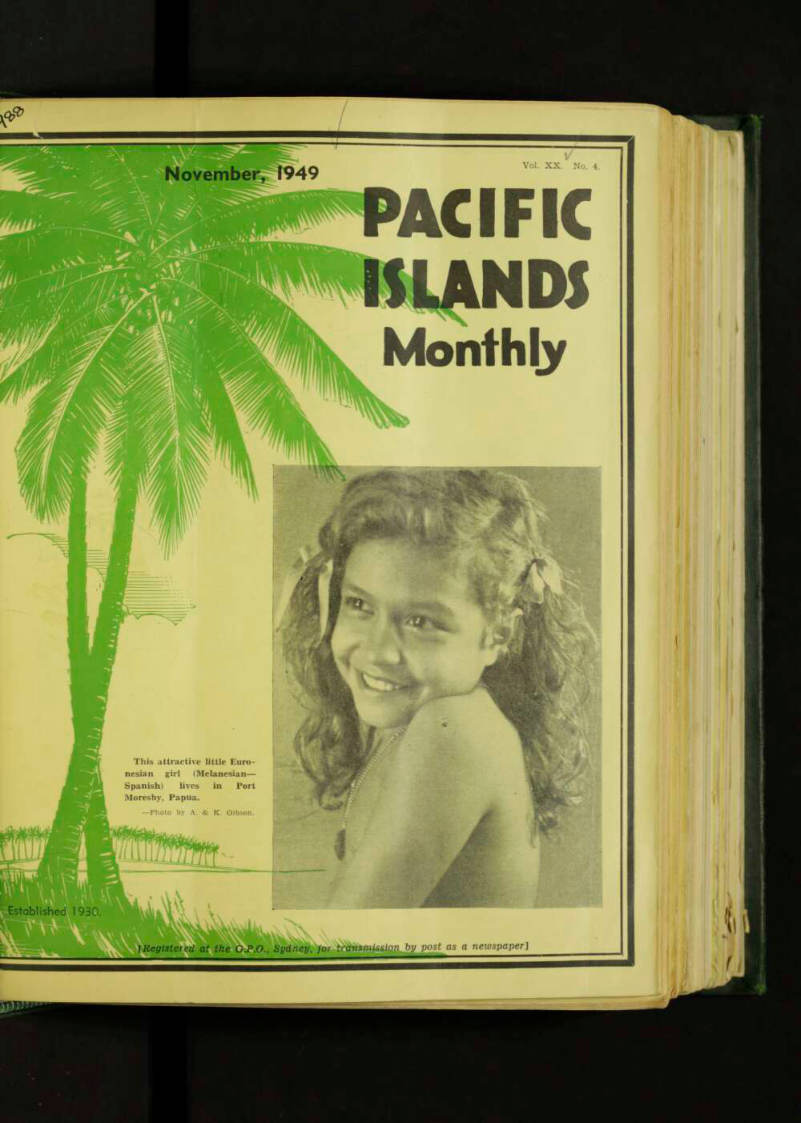
This attractive little Euro nesian girl (Melanesian — Spanish) lives in Port Moresby, Papua. —Photo by A. & K. Gibson.
Advertisements & other items, pp. 2-4 (1 item)
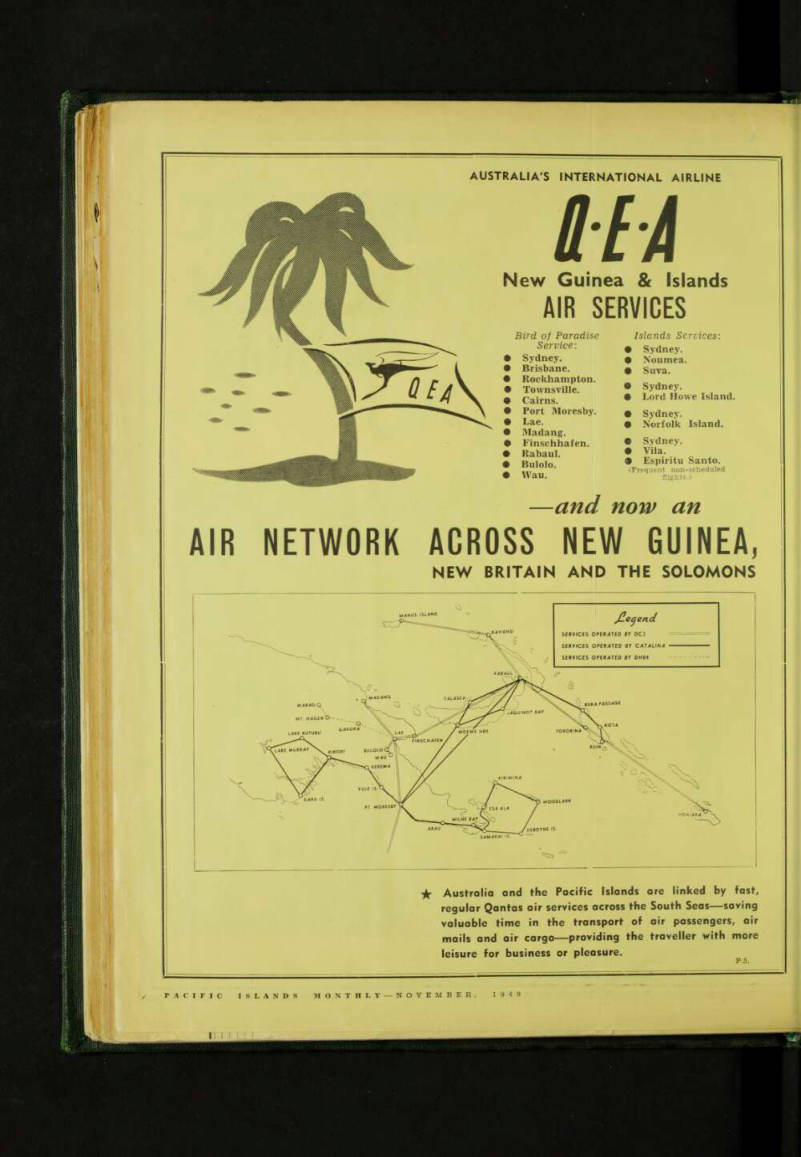
Air Network Across New Guinea,
AUSTRALIA'S INTERNATIONAL AIRLINE
mm Ut4
New Guinea & Islands
AIR SERVICES
—and now an
AIR NETWORK ACROSS NEW GUINEA,
NEW BRITAIN AND THE SOLOMONS
Jlccjcnd
SERVICES OPERATED BY DCS
SERVICES OPERATED BY CATALINA
SERVICES OPERATED BY DHB4
kavieng madang
TALASEA
BUKA PASSAGE
LAKE KUTUBU GAROKA /MOEWE HBR. TOROKINA
LAKE MURRAY \ K IKORI BULOLO
kerema
D ARU IS
WOODLARK
PT. MORESBY
MILNE BAY
Australia and the Pacific Islands are linked by fast, regular Qantas air services across the South Seas—saving valuable time in the transport of air passengers, air mails and air cargo—providing the traveller with more
leisure for business or pleasure.
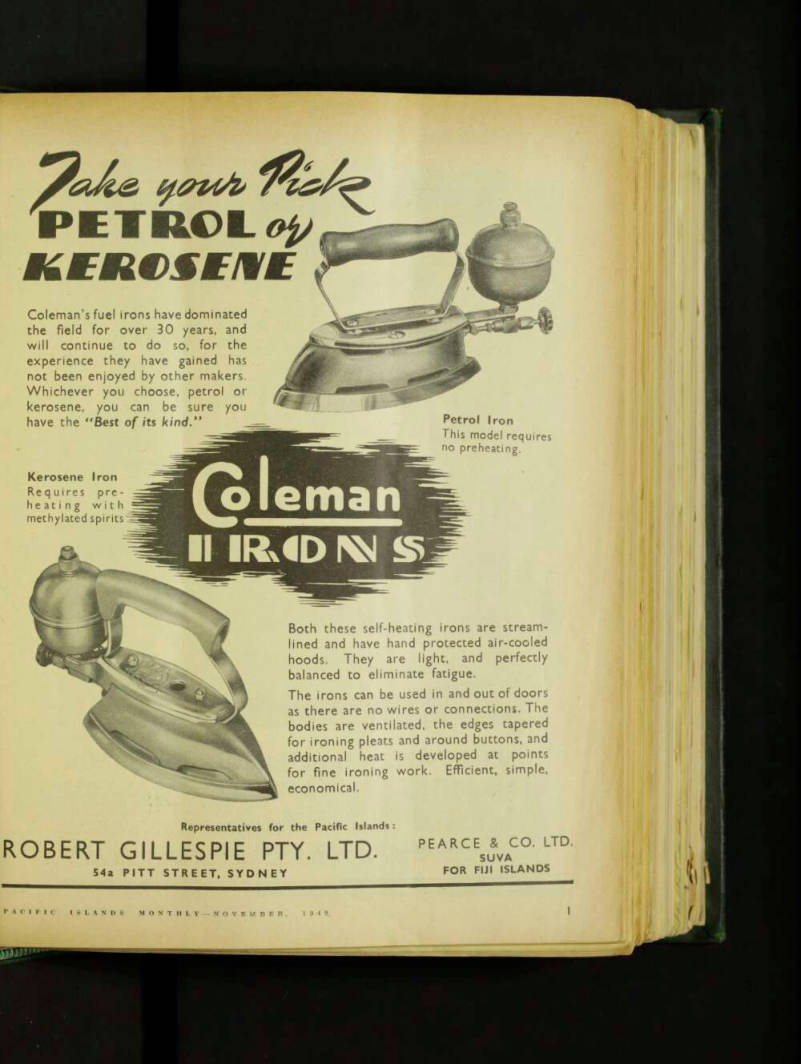
Sake yppifa
KEROSENE
Coleman’s fuel irons have dominated the field for over 30 years, and will continue to do so, for the experience they have gained has not been enjoyed by other makers.
Whichever you choose, petrol or kerosene, you can be sure you have the "Best of its kind.”
Kerosene Iron Requires preheating with methylated spirits I Petrol Iron This model requires no preheating.
Both these self-heating irons are streamlined and have hand protected air-cooled hoods. They are light, and perfectly balanced to eliminate fatigue.
The irons can be used in and out of doors as there are no wires or connections. The bodies are ventilated, the edges tapered for ironing pleats and around buttons, and additional heat is developed at points for fine ironing work. Efficient, simple, economical.
Representatives for the Pacific Islands:
ROBERT GILLESPIE PTY. LTD.
54a PITT STREET, SYDNEY
PEARCE & CO. LTD.
SUVA
FOR FIJI ISLANDS
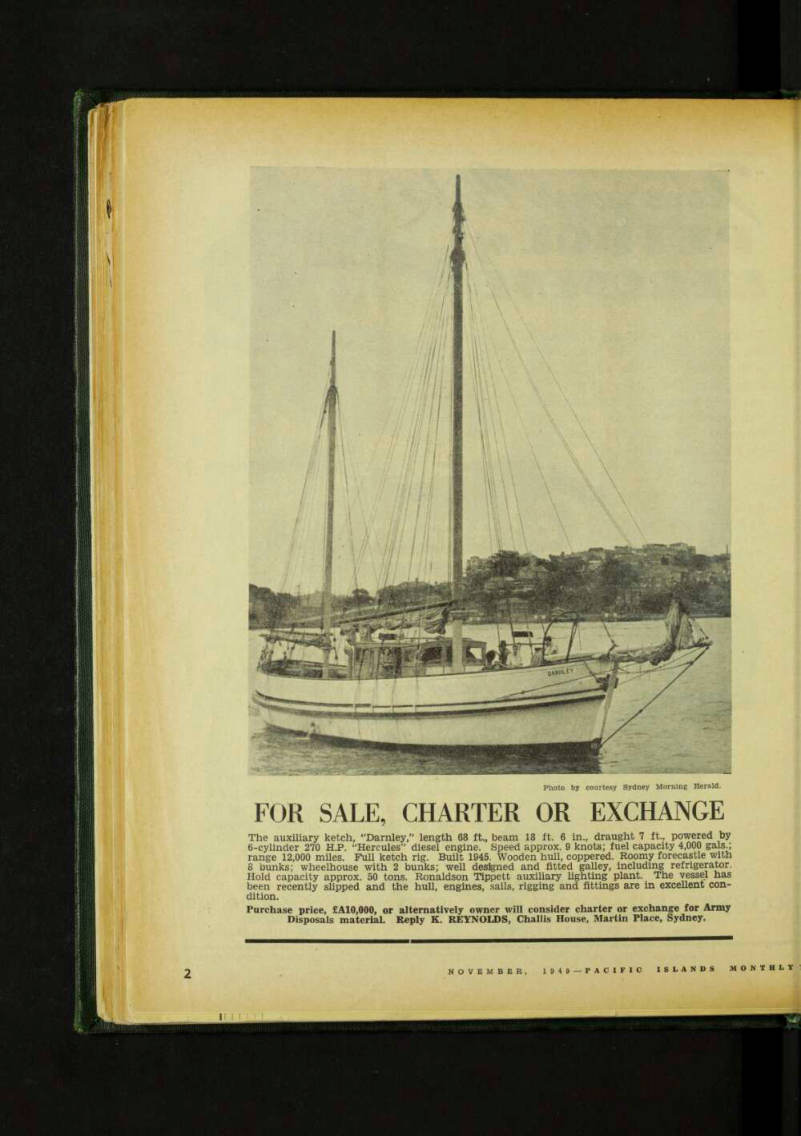
v'”: . ' ••• m ■ * - ""->-•■■"” " " :>N Mf. - «V ' Photo by courtesy Sydney Morning Herald.
FOR SALE, CHARTER OR EXCHANGE
The auxiliary ketch, “Darnley,” length 68 ft., beam 18 ft. 6 in., draught 7 ft., powered by 6-cylinder 270 HP. “Hercules” diesel engine. Speed approx. 9 knots; fuel capacity 4,000 gals.; range 12,000 miles. Full ketch rig. Built 1945. Wooden hull, coppered. Roomy forecastle with 8 bunks; wheelhouse with 2 bunks; well designed and fitted galley, including refrigerator.
Hold capacity approx. 50 tons. Ronaldson Tippett auxiliary lighting plant. The vessel has been recently slipped and the hull, engines, sails, rigging and fittings are in excellent condition.
Purchase price, £AIO,OOO, or alternatively owner will consider charter or exchange for Army Disposals material. Reply K. REYNOLDS, Challis House, Martin Place, Sydney.
Index to Advertisers
Alois Akun & Co. . 69 Aluminium Union . 32 Amplion (A/sia) . 85 Australian Inter state Agencies, 28, 78 Bank of NSW . . ffO Berger, Lewis, & Sons (Aust.), Ltd. 21 Bethell, Gwyn & Co 64 Blaxland Rae Pty. 100 Blundell, Spence . 48 8.0.A.C 34 Bovril 23 Breden, Wynne S. . 86 Broomfields, Ltd. . 102 Brunton & Co., Ltd. 59 Budge, James, Ltd. 97 Bunting, A. H., Ltd 58 Burns Philp (NG) . 57 Burns Philp (NH) . 32 Burns Philp (SS) . 61 Burns Philp Trust . 96 Caine’s Studios . . 73 Carpenter, W. R. & Co., Ltd., 84, cov. iv.
Carpenter, W. R. (Fiji), Ltd. . . 101 Carrlock Co., Ltd. . 36 Charmosan ... 81 Classified Advertise ments ... 103 Colonial Meat Co. . 92 Colyer Watson (NG), Ltd. ... 20, 35 Commonwealth Bank of Aust. . 37 Crammond Radio . 22 Cunningham, R. H. & Co 101 “Cystex” 77 Dangar, Gedye & Malloch, Ltd. . . 3 Davison Paints, Ltd. 69 Donaghy, M., & Sons Pty., Ltd. . 39 Donald, A. 8., Ltd. (Auckland) ... 74 Donald, A. 8., Ltd. (Rarotonga) . . 39 Dunlop Rubber, Ltd 82 Electrolux . . . .84 Etablissements Donald (Tahiti) 59 Excelsior Supply Co. 33 Export Soap Mfg.
Co. ... 103 “Flit” 29 Ford Sherington, Ltd 98 Garrett, Davidson & Matthey Pty., Ltd. ... 104 Garrick Hotel ... 74 Gilbey, W. & A., Ltd 38 Gillespie Bros., Ltd. 45 Gillespie, Robert, Pty., Ltd. ... 1, 44 Gillespie, Robert (NG), Ltd. . . 63, 86 Gough & Co., E. J. 16 Grand Pacific Hotel 4 Gregory, A., Pty., Ltd 41 Grove & Sons, W.
H„ Ltd 64 Halvorsen, Lars, Sons Pty., Ltd. . 93 Heinz & Co. Pty., Ltd 73 Hemingway & Robertson Pty., Ltd . . 40 Herco Pty., Ltd. . 47 Hoover, Francis . . 27 Horlicks Pty., Ltd. 95 International Trad ing Co. Pty., Ltd. 40 Kasper Refrigera tors Pty., Ltd., 28, 76 Kennedy, Captain . 91 Kerr Bros. Pty., Ltd. ... 78, 100 Kodak (A/asia) Pty., Ltd. ... 94 Kolynos, Inc. ... 80 Kopsen, W., & Co. 79 Kosak, Robert . . 75 Kui, George ... 77 Kwong Chong Bros. 99 Lazarus, D. M. & E. W 47
Macintyre, Thomas, & Co., Ltd. ... 15 Mail Publicity Co. l9, 29 Maloney. N. P., & Co §4 Mcllrath’s Pty., Ltd. 87 “Mendaco” ... 99 Merrlllees, J. C., Pty., Ltd., 17, 85, 97 Millers, Ltd. ... 60 Milne Bay Mer chants, Ltd. . . 43 Morris, Hedstrom, Ltd . .12 Motor Tractors Pty., Ltd. ... 18 Nelson & Robertson 70 “Nixoderm” ... 60 Nordman, Oscar G. 65 NZ National Air ways Corporation 30 Pacific Islands Society 37 Patoific Islands Trading Co. . . . 31 Pacific School of Music ... 44 Pan American Air ways. Inc., Ltd. . 14 “Pinkettes” ... 94 Piper, Tom ... 25 Prouds, Lt;d. ... 26 Qantas Empire Air ways. Ltd. . cov. il.
Qld. Insurance Co., Ltd 63 Qld. Merchants Supplies ... 19, 88 Ransomfis, Sims & Jefferies, Ltd. . . 16 Reed, William E. . 43 Reynolds, K. (Yacht Darnley) . . 2, 102 Riverstone Meat Co. Pty., Ltd. . 83 Robinson, G. H., Pty., Ltd. . . 15, 47 Rohu, Sil . . . . 83 Ruston & Hornsby (Aust.) Pty., Ltd. 24 Scott, J., Pty., Ltd. 61 Shell Co. of Aust., Ltd. ... 71 Southern Pacific In surance Co., Ltd. 67 Spartan Paints, Ltd 42
Steamships Trading
Co., Ltd. . . 72, 89 Stewarts & Lloyds 70 Stratton & Co., Ltd. 27 Sullivan, C., Pty., Ltd 41 Swaan, Dr. Wm. . 60 Tallerman & Co. . 87 Taylor, Allen, & Co. 73
Thornycroft, Ltd. . 91
Tilley Lamp Co., Ltd. (England) . 46 Tillock & Co., Ltd. 81 Tongan Photos Bureau 71 Tooth & Co. . cov. 111.
Tyneside Engineer ing Co., Ltd. . . 65 Union Mfg. & Ex port Co., Ltd. . 62 USL Batteries ... 36 Vacuum Oil Co., 29. 68
Ventura Trading
Co., Ltd., 24, 31, 36, 74, 82, 93 Vincent Ghem. Co, 67 Watson, Victor, Ltd. 99 Watson, Wm. H. . 45 West, Harry ... 75 Williams, Dr. . . 33 Willreed Agencies Pty., Ltcf. ... 102 Wills, W. D. & H.
O. (Aust.), Ltd, . 66 Wilson, W. F.. & Son 20 Wright, E.. & Co., Ltd. ... 40 Yacht Darnley, 2, 102 Yorkshire Insur ance Co., Ltd. . 35 Young, A. H., & E. 16 Young, Harry J., Pty., Ltd. ... 98
Advertisements & other items, p. 5 (1 item)
Potif Pnifty
Get a 60 h.p. LISTER Diesel
NOW!
You need not be held up for want of an engine for your boat! An order now will ensure immediate delivery of a Lister 60 h.p. diesel— the marine engine that invites comparison. Price for price, performance for performance, the Lister 60 h.p. diesel is the greatest value on the market to-day!
IJI
3 $ Dear Sirs, Please send me complete details and price of the Lister Marine Diesel Model h.p.
NAME
ADDRESS
Type of Craft Length of Craft
Dangar, Gedye & Malloch ltd.
10-14 YOUNG STREET, CIRCULAR QUAY, SYDNEY
Cable Address: “DANGfIRS” Telephone: 8U5095 Marine Workshop: Careening Cove, Sydney. Tel,: XAI9II
In This Issue:
Editorial: Dutch or Asiatics in Wes tern New Guinea? 5 Drilling in Papua—Conclusions of Oil Experts 6 Copra Inspection Again in Papua- New Guinea 7 BSI —58 Years a British Protectorate 7 Arrival of Fiji’s New Chief Justice 7 The Ocean Island Murder —Appeal Lodged 7 Hydro-Electric Power for Papua-N.
Guinea 7 BSI Headmen Meet Their Govern ment 8 Six Days’ Tow for Degei Brings Awahou to Port 8 W. Samoa to Abolish Empire Pre ference 9 Republic of US of Indonesia —New Status for East Indies 10 Rabaul Roundabout 11 Tributes to Mr. and Mrs. Nilsen of Vatukoula 13 Sugar Conference in UK is Important to Fiji 13 Exploitation of New Guinea Timber —BGD and Government Propose a Joint Company 15 Around the World in a Stainless Steel Yacht 16 South Pacific Commission—Fourth Session Concluded 17 Lucky Landing on a Sandbank—Plane Escapes in New Guinea 21 New Ship for Cook Islands 23 Australia Spends £4 Million per An num in Papua-New Guinea ... 24 The Month in Moresby 25
New Caledonia Exchange—Australian Says He Was Well Treated 28 Lack of War Damage Compensation— BSI Planter Speaks His Mind .. 29 Fiji Must Have More Tourists 31 War Graves Tourists for P-NG? ... 31 New Nimanoa for G & E Colony ... 32 Gazelle Peninsula Shaken by Earth quakes 33 Western Samoa Reviews a Year’s Ac tivities 35 Plane Lost and Found in N. Guinea 30 Mariposa May Come Back to Pacific 30 Suva’s Price Spiral Worries Permanent Hotel Guests 37 Pacific Yachtsmen in Trouble in BSI 39 Pay Rise for Fijian Stevedores ... 39 Benefits to New Guinea Widows ... 40 News Prom Pitcairn Island 41 Fiji’s Special Stamps Sold Out ... 43 Fiji’s Anti-TB Appeal Meets Amazing Response 44 More about Miss Baksh 44 Territories Talk-Talk 49 Tropicalities 50 “Operation Drum” 51 Nauru Builds Empire Farms and Gardens 52 A Trader’s Tale 53 Giants of Aneityum 54 Colour —Short Story 55 A Medical Book for All Dwellers in Isolated Islands 45 More Meat for Port Moresby .. .. 48 USS Coy’s Bronze-Green Ships ... 48 Notes from a Medical Missionary .. 59 Seven Records at Fiji’s Amateur Sports Meeting 60
W. Samoa is Still Short of Medical Officers 61 Fiji’s Annual Report in Attractive Booklet Form 63 Coconut Planter Hits Hard at Suva 63 Seychelles—What Has Happened to Little-known Paradise 67 Notorious Nakanai Natives Make Their Own Peace Pact 69 Charge that Fiji Native Policy is Leading to Corruption 71 British Socialists’ Peanut Plan—23 Million Down the Drain 73 Survey Ship for Central Pacific ... 73 Wars Among Ants and BSI Nutfall 74 More People—Less Food 75 Plane and Shipping Timetables .. 77 In the Port of Avarua 83 Bourail, New Caledonia, Has a Shock ing History 85 New Caledonia Notes 86 600-Mile Drift by Canoe 86 New Guinea Helps Distressed Children 87 Laws of Papua-N. Guinea 90 Life Among the Pitcairn Islanders .. 91 Tahiti Notes 95 Not Enough Ships—Planters’ Disabili ties in Bougainville 97 Fiji’s Cost of Living Soars 98 News from Mangaia, Cook Is 99 Commercial, Markets, etc 104 OBITUARY: Major E. B. Ayris, 23; Frank Tate, 39; W. M. Burnett, 43; M.
Charles Levy, 96.
INDUSTRIES: Cocoa, 29, 44; Copra, 44; Gold, 21, 24; Oil, 6; Pearlshell, Jl.
ORGANISATIONS: Pacific Islands So ciety, 91; NG Women’s Club of Sydney, 101.
Advertisements & other items, p. 6 (1 item)
dcsV6 nC
Pacific Islands monthly
The Newspaper-Magazine of the Sonth Seas
L Registered at the G.P.0., Sydney, for transmission by post as a newspaper l Published Once Each Month and Circulated in Australia and New Zealand and in the following Pacific Territories and Islands Groups:
Australian Territory of Papua.
Irustee Territory (Australia) of New Guinea.
Australian Territory of Norfolk Island, lew Zealand Territory of Cook Islands, rrustee Territory (NZ) of Western Samoa.
British Colony of Fiji.
British Solomon Islands Protectorate.
British Protectorate of Tongan Islands.
British Crown Colony of Gilbert and Ellice Islands.
Trustee Territory of Nauru.
British and French Condominium of New Hebrides.
French Colony of New Caledonia.
French Colony of Oceania (Tahiti, etc.).
American Territory of Eastern Samoa.
American Territory of Hawaiian Islands.
Owned and Produced by Pacific Publications Pty., Ltd., Union House, 247 George Street, Sydney.
Telephone: General Office and Advertising, BW 5037.
».0. Box 3408
iegistered Address for Telegrams, Radiograms, and Cables: “Pacpub,” Sydney.
Contributions.
irticles, Stories, and Photographs dealing with Pacific Islands subjects are invited and will be paid for on publication.
Subscription Rates.
Per Annum, Pre-paid, Including Postage, n Australia, New Zealand, Fiji New Guinea, Papua, Western Samoa, Cook Islands, Tonga, British Solo mons, Gilbert and Ellice Colony, Nauru, New Hebrides, and United Kingdom .. 18 0 Isewhere $2 50 £llO ingle Copies 19
Editor and Publisher:
R. W. Robson, F.R.G.S.
Assistant Editor: JUDY TUDOR.
General Office: Union House, 247 George Street, Sydney. Telephone: BW 5037.
Business Manager: Selwyn Hughes.
Representative In London.
J. T. Wallis, Coronation House, 4 Lloyd’s Avenue, London, E.C.3, from whom may be obtained copies of Pacific Islands Monthly, Pacific Is, Year Book, advertising schedules, etc.
Representative In U.S.A.
Pacific Islands Trading Co., 244 California St., San Francisco, U.S.A.
Agents.
The following are authorised to receive sub scriptions for Pacific Islands Monthly:— Burns. Philp & Co.. Ltd., and Burns Philp (South Sea) Co., Ltd. All branches.
W. R. Carpenter & Co., Ltd. All branches.
Morris, Hedstrom, Ltd. All branches.
Steamships Trading Co., Papua. All branches.
Steele’s Central Store, Suva, Fiji.
C. A. Adams, Lautoka, Fiji.
Cook Islands Trading Co., Rarotonga, Cook Is.
Oscar Nordman, Papeete, Tahiti.
Islands Branches and Representatives of W. H.
Grove & Sons, Ltd., Auckland, New Zealand.
Ed. Pentecost, Noumea, New Caledonia.
Societe Gubbay Kerr et Cie, Noumea, New Caledonia.
R Ol. Xx. No. A.
November, 1949
i 1/9 Per Copy.
Price \ Prepaid, p.a.; 18/- Aust. ( In USA, p.a.: $2.50.
Dutch or Asiatics in Western New Guinea?
T is bad enough—from the South Pacific . viewpoint—that the archipelagoes of the East Indies should be surrendered ito the control of the European-hating, bmmunist-ridden Indonesians. It is yen worse that there should be, under 3rious consideration, a plan that Dutch ew Guinea should become part of the ew “Republic.”
New Guinea is the world’s second irgest island—an enormous Territory, of nknown potentialities. It is three or four mes the size of New Zealand. It has lany minerals, including vast oil de osits—an oilfield already has been deve iped at the western end, and, sooner or iter, oil will be found elsewhere. Be mse its climate ranges from the steamy :juatorial coastline to the high, cool, ch plateaus of the interior, it can pro uce a wide variety of foodstuffs, and ipport European, as well as tropical )mmunities.
The eastern half of New Guinea is Oder British-Australian control. That mtrol may be justified on colonial 'ounds —the industries of Papua and orth-east New Guinea have been deve ped by Australian enterprise—but it is indered imperative by the fact, demon rated in the late war, that this huge land is Australia’s only land barrier ?ainst the growing threat of Asiatic egression.
European control of New Guinea is our lief safeguard in the South Pacific—it rotects Australia directly, and all the outh Pacific Islands, from New Guinea istward to Tahiti and southward to New ealand, indirectly. The surrender of ny part of that control to the hybrid it-up that is described elsewhere in this sue as “the Republic of the United bates of Indonesia,” would be an act of ipreme folly.
INHERE is no justification, on poli l tical, geographical or ethnological grounds, for the transfer of Dutch r ew Guinea to the Indonesians. The
Indonesians, preponderantly Asiatic, never penetrated New Guinea. There is considerable Malay blood in some coastal settlements; but, generally, and over whelmingly, the two million or so people in New Guinea are of the Papuan race, and much more closely allied with the races of the Western Pacific than with the Indonesians, They have no connec tion, racial or cultural, with Indonesia.
Furthermore, the New Guinea natives are primitive people. The Europeans in New Guinea have made the protection and advancement of this race the first principle of their administrative policy.
What sort of chance would these simple folk have with an Indonesian adminis tration? Of a certainty, they would be enslaved.
AS Australia is primarily concerned, it might have been expected that the voice of Australia would be raised, loudly and insistently, as soon as this Dutch New Guinea issue emerged from the Dutch-Indonesian “agreement” at The Hague on November 2. Up to date, Australia has not said one word, publicly.
So far as the bemused Socialists of Can berra are concerned, Dutch New Guinea might be Timbuctoo or Lapland.
Canberra is at least consistent. It has been part of the “foreign policy” of the egregious Dr. Evatt to allow the Dutch- Indonesian situation to develop to the point where the Indonesians could achieve what they called “national independ ence.”
The “Indonesian Republic” was brought into being in wartime by the Japanese, as part of their plan to create, in South east Asia, a group of satellite States, such as Moscow has created in Eastern Europe. It was a poor, contemptible set up, such as was to be expected by the circumstances of its birth; and, under normal conditions, it would not have lived five minutes after the surrender of Japan. That it did live was due to the
fact that the war-exhausted Dutch were deserted in 1945-46 by Britain and America; and the “Republic,” using Japanese arms and advice, and being given the moral support of the Com munists, was able to fasten its vicious fangs in the Dutch throat and hang on, for quite a time.
By 1947 the Dutch had recovered suf ficiently to deal with the Indonesians; and they would by now have set up in the East Indies an efficient administration, with all due and proper provision for Indonesian nationalist aspirations, had the United Nations not interfered. In this regard, America allowed coteries of well meaning, academic and utterly imprac tical Planners to influence her UNO policy. The British Socialists, who already had given away most of Britain’s Asiatic Empire, naturally made common cause with the Planners. Russia, of course, was intensely pro-Indonesian.
France, having been already over-ridden by Planners in relation to Indo-China, would do little in relation to a similar situation in Indonesia.
And so the Dutch, who at the end of 1948 looked like re-establishing sound and good government in the'old Nether lands Indies, were literally thrown by the United Nations savants to the Indo nesian-Communist wolves. Their Nether lands Indies, a model in colonial develop ment and administration, is gone.
The South Pacific’s barrier against Asia, which should have commenced in the narrow straits between Asia and the archipelagoes, has now been shifted far southwards, to the borders of New Guinea. And, if the Planners have their way, and Dutch New Guinea is given to Indonesia, by 1952 the barrier will be the Timor Sea and Torres Strait.
AND in this critical period between the Japanese surrender to the Allies in 1945, and the Dutch surrender to the Indonesians in 1949, what has Aus tralia been doing?
In 1946, the Federation of Australian wharf labourers’ unions, notoriously and
aggressively Communist, declared war on the Dutch in Indonesia, and refused to work any Dutch ships which were in any way in contact with the East Indies; and that ban is still on.
The Australian Socialist Government, whose dithering weakness in all inter national relationships is a by-word, did nothing at all to repudiate the action taken by the wharf labourers. As it allowed the ban on Dutch ships to con tinue, it can be said that it endorsed the Indonesian war upon the Dutch.
During 1948, the most critical year in the Dutch-Indonesian relationship, when the Dutch were defeated by UNO inter ference, the head of the United Nations organisation was the Australian Minister, Dr. Evatt, who is actually and directly responsible for Australia’s “foreign policy.” Mr, Chifley takes no part in “external affairs,” and probably knows nothing about them.
DUTCH New Guinea remains Dutch for one year. At the end of that time, it is to become either Dutch or Indonesian. If it is to be Indonesian, it will be subject to Asiatic, Communist and anti-European control.
Nominally, the new “Republic of the United States of Indonesia” is part- Dutch, part-Indonesian. All who have followed the history of recent events know that Dutch influence in the East Indies, henceforth, will be a steadily diminishing quantity.
All the strength the South Pacific countries can summon should be used in the direction of making Dutch control permanent over Western New Guinea and, perhaps, over Timor. (If the Portuguese are to be allowed to hold one half of Timor, surely the Dutch may be permitted to retain the other half.) In the long view—which envisages what is happening to-day in China, Indo china, Burma and India—the surrender of Dutch New Guinea to Indonesia would be a calamity of first magnitude to the South Pacific. Australia should be tak ing a leading part in this matter.
Actually, Australia has not said one word. And no word against Indonesia will be said while the Socialists hold power in Canberra.
The issue, of course, will be decided on December 10. If the Chifley Government is thrown out in the general election on that date, a very different Australian voice will be heard; and Australian policy in relation to Indonesia certainly will not be directed by the Communist leaders of the wharf labourers’ union.
Reserve Police Force
Planned For Fiji
THE establishment of a reserve police force in Fiji is provided for in a Bill to be presented at the Budget ses sion of the Legislative Council, which will be opened on November 25.
Composed of paid volunteers, the force may be called out in the event of an emergency, which, in the Bill, is defined as “any state of affairs which, in the opinion of the Commissioner of Police, constitutes a danger to peace and good order.”
Responsibility for comment on Aus tralian general elections, in this journal, is taken by R. W. Robson and Judy Tudor, 247 George Street, Sydney.
Drilling In Papua
Conclusions of Oil Experts
Australasian petroleum co.
PTY., LTD., announced in Sydney on November 14 that its general manager, Mr. L. A. Pym, is now on a visit to Papua, where he has been joined by Dr. B. O. Winkler (assistant explora tion manager and chief geophysicist of Standard Vacuum), Dr. M. R. McPhail (geophysicist, of the same company), Dr.
G. M. Lees, and Mr. R. Davies (chief geologist and chief geophysicist respec tively of Anglo-Iranian Oil Co., Ltd.), and Mr. R. S. Mackilligin (from that company’s London office). ‘The objects of the visit are to carry out an inspection of the company’s operations and discuss and consider arrangements for forward exploration and drilling.
As a result, it has been decided that geophysical survey operations shall be concentrated in the general area between the Vailala River and Kikori, with the object of defining additional areas for testing with the drill.
Operations at the various test drilling sites have been reviewed, and the results obtained from the use of a new mud drilling technique are considered to be highly satisfactory. In view of this, it has been decided to press forward with the drilling of the test wells at Hohoro and Upoia, and to make use of the same technique at the wells about to be com menced at Malalaua and Wana.
As the test well at Oroi has entered the steeply dipping beds in the core of the anticlinal structure, it has been de cided that no useful purpose will be served by continuing this well beyond the present depth of 5,516 ft.
Drs. Winkler and Lees have expressed the view that “they are very satisfied with the progress that has been made not withstanding the vexatious delays in drilling progress during the past year.
“The wells now drilling or about to commence are important tests of their localities, and the results of recent geo physical work indicate possibilities in other areas which hitherto were of un certain value,” they say.
New Guinea Oil Would Be Dollar Oil A HIGH official of the oil companies, Dr. B. O. Winkler, who arrived in Sydney on November 9 on his way to Papua, told reporters that if oil were discovered in New Guinea it might not assist the Australian petrol situation much, because the New Guinea oil would be largely dollar oil. (Australia is short of petrol because Australia is trying to help Britain by not buying American oil and so conserving dollars.) Dr. Winkler said that Standard Vacuum (American) had a 40 per cent, interest, and D’Arcy Exploration, a subsidiary of Anglo-Iranian, also a 40 per cent, in terest, in the Australasian Petroleum Co., which is making the oil search in New Guinea. The Australian Co., Oil Search, Ltd., has only 20 per cent.
No one knows how much already has been spent on the New Guinea search— but it has been an enormously expensive undertaking.
Progress of Oil Drilling in October Australasian petroleum com pany PTY., LTD,, reports the fol lowing progress in oil-boring opera tions in Papua during October;— Oroi: The well has been deepened 204 feet from 5,076 to 5,280 feet. Electric logging with a Schlumberger outfit to de termine dip, porosity and fluid content of
the formations penetrated has been inn progress.
Upoia: The depth remains at 2,662 feet.i Reaming operations to clear out the hole 9 to bottom, using pressure drilling equip ment, have been continued.
Hohoro: The depth remains at 2.323 feet.d Pressure drilling equipment has been as sembled preparatory to reaming the hoi© down under pressure.
Malalaua and Wana: Construction worn is proceeding satisfactorily.
Increase of Capital: The Company hasj increased its nominal capital fromr £5,000,000 to £10,000,000. To provide capi-j tal to enable the company to continue, its drilling, geological and geophysical programme, a further 2,500,000 shares isi being offered to the shareholding com-j panics.
subscribed
Late News: Anti-TB Fund Over subscribed
From Our Own Correspondent
Suva, Nov. 10.
THE people of Fiji have provided ap proximately, £45,000 to start the first Vear of the War Memorial 10-years war against tuberculosis—by the time all the scattered district funds are in, it may be £so,ooo—to which will be added the Government’s £20,000.
Excluding the very large donations by the CSR Company, the Associated Gold mines and W. R. Carpenter (Fiji) Ltd., it is clear that the Fijians have provided anything from half to two-thirds of the large sum raised. At Suva, for in stance, the closing carnival on November 5 raised something over £1,972, Of this the Fijians gave more than £1,143 in direct contributions collected at the fair.
Valuable Wartime
Machines
Taken To Aust. From Islands
MORE than 3,000 tons of American wartime earth-moving equipment from six islands of the Marshall Group arrived in Sydney by converted tank-landing ships early in November.
The equipment was bought from the United States Government by a private firm, and some will be used in the Snowy River project. More than 100,000 tons of usable equipment was left behind in the islands by the American forces.
Other firms have sent parties into Pacific battlefields, and it was reported in Sydney that one group is using light planes in an attempt to find huge dumps in New Guinea.
Help Industry
Abandoned War Supplies Help Industry
RECENTLY a specially chartered ship,, the Union Star, brought to Brisbane e £300,000 worth of heavy earth-moving? equipment collected at Guam, Manilla,, and Hong Kong. It was bought hy\ Thiess Bros., big earth-removing con tractors of Queensland.
A year ago every tractor now engaged! on the Callide open-cut coal-mine, inr Queensland, was rusting in the jungle ati Milne Bay. , . , „ In eight post-war trips by air to New?
Guinea, Mr. Les Thiess, governing direc tor of Thiess Bros., has inspected and! bought big stocks of equipment at Milnes Bay, Port Moresby, Lae, Manus Island,J the Solomon Islands, New Britain, andfc other wartime centres.
Copra Inspection
Again In
Papua-N. Guinea
Port Moresby, Nov. 2.
THE Administration has made the following announcement:— The Department of Agriculture advises that it is intended to resume inspection of copra in New Guinea in the near future. Arrangements are in hand for the appointment of inspectors under the Copra Ordinance, 1928-1940, and opera tions will commence as soon as trained men are available.
It is the Department’s desire that the standard of copra produced shall be raised to the equivalent of that produced prior to the outbreak of war, and inspection will be resumed with that object.
It is intended to introduce a new Ordinance providing for the standardisa tion of the quality of all primary products throughout the Territory of Papua and New Guinea.
Inspections of copra will be carried out throughout the Territory as soon as the new Ordinance is brought into force, in an endeavour to bring all copra exported from the Territory to a standard similar to that known on the European markets pre-war as “Rabaul Hot Air.”
Arrival of Fiji's
New Chief Justice
THE newly-appointed Chief Justice of Fiji (Mr. J. H. Vaughan, MC) and Mrs. Vaughan arrived at Suva at the end of October.
Mr. Vaughan presided over a sitting of the Supreme Court for the first time on October 26. He was welcomed by mem bers of the Fiji Bar, speeches being made by the Attorney-General (Mr. B. A. Doyle) and the senior member of the Bar (Sir Henry Scott, KC), who recalled the high esteem in which Mr. Vaughan was held while he was Attorney-General in Fiji.
Rare Photograph of
Rls
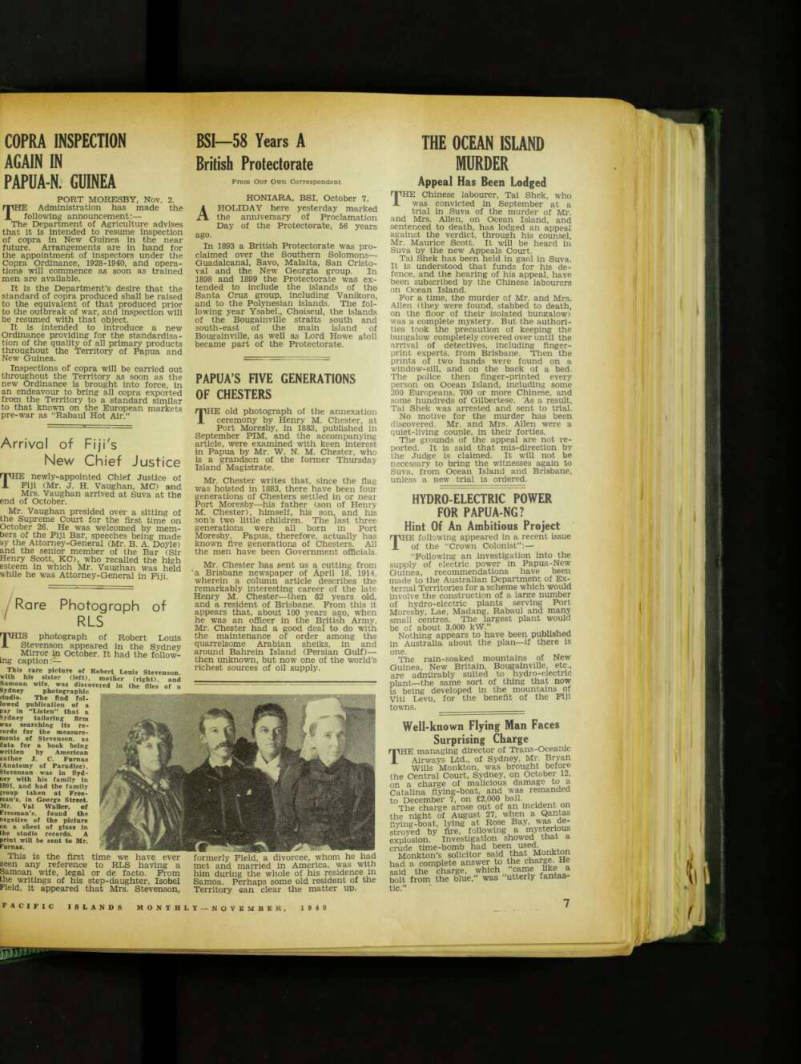
THIS photograph of Robert Louis Stevenson appeared in the Sydney Mirror in October. It had the follow ing caption:— This* rare picture of Robert Louis Stevenson, wUh his sister (left), mother (right), and Samoan wife, was discovered in the files of a
Sydney photographic studio. The find fol lowed publication of a par in “Listen” that a Sydney tailoring firm was searching its re cords for the measure ments of Stevenson, as 3ata for a book being written by American author J. C. Furnas (Anatomy of Paradise).
Stevenson was in Syd ney with his family in 1891, and had the family ?roup taken at Free man’s, in George Street.
Mr. Val Waller, of Freeman’s, found the negative of the picture nn a sheet of glass in the studio records. A print will be sent to Mr.
Furnas.
This is the first time we have ever seen any reference to RLS having a Samoan wife, legal or de facto. From the writings of his step-daughter, Isobel Field, it appeared that Mrs. Stevenson,
formerly Field, a divorcee, whom he had met and married in America, was with him during the whole of his residence in Samoa. Perhaps some old resident of the Territory can clear the matter up.
BSI—58 Years A British Protectorate
British Protectorate
Prom Our Own Correspondent HONIARA, BSI, October 7.
A HOLIDAY here yesterday marked the anniversary of Proclamation Day of the Protectorate, 56 years ago.
In 1893 a British Protectorate was pro claimed over the Southern Solomons—.
Guadalcanal, Savo, Malaita, San Cristo val and the New Georgia group. In 1898 and 1899 the Protectorate was ex tended to include the islands of the Santa Cruz group, including Vanikoro, and to the Polynesian islands. The fol lowing year Ysabel,, Choiseul, the islands of the Bougainville straits south and south-east of the main island of Bougainville, as well as Lord Howe atoll became part of the Protectorate.
Of Chesters
Papua’S Five Generations
THE old photograph of the annexation ceremony by Henry M. Chester, at Port Moresby, in 1883, published in September PIM, and the accompanying article, were examined with keen interest in Papua by Mr, W. N. M. Chester, who is a grandson of the former Thursday Island Magistrate.
Mr. Chester writes that, since the flag was hoisted in 1883, there have been four generations of Chesters settled in or near Port Moresby—his father (son of Henry M. Chester), himself, his son, and his son’s two little children. The last three generations were all born in Port Moresby. Papua, therefore, actually has known five generations of Chesters. All the men have been Government officials.
Mr. Chester has sent us a cutting from a Brisbane newspaper of April 18, 1914, wherein a column article describes the remarkably interesting career of the late Henry M. Chester—then 82 years old, and a resident of Brisbane. From this it appears that, about 100 years ago, when he was an officer in the British Army, Mr. Chester had a good deal to do with the maintenance of order among the quarrelsome Arabian sheiks, in and around Bahrein Island (Persian Gulf) — then unknown, but now one of the world’s richest sources of oil supply.
Murder
The Ocean Island
Appeal Has Been Lodged
THE Chinese labourer, Tai Shek, who was convicted in September at a trial in Suva of the murder of Mr. and Mrs. Allen, on Ocean Island, and sentenced to death, has lodged an appeal against the verdict, through his counsel, Mr. Maurice Scott. It will be heard in Suva by the new Appeals Court.
Tai Shek has been held in gaol in Suva.
It is understood that funds for his de fence, and the hearing of his appeal, have been subscribed by the Chinese labourers on Ocean Island.
For a time, the murder of Mr. and Mrs.
Allen (they were found, stabbed to death, on the floor of their isolated bungalow) was a complete mystery. But the authori ties took the precaution of keeping the bungalow completely covered over until the arrival of detectives, including finger print experts, from Brisbane. Then the prints of two hands were found on a window-sill, and on the back of a bed.
The police then finger-printed every person on Ocean Island, including some 200 Europeans, 700 or more Chinese, and some hundreds of Gilbertese. As a result, Tai Shek was arrested and sent to trial.
No motive for the murder has been discovered. Mr. and Mrs. Allen were a quiet-living couple, in their forties.
The grounds of the appeal are not re ported. It is said that mis-direction by the Judge is claimed. It will not be necessary to bring the witnesses again to Suva, from Ocean Island and Brisbane, unless a new trial is ordered.
Hydro-Electric Power
For Papua-Ng?
Hint Of An Ambitious Project
THE following appeared in a recent issue of the “Crown Colonist”; — “Following an investigation into the supply of electric power in Papua-New Guinea, recommendations have been made to the Australian Department of Ex ternal Territories for a scheme which would involve the construction of a large number of hydro-electric plants serving Port Moresby, Lae, Madang, Rabaul and many small centres. The largest plant would be of about 3,000 kW.”
Nothing appears to have been published in Australia about the plan—if there is 01 The rain-soaked mountains of New Guinea, New Britain, Bougainville, etc., are admlirably suited to hydro-electric plant—the same sort of thing that now is being developed in the mountains of Viti Levu, for the benefit of the Fi.n towns.
Surprising Charge
Well-known Flying Man Faces Surprising Charge
THE managing director of Trans-Oceanic Airways Ltd., of Sydney, Mr Bryan Wills Monkton, was brought before the Central Court, Sydney, on October 12, on a charge of malicious damage to a Catalina flying-boat, and was remanded to December 7, on £2,000 bail.
The charge arose out of an incident on the night of August 27, when a Qantas flying -boat, lying at Rose Bay, was de stroyed by fire, following a mysterious explosion. Investigation showed that a crude time-bomb had been 1 Monkton’s solicitor said that had a complete answer to the charge. He said the charge, which ( came hke a bolt from the blue,” was utterly fantas tic.”
BSI Headmen Meet Their Government
AS reported briefly in October PIM, BSI Government headmen and assistant headmen, 150 in number, came from all over the Group to attend the Head men’s Conference, held in Honiara from October 3-8.
The conference, the first of its kind, was designed for an exchange of ideas between Government and headmen and to afford headmen a chance of seeing for themselves the new capital and the work being done therein.
The conference opened with a cere monial parade of the Armed Constabulary and an address of welcome by the Acting Resident Commissioner (Mr. J. D. A. Ger mond), attended by all the European resi dents of Honiara, numerous outside visitors and some 500 Solomon Islanders.
Mr. Germond presented two medals: the British Empire Medal (Military Division) to S/Sgt. Buga (of the Armed Constabu lary) for meritorious service during the war, and the Medal of Freedom, a US award, to Johnson Soro, now deceased, of Savo Island, whose daughter received the medal in his stead.
Throughout the week, headmen listened to addresses by senior Government officers on various aspects of Government ad ministration and inspected new buildings, the radio station, hospital, workshops.
Armed Constabulary headquarters and gaol and the Government Trade Scheme.
They were particularly interested in the Bailey bridge now being erected over the
Matanikau River and when they were in vited to push it, saw it roll forward an other thirty feet towards the western bank.
Farm machinery in operation at the Government agricultural experimental farm, at Hu, received a deeply interested
inspection during a day’s visit to see the farm’s activities.
The entertainment side of the pro gramme included sports and a grand scale feast at Armed Constabulary head quarters on October 8 which marked the close of the conference. The feast was followed by a two-hours programme of native dancing before a big European and Solomon Islander audience.
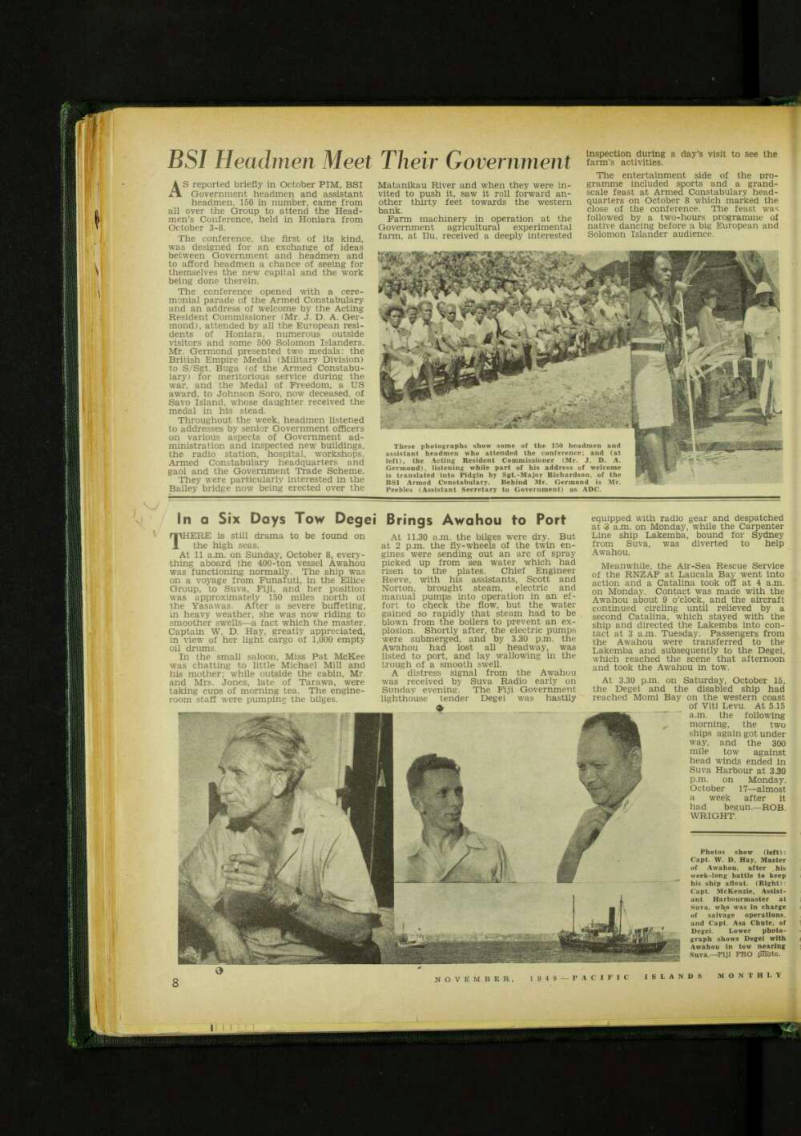
These photographs show some of the 150 headmen and assistant headmen who attended the conference; and (at left), the Acting Resident Commissioner (Mr. J. D. A.
Germond), listening while part of his address of welcome is translated into Pidgin by Sgt.-Major Richardson, of the BSI Armed Constabulary. Behind Mr. Germond is Mr.
Peebles (Assistant Secretary to Government) as ADC.
In a Six Days Tow Degei Brings Awahou to Port
rERE is still drama to be found on the high seas.
At 11 ajn. on Sunday, October 8, every thing aboard the 400-ton vessel Awahou was functioning normally. The ship was on a voyage from Funafuti, in the Ellice Group, to Suva, Fiji, and her position was approximately 150 miles north of the Yasawas. After a severe buffeting, in heavy weather, she was now riding to smoother swells—a fact which the master, Captain W. D. Hay, greatly appreciated, in view of her light cargo of 1,000 empty oil drums.
In the small saloon, Miss Pat McKee was chatting to little Michael Mill and his mother; while outside the cabin, Mr. and Mrs. Jones, late of Tarawa, were taking cups of morning tea. The engine room staff were pumping the bilges.
At 11.30 a.m. the bilges were dry. But at 2 p.m. the fly-wheels of the twin en gines were sending out an arc of spray picked up from sea water which had risen to the plates. Chief Engineer Reeve, with his assistants, Scott and Norton, brought steam, electric and manual pumps into operation in an ef fort to check the flow, but the water gained so rapidly that steam had to be blown from the boilers to prevent an ex plosion. Shortly after, the electric pumps were submerged, and by 3.30 p.m. the Awahou had lost all headway, was listed to port, and lay wallowing in the trough of a smooth swell.
A distress signal from the Awahou was received by Suva Radio early on Sunday evening. The Fiji Government lighthouse tender Degei was hastily
equipped with radio gear and despatched at 3 a.m. on Monday, while the Carpenter Line ship Lakemba, bound for Sydney from Suva, was diverted to help Awahou.
Meanwhile, the Air-Sea Rescue Service of the RNZAF at Laucala Bay went into action and a Catalina took off at 4 a.m. on Monday. Contact was made with the Awahou about 9 o’clock, and the aircraft continued circling until relieved by a second Catalina, which stayed with the ship and directed the Lakemba into con tact at 3 a.m. Tuesday. Passengers from the Awahou were transferred to the Lakemba and subsequently to the Degei, which reached the scene that afternoon and took the Awahou in tow.
At 3.30 p.m. on Saturday, October 15, the Degei and the disabled ship had reached Momi Bay on the western coast
of Viti Levu. At 5.15 a.m. the following morning, the two ships again got under way, and the 300 mile tow against head winds ended in Suva Harbour at 3.30 p.m. on Monday, October 17 —almost a week after it had begun.—ROß.
Wright.
Photos show (left): Capt. W. D. Hay, Master of Awahou, after his week-long battle to keep his ship afloat. (Right): Capt. McKenzie, Assist ant Harbourmaster at Suva, who was in charge of salvage operations, and Capt. Asa Chute, of Degei. Lower photo graph shows Degei with Awahou in tow nearing Suva. —Fiji PRO photo.
W. Samoa To Abolish
Empire Preference
From Our Own Correspondent APIA, October 16.
A Select-Committee Of The
Legislative Assembly of Western Samoa has just terminated its investigations into the advisability, or otherwise, of abolishing the present Preferential Tariff for British goods and has recommended, to the Legislative As sembly, the abolition of the existing preference which works mainly against goods imported from the USA.
Unfortunately, after the devaluation of the £ in relation to the Dollar, the Cus toms authorities here have adopted the new conversion rate of $2.80 to £1 for cus toms purposes, so that the effect of a flat rate on imports from all countries of foreign origin, including the USA, is completely nullified. Large cargoes of USA and Canadian goods arrived in the beginning of October by the steamers Thorscape and Alamada (via Pago Pago).
Students To Examine Mission
Work In Melanesia
THE Melanesian Mission Ship Southern Cross will carry two Wellington women members of the Student Christian Movement to witness mission ary work in Melanesia, when she leaves the Dominion on November 21 at the conclusion of her present goodwill tour of New Zealand.
The two students are Miss Kathleen Langford, daughter of the chairman of the New Zealand Student Christian Move ment (Mr. E. H. Langford), and Miss Juliet Hunt, daughter of Mr. A. Leigh Hunt. They will spend three months, mostly in the Solomons, before reporting back to New Zealand.
“Pay Back”
Remarkable Case of Fabricated Charge Against New Guinea Patrol Officer
From a Special Correspondent LAE, Oct. 26.
THERE is much comment here on some of the extraordinary features of the case of Patrol Officer Herbert E.
Cl a i*k Last December, Clark went away on a patrol of the Bukaua coastal area, and there he spent some months. In the course of his patrol, he had to deal with a charge against the Paramount Luluai Tahu of Bukaua, and he sentenced the Luluai to six months’ imprisonment with hard labour.
Last April, while out on patrol, he was instructed by his District Officer to re port back to Lae. At Lae, he was sent to the Senior Inspector of Police, and he then was arrested and charged under Section 21 of the Queensland Criminal Code with “having carnal knowledge of a native girl under the age of 17 years.’
He came before the District Court and the case was adjourned for 14 days, to allow evidence to be gathered. Clark was allowed bail of £lOO. He brought Mr.
Dudley Jones, solicitor, from Rabaul, to defend him in the Court.
But the prosecution seemed to be in trouble. When the case came on, the charge was altered to “having indecently dealt with a native girl under the age of 17 years.” It transpired that the girl in question had been examined by a medical officer, who reported to the police that she was a virgin, and there was no sign of sexual interference.
It further appeared that the girl and other witnesses, in statements to the police, said that Clark, and then three native police from Aitape, had had inter course with the girl—Clark one night, and the police the following night. But
Clark was the only person arrested and charged.
Clark reserved his defence at the Dis trict Court, and was committed for trial to the Supreme Court, in Lae, with bail raised to £l5O. He had to wait, for trial, from April until the end of September.
The case was heard in Lae by Mr Justice Bignold. Mr. Dudley Jones did an excellent job in defence, and completely broke down the evidence of the native witnesses. Clark was exonerated.
The Judge said that there was no doubt whatever that the natives had fabricated the evidence as “pay back” for the im prisonment imposed upon the Luluai Tahu. It was shown that the girl was the Luluai’s grand-daughter, and that two other witnesses were his nephews.
An extraordinary feature was that those natives were sent back to their village, and were not even given an oral reprimand—they had committed perjury, but they were not prosecuted.
Immediately the case was over, Mr.
Clark was transferred from Lae to Moresby—which, in native eyes, is tanta mount to his having been found guilty.
It is reported that his defence cost him about £200; but there is no indication yet that the Administration proposes to pay his costs, or compensate him for having to wait around for months under the shadow of a fabricated criminal charge.
Critics of the Administration say it is just another example of the way in which Wardism, under all circumstances, sub verts European welfare to native pre judices.
Mr. Harry E. Mowbray, who left Fiji in 1941 for Australia, has returned to the Colony to take charge of Morris Hedstrom Ltd’s. Pharmacy Department.
Willreed Agencies, Sydney agents, ad vise that Captain George Wyeth and crew, of Capricorn Charters (Gladstone, Queensland) successfully delivered a 26 ft. Islands work boat, with store?, to Dutch New Guinea, from Ballina, NSW, in November.
Advertisements & other items, p. 11 (1 item)
Pupils at Port Moresby Public School, 1949
—Photo by A. & K. Gibson.
‘Republic Of U.S. Of Indonesia’
New Status For East Indies—But Western New Guinea Temporarily Exempt
AFTER four years of struggle, rang ing from argument to bitter fighting, ending in ten weeks of “conference” at The Hague, the Netherlands—under United Nations pressure—has virtually surrendered to the Indonesians; and on November 2 the formation of “the Republic of the United States of Indonesia,” and a formal Union between the Nether lands and the Republic, were an nounced.
It is the culmination of a tragic post-war political development in the Malaya Archipelago; and it is of great import to Australia and all communities in the South Pacific, be cause it means that the vital land bridge between South-east Asia and Australia has been transferred to Asiatic control.
Nominally, the Netherlands retains a voice in the future control of Indonesia. In actual fact, the situa tion there (really created by the United Nations) will be dominated henceforth by the Indonesians.
THE Hague Conference, on November 2, entered into a whole series of Pacts and Agreements, of which the follow ing is a summary:—
Charter Of Transfer—This Con
sists of two Articles. The first says that the Netherlands, unconditionally and ir revocably, transfers complete sovereignty over Indonesia to the Republic of the United States of Indonesia, and recog
nises the Republic as an independent and sovereign State.
The second Article deals with New Guinea. It says that, as it has not been possible to reconcile the views of the
parties, it has been agreed to maintain the status quo, with the stipulation that, within one* year from the date of the transfer of sovereignty, the political status of New Guinea will be settled by negotia tions between the United Republic and the Netherlands.
The formal transfer is expected to take place on December 27.
STATUTE OF UNION—This consists of 28 Articles, designed to bring about a
formal Union between the Netherlands and the Republic of the United States of Indonesia, and the symbolic head of the Union is to be the crown (the ruling monarch of the Netherlands).
The Statute says that the Union is in tended to bring about organised co operation between the Netherlands and the United Republic on a voluntary basis of equal status with equal rights.
To implement the Union, Ministerial conferences will be held twice a year. All
decisions will be taken in agreement be tween the two partners, but must be ratified by both Parliaments.
Disputes will be referred to a Court of Arbitration which will consist of three members appointed by the Netherlands and three by the United Republic for a period of 10 years. If the court is equally divided on any dispute, it must ask the International Court of Justice to appoint a person of another nationality as an ad ditional member of the Union Court for the purposes and decision of that dispute.
Under the Union, each partner will appoint a High Commissioner for the other’s territory, with ambassadorial rank.
The expenses of the Union will be shared equally by the partners.
Finance And Economic Agree
MENT—Provides for Indonesia’s future policy, and recognises the Netherlands continued interests there.
Military Agreement—This Pro
vides that the Dutch Army will be with drawn from Indonesia as soon as possible, but will help to train and equip the new United Republic’s army and navy. The Dutch Navy is to withdraw within a year.
POLITICAL AGREEMENT—This covers foreign and diplomatic relations, includ ing reciprocal representation in some cases.
SOCIAL AGREEMENT—Among other things, this defines the rights of Dutch Civil Servants remaining in Indonesian service for a limited or fixed period.
CULTURAL ACCORD—This is in tended to ensure complete freedom of mind and thought; besides a liberal ex change of cultural facilities.
Draft Constitution—This Was
drawn up by the Indonesians, and ac cepted by the Dutch, and it guarantees democratic administration, self-deter mination, protection of minorities, and rights of citizenship in the new United Republic.
Linked with these eight main features are more than a score of minor agree ments and understandings on the way matters will be (Valt with after the administrative, political, and economic transfer.
(Continued on page 93)
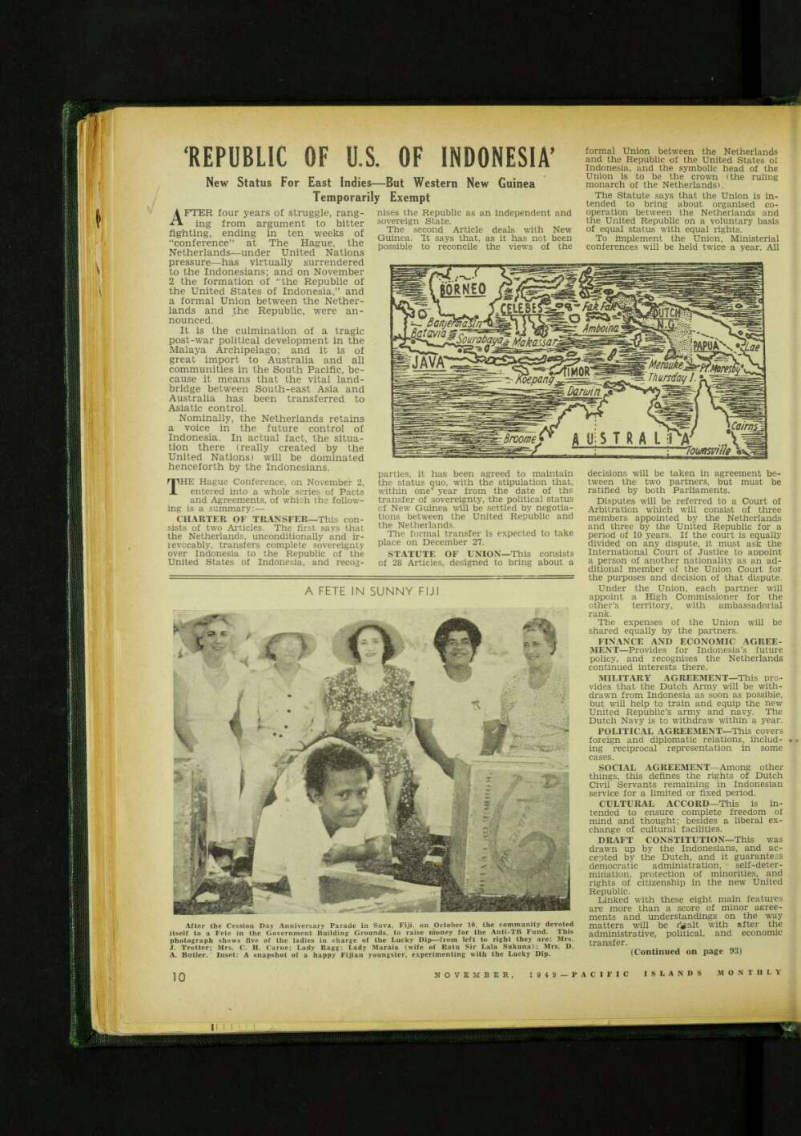
WHAT to the South Pacific is a most important agreement is that reached in relation to Dutch New Guinea (the western half of the great island), which hitherto has been part of what has been called The Netherlands Indies.
It has been decided (see Charter of Transfer) that, for one year, it shall re main outside the new arrangement, and shall be treated simply as an independent Dutch colony. Within the year, its future status shall be decided.
Agreement in relation to Dutch New Guinea was difficult. It was reached only after both sides had reported failure, and when the United Nations Committee, which was closely associated with the Conference at The Hague, came along with a formula that was considered ac ceptable.
The Dutch claim that this island, which is neither ethnologically nor geographi cally a part of Indonesia, would be better off under continued Dutch rule. They
naintain that their financial and adminis trative resources are more likely to meet the island’s future considerable develop mental needs than are those of the Indonesians.
The Irianian intellectuals, whose leader is Jacob Ariks, agree with this view.
Indonesian representatives at The Hague, however, maintained that New Guinea, so far a part of the Netherlands East Indies, should be transferred to the future Republic of the United States of Indonesia, or to the State of East Indo nesia. They advanced the opinion that Holland could be allowed to play an im portant part in its future development, without assuming governmental respon sibility.
Readers, to better understand the issues involved, should look at the map pub lished herewith; and read the First Article in this issue—“ Dutch or Asiatics in Western New Guinea?”
(Continued on page 94)
The New Set-Up !n Indonesia
SOURABAYA— which has been Holland’s chief naval base in the East for many generations—becomes the naval base of Indonesia, but a Dutch naval officer will be in charge. Other naval establish ments will remain in charge of the Dutch, to be gradually transferred to In donesian control.
Trade and industry in the new Indo nesia will generally be free to all; but the Netherlands and Indonesia “will con sider a system of mutual preferential treatment of trade.”
A Fete In Sunny Fiji
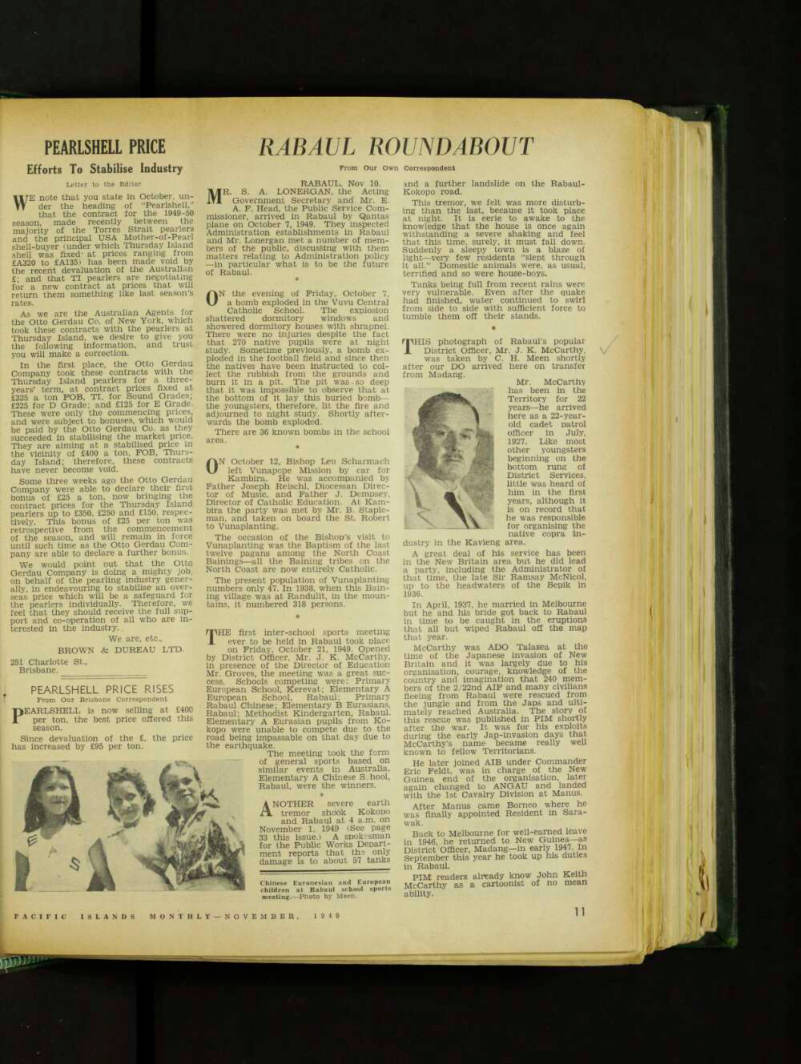
After the Cession Day Anniversary Parade in Suva, Fiji, on October 10, the community devoted itself to a Fete in the Government Building Grounds, to raise money for the Anti-TB Fund. This photograph shows five of the ladies in charge of the Lucky Dip—from left to right they are: Mrs.
J. Trotter; Mrs, C. H. Came; Lady Ragg; Lady Maraia (wife of Ratu Sir Lala Sukuna); Mrs. D.
A. Butler. Inset: A snapshot of a happy Fijian youngster, experimenting with the Lucky Dip.
Pearlshell Price
Efforts To Stabilise Industry
Letter to the Editor WE note that you state in October, un der the heading of “Pearlshell,” that the contract for the 1949-50 season, made recently between the majority of the Torres Strait pearlers and the principal USA Mother-of-Pearl shell-buyer (under which Thursday Island shell was fixed at prices ranging from £A32O to £AI3S) has been made void by the recent devaluation of the Australian £• and that TI pearlers are negotiating for a new contract at prices that will return them something like last season’s rates.
As we are the Australian Agents for the Otto Gerdau Co. of New York, which took these contracts with the pearlers at Thursday Island, we desire to give you the following information, and trust you will make a correction.
In the first place, the Otto Gerdau Company took these contracts with the Thursday Island pearlers for a three years’ term, at contract prices fixed at £325 a ton FOB, TI, for Sound Grades; £225 for D Grade; and £125 for E Grade.
These were only the commencing prices, and were subject to bonuses, which would be paid by the Otto Gerdau Co. as they succeeded in stabilising the market price.
They are aiming at a stabilised price in the vicinity of £4OO a ton, FOB, Thurs day Island; therefore, these contracts have never become void.
Some three weeks ago the Otto Gerdau Company were able to declare their first bonus of £25 a ton, now bringing the contract prices for the Thursday Island pearlers up to £350, £250 and £l5O, respec tively. This bonus of £25 per ton was retrospective from the commencement of the season, and will remain in force until such time as the Otto Gerdau Com pany are able to declare a further bonus.
We would point out that the Otto Gerdau Company is doing a mighty job, on behalf of the pearling industry gener ally, in endeavouring to stabilise an over seas price which will be a safeguard for the pearlers individually. Therefore, we feel that they should receive the full sup port and co-operation of all who are in terested in the industry.
We are, etc.,
Brown & Dureau Ltd.
251 Charlotte St., Brisbane.
Pearlshell Price Rises
From Our Brisbane Correspondent PEARLSHELL is now selling at £4OO per ton, the best price offered this season.
Since devaluation of the £, the price has increased by £95 per ton.
Chinese Euronesian and European children at Rabaul school sports meeting.—Photo by Meen.
Rabaul Roundabout
Prom Our Own Correspondent
Rabaul. Nov 10.
MR. S. A. LONERGAN, the Acting Government Secretary and Mr. E.
A. F. Head, the Public Service Com missioner, arrived in Rabaul by Qantas plane on October 7, 1949. They inspected Administration establishments in Rabaul and Mr. Lonergan met a number of mem bers of the public, discussing with them matters relating to Administration policy —in particular what is to be the future of Rabaul. * ON the evening of Friday, October 7, a bomb exploded in the Vuvu Central Catholic School. The explosion shattered dormitory windows and showered dormitory houses with shrapnel.
There were no injuries despite the fact that 270 native pupils were at night study. Sometime previously, a bomb ex ploded in the football field and since then the natives have been instructed to col lect the rubbish from the grounds and burn it in a pit. The pit was so deep that it was impossible to observe that at the bottom of it lay this buried bomb— the youngsters, therefore, lit the fire and adjourned to night study. Shortly after wards the bomb exploded.
There are 36 known bombs in the school area. ♦ ON October 12, Bishop Leo Scharmach left Vunapope Mission by car for Kambira. He was accompanied by Father Joseph Reischl, Diocessan Direc tor of Music, and Father J. Dempsey, Director of Catholic Education. At Kam bira the party was met by Mr. B. Staple man, and taken on board the St. Robert to Vunaplanting.
The occasion of the Bishop’s visit to Vunaplanting was the Baptism of the last twelve pagans among the North Coast Bainings—all the Baining tribes on the North Coast are now entirely Catholic.
The present population of Vunaplanting numbers only 47. In 1938, when this Bain ing village was at Randulit, in the moun tains, it numbered 318 persons. * THE first inter-school sports meeting ever to be held in Rabaul took place on Friday, October 21, 1949. Opened by District Officer, Mr. J. K. McCarthy, in presence of the Director of Education Mr. Groves, the meeting was a great suc cess. Schools competing were: Primary European School, Kerevat; Elementary A European School, Rabaul: Primary Rabaul Chinese; Elementary B Eurasians, Rabaul; Methodist Kindergarten, Rabaul.
Elementary A Eurasian pupils from Ko kopo were unable to compete due to the road being impassable on that day due to the earthquake.
The meeting took the form of general sports based pn similar events in Australia, Elementary A Chinese S:hool, Rabaul, were the winners. * ANOTHER severe earth tremor shook Kokopo and Rabaul at 4 a.m. on November 1, 1949 (See page 33 this issue.) A spokesman for the Public Works Depart ment reports that the only damage is to about 57 tanks
and a further landslide on the Rabaul- Kokopo road.
This tremor, we felt was more disturb ing than the last, because it took place at night. It is eerie to awake to the knowledge that the house is once again withstanding a severe shaking and feel that this time, surely, it must fall down.
Suddenly a sleepy town is a blaze of light—very few residents “slept through it all.” Domestic animals were, as usual, terrified and so were house-boys.
Tanks being full from recent rains were very vulnerable. Even after the quake had finished, water continued to swirl from side to side with sufficient force to tumble them off their stands. ♦ THIS photograph of Rabaul’s popular District Officer, Mr, J. K. McCarthy, was taken by C. H. Meen shortly after our DO arrived here on transfer from Madang.
Mr. McCarthy has been in the Territory for 22 years—he arrived here as a 22-year old cadet patrol officer in July, 1927. Like most other youngsters beginning on the bottom rung of District Services, little was heard of him in the first years, although it is on record that he was responsible for organising the native copra in
dustry in the Kavieng area.
A great deal of his service has been in the New Britain area but he did lead a party, including the Administrator of that time, the late Sir Ramsay McNicol, up to the headwaters of the Sepik in 1936.
In April, 1937, he married in Melbourne but he and his bride got back to Rabaul in time to be caught in the eruptions that all but wiped Rabaul off the map that year.
McCarthy was ADO Talasea at the time of the Japanese invasion of New Britain and it was largely due to his organisation, courage, knowledge of the country and imagination that 240 mem bers of the 2/22nd AIP and many civilians fleeing from Rabaul were rescued from the jungle and from the Japs and ulti mately reached Australia. The story of this rescue was published in PIM shortly after the war. It was for his exploits during the early Jap-invasion days that McCarthy’s name became really well known to fellow Territorians.
He later joined AIB under Commander Eric Feldt, was in charge of the New Guinea end of the organisation, later again changed to ANGAU and landed with the Ist Cavalry Division at Manus.
After Manus came Borneo where he was finally appointed Resident in Sara wak.
Back to Melbourne for well-earned leave in 1946, he returned to New Guinea—as District Officer, Madang—in early 1947 In September this year he took up his duties in Rabaul.
PIM readers already know John Keith McCarthy as a cartoonist of no mean ability.
Advertisements & other items, p. 14 (1 item)
Morris Hedstrom Limited
General Merchants, Importers and Exporters,
Shipowners, Plantation Owners,
Commission and Insurance Agents
HEAD OFFICE
SUVA, FIJI
Established 1868
SERVICE IN THE SOUTH PACIFIC TERRITORIES
rpHROUGH our Large Establishments in Suva and our Numerous Branches, we distribute a wide and comprehensive range of General Merchandise and provide almost every kind of service. Our departments and associated businesses include:
DRAPERY
MOTOR SALES
AND SERVICE
TOBACCO
TIMBER AND
BUILDING
GROCERY
CONFECTIONERY
HARDWARE
ELECTRICAL
LIQUORS
DRUGS
Branches Throughout Fiji, Samoa and Tonga
There is a Branch or Agent of Morris Hedstrom Limited in every Town in the Three Territories.
We are Sole Agents in these Territories for
British Drug Houses Ltd.
Electrolux Ltd.
Ford Motor Co.
General Electric Co. Ltd.
Goodyear Tyre Cx Rubber Co.
B. A. Hjorth Gr Co. (Primus Products) Imperial Chemical Industries Ltd.
International Harvester Export Co.
Matson Navigation Company
Max Factor and Co. Inc.
Ransomes, Sims Gr Jefferies Ltd.
Ruston & Hornsby Ltd.
Vacuum Oil Co. Pty. Ltd.
Yorkshire Copper Works Ltd.
Morris Hedstrom Limited are LLOYD'S AGENTS in Fiji and Samoa.
IN AUSTRALIA: IN GREAT. BRITAIN:
Morris Hedstrom (Aust.) Pty. Ltd., Morris Hedstrom Limited, Asbestos House, Africa House, 65 York Street, SYDNEY Kingsway, LONDON
Fiji’S Model Mine
Town
Tributes to Mr. and Mrs. Nilsen
Prom Our Own Correspondent
Suva, Oct. 22.
ALMOST the whole European popula tion of Vatukoula was included in the 2,500 spectators at a lavish Fijian combined ceremony of farewell and wel come, when the guests of honour were the chief general manager of the Asso ciated Mining Companies (Mr. N. E. Nil sen) and Mrs. Nilsen, who are going to Australia, and the new general manager (Mr. Cayzer) and Mrs. Cayzer.
Mr. Nilsen, who expressed regret at the absence of Mr. E. G. Theodore because of ill-health, said that Mr. Theodore had been mainly responsible for the estab lishment of the goldmining industry in Fiji. Since 1932, when the industry was started, the Vatukoula population had grown to the present total of more than 4,000 —3,000 of whom are Fijians.
The mining companies, he said, had always had the interests of the Fijians at heart and they endeavoured to provide the best living and working conditions possible.
Ratu George Toganivalu, Roko Tui Ba, on behalf of the Fijian community, thanked Mr. Nilsen for the companies’ work in connection with Fijian welfare Addressing the Fijian employees, he urged loyal support for the companies.
AS general manager of the Emperor and Loloma mines, Mr. Nilsen did a re markably good job in Fiji.He was not only efficient in a technical sense—he is a man of vision, and he could see the im portance of the new gold industry in re lation to Fijian economy, and in its effect upon the native people with whom it came into contact, and he regulated his work policy accordingly.
With the complete sympathy and sup port of Mr. E. G. Theodore, Mr. Nilsen promoted the establishment of three model communities at Vatukoula—one for Europeans, one for Euronesians and one for the native Fijians. All the ameni ties possible were provided—attractive de sign of the settlements, schools, social halls, health and sanitation plans, and maintenance of gardens. The new mining town of Vatukoula is a very pleasant place in which to reside, and the communities there live happily together.
Much of the credit for this goes to Mr. and Mrs. Nilsen, who will long be remem bered in Northern Fiji.
Important to Fiji
UK Sugar Conference Important to Fiji
AT the Sugar Conference to commence in London on November 20, the Government of Fiji will be repre sented by the Director of Agriculture, Mr.
C. Harvey. Discussions will take place between the UK Government and Colonial sugar producing countries on long-term arrangements for the purchase of sugar by the Ministry of Food.
The five Sugar Unions in Fiji were asked to elect a representative or repre sentatives (expenses to be borne by the Unions) to attend the conference. Swami Rudrananda was elected to represent two of the unions and is already on his way to the UK. Whether or not the other unions will send representatives has not been announced.
As Fiji exists on a sugar economy any decisions relating to the future of sugar production and markets are of vital im portance.
Economic Outlook In
Papua
The Steamships’ Balance Sheet
IN the year ended July 31, Steamships Trading Co., Ltd., of Papua, made a profit of £50,907, and it is paying its usual 10 per cent, on both preference and ordinary shares. It carries forward £29,67o—about £2,000 more than last year.
Its subscribed capital on July 31 was £250,000, and it was using another £262,000 which it has in reserves and the P/L account. In addition, it was working on a bank overdraft of about £24,000. It had £217,306 in buildings, plant and equipment, £206,000 in merchandise, and £105,000 in sundry debtors.
This is a carefully-managed company— and it should be. Its operations are con fined to Papua. Papua’s rubber industry is not very healthy, and there are no other industries there worth writing poems about. Papua’s revenues to-day come mainly from a most lavishly-endowed Administration (whose funds may be considerably curtailed when the Aus tralian taxpayers get tired of Socialism) and from the” Huge sums being spent there by overseas companies in a so-far unsuccessful search for oil. If oil is found, Papua may become a Bonanza. If it is not, and the oil seekers withdraw, Papua will be a rather sick little Terri tory.
Missionaries
Noted Pacific
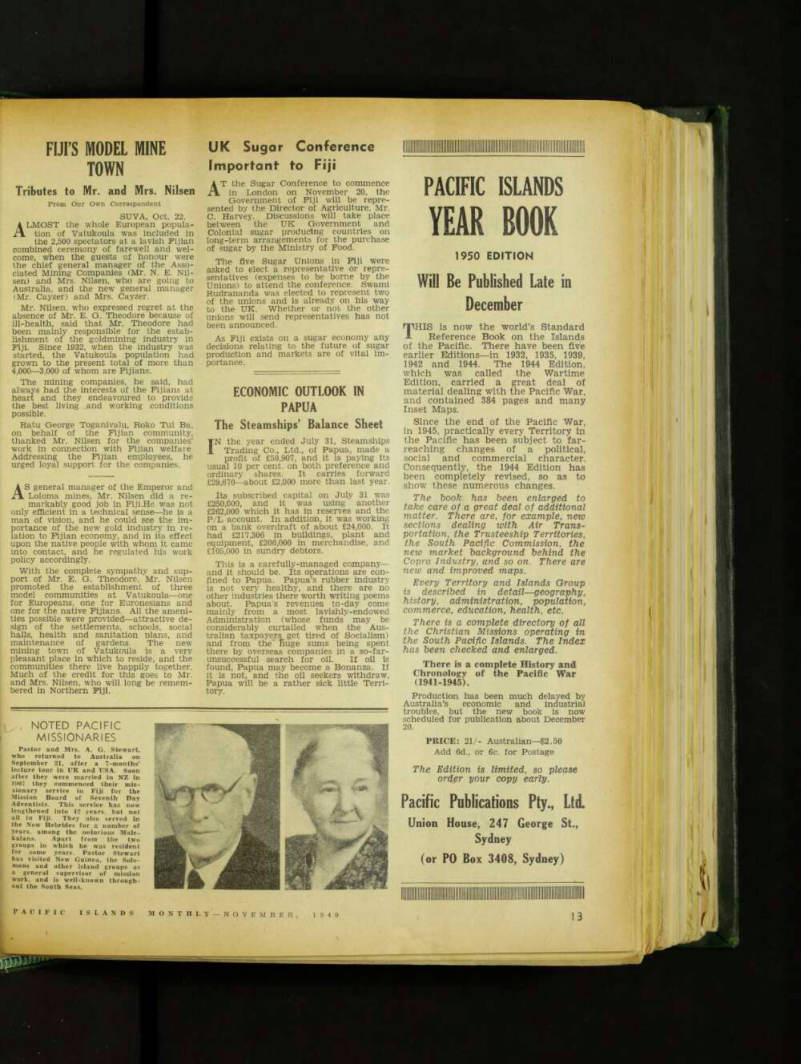
Pastor and Mrs. A. G. Stewart, who returned to Australia on September 21, after a 7-months’ lecture tour in UK and USA. Soon after they were married in NZ in 1907 they commenced their mis sionary service in Fiji for the Mission Board of Seventh Day Adventists. This service has now lengthened into 42 years, but not all in Fiji. They also served in the New Hebrides for a number of years, among the notorious Male kulans. Apart from the two groups in which he was resident for some years, Pastor Stewart has visited New Guinea, the Solo mons and other island groups as a general supervisor of mission work, and is well-known through out the South Seas.
Advertisements & other items, pp. 15-16 (1 item)
Year Book
PACIFIC ISLANDS
1950 EDITION
Will Be Published Late in
December
THIS is now the world’s Standard Reference Book on the Islands of the Pacific. There have been five earlier Editions—in 1932, 1935, 1939, 1942 and 1944. The 1944 Edition, which was called the Wartime Edition, carried a great deal of material dealing with the Pacific War, and contained 384 pages and many Inset Maps.
Since the end of the Pacific War, in 1945, practically every Territory in the Pacific has been subject to farreaching changes of a political, social and commercial character.
Consequently, the 1944 Edition has been completely revised, so as to show these numerous changes.
The hook has been enlarged to take care of a great deal of additional matter. There are, for example, new sections dealing with Air Transportation, the Trusteeship Territories, the South Pacific Commission, the new market background behind the Copra Industry, and so on. There are new and improved maps.
Every Territory and Islands Group is described in detail — geography, history, administration, population, commerce, education, health, etc.
There is a complete directory of all the Christian Missions operating in the South Pacific Islands. The Index has been checked and enlarged.
There is a complete History and Chronology of the Pacific War (1941-1945).
Production has been much delayed by Australia’s economic and industrial troubles, but the new book is now scheduled for publication about December 20.
PRICE: 21/- Australian—s2.so Add 6d., or 6c. for Postage The Edition is limited, so please order your copy early.
Pacific Publications Pty., Ltd.
Union House, 247 George St.,
Sydney
(or P 0 Box 3408, Sydney)
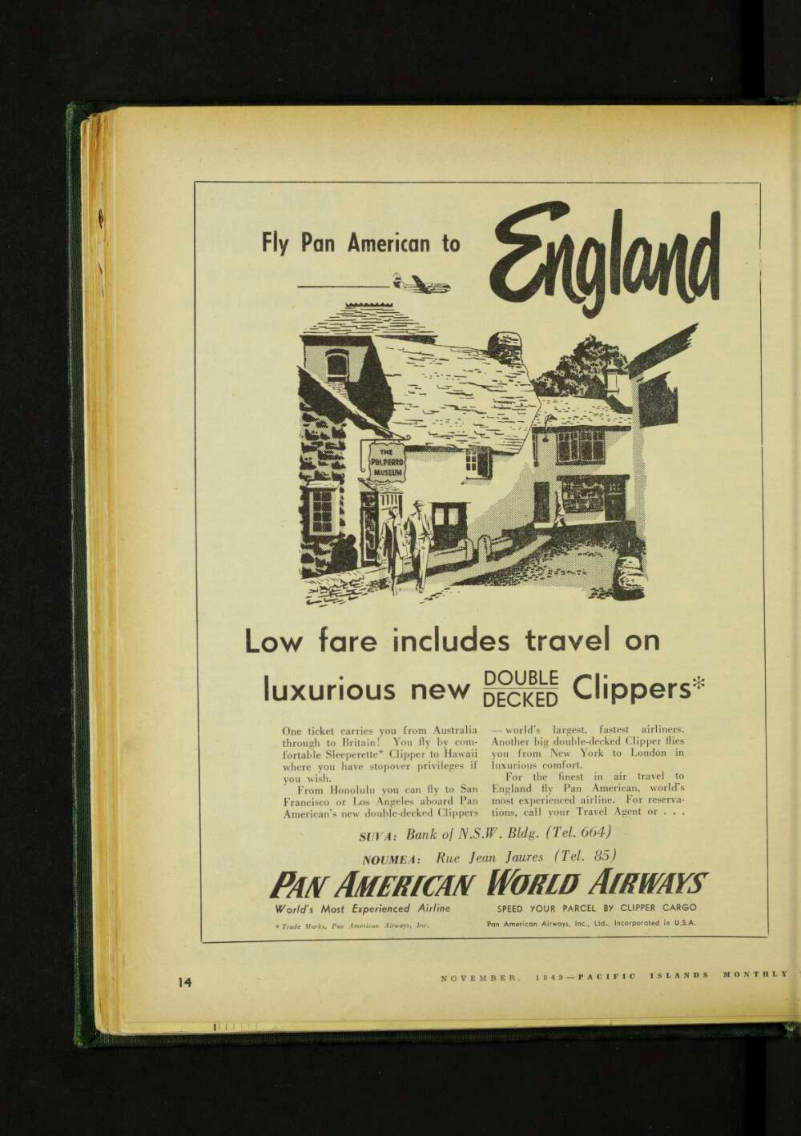
Fly Pan American to
WM & 91 msm 1111 I svv M
Low fare includes travel on
luxurious new Clippers*
One ticket carries you from Australia through to Britain! You fly by comfortable Sleeperette* Clipper to Hawaii where you have stopover privileges if you wish.
From Honolulu you can fly to San Francisco or Los Angeles aboard Pan American’s new double-decked Clippers world’s largest, fastest airliners.
Another big double-decked Clipper flies you from New York to London in luxurious comfort.
For the finest in air travel to England fly Pan American, world’s most experienced airline. For reservations, call your Travel Agent or . . .
SUVA: Bank of N.S.W. Bldg. (Tel 664)
NOUMEA; Rue Jean Jaures (Tel. 85)
Paul American World Alrways
World's Most Experienced Airline SPEED YOUR PARCEL BY CLIPPER CARGO * Trade Marks, Pan American Airways, Inc. Pan American Airways, Inc., Ltd., Incorporated in U.S.A.
Exploitation Of New Guinea Timber
Government and Bulolo Gold Dredging, Ltd., Propose A Joint Company
DEVELOPMENT of the timber industry in the Morobe district of New Guinea—mostly in and around the Bulolo Valley—will be undertaken by a new company, in which the Australian Federal Government will hold a majority of shares. It is likely that a company with a nominal capital of £750,000 will be formed jointly by the Australian Government and Bulolo Gold Dredging, Ltd.
An official announcement to this effect was made in Canberra on October 8 by the Australian Minister for External Territories, Mr. Ward. The area affected is approximately the area that was concerned in the recent “New Guinea Timber Lease Inquiry,” which extended over 15 months in 1948-49.
Mr. Ward said that conclusion of the proposed arrangement with BGD depended on the latter’s shareholders giving their consent, and on reports from ex-
perts on certain technical and economic aspects.
It is estimated that within the area concerned there are 200 million super f ee t 100 p., an 4 pine, and a smaller quantity of cedar and other tim hers. Sample logs have already been seint to Canada (headquarters of BGD, Ltd.) and, if that test is successful, an investigation will be made by plywood specialists from Canada. If that also is satisfactory, the manufacture of plywood an d veneer will be commenced in New Guinea—“using logging, milling and cer tain other facilities of BGD in New Guinea as a basis for establishing the new company,” according to the Minister. it was stated also that the new corn pany “would examine the practicability of exporting logs to Australia,” as an addition to Australia’s timber supply; but the indications were that the new concern would be primarily interested in plywood veneer.
The Back-Load Factor in New Guinea Transport
Editorial Note: The Back-Load Factor in New Guinea Transport
THE plan is very interesting, and it has some factors which must com mend it; but Australians in New Guinea probably would like some further information.
The effective development of the New Guinea timber industry does call for a big and powerful organisation; and Bulolo Gold Dredging, Ltd. —the efficiently managed Canadian company which con tributed so much to the successful estab lishment of the gold industry and of aerial transport in New Guinea—seems to be well equipped for this enterprise.
Ever since 1930, people have pointed out the waste in the fact that expensive transport, going in with supplies for the goldfield, comes out empty; and as long ago as 1933 it was urged that the great stands of timber around the Bulolo Valley would make admirable back-load ing—not the logs, perhaps, but something made from logs, like plywood, such as is now proposed. Nowadays, timber is so scarce and valuable that it might pay to send even the logs by plane out to the coast. Since the war, there has been a trafficable road in from the Markham to the Bulolo Valley, and timber would make a suitable and profitable back-load for the lorries which use it.
Something like this should have been arranged years ago. It probably was held up, first, by the Australian Government’s hatred of private enterprise and, secondly, by the Territories Minister’s deep in volvement in the Timber Lease inquiries.
There will be a wail —and a justifiable one—if the new plan.means only that the Canadian Co. (BGD) is going to develop the timber industry in order to send ply wood to Canada, and that there is to be no opportunity afforded Australian enter prise on the Bulolo timber, and no New Guinea timber for the hungry Australian market. If BGD is to supply the operating agency in the new set-up, it will be cer tain of efficiency, and of financial success. But, to get those things, it would be a tragedy if Australia, whose taxpayers now are finding millions of pounds per annum for New Guinea administration, gets none of New Guinea’s much-wanted timber.
It is typical of the professional poli tician who runs New Guinea that he should make this announcement on the eve of a general election, in which there
is at least a 50-50 chance that he will be ejected from office. It could quite easily have awaited the result of the poll on December 10. Presumably it is made now to be a sort of silver lining to the dark and dismal cloud that represents the wardist administrative record in New Guinea.
One cannot imagine that there is any bond of love between the BGD, Ltd., and Mr. Ward, to encourage a plan like this, But Mr. Ward, since all the Hancock and Gore excitement, is under a sort of obligation to see that the Government
somehow shares in the exploitation of the NG timber industry; and, if efficiency and profit therein are the chief con siderations, then the tie-up with BGD is probably the best thing in sight.
Advertisements & other items, pp. 17-18 (1 item)
G. H. Robinson
Exports & Imports Pty., Ltd.
ISLAND SUPPLIES
of all kinds—Selected and Shipped to order at lowest possible prices—Piecegoods in Wool, Cotton and Silk, Under and Outerwear, Manchester, Drapery, Grocery, Hardware, Engineers and Leathergoods trade supplies a specialty.
Indents and Transhipments arranged. Large or small orders treated with equal care.
Use our 25 years’ extensive experience.
Enquiries solicited to —
G. H. ROBINSON
Exports & Imports Pty., Ltd. 51 Macquarie Street, Sydney, N.S.W.
Telegrams: Sunrise, Sydney.
Letters: Box 3317, G.P.0., Sydney.
1 1 s
0 N V H 8
A. H. & E. Young
Established over 30 years.
ISLAND BUYING
AGENTS
Planters' and Traders' Requirements purchased at wholesale prices.
Original Invoices Supplied.
Correspondence Invited.
Sydney Office:
60 HUNTER ST., SYDNEY
Phone: BW 7365 Cables: “Malayta,” Sydney.
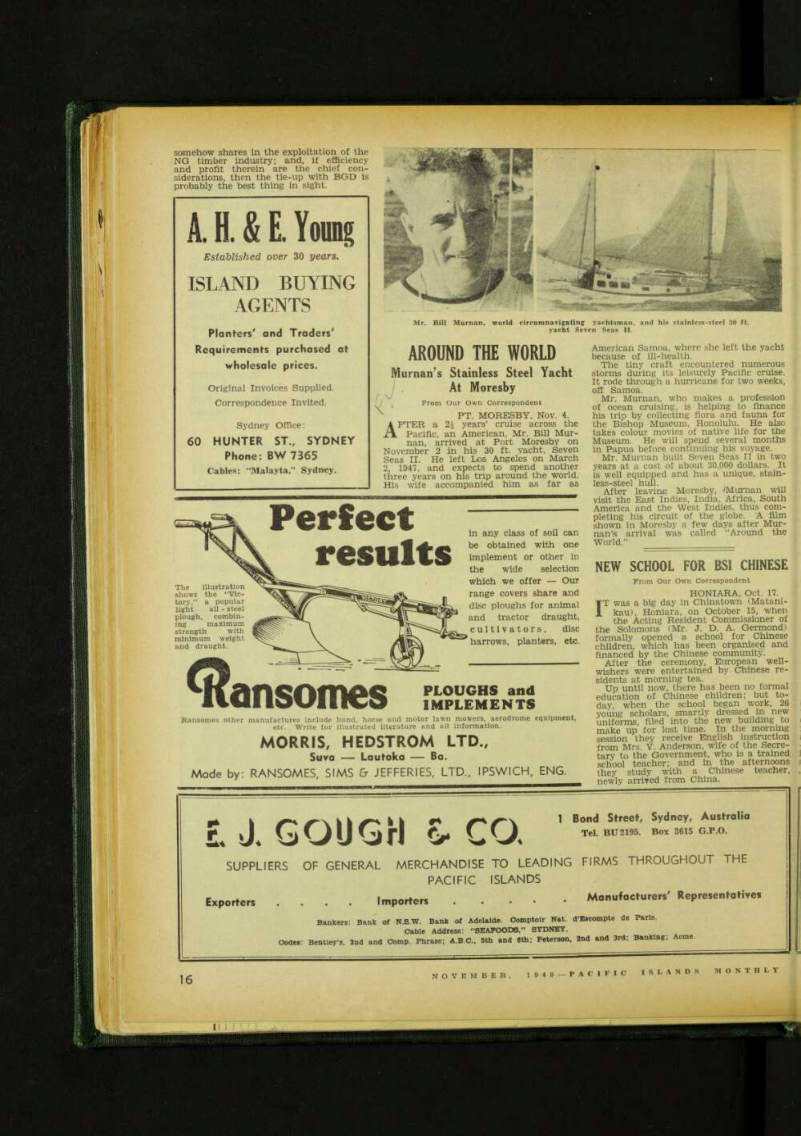
Around The World
Murnan’s Stainless Steel Yacht At Moresby
Prom Our Own Correspondent
Pt. Moresby. Nov. 4.
AFTER a 2i years’ cruise across the Pacific, an American, Mr. Bill Mur nan, arrived at Port Moresby on November 2 in his 30 ft. yacht. Seven Seas 11. He left Los Angeles on March 2, 1947, and expects to spend another three years on his trip around the world.
His wife accompanied him as far as
American Samoa, where she left the yacht because of ill-health.
The tiny craft encountered numerous storms during its leisurely Pacific cruise.
It rode through a hurricane for two weeks, off Samoa.
Mr. Murnan, who makes a profession of ocean cruising, is helping to finance his trip by collecting flora and fauna for the Bishop Museum, Honolulu, He also takes colour movies of native life for the Museum. He will spend several months in Papua before continuing his voyage.
Mr. Murnan built Seven Seas II in two years at a cost of about 30,000 dollars. It is well equipped and has a unique, stain ipcc.cf'ppl luill After leaving' Moresby, 'Murnan will visit the East Indies, India, Africa, South America and the West Indies, thus com pleting his circuit of the globe. A. film shown in Moresby a few days after Mur nan’s arrival was called “Around the World.”
Mr. Bill Murnan, world circumnavigating yachtsman, and his stainless-steel 30 ft yacht Seven Seas II.
New School For Bsi Chinese
From Our Own Correspondent
Honiara, Oct. 17.
IT was a big day in Chinatown (Matani kau), Honiara, on October 15, when the Acting Resident Commissioner of the Solomons (Mr. J. D. A. Germond) formally opened a school for Chinese children, which has been organised and financed by the Chinese community.
After the ceremony, European well wishers were entertained by Chinese re sidents at morning tea.
Up until now, there has been no formal education of Chinese children; but to day, when the school began work, 26 young scholars, smartly dressed in new uniforms, filed into the new building to make up for lost time. In the morning session they receive English instruction from Mrs. V. Anderson, wife of the Secre tary to the Government, who is a trained school teacher; and in the afternoons they study with a Chinese teacher, newly arrived from China.
Advertisements & other items, p. 18 (1 item)
T J. Gough & Co
Perfect
results
in any class of soil can be obtained with one implement or other in the wide selection The illustration shows the “Victory,” a popular light all - steel plough, combining maximum strength with minimum weight and draught. which we offer Our range covers share and disc ploughs for animal and tractor draught, cultivators, disc harrows, planters, etc.
ansomes
PLOUGHS and
IMPLEMENTS
Ransomes other manufactures include hand, horse and motor lawn mowers, aerodrome equipment, etc. Write for illustrated literature and all information.
MORRIS, HEDSTROM LTD.,
Suva Lautoka Ba.
Made by; RANSOMES, SIMS & JEFFERIES, LTD., IPSWICH, ENG.
t J. GOUGH & CO
Bond Street, Sydney, Australia Tel. BU 2195. Box 3615 G.P.O.
SUPPLIERS OF GENERAL MERCHANDISE TO LEADING FIRMS THROUGHOUT THE
PACIFIC ISLANDS
Exporters ... Importers Manufacturers' Representatives Bankers: Bank of N.S.W. Bank of Adelaide. Comptoir Nat. d’Escompte de Paris.
Cable Address: “SEAFOODS,” SYDNEY.
Codes: Bentley’s, 2nd and Comp. Phrase; A. 8.0., sth and 6th; Peterson. 2nd and 3rd; Banking; Acme.
South Pacific
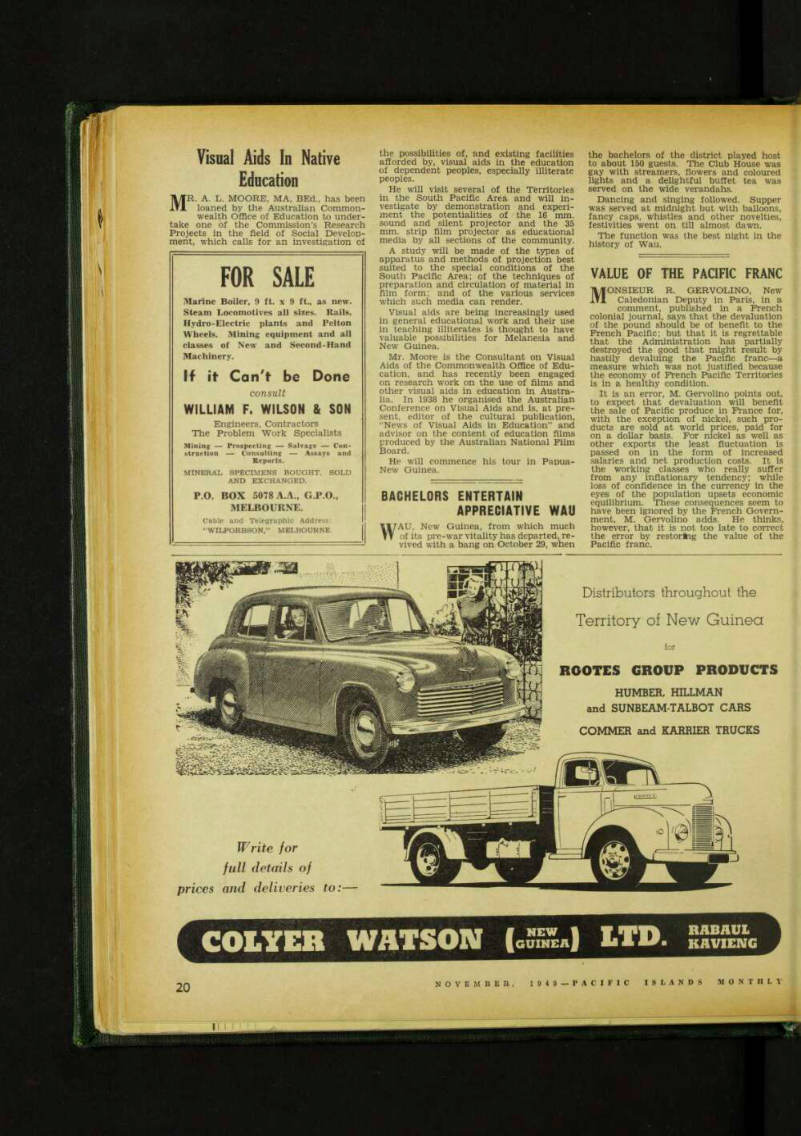
Commission
Headquarters; Anse Vata Noumea, New Caledonia
Fourth Session Held In Noumea, NC Progress Report On 30 Research Projects
THE Fourth Session of the South Pacific Commission was held from October 22 to October 31, at the Com
mission’s headquarters (Pentagon Build
ing, Anse Vata, Noumea). The following
were present:—
AUSTRALIA.—Mr. J. R. Halligan (Secretary, Department of External Territories; Rev. Dr.
John Wear Burton (ex-President General Methodist Church of Australasia), and Mr. H.
S. Barnett (Australian Consul, Noumea).
FRANCE. —M. Robert Lassalle-Sere (Inspector- General of Colonies), and M. Pierre Calixte Joseph Bonnard (Director of the Cabinet of the French High Commission in the Pacific, Noumea).
NETHERLANDS —Mr. J. B. D. Pennink (Nether lands Minister. Wellington, NZ). Mr. H. A.
Verkuyl (Netherlands Consul, Noumea), and Mr. J. Boerwinkel (Officer, General Secre tariat, Indonesian Government).
NEW ZEALAND—Lieut.-Col. F. W. Voelcker, CBE, DSO, MC (formerly High Commissioner of Western Samoa), Mr. C. G. R. McKay (formerly Secretary of Department of Island Territories), and Mr. J. V. Scott (Third Secretary, NZ Department of External Affairs).
UNITED KINGDOM—Sir Leslie Brian Freeston, KCMG, OBE (Governor of Fiji, High Com missioner for the Western Pacific), Mr. H.
H. Vaskess, CMG, OBE (formerly Secretary,
Western Pacific High Commission), and Mr.
H. A, C. Dobbs (First Assistant Secretary to Western Pacific High Commission).
UNITED STATES.—Mr. Milton Shalleck (Attorney and Counsellor-at-Law, New York), Mr, Orsen N. Nielsen (US Consul-General, Sydney), Mr.
Claude G. Ross (US Consul, Noumea), Miss Edna H. Barr (Department of State, Wash ington), Mrs. P. Leroy (Department of State, Washington).
PRINCIPAL OFFlCERS.—Secretary-General, Mr.
W. D. Forsyth; Deputy-Chairman of Research Council, Dr. L. G. M. Baas Becking; Deputy Secretary-General, Brigadier F. L. Hunt; Member for Health, Research Council, Dr. E.
Massal; Member for Social Development, Re search Council, Mr. H. E. Maude.
The Alternate Senior Commissioner for New Zealand, Lt.-Col. Voelcker, was chairman during the meetings, in con formity with the policy of rotating this office among the participating Govern ments.
Meetings of the Session were open to the public. rpHE Commission reviewed progress on JL the thirty research projects it had 'undertaken in May last relating to the health, economic and social develop ment of the two and a half million people of the South Pacific region.
The project regarding exchange of epi demiological information between the fifteen non-self-governing territories of the area has been completed and will begin to operate during November, 1949.
Encouraging progress was noted in other projects, including:— An investigation to discover a suitable infant food;
A filariasis survey; Introduction of new economic Diants, with introduction centres in Fiji, New Caledonia, Papua and Netherlands New Guinea, and improvement of productivity of atoll islands; Experts have begun surveys of social anthropology and linguistics, with emphasis on practical application of the results; Data to attack the problem of illiteracy are already in hand; The establishment of centralised tech nical training institutions, and the use of films and other visual aids in education; A pilot survey to determine methods of land usage will begin soon in New Caledonia.
Arrangements have been completed for a scheme of community development under trained native leadership. A start will be made in January, on Moturiki, an island in Fiji.
The Commission, in recognising the importance of disseminating information throughout the territories, decided to issue quarterly bulletins reporting primarily upon progress made in the implementation of the Commission’s work programme.
Associate Members Of Council
IN view of the special importance of re search attached to the carrying out of the purposes of the Commission, the following persons were named, in ad dition to its permanent members, Asso ciate Members of the South Pacific Research Council for a one-year term commencing January 1, 1950: — HEALTH: J. M. Cruikshank, J. A. C.
Gray, J. T. Gunther, M. E. J. M. Hecken roth, J. M. Lopdell. *
Economic Development: B. E. V.
Parham, K. A. Ryerson, J. C. Crawford, D. R. Eden, F. Bugnicourt.
Social Development: E. De Bruyn,
M. Grangie, F. J. Grattan, W. C. Groves, H. Hayden.
An invitation to be Honorary Consul tant to the Commission will be extended to Sir Peter Buck.
South Pacific Conference
IN order to associate with the work of the Commission representatives of local inhabitants and of official and non-official institutions directly concerned with the territories within the scope of the Commission, the Agreement between the six Governments establishing the Commission provided for a South Pacific Conference, with advisory powers as a body auxiliary to the Commission.
It is laid down in the Commission’s constitution that the Conference should meet at intervals of approximately three years; and the Commission has approved arrangements for the first conference to be convened at the Teachers’ Training College, Nasinu, Suva, on April 24, 1950.
Representatives, comprised predominantly of native peoples, will attend the Con ference from the following territories: Papua Fiji New Guinea Brit. Solomon Is.
Nauru Gilbert Is.
N. Caledonia and Ellice Is.
Dep’cies , American Samoa French Oceania New Hebrides Dutch N. Guinea Tokelau Is.
Western Samoa Kingdom of Tonga Cook Is. and Niue Sir Brian Freeston (Governor of Fiji and High Commissioner for the Western Pacific) will be chairman of the Con ference in accordance with the policy contained in the Agreement establishing the South Pacific Commission.
Introductory papers on the following topics will be presented by delegates from the several territories within the juris
diction of the six member governments.
Public Health Mosquito Control The Healthy Village Social Development The Village School Vocational Training Co-operative Societies Economic Development Fisheries Methods Improvement and Diversification of food and export crops In considering what role the South Paci fic Commission might play in the Techni cal Assistance programme for the under-developed areas of the world, the Commission instructed the Secretary- General to prepare, for approval by par ticipating governments, a draft programme for technical assistance in respect of the territories within the scope of the Com mission.
This programme will be based initially on such need as may be found to rein force any of the 30 approved' projects in the Commission’s existing programme.
The Secretary-General will submit an extended programme to deal comprehen sively with the long-term needs of the area.
The Commission also invited the par ticipating governments to confirm its assumption that applications by them for technical assistance in respect of terri tories within the scope of the Commission will normally be referred to the Commis sion for advice before being formally sub mitted by a participating government to the United Nations or other authority ad ministering a programme of technical as sistance The Fifth Session of the South Pacific Commission will be held at Suva, in May, 1950, following the South Pacific Con ference.
(Continued next page)
Visual Aids In Native
Education
MR. A. L. MOORE, MA, BEd., has been loaned by the Australian Common wealth Office of Education to under take one of the Commission’s Research Projects in the field of Social Develop ment, which calls for an investigation of
the possibilities of, and existing facilities
afforded by, visual aids in the education of dependent peoples, especially illiterate peoples.
He will visit several of the Territories in the South Pacific Area and will in vestigate by demonstration and experi ment the potentialities of the 16 mm. sound and silent projector and the 35 mm. strip film projector as educational media by all sections of the community.
A study will be made of the types of apparatus and methods of projection best suited to the special conditions of the South Pacific Area; of the techniques of preparation and circulation of material in film form; and of the various services which such media can render.
Visual aids are being increasingly used in general educational work and their use in teaching illiterates is thought to have valuable possibilities for Melanesia and New Guinea.
Mr. Moore is the Consultant on Visual Aids of the Commonwealth Office of Edu cation, and has recently been engaged on research work on the use of films and other visual aids in education in Austra lia. In 1938 he organised the Australian Conference on Visual Aids and is, at pre sent, editor of the cultural publication, “News of Visual Aids in Education” and advisor on the content of education films produced by the Australian National Film Board.
He will commence his tour in Papua- New Guinea.
Advertisements & other items, pp. 19-22 (1 item)
: C^diLuUa^
HOME STYLE BISCUITS
... \ :I ' I '* ;.v: . ■ : ill ' I I * ■’ * \ ~J-» * 4
J. C. MERRILLEES PTY. LTD.
104 HUNTER ST., SYDNEY
Telegrams: “Merrillees,” Sydney.
BISCUITS...
Home-style sweet biscuits of
supreme quality, manufactured
in Australia, of the finest ingredients and in 7 varieties.
Packed for export in 7 h Zb. cartons— l 2 cartons per case. □ \
AGENTS
WALTER GRAND HUNTS AGENCY
PAPEETE, TAHITI. SUVA, FIJI.
ALSO AVAILABLE;
BERNARDS SCOTCH BEER &
STOUT
FOR IMMEDIATE SHIPMENT
IDEAL FOR THE ISLANDS... fl^0 F = cts /
ATCO-BOATIMPELLER
gHjwgstßwa.
Arc • Simple to handle • Light—easily carried Surprisingly economical It's easy starting, has smooth power and gives trouble-free performance.
ATCOSCYTHE
AT 7 m Jtnii, lA Cut time and labour costs with this dependable machine. It's eight to twelve times as rapid as hand-scything. Ideal for cutting long grass, weeds, tall undergrowth, etc.
Just fill in the coupon below for illustrated booklets which will be sent post free. n * V
ATCO MOTOR MOWER
There's a full range from the 12 and 14 inch models up to the 17, 20, 28 and 34 inch for big-area requirements. The ATCO is a self-contained unit and will go anywhere.
LTD.
MOTOR TRACTORS
PTY. LIMITED
369-385 Wattle Street, Ultimo, Sydney Telegrams: “Sellmotors,” Sydney.
OVERSEAS MAGAZINES
Direct to You from the Publishers.
American:
CHARM 40/6
COLLIERS WEEKLY 817-
CORONET 27/9
ESQUIRE 1087-
HARPER’S BAZAAR 108/9
LADIES’ HOME JOURNAL 547-
LIFE 697-
LOOK 54/_
POPULAR MECHANICS 40/6
READERS’ DIGEST 12/-
SATURDAY EVENING POST . .. 99/-
SCIENTIFIC AMERICAN 77/6
TIME 967-
VOGUE 155/3
YACHTING 60/3
English:
APOLLO 52/6
COURIER . . 60/fl
PICTURE POST 27/fl
PUNCH 46/3
TATLER 122/-
TIMES WEEKLY 38/-
Rates are for one year and include all charges. Many other overseas periodicals available on all subjects.
ALL ORDERS AIR-MAILED TO
PUBLISHERS.
MAIL PUBLICITY CO., 175 PITT
STREET, SYDNEY, N.S.W.
Christmas
GIFT SUGGESTIONS !
★ WRIST WATCHES * BOUDOIR & TRAVELLER’S CLOCKS ★ HAWKINS PRESSURE COOKERS * ATCO MOTOR MOWERS
All Selling at Keen Prices
Men s Lip WRIST WATCH (17 Jewels). Made in France.
Non-Magnetic Water-Proof Shock-Proof.
Luminous figures and hands, with second hand. An ideal gift for HIM ... £ 12/12/- Junghans Boudoir CLOCK (illustrated). Made in Germany.
Two-coloured metal dial with luminous figures and hands. Bevelled glass. 1-day alarm with watch movement. 4 jewels.
Polished back. Dustproof. Size, 2 in. x 17/sl 7 /s in.
Bound to please HER £3/3/hands. Convex glass. 1-day alarm with watch movement. 4 jewels. Polished back bell. Dustproof. Size, 2% in. x 2Vs in.
She will like it £3/3/- Junghans Traveller’s CLOCK (wallet type).
Made in Germany.
Assorted colours. Bevelled convex glass. Twocoloured metal dial with luminous figures and hands. Flat and well regulated alarm movement. 4 jewels. Polished back bell.
Dustproof. Fits in smart wallet. Size, 3Va in. x SVz in.
For that SPECIAL PRESENT £6/6/-
points and hands. 1-day alarm movement. 3% in. diameter 34/-
Hawkins PRESSURE COOKER
Is America’s Finest Pressure Cooker—all the important features and more. The Hawkins is made in England under license. Fitted with nest of 3 aluminium perforated baskets.
A Recipe Book giving full cooking details is supplied with each Pressure Cooker. 8% pt £5/10/- 10*/ 4 Pt £7/7/- Junghans Boudoir CLOCK. Made in Germany.
Round, metal dial, with luminous figures and Junghans General ALARM CLOCK.
Round, two-coloured metal dial. Luminous ATCO MOTOR MOWER—made in England. 12 in. (105 lb.) —£ss. 14 in. (120 lb.) —£7o, Fuel consumption % pt. per hour.
(ALL PRICES QUOTED INC. FREIGHT)
Send your order to-day to —
QUEENSLAND MERCHANTS SUPPLIES
143-145 QUEEN STREET, BRISBANE, Q'LD.
FOR SALE
Marine Boiler, 9 ft. x 9 ft., as new.
Steam Locomotives all sizes. Rails, Hydro-Electric plants and Felton Wheels. Mining equipment and all classes of New and Second-Hand Machinery.
If it Can't be Done
consult
WILLIAM F. WILSON & SON
Engineers, Contractors The Problem Work Specialists Mining Prospecting Salvage Construction Consulting Assays and Reports.
MINERAL SPECIMENS BOUGHT, SOLD
AND EXCHANGED.
P.O. BOX 5078 A.A., G.P.0.,
MELBOURNE.
Cable and Telegraphic Address;
“WILFORBSON,” MELBOURNE.
Appreciative Wau
Bachelors Entertain
WAU, New Guinea, from which much of its pre-war vitality has departed, re vived with a bang on October 29, when
the bachelors of the district played host to about 150 guests. The Club House was gay with streamers, flowers and coloured lights and a delightful buffet tea was served on the wide verandahs.
Dancing and singing followed. Supper was served at midnight but with balloons, fancy caps, whistles and other novelties, festivities went on till almost dawn.
The function was the best night in the history of Wau.
Value Of The Pacific Franc
Monsieur r. gervolino, New Caledonian Deputy in Paris, in a comment, published in a French colonial journal, says that the devaluation of the pound should be of benefit to the French Pacific; but that it is regrettable that the Administration has partially destroyed the good that might result by hastily devaluing the Pacific franc—a measure which was not justified because the economy of French Pacific Territories is in a healthy condition.
It is an error, M. Gervolino points out, to expect that devaluation will benefit the sale of Pacific produce in France for, with the exception of nickel, such pro ducts are sold at world prices, paid for on a dollar basis. For nickel as well as other exports the least fluctuation is passed on in the form of increased salaries and net production costs. It is the working classes who really suffer from any inflationary tendency; while loss of confidence in the currency in the eyes of the population upsets economic equilibrium. These consequences seem to have been ignored by the French Govern ment, M. Gervolino adds. He thinks, however, that it is not too late to correct the error by restoring the value of the Pacific franc.
Advertisements & other items, p. 22 (1 item)
Golyer Watson
r* v. ii ■it Write for full details of prices and deliveries to: —
-'/ ' ' ( K Distributors throughout the Territory of New Guinea for
BOOTES GROUP PRODUCTS
HUMBER, HILLMAN
and SUNBEAM-TALBOT CARS
COMMER and KARRIER TRUCKS
mmn%
-J
NEW
GUINEA
) LTD.
RABAUI
KAVIEMG
Sandbank
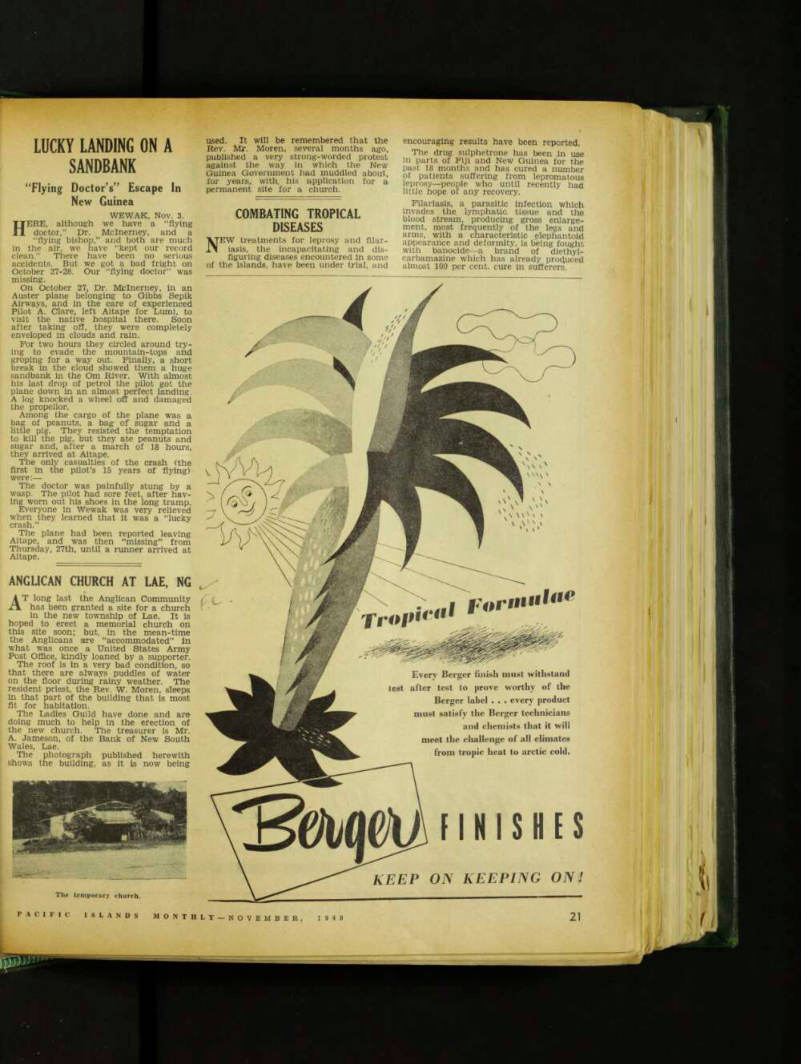
Lucky Landing On A
“Flying Doctor's” Escape In New Guinea
Wewak, Nov. 3.
HERE, although we have a “flying doctor,” Dr. Mclnerney, and a “flying bishop,” and both are much in the air, we have “kept our record clean.” There have been no serious accidents. But we got a bad fright on October 27-28. Our “flying doctor” was missing.
On October 27, Dr. Mclnerney, in an Auster plane belonging to Gibbs Sepik Airways, and in the care of experienced Pilot A. Clare, left Aitape for Lumi, to visit the native hospital there. Soon after taking off, they were completely enveloped in clouds and rain.
For two hours they circled around try ing to evade the mountain-tops and groping for a way out. Finally, a short break in the cloud showed them a huge sandbank in the Om River, With almost his last drop of petrol the pilot got the plane down in an almost perfect landing.
A log knocked a wheel off and damaged the propeller.
Among the cargo of the plane was a bag of peanuts, a bag of sugar and a little pig. They resisted the temptation to kill the pig, but they ate peanuts and sugar and, after a march of 18 hours, they arrived at Aitape, The only casualties of the crash (the first in the pilot’s 15 years of flying) were:— The doctor was painfully stung by a wasp. The pilot had sore feet, after hav ing worn out his shoes in the long tramp.
Everyone in Wewak was very relieved when they learned that it was a “lucky crash.”
The plane had been reported leaving Aitape, and was then “missing” from Thursday, 27th, until a runner arrived at Aitape.
Anglican Church At Lae, Ng
AT long last the Anglican Community has been granted a site for a church in the new township of Lae. It is hoped to erect a memorial church on this site soon; but, in the mean-time the Anglicans are “accommodated” in what was once a United States Army Post Office, kindly loaned by a supporter.
The roof is in a very bad condition, so that there are always puddles of water on the floor during rainy weather. The resident priest, the Rev. W. Moren, sleeps in that part of the building that is most fit for habitation.
The Ladies Guild have done and are doing much to help in the erection of the new church. The treasurer is Mr.
A. Jameson, of the Bank of New South Wales, Lae.
The photograph published herewith shows the building, as it is now being
used. It will be remembered that the Rev. Mr. Moren, several months ago, published a very strong-worded protest against the way in which the New Guinea Government had muddled about, for years, with, his application for a permanent site for a church.
The temporary church.
Diseases
Combating Tropical
NEW treatments for leprosy and filar iasis, the incapacitating and dis figuring diseases encountered in some of the islands, have been under trial, and
encouraging results have been reported.
The drug sulphetrone has been in use in parts of Fiji and New Guinea for the past 18 months and has cured a number of patients suffering from lepromatous leprosy—people who until recently had little hope of any recovery.
Filariasis, a parasitic infection which invades the lymphatic tissue and the blood stream, producing gross enlarge ment, most frequently of the legs and arms, with a characteristic elephantoid appearance and deformity, is being fought with banocide—a brand of diethyl carbamazine which has already produced almost 100 per cent, cure in sufferers.
Advertisements & other items, pp. 23-24 (2 items)
Finishes
Trop *
col Formu
Every Berger finish must withstand lest after test to prove worthy of the Berger label . . . every product must satisfy the Berger technicians and chemists that it will meet the challenge of all climates from tropic heat to arctic cold.
FINISHES
KEEP ON KEEPING ON!
CRAMMOND
“KING OF THE AIR” TROPICAL RECEIVERS
NEVER FAIL TO LIVE UP TO THEIR REPUTATION!
THE CRAMMOND TROPIC EAGLE
FEATURES:
Completely sealed and tropic-proofed Models for operation as Vibrator, Electric-Vibrator, 1.4 Dry Cell.
A new addition to the Tropic Eagle Range will operate either from A.C. or Vibrator.
THE ONLY COMPLETELY TROPIC PROOFED INSTRUMENT IN THE WORLD
THE CRAMMOND TROPIC PORTABLE
features: Components of highest grade infra-red ray tropic proofed. Continuous coverage on S.W. 16-150 metres. Following types available—Vibrator, All Electric, All Dry Cell. A special model for either Electric or Vibrator operation.
THE MOST POWERFUL TRIPLE OR DUAL WAVE PORTABLE EVER BUILT Here’s Proof on a Tropic Eagle !
Mr. R.S.S., Coffee Plantation, Rabaul (name on application) writes: “I am glad to let you know that I am very satisfied with the Tropic Eagle—its workmanship is of a high standard.
It can be recommended without fear to anyone who needs a set to stand up to tropical climate. ,, Write for 'particulars of the New Country Listeners’ Club, and helpful and interesting monthly magazine.
Address : Country Listeners’ Club headquarters, No. 8 Queen Street, Brisbane. 3*
CRAMMOND RADIO
TROP/CRL DIVISION
RoB QUEEN STREET . BRISBRNE
22
NOVEMBER, 1949 PACIFIC ISLANDS MONTHLI
Ayr Is
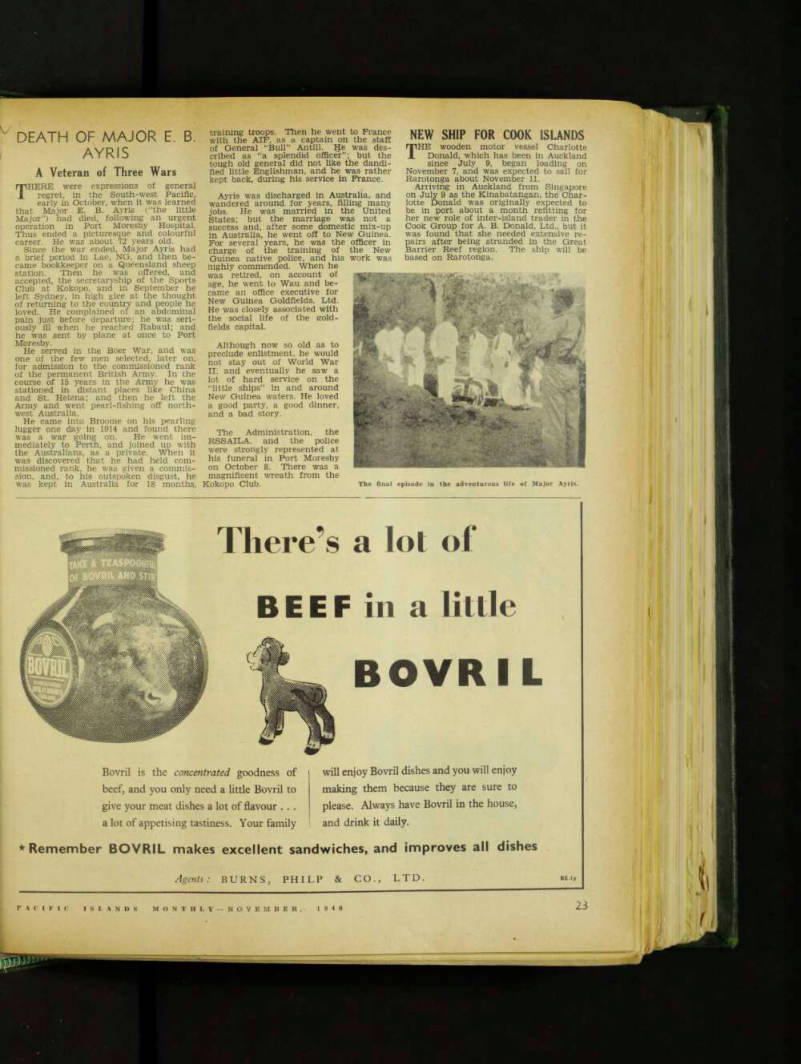
Death Of Major E. B.
A Veteran of Three Wars
THERE were expressions of general regret, in the South-west Pacific, early in October, when it was learned that Major E. B. Ayris (“the little Major”) had died, following an urgent operation in Port Moresby Hospital.
Thus ended a picturesque and colourful career. He was about 72 years old.
Since the war ended, Major Ayris had a brief period in Lae, NG, and then be came bookkeeper on a Queensland sheep station. Then he was offered, and accepted, the secretaryship of the Sports Club at Kokopo, and in September he left Sydney, in high glee at the thought of returning to the country and people he loved. He complained of an abdominal pain just before departure; he was seri ously ill when he reached Rabaul; and he was sent by plane at once to Port Moresby.
He served in the Boer War, and was one of the few men selected, later on, for admission to the commissioned rank of the permanent British Army. In the course of 15 years in the Army he was stationed in distant places like China and St. Helena; and then he left the Army and went pearl-fishing off north west Australia.
He came into Broome on his pearling lugger one day in 1914 and found there was a war going on. He went im mediately to Perth, and joined up with the Australians, as a private. When it was discovered that he had held com missioned rank, he was given a commis sion, and, to his outspoken disgust, he was kept in Australia for 18 months,
training troops. Then he went to France with the AIF, as a captain on the staff of General “Bull” Antill. He was des cribed as “a splendid officer”; but the tough old general did not like the dandi fied little Englishman, and he was rather kept back, during his service in France.
Ayris was discharged in Australia, and wandered around for years, filling many jobs. He was married in the United States; but the marriage was not a success and, after some domestic mix-up in Australia, he went off to New Guinea.
For several years, he was the officer in charge of the training of the New Guinea native police, and his work was highly commended. When he
was retired, on account of age, he went to Wau and be came an office executive for New Guinea Goldfields, Ltd.
He was closely associated with the social life of the gold fields capital.
Although now so old as to preclude enlistment, he would not stay out of World War 11, and eventually he saw a lot of hard service on the “little ships” in and around New Guinea waters. He loved a good party, a good dinner, and a bad story.
The Administration, the RSSAILA, and the police were strongly represented at his funeral in Port Moresby on October 8. There was a magnificent wreath from the Kokopo Club.
New Ship For Cook Islands
THE wooden motor vessel Charlotte Donald, which has been in Auckland since July 9, began loading on November 7, and was expected to sail for Rarotonga about November 11.
Arriving in Auckland from Singapore on July 9 as the Kinabatangan, the Char lotte Donald was originally expected to be in port about a month refitting for her new role of inter-island trader in the Cook Group for A. B, Donald, Ltd., but it was found that she needed extensive re pairs after being stranded in the Great Barrier Reef region. The ship will be based on Rarotonga.
The final episode in the adventurous life of Major Ayris.
Advertisements & other items, p. 25 (1 item)
Bovril
There’s a lot of
B E E F in a little
e Bovril is the concentrated goodness of beef, and you only need a little Bovril to give your meat dishes a lot of flavour . . . a lot of appetising tastiness. Your family will enjoy Bovril dishes and you will enjoy making them because they are sure to please. Always have Bovril in the house, and drink it daily. * Remember BOVRIL makes excellent sandwiches, and improves all dishes
Agents: BURNS, PHILP & CO., LTD
BE.Iy
Now Close To £4,000,000 Per Annum
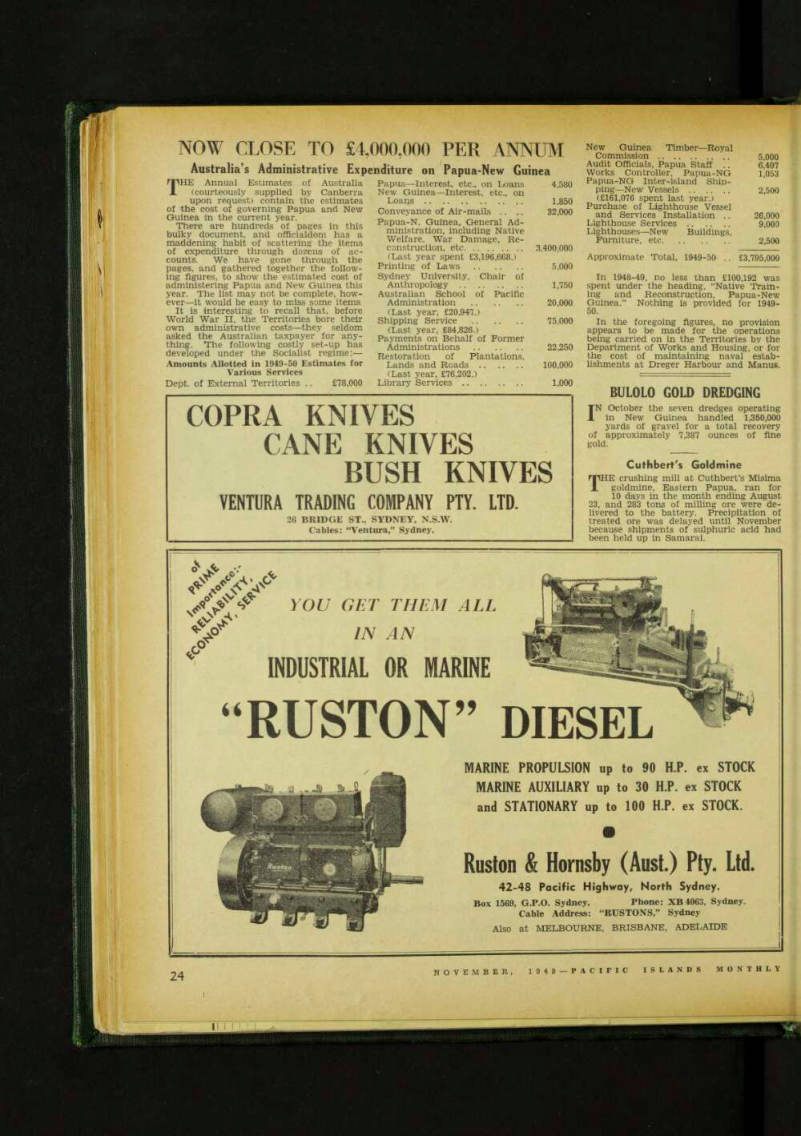
Australia's Administrative Expenditure on Papua-New Guinea
THE Annual Estimates of Australia (courteously supplied by Canberra upon request) contain the estimates of the cost of governing Papua and New Guinea in the current year.
There are hundreds of pages in this bulky document, and officialdom has a maddening habit of scattering the items of expenditure through dozens of ac counts. We have gone through the pages, and gathered together the follow ing figures, to show the estimated cost of administering Papua and New Guinea this year. The list may not be complete, how ever—it would be easy to miss some items.
It is interesting to recall that, before World War 11, the Territories bore their own administrative costs —they seldom asked the Australian taxpayer for any thing. The following costly set-up has developed under the Socialist regime:— Amounts Allotted in 1949-50 Estimates for Various Services Dept, of External Territories .. £78,000
Papua—lnterest, etc., on Loans 4,580 New Guinea—lnterest, etc., on Loans 1,850 Conveyance of Air-mails .. .. 32,000 Papua-N. Guinea, General Ad ministration, including Native Welfare, War Damage, Re construction, etc 3,400,000 (Last year spent £3,196,668.) Printing of Laws 5,000 Sydney University, Chair of Anthropology 1,750 Australian School of Pacific Administration 20,000 (Last year, £20,947.) Shipping Service 75,000 (Last year, £84,826.) Payments on Behalf of Former Administrations 22,250 Restoration of Plantations, Lands and Roads 100,000 (Last year, £76,202.) Library Services 1,000
New Guinea Timber—Royal Commission 5.000 Audit Officials, Papua Staff .. 6,407 Works Controller, Papua-NG 1,053 Papua-NG Inter-island Ship ping-New Vessels 2,500 (£161,076 spent last year.) Purchase of Lighthouse Vessel and Services Installation .. 26.000 Lighthouse Services 9,000 Lighthouses—New Buildings, Furniture, etc 2,500 Approximate Total, 1949-50 .. £3,795,000 In 1948-49, no less than £100,192 was spent under the heading, “Native Train ing and Reconstruction, Papua-New Guinea.” Nothing is provided for 1949- 50.
In the foregoing figures, no provision appears to be made for the operations being carried on in the Territories by the Department of Works and Housing, or for the cost of maintaining naval estab lishments at Dreger Harbour and Manus.
Bulolo Gold Dredging
IN October the seven dredges operating in New Guinea handled 1,350,000 yards of gravel for a total recovery of approximately 7,387 ounces of fine gold.
Cuthbert's Goldmine
THE crushing mill at Cuthbert’s Misima goldmine, Eastern Papua, ran for 10 days in the month ending August 23, and 283 tons of milling ore were de livered to the battery. Precipitation of treated ore was delayed until November because shipments of sulphuric acid had been held up in Samarai.
Advertisements & other items, p. 26 (1 item)
“Ruston” Diesel
COPRA KNIVES
CANE KNIVES
BUSH KNIVES
VENTURA TRADING COMPANY PTY. LTD.
26 BRIDGE ST., SYDNEY, N.S.W.
Cables: “Ventura,” Sydney.
° A* <o ST <£' S *\o v f cT v°
YOU GET THEM ALL
IN AN
INDUSTRIAL OR MARINE
“RUSTON” DIESEL
MARINE PROPULSION up to 90 H.P. ex STOCK MARINE AUXILIARY up to 30 H.P. ex STOCK and STATIONARY up to 100 H.P. ex STOCK.
Ruston & Hornsby (Aust.) Pty. Ltd.
42-48 Pacific Highway, North Sydney.
Box 1569, G.P.O. Sydney.
Cable Address: Phone: X 84063, Sydney. ‘HUSTONS,” Sydney
Also at MELBOURNE, BRISBANE, ADELAIDE
The Month In Moresby
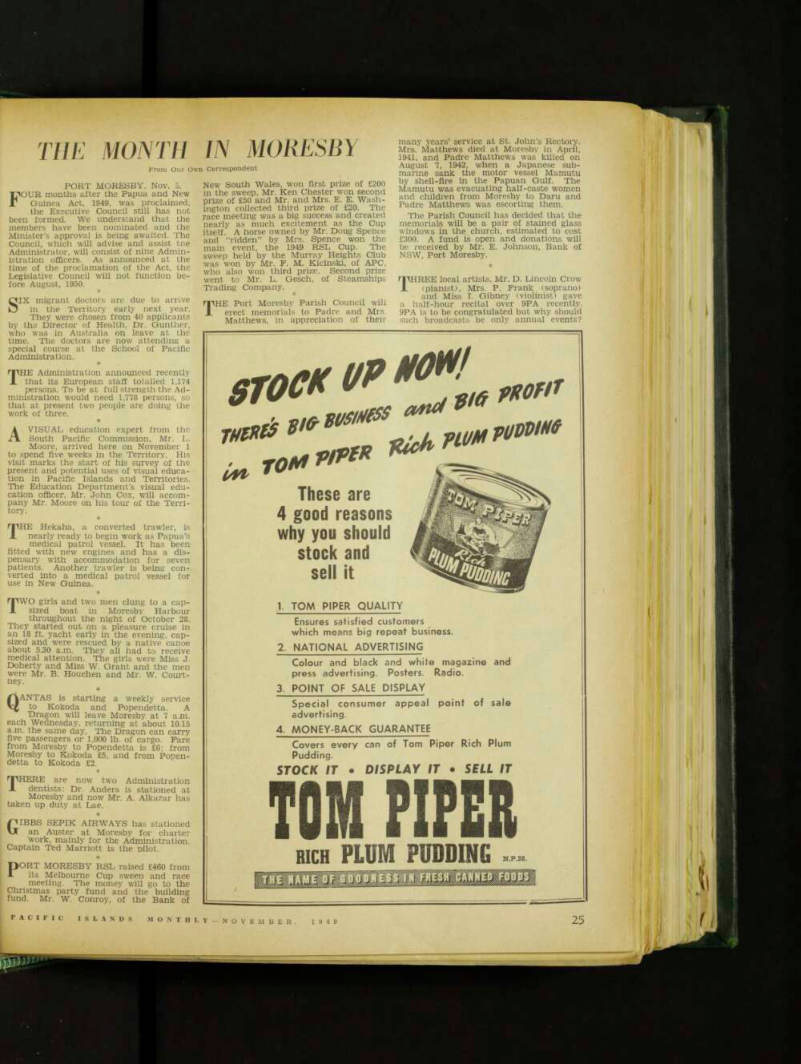
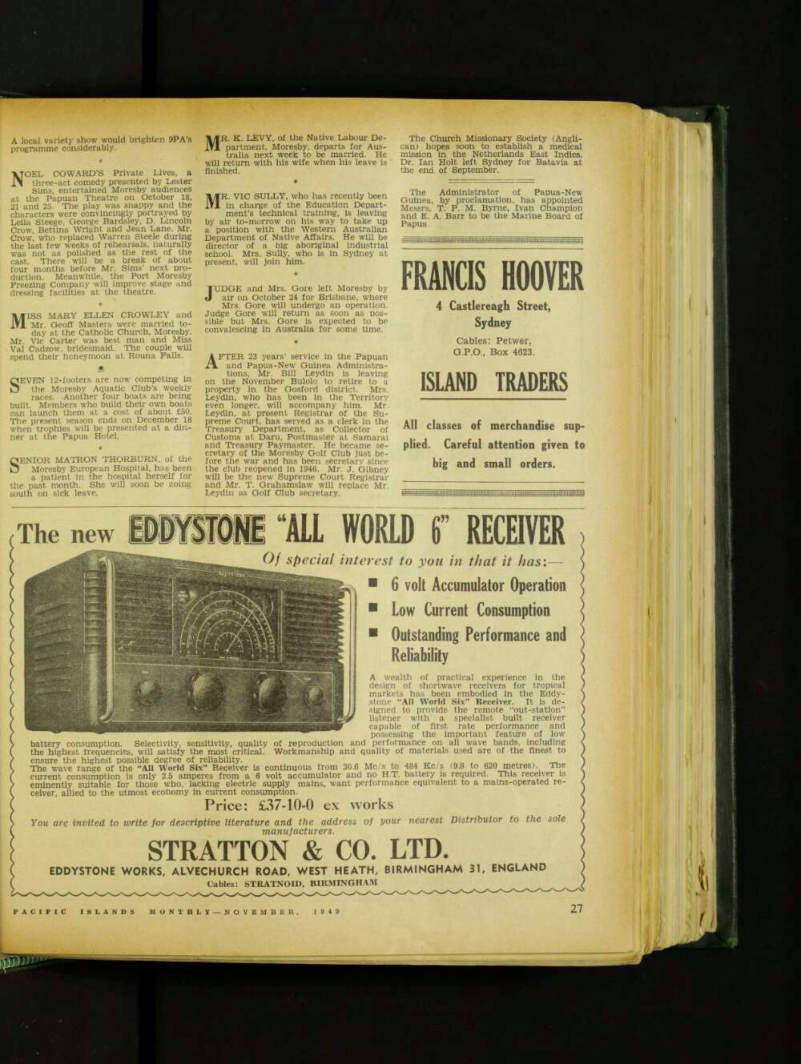
From Our Own Correspondent
Port Moresby. Nov. 5.
FOUR months after the Papua and New Guinea Act, 1949, was proclaimed, the Executive Council still has not been formed. We understand that the members have been nominated and the Minister’s approval is being awaited. The Council, which will advise and assist tne Administrator, will consist of nine Admin istration officers. As announced at the time of the proclamation of the Act, the Legislative Council will not function be fore August, 1950. * SIX migrant doctors are due to arrive in the Territory early next year.
They were chosen from 40 applicants by the Director of Health, Dr. Gunther, who was in Australia on leave at the time. The doctors are now attending a special course at the School of Pacific Administration. * THE Administration announced recently that its European staff totalled 1,174 persons. To be at full strength the Ad ministration would need 1,778 persons, so that at present two people are doing the work of three. ♦ A VISUAL education expert from the South Pacific Commission, Mr. L.
Moore, arrived here on November 1 to spend five weeks in the Territory. His visit marks the start of his survey of the present and potential uses of visual educa tion in Pacific Islands and Territories.
The Education Department’s visual edu cation officer, Mr. John Cox, will accom pany Mr. Moore on his tour of the Terri tory. * THE Hekaha, a converted trawler, is nearly ready to begin work as Papua’s medical patrol vessel. It has been fitted with new engines and has a dis pensary with accommodation for seven patients. Another trawler is being con verted into a medical patrol vessel for use in New Guinea. * TWO girls and two men clung to a cap sized boat in Moresby Harbour throughout the night of October 28.
They started out on a pleasure cruise in an 18 ft. yacht early in the evening, cap sized and were rescued by a native canoe about 5.30 a.m. They all had to receive medical attention. The girls were Miss J.
Doherty and Miss W. Grant and the men were Mr. B. Houchen and Mr. W. Court ney. * QANTAS is starting a weekly service to Kokoda and Popendetta. A Dragon will leave Moresby at 7 a.m. each Wednesday, returning at about 10.15 a.m. the same day. The Dragon can carry five passengers or 1,000 lb. of cargo. Fare from Moresby to Popendetta is £6; from Moresby to Kokoda £5, and from Pooen detta to Kokoda £2. * THERE are now two Administration dentists: Dr. Anders is stationed at Moresby and now Mr. A. Alkazar has taken up duty at Lae. * GIBBS SEPIK AIRWAYS has stationed an Auster at Moresby for charter 'work, mainly for the Administration.
Captain Ted Marriott is the pilot. * PORT MORESBY RSL raised £460 from its Melbourne Cup sweep and race meeting. The money will go to the Christmas party fund and the building fund. Mr. W. Conroy, of the Bank of
New South Wales, won first prize of £2OO in the sweep, Mr. Ken Chester won second prize of £5O and Mr. and Mrs. E. E. Wash ington collected third prize of £2O. The race meeting was a big success and created nearly as much excitement as the Cup itself. A horse owned by Mr. Doug Spence and “ridden” by Mrs. Spence won the main event, the 1949 RSL Cup. The sweep held by the Murray Heights Club was won by Mr. F. M. Kicinski, of APC, who also won third prize. Second prize went to Mr. L. Gesch, of Steamships Trading Company. * 11 HE Port Moresby Parish Council will erect memorials to Padre and Mrs.
Matthews, in appreciation of their
many years’ service at St. John’s Rectory.
Mrs. Matthews died at Moresby in April, 1941, and Padre Matthews was killed on August 7, 1942, when a Japanese sub marine sank the motor vessel Mamutu by shell-fire in the Papuan Gulf. The Mamutu was evacuating half-caste women and children from Moresby to Daru and Padre Matthews was escorting them.
The Parish Council has decided that the memorials will be a pair of stained glass windows in the church, estimated to cost £3OO. A fund is open and donations will be received by Mr. E. Johnson, Bank of NSW, Port Moresby. * I'IHREE local artists, Mr. D. Lincoln Crow (pianist), Mrs. P. Frank (soprano) and Miss I. Gibney (violinist) gave a half-hour recital over 9PA recently. 9PA is to be congratulated but why should such broadcasts be only annual events?
A local variety show would brighten 9PA’s programme considerably. * NOEL COWARD’S Private Lives, a three-act comedy presented by Lester Sims, entertained Moresby audiences at the Papuan Theatre on October 18, 21 and 25. The play was snappy and the characters were convincingly portrayed by Leila Steege, George Bardsley, D. Lincoln Crow, Bettina Wright and Jean Lane. Mr.
Crow, who replaced Warren Steele during the last few weeks of rehearsals, naturally was not as polished as the rest of the cast. There will be a break of about four months before Mr. Sims’ next pro duction. Meanwhile, the Port Moresby Freezing Company will improve stage and dressing facilities at the theatre, *
Miss Mary Ellen Crowley And
Mr. Geoff Masters were married to day at the Catholic Church, Moresby.
Mr. Vic Carter was best man and Miss Val Cadzow, bridesmaid. The couple will spend their honeymoon at Rouna Falls.
A SEVEN 12-footers are now competing in the Moresby Aquatic Club’s weekly races. Another four boats are being built. Members who build their own boats can launch them at a cost of about £5O.
The present season ends on December 18 when trophies will be presented at a din ner at the Papua Hotel. ♦
Senior Matron Thorburn, Of The
Moresby European Hospital, has been a patient in the hospital herself for the past month. She will soon be going south on sick leave.
MR. K. LEVY, of the Native Labour De partment, Moresby, departs for Aus tralia next week to be married. He will return with his wife when his leave is finished. * MR. VIC SULLY, who has recently been in charge of the Education Depart ment’s technical training, is leaving by air to-morrow on his way to take up a position with the Western Australian Department of Native Affairs. He will be director of a big aboriginal industrial school. Mrs. Sully, who is in Sydney at present, will join him. ♦ JUDGE and Mrs. Gore left Moresby by air on October 24 for Brisbane, where Mrs. Gore will undergo an operation.
Judge Gore will return as soon as pos sible but Mrs. Gore is expected to be convalescing in Australia for some time. ♦ AFTER 23 years’ service in the Papuan and Papua-New Guinea Administra tions, Mr. Bill Ley din is leaving on the November Bulolo to retire to a property in the Gosford district. Mrs.
Leydin, who has been in the Territory even longer, will accompany him. Mr.
Leydin, at present Registrar of the Su preme Court, has served as a clerk in the Treasury Department, as Collector of Customs at Daru, Postmaster at Samarai and Treasury Paymaster. He became se cretary of the Moresby Golf Club just be fore the war and has been secretary since the club reopened in 1946. Mr. J. Gibney will be the new Supreme Court Registrar and Mr. T. Grahamslaw will replace Mr.
Leydin as Golf Club secretary.
The Church Missionary Society (Angli can) hopes soon to establish a medical mission in the Netherlands East Indies.
Dr. lan Holt left Sydney for Batavia at the end of September.
The Administrator of Papua-New Guinea, by proclamation, has appointed Messrs. T. P. M. Byrne, Ivan Champion and E. A. Barr to be the Marine Board of Papua.
Advertisements & other items, pp. 27-29 (1 item)
Tom Fifes
STOCK VP fscfiT
These are
4 good reasons
why you should
stock and
sell it
1. TOM PIPER QUALITY
Ensures satisfied customers which means big repeat business.
2. NATIONAL ADVERTISING
Colour and black and white magazine and press advertising. Posters. Radio.
3. POINT OF SALE DISPLAY
Special consumer appeal point of sale advertising.
4. MONEY-BACK GUARANTEE
Covers every can of Tom Piper Rich Plum Pudding.
STOCK IT • DISPLAY IT • SELL IT
TOM FIFES
rich PLUM PUDDING
N.P.28.
0 * v
Prouds
A birthday gift . . . a wedding gift . . . a Christmas gift ... or whatever the occasion may be. m •9C* % V* Proud's Seven Floor Gift Store, right in the heart of Sydney, has exactly the gift you need. i N (* > n ] -V/- * A world-wide variety of merchandise is specially selected with a thought for the giver of gifts.
It's easier, it's more fun to shop by mail with the help of Proud's Gift Book. Cut out the coupon below, send it to Mail Order Manager, Prouds Limited, Box 1502, G.P.0., Sydney, and receive Proud's Gift Book free. Precious Jewellery Watches China and Glassware Art Jewellery Compacts Souvenirs Pens and Pencils Smokers’ Accessories Silverware Cutlery Shaving Accessories Leather Goods Brush Sets Handbags All types of clocks from the "Clock Shop"
PROUD’S GIFT BOOK VOUCHER
Ma/7 Order Manager, Prouds Limited, Box 1502, G.P.0., Sydney.
Please send me Proud's new Gift Book tree of all charge.
Name Address.
FRANCIS HOOVER
4 Castlereagh Street, Sydney Cables: Petwer, G.P.0., Box 4623.
ISLAND TRADERS
All classes of merchandise supplied. Careful attention given to big and small orders.
The new BMM “ALL WORLD r RECEIVER Of special interest to you in that it has: —
6 volt Accumulator Operation
Low Current Consumption
Outstanding Performance and
Reliability
A wealth of practical experience in the design of shortwave receivers for tropical markets has been embodied in the Eddystone “All World Six” Receiver. It is designed to provide the remote “out-station” listener with a specialist built receiver capable of first rate performance and possessing the important feature of low battery consumption. Selectivity, sensitivity, quality of reproduction and performance on all wave bands, including the highest frequencies, will satisfy the most critical. Workmanship and quality of materials used are of the finest to ensure the highest possible degree of reliability. , , . A . .
The wave range of the “All World Six” Receiver is continuous from 30.6 Mc/s to 484 Kc/s (9.8 to 620 metres). The current consumption is only 2.5 amperes from a 6 volt accumulator and no H.T. battery is required. This receiver is eminently suitable for those who, lacking electric supply mains, want performance equivalent to a mams-operated receiver, allied to the utmost economy in current consumption.
Price: £37-10-0 ex works
You are invited to mite for descriptive literature and the address of your nearest Distributor to the sole manufacturers.
STRATTON & CO. LTD.
EDDYSTONE WORKS, ALVECHURCH ROAD, WEST HEATH, BIRMINGHAM 31, ENGLAND
Cables: STRATNOID, BIRMINGHAM
Mr. Alport Barker Again
Mayor of Suva
From Our Own Correspondent
Suva, Nov. 6.
MR. ALPORT BARKER was re-elected Mayor of Suva at the annual meet ing of the Suva Town Council on November 2. There were no other nominations for the post.
New Caledonian Exchange
Australian Says He Was Well Treated
IT was stated in this journal in June, 1948, that, the French authorities in New Caledonia had confiscated a sum represented by £3O in Australian currency, and 40,082 United States dollars, which was being taken away by an Australian contractor who had been doing work in
New Caledonia, and who did not want Pacific francs.
Now, 18 months later, Mr, A. Jamieson, of North Sydney, who says he is the contractor in question, reports that the funds referred to were not confiscated, but “were held in suspense until a clari fication of the matter was reached . . . no confiscation was involved . . . the amounts as recorded v/ere incorrect.”
Mr. Jamieson praises the treatment ac corded him and his men by the French authorities. “It must be said that the Chef du Bureau des Change in Noumea has at all times made available Aus tralian currency or local francs in the proportions as requested of him by myself and on account of my employees, without erception.
“The Chef du Bureau des Change Noumea—Mr. Coquilait—has felt the wrong imputation of the article. In his case it has been made more acute by reason of the fact that he has extended himself in his endeavour to give relief to Australians working in NC, with respect to remuneration being paid in Australian currency.”
EDITORIAL NOTE—We cannot now re member the source of the report which we published; but we are happy to make the correction asked for. It is generally believed, however, that persons desiring to spend a period in New Caledonia have much trouble with exchange there, and there is little chance of developing a tourist traffic with the French Colony until its reputation, in this respect, has been changed.
Mr. R. W. Taylor, who is Seventh Day Adventist missionary and teacher in Savaii, Western Samoa, accompanied by Mrs. Taylor, has spent three months’ furlough in Australia lately. He fias a notably fine collection of colour photo graphs of Western Samoa.
Advertisements & other items, p. 30 (1 item)
Kasper
HAMMOND ORGANS
and
SOLOVOX Piano Attachments
(FULLY TROPICALISED)
Available for speedy shipment from
Hongkong
ALL ENQUIRIES WILL RECEIVE IMMEDIATE ATTENTION
AUSTRALIAN INTERSTATE AGENCIES
Importers and Exporters of Overseas and Hongkong Manufactured Products.
G.P.O. BOX 2207, HONGKONG. Cables: “Austproduct,” Hongkong.
KASPER
10 0 0 pe6 Kasper Cabinet No. 19.
KASPER REFRIGERATORS PTY. LTD.
ICE CREAM DISPENSING
& HARDENING CABINETS
Available Now!
Specially insulated for Tropical Conditions with genuine Spanish Corkboard.
Cabinet top of 18-gauge, mirror finish, stainless steel.
Cabinet sides of 20-gauge, satin finish, stainless steel.
Frame 2 in. angle iron, welded construction, rustproofed.
Cabinet 19 contains 4 Double Holes with a capacity for 40 gallons of ice cream; Ice Block Maker and Ice Cream Making Head (capacity 15 gallons per hour).
All cabinets are self-contained and complete with refrigerator unit and electric motors. Every “Kasper’’
Cabinet fitted with stainless steel, hinged lids, hermetically sealed, and cork insulated.
Cabinets available with storage capacity from 20 to 100 gallons. Custom built to your specifications. (When ordering, please specify type of power available.)
KASPER means QUALITY BUILT, SCIENTIFICALLY
ENGINEERED and DEPENDABLE in OPERATION.
ORDER NOW AND AVOID DELAY!
77 RAILWAY PARADE, ERSKINEVILLE, N.S.W.
AUSTRALIA.
Til 1 \ f OOQ
War Damage
No Compensation For
One BSI Planter Speaks His Mind
Letter xo the Editor THE following is the text of an official announcement: Public Notice—War Damage Compensation: It is hereby notified for public information that, after careful consideration of War Damage Claims Commission reports on all claims sub mitted to him for property lost or damaged as a result of war in the Gilbert and Ellice Islands Colony and British Solomon Islands Protectorate and bearing in mind that the normal revenues of these Territories are insufficient to meet their recurrent costs of administration and that the principal factor to be considered is the degree to which payments by way of compen sation are in fact needed to effect rehabilitation or to restore economic productivity, the High Commissioner has been unable to recommend to the Secretary of State for the Colonies the pay ment of any war damage compensation to these Territories.
A British Government should be ashamed to publish such a notice. It is not even accurate. The normal revenue of the BSI was sufficient to meet its re current cost of administration, as was evidenced by the annually recurring sur pluses in the pre-war period.
But the Protectorate certainly is unable to meet the abnormal public expenditure wished on to it against public opinion by the post-war Planners of Whitehall. And that is one of the grounds upon which War Damage Compensation is being evaded!
The Notice is roaring nonsense, which ever way you look at it —outraging our intelligences; adding insult to injury.
In simple, honest terms we could have been notified: “That in view of the parlous condition of United Kingdom finances, and because no reparations will be forthcoming from Japan (as it is now Allied policy to rehabilitate the ex-enemy at your expense) His Majesty’s Govern ment has agreed that there should be no war damage compensation, etc., etc.”
The war-stricken settlers of the Solo mons would have understood and thanked the British Government for such a bitter, but honest statement.
Outside of the realms of lunacv or evasion, when, or by whom, was it ever contemplated that these war-ravaged Islands would be the source from which war damage compensation would, or could be paid?
Imagine a National Disaster —a great bush fire or flood ravaging a countryside; and then the dulcet tones of a National Government bleating across the havoc and the waste: “In view of the fact that the revenues of the Local Council are in adequate to meet the cost of fire or flood damage, the National Government has agreed that there should be no Relief payments to ruined farmers.” Nunc Dimittio!
I am, etc.,
Leslie F. Gill.
Vella Lavella,
Bsi.
Fiji Can Grow Potatoes
EXCELLENT yields of potatoes were obtained in Fiji in 1948, reports the Fiji Department of Agriculture. Well grown crops gave more than 10 tons to the acre. Most of the potatoes—which found a ready market—were grown by Fijians in the Sigatoka region, and were disposed of by the Nadroga-Navosa Co operative Association Ltd. for £2O per ton at Sigatoka (for graded potatoes only).
Planting Co. Almost Killed
By The War
THE 38th annual report of Mamara Plantations Ltd., a Brisbane com pany which owns 3,867 acres near Honiara, on Guadalcanal, BSI, is a some what dismal record.
This was a prosperous little concern be fore the war. There usually was enough copra produced to pay the Prefs (£25,000 in 5 per cent., and about the same in 6 per cent.) and give some reasonable return to the £40,000 ordinaries. But battles were actually fought in and around the plan tations in 1942-3, and when it was all over, many of the palms were gone and there was a claim on record for £32,690 for war damage.
Now, it is seen that there will be no compensation at all forthcoming. Local labour and transport difficulties plus damaged plantations have so reduced out put that, despite the high copra market, the company finished the year (June 30) with a loss of £633. The shareholders have received nothing for several years.
The directors, consequently, have de cided to lease the place for a period of five years, retaining their right to sell at any time. The lessee has purchased buildings, plant, etc. The directors say that, after £2,264 of debts owing have been paid off, the 5 per cent. Prefs may come in for a dividend.
Advertisements & other items, pp. 31-32 (1 item)
Mosquitoes
BOOK LOVERS!
Hutchinson’s UNIVERSAL BOOK CLUB offers an easy way to build a well-chosen Home Library.
Each month a Committee, with the co-operation of leading English and American publishers, selects for the members of the UNIVERSAL BOOK CLUB an outstanding contemporary novel by a famous author.
The subscription is £2/2/- for 12 books a year delivered monthly or £l/1/- for 6 months. This is the only charge and includes postage.
Join now and receive your first hook by return mail.
Membership in other Book Clubs may also be arranged.
MAIL PUBLICITY COMPANY
175 Pitt Street, Sydney, N.S.W.
FLIT MEANS DEATH TO
MOSQUITOES
Kills ’?'»» Moth* °»<Juiloe» c *«kroach«* s, lverf,»h But* Ant* U •fi'nr FLIT is again available everywhere to help you wage war against insect pests.
FLIT contains D.D.T., in addition to Pyrethrum and Thanite, making it the most effective insecticide available.
VACUUM OIL COMPANY PTY. LTD.
THE MOST EFFECTIVE INSECTICIDE YOU CAN BUY
*o„ *»<► .. \ V^» o v ni \ y\& % e
o 'o V **
% **< s I r (W «* / fR &* * r 4 hd Si P aw P^ V /*• V* <s > w rv v'
pANZ
z« gftSS x \ -*T % :va X a
the
serv/ces fz&&r
sovm
M
Mane
New Zealand is a whole world of travel . . but it’s a small world when you fly on the N.Z. National Airways Corporation air network that brings New Zealand’s playgrounds and wonderlands invitingly close.
NEW ZEALAND NATIONAL AIRWAYS CORPORATION.
New Zealand National Airways Corporation provides a network of air services throughont the Dominion and the South-West Pacific. General Agents in the Dominion for British Commonwealth Pacific Airlines a Trans-Australian Airlines. Booking Agents for Tasman Empire Airways, Qantas Empire Airways, me and other overseas airlines.
Offices and Agents throughout New Zealand and the South-West Pacific.
Tourists
Fiji Must Have More
“The Accommodation Bottleneck"
CONSIDERATION of plans for develop ing the tourist traffic in Fiji was urged by Mr. W. G. Johnson at a meeting of the Suva Chamber of Com merce in October.
Mr Johnson emphasised the benefits which tourists bring, providing employ ment and increasing the flow of money into the Colony, He urged that a summary of Fiji’s at tractions should be advertised overseas and suggested a plan based on sending visitors to points on the Viti Levu road system, and to the Yasawas.
Mr. Johnson said that an accommoda tion bottleneck was caused bv inadequate hotel facilities in Suva and he suggested that self-contained cottages, with full amenities and connected by paths with the main building, should be built in the grounds of the Grand Pacific Hotel. These cottages would provide accommodation for a further 40 guests. Swimming baths and an open-air dance floor would add to the hotel’s amenities.
Mr. Johnson suggested that in the Yasa was two camps should be set up, and linked with Lautoka by a large and well equipped passenger launch. The camps should have electric light and hot and cold water, and be made insect proof, and liquor licences should be provided. The atmosphere should nevertheless be tropi cal, and thatch, plaited bamboo and other native materials should be used as much as possible in the construction of the camps. Mr. Johnson considered that the
natural beauty of the Yasawas, together with attractions which could be developed, would draw visitors in large numbers.
Mr. Johnson said that he believed that if the proposed extra accommodation were provided in Suva and the camps estab lished in the Yasawas to supplement the accommodation now available in North Western Viti Levu, it would be possible to plan for a continuous movement of tourists, enabling more to be catered for then if visitors came to the one place and stayed there.
Mr. Johnson’s proposals were very favourably received by the Chamber of Commerce, and it was decided to send copies of his memorandum to the Govern ment, to airlines calling at Fiji, and to the Union Steamship Co.
The first meetings of the Presbyterian General Assembly of the New Hebrides met in August of this year. The Rev. J.
G. Miller, Principal of the Tangoa In stitute, was elected Moderator, and the Rev. R. T. C. Williams clerk of the new Assembly. Pastor Saurei, of Vila, was elected as Moderator’s chaplain.
For P-Ng?
War Graves Tourists
PAPUA-NEW GUINEA may get Aus tralian Government sponsored tourists to war cemeteries someday— but not just yet.
Mr. Chifley stated in Canberra recently that representations had been made by several ex-Servicemen’s organisations and by quite a number of individuals that some scheme should be inaugurated to enable parents and close relatives to visit the graves of soldiers who are buried abroad. For a number of reasons the Government had not granted those re quests, as it would involve great physical difficulties as well as considerable expen diture. However, although the Govern ment has refused each request made to it up to date, it has not finally rejected such proposals—further consideration mav be given to the matter.
Monsieur Henri Gaignard was in Tahiti in October, on a special mission on behalf of the Union Francaise. His head quarters are in Paris.
Advertisements & other items, p. 33 (1 item)
Lighting Plants
32 VOLT AND 110 VOLT PLANTS, COMPLETE WITH
BATTERIES
VENTURA TRADING COMPANY PTY. LTD.
26 BRIDGE ST.. SYDNEY, N.S.W.
Cables: “Ventura,” Sydney.
P. & R. HUTCHINSON, Suva. VENTURA TRADE AGENCY, Lae, T.N.G.
For the RIGHT TIME Rely on WESTCLOX The finest, smartest clocks in Westclox history—that’s what has in store for you! A wide range of stunning clocks for every room— spring-wound and electric alarm models—wall clocks for your kitchen and time clocks for the living room— yes, wrist and pocket watches, too— all with traditional Westclox dependability and smartness that have made Big Ben and other members of this time-keeping family famous all over the world.
“It’s a Westclox” is the finest thing you can say about a clock or watch.
Some Westclox have luminous dials that you can see in the dark.
QUALITY •
• •RELIABILITY •
10 You can buy any Westclox with confidence. Look for that trade mark on the dial of the next clock or watch you buy.
Baby Ben—His alarm may be adjusted to loud or soft. Quiet tick. Made in two finishes — ivory and gold colour; also black with nickel trim.
BIG
BEN
Big Ben is made two ways—There’s Big Ben Loud Alarm with booming intermittent call. If you want a more gentle awakening, there’s Big Ben Chime Alarm which first calls you with soft chimes. If you ignore these chimes, there’s a loud cal/ in reserve.
PACIFIC ISLANDS TRADING CO
244 CALIFORNIA ST. ( SAN FRANCISCO, CALIF., U.S.A.
Scrub Typhus
THE new antibiotic drug Chloromycetin against scrub-typhus, demonstrated by an American research unit in Malaya in collaboration with Malayan in vestigators at the Institute for Medical Research, Kuala Lumpur, was success fully tried out on human volunteers in known infected areas of scrub-typhus.
Since then, in trials of the drug made by
chemical synthesis, two Ghurkas, in fected in Malaya during jungle warfare against bandits, one very severely, one moderately, were completely cured. The temperature reached normal in 48 hours, and convalescence was uneventful. The drug is also reputed to have a powerful mitigating effect against typhoid fever, and it has recently been used in typhoid cases in England. Scrub typhus is preva lent in Indonesia, and it has been a deadly disease in New Guinea.
New Nimanoa For
G & E Service
THE Gilbert and Ellice Islands Colony now has another ship called Nim anoa. Formerly MV Mootah, she was built in Hobart, Tasmania, in 1946 and refitted in Sydney. Lady Freeston, wife of the Governor of Fiji and High Commissioner for the Western Pacific, re-christened her Nei Nimanoa on Oc tober 31 by pouring a bilo of coconut toddy over her stern.
Captain G. J. Webster, acting Marine Superintendent for the WPHC, recalled that the name Nimanoa was both remem bered and respected in the Gilbert and Ellice Islands. (The first ship of that name was commissioned in 1929 and served the Colony until the fateful 10th December, 1941, when the Japs caught her and her company at Tarawa. Her master was ashore but her Chief Officer. Captain Stead, although ordered to surrender her to the Japs refused to do so. He took it upon himself to slip the ship’s cable and let her drift upon the reef at the top of the tide. The Nimanoa was blown up that same afternoon by the Japs after they had tried in vain to get her off the reef).
At the end of the rechristening cere mony which took place in the ship’s fore castle, prayers were offered by the Rev.
H. W. Figgess, rector of Holy Trinity Pro Cathedral, Suva; Lady Freeston was pre sented with a bouquet of flowers by Miss Ann Webster; and the new master of the ship, Captain T. Milner and Mrs, Milner entertained a number of guests.
The vessel will go into service in the G & E Colony almost immediately.
Mr. Malcolm H. Wright, ADO at Finsch haven, NG, with his wife and new baby (bom on October 2) are now in Australia on furlough.
Advertisements & other items, p. 34 (2 items)
BURNS PHILP (New Hebrides) LTD.
Registered Office: VILA, NEW HEBRIDES
Branch Office at SANTO
Exporters, Importers and General Merchants
(Retail and Wholesale) Commission, Shipping
and Customs Agents
Representatives for BURNS PHILP TRUST COMPANY LIMITED, QUEENS- LAND INSURANCE CO., LTD., and LLOYDS OF LONDON. Agents for SOCIETE DES PETROLES SHELL DES ILES FRANC AISES DU PACIFIQUE, and numerous overseas manufacturers of all classes of merchandise.
Sydney Agents: Burns. Phllp & Ce., Ltd., 7 Bridge Street.
San Francisco Agents; Burns, Philp Co. of San Francisco, Matson Building, 215 Market Street, London Agents; Burns, Philp & Co., Ltd., 35 Crutched Friars, E.C.3
jiffi
Corrugated Aluminium Roofing Sheets*
ill
ffi
I > *1
COOL
LIGHT
&ii
PERMANENT
A building material has now emerged which can meet the huge demand for homes, schools, industria
buildings Corrugated Aluminium Roofing Sheets.
As a protection against sun heat, Corrugated Aluminium Roofing has proved most effective. No special maintenance is required; no protective painting is necessary ; and Corrugated Aluminium Roofing * for every type of resists the corrosive atmosphere of marine and industrial regions.
Corrugated Aluminium Roofing is available as listed here: GAUGES: 26, 24, 23. 22, 20 and 18 s.w.g.
WIDTHS: 26" or 32" (Eight 3" corrugations and ten 3" corrugations respectively).
LENGTHS: 6', 7', B', 9'. 10', 11' and 12' in exact feet. construction
ALUMINIUM UNION LIMITED
(Incorporated in the Dominion of Canada) Principal British Commonwealth Distributor of Aluminium Ocean House, 34 Martin Place, Sydney. An ALUMINIUM LIMITED Company.
Sales Agents for New Zealand Richardson McCabe & Co. Ltd.
Wellington Auckland Christchurch Sales Agents for Fiji, Western Samoa and Tonga: Morris Hedstrom Limited Suva, Fiji
By Earthquakes
Gazelle Peninsula Shaken By Earthquakes
From Our Own Correspondent
Rabaul. Oct. 27.
AT 7.5 a.m. on October 20, a serious earth tremor occurred, gauged be tween strength 7 to 8 (strength 10 is regarded as explosion point). Kokopo, the site for the new New Britain head quarters, suffered more % severely than Rabaul.
Seven houses in the Kokopo area were completely destroyed; 30-odd severely damaged. All houses and stores in the Kokopo area suffered some damage broken china, glassware, household effects and loss of tanks. Kokopo, was for a time completely without water. The Vunapope Mission suffered several thousands of pounds of damage, including damage to their valuable X-ray plant.
Both the Vunapope hospital and the Government hospital had all their drugs destroyed when everything crashed to the floor. Emergency supplies were sent in immediately.
Mr. Keith McCarthy, District Officer, New Britain District, proceeded by ship with other Government officials to in spect the damage. Pontoons have been arranged to ship water to Kokopo and water carts are urgently required.
The Rabaul-Kokopo road suffered at least 20 landslides which trapped three motor trucks-*-two will be able to be re moved by barges but one is expected to be a total loss.
This coast road is now thought dangerous and it is not considered prac ticable to reopen it. Extensive road building will at once take place on the inland route to enable the existing road to become a main thoroughfare. One big landslide has been cleared from this road and it is now open for traffic.
The telephone line between Rabaul and Kokopo cannot be repaired, and as the coast road is not to be reopened, con siderable time will elapse before a com pletely new line can be laid along the new road.
In Rabaul there were at least 50 tanks destroyed, and roofs on about 100 homes damaged—the first rains will really tell.
No houses were actually destroyed but extensive damage was done to household property.
There were many near-fires with kero sene refrigerators.
The power house fused and cut itself off, but is now in order. The water line on the Namanula hill burst, but that also is repaired.
No loss of life, to the present, has been reported, and there are fio known serious injuries but many people were bruised when thrown to the ground.
THE Administrator, Colonel J. K.
Murray, arrived in Rabaul on October 24, to inspect the damage caused by the tremors. He consulted, on arrival, with the District Officer, Mr. J.
K. McCarthy, Mr. George MacLennan, Regional Officer, Public Works Depart ment and other Government Officials.
During his stay he inspected the Nonga Evacuation Camp, which is prepared in readiness in the event of volcanic eruption taking place in Rabaul.
On October 26, Colonel Murray met a representative gathering of the European, Chinese, Eurasian and Native com munities in order to discuss the Govern ment’s policy on the move from Rabaul to Kokopo. He stated that the only reason for the move from Rabaul was that it is considered unsafe due to the possibility of volcanic eruptions but that earth tremors such as experienced recently were likely to occur at any time, at any place in the Territory. Consequently it may be
considered necessary to incorporate cer tain specifications in building plans to enable buildings to withstand the violence of bad tremors.
Mr. B. B. Perriman, Managing Director New Guinea Company Limited, thanked Colonel Murray for his visit to Rabaul and Kokopo at this time.
Rabaul was amused by the fact that during this meeting while Colonel Murray was making a statement that tremors come, unheralded and were likely to occur at any time with various degrees of violence, a small tremor shook the McCarthy residence where the meeting was taking place.
Coionel Murray during a very full schedule, visited all areas involved in the tremor, and inspected the now abandoned coast road from Rabaul to Kokopo.
One of the amazing things about Ter ritory folk, however, is the speed with which these things are forgotten and people make shift until conditions can be remedied.
One family which cannot now live in their plantation home have temporarily set up house in the office adjoining their former residence.
Mr. J. Campbell, who recently com pleted an Agricultural course at Massey College in New Zealand on a Rehabilita tion grant, has been appointed an Agri cultural Assistant in the Department of Agriculture, Fiji.
Advertisements & other items, pp. 35-36 (1 item)
Cannot Sleep
If You
FEEL FIT FOR NOTHING.
You may be anaemic or bloodless, for this aliment plays havoc with your health and nervous energy. You feel terribly nervy; suffer headaches and dizzy spells, have poor appetite, cannot sleep at night —losing those precious hours of rest and recovery, essential for your health and fitness.
Many people have recovered from these miseries by taking Dr, Williams’ Pink Pills, which have reinvigorated, strengthened their systems and banished the vague pains and weariness. Dr. WUliams’ Pink Pills always help to enrich and increase the blood supply, giving beneficial help to the nerves, tissues and organs of the body. With enriched blood you cannot help feeling happier, sleeping better, becoming reinvigorated.
Stop anaemia making you a suffering invalid without delay. Take Dr. Williams' Pink Pills and soon notice the difference in your eyes, skin, nerves and .general health. At all chemists and stores.
The Most Extensive Manufacturers in the British Empire of
RUBBER STAMPS,
INKS, STENCILS,
Marking Devices,
ACME STAMP PADS
OFFICE & STATIONERY SUPPLIES
We also Manufacture & Supply a Complete Line of
LIMEWASH-ING AND
SPRAYING MACHINES
for all purposes.
Let us know your requirements and we will quote by return.
WRITE FOR OUR GENERAL CATALOGUE
Limewashing Machine
EXCELSIOR SUPPLY CO. PTY. LTD.
278 Post Office Place,
MELBOURNE, VIC.
HEAD OFFICE :
160 BROADWAY,
Former I u known as George St., West,
SYDNEY* N.S.W.
50 Victoria Street,
WELLINGTON, N.Z.
cc
Co-operation like this
makes things happen fast!
55 r I’d be lost without the services of my local B.O.A.C. Appointed Agent. He’s the chap—multiplied 3,500 times throughout the world —who saves me hours of preliminary planning.
Yes, my Agent makes things happen in a hurry.
And he knows the answers to all my riddles about currency restrictions, baggage allowances, visas and regulations. I give him my itinerary and leave the details to him. He handles everything without fuss or confusion. All I do is pack a bag and leave on schedule.
This same Speedbird efficiency—this same concern for your comfort and pleasure—applies wherever you may fly along 150,000 miles of B.O.A.C. routes to forty-two countries on five continents. The flight itself is swift and sure —comfortable, too. You enjoy complimentary meals, and there are no extras for the attentions and courtesies that make your journey so much more enjoyable. It’s all part of B.O.A.C.’s 30-year-old tradition of Speedbird service and
experience.
m
GREAT BRITAIN
MIDDLE EAST
SOUTH AFRICA
AUSTRALIA •
• USA • BERMUDA
• WEST AFRICA
• PAKISTAN • INDIA
NEW ZEALAND • FAR EA
• CANADA
EAST AFRICA
• CEYLON
' • JAPAN
B.O.A.C* TAKES GOOD CARE OF YOU
FLY BOAC
AIO/AU
Information & Bookings : Qantas Empire Airways Ltd ., Sydney , Melbourne , Brisbane , Townsville , Cairns , Darwin (<General Agents in Australia ), or from Booking Agents in all cities.
BRITISH OVERSEAS AIRWAYS CORPORATION WITH Q.E.A., T.E.A.L. AND S.A.A.
Western Samoa Reviews a Year’s
Activities
THE Annual Report on the Territory of Western Samoa for the year ending March 31, 1949, which has just been published, contains some interesting statistics on the social, administrative and economic position of the country.
Crime in Samoa, though to an im partial observer it seems on the increase, is not serious according to official figures.
There were two convictions for murder during the year: none for attempted murder or manslaughter. There were 110 convictions for common assault (99 against Samoans and 11 against Euro peans) and 284 convictions for theft. The personnel of the Police* Department is composed of 12 Europeans and 65 Samoans.
The total number of village trading stations in the Territory is given as 241, of which 190 are operated by the four major firms.
Receipts of public revenue reached the total of £500,338 and payments totalled £464,520. The total accumulated surplus of the Territory at the end of the period stood at £642,973, of which £554,050 was invested in New Zealand Government in scribed stock. The Territory has no pub lic debts.
Out of the revenue of £500,338 the amount of £475,659 was received through the Treasury and Customs Department— £234,339 being from import duties, £79,950 from export duties and £65,835 from Store Tax.
Of the expenditure of public revenue (totalling £464,520), £165,987 were spent on
Public Works, £89,707 on Health, £55,090 on the Treasury and Customs Depart ment, and £46,855 on Education.
In the Post* Office Savings Bank 5,823 depositors had deposits totalling £280,188 standing to their credit at March 31, 1949.
LAND holdings in Samoa are divided into 103,630 acres of Crown Land, 581,370 acres of Samoan native lands and about 40,000 acres of European lands (35,000 acres owned privately and 5,000 acres owned by various missions.) The Territory has about 228 miles of motor roads, an increase of 24 miles over last year.
The number of motor-vehicles in the Territory has jsteadily increased during the past three years from 438 in 1946 to 618 in the year under review.
The population of the Territory as on March 31, 1949, is given as follows: Europeans 297 Part Samoans 5,406 Samoans 69,426 Chinese .. .. 180 Melanesians 72 Total 75,381 Population growth between the census of 1921 and that of 1945 represented an average growth of 2.5 per cent. During the year ending March 30, 1949, recorded births among Samoans were and deaths only 674. Among Part-Samoans
the ratio of births to deaths was even higher than amongst full Samoans—there being 263 births recorded against only 7 deaths.
At present there are approximately 800 persons of Samoan descent in New Zea land.
Advertisements & other items, p. 37 (1 item)
Insurance
THE
YORKSHIRE
CO. LTD.
(Incorporated in England)
ALL CLASSES OF
INSURANCE
Including
Fire Motor Guarantee Accident Workers Marine Island Representatives:
PORT MORESBY: E. A. James
RABAUL: G. B. Black LAE: New Guinea Industries Ltd.
MADANG: R. MacGregor SUVA: Williams & Gosling Ltd.
NOUMEA: Y. Mortensen
NORFOLK ISLAND;
A. E. Martin
Oa Wholesale and Retail Merchants. Shipowners. Sawmillers.
General Engineers. Customs and Shipping Agents.
Catering for all Plantation Supplies. Buyers of Island Produce Plantation Owners and Managing Agents.
Agents for;— Australia-West Pacific Line.
China Navigation Co.
Canton Insurance Office, Ltd.
Union Assurance Society, Ltd.
Aust. T. & G. Mutual Life Society, Ltd.
Guinea Air Traders, Ltd.
cotter
Sydney.
Melbourne, ted & CO. tto.
COUER. **22* Cctatch-
Distributing Agents in New Guinea for:— Hillman, Humber, Sunbeam-Talbot , Chrysler and Plymouth Cars.
Commer, Karrier and Fargo Trucks.
Willys Overland Jeeps.
G.M. Marine and Industrial Engines, 1 Olympic Tyres and Cables.
Hygeia Dissolvenators.
Sherwin-Williams Paints.
Prefect Refrigerators.
Mullard Radios.
Aladdin Lamps.
Ewo Beer. jV Snowflake Unsweetened Evapor- i ated Milk.
'WelUu gtou.
New Map Of Suva Available
ANEW map of Suva and suburbs, pub lished by the Fiji Lands Department, and drawn by Mr. A. V. Guy, is now on sale at the office of the Lands Depart ment in Suva and at the Suva Post Office.
The price is 3/-.
The map is in bright contrasting colours and shows roads, public buildings, hotels,
churches, schools and clubs in scarlet: and parks, sports grounds and the golf links are shown in green.
Commander William Burrows, who has been residing in South Africa, Rhodesia and Britain, arrived in New Zealand in October on his way back to Fiji. He hopes to get to Suva by the Aorangi at the end of November.
Mariposa May Come
Back to Pacific
THE US Maritime Commission an nounced on October 17, that it would pay the Oceanic Steamship Company 5,653,555 dollars for the conversion of the Mariposa—provided she resumes the Pacific Coast-Australia Service.
This amended the agreement between the Commission and the Company cover ing the Mariposa and Monterey, which the Government took over in December, 1941, for war service.
The US Government was to pay 11,402,852 dollars for their reconversion, but because of rising costs work stopped in July, 1947, when work on the Mariposa was 60 per cent, complete.
Since then the company has cried various means of settling the Monterey- Mariposa Question —but the ships have remained immobilised in dock.
The Matson liners were popular with South Pacific travellers, all of whom will be glad to welcome Mariposa if she does come back to the Sydney-San Francisco service.
Mr. Malcolm English departed from Rabaul, New Guinea, on October 27, with his two sons, aged seven months and three years. Two weeks previously all Rabaul attended the funeral service of his wife, Dorothy, who was killed in a jeep accident. (See October PIM.) Mr.
English is uncertain as to his future plans but is now en route to Melbourne where Mr. and Mrs. Weeks, parents of Mrs.
English will care for the children. He has been ADO at Kokopo since January and was formerly at Talasea. He and Mrs. English were held in high regard in both districts.
Advertisements & other items, p. 38 (2 items)
Batteries
U.S.L.
FOR
MOTOR CAR AND TRUCK
SOLE DISTRIBUTORS for NEW GUINEA, PAPUA
AND PACIFIC ISLANDS.
VENTURA TRADING COMPANY PTY. LTD.
26 BRIDGE STREET, SYDNEY
Cables: “VENTURA,” Sydney.
Carrlock Co. Ltd.
Telegram: "CARRLOCK" P.O. Box 2140, Hong Kong
2nd Floor, Queen's Bldg., Chater Road, HONG KONG
General Merchants :: Commission Agents
Exporters and Shippers of All Kinds of Merchandise To the Pacific Islands Representatives of Leading Manufacturers
in HONG KONG
INQUIRIES INVITED
Suva's Price Spiral Worries
Permanent Hotel Guests
From Our Own Correspondent
Suva, Oct. 23.
INCREASES in Suva’s cost of living, caused this time by hotel rates and meal charges, has touched off a quiet but serious revolt among the many em ployees brought from New Zealand and Australia by large and small commercial firms.
October 22 saw a series of deputations to the heads of various businesses who were told, in effect, that as things are at Suva to-day it is impossible for workers from overseas to show anything like a reasonable .margin between a moderate salary and expenditure on the barest essentials.
The situation, which has been build ing up for the last two years or more, has now reached the stage where em ployees who were luted io Fiji with great difficulty have left again within a fortnight because of the obvious im possibility of making ends meet. Long established office-workers, a few of them in key positions, have gone back to New Zealand this year despite offers of salary increases if they would stay.
Top executives have been faced with the problem of replying to requests for transfers anywhere away from Suva; or, alternatively, making very substantial in creases in their firm’s wages bills. If nothing is done there will undoubtedly be resignations, with virtually no pros pect of securing replacements.
The cost of the plainest living at Suva, including increased direct taxation, has risen by 80 per cent, since the end of the Second World War. No reliable esti mate of wage increases in the same period is available, but it is reasonable to say thft the average sal£p:y of em ployees who have come into the Colony from overseas has not risen by more than 25 per cent. In many cases the increase is much less.
The result is that many capable men and women who could command very comfortable pay in their own countries have, in Suva, no margin for saving and see little prospect of improvement. Fiji’s income tax level is lower than that of the dominions, but this advantage is can celled out, several times over, by other factors.
THE spark that produced the final ex plosion is the fact that from No vember 1, casual rates at the Suva hotels will be decontrolled and will go up to £1 a day or more. This does not include the Grand Pacific, which has a higher scale of its own (not yet an nounced) but covers the five central hotels in Suva, three of which are ex tremely venerable.
Casual meals, and meals paid for on a monthly basis, have gone up corres pondingly. Three meals a day will cost £l4/10/- a month. Single meals will cost 4/- (4/6 in one case) for breakfast, 5/- for luncheon and 6/- for dinner. The standard of the meals provided ranges from moderate-to-good down to adequate-but-uninspired.
Rates for “permanents” in these hotels have reached a maximum of from £l7 to £l9 a month. Some proprietors are prepared to make concessions on the maximum; others are not.
This development has produced a scurry-round by hotel residents who,
rightly or wrongly, regard the new charges as out of all proportion to the return received by the individual resi dent.
In some cases employers have offered to raise the salaries of essential em ployees who live at hotels solely because of the scarcity of other accommodation.
Some workers, however, point out that if their services justify this increase they themselves are entitled to the benefit and not the hotels, which, whatever ad
vantages they may offer, are mostly situated in the hottest, noisiest and most airless parts of central Suva. A few of these people are threatening that if they
cannot unearth more congenial living conditions they will join the ranks of those who now contemplate packing up.
The spiral does not end at the hotels.
Sooner or later the few boarding-houses will raise their rates, as will those people who provide private board. And it is common talk that increased rates at the Chinese and Indian restaurants are a certainty—a prospect which is agitat ing everybody who depends on these places regularly or for frequent, casual meals.
THE present uproar comes from a small but essential part of Suva’s popu lation. Behind it is the ceaseless complaint of the masses of workers of all races caught in the inflationary rise.
If the wages of the workers from over seas are substantially increased to keep them in their jobs, there 'will be an inevitable sequel for lower-paid workers, and so on until the crash comes.
The basic fact is that despite controls Fiji’s cost of living has gone through the ceiling. Compared with any other country on earth, the workers—Euro pean, Fijian, Indian and others—have been commendably patient. It is signifi cant that the first group to stage a moderate and justified revolt is ex clusively European.
Advertisements & other items, pp. 39-40 (1 item)
<£bmmonwealtb Bank
THE PACIFIC ISLANDS SOCIETY
(Founded 1937) Visitors from the Pacific Islands to Sydney, or persons interested in Island affairs, are invited to communicate with the Honorary Secretary of the above Society which was formed to constitute a social centre for those interested in the Pacific Islands.
Regular meetings and social gatherings, with lectures, are held at History House, 8 Young Street, Sydney, on the fourth Wednesday of each month, at 8 p.m.
Address for correspondence:—
THE PACIFIC ISLANDS SOCIETY
Box 3434, G.P.0., Sydney.
CAN miv YOU
With Full banking facilities at our Island Branches
RABAUL ... LAE
PORT MORESBY
MADANG
The Service links with our Branches throughout Australia, also our Agents and correspondents all over the world.
<£bmmonwealtb Bank
of Australia.
Every Branch of the Bank conducts Savings Bonk
DON'T SAY GIM DON'T SAY GUM
I SAY GIN DON'T SAY
DON'T SAY GIM
DON'T SAY
M
DON'T SAY
I M DON'T SAY
DON'T SAY G I M
G I M DON'T SAY
DON'T SAY fill
CIM DON'T SAY
DON'T SAY GIN
G I M DON'T SAY
DON'T SAY G I M
GIM DON'T SAY
DON'T SAY GIN
GIN DON'T SAY
DON'T SAY GIN
DON'T SAY GIN
GIN DON'T SAY
DON'T SAY GIN
GIN DON'T SAY
DON'T SAY G I IV
GIN DON'T SAY
DON'T SAY GIN
GIN DON'T SAY
DON'T SAY GIN
GIN DON'T SAY
DON'T SAY GIN
GIN DON'T SAY
DON'T SAY G I N
s AY O/Af M L, ou *v*s ‘I'D °U/ * c oc
SAY
* y<in *HI ey IN set
T SAY
IN
DON'
GIN DON'T 1
iON'T SAY GIN DON'T
DON'T SAY G I MDON'T SAY GIM
G SAY GIM DON'T SAY
doJ say GIM
G/ a / say S AY Qlff * N a <**l/ *S * ° c Kr.
SAY
*iis Syon- * IN Br *sh
T SAY
i I N
DON'T
GIN DON'T
DON'T SAY GIN DON'T
Address all inquiries to: Telegrams and Cables: "GILBETS,” Melbourne
W. & A. GILBEY LTD.
33 ROSSLYN STREET, WEST MELBOURNE. 109 REGENT STREET, SYDNEY.
Telegrams and Cables: “GELBEYS,” Sydney.
Death Of Mr. Frank Tate
MR. FRANK TATE, a resident of Suva Fiji, for well over 50 years, died at the Colonial War Memorial Hospital in October.
Mr. Tate was the elder son of the late Mr. and Mrs. W. F, Tate, and was born in Fiji about 70 years ago. He saw active service in the 1914-1918 War and had lived in Suva since.
Pacific Yachtsmen In
Trouble In Bsi
THE 38-foot Bermuda-rigged sloop Trade Winds, arrived at Point Cruz, Honiara (BSD on October 12, and sailed again for New Britain on October 15, on its leisurely way to England. The two New Zealanders on board, Messrs. M.
Georgetti and J. Baker, came in for some official questioning because they had brought to Honiara with them three natives from Rennell Island where they had landed without a permit.
Their story was that they were be calmed and needed water. The Ren nellese had begged to come “just for the trip.”
It was pointed out here that informal methods of sea travel do not carry with, them immunity to rules and regulations. (Editorial Note: This is one. of the reasons why some wicked reactionaries look longingly back on bad old days when there was some freedom of action in the Pacific. Presumably the cast away sailor or shipwrecked mariner is supposed to go off quietly and drown himself rather than land on some ad jacent island for which he has no red tape encrusted permit to enter.)
Pay Rise For Fijian Stevedores
From Our Own Correspondent
Suva, Oct. 23.
A TWO years’ agreement between the Fiji Stevedores’ Union and shipping employers provides for an increase of lid. an hour for ordinary labour and makes other minor wage alterations. Five public holidays have been added for the purpose of overtime pay, and double rates will be paid for handling cargoes of explosives.
Mr. and Mrs. Ambrose Thomas, Rabaul, recently visited Surflers’ Paradise and Toowoomba (Queensland). They were married recently in Rabaul.
Mr. Jim O’Brien returned to New Guinea recently on the Malaita. In Madang he will assist in the manage ment of his father’s plantation.
Ravuama Vunivalu, who has been studying Co-operative methods in the United Kingdom and who later visited Ceylon to see Co-operative Societies in action* there, has now returned.
Rev. Father Tremblay, in charge of the Catholic Mission at Haapai, Tonga, was in Australia in October-November, on a brief visit. He leaves for New Zealand on his way home late in November.
Advertisements & other items, pp. 41-42 (1 item)
A. B. Donald Limited
KANGAROO BRAND
Ropes,
Cordage,
and Twines for every purpose Backed by 86 years of service Manufactured by:
M. DONAGHY AND SONS,
Pty. Ltd., Geelong and Sydney.
Fiji Representatives :
PEARCE AND CO.
LIMITED
P.O. BOX 237, SUVA
A. B. DONALD LIMITED
RAROTONGA COOK ISLANDS
TELEGRAPHIC ADDRESS: “DONALD, RAROTONGA.”
General Merchants (Wholesale & Retail) and Shipowners Importers & Exporters - Branches Throughout Cook Islands Fire/ Marine & Motor Vehicles Insurance Agents for Yorkshire
Insurance Co.
Lloyd's Agents.
Agents and Distributors for : ENGLAND.—Austin Cars & Trucks, Pye Radios. Dunlop Rubber Co., Ltd., Vauxhall Cars & Trucks, R. A. Lister & Co., Ltd., Phillips' Cycles, Marples Tools.
U.S.A.—Remington Rand Corp., Radio Corp. of America, Champion Spark Plug Co., Firestone Tyres, General Steamship Corp.
NEW ZEALAND.—Vacuum Oil Co. Pty., Ltd* Petroleum Products.
AUSTRALlA.—Wunderlich, Ltd., Cement Asbestos Products.
NORWAY.—O. Mustad & Sons, Fish Hooks.
SWEDEN.—B. A. Hjorth & Co., Primus Products.
Sydney Agents : London Agents : S an Francisco Agents : BURNS, PHILP & CO„ LTD. BURNS, PHILP & CO., LTD. BURNS, PHILP CO. OF SAN FRANCISCO.
Head Office: — A. B. DONALD, LTD., Auckland.
Associate Houses: — ETABLISSEMENTS DONALD, Tahiti, Papeete, Society Islands.
DOMINION FRUIT CO., Suva, Fiji Islands.
CODES: Bentley's Complete Phrase ACME
Woven Wire for all Industry
COPRA DRYING TRAYS, FLOORS, Etc.
FRUIT DRYING TRAYS, MINING SCREENS.
Heavy Mosquito Gauze in Phosphor Bronze and other Metals Impervious to Salt Sea Air.
WIRE DOOR MATS AND GENERAL WIRE WORKS
E. WRIGHT & CO. LTD.
Office and Works: 148-152 Cleveland Street, Sydney. N.S.W.
Telegraphic Address: "Wrlghtmake," Chippendale.
T Q: £
The Key to Earning Power. . - Sometimes men think that a general education or an elementary knowledge of business is enough to gel ahead. But experience soon teaches that' thorough, specialised training is just as necessary for success in business as it is in the professions of Law, Medicine or Dentistry. If you are interested in the many opportunities in the Business World ... if you seek responsibility, success and economic security, commence training now —in some specialised business subject. H.R.I. is available always to help and advise ambitious men and women. Write or wire for particulars and career information.
H.R.I. tutorial service is 'proved by the winning of niore honours than all coaches in Australasia combined.
K.R.I. Career TrainSstg — • ACCOUNTANCY • SECRETARYSHIP • COST ACCOUNTANCY
• PRACTICAL BOOKKEEPING • MARKETING SELLING
ADVERTISING • BANKING • LOCAL GOVERNMENT EXAMS.
Hemingway Ilohertson institute
Founded end Owned by Hemingway & Robertson Pty. Ltd.
Consulting Accountants :: ;; Professional Tutors
126 BANK HOUSE, BANK PLACE, MELBOURNE.
126 BARRACK HOUSE, 16 BARRACK STREET, SYDNEY. 126/814
Livraison IMMEDIATE LINOLEUM ECOSSAIS IMPORTE
delivery immediate
IMPORTED
LINOLEUM
Ideal for Island Conditions. Long Wearing.
Hessian Back. Cork based. Full range of colours, patterned or plain. Full roUs (SO yards by 6 ft.) only supplied. Order to-day through your Trading House for delivery by first boat.
Ideal pour les pays tropicaux. D’une durabilite sans pareille, a base de liege convert en toile de chanvre. Dessins ou unis. Rouleaux de 30 yards par 6 pieds de large. Commandez aujourd hui chez votre Agent pour livraison par premier bateau.
TAY SIDE Linoleum distributed by:
INTERNATIONAL TRADING
PTY. LTD.
Halifax House, 26 O’Connell Street, Sydney.
Phone: BL 1548. Cables: “Mondial,” Sydney.
Benefits To New Guinea
Widows
JjEFORE the Australian Parliament dissolved in October, Senator Cameron (in reply to questions by Senator Rankin ) made the following statement in respect of benefits applying to widows and dependants of civilians lost in New Guineor dur ing the war: — EARLY in 1942, after the invasion of New Guinea by the Japanese, many of the public servants and other civilians of the Mandated Territory of New Guinea were detained*t>y the enemy.
It was first ascertained in October, 1945, after the surrender of Japan, that the majority of those people had lost their lives while held by the Japanese. Fol lowing full consideration of the circum stances in which those lives were lost, the Government approved, as a special case, of the New Guinea civilian war pension scheirie. The approval of the Govern ment provides for the rates and condition of eligibility for pensions to dependants under this scheme to be determined under similar conditions to those prescribed in the Australian Soldiers Repatriation Act.
The grant of pensions was later extended to include full educational benefits ap plicable to children of deceased service men and the domestic for widows with children and any increases of repatriation pension rates have also been made available. The question of extend ing the New Guinea civilan war pension scheme to provide other benefits is still under consideration.
Authorisations for the grant of bene fits under the New Guinea civilian war pension scheme are necessarily a matter for the Department of External Terri tories, but every assistance is received from the Repatriation Department, which actually arranges payment of all allow ances. No disagreement exists between the Departments of Repatriation and Ex ternal Territories on this matter and all benefits approved under the New Guinea civilian war pension scheme are being paid to the widows and dependants.
One of the most brilliant Fijian stu dents and teachers, 33-year-old Semesa K. Sikivou, BA, left Suva, on August 22, for London, where he will take a post graduate course at London University. He attended the Rewa Fijian Central School, and later was a teacher at Davuilevu and the Suva Methodist Boys’ School.
After Army service he went, with Re habilitation Board assistance, to the new Teachers’ Training College, Nasinu, and finally to Auckland University College, where he graduated BA. Recently he has been teaching at Queen Victoria School. A series of farewell gatherings included a dinner-party given by an all- Fijian organisation at the Grand Pacific Hotel. The hosts were members of the Fijian Teachers’ Association, formed when the Fijian teachers declined mem bership in the Indian-dominated Fiji Teachers’ Association.
Pere Louis de la Trinite, of the Car melite Order, better known as Admiral Georges Thierry d’Argenlieu, attended the recent Resistance Movement gala at the champs Elysees Theatre in Paris.
D’Argenlieu’s ways were - somewhat auto cratic and he was not popular with American Forces or French civilians in New Caledonia when he was French High Commissioner during the'war. He served in World War I with distinction, became a monk between wars, emerged with the rank of Admiral from World War II and has now returned again to his monastery.
News From Pitcairn
Island Has Its First Appendix Operation
From a Special Correspondent
Pitcairn Island, July 22.
FOR nearly three months we have had no mail, though on two or three oc casions we have been able to send mail away. Next week we expect that the Port Lyttleton will bring us letters.
Pitcairn Island made history on June 22 when Dr. Gording, ship’s surgeon on the Port Pirie, performed an appendicec tomy in the tiny dispensary near the Post Office.
Pervis, 21 year old son of Andrew Young, our radio operator, was taken ill with appendicitis on June 21. In the even ing Andrew contacted the Port Pirie, to which he had been speaking early in the morning about another case of sick ness. But this case was different. To save the life of the patient the ship had to come back almost 260 miles. The doctor came ashore and operated.
About nine a.m. on the 22nd, there was the ship coming at full speed! The sur geon, with two assistants, came ashore.
Many islanders sat around in the Public Square waiting to know how the patient came through the operation—the first ever performed on the island. Through the windows of the little dispensary they could see those working on the case, but the father was on lonely vigil up at the radio station. By telephone he was in formed of the success of the operation.
At the dispensary door one of the as sistants held up a small jar and called, “Here is the appendix that caused all the trouble!” As the people gathered around to see, they marvelled that so small an organ could bring such danger to health.
By four p.m. the ship was on her way again, happy that she had helped to save the life of one of the lads. And the doctor settled down to attend to the three cases of appendicitis on the ship itself! • • * \\TE were amused recently over an in ff cident which made us feel quite “small?’ At the radio station news was received that a certain ship would call about 6 a.m. next day. No ship
called, but about 8 a.m. she was heard calling another ship and stating that she had planned to call at Pitcairn Island at 6 o’clock, but so far had not sighted land. Evidently she was the ship whose lights we had seen passing the island in the darkness about 2 a.m.! We are so small she might have collided with us! * ♦ • NORFOLK ISLAND is proving an at traction to Pitcairn Islanders now in New Zealand. Taking advantage
of the easily arranged tourist trip, Mrs.
Roberta Warren, of Rotorua, recently flew to Norfolk Island, where she spent a happy time visiting relatives and be coming acquainted with their homes on that beautiful island. Others have since made similar visits and more are plan ning to do so. * ♦ • WHILE excavating white rock gravel on the cliff side overlooking Bounty Bay, Wendel Christian was severely hurt by the fall of a ledge of harder rock. The gravel was required for building purposes connected with the new Government School, and several men were detailed to dig for it. The ledge fell suddenly, narrowly missing two men. Wendel’s injured knee will neces sitate his going to New Zealand for an operation.
Advertisements & other items, pp. 43-44 (1 item)
J. Gregory Pit, Lid.
IMPORTERS, EXPORTERS AND
MANUFACTURERS
Leather Saddlery and Paint Merchants ALL CLASSES OF LEATHER SUPPLIED FROM STOCK Apply direct to: A. GREGORY PIY, LTD., 107 York St, Sydney
C. SULLIVAN PTY. LTD.
Island Merchants
Over 30 years' experience in the Pacific Island Trade.
Expert Buying Service Original Invoices Furnished Sellers of Island Produce.
Represented in all Australian States, New Zealand, England, France, United States, etc.
BANKERS: Bank of New South Wales, Comptolr National d’Escompte de Paris, Bank of New Zealand.
C. SULLIVAN PTY. LTD.
379 KENT STREET, SYDNEY
Telegrams Sc Cables: CHASULL, Sydney. Phone: MJ4657 (6 lines).
Defy the Rain and Sun!
fii
PRODUCTS
Are Specially Prepared for use in
the Tropics and will preserve your properly
SPARTAN PAINTS & ENAMELS ARE
ECONOMICAI DURABLE . . . WASHABLE
. . . NON-FADING
Made from finest pigments and available in a wide range of colours.
Transforms drab, uninteresting woodwork, canework, metal, etc., into articles of lasting beauty.
SPARTAN PAINTS. Easy to apply; brush on evenly; cover large areas and dry out to a perfect finish.
SPARTAN ENAMELS. Quick-drying and recommended for all jobs in and around the house. Dries dust free within 2 hours and sets with a wear-resisting hardness overnight.
Other Spartan lines:—AUTO LACQUERS AND PRIMERS, DURA- FLEX SYNTHETIC ENAMELS, CAR POLISH AND CLEANER, AUTO WAX, SUPER FLOOR GLOSS FOR FLOORS, INDUSTRIAL
ENAMELS AND LACQUERS.
MCFA9ID
PAINT
<4 % *2 Ask to see the
SPARTAN PAINT AND
ENAMEL COLOUR
CHARTS.
Choose from the lovely range available. r rm
Prevents Dry-Rot & Termite Ravages in
TIMBERS, CANVAS, TARPAULINS, ROPES, JUTE GOODS, TENTS,
SAILS, NETS, ETC.
Hardiproof (Green) and Hardiproof (Clear) can be safely applied to all types of wood, textile fabrics and renders them immune to fungus attack, Hardiproof (Green) is guaranteed to contain 20 per cent, of Copper Napthenate, and can be dipped, sprayed or brushed.
Is insoluble in water and does not leach out like other preservatives.
SPARTAN PRODUCTS ARE PROVED. USE THEM!
SPARTAN PAINTS PTY. LIMITED.
102-104 King Street, Melbourne, Victoria, Australia
Fiji’S Special Stamps
Sold Out
Prom Our Own Correspondent
Suva, Oct. 4.
FIJI’S 75th Cession Day on October 10 saw also the first sales of the special issue of stamps to com memorate the 75th anniversary of the Universal Postal Union. The Post Office had announced that the isslief would be withdrawn after three months, but the 1/6 stamps were withdrawn within half an hour at Suva and other places, for the excellent reason that they were sold out.
Requirements had been badly under estimated and dealers and collectors be tween them squeezed out the public. The public has replied with a howl of rage directed at the Post Office and those who, having cornered the market, are now merrily cashing in.
Death Of W. M. Burnett
Of Apia
ONE of the best known European resi dents of Apia, Western Samoa, Mr.
William M. Burnett, died on October 12 at the age of 69. He was in business at Apia, as commission and in surance agent and auctioneer.
Mr. Burnett was a Scotsman who went to Samoa 30 years ago. He was popular and well respected, and as an auditor, he was closely connected with many busi ness and plantation enterprises, and with
the London Missionary Society and the Methodist Mission.
He had been in Apia Hospital for some time. A funeral service was held at Apia Foreign Church, of which he had been a prominent member. The Rev. H.
Whyte, and the Rev. P. Kightley of ficiated. At the graveside a masonic funeral service was conducted by the members of Lodge Calliope, Apia.
Mr. Burnett leaves a widow, a son re siding in England, and a daughter, who is in business in Auckland, New Zealand.
Ratu Viliame Toganivalu, who has been at Gatton Agricultural College, Queens land, has been promoted to Agricultural Assistant, Fiji.
Advertisements & other items, pp. 45-46 (1 item)
Bin Ok He Best Market!
When you buy through us you buy at lowest prices.
YOU RECEIVE ORIGINAL INVOICES AT IN-
VOICED COST. Enquiries invited for all plantation and trading requirements. Island products sold on commission basis.
WILLIAM E. REED
(Established 36 years).
BROKER AND AGENT,
145 a GEORGE ST., CIRCULAR QUAY, SYDNEY Cables: "WILREED,” Sydney.
SLIPWAY Complete for Sale!
AT MILNE BAY, EASTERN PAPUA
Accommodates 300 Ton Vessels
LADAVA SLlPWAY.—Comprises: Two sets of 7 ft. gauge rail tracks 2 ft. apart, using 50 lb. steel rails and carrying a cradle 100 ft. x 25 ft. fitted with 12 in. x 12 in. top bearers and 12 in. x 12 in. tapering side supports and wedges. The cradle is mounted on 144 12 in. flanged wheels carried on 3 in. shafts.
The haulage gear is comprised of a Ford V 8 powered winch fitted with four motions, the first and second being reduction gear and worm gear reduction, and the third and fourth motion being straight tooth gearing.
The reduction gear is “Welsh” manufactured, by Orton & Burns, Melbourne, and the worm reduction gear is a D.BJS. Radicon.
The wire rope from winch to cradle is U in. diameter, and is anchored on the cradle, then passes through a single sheave 24 in. block at the winch house, then passes through a single sheave 24 in. block on the cradle and returns to winch drum.
One brake with external contracting brake band is fitted between the two enclosed reduction gears and another large external contracting brake band is fitted to a brake drum on the third motion.
This is operated by a hand wheel and square thread screw and guide nut. 4 only Ship’s Anchors, approx. 4 tons each. 4 only Ship’s Anchors, approx. 1 ton each. 115 fathoms N.A.C.O. 2| Chain Cable. 1 only Ford Thornycroft V 8 Marine Unit and Gear-box.
The above Slipioay can be dismantled and shipped ex-Samarai and the price is “as is” or dismantled and packed.
INSPECTION ARRANGED FROM SAMARAI
A. H. BUNTING LTD.
Merchants, SAMARAI, PAPUA
Vendors : MILNE BAY MERCHANTS LTD. Cable Address : <( Bakenoest;’ Milne Bay.
>rn 0 aci %
School
LEARN TO PLAY the Hawaiian Steel Guitar or Ukulele in the modern manner. Complete postal course available. Full details free ... no obligation. Send 4d. in stamps for full particulars to
SECRETARY.
PACIFIC SCHOOL OF MUSIC
P.O. Box 487, Palmerston North, New Zealand.
\ k \ r 2S m> 9ft All classes of merchandise purchased for Island clients throughout the South-west Pacific. island produce sold on Australian and overseas markets on a commission basis.
ROBERT GILLESPIE PIT IT?
S 4» PITT ST.,SYDNEY - PHONES 8W4782- 81305
Fiji’s Anti-TB Appeal Now Close
To £25,000
From Our Own Correspondent
Suva, Oct. 13.
CESSION DAY activities brought Fiji’s War Memorial Anti-TB Fund Close to the £25,000 mark. The Gujarati business community of Suva has contributed £1,115 to date.
Second only to the CSR Company among the big firms, W. R. Carpenter and Co. (Fiji), Ltd., has weighed in with £l,lOO in cash, a new English car at cost price (to be raffled under licence) and 1,000 lb. of margarine to be supplied to the TB hospitals as required.
The generous Gujarati contribution may be taken as a demonstration that
the Indian community, which at times seemed inclined to stand aloof, is now determined to pull its full weight in the appeal.
It is an unfortunate fact that the only criticism and quibbling has come from a handful of well-to-do Europeans, not one of whom has produced a single valid ar gument against the ten-year campaign against tuberculosis.
An overwhelming proportion of all races is clearly enthusiastic, and the ap peal can be written up as the only real gesture of inter-racial unity since Fiji became a triangular question-mark, OCTOBER 26: The Anti-TB appeal fund has now reached a total of £28,000.
More About Miss Baksh
Prom Our Own Correspondent
Suva, Oct. 13.
WHEN the Sydney Daily Telegraph on October 10 headlined a story ‘‘Colour Bar Exiles Fijian Nurse” (see PIM page 72, October), a familiar chain of events started.
The “Fijian” is an Indian girl, Miss Melba Baksh, and, judging by the string of official denials made at Suva to-day, the story is mainly fantasy.
After completing her training in New Zealand, it is officially stated, Miss Baksh went to Adelaide for an advanced course in midwifery. During this course she returned to Fiji because of the ill ness of her brother. Later, Miss Baksh was unable to obtain a permit to re enter Australia, but, with the aid of a strong recommendation from the Medi cal Department, Fiji, she was successful, and went back to Adelaide to complete the course.
Neither a “Fijian” nor a “native”, Miss Baksh never at any time applied to the hospital authorities in Fiji for any post, although the Sydney report alleges that she “was refused a responsible post be cause of her colour” and that “white people in Fiji don’t want a native girl to educate herself ”
Although it is strongly implied that this nurse has been the victim of “dis crimination,” the official statement indi cates that the authorities at Suva did everything possible to help her.
The Australian press is capable of labelling an Eskimo “Fijian” if he hap pened to travel to Australia from Fiji.
Samoa Ships Cocoa And Copra
THE large accumulation of 'copra in Apia sheds has at last been relieved by the shipment to England of 2,200 tons of copra by the SS Tweed bank, on September 23 and of 3,000 tons by the SS Forestbank, on October 16.
This leaves 2,000 tons of copra in store for which transport should be available before the end of the year.
Cocoa exports also have been moving freely to Australia and the USA, the FOB price paid being about £l5O per ton. The autumn crop has started to come in and is expected to be exception ally heavy. It is possible that it may establish a record.
Dwellers in Isolated Islands
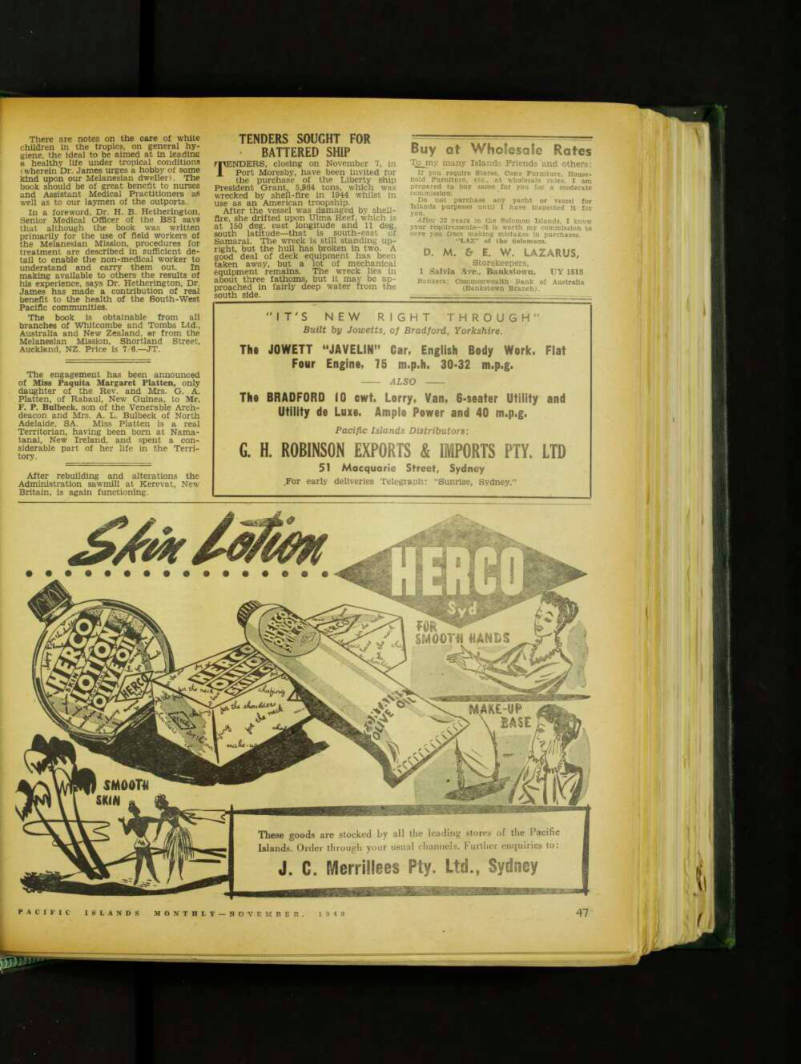
Here is a Medical Book For All Dwellers in Isolated Islands
EVERY new European resident of Melanesia should find room in his luggage for a copy of Dr. Clifford S.
James’ book, Diseases Commonly Met With in Melanesia. It will be of great worth to old residents as well.
It occurs to me now, that it is an extra ordinary thing that in several years in the New Guinea interior, I never once saw a medical book that dealt with local diseases in a fashion that could be un derstood by laymen—or for the matter of that, any medical book at all. Yet, away from the government stations, in still-primitive ESI, New Guinea and Papua, health problems become the pre occupation of all—even those who pre viously have nevef seen the inside of a doctor’s surgery.
To everyone in the outback of the South-West Pacific islands, sooner or later comes the horror of hours or days spent in “wondering what’s wrong’’ either in themselves, in members of their family, in workmates or the natives under their care. Disease, like many other things in the tropics, sometimes develops with great suddenness out of all proportion to the time in which skilled medical aid can be obtained. Upon promptness in diag nosis, treatment or even decision, some times hangs the life of a man or woman.
This is the third edition of Dr. James’ book. He was, for a number of years, Medical Officer at the Melanesian Mission Hospital at Fauabu, ESI and in revising the new edition he has added notes on the uses of the new drugs (sulpha, penicillin, atebrin, paludrin, etc.), in treating many
. . .. ... . .. , , pf_ the diseases dealt with in the book. in this he acknowledges his indebtedness to Dr. A. G. Rutter, who was, until re cently, Senior Medical Officer of the BSI
Government as well as Medical Officer of the Methodist Mission in the Solomons.
The whole book been revised and brought up to date in relation to new de-
Ssg"S
the sections dealing with tropical diseases but to the many other ills described—ills that are likely to be met with in Melanesia as readily as they are in other parts of the world.
(Continued on page 47)
There are notes on the care of white children in the tropics, on general hy giene, the ideal to be aimed at in leading a healthy life under tropical conditions (wherein Dr. James urges a hobby of some kind upon our Melanesian dweller). The book should be of great benefit to nurses and Assistant Medical Practitioners as well as to our laymen of the outports.
In a foreword, Dr. H. B. Hetherington, Senior Medical Officer of the BSI says that although the book was written primarily for the use of field workers of the Melanesian Mission, procedures for treatment are described in sufficient de tail to enable the non-medical worker to understand and carry them out. In making available to others the results of his experience, says Dr. Hetherington, Dr.
James has made a contribution of real benefit to the health of the South-West Pacific communities.
The book is obtainable from all branches of Whitcombe and Tombs Ltd., Australia and New Zealand, er from the Melanesian Mission, Shortland Street, Auckland, NZ. Price is 7/6. —JT.
The engagement has been announced of Miss Paquita Margaret Flatten, only daughter of the Rev. and Mrs. G. A.
Flatten, of Rabaul, New Guinea, to Mr.
F. P. Bulbeck, son of the Venerable Arch deacon and Mrs. A. L. Bulbeck of North Adelaide, SA. Miss Flatten is a real Territorian, having been born at Nama tanai, New Ireland, and spent a con siderable part of her life in the Terri tory.
After rebuilding and alterations the Administration sawmill at Kerevat, New Britain, is again functioning.
Advertisements & other items, pp. 47-48 (1 item)
William H. Watson
GILLESPIE’S
The Flour
TRADE
MARK
of the Islands
- SYDNEY -
ESTABLISHED 1930
WILLIAM H. WATSON
RAROTONGA, COOK ISLANDS
Wholesale and Retail Trader
LICENSED STAMP DEALER
Agent For:—
BRITISH TRADERS' INSURANCE CO.
CORONA & L. C. SMITH TYPEWRITERS
KAISER & FRAZER MOTOR CARS
B.S.A. CYCLES AND MOTOR CYCLES
AMERICAN LEAD PENCIL CO.
WHITES AVIATION LTD.
Manufacturers of: FOOTWEAR, ALL CLASSES SUITABLE FOR NATIVE TRADING . . . M.O.P. PRODUCTS, INCLUDING ROUND EAR-RING BLANKS AND BUTTON BLANKS Exporter of: “Rarotonga” Hula-Skirts.
Sea-Shell Necklaces.
M.O.P. Jewellery.
Island Produce.
Cable Address: “Watson” Rarotonga Wholesale and Retail Inquiries Invited.
Prepared to Consider Agencies for all Class of Goods.
Importer of: Textiles.
General Hardware.
Fancy Goods.
General Merchandise.
Bankers: Bank of New Zealand, Auckland.
IL
REGD
522
tJAe £aae£y-
£amp!
f
“THE QUEEN” T.L 106
Height 21
“THE PRINCESS” T.L 136
Height I6j"
BURNS ORDINARY PARAFFIN 300 CANDLE POWER
% GIVES TWO EVENINGS’ LIGHT ON ONE FILLING: I* PINTS / THE TILLEY LAMP COMPANY LTD. of ENGLAND London Offices and Showrooms: SACKVILLE STREET, PICCADILLY, W.l
REPRESENTATION;
MELBOURNE; T. H. Bentley, Pty. Ltd., 123-125 William Street, Melbourne, C.l TASMANIA; Mr. H. V. Sellars, 108 a Charles Street, Launceston.
FIJI : Mr. K. Witherington, 2 Burns Philp Buildings, Suva.
Tenders Sought For
Battered Ship
TENDERS, closing on November 7, in Port Moresby, have been invited for the purchase of the Liberty ship President Grant, 5,984 tons, which was wrecked by shell-fire in 1944 whilst in use as an American troopship.
After the vessel was damaged by shell fire, she drifted upon Ulma Reef, which is at 150 deg. east longitude and 11 deg. south latitude —that is south-east of Samarai. The wreck is still standing up right, but the hull has broken in two. A good deal of deck equipment has been taken away, but a lot of mechanical equipment remains. The wreck lies in about three fathoms, but it may be ap proached in fairly deep water from the south side.
Advertisements & other items, pp. 49-50 (1 item)
J. C. Merriilees Pty. Ltd., Sydney
Buy of Wholesale Rates
To my many Islands Friends and others: If you require Stores, Cane Furniture, Household Furniture, etc., at wholesale rates, I am prepared to buy same for you for a moderate commission.
Do not purchase any yacht or vessel for Islands purposes until I have Inspected It for you.
After 22 years in the Solomon Islands, I know your requirements—it is worth my commission to save you from making mistakes in purchases.
“LAZ” of the Solomons.
D. M. & E. W. LAZARUS,
Storekeepers,
1 Salvia Ave., Bankstown, UY 1818 Bankers: Commonwealth Bank of Australia (Bankstown Branch).
"IT'S NEW RIGHT THROUGH"
Built by Jowetts, of Bradford, Yorkshire.
The JOWETT “JAVELIN” Car, English Body Work, Flat Four Engine, 75 m.p.h. 30-32 m.p.g.
ALSO
The BRADFORD 10 cwt. Lorry, Van, 6-seater Utility and Utility de Luxe. Ample Power and 40 m.p.g.
Pacific Islands Distributors : G. H. ROBINSON EXPORTS & IMPORTS PTY. LTD 51 Macquarie Street, Sydney For early deliveries Telegraph: “Sunrise, Sydney.”
0 0 ® • m K
SMOOTH WANDS
>w
IS*K
& tL Nic y : tfuJ ,LuAuv -UP
MAKE.
ZA r •% fc A 4 >
BASE
W& -.*• ft t
SMOOTH
SKIM
These goods are stocked by all the leading stores of the Pacific Islands. Order through your usual channels. Further enquiries to:
J. C. Merriilees Pty. Ltd., Sydney
m Made in the Australian Branch Factory of
BLUNDELL SPENCE & CO., LTD., Hull,
B. Cr S. SUPER PREPARED PAINT embodies the knowledge and experience gained from nearly 140 years of Paint manufacture.
Tested and proved for tropical conditions, B. & S. PREPARED PAINT is also available in a special Lead-free series for use in volcanic and other sulphurous regions. (Specify B. Gr S.-Series 2301).
Ask for supplies of these and other BLUN- DELL Paints and Enamels from your local Storekeeper, or write for particulars and colour-cards to the Agent for Pacific Islands :
KERR BROTHERS PTY. LTD.
4 YORK STREET, SYDNEY
Moresby
More Meat For Port
Prom Our Own Correspondent
Pt. Moresby, Oct. 3.
MEAT shortages look like disappear ing into the past, now that the barge freezer owned by Anderson’s Island Industries has started business.
According to Mr. A. W. Anderson, there will be no more meat shortages “unless the Bulolo sinks.”
Residents were disappointed to find that competition had not brought a re duction in prices—but the luxury of being able to choose between two freezers amply compensated for this.
Also, there is the advantage of being able to buy meat at any time between 7 a.m. and 5 p.m. from Monday to Satur day. These are Anderson’s business hours.
As expected, the Port Moresby Freez ing Company increased its trading hours, but it still opens only between 7 a.m. and 11.30 a.m., and from 1 p.m. to 2 p.m., with no afternoon service on Saturdays.
Mr. Anderson plans to build a freezer in town soon and he is thinking of grow ing vegetables locally. The possibility of starting a poultry farm also interests him. His view is that we should import nothing that can be produced locally.
‘Landing Ship Tank’
A Useful Craft In The Islands
COMMENTING upon the useful trans portation work being done in the Pacific Islands by the Roose Shipping Co’s LST, Rawhiti, a spokesman (Mr.
Lulham) for the Union Manufacturing & Export Co., of Wellington, informed the Wellington “Post” that the Union Manu facturing Co. is making inquiries in many parts of the world in an endeavour to purchase these “Landing Ship Tanks” for operating a cargo service between New Zealand and the Western Pacific Islands.
Mr. Lulham said that the LST was the ideal craft for such a service because there were few loading and port facilities in the Western Pacific Islands,, and the LST could go right in on to the beaches and load and unload by opening and dropping its bows.
Mr. Hirschfield (managing director of the Union Manufacturing Co.), is now abroad, seeking an LST. He reports that there are numerous LST’s available for purchase in Britain, the China Coast, the North American Pacific sea-ports, and in Islands areas, but most of them are so war damaged or battered as to be unsea worthy. The search is continuing, how ever.
A reference to the work being done in the Islands by LST Rawhiti is contained in another article in this issue.
Uss Coy’S Bronze-Green Ships
Prom Our Own Correspondent
Suva, Oct. 3.
A MEMBER of the Union Company’s Islands ship, Matua, commenting on the ship’s new bronze-green dress (she formerly wore tropical white), complained that it reduced the vessel to the size of a tug. There are fairly good grounds for the statement, and no one has yet been found to commend the change. The Aorangi’s return to bronze green—she also was white—has been ac cepted without comment.
Magazine Section
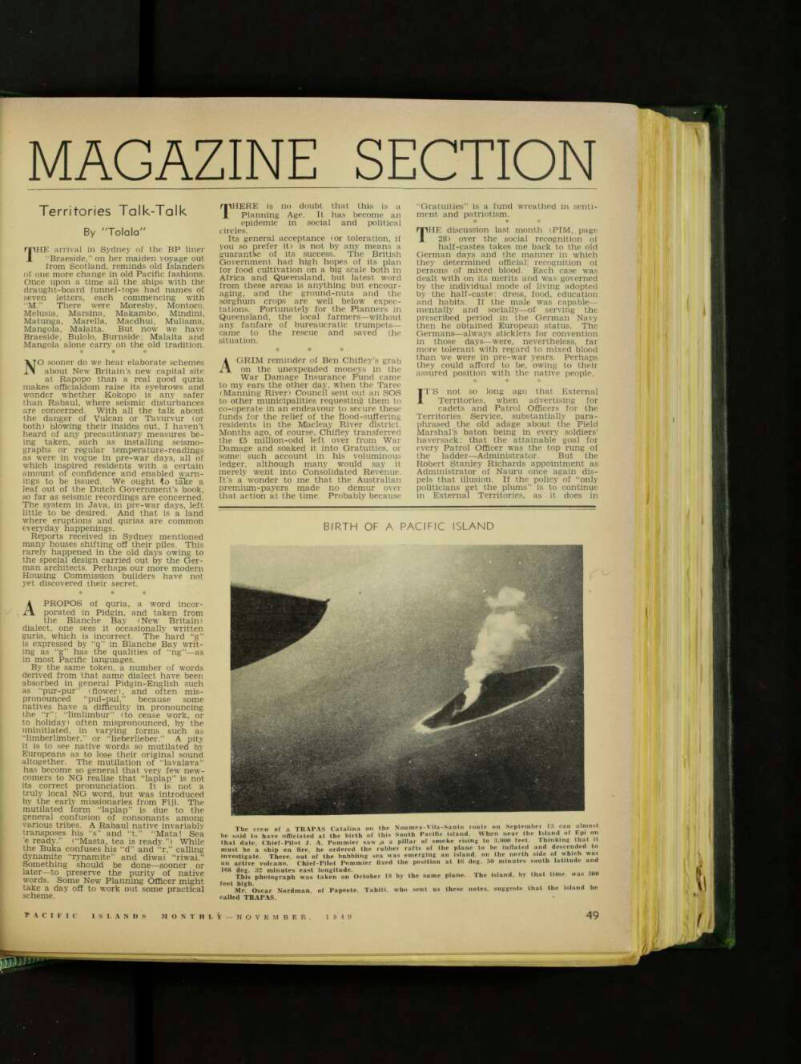
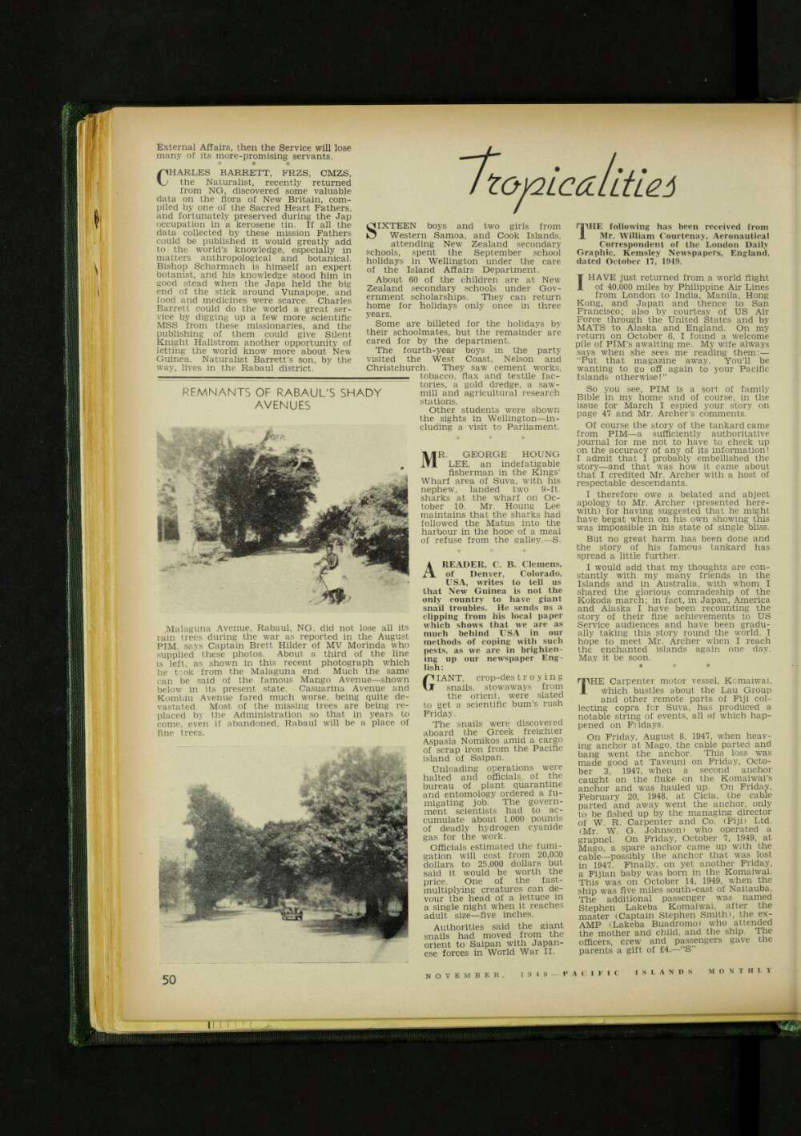
Territories Talk-Talk
By "Tolala"
mHE arrival in Sydney of the BP liner 1 “Braeside,” on her maiden voyage out from Scotland, reminds old Islanders of one more change in old Pacific fashions.
Once upon a time all the ships with the draught-board funnel-tops had names of seven letters, each commencing with “M.'' There were Moresby, Montoro, Melusia, Marsina, Makambo, Mindini, Matunga, Marella, Macdhui, Muliama, Mangola, Malaita. But now we have Braeside, Bulolo, Burnside; Malaita and Mangola alone carry on the old tradition.
NO sooner do we hear elaborate schemes about New Britain’s new capital site at Rapopo than a real good quria makes officialdom raise its eyebrows and wonder whether Kokopo is any safer than Rabaul, where seismic disturbances are concerned. With all the talk about the danger of Vulcan or Tavurvur (or both) blowing their insides out, I haven’t heard of any precautionary measures be ing taken, such as installing seismo graphs or regular temperature-readings as were in vogue in pre-war days, all of which inspired residents with a certain amount of confidence and enabled warn ings to be issued. We ought io take a leaf out of the Dutch Government’s book, so far as seismic recordings are concerned.
The system in Java, in pre-war days, left little to be desired. And that is a land where eruptions and qurias are common everyday happenings.
Reports received in Sydney mentioned many houses shifting off their piles. This rarely happened in the old days owing to the special design carried out by the Ger man architects. Perhaps our more modern Housing Commission builders have not yet discovered their secret. * * * APROPOS of quria, a word incor porated in Pidgin, and taken from the Blanche Bay (New Britain) dialect, one sees it occasionally written guria, which is incorrect. The hard “g” is expressed by “q” in Blanche Bay writ ing as “g” has the qualities of “ng”—as in most Pacific languages.
By the same token, a number of words derived from that same dialect have been absorbed in general Pidgin-English such as “pur-pur” (flower), and often mis pronounced “pul-pul,” because some natives have a difficulty in pronouncing the “r”; “limlimbur” (to cease work, or to holiday) often mispronounced, by the uninitiated, in varying forms such as “limberlimber,” or “lieberlieber.” A pity it is to see native words so mutilated by Europeans as to lose their original sound altogether. The mutilation of “lavalava” has become so general that very few new comers to NG realise that “laplap” is not its correct pronunciation. It is not a truly local NG word, but was introduced by the early missionaries from Fiji. The mutilated form “laplap” is due to the general confusion of consonants among various tribes. A Rabaul native invariably transposes his “s” and “t” “Mata! Sea ’e ready.” (“Masta, tea is ready.”) While the Buka confuses his “d” and “r,” calling dynamite “rynamite” and diwai “riwai.”
Something should be done —sooner or later—to preserve the purity of native words. Some New Planning Officer might take a day off to work out some practical scheme.
INHERE is no doubt that this is a Planning Age. It has become an epidemic in social and political circles.
Its general acceptance (or toleration, if you so prefer it) is not by any means a guarantse of its success. The British Government had high hopes of its plan for food cultivation on a big scale both in Africa and Queensland, but latest word from these areas is anything but encour aging, and the ground-nuts and the sorghum crops are well below expec tations. Fortunately for the Planners in Queensland, the local farmers—without any fanfare of bureaucratic trumpets— came to the rescue and saved the situation. * * * A GRIM reminder of Ben Chifley’s grab on the unexpended moneys in the War Damage Insurance Fund came to my ears the other day, when the Taree (Manning River* Council sent out an SOS to other municipalities requesting them to co-operate in an endeavour to secure these funds for the relief of the flood-suffering residents in the Macleay River district.
Months ago, of course, Chifley transferred the £5 million-odd left over from War Damage and soaked it into Gratuities, or somef such account in his voluminous ledger, although many would say it merely went into Consolidated Revenue.
It’s a wonder to me that the Australian premium -payers made no demur over that action at the time. Probably because
“Gratuities” is a fund wreathed in senti ment and patriotism. * * * THE discussion last month (PIM, page 28) over the social recognition of half-castes takes me back to the old German days and the manner in which they determined official \ recognition ol persons of mixed blood. Each case was dealt with on its merits and was governed by the individual mode of living adopted by the half-caste: dress, food, education and habits. If the male was capable— mentally and socially—of serving the prescribed period in the German Navy then he obtained European status. The Germans—always sticklers for convention in those days—were, nevertheless, far more tolerant with regard to mixed blood than we were in pre-war years. Perhaps they could afford to be, owing to their assured position with the native people.
IT’S not so long ago that External Territories, when advertising for cadets and Patrol Officers for the Territories Service, substantially para phrased the old adage about the Field Marshal’s baton being in every soldiers’ haversack: that the attainable goal for every Patrol Officer was the top rung of the ladder —Administrator. But the Robert Stanley Richards appointment as Administrator of Nauru once again dis pels that illusion. If the policy of “only politicians get the plums” is to continue in External Territories, as it does in
External Affairs, then the Service will lose many of its more-promising servants. * * *
Ciharles Barrett, Frzs, Cmzs,
1 the Naturalist, recently returned from NG, discovered some valuable data on the flora of New Britain, com piled by one of the Sacred Heart Fathers, and fortunately preserved during the Jap occupation in a kerosene tin. If all the data collected by these mission Fathers could be published it would greatly add to the world’s knowledge, especially in matters anthropological and botanical.
Bishop Scharmach is himself an expert botanist, and his knowledge stood him in good stead when the Japs held the big end of the stick around Vunapope, and food and medicines were scarce. Charles Barrett could do the world a great ser vice by digging up a few more scientific MSS from these missionaries, and the publishing of them could give Silent Knight Hallstrom another opportunity of letting the world know more about New Guinea. Naturalist Barrett’s son, by the way, lives in the Rabaul district.
Birth Of A Pacific Island
The crew of a TRAPAS Catalina on the Noumea-Vila-Santo route on September 13 can almost be said to have officiated at the birth of this South Pacific island. When near the Island of Epi on that date. Chief-Pilot J. A. Pommier saw a pillar of smoke rising to 3.000 feet. Thinking that it must be a ship on fire, he ordered the rubber rafts of the plane to be inflated and descended to investigate. There, out of the bubbling sea was emerging an island, on the north side of which was an active volcano. Chief-Pilot Pommier fixed the position at 16 deg. 50 minutes south latitude and 168 deg. 32 minutes east longitude. 300 This photograph was taken on October 18 by the same plane. The island, by that time, was 800 Mr! Oscar Nordman, of Papeete. Tahiti, who sent us these notes, suggests that the island he called TRAPAS.
Remnants Of Rabaul's Shady
Avenues
Malaguna Avenue, Rabaul, NG, did not lose all its rain trees during the war as reported in the August PIM. says Captain Brett Hilder of MV Morinda who supplied these photos. About a third of the line is left, as shown in this recent photograph which he Uok from the Malaguna end. Much the same can be said of the famous Mango Avenue—shown below in its present state. Casuarina Avenue and Kombiu Avenue fared much worse, being quite de vastated. Most of the missing trees are being re placed by the Administration so that in years to come, even if abandoned, Rabaul will be a place of fine trees.
Tropiealities
SIXTEEN boys and two girls from Western Samoa, and Cook Islands, attending New Zealand secondary schools, spent the September school holidays in Wellington under the care of the Island Affairs Department.
About 60 of the children are at New Zealand secondary schools under Gov ernment scholarships. They can return home for holidays only once in three years.
Some are billeted for the holidays by their schoolmates, but the remainder are cared for by the department.
The fourth-year boys in the party visited the West Coast, Nelson and Christchurch. They saw cement works,
tobacco, flax and textile fac tories, a gold dredge, a saw mill and agricultural research stations.
Other students were shown the sights in Wellington—in cluding a visit to Parliament. * * *
Mr. George Houng
LEE, an indefatigable fisherman in the Kings’
Wharf area of Suva, with his nephew, landed two 9-ft. sharks at the wharf on Oc tober 10. Mr. Houng Lee maintains that the sharks had followed the Matua into the harbour in the hope of a meal of refuse from the galley.—S. * * A READER, C. B. Clemens, of Denver, Colorado, USA, writes to tell us that New Guinea is not the only country to have giant snail troubles. He sends us a clipping from his local paper which shows that we are as much behind USA in our methods of coping with such pests, as we are in brighten ing up our newspaper Eng lish: GIANT, crop-des troy i n g snails, stowaways from the orient, were slated to get a scientific bum’s rush Friday.
The snails were discovered aboard the Greek freighter Aspasia Nomikos amid a cargo of scrap iron from the Pacific island of Saipan.
Unloading operations were halted and officials of the bureau of plant quarantine and entomology ordered a fu migating job. The govern ment scientists had to ac cumulate about 1,000 pounds of deadly hydrogen cyanide gas for the work.
Officials estimated the fumi gation will cost from 20,000 dollars to 25,000 dollars but said it would be worth the price. One of the fast multiplying creatures can de vour the head of a lettuce in a single night when it reaches adult size—five inches.
Authorities said the giant snails had moved from the orient to Saipan with Japan ese forces in World War 11.
THE following has been received from Mr. William Courtenay, Aeronautical Correspondent of the London Daily Graphic, Kemsley Newspapers, England, dated October 17, 1949.
I HAVE just returned from a world flight of 40,000 miles by Philippine Air Lines from London to India, Manila, Hong Kong, and Japan and thence to San Francisco; also by courtesy of US Air Force through the United States and by MATS to Alaska and England. On my return on October 6, I found a welcome pile of PlM’s awaiting me. My wife always says when she sees me reading them:— “Put that magazine away. You’ll be wanting to go off again to your Pacific Islands otherwise!”
So you see, PIM is a sort of family Bible in my home and of course, in the issue for March I espied your story on page 47 and Mr. Archer’s comments.
Of course the story of the tankard came from PIM —a sufficiently authoritative journal for me not to have to check up on the accuracy of any of its information!
I admit that I probably embellished the story—and that was how it came about that I credited Mr. Archer with a host of respectable descendants.
I therefore owe a belated and abject apology to Mr. Archer (presented here with) for having suggested that he might have begat when on his own showing this was impossible in his state of single bliss.
But no great harm has been done and the story of his famous tankard has spread a little further.
I would add that my thoughts are con stantly with my many friends in the Islands and in Australia, with whom I shared the glorious comradeship of the Kokoda march; in fact, in Japan, America and Alaska I have been recounting the story of their fine achievements to US Service audiences and have been gradu ally taking this story round the world. I hope to meet Mr. Archer when I reach the enchanted islands again one day.
May it be soon. * -is * THE Carpenter motor vessel, Komaiwai, Which bustles about the Lau Group and other remote parts of Fiji col lecting copra for Suva, has produced a notable string of events, all of which hap pened on Fridays.
On Friday, August 8, 1947, when heav ing anchor at Mago, the cable parted and bang went the anchor. This loss was made good at Taveuni on Friday, Octo ber 3, 1947, when a second anchor caught on the fluke on the Komaiwai’s anchor and was hauled up. On Friday, February 20, 1948, at Cicia, the cable parted and away went the anchor, only to be fished up by the managing director of W. R. Carpenter and Co. (Fiji) Ltd. (Mr. W. G. Johnson) who operated a grapnel. On Friday, October 7, 1949, at Mago, a spare anchor came up with the cable—possibly the anchor that was lost in 1947. Finally, on yet another Friday, a Fijian baby was born in the Komaiwai.
This was on October 14, 1949, when the ship was five miles south-east of Naitauba.
The additional passenger was named Stephen Lakeba Komaiwai, after the master (Captain Stephen Smith), the ex- AMP (Lakeba Buadromo) who attended the mother and child, and the ship. The officers, crew and passengers gave the parents a gift of £4. —“S”
Operation Drum follows Operation Cow
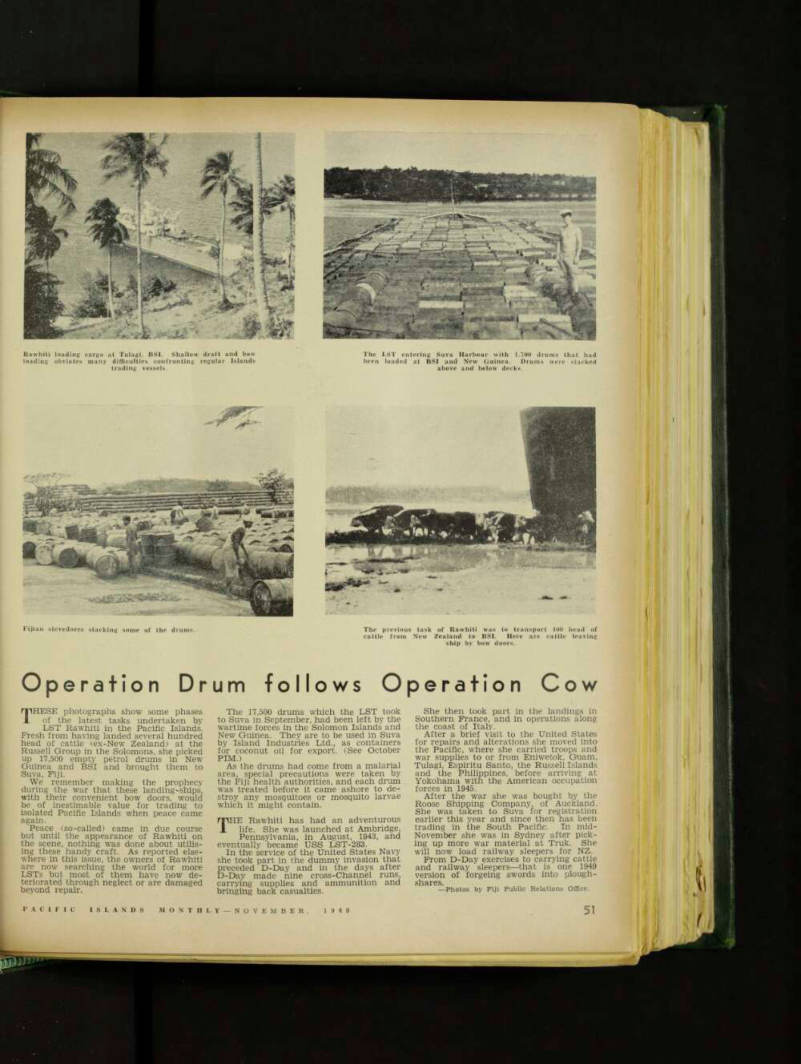
THESE photographs show some phases of the latest tasks undertaken by LST Rawhiti in the Pacific Islands.
Fresh from having landed several hundred head of cattle (ex-New Zealand) at the Russell Group in the Solomons, she picked up 17,500 empty petrol drums in New Guinea and BSI and brought them to Suva, Fiji.
We remember making the prophecy during the war that these landing-ships, with their convenient bow doors, would be of inestimable value for trading to isolated Pacific Islands when peace came again.
Peace (so-called) came in due course but until the appearance of Rawhiti on the scene, nothing was done about utilis ing these handy craft. As reported else where in this issue, the owners of Rawhiti are now searching the world for more LSTs but most of them have now de teriorated through neglect or are damaged beyond repair.
The 17,500 drums which the LST took to Suva in September, had been left by the wartime forces in the Solomon Islands and New Guinea. They are to be used in Suva by Island Industries Ltd., as containers for coconut oil for export. (See October
Pim.)
As the drums had come from a malarial area, special precautions were taken by the Fiji health authorities, and each drum was treated before it came ashore to de stroy any mosquitoes or mosquito larvae which it might contain.
THE Rawhiti has had an adventurous life. She was launched at Ambridge, Pennsylvania, in August, 1943, and eventually became USS LST-283.
In the service of the United States Navy she took part in the dummy invasion that preceded D-Day and in the days after D-Day made nine cross-Channel runs, carrying supplies and ammunition and bringing back casualties.
She then took part in the landings in Southern France, and in operations along the coast of Italy.
After a brief visit to the United States for repairs and alterations she moved into the Pacific, where she carried troops and war supplies to or from Eniwetok, Guam, Tulagi, Espiritu Santo, the Russell Islands and the Philippines, before arriving at Yokohama with the American occupation forces in 1945.
After the war she was bought by the Roose Shipping Company, of Auckland.
She was taken to Suva for registration earlier this year and since then has been trading in the South Pacific. In mid- November she was in Sydney after pick ing up more war material at Truk. She will now load railway sleepers for NZ.
From D-Day exercises to carrying cattle and railway sleepers—that is one 1949 version of forgeing swords into plough shares —Photos by Fiji Public Relations Office.
Rawhiti loading cargo at Tulagi, BSI. Shallow draft and bow loading obviates many difficulties confronting regular Islands trading vessels.
The LST entering Suva Harbour with 1,700 drums that had been loaded at BSI and New Guinea. Drums were stacked above and below decks.
Fijian stevedores stacking some of the drums
The previous task of Rawhiti was to transport 400 head of cattle from New Zealand to BSI. Here are cattle leaving ship by bow doors.
and Gardens
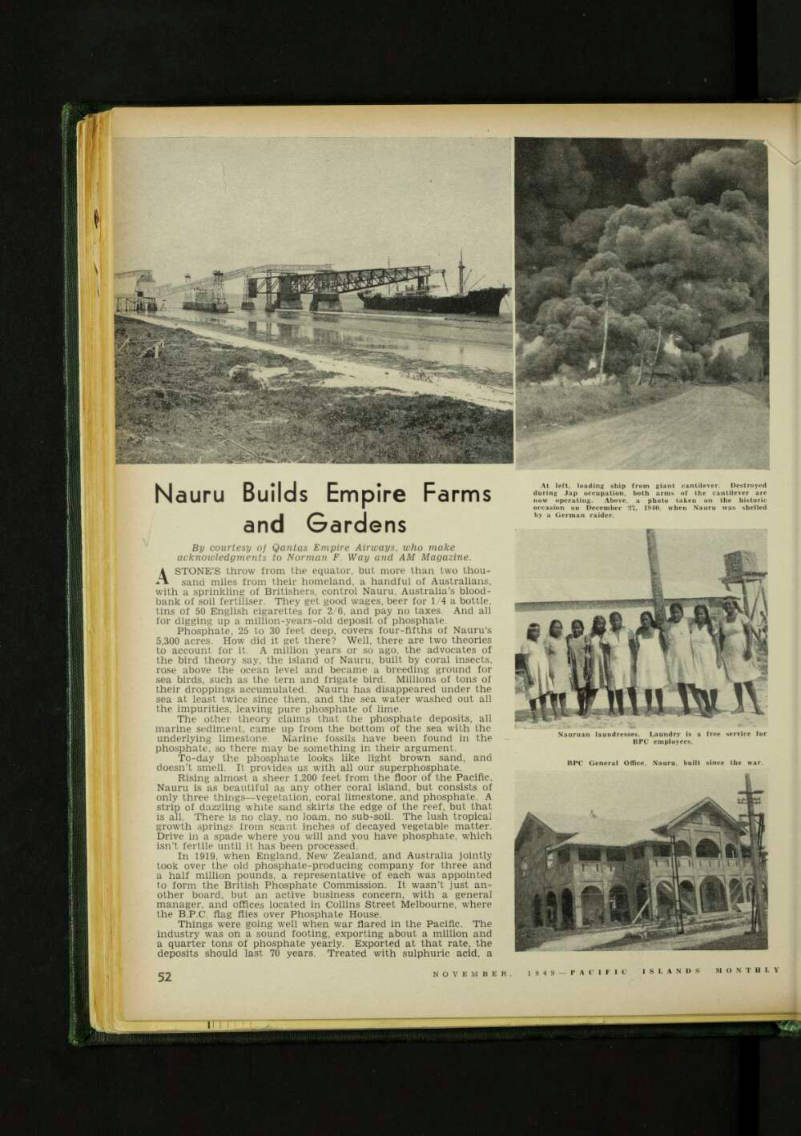
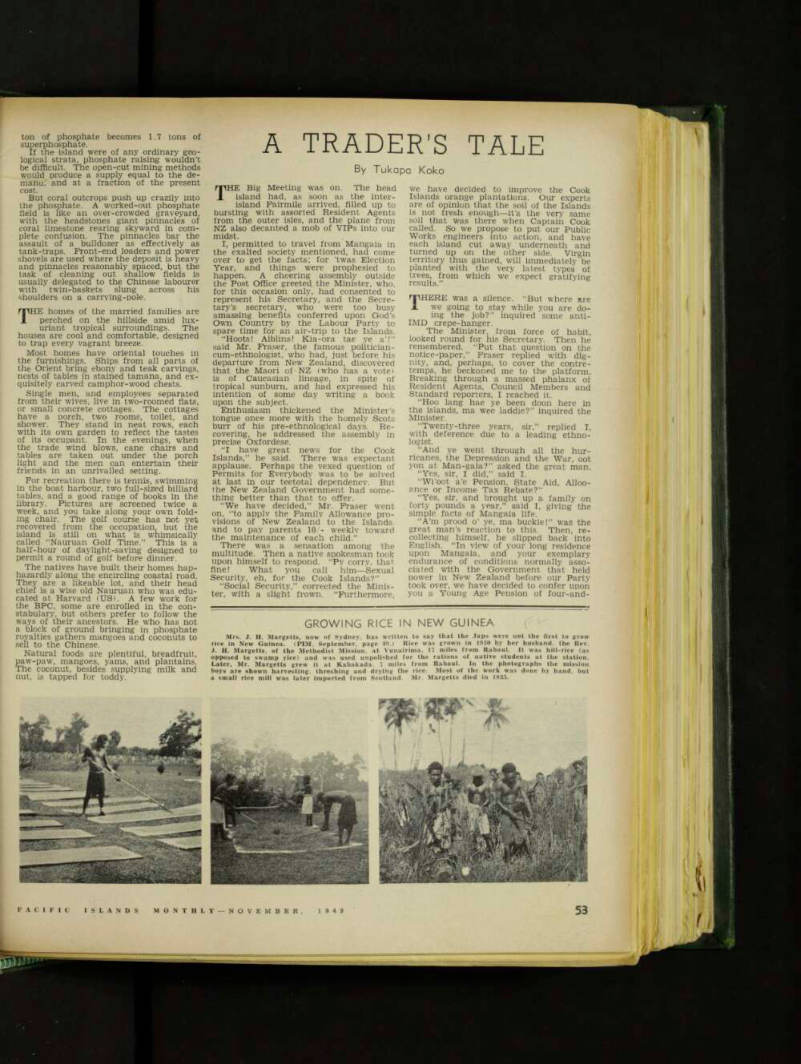
Nauru Builds Empire Farms and Gardens
By courtesy of Qantas Empire Airways, who make acknowledgments to Norman F. Way and AM Magazine.
A STONE’S throw from the equator, but more than two thou- A sand miles from their homeland, a handful of Australians, with a sprinkling of Britishers, control Nauru, Australia’s blood bank of soil fertiliser. They get good wages, beer for 1/4 a bottle, tins of 50 English cigarettes for 2/6, and pay no taxes. And all for digging up a million-years-old deposit of phosphate.
Phosphate, 25 to 30 feet deep, covers four-fifths of Nauru’s 5,300 acres. How did it get there? Well, there are two theories to account for it. A million years or so ago, the advocates of the bird theory say, the island of Nauru, built by coral insects, rose above the ocean level and became a breeding ground for sea birds, such as the tern and frigate bird. Millions of tons of their droppings accumulated. Nauru has disappeared under the sea at least twice since then, and the sea water washed out all the impurities, leaving pure phosphate of lime.
The other theory claims that the phosphate deposits, all marine sediment, came up from the bottom of the sea with the underlying limestone. Marine fossils have been found in the phosphate, so there may be something in their argument.
To-day the phosphate looks like light brown sand, and doesn’t smell. It provides us with all our superphosphate.
Rising almost a sheer 1,200 feet from the floor of the Pacific, Nauru is as beautiful as any other coral island, but consists of only three things—vegetation, coral limestone, and phosphate. A strip of dazzling white sand skirts the edge of the reef, but that is all. There is no clay, no loam, no sub-soil. The lush tropical growth springs from scant inches of decayed vegetable matter.
Drive in a spade where you will and you have phosphate, which isn’t fertile until it has been processed.
In 1919, when England, New Zealand, and Australia jointly took over the old phosphate-producing company for three and a half million pounds, a representative of each was appointed to form the British Phosphate Commission. It wasn’t just an other board, but an active business concern, with a general manager, and offices located in Collins Street Melbourne, where the B.P.C. flag flies over Phosphate House.
Things were going well when war flared in the Pacific. The industry was on a sound footing, exporting about a million and a quarter tons of phosphate yearly. Exported at that rate, the deposits should last 70 years. Treated with sulphuric acid, a
At left, loading ship from giant cantilever. Destroyed during Jap occupation, both arms of the cantilever are now operating. Above, a photo taken on the historic occasion on December 27, 1940, when Nauru was shelled by a German raider.
Nauruan laundresses. Laundry is a free service for BPC employees.
BPC General Office, Nauru, built since the war.
ton of phosphate becomes 1.7 tons of superphosphate.
If the Island were of any ordinary geo logical strata, phosphate raising wouldn’t be difficult. The open-cut mining methods would produce a supply equal to the de manu, and at a fraction of the present cost.
But coral outcrops push up crazily into the phosphate. A worked-out phosphate field is like an over-crowded graveyard, with the headstones giant pinnacles of coral limestone rearing skyward in com plete confusion. The pinnacles bar the assault of a bulldozer as effectively as tank-traps. Front-end loaders and power shovels are used where the deposit is heavy and pinnacles reasonably spaced, but the task of cleaning out shallow fields is usually delegated to the Chinese labourer with twin-baskets slung across his shoulders on a carrying-pole.
THE homes of the married families are perched on the hillside amid lux uriant tropical surroundings. The houses are cool and comfortable, designed to trap every vagrant breeze.
Most homes have oriental touches in the furnishings. Ships from all parts of the Orient bring ebony and teak carvings, nests of tables in stained tamana, and ex quisitely carved camphor-wood chests.
Single men, and employees separated from their wives, live in two-roomed flats, or small concrete cottages. The cottages have a porch, two rooms, toilet, and shower. They stand in neat rows, each with its own garden to reflect the tastes of its occupant. In the evenings, when the trade wind blows, cane chairs and tables are taken out under the porch light and the men can entertain their friends in an unrivalled setting.
For recreation there is tennis, swimming in the boat harbour, two full-sized billiard tables, and a good range of books in the library. Pictures are screened twice a week, and you take along your own fold ing chair. The golf course has not yet recovered from the occupation, but the island is still on what is whimsically called “Nauruan Golf Time.” This is a half-hour of daylight-saving designed to permit a round of golf before dinner.
The natives have built their homes hap hazardly along the encircling coastal road.
They are a likeable lot, and their head chief is a wise old Nauruan who was edu cated at Harvard (US). A few work for the BPC, some are enrolled in the con stabulary, but others prefer to follow the ways of their ancestors. He who has not a block of ground bringing in phosphate royalties gathers mangoes and coconuts to sell to the Chinese.
Natural foods are plentiful, breadfruit, paw-paw, mangoes, yams, and plantains.
The coconut, besides supplying milk and nut, is tapped for toddy.
Advertisements & other items, p. 54 (1 item)
52
NOVEMBER, 1949 PACIFIC ISLANDS MONTH L Y
A Trader's Tale
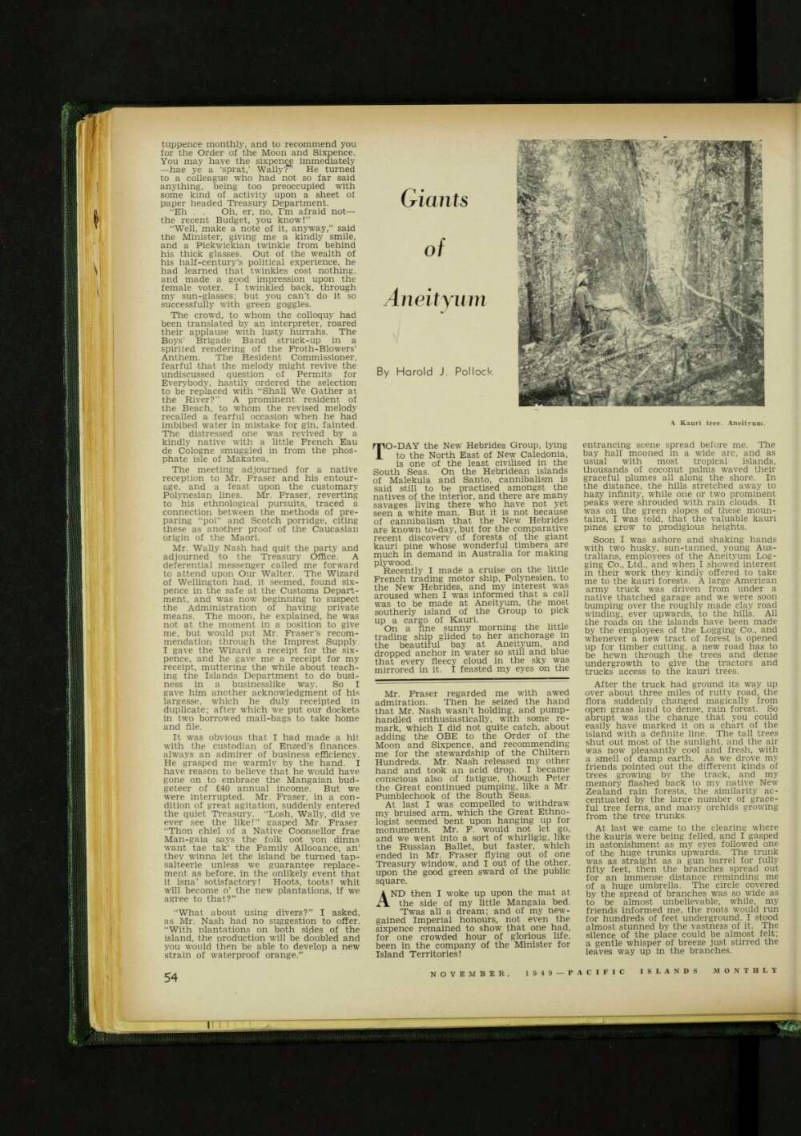
By Tukapa Koko
THE Big Meeting was on. The head island had, as soon as the interisland Pairmile arrived, filled up to bursting with assorted Resident Agents from the outer isles, and the plane from NZ also decanted a mob of VIPs into our midst.
I, permitted to travel from Mangaia in the exalted society mentioned, had come over to get the facts: for ’twas Election Year, and things were prophesied to happen. A cheering assembly outside the Post Office greeted the Minister, who. for this occasion only, had consented to represent his Secretary, and the Secretary’s secretary, who were too busy amassing benefits conferred upon God’s Own Country by the Labour Party to spare time for an air-trip to the Islands.
"Hoots! Aiblins! Kia-ora tae ye a’!’’ said Mr. Fraser, the famous politiciancum-ethnologist, who had, just before his departure from New Zealand, discovered that the Maori of NZ (who has a vote) is of Caucasian lineage, in spite of tropical sunburn, and had expressed his intention of some day writing a book upon the subject.
Enthusiasm thickened the Minister’s tongue once more with the homely Scots burr of his pre-ethnological days. Recovering, he addressed the assembly in precise Oxfordese.
“I have great news for the Cook Islands,” he said. There was expectant applause. Perhaps the vexed question of Permits for Everybody was to be solved at last in our teetotal dependenev. But the New Zealand Government had something better than that to offer.
“We have decided,” Mr. Fraser went on, “to applv the Family Allowance provisions of New Zealand to the Islands and to pay parents 10 - weeklv toward the maintenance of each child.”
There was a sensation among the multitude. Then a native spokesman took upon himself to respond. “Py corry. that fine! What you call him—Sexual Security, eh, for the Cook Islands?”
“Social Security,” corrected the Minister, with a slight frown. “Furthermore,
we have decided to improve the Cook Islands orange plantations. Our experts are of opinion that the soil of the Islands is not fresh enough—it’s the very same soil that was there when Captain Cook called. So we propose to put our Public Works engineers into action, and have each island cut away underneath and turned up on the other side. Virgin territory thus gained, will immediately be planted with the very latest types of trees, from which we expect gratifying results.” fpHERE was a silence. "But where are X we going to stay while you are do ing the job?” inquired some anti- IMD crepe-hanger.
The Minister, from force of habit, looked round for his Secretary. Then he remembered. "Put that question on the notice-paper,” Fraser replied with dig nity, and, perhaps, to cover the contre temps, he beckoned me to the platform, Breaking through a massed phalanx of Resident Agents, Council Members and Standard reporters, I reached it.
“Hoo lang hae ye been doon here in the islands, ma wee laddie?” inquired the Minister.
"Twenty-three years, sir,” replied I, with deference due to a leading ethno legist.
“And ye went through all the hur ricanes, the Depression and the War, oot yon at Man-gaia?” asked the great man.
“Yes, sir, I did,” said I.
"Wi’oot a’e Pension, State Aid, Alloo ance or Income Tax Rebate?”
“Yes, sir, and brought up a family on forty pounds a year,” said I, giving the simple facts of Mangaia life, “A’m prood o’ ye, ma buckie!” was the great man’s reaction to this. Then, re collecting himself, he slipped back into English. “In view of your long residence upon Mangaia, and your exemplary endurance of conditions normally asso ciated with the Government that held power in New Zealand before our Party took over, we have decided to confer upon you a Young Age Pension of four-and
tuppence monthly, and to recommend you for the Order of the Moon and Sixpence.
You may have the sixpence immediately —hae ye a ‘sprat,’ Wally?* He turned to a colleague who had not so far said anything, being too preoccupied with some kind of activity upon a sheet of paper headed Treasury Department.
“Eh . . Oh, er, no, I’m afraid not— the recent Budget, you know!”
“Well, make a note of it, anyway,” said the Minister, giving me a kindly smile, and a Pickwickian twinkle from behind his thick glasses. Out of the wealth of his half-century’s political experience, he had learned that twinkles cost nothing, and made a good impression upon the female voter. I twinkled back, through my sun-glasses; but you can’t do it so successfully with green goggles.
The crowd, to whom the colloquy had been translated by an interpreter, roared their applause with lusty hurrahs. The Boys’ Brigade Band struck-up in a spirited rendering of the Froth-Blowers’
Anthem. The Resident Commissioner, fearful that the melody might revive the undiscussed question of Permits for Everybody, hastily ordered the selection to be replaced with “Shall We Gather at the River?” A prominent resident of the Beach, to whom the revised melody recalled a fearful occasion when he had imbibed water in mistake for gin, fainted.
The distressed one was revived by a kindly native with a little French Eau de Cologne smuggled in from the phos phate isle of Makatea.
The meeting adjourned for a native reception to Mr. Fraser and his entour age, and a feast upon the customary Polynesian lines. Mr. Fraser, reverting to his ethnological pursuits, traced a connection between the methods of pre paring “poi” and Scotch porridge, citing these as another proof of the Caucasian origin of the Maori.
Mr. Wally Nash had quit the party and adjourned to the Treasury Office. A deferential messenger called me forward to attend upon Our Walter. The Wizard of Wellington had, it seemed, found six pence in the safe at the Customs Depart ment, and was now beginning to suspect the Administration of having private means. The moon, he explained, he was not at the moment in a position to give me, but would put Mr. Fraser’s recom mendation through the Imprest Supply.
I gave the Wizard a receipt for the six pence, and he gave me a receipt for my receipt, muttering the while about teach ing the Islands Department to do busi ness in a businesslike way. So I gave him another acknowledgment of his largesse, which he duly receipted in duplicate; after which we put our dockets in two borrowed mail-bags to take home and file.
It was obvious that I had made a hit with the custodian of Enzed’s finances, always an admirer of business efficiency.
He grasped me warmly by the hand. I have reason to believe that he would have gone on to embrace the Mangaian bud geteer of £4O annual income. But we were interrupted. Mr. Fraser, in a con dition of great agitation, suddenly entered the quiet Treasury. “Losh, Wally, did ye ever see the like!” gasped Mr. Fraser.
“Thon chiel of a Native Coonsellor frae Man-gaia says the folk oot yon dinna want tae tak’ the Family Allooance, an’ they winna let the island be turned tap salteerie unless we guarantee replace ment as before, in the onlikely event that it isna’ sotisfactory! Hoots, toots! whit will become o’ the new plantations, if we agree to that?”
“What about using divers?” I asked, as Mr. Nash had no suggestion to offer.
“With plantations on both sides of the island, the production will be doubled and you would then be able to develop a new strain of waterproof orange.”
Mr. Fraser regarded me with awed admiration. Then he seized the hand that Mr. Nash wasn’t holding, and pump handled enthusiastically, with some re mark, which I did not quite catch, about adding the OBE to the Order of the Moon and Sixpence, and recommending me for the stewardship of the Chiltern Hundreds. Mr. Nash released my other hand and took an acid drop. I became conscious also of fatigue, though Peter the Great continued pumping, like a Mr.
Pumblechook of the South Seas.
At last I was compelled to withdraw my bruised arm, which the Great Ethno logist seemed bent upon hanging up for monuments. Mr. F. would not let go, and we went into a sort of whirligig, like the Russian Ballet, but faster, which ended in Mr. Fraser flying out of one Treasury window, and I out of the other, upon the good green sward of the public square.
AND then I woke up upon the mat at the side of my little Mangaia bed.
Twas all a dream; and of my new gained Imperial honours, not even the sixpence remained to show that one had, for one crowded hour of glorious life, been in the company of the Minister for Island Territories!
Growing Rice In New Guinea
Mrs. J. H. Margetts, now of Sydney, has written to say that the Japs were not the first to grow rice in New Guinea. (PIM, September, page 49.) Rice was grown in 1930 by her husband, the Rev.
J. H. Margetts. of the Methodist Mission, at Vunairima, 17 miles from Rabaul. It was hill-rice (as opposed to swamp rice) and was used unpolished for the rations of native students at the station.
Later, Mr. Margetts grew it at Kabakada. 7 miles from Rabaul. In the photographs the mission boys are shown harvesting, threshing and drying the rice. Most of the work was done by hand, but a small rice mill was later imported from Scotland. Mr. Margetts died in 1935.
Aneityum
Giants of Aneityum
By Harold J. Pollock
TO-DAY the New Hebrides Group, lying to the North East of New Caledonia, is one of the least civilised in the South Seas. On the Hebridean islands of Malekula and Santo, cannibalism is said still to be practised amongst the natives of the interior, and there are many savages living there who have not yet seen a white man. But it is not because of cannibalism that the New Hebrides are known to-day, but for the comparative recent discovery of forests of the giant kauri pine whose wonderful timbers are much in demand in Australia for making plywood.
Recently I made a cruise on the little French trading motor ship, Polynesien, to the New Hebrides, and my interest was aroused when I was informed that a call was to be made at Aneityum, the most southerly island of the Group to pick up a cargo of Kauri.
On a fine sunny morning the little trading ship glided to her anchorage in the beautiful bay at Aneityum, and dropped anchor in water so still and blue that every fleecy cloud in the sky was mirrored in it. I feasted my eyes on the
entrancing scene spread before me. The bay half mooned in a wide arc, and as usual with most tropical Islands, thousands of coconut palms waved their graceful plumes all along the shore. In the distance, the hills stretched away to hazy infinity, while one or two prominent peaks were shrouded with rain clouds. It was on the green slopes of these moun tains, I was told, that the valuable kauri pines grow to prodigious heights.
Soon I was ashore and shaking hands with two husky, sun-tanned, young Aus tralians, employees of the Aneityum Log ging Co., Ltd., and when I showed interest in their work they kindly offered to take me to the kauri forests. A large American army truck was driven from under a native thatched garage and we were soon bumping over the roughly made clay road winding, ever upwards, to the hills. All the roads on the islands have been made by the employees of the Logging Co., and whenever a new tract of forest is opened up for timber cutting, a new road has to be hewn through the trees and dense undergrowth to give the tractors and trucks access to the kauri trees.
After the truck had ground its way up over about three miles of rutty road, the flora suddenly changed magically from open grass land to dense, rain forest. So abrupt was the change that you could easily have marked it on a chart of the island with a definite line. The tall trees shut out most of the sunlight, and the air was now pleasantly cool and fresh, with a smell of damp earth. As we drove my friends pointed out the different kinds of trees growing by the track, and my memory flashed back to my native New Zealand rain forests, the similarity ac centuated by the large number of grace ful tree ferns, and many orchids growing from the tree trunks.
At last we came to the clearing where the kauris were being felled, and I gasped in astonishment as my eyes followed one of the huge trunks upwards. The trunk was as straight as a gun barrel for fully fifty feet, then the branches spread out for an immense distance reminding me of a huge umbrella. The circle covered by the spread of branches was so wide as to be almost unbelievable, while, my friends informed me, the roots would run for hundreds of feet underground. I stood almost stunned by the vastness of it. The silence of the place could be almost felt; a gentle whisper of breeze just stirred the leaves way up in the branches.
A Kauri tree, Aneityum.
THE natives of Aneityum never visit the kauri forests which they regard as the home of evil spirits. If you ask a native to come with you to the glades of the kauri, a look of horror will come over his face; with popping eyes and bated breath he will say “Tapu, Tapu.” Only with high wages and plenty of tinned meat were some of the natives finally induced to work for the Company.
Next I was standing on the stump of a fallen kauri 26 feet in circumference, the largest tree the company had yet felled. I ran my hand over the smooth saw-cut and marvelled at the even tex ture of the timber. This tree yielded 20,000 suner feet of timber, which when dressed would be valued at about £l,OOO.
The huge head of branches had been sawn off and left to the ravages of the white ants. In the head alone would be many hundreds of pounds worth of beautiful kauri, but it is not economic to ship this timber. The men briefly explained the method of felling and hauling the giants.
They told me that when a kauri falls the ground shakes as though stricken by an earthquake, and the dull roar of the impact echoes round the hills for minutes afterwards.
The supply of kauri on Aneityum is by no means unlimited, but the Condominium Government wisely insists that the com pany replant the valuable tree. However, once the supply of native timber is ex hausted, centuries must elapse before the planted trees will be of sufficient size to cut. The kauri is an extremely slow grower and one log that was assessed by experts in Sydney, was estimated to be 3,000 years old. A planted cone will grow in one year to a baby tree only about an inch in height. Replanting Kauri is look ing a long, long way ahead.
An average tree yields about 10,000 to 12,000 super feet and approximately 100,000 feet are taken each shipment to Sydney. The kauri pine grows also on the islands of Malekula and Santo in the Group, but the timber men say it is too inaccessible and remote to be ‘logged on these islands. The trees on Aneityum are said to be identical with the splendid pines formerly found in New Zealand where the forests are nearly cut out. The valuable kauri gum is also in large quantities on Aneityum, but to date this has not been commercialised.
THE island is one of the most fertile places I have ever visited. The highest peak is 2,800 ft. and the coast line 30 miles in extent. Before the coming of the missionaries, the population was said to be 6,000 Melanesians, but with the introduction of so-called civilisation the ranks were, as usual, quickly deci mated, and to-day a sad remnant of 150 souls remains. The missionaries have left now and the crumbling remains of the massive church are the only evidence that they were ever there. There is food and plenty to support a population of thousands: the climate is temperate and cool for the tropics, the only disease being malaria, and even this is not very pre valent.
Forests of banana palms, 20 and 30 feet high, grow wild almost everywhere you look, most of the luscious, golden fruit falls to the ground to form the thick layer of natural compost. The stately paw-paw tree rivals the banana palm in profusion of growth, and here again, most of the nutritious golden fruit falls to the ground to rot, for why should the native eat fruits when he can buy tinned meats from the store? Almost every tropical fruit you can name is growing lavishly on the island, including pineapples, passion fruits, granadillas you can scarcely lift, oranges, sweet potatoes and even a native tomato. The Logging Co. employees have raised a garden where giant cabbages, lettuces, tomatoes, carrots and most all cold country vegetables grow as well, or better, than they would in Australia.
They even raise delicious strawberries on
Aneityum. Irrigation is unnecessary, for almost every evening nature attends to this department with a gentle shower of warm rain. After 1 such a shower the earth seems vibrant with life; you can almost see the plants grow.
Nations greedy for land and natural resources fight wars, talk of wars, plan wars; scientists think out new and horrible methods of wholesale destruction, while bounteous islands like Aneityum he undisturbed, rotting for centuries in the sun.
When the giants of the island are all felled, the Logging Company will leave.
Nature, in a few short months, will obliterate the scars made in the earth by the falling Goliaths; the baby kauris will grow their few inches each year for decades, for centuries, for aeons. The luscious fruits will continue to rot away, unwanted, unknown, not needed even to feed the animals or birds.
The picture of Aneityum Island will long remain on the screen of my memory.
Colour
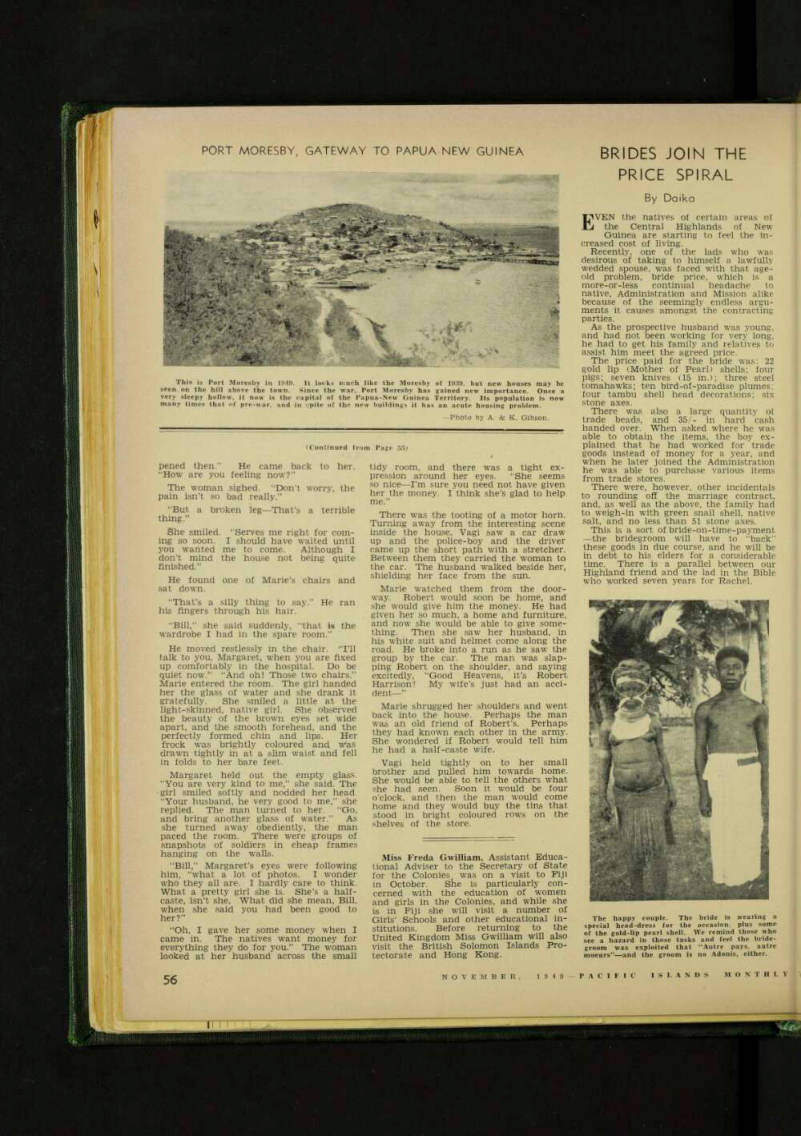
A Story by Lorna Crouch
IT was hot in the sun that poured down on the dingy tin houses of the post war village. The men were away at various tasks at which the Govern ment employed them, but there were still hundreds of people—old men, women and children milling around the small spaces in between the crowded dwellings.
Vagi has almost forgotten the open spaces around the airy native house in the village where she had lived before the Japanese had made war. As she sat on the broken door step in the mid-day heat she saw two white people pass along the road in front of her. The houses of the white people were not far from the village, but they were smart and new.
She had clothes like the woman had; but she was content, most days, with her grass skirt.
Vagi was feeling hungry. It was the end of the month and all the money had been spent. No one went fishing these days. But tonight the men would bring home their month’s wages, and they would go to the store and bring home food—lots of it, tinned meat, cake and large loaves of soft white bread. In the meantime it would be nice to have some taro, or some bananas, but they had little native food. She sighed as she hoped her brother would not gamble away his money, as he had once. Of course, he might win ten pounds! She sang softly to herself.
Two trucks bumped over a break in the road. Someone in the next house turned on a radio. Music blared out, a fine orchestral piece, drowning her native song. She looked across at Marie’s house.
It was a small wooden house with a garden of bright flowers in front. Marie liked the white people. But, then, she was a half-caste.
Vagi watched the couple saunter along the road and around the bend. Sud denly a scream rent the air. In a split second hundreds of natives rushed up the road. From the slum houses young women with babies in their arms joined the throng with naked children of all ages running ahead of them. Vagi joined with the small brothers she was mind ing, and pushed her way to the front of the crowd. The white woman had been knocked down by one of the trucks. She lay on the side of the ditch with the man bending over her.
A native policeman, with his hand cuffs ready, as always, for an emergency,
strode around the crowd, shouting and gesticulating. The native driver of the truck stood trembling beside his vehicle The police-boy spoke to him and he drove off. Gradually the crowd quietened The orchestra was still being broadcast to the village. Vagi was well to the front. The poor Sinabada! The police b(py was talking to the white man. The Sinabada groaned.
“Take me out of this heat, Bill, or I’ll die.” she said. The man wiped his fore head with a spotless handkerchief.
“A car will be here in a moment, Margaret. I’m afraid your leg is broken.” The woman shielded her face with her arm.
“I can’t stand it here a moment
longer.”
The man turned to the police-boy.
“Can I take my wife into that house?
Is it clean?” He pointed to the house that was Marie’s.
“Yes, yes,” answered the boy, “I know the woman, and she is clean.”
“I’ll take my wife there until the car comes.” He turned and knelt beside the woman. “Quick, Bill, I don’t care what it’s like, only get me out of this ditch and this heat.”
The man, because he was short and stout, lifted his wife with great effort.
She cried a little and the police-boy held her legs gently. She closed her eyes and then Vagi noticed what pretty hair the Sinabada had.
A number of children followed the pro cession. Vagi ran forward and picked up the Sinabada’s hat and walked with them towards Marie’s house. Marie was aware pf what was happening and stood wait ing calmly to receive her unexpected visitors. The children hung around the door and with them was Vagi’s small brother. She made a grab at him, but he clung to the doorstep, so she sat down beside him.
Marie became very busy. In her cotton frock and bare feet she hurried about, bringing a clean sheet and spreading it on the small white-enamelled bed. Marie, with frangipanni in her carefully-combed hair, was looking very beautiful to-day.
The white woman lay on the bed.
Vagi, clutching her brother, missed nothing. The husband stood at the side of the bed, and asked the Sinabada if she would have a glass of water. The Sinabada was in pain. She did not speak.
The man turned towards Marie and spoke to her. He looked very tired. “Yes, bring a glass of water.” Marie turned slowly and gracefully and left the room. Then the woman opened her eyes and looked about her. “Bill,” she said slowly, “this is a nice house. Do you know, this bed seems familiar. We had two like this in the children’s room. Don’t you re member?” The man patted her hand.
“Don’t try and talk Margaret. You’ve had an accident. God! When will that car come?” He stood up and paced
anxiously about.
“Bill, you remember, you enamelled the bed, and I said you were putting it on too thick —”. He interrupted her. “I can’t remember —not at a time like this.
I sold the contents of the house to some army chaps when you went South. I told you that.”
“But I thought you said most of our things were looted.” The man gazed anxiously out the door. “Did I? Of course, some were —some were not. I’m too worried to know exactly what hap
pened then.” He came back to her.
“How are you feeling now?”
The woman sighed. “Don’t worry, the pain isn’t so bad really.”
“But a broken leg—That’s a terrible
thing.”
She smiled. “Serves me right for com ing so soon. I should have waited until you wanted me to come. Although I don’t mind the house not being quite finished.”
He found one of Marie’s chairs and sat down.
“That’s a silly thing to say.” He ran his fingers through his hair.
“Bill,” she said suddenly, “that is the wardrobe I had in the spare room.”
He moved restlessly in the chair. “I’ll talk to you, Margaret, when you are fixed up comfortably in the hospital. Do be quiet now.” “And oh! Those two chairs.”
Marie entered the room. The girl handed her the glass of water and she drank it gratefully. She smiled a little at the light-skinned, native girl. She observed the beauty of the brown eyes set wide apart, and the smooth forehead, and the perfectly formed chin and lips. Her frock was brightly coloured and w'as drawn tightly in at a slim waist and fell in folds to her bare feet.
Margaret held out the empty glass.
“You are very kind to me,” she said. The girl smiled softly and nodded her head.
“Your husband, he very good to me,” she replied. The man turned to her. “Go, and bring another glass of water.” As she turned away obediently, the man paced the room. There were groups of snapshots of soldiers in cheap frames hanging on the walls.
“Bill,” Margaret’s eyes were following him, “what a lot of photos. I wonder who they all are. I hardly care to think.
What a pretty girl she is. She’s a half caste, isn’t she, What did she mean, Bill, when she said you had been good to her?”
“Oh, I gave her some money when I came in. The natives want money for everything they do for you.” The woman looked at her husband across the small
tidy room, and there was a tight ex pression around her eyes. “She seems so nice—l’m sure you need not have given her the money. I think she’s glad to help me.”
There was the tooting of a motor horn.
Turning away from the interesting scene inside the house, Vagi saw a car draw up and the police-boy and the driver came up the short path with a stretcher.
Between them they carried the woman to the car. The husband walked beside her, shielding her face from the sun.
Marie watched them from the door way. Robert would soon be home, and she would give him the money. He had given her so much, a home and furniture, and now she would be able to give some thing. Then she saw her husband, in his white suit and helmet come along the road. He broke into a run as he saw the group by the car. The man was slap ping Robert on the shoulder, and saying excitedly, “Good Heavens, it’s Robert Harrison! My wife’s just had an acci dent —”
Marie shrugged her shoulders and went back into the house. Perhaps the man was an old friend of Robert’s. Perhaps they had known each other in the army.
She wondered if Robert would tell him he had a half-caste wife.
Vagi held tightly on to her small brother and pulled him towards home.
She would be able to tell the others what she had seen. Soon it would be four o’clock, and then the man would come home and they would buy the tins that stood in bright coloured rows on the shelves of the store.
Miss Freda Gwilliam, Assistant Educa tional Adviser to the Secretary of State for the Colonies, was on a visit to Fiji in October. She is particularly con cerned with the education of women and girls in the Colonies, and while she is in Fiji she will visit a number of Girls’ Schools and other educational in stitutions. Before returning to the United Kingdom Miss Gwilliam will also visit the British Solomon Islands Pro tectorate and Hong Kong.
Port Moresby, Gateway To Papua New Guinea
This is Port Moresby in 1949. It looks much like the Moresby of 1939, but new houses may be seen on the hill above the town. Since the war, Port Moresby has gained new importance. Once a very sleepy hollow, it now is the capital of the Papua-New Guinea Territory. Its population is now many times that of pre-war, and in spite of the new buildings it has an acute housing problem. —Photo by A. & K. Gibson.
Brides Join The
Price Spiral
By Daika
EVEN the natives of certain areas of the Central Highlands of New Guinea are starting to feel the in creased cost of living.
Recently, one of the lads who was desirous of taking to himself a lawfully wedded spouse, was faced with that age old problem, bride price, which is a more-or-less continual headache to native, Administration and Mission alike because of the seemingly endless argu ments it causes amongst the contracting parties.
As the prospective husband was young, and had not been working for very long, he had to get his family and relatives to assist him meet the agreed price.
The price paid for the bride was; 22 gold lip (Mother of Pearl) shells; four pigs; seven knives (15 in.); three steel tomahawks; ten bird-of-paradise plumes; four tambu shell head decorations; six stone axes.
There was also a large quantity of trade beads, and 35/- in hard cash handed over. When asked where he was able to obtain the items, the boy ex plained that he had worked for trade goods instead of money for a year, and when he later joined the Administration he was able to purchase various items from trade stores.
There were, however, other incidentals to rounding off the marriage contract, and, as well as the above, the family had to weigh-in with green snail shell, native salt, and no less than 51 stone axes.
This is a sort of bride-on-time-payment —the bridegroom will have to “back” these goods in due course, and he will be in debt to his elders for a considerable time. There is a parallel between our Highland friend and the lad in the Bible who worked seven years for Rachel.
The happy couple. The bride is wearing a special head-dress for the occasion, plus some of the gold-lip pearl shell. We remind those who see a hazard in those tusks and feel the bride groom was exploited that “Autre pays, autre moeurs"—and the groom is no Adonis, either.
Advertisements & other items, pp. 58-60 (2 items)
56
NOVEMBER, 1949 - PACIFIC ISLANDS MONTHLY
(Continued from Page 55)
Borns Philp (New Suiaea) Limited
General Merchants (Wholesale and Retail)
Shipping, Customs and General Agents
Head Office: PORT MORESBY, PAPUA
BRANCHES:
NEW GUINEA: Rabaul, Kokopo, Lae Gr Madang.
PAPUA: Samarai.
QUEENSLAND INSURANCE CO. LTD.
LLOYD'S OF LONDON
BURNS PHILP TRUST CO. LTD.
BURNS, PHILP Cr CO. LTD.
All States.
BURNS, PHILP Cr CO. LTD.
"London House", 35 Crutched Friars, E.C.3.
BURNS, PHILP CO. OF SAN FRANCISCO INC. 510 Matson Building.
Distributing Agents, Territory of Popua-New Guinea for:
SHELL COMPANY OF AUSTRALIA LIMITED
Petroleum Products
GENERAL MOTORS CORPORATION
Chevrolet, Buick, Pontiac and Oldsmobile Cars Chevrolet and GMC Trucks Frigidaire Refrigerators
VAUXHALL MOTORS LIMITED
Vouxhall Cars and Bedford Trucks
R. A. LISTER Cr CO., BRISTOL
Producers of Petrol, Paraffin and Diesel Engines Pumps and Lighting plants
RUSTON HORNSBY LIMITED
Engines
CROSSLEY MARINE ENGINES
REPRESENTATIVES FOR:
AUSTRALIAN AGENTS:
LONDON AGENTS:
SAN FRANCISCO AGENTS:
A. H. BUNTING LIMITED
SAMARAI PAPUA
Presents the NEW
C.S.A, ENGLISH DUAL FREEZE
m ¥ "'ll r
SAMARAI AGENTS FOR:
Vacuum Oil Co. Pty., Ltd.
South British Insurance Co.
National Mutual Life Association
MORE THAN A REFRIGERATOR—A FREEZER AS
WELL—FRESH VEGETABLES, FRUIT, MEAT AT
ANY TIME—AND SO SMALL A COST
DIMENSIONS: Overall 42 in. wide. 21 in. deep. 36 in. high.
REFRIGERATOR CAPACITY: 4 CUBIC FEET.
ZERO DEEP FREEZE STORAGE SPACE: U CUBIC FEET.
ALL ALUMINIUM CABINET.
STAINLESS STEEL TOP.
RUSTLESS.
240 VOLT A.C. 50 CYCLES.
ALSO AVAILABLE—IIO VOLT A.C.—SLIGHTLY EXTRA,
PRICE: £152/10/6. F. 0.8., SAMARAI.
SOLE AGENTS IN PAPUA/NEW GUINEA FOR:
Polarizers (U.K.), Ltd.—Polaroid* Sun Glasses.
C.S.A. Industries Eng.—Dual Freeze Refrigerators.
Webley & Scott, Ltd.—Shot Guns, Air Pistols, etc.
Le Bryan Group Products (Great Britain) Ltd.—Powermaster Electric Refrigerators.
“Getula.” —Nylon Monofilament Fish Lines. * Trade mark patented in U.S.A., Great Britain, and other countries.
REGULAR SUPPLIES OF EASTERN GOODS
A. H. BUNTING LIMITED - SAMARAI
WHOLESALE & RETAIL MERCHANTS IMPORTERS PLANTERS
Notes From a Medical Missionary
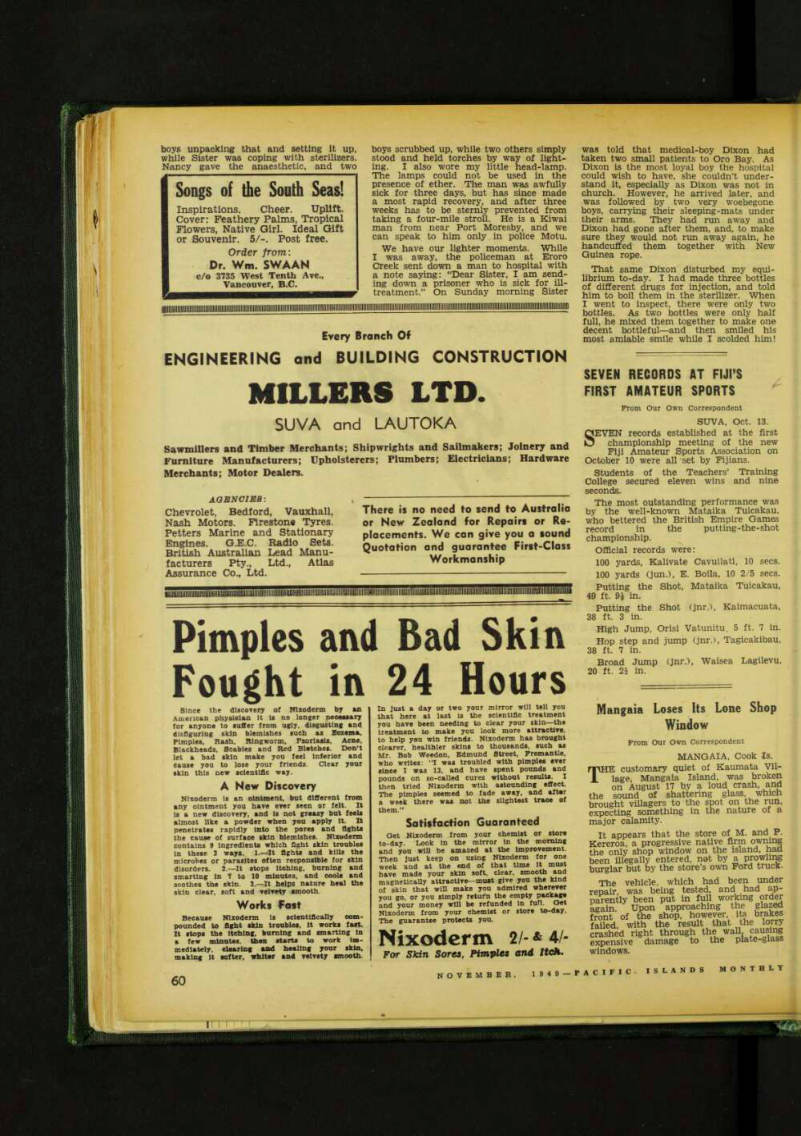
THE following is reprinted from the ABM Review. It was written by Dr. Blanche Briggs, who is in charge of the Anglican mission hospital at Eroro, Papua. Dr, Briggs has been in Papua for several months and is coping with the situation in true pioneering spirit—everything from a man with a “busted” appendix and an op eration by torchlight, to building a hos pital ward has gone her way and been dealt with efficiently, and with an evi dent sense of humour. That is how we like our missionaries.
IN the middle of July we had our dis astrous fire, when the Mission House was burned down, with practically everything it contained. The fire started upstairs and raced through the place, which had walls of New Guinea grass, ceilings of sisalkraft, and, of course, flimsy mosquito nets. The Nicholls got themselves out, and there was little time for more (The Rev. R. A. B. Nicholls and family). They lost everything, and the Mission stores too. The Sisters’ house and my house were untouched. A work-boy and medical-boy got a lot out of the kitchen, mercifully including the laundry that was waiting to be ironed; otherwise the Nicholls family would have had no clothes but what they stood up in. We thought that we would have to live on bully beef and rice from the main store, but someone found the bread crock among the ruins with a new batch of bread in it, charred on the outside but delicious inside.
Neighbours came to the rescue with food, cutlery, etc., and the Bishop ar ranged for the “St. George” to come up
with necessary supplies in amazingly quick time. Now the Nicholls live in the former deacon’s house 200 yards away, while a new Mission House is being built.
One result of the fire is that we have no ward for white patients, who used to be put in the guest-house, so Jean and I are planning to build one on a block of cement that was apparently the kitchen of an Army bakehouse. That fixes the site, as we have no floor boards,
and a native floor would not carry a hospital bed too well. We bring in tall posts from the bush, get roofing iron from the dump, send boys out for a kind of sago leaf to make walls, and then make doors out of any old thing, shut ters for windows from the left-overs . . . and there is your ward!
Two nights after the fire I got my first acute abdomen in Eroro. It was a man with a busted appendix, and the nastiest one I have ever seen. It was an all-night job, including preparation for operation by lamp, lantern and torch light. We had a brand new surgical bed still in its crate, so I got a couple of
boys unpacking that and setting it up, while Sister was coping with sterilizers.
Nancy gave the anaesthetic, and two
boys scrubbed up, while two others simply stood and held torches by way of light ing. I also wore my little head-lamp.
The lamps could not be used in the presence of ether. The man was awfully sick for three days, but has since made a most rapid recovery, and after three weeks has to be sternly prevented from taking a four-mile stroll. He is a Kiwai man from near Port Moresby, and we can speak to him only in police Motu.
We have our lighter moments. While I was away, the policeman at Eroro Creek sent down a man to hospital with a note saying: “Dear Sister, I am send ing down a prisoner who is sick for ill treatment.” On Sunday morning ’Sister
was told that medical-boy Dixon had taken two small patients to Oro Bay. As Dixon is the most loyal boy the hospital could wish to have, she couldn’t under stand it, especially as Dixon was not in church. However, he arrived later, and was followed by two very woebegone boys, carrying their sleeping-mats under their arms. They had run away and Dixon had gone after them, and, to make sure they would not run away again, he handcuffed them together with New Guinea rope.
That same Dixon disturbed my equi librium to-day. I had made three bottles of different drugs for injection, and told him to boil them in the sterilizer. When I went to inspect, there were only two bottles. As two bottles were only half full, he mixed them together to make on© decent bottleful —and then smiled his most amiable smile while I scolded him!
Advertisements & other items, pp. 61-62 (1 item)
Etablissehents Donald Tahiti
PRODUCING UNIFORM GOOD RESULTS SINCE 1868
ALWAYS ASK FOR IT
HEAD OFFICE—QUA) DU COMMERCE—PAPEETE
TELEGRAPHIC ADDRESS—“DONALD, PAPEETE’’
General Merchants (Wholesale & detail) & Shipowners
Importers & Exporters—Branches Throughout Marquesas Islands
Lloyd’s Agents
ASSOCIATE
HOUSES:
Agents and Distributors for :
FRANCE:
HENNESSY COGNACS
MARIE BRIZARD & ROGER
LIQUEURS
CHARLES HEIDSIECK
CHAMPAGNES
PERRIER WATER
GRUBER BEER
U.S.A.
GENERAL STEAMSHIP CORP.
RADIO CORP. OP AMERICA
BROWN & WILLIAMSON, LTD.
CIGARETTES: LUCKY STRIKE,
WINGS, OLD GOLD
CHAMPION SPARK PLUG CO.
RAINIER BEER
A. B. DONALD, LTD.
AUCKLAND, NEW ZEALAND.
A. B. DONALD, LTD.
RAROTONGA, COOK ISLANDS
DOMINION FRUIT CO.,
SUVA, FIJI ISLANDS.
ENGLAND:
RECKITTS & COLMAN
(OVERSEAS), LTD.
PHILLIPS BICYCLES
THE BANK LINE LTD.
NEW ZEALAND:
VACUUM OIL CO. PTY., LTD.
PETROLEUM PRODUCTS
SWEDEN:
HJORTH & CIE
PRIMUS STOVES
Sydney Agents :
BURNS, PHILP & CO., LTD,
London Agents :
BURNS, PHILP A CO., LTD.
San Francisco Agents:
BURNS, PHILP CO. OF
Agents in France :
HARTH & CIE, PARIS.
Songs of the South Seas!
Inspirations. Cheer. Uplift.
Cover: Feathery Palms, Tropical Flowers, Native Girl. Ideal Gift or Souvenir. 5/-. Post free.
Order from :
Dr. Wm. SWAAN
c/o 3735 West Tenth Ave., Vancouver, B.C.
Every Branch Of
ENGINEERING and BUILDING CONSTRUCTION
MILLERS LTD.
SUVA and LAUTOKA
Sawmillers and Timber Merchants; Shipwrights and Sailmakers; Joinery and Furniture Manufacturers; Upholsterers; Plumbers; Electricians; Hardware Merchants; Motor Dealers.
AGENCIES ;
Chevrolet, Bedford, Vauxhall, Nash Motors. Firestone Tyres.
Fetters Marine and Stationary Engines. G.E.C. Radio Sets.
British Australian Lead Manufacturers Pty., Ltd., Atlas Assurance Co., Ltd.
There is no need to send to Australia or New Zealand for Repairs or Replacements. We can give you a sound Quotation and guarantee First-Class Workmanship
Pimples and Bad Skin Fought in 24 Hours
In Just a day or two your mirror will tell you that here at last is the scientific treatment you have been needing to clear your skin —the treatment to make you look more attractive, to help you win friends. Nlxoderm has brought clearer, healthier skins to thousands, such as Mr. Bob Weedon, Edmund Street, Fremantle, who writes: “I was troubled with pimples ever since I was 13. and have spent pounds and pounds on so-called cures without results. I then tried Nlxoderm with astounding effect.
The pimples seemed to fade away, and after a week there was not the slightest trace of them.”
Satisfaction Guaranteed
Get Nlxoderm from your chemist or store to-day. Look in the mirror in the morning and you will be amazed at the improvement.
Then Just keep on using Nlxoderm for one week and at the end of that time it must have made your skin soft, clear, smooth and magnetically attractive—must give you the kind of skin that will make you admired wherever you go, or you simply return the empty package and your money will be refunded in full. Get Nlxoderm from your chemist or store to-day.
The guarantee protects you.
Nixoderm 2/- & 4/-
For Skin Sores, Pimples and Itch,
Since the discovery of Nlxoderm by an American physician It Is no longer necessary for anyone to suffer from ugly, disgusting and disfiguring skin blemishes such as Eczema, Pimples, Rash, Ringworm, Psoriasis, Acne, Blackheads, Scabies and Red Blotches. Don’t let a bad skin make you feel Inferior and cause you to lose your friends. Clear your skin this new scientific way.
A New Discovery
Nlxoderm Is an ointment, but different from any ointment you have ever seen or felt. It Is a new discovery, and is not greasy but feels almost like a powder when you apply It. It penetrates rapidly Into the pores and fights the cause of surface skin blemishes. Nlxoderm contains 9 Ingredients which fight skin troubles in these 3 ways. I.—lt fights and kills the microbes or parasites often responsible for skin disorders. 2.—lt stops Itching, burning and smarting in 7 to 10 minutes, and cools and soothes the skin. 3,—lt helps nature heal the skin clear, soft and velvety smooth.
Works fast
Because Nlxoderm Is scientifically compounded to fight skin troubles, It works fast.
It stops the itching, burning and smarting In a few minutes, then start* to work Immediately. clearing and healing your skin, making It softer, whiter and velvety smooth.
Seven Records At Fiji’S
First Amateur Sports
Prom Our Own Correspondent
Suva, Oct. 13.
SEVEN records established at the first championship meeting of the new Fiji Amateur Sports Association on October 10 were all set by Fijians.
Students of the Teachers’ Training College secured eleven wins and nine seconds.
The most outstanding performance was by the well-known Mataika Tuicakau, who bettered the British Empire Games record in the putting-the-shot championship.
Official records were: 100 yards, Kalivate Cavuilati, 10 secs. 100 yards (jun.), E. Boila, 10 2/5 secs.
Putting the Shot, Mataika Tuicakau, 49 ft. 9i in.
Putting the Shot (jnr.), Kaimacuata, 38 ft. 3 in.
High Jump, Orisi Vatunitu, 5 ft. 7 in.
Hop step and jump (jnr.), Tagicakibau, 38 ft. 7 in.
Broad Jump (jnr.), Waisea Lagilevu, 20 ft. 2i in.
Window
Mangaia Loses Its Lone Shop Window
From Our Own Correspondent MANGAIA, Cook Is. mHE customary quiet of Kaumata Vil -3 lage, Mangaia Island, was broken on August 17 by a loud crash, and the sound of shattering glass, which brought villagers to the spot on the run, expecting something in the nature of a major calamity.
It appears that the store of M. and P.
Kereroa, a progressive native firm owning the only shop window on the island, had been illegally entered, not by a prowling burglar but by the store’s own Ford truck.
The vehicle, which had been under repair, was being tested, and had ap parently been put in full working order again. Upon approaching the glazed front of the shop, however, its brakes failed, with the result that the lorry crashed right through the wall, causing expensive damage to the plate-glass windows.
Advertisements & other items, p. 62 (1 item)
60
NOVEMBER, 19 4 9 -PACIFIC. ISLANDS MONTHLY
W. Samoa is Still Short
of Medical Officers
From Our Own Correspondent
Apia, Oct. 26.
THE Medical Department of the Terri tory of Western Samoa is still understaffed, and instead of the six Medical Officers provided for in the plan of development, there are only three serving at present.
For a population of 75,000 this must be considered wholly insufficient. The New Zealand Government finds it ex tremely difficult to obtain medical officers willing to accept appointment in its island service. Fiji, also, experiences dif ficulties in recruiting medical officers. (It is interesting to note that Papeete, Tahiti, has 11 medical officers, presum ably private practitioners, for a popu lation of 8,000. Apia has a population of some 10,000.) Efforts are being made at present to obtain the services of a young medical man, Dr. Thieme, who is now practising in Germany. Dr. Thieme, who is Samoa born, is the son of a well-known German surgeon, who had a great reputation for daring and successful operations per formed amongst Europeans and Samoans.
He died during World War 1.
During the week-end of October 15-16 two incidents with tragic results occurred near Apia, Western Samoa. At the village of Vailutai a young Chinese-Samoan, Tafega, after a quarrel killed a young Samoan, Silipa, by fatally stabbing him with a knife. At the village of Papauta, near Apia, a pastor of the London Mis sionary Society, Nu’usila Samuelu Manu, was found outside a Samoan house .killed by revolver shots in the left shoulder and side. Police are Investigating.
Three Solomon Islander members of the Seventh Day Adventist Mission, sailed in MV Muliama, on October 15, for Sydney, to embark on two years’ work in translating the Old Testament into the Marovo (BSD language. All are natives from Marovo, the three (Pastors Rini, Pana and Tasa) will work under the di
rection of Pastor A. R. Barrett, for many years a missionaryTn BSI, and will live at Tuggerah Lakes (NSW). The cost of the translation is being covered by native SDA followers who wish to add the Old Testament to the translation of the New Testament already given them by the Mission.
Advertisements & other items, pp. 63-64 (1 item)
Burns Philp (South Sei) Co. Ltd.
Scott’s “Renown” Brand Rope,
Cordage and
Binder
Twine
of Every
Description
Cable Address: Ropeyard.
Sydney.
MANUFACTURED AT
MASCOT. N.S.W.
J. SCOTT
PTY. LTD.
Head Office and Store
163 CLARENCE STREET,
SYDNEY;
N.S.W.
BURNS PHILP (SOUTH SEI) Co. Ltd.
Registered Office: SUVA, FIJI
Code Address: "BURNSOUTH”
ISLAND TRADERS AND SHIPOWNERS
General Merchants (Wholesale and Retail)
Shipping, Customs and General Agents
Representatives for:
QUEENSLAND INSURANCE CO., LTD. BURNS PHILP TRUST CO., LTD.
Distributing Agents for :
SHELL COMPANY (P. 1.), LTD. FERGUSON TRACTORS STANDARD MOTOR CAR COMPANY CROSSLEY MARINE ENGINES
BRANCHES:
FIJI—
SUVA.
LEVUKA.
LAUTOKA.
LAB AS A.
BA.
SIGATOKA.
ROTUMA ISLAND.
SAMOA—
APIA.
PAGO PAGO.
TONGA—
NUKUALOFA.
HAAPAI.
VAVAU.
Sydney Agents;
BURNS, PHILP Sc CO.. LTD..
7 Bridge Street.
London Agents;
BURNS, PHILP Sc CO., LTD..
35 Crutched Friars, E.C.3.
San Francisco Agents:
BURNS, PHILP CO, OF SAN FRANCISCO.
Matson Building, 215 Market Street,
NORFOLK 18.— NIUE IS.—
Agencies Throughout the World.
JS m n milk wm 11B®
L L wmZ&WSt
m§ &
COFHI
NEW ZEALAND
OFFERS
ifH
SHIPPING AND TRADE
JS at
to the Residents of New
Caledonia, New Hebrides,
Gilbert Islands, Ellice
Islands, British Solomon
Islands and New Guinea.
r We are operating a shipping service throughout the above Islands. All goods ordered will be delivered without delay. Should large orders be contemplated we will arrange for a representative to visit you with
samples and discuss the transaction.
Many classes of general merchandise are available at competitive prices and for early delivery.
SAWN TIMBER.
PLYWOODS.
W ARDS.
PAINTS.
VARNISHES.
BUILDING PAPER.
ASBESTOS
SIDINGS
FURNITURE.
CANDLES.
WASHING SOAP.
TOILET SOAP.
TENNIS SHOES.
LEATHER BOOTS
AND SHOES.
LEATHER SOLES
AND HEELS.
LEATHER BELTING.
LEATHER BENDS,
ETC.
SEEDS (INCLUDING
BLUE & MAPLE
PEAS).
LIVESTOCK.
FROZEN MEATS.
TINNED MEATS.
TINNED FISH.
FROZEN FISH.
BUTTER.
CHEESE.
DRIED MILK, ETC.
TINNED
VEGETABLES.
TINNED SOUPS.
CUSTARD POWDER.
BAKING POWDER.
COFFEE ESSENCE.
POTATOES. FRESH
AND CANNED.
ONIONS.
CORDIALS.
BEER.
We are also buyers of Islands Produce of every description and we can provide shipping. Our sell-
ing organisation is worfd-wide.
BUYING OR SELLING—WE CAN HELP YOU
UNION MANUFACTURING
& EXPORT CO. LTD.
G.P.O. Box 1060, Wellington, NEW ZEALAND
Cables: "UMEC", Wellington
★ 1/49/P.
Booklet Showing Colony’s Wealth
Fiji’s Annual Report In Attractive Booklet Showing Colony’s Wealth
INSTEAD of the usual drab dreariness of Governmental reports, the Gov ernment of Fiji has, for its Annual Report of 1948, compiled a most attract ive octavo book, illustrated with photo graphs and with a coloured, folding map of the Colony. The cover shows the Fijian head in bronze that is located in the foyer of the Legislative Council Chamber in the Government Buildings in Suva. The bronze is the work of Margaret Vandercook.
As well as a review of the year 1948, there are chapters dealing with popu lation, labour and industry, finance and taxation, currency and banking, com merce and production, social services, legislation, justice, public works, com munications, geography and climate, history, administration, newspapers and periodicals, etc.
At the end of the book there is an adequate bibliography and an appendix setting out a list of all Fiji government publications, maps, etc., that are for sale.
The publication is not only an official report, but is, as well, a well-produced handbook on the Colony of Fiji. The price is 2/6 and it is available at the Government Press, Suva, Fiji.
IN the Review of 1948, it is stated that although there were no spectacular developments during the year, much solid ground-work was accomplished. Due to the curtailment of the 1946 Ten Year Plan, progress in many spheres of
activity was not as marked as had been hoped.
During the year, however, the Gov ernment of the United Kingdom con verted Fiji war debts and interest free advances made during 1943-46 totalling more than £2,200,000, Into a free grant.
In the same year agreement was reached with New Zealand regarding the payment of a_debt of £768,000 owing by Fiji to the Dominion. The debt settle ment was closely linked with arrange ments for the future defence of the Colony.
In 1948, the values of imports and ex ports constituted a record, total trade amounting to £13,734,346 with a favour able trade balance of £1,844,678, or nearly twice that of 1947.
In March, 1948, the price of copra was increased from £4l/19/- to £5O/2/3 (Fijian currency) and a record production of 34,637 tons was achieved in 1948. Exports of copra, as such, dropped in 1948 but this was due to the fact that increased quantities were processed locally and ex ports of coconut oil and coconut meal increased by 37 per cent, and 68 per cent, respectively.
Prospects for a further increase in 1949 were destroyed when in December, 1948, a hurricane swept the Lau Group.
Taveuni and Vanua Levu, devastating plantations.
At the end of 1948, contracts were in preparation with the British Ministry of Food for a stabilised price for Fiji copra for the next nine years. (Continued Next Page)
The price of sugar remained the same as for 1947 (£24/5/- stg. per ton) and exports of raw sugar increased by 33 per cent, to 149,494 tons. There was a slight increase in banana exports (to 135,163 cases).
ALTHOUGH various co-operative societies were in operation prior to 1948 (the successful Fijian Co-op erative Marketing Assn., for example), 1948 constituted a landmark in that it saw the enactment of the Co-operative Societies Ordinance and Regulations.
During the year 25 such societies were registered—24 being Fijian and one Indian.
As there had been a decrease in the number of cattle in the Colony, due to increased consumption of meat during the war, it was necessary in 194? to im pose certain restrictions and controls in order to enable the depleted herds to be built up. Butter-fat production in creased slightly compared with 1947.
South Seas Marine Products, Ltd., a British company registered in Fiji, but with a substantial proportion of Ameri can capital, carried out various marine and fishery surveys from 1946, and in 1948 decided to establish a tuna fishing industry in Fiji (they commenced opera tions early in 1949). Tuna and bonito caught in Fiji waters are to be taken in refrigerated state to a cannery at Pago Pago (American Samoa) as US tariff would preclude the establishment of a factory in Fiji. This enterprise is ex pected to increase substantially Fiji’s dollar-earning capacity.
The Emperor and Loloma Goldmines near Tavua, produced, in 1948, 93,059 oz. of gold and 29,187 oz. of silver valued at £893,439 and £5,819 respectively.
Considerable financial assistance was given the Colony by the UK Colonial De velopment and Welfare Fund under whose assistance a geological survey was undertaken and plans made for the es tablishment of a comprehensive medical centre in Suva which includes the erec tion of a new Central Medical School, a students’ hostel, a nurses’ Training School and home, extension of the ob* stetric wing of the present hospital and a new out-patients’ department.
The Fund also made available five scholarships for students to attend over seas universities and technical institu tions.
Advertisements & other items, pp. 65-66 (1 item)
*Masse
QUEENSLAND
INSURANCE
COMPANY
LIMITED
(Incorporated 1886 In Australia).
ASSETS EXCEED £5,000,000
Head Office :
QUEENSLAND
INSURANCE BUILDING,
80-82 PITT STREET, SYDNEY,
Specialists in South Seas Fire,
Marine Cr Accident Insurances
Apply to:
FIJI. —Branch Office: I. B. Chalmers, Manager.
Burns Philp (South Sea) Co., Ltd.
VILA. —Burns Philp (South Sea) Co., Ltd.
Comptolrs Prancals Des Nouvelles Hebrides (Marine).
NOUMEA.—L. & W, Johnston.
NEW GUlNEA.—Manager for the Territory of New Guinea and PapUa, W. A.
Anderson.
PORT MORESBY—SAMARAI—LAE
—MADANG—RABAUL.
Burns, Philp (New Guinea), Ltd.
PAGO PAGO.
Burns Philp (South Sea) Co., Ltd.
G. H. C. Reid & Co.
OTHER SOUTH SEA ISLANDS.
Burns Philp (South Sea) Co., Ltd.
Also to any of the Company's Offices in Australia or New Zealand.
ENJOY YOUR
MOTORING
GET A
*Masse
BATTERY
“ They’re Tigers for
There's no better battery made than Masse. Sturdy plates and husky case make for long life. Supercol Separators ensure a super-activity of acid on every part of the plates, giving a constant output of current far beyond the allotted span. That's why Masse stands up to hard work and the heaviest drains made upon it in starting and lighting. f Wfc- «J7- )- (3
ROBERT GILLESPIE JSL
LAE and RABAUL
LON DON-SUVA
ECT
> PANAMA V
For Sailings and Further Particulars Apply To: — BETHELL, GWYN & CO., BURNS PHILP (SOUTH SEA) 138 LEADENHALL ST., co -» LTD -»
LONDON, E.C.3. SUVA.
N. F. Maloney & Co.
Phone 268. PORT MORESBY Phone 268.
Cables, Radios, etc., “Malco,” Port Moresby.
CUSTOMS, SHIPPING, AND FORWARDING AGENTS.
LICENSED AUCTIONEERS AND GENERAL COMMISSION
AGENTS.
House, Land, and Estate Agents.
Chief Agents:
NEW ZEALAND INSURANCE CO. LTD.
(Incorporated in New Zealand) FIRE . . ACCIDENT . . MOTOR VEHICLE . . MARINE, ETC.
Importers and Exporters :: Manufacturers Representatives.
Australian Representatives : E. J. GOUGH & CO., 1 BOND STREET, SYDNEY.
W. H. GROVE & SONS
Limited
Established 1896.
AUCKLAND
Island Traders. p *°* BOX 490, Telegraphic and Cable Address: “Grove”, Auckland.
Entrust Your Orders to the Firm with Fifty Years Practical Experience in the Island Trade.
Shippers of all classes of New Zealand products.
Representing English Manufacturers throughout the Cook and Society Islands, Fiji, Tonga, Samoa, Niue, New Hebrides, the Solomon Islands and New Caledonia.
In FIJI as—W. H. Grove Cr Sons (Fiji) Ltd.
Another Ship Breaks Down
Off Fiji
Suva, Oct. 23.
THE vessel, Manu’a Tele, en route from Suva to Pago Pago, reached Levuka, Fiji, on October 20, on one engine, after a breakdown in the Koro Sea. She will be brought to Suva.
Two members of the crew, Mr. Wayne Lovell and a Samoan named Siligi, who had set out after the breakdown, in one of the ship’s boats to attempt to reach Makogai, missed the island and were carried by wind and current towards Vanua Levu. When sighted by an RNZAF Catalina which had gone out to search for them, they were approaching Solevu Point, near Nabauwalu. They were later picked up at Nabouwalu by a Levuka cutter.
The Isa Lei (Capt. Farrell master) ar rived in the BSI Protectorate from Suva on October 9, on charter to the Govern ment Trade Scheme. She will collect copra round the Group during the ab sence of the Government vessel, MV Kurimarau, which sailed shortly after wards for Suva for overhaul.
At Suva
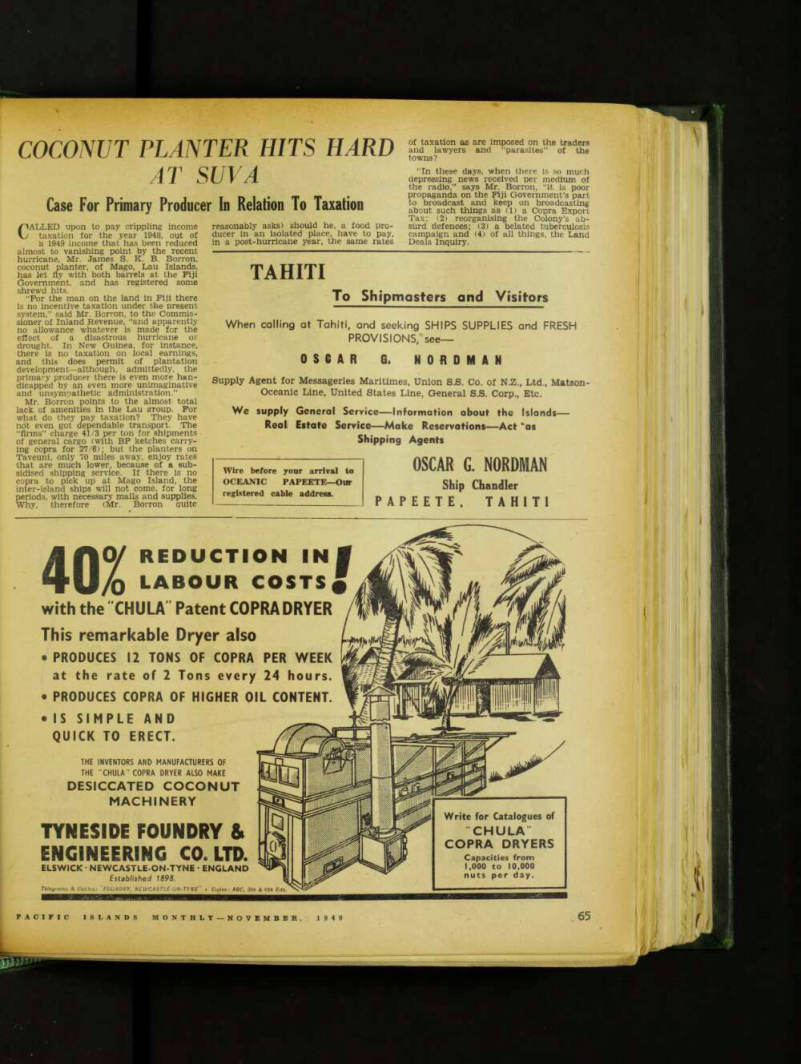
Coconut Planter Hits Hard
Case For Primary Producer In Relation To Taxation
CALLED upon to pay crippling income taxation for the year 1948, out of a 1949 income that has been reduced almost to vanishing point by the recent hurricane, Mr. James S. K. B. Borron, coconut planter, of Mago, Lau Islands, has let fly with both barrels at the Fiji Government, and has registered some shrewd hits.
“For the man on the land in Fiji there is no incentive taxation under the present system,” said Mr. Borron, to the Commis sioner of Inland Revenue, “and apparently no allowance whatever is made for the effect of a disastrous hurricane or drought. In New Guinea, for instance, there is no taxation on local earnings, and this does permit of plantation development—although, admittedly, the primary producer there is even more han dicapped by an even more unimaginative and unsympathetic administration.”
Mr. Borron points to the almost total lack of amenities in the Lau group. For what do they pay taxation? They have not even got dependable transport. The “firms” charge 41/3 per ton for shipments of general cargo (with BP ketches carry ing copra for 27/6); but the planters on Taveuni, only 70 miles away, enjoy rates that are much lower, because of a sub sidised shipping service. If there is no copra to pick up at Mago Island, the inter-island ships will not come, for long periods, with necessary mails and supplies.
Why, therefore (Mr. Borron quite
reasonably asks) should he, a food pro ducer in an isolated place, have to pay, in a post-hurricane year, the same rates
of taxation as are imposed on the traders and lawyers and “parasites” of the towns?
“In these days, when there is so much depressing news received per medium of the radio,” says Mr. Borron, “it is poor propaganda on the Fiji Government’s part to broadcast and keep on broadcasting about such things as (1) a Copra Export Tax; (2) reorganising the Colony’s ab surd defences; (3) a belated tuberculosis campaign and (4) of all things, the Land Deals Inquiry.
“The probabilities of further taxation has a demoralising influence upon primary producers. The upkeep of local military forces stationed in Viti Levu only is un necessary and is a pure waste of money and manpower.
“If officialdom is concerned about hostile Indians (and there is nothing as frighten ing as Red Indians, by the way) and the Indian question in general, then the answer is to quadruple the police force, vastly improve communications by land and sea and air, and use tougher political tactics.
“If War comes, what Fiji really would require—apart from more encouragement to primary producers to grow more food stuffs and to increase the output of sugar, copra and fruit—are bigger and better hospitals, modern harbour facilities and much more up-to-date aerodromes. There should be less emphasis on ditch-dfgging, barbed-wire entanglements, parades, route marches and flag-waving reminiscent of Boer War days.
“If New Zealand considers this part of the Pacific an outer defence bastion, then let that Socialist paradise provide the major portion of the enormous funds re quired to make Fiji a worthwhile bastion.
But, in the next war, I hope they send more dignified and efficient personnel, able to set a splendid example to a native race who are not only great fighters but
who are also a great people. The Fijians have really nothing in common with Maoris or New Zealanders.”
Mr. Borron insists that the Fijian and European planters of the Lau group, even under the recent copra prices, have not known real prosperity for 12 years—all the conditions are against them.
“The Government appears to be content to let matters rest indefinitely, and thus give little in return to the people of this district, in spite of their very substantial contributions to the general revenue of the Colony. Their struggle against weather factors, land deterioration, weed and insect pests, much higher main tenance costs, excessive transport charges and, for some, the increased taxation im posed in recent years, places them at a sorry disadvantage with other primary producers, and with the trading firms and oil crushers. These burdens, together with the rigours of a lonely and remote life, should surely induce the Government to make some drastic changes and afford some permanent relief.”
Miss Dorothy Armstrong and Mr. Keith Boyle have announced their engagement.
They will be married in Port Moresby early in 1950. Miss Armstrong is a pathologist in Port Moresby. Mr. Boyle is on the staff of the Australian Petroleum Coy.
Advertisements & other items, pp. 67-68 (1 item)
/q labour costs*
TAHITI
To Shipmosfers and Visitors When calling at Tahiti, and seeking SHIPS SUPPLIES and FRESH
PROVISIONS, see—
OSCAR G. NORDMAN
Supply Agent for Messageries Maritimes, Union S.S. Co. of N.Z., Ltd., Matson- Oceanic Line, United States Line, General S.S. Corp., Etc.
We supply General Service—lnformation about the Islands— Real Estate Service—Make Reservations—Act *as Shipping Agents
OSCAR G. NORDMAN
Ship Chandler
PAPEETE. TAHITI
Wire before your arrival to
OCEANIC PAPEETE—Our
registered cable address.
0/ REDUCTION IN f
/q labour costs*
with the CHULA Patent COPRA DRYER
This remarkable Dryer also
• PRODUCES 12 TONS OF COPRA PER WEEK at the rate of 2 Tons every 24 hours. • PRODUCES COPRA OF HIGHER OIL CONTENT.
• IS SIMPLE AND
QUICK TO ERECT.
THE INVENTORS AND MANUFACTURERS OF
THE ■' CHULA" COPRA DRYER ALSO MAKE
DESICCATED COCONUT
MACHINERY
TYNESIDE FOUNDRY &
ENGINEERING CO. LTD.
ELSWICK • NEWCASTLE-ON-TYNE • ENGLAND
Established 189 S.
Telegrams & Cables; "FOUNDRY, NEWCASTLE-ON-TYNE" . Codes: ABC. sth A % 'ir xiii & 6 Write for Catalogues of
CHULA
COPRA DRYERS
Capacities from 1,000 to 10,000 nuts per day.
An ornate example of historical keys, this XVlth Century French key features the sporting motif in its club and animal carvings. It seems to have been the key to a Duke’s country lodge. 0 25 ■A / B 8 I * S S
lIKS
R S
key
The
Pi k r e to o s u e g n m o i s
CAPSTAN
FINE CUT
NAVY CUT
TOBACCOS
or 1657./.48
Seychelles
What Has Happened to a Little Known ‘Paradise’
THE following is from a private letter to the editor: I know something of Islands life, for I have resided in the Seychelles Archi pelago (Indian Ocean) and I would be there now were it not for the sabotage and vandalism of the present British “Labour” Government.
Creech Jones and company are white anting local charm and character, and meddling with languages, customs, modes of living and traditions. A swarm of “weliarers” and superfluous officials, be having like fish out of water and bulls in china shops, have intensified inferiority complexes, and hatred and contempt for everything Anglo-Saxon and Celt is grow ing rapidly.
The Seychelles natives, who vary greatly in appearance—being white, light-brown, dark brown and black—are daily becom ing more insolently offensive, familiar and disagreeable. They never did have any sexual morals whatsoever, but their redeeming virtues —including hospitality and generosity—are giving way to low cunning, cynicism, unscrupulousness and disloyalty.
The full story is too long and compli cated to relate here. But the late Attorney-General, a black Seychellois, exercising almost dictatorial powers given to him by the Governor, created friction everywhere and tried to ruin the planters, for which he received many pats on the back from Downing Street. English Con servative members of Parliament were appealed to by the Seychelles Taxpayers Association, a KC was imported from Mauritius, and High Court judgments in connection with alleged income tax eva sions were reversed.
However, irreparable damage has been done and British prestige and justice are now ridiculed. The midget colony, that was once a paradise, has changed to a bureaucracy and is rapidly becoming standardised and drab.
A big drawback to Seychelles is the pressure of many dirty, miserly Indians, who monopolise trading and money-lend ing, and resort to every possible shady and paltry trick to add to their savings.
If they ever wriggle into Australia, then ring down the curtain.
Advertisements & other items, pp. 69-70 (1 item)
Pain
m
SPECIALISING IN
PACIFIC ISLAND INSURANCES
FIRE—MOTOR VEHICLE
MARINE—HULLS AND CARGO
EMPLOYER’S LIABILITY
BONDS—In accordance with
ADMINISTRATION ORDINANCES.
COPRA INSURED PROM DRIER
TO BUYER.
AND ALL OTHER CLASSES ARRANGED
AT LOWEST CURRENT RATES.
Established Agencies throughout the Territory of Papua and New Quinea.
Managing Agents: New Guinea Company, Limited.
Island Representative: G. D. A. Kent, Rabaui Branch.
SOUTHERN PACIFIC INSURANCE
CO.. LTD.
HEAD OFFICE; 60 HUNTER STREET.
SYDNEY.
OVER 25
YEARS OF
PAIN
SWIFT 3-WAY RELIEF
From HEADACHE and o// Nerve and Muscular Pain!
Vincent’s a.p.c Powders and Tablets are a combination of three valuable medicinal ingredients and bring swift 3-way relief! Vincent’s i is prepared to the original therapeutic prescription containing Aspirin to relieve pain, Phenacetin to reduce temperature, Caffeine to stimulate the nervous system. Vincent’s A.P.C quickly relieves Headache, © Q.6D.6
FOR
SAFEST & BEST!
/ / s. / I I k / /. & L ; v
VACUUM
QUALITY PRODUCT
Laurel is the purest and best kerosene you can buy for your kerosene refrigerator. Laurel burns with a clean, steady flame with a minimum of smoke, smell or wick-char.
Don't ask tor "just'' kerosene.
Always specify LAUREL.
Try this ICE CREAAI Recipe I cup Condensed Milk, h cup Water, U cups Beaten Cream, 1| teaspoons Vanilla.
Mix condensed milk with water. Add vanilla and set in refrigerator to chill. When cold add cream and when partially frozen remove and beat thoroughly. Return to refrigerator and freeze until hard. VACUUM OIL COMPANY PTY. LTD. (Inc. in Aust L 498
Notorious Nakanai Natives Make
Their Own Peace Pact
From Our Own Correspondent
C The following article describes a new kind of native movement. If it works, and many will doubt it, it will be a giant stride forward in social evolution among New Guinea
peoples.)
Rabaul, Oct. 10.
THIS week, His Lordship, Bishop Leo Scharmach, of Rabaul, completed a three weeks’ visit of the entire North Coast of New Britain and adjacent islands, as far as Kilenge, He was accompanied by Dr. •Stapleman, Fathers Bernhauser, Stemper, White, Hagen, Schweiger, Berger, Hawkins, and the Director of Catholic Education, Father Dempsey.
At Poi Island, Kaliai and Salumpia, His Lordship administered the Sacrament of Confirmation to over 800 natives, and at Valoka, he blessed the newly-erected European style Church, capable of holding over 1,400 The occasion also marked the Silver Jubilee of foundation of Valoka Mission Station. The previous Church was destroyed by bombs during the war.
After the Benediction of the Church, 150 native leaders of the new Catholic Action Movement met together in Valoka Area School. After the meeting, the President and secretaries presented for his Lordship’s approval, a complete written record in Pidgin, of the nature of their discussion and their Catholic Action programme for the coming year. The new movement, although based on Encyclical letters of Pope Pius XI, is entirely native in its origin and operation. European mission
aries exercise only a corrective function.
Bishop Scharmach was therefore agree ably astonished to read in the native sec retaries’ note books, a simple but com prehensive social programme.
In brief, the programme envisages a plan to end feuding between the North Coast tribes, especially in the long dis turbed Nakanai area, and to end mur derous encounters between the beach peoples and the bush men. This is to be achieved by a reciprocal adjustment and unification of tribal customs which pre viously caused friction. Details of these customs were submitted to the meeting and received unanimous approval from all sections.
The old men, the repositories of native
traditions, were asked by the meeting to co-operate in preserving native culture in music, art and legend; by instructing and initiating the younger generation in everything that was good; and in elim inating or modifying anything that form erly contributed to moral turpitude and social unrest.
The meeting also aimed a death-blow at the nefarious Cargo Cult. It pointed out the foolishness of the Cult’s leaders’ doctrines and the tragic failure of their implementation, both prior to and during the Japanese war. The Cult leaders, it added, had fulfilled none of the their promises to the natives, and had only made the loyalty of the North Coast tribes suspect by the authorities because of their seditious and anti-social actions. Co operation with the Administration and planters whose presence was for the benefit and not detriment of the New Guinea peoples, as the Cult leaders had maintained, was to be the anti-Cargo Cult watchword.
(Continued on page 70)
At the conclusion of the meeting over 3,000 Catholics received Holy Communion and over 3,500 Catholics and Non-Catho lics joined in prayer for the success of their programme. rEN followed perhaps the largest and most colourful and unique presenta tion of native dances ever seen in New Britain. Among the dancers were members of the Kaulon people from the
back of Central, Eastern and Western Nakanai. On hearing from the Beach people that a big Mission Festival was to take place, they, entirely of their own accord and without an invitation, came down to witness it and to share in the dances. They are pagan people, living in an area not under mission influence of any kind; most had never seen a white man.
Huge, intricately carved and painted
masks, shields and spears, many genera tions old, were used to the delight of everybody and the wonder of the Euro pean missionaries, who had seen nothing like it in 25 years of wide and varied missionary experience.
The bushmen, for the first time per formed their secret dances in sight of the beach people. Secret societies appeared in full regalia. The bushmen accom panied their dances by native orchestras of weird-sounding pipes, garamuts and kundus of a design unknown on the Coast.
As many as ten dances were in progress at the one time on the Baloka Area School Oval, and although so many pre viously inimical tribes were participating and excitement was running high, the whole of the celebrations passed off with out incident—and without the presence of a single police boy!
A third day of the Valoka Jubilee celebrations was devoted to sports for the School children.
At the conclusion of the celebrations prizes were distributed by Father Demp sey, Director of Catholic Education, in the presence of the Bishop and the as sembly of European missionaries and native leaders.
Mr. E. A. Meredith, Assistant Superin tendent of Police, Fiji, is at present on leave prior to retirement. He joined the Fiji Police in May, 1927, and after serv ing at Levuka, Savusavu, Nabouwalu and Rewa was transferred to Suva as Pay and Quartermaster. He was appointed an Assistant Superintendent in 1943.
Ratu Naulivou Naucabalavu, who was one of the two journalists from Fiji who toured the United Kingdom this year at the invitation of the British Government, and who remained to take a BBC course, is on his way back to Fiji on the Orontes.
Advertisements & other items, pp. 71-72 (1 item)
Alois Akun & Company
Cfinidked by
DAVISON
For Tropical conditions
Velvene Water Paint and Davison's Zinc Base Paints are used extensively throughout the islands and Mandated Territories on Government and Private buildings, giving full satisfaction under severe tropical conditions.
DAVISON PAINTS LTD.
BOX 24, AUBURN, N.S.W.
Telephone 136. Telegrams: “AKUN,” RABAUL.
ALOIS AKUN & COMPANY
RABAUL, TERRITORY OF NEW GUINEA
Also at 180 NATHAN ROAD, KOWLOON, HONG KONG
Planters, Shipowners and General Merchants
WE CARRY STOCKS OF:—
(1) Embroidered Silkweor. Carved Camphor- (3) Cotton Piece Goods suitable for trade and wood Boxes. Eastern Fancy goods. issues. (2) The Best of Beers, in different brands— r , ... . .
"Three Horse"—"San Miguel" "Red (4) Trade 3 oods of 0,1 descriptions: Wholesale Horse"—"Allsopp's". and Retail.
Prompt attention to all orders
Sydney Representatives: NELSON & ROBERTSON PTY., LTD., Electra House, 12 Spring St., Sydney, N.S.W.
g) Stewarts and Lloyds (Australia) Pty. Ltd.
Manufacturers of "S&L" PIPES and FITTINGS for GAS, WATER, STEAM and other purposes.
AND Distributors of:
MILD STEEL BARS, PLATES and SECTIONS;
GALVANISED IRON; BOLTS and NUTS; ELECTRODES
and WELDING EQUIPMENT.
Stewarts and Lloyds (Australia) Pty. Ltd.
SYDNEY WAREHOUSE - - - Herbert Street. St. Leonards BRISBANE WAREHOUSE - Montague Road, South Brisbane MELBOURNE WAREHOUSE - - City Road, South Melbourne Telegraphic Address: "Tubes' — Sydney, Brisbane or Melbourne
NELSON and ROBERTSON Pty. Ltd.
Established 1895-
Shipowners - Brokers and
Islands Merchants
All classes merchandise purchased at Best Wholesale Prices. Original Invoices supplied to Island Clients. Cocoa Beans, Copra, Rubber, Trochus Shell and All Islands Produce Sold on Commission.
Entrust your requirements to the firm with fifty years' practical experience in the Pacific Islands.
REPRESENTED IN
ALL PARTS OF
THE WORLD.
Sole Agents :
SKANDIA DIESEL ENGINES
Agents in Papua, New Guinea and Solomon Islands for:
BRECKWOLDT Cr CO.
Inquiries Solicited.
OVERSEA INDENTS
ARRANGED FOR
CLIENTS.
Prompt attention given to all inquiries
NELSON & ROBERTSON
12 SPRING STREET, SYDNEY, AUSTRALIA
Telegraphic Address: IVAN, SYDNEY.
PTY.
LTD.
To Corruption
CHARGE THAT FIJI NATIVE POLICY IS LEADING
Is The Government Being Misdirected?
By “Voice In The Wilderness”
I LIVE in a district populated entirely by native Fijians, and I see a great deal of the corruption of native affairs that is caused by a Government policy based on ignorance and misdirec tion.
This later Government policy, that is directed to the enforced return of the Fijians to village life, means the loss of at least two generations of progress.
The individual initiative of the Fijian, that has been developed over this later period, is now to be crushed under the heel of communal life, sponsored by the Socialist policy of forcing the Fijians back to the nearest version of original and primitive Fijian social and domestic culture.
The very small minority of thinking Fijians who have striven to maintain their individuality will now have, under the new native regulations, a harder road to hoe and a longer road to travel. While, on the one hand, the Government has forbidden the old institutions of kerekere and varu (native custom of requiring things without payment), on the other hand it has enforced communal life, which is a hotbed of inescapable op portunity for kerekere, with all its evils.
While on the one hand it has sent large numbers of natives to the outside world, to be educated in the white man’s ways, it has forced the Fijian equivalent of “the mah in the street” into a narrow rut, so that the “educated” natives, when they return, will be able to impose the will of the Government—and, inci dentally, their own—on these prepared victims.
THAT this new regime is to be forced on the Fijians is proved by many in cidents. Here is one.
When the Government ordered the natives of a certain district to cut their copra, and send it to a certain trading firm, without individual payment, a cer tain native would not give consent to have the copra on his tribal land in cluded. He was the head man of his tribe, and he had the authority, with the consent of his fellow tribesmen, to speak for the land and the copra in question.
The village headman, however, acting on the orders of the district headman — and he, in turn, on the orders of the provincial headman—had the nuts cut and the copra sent away, in the absence of the rightful owner.
The aggrieved native sought the advice of a European solicitor, and gave him instructions to take action. The members of the Civil Service, whom this matter concerned, were contacted by correspon dence; but, in accordance with the usual practice, no replies were given—in fact, the present impenetrable wall that sur rounds the Native Administration was made more manifest.
IT always has been a source, of amaze ment to me that so many crimes could be committed in Fijian villages by Fijians, and nothing was done about it. As I became better acquainted with the country and natives, however, I found the solution—too little European super vision.
It might surprise the outside world to know that in these native villages such crimes as carnal knowledge, incest, rape, theft, assault and homo-sexuality are rampant. The reason that not one tenth part of these crimes becomes known
officially is that European officials rely implicitly on their village and district headmen for honest reports of their dis tricts generally. In many cases, the village and district headmen are too deeply implicated to make these matters known.
As long as native Fijians are substi tuted for Europeans in the various posi tions in Fiji, official or otherwise, as is the practice under the new scheme, the situation will become worse and worse and a return to the dark ages becomes in evitable —in fact, it is now well on its way.
The disinterested European is still the best protection for all concerned, es pecially the native; but a misguided Government policy works on another theory. While most civilised people to day agree that there must be a process of evolution in politico-social progress, our political idealists ignore it absolutely, and endeavour to implement their idea that a Stone Age race can govern itself by the simple expedient of giving a super ficial education.
(Continued on page 73)
THIS unofficial chaos in native affairs finds a parallel in the Fiji marine 'situation.
With more and more natives being given positions as masters in the trans insular trade, more and more accidents are occurring—and increasingly fewer are being reported. It is not necessary to look far for the reason. Incidentally, more natives are not being employed in this trade because natives are preferred by the European employers, but because the limited number of qualified Europeans and part-Europeans leave the employers no alternative.
THERE are also unsatisfactory condi tions in the medical department, in spite of the wonderful work done in Suva in training the medical students.
Once allocated to a country district, the average Native Medical Practitioner pro ceeds to settle down to a comfortable life, and his nickname of “Aspro” has not been misapplied.
Aspros are so convenient —they can be sent by the patient’s relatives to his dis tant village.
By force of necessity, it will be only a matter of a few years before the present pampered native will be relegated to his proper position, where his self-seeking and lack of sense of responsibility will have no opportunity of harming his fellow creatures.
Advertisements & other items, pp. 73-74 (1 item)
The greatest
ART POSTCARDS OF
TONGA
Per Dozen (Including a Tin-Can Mail Cover), Postage Paid: 6/- (or one US Dollar).
TONGAN PHOTOS BUREAU
Nukualofa, Tonga
The greatest
Catch your engine in time. Start lubricating it now with Shell Motor Oil. Shell brings you every post-war inprovement in lubrication quality. It protects every moving part of your engine—improves its performance —prolongs its life. There is a correct Shell Oil or Grease for every part of every make and model of car. Ask for Shell, the greatest safety measure , and see that you get it.
safe**
For Xubncafc'O” .
SHELL
The Shell Company of Australia Limited (Incorporated in Great Britain)
AL 493 J
HEAVY MACHINERY AND EQUIPMENT
FOR THE ISLANDS TERRITORIES
Steamships Trading Company Ltd.
AUTOMOTIVE and MACHINERY DEPARTMENT
Distributors in Papua and New Guinea for —
MOTOR CARS
ROOTS, LTD. —Hillman Minx —Humber Hawk — Humber Snipe and Sunbeam —Talbot Cars.
WILLYS-OVERLAND —Universal Jeeps—Jeepsters —Jeep Station Waggons.
Papua only.
RJ3 A D T R A N S P 0 R T
INTERNATIONAL HEAVY DUTY MOTOR
TRUCKS—15 cwt. to 8 tons Gross Carrying Capacity. Utility Bodies—Platform Bodies — Tippers—Semi-Trailers—Low Loaders, etc.
AGRICULTURAL MACH INERT
McCORMICK-DEERING FARM TRACTORS, all
sizes, Wheel and Crawler Types.
FARM MACHINERY to suit every Purpose— Ploughs — Harrows — Cultivators — Planters — Harvesters — Grass-Mowers — Hay Rakes Gr Power Pressers —Chaff Cutters —Feed Grinders —Hammer Mills, Etc.
RICE-MILLING MACHINERY —Hullers—Pearlers — Polishers — Threshers Gr Dressers — Seed Graders —Aspirators—also Complete Mills from 100 to 3,000 lb. capacity rice per hour.
EARTH-MOVING EQUIPMENT
Bullgraders — Dozers — Excavators — Front End Loaders—Road Graders —Road-Rippers—Waggon Dumpers—Bitumen Sprayers, Etc.
TIMBER LOGGING AND
MILLING EQUIPMENT
Diesel Logging Tractors—Timber Trucks—Timber Jinkers—Log Haulers—Tractor Logging Winches —Truck Mounted Loading Gr Front End Pull Winches —Wire Rope, Etc.
SAW-MILLING MACHINERY — Circular Saw
Benches —Circular Rack Saws Gr Log Mills up to 31" depth of cut.
INDUSTRIAL EQUIPMENT
DIESEL STATIONARY ENGINES—from 5 h.p.
upward, all purposes.
DIESEL MARINE ENGINES—from 5 h.p. upward W/Reverse Gr Reducing Gears.
OUTBOARD MOTORS—2i to 22 h.p.
MOBILE CRANES—Wharf Gr Material Handling, 1 to 5 tons Capacity.
PUMPS Gr PUMPING PLANTS —Agriculture— Mining and General Purpose Pumps.
ELECTRIC GENERATING SETS—sizes to suit every purpose—A.C.-D.C. current.
ELECTRIC MOTORS—GEN ERATORS—Fractiona I
sizes upwards—A.C. and D.C. current.
GANG Gr POWER GRASS MOWERS—Municipal,
Golf Course and Airfield use.
REFRIGERATORS
ELECTRIC COMPRESSOR and KEROSENE
OPERATED Food Storage Capacity. Models 4 to 7 Cubic Feet.
AUTOMOTIVE EQUIPMENT
STORAGE BATTERIES —for every purpose—Car —Truck—Radio —Marine —Lighting sets.
TYRES Gr TUBES —Cars—T rucks —T ractors — Industrial Equipment.
HYDRAULIC LIFTING JACKS—i ton to 10 ton capacity.
GENERAL CAR AND TRUCK ACCESSORIES—
Electrical Gr Hydraulic Replacements—Clutch Linings, Brake Linings, Etc.
Adequate stocks of spare parts are available for all vehicles and machinery at our
SERVICE PARTS DEPOT
PORT MORESBY
Cable Address: Telephone:
“Steamships,” Port Moresby Moresby, 476
Postal Address:
Port Moresby, Papua
Survey Ship For The
Central Pacific
THE Australian survey ship, HMAS Lachlan, 1,420 tons, about 300 feet long, will be seen in and around the South Pacific in the next three years.
She has been loaned to the New Zealand Government, and her first job will be a hydrographic survey of the Central Paci fic groups.
British Socialists’ Peanut Plan
£23 Million Gone Down
The Drain
A FURTHER stage is reported in the vast plan under which Britain was to plant up large areas in East and Central Africa with peanuts (ground nuts), so as to ensure for herself ade quate supplies of vegetable oil.
The plan had much to commend it; but it has been implemented by a Socialist Administration and, as a natural conse quence, it has been almost crippled by muddling and colossal waste.
It was reported from London early in November that the plan already has cost Britain £23,000,000, and she got, from the first crop, only 85,000 tons of nuts.
The newspapers say that this situation represents the political grave of the Socialist Minister Strachey, who was re sponsible for the creation and operation of the Overseas Food Corporation. The auditors, in a note attached to the Cor poration’s annual report, say that the Corporation did not keep proper books of
account, nor make sufficient information available.
Britain’s need of vegetable fats is so great, however, that she will continue with the scheme; but the unhappy British tax payer now becomes more unhappy every time he sees a peanut.
The number of petrol drums brought from former Pacific War areas by Islands Industries Ltd. to Suva, Fiji, for use as containers for the export of coconut oil is now more than 50,000. The drums were left behind in the Pacific by the Allied Forces at the end of the war.
Advertisements & other items, pp. 75-76 (1 item)
Heinz
KODAK FILMS
and all Photographic Supplies
WHOLESALE AND RETAIL
CAINE'S STUDIOS
P.O. Box 8, Suva Photographers. Est. 1904.
Write for free price lists.
Allen Taylor 81 Co. Ltd.
COMMERCIAL ROAD, ROZELLE,
SYDNEY
Sowmillers and Wholesale Suppliers of Hardwoods for Constructional Purposes GIRDERS ... PILES .. . POLES . . . SLEEPERS, Etc.
EXPORTING TO PACIFIC ISLANDS SINCE 1893
% a W. vi «B» »»“ *"”.“ or „ the oV»« io««« “* a ” p “ rr.«" - - a K ‘ from y° ur . He inz Free Feciy „..,... >»■ » M * v .« T\“ easy to P«P are ' N S , W . 479 .80urke Street, Sydney,
HEINZ
ONE LB WS- T
67
CANNED POODS
AT LOWEST PRICES
VENTURA TRADING COMPANY PTY. LTD.
26 BRIDGE ST., SYDNEY. N.S.W.
Cables: “Ventura,” Sydney.
P. & R. HUTCHINSON, Suva. VENTURA TRADE AGENCY, Lae, T.N.G.
A. B. DONALD Ltd.
AUCKLAND
ISLAND TRADERS Gr GENERAL MERCHANTS
* P.O. Box 1509. Cables £r Telegrams, "Kingdom," Auckland.
The Garrick Hotel
rr? »m i k% * ? ■ ■
SUVA
FIJI
This well-known Hotel is centrally situated in Sura's main business quarter :: Modern accommodation provides comfort in all climatic conditions :: Only the best of Beers, Spirits and Wines is served Telephone: 80. VINCE COSTELLO, Proprietor.
Bsi Nutfall
Wars Among
Ants And
A FASCINATING little story, showing how the control of the wars between different types of ants may spell the progress or the ruin of an important in dustry, comes from the British Solomon Islands in a report by two scientists, Mr.
B. A. O’Connor (Fiji * Government ento mologist) and Mr. R. Leach (Cambridge School of Agriculture).
For years, BSI planters were troubled by “nutfall” —the premature falling from the palms of unripe coconuts. Then en tomologists discovered that the chief cause is a bug (Amblypelta Cocophaga China). The bug sucks the growing tis sues of a young nut, and either destroys or distorts it.
The patchiness of “nutfall” put other scientists on a hot trail; and, just before World War 11, it was discovered that a yellow tree-ant, Oecaphylla Smaragdina Subnitida, was a deadly enemy of the bug, and either destroyed it, or drove it off.
Where Oecaphylla flourished, there was no “nutfall.”
But that did not explain the patchiness.
Why did Oecaphylla flourish in one place and not in others?
World War II supplied the solution.
While the nations fought, the BSI plan tations were left to themselves, and be came choked with undergrowth and fallen fronds. After the war, the returning planters found that “nutfall” had largely disappeared from certain of their choked and “dirty” plantations. Again, the en tomologists found the answer to the puzzle.
Oecaphylla is a tree-ant. He rarely goes upon the ground. Upon the ground lives his mortal enemy, another kind of ant, Pheidole; and when Oecaphylla had to make the choice between staying on one tree, and going to another tree per medium of Mother Earth, he stayed on the one tree. But when secondary growth, or fallen fronds, or something like that provided an aerial bridge, from one tree to another, Oecaphylla spread rapidly through the plantation, with a corres ponding decrease in the bug population.
The “dirty” plantations of the war period were Nature’s own gift to the tree ant. It was noticed that one Lever plan tation in the Russells, kept clean through the war-years by cattle, was infested by “nutfall,” while adjoining “dirty” planta tions were free from the pest.
So far, so good. It may yet become sound plantation practice to leave some sort of undergrowth for the use of tree ants.
But the story is not finished. It seems that there is still another kind of ant. an even dirtier dog than the Pheidole. This is the ant Iridomyrme Myrmecodiae.
Pheidole lives upon the ground, and only eats Oecaphylla when the latter comes down out of the trees. But Irido etc., lives also in the trees, and he eats the bug destroying Oecaphylla there whenever he can catch him. So, even in “dirty” plan tations, there are patches of “nutfall,” because Oecaphylla is being caught in the trees by Irido.
The entomologists (Messrs Leach and O’Connor) now seem to have the prob lem clearly lined up. They find that they can control or get rid of Pheidole, on the ground, with DDT spray; but what are they to do with his unmentionable cousin, Irido, who lives, like Oecaphylla, in the tree-tops?
More People-Less Food
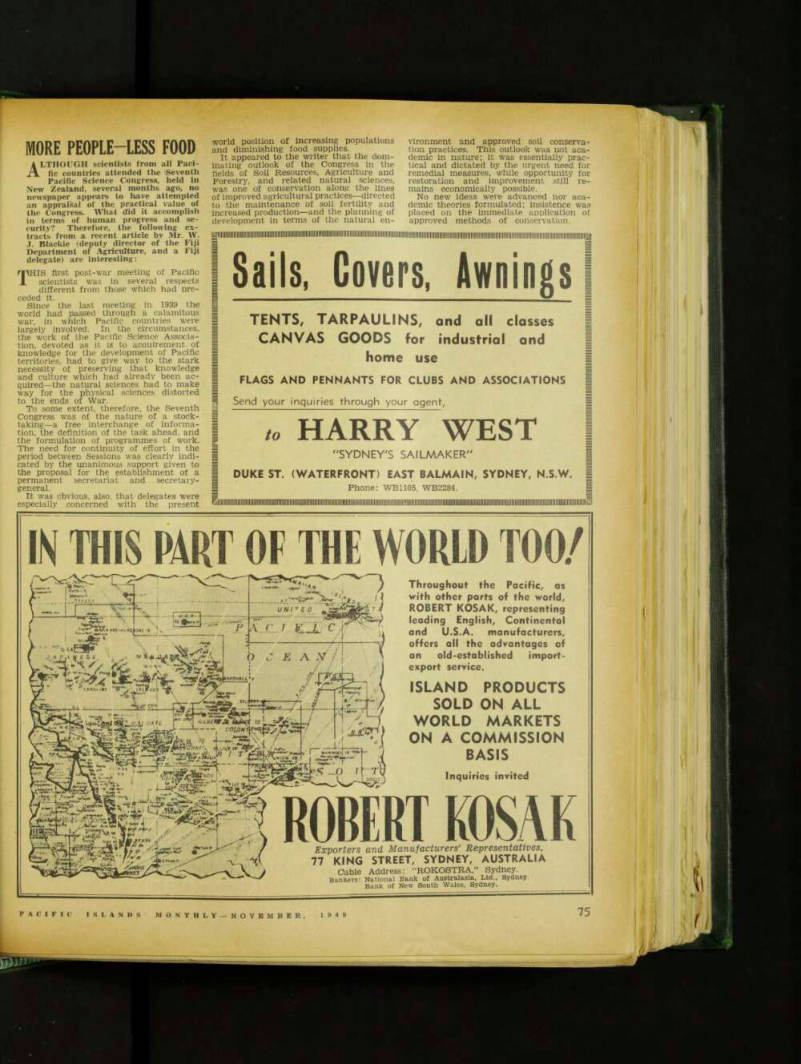
ALTHOUGH scientists from all Paci fic countries attended the Pacific Science Congress, held in New Zealand, several months ago, no newspaper appears to have attempted an appraisal of the practical value of the Congress. What did it accomplish in terms of human progress and se curity? Therefore, the following ex tracts from a recent article by Mr. W.
J. Blackie (deputy director of the Fiji Department of Agriculture, and a Fiji delegate) are interesting: THIS first post-war meeting of Pacific scientists was in several respects different from those which had pre ceded it.
Since the last meeting in 1939 the world had passed through a calamitous war, in which Pacific countries were largely involved. In the circumstances, the work of the Pacific Science Associa tion, devoted as it is to acquirement of knowledge for the development of Pacific territories, had to give way to the stark necessity of preserving that knowledge and culture which had already been ac quired—the natural sciences had to make way for the physical sciences distorted to the ends of War.
To some extent, therefore, the Seventh Congress was of the nature of a stock taking—a free interchange of informa tion, the definition of the task ahead, and the formulation of programmes of work.
The need for continuity of effort in the period between Sessions was clearly indi cated by the unanimous support given to the proposal for the establishment of a permanent secretariat and secretary general.
It was obvious, also, that delegates were especially concerned with the present
world position of increasing populations and diminishing food supplies.
It appeared to the writer that the dommating outlook of the Congress in the fields of Soil Resources, Agriculture and Forestry, and related natural sciences, was one of conservation along the lines 0 f improved agricultural practices—directed to the maintenance of soil fertility and increased production—and the planning of development in terms of the natural en-
vironment and approved soil conserva tion practices. This outlook was not aca demic in nature; it was essentially prac tical and dictated by the urgent need for remedial measures, while opportunity for restoration and improvement still re mains economically possible, No new ideas were advanced nor aca demic theories formulated; insistence was placed on the immediate application of approved methods of conservation,
Advertisements & other items, pp. 77-78 (1 item)
Robert Kosak
Sails, Covers, Awnings
TENTS, TARPAULINS, and all classes CANVAS GOODS for industrial and home use FLAGS AND PENNANTS FOR CLUBS AND ASSOCIATIONS Send your inquiries through your agent,
HARRY WEST
"SYDNEY'S SAILMAKER"
DUKE ST. (WATERFRONT) EAST BALMAIN, SYDNEY, N.S.W.
Phone: WBIIOS, W 82284.
IN THIS PART OF THE WORLD TOO/ ; w -*u * *
UNITED
H p A r K *** r , E A **fV / mh»h»un O: ***s %•
I3IJP
HTSS
“■w an.htmJ3k sMHajSP
CGLOH
s/**-***. &£ }s 4~w. *** \a f rr 7 •T 2 «5 v'~; Um mac: us: -taCWP' '-f it 4 02^ •V xA/ Throughout the Pacific, as with other parts of the world, ROBERT KOSAK, representing leading English, Continental and U.S.A. manufacturers, offers all the advantages of an old-established importexport service.
ISLAND PRODUCTS
SOLD ON ALL
WORLD MARKETS
ON A COMMISSION
BASIS
Inquiries invited
ROBERT KOSAK
Exporters and Manufacturers' Representatives,
11 KING STREET, SYDNEY, AUSTRALIA
Cable Address: “ROKOSTRA,” Sydney.
Bankers: National Bank of Australasia, Ltd., Sydney.
Bank of New South Wales, Sydney.
KASPER Superior SODA FOUNTAINS
‘IKASJPER’ SUPER SODA FOUINTAII IN N°-6
SPECIALLY MADE FOR TROPICAL CONDITIONS
SODA FOUNTAIN 1 j feet long, 33 inchea high serving aide k 29 incbea vide.
FRAME 2 inch Angle Iron Frame, 4ELDED construction, rust-proofed FOUNTAIN TOP ‘lB gauge, mirror finish, English, stainless steel.
SERVING' SIDS 20 gauge, satin finish, stainless steel.
SURROUND Special rust-proofed aluminium finish, wide range of colours.
Claes Rinser.
INSULATION Special Insulation 4 ins. Milk Shake Mixer Swivel tap.
Spanish cork board on bottom sides & top, heavily pitched and sealed. 2 Arm Soda Station,— Drip Tray k 2 4 Syrup Jars Spoon Receptac Mote Ice Cream Freexing Head extra to fountain.
Complete with 1/3 hp motor and fittings plus switch.
Ice Cream Head
6 special l 3 gauge,
stainless steel, mirror finish, interlocking raised hinge. Soda Fountain Lids.
Hermetically sealed Waterproof.
Surround Raised non-splash lip Rubbish Shut Running V»ate Disher Vat© (K w Ice Block maker
SECTION
HEY
Section Section Section Section Section Section Refrigerator unit located here Drain Board, swivel tap k Double sinks welded into drain board
Towel rail-p Sink taps
Storage rack> 2 inch toe recess Chrome wheel valves for thermo-sypnoning brine.
Enables operator to easily regulate temperature fruit juice and soda sections. dottle storage or food storage Compartment (IJ cubic feet)
DIAGRAM
Double Hole for Soda a later Coils, plua Fruit Salad Container on top of coil space.
Double Hole lor Fruit Juices.
Double Hole lor Milk and/or Fruit Juicee Double Hole for serving Ice Cream Double Hole Ice Cream Hardening section Double Hole opening consisting of one * half hole storage space for ice blocks and/or ice cream.
Each "Kasper* Super Fountain fitted with Smite "Septer" tnermeetstic valves.
KASPER NO. 6 TROPICAL INSULATED STAINLESS STEEL SODA FOUNTAIN
Complete with ICE CREAM MAKING MACHINE
SPECIALLY DESIGNED FOR TROPICAL CONDITIONS.
a»3 n
Kasper Superior Soda Fountain of all
stainless steel welded construction
surfaces.
COMPLETE FOUNTAINS, INCLUDING METAL RUST-PROOF
SURROUND, CARBONATORS AND REFRIGERATOR UNITS
SHIPPED FROM AUSTRALIA THROUGH YOUR AGENT
For beauty, for low lifetime cost, for convenience, for dependability, for profit-making power, “Kasper” Fountains stand supreme in Australia to-day. The “Kasper” Fountain is years ahead of conventional models. Every detail has been thoroughly worked out and tested in the factory and in use.
“Kasper” superior fountains are of all steel, lifetime construction with stainless steel, WELDED surfaces and chromeplated fittings. Adequate cork board insulation helps assure
lowest operating costs.
ORDER NOW AND AVOID DELAY
Kasper Refrigerators Pty. Ltd.
77 RAILWAY PARADE, ERSKINEVILLE, N.S.W., AUSTRALIA
Telephone: LA 1326
Sydney-NZ-Fiji-Hawaii-Nth. America
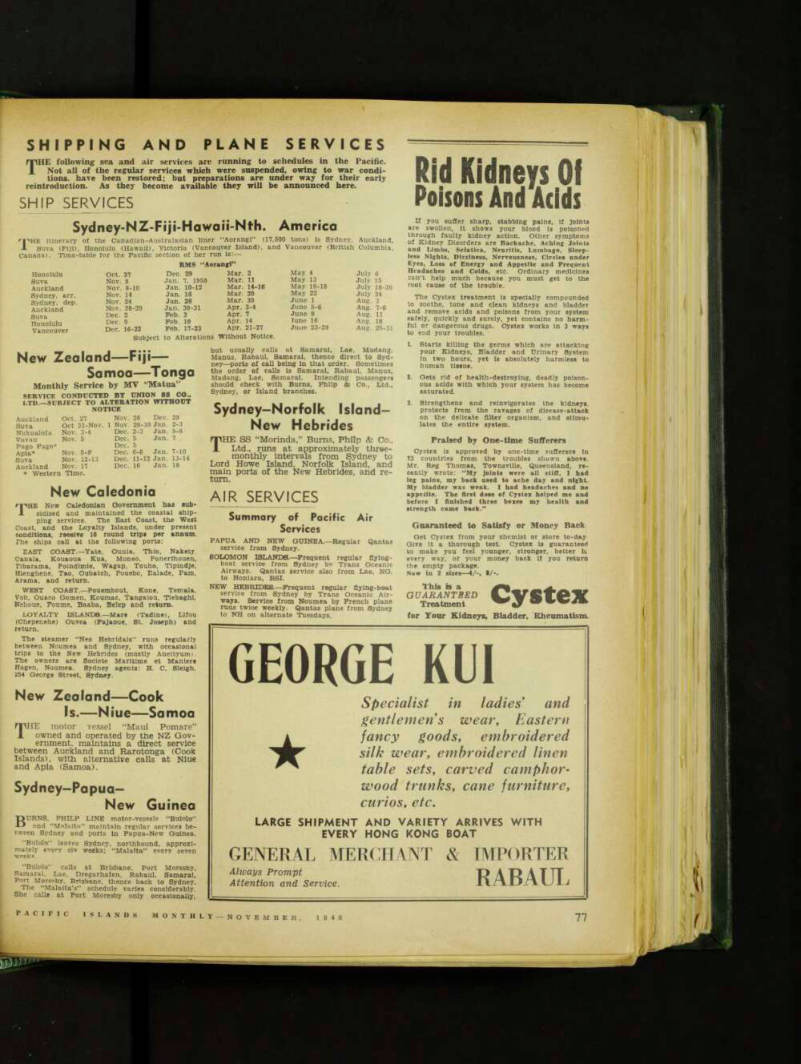
Shipping And Plane Services
Ship Services
rE following sea and air services are running to schedules in the Pacific.
Not all of the regular services which were suspended, owing to war condi tions. have been restored; but preparations are under way for their early reintroduction. As they become available they will be announced here.
Sydney-NZ-Fiji-Hawaii-Nth. America
'T'HE itinerary of the Canadian-Australasian liner “Aorangi” (17,500 tons) is Sydney, Auckland, 1 Suva (Fiji), Honolulu (Hawaii), Victoria (Vancouver Island), and Vancouver (British Columbia, Canada). Time-table for the Pacific section of her run is:—
New Zealand—Fiji—
Samoa —Tonga
Monthly Service by MV ‘TVlatua”
Service Conducted By Union Ss Co.,
Ltd.—Subject To Alteration Without
Notice
Auckland Oct. 27 Nov. 26 Dec. 29 Suva Oct 31-Nov. 1 Nov. 29-30 Jan. 2-3 Nukualofa Nov. 3-4 Dec. 2-3 Jan. 5-6 Vavau Nov. 5 Dec. 5 Jan. 7 Pago Pago* Dec. 5 Apia* Nov. 5-9 Dec. 6-8 Jan. 7-10 Suva Nov. 12-13 Dec. 11-12 Jan. 13-14 Auckland Nov. 17 Dec. 16 Jan. 18 * Western Time.
New Caledonia
THE New Caledonian Government has sub sidised and maintained the coastal ship ping services. The East Coast, the West Coast, and the Loyalty Islands, under present conditions, receive 10 round trips per annum.
The ships call at the following ports: EAST COAST.—Yate, Ounla, Thio, Nakety, Canala, Kouaoua Kua, Moneo, Ponerihouen, libarama, Poindlmle, Wagap, Touho, Tlpindje, Hienghene, Tao, Oubatch, Pouebo, Ealade, Pam.
Arama, and return.
WEST COAST. —Pouembout, Kone, Temala, Voh, Ouaco Gomen, Koumac, Tangaiou, Tiebaghl, Nehoue, Poume, Baaba, Belep and return.
LOYALTY ISLANDS.—Mare (Tadlne), Llfou (Chepenehe) Ouvea (Fajaoue, St. Joseph) and return.
The steamer "Neo Hebrldals’’ runs regularly between Noumea and Sydney, with occasional trips to the New Hebrides (mostly Aneityum).
The owners are Societe Maritime et Manlere Hagen, Noumea. Sydney agents: H. C. Sleigh. 254 George Street, Sydney.
New Zealand—Cook
Is.—Niue—Samoa
THE motor vessel “Maui Pomare” owned and operated by the NZ Gov ernment, maintains a direct service between Auckland and Rarotonga (Cook
Islands), with alternative calls at Niue
and Apia (Samoa).
Sydney-Papua-
New Guinea
BURNS. PHILP LINE motor-vessels “Bulolo” and “Malaita” maintain regular services be tween Sydney and ports in Papua-New Guinea.
“Bulolo” leaves Sydney, northbound, approxi mately every six weeks; “Malaita” every seven weeks.
“Bulolo” calls at Brisbane. Port Moresby, Samarai, Lae, Dregarhafen, Rabaul, Samarai.
Port Moresby. Brisbane, thence back to Sydney.
The “Malaita’s” schedule varies considerably.
She calls at Port Moresby only occasionally,
but usually calls at Saraaral, Lae, Madang.
Manus, Rabaul, Samarai, thence direct to Syd ney—ports of call being in that order. Sometimes the order of calls is Samarai, Rabaul, Manus, Madang, Lae, Samarai. Intending passengers should check with Burns, Phllp & Co., Ltd., Sydney, or Island branches.
Sydney-Norfolk Island-
New Hebrides
THE SS “Morinda,” Burns, Philp & Co., Ltd., runs at approximately three monthly intervals from Sydney to Lord Howe Island, Norfolk Island, and main ports of the New Hebrides, and re turn.
RMS “Aoranri”
Honolulu Oct. 27 Dec. 29 Mar. 2 May 4 July 6 Suva Nov. 5 Jan. 7, 1950 Mar. 11 May 13 July 15 Auckland Nov. 8-10 Jan. 10-12 Mar. 14-16 May 16-18 July 18-20 Sydney, arr. Nov. 14 Jan. 16 Mar. 20 May 22 July 24 Sydney dep. Nov. 24 Jan. 26 Mar. 30 June 1 Aug. 3 Auckland Nov. 28-29 Jan. 30-31 Apr. 3-4 June 5-6 Aug. 7-8 Suva Dec. 2 Feb. 3 Apr. 7 June 9 Aug. 11 Honolulu Dec. 9 Feb. 10 Apr. 14 Tune 16 Aug. 18 Vancouver Dec. 16-22 Feb. 17-23 Apr. 21-27 June 23-29 Aug. 25-31 Subject to Alterations Without Notice.
Air Services
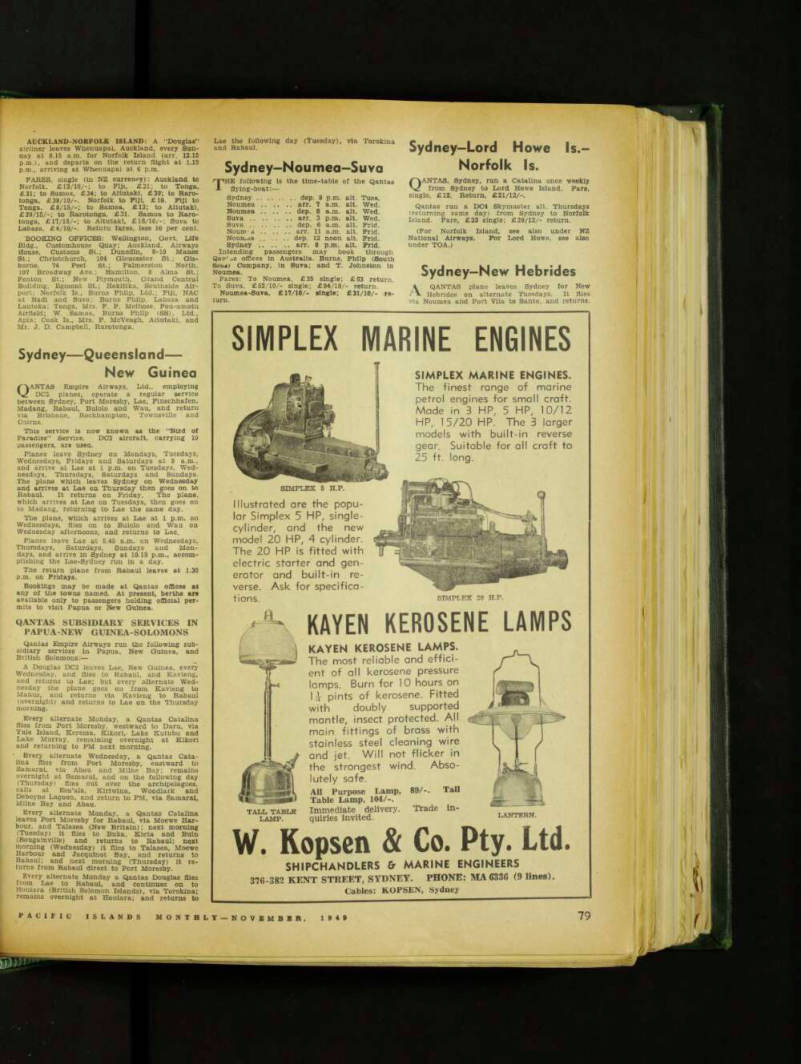
Summary of Pacific Air
Services
PAPUA AND NEW GUlNEA.—Regular Qantas service from Sydney.
SOLOMON ISLANDS.—Frequent regular flying boat service from Sydney bv Trans Oceanic Airways. Qantas service also from Lae, NG, to Honiara, BSI.
NEW HEBRlDES—Frequent regular flying-boat service from Sydney by Trans Oceanic Air ways. Service from Noumea by French plane runs twice weekly. Qantas plane from Sydney to NH on alternate Tuesdays.
NORFOLK ISLAND.—Regular service from NZ by NZ National Airways; from Sydney by Qantas; from Fiji by NZ National Airways.
LORD HOWE ISLAND—Regular weekly service from Sydney by Qantas and Trans Oceanic Airways.
FlJl. —Regular services from Australia by Pan American, BCPA and CPA (to Nadi); Auck land by NZ National Airways (to Nadi); from Australia by Qantas (to Laucala Bay, Suva); from Auckland by NZ National Airways (to Laucala Bay, Suva). Irregular calls from Australia to Laucala Bay, Suva, by Trans
Oceanic Airways. Regular service from Suva to Labasa by NZ National Airways,
Western Samoa, Cook Islands And
TONGA.—Regular service from Fiji by NZ National Airways.
TAHlTl.—Monthly service from Noumea by TRAPAS plane via Fiji, W. Samoa, Cook Is.
DU'T’CH NEW GUINEA. —Regular weekly service fi-om Batavia by KLM.
AUSTRALIA-NEW ZEALAND.—ReguIar service by Tasman Empire Airways.
AUSTRALIA-NORTH AMERICA.—Regular Trans pacific services by Pan American Airways,
Bcpa And Cpa.
Europe - Indo-China -N. Caledonla.—Fort
nightly service by Air France.
NZ National Airways
South Pacific Services
THE Pacific services run by the New Zealand National Airways Corporation are as follows: —
Auckland-Laucala Bay (Suva): A “Sun
derland” flying-boat leaves Mechanics Bay.
Auckland, at 11.30 p.m. each Monday for Laucala Bay, Suva (arrives 8.10 a.m. the follow ing day).
The aircraft departs from Laucala Bay, Suva, on the return journey at 7.30 p.m. each Sunday, and arrives at Mechanics Bay, Auckland, at 4.15 p.m. the following day.
Laucala Bay (Suva)-Labasa (Vanua
LEVU): A “Sunderland” flying-boat operates this service on a charter basis. A return trip is made between Laucala Bay and Labasa each Tuesday.
Auckland-Norfolk Island-Fiji-Tonga
Western Samoa-Cook Islands: A “Douglas”
airliner leaves Whenuapai, Auckland. on Tuesdays at 9 a.m. (November 8. 15, 23, etc.), for Norfolk Island (arr. 12.55 p.m.; dep. 2 p.m.), Nadi (arr. 8.40 p.m., dep. 5.40 a.m.
Thursday), Nausori (arr. 6.25 a.m., dep. 7.30 a.m.), Tonga (arr. 10.50 a.m., dep. 11.50 a.m.), *Faleolo, Western Samoa (arr. 4.5 p.m. Wednes day, dep. 8 a.m. Thursday), Aitutaki, Cook Islands (arr. 1.50 p.m. Thursday, dep. 2.50 p.m.), Rarotonga, Cook Is. (arr. 4.5 p.m,).
The aircraft departs from Rarotonga on the return journey at 8 a.m. on Saturdays (November 12, 19, 26, etc.), at 8 a.m., for Aitutaki (arr. 9.15 a.m., dep. 10 a.m.), Faleolo, W. Samoa (arr. 3.35 p.m., dep. 8 a.m.
Sunday), *Tonga (arr. 10.55 a.m. Monday; dep. 11.50 am.), Nausori (arr. 2.40 p.m., dep. 3.40 p.m.), Nadi (arr. 4.25 p.m., dep. 5 a.m. Tues day), Norfolk Is. (arr, 10.55 a.m., dep. 12 noon), Whenuapai, Auckland (arr. 4.50 p.m.). •Crosses International Date Line.
Auckland-Norfolk Island: A “Douglas”
airliner leaves Whenuapai, Auckland, every Sun day at 8.15 a.m. for Norfolk Island (arr. 12.15 p.m.), and departs on the return flight at 1.15 p.m., arriving at Whenuapai at 6 p.m.
FARES, single (in NZ currency); Auckland to Norfolk, £l2/10/-; to Fiji, £3l; to Tonga, £3l; to Samoa, £34; to Altutakl, £39; to Raro tonga, £39/10/-. Norfolk to FIJI, £l9. Fiji to Tonga, £B/15/-; to Samoa, £l3; to Altutakl, £29/15/-; to Rarotonga, £3l. Samoa to Raro tonga, £l7/15/-; to Altutakl, £l6/10/-; Suva to Labasa, £4/10/-. Return fares, less 10 per cent.
BOOKING OFFICES: Wellington, Govt. Life Bldg., Customhouse Quay; Auckland, Airways House, Customs St.; Dunedin, 8-10 Manse St.; Christchurch, 104 Gloucester St.; Gis borne, 74 Peel St.; Palmerston North, 107 Broadway Ave.; Hamilton, 8 Alma St.; Fenton St.; New Plymouth, Grand Central Building, Egmont St.; Hokitika, Southside Air port; Norfolk Is., Burns Philp, Ltd.; Fiji, NAC at Nadi and Suva; Burns Philp, Labasa and Lautoka; Tonga, Mrs. P. P. Melhose, Fou-amotu Airfield: W. Samoa, Burns Philp (SS), Ltd., Apia; Cook Is., Mrs. P. McVeagh, Aitutaki, and Mr. J. D. Campbell, Rarotonga.
Sydney—Queensland—
New Guinea
QANTAS Empire Airways, Ltd., employing DCS planes, operate a regular service between Sydney, Port Moresby, Lae, Finschhafen, Madang, Rabaul, Bulolo and Wau, and return via Brisbane, Rockhampton, Townsville and Cairns.
This service is now known as the “Bird of Paradise” Service. DCS aircraft, carrying 19 passengers, are usea.
Planes leave Sydney on Mondays, Tuesdays, Wednesdays, Fridays and Saturdays at 9 a.m., and arrive at Lae at 1 p.m. on Tuesdays, Wed nesdays, Thursdays, Saturdays and Sundays.
The plane which leaves Sydney on Wednesday and arrives at Lae on Thursday then goes on to Rabaul. It returns on Friday. The plane, which arrives at Lae on Tuesdays, then goes on to Madang, returning to Lae the same day.
The plane, which arrives at Lae at 1 p.m. on Wednesdays, flies on to Bulolo and Wau on Wednesday afternoons, and returns to Lae.
Planes leave Lae at 5.45 a.m. on Wednesdays, Thursdays, Saturdays, Sundays and Mon days, and arrive in Sydney at 10.15 p.m., accom plishing the Lae-Sydney run in a day.
The return plane from Rabaul leaves at 1.30 p.m. on Fridays.
Bookings may be made at Qantas offices at any of the towns named. At present, berths are available only to passengers holding official per mits to visit Papua or New Guinea.
Qantas Subsidiary Services In
Papua-New Guinea-Solomons
Qantas Empire Airways run the following sub sidiary services in Papua, New Guinea, and British Solomons:— A Douglas DCS leaves Lae, New Guinea, every Wednesday, and flies to Rabaul, and Kavieng, and returns to Lae; but every alternate Wed nesday the plane goes on from Kavieng to Manus, and returns via Kavieng to Rabaul (overnight) and returns to Lae on the Thursday morning.
Every alternate Monday, a Qantas Catalina flies from Port Moresby, westward to Daru, via Yule Island, Kerema, Kikori, Lake Kutubu and Lake Murray, remaining overnight at Kikori and returning to PM next morning.
Every alternate Wednesday, a Qantas Cata lina flies from Port Moresby, eastward to Samarai, via Abau and Milne Bay; remains overnight at Samarai, and on the following day (Thursday) flies out over the archipelagoes, calls at Esa’ala, Kiriwina, Woodlark and Deboyne Lagoon, and return to PM, via Samarai, Milne Bay and Abau.
Every alternate Monday, a Qantas Catalina leaves Port Moresby for Rabaul, via Moewe Har bour, and Talasea (New Britain); next morning (Tuesday) it flies to Buka, Kieta and Buin (Bougainville) and returns to Rabaul; next morning (Wednesday) it flies to Talasea, Moewe Harbour and Jacqulnot Bay, and returns to Rabaul; and next morning (Thursday) it re turns from Rabaul direct to Port Moresby.
Every alternate Monday a Qantas Douglas flies from Lae to Rabaul, and continues on to Honiara (British Solomon Islands), via Torokina; remains overnight at Honiara; and returns to
Lae the following day (Tuesday), via Torokina and Rabaul.
Sydney-Noumea-Suva
THE following Is the time-table of the Qantas flying-boat:— Sydney dep. 9 p.m. alt. Tue».
Noumea arr. 7 a.m. alt. Wed.
Noumea dep. 8 a.m. alt. Wed.
Suva arr. 3 p.m. alt. Wed.
Suva dep. 6 a.m. alt. Prid.
Noum-a arr. 11 a.m. alt. Prid.
Noumea dep. 12 noon alt. Prid.
Sydney arr. 8 p.m. alt. Prid.
Intending passengers may book through Qap*a.s offices in Australia. Burns, Phllp (South Sea«) Company, in Suva; and T. Johnston In Noumea.
Fares: To Noumea, £35 single; £63 return.
To Suva, £52/10/- single; £94/10/- return.
Noumea-Suva, £l7/10/- single; £3l/10/- re turn.
Sydney-Lord Howe ls.-
Norfolk Is.
Q ANT AS, Sydney, run a Catalina once weekly from Sydney to Lord Howe Island. Pare, single, £l2. Return, £2l/12/-.
Qantas run a DC4 Skymaster alt. Thursdays (returning same day) from Sydney to Norfolk Island. Pare, £22 single; £39/12/- return. (For Norfolk Island, see also under NZ National Airways. For Lord Howe, see also under TOA.)
Sydney-New Hebrides
A QANTAS plane leaves Sydney for New Hebrides on alternate Tuesdays. It flies via Noumea and Port Vila to Santo, and returns.
CPA Sydney-Vancouver
Service
C CANADIAN Pacific Airlines, Ltd., run a trans ■ 4 Pacific service between Sydney and Van couver. For the present there will be one northbound and one southbound trip per fort night. Stops are made at Nadi (Fiji), Canton Island, Honolulu and San Francisco. The north bound flight commences from Sydney every alter nate Tuesday.
Four-engined, pressurised "Canadair” aircraft are used; 36 passengers can be carried and a crew of six. Flying is done in daylight. Over night accommodation is provided at hotels in Nadi and Honolulu, which Is, of course, com plimentary.
Fares are (in Australian currency): Sydney- Vancouver, £305/17/- single, £550 return; Fiji- Vancouver, £227/5/- single, £4OB/10/- return; Sydney-Fiji, £54/19/- single, £96/17/- return; Sydney-Honolulu, £238/8/-; Sydney-San Fran cisco, £285/15/-.
Bookings may be made at the Union Steam Ship Company of New Zealand, Limited, Sydney, or Melbourne; Union Steam Ship Co. of NZ, Ltd., Fiji; Canadian Pacific Airlines, Vancouver.
Sydney-Vancouver
BCPA Service
BRITISH Commonwealth Pacific Airlines, Ltd., operate a twice weekly trans-Pacific service from Sydney to Vancouver, via Fiji, Canton Island, Honolulu and San Francisco; and a weekly service between Auckland and Vancouver, via the same ports.
Planes leave Sydney every Wednesday and Saturday, and Vancouver on the Southbound trip every Monday and Thursday. Every fourth trip from Sydney terminates at San Francisco instead of Vancouver.
Planes leave Auckland every Tuesday and arrive in Vancouver the following Wednesday.
The Southbound trip to Auckland commences from Vancouver every alternate Friday. Every other Friday the service commences at San Francisco.
B.C.P.A. services make regular connections at both San Francisco and Vancouver for onward carriage, via either New York or Montreal to the United Kingdom or Europe. The through fare from Sydney to London is £325 (Aust.).
Fares are (in Australian currency): Sydney- San Francisco, £285/15/- single and £514/6/return; Auckland-Vancouver, £283/1/- single; Auckland-Nadl (Fiji), £3B/17/-; Sydney-Nadi, £54/19/-; Sydney-Vancouver, £305/17/- single, £550 return.
Douglas DC6 aircraft carrying 48 passengers (seated) or 37 passengers (in sleepers) and a crew of nine are used on the service.
Pan-American—
Trans-Pacific Service
PAN-AMERICAN World Airways clippers now provide the following services in the South Pacific, using DC4 planes, equipped with Sleep erettes;— Planes leave Sydney Monday and Friday for San Francisco, via Tontouta (New Cale donia), Nadi (Fiji), Canton Island and Hono lulu.
The return flights are made from San Francisco every Thursday, via Honolulu, Canton Island.
Nadi and Tontouta; and from Seattle every Monday, via Portland, Honolulu, Canton Island, Nadi and Tontouta.
Planes leave Auckland every Wednesday, and fly via Nadi, Canton Island and Honolulu to San Francisco. They leave San Francisco for Auckland every Saturday by the same route.
Pares, in Australian currency, are:— £ s. d. £ s. d.
Single. Return.
Sydney-Seattle .. .. £285 15 0 £514 6 0 Sydney-’Prisco ... 285 15 0 514 6 0 Sydney-Fiji 54 19 0 98 17 0 Sydney-Honolulu ... 238 8 0 429 0 0 Auckland-Seattle . .. 262 19 0 473 14 0 Auckland-Honolulu .. 215 13 0 387 19 0 Auckland-Pijl 38 17 0 69 19 0 Auckland-San. Fran. . 207 3 0 372 16 0 (Time-tables and fares subject to alteration without notice.) To convert to Fiji currency, reduce above each kilogram of excess.
Free baggage allowance is 30 kilos per person.
Excess baggage at 1 per cent, of single fare for figures by about 10 per cent.
Trans-Tasman Service
Sydney—Auckland
TASMAN Empire Airways, Ltd., operate a flying-boat service between Rose Bay.
Sydney, and Mechanics Bay, Auckland. Large flying-boats, capable of carrying 30 passengers, are employed. The trip is comfortable, and takes approximately 8 hours.
Flying-boats now depart Sydney and Auckland dally.
This service will be supplemented by Charter Services operated by DC4 and DC6 aircraft.
Pares: £35 (A) (£2B NZ currency) single; £63 (A) (£5O/8/- NZ currency) return.
Bookings may be made at Tasman Empire Airways In Auckland and at Qantas Empire Air ways, Carrington Street. Sydney.
New Caledonia-
New Hebrides
TRAPAS (French Air Line) operates a service between Noumea and the New Hebrides.
The plane leaves Noumea every Tuesday, and flies direct to Vila and Santo, and returns. Re turn fare for the journey, Noumea-Santo, is approximately £42 Australian.
N. Caledonia—Tahiti
TRAPAS (Soclete Francals de Transports Aeriens du Pacific Sud-Noumea) runs a monthly service from New Caledonia to Tahiti.
Departing at 8 a.m. from Noumea, every third Thursday, the plane flies via Fiji (Nadi), Western Samoa (Paleolo), Cook Islands (Aitu taki) to Papeete, where it arrives at about 11.40 a.m. two days later. One evening Is spent in Nadi and one night in Aitutakl. The plane re turns by the same route in the following week.
Fare from Noumea to Papeete is 16,000 Pacific francs single, and 28,800 return. (160 Pacific francs equal £1 Australian.) While the plane is at Papeete it runs one round trip between Papeete and Bora Bora.
KLM Dutch New Guinea
Service
K.L.M. Royal Dutch Airlines run a regular weekly service from Batavia to Dutch New Guinea, via Sourabaya, Makassar and Ambon, on the following schedule: Batavia dep. Sundays at 10.30 a.m., Biak Island arr. Mondays at 4.40 p.m.; dep. Tuesdays at 6 a.m., Hollandia arr. Tuesdays at 8.10 a.m. On the return journey the aircraft leaves Hollandia at 9 a.m. on Tuesdays; Biak Island arr. 11.10 a.m.. dep. 12.15 p.m. on Tuesdays; and Batavia arr. 6 p.m. on Wednesdays.
(Continued Next Page)
The aircraft used are C. 475, a type of DC-3, and the single fares are Batavia-Biak Island £A80; Batavia-Hollandia £A9I/15/-; and Biak Island-Hollandia £AII/15/-. Return fares, double single.
TOA Services
TRANS Oceanic Airways run the following Pacific services;— SYDNEY-LORD HOWE IS.: A regular fort nightly service with large four-engine flying
boats from Rose Bay. Pare: £ll single; £2l return. Free baggage allowance 50 lb. Excess baggage and freight rate 6d. per lb.
SYDNEY-NEW HEBRIDES: A regular monthly service with large four-engine flying-boats from Sydney, via Noumea (overnight stop), to Vila and Espiritu Santo. Pare; Sydney-Vila, £45; Sydney-Santo, £5O; Noumea-Vila, £l2/10/-; Noumea-Santo, £lB/15/-. Freight: Sydney-Vila, 2/- per lb.; Sydney-Santo, 2/3.
Sydney-Solomon Islands; A Regular
monthly service from Sydney, via New Cale
donia and New Hebrides to Tulagi, Solomon Islands. This service is frequently extended to Lingatou, in the Russell Islands, and calls are sometimes made at Vanikoro, in the Santa Cruz Group. Fares: Sydney-Tulagi, £65. Free bag gage allowance, 60 lb.; excess baggage and freight, 3/- per lb.
France—l ndo-China-
N. Caledonia
THE French national airways, Air France, runs a fortnightly service between Paris and New Caledonia, and return. Stops are made at Rome (forward journey.) or Marseilles (re turn journey) Cairo, Bazra, Karachi, Calcutta, Saigon, Batavia, Darwin, Brisbane.
DC4 Skymasters are used in the service.
Fare between Brisbane and Tontouta (New Caledonia) has been fixed, for the present, at £2B/19/- (Australian).
Papua-NG Local
Services
MANDATED Airlines, Ltd., of Lae, New Guinea, and other private operators, run air ser vices between Lae and the New Guinea mainland centres of Wau, Bulolo, Madang, Wewak, Altape, Mt. Hagen, Plnschhafen, Moresby, Kokoda —in fact anywhere in Papua or New Guinea where there is an air-strip. These planes carry pas sengers, malls and cargo on regular schedules or charter flights.
Guinea Air Traders Ltd., of Lae, New Guinea, employ six aircraft on local services, and on charter work. .
Under arrangement with the Administration, a Qantas plane, carrying Administration personnel and cargo, and mails, flies once each, week from Lae to Rabaul, Kavleng and Manus, and returns to Lae by the same route.
Dr. and Mrs. G. R. Hemming and their three children, who have been holidaying in Brisbane, returned recently to their
home in Suva, Fiji.
Advertisements & other items, pp. 79-84 (4 items)
77
PACIFIC ISLANDS MONTHLY-N O V E M B E R , 1949
GEORGE Kill
Rid Kidneys Of
Poisons And Adds
If you suffer sharp, stabbing pains, if Joint* are swollen, It shows your blood Is poisoned through faulty kidney action. Other symptoms of Kidney Disorders are Backache, Aching Joints and Limbs, Sciatica, Neuritis, Lumbago, Sleepless Nights, Dizziness, Nervousness, Circles under Eyes, Loss of Energy and Appetite and Frequent Headaches and Colds, etc. Ordinary medicines can’t help much because you must get to the root cause of the trouble.
The Cystex treatment is specially compounded to soothe, tone and clean kidneys and bladder and remove acids and poisons from your system safely, quickly and surely, yet contains no harmful or dangerous drugs. Cystex works in 3 ways to end your troubles.
I. Starts killing the germs which are attacking your Kidneys, Bladder and Urinary System in two hours, yet Is absolutely harmless to human tissue.
J. Gets rid of health-destroying, deadly poisonous acids with which your system has become saturated. 3. Strengthens and reinvigorates the kidney*, protects from the ravages of disease-attack on the delicate filter organism, and stimulates the entire system.
Praised by One-time Sufferers Cystex Is approved by one-time sufferers In 73 countries from the troubles shown above.
Mr. Reg Thomas, Townsville, Queensland, recently wrote: “My joints were all stiff, 1 had leg pains, my back used to ache day and night.
My bladder was weak. 1 had headaches and no appetite. The first dose of Cystex helped me and before I finished three boxes my health and strength came back.”
Guaranteed to Satisfy or Money Back Get Cystex from your chemist or store to-day Give It a thorough test. Cystex Is guaranteed to make you feel younger, stronger, better li every way, or your money back If you return the empty package.
Now in 2 sizes—4/-, %/-. for Your Kidneys, Bladder, Rheumatism.
This is a
GUARANTEED
Treatment
Cystex
GEORGE Kill
★ Specialist in ladies’ and gentlemen s wear. Eastern fancy goods, embroidered silk wear, embroidered linen table sets, carved • wood trunks, cane furniture, curios, etc.
LARGE SHIPMENT AND VARIETY ARRIVES WITH
EVERY HONG KONG BOAT
GENERAL MERCHANT & IMPORTER
RABAUL
Always Prompt Attention and Service.
Box 3838 GPO, Cable Address, “Care” Sydney.
Sydney. Australia. iTfir
ISLAND MERCHANTS
4 YORK ST., SYDNEY
All kinds Island Produce sold on commission. All merchandise purchased at best wholesale price and original invoices supplied.
Use our 50 years’ experience as Island Merchants.
J
For ALL PROCUREMENT ENQUIRIES Hongkong & Far East Merchandise Consult: —
""AUSTRALIAN INTERSTATE AGENCIES
(15 Years' Pacific Islands Experience) EXPORTERS OF ALL TRADE GOODS & CHINA PRODUCTS
CANE FURNITURE
RUBBER FOOTWEAR
VACUUM FLASKS
BROCADES
TEXTILES BASKET-WARE
PLASTIC RAINCOATS CURIOS
CAMPHOR-WOOD CHESTS UMBRELLAS
FLASHLIGHTS ENAMELWARE, BOWLS, ETC.
Direct connections with manufacturers and personal inspection of all cargoes QUOTATIONS AND PULL INFORMATION AIRMAILED UPON REQUEST
AUSTRALIAN INTERSTATE AGENCIES
G.P.O. BOX 2207, HONGKONG. Cable Address: "Austproduct," Hongkong.
SIMPLEX MARINE ENGINES
SIMPLEX MARINE ENGINES.
The finest range of marine petrol engines for small craft.
Made in 3 HP, 5 HP, 10/12 HP, 15/20 HP. The 3 larger models with built-in reverse gear. Suitable for all craft to 25 ft. long.
SIMPLEX 5 H.P.
Illustrated are the popular Simplex 5 HP, singlecylinder, and the new model 20 HP, 4 cylinder.
The 20 HP is fitted with electric starter and generator and built-in reverse. Ask for specifications.
SIMPLEX 20 H.P.
M i
KAYEN KEROSENE LAMPS
TALL TABLE
LAMP.
KAYEN KEROSENE LAMPS.
The most reliable and efficient of all kerosene pressure lamps. Burn for 10 hours on H pints of kerosene. Fitted with doubly supported mantle, insect protected. All main fittings of brass with stainless steel cleaning wire and jet. Will not flicker in the strongest wind. Absolutely safe.
All Purpose Lamp, 89/-. Tall Table Lamp, 104/-.
Immediate delivery. Trade inquiries invited.
LANTERN.
W. Kopsen & Co. Pty. Ltd.
SHIPCHANDLERS Cr MARINE ENGINEERS
376-382 KENT STREET, SYDNEY. PHONE: MA 6336 (9 lines).
Cables: KOPSEN, Sydney
ZS' n d? ° r f> Dental science has known tor i many years that certain enzymes ° Jg? in the mouth turn sugar into
acid,Dental science also
knows that these enzymes
$$ are created by an organism
called "LACTOBACILLUS
ACIDOPHILUS"
4o Kolynos helps neutralise
these enzymes Jhose $
active antiseptic*Mynos
bubbles surge between
rjp the crevices of your teeth
9 0 % -leave them surgically
%% clean-and help prevent
dental decay.
I * r
(Jn NEW JERSEY
(US A.) A 6-y£AR-i
OLD CAT JUMPS
ONTO ITS OWNERsI
WASHBASIN EACH
MORNING AND
BRUSHES ITS
* .OWN TEETH/
i
r^^lßONt
/N /597 A fXfHCHMAH
//vvfwreo aA/sa rear#
AAAPa EROM /RON, wax
AHP PEARLS! MARE Q 0
you* sM/ia/aTßAcme^j) ...breath sweet... tv/r/y Awr/saar/c
RVC/NOS
00 as- M o tio \ KOLYNOS SAV&£ VOU MONEY BECAUSE ITS CONCENTRATED. ° i VD GOES TWICE A 5 FAR AS ORDINARY TOOTH PASTE HALf AN IN£M ON A DRV BRUSH /S PLENTY/ u o c9i^ better, tastes seiter, lasts longer 1 K49 : 20^
wmLOA
DENTAL
c CREAM ™
& : 0 000 0 0 1 & .18 0/ S - u t ,-s flop
inimtHiHminimmi m
CRIME
CHARMOSAN
» h.w rzz* r ‘ ct P o^:..o U — s
ADORABLY LOVELY
UNDER POWDER
iiiiimd
% Charmosan
cold.cream tkm o<'
CLEANSES AND
REFRESHES YOUR SKIN
CHARMOSAN
VANISHING AND COLD CREAMS
AUNT
MARYS
BAKING POWDER
For the best in delicious baking results A product of TILLOCK AND CO. PTY. LTD. manufacturers of all the famous Aunt Marys Pure Foods
SOLVE YOUR POWER PROBLEMS
WITH AN
ARMSTRONG SIDDELEV
Aircooled Diesel Engine, 5/6, 7/8, 12/16 H.P.
DESIGNED FOR
Power Generating o All Plant Operation
FEATURES:
« COLD STARTING
• PRESSURE LUBRICATION
• FUEL ECONOMY
• COMPACT
• LOW WEIGHT
• BUILT TO OPERATE IN ANY
CLIMATE
IMMEDIATE DELIVERY
Sole Pacific Agents :
VENTURA TRADING COMPANY PTY. LTD.
26 BRIDGE STREET, SYDNEY.
CABLES, “VENTURA,” SYDNEY.
Represented by P. &R. HUTCHINSON, Suva. VENTURA TRADE AGENCY, Lae. T.N.G.
D UNLOP
A t ST^ : f M * \ Dunlop sporting equipment enjoys worldwide popularity amongst all players of sport. You can be sure, always, of getting the best products of their kind available when -you specify Dunlop Tennis Rackets. Tennis Balls, Sports Shoes, Golf Balls and Bowls.
They're still difficult to obtain but keep asking for the Dunlop Brand. mm 90813* mm D.44J
DUNLOP*- ihs Vukb&'t Vndustvf
78
NOVEMBER, 1949—PACIFIC ISLANDS MONTH LI
82
NOVEMBER, 1949 PACIFIC ISLANDS MONTHLI
In the Port of Avarua
From Our Own Correspondent
Rarotonga, Oct. 14.
THE tiny puddle of deep water, which has the temerity to call itself the harbour of Rarotonga, is at present uncomfortably crowded, and respective boat-owners are keeping their fingers crossed against a sudden and dire visita tion of a hurricane or tidal wave.
Dick Brown’s Mahurangi is, too literally, rubbing shoulders with the CIPA’s La Reta; and, while the two Fairmiles make a refreshing impression of returning pros perity, one wonders which one would make the harbour exit first, should the worst happen. Both these boats are moored with bows towards the wharf—a dangerous practice in the uncertain waters of these islands.
Crouched against the side of the La Reta lie the Te Rapunga and the Storma long. These midgets can muster barely 60 feet between them, and when one of the Fairmiles pounds out of the harbour, it ungenerously takes half the smaller boats’ rigging with it.
Al. Peterson, who has come solo from Panama in the Stormalong, is slightly better off than his tiny neighbour, for he is the proud possessor of an engine.
George Dibbern of the Te Rapunga scorns ownership of such new-fangled de vices, swearing that when an engine sees him coming, it just automatically ceases to function. Accordingly, he has nar rowed his mechanical possessions down to a gramophone—which suffers from severe laryngitis—and a chronometer, which also behaves peculiarly.
And up on the beach, not 100 yards away from the boats still afloat, lies the Marie, a horrible example of what can happen to a small boat when trying to make the entrance to our “harbour.”
Frank Dona had the worst of luck with Marie, When within coo-ee of the wharf, his engine ceased to function and his anchor-warp floated off with the tide.
Dick Brown, again indulging his mania for buying up boats, has now added the Marie to his collection; and the facts that her keel has been completely torn off and that there is a nine foot hole in her chine, do nothing to dampen Dick’s en thusiasm for patching her up and sending her up to Manahiki for use in pearl diving.
Kim Powell, on the Wind’s Will, out from the Panama Canal Zone, took one look at the congestion at Avarua, and hastened off to tie up at A. B. Donald’s anchorage at Avatiu. There he has spent a happy time, putting his moorings up and down every time Andy Thompson comes into sight with the Tiare Tapero.
Rarotonga is getting more like Papeete every day!
Ng Education Expert Goes
To India
Miss Barbara Mclachlan, Ba, Is
the Australian representative at an Asian Seminar being held at My sore, India, from November 2 to December 14. Miss McLachlan is a graduate of Sydney University, where she specialised in Anthropology, and she taught in NSW secondary schools before going, in 1947, to her present position as Officer-in- Charge of the Female Education Branch, Papua-New Guinea Education Depart ment. Part of her work in New Guinea has been the establishment of schools for native girls, and women’s centres.
Experts from many countries will at end this seminar, which is being spon sored by the United Nations Educational, Scientific and Cultural Organisation.
They will discuss problems connected with rural adult education, such as illiteracy, agricultural methods and economic co operation.
Miss McLachlan hopes to gain much of value, not only to the education authori ties in New Guinea, but also in the
training and teaching of aborigines in Australia.
Annual report, of the Fiji Police Depart ment shows that road accidents in 1948 increased by 20 per cent, on previous year.
Two persons were killed and 113 injured.
Advertisements & other items, pp. 85-86 (1 item)
Your
OUR HANDS MAKE GOOD ARMS
For your Fishing and Shooting Wants Consult Us.
Lithgow .22 Cal. Repeating Rifles ... £ll 14 0) Post Lithgow .22 Cal. Single Shot 5 1 3( Extra.
SI L RO H U 143 ELIZABETH STREET, SYDNEY.
MENU
, * „ ua l\tv delicious
o* tOP ' q fOODS
YOUR
i Sausages and
Vegetables
m Bacon Rashers Irish Stew * l£“& Pa+e’de F ’°‘ e • Beet Sausages tfef steak Pu ddin S * od°"t Sausages ItSseJ •«< s *"' . S ““’“ Cipw . a Torna+o S P .Steak and Kidney Dr ipping , P“ ddin9 j Tomato • Austral ' a _' . .
A"* 1 Also Salted Kegs . . • “Si Ham. «" d »•“”
' prices .» gPP' l '"*'" 0 Corned Beet 0 Hampe * Luncheon Pork • Trim o Camp P*®, . • de P° ie • ea rclt
ALL
Imperial
CANNED FOODS
ARE FLAVOUR-SEALED!
b 2 o o o GO Hr o%s \Z
RIVERSTONE MEAT CO.
Imperial goods are prepared from prime selected stock by the largest meat-processing organisation in Australia. You can be sure of top-quality when you order "Imperial."
PTY. LTD.
5-7 O'Connell Street, Sydney.
Fiji Representative: Pearce & Co. Ltd., Suva.
There is only one
ELECTROLUX
THE MODERN KEROSENE-OPERATED REFRIGERATOR
THAT ACHIEVES THE MIRACLE OF ICE FROM HEAT
Lasting Efficiency, Silent Operation, Streamlined Beauty
m a tj * . ; I
SMS
■ - - ■ Economically operated by kerosene, with a simple precision-built freezing unit that has no moving parts and is GUARANTEED FOR
FIVE (5) YEARS.
Only obtainable from :
NEW GUINEA COMPANY, LIMITED.
Rabaul, Madang, Lae, Kavieng.
J. R. CLAY & CO., LTD., Port Moresby.
W. R. CARPENTER & CO. (Sol. Is.), LTD., Tulagi.
For New Hebrides, Butaritari, Noumea, New Caledonia. Apply— Model LK551
PRICES ON APPLICATION.
Storage capacity: 5i cub. ft. (approx.); shelf area, 9 sq. ft. food shelves, six— five removable; 2 self-supporting when half drawn. Ice-making: Four trays—5 lb. ice per freezing: 80 cubes. Fuel consumption: 1.8 pints kerosene per day (approx.).
Height: 4 ft. 10 in. Depth: 2 ft. 3i in.
Weight, unpacked, 406 lb. Packed, 574 lb.
W. R. CARPENTER & CO., LTD. Head Office: 16 O'Connell St., Sydney, N. S. Wales
Bourail
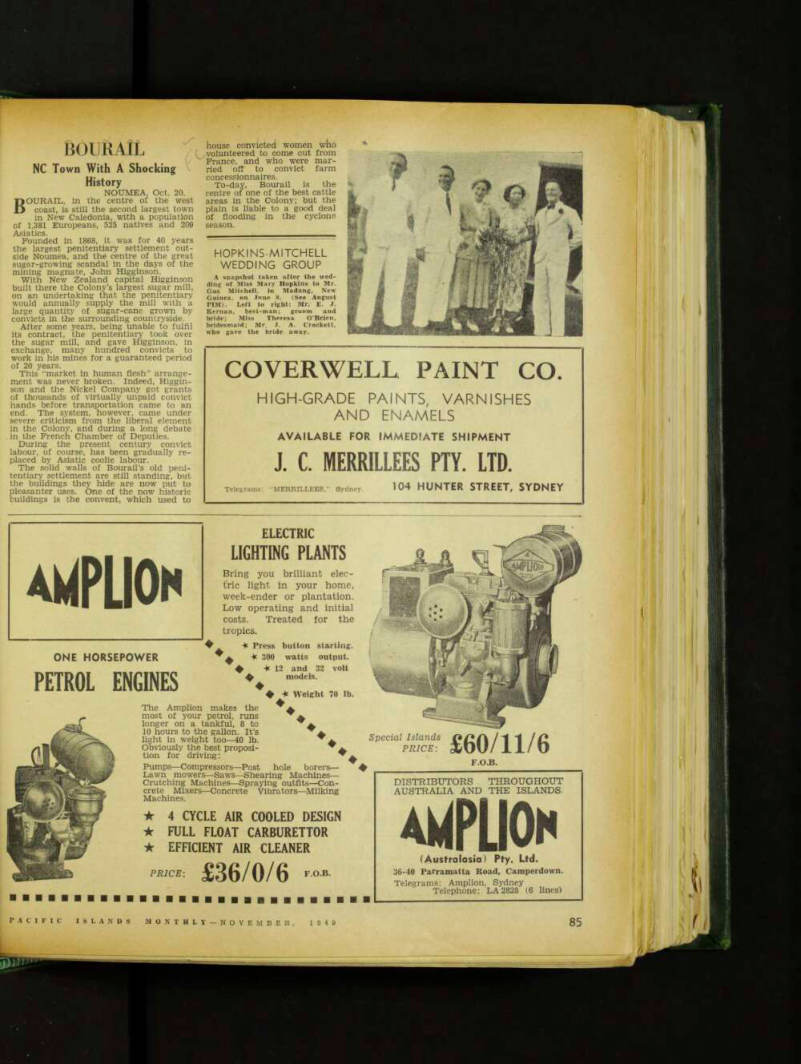
NC Town With A Shocking History
Noumea, Oct. 20.
BOURAIL, in the centre of the west coast, is still the second largest town in New Caledonia, with a population of 1,381 Europeans, 525 natives and 209 Asiatics Founded in 1868, it was for 40 years the largest penitentiary settlement out side Noumea, and the centre of the great sugar-growing scandal in the days of the mining magnate, John Higginson.
With New Zealand capital Higginson built there the Colony’s largest sugar mill, on an undertaking that the penitentiary would annually supply the mill with a large quantity of sugar-cane grown by convicts in the surrounding countryside.
After some years, being unable to fulfil its contract, the penitentiary took over the sugar mill, and gave Higginson, in exchange, many hundred convicts to work in his mines for a guaranteed period of 20 years.
This “market in human flesh” arrange ment was never broken. Indeed, Higgin son and the Nickel Company got grants of thousands of virtually unpaid convict hands before transportation came to an end. The system, however, came under severe criticism from the liberal element in the Colony, and during a long debate in the French Chamber of Deputies.
During the present century convict labour, of course, has been gradually re placed by Asiatic coolie labour.
The solid walls of Bourail’s old peni tentiary settlement are still standing, but the buildings they hide are now put to pleasanter uses. One of the now historic buildings is the convent, which used to
house convicted women who volunteered to come out from France, and who were mar ried off to convict farm concessionnaires.
To-day, Bourail is the centre of one of the best cattle areas in the Colony; but the plain is liable to a good deal of flooding in the cyclone season.
Hopk Ins-Mi Tch Ell
Wedding Group
A snapshot taken after the wed ding of Miss Mary Hopkins to Mr.
Gus Mitchell, in Madang, New Guuinea, on June 8. (See August PIM). Left to right: Mr. E. .J.
Kernan, best-man; groom and bride; Miss Theresa O’Brien, bridesmaid; Mr. J. A. Crockett, who gave the bride away.
Mr. K. J. Keegan, Administrative Officer at Ocean Island, accompanied by Mrs.
Keegan, passed through Sydney in Nov ember, on their way back from Suva, Mr. Keegan had to go to Fiji several weeks ago to give evidence at the trial of a Chinese labourer for murder on Ocean Island: and, after the trial, he spent a period in hospital, to get rid of
an old complaint, which he apparently picked up during his long service in the Solomons.
The Rev. Stewart Hurse, of the Pres byterian Overseas Mission in the New Hebrides who recently was flown to Aus tralia for a head operation, is now re covering.
Advertisements & other items, pp. 87-88 (1 item)
aMPUOh
COVERWELL PAINT CO.
HIGH-GRADE PAINTS, VARNISHES
AND ENAMELS
AVAILABLE FOR IMMEDIATE SHIPMENT
J. C. MERRILLEES PTY. LTD.
Telegrams; MERRILLEES,’’ Sydney. 104 HUNTER STREET, SYDNEY
ONE HORSEPOWER
PETROL ENGINES
ELECTRIC
LIGHTING PLANTS
Bring you brilliant electric light in your home, week-ender or plantation.
Low operating and initial costs. Treated for the tropics.
M Press button starting. * * 300 watts output. + * 12 and 32 volt models. ♦ ♦ * Weight 70 lb. \ hole borers— < The Amplion makes the most of your petrol, runs longer on a tankful, 8 to 10 hours to the gallon. It’s light in weight too—4o lb.
Obviously the best proposition for driving: Pumps—Compressors—Post Lawn mowers—Saws—Shearing Machines— Crutching Machines—Spraying outfits —Concrete Mixers—Concrete Vibrators—Milking Machines.
★ 4 CYCLE AIR COOLED DESIGN
★ FULL FLOAT CARBURETTOR
★ EFFICIENT AIR CLEANER
»!« Special Islands
PRICE:
£6O/11/6 F. 0.8.
PRICE:
£36/0/6 F. 0.8.
DISTRIBUTORS THROUGHOUT
AUSTRALIA AND THE ISLANDS.
aMPUOh
(Australasia) Pty. Ltd. 36-40 Parramatta Road, Camperdown.
Telegrams: Amplion, Sydney Telephone: LA2828 (6 lines)
Wynne S. Breden Pty. Ltd.
SHIPWRIGHTS, BOAT BUILDERS AND ENGINEERS.
"PHOENIX SHIPYARDS", NEWCASTLE, N.S.W.
Designers, Builders & Outfitters of ISLAND Vessels Work Boats, Cargo Boats and Auxiliary Craft up to 200 tons.
MANUFACTURERS AGENTS
m
SSL
• * f m CiA 9 EE S ./ v> \V tv°* ■* o ( CE *
ROBERT GILLESPIE
NEW GUINEA LTD
HEAD OFFICE LAE
BRANCH OFFICE RABAUL
±tV ROBERT GILLESPIE PTY.LTD.nt™
In New Caledonia
From Our Own Correspondent
Noumea, Oct. 31.
The sugar position in New Caledonia has been reversed. Martinique sugar is now being sold in Noumea for 13.10 francs, instead of 19,30 francs; while Australian sugar has risen from 12.40 to 17.50 francs per kilo. ♦ ♦ * Eight thousand Noumeans —in fact, well over half the town’s inhabitants—visited Noumea’s new Woolworth-style store, the Printania, on its opening days. It struck the locals as being very up-to-date—“just like Sydney.” • * ♦ Receptions have been held in New Cale donia in honour of the visiting Rev.
Mother Superior of the Order of St.
Joseph de Cluny. She is also visiting Tahiti, Fiji, New Zealand and Haiti. * * * New Caledonia recently learned—with surprise, comments the Bulletin de Com merce—that no fewer than 155 of the Colony’s inhabitants were sentenced by a Vichy court-martial in Saigon, Indo china, in February, 1942, to death or hard labour, for periods of 20 years. The list of those numbering 142 condemned to death and loss of their possessions is headed by Governor Henri Sautot, who rallied New Caledonia and the New Hebrides, so far as its French settlers were concerned, to Free France. He was condemned “for having handed over the two Territories to a foreign Power” (mean ing Britain)! This year, in annulling the sentences, the Court of Appeal praised the actions of the condemned persons as be ing “highly patriotic and with the effect of bringing about the liberation of France.” • ♦ ♦ Because of unforeseen recruitment diffi culties with the Indonesian Government the visits of the Messageries Maritimes vessels St. Loubert Bie, St. Mere Eglise and St. Nazaire to Batavia have been cancelled.
They were to have picked up inden tured Javanese labourers for New Cale donia and New Hebrides.
East Papua
A 600-Miles Drift
Santa Cruz Canoe Reaches East Papua
ON the subject of long canoe voyages, it may be recalled that during the last war, a canoe that was little more than a roughly hollowed-out log, carrying three natives, was swept away in a westerly direction from the Santa Cruz Islands, north-east of the New Hebrides.
It was first sighted by a United States naval patrol, but the latter was under pressure and could not stop to pick up the natives. One of the men, trying to climb the mast, fell and broke his arm.
The patrol reported to the Air Force, and an American plane found the canoe, dropped food and water, and kept in touch with the drifting craft until it went ashore on Rossel Island, Eastern Papua.
The canoe had drifted some 600 miles, missing the southern Solomons.
The three natives landed on the north side of Rossel, and walked some 10 to 12 miles along the coast. Another canoe then picked them up and conveyed them to Sudest Island, where ANGAU officers took charge of them. Without the assistance of the Americans, on the high seas, they must have perished.—D. H.
Osborne.
Response
Money For Distressed
Children
Papua-N. Guinea’s Generous Response
IN a Government Gazette, dated October 19, there is evidence of one of the really remarkable demonstrations in the history of Papua-New Guinea, In 1948, the Administrator, Colonel J.
K. Murray, asked Messrs. J. H. Ahearn, J. H. Jones, District Officers and others, to organise an appeal for funds for the alleviation of distress among the children of the world. The response exceeded all expectations.
At the end of 1948 and early 1949, the Territories Committee remitted, through the Administrator, no less than £17,077 to the Australian Committee of the UNO Children’s Appeal, The details show that nearly every community in nearly every administrative district subscribed generously; and the following analysis indicates the way in which the native peoples—individuals as well as by villages—responded to the appeal.
Fijian delegates to the Methodist Synod, which met in Suva during October, made a presentation to Miss P. Brokenshire, who is to retire after 34 years’ service with the Methodist Mission in the Colony.
She went to Fiji in 1915 and has served
at Methodist Mission Girls’ Schools at Dilkusha, Richmond (Kadavu), Ba, Lau toka and Mauavolo. At present she is at Delainavesi School.
The retail price of milk in Fiji has been raised to 4id. per pint but this does not stop vendors from stretching it by adding water. Three Indian vendors were brought before Suva Court recently—one of them was selling “milk” which had 53.8 per cent, of added water.
N. Ireland 213 146 567 New Ireland Dist 213 146 567 Sepik Dist. . 408 45 1.865
European Chinese Native £ £ £ Central Dis, . 3,075 — 301 Eastern Dist. 1,194 — 416 E. Cent. Dist. 38 109 Delta Dist. .. 46 — — Gulf Dist. 114 North Dist. .. 119 — 280 SE Division .. 110 — 231 West Dist. . 69 — 22 Madang Dist. . 329 81 7 Kieta Dist. .. 319 34 1,165 Manus Dist. . 20 — Cent. Highlands .. 259 51 Morobe Dist. . 1,328 115 702 New Britain Dist 715 1,176 1,433
Advertisements & other items, pp. 89-90 (1 item)
Tallemao & Company Pty. Limited
60 YORK STREET, SYDNEY, N.S.W.
Also Brisbane, Melbourne, Adelaide, Perth.
Buying Agents of all Australian Products ..
Sole Exporters for numerous Australian
Manufacturers
Careful and Prompt Attention to all Enquiries Send us your inquiries which will have our careful and prompt attention.
WRITE FOR DETAILED PRICE LIST
Cable Address: “FRESHET”
McILRATH’S for groceries
and PROVISIONS
202 Pitt St., Sydney,
EVERY ORDER —large or small, has the same careful attention as if you purchased in person.
FOR YOUR CONVENIENCE —our Service Department will be pleased to purchase all your general household requirements and include them with your grocery order, thereby saving extra freight and charges.
TO ENSURE PERISHABLE GOODS ARRIVING AT DESTINATION IN GOOD CONDITION, they are supplied in tins wherever necessary.
HIGHLY PERISHABLE GOODS—such as Butter, Cheese, Bacon, Eggs, Fruit and Fresh Vegetables, etc., are shipped in the steamer’s refrigerator.
Varied Stocks of Essential Foods are Available, including Cakes (in tins), Plum Puddings, Nuts, Wines, Spirits, Liqueurs, Cider, Cordials and Pure Fruit Juices, together with Allsopp’s English Lagei (26 oz. bottles) in 4 doz. case lots.
ALL SHIPMENTS, EXCLUDING DECK CARGO, ARE INSURED AGAINST PILLAGE, THEFT
AND NON-DELIVERY
Bend us a trial order, or if you desire quotations first, let us have a list of your requirements, and we will airmail you a pro forma invoice showing the cost of such goods.
SPECIAL GIFT HAMPERS for friends in GREAT BRITAIN are available for immediate despatch, priced from 14/- to 35/9 each. Delivery at destination in Good Condition Guaranteed.
Prices include packing, postage and insurance to the United Kingdom.
WRITE FOR DESCRIPTIVE LEAFLET
McILRATH’S PTY. LTD.
202 PITT ST., SYDNEY, AUSTRALIA
Cable Address: “ROTUNDA,” SYDNEY
TO-DAY’S MOST OUTSTANDING
RADIO !
★ A Pleasing Christmas Present!!
The T Throat
KRIESLEB
Sealed RADIO
OUTSTANDING VALUE!—WORLD RANGE
12,500 miles range guaranteed.
I 1 m
Sealed
MIDGET—A.C.
(Illustrated Above ) A Triple Throat sealed Radio, midget in size, mighty in performance , . . incorporates the unique Sound Vibrator Bridge that brings to midget radio the tonal quality of the true musical instrument. World range, too.
MODEL 11-20 WORLD RANGE. £lB/12/6
F. 0.8. BRIS.
Sealed
TABLE MODEL—A.C.
Here is your dream radio come true —the powerful, full size Triple Throat sealed Table Model . . . the most exciting radio ever built. Features the big console dial, beauty back and front, world range—plus the * triple throat that gives you three times the entertainment value.
MODEL 11-7 WORLD RANGE.
£26/7/6
F. 0.8. BRIS.
FREIGHT OFFER. Your radio will be despatched immediately by air or sea. We will pay up to 75 per cent, of freight cost, depending on distance.
BATTERY
MODELS-
Kriesler Model No. 314, Vibrator, Dual Wave inc.
Batteries—£37/6/6; Dry Battery Receiver £32/-/-, F.O.R. Brisbane.
Send your order to, or obtain further particulars from:
Queensland
MERCHANTS SUPPLIES
143-145 QUEEN STREET, BRISBANE, Q'LD.
400 Years Later
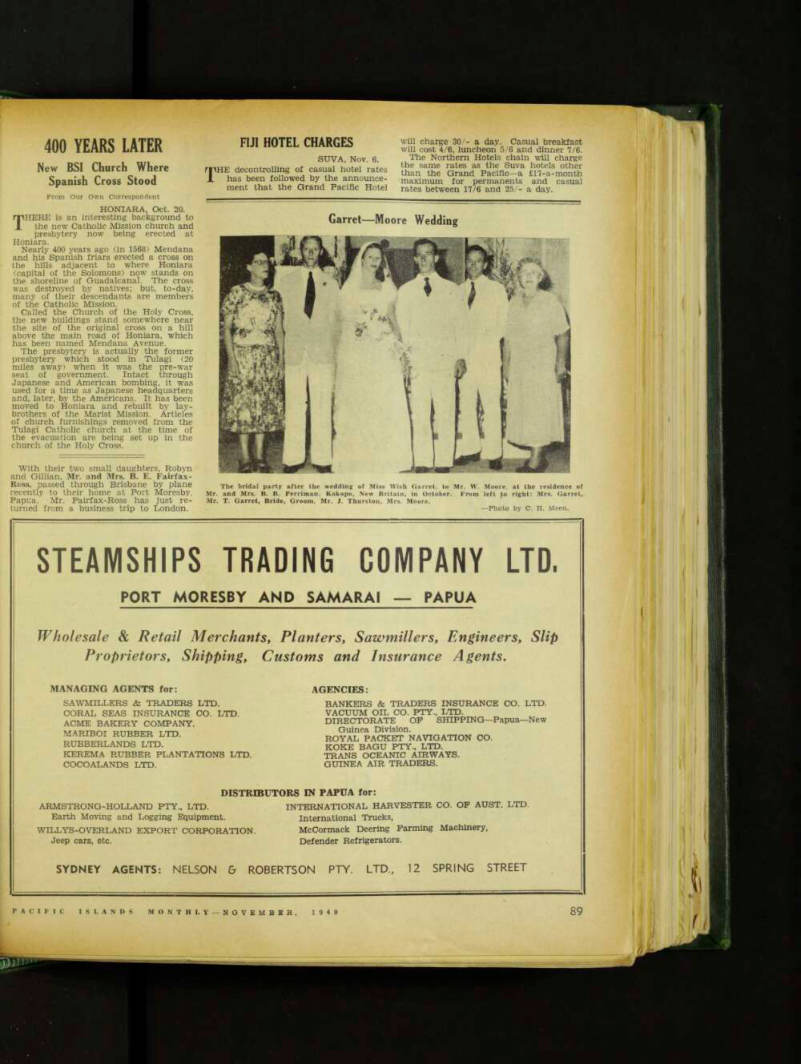
New BSI Church Where Spanish Cross Stood
From Our Own Correspondent
Honiara, Oct. 20.
THERE is an interesting background to the new Catholic Mission church and presbytery now being erected at Honiara, Nearly 400 years ago (in 1568) Mendana and his Spanish friars erected a cross on the hills adjacent to where Honiara (capital of the Solomons) now stands on the shoreline of Guadalcanal. The cross was destroyed by natives; but, to-day, many of their descendants are members of the Catholic Mission.
Called the Church of the Holy Cross, the new buildings stand somewhere near the site of the original cross on a hill above the main road of Honiara, which has been named Mendana Avenue.
The presbytery is actually the former presbytery which stood in Tulagi (20 miles away) when it was the pre-war seat of government. Intact through Japanese and American bombing, it was used for a time as Japanese headquarters and, later, by the Americans. It has been moved to Honiara and rebuilt by lay brothers of the Marist Mission. Articles of church furnishings removed from the Tulagi Catholic church at the time of the evacuation are being set up in the church of the Holy Cross.
With their two small daughters, Robyn and Gillian, Mr. and Mrs. B. E. Fairfax- Ross, passed through Brisbane by plane recently to their home at Port Moresby, Papua. Mr. Fairfax-Ross has just re turned from a business trip to London.
Fiji Hotel Charges
Suva Nov 6
mHE decontrolling of casual hotel rates ± has been followed by the announce ment that the Grand Pacific Hotel
win chal *ge 30/- a day. Casual breakfast will cost 4/6, luncheon 5/6 and dinner 7/6.
The Northern Hotels chain will charge maximum for permanents and casual rates between 17/6 and 25/- a day.
Garret—Moore Wedding
The bridal party after the wedding of Miss Wish Garret, to Mr. W. Moore, at the residence of Mr. and Mrs. B. B. Perriman, Kokopo, New Britain, in October. From left to right: Mrs. Garret, Mr. T. Garret, Bride, Groom, Mr. J. Thurston, Mrs. Moore. —Photo by C. H. Meen.
Advertisements & other items, p. 91 (1 item)
Steamships Trading Company Ltd.
PORT MORESBY AND SAMARAI PAPUA
Wholesale & Retail Merchants, Planters, Sawmillers, Engineers, Slip
Proprietors, Shipping, Customs and Insurance Agents.
MANAGING AGENTS for:
SAWMILLERS & TRADERS LTD.
CORAL SEAS INSURANCE CO. LTD.
ACME BAKERY COMPANY.
MARIBOI RUBBER LTD.
RUBBERLANDS LTD.
KEREMA RUBBER PLANTATIONS LTD.
COCOALANDS LTD.
AGENCIES:
LTD.
BANKERS & TRADERS INSURANCE CO.
VACUUM OIL CO. PTY., LTD.
DIRECTORATE OP SHIPPING—Papua—New
Guinea Division.
ROYAL PACKET NAVIGATION CO.
KOKE BAGU PTY., LTD.
TRANS OCEANIC AIRWAYS.
GUINEA AIR TRADERS.
DISTRIBUTORS IN PAPUA for:
ARMSTRONG-HOLLAND PTY., LTD. INTERNATIONAL HARVESTER CO. OP AUST. LTD.
Earth Moving and Logging Equipment. International Trucks, WILLYS-OVERLAND EXPORT CORPORATION. McCormack Deering Farming Machinery, Jeep cars, etc. Defender Refrigerators.
SYDNEY AGENTS: NELSON & ROBERTSON PTY. LTD., 12 SPRING STREET
Guinea
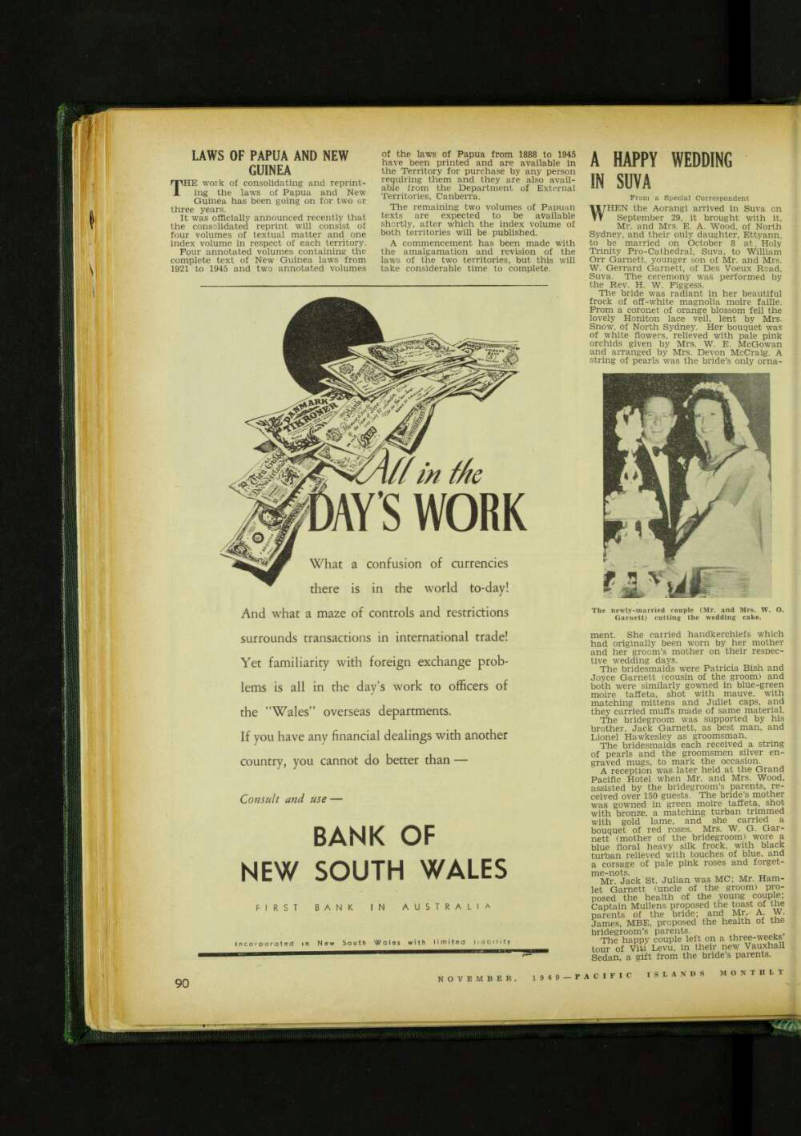
Laws Of Papua And New
THE work of consolidating and reprint ing the laws of Papua and New Guinea has been going on for two or three years.
It was officially announced recently that the consolidated reprint will consist of four volumes of textual matter and one index volume in respect of each territory.
Four annotated volumes containing the complete text of New Guinea laws from 1921 to 1945 and two annotated volumes
of the laws of Papua from 1888 to 1945 have been printed and are available in the Territory for purchase by any person requiring them and they are also avail able from the Department of External Territories, Canberra.
The remaining two volumes of Papuan texts are expected to be available shortly, after which the index volume of both territories will be published.
A commencement has been made with the amalgamation and revision of the laws of the two territories, but this will take considerable time to complete.
A Happy Wedding
In Suva
From a Special Correspondent WHEN the Aorangi arrived in Suva on September 29, it brought with it, Mr. and Mrs. E. A. Wood, of North Sydney, and their only daughter, Ettyann, to be married on October 8 at Holy Trinity Pro-Cathedral, Suva, to William Orr Garnett, younger son of Mr. and Mrs.
W. Gerrard Garnett, of Des Voeux Road, Suva. The ceremony was performed by the Rev. H. W. Figgess.
The bride was radiant in her beautiful frock of off-white magnolia moire faille.
From a coronet of orange blossom fell the lovely Honiton lace veil, lent by Mrs.
Snow, of North Sydney. Her bouquet was of white flowers, relieved with pale pink orchids given by Mrs. W. E. McGowan and arranged by Mrs. Devon McCraig. A string of pearls was the bride’s only orna-
merit. She carried handkerchiefs which had originally been worn by her mother and her groom’s mother on their respec tive wedding days.
The bridesmaids were Patricia Bish and Joyce Garnett (cousin of the groom) and both were similarly gowned in blue-green moire taffeta, shot with mauve, with matching mittens and Juliet caps, and they carried muffs made of same material.
The bridegroom was supported by his brother, Jack Garnett, as best man, and Lionel Hawkesley as groomsman.
The bridesmaids each received a string of pearls and the groomsmen silver en graved mugs, to mark the occasion.
A reception was later held at the Grand Pacific Hotel when Mr. and Mrs. Wood, assisted by the bridegroom’s parents, re ceived over 150 guests. The bride’s mother was gowned in green moire taffeta, shot with bronze, a matching turban trimmed with gold lame, and she carried a bouquet of red roses. Mrs. W. G. Gar nett (mother of the bridegroom) wore a blue floral heavy silk frock, with black turban relieved with touches of blue, and a corsage of pale pink roses and forget me-nots. T Mr Jack St. Julian was MC; Mr. Ham let Garnett (uncle of the groom) pro posed the health of the young couple; Captain Mullens proposed the toast of the parents of the bride; and Mr A W.
James, MBE, proposed the health of the bridegroom’s parents.
The happy couple left on a three-weeks tour of Viti Levu, in their new Vauxhall Sedan, a gift from the bride’s parents.
The newly-married couple (Mr. and Mrs. W. O.
Garnett) cutting the wedding cake.
Advertisements & other items, p. 92 (1 item)
S Work
& m m s 531 0 // />*
What a confusion of currencies there is in the world to-day!
And what a maze of controls and restrictions surrounds transactions in international trade!
Yet familiarity with foreign exchange prob-
lems is all in the day’s work to officers of the '‘Wales” overseas departments.
If you have any financial dealings with another country, you cannot do better than Consult and use
BANK OF
NEW SOUTH WALES
FIRST BANK IN AUSTRALIA
Incorporated in New South Wales with limited liability
Pitcairn Islanders
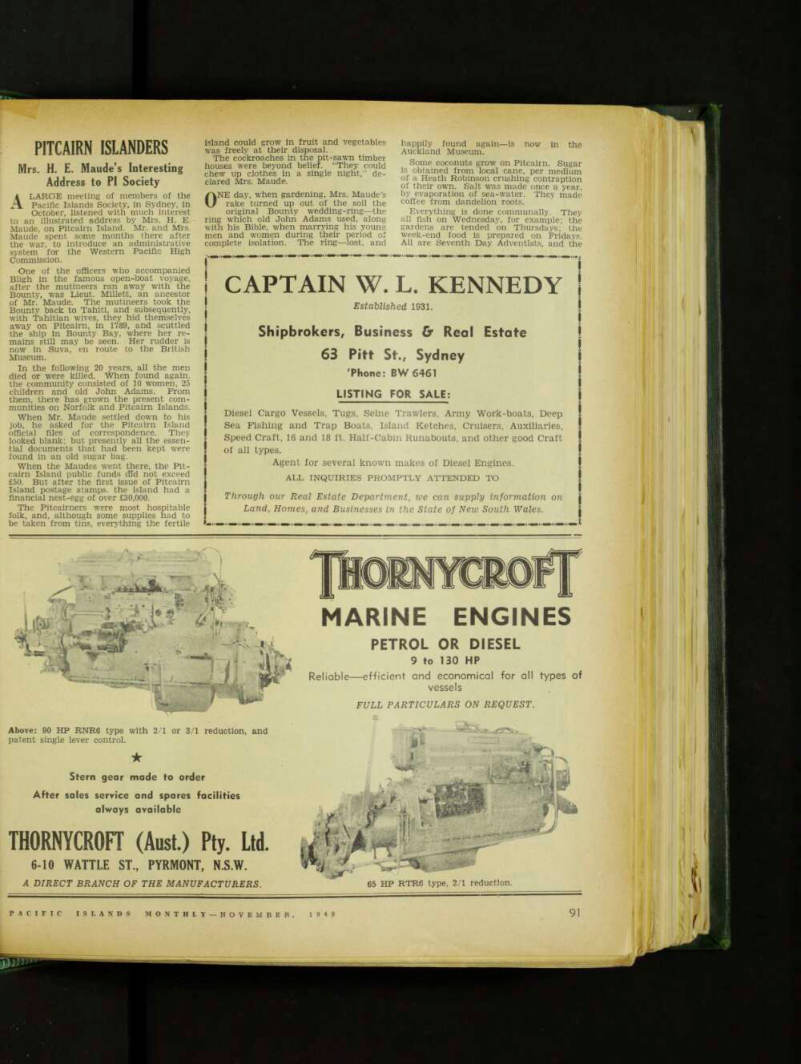
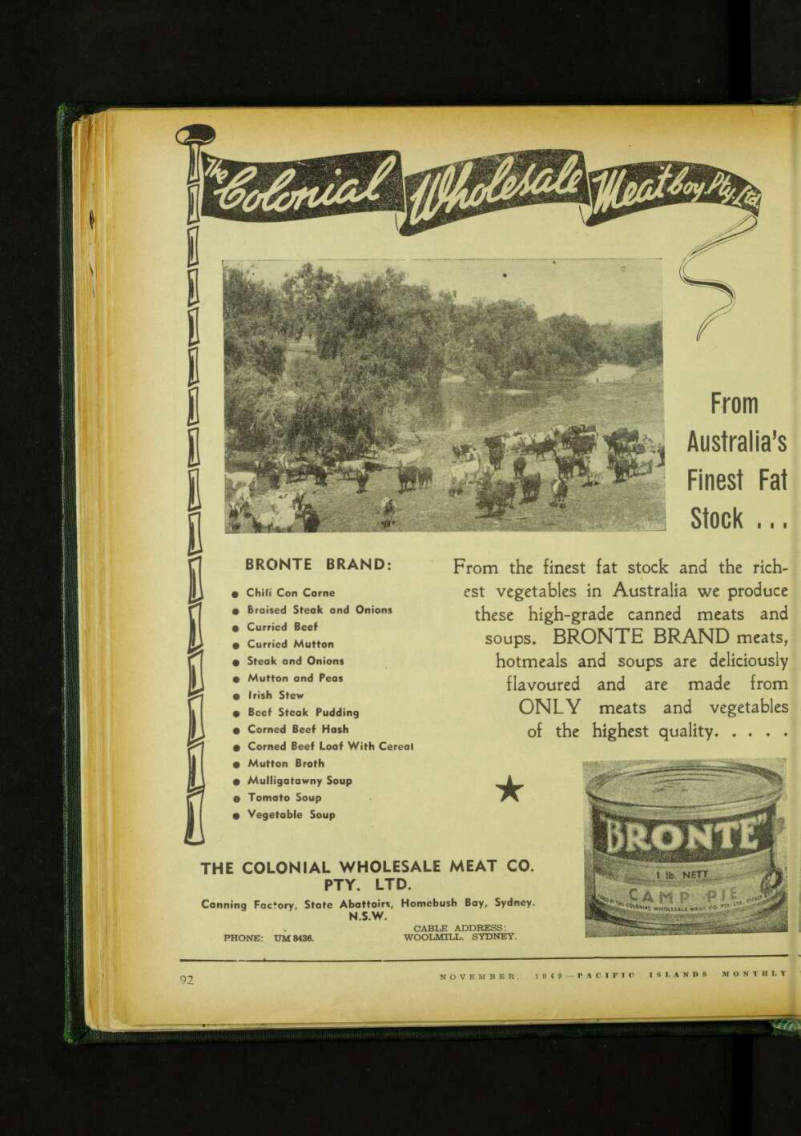
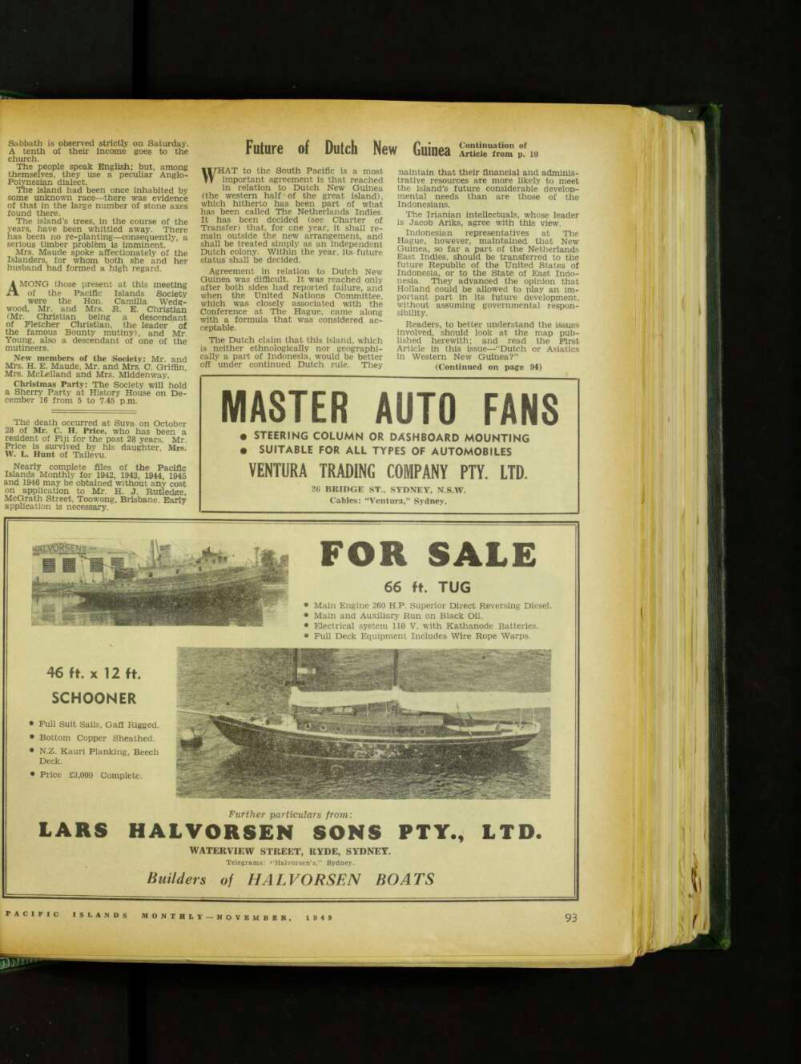
Mrs. H. E. Maude’s Interesting Address to PI Society
A LARGE meeting of members of the Pacific Islands Society, in Sydney, in October, listened with much interest to an illustrated address by Mrs. H. E.
Maude, on Pitcairn Island. Mr. and Mrs.
Maude spent some months there after the war, to introduce an administrative system for the Western Pacific High Commission.
One of the officers who accompanied Bligh in the famous open-boat voyage, after the mutineers ran away with the Bounty, was Lieut. Millett, an ancestor of Mr. Maude. The mutineers took the Bounty back to Tahiti, and subsequently, with Tahitian wives, they hid themselves away on Pitcairn, in 1789, and scuttled the ship in Bounty Bay, where her re mains still may be seen. Her rudder is now in Suva, en route to the British Museum.
In the following 20 years, all the men died or were killed. When found again, the community consisted of 10 women, 25 children and old John Adams. From them, there has grown the present com munities on Norfolk and Pitcairn Islands.
When Mr. Maude settled down to his job, he asked for the Pitcairn Island official files of correspondence. They looked blank; but presently all the essen tial documents that had been kept were found in an old sugar bag.
When the Maudes went there, the Pit cairn Island public funds did not exceed £5O. But after the first issue of Pitcairn Island postage stamps, the island had a financial nest-egg of over £30,000.
The Pitcairners were most hospitable folk, and, although some supplies had to be taken from tins, everything the fertile
island could grow in fruit and vegetables was freely at their disposal.
The cockroaches in the pit-sawn timber houses were beyond belief. “They could chew up clothes in a single night,” de clared Mrs. Maude.
ONE day, when gardening, Mrs. Maude’s rake turned up out of the soil the original Bounty wedding-ring—the ring which old John Adams used, along with his Bible, when marrying his young men and women during their period of complete isolation. The ring—lost, and
happily found again—is now in the Auckland Museum.
Some coconuts grow on Pitcairn. Sugar is obtained from local cane, per medium of a Heath Robinson crushing contraption of their own. Salt was made once a year, by evaporation of sea-water. They made coffee from dandelion roots.
Everything is done communally. They all fish on Wednesday, for example; the gardens are tended on Thursdays; the week-end food is prepared on Fridays.
All are Seventh Day Adventists, and the
Sabbath is observed strictly on Saturday.
A tenth of their income goes to the church.
The people speak English; but, among themselves, they use a peculiar Anglo- Polynesian dialect.
The island had been once inhabited by some unknown race—there was evidence of that in the large number of stone axes found there.
The island’s trees, in the course of the years, have been whittled away. There has been no re-planting—consequently, a serious timber problem is imminent.
Mrs. Maude spoke affectionately of the Islanders, for whom both she and her husband had formed a high regard.
AMONG those present at this meeting of the Pacific Islands Society were the Hon. Camilla Wedg wood, Mr. and Mrs. R, E. Christian (Mr. Christian being a descendant of Fletcher Christian, the leader of the famous Bounty mutiny), and Mr.
Young, also a descendant of one of the mutineers.
New members of the Society: Mr. and Mrs. H. E. Maude, Mr, and Mrs. C. Griffin, Mrs. McLelland and Mrs. Middenway.
Christmas Party: The Society will hold a Sherry Party at History House on De cember 16 from 5 to 7.45 p.m.
The death occurred at Suva on October 28 of Mr. C. H. Price, who has been a resident of Fiji for the past 28 years. Mr.
Price is survived by his daughter, Mrs.
W. L. Hunt of Tailevu.
Nearly complete files of the Pacific Islands Monthly for 1942, 1943, 1944, 1945 and 1946 may be obtained without any cost on application to Mr. H. J. Rutledge, McGrath Street, Toowong, Brisbane. Early application is necessary.
Advertisements & other items, pp. 93-95 (2 items)
THORNYCROFT (Ausl.) Pty. Ltd.
CAPTAIN W. L. KENNEDY
Established 1931.
Shipbrokers, Business & Real Estate
63 Pitt St., Sydney
'Phone: BW 6461
LISTING FOR SALE;
Diesel Cargo Vessels, Tugs, Seine Trawlers, Army Work-boats, Deep Sea Fishing and Trap Boats, Island Ketches, Cruisers, Auxiliaries, Speed Craft, 16 and 18 ft. Half-Cabin Runabouts, and other good Craft of all types.
Agent for several known makes of Diesel Engines.
ALL INQUIRIES PROMPTLY ATTENDED TO
Through our Real Estate Department, we can supply information on Land, Homes, and Businesses in the State of New South Wales.
i Above: 90 HP RNR6 type with 2/1 or 3/1 reduction, and patent single lever control. ★ Stern gear made to order After sales service and spares facilities always available
THORNYCROFT (Ausl.) Pty. Ltd.
6-10 WATTLE ST., PYRMONT, N.S.W.
A DIRECT BRANCH OF THE MANUFACTURERS.
Off
MARINE ENGINES
PETROL OR DIESEL
9 to 130 HP Reliable —efficient and economical for all types of vessels
FULL PARTICULARS ON REQUEST.
65 HP RTR6 type, 2/1 reduction.
If, I i I 8
BRONTE BRAND
Chili Con Came Braised Steak and Onions Curried Beef Curried Mutton Steak and Onions Mutton and Peas Irish Stew Beef Steak Pudding Corned Beef Hash Corned Beef Loaf With Cereal Mutton Broth Mulligatawny Soup Tomato Soup • Vegetable Soup
From
Australia’s
Finest Fat
Stock ...
From the finest fat stock and the rich- I
est vegetables in Australia we produce
these high-grade canned meats and
soups. BRONTE BRAND meats,
hotmeals and soups are deliciously
flavoured and are made from
ONLY meats and vegetables
of the highest quality. . . . . ★
THE COLONIAL WHOLESALE MEAT CO.
PTY. LTD.
Canning Factory, State Abattoirs, Homebush Bay, Sydney.
N.S.W.
PHONE: UM 8436.
CABLE ADDRESS:
WOOLMILL. SYDNEY.
-V t M F mm
MASTER AUTO FANS
• STEERING COLUMN OR DASHBOARD MOUNTING
• SUITABLE FOR ALL TYPES OF AUTOMOBILES
VENTURA TRADING COMPANY PTY. LTD.
26 BRIDGE ST., SYDNEY, N.S.W.
Cables: “Ventura,” Sydney.
FOR SALE
66 ft. TUG
• Main Engine 260 H.P. Superior Direct Reversing Diesel. • Main and Auxiliary Run on Black Oil. • Electrical system 110 V. with Kathanode Batteries. • Full Deck Equipment Includes Wire Rope Warps.
46 ft. x 12 ft.
SCHOONER
• Full Suit Sails, Gaff Rigged. • Bottom Copper Sheathed. • N.Z. Kauri Planking, Beech Deck. • Price £3,000 Complete. m ■ : ..
' ? m * Further particulars from :
LARS HALVORSEN SONS PTY., LTD.
WATERVIEW STREET, RYDE, SYDNEY.
Telegrams: ‘‘Halvorsen’s,” Sydney.
Builders of HALVORSEN BOATS
Future of Dutch New Guinea £s“m P o fio
Your Eye
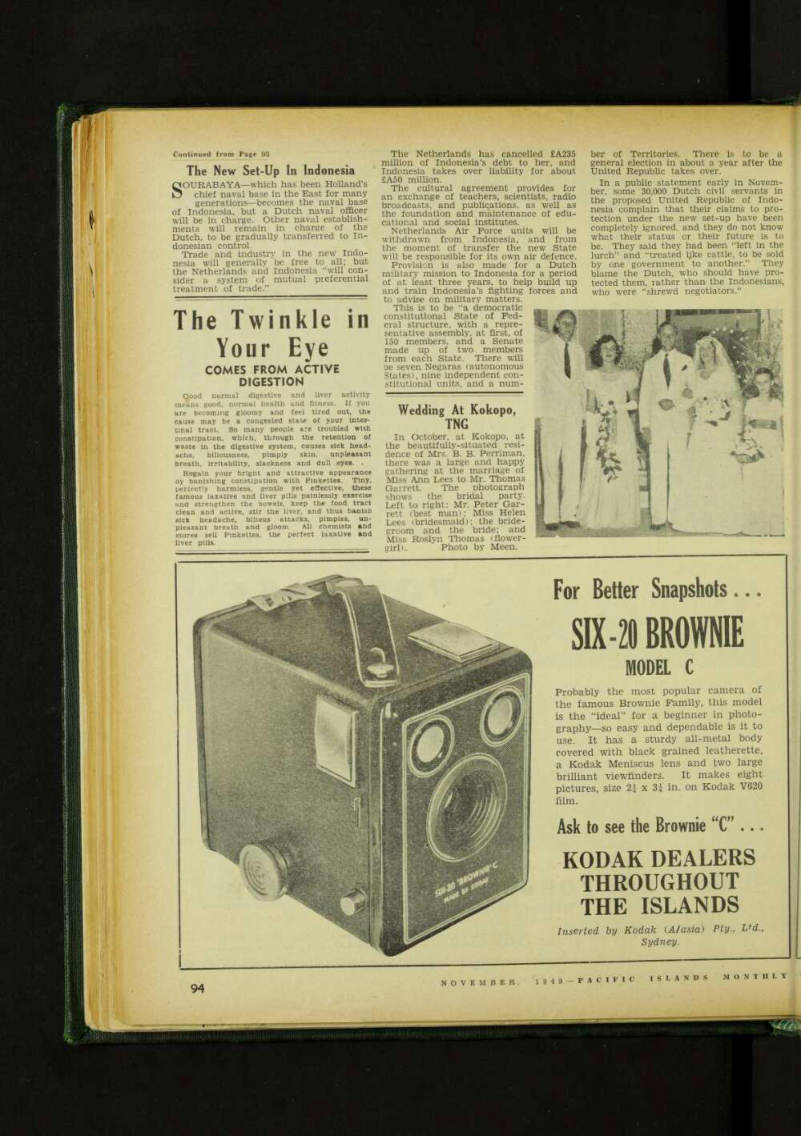
The Twinkle in Your Eye
Comes From Active
Digestion
Good normal digestive and liver activity means good, normal health and fitness. If you are becoming gloomy and feel tired out, the cause may be a congested state of your intes tinal tract. So many people are troubled with constipation, which, through the retention of waste in the digestive system, causes sick head ache, biliousness, pimply skin, unpleasant breath, irritability, slackness and dull eyes.
Regain your bright and attractive appearance oy banishing constipation with Pinkettes. Tiny, perfectly harmless, gentle yet effective, these famous laxative and liver pills painlessly exercise and strengthen the bowels, keep the food tract clean and active, stir the liver, and thus banish sick headache, bilious attacks, pimples, un pleasant breath and gloom. All chemists and stores sell Pinkettes, the perfect laxative and liver pills.
The Netherlands has cancelled £A235 million of Indonesia’s debt to her, and Indonesia takes over liability for about £ASO million.
The cultural agreement provides for an exchange of teachers, scientists, radio broadcasts, and publications, as well as the foundation and maintenance of edu cational and social institutes.
Netherlands Air Force units will be withdrawn from Indonesia, and from the moment of transfer the new State will be responsible for its own air defence.
Provision is also made for a Dutch military mission to Indonesia for a period of at least three years, to help build up and train Indonesia’s fighting forces and to advise on military matters.
This is to be “a democratic constitutional State of Fed eral structure, with a repre sentative assembly, at first, of 150 members, and a Senate made up of two members from each State. There will be seven Negaras (autonomous States), nine independent con stitutional units, and a num
ber of Territories, There is to be a general election in about a year after the United Republic takes over.
In a public statement early in Novem ber, some 30,000 Dutch civil servants in the proposed United Republic of Indo nesia complain that their claims to pro tection under the new set-up have been completely ignored, and they do not know what their status or their future is to be. They said they had been “left in the lurch” and “treated Ijke cattle, to be sold by one government to another.” They blame the Dutch, who should have pro tected them, rather than the Indonesians, who were “shrewd negotiators.”
Wedding At Kokopo,
Tng
In October, at Kokopo, at the beautifully-situated resi dence of Mrs. B. B. Perriman, there was a large and happy gathering at the marriage of Miss Ann Lees to Mr. Thomas Garrett. The photograph shows the bridal party.
Left to right: Mr. Peter Gar rett (best man); Miss Helen Lees (bridesmaid): the bride groom and the bride; and Miss Roslyn Thomas (flower girl). Photo by Meen.
Advertisements & other items, p. 96 (1 item)
Six-2) Brownie
Wm m > &
For Better Snapshots...
MODEL C
Probably the most popular camera of the famous Brownie Family, this model is the “ideal” for a beginner in photography—so easy and dependable is it to use. It has a sturdy all-metal body covered with black grained leatherette, a Kodak Meniscus lens and two large brilliant viewfinders. It makes eight pictures, size 2i x 3i in. on Kodak V 620 film.
Ask to see the Brownie “C” ...
KODAK DEALERS
THROUGHOUT
THE ISLANDS
Inserted hy Kodak ( A/asia) Pty., Ltd., Sydney.
Tahiti Notes
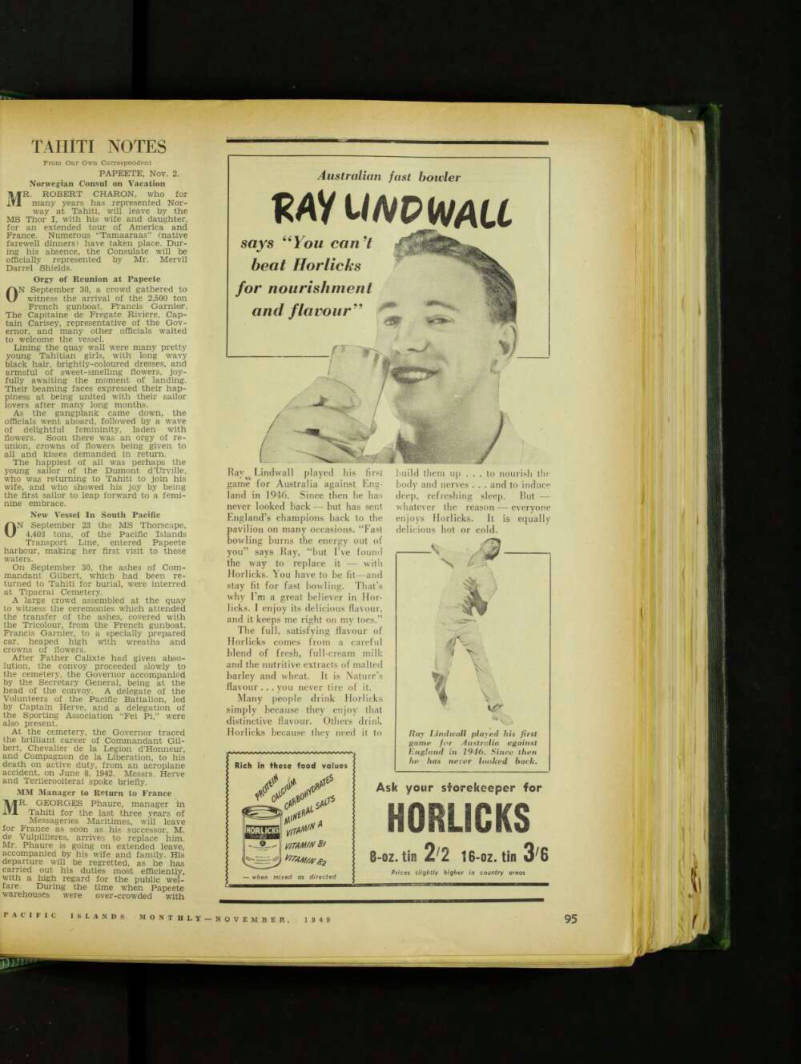
From Our Own Correspondent
Papeete, Nov. 2.
Norwegian Consul on Vacation
Mr. Robert Charon, Who For
many years has represented Nor way at Tahiti, will leave by the MS Thor I, with his wife and daughter, for an extended tour of America and France. Numerous “Tamaaraas” (native farewell dinners) have taken place. Dur ing his absence, the Consulate will be officially represented by Mr. Mervil Darrel Shields.
Orgy of Reunion at Papeete ON September 30, a crowd gathered to witness the arrival of the 2,500 ton French gunboat, Francis Gamier.
The Capitaine de Fregate Riviere, Cap tain Carisey, representative of the Gov ernor, and many other officials waited to welcome the vessel.
Lining the quay wall were many pretty young Tahitian girls, with long wavy black hair, brightly-coloured dresses, and armsful of sweet-smelling flowers, joy fully awaiting the moment of landing.
Their beaming faces expressed their hap piness at being united with their sailor lovers after many long months.
As the gangplank came down, the officials went aboard, followed by a wave of delightful femininity, laden with flowers. Soon there was an orgy of re union, crowns of flowers being given to all and kisses demanded in return.
The happiest of all was perhaps the young sailor of the Dumont d’Urville, who was returning to Tahiti to join his wife, and who showed his joy by being the first sailor to leap forward to a femi nine embrace.
New Vessel In South Pacific ON September 23 the MS Thorscape, 4,403 tons, of the Pacific Islands Transport Line, entered Papeete harbour, making her first visit to these waters.
On September 30, the ashes of Com mandant Gilbert, which had been re turned to Tahiti for burial, were interred at Tipaerai Cemetery.
A large crowd assembled at the quay to witness the ceremonies which attended the transfer of the ashes, covered with the Tricolour, from the French gunboat, Francis Gamier, to a specially prepared car, heaped high with wreaths and crowns of flowers.
After Father Calixte had given abso lution, the convoy proceeded slowly to the cemetery, the Governor accompanied by the Secretary General, being at the head of the convoy. A delegate of the Volunteers of the Pacific Battalion, led by Captain Herve, and a delegation of the Sporting Association “Fei Pi,” were also present.
At the cemetery, the Governor traced the brilliant career of Commandant Gil bert, Chevalier de la Legion d’Honneur, and Compagnon de la Liberation, to his death on active duty, from an aeroplane accident, on June 8, 1942. Messrs. Herve and Teriierooiterai spoke briefly.
MM Manager to Return to France MR. GEORGES Phaure, manager in Tahiti for the last three years of Messageries Maritimes, will leave for France as soon as his successor, M. de Vulpillieres, arrives to replace him.
Mr. Phaure is going on extended leave, accompanied by his wife and family. His departure will be regretted, as he has carried out his duties most efficiently, with a high regard for the public wel fare. During the time when Papeete warehouses were over-crowded with
copra, he managed to have chartered vessels call at Tahiti to remove to France the long-awaited foodstuff.
Mother Superior Visits Tahiti THIS Sisters of St. Joseph de Cluny, of Papeete, announced the arrival of their Mother-Superior-General by Trapas plane, at the end of October. On her arrival, a great Catholic celebra tion of welcome took place.
Lone Mariner Departs THE American cutter yacht, Stormaway, sailed on October 4 for the Western Pacific, via the Cook Islands. Captain Alfred Petersen left New York five months ago* and called at the West Indies, Panama, Gallapagos, Marquesas and Tuamotus.
Death of Mr. Charles Levy MR. C. LEVY, a well-known Islands resident, president of the Horse Riding Society, and president of the Syndicate of Proprietors, suddenly passed away on October 1, at Papeete Hospital from peritonitis.
At Tipaerai cemetery, among a large gathering of friends, the Mayor (Mr. A.
Poroi) spoke highly of Mr. Levy, with stress on his success as a cattle-breeder and farmer, and his efforts to improve the strain of Tahiti livestock. Among the sympathisers present was Mr. Charon, president of the League of Free French, of which Mr. Levy had been an active member.
Wedding MISS NORA FROGIER was married to Mr. Jean Vernaudon, on Oc tober 8, at Papeete. Both are de scendants of the first French settlers in Tahiti.
Personal
MT. ATTALI, Administrates adjoint
des Colonies arrived by the Oc tober plane to commence his duties at the Office of Returned Soldiers. He will attend to the needs of veterans of both World Wars, and the families of the deceased soldiers. Himself a veteran, Mr. Attali, after having escaped to Spam from Vichy France, joined the forces of the Free French, and participated in tne campaigns of France and Germany, dur ing which time he was wounded.
Messrs. Gaignard, and Lachenal, Counsellors of the Union Francaise, ar rived to spend several weeks in Tahiti, on a private mission. Mr. Gaignard was in Tahiti 8 years ago a* an Commissary Department of the converted cruiser Cap des Palmes, Mid was happy to meet many old Islands friends.
Advertisements & other items, pp. 97-98 (2 items)
95
PACIFIC ISLANDS MONT HLY NOVEMBER, 1949
Kav Uno Wau
Australian fast bowler
says “You can’t
beat Horlicks
for nourishment
and flavour”
% Ray Lindwall played his first game for Australia against England in 1946. Since then he has never looked back but has sent England’s champions back to the pavilion on many occasions. “Fast bowling burns the energy out of you” says Ray, “but I’ve found the way to replace it with Horlicks. You have to be fit—and stay fit for fast bowling. That’s why I’m a great believer in Horlicks. I enjoy its delicious flavour, and it keeps me right on my toes.”
The full, satisfying flavour of Horlicks comes from a careful blend of fresh, full-cream milk and the nutritive extracts of malted barley and wheat. It is Nature’s flavour . . . you never tire of it.
Many people drink Horlicks simply because they enjoy that distinctive flavour. Others drink Horlicks because they need it to build them up . . . to nourish the body and nerves . . , and to induce
deep, refreshing sleep. But
whatever the reason everyone enjoys Horlicks. It is equally delicious hot or cold. v Rich in these food values /,/ -oO^ 0 A 5^
V/TAMM 8/
t ' / Wdf//V#2 when mixed as directed Ray Lindwall played his first game for Australia against England in 1946. Since then he has never looked hack.
Ask your storekeeper for
LICKS
8-oz. tin
16-oz. tin
3's Prices slightly higher in country areas
THAT
A £ % the
EXECUTOR TRUSTEE ATTORNEY
The Answer to
Isolation
Isolation never assists the private executor to carry out his obligations. His inability to secure immediate sound advice may well prove disastrous as some decisions cannot be postponed. However, you can avoid this danger by appointing Burns Philp Trust Company Limited as your executor or trustee. Similarly, your unsought responsibilities as an executor may be transferred to the Company s capable directors and experienced officers.
Full details of the Company’s many services are given in “Hands That Never Leave The Wheel”.
A complimentary copy of this useful booklet can be obtained from any branch of Burns Philp (South Sea) Company Limited, Burns Philp (New Guinea) Limited, or direct from the head office of this Company.
DIRECTORS:
James Burns Joseph Mitchell P. T. W. Black Eric Priestley Lee MANAGER: L. S. Parker SECRETARY: E. R. Overton, F.F.I.A.
Burns Philp Trust
COMPANY LIMITED
Constituted by Special Act of the N.S.W. Parliament
HEAD OFFICE: 7 BRIDGE STREET, SYDNEY
TEL.: BU 5901 BOX GPO -’ SYDNEY
Why Boats Are Not Built
In Some Islands
Letter to the Editor YOU ask, in one of your issues, whyv handy boats and launches are notch built in Papua and New Guinea..
T 'ms' 6 son fs°°a d qullffled boat-builder-lvea was taught by a good man in Brisbane..
He S has constructed two 22£. ft. and another 30 ft. tong. But he can not get materials or paint. „ *r The stores can supply copper, andb nails’ but a 16 h.p. diesel engine, ordered!: last October, has not yet arrived, despites all the agent’s promises. A magneto *o posted in Brisbane last December. arnvedb at Rossel Island on June 28. Pit ordered two years ago came to hand recently. Tillers have gone astray.
Inability to get supplies or depend upom service makes boat-building here a heart breaking job.
I am, etc.,
D. H. Osborne.
Rossel Island.
Advertisements & other items, p. 98 (1 item)
96
NOVEMBER. ISO-PACIFIC ISLANDS MONIBLVI
Not Enough Ships
Planters' Disabilities In Buka and Bougainville
Prom Our Own Correspondent
Sohano. Nov. 6.
RECENTLY, the President of the Bou gainville Association (Mr. Fred Archer) and the Secretary of the Association (Mr. Max Babbage) went to Rabaul, to place before the Directorate of Shipping the difficult and increasingly serious matter of shipping between Rabaul, Buka and Bougainville ports They met at Rabaul Mr. Leighton, Director of Shipping, from Port Moresby, and Mr. George Hill, who is in charge of the Directorate’s activities in Rabaul.
It was pointed out to Mr. Leighton that there was an increasing accumu lation of copra at Buka and Bougainville ports, which the ships allotted to the run did not seem able to cope with. As the plantations were still not producin'- to capacity, and as the amount of native trade copra was also increasing, a serious state of affairs was developing. This would have a detrimental effect upon production and upon the morale of pro ducers, both European and native.
Planters have to carry large stocks of high-costing plantation and trading stores: but, after copra is produced, it lies a long time in plantation stores and, of course, is not paid for by the Produc tion Control Board until delivered to their stores. Thus, financing at the out port plantations is a difficult matter, especially as the merchants in Rabaul have, as a matter of policy, restricted credit to clients.
Mr. Leighton was sympathetic, but he pointed out that present vessels were un suitable and insufficient in numbers. He
had suggested to the Minister that 550ton vessels be substituted for those at present being used.
The Bougainville Association sent a radio, stressing the seriousness of the position, to the Minister of External Territories (Mr. E. J. Ward) and received a prompt reply to the effect that the matter would be taken up at once and advice in regard to action taken would be sent in due course.
Messrs. Archer and Babbage also met Mr. S. Lonergan, acting-Government Secretary, who was visiting Rabaul from Moresby, and was anxious to meet planters and others to obtain their views and discuss with them their various problems.
The various disabilities from which Bougainville suffers, on account of its isolated position, and being—as it were— “out on a limb,” were put before Mr.
Lonergan, and he promised to review them.
Mr. Lonergan remarked that an Asso ciation of district residents and others, putting their views to the Administration, was of great help to the Administration.
Native Labour Conditions
THE Director of Native Labour (Mr. W.
R. Humphries), from Port Moresby, made a trip by Catalina to Sohano on November 8, where he met residents of Buka and Bougainville and discussed with them matters in connection with Native Labour policy. There were present at the Conference the ADO (Mr. R. Cole), President of the Bougainville Association (Mr. Fred Archer), Secretary of the Bou gainville Association (Mr. Max Babbage) Mr. Don Colley (who superintends the Choiseul Plantations interests), and Mr.
De Moriar (District Native Labour officer).
The results achieved were considered highly satisfactory to all concerned, and appreciation of Mr. Humphries’ action, in coming to Sohano for this discussion, was expressed by those present.
The spirit of co-operation, shown at the Conference, is undoubtedly what is wanted between Administrative officers and the planters and employers of Native Labour.
Advertisements & other items, pp. 99-100 (1 item)
Budge
; Mi m
FRUIT JUICE
. C O R D I AJL
J. C. MERRILLEES PTY.
104 HUNTER ST., SYDNEY
ORANGE, LEMON,
CITRUS COCKTAIL,
FRUIT GUP, PINE-
APPLE. PASSION
FRUIT, AND ETC.
Also all Milk Bar Requirements, Syrups, and
ICE CREAM MIX
Agents'. —
WALTER GRAND,
PAPEETE, TAHITI.
HUNTS AGENCY,
SUVA, FIJI.
Telegrams:
MERRILLEES,”
Sydney
BUDGE
REFRIGERATION and
ICE MAKING
EQUIPMENT
COMMERCIAL AND INDUSTRIAL
UNITS
(not domestic) Ammonia and Methyl Chloride machines of large or small capacity.
The illustration is of a small (nine 28 lb. blocks) electric. Methyl Chloride Icemaking plant.
Enquirers should mention dimensions of cold room (or cabinet) and of amount of ice (if any) required per day; also if electric motor or internal combustion engine is to be included.
JAMES BUDGE PTY. LTD.
REFRIGERATION ENGINEERS
McEvoy Street, Alexandria, Sydney
u m Telephones: LA 5034-5-6 Established 1890
GIOBITE
TRAVEL CASES
As manpower and raw materials become available, increased quantities of Globites will be manufactured So ask first for Globitel Made by ford sherington ltd.
CHEF ALUMINIUM
KITCHENWARE
Stocks Available for Immediate
IT'S BETTER! ★ CHEF ★ KITCHENWARE
STOCK NUMBERS:
Spun in. Gauge.
BREAD BIN, SPUN KNOB (To Take 4 Loaves) 18
BREAD BIN, COLOUR BRIDGE 18
BOILER, 20 PINT 14
CAKE BOX, 11 in. DIAMETER, SPUN KNOB 18 CAKE BOX, 11 in. DIAMETER, COLOUR BRIDGE 18
SPICE CANISTERS, SET OF 5 20
SAFETY BOIL MILK SAUCEPAN (2 Pint) 16 FRY PAN, WITH LID, 9 in. DIAMETER 16 FRY PAN, 9 in., WITHOUT LID 16 FISH FRYER, 9 in., WITH BASKET 16
CUTLET PAN, 7 in 16
FISH FRYER, DEEP PAN 16
FISH FRYER, WITH LID ONLY, NO BASKET 16
2 PINT BILLY 20
3 PINT BILLY 20
4 PINT BILLY 20
SUGAR BASIN 20
CANDLE STICK 20
2 PINT SAUCEPAN, WITH LID 16
Prices Available Through Your Usual
Buying Agency
SOLE EXPORT REPRESENTATIVES:
HAW J. YOUNG PTY. LTD.
379 KENT STREET, SYDNEY
Phone: MABIB7. P.O. Box 3661, G.P.0., Sydney.
Fiji’s Cost of Living
Continues to Soar
From Our Own Correspondent
Suva. Nov. 6.
TO meet the increased cost of foodstuffs and wages, all Indian cafes in Suva have been permitted to raise their charges by 12i per cent. This follows close on the increases of tariffs at Fiii hotels. (See elsewhere this issue).
Suva taxi operators also have applied for a higher schedule of fares because of the mounting costs of petrol, oil and ve hicles. For most people, however, the cost of living problem centres on food, clothing and shelter.
Butter is a scarce, luxury item; beef is scarcely fit to eat; dalo (taro) is fre quently unobtainable, this being the off season, and a serious suggestion has peen made that the limited supply of dalo at Suva should be reserved for the Fijians in the same way as rice was formerly reserved, by law, for Indians and Chinese; lettuce, like many other vegetables, has been badly affected by the record rain fall this year; fruit is expensive and of poor quality, all imported foodstuffs are dear, and eggs, at round about 4/- a dozen, are now at their cheapest after reaching a peak of more than 6/- in many places.
Nutrition Research In
Polynesia
PROBLEMS associated with nutrition and tropical diseases among Cook Islanders are to be investigated by an expedition from the Otago Medical School, led by the dean of the school, Sir Charles Hercus, in December.
Dr. Muriel Bell, head of the nutrition research department of the school, will undertake the nutritional survey, after completing a similar study in Fiji. She will be accompanied by Dr. Lucy Wills, the distinguished nutritional research worker from Britain. Preliminary re search work in Fiji and the Cook Islands suggests that there may be insufficient protein in the diet of the people.
Dr. G. M. Satchell and Miss V. Jolly, of the zoology department, will under take entomological studies, and Dr. T.
Faine and Mr. J. A. Samuel, bacteriolo gist, will assist Sir Charles.
Notes From Mangaia, Cook
Islands
From Our Own Correspondent THE CIPA’s converted Fairmile launch, Lareta, visited this island in Septem ber, under the new arrangements that have made the isolation of Mangaia less formidable than formerly. The Lareta made two calls.
Mr. Albert Henry, the leader of the Progressive Association, was aboard and a meeting was held that will undoubtedly have important results later on.
On Mangaia, the CIPA has a following of at least 90 per cent, of the island, but just how many of these enthusiasts have “signed up” and paid the £3 share-money that qualifies them for full financial membership is an open question.
The CIPA will, to this writer’s mind, have its day. To underrate its potentiali ties would not be realistic; while to regard the Association as the tool of Com munism, again, is an excessively dramatic view. Albert, who received a warm wel come from Mangaian friends, did not indulge in any fervent oratory. * The second trip of the Lareta, a week or so later, brought us our very popular Cl medico, Dr. “Tommy” Davis, who now occupies the post of CMO in Rarotonga, succeeding Dr. R. Irwin, who is now in practice in NZ.
Mangaia is always glad to see this young doctor. A grandson of the late Captain Harries, Dr. Davis has a connection with Island Maori-dom deeper than the mere position of CMO; like his famous grand sire, the doctor is at home on the sea, navigation and radio being two of his many accomplishments. His transmitter in Rarotonga is well known to Pacific amateurs, and makes communication with many centres in Oceania. * Some inconvenience to the local post office and an obvious financial loss to the Internal Marketing Division of the NZ Government was caused when the Maui Pomare made her recent loading call, by the ship’s departure without the mails, and with a large quantity of cased fruit still waiting on the beach. The hurried getaway has not so far been explained, and is no loss to the planters here as the IMD pays for fruit whether shipped or not. It is, however, to be regretted that the mails were not taken, as the failure is likely to have an effect upon orders in tended for the closing months of the trading year.
The incident, which caused some an noyance locally, is an unusual one, and
not typical of Cl service. The boatmen had worked well (on. this occasion, well into the evening), under bad conditions at sea. , , The CIPA launch Lareta called later,
and occasion was taken to dispatch the delayed mails, the damp bags having by then been carefully dried and re-made up after their abortive trip to and from the Maui Pomare.
Advertisements & other items, pp. 101-102 (1 item)
8) H^tsomVbctor
Asthma, Bronchitis Coughing, Curbed in 3 Minutes
Do you have attacks of Asthma or Bronchitis so bad that you can’t sleep? Do you feel weak, unable to work, and have to be careful not to take cold and can’t eat certain foods?
No matter how long you have suffered or what you have tried, there is new hope for you in a doctor’s prescription called Mendaco.
No dopes, no smokes, no injections, no atomizer.
All you do Is take two tasteless tablets at meals and In 3 minutes Mendaco starts working through your blood, aiding nature to remove phlegm, promote free easy breathing and bring sound sleep the first night, so that you soon feel years younger and stronger.
No Asthma in 2 Years
Mendaco not only brings almost Immediate comfort and free breathing but builds up the system to ward off futere attacks. For Instance, J. Richards. Hamilton, Ont., Canada, nad lost 40 lbs., suffered coughing every night, couldn't sleep. Mendaco stopped Asthma
spasms first night and he has had none since In over two years.
Money Back Guarantee
The very first dose of Mendaco goes right to work circulating through your blood and helping nature relieve you of the effects of Asthma. Try Mendaco under an Iron-clad money back guarantee. You be the judge. If you don’t feel fully satisfied after taking Mendaco just return the empty package and the full purchase price will be refunded. Get Mendaco from your chemist to-day and see how well you sleep to-night and how much better you feel to-morrow. The guarantee protects
you - RELIEVES ASTHMA
Mendaco
Now in 2 sizes ... 6/- and 12/-
X-RAY, PHYSICAL-THERAPY
SURGICAL & SCIENTIFIC EQUIPMENT
Prompt Attention to All Inquiries
8) H^tsomVbctor
]L II UTEID
Watson House, 9-13 Bligh Street, Sydney, Australia
KWONG CHONG BROTHERS
General Merchants and Planters
Have now re-established their business on their original pre-war site, and are carrying stocks of Trading and Plantation requirements. All enquiries welcomed and service assured.
Sydney Representatives:
NELSON & ROBERTSON PTY., LTD.,
Electra House, 12 Spring Street, Sydney, N.S.W.
KWONG CHONG BROTHERS
KEMARERE STREET, RABAUL
CHAPMAN WONDER LAUNCHES are
ideal for Island service. Available in 16 ft. open, and 16 ft. and 18 ft. halfcabin models, these launches have won universal acclaim as examples of the most perfect small boats ever built.
M *** % Tl K. /S I A
Su C
Enthusiastic boat owners *■ o $ £ i everywhere testify to t//? c the reliability of Blax- 0 land-Chapman Marine Engines.* u Q Employing the famous Chapman* 4a*. patents, there is an power unit for every boatings application, embodying features that give safe,| simple and economic operation. Notable amongstf these products are the new h.p. Blaxland Pupi and 5/7 h.p. Blaxland Twin Marine Engines, andj the full range of Blaxland-Chapman Marine Engines—from 2\ h.p. to 20 h.p.—also the famous Pumping Unit. *n.
A C 1 Since no reserves of stock ore held, orders for forward delivery should be placed now.
5/7 H P. BLAXLAND TWIN TXR
[/U-IU
•fcAtOC The 2i h.p., 3 h.p., and h.p. engines are suitable for launches up to 16 ft. They are ideal for pleasure craft, and will stand up to the most gruelling conditions. The 4] h.p. 5/7 h.p. Twin, 6/8 h.p., and 10 h.p. engines are suitable for launches from 16 ft. to 30 ft. These medium to heavy duty engines are ideal for fishermen and other users of heavy work boats who require maximum power and unfailing service under all conditions. Models from 4i h.p. upwards are reversible; direction of rotation being changed by a mere flick of the patented magneto.
KERR BROS
V,
PTY. LTD
10 H.P. BLAXLAND-CHAPMAN SEADOG
*C, Enquiries are invited:
KERR BROS. PTY. LTD.
4 YORK STREET,
SYDNEY, AUSTRALIA.
Box 3838, G.P.0., Cables; “CARE,” Sydney. °/s
r ft/B
°ro*.
Against
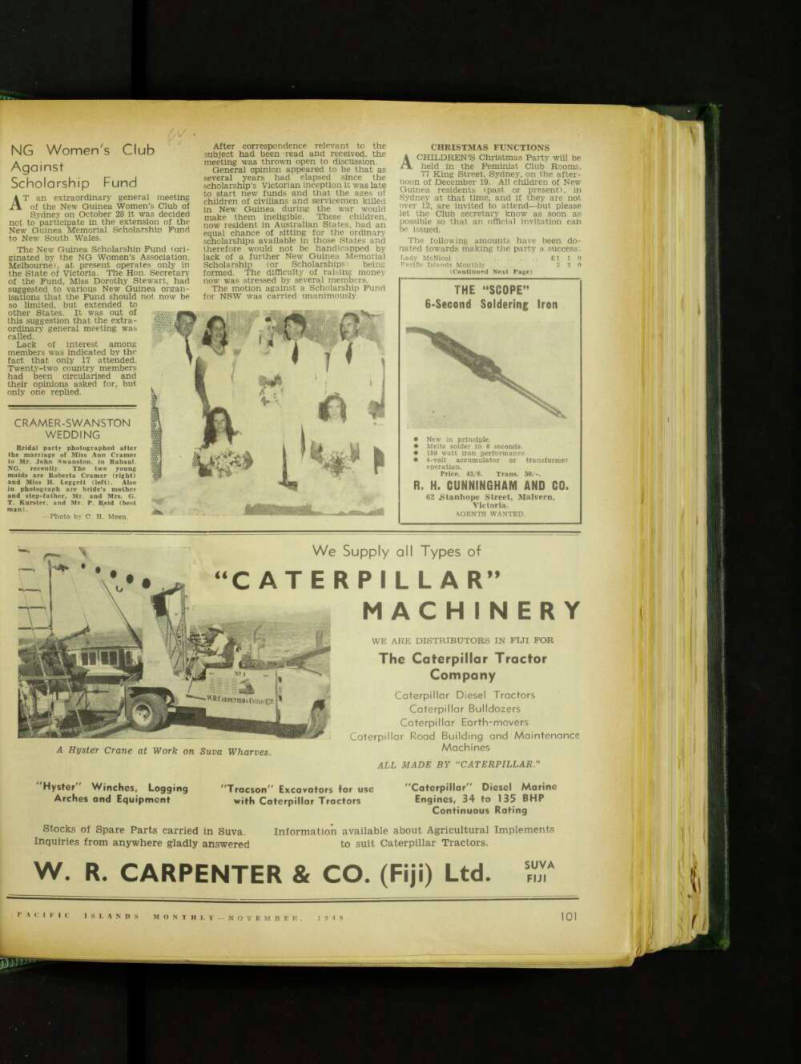
NG Women's Club Against Scholarship Fund
AT an extraordinary general meeting of the New Guinea Women’s Club of Sydney on October 28 it was decided not to participate in the extension of the New Guinea Memorial Scholarship Fund to New South Wales.
The New Guinea Scholarship Fund (ori ginated by the NG Women’s Association, Melbourne), at present operates only in the State of Victoria. The Hon. Secretary of the Fund, Miss Dorothy Stewart, had suggested to various New Guinea organ isations that the Fund should not now be
so limited, but extended to other States. It was out of this suggestion that the extra ordinary general meeting was called.
Lack of interest among members was indicated by the fact that only 17 attended.
Twenty-two country members had been circularised and their opinions asked for, but only one replied.
After correspondence relevant to the subject had been read and received, the meeting was thrown open to discussion.
General opinion appeared to be that as several years had elapsed since the scholarship’s Victorian inception it was late to start new funds and that the ages of children of civilians and servicemen killed in New Guinea during the war would make them ineligible. These children, now resident in Australian States, had an equal chance of sitting for the ordinary scholarships available in those States and therefore would not be handicapped by lack of a further New Guinea Memorial Scholarship (or Scholarships > being formed. The difficulty of raising money now was stressed by several members.
The motion against a Scholarship Fund for NSW was carried unanimously.
Cramer-Swanston
Wedding
Bridal party photographed after the marriage of Miss Ann Cramer to Mr. John Swanston, in Rabaul.
NG, recently. The two young maids are Roberta Cramer (right) and Miss H. Leggett (left). Also in photograph are bride’s mother and step-father, Mr. and Mrs. G.
T. Kurster, and Mr. P. Reid (best man).
Photo by C. H. Meen.
Christmas Functions
A CHILDREN’S Christmas Party will be held in the Feminist Club Rooms, 77 King Street, Sydney, on the after noon of December 19. All children of New Guinea residents (past or present), in Sydney at that time, and if they are not over 12, are invited to attend—but please let the Club secretary know as soon as possible so that an official invitation can be issued.
The following amounts have been do nated towards making the party a success; Lady McNicol £1 1 0 Pacific Islands Monthly 2 2 o
(Continued Next Page)
Major Ayris (late) ... iO 6 Matron Hanlon (Rabaul) 5 0 Sister Henry (Rabaul) 5 0 Mrs. A. Innes 10 0 Mrs. I. Pryke 110 Bulolo Gold Dredging, Ltd 10 10 0 Gordon Edgell & Sons 2 2 0 Burns Philp & Co., Ltd 3 3 0 W. R. Carpenter & Co., Ltd 3 3 0 Mrs. P. Northam 110 Mrs. F. Harvey 10 6 £26 3 6 An adults party will be held in the club rooms on December 22, 1949.
Advertisements & other items, pp. 103-104 (1 item)
“Caterpillar”
THE “SCOPE"
6-Second Soldering Iron
o New in principle. • Melts solder in 6 seconds. • 150 watt iron performance • 4-volt accumulator or transformer operation.
Price, 43/6. Trans. SO/-.
R. H. CUNNINGHAM AND GO.
62 Stanhope Street, Malvern, Victoria.
AGENTS WANTED.
u M A Hyster Crane at Work on Suva Wharves.
We Supply all Types of
“CATERPILLAR”
MACHINERY
WE ARE DISTRIBUTORS IN FIJI FOR
The Caterpillar Tractor
Company
Caterpillar Diesel Tractors Caterpillar Bulldozers Caterpillar Earth-movers Caterpillar Road Building and Maintenance Machines
ALL MADE BY “CATERPILLAR.”
Hyster" Winches, Logging Arches and Equipment Tracson" Excavators for use with Caterpillar Tractors 'Caterpillar" Diesel Marine Engines, 34 to 135 BHP Continuous Rating Stocks of Spare Parts carried in Suva. Information available about Agricultural Implements Inquiries from anywhere gladly answered to suit Caterpillar Tractors.
W. R. CARPENTER & CO. (Fiji) Ltd.
SUVA
FIJI
40ft. TRADE BOATS •B.T.H. PROJECTORS
Especially designed and built for 16 m.m. Sound-Film Projectors em- Island conditions. bodying features unique in current Fully equipped and delivered to your British and American sound film prodestination. jectors.
Can we help you? Representative now travelling in U.K. and the Continent.
WILLREED AGENCIES PTY. LTD.
145 a George St., Circular Quay, Sydney. Cables: “REEDAGE.”
DISPOSALS GOODS WANTED
The owner of the 68 ft. auxiliary Ketch “Darnley,” ideally suited and equipped for Island trade, is prepared to consider exchanging this vessel for Army Disposals material, timber stand or logs.
See full-page advertisement- of the "Darnley" on Page 2 of this issue.
BROOMFIELDS Ltd.
Suppliers of Building Hardware Ship Chandlery, Paint Materials i %
WRITE DIRECT TO:
Broomfields Ltd., 152 Sussex Street, Sydney
A Melbourne Cup Fantasy
They had “Melbourne Cup fever” in Port Moresby. A clever girl there composed the following “fantasy,” in which she used the name of every Cup starter. She gave Foxzami prominence—but put her modest bet on Comic Court.
CLEMENT, will, you please HURRY UP and go home to SAXONY? And do not PERSIST in singing that SUN LYRIC to me (of which I would like a CARBON COPY) or I shall take it as a
Precedent.
As a matter of fact, I have a date with
A Dashing Beau Named Colin. At
the moment he is up in the_ DELTA re gion, but no doubt he will arrive like the shout out of a ROCKET GUN to-night AFTER DARK. He is a bit of a VAGA BOND, but I know no BETTER LAW student, or authority on DICKENS.
I was once engaged to COUNT CYRANO, of the house of BENVOLO, but unfortunately he died as the result of a duel with LORD REVEL. They placed the STAMEN from a lily on his chest and threw his body into a SNOW STREAM —and thereby hangs a BLUE LEGEND. I didn’t care much, though, because he was a bad PLAYBOY and always BRUIN trouble.
I was really after the KING’S COIN, as I had heard he was worth a KING’S RANSOM —you see, I was AIMING HIGH —but, alas! he left his money to the IRON DUKE. There was a Court case over it, and what a COMIC COURT it was too —certainly not conducted accord ing to HOYLE.
I once saw the King’s horse, FOX ZAMI, practising on the ROYAL TAN, but I think he was doped because he was jumping around in a RED FURY, with SUNFIRE issuing from his nostrils.
But I really like FINN McCOOL best of the lot. I think he is a THRACIAN LAD, and related to ST. RAZZLE —he owns a castle in Scotland called
Glenvue.—N.V.C.
Fijians And Indians
Nature of the Problem
(From an article on Fiji in the October i “Crown Colonist,” by Lucille Iremonger.) ( BY the centenary of Cession the popu- lation of Fiji may be expected to o reach the half-million mark, with a £ substantial preponderance of Indians.
To what extent this is to develop into o a problem depends on the success or t failure of British leadership in equipping § Fijians to govern themselves; and in this a context the word Fijians applies alike to o indigenous Fijians, Fijians from India, and the “Fiji-born,” as the European n colonists call themselves. .
From the point of view of the mdige- -i nous Fijian the outlook is good. Affairs g' are already largely in Fijian hands, and b. our methods have been successfully yJ
grafted on to native customs and social structure.
However, this is only half the battle.
Unfortunately, that sense of responsi bility for native peoples which inspires British Colonial government is not al ways extended with the same imaginative sympathy to alien (and often economi cally more important) populations.
Indian society in Fiji is admittedly complex and evolutionary. Admittedly, too, District Officers are obliged to pass examinations in an Indian language. But the fact remains that the attitude of Government, especially the personal at titude of most individual officers, is that Fijians are the people, and the Indians the potential “problem.” Such an at titude is dangerous. For better or for worse, the Fijian and the Indian will have to work out a common destiny.
At present there are few signs that the Indian section of the community is being prepared for the responsibilities of self government. There are no signs at all of sympathy or spontaneous co-operation between the two races. Such co-operation as does exist is limited to official bodies, and Government-sponsored activities. Nor is there any sign as yet of the races merging by miscegenation, and, in fact, they have little in common in culture, language or character.
There is hope, however, in the notice able breaking down of social and religious barriers among the Indians themselves, who, moreover, show little tendency to look to India,” despite the exhortations of irresponsible politicians.
For their part, the Fijians show no great love of the kai India. A sinister illustration is that this notably honest people regard thieving from Indians as venial, and even laudable. It will need tact and vision to launch such diverse elements as a homogeneous nation.
Advertisements & other items, p. 105 (1 item)
Waco
Classified Advertisments
POSITIONS WANTED
EX-OFFICER, excellent references, Agricultural Diplomas, 25 years general horticultural and agricultural experience (14 years tropical plantation crops, 7 years chief horticulturist), speaks Tamil and Malay, experienced in native and other labour control, seeks executive, administrative, or advisory post. Reply: “Agriculturist.” c/o Box 3408, G.P.0., Sydney.
YOUNG LADY seeks position in Port Moresby, Papua, as Clerk (Receptionist-Clerk, for preference). Experienced in summarising wages, general office duties, Burroughs’ ledger posting and adding machines, also typing and a knowledge of comptometer-. Replies to: “Clerk.” C/- Dept. 10, Box 3408, G.P.0., Sydney.
MARRIED COUPLE. —Keen young man and wife desire opening in the Islands; both working, if necessary. Man has general experience as mechanic and fitter, diesel and petrol engines, and as fitter in machine tool-making shop— knows Islands well. Wife experienced in bookkeeping and general clerical work. Replies to: “Mechanic,” c/o Box 3408, G.P.0., Sydney.
TYPISTE requires position, in secretarial capacity, preferably at Madang, New Guinea, where accommodation can be found (if necessary): energetic and competent, with 12Vi years’ experience. Reply: Miss M. Cheong, Box 5112 88., G.P.0., Melbourne, Victoria.
PLANTATION FOR SALE
COPRA and COCOA PLANTATION for
Lease or Sale.
Well-known Plantation of 450 hectares, which pre-war produced 480 tons of Copra and 48 tons of Cocoa Beans per annum.
Particulars to “Plantation.” Box 982, G.P.0., Sydney.
LAND LEASE AT RABAUL
RABAUL TOWNSHIP.—Three blocks of land.
Frontage to Casuarina Avenue. Central position Long-term lease. Apply for further particulars to “Land Site” c/o Box 3408, G.P.0., Sydney.
MOSQUITO NETTING
FOR SALE.—Mosquito netting, 6,000 yards, green, square mesh, 36 in. wide, perfect condition. Send inquiries to: “Netting,” c/o Box 3408, G.P.0., Sydney.
POSTAGE STAMPS
USED STAMPS of the Islands—urgently needed.
Collections and accumulations of all sizes bought or exchanged for U.S.A. stamps. Correspondence by air-letter invited.—Robert F. Webb, 81 Mt.
Vernon Street, Boston, Mass., U.S.A.
PROBATE NOTICE
In the Supreme Court of New South Wales, Probate Jurisdiction.—ln the Will of JOHN WILLIAM SIMS, formerly of Manly, but late of Vanimo, New Guinea, Commonwealth Public Servant, deceased. Application will be made after fourteen days from the publication hereof that Probate of the last Will and Testament, dated the Twenty-second day of February, One thousand nine hundred and forty-three, of the abovenamed deceased may be granted to IVY FLORENCE SIMS, the sole Executrix named in the said Will, and all notices may be served at the undermentioned address. All creditors in the estate of the deceased are hereby required to send in particulars of their claims to the undersigned.—J. E. A. Florance & Florance, Proctors for the Executrix, Dalton House, 115 Pitt Street, Sydney.
PHONES: LA 2436
LA 4033 LA 4603
CABLE ADDRESS:
“ EXSOAP ”, SYDNEY
MFG. PTY. LTD.
14 ST. MARY STREET, CAMPERDOWN
SYDNEY N.S.W.
t
Specialising For, Export . . .
VARIOUS SOAPS UNDER THE REGISTERED BRAND
(4
WACO
Laundering, Toilet (Eucalyptus and Carbolic Health), Sea Water, Medical (Soft and Liquid), Washing Powder, Antiseptic Grease Remover, Wool Washing, Phenyle, Disinfectant and Liquid Soap (to specification).
For all inquiries :
EXPORT SOAP MFG. PTY. LIMITED.
14 ST. MARY STREET, CAMPERDOWN, SYDNEY, N.S.W.
Islands Produce
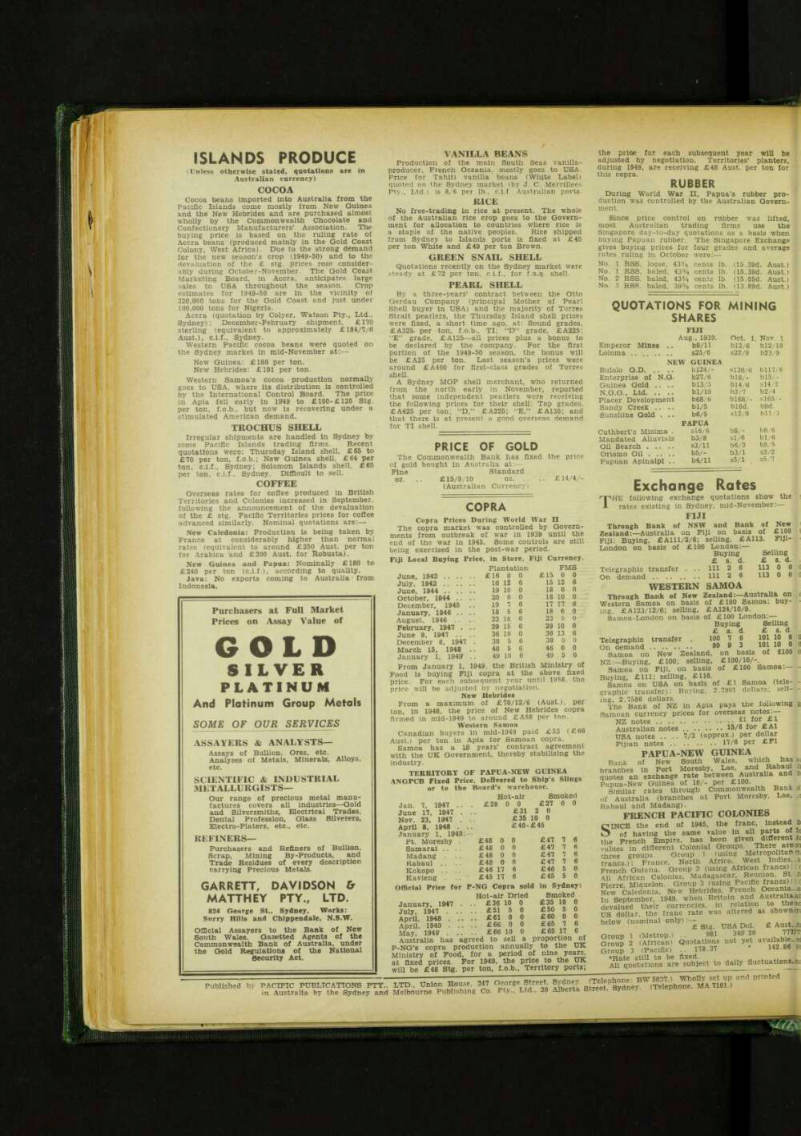
(Unless otherwise stated, quotations are in Australian currency)
Cocoa
Cocoa beans imported into Australia from the Pacific Islands come mostly from New Guinea and the New Hebrides and are purchased almost wholly by the Commonwealth Chocolate and Confectionery Manufacturers’ Association. The buying price is based on the ruling rate of Accra beans (produced mainly in the Gold Coast Colony, West Africa). Due to the strong demand for the new season’s crop (1949-50) and to the devaluation of the £ stg. prices rose consider ably during October-November. The Gold Coast Marketing Board, in Accra, anticipates large sales to USA throughout the season. Crop estimates for 1949-50 are in the vicinity of 220.000 tons for the Gold Coast and just under 100.000 tons for Nigeria.
Accra (quotation by Colyer, Watson Pty., Ltd..
Sydney); December-February shipment, £l7O sterling (equivalent to approximately £ 184/7/6 Aust.), c.i.f., Sydney.
Western Pacific cocoa beans were quoted on the Sydney market in mid-November at: — New Guinea: £lB6 per ton.
New Hebrides: £l9l per ton.
Western Samoa’s cocoa production normally goes to USA, where its distribution is controlled by the International Control Board. The price in Apia fell early in 1949 to £lOO-£l2O Stg. per ton, f.0.b., but now is recovering under a stimulated American demand.
Trochus Shell
Irregular shipments are handled in Sydney by some Pacific Islands trading firms. Recent quotations were: Thursday Island shell, £65 to £7O per ton, f.0.b.; New Guinea shell, £64 per ton. c.i.f., Sydney: Solomon Islands shell, £65 per ton, c.i.f., Sydney. Difficult to sell.
Coffee
Overseas rates for coffee produced in British Territories and Colonies increased in September, following the announcement of the devaluation of the £ stg. Pacific Territories prices for coffee advanced similarly. Nominal quotations are:— New Caledonia: Production is being taken by France at considerably higher than normal rates (equivalent to around £250 Aust. per ton for Arabica and £2OO Aust. for Robusta).
New Guinea and Papua; Nominally £lBO to £240 per ton (c.i.f.), according to quality.
Java: No exports coming to Australia from Indonesia.
Vanilla Beans
Production of the main South Seas vanilla producer, French Oceania, mostly goes to USA.
Price for Tahiti vanilla beans (White Label) quoted on the Sydney market (by J. C. Merrillees Pty.. Ltd.) is 8/6 per lb., c.i.f Australian ports.
Rice
No free-trading in rice at present. The whole of the Australian rice crop goes to the Govern ment for allocation to countries where rice is a staple of the native peoples. Rice shipped from Sydney to Islands ports is fixed at £45 per ton White and £49 per ton Brown.
Green Snail Shell
Quotations recently on the Sydney market were steady at £72 per ton, c.i.f., for f.a.q, shell.
Pearl Shell
By a three-years’ contract between the Otto Gerdau Company (principal Mother of Pearl Shell buyer in USA) and the majority of Torres Strait pearlers, the Thursday Island shell prices were fixed, a short time ago, at: Sound grades, £A325- per ton, f.0.b., TI; “D” grade, £A225; “E” grade, £AI25 —all prices plus a bonus to be declared by the company. For the first portion of the 19'49-50 season, the bonus will be £A2S per ton. Last season’s prices were around £A4OO for first-class grades of Torres shell.
A Sydney MOP shell merchant, who returned from the north early in November, reported that some independent pearlers were receiving the following prices for their shell: Top grades, £A425 per ton; “D.” £A225; “E.” £AI3O; and that there is at present a good overseas demand for TI shell.
Advertisements & other items, p. 106 (1 item)
Price Of Gold
The Commonwealth Bank has fixed the price of gold bought in Australia at:- Pine Standard OZ. .. £l5/9/10 oz £l4/4/- (Australian Currency).
Copra
Prices During World War II The copra market was controlled by Govern ments from outbreak of war in 1939 until the end of the war in 1945. Some controls are still being exercised in the post-war period.
Fiji Local Buying Price, in Store, Fiji Currency.
From January 1, 1949, the British Ministry of Food is buying Fiji copra at the above fixed price. For each subsequent year until 1958, the price will be adjusted by negotiation.
New Hebrides Prom a maximum of £7O/12/6 (Aust.), per ton, in 1948, the price of New Hebrides copra firmed in mid-1949 to around £ASB per ton.
Western Samoa Canadian buyers in mid-1949 paid £53 (£66 Aust.) per ton in Apia for Samoan copra.
Samoa has a ID years’ contract agreement with the UK Government, thereby stabilising the industry.
Territory Of Papua-New Guinea
ANGPCB Fixed Price. Delivered to Ship’s Slings or to the Board’s warehouse.
Official Price for P-NG Copra sold in Sydney:
Australia has agreed to sell a proportion of P-NG’s copra production annually to the UK Ministry of Pood, for a period of nine years, at fixed prices. For 1949, the price to the UK will be £4B Stg. per ton, f.0.b., Territory ports;
the price for each subsequent yeat will be adjusted by negotiation. Territories’ planters, during 1949, are receiving £4B Aust. per ton for this copra.
Rubber
During World War 11, Papua’s rubber pro duction was controlled by the Australian Govern ment.
Since price control on rubber was lifted, most Australian trading firms use the Singapore day-to-day quotations as a basis when buying Papuan rubber. The Singapore Exchange gives buying prices for four grades and average rates ruling in October were:— No. 1 RSS, loose, 43% cents lb. (15.39 d. Aust.) No. 1 RSS, baled, 43% cents lb. (15.39 d. Aust.) No. 2 RSS, baled, 43V4 cents lb. (15.05 d. Aust.) No. 3 RSS. baled, 39% cents lb. (13.89 d. Aust.)
Plantation
Fms
June, 1942 £16 0 0 £15 0 0 July, 1942 16 12 6 15 12 6 June, 1944 19 10 0 18 0 0 October, 1944 .. .. 20 0 0 18 10 0 December, 1945 19 7 6 17 17 6 January, 1946 .. 18 5 6 18 0 0 August, 1946 . . 23 10 6 23 5 0 February, 1947 . .. 29 15 6 29 10 0 June 9, 1947 .. 36 19 0 36 13 6 December 8, 1947 . 38 5 6 38 0 0 March 15, 1948 .. 46 5 6 46 0 0 January 1, 1949 .. 49 10 6 49 5 0
Hot-air Smoked Jan. 7, 1947 ... £28 0 0 £27 0 0 June 17, 1947 . .. £31 2 0 Nov. 23, 1947 . .. £35 10 0 April 8, 1948 ... £40-£45 January 1, 1949:-- „ .
Ft. Moresby . £48 00 £4i76 Samarai ... £48 0 0 £47 7 0 Madang ... £48 0 0 £47 7 6 Rabaul ... £48 0 0 £47 7 6 Kokopo . . . • £46 17 6 £46 5 0 Kavieng ... £45 17 6 £45 5 0
Hot-air Dried Smoked January, 1947 . .. £36 10 0 £35 10 0 July. 1947 . .. .. £51 5 0 £50 5 0 April, 1948 . . .. £61 0 0 £60 0 0 April, 1949 • . . .. £66 0 0 £65 7 6 May, 1949 . .. .. £66 10 0 £65 17 6
Quotations For Mining
Shares
Fiji
New Guinea
Papua
Aug., 1939.
Oct. 1. Nov. 1 Emperor Mines b9/ll bl2/6 bl2/10 Loloma S25/6 S22/9 b23/9
Bulolo G.D bl24/- sl36/fi b!17/6 Enterprise of N.G. b27/6 bio/- b!5/- Guinea Gold .. .. bl3/3 bl4/6 sl4/2 N.G.G., Ltd bl/10 b2/7 b2/4 Placer Development b68/6 bl68/- sl65 - Sandy Creek .. .. bl/5 blOd. b9d.
Sunshine Gold . .. b6/5 sl2/9 bll/3
Cuthbert’s Misima . sl6/6 b8/- b6/6 Mandated Alluvials b3/8 sl/6 bl/6 Oil Search s3/ll b673 b5/5 Oriomo Oil b5/- b3/l s3/2 Papuan Apinaipl .. b4/ll s5/l s5/7
Exchange Rates
THE following exchange quotations show the rates existing in Sydney, mid-November:—
Fiji
Through Bank of NSW and Bank of New Zealand:— Australia on Fiji on basis of £lOO Fiji: Buying, £Alll/2/6; selling, £AII3. Fiji- London on basis of £lOO London:— Buying Selling
Western Samoa
Through Bank of New Zealand: —Australia on Western Samoa on basis of £lOO Samoa: buy ing, £AI23/12/6; selling, £AI24/10/9.
Samoa-London on basis of £lOO London:—
Samoa on New Zealand, on basis of £lOO NZ:—Buying, £100; selling, £lOO/10/-, Samoa on Fiji, on basis of £lOO Samoa:— Buying, £111; selling, £llO.
Samoa on USA on basis of £1 Samoa (tele graphic transfer): Buying, 2.795'l dollars, sell ing, 2.7586 dollars.
The Bank of NZ in Apia pays the following Samoan currency prices for overseas notes:— NZ notes • f 1 * 01 Australian notes 15/6 for £AI USA notes .. .. 7/3 (approx.) per dollar Fijian notes 17/6 per £PI
Papua-New Guinea
Bank of New South Wales, which has branches in Port Moresby, Lae, and Rabaul quotes an exchange rate between Australia and Papua-New Guinea of 10/- per £lOO.
Similar rates through Commonwealth Bank of Australia (branches at Port Moresby, Lae, Rabaul and Madang).
French Pacific Colonies
Since the end of 1945, the franc, Instead of having the same value in all Pf£ts of the French Empire, has been given different values in different Colonial Groups. There are; three groups. Group 1 fusing Metropolitan i francs.): France, North Africa, West Indies., French Guiana. Group 2 (using African francs) ■ All African Colonies, Madagascar Reunion St..
Pierre Miquelon. Group 3 (using Pacific francs) ■ ■ New Caledonia, New Hebrides, French Oceania..
In September, 1949, when Britain and Australia! devalued their currencies, in relation to the, US dollar, the franc rate was altered as showm below (nominal DgA Do] £ Aust „ Group 1 (Metrop.) .. 981 349'. 20 777 r Group 2 (African) Quotations not yet available..
Group 3 (Pacific) .. 178.37 142.86 ♦Rate still to be fixed. , All quotations are subject to daily fluctuations...
£ s. d. £ s. d.
Telegraphic transfer . .. Ill 2 6 113 0 0 On demand .. Ill 2 6 113 0 0
Buying Selling £ s. d. £ s. d- Telegraphic transler .
On demand 100 7 6 99 9 3 101 10 0 101 10 0
Advertisements & other items, pp. 106-108 (3 items)
Published by PACIFIC PUBLICATIONS PTY.. LTD., Union House. 247 George Street, Sydney. (Tf le P gydney ßW fTellph^° MA7I01*)
in Australia by the Sydney and Melbourne Publishing Co. Pty., Ltd., 29 Alberta street, oyan y
Gold
Purchasers at Full Market Prices on Assay Value of
SILVER
PLATINUM
And Platinum Group Metals
SOME OF OUR SERVICES
ASSAYERS & ANALYSTS—
Assays of Bullion, Ores, etc.
Analyses of Metals, Minerals, Alloys, etc.
SCIENTIFIC & INDUSTRIAL
METALLURGISTS—
Our range of precious metal manufactures covers all industries —Gold and Silversmiths, Electrical Trades, Dental Profession, Glass Silverers, Electro-Platers, etc., etc.
REFINERS—
Purchasers and Refiners of Bullion.
Scrap, Mining By-Products, and Trade Residues of every description carrying Precious Metals.
GARRETT, DAVIDSON &
MATTHEY PTY., LTD.
824 George St., Sydney. Works: Snrry Hills and Chippendale, N.S.W.
Official Assayers to the Bank of New South Wales. Gazetted Agents of the Commonwealth Bank of Australia, under the Gold Regulations of the National Security Act.
Tooth’S
>1 sir m in m ** * r V (j ood company deserves the best, and it is a thoughtful and discerning host who serves his guests sparkling K.B. Lager. For “K. 8.” adds enjoyment to any gathering, and it’s one drink that’s appreciated by everybody, men and women alike. c °oT>-
LAGER
'°or M tVo'u'JiTED
KB. 35. FP
» mm
MERCHANTS. Qc SHIP OWNERS
Capital £500,000
ESTABLISHED 1914
COPRA MERCHANTS & MILLERS
ASSOCIATED COMPANIES THROUGHOUT THE PACIFIC ISLANDS
IN LONDON
W. R. CARPENTER & CO.
(LONDON) LTD.
Coronation House, 4 Lloyd’s Avenue, London, E.C.
IN NEW GUINEA
New Guinea Company Limited., Rabaul, Lae, Madang, Kavieng.
W. R. Carpenter & Co. (Fiji) Ltd.
THE W.R.C. LINE
THE FIRST DIRECT AND
IN PAPUA
J. R. Clay & Co., Ltd.,
IN FIJI
DISTRIBUTING
AGENTS FOR :
Ford Motor Company of Canada.
Electrolux Refrigerators.
T. G. & C. Bolinders (Engines).
Chrysler Corporation.
Westinghouse Electrical Co.
Caterpillar Tractors.
Etc., Etc.
Buyers and exporters of all kinds of Islands produce. Copra Merchants and Millers.
Agents for Australian, European and American Manufacturers. Distributors of every description of merchandise.
Thirty years of Pacific Islands development and service.
REGULAR CARGO AND PASSENGER SERVICE BETWEEN EUROPE AND
PACIFIC ISLAND PORTS WAS ESTABLISHED BY
W. R. CARPENTER & CO. LTD.
Head Office: 16 O'CONNELL STREET, SYDNEY.
Telephone: BW 4421.
Postal Address: P.O. Box No. 168, Sydney.
Cable Address:
CAMOHE.