Monthly
Pacific
Islands
January 19, 1945
Vol. Xv. No. 6.
Established 1930
[.Registered at the G.P.0., Sydney, for transmission by post as a newspaper ]
1/-
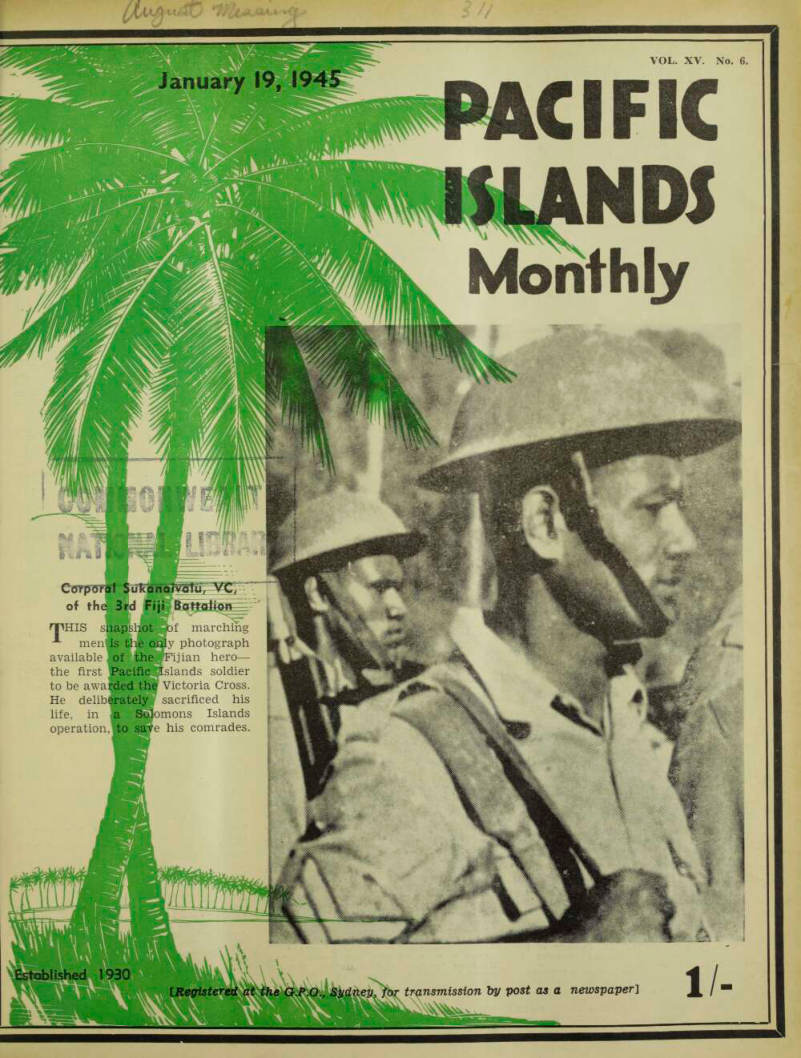
Corpora! Sukanaivlu, VC,
of the 3rd Fiji Battalion THIS snapshot Of marching men is the oily photograph available of the Fijian hero — the first Pacific Islands soldier to be awarded the Victoria Cross.
He deliberately sacrificed his life, in a Salomons Islands operation,' to save his comrades.
Roll Of Honour—Section Ii.
[Section I (Killed, Missing, Prisoners) and Section II (Wounded, Decorations, etc.), published in Alternate Months] (We try to assemble here the names of n*en of the United Nations, residents or former residents of the Pacific Territories, whose names appear in casualty lists or who receive decorations. We should be grateful if relations and friends would send us details of such men.)
Wounded
Sgt. Robert ASMUS, of the Fighting French Pacific Battalion. Wounded at Bir Hacheim and evacuated.
Rene A UP ANT, of the Fighting French Pacific Battalion. Wounded at Bir Hacheim.
Cpl. Thomas BAMBRIDGE, of the Fighting French Pacific Battalion, Wounded at Bir Hacheim and evacuated.
Fit.-Lieut. J. W. BARTLETT, RAAF, formerly of TNG. Wounded in air operations over the Mediterranean on January 23, 1944.
BERBERE (alias ARESKY), of the Fighting French Pacific Battalion. Wounded at Bir Hacheim.
Henri BERTHELIN, of the Fighting French Pacific Battalion. Wounded at Bir Hacheim.
Pte. V. BLANCO, AIF infantry, of Thursday Island. Wounded in action, July, 1941.
L/Cpl. J. P. BLENCOWE, AIF infantry, of Rabaul, TNG. Wounded in action. July, 1941.
Jean BRIAL, of the Fighting French Pacific Battalion. Wounded at Bir Hacheim.
Pte. George BUCKNELL. AIF, son of Mr and Mrs. C. Bucknell, of Korolevu, Fiji. Wounded in action in Malaya, January, 1942.
Pte. Thomas BYERS, AIF Infantry, of Thurs day Island. Wounded in action, May, 1941 Pte. Sekope CAMA, FMF. Reported wounded in action in Solomons, September, 1944 Raymond CHAUTARD, of the Free French Pacific contingent from New Caledonia. Re ported a casualty in the Middle East, March 1942.
Pte. A. J. CORLASS, AIF, formerly of Rabaul Wounded in action.
Albert CUBADDA, of the Free French con tingent from New Caledonia. Reported a casualty in the Middle East, March, 1942.
Charles DEVEAUX, of Pacific Battalion of Fighting France. Wounded at battle of Bir Hacheim (Libya).
Sgt. EMERY, formerly of Lae, TNG. Wounded in New Guinea in October, 1942.
W/O P. N. ENGLAND, AIF, formerly of Bogia, TNG. Wounded in action January 27 1944 Lieut. M. G. EVENSEN. AIF, formerly of Rabaul. Wounded in action.
V. FAIRHALL, 2nd NZEF. formerly of the Treasury Department, Western Samoa. Reported wounded in action, February, 1942.
Trooper Arthur T. FILEWOOD. formerly of Thursday Island. Reported wounded in action May, 1943.
Paroa FIU, of the Fighting French Pacific Battalion. Wounded at Bir Hacheim and evacuated.
Cpl. H. N. FORSYTH, formerly of New Guinea.
Reported wounded, June, 1944.
Acting Warrant-Officer V. M. I. GORDON AIF infantry, of Wau, TNG. Wounded in action, February, 1942.
Henri GUTLBAUD, of the Free French Pacific contingent from New Caledonia. Reported a casualty in the Middle East, March, 1942.
C ' AIP infantry, of Rabaul, TNG. Wounded in action, July, 1941.
Stanley HIGGS, son of Mr. and Mrs. Gordon Higgs, of W. R. Carpenter and Co. Ltd New Guinea. Member of an English Lancers’ regiment wounded during British evacuation from Dun kirk (France), May, 1940.
Pte W. HOLMES, of the Fiji Military Forces.
Reported wounded in action, December 1943 Alexandre HUYARD, of the Free French Pacific contingent from New Caledonia. Reported a casualty in the Middle East, March, 1942 'rMn 6 ’ w C -, J J UNE > Arp . formerly of Morobe, TNG. Reported wounded, June, 1944 c , i S^‘‘ Pl i ot Andrew KRONFELD, of the NZ Fighter Squadron attached to the RAP. Wounded mi o** 0 ** dUrlng °P eratlons over France, December.
Cpl W. H. LANNEN, AIF artillery, of RabauL New Guinea Wounded in action, June 1941 J ' LEGA ’ AIP, formerly of the Mandated Territory. Reported wounded in action, November, 1944.
Gnr. E. G. LOBAN, AIP artillery, of Thursday Si a J ld 'iQa^° < Unde 1 d dUring ca mpalgn in Greece* May, 1941; invalided home after having his left forearm amputated. B LU to A ’ °i i* 1 * Plghtln S French Pacific ded •* Bir Hich " m «><• A/Sgt. Alastalr MACLEAN. AIP infantry, of
Rabaul, New Guinea. Wounded in action, in Libya, June, 1941, Sgt. J. D. McCLYMONT, NZEF, son of Capt.
D. McClymonl, Harbourmaster of Apia, Western Samoa. Wounded in action, November. 1941.
Lieut. Jack McGRUTHER, NZEF, formerly of Mangaia, Cook Is. Wounded in fighting in Libya.
Lieut. Colin McGRUTHER, NZEF, formerly of Mangaia. Wounded in action in North Africa.
Cpl. R. McKERLIE, AIF, of Yandina, BSI, wounded in face by bomb explosion, April, 1941.
T. MANEA, of the Fighting French Pacific Battalion. Wounded at Bir Hacheim and evacuated.
Jean MERIGNAC, of the Free French Pacific contingent from New Caledonia. Reported a casualty in the Middle East, March, 1942.
Henri MEYER, of the Free French Pacific contingent from New Caledonia. Reported a casualty in the Middle East, March, 1942.
S/Sgt. Graham B. MLRFIELD, AIF engineers, of Rabaul. New Guinea Wounded in action Pte. Apisai NAIKA, of Fiji Military Forces.
Wounded in action in Solomons.
Pte. Sowani NALICO, FMF. Reported wounded in action in Solomons, September, 1944.
Pte. James O’DWYER, NZEF, formerly of Apia, W. Samoa. Wounded in action in Italy December, 1943.
Joseph OTHUS, of Pacific Battalion of Fight ing France. Wounded in battle of Bir Hacheim (Libya).
Lieut. A. G. PEARCE, ATP, formerly of Salamaua, TNG. Wounded in action, Pte. L. G. (“Mick”) REECE, AIF, of Bulolo, New Guinea. Wounded in action, July, 1941.
Henri RIVIERE, of the Free French Pacific contingent from New Caledonia. Reported a casualty in the Middle East, March, 1942 Pte. H. St. George RYDER, AIF, formerly of Suva, Fiji. Wounded while serving in New Guinea.
Cpl. Luke SAILADA, of Fiji Military Forces Wounded in action in Solomons.
A/Cpl. N. K. SAWYER, AIF infantry, of Rabaul, TNG. Wounded in action, July 1941 July. 1941.
Pte. Frank M. SCHUSTER, NZEF, formerly of W. Samoa. Wounded in action in Tunisia, 1943 Lieut. Jeffrey SEAGOE, serving with the British forces in the Far East, formerly of Vila, New Hebrides. Reported “wounded in action”’
March. 1942.
Pit.-Sgt. B. SPILLER, RAAF, formerly of Papua. Wounded by flak while attacking enemy targets in France on July 28, 1944.
Pte. Lance STAMPER, AIF, formerly school master at Wau, New Guinea. Wounded in action.
August, 1941.
Cpl. Esala TAWAKE, of Fiji Military Forces.
Wounded in action in Solomons.
Lieut.-Col. J. K. B. TAYLOR, of the Fiji Mili tary Forces. Wounded in action in Bougain ville, December, 1943.
Cpl. Raphael TEIHO, of the Fighting French Pacific Battalion. Wounded at Bir Hacheim and evacuated.
Cpl. Terli TERIITUA, of the Fighting French Pacific Battalion. Wounded at Bir Hacheim and evacuated.
Lieut. A. THOMPSON, of the Fiji Military Forces. Reported wounded In action, December 1943. ’
Lieut. P. A. TUCKEY, infantry, formerly of New Guinea. Wounded in action.
Pte. Harold G. TURNER, AIF, of Samaral Eastern Papua. Wounded in action at Bardla (Libya), January, 1941.
Pte. F. D. TWTSS, AIF infantry, of New Guinea. Wounded in action, August, 1941.
Camille VINCENT, of the Free French Pacific contingent from New Caledonia. Reported a casualty in the Middle East. March, 1942 Driver Don F. WAUCHOPE, AIF. Formerly employed on his brother’s plantation in New Guinea. Wounded in action. July, 1942.
Lieut. P. R. G. WILSON, AIF, formerly of the Mandated Territory of New Guinea. Reported wounded in action, February, 1944.
Alex. WINCHESTER, of the Fighting French Pacific Battalion. Wounded at Bir Hacheim.
Pte. K. M. WHITE, AIF, formerly of Bulwa TNG. Wounded in action.
Sgt.-Pilot W. WRIGHT, of the Australian Spitfire Squadron, attached to the RAF, for merly of New Guinea. Wounded in knee during
aerial “dog-flght” oyer the English Channel March. 1942. ’
Decorations
Sgt. Jione AGARA, Fiji Military Forces formerly of Tonga. Awarded the American Sil- July St l943 for gallantry in action New Georgia, a Flt -: L i eut - Don FMF, formerly of Fiji leTtember, K 4 Flying ln Squadron-Leader G. U. (“Scotty”) aLLEN EtAAF, who is well-known in New Guinea and Papua, having been co-pilot on the “Faith in Australia”, on the first official air-mall flight to the Territories in 1934. Awarded the Air Force Cross for his work with Catalina flying ooats in Australia and the Pacific.
Major H. T. ALLEN, AIF, formerly of Wau Morobe District, TNG. Awarded the QBE Squadron-Leader C. A. BASKETT, formerly of Bulolo, TNG. Awarded Distinguished Plying Cross for raids over enemy territory while attached to Hampden bomber squadron in Eng land. s F/O L. W, G. BELL, RAAF, formerly of Kavieng, TNG. Awarded OBE, for outstanding service in the New Guinea area Sgt Semisi BELO, of Fiji Military Forces Awarded DCM for services in South-west Pacific area.
Lieut. Charles BLAKE, of ANGAU, formerly of Wau, TNG. Awarded the Military Medal (while serving as a W/O) for bravery and devotion to duty during and after the landing at Arawe New Britain, January, 1944.
Mrs. Ruby BOYE, of Vanikoro, Santa Cruz Group. Awarded British Empire Medal for gal lant work in the Allied cause during the Jap anese occupation of the Solomons.
Victor BRIAL, Fighting French Pacific Battalion, formerly of New Caledonia. Awarded the Croix de Guerre and the Etolle d’Argent Major W. F. M. CLEMENTS, of the British Solomon Islands Defence Force. Awarded Military Cross for exceptional devotion to duty in a theatre of war.
Lieut. J. R. COLE, AIF, formerly of New Guinea. Awarded the Military Cross.
Sgt. Henry C. S. COTTON, of the RNZAF, who was born in Samoa (his father was Secre tary of Native Affairs during the NZ military occupation). Awarded the Distinguished Flying Cross.
Plight-Lieut. R. N. DALKIN, RAAF, formerly W. R. Carpenter and Co., Ltd., Salamaua, TNG. Awarded the DFC for bombing raids against the Japanese in Koepang area DEL FREDERIC DELAVEUVE, formerly of New Caledonia. Awarded Croix de Guerre, while serving with Fighting French volunteers in Egypt. 2/Lieut. Bruce Insham DENT, of Fiji Military Forces (killed in action, .March 25, 1944) Awarded Military Cross for services in South west Pacific.
Squadron-Leader R. A. DUNN, RAAF, formerly of Carpenter Airways New Guinea Service.
Awarded the Distinguished Flying Cross for bravery while leading his squadron against the Japanese.
Chaplain N. J. EARL, AMP, formerly of Papua. Awarded MBB for bravery shown during early Papuan campaign.
Sgt. R. EMERY, NGVR, formerly of Lae.
Awarded Military Medal for gallantry in New Guinea.
Flight-Lleut. Norman FADER, RAAF, formerly a commercial pilot in New Guinea. Awarded the Air Force Cross for exploits in Bismarck Sea Battle.
Rifleman H. W. FORRESTER, NGVR, formerly of Bulolo, TNG. Awarded the Military Medal for operations against Japanese in New Guinea.
Major R. O. FREEMAN, FMF. Awarded the Military Cross for devotion to duty while on service in Bougainville.
Sgt. J. H. GILCHRIST, formerly of TNG.
Received Military Medal, April, 1944.
Squadron-Leader C. R. GURNEY. RAAF, for merly of Guinea Airways, Ltd., TNG. Posthu mously awarded the Air Force Cross, for bomb ing raids on Japanese-held ports in New Britain.
Major T. GRAHAMSLAW, AMP, formerly of Papua. Awarded OBE for conspicuous devotion to duty in the Buna area (Papua) during initial Japanese landings in the district.
Walter GRAND, Fighting French Pacific Battalion, formerly of Tahiti. Awarded Croix de Guerre, with one star, for bravery during the Battle of Bir Hacheim, 1942.
A./Sgt. B. W. G. HALL, formerly of TNG.
Received DCM in April, 1944. Later promoted to rank of Lieutenant.
Squadron-Leader Godfrey HEMSWORTH, RAAF, formerly a well-known New Guinea pilot, who was killed in action against the Japanese
(Continued on Inside Back Cover)
in May. Posthumously awarded the Air Force Cross.
Japt L. HENDERSON, AMP. formerly of Papua. Awarded MBE for courage displayed during the Oro Bay operations when he was in charge of small ships operating In those waters. , , „ , LUCTEN HERVOUET, formerly of New Cale donia. Awarded Croix de Guerre while serving with Fighting French volunteers in Egypt.
Lieut. Colin HILL, RANR, of the Australian destroyer, “Waterhen”, formerly second officer on the trans-Pacific liner “Niagara”. Awarded the OBE.
Lieut. D, C. HORTON, RANVR, formerly of District Services, BSI. Awarded the United States Silver Star for distinguished services in the Solomons.
Lieut, Gordon HOWE, RANR, formerly an offi cer in Burns Philp ships. Awarded the US Legion of Merit for meritorious service in lead ing a reconnaissance party to Russell Islands,
Bsi.
Lieut. H. E. JOSSELYN, RANVR, formerly of District Services, BSI. Awarded United States Silver Star, for distinguished services in the Solomons.
Lieut. J. R. KEENAN, RANVR, formerly of New Guinea. Awarded the DSC.
Capt. H. T. KIENZLE, ANGAU, formerly of Papua. Awarded MBE for devotion to duty during the campaign in the Owen Stanley Ranges.
Lieut. Isereli KOROVULAVULA, FMF. Awarded the Military Cross for devotion to duty while serving in Bougainville.
Pte. Sairusi KOTO, Fiji Military Forces.
Awarded US Silver Star for bravery and de votion to duty in the Solomons.
Wing-Commander C. J. N. LELAU, RAAF, formerly of Suva, Fiji. Awarded the OBE for distinguished service.
Pte. Viliame LAUTIKI, of Fiji Military Forces.
Awarded MM for services in South-west Pacific area.
Sgt. T. McADAM, NGVR, formerly of New Guinea Forestry Dept. Awarded Military Medal for gallantry in New Guinea.
Lieut.-Commander A. W. R. McNICOLL, RAN, son of Sir Ramsay McNicoll, Administrator of New Guinea, and Lady McNicoll. Awarded the George Medal.
Petty-Officer PAUL MIASON, RANVR, formerly a plantation inspector at Inus, Bougainville, TNG. Awarded American Distinguished Service Cross for “extraordinary heroism in action.”
HENRI MAYER, formerly of New Caledonia.
Awarded Croix de Guerre while serving with Fighting French volunteers in Egypt.
Fit.-Lieut. George B. (Golly) MEIDECKE, RAAF, formerly of W. Samoa. Awarded the Distinguished Flying Cross.
Capt. J. K. MCCARTHY, formerly of TNG.
Received the MBE, April, 1944.
Lieut.-Commander H. A. MACKENZIE, RAN, formerly of Rabaul, TNG. Awarded the US Legion of Merit for exceptionally meritorious services at Guadalcanal.
Capt. John Malcolm METHVEN, AIP. Men tioned in despatches for distinguished services during the seige of Tobruk. Since reported killed in action. (See section “Killed.”) John MILNE, Wireless Operator, Gilbert Islands. Awarded British Empire Medal for dis tinguished service.
Sgt. Geoffrey MOORE, of the RNZAF, formerly engineer on the NG inter-island vessel “Maiwara” and on the trans-Pacific liner “Aorangi”. Awarded the Distinguished Plying Medal.
Capt. G. B. MORGAN, DSC, formerly of Union SS Co. Awarded DSO and Lloyd’s war medal for his part in Allied landings in North Africa in 1942, when he was captain of the “Awatea.”
ANDRE MORNAGHINI, formerly of New Cale donia. Awarded Croix de Guerre while serving with Fighting French volunteers in Egypt.
Flight-Lieut. G. B. MEIDECKE, RAAF. formerly of W. Samoa. Awarded the DFC for “courage, coolness and tenacity, and flying skill of the highest order.”
Pte. Fred Charles NARRUHN, Fiji Military Forces. Awarded US Silver Star for gallantry and devotion to duty at Butaritari, Gilbert Is.
Flight-Lieut. M. O’CONNOR, RAAF, formerly of Suva, Fiji. Awarded the DFC for a “high record of success on operations” in the Middle East.
Capt. Raymond PERRAUD, FF Pacific Bat talion. Awarded Croix de Guerre at Bir Hacheim in 1942. Awarded Liberation Cross in Europe in 1944. Later killed in action.
Flight-Lieut. H. G. PILLING, RAP, formerly of
Suva, Fiji. Awarded the DFC, May, 1942. (Killed a few days later.) Lieut. W. T. READ, RANVR, formerly of Dis trict Services, TNG. Awarded American Distin guished Service Cross for “extraordinary heroism in action’’ while in South Pacific Waters.
Lieut. A. RHODES, RANVR, formerly of BSI.
Awarded American DSC for heroism in SW Pacific in 1942. In June, 1943, awarded Ameri can Silver Star when he guided a party of US commandoes to the beach on Rondova.
Pilot-Officer Pat RICHARDSON, RAF, son of Mr. W. Richardson, formerly of Penang, Fiji.
Awarded the Distinguished Flying Cross.
W/O A. L. ROBINSON, NGVR, formerly of New Guinea. Awarded DCM.
Commander Alvord S. ROSENTHAL, RAN, son of Major-General Sir Charles Rosenthal, KCB, CMG, DSO, VD, Administrator of Norfolk Island. Awarded the DSO, November, 1941; awarded the Bar to DSO, February, 1942.
W/O K. W. RYALL, of ANGAU, formerly of TNG. Awarded Military Medal for conspicuous service in the Arawe Peninsula area of New Britain.
Cpl. Manoa ROKO, of Fiji Military Forces.
Awarded MM for services in South-west Pacific area.
Cpl. Sefanaia SUKANAIVALU, PMF. Awarded the Victoria Cross posthumously, for conspicu ous gallantry in Bougainville.
Lieut.-Colonel J. B. K. TAYLOR, Commander of Fiji Military Forces overseas. Awarded Mrs. Ruby BOYE, of Vanikoro, Santa Cruz American Purple Heart, March, 1944.
Capt. A. T. TIMPERLEY, AMP, formerly of Papua. Awarded MBE for work on Good enough Island when he acted as a guide.
Major David TRENCH, formerly District Offi cer in BSI. Awarded the Military Cross for distinguished service and gallantry in the South-west Pacific.
Lieut.-Col. G. T. UPTON, FMF. Awarded American Bronze Star for outstanding leader ship while commanding Fijian troops on Bou gainville.
F/O Leigh G. VIAL, RAAF, formerly ADO in TNG. Awarded American DSC for outstand ing heroism in New Guinea in September, 1942.
Lieut.-Col. F. W. VOELCKER, FMF. Awarded American Bronze Star for outstanding leader ship while commanding Fijian troops on Bou gainville.
Squadron-Leader Charles WIDDY, RAAF, formerly of BSI. Awarded the US Legion of Merit for meritorious service in leading a reconnaissance party to Russell Islands, BSI.
Lieut, (then W/O) Raymond WATSON, ALP, formerly of TNG. Awarded MBE for bravery and devotion to duty during the Papuan cam paign.
Sgt. Ilaitia WAQA, of Fiji Military Forces.
Awarded MM for services in South-west Pacific area.
Capt. D. E. WILLIAMS, of Fiji Military Forces.
Awarded American Silver Star for gallantry in action while leading patrols in Guadalcanal.
Lieut. G. K. WHITTAKER, NGVR, formerly of Lae, TNG. Awarded MBE for gallantry in New Guinea.
Lieut. George Raymond WORLEDGE, of the RANVR, formerly of Fiji. Awarded the MBE (Military).
Lieut. H. M. WRIGHT, RANVR, formerly of New Guinea. Awarded DSC.
Mentioned In Despatches
Rifleman G. R. Archer, Sgt. H. E. Jarrett, TNG. Papua.
Captain A, H. Bald- Major E. W. Jenyns, win, Papua. TNG.
Captain N. B. N. Warrant-Officer I. F.
Blood, TNG. Jones, Papua.
Rifleman J. Cavanagh, Lieut. H. T. Kienzle, TNG. Papua.
Rifleman J. W. Currie, Rifleman J. R. Kinsey,
Tng. Tng.
Warrant-Officer J. B. Corporal Malakai Mo, Davies, Papua. Fiji.
Captain L. S. Dexter, Corporal M. Marlay, Papua. TNG.
Major S. Elliott-Smith, Rifleman J. E. Mayos, Papua. TNG.
Capt. W. M. Edwards, Corporal A. Moore,
Tng. Tng.
Warrant-Officer P. R. Captain J. J. Murphy, N. England, TNG. TNG.
Rifleman H. W. For- Lieut. K. C. McMullen, rester, TNG. TNG.
Lieut. K. G. Fuller, W/O Victor Neuman, Tonga. TNG.
Sergeant V. H. Gil- Captain N. Owers.
Christ, TNG. Sub-Lieut. C. Page, Lieut. S. G. Grimshaw, TNG.
TNG. Lieut. R. H. Phillips, Lieut. C. G. Harris, TNG.
TNG. Pte. A. A. Ramsden, Lieut. L. F. Hewlett, Papua.
TNG. Major D. G. Rice.
Pte. S. M. Richie, Pte. R. M, Stewart, Papua. Papua.
Lieutenant J. I. Rae, Lieut. A. T. Timperly, Papua. Papua.
Sergeant Akuila Sau- Captain L. N. Tribolct, kura, Fiji. TNG.
Lieutenant C. H. Smith, Lieutenant A. G. Vagg,
Tng. Tng.
Warrant-Officer R. A. Captain G. H. Vernon, Smith, Papua. MC, Papua.
Pacific News-Review
Notes And Comment On
The Progress Of The War
From Dec. 15 To Jan. 16
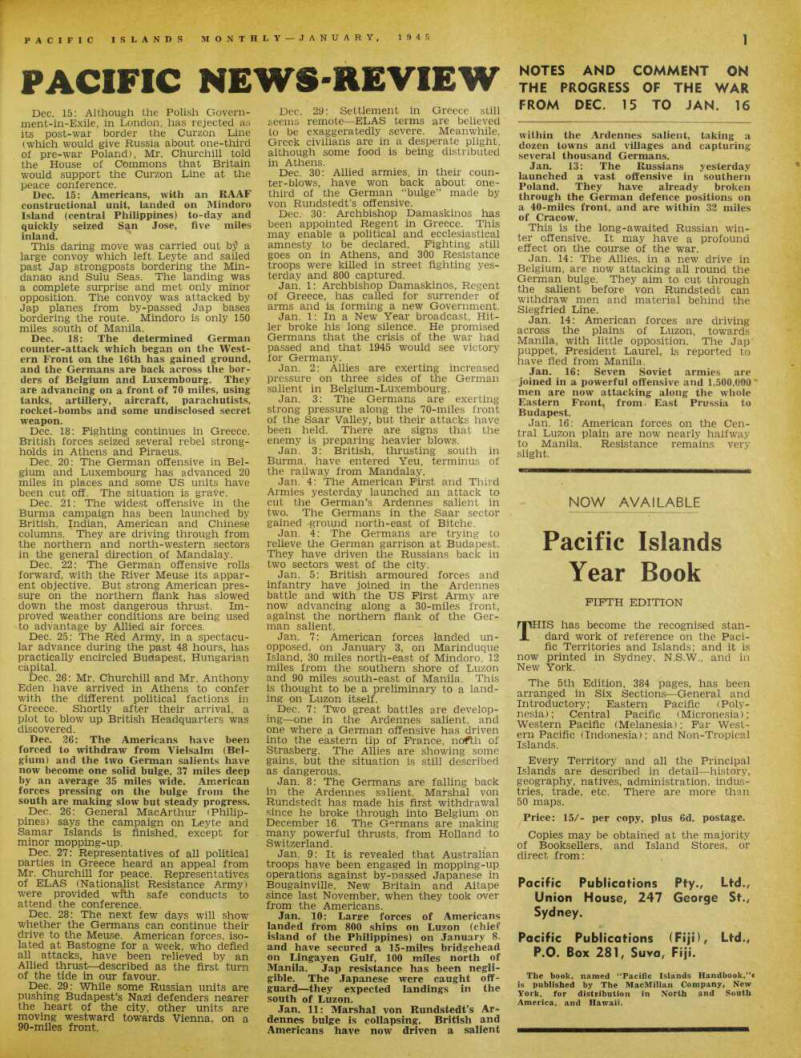
Dec. 15: Although the Polish Govern ment-in-Exile, in London, has rejected as its post-war border the Curzon Line (which would give Russia about one-third of pre-war Poland), Mr. Churchill told the House of Commons that Britain would support the Curzon Line at the peace conference.
Dec. 15: Americans, with an RAAF constructional unit, landed on Mindoro Island (central Philippines) to-day and quickly seized San Jose, five miles inland.
This daring move was carried out by a large convoy which left. Leyte and sailed past Jap strongposts bordering the Min danao and Sulu Seas. The landing was a complete surprise and met only minor opposition. The convoy was attacked by Jap planes from by-passed Jap bases bordering the route. Mindoro is only 150 miles south of Manila.
Dec. 18; The determined German counter-attack which began on the West ern Front on the 16th has gained ground, and the Germans are back across the bor ders of Belgium and Luxembourg. They are advancing on a front of 70 miles, using tanks, artillery, aircraft, parachutists, rocket-bombs and some undisclosed secret weapon.
Dec. 18: Fighting continues in Greece.
British forces seized several rebel strong holds in Athens and Piraeus.
Dec. 20: The German offensive in Bel gium and Luxembourg has advanced 20 miles in places and some US units have been cut off. The situation is grave.
Dec. 21: The widest offensive in the Burma campaign has been launched by British, Indian, American and Chinese columns. They are driving through from the northern and north-western sectors in the general direction of Mandalay.
Dec. 22: The German offensive rolls forward, with the River Meuse its appar ent objective. But strong American pres sure on the northern flank has slowed down the most dangerous thrust. Im proved weather conditions are being used to advantage by Allied air forces.
Dec. 25: The Red Army, in a spectacu lar advance during the past 48 hours, has practically encircled Budapest, Hungarian capital.
Dec. 26: Mr. Churchill and Mr. Anthony Eden have arrived in Athens to confer with the different political factions in Greece. Shortly after their arrival, a plot to blow up British Headquarters was discovered.
Dec. 26: The Americans have been forced to withdraw from Vielsalm (Bel gium) and the two German salients have now become one solid bulge, 37 miles deep by an average 35 miles wide. American forces pressing on the bulge from the south are making slow but steady progress.
Dec. 26: General MacArthur (Philip pines) says the campaign on Leyte and Samar Islands is finished, except for minor mopping-up.
Dec. 27: Representatives of all political parties in Greece heard an appeal from Mr. Churchill for peace. Representatives of ELAS (Nationalist Resistance Army) were provided with safe conducts to attend, the conference.
Dec. 28: The next few days will show whether the Germans can continue their drive to the Meuse. American forces, iso lated at Bastogne for a week, who defied all attacks, have been relieved by an Allied thrust—described as the first turn of the tide in our favour.
Dec. 29: While some Russian units are pushing Budapest’s Nazi defenders nearer the heart of the city, other units are moving westward towards Vienna, on a 90-miles front.
Dec. 29: Settlement in Greece still seems remote —ELAS terms are believed to be exaggeratedly severe. Meanwhile, Greek civilians are in a desperate plight, although some food is being distributed in Athens.
Dec. 30: Allied armies, in their coun ter-blows, have won back about one third of the German “bulge” made by von Rundstedt’s offensive.
Dec. 30: Archbishop Damaskinos has been appointed Regent in Greece. This may enable a political and ecclesiastical amnesty to be declared. Fighting still goes on in Athens, and 300 Resistance troops were killed in street fighting yes terday and 800 captured.
Jan. 1: Archbishop Damaskinos, Regent of Greece, has called for surrender of arms and is forming a new Government.
Jan. 1: In a New Year broadcast, Hit ler broke his long silence. He promised Germans that the crisis of the war had passed and that 1945 would see victory for Germany.
Jan. 2; Allies are exerting increased pressure on three sides of the German salient in Belgium-Luxembourg.
Jan. 3: The Germans are exerting strong pressure along the 70-miles front of the Saar Valley, but their attacks have been held. There are signs that the enemy is preparing heavier blows.
Jan. 3: British, thrusting south in Burma, have entered Yeu, terminus of the railway from Mandalay.
Jan. 4: The American First and Third Armies yesterday launched an attack to cut the German’s Ardennes salient in two. The Germans in the Saar sector gained ground north-east of Bitche.
Jan. 4: The Germans are trying to relieve the German garrison at Budapest.
They have driven the Russians back in two sectors west of the city.
Jan. 5: British armoured forces and infantry have joined in the Ardennes battle and with the US First Army are now advancing along a 30-miles front, against the northern flank of the Ger man salient.
Jan. 7: American forces landed un opposed, on January 3, on Marinduque Island, 30 miles north-east of Mindoro. 12 miles from the southern shore of Luzon and 90 miles south-east of Manila. This is thought to be a preliminary to a land ing on Luzon itself.
Dec. 7: Two great battles are develop ing—one in the Ardennes salient, and one where a German offensive has driven into the eastern tip of France, nofth of Strasberg. The Allies are showing some gains, but the situation is still described as dangerous.
Jan. 8: The Germans are falling back in the Ardennes salient. Marshal von Rundstedt has made his first withdrawal since he broke through into Belgium on December 16. The Germans are making many powerful thrusts, from Holland to Switzerland.
Jan. 9: It is revealed that Australian troops have been engaged in mopping-up operations against by-passed Japanese in Bougainville, New Britain and Aitape since last November, when they took over from the Americans.
Jan. 10: Large forces of Americans landed from 800 shins on Luzon (chief island of the Philippines) on January 8 and have secured a 15-miles bridgehead on Lingayen Gulf, 100 miles north of Manila. Jap resistance has been negli gible. The Japanese were caught off guard—they expected landings in the south of Luzon.
Jan. 11; Marshal von Rundstedt’s Ar dennes bulge is collapsing. British and Americans have now driven a salient
within the Ardennes salient, taking a dozen towns and villages and capturing several thousand Germans.
Jan. 13: The Russians yesterday launched a vast offensive in southern Poland. They have already broken through the German defence positions on a 40-miles front, and are within 32 miles of Cracow.
This is the long-awaited Russian win ter offensive. It may have a profound effect on the course of the war.
Jan. 14: The Allies, in a new drive in Belgium, are now attacking all round the German bulge. They aim to cut through the salient before von Rundstedt can withdraw men and material behind the Siegfried Line.
Jan. 14: American forces are driving across the plains of Luzon, towards Manila, with little opposition. The Jap' puppet, President Laurel, is reported to have fled from Manila.
Jan. 16: Seven Soviet armies are joined in a powerful offensive and 1,500,000 men are now attacking along the whole Eastern Front, from East Prussia to Budapest.
Jan. 16: American forces on the Cen tral Luzon plain are now nearly halfway to Manila. Resistance remains very slight.
Advertisements & other items, pp. 3-4 (1 item)
Year Book
NOW AVAILABLE
Pacific Islands
FIFTH EDITION
THIS has become the recognised standard work of reference on the Pacific Territories and Islands; and it is now printed in Sydney, N.S.W., and in New York.
The sth Edition, 384 pages, has been arranged in Six Sections —General and Introductory; Eastern Pacific (Polynesia); Central Pacific (Micronesia): Western Pacific (Melanesia): Far Western Pacific (Indonesia); and Non-Tropical Islands.
Every Territory and all the Principal Islands are described in detail —history, geography, natives, administration, industries, trade, etc. There are more than 50 maps.
Price: 15/- per copy, plus 6d. postage.
Copies may be obtained at the majority of Booksellers, and Island Stores, or direct from:
Pacific Publications Pty., Ltd.,
Union House, 247 George St.,
Sydney.
Pacific Publications (Fiji), Ltd.,
P.O. Box 281, Suva, Fiji.
The book, named “Pacific Islands Handbook,” is published by The MacMillan Company, New York, for distribution in North and South America, and Hawaii.
USEFUL ADDRESSES
The following are the addresses of organisations set up to deal with Pacific Territories affairs:—
PAPUA, NEW GUINEA, NAURU,
NORFOLK IS.
Department of External Territories (Sydney Branch) (Lately the New Guinea Trade Agency), Australia House, Carrington Street, Sydney.
Telephone: BW 1776. (Dealing with all matters connected with the Australian Pacific Territories and also the Sydney representative of the New Guinea Copra Control Committee.)
FIJI, AND HIGH COMMISSION
FOR WESTERN PACIFIC
Sydney Office of Fiji and Associated Administrations. (In charge of Mr. B. F. Blackwell.) 72 Pitt Street, Sydney.
Telephone: BW 7724.
BRITISH SOLOMON ISLANDS
Sydney Office of British Solomon Islands Government (In charge of Mr. F. E. Johnson. Treasurer of the Solomons Administration), 17 Castlereagh Street, Sydney.
Telephone: B 1710.
FOR PACIFIC TERRITORIES
EVACUEES GENERALLY
Pacific Territories Association (C. A. M. Adelskold, Secretary), c/o Robert Gillespie Pty., Ltd., 54a Pitt Street, Sydney. Telephone: BW 4782.
WAR DAMAGE COMMISSION
Sydney Office: M.L.C. Buidling, Cnr. Martin Place and Castlereagh Street, Sydney.
Telephone: BW 2361.
FOR CLAIMS AGAINST ARMY
Mr. H. Alderman, Darwm-Moresby Claims Section, Chief Finance Office (Army), Victoria Barracks, Melbourne.
Contents
Pacific News Review 1 Pacific War Moving Against Japan .. 3 January 23—Rabaul Memories ... 4 Airways Changes for New Guinea .. 5 Fiji's New Governor .. 5, 25 Britain’s Pacific Colonies—Plans ... 5 Fate of Papuan Government 6 NZ Premier in Cook Is 7 BSI Production Board 8 NZ Premier in Samoa 8 Australian Government Sued 8 Edwards Perpetual Calendar 10 Indentured Labour and Mr. Burton . 12 Sir Walter Carpenter 15 Misima Mining 16 Battle of The Barges 17 G. & E. Natives Give £22,000 19 Death of Mrs. Carrie Rich 20 First Plane at Rarotonga 22 Poor Fiji Copra 23 Dollars in N. Caledonia 24 The Island of Pott 26 French Pacific Colonies Honoured .. 29 Brisbane Papuans Restive 30 Big Business in the Islands 32 Death of Mrs, E. Leigh 35 Dengue in Tahiti 39 Plea for Papuan Natives 41 Philippines Background 44
Advertisers
Aladdin Industries Pty., Ltd 31 Atkins Pty., Ltd., Wm. . , . . . .40 Australian Alumi nium Co. Pty., Ltd 35 Bergers Paints . . 15 Broomfield, Ltd. . . 47 Brown & Co., Ltd. 11 Brown, James ... 32 Brunton’s Flour . , 27 Burns, Philp Trust Co., Ltd 13 BP (SS) Co. . . . n Campbell’s Paints . 41 Carlton & United Breweries, Ltd. . 19 Carpenter, Ltd., W.
R cov. iv.
Casino Hotel, Apia 14 Chivers & Sons, Ltd 24 Coleman Lamp & Stove Co. . . 17, 29 Colonial Wholesale “Cystex” ... 38 Darvas & Co. ... 27 David Trading Co. 41 Donaghy & Sons . 26 Meat Co 26 Donald, Ltd., A. B. 24 Dr. Williams Pink Pills 33 Electrolux Refrigerators . *.lB Excelsior Supply Co., Ltd 42 “Farbest” Cordials . 38 Farnham, John R. . 25 Ford Sherrington Pty., Ltd 30 Garrett & Davidson 29 Gibson & Co., Ltd.,
J. A. D 25
Gillespie Pty., Ltd., Robert ... 46 Gilbey’s Gin ... 32 Gillespie’s Flour . . 22 Gough & Co., E. J. . 47 Grove & Sons, W.
H 12
Grand Pacific Hotel 2 Heinz & Co. Pty., Ltd., H. J. . . .23 Horlicks Malted Milk 21 King’s Compo ... 33 Kopsen & Co., Ltd. 36 Mashman Bros.
Pty., Ltd. . ; . . 43 Maxwell Porter, Ltd. 47 “Mendaco” ... 44 Muir (Eastern) Ex port Co., Charles 44 Nelson & Robertson Pty., Ltd. ... 16 “Nixoderm” ... 46 Noyes Bros., Ltd. . 45 Pacific Is. Society . 14 Pacific Islands Trading Co. ... 40 Pacific Islands Year Book i Parekh & Bros., S. 44 “Pinketbes” ... 36 Queensland Insur ance Co 17 Radco Products . . 37 “Radiant” Lanterns 35 Ransomes, Sims & Jefferies, Ltd. . . 45 Riverstone Meat Co., Ltd 39 Rose’s Eye Lotion . 46 Rohu, Sil 30 Scott, Ltd., J. . .30 Steamships Trading Co., Ltd 38 Sullivan & Co., C. . 28 Swallow & Ariell . 20 Taylor & Co., A. . 41 “Tenax” Soap . , 12 Tillock & Co., Ltd. 22 Trinity Grammar School 37 Watson, W. H. . . 42 Wright & Co., Ltd., E 47 Wunderlich, Ltd. . 43 Yorkshire Insurance Co., Ltd 11 Young Pty., Ltd., Harry, J 34
Advertisements & other items, p. 4 (1 item)
dt^
° ve f oatei '" r ,
b e^' W ~,
**» -*r° ** cvccW^ 1 or va^ tS - .* W>- rt S rtf” Su . rx >N^ ter ca^ e ’ d*V; *Bf*
Pacific Islands Monthly
The Newspaper-Magazine of the South Seas
[Registered at the G.P.0., Sydney, for transmission by post as a newspaper.'] Published Once Each Month and Circulated in Australia and New Zealand and in the following Pacific Territories and Islands Groups:
Australian Territory of Papua.
Mandated Territory (Australia) of New Guinea.
Australian Territory of Norfolk Island.
New Zealand Territory of Cook Islands.
Mandated Territory (NZ) of Western Samoa.
British Colony of Fiji.
Britlsh Solomon Islands Protectorate.
British Protectorate of Tongan Islands.
British Crown Colony of Gilbert and Ellice Islands.
Mandated Territory of Nauru.
British and Free French Condominium of New Hebrides.
Free French Colony of New Caledonia.
Free French Colony of Oceania (Tahiti, etc.).
American Territory of Eastern Samoa.
American Territory of Hawaiian Islands,
Owned and Produced by Pacific Publications Pty. Ltd., Union House, 247 George Street, Sydney.
TTTT ppttomtt I Managing Director .. BW 5037 I Business and Editorial MA 4369
P.O. Box 3408 R
Registered Address of Telegrams, Radiograms, and Cables: “Pacpub”, Sydney.
Contributions.
Articles, Stories, and Photographs dealing with Pacific Islands subjects are invited and will be paid for on publication.
Subscription Rates.
Per Annum, within British Empire, Prepaid, Post Free 10/- Per Annum, elsewhere, Prepaid, Post Free 12/6 Single Copies 1/-
Editor and Publisher;
R. W. Robson, P.R.G.S.
Advertising Manager: L. W. Bailey.
Advertising Office and Printing-House: 29 Alberta Street, Sydney.
Advertising rates furnished on application.
Representative In Fiji.
Pacific Publications (Fiji), Ltd., Bank of NSW Building, Suva (same office as W. H. Grove & Sons, Ltd.). Stocks of Pacific Islands Monthly and Pacific Islands Yearbook on hand.
Representative In London.
W. C. Harvey, Coronation House, 4 Lloyds Avenue, London, E.C.3, from whom may be obtained copies of Pacific Islands Monthly, Pacific Is. Year Book, advertising schedules, etc.
Agents.
The following are authorised to receive sub scriptions for Pacific Islands Monthly:— Burns, Philp & Co., Ltd., and Burns Phllp (South Sea) Co., Ltd. All branches.
W. R. Carpenter & Co., Ltd. All branches.
Morris, Hedstrom, Ltd. All branches.
Steamships Trading Co,, Papua. All branches.
B.N.G. Trading Co., Ltd., Port Moresby, Papua.
J. Muir, Suva, Fiji.
Miss R. Castles, Suva, FIJI.
N. C. Mackenzie Hunt, Walnunu, Bua, Fiji.
Cook Islands Trading Co., Rarotonga, Cook Is.
A. C. Rowland, Papeete, Tahiti, Islands Branches and Representatives of W. H.
Grove & Sons, Ltd., Auckland, New Zealand.
Ed, Pentecost, Noumea, New Caledonia.
Societe Gubbay Kerr et Cie, Noumea, N. Caledonia.
Vol. XV. No. 6.
January 19, 1945
Pr’irn i X/ Per Copy price (Prepaid: 10/- p.a.
Against Japan
Pacific War Now Moving Sharply Against Japan
IT is exactly three years since the Japanese attacked all the coun tries of the Western Pacific, and invaded New Guinea—three years since we wrote here: “The Pacific faces grim months of endurance and sacrifice.”
The crisis is long past; and now, for the first time, we feel that we can say that our cunning, treacherous, sub-human enemy is within measur able distance of defeat.
In the “PIM” of January, 1942, we said; “For the present, and probably until May and June, we in the Central and South Pacific must just ‘take it,’ while we await the development of American and British strength. If we are not overwhelmed in these early months, it is a mathematical certainty that Japan, later on, will be overwhelmed by our naval and air forces. Every mile she thrusts east wards and southwards makes her more vulnerable.” That was written before the Japanese had invaded New Guinea, or crossed the Equator. It was a good forecast. We “took it”; most of 1942 had gone before we be gan to seriously oppose the Jap; we were not overwhelmed; and now the Jap is collapsing under the ever growing weight of our air and sea supremacy.
If the Jap had had real war-like genius, he would have occupied Aus tralia and invaded America early in 1942, while he had command of the sea, and marked superiority in the air, and had available enough ships
to transport overseas his numerically superior armies. We should have been paralysed before we could get moving. Instead, he fussed and fumbled among the Western Pacific archipelagoes, and gave us a chance —that we did not deserve —to recover from the shock of his surprise attack, and re-organise for offensive war fare.
If Japan ever had a chance of winning the Pacific war, that was when she lost it—in the early months of 1942. Since then, her de feat has been simply a matter of mathematical calculation.
EVENTS, now, are moving very rapidly in our favour. Every day furnishes new proof that the Jap has been caught completely off balance, and that his final defeat is not going to be as difficult as many have be lieved. He extended his “conquests,” and therefore his lines of communi cation, over thousands of miles of ocean; and then he lost control oyer the air, and over the sea. Realising his danger, he tried desperately to turn it into a continental war, in which he could use his military superiority; but the Americans, with brilliant planning, kept it and deve loped it as an amphibious war, in which the Jap, being quite unable to transport or deploy his armies, was literally at the mercy of our air and sea strength.
There have been many signs, in recent months, that this is the strategical conception to which Ad
miral Nimitz and General MacArthur are adhering; but it needed the American invasion of Luzon, chief island of the Philippines, to disclose the true picture, and expose the weakness of Japan. When MacArthur drove into the Philippines, at Leyte, the Japs made their biggest effort— they sent in their navy. Admiral Nimitz, in a series of naval engage ments, defeated the Japanese very heavily; and from that moment the heart seemed to go out of the Japa nese defences in the Philippines.
They sent several divisions against the Americans in Leyte; and the Americans killed over 100,000 of them, and scattered the rest. They sent huge convoys of reinforcements: Allied aircraft destroyed a large pro portion of them. They sent in fleets of bombers and fighters—and these also were destroyed.
Super-fortresses based on Sai pan are attacking Japanese cities almost every day. Other American planes, based now in the Philippines, are bombing every Japa nese ship that floats upon the South China Sea—which is between the Philippines and the China coast, and is the only corridor through which Japanese ships can maintain com munications with the huge Jap estab lishments in Borneo, Malaya, Burma, Siam and the Netherlands Indies.
British armies, with Americans and Chinese, are rapidly re-occupying Burma. British forces are coming south-eastwards along the coast of Burma. British carrier-based aircraft are attacking Jap bases in the northern part of the Netherlands Indies. It is only a question of time before the British west of Malaya will
join hands with the Americans in the Philippines, and thus isolate huge Japanese forces in Malaya, Borneo and the Netherlands Indies.
Meanwhile, a powerful British fleet, having come from Britain and rounded Australia, is moving up in support of the American fleets, and MacArthur’s hard-hitting expeditions on Luzon.
JAPAN is supposed to have five million soldiers under arms. But where are they, and of what use are they?
Most of them, of course, are in Japan, in Formosa, in Manchuria, in China and in South-east Asia, where they have no enemies to fight. A section of them is scrambling fool ishly eastwards through the jungles of Burma, having abandoned the grandiose plan of invading India.
Another section is garrisoning the in numerable islands of Indonesia; their fate is to be by-passed and isolated.
Another section is in the Philip pines, eager to fight, but unable to get island to island, or even from district to district, because of American air and sea supremacy.
And still another section is encamped - miserably in the by-passed islands of Northern Solomons, Bismarck Archi pelago, New Guinea, Marshalls and Carolines, hopelessly cut off from Japan, fatalistically awaiting the day when Australia’s slouch-hatted divi sions will search them out and hunt them down.
IT is argued that the Americans, with British support, will move on from the Philippines to Formosa and the China coast, to prepare there for the final assault upon Japan; and it is reported that Japan is making elaborate preparations to fight us in China, under conditions which might give her some advantage from her enormous military power.
But it is just as reasonable to sup pose that, since the Japanese are so clearly at a fumbling disadvantage in amphibious warfare, it will be the purpose of the Allies to keep the war amphibious, right up to the point of invading and attacking Japan itself.
There are islands all the way from the Philippines to Japan—Formosa, and the Ryuku chain; and even the narrow-gutted peninsula of Korea, so close to Japan, might be regarded as an island.
Discussion of what the Allies will do, after the Philippines campaign is so much speculation. The point that interests us, at the moment, is the poor showing that the Japs are mak ing in the Philippines. It indicates many things—the chief of which is that, if they cannot offer a stronger defence at this stage, the formal Pacific war may be over sooner than many people now think possible. |>UT it is unlikely that the success ful invasion and occupation of Japan would mean a quick end to war like operations in the Pacific. One cannot even guess how many Japanese were spread through South-east Asia ?n d IQ49 Sl nr.2 nd TvJ he rr< P^CiflC Terr itorieS m 1942, under Mr. Tojo’s lunatic plan;
but they certainly number hundreds of thousands. There never has been anything to suggest that these people, finding their country defeated and themselves hopelessly isolated, will accept the inevitable, and surrender.
It would be wise to assume that it will be necessary to hunt down and root out every one of them, like the sub-human creatures they are. That will be a long, hard, bitter task—but it will have to be done.
It is necessary to stress these things, in order that our people of the Pacific Territories should not buoy themselves up with false hopes of an early return to civil government, and civilian occupations. The few places south of the Equator which have been freed from the invaders hardly count in the Allies’ plans for restoring civil government and life in the Pacific.
THIS list shows all the Pacific Terri tories invaded by the Japanese, and the present position of each. It does not include the Asiatic countries invaded, such as China, Indo-China, Hongkong, Siam, Malaya and Burma, The list goes from east to west:
Gilbert And Ellice Islands—
British Colony.—Japanese driven out by Americans at end of 1943, and islands restored to British civil administration.
British Solomon Islands.—Japa
nese driven out by Americans in 1943.
Now partly under British administrative officers, and partly under military rule.
No indication of when civil government will be restored.
OCEAN ISLAND (British) and NAURU (British - Australian Mandate),—Both apparently still under occupation of Japs, who have been by-passed and isolated.
NORTHERN SOLOMONS: Bougainville and Buka - Australian Mandate.—By passed by Americans, who handed Em press Augusta beach-head over to Aus tralians in November, and Australians now trying to eject 16,000 Japanese.
Bismarck Archipelago: New
Britain and New Ireland - Australian Mandate. —Americans cleared western half of New Britain, and handed over to Australians in November. Australians in December made a new landing at Jacquinot Bay, 75 miles south-west of Rabaul. Estimated 60,000 Japs in these two islands to be liquidated.
Mainland Of New Guinea: Papua,
Mandated Territory of Australian New Guinea, and Dutch New Guinea.—Papua completely cleared of enemy by Austra lians and Americans in 1943, but civil administration not restored. Morobe, Huon Peninsula, and Madang areas of Mandated New Guinea cleared of invaders by Australians and Americans in 1944; military administration remains. Wewak and Aitape areas (western end of Man dated Territory) contain some 40,000 Japs, who are being slowly cleared up by Australian forces. Dutch New Guinea still holds many thousands of by-passed Japs; and it is assumed that the Territory is still under American and Australian occupation.
ADMIRALTY ISLANDS (part of Man dated Territory) .—Partly cleared of Japs by Americans, who subsequently handed over to Australians.
MARSHALL ISLANDS—Japanese Man dated Territory.—Some islands occupied by Americans early in 1944; others still occupied by by-passed Japs.
CAROLINE ISLANDS—Japanese Man dated Territory.—Some islands occupied by Americans in 1944, but majority of
bases still occupied by by-pa§sed Japs, who are isolated and neutralised.
MARIANA ISLANDS—Japanese Man date—Completely occupied by Americans in 1944, and turned into an active base of operation against Japan.
GUAM—American Territory.—Recap tured from invaders in 1944 by Americans.
PHILIPPINES—S e m i - Independent Commonwealth.—Now being attacked in strength by Americans, who plan to drive out Jap invaders, use the group as a base of operations against Japan, and restore the Filipino administration.
BORNEO—Dutch and British Terri tories.—lnvaded in 1942, and still in Japanese occupation. ' I n^o ETI i E %^ DS INDlES.—lnvaded in 1J42 and still in Japanese occupation. rFHOSE who examine that list will A see that, out of the 15 Territories named, only four (Gilbert and Ellice Islands, Solomons, Papua and Guam) have been completely freed from the invaders, and only one has had civil
administration restored. There seems no reason why two others, Papua and the Solomons, should not be restored to civilian government and occu pation; but in these matters we are completely at the mercy of the mili tary authorities.
It would be unwise to expect any general return to civil government and civil rights until the Pacific war is much more advanced. All that can be said now is that events in the Pacific are moving much more rapidly and more decisively against Japan than has been the case since December 7, 1941.
Award Of Obe
CAPTAIN A. T. TOTEN, of Sydney, who commanded the trans-Pacific liner “Aorangi” before his retirement, has been appointed Officer of the Order of the British Empire, Civil Division, for meritorious service at sea.
Advertisements & other items, p. 6 (1 item)
January 23
ON January 23, three years will have elapsed since the fall of Rabaul to the Japanese. It had been hoped that the 1945 anniversary ceremonies would have been held in the knowledge that the township had been liberated and the men who fell in its defence, in 1942, avenged. But this has not been so.
General MacArthur’s by-passing strategy in the Pacific has left Kabaul an island of enemy occupation; although, when Territorians throughout Australia pay homage to their fallen this year it will be in the belief that the eradication of the Japs in this area cannot now be long delayed.
The Sydney ceremony will take place at the Cenotaph, in Martin Place, at 7.50 a.m. on Tuesday, January 23. Wreaths will be placed there in honour of the men who were lost or who fought in the defence of Rabaul, bv representatives of the Returned Soldiers’
League, New Guinea Women’s Club, NGVR, 22nd Battalion AIF, Commonwealth Military Forces and other New Guinea organisations.
Airways Changes For N
N. Guinea The Guinea Airways Development is Surprising
IF and when air transportation is .restored in New Guinea, the situa tion will be very different from what it was at the end of 1941, when the Japs invaded.
Then, there were two major companies (Guinea Airways and Carpenter Air ways) and a couple of small operators, including Stephens Aviation Company.
W R. Carpenter & Co., operated the Sydney-Rabaul weekly airmail success fully, and without accident, from May, 1938, until January, 1942; and its sub sidiary, Mandated Airlines, Ltd., operated within the Territory.
Now, W. R. Carpenter & Co., Ltd., have sold the Sydney-Rabaul service to Qantas, Ltd.; and Guinea Airways are in a tur moil, following a proposal by the directors to merge with Australian National Air ways, and the rejection of that plan by
the shareholders.
Conditions in New Guinea have changed. During military operations, large new airfields and good highways have been built in many places; and a new motor road has been constructed from the mouth of the Markham up into the northern end of the Bulolo Valley, thus providing road transport for the heavy freight which, from 1928 until 1942, was the backbone of the business done by the aerial transport companies. Planes will be needed in New Guinea and Papua in the future, for passengers, mails and urgent freight; but the conditions gen erally will be very different.
In these circumstances, the wisdom of the directors of the old companies in protecting their capital and tying in with the big Australian companies, is appar ent, and needs no elaboration.
THE future of Guinea Airways now is quite obscure. This company, with an original capital of only £50,000, courageously pioneered the air transport business in New Guinea, and made the development of the Morobe field possible.
Its annual profits—they were in the neighbourhood of 50 per cent. for some years—were in accord with the richness of the field. Then came bitter competi tion, and profits fell, and the company found itself with surplus plant. Just when the position was becoming difficult, the company found an exceedingly cap able managing director in H. Morris Smith; and he quickly brought the sur plus plant to Australia, established the Adelaide-Darwin air service, and went after mainland business. He was just in time to become established, before war came. Through his great energy, drive, and success in dealing with Govern ments, he kept Guinea Airways in the profit-earning class, even after the New Guinea wipe-off in January, 1942.
Then Morris Smith, with the senior directors, arranged a merger between Guinea Airways and Australian National Airways, on terms which kept the GA capital intact, and guaranteed share holders a fixed 6 per cent. Guinea Air ways always had been lucky—and this seemed to represent the final and super lative stroke of luck. To the amazement of everyone who knows anything about the general situation, both in New Guinea and in Australia, the sharehold ers, on January 12, rejected the plan.
Messrs. A. J. Hancock (chairman), H.
Morris Smith (managing director), and C. V. T. Wells (former chairman) promptly resigned; Mr. Lapthorne, who opposed the merger, has not resigned;
and the intentions of Mr. L. V. Waterhouse, who is abroad, are not known.
All these are names well known in New Guinea and Papua before the invasion.
It is a dismal development in a con cern which, on the NG goldfields in the roaring thirties, was better known and more intimately connected with daily life than even the ubiquitous Burns Philp.
QANTAS, LTD., is really an Australian company, holding the shares of a series of operating companies. W.
R. Carpenter & Co., Ltd., now are the biggest shareholders in Qantas, and Burns, Philp & Co., Ltd., the second biggest—so Qantas planes are likely to be a familiar sight in the Pacific Territories of the future.
Mandated Airlines, Ltd. (Carpenter owned) has remained in existence, though all operations are suspended. It probably will receive substantial war damage com pensation. Its future, presumably, will depend on post-war developments in New Guinea.
Mrs. Alice Hooker, a former well-known resident of Fiji, recently celebrated her 93rd birthday in New Zealand.
Mr. Colin Belcher, of the RAF, formerly of Fiji, recently received his commission as Flying Officer.
The New Guinea Lutheran Mission Board has accepted candidates L. Altus and €. Eckermann with a view to train ing them for work in the New Guinea mission field.
Mrs. Roberta Iris Williams died in Suva, Fiji, on December 4. She was only 32 years of age and had been born and educated in Fiji. Her husband, Sgt, M. J.
Williams, is a member of the NZEF. Her mother, Mrs. G. R. Anderson, lives in Suva.
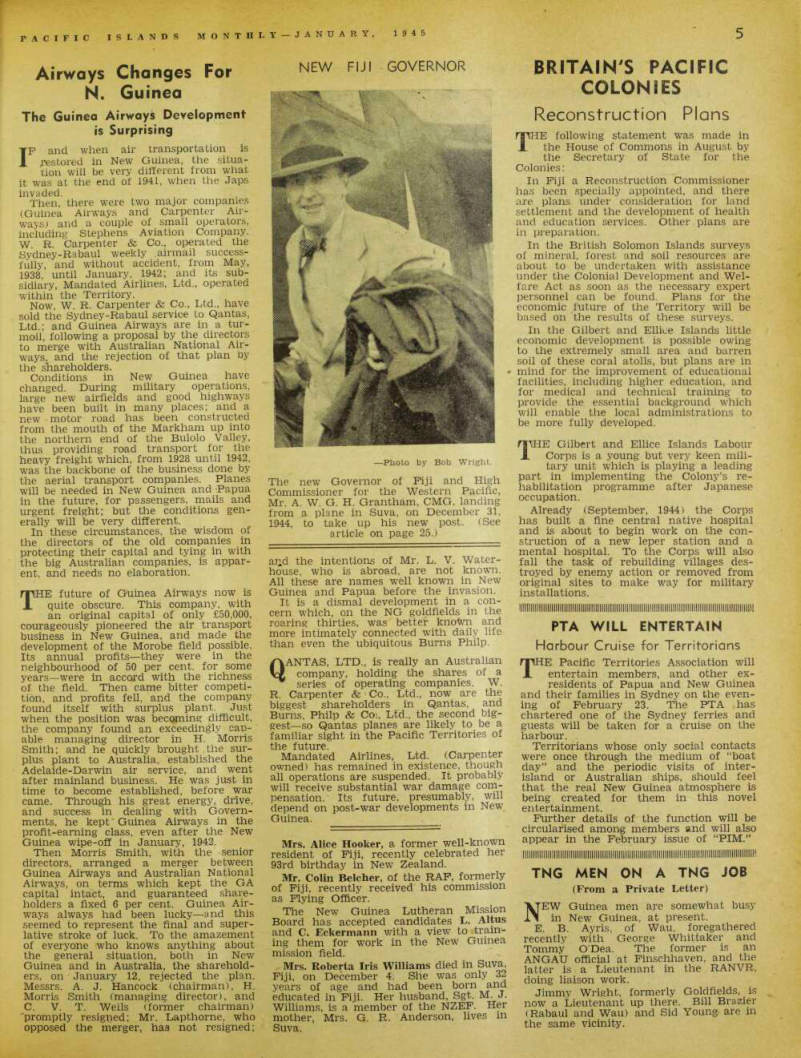
New Fiji Governor
—Photo by Bob Wright.
The new Governor of Fiji and High Commissioner for the Western Pacific, Mr. A. W. G. H. Grantham, CMG, landing from a plane in Suva, on December 31, 1944, to take up his new post. (See article on page 25.)
Britain's Pacific
Colonies
Reconstruction Plans
THE following statement was made in the House of Commons in August by the Secretary of State for the Colonies: In Fiji a Reconstruction Commissioner has been specially appointed, and there are plans under consideration for land settlement and the development of health and education services. Other plans are in preparation.
In the British Solomon Islands surveys of mineral, forest and soil resources are about to be undertaken with assistance under the Colonial Development and Wel fare Act as soon as the necessary expert personnel can be found. Plans for the economic future of the Territory will be based on the results of these surveys.
In the Gilbert and Ellice Islands little economic development is possible owing to the extremely small area and barren soil of these coral atolls, but plans are in mind for the improvement of educational facilities, including higher education, and for medical and technical training to provide the essential background which will enable the local administrations to be more fully developed.
THE Gilbert and Ellice Islands Labour Corps is a young but very keen mili tary unit which is playing a leading part in implementing the Colony’s re habilitation programme after Japanese occupation.
Already (September, 1944) the Corps has built a fine central native hospital and is about to begin work on the con struction of a new leper station and a mental hospital. To the Corps will also fall the task of rebuilding villages des troyed by enemy action or removed from original sites to make way for military installations.
Pta Will Entertain
Harbour Cruise for Territorians
rE Pacific Territories Association will entertain members, and other ex residents of Papua and New Guinea and their families in Sydney on the even ing of February 23. The PTA has chartered one of the Sydney ferries and guests will be taken for a cruise on the harbour.
Territorians whose only social contacts were once through the medium of “boat day” and the periodic visits of inter island or Australian ships, should feel that the real New Guinea atmosphere is being created for them in this novel entertainment.
Further details of the function will be circularised among members and will also appear in the February issue of “PIM.”
Tng Men On A Tng Job
(From a Private Letter) NEW Guinea men a.re somewhat busy in New Guinea, at present.
E. B. Ayris, of Wau, foregathered recently with George Whittaker and Tommy O’Dea. The former is an ANGAU official at Finschhaven, and the latter is a Lieutenant in the RANVR, doing liaison work.
Jimmy Wright, formerly Goldfields, is now a Lieutenant up there. Bill Brazier (Rabaul and Wau) and Sid Young are in the same vicinity.
Fate of Papua’s Government Apparently
Awaits Outcome of Barry Inquiry
(See also article on p. 41)
THE question of when civil government is to be restored to Papua, and civi lians permitted to return, appears to be closely linked with the “mystery inquiry” now being made by Mr. Barry, Melbourne KC, concerning the circum stances surrounding the cessation of civil administration in Papua in February, 1942.
Nothing at all, so far as is generally known, is being done to prepare for the return of civil government. People who know something of the undercurrents say that the Army is opposing civil restoration on the following three grounds: ® Control over bases in Papua is needed by the Army in order to facilitate opera tions in the Mandated Territory, where the AIF is now settling down to the task of rooting out the Jap armies by-passed and isolated by the American-Australian advances in 1943-4. • The Territory of Papua and the lib erated parts of the Territory of New Guinea are now being administered as one area by the Army-controlled ANGAU, comprising officials from both Territories: and, as the Papuan administrative sys tem has been completely abandoned in favour of a composite system, it would be most difficult and inconvenient to remove ANGAU from Papua, and permit the old civil administration to resume its func tions. • The basis of this administration is transport. The Army must have com plete control over all transport so long as operations are proceeding in New Guinea.
Which makes out a good case, calcu lated* to impress a Canberra Minister But the facts are: There is nothing to prevent the Army having the fullest con trol over all bases required in Papua just as it has over bases, further south’ in the State of Queensland. In the inter ests of the civilian Europeans and the Papuan natives, it is urgent that civilian government be restored. If this is not done soon, many hundreds of blameless planters, miners and traders, many of whom pioneered this country for Austra lia, will be hopelessly ruined. The social structure and morale of the ' Papuan natives, so carefully protected and trained during 40 years by MacGregor and Mur ray, are being destroyed by the present regime, with its ruthless system of forced labour. The “difficulty and inconveni ence of switching back from ANGAU to civil administration will be more than Ced A^A h TT econ 9 mic benefit to Aus tralia. ANGAU now is using 8, or 10, or 20 men where the civil administration employed only one or two. The present cost of administering Papua must be staggering: but details are all hidden Expe y ndSure.’’ <DePartment ° f the Ar^~ brass hats are suspect AN important reason why civil adminis tration should be restored is that the motives of certain Army heads in Papua are suspect. Ever since the Jap invasion if not before-they have dreamed of the day when the war would be over; the two Territories thrown into oSt e: to n ?hp at R admir ii St . rative jobs handed »fS of 6 th?ir aS s S tep Wh ° haVe been And events have developed In their favour. There Is little left of the civil administrations of. New Guinea and Papua. Owing to the monstrous bungling
of certain high officers (of whom much more will be heard when National Security permits!) a large proportion of New Guinea’s administrative heads were trapped in Rabaul when the Japs invaded; the civil administrator of New Guinea (Sir Walter McNicoli) has retired' a considerable proportion of Papua’s senior officials have retired, through one cause and Another; and apart from Papua s civil administrator (Mr. Leonard Murray) there would be only a handful 9f senior officials left to fill the principal jobs, if civil administration were restored in both Territories to-morrow.
If Mr. Murray and his senior officials were out of the way, there is little appar ent reason why ANGAU should not change over from wartime zo peacetime establishment, and govern the two Ter ritories as the new civil administration— complete with its present directing coterie of high-ranking and highly-paid Brass Hats!
And that is why the present unexpected Roya! Commission into the circumstances of February, 1942, is suspected of being inspired and supported by the Brass Hats.
If it is not, then it is a singular coinci dence, because it comes as a complete surprise (until now, nothing had been heard by the public of any failure by the Papuan Administration in February 1942); it is so arranged that it places the Papuan Administrator and his senior offi cers in the position of defendants; and, if the latter are found guilty, then the way presumably is clear for a clean sweep of the old Papuan Administration.
Angau Personnel
THIS comment and criticism must not be construed as an attack upon the personnel of ANGAU. The ANGAU set-up is ridiculously over-staffed and very expensive; but that is a characteris tic fault of Brass Hats. The men who are carrying out the jobs allotted to them have nothing to do with the basic organisation.
Gathered within ANGAU, now are a larfre proportion of the former public ser vice personnel of Papua and New Guinea and a large number of young men who were engaged in commercial occupations in those Territories, and whose services have been obtained for this semi-militarv job. No pulbic criticism of the quality of these men, and the way in which thev carry out their duties, has been made— except that there are far too manv of them.
ANGAU men, individually, are held in respect by all who have had contact with them—especially those lads who have been “taking the rough stuff” out in the jungles.
Criticism is directed against certain Brass Hats who, knowing nothing what ever of the Territories or of tropical administration, originally went to Papua and New Guinea upon military duties who—as was predicted at the time by this newspaper—cast a covetous eye upon the principal administrative iobs around the place; and who have used ANGAU to put themselves into line for permanent appointments after the war.
It is an extraordinary fact—and one upon which we commented long before wartime conditions threw civilians gen erally into the arms of the militarist and the bureaucrat—that every old soldier above the rank of colonel, and most of the e-entlemen who have been tossed out of Parliament, imagine that they are
qualified in some Heaven-born way to become administrators of tropical terri tories. They have been the curse of the Australian and New Zealand Pacific Ter ritories fo,r three decades, and we fear we
are not finished with them yet. The pacific Territories of Britain and France are administered, as a matter of course, by men who have been trained all their lives in administration, and who rise through the colonial services by merit.
The Barry Inquiry
AS was reported here last month, the inquiry of Royal Commissioner Barry was opened in Melbourne in Decem ber, and was continued in Sydney on January 4. A large number of persons, including the Civil Administrator of Papua (Mr. Leonard Murray) and his senior officers, gave evidence, in that and the following week. The Commissioner and his assistants have now gone to Port Moresby, where evidence is to be taken.
When the Commissioner sat in Sydney,
an urgent plea was made to him to per mit evidence to be taken in public, so that the Australian people might know something of the matters under consid eration. The Commissioner, however, deeded that all proceedings must be in camera.
Terms of reference are as follow: John Vincent Barry, KC, is appointed a Com missioner to inquire into, and report to the Minister for External Territories on the follow ing matters, being matters in relation to the public safety and defence of the Commonwealth and the Territories of the Commonwealth: (1) All the circumstances relating to the suspension of the Civil Administration of the Territory of Papua in February, 1942. (2) Without restricting the generality of 1, the following particular matters: (a) Whether the Administrator and/or any members of the Legislative Council and/or any members of the Executive Council of Papua failed in their public duty to safeguard the Territory; (b) Whether any action taken or omitted to be taken by the Military Com mandant of the Bth Military District prior to noon on 14th February, 15’42, contributed to any failure on the part of the Civil Administration of the Territory; (c) Whether there was adequate co operation between the Civil Adminis tration and the military authorities in the Territory and, if not, who was re sponsible for the absence of such co operation; and (d) All other matters deemed relevant to the above.
The Commissioner will report to the Minister for External Territories, Mr.
Ward. Mr. Ward, of course, must take the report to Cabinet. After that, some decision will be made, presumably, regard ing the return of civil administration to Papua, and the personnel of that administration.
Departmentalism is notorious for its dilatory methods. There has been no haste in this matter —it is at least six months since we first heard a whisper of “the mysterious Barry inquiry about Papua.” It will be surprising if anything decisive is done before the end of March.
Copy Of A Letter To
Mr. Ward
January 12, 1945.
Hon. E. J. Ward, MP, Minister for External Territories Canberra.
Dear Mr. Ward,— I have, just seen, for the first time, a copy of the instructions given by you to Mr. Barry, KC, who, as a
Royal Commissioner, is inquiring
into the circumstances surrounding the cessation of civil government in Papua in February, 1942.
I am one of those who, rightly or wrongly, regard this as an attack by the Army upon the Civil Administrator, Mr. Murray, and an attempt by the Army to entrench some parts of itself permanently in Territories Administration.
Therefore, I take the liberty of suggesting to you that, before Mr.
Barry ceases his inquiry, you add the following to his “terms of re ference”: To inquire into all the circumstances surrounding the failure of the responsible authorities to remove all non-combatant Europeans from Rabaul prior to the Japanese invasion; and especially to ascertain— , (a) The date when it became clear to our military commanders in Port Moresby that a Japanese invasion fleet was approaching Rabaul; (b) The number of ships that were then available in or near Rabaul Harbour for the removal of European civi lians; (c) The time that elapsed after (a) before the Japanese sealed up Rabaul Harbour; (d) The approximate number of non combatants, including high adminis trative officials, who were captured by the Japs in Rabaul and vicinity; (e) The number and size of ships trapped in Rabaul Harbour, and the reasons for their non-removal.
And to say who actually was to blame for the fact that those Rabaul civilians were not shipped away.
I venture to suggest that there are matters here of far greater im port to Australia, and the Army, than what happened in Port Moresby during the same tragic period.
Yours faithfully,
R. W. Robson,
Publisher, “Pacific Islands Monthly.”
Advertisements & other items, p. 9 (1 item)
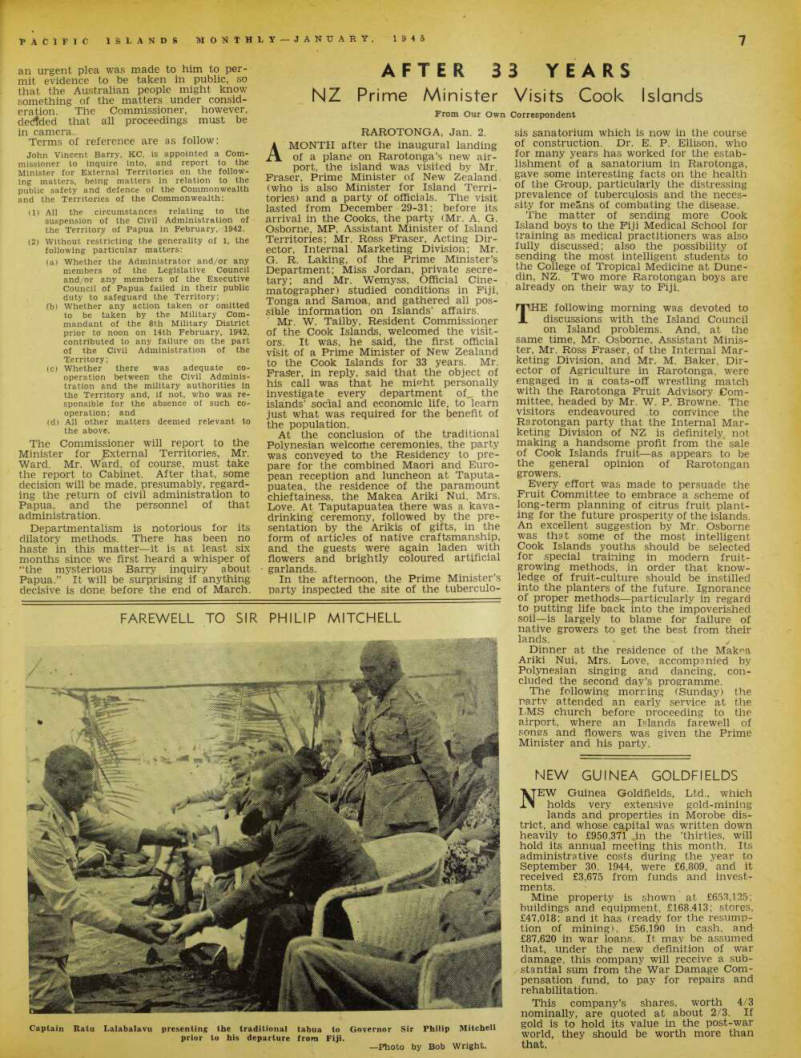
Farewell To Sir Philip Mitchell
Captain Ratu Lalabalavu presenting the traditional tabua to Governor Sir Philip Mitchell prior to his departure from Fiji. —Photo by Bob Wright.
After 33 Years
NZ Prime Minister Visits Cook islands
From Our Own Correspondent
Rarotonga, Jan. 2.
A MONTH after the inaugural landing of a plane on Rarotonga’s new air port, the island was visited by Mr.
Fraser, Prime Minister of New Zealand (who is also Minister for Island Terri tories) and a party of officials. The visit lasted from December 29-31; before its arrival in the Cooks, the party (Mr. A. G.
Osborne, MP, Assistant Minister of Island Territories; Mr. Ross Fraser, Acting Dir ector, Internal Marketing Division; Mr.
G. R. Laking, of the Prime Minister’s Department: Miss Jordan, private secre tary: and Mr. Wemyss, Official Cine matographer) studied conditions in Fiji, Tonga and Samoa, and gathered all pos sible information on Islands’ affairs.
Mr. W. Tailby, Resident Commissioner of the Cook Islands, welcomed the visit ors. It was, he said, the first official visit of a Prime Minister of New Zealand to the Cook Islands for 33 years. Mr.
FraSer, in reply, said that the object of his call was that he personally investigate every department of,, the islands’ social and economic life, to learn just what was required for the benefit of the population.
At the conclusion of the traditional Polynesian welcome ceremonies, the party was conveyed to the Residency to pre pare for the combined Maori and Euro pean reception and luncheon at Taputa puatea, the residence of the paramount chieftainess, the Makea Ariki Nui, Mrs.
Love. At Taputapuatea there was a kava drinking ceremony, followed by the pre sentation by the Arikis of gifts, in the form of articles of native craftsmanship, and the guests were again laden with flowers and brightly coloured artificial - garlands.
In the afternoon, the Prime Minister’s party inspected the site of the tuberculo
sis sanatorium which is now in the course of construction. Dr, E. P. Ellison, who for many years has worked for the estab lishment of a sanatorium in Rarotonga, gave some interesting facts on the health of the Group, particularly the distressing prevalence of tuberculosis and the neces sity for means of combating the disease.
The matter of sending more Cook Island boys to the Fiji Medical School for training as medical practitioners was also fully discussed; also the possibility of sending the most intelligent students to the College of Tropical Medicine at Dune din, NZ. Two more Rarotongan boys are already on their way to Fiji.
THE following morning was devoted to discussions with the Island Council on Island problems. And, at the same time, Mr. Osborne, Assistant Minis ter, Mr. Ross Fraser, of the Internal Mar keting Division, and Mr. M. Baker, Dir ector of Agriculture in Rarotonga, were engaged in a coats-off wrestling match with the Rarotonga Fruit Advisory Com mittee, headed by Mr. W. P. Browne. The visitors endeavoured to convince the Rarotongan party that the Internal Mar keting Division of NZ is definitely not making a handsome profit from the sale of Cook Islands fruit—as appears to be the general opinion of Rarotongan growers.
Every effort was made to persuade the Fruit Committee to embrace a scheme of long-term planning of citrus fruit plant ing for the future prosperity of the islands.
An excellent suggestion by Mr. Osborne was that some of the most intelligent Cook Islands youths should be selected for special training in modern fruit growing methods, in order that know ledge of fruit-culture should be instilled into the planters of the future. Ignorance of proper methods —particularly in regard to putting life back into the impoverished soil —is largely to blame for failure of native growers to get the best from their lands.
Dinner at the residence of the Makoa Ariki Nui, Mrs. Love, accompanied by Polynesian singing and dancing, con cluded the second day’s programme.
The following morning (Sunday) the partv attended an early service at the IMS church before proceeding to the airport, where an Islands farewell of songs and flowers was given the Prime Minister and his party.
New Guinea Goldfields
, Ltd., which holds very extensive gold-mining lands and properties in Morobe dis trict, and whose capital was written down heavily to £950,371 Jn the ’thirties, will hold its annual meeting this month. Its administrative costs during the year to September 30. 1944, were £6,809, and it received £3,675 from funds and invest ments.
Mine property is shown at £653,125; buildings and equipment, £168.413; stores, £47,018; and it has (ready for the resump tion of mining), £56,190 in cash, and £87,620 in war loans. It may be assumed that, under the new definition of war damage, this company will receive a sub stantial sum from the War Damage Com pensation fund, to pay for repairs and rehabilitation.
This company’s shares, worth 4/3 nominally, are quoted at about 2/3. If gold is to hold its value in the post-war world, they should be worth more than that.
In Solomons
Production Board
To Take Over and Work Plantations
EXERCISING wartime powers, the High Commissioner of the Western Paci fic, by regulations published in Suva on October 30, established the British Solomons Islands War Materials Produc tion Board, consisting of the Resident Commissioner, the Custodian of Property and one other member —both the latter to be appointed by the RC.
The Board’s headquarters are on Guadalcanal. It is to “promote and con trol the production, disposal and sale of
copra, rubber, and other products of the Protectorate.” It may requisition, enter into possession of, and work any planta tion and other property in the Solomons: and all necessary legal machinery for that purpose is provided.
No compensation is payable to owners; but the latter will receive rental at the rate of 10/- per acre per annum for fully planted - coconut or rubber land. Rental also will be paid for buildings occupied.
It appears to be a set-up somewhat resembling the Production Board in Papua. But where, in Papua, there is provision for co-operation with owners and sharing profits with owners, there is no provision for owners in the Solomons plan, except payment of rent.
Although the Japs are long gone from all the Solomons—except a few on Choi f£ U l"lS ler S the Shiest indication that the British authorities are prepared to permit the return of civilians. No one knows why.
The Queen of the Netherlands has appointed Caledonian-born M Carlo Leom a Chevalier of the Order of Orange Nassau For many years M. Leoni was Dutch Vice-consul in Noumea.
Captain Charbonnier of the French mechca l service recently flew to WallS Islands (New Caledonia) where he suc ceeds Dr. Mattel as Resident and Medical Officer. He was accompanied by his wife fhP » ? he ma d n Of oSvea fn the Wallis Group has been used by the Americans as an air and naval base and weather station since mid-1942
ladies 1 singles championships
Who was runner-up in the ladies 1 singles championships in Rabaul in 1934?
J 1 HE following 'paragraph ap peared in the Melbourne “Sporting Globe” (c/o “Herald and Weekly Times”) on Decem ber 16. It was sent to us by Mrs.
Amy Gregory, who at present lives in Melbourne. Anyone knowing the whereabouts of the “Runner-up” can communicate direct with the “Sporting Globe” or, alternatively, with the “PIM”
A silver cake dish inscribed “RDLTA Runner-up Ladies’ Singles Championships, 1934” has come into the possession of Hugh Ferguson, of the AIF.
Ferguson believes that the letters “RDLTA” stand for Rabaul District Lawn Tennis Association. The trophy was recovered from the Japanese. He desires that the trophy be returned to its rightful owner, and would like to have any further particulars available.
NZ Prime Minister
in W. Samoa Samoan and European Grievances Discussed
From Our Own Correspondent
Apia Jan 9
rE increasingly important’ part the islands of the South Pacific are playing in world affairs is reflected in the fact that, within the past year, Western Samoa—with an airport of some importance on the crossroads of the Pacific—has been .visited twice by the Governor-General of New Zealand, and has now been paid an official visit by the Prime Minister of New Zealand, Mr.
Peter Fraser. The Prime Minister and his party remained a week, in order to obtain a personal knowledge of the prob lems of the Territory and find a solution for them, if possible.
His ‘visit extended also to the Tokelau Islands, the Cook Islands, and Niue, the other New Zealand dependencies.
The party consisted of the Prime Minister, Mr. A. G. Osborne, MP (Par liamentary Under-Secretary to the Prime Minister), Mr. Rbss Frazer (Acting Dir ector of the Internal Marketing Division), Mr. G. R. Taking (Department of Exter nal Affairs), Miss K. G. Jordan (private secretary), and Mr. S. J. Wemyss (cameraman). They completed a strenu ous round of inspections, conferences and interviews, with only a few social func tions interrupting the “strictly business” character of the visit.
Most important, from the Samoan point of view, were the talks with native, European and Euronesian leaders, who submitted their grievances.
The Samoan Fono of Faipule asked for a greater share of self-government and responsibility for Samoans—similar to the Tongan and Fijian native systems; bet ter prices for their products, particularly bananas, copra and cocoa-beans; better roads and communications; better wages for local officials: increased employment of Samoans by the Administration, and better facilities for education.
European representatives discussed with the Prime Minister the' disposal of Crown lands for plantations to Europeans; the lifting of prohibition; better wages for local-born officials: and the improvement of roads and services generally.
MR. FRASER openly expressed sym pathy with the demands submitted to him. He said, however, that on some of the more important and far reaching questions he was unable to give a decision before consulting the New Zealand Cabinet.
In a speech before the Samoan repre sentatives and leaders, at a meeting held at Mulinu’u on Boxing Day, Mr. Fraser expressed his sincere thanks for the cor dial reception given him and his party He said that he would do his best to satisfy the legitimate grievances of the people of Samoa on his return to NZ.
Post-war Reconstruction
Colonial Office Plan for BSI
IT was reported from London on Decem ber 6, that the Colonial Office had outlined plans for rebuilding and developing the economic life of the lib erated islands of the British Solomons Protectorate. (See also article, p. 5.) Full details of the plan were not announced but, as a first step, a free grant has been made under the Colonial Development and Welfare Act. This is to be used for investigation into soil, mineral and forest resources.
Papuan Firms Sue
Commonwealth £37,740 Claimed
WRITS totalling £37,740/10/10 have
been taken out in the High Court of Australia by two Papuan firms. The firms are Steamship Trading Co., Ltd., and Sawmillers and Traders, Ltd., owned by the same people.
Steamship Trading Co., Ltd., claim for rental of certain buildings and premises occupied by the Government in Papua The amount claimed is £13,097/10/-.
Sawmillers and Traders, Ltd., claim £24,643/6/10, made up as follows: £22,956/3/- for certain timber cut and sawn at Port Romiliy sawmills, New Guinea; £326/17/4 for stone stocks taken over by the defendants; £760/6/6 for tim ber stocks taken over; and £6OO . for alleged loss sustained to a rubber nur sery, 30 miles from Port Romiliy.
The writs are issued against the Fed eral Government, the Minister for the Army (Mr. Forde), the Minister for External Territories (Mr. Ward), and the Production Control Board.
Many other claims against the same authority will depend upon the outcome of this action. Territorians generally will be grateful to Captain Fitch and his co-directors for forcing the long argu ment about Army liability to an issue.
Cake For Territorial
rIS is Mrs. I. Meldrum, formerly of Rabaul, with the three-tiered cake which she decorated for the Christ mas party, held in Sydney on December
21, by the New Guinea Women’s Club.
The cake was pure Territorian —a tier for each of the three years that New Guinea women have spent as evacuees and the decorations which surrounded the base and crowned the top depicted native life.
Coconuts, tiny kunai houses and “boys” and “Maries” crouching over camp-fires made the club’s 300 guests yearn over the masterpiece as though it were in fact a piece of home.
Teopicalities
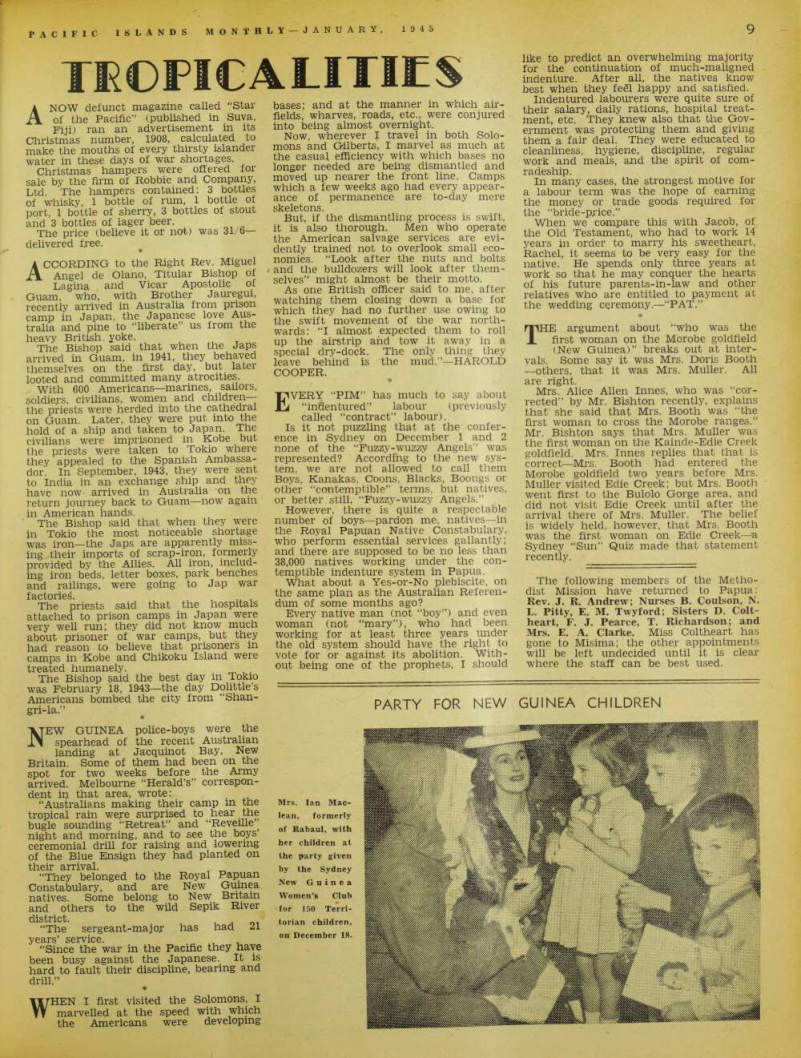
A NOW defunct magazine called “Star of the Pacific” (published in Suva, Fiji) ran an advertisement in its Christmas number, 1908, calculated to make the mouths of every thirsty islander water in these days of war shortages.
Christmas hampers were offered for sale by the firm of Robbie and Company, Ltd. The hampers contained: 3 bottles of whisky, 1 bottle of rum, 1 bottle of port, 1 bottle of sherry, 3 bottles of stout and 3 bottles of lager beer.
The price (believe it or not) was 31/6 delivered free.
ACCORDING to the Right Rev. Miguel Angel de Olano, Titular Bishop of Lagina and Vicar Apostolic of Guam, who, with Brother Jauregui, recently arrived in Australia from prison camp in Japan, the Japanese love Aus tralia and pine to “liberate” us from the heavy British, yoke.
The Bishop said that when the Japs arrived in Guam, in 1941, they behaved themselves on the first day, but later looted and committed many atrocities.
With 600 Americans —marines, sailors, soldiers, civilians, women and children— the priests were herded into the cathedral on Guam. Later, they were put into the hold of a ship and taken to Japan. The civilians were imprisoned in Kobe but the priests were taken to Tokio where they appealed to the Spanish Ambassa dor. In September, 1943, they were sent to India in an exchange ship and they have now- arrived in Australia on the return journey back to Guam —now again in American hands.
The Bishop said that when they were in Tokio the most noticeable shortage was iron—the Japs are apparently miss ing their imports of scrap-iron, formerly provided by the Allies. All iron, includ ing iron beds, letter boxes, park benches and railings, were going to Jap war factories'. ..
The priests said that the hospitals attached to prison camps in Japan were very well run; they did not know much about prisoner of war camps, but they had reason to believe that prisoners in camps in Kobe and Chikoku Island were treated humanely. m , .
The Bishop said the best day in Tokio was February 18, 1943 —the day Dolittle’s Americans bombed the city from “Shan gri-la.”
NEW GUINEA police-boys were the spearhead of the recent Australian landing at Jacquinot Bay, New Britain. Some of them had been on the spot for two weeks before the Army arrived. Melbourne “Herald’s” correspon dent in that area, wrote; “Australians making their camp in the tropical rain were surprised to hear the bugle sounding “Retreat” and “Reveille” night and morning, and to see the boys’ ceremonial drill for raising and lowering of the Blue Ensign they had planted on their arrival.
“They belonged to the Royal Papuan Constabulary, and are New Guinea natives. Some belong to New Britain and others to the wild Sepik River district.
“The sergeant-major has had 21 years’ service.
“Since the war in the Pacific they have been busy against the Japanese. It is hard to fault their discipline, bearing and drill.” * WHEN I first visited the Solomons, I marvelled at the speed with which the Americans were developing
bases; and at the manner in which air fields, wharves, roads, etc., were conjured into being almost overnight.
Now, wherever I travel in both Solo mons and Gilberts, I marvel as much at the casual efficiency with which bases no longer needed are being dismantled and moved up nearer the front line. Camps which a few weeks ago had every appear ance of permanence are to-day mere skeletons.
But, if the dismantling process is swift, it is also thorough. Men who operate the American salvage services are evi dently trained not to overlook small eco nomies. “Look after the nuts and bolts and the bulldozers will look after them selves” might almost be their motto.
As one British officer said to me, after watching them closing down a base for which they had no further use owing to the swift movement of the war north wards; “I almost expected them to roll up the airstrip and tow it away in a special dry-dock. The only thing they leave behind is the mud.”— HAROLD
Cooper.
* EVERY “PIM” has much to say about “indentured” labour (previously called “contract” labour).
Is it not puzzling that at the confer ence in Sydney on December 1 and 2 none of the “Fuzzy-wuzzy Angels” was represented? According to the new sys tem, we are not allowed to call them Boys, Kanakas, Coons, Blacks, Boongs or other “contemptible” terms, but natives, or better still, “Fuzzy-wuzzy Angels.”
However, there is quite a respectable number of boys—pardon me. natives —in the Royal Papuan Native Constabulary, who perform essential services gallantly; and there are supposed to be no less than 38,000 natives working under the con temptible indenture system in Papua.
What about a Yes-or-No plebiscite, on the same plan as the Australian Referen dum of some months ago?
Every native man (not “boy”) and even woman (not “mary”), who had been working for at least three years under the old system should have the right to vote for or against its abolition. With out being one of the prophets, I should
like to predict an overwhelming majority for the continuation of much-maligned indenture. After all, the natives know best when they happy and satisfied.
Indentured labourers were quite sure of their salary, daily rations, hospital treat ment, etc. They knew also that the Gov ernment was protecting them and giving them a fair deal. They were educated to cleanliness, hygiene, discipline, regular work and meals, and the spirit of com radeship.
In many cases, the strongest motive for a labour term was the hope of earning the money or trade goods required for the “bride-price.”
When we compare this with Jacob, of the Old Testament, who had to work 14 years in order to marry his sweetheart, Rachel, it seems to be very easy for the native. He spends only three years at work so that he may conquer the hearts of his future parents-in-law and other relatives who are entitled to payment at
the wedding ceremony.-
“Pat.”
THE argument about “who was the first woman on the Morobe goldfield (New Guinea)” breaks out at inter vals. Some say it was Mrs. Doris Booth —others, that it was Mrs. Muller, All are right.
Mrs. Alice Allen Innes, who was “cor rected” by Mr. Bishton recently, explains that she said that Mrs. Booth was “the first woman to cross the Morobe ranges.”
Mr. Bishton says that Mrs. Muller was the first woman on the Kainde-Edie Creek goldfield. Mrs. Innes replies that that is correct—Mrs. Booth had entered the Morobe goldfield two years before Mrs.
Muller visited Edie Creek; but Mrs. Booth went first to the Bulolo Gorge area, and did not visit Edie Creek until after the arrival there of Mrs. Muller. The belief is widely held, however, that Mrs. Booth was the first woman on Edie Creek —a Sydney “Sun” Quiz made that statement recently.
The following members of the Metho dist Mission have returned to Papua: Rev. J. R. Andrew; Nurses B. Coulson, N.
L. Pitty, E. M. Twyford; Sisters D. Colt heart, F. J. Pearce, T. Richardson; and Mrs. E. A. Clarke. Miss Coltheart has gone to Misima; the other appointments will be left undecided until it is clear where the staff can be best used.
Advertisements & other items, p. 11 (1 item)
Party For New Guinea Children
Mrs. lan Mac lean, formerly of Rabaul, with her children at the party given by the Sydney New Guinea Women’s Club for 150 Terri torian children, on December 18.
The y?“ r
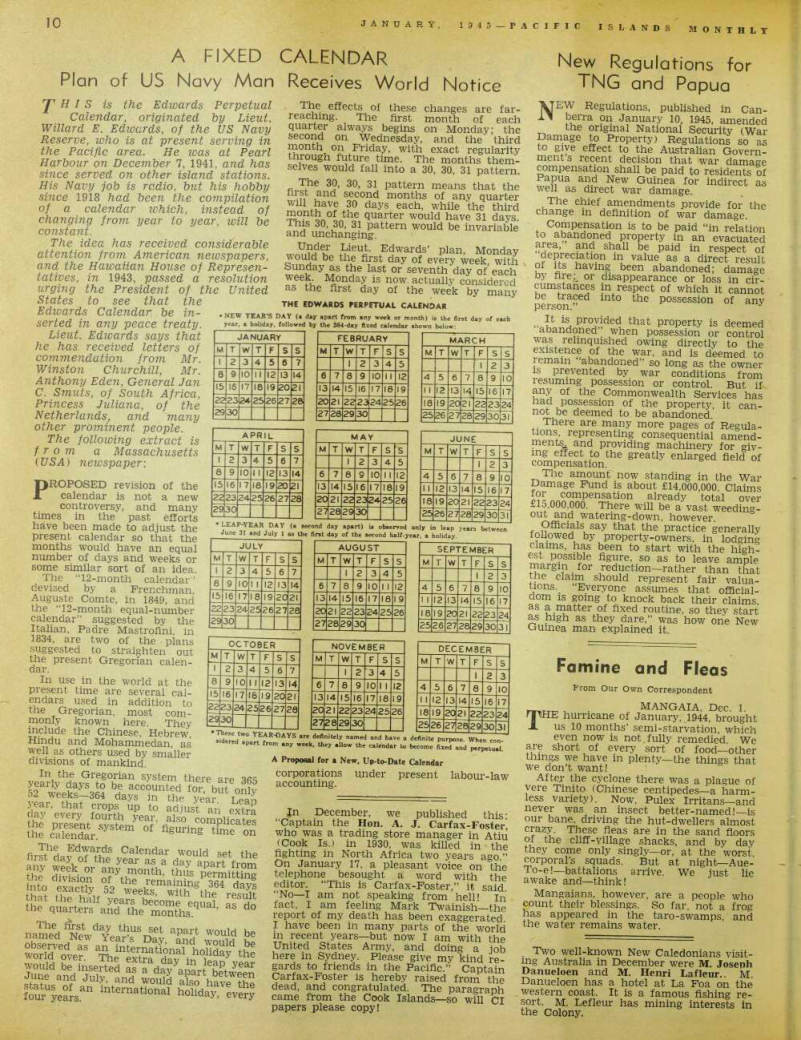
A Fixed Calendar
Plan of US Navy Man Receives World Notice
J 1 HI S is the Edwards Perpetual Calendar, originated by Lieut.
Willard E. Edwards, of the US Navy Reserve, who is at present serving in the Pacific area. He was at Pearl Harbour on December 7, 1941, and has since served on other island stations.
His Navy job is radio, but his hobby since 1918 had been the compilation of a calendar which, instead of changing from year to year, will be constant.
The idea has received considerable attention from American newspapers, and the Hawaiian House of Represen tatives, in 1943, passed a resolution urging the President of the United
States to see that the Edwards Calendar he in serted in any peace treaty.
Lieut. Edwards says that he has received letters of commendation from Mr.
Winston Churchill, Mr.
Anthony Eden, General Jan C. Smuts, of South Africa, Princess Juliana, of the Netherlands, and many other prominent people.
The following extract is from a Massachusetts {USA) newspaper : Proposed revision of the calendar is not a new controversy, and many times in the past efforts have been made to adjust the present calendar so that the months would have an equal number of days and weeks or some similar sort of an idea.
The “12-month calendar’ devised by a Frenchman, Auguste Comte, in 1849, and the “12-month equal-number calendar” suggested by the Italian, Padre Mastrofini, in 1834, are two of the plans suggested to straighten out the present Gregorian calen dar.
In use in the world at the present time are several cal endars used in addition to the Gregorian, most com monly known here. They include the Chinese, Hebrew, Hindu and Mohammedan, as well as others used by smaller divisions of mankind
In the Gregorian system there are i a w y eif S 3 £ b i/ ccoun^ weexs—364 days in the year T pan jear, that crops up to adjust an extra day every fourth year, also complicate! the calendar system of Anting time on
The y?“ r
f£ y week or any month, thus permitting the division of the remaining into exactly 52 weekl wSh Bth»4 8 th» 4 da^? that the halt years become equa! afrin the quarters and the months ’ do named wou , ld be ?our U years an lnternation »l holiday, every
The effects of these changes are far reaching. The first month of each quarter always begins on Monday; the second on Wednesday, and the third month on Friday, with exact regularity through future time. The months them selves would fall into a 30, 30, 31 pattern.
The 30, 30, 31 pattern means that the secon d months of any quarter wiH have 30 days each, while the third °* toe quarter would have 31 days.
This 30, 30, 31 pattern would be invariable
and unchanging.
u n?er Lieut. Edwards’ plan, Monday be % fi f st day of ever y week, with Sunday as the last or seventh day of each week Monday is now actually considered as the first day of the week by many
corporations under present labour-law accounting.
In December, we published this “ Captain the Hon. A. J. Carfax-Foster, who was a trading store manager in Atiu (Cook Is.) in 1930, was killed in the fighting in North Africa two years ago.”
On January 17, a pleasant voice on the telephone besought a word with the editor. “This is Carfax-Foster,” it said “No—l am not speaking from hell! in fact, I am feeling Mark Twainish—the report of my death has been exaggerated I have been in many parts of the world in recent years—but now I am with the United States Army, and doing a job here in Sydney. Please give my kind re gards to friends in the Pacific.” Captain Carfax-Foster is hereby raised from the dead, and congratulated. The paragraph came from the Cook Islands—so will Cl papers please copy!
New Year's
year, a holiday
The Edwards Perpetual Calendar
DAY (a day apart from any week or month) ia the first day of each followed by the 354-day fixed calendar shown below;
Janu
Ary
February
March
M T W T F s s M T w T F s S M T W T F s s 1 2 3 4 5 6 7 i 2 3 4 5 1 2 3 a 9 10 II 12 13 14 6 7 8 9 10 i 1 1 12 4 5 6 7 6 9 10 li 16 17 18 19 2C 21 13 14 15 16 17 18 19 1 1 12 13 i 14 15 16 17 a k 24 ■25 >26 27 26 2C >21 2c >22 24 25 26 18 19 2C )2I 2c 23 124 29(3C 21 20 29 30 25 >26 21 '28 29 30 31 A PR IL
May
June
M T W T F S S M T W T F S S M T W T F S s 1 2 3 4 5 6 7 1 2 3 4 5 1 2 3 8 9 10 1 1 12 13 14 6 7 8 9 10 1 1 12 4 5 6 7 8 9 10 15 16 1 7 16 19 20 21 13 14 15 16 17 18 19 li 12 13 14 15 16 17 22 23 24 25 26 27 28 20 21 22 23 24 25 26 18 19 20 21 22 23 24 2y 3(J 27 28 29 30 25 26 27 28 29 30 31 • LEAP-YEAR DAY (a second day apart) is observed only i June 31 and July I as the first day of the second half-year, a n le holic ap lay. yeai rs b etw. ien JL
Jly
August
September
M T W T F S S M T W T F S S M T W T F s s 1 2 3 4 5 6 7 1 2 3 4 5 I 2 3 8 9 10 1 1 12 13 14 6 7 8 9 10 1 1 12 4 5 6 7 8 9 10 15 16 17 18 19 20 21 13 14 15 16 17 18 19 1 1 12 13 14 15 16 17 22 23 24 25 26 27 28 20 21 22 23 24 25 26 18 19 20 21 22 23 24 29 30 27 28 29 30 25 26 27 28 29 30 31 0 CT OB ER
November
December
—j M T W T F S S M T W T F S S M T W T F S s 1 2 3 4 5 6 7 1 2 3 4 5 1 2 3 8 9 10 1 1 1 12 13 14 6 7 8 9 10 1 1 12 4 5 6 7 8 9 10 15 16 1 17 1 18 1 19 i 20; 21 13 14 15 16 17 18 19 1 1 12 13 14 15 16 17 22 ; ?3 i 24; 25; 26; 27; 28 20. 2i ; 22; 23; 24; 25 26 18 19 20i 2i ; 22 23 24 29: 30 27; 20; 29; 30 25; 26 27: 28; 29 30 31 YEAR ' D AYS are definitely named and have a del dered apart from any week, they allow the calendar to bee A Proposal for a New. Up-to-Datc Ca iniU omc lent ! PU i fix. lar rpos 2d a ie. V nd Vhe, F*erp 1 COl etua rill.
TNG and Papua
New Regulations for TNG and Papua
NEW Regulations, published in Can berra on January 10, 1945, amended the original National Security (War Damage to Property) Regulations so as to give effect to the Australian Govern ments recent decision that war damage compensation shall be paid to residents of Papua and New Guinea for indirect as well as direct war damage.
The chief amendments nrovide for the change in definition of war damage.
Compensation is to be paid “in relation to abandoned property in an evacuated area, and shall be paid in respect of depreciation in value as a direct result of its having been abandoned; damage by fire;_ or disappearance or loss in cir cumstances in respect of which it cannot be traced into the possession of any person, “OKOIS pro ji dec l that P r °P er ty is deemed abandoned when possession or control was relinquished owing directly to the existence of the war, and is deemed to remain abandoned” so long as the owner is prevented by war conditions from resuming possession or control. But if any of the Commonwealth Services has had possession of the property, it can n(™, be deemed to be abandoned.
There are many more pages of Regula tions, representing consequential amendand providing machinery for giv ing effect to the greatly enlarged field of compensation.
The amount now standing in the War Damage Fund is about £14,000,000. Claims l°* nnn°^P en^ tion , alrea dy total over £15,000,000. There will be a vast weeding
out• wa tering-down, however.
Officials say that the practice generally followed by property-owners, in lodging claims, has been to start with the high est possible figure, so as to leave ample margin for reduction—rather than that the claim should represent fair valua tions. “Everyone assumes that official dom is going to knock back their claims as a matter of fixed routine, so they start as high as they dare,” was how one New Guinea man explained it.
Famine and Fleas
From Our Own Correspondent
T_ . Mangaia, Dec. 1.
HE hurricane of January, 1944, brought us 10 months’ semi-starvation, which even now is not, fully remedied We are short of every sort of food—other things we have in plenty—the things that we don’t want!
After the cyclone there was a plague of vere Tinito (Chinese centipedes—a harm less variety). Now, Pulex Irritans—and never was v an insect better-named!—is our bane, driving the hut-dwellers almost crazy. These fleas are in the sand floors of the cliff-village shacks, and by day they come only singly—or, at the worst, corporal’s squads. But at night—Aue- To-e!—battalions arrive. We just lie awake and—think!
Mangaians, however, are a people who count their blessings. So far. not a frog has appeared in the taro-swamps, and the water remains water. . Two well-known New Caledonians visit ing Australia in December were M. Josenh Danueloen and M. Henri Lafleur.. M Danueloen has a hotel at La Foa on the western coast. It is a famous fishing re sort. M. Lefleur has mining interests in the Colony.
Mangaian War
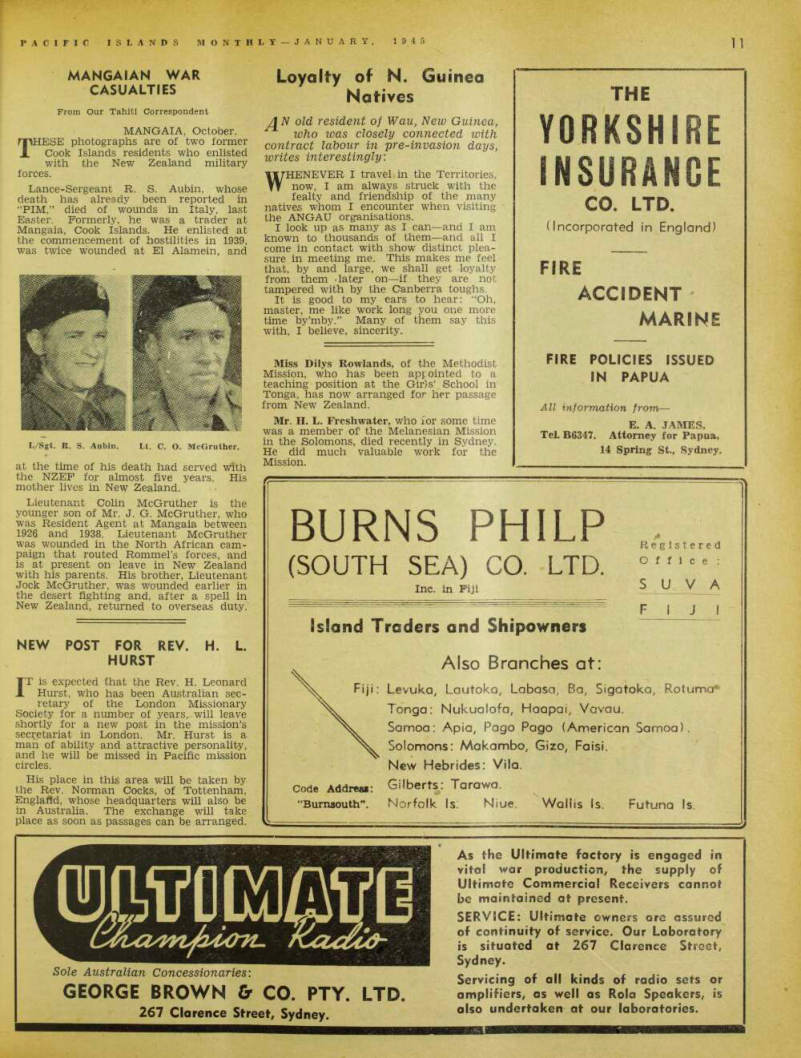
Casualties
From Our Tahiti Correspondent MANGAIA, October. rESE photographs are of two former Cook Islands residents who enlisted with the New Zealand military forces.
Lance-Sergeant R. S. Aubin, whose death has already been reported in “PIM,” died of wounds in Italy, last Easter. Formerly, he was a trader at Mangaia, Cook Islands. He enlisted at the commencement of hostilities in 1939, was twice wounded at El Alamein, and
at the time of his death had served with the NZEF fojr almost five years. His mother lives in New Zealand.
Lieutenant Colin McGruther is the younger son of Mr. J. G. McGruther, who was Resident Agent at Mangaia between 1926 and 1938. Lieutenant McGruther was wounded in the North African cam paign that routed Rommel’s forces, and is at present on leave in New Zealand with his parents. His brother, Lieutenant Jock McGruther, was wounded earlier in the desert fighting and, after a spell in New Zealand, returned to overseas duty.
L/Sgt. R. S. Aubin.
Lt, C. O. McGruther.
New Post For Rev. H. L.
Hurst
IT is expected that the Rev. H. Leonard Hurst, who has been Australian sec retary of the London Missionary Society for a number of years, will leave shortly for a new post in the mission’s secretariat in London. Mr. Hurst is a man of ability and attractive personality, and he will be missed in Pacific mission circles.
His place in this area will be taken by the Rev. Norman Cocks, of Tottenham, Englaftd, whose headquarters will also be in Australia. The exchange will take place as soon as passages can be arranged.
Loyalty of N. Guinea
Natives
AN old resident of Wau, New Guinea, who was closely connected with contract labour in pre-invasion days, writes interestingly : WHENEVER I travel in the Territories, now, I am always struck with the fealty and friendship of the many natives whom I encounter when visiting the ANGAU organisations.
I look up as many as I can —and I am known to thousands of them —and all I come in contact with show distinct plea sure in meeting me. This makes me feel that, by and large, we shall get loyalty from them -later on—if they are not tampered with by the Canberra toughs.
It is good to my ears to hear: “Oh, master, me like work long you one more time by’mby.” Many of them say this with, I believe, sincerity.
Miss Dilys Rowlands, of the Methodist Mission, who has been appointed to a teaching position at the Girls’ School in Tonga, has now arranged for her passage from New Zealand.
Mr. H. L. Freshwater, who for some time was a member of the Melanesian Mission in the Solomons, died recently in Sydney.
He did much valuable work for the Mission.
Advertisements & other items, pp. 13-14 (1 item)
TiilMfAVni
THE
YORKSHIRE
INSURANCE
CO. LTD.
(Incorporated in England)
FIRE
ACCIDENT
MARINE
FIRE POLICIES ISSUED
IN PAPUA
All information from —
E. A. JAMES,
TeL 86347. Attorney for Papua, 14 Spring St., Sydney.
BURNS PHILP
(SOUTH SEA) CO. LTD.
Inc. in Fiji Registered Office Island Traders and Shipowners
SUVA
F I J
Also Branches at: Code Addreat: “Burnsouth".
Levuka, Lautoka, Labasa, Ba ; Sigatoka, Rotu Tonga: Nukualofa, Haapai, Vavau.
Samoa: Apia, Pago Pago (American Samoa).
Solomons: Makambo, Gizo, Faisi.
New Hebrides: Vila.
Gilberts: Tarawa.
Norfolk Is; Niue. Wallis Is. Futuna Is.
u
TiilMfAVni
& Sole Australian Concessionaries :
GEORGE BROWN & CO. PTY.
267 Clarence Street, Sydney.
LTD.
As the Ultimate factory is engaged in vital war production, the supply of Ultimate Commercial Receivers cannot be maintained at present.
SERVICE: Ultimate owners are assured of continuity of service. Our Laboratory is situated at 267 Clarence Street, Sydney.
Servicing of all kinds of radio sets or amplifiers, as well as Rola Speakers, is also undertaken at our laboratories.
Refreshing
as a plunge
into a lagoon!
Germici d a 1
and fragrant
TENAX TOILET SOAP is
a rapid safeguard against external skin infections, yet it is soothing and kind to the most sensitive skin —even a baby’s!
ORDER TENAX FROM
YOUR ISLAND SUP-
PLIERS. STOCKS ARE
PLENTIFULLY AVAIL-
ABLE.
ROVE & SONS
Limited •»
AUCKLAND
Island Traders. P.o. Box 490< Telegraphic and Cable Address: “Grove”, Auckland.
Shippers of all classes of New Zealand products.
Representing English Manufacturers throughout the Cook and Society Islands, Fiji, Tonga, Samoa, Niue, New Caledonia, New Guinea, etc.
In FIJI os—W. H. Grove b Sons (Fiji) Ltd.
Theory Or Realism In Native Affairs?
Has Rev. J. W. Burton the Right to Speak For All Missionaries?
EVEN New Guinea conformed to the 1944 war-pattern of political ideo logies; and the fight between Theorists and Realists over the body of the generally uncaring native (and his Welfare) already has begun its 1945 session.
The Realists generally have been taken to mean the much-maligned “commercial interests”—the tough gentlemen with axes to grind; the Theorists—the present Australian Government, the scientists and the Missions.
The Government is ephemeral: sooner or later, for good or ill, another group of politicians, of different hue, will take the helm. The anthropolgists, who do not necessarily agree wholly with Mission or Governmental policies, have only a small voice, through sheer lack of numbers. It is the people who go broadly under the heading of “Mission” who find the con tinued enthusiasm to fight the good fight, as they see it.
Note the qualification “broadly.” When we get down to tin-tacks it is found that there is as much graded opinion within the Mission group as without it. In other words, there are as many Realists among the missionaries as there are Theorists.
LEADER of the Theorist group is the Rev. J. W. Burton, General Secretary of the Methodist Mission. For rea sons of his own, he has adopted what he .believes to be the cause of the New Guinea native. He takes the stand that there is no good in indentured (contract) labour; and that the New Guinea Terri tories should be kept exclusively for the natives, further European settlement pro hibited, and those settlers already there compensated by the Government and painlessly removed.
Mr. Burton knows quite well that he has not a hope of achieving complete success for his plan; but he is obviously working on the sound principle that by agitating for a 100 per cent, wipe-off of European activity in the Territories, he may gain something. He has been known to state, in effect, that “I want the thing
talked about—never mind the abuse that
comes my way.”
Mr. Burton has what is called “a good press”; and, through it, he has got across the necks of Territorians more frequently than any other individual or group. That is probably a very good thing. There are some hide-bound Theorists among the Realists who could do with a little leaven in their ideas. But is Mr. Burton justified in setting himself up as the spokesman of every missionary, or Mission body?
In a recent issue of “Sydney Morning Herald,” Mr. Burton stated that the National Missionary Council of Australia wanted the “indentured” labour system abolished. Later, in the same interview, he said that “a commission appointed”
agreed:
“(1) In urging the earliest possible return to civil administration in New Guinea and Papua, this commission considers that the administration should be based on the principles and affirma tions of international agreements to which Australia is pledged—the Covenant of the League of Nations, the Atlantic Charter, and the Four Freedoms—and that native welfare should be regarded as the inviolable criterion of judgment in the framing and carrying out of all administrative policy.
“(2) Although the impact of the indentured system upon native life and welfare has not been the same in all areas, the commission is unable to reconcile it with these principles and affirmations, as it holds back the social, econo mic, and moral progress of the people. This system should therefore be abolished, and, at the utmost, no further indenture of native labourers should be permitted after a period of five years from the re-establishment of civil administration.
“(3) To ensure necessary productivity in the Territories, the Administration should institute a programme of practical education to prepare the way for a system of peasant proprietorship, whereby the people may be taught and encour aged to use their own labour in the cultivation of their own lands, and to qualify in arts and crafts suited to their present needs and to their future development. Only by such means can the native inhabitants move towards economic independence and to a secure and satisfactory future. The commission considers that all com mercial and industrial undertakings should, after the five years’ period referred to, be on the basis of non-indentured labour, but that the Administration should have ‘special regard to the condition and vital statistics of each dis trict concerned, before any recruiting of labour for distant service is permitted.
“(4) The commission also considers that natives who have served continuously for a period of two or more years under a military regime should not be re-engaged as labourers until they have spent at least two years in their own village, and so are given an opportunity to rehabilitate their social and family life, to re store their homes and gardens, and to produce children to help to repair the positive and negative wastage of human life caused the war.”
Unfortunately neither the “smh” or Mr. Burton made it clear who or' what constituted the “commission.”
Did they refer to some missionary con vention? Presumably so, because no Government commission was ever formed to deal with the subject. In early December, External Territories Minister Ward, called a conference to discuss an alternative to contract labour. But that
conference merely conferred, nothing
more. It passed no resolutions, nor was it permitted to make recommendations to the Commonwealth Government.
Since Mr. Burton and Bishop Cranswick publicly climbed on the same band-waggon as Mr. Ward, back in July, and issued a manifesto that indenture was just an other name for slavery, and that New Guinea “commercial interests” were ex
ploiters of deep-dye, we have received,
in this office, many letters from mis
sionaries who firmly repudiate the opinions
then expressed. Certain members of Mr.
Burton’s own Mission have said that, far from being an authority on New Guinea contract labour, Mr. Burton has no prac tical experience in that Territory at all.
His acquaintance with “indenture” of any variety was gained many years ago, among the Indians of Fiji, who had gone to the Colony to work in the sugar in dustry. There was, as Mr. Burton should know, little resemblance between that old Indian labour system and the contract labour of New Guinea, as it applied prior to 1942. . J Typical of the letters received over the past months is this one: On several occasions the New Guinea Anglican Mission has been misrepresented in the columns of the “Pacific Islands Monthly’’ as being op posed to the system of indentured labour; and the name of the Bishop of New Guinea has been incorrectly associated with the joint document issued over the names Of Bishop G. H. Crans wick and the Rev. J. Burton. This has caused some confusion in the minds of Territorians.
In justice to the truth, and to prevent further confusion, I must point out — (1) Bishop Cranswick is the Chairman of the Australian Board of Missions, is resident in Sydney, and is not the Bishop of New Guinea, nor the head of the Anglican Mission. (2) The Bishop of New Guinea was in England when the joint document was prepared and given to the press, and was wholly un aware of the intention of the signatories. (3f The views expressed in the document are the personal views of the signatories, and do not represent those of the members of the Mission staffs at work in Papua.
Circumstances beyond my control are re sponsible for my silence until now.
I am, etc.,
A. J. Thompson,
Archdeacon of Samarai.
Anglican Mission, Dogura, Papua, December 1, 1944. mHE missionary in the field, as well as 1 being a man of God, is usually a true Territorian, who has a real appreciation of practical facts; who, far from believing that his planting neigh bour is a devil in human form, knows him for a decent citizen whom it is pos sible to like and respect.
There are commercial Territorians who breathe fire and brimstone at the men tion of the word “mission,” just as there still are narrow-minded missionaries who see nothing good in the New Guinea European. But, on the whole, these two groups of people, despite all the re criminatory nonsense that has been spilled in Australian newspapers during the past 18 months, lived amicably and happily together, suffering the same brand of hardship and privation, often doing the same type of work—although admittedly with a different purpose in view.
Much bad feeling—with little justi fication—has been caused by the in nuendoes of Mr. Burton and his small coterie of Theorists. Mr. Burton may be lieve that the end justifies the means, and that, if the condition of the native is improved, maligning the reputations of a few planters and miners is a small price to pay. The fact that the generally misinformed public of Australia can now babble about “exploitation,” “slavery,” etc., can be laid largely to the efforts of Mr. Burton and his friends. Mr. Ward’s intermittent opinion on the subject is dismissed by most thinking Australians as just one of Eddie’s brain storms. fT\HERE were and still are some bad- X hats among the “commercial in terests.” But they were, and are, in an extraordinary minority. Mr. Burton may care to pick out the worst of them to use as bogies to frighten the stay-at home Australians, but he definitely is not
justified in making sweeping statements on behalf of all Missions or missionaries.
To quote from a recent booklet, written by the Rev. John D. Bodger, of the Anglican Mission (a man who is held in the greatest esteem by missionary, Gov ernment official and commercial man alike, who has had 17 years’ practical experience in Papua, and who, for many years before the war, represented the Christian Missions on the Legislative Council): “Another factor which has contributed to the well-being of the natives is the way in which most employers of labour have carried out, not only the letter, but the spirit of the conditions imposed on them by the Labour Ordinance; and this, together with the good treatment meted out to the Papuan in the early days by the old-time miner, has borne fruit in the way in which the natives have re sponded when called upon to assist our forces in the fight against the Japanese invader.”
Well-known Planter Challenges
Mission Chief
Letter to the Editor PAPUAN and New Guinea people are somewhat surprised by the “S.M.
Herald” interview with Rev. John W. Burton (December 27).
The sub-heading states “Missionaries want system changed.” The article goes on to say that “the National Missionary Council of Australia believe that the in denture system of native labour should be abolished.”
I do not know when or under what con ditions this National Missionary Council was elected, but I very much doubt that it had any mandate from the general body of missionaries to justify such a statement. All the evidence is to the contrary—as demonstrated by the state ments of prominent missionaries of long experience.
It is well-known to me that, even within
Mr, Burton’s own church, a prominent head of a mission group, who has had very many years’ experience in Mela nesia, and who has achieved great success in that field, is definitely opposed to Mr.
Burton’s views, and that Mr. Burton is well aware of that fact. How then does he square his conscience with what he says, and what he leaves unsaid, the re sult of which tends to mislead the public on the realities of the case?
Mr. Burton has exhibited a very unfair attitude in allowing to go unchallenged the aspersions that have been cast, from time to time, upon the white officials and inhabitants of Papua and New Guinea regarding the treatment of natives. He knows as well as I do that, except for the very small minority that exists in every community, the people of our Islands Territories treat their native employees with paternal care—not only because it is economically politic to do so, but from their natural sense of justice. Only on very rare occasions had the Government to employ penalties against employers for breaches of the Native Labour Regu lations, which are administered by of
ficials with every regard for native interest and welfare.
The church tells us that sins of omis sion can be as great as sins of com mission; in my opinion, Mr. Burton is guilty on both counts. A sense of justice urged Mr. Leonard Murray, Administrator of Papua, to write to “Sydney Morning Herald” to correct these wrong impres sions, but Mr. Burton apparently has not considered himself called upon to do so, although he knows quite well that a wrong impression is being created in the minds of the public.
Under the heading, “Commission’s Views,” Mr. Burton said that a Com mission appointed said various things (vide paragraphs 1 to 4 of his letter) all tending to favour Mr. Burton’s special propaganda. I know of no such state ment by any Commission. But I do know that, just prior to the war, a Commission specially appointed by the Commonwealth Government, after taking evidence in all parts of the Territories, unanimously re commended that the indenture system be continued as the only practical means pf ensuring a satisfactory labour supply, having regard to the requirements of the Territories, and native mentality as it now is and is likely to be for some con siderable period.
I think it will be found that the re commendations of that Commission, to gether with the weight of opinion ex pressed at the recent conference, in favour of a continuation of the system (with certain minor amendments) will be given consideration by the Government in deciding the policy for the immediate future. The recent conference was against any limitation of the period of
continuation to five years, as suggested by Mr, Burton.
Unfortunately, the press was excluded from that conference. The public has not been informed of what transpired.
This makes it distinctly unfair for Mr Burton to continue to attempt to mislead the public. It would be much better for him to accept the situation as it is, and to endeavour to co-operate in the re habilitation of the Islands Territories with due regard to the rights and in terests of all parties concerned, and of the future political and military exi gencies of the Pacific in general and of Australia’s immediate neighbourhood in particular.
I am, etc.,
C. I. H. Campbell.
Sydney, 6/1/45.
Advertisements & other items, pp. 15-16 (1 item)
Burns Philp Trust
'THAT
'7 the
HAVE YOU
CONSIDERED
THIS CODICIL?
By adding a simple codicil to your Will you can guard against difficulties and loss which might arise should your Executor die or become incapacitated.
By means of such a codicil you can name Bums Philp Trust Co. Ltd. as joint Executor with your present appointee or, if you wish, as sole Executor. In this way you gain positive assurance of continuous and sound administration and are relieved of a serious anxiety. The Company will willingly forward full particulars.
DIRECTORS:
James Burns Lewis Armstrong MANAGER: C. H. Chester.
R. J. Nosworthy Joseph Mitchell
BURNS PHILP TRUST
COMPANY LIMITED
7 BRIDGE STREET. SYDNEY
PHONE: B 7101. Bo * 543 ©-P-©.. Sydney.
PACIFIC ISLANDS SOCIETY
Visitors from the Islands to Sydney (or those interested in Islands affairs), are advised to communicate with the honorary secretary of the above Society, which has been formed to study the history, traditions, economics, and political developments of the Pacific Islands.
Regular monthly meetings are held at History House, 8 Young Street, Sydney.
Address for Correspondence:
THE PACIFIC ISLANDS SOCIETY,
Box 2434 MM., G.P.0., Sydney.
G.P.0., Box 314, Suva, Fiji.
Cable Address:
“PAREKH.”
S. P. PAREKH & BROS.
S u YAL 7 A Leading Jewellers MANUFACTURERS OF: Tortoise-shell Ware (including Necklaces, Bracelets, Hinged Watch-bands and Brooches, etc.); Silver Filsgreeware, Ivoryware, Brasswore, Coconut and Ebony Curios . . .
ALSO:
Tortoise-shell Ware with Silver and Cats-eyes Inlaid
AH ENQUIRIES WILL RECEIVE PROMPT ATTENTION
WESTERN SAMOA
Most Delightful Holiday Resort in Polynesia
WHY NOT SPEND THE WINTER
MONTHS AT THIS SPACIOUS AND
BEAUTIFULLY-SITUATED HOTEL?
Write for Details to MRS. ANNIE M. JONES, Proprietress The Cosmo Hotel Apia - - - Western Samoa
Future of Papuan Labour
HERE is a note from Mr. Ralph T.
Gore, who was Judge in Papua for many years, until the evacuation, and who now holds an important legal position in South Australia; “I wonder if those who advocate so strongly the abolition of the indenture system for Papua have considered care fully the probable result. Without going into the many reasons for saying so, to my mind, with a non-indenture system there will be insufficient labour available in Papua, necessitating the introduction of Asiatics on the indenture system The Papuan is going to suffer.”
No More " Buying Out"
T tt „ , MANGAIA, Dec. 1.
HE old custom of “buying out” native convicts, at 1/- a half-day per man, day n ° W a thing of lia PP ier yester- We Mangaia Europeans miss our cheery burglar, or erring Don Juan trapped under the Cohabitation Law, who used to be so handy for weeding and odd plantation-chores. Many a native began that way in a job that later became per manent, “respectable,” and better-paid The High Court continues to bestow legal bonnes bouches of varying length but the beneficiaries do their “stretch” on Government jobs only, and those are a lot harder than the private employers’ plantation-work. The prisoners on Ad ministration penance get no food either beyond what they themselves provide In the “buying-out” days, “Boss” had to supply his Bill Sykes or his Crippen with breakfast—coffee and a yoll—and, at mid-day, a meal of stew. There are sad sighs on both sides of the calaboose wall, these days.
“The Australians, Americans and Fuzzy Wuzzies of New Guinea” is a pamphlet written by Dr. C. Bernard Cockett reveal ing how Christian Missions helped to save the Pacific. Copies, 6d. each, can be secured from LMS Book Stores throughout Australia.
Sir Walter Carpenter
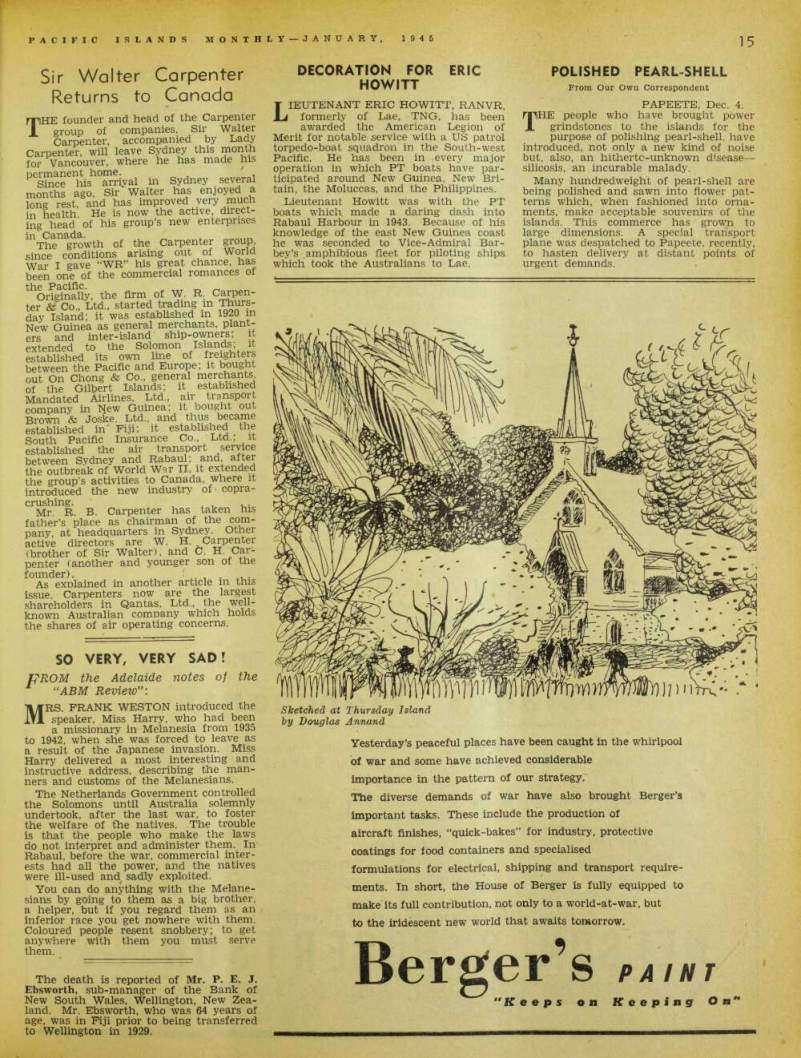
Returns to Canada
THE founder and head of the Carpenter group of companies, Sir Walter Carpenter, accompanied by Lady Carpenter, will leave Sydney this month for Vancouver, where he has made his in Sydney several months ago, Sir Walter has enjoyed a long rest, and has improved very much in health. He is now the active, direct ing head of his group’s new enterprises The growth of the Carpenter group, since conditions arising out of World War I gave “WR” his great chance, has been one of the commercial romances of the Pacific.
Originally, the firm of W. R. Carpen ter Co., Ltd., started trading in Thurs day Island; it was established in 1920 m New Guinea as general merchants, plant ers and inter-island ship-owners; it extended to the Solomon Islands; it established its own line of freighters between the Pacific and Europe; it bought out On Chong & Co., general merchants of the Gilbert Islands; it established Mandated Airlines, Ltd., air transport company in New Guinea; it bought out Brown & Joske, Ltd., and thus became established in Fiji; it established the South Pacific Insurance Co., Ltd.; it established the air transport service between Sydney and Rabaul: and, after the outbreak of World War 11, it extended the group’s activities to Canada, where it introduced the new industry of' copra crushing.
Mr R. B. Carpenter has taken his father’s place as chairman of the com pany. at headquarters in Sydney. Other active directors are W. H. Carpenter (brother of Sir Walter), and C. H. Car penter (another and younger son of the founder). . :.. . ...
As explained in another article m this issue, Carpenters now are the largest shareholders in Qantas, Ltd., the well known Australian company which holds the shares of air operating concerns.
So Very, Very Sad!
pROM the Adelaide notes of the “ABM Review”: MRS. FRANK WESTON introduced the speaker, Miss Harry, who had been a missionary in Melanesia from 1935 to 1942, when she was forced to leave as a result of the Japanese invasion. Miss Harry delivered a most interesting and instructive address, describing the man ners and customs of the Melanesians.
The Netherlands Government controlled the Solomons until Australia solemnly undertook, after the last war, to foster the welfare of the natives. The trouble is that the people who make the laws do not interpret and administer them. In Rabaul, before the war, commercial inter ests had all the power, and the natives were ill-used and sadly exploited.
You can do anything with the Melane sians by going to them as a big brother, a helper, but if you regard them as an inferior race you get nowhere with them.
Coloured people resent snobbery; to get anywhere with them you must serve them.
The death is reported of Mr. P. E. J.
Ebsworth, sub-manager of the Bank of New South Wales, Wellington, New Zea land. Mr. Ebsworth, who was 64 years of age, was in Fiji prior to being transferred to Wellington in 1929.
Decoration For Eric
Howitt
Lieutenant eric howitt, ranvr, formerly of Lae, TNG, has been awarded the American Legion of Merit for notable service with a US patrol torpedo-boat squadron in the South-west Pacific. He has been in every major operation in which PT boats have participated around New Guinea New Britain, the Moluccas, and the Philippines.
Lieutenant Howitt was with the PT boats which made a daring dash into Rabaul Harbour in 1943. Because of his knowledge of the east New Guinea coast he was seconded to Vice-Admiral Barbey’s amphibious fleet for piloting ships which took the Australians to Lae.
Polished Pearl-Shell
From Our Own Correspondent
Papeete, Dec. 4.
THE people who have brought power grindstones to the islands for the purpose of polishing pearl-shell, have introduced, not only a new kind of noise but, also, an hitherto-unknown disease — silicosis, an incurable malady.
Many hundredweight of pearl-shell are being polished and sawn into flower pat terns which, when fashioned into orna ments, make acceptable souvenirs of the islands. This commerce has grown to large dimensions. A special transport plane was despatched to Papeete, recently, to hasten delivery at distant points of urgent demands.
Advertisements & other items, p. 17 (1 item)
Berger’s paint
- hr t u t r\ “<S w \ ft \\ m
iwi
ii vy) Sketched at Thursday Island by Douglas Annand Yesterday’s peaceful places have been caught in the whirlpool of war and some have achieved considerable importance in the pattern of our strategy.
The diverse demands of war have also brought Berger’s important tasks. These include the production of aircraft finishes, “quick-bakes” for industry, protective coatings for food containers and specialised formulations for electrical, shipping and transport requirements. In short, the House of Berger is fully equipped to make its full contribution, not only to a world-at-war, but to the iridescent new world that awaits tomorrow.
Berger’s paint
"Keeps on Keeping On'*
Misima Mining
Reports From Two Mines
THERE appears to be some disparity in the treatment by the Commonwealth Government of two different min ing companies on Misima Island, Papua.
Almost simultaneously, circulars have been received from Cuthbert’s Misima Goldmine Limited and from Gold Mines of Papua Limited. But while Cuthbert’s report relates to the activities of the company’s maintenance party on Misima, in Gold Mines’ circular (notice of annual general meeting in Canberra on January 23) it is reported that the company has been unable to obtain permission to send anyone to the island to report on plant or property.
Cuthbert's
MR. TOM NEVITT, local director and attorney in Papua for Cuthbert’s, recently was in Sydney. He said that shortly before his visit south, he was able to visit Misima and confirms the excellent work being done on behalf of the company by the maintenance party (Messrs. Henley and Callanan, assisted by a small native labour force).
The company’s property escaped direct war damage: and indirect war damage, such as deterioration, impressment by the Army, pilferage of stores arid equipment, etc., is now expected to come under the new scope of the war damage insurance.
Much work has been done on the sur face in relation to roads and plant, but underground, Mr. Nevitt said, it was only possible to enter the No. 2 level—the majority of other levels were closed at the portals. But when restriction on
mining resumption is lifted, reclamation of fallen drives will be put in hand with out delay.
Gold Mines of Papua
THE balance sheet of Gold Mines of Papua shows that the whole of the capital of £135,000 has been lost: but the company is holding on to the pro perty—and hoping.
The company has not been permitted to send engineers to Misima to report on the condition of property and plant.
But it is believed that a large amount of stores and machinery has been removed from the leases at Mount Sisa. Particu lars have not been made available by the authorities and the directors of the com pany are unable to proceed with the com pany’s claim for compensation.
Death Of Well-Known
Missionary
A FORMER well-known missionary of Fiji, the Rev. R. L. McDonald, recently died suddenly in Australia.
He went to Fiji in 1910 and gave 26 years of outstanding service to the Methodist Mission there, until his retire ment to home work in Australia, in 1936.
For a period at the end of World War I, he was in Europe as Chaplain and a YMCA secretary; in 1920 he returned to Fiji to continue his missionary work.
In 1924 he was elected to the Fiji Dis trict chairmanship—in which capacity he served until his retirement from the Colony.
He is survived by a wife and several daughters.
Miss D. Rogerson, of the Methodist Mission, has, after 10 months, reached her station in Fiji.
"Kindly Remove!"
A TALL young man came in and directed the editor’s attention to the following paragraph in the “PIM”
Roll of Honour: Prisoner of war—Pte. W. Gossner, AIF infantry, formerly of BNG Development Co., Port Moresby.
Reported POW in Italy, 6/7/1941.
“I should like that paragraph with drawn,” he said.
“Why?” asked the editor. ‘‘Because it isn’t true,” he replied.
The editor bristled. “Well, it’s been published in this paper’s ‘honour roll” for three years, and no pne has challenged it before,” he snapped.
The stranger grinned. “I’m Bill Goss ner,” he said.
The editor was caught off balance “Then what are you doing here?” ,he demanded. “You’re a prisoner of war— and the war’s still on.”
And then Bill Gossner told the story of how he and several other Australians escaped from Stalag 18A, in Austria, after three years’ imprisonment, and eventually got safely away through the Balkans. It is a remarkable example of our lads’ native ingenuity and resource; but it cannot be published until after the war.
Bill Gossner was with the 15th Battalion of the 9th Division of the AIF, and he was taken prisoner in our first attack on Tobruk, in 1941. He arrived back in Australia in November, 1944. , His name has not been removed from the Honour Roll; but the words, “Escaped, 1944,” have been added.
The death of Mr. Herbert Brown, who for 20 years has been an officer of the Public Works Department of Fiji, occur red in Suva on January 6.
Advertisements & other items, p. 18 (1 item)
Nelson & Robertson
NELSON and ROBERTSON Pty. Ltd.
Established 1895
Shipowners - Brokers and
islands Merchants
All passes merchandise purchased at Best Wholesale Prices. Original Invoices supplied to Island Clients. Cocoa Beans, Copra, Rubber, Trochus Shell and All Islands 7 Produce Sold on Commission. intrust your requirements to the firm with fifty years' practical experience in the Pacific Islands.
Sole Agents'.
SKANDIA DIESEL ENGINES
ARCHIMEDES MOTORS
OVERSEA INDENTS
ARRANGED FOR
CLIENTS.
REPRESENTED IN
ALL PARTS OP
THE WORLD.
Prompt attention given to all enquiries.
NELSON & ROBERTSON
12 SPRING STREET, SYDNEY, AUSTRALIA
Telegraphic Address: IVAN, SYDNEY.
PTY.
LTD,
Barges
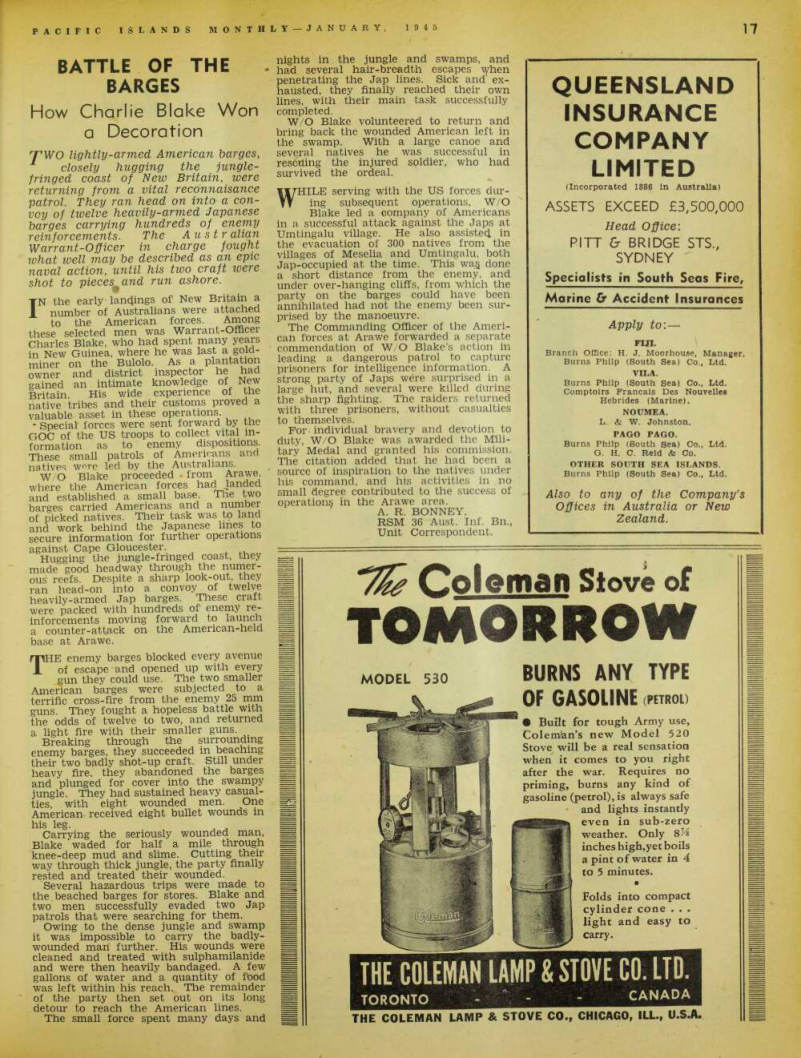
Battle Of The
How Charlie Blake Won a Decoration
TWO lightly-armed American barges,
closely hugging the jungle
fringed coast of New Britain, were
returning from a vital reconnaisance patrol. They ran head on into a con voy of twelve heavily-armed Japanese barges carrying hundreds of enemy reinforcements. The Aus t r alian
Warrant-Officer in charge fought
what well may be described as an epic naval action, until his two craft were shot to run ashore.
IN the early landings of New Britain a number of Australians were attached to the American forces. Among these selected men was Warrant-Officer Charles Blake, who had spent many years in New Guinea, where he was last a gold miner on the Bulolo. Asa plantation owner and district inspector he had gained an intimate knowledge of New Britain. His wide experience of the native tribes and their customs proved a valuable asset in these operations * Special forces were sent forward by the GOC of the US troops to collect vital in formation as to enemy dispositions.
These small patrols of Americans and natives were led by the Australians.
WO Blake proceeded from Arawe, where the American forces had .landed and established a small base. The two barges carried Americans and a number of picked natives. Their task was to land and work behind the Japanese lines to secure information for further operations against Cape Gloucester.
Hugging the jungle-fringed coast, they made good headway through the numer ous reefs. Despite a sharp look-out, they ran head-on into a convoy of twelve heavily-armed Jap barges. These craft were packed with hundreds of enemy re
inforcements moving forward t 9 launch
a counter-attack on the American-held base at Arawe.
THE enemy barges blocked every avenue of escape and opened up with every gun they could use. The two smaller American barges were subjected to a terrific cross-fire from the enemy 25 mm guns. They fought a hopeless battle with the odds of twelve to two, and returned a. light fire with their smaller guns.
Breaking through the surrounding enemy barges, they succeeded in beaching their two badly shot-up craft. Still under heavy fire, they abandoned the barges and plunged for cover into the swampy jungle. They had sustained heavy casual ties, with eight wounded men. One American received eight bullet wounds in his leg.
Carrying the seriously wounded man, Blake waded for half a mile through knee-deep mud and slime. Cutting their way through thick jungle, the party finally rested and treated their wounded.
Several hazardous trips were made to the beached barges for stores. Blake and two men successfully evaded two Jap patrols that were searching for them.
Owing to the dense jungle and swamp it was impossible to carry the badly wounded man further. His wounds were cleaned and treated with sulphamilanide and were then heavily bandaged. A few gallons of water and a quantity of food was left within his reach. The remainder of the party then set out on its long detour to reach the American lines.
The small force spent many days and
nights in the jungle and swamps, and had several hair-breadth escapes \yhen penetrating the Jap lines. Sick and ex hausted, they finally reached their own lines, with their main task successfully completed.
W/O Blake volunteered to return and bring back the wounded American left in the swamp. With a large canoe and several natives he was successful in rescuing the injured soldier, who had survived the ordeal.
WHILE serving with the US forces dur ing subsequent operations, W/O Blake led a company of Americans in a successful attack against the Japs at Umtingalu village. He also assisted in the evacuation of 300 natives from the villages of Meselia and Umtingalu, both Jap-occupied at the time. This wa§ done a short distance from the enemy, and under over-hanging cliffs, from which the party on the barges could have been annihilated had not the enemy been sur prised by the manoeuvre.
The Commanding Officer of the Ameri can forces at Arawe forwarded a separate commendation of W/O Blake’s action in leading a dangerous patrol to capture prisoners for intelligence information. A strong party of Japs w6re surprised in a large hut, and several were killed during the sharp fighting. The raiders returned with three prisoners, without casualties to themselves.
For- individual bravery and devotion to duty, W/O Blake was awarded the Mili tary Medal and granted his commission.
The citation added that he had been a source of inspiration to the natives under his command, and his activities in no small degree contributed to the success of operations in the Arawe area.
A. R. Bonney.
RSM 36 Aust. Inf. Bn., Unit Correspondent.
Advertisements & other items, pp. 19-20 (1 item)
Tomorrow
QUEENSLAND
INSURANCE
COMPANY
LIMITED
(Incorporated 1886 In Australia)
ASSETS EXCEED £3,500,000
Head Office:
PITT & BRIDGE STS.,
SYDNEY
Speciolists in South Seas Fire,
Marine & Accident Insurances
Apply to:
FIJI.
Branch Office: H. J. Moorhouse, Manager.
Burns Phllp (South Sea) Co., Ltd.
VILA.
Burns Philp (South Sea) Co., Ltd.
Comptoirs Francals Des Nouvelles Hebrides (Marine).
NOUMEA.
L. & W. Johnston.
PAGO PAGO.
Burns Philp (South Sea) Co., Ltd.
G. H. C. Reid & Co.
OTHER SOUTH SEA ISLANDS.
Burns Philp (South Sea) Co., Ltd.
Also to any of the Company’s Offices in Australia or New Zealand.
Coleman Stove of
TOMORROW
MODEL 530
BURNS ANY TYPE
OF GASOLINE (PETROL)
• Built for tough Army use, Colemfan’s new Model 520 Stove will be a real sensation when it comes to you right after the war. Requires no priming, burns any kind of gasoline (petrol), is always safe and lights instantly even in sub-zero weather. Only B Vs inches high,yet boils a pint of water in 4 to 5 minutes. • Folds into compact cylinder cone . . . light and easy to carry.
THE COLEMAN LAMP & STOVE CO. LTD.
TORONTO
CANADA
THE COLEMAN LAMP & STOVE CO., CHICAGO, ILL., U.S.A.
Modern Refrigeration for the South Sea Islands
The ELECTROLUX KEROSENE OPERATED
REFRIGERATOR
MARVEL
OF
MODERN
SCIENCE
THE
MIRACLE
OF
ICE
FROM
HEAT
ELECTROLUX OFFERS ECONOMICAL, modern and completely efficient
REFRIGERATION FOR ISLANDS' HOMES.
FREEZES CONTINUOUSLY WHILE SMALL LAMP BURNS
Freezing controlled by simply regulating height of flame. Uses only j gallon of kerosene per week.
MOTOBLESS ... NO PARTS TO GET OUT OF ORDER.
MODEL
Capacity 3.2 cubic feet.
MODEL L3BO
® (as illustrated) ® Capacity 4 cubic feet.
GUARANTEED FOR TWO YEARS.
Write to your Local Distributor for prices and full details.
MODEL LKSSO
Capacity 5.5 coble feet.
OBTAINABLE FROM ALL W. R. CARPENTER & CO. LTD.
BRANCHES THROUGHOUT THE ISLANDS
Representation in Papua and New Hebrides.
£22,000 for War Funds
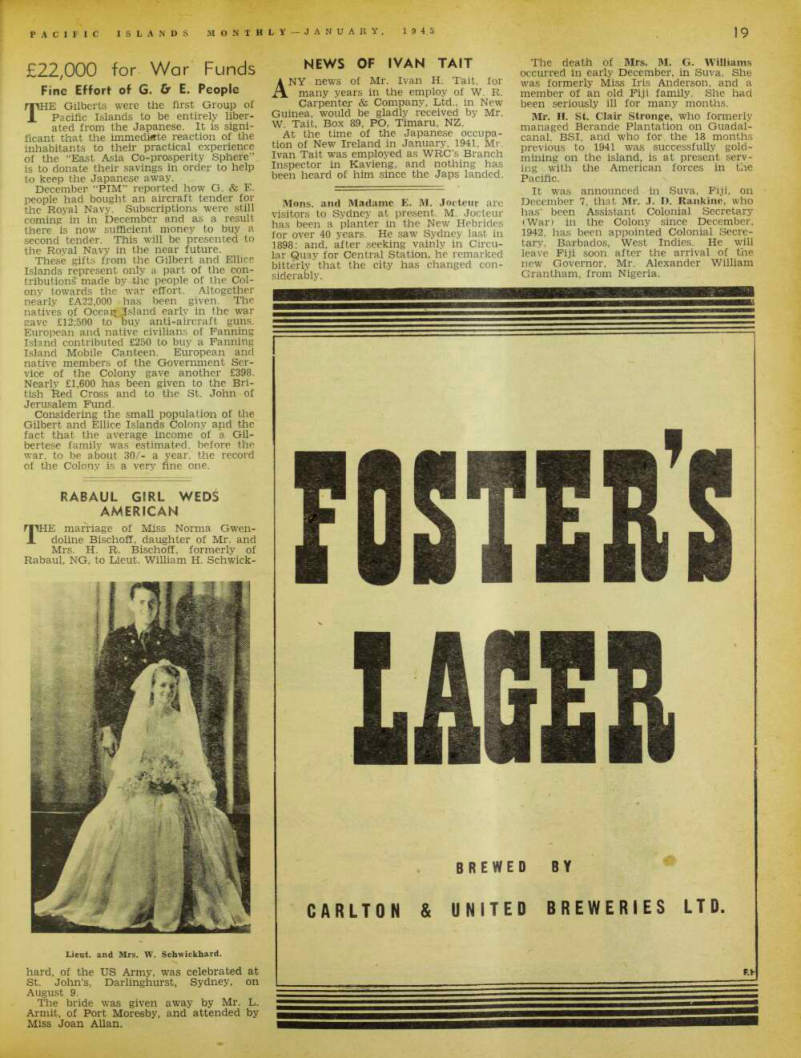
Fine Effort of G. & E. People
THE Gilberts were the first Group of Pacific Islands to be entirely liber ated from the Japanese. It is signi ficant that the immediate reaction of the inhabitants to their practical experience of the “East Asia Co-prosperity Sphere’’ is to donate their savings in order to help to keep the Japanese away.
December “PIM” reported how G. & E. people had bought an aircraft tender for the Royal Navy. Subscriptions were still coming in in December and as a result there is now sufficient money to buy a second tender. This will be presented to the Royal Navy in the near future.
These gifts from the Gilbert and Ellice Islands represent only a part of the con tributions made by the people of the Col ony towards the war effort. Altogether nearly £A22,000 has been given. The natives qf Ocean Island early in the war gave £12;500 to' buy anti-aircraft guns.
European and native civilians of Fanning Island contributed £250 to buy a Fanning Island Mobile Canteen. European and native members of the Government Ser vice of the Colony gave another £398.
Nearly £1,600 has been given to the Bri tish Red Cross and to the St. John of Jerusalem Fund.
Considering the small population of the Gilbert and Ellice Islands Colony and the fact that the average income of a Gil bertese family was estimated, before the war. to be about 30/- a year, the record of the Colony is a very fine one.
Rabaul Girl Weds
American
THE marriage of Miss Norma Gwen doline Bischoff, daughter of Mr. and Mrs. H. R. Bischoff, formerly of Rabaul, NG, to Lieut. William H. Schwick-
hard, of the US Army, was celebrated at St. John’s, Darlinghurst, Sydney, on August 9.
The bride was given away by Mr. L.
Armit, of Port Moresby, and attended by Miss Joan Allan.
Lieut, and Mrs. W. Schwickhard.
News Of Ivan Tait
ANY news of Mr. Ivan H. Tait, for many years in the employ of W. R.
Carpenter & Company, Ltd., in New Guinea, would be gladly received by Mr.
W. Tait, Box 89. PO, Timaru, NZ.
At the time of the Japanese occupa tion of New Ireland in January, 1941. Mr.
Ivan Tait was employed as WRC’s Branch Inspector in Kavieng, and nothing has been heard of him since the Japs landed.
Mons. and Madame E. M. Jocteur are visitors to Sydney at present. M. Jocteur has been a planter in the New Hebrides for over 40 years. He saw Sydney last in 1898; and. after seeking vainly in Circu lar Quay for Central Station, he remarked bitterly that the city has changed con siderably.
The death of Mrs. M. G. Williams occurred in early December, in Suva. She was formerly Miss Iris Anderson, and a member of an old Fiji family. She had been seriously ill for many months.
Mr. H. St. Clair Stronge, who formerly managed Berande Plantation on Guadal canal, BSI. and who for the 18 months previous to 1941 was successfully gold mining on the island, is at present serv ing with the American forces in the Pacific.
It was announced in Suva, Fiji, on December 7. that Mr. J. I). Rankine, who has' been Assistant Colonial Secretary (War) in the Colony since December, 1942. has been appointed Colonial Secre tary. Barbados, West Indies. He will leave Fiji soon after the arrival of the new Governor, Mr. Alexander William Grantham, from Nigeria.
Advertisements & other items, p. 21 (1 item)
Brewed
CARLTON & UNITED
BY
BREWERIES LTD.
Pioneer
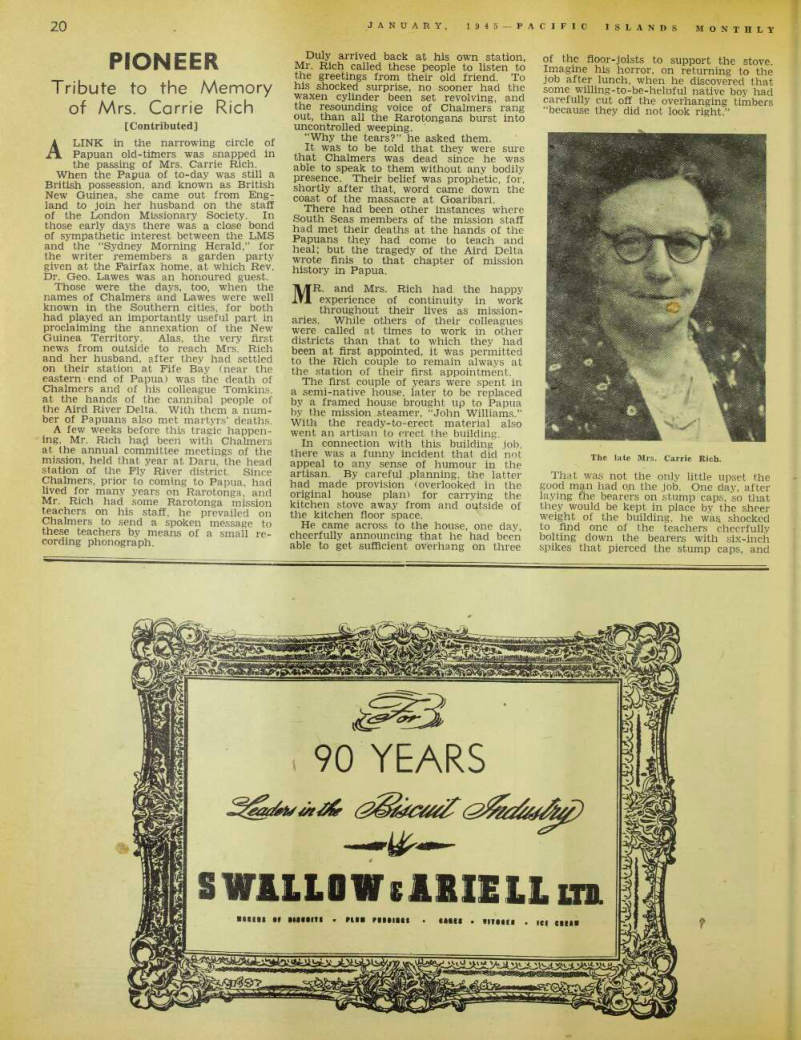
Tribute to the Memory of Mrs. Carrie Rich
[Contributed] A LINK in the narrowing circle of Papuan old-timers was snapped in the passing of Mrs. Carrie Rich.
When the Papua of to-day was still a British possession, and known as British New Guinea, she came out from Eng land to join her husband on the staff of the London Missionary Society. In those early days there was a close bond of sympathetic interest between the LMS and the “Sydney Morning Herald,” for the writer remembers a garden party given at the Fairfax home, at which Rev.
Dr. Geo. Lawes was an honoured guest.
Those were the days, too, when the names of Chalmers and Lawes were well known in the Southern cities, for both had played an importantly useful part in proclaiming the annexation of the New Guinea Territory. Alas, the very first news from outside to reach Mrs. Rich and her husband, after they had settled on their station at Fife Bay (near the eastern end of Papua) was the death of Chalmers and of his colleague Tomkins, at the hands of the cannibal people of the Aird River Delta. With them a num ber of Papuans also met martyrs’ deaths.
A few weeks before this tragic happen ing, Mr. Rich had been with Chalmers at the annual committee meetings of the mission, held that year at Daru, the head station of the Fly River district. Since Chalmers, prior to coming to Papua, had lived for many years on Rarotonga, and Mr. Rich had some Rarotonga mission teachers on his staff, he prevailed on Chalmers to send a spoken message to these teachers by means of a small re
cording phonograph.
Duly arrived back at his own station, Mr. Rich called these people to listen to the greetings from their old friend. To his shocked surprise, no sooner had the waxen cylinder been set revolving, and the resounding voice of Chalmers rang out, than all the Rarotongans burst into uncontrolled weeping.
“Why the tears?” he asked them.
It was to be told that they were sure that Chalmers was dead since he was able to speak to them without any bodily presence. Their belief was prophetic, for, shortly after that, word came down the coast of the massacre at Goaribari.
There had been other instances where South Seas members of the mission staff had met their deaths at the hands of the Papuans they had come to teach and heal; but the tragedy of the Aird Delta wrote finis to that chapter of mission history in Papua.
MR. and Mrs. Rich had the happy experience of continuity in work throughout their lives as mission aries. While others of their colleagues were called at times to work in other districts than that to which they had been at first appointed, it was permitted to the Rich couple to remain always at the station of their first appointment.
The first couple of years were spent in a semi-native house, later to be replaced by a framed house brought up to Papua by the mission steamer, “John Williams.”
With the ready-to-erect material also went an artisan to erect the building.
In connection with this building job. there was a funny incident that did not appeal to any sense of humour in the artisan. By careful .planning, the latter had made provision (overlooked in the original house plan) for carrying the kitchen stove away from and outside of the kitchen floor space.
He came across to the house, one day, cheerfully announcing that he had been able to get sufficient overhang on three
of the floor-joists to support the stove. imagine his horror, on returning to the job after lunch when he discovered that some willing-to-be-helnful native bo d y had carefully cut off the overhanging timbers “because they did not look ri|htA
That was not the only little upset the good man had on the job. One day, after laying the bearers on stump caps, so that they would be kept in place by the sheer weight of the building, he was shocked to find one of the teachers cheerfully bolting down the bearers with six-inch spikes that pierced the stump caps, and
The late Mrs. Carrie Rich.
made ingress of white ant to the build ing very much easier later on.
It is an interesting fact that, many years later, when, through ravages of white ant and weather, this frame house needed renewal, it was built with native labour and with hardwood timbers sawn and fitted from bush logs growing near the station. , .
In both these houses, the home-loving genius of Mrs. Rich created a happy home atmosphere, where their five chil dren. prior to coming to school in Syd ney, had association with the native youngsters on the station that they are never likely to forget.
THROUGHOUT a 40-years’ residence on that beautifully-situated station in Fife Bay, it was the happy privi lege of Mr. and Mrs. Rich to entertain a great number of the white residents of the Territory, as they moved to and fro along the Coast, from the Lieut.-Gov ernor and senior officials, down through the list of the service to junior patrol officers, as well as many representatives of commerce, minihg, etc.
For residents along the South-east Coast of Papua, the Mission House at Fife Bay had always an “ever-open door.
In health and in sickness they came, or were brought dying—and, in some sad cases, dead—for whatever of help or ser vice the mission could render.
During their first period of service, during which there were practically no other white settlers along the South-east Coast, all travel had to be by whaleboat, and any cases of accident or serious ill ness had to be taken* by this to the hospital at Samarai. some 50 miles distant. During the SE season, when weather permitted the journey at all, it was bound to be a matter of at least two days before the port could be" reached.
Time and again the boat, setting out to make the trip, would come back after a day or night at sea with her flag at half mast, indicating that the patient we had hoped to save had passed away, thus making any continuation of the journey useless.
WHILE on furlough in England, after that first 10 years of service, Mr.
Rich was able to secure a finely built teak launch that was a real life boat to many a Papuan resident, both white and brown. In her, the run to Samarai could generally be managed in six or seven hours.
That launch, after 34 years’ of heavy service, is still doing her duty well.
As the writer pens this brief record of some happenings on a Papuan mission station, hd recalls many men and women, both here and in the Old Land —old-timer Papuans, who will always be thankful to God that there was a mission station in Fife Bay—that this station possessed such a useful launch and willing and able crew; and—maybe most of all—that there was a gracious and kindly lady ever ready to succour and comfort the suffering, whether of her own race or of the brown people she came to serve.
HER course is run. For her, the trum pets have sounded on the other side, and we dare to believe she has received from the lips of her Lord and Master, Christ, the promised “Well done, good and faithful servant.”
At her funeral service on December 11, the presence of a gjeat number of past and present Papuan residents indicated the honour and affection in which Mrs.
Rich was held. Those present included the Administrator (Hon. Leonard Mur ray), the late Government Secretary (Mr.
H. W. Champion), the Crown Law Officer (Mr. Bignold), Mr. D. Cahill and Mr. H.
Glanville; Rev, M. A. Warren (Anglican
Board of Missions), and Rev. Gordon Robertson. The LMS was represented by Rev. Leonard Hurst and Mrs. Henry Pratt. The service was conducted by Rev. W. G. Sands, of the North Sydney Congregational Church, with which Mr. and Mrs. Rich were always identified when in Sydney.
Mrs. Rich and her husband were pioneers of whom Friedlaender speaks: We shall not travel by the road we make.
Ere, day by day, the sound of many feet Is heard upon the stones that now we break, We shall be come to where the cross roads meet.
For them, the shade of trees which now we plant; The safe, smooth journey and the cer tain goal— Yea, birthright in the land of Covenant, For us, day labour, travail of the soul.
And yet, the road is ours as never theirs.
Is not one gift on us alone bestowed?
For us the joys of joys. O pioneers!
We shall not travel—but we make the road.
Mr. K. V. Macguire, of the Fijian Administration, has been acting for three months as British Resident Commissioner in the New Hebrides, during the absence on vacation of Mr. R. W. Blandy.
Advertisements & other items, pp. 22-24 (1 item)
M 1131Ht 3 Moiitas
»\A I u >• >u r 'Yk ro(\ lyiTf ■ VII 9 191 • mini • 911V9 still • tiiittti ii tuita
SW3A 06
a &s *
A valuable
help in
restoring
physical
strength after
illness
During convalescence
patient’s appetite is oi
capricious ... he doesn’t this and doesn’t fancy that, it is most important that has the right food to build m the often like Yet he up fooo marked revivifying effect of Horlicks. health and strength. In this respect Horlicks is invaluable.
Patients enjoy the delicious flavour of Horlicks, and it has the additional advantage of being very easy to digest.
Horlicks is a complete food drink. It creates warmth and energy almost at once, since the natural sugars it contains are quickly absorbed by the blood-stream. This is the reason for the m As a tissue-repairer Horlicks is of definite value. It contains a valuable proportion of
readily - assimilable protein,
also a percentage of mixed carbohydrates. This makes Horlicks a very real factor in restoring bodily strength. It’s no trouble at all to prepare Horlicks. Simply mix it with water only, hot or cold. Its natural sugars make Horlicks sweet enough for most tastes.
Horlicks is sold in handy irs, or in tins, price 3/-. (Prices slightly higher in the country.)
HORLICKS
G I L L E S PI E’S The Flour
TRADE
MARK
of the Islands
SYDNEY
AUNT
MARYS
BAKING POWDER
SUPPLIES ARE NOW AVAILABLE. If your local supplier is out of stock he will readily obtain Aunt Mary's Baking Powder for you. After all, quality is worth waiting for, especially when it is Aunt Mary's Baking Powder, which maintains the high quality which has stood the test for over 70 years.
Isolation is Now No
More First Plane on Rarotongan Soil
From Our Own Correspondent
Rarotonga, Nov. 30.
ANEW era began in Rarotonga on November 24: While the population danced with excitement, the first plane to land on Rarotongan soil came in to a perfect landing on the just-com pleted airstrip. • No longer can we call these the “remote” South Sea Islands. The airmen in their silver ships have conquered dis tance and time. Rarotonga is now only 10 hours away from Auckland.
There have been a number of headline dates in the history of Rarotonga which commemorated the courageous spirit of adventure in both brown and white men.
According to Maori legend, the god Tonga-’iti first discovered this beautiful island with its green mountains, misty valleys, calm lagoons, golden reefs and silver surf, floating on the great ocean.
His wife, Ari, dived down to anchor it to the sea-floor so that men might find it.
We do not know when humans first set foot on the island, but it is certain that it was visited from the earliest days of Polynesian wanderings in the Central Pacific. About the middle of the 13th century, the Polynesian sea-rovers, Tan giia and Karika, with their followers, landed at Ngatangiia to commence the first real settlement.
In 1823 came the missionary, John Williams, and with him began transition from stone-age to Europeanisation. It is not certain that the English missionaries were the first white men to visit Raro tonga, for there are stories of gold and silver Spanish coins and fragments of a vessel of the 17th century found on the reef; and of black-bearded white men who came from the sea and lived on the island in the reign of Rau, 300 years ago.
In April, 1890, Queen Makea broke out the home-made Union Jack from the flagstaff at Avarua, to proclaim to the approaching French warship that the people of the Cook Islands preferred to be British.
In 1901, Rarotonga and the rest of the Cook Islands became a territory of New Zealand.
THE inaugural flight was made in a plane manned by a RNZAF crew. It carried Mr. C. McKay, Secretary for the NZ Island Territories Department, and Mr. D. O. Haskell, Chief Aerodromes Engineer of the NZ Public Works Depart ment. The purpose of the flight was to survey the route from Auckland to Raro tonga and to test the facilities of the airstrip. . Brief calls were made, at Tonga and Aitutaki, and the Resident Commissioner of Rarotonga. Mr. W. Tailby, was picked up at Aitutaki.
In Avarua the visitors were accorded a traditional welcome; later, a reception was held in the Court Room.
Although street lighting on Apia' roads has not yet been restored, the curfew has now been completely abolished. Curfew for some time past has not been enforced rigidly.
A committee is to be set up in Fiji to investigate the conditions of the Civil Service in the Colony. Members of the committee will be Messrs. H. H. Ragg, Vishnu Deo, E. C. Woodward, J. L. Brown and Captain Ratu Edward Cakobau.
Poor Copra
Brings High Price Fiji Urged to Improve Quality
A COMMITTEE will be set up in Fiji to investigate the desirability of improving the quality of copra in the Colony and to inquire into condi tions in the industry generally.
The motion was put to Legislative Council in December by Mr. W. G. John son, who said that of all copra produced in the Colony between 1942 and 1944 the percentage of first-grade had fallen from 35 per cent. In the first-mentioned year to 19 per cent, in the last months of 1944.
In his belief, there had been a steady deterioration month by month through out 1944 and he considered that this was associated with the rise in the price of copra.
The extra £1 brought by the first-grade product had meant much more when the price was £5/10/- per ton, than the £l/10/- difference between the grades meant to-day when copra brought big prices.
With to-day’s great demand, copra that was almost rubbish still brought a high price; therefore, planters did not try for high quality. But a day of reckoning would come. In the mid-thirties, it should be remembered, high quality copra remained in demand, but poor-grade stuff was not wanted.
Opposition to the plan to improve copra could be expected from some plant ers—the argument being that the' extra effort necessary would be uneconomical.
But to show what could be done, Mr.
Johnson quoted the case of one Lau plantation managed by a native Fijian.
Seventy-eight per cent, of the copra produced there between May, 1943, and
September, 1944, was classified first grade.
In Mr. Johnson’s opinion, the future of copra lies mainly in food production.
For this, only a high quality product is used; the extra expense makes the pr cessing of lower grades uneconomical.
THE motion was seconded by Mr. A. A.
Ragg, and supported by Mr. H. B.
Gibson. Mr. Gibson, however, said that he was opposed to copra grading altogether; that it had failed to achieve the results for which it was intended. No matter how much care went into produc tion, he claimed, one could not be sure of turning out a first-grade product. When copra, in spite of planters’ best' efforts, was classified as second-grade, then the planters decided that the money and effort could have been better employed in other directions.
Death Of Mr. R. W. Fry,
Of Fiji
THE death of Mr. R. W. Fry, of Gau, Fiji, occurred in early December.
He had been a highly respected resi dent of Fiji for over 30 years.
Mr. Fry first came to the Colony under engagement to the Bua Company. He returned for a time to England, where he married, but later came back to Fiji, where he took over a coconut plantation on Gau, in partnership with Captain T.
Lippett, who later retired. He had many friends who will hear of Mr. Fry’s death with regret. He is survived by his wife, Mrs. Maude E. Fry, who occasionally has written articles for “PIM.”
The Revs, the Hon. J. Bodger and Oliver Brady, of the Anglican Mission, Papua, have reached their mission fields in the Territory after visits overseas.
White Women And South
Seas Natives
Letter to the Editor 1 FULLY agree with your correspondent from New Guinea regarding the photo published on page 7 of your September number (film star lighting cigarette for Papuan native). It looks as if there were a conspiracy on foot nowadays to pull down the respectability of the white woman in the eyes of the natives of the South Seas. What they see in our picture theatres is suggestive enough: but on top of it are those silly, illustrated papers, which are freely cir culated among the natives by unscrupu lous whites.
I wonder what these natives think of us as a race, and what must they think of our womenfolk, when they see some pages of papers like “Life,” “Pix,” “Post,”
“American,” and others. Surely their estimate of us cannot be very high.
I remember meeting, many years ago, one native who was fully persuaded that all lawyers were professional liars. I would not be surprised if his sons were thinking to-day that half or more of the white women are of loose morals. This is all because of the bad taste of a press which is without principle, without shame and without respect for the common laws of decency.
Perhaps we should begin to think of what these Islands are to be like after the war. The natives then will not be what they were 10 years ago; and, if we insist on painting ourselves even blacker than we are, which is bad enough, the result in the next generation—or sooner —may be a source of grave concern to our civil administration. In this world we generally reap what we have been sowing.
I am, etc.,
Fiji.
Settler.
Still Dollar-Prosperity In
New Caledonia
Noumea, Dec. 13.
DEPOSITS in the New Caledonian Post Office Savings Bank, which pays a low rate of interest (1.25 per cent.), now amount to well over a hundred million francs.
Prior to the arrival of American troops in the country, they amounted to about twenty-five millions. The number of depositors, formerly between 16,000 and IJ,OOO, is to-day 20,203; this is virtual saturation point, considering the small population of New Caledonia.
American banknotes bearing the in scription “Hawaii”—the circulation of which has hitherto been prohibited in New Caledonia —have been made legal tender here in the same way as the usual American dollar bills.
Fatal Road Smash In
W. Samoa
From Our Own Correspondent
Apia, Dec. 9.
ASERIOUS_motor car accident occur red in the early hours of Sunday, November 26. when a motor car driven by Mr. C. P. Slaven, crashed into the ditch on the Apia-Taufusi Road. The driver swerved to avoid" a horse obstruct ing the road.
There were six people in the car. Mrs.
Mary Akers, of Pago Pago, a widow and mother of three children, was wedged under the car, and died of internal injuries shortly after being admitted to Apia Government Hospital. Two women, Mrs. E. Katterns, of Saleimoa Plantation, the owner of the car, and Miss Annie Mann, suffered severe head injuries and were taken to the hospital. The driver and two other passengers escaped with minor injuries, cuts and abrasions.
From Africa
"PIM" Man Finds Tahiti in Western Desert
gELWYN HUGHES, of the “Pacific
Islands Monthly” and more recently of the RAAF, now attached to the Royal Air Force in the Middle
East, writes interestingly from Cairo :
TWO items in the September “PIM” stirred my fading memories of the Pacific.
There is an article about the Yanks being charged for coconut trees cut down in military operations in the Pacific.
When I was at an American mess in Italy recently, waiting for the weather to clear up for take-off, I glanced through some of the top-rank magazines that were scattered around. Came across the fol lowing lugubrious, somewhat stretched item in August issue of “Esquire’s” small sister, “Coronet”: “Family Tree: On a French-owned island in the Solomons Group, the US Army chopped down a number of palm trees to build an airfield. The French men promptly submitted a bill for dam ages for exactly twice the number of trees destroyed. Asked why, they pointed out that coconut palms are said to be either male or female, and added, ‘So for every palm tree cut down, Messieurs another dies of a broken heart!”’
TAHITI Contingent, page 9, also re minds me. Midway across North Africa, on the borders of his two Libyan colonies, Tripolitania and Cyre naica, Mussolini erected a huge baroque archway to mark the boundary. A colossal thing, visible for miles across the sandy wastes, it straddles the ribbon of road way running to the frontiers of Egypt They say Benito planned to link this road with a proposed highway across Italian Somaliland and Ethiopia, when Hitler eventually would allow him to expand the Roman Empire, if and when* The Eighth Army was all through this Libyan country, and, in the course of time, the British Tommies naturally came to call the monument “Marble Arch,” after their own in London, lust as the’v christened other spots “Knightsbridge” (where a disastrous tank battle was fought), “Oxford Circus” and half-a dozen other familiar names that figure on to-day’s maps.
You can enter either side of the arch’s pylons and climb up a series of iron rungs to the landing at the top of the arch where reclines a giant metal statue of a nude male; then you can claw up another flight to reach the very top of the edifice.
It became the practice of troops pass ing through that way to write, scratch or paint their names, etc., all over the interior walls. The place is absolutely covered with them—every name in a tele phone book!
While this pile stands, it will never be forgotten by all those who look over it that the native Tahitians, from their Free French islands on the other side of the world, played an active part in the African campaign, the first step along the road back to victory: for, hitting you smack in the eye as you pause for breath on the first landing, are the foot-high letters “TAHITI.” in tar on a white-grev concrete background, for all to see. Above is the name of the Tahitian soldier who Perpetuated the name of his homeland, but his name has been partly obliterated now bv others, with their rank and appellation.
I’ve come across all sorts of odd things in my travels which have brought back
memories of the Pacific, but this was one isolated spot I never thought would have a link, however tiny, with the South Seas.
YOU’LL already have seen accounts of the assassination in Cairo of Lord Moyne. British Resident Minister in the Middle East. I renumbered him from the days of his pygmy “discoveries” in TNG and the articles we ran establishing that Father Kirschbaum had originally contacted those tribes. I saw Moyne only a week before his death, with Churchill, when “Wfnnie” passed through Egypt on his way home from Moscow— you may have seen their photos together in the newspapers.
RECENTLY, I visited several parts of Greece and saw most of Athens, the Acropolis, the Parthenon, etc. The Greeks have been suffering badly from shortage of food, though the Allies are rushing in shipment after shipment to relieve the situation, just as the BBC announced.
The currency position, after the Nazis were driven out , was fantastic; the drachma, normally worth around a half penny, was inflated to astronomical fig ures in relation to the pound and dollar, since the Nazis had flooded the country with paper money. For instance, it cost something over 500,000,000 drachma to buy the meagre daily ration of bread! After a while, the Greeks just chucked away any bills they had under 1,000 drachma.
I saw a woman drop about 20 bills as she was counting out a huge pile to pay admission to a cinema, after the British authorities had things moving again. The notes blew into the street —no one in the queue bothering to retrieve them!
To me. the political situation in Greece looks very ticklish indeed —it’s still a toss-up whether King George II will
return there. They’re going to hold a plebiscite one of these days The KKE (Communists), and EAM (Leftist) Parties appear strong and militant; every second building in Athens seems to have a slogan painted by one of them, and the hammer and sickle insignia daubed in red was everywhere you turned However, I don’t think the bulk of the Greek people are behind these Left-wingers, and I hazard an opinion that the country will settle down eventually with a modified consti tution and Government, with old George back there. I guess that’s the way shrewd, democratic Papandreou (present Premier) will try to work it. Time will tell.
Advertisements & other items, p. 26 (1 item)
Chi Vers
A. B. DONALD Ltd.
AUCKLAND
ISLAND TRADERS & GENERAL MERCHANTS
P.O. Box 1509. Cobles Gr Telegrams, "Kingdom", Auckland.
CHI VERS
FAMOUS ENGLISH PRODUCTS
CANNED ENGLISH VEGETABLES
CANNED ENGLISH FRUITS
OLDE ENGLISH MARMALADE
GOLD MEDAL JAMS
JELLY CRYSTALS, ETC.
Obtainable from all leading Grocery Stores
WRITE TO DEPARTMENT “A”
CHI VERS fir SONS LTD.
Histon, Combs., Eng.
FOR ATTRACTIVE RECIPE BOOK
cC
CHIV£RS
COLO
FRESH
■NCU»H
PEAS
Fiji's New Governor
THE new Governor of Fiji, Mr. A. W.
G. H. Grantham, was expected to arrive in the Colony in early December.
The following is from the “Daily
Telegraph,” London, published when
his appointment was announced.
MR. A. W. G. H. GRANTHAM, the new Governor of Fiji, has been due for promotion for some time. He has held three “No. 2” jobs—as Colonial Sec retary in Bermuda and Jamaica, and latterly as Chief Secretary in Nigeria.
The Nigerian Civil Service rivals the Sudan Political in its record of turning out first-class administrators, and Mr.
Grantham is in the great tradition.
He has the lean, hawk-like face of a lawyer. A big portrait of his grandfather, Mr. Justice Grantham, hung ia his dining room in Lagos. Actually, he was at that well-known Army school, Wellington, and took the Sandhurst course at the end of the last war. Afterwards, he went to
Cambridge, and from there into the Colonial Service.
As Governor of Fiji and High Com missioner for the Western Pacific, he will have many contacts with the American military and civilian authorities. He will be greatly helped on the social side of these contacts by his wife, a vivacious American, with a wholly English en thusiasm for gardening.
The Rev. A. P. Jennings, of the Angli can Mission, Papua, is waiting in Aus tralia to return to New Guinea and his mission station.
Mr. A. Batchelor, of the Anglican Mis sion, is on his way to England, where he will represent the Bishop of New Guinea in the London Office.
In the Suva Grammar School examina tions at the end of 1944, Peter Sellers and Jennine Tarte were Dux of the boys and girls respectively; John Paige and Bar bara Leak were runners-up. Alec Gas pard won the Rodwell Cup for leadership.
Advertisements & other items, pp. 27-28 (1 item)
Gibson’S
TAHITI
SOUVENIRS
BEAUTIFUL SHELL NECK-
LACES, NECKLETS, SEA
SHELLS IN BULK, COLOUR-
FUL HULA COSTUMES.
Posted, or Shipped Wholesale, from
TAHITI
“The Pearl of the Pacific”
Wholesale inquiries especially invited.
Write or Cable direct to
JOHN R. FARNHAM
Papeete, Tahiti, Society Islands.
★ TRY IT ... . YOU’LL LIKE IT!
GIBSON’S
GREEN LABEL
TEA
Blended and packed by— J. A. D. GIBSON & CO. LTD. U < 364 KENT STREET, SYDNEY. 'Phone: M 2328. >} Also GIBSON'S GREEN LABEL COFFEE and COFFEE ESSENCE
KANGAROO BRAND
Ropes,
Cordage,
and Twines for every purpose Backed by 86 years of service Manufactured by:
M. DONAGHY AND SONS,
Pty. Ltd., Geelong and Sydney.
Fiji Representatives:
PEARCE AND CO.
LIMITED
P.O. BOX 237, SUVA
Cruising in Northern Caledonian Waters
To The Island Of Pott
By H. E. L. Friday
WOULD anyone in this war-torn world care to lease a Pacific island—the lovely island of Pott?
For health reasons, that adventurous Frenchman, Monsieur Albert Pagnotte, who many many years ago threw up a safe business job in Noumea to exploit Pott—the northernmost of the Belep Group to the north of New Caledonia —is retiring when he can find a suitable suc cessor to take over his farm and his cattle and his copra production, and the lease of the island from the New Caledonian Government. The proposition is neces sarily one that would appeal only to a man not afraid of his own company and that of the six or eight Javanese employ ees needed to work the place.
I a visit to the island (then gar risoned By US troops) last year, going via several of the islands to the north of the Caledonian mainland on the MV “Tama tea.”
The northern islands are seldom visited, though an official French party was up there in early 1940. They and the seas around them remind one of the Bay of. Islands region of .North Auckland Province, NZ, except that there are sev eral Great and Little Barrier islands and the North and South Dao rocks repeat the Hen and Chickens group of NZ twice over.
On the mainland, the Diahot, the Col ony’s largest river, runs out into the sea at Pam, where copner from two big mines, the Balade and the Meretrice, formerly were smelted under the direction of Capt. Warren, who later became one of
the first directors of Australia's Broken Hill Company, That was in the ’Bo’s, long after the brothers Guerin and others had arrived from the New Zealand goldfields to pros pect the northern creeks.
Off Pam is the biggish isle of Balabio, wljich produces copra, and cattle. It was leased to returned soldiers after the last war. A smaller isle is Yenguibane, where the massacre of a French naval crew contributed to the reasons for French annexation of New Caledonia, in 1853.
Then there is He Baaba, to which you can walk from the mainland at low tide.
This was one of the Colony’s first plan tations to be worked commercially As there were but few ships calling to carry copra away in those early days, the settlers installed presses and loaded coco nut oil into drums. The isle also pro duced coir (fibre) rope. It was then (in the 60’s or 70’s) owned by an English man named Henry, second only to Pad don in early history, who finally settled on the east coast of New Caledonia, where the natives tried to slaughter him and his family.
Henry leased his Baaba property to another British sailor named Morgan, who planted most of the existing coco nuts, the condition of the lease being that he was to plant so many trees a year The plantations were afterwards taken over by a French company, but later reverted to private ownership.
WEST of Baaba are the picturesque isles called Neba, with a village on the .inner side; then Paaba and four
or five tinier islets, of dark red colour; Yande, seven miles west of Paaba, which is over 1,000 feet high, bold and steep-to, facing the channel between the reef and the mainland.
Here our course was changed for the Beleps, the southernmost point of which lies 20 miles north-north-westward of the most northerly tip of New Caledonia.
The Group itself extends north and south for 23 miles.
The Dao islets are the southernmost of the Group; then, a high bare rock named Nienane, then the isle of Art, and finally, Pott.
The coastline of Art is pleasing.
Anchoring in lovely Uala Bay. two or three of us pulled ashore. This bay is three-quarters of a mile wide at the entrance, widening into a great circle inside. Here there is an abundance of coconut trees half hiding picturesque native dwellings, some of them of the old round style.
The main village is Baleo; its most out standing and dominating feature, the fine mission church on a knoll reached by a pebbly track, and backed by an amphi theatre of hills. We visited the priest, Father Puech, who has been tending this island flock for the past 39 years. We were touched by his kindly hospitality, and when we had to go, in spite of our protests, he insisted on lighting his lan tern and accompanying us down to the beach.
POTT is much smaller than Art. The harbour where M. Pagnotte has his farm is only a quarter-mile wide at the entrance, and gets the full force of the Westerlies, though it is sheltered from the Trades.
M. Pagnotte once described to me how he had lost his cutter in a cyclone there.
It lay at the bottom of the bay for three months before he located it and sent to Art for help to raise it.
M. Pagnotte was away at Poum, on the mainland, during our visit to Pott. I spent most of my time there with the American soldiers who had their camp on the flats by the creek back of Uonbuan Bay.
They took me in a jeep to the top of Ueta Lemukilik, the highest mountain, where you get a magnificent view in every direction across the Cook and French Reefs and northwards towards the Huon Group. The wind blew cease lessly up there, giving one a feeling of deafness; and the Coral Sea, stretching away towards the Solomons, rippled by that endless wind, looked limitless, for bidding and melancholy, in contrast to the smiling island below.
Another day, I crossed to the old deserted mission at Demuan. Scars on the hills I passed, looked as though pros pectors had been at work. I have been informed that mining rights here were sold by a Noumea citizen to the Japan ese shortly before the present war.
In the early days, Pott was run by Lynn, a Dane, whose history was told me by Dick Underwood, half-caste grandson of Capt. William Underwood, a contem porary of old Paddon, the sandalwood trader and whaler at Anatom, at the Isle of Pines.
Underwood and Lynn were partners in a. schooner named “Laura Lynn” engaged in beche-de-mer fishing and copra. The two of them discovered guano at the Chesterfields, a long way to the north.
Their guano lease there was subsequently sold to the Austral Guano Co. of Mel bourne. This company worked it for a number of years. Lynn and Underwood later discovered the Walpole Island depo sits south of the Isle of Pines, of which Conrad has written in one of his novels.
These they sold for about £2OO. These deposits were exploited by New Zealand.
We spent two or three days on this fine island of Pott. Our southward course for Noumea, and home, was through reef passages that are difficult in a bad light, past Cape Tonnere and Nehoue Bay, the Tiebaghi Dome, Ouaco and Cape Deverde, St. Vincent’s Bay and finally to the familiar outline of He Nou.
The Rev. H. Thompson, of the Anglican Mission, has arrived in Sydney and is at present acting as deputationist on behalf of Melanesia.
The Gilbert and Ellice Islands Adminis tration has issued local Commendations fo~ Special War Service to: Frank High land, of Tarawa; Fiatau Penitala Teo, of Funafuti: Muliava, First Class Constable, of Vaitupu; Rota, of Arorae; Tabuna wati, of Bern; Tato, First Class Constable, of Tarawa; Toma, Third Class Constable, of Little Makin.
Advertisements & other items, p. 28 (1 item)
Squat to the World’s Best
Throughout Australia and Overseas there is an ever-increasing demand for
COLONIAL & BRONTE
HIGH-GRADE CANNED MEATS
There is no better quality—none more wholesome.
TRADE MEATS FOR THE ISLANDS
, order
“COLONIAL” BRAND
Roast, Corned and Boiled Beef Packed in 6 5,4, 3, 2. 1 lb. and 12 oz. tins.
Also Corned Beef in 12 oz. Taper Tins, Roost, Corned and Boiled Mutton. 1 lb. and 12 oz. tins.
Choice Dripping 36 lb., 2 lb., 1 lb. tins, and 1 lb. packets. &fv. c Ari : P p 1 —■
DELICIOUS
BRONTE" HOT MEALS
Steak and Kidney Padding.
Beef Steak Padding.
Saosagee and Tomato.
Sausages and Vegetable.
Lamb and Green Peas.
Corned Beef and Boston Beans with Tomato Sanee.
Steak and Tomato.
Under present conditions it is wise to ensure that you have ample stocks of all our lines.
The Colonial Wholesale Meat Coy* Pty* Ltd*
30 GROSVENOR STREET, SYDNEY
Increased Prices For
Cook Is. Fruit
From Our Own Correspondent
Rarotonga, Dec. 1.
INCREASED prices for Rarotongan fruit were announced by the Secretary of the Island Territories Department of New Z-ealand, Mr. C. McKay, when he visited Rarotonga by the first plane in November.
The price paid for Cook Island bananas would in future be increased 6d. per case; and it has been decided to pay a bonus of 1/- per case on all oranges shipped during 1944.
A second party of 13 Germans, all former residents of Samoa, were returned to the Territory from a New Zealand internment camp, in November.
Advertisements & other items, pp. 29-30 (1 item)
Flour
PRODUCING UNIFORM GOOD RESULTS SINCE 1868
9
ALWAYS ASK FOR IT
AUSTRALIAN FOODSTUFFS ... PHARMACEUTICAL LINES
WINES AND SPIRITS . . • MANUFACTURED GOODS PRIMARY PRODUCTS . . . PATENT MEDICINES We Still Can Ship . .
GIN and WHISKY
(Produce of Australia)
Orders will be accepted and shipped
while stocks last.
Bankers: Bank of Australasia, (Proprietors: R. Darvas, E. Klugman).
Head Office: 35 PITT ST., SYDNEY. ’Phones: 8W4696, BW 6384.
Codes: Bent. A.B.C. (6th).
CHATEAU D’OR
COGNAC VIEUX
☆ w ☆ r
NET CONTENTS 26 FLUIDOUNCES
C. SULLIVAN & CO.
SYDNEY
PRODUCE OF AUSTRALIA
HILL’S
FINE ENGLISH
CIGARETTES
• SRI NET*
•SUN R I P E
•GOLD FLAKE
•AIR MAIL
HIGH-GRADE
TOBACCOS
BADMINTON
SPINET
Pacific Islands Distributors : C. SULLIVAN Pty, Ltd., Sydney
fM
£UJE RIBBONJ
PABST
BLUE RIBBON BEER
3 3 Fi n e B Blended into
ONE GREAT BEER
Agents: C. SULLIVAN FTY. LTD (/ 379 Kent Street, Sydney
UJERIBBON
Lij it*] :Vs|
C. SULLIVAN Pty. Ltd.
GENERAL MERCHANTS ... ISLANDS AGENTS
representing leading firms in the pacific islands.
Islands Produce sold on Shippers’ Account—Liberal Advances against Consignments.
Buyers of all Islands’ Requirements on Commission—Original Invoices Furnished.
Bankers: Bank of New South Wales .. Bank of New Zealand .. Comptoir National d’Escompte de Paris.
Wartime Cable Address: Sullivan, Kentstreet, Sydney.
379 KENT STREET, SYDNEY, N.S.W.
Honoured
French Pacific Colonies Honoured Rewards for Loyalty in 1940-41
From Our Own Correspondent
Noumea, Dec. 20.
THE people of New Caledonia, who re mained loyal to the Anglo-French Alliance in the dark days of 1940, and, in a series of sensational events, defied the orders of the Vichy collabora tionists and rallied to General de Gaulle, are now enjoying their due reward.
France has been liberated; the French Government functions again; and the French colonies which remained staunch are being greatly honoured.
Governor Tallec has received a telegram from M. Giaccobi, French Minister for Colonies, stating that New Caledonia, in common with other colonies which rallied to General de Gaulle in the early days of French resistance, is exempt from the ordinance of last August 26, instituting “I’indignite nationale,” under which action may be taken against collaborationists.
Colonies similarly distinguished are French Oceania (Tahiti), Equatorial Africa, the Cameroons, and French colonies in India.
Nothing in recent months has given more satisfaction than the announce ment by General de Gaulle that, after Germany is defeated, France will fight on until Japan surrenders —which is as sumed to mean that French arms will assist in the liberation of Indo-China.
Black Memories Of 1940
NEW Caledonia, in January, will elect a new General Council of 15 mem bers —about the same number as the Council which Governor Henri Sautot dismissed in 1940 because it was per meated with defeatism.
Several of that Council’s members were receiving monthly directors' fees from the Japanese, for serving on dummy French concerns operating for Japanese mining interests. They were popularly supposed to favour the continuance of commercial relations with Tokio, and to believe that Britain would lose the war.
Fortunately, 90 per cent, of the popu lation, including practically all those born in the Colony, thought otherwise.
It has now been shown that the in stinct of the ordinary people of France’s most distant Colony was wiser than that of Paris like M. Baudouin, former head of the Societe de Nickel, the Bank of Indo-China and many others of the larger concerns in the French Em pire. M. Baudouin helped to persuade members of the Reynaud Cabinet that it was useless to resist, and became, for a time, a Vichy Minister.
Editorial Note About Bank of
Indo-China
BY the same token, it would be in teresting to know what is happening to the Bank of Indo-China.
We pointed out, repeatedly, in 1940-41, that although this bank was being con ducted by the collaborationists in Paris for the benefit of the Hun, and appar ently was closely tied in with Jap interests in Indo-China, it was still operating freely in New Caledonia and Tahiti.
Later, we were assured that the Pacific section of the bank had been completely and permanently separated from the metropolitan section. We expressed the view, fhen, that the whole set-up was malodourous.
What is going on now? Unless some one asks some questions, the old relation ships will be renewed; and Badouin and
his friends, in Prance, who assisted the enemy, will participate in the prosperity enjoyed by the Pacific section of the bank, because of the help given the French colonies by the British Empire and the United States.
Licence Needed For Native
Export
Letter to the Editor THE natives of Mangaia, robbed by hurricane of their crops, have now had taken from them, the few shill ings they made by selling beadwork in USA and Australia. An export license is now demanded for all such sales outside of New Zealand.
The inevitable result is the collapse of the “pupu”-trade. is there no limit to the NZ Government’s greed and avarice, and its jealous prohibition of all enter prise?
The “small” traders in the Cook Island are already ruined; the natives are im poverished; and our administration then expects Cook Islanders to rise up and call it blessed.
The Government officials, of course, are secure enough. But what about the rest of us?
I am, etc.,
E. Gold.
Mangaia, Cook Is., October, 1944.
It is reported that Mr. J. M. Niehol, who was a well-known British official in the service of the New Hebrides Adminis tration (he was recently District Officer in Tanna) was killed in a motor accident in the Condominium, in December.
Advertisements & other items, p. 31 (1 item)
Coleman
Purchasers at Full Market Prices on Assay Value of
GOLD
SILVER
PLATINUM
And Platinum Group . Metals
SOME OF OUR SERVICES
ASSAYERS & ANALYSTS—
Assays of Bullion, Ores, etc.
Analyses of Metals, Minerals, Alloys, etc.
SCIENTIFIC & INDUSTRIAL
METALLURGISTS—
Our range of precious metal manufactures covers all Industries—Gold and -Silversmiths, Electrical Trades, Dental Profession, Glass Sllverers, Electro-Platers, etc., etc.
REFINERS—
Purchasers and Refiners of Bullion, Scrap, Mining By-Products, and Trade Residues of every description carrying Precious Metals.
GARRETT €r DAVIDSON
PTY. LTD.
824 George St., Sydney. Works: Surry Hills and Chippendale, N.S.W.
Official Assayers to the Bank of New South Wales. Gazetted Agents of the Commonwealth Bank of Australia, under the Gold Regulations of the National Security Act.
KEEP LANTERNS AND
STOVES WORKING
WITH GENUINE
Coleman
PARTS
To help you take care of your Coleman Lantern, Stove, Iron or other Appliance, the Coleman factory is doing everything possible to keep your Dealer supplied with Genuine Coleman Parts.
Ask his advice about making your Coleman appliance last longer. He will make repairs and keep it in satisfactory working order.
THE COLEMAN LAMPS STOVE CO. LTD.
TORONTO - - - CANADA
THE COLEMAN EXPORT CORPORATION, CHICAGO, ILL, U.S.A.
Mrs. Chow Addresses
Pi Society
GUEST-SPEAKER at the November meeting of the Pacific Islands Society was Madame Chow, who spoke on “China” to a representative and appreciative gathering of members.
The speaker referred to the events leading up to the undeclared war with Japan, in 1937 and related some of her experiences in Shanghai during the early stages of the conflict. She spoke feel ingly of the pitiful struggle of the refu gees from the coastal cities during the great trek inland, but said that they were, nevertheless, undaunted in their determination to resist the invader. . Madame Chow made an impassioned appeal for an attitude of friendship and love, not only by all nations towards
China, but between all nations—only thus could war be eliminated.
At this meeting, also, Sergeant Beros, the author of “Fuzzy-wuzzy Angels,” told members of his great admiration for the New Guinea natives’ work in this war, especially the stretcher-bearers and sup ply personnel.
Garden Party At Double Bay
A GARDEN PARTY was held at the home of Mrs. Marie Irving, at 15 Manning Road, Double Bay, on December 10. Although this Sunday was one of the hottest and dustiest days for some years, 60 members and their friends attended.
The Rev. Father J. M. Oreve was recently appointed an Assistant Probation Officer in Suva. He succeeds the Right Rev. Bishop Foley,
Papuans Restive
Organisation in Brisbane
ON January 3, a number of ex-Papuan residents in Brisbane met to form an Association to further their own interests and those of ex-Papuans gener ally.
Whilst there are comparatively few ex-Papuans in Brisbane, it was felt that it would be worth while for those few to be more united in their efforts to assist those in other States who are urging the return of civil administration and civi lians to the Territory.
Mr. Washington, in his opening address, voiced the general opinion of Papuans when he said that emphasis should be placed on the necessity for payment of compensation prior to the return of the civil population, instead of at the end of the war; also that evacuees should not be subject to the payment of return fares, or of freights and duties on belongings which had been destroyed and would have to be replaced when they went back home. The work of the Pacific Terri tories Association had been much appre ciated and it was hoped that it might be possible to co-operate with it in some way. however small, to bring about the results which all Islanders so much desire.
Another matter which engaged the attention of the meeting was the need for obtaining further publicity on Islands matters. So many wild and inaccurate statements have appeared in the news papers that there is a real danger that the whole character of Islands people, whether native or European, may be com pletely misunderstood by the Australian public. Every effort should be made to counteract this unwarranted criticism bv uninformed persons.
Press space being very reluctantly granted for this purpose, the meeting authorised, as an experimental measure, the issue of a circular to be sent to poli ticians, trades union secretaries, etc., refuting many of the unjust allegations that have been made. This circular is almost ready for distribution.
Ex-Papuans with whom the committee has not so far established contact are cordially invited to communicate with the Secretary, Box! 571-J. GPO, Brisbane, and make an effort to attend meetings.
Samoan Food-front
From Our Own Correspondent
Apia, Dec. 9.
THE departure of Allied defence forces has thrown many workers out of employment; and, as a result, Samoans and Euronesians have had to turn to plantation work, while others are cleaning and replanting their food plan tations. This was very necessary in view of the continuing shortage of native foodstuffs.
The food shortage has now been some what relieved by a plentiful breadfruit crop; avocas and pineapples, which are now in season, are a pleasant addition to the Samoan menu.
The last cocoa crop has been a good one; and copra, also, is coming in in satisfactory quantities. Only the banana exports show little improvement and, apparently, will continue very small for some time to come.
Rev. H. V. C. Reynolds, of the Melane sian Mission, has returned to the Solo mon Islands after a short furlough in New Zekland. Mr. Reynolds was one of those who remained with Bishop Baddeley throughout the Japanese occupation of the islands.
Advertisements & other items, pp. 32-34 (2 items)
Cordage and
WANTED TO BUY—QUALITY GUNS AND RIFLES
HIGHEST PRICES GIVEN. WILL ALSO EXCHANGE GUNS.
New .303 Short Service Barrels, without Sights and Platform, £2/15/- each.
Postage extra.
SI L RO H U Quality Firearms and Fishing Tackle. 143 ELIZABETH STREET (Near Market St.) SYDNEY. ’PHONE; MA 3540.
( 'Zs&u/
USE
travel cases
War needs and conditions restrict supplies, but Globites will be made available whenever possible.
Scott’s “Renown” Brand Rope,
Cordage and
Binder
Twine
of Every
Description
Address Ropeyard, Sydney.
MANUFACTURED AT
MASCOT, N.S.W.
By
J. SCOTT
PTY. LTD.
Head Office and Store
163 CLARENCE STREET,
SYDNEY,
N.S.W.
AlaAAu*
DE NOUVEAU, IE CONTINENT AUSTRALIEN ASSURE
\ LE CONFORT DES
£ I m
AtLVW \ ' ’ .♦ '
ILES...
'.(I I ■ I© Ci-dessus: Le fourneau a petrole Aladdin a 5 bees I'un. des plus nouveaux membres«de la.famille Aladdin de reputation mondiale. Elegamment emaille, aerodynamique a Tinstar des fourneaux electriques les plus modernes, d'on rendement excel lent, et economique. Ecrivez pour obtenir tousles detail A gauche; La fameuse lampe de table a petrole, Aladdin-qui fournit uhe bnllante lumiere blanche de 75 bougies, sans travail de pompe ou depression, au cout.d'environ' 2 heures d'eclairage pour un penny. On i'allume aussi facilement que la lampe a flomme d'autrefois. Ecrivez pour obtenir les details des modeles de guerre, les prix, etc...
A droite: La lampe-tempete Aladdin, egalement papula ire, solidement constroite pour etre tres resistante—elle foumit une vive lumiere blanche de 200 bougies en utilisant du petrole ordinaire au cout d’environ 5 penny I'heure. L'Armee et la Marine en font grand usage en temps de guerre.
Ecrivez pour obtenir les details. ..mil (Ifljr,. '"iWW lllfffl ' 1 111 * * ’ !lf i J«. lii 11 111 ; Aladdin est un nouveau venu dans les lies. Les detaillants peuvent saisir I’occasion d'en devenir vendeurs attitres ce qui entraine un decompte" special certains avantages, etc. Ecrivez aujourd' hui pour obtenir tousles
renseignements.
AlaAAu*
Les lampes de table a petrole, Aladdin, se font
egalement en appliques
murales et en gracieuses lampes -a - pied. Nous serons heureux de vous envoyer un prospectus vous donnant des renseignements complets sur toute la gamme de nos articles.
ALADDIN INDUSTRIES Pty. Ltd. - 61-71 Bourke Street, WATERLOO - SYDNEY
ISLANDS
SOUVENIRS
Popular Pikake ■ Shell Necklaces, Pearl-shell Brooches, Hula Skirts and Lei posted direct to any part of the world.
SPECIAL SAMPLE PARCEL
for 18/-, containing: 1 Genuine South Sea Skirt, Assorted Pikake Necklaces and Lei. (USA orders $3. Cheques— exchange extra).
Send your Money Order or Bank Draft direct to—
JAMES BROWN
Merchant and Exporter of Island Produce.
P.O. Box 26, Rarotonga, Cook Is. 50,000 Beautiful Hula Skirts. 50,000 Pikake Shell Necklaces.
Wholesale Inquiries Invited.
Buy Direct and Save Money.
Other Famous GILBEY Products
CREME de MENTHE
CHERRY BRANDY
ADVOCAAT
ORANGE &
WHITE CURACAO
CREME de CACAO
APRICOT
BRANDY
ORANGE &
LEMON GIN
RUM
GILBEDENE
GIN SLING
BRONX &
MARTINI
COCKTAIL
SPEY ROYAL
SCOTCH WHISKY
GAUNTLET
WHISKY
Address all enquiries to:
W. A. GILBEY LTD.
33 ROSSLYN STREET, WEST MELBOURNE
Telegraphic and Cable Address;
"Gilbeys" Melbourne
109 REGENT STREET, SYDNEY
Telegraphic and Cable Address;
"Gilbeys" Sydney
Big Business
The Planter and The Missionary
Letter to the Editor BELATEDLY, I should like to comment on two articles—one by Mr. Leslie F. Gill and one by Mr. D. G. Ken nedy—in the September issue of the “PIM.” Both articles were very interest ing from the Solomon Islands point of view.
Mr. Gill’s article is particularly so, as he has, over a long period of years, been full of sound commonsense; but why does he have to slate missionaries and mis sions?
Granted that the two reverend gentle men who have been so bitter in their press writings about the indentured sys tem of native labour knew very little about it, but they have had no experience of present-day New Guinea, Papua or
Bsi.
Mr. Gill’s experiences may have been unfortunate, but the average missionary (be he RC, C. of E. of SSEM) is not “self-centred, and immersed in a very restricted and narrow orbit’; neither is he “brave, ignorant, publicity-hunting.’’
Why should the missionary ‘attack the
local combines”? And missionaries should surely be allowed to “work in with” those same “local combines” if they wish. One can feel the venom in the writer’s spite ful remark that missionaries “curry favour with them.” Mr. Gill should know that that is not done.
Mr. Gill should also know that “ex plqiting, gin-sodden traders and rapacious planters” is not a remark used by mis sionaries as a whole, of their trading and planting friends. Missionaries nowadays are not so ignorant of plantation and commercial life. Mutual respect between them and thei*- planter neighbours often becomes real friendship and thus helps both Europeans and natives. It is quite possible for a missionary to be on good terms with Government officials, with members of the Big Firms, and at the same time to be true to his God and to the mission he serves.
MR. KENNEDY’S letter is of quite another calibre, and with much of it the average missionary will be in general agreement. But one wonders how Mr. Kennedy can write of the Solomon Islander in peacetime, when, if my mem ory serves me rightly, hei has only known the BSI in four years of war.
He, too, however, has little that is good to say of missions and missionaries. He probably knows little or nothing of them in non-war periods. His jibes at the reli gious bodies are not in good taste.
In RC and C. of E. villages the church building is never known as the school; the school is always a separate building. The village itself is known either as a school village or heathen village; but the church is always known by the native name for a sacred edifice —“luma aabu,” “vale tabu,” “ima we rqngo,” and the like.
The accustation that one mission has persisted for more than 70 years in the use of a New Hebridean dialect as a lingua franca for the Solomons is quite untrue. It is true, however, that from its earliest years until comparatively recently the Melanesian Mission has used the Mota language as its teaching medium in its central schools; it is still used to some extent. No attempt has ever been made to foist this language upon the islands in general; but the value of Mota from an educational and evangelising point of view cannot possibly be gauged.
Thousands of Melanesian boys and girls have been taught in Mota, and returned to their own or neighbouring islands and villages to teach in their own languages what they have learned in Mota.
The statement that the natives make a two-faced Janus of Christianity and their old superstitious philosophy is definitely untrue of the great majority of native Christians. They embrace Christianity wholeheartedly; the village church becomes the centre of their life; morning and evening prayers become the norm: and their lives gradually become modelled, however, imperfectly, on the teachings of Christ.
As I said previously, there is much in both articles with which one heartily concurs: but one wishes that the mis statements had not been made.
Certainly the BSI native is not down trodden or enslaved: certainly he, with all planters and traders, is entitled to a fair deal: and certainly he is as loyal as any other Britisher to our Empire and our King.
I am, etc.,
F. R. Isom.
Melanesian Mission Press, Sydney.
December, 1944.
Mr. J. Windrum, District Commissioner of the Northern District, recently left Fiji on leave.
Further Decorations for
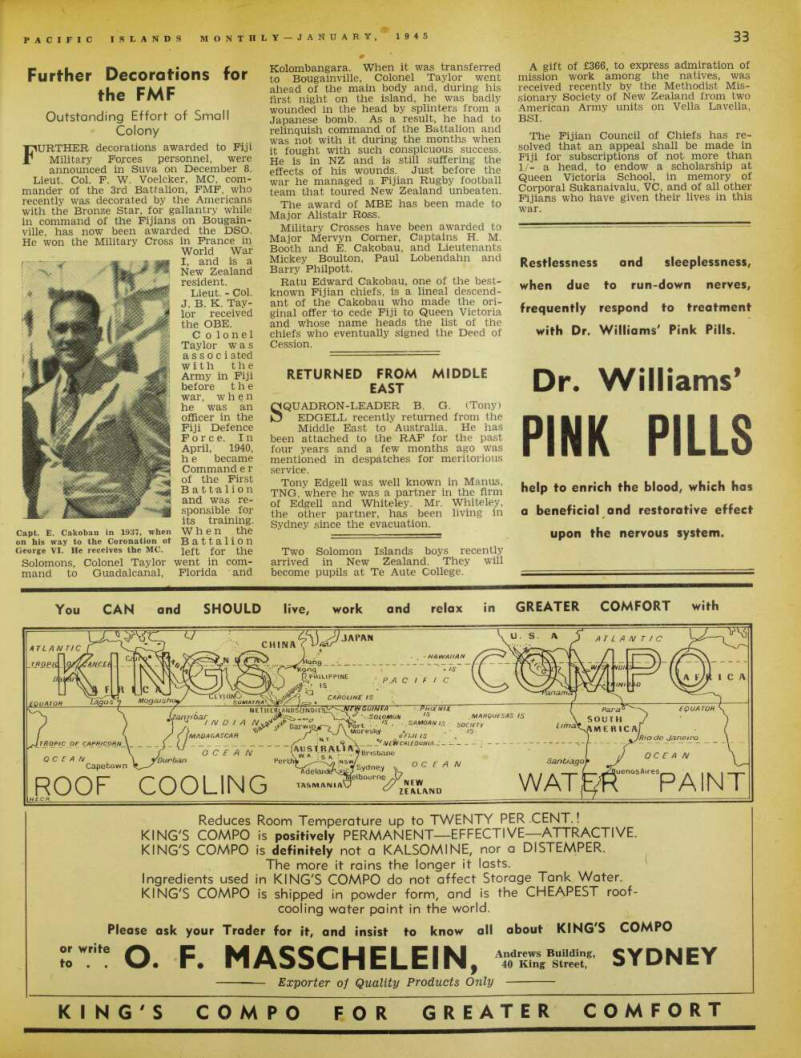
the FMF Outstanding Effort of Small Colony
FURTHER decorations awarded to Fiji Military Forces personnel, were announced in Suva on December 8.
Lieut. Col. F. W. Voelcker, MC, com mander of the 3rd Battalion, FMF, who recently was decorated by the Americans with the Bronze Star, for gallantry while in command of the Fijians on Bougain ville, has now been awarded the DSO.
He won the Military Cross in France in World War
I, and is a New Zealand resident.
Lieut. - Col.
J. B. K. Tay lor received the QBE.
C o 1 o n e 1 Taylor was a s s o c i a ted with the Army in Fiji before the war, when he was an officer in the Fiji Defence Force. In April, 1940, h e became Command e r of the First Battalion and was re sponsible for its training.
When the Battalion left for the
Solomons, Colonel Taylor went in com mand to Guadalcanal, Florida and
Kolombangara. When it was transferred to Bougainville, Colonel Taylor went ahead of the main body and, during his first night on the island, he was badly wounded in the head by splinters from a Japanese bomb. As a result, he had to relinquish command of the Battalion and was not with it during the months when it fought with such conspicuous success.
He is in NZ and is still suffering the effects of his wounds. Just before the war he managed a Fijian Rugby football team that toured New Zealand unbeaten.
The award of MBE has been made to Major Alistair Ross.
Military Crosses have been awarded to Major Mervyn Corner, Captains H. M.
Booth and E. Cakobau, and Lieutenants Mickey Boulton, Paul Lobendahn and Barry Philpott.
Ratu Edward Cakobau, one of the best known Fijian chiefs, is a lineal descend ant of the Cakobau who made the ori ginal offer to cede Fiji to Queen Victoria and whose name heads the list of the chiefs who eventually signed the Deed of Cession,
Capt. E. Cakobau in 1937, when on his way to the Coronation of George VI. He receives the MC.
Returned From Middle
East
Squadron-Leader B. G. (Tony)
EDGELL recently returned from the Middle East to Australia. He has been attached to the RAF for the past four years and a few months ago was mentioned in despatches for meritorious service.
Tony Edgell was well known in Manus, TNG, where he was a partner in the firm of Edgell and Whiteley. Mr. Whiteley, the other partner, has been living in Sydney since the evacuation.
Two Solomon Islands boys recently arrived in New Zealand. They will become pupils at Te Aute College.
A gift of £366, to express admiration of mission work among the natives, was received recently by the Methodist Mis sionary Society of New Zealand from two American Army units on Vella Lavella,
Bsi.
The Fijian Council of Chiefs has re solved that an appeal shall be made in Fiji for subscriptions of not more than 1/- a head, to endow a scholarship at Queen Victoria School, in memory of Corporal Sukanaivalu, VC, and of all other Fijians who have given their lives in this war.
Advertisements & other items, pp. 35-36 (1 item)
Pink Pills
Restlessness and sleeplessness, when due to run-down nerves, frequently respond to treatment with Dr. Williams' Pink Pills.
Dr. Williams*
help to enrich the blood, which has a beneficial and restorative effect upon the nervous system.
You CAN and SHOULD live, work and relax in GREATER COMFORT with u s
JAPAN
CHIN
AT LAN
o
±H.CIt
TROPIC
vui 1 C A
INI
JC \J
Mogajsh
fUUAIQH
NETHERL ft N D S lSfi DI INGU/HtA
\_V' • SOLOMUN
> A KTfept • ■ '*• •• PhOt MU
13 MARQUESAS IS
SAMOAN IS ■ SOCIETY
EQUATOR
SOU
AM Moresby
TROPIC OF CAPRICORN
V r OCEAN
OCEAN A yDurban Capetown
ROOF COOLING
„J „ .V -A NEW CALEDON!A.. . „ w.a r s " 7 Brisbane S 7svdnev \\ OCEAN ,j* ane * V
"■"Melbourne /V
TASMAIMIftV ,X/
y OCE A N
uenosAires,——
Santiago
watl
Perth
PAINT
ZEALAND
Reduces Room Temperature up to TWENTY PER CENT.!
KING'S COMPO is positively PERMANENT— EFFECTIVE—ATTRACTIVE.
KING'S COMPO is definitely not a KALSOMINE, nor a DISTEMPER.
The more it rains the longer it lasts.
Ingredients used in KING'S COMPO do not affect Storage Tank Water.
KING'S COMPO is shipped in powder form, and is the CHEAPEST roof-
cooling water paint in the world.
Please ask your Trader for it, and insist to know all about KING'S COMPO
or write
to . .
O. F. MASSCHELEIN,
Exporter of Quality Products Only
Andrews Building,
40 King Street,
SYDNEY
KING'S COMPO FOR GREATER COMFORT
HARRY J. YOUNG Ptv. Ltd.
Pacific islands Selling Representatives and Distributors
/ Enquiries through your usual channels appreciated, and prompt shipments effected.
Bankers, Bank of N.S.W. fi or „ rS O' u ' —.toe' o ' 1 VA° se ' .e$ vs°-\AOS' e^' »o<“S oO ,v«*® Co -To G\<> Oti o* ,\\oo cf'P TocW Ao® des l-A<
,dtoo^
e<V vs° vAor> Bo9 s
yt'f
AWOQ
6 \oe o\ To'N® poX° f CO ScV' 0 oo &
\|s|W^ e
Co soS Cj\yo9 s \Ao^ 11* Be\* s A\e^ V<f \\o eS N|S| xe* s Co re* 5
AC'O
cb 0S \eo
AoO^°
poo xW so* 1 ?o'f se c pro lVo( ,
vto
s^°P S
As ,0^ Co $0
pro^
peoo 000
cot
vuf pc^ 5 ' SP v f°, Aa® \e<
AW® S
0 6\o° )ort' s afy A* e do®' 5 d° v ® ?tt CO A' e 00 5 90
vtcvt
re* s \n Aa®'° A' s ' s e®'° o* AAs \aK s 9 kAoO e* s oo
Vos* 0
?1 S p^ e v\es so® itf° nS 6^ n9 s $o Y^P S\o *o\ IsNe Postal address: Box 3661, G.P.0., Sydney.
Codes: Bentley’s Comp. Ph Bentley’s 2nd Phr Eagle & Globe Building, 379 Kent Street, Sydney
N.S.W.
Papua
Link With Early Papua Death of Mrs. Emily Leigh
mHE name of Armit is indelibly etched X into the early pioneering history of Papua. True daughter of the fam ily was Mrs. Emily Mary Yeldham Leigh, who died “in exile’’ in St. Vincent’s Pri vate Hospital, Sydney, on December 21.
She was the daughter of the late Cap tain William and Mrs. Armit, of Port Moresby and Samarai. Her father arrived in Papua in 1883, going from Cooktown, Queensland, as leader of the exploration expedition sent out by the proprietors of the Melbourne “Argus.” Based on Port Moresby, Captain Armit and his party were the first Europeans to cross the Owen Stanley Range.
After the return of the expedition, he spent many years around Papua and its eastern islands, but the Armit family remained in Cooktown. However, in 1895, Captain Armit, who was now serving in the Territory as an administrative offi cer under Sir William MacGregor, brought his wife and children' to live near Port Moresby. So bad were their suffer ings from malaria that one child died and the rest of the family were, after eight weeks, forced to return to Queens land to recuperate. Later in the same year, the family again went to Papua— this time to Samarai. They remained there for six years.
Captain Armit was then Resident Magistrate of the Northern Division, and while his duties kept him for ever on the move,-his family lived on the island, then in its virgin state, apart from the RM’s office and house. Emily Armit there helped her mother in the education of the younger children.
The task of pacifying the vast, un touched Northern Division was intense, and after he had got the warring tribes around Kokoda and the Yodda Valley under some sort of control, Captain Armit was worn and ill. At Tamata, on Janu ary 3, 1901, he collapsed and died.
Mrs. Armit, Emily and thd younger children then returned to Sydney, and Emily later married Mr. P. H. Leigh, of Port Moresby. After some years in New Zealand, the couple returned to Port Moresby in 1909. where they lived until the evacuation in 1941.
Mrs. Leigh inherited from her father a great love of natural history. She bred, for the purpose of study, moths, mos quitoes and other insects, and as a young girl helped the other Armit children to collect specimens for overseas institutions.
She had no social aspirations, preferring
to live a quiet life in the country that she loved. She was an enthusiastic church workey and took a particular interest in the children of the Territory. She is sur vived by husband, by her brother, Mr. L. Armit, well-known resident of Port Moresby, and Mrs. V. C. Gabriel and Captain E. F. Armit, cousins, residing in Sydney.
Mr. L. Armit was in possession of his father’s complete diaries of his life in Papua; and had himself kept diaries since going to Papua as a youth. These priceless pioneering documents were destroyed in the early months of the Army’s occupation of Port Moresby, in 1942.
South Sea Sundowner
FROM tall smoke-belching factories, or from the tiring loom, Come city folk, like frightened shadows, in the purple gloom; Whilst here, behind a paling fence, I’m dreamin’ of old times, Of South Seas, in my rovin’ youth; of many loves and climes.
With smirks these neighbours hear my yarns. Their talk is not for me!
What could they ken of strange wild days on many a far-off sea?
They never sought that “mystery star,’’ or creak of a jib-boom; I dis-remember things like that—till white magnolias bloom.
Then comes the hint of Islands, where the great white blossoms blow The scent of Hainese’s lei, where little fireflies glow; And Tepo, from Samoa, comes with haunting memory, too, (And those days, out from Tonga, when we cussed a missing crew).
A Sari seems to flutter-by, with trill of silver beads, As graceful Munisami walked, a flower among the weeds.
Then Hobart Town, that felt like home, and every pretty lass, Seemed fair to make a bonny wife—but one let those moods pass.
This night-wind’s like a chanty, sailing out from Cooktown Bay; It’s warmish, like Levuka nights, when - copra came our way.
This deck-chair takes me down the years, away from age and gloom, To sail the Islands seas again, when white magnolias bloom.
Alice Allen Innes.
Roy MacGregor, of Madang, TNG, has been spending a few weeks’ leave in Aus tralia. He returns north next week.
Mr. Harry Luttrell Morton died in Sydney recently. He was described by Sydney newspapers as having been one of the - few men associated with the dis covery of gold in Fiji and was alleged to have pegged the Emperor Mine.
Lieutenant P, A. Tuckey, a member of an infantry battalion of the AIF, was killed in fighting in the Sepik River - country in December, 1944. He came from New Guinea before the war, and enlisted in Australia for special service in the Territory.
Advertisements & other items, pp. 37-38 (1 item)
Radiant
STORMPROOF
PRESSURE LANTERN
SAFE AND RELIABLE
Chromium plated throughout
"OUTSHINES "
ALL OTHER LAMPS
9 jRApjANT Please ask your Island Trader to show you the RADIANT— you will like it.
0. F. MASSCHELEIN
Andrews Building, 40 King Street, Sydney.
Exporter of Quality Products Only.
ALUMINIUM and its ALLOYS
This company supplies Aluminium and its Alloys to ail specifications and for every commercial application where these give better service over other metals.
Please consult us regarding your aluminium requirements for all purposes.
COMPANY
Ky
GENERAL OfflCtS AND FABRICATION DIVISION:GRANVILLE. SYDNEY,
PROPRIETARY LIMITED
I INCORPORATED IN THE STATE OF VICTORIA).
After taking Pinkettes you should feel brighter, happier, and free from sick headaches, bilious attacks and liyerishness. For
PINKETTES
are tiny laxative and liver pills, which painlessly exercise the digestive system.
Stories Of Fiji's Famous Fighting
Battalion
As told by HAROLD COOPER, of the Fiji Secretariat
rE transport on which the Fijians travelled north from Suva might well have been named the “United Nations.”
The Third Battalion, in addition to Fijians, included many European officers and NCOs (some born in the Colony, others from United Kingdom, New Zea land, Australia), a number of Euronesians (or people of mixed European and South Sea Island blood), a platoon of Tongans and a bearer company of Rotumans.
There were also New Zealand and American units on the ship, the crew of which was Dutch and the stewards Javanese.
THIRD Battalion is unique in that it is organised on a “Provincial” basis: that is to say, Fijians from the same Province serve together in the same platoon or company.
There are some slight disadvantages to this system, as a junior NCO will some times show reluctance to charge with some minor offence a private who, back in the home village, is a petty chief.
But. on the whole, the experiment has been an outstanding success. It has meant that the men have been among old friends from the time they entered the Battalion; and in cases where they have had as company commanders the highest chiefs in their own districts (as with the two Thakombaus, Ratu George and Ratu Edward) they have fought more resolutely than ever under this traditional leadership.
rE commanding officer of the Bat talion (an Englishman now domiciled in New Zealand) says he was sur prised at the zeal with which his men took their Christianity to war with them.
Church parades on Sunday were as popu lar as the cinema shows on week-nights; and their singing was as much of a joy to themselves as to the Americans who came to listen.
The Bible was an important piece of every Fijian’s equipment, and he would often take it into his foxhole with him to read at moments when the Japanese were not distracting his attention.
THE Third Battalion landed at Empress Augusta Bay in the middle of the last Japanese suicide drive against the perimeter.
Lieut.-Colonel Voelcker, the Battalion’s commanding officer, tells how the Ameri can officer who pointed out their camp site to them (it was a chaos of tangled underbrush) said apologetically, “We’d reserved a much better area for you, but two hundred shells fell in it last week, so we thought you’d be happier here.”
THE Americans operated a sawmill on Bougainville and there was fierce competition for the timber it pro duced. The Third Battalion got more than its share.
Very soon it abandoned the practice of sending European officers or NCOs down to the mill, for they would always be met with a string of queries about permits and vouchers. But when a couple of Fijians went down with a truck, they
had only to stand about, looking discon solate, and before long the American sawmillers would be falling over each other to help them get exactly what they wanted, so sky-high was the prestige of the Battalion inside the perimeter.
As for permits and vouchers, the Fijians assumed a blank look whenever they were mentioned. Their knowledge of English didn’t carry them that far; and the Americans didn’t press the point.
COLONEL VOELCKER tells a story of a Fijian corporal who, during a brush with the Japanese in the Jaba River area, was crouched behind a log, when a sniper took a pot at him.
He asked the man sprawled beside him whether he had spotted the sniper. The man said he hadn’t.
“Try this time,” said the corporal, and he bobbed his head quickly up over the log and down again, drawing another shot from the sniper, whose position the cor poral’s companion again failed to locate.
Three times the corporal showed his head for a split second. Three times the sniper fired; and the third time was the last. His well-camouflaged hide-out had been detected by the keen-eyed Fijian, who proceeded to despatch him with a grenade.
DO the Fijians know their weapons?
Colonel Voelcker answers this ques tion by telling how, when his Bat talion, during a sweep well outside the American perimeter, was attacked one night by a Japanese force, a Fijian Vick ers gunner, the lock of whose gun broke as the Japanese were advancing towards him, fitted a new lock in the pitch dark and got his gun back into action in time to wipe out the Japs at point-blank range as they were about to over-run his posi tion.
One Fijian had a diverting experience during a night action on Bougainville, when a foot suddenly descended out of the glopm into his foxhole and planted itself firmly on his steel helmet. It belonged to a Japanese groping his way forward in a familiar attempt to “infil trate” into the Fijian lines.
Needless to say, the Jap, once in the grip of a Fijian, was given no chance to retrieve this false step.
SOON after the Third Battalion arrived on Bougainville, and before a PX was established in their area, a Fijian private, finding himself short of certain essential articles, wandered across to the nearest American camp and asked the occupant of the first tent he found whether he could lend him a cake of soap and some cigarettes.
The American called an orderly and told him to give the Fijian whatever he needed.
It was not until two full colonels appeared in the tent and saluated that the Fijian realised that he was in the presence of General Griswold, Allied Commander on Bougainville. rE Third Battalion got a great kick out of American newspaper stories which featured the Fijians as “fear less jungle fighters.” Colonel Voelcker tells how, during one of the Battalion’s many sweeps through enemy-held terri tory, its perimeter camp was attacked one night by the Japanese. The first the colonel knew of the assault was the explosion of a hand-grenade within a few feet of his foxhole.
Then he heard his adjutant’s voice, audible above the confusion of auto matic fire and bursting grenades: “Are you awake, sir?”
“Yes,” said the colonel.
“Do you feel like a fearless jungle fighter now, sir?” asked the adjutant.
ARE Fijians tough? Take the case of Private Ropate. During one action on Bougainville three grenades ex ploded in his foxhole. He was blown clean out of it and three fingers on his right hand-including his trigger finger— were shattered.
But Ropate bounced back into his hole and, with the one finger that remained unbroken, kept his Bren gun in action until the Jap assault had been beaten.
THE Fijian has an irrepressible sense of humour and he found the Jap an amusing as well as a sinister foe.
There was, for instance, the little cor poral who was holding a forward Jap position which the Fijians cleaned up after some brisk fighting. The last writ ten message the corporal had received before his death—the Fijians brought it back to camp with other papers and had it translated by an American interpreter read thus' “Corporal X: You are doing great work anc j j will recommenc j you for advance ment. j would give you a cigarette, but I have not got one.—Sergt. Y.”
The Fijians thought it was very cruel to raise the corporal’s hopes so high, only to dash them so rudely.
Advertisements & other items, pp. 38-39 (1 item)
W. Kopsen & Co. Pty. Ltd.
SHIPCHANDLERS & HARDWARE MERCHANTS
Manufacturers of all classes of boat-building materials and boat accessories. Agents for the best Australian hardware manufacturers. Some of the new attractive lines are as follows: Kopsen's 300 c.p. Kerosene Pressure Lamps; Thermil Kerosene Stoves; Darlton Blowlamps; CQR Anchors; Vortex Bilge Pumps; Companion Primus Stoves; Briggs & Stratton Petrol Motors and Power Generators; Dekol Wood Preservative, Alpha Antifouling Paints, Please Send List of Your Requirements for Quotation .
SIMPLEX MARINE ENGINES
for all small boats are the most popular in Australia to-day.
Used by all Service Departments, including Navy, R.A.A.F., and Army. Available at present only for essential orders or licensed fishermen.
SIMPLEX LAUNCHES we regret are temporarily unavailable, but we shall be pleased to forward details on request.
Simplex 10/12 h.p. Marine Engine Also made in 3 h.p. and 5 h.p.
Simplex Motor Launches, 14 ft., 16 ft., 18 ft., and 20 ft. long.
376/382 KENT STREET, SYDNEY, N.S.W.
’Phone: MA6336 (6 lines). \ Cables: Kopsen Sydney.
TRINITY GRAMMAR SCHOOL
The School is well equipped and splendidly situated. Its 1944 complement (about 70 boarders and 250 day boys) makes it possible for every boy to come into personal touch with the Head Master and a staff of 10 experienced and successful masters (Including seven University Graduates). The general life of the school is very varied and full of vigour. The Head Master will be pleased to send the Illustrated Year Book for 1943-4, on application, and to give full information about the school.
KEW, VICTORIA.
President of Council;
A. O. HENTY, Esq.
Headmaster:
ALFRED BRIGHT, M.Sc., B.A.
New Year term commences February 13, 1945.
Postal Address: Kew, E. 4, Victoria.
Telephone: Hawthorn 412.
When Shopping insist on
RAD C O
Quality Food Specialties.
"Never Fail"
JELLY CRYSTALS
ALSO PLEASE TRY:
RADCO "Delicious" CUSTARDS; RADCO "Wholesome" SOUP
MIXTURE; RADCO "Refreshing" BLANC MANGE; RADCO
"Sure-to-set" JUNKET CRYSTALS.
And now the lotcst productions:
RADCO "Cob" CORNFLOUR; RADCO "Vegetable" SOUP
POWDER; RADCO "Chocolate & Butterscotch" DESSERT
MIXTURE; RADCO "Ever-ready" PUDDING MIXTURE; RADCO
"Bouncing" SCONE MIXTURE and RADCO "Self-raising"
PASTRY MIXTURE.
EVERY ONE A TREAT TO EAT
RADCO "Sure-to-rise" BAKING POWDER; RADCO "Rich-glaze"
CORN STARCH.
ALL EQUAL TO THE BEST MADE ANYWHERE Manufactured by Specialists in the Most Modern, Hygienic Factories in Australasia. 0. F. MASSGHELEIN, S™ 9 ' SYDNEY Exporter of Quality Products Only • RADCO Specialities are obtainable in Ceylon, India, New Caledonia, New Hebrides, Fiji and other Pacific Territories.
No Surnames In Cook
Islands !
By Edwin Gold
IT is a curious fact that, except in the case of Euronesians who inherit a papaa family name, no Cook Island Polynesian has any other appellation than his own and his father’s “given” name. It works out something like this (applying the Cook Island system to an imaginary European family-tree).
Ancestor: John Brown.
Son: Thomas John.
His Son: William Thomas.
His Son: Henry William.
His Son: James Henry.
But the line may be at any time inter
rupted by another form of Cook Island peasant nomenclature. James’s son may be: “Little Jimmy.” So we go on: His Son; Edward Little Jimmy.
Then we go back to normalcy again.
Edward’s son is Arthur Edward, and his son is Charles Arthur.
Pacific Battalion Has
Leave In Paris
A radio from Roger Gervolino, New Caledonian delegate to the Assemblee Consultative of the Provisional Govern ment of the French Republic, states that after campaigning in Italy and more re cently in France,, the Pacific Battalion has been given leave in Paris.
Where Hawaii is Not
Liked !
From Our Own Correspondent
1 Papeete, Nov. 29.
LISTENED to a speech by the Austra lian Minister to the United States Perhaps you heard it! He cited Hawaii as the model for the “develop ment” of the islands throughout the Pacific.
So that festering Pompeii, which is Honolulu, is destined to be the glittering capital of our island world! The Cham ber of Commerce, the Booster Club, the Tourist Bureau, Rotary, the Big Five have performed the mystic rites. Kim mel and Short are to be “whitewashed”; the true cause of the Pearl Harbour dis aster is to be buried in echo-less caverns of oblivion: the high-priests of the dark arcana will congratulate each other over
foaming beakers.
The old formulae—disguised by the splendpur of regal trappings of sweetness and light—will, the more speedily, des patch the pitiful remnant of island life to the realm of shadows. The children of the gods must make way for the thunderous progress of the sons and daughters of the Barbary Ape.
Advertisements & other items, p. 40 (2 items)
advt
Steamships Trading
Company Limited
PORT MORESBY
SAMARAI
PAPUA.
WHOLESALE & RETAIL MERCHANTS, SHIPOWNERS,
PLANTERS, ENGINEERS & SLIP PROPRIETORS.
Customs, Shipping, Insurance, and Forwarding Agents.
MANAGING AGENTS AND VISITING REPRESENTA-
TIVES FOR COCONUT AND RUBBER ESTATES,
SYDNEY REPRESENTATIVES: Nelson & Robertson Pty Ltd.. 12 Spring Street,
WARTIME ADDRESS
Un‘il further notice, clients may address all communications as follows:
STEAMSHIPS TRADING COMPANY LIMITED,
C/o NELSON Cr ROBERTSON PTY. LTD.,
12 SPRING STREET, SYDNEY.
Kidney Trouble
and Backache
Gone in 1 Week
Flush Kidneys With Cystex and Ton’ll Feel Fine Cystex—the prescription of a famous doctor —improves faulty kidney action in double quick_ time, so, if you suffer from Rheumatism, Sciatica, Neuritis, Lumbago, Backache, Nervousness, Leg Pains, Dizziness, Circles under Eyes, frequent Headaches and colds, poor Energy and Appetite, Puffy Ankles or Interrupted Sleep, go to your chemist to-day for Cystex.
Cystex Helps Nature 3 Ways
The Cystex treatment is highly scientific, being specially compounded to soothe, tone and clean kidneys and bladder and to remove acids and poisons from your system safely, quickly and surely, yet contains no harsh, harmful or dangerous drugs. Cystex wo*ks In these 3 ways to end your troubles:— (1) Starts killing the germs which are attacking your Kidneys, Bladder and urinary system in two hours, yet is absolutely harmless to human tissue. (2) Gets rid of health-destroying, deadly poisonous acids with which your system has become saturated. (3) Strengthens and reinvigorates the kidneys, protects you from the ravages of diseaseattack on the delicate filter organism, and stimulates the entire system.
Feels a Different Woman
"I have been taking Cystex for Kidney and Bladder trouble and It has made a different woman of me. I am feeling splendid, can do all my work, run about and walk miles although I am 63 years of age. Cystex does all you claim for it.”—(Sgd.) M. L. Zessin, Thompson Estate, Brisbane.
Now Able to Walk Without Stick
“I had Kidney and Bladder complaint, pains in leg and back; in fact, I had to use a walking stick. I have used two bottles of Cystex, now I have no pains anywhere. I consider Cystex the greatest medicine in the world for Kidney complaint.”—(Sgd.) J. McPherson, Nangcribone Station, N.S.W.
Guaranteed to Satisfy or Money Back
Get Cystex from your chemist to-day. Give it a thorough test. Cystex is guaranteed to make you feel younger, stronger, better In every way, or your money back If you return the empty package. Act nowl Now In 2 sizes—4/-, 8/-.
This is a
GUARANTEED CVCIAV
Treatment
for Your Kidneys, Bladder, Rheumatism
Dengue
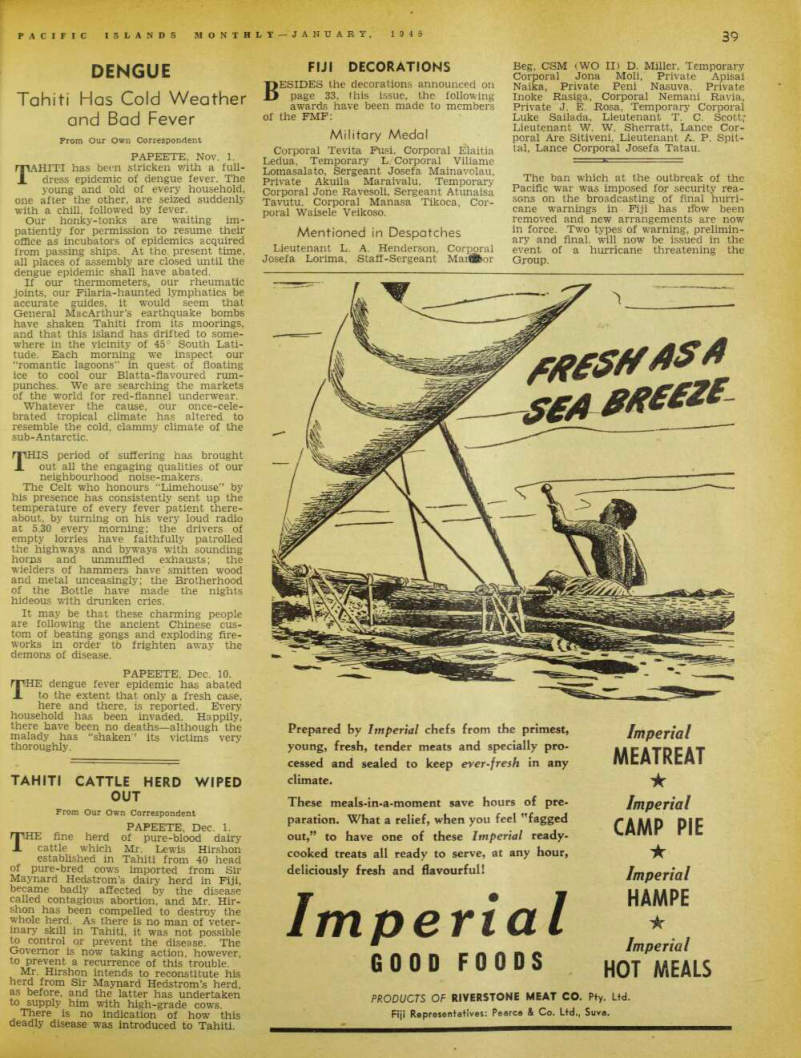
Tahiti Has Cold Weather and Bad Fever
From Our Own Correspondent
Papeete, Nov. 1.
TAHITI has been stricken with a full dress epidemic of dengue fever. The young and old of every household, one after the other, are seized suddenly with a chill, followed by fever.
Our honky-tonks are waiting im patiently for permission to resume their office as incubators of epidemics acquired from passing ships. At the present time, all places of assembly are closed until the dengue epidemic shall have abated.
If our thermometers, our rheumatic joints, our Filaria-haunted lymphatics be accurate guides, it would seem that General MacArthur’s earthquake bombs have shaken Tahiti from its moorings, and that this island has drifted to some where in the vicinity of 45° South Lati tude. Each morning we inspect our “romantic lagoons” in quest of floating ice to cool our Blatta-flavoured rum punches. We are searching the markets of the world for red-flannel underwear.
Whatever the cause, our once-cele brated tropical climate has altered to resemble the cold, clammy climate of the sub-Antarctic. rIS period of suffering has brought out all the engaging qualities of our neighbourhood noise-makers.
The Celt who honours “Limehouse” by his presence has consistently sent up the temperature of every fever patient there about, by turning on his very loud radio at 5.30 every morning: the drivers of empty lorries have faithfully patrolled the highways and byways with sounding horns and unmuffled exhausts; the wielders of hammers have smitten wood and metal unceasingly; the Brotherhood of the Bottle have made the nights hideous with drunken cries.
It may be that these charming people are following the ancient Chinese cus tom of beating gongs and exploding fire works in order to frighten away the demons of disease.
Papeete, Dec. 10.
THE dengue fever epidemic has abated to the extent that only a fresh case, here and there, is reported. Every household has been invaded. Happily, there have been no deaths—although the malady has “shaken” its victims very
thoroughly.
Tahiti Cattle Herd Wiped
Out
From Our Own Correspondent
Papeete, Dec. 1.
THE fine herd of pure-blood dairy cattle which Mr. Lewis Hirshon established in Tahiti from 40 head of pure-bred cows imported from Sir Maynard Hedstrom’s dairy herd in Fiji, became badly affected by the disease called contagious abortion, and Mr. Hir shon has been compelled to destroy the whole herd. As there is no man of veter inary skill in Tahiti, it was not possible to control or prevent the disease. The Governor is now taking action, however, to prevent a recurrence of this trouble.
Mr. Hirshon intends to reconstitute his herd from Sir Maynard Hedstrom’s herd, as before, and the latter has undertaken to supply him with high-grade cows.
There is no indication of how this deadly disease was introduced to Tahiti.
Military Medal
Fiji Decorations
BESIDES the decorations announced on page 33, this issue, the following awards have been made to members of the FMF:
Corporal Tevita Fusi, Corporal Elaitia Ledua, Temporary L/Corporal Viliame Lomasalato, Sergeant Josefa Mainavolau, Private Akuila Maraivalu, Temporary Corporal Jone Ravesoli, Sergeant Atunaisa Tavutu. Corporal Manasa Tikoca, Cor poral Waisele Veikoso.
Mentioned in Despatches Lieutenant L. A. Henderson, Corporal Josefa Lorima, Staff-Sergeant Martibor
Beg, CSM (WO II) D. Miller, Temporary Corporal Jona Moli, Private Apisai Naika, Private Peni Nasuva, Private Inoke Rasiga, Corporal Nemani Ravia, Private J. E. Rosa, Temporary Corporal Luke Sailada, Lieutenant T. C. Scott; Lieutenant W. W. Sherratt, Lance Cor poral Are Sitiveni, Lieutenant A. P. Spit tal, Lance Corporal Josefa Tatau.
The ban which at the outbreak of the Pacific war was imposed for security rea sons on the broadcasting of final hurri cane warnings in Fiji has rfbw been removed and new arrangements are now in force. Two types of warning, prelimin ary and final, will now be issued in the event of a hurricane threatening the Group.
Advertisements & other items, p. 41 (1 item)
Imperial
sat ** eae
> ' #\T %> ■ jT Prepared by Imperial chefs from the primest, young, fresh, tender meats and specially processed and sealed to keep ever-fresh in any climate.
These meals-in-a-moment save hours of preparation. What a relief, when you feel "fagged out,” to have one of these Imperial readycooked treats all ready to serve, at any hour, deliciously fresh and flavourful!
Imperial
GOOD FOODS
Imperial
MEATREAT
★ Imperial
CAMP PIE
★ Imperial
HAMPE
★ Imperial
HOT MEALS
PRODUCTS OF RIVERSTONE MEAT CO. Pty. Ltd.
Fiji Representatives: Pearce & Co. Ltd., Suva.
Tonga Happy in British
Alliance
Letter to the Editor I READ with interest an article in an American magazine, which reports interviews with people who have visited Tonga. But I am afraid they gave only thoughtless opinions regarding the Government of the Group, the way in which laws are administrated, and how they are regarded by the natives.
I have been in Tonga close on 60 years, and I have no hesitation in stating that there is not one decent European or Ton gan who is dissatisfied with the present Government. Neither have I heard com plaint from anyone except a dismissed Government official or some person anxious to procure advantage for himself.
The writer in this American magazine seems to think that the Treaty negotiated in 1900 by Basil Thompson is not taken seriously by the natives. I fail to see in what more serious light they can be expected to look upon it—unless they make use of it in place of their Bible.
THERE has been in existence a Treaty between Great Britain and Tonga since 1879, and not once has there
been any attempt to break the same.
Article I of this Treaty provides that the King of Tonga agrees that he will have no relation of any sort with a foreign Power concerning the alienation of any land, or any demand for monetary com pensation. In Article 11, the King of Tonga .agrees that British officers shall at all times have free access to the waters and harbours of Tonga, and also agrees to lease to Britain a suitable site or sites, in any harbour or harbours in Tonga, for the purpose of establishing a station, or stations, for the coaling and repair of British ships, I consider Great Britain should feel highly satisfied with the work done by Basil Thompson, who procured all that in the way of coaling sta tic®, land for forts, etc. Queen Salote and a population of over 32,000 have the advice of a British Consul who has the welfare of the Tongans at his heart.
Britain not only watches over these islands, but is ready and able to assist us in the defence of our land against any foreign Power, should the necessity arise.
I consider this settlement quite suffi cient. There is no need for Tonga to burden itself with more expense. The present arrangement allows a quiet and harmless people to live happy and con tent in their own way, on their own land, and under their own much-beloved flag.
I am, etc.,
F. T. Goedicke.
Haapai, Tonga.
Before Chief Judge Young and four assessors, a Samoan, Fa’afoi, was recently charged in Apia, W. Samoa, with the murder of Lafoga, of Fasitootai. After lengthy deliberations, the accused was convicted of manslaughter and sentenced to three years’ imprisonment.
No Colour Bar—And No
Women
FORMER well-known planter and trader of Eastern Papua writes
from the Pacific :
IHAVE found our American Allies good folk to work for. In this Branch of Small Ships can be seen a fine work ing example of what international co operation should be; adventurers from all the races that lie betwixt Norway and New Zealand are gathered here, attracted, no doubt, by the high rate of remunera tion, and a life crammed with variety and risk. The Tower of Babel would have nothing on us if each conversed in his mother tongue. There is no colour bar here: white, black, brown and yellow rub shoulders and eat together without argument. I have yet to see a brawl: gambling (and there is plenty of it) apparently engenders no personal ani mosity.
These men being no saints, one can only conclude that the reason why such a conglomerate of male humanity can live and work together in complete amity is the absence of politicians and women—both very destructive to peace and contentment. The first-named live by fostering racial animosity; but the latter are the very devil altogether (where young men are concerned, especially so).
If one can judge by this camp, the .bald fact shows out: eliminate women and politicians from a community and you also eliminate the two main sources of strife and discontent.
The subscription opened in Noumea in the name of the local Friends of the Soviet Union on behalf of French partisan fighters, resulted in the raising of 104,410 francs.
Advertisements & other items, p. 42 (2 items)
The Pacific Islands
TRADING CO.
2016 Parker St., Berkeley,
CALIFORNIA, U.S.A.
We are Expert Buying Agents for Pacific Islands Merchants.
SEND YOUR ORDERS TO US—OUR
COMMISSION IS 5 PER CENT.
Also at San Francisco.
William Atkins Pty. Ltd.
Head Office 449-451 KENT ST., SYDNEY.
Iron & Steel Merchants-Engineers' Supplies
Coach 6* Motor Hardware
ESTABLISHED OVER 50 YEARS
trade
MARK
Cable Address: WLLATKIN, Sydney.
—STEEL DEPARTMENT
MILD STEEL:
Rounds, Squares, Flats, Half-rounds, Hexagons, Bevel, Shoeing, Tyre, Angles, Tees, Sheets, Plates, Girder Plates, Chequer Plates, Channels, Hoops, Etc.
BRIGHT STEEL:
Rounds, Squares, Hexagons.
Extra Special High Speed Tool Steel, Mining Steel, Blister Steel and Spring Steel, Rounds, Flats & Squares.
Bor Iron All sections and sizes.
Engineers' Supplies; Set Screws, Studs, Metal Thread Screws, Coach Screws. Files, Cotter Pins, Bright and Black Bolts, Rivets, Etc., Hack Saw Blades.
Power Transmission Gear: Including Plummer Blocks, Couplings, Collars, Etc.
Coach and Motor Hardware: Axles, Springs, Wheelstuff, Duck, Paints.
Farriers' Supplies: Horse Nails, Anvils, Vices, Etc.
Motor-Trimmers and Motor Builders' & Motor Painters' Requirements
C. A. WILLEY'S
Quick-Drying Coach and Car Paints. Roughstuff, Elastic Gloss, Synflex Enamels, Lacquers.
DUCO Lacquers and DULUX Enamels—FAßßEX Motor Toppings and Leather Cloths, House & Decorators' Paints, Varnishes & Brushware.
Sole Distributors of CHAMPION'S Decorators Paint Products.
Distributing Agents for BROLITE Lacquers, SYNFLEX Enamels and "POLYGLOSS" Finish.
Urgent’ Plea for Papuan
Natives Present Conditions Threaten Extinction of Race
THIS is an attempt to sum up, im partially, the present set-up in Papua—and particularly the set-up as it affects the Papuan. No matter whose eyes regard the Papuan scene it must be realised that in the ultimate wash-up, the needs of the native are para mount—if for no other reason, than be cause the country is untenable for Euro peans without his help.
The work and conduct of Papuans dur ing the invasion of their land has, generally speaking, been good. This, not withstanding the fact that the Papuan possesses no patriotic incentive to serve; and that his limited realisation of what Japanese domination would have been was not sufficient to force him to work with his white masters for his own safety.
Much might be said of the minor mis haps that have befallen the natives of Papua in wartime, but they all pale into insignificance in face of one major con sideration —that is, are the Papuans to survive as a race? Or will they be allowed to die out in a few decades?
This latter possibility is not universally recognised, but evidence of approaching extinction, in many areas, is clearly visible to those who are prepared to face the truth. rE factors tending to the disappear ance of the Papuans as a race are: • Excessive use of native manpower.
In pre-war days it was considered that the employment of 10,000 natives away from their homes was the limit of safety, but now over 30,000 have been conscripted.
The danger has been pointed out to Army administrative officials in many reports, yet the means of alleviating this danger have been neglected.
No one questions the right of the Army (or ANGAU) to conscript natives —nor the urgent necessity to utilise their ser vices in the dark days of 1942 and 1943 but native manpower is now being used out of all proportion to needs; it is be lieved by many experienced Papuan residents, now in the Army, that essential work on plantations and Army adminis tration could be carried on by not more than two-thirds of the present number of conscriptees—the other third being per mitted to return to native life. • Fatalities from hostile action and sickness among conscripted natives. This is far greater than is realised. It would not be unreasonable to state that five thousand potential fathers have been lost to a race that was never very numerous nor very fecund. • Separation of'husbands and wives for 2 and 3 year intervals. This needs no further comment. • Birth control or the unwillingness of Papuans to have children. This is wide spread and dates back long before the days of ANGAU.
CAN the race be rescued from this state of affairs? The means of attempt ing this immediately are at hand. Im mediate repatriation of all unnecessary conscripted labour; utilisation of labour not engaged in useful or necessary work for ANGAU in fencing and preparing gardens to improve food supplies. And, finally, the termination of conscription as soon as possible, leaving the native com pletely free to choose whether he will go to work (as indentured or casual labour) or remain in his village to reconstruct native life and increase the population.
These things imply restriction of new European development in Papua; and perhaps the hampering of existing white enterprises by lack of labour. But better to face facts and some immediate sacri-
fice now and in the next five years in order to preserve the native, who is in evitably the most important asset in the development of Papua. As it is, the decline of native population has been
greatly accelerated during the war period and will remain a disturbing factor for the next couple of decades.
THE time is perhaps opportune to present an assessment of the good and the harmful effects—and there have been both—of ANGAU’S term of administration.
The history of ANGAU’S three years of rule reflects, to a great extent, the successive military 'phases of invasion, defence, and liberation.
The formative period was marked by jealousy, manoeuvring for position and power, and discussion between Papuan and Mandated Territory elements in the new Administrative body. Concurrent with this somewhat discreditable be haviour at the top, was the good work performed in the field by the more insignificant, but infinitely more useful members.
Much gallant rescue work was done; field improvisations became more and more effective; and many members of ANGAU took an active, self-sacrificing part, in close proximity to the enemy, in defending and subsequently liberating the land. Theirs was a concept of duty and achievement rather conspicuously absent back at base. And, from this early ram shackle set-up, a very creditable organi sation has been built up.
This first phase was followed by a period of effective and altruistic work through out every section of the unit, which stands wholly to its credit and cannot be ignored.
This phase coincided with the Japanese invasion of part of Papua, and the threat of complete conquest by the enemy.
FINALLY, the past and present stage— after the Japanese were cleared from the country. This was (and is) a period of deterioration in principles and goodwill to the natives.
Certain elements had discovered what wide powers they possessed, and used them to the fullest extent. But, even in this phase, the good work performed by the Administrative, medical, and labour sectors have done something to redeem the Unit’s honour. The entrance of former experienced Papuan officials and the commonsense and high ideals of many of the younger, and so-called “in experienced” elements, stabilised and im proved the general work of ANGAU.
A recent deterioration in the general conduct of affairs is marked by exploi tation of the natives, and the tendency of certain ambitious elements to prevent the return of the civil administration— which to many officers would mean les sened importance and even an exit from the Papuan scene.
It must not be overlooked that even to-day the reliable elements of ANGAU, especially the younger and un-self-seeking men, have carried on to the benefit of the country. But during 1944, however, certain ANGAU leaders have discovered that enormous sources of revenue exist in the exploitation of natives and settlers —a state of affairs that would never have been tolerated by the former civil government. For ANGAU to “cash in” on the natives and exploit the old established settlers is, at best, unethical.
NEVERTHELESS, the future govern ment of Papua, even if labelled “civil,” must now be grafted bn to the existing ANGAU organisation. The only leader acceptable to the best ele ment in Papua is their former chief, Leonard Murray.
With his return, provision must be made for the exiled Government servants, and especially for those who volunteered early in the war. This latter class dis
played much patriotism, and are entitled to priority in administrative posts.
Officials who have been absent from Papua during its time of stress must, however, recognise that a new and im proved spirit, largely generated by the younger, keener, and less bureaucratic elements, has been introduced. They must adjust themselves to it.
It will be found, too, that much of the old red tape, official superiority, aloofness from the natives and their needs, and some of the old-time petty tyrannies which existed in spite of Sir Hubert Murray’s benevolent rule, have been cut out —and for the good of Papua, should remain out.
Advertisements & other items, pp. 43-44 (1 item)
B. DAVID Trading Co.
Allen Taylor & Co. Ltd.
COMMERCIAL ROAD, ROZELLE,
SYDNEY
Sowmillers ond Wholesale Suppliers of Hardwoods for Constructional Purposes GIRDERS . . . PILES . . . POLES . . . SLEEPERS, Etc.
EXPORTING TO PACIFIC ISLANDS SINCE 1893
“Paint It With Campbell’s”
WHEN YOUR VALUABLE BUILDINGS NEED PROTECTION
CAMPBELL’S
Paints and Varnishes for Inside and Outside Cover Wartime jpt Qualities Permitted • I • Are Pure When you buy CAMPBELL'S products you have secured the CHEAPEST FIRST-QUALITY GOODS made in Australia.
NOW OBTAINABLE IN THE PACIFIC ISLANDS
Lcs peintures “C.A.P.” et verms sont et restent: “Toujours les meilleurs.”
Color Cards and Prices from all leading Traders, or
0. F. MASSOHELEIN, SSS: Sydney
Exporter of Quality Products Only
B. DAVID Trading Co.
ISLAND TRADERS
EXPORT MERCHANTS
SHIPPERS OF ALL KINDS OF MERCHANDISE.
EXPORT REPRESENTATIVES OF LEADING
AUSTRALIAN MANUFACTURERS
Head Office;
31 Queen Street, Melbourne, Vic.
Branches and Agents in All Ports.
Direct Enquiries to Bankers: Head Office. National Bank of Australasia.
Cable Address:
“DAVID TRADING
MELBOURNE”
OPEN TO APPOINT AGENCIES WHERE NOT REPRESENTED
Hula-skirts : Hula-skirts : Hula-skirts
SHELL NECKLACES : SHELL NECKLACES
Mother of Peari Brooches—Coloured Grass Leis The Hula-skirts are in assorted bright colours with decorated waist band.
Mother of Pearl Brooches are supplied in a large assortment of lovely designs, individually carded. These are made in our own factory by native craftsmen, so you are assured of the prices being right.
The Shell Necklaces consist of small shells. Each necklace, 60” long.
Cable for wholesale prices. Can quote you a c.i.f. price, any part of the world. AH goods sent by parcel post, ensuring quick delivery. Parcels are franked with valuable Cook Island stamps, which have a high resale value.
Any quantity supplied. Terms: D/P your own bank.
Wm. H. WATSON, Wholesale Island Trader
RAROTONGA, COOK ISLANDS
Cable Address: “ Watson, Rarotonga.”
Bankers: Bank of New Zealand, Auckland.
SHEAFFER’S WORLD FAMOUS
Streamlined, Feather Touch PENS and PENCILS
If you want Design, Beauty and Quality buy
a SHEAFFER
All Lifetime Pens are guaranteed for the life of the user except against loss and wilful damage.
When serviced, they are subject to a small fee for insurance, postage and handling.
Beautiful and Useful Gifts for All Occasions.
SKRIP- The
Successor to Ink makes all Pens write better. 2 02. 1/6, 4 oz. 2/6 Plus Postage Distributors Identify the Lifetime HU Pen by the white dot Feather Touch Lifetime Pencil Regular Pen Lifetime Fen Pencil - £ 3 2b/- 36/- ea. each each The working parts of the Sheafier Pencil are guaranteed against wear for the lifetime of the user.
When serviced they are subject to a Obtainable from Selected Jewellers and Stationers everywhere 76/- each
EXCELSIOR SUPPLY CO. PTY. LTD
HEAD OFFICE}
160 BROADWAY,
SYDNEY, IM.S.W.
278 Post Office Place,
MELBOURNE, VIC.
50 Victoria Street,
WELLINGTON, N.Z.
Red Cross
Papuans' Gift To
FRIENDS from Misima might be in terested to hear that on my return to Adelaide in August I had the pleasure of handing to the Red Cross Society the sum of £25 (writes Rev.
Harry K. Bartlett, Burra, South Aus tralia). .
This amount, which had been sub scribed by the natives, was passed on to me by Rev. Isikeli Hau’ofa, who was left in charge of the Methodist Mission at Misima from the time of the evacuation of the whites in January, 1942, until Rev.
E. A. Clarke and I returned 22 months later. Subscriptions came from as far away as Rossel Is. Actually, not much money was contributed, but skirts, baskets, mats, seashells and other curios were brought for sale.
FROM 7/6 to £5.
Isikeli introduced the Tongan type of skirt, made from the bark of the wild hibiscus. ANGAU fixed the price of skirts at 5/- each. Isikeli pointed out that the quality of these “ramis” was far
superior to the usual “grass” article.
Furthermore, stocks of costly pre-war dyes had been used. He was given per mission to charge 7/6 each.
American officers told me that they had paid £5 each for similar articles in Milne Bay.
Later, at East Cape, Americans told me that they had paid a native “a florin” to climb a palm, and a “florin” each for the nuts thrown down!
Mons. and Madame Vernier, highly esteemed residents of Tahiti, were in formed in October that their youngest son, Andre Vernier, had been killed in action in July. He was fighting with the Maquis for the liberation of Prance. “He died for liberty, for France, and for his honour as a Christian,” said the Governor (Colonel Georges Orselli) in the course of an eloquent tribute to all Frenchmen who
had given their lives since 1940, in re sisting aggression.
The Colonial Police and Fire Brigade Long Service Medal has been awarded to Sergeant Yadram Maharaj and a first bar to the medal to Sergeant-Major James Brown, of Fiji.
Advertisements & other items, p. 45 (1 item)
Mashman Brothers
War-time
Construction
of defence structures, munition annexes, war workers’accommodation, calls for hundreds of thousands of Wunderlich “ Durabestos ” flat and corrugated asbestos-cement sheets.
Supplies are also available for essential civil construction.
WUNDERLICH
“DURABESTOS”
sold locally by Island Merchants in Pacific groups.
SEND IN YOUR CHANGE
OF ADDRESS !
SUBSCRIBERS complain frequently that they have not received the “Pacific Islands Monthly.”
In nearly every case, we find that those subscribers have gone to another address, and expect that the GPO, or some one else, will re-address their papers.
Postal officials, and most other people, in wartime, will not regularly re-address second-class mail matter.
Send us your change of address, and we will do the rest.
Pacific Publications Pty., Ltd.,
247 George St., Sydney.
Telephone: 8W5037.
m “Modeon”
Pedestal Basin.
MASHMAN BROTHERS
PTY.
LTD.
Established 1885
CHATSWOOD, N.S.VV.
I
DESIGNERS & MANUFACTURERS OF
QUALITY CLAY PRODUCTS
SANITARY WARE
BATHROOM FITTINGS
HOSPITALWARE
STONEWARE PIPES & FITTINGS
ILLUSTRATED PRICE LIST AND FULL PARTICULARS
AVAILABLE FROM
AUSTRALIA
“Modeon”
Low Level Suite.
O. F. MASSCHELEIN,
Exporter of Quality Products Only .
Andrews Bifilding CVHKi P Y 40 King Street I IN C I
Our Native Names
Papeete, Nov. 1.
EUROPEANS who reside in the islands acquire sooner or later native names by which they are known among the Tahitians, to the exclusion of their natal titles.
Some are carelessly given to describe some peculiar feature or characteristic.
Others are bestowed with ceremony, and are usually chosen from the roster of ancestral names of those who give them.
Those fortunate enough to have acquired names of high-chiefly origin become so accustomed to their titles that their European names are seldom used by even their intimate friends.
As with every other gracious custom of old Polynesia, this ceremonial name giving is passing to disuse. It is a pity.
Those of us who have been given fine old names cling to them as we cherish memories of the courtly Tahitians who bestowed them.
Philippines Background
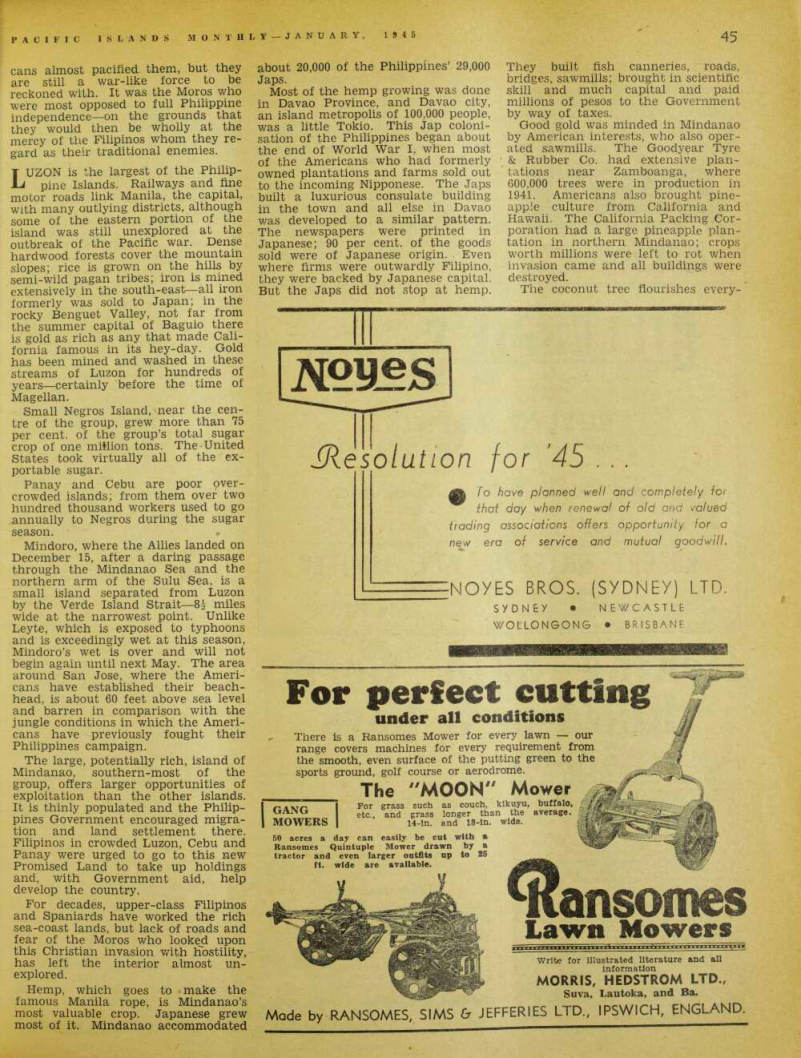
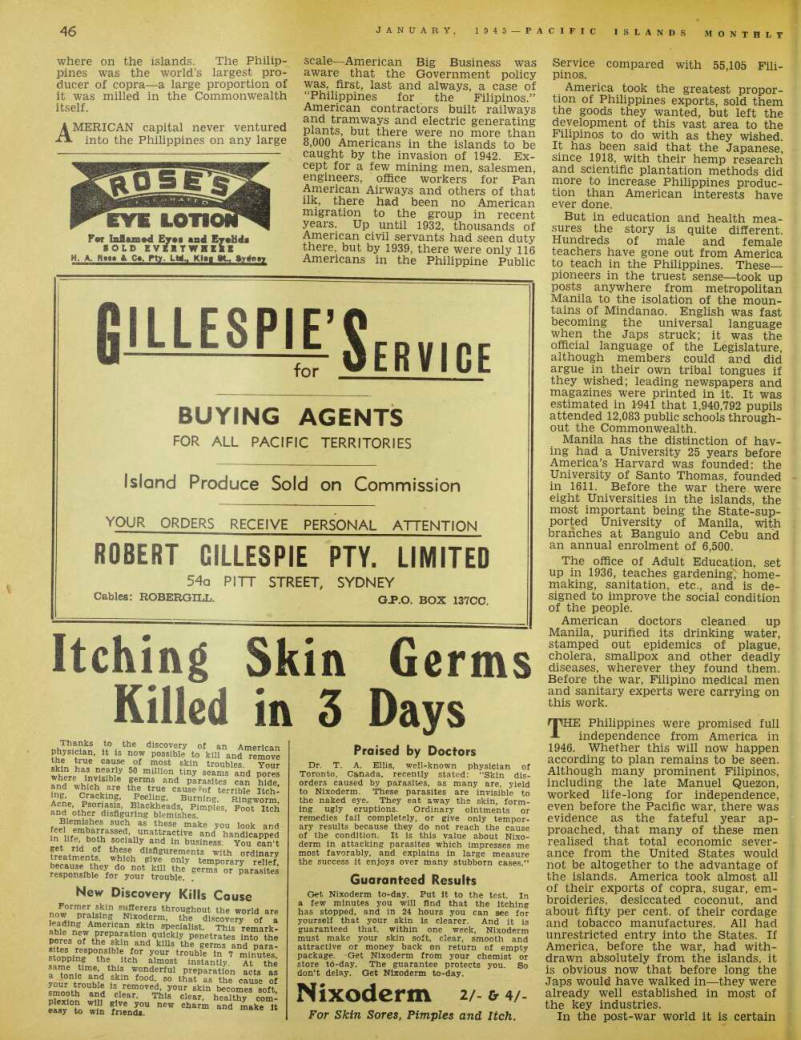
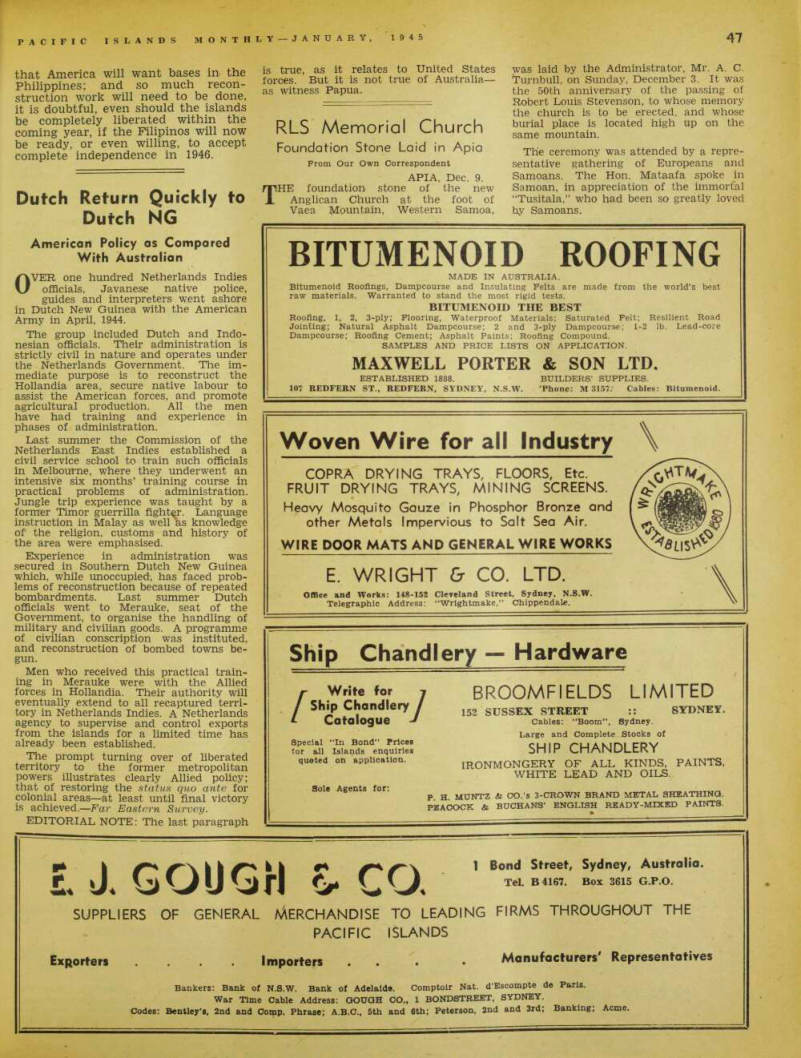
Independence May Now Have to Wait a Few Years
fpHE Jap dream of a Co-prosperity Sphere, as far as the Philippines are concerned, has almost run its brief course. After the Japs over ran the group in 1942, they set about organising a Filipino puppet Govern ment, with some measure of success.
But Jap methods defeated Jap ends.
In those first few months after they had driven MacArthur out to Aus tralia, the Japanese deliberately wrecked everything that was dimly related to the past regime. Records were torn up or lost, and every move able commodity from refrigerators to
Manila’s tram-cars was carted off to Japan. Life as the Filipinos had known it, certainly came to an abrupt end; but their Jap masters found it extremely difficult to get things mov ing again, even with Nipponese iron mit methods, and it was reported earlier this year that transportation and trade in the Philippines had vir tually come to a standstill.
The Commonwealth of the Philip pines—7,083 islands, thousands of them small, unnamed, whose total land area is 114,400 square miles (slightly smaller in area than Great Britain and Ireland) with its popu lation of 16,000,000, and its vast potential wealth would have been the answer to Japan’s prayer, had Japan been patient. As a prize for any am bitious nation it had only the Netherlands East Indies to better it.
It has a definite wet and dry season, although the wet is more prolonged in some islands than in others, and a climate that is tropical but easy to take. The islands lie close-packed between 4.45 degrees to 21.07 degrees north latitude—roughly 1,150 miles from north to south. Within the group come all stages of progress and all manner of men: the modern cities of Manila and Cebu—Manila, on Luzon Island, has almost three quarters of a million of a population; wild tribes in the interior of the larger islands; the Sultan t>f Sulu and the Mohammedan Moros; the pirates off Mindanao; the headhunters within —all are apparently unrelated factors in the Philippines Commonwealth.
Magellan on his ill-fated round the-world voyage of discovery reached the Philippines in 1521 and anchored at a small island near Surigao. Two important men from northern Min danao came out to visit him, thus establishing first relations with Spain.
Magellan then went on to Cebu and later Mactan, where his ardent desire to pluck heathen brands from the burning led to his murder at the hands of local natives.
Spain started her first Philippine colony on Cebu in 1565; for a brief period in 1762-63, Manila was sur rendered to the British, but otherwise for over 300 years—until, in fact, Admiral Dewey, USN, sank the Spanish Fleet at Manila in 1898, and brought the Spanish-American war to a close—the whole group was dominated by Spain.
Most of the inhabitants of the Philippines are Christianised—Roman Catholicism being dominant as is to be expected from early and long Spanish influence. About 400,000 Moslems, the Moros, live on Min danao. They were Moslems, due it is thought to some early Arab infiltra tion, long before Magellan set sail from Spain*, and the Spaniards spent three hundred years trying to subdue and convert these people. The Ameri
cans almost pacified them, but they are still a war-like force to be reckoned with. It was the Morqs who were most opposed to full Philippine independence —on the grounds that they would then be wholly at the mercy of the Filipinos whom they re gard as their traditional enemies.
LUZON is the largest of the Philip pine Islands. Railways and fine motor roads link Manila, the capital, with many outlying districts, although some of the eastern portion of the island was still unexplored at the outbreak of the Pacific war. Dense hardwood forests cover the mountain slopes; rice is grown on the hills by semi-wild pagan tribes; iron is mined extensively in the south-east —all iron formerly was sold to Japan; in the rocky Benguet Valley, not far from the summer capital of Baguio there is gold as rich as any that made Cali fornia famous in its hey-day. Gold has been mined and washed in these streams of Luzon for hundreds of years—certainly before the time of Magellan.
Small Negros Island, near the cen tre of the group, grew more than 75 per cent, of the group’s total sugar crop of one million tons. The United States took virtually all of the ex portable sugar.
Panay and Cebu are poor over crowded islands; from them over two hundred thousand workers used to go annually to Negros during the sugar season.
Mindoro, where the Allies landed on December 15, after a daring passage through the Mindanao Sea and the northern arm of the Sulu Sea, is a small island separated from Luzon by the Verde Island Strait—miles wide at the narrowest point. Unlike Leyte, which is exposed to typhoons and is exceedingly wet at this season, Mindoro’s wet is over and will not begin again until next May. The area around San Jose, where the Ameri cans have established their beach head, is about 60 feet above sea level and barren in comparison with the jungle conditions in which the Ameri cans have previously fought their Philippines campaign.
The large, potentially rich, island of Mindanao, southern-most of the group, offers larger opportunities of exploitation than the other islands.
It is thinly populated and the Philip pines Government encouraged migra tion and land settlement there.
Filipinos in crowded Luzon, Cebu and Panay were urged to go to this new Promised Land to take up holdings and, with Government aid, help develop the country.
For decades, upper-class Filipinos and Spaniards have worked the rich sea-coast lands, but lack of roads and fear of the Moros who looked upon this Christian invasion with hostility, has left the interior almost un explored.
Hemp, which goes to make the famous Manila rope, is Mindanao’s most valuable crop. Japanese grew most of it. Mindanao accommodated
about 20,000 of the Philippines’ 29,000 japs.
Most of the hemp growing was done in Davao Province, and Davao city, an island metropolis of 100,000 people, was a little Tokio. This Jap colonisation of the Philippines began about the end of World War I, when most of the Americans who had formerly owned plantations and farms sold out to the incoming Nipponese. The Japs built a luxurious consulate building in the town and all else in Davao was developed to a similar pattern.
The newspapers were printed in Japanese; 90 per cent, of the goods sold were of Japanese origin. Even where firms were outwardly Filipino, they were backed by Japanese capital, But the Japs did not stop at hemp.
They built fish canneries, roads, bridges, sawmills; brought in scientific skill and much capital and paid millions of pesos to the Government by way of taxes, Good gold was minded in Mindanao by American interests, who also oper ated sawmills. The Goodyear Tyre & Rubber Co. had extensive plan tations near Zamboanga, where 600,000 trees were in production in 1941. Americans also brought pine apple culture from California and Hawaii. The California Packing Cor poration had a large pineapple plan tation in northern Mindanao; crops worth millions were left to rot when invasion came and all buildings were destroyed.
The coconut tree flourishes every
where on the islands. The Philip pines was the world’s largest pro ducer of copra—a large proportion of it was milled in the Commonwealth itself.
AMERICAN capital never ventured into the Philippines on any large
scale—American Big Business was aware that the Government policy was, first, last and always, a case of “Philippines for the Filipinos.”
American contractors built railways and tramways and electric generating plants, but there were no more than 8,000 Americans in the islands to be caught by the invasion of 1942. Ex cept for a few mining men, salesmen, engineers, office workers for Pan American Airways and others of that ilk, there had been no American migration to the group in recent years. Up until 1932, thousands of American civil servants had seen duty there, but by 1939, there were only 116 Americans in the Philippine Public
Service compared with 55,105 Fili pinos.
America took the greatest propor tion of Philippines exports, sold them the goods they wanted, but left the development of this vast area to the Filipinos to do with as they wished.
It has been said that the Japanese, since 1918, with their hemp research and scientific plantation methods did more to increase Philippines produc tion than American interests have ever done.
But in education and health mea sures the story is quite different.
Hundreds of male and female teachers have gone out from America to teach in the Philippines. These— pioneers in the truest sense—took up posts anywhere from metropolitan Manila to the isolation of the moun tains of Mindanao. English was fast becoming the universal language when the Japs struck; it was the official language of the Legislature, although members could and did argue in their own tribal tongues if they wished; leading newspapers and magazines were printed in it. It was estimated in 1941 that 1,940,792 pupils attended 12,083 public schools through out the Commonwealth.
Manila has the distinction of hav ing had a University 25 years before America’s Harvard was founded: the University of Santo Thomas, founded in 1611. Before the war there were eight Universities in the islands, the most important being the State-sup ported University of Manila, with branches at Banguio and Cebu and an annual enrolment of 6,500.
The office of Adult Education, set up in 1936, teaches gardening, home making, sanitation, etc., and is de signed to improve the social condition of the people.
American doctors cleaned up Manila, purified its drinking water, stamped out epidemics of plague, cholera, smallpox and other deadly diseases, wherever they found them.
Before the war, Filipino medical men and sanitary experts were carrying on this work.
THE Philippines were promised full independence from America in 1946. Whether this will now happen according to plan remains to be seen.
Although many prominent Filipinos, including the late Manuel Quezon, worked life-long for independence, even before the Pacific war, there was evidence as the fateful year ap proached, that many of these men realised that total economic sever ance from the United States would not be altogether to the advantage of the islands. America took almost all of their exports of copra, sugar, em broideries, desiccated coconut, and about fifty per cent, of their cordage and tobacco manufactures. All had unrestricted entry into the States. If America, before the war, had with drawn absolutely from the islands, it is obvious now that before long the Japs would have walked in—they were already well established in most of the key industries.
In the post-war world it is certain
that America will want bases in the Philippines; and so much recon struction work will need to be done, it is doubtful, even should the islands be completely liberated within the coming year, if the Filipinos will now be ready, or even willing, to accept complete independence in 1946.
Advertisements & other items, pp. 46-48 (2 items)
Asthma, Bronchitis Coughing,
CHARLES MUIR (Eastern) EXPORT GO.
SYDNEY
EXPORT AGENTS AND
MANUFACTURERS
AJC & OK Jams, Canned Fruits, Sauces, Asparagus, etc.
EEZEE Washing Blue in Bags, also Paper Wrapped—Baking Powder, Custard Powder, Jelly Crystals, etc.
SUNGLO Pickles, Chutney, Honey, Fruit"
Cordials, Jams in Glass Jars, Canned Vegetables, etc.
WINES. SPIRITS, BEERS.—
"Juberry,” “Royalty,” “Aulde Acquaintance,” “Private Seal”
Brands, etc.
IN SUGAR BAGS. —Pearl Barley, Oatmeal, Rolled Oats, etc.
We Specialise in All Kinds of Food Products. Enquiries Invited Through Your Usual Channels. ’Phones; B 2279, FA 2703. Cable Address: FX 4515 (Factory). MUIR—SYDNEY.
SWS
Asthma, Bronchitis Coughing, Curbed in 3 Minutes
Do you have attacks of Asthma or Bronchitis so bad that you can’t sleep? Do you feel weak unable to work, and have to be careful not to take cold and can’t eat certain foods?
No matter how long you have suffered or what you have tried, there is new hope for you in a doctor’s prescription called Mendaco. am vmf’rfn 0 f mo t I s ’ n + ° in J ectlons . no atomizer.
All you do Is take two tasteless tablets at meals and in 3 minutes Mendaco starts worky ° Ur blood - aiding nature to remove phlegm, promote free easy breathing vou SleeP the first ni^ht ’ “ you soon feel years younger and stronger.
No Asthma in 2 Years
4 °*. a ~|, pef^'a
spasms first night and he has had none since in over two years.
Money Bock Guarantee
The very first dose of Mendaco goes right to work circulating through your blood and helping nature relieve you of the effects of Asthma. Try Mendaco under an iron-clad money back gaurantee. You be the Judge If you don’t feel fully satisfied after taking Mendaco just return the empty package and the full purchase price will be refunded. Get Mendaco from your chemist to-day and see how well you sleep to-night and how much better you feel to-morrow. The guarantee protects
y 0- RELIEVES ASTHMA
Mendaco
Now in 2 sizes ... 6/- and 12/-
msomes
JResolution for '45
To have planned well and completely for that day when renewal of old and valued trading associations offers opportunity for a new era of service and mutual goodwill.
■NOYES BROS. (SYDNEY) LTD,
SYDNEY • NEWCASTLE
WOLLONGONG • BRISBANE
For perfect cutting
under all conditions
There is a Ransomes Mower for every lawn our range covers machines for every requirement from the smooth, even surface of the putting green to the sports ground, golf course or aerodrome.
Mower
The "MOON
GANG
MOWERS
For grass such as couch, kikuyu, buffalo, etc., and grass longer than the average. 14-ln. and 18-ln. wide. 50 acres a day can easily be cut with a Ransomes Quintuple Mower drawn by a tractor and even larger outfits up to 25 ft. wide are available. i
msomes
Lawn Mowers
Write for illustrated literature and all information
MORRIS, HEDSTROM LTD.,
Suva, Lautoka, and Ba.
Made by RANSOMES, SIMS & JEFFERIES LTD., IPSWICH, ENGLAND.
For Inflamod Etoi and EyoUda
SOLD EVEITWHEIE
H. A. R»t> It C«. Pty. Ltd.. Klm 9L, »y#nty
fiiiLESP!i’S ERVICE
BUYING AGENTS
FOR ALL PACIFIC TERRITORIES
Island Produce Sold on Commission
YOUR ORDERS RECEIVE PERSONAL ATTENTION
ROBERT GILLESPIE PTY. LIMITED
54a PITT STREET, SYDNEY
Cables; ROBERGILL, G.P.O. BOX 137 CC,
Itching Skin Germs Killed in 3 Days
Thanks to the discovery of an American physician, it is now possible to kill and remove the true cause of most skin troubles. Your 50 million tin y seams and pores W^ re germs and parasites can hide and t C \are the true cause*of terrible Itchi A ng ’ bracking, Peeling, Burning, Ringworm
Psoriasis, Blackheads. Pimples. Foot itSi
and other disfiguring blemishes. f^ leml l hes suc ] l as these make you look and iS life hoth a « 11 unat tractive and handicapped in hfe, both socially and in business. You can’t get rid of these disfigurements with ordinary treatments, which give only temporary rehef responsible 6 fnr ° not f lll u the germs or parasites responsible for your trouble.
New Discovery Kills Cause
Former skin sufferers throughout the world are Pra A iSing - Nix ° derm ’ the of a leading American skin specialist. This remarkable new preparation quickly penetrates into the pores of the skin and kills the gems and para! sites responsible for your trouble in 7 minutes stopping the itch almost instantly. At the aTnnP^V^ 5 w ° nderful Preparation acts u ?0i! tJnPhIJ fc U 50 that as the cause of bI E is removed, y° ur skin becomes soft, dSS Pm „?i ear ’ T* lB Clear ’ healthy com- Pf* 10 ? \ U ! IVe you new eharm and make It easy to win friends.
Praised by Doctors
Dr. T. A. Ellis, well-known physician of Toronto, Canada, recently stated: “Skin disorders caused by parasites, as many are, yield to Nixoderm. These parasites are invisible to the naked eye. They eat away the skin, forming ugly eruptions. Ordinary ointments or remedies fail completely, or give only temporary results because they do not reach the cause of the condition. It is this value about Nixoderm in attacking parasites which impresses me most favorably, and explains in large measure the success it enjoys over many stubborn cases.”
Guaranteed Results
Get Nixoderm to-day. Put it to the test. In a few minutes you will find that the itching has stopped, and in 24 hours you can see for yourself that your skin is clearer. And it is guaranteed that, within one week, Nixoderm must make your skin soft, clear, smooth and attractive or money back on return of empty package. Get Nixoderm from your chemist or store to-day. The guarantee protects you. So don’t delay. Get Nixoderm to-day.
Nixoderm v- & 4/-
For Skin Sores, Pimples and Itch.
Dutch Return Quickly to
Dutch NG American Policy as Compared With Australian
OVER one hundred Netherlands Indies officials, Javanese native police, guides and interpreters went ashore in Dutch New Guinea with the American Army in April, 1944.
The group included Dutch and Indo nesian officials. Their administration is strictly civil in nature and operates under the Netherlands Government. The im mediate purpose is to reconstruct the Hollandia area, secure native labour to assist the American forces, and promote agricultural production. All the men have had training and experience in phases of administration.
Last summer the Commission of the Netherlands East Indies established a civil service school to train such officials in Melbourne, where they underwent an intensive six months’ training course in practical problems of administration.
Jungle trip experience was taught by a former Timor guerrilla fighter. Language instruction in Malay as well as knowledge of the religion, customs and history of the area were emphasised.
Experience in administration was secured in Southern Dutch New Guinea which, while unoccupied, has faced prob lems of reconstruction because of repeated bombardments. Last summer Dutch officials went to Merauke, seat of the Government, to organise the handling of military and civilian goods. A programme of civilian conscription was instituted, and reconstruction of bombed towns be gun.
Men who received this practical train ing in Merauke were with the Allied forces in Hollandia. Their authority will eventually extend to all recaptured terri tory in Netherlands Indies. A Netherlands agency to supervise and control exports from the islands for a limited time has already been established.
The prompt turning over of liberated territory to the former metropolitan powers illustrates clearly Allied policy; that of restoring the status quo ante for colonial areas—at least until final victory is achieved, —Far Eastern Survey.
EDITORIAL NOTE: The last paragraph
is true, as it relates to United States forces. But it is not true of Australia— as witness Papua.
RLS Memorial Church
Foundation Stone Laid in Apia
Prom Our Own Correspondent
Apia, Dec. 9.
THE foundation stone of the new Anglican Church at the foot of Vaea Mountain, Western Samoa,
was laid by the Administrator, Mr. A. C.
Turnbull, on Sunday, December 3. It was the 50th anniversary of the passing of Robert Louis Stevenson, to whose memory the church is to be erected, and whose burial place is located high up on the same mountain.
The ceremony was attended by a repre sentative gathering of Europeans and Samoans. The Hon. Mataafa spoke in Samoan, in appreciation of the immortal “Tusitala,” who had been so greatly loved by Samoans.
Advertisements & other items, p. 49 (1 item)
£. J. Gough & Co.
BITUMENOID ROOFING
MADE IN AUSTRALIA.
Bitumenoid Roofings, Dampcourse and Insulating Felts are made from the world’s best raw materials. Warranted to stand the most rigid tests.
BITUMENOID THE BEST
Roofing, 1,2, 3-ply; Flooring, Waterproof Materials; Saturated Pelt; Resilient Road Jointing; Natural Asphalt Dampcourse: 2 and 3-ply Dampcourse; 1-2 lb. Lead-core Dampcourse: Roofing Cement; Asphalt Paints; Roofing Compound.
SAMPLES AND PRICE LISTS ON APPLICATION.
MAXWELL PORTER & SON LTD.
ESTABLISHED 1888. BUILDERS’ SUPPLIES.
107 REDFERN ST., REDFERN, SYDNEY, N.S.W. ’Phone: M 3157. Cables: Bitumenoid.
Woven Wire for all Industry
COPRA DRYING TRAYS, FLOORS, Etc.
FRUIT DRYING TRAYS, MINING SCREENS.
Heavy Mosquito Gauze in Phosphor Bronze and other Metals Impervious to Salt Sea Air.
WIRE DOOR MATS AND GENERAL WIRE WORKS
E. WRIGHT & CO. LTD.
Office and Works: 148-152 Cleveland Street, Sydney, N.S.W.
Telegraphic Address: “Wrightmake,” Chippendale.
Ship Chandlery Hardware
BROOMFIELDS LIMITED
152 SUSSEX STREET SYDNEY.
Cables: "Boom”, Sydney, Large and Complete Stocks of
SHIP CHANDLERY
IRONMONGERY OF ALL KINDS, PAINTS,
WHITE LEAD AND OILS.
P H MUNTZ <fe CO.’s 3-CROWN BRAND METAL SHEATHING.
PEACOCK & BUCHANS’ ENGLISH READY-MIXED PAINTS.
/Write for j
Ship Chandlery /
Catalogue J
Special "In Bond” Prices tor all Islands enquiries quoted on application.
Sole Acrents for;
£. J. GOUGH & CO.
1 Bond Street, Sydney, Australia.
Tel. B 4167. Box 3615 G.P.O.
SUPPLIERS OF GENERAL MERCHANDISE TO LEADING FIRMS THROUGHOUT THE
PACIFIC ISLANDS
Manufacturers' Representatives Exporters Importers Bankers: Bank of N.S.W. Bank of Adelaide. Comptoir Nat. d’Escompte de Paris.
War Time Cable Address: GOUGH CO„ 1 BONDSTREET, SYDNEY.
Codes: Bentley’s, 2nd and Comp. Phrase; A.8.C., sth and 6th; Peterson, 2nd and 3rd; Banking; Acme.
Islands Produce
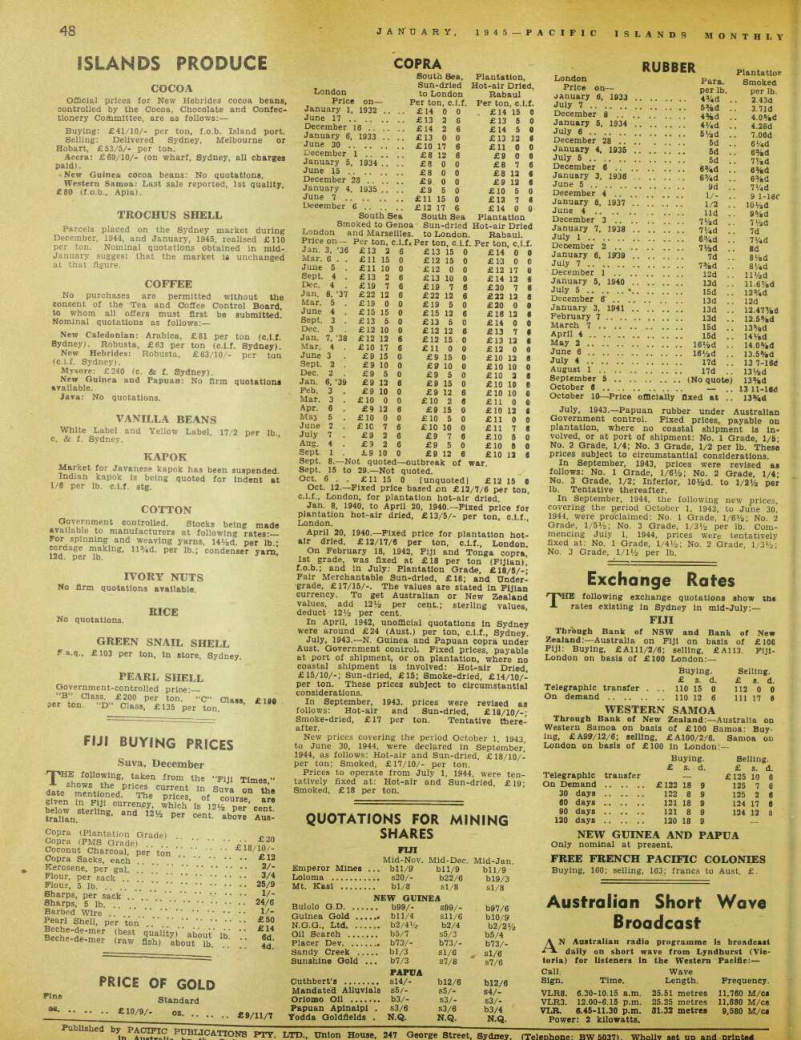
Cocoa
Official prices for New Hebrides cocoa beans, controlled by the Cocoa, Chocolate and Confec tionery Committee, are as follows: Buying: £4l/10/- per ton, f.o.b. Island port.
Selling: Delivered Sydney, Melbourne or Hobart, £53/5/- per ton.
Accra: £69/10/- (on wharf, Sydney, all charges paid).
New Guinea cocoa beans: No quotations.
Western Samoa: Last sale reported, Ist quality, €BO (f.0.b., Apia).
Trochus Shell
Parcels placed on the Sydney market during December, 1944, and January, 1945, realised £llO per ton. Nominal quotations obtained in mid- January suggest that the market is unchanged at that figure.
Coffee
No purchases are permitted without the consent of the Tea and Coffee Control Board, to whom all offers must first be submitted.
Nominal quotations as follows: New Caledonian: Arabica, £Bl per ton (c.l.f.
Sydney). Robusta, £63 per ton (c.l.f. Sydney)!
New Hebrides: Robusta, £63/10/- per ton (c.i.f. Sydney).
Mysore; £240 (c. & f. Sydney).
New Guinea and Papuan: No firm quotations available.
Java: No quotations.
Vanilla Beans
White Label and Yellow Label, 17/2 per lb c, & f. Sydney.
Kapok
Market for Javanese kapok has been suspended Indian kapok is being quoted for Indent at 1/6 per lb. c.l.f. stg.
Cotton
Government controlled. Stocks being made available to manufacturers at following rates For spinning and weaving yarns, 14V 2 d. per lb • making. li%d. per lb.; condenser yarn!
Ivory Nuts
No firm quotations available,
Rice
No quotations.
Green Snail Shell
F.a.q.. £lO3 per ton, In store, Sydney.
Pearl Shell
Government-controlled price:—
“B“ Class, £2OO per ton. “O’* Class £I9B per ton. “D“ Class. £135 per ton.
Fiji Buying Prices
Suva, December
'T'HE following, taken from the “Pill Times ” shows the prices current in Suva on the date mentioned. The nrlces nf iilf,,. ° n Wl * given in Fiji currency, which'is 12V ner’ belcw n sterling, ana iV^er
Copra (Plantation Grade) Copra (FMS Grade) ” " coconut Charcoal, per ton ‘ Copra Sacks, each *' •• Kerosene, per gal 2 /“ r iour, per sack ..
Sharps, per sack i'eari Shell, per ton * ,ou cecne-ae-mer (best quality) about- Beche-de-mer (raw fish) about ?b lb. .. 6d. ... 4d.
Price Of Gold
Oct. 6 . . £ll 15 0 [unquoted] £l2 15 0 Oct. 12.—Fixed price based on £l2/7/6 per ton, c.1.f., London, for plantation hot-air dried.
Jan. 8, 1940, to April 20, 1940.—Fixed price for plantation hot-air dried, £l3/5/- per ton, c.l.f London. ’ ’ *’
April 20, 1940.—Fixed price for plantation hot air dried, £l2/17/8 per ton, c.1.f., London On February 18, 1942, Fiji and Tonga copra, Ist grade, was fixed at £lB per ton (Fijian)’ f.0.b.; and in July: Plantation Grade, £lB/8/-; Pair Merchantable Sun-dried, £18; and Under grade, £l7/15/-. The values are stated in Fijian currency. To get Australian or New Zealand values, add 12 Vi per cent.; sterling values deduct 12 Vi per cent.
In April, 1942, unofficial quotations In Sydney were around £24 (Aust.) per ton, c.1.f., Sydney.
July, 1943.—N. Guinea and Papuan copra under Aust. Government control. Fixed prices, payable at port of shipment, or on plantation, where no coastal shipment is involved: Hot-air Dried £l5/10/-; Sun-dried, £l5; Smoke-dried, £l4/10/per ton. These prices subject to circumstantial considerations.
In September, 1943. prices were revised as follows: Hot-air and Sun-dried, £lB/10/-- Smoke-dried, £l7 per ton. Tentative there after.
New prices covering the period October 1, 1943 to June 30, 1944, were declared in September! 1944, as follows: Hot-air and Sun-dried, £lB/10/per ton; Smoked, £l7/10/- per ton.
Prices to operate from July 1, 1944, were ten tatively fixed at: Hot-air and Sun-dried, £l9; Smoked, £lB per ton.
F,ne Standard £10/9/- oz £9/11/7
Copra
South Sea, Plantation, Sun-dried Hot-air Dried.
London to London Rabaul Price on— Per ton. c.l.f.
Per ton. c.l.f.
January i, 1932 .. £14 0 0 £14 15 0 June 17 . . . . £13 2 6 £ 13 5 0 December 16 .. .. £14 2 6 £14 5 0
January 6
1933 .. £13 0 0 £13 12 6 June 30 . £10 17 6 £11 0 0 December 1 .. .. £8 12 6 £9 0 0 January 5, 1934 .. £8 0 0 £8 7 6 June 15 . £8 0 0 £8 13 6 December 28 .. .. £9 0 0 £9 12 6 January 4 1935 .. £9 5 0 £10 5 0 June 7 . £11 15 0 £12 7 < December 6 . . . . £12 17 6 £14 0 0 South Sea South Sea Plantation Smoked to Genoa Sun-dried Hot-air Dried London and Marseilles to London.
Rabaul.
Price on— Per ton, c.l.f* Per ton, c.l.f. Per ton. c.l.f.
Jan. 3, ’36 £13 2 6 £13 15 0 £14 0 0 Mar. 6 . . £11 15 0 £12 15 0 £13 0 0 June 5 . £11 10 0 £12 0 0 £12 17 0 Sept. 4 . £13 2 6 £13 10 0 £14 12 6 Dec. 4 . £19 7 6 £19 7 6 £20 7 6 Jan. 8, ’37 £22 12 6 £22 12 6 £32 12 6 Mar. 5 . £19 0 0 £19 5 0 £20 0 0 June 4 £15 15 0 £15 12 6 £16 12 c Sept. 3 . £13 5 0 £13 5 0 £14 0 0 Dec. 3 £12 10 0 £12 12 6 £13 7 « Jan. 7, ’38 £12 12 6 £12 15 0 £13 12 f Mar. 4 £10 17 6 £11 0 0 £12 0 0 June 3 £9 15 0 £9 15 0 £10 12 6 Sept. 2 £9 10 0 £9 10 0 £10 10 0 Dec. 2 . £9 5 0 £9 5 0 £10 2 6 Jan. 6, ’39 £9 12 6 £9 15 0 £10 10 0 Peb. 3 . £9 10 0 £9 12 6 £10 10 0 Mar. 3 . £10 0 0 £10 2 6 £11 0 0 Apr. 6 £9 12 6 £9 15 0 £10 13 6 May 5 . £10 0 0 £10 5 0 £11 0 0 June 2 £10 7 6 £10 10 0 £11 7 6 July 7 £9 2 6 £9 7 6 £10 5 0 Aug. 4 . £9 2 6 £9 5 0 £10 K 0 Sept. 1 . £9 10 0 £9 12 6 £10 12 e Sept. 8. —Not quoted—outbreak of war Sept. 15 to 29.—Not quoted.
Quotations For Mining
Shares
July, 1943.—Papuan rubber under Australian Government control. Fixed prices, payable on plantation, where no coastal shipment is In volved, or at port of shipment: No. 1 Grade, 1/5- No. 2 Grade, 1/4; No. 3 Grade, 1/2 per lb. These prices subject to circumstantial considerations.
In September, 1943, prices were revised as follows: No. 1 Grade, I/6V2', No. 2 Grade, 1/4; No. 3 Grade, 1/2; Inferior, lOVfcd. to I/2V2 per lb. Tentative thereafter.
In September, 1944, the following new prices, covering the period October 1, 1943, to June 30, 1944, were proclaimed; No. 1 Grade, 1/6Vi; No. 2 Grade, 1/5 Vb; No. 3 Grade, 1/3 V 2 per lb. Com mencing July 1, 1944, prices were tentatively fixed at: No. 1 Grade, 1/4 V 2 ; No. 2 Grade, 1/3Vi: No. 3 Grade, l/iy 2 per lb.
rui Mid-Nov.
Mid-Dec.
Mid-Jan.
Emperor Mines . .. bll/9 bll/9 bll/9 Loloma b22/6 bl9/3 Mt. Kasl bl/8 sl/8 sl/8 Bulolo G.D
New Guinea
.. b99/- S99/b97/6 Guinea Gold ... ... bll/4 sll/6 blO/9' N.G.G., Ltd ... b2/4V 2 b2/4 b2/2»/ 2 Oil Search .. b5/7 s5/3 b5/4 Placer Dev b73/b73/- Sandy Creek ... .. bl/3 sl/6 sl/6 Sunshine Gold . .. b7/3 s7/8 s7/6 Cuthbert’s
Papua
bl2/6 bl2/6 Mandated Alluvials s5/s5/- S4/- Orlomo Oil ... s3/- S3/- Papuan Aplnalpl . s3/6 s3/6 b3/4 Yodda Goldfields . N.Q.
N.Q.
N.Q.
London Price on— January 6. 1933
Rubber
Para, per lb.
Plantation Smoked per lb.
July 7 1 fTI/l December 8 .. .
• J. 1 Iq
4 05 /LA January 5, 1934 • 4.U71U July 6 • t.*oU December 28 ..
January 4, 1935 5d ! . j.uoa 6V 4 d «a' a July 5 .. o vsa December 6 . i 78(1 January 3. 1936 U71U
R3La
June 5 .. ..
O /8U n iah December 4 .. . i /4U 9 1-16* lOVad 9 6 /sd n i/^a January 8, 1937 .
June 4 .. ..
December 3 .. .
January 7, 1938 July 1 I /3U 7d n ia a December 2 .. .
January 6, 1939 .
July 7 • 74 a 8d 8Vad o iah December 1 .. , O 74 a H l /ad 11.6 7 /ad 12 3/4 d January 5, 1940 .
July 5 *.
December 8 .. ..
January 3, 1941 .
February 7 .. ..
March 7 12d 12.47 7 /ed 12.5 5 /§d 13%d April 4 14 V a d May 2 H.oy*d June 6 ISVad 13.5%d 13 7-i6d July 4 August 1 13Vid 13%d 13 ll-16d 13%d September 5 .. .
October 6 October 10—Price officially fixed at ..
Exchange Rates
THE following exchange quotations show the rates existing In Sydney in mid-July:—
Fiji
Through Bank of NSW and Bank of New Zealand:—Australia on FIJI on basis of £lOO Fiji: Buying, £Alll/2/6; selling, £AII3. FIJI - on basis of £lOO London:—
Western Samoa
Through Bank of New Zealand;—Australia on Western Samoa on basis of £lOO Samoa: Buy ing, £ A99/12/6; selling, £AIOO/2/6. Samoa on London on basis of £lOO in London:-
New Guinea And Papua
Only nominal at present.
Free French Pacific Colonies
Buying, 160; selling, 163; francs to Aust. £.
Buying. Selling. £ s. d. £ s. d.
Telegraphic transfer ... 110 15 0 112 0 0 On demand 110 12 6 111 17 8
Buying.
Selling. £ s. d. £ s. d.
Telegraphic transfer £125 10 0 On Demand £ 122 18 9 125 7 6 30 days 122 8 9 125 2 6 60 days 121 18 9 124 17 0 90 days 121 8 9 124 12 a 120 days 120 18 9
Broadcast
Australian Short Wave Broadcast
AN Australian radio programme Is broadcast daily on short wave from Lyndhurst (Vic toria) for listeners In the Western Pacific:—
Call.
Wave Sign.
Time.
Length.
Frequency.
Vlr8.
6.30-10.15 a.m. 25.51 metres 11,760 M/cs
Vlr3.
12.00-6.13 p.m. 25.25 metres 11,880 M/cs
Vlr.
6.45-11.30 p.m. 31.32 metres 9,580 M/cs Power: 2 kilowatts.
Advertisements & other items, p. 50 (1 item)
48
JANUARY. 1945-PACIFIC ISLANDS MONTHLY
a„ P Y? L^F A ’^? c> . nb PTY. LTD., Union House, 247 George Street, Sydney. (Telenhone: BW 5037). Wholly set un and nrlnted
Officer to Go
Native Council Asks Administrative Officer to Go
From Our Own Correspondent
Mangaia, Dec. 2.
THE Native Council of this island, which has always been singularly “Sinn Fein,” is again opposing the Administration, and is fain to conduct its own affairs, without the Resident Agent—to whom it has handed marching orders!
This crisis occurs to every incumbent; and is typical of the isle, which, having never been surveyed, is much more tur bulent politically than the rest of the Cook Group.
The present dispute has arisen out of “hurricane hunger” and resultant short tempers, no aid in reconstruction, the inevitable errors of an official new to Mangaia, and the recent recruiting of local labour for the phosphate island of Makatea, The Council forbids Mangaians to go to Makatea, alleging harsh terms in the contract, which “make the worker per sonally responsible for any accidents, sickness, etc.” and state that pay is to cease upon disability.
The present situation is that the RA has been “voted out” and requested to leave the island!
It would be interesting to know exactly what power the Mangaia Council has.
On the native side, it is quite autocratic, and is not free from the use of bullies for political purposes, like some trade unions in civilisation. It has also, in its circle, men of an unscrupulous and bully ing type. Its chairman, however —the native" king—is a wise and peaceful ruler, and there is in the Council about an equal balance of opposing interests, which makes things safe for the islanders at large.
But this Council has always been a headache for Resident Agents! The RA has, theoretically, an almost-absolute authority; but no means exist for enforcing any orders that are not obeyed, and the Council never fails to take advantage of this Gilbertian state of affairs Everything goes back to the old Man gaian desire to exclude all Europeans, retain land in native hands, and exist as a second Tonga. Someone who under stands these people, and gains their trust, could effect an amiable compromise. The neople, as a community, are deeply sus picious of a coming “survey.”
Appointment of Inspector-General
S. Pacific Medical
Services
THE Secretary of State for the Colonies announced, in December, the ap pointment of Dr. J. C. R. Buchanan as Inspector-General of South Pacific Medical Services. Dr. Buchanan is at present Assistant Director of Medical Services in Uganda. . He has had many years’ experience of tropical medicine. He is expected to arrive at his headquarters in Suva, Fiji, about March.
Advertisements & other items, pp. 51-52 (2 items)
Roll Of Honour
JANUARY, 1945 PACIFIC ISLANDS MONTHLY
(Continued From Inside Front Cover)
W. R. Carpenter & Go. Ltd.
Established 1914
THIRTY YEARS OF PACIFIC ISLANDS
DEVELOPMENT AND SERVICE.
W. R. CARPENTER & GO. LTD.
Capital £1,000,000.
GENERAL MERCHANTS AND SHIPOWNERS
Buyers and Exporters of All Kinds of Islands Produce Copra Merchants and Millers Agents for Australian, European and American Manufacturers Distributors of Every Description of Merchandise
AGENTS FOR:
FORD MOTOR COMPANY OF CANADA DODGE BROTHERS INC.
ELECTROLUX REFRIGERATORS WESTINGHOUSE ELECTRICAL CO.
T. G. & C. BOLINDERS (ENGINES) CATERPILLAR TRACTORS Etc., Etc.
BRANCHES THROUGHOUT THE PACIFIC ISLANDS
Head Office : 16 O'CONNELL STREET, SYDNEY In London: W. R. Carpenter £r Co. (London) Ltd., Coronation House 4 Lloyd's Avenue London, EC.
The W.R.C Line
TJf® first Direct and Regular Cargo and Passenger Service between Europe and Pacific Islands’ ports was established by W. R. Carpenter & Co. Ltd.