Pacific
Islands
Monthly
December 18 1944
Ucv.Ciiiuci Lu » 17 “
Vol. Xv. No. 5.
Established 1930
[Registered at the by post as a newspaper J
1/-
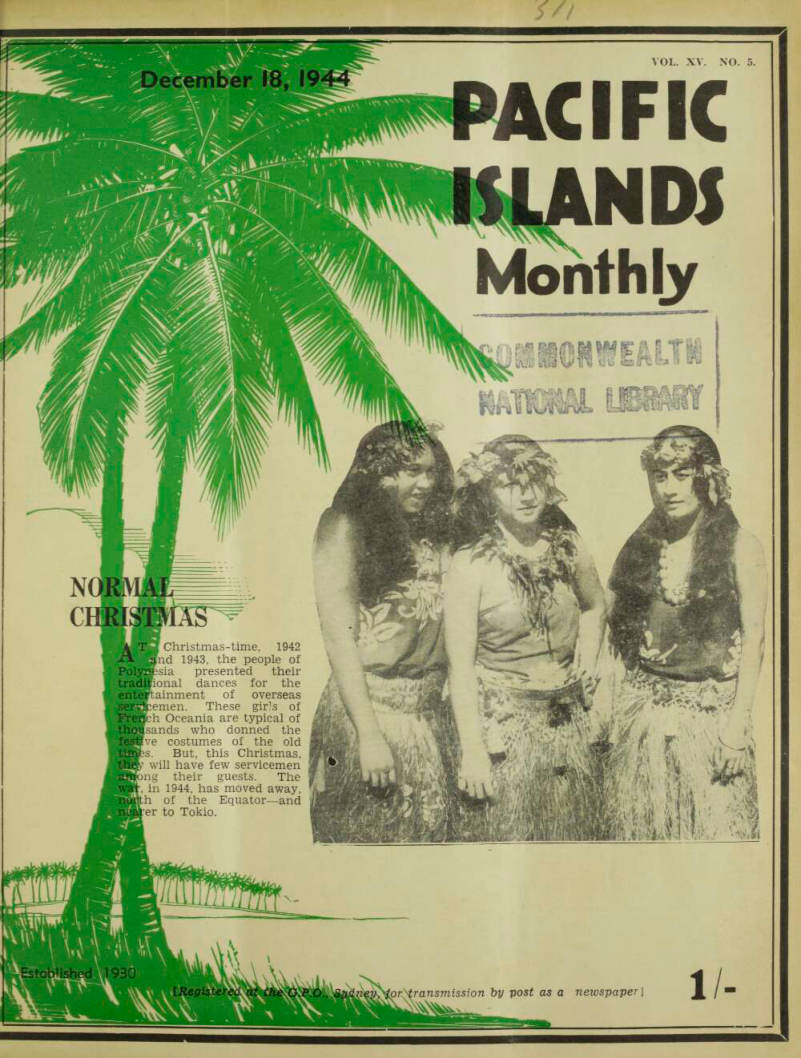
Nornal
Christmas
AT Christmas-time, 1942 1943, the people of Polynesia presented their traditional dances for the entertainment of overseas serroemen. These girls of French Oceania are typical of thousands who donned the festive costumes of the old times. But, this Christmas, will have few servicemen among their guests. The war, in 1944, has moved away, north of the Equator—and nearer to Tokio.
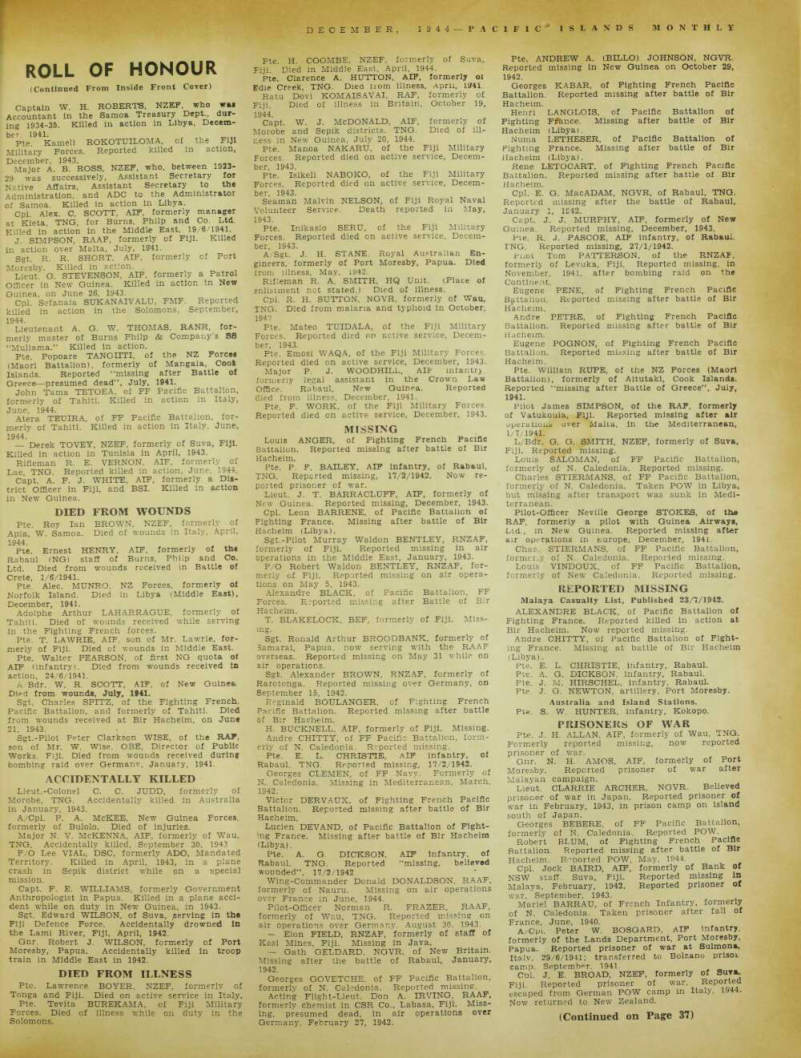
ROLL OF HONOUR—Section I.
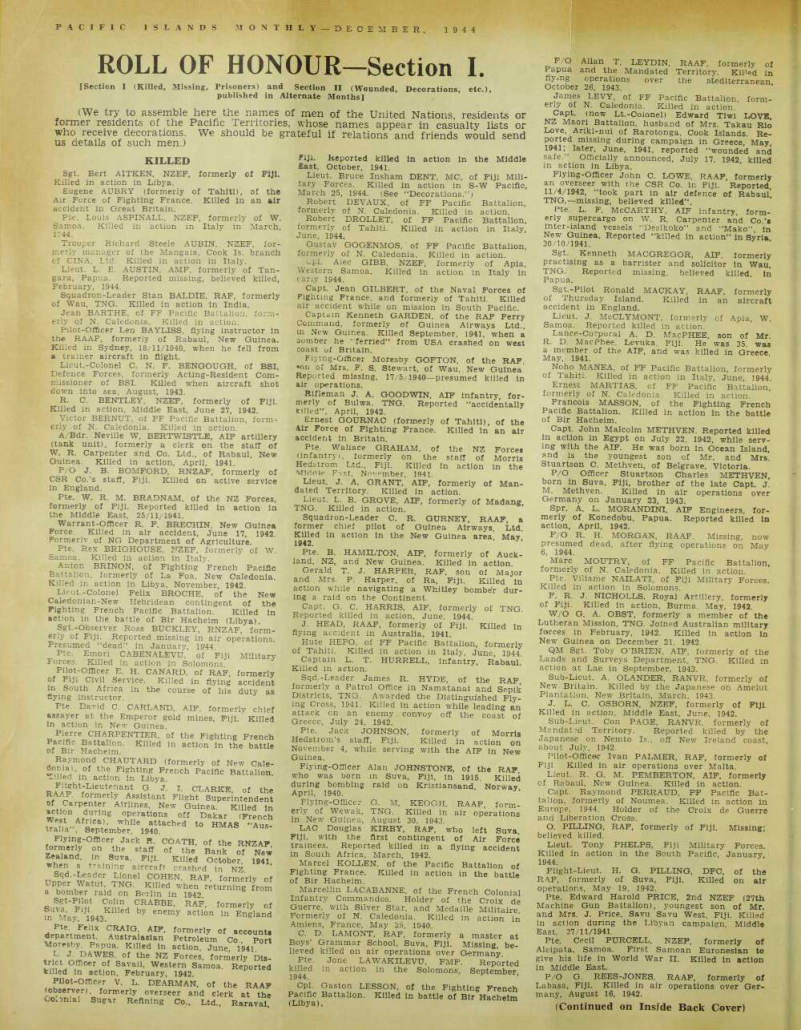
[Section I (Killed, Missing, Prisoners) and Section II (Wounded, Decorations, etc.), published in Alternate Months] (We try to assemble here the names of men of the United Nations, residents or former residents of the Pacific Territories, whose names appear in casualty lists or who receive decorations. We should be grateful if relations and friends would send us details of such men.)
Killed
Sgt. Bert AITKEN, NZEF, formerly of Fiji.
Killed in action in Libya.
Eugene AUBRY (formerly of Tahiti), of the Air Force of Fighting France. Killed in an air accident in Great Britain.
Pte. Louis ASPINALL, NZEF, formerly of W.
Samoa. Killed in action in Italy in March, 1?44.
Trooper Richard Steele AUBIN, NZEF, for merly manager of the Mangaia, Cook Is. branch cf CINA, Ltd. Killed in action in Italy.
Lieut. L. E. AUSTIN, AMF, formerly of Tan gara, Papua. Reported missing, believed killed, February, 1944.
Squadron-Leader Stan BALDIE, RAF, formerly of Wau, TNG. Killed in action in India.
Jean BARTHE, of FF Pacific Battalion, form erly of N. Caledonia. Killed in action.
Pilot-Officer Len BAYLISS, flying Instructor in the RAAF, formerly of Rabaul. New Guinea.
Killed in Sydney, 18/11/1940, when he fell from a trainer aircraft in flight.
Lieut.-Colonel C. N. F. BENGOUGH, of BSI, Defence Forces, formerly Acting-Resident Com missioner of BSI. Killed when aircraft shot down into sea, August, 1943.
R. C. BENTLEY, NZEF, formerly of Fiji.
Killed in action, Middle East. June 27, 1942.
Victor BERNUT, of FF Pacific Battalion, form erly of N. Caledonia. Killed in action.
A/Bdr. Neville W. BERTWISTLE, AIF artillery (tank unit), formerly a clerk on the staff of W. R. Carpenter and Co. Ltd., of Rabaul, New Guinea. Killed in action, April, 1941.
P/O J. B. BOMFORD, RNZAF, formerly of CSR Co.’s staff, Fiji. Killed on active service In England.
Pte. W. R. M. BRADNAM, of the NZ Forces, formerly of Fiji. Reported killed in action in the Middle East, 25/11/1941.
Warrant-Officer R. F. BRECHIN, New Guinea Force. Killed in air accident, June 17, 1942 Formerly of NG Department of Agriculture.
Pte. Rex BRIGHOUSE, NZEF, formerly of W.
Samoa. Killed in action in Italy.
Anton BRINON, of Fighting French Pacific Battalion, formerly of La Foa, New Caledonia.
Killed in action in Libya, November, 1942.
Lieut.-Colonel Felix BROCHE, of the New Caledonian-New Hebridean contingent of the Fighting French Pacific Battalion. Killed in action in the battle of Bir Hacheim (Libya).
Sgt.-Observer Ross BUCKLEY, RNZAF, form erly of Fiji. Reported missing in air operations.
Presumed “dead” in January, 19'44 Pte. Emori CABENALEVU. of Fiji Military Forces. Killed in action in Solomons.
Pilot-Officer E. H. CANARD, of RAF, formerly of Fiji Civil Service. Killed in flying accident in South Africa in the course of his duty as flying instructor.
Pte. David C. GARLAND, AIF. formerly chief assayer at the Emperor gold mines, Fiji. Killed in action in New Guinea.
Pierre CHARPENTIER, of the Fighting French Pacific Battalion. Killed in action in the battle of Bir Hacheim.
Raymond CHAUTARD (formerly of New Cale tlie Fl f htln S French Pacific Battalion.
Xilled in action in Libya. wfiw h V Lie Ut e G J L CLARKE, of the of Assistant Flight Superintendent of Carpenter Airlines, New Guinea. Killed in action during operations off Dakar (French West Africa), while attached to HMAS “Aus tralia”, September, 1940.
Flying-Officer Jack R. COATH, of the RNZAF formerly on the staff of the Bank of New Zealand, in Suva, Fiji. Killed October I9i\ when a training aircraft crashed in NZ Sqd.-Leader Lionel COHEN. RAP, formerly of Upper Watut TNG. Killed when returning from a bomber raid on Berlin in 1942 Sgt-Pilot Colin CRABBE, RAF. formerly of fn V May j 194 by 6nemy &Cti ° n in Pte Felix CRAIG, AIF, formerly of accounts department. Australasian Petroleum Co Port Moresby. Papua. Killed in action, June 1941. ♦ , L * AWES- of the NZ Forces > formerly Dls tr ct Officer of Savaii, Western Samoa. Reported killed in action, February, 1942.
Pilot-Officer V. L. DEARMAN. of the RAAP (observer), formerly overseer and clerk at the °° onlal Sugar Refining Co., Ltd.. Raraval,
Fiji. Reported killed in action in the Middle East, October, 1941.
Lieut. Bruce Insham DENT, MC, of Fiji Mili tary Forces. Killed in action in S-W Pacific, March 25, 1944. (See “Decorations.”) Robert DEVAUX, of FF Pacific Battalion, formerly of N. Caledonia. Killed in action.
Robert DROLLET, of FF Pacific Battalion, formerly of Tahiti. Killed in action in Italy, June, 1944.
Gustav GOGENMOS, of FF Pacific Battalion, formerly of N. Caledonia. Killed in action.
Cpl. Alec GIBB, NZEF, formerly of Apia, Western Samoa. Killed in action in Italy in early 1944.
Capt. Jean GILBERT, of the Naval Forces of Fighting France, and formerly of Tahiti, Killed air accident while on mission in South Pacific.
Captain Kenneth GARDEN, of the RAF Ferry Command, formerly of Guinea Airways Ltd., in New Guinea. Killed September, 1941, when a oomber he 1 ferried” from USA crashed on west coast of Britain.
Flying-Officer Moresby GOFTON, of the RAF, •on of Mrs. F. S. Stewart, of Wau, New Guinea Reported missing, 17/5/1940—presumed killed in air operations.
Rifleman J. A. GOODWIN. AIF infantry, for merly of Bulwa, TNG. Reported "accidentally tilled”, April, 1942.
Ernest GOURNAC (formerly of Tahiti), of the Air Force of Fighting France. Killed in an air accident in Britain.
Pte. Wallace GRAHAM, of the NZ Forces (infantry), formerly on the staff of Morris Hedstrom Ltd., Fiji. Killed in action in the Middle Fnst, November, 1941.
Lieut. J. A. GRANT, AIF, formerly of Man dated Territory. Killed in action.
Lieut. L. B. GROVE, AIF, formerly of Madang, TNG. Killed in action.
Squadron-Leader C. R. GURNEY, RAAF, a former chief pilot of Guinea Airways, Ltd.
Killed in action in the New Guinea area Mav 1942.
Pte. B. HAMILTON, AIF, formerly of Auck land, NZ, and New Guinea. Killed in action.
Gerald T. J. HARPER, RAF, son of Major and Mrs. P. Harper, of Ra, Fiji. Killed in action while navigating a Whitley bomber dur ing a raid on the Continent.
Capt. G. C. HARRIS, AIF, formerly of TNG Reported killed in action, June, 1944.
J. HEAD, RAAF, formerly of Fiji. Killed in flying accident in Australia, 1941.
Hute HEPO, of FF Pacific Battalion, formerly of Tahiti. Killed in action in Italy, June 1944 Captain L. T. HURRELL. infantry, Rabaul’
Killed in action.
Sqd.-Leader James R. HYDE, of the RAF, formerly a Patrol Office in Namatanai and Sepik Districts, TNG. Awarded the Distinguished Fly ing Cross, 1941. Killed in action while leading an attack on an enemy convoy off the coast of Greece, July 24, 1942.
Pte. Jack JOHNSON, formerly of Morris Hedstrom’s staff, Fiji. Killed in action on November 4, while serving with the AIF in New Guinea.
Flying-Officer Alan JOHNSTONE, of the RAF who was born in Suva, Fiji, in 1915. Killed during bombing raid on Kristiansand Norwav April, 1940. ’
Flying-Officer G. M. KEOGH, RAAF form erly of Wewak, TNG. Killed in air operations in New Guinea, August 30, 1943.
LAC Douglas KIRBY, RAP, who left Suva, Fiji, with the first contingent of Air Force trainees. Reported killed in a flying accident in South Africa, March, 1942.
Marcel KOLLEN. of the Pacific Battalion of Fighting France. Killed in action in the battle of Bir Hacheim.
Marcellin LACABANNE, of the French Colonial Infantry Commandos. Holder of the Croix de Guerre, with Silver Star, and Medaille Militaire Formerly of N. Caledonia. Killed in action in Amiens, France, May 25, 1940.
C. D. LAMONT, RAF, formerly a master at Boys’ Grammar School, Suva, Fiji. Missing, be lieved killed on air operations over Germany Pte. Jone LAWAKILEVU, FMF. Reported killed in action in the Solomons, September 1944. ’
Cpl. Gaston LESSON, of the Fighting French Pacific Battalion. Killed in battle of Bir Hacheim (Libya).
F/O Allan T. LEYDIN, RAAF, formerly of Papua and the Mandated Territory. KiPed in flying operations over the Mediterranean October 26, 1943. ’
James LEVY, of FF Pacific Battalion, form erly of N. Caledonia. Killed in action.
Capt. (now Lt.-Colonel) Edward Tlwi LOVE, NZ Maori Battalion, husband of Mrs. Takau Rio Love, Ariki-nui of Rarotonga, Cook Islands. Re ported missing during campaign in Greece, May, 1941; later, June, 1941, reported “wounded and safe.” Officially announced, July 17, 1942 killed in action in Libya.
Flying-Officer John C. LOWE, RAAP, formerly an overseer with the CSR Co. in Fiji. Reported 11/4/1942, “took part in air defence of Rabaul’
TNG, —missing, believed killed”.
Pte. L. F. MCCARTHY, ALP infantry, form erly supercargo on W. R. Carpenter and Co.’s inter-island vessels "Desikoko” and “Mako” In New Guinea. Reported “killed in action” in Syria 30/10/1941. J ’
Sgt. Kenneth MACGREGOR, ALF, formerly practising as a barrister and solicitor In Wau, TNG. Reported missing, believed killed, In Papua.
Sgt.-Pilot Ronald MACKAY, RAAF, formerly of Thursday Island. Killed in an aircraft accident in England.
Lieut. J. McCLYMONT, formerly of Apia, W.
Samoa. Reported killed in action.
Lance-Corporal A. D. MacPHEE, son of Mr.
R. D. MacPhee, Levuka, Fiji. He was 35. was a member of the A IF, and was killed in Greece May, 1941.
Noho MANEA, of FF Pacific Battalion, formerly of Tahiti. Killed in action in Italy, June, 1944 Ernest MARTIAS, of FF Pacific Battalion, formerly of N. Caledonia. Killed in action.
Francois MASSON, of the Fighting French Pacific Battalion. Killed in action in the battle of Bir Hacheim.
Capt. John Malcolm METHVEN. Reported killed In action in Egypt on July 22, 1942, while serv ing with the AIF. He was born in Ocean Island, and is the youngest son of Mr. and Mrs.
Stuartson C. Methven, of Belgrave, Victoria.
P/O Officer Stuartson Charles METHVEN born in Suva, Fiji, brother of the late Capt. J.
M. Methven. Killed in air operations over Germany on January 23, 1943.
Spr. A. L. MORANDINI, AIF Engineers, for merly of Konedobu, Papua. Reported killed in action, April, 1942.
F/O R. H. MORGAN, RAAF. Missing, now presumed dead, after flying operations on May 6, 1944.
Marc MOUTRY, of FF Pacific Battalion, formerly of N. Caledonia. Killed in action.
Pte. Viliame NAILATI, of Fiji Military Forces.
Killed in action in Solomons.
F. R. J. NICHOLLS, Royal Artillery, formerly of Fiji. Killed in action, Burma. May, 1942, W/O G. A. OBST, formerly a member of the Lutheran Mission, TNG. Joined Australian military forces in February, 1942. Killed in action In New Guinea on December 21. 1942.
QM Sgt. Toby O’BRIEN, AIF, formerly of the Lands and Surveys Department, TNG. Killed in action at Lae in September, 1943.
Sub-Lieut. A. OLANDER, RANVR, formerly of New Britain. Killed by the Japanese on Amelut Plantation, New Britain, March, 1943.
J. L. C. OSBORN, NZEF, formerly of Fiji.
Killed in action, Middle East, June, 1942.
Sub-Lieut. Con PAGE, RANVR, formerly of Mandated Territory. Reported killed by the Japanese on Nemto Is., off New Ireland coast, about July, 1942.
Pilot-Officer Ivan PALMER, RAF, formerly of Fiji. Killed in air operations over Malta.
Lieut. R. G. M. PEMBERTON, AIF, formerly of Rabaul, New Guinea. Killed in action.
Capt. Raymond PERRAUD, FF Pacific Bat talion, formerly of Noumea. Killed in action in Europe. 1944. Holder of the Croix de Guerre and Liberation Cross.
O. PILLING, RAP, formerly of Fiji. Missing; believed killed.
Lieut. Tony PHELPS, Fiji Military Forces.
Killed in action in the South Pacific, January 1944.
Flight-Lieut. H. G. PILLING, DFC, of the RAP, formerly of Suva, Fiji. Killed on air operations. May 19, 1942.
Pte. Edward Harold PRICE, 2nd NZEF (27th Machine Gun Battalion), youngest son of Mr. and Mrs. J. Price, Savu Savu West, Fiji. Killed in action during the Libyan campaign, Middle East. 27/11/1941.
Pte. Cecil PURCELL, NZEF, formerly of Aleipata. Samoa. First Samoan Euronesian to give his life in World War 11. Killed in action in Middle East.
P/O G. REES-JONES, RAAP, formerly of Labasa, Fiji. Killed in air operations over Ger many, August 16, 1942.
(Continued on Inside Back Cover)
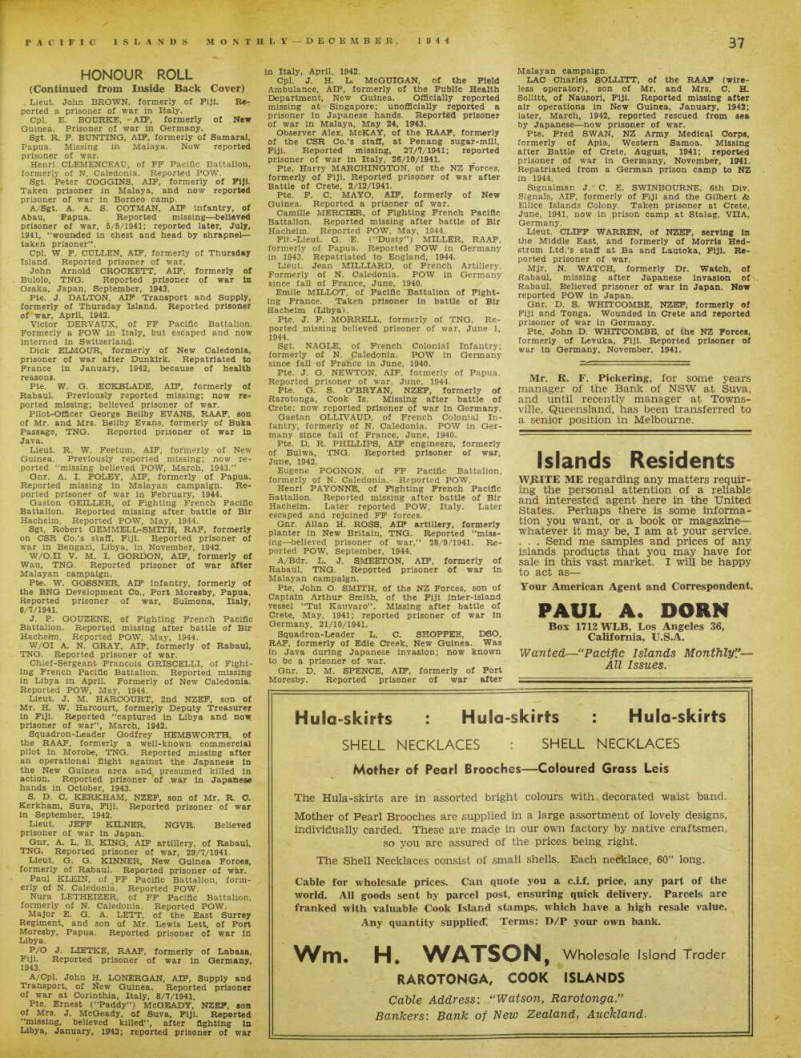
Lieut. John BROWN, formerly of Fiji. Re ported a prisoner of war in Italy.
Cpl. E. BOURKE, AIF, formerly of New Guinea. Prisoner of war in Germany.
Sgt. R. F. BUNTING, AIF, formerly of Samaral, Papua. Missing in Malaya. Now reported prisoner of war.
Henri CLEMENCEAU, of FF Pacific Battalion, formerly of N. Caledonia. Reported POW.
Sgt. Peter COGGINS. AIF, formerly of Fiji.
Taken prisoner in Malaya, and now reported prisoner of war in Borneo camp.
A/Sgt. A. A. S. COTMAN, AIF infantry, of Abau, Papua. Reported missing—believed prisoner of war, 5/5/1941; reported later, July, 1941, “wounded in chest and head by shrapnel— taken prisoner”.
Cpl. W. F. CULLEN, AIF, formerly of Thursday Island. Reported prisoner of war, John Arnold CROCKETT, AIF, formerly of Bulolo, TNG. Reported prisoner of war in Osaka, Japan, September, 1943.
Pte. J. DALTON, AIF Transport and Supply, formerly of Thursday Island. Reported prisoner of war, April, 1942.
Victor DERVAUX, of FF Pacific Battalion.
Formerly a POW in Italy, but escaped and now interned in Switzerland.
Dick ELMOUR, formerly of New Caledonia, prisoner of war after Dunkirk. Repatriated to Prance in January, 1942, because of health reasons.
Pte. W. G. ECKBLADE, AIF, formerly of Rabaul. Previously reported missing; now re ported missing; believed prisoner of war.
Pilot-Officer George Beilby EVANS, RAAF, son of Mr. and Mrs. Beilby Evans, formerly of Buka Passage, TNG. Reported prisoner of war in Java.
Lieut. R. W. Feetum, AIF, formerly of New Guinea. Previously reported missing; now re ported “missing believed POW, March, 1943.”
Gnr. A. I. FOLEY, AIF, formerly of Papua.
Reported missing in Malayan campaigp. Re ported prisoner of war in February, 1944.
Gaston GEILLER, of Fighting French Pacific Battalion. Reported missing after battle of Blr Hacheim. Reported POW, May, 1944.
Sgt. Robert GEMMELL-SMITH, RAF, formerly on CSR Co.’s staff, Fiji. Reported prisoner of war in Bengazi, Libya, in November, 1942. w/o.n V. M. I. GORDON, AIF, formerly of Wau, TNG. Reported prisoner of war after Malayan campaign.
Pte. W. GOSSNER, AIF Infantry, formerly of the BNG Development Co., Port Moresby, Papua.
Reported prisoner of war, Sulmona, Italy, 6/7/1941.
J. P. GOUZENE, of Fighting French Pacific Battalion. Reported missing after battle of Bir Hacheim. Reported POW, May, 1944.
W/OI A. N. GRAY, AIF, formerly of Rabaul, TNG. Reported prisoner of war.
Chief-Sergeant Francois GRISCELLI, of Fight ing French Pacific Battalion. Reported missing in Libya in April. Formerly of New Caledonia.
Reported POW, May, 1944.
Lieut. J. M. HARCOURT, 2nd NZEF, son of Mr. H. W. Harcourt, formerly Deputy Treasurer in Fiji. Reported “captured in Libya and now prisoner of war”, March, 1942.
Squadron-Leader Godfrey HEMSWORTH, of the RAAF, formerly a well-known commercial pilot in Morobe, TNG. Reported missing after an operational flight against the Japanese in the New Guinea area and presumed killed in action. Reported prisoner of war in Japanese hands in October, 1943.
S. D. C. KERKHAM, NZEF, son of Mr. R. C.
Kerkham, Suva, Fiji. Reported prisoner of war in September, 1942.
Lieut. JEFF KILNER, NGVR. Believed prisoner of war in Japan.
Gnr. A. L. B. KING, AIF artillery, of Rabaul, TNG. Reported prisoner of war, 29/7/1941.
Lieut. G. G. KINNER, New Guinea Forces, formerly of Rabaul. Reported prisoner of war.
Paul KLEIN, of FF Pacific Battalion, form erly of N. Caledonia. Reported POW.
Nura LETHEIZER, of FF Pacific Battalion, formerly of N. Caledonia. Reported POW.
Major E. G. A. LETT, of the East Surrey Regiment, and son of Mr. Lewis Lett, of Port Moresby, Papua. Reported prisoner of war in Libya.
P/O J. LIETKE, RAAF, formerly of Labasa, Fiji. Reported prisoner of war in Germany, 1943.
A/Cpl. John H. LONERGAN, AIF, Supply and Transport, of Isew Guinea. Reported prisoner of war at Corinthia, Italy, 8/7/1941.
Pte. Ernest (“Paddy”) McGEADY, NZEF, son of Mrs. J. McGeady, of Suva, Fiji. Reported “missing, believed killed”, after fighting in Libya, January, 1942; reported prisoner of war
in Italy, April. 1942.
Cpl. J. H. L. McGUIGAN, of the Field Ambulance, AIF, formerly of the Public Health Department, . New Guinea. Officially reported missing at Singapore; unofficially reported a prisoner in Japanese hands. Reported prisoner of war in Malaya, May 24, 1943.
Observer Alex. McKAY, of the RAAF, formerly of the CSR Co.’s staff, at Penang sugar-mill, Fiji. Reported missing, 27/7/1941; reported prisoner of war in Italy, 26/10/1941.
Pte. Harry MARCHINGTON, of the NZ Forces, formerly of Fiji. Reported prisoner of war after Battle of Crete, 2/12/1941.
Pte. F. C. MAYO, AIF, formerly of New Guinea. Reported a prisoner of war.
Camille MERCIER, of Fighting French Pacific Battalion. Reported missing after battle of Blr Hacheim. Reported POW, May, 1944.
Fit.-Lieut. G. E. (“Dusty”) MILLER, RAAF. formerly of Papua. Reported POW in Germany in 1943. Repatriated to England, 1944.
Lieut. Jean MILLIARD, of French Artillery.
Formerly of N. Caledonia. POW in Germany since fall of France, June, 1940.
Emile MILLOT, of Pacific Battalion of Fight ing France. Taken prisoner in battle of Blr Hacheim (Libya).
Pte. J. F. MORRELL, formerly of TNG. Re ported missing believed prisoner of war, June 1, 1944.
Sgt. NAGLE, of French Colonial Infantry; formerly of N. Caledonia. POW in Germany since fall of France in June, 1940.
Pte. J. G. NEWTON, AIF, formerly of Papua.
Reported prisoner of war, June, 1944.
Pte. G. S. O’BRYAN, NZEF, formerly of Rarotonga, Cook Is. Missing after battle of Crete; now reported prisoner of war in Germany.
Gaetan OLLTVAUD, of French Colonial In fantry, formerly of N. Caledonia. POW in Ger many since fall of Prance, June, 1940.
Pte. D. R. PHILLIPS, AIF engineers, formerly of Bulwa, 'TNG. Reported prisoner of war, June, 1942.
Eugene POGNON, of FF Pacific Battalion, formerly of N. Caledonia. Reported POW.
Henri PAYONNE, of Fighting French Pacific Battalion. Reported missing after battle of Bir Hacheim. Later reported POW, Italy. Later escaped and rejoined FF forces.
Gnr. Allan H. ROSS, AIF artillery, formerly planter in New Britain, TNG. Reported “miss ing—believed prisoner of war,” 28/9/1941. Re ported POW, September, 1944.
A/Bdr. L. J. SMEETON, AIF, formerly of Rabaul, TNG. Reported prisoner of war in Malayan campaign, Pte. John O. SMITH, of the NZ Forces, son of Captain Arthur Smith, of the Fiji inter-island vessel “Tui Kauvaro”. Missing after battle of Crete, May, 1941; reported prisoner of war in Germany, 21/10/1941.
Squadron-Leader L. C. SHOPPEE, DSO, RAP, formerly of Edie Creek, New Guinea. Was in Java during Japanese invasion; now known to be a prisoner of war.
Gnr. D. M. SPENCE, AIF, formerly of Port Moresby. Reported prisoner of war after
Malayan campaign.
LAC Charles SOLLITT. of the RAAF (wire less operator), son of Mr. and Mrs. C, H.
Sollitt, of Nausori, FIJI. Reported missing after air operations in New Guinea, January, 1942; later, March, 1942, reported rescued from sea by Japanese—now prisoner of war.
Pte. Fred SWAN, NZ Army Medical Corps, formerly of Apia, Western Samoa. Missing after Battle of Crete, August, 1941; reported prisoner of war in Germany, November, 1941.
Repatriated from a German prison camp to NZ in 1944.
Signalman J. C. E. SWINBOURNE, 6th Div.
Signals, AIF, formerly of Fiji and the Gilbert & Ellice Islands Colony. Taken prisoner at Crete, June, 1941, now in prison camp at Stalag, VIIA, Germany.
Lieut. CUFF WARREN, of NZEF, serving in the Middle East, and formerly of Morris Hed strom Ltd.’s staff at Ba and Lautoka, FIJI. Re ported prisoner of war.
Mjr. N. WATCH, formerly Dr. Watch, of Rabaul, missing after Japanese invasion of Rabaul. Believed prisoner of war in Japan. Now reported POW in Japan.
Gnr. D. S. WHITCOMBE, NZEF, formerly of Fiji and Tonga. Wounded in Crete and reported prisoner of war in Germany.
Pte. John D. WHITCOMBE, of the NZ Forces, formerly of Levuka, Fiji. Reported prisoner of war in Germany, November, 1941.
Mr. R. F. Pickering, for some years manager of the Bank of NSW at Suva, and until recently manager at Towns ville, Queensland, has been transferred to a senior position in Melbourne.
Captain W. H. ROBERTS. NZEF, who wia Accountant in the Samoa Treasury Dept., dur ing 1934-35. Killed in action in Libya, Decem ber. 1941.
Pte. Kameli ROKOTUILOMA, of the Fiji Military Forces. Reported killed in action, December, 1943.
Major A. B. ROSS. NZEF, who, between 1923- 29 was successively, Assistant Secretary for Native Affairs, Assistant Secretary to the Administration, and ADC to the Administrator of Samoa. Killed in action in Libya.
Cpl. Alex. C. SCOTT, AIF, formerly manager at Kieta. TNG, for Burns, Philp and Co. Ltd, Killed in action in the Middle East, 19/6/1941.
J. SIMPSON, RAAF, formerly of Fiji. Killed in action over Malta, July, 1941.
Sgt. R. R. SHORT, AIF, formerly of Port Moresby. Killed in action. , Lieut. G. STEVENSON, AIF, formerly a Patrol Officer in New Guinea. Killed in action In New Guinea, on June 26, 1943.
Cpl. Sefanaia SUKANAIVALU, FMF. Reported killed in action in the Solomons, September, 1944.
Lieutenant A. G. W. THOMAS, RANR, for merly master of Burns Philp & Company’s S 8 “Muliama.” Killed in action.
Pte. Popoare TANGHTI, of the NZ Forces (Maori Battalion), formerly of Mangala. Cook Islands. Reported "missing after Battle of Greece—presumed dead”, July, 1941.
John Tama TETOEA, of FF Pacific Battalion, formerly of Tahiti. Killed in action in Italy, June, 1944.
Atera TEUIRA, of FF Pacific Battalion, for merly of Tahiti. Killed in action in Italy, June, 1944.
Derek TOVEY, NZEF, formerly of Suva, FIJI.
Killed in action in Tunisia in April, 1943.
Rifleman R. E. VERNON, AIF, formerly of Lae, TNG. Reported killed in action, June, 1944.
Capt. A. F. J. WHITE, AIF, formerly a Dis trict Officer in Fiji, and BSI. Killed in action in New Guinea.
Died From Wounds
Pte. Roy lan BROWN, NZEF, formerly of Apia, W. Samoa. Died of wounds in Italy, April, 1944.
Pte. Ernest HENRY, AIF, formerly of th« Rabaul (NG) staff of Burns, Philp and Co.
Ltd. Died from wounds received in Battle of Crete, 1/6/1941.
Pte. Alec. MUNRO, NZ Forces, formerly of Norfolk Island. Died in Libya (Middle East), December, 1941.
Adolphe Arthur LAHARRAGUE, formerly of Tahiti. Died of wounds received while serving in the Fighting French forces.
Pte. T. LAWRIE, AIF. son of Mr. Lawrle, for merly of Fiji. Died of wounds in Middle East.
Pte. Walter PEARSON, of first NG quota of AIF (infantry). Died from wounds received in action, 24/6/1941.
A Bdr. W. R. SCOTT, AIF. of New Guinea Died from wounds, July, 1141.
Sgt. Charles SPITZ, of the Fighting French.
Pacific Battalion, and formerly of Tahiti. Died from wounds received at Bir Hacheim, on June 21, 1943.
Sgt.-Pilot Peter Clarkson WISE, of the RAF, son of Mr. W. Wise. OBE, Director of Public Works. Fiji. Died from wounds received during bombing raid over Germanv. January, 1941.
Accidentally Killed
Lieut.-Colonel C. C. JUDD, formerly of Morobe, TNG. Accidentally killed in Australia in January, 1943.
A/Cpl. P. A. McKEE, New Guinea Forces, formerly of Bulolo. Died of injuries.
Major N. V. McKENNA, AIF, formerly of Wau, TNG. Accidentally killed, September 30, 1943 F/O Lee VIAL, DSC, formerly ADO, Mandated Territory. Killed in April, 1943, in a plane crash in Sepik district while on a special mission.
Capt. F. E. WILLIAMS, formerly Government Anthropologist in Papua. Killed in a plane acci dent while on duty in New Guinea, in 1943.
Sgt. Edward WILSON, of Suva, serving in the Fiji Defence Force. Accidentally drowned In the Lami River, Fiji, April, 1942.
Gnr. Robert J. WILSON, formerly of Port Moresby, Papua. Accidentally killed In troop train in Middle East in 1942.
Died From Illness
Pte. Lawrence BOYER, NZEF, formerly of Tonga and Fiji. Died on active service in Italy.
Pte. Tevita BUREKAMA, of Fiji Military Forces. Died of illness while on duty in the Solomons.
Pte. H. COOMBE, NZEF, formerly of Suva, Fiji Died in Middle East, April, 1944.
Pte. Clarence A. HUTTON, AIF, formerly ol Edie Creek, TNG. Died uom Illness, April, 1941, Ratu Dovi KOM AISAVAI, RAF, formerly of Fiji. Died of illness in Britain, October 19, 1944.
Capt. W. J. MCDONALD, AIF, formerly of Morobe and Sepik districts. TNG. Died of ill ness in New Guinea, July 20, 1944.
Pte. Manoa NAKARU, of the Fiji Military Forces. Reported died on active service, Decem ber, 1943.
Pte. Isikeli NABOKO, of the Fiji Military Forces. Reported died on active service, Decem ber, 1943.
Seaman Malvin NELSON, of Fiji Royal Naval Volunteer Service. Death reported in May, 1943.
Pte. Inikasio SERU, of the Fiji Military Forces. Reported died on active service, Decem ber, 1943.
A/Sgl. J. H. STANE. Royal Australian En gineers, formerly of Port Moresby, Papua. Died trom illness, May, 1942.
Rifleman R. A. SMITH, HQ Unit. (Place of enlistment not stated.) Died of Illness.
Cpl. R. H. SUTTON, NGVR, formerly of Wau, TNG. Died from malaria and typhoid in October, 1942 Pte. Mateo TUIDALA, of the Fiji Military Forces. Reported died on active service, Decem ber. 1943.
Pte. Emosi WAQA, of the Fiji Military Forces.
Reported died on active service, December, 1943.
Major P. J. WOODHILL, AIF infantry formerly legal assistant in the Crown Law Office. Rabaul. New Guinea. Reported died from illness, December, 19'41.
Pte. F. WORK, of the Fiji Military Forces.
Reported died on active service, December, 1943.
Missing
Louis ANGER, of Fighting French Pacific Battalion. Reported missing after battle of Bir Hacheim.
Pte. P F. BAILEY, AIF Infantry, of Rabaul, TNG. Reported missing, 17/2/1942, Now re ported prisoner of war.
Lieut. J. T. BARRACLUFF, AIF, formerly of New Guinea. Reported missing, December, 1943.
Cpl. Leon BARRENS, of Pacific Battalion of Fighting France. Missing after battle of Blr Hacheim (Libya).
Sgt.-Pilot Murray Waldon BENTLEY, RNZAF, formerly of Fiji. Reported missing in air operations in the Middle East, January, 1943.
P/O Robert Waldon BENTLEY, RNZAF, for merly of Fiji. Reported missing on air opera tions on May 5, 1943.
Alexandre BLACK, of Pacific Battalion, FF Forces. Reported missing after Battle of Bir Hacheim.
T. BLAKELOCK. BEP, formerly of Fiji. Miss ing.
Sgt. Ronald Arthur BROODBANK. formerly of Samarai, Papua, now serving with the RAAF overseas. Reported missing on May 31 while on air operations.
Sgt. Alexander BROWN, RNZAF. formerly of Rarotonga. Reported missing over Germany, on September 15, 1942.
Reginald BOULANGER, of Fighting French Pacific Battalion. Reported missing after battle of Bir Hacheim.
H. BUCKNELL, AIF, formerly of Fiji. Missing.
Andre CHITTY, of FF Pacific Battalion, form erly of N. Caledonia. Reported missing.
Pte. E. L. CHRISTIE, AIF infantry. of Rabaul. TNG, Reported missing, 17/2/1942.
Georges CLEMEN, of FF Navy. Formerly of N. Caledonia. Missing in Mediterranean, March. 1942.
Victor DERVAUX, of Fighting French Pacific Battalion. Reported missing after battle of Bir Hacheim.
Lucien DEVAND, of Pacific Battalion of Fight ing France. Missing after battle of Bir Hacheim (Libya).
Pte. A. G. DICKSON. AIF infantry, of Rabaul. TNG. Reported “missing, believed wounded”. 17/2/1942 Wing-Commander Donald DONALDSON, RAAF, formerly of Nauru. Missing on air operations over France in June, 1944.
Pilot-Officer Norman R. FRAZER, RAAF, formerly of Wau, TNG. Reported missing on air operations over Germany. August 30, 1943.
Eion FIELD, RNZAF, formerly of staff of Kasi Mines, Fiji. Missing in Java.
Gath GELDARD, NGVR, of New Britain.
Missing after the battle of Rabaul, January, 1942.
Georges GOVETCHE. of FF Pacific Battalion, formerly of N. Caledonia. Reported missing.
Acting Flight-Lieut. Don A. IRVING, RAAF, formerly chemist in CSR Co., Labasa, Fiji. Miss ing, presumed dead, in air operations over Germany, February 27, 1942.
Pte. Andrew A. (Billo) Johnson, Ngvr.
Reported missing In New Guinea on October 29, 1942.
Georges KABAR, of Fighting French Pacific Battalion. Reported missing after battle of Blr Hacheim.
Henri LANGLOIS, of Pacific Battalion of Fighting Ffhnce. Missing after battle of Blr Hacheim (Libya).
Numa LETHESER, of Pacific Battalion of Fighting France. Missing after battle of Bir Hacheim (Libya).
Rene LETOCART, of Fighting French Pacific Battalion. Reported missing after battle of Blr Hacheim.
Cpl. E. G. MacADAM, NGVR, of Rabaul, TNG.
Reported missing after the battle of Rabaul, January 1, 1S42.
Capt. J. J. MURPHY, AIF, formerly of New Guinea. Reported missing, December, 1943.
Pie. R. J. PASCOE, AIF infantry, of Rabaul.
TNG. Reported missing, 27/1/1942.
Pnol Tom PATTERSON. of the RNZAF, formerly of Levuka, Fiji. Reported missing, in November, 1941, after bombing raid on the Continent.
Eugene PENE, of Fighting French Pacific Battalion. Reported missing after battle of Bir Hacheim.
Andre PETRE, of Fighting French Pacific Battalion. Reported missing after battle of Bir Hacheim.
Eugene POGNON, of Fighting French Pacific Battalion. Reported missing after battle of Bir Hacheim.
Pte. William RUPE, of the NZ Forces (Maori Battalion), formerly of Aitutakl, Cook Islands.
Reported "missing after Battle of Greece”, July, 1941.
Pilot James SIMPSON, of the RAP, formerly of Vatukoula, Fiji. Reported missing after air operation* over Malta, in the Mediterranean, 1/7/1941.
L/Bdr. G. G. SMITH, NZEF, formerly of Suva, Fiji. Reported missing.
Louis SALOMAN, of FF Pacific Battalion, formerly of N. Caledonia. Reported missing.
Charles STIERMANS, of FF Pacific Battalion, formerly of N. Caledonia. Taken POW in Libya, but missing after transport was sunk in Medi terranean.
Pilot-Officer Neville George STOKES, of the RAF, formerly a pilot with Guinea Airways, Ltd., in New Guinea. Reported missing after air operations in turope, December, 1941.
Chas. STIERMANS, of FF Pacific Battalion, former.y of N. Caledonia. Reported missing.
Louis VINDOUX, of FF Pacific Battalion, formerly of New Caledonia. Reported missing.
Reported Missing
Malaya Casualty List, Published 23/7/1942.
ALEXANDRE BLACK, of Pacific Battalion of Fighting France. Reported killed in action at Bir Hacheim. Now reported missing.
Andre CHITTY, of Pacific Battalion of Fight ing France. Missing at battle of Bir Hacheim (Libya).
Pie. E. L. CHRISTIE, infantry, Rabaul.
Pte. A. G. DICKSON, infantry, Rabaul.
Pte. J. M. HIRSCHEL, infantry, Rabaul.
Pte J. G. NEWTON, artillery. Port Moresby.
Australia and Island Stations.
Pte. s. W. HUNTER, infantry, Kokopo.
Prisoners Of War
Pte. J. H. ALLAN, AIF, formerly of Wau, TNG.
Formerly reported missing, now reported prisoner of war.
Gnr. N. H. AMOS, AIF, formerly of Port Moresby. Reported prisoner of war after Malayan campaign.
Lieut. CLARRIE ARCHER, NGVR. Believed prisoner of war in Japan. Reported prisoner of war in February, 1943, in prison camp on island south of Japan.
Georges BEBERE, of FF Pacific Battalion, formerly of N. Caledonia. Reported POW.
Robert BLUM, of Fighting French Pacific Battalion. Reported missing after battle of Bir Hacheim. Reported POW, May, 1944.
Cpl. Jock BAIRD, ATF, formerly of Bank of NSW staff. Suva, Fiji. Reported missing in Malaya, February, 1942. Reported prisoner of war, September, 1943.
Mariel BARRAU, of French Infantry, formerly of N. Caledonia. Taken prisoner after fall of France, June, 1940.
A/Cpl. Peter W. BOSGARD. AIF infantry, formerly of the Lands Department, Port Moresby, Papua. Reported prisoner of war at Sulmona, Italy. 29/6/1941; transferred to Bolzano prisot camp. Septembpr. 1941 Col. J. E. BROAD, NZEF, formerly of Suv*.
Fiji. Reported prisoner of war. Reported escaped from German POW camp in Italy, 1944.
Now returned to New Zealand.
(Continued on Page 37)
Pacific News-Review
Notes And Comment On
The Progress Of The War
From Nov. 17 To Dec. 13
Nov. 17: The German canal line in Holland is broken and the British have joined the general push towards the Reich. Six Allied armies, in a 400-miles front from the River Maas to the Swiss border, are now attacking in the second day of a great offensive.
Nov. 17: It was announced in Canberra to-day that approximately 600 AIF pri soners of war were abandoned by the Japanese, and presumably lost their lives, when a transport on which they were being taken to Japan was torpedoed in the Western Pacific on September 12.
There were 92 Australian survivors. They were picked up by aUS submarine. This evidence of Japanese barbarity has pro foundly shocked Australia.
Nov. 19: British troops are now six miles inside Germany. The Germans have evacuated the large rail and road centre of Geilenkirchen.
Nov. 19: The Japanese Government has reported that 184 Australian prisoners were lost and 72 were saved when a transport on which they were travelling to Japan, last June, was torpedoed. This disaster is not to be confused with that announced on November 17, when 600 Australians were left to drown.
JSTov. 20: French forces have reached the Rhine through the Belfort Gap.
Nov. 21: The Germans are retreating along the whole of the 100-miles front from south-east Sarrebourg, through Alsace and Lorraine, to the foot of the
Vos'ges Mountains.
Nov. 23: British and American troops in Germany are advancing in torrential rain and against fierce opposition, to wards the Roer River and points guard ing Cologne.
Nov. 24: US Super-Fortresses to-day launched an attack on Tokio factories and hydro-eleclric plants. The bombers flew from Saipan, in the Marianas—3,4oo miles the round trip.
Nov. 26: US troops, developing an encircling movement on Saarbrucken, advanced 20 miles at the week-end. In the Aachen sector, the American First Army has broken through the Hurtgen Forest.
Nov. 27: At least 100 Super-Fortresses, from Saipan, attacked Tokio again to-day —the second time within four days.
Nov. 28: Strong German panzer for mations are being used to cover the Ger man retreat from the Americans in northern Alsace. The American threat to the Saar basin is growing.
Nov. 29: The third raid in six days was made yesterday by American bomb ers on Tokio.
Dec. 1: On the western European front the battle for the Roer River is nearly won. This is the first objective on the Allied three-army drive towards Cologne.
Dec. 3: Tokio was attacked to-day for the fourth time within nine days. This is reported to be the most successful raid on the city to date.
Dec. 3: Greek police this morning fired on demonstrating crowds in Athens for 25 minutes, wounding and killing many.
The demonstrators were members of EAM (Left-wing Resistance Movement) who refuse to recognise the Greek National Government under Prime Minis ter Papandreou, or the authority of the British Commander in Greece, General Scobie. Members of ELAS, the guerilla forces attached to the movement, have also refused to hand over their arms.
EAM has called a general strike in Athens and Salonika and normal life is entirely disrupted. The unloading of food and relief ships has come to a standstill.
EAM demand the right to choose the Government they want. The British Government declares that Greece is in no condition to choose its Government under present circumstances, that EAM repre sents only a small minority which has temporarily seized the stage, and that since the German occupation of Greece in 1941 they have worked only to this end.
Dec. 4: The battle for Hungary has taken a critical turn for the Germans.
Russian forces are now driving the enemy back towards the Austrian frontier at the rate of 15-20 miles per day.
Dec. 6: A pitched battle between British troops and the ELAS (Greek Left-wing guerilla forces) was fought in Athens this morning. In defiance of Greek Govern ment and General Scobie’s orders, these guerillas have advanced into the city, fir ing on British guards and Greek police posts. There is danger of the whole of Greece being plunged into civil war.
Dec. 6: Russian armoured columns stormed through the last important Ger man defence position in Hungary, at the south-west end of Lake Balaton, which opens the way across the plains to Vienna.
Dec. 7: RAF Spitfires and Beaufighters resumed the air assault against ELAS on the outskirts of Athens.
Dec. 7: The Russians are 40 miles from the Austrian frontier. Four German armies have been brought up to reinforce those resisting the Red Army offensive.
Dec. 8: Mr. Churchill defended Britain’s Grecian pblicy in the House of Commons to-day. A vote of confidence in the British Government’s policy in liberated countries was carried by 279 votes to 30.
Many Members refrained from voting.
Dec. 10: The Hungarian Cabinet has fled from Budapest to a town on the Aus trian border. Red Army units broke the German defences north-east of Budapest and advanced 40 miles on a. 75-miles front.
Dec. 10: American troops who made a surprise landing on Ipil, Leyte (Philip pines) on December 7, are attacking the outskirts of Ormoc, main Japanese base on the west coast.
Dec. 11: American troops have captured Ormoc. main Japanese base and port of entry on west coast of Leyte. Jap forces on the island are now virtually trapped and these is little hope of their fighting a long delaying action, although much mopping-up and perhaps frontal fighting remains to be done by the Americans.
Dec. 12: Admiral Sir Bruce Fraser, C-in-C of the newly-created British Pacific Fleet, has arrived in Melbourne, Australia. It is expected that the Fleet itself will arrive shortly and be based initially on Sydney and Melbourne.
There will be no change in responsibility for the Pacific theatre of war—that will remain with the United States. The new British Fleet will operate under the direction of Admiral Nimitz in the Cen tral Pacific, and General MacArthur in the South-west Pacific.
Dec. 12: Russian attacking columns have smashed their way into the out skirts of Budapest, where desperate hand to-hand and house-to-house fighting is being waged.
Dec. 13: The Americans are pushing across Alsace; they have captured Hague nau, communications centre in the north, and are rapidly throwing the Germans but of the remaining part of occupied France.
General Patton’s enveloping offensive against the Saar Basin is progressing
well. All Allied bridgeheads across the Saar River are being held against strong panzer and infantry counter-attacks, Dec. 13: Another Japanese convoy, while trying to land supplies and re inforcements on Leyte (Philippines) has been successfully attacked by American air forces operating in the area. The convoy had a stronger fighter cover than is usually sent out with these fleets.
The Americans sank four transports, three destroyers; damaged two transports and one destroyer. The Japs 'managed to rush some supplies ashore on the west coast of Leyte.
Hunt Curios
Japs and Yanks Both Hunt Curios But With a Difference
PEOPLE of the Gilbert Islands have discovered that the Japanese and Americans are both ardent souvenir hunters, but there is an important differ ence between them. The American is ready to pay generously for souvenirs whereas the Jap expects to get his free and the only bargaining he does is with a bayonet.
When asked how they were treated by the Japs during the occupation, the Gil bertese will tell you that while the offi cers Were making unctuous announce ments about the prosperity the natives would enjoy under Jap rule, the other ranks were scouring the villages, seizing every petty household treasure that took their fancy.
They would enter native huts, wrench open boxes and help themselves to clothes, clocks, wrist-watches, torches, ornaments and pretty well anything else that was portable. The officers, on the few occasions when the natives dared to complain to them, expressed disapproval of these practices but did nothing to check them.
Equally distasteful to the natives was the fact that they were expected to labour on airfields .and other installations without pay—they had to be satisfied with the honour of serving their new Emperor.
On some islands the Gilbertese women were made to trudge long distances to deliver food (which in some parts of the Gilberts is by no means plentiful) to Jap camps. When they asked for compensa tion for this depletion of their own meagre stores, they were handed a few cigarettes and told “that is for carrying food. There is no need for us to pay you for it. Like everything else on these islands, it now belongs to Japan.”
I asked the Gilbertese on Tarawa why they liked the Americans and got this answer: “When they came through our villages they didn’t stop to steal things from us. All they thought about was chasing the Japanese.” The villagers showed where their sympathies lay in the matter by eagerly joining in the chase.—Harold Cooper.
Captain G. H. Vernon, the well-known doctor-planter of pre-war Papua v was in Sydney on leave in December. Since the outbreak of the Pacific war, he has been attached to ANGAU and has given great service to wartime Papua. This is the first occasion since the invasion that he has been persuaded to take well-earned leave.
Contents
. Page Pacifiit News-Review 1 Editorial: Plea for the “Small Man” in the Future of the Pacific ... 3 Mysterious Papuan Inquiry Into Events of February, 1942 5 Return to New Guinea 6 Papua and TNG to be One? .. 7 Airmail to Cook Islands 8 Conference on Indentured Labour System Urges Slow and Gradual Reforms g Tropicalities ’ ’ ' ” 9 Fiji at War—The Fighting and the Home Fronts 10 “Some Measure of Success’’—Quar terly Report of PTA H Reorganisation of Fijian Affairs— What it Will Mean 14 New Zealand Wants Bananas ... 16 The Story of Corporal Sefanaia, VC 17 Are They to be Forgotten Men?— Papua’s Pre-1942 Volunteers ... 20 Progress in Rarotonga 21 Noumea’s Coconut Telegraph 22 British Expert Plans New Planting Policy for British-Pacific Territories 23 My South Seas Christmases ... 25 “Terepo”—The Story of Alain Ger bault 30 Military Set-up in New Guinea—is it Within the Law? 33 W. Samoa’s Cocoa Industry—Euro pean Planters Being Driven Out 34 New Guinea’s Gallant Women—Mel bourne Women’s Assn. Reports on Busy Year 33 Three Years in the Wilderness—Have They Taught the Territorian Any thing? 41 There is an “Indenture” System in Polynesia 44 Commercial and Markets ...!!! 48 Honour Roll ... cov. ii., hi., and page 37
Advertisers
Aladdin Industries Pty., Ltd 29 Atkins Pty., Ltd., Wm 30 A. Ltd 26 Australian Alumi nium Co. Pty., Ltd 41 Baker Pty., Ltd., Jno 34 Broomfield, Ltd. . . 31 Brown & Co., Ltd. 11 Brown, James ... 34 Brunton’s Flour . . 39 Burns, Philp Trust Co., Ltd 13
B. (S.S.) Co. . . 11
Carlton & United Breweries, Ltd. . 19 Carpenter, Ltd., W.
R cov. iv.
Casino Hotel, Apia . 14 Chivers & Sons, Ltd 22 Coleman Lamp & Stove Co. . . 17, 33 Cox, Findlayson & Co 45 “Cystex” 41 Darvas & Co. . . .35 David Trading Co. 31 Donaghy & Sons . 31 Donald, Ltd., A. B. 22 Dorn, Paul ... 37 Dr. Williams Pink Pills 38 Electrolux Refrigerators . . 18 Farnham, John R. . 42 Ford Sherington Pty., Ltd 28 Foster Clark, Ltd. . 21 Garrett & Davidson 27 Gibson & Co., Ltd.,
J A. D 23
Gillespie Pty., Ltd,, Robert 28 Gilbey’s Gin ... 46 Gillespie’s Flour . . 24 Gough & Co., E. J. 39
Grand Pacific Hotel 2 Grove & Sons, W.
H 12 Heinz & Co. Pty., Ltd., H. J. . . .25 Jantzen (Aust..), Ltd. 15 Kopsen & Co., Ltd. 43 Masschelein, O. F. . 44 Maxwell Poster, Ltd. 42 “Mendaco” . . . .34 Muir (Eastern) Ex port Co., Charles 40 Nelson & Robertson Pty., Ltd 16 “Nixoderm” ... 44 Pacific Is. Society . 14 Pacific Islands Trading Co. . . .39 Parekh & Bros., S P- * ... 14 “Pinkettes” ... 40 Position Available . 43 Queensland Insur ance Co 17 Riverstone Meat Co., Ltd 47 Rose’s Eye Lotion . 35 Rohu, Sil 28 Scott, Ltd., J. ... 38 Steamships Trading Co., Ltd 27 Sullivan & Co., C. . 32 Swallow & Ariell . 20 Taylor & Co., A. . 42 “Tenax” Soap . . 12 Tillock & Co., Ltd. 24 T o n g a n Photo Bureau 39 Trinity Grammar School 35 Union Assurance Society, Ltd. . . 41 Watson, Wm. H. . „ 37 Wright & Co. ... 42 Wright & Co., Ltd., E 40 Wunderlich, Ltd. . . 45 Yorkshire Insurance Co., Ltd 11 Young Pty., Ltd., Harry, J 35
Advertisements & other items, p. 4 (2 items)
Useful Addresses
The following are the addresses of organisations set up to deal with Pacific Territories affairs:—
PAPUA, NEW GUINEA, NAURU,
NORFOLK IS.
Department of External Territories (Sydney Branch) (Lately the New Guinea Trade Agency), Australia House, Carrington Street, Sydney.
Telephone: BW 1776. (Dealing with all matters connected with the Australian Pacific Territories and also the Sydney representative of the New Guinea Copra Control Committee.)
FIJI, AND HIGH COMMISSION
FOR WESTERN PACIFIC
Sydnef Office of Fiji and Associated Administrations. (In charge of Mr. B. F. Blackwell.) 72 Pitt Street, Sydney.
Telephone: BW 7724.
BRITISH SOLOMON ISLANDS
Sydney Office of British Solomon Islands Government (In charge of Mr. F. E. Johnson, Treasurer of the Solomons Administration), 17 Castlereagh Street, Svdney.
Telephone: B 1710.
FOR PACIFIC TERRITORIES
EVACUEES GENERALLY
Pacific Territories Association (C. A. M. Adelskold, Secretary), c/o Robert Gillespie Pty., Ltd., 54a Pitt Street, Sydney. Telephone: BW 4782.
WAR DAMAGE COMMISSION
Sydney Office: M.L.C. Buidling, Cnr. Martin Place ond Castlereagh Street, Sydney. -Telephone: BW 2361.
FOR CLAIMS AGAINST ARMY
Mr. H. Alderman, Darwin-Moresby Claims Section. Chief Finance Office (Army), Victoria Barracks, Melbourne.
STAV rf*-
‘■^A\ ip* if>ce ot ds . r»i^ J ,„ h , Gr»" d a s' tU * ted , , r b° ur ' >w d 65 ' 606 ‘ ’ ■. «-** ,». *•"' ’ -«• u e so^' a ' c vi' s ' ne ’ ' B foicett®’' (0 r a® C a ° d d d ' a ° 4 r*'° e r*b^ e ’ —- . ? er d^
,ev^'°° V
Pacific Islands Monthly
The Newspaper-Magazine of the South Seas IRegistered at the G.P.0., Sydney, for transmission by post as a newspaper .]
Published Once Each Month and Circulated in Australia and New Zealand and in the following Pacific Territories and Islands Groups:
Australian Territory of Papua.
Mandated Territory (Australia) of New Guinea.
Australian Territory of Norfolk Island.
New Zealand Territory of Cook Islands.
Mandated Territory (NZ) of Western Samoa.
British Colony of Fiji.
British Solomon Islands Protectorate.
British Protectorate of Tongan Islands.
British Crown Colony of Gilbert and Ellice Islands.
Mandated Territory of Nauru.
British and Free French Condominium of New Hebrides.
Free French Colony of New Caledonia.
Free French Colony of Oceania (Tahiti, etc.).
American Territory of Eastern Samoa.
American Territory of Hawaiian Islands.
Owned and Produced by Pacific Publications Pty. Ltd., Union House, 247 George Street, Sydney.
r Managing Director .. BW 5037 Business and Editorial MA 4369
P.O. Box 3408 R
Registered Address of Telegrams. Radiograms, and Cables: “Pacpub”, Sydney.
Contributions.
Articles, Stories, and Photographs dealing with Pacific Islands subjects are invited and will be paid for on publication.
Subscription Rates.
Per Annum, within British Empire, Prepaid, Post Free 10/- Per Annum, elsewhere, Prepaid, Post Free 12/6 Single Copies I/-
Editor and Publisher:
R. W. Robson. F.R.G.S.
Advertising Manager: L. W. Bailey.
Advertising Office and Printing-House: 29 Alberta Street, Sydney.
Advertising rates furnished on application.
Representative In Fiji.
Pacific Publications (Fiji), Ltd., Bank of NSW Building, Suva (same office as W. H. Grove & Sons, Ltd.). Stocks of Pacific Islands Monthly and Pacific Islands Yearbook on hand.
Representative In London.
W. C. Harvey, Coronation House, 4 Lloyds Avenue, London, E.C.3, from whom may be obtained copies of Pacific Islands Monthly, Pacific Is. Year Book, advertising schedules, etc.
Agents. -
The following are authorised to receive sub scriptions for Pacific Islands Monthly:— Burns, Philp & Co.. Ltd., and Burns Phllp (South Sea) Co., Ltd. All branches.
W. R. Carpenter & Co., Ltd. All branches.
Morris, Hedstrom, Ltd. All branches.
Steamships Trading Co., Papua. All branches.
B.N.G. Trading Co., Ltd., Port Moresby, Papua.
J. Muir, Suva, Fiji.
Miss R. Castles, Suva, Fiji.
N. C. Mackenzie Hunt, Walnunu, Bua, FIJI.
Cook Islands Trading Co., Rarotonga, Cook la.
A. C. Rowland, Papeete, Tahiti.
Islands Branches and Representatives of W. H.
Grove & Sons, Ltd., Auckland, New Zealand.
Ed. Pentecost, Noumea, New Caledonia.
Societe Gubbay Kerr et Cie, Noumea, N. Caledonia.
Vol. XV. No. 5.
December 18, 1 944
p r \ r * p/- Per c°py r 'ICC i Prepaid: 10/- p.a.
of the Pacific
A Plea for the "Small Man" in the Future of the Pacific
'THIS is a letter written by Leslie F.
Gill, to the editor. Without fear or favour, he discusses the future of the Western Pacific Territories. He gives voice to what many men are thinking.
There are four classes of Europeans in the Pacific Territories—the ad ministrative officials, the missionaries, the large companies engaged in private enterprise, and the “small men” similarly engaged. Mr. Gill argues in favour of the “small men ”
Mr. Gill is an experienced Solomon Islands planter, and understands every aspect of life in the tropical islands. While the war raged through the Solomons (it destroyed his home and plantation, one of the show places in New Georgia) Mr. Gill was associated with the Americans, in active war service. rE major post-war problem that will face Australia is appalling in its terrible simplicity—populate or perish.
In its essentials, the same problem confronts the Islands of the Arc. The two problems—that of Australia and that of Melanesia—are interwoven and indivisible—so they must be solved together. If by some future Asiatic incursion, Australia is over run, then Melanesia is also lost to the European world—if Melanesia alone is over-run, then Australia is doomed.
Security for Australia demands that Islands policy be related to that
of the Commonwealth. Never must it be possible for a Melanesian Administration to countenance, or sponsor, policies inimical to the safety of Australia. Not so long ago, if the then Administration had had its way, the British Solomons would have been flooded with labourers swamping natives and whites alike.
Australia dare not run that risk again. Australian control of the Solomons is the obvious solution.
Failing that, the Solomons Adminis tration always must be required to orient its policy in accordance with the necessities of Australian security.
Manpower must be built up in the Islands—white manpower as well as native. The natives have done a good job in this war. So have the white men of the Islands.
The work of the New Guinea Volun teer Rifles and similar unnamed guerilla and commando units through out the Islands has been notable. The Japs hated and feared them. The Australian and American armies and navies idolised, and all but wor shipped, them.
The presence of a few white Islanders and their detachments of natives with the troops in the jungles had a tonic effect. For now the troops had eyes! No longer were they groping and feeling their way blindly. Morale arrived, and con fidence flowed in like a healing balm and energiser to weary men.
Such was the magical effect of a
few white men and their natives — Fijians, Tongans, Solomons, New Guinea, or other Islands boys. Fuzzy Wuzzies, Black Angels, Boongs, Brown and Black Brothers—these were the names bestowed upon them in admiration, affection and respect.
But there was enough of them at any time, anywhere. Nor of the all too few white men who organ ised and led them. The tragedy was that they were so few. More natives could have been organised had there been whites to train and lead them.
That must never happen again.
WHILE Melanesian will never be a white man’s country in the sense that Australia is, if we are to prevent it becoming an Asiatic country, we shall have to settle enough whites in the Islands to garrison them effectively with the help of the natives.
The natives like us and respect us, and will “play ball” with us. We have given them a fair go and they know it. Otherwise they would never have worked and fought and died for us when the Japs came.
Our greatest asset is our ability to get along with the natives. Elder and younger brothers together—white and black—with neither domineering arrogance on the one side, nor cringing, submissive servility on the other. Mutual respect and confid ence. That is the splendid foun dation upon which we shall be able to build the future. rpHE Islands would be immensely A strengthened if the small man— planter, miner, trader, tradesman— was encouraged to settle and make
his home there permanently. There is room for him, as well as for the big companies, missionaries, and officials. between the two World Wars, the effect of official policy—in the Solo mons, at any rate —was to replace the small white men with Asiatics.
The latter now almost equal the Europeans in numbers. There were less Europeans in the Solomons at the beginning of this war than there were 20 years ago, while the Asiatics increased manyfold. ♦ That policy spells national suicide for the British in the Pacific. Official policy encouraged and placed every facility at the disposal of the Asiatics to oust the white pioneer. It has succeeded admirably. There is scarcely a small, independent white man left —while the Asiatics are everywhere, and multiply. The European popu lation consists almost entirely now of missionaries, officials, and the em ployees of a few big companies.
Apparently officialdom is afraid of the small man and is much more at ease with the smooth, Asiatic Yes man.
A prominent BSI officer once voiced official antipathy by a typical out burst: “I loathe the word ‘settler’! It would be much easier for the Administration to have to deal with the representatives of a few big com panies than with a number of small settlers! ”
THE wonder of this war is not that A the natives—who have had much done for them—should have fought so well for us, but that the small Islands white man, now mostly middle-aged and militarily exempt, who has so little to fight for—so little done for him in the past, and nothing to hope for in the New Orders of the theorists in the future—should have fought at all.
Big business must also be curbed, the small man is to survive Officialdom has sat back and allowed the small man (and, incidentally, the natives) to be ruthlessly exploited by twY - big firms.
There is something radically wrong when a situation exists wherebv small settlers and small companies are wiped out, while a few semi monopolistic trading concerns (not L ™ t so from strength to strength despite two world wars and the cataclysmic Depression. These con cerns are the Big Bad Wolves of the Officialdom loves to take the lassez faire attitude of ignoring what these concerns do to the smaU man, by exclaiming: “Our job is to protect the natives ” it is too dumb to see ifcat the unfair Produce prices offered, and high prices charged for goods, are suffered by native and white producers alike. Thev are both offipifd 6 sa ? ie . boat > though both S^fiwbT sionarles affect wSge 6 between “thf natives traders by telling their native charts
and the world in general, that the traders are exploiting them. I have yet to hear an official or a missionary publicly attack the real exploiters— the big firms—though privately they will voice the opinions herein ex pressed.
SOMETHING has to be done about it—and quickly. The answer is: Better marketing; Bank finance as distinct from Big Firm finance (which usually means “tied men” and bank ruptcy) ; and freedom to ship over seas and not forced to sell locally.
The Gordian knot would be cut by first freeing shipping—i.e., by provid ing the small man with the oppor tunity of shipping his produce over seas in common carriers. Up to date, the small producer has had to accept the cramped local price of the big firms, because he cannot ship on the overseas boats, as they are under charter to the big firms only. Free shipping is the crux of the situation, for it would at once solve the market ing problem, and go a long way towards solving that of finance.
A properly managed Government Copra Pool would solve all three problems. there you have it. However much the Governments concerned may try to ignore or side-step the issue, the fact remains that in order to build up future permanent strength so as to hold Melanesia, the best class of settlers—returned soldiers etc.—must be attracted, and, once established, given a fair deal to
enable them to stay in the Islands.
The Big Company-Official-Missionary system (a completely artificial set up) has been shattered by the war.
Realism demands that to the former demands must be added the permanent white settler to garrison the country—to give weight and balance— and to be the fusing agent that will weld the community into a united whole.
Fijians Work For Rnzaf
A USEFUL adjunct to Royal New Zea land Air Force stations in Fiji is the cheerful and apparently heat-resist ant Fijian “boy”—always “boy” irrespec tive of age. These Fijians and a lesser number of Indians are hired by the Air Force to perform fatigues and much of the unskilled work on stations.
Once they understand what is expected of them the Fijians work quite efficiently and in some trades, notably boatbuilding, show great skill. They work in a variety of “uniforms,” varying from spotless white shirts and skirts to nothing worth men tioning at all, down on the seafront, where they splash around Catalina fly ing-boats at the slipways, fixing towing lines and leading gear and working in dinghies and launches under European supervision.
The reason for employing native labour is not so much to save airmen a great deal of hard manual work, but to effect economy, native labour being relatively cheap. —“New Zealand Herald.”
Wing-Commander Brett Hilder, pre war skipper of BP’s “Maiwara” in New Guinea waters, and now flying Catalinas somewhere up north, was in Sydney on leave in early December.
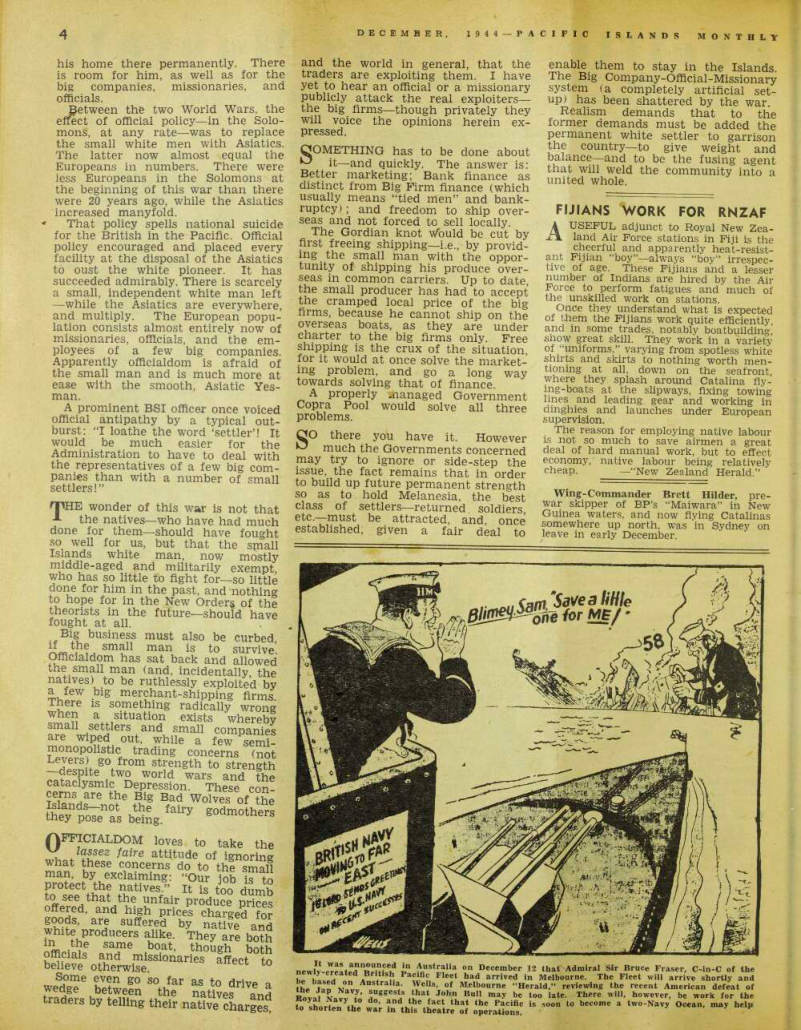
If was annouced in Australia on Decmber 12 that Admiral Sir Bruce Fraser, C-in-C of the newly-created Brtish Pacific Fleel had arrived in Melbourme. The Fleet arrive shortly and bebased on Australia. Wells, of Melbourme"Herald" reviewing th recent American defeat of the Jap Navy, suggesls that John Bull may be toolate.There will however,be work for the Royal Navy todo, and the fact that the Pacific is soon to become a two-Navy Ocean, may help to śhorten the war in this theatre of operationns.
Mysterious Papuan
Inquiry
Commissioner Seeks Data on Events of Feb., 1942
AN official inquiry, concerning which there has been speculation, was formally opened in Melbourne on December 1 by Mr. J. B. Barry, KC, who appears to have the authority of a Royal Commission issued by the" Commonwealth Government. The subjects of the inquiry are: 1. Whether the Administrator of Papua, and/or any member of the Legislative or Executive Councils, failed in their pub lic duty to safeguard the Territory. 2. Whether any action taken or omitted to have been taken by the Military Com mand of the Bth Military District prior to noon on February 14, 1942, contributed to any failure on the part of the civil administration of the Territory. 3. Whether there was adequate co operation between the civil administra tion and the military authorities in the Territory: and, it not, who was respon sible for the absence of such co-operation. 4. All other matters deemed relative to the above.
The inquiry was formally adjourned until December 12, in Melbourne; and it was decided that all proceedings should be in camera. Mr. J. H. McClemfens, of New South Wales, instructed by the Commonwealth Crown Solicitor, appeared to assist the Commissioner, and Lieut.- Colonel F. B. Gamble, of the Victorian Bar, appeared to assist any military wit nesses who might be called. Sittings in Sydney will commence on January 4. It was announced that any person who wishes to give evidence may communi cate with the secretary of the Commis sion, Mr. Kruger, of the Department of Supply and Shipping, 125 Swanston Street, Melbourne. rpHE terms of the inquiry suggest that X there was friction of some sort between the civil and military authorities in Papua in the very critical days following the Japanese invasion of New Guinea; but the clam-like silence of the Commonwealth Government (which ordered the inquiry) and the refusal of Mr. Leonard Murray (Adminis trator of Papua) and his senior officials to discuss the matter, plus the Commis sioner’s decision to hold the inquiry pri vately, leave the whole development more of a mystery than ever.
Bureaucracy rides high—and the pub lic, in these days, has no right to infor mation, or anything else.
It is assumed that an attack by the military authorities upon Mr. Murray is the basis of the thing—an assumption borne out by the appearance of counsel for the Army. Extraordinary as it may appear, there is no appearance of counsel for the Civil Administration. Is it to be assumed that the Brass Hats, who have exercised autocratic power, complete and unchecked, in Papua since February, 1942, are to have things all their own way in this inquiry? If there were no counsel for the Army, we might place our con fidence in the fundamental fairness of mind of Mr. Barry, KC. As it is, the posi tion is bewildering.
Mr. D. M. N. McFarlane returned to Fiji in October after a visit to Australia.
Fiji Rice
Price for Radi, 1945
From Our Own Correspondent
Suva, Dec. 12.
THE Controller of Production and Marketing has announced that Government guarantees to purchase padi during 1945 at £l2/10/- per ton in Viti Levu and £l2 in Vanua Levu. The Government will provide bags or, alter natively, will purchase the suppliers’ bags at fair valuation.
It is considered that the prices are fair, and it is hoped that the guaranteed sale of the padi will create an incentive to the growers to produce a,ll they can. Large production is desirable by reason of the very small quantity of rice now being imported.
Food Prices
RECENTLY, Ihe Competent Authority gazetted maximum retail prices for nearly 50 items of vegetables, fruits and fish. Variations are being gazetted each week, as dictated by the supply, according to seasonal conditions.
In a large majority of items, deductions were made on previously ruling rates.
Obviously there has been some dissatis faction in this new move, but in other sections it is felt that the fixing of prices for vegetables and fruits has been long overdue.
Nsw Dust Reaches Fiji
From Our Own Correspondent
Suva, Nov. 25.
FOR a couple of days this week the sky over Fiji has been dulled by the dust and smoke from the dust storms and fires which have been ravaging New South Wales. Late one afternoon the sky was so laden that the sun appeared a dirty white instead of in its usual fiery red.
Mrs. A. R. W. Robertson returned re cently to Fiji from a visit to New Zealand.
G. And E. Islanders Buy
Tender For Royal Navy
NATIVES of the Gilbert and Ellice Islands Colony who, in August, 1943, were not under Japanese domina tion, together with G. & E. people living in Fiji, decided that they would like to purchase something which would assist the Allied war effort. They therefore began raising funds towards this end, determined that as they were seafaring folk their gift would be in some way con nected with the sea.
Choice eventually fell on a 35-foot air craft tender for the Royal Navy. Such a tender would cost £2,250 sterling, and there were about 5,000 people in the com munities concerned. But while the appeal was still under way, other parts of the Gilbert and Ellice Islands Colony were liberated and it was not long before more money than was actually needed was available. The liberated Islanders were more than willing to express their gratitude for freedom, by giving money they raised selling curios to Allied troops.
The aircraft tender has now been pur chased and is in service with the Royal Navy. The balance of the funds collected is being held with a view to buying another boat.
Rarotongan Concert Party
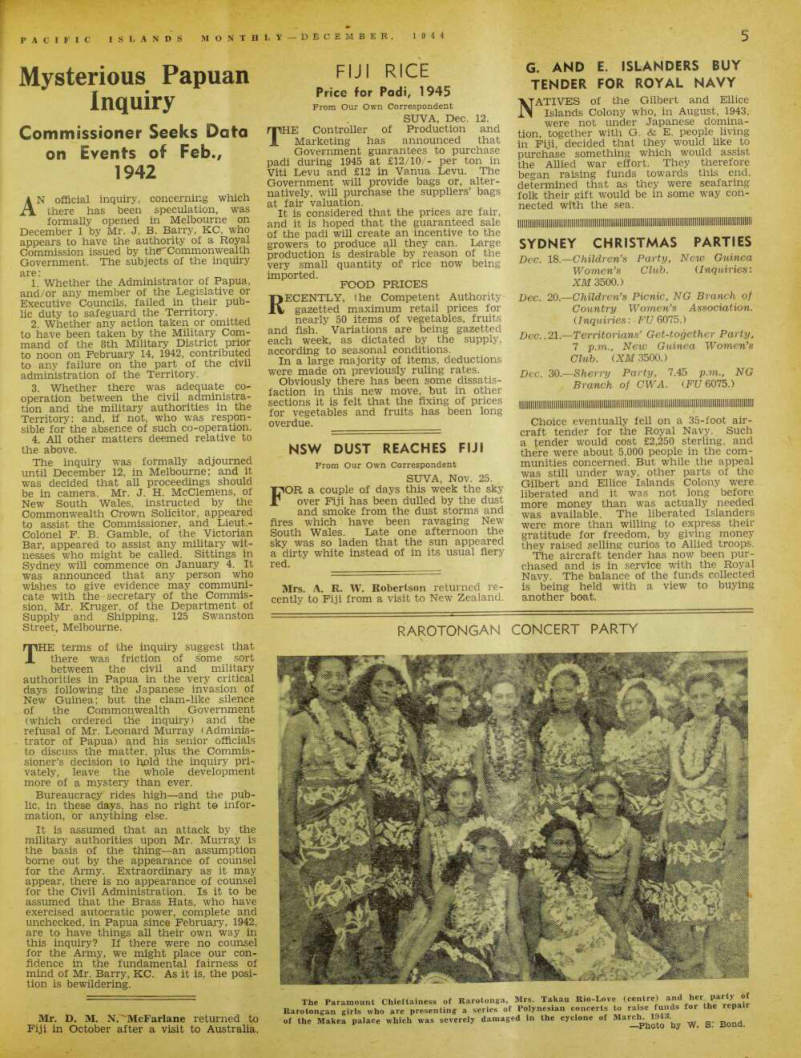
The Paramount Chieftainess of Rarotonga, Mrs. Takau Rio-Love (centre) and her party of Rarotongan girls who are presenting a series of Polynesian concerts to raise funds for the repair of the Palace which was severely damaged in the cyclome of March 1943 Photo by W.S. Bond.
Advertisements & other items, p. 7 (1 item)
Sydney Christmas Parties
Dec. IS—Children’s Party, New Guinea Women’s Club. ( Inquiries : XM 3500.) Dec. 20. — Children’s Picnic, NG Branch of Country Women’s Association. ( Inquiries: FU 6075.) Dec.. 21.—Territorial’ Get-together Party, 7 p.m., New Guinea Women’s Club. {XM 3500.) Dec. 30—Sherry Party, 7.45 p.m., NG Branch of GW A. (FU 6075.)
Guinea
Return To New
By the Rev. M. A. Warren , in the “ABM Review
r travel through New Guinea at any time is a rich experience, but under war conditions it becomes a strange and unimaginable mixture of the normal and the fantastic. One finds oneself a civilian moving about amongst an Army, depending on the Army for food, shelter and transport, upon the Army canteens for soap and toothpaste, and upon the Army’s convenience for every move, and, finally, for a passage home.
Travel under such conditions involves the use of Army vehicles—jeeps, trucks, four-wheelers and six- and 10-wheelers— and Navy and Army launches. Frail some of them look, but with enormous power for special tasks which require the utmost speed.
But dependence on the transport of others has grave disadvantages. One cannot plan for the best use of one’s time, but is obliged to sit by and wait and lose important hours and days.
WITH four missionaries — Misses Som erville, Caswell, Inman and Devitt —returning to their work in New Guinea, I left Sydney on August 21 in
a troopship.
We called at northern ports en route, picking 'up large detachments of troops for service in the fighting zones. Our destination was Milne Bay, which we reached some days later and disembarked.
The days at sea were full of interest despite some unpleasant experiences, but the Great Barrier Reef was full of beauty and the Coral Sea not too rough. It was of great interest to us all to see the high peaks of New Guinea a&ain. We were thrilled when we entered the China Strait and recognised landmarks which we knew so well —Samarai, Kwato, Rogeia, Sariba, all with their special contours and colours.
Milne Bay, as had been the case since the New Guinea campaign began, was alive with shipping, and, whereas in the old days a ship each month was about the average, to-day it is seldom possible to see less than half a dozen vessels com ing and going, and many tied up to the busy wharves.
Milne Bay was our first glimpse of the transformation caused by the war. Instead ot the few native villages, a canoe drift ing lazily along, and an occasional red loofed house on a plantation, we discov ered war installations of enormous mag nitude extending over many miles of the coastline along the bight of the bay. At night the powerful electric lights make the scene resemble Port Melbourne rather than the New Guinea we used to know.
As we approached we saw some of the ravages of war—flotsam and jetsam in great abundance washed up by the tide landing barges wrecked as they drove ashore; fuel drums rusted and useless on the beaches, and others stacked on shore KJ ga ? °r the thousands of vehicSel use ; Vehicles, of course, do not oper ate without roads, and it was amazing to see the roads winding in all direc tions, all busy with Army traffic.
AT Milne Bay we were to transfer to L S i£ a \ ves i el which would take us to the headquarters of the Mission at Dogura. For two days we were given hospitality by ANGAU, and then com” menced the 80-mile journey on a small launch to Dogura. This journey Tas accomnhshed in two stages. The first night we were given welcome hospitality
at East Cape, where the Rev. Mr. Wil liams is Superintendent of the Methodist Mission. He had recently returned, and was busy getting his station into working prder again. We left in the early morn ing on the last stage along the north east coast of New Guinea. Here Army installations were left behind for a time, the south-eastern portion of the diocese bein?? now safe, and free of troops. In the early afternoon we sighted Taupota, and Miss Inman did her best to attract attention as we drew near. The waving of handkerchiefs made it clear to the Papuans that friends were on the strange vessel, and an throng gathered on the beach to receive us.
Aitutaki Maori Charged
With Theft
ON January 23, 1944, someone entered the office of Mr. H. H. Hickling, Resi dent Asrent, Aitutaki, Cook Islands, and stole £252.
In February, 1944, in the lower Court, Rio Tana was charged with the theft, which he denied.
The case was adjourned until April 3, and then to April 5.
Rio Taria says that Mr. Hickling in formed him on April 21 that the case was dismissed.
On July 4, Rio Taria was summoned to the High Court, before Judge Mc- Carthy. On July 5, he was charged with entering the office, and with theft; he denied this, and brought evidence that he was sick and under medical attention from December 23 until February 12.
Thereupon, on July 6, he was found not guilty of theft, but guilty of receiving the money, knowing it to have been stolen.
Rio Taria gave notice of appeal. He appears to be making a series of counter charges. He has sent copies of the lat ter to the “Pacific Islands Monthly”: but these, in the circumstances, cannot be published.
New Laws in Fiji
Prom Our Own Correspondent r_ „ SUVA, Nov. 25.
E Fiji Legislative Council has just finished a short session, presided over by the officer administering the Government (Acting Governor, Mr. J. P.
Nicoll). At this session there were numer ous bills tor consideration, including the new Companies and Bankruptcy Bills.
These are modelled on the current Eng lish Acts, and should bring the Colony into line with more up-to-date legislation in these matters. Ordinances at present in force are those of 1921 and 1889 re spectively.
Also for consideration were bills to establish a code of criminal law and to make provision for the procedure to be followed in criminal cases. These bills are principally to codify the existing criminal law and procedure, which at present are contained in English common law, English statutes and local ordin ances.
These, and other bills, are the outcome of the decision to bring into force a re vised edition of the'laws of the Colony, and the opportunity is being taken to introduce more modern legislation prior to the publication of the 1944 revised edition. The last revised edition was that of 1924.
Select committees will report on some of the new bills before next session, about mid-December, Mr. J. A. Garnett was appointed a member of the Fiji Production and Mar keting Control Advisory Committee, in October.
The engagement was recently an nounced in Suva of Miss Mabel Aspinall, fourth daughter of the late Mrs. L.
Aspinall, and Lieut, Norman Neil Mac donald, eldest son of Mr. and Mrs. N. J.
Macdonald, of Suva.
Territorian Party In Sydney
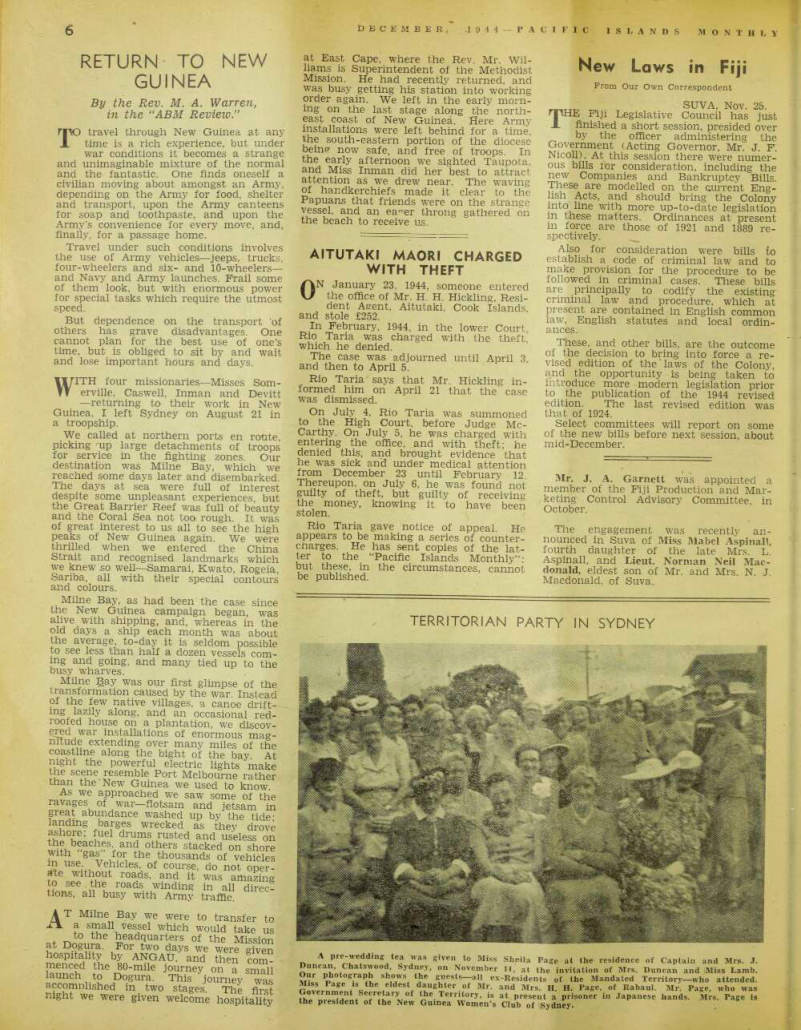
A pre-wedding tea was given to Miss Sheila Page at the residence of Captain and Mrs. J.
Duncan Chatswood, Sydney, on November 11, at the invitation of Mrs. Duncan and Miss Lamb.
Our photograph shows the guests-all ex-Residents of the Mandated Territory-who attended.
Miss Page is the eldest daughter of Mr. and Mrs.H.H. Page, of Rabaul. Mr.Page. who was Government Secretary of the Trritory, is at present a prisoner in Japanese hands. Mrs. Page is the President of the New Guiea Women's Club of Sydney.
Advertisements & other items, p. 8 (1 item)
6
monthly
1 944 PACIFIC ISLAN
DECEMBER.
C. Sullivan Pty. Ltd.
THE well-known Islands-trading firm of C. Sullivan & Co. has been incor porated as C. Sullivan Pty., Ltd. The managing director is Mr. C. Sullivan, who has had over 25 years in the Pacific Islands trade. In 1928 he founded the firm of C. Sullivan, Ltd., of which he was first managing director. In 1938, Mr.
Sullivan went overseas, retiring from the managing directorate of the company, but remaining on the board as a director. In 1941, in association with the late Mr. V.
G. Smith, he purchased the Islands good will of the business, and again resumed
control. The staff remained with him, and is to-day substantially the same.
Associated with Mr. Sullivan in the management, as a director, is his son, D.
W. Sullivan, who saw service in the Middle East with the AIF, and is now discharged from the Army. Management of departments is in the experienced hands of Mrs. Y. Benson, Mr. R. Knight and Mr. W. H. Cumines, who is at present in Tahiti.
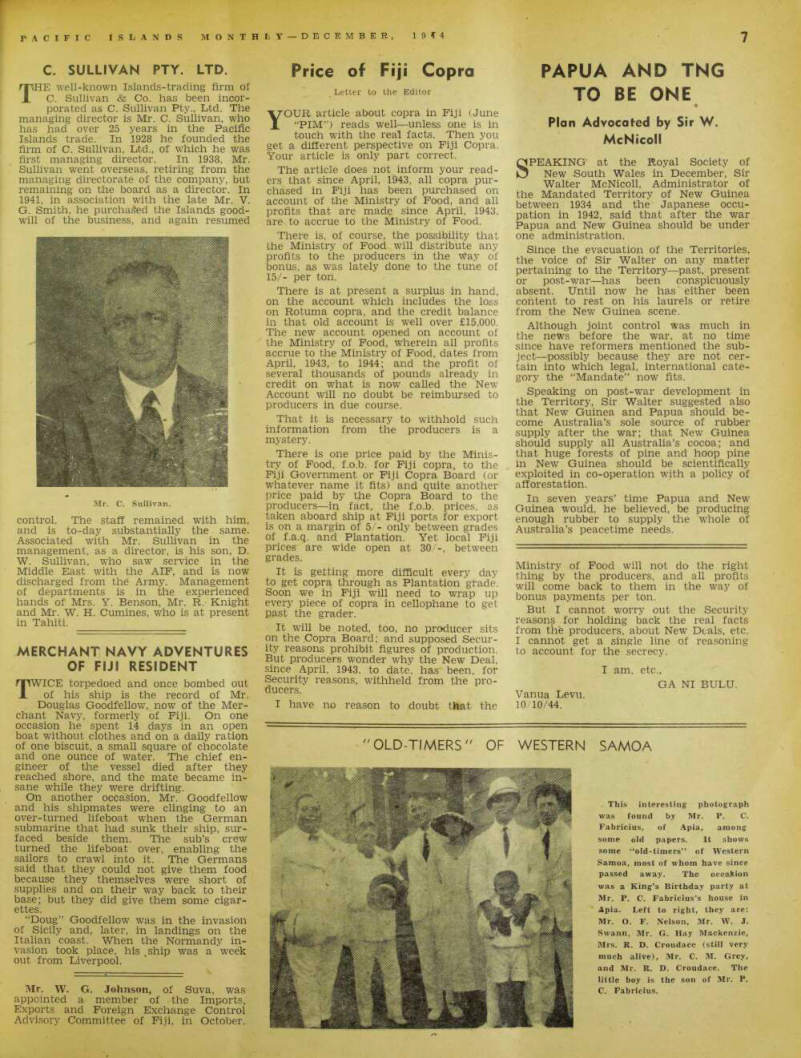
Mr. C. Sullivan.
Merchant Navy Adventures
Of Fiji Resident
TWICE torpedoed and once bombed out of his ship is the record of Mr.
Douglas Goodfellow, now of the Mer chant Navy, formerly of Fiji. On one occasion he spent 14 days in an open boat without clothes and on a daily ration of one biscuit, a small square of chocolate and one ounce of water. The chief en gineer of the vessel died after they •reached shore, and the mate became in sane while they were drifting.
On another occasion, Mr. Goodfellow and his shipmates were clinging to an over-turned lifeboat when the German submarine that had sunk their ship, sur faced beside them. The sub’s crew turned the lifeboat over, enabling the sailors to crawl into it. The Germans said that they could not give them food because they themselves were short of supplies and on their way back to then base; but they did give them some cigar ettes.
“Doug” Goodfellow was in the invasion of Sicily and, later, in landings on the Italian coast. When the Normandy in vasion took place, his ,ship was a week out from Liverpool.
Mr. W. G. Johnson, of Suva, was appointed a member of the Imports, Exports and Foreign Exchange Control Advisory Committee of Fiji, in October.
Price of Fiji Copra
Letter to the Editor
YOUR article about copra in Fiji (June “PIM”) reads well —unless one is in touch with the real facts. Then you get a different perspective on Fiji Copra.
Your article is only part correct.
The article does not inform your read ers that since April, 1943, all copra pur chased in Fiji has been purchased on account of the Ministry of Food, and all profits that are made since April, 1943, are to accrue to the Ministry of Food.
There is, of course, the possibility that the Ministry of Food will distribute any profits to the producers in the \tfay of bonus, as was lately done to the tune of 15/- per ton.
There is at present a surplus in hand, on the account which includes the loss on Rotuma copra, and the credit balance in that old account is well over £15,000.
The new account opened on account of the Ministry of Food, wherein all profits accrue to the Ministry of Food, dates from April, 1943, to 1944; and the profit of several thousands of pounds already in credit on what is now called the New Account will no doubt be reimbursed to producers in due course.
That it is necessary to withhold such information from the producers is a mystery.
There is one price paid by the Minis try of Food, f.o.b. for Fiji copra, to the Fiji Government or Fiji Copra Board (or whatever name it fits) and quite another price paid by the Copra Board to the producers—in fact, the f.o.b. prices, as taken aboard ship at Fiji ports for export is on a margin of 5/- only between grades of f.a.q. and Plantation. Yet local Fiji prices are wide open at 30/-, between grades.
It is getting more difficult every day to get copra through as Plantation grade.
Soon we in Fiji will need to wrap up every piece of copra in cellophane to get past the grader.
It will be noted, too, no producer sits on the Copra Board; and supposed Secur ity reasons prohibit figures of production.
But producers wonder why the New Deal, since April, 1943, to date, has been, for Security reasons, withheld from the pro ducers.
I have no reason to doubt that the
Ministry of Food will not do the right thing by the producers, and all profits will come back to them in the way of bonus payments per ton.
But I cannot worry out the Security reasons for holding back the real facts from the producers, about New Deals, etc.
I cannot get a single line of reasoning to account for the secrecy.
I am, etc.,
Ga Ni Bulu.
Vanua Levu. 10 10/44.
Papua And Tng
To Be One
Plan Advocated by Sir W.
McNicoll
SPEAKING' at the Royal Society of New South Wales in December, Sir Walter McNicoll, Administrator of the Mandated Territory of New Guinea between 1934 and the Japanese occu pation in 1942, said that after the war Papua and New Guinea should be under one administration.
Since the evacuation of the Territories, the voice of Sir Walter on any matter pertaining to the Territory—past, present or post-war—has been conspicuously absent. Until now he has either been content to rest on his laurels or retire from the New Guinea scene.
Although joint control was much in the news before the war, at no time since have reformers mentioned the sub ject—possibly because they are not cer tain into which legal, international cate gory the “Mandate” now fits.
Speaking on post-war development in the Territory, Sir Walter suggested also that New Guinea and Papua should be come Australia’s sole source of rubber supply after the war; that New Guinea should supply all Australia’s cocoa; and that huge forests of pine and hoop pine in New Guinea should be scientifically exploited in co-operation with a policy of afforestation.
In seven years’ time Papua and New Guinea would, he believed, be producing enough rubber to supply the whole of Australia’s peacetime needs.
"Old-Timers" Of Western Samoa
This interesting photograph was found by Mr. P. C.
Fabricius, of Apia, among some old papers. It shows some "old-timers” of Western Samoa, most of whom have since passed away. The occasion was a King’s Birthday party at Mr. P. C. Fabricius’s house in Apia. Left to right, they are: Mr. O. F. Nelson, Mr. W. J.
Swann, Mr. G. Hay Mackenzie, Mrs. R. D. Croudace (still very much alive), Mr. C. M. Grey, and Mr. R. D. Croudace. The little boy is the son of Mr. P.
C. Fabricius.
Conference On Indentured
Labour System
Australian Territories Representatives Urge That Reforms be Slow and Gradual
PERSONS interested in native labour in the Australian Pacific Territories conferred in Sydney on December 1 and 2, at the invitation of the Australian Minister for External Territories (Mr.
Ward). The following received an official invitation to attend: Mr. J. R. Halligan, Secretary, Department of External Territories.
Mr. H. L. Murray, CBE, Administrator of Papua.
Mr. E. W. P. Chinnery, Commonwealth Adviser on Native Matters.
Mr. R. Melrose, Director of District Services and Native Affairs, New Guinea.
Lieut.-Colonel E. Taylor, MBE, Assistant Director of District Services and Native Affairs.
Lieut.-Colonel .1. C. Mullaly, OBE, MLC, New Guinea.
Mr. A. J. Bretag, MLC, New 7 Guinea.
Mr. T. Nevitt, MLC, Papua.
Mr. G. E. Aumuller, MLC, Papua.
Professor A. P. Elkin, anthropologist.
Lieut.-Colonel H. lan Hogbin, anthropologist.
Representative of the Methodist Overeas Missions.
Representative of the Methodist Missionary Society of NZ.
Representative of the Australian Board of Missions.
Representative of the Lutheran Missions.
Representative of the Roman Catholic Missions.
Representative of the Australasian Union of Seventh Day Adventists.
Representative of the London Missionary Society.
Representative of the Pacific Territories Association.
Representative of the Papuan and New Guinea Miners and Workers’ Union.
Representative of the Pacific Islands Natives’
Welfare Association.
Representative of the New Guinea Planters’
Association.
Representative of the New Guinea ALP.
Representative of New Guinea Miners’ Associa tion.
Representative of Papuan Planters’ Association. rE proceedings were not open to the press—no one can guess why. No official report—beyond a few vague generalities by the Minister—was issued.
Australian public opinion is singularly ill informed on this subject—and evidently it is the Minister’s intention to keep it so.
Also, it was a remarkable thing—and typical of all that is done by the Aus tralian Government—that not one of the big employers of native labour (Burns Philp & Co., Bulolo Gold Dredging, Ltd , W. R. Carpenter & Co., Ltd., Steamships Trading Co., Ltd., New Guinea Goldfields, Ltd.) was invited to attend. Apparently, their viewpoint is not wanted—because they are big and powerful, they are re garded as the natural enemies of the natives, and of the Administration, and of Mr. Ward.
But if Mr. Ward imagined that his hand-picked conference would bow to his cooing, and accept his instructions, he was due for disillusionment.
Mr. Ward opened the proceedings with a fmt accompli—he said that he and Mr.
Beasley already had announced, as the pohcy of their Government, the abolition of the indentured labour system as soon a ?, Practicable. The conference was in vited to accept that fact, and say what should be done about it.
The conference did not approve of im mediate abolition. Two or three mis sionaries and anthropologists were for a clean sweep; but all the other gentlemen (including most of the missionaries) who really know and understand the Terri tones, insisted that immediate abolition would lead to confusion and economic disaster, and would do the natives them selves great disservice, m
r E following summarised report of the conference was submitted to the Pacific Territories Association by the president (Mr. James) at the quarterly meeting on December 5: “The Minister informed the conference that the Government had definitely de cided that the indentured system of labour was to be abolished as soon as practicable, and he invited conference to discuss what steps should be taken to give effect to this decision and what system of labour should take its place. The opinions of this Association were put before confer ence in the following statement: “ ‘The Pacific Territories Association, comprising a considerable proportion of European settlers of the Territories of New Guinea and Papua, decided some little while ago that its main objectives were two: and as both of them have a distinct bearing on the subject of native labour, and in order to make our position quite clear, I will quote them: (1) Civil administration should be re stored in Papua immediately and in successive areas of New Guinea as soon as they cease to be areas of military operations. It is considered the return of civil administration and civilian settlers to the Territories is in the best interests of the native inhabitants, the European settlers, and Australia. (2) The principles upon which the policy of former civil administration in these Territories was based, in regard to the government and treatment of the native inhabitants, should in no manner be changed, at least until some time after civilian administration has resumed. It is believed that this is essential for the benefit of the natives, so that they may quickly be divorced from the mode of life enforced by war time control, and that any violent changes other than reversion to pre war conditions would be inimical to their present interests and future developments.
“ ‘The Association is definitely opposed to the abolition of the contract system of native labour; but does not deny the possibility of improvement in the adminis trative policy for the governing of the native inhabitants.
“ ‘Nevertheless, we are strongly of the opinion that this is not the time to make any changes in the system of native administration. Let normal civilian ad ministration resume, permit the natives to recover from the shocks and disruption caused by war conditions—with its des truction of property, forced labour and rapidly changing conditions—and then, and not until then, consider any neces sary alterations in the policy of native administration in the light of conditions then existing, and with the advice sof those competent by knowledge and prac tical experience to express authoritative opinion.
“ ‘The Association feels very strongly on this point, and asks that it be given care ful consideration before any planning of post-war conditions for the natives of New Guinea and Papua is contemplated.
“ ‘However, as this conference appears primarily to be dealing with the question of contract labour, and I have clearly stated the Association’s opposition to its abandonment, I should briefly state our reasons for this attitude.
“ ‘These Territories cannot survive with
out settlement and development; settle ment and development cannot proceed without laboui.; and we believe this settlement cannot continue to-day with out labour engaged under the contract system as was in vogue in the Territories pre-war.
“ ‘Casual labour is quite unworkable, commercially, owing to the present stage of the natives’ development, with their total lack of any sense of responsibility.
“ ‘Why have we indentures for Euro pean youths starting work? For exactly the same reason as with these natives who, I maintain, are comparable as to mentality with the average European in his teens.’
“These opinions,” proceeded Mr. James, “met with no little support. Many matters were discussed at length and numbers of tentative suggestions were given consideration. But a summary of the majority opinion of the representatives is covered by the following points: The indentured system must eventually be abolished entirely.
No date can now be fixed for this, but it should not be done hurriedly, nor would its sudden abolition be in the best interests of either natives or em ployers.
There must be a transitional period dur ing which contract labour should be continued with progressive modi fications.
There should be a widening of the pro visions and encouragement for the employment of non-contract labour.
Modifications of the existing contract system to be given early consideration to include: the modification of penal sanctions under the contract system; reduction of the maximum term of contract and total service, including re-engagement; stricter control of numbers recruited from different dis tricts having regard to their labour potential; better transport facilities for native labourers, and repatriation by Government exclusively; greater edu cational facilities for natives, especially in the direction of assisting them to obtain employment other than under the contract system.”
Mr, James explained that the confer ence had no power—it was merely advisory. A full report of its discussions would be submitted to the Australian Government.
Rarotonga
Airmail To Cook
Islands
Inaugural Plane at Rarotonga
riIHE arrival of the first plane to land X on Rarotonga (chief island of the Cook Group) was made the occasion, in November, of a public celebration.
It was a civilian plane, with a NZ Air Force crew, and it inaugurated what is hoped will become a regular weekly air mail service Auckland - Nukualofa (Tonga)-Aitutaki (Cook Is.)-Rarotonga.
Among civilian officials who made this initial survey flight was Mr. C. McKay, secretary of the NZ Islands Territories
Department.
Mrs. Hills, wife of Captain Hills, who was formerly on the LMS mission ship, “John Williams,” and now in the Navy, has returned to Fiji. She is the daugh ter of Mr. and Mrs. G. W. Dick, of Suva.
Mr. H. E. Snell, general manager of Morris Hedstrom, Ltd., who has been on a business visit overseas, returned to Suva in October,
Tropicalitils
THEY do have their pipe-dreams. At the end of November, Mr. J. T.
Lang announced in the NSW Par liament that he was in favour of tap ping the unused water of New Guinea and bringing it to Australia to relieve drought— particularly in the inland. Mr.
Lang left the sordid details of how this was to be accomplished to the imagina tion of his colleagues and fellow-citizens, but a Central Australian pastoralist, Mr, A. E. Davis, of Lake Eyre, weighed in, in the same week, with the same plan, but complete with estimates and some details. The cost, he estimates will be £2,000,000 per mile —or £180,000,000 to cross Torres Strait, or £2,500,000,000 to bring water right to Lake Eyre.
He said the water could be carried across Torres Strait by rubber pipes or through a tunnel.
Six hundred million acres of country in Central Australia could be made to pro duce annual crops worth £2O an acre.
Lake Eyre could be filled from the Sepik River in 48 hours, and 'by means of a lock at Port Augusta, ocean-going steam ers could be brought inland to the lake to take away the produce of the area.
He visualised Australia, with his scheme, carrying a population of 600,000,000 people, with one of the biggest towns on the shores of Lake Eyre.
The normal Australian citizen wonders why both gentlemen insist upon going to New Guinea for water. Several practical schemes for diverting the northern rivers of Australia, which pour millions of gal lons of good water into the sea daily, have been discussed lately, and it is probable that something of this sort will be done in the post-war period. * mELEGRAPHIC communications be- X tween New Caledonia and France were resumed in November, after four years’ silence. One of the first mes sages to come through was to a Noumea motor car agency. It was from the Cit roen Company of Paris —and it said that as their works were all in one piece they would be happy to resume business rela tions with New Caledonia forthwith.
PERHAPS it is not a bad idea to bring some Pidgin-poetry to the readers of “PIM.” It may bring memories to some Territorians; and others perhaps are not aware that Pidgin-English can express every feeling of the human heart.
The feeling of the natives towards the Europeans who were chased out by the Japs can be guessed by the following verses which I picked up from my boys during my evacuation trip. I can remem ber only a few lines, and it is impossible to express the native melody and rhythm, but here it is; What name fashion—what name fashion . . . come up Rabaul, come up Madang. (What is this that has happened to Rabaul and Madang?) Sunday Japan balus, Sunday Japan balus —bomb’im, bomb’im. bomb’im place. (On Sunday Jap planes bombed the place.) Sorry, master, sorry master—sorry Kong kong, sorry Kongkong, (Sorry master —sorry Chinaman.) Me too, you too, you too, me too . . . enough onetime, ’e go onetime, Walkabout onetime ... die onetime. (You and I share the same things, go together, die together.)
“Pat.”
ONE of the young and earnest anthro pologists, who are being foisted on unfortunate New Guinea for its sins,
was talking to a boy—pardon, a native— and was trying to “get into his mind” in an attempt to see how far the native had deteriorated mentally through horrible exploitation by low whites, etc.
He asked the boy—pardon, again!— what he thought of the war, and was surprised to find how much the native knew. Then he asked him what he thought of Hitler, and the boy replied; “Gibe, me savi Hitler! ’E No. 1 bastard, all the same ANGAU! ” —A.W. * WELL-KNOWN in New Guinea when he was a member of AW A staff there, Mr. E. B. Bishton writes as follows: “In the November issue of the ‘PIM’
Mrs. Innes states that Mrs. Booth was the first white woman on Edie Creek (or Kaindi). I think it will be found that Mrs. Muller, who came in with Mick Lehey’s party some time in October or November, 1926, was on Edie Creek a few weeks before Mrs. Booth visited the place, although Mrs. Booth had already lived a couple of years on the Bulolo River at a spot only two days’ march from Edie Creek. Mrs. Muller was after wards running the mess for Levien’s Guinea Gold Co., on the Koranga. where Mr. Muller was working. Mr. Muller had a fall while on this job and eventually died in hospital at Wau.” * THE Rev. C. W. Whonsbon-Aston, now Chaplain in Western Samoa, on qualities needed in intending mis sionaries : One needs practical sense—initiative On a mission station miles off the beaten track it is not possible to ring up the plumber or 1 the carpenter or the engineer.
Some men will immediately begin to rea son: “Well, I’m afraid that leaves me out, for I know nothing about these things.”
The Rev. Wilfred Light, when at Boia nai, decided to build a church of concrete.
It looked a problem, for he was entirely inexperienced in that sort of thing. It stands to-day—about as big as St.
James’, Sydney.
In my district in Papua one had to be boarding-house keeper (for school board ers), poultry and turkey keeper, goal factor, lighthouse keeper, house builder and repairer, district medico (up to 60 patients a day at times), schoolmaster, bread baker, cook and housekeeper—all additional to one’s primary purpose as priest. This is typical. It leaves no time for morbid fancifying. The days pass al too quickly.
Then, a sense of order. A Canon approached me with: “There is one man who might suit the mission field. The only thing that is wrong with him is that he is untidy in his attire, and his parish ioners dislike it.”
There were two points to answer. First, the mission field is not the proper place for cranks and eccentrics or folks that have “something wrong with them.”
Moreover, a person who has no sense of order or personal cleanliness is a menace. * THE arrival of my October “PIM”, con taining a tribute to a former resi dent of Edie Creek, whose informal tea-parties form an oasis in the desert of everyday Noumea life, coincided with a paragraph by gossip-writer Preston Charles, in the “Daily News” —a mimeo graphed news-sheet for the American Forces. Here it is: “Not that we want to tell the Austra lians what to do, but they might well
pick a woman for Prime Minister. Our choice is ‘Mom’ Bowring, a Sydney girl who made good in New Caledonia with the Red Cross. With an enviable war record behind her, ‘Mom’ would be a sure vote-getter among ex-Servicemen. Being the motherly type also, she’d get the support of people who think the woman’s place is in the home and girls should come home early from their dates. ‘Mom’ has already had considerable experience as
Australia’s goodwill-ambassador-at-large,
and relations with other Allied nations would then continue to be excellent, of course.
“We assume the Aussies are satisfied with their present Government, but if they ever decide to make a change, here’s an idea that we feel sure will bring resounding applause from a lot of Ameri can Servicemen.”
H.E.L.P.
LORD MOYNE’S tragic death in Cairo —he was British Minister in the Middle East and he was assassinated —will remind “PIM” readers of the con troversy about New Guinea’s pygmies which Lord Moyne claimed to have found on the Upper Ramu.
In 1935-36 Lord Mdyne, with a cross section of British aristocracy as his guests, made a world cruise in his 700tons luxury yacht, “Rosaura.” In the course of it he, and some of his party, went up the Ramu River, in the Mandated Territory, and subsequently published stories which indicated that Lord Moyne and party had been responsible for dis covering a tribe of pygmies there.
As far back as 1896-1901, the old Ger man New Guinea Company had expedi tions out in that district under a Dr.
Lauterback, a man called Tappenbeck, and others. They made astronomical observations, prospected and surveyed some of the district and charted the Ramu River. Some of these parties claim to have reached the Bismarck and Hagen Ranges and reports of their expeditions appeared in German magazines. If they did really penetrate this country, it is probable that they came into contact with the “pygmies”—l have a vague idea that I hav x e seen pictures of these “pygmies” near Atemble in a magazine published in 1902.
There is still divided opinion among the anthropologists about these natives — whether they should be called “pygmies” or whether they are only “pygmoids.”
It is believed that two members of these early expeditions, Klink and Rodatz, although they appear to have German names, were Australians. I wonder if there is any record of them or their work in Australian publications?
However, whoever it was who first saw the pygmies it certainly was not Lord Moyne and party. And whatever the early expeditions may have learned of them, the late Father Kirschbaum seems to have been the first European to study them and their langauge.
“Pat.”
Distinguished Service
CORPORAL GORATARU, of the British Solomons Defence Force, has been awarded the Military Medal for “gallant and distinguished service in the South-west Pacific.”
The following have been awarded the British Empire Medal for distinguished service: John Milne, wireless operator, Gilbert Islands.
Levai Papaku, district headman, Solomon Islands.
Peter Tavoto, district headman, Solomon Islands.
Metet tTS
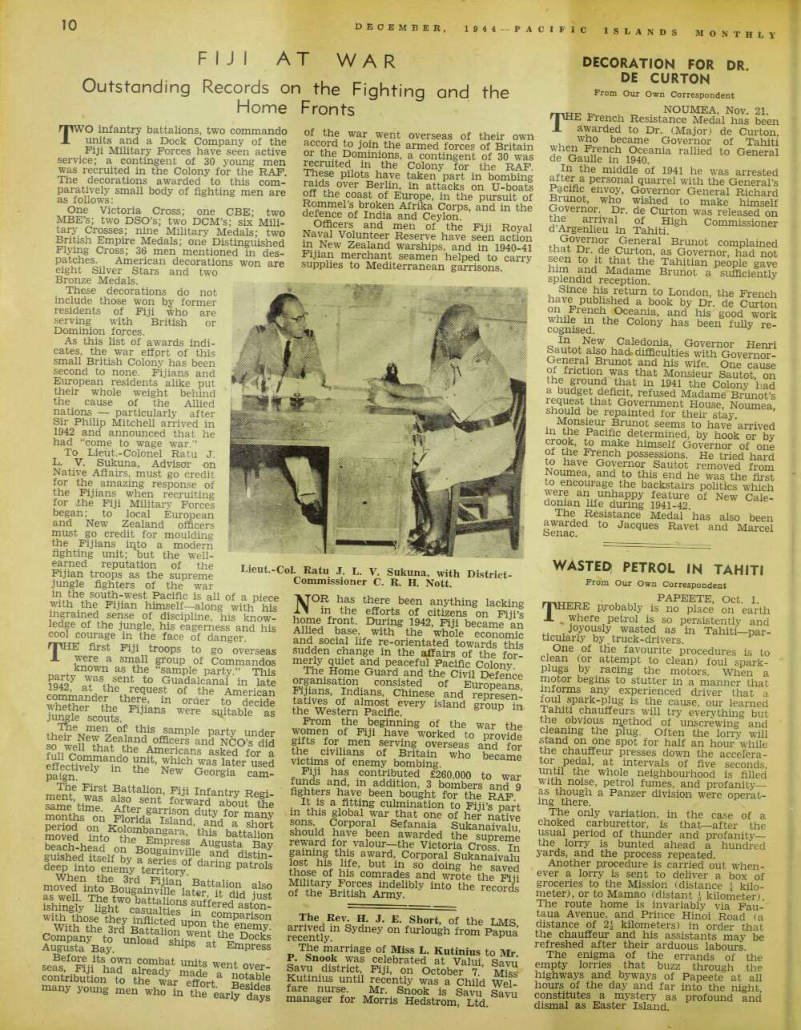
Fiji At War
Outstanding Records on the Fighting and the Home Fronts
rO infantry battalions, two commando units and a Dock Company of the Fiji Military Forces have seen active service; a contingent of 30 young men was recruited in the Colony for the RAF.
The decorations awarded to this com paratively small body of fighting men are as follows: One Victoria Cross; one CBE; two MBE’s; two DSO’s; two DCM’s; six Mili tary Crosses; nine Military Medals; two British Empire Medals; one Distinguished Flying Cross; 36 men mentioned in des patches. American decorations won are eight Silver Stars and two
Bronze Medals.
These decorations do not include those won by former residents of Fiji who are serving with British or Dominion forces.
As this list of awards indi cates, the war effort of this small British Colony has been second to none. Fijians and European residents alike put their whole weight behind the cause of the Allied nations particularly after Sir Philip Mitchell arrived in 1942 and announced that he had “come to wage war.”
To Lieut.-Colonel Ratu J.
L, V. Sukuna, Advisor on Native Affairs, must go credit for the amazing response of the Fijians when recruiting for vthe Fiji Military Forces began; to local European and New Zealand officers must go credit for moulding the Fijians into a modern fighting unit; but the well earned reputation of the Fijian troops as the supreme jungle fighters of the war
in the south-west Pacific is all of a piece with the Fijian himself—along with his ingrained sense of discipline, his know ledge of the jungle, his eagerness and his cool courage in the face of danger.
THE first Fiji troops to go overseas were a small group of Commandos known as the “sample party.” This ?oi9 y wa.s sent to Guadalcanal in late
Metet tTS
» er scoute. Riians were s, i itable as naen of this sample party under so e wenThat ea th? d A° fflC?rS and N^°'s did that J the Americans asked for a effectivTl? a ?n° S?* S hich r^ as later used paign . the New Ge orgia cam- The First Battalion, Fiji Infantry RpH same’timp 8 a if? Sont forward about the PlOTfdf a xfa 0 n n d d ’i y ri for T n ? |& h 1t a s d el f °§ y a'series'of'daritj de , e P into enemy territory S patrols moT d d el intoßoug d in^ a e n iauf‘ a t als ?
CompU he to rd uSoad o ship s en ‘ t th £ Docks Augusta Bay. ps at Empress seas ef °Wn itS f ombat unlts went over seas, Fiji had already made a rmtlui contribution to the war effort S«?rf le many young men who in the
of the war went overseas of their own accord to join the armed forces of Britain or the Dominions, a contingent of 30 was recruited in the Colony for the RAF.
These pilots have taken part in bombing raids over Berlin, in attacks on U-boats on the coast of Europe, in the pursuit of Rommel’s broken Afrika Corps, and in the defence of India and Ceylon.
Officers and men of the Fiji Royal Naval Volunteer Reserve have seen action m New Zealand warships, and in 1940-41 Fijian merchant seamen helped to carry supplies to Mediterranean garrisons.
NOR has there been anything lacking in the efforts of citizens on Fiii’s b °™e fr x? nt - D ™g 1942, Fiji became an Allied base, with the whole economic and soda! life re-orientated towards this sudden change in the affairs of the for merly 9 met and P ea ceful Pacific Colony The Home Guard and the Civil Defend organisation consisted of Europeans Fijians, Indians, Chinese and represen- JS tlV w ? f al 2 loS . t « every island group in the Western Pacific. p From the beginning of the war the women of Fiji have worked to provicte gifts for men serving overseas and for the civilians of Britain who became victims of enemy bombing. e Fiji has contributed £260,000 to war funds and, m addition, 3 bombers and 9 fighters have been bought for the RAF It is a fitting culmination to Fiji’s part in this global war that one of her natfve s ° ns > Corporal Sefanaia Sukanaivalu should have been awarded the supreme reward for valour-the Victoria Cross a rf d ’. Cor P° ra ! Sukanaivalu !h S nco^ IS f i l ? 6 ’ i n 80 doing he saved those of his comrades and wrote the Fiii Military Forces indelibly into the records of the British Army. b The Rev. H. J. E. Short, of the LMS recerfidy in Sydney 0n furlou S h from Papua The marriage of Miss L. Kutinius to Mr P. Snook was celebrated at Valui, Savu Savu district Fiji, on October 7. Miss Kutinius until recently was a Child Wel fare nurse. Mr. Snook is Savu Savu manager for Morris Hedstrom, Ltd.
Lieut.-Col.Ratu J. L. V. Sukuna, with District- Commissioner C. R. H. Nott.
rm r 7 l. • NOUMEA, Nov. 21.
Decoration For Dr.
De Curton
From Our Own Correspondent rm r 7 l. • NOUMEA, Nov. 21.
E French Resistance Medal has been awarded to Dr. (Major) de Curton, who became Governor of Tahiti when French Oceania rallied to General de Gaulle in 1940.
In the middle of 1941 he was arrested after a personal quarrel with the General’s Pacific envoy, Governor General Richard Brunot, who wished to make himself Governor. Dr. de Curton was released on ?ArooS IVal - of High Commissioner d Argenheu in Tahiti. <? eneral Brunot complained that Dr. de Curton, as Governor, had not seen to it that the Tahitian people gave him and Madame Brunot a sufficiently splendid reception. y Since his return to London, the French have published a book by Dr. de Curton on French Oceania, and his good work while m the Colony has been fully re cognised. o **l . N ® w Caledonia, Governor Henri Sautot also hadr difficulties with Governor- General Brunot and his wife. One cause ?b o friCtlor l. s that Monsieur Sautot, on the ground that in 1941 the Colony had refused Madame Brunot’s u that Gqvernment House, Noumea, shouid be repainted for them stay.
Monsieur Brunot seems to have arrived in the Pacific determined, by hook or by S°?vf’ JS, ma^ e himself Governor of one of the French possessions. He tried hard to have Governor Sautot removed from Noumea, and to this end he was the first wpri lC ?^ rage v. the backstairB politics which un ? appy feature of New Cale donian life during 1941-42 fl w^pH ßo f ista T nce Medal has also been awarded to Jacques Ravet and Marcel
Waster Petrol In Tahiti
From Our Own Correspondent
Papeete, Oct. 1.
rpHERE probably is no place on earth X where petrol is so persistently and joyously wasted as in Tahiti—par ticularly by truck-drivers.
One of the favourite procedures is to clean or attempt to clean) foul spark plugs by racing the motors. When a motor begins to stutter in a manner that informs any experienced driver that a ihul spark-plug is the cause, our learned Tahiti chauffeurs will try everything but the obvious method of unscrewing and cleaning the plug. Often the lorry will stand on one spot for half an hour while the chauffeur presses down the accelera- P®dal, at intervals of five seconds, until the whole neighbourhood is filled Wlt ii noise ’ Petrol fumes, and profanity— as though a Panzer division were operat ing there.
The only variation, in the case of a choked carburettor, is that—after the usual period of thunder and profanity— the lorry is bunted ahead a hundred yards, and the process repeated.
Another procedure is carried out when ever a lorry is sent to deliver a box of groceries to the Mission (distance kilo meter) , or to Mamao (distant \ kilometer) The route home is invariably via Fau tana Avenue, and Prince Hinoi Road (a distance of 2i kilometers) in order that the chauffeur and his assistants may be refreshed after their arduous labours The enigma of the errands of the empty lorries that buzz through the highways and byways of Papeete at all hours of the day and far into the night constitutes a mystery as profound and dismal as Easter Island.
"Some Measure Of Success"
Quarterly Report of the Pacific Territories Association Submitted to Meeting
FOR the first time since the inaugura tion of the Pacific Territories Associa tion, over 2h years ago, the executive had progress to report to the quarterly meeting in Sydney on December 5.
Referring to the Commonwealth Gov ernment’s recent decision to amend the War Damage to Property Regulations, to include “indirect” war damage, Mr. E. A.
James, president of the PTA, said that the existence of the Association was justified in just that one decision.
The amendments to these regulations, it is anticipated, will cover a number of matters which have long exercised the minds of the executive. These include: • Gold left at Wau which should now be insurable against loss. • Payment by the military for goods and chattels. • Assistance in rehabilitation. • War damage insurance on small vessels.
Members were reminded, however, that these amendments will take some time to prepare, and until the whole text is issued, the full implication of the Government’s recent decision cannot be stated.
OTHER matters dealt with in the executive’s report which was sub mitted by the secretary, Mr. C. A. M.
Adelskold, were as follows:
Deputation to Canberra
MEMBERS will remember that at the last general meeting the following resolution was carried: “That the executive be instructed to prepare a case for submission to the Prime Minister of Australia, and that they appoint a delegation from the executive to proceed to Canberra and submit same to the Prime Minister.”
Acting on this instruction, your exe cutive fully prepared a memorandum dealing with the following matters; (1) Return of civilian administration to the Territories. (2) Rehabilitation of the Territories. (3) Representation of ex-residents on Advisory Committees. (4) Civilian internees and their depen dants. (5) Gold left at Wau. (6) Payment for chattels and rents by the Army. (7) Sustenance allowance to evacuees.
Unfortunately, owing to the continued illness of the Prime Minister, your dele gation has not yet had the opportunity to submit the memorandum.
Advances Against Assessed War
Damage
YOUR executive has submitted a memorandum to the Commission re
requesting that consideration be given to the amending of the regulations to allow of more latitude in the granting of advances against assessed war damage.
Civil Administration
a^ our executive is taking all possible X action to try and speed-up the re turn of civilian administration to p apua immediately and to successive areas 0 f New Guinea as they cease to be areas of military operations, and in this re gard the following plans have been f orwar ded to other interested bodies in orc j e r to obtain their support and to present a united front of all associations a nd persons interested in* the Territories, p'ivil should be re stored i“pfa Mediately and in successive areas of New Guinea as soon as they cease to be L?* tv^t^the operations. It is considered that the return of civil and ?? vlll ? n settlers to the T£lL n^aHfro IS ii n ir ?J ere ?i s of 0 oJfn habitants, the European settlers and
Australia. , . ,
The principles upon which the policy 0 f former civil administration in those Territories was based, in regard to the Government and treatment for the native inhabitants, should in no manner
be changed, at least until some time after civilian administration has re sumed. It is believed that this is essential for the benefit of the natives, so that they may quickly be divorced from the mode of life enforced by war time control, and that any violent changes other than revision to pre-war conditions would be inimical to the present interests and future develop ment.
Native Labour Conference
AT the invitation of the Minister for External Territories, Mr. Ward, the , . T A was represented at a conference, held in Sydney on December 1 and 2, to discuss the question of native labour in Uie Territories of New Guinea and Papua.
The president, Mr. E. A, James, was ap pointed as our representative. Others at the conference, held under the chairman ship of the Secretary of the Department rL?Sf£? a i Temt P r i es > Mr - Halligan, were representatives of the various missions, two Administrations, the planters, miners and Miners’ Union, non-official members of the two Legislative Councils and anthropologists. Mr. R. Melrose acted as secretary. (For a full report of this conference, see elsewhere in this issue.)
Rents
rE position in regard to rents has not advanced since our last meeting, and „r^J h L3? ia i ter i . of payin g rents is still under consideration by the appropriate Government Departments. Many mem bers will have received this advice from a circular, issued by Mr. H. G. Alderman,
Red Cross Conference
THE Australian Red Cross Society called a conference of all associations in in Prisoners of war of Japan on the 28th November, 1944, and your executive was represented by Mrs I Meldrum, and the secretary. * ' Your executive took the opportunity of seeking the support hf conference to their proposals in regard to civilian internees a nd their dependants. The proposals, as submitted, were well received, and we can we consider, look forward to the support of the conference in this matter.
Conference also decided to establish a permanent conference on matters relat ing to prisoners of war and civilian
internees, and that conference will meet at least every three months.
Many matters of interest to relatives of prisoners of war and civilian internees and when the full report hP no* nc % 99 mes t 0 hand > sa me will members available for the information of i n - antime ’ residents of Papua Prf SP aSked to send to the 6 o^ y ’ PT s> the n ame, next of kin and address of next of kin of any Terri b°/rf^ 0m - they know went y mStog. became a prisoner of war, or a civilian pnn e <f nee d 3 ring Japanese invasion and consequent occupation of the Territories nii f C ,f, tary r 1 ’ 1 sort these out, com-’ pile a list and forward it to the Red Cross, who are anxious to make a com fifn% reg -? of all such P e °PJe from the twc(Territories. This should be done im thesfwh hP^ 0 ?^ ns will not matter tion befL fn We^ d - OUt - by the Associa- Cross bBf th hSt 18 glven to the Red
Discussion
IVTR. JAMES, asked to give his im lfX pressions of the recent conference pn indentured native labour, said that, in his opinion, although the confer ee was unanimous that indentured “ JPJJ? ev ® n t u ally go, the majority 5 °, f * h ® opinion that it must be a 1,110 confer ence there fore took the form of discussing what was to be done in the transition period and many modifications of the present system were discussed.
N ° actual resolutions were passed by the conference, but the whole proceed ings were reported verbatim for the Government, and these would now be considered, in conjunction with the re port on the investigations of 1939, into the native labour question, by the special rlla^ entary sub-Committee which deals with Territories’ affairs.
With regard to war damage, Mr. Tex Ha SSf 1 8 f, ask ® d if ’ in the Payment of “J 6 . Go yernment would take the present state of inflation into considera tion. Mr. James replied that there was no understanding that the Government would do this, but that the Association certainly hoped that it would do so— costs were at least 50 per cent, higher now i'?To 4 ? he sn, m f 1 ?T? ers lodged their claims W ? at - tho Association had asked beginning was that evacuees be ba ck on Properties that had been restored to the equivalent con dl“°£ /less reasonable depreciation) in which they had been left when owners were compulsorily evacuated.
Mr. R. W. Robson moved that the exe cutive write to the treasurer, Mr.'Chiflev asking him that when war damage pav ments were made to evacuees, inflation should be taken into consideration. He thought that this principle should be re cognised by the Government before the presentireguhtions were altered, so that it couM be embodied in the regulations. . c * H * Kirke moved an amendment to the effect that this should be deferred until such time as the new war damage regulations were issued. This was seconded by Mr. Tex Thomas, put to the meeting, and carried.
Mr. C. I. H. Campbell said that the Commission assessed damage according to costs which obtained in January, 1942 It was resolved also that the Canberra deputation, which has had to be postponed because of Mr. Curtin’s illness, should be undertaken at the discretion of the exe cutive. Mr. Adelskold said that, although the new war damage regulations would probably remove some grievances, there were still other outstanding questions which must be settled before evacuees could contemplate the future with any confidence.
Advertisements & other items, pp. 13-14 (1 item)
Burns Philp
THE
YORKSHIRE
INSURANCE
CO. LTD.
(Incorporated in England)
FIRE
ACCIDENT
MARINE
FIRE POLICIES ISSUED
IN PAPUA
All information from —
E. A. JAMES,
TeL B6347. Attorney for Papua, 14 Spring St., Sydney.
BURNS PHILP
(SOUTH SEA) CO. LTD.
% Inc. in Fiji island Traders and Shipowners Registered Office :
SU V A
FIJI
Also Branches at: Fiji: Levuka, Lautoka, Labasa, Ba Sigatoka, Rotuma Tonga: Nukualofa, Haapai, Vavau.
Samoa: Apia, Pago Pago (American Samoa).
Solomons: Makambo, Gizo, Faisi.
New Hebrides: Vila. code Address; Gilberts: Tarawa.
“Bumsouth”. Norfolk Is. Niue. Wallis Is. Futuna Is.
Sole Australian Concessionaries :
GEORGE BROWN & CO. PTY. LTD.
267 Clarence Street, Sydney.
As the Ultimate factory is engaged in vital war production, the supply of Ultimate Commercial Receivers cannot be maintained at present.
SERVICE: Ultimate owners are assured of continuity of service. Our Laboratory is situated at 267 Clarence Street, Sydney.
Servicing of all kinds of radio sets or amplifiers, as well as Rola Speakers, is also undertaken at our laboratories.
Refreshing
as a plunge
into a lagoon!
TENA*
1 |CID aL
T oiie T
S OA p
Germicidal
and fragrant
TENAX TOILET SOAP is
a rapid safeguard against external skin infections, yet it is soothing and kind to the most sensitive skin —even a baby’s!
ORDER TENAX FROM
YOUR ISLAND SUP-
PLIERS. STOCKS ARE
PLENTIFULLY AVAIL-
ABLE.
W. H. GROVE A SONS
Limited
AUCKLAND
island Traders. f.o. Box 490.
Telegraphic and Cable Address: "Grove”, Auckland, Shippers of all classes of New Zealand products.
Representing English Manufacturers throughout the Cook and Society Islands, Fiji, Tonga, amoa, Niue, New Caledonia, New Guinea, etc. *9l FIJI os — w. H. Grove fir Sons (Fiji) Ltd.
Death Of Gallant
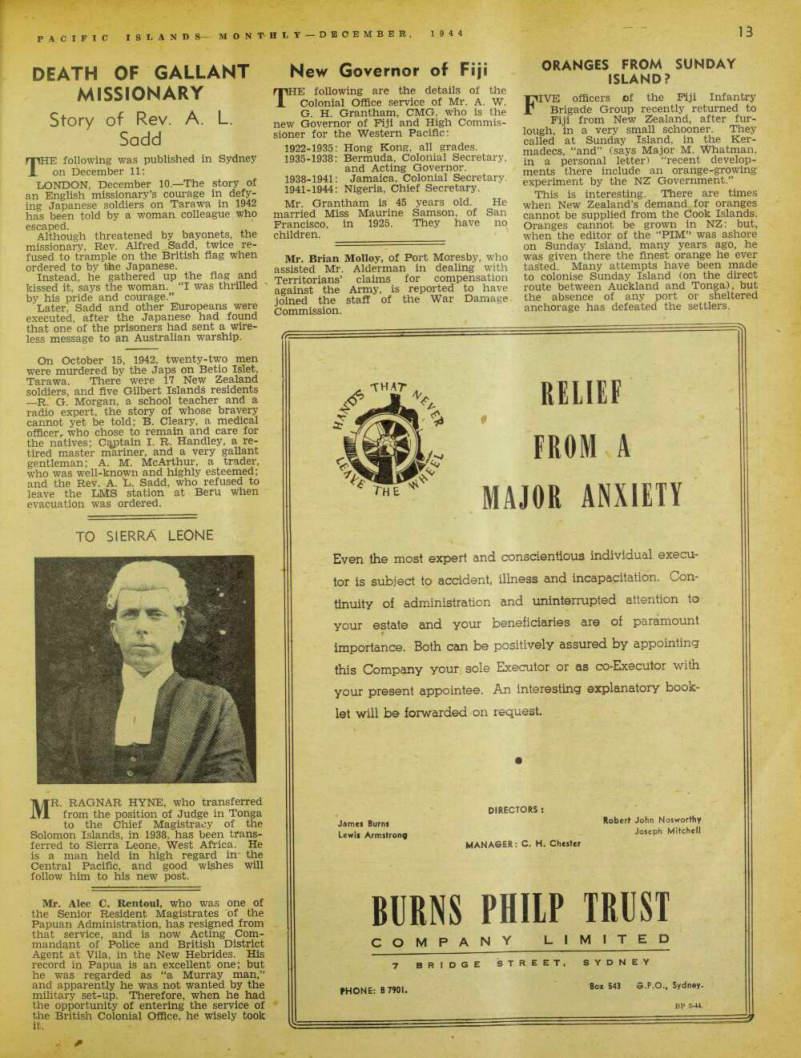
Missionary
Story of Rev. A. L.
Sadd
THE following was published in Sydney on December 11: LONDON, December 10.—The story of an English missionary’s courage in defy ing Japanese soldiers on Tarawa in 1942 has been told by a woman colleague who escaped Although threatened by bayonets, the missionary, Rev. Alfred Sadd, twice re fused to trample on the British flag when ordered to by the Japanese.
Instead, he gathered up the flag and kissed it, says the woman. “I was thrilled by his pride and courage.”
Later, Sadd and other Europeans were executed, after the Japanese had found that one of the prisoners had sent a wire less message to an Australian warship.
On October 15, 1942, twenty-two men were murdered by the Japs on Betio Islet, Tarawa. There were 17 New Zealand soldiers, and five Gilbert Islands residents —R. G. Morgan, a school teacher and a radio expert, the story of whose bravery cannot yet be told; B, Cleary, a medical officer who chose to remain and care for the natives; Captain I. R. Handley, a re tired master mariner, and a very gallant gentleman: A. M. McArthur, a trader, who was well-known and highly esteemed; and the Rev. A. L. Sadd, who refused to leave the LMS station at BerU when evacuation was ordered.
To Sierra Leone
MR. RAGNAR HYNE, who transferred from the position of Judge in Tonga to the Chief Magistracy of the Solomon Islands, in 1938, has been trans ferred to Sierra Leone, West Africa. He is a man held in high regard in the Central Pacific, and good wishes will follow him to his new post.
Mr. Alec C. Rentoul, who was one of the Senior Resident Magistrates of the Papuan Administration, has resigned from that service, and is now Acting Com mandant of Police and British District Agent at Vila, in the New Hebrides. His record in Papua is an excellent one; but he was regarded as “a Murray man,” and apparently he was not wanted by the military set-up. Therefore, when he had the opportunity of entering the service of the British Colonial Office, he wisely took it.
New Governor of Fiji
rriHE following are the details of the A Colonial Office service of Mr. A. W.
G. H. Grantham, CMG, who is the new Governor of Fiji and High Commis sioner for the Western Pacific: 1922-1935; Hong Kong, all grades. 1935-1938: Bermuda, Colonial Secretary, and Acting Governor. 1938-1941: Jamaica, Colonial Secretary. 1941-1944: Nigeria, Chief Secretary.
Mr. Grantham is 45 years old. He married Miss Maurine Samson, of San Francisco, in 1925. They have no children.
Mr. Brian Molloy, of Port Moresby, who assisted Mr. Alderman in dealing with Territorians’ claims for compensation against the Army, is reported to have joined the staff of the War Damage Commission.
Oranges From Sunday
Island?
FIVE officers of the Fiji Infantry Brigade Group recently returned to Fiji from New Zealand, after fur lough, in a very small schooner. They called at Sunday Island, in the Ker madecs, “and” (says Major M. Whatman, in a personal letter) “recent develop ments there include an orange-growing experiment by the NZ Government.”
This is interesting. There are times when New Zealand’s demand for oranges cannot be supplied from the Cook Islands.
Oranges cannot be grown in NZ: but, when the editor of the “PIM” was ashore on Sunday Island, many years ago, he was given there the finest orange he ever tasted. Many attempts have been made to colonise Sunday Island (on the direct route between Auckland and Tonga), but the absence of any port or sheltered anchorage has defeated the settlers.
A daughter was born to Captain and Mrs. E. Sutcliffe on October 28. “Ted”
Sutcliffe, up until the cessation of civil aviation in New Guinea, in January, 1942, was senior pilot of Mandated Airlines of New Guinea. At present he is Flight- Checking Officer for the Department of Civil Aviation at Parafield Aerodrome, South Australia.
Advertisements & other items, pp. 15-16 (2 items)
13
PACIFIC ISLANDS— MONTHLY DECEMBER, 1944
Burns Phiip Trust
RELIEF
FROM A
MAJOR ANXIETY
Even the most expert and conscientious individual executor is subject to accident, illness and incapacitation. Continuity of administration and uninterrupted attention to your estate and your beneficiaries are of paramount importance. Both can be positively assured by appointing this Company your sole Executor or as co-Executor with your present appointee. An interesting explanatory booklet will be forwarded on request. •
DIRECTORS :
James Burns Rober ' John Nosworthy Lewis Armstrong Jose P h Mitchefl MANAGER; C. H. Chester
BURNS PHIIP TRUST
COMPANY LIMITED
7 BRIDGE STREET. SYDNEY
PHONE: B 7901. Bo * 543 S-P-O- Sydney.
BP 5-44.
THAT"
T K‘ SV The
UNION
ASSURANCE SOCIETY LTD.
( Incorporated England)
FIRE ACCIDENT
FIJI A. E. PEARCE & CO.
RABAUL COLYER WATSON
(New Guinea) Ltd.
N. S. WALES 109 PITT STREET
SYDNEY.
S. Morrison, Mgr.
CONTROLLING OFFICE —
-413 Collins St., MELBOURNE
GEORGE W. GIDDY.
Resident Manager.
G.P.0., Box 314, Suva, Fiji.
Cable Address:
“PAREKH.”
S. P. PAREKH & BROS.
Suv g ' s Le a ding Jewellers MANUFACTURERS OF: Tortoise-shell Ware (including Necklaces, Bracelets, Hinged Watch-bands and Brooches, etc.); Silver Filigreewore, Ivoryware, Brassware, Coconut and Ebony Curios . . .
ALSO:
Tortoise-shell Ware with Silver and Cats-eyes Inlaid ALL ENQUIRIES WILL RECEIVE PROMPT ATTENTION
WESTERN SAMOA
Most Delightful Holiday Resort in Polynesia
WHY NOT SPEND THE WINTER
MONTHS AT THIS SPACIOUS AND
BEAUTIFULLY-SITUATED HOTEL?
Write for Details to MRS. ANNIE M. JONES, Proprietress The Cosmo Hotel Apia - - - Western Samoa
Reorganisation of Fijian
Affairs What it Will Mean
IN a memorandum submitted in October to the Legislative Council of Fiji as Reconstruction Paper No. 2,” Ratu J.
L. V Sukuna, Adviser on Native Affairs lr * i® Colony, sketches the proposed alterations and modifications of native administration which will be introduced shortly.
This new step in the organisation of Fijian administration is designed to develop in the people generally a keener interest in their own local government: and at the same time to give to native chiefs and leaders a deeper sense of responsibility by permitting them greater control over their own affairs. No actual change is made in the structure of the new Ordinance (other than in a change of names for various offices)—it merely gives greater scope.
In the place of the present Native Regulation Board there will be a Board consisting of the five native members of the Legislative Council, a legal adviser and the Secretary of Fijian Affairs (now called Adviser on Native Affairs) who will act as chairman.
The new Board will have administra tive duties, and will—as does the present Board—make regulations for the welfare and good of Fijians. But if the chair man considers it advisable to bring in a n regulation before the next session of the Legislative Council he is empow ered to grant provisional approval. The Board will also be the controlling finan
cial authority in Fijian administration, subject to approval by the Governor.
There will be little change in the con stitution of the Council of Chiefs, but the scope of its deliberations will be extended by the introduction of a new prmdpie, whereby Bills affecting Fijian affairs may, on the recommendation of the Board, be submitted to the Council for consideration and recommendations By this means, states Ratu Sukuna from being merely an august body that advises and passes pious resolutions, the Council (strengthened by members who have seen active service abroad) will be enabled to take an increasing part in advising on measures affecting native interests.
OTHER proposals contained in Ratu Sukuna’s memorandum were:— • Amalgamation of areas whose people have kinship affinities. • More responsibility and better pay for Bulis. • Larger and brighter villages based on the propinquity of planting grounds. • Improvement of social services—such as in establishing Provincial Hospitals, in linking child-welfare work with other Fman social organisations, in reorganis ing educational facilities, and in develop ing water supplies to villages. • Extension of markets and new indus tries bv zoning production, bv export of saleable produce and by cattle breeding • Resumption of the demarcation of land reserves—work that was interruoted by the Pacific war.
Council Of Chiefs Meet
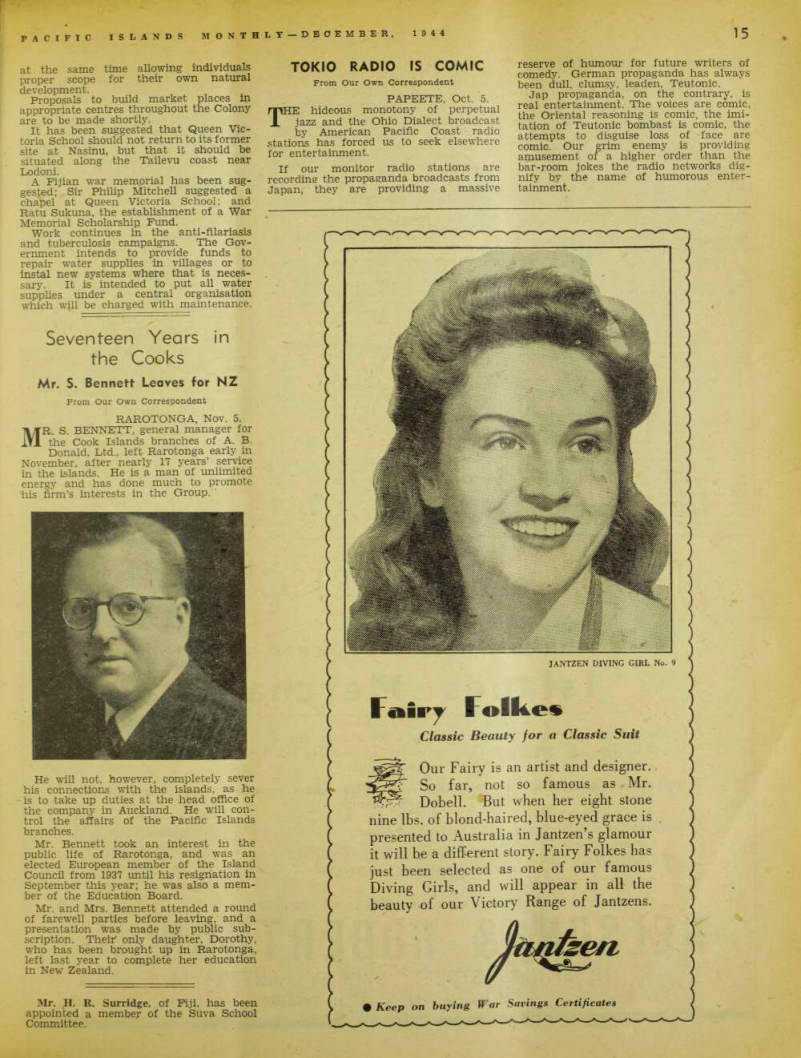
In Fiji
rE Council of Chiefs (held biennially) was opened in Fiji on November 3 by the Acting-Governor, Mr. J. F.
Nicoll. In view of the new system of native administration which is to come into oneration shortly, this Council was of narticular importance.
The Council has no legislative authority, but it makes recommendations to the Government concerning native welfare; the Governor usually attends, in state, to open and close proceedings, and from names submitted to him at this gather ing he selects the five Fijian members of the Legislative Council. In future these five members, together with the Adviser on Native Affairs, Ratu Sukuna, will form the Fijian Affairs Board, which will play an important part in the government of the Fijian people.
Points from the Acting-Governor’s speech at the opening ceremony were: Because the Government is concerned about the problem of “exempted” Fijians, certain proposals have been prepared by Ratu Sukuna, and the Chiefs were asked to give some thought to a policy which would encourage the development of village communities from within while avoiding the disruption of those com munities and ensuring that communal obligations were not too onerous and really necessary for the well-being and happiness of the people concerned, and
at the same time allowing individuals proper scope for their own natural development.
Proposals to build market places in appropriate centres throughout the Colony are to be made shortly.
It has been suggested that Queen Vic toria School should not return to its former site at Nasinu, but that it should be situated along the Tailevu coast near Lodoni.
A Fijian war memprial has been sug gested; Sir Philip Mitchell suggested a chapel at Queen Victoria School; and Ratu Sukuna, the establishment of a War Memorial Scholarship Fund.
Work continues in the anti-filariasis and tuberculosis campaigns. The Gov ernment intends to provide funds to repair water supplies in villages or to instal new systems where that is neces sary. It is intended to put all water supplies under a central organisation which will be charged with maintenance.
the Cooks
Seventeen Years in the Cooks Mr. S. Bennett Leaves for NZ
From Our Own Correspondent
Rarotonga, Nov. 5.
MR. S. BENNETT, general manager for the Cook Islands branches of A. B.
Donald, Ltd., left Rarotonga early in November, after nearly 17 years’ service in the islands. He is a man of unlimited energy and has done much to promote his firm’s interests in the Group. '
He will not, however, completely sever his connections with the islands, as he is to take up duties at the head office of the company in Auckland. He will con trol the affairs of the Pacific Islands branches.
Mr. Bennett took an interest in the public life of Rarotonga, and was an elected European member of the Island Council from 1937 until his resignation in September this year; he was also a mem ber of the Education Board.
Mr. and Mrs. Bennett attended a round of farewell parties before leaving, and a presentation was made by public sub scription. Their only daughter, Dorothy, who has been brought up in Rarotonga, left last year to complete her education in New Zealand.
Mr. H. R. Surridge, of Fiji, has been appointed a member of the Suva School Committee.
Tokio Radio Is Comic
From Our Own Correspondent
Papeete, Oct. 5.
THE hideous monotony of perpetual jazz and the Ohio Dialect broadcast by American Pacific Coast radio stations has forced us to seek elsewhere for entertainment.
If our monitor radio stations are recording the propaganda broadcasts from Japan, they are providing a massive
reserve of humour for future writers of comedy. German propaganda has always been dull, clumsy, leaden, Teutonic.
Jap propaganda, on the contrary, is real entertainment. The voices are comic, the oriental reasoning is comic, the imi- Nation of Teutonic bombast is comic, the attempts to disguise loss of face are comic* Our grim enemy is providing amusement oi a higher order than the bar-room jokes the radio networks dig nify by the name of humorous enter tainment.
Advertisements & other items, p. 17 (1 item)
Fair? Folke*
JANTZEN DIVING GIRL No. 9
Classic Beauty for a Classic Suit Our Fairy is an artist and designer.
So far, not so famous as Mr.
Dobell. But when her eight stone nine lbs. of blond-haired, blue-eyed grace is presented to Australia in Jantzen’s glamour it will be a different story. Fairy Folkes has just been selected as one of our famous Diving Girls, and will appear in all the beauty of our Victory Range of Jantzens.
*sen
• Keep on buying War Savings Certificates
N. Zealand Wants
Bananas!
Prices Defended by Government
NEW Zealanders appear to have become acutely banana-conscious in the last three years. . One mention of this fruit is sufficient to send Dominion newspapers into a heated campaign on banana supplies, lack of banana supplies and banana prices.
Recent mention by a Fiji resident at a Rotary luncheon in Nelson, NZ, that there were abundant supplies of bananas in Fiji only waiting shipping space to the Dominion, reopened the subject and sent everyone into wild argument.
A message from Fiji, on November 16, should settle the Fijian end of the problem: “A recent shipment to Auckland was said to be the smallest ever sent, the reason being that no more bananas were available. As in New Zealand and else where, the calling up of manpower to serve in the armed forces and to work on military construction, had its inevitable effect on production.
Overseas troops also spent money ireely on native mats and curios, and in many native villages' life for those left at home suddenly became much more comfortable and convenient. No longer was there the same incentive to cultivate the land, and the result is to be seen to-day in a considerable decrease in native food production. ‘ln Suva, where bananas grow in any backyard, the retail price is 12 for sixpence. This does not indicate any great abundance.
“The situation will improve as men are released from the Army and the general demand for labour declines.”
NZ Retail Prices Defended
NEW Zealand consumers and Island growers who have been howling about the disparity in prices paid by the one and to the other should be reassured by the following statement made by the New Zealand Minister of Marketing (Mr. Roberts) on November iu I “In the first place,” he said, “it has been stated that the Marketing Division pays 5/- a case for bananas in the Islands. The facts are that the Division pays the following prices f.o.b. Island ports: Samoa, 12/9 a case; Fiji, 12/4* (New Zealand currency); and Tonga", 12/1. These are the prices which are determined between the Division and the selling authorities in the various islands.
“It is quite well known that, with the Pacific war, the availability of shipping for bananas and oranges is at a mini mum, but the Division does import into New Zealand every case of bananas that it is possible to procure from the Islands. It is also a fact that the only shipping point of import for bananas is Auckland, and if other parts of New
Zealand are to have a share of the now reduced supplies, the Division has to incur heavy costs in distributing the fruit toverca P rg r m CaPita baS *' 33 far S ° Uth as “Not only are the costs heavy, but owing to transport conditions, decay and depreciation of the fruit are unavoidable all of which is a cost to the Division!
Actually, the mto-store costs at the main centres, apart from the distribution in ???i n . try m areas > Auckland: Fijian, wm’ , Ton gan, 18/-; Samoan, 18/9.
Wellington: 20/11, 21/9, 21/9. Christ- ’ 24/3 ’ 25/ '- Dunedin: 26/-, “The wholesale price at all these centres is 25/-, except in Dunedin, where 25 / 6 for ? 9 ase of approximately lb. of green fruit.
“Prom this summary it will be seen that, in order to implement the policy of sharmg fruit equally to all parts of New Zealand, the price of 25/- a case (wnich is a maximum one only) does not leave any undue margin for the Division.” ¥ rs * **: T G - Morton have arrived in Sydney from New Guinea. Mrs. Mor superintendent of nursing staff in the Territories, has had four years pLf C °?/r mU u US service, extending from Moresby to Lae, whence she was flown for medical attention and a well earned rest. Sergeant Harvey Morton one of the first group to enlist in Papua bemg P 7) in 1939, has served m Syria, Palestine, Egypt and Libya. On to Australia he resumed his old P°st as manager of; Doa Estate, in Papua.
The Tittlo lady did a wonderful job in New Guinea,” writes a Territorian “When I left Port Moresby, in 1942, Jap ‘pin?
Rouna^ Ilmg aU around her camp P at
Advertisements & other items, p. 18 (1 item)
Nelson & Robertson
PACIFIC ISLANDS SOCIETY
Visitors from the Islands to Sydney (or those interested In Islands affairs), are advised to communicate with the honorary secretary of the above Society, which has been formed to study the history, traditions, economics, and political developments of the Pacific Islands.
Regular monthly meetings are held at History House, 8 Young Street, Sydney.
Address for Correspondence:
THE PACIFIC ISLANDS SOCIETY
Box 2434 MM., G.P.0., Sydney.
NELSON and ROBERTSON Pty. Ltd.
Established 1895
Shipowners - Brokers and
Islands Merchants
to'lsland Clienfs rCh c n o d R purcha * ed at D Wholesale Prices. Original Invoices supplied Uients. Cocoa Beans, Copra, Rubber, Trochus Shell and All Islands' Produce Sold on Commission.
Entrust your requirements to the firm with fifty years' practical experience in the Pacific Islands. represented in all parts of
THE WORLD.
Sole Agents :
SKANDIA DIESEL ENGINES
ARCHIMEDES MOTORS
Prompt attention given to all enquiries.
OVERSEA INDENTS
ARRANGED FOR
CLIENTS.
NELSON & ROBERTSON
12 SPRING STREET, SYDNEY, AUSTRALIA
Telegraphic Address: IVAN, SYDNEY.
PTY.
LTD.
The Story of Corporal Sefanaia, V.C.
Suva, Nov. 3.
YINAKA! Vinaka! Vinaka Voka Levu!” shouted the assembled chiefs. A deep’ murmur, swelling to a roar of delight swept through the crowd of Fijian onlookers.
It was the opening session of the Council of Chiefs, 1 and the Governor of Fiji had just made the dramatic announcement that the King had awarded the Victoria Cross to a Fijian soldier, the late Corporal Sefanaia Sukanaivalu.
“You will be aware that there is one decoration which is the highest and rarest to which any sailor, soldier, or airman in the British forces can aspire,” said his Excellency. “It is the Victoria Cross.
“Nothing but the merit of con spicuous bravery can give claim to this decoration, and that merit must be evinced by some ‘signal act of valour’ performed ‘in the presence of the enemy..’
“Very proud is any regiment upon one of whose members this much prized honour is bestowed. Very proud is any British territory, one of whose sons has earned the right to wear it. This supreme accolade has now been bestowed upon a Fijian soldier.”
The announcement of the award could not have come at a more appro priate time. The colourful ceremony of the Council of Chiefs was the best possible setting for such an occasion, rpo-DAY was one of real rejoicing i. in Fiji—the only shadow over the peoples’ joy being that Corporal Sefanaia is not here to receive the tributes that would have been so liberally heaped upon him. For Cor poral Sefanaia gave his life in carry ing out the gallant act which earned this cherished award. Here is the story as it was published in the citation: “On June 23, 1944, at Mawaraka, Bou gainville, in the Northern Solomons, Corporal Sefanaia Sukanaivalu crawled forward to rescue men who had been wounded when their platoon was am bushed and some leading elements had become casualties.
“After two wounded men had been successfully recovered, this NCO, who was' in command of the rear section, volun teered to go on further, alone, to try to rescue another one, in spite of machine gun and mortar fire, but on the way back he himself was seriously wounded in the groin and thigh and fell to the ground, unable to move.
“Several attempts were made Xo rescue Corporal Sefanaia but without success, owing to heavy firing encountered on each occasion, and further casualties Cctuscd “This gallant NCO then called to his men not to try and get to him as he was in a very exposed position, but they replied that they would never leave him to fall into the hands of the enemy alive.
“Realising that his men would ’ not withdraw as long- as they could see he was alive, and knowing that they were all in danger of being killed or captured as long as they remained where they were, Corporal Sefanaia, well aware of the consequences, raised himself up in
front of the Japanese machine-gun and was riddled with bullets.
“This brave Fiji soldier, after rescuing two wounded men with the greatest heroism, and being gravely wounded him self, deliberately sacrificed his own life because he knew that it was the only way in which the remainder of his platoon could be induced to retire from a situa tion in which they ijiust have been anni hilated had they not withdrawn.”
THE action in which Corporal Sef anaia won his Victoria Cross has been described as a little Dun kirk. The battalion, supported by American artillery and engineers, landed on the coast of Bougainville, outside the Empress Augusta Bay perimeter defences, and cautiously edged forward towards the road which was its first objective.
Strong opposition was encountered and. towards evening, on the second day, it was decided to withdraw by sea, as the principal tasks had been carried out. Landing craft were called in and the companies near the beach disengaged fairly easily.
“A” Company, commanded by Major R. Stevens, of Christchurch, was further inland. The company had suffered casualties and needed help, to get in dead and wounded lying in front. Two patoons—all that could be deployed on the swampy restricted front —went forward. More men were lost. before “E” Company and rein forcements eventually disengaged and
reached the beach. An officer, des cribing the scene, said: “They came out with all their arms, some walking wounded, others stag gering along as they helped one an other, some wounded carried on another man's back. There was no hurry or rush.”
By the time they were on board and the beach-head troops were being embarked, Japanese bullets were sweeping the beach, but the with drawal remained orderly.
“The whole operation showed the Fijian in an entirely new light,” said Lieut.-Colonel Voelcker, afterwards.
“We knew that they were good in the jungle with plenty of room to man oeuvre, and cover to use for surprise and ambush, but here we had them behaving like Guardsmen on an open beach, under a hail of fire, and never a man flinched from his duty.”
IT is a sadly ironic fact that Corporal Sefanaia’s second name, Suka naivalu, means “Returned from the war.” He was born in Fiji, in 1919, at about the time that the Fiji Labour Corps of the last war returned from France and Italy, and this suggested the name to his parents. This was mentioned by the Governor, who elo quently voiced the feelings of the people of Fiji when he said: “It is tragic irony that Sefanaia’s second name should mean ‘Returned from the war.’ • Corporal Sefanaia will not return. He will never stand at attention at Buckingham Palace in London while the Victoria Cross is pinned on fiis tunic by the King.
“He will never hear from your lips or mine how proud we are that these islands should have produced a soldier whose name will live forever in the annals of martial heroism. But we shall remember and honour his name as long as we live; and, after we are gone, it will be remembered and honoured by our children. All over the Empire to-day, all over the free world, the story of Sefanaia is being broadcast from hundreds of radio stations.
“In this story of gallantry and supreme self-sacrifice, our Allies and our friends will see epitomised the courage and devotion of our fighting men and the intense loyalty of the race which reared them.”
Advertisements & other items, pp. 19-20 (2 items)
Tomorrow
QUEENSLAND
INSURANCE
COMPANY
LIMITED
(Incorporated 1886 in Australia)
ASSETS EXCEED £3,500,000
Head Office:
PITT & BRIDGE STS.,
SYDNEY
Specialists in South Seas Fire,
Marine & Accident Insurances
Apply to: —
FIJI.
Branch Office; H. J. Moorhouse, Manager.
Burns Philp (South Sea) Co., Ltd,
VILA.
Burns Philp (South Sea) Co., Ltd.
Comptoirs Francais Des Nouvelles Hebrides (Marine).
NOUMEA.
L. & W. Johnston.
PAGO PAGO.
Burns Philp (South Sea) Co., Ltd.
G. H. C. Reid & Co.
OTHER SOUTH SEA ISLANDS.
Burns Philp (South Sea) Co., Ltd.
Also to any of the Company’s Offices in Australia or New Zealand.
Coleman Stove of
TOMORROW
MODEL 520
BURNS ANY TYPE
OF GASOLINE (PETROL)
• Built for tough Army use, Colemlan’s new Model 520 Stove will be a real sensation when it comes to you right after the war. Requires no priming, burns any kind of gasoline (petrol), is always safe and lights instantly even in sub-zero weather. Only inches high,yet boils a pint of water in 4 to 5 minutes. • Folds into compact cylinder cone . . . light and, easy to carry.
TORONTO
CANADA
THE COLEMAN LAMP & STOVE CO., CHICAGO, ILL., U.S.A.
Modern Refrigeration for the South Sea Islands
The ELECTROLUX kerosene operated
REFRIGERATOR
MARVEL
OF
MODERN
SCIENCE
THE
MIRACLE
OF
ICE
FROM
HEAT
slLE'.w f ROLUX OFFERS ECONOMICAL, MODERN AND COMPLETELY EFFICIENT REFRIGERATION FOR ISLANDS' HOMES C ' ENT
FREEZES CONTINUOUSLY WHILE SMALL LAMP BURNS
Freezing controlled by simply regulating height of flame. n „, nnlv j uses only gallon of kerosene per week MOTORLESS ... NO PARTS TO GET OUT OF ORDER.
MO S5 Br L22 model L3BO MODEL LKSSO °* P * C| * T • (as Illustrated) * “ 4 «*• M eu«c
GUARANTEED FOR TWO YEARS.
* Write to your Local Distributor for prices and full details.
OBTAINABLE FROM ALL W. R, CARPENTER & CO. LTD.
BRANCHES THROUGHOUT THE ISLANDS
Representation in Papua and New Hebrides.
18
DECEMBER. 19 4 4 ISLANDS MONTHLY
Tonkinese Barber
Murdered
From Our Own Correspondent
Noumea, Nov. 23.
ONE evening recently a cry of “Help” from a small shop on Noumea’is market place led a native Custom house employee to investigate. He broke in and found the shopkeeper, an old and well-esteemed Tonkinese trader and barber named Vu Ngoc Tuan (he has more than once cut your correspondent’s hair), lying in a pool of blood, with a long knife sticking out of his back. Vu Ngoc Tuan died later in hospital.
Two youths were later arrested; they admitted that their motive had been robbery, and one, Paul Jean, confessed to the murder.
Distinguished Chinese Arrives in Tahiti
Tahiti
From Our Own Correspondent
Papeete, Oct. 1.
WE cannrt comprehend why China, in the midst of a devastating war. attaches so much importance to this outpost of its Empire, that it has sent one of its most distinguished officials to Papeete with the rank of Consul-General.
Are Hawaii and Tahiti the spearheads of a pincer strategy directed at the Western Hemisphere? When China shall have gained a commanding place in the post-war world, will these spearheads become advance posts of subtle infiltra tion into the Americas?
Fine Record Of Makogai
IT was to the credit of the Makogai (Fiji) leper station that since its establishment, 33 years ago, no nurs ing sister had contracted leprosy, said Mr.
P. J. Twomey, of the Leper Trust Board, Christchurch, in a statement on the station on October 13. It was that achievement, coupled with the large pro portion of cures effected, numbering about one in every four patients, which had made Makogai known as one of the best leper stations in the world.
A “garden fete” was held at Bishop court, Newcastle, in November, to raise funds to rebuild the Buna and Gona Anglican Mission Stations in Papua.
Advertisements & other items, p. 21 (1 item)
Victoria
/z
BITTER
o
BREWED BY
CARLTON & UNITED BREWERIES LTD.
v.i
Are They to Be
Forgotten Men?
Papua's Pre-1942 Volunteers
Letter to the Editor WHY all. this talk of ANGAU and its future?
It seems to me that, as far as the Ter ritory of Papua is concerned, if and when the Civil Administration, under Leonard Murray, is re-established, that all the men of ANGAU who were not in the former Government before 1942 should not be considered until all former mem bers of the Service are placed in the higher positions.
What of the men who volunteered and were away at the war before the conscrip tion (no other word will do) of early 1942?
And also what of the many fine non- Government residents of the Territory men with years of experience in dealing with natives—perhaps some of them will want the security of a good job in the Gpvernment? What little of native ad ministration these volunteers have missed is more than amply offset by their service abroad. Up to date, everybody is worry ing about what will happen to planters and other ex-residents of the Territory, but, so far, I have not heard anyone raise his voice championing the cause of Ter ritorial in the Navy, AIF and RAAF I hope these volunteers do not become a Legion of Forgotten Men.” a these men are senior to ANGAU personnel, who have had. as it were, “greatness thrust upon them.”
When the volunteers (first preference) and the- volunteer ex-residents who hap pened not to be in the Government (sec ond preference), followed by the Service me? m I AI JGAU, are suitably placed, then and only then, will it be time to appoint
outsiders. No doubt, owing to the many retirements, there, will be some vacancies and I feel sure that Leonard Murray, with experience in judging and con trolling staff, will be able to sort out all comers and satisfactorily work out his luture staff. The men on whose behalf I am writ;ng this will, fortunately, not have to unlearn the bad habits of Army waste and Army over-staffing, such as now exists in ANGAU.
WHAT we will do with Papua after the war will be largely dependent on the generosity of the particular political party in power then, and such parties as come along later. It is very easy now to talk glibly of super-education and a “New Deal for the Fuzzy Wuzzy Angels.” Talk .if cheap. When education and action have to be paid for it will be a very dif ferent story! I have read my Kipling, and it is to be hoped that the “chuck “im out the brute 1 ’ attitude towards the ex-‘ saviour of his country” will apply neither to the best of our men—the up to-date forgotten volunteers—or to the natives themselves. ANGAU is only a fleeting shadow with no real substance. , and should be forgotten the day Civil Government resumes. At the best.
ANGAU is only a temporary expedient.
I am, etc.,
Papua.
Onlooker.
Nov. 14, 1944.
Air-Mail To W. Samoa
From Our Own Correspondent A GREAT boon has come to Western Samoa with the establishment of a regular weekly air-mail service be tween the Territory and New Zealand.
Mail planes are to carry first-class mail matter only, at ordinary postage rates.
In Commemoration Of
Rls
ON the evening of December 3, 1894, Lloyd Osbourne was to be seen galloping bare-headed into Apia from Vaihma, and doctors rushed to make un availing efforts to save the life of the rrn?S^S US u R °, Louis Stevenson Wll ° dled o’clock that This year we commemorate, the 50th H nn 1 1 i Ve i sa fZ of the death of he who K 1 ed nf the world—and still enthrals hosts of people—with “Treasure Island”
Kidnapped,” “Dr. Jekyl and Mr. Hyde ” and other of his well-known books. - gr J7 e ’ hi § :h on the steep hill of Vaea, is the scene of many a pilgrimage It was his “lookout”—a spot to inspire r?Z° ne ‘ J isit a few weeks ago on a clear coohsh morning found it a most fh^rii^Lnf 8 ' 06 ’ With J he air 50 clear that distant ranges stood sharply defined and the sea below a silver sheet.
Qc S i e^? SOn u d P es not a PP ear particularly a * a chm; c hy” man, but there can be no aoubt that his prayers inspired by his surroundings were and are real ° ne S rea t event that will com memorate his memory in Apia will be the laying by the Administrator, the Hon.
A f fS’ Turnball > o f the foundation stone of the new church in the Anglican Chap laincy grounds, immediately below his resting place, on December 3, 1944.
The opportunity is being given to those who have enjoyed the good fellowship of Robert Louis Stevenson through his books to contribute to this building, which does honour to him in a most practical way.
Two committees have been formed in Apia to work for the ‘building. Mr A G Smythe is chairman of the Finance Com mittee, and Mr. J. W. Liston is treasurer. (Domtions should be sent to the RLS Church Building Committee, c/o The Chaplaincy, Western Samoa).—C.W W A
Advertisements & other items, p. 22 (2 items)
20
DECEMBER, i944-P A C I F I C ISLANDS MONTHLY
90 Years
S WALLOW £ All! LL im.
■ *«m if aiseiiTt . n,a poodibcs . cans . moe • icf eicai
Progress in Rarotonga
From Our Own Correspondent
Rarotonga, Nov. 5.
RAROTONGA’S civil air-port is almost completed. And, like so many other Pacific Islanders, the Rarotongans have been thrilled by the spectacle of the michty earth-moving machines tumbling over coconut trees like ninepins clearing bush as though by the sweep of a giant hand, and moving mountains into h °lngenious Rarotongan schoolboys have turned from making models of bombers and warships to the construction of working-model bulldozers and ditch-dig gers. There is no doubt whatever that, to the easy-going Islander, the sight of these mechanical monsters performing miracles of man-saving labour at the hands of a single casual white man, has done much to enhance the prestige of their British and American protectors We can only hope that, when the tumult and the fighting are oyer, our political leaders will do all in their power to nurture the seeds of admiration and respect that our fighting men and civil constructors have sown in the hearts of the Pacific peoples.
Naturally, a great subject for specula tion among Cook Islanders, at present, is just what part the air-port will play in the future economic affairs of the Group.
The chief construction engineer, in the course of a vote of thanks at a recent fish-drive, feast and dance, organised by the paramount chieftainess. Mrs. Love, in honour of himself and his men said: “Our job was to build you a cmi air nort, but what its future uses will be I cannot sav: that will be for others to decide. There is no doubt that the con struction of an air-strin will contribute to the future prosperity of the Cook Islands. The agricultural possibilities of the Gronn are unlimited, and I see no reason whv the attractions of your islands should not bring a considerable tourist traffic after the war.”
WITH the air-strip almost finished, the Public Works Department has diverted some of their heavy mach inery to the preparation of the site for the new tubercular sanatorium, some details of which have already been pub lished in the “PIM.” .
An approach road has been made, wind ing first through bushland and then the steep fern-clad hills to an elevation of 250 feet, where the site has been levelled.
The choice of site is a happy one; there is a magnificent view; the open hill is ‘swept by the ocean breezes but sheltered from the colder winds by the towering mountains behind.
It is expected that the work of erecting the sanatorium buildings will take about five months.
A GOOD job just completed is the cut ting of a ditch out through the waterfront road to drain the low lying area occupied by the shacks of the Manihiki settlement, at the back of Avarua which, during heavy rains, usually became deeply flooded.
At long last, tpo, an electric lighting plant has been installed in the Rarotonga General Hospital. Up to the present, benzine and kerosene lamps have been the only methgd of illumination. Primus stoves were used for water-heating and sterilisation. With such primitive eouip ment, emergency operations, particularly at night, were often a trying task for the staff.
These improvements to Rarotonga liv ing conditions have already been accom plished—it is understood, as well, that the main coastal road and bridges are to
receive attention when some of the more important projects are completed. But residents earnestly hope that something will also be done to improve the drink ing-water system, which has been a mat ter of protest for many years. It is the general opinion that much ill-health is caused by the impurity of the water—a fact freely admitted by the medical staff.
During rainy weather domestic taps sup ply a rich brown liquid which looks like coffee but completely lacks that flavour.
This project is possibly already under consideration.
When Sir Philip Mitchell became Gov ernor of Fiji, some two years ago, he bought the beautiful little yacht, “Cimba,” re-conditioned her, re-named her “Blue bell,” and sailed her frequently in Fijian water. Sir Philip Mitchell, on his depar ture, sold her to Mr. Gordon F. Russell, of Suva, and he has restored her name to “Cimba.”
Wedding Of Interest To
Papuan Residents
AT the Raglan Street, Presbyterian Church, Manly, NSW, on September 30, Miss Elma McDonnell Brown, eldest daughter of Mr. and Mrs. Athol R. Brown, well-known residents of Papua, was married to Mr. Alfred Glen Gersh, of the Royal Australian Navy.
After the ceremony, guests, many of whom were Papuan residents, were enter tained at the Manly home of the bride’s parents.
Mr. A. R. Brown is now Corporal Brown, of the RAAF. He is at present stationed at Parkes, NSW.
The Rev. Emlyn Jones, of the LMS, arrived in Sydney in October, en route to the Gilbert Islands. He was formerly resident in England.
Advertisements & other items, p. 23 (1 item)
Again §
Insist upon
GENUINE
★ 9
Again §
available in•,
generous quantities
Do Not Accept Inferior Substitutes Write now to Foster Clark (Aust.) Ltd., Dept.
R. 8., Redfern, NSW., for a copy of their handy recipe book. Enclose 2\d. for postage.
FOSTER CLARK’S
014^11'#If £ PoJWd/
The Morris Hedstrom
Scholarship
IN order that the selected Fijian student may commence at the New Zealand University at the beginning of the next academic year (March, 1945), the directors of Morris Hedstrom, Limited, of Fiji, who recently established a £25,000 scholarship fund, are inviting applications immediately.
The drawing up of the trust deed and formalising the rules for the scholarship will take some time to complete, but until such time as these trust funds can be used, Morris Hedstrom, Ltd., in a new and separate gift, will provide for the expenses of the successful candidate.
This year the scholarship winner will be selected by a committee consisting of one member nominated by the Acting- Governor and two members nominated by Morris, Hedstrom, Ltd. Later, it is ex
pected, that selection will be made by some body appointed under terms yet to be drafted.
The Rev. M. A. Warren, secretary of the Anglican Mission, recently returned from a visit to mission stations in New Guinea. It is understood that plans for reconstructional work are well advanced.
Miss A. V. Pigott, who was attached to the Anglican Mission staff, in Papua, in a clerical capacity before the war, has been serving as a Section-Officer in the WAAAF. She has now been granted a discharge, and will return to work with the mission.
From information received by Burns Philp and Company (by whom he was employed) it now appears certain that Mr. John Lawson Levien, formerly man ager of Linderhafen Plantation, New Britain, died there some time after the Japanese occupation.
Telegraph
Noumea's "Coconut Telegraph Saito and the American Treasure
Prom Our Own Correspondent T ul , , NOUMEA, Nov. 14.
HE French word “canard” means (1) a duck; (2) a piece of sugar dipped in coffee or brandy; or (3) an item of bogus news.
When one uses the word in New Cale donia it usually has the third meaning There is no place in the world where rumours with so little foundation in fact spread, or where the “coconut telegraph” does its work so quickly and inaccurately Some Governors have had to issue public gumbmty 8 condemning the Population’s Monday seems to be a day when people are particularly susceptible to rumours.
At least it was on a recent Monday that Saiko, a native of Lifou, in the Loyalty Group, told another native of his “dis covery” of a large sum of American money all in fifty dollar bills—in an iron wa shed up on the beach of the little isle named Mathieu in the vicinity of Noumea. (Later, other islands were also mentioned as possibilities, but th°se realty in the know were sure it was Mathieu.) This is the sort v of “wishful thinking” news that always runs fastest, and before long the whole town was talking about this sensational find. People were saying that Poor honest Saito had turned over the find to the Commissioner of Police who had only given him 25 francs reward!
J^ S ’fv? hey held ’ was a P erfect scandal, and there was a general howl of indig liness 11 omndss * oner>s niggard- By Tuesday morning the story was all ?! e p r the but, whereas in Noumea, the really well-informed said the find LTnortl? iM 70 ’ 000 ’ at ° ue S° a in the far north, it had grown to $270,000.
BY this time the French and American police were looking around for Saito Eventually, the French sleuths ran him to earth, and led him trembling to their police station, where he was told the reason for his arrest, and was ordered to answer questions about his famous dis covery. 4 ft + t r . some hesitation, he con fessed that this had only existed in his imagination. He had told the story to amuse himself and to “couillonner,” or hoax, a native child, who had spread the i ot ? er Uf()u b °ys until they SITO.OOo'or ?270,000 nljr s7 °’ oo °’
His explanation gave the “agents” a good laugh and finally they released him << h .„ a caution and his promise not to couillonner” anybody again.
Unsuspected Treasure
Prom Our Own Correspondent
Papeete, Oct. 5
THE owner of the Robin and Martigny mansions, on Tahiti, has come upon another bit of good fortune After pulling down the Robin house and finding there an unsuspected trea sure—as related in the April “PIM” he set about repairing the old Martigny mansion, nearby. When the carpenters removed the roof, there lay disclosed a second treasure-trove.
During 80 years, the sea and land birds that had found entrance under the eaves into the attic, had deposited there a thick layer of guano. Two tons of this valuable fertiliser were recovered and dis posed of to gardeners about Tahiti.
Advertisements & other items, p. 24 (1 item)
A. B. Donald Ltd.
AUCKLAND
ISLAND TRADERS & GENERAL MERCHANTS
f 0 Box ]so9 * Cables Cr Telegrams, “Kingdom", Auckland.
C H I V Nt »
PURE
FOODS
GOLD MEDAL JAMS
CANNED ENGLISH FRUITS
CANNED ENGLISH
VEGETABLES
CUSTARD POWDER
OLD ENGLISH MARMALADE
JELLY CRYSTALS, ETC.
Chivers and ‘ ' * ' WrKe •» Department A., on, Cambridge, England, for attractive Recipe Book.
Obtainable from all Leading Grocer, Stores, E. 76.
Brotosj Expert PlansNew Planting Policy for
British-Pacific TERritorries How Land and Agriculture Can be Tied Up With Help for Native Races
\ LTHOUGH Dr. C. Y. Shephard went A to Fiji about April, 1944 to report on the dispute between the GSR Co. and Indian sugar-growers, for the British Government, he has been doing other work for the Colony itself, and in October he submitted a report on what he considers should be the agricultural policy r°nmon 5 fn^hefuture 11 8 C Shenh is clrnegie Professor of Fpmnmt?in d the Imperial College of
?mm ? cal ARricultSe Trinidad
H?s reoort and recommendations cover ■Piii RSI the Gilbert and Ellice Islands, and Tonga and it comes within the scope nf Fiii’s Reconstruction programme. It is and lengthy report A summary of Dr Shephard’s recommendations is as fniinwq-
lonows -
ADVISORY and extension work carried out by the Department of Agriculture should be based on the results of scientifically conducted experiments.
The Department of Agriculture should embrace the territories of the Western Pacific High Commissioner, in addition to the Colony of Fiji. These territories should contribute to the maintenance of the headquarters staff, which would include a Director of Agriculture, an Assistant Director of Agriculture, a soil chemist, an entomologist, a.plant.breeder offlcers Path ° S The ', C ° St o 0 U 0 e C n a ded e tho“ n tml
bv' "the y administrations concerned, but
officers should be liable for transfer within
Fiji and the other territorial groups.
The Imperial College of Tropical Agri culture should be invited to conduct, at an early date, a scientific survey of agri cultural problems in the Western Pacific and to advise on a programme of agri cultural investigation.
Improved salary scales are recom mended.
The agricultural training of youths as peasant farmers in Fiji should be under taken by the Department of Education.
The training of subordinate field staff of the Department of Agriculture and of the Native Administrations, and also the training in agriculture of rural teachers, should fie undertaken by the Department of Agriculture. The training of Depart mental staff should be centred in Fiji.
The policy of the Department of Agri culture should be closely co-ordinated with that of the administration of the territory concerned.' The Imperial College of Tropical Agri culture should be invited to undertake a soils reconnaissance survey of the*major islands in Fiji and the Western Pacific High Commission territories.
A soils chemist should be permanently appointed to the headquarters staff of the Department of Agriculture.
The possibility of the re-establishment of the cocoa industry in Fiji and its extension to the British Solomon Islands Protectorate and Tonga should be thor oughly examined, and the introduction of selections from Trinidad should be pro ceeded with.
The Department of Agriculture, Fiji, should be relieved of certain of its pre
sent executive functions in order to make possible the greater application of avail able staff and facilities to investigation.
The services of a statistician should be secured to advise on the collection and compilation of agricultural statistics in Fiji.
Two principal and four subsidiary ex periment stations are required in Fiji, three in the British Solomon Islands Pro tectorate, and one station each in the Gilbert and Ellice Islands Colony and Tonga. The investigational work on these stations should be co-ordinated to avoid unnecessary duplication of effort.
The headquarters staff of the Director of Agriculture should be transferred from Suva to the principal experiment station in eastern Viti Levu.
The Colonial Sugar Refining Company Limited, should continue to be responsible for advisory and extension work amongst cane farmers in Fiji. Similar work amongst native farmers throughout the four Groups should be carried out through existing native administrative organisa tions.
The Native Lands Trust Board (of Fiji) should be provided with the requi site staff and means to manage lands entrusted to its care to secure (i) the eli mination of speculations in leases, (ii) greater security of tenure for worthy tenants, (iii) the eviction of tenants who abuse land, (iv) the active participation of the Board in the development and management of land, and (v) the con solidation of sub-divided holdings into farms of economic size.
The proposed Land Agent of the Native Land Trust Board and Assistant Land Agents should be sent to the United Kingdom for training in estate manage ment and should visit Porto Rico to study soil conservation methods.
Advertisements & other items, p. 25 (1 item)
Gibson’S
TRY IT ... . YOU’LL LIKE IT!
f
GREEN LABEL
TEA
* * i 1 Blended and packed by— J. A. D. GIBSON & CO. LTD. i 364 KENT STREET, SYDNEY. 'Phone: M 2328. )> Also GIBSON'S GREEN LABEL COFFEE and COFFEE ESSENCE
Missionary-Layman
Friction
Letter to the Editor IHAVE read many articles in the “PIM” dealing with the relations between missionaries on the one hand, and planters, miners, recruiters and Governmental officials on the other. To anyone who had not been to the South Seas, it no doubt appears that there is a great deal of friction and ill-will between the two groups.
During the 5J years that I spent in New Guinea, I might say that I never met a planter, miner, recruiter or Gov-’ eminent official whom I did not like, although we sometimes disagreed. We missionaries should visit our planter and
miner neighbours and not rely on native gossip concerning their activities. They in turn should get) first-hand information regarding the, work of us missionaries by ■visiting our stations, schools and religious services. Criticising from afar off cer tainly will never make for understanding and goodwill.
I am, etc.,
Nebraska, USA.
Sept. 18, 1944.
A.C. Frerichs.
Quinine, which is used in every mission hospital in the treatment of malaria, used to cost 18/- a lb. During the first two years of war it rose to £4/4/-. Now the latest news from India says the present jmee ip £9 a lb.—“ Australian Christian
Who Are The Exploiters?
Letter to the Editor MUCH is heard of the exploitation of the native by the planting and com mercial interests in New Guinea, but very little of the very real exploitation by the Administration—both directly and indirectly.
To illustrate a few examples of the latter: Firstly, tobacco. The native, through high customs duty, has to pay at least 9d. for 10 cigarettes. His brother worker in Java, Malaya. India, etc.—where wages are approximately the same—could get 20 cigarettes for under 2d. And to ensure that the native acquires a taste for the imported made-up tobacco, it is—as with imported rice—obligatory for the em ployer to issue this to his indentured labourers, instead of the local tobacco.
The Administration also insists that every male native wears a cotton lava lava (loin cloth), and the female a blouse and lava-lava when they are in the vicinity of an administrative centre (The Government collects 10 per cent, import duty on these cloths.) But it is in regard to land transactions that the worst exploitation occurs In order to “nrotect” the native, purchasers are not allowed to deal direct, but the transaction must be put through the Dis trict Office. The Administration then buys the land from the native and leases it to the would-be purchaser. We were desirous of acquiring two small areas of land, each about one hectare in extent, adjoining our .plantation. Besides the two 10/- application fees, we were re quired to pay the sum of 10 guineas, and then a minimum rental of 1/3 ner hec tare ner annum. Out of all these amounts, the native received 5/- for his freehold.
Another instance is in regard to trad ing station leases. If the native is will ing to lease the ground, we nay the Adynfrustration 11 guineas per ' annum, which includes licence fees of four guineas. The native gets £2/10/-.
I think, as exploiters, planters do not rank very highly.
I am. etc.,
Sydney.
R. C. Willmott.
Rarotonga Baby Show
Prom Our Own Correspondent
Rarotonga, Nov. 5.
A PUBLIC holiday was declared for the annual Baby Show (Maori), in Raro tonga, on October 25.
There was a large gathering in the school grounds to witness the judging and presentation of prizes, and the sporting events arranged for the welfare workers. The judges had a long and difficult task in selecting the champion baby and prize-winners for the various classes. The Resident Commissioner, Mr.
W. Tailby, presided, and Mrs. Tailby pre sented the prizes, and a happy and friendly atmosphere prevailed throughout the >day’s proceedings.
No one who has the well-being of the Polynesian race at heart can fail to appreciate the splendid work being done t>v the members of the Rarotonga Child Welfare’ Association; or, above all, to applaud the vision and guidance of its founder, Dr. E. P. Ellison. It is no easy task to instil the principles of modern mothercraft into a people so recently emerged—or still emerging—from the customs and superstitions of a stone-age existence.
Certainly there was no suggestion of stone-age apparent in this gathering of neatly-dressed Polynesian mothers, and their equally clean, neatly-dressed and
healthy-looking babies.
Advertisements & other items, p. 26 (1 item)
Marys
GILLESPIE’S
The Flour wem
MASK
of the Islands
- SYD NEY -
AUNT
MARYS
BAKING POWDER
espedQllv - tAft e: Q "' uality is worth waiting for" maintains th!f W' S A V nt M Bakin 3 Powder, which over 70 years qUa lty which has stood the test for
My South Seas Christmases
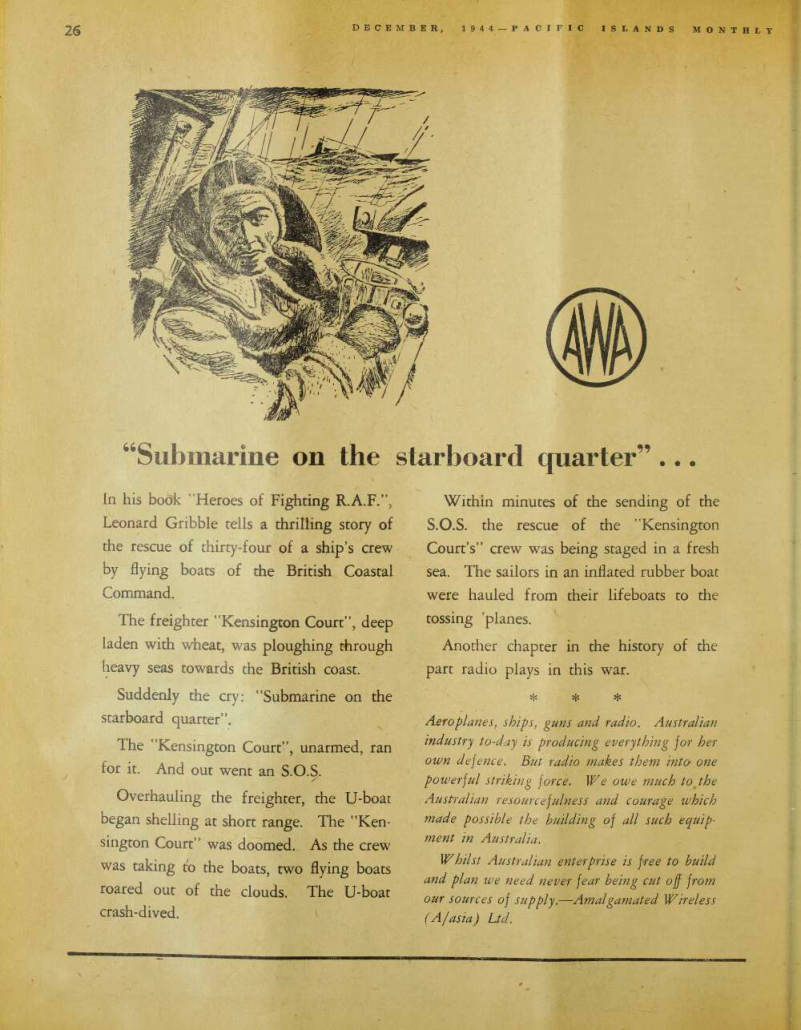
From Suva to Salamaua With Alice Allen Innes
THERE was the first South Sea Christmas in Fiji. That series of rambling old bungalows, which, weighed down with most rigid economy, did yeoman service as the Colonial Hospital; Suva wasn’t very “civic-minded” In those days, but everyone expected, and received excellent attention from nursing and medical staffs. World War I had just threatened the Pacific, and, for the first time, Suva was conscious of its isolation.
The •‘Brisbane.” ‘‘Encounter,” “Nagasaki” and “Chikuma” came in and out at intervals, and always brought patients, both officers and men, most of whom were only too delighted to be ashore and in the hospital’s'very beautiful surroundings during convalescent periods.
I remember one Japanese officer of a very old and wealthy Sumarai family. He spoke Shakespearian English and excelled his brother officers in politeness; as we decorated his ward and sat him up (after an appendix operation had proved suecessful) to enjoy his first meal—Christmas dinner of conventional abundance— he brought from beside his bed a parcel and gravely presented me with a very lovely, beautifully-dressed Japanese doll, To Matron and Sisters he gave handsome albums full of views of Japan—and, strangely enough, mentioned that some day Japan would control the whole of the Pacific but that, should he be in power, Suva Hospital would ever be free from attack!
Christmas morning at Suva Hospital carried a wealth of cheerful memories . . . from the daylight appearance of Matron Anderson in her immaculate white, as she stood on the wide verandah despatching gifts and notes of greeting to patients and friends . . . The graceful and uniformed native nurses bringing up the
attractive woven baskets filled with masses of vivid canna, hybiscus and alamandar to decorate the wards. How merry they were! Meresani, giggling as she always did; Tepo, tall and most dignifled; Pwa, with the sweetest, shy smile; Ratieli, bubbling over with amusing small gossip; and Sanivula’s throaty contralto sending the early carol up from the rose garden below the hill! Hollywood could never catch and .record the beauty and music of that Christmas morning.
Sister Emily Anderson and Sister Stammer massing the flowers with magic fingers as the “ward vases” were quickly done; then the children’s Xmas tree arranged for native and European infants; the Watch Night service at the native church where the lovely old carols were sung in perfect harmony.
Old Rhuhdadu, the Indian gardener, complete with new headress, deeply salaaming to Matron and breaking into a flow of Hindustani greetings, which Matron returned with many flowery compliments and gifts for the Indian staff (What a soft spot we had for that old rogue Rhundadu, who did so little real gardening, but so much “liaison” and letter-carrying ... He had ever an ear and eye for the romances of the nursing staff.) And cook, coming up after the Christmas dinner to take a bow, and collect his gifts. fTIHE nurses, off duty, flying to press J. frocks and hoping that nothing would prevent their getting to the Grand Pacific for the party. Other nurses exchanging gifts and teasing.
Sister Livingstone, with a trip to England just ahead of her; Sister Grace Morrison, with a mop of golden curls, on duty, but still convalescing from a. seri-
ous illness (and now, these days, a matron of her own hospital in Fiji); Nurse Jess Finlay sen, doing the work of three nurses: Nurse Kaad, whose music brought joy to staff and the many visitors to the nurses’ home; Nurse Phieffer, with her quiet, efficiency, making savoury dishes for Sister Stammer’s party on Boxing Night—and we owed much to Sister Stammer’s individual coaching, apart from Matron’s beautifully delivered lec tures (lectures that were delivered with equal ease and fluency in English, Fijian or Hindustani).
IHAVE been fortunate enough to see the evolution of the “C.H.” from the scattered old buildings and cumber some domestic arrangements of my girl hood days to the modern, imposing-look ing War Memorial Hospital revealed to me on a recent visit. Suva can now be proud, too, that one of the most highly trained and popular of its “old nurses’’ is back there as Matron.
I had the good fortune to meet the first Matron of the hospital in 1915. She was Mrs. Stoubie—or Matron Webster- Wedderburn, as she was Jmown when she came from England 50 years before, to take up duty at Suva Hospital. Hers was the great honour of being personally selected by Florence Nightingale for Fiiian service.
From many letters and gifts that old Matron showed me, I knew there must have been a very deep friendship and confidence .between “The Lady of the Lamp” and Suva’s first Matron.
Suva was not officially “war zone” in World War I, but it was very surely, nursing service for all the staff, who had to face war nursing conditions, the fear of attack and the preparedness to cope with it, and the great shortage of drugs and dressings.
So came another Chris'tmas and yet a third, whilst the first world war lasted
Levuko—l9l6
SURELY there never was a more beau tiful Island port than Levuka when it wfis in its heyday and the “Capi tal of the South Seas.”
Timber shins came from the far cor ners of the world—full-rigged ships that had made history. And there were hosts and hostesses in Levuka who were un surpassed and are but rich memories these lean times . . . Captain Kaad with his famdus chef. Old Kura—the Solomon Islander whose life the captain had once saved . . . Wines from the famed vine yards of Germany and Spain; French vintage and sparkling wines served to an assortment of delicate and perfectly cooked local fish and venison from the captain’s own*island of Wakaya . . . Mrs.
Kaad. Mrs. Vollmer, Mr. and Mrs. Bently, of “Venice”—the latter couple famed for their famous stamp collection, their fine family of many sops and one very musical daughter. Such Christmas hospitality is rarely seen in these years.
Partv followed party and then, at grey dawn, there was the merry exodus to the Sonderberg pool, a natural series of rock baths near Captain Kaad’s lovely home.
Christmas in Levuka is a memory that makes one still feel young—it? famous hospitality, the beauty of its girls, from the lovely blonde Hjorring sisters to the manv lovely daughters of the island, will still live in the hearts of all of us who have shared in the festive gaiety of Levuka.
Christmas in Sud-Est
AFTER a friendly year in Samarai, came the isolation of Misima. It promised to be a very dull Christ mas but we reckoned without that very famous and dearlv-loved “mother of the Lousiades”—Mrs. Mahonev of Sud-Est, a neighbouring island. To Mr. Harrv Sim monds, our Resident Magistrate at Mis ima, and ourselves. came the summons to foregather at. Christmas-time in Sud-Est’s lovely homestead.
The “Guitana,” dancing as her name sake ever did, flew over to Sud-Est m record time, and as we arrived there was wild commotion near the little wharf: a “crocodile” had taken one of the new calves and crowds of native boys and Maries swung charms and curses after the defiant beast who still lay, sluggish and impudently, within vision.
A few shots from the revolver of Cap tain” Teddy Mears eventually sent him off, and we followed our hostess up to the home that held so many memories and links with the great “Rattlesnake” gold rush of 30 years before. There were 200 graves in the hills nearby, all of miners who had died from dysentery, ptomaine poisoning, and mulnutrition during the goldfield days. There might have been more but for our hostess Mrs. Mahoney, who had, single-handed, cared for and tended the many sick men through that ghastly epidemic.
Her life was an epic of adventure; only a few hours before we arrived for that Christmas celebration, she had sailed her own schooner, the “Nil Desperendum,” down to a nearby island to bring in a native baby whose mother had died, and who would otherwise have been buried alive with the mother.
As we approached the home “The Count” came to meet us. Tall and thin and aristocratic as his nickname implied, he wore his monocle suspended from a long leather bootlace and adjusted : it with regal dignity, at frequent intervals, in ‘his sightless eye. It certainly was impressive! He wore short, thick and very faded pink flannelette pyjamas, and a wide, cabbage-tree hat, but there un conventionality apparently stopped—he
embarrassed me v greatly, *when, upon being presented to us, he eyed off my meek “romper-cut” boat-suit of navy drill, and said, “I am afraid I have never met a young matron in her underwear before . . . would you pardon me if I retire?”
He should tell me—with his pyjamas wanting a patch where poets don’t tell of!
That afternoon, Sinabada Mahony gave the native servants and their many rela tives a huge feast and sports, which Ve all enjoyed. We saw them make sapisapi (shell money) and bring gifts to “Mumma” in return for her many gifts and feast.
Boxing Day saw us up and away to luncheon at Sud-Est Waterfalls. On a green lawn-like spot below the lovely cas cade of water that came down in three “bridal veil” effects from a great height above, we all sat eating cold roast duck in our fingers, when the clear sunlit sky seemed to darken for a few seconds, but no rain came; then came a dull roar, as a monster “roll” of water seemed to pause on the top of the falls. We jumped up and sprang for higher ground, and safety, and, as we did, over the falls came tons of water —hurling and splashing over the spot where we had sat a moment before.
It was a cloud-burst on the mountains above. A rare and awesome thing to witness.
So sped Christmas at Sud-Est. Hos pitality that one could never repay, and grand memories of an outstanding pioneer. Mrs. Mahony.
Christmas at Khabuga
CHRISTMAS at Khabuga, with Mons. and Madame Bernier, also held adventure. We had to walk 10 miles through the bush to the most isolated part of Si. Aignon’s lovely island—over the kunai grass country, then down through the heavy swamps. First went the Rossel Island nurseboy with our three-year-old son on his shoulders, then came Taubada, lastly the native nurse girl and me—and so to Madame’s lonely home. But our host and hostess, we found, were barricaded upstairs in their
bungalow and the nearby village was like a nest of Hornets. “Pig trouble” again!
Bush pigs had happened on Madame’s fine garden, with sad results. Madame had laid poison and warned the village; the village said pigs’ ways were “an act of god.” or words to that effect, and when the pigs died there was a war on between the village and Madame.
My husband and I went to the village
and promised that the .finest “Piggie man-belong-Sydney” should be given to' them, and, after much parley, all was well. However, as no native had gone fishing that day, and no “megani” hunt ing had been done, and as Madame’s fowls had all scattered to the bush, we feared the larder would not be too hefty.
But we proved to be wrong. We starv ing travellers sat down ’to a delicious “ragout” cooked in finest French style, \in claret, garlic and fine herbs, and -not until years later did we know that that meal was made from flying-fox. I have been most suspicious of gamey-looking cas serole since!
Dear old Madame Bernier, whom I visited in Grenoble, in France, 15 years later, when, looking years younger, she was settled in her charming family home, and made up for the “black-bokis” stew with lavish Grenoble hospitality!
Salamaua Christmases
THEN came the many Salamaua Christ mas-tides.
The first, when the community of 23 celebrated Yuletide at our early Salamaua Mecano-like home—“House Kruanky,’’ with the huge tree growing through the roof—or rather, built around the trunk of a huge tree, because the contractor had died suddenly, and the boss-boy had gone on with the job and no one had told him to move the tree.
Anyway, that was a good Christmas— all out of tins, even the warm cham pagne.
Then the Christmas of more affluent days, when all Salamaua danced at the new hotel and there was a fancy-dress ball.
A tall, dark, and (of course) hand some, scientist, happened on Salamaua
that Christmas Eve. He had been in far corners of the map, and was very weary.
IJe declined to come to the fancy-dress ball, but dressed in formal dinner suit for dinner that night, and then after wards retired. When the midnight revels were at their height, and prize-winners were being chosen by the amount of the onlookers’ applause, a tall figure appeared in dress shirt, sox and suspenders and even a black dress tie —but never a sign of hi.s trousers. We held our breath and hoped the “wee breeks of Scotland” were doing duty. Midst wild applause, he car ried the prize. Then, in a startled pause, the majestic, but half-clad, gentleman stood gazing around at the dancers, gave a moan, hopped the high balcony rail (and he didn’t wear ’em) and went wildly into the black night. $ Alas, that weary scientist had been a sleep-walker. The prize was never collected!
CAME many Salamaua Christmases— and, when the future Christmas tides bring all together again, I hope that those amongst us who may be pre sent will stand and drink a silent toast to the many heroic men who have given us throughout the wide South Seas, our happy Island Christmases.
Advertisements & other items, pp. 27-30 (1 item)
Vj
Y jB jiiUP
Cl *5 v.
Submarine on the starboard quarter” ...
In his book "Heroes of Fighting R.A.F.", Leonard Gribble tells a thrilling story of the rescue of thirty-four of a ship’s crew by flying boats of the British Coastal Command.
The freighter "Kensington Court", deep
laden with wheat, was ploughing through heavy seas towards the British coast.
Suddenly the cry: "Submarine on the starboard quarter".
The "Kensington Court", unarmed, ran for it. And out went an S.O.S.
Overhauling the freighter, the U-boat began shelling at short range. The "Kensington Court" was doomed. As the crew was taking to the boats, two flying boats roared out of the clouds. The U-boat crash-dived.
Within minutes of the sending of the S.O.S. the rescue of the "Kensington Court’s" crew was being staged in a fresh sea. The sailors in an inflated rubber boat were hauled from their lifeboats to the
tossing planes.
Another chapter in the history of the part radio plays in this war. * * * Aeroplanes, ships, guns and radio. Australian industry to-day is producing everything for her own defence. But radio makes them into one powerful striking force. We owe much to the Australian resourcefulness and courage which made possible the building of all such equipment in Australia.
Whilst Australian enterprise is free to build and plan we need never fear being cut off from our sources of supply. —Amalgamated Wireless (A/asia) Ltd.
Purchasers at Full Market Prices on Assay Value of
GOLD
SILVER
PLATINUM
And Platinum Group Metals
SOME OF OUR SERVICES
ASSAYERS & ANALYSTS—
Assays of Bullion, Ores, etc.
Analyses of Metals, Minerals, Alloys, etc.
SCIENTIFIC & INDUSTRIAL
METALLURGISTS—
Our range of precious metal manufactures covers all Industries—Gold and Silversmiths, Electrical Trades, Dental Profession, Glass Sllverers, Electro-Platers, etc., etc.
REFINERS—
Purchasers and Refiners of Bullion.
Scrap, Mining By-Products, and Trade Residues of every description carrying Precious Metals.
GARRETT & DAVIDSON
PTY. LTD.
824 George St., Sydney. Works: Surry Hills and Chippendale, N.B.W.
Official Assayers to the Bank of New South Wales. Gazetted Agents of the Commonwealth Bank of Australia, under the Gold Regulations of the National Security Act.
Steamships Trading
Company Limited
PORT MORESBY SAMARAI PAPUA.
WHOLESALE & RETAIL MERCHANTS, SHIPOWNERS,
PLANTERS, ENGINEERS & SLIP PROPRIETORS.
Customs, Shipping, Insurance, and Forwarding Agents.
MANAGING AGENTS AND VISITING REPRESENTA-
TIVES FOR COCONUT AND RUBBER ESTATES.
SYDNEY REPRESENTATIVES: Nelson & Robertson Pty. Ltd., 12 Spring Street.
WARTIME ADDRESS
Until further notice, clients may address all communications as follows:
STEAMSHIPS TRADING COMPANY LIMITED,
C/o NELSON & ROBERTSON PTY. LTD.,
12 SPRING STREET, SYDNEY.
WANTED TO BUY—QUALITY GUNS AND RIFLES
HIGHEST PRICES GIVEN. WILL ALSO EXCHANGE GUNS.
New .303 Short Service Barrels, 25}fc", without Sights and Platform, £2/15/- each.
Postage extra. sI L RO H U Qualify Firearms and Fishing Tackle. 143 ELIZABETH STREET (Near Market St.) SYDNEY. ’PHONE: MA 3540.
Made by
FORD SHERiNGTON LTD
£ Owing to war needs, supplies of "Airway" are not at present available.
Manufacturers of
G LO BITE Travel Ca ses
fij-UESPii Service
BUYING AGENTS
FOR ALL PACIFIC TERRITORIES
Island Produce Sold on Commission
Y Pij R ORDERS RECEIVE PERSONAL ATTENTION
ROBERT GILLESPIE PTY. LIMITED
Cables: ROBERGILL
54a PITT STREET, SYDNEY
GP.O. BOX 137 CC.
Mishaps To Cook Islands
Shipping
From Our Own Correspondent
Rarotonga, Nov. 5.
OCTOBER was an unlucky month for Cook Islands shipping. About the middle of the month, Capt. D. Cam bridge set out from Rarotonga in his little engineless ketch, “Taipi,” with a full load for Aitutaki. A few days later a radio message was received by his Rarotonga agent stating that the vessel had sus tained damage in* the Aitutaki passage and that the cargo was injured by water.
No further details are yet available.
This is the third time that the “Taipi” has met with misfortune in the Aitutaki passage, which has a very powerful flow since it was widened and deepened by American engineers.
A few days later, Messrs. A. B. Donald’s inter-island schooner, “Tiare Taporo,” limped into harbour with a disabled rudder.
The ship’s crew, under the direction of Capt. “Andy” Thomson, unshipped the rudder and hauled it ashore for inspec tion w It is thought that the damage is the result of the severe pounding received last January, when the vessel was tied up in her home harbour —a small break in the Avarua reef, notorious graveyard of many ships—and the anchorage suffered a brief but severe lashing from the tail of a passing hurricane. From early morning till noon on that occasion a des perate battle was fought to keep the schooner off the reef, but at the height of the blow, the network of hawsers parted and the vessel started to pound the bottom. It was saved from complete disaster only by the fact that the wind suddenly abated. It is now apparent that fractures were started which resulted in the present breakdown.
A new rudder is being hewn from a large “tamanu” (native mahogany) tree by the firm’s carpenter.
Mr. J. T.* Wallis, of the executive staff of W. R. Carpenter & Co., Ltd., has now settled down in London as manager of the London branch of that big Pacific com pany. Mr. Wallis has taken the place of Mr. W. C. Harvey, who has retired after many years’ service, and who intends to live in Australia. He will return to Sydney early next year.
Advertisements & other items, p. 31 (1 item)
Comt:
6 a
imMom
m &v*- w \
COMt:
/«4 v TAc famous Aladdin Kerosene Mantle Lamp gives brilliant 75-candlepower white light without pumping or pressure at a cost of approximately 2 hours' light for one penny. As easy to light as the old-fashioned flame lamp.
V- S' (-N NOW every island home can enjoy the comfort and convenience of a brilliant white 75-candlepower light thanks to Aladdin, the world's most wonderful lamp. Introduced to the Islands for the first time, this world-famous Kerosene Mantle Lamp is artistic in appearance, economical in use and as easy to light as an ordinary flame lamp. Burns only keroserte, the safest and cheapest of fuels— without pumping, pressure, noise, smoke or fumes. Write AT ONCE for illustrated leaflet showing the full range of table, floor pedestal, hanging and wall-bracket models.
Popular Aladdin Storm Lantern , solidly constructed of brass for hard icear. Gives vivid 200-candle power white light from ordinary kerosene at a cost of approximately one halfpenny per hour. Widely used by Army and Navy during the war.
AGENTS WANTED. Opportunities exist for alert storekeepers to act as l authorised Aladdin storekeepers in the Islands. Special discounts and the distribution of Aladdin wicks , chimneys, mantles, shades , and spare parts are among the many advantages of the Aladdin franchise.
TZL.T m *■»»«
° ne of the "WeTm famous Alarldi / Of U pate gre " family Smartly streamline,/ range, it is both hilii m ° st Modern * n operation, efficient, £ dettti,s «ppiZi‘Z y itsel/ z *93-3799
ALA D D
INDUSTRIES PTY. LTD.
7 I
BOURKE STREET.
SYDNEY
"Terepo"
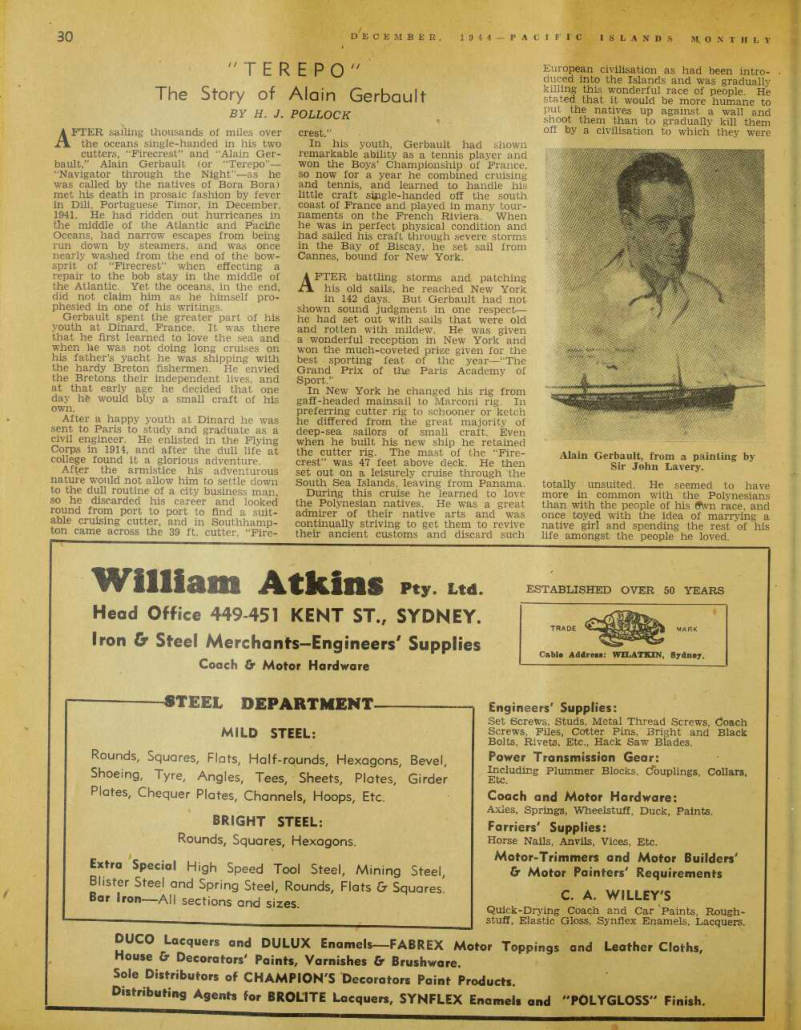
The Story of Alain Gerbault
By H. J. Pollock
AFTER sailing thousands of miles over the oceans single-handed in his two cutters, “Firecrest” and “Alain Ger bault,” Alain Gerbault (or “Terepo”— “Navigator through the Night”—as he was called by the natives of Bora Bora) met his death in prosaic fashion by fever in Dili, Portuguese Timor, in December, 1941. He had ridden out hurricanes in the middle of the Atlantic and Pacific Oceans, had narrow escapes from being run down by steamers, and was once nearly washed from the end of the bow sprit of “Firecrest” when effecting a repair to the bob stay in the middle of the Atlantic. Yet the oceans, in the end, did not claim him as he himself pro phesied in one of his writings.
Gerbault spent the greater part of his youth at Dinard, France. It was there that he first learned to love the sea and when he was not doing long cruises on his father’s yacht he was shipping with the hardy Breton fishermen. He envied the Bretons their independent lives, and at that early age he decided that one day hb would buy a small craft of his own.
After a happy youth at Dinard he was sent to Paris to study and graduate as a civil engineer. He enlisted in the Flying Corps in 1914, and after the dull life at college found it a glorious adventure.
After the armistice his adventurous nature would not allow him to settle down to the dull routine of a city business man, so he discarded his career and looked round from port to port to find a suit able cruising cutter, and in Southhamp ton came across the 39 ft. cutter, “Fire
crest.”
In his youth, Gerbault had shown remarkable ability as a tennis player and won the Boys’ Championship of Prance, so now for a year he combined cruising and tennis, and learned to handle his little craft sijagle-handed off the south coast of France and played in many tour naments on the French Riviera. When he was in perfect physical condition and had sailed his craft through severe storms in the Bay of Biscay, he set sail from Cannes, bound for New York.
AFTER battling storms and patching his old sails, he reached New York in 142 days. But Gerbault had not shown sound judgment in one respect— he had set out with sails that were old and rotten with mildew. He was given a wonderful reception in New York and won the much-coveted prize given for the best sporting feat of the year—“ The Grand Prix of the Paris Academy of Sport.”
In New York he changed his rig from gaff-headed mainsail to Marconi rig. In preferring cutter rig to schooner or ketch he differed from the great majority of deep-sea sailors of small craft. Even when he built his new ship he retained the cutter rig. The mast of the “Fire crest” was 47 feet above deck. He then set out on a leisurely cruise through the South Sea Islands, leaving from Panama.
During this cruise he learned to love the Polynesian natives. He was a great admirer of their native arts and was continually striving to get them to revive their ancient customs and discard such
European civilisation as had been intro duced into the Islands and was gradually killing this wonderful race of people. He stated that it would be more humane to put the natives up against a wall and shoot them than to gradually kill them off by a civilisation to which they were
totally unsuited. He seemed to have more in common with the Polynesians than with the people of his OWn race, and once toyed with the idea of marrying a native girl and spending the rest of his life amongst the people he loved.
Alain Gerbault, from a painting by Sir John Lavery.
He would cruise leisurely from island to island, teaching the natives to play football and, in turn, himself trying to learn tiieir native games. He was always opposed to the natives dressing in left off European clothing, which made them look ridiculous. In order to encourage the people to return to their own healthy dress, he made a point of wearing the dress *of the particular people he was moving amongst—be it pareu, lava-lava, or sulu. This practice on occasions got him into conflict with the local authori ties, who insisted upon his wearing cor rect European dress when walking in the streets of their towns.
It is on record that he was invited to dine at Government House with the Gov ernor of Fiji, and caused a sensation by turning up to this distinguished social gathering clad only in a sulu. Needless to* say, he was never asked to come again.
He was a great admirer of the early Polynesian navigators and considered their voyages in open canoes with only primitive methods of navigation superior feats to the voyages undertaken by our own pioneer navigators. He sailed with out an engine in his ship and got great pleasure in taking his cutter into narrow and difficult passages.
IN the late 20’s, the “Firecrest” was reaching the end of her useful career as a cruising boat. He therefore decided to return to his native France and build himself a new boat. He gave “Firecrest” to the French Naval Academy, but she was wrecked whilst being towed by a tug.
He had sufficient money from the pro ceeds of his two books, “Fight of the Fire crest” and “In Quest of the Sun,” to build his new cutter. He designed her him self—learning from the weaknesses shown by the “Firecrest” in her unusual and severe tests. This time he favoured a double-ender, the most seaworthy form of small boat known. The “Firecrest” was counter-sterned. He named the new ship “Alain Gerbault” and set out once more for his favourite islands in the Society Group.
Up to the beginning of World War II he lived at Bqra Bora and in 1939 he again offered his services to his country, but as he was now nearly 50 he was rejected. In 1941 it was very difficult to determine which way Tahiti was to go politically and he wisely ' decided to leave his favourite haunts for new and less disturbed islands. He spent several months at Tonga and played his favourite game once more on the beautiful grass courts at Nukualofa. He found the boys at Nukualofa were now his equal at ten nis, for age was beginning to take toll of his physical condition.
He sailed from Tonga to Port Moresby and apparently from there to Portuguese Timor, where he met his death at the comparatively early age of 49. He had expressed a wish not to be buried in a cemetery, but to have his body placed on his yacht with sails set and let sail to sea. No doubt the whereabouts of his yacht will be released in due course. rpo strangers, Gerbault *Vas a dour fel- A low, but to his friends he was quite the reverse; in addition, he possessed a rare sense of humour. On his return to Le Havre he was accorded a civic wel come and many distinguished persons were invited to be present. Gerbault, at the banquet, was seated next an elderly countess who obviously had no knowledge of the sea. She asked Alain how he could possibly have a bath with such a limited water supply on his small craft. He solemnly replied, “Madam, I never wash.”
Gerbault was loved by the Polynesians, who composed many songs about him. He was always trying to make the French
Government recognise the fact that, largely because of their system of gov erning, the Polynesian was rapidly dying out or being absorbed by the Chinese. He deplored the system of sending Governors out for only a period of three years or so, instead of choosing officials who were willing to give their lives to the cause of their charges.
He was a great reader and always car ried about 200 books with him. One of his favourites seemed to have been Jack London; Loti, Farrere, Conrad, Stephen son and Shakespeare, too. He was a great admirer of John Masefield’s ballads. His own books he always wrote in English, although he was a Frenchman—they were later translated into many foreign languages. The last of his published works was the “Gospel of the Sun, - ’ a book much criticised in some quarters because of the author’s small regard for European civilisation. He maintained that our civilisation is already on the decline and will eventually disappear as have all its predecessors.
He had completed another book that was to be published after the war. Let us hope the manuscript has fallen into the right hands.
A simple sailor has passed on; a man who loved nature and the things of nature far better than anything produced by man. Perhaps he lived before his time; in another hundred years the Poly nesians may have revived their wonderful civilisation, and . may have increased their numbers to equal those of several centuries ago. The finest wood-carvers
in the world may have revived their art, and the old customs and dances may even be taught in open-air schools, as advo cated by Alain. Aloha, “Terepo”!
Advertisements & other items, pp. 32-34 (2 items)
30
DECEMBER, 1944 PACIFIC ISLANDS M.ONTHLY
William Atkins Pty. Ltd.
Head Office 449-451 KENT ST., SYDNEY.
Iron & Steel Merchants—Engineers' Supplies
ESTABLISHED OVER 50 YEARS
Coach & Motor Hardware Cable Address: WILATKIN, Sydney.
“STEEL DEPARTMENT
MILD STEEL:
Rounds, Squares, Flats, Half-rounds, Hexagons, Bevel, Shoeing, Tyre, Angles, Tees, Sheets, Plates, Girder Plates, Chequer Plates, Channels, Hoops, Etc.
BRIGHT STEEL:
Rounds, Squares, Hexagons.
Extra Special High Speed Tool Steel, Mining Steel, Blister Steel and Spring Steel, Rounds, Flats £r Squares.
Bar Iron—Ail sections and sizes.
Engineers" Supplies: Set Screws, Studs, Metal Thread Screws, Coach Screws, Files, Cotter Pins, Bright and Black Bolts, Rivets, Etc., Hack Saw Blades.
Power Transmission Gear: Including Plummer Blocks, Cfouplings, Collars, Etc.
Coach and Motor Hardware: Axles, Springs, Wheelstuff, Duck, Paints.
Farriers" Supplies: Horse Nails, Anvils, Vices, Etc.
Motor-Trimmers and Motor Builders" & Motor Painters" Requirements
C. A. WILLEY'S
Quick-Drying Coach and Car 'Paints, Roughstuff, Elastic Gloss, Synflex Enamels, Lacquers.
DUCO Lacquers and DULUX Enamels—FAßßEX Motor Toppings and Leather Cloths, House & Decorators" Paints, Varnishes & Brushware.
Sole Distributors of CHAMPION'S Decorators Paint Products.
Distributing Agents for BROLITE Lacquers, SYNFLEX Enamels and "POLYGLOSS" Finish.
KANGAROO BRAND
Ropes,
Cordage,
and Twines for every purpose Backed by 86 years of service Manufactured hy:
M. DONAGHY AND SONS,
Pty. Lfd., Geelong and Sydney.
Fiji Representatives :
PEARCE AND CO.
LIMITED
P.O. BOX 237, SUVA
Ship Chandlery Hardware
r Write for 7
j Ship Chandlery /
* Catalogue J Special “In Bond” Prices for all Islands enquiries quoted on application.
Sole Agents for;
LIMITED
SHIP CHANDLERY
IRONMONGERY OF ALL KINDS, PAINTS.
WHITE LEAD AND OILS.
P. H. MUNTZ & CO.’S 3-CROWN BRAND METAL SHEATHING.
PEAOOCK <b BUCHANS’ ENGLISH READY-MIXED PAINTS
152:: Sydney Large and Complete Stocks of
SYDNEY.
B. DAVID Trading Co.
ISLAND TRADERS
EXPORT MERCHANTS
SHIPPERS OF ALL KINDS OF MERCHANDISE.
EXPORT REPRESENTATIVES OF LEADING
AUSTRALIAN MANUFACTURERS
Head Office:
31 Queen Street, Melbourne, Vic.
Branches and Agents in All Ports.
Direct Enquiries to Bankers: Cable Address: Head Office. National Bank of “DAVID TRADING Australasia. MELBOURNE”
OPEN TO APPOINT AGENCIES WHERE NOT REPRESENTED
HILLS
FINE ENGLISH
CIGARETTES
• SPINET
• S U N R I P* E
•GOLD FLAKE
•AIR MAIL
HIGH-GRADE
TOBACCOS
BADMINTON
SPINET
Pacific Islands Distributors : C. SULLIVAN Pty. Ltd., Sydney
CHATEAU D’OR
COGNAC VIEUX
☆ ☆ ☆ D
NET CONTENTS 26 FLUID OUNCES~]
C. SULLIVAN & CO
SYDNEY
PRODUCE OF AUSTRALIA
PABST
BLUE RIBBON BEER
3 Fine Brews Blended into
ONE GREAT BE E R
Agents : C. SULLIVAN PTY. LTD., 379 Kent Street, Sydney
C. SULLIVAN Pty. Ltd.
GENERAL MERCHANTS ISLANDS AGENTS
REPRESENTING LEADING FIRMS IN THE PACIFIC ISLANDS.
Islands Produce sold on Shippers' Account—Liberal Advances against Consignments.
Buyers of all Islands’ Requirements on Commission—Original Invoices Furnished.
Bankers: Bank of New South Wales .. Bank of New Zealand .. Comptoir National d’Escompte de Paris.
Wartime Cable Address: Sullivan, Kentstreet, Sydney.
379 KENT STREET, SYDNEY, N.S.W.
Military Set-up in
New, Guinea Is it Within the Law?
Letter to the Editor CAN you inform me whether or not martial law was proclaimed in Papua and New Guinea, and, if so, when? There are certain indications that proper authority may not have been invested in those who established the pre sent military set-up in so high-handed a manner—and who continue, bv some means or other, to retain it against all reason or justice. Perhaps your paper has already gone fully into this point: if not. I feel that a brief survey in vour columns would be of interest to all bona fide residents.
Further: Was conscription ever legally proclaimed in those areas? We know that it was enforced there, though not in Australia. Was that procedure correct?
If so. why?
Amongst the Allied nations or terri tories. I think that Papua and New Guinea must have about the highest per centage of its population in the various Services —or in enemy hands. I would welcome anv facts you may be able to supply on that point. Our men volun teered eagerly from the earliest days of the war; and in later times those who had been asked to remain to enable necessary work and administration to be carried on. were either conscrioted or taken prisoner. ' All were dispossessed— one wonders for how long.
Altogether, the treatment meted out to this section of the Australian community (the ofnly one that has suffered real hard ship as a result of the war) does nothing to justify any confidence that our pre sent Government will anplv to their own countrvmen, the first nrinciples of justice and liberty for which so many of our Island men are fighting —or rotting in nrison camps. In fact, it rather looks as if the Islanders “stuck their necks out.”
I am, etc.,
G.R.R.
South Brisbane, Nov. 11, 1944.
Editorial Note
MARTIAL law was not declared in the Territories; but the area was de clared an “onerational area” or a war area, nr whatever these things are declared This, from the civilian’s point of view, is worse than if martial law were declared —because in that case the civi lians are usually nresent. In this case the whole area became a military pre serve and the military can do as it wishes.
Conscrintion was legally proclaimed, in Canberra, in a perfectlv legal “order” nr rpaulat.ion under either National Securitv Regulations or under Defence Peanietions. These things were made norfortlv watertight, legally—so our cor resnondeot need have no worries on that score. The Armv also had the leaal right to order civilians to depart—the PTA was instructed' so by their legal advisers months aao.
The two sons of Mr. J. G. McGmther, who was Resident Agent at Mangaia. Cook Islands, 1926-38, have rendered distin guished service. Lieut. Jock McGmther was wounded in Libya, invalided to New Zealand, and is now overseas again. Lieut.
Colin McGmther was wounded during the nursuit of Rommel in North Africa, and is now in NZ.
The Isle of Pines
Former Haunt of Sandalwooders Now a Backwater
Prom Our Own Corresnondent BY courtesy of the US Commander in New Caledonia,who lent us his plane, I recently visited the Isle of Pines (50 miles south of New Caledonia), with a French botanist, M. Viret, to collect plants for the University of Harvard.
This little island is noteworthy for its beautiful orchids which dominate the heath-covered plateau like kangaroo paws dominate certain parts of the Darling Ranges of Western Australia; and strange shaped coral platforms along the coast are the home of a species of tobacco, Nicotiana fragrans, which is not found anywhere else in the world—not even on the New Caledonia mainland.
Apart from the official Resident—an ex-French naval rating—another French man exploiting timber, including the strange Cook pine, and the one or two priests at the mission who rigidly dominate life in the eight native settle ments, the island has no white inhabitants and is seldom visited. Yet in early days it was one of the most profitable haunts of Australian sandalwood traders, includ ing such famous characters as Towns, Paddon and Underwood.
Many a crew was massacred and eaten here, for the natives, then more numer ous than to-day, were notorious cannibals, regularly raiding across to Caledonia for women and human flesh. They were the finest canoe builders in these seas.
The French have a legend tha£ an English man-o’-war was sent to the Isle of Pines in 1853 to declare it a British
possession, but that the captain dallied so long that he allowed them —the French— to beat him to it by a day. They say that as a result the English captain shot himself when he got back to Sydney. A British man-o’-war was certainly making an unhurried hydrographical survey in the neighbourhood at the time the French hoisted their flag, but there is no valid evidence that they were there to take possession, and if the captain did shoot himself on his return I suspect it was for reasons of a much more personal nature than failure to take possession of the Isle of Pines. The story seems to be rather the invention of an old Jesuit writer whose book, “Marins and Mis sionaires,” gives a very one-sided account of early happenings in New Caledonia.
BUT war has reared its head even on the isolated Isle of Pines. A week after our visit, curiosity about a grenade they found in a box left behind by Allied troops, caused the death of a native boy, son of a local chief, and the wounding of two others. Trying to find out what was inside, they first hit the top of the grenade with a brick, and then, when nothing happened, hurled it at a coconut tree. This time it exploded. In formed by radio, two French doctors were flown to the island and brought the two wounded lads back to Noumea Hospital.
Captain the Hon. J. Carfax-Foster, who was a trading store manager in Atiu (Cook Islands), in 1930, was killed in the fighting in North Africa two years ago.
Lance-Sergeant R. S. Aubin, NZ forces, formerly a trader on Mangaia (Cook Islands), was killed in the fighting near Rome several months ago.
Mr. and Mrs. Fred Corbett, of Suva, Fiji, celebrated their Golden Wedding on October 31. Both are residents of long standing. Mrs. Corbett was born in the Colony, and Mr. Corbett arrived from New Zealand in the 80’s.
A social gathering took place at Christ Church, Launceston (Tas.) recently to mark the centenary of the missionary ship ‘‘John Williams.” The Rev. J. Hore, BA, of Devonport, recalled many interesting personal recollections of the three voyages around the Pacific, which she made with her father, who was then captain of the “John Williams IV.”
Advertisements & other items, pp. 35-36 (1 item)
roieman Z
7 i S Pyrex Coleman = L 1
MANTLES
AND GLOBES
For Efficient Service
and Best Light
Coleman Mantles, Heat Resisting Globes and Reflector Rings for Coleman Lamps and Lanterns and many European Types, are still available and are still made from the same first quality materials.
See your nearest Coleman Dealer, who will be supplied to the best of our ability with these important accessories.
FOR BEST SERVICE INSIST
ON COLEMAN
THE COLEMAN LAMP & STOVE 00. LTD.
TORONTO - - - CANADA
THE COLEMAN EXPORT CORPORATION, CHICAGO, ILL., V.S.A,
ISLANDS
SOUVENIRS
Popular Pikake Shell Necklaces.
Pearhshell Brooches, Hula Skirts and Lei posted direct to any part of the world.
SPECIAL SAMPLE PARCEL
for 18/-, containing: 1 Genuine South Sea Skirt, Assorted Pikake Necklaces and Lei. (USA orders $3. Cheques — exchange extra).
Send your Money Order or Bank Draft direct to—
JAMES BROWN
Merchant and Exporter of Island Produce.
P.O. Box 26, Rarotonga, Cook Is. 50,000 Beautiful Hula Skirts. 50.000 Pikake Shell Necklaces.
Wholesale Inquiries Invited.
Buy Direct and Save Money.
Asthma Curbed In 3 Minutes
Since the discovery of Mendaco by a famous physician sufferers can get relief from Asthma. Mendaco does away with expensive injections and offensive smokes All you do is to take 2 tasteless tablets with meals and Mendaco starts circulating through the blood in 10 minutes. You breathe easily and freely. Your nerves relax, you get good, fresh, pure air into your lungs, and vigour returns.
Sleep Like a Baby
Thousands of former sufferers from Asthma say that the very first dose of Mendaco brought them glorious ease and comfort, and that they slept soundly the very first "* ht - , ™ er \ , their vigour returned and they felt healthier and stronger, and 5 to 10 years younger. The reason for this Is that Mendaco acts in natural ways to overcome the effects of Asthma. (1) It removes the mucus or phlegm; (2) It relaxes thousands of tiny muscles in your bronchial tubes so that the air can get in and out of your lungs; (3) It promotes body vigour, and stimulates the building of rich, revitalised blood.
No Asthma for Five Years
Mendaco not only brings almost immediate results, free breathing and comfort and enables you to sleep, but also builds up the system to ward off future attacks. Mr.
J. R. writes; “I was almost dead with Asthma, Had lost 40 lbs. in weight, snf-
fered coughing every night—couldn’t sleep.
Mendaco stopped spasms first night. I have had no Asthma since in over 2 years.”
Mrs. A. W. writes: “I had Asthma for 25 years. After using Mendaco I can sleep all night and have not had an attack since taking it.” Mrs. G. E. C. writes: “I bless the day I first heard of Mendaco. What a godsend it is to a poor woman like me who for 35 years never knew what it was to have a good night’s rest. The constant fight between Asthma and sleep was wearing me down, but I feel now I want to forget my past suffering.”
Benefits Immediate
The very first dose of Mendaco goes right to work circulating through your blood and helping nature rid you of the effects of Asthma. Try Mendaco under an iron-clad money back guarantee. You be the judge.
If you don’t feel fully satisfied after taking Mendaco just return the package and the purchase price will be refunded. Get Mendaco from your chemist to-day and see how well you sleep to-night and how much better you will feel.
RELIEVES ASTHMA
Mendaco
Now in 2 sizes .. .. .. 6/- and 12/-
W. Samoa's Cocoa
Industry
European Planters Being Driven Out by Lack of Labour
,Jj/ E have received inquiries about the position and prospects of the
cocoa-planting industry of Western
Samoa especially from American servicemen. Our correspondent in Samoa, himself an experienced cocoa
planter, has kindly supplied the
following information.
THE total population of Western Samoa is now well over 65,000, or double that of 1921-22. Of this total, some 61,000 are Samoan natives, 3,500 part- Europeans (Euronesians), 400 Europeans, 300 Chinese labourers. 150 other (free) Chinese, and small numbers of natives from Fiji, Solomons, New Guinea, Toke lau, Niue and other The number of Melanesians is about %.
Though Savaii is nearly double the size of Upolu, its population is only one-third of the total population, or some 22,000 — practically all (with the exception of some 20 Europeans and about 50 part- Europeans) Samoan natives.
There are, unfortunately, no statistical figures at all available giving particulars of acreage under cocoa, in bearing and planted.
There is a large number of small plan tations belonging to part-Europeans, which are planted with bananas and interplanted with cocoa—many of which plantations are in bearing, while others have young cocoa not yet in bearing.
The larger European cocoa plantations suffered considerably during th® time the American defence forces were in Samoa as the latter absorbed practically all the plantation labour available, and European
planters found it impossible, in spite of good cocoa prices, to keep their plan tations clean, and even to pick their crops.
With the departure pf the American troops the labour situation has become somewhat easier, though wages are still ' high and the Samoans are, in many cases, unwilling to do the required tasks, after the comparatively easy time at higher wages they had when working for the Americans. mHE largest plantation owner is still the JL New Zealand Government, running former German-owned cocoa plan tations seized during the last war as “New Zealand Reparation Estates.” They also employ most of about 300 Chinese coolies still in Samoa. Apart from the NZRE, there are not more than about 15 to 20 European-owned large cocoa plantations; while in Savai’i (the above-mentioned are on Upolu Island) there are about half a dozen small cocoa plantations owned by Europeans.
Samoans have planted large areas in cocoa during the last few years and, while European production is stationary (if not decreasing), Samoan native production is certainly increasing rapidly. The total cocoa production is at present between 2.000 and 2,500 tons annually, of which about 1,500 tons are produced by Euro peans (including the NZRE) and about 1.000 tons by Samoans. I estimate the acreage under cocoa in bearing at about 750 acres European-owned, 250 acres NZRE, and some 2,500 acres Samoan owned.
It is very difficult to give the value (or purchase cost) of cocoa plantations per acre. This depends vefy much on the situation of the plantation—distance to good roads, distance from Apia, presence of water supply necessary for washing the cocoa, possession of a good cocoa dryer, availability of labour (Samoan) for weed ing, nature of soil (prevalence of rocks and depth of humus and good soil)— also, of course, the age of the cocoa.
Young cocoa bears larger crops than old and overaged cocoa.
After taking all these factors into con sideration, a 50-acre cocoa plantation with cocoa in full bearing, should be worth £1,500 to £2,000 (Samoan currency), cor responding to about 6,000 to 7,000 dollars, (American currency). The price paid for hot-air-dried first-grade cocoa beans in Apia is at present £95 per ton of 2,240 lb., and a 50-acres cocoa plantation should produce, if in full bearing, about 25 tons of cocoa beans. The production cost may be estimated at about £35 to £4O per ton, but this also varies and is dependent on many factors. rE greatest problem facing planters in Samoa is labour—the supply of a steady and economic labour force
from outside Samoa. The native, who is a planter and landholder himself, cannot be relied upon as a permanent and satis factory plantation worker for the Euro pean planter.
The future of the cocoa industry de pends largely on the future status and Government of Western Samoa. The present Labour Governments of New Zealand and Australia are against “inden tured labour”—but no development or expansion of our plantation industry will be possible without greatly increased sup plies of dependable labour. If these sup plies had been available before the present war, Western Samoa would have played a far more important part as a source of supply of cocoa, rubber, bananas and maybe other important tropical products.
As it is, the European plantation in dustry is stagnating, and slowly dying.
Editorial Note
STUDENTS of Pacific affairs will note one interesting and significant thing.
By the deliberate policy of the Socialist Government in withholding labour, European planters are being slowly but surely driven out of Samoa.
The Germans, early in the century, planned a healthy Colony of European planters in Upolu and Savaii. The New Zealanders have killed that plan, and are encouraging the native Samoans —a fine branch of the Polynesian race—to themselves become a nation of planters.
According to Mr. Gurau’s figures, the change-over is taking place definitely, and fairly rapidly. Samoans (60,000) and Euronesians (3,500), working on their own lands, will be the cocoa and banana producers of the future.
The next step probably will be seen in the post-war Pacific settlement; Samoans and Euronesians will be given a large measure of self-government.
Advertisements & other items, p. 36 (1 item)
W. Jno. Baker J 5:
Your old SCISSORS, RAZORS
and KNIVES can be
SHARPENED and REPAIRED
Mi Send them to—
W. JNO. BAKER J 5:
3 HUNTER STREET,
SYDNEY.
The Polynesian Club Of
Sydney
DURING November, the Polynesian Club’s gatherings were well attended.
A young visitor from Nukualofa, Tonga, was Miss Trude Cameron; and from Samarai came Mr. Bruce Hamilton, a well-known pre-war identity of that Island town. From Norfolk Island were Mr. and Mrs. Cobby Robinson, with their daughter, Mrs. Audrey Scott, and Mr. Bill Quintal and his son Robert, who is now somewhere in Australia with the AIF.
French visitors included Chief Corporal Fred. Chitty, who has seen long service with the Pacific Battalion in Libya and Italy. He was able to give news of many of the club’s friends in that battalion, who stayed some months in Sydney four years ago and were constantly at the club.
Another Tahiti visitor was Petty-Offlcer George Chambon, lately married to a “vahine Bora Bora” over there. He paid a return visit after four years’ service with the Free French Navy in Mediter ranean and Pacific waters.
Among the club’s patriotic efforts in November were a concert for an Educa tion Department Comforts Fund and a presentation of Maori dances at a special evening arranged by the New Zealand War Unit, at the Anzac Buffet, Hyde Park, Sydney.
Chaplain J. C. Rundle, of the Methodist Mission, Papua, died on November 1, as the -Jesuit of a motor accident. He was chairman of the Mission in Papua, where he served for 16 years. Recently he was Air Force chaplain, based at Milne Bay.
Mrs. Rundle was formerly Matron Henry, of the Salamo Methodist Hospital in Papua.
Filaria Victims
Affected by Unseasonable Weather
From Our Own Correspondent
Papeete, Oct. 5.
PEOPLE who have filariasis in their systems (and nearly everyone in the Polynesian islands has) are having a very uncomfortable time of it, during the cold, damp weather we are now exneriencing in these latitudes.
The bouts of violent chill, high fever and inflamed, painful lymphatics, shake the victims pretty thoroughly. In some cases, deep-lying abscesses develop and have to be lanced and drained.
Our climate has changed from the traditional wet and dry seasons, to an all-year wet season; very damp and hot from October to April, and very damn and cold during June, July, August and most of September.
The filaria worm and his spouse hold dancing parties with their neighbours in the lymnhatic system of their host (dur ing cold, damp weather), dn order to keep warm: with most unhappy conse quences for the host. There is nothing to do about it but migrate to a latitude where people live in snow igloos: for
medical science knows no cure for this disease. The igloo treatment may so paralyse the filaria (after several months) that the human host may be able to live in the Temperate Zone with out discomfort. If, however, he returns to the Tropic Zone, his troubles begin afresh.
Bishop Of Melanesia
rE Bishop of Melanesia, the Rt. Rev.
W. H. Baddeley, who is at present making a tour in the United States, is to leave some time this month on a visit to England. He will deliver addresses in various cities there during January and February. He will return to his mission field in March, 1945.
Advertisements & other items, pp. 37-39 (3 items)
Trinity Grammar School
e SS s
EYE
LOTI
For Inflamed Eyes and Eyelida
SOLD EVEITWHEIE
H. A. Rate 4 Ce. Pty. Ltd., Klm St., »y#aay
TRINITY GRAMMAR SCHOOL
The School is well equipped and splendidly situated. Its 1944 complement (about 70 boarders and 250 day boys) makes it possible for every boy to come into personal touch with the Head Master and a staff of 10 experienced and successful masters (Including seven University Graduates). The general life of the school is very varied and full of vigour. The Head Master will be pleased to send the Illustrated Year Book for 1943-4, on application, and to give full information about the school, which is approved by the University of Melbourne as a Class “A” School for Intermediate and School Leaving Examinations.
KEW, VICTORIA.
President of Council:
A. O. HENTY, Esq.
Headmaster:
ALFRED BRIGHT, M.Sc., B.A.
New Year term commences in February, 1945.
Postal Address: Kew, E. 4, Victoria.
Telephone: Hawthorn 412.
AUSTRALIAN FOODSTUFFS ... PHARMACEUTICAL LINES
WINES AND SPIRITS . . . MANUFACTURED GOODS PRIMARY PRODUCTS . . . PATENT MEDICINES We Still Can Ship . . -or
GIN, WHISKY, JAMS & CANNED FRUITS
PREPARED MUSTARD, WORCESTERSHIRE SAUCE, CANNED SAUER-
KRAUT, CORNFLOUR & CUSTARD POWDER, BAKING POWDER, ETC.,
ETC.
As well as toilet articles, perfumeries, pharmaceutical and manufactured goods, including hurricane lanterns, Primus stoves, etc. When normal conditions return we will again be able to supply all primary and secondary products.
Bankers: Bank of Australasia, Comptoir National D’Escompte de Paris. (Proprietors: R. Darvas, E. Klugman).
Head Office: 35 PITT ST., SYDNEY. ’Phones: BW 4696, BW 6384.
Codes: Bent. A.B.C. (6th).
ARRY J. YOUNG Ptv. Ltd.
Pacific Islands Selling Representatives and Distributors
jor
,soC^ te u °W- °* aio^' Enquiries through your usual channels appreciated, and prompt shipments effected.
Bankers, Bank of N.S.W.
f-V'f.
&*** - ° nd
Se^' n 9 v/t^y.Vot»G'°
to'* 6 CO- ? Q od ScV' 0 ?' of t y\«.V4 & \NW'' e C° seS| c,\rOp Sl . -tP> t p.e<ir \Ao' e „ \ts, J. ° tS o* ' e °' n u*o<**Stv«*
L. sS>"'
00 do^ s ' CO °° 0 * cnec'° \n potf e<
ASP*
.■T \CS
... fU^KSa*
6^6^'s^P'° gS '
Ovn<
TSP-
Postal address: Box 3661, G.P.0., Sydney.
Codes: Bentley’s Comp. Phrase Bentley’s 2nd Phrase.
Eagle & Globe Building, 379 Kent Street, Sydney
N.S.W.
Honour Roll
(Continued from Inside Back Cover)
Islands Residents
WJIITE ME regarding any matters requiring the personal attention of a reliable and interested agent here in the United States. Perhaps there is some information you want, or a book or magazine— whatever it may be, I am at your service. . . . Send me samples and prices of any islands products that you may have for sale in this vast market. I will be happy to act as— Your American Agent and Correspondent.
PAUL A. DORN
Box 1712 WLB, Los Angeles 36, California, U.S.A.
Wanted — “Pacific Islands Monthly ” — All Issues.
Hula-skirts : Hula-skirts : Hula-skirts
SHELL NECKLACES : SHELL NECKLACES
Mother of Pearl Brooches —Coloured Grass Leis The Hula-skirts are in assorted bright colours with decorated waist band.
Mother of Pearl Brooches are supplied in a large assortment of lovely designs, individually carded. These are made in our own factory by native craftsmen, so you are assured of the prices being right.
The Shell Necklaces consist of small shells. Each necklace, 60” long.
Cable for wholesale prices. Can quote you a c.i.f. price, any part of the world. All goods sent by parcel post, ensuring quick delivery. Parcels are franked with valuable Cook Island stamps, which have a high resale value.
Any quantity supplied; Terms: D/P your own bank.
Wm. H. WATSON, Wholesale Island Trader
RAROTONGA, COOK ISLANDS
Cable Address : “Watson, Rarotonga .”
Bankers : Bank of New Zealand, Auckland.
New Guina's Gallant
Women Melbourne Association Reports on Busy Year
OUT of the grim greyness of Melbourne comes the annual report of the New Guinea Women’s Association—prob ably the warmest thing that comes out of that Deep South. These evacuees from the Territories, who found them selves transported without the option in 1941, and who came to rest in latitudes far removed from those in which they usually lived, have adjusted themselves to circumstances and have carried on with few of the complaints heard from
mainland Australians who have been touched only lightly by the war.
Many of these Melbourne women—like their sister Territorians in other States— have not heard of their menfolk since their own evacuation, and to them the future is a blank wall through which nothing can be seen. But mothers have shouldered the full responsibility of bring ing up their families, and other women without small children have gone to work at some war job.
Once a month they meet to exchange Territories’ news, and by various func tions and entertainments they endeavour to raise funds which go towards worthy patriotic causes, to providing comforts for New Guinea servicemen and women, or to giving a helping hand to those amongst them who are in need of it. rE following extracts are from the re port submitted by the secretary, Mrs.
Olga Bliss, at the third annual general meeting of members, held in Mel bourne on November 18: We have come to the end of another year, and it is most satisfactory to find that our bank balance stands at £2BB/1/2 —our receipts for the year being £725/3/3, and our disbursements £437/2/1. This excellent state of affairs is largely due to two parties—one on July 3, which netted us £167/10/6, and the other on November 4, which made us a profit of £137/7/7. We would like to record our thanks to Mrs.
Fenton Bowen and Mrs. Stanley Best for allowing us the use of their homes for these parties.
We would like also to thank Mrs. J. C.
Thomson, who as ticket secretary worked hard and long, gathering scattered New Guinea people together for the July party, which was in the nature of a re union of past and present ex-residents; and Mrs. Roy Smith, Mrs. E. H. Britten and Miss Dorothy Stewart for their super vision of the supper arrangements for both parties.
In the past twelve months the Associa tion has made the following donations: Red Cross Prisoner of War Fund, £100; Mission to Seamen, £2O; “Centaur”
Memorial Nurses Fund, £2O; and £lO/10/to the guardian of two Chinese girls, formerly of Rabaul.
During the year, 313 parcels and 291 bundles of newspapers were despatched to our servicemen and women. For this we must thank Miss D. Stewart.
Mrs. J. C. Thomson, in response to a request received from her husband for “smoke papers” for the natives, had a small paragraph inserted in the daily papers, and as a result received hundreds of old papers from the public. She then packed and despatched these, 482 bundles in all, and we have heard that they were all received with great appreciation.
During the year our Association became affiliated with the Pacific Territories Association, and the greater part of our members joined the latter. Mr. Adelskold, while in Melbourne in May for the Red Cross conference, came to one of our meetings, and we were most interested in what he had to tell us about his Associa tion’s efforts to keep New Guinea affairs and residents in the minds of an un willing and apparently indifferent Govern ment. We wish the Pacific Territories Association every success in its uphill struggle.
POW and Civilian Internees
rIS year we wish to make a special effort for POW funds, and have set £5OO as the target. To this end the Association is conducting an opportunity shop on December 1.
The matter of POW and civilian in ternees is of supreme importance to our members, and we were pleased therefore when Mrs. Cooper and I were invited to a Red Cross conference on prisoners of war, which was held in Melbourne in May last. However, nothing much was accom plished by the conference in regard to our particular interest namely, the prisoners of Japan. As a result of this general disappointment, a Council was formed comprising all organisations in terested in POW and civilian internees in Japanese hands to co-ordinate action in matters relating to them and to pool accumulated information. The immediate matter in hand was to arrange for short wave broadcasts. Mrs. Cooper, our presi dent, has been appointed honorary secretary of the Council, which is known as the Co-ordinating Council of Associa tions for Prisoners of Japan. Subse quently, Mrs. G. W. Spensley (represent ing next-of-kin, New Guinea Women’s Association (Melbourne)), and Mrs. A. P.
Derham, of the AIF Women’s Association, went to Sydney, and later to Canberra, and there interviewed Dr. Evatt and others in high places in the Govern ment.
We feel satisfied with this trip to Sydney, where a great number of vital matters were discussed with Dr. Evatt personally, and we have grounds to hope that the unsatisfactory mail position is now under review, and that the heart breaking delays for both relative and prisoner will be lessened.
I think we can justly say that the Government is now a little more POW conscious. At the time of writing this report we hear that the Red Cross is interesting itself in the activities of the Council, and we feel that if the latter can go forward under the aegis of the Red Cross, then we are sure that its efforts will have a greater chance of being successful.
Office-bearers, 1944-45
President: Mrs. R. W. Cooper; vice president: Mrs. E. H. Britten; treasurer: Mrs. S. Best; secretary: Mrs. G. Bliss.
Mr. E. E. Jenkins, Attorney-General of Fiji, has been appointed Chief Justice of Nyasaland. He came to Fiji from North ern Rhodesia in 1938.
Advertisements & other items, p. 40 (1 item)
Pink Pills
Restlessness and sleeplessness, when due to run-down nerves, frequently respond to treatment with Dr. Williams' Pink Pills.
Dr. Williams’
help to enrich the blood, which has a beneficial and restorative effect upon the nervous system.
Scott’s “Renown” Brand Rope,
Cordage and
Binder
Twine
of Every
Description
Address Ropeyard, Sydney. ■ mm m
MANUFACTURED AT
MASCOT, N.S.W.
By
J. SCOTT
PTY. LTD.
Head Office and Store
163 CLARENCE STREET,
SYDNEY,
N.S.W.
Elkin Defended
Native Labour-Professor Elkin Defended
Letter to the Editor ONE of the hames frequently seen in the “PIM” is that of A. P. Elkin, Professor of Anthropology at the University of Sydney, and sometimes associated with it are disrespectful re marks about anthropologists in general and Professor Elkin in particular.
Professor Elkin has definite views on indentured labour in New Guinea and Papua; and, from references made, one is apt to get a one-sided picture of the man. I have just completed two years’ work in social anthropology under Pro fessor Elkin, and I found him to be a brilliant teacher and lecturer, easily sur passing most of the many professors and lecturers to whom I have been compelled to listen. He is possibly the greatest living authority on the Australian abo rigine, and he never loses an opportunity to fight on their behalf. There are few people with a better knowledge of the natives of Papua, However if he is responsible for state ments attributed to him regarding the treatment of natives under the indenture system in the Territories, then, as far as Papua is concerned, he has been mis informed on some points, and shows a lack of experience of the commercial side of European life in the Islands. I have no doubt, however, that the point he is urging—as do most other authorities throughout the world —is that the inden ture system is unsatisfactory as a per manent method of employment of primi tive people, no matter how Europeans or other employers treat their native employees.
Raymond Firth, in “Human Types,” writes that the interest of civilised people in native societies is broadly of four main kinds —humanitarian, religious, economic, and political. It is easy to see to which group or groups the various factions sub scribe. The poor planter, and others caught up in the whirl of circumstances, while mainly concerned with the third group, are willing to concede them all providing that they are allowed to live.
I do not think that the time has arrived when the indenture system in Papua and TNG should be abolished. Under pre -1941 conditions, the natives were well treated and protected, and most of them preferred to “sign on.” But the writing is on the wall—a change seems certain.
In the long run, I don’t suppose it mat ters much if the change comes now, or in a few years’ time —except that now it might throw a still greater burden on an already long-suffering section of the European population of the Islands.
IF the native tax is continued, there will be the same amount of labour available, and the readiness with which such labour will be obtained will,
as in thq past, depend on the reputation of the employer or plantation concerned.
And, perhaps, when the legal sanction goes, in time, a moral obligation and sense of responsibility will take its place as employers will tend to refuse to employ natives from villages or districts which have a bad reputation.
Even if the tax be abolished, it does not follow that labour will not be avail able, In the Wedau district of Papua, a few years ago, the native tax was abolished, and it was thought in certain quarters that this would mean the home coming of all of the tax-earners. But that did not take place—natives were working, not only to get tax monay, but because it fitted into their scheme of things at that time. In other words, they were working because they wanted to.
If, however,' the cost of native labour is greatly increased, then, judging by pre-war markets, the lot of planters and others will not be enviable —unless they adopt the philosophy of letting B.P. do the worrying.
I am,-etc.,
Sydney,
E. J. Wright.
Dec. 7, 1944.
Rev. J. F. Goldie, head of the Methodist Mission organisation in the British Solo mons, and one of the best Known and highly respected missionaries in the Paci fic, received official permission to return to his post recently, antf he left Sydney, en route for New Georgia, on December 7.
His headquarters were on famous Roviana Lagoon, but he will find only devastation.
The Japs built tl>eir naval and air base, which was called Munda, on the mission station and on Mr. Leslie F. Gill’s adjoin
ing plantation; and, by the time the Americans had rooted them out, nearly two years ago, there was little left of Munda
Advertisements & other items, pp. 41-42 (2 items)
39
19 4 4
PACIFIC ISLANDS MON. THLY DECEMBER,
Flour
THE PACIFIC ISLANDS
TRADING CO.
2016 Parker St., Berkeley,
CALIFORNIA, U.S.A.
We are Expert Buying Agents for Pacific Islands Merchants.
SEND YOUR ORDERS TO US—OUR
COMMISSION IS 5 PER CENT.
Also at San Francisco.
Photographic Studies
OF POLYNESIAN HULA
GIRLS AND SCENIC VIEWS
TAKEN BY A MASTER
PHOTOGRAPHER
12 Real Photographs
Postcard Size For 1 5/-, or 3 dollars, post paid Order from
TONGAN PHOTOS BUREAU
Box 35, G.P.O. NUKUALOFA,
TONGA.
PRODUCING UNIFORM GOOD RESULTS SINCE 1868
Flour
ALWAYS ASK FOR IT
k k k 1 Bond Street Sydney, Australia.
Xt* V* V}) - y jfl \2* *^/ t Tel. B 4167. Box 3615 G.P.O.
SUPPLIERS OF GENERAL MERCHANDISE TO LEADING FIRMS THROUGHOUT THE
PACIFIC ISLANDS
Exporters ... Importers ... . Manufacturers' Representatives Bankers: Bank of N.S.W. Bank of Adelaide. Comptoir Nat. d’Escompte de Purls.
War Time Cable Address: GOUGH CO.. 1 BONDSTREET, SYDNEY.
Codes: Bentley’s, 2nd and Comp. Phrase; A.8.C., sth and 6th; Peterson, 2nd and 3rd; Banking; Acme.
After taking Pinkettes you should feel brighter, happier, and free from sick headaches, bilious attacks and liverishness. For
PINKETTES
are tiny laxative and liver pills, which painlessly exercise the digestive system.
Woven Wire for all Industry
COPRA DRYING TRAYS, FLOORS, Etc.
FRUIT DRYING TRAYS, MINING SCREENS.
Heavy Mosquito Gauze in Phosphor Bronze and other Metals Impervious to Salt Sea Air.
WIRE DOOR MATS AND GENERAL WIRE WORKS
E. WRIGHT & CO. LTD.
Office and Works: 148-152 Cleveland Street, Sydney, N.S.W, Telegraphic Address: "Wrightmake,” Chippendale.
CHARLES MUIR (Eastern) EXPORT GO
SYDNEY
EXPORT AGENTS AND
MANUFACTURERS
Jams, Canned Fruits, Sauces, Asparagus, etc.
EEZEE Washing Blue in Bags, also Paper Wrapped—Baking Powder, Custard Powder, Jelly Crystals, etc.
SUNGLO Pickles, Chutney, Honey, Fruit Cordials, Jams in Glass Jars, Canned Vegetables, etc.
WINES. SPIRITS. BEERS
“Jubeiry,” “Royalty,” “Aulde Acquaintance,” “Private Seal”
Brands, etc.
IN SUGAR BAGS.—Pearl Barley. Oatmeal, Rolled Oats, etc.
We Specialise in All Kinds of Food Products . Enquiries Invited Through Your Usual Channels.
'Phones: B 2279, FA 2703. Cable Address: FX 4515 (Factory). MUIR—SYDNEY. % PS.
Guess At New Territories Boundaries In
The Pacific
Letter to the Editor
HERE is my guess for the post-war set-up in the Pacific: The United States will hold the Japanese Mandated Islands.
Australia will retain the Islands con trolled by her in 1939, to which will be added the British Solomons and the northern half of the New Hebrides.
Dutch New Guinea and Timor also will probably come under Australian control.
France will retain New Caledonia; and the southern half of the New Hebrides will be transferred to her.
Sooner or later Fiji will pass to New Zealand—and the whole of Samoa to the United States.
Naval and air bases will be allotted to protect the special interests of individual nations, and the interests of the United Nations as a whole.
The United States will be given first choice, and will probably pick Noumea Naval Base and Tontouta Airfield, in New Caledonia, and Havannah Harbour Naval Base and Espiritu Santo Airfield in the New Hebrides. France and Australia, respectively, will gladly cede the rights
to these bases in their then-controlled Territories, under an arrangement similar to that whereby the United States has built and operates bases in the British West Indian Islands.
In addition to the above, United States naval and air power will be based on Samoa, Japanese Mandated Islands, Philippines, and French Indo-China.
British-New Zealand power will be based on Fiji.
In the Melanesian Arc, RAAF squadrons will' operate from ’dromes in Guadal canal, Munda, Bougainville, Rabaul, New Guinea Mainland, Papua, and Timor.
British-Australian naval power, based on Port Moresby, Rabaul, and a Solo mons base, will also protect the Arc; while, in the Dutch East Indies, Holland will spend much more in defence than hitherto, as well as ceding rights to the United States and the British Empire for the establishment of naval and air bases there.
As regards commercial aviation, equal and reciprocal rights will be granted to airlines of the United Nations for the use of air bases not required by the Services.
Private interests will no doubt utilise many of the remaining air-strips scat tered throughout the Islands.
I am, etc.,
Leslie F. Gill.
Bsi, 9/10/44.
The Ways Of The Late
Thos. Carodoc Kerry
NOTE from Mr. Arthur J. Vogan
loho, despite his weight of years,
continues to take a keen interest in
Pacific Islands affairs:
YOUR somewhat laudatory story of the life of Thomas Carodoc Kerry (Nov ember “PIM”) makes strange read ing for anyone old enough to remember something of the career of the old rascal.
The late Sir Hubert Murray told me that T. C. Kerry, after one of his raids to steal native curios (which he sold in America and England) cost the Papuan Government about £7OO to pacify the natives, who otherwise would have killed the next party of whites that went past the villages pillaged.
Kerry used to advertise for parties to join him on a visit to places in New Guinea and elsewhere, where gold was to be found in quantities. He would be the only one who returned—having sold their boat, etc.
About 1910, TCK went to England, and somehow got into some sort of society— he was a very pretty, sweet-spoken man, with that smile of the mesmerist that takes the clever rogue anywhere. He bought a yacht, the “Ariane,” for £5,000, and brought her out here, where he in sured her with Lloyd’s Sydney agent (near Drummoyne Bridge) for (I think) £30,000; and he arranged with a captain to take her to New Zealand and lose her.
This scheme was carried out. The cap tain got five years’ penal servitude; but Kerry got his £30,000.
Once, I prevented his taking a party away, as I was sure they would be robbed, and perhaps worse; and he wrote me a note threatening to shoot me on sight if we ever met again in the Islands.
EDITOR’S NOTE: Our account of the life of the late Mr. Kerry, who died re cently, at the age of 85, was reprinted from “New Zealand Herald.”
Advertisements & other items, p. 42 (1 item)
40
DECEMBER, 1944 PACIPIC ISLANDS MONTHLY
Have They Taught The Territorian Anything?
Three Years In The Wilderness
By Judy Tudor
J'O-DAY is December 7. Three years ago, the Japs without warning, and while their envoy talked peace in Washington, bombed Pearl Har bour, and at one stroke brought war to the Pacific, and the United States into the Allied family.
Those were the big things “ that came in the wake of December 7, 1941, but of the millions of smaller things little is recorded. Life for thousands then, for a brief moment, jangled to a standstill. And when it took up the beat again it was not in the slow, placid tempo of the Pacific, as we had known it, but in a frenzied timing suited to a world plunged suddenly into a total war for which it was un prepared. It was a timing that
tangled the even threads of Pacific
existence into a snare that has yet to be completely unravelled.
IN that December, the Australian Gov ernment committed one of its saner actions of those first muddling months—it ordered the evacuation of all women “and children from the New Guinea Territories and thus saved them, at the eleventh hour, from the misery of a Japanese internment camp.
And so, in most of Australia’s capital cities to-day, groups of New Guinea women have clubs for mutual aid which have shown a community spirit that has caused some brow-raising by observers who placed little faith in the durability of any women’s organisations—and par ticularly of TNG women’s organisations.
In the early months of 1942, the women evacuees were followed by most of the over-age or medically unfit men of the Territories who had escaped the Japs.
They also have overcome Territorian tra dition to the extent of forming a com posite body to present N. Guinea to Aus tralia and fight Australian officialdom.
Perhaps in the ultimate analysis it will be found that these three years—and whatever of durance vile yet remains to be got through—have served a purpose: that of allowing New Guinea people to get to know themselves and to know each other. I am convinced that they knew little of either in the days of peace.
Such was the rugged individualism of the average Territorian that he much preferred to sink alone than to swim in
a crowd. Had that not been so, New Guinea undoubtedly would not have been colonised in the first place—Territorians as a tribe do not sit around waiting for “Them” to do something, as their Aus tralian brothers are so fatally apt to do.
They did them themselves and bitterly resented any yea or nay from outsiders.
The isolation in which they found them selves very often strengthened this fun damental characteristic and in time they grew into hide-bound egotists with rabid ideas on pet subjects.
FOR example: I know several other wise charming Territorians (men) who, because they have lived away from-it-all and have not been exposed to Hollywoodism, say they can’t abide movies. Now, it Is pretty certain that with the best will in the world one can not entirely escape that form of enter tainment in Australia.
But, when the inevitable happens, does the gentleman of the piece put on his social grin and bear it? No, sir! He leaps around in his seat as though he has ants in his pants and says, at frequent Intervals, “This is bluddy! What’s it all about, anyhow?” And, finally: “I can’t stand this —come on, J’m going." Where upon he ups and leaves, tramping across the feet of other movie patrons who are probably deep in the big love scene—and liking it.
And on the controversial subject of natives. At the most recent meeting of the Pacific Territories Association there arose the question of plantation villages— thai is, artificial villages established close to plantations by owners. The meeting was told that the recent Sydney confer ence on indentured labour did not favour them; one Territorian asked why. He was given the reply that this would tend to break up village life and undermine native customs; and immediately, from here and there over the hall, came sniggers.
Maybe the function of the native, apart from his labour does seem humorous to some Territorians, but it is that attitude that gives some basis for the accusations which have been levelled against us by theoretical reformers un the past two years.
IN the years before the war, I said, and believed, that thb New Guinea women, taking them by and large, were a “queer lot.” I am convinced, now, having seen these women—warm, friendly
and human—at work in Sydney, that I, too, was a social porcupine, content to go my way alone, adhering to the tradi tional individualism of the Territory.
When I made my first trip to my land of promise, I had been solemnly warned that, as I was heading for the big bush, no feminine frills were needed or permit ted—there were no spare boys to carry my goods and chattels about the country.
My outfit consisted of such things as stout boots and khaki shorts and a set of camp crockery and cutlery (ex-Woolworths). I was off to be a pioneer—the hard way.
My complacency was therefore shat
tered when I found myself bedded down with a bride—off to Wau, with all the fix ings for a full-blown wedding. White satin gown, cake, imitation orange blos som—and 15 boxes of household goods in the hold.
In my ignorance I failed to appreciate
the subtle difference between Wau and the back of Wewak; and,*in those first torrid days between Sydney and Port Moresby, when she had recounted the whole story of her romance many times, and had draped out innumerable sugar spoons and butter-knives, cut-glass dishes and silver sandwich trays from odd places, I began to wonder if, after all. I were heading for just another suburbia and not-the stern reality for which I had prepared. Covert examination of other women travelling told me nothing. Per haps they were deep-dyed pioneers; but outwardly they differed little from any flock of sophisticated Australians such as one might round up any afternoon in the Hotel Australia lounge.
First impressions die hard; and thence forth, although my own bit of New Guinea contained more pioneering than I could comfortably digest at times, my whole conception of New Guinea women outside my orbit hinged upon that travel ling bride.
MINE was a world in which men, mud, mountains, boys and gold played a part, but not women. Two years went by; and then, when down at the newly-constructed aerodrome one day suddenly from around a bend came a most extraordinary procession of boys that put an additional crimp in my ideas.
The first two carried between them a dressing-table lashed to two poles, and behind were four more lugging a full sized wardrobe. Now, if the Archangel Gabriel had suddenly appeared before us
out of the kunai playing on a grand piano, we could have been no more sur prised. Meat cases with a lap-lap frill domg duty for cupboards, and limbohm tabies, were well enough known there abouts; taut honest to heaven furniture no.
“Boy belong whos’at?” we asked “Boy belong Master X,” they replied.
It appeared that Missus belong Master X was on her way, but that a Junkers plane had preceded her from Wau with all her furniture.
Dourly I went back to camp over the mountain and dourly reflected. I had been content enough with affairs—a la man, life was singularly uncomplicated If women were now to move into the place complete with furniture, and start something that could only end in a vici ous keeping-up-with-the-Joneses circle then life was not going to be worth the candle.
The reign of Missus belong Master X, however, was short, and our trails did not cross; but by now my ideas of my fellow-female pioneers were firmly fixed.
I was well on the way to being covered with the “I’m me and pleased about it” shell of the, complete Territorian which preduded me from finding out that a different state of affairs could exist. 1 SPENT most of the year prior to the war in Rabaul. Here was civilisation; here too, presumably, were the women with the crystal whatnots of my “Macdhui” bride. And there was I living in one of the hotels.
As far as the women and their what nots were concerned, they might not have existed. Rabaul’s human component parts revolved as they always had done; and so did I. Everyone was well content To me they appeared to radiate a veiled hostility; they probably thought— if they thought—that I was a pain in the neck. It was a nice, self-reliant set-up but not exactly friendly. In all those months I succeeded in getting behind the facade of only two women sufficiently to find that they were human. They prob ably had even less success with me.
That this feeling was not mere morbid imagination I am convinced. A Rabaul woman who had gone there from the New Hebrides, and whom I have grown to know well since this war forced us both into other latitudes, tells me that she probably would have gone crazy with loneliness had she not been able to build a life within herself; and that she felt that Rabaul women actually hated her It is only since coming South that I have learned of, and met some, of the fine pioneer women who set their seal on New Guinea and for whom New ' Guinea was not just another suburban tea-party, but a. real job. And only since then have I learned that behind that mask of indifference which I used to imagine was the badge of being a Terri torian female, is, quite often, a wealth of kindness, humanity, loyalty and purpose
equal to anything in our Empire’s pioneering records.
FOR three years now, instead of seeing the great outside world as a place in which to spend a three-months’ leave, Territorian civilians have been forced to live in it. And Territorians in the forces have been forced to sink their identities in the Australian Army. No Territorian was conditioned for life in a wartime city—one and all, they long for their own bit of township, bush or coco nuts, where they can walk abroad with out being trampled underfoot; where they can make up their own minds to some line of action without being pushed around by Canberra bureaucrats. And no Territorian, Army or otherwise, likes to sink his identity in anything.
But although those years have not been happy ones, they will not be wasted if the new spirit of co-operation which has come of it continues when civilian life is restored to Papua and New Guinea.
IN the days to come, will It be possible for a woman from the outports to exist unknown in a Rabaul, Moresby or Wau hotel? Or will there be some place after the pattern of the New Guinea clubs in Australia to-day, where she can go for the companionship, help and under standing that she wants—and needs — after the Isolation of the bush, if she is not to become a social casualty?
Will the men forget the worth of col lective security—and collective bargain ing—or sink back into the old stand alone and damn-all philosophy?
We are fatallv inclined to see ourselves as a small group of people who are “not understood” by the outside world;' and with much justification. But if seeing ourselves as others see us has taught us nothing, then it is a poor outlook for New Guinea’s future. There will be less of
the isolation we knew in the post-war world, and therefore less room for the rugged individualist who is incapable of seeing any other angle but his own. The world is getting to be mighty crowded.
Territorians will have to keep hanging together—or else.
Advertisements & other items, pp. 43-44 (1 item)
Stop Kidney
Poisoning To-day
If you suffer from Rheumatism, Sciatica, Neuritis, Lumbago, Pains in Back, Nervousness, Dizziness, Circles under Eyes, Leg Pains, Poor Appetite and Energy, Puffy Ankles, or broken rest, etc., you should know that your system Is being poisoned because germs, acids and wastes are impairing the vital functioning process of your kidneys.
Take care! Ordinary medicines can’t help much and you must stop these troubles by removing the cause with Cystex which starts benefit in 2 hours and is offered on generous terms—No Benefit—No Pay. Cystex—the doctor’s prescription—is approved by doctors and chemists in 73 countries, and over 90,000 people have written to say how pleased they are to have found the right medicine for their troubles.
One-time Sufferers Praise This Medicine Mr. R. T., Townsville, Queensland, recently wrote: “My joints were all stiff, I had leg pains, my back used to ache day and night. My bladder was weak. I had headaches and no appetite. The first dose of Cystex helped me and before I finished three boxes my health and strength came back.”
Mrs. M. L. Z., Thompson Estate, Brisbane: “I have been taking Cystex for Kidney and Bladder trouble and it has made a different woman of me. I am feeling splendid, can do all my work, run about and walk miles although I am 63 years of age. Cystex does all you claim for it.”
Cystex Helps Nature 3 Ways
Gets rid of health-destroying, deadly poisonous acids. Kills the germs which are infecting kidneys, bladder and urinary system. Helps nature to strengthen and reinvigorate kidneys and protects against further attack.
Guaranteed to Satisfy or Money Back Get Cystex from your chemist to-day. Give it a thorough test. Cystex is guaranteed to make you feel younger, stronger, better in every way, in 24 hours, and to be completely well in 1 week or your money back if you return the empty package. Act now! Now in 2 sizes—4/-, 8/-.
This is a
GUARANTEED
Treatment for Your Kidneys, Bladder
Cystex
Rheumatism.
This Company supplies Aluminium and its Alloys to all specifications and tor every commercial application where these give better service over other metals. v PLATE . SHEET STRIP . SLABS . CIRCLES . TUBING . ROD .
BAR WIRE SECTIONS . FORGINGS . CASTINGS . ALLOY INGOT.
AUSTRALIAN ALUMINIUM COMPANY
PROPRIETARY LIMITED
(INCORPORATED IN THE STATE OF VICTORIA)
GENERAL OFFIC'ES AND FABRICATION DIVISION : GRANVILLE. SYDNEY. N.S.W. —— —l
TAHITI
SOUVENIRS
BEAUTIFUL SHELL NECK-
LACES, NECKLETS, SEA
SHELLS IN BULK, COLOUR-
FUL HULA COSTUMES.
Posted, or Shipped Wholesale, from
TAHITI
“The Pearl of the Pacifier Wholesale inquiries especially invited.
Write or Cable direct to
JOHN R. FARNHAM
Papeete, Tahiti, Society Islands.
BITUMENOID ROOFING
MADE IN AUSTRALIA.
Bitumenoid Roofings, Dampcourse and Insulating Pelts are made from the wf raw materials. Warranted to stand the most rigid tests. WOrld S ***
. „ BITUMENOID THE BEST
JoinliS- Water P roof Materials; Saturated Felt; Resilient Road jointing, Natural Asphalt Dampcourse; 2 and 3-plv Damncourw i 9 ih Dampcourse; Rooting Cement; Asphalt Paints; Roottag Compound 12 ‘ b ' Lead - Co ' e
SAMPLES AND PRICE LISTS ON APPLICATION.
MAXWELL PORTER & SON LTD.
ESTABLISHED 1888. BUILDERS’ SIIPPT TPQ
10t REDPERN ST., REDFERN’, SYDNEY. N.S.W. M Bitumenoid.
Allen Taylor & Co. Ltd
COMMERCIAL ROAD, ROZELLE,
SYDNEY
Sowmillers and Wholesale Suppliers of Hardwoods for Constructional Purposes GIRDERS . . . PILES . . . POLES . . . SLEEPERS, Etc.
EXPORTING TO PACIFIC~ ISLANDS SINCE 1893
STRONG
and corrn^™ S ro? t ? tandlng stren B th . toughness shp P f rnrf tTh‘ Stance ' Monel in all tormsof our MinSrv W1 f e ’ , e , tC is under the control sranted of Mun itions. Releases are granted for Defence requirements also essential A KJ
§IL~ ru
STLESS
purposes such as propeller shafting for licensed fishing vessels, etc., etc.
We have adequate stocks against approved applications and will value your enquiries.
WRIGHT AND COMPANY, 81 CLARENCE STREET, SYDNEY
SOLE AUSTRALIAN DISTRIBUTORS OF MONEL
Monel is a registered trade mark covering a rich nickel alloy, mined in Canada and rolled in Great Britain,
Dead One"
"Nothing For
By J. W. Dixon, in the “Missionary Review”
APIRAKAI was a local man who had been unofficially connected with us for some years and eventually came on the station as a student.
When the station was left without white supervision, Apirakai considered himself the guardian of all that was there. On one occasion a group of Aus tralians came on to the station and de cided that the best souvenir they could appropriate was the bell, (What they intended to do with it only they knew.) But Meliba, Apirakai’s wife, saw this and ran to tell her husband. In a few minutes Apirakai was seen standing at the bell defying anyone to remove it. The would-be souvenir hunters beat a re treat. The bell still rings merrily for school sessions and church services.
When the Rev. H. T. Williams returned to East Cape last January, one of the first things he saw was a notice written by hand and pinned on a blackboard in the church. It read: “REWARD £5 (100 shillings) For Japan Airman captured alive nothing for dead one.
Instructions for capture. If airman
is left in his dinghy for a few hours he can be captured with no fear of re sistance. Search him for pistols and knives as soon as he is captured. If airman is dead bring all papers and clothing (calico) here. There will be a small reward for this also any papers inside the aeroplane.”
A second paper read: “If Australian or American come down Go to help quickly—Very big reward.”
Alongside these papers were trans lations into the East Cape tongue made by Apirakai. There were also rough, coloured sketches teaching the people how to recognise the different nationalities of the planes.
NOUMEA, Nov. 21.—The Governor of New Caledonia, M. Tallec, broadcast a message to the French inhabitants of Australia and the people of French Pacific territories on the recent occasion of the opening of the French legation at Canberra, and the recognition by the Commonwealth Government of the Pro visional Government of the French Re public.
Sir Howard Ellis and Lady Ellis have left Suva, Fiji, for a holiday in New Zea land. Sir Howard has been in ill-health.
He hopes to return about January next.
Advertisements & other items, p. 45 (1 item)
W. Kopsen & Co. Pty. Ltd.
POSITION AVAILABLE
IN PAPUA
Experienced, Reliable Man wanted to take charge of Conflict Islands plantation, coconut estate in Papua. Write: “Conflict,” 58 Portland St., Dover Heights, Sydney, N.S.W.
W. Kopsen & Co. Pty. Ltd.
SHIPCHANDLERS Cr HARDWARE MERCHANTS
Manufacturers of all classes of boat-building materials and boat accessories. Agents for the best Australian hardware manufacturers. Some of the new attractive lines are as follows: — Kopsen's 300 c.p. Kerosene Pressure Lamps; Thermil Kerosene Stoves; Darlton Blowlamps; CQR Anchors; Vortex Bilge Pumps; Companion Primus Stoves; Briggs & Stratton Petrol Motors and Power Generators; Dekol Wood Preservative, Alpha Antifouling Paints, Please Send List of Your Requirements for Quotation.
Simplex 10/12 h.p. Marine Engine.
Also made in 3 h.p. and 5 h.p.
SIMPLEX MARINE ENGINES
for all small boats are the most popular in Australia to-day.
Used' by all Service Departments, including Navy, R.A.A.F., and Army. Available at present only for essential orders or licensed fishermen.
SIMPLEX LAUNCHES we regret are temporarily unavailable, but we shall be pleased to forward details on request.
Simplex Motor Launches, 14 ft., 16 ft., 18 ft., and 20 ft. long.
376/382 KENT STREET, SYDNEY, N.S.W.
’Phone: MA6336 (6 lines). Cables: Kopsen Sydney.
Fijians Remembered In
New Zealand
From a Recent Article in the
Wellington “Evening Post”'.
CAPTAIN Ratu Edward Cakobau, known to many New Zealand friends as Ted, will never be forgotten by the members of the Auckland cricket team, which he accompanied on its southern tour in 1936-37, if only for the fish which he speared in the Avon and carried triumphantly through the streets of Christchurch.
It is just over 20 years since Ted Cako bau arrived in New Zealand with one Dovi Madraiwiwi to spend five years at the Wanganui Technical College, where they joined- Jope Loloma and Joeli Ravai, the first pair of Fijian boys to be sent to that college Under a scholarship scheme put into operation by the Fijian Gov ernment.
They and the others who have followed them have been responsible for many Fijian faces appearing in the photographs of cricket, Rugby and other teams which line the corridors of the college.
There Is An "Indenture" System
In Polynesia
Letter to the Editor
I HAVE been following your work on behalf of the indentured labour sys tom with sympathy and interest, but I have wondered why you have not raised your cudgel against the question asked in July “PIM”: “Why is there no indentured labour system in Fiji and the Polynesian Territories?”
The question is easily answered: there is an indenture system in these islands, and in most, if not all, civilised countries.
Perhaps it is not precisely the same as the Melanesian system, but in practice. I believe, there is little difference.
An indenture, as I understand it, is a contract that binds a person or persons to work for a given period for a master, and likewise binds the master in matters of wages, food, hours of labour, and so on. In the group of Polynesian islands where I now live, a labour contract (in denture) permits both the master and
labourer the right of appeal to Court.
Also, it permits the master to withhold wages for breaches of the contract such as absenteeism or desertion. In this last the master has the right to take the cause to Court for enforcement of his contract.
Should the labourer be ordered to return to work, a refusal would constitute a con tempt of Court, for which he is liable to punishment.
Is there any substantial difference be tween this and the Melanesian indenture?
Anyone visiting the Lau Group will find Fijians and Indians working as in dentured labourers. I cannot say whether or not they would be punished if they deserted—probably their employers would consider it a good riddance—but the point is that they can not desert, for the islands I refer to are privately owned. A deserter would have to steal or starve—and steal ing would result in a jail sentence.
Going farther east, into Polynesia proper, a few months ago over one hun dred natives signed a contract to work for one year on a phosphate island; later, a gang of thirty signed for one year on a copra island; and before that, several hundred signed on for a period of labour for the Army. These natives, as free human beings living under a democratic Government, had, and accepted, the right to hire themselves for a, specified time under specified working conditions.
To name a few other cases of inden tured labour, let me call your attention to the Chinese working on the Crown estates in Samoa, the Gilbert Islanders on numerous equatorial islands to eastward, the Fijian Labour Battalion. (If you say they are not indentured labourers you are splitting hairs. Call them contract labourers if you are squeamish—the two names refer to the same social relation ship, anyway.) Venturing a step farther, why not men tion the British apprentice system? And why would it not be perfectly correct to call all workers in war-plants and ship yards indentured labourers? Howbeit, the European “indentured labourers” have no sentimentalists to weep over them and indoctrinate in them the false notion that they are being exploited. A few of them look upon their forced labour as a war necessity; the great majority of them simply consider them selves lucky to have a good job—the same, I believe, as the Melanesian “slaves” consider themselves lucky.
I TAKE for granted that the native people of Melanesia, like the Poly nesians, know exactly what they are doing when they put their thumb-prints on the dotted line, and that after they have done so they do not consider them selves slaves, but, to the contrary, free men who have, on their own initiative, contracted to work for a certain period of time and who expect to fulfil their con tract. And I believe that most residents of the South Pacific will agree that a year or two in a labour-gang becomes one of the high-lights in a native’s life.
Consider a native in an inland village or on a remote island. There is little hope of his ever seeing anything of the world beyond his own narrow horizon save through hiring himself as a labourer.
This he can do through the indenture system, for an employer can afford to re cruit a labourer from an out-of-the-way place if the labourer will work for a reasonable length of time; but the ex
pense of recruiting prohibits employing the man if at liberty to desert on the whim of the moment.
The native signs on. To him it is the beginning of a great adventure. He may see other islands, civilised ports; he will observe different aspects of life, eat dif ferent foods, learn better methods of agriculture. He may even learn the rudi ments of personal cleanliness and sani tation. That his health and general physical well-being will improve is an unquestioned fact. And, suppose his wages are small, what about it? We should not evaluate his wages according to our standards. If the native from a remote village is able to make a few pounds as a labourer he will be able to take back to his village tools and cloth ing that he could never have come by in a lifetime of native endeavour.
All of us, who have lived in the islands, have heard old men talk of the experi ences of their youth, and more often than not these experiences have centered around the time they shipped as sailors (another form of indentured labour!) or signed on a labour gang. We ask a native: “Have you ever been away from your island?” and, if he has, he will most likely reply: “Yes; when I was young I went to (say) Christmas Island. . . .”
Then his eyes will sparkle as he spins a long yarn of the voyage, the island, the work, the food, the games and dances, the money earned, the treasures pur chased. Never have I heard a native complain of having been exploilted in one of these adventures. 117HICH brings me to the point of this TT letter: Why not ask the natives themselves what they think of the indenture system? We have heard to satiety, the ideas of second-rate theorists; but no one seems to realise that the down-trodden “slaves” may have an opinion. If asked, perhaps they will tell
their misguided well-wishers to mind their own business.
And perhaps, if more attention were given to their education and less to their “emancipation,” they might tell their well-wishers that freedom is a personal subjective quality that vanishes the in stant it is meddled with. To repeat, in part, that which I have already said— they would point out that, as free human beings, they have the right to hire them selves under the terms of any contract that pleases them; that the quality of freedom cannot be forced upon a person, for it ceases to be freedom when coercion is used. In other words, paradoxical as it may at first seem, we cannot force a man to be free by refusing to allow him to indenture himself, for'in doing so we trammel his freedom by our coercive act.
Conversely, a man is free when, through his own initiative, he indentures himself and thereby restricts his freedom.
To sum up: Freedom is a subtle sub jective quality that vanishes the instant a second person tampers with it.
I am, etc.,
Robert Dean Frisbie.
Rarotonga, Cook Islands, October 6, 1944.
Advertisements & other items, p. 46 (1 item)
Fought in 24 Hours
O. F.Masschelein
EXPORTER - - - SYDNEY
Wishes his many Pacific Islands clients and friends the Compliments of the Season and every good wish for the 'coming year.
Pimples and Bad Skin Fought in 24 Hours
Since the discovery of Nlxoderm by an o pby sici * n is no longer necessary for anyone to suffer from ugly, disgusting and Pimn] Unng ß Sk i n blemlshes such as Eczema, Pimpies, Rash, Ringworm, Psoriasis Acne Blackheads. Scabies and Red Blotches. Don't cause vnn ? 6 you feel inferior and cause you to lose your friends, dear your skin this new scientific way. y
A New Discovery
Nixoderm is an ointment, but different frnm any ointment yon have ever seen or ?e‘t S is a new discovery, and Is not greasy but feels almost like a powder when you apply it it penetrates rapidly into the pores and flghfs
£S “ - sZ
i
Works Fast
Because Nlxoderm is scientifically o nm pounded to fight skin troubles, if works faTt‘ It stops the itching, burning and smarting fn iT , minutes - then starts to work lm mediateiy clearing and healing yoSr* skin making it softer, whiter and velvety smooto!
In just a day or two your mirror will tell you that here at last is the scientific treatment you have been needing to clear your skin—the treatment to make you look more attractive to help you win friends. Nixoderm has brought clearer, healthier skins to thousands, such as Mr. Bob Weedon, Edmund Street, Fremantle, who writes: “I was troubled with pimples ever since I was 13, and have spent pounds and pounds on so-called cures without results. I then tried Nixoderm with astounding effect.
The pimples seemed to fade away, and after a week there was not the slightest trace of them.”
Satisfaction Guaranteed
Get Nixoderm from your chemist or store to-day. Look in the mirror in the morning and you will be amazed at the improvement Then just keep on using Nixoderm for one week and at the end of that time it must have made your skin soft, clear, smooth and magnetically attractive—must give you the kind of skin that will make you admired wherever you go, or you simply return the empty package and your money will be refunded in full. Get Nixoderm from your chemist or store to-day The guarantee protects you.
Nixoderm 2/- & 4/-
For Skin Sores, Pimples and Itch.
Death Of Mrs. C. F. Rich
MRS. C, F. RICH, wife of Rev. C. F.
Rich (both of whom spent a life time in LMS missionary service on the south-east coast of Papua) died in Sydney on December 8. Her children are Mrs. Maisie Shaw, Major Mac Rich, Cap tain Clem Rich Sister Margaret Sher man, and Warrant-Officer Percy Rich.
The funeral, on December 11, was attended by very many Papuan residents.
The deceased lady was held in very high regard.
Adrift for 15 Days
A SAILING cutter arrived at Mailagi lala, Fiji, from Niuafoou, Tonga, on November 15, after being 15 days adrift. The compass was out of order, and 12 Tongan adults and five children had been for seven days without food or water. One child died.
Advertisements & other items, p. 47 (1 item)
Cox, Findlayson & Co.
Your “Durabestos” home of the future can be planned to any architectural design for these tough asbestoscement sheets are most adaptable to requirements.
To-day “Durabestos” is widely employed for defence and industrial structures where speedy erection and adaptability are imperative. for essential jobs is sold by: Island Merchants in Pacific groups.
Ask COX, FINDLAYSON . . .
ESSENTIAL OILS
AROMATIC CHEMICALS
PERFUME COMPOUNDS
FLAVOURING ESSENCES
If we cannot supply your exact requirements we may be able to suggest suitable replacements
COX, FINDLAYSON & CO.
Manufacturing Chemists, Distillers and Perfumers, 472-482 Harris Street, Sydney, N.S.W.
Marianas
Return Of Civilian Life In The
By Ray Coll, Jr., in the “Honolulu Advertiser"
A HUSKY Marine climbed carefully down from the truck, tenderly holding a tiny bundle. We were standing in front of the administration building at the Saipan internment camp. The Marine approached and spoke to Lieut.
Goodlow Barry, Navy civil affairs officer and a former Honolulu newspaperman.
“What will I do with this baby?” he asked. The tot could not have been more than three weeks old. The Marine had found it in a cave in the hills beside its dead mother.
The baby was taken immediately to the dispensary where a pharmacist chief gave it a shot of glucose and later turned it over to a nurse.
“In the beginning we used to get as high as 40 or 50 orphan babies a day,”
Lieut. Barry recalled. “It was a nightmare. Now we are well organised, but this is the first baby that’s been picked up in some time.”
Lieut. Barry then showed me about the camp. We called on Col. Arthur C. Hus-
ton, Jr., of Woodland, Calif., the- corn manding officer of the camp. Col. Hus ton told us about seven nuns, a priest and a brother who had lived on Saipan for many years and who made their way into the American lines on July 9 One nun died of a heart attack before she could reach the camp. The Japs had forced them to keep on the move as the Americans advanced on the islands They lived in caves and endured all manner of hardships. One nun was slightly wounded by a shell fragment but is now recovered.
They belong to the order of Mercedarias Missionersas de Berrez whose mother chapter is at Berrez, Viscaya, Spain All are Spanish and do not speak English The priest and brother are also Spanish and do not speak English. They have been working among the natives for years and until 1940 were not hindered by the Japs. However, in 1940, all religious ser vices were curtailed and the church in Garapan was taken over by the Japs for use as a warehouse. In December, 1941,
the missionaries were placed under “house detention” and in March of this year they were forced to leave the town and moved into the hills. All natives were likewise ordered out of Garapan and sent into the hills.
FATHER JOSE TARDIO has been on Saipan 14 years and Brother Gre gono Oroquieta has been on the island 23 years. Both are members of the Jesuit Order. All of the missionaries speak Japanese and Chamorro fluently as well as their native Spanish. One of the sisters arrived on Saipan as late as five years ago.
At present they are housed in the com pound set aside for the Chamorros and islanders from the Marshalls brought in by the Japs as labourers. The priest conducts religious services daily while the nuns carry on their social service work and teaching among the natives. They aif r, grateful to the American authorities for the care that has been given them. While the Japs did not actually maltreat the missionaries dur ing the assault they did force them to move along routes subject to shelling and bombing. They gave much credit to their girl servant, a Chamorro who aided them m their flight and kept them from pos sible death.
The camp is divided into three sec tions. The natives live at one end It is noteworthy that they keep their area neater than the others. The Japanese have a separate area and the Koreans another. In all there are about 17,000, including hundreds of children of all ages. Plans are well under way to return many to the land. A number of diversi fied farming projects have been mapped out and areas are to be set aside for the farmers.
IN the meantime the natives are busy weaving mats and baskets which Eventually will be sold through the ship stores and post exchanges. A num ber of sewing machines have been sal vaged and many of the Japanese women are busy mending and repairing clothes.
A group of laundresses are now employed at one of the Navy’s hospitals and another at an Army hospital. Many of the men and older boys are sent out daily on work details cleaning up the debris that is the inevitable aftermath of war.
The camp also has its own police force.
The biggest problem is sanitation, about which the Jap internees are apparently indifferent. Games and calesthenics have been devised for the children and they are the happiest of the lot, entering into the spirit with zest.
The internees are living entirely off their own food stocks salvaged after the island was secured. “We haven’t touched an ounce of food brought in by us for their use,” Col. Huston told me. “Saipan was well stocked with food.”
Gilbert Island Lend-Lease
HERE is a modest example of lend lease in reverse. Since the Ameri cans landed in the Gilberts the women of those islands have manufac tured and supplied to Service Command through reciprocal aid nearly one quar ter of a million pieces of leaf thatch for use in the construction of warehouses, messes and other buildings. These native type structures find favour with the Americans for two reasons—they can be built very auicklv and they are beauti fully cool. —Harold Cooper.
Dr. F. O. Theile represented the New Guinea Lutheran Mission at the confer ence on indentured labour, held in Sydney on December 1 and 2.
Advertisements & other items, p. 48 (1 item)
» $
& < i » • » • • • * • • • • • ••• • • I Cr £me , »•••# d * M£ NTH£ * C( ., 8 »•. , J * CH£RRy «A Nov » • »••«•! c URaCao ° Rang£ i WH,r E •*•***, J s,L6 ed EN£ * CR£ME * Cacao •• • ft • •»J R °rALSCOTCH 4s L * Sf,£y I• « • • • •L— SAUN£ «r WH,s K y fe • Address all enquiries to: w, & A. SILBEY LTD.. 33 ROSSLYN STREET, WEST MELBOURNE Telegrams and Cables : "Gilbeys" Melbourne ° r Iff Regent St.. Sydney - Telegrams and Cables : "Gilbeys" Sydney
"Pulling Boys"
Pre-war Crime Now Legal
rE most serious breach of the Native Labour Ordinance in pre-war Man dated Territory of New Guinea was “pulling” natives—that is, forcing or tricking natives into entering a period of indenture. A recruiter who attempted anything of the sort had a brief career.
If anything, this practice was looked upon with even less favour over the bor der, in Papua.
The changed state of affairs under pre sent military (or ANGAU) administration is indicated by two random extracts from the Methodist “Missionary Review.” Prom a returned missionary: “An ANGAU officer recently came out here with orders to get a number of boys from this area. They had to go, whether willing or not. As I have told you before, labour is now compulsory. I understand that men with three children are exempt. Only the middle-aged and old men are left. And, as everyone knsws— who knows anything of native life —if a man helps a woman (even though her husband is away) in the garden, it inevitably spells domestic trouble and, before long, divorce.”
The Rev. John Bodger, at the forum on “Post-war Pacific,” held in Sydney, on November 4: “There are 38,000 Papuans indentured to ANGAU at present. The total num ber of indentured labourers in Papua before the war was 10,000.” (It was estimated, in 1039, that Papua had almost reached saturation point as far as indentured labour was concerned — 10,000 men away from their homes at one time was all that could be permitted without harmful repercussions on native life generally.)
Canada's Japs
Problems of Settlements in Pacific Region
AT the time of Pearl Harbour there were 23,149 Japanese in Canada —over 22 thousand of them in British Colombia. Shortly after the outbreak of the Pacific war it was thought advisable to remove them from the Pacific seaboard, and they were there fore scattered throughout the prairie States.
About the same time 109,000 Japs were removed from California. There were two reasons for this: first, it was feared that if the Japanese attempted landings on the Pacific coast, Cali fornia’s Japs would constitute a ready-made fifth column; and, second, in the event of mob violence from American citizens, it protected the Jap colonists. It was reported that public hysteria on the Pacific coast during January and February, 1942, was running high, fanned by rumours that Jap citizens of Hawaii had rammed planes at Pearl Harbour and blocked roadways.
Most of the Japs in both the Canadian and American Pacific States were market gardeners and domestic servants; a high percentage of them were second and third generation citizens of those countries.
So far, the United States has an
nounced no policy as to their treat ment in the post-war period; but in August, Mr. MacKenzie King (Prime Minister of Canada) announced that in future absolutely no more Japanese migrants will be permitted to settle in Canada, and that a special com mission to deal with those already in the Dominion had been set up. This will weed the loyal from the disloyal Japs and, where proved disloyal, whether citizens of Canada or not, they will be deported to Japan.
Loyal Japs will be treated justly and, presumably, be permitted to remain in the country.
Such concentrations as were for
merly permitted in the Pacific States will not be allowed again. Those already in the country will have to disperse to all States of the Dominion and not settle en bloc in any particular
region.
Mr. and Mrs. Gordon Martin returned to Fiji in October from a holiday trip to New Zealand.
Lieut.-Colonel J. B. K. Taylor, who received head wounds last year in Bougainville, while leading a Fijian battalion, returned to Fiji in October with his health much improved. He has been recuperating in New Zealand.
Advertisements & other items, p. 49 (1 item)
Imperial
seA guciif
<r Prepared by Imperial chefs from the primest, young, fresh, tender meats and specially processed and sealed to keep ever-fresh in any climate.
These meals-in-a-moment save hours of preparation. What a relief, when you feel "fagged out,” to have one of these Imperial readycooked treats all ready to serve, at any hour, deliciously fresh and flavourful!
Imperial
GOOD FOODS
Imperial
MEATREAT
★ Imperial
CAMP PIE
★ Imperial
HAMPE
★ Imperial
HOT MEALS
PRODUCTS OF RIVERSTONE MEAT CO. Pty. Ltd.
Fiji Representatives: Pearce & Co. Ltd., Suva.
Islands Produce
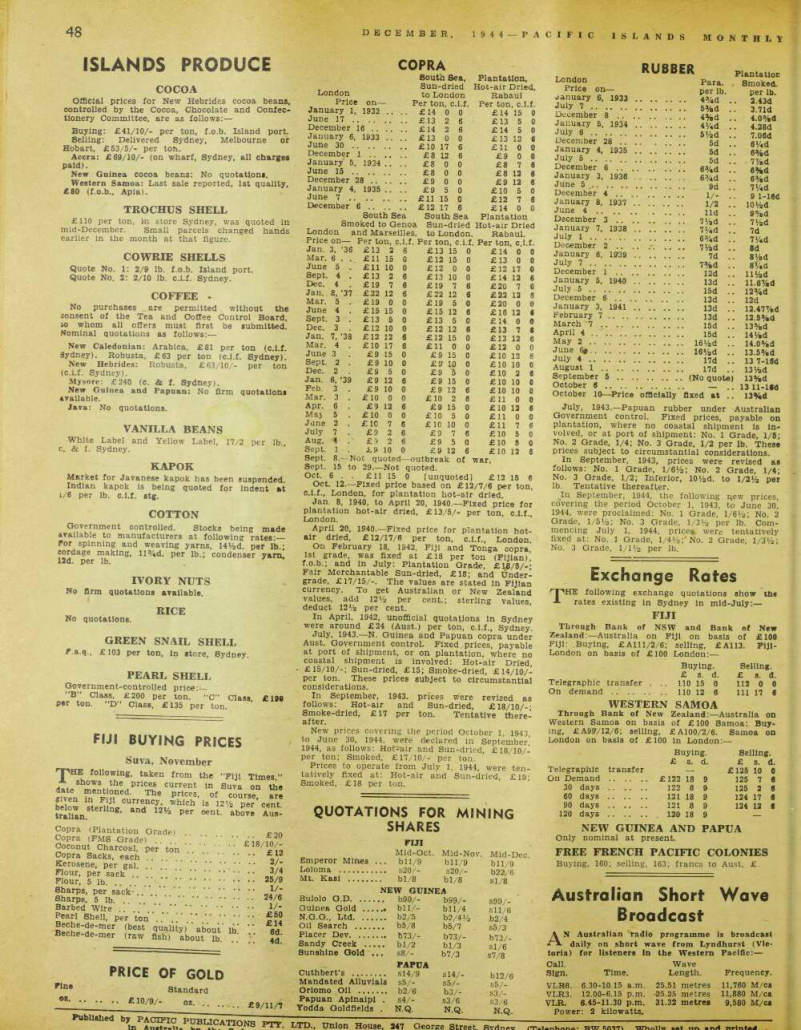
Cocoa
Official prices for New Hebrides cocoa beans, controlled by the Cocoa, Chocolate and Confec tionery Committee, are as follows: Buying: £4l/10/- per ton, f.o.b. Island port.
Selling; Delivered Sydney, Melbourne or Hobart, £53/5/- per ton.
Accra: £69/10/- (on wharf, Sydney, all charges paid).
New Guinea cocoa beans: No quotations.
Western Samoa: Last sale reported, Ist quality, £BO (f.0.b., Apia).
Trochus Shell
£llO per ton, tn store Sydney, was quoted in mid-December. Small parcels changed hands earlier in the month at that figure.
Cowrie Shells
Quote No. 1: 2/9 lb. f.o.b. Island port.
Quote No, 2: 2/10 lb. c.i.f. Sydney.
Coffee -
No purchases are permitted without the consent of the Tea and Coffee Control Board, w whom all offers must first be submitted.
Nominal quotations as follows; New Caledonian: Arabica, £Bl per ton (c.i.f.
Sydney). Robusta, £63 per ton (c.i.f. Sydney).
New Hebrides: Robusta, £63/10/- per ton (c.i.f. Sydney), Mysore: £240 (c. & f, Sydney).
New Guinea and Papuan: No firm quotations available.
Java: No quotations.
Vanilla Beans
White Label and Yellow Label, 17/2 per lb. c. & f. Sydney.
Kapok
Market for Javanese kapok has been suspended.
Indian kapok is being quoted for Indent at 1/6 per lb. c.l.f. stg.
Cotton
Government controlled. Stocks being made available to manufacturers at following rates:— For spinning and weaving yarns, 14y 2 d. per lb.; cordage making, 113/ 4 d. per lb.; condenser yam. 13d. per lb.
Ivory Nuts
No firm quotations available.
Rice
No quotations.
Green Snail Shell
F.a.q., £lO3 per ton, in store, Sydney.
Pearl Shell
Government-controlled price:— "B” Class, £2OO per ton. “C” Class £l9O per ton. "D” Class, £135 per ton.
Fiji Buying Prices
Suva, November
'X'HE following, taken from the "Fiji Times ” * sh °™V the P rices curre nt in Suva on the date mentioned. The prices, of course are bHnw Tt F u il Currency * w hlch is 12y 2 per’ cent ESuln and 12Va per oent ‘ ab °™ a“- Copra (Plantation Grade) .
Copra (FMS Grade) £i«/fn/ Coconut Charcoal, per ton " £lB/ Copra Sacks, each Kerosene, per gal.
Flour, per sack ... J/* Flour, 5 lb 25 /9 Sharps, per sack n }(~ Sharps, 5 lb. 24/6 Barbed Wire .. l/ Pearl Shell, per ton " fJJ Beche-de-mer (best quality)' * about’ lb ” 6d Beche-de-mer (raw fish) about lb .
Price Of Gold
Plne Standard ° Z £lO/9/ " oz £9/11/7
Oct. 6 . . £ll 15 0 [unquoted] £l2 15 C Oct. 12.—Fixed price based on £l2/7/6 per ton, c.1.f., London, for plantation hot-air dried.
Jan. 8, 1940, to April 20. 1940 —Fixed price for plantation hot-air dried, £l3/5/- per ton, c.i.f.
London.
April 20, 1940.—Fixed price for plantation hot air dried, £l2/17/6 per ton, c.1.f., London On February 18, 1942, Fiji and Tonga copra Ist grade, was fixed at £lB per ton (Fijian), f.0.b.; and in July: Plantation Grade, £lB/5/-’
Fair Merchantable Sun-dried, £18; and Under grade, £l7/15/-. The values are stated in Fijian currency. To get Australian or New Zealand values, add 12 V 2 per cent.; sterling values, deduct 12 V 2 per cent.
In April, 1942, unofficial quotations in Sydney were around £24 (Aust.) per ton, c.1.f., Sydney.
July, 1943.—N. Guinea and Papuan copra under Aust. Government control. Fixed prices, payable at port of shipment, or on plantation, where no coastal shipment is involved: Hot-air Dried • £l5/10/-; Sun-dried, £l5; Smoke-dried, £l4/10/per ton. These prices subject to circumstantial considerations.
In September, 1943. prices were revised as follows: Hot-air and Sun-dried, £lB/10/-' Smoke-dried, £l7 per ton. Tentative there after.
New prices covering the period October 1. 1943 to June 30, 1944, were declared in September’ 1944, as follows: Hot-air and Sun-dried, £lB/10/per ton; Smoked, £l7/10/- per ton.
Prices to operate from July 1, 1944, were ten tatively fixed at: Hot-air and Sun-dried, £l9- Smoked, £lB per ton.
Copra
South Sea, Plantation, London Sun-dried Hot-air Dried. to London Rabaul Price on— Per ton, c.i.f.
Per ton. c.i.f.
January 1, , 1932 . £14 0 0 £14 15 0 June 17 . £13 2 6 £13 5 0 December 16 .. . £14 2 6 £14 5 0 January 6, 1933 . £13 0 0 £13 12 6 June 30 . £10 17 6 £11 0 0 December 1 . . ., £8 12 6 £9 0 0 January 5, 1934 ., £8 0 0 £8 7 6 June 15 . £8 0 0 £8 12 6 December 28 .. . £9 0 0 £9 12 6 January 4, , 1935 ., £9 5 0 £10 5 0 June 7 .. £11 15 0 £12 7 6 December 6 . . . . £12 17 6 £14 0 0 South Sea South Sea Plantation Smoked to Genoa Sun-dried Hot-air Dried London and Marseilles, to London.
Rabaul.
Price on— Per ton, , c.i.f. Per ton. c.i.f. Per ton . c.i.f.
Jan. 3, ’36 £13 : 3 6 £13 15 0 £14 0 0 Mar. 6 . . £11 15 0 £12 15 0 £13 0 0 June 5 . £11 10 0 £12 0 0 £12 17 0 Sept. 4 . £13 ; 2 6 £13 10 0 £14 12 6 Dec. 4 . £19 ' 7 6 £19 7 6 £20 7 6 Jan. 8, ’37 £22 12 6 £22 12 6 £22 12 6 Mar. 5 . £19 ( 3 0 £19 5 0 £20 0 0 June 4 £15 15 0 £15 12 6 £16 12 t Sept. 3 . £13 i 3 0 £13 5 0 £14 0 0 Dec. 3 £12 10 0 £12 12 6 £13 7 t Jan, 7, ’38 £12 12 6 £12 15 0 £13 12 6 Mar. 4 . £10 17 6 £11 0 0 £12 0 0 June 3 £9 15 0 £9 15 0 £10 12 6 Sept. 2 . £9 10 0 £ 9 10 0 £10 10 0 Dec. 2 £9 £ > 0 £9 5 0 £10 2 6 Jan. 6, ’39 £9 12 6 £9 15 0 £10 10 6 Feb. 3 . £9 10 0 £9 12 6 £10 10 0 Mar. 3 . £10 ( ) 0 £10 2 6 £11 0 0 Apr. 6 £9 12 6 £9 15 0 £10 12 6 Maj 5 . £10 t ) 0 £10 5 0 £11 0 0 June 2 . £ ic •; r e £10 10 0 £11 7 6 July 7 . £9 2 1 6 £9 7 6 £10 5 0 Aug. 4 . £9 5 I 6 £9 5 0 £10 6 0 Sept. 1 . £9 10 0 £9 12 6 £10 12 6 Sept. 8. —Not quoted— outbreak of war.
Sept. 15 to 29.—Not quoted.
Quotations For Mining
Shares
July, 1943.—Papuan rubber under Australian Government control. Fixed prices, payable on plantation, where no coastal shipment is in volved, or at port of shipment: No. 1 Grade, 1/5; No. 2 Grade, 1/4; No. 3 Grade, 1/2 per lb. These prices subject to circumstantial considerations.
In September, 1943, prices were revised as follows: No. 1 Grade, I/6V2 ; No. 2 Grade, 1/4; No. 3 Grade, 1/2; Inferior, 10V 2 d. to 1/2Va per lb. Tentative thereafter.
In September, 1944, the following new prices, covering the period October 1, 1943, to June 30, 1944, were proclaimed; No. 1 Grade, l/OVaJ No. 2 Grade, 1/5V 2 ; No. 3 Grade, 1/3Va per lb. Com mencing July 1, 1944, prices wer e tentatively fixed at: No. 1 Grade, l/4y 2 ;'No. 2 Grade, 1/3Vi; No. 3 Grade, 1/1 Vz per lb.
Fiji
Mid-Oct.
Mid-Nov.
Mid-Dec.
Emperor Mines ... bll/9 bll/9 bll/9 Loloma s20/s20/b22/6 Mt. Kasi bl/8 bl/8 sl/8
New Guinea
Bulolo G.D b90/b&9/- S99/- Guinea Gold . bll/bll/4 sll/6 N.G.G., Ltd b2/5 b2/4y a b2/4 Oil Search b5/8 b5/7 S5/3 Placer Dev b73/b73/b73/- Sandy Creek bl/2 bl/3 sl/6 Sunshine Gold ... s8/b7/3 S7/8 Cuthbert’s
Papua
si 4/9 sl4/bl2/6 Mandated Alluvials s5/s5/s5/s3/s3/6 Orlomo Oil b2/6 b3/- Papuan Aplnaipl . s4/s3/6 Yodda Goldfields .
N.Q.
N.Q.
N.Q.
London Price on— January 6, 1933 July 7
RUBBER Plantation
Para. Smoked, per lb, per lb.
December 8 .. . *>. UU January 5, 1934 July 6 .. .. *.U7»a 4.28d December 28 ..
January 4, 1935 July 5 5d !! /.uoa 6 l /«d 6%d December 6 .. . i /ad
A Xl A
January 3, 1936 June 5 .. .. 63/ 4 d !! 071 Cl 6%d December 4 .. .
I 74d January 8, 1937 .
June 4 December 3 .. . 1/2 lOVad 9*/ad January 7, 1938 . • /2u 7d July 1 • u December 2 .. . 1 /4d January 6, 1339 .
July 7 ou 8Vsd o l/. d December 1 .. .
O /4U 1 1 Vod January 5, 1940 .
July 5 11 /2U 11.6%d December 6 .. ..
January 3, 1941 . 12d 12.47%d 12.5 5 /«d 13%d February 7 .. .. , March 7 April 4 HVsd May 2 14 n June 6# July 4 it.uTia 13.5 s /»d 13 7-16d August 1 13 Mid 13%d 13 11-ltd 13%d September 5 .. .
October 6 October 10—Price officially fixed at ..
Exchange Rates
r T'HE following exchange quotations show the A rates existing in Sydney in mid-July:—
Fiji
Through Bank of NSW and Bank of New Zealand:—Australia on FIJI on basis of £lOO Fiji; Buying, £Alll/2/6; selling, £AII3. FIJI - on basis of £lOO London:—
Western Samoa
Through Bank of New Zealand;—Australia on Western Samoa on basis of £lOO Samoa: Buy ing, £ A99/12/6; selling, £AIOO/2/6. Samoa on London on basis of £lOO in London: —
New Guinea And Papua
Only nominal at present.
Free French Pacific Colonies
Buying, 160; selling, 163; francs to Aust. £.
Buying.
Selling. £ s. d. £ s. d.
Telegraphic transfer . .. 110 15 0 112 0 0 On demand .. 110 12 6 111 17 fl
Buying.
Selling. £ s. d. £ s. d.
Telegraphic transfer — £125 10 0 On Demand £122 18 9 125 7 9 30 days 122 8 9 125 2 6 60 days 121 18 9 124 17 6 90 days 121 8 9 124 12 0 120 days 120 18 9 —
Australian Short Wave
Broadcast
AN Australian radio programme is broadcast daily on short wave from Lyndhurst (Vic toria) for listeners In the Western Pacific: —
Call.
Wave Sign.
Time.
Length.
Frequency.
Vlr8.
6.30-10.15 a.m. 25.51 metres 11,760 M/cs
Vlr3.
12.00-6.15 p.m. 25.25 metres 11,880 M/cs.
Vlr.
6.45-11.30 p.m. 31.32 metres 9,580 M/ci Power: 2 kilowatts.
Advertisements & other items, pp. 50-52 (3 items)
48
DECEMBER. 19 4 4 -PACIFIC ISLANDS MONTHLY
in Australia u?PTY. LTD., Union House, 247 George Street Rviinor (T n unv,nno' t»w twv»7\ wvmiio oat. «n onH nr4nf«i
Roll Of Honour
DECEMBER, 1944 PACIFIC** ISLANDS MONTHLY
(Continued From Inside Front Cover)
W. R. Carpenter & Go. Ltd.
Established 1914
THIRTY YEARS OF PACIFIC ISLANDS
DEVELOPMENT AND SERVICE.
W. R. CARPENTER & GO. LTD.
Capital £1,000,000.
GENERAL MERCHANTS AND SHIPOWNERS
Buyers and Exporters of All Kinds of Islands Produce Copra Merchants and Millers Agents for Australian, European and American Manufacturers Distributors of Every Description of Merchandise
AGENTS FOR:
FORD MOTOR COMPANY OF CANADA DODGE BROTHERS INC.
ELECTROLUX REFRIGERATORS WESTINGHOUSE ELECTRICAL CO.
T. G. & C. BOLINDERS (ENGINES) CATERPILLAR TRACTORS Etc., Etc.
BRANCHES THROUGHOUT THE PACIFIC ISLANDS
Head Office; 16 O'CONNELL STREET, SYDNEY
In London; W. R. Carpenter & Co. (London) Ltd., Coronation House, 4 Lloyd's Avenue, London, EC.
The W.R.C. Line
first Direct and Regular Cargo and Passenger Service between Eurone and Pacific Islands’ ports was established by W. R. Carpenter & Co. Ltd