Islands
Pacific
Monthly
November 17. 1944
Vol. Xv. No. 4.
Established 1930
[Registered at the transmission by post as a newspaper]
1/-
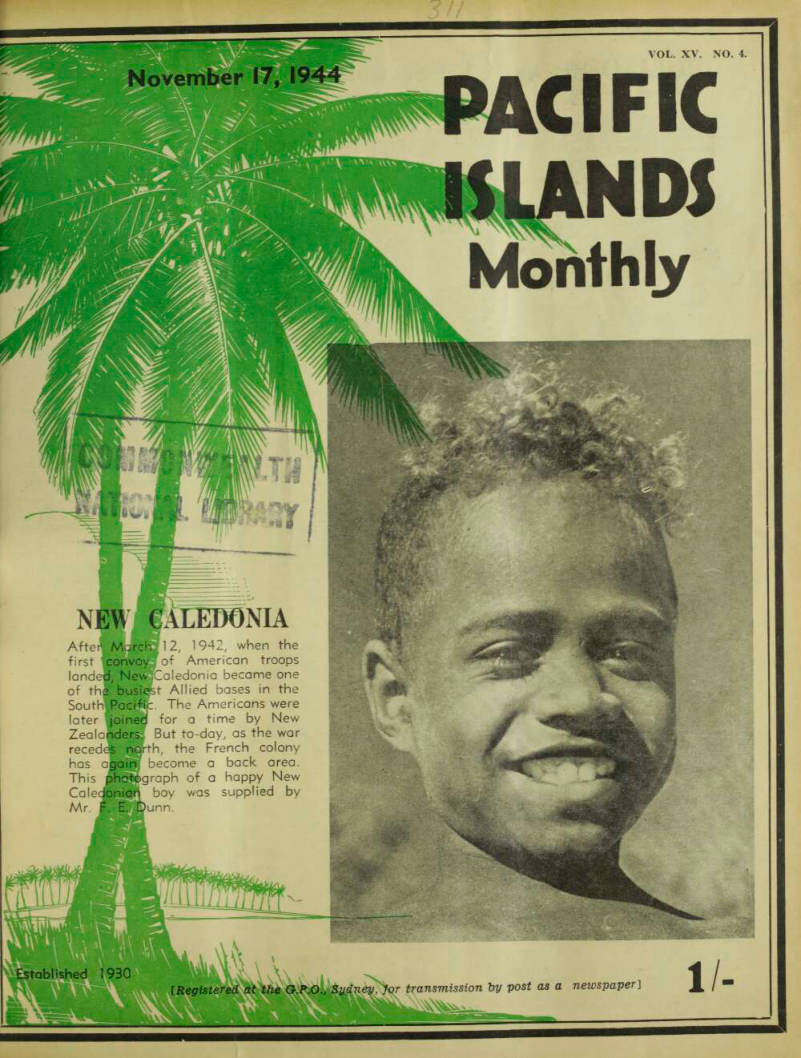
New Caledonia
After March 12, 1942, when the first convoy of American troops landed, New Caledonia became one of the busiest Allied bases in the South Pacific. The Americans were later joined for a time by New Zealanders. But to-day, as the war the French colony has again become a back area.
This photograph of a happy New boy was supplied by
Mr. F. E.Dunn.
Roll Of Honour-Section Ii.
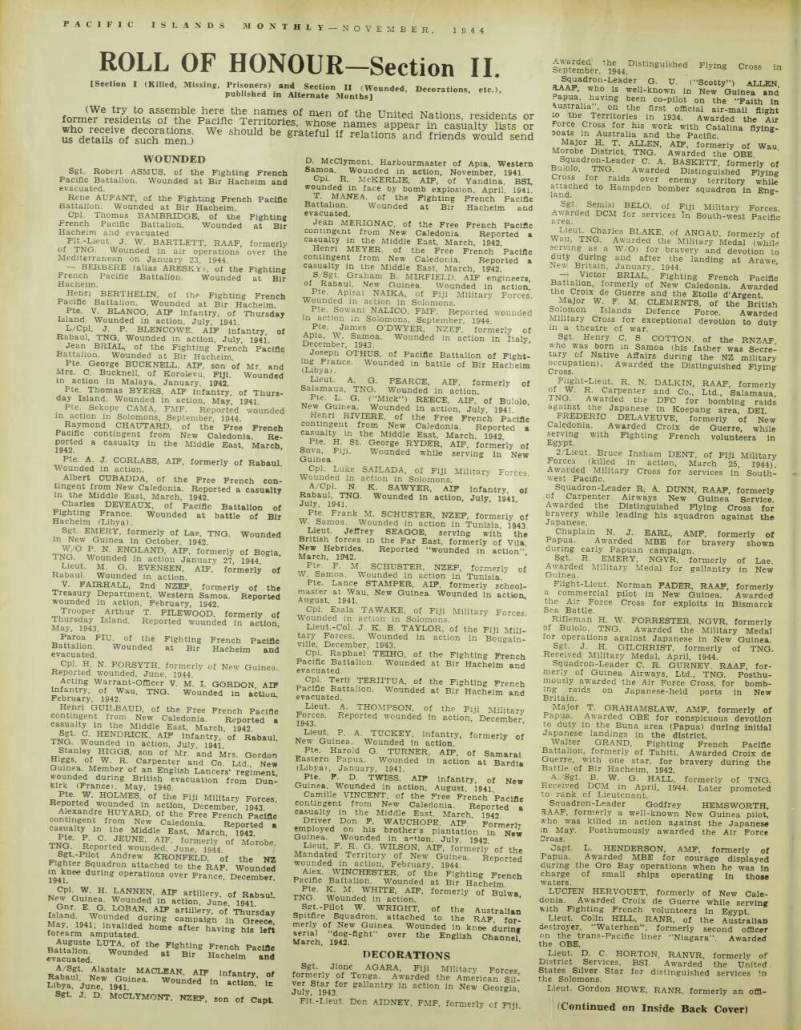
[Section I (Killed, Missing, Prisoners) and Section II (Wounded, Decorations, etc.), published in Alternate Months]
Wounded
Sgt. Robert ASMUS, of the Fighting French Pacific Battalion. Wounded at Bir Hacheim and evacuated.
Rene AUFANT, of the Fighting French Pacific Battalion. Wounded at Bir Hacheim.
Cpl. Thomas BAMBRIDGE, of the Fighting French Pacific Battalion. Wounded at Bir Hacheim and evacuated.
Fit.-Lieut. J. W. BARTLETT, RAAF, formerly of TNG. Wounded in air operations over the Mediterranean on January 23, 1944, BERBERE (alias ARESK¥ i, of the Fighting French Pacific Battalion. Wounded at Bir Hacheim.
Henri BERTHELEN, of the Fighting French Pacific Battalion. Wounded at Bir Hacheim.
Pte. V. BLANCO, AIF infantry, of Thursday Island. Wounded in action, July, 1941 L/Cpl. J. P. BLENCOWE. AIF Infantry of Rabaul, TNG. Wounded in action, July, 1941.
Jean BRIAL, of the Fighting French Pacific Battalion. Wounded at Bir Hacheim Pte. George BUCKNELL. AIF, son of Mr and Mrs. C. Bucknell, of Korolevu, Fiji. Wounded in action in Malaya, January, 1942 Pte. Thomas BYERS. AIF infantry, of Thurs day Island. Wounded in action, May 1941 Pte Sekope CAMA, FMF. Reported wounded in action in Solomons, September, 1944.
Raymond CHAUTARD, of the Free French Pacific contingent from New Caledonia. Rea Casualty in the Middle East. March, Pte. A. J. CORLASS, AIF, formerly of Rabaul.
Wounded in action.
Albert CUBADDA, of the Free French con tingent from New Caledonia. Reported a casualty in the Middle East, March, 1942. w C J arles DEVEAUX, of Pacific Battalion of Fighting France. Wounded at battle of Bir Hacheim (Libya).
Sgt. EMERY, formerly of Lae, TNG. Wounded in New Guinea in October, 1942.
TW’ 7O £ N 'J ENGLAND, AIF, formerly of Bogia, TNG. Wounded in action January 27 1944 Lieut. M G. EVENSEN. AIF. formerly of Rabaul. Wounded in action.
V. FAIRHALL, 2nd NZEF, formerly of the Treasury Department. Western Samoa. Reported wounded in action, February, 1942.
Trooper Arthur T. FILEWOOD.' formerly of Thursday Island. Reported wounded in action May, 1943. ’
Paroa Flu, of the Fighting French Pacific Battalion. Wounded at Bir Hacheim and evacuated.
CpL H. N. FORSYTH, formerly of New Guinea.
Reported wounded, June, 1944.
Acting Warrant-Officer V. M. I. GORDON AIF Infantry, of Wau, TNG. Wounded in action, February, 1942.
Henri GUILBAUD, of the Free French Pacific contingent from New Caledonia. Reported a casualty in the Middle East, March, 1942.
S: HENDRICK, AIF Infantry, of Rabaul, TNG. Wounded in action, July, 1941 ® tanl< “nf w GC J S ’ o° n ° f Mr and Mrs. Gordon Higgs, of W. R. Carpenter and Co Ltd New Guinea Member of an English Lancers* regiment during British evacuation from Dun kirk (Prance). May, 1940. hoI MES, of the Fiji Military Forces.
Reported wounded in action, December 1943 Alexandre HUYARD, of the Free French Pacific contingent from New Caledonia. Reported a casuaity in the Middle East. March. 1942 TNG 6 ' R P nnrf P J H EUNE ’ formerl y of Morobe, TNG. Reported wounded, June 1944 Sgt.-Piiot Andrew KRONFELD of the Rlg t h n ter SQ ua dron attached to the RAP. Wounded 1941 dunn S operations over France. December Cpl W. H. LANNEN, AIF artillery, of Rabau’
New Guinea. Wounded in action, June 1941 Gnr. E G. LOBAN, AIF artillery, of Thursday ™ and ; n^° Unded during campaign in Greeks May, 1941; invalided home after having his left forearm amputated. g ms lert Auguste LUTA, of the Fighting French Pacific evacuaSTd. Wo,l ” d ' d “ aSta'lS A/Sgt. Alastalr MACLEAN, AIF infantrv of
asMTiSr*- wounded >- •“*»» *°
sgt. J. D. McCLYMONT. NZEF, son of Capt.
D. McClymont, Harbourmaster of Apia, Western Samoa. Wounded in action, November, 1941.
Cpl. R. McKERLIE, ALP, of Yandina, BSL wounded in face by bomb explosion, April, 1941.
T. MANEA, of the Fighting French Pacific Battalion. Wounded at Bir Hacheim and evacuated.
Jean MERIGNAC, of the Free French Pacific contingent from New Caledonia. Reported a casualty in the Middle East, March, 1942.
Henri MEYER, of the Free French Pacific contingent from New Caledonia. Reported a casualty in the Middle East, March, 1942.
S/Sgt. Graham B. MIRFIELD, AIT engineers of Rabaul. New Guinea Wounded in action! . Bte -. A Pisai NAIKA, of Fiji Military Forces.
Wounded in action in Solomons.
Pte. Sowani NALICO, FMF. Reported wounded in action In Solomons, September, 1&'44.
Pte. James O’DWYER, NZEF,’ formerly of Apia, W. Samoa. Wounded in action in Italy December, 1943.
Joseph OTHUS. of Pacific Battalion of Fight ing France. Wounded in battle of Bir Hacheim (Libya).
Lieut. A. G. PEARCE, AIF, formerly of Salamaua, TNG. Wounded in action.
Pte L. G. (“Mick”) REECE, AIF. of Bulolo.
New Guinea. Wounded in action, July, 1941.
Henri RIVIERE, of the Free French Pacific contingent from New Caledonia. Reported a casualty in the Middle East, March, 1942 Pte. H. St. George RYDER, AIF, formerly of Suva, Fiji. Wounded while serving in New Guinea.
CP I - Luke SAILADA, of Fiji Military Forces Wounded in action in Solomons.
A/Cpl. N. K. SAWYER, AIF infantry, ol Rabaul, TNG. Wounded in action, July 1941 July, 1941. ** * Pte. Frank M. SCHUSTER, NZEF, formerly of W. Samoa. Wounded in action in Tunisia, 1943, Lieut. Jeffrey SEAGOE, serving with the British forces in the Far East, formerly of Vila New Hebrides. Reported “wounded in action”
March, 1942.
Pte. F. M. SCHUSTER, NZEF, formerly of W. Samoa. Wounded in action in Tunisia Pte. Lance STAMPER, AIF, formerly school master at Wau. New Guinea. Wounded in action.
August. 1941.
Cpl. Esala TAWAKE, of Fiji Military Forces Wounded in action in Solomons.
Lieut.-Col. J. K. B. TAYLOR, of the Fiji Mili tary Forces. Wounded in action in Bougain ville, December, 1943.
Cpl. Raphael TEIHO, of the Fighting French Pacific Battalion. Wounded at Bir Hacheim and evacuated.
Cpl. Terii TERIITUA, of the Fighting French Pacific Battalion. Wounded at Bir Hacheim and evacuated.
Lieut. A. THOMPSON, of the Fiji Military 1943 CeS ’ Reported wounde d in action. December, P. A. TUCKEY. infantry, formerly of New Guinea. Wounded in action Pte. Harold G. TURNER. ALP, of Samaral Eastern Papua. Wounded in action at Bardla (Libya), January, 1941.
Pte. F. D. TWISS, AIF infantry, of New Guinea. Wounded in action, August, 1941.
Camille VINCENT, of the Free French Pacific contingent from New Caledonia. Reported & casualty in the Middle East, March 1942 Driver Don F. WAUCHOPE. AIF.’ Formerlr employed on his brother’s plantation in New Guinea. Wounded in action, July, 1942 Lieut. F. R. G. WILSON, AIF, formerly of the Mandated Territory of New Guinea. Reported wounded in action, February, 1944 Alex. WINCHESTER, of the Fighting French Pacific Battalion. Wounded at Bir Hacheim Pte. K. M. WHITE, AIF, formerly of Bulwa TNG. Wounded in action. UIWa * Sgt.-Pilot W. WRIGHT. Of the Australian Spitfire Squadron, attached to the RAP for merly of New Guinea. Wounded in knee durin* aerial “dog-fight” over the English Channel March, 1942. ’
Decorations
Sgt. Jione AGARA, Fiji Military Forces formerly of Tonga. Awarded the American Sil- July S \ a 943 f ° r gallantry in action in New Georgia, Pit.-Lieut. Don AIDNEY, FMF, formerly of Fiji.
teTt r ember. t W4 4 DlStlngUlShed Cr ° ss uadron-Leader G. U. (“Scotty”) aLLEN RAAF, who is well-known in New Guinea and Papua having been co-pilot on the “Faith in Australia , on the first official air-mall flight to the Territories in 1934. Awarded the Air Force Cross for his work with Catalina flying ooats in Australia and the Pacific.
Major H. T. ALLEN, A IF, formerly of Wau Morobe District, TNG. Awarded the OBE Squadron-Leader C. A. BASKETT, formerly of Bulolo, TNG. Awarded Distinguished Plying C , rosa i° r raids over enem y territory while attached to Hampden bomber squadron In Eng land. & Sgt Semisi BELO, of Fiji Military Forces area rd6d DCM f ° r services in South-west Pacific w LieUt ™£ harl f S BLAKE > of ANGAU, formerly of Wau, TNG. Awarded the Military Medal (while serving as a W/O) for bravery and devotion to duty during and after the landing at Arawe New Britain, January, 1944.
T3 ~V ictoJ BRIAL, Fighting French Pacific Battalion, formerly of New Caledonia. Awarded the Croix de Guerre and the Etolle d’Argent Major W. F. M. CLEMENTS, of the British Solomon Islands Defence Force. Awarded Military Cross for exceptional devotion to duty in a theatre of war.
Sgt. Henry C. S. COTTON, of the RNZAF who was born in Samoa (his father was Secre tary of Native Affairs during the NZ military Cro U^at *° Awarded the Distinguished Flying Piight-Lieut. R. N. DALKIN. RAAF, formerly ° f W. R. Carpenter and Co., Ltd.. Salamaua, TNG. Awarded the DFC for bombing raids against the Japanese in Koepang area DEI FREDERIC DELAVEUVE, formerly of New Caledonia. Awarded Croix de Guerre, while serving with Fighting French volunteers in Egypt. 2/Lieut. Bruce Insham DENT, of Fiji Military Forces (killed in action, March 25, 1944).
Awarded Military Cross for services in South west Pacific.
Squadron-Leader R. A. DUNN, RAAF, formerly of Carpenter Airways New Guinea Service.
Awarded the Distinguished Flying Cross for bravery while leading his squadron against the Japanese.
Chaplain N. J. EARL, AMP, formerly of Papua. Awarded MBE for bravery shown during early Papuan campaign.
Sgt. R. EMERY, NGVR, formerly of Lae.
Awarded Military Medal for gallantry in New Guinea.
Flight-Lleut. Norman FADER, RAAF, formerly a commercial pilot in New Guinea. Awarded the Air Force Cross for exploits in Bismarck Sea Battle.
Rifleman H. W. FORRESTER, NGVR, formerly of Bulolo, TNG. Awarded the Military Medal for operations against Japanese in New Guinea.
Sgt. J. H. GILCHRIST, formerly of TNG.
Received Military Medal, April, 1944.
Squadron-Leader C. R. GURNEY. RAAF, for merly of Guinea Airways. Ltd., TNG. Posthu mously awarded the Air Force Cross, for bomb ing raids on Japanese-held ports in New Britain.
Major T. GRAHAMSLAW, AMP, formerly of Papua. Awarded OBE for conspicuous devotion to duty in the Buna area (Papua) during initial Japanese landings in the district.
Walter GRAND, Fighting French Pacific Battalion, formerly of Tahiti. Awarded Croix de Guerre, with one star, for bravery during the Battle of Bir Hacheim, 1942.
A. /Sgt. B. W. G. HALL, formerly of TNG.
Received DCM in April, 1944. Later promoted to rank of Lieutenant.
Squadron-Leader Godfrey HEMSWORTH, RAAF, formerly a well-known New Guinea pilot, who was killed in action against the Japanese In May. Posthumously awarded the Air Force Cross.
Capt. L. HENDERSON, AMP, formerly of Papua. Awarded MBE for courage displayed during the Oro Bay operations when he was in charge of small ships operating in those waters.
LUCTEN HERVOUET, formerly of New Cale donia. Awarded Croix de Guerre while serving with Fighting French volunteers in Egypt.
Lieut. Colin HILL, RANR, of the Australian destroyer, "Waterhen”. formerly second officer on the trans-Paciflc liner “Niagara”. Awarded the OBE.
Lieut. D. C. HORTON, RANVR, formerly of District Services. BSI. Awarded the United States Silver Star for distinguished services *n the Solomons.
Lieut, Gordon HOWE, RANR, formerly an offl
(Continued on Inside Back Cover)
cer in Burns Philp ships. Awarded the US Legion of Merit for meritorious service in lead ing a reconnaissance party to Russell Islands,
Bsi
Lieut. H. E. JOSSELYN, RANVR, formerly of District Services, BSI. Awarded United States Silver Star, for distinguished services in the Solomons. , , .
Capt. H. T. KIENZLE, ANGAU, formerly of Papua. Awarded MBE for devotion to duty during the campaign in the Owen Stanley Ranges.
Pte. Sairusi KOTO, Fiji Military Forces.
Awarded US Silver Star for bravery and de votion to duty in the Solomons.
Wing-Commander C. J. N. LELAU, RAAF, formerly of Suva, Fiji. Awarded the OBE for distinguished service.
Pte. Viliame LAUTIKI, of Fiji Military Forces.
Awarded MM for services in South-west Pacific area.
Sgt. T. McADAM. NGVR, formerly of New Guinea Forestry Dept. Awarded Military Medal for gallantry in New Guinea.
Lieut.-Commander A. W. R. McNICOLL, RAN, son of Sir Ramsay McNicoll, Administrator ol New Guinea, and Lady McNicoll. Awarded the George Medal.
Peity-Officer PAUL MASON, RANVR. formerly a plantation inspector at Inus, Bougainville, TNG. Awarded American Distinguished Service Cross for “extraordinary heroism in action.”
HENRI MAYER, formerly of New Caledonia.
Awarded Croix de Guerre while serving with Fighting French volunteers in Egypt.
Fit.-Lieut. George B. (Golly) MEIDECKE, RAAF, formerly of W. Samoa. Awarded the Distinguished Flying Cross.
Capt. J. K. MCCARTHY, formerly of TNG.
Received the MBE, April, 1944.
Lieut.-Commander H. A. MACKENZIE, RAN, formerly of Rabaul, TNG. Awarded the US Legion of Merit for exceptionally meritorious services at Guadalcanal.
Capt. John Malcolm METHVEN, AIF. Men tioned in despatches for distinguished services during the seige of Tobruk. Since reported killed in action. (See section “Killed.”) Sgt. Geoffrey MOORE, of the RNZAF, formerly engineer on the NG inter-island vessel “Maiwara” and on the trans-Paciflc liner “Aorangi”. Awarded the Distinguished Flying Medal.
Capt. G. B. MORGAN, DSC, formerly of Union SS Co. Awarded DSO and Lloyd’s war medal for his part in Allied landings in North Africa in 1942, when he was captain of the “Awatea.”
ANDRE MORNAGHINI, formerly of New Cale donia. Awarded Croix de Guerre while serving with Fighting French volunteers in Egypt.
Flight-Lieut. G. B. MEIDECKE, RAAF, formerly of W. Samoa. Awarded the DFC for “courage, coolness and tenacity, and flying skill of the highest order.”
Pte. Fred Charles NARRUHN, Fiji Military Forces. Awarded US Silver Star for gallantry and devotion to duty at Butaritari, Gilbert Is.
Flight-Lieut. M. O’CONNOR, RAAF, formerly of Suva, Fiji. Awarded the DFC for a “high record of success on operations” in the Middle East.
Capt. Raymond PERRAUD, FF Pacific Bat talion. Awarded Croix de Guerre at Bir Hacheim in 1942. Awarded Liberation Cross in Europe in 1944. Later killed in action.
Flight-Lieut. H. G. PILLING, RAF, formerly of Suva, Fiji. Awarded the DFC, May, 1942. (Killed a few days later.) Lieut. W. T. READ, RANVR, formerly of Dis trict Services, TNG. Awarded American Distin guished Service Cross for “extraordinary heroism in action” while in South Pacific Waters.
Pilot-Otficer Pat RICHARDSON, RAF, son of Mr. W. Richardson, formerly of Penang, Fiji.
Awarded the Distinguished Flying Cross.
Commander Alvord S. ROSENTHAL, RAN. son of Major-General Sir Charles Rosenthal. KCB, CMG, DSO, VD, Administrator of Norfolk Island. Awarded the' DSO, November, 1941; awarded the Bar to DSO, February, 1942.
W/O K. W. RYALL, of ANGAU, formerly of TNG. Awarded Military Medal for conspicuous service in the Arawe Peninsula area of New Britain.
Cpl. Manoa ROKO, of Fiji Military Forces.
Awarded MM for services in South-west Pacific area.
Lieut.-Colonel J. B. K. TAYLOR, Commander of Fiji Military Forces overseas. Awarded American Purple Heart, March, 1944.
Capt. A. T. TIMPERLEY, AMP, formerly of Papua. Awarded MBE for work on Good enough Island when he acted as a guide.
Major David TRENCH, formerly District Offi cer in BSI. Awarded the Military Cross for distinguished service and gallantry in the South-west Pacific.
F/O Leigh G. VIAL, RAAF, formerly ADO In TNG. Awarded American DSC for outstand ing heroism in New Guinea in September, 1942.
Squadron-Leader Charles WIDDY, RAAF, formerly of BSI. Awarded the US Legion of Merit for meritorious service in leading a reconnaissance party to Russell Islands, BSI.
Lieut, (then W/O) Raymond WATSON, A IF, formerly of TNG. Awarded MBE for bravery and devotion to duty during the Papuan cam paign.
Sgt. Ilaitia WAQA, of Fiji Military Forces.
Awarded MM for services in South-west Pacific area.
Capt. D. E. WILLIAMS, of Fiji Military Forces.
Awarded American Silver Star lor gallantry in action while leading patrols in Guadalcanal.
Lieut. G. K. WHITTAKER, NGVR, formerly of Lae, TNG. Awarded MBE for gallantry in New Guinea.
Lieut. George Raymond WORLEDGE. of the RANVR. formerly of Fiji. Awarded the MBE (Military).
Mentioned In Despatches
Rifleman G. R. Archer, Corporal Malakai Mo, TNG. Fiji.
Captain A. H. Bald- Corporal M. Marlay, win, Papua. TNG.
Captain N. B. N. Rifleman J. E. Mayos, Blood, TNG. TNG.
Rifleman J. Cavanagh,
Tng.
Rifleman J. W. Currie,
Tng.
Warrant-Officer J. B.
Davies, Papua.
Captain L. S. Dexter, Papua.
Major S. Elliott-Smith, Papua.
Capt. W. M. Edwards,
Tng.
Warrant-Officer P. R.
N. England, TNG.
Rifleman H. W. For rester, TNG.
Lieut. K. G. Fuller, Tonga.
Sergeant V. H. Gil christ. TNG.
Lieut. S. G. Grimshaw,
Tng.
Lieut. C. G. Harris,
Tng.
Lieut. L. F. Hewlett,
Tng.
Sgt. H. E. Jarrett, Papua.
Major E. W. Jenyns,
Tng.
Warrant-Officer I. F.
Jones, Papua.
Lieut. H. T. Kienzle, Papua.
Rifleman J. R. Kinsey,
Tng.
Corporal A. Moore,
Tng.
Captain J. J. Murphy,
Tng.
Lieut. K. C. McMullen,
Tng.
WO Victor Neuman,
Tng.
Captain N. Owers.
Sub-Lieut. C. Page,
Tng.
Lieut. R. H. Phillips,
Tng.
Pte. A. A. Ramsden, Papua.
Major D, G. Rice.
Pte. S. M. Richie, Papua.
Lieutenant J. I. Rae, Papua.
Sergeant Akuila Sau kura. Fiji.
Lieutenant C. H. Smith,
Tng.
Warrant-Officer R. A.
Smith, Papua.
Pte. R. M. Stewart, Papua.
Lieut. A. T. Timperly, Papua.
Captain L. N. Tribolet,
Tng.
Lieutenant A. G. Vagg,
Tng.
Captain G. H. Vernon, MC, Papua.
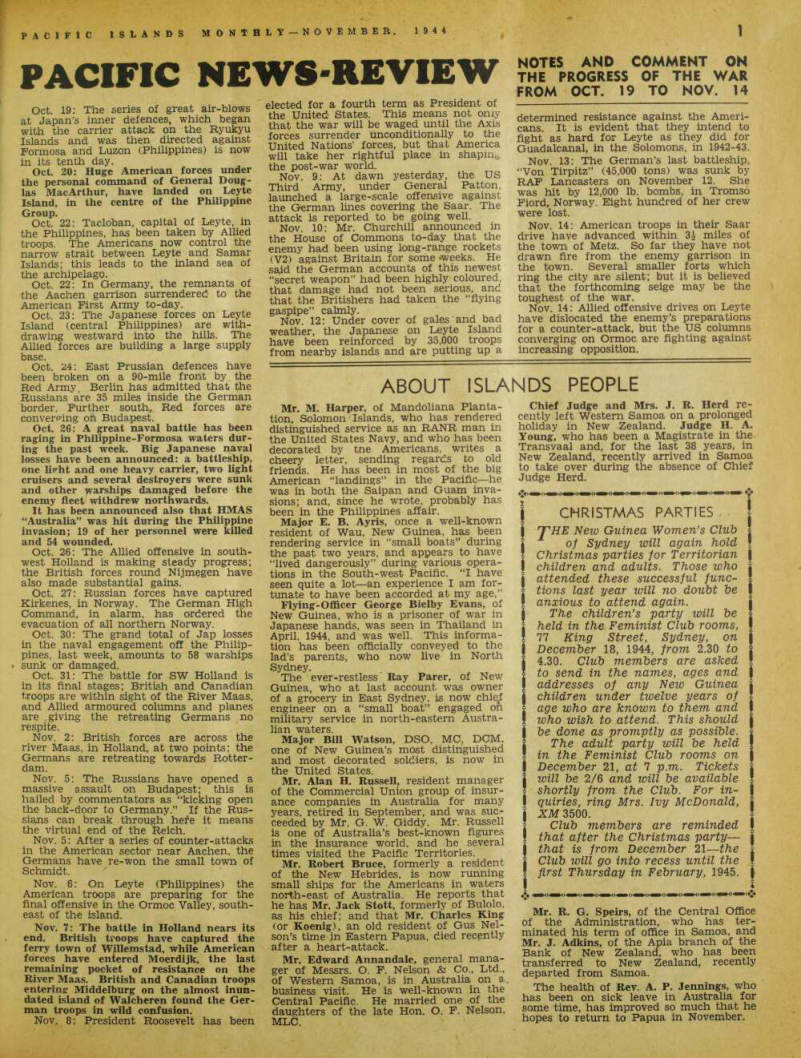
Pacific News-Review
¥ffi“«A« S s e r?Sr w°*¥
From Oct. 19 To Nov. 14
Oct. 19: The series of great air-blows at Japan’s inner defences, which began with the carrier attack on the Ryukyu Islands and was then directed against Formosa and Luzon (Philippines) is now in its tenth day.
Oct. 20: Huge American forces under the personal command of General Doug las MacArthur, have landed on Leyte Island, in the centre of the Philippine Group.
Oct. 22: Tacloban, capital of Leyte, in the Philippines, has been taken by Allied troops. The Americans now control the narrow strait between Leyte and Samar Islands; this leads to the inland sea of the archipelago.
Oct. 22: In Germany, the remnants of the Aachen garrison surrendered to the American First Army to-day.
Oct. 23: The Japanese forces on Leyte Island (central Philippines) are with drawing westward into the hills. The Allied forces are building a large supply base.
Oct. 24: East Prussian defences have been broken on a 90-mile front by the Red Army. Berlin has admitted that the Russians are 35 miles inside the German border. Further south, Red forces are converging on Budapest.
Oct. 26: A great naval battle has been raging in Philippine-Formosa waters dur ing the past week. Big Japanese naval losses have been announced: a battleship, one and one heavy carrier, two light cruisers and several destroyers were sunk and other warships damaged before the enemy fleet withdrew northwards.
It has been announced also that HMAS “Australia” was hit during the Philippine invasion; 19 of her personnel were killed and 54 wounded.
Oct. 26: The Allied offensive in south west Holland is making steady progress; the British forces round Nijmegen have also made substantial gains.
Oct. 27: Russian forces have captured Kirkenes, in Norway. The German High Command, in alarm, has ordered the evacuation of all northern Norway.
Oct. 30: The grand total of Jap losses in the naval engagement off the Philip pines, last week, amounts to 58 warships sunk or damaged.
Oct. 31: The battle for SW Holland is in its final stages; British and Canadian troops are within sight of the River Maas, and Allied armoured columns and planes are .giving the retreating Germans no respite.
Nov. 2; British forces are across the river Maas, in Holland, at two points: the Germans are retreating towards Rotter dam.
Nov. 5: The Russians have opened a massive assault on Budapest; this is hailed by commentators as “kicking open the back-door to Germany.” If the Rus sians can break through hefe it means the virtual end of the Reich.
Nov. 5: After a series of counter-attacks in the American sector near Aachen, the Germans have re-won the small town of Schmidt.
Nov. 6: On Leyte (Philippines) the American troops are preparing for the final offensive in the Ormoc Valley, south east of the island.
Nov. 7: The battle in Holland nears its end. British troops have captured the ferry town of Willemstad, while American forces have entered Moerdijk, the last remaining pocket of resistance on the River Maas. British and Canadian troops entering Middelburg on the almost inun dated island of Walcheren found the Ger man troops in wild confusion.
Nov. 8: President Roosevelt has been
elected for a fourth term as President of the United States. This means not only that the war will be waged until the Axis forces surrender unconditionally to the United Nations’ forces, but that America will take her rightful place in shaping the post-war world.
Nov. 9: At dawn yesterday, the US Third Army, under General Patton, launched a large-scale offensive against the German lines covering the Saar. The attack is reported to be going well.
Nov. 10: Mr. Churchill announced in the House of Commons to-day that the enemy had been using long-range rockets (V 2) against Britain for some *weeks. He sajd the German accounts of this newest “secret weapon” had been highly coloured, that damage had not been serious, and that the Britishers had taken the “flying
gaspipe” calmly.
Nov. 12: Under cover of gales and bad weather, the Japanese on Leyte Island have been reinforced by 35,000 troops from nearby islands and are putting up a
determined resistance against the Ameri cans it is evident that they intend to fight as hard for Ley te as they did for Guadalcanal, in the Solomons, in 1942-43.
Nov. 13: The German’s last battleship,
RAF llT'she
2 Eght’hunSed oThercrew
Fiord, Norway. Lignt nuncrea oi ner crew were lost * . „ Nov. 14: American troops in their Saar drive have advanced within 3 h miles of the town of Metz. So far they have not drawn fire from the enemy garrison in the town. Several smaller forts which ring the city are silent; but it is believed that the forthcoming seige may be the toughest of the war.
Nov. 14: Allied offensive drives on Leyte have dislocated the enemy’s preparations for a counter-attack, but the US columns converging on Ormoc are fighting against
increasing opposition.
About Islands People
Mr. M. Harper, of Mandoliana Planta tion, Solomon' Islands, who has rendered distinguished service as an RANR man in the United States Navy, and who has been decorated by tne Americans, writes a cheery letter, sending regards to old friends. He has been in most of the big American “landings” in the Pacific —he was in both the Saipan and Guam inva sions; and, since he wrote, probably has been in the Philippines affair.
Major E. B. Ayris, once a well-known resident of Wau, New Guinea, has been rendering service in “small boats” during the past two years, and appears to have “lived dangerously” during various opera tions in the South-west Pacific. “I have seen quite a lot—an experience I am for tunate to have been accorded at my age,”
Flying-Officer George Bielby Evans, of New Guinea, who is a prisoner of war in Japanese hands, was seen in Thailand in April, 1944, and was well. This informa tion has been officially conveyed to the lad’s parents, who now live in North Sydney.
The ever-restless Ray Parer, of New Guinea, who at last account was owner of a grocery in East Sydney, is now chief engineer on a “small boat” engaged on military service in north-eastern Austra lian waters.
Major Bill Watson, DSO, MC, DCM, one of New Guinea’s most distinguished and most decorated soldiers, is now in the United States.
Mr. Alan H. Russell, resident manager of the Commercial Union group of insur ance companies in Australia for many years, retired in September, and was suc ceeded by Mr. G. W. Giddy. Mr. Russell is one of Australia’s best-known figures in the insurance world, and he several times visited the Pacific Territories.
Mr. Robert Bruce, formerly a resident of the New Hebrides, is now running small ships for the Americans in waters north-east of Australia. He reports that he has Mr. Jack Stott, formerly of Bulolo, as his chief; and that Mr. Charles King (or Koenig), an old resident of Gus Nel son’s time in Eastern Papua, died recently after a heart-attack.
Mr. Edward Annandale, general mana ger of Messrs. O. F. Nelson & Co., Ltd., of Western Samoa, is in Australia on a. business visit. He is well-known in the Central Pacific. He married one of the daughters of the late Hon. O. F. Nelson,
Mlc.
Chief Judge and Mrs. J. R. Herd re cently left Western Samoa on a prolonged holiday in New Zealand. Judge H. A.
Young, who has been a Magistrate in the Transvaal and, for the last 38 years, in New Zealand, recently arrived in Samoa to take over during the absence of Chief Judge Herd.
Mr. R. G. Speirs, of the Central Office of the Administration, who has ter minated his term of office in Samoa, and Mr. J. Adkins, of the Apia branch of the Bank of New Zealand, who has been transferred to New Zealand, recently departed from Samoa.
The health of Rev. A. P. Jennings, who has been on sick leave in Australia for some time, has improved so much that he hopes to return to Papua in November.
Advertisements & other items, pp. 3-4 (1 item)
Christmas Parties
'THE New Guinea Women's Club of Sydney will again hold Christmas parties for Territorian children and adults. Those who attended these successful functions last year will no doubt be anxious to attend again.
The children's party will be held in the Feminist Club rooms, 77 King Street, Sydney, on December 18, 1944, from 2.30 to 4.30. Club members are asked to send in the names, ages and addresses of any New Guinea children under twelve years of age who are known to them and who wish to attend. This should be done as promptly as possible.
The adult party will be held in the Feminist Club rooms on December 21, at 7 p.m. Tickets will be 2/6 and will be available shortly from the Club. For inquiries, ring Mrs. Ivy McDonald, XM 3500.
Club members are reminded that after the Christmas party — that is from December 21 —the Club will go into recess until the first Thursday in February, 1945.
- USEFUL ADDRESSES
The following are the addresses of organisations set up to deal with Pacific Territories affairs:—
PAPUA, NEW GUINEA, NAURU ,
NORFOLK IS.
Department of External Territories (Sydney Branch) (Lately the New Guinea Trade Agency), Australia House, Carrington Street, Sydney.
Telephone: BW 1776. (Dealing with all matters connected with the Australian Pacific Territories and also the Sydney representative of the New Guinea Copra Control Committee.)
FIJI, AND HIGH COMMISSION
FOR WESTERN PACIFIC
Sydney Office of Fiji and Associated Administrations. (In charge of Mr. B. F. BlackweU.) 72 Pitt Street, Sydney.
Telephone: BW 7724.
BRITISH SOLOMON ISLANDS
Sydney Office of British Solomon Islands Government (In charge of Mr. F. E. Johnson, Treasurer of the Solomons Administration), 17 Castlereagh Street, Sydney.
Telephone: B 1710.
FOR PACIFIC TERRITORIES
EVACUEES GENERALLY
Pacific Territories Association (C. A. M, Adelskold, Secretary), c/o Robert Gillespie Pty., Ltd 54a Pitt Street, Sydney. Telephone: BW 4782.
WAR DAMAGE COMMISSION
Sydney Office: M.L.C. Buidling, Cnr. Martin Place and Castlereagh Street, Sydney, Telephone: BW 2361.
FOR CLAIMS AGAINST ARMY
Mr. H. Alderman, Darwin-Moresby Claims section, Chief Finance Office (Army), Victoria Barracks, Melbourne.
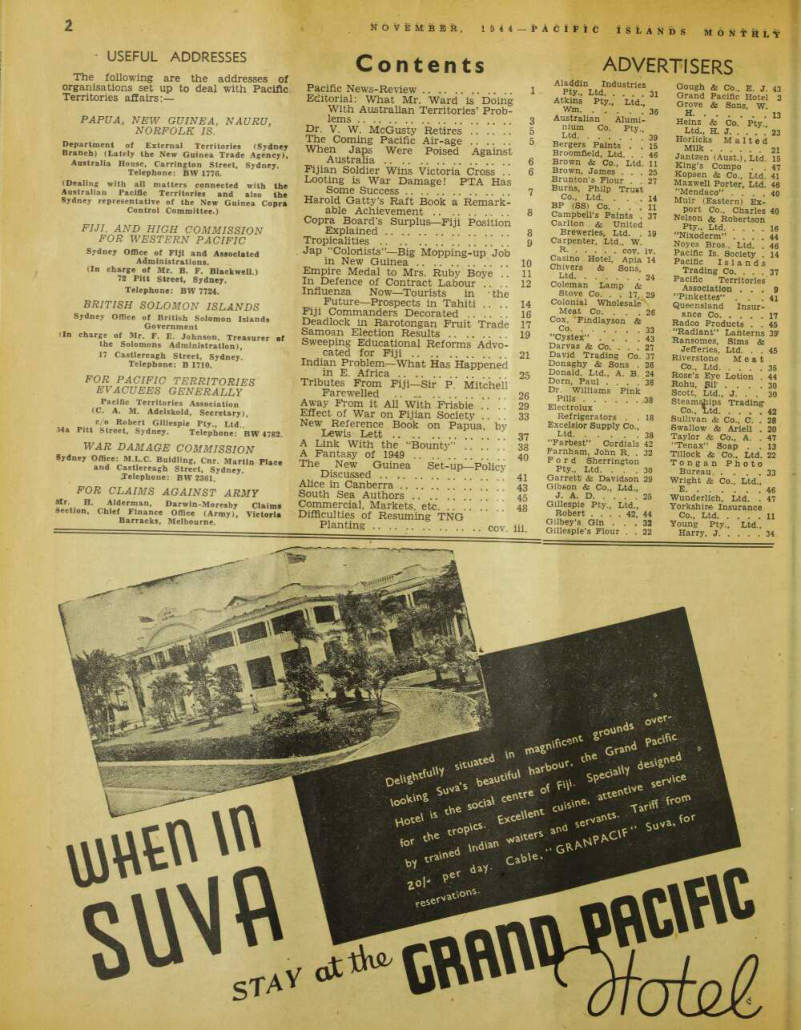
Contents
Pacific News-Review 1 Editorial: What Mr. Ward is Doing With Australian Territories’ Prob lems 3 Dr. V. W. McGusty Retires .. 5 The Coming Pacific Air-age 5 When Japs Were Poised Against Australia 6 Fijian Soldier Wins Victoria Cross .. 6 Looting is War Damage! PTA Has Some Success 7 Harold Gatty’s Raft Book a Remark able Achievement 8 Copra Board’s Surplus—Fiji Position Explained g Tropicalities 9 Jap “Coloilists”—Big Mopping-up Job in New Guinea 10 Empire Medal to Mrs. Ruby Boye .. 11 In Defence of Contract Labour ... 12 Influenza Now—Tourists in • the Future—Prospects in Tahiti ... 14 Fiji Commanders Decorated 16 Deadlock in Rarotongan Fruit Trade 17 Samoan Election Results 19 Sweeping Educational Reforms Advo cated for Fiji 21 Indian Problem—What Has Happened in E. Africa 25 Tributes From Fiji—Sir P. Mitchell Farewelled ... 26 Away From it All With Frisbie !! 29 Effect of War on Fijian Society .. 33 New Reference Book on Papua, bv Lewis Lett 37 A Link With the “Bounty” 33 A Fantasy of 1949 .. ’ 49 The New Guinea Set-up—Policy- Discussed 41 Alice in Canberra ’ ’ ’ 43 South Sea Authors * 45 Commercial, Markets, etc 43 Difficulties of Resuming TNG Planting m
Advertisers
Pty., Ltd 3i Atkins Pty., Ltd..
Wm 36 Australian Alumi nium Co. Pty..
Ltd Bergers Paints . . 15
Broomfield, Ltd. . . 46
Brown & Co., Ltd. 11 Brown, James ... 25 Brunton’s Flour . . 27 Burns, Philp Trust Co., Ltd. ... 14 BP (SS) Co. . . . ll Campbell’s Paints . 37 Carlton & United Breweries, Ltd. . 19 Carpenter, Ltd., W.
R iv.
Casino Hotel, Apia 14 Chivers & Sons, Ltd 24 Coleman Lamp & Stove Co. . . 17, 29 Colonial Wholesale Meat Co. ... 26 Cox, Findlayson & Co 33 "Cystex” ... 43 Darvas & Co. . . .27 David Trading Co. 37 Donaghy & Sons . 26 Donald, Ltd., A. B. 24 Dorn, Paul ... 36 Dr. Williams Pink Pills 38 Electrolux Refrigerators . . 18 Excelsior Supply Co., Ltd 38 “Farbest” Cordials 42 Farnham, John R. . 32 Ford Sherrington Pty., Ltd. ... 30 Garrett; & Davidson 29 Gibson & Co., Ltd.,
J. A. D 25
Gillespie Pty., Ltd., Robert ... 42, 44 Gilbey’s Gin ... 32 Gillespie’s Flour . . 22
Gough & Co., E. J. 43 Grand Pacific Hotel 2 Grove & Sons, W. l3 Heinz & Co. Pty., Ltd., H. J 23 Horlicks Malted Milk 21 Jantzen (Aust.).Ltd. 15 King’s Compo . . 47 Kopsen & Co., Ltd. 41 Maxwell Porter, Ltd. 46 “Mendaco” ... 40 Muir (Eastern) Ex port Co., Charles 40 Nelson & Robertson Pty., Ltd 16 "Nixoderm” ... 44 Noyes Bros., Ltd. . 46 Pacific Is. Society . 14 Pacific Islands Trading Co. . . . 37 Pacific Territories Association ... 9 “Pinkettes” ... 41 Queensland Insur ance Co 17 Radco Products . . 45 "Radiant” Lanterns 39 Ransomes, Sims & Jefferies, Ltd. . . 45 Riverstone Meat Co., Ltd 35 Rose’s Eye Lotion . 44 Rohu, gil . . , . 30 Scott, Ltd., J. . . 30 Steamships Trading' Co., Ltd 42 Sullivan & Co., C. . 28 Swallow & Ariell . 20 Taylor & Co., A. . 47 "Tenax” Soap . , 13 Tillock & Co., Ltd. 22 Tongan Photo Bureau. ... 33 Wright & Co., Ltd., E 46 Wunderlich, Ltd. . 47 Yorkshire Insurance Co., Ltd 11 Young Pty., Ltd., Harry, J 34
Advertisements & other items, p. 4 (1 item)
%
s»ss
Pacific Islands Monthly
The Newspaper-Magazine of the South Seas [,Registered at the G.P.0., Sydney, for transmission by post as a newspaper .]
Published Once Each Month and Circulated in Australia and New Zealand and in the following Pacific Territories and Islands Groups:
Australian Territory of Papua.
Mandated Territory (Australia) of New Guinea.
Australian Territory of Norfolk Island.
New Zealand Territory of Cook Islands.
Mandated Territory (NZ) of Western Samoa.
British Colony of FIJI.
British Solomon Islands Protectorate.
British Protectorate of Tongan Islands.
British Crown Colony of Gilbert and Ellice Islands.
Mandated Territory of Nauru.
British and Free French Condominium of New Hebrides.
Free French Colony of New Caledonia.
Free French Colony of Oceania (Tahiti, etc.).
American Territory of Eastern Samoa.
American Territory of Hawaiian Islands.
Owned and Produced by Pacific Publications Pty. Ltd., Union House, 247 George Street, Sydney.
TTTT fphonf f Managing Director .. BW 5037 TELEPHONE £ Business and Editorial MA 4369
P.O. Box 3408 R
Registered Address of Telegrams, Radiograms, and Cables: “Pacpub”, Sydney.
Contributions.
Articles, Stories, and Photographs dealing with Pacific Islands subjects are invited and will be paid for on publication.
Subscription Rates.
Per Annum, within British Empire, Prepaid, Post Free 18/- Per Annum, elsewhere, Prepaid, Post Free 12/6 Single Copies ...'. 1/-
Editor and Publisher:
R. W. Robson, F.R.Q.S.
Advertising Manager: L. W. Bailey.
Advertising Office and Printing-House: 29 Alberta Street, Sydney.
Advertising rates furnished on application.
Representative In Fiji.
Pacific Publications (Fiji), Ltd., Bank of NSW Building, Suva (same office as W. H. Grove Sc Sons, Ltd.). Stocks of Pacific Islands Monthly and Pacific Islands Yearbook on hand.
Representative In London.
W. C. Harvey, Coronation House, 4 Lloyds Avenue, London, E.C.3, from whom may be obtained copies of Pacific Islands Monthly, Pacific Is. Year Book, advertising schedules, etc.
Agents.
The following are authorised to receive sub scriptions for Pacific Islands Monthly:— Burns, Phllp Sc Co., Ltd., and Burns Phllp (South Sea) Co., Ltd. All branches.
W. R. Carpenter Sc Co., Ltd. All branches.
Morris, Hedstrom, Ltd. All branches.
Steamships Trading Co., Papua. All branches.
B.N.G. Trading Co., Ltd., Port Moresby, Papua.
J. Muir, Suva. FIJI.
Miss R. Castles, Suva, FIJI.
N. O. Mackenzie Hunt, Walnunu, Bua, FIJI.
Cook Islands Trading Co., Rarotonga, Cook Is.
A. C. Rowland, Papeete, Tahiti.
Islands Branches and Representatives of W. H.
Grove Sc Sons, Ltd., Auckland, New Zealand.
Ed. Pentecost, Noumea, New Caledonia.
Kerr Sc Co., Noumea, New Caledonia.
Vol. Xv. No. 4.
November 17, 1944
Prlro Per COP7 * rnce 10/- p.a.
unimaSnative measurinir S of
What Mr. Ward Is Doing With Australian Territories Problems
ONE does not know whether to curse Mr. Ward, or commiserate with him. (For the information of non- Melanesian readers: Mr. Ward is the strange political personality who was “wished” on to the Australian Prime Minister by the Labour Caucus, and to whom the Prime Minister, in freakish desperation, handed over the care of the Australian Paciflc Territorles.) He is so full of plans—and he is so pointedly ignored by the real b ° s of he Tpmtories » ANGAU.
Mr Ward knows nothing of the problems of tropical islands admmistration, and he has had no practical Consequently l he either bring?
Governmental nroblems of the Terri tones the catch-cries and rule-ofthumb methods evolved by countless relays of Trades Hall secretaries; or he depends absolutely upon his permanent officials in Canberra who apply to afl Questions the Ufeless Ind
unimaSnative measurinir S of
StlCk 0f strict Departmentalism.
The Australian Territories to-day are faeed with the following proble “ s ’ . . • How and when will civil admmistration be restored: and, as a necessary sequence, when will European civilians be allowed to return, and the common activities of planting, mining, trading, etc., re-established? • To what extent does the Government propose to co-operate with
European civilians in re-establishing good relations between them and native labour, already gravely dis turbed by war conditions? Or, alter natively, how does the Australian authority suggest that the Territories activities be carried on, in the absence of an adequate supply of native labour? * what is t 0 be the system of administration in the future? The o ld system? Or a combination of the two Territories? How is it proposed to protect, in the new set-up, the rights and privileges earned by the members of the two public services UP t 0 th ® monient of the invasion? Is intended to in some tangible fashion, in relation to the Territories’ future the men of both Territories who entered the com want m near combatant services
ba ;fJ
an if have achieved £o much and suffered so greatly? Or are they to be lumped in with Australian troops, to stand in line with them in relation to all war bonuses? what artuallv is the nolicv of th * in^re lation to the future development of these Territories? Does it propose to encourage private enterprise under pro per control’ Or is it giving serious thought to the plan of the professors, wbo want to make the Territories a c i ose preserve for the primitive Melanesians? Or has it—as so many suspect—some hare-brained scheme
for the development of the Territories along socialistic lines, using Govern ment officials as directors, accepting the advice of anthropologists and so forth, and smashing at the profit motive with a big stick, wherever private enterprise has the temerity t raise its head. rPa snn<; the utterances of pOR those reasons tneutte * M studied with almost jfttpntinn And thev arrive P^e SSllv he is eminently fair, reasonable, moder flnri au ick-thinking man. People who iudg g Mr Ward 0 n his published state ments on Territories affairs find effect upon their blood pressure very bad L et us look over some of the g e announcements. For instance: Establishment of an inter-departmental committee to prepare plans for regulating and controlling the reconstruction of devastated or damaged areas in Papua and New Guinea has been approved by a sub-committee of Federal Cabinet. It will comprise representatives of the Departments of Post-war Reconstruction, Transport, External Territories, War organisation of Industry, Treasury War Damage Commission, and Directorate of Research, representing the Army.
At present, Territories affairs nominally are’controlled by a sub- Committee of Cabinet—three or four Ministers who, between them, ha\e never seen the Territories for more than a few hours. The Departmental sub-Committee appointed by the Federal sub-Committee is made up merely of harassed and overworked Departmental officials, few or any of whom have any practical Knowledge
of the Territories, and most of whom are definitely ignorant of and un sympathetic towards trade and com merce and private enterprise generally.
About October 22, Mr. Ward an nounced: A committee would be set up imme diately, comprising a legal member, an officer of ANGAU with previous experience as a District Officer in the civil adminis tration, and an anthropologist with par ticular knowledge of Papua and New Guinea, to decide the basis upon which compensation will be paid to the native population for death, injury, or damage from causes due to the war. It is expected that this committee will take into account the communal nature of native village life and determine compensation on a tribal rather than personal basis.
Territorians read the announce ment with mixed feelings. At that time, they still were fighting for recognition of their claims for com pensation for indirect war damage (since granted)—yet the Government was preparing to compensate the natives. Upon this Committee, as upon other similar Committees, there was no representative of the real people of the Territories—the planters, traders, miners and missionaries, whose long years of hard labour had made occupation of the Territories possible.
The next announcement from Can berra was as follows: Arrangements are being made to recruit staff for the civilian administration of New Guinea to supplement the former staff and to fill vacancies caused by war casualties and retirements. The civilian administration will take over as soon as the military Government is withdrawn The service would be open to both civi lians and members of the Services. There is to be a School of Civil Affairs (Terri tories Administration) and a committee, to select students for same, has been set up.
IT was ascertained that the members of the Committee are: Mr. L.
Haylen, who was a newspaper re porter until he rode into Parliament on the Trades Hall nomination a year ago; Mr. J. R. Halligan, secretary of the Department of External Terri tories; Dr. K. S. Cunningham, “direc tor of the Australian Council for Educational Research.”
Here we have the same kind of set-up: unknown and (so far as Territories affairs are concerned) un respected people, plus a Departmental officer who necessarily calculates everything with his Departmental measuring stick. The world of real and practical affairs is rigidly ex- In any event, why this absurd plan? thousands of young men in t0 .u day ’ “'"Pared with hun dreds in the public services before the war. Surely ANGATT, whatever else it may be, is an admirable for administration officials, and surely there are plenty of men there to choose from. What can the "selected” men learn in this precious School that they are not now earning ln AN ?£ U? If they are not an y thm S valuable in exist AU ’ th6n ANGAU has no ri ght to On November 10, there was a
further announcement about this School, by Mr. Haylen, who appears to be chairman of the Committee: A school for selection of District Officers, Assistant District Officers, and Patrol Officers in New Guinea would begin at Royal Military Col lege, Duntroon, early next year. The course of lectures and studies would extend for 15 weeks, Ati first the school would be limited to 40 pupils who were former members of the Army, but later the school would take in members of the other Services and civilians. Those selected to work in New Guinea would receive salaries rang ing from £350 to £9OO a year. An interesting feature of the applications for admittance to the school was the intense desire of a large number of Australian Servicemen to go back to the country /Which they had helped to rescue from the Japanese for Australia.
This political blah-blah definitely suggests that the men of the Papuan and New Guinea public services are going to lose their seniority rights.
Surely, such an outrageous plan will not be allowed to go through without challenge. The only right and proper way to re-establish the civil adminis trations is to (a) provide adequately, if not generously, for all the surviving members of both services, preserving their well-earned seniority rights; (b) fill up the ranks with tried and proven men from ANGAU. This “School” looks like a cunning plan by politicians to ditch the senior men of the former services, and side-track any ANGAU men whom they do not like.
A ND, finally, we have this announce ment over the ABC broadcasting system on November 9: The future control of native labour in New Guinea and Papua will be talked over at a conference in Sydney on De cember 1. The Commonwealth Govern ment has already announced that it will do away with the indentured labour sys tem as soon as practicable. The Minister for External Territories, • Mr. Ward, said
to : day that the conference in Sydney was being called so that people who had experience of the New Guinea natives could put their views before the Govern ment and help to work out a new wav of regulating native labour. . As . we go to press, we have made inquiries, seeking some person with a practical knowledge of Territories affairs and conditions who may have been invited by Minister Ward to attend this “confefence,” but we can find none who has been so honoured On present appearances, those who are invited to the Conference will comprise Departmental officers, re presentatives of ANGAU, some right thinking missionaries, an anthro pologist or two, and perhaps a few trade-union members of Parliament.
Judged on a year’s performances, the last thing Mr. Ward will do will be to seek the help of the actual employers of indentured native labour. They, being exploiters, profiteers and fol lowers of private enterprise, must be ignored and discouraged—and, if possible, wiped off the face of the earth. ■jl/fEANWHILE, ANGAU goes happily ITA on its way. It has complete charge of the administration in Papua and New Guinea; the Minister remains merely a cipher; and the handsprings and somersaults, and committees and the conferences of Mr. Ward are regarded by the gentle men of the Brass Hats with—appar ently—indifference.
Mr. Fonse Parer, formerly of New Guinea, and now manager of the Plaza Hotel, Sydney, became ill in Newcastle, in October, and was admitted to New castle Hospital. He was en route to Dun gog for a holiday.
Advertisements & other items, p. 6 (1 item)
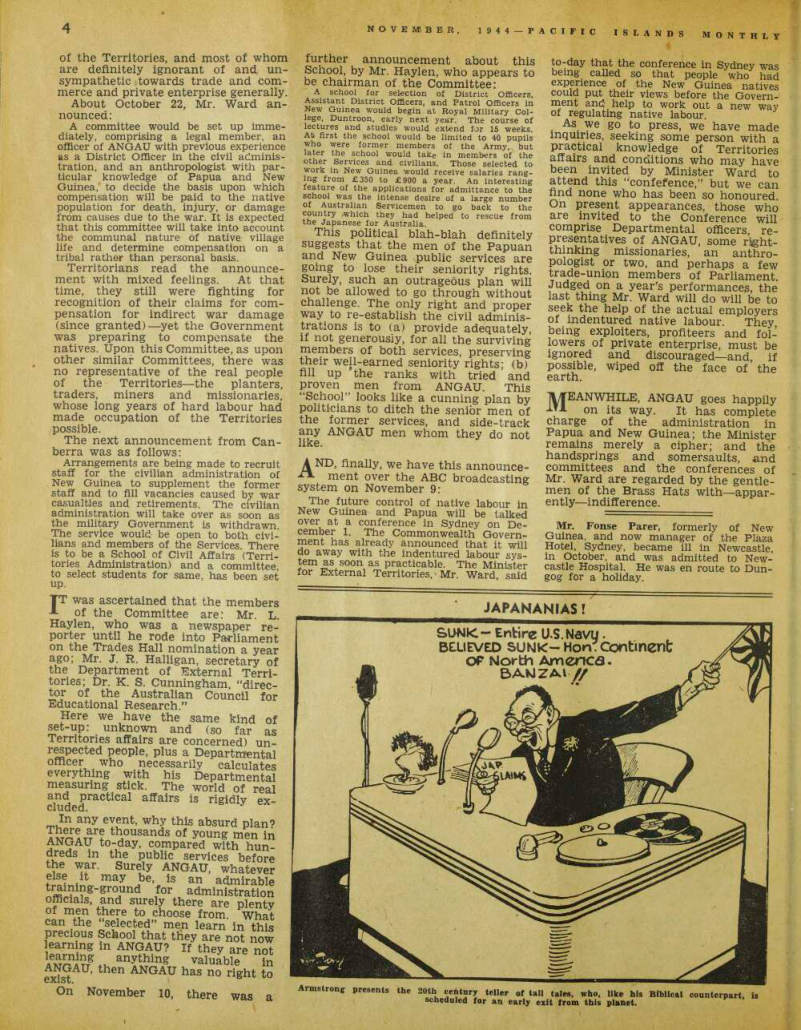
Japan Anias!
Armstrong presents the 20th cefttury teller of tall tales, who, like his Biblical counterpart, is scheduled for an early exit from this planet.
Retires
Dr. V. W. T. Mcgusty
But Will Carry On in Temporary Capacity
ANOTHER victim of the prevailing wave of retirements among high officials in Fiji is Dr. V. W. T.
McGusty, Director of Medical Services, Secretary for Indian Affairs, Central Medical Authority for the Western Pacific High Commission, and one of the best-known men in the Central Pacific.
In view of wartime conditions, however, Dr. McGusty offered to carry on his ap pointments on a temporary basis; and he has been re-appointed temporarily to those offices which he held on his auto matic retirement on September 15.
Dr. McGusty went t(5 Fiji first in 1912, and in his 32 years of service has filled many posts, apart from those connected with the Medical Department. He has been a District Commissioner on several occasions, and in 1931 was the Governor’s Commissioner. He has acted as Colonial Secretary and has been the Governor's Deputy. He was a member of the Civil Service Reorganisation Committee, and for a time was Chairman of the Suva Town Board.
Recently he played a prominent part in forming the preliminary plans for the ambitious medical services scheme for the South Pacific, which was announced earlier this year, and which it is hoped will be put into operation within the next few yeart.
Pacific Islands Stamps Are
Valuable
AT stamp auctions held in Melbourne in early November, four mint Ger man New Guinea stamps, part of a set issued in 1900, were sold for £lO6.
The design of the stamps depicts Kaiser Wilhelm’s yacht “Hohenzollern.” Follow ing the AIF occupation of New Guinea in September, ±914, the stocks of German stamps were seized and overprinted with the letters GRI and a new value in British currency. The four stamps, which bear this overprint, have a face value of 11/-.
All Pacific Islands stamps have appre ciated in value since the war —partly due to re-awakened interest in the Pacific, and partly due to the fact that much of Europe has been shut off from the rest of the world.
Sandy Creek Co.
THE annual report of Sandy Creek Gold Sluicing, Ltd., a New Guinea com pany which ceased operations when the Japs invaded in January, 1942, shows a loss of £217 on the year. The company has over £lOO,OOO invested in its Sandy Creek and Watut leases; expects to receive war damage compensation; and has about £21,000 on hand wherewith to resume operations. The directors are Messrs. H. B. Jamieson, H. G. Hyde, J.
W. Hinks and A. J. Smeaton.
Mr. T. W. Brighouse, well-known and popular planter of Nu’u Plantation, Western Samoa, recently received word r that his eldest son, Private Rex Brig ‘ house, has been killed in action while serving with the New Zealand Forces in Italy. Private Rex Brighouse had been wounded previously. He had been living in New Zealand for the past ten years and leaves a wife and two children.
Honour For L. W. G. Bell,
Of Kavieng
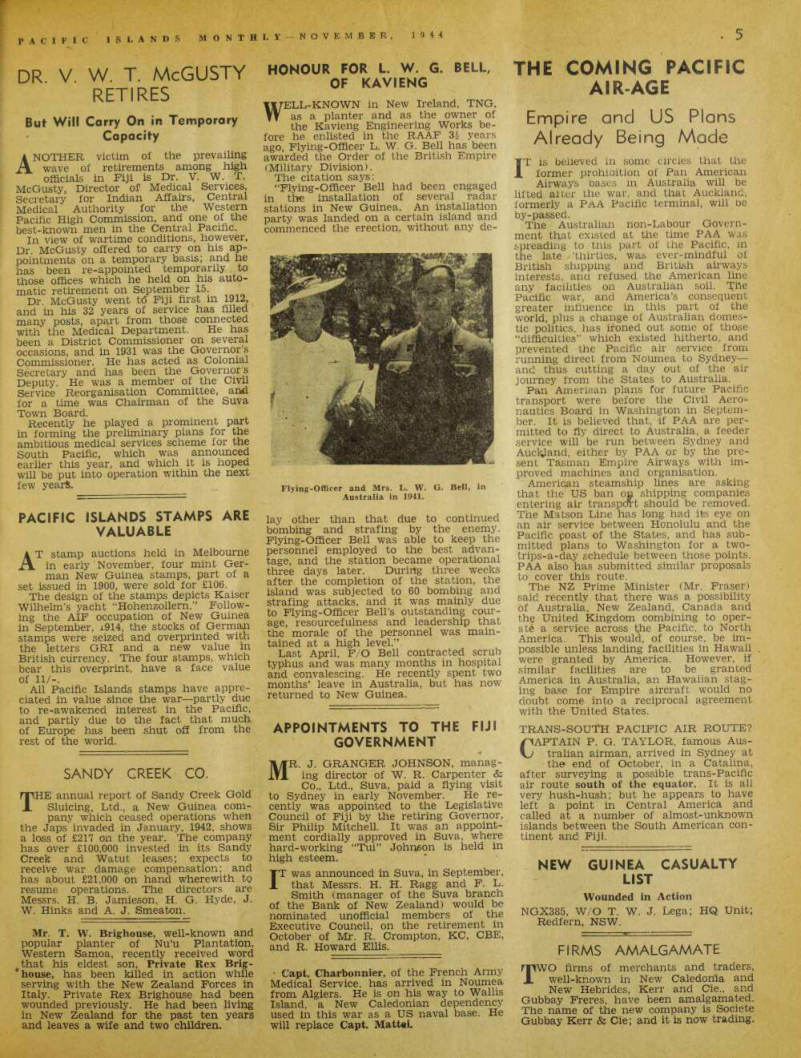
WELL-KNOWN in New Ireland, TNG, as a planter and as the owner of the Kavieng Engineering Works be fore he enlisted in the RAAF 3 h years ago, Flying-Officer L. W. G. Bell has been awarded the Order of the British Empire (Military Division).
The citation says: “Flying-Officer Bell had been engaged in the installation of several radar stations in New Guinea. An installation party was landed on a certain island and commenced the erection, without any de-
lay other than that due to continued bombing and strafing by the enemy.
Flying-Officer Bell was able to keep the personnel employed to the best advan tage, and the station became operational three days later. During three weeks after the completion of the station, the island was subjected to 60 bombing and strafing attacks, and it was mainly due to Flying-Officer Bell’s outstanding cour age, resourcefulness and leadership that the morale of the personnel was main tained at a high level.”
Last April, F/O Bell contracted scrub typhus and was many months in hospital and convalescing. He recently spent two months’ leave in Australia, but has now returned to New Guinea.
Flying-Officer and Mrs. L. W. G. Bell, in Australia in 1941.
Appointments To The Fiji
Government
Mr. J. Granger Johnson, Manag
ing director of W. R. Carpenter & Co., Ltd., Suva, paid a flying visit to Sydney in early November. He re cently was appointed to the Legislative Council of Fiji by the retiring Governor, Sir Philip Mitchell. It was an appoint ment cordially approved in Suva, where hard-working “Tui” Johnson is held in high esteem.
IT was announced in Suva, in September, that Messrs. H. H. Ragg and F. L.
Smith (manager of the Suva branch of the Bank of New Zealand) would be nominated unofficial members of the Executive Council, on the retirement in October of Mr. R. Crompton, KC, CBE, and R. Howard Ellis.
Capt. Charbonnier, of the French Army Medical Service, has arrived in Noumea from Algiers. He is on his way to Wallis Island, a New Caledonian dependency used in this war as a US naval base. He will replace Capt. Mattel.
Already Being Made
The Coming Pacific
Air-Age
Empire and US Plans Already Being Made
IT is believed in some circles that the former prohioition of Pan American Airways bases in Australia will be lifted alter the war, and that Auckland, formerly a PaA Pacific terminal, will be by-passed.
The Australian non-Labour Govern ment that existed at the time PAA was spreading to this part of the Pacific, in the late ’thirties, was ever-mindful of British shipping and British airways interests, and refused the American line any facilities on Australian soil. The Pacific war, and America’s consequent greater influence in this part of the world, plus a change of Australian domes tic politics, has ironed out some of those “difficulties” which existed hitherto, and prevented the Pacific air service from running direct from Noumea to Sydney— and thus cutting a day out of the air journey from the States to Australia.
Pan American plans for future Pacific transport were before the Civil Aero nautics Board in Washington in Septem ber. It is believed that, if PAA are per mitted to fly direct to Australia, a feeder service will be run between Sydney and Auckland, either by PAA or by the pre sent Tasman Empire Airways with im proved machines and organisation.
American steamship lines are asking that the US ban on shipping companies entering air transport should be removed.
The Matson Line has long had its eye on an air service between Honolulu and the Pacific poast of the States, and has sub mitted plans to Washington for a two trips-a-day schedule between those points.
PAA also has submitted similar proposals to cover this route.
The NZ Prime Minister (Mr. Fraser) said recently that there was a possibility of Australia, New Zealand, Canada and the United Kingdom combining to oper ate a service across the Pacific, to North America. This would, of course, be im possible unless landing facilities in Hawaii were granted by America. However, if similar facilities are to be granted America in Australia, an Hawaiian stag ing base for Empire aircraft would no doubt come into a reciprocal agreement with the United States.
Trans-South Pacific Air Route?
CAPTAIN P. G. TAYLOR, famous Aus tralian airman, arrived in Sydney at the end of October, in a Catalina, after surveying a possible trans-Pacific air route south of the equator. It is all very hush-hush; but he appears to have left a point in Central America and called at a number of almost-unknown islands between the South American con tinent and Fiji.
Advertisements & other items, p. 7 (1 item)
New Guinea Casualty
LIST
Wounded in Action
NGX3BS, W/O T. W. J. Lega; HQ Unit; Redfern, NSW.
Firms Amalgamate
TWO firms of merchants and traders, well-known In New Caledonia and New Hebrides, Kerr and Cie., and Gubbay Freres, have been amalgamated.
The name of the new company is Societe Gubbay Kerr & Cie; and it is now trading.
Australia
When Japs Were Poised Against
300,000 Men and Thousands of Horses at Rabaul
A EOinr April, 1942 there were, in the Rabaul-Kokopo districts of the Gazelle Peninsula, New Guinea, between 300,000 and 400 000 Jananese troops. They were lavishly equipped, and with them thousands of horses. This huge force was intended for the invasion and occunation of the Victoria. Part ° f Australia—es P eciall y Queensland, New South. P Wales and
rAT is the most interesting and significant thing told by Mr. Peter Kyllert, a New Guinea planter, who has just arrived in Sydney, after being a prisoner of the Japs for nearly three years. How he escaped may not yet be
Toiq.
Mr. Kyllert had been in New Guinea nearly 20 years when the Japs invaded.
He has five plantations. The Japs made him a prisoner on his well-known Stock holm plantation, near Pondo, which he bought ten years ago from his Swedish fellow countryman, Captain Lindahl.
Although he was kept under close observation, Mr. Kyllert was able occas ionally to move about the district, and he kept his eyes and ears open and, through various channels, he learned much of what was going on. He has travelled widely and is accustomed to judging crowds, and he is certain of his estimate of the Jap army intended for Australia.
“I talked in Pidgin with some of the Japs, in 1942, and m German with some officers, and they w§re quite sure that they were going to take Australia,” he said. “They said they were not much interested in the cities, which would be quickly smashed up by their planes, but they were very eager to settle in the country. One man told me that he had a lovely little farm already selected for himself in the Northern Rivers.”
But the war began to swing against the enemy late in 1942, and the huge con centration of forces in Rabaul began to Australia d m the opposite direction to rE European civilians and soldiers weie kept in camps in and near Rabaul for some months, said Mr Kyllert ; and he learned something of w ent on - He said that no man showed a finer spirit than Mr. George Murray, Director of Agriculture. Mr. a . cr i ppled mad - a nd the Japs lost hw SS him kindly; but he never I? e^ se - of hui *iour, and he kept his fellows inspired and amused. Jit first the Japs recognised the rank of Mr’
Haroid Page, Government Secretary—but later they forced him to work on the wharves. All Europeans were forced to dition. Irrespective of their rank of con “ln June, 1942,” said Mr Kvllert “i Sotof teTck ‘toT 1 ® int „° Ral ™ ul a motor truck, to see a doctor. I saw the r Rabaul°^Tinfes d ’ Mr V H °°S erw erth, of Xf b s^d T To eS beTo S r^ g th ? he f f eZe i
sss? Mr L di r" are
European men confined on 1 wired-to verandah near the Post Office I think but I am not sure of that. I waftowW
certain Japs fairly recently that there was only one white man left in Rabaul— and from their description I think it was Bill Korn, from Pondo. If it was, they kept him there because of his uni que knowledge of the natives and their talk Evanson and Korn were left at Ponjdo by the Japs for some time, and I used to see them there occasionally. But about July, 1942, the Japs took them away from Pondo to Rabaul.” rLL the women not to worry too much about the prisoners,” added Mr. Kyllert. “One doesn’t get fat on native foods—but one doesn’t actually starve. Men in good health, organically, will come through, all right.”
The Japs left a small number of old Europeans on their plantations, as they did Mr. Kyllert, but they gave them no supplies, and they were often hard put to it to eat. The half-caste people in Mr Kyllert’s household provided bananas in all shapes and forms, and made a flour from tapioca.
The Japs were suspicious and in humanly cruel. The missionaries at Vunapope (a large proportion of them Germans) have been ruthlessly im prisoned, and their food has been taken and many of them have suffered greatly from privation and hunger- The Japs, for the first year or so, did e y e rZ^ ln £>. possible to get the goodwill of the natives, and set them against the Europeans, and in Mr. Kyllert’s opinion much harm has been done to future European-native relationships. But lately as the war turned against the Japs, they have been treating the natives very roughly—and now even the natives are “awake to them.”
WHILE, for a long time, the Japs f T “kidded” to the natives, they treated the Rabaul Chinese, from the outset, with the most horrible cruelty They robbed them, beat them, gaoled them and tortured them. Mr. Kyllert
f ai <L?. e that, when the Invasion 1S f ?u St ’^ lt u Wlll be found that two-thirds of _!£ e Rabaul Chinese are dead The Jap soldiery loot wherever and whenever they get a chance, and they show the same licence in their treatment at native women. General Sir Thomas Blarney said recently that the Japanese have thousands of acres under food gar dens around Rabaul. That was quite true said Mr. Kyllert, but it did not mean that the Japs were getting large supplies of food from them. The food plants were not allowed to grow to maturity— tne Jap soldiers were most expert in gardens half " grown stuff from their own T he \ n 1943 > were as certain that they would have to meet an American }S V fSo n «?\ baul » as they were certain m 1942 that they were going to Australia In each case, said Mr. Kyllert, the Americans upset their calculations. In 1942, they destroyed the Jap transport Y™ slated for Australian waters; in 1943, they by-passed Rabaul, and left the discomfited Japs to their own brutal devices.
“They are horrible people,” said Mr.
Kyllert. I did not meet one really human Jap in Rabaul district—except the men who came ashore from a warship at Pondo. They seemed kind of civi lised.
Another Planter Escapes
ANOTHER planter, Mr. Kenneth Spanner (he is 80 years old, and ™ therefore considerably the senior of Mr Kyllert) has also escaped to Aus tralia recently, after 21 years, in Jap hands. He is now with his daughter, Mrs. T. Fraser, of Lennox Street, Mary borough, Queensland.
He had a plantation on New Hanover, off the northern end of New Ireland; and when the Japs came, in January, 1942, he decided to stay, along with one or two other whites, in Kavieng. He told the Japanese officers that he was a Ger man, and he claimed the privileges of German nationality. The invaders were suspicious, and asked another man, a Nazi German, who was there, about Mr Spanner. The German played the game: hfe said that Mr. Spanner had lived a long time in a Germany colony, and possibly was of German nationality. So the old British soldier (he had seen active service in many places) was allowed to go back to his plantation on New Hanover, where he lived for over two years on coconuts and native foods.
Then he was sent for 10 months to a leper island, where there were 400 lepers.
When Mr. Spanner left, there were less than 150—the others had died, or dis appeared.
Fijian Soldier Wins Victoria Cross
Posthumous Award for Sacrifice on Bougainville
TO a native of Fiji has gone the honour of becoming the first non-European British soldier to' win the VC in this war. The award was made posthumously.
The soldier’s name was Corporal Sefa naia Sukanaivalu. He was a member of a Fiji Infantry Battalion which fought on Bougainville. He heroically sacrificed his life in order that his comrades should escape.
The full story of Sukanaivalu’s sacrifice was told in the September issue of the “PIM” by a New Zealand officer of the same battalion. The Fijians, in battalion strength, were engaged in a coastal raid and they ran into a wall of Jap machine gun fire from prepared pill-boxes and positions As darkness drew on, it was decided to evacuate the area by sea.
“There were plenty of tales of gallantry to be sifted out,’’ records this officer.
“Here is an outstanding case. Corporal Suka, from Cakandrove, when bringing in the wounded, was shot in the groin and the thigh, at short range. After a while he called out to his platoon not to try to get him out, as he was too near the enemy and could not move.
“The Nadronga men called back to him to wait, and that they would never leave him, knowing that to be taken alive meant death, and probably torture.
“The issue was clear to Suka. His friends would not leave him unless he were dead, and to get to him would be death to his friends.
“Our men saw him raise himself up on his hands in front of the Jap machine guns, and take a burst right in the chest.”
Head of Big Pacific Trading Co.
W.R.C.
Back in Sydney After Successful Establishment of Canadian Co.
SIR WALTER head of W R. Carpenter & Co., Ltd., is pay ing Sydney a short visit, after three years’ residence in Canada. He is accompanied by Laciy Carpenter.
Sir, Walter has one of the shrewdest minds in the world of Austral-Pacific finance- He founded his big company 25 years ago, and saw it flourish; and when the war-clouds (which he had long fore seen) came in 1939, he knew what they meant to Pacific trade- He disappeared for a time from Sydney; and, when he returned, he had laid the foundations of W R Carpenter & Co. (Canada), Ltd., and established the first copra-crushing plant in Canada. Copra, part of his big firm’s life-blood, being now shut out of Europe by war, found a new and profit able market in Canada.
Then came the Japanese invasion. Sud denly, the free world, instead of having far too much copra, did not have nearly enough: and again there developed a situation wholly in favour of Sir Walter’s Canadian enterprise. He has watched his Canadian company grow—and grow.
Sir Walter is treating his Sydney visit as a holiday. He has worked very hard for many years, and has well earned the rest his health demands He expects to return to Canada in February-
Fiji
New Chief Justice For Fiji Successor to Sir Owen Corrie
AS announced previously, Si» Owen Corrie, Chief Justice of Fiji, will shortly retire. His successor will be Mr. Claude Ramsay Wilmot Seton. MC. who is at present Chief Justice of Nvasala^d.
Mr. Seton was born in 1833 and was educated at Framlingham College and University College, London; he was called to the Bar at Grey’s. He served in World War I from 1914 to 1920, was wounded, was awarded the Military Cross, and was twice mentioned in desoatches.
He was President of District Courts in Palestine. 1920-1926 and from 1931 to 1935. and Judicial Adviser. Trans-Jordan, from 1926 to 1931. From 1935 to 1941 he was Puisne Judge, Jamaica.
Suva, Oct. 29.
A FULL list of the last Birthday Honours, recently received from Eng land. includes, as a Knight Bache lor. the name of Mr. C. R. W. Seton, new Chief Justice of Fiji.
Lieut. "Snowy" Rhodes Twice
Decorated
THE only South Pacific resident to win two American awards is Lieut.
Ashton (“Snowv”) Rhodes, RANVR. up was a resident of the British Solomon islands before the war and since Pearl Harbour has been attached to the American forces.
In 1942, after the American landing in the Solomons, he was one of the first four Australians awarded the American Distinguished Service Cross bv General Mac Arthur for extraordinary heroism in action in the South-west Pacific area.
Later (June, 1943), he acted as guide to a nartv of American commandos when they landed on a beach on Rendova. For this he was awarded the Silver Star,
Looting Is War Damage!
PTA Has Some Measure of Success After 2½ Years of Hard Work
AFTER over 2i years of continuous and unrewarded effort on behalf of evacuees from the New Guinea ter ritories, the Pacific Territories Associa tion achieved a large measure of success in a single announcement by the Com monwealth Treasurer (Mr. Chifley) on November 2, relating to “consequentml” war damage.
Here is Mr. Chifley’s statement in full: The Treasurer (Mr. Chifley) announced to day (Nov. 2) that war damage contributions will not be required from property owners after the end of this year. As from Ist January, 1945, the present fund will be used to meet any damage which may subsequently occur, as well as the losses for which owners were insured during 1944, or earlier years.
Mr. Chifley also announced that the Govern ment had approved an extension of the com pensation benefits to those who have suffered damage to their property in evacuated areas such as New Guinea, Papua, and Darwin.
Hitherto, compensation has been payable where property has been damaged by direct enemy action or by our own Forces in combat with the enemy, or in carrying out a “scorched earlh” plan. Payments have also been made where property has been taken over by Allied or Australian Services to meet Service require ments.
There are other forms of loss such as loss by fire, neglect, theft, etc., for which the owners have not been covered, but the Government will now treat losses of this character in the same category as war damage for which provision is already made under the National Security Regulations.
Mr. Chifley said that administration of these extended benefits would rest with the War Damage Commission, but it will not be necessary for owners to lodge claims with the Commission in those cases where particulars have already been supplied for war damage purposes.
He made it clear that the compensation will relate to physical loss or damage to property only, and account will be taken of amounts which owners may be entitled to recover from other sources.
This apparently means that the owner of property which has been damaged or deteriorated, or stolen, as the result of his compulsory removal from the Terri tories now will be able to claim compen sation. As long ago as March, 1942, the “PIM” argued that the man whose plan tation, or house, or water-race, had deteriorated owing to his compulsory absence, was as much entitled to war damage as the man whose house had been bombed; but the argument was flatly rejected by the Australian authori ties. Thenceforward, the fight was on.
The PTA was formed shortly afterwards.
FULL credit for the abandonment of the seemingly ironclad rule that loot ing and other “indirect” war dam age did not come within the scope of war dahiage regulations, must go to the PTA. and more particularly to its executive, for its tenacity of purpose, patience and un tiring endeavour in the face of the brick wall of official indifference ever since evacuees were compulsorily landed on Australian soil. The cases of Territorians whose property had been removed piece meal by the armed forces in the New Guinea area are legion, and need not be repeated here; yet, because they were unfortunate enough not to have had their belongings bombed off the face of the earth by enemy action, or scorched off by our own retreating troops, they stood to lose all. This anomalous position will now be rectified, and, at the same time, the long fight of the PTA justified.
Had this process of whittling at the
official brick-wall not gone on, there is little doubt that Territorians would have been allowed to take it in the neck, while the large surplus in the War Damage Commission coffers (something like £14,000,000), would have been either lost down the Canberra financial drain-pipe or been applied to some pet scheme of Australian officialdom.
In true political style, Mr. Chifley allows the Australian public to assume that he thought of this benevolent scheme all by himself: but Territorians can bear with that, and his gross understatement that “payments have been made where property has been taken over by Allied or Australian forces” in the knowledge that about 50 per cent, of their grievances have now apparently been rectified.
Mr. E. A. James, president of the Paci fic Territories Association, interviewed in Sydney after the Treasurer’s announce ment, said that in view of the fact that many of the matters which they intended to take up with the Prime Minister (Mr.
Curtin) come within the new scope of war damage, and also because of Mr. Cur tin’s illness, no PTA delegate will go to Canberra for the present. (It was decided at the last PTA meeting, that a dele gate should go to Canberra to lay Terri torians’ grievances before the Prime Minister in person.) Mr. R. A. Battersby, an officer of the War Damage Commission in Sydney, said that it will be some little time before fresh regulations can be gazetted and the necessary machinery established for handling indirect losses. He said that the matter was well in hand, however, and that claimants should defer writing to the Commission until further informa tion is made available —probably in the form of further press announcements.
The Commission has also informed the PTA that owners of property in the Ter ritories will not need to lodge fresh claims in cases where claims have already been made for war damage purposes.
Death Of Sub-Lieut.
Olander
THE death is officially announced of Sub-Lieut. Albert (“Bert”) Olander, RANVR. He was on New Britain for some years, and was manager of Num undo plantation, Talasea. After enemy occupation, he was engaged on special duties in New Britain and on the north coast of New Guinea.
He was reported missing on February 1, 1943; but in May, 1944, notification was received that he had been killed in action at Amelut plantation, New Britain, in March, 1943, having been ambushed and shot by a Japanese patrol.
The only white man with him was Petty-Officer Tupling, who also was killed.
Mr. Tupling is believed to have been a resident of New Guinea.
News was received by the Director of Lutheran Missions, Dr. F. O. Theile, of the tragic circumstances under which two American Lutheran missionaries, the Rev. H. Dott and Brother Wenz, who were held as prisoners of war by the Japanese in New Guinea, met their end. The Rev.
H. Dott was beheaded, and Brother Wenz was shot.
Achievement
Harold Gafty's "Raft Book" is a Remarkable Achievement
1981. —Wiley Post, pilot, and Harold Gatty, navigator, make the first flight around the earth. 1937.—-Harold Gatty, as South Pacific manager of Pan American Airways, establishes the first regular air-mail service across the South Pacific— between San Francisco and Auck land. 1944.—Harold Gatty produces “The Raft Book,” something unique both in literature and navigation. rOM the moment he first came into the Pacific, Mr. Gatty was fascinated by the ancient stories of the Poly nesian navigators—those men who, know ing nothing of sextants and charts and compasses, found their way repeatedly, and accurately, across the vast, empty stretches of the Pacific.
How did they do it? There are many strange stories of their methods and appliances, but none quite authentic.
Gatty, himself a famous navigator, set himself to a study of this unusual subject.
His researches extended over years. In the middle ’thirties, -he told this writer something of what he was doing, and it was evident then that he was digging in a rich field. But by the time his work had reached a point where he could tell the world of his the world had turned topsy-turvy. Every day, sea men and airmen, victims of the war, were finding themselves adrift, without navi gating instruments or knowledge, on those great wastes of the Pacific waters.
Here was an opportunity. The ingenious, rule-of-thumb methods by which the ancient Polynesian navigators read the stars and the ways of nature could not only be made the subject of a fascinating book; they might also be adapted to mod ern. wartime use, and serve to guide our castaway Servicemen to safety.
And so Harold Gatty, assisted by an understanding publisher and a clever book binder, has produced “The Raft Book.” It is not a big book; and it fits into a case, which in turn fits snugly into the pocket. The sailor or the airman who takes this with him, and finds himself adrift without a navigator, not only has something most excellent to read, but has the means of navigating himself across any part of the Pacific or the Atlantic Ocean.
Within the case is, first, the book itself, with its fascinating accounts of how the Polynesians guided themselves across the oceans; of what can be learned from birds and winds, and clouds and winged insects; ol what is told by ocean currents, the temperature and colour of the water, and the character and direction of the waves and there are most remarkable data about the stars and the moon as means of navigation.
Next there is Gatty’s “Combined World and Stan- Chart for Emergency Naviga fi°“- . , ls a very large, and a most ingenious thing. On one side, is a chart of the world s oceans, from 50 South to 70 North; on the other side is a very com .c^ of t* l6 heavens, showing all the stars as seen by man in his journey around the sun. An exceedingly ingenious supplies mea ns by which the uninitiated may recognise the stars.
Next, there is another large sheet with ™ ass es °/ tables , arran ged so simply that the amateur navigator, hqving recognised st ll s . and knowing the date and hav mg obtained true Greenwich time, can g»t his approximate position. Finallv S a S ad^u . ster - mada to fit onto the edge of the mam sheet, to be moved
alone: to the right date; whereupon the reading of the tables becomes very easy.
There is only one catch —the castaway must have a timeniece from which he can exactly calculate Greenwich time.
With that, the rest is simple Without it, he still can make very good use of “The Raft Book”; and, with the aid of the old Polynesian methods, so effectively ex plained by Mr. Gatty, he could get him self out of danger.
Mr. Gatty has completed a monumental work (one has to see the compilation to realise the labour that has been put into it by this practical navigator); and thus, while still a young man, has carried out his third great achievement. Where next?
Every man who takes the risk of being cast away at sea should carry the “Raft Book”—it might make the difference between life and death. It does not seem to be on sale in Australia. The publish ers are George Grady Press, 445 West Pqrtyfirst Street. New York; and the orice, 3 dollars 25 cents, is the cheapest
insurance we have ever seen.-
Rwr.
Pidgin War-Song Of Bsi
Natives
LIEU T.-COLONEL John V. Mathers, of the Solomon Islands, who is at present in Queensland, says that when he was recently in the Russell Group of the ESI (Cape Marsh, to old hands) he found that the natives were singing a new song in Pidgin which was an interesting product of their own very close participation in the war. The Pidgin is peculiar to that place, and different from the Pidgin spoken elsewhere. Here is the song, as he transcribed it.
ME fly all about, along easti, along westi, Me senteri all aroundi, keep him o’Solomoni.
My worka looka looka, along landa alone sea, Ha-ha, ha-ha, ha-ha-ha, ha-ha!
I amu air ford, me sina ’long him Because he big fighti, come along Japan!
Me look ’im one fella submarina diva downi.
Ha-ha, ha-ha, he kai-kai belong me!
Me fella coma downi, along my para chuti, Enemy shooti come, but miss all abouti I heari him come, but where me ’lone him.
Ha-ha, ha-ha, Japani, ha-ha!
Japani want to simash ’im, every island Pacifici; Amereeca simash ’im capitana Tokio You looka outa my friend, all mani kicki backi.
Me laugh along you, Japani,. ha-ha!
When the Rev. and Mrs. H. A. Brown (formerly Sister Anne Cole) of the LMS returned to Papua they spent a week with Rev. P. and Mrs. Chatterton in their missionary station at Delena before go ing on to their own station in Koaru the sub-station to Moru. They walked’ the forty miles _to their station, taking six days to do it, and staying with different missionary teachers at nights.
Copra Board's
Surplus
Fiji Position Explained
Letter to the Editor rE note in your June issue referring to the operations of the Fiji Supply and Production Board is, in one respect, misleading. The Board did, as you indicate, accumulate a surplus of £15,000, but the reason for the accumula tion is not the one given by you—viz., that the Board “bought at the old fixed prices and sold in a very hungry market.”
The surplus arose from copra bought during the period February 1942-April, 1943, when the Board was acting on behalf of the Fiji Government. Through out this time, the f.o.b. price of copra was known. The only uncertainty was one affecting the price which could be paid to copra producers at local centres after making allowances for storage charges, shrinkage, interest on purchase price, insurance in store and other inci dental expenses, all of which, of course, would be greatly influenced by the fre quency of shipments. The Board also had to make provision for war risk in store.
The Board became involved as a buyer of copra at a time of extreme difficulty in the Pacific and when it was quite impossible to make any forecast of future shipping conditions. Moreover, the Board was dealing with public funds and was bound, therefore, to make adequate pro vision for all known charges as well as some allowance for contingencies. The latter term covered a wide field in 1942.
From the beginning of its operations, the Board adopted the principle that any surplus of receipts over actual expendi ture should be regarded as the property of the producers, to be returned to them at the first opportunity. It was also hoped to make periodical revisions of the local price in order to bring the latter more into line with actual handling ex penses. But a practical difficulty soon arose in this connection as a result of the existence of relatively large accumu lations of copra in distant islands for which shipping could not be provided, and in resnect of which serious losses might consequently have been incurred.
The last of these remote accumulations was not, in fact, lifted until well on in 1944 though, meanwhile, one adjustment, increasing the local price by 5/- per ton, was made in June, 1942.
The surplus of £15,000 now being dis tributed may thus be regarded as coming from two sources: a part of it may be regarded as a marginal provision held back temporarily from the producer: while the remainder is more in the nature of a “windfall” resulting from the emergence of considerably better shipping facilities than those which could reason ably have been hoped for in 1942.
It is to be hoped that this explanation may serve to dispel the conclusion, which might have been drawn from your note, that the Fiji Supply and Production Board had been “playing the market.”
I am, etc.,
C. Harvey,
Acting Director of Agriculture, Controller of Production and Marketing.
Suva, Fiji.
Sept. 9. 1944.
An American naval surgeon was re cently flown from US South Pacific head quarters to Efate, New Hebrides, where he successfully performed a delicate brain operation on a Hebridean native who had been seriously injured in an accident.
Topicalities
ABABE-IN-THE-WOOD story—lslands
version. When a Fijian who had been born in Tonga arrived in the land of his fathers for the first time a few weeks ago, he could not speak a word of Fijian. Some time later he found him self in a Suva hotel and' was arrested and charged with being on “licensed premises unlawfully.” His defence was that, having lived in Tonga, he did not recognise a hotel when he saw one. He thought that it was a store!
The magistrate dismissed the case. * DURING the last few years, the in habitants of the outer Cook Islands have tried to join in the minor prosperity wave provided by the tomato market, which shows a much better return for one’s labour than time spent on bananas and oranges.
But it is a game of chance. So often their hard worked crops go to waste when, due to war conditions, the hoped-for ship fails to eventuate.
I was reading the news-bulletin outside the post office of one of the outer islands, at a time when a record tomato crop was rotting on the ground—after so much bush-clearing, planting and tending, so much weary carrying of water.
Then Little Lulu came round the cor ner. He is small and quaint, and his real name is Ruru. There is a dash of Scotch in his blood—(Scotch nationality I mean, of course). He is also an indus trious planter and a church-deacon.
“What is the news to-day?” Little Lulu asked.
I gave him a brief summary.
He shook his head sadly. “It is so silly, all this killing—killing. The white men came and taught us that it is wrong to kill —that we should love our fellow-men.
Yet back in their homelands they seem to spend most of their time killing each other. Bye-and-bye there will be no more white men; no more Germans; no more British; no more Americans.”
He spread his hands in a hopeless ges ture at the futility of it all, as applied to the Cook Islands. “And besides —look at
our tomatoes !”-
Wsb.
WHO will govern the Pacific Islands between New Guinea and Japan after the war? When this question was put to the Australian public by Gallup poll in November this was the result: Favour joint control by— P.C.
America and British Empire IS America and Australia 12 United Nations . 12 International 2 Total “joint control” .. .. .. .. 39 Favour control by— America 22 Australia 19 British Empire 11 Other answers 3 No answer 6 It is interesting to note that it was reported that among Labour voters, a high proportion favoured giving control to Australia. The state of inflation of the Australian Labour ego is a most interest ing phenomenon; but one still wonders what prompts this quaint notion. Aus tralia at present is riven by class war and industrial chaos: the Labour Gov ernment has proved that it cannot govern even its own trade-unionists. These things indicate that it should tend to its own knitting for some generations to come.
There is also the apparently unimport ant fact that these islands have been won back from Japan at considerable loss to the United States in both men and materials.
rE New Caledonian Administration— so says an Australian newspaper—is to import pre-fabricated houses from Australia to relieve that colony’s hous ing shortage. These—with corrugated iron roofs, and ranging in price from £245 for two rooms to £BOO for five rooms with bathroom and conveniences—will be imported duty-free.
Many Australian victims of the housing shortage will no doubt wonder why this “charity” does not begin at home, and why these pre-fabricated mansions are not available for home consumption. * SPEAKING at a Rotary Club luncheon in Auckland, in October, Brigadier J. G. C. Wales, former commander of the Fiji Defence Force, told of the lighter side of fitting the Fijians into the military pattern.
“The Fijians had to be put into full uniform, including boots,” he said, “and the Fijian foot has to be seen to be believed. He takes about a size 14. After a year or so, when he hast become accus tomed to footgear, he can wear about one size smaller.”
But the men rapidly became used to the uniforms and became very proud of them. To enable them to wear steel hel mets, their fuzzy hair had to be cut off.
But once they had been issued with hel mets it was not easy to get these off them again. They thought they were most beautiful and comfortable! They even slept in them.
Training the Fijians to eat European food was also a problem. Their natural food, of course, is vegetables, such as taro, yam and tapioca, and fish, but, after a time, even this difficulty was overcome. * “T>AGIAI,’’ who claims to be an author- Jt> ity on Pidgin English, writes as follows: “With reference to the phrase ‘bomb happy,’ in August ‘PlM’—in Pidgin as spoken in Netv Guinea, the words ‘please’ and ‘glad’ are almost unknown. Some of our sophisticated youths are beginning to use The word ‘please’ a little—the use of this and other words are brought about mostly through contact with the Army.
“True, the words may have been used in Kitchen Pidgin, which is the curse of Pidgin English—Rebaul being the leading culprit.
“ ‘Happy’ is a hard word to translate into Pidgin: the nearest you can get to it is ‘hamamas,’ but to use it in the sense required by Pastor Campbell would hardly be correct.
“To say, ‘ ’E hamamas long bomb,’ would actually mean ‘He is happy or joyful about the bombs.’ To get the native to under stand that a person was really ‘bomb happy’ you would have to say, ‘ ’lm ’e long-long long bomb ’e fire-up.’
“Believe me, the native of New Guinea knows more about bombs these days than the average Australian resident.
“Tell Territorians that they need not worry about the word ‘boong.’ It will leave with the Army, if not before.
“Actually, I first heard the word many years ago in New Guinea. An old North Queensland friend of mine always used it when making any reference to an Aus tralian aboriginal; it was commonly used by other residents of Papua who had lived in North Australia. There is no doubt that the word ‘boong’ is a cor rupt abbreviation of the word ‘aboriginal.’
“This is Captain Deland’s story about the word: “A new arival in Port Moresby was following a Police Boy (ex-Manda*ted Ter
ritory) along the street and kept calling Hey, Boong.’
The new arrival was left gasping when the PB swung round and said; ‘No can, masta. Me one fella, that’s all!”’
LEd. Note: For the benefit of non- Pidgineers, “boong” (or “bung”) in Pidgin means “all get together.”] * rE “Scratching Song” of a Serviceman in New Guinea (August “PIM”) reminds me of the nursery-rhymes of a teacher at the catechist’s college in New Guinea. The following jingle was designed to educate the Sepik natives to cleanliness and to cease their everlasting scratching. For the uninitiated, “kas-kas” is an irritating rash, suffered frequently by natives who are not overgiven to washing. “Kas-kas-man” is, therefore, simply a man who suffers from the itch.
“Broom ’im” means to sweep; “scrape” to scratch. The natives sang this song to the tune of “Lightly Row.”
The Pidgin has been anglicised for the benefit of readers.
Scrape, scrape, scrape—all kas-kas-man ’e scrape— Scrape ’im arm and scrape ’im leg— scrape ’im backside, scrape ’im neck!
Scrape, scrape, scrape—all kas-kas-man ’e scrape.
Broom, broom broom—all cook ’e catch ’im broom.
Broom ’im place and broom ’im house, broom ’im road—rubbish rouse!
Broom, broom, broom —all cook ’e broom all room.
“Pat.”
Let's Blame The Germans
For Indentured Labour!
Letter to the Editor CotlLD any one of your readers en lighten me about the history of the indentured labour system and the Native Labour Ordinance of the Terri tory of New Guinea.
There was a rumour that the Germans thought of it and worked it out in blue print before 1914. And, subsequently, that the Australian Administration took it over, made a few amendments and adopted it as its own policy.
If that be true, the whole system would be German then? And in this day and age—well, I ask you!
I am, etc.,
Hobart, Tas. 20/10/44.
Mombo.
Advertisements & other items, p. 11 (1 item)
Notice of Meeting
PACIFIC TERRITORIES
ASSOCIATION
A general meeting of the Association will be held on Tuesday, December 5, 1944, at 8 p.m., in Teachers' Federation Hall, 166 Phillip Street, Sydney (seventh floor).
BUSINESS:
To receive report from the Executive on activities to date.
To deal with any other business that may arise.
C. A. M. ADELSKOLD,
Secretary.
Busbies
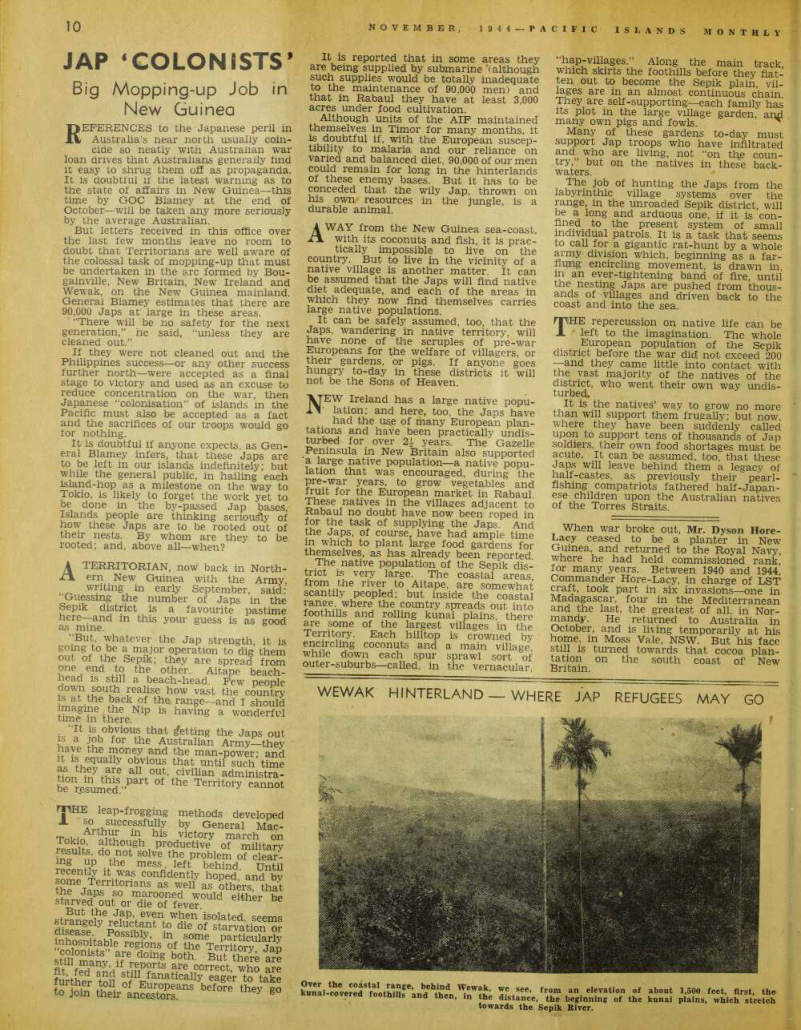
Jap ‘Colonists ’
Big Mopping-up Job in New Guinea
REFERENCES to the Japanese peril in Australia’s near north usually coin cide so neatly with Australian war loan drives that Australians generally find it easy to shrug them off as propaganda.
It is doubtful if the latest warnmg as to the state of affairs in New Guinea—this time by GOC Blarney at the end of October —will be taken any more seriously by the average Australian.
But letters received in this office over the last few months leave no room to doubt that Territorians are well aware of the colossal task of mopping-up that must be undertaken in the arc formed by Bou gainville, New Britain, New Ireland and Wewak, on the New Guinea mainland.
General Blarney estimates that there are 90,000 Japs at large in these areas.
“There will be no safety for the next generation,” he said, “unless they are cleaned out.”
If they were not cleaned out and the Philippines success—or any other success further ntprth—were accepted as a final stage to victory and used as an excuse to reduce concentration on the war, then Japanese “colonisation” of islands in the Pacific must also be accepted as a fact and the sacrifices of our troops would go for nothing.
It is doubtful if anyone expects, as Gen eral Blarney infers, that these Japs are to be left in our islands indefinitely; but while the general public, in hailing each island-hop as a milestone on the way to Tokio, is likely to forget the work yet to be done in the by-passed Jap bases, Islands people are thinking seriously of how these Japs are to be rooted out of their nests. By whom are they to be rooted; and, above all—when?
ATERRITORIAN, now back in North ern New Guinea with the Army writing in early September, said; Guessing the number of Japs in the Sepik district is a favourite pastime here—and in this your guess is as good as mine.
“But, whatever the Jap strength, it is going to be a major operation to dig them out of the Sepik; they are spread from one end to the other. Aitape beach head is still a beach-head. Few people down south realise how vast the country is at the back of the range—and I should imagine the Nip is having a wonderful time in there.
ic P getting the Japs out
a J° b for the Australian Army—they have the money and the man-power; and * equally obvious that until such time ffjhey are all out, civilian administra- ” Part ° f th 6 Territor y cannot T HE leap-frogging methods developed A S A °rtb S nr CC^ Sf v y . General Mac iri hls , VlC tory march on Tokio, although productive of militarv S ° lV6 problem of clear 15®. H p -P 16 mess le f t behind. Until recently it was confidently hoped, and bv thp lo Tam' ri^orianS as well as others, that the Japs so marooned would either be starved out or die of fever.
But the Jap, even when isolated seem* disease’ 7 Pos U sib?v ‘ die o( sta ™«on or
tahjwSta We Regions *ol Territory** Jap
‘colonists” are doing both But there are m ll fSi any U lf JS ports are correct, who are further toll nfV anatically eager to take to iSn fi? 1 - 0f Eur °Peans before they go to join their ancestors. e
!t is reported that in some areas they ?nnh be in^ili PPlled^ y u SUb . n i a n ine - ?v, SUppl - es . wou2d k® totally madequate the maintenance of 90,000 men) and that in Rabaul they have at least 3,000 acres under food cultivation.
Although units of the AIF maintained themselves in Timor for many months, it tibmtv^to 1 the n Europear * susce P" tibihty to malaria and our reliance on varied and balanced diet, 90,000 of our men could remain for long in the hinterlands of these enemy bases. But it has to be conceded that the wily Jap, thrown on durabl^an^maV 1,063 m the 2Ungle ’ 15 a durable animal.
=r.is
It can be safely assumed, too, that the Japs, wandering in native territory, will have none of the scruples of pre-war Europeans for the welfare of villagers, or Vn l 6 r!^^f a f de i is ’ ° r ¥ anyone goes hungry to-day m these districts it will not be the Sons of Heaven.
NEW Ireland has a large native popuh ? re ’ t 0 Japs have . dad °£ many European plantations and have been practically undisturbed for over 2* years. The Gazelle Peninsula in New Britain also supported fatSn e thnt lV wi? )P o nativ ? poputhat was encouraged, during the P 1 e-war years, to grow vegetables and SaKo doubt have V now Se bee a n dJ r a o C p?d £ the Japs!** c o oVrse P f P have g had ample ttme in which to plant large food eardens frtr themselves, as has already reported The native population of the Senik diQ trlct is very large The SLtaf arSf," from the river to are somewhat scantily peopled’ but inside thp pnactoi
T.;.ss e“ sk s"ssa %
MS
“hap-villages.” Along the main trank which skirts the foothills befo™they flat ten out to become the Sepik plain vil lages are in an almost continuous chain, They are self-supporting—each familv has its plot in the large vlllagf ganSn Y and many own pigs and fowls 8 8 ’ a ™ Many of these gardens tn-dnv mnct support Jap troops who have infiltrated and who are living, not “on the coun try,” but on the natives in these back waters.
The job of hunting the Jans from thp labyrinthic village g S ystemf ovei t he r ange ’ m the unroaded Sepik district, will be a long and arduous one; if it con
rswrS-JHr*S
Busbies
HTHE repercussion on native life can be X left to the imagination. The whole European population of the Sepik district before the war did not exceed 200 “ and they came little into contact with the vast majority of the natives of the district, who went their own way undis natives’ way to grow no more than will support them frugally: but now! where they have been suddenly called upon to support tens of thousands of Jan soldiers, theff own food shortSmust be acute. It can be assumed too that these Japs will leave behind them a legacy of half-castes, as previously their pearl fishing compatriots fathered half-Janan
ef cfildre^upin I “strahan nXves
° f the Torr eS Straits bfoke h ° Ut ’ T ? yson Hore ceased to be a planter in New Shpro a ’v, an S et v. ri m d to Royal Navy, where he had held commissioned rank, o or many . ye ?T s - Between 1940 and 1944, ? n ch - ar B e of BST S^ took part in six invasions — one in
SFl' EJsn s Sm
WittiSsinsi'iS
Wewak Hinterland Where Jap Refugees May Go
Over the coastal range, behind Wewak, We see, from an elevatoin of about 1,500 feet, first, the kunai-covered foothills and then, in the distance, the beginning of the kunai plains, which stretch towards the Sepik River.
Recognition of Gallant
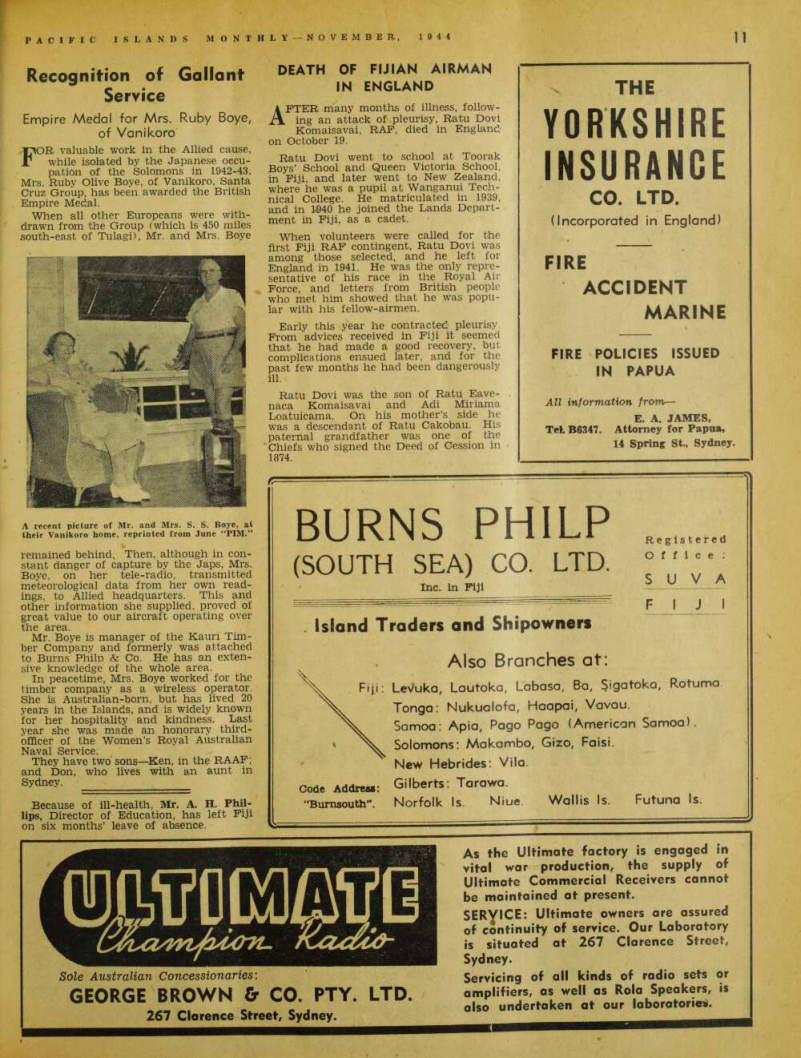
Service Empire Medal for Mrs. Ruby Boye, of Vanikoro
FOR valuable work in the Allied cause, while isolated by the Japanese occu pation of the Solomons in 1942-43, Mrs. Ruby Olive Boye, of Vanikoro. Santa Cruz Group, has been awarded the British Empire Medal.
When all other Europeans were with drawn from the Group (which is 450 miles south-east of Tulagi), Mr. and Mrs. Boye
remained behind. Then, although in con stant danger of capture by the Japs, Mrs.
Boye, on her tele-radio, transmitted meteorological data from her own read ings. to Allied headquarters. This and other information she supplied, proved of great value to our aircraft operating over the area.
Mr. Boye is manager of the Kauri Tim ber Company and formerly was attached to Burns Philp & Co. He has an exten sive knowledge of the whole area.
In peacetime, Mrs. Boye worked for the timber company as a wireless operator.
She is Australian-born, but has lived 20 years in the Islands, and is widely known for her hospitality and kindness. Last year she was made an honorary third officer of the Women’s Royal Australian Naval Service.
They have two sons—Ken, in the RAAF: and Don, who lives with an aunt in Sydney.
Because of ill-health, Mr. A. H. Phil lips, Director of Education, has left Fiji on six months’ leave of absence.
A rcent picture of Mr. and Mrs. S. S. Boye, at their Vanikoro home, reprinted from June "TIM.”
Death Of Fijian Airman
In England
AFTER many months of illness, follow ing an attack of pleurisy, Ratu Dovi Komaisavai, RAF, died in England on October 19.
Ratu Dovi went to school at Toorak Boys’ School and Queen Victoria School, in Fiji, and later went to New Zealand, where he was a pupil at Wanganui Tech nical College. He matriculated in 1939, and in 1940 he joined the Lands Depart ment in Fiji, as a cadet.
When volunteers were called for the first Fiji RAF contingent, Ratu Dovi was among those selected, and he left for England in 1941. He was the only repre sentative of his race in the Royal Air Force, and letters from British people who met him showed that he was popu lar with his fellow-airmen.
Early this year he contracted pleurisy.
From advices received in Fiji it seemed that he had made a good recovery, but complications ensued later, and for the past few months he had been dangerously ill.
Ratu Dovi was the son of Ratu Eave naca Komaisavai and Adi Miriama Loatuicama. On his mother’s side he was a descendant of Ratu Cakobau. His paternal grandfather was one of the Chiefs who signed the Deed of Cession in 1874.
Advertisements & other items, pp. 13-14 (1 item)
Burns Philp
THE
YORKSHIRE
INSURANCE
CO. LTD.
(Incorporated in England)
FIRE
ACCIDENT
MARINE
FIRE POLICIES ISSUED
IN PAPUA
All information from —
E. A. JAMES,
TeL 86347. Attorney for Papua, 14 Spring St., Sydney
BURNS PHILP
(SOUTH SEA) CO. LTD.
Inc. In Fiji
island Traders and Shipowners
Registered Office ;
SU V A
FIJI
Also Branches at:
Fiji: Lev’uka, Lautoka, Labasa, Ba, Sigatoka, Rotuma Tonga: Nukualofa, Haapai, Vavau.
Samoa: Apia, Pago Pago (American Samoa). » nv Solomons: Makambo, Gizo, Faisi.
New Hebrides: Vila.
Code Address: Gilberts: Tarawa.
“Bumsouth”. Norfolk Is. Niue Wallis Is. Futuna Is.
E M
AVT
I li U m Sole Australian Concessionaries :
GEORGE BROWN & CO. PTY. LTD.
267 Clarence Street, Sydney.
As the Ultimate factory is engaged in vital war production, the supply of Ultimate Commercial Receivers cannot be maintained at present.
SERVICE: Ultimate owners are assured of continuity of service. Our Laboratory is situated at 267 Clarence Street, Sydney.
Servicing of all kinds of radio sets or amplifiers, as well as Rola Speakers, is also undertaken at our laboratories.
Refreshing
as a plunge
into a lagoon!
|DA l ° eR to«^ t
Germicidal
and fragrant
TENAX TOILET SOAP is
a rapid safeguard against external skin infections, yet it is soothing and kind to the most sensitive skin —even a baby’s!
ORDER TENAX FROM
YOUR ISLAND SUP-
PLIERS. STOCKS ARE
PLENTIFULLY AVAIL-
ABLE.
W. H. GROVE & SONS
Limited
AUCKLAND
Island Traders. p.o. Box «o.
Telegraphic and Cable Address: “Grove”. Auckland.
Shippers of all classes of New Zealand products.
Representing English Manufacturers throughout the Cook and Society Islands, Fiji, Tonga, Samoa, Niue, New Caledonia, New Guinea, etc.
In FIJI os—W. H. Grove & Sons (Fiji) Ltd.
In Defence Of Contract Labour
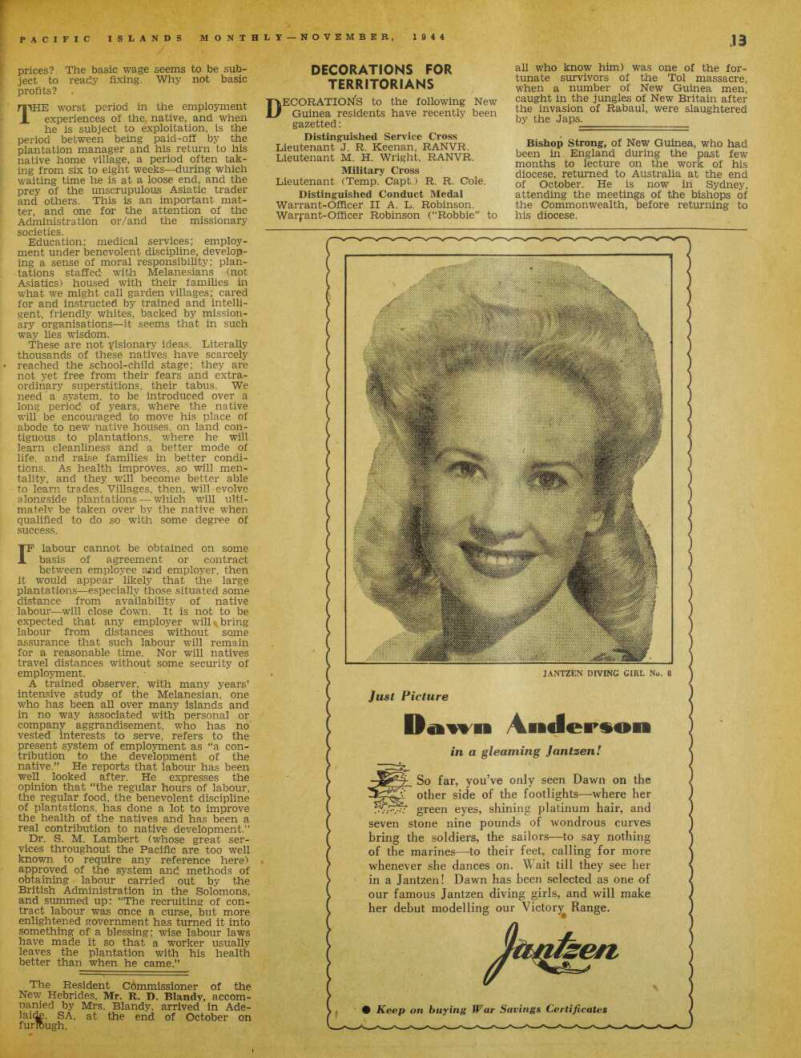
By H. S. N. Robinson, Secretary of the Melanesian Mission, Sydney
“TNDENTURED” is perhaps an unfor- X tunate word —a word associated with the bad old days and, in the minds of so many people, associated with “forced” or compulsory labour. There are not a few who regard it as something akin to a modified form of “slavery”—and, of course, the exploitation of the poor native.
Indentured, really, is merely- another word for contract as opposed to casual labour. A vast amount of nonsense is talked and written about the matter and idealists are often a bit of a nuisance.
Indeed, many—some known to the writer —don’t seek the facts of the situation, as it is to-day, but look merely for con firmation of their own preconceived, ill based ideas.
I do not pose as an expert; but I have travelled much; I have sofight the views and experiences of many competent to judge; visited many of the islands of the South Seas on more than one occasion; know something at first hand of the native peoples of other countries—and particularly those far removed from the usual trade and tourist routes.
I know the views of the missionaries, and their difficulties, and I warmly sym pathise with them; the views, also, of the trader and planter. And, frankly, I hold no brief for “Big Business.’' AH my sympathies are with the native—while having nothing whatever in common with the over-class-conscious product of a
degenerate democracy.
IT may be taken that the white man has lost none of his acquisitiveness, and that development will take place —inevitably. Now, how can this be car ried out best in the interest of the native the real owner of the land? I know of the so-called octopus grip of the “Big Firms.” I have met and talked with both sides, and have seen the native as com paratively few white people have seen him.
Just what are the objections to con tract labour? What is contract labour?
Is it not merely an agreement between a plantation employer ,and a prospective native labourer who desires to work on
the plantation? The contract or agree ment has been drawn up by the Administration—the conditions provide ample security for the native. The em ployer is assured of labour for a pre determined time—failing which he could not carry on. Even a member of the class conscious- coterie informed the House of Representatives that “the favourable attitude of the natives to the cause of the Allied Nations is believed by the Government to be due, to a great extent, to the sympathetic administration of native affairs by past administrations . . . etc.,” which doesn’t go to show any undue anxiety concerning ill-treatment or ex ploitation. No—the native knows full well ’ tha t his position is secure, and that he can obtain immediate redress from the local DOs.
It is difficult to learn just what are the objections to a system of labour based on agreement or contract between employee and employer. The writer is not aware that these objections have been defined in detail.
Settlement and development cannot proceed, without labour—and so, what kind of labour is best in the interests of the natives? Local, under Government supervision, backed-up, maybe, with the kindly assistance and co-operation of the missionary societies; or imported: labour, as tried in the New Hebrides Islands, with all its attendant difficulties.
Imported labour would be economically and morally unsound. Casual labour is not workable in most of the, as yet, undeveloped Pacific Islands. Those who know conditions, and have had experience, know that the natives lack any sense of responsibility—very few are sufficiently mentally developed to understand any system of casual labour. The position arising from the employment of natives who, after receiving their first pay, would come and go just as their child-like fancy urged—is impossible. Some form or sys tem of “agreement” is absolutely essen tial in the present stage of native devel opment-essential quite as much for the welfare of the native as for any form of employment.
I AM not interested in dividends. I try to take a long view: What is best for the native, the real owner of the land —those people to whom we now owe so much and on whose account we have made all sorts of promises, protestations and charters.
Do not let us hamper or prohibit sound commercial development, but, recognising that it is inevitable, rather let us pro pound a scheme under watchful Govern ment supervision—something constructive —to cover a period of not less than a generation or even two—at any rate until such time as the natives are ready for a more advanced stage of, say, peasant farming, working and developing their own plantations.
The land is theirs—“ Big Biz” has got only leases. Under existing legislation, land cannot be bought, and leases only are arranged, and under the watchful care of Government. It will be more than a generation before these people are ready for any form of even partial self-govern ment.
Let those who talk and write so glibly about the exploitation of the native seek adjustment of the following points: Who controls the price of copra and many other Island products, and consequently the rate of wages? Not the local “Big Business,” but the inner circle of world financial wanglers, so difficult to trace.
Why not have international fixation of
prices? The basic wage seems to be sub ject to ready fixing. Why not basic profits?
THE worst period in the employment experiences of the native, and when he is subject to exploitation, is the period between being paid-off by the plantation manager and his return to his native home village, a period often tak ing from six to eight weeks —during which waiting time he is at a loose end, and the prey of the unscrupulous Asiatic trader and others. This is an important mat ter, and one for the attention of the Administration or/and the missionary societies Education; medical services; employ ment under benevolent discipline, develop ing a sense of moral responsibility; plan tations staffed with Melanesians (not Asiatics) housed with their families in what we might call garden villages; cared for and instructed by trained and intelli gent, friendly whites, backed by mission ary organisations—it seems that in such way lies wisdom.
These are not visionary ideas. Literally thousands of these natives have scarcely reached the school-child stage; they are not yet free from their fears and extra ordinary superstitions, their tabus. We need a system, to be introduced over a long period of years, where the native will be encouraged to move his place of abode to new native houses, on land con tiguous to plantations, where he will learn cleanliness and a better mode of life, and raise families in better condi tions. As health improves, so will men tality, and they will become better able to learn trades. Villages, then, will evolve alongside plantations which will ulti mately be taken over by the native when qualified to do so with some degree of success.
IF labour cannot be obtained on some basis of agreement or contract between employee ajid employer, then it would appear likely that the large plantations—especially those situated some distance from availability of native labour —will close down. It is not to be expected that any employer will bring labour from distances without some assurance that such labour will remain for a reasonable time. Nor will natives travel distances without some security of employment.
A trained observer, with many years’ intensive study of the Melanesian, one who has been all over many islands and in no way associated with personal or company aggrandisement, who has no vested interests to serve, refers to the present system of employment as “a con tribution to the development of the native.” He reports that labour has been well looked after. He expresses the opinion that “the regular hours of labour, the regular food, the benevolent discipline of plantations, has done a lot to improve the health of the natives and has been a real contribution to native development.”
Dr. S. M. Lambert (whose great ser vices throughout the Pacific are too well known to require any reference here) approved of the system and methods of obtaining labour carried out by the British Administration in the Solomons, and summed up: “The recruiting of con tract labour was once a curse, but more enlightened government has turned it into something of a blessing; wise labour laws have made it so that a worker usually leaves the plantation with his health better than when he came.”
The Resident Commissioner of the New Hebrides, Mr. R. D. Blandy, accom nanied by Mrs. Blandy, arrived in Ade laide, SA, at the end of October on fur rough.
Decorations For
Territorians
Decorations to the following New Guinea residents have recently been gazetted: Distinguished Service Cross Lieutenant J. R. Keenan, RANVR.
Lieutenant M. H. Wright, RANVR.
Military Cross Lieutenant (Temp. Capt.) R. R. Cole.
Distinguished Conduct Medal Warrant-Officer II A. L. Robinson.
Warrant-Officer Robinson (“Robbie” to
all who know him) was one of the for tunate survivors of the Tol massacre, when a number of New Guinea men, caught in the jungles of New Britain after the invasion of Rabaul, were slaughtered by the Japs j Bishop Strong, of New Guinea, who had been in England during the past few months to lecture on the work of his diocese, returned to Australia at the end of October. He is now in Sydney, attending the meetings of the bishops of the Commonwealth, before returning to his diocese.
Advertisements & other items, p. 15 (1 item)
Dawn Anderson
I I <C^ 5 /,v , ■' >lw. Rw
■i - - HJBHH
JANTZEN DIVING GIRL No. 8
Just Picture
Dawn Anderson
in a gleaming Jantzen!
So far, you’ve only seen Dawn on the other side of the footlights—where her green eyes, shining platinum hair, and seven stone nine pounds of wondrous curves bring the soldiers, the sailors —to say nothing of the marines—to their feet, calling for more whenever she dances on. Wait till they see her in a Jantzen! Dawn has been selected as one of our famous Jantzen diving girls, and will make her debut modelling our Range.
Keep on buying War Savings Certificates
Hula-Skirt Trade Booms
From Our Own Correspondent
Rarotonga, Oct. 6.
fTtHERE is at present a revival of the A hula-skirt trade. Several dealers have large orders on hand, and many people are engaged in this colourful little industry.
The Administration frequently points to this occupation as one of the reasons why
Rarotongans will not work on fruit at 5/a case. But who can blame the natives for wanting to make a little hay—or grass skirts—while the US sun shines? It is roughly estimated that some 50,000 de corated hula-skirts have been shipped from Rarotonga during the last two years. This represents a considerable in come to a people who have few oppor tunities to make ready cash—without which, even Pacific Islanders cannot get along very well these days.
Influenza Now : Tourists
in the Future Grim Prospects in Tahiti From Our Own Correspondent
Papeete, Oct. 2
Notwithstanding twin epidemics of influenza and dengue fever, this island has cause for congratulation in that those breeders of disease, the honky-tonks, have been closed for a season.
The dengue fever arrived in the person of one convalescent who had lately come from a Pacific station where the disease is holding high carnival. Our mosquitoes fell upon him and have zealously carried the germs to our residents.
The honky-tonks have done for the influenza what thn mosquitoes have for the dengue fever.
This colony has had no dengue fever since 1910 or 1911 Another reason for congratulation is the announcement that the motor truck of the Bernard brothers will make a weekly tour of the west coast districts of Papeete and in accordance with existing: regulations and price-fixing orders, will sell the following goods, ex-the Revictual ling Service: 12 oz. cans of beef, 8f.75; 1 lb. cans of butter, 19f.50; bonito in oil. 9 francs per can; milk, per can, 6f.75: sugar, per kilo, 5f.50: Australian rice, per kilo. 5f .50; tea, per kilo, 90 francs; khaki cloth, 25 francs per metre. The implica tions from the sale of such goods are obvious.
Tourism For Tahiti?
SOME of our bright, forward-looking people are predicting that the Mat son Line will establish a service to Papeete, after the.war. The opinion of this writer is that the Matson Line would do so only on the condition that the Big Five be given full licence to exploit this colony as they have exploited Hawaii.
In such an event, every bright, for ward-looking individual would be driven out of business: the islands would speed ily be transformed into another Asiatic- Hollywood Blonde Melting-pot: the Booster Club would stir up pronaganda for political association .with Hawaii.
That would mean an eventual transfer of the islands to the Philippines Repub lic: for the only solution of the racial nroblem appears to be the placing of Hawaii under the sovereignty of the Manila Government—after the war has been won. Otherwise, every native son of the Golden West in the Pacific Coast States will come to an untimely end, through apoplexy. Already, the rumblings of the wrath to come are to be heard over the radio.
My opinion is that post-war tourism will gravitate to the Pacific battlefields: to Guadalcanal, to New Guinea, to the Caroline and Mariana Islands.
Such speculation is, however, of mat ters far in the future.
Advertisements & other items, p. 16 (1 item)
Burns Philp Trust
THAT*
it The
. HAVE YOU
CONSIDERED
THIS CODICIL?
By adding a simple codicil to your Will you can guard against difficulties and loss which might arise should your Executor die or become incapacitated.
By means of such a codicil you can name Bums Philp Trust Co. Ltd. as joint Executor with your present appointee or, if you wish, as sole Executor. In this way you gain positive assurance of continuous and sound administration and are relieved of a serious anxiety. The Company will willingly forward full particulars.
James Burns Lewis Armstrong
DIRECTORS ;
MANAGER: C. H. Chester Robert John Nosworthy Joseph Mitchell
BURNS PHILP TRUST
company limited
BRIDGE STREET. SYDNEY
PHONE: B7WI.
Bo* 543 G.P.0., Sydney.
BP 10-44.
WESTERN SAMOA
Most Delightful Holiday Resort in Polynesia
WHY NOT SPEND THE WINTER
MONTHS AT THIS SPACIOUS AND
BEAUTIFULLY-SITUATED HOTEL?
Write for Details to MRS. ANNIE M. JONES, Proprietress The Casino Hotel Apia - - - Western Samoa
’Flu Worse Than Bubonic
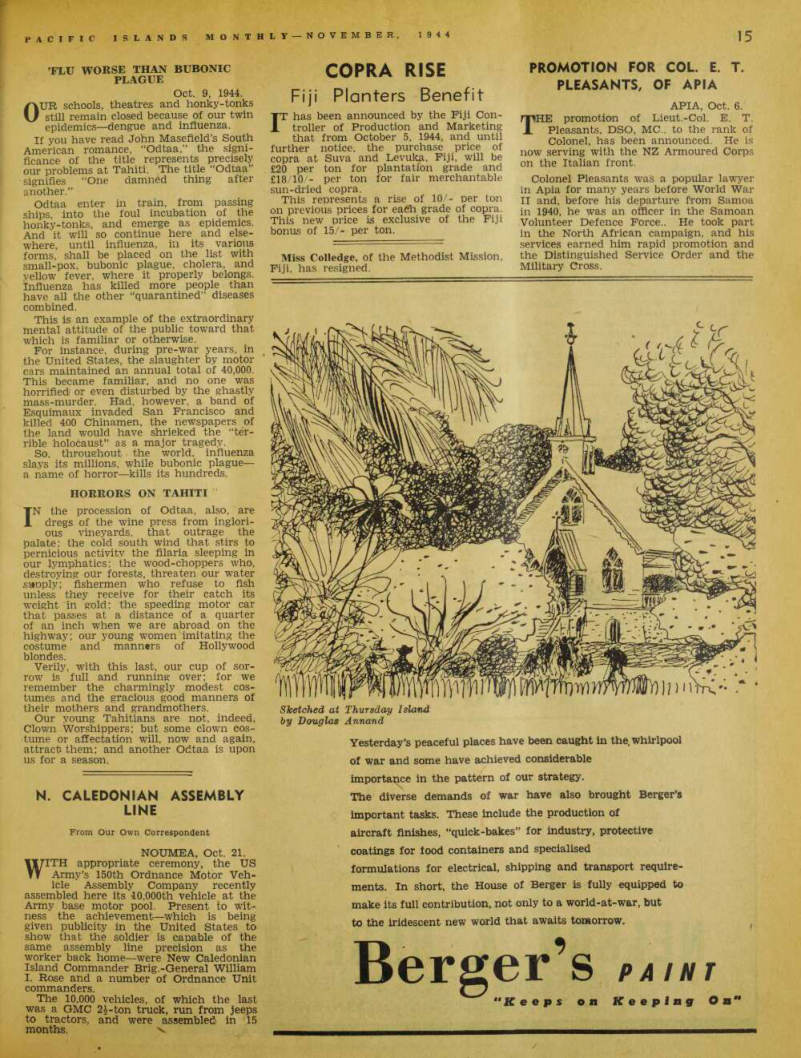
Plague
Oct. 9, 1944.
OUR schools, theatres and honky-tonks still remain closed because of our twin epidemics—dengue and influenza.
If you have read John Masefield’s South American romance, “Odtaa,” the signi ficance of the title represents precisely our problems at Tahiti. The title “Odtaa” signifies “One damned thing after another.”
Odtaa enter in train, from passing ships, into the foul incubation of the honky-tonks, and emerge as epidemics.
And it will so continue here and else where, until influenza, in its various forms, shall be placed on the list with small-pox. bubonic plague, cholera, and yellow fever, where it properly belongs, influenza has killed more people than have all the other “quarantined” diseases combined.
This is an example of the extraordinary mental attitude of the public toward that which is familiar or otherwise.
For instance, during pre-war years, in the United States, the slaughter by motor cars maintained an annual total of 40,000.
This became familiar, and no one was horrified/ or even disturbed by the ghastly mass-murder. Had, however, a band of Esquimaux invaded San Francisco and killed 400 Chinamen, the newspapers of the land would have shrieked the “ter rible holocaust” as a major tragedy.
So. throughout the world, influenza slays its millions, while bubonic plague— a name of horror —kills its hundreds.
Horrors On Tahiti
IN the procession of Odtaa, also, are dregs of the wine press from inglori ous vineyards, that outrage the palate: the cold south wind that stirs to pernicious activity the filaria sleeping in our lymphatics: the wood-choppers who, destroying our forests, threaten our water sunply; fishermen who refuse to fish unless they receive for their catch its weight in gold; the speeding motor car that passes at a distance of a quarter of an inch when we are abroad on the highway; our young women imitating the costume and manners of Hollywood blondes.
Verily, with this last, our cup of sor row is full and running over; for we remember the charmingly modest cos tumes and the gracious good manners of their mothers and grandmothers.
Our young Tahitians are not, indeed, Clown Worshippers; but some clown cos tume or affectation will, now and again, attract? them; and another Odtaa is upon us for a season.
N. Caledonian Assembly
Line
From Our Own Correspondent
Noumea, Oct. 21.
WITH appropriate ceremony, the US Army’s 150th Ordnance Motor Veh icle Assembly Company recently assembled here its 10,000 th vehicle at the Army base motor pool. Present to wit ness the achievement—which is being given publicity in the United States to show that the soldier is capable of the same assembly line precision as the worker back home—were New Caledonian Island Commander Brig.-General William I. Rose and a number of Ordnance Unit commanders.
The 10,000 vehicles, of which the last was a GMC truck, run from jeeps to tractors, and were assembled in 15 months. v
Copra Rise
Fiji Planters Benefit
IT has been announced by the Fiji Con troller of Production and Marketing that from October 5, 1944, and until further notice, the purchase price of copra at Suva and Levuka, Fiji, will be £2O per ton for plantation grade and £lB/10/- per ton for fair merchantable sun-dried copra.
This represents a rise of 10/- per ton on previous prices for each grade of copra.
This new price is exclusive of the Fiji bonus of 15/- per ton.
Miss Colledge, of the Methodist Mission.
Fiji, has resigned.
Pleasants, Of Apia
Promotion For Col. E. T.
Apia, Oct. 6.
THE promotion of Lieut.-Col. E. T.
Pleasants, DSO, MC„ to the rank of Colonel, has been announced. He is now serving with the NZ Armoured Corps on the Italian front.
Colonel Pleasants was a popular lawyer in Apia for many years before World War II and, before his departure from Samoa in 1940, he was an officer in the Samoan Volunteer Defence Force.. He took part in the North African campaign, and his services earned him rapid promotion and the Distinguished Service Order and the Military Cross.
Advertisements & other items, p. 17 (1 item)
Berserk paint
I J , l * $ c tk iJ & & v f -
IjinW-
n w» wi i w Sketched at Thursday Island by Douglas Annand Yesterday’s peaceful places have been caught in the. whirlpool of war and some have achieved considerable importance in the pattern of our strategy.
The diverse demands of war have also brought Berger’s important tasks. These include the production of aircraft finishes, “quick-bakes” for industry, protective coatings for food containers and specialised formulations for electrical, shipping and transport requirements. In short, the House of Berger is fully equipped to make its full contribution, not only to a world-at-war, but to the iridescent new world that awaits tomorrow.
Berserk paint
"Keeps on Keeping O
Fiji Commanders
Decorated US Bronze Stars for Duty Well Done
nRHE officers commanding the two Fiji X battalions which recently returned to Fiji from active service in Bou gainville, Lieut.-Colonel G. T. Upton and Lieut.-Colonel F. W. Voelcker, have each been awarded the US Bronze Star. These are the citations: “Geoffrey T. Upton, Lieutenant-Colonel, Fiji Military Forces, for heroic achieve ment against the enemy at Bougainville, from January 12 to April 30. 1944, while serving as Commander of the battalion which successfully occupied an outpost at Ibu, 20 miles beyond the American perim eter, and constructed the Kameli strip for air supply and evacuation.
“He also submitted valuable informa tion concerning Japanese preparation for an assault on our perimeter defences, enabling American commanders to take counter - measures which contributed
materially to repulse of the hostile effort when it was launched.
“Colonel Upton performed gallantly on numerous reconnaissance in force mis sions, leading his battalion into strongly held Japanese territory. Throughout this prolonged period of intense activity, he exhibited aggressive leadership, keen fore sight and superior devotion to duty.”
“ITIRANCIS W. VOELCKER, Lieutenant- J/ Colonel, Fiji Military Forces, for heroic achievement against the enemy at Bougainville, Solomon Islands, from March 20 to June 5, 1944, while serving as commander of the battalion which pursued the fleeing Japanese forces and made a sweep along the Numa Numa trail in the Java Creek area. Later he led his troops in a fierce assault, which he planned and executed brilliantly, securing the flank of the Allied positions and keeping open vital lines of communi cation.
“From May 30 to June 5, Colonel Voelcker led his battalion on an import ant reconnaissance mission, sweeping the Empress Augusta Bay shore from the Tekessi River to Mawaraka Point. Dur- ' ing this successful amphibious operation valuable information was secured, many enemy fortifications destroyed and six artillery field pieces captured. During this entire period, Colonel Voelcker suc cessfully fulfilled his assigned combat mission and displayed resourcefulness, sound judgment, superior military ability and a high devotion to duty.”
Mr. James W. Baldie, who was a pro minent member of the Papuan Public Service 15 years ago, has been ill recently He is now living in Hampton, Victoria His son, Squadron-Leader Stan Baldie was killed in India in 1943.
Labourers And Coconuts
Letter to the Editor IN a reply to a letter in the “Sydney Morning Herald” recently, asking why, if the Missions disapproved of the inHortt-nred labour system, they had employed it on their income-raising pro perties, the Rev. J. W. Burton evaded the issue. The point is that the Missions have emnloyed indentured labour, and at the minimum wages. He also evades another point—he says they have no properties in New Guinea. (That, I suppose, could be safely said of the New Guinea planters too, unfor tunately.) And why confine his denial to NG? Is it not a fact that the Methodist Mission has large plantation interests in the BSI?
In 1938 my agent signed on a boy at 10 - per month. After he had worked for a few weeks he was picked up by the police, as he had deserted from Mr. Bur ton’s Mission on the North Coast.
Being in NG solely for the good of the native, the Mission was not satisfied with merely getting the boy back, but prose cuted him in the District Court and got him a month’s gaol before making him return to work for them at a lower wage.
On another matter: When I put in a claim for £125 for coconut trees and cocoa cut down to make an extension to a drome, Mr. Alderman, after making me an offer of £4B (this meant 5/6 for fully grown coconuts and 2/6 for bearing cocoa), ex pressed surprise that I had put in a claim at all, as “it was done in the public in terest.” Mr. Alderman apparently does not consider that his work was “done in £™J? üblic int erest,” hence his claim for £6,000.
I am, etc..
Sydney.
R. C. Willmott.
Advertisements & other items, p. 18 (2 items)
Pacific Islands Society
Visitors from the Islands to Sydney (or those interested in Islands affairs), are advised to communicate with the honorary secretary of the above Society, which has been formed to study the history, traditions, economics, and political developments of the Pacific Islands.
Regular monthly meetings are held at History House, 8 Young Street, Sydney.
Address for Correspondence:
THE PACIFIC ISLANDS SOCIETY,
Box 2434 MM., G.P.0., Sydney.
Nelson & Robertson
NELSON and ROBERTSON Pty. Ltd.
Established 1895
Shipowners - Brokers and
Islands Merchants
D purcha S. ed at „ B « t Wholesale Prices. Original Invoices supplied island Clients. Cocoa Beans, Copra, Rubber, Trochus Shell and All Islands' Produce Sold on Commission.
Entrust your requirements to the firm with fifty yeors' practical experience in the - Pacific Islands.
REPRESENTED in
ALL PARTS OF
THE WORLD.
Sole Agents :
SKANDIA DIESEL ENGINES
ARCHIMEDES MOTORS
OVERSEA INDENTS
ARRANGED FOR
CLIENTS.
Prompt attention given to all enquiries.
NELSON & ROBERTSON
PTY.
LTD.
12 SPRING STREET, SYDNEY, AUSTRALIA
Telegraphic Address: IVAN, SYDNEY.
Deadlock In Fruit
Trade
Administration and Planters Differ From Our Own Correspondent
Rarotonga. Oct. 8.
THERE were three shipments of toma toes from Rarotonga during the last few months. The shipments were of 6,000, 9,800 and 6,000 cases respectively; the prices received for the fruit varied somewhat: £1 per case for the first ship ment; 16/9 for the second; and 16/6 for the last.
There is, however, a certain amount of local dissatisfaction about the operation of the “super-cargo system’’ during the prevailing* limitation of shipping space.
It is alleged that some Cook Island super cargoes plant extensively themselves and fill a considerable portion of their allotted space with their own fruit, and that of relatives and friends. It is alleged, also, that they fill the remaining space with cases purchased at a price considerably below the known market rate, from grow ers who have no alternative but to sell at this lower price or lose their fruit.
This is a case in which the Government could do the natives a service by acting as marketing agents, returning the full market price to the growers less actual shipping expenses, and with a scheme of fair space allotment to all. r plant, or. not to plant, that is the question which still vexes the' minds of Rarotonga planters and Adminis tration.
A number of lengthy meetings have been held recently on the banana and orange situation, but we seem to be no nearer any solution.
The growers stand firm by their con tention that the present price of 5/6 per case for oranges and 5/- for bananas is not a profitable proposition for the labour involved in production. Meanwhile, the Administration continues to threaten that if Rarotongan growers will not plant and fill their allotted space on overseas ships, the whole of Rarotonga’s shipping space will be given to other island groups whose planters will work at the existing prices.
The growers express themselves un moved by the threat. They refuse to believe that other island groups are any more willing to work for the present prices than they. They feel also, that, with world-wide attention focussed on the Pacific Islands, the NZ Government would not leave them flat.
A ray of hope has stirred in the troubled bosoms of Rarotongans recently.
There has been news that Rarotonga has been under discussion in the NZ Parlia ment and the tone of the Prime Minis ter suggests a closer co-operation between the Cook Islands and New Zealand, with the possibility of representation in the „House. That would be a Rarotongan dream come true.
Mr. Fraser voiced the hope that if and when air transport becomes possible, members might be able to visit the island.
Cook Islanders hope foi* a visit from the Prime Minister himself and a chance to discuss their problems first-hand.
In the meantime, Rarotongan planters stand with fingers crossed looking up to the sky for signs and portents.
EDITORIAL NOTE.— I Territorial, if they are wise, will not seek “representa tion” in the Parliaments of Australia or NZ. Representation means taxation —and the post-war taxation of those countries, for years, is going to be crippling. Paci fic Territories which keep clear of close
political association with big countries have a good chance of avoiding heavy taxes: and light taxation in the post-war period will spell prosperity for any Paci fic Territory. “Unrepresented minorities” in the Territories may have much to endure: but at least they cannot be taxed.
In Samoa
Better Planting Prospects
From Our Own Correspondent
Apia, Oct. 6.
THE wet season has started exception ally early this year, after a long, dry spell. The heavy rains have greatly benefited cocoa and banana plantations, and it is hoped that there will now be relief from the severe shortage of native foodstuffs experienced during the last few months.
The labour problem on European plan tations has now eased considerably, and many of the cocoa plantations previously neglected and over-grown with weeds are being cleaned up and returning to normal production. Cocoa as well as copra prices are very good. During the last few months £lO5 per ton was paid for first grade hot-air dried cocoa of best quality, and at present, after a slight drop, it is bringing £95 per ton. The output for the present year is better than average. Most of the crop is bought by New Zealand and Australia. * Banana exports are still very small, in spite of the recent increase of 6d. per case, and new transport concessions.
Prospects for the future are, however, somewhat brighter, and the Samoans are reported to be planting large areas in bananas, particularly in the Safata Dis trict of the South Coast along the new Leulumoega-Safata Road.
Advertisements & other items, pp. 19-20 (1 item)
Tomorrow
QUEENSLAND
INSURANCE
COMPANY
LIMITED
(Incorporated 1886 in Australia)
ASSETS EXCEED £3,500,000
Head Office :
PITT & BRIDGE STS.,
SYDNEY
Specialists in South Seos Fire,
Marine & Accident Insurances
Apply to: —
FIJI.
Branch Office; H. J. Moorhouse, Manager.
Burns Phllp (South Sea) Co., Ltd.
VILA.
Burns Philp (South Sea) Co., Ltd.
Comptolrs Francais Des Nouvelles Hebrides (Marine).
NOUMEA.
L. & W. Johnston.
PAGO PAGO,.
Burns Philp (South Sea) Co., Ltd.
G. H. C. Reid & Co.
OTHER SOUTH SEA ISLANDS.
Burns Philp (South Sea) Co., Ltd.
Also to any of the Company’s Offices in Australia or Hew Zealand.
Coleman Stove of
TOMORROW
MODEL 520
BURNS ANY TYPE
OF GASOLINE (PETROL)
• Built for tough Army use, Colemfan’s new Model 520 Stove will be a real sensation when it comes to you right after the war. Requires no priming, burns any kind of gasoline (petrol), is always safe and lights instantly even in sub-zero weather. Only 8% inches high,yet boils a pint of water in 4 to 5 minutes. • Folds into compact cylinder cone . . . light and easy to
Modern Refrigeration for the South Sea Islands
The ELECTROLUX
KEROSENE OPERATED
REFRIGERATOR
MARVEL
OF
MODERN
SCIENCE
I A: T
THE
MIRACLE
OF
ICE
FROM
HEAT
A • ELECT ROLUX OFFERS ECONOMICAL, modern and completely efficient
REFRIGERATION FOR ISLANDS' HOMES thhiUhlNT
FREEZES CONTINUOUSLY WHILE SMALL LAMP BURNS
Freezing controlled by simply regulating height of flame. rT „ oc lTr 3 ‘ .. , , uses only i gallon of kerosene per week.
MOTORLESS ... NO PARTS TO GET OUT OF ORDER.
MODEL 122
Capacity J. 2 cubic feet.
MODEL L3BO
& (as illustrated) • Capacity 4 cubic feet.
GUARANTEED FOR TWO YEARS.
Write to your Local Distributor for prices and fuil details.
MODEL LKSSO
Capacity 6.5 cubic feet.
OBTAINABLE FROM ALL W. R. CARPENTER & CO. LTD.
BRANCHES THROUGHOUT THE ISLANDS
Representation in Papua and New Hebrides.
Samoan Election
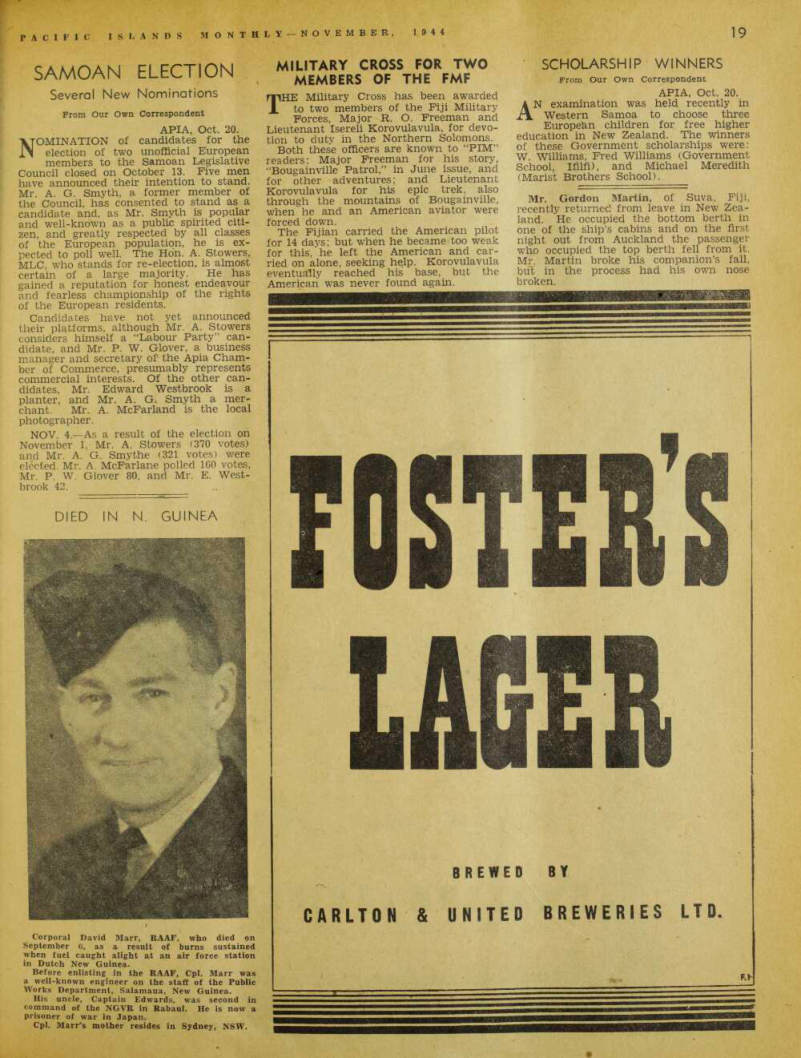
Several New Nominations
From Our Own Correspondent
Apia, Oct. 20.
NOMINATION of candidates for the election of two unofficial European members to the Samoan Legislative Council closed on October 13. Five men have announced their intention to stand.
Mr. A. G. Smyth, a former member of the Council, has consented to stand as a candidate and, as Mr. Smyth is popular and well-known as a public spirited citi zen, and greatly respected by all classes of the European population, he is ex pected to poll well. The Hon. A. Stowers, MLC, who stands for re-election, is almost certain of a large majority. He has gained a reputation for honest endeavour and fearless championship of the rights of the European residents.
Candidates have not yet announced their platforms, although Mr. A. Stowers considers himself a “Labour Party” can didate, and Mr. P. W. Glover, a business manager and secretary of the Apia Cham ber of Commerce, presumably represents commercial interests. Of the other can didates, Mr. Edward Westbrook is a planter, and Mr. A. G. Smyth a mer chant. Mr. A. McFarland is the local
photographer.
NOV. 4.—As a result of the election on November 1, Mr. A. Stowers (370 votes) and Mr. A. G. Smythe (321 votes) were elected. Mr. A McFarlane polled 160 votes, Mr. P. W. Glover 80, and Mr. E. West brook 42.
Died In N. Guinea
Corporal David Marr, RAAF, who died on September 6, as a result of burns sustained when fuel caught alight at an air force station in Dutch New Guinea.
Before enlisting in the RAAF, Cpl. Marr was a well-known engineer on the staff of the Public Works Department, Salamaua, New Guinea.
His uncle, Captain Edwards, was second in command of the NGVR in Rabaul. He is now a prisoner of war in Japan.
Cpl. Marr’s mother resides in Sydney, NSW.
Military Cross For Two
Members Of The Fmf
THE Military Cross has been awarded to two members of the Fiji Military Forces, Major R. O. Freeman and Lieutenant Isereli Korovulavula, for devo tion to duty in the Northern Solomons.
Both these officers are known to “PIM” readers: Major Freeman for his story, “Bougainville Patrol,” in June issue, and for other adventures; and Lieutenant Korovulavula for his epic trek, also through the mountains of Bougainville, when he and an American aviator were forced down.
The Fijian carried the American pilot for 14 days; but when he became too weak for this, he left the American and car ried on alone, seeking help. Korovulavula eventually reached his base, but the American was never found again.
Scholarship Winners
From Our Own Correspondent
Apia, Oct. 20.
AN examination was held recently in Western Samoa to choose three European children for free higher education in New Zealand. The winners of these Government scholarships were: W. Williams, Fred Williams (Government School, Ifilfi), and Michael Meredith (Marist Brothers School).
Mr. Gordon Martin, of Suva, Fiji, recently returned from leave in New Zea land. He occupied the bottom berth in one of the ship’s cabins and on the first night out from Auckland the passenger who occupied the top berth fell from it.
Mr. Martin broke his companion’s fall, but in the process had his own nose broken.
Advertisements & other items, p. 21 (1 item)
Laser
BREWED BY
CARLTON & UNITED BREWERIES LTD.
Tribute To Father Holland
By H. Bitmead
EVERYONE, Europeans and natives alike, who lived in the Buna area of Papua, knew Father Henry Holland.
Although advanced in years, he laboured on in his district, making long and ardu ous journeys to visit his scattered people.
We who knew him, spoke of him as “dear old Henry,” and were irresistibly drawn to him by his outstanding simplicity and humility, and, above all, by his sincerity and goodness.
This old missionary, who had spent a long life in the service of the Anglican Mission, was stationed at Isivita, inland from Buna. With him was a missionary teacher, Mr. John Duffill.
A week before the enemy landing at Buna. I visited Isivita and heard from Father Henry’s lips his decision to remain at his post, no matter what happened. In quite simple language he told me that not for a single moment had it ever entered his head to leave his station.
“You know,” he said, “this is my sta tion. I am a missionary. I have been sent here by my Bishop. No soldier may leave his post- in time of danger unless commanded by his officer. The Bishop is my officer, and I am sure he will never order his men to desert their posts. We cannot go away because by remaining we might be in personal danger.”
Simple words from a simple man, but characteristic of his devotion to duty.
On Sunday, July 26. 1942. in a jungle hideout, I met Lieutenant-Colonel F Bender, of the USA Air Force. He had been badly wounded in aerial combat and forced down near Father Henry’s station.
When the wounded American reached the station the old missionary was quite
ready to hide him and care for him. but pointed out that the Japs were on their way to the station and were then but a short distance away. The wounded man refused to allow/ the missionary to add to his own peril by hiding him, and struggled on.
W/O BITMEAD has been in Papua for 10 years as a Travel ling Medical Assistant, and he was stationed at Buna at the time of the Japanese invasion of that area. He the Anglican mis sionaries w r ho elected to stay there well. He was captured by the enemy but escaped with the help of a mission boy ; later, he contacted two American airmen who had been shot down and assisted them to cross Papua to Port Moresby.
While on leave in Australia recently, he was married to Miss Ann Veronica Keenan, of Perth.
Father McEncroe and Father Lyons, well known in Papua, and Mrs. L.
Austen, of Sangara district, were present at the ceremony.
“When I left him,” said Bender, “the old missionary was quite calm, standing near his church awaiting the arrival of the Japs. He is a grand old man!”
What happened at the meeting between the Japs and Father Holland I do not know. I do know, however, that a few weeks later, the old missionary stood bound, on Buna Beach, and that his head was savagely struck from his body and there then died a fearless, old grey
haired missionary who, for more than 30 years, had lived and laboured for others.
NO one who was privileged to know this saintly old man, and to have witnessed his untiring efforts in the Isivita district, will ever forget him. His memory will live. Always with deep admiration shall we think of him as earn est and devout in faith; as sincere and simple in all his actions. He had re mained true to his trust to the end, and he too, like the Rev. Father Redlich, died because he preferred to risk death than to desert his post. He remained because he considered it his duty to remain; and because he remained he died.
No Longer Pow
THIS is a happy occasion. For the first time, a name is formally withdrawn from the list of POW in the Roll of Honour published regularly in this jour nal. Corporal J. E. Broad, NZEF. for merly of Suva, is no longer a prisoner of war.
Mr. W. E. Hancock, formerly of Suva, writes; Corporal Broad escaped from a German POW camp in Italy and even tually found his way to the New Zealand lines He passed through Melbourne recently, and by now should be home with ms people in New Zealand. He has had an interesting adventure, having been captured by the Germans in Egypt origin ally; and I understand he is going to write an account of his experiences in due course.
Recent overseas departures from W Samoa were: Chief Judge J. R. Herd and family, who leave for an extended holi day in New Zealand: Mr. M. G. James (Apia Radio Station) and Mrs. James; Mr. H. I. Jones and his family— he was manager of the NZRE Plantation at Vaitele for many years; and Sergt. H.
Irwin, of the Samoan Police Force.
Advertisements & other items, p. 22 (1 item)
Swailowioiell
IT, .=> ;
90 YEARS
t) 3 j'-? sE <*
SWAILOWiOIELL
LTD
IlilS aisctiif cent maei mi
ICI
isJOL* Sr?
Sweeping Educational
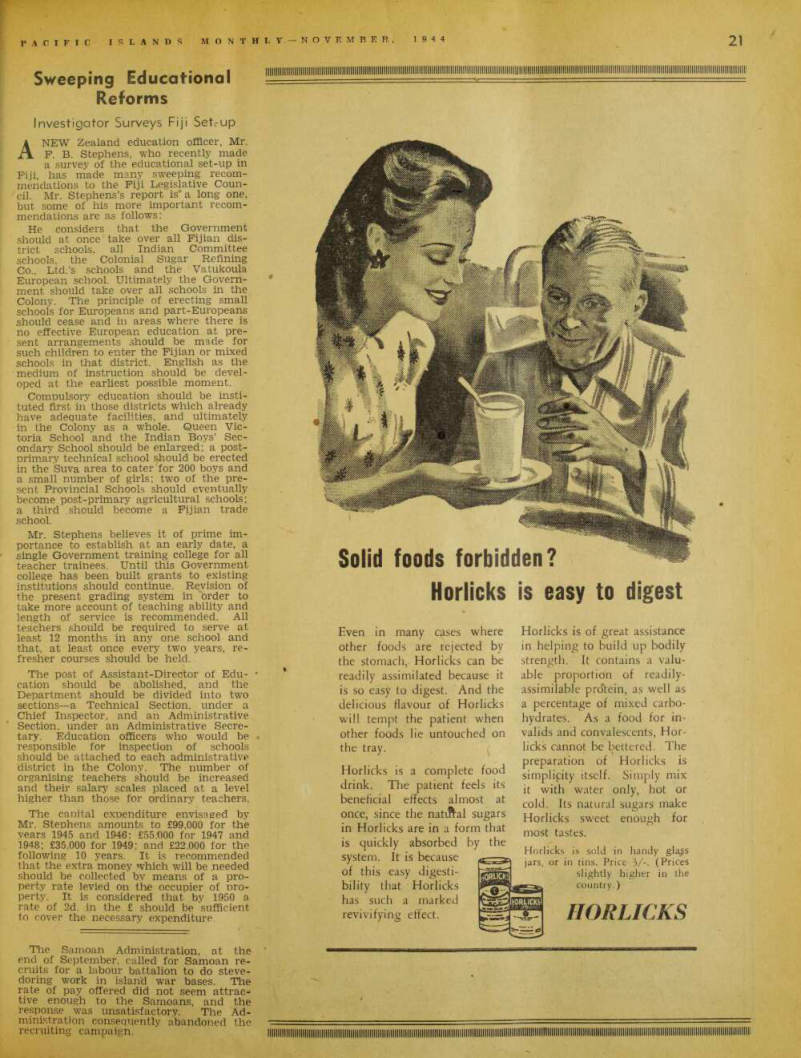
Reforms
Investigator Surveys Fiji Set-up
ANEW Zealand education officer, Mr.
F. B. Stephens, who recently made a survey of the educational set-up in Fiji, has made many sweeping recom mendations to the Fiji Legislative Coun cil. Mr. Stephens's report is* a long one, but some of his more important recom mendations are as follows: He considers that the Government should at once take over all Fijian dis trict schools, all Indian Committee schools, the Colonial Sugar Refining Co., Ltd.’s schools and the Vatukoula European school. Ultimately the Govern ment should take over all schools in the Colony. The principle of erecting small schools for Europeans and part-Europeans should cease and in areas where there is no effective European education at pre sent arrangements should be made for such children to enter the Fijian or mixed schools in that district. English as the medium of instruction should be devel oped at the earliest possible moment.
Compulsory education should be insti tuted first in those districts which already have adequate facilities, and ultimately in the Colony as a whole. Queen Vic toria School and the Indian Boys’ Sec ondary School should be enlarged; a post primary technical school should be erected in the Suva area to cater for 200 boys and a small number of girls; two of the pre sent Provincial Schools should eventually become post-primary agricultural schools; a third should become a Fijian trade school.
Mr. Stephens believes it of prime im portance to establish at an early date, a single Government training college for all teacher trainees. Until this Government college has been built grants to existing institutions should continue. Revision of the present grading system in order to take more account of teaching ability and length of service is recommended. All teachers should be required to serve at least 12 months in any one school and that, at least once every two years, re fresher courses should be held.
The post of Assistant-Director of Edu cation should be abolished, and the Department should be divided into two sections—a Technical Section, under a Chief Inspector, and an Administrative Section, under an Administrative Secre tary. Education officers who would be responsible for inspection of schools should be attached to each administrative district in the Colony. The number of organising teachers should be increased and their salary scales placed at a level higher than those for ordinary teachers.
The capital expenditure envisaged by Mr. Stephens amounts to £99,000 for the years 1945 and 1946: £55.000 for 1947 and 1948; £35.000 for 1949; and £22.000 for the following 10 years. It is recommended that the extra money which will be needed should be collected by means of a pro perty rate levied on the occupier of pro perty. It is considered that by 1950 a rate of 2d. in the £ should be sufficient to cover the necessary expenditure The Samoan Administration, at the end of September, called for Samoan re cruits for a labour battalion to do steve doring work in island war bases. The rate of pay offered did not seem attrac tive enough to the Samoans, and the response was unsatisfactory. The Ad ministration consequently abandoned the
recruiting campaign.
Advertisements & other items, p. 23 (1 item)
Solid foods forbidden?
Ih-3i
m v? 4 I m ? ' I H ■X
Horlicks is easy to digest
Even in many cases where other foods are rejected by the stomach, Horlicks can be readily assimilated because it is so easy to digest. And the delicious flavour of Horlicks will tempt the patient when other foods lie untouched on the tray.
Horlicks is a complete food drink. The patient feels its beneficial effects almost at once, since the natiffal sugars in Horlicks are in a form that is quickly absorbed by the system. It is because of this easy digestibility that Horlicks has such a marked
revivifying effect.
Horlicks is of great assistance in helping to build up bodily strength. It contains a valu-
able proportion of readily-
assimilable protein, as well as a percentage of mixed carbohydrates. As a food for invalids and convalescents, Horlicks cannot be bettered. The preparation of Horlicks is
simplicity itself. Simply mix
it with water only, hot or cold. Its natural sugars make Horlicks sweet enough for most tastes.
Horlicks is sold in handy jars, or in tins. Price 3/-. (Prices slightly higher in the country.)
HORLICKS
Ariki Nui Returns
From Our Own Correspondent
Rarotonga, Oct. 8.
fTIHE paramount chieftainess, Mrs.
A Takau Rio-Love, has returned to Rarotonga for a visit of several months.
Shortly after her arrival she made a brief tour of the outer islands of the Group, where she was given a royal wel come, and carried shoulder high from one feast to another in the traditional manner.
Her first public move was to engage in a determined battle to raise the rate of pay for Rarotongan labour from 4/- to 5/- per day. Her efforts met with even
tual success and now all Maoris engaged in public works receive the advanced rate; several private firms have followed suit.
The Ariki Nui intends returning to New Zealand at the end of the year in order to wind up her affairs and. terminate her patriotic dutiqs, to which she has devoted so much time and energy throughout the war. She will then come back perman ently to the Cook Islands and devote all her time to the welfare of her own people.
Miss Emily Tangitane Taripo, of Raro tonga, has recently become engaged to Staff-Sergeant C. J. Kealiher, of the United States Army. Miss Taripo is at present living in New Zealand.
"Shark-Eye"
Why He Was Called "Shark-Eye"
By D. H. Osborne
IN August “PIM,” Mr. R. A. Vivian asks, how did the New Guinea goldminer, Bill Park, get the name of “Shark- Eye.”
On the Yodda there were two men yarned Bill park—no relations, but great pals. It was the custom of the miners to gather at the stores on Sunday.
One Sunday, the storekeeper asked how he was to distinguish them. One' was of ginger complexion, so several miners said “Call him Red Bill.” Later, someone suggested “Shark-Eye.” They were known afterwards as “Red Bill” and “Shark- Eye.”
“Shark-Eye” was walking along the bank of the lakora one day. He had a cocoa tin in his sling bag, containing 28 oz. of gold. He slipped, and the sling bag caught and tipped out the contents. The tin rolled into the river.
His boys spent some time diving, but without finding it. He had taken the gold out of one part of the river, only to drop it in another part.
On another occasion, his cook boy was cooking the mid-day meal, near where they were working. The fire had been lit on top of some headings, thrown out of a sluice box by another man. The' cook boy ran to Park with a stone in his hands, saying, “Look, Taubada, gold.” The heat had caused the gold to show in a speci man that dollied 12 oz. of gold.
A branch of the lakora was known as Red Creek—the water was red, in flood.
A nomad tribe of natives lived on the head waters, who were hostile to the miners. They had murdered two miners and attacked others, wounding Fred May.
Later, Fred May was working on Red Creek—he was very scared of natives.
“Shark-Eye” had been prospecting on the higher waters, and had crossed on to Red Creek, higher up, and he was following the bed of the creek down, when a bullet struck a stone at his feet.
Fred May had seen a human being in the distance, and had mistaken him for a Red Creek native and opened fire early.
Park tried to keep the matter quiet, but May spoke about it later.
May was twice wounded by natives later, and was finally murdered by his cook boy on the Yodda.
G. And E. Men Awarded
Decorations
THE following men of the Gilbert and- Ellice Islands have been decorated for distinguished wartime service: Order of the British Empire (Civil Division)
Mbe
Kaitu, native magistrate, of Funafuti, Ellice Islands; Kabunare, native magistrate, of Tarawa, Gilbert Islands; and Tobinabina. native magistrate, of Abe mama, Gilbert Islands.
Bem
losefa, senior assistant master, Education Department, G & EIC.
Civil Commendations for Brave Conduct with Badge Kabuta, island policeman, of Nonouti, Gilbert Islands; Ben Randolph, of Kuria, Gilbert Islands; Willie Schutz, wireless operator, Gilbert Islands; and Tekai, of Kuria, Gilbert Islands.
Advertisements & other items, pp. 24-25 (2 items)
Mart’S
GILLESPIE’S
The Flour
TRADE
MARK
of tKe Islands
- SYD NEY -
AUNT
MART’S
BAKING POWDER
O SUPPLIES ARE NOW AVAILABLE. If your local supplier is out of stock he will readily obtain Aunt Mary's Baking Powder for you. After all, quality is worth waiting for, especially when it is Aunt Mary's Baking Powder, which maintains the high quality which has stood the test for over 70 years.
Young Chieftainess
RETURNS HOME
The young Cook Islands Chieftainess, Miss Terito Pa Ariki, whose return from New Zealand to Avarua was reported in the October “PIM.”
Suva Memories
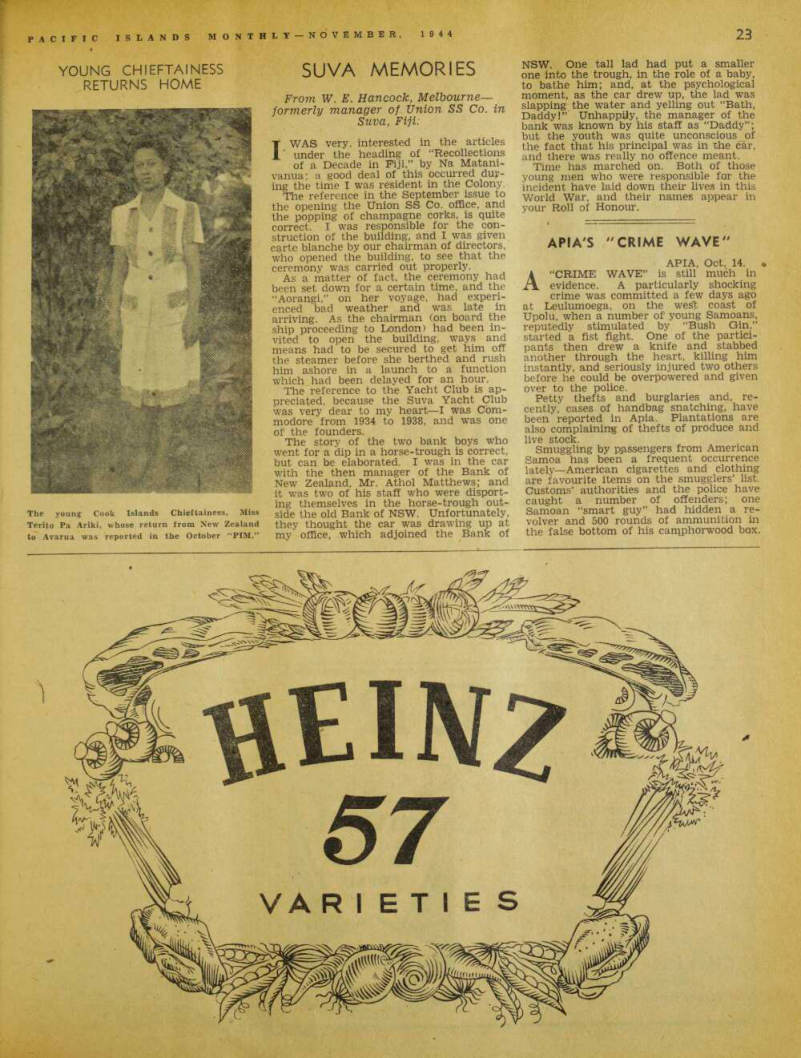
From W. E. Hancock, Melbourne— formerly manager of Union SS Co. in
Suva, Fiji:
I WAS very, interested in the articles ' under the heading of “Recollections of a Decade in Fiji,” by Na Matani vanua; a good deal of this occurred dur ing the time I was resident in the Colony, The reference in the September issue to the opening the Union SS Co. office, and the popping of champagne corks, is quite correct. I was responsible for the con struction of the building, and I was given carte blanche by our chairman of directors, who opened the building, to see that the ceremony was carried out properly.
As a matter of fact, the ceremony had been set down for a certain time, and the “Aorangi,” on her voyage, had experi enced bad weather and was late in arriving. As the chairman (on board the ship proceeding to London) had been in vited to open the building, ways and means had to be secured to get him off the steamer before she berthed and rush him ashore in a launch to a function which had been delayed for an hour.
The reference to the Yacht Club is ap preciated, because the Suva Yacht Club was very dear to my heart—l was Com modore from 1934 to 1938, and was one of the founders.
The story of the two bank boys who went for a dip in a horse-trough is correct, but can be elaborated. I was in the car with the then manager of the Bank of New Zealand, Mr. Athol Matthews; and it was two of his staff who were disport ing themselves in the horse-trough out side the old Bank of NSW. Unfortunately, they thought the car was drawing up at my office, which adjoined the Bank of
NSW. One tall lad had put a smaller one into the trough, in the role of a baby, to bathe him; and, at the psychological moment, as the car drew up, the lad was slapping the water and yelling out “Bath, Daddy!” Unhappily, the manager of the bank was known by his staff as “Daddy”; but the youth was quite unconscious of the fact that his principal was in the car, and there was really no offence meant.
Time has marched on. Both of those young men who were responsible for the incident have laid down their lives in this World War, and their names appear in your Roll of Honour.
Apia's "Crime Wave"
Apia, Oct. 14.
A “CRIME WAVE” is still much in evidence. A particularly shocking crime was committed a few days ago at Leulumoega, on the west coast of Upolu, when a number of young Samoans, reputedly stimulated by “Bush Gin,” started a fist fight. One of the partici pants then drew a knife and stabbed another through the heart, killing him instantly, and seriously injured two others before he could be overpowered and given over to the police.
Petty thefts and burglaries and, re cently, cases of handbag snatching, have been reported in Apia. Plantations are also complaining of thefts of produce and live stock.
Smuggling by passengers from American Samoa has been a frequent occurrence lately—American cigarettes and clothing are favourite items on the smugglers’ list.
Customs’ authorities and the police have caught a number of offenders; one Samoan “smart guy” had hidden a re volver and 500 rounds of ammunition in the false bottom of his carqphorwood box.
Us Missionaries For New
Guinea
TWENTY American priests of the Divine Word Missionary Society arrived in Brisbane at the end of October. Most of them will shortly leave for Dutch New Guinea to take the place of European missionaries killed by the enemy and to re-open missions there.
Some’ will remain to establish a train ing centre for missionaries at Woodlands, Marburg, Queensland. This property has been acquired for their use by the Propagation of the Faith Society.
Flight-Sergt. (Navigator) Basil Spiller, RAAF, of Menapi, Papua, was wounded by flak in the left hip, whilst attacking enemy targets in France on July 28. He 'was admitted to hospital in Norfolk, Eng land, but has since been discharged, and at latest advice was recuperating in Scotland.
"Land Settlers In Papua"
An Answer to PXYZ
SHAKESPEARE must have .heard about Papua: Who doth ambition shun And loves to live i’ the sun, Seeking the food he eats * And pleased with what he gets, Come hither, come hither, come hither!
Here shall he see No enemy.
But: Snarling natives,
Official heavyweights,
Leeches and other blood-suckers, Commercial octopuses, Canberra, Sleeping out in the rain, Getting eaten alive by mosquitoes, Being swamped in canoes, Rough living and rough weather.
Ghv.
Rarotongan Social
Whirl Jitterbug Comes to the Islands
Prom Our Own Correspondent
Rarotonga, Oct. 8
AROTONGA residents no longer suffer from lack of entertainment. Mr W P. Browne’s new “Royal Hall ” 01 ,!cted on the site of the former building in the hurricane of 18 °, pen P ractil ' al ly every amusement We f °‘' SOme form of The projectors and sound equipment which were buried under the wreckage in for several days, have been overhauled and re-built by the operator. ‘ bcott ’ ar *d good programmes—in cluding news reels not more than three years old-are screened twice weekly. «J^ nC a S are two or three nights a new e .^ a of dancing has opened , Ra f ofoHgsi w ith the introduction of the jitterbug. The Maori version of the “ura S la ! as rt learned, from the Europeans, Sl °u C S ISt Principally of a mono tonous shuffling round with set faces and little appearance of real enjoyment, and it is refreshing to «ee the boys and girls break away and “go to town” in real style.
There are some people, of course, who deplore the infiltration of this energetic American bug which has spread over wnriH °L h L clvllis £d and semi- civilised world, but those who like to see young folk enjoy themselves welcome the inno vation.
There have been a number of jitterbug competitions, and some of the younl couples present a really clever exhibition of tapping and twirling.
There has been also a series of Fridav evening concerts in aid of various local organisations. The Child Welfare, Girl S p *des, r?°Z s ’ ® ri g ade ’ Boxing Club and T^?u ls 1 Clubs have each had their turn.
The latest entertainment was a splendid programme of Polynesian dances and songs presented by the Taputapuatea party arranged and led by the para mount chieftainess, Mrs. Takau Rio-Love and the young chieftainess, Miss Terito Pa Anki. This was the first of a monthly series of similar entertainments to be given by the Ariki Nui’s party to raise funds for the repair of the Makea Palace.
Taputapuatea, which was damaged in the 1943 blow.
MOST exciting of all was the recent exhibition of drum dancing by Manihiki Islanders to collect money for the completion of the new meeting house which is being built in the Raro tonga Manihikian settlement.
The natives of the far northern atolls of Manihiki and Rakahanga are the only Cook Islanders to fully retain the dying art of interpreting history and legends, the ways of the birds, fish and the ele ments, by vigorous gymnastics, to the traditional rhythms of an orchestra by various types of drums.
The “Royal Hall” trembled to the rattle and boom of the hollow-log and shark-skin drums, while the Manihikians performed their high-speed evolutions, leaving the spectators feeling breathless and shaky at the knees.
The Rev. O. Theile, of the Lutheran Church, recently visited Queensland to confer with Missionary A. P. H. Freund and Mr. V. Neumann, of the New Guinea Mission Staff, concerning the possibilities of an early resumption of work on the Rooke-Siassi Islands. The Rev. Thiele is secretary of the New Guinea Mission Society.
Advertisements & other items, p. 26 (1 item)
Chi Vers
A. B. DONALD Ltd.
AUCKLAND
ISLAND TRADERS Cr GENERAL MERCHANTS
/ P.O. Box 1 509. Cobles & Telegrams, "Kingdom", Auckland.
CHI VERS
FAMOUS ENGLISH PRODUCTS
CANNED ENGLISH VEGETABLES
CANNED ENGLISH FRUITS
OLDE ENGLISH MARMALADE
GOLD MEDAL JAMS
JELLY CRYSTALS, ETC
Obtainable from all leading Grocery Stores
WRITE TO DEPARTMENT “A"
CHI VERS Cr SONS LTD.
Histon, Combs., Eng.
POR attractive recipe book
«C" nrtfr
CHiVfRS
COLO
hmnmid fresh
INGUSH
PEAS
Indian Problem
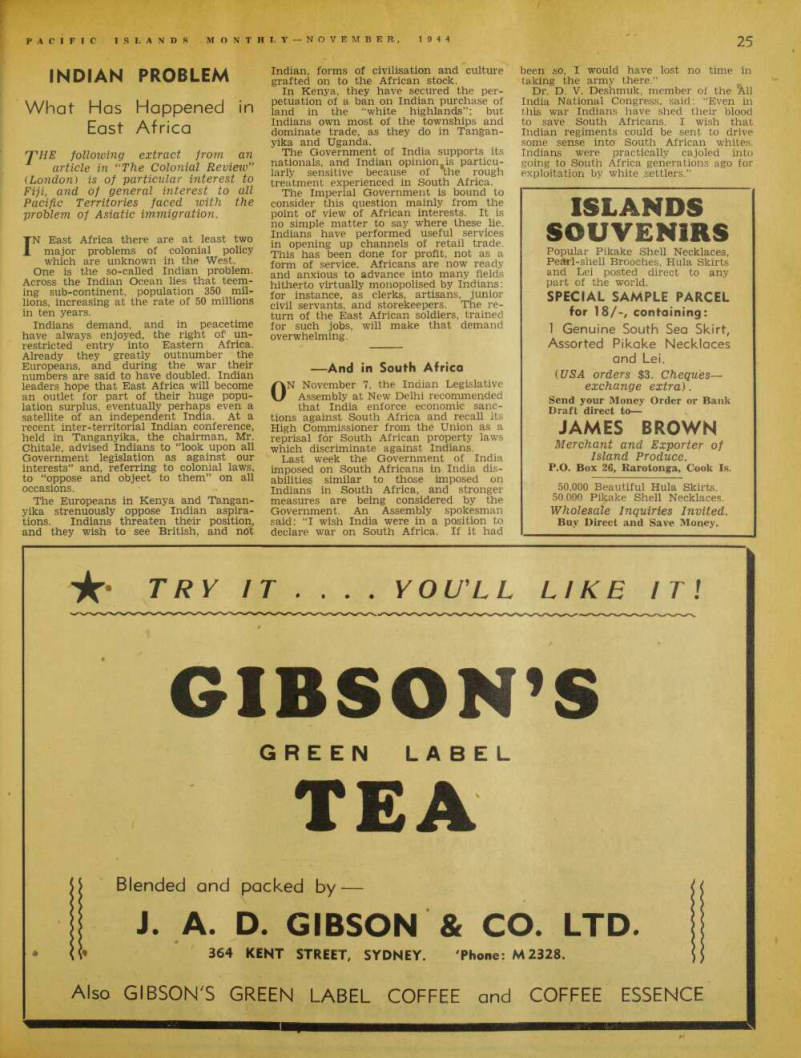
What Has Happened in East Africa
THE following extract from an article in “The Colonial Review” (London ) is of particular interest to Fiji, and of general interest to all Pacific Territories faced with the
problem of Asiatic immigration.
IN East Africa there are at least two major problems of colonial policy which are unknown in the West.
One is the so-called Indian problem.
Across the Indian Ocean lies that teem ing sub-continent, population 350 mil lions, increasing at the rate of 50 millions in ten years.
Indians demand, and in peacetime have always enjoyed, the right of un restricted entry into Eastern Africa.
Already they greatly outnumber the Europeans, and during the war their numbers are said to have doubled. Indian leaders hope that East Africa will become an outlet for part of their huge popu lation surplus, eventually perhaps even a satellite of an independent India. At a recent inter-territorial Indian conference, held in Tanganyika, the chairman, Mr.
Chitale, advised Indians to “look upon all Government legislation as against our interests” and, referring to colonial laws, to “oppose and object to them” on all occasions.
The Europeans in Kenya and Tangan yika strenuously oppose Indian aspira tions. Indians threaten their position, and they wish to see British, and not
Indian, forms of civilisation and culture grafted on to the African stock.
In Kenya, they have secured the per petuation of a ban on Indian purchase of land in the “white highlands’’: but Indians own most of the townships and dominate trade, as they do in Tangan yika and Uganda.
The Government of India supports its nationals, and Indian opinion is particu larly sensitive because of the rough treatment experienced in South Africa.
The Imperial Government is bound to consider this question mainly from the point of view of African interests. It is no simple matter to say where these lie.
Indians have performed useful services in opening up channels of retail trade.
This has been done for profit, not as a form of service. Africans are now ready and anxious to advance into many fields hitherto virtually monopolised by Indians: for instance, as clerks, artisans, junior civil servants, and storekeepers. The re turn of the East African soldiers, trained for such jobs, will make that demand overwhelming.
—And in South Africa
ON November 7, the Indian Legislative Assembly at New Delhi recommended that India enforce economic sanc tions against South Africa and recall its High Commissioner from the Union as a reprisal for South African property laws which discriminate against Indians.
Last week the Government of India imposed on South Africans in India dis abilities similar to those imposed on Indians in South Africa, and stronger measures are being considered by the Government. An Assembly spokesman said: “I wish India were in a position to declare war on South Africa. If it had
been so, I would have lost no time in taking the army there.”
Dr. D. V. Deshmuk, member of the 'All India National Congress, said; “Even in this war Indians have shed their blood to save South Africans. I wish that Indian regiments could be sent to drive some sense into South African whites.
Indians were practically cajoled into going to South Africa generations ago for exploitation by white settlers.”
Mr. Trevor W. Wignall, Surveyor in the Lands Department, Fiji, has accepted the offer of a transfer to the Gold Coast, West Africa. He was born in Fiji and educated in Australia, and joined the Government as a surveyor in 1924. By 1936 he was acting as Assistant Commis sioner of Lands and Assistant Crown Surveyor, and in 1942 was nominated as an official member of the Suva Town Board. He has been for many years a prominent member of the Council of the European Civil Servants’ Association.
Advertisements & other items, pp. 27-28 (1 item)
Gibson’S
ISLANDS
SOUVENIRS
Popular Pikake Shell Necklaces, Pearl-shell Brooches, Hula Skirts and Lei posted direct to any part of the world.
SPECIAL SAMPLE PARCEL
for 18/-, containing: 1 Genuine South Sea Skirt, Assorted Pikake Necklaces and Lei. (USA orders $3. Cheques — exchange extra) .
Send your Money Order or Bank Draft direct to—
JAMES BROWN
Merchant and Exporter of Island Produce.
P.O. Box 26, Rarotonga, Cook Is. 50,000 Beautiful Hula Skirts. 50.000 Pikake Shell Necklaces.
Wholesale Inquiries Invited.
Buy Direct and Save Money.
it* TRY IT ... . YOU'LL LIKE IT!
GIBSON’S
GREEN LABEL
TEA
15 Blended and packed by— j< J. A. D. GIBSON & CO. LTD.
S* 364 KENT STREET, SYDNEY. 'Phone: M 2328. Also GIBSON'S GREEN LABEL COFFEE and COFFEE ESSENCE
KANGAROO BRAND
Ropes,
Cordage,
and Twines for every purpose Backed by 86 years of service Manufactured by:
M. DONAGHY AND SONS,
Pty. Ltd., Geelong and Sydney.
Fiji Representatives:
PEARCE AND CO.
LIMITED
P.O. BOX 237, SUVA
Tributes From Fiji
Legislative Council Says Good-bye to Sir Philip Mitchell
rIBUTES were paid to Sir Philip Mitchell, retiring Governor of Fiji, when the Fiji Legislative Council met on September 27. Sir Philip *md Lady Mitchell have left the Colony for Kenya, where Sir Philip has been ap pointed Governor.
Mr. H. H. Ragg, on behalf of elected members of the Council, said that feel ings were mixed at the news of His Excellency’s departure—while they re gretted the loss to Fiji, they were glad that Sir Philip’s abilities had been re cognised by his appointment to such an impprtant colony as Kenya. When Sir Philip first came to Fiji he had declared that while the war continued the waging of war would be his main objective. He was to be congratulated on the way he had carried out that promise. He had never spared himself and had inspired others with his energy and drive. The raising of the Fijian Battalions had been largely due to his leadership.
Despite the Governor’s many duties and the necessity of travelling overseas frequently on war missions he had given a great deal of attention to civil matters also. He had revolutionised the pro cedure of the Council by establishing a Finance Committee which gave unofficial members much of the responsibility pre viously borne by Government, Under the able chairmanship of the Financial Secretary, the Committee had worked well and was a distinct advance in the trans action of Government business. In 1943 the far-reaching Bill dealing with Fijian affairs had been passed. Soon after his
arrival in the Colony, the Governor had realised that the Fijian, if he were to save himself, would have to assume more responsibility. The new legislation paved the way for a new era in Fijian affairs.
MR. VISHNU DEO, on behalf of the Indian members, said he wished to second the remarks made by Mr Ragg. He congratulated the Governor on his appointment to the governorship of Kenya—a Colony of great, importance, and assured Sir Philip that his successor would be given all possible support bv the Indian members.
Ratu Tiale Vuiyasawa, speaking for Fiuian members, said that His Excellency’s departure, while greatly regretted, had not been unexpected by the Fijians, who had felt sure that his abilities would soon call him to a higher post. From the be ginning the Governor had shown keen interest in the welfare of the Fijian race and had encouraged them to take their part in the government of the country.
He thought His Excellency’s monument in Fiji would be found in the great spirit of harmony and co-operation he had introduced among the peoples represented in the Legislative Council.
Ratu Sukuna said that when the Governor arrived in the Colony it had been his privilege to interpret the speech he made at the welcome given him by the chiefs. It was a time, the Governor had said, not for lip service, but for action. Afterwards, one old chief had asked him what sort of a Governor did he think he was. He had replied that first of all His Excellency was a man; secondly, he was a realist; and, thirdly, he was a soldier. He had called the native members of Council to the work of reconstruction, and they would not fail to complete the edifice which he had begun.
Advertisements & other items, p. 28 (1 item)
Colonial & Bronte
Equal to CSi© S jIBcSt
Throughout Australia and Overseas there is on ever-increasing demand for
HIGH-GRADE CANNED MEATS
There is no better qualitywholesome. -none more
TRADE MEATS FOR THE ISLANDS
order
“COLONIAL" BRAND
Roast, Corned and Boiled Beef Packed in 6,5, 4,3, 2, 1 lb. and 12 oz. tins.
Also Corned Beef in 12 oz. Taper Tins.
Roast Corned and Boiled Mutton: 1 lb. and 12 oz. tins.
Choice Dripping 36 lb., 2 lb., 1 lb. tins, and 1 lb. packets.
WtttT Sfe £ m I ■S<s ro ■
DELICIOUS
BRONTE" HOT MEALS
Steak and Kidney Pudding.
Beef Steak Padding.
Sana ages and Temate.
Sausages and Vegetable.
Lamb and Green Peas.
Denied Beef and Boston Beans with Tomato Sauce.
Steak and Tomato.
Under present conditions it is wise to ensure that you have ample stocks of all our lines.
The Colonial Wholesale Meat Coy* Pty. Ltd.
30 6ROSVENOR STREET, SYDNEY
Rorotongon Soldier
Returns Home Free Beer and Jungle Adventures
From Our Own Correspondent
Rarotonga, Oct. 6.
ARAROTONGAN warrior, Pte. Tuaine Utanga, of the NZ Forces, received a great welcome when he visited his homeland on a month’s furlough in September. His visit, however, was hardly a rest—most days were spent in going from one “umukai” to another, while every night his home was crowded with friends eager to learn of his experiences and to hear this talented Maori musician render his latest compositions.
He had many exciting stories to tell of Jap-hunting in the Solomons and other Pacific war areas. He displayed also several of the souvenirs he made in the Solomon Islands, the most interesting be ing the ukulele carved from teak and inlaid with pearl-shell, and inscribed metal plates cut from fragments of Japanese aircraft. It may be readily be lieved that the Islander is popular among his comrades (he is the only Maori in his battalion) for he is a talented musician and carries his guitar wherever he goes.
He has composed the words and music of more than twenty songs in modern style, including a few catchy “blues” tunes. One of the best is a beautiful waltz song, “On Vella Lavella Island.”
On Green Island, Pte. Utanga provided amusement for the New Zealanders and Americans by capturing a number of bush fowl and training the cocks to fight in a wire-netting arena erected for the pur pose.
“The best adventure of all,” he said, “was the time when we were chasing the Japs back through the jungle and came upon a huge dump of food that had been abandoned in their hurry to get away.
There was a great quantity of taro taken from native plantations, and there was also a lot of tinned fish and tinned rice, ready-cooked. But the real dis covery was four cases of ‘sake.’
“Soldiers of any nationality have got to be in an awful hurry to leave four cases of perfectly good beer behind in a steaming jungle. We were not in all that hurry, and saw no sense in leaving it for somebody else.
“There were four dozen small tins in each case, and therfe were only six of us —but we managed to get through the lot. Then we picked up our rifles and went on after the Japs in a much hap pier state of mind.
Effect Of Ddt On Mosquito
Control
rpHE new insecticide called for con- X venience, DDT, recently was taken off the Allied secret list and news stories about its efficacy in insect control made the headlines in most overseas magazines simultaneously. So revolution ary has this powder proved that it was regarded by the Allies as a munition of war and all details were kept a close secret. It is said that the new powder “promised to do in the realms of eco nomic entomology what sulpha drugs have done in medicine.”
In Europe it has been used to kill bed bugs, flies, lice, cockroaches, ants and caterpillars. But of particular interest to residents of the Pacific is the way in which it kills mosquito larvae.
In the Fiji “Agricultural Journal” for September, a description is given of how a few ounces were received in Suva by airmail last January, and how the follow ing experiments were made:
Two drums were filled with water, and one was sprayed with a non-volatile oil and the other with a solution of DDT in oil. After seven weeks, mosquito eggs were found in the drum sprayed with oil, but after 12 weeks no eggs had appeared in the drum containing oil and DDT.
A disused air-raid shelter containing water to a depth of two feet was treated with DDT in Diesel oil, and the follow ing day no larvae could be found.
The last experiment was made in a patch of swampy and weedy ground, partially covered with twigs and grass cuttings, which had been reported by the nearest householder as being a breeding place for night-biting mosquitoes. DDT was applied, both in a solution in oil and by dusting the dry powder on the affected area. Two days later the site was re examined and no larvae could be found.
“It is seen from the foregoing,” says the Journal report, “that this substance is quite suitable as a mosquito larvicide in Fiji, even with its rainfall of 120 inches per. year (Suva) and a humidity of 74 to 84 per cent.”
It was reported in Sydney in November that Captain Peter Brewer, of ANGAU, and formerly a well-known member of the Papuan Public Service, had been killed in a plane accident. His wife and child live in Canberra.
Messrs. Vic. Maxwell and Gordon Russell, as members of the Production Board staff (ANGAU), are now trying to get some organisation and movement back into the planting industry, on the north Coast of New Guinea. They are meeting many difficulties.
Advertisements & other items, pp. 29-30 (1 item)
Flour
PRODUCING UNIFORM GOOD RESULTS SINCE 1868
ALWAYS ASK FOR IT
Australian foodstuffs ... PHARMACEUTidAL lines ' • 1 1. ‘ . ■'• *- - -V '', , ' WINES AND SPIRITS . . . MANUFACTURED GOODS PRIMARY PRODUCTS . . . PATENT MEDICINES If you want to BUY equipment of any kind, foodstuffs, spirits, manufactured goods, or SELL island produce or raw materials . . . USE the market-knowledge and organisation of Darvas and Company for prompt service and effective safeguard of your interests. With representatives in all Empire and overseas countries, Darvas and Company are organised for quickest and best possible results . . . buying or selling. „ BanKers: bedk oi Australasia. igrif* 3 * Wartime Cable Address. » Comptoir National D’Escompte DARVAS COMPANY, SYDNEY. J M de Paris.
Ua/uw) & vompantf
(Proprietors; R. Darvas, E. Klugman). W § Head Office: 35 PITT ST., SYDNEY. ’Phones: 8W4696, 8W6384.
HILL’S
FINE ENGLISH
CIGARETTES
• SPINET
•SUN R I P E
•GOLD FLAKE
•AIR MAIL
HIGH-GRADE
TOBACCOS
BADMINTON
* SPINET
Pacific Islands Distributors :
C. SULLIVAN & CO., Sydney
CHATEAU D’OR
COGNAC VIEUX
w- ☆ ☆ ☆ D NET CONTENTS 26 FLUID OUNCES
C. SULLIVAN & CO.
SYDNEY
PRODUCE OF AUSTRALIA
i*UiE ribbon
PABST
BLUE RIBBON BEER
3 3 F|ne Brews Blended into
ONEGREAT BEER
Agents : C. SULLIVAN & CO., 379 Kent Street, Sydney lue ribbon
C. SULLIVAN & CO.
GENERAL MERCHANTS ISLANDS AGENTS
REPRESENTING LEADING FIRMS IN Thu; PACIFIC ISLANDS.
Islands Produce sold on Shippers' Account-Liberal Advances against Consignments.
Buyers of all Islands’ Requirements on Commission—Original Invoices Furnished.
Bankers-. Bank of New South Wales .. Bank of New Zealand .. Comptoir National d’Escompte de Paris.
Wartime Cable Address; Sullivan, Kentstreet, Sydney.
379 KENT STREET, SYDNEY, N.S.W.
Seen by Judy Tudor
Away From It All With Frisbie
The Wartime Angle on a South Seas Story as Seen by Judy Tudor
mo quote Mr. Frisbie against himself: X “A good South Seas book is avowedly escape reading—and as such has a healing effect on the frayed nerves of civilised man.”
Or civilised woman. Lost in a jungle of towering concrete and interminable pavements; adrift in a sea of wartime regulations, iambus and whatnot, it was with relief that 1 wandered, this past week, through the pages of the latest Frisbian story —“Island of Desire” —for (I quote): “Many a green isle needs must be In the deep wide sea of misery; Else the traveller worn and wan, Never thus could voyage on ... ”
“Island of Desire,” published by Double day Doran, of New York, for $2.50, should, I imagine (had not the publishers willed it otherwise) have been “Marooned by Request,” which we were promised some months ago.
The story comes in two parts: the first, dealing with the events of several years ago on Pukapuka; and the second when, shortly after Pearl the author, en route to Rarotonga with his four children, voluntarily camps on lonely Suwarrow atoll while the ketch Hurry Home, goes off on a bit of business of its own. Here they meet two other sea farers (ex the cutter Vagus ) and together they face a hurricane of full maturity.
But whether or not the story will actually conform to the specifications set by Fris bie, and soothe the nerves of to-day’s civilised beings, is a moot point. I am inclined to think that it is likely to drive them to the final stages of frustrated despair, the foundations of which have already been laid by long years of war.
PERHAPS at this stage of the game it is necessary to explain the civilised world to the untouched (if any) islands of the Pacific, instead of, as for merly, explaining the islands to the civi lised world.
Time was when the dispirited clerk, the hen-pecked husband, the romantic flapper, could, if they so wished, find solace an(T escape from suburban reality per medium of South Seas literature. The things that prevented them following in the footsteps of their heroes emanated solely from within themselves: wherewithal, initiative and the guts to heave themselves out of their own little mud puddle.
But to-day, such is the sorry mess we have brewed ourselves, no amount of money, initiative or intestinal fortitude will get one any place. Had it been otherwise, I too, during this last week, should have heaved my best bonnet over the windmill, got me a ship and headed for the blue horizon, there to dally on a beach or in a blue lagoon, drink me a coconut and let the rest of the world go to the devil —even as Mr. Frisbie.
But alas, there is a war on. are no ships going that way and—even more to the point—l have not yet reached the blessed age of 45. At 45 the Common wealth Government officially loses inter est in the female within her gates—and thus have we had the pathetic newspaper advertisements of the last few years for anything from waitresses to Tivoli ballet girls, always followed by the proviso: “Must be over 45.” After 45 a woman hereabouts may go as she listeth; if she still listeth.
So, like the traveller in the poem, l— and millions like me—have been forced
to voyage on oscillating unhappily between ‘a bachelor unit—suit business lady” and this office, clinging by my eye brows to crowded buses; being encour aged to invest in war-loans; being ear bashed (charming American phrase!) by politicians if I do not; going without meat when the butchers strike; without newspapers when the newspapers strike; without hot baths when the miners strike— ad nauseam ; judging myself for tunate in that I have been ‘‘gainfully employed” and have, so far, thus escaped being thrown into a pickle factory by that bogey, Manpower. Yet all this while I am conscious that in other latitudes palms wave, the sea is blue, and life is comparatively uncomplicated.
IT is sensible, sense that one wayfarer speaks to Ropati towards the end of the story, as together they await the approaching hurricane: ‘‘Even if we have a hurricane,” he says, “it will be nothing to complain about. A hurricane is a thing of Nature; it is one of the inevitable things of the physical world —like earthquakes and seismic waves. A man is a fool to fret over the inevitable.
“But think of the people in Europe suffering indescribable agonies when they might be living in peace and happiness!
Those are the kind of calamities that both discourage and terrify a man, and simply because they are unnecessary.
When I feel like pitying myself, I think
of bombed London; and now, when I start thinking about the danger my cutter is In I turn my thoughts to the on a 1 rubber rafU I( my vesslf°s lost U an act of God; but if those aviators die at sea it will be through the imbecility of man.”
B tT rp . , ~, 1 .j; UT to our story. It tells at first of the romance of Robert Dean Frisbie (Ropati) and a lovely island girl, Desire; their marriage and the* arrival of their four children; and, subsequently, the tragic death of Desire from that curse of Polynesia tuberculosis. And threaded through this main theme are the highlights and sidelights of the lotus-eater’s life on a Polynesian islet, in the true Frisbie style, that we know from his former books. <
Now, having been nurtured in the Melanesian tradition—which, incidentally, Mr. Frisbie dismisses as “all cannibals and square-face gin”—l must admit that the true Polynesian angle is slightly beyond my grasp and that I found Book Two, with its back-drop of stern reality in a hurricane and, to a lesser extent, the present war, easier to reconcile with life as I know it. Perhaps it is a long line of sceptical Scots ancestors; or the aforesaid Melanesian or a deep-rooted belief that even on a Pacific island, life must have some purpose other than drift, if one is not to go completely troppo; or because I know a little of a life of isolation among native people whose culture is so basically different from our own—that I feel a little like the small boy who saw a giraffe for the
first time. That is, that I don’t entirely believe it.
Perhaps Ropati does not either; but in the pleasant blending of truth and fic tion in his latest book, he has at least combined all the ingredients to tickle the imagination of the stay-at-home Ameri can, for whom, doubtless, the book is written. This passage, for example: “For in the quiet hours of night, while lying on our sleeping mat, only vaguely conscious of the-snores of the Watch and Ward out woman-chasing in their dreams —while longine once again to drink tea and read Browning—while pondering chastity, purity in thought and deed, sup pression of the bestial craving of the lower man—how often do we hear the crunch of poraf gravel under bare feet, a soft incontinent laugh, husky girl voices whispering! * The stairs creak; the folds of the mosquito net ripple; the odour of scented coconut oil insinuates itself into our thoughts as welcomelv as the fingers, the lips, the breasts of an atoll Calypso hungry for love.”
If that doesn’t make the hackles rise on every tired, war-wearv American from Seattle to New Orleans, and engender a desire to start out for Pukapuka forth with, then I don’t know anything about Americans.
BUT it is a goodly tale, and fascinating withal, even for a Melanesian real ist. The description of how Frisbie (now a trader) disposes of a gross of' lady’s bloomers and a gross of jews’ harps, at 2/6 each, to a population which has hitherto had no truck with either, is worth the cost of the book; and the other streaks of humour, therefore, come to you gratis: “Desire’s sisters are diving from the little wharf I have built into the lagoon,” the author observes, at one point. “Three native boys are with them, but they seem unaware that they are swimming and playing with four naked maidens. When I was their age such a sight would have shocked me beyond measure. Even now I cannot look at them without an impulse to snort and paw the earth; the native boys look at them with clean uncon sciousness of sex. Howbeit. if I am to tell of the Christmas holidays I must turn my eyes from the lovely and (to me) exciting scene.”
PART two of the story is, as I say. a closer relation to reality, as a Melanesian traditionalist might understand it. Captain Prospect, of the decrepit ketch, Hurrv Home, who dreamed up a tourist resort on Suwar row. complete with beach umbrellas and a golf course running from islet to islet alone- the encircling reef; Ropati and the four “cowbovs,” Johnny, Jakey, Elaine and Nga; Takataka, the Hurry Home’s second mate, a native of Palmerston Island, who speaks the strange Engj|sh introduced by William Marsters, long ago; the ship’s cook, Oli-Oli; Tagi, the first-mate; and John Pratt and Ronald Powell, who arrived later at the atoll in Vagus —all these are real people, and their story is one with which it is easy to cdme to grips.
When America came into the war in 1941, Frisbie decided to do what he could to help Uncle Sam, and he and his chil dren headed for Rarotonga on the first leg of their journey to civilisation. They travel with Captain Prospect, on the Hurry Home, but are voluntarily marooned on Suwarrow atoll while the ketch makes a round-trip to Nassau and Manihiki. Their camp life on the atoll is fascinatingly described; and then, in the van of the hurricane, which almost destroyed the atoll, two visitors, Pratt
and Powell, come into the anchorage on the cutter Vagus.
The hurricane is a full-fledged fury of nature, which blew the earth and vege tation off the islets into the lagoon and lashed the sea into mountainous waves which pounded across Anchorage Island where the party was camped, slicing two channels through the jungle-clad earth and sand, and reducing it to three small sand cays. The three men and the four children saved themselves from the holo caust only by lashing themselves to the topmost branches of the strongest trees.
This is the climax: “Those were three hours of madness.
We experienced something there is no name for in my vocabulary: a sort of insane exhilaration. The violence of the wind had broken through our material bodies to enter our spirits, so we experi enced a wild madness in keeping with the storm itself. Once I wanted to scream louder than the wind, and I believe I did scream, but my poor voice was in audible even to myself. Of physical sen sations I remember only that my eyes burned.
“ . . . About 2 a.m. the wind shifted suddenly . . . and then it was that the awful thing came down on us—but alas, I have used my superlatives, I have no words left to describe it. When we saw the comber looming out of the rain we were struck dumb with awe. Distinctly
I remember bracing myself for death.
Its noise could be heard above the shriek ing of the wind. It raged towards us, engulfing everything in its path. It -seized the fallen tamanu tree and flung it at us. The comber loomed above us, its crest 30 feet high; .and I remember clos mg my eyes tightly, gritting my teeth, holding my breath, feeling every nerve come up taut.
“There was a moment of crashing branches, rushing water. My life rope bit into my flesh; then the ends were jerked from my hands. The comber grip ped me and rolled me under. It pitched me this way and that. My head struck something and I nearly lost conscious ness. I thought I could hear my children screaming for help . . . then the water subsided; and then, sudden quietness.
“It was fully a moment before I opened my eyes. When I did I saw Johnny lying face downwards directly below me her arms and legs gripping the branches. I was wedged in among a great mass of branches high above her. The big tamanu had been flung against the two others in whmh the tree house had stood; these had fallen, with Jakey, Elaine and Pratt tied to their limbs, and then all three trees had been pitched against the one Johnny was in. It had stood! Jakey, his arm badly lacerated, was clinging to his limb, which now lay horizontal, three feet off the ground. Elaine hung limply from her life rope and I thought her dead until I had climbed down to her and found her only stupified by the shock.
Pratt was hanging to his limb, one rib broken, limp and unconscious. Johnny and Nga were unhurt, and Powell and I had escaped with scratches.”
IT is good stuff. A “green isle” in a war-torn world that should and could, one somehow still believes, be beautiful if it were nol for the civilised antics of we Europeans who have taken two thousands years off to perfect ‘a system which is swiftly driving us to the borderline of cynical despair, and from which there appears to be no escape other than self-destruction.
Advertisements & other items, pp. 31-34 (1 item)
CQlernan
Purchasers at Full Market Prices on Assay Value of
GOLD
SILVER
PLATINUM
And Platinum Group Metals
SOME OF OUR SERVICES
ASSAYERS & ANALYSTS—
Assays of Bullion, Ores. etc.
Analyses of Metals, Minerals, Alloys, etc.
SCIENTIFIC & INDUSTRIAL
METALLURGISTS—
Our range of precious metal manufactures covers all industries —Gold and Silversmiths, Electrical Trades, Dental Profession, Glass Sllverers, Electro-Platers, etc., etc.
REFINERS—
Purchasers and Refiners of Bullion, Scrap, Mining By-Products, and Trade Residues of every description carrying Precious Metals.
GARRETT Cr DAVIDSON
PTY. LTD.
824 George St., Sydney. Works: Surry Hills and Chippendale, N.S.W.
Official Assayers to the Bank of New South Wales. Gazetted Agents of the Commonwealth Bank of Australia, under the Gold Regulations of the National Security Act.
KEEP LANTERNS AND
STOVES WORKING
WITH GENUINE
c
CQlernan
PARTS
To help you take care of your Coleman Lantern, Stove, Iron or other Appliance, the Coleman factory is doing everything possible to keep your Dealer supplied with Genuine Coleman Parts.
Ask his advice about making your Coleman appliance last longer. He will make repairs and keep it in satisfactory working order.
THE COLEMAN LAMP & STOVE CO. LTD.
TORONTO - - CANADA
V . THE COLEMAN EXPORT CORPORATION, CHICAGO, ILL, U.S.A.
•- ,3Bi
WANTED TO BUY—QUALITY GUNS AND RIFLES
HIGHEST PRICES GIVEN. WILL ALSO EXCHANGE GUNS.
New .303 Short Service Barrels, 25W\ without Sights and Platform, £2/15/- each.
Postage extra.
SI L RO H U Quality Firearms and Fishing Tackle.
ELIZABETH STREET (Near Market St.) SYDNEY. ’PHONE: MA 3540.
Made hy
FORD SHERIN<3TON LTD
* i Owing to war needs, supplies of "Airway" are not at present available.
Manufacturers of
G LO BITE Travel Cases
Scott’s “Renown” Brand Rope,
Cordage and
Cable Address Ropeyard, Sydney.
St 1
S WNH
Binder
Twine
of Every
Description
MANUFACTURED AT
MASCOT. N.S.W.
J. SCOTT
PTY. LTD.
Head Office and Store
163 CLARENCE STREET.
SYDNEY,
N.S.W.
DE NOUVEAU, LE CONTINENT AUSTRALIEN ASSURE
( \ LE CONFORT DES ILES...
k I ..nfl'
jUw
•'KVimii niffn x irmrv P .y0 K / Ci-dessus: Le fourneau a petrole Aladdin a 5 bees —l'un des plus nouveau* membresode la famille Aladdin de reputation mondiale. Elegamment emaille, aerodynamique a I'instar des fourneaux electnques les plus modernes, d'un rendement excellent, et economique. Ecrivez pour obtenir tousles details.
A gauche: La fameuse lampe de table a petrole, Aladdin-qui fournit une brillante lumiere blanche de 75 bougies, sans travail de pompe ou depression, au cout d'envirorV 2 heures d'eclairage pour on penny. On I'allume aussi facilement que la lampe a flamme d'autrefois. Ecrivez pour obtenir les details des modeles de guerre, les prix, etc...
A droite: La lampe-tempete Aladdin, egalement populaire, solidement construite pour etre tres resistonte—elle fournit une vive lumiere blanche de 200 bougies en utilisant du petrole ordinaire au cout d'environ 5 penny I'heure. L'Armee et la Marine en font grand usage en temps de guerre.
Ecrivez pour obtenir les details. mMM Aladdin est un nouveau venu dans les iles. Les detaillants peuvent saisir I'occasion d'en devenir vendeurs attitres ce qui entraine un decompte' special certains avantages, etc. Ecrivez aujourd' hui pour obtenir tousles
renseignements.
USB STORM
Les lampes de table a petrole, Aladdin, se font
egalement en appliques
murales et en gracieuses
lampes-a-pied. Nous
serons heureux de vous en-voyer un prospectus vous donnant des renseignements complets sur toute la gamme de nos articles.
ALADDIN INDUSTRIES Pty. Ltd. - 61-71 Bourke Street, WATERLOO - SYDNEY
TAHITI
SOUVENIRS
BEAUTIFUL SHELL NECK-
LACES, NECKLETS, SEA
SHELLS IN BULK, COLOUR-
FUL HULA COSTUMES.
Posted, or Shipped Wholesale, from
TAHITI
“The Pearl of the Pacifier Wholesale inquiries especially invited.
Write or Cable direct to
JOHN R. FARNHAM
Papeete, Tahiti, Society Islands.
Other Famous GILBEY Products
CREME de MENTHE
CHERRY BRANDY
ADVOCAAT
ORANGE &
WHITE CURACAO
CREME de CACAO
APRICOT
BRANDY
ORANGE &
LEMON GIN
RUM
GILBEDENE
GIN SLING
BRONX &
MARTINI
COCKTAIL
SPEY ROYAL
SCOTCH WHISKY
GAUNTLET
w WHISKY
Address oil enquiries to;
w. A. GILBEY LTD.
33 ROSSLYN STREET, WEST MELBOURNE
Telegraphic and Cable Address:
"Gilbeys” Melbourne
109 REGENT STREET, SYDNEY
Telegraphic and Cable Address; "Gilbeys” Sydney G*-i '
Women Pioneers In
N. Guinea
Letter to the Editor AGAIN sneaking of “The Road to Wau” (published in October “PJM”) I would like to recall the fact that Mrs. Doris Booth was, by three years, the first woman pVER THE MOROBE RANGES—not merely of “Edie Creek” (or “.Ka-inde”), as mostly inaccurate reports limit her. It would be, even now, an epic journey for a woman; but in those wild days it ranked with an explorer’s achievements.
Incidentally, the now famous Kokoda Trail of Papua also was traversed by a grand and intrepid woman adventurer (I have been told). Miss Helen Bridges, when visiting Port Moresby many years ago, obtained a permit from Sir Hubert Murray to go over the lonely trail from Port Moresby, with the police boys and mail carrier. Both natives did a weekly trip at that time.
Although Miss Bridges was not a very young woman then, she made the trip in excellent time; and the famous kunda bridges proved no obstacle, in spite of all local warning.
Proudly we remember that so much development and pioneering work of Papua and New Guinea has successfully accomplished by its European women.
I am, etc.,
Alice Allen Innes.
Vaucluse, Sydney.
Advertisements & other items, p. 34 (1 item)
32
NOVEMSEh, 1944 PACIFIC ISLANDS MONT B L t
Something About That Mysterious Immigration
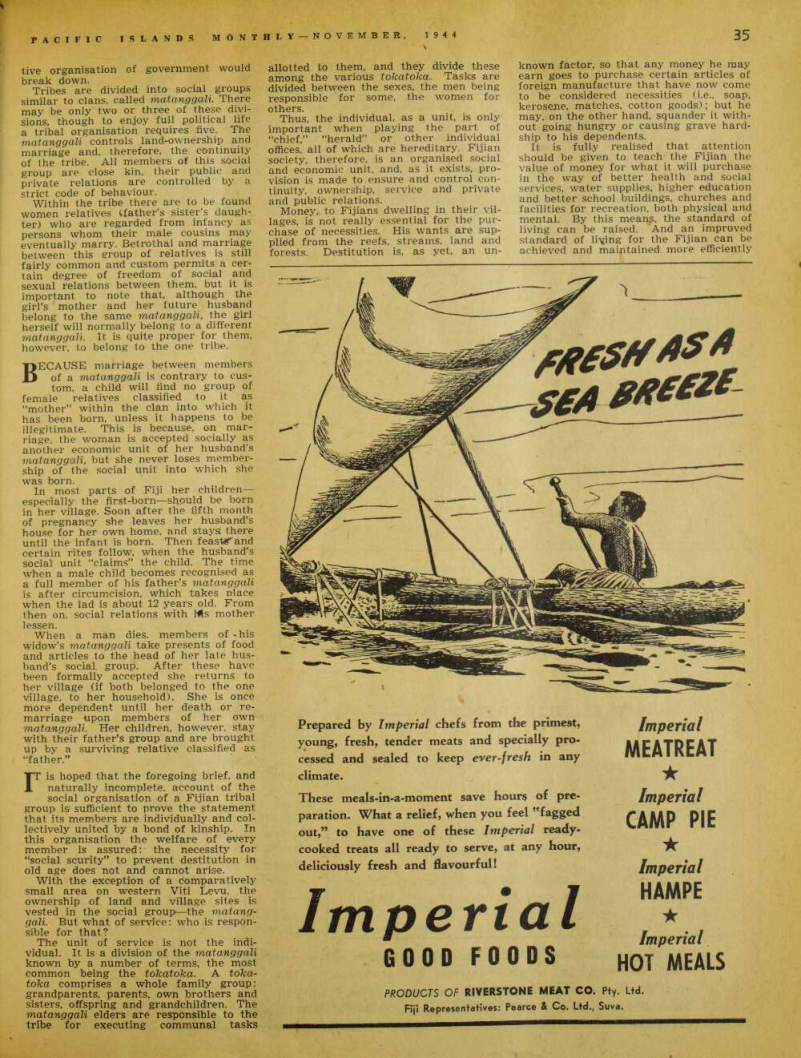
Effect Of War On Fijian Society
Something About That Mysterious Immigration A Condensation of an Address, by R. H. LESTER, to the Suva Rotary Club.
POLITICAL slogans, such as: “Freedom of Speech, Freedom of Religion and Freedom from Want,” and “For World Democracy,” have no appeal to the Fijian. He already possesses all three freedoms, and has never properly appreciated how close ha was to losing them.
As for democracy—to quote Ratu Sukuna, “democracy and democratic ideas are as little understood as they are antagonistic to private and public rela tions, born of kinship, the basis of all ancient law.”
This Fijian society, based on kinship, is worthy of serious study. Without a knowledge of it, or an appreciation of its implications, a sympathetic under standing of Fijian sociology is impossible.
Let us ponder for a few moments on the principles of a communal society based on kinship and see how it works.
Modern Fijian society is a diffusion of cultures belonging to at least three migrations. Two of these we know for a fact were racially different people, namely, Melanesians and Polynesians.
The “whence” of the third, which came to Fiji about 300 years ago, is a mystery, as the Fijian language spoken in the eastern half of the Group contains im portant grammatical constructions found neither in Melanesia nor Polynesia; but, from this migration, sprang the leading chiefs of to-day, who claim patrilineal descent from those ancestors.
THE Melanesian people, it is generally conceded, first occupied the Archi pelago and brought with them a culture founded upon matrilineal society'
(descent through the female line), to gether with a fairly elaborate totemic system and a philosophy of the most primitive type known, namely, as the snake-cult.
Those whose “whence” is unknown, brought a different language, a hierarchy of nobles tracing their descent through the male, ritual and ceremonial, and an ancestor-cult. The newcomers, though at first only a small storm-driven party, were permitted to settle in peace, and then duly multiplied in number. Mainly as a result of inter-tribal jealousies which arose from time to time, small parties of these people moved on to various places ,and islands in the Group, where they were apparently welcomed by the indigent people, possibly because of their light colour and fine physique.
The newcomers eventually assumed chiefly status and founded an autocracy in place of the existing gerontocracy.
The cultures clashed —just as our democ racy does with modern Fijian society— but time and evolution merged the two, discarding this and that, blending or absorbing others, until they became a composite whole, comprising a patrilineal, totemic, tribal community having for its chief a direct descendant from a legend ary ancestor considered to have founded the tribe. His autocracy is limited to an authority sanctioned by custom, and his people will have none of him if he endeavours to exceed that limitation.
To this day, in a large area of the Colony, the people implicitly believe that a magic power called dungua (or Mana ) descends upon their chief from the time of his ceremonial installation. It is an
inheritance from the spirit of the first ancestor handed down through the line of succession. Such is its influence that the remainder of any food from the chiefs table must be thrown away.
Neither his person nor his personal belongings, may be . touched, or used, indiscriminately. Any infringement of these prohibitions brings in its wake some form of disease.
IN administering the tribe, the chief was, prior to settled government, guided and advised by elders of the tribe. After Cession, the value of such a form of local administration was recog nised by the Governor, Sir Arthur Gor don, and was maintained as a legally constituted body called a District Coun cil. There are approximately 185 of these Councils operating in the Colony to-day.
Without the loyal -co-operation of the petty chiefs and elders the administra
tive organisation of government would break down.
Tribes are divided into social groups similar to clans, called matanggali. There may be only two or three of these divi sions, though to enjoy full political life a tribal organisation requires five. The matanggali controls land-ownership and marriage and, therefore, the continuity of the tribe. All members of this social group are close kin, their public and private relations are controlled by a strict code of behaviour.
Within the tribe there are to be found women relatives father’s sister’s daugh ter) who are regarded from infancy as persons whom their male cousins may eventually marry. Betrothal and marriage between this group of relatives is still fairly common and custom permits a cer tain degree of freedom of social and sexual relations between them, but it is important to note that, although the girl’s mother and her future husband belong to the same matanggali , the girl herself will normally belong to a different matanggali. It is quite proper for them, however, to belong to the one tribe.
BECAUSE marriage between members of a matanggali is contrary to cus tom. a child will find no group of female relatives classified to it as “mother” within the clan into which it has been born, unless it happens to be illegitimate. This is because, on mar riage, the woman is accepted socially as another economic unit of her husband’s matanggali, but she never loses member ship of the social unit into which she was born.
In most parts of Fiji her children — especially the first-born —should be born in her village. Soon after the fifth month of pregnancy she leaves her husband’s house for her own home, and stays/ there until the infant is born. Then feast«r and certain rites follow, when the husband’s social unit “claims” the child. The time when a male child becomes recognised as a full member of his father’s matanggali is after circumcision, which takes place when the lad is about 12 years old. From then on, social relations with Ms mother lessen.
When a man dies, members of widow’s matanggali take presents of food and articles to the head of her late hus band’s social, group. After these have been formally accepted she returns to her village (if both belonged to the one village, to her household). She is once more dependent until her death or re marriage upon members of her own matanggali. Her children, however, stay with their father’s group and are brought up by a surviving relative classified as “father.” ris hoped that the foregoing brief, and naturally incomplete, account of the social organisation of a Fijian tribal group is l sufficient to prove the statement that its members are individually and col lectively united by a bond of kinship. In this organisation the welfare of every member is assured: the necessity for “social scurity” to prevent destitution in old age does not and cannot arise.
With the exception of a comparatively small area on western Viti Levu, the ownership of land and village sites is vested in the social group—the matang gali. But what of service: who is respon sible for that?
The unit of service is not the indi vidual. It is a division of the matanggali known by a number of terms, the most common being the tokatoka. A toka toka comprises a whole family group: grandparents, parents, own brothers and sisters, offspring and grandchildren. The matanggali elders are responsible to the tribe for executing communal tasks
allotted to them, and they divide these among the various tokatoka. Tasks are divided between the sexes, the men being responsible for some, the women for ot h ers Thus, the individual, as a unit, is only important when playing the part of “chief,” “herald” or other individual offices! all of which are hereditary. Fijian society, therefore, is an organised social and economic unit, and, as it exists, provision is made to ensure and control continuity, ownership, service and private and public relations.
Money, to Fijians dwelling in their villages, is not really essential for the purchase of necessities. His wants are supplied from the reefs, streams, land and forests. Destitution is, as yet, an un-
known factor, so that any money he may earn goes to purchase certain articles of foreign manufacture that have now come to be considered necessities (i.e., soap, kerosene, matches, cotton goods); but he may, on the other hand, squander it with out going hungry or causing grave hard ship to his dependents, It is fully realised that attention should be given to teach the Fijian the value of money for what it will purchase in the way of better health and social services, water supplies, higher education and better school buildings, churches and facilities for recreation, both physical and mental. By this means, the standard of living can be raised. And an improved standard of lining for the Fijian can be achieved and maintained more efficiently
under the existing tribal system than by endeavouring to anticipate the inevitable course of evolution by unduly hastening this transition to a democratic state. rE reaction by the Fijian community to the call to take part in the war effort was rather interesting. Dur ing the early years of the war, a num ber of men voluntarily joined the Forces as individual units, but the response was only moderate.
So long as recruiting called only for individual effort, the response could not be enthusiastic: the method adopted was not in sympathy with public opinion. The individual volunteer is no hero to his community. He is considered a tamata yasa (an absentee); no better than the man who leaves most of his dependants to fend for themselves in the village while he seeks paid employment.
But when, in November, 1942, at a meeting of the Great Council of Chiefs, the Governor called on Fijians to wage war, the response was electric. Thous ands of men flocked to hastily-constructed military and labour camps.
Many units were led personally by their chiefs; those not accompanied by the head of the social group were led by someone whose authority was mutually acknowledged by the party. Overnight, the war became the Fijians’ war because the Governor had, vakaturanga (in chief like manner), called upon them to share in .it- Thus it is that the hero to the Fijian community is the man who obeys his chief’s call to service: the man who. with other members of his social grohp, is despatched to take part in the war effort, rather than the individual volun teer. His dependants are cared for by those left behind, and the extra work is carried out ungrudgingly.
SOME people have expressed concern at the behaviour of certain Fijians quartered in Suva. The rowdy behaviour was due principally to the fact that young men and women were living in an artificial atmosphere away from their social organisations and from a discipline and authority which they understand. There is nothing in Suva to take the place of tribal authority, which is instinctively obeyed. This also applied to the young women, the sound of whose shrill voices and uncontrolled laughter in the streets mar the stillness of Suva nights. There is no thought in their minds that they might be disturbing a sleeping neighbourhood or that the slum berers might be Europeans, influential or otherwise —the average individual Euro pean (we must face facts!) does not carry an aura of authority and prestige.
Due respect is accorded to certain offices held by Europeans in the hierarchy
of Church and State, but as private citi zens, Europeans have no authoritative affinity with the Fijian and, where the latter is badly brought up spending most of his or her impressionable years in slums, or is suddenly thrust into a non- Fijian environment, what can be expected?
Hundreds of young people and children have been sent back to their villages in recent months. I think it will be gen erally agreed that their absence has made the night less hideous.' Other pessimists prophesy trouble when the troops return from the front “Wait until the Ist Battalion gets back.” some say. What we are to expect is left to the imagination, but it is soberly considered by those who should know, that these forebodings will be proved groundless.* One thing must be emphasised: the Fijian does not personally care what the European thinks about him. It is what his chiefs and elders and the community think that matters—Fijian public opinion, in other words. His outlook is inter racial not international. Press comments and world propaganda for good or ill leave him unmoved. Most of them are unread and unheard, anyway!
I believe that close contact with the fighting men of other races will not per manently affect Fijian society—except towards good. For every ne’er-do-well he has come up against, as a result of the war, he has met scores of fine, brave men. All types of foreigners have settled in Fiji during the past 150 years. But during this long period of Fiji’s history never has the influence of undesirable Europeans offset that of the great Ad ministrators of both Church and State,
* Since this was written, the Ist and 3rd Battalions have returned and their behaviour, as we knew it would be, is excellent.
or the many wise and kindly planters and traders. On the contrary, it is the lat ter whose deeds will never be forgotten and whose names are forever revered; the memory of the former live only for a brief moment in amusing and con temptuous anecdotes told oyer the even ing yaggona. Would the chiefs have ral lied to the call for service and loyalty to the Throne and Empire if the bond between them was nothing stronger than the example of a few undesirables?
WHAT the war has done to the Fijian is not likely to give us cause for concern; it has proved his loyalty; it has found for him his manhood. There is no need for us to worry unless, in our enthusiasm to try to demonstrate our gratitude, we start fiddling around with something of which we know nothing and attempt impatiently to foist our demo cratic ideals on the Fijian, and thereby ruthlessly break down his organised form of society without giving evolution a chance to complete its job.
Remember that this civilisation of ours has taken two thousand years of history to evolve and, on the whole, we have not evolved anything greatly to our credit.
Finally, it should be remembered, also, that what applies to the Fijian com munity applies also in principle to the peoples of the neighbouring Pacific groups, who have been actively engaged in this second global war.
Advertisements & other items, pp. 35-38 (1 item)
Cox, Findlayson & Co
Photographic Studies
OF POLYNESIAN HULA
GIRLS AND SCENIC VIEWS
TAKEN BY A MASTER
PHOTOGRAPHER
12 Real Photographs
Postcard Size For 1 5/-/ or 3 dollars, post paid Order from
TONGAN PHOTOS BUREAU
Box 35, G.P.O. NUKUALOFA,
TONGA.
Ask COX, FINDLAY SON for . . .
ESSENTIAL OILS
AROMATIC CHEMICALS
PERFUME COMPOUNDS
FLAVOURING ESSENCES
If we cannot supply your exact requirements we may be able to suggest suitable replacements
COX, FINDLAYSON & CO
Manufacturing Chemists, Distillers and Perfumers, 472-482 Harris Street, Sydney, N.S.W.
HARRY J. YOUNG Prv. Ltd.
Pacific Islands Selling Representatives and Distributors
, 0 v^--KU etV ' o, 0 s ** o' ° W Enquiries through your usual channels appreciated, and prompt shipments effected.
Bankers, Bank of N.S.W. eS nQ Co" on u ' Se^'° 9 e Co seS, suoP s ' ,1 \Ao* e o e \\s, J. f v '° eS ' e o'
NS-g*.»r&-
poOC^-N|s|< CO i' 9 o sS '° cor u■. oo 1 duc^.
Sp ( r, p \\\es. <i' e I ° ( %\oO' e( tof
. t«-.K*^i***
CO pas" e ?«?*£ '< °* „«d 5P ec'° pos \\s' s in P°" 6 .^ers „ ** ° .»*&«■ o' Postal address: Box 3661, G.P.0., Sydney.
Codes: Bentley’s Comp. Phrase.
Bentley’s 2nd Phrase.
Eagle & Globe Building, 379 Kent Street, Sydney
N.S.W.
- V"it"
S£A S&&*-
t Prepared by Imperial chefs from the primest, young, fresh, tender meats and specially processed and sealed to keep ever-fresh in any climate.
These meals-in-a-moment save hours of preparation. What a relief, when you feel " fagged out,” to have one of these Imperial readycooked treats all ready to serve, at any hour, deliciously fresh and flavourful!
Imperial
GOOD FOODS
Imperial
MEATREAT
★ Imperial
CAMP PIE
★ Imperial
HAMPE
★ Imperial
HOT MEALS
PRODUCTS OF RIVERSTONE MEAT CO. Pty. Ltd.
Fiji Representatives: Pearce & Co. Ltd., Suva.
Islands Residents
WRITE ME regarding any matters requiring the personal attention of a reliable and interested agent here in the United States. Perhaps there is some information you want, or a book or magazine— whatever it may be, I am at your service. . . . Send me samples and prices of any islands products that you may have for sale in this vast market. I will be happy to act as— Your American Agent and Correspondent.
PAUL A. DORN
Box 1712 WLB, Los Angeles 36, California, U.S.A.
Wanted—“ Pacific Islands Monthly”—
All Issues.
William Atkins Pty. Ltd.
Head Office 449-451 KENT ST., SYDNEY.
Iron & Steel Merchants—Engineers 1 Supplies
ESTABLISHED OVER 50 YEARS
Coach fir Motor Hardware %
TRADE
Cable Address: WELATKIN, Sydney.
-STEEL DEPARTMENT
MILD STEEL:
Rounds, Squares, Flats, Half-rounds, Hexagons, Bevel, Shoeing, Tyre, Angles, Tees, Sheets, Plates, Girder Plates, Chequer Plates, Channels, Hoops, Etc.
BRIGHT STEEL:
Rounds, Squares, Hexagons.
Extra Special High Speed Tool Steel, Mining Steel, Blister Steel and Spring Steel, Rounds, Flats & Squares.
Bar Iron All sections and sizes.
Engineers' Supplies: Set Screws, Studs. Metal Thread Screws, Coach Screws, Files, Cotter Pins. Bright and Black Bolts, Rivets, Etc., Hack Saw Blades.
Power Transmission Gear: Including Plummer Blocks, Couplings, Collars, Etc.
Coach and Motor Hardware: Axles, Springs, Wheelstuff, Duck, Paints.
Farriers' Supplies: Horse Nails, Anvils, Vices, Etc.
Motor-Trimmers and Motor Builders' & Motor Painters' Requirements
C. A. WILLEY'S
Quick-Drying Coach and Car Paints, Roughstuff, Elastic Gloss, • Synflex Enamels, Lacquers.
DUCO Lacquers and DULUX Enamels—FAßßEX Motor Tappings and Leather Cloths, House fir Decorators' Paints, Varnishes fir Brushware.
Sole Distributors of CHAMPION'S Decorators Paint Products.
Distributing Agents for BROLITE Lacquers, SYNFLEX Enamels and "POLYGLOSS" Finish.
the People
The Promise and the People New Reference Book on Papua by Lett
ANOTHER volume about Papua has been written by Lewis Lett. This time, a slim volume, called “Papua ns People and Its Promise—Past and Future,” one of a series of independent publications dealing with Australian and Pacific topics, published by F. W. Cheshire Pty., Ltd., Melbourne. As a book of ref erence, it is edited by Miss Amy Cryan; and Miss Cryan would have made the task of the reviewer, and the reader, and seeker after knowledge, easier if she had seen fit to include an index.
However, the book is up to the usual Lett standard; brightly written and con taining much information which might be assimilated by Australians with great benefit to themselves.
It contains chapters on development, native life, customs and culture under the old and new ways of life, the history and geography of the country and the place in it, past and present, for European settlers.
In the introduction, Mr. Lett says: “The longer one stays in Papua the less one seems to know about it. Problems that can be settled off-hand by new arrivals are not nearly so easy of solution to those who stay long enough to learn what lies behind those problems.
“For my part, I must confess] that dur ing my first month in the Territory I was prepared to set the Government right on many points. At the end of my first fortnight I wrote an article on Papua and its problems which was printed in a Syd ney paper ... it was not until I had been several months in Port Moresby that I began to understand just a few of the reasons why my logic was faulty and my opinions worthless.”
Words that should be pasted in the hat of every Australian whose only contact with New Guinea is through the medium of the printed word.
And, again, from the introduction:
“ . . . Our general manager was an Australian of the best type, bi~ genial, easy-going. He had the idea firmly fixed in his mind that his was a pioneering company and that all its employees must show the pioneering spirit by undertak ing any form of work whatever, whether they happened to know anything about it or not.
“Therefore, in pursuance of this theory, my first job was to superintend the dis charge of the company’s steamer. I remember the youthful enthusiasm with which I started the job. It did not appear to me that a single light tramway rail vvas a sufficient load for two fully-grown Goaribari natives. So I made it two. And I managed to induce them to run with the load instead of walking slowly.
“The manager was delighted. But the result did not declare itself until next day, when it was found that the whole gang had deserted and had taken with them a new whaleboat. So my next job was to follow them in another boat with a load of handcuffs and leg-irons and bring them back. I was given a couple
of Colt .44 revolvers and ammunition to make the task less difficult) “Even to my ardent enthusiasm the job seemed a queer one; but I made ready for it and would have started—except that the police intervened, confiscated the irons and firearms and instituted proceed ings against the company. Nearly four months passed before those deserting labourers were brought back by the police.
And the lesson that the incident taught me was that there is a limit beyond which men cannot be driven.”
Advertisements & other items, pp. 39-40 (1 item)
B. DAVID Trading Co.
THE PACIFIC ISLANDS
TRADING CO.
2016 Parker St., Berkeley,
CALIFORNIA, U.S.A.
We are Expert Buying Agents for Pacific Islands Merchants.
SEND YOUR ORDERS TO US —OUR
COMMISSION IS 5 PER CENT.
Also at San Francisco.
“ Paint It With Campbell's”
C.A.P. #/ Pre-war qualities were Tested and Approved in Singapore and Malaya.
"C.A.P." Wartime permitted qualities are still making the better job.
NOW OBTAINABLE IN THE ISLANDS
Les peintures "C.A.P." sent et restent: "Toujours les meilleures"
0. F. MASSGHELEIN, "” 9
Exporter of Quality Products Only.
B. DAVID Trading Co.
ISLAND TRADERS
EXPORT MERCHANTS
SHIPPERS OF ALL KINDS OF MERCHANDISE.
EXPORT REPRESENTATIVES OF LEADING
AUSTRALIAN MANUFACTURERS
Head Office:
31 Queen Street, Melbourne, Vic.
Branches and Agents in All Ports.
Direct Enquiries to Bankers.
Head Office. National Bank of Australasia.
Cable Address;
“DAVID TRADING
MELBOURNE”
OPEN TO APPOINT AGENCIES WHERE NOT REPRESENTED
Restlessness and sleeplessness, when due to run-down nerves, frequently respond to treatment with Dr. Williams' Pink Pills.
Dr. Williams’
PINK PILLS
help to enrich the blood, which has a beneficial and restorative effect upon the nervous system.
The Most Extensive Manufacturers in the British Empire of
RUBBER STAMPS.
INKS, STENCILS,
Marking Devices,
ACME STAMP PADS
OFFICE & STATIONERY SUPPLIES
Limewashing Machine We also Manufacture & Supply a Complete Line of
LIMEWASHING and
SPRAYING MACHINES
for all purposes.
Let us know your requirements and we will quote by return.
WRITE FOR OUR GENERAL CATALOGUE
EXCELSIOR SUPPLY CO. PTY. LTD.
278 Post Office Place,
MELBOURNE, VIC.
HEAD OFFICE ;
160 BROADWAY,
Formerly known as George St.. West. I
SYDNEY,* N.S.W. !
50 Victoria Street,
WELLINGTON, N.Z.
"Bounty"
A Link With The
By R. C. Macpherson
THE removal of the descendants of the mutineers of the “Bounty” from Pit cairn Island to Norfolk Island, in 1856, and the later return of some of them to Pitcairn, is a well-known section of the eventful history of these people.
But there was an earlier removal and return—to Tahiti and back, in this case —which is probably not as commonly known.
There is a brief reference to this in “The Eventful History of the Mutiny of the ‘Bounty,’ ” by Sir John Barrow (1831) who, writing of the prospect of increas ing population causing difficulties, says that “an attempt was made through the - means of a Mr. Nott, a missionary of Otaheite, who, being on a visit to this country (England) was authorised, on his return, to make arrangements for their removal to Otaheite, if they wished it, and if Pomare, the king of the island, should not object to receive them; and he carried a letter to this chief from Lord Bathurst, acquainting him with the inten tion of the British Government, and expressing the hope that he would be
induced to receive under his protection a people whose moral and religious char acter had created so lively an interest in their favour; but it fortunately happened that this missionary passed the island without stopping.” in Barrow expresses the opinion that such a removal would be a mistake saying: “It is sincerely to be hoped that such removal will be no longer thought of. No complaint was made, no appre hension of want expressed to Captain Waldegrave, who left them contented and happy.”
In a postscript to his narrative, Bar row adds the following: “Just as this last sheet came from the press, the editor has noticed, with a feeling of deep and sincere regret, a paragraph in the news papers, said to be extracted from an American paper, stating that a vessel sent to Pitcairn’s Island by the missionaries of Otaheite has carried off the whole of the settlers to the latter island.”
IT is quite evident that the Pitcairn people did not stay long at Tahiti.
Barrow’s narrative was published in 1831; and there is an interesting record of the return of the people to Pitcairn, in 1831, in the possession of the Peabody Museum of Salem, Massachusetts—a tes timonial letter given by these people to Captain William Driver, master of the Salem brig “Charles Doggett,” which car ried them back to Pitcairn.
Captain Driver had made many voy ages to the South Seas in Salem vessels, and the carrying of the Pitcairn people is briefly mentioned in “Salem Vessels and Their Voyages,” by Captain George Granville Putnam, published in the Essex Institute Historical Collections, Vol.
LXVI. It says that Captain Driver pro ceeded to Tahiti, where he found 65 per sons, descendants of the mutineers of the English ship “Bounty,” with their self created teacher, George H. Nobbs, an Irishman, who was once a lieutenant of a Chilean man-of-war.
“Captain Driver took them all to Pit cairn Island, in response to their piteous cries for him to save them,” says Put nam; and, though nq details are given, it appears that these people were not at all happy in Tahiti. Their gratitude was expressed in the testimonial letter men tioned, which is dated Pitcairn Island, September 3, 1831, and says: “This is to certify that Captain Driver, of the brig ‘Charles Doggett,’ of Salem, carried 65 of the inhabitants of Pitcairn Island from ‘Tahiti back to their native land, during which passage Captain Driver behaved with the greatest kind ness and humanity becoming a man and a Christian, and as we can never re munerate him for the kindness we have received, we sincerely hope (that through the blessing of the Almighty) he will reap that reward which infalliably (sic) attend the Christian. (Signed) George H. Nobbs.
Teacher, Arthur Quintal (his mark), John Buffett, John Evans.”
Of the signatories, only one is a genu ine descendant of the mutineers—Arthur Quintal—Matthew Quintal having been an able seaman in the “Bounty.” Though Nobbs signs himself as teacher, the ori ginal teacher on Pitcairn was Buffett.
Buffett, it appears, was a seafaring man belonging to a ship which visited the island, and he was so infatuated with the behaviour of the people that he decided to remain among them and, in the words of Captain Beechey, of the “Blossom” (which was an. early visitor to the settle ment), “in addition to the instruction of the children, has taken upon himself the duty of clergyman, and is the oracle of the community.”
To quote Sir John Barrow again: “George Hunn Nobbs calls himself pas
tor, registrar, and schoolmaster, thus infringing on the privileges of John Buffett: and being a person of superior talents, and of exceeding great impu dence, has deprived Buffet of a great number of his scholars . . . This Nobbs not only claims exemption from labour, as being their pastor, but also as being entitled to maintenance at the expense of the community.” Nobbs was one of three men who took up abode on Pitcairn after the “Bounty” settlement.
John Evans, the fourth signatory of the document above, was one of the three men who took up abode on Pitcairn after the “Bounty” settlement. He was the son of a London coachmaker, and married a daughter of John Adams (otherwise Alexander Smith), the last survivor of the original mutineers, who became a reformed character and a pious father to the whole community.
It is interesting to note that though Adams brought his flock up on the Bible and the Prayer Book of the Church of England, teaching them the tenets of that faith, the Pitcairn Islanders have now become Seventh Day Adventists.
An Incident In Fiji
THE “Charles Doggett” which was con cerned in the return of the Pitcairn Islanders to their homeland was an early visitor to the Fiji Islands.
In 1833, then under the command of George Batchelder, she was in Fiji waters and was attacked by natives, five men being killed. In a list of shipwrecks, etc., given in Hazelwood’s Dictionary and Grammar, there is a reference to this incident in the following words: “Part of the crew, including the cap tain of the brig, ‘Charles Doggett,’ massacred at Ono-i-Ra.’ However, there are several inaccuracies in the Hazelwood list, and from information supplied by the Peabody Museum, this appears to be one of them. This states that in Sep tember. 1833, the “Charles Doggett” was at Kandora (Kandavu?) Her crew was attacked by natives, and five men, includ ing the mate, Charles Shipman, were killed. The remainder escaped, though some were seriously wounded. Captain Batchelder was chased down into the cabin, narrowly escaping in a scuffle for life.
After this incident the brig proceeded to Manila, and thence to Salem, which she reached in October. 1834.
The Ono-i-Ra mentioned by Hazelwood is close to Kandavu.
The appointment of Mr. Robert Cromp ton to the Fiji Executive Council ter minated in October. He has been Dir ector of Propaganda and Publicity and will continue to hold that position for the present.
Colourful Life Ends
Death of T. C. Kerry in NZ
f)F interest perhaps to old-time Papuan residents is news of the death of Mr. T. C. Kerry in New Zealand, in his Sbth year. He was born in England, but spent the
greater part of his life wandering—
mostly in the South Pacific. His story is reprinted from the “New Zealand Herald.”
ARRIVING at Port Moresby, New , Guinea, in 1881, Kerry found only two other white men there, one of them being a missionary, James Chalm ers, who was later killed by savages at Goaribari, in the Kikori Delta. Mr.
Kerry’s main object in New Guinea was to explore and to shoot birds of paradise.
While acting as second in command of an exploring party in New Guinea which was sent out by the Melbourne “Age,’’ he was captured by cannibals near the Bax ter River. The expedition’s schooner and equipment were lost, A spear thrust by a native pinned Kerry to the ground by a leg and he carried the scar for the rest of! his life. Most members of the expedi tion, including Mr. Kerry, escaped and spent two months struggling back to civilisation.
Shortly after this adventure he fitted out an expedition at Thursday Island, consisting of two vessels, the “Endeavour’’ and the “Wild Duck,” and left for New Guinea in relief of the Australian Royal Geographic Society’s expedition, which had been missing for some time.
After other explorations, Kerry returned to England. One morning he walked into a shop in London with four bottles con taining pearls from the New Guinea coast and walked out with £BO,OOO.
Visiting Kiel in his boat, the “Pan dora,” Kerry sold curios to the Kaiser for £28,000.
One of his most interesting experiences was connected with his lease from the British Government of Tristan da Cunha. a remote group of islands midway between Cape Colony and South America. Kerry went there to assess the value of the guano deposits on the islands. The rud der of the ship was lost in a tangled mass of kelp and he was forced to sail for Capetown in this plight.
WHEN news of the discovery of gold at Coolgardie, Western Australia, was received, Kerry was at Noumea, and he immediately left for the fields, where fortunes were won and lost.
Of late years, Kerry lived at his home,
“Wenderholme,” at Waiwera. This house contains a host of strange relics and curios which he had collected and each of them reminded him of some episode of his eventful life.
Advertisements & other items, p. 41 (1 item)
Radiant
STORMPROOF
PRESSURE LANTERN
SAFE AND RELIABLE
Chromium plated throughout
"OUTSHINES"
ALL OTHER LAMPS
m Please ask your Island Trader to show you the RADIANT — you will like it.
O. F. MASSCHELEIN
SYDNEY
Exporter of Quality Goods Only
This Company supplies Aluminium and its Alloys to all specifications and for every commercial application where Aluminium and its Alloys give better service over other metals.
AUSTRALIAN ALUMINIUM COMPANY
PPOPA/£TAAy LIMITED
(INCORPORATED IN THC STATI OF VICTORIA!
GENERAL Offices AND FABRICATION DIVISION: GRANVILLE. SYDNEY. N.S.W.
A Fantasy Of 1949
By Drb
IT was 1949. There was peace again in New Guinea; and District Officer Eric Hatt sat in his office at Wau. In a few minutes he would take his place on the bench of the District Court, and try the first case mider the new ordinance, recently passed by the Council of Anthro pologists and Missionaries at Canberra, who now made the laws of the Territory.
He opened the door that led to the bench; and Warrant-Officer of Police Ronald Sticks called “Silence!” The Dis trict Officer sat down, and announced that the District Court was open for business.
Warrant-Officer Sticks stood up, and read from a blue form.
“William Wallace Campbell stands charged that, at Edie Creek, on the seventh of October, 1949, he did use the word ‘boy’ when addressing a native, to the derogation of God’s Honour, and in disrespect for the natives of New Guinea, thereby contravening section Nine of the Equality of Races Ordinance, 1949.’ ”
Then, to the defendant (who sat, look ing puzzled, in his borrowed coat): "How doyou plead?”
Guilty, I suppose,” said the defendant.
But .”
The prosecutor silenced him with a gesture, moved over to the witne_ss-box.
I* P. U P the Bible and swore him self in.
“I am a Warrant-Officer of Police sta tioned at Wau,” he dictated slowly, while the District Officer’s pen raced across the P ? p e r A efore him - “°u the seventh day of October, I was walking down the Edie
Creek road past the defendant’s camp. I could see a native, whom I now know to Pe the native Narawal, in the defend ant’s kitchen. I heard the defendant call out, ‘Boy! Bring him kaikai.’ I heard the native reply ‘Yessir.’ I thereupon arrested the defendant and charged him.’’
The prosecutor signed his deposition and resumed his seat. Then he called to a police constable, who ushered in a native, and steered him into the witness box. Sticks warned the native that he must talk true to the Court, and then said: “Narawai, on affirmation, Your Worship,” to the bench.
But the native broke from the tradi tions of evidence for the prosecution "Me no- like Court,” he stated. “Master belong me good fellow. Him he no fight him me, him he give him plenty kaikai.
Good fellow master, now me no like Court.”
THE District Officer ceased writing and looked sternly at the witness.
“The witness, in the Court itself,” he said, “breaks Section Ten of the same Ordinance, in using the word ‘master,’ which tends to place the European- on a higher plane than the native. However, there is sufficient evidence to convict the defendant without the native’s evidence The Ordinance provides that the mini mum punishment for this offence is seven days’ imprisonment, and as this is the first offence under that Ordinance, the defendant is convicted and sentenced to serve a sentence of seven days in His Majesty’s Gaol at Wau.”
He paused for breath.
“The native Narawai, having committed a criminal offence in the Court itself, is summarily convicted and sentenced to imprisonment in His Majesty’s Gaol at Wau for seven days,” continued the Dis trict Officer.
Then Campbell spoke.
“Excuse me, Your Worship,” he said. “It is hard on the b , I mean, the native.
He didn’t mean any harm. He probably doesn’t even know what the law says he must use the word ‘European.’”
Narawai, standing in the Court, mut tered the word “Roopeen” to himself, and wondered what it meant.
“It is too late to do anything,” said the Warrant-Officer of Police. “The boy is already convicted and sentenced.”
He blanched, as the District Officer looked sternly at him.
“I’m sorry, Your Worship,” he muttered.
“Ronald Sticks,” said His Worship, ‘you used the word yourself. You are sum marily convicted and sentenced to be imprisoned in His Majesty’s Gaol at Wau for seven days. There is no alternative.
I have to enforce the law without fear or favour. The object of this Ordinance is to see that boys are not insulted ”
He stopped.
“Oh, hell! I’ve done it myself now! All right. Eric Augustus Hatt, you are sen tenced to be imprisoned in His Majesty’s Gaol at Wau for seven days. The Court is adjourned.”
He gathered up his papers.
“Come on, Bill. Come on, Ron. Come on, Narawai. Let’s all go to the calaboose Let’s be there first and get the best seats before everyone else is put in.”
Amongst Samoan soldiers recently home on leave from active overseas service were five Samoans who had enlisted in the Fijian Forces, and Private Richard McFall, and Private John Hancock, of the New Zealand Forces, and Sergeant Henry Krone, of the Fiji Defence Forces. All of them were guests of honour at enter tainments of the Apia Mothers’ Club when presentations were made them on behalf of the Club.
Advertisements & other items, p. 42 (2 items)
40
NOVEMBER, 1944-PACIFIC ISLANDS MONT
Asthma, Bronchitis Coughing
CHARLES MUIR (Eastern) EXPORT GO.
SYDNEY
EXPORT AGENTS AND
MANUFACTURERS
AJC & OK Jams, Canned Fruits, Sauces, Asparagus, etc.
EEZEE Washing Blue in Bags, also Paper Wrapped— Baking Powder, Custard Powder, Jelly Crystals, etc.
SVXGLO Pickles, Chutney, Honey, Fruit Cordials, Jams in Glass Jars, Canned Vegetables, etc.
WINES, SPIRITS. BEERS
“Juberry,” “Royalty,” “Aulde Acquaintance,” “Private Seal”
Brands, etc.
IN SUGAR BAGS.— Pearl Barley, Oatmeal, Rolled Oats, etc.
We Specialise in All Kinds of Food Products. Enquiries Invited Through Your Usual Channels. ’Phones: 82279, FA2703.
FX4515 (Factory).
Cable Address:
MUIR— SYDNEY.
<i
Asthma, Bronchitis Coughing
Curbed in 3 Minutes
J°fv. *l ave at tacks of Asthma or Bronchitis so bad that you can’t sleep? Do you feel weak unable to work, and have to be carpfni £ take cold and can’t eat certain foods’
No matter how long you have suffered or what you have tried, there is new hoS for you in a doctor’s prescription called Mendaco No dopes no smokes, no injections, no atSSSI All you do is take two tasteless tablets at meals and in 3 minutes Mendaco starts working through your blood, aiding nature tr, remove phlegm, promote free easy breathing and bring sound sleep the first night Jo that you soon feel years younger and stronger.
No Asthma in 2 Years
spasms first night and he has had none since in over two years.
Money Back Guarantee
The very first dose of Mendaco goes right to work circulating through your blood and helping nature relieve you of the effects nf Asthma. Try Mendaco* under an Iron-clad money back gaurantee. You be the jud*e If you don’t feel fully satisfied after taking Mendaco just return the empty package aid the purc h & se price will be refunded. Get Mendaco from your chemist to-day and see h?w well you sleep to-night and how much better you feel to-morrow. The guarantee protects
RELIEVES ASTHMA
Mendaco
Now in 2 sizes
6/- and 12/-
The New Guinea Set-Up
Future Policy Discussed at a Sydney Forum
mHREE angles on post-war New Guinea X were presented at the forum on “Post-War Pacific” held in the Methodist Church, Waverley, on Satur day, November 4.
The Rev. J. W. Burton, General Secre tary of the Methodist Mission, who was to have spoken, was delayed in North Australia, and was unable to attend. His place was taken by the Rev. John Bodger, of the Anglican Mission.
Professor Elkin, who was not well, spoke first and left as soon as he concluded.
Representatives of the Sydney daily press left with him; thus the professor stole what little publicity was attached to the meeting and was not there to join in the discussion which took place at the con clusion of the addresses.
Professor Elkin took, as his central theme, a contention that commercial enterprise in New Guinea was concerned only in making profits and was not at all interested in the natives as such. He said that, in the post-war period, the natives must be given every opportunity to develop their own country, with the ultimate aim of becoming a self-support ing and self-governing community. To this end, any plantations or other pro perties held at present by Europeans should be taken over where necessary, the owners thereof compensated, and the property handed back to the natives to whom it rightfully belongs.
The professor condemned the system of indentured labour outright.
MR.. G. J. A. MOORE, representing the Pacific Territories Association, said that he thought the first considera
tion in the post-war set-up should be the defence of the New Guinea territories in the interests of the whole Commonwealth of Australia and, of course, in the in terests of the natives in the Territories themselves. The only practical way in which this could be done was by com mercial development of the Territories by European settlers, who would work in co-operation with an Administration charged with the proper care of the native inhabitants, with the various missions and with the natives themselves.
Pre-war Administrators of the Territories had succeeded along these lines and, while doubtless they could have ■ done more, none could say they had worked on principles which were inimical to the natives.
Recent* talk of “exploitation,” “slavery” an<* ill-treatment of the natives was plain nonsense. The several Administrators of the Territories, including the late Sir Hubert Murray, and numbers of mis sionaries #n the field, had paid tribute to the assistance of commercial settlers in the development of these native races.
The policy of the Australian Adminis trators of New Guinea and Papua had undoubtedly been in the best interests of the natives and of Australia, and any violent changes in that policy, not only might do grave injustice to those Euro pean settlers who had implemented it, but would certainly react unfavourably on the natives themselves.
Mr. Moore said that he believed the ultimate survival of these native races was possible only by co-operation with Europeans in the existing economic order,
and not by any attempted segregation in an endeavour to create a “native” sovereign State or States. The Pacific to-day was no place where such States could hope to exist in peace. rE Rev. John Bodger, who was on the eve of returning to Papua, said that he had spent 17 years with his mission in Papua and was the represen tative on the Papuan Legislative Council of all the Christian Missions. He could
then, he claimed, speak with first-hand knowledge on the subject of Papua.
While mistakes undoubtedly had been made, and much more could have been done for the natives (and would have been done but for lack of Government funds) none could deny the lasting bene- Sts which had been conferred on the Papuans during the past 70 years. To these benefits could be attributed the help the Papuans had given us since the Japanese invasion. There were three factors contributing to this state of af- Administration and its officers; the Missions; and the European settlers —particularly the old-time miners. The Papuan was developing slowly and surely rr citizen when war came to me lemtory.
Since the war, the Papuan had suf-
fered much. His lands had been taken from him; his labour had been impressed* much of his property‘had been destroyed * and his way of life disorganised We must not forget, Mr. Bodger went on, what the Papuans had done for us in this war. We owed it to them to see that their rehabilitation was commenced at the earliest possible moment, that their lands were restored, and their re turn to their villages expedited Their spiritual and bodily welfare must be our immediate concern and their return to a normal life at the earliest possible time was essential. As the late Sir Hubert Murray had put it—“ The capacity of the Papuan to learn is only limited by our ability to teach.” In those words lay our duty to the native.
In answer to a question, Mr. Bodger
said that he did not think the time had yet arrived when the system of inden tured labour should be abolished in Papua.
Advertisements & other items, pp. 43-44 (1 item)
Pinkettes
After taking Pinkettes you should feel brighter, happier, and free from sick headaches, bilious attacks and liverishness. For
are tiny laxative and liver pills, which painlessly exercise the digestive system.
W. Kopsen & Co. Pty. Ltd.
SHIPCHANDLERS £r HARDWARE MERCHANTS
Manufacturers of all classes of boat-building materials and boat accessories. Agents for the best Australian hardware manufacturers. Some of the new attractive lines are as follows: Kopsen's 300 c.p. Kerosene Pressure Lamps; Thermil Kerosene Stoves; Darlton Blowlamps; CQR Anchors; Vortex Bilge Pumps; Companion Primus Stoves; Briggs & Stratton Petrol Motors and Power Generators; Dekol Wood Preservative, Alpha Antifouling Paints, Etc.
Please Send List of Your Requirements for Quotation. Wm Simplex 10/12 h.p. Marine Engine.
Also made in 3 h.p. and 5 h.p.
SIMPLEX MARINE ENGINES
for all small boats are the most popular in Australia to-day.
Used by all Service Departments, including Navy, R.A.A.F., and Army. Available at present only for essential orders or licensed fishermen.’
SIMPLEX LAUNCHES we regret are temporarily unavailable, but we shall be pleased to forward details on request.
Sipiplex Motor Launches, 14 ft., 16 ft.. 18 ft., and 20 ft. long.
376/382 KENT STREET, SYDNEY, N.S.W.
’Phone: MA6336 (6 lines). Cables: Kopsen Sydney.
hj
Steamships Trading
Company Limited
9*. V> i i
PAPUA.
PORT MORESBY SAMARA!
WHOLESALE & RETAIL MERCHANTS, SHIPOWNERS,
PLANTERS, ENGINEERS & SLIP PROPRIETORS.
Customs, Shipping, Insurance, and Forwarding Agents.
MANAGING AGENTS AND VISITING REPRESENTA-
TIVES FOR COCONUT AND RUBBER ESTATES.
SYDNEY REPRESENTATIVES: Nelson & Robertson Pty. Ltd., 12 Spring Street.
WARTIME ADDRESS
Until further notice, clients may address all communicalions as follows:
STEAMSHIPS TRADING COMPANY LIMITED,
C/o NELSON & ROBERTSON PTY. LTD,,
12 SPRING STREET, SYDNEY.
Rev. W. J. Chambers
Death in 80th Year
JN his eightieth year, the Rev.
William J. Chambers, of the Methodist Mission, well-known in both New Britain and Fiji, died in Australia on Octooer 4. He is sur vived by a widow and five sons.
The following tribute is condensed from an article by the Rev. J. W.
Burton in the Missionary Review.”
HEAVY burdens were put upon the broad shoulders of William Cham bers, both at the home base and on the mission field; but he carried them uncomplainingly and with dignity. Pos sibly he deserved better of the Church he so faithfully served than any reward that came to him; not that he himself would have thought thus, for he was too engrossed in his task to think of the award.
Mr. Chambers went to New Britain in 1893, where he laboured for nine years.
Those were days when things were still very primitive in that field, and Mr. and Mrs. Chambers knew hardship and privation.
In 1908, he was appointed to Rewa, Fiji, where for six years he carried out strenuous tasks in that large and im portant circuit. 111-hdalth forced his re turn to Australia, and he spent two years in the Eaglehawk Circuit in Victoria then a most difficult place. But 1916 saw him back in Fiji, and for three years he had charge of Bau, when, his health having improved, he offered for service in New Britain again, and as Chairman of the district did much to guide and develop the general work of the field.
After five years of hard toil, Mr. Cham bers returned to Australia and spent five years in the Lewisham and Campsie Cir cuits. However, the missionary passion still burned, and after two years as over seas deputation he went back to Fiji as a supernumerary, and again took charge of the Rewa Circuit. Thus he gave thirty-three years of service to the Board of Missions, and left his mark upon two important districts—New Guinea and Fiji.
IT might be sufficient to say that he was essentially a good man—healthy minded and wholesome in thought and sneech. He was not particularly “pious” as that word is usually under stood; but of his devotion to his Church there was no shadow of doubt. His tone of snirit was ethical rather than emotional.
He reverenced his conscience as his King, and quietly but resolutely shaped his conduct according to his convictions. We can only suggest some of the outstanding wavs in which that goodness revealed itself.
He had a noble quality of unswerving rectitude, of limpid sincerity, and of un comnromising honesty, This made him stable, and induced men to rely on him in times of difficulty and of trouble.
He was a “frank man without con straint.” While he was pastor of the Euronean Church at Rabaul—a church which he built—he won, as perhaps no other did, the confidence and regard of traders, planters, and Government of ficials. Said the Administrator of that day to this writer: “Chambers is the most honest man I have ever known—l would trust him with anything.”
Alice In Canberra
(With the thanks of a Territorian to Lewis Carroll for the inspiration of his “Wonderland” child)
ALICE stepped from her Magic Plane at Canberra, and was directed to Par liament House. She entered, and was shown to the office of the Minister for External Territories.
“I’ve brought a press cutting dealing with Papuan natives,” she said to the Minister. “I’d like to discuss it with you.
My dad in London will be most interested to learn what Australia is doing about these natives, and about the former white residents of New Guinea.”
“A remarkable coincidence!” smiled the Minister. “I’m just working out a scheme in which I will be arranging with the local Communists to produce a newspaper for the natives. The Communists are ever-read^ 7 to oblige in such matters, you know, and we of the Government will see that they get plenty of newsprint paper!”
“H’m!” said Alice, doubtfully. “But about this press cutting. It says here that you are appointing a Committee to decide war compensation for natives of Papua and New Guinea. Will these natives be paid only for actual war damage, or will they be the victims of the ‘consequential damage’ racket, as the white residents were?”
THE Minister looked sternly at Alice.
“My dear child ” he began.
But Alice interrupted him: “If the ‘con sequential damage’ idea is not applied to them, why is it being applied to white people? And another thing: I notice that you are appointing a Melbourne barrister to this Committee. Has he had any spe cial experience in village matters in New Guinea? I mean, could he assess truly the value, say, of a requisitioned canoe, or a damaged native house, or a lost arnh shell which had been a valued heirloom in the family of some native?”
“Really, child, you can’t be expected to understand these legal matters. The legal mind ”
“Would he be expert in gauging the value of a native garden, or the dam aged fence round that garden? You see, my dad in London is bound to be suspici ous when he learns that a barrister with apparently no Islands experience is to be appointed assessor. He will say there’s a trick in it somewhere!”
THE Minister gasped. “Great heavens, child, you talk like a New Guinea evacuee who has lost everything, and has the hardihood to criticise ”
“My dad. and possibly even Mr. Chur,chill, will do the criticising, I fancy, later on!” cried Alice, spiritedly. “Mr. Chur chill is not the man to make the definite promises he has made in his speeches, and then knowingly allow them to be broken by Communistically-minded Gov ernments in any part of the British Empire!”
Even the Minister’s remarkable “gift of the gab” was silenced by the Wonder child’s flow of heated words, as she went on, like Joan of Arc, and Boadicea, Florence Nightingale rolled into one.
“Have you an ulterior reason for not appointing to your new Committees some oi the men wno have spent half a life time livim in New Guinea; men who know the native mentality, and fully understand native values? I see you are including an officer of ANGAU on the Committee. If he is an old and experi enced man who knows the varying condi tions in the varying tribes and villages, I suppose he is OK. But why have you also appointed an anthropologist to this Committee?”
The Minister managed to get in a word. “The study of natives ”
Alice broke in impatiently. “Do you seriously mean to tell me that this man s possible knowledge of dinerent kinds 01 tattooing, or varied styles of native dancing, or the shape of different heaas and jawbones amongst natives, will enable him to form a reliable estimate of compensation to be paid for the loss of, say, a grass-thatched house; a house, too, which he probably has only seen in pictures or heard described in lectures at the University?”
“Where did you learn all this, child?” asked the Minister.
“I know more about Papua and New Guinea than you do,” retorted Alice, “because I have listened to experienced men and women who lived there for years. I gave them a hearing, which is more than you do!
“They had the guts to take all the risks of the country when it was semi wild; you flew over it for three weeks, and saw it under abnormal conditions, and now you have the effrontery to make new laws to govern the country! What do you. or any of these Canberra men, know about it, anyway? Wait until my dad hears tfhat I shall have to tell him when I get back, about your precious External Territories Department and your ANGAU and your Committees of anthro pologists and whatnot. He’ll blister you with words, if I know him!”
“JF your father dares ” began the
J. Minister.
“Dad’s a Londoner, and Londoners have a way of daring things; you won’t bluff him too easily, believe me! Can you give me one honest and valid reason why white residents have not been allowed to return to their homes in Papua? You don’t need to answer; the whole world already knows it is just a political stunt to further the ideas and theories of a one-sided political party, which apparently believes that it is a
crime for any decent man to own any thing !
“Despite Mr. Churchill’s promises, you are forcing these one-sided ideas and political stunts on the residents, irrespec tive of whether they want them or not, and irrespective, too, of whether the natives want them. The whole thing is the antithesis of what Mr. Churchill
promised, that all peoples should choose their own form of government. Your alleged Democracy is a shameful thing; it isn’t Democracy at all!”
Alice was so incensed, tllat she wouldn’t even say “Good-morning” as she flounced out of the office to her Magic Plane.—AW. ! - ■ Europeans throughout the Central Pacific have extended their sympathy to Mr. R. D. Blandy, British Resident Com missioner in the New Hebrides, whose son, aged 22, was killed in war operations in Europe in July last.
Mr. Read/ a well known and esteemed resident of Port Vila, died there in July, aged 63. He arrived in the New Hebrides in 1903. He fought in the Transvaal War, and won a military decoration.
Advertisements & other items, pp. 45-46 (2 items)
43
PACIFIC ISLANDS MONT B L I NOVEMBER, 1944
Kidney Trouble
Polynesian Club of
Sydney
250 GEORGE STREET
Near Bridge Street. ’Phone FM2761.
Visitors from Polynesia are welcome every Tuesday at 8 p.m.
Kidney Trouble
and Backache
Gone in 1 Week
Flush Kidneys With Cystex and You’ll Feel Fine Cystex—the prescription of a famous doctor —improves faulty kidney action in double quick time, so, If you suffer from Rheumatism, Sciatica, Neuritis, Lumbago, Backache, Nervousness. Leg Pains, Dizziness, Circles under Eyes, frequent Headaches and colds, poor Energy and Appetite, Puffy Ankles or Interrupted Sleep, go to your_ chemist to-day for Cystex.
Cystex Helps Nature 3 Ways
The Cystex treatment is highly scientific, being specially compounded to soothe, tone and clean kidneys and bladder and to remove acids and poisons from your system safely, quickly and surely, yet contains no harsh, harmful or dangerous drugs. Cystex wo'ks In these 3 ways to end y<mr troubles:— fl) Starts killing the germs which are attacking your Kidneys, Bladder and urinary system In two hours, yet Is absolutely harmless to human tissue. (2) Gets rid of health-destroying, deadly poisonous acids with which your system has become saturated. (3) Strengthens and reinvigorates the kidneys, protects you from the ravages of diseaseattack on the delicate filter organism, and stimulates the entire system.
Feels a Different Woman
“I have been taking Cystex for Kidney and Bladder trouble and it has made a different woman of me. I am feeling splendid, can do all my work, run about and walk miles although I am 63 years of age. Cystex does all you claim for it.”—(Sgd.) M. L. Zessin, Thompson Estate, Brisbane.
Now Able to Walk Without Stick
“1 had Kidney and Bladder complaint, pains in leg and back; in fact, I had to use a Walking stick. 1 have used two bottles of Cystex, now I have no pains anywhere. I consider Cystex the greatest medicine in the world for Kidney complaint.”—(Sgd.) J. McPherson, Nangeribone Station, N.S.W.
Guaranteed to Satisfy or Money Back Get Cystex from your chemist to-day. Give it a thorough test. Cystex is guaranteed to make you feel younger, stronger, better In every way, or your money back if you return the empty package. Act now!
Now in 2 sizes—4/-, 8/-.
This is a
GUARANTEED I.ITCTAV
Treatment
for Your Kidneys, Bladder, Rheumatism
p* k k I k 1 Bond Street, Sydney, Australia. sj) \*j ij -j r\ TeL b4i67 « B ° x 3615 0. p .0.
SUPPLIERS OF GENERAL MERCHANDISE TO LEADING FIRMS THROUGHOUT THE
PACIFIC ISLANDS
Exporters ... Importers ... . Manufacturers' Representatives Bankers: Bank of N.S.W. Bank of Adelaide. Comptoir Nat. d’Escompte de Paris.
War Time Cable Address: GOUGH CO., 1 BONDSTREET, SYDNEY.
Codes: Bentley’s, 2nd and Comp. Phrase; A.8.C., sth and 6th; Peterson, 2nd and 3rd; Banking; Acme.
5 m E S
LOTS
For Inflamed Eyes and Eyetida
SOLD EVESTWHEHE
H. A- R»»a A. Cs. Pty. Ltd.. Klm 81, >y#n»y
fiILLESPIE’g
ERVIGE
BUYING AGENTS
FOR. ALL PACIFIC TERRITORIES
Island Produce Sold on Commission
YOUR ORDERS RECEIVE PERSONAL ATTENTION
ROBERT GILLESPIE PTY. LIMITED
54a PITT STREET, SYDNEY
Cables: ROBERGILL. GP.O. BOX 137C0.
Itching Skin Germs Killed in 3 Days
Thanks to the discovery of an American Physician, it is now possible to kill and remove l r * U 8 CaU i Se -2 f l i nost skin doubles. Your skin has nearly 50 million tiny seams and pores SITwiJEl 1 ® e s!*™ and P arasites can hide, W £ h , . are the true ca use of terrible Itch- A ng ’ bracking, Peeling, Burning, Ringworm, fnri 6 ' f? SOr i? S if’ Blackheads > Pimples, Foot Itch and other disfiguring blemishes.
Blemishes such as these make you look and w£ aSSe l’ una ttractive and handicapped in life, both socially and in business. You can’t f r e ‘ dd pnt 0 e f disfigurements with ordinary treatments, which give only temporary relief, because they do not kill the germs or narasites responsible for your trouble, f P a rasites
New Discovery Kills Cause
s H? er S rs throughout the world are P r * isln S Nixoderm, the discovery of a 1m American .. skin specialist. This remark- P repa T atlon Quickly penetrates into the the akln and kills the germs and para- S?Dnin ? SP °th S i l° r y i° Ur troUble in 7 minutes, *™^ g th ® . ltch almost instantly. At the same time this wonderful preparation acts as VOUr“trnnhlo f °° S ° that ES the Cause Of JS2.fi. “2 is , removed . your skin becomes soft, nSdoS ? lear * 17115 clear ’ Wealthy com- C » new charm and “ ate “
Praised by Doctors
Dr. T. A. Ellis, well-known physician of Toronto, Canada, recently stated: “Skin disorders caused by parasites, as many are, yield to Nixoderm. These parasites are invisible to the naked eye. They eat away the skin, forming ugly eruptions. Ordinary ointments or remedies fail completely, or give only temporary results because they do not reach the cause of the condition. It is this value about Nixoderm in attacking parasites which impresses me most favorably, and explains in large measure the success it enjoys over many stubborn cases.”
Guaranteed Results
Get Nixoderm to-day. Put it to the test. In a few minutes you will find that the Itching has stopped, and in 24 hours you can see for yourself that your skin is clearer. And it is guaranteed that, within one week, Nixoderm must make your skin soft, clear, smooth and attractive or money back on return of empty package. Get Nixoderm from your chemist or store to-day. The guarantee protects you. So don’t delay. Get Nixoderm to-day.
Nixoderm 2/- &
For Skin Sores, Pimples and Itch.
Tonga Goes Formal!
Letter to the Editor
WHEN Beatrice Grimshaw wrote her “Those Wonderful Nations’’ she called Tonga the land of comic operas. Since then Tonga has changed, and comic operas have made place for farces and heavy dramas, of which the dramatis personae are villains.
The good old days (I am speaking of 60 years ago) in Tonga, when men could go to public dances in soft white shirts and starched white drill suits, are things of the past. Tonga is passing through a ridiculous phase wherein black dress suits (swallow tails) are worn at hot and stuffy dances.
“Clothes do not make the man” is true all the world over, with the exception of Tonga, where clothes do make the man.
A recent visitor to Tonga, who wit nessed a dance in Nukualofa, said: “You people in Tonga are mad, wearing black dress suits on a hot night (100 deg.
Fahrenheit). What would people say in London if anybody appeared in a ball room in a white drill, suit on a cold and frosty night?”
Mark Twain did appear in a white flannel suit, on such a night, but he was Mark Twain!
I do not ridicule or condemn our grow ing tendency to wear evening clothes in the evening—it is refreshing to take a bath and put on clothes other than those worn during the daily work. Black dress suits are not the most comfortable gar ments for tropical evenings, but in the past we had no tailors here who could make a white shell jacket, and our store keepers were not enterprising enough to stock soft-fronted shirts for evening wear.
However, we turn up at picnics so fear fully and wonderfully garbed that nobody could accuse us of paying too much attention to our personal appearance.
A writer, Jerome K. Jerome, I believe, has confessed that in his youth he attempted the improvement of his moral character, but as he grew older he gave up trying to improve himself, and turned his attention to the improvement of the characters of other people—it was easier, and he got more credit for it.
'The powers-that-be here in Tonga have nobly given up the attempt to reform themselves in order that they may have greater time to devote to the reformation of us. And we are duly grateful—at least, most of us are.
I am, etc.,
Haapai, Tonga.
October, 1944.
F. T. Goedicke.
The Galup Tree
The p-alup trees have leaves of flaming gold; The galup nuts are tender maize and brown; When sou’easts come the leaves all flutter by, And piccaninnies chase them up and down.
A warrior spirit dwells within this tree; A mighty one, who, when in search of food, For many moons sought islands far away, Then homeward brought the things he had found good.
Homeward he came and cooking fires were lit; Homing, as he feasted, heard Death call, And from this well-loved warrior’s grave there grew The glowing tree whose leaves, like soft flames, fall.
Alice Allen Innes.
South Sea Authors
By Robert Dean Frisbie
A BOOK of travel should give the reader a feeling of the spirit of place. If this is accomplished, the author has achieved his end far more effectively than could have been done by giving a factual description. For the student, in search of geographical or anthropological facts, there is the En cyclopedia Britannica and, if his subject is the South Pacific, the memoirs of the Bishop Museum.
Only a few geniuses among the South Sea authors have succeeded in marrying facts and readableness. Outstanding are Nordhoff and Hall in their classic of modern Tahiti, “No More Gas”; and Eric Muspratt in his story of the Solomons, “My South Sea Island.” These books are like good photographs, interesting, full of action, and true to life.
In the South Pacific, from Easter Island to the Marshalls, are lands as dis similar as Siberia and Panama; but in the books about them two notes prevail; first, that of lushness, sensuality, and security: second, that of disease, hard ship, and danger. This is unavoidable, for the reader will accept only the brown maidens and free lunch of Polynesia or the cannibals and square-face gin of Melanesia. If a South Sea author wishes his book to sell he must emphasise either the amenities or the asperities of island life, seasoned with love and thrills; for a good South Sea book is avowedly escape reading, and as such it exerts a healing effect on the frayed nerves of civilised man.
Take the highly emotional books of Beatrice Grimshaw. In 1935 she told me they had sold some quarter-million copies. No one—Miss Grimshaw least of all—would claim her books exemplify fine literary qualities; but they are excellent relaxation reading. Set in New Guinea, they give me a feeling of the spirit of the place; when I need facts I will turn to “The Pacific Islands Year Book.” I can understand Miss Grimshaw’s enthusiasm for that hard-bitten, perilous, fantastic ally beautiful island, for effeminacy is not among her weaknesses.
After this war, aspiring authors will find a fertile field in the South-west Pacific. Save for Miss Grimshaw’s romances and Muspratt’s “My South Sea Island” these amazing islands have been virtually untouched by popular writers.
Likewise, the Gilbert, Ellice, Caroline, and Marshall Islands to the north-east.
Most of these are coral atolls, scarcely more than 10 feet high, over-populated, poverty-stricken from a European’s view point, and figuratively begging for some one with a supple pen and an artistic eye to describe them to the world-at-large.
Robert Louis Stevenson gave a living pic ture of Apemama in “In the South Seas,” and Louis Becke wrote fine stories of the Marshalls and Carolines, but I know of no outstanding modern writer who has touched them.
PERHAPS the writers of to-day are not hardy enough to stray so far from the comforts of the island ports. I wonder if nine-tenths of the aspiring Odyssean-authors are not beguiled by the lotus-eaters in the Bougainville Club of Papeete, or by Circe in the International Club of Apia, or by Calypso in the Bel mont Bar of Suva? And is not this the reason that there is such a surfeit of books about the island ports but scarcely a murmur from the truly romantic islands in remote Micronesia?
To this layman’s eyes the Micronesians
, , .. . are at least part Mongolian. There is a slant to their eyes, their hair is straight and black, their temperament unrespon sive, brooding. Believing them phlegmatic, one hears with surprise that in cases of adultery the offender is gaoled at once — solely to save his life from the injured husband. In Polynesia the husband might slap his faithless wife or shrug his shoul ders and forget it; in Fiji he would take the offender to Court. A human study of Micronesia, in distinction to an
ethnological study, awaits an author with a fine sense of values.
Samoa, with its three overworked words —falavelave, famolemole, and fafitai (trouble, please, and thank you)—pos sesses no literature worthy of the name except Stevenson’s “Vailima Letters” and, if you are serious-minded, Keesing’s “Modern Samoa.” “Vailima Letters,” in my mind, is the work of an incurable romanticist seeing the island as he would like it to be. But who save a pedant would decry Stevenson’s book because it is coloured by the author’s rosy vision?
Tonga, too, awaits its modern author.
For something really fine you will have to turn to Mariner’s “Tonga”; and turn to it, by all means, if you wish to escape to
the Great South Sea in its Golden Age.
And if Mariner only whets your appetite, then I recommend the “Journal” of
Captain J. E. Erskine. With him you can sail to Tonga, Fiji, Samoa, New Hebrides and New Caledonia. By the time you
have read the last appendix in this vivid account of the South Seas in the 1850’s you will probably be as avid for books on the great voyagers—Cook, Bougainville Beechy, Wallis, BUgh, Byron—to name a few.
The Cook Islands likewise have been virtually untouched, yet in this Group there are coral atolls of exquisite charm; upheaved coral islands bored by laby rinthine caves and inhabited by a people with traditions to awaken the spirit of the weariest writer; Rarotonga, with its fantastic mountains and its even more fantastic people, half puritah, half pagan John Williams, in his “Missionary Enter prises,” gave a readable account of these islands in the 1820’s; but in modern times only Charles Nordhoff has written vividly of them, in his half of “Paerylands in the South Seas.” rE Society Islands I pass over, for most readers know more about this Group than about their next-door county. The Tuamotu—or Dangerous Archipelago, so named because of its reefs, its hurricanes, and its formerly savage people—has been described fairly well by Frederick O’Brien in “Atolls of the Sun,” and very well indeed by James Norman Hall in numerous essays and in “Faerylands in the South Seas.”
South of the Tuamotu are the Gambiers and Australs. You will enjoy reading Robert Lee Eskridge’s “Manga-reva” and delight in his fine water-colours; but he has only brushed the surface of these 'little-known islands; and no one, among the popular writers, has touched Rapa-iti and Rapa-nui.
There is finally the Marquesas, which can be compared with Arabia insofar as it has been fortunate in its authors. The three best-known are Herman Melville, Robert Louis Stevenson, and Frederick O’Brien. The last of these, I am afraid, is at a disadvantage due to the fine com pany he keeps. “White Shadows in the South Seas” is in the class I spoke of at the beginning of this paper: a book that introduces the reader io the spirit of a strange place at the expense of unimport ant details. Because it is such a book I heartily recommend it.
But perhaps you are searching for a book of poetry about these islands. Cor rect me if I am wrong in believing it does not exist. Poets, spread your wings!
Advertisements & other items, pp. 47-48 (1 item)
Radco
When Shopping Insist on Radco Quality Products.
"ARE
DELICIOUS"
JELLY CRYSTALS
EQUAL THE BEST MADE ANYWHERE
Please try RADCO Custard Powder, RADCO Baking Powder, RADCO Soup Mixture, RADCO Blanc Mange, RADCO Junket Crystals, RADCO Cornflour. THEY ARE MANUFACTURED BY SPECIALISTS IN THE MOST MODERN, UP-TO-DATE,
HYGIENIC FACTORIES IN AUSTRALASIA.
0. F. MASSGHELEIN,
Exporter of Quality Products Only.
For perfect cutting
under all conditions
There is a Ransomes Mower for every lawn our range covers machines for every requirement from the smooth, even surface of the putting green to the sports ground, golf course or aerodrome.
The "MOON" Mower
GANG
MOWERS
For grass such as couch. Iclkuyu, buffalo, etc., and grass longer than the average. 14-ln. and 18-ln. wide. 50 acres a day can easily be eat with Ra*. somes Quintuple Mower drawn by tractor and even larger outfits up to ft. wide are available.
JL
■ansomes
Lawn Mowers
Write for Illustrated literature and aU Information
MORRiS, HEDSTROM LTD.,
Suva, Lantoka, and Ba.
Made by RANSOMES, SIMS & JEFFERIES LTD., IPSWICH, ENGLAND.
Ship Chandlery Hardware
/Write for j
Ship Chandlery /
Catalogue J
Special “In Bond” Prleea for all Islands enquiries quoted on application.
Sole Agents for:
BROOMFIELDS LIMITED
152 SUSSEX STREET :: SYDNEY.
Cables: “Boom”, Sydney.
Large and Complete Stocks of
SHIP CHANDLERY
IRONMONGERY OF ALL KINDS,
WHITE LEAD AND OILS.
PAINTS,
P. H. MUNTZ St OO.’s 3-CROWN BRAND METAL SHEA THING.
PEACOCK it BUCHANS' ENGLISH READY-MIXED PAINTS.
Woven Wire for all Industry
COPRA DRYING TRAYS, FLOORS, Etc.
FRUIT DRYING TRAYS, MINING SCREENS.
Heavy Mosquito Gauze in Phosphor Bronze and other Metals Impervious to Salt Sea Air.
WIRE DOOR MATS AND GENERAL WIRE WORKS
E. WRIGHT & CO. LTD.
Office and Works: 148-15* Cleveland Street, Sydney, N.S.W.
Telegraphic Address: "Wrlghtmake,” Chippendale.
BITUMENOID ROOFING
MATS IN AUSTRALIA.
f UUr^ e . , Roo ®?« 8 ' Dampcourae and Insulating Pelts are made from the world*, beat raw materials. Warranted to stand the most rigid tests. , , , , BITUMENOID THE BEST ** Dampcourse; 2 and 3-ply Damp course; 1-2 lb. Leaa-core Damp course, Roofing Cement; Asphalt PalnU; Roofing Compound.
SAMPLES AND PRICE LISTS ON APPLICATION.
MAXWELL PORTER & SON LTD.
ESTABLISHED 1888.
I*7 REDFERN ST.. RED FERN, SYDNEY. N.S.W.
BUILDERS' SUPPLIED.
’Phone: M Sl5*J. Cables Bitaaeaeld.
W?l|l
1 r T-s
COTmf/KW
Since the War began, the services and equipment of this Company have been made available expressly to firms wholly engaged In work for National Defence.
Noyes Bros, greatly appreciate the long-standing business friendships In the Islands, and assure customers there of the closest attention to their requirements, to be filled when conditions permit a resumption of normal trading.
NOYES BROS. (SYDNEY! LTD
; 5 W™« SrONET. ' V B 7581 (10 lines)
11 WATT STREET. NEWCASTLE.
197 ELIZABETH STREET. BRISBANE
The Gentle Methods Of
The Jap
A BRITISH officer at Tarawa tqld me a story that is typical of how the Japanese are frequently frustrated by their own greedy impatience.
When the Japs made their first raid on Tarawa from a destroyer, in Decem ber, 1941, a party of Marines went straight to the Government station. One of the first things the NCO in charge did was to relieve the sub-accountant of his keys.
Later a Jap officer arrived with another party and demanded that the sub accountant open his safe. The sub accountant said that the keys had been taken by the NCO, for whom the officer at once ordered a search should be made.
After a few minutes, however, the offi cer grew impatient and told the men to break open the safe, an enterprise on which they embarked by hammering off the brass handle. The NCO then arrived with the key but the officer discovered, to his rage, that though he could now unlock the safe it would not open owing to the absence of the handle. So he had to return to the destroyer without laying hands on the contents of the safe.
Nearly a thousand pounds of Govern ment cash, together with important papers, thereby escaped confiscation.—
Harold Cooper.
Native Medical Schools
ANGAU Has Two in New Guinea
IN a broadcast over the ABC network 1 at the end of August, John Hinde gave the following information about the native medical schools at present being operated in Papua and New Guinea by ANGAU.
Mr. Hinde obviously knows little about native medical instruction in the islands as it was before the Pacific was discovered by the Army. rE first Medical School for Natives, probably the first of its kind in the world, is half-way through its first course of lectures in New Guinea. The school aims to teach only basic medicine to the natives, but because of the respon sibility placed on the natives themselves by even such basic training the idea may have a profound effect on New Guinea’s Administration after the war. To-day’s basic, training may develop into full medical courses for the dark-skinned stu dents of Melanesia when peace comes again to the Islands.
New Guinea’s Medical Schools have been developed by ANGAU. Classes are planned to cover three months. There are 19 in the first class, and about, six weeks from now most of the 19 students will be sent out to native villages to prac tise the craft they have learned. They will be qualified by that time to diagnose and give simple treatment for most of the ills of their fellow-natives. In vil lages far from white men they will be able to alleviate the coughs of children, set fractures, treat simple skin troubles, care for fever patients and diagnose beri beri, yaws or dengue that afflict thousands of the million-odd people of Melanesia to-day. Lectures at the schools are given in sago-leaf thatched huts by Australians who really know Pidgin English.
As the Japanese are pushed further and further back, the strain on normal medi cal services in New Guinea becomes enormous. The medical training of the natives is no humanitarian gesture. These men are needed.
ACTUALLY, there are two Medical Schools in New Guinea—one at Port Moresby, and the second one at Lae.
The Moresby school is run by W/O Colin Stevens, of Adelaide, who went north with a Field Ambulance early in the war. The Lae school is run by Sgt. Ronald Andrews, of Toowoomba, Queensland, who joined ANGAU from the 25th Battalion, with which he fought at Milne Bay. The Lae school was actually pioneered by W/O Roderick Fowler, of Melbourne. Fowler has a talent for drawing, and he made medical diagrams captioned in Pidgin which the native students copy into their notebooks.
The Lae school is the most advanced, and most of the students there are anxious to follow in the footsteps of Cpl.
Ritako, Lance-Corporal Aspin and Lance- Corporal Topou, who are now doing im portant medical jobs. These three boys learned quickly from hospital experience without the benefit of a special school.
Ritako now works in a pathological laboratory, takes blood-smears, stains them, studies them with a microscope, and decides whether a patient has malaria.
Topou has charge of the sick parade at a labour camp; he treats all minor com plaints, is well qualified to weed out the malingerers.
Aspin was a school teacher at Finsch afen, who took to the bush when the Japs came. Now he is’ in charge of a surgical ward at a native hospital.
You have to remember that this is a class whose fathers were savages and head-hunters. New phrases and words have to be insinuated into their vocabu lary: for instance, TDS—the abbreviated medical Latin for three times a day—is far easier to us© than the Pidgin, “Three fella time along one fella day ” But Pidgin serves surprisingly well. The advice to a malaria patient goes, “Along killem sick catchem atebrin. Along loosim fever catchem aspirin. He mas kaikai plenty water. Lukautin good makim sleep.
Cover up along blanket. Catchem glass along mouth TDS”—which means, “To kill the malaria germ, give atebrin; to reduce the fever, give aspirin; he must drink plenty of water; watch him closely; make him sleep: cover him with a blan ket and put the thermometer in his mouth three times a day.”
Corporal J. O’Dwyer, son of Mrs.
Hellesoe, of Apia, W. Samoa, who was seriously wounded in Italy while serving with the New Zealand Forces, was re cently invalided home. The Apia Mothers’ Club gave him a very successful “welcome home” in the Tivoli Theatre on November 2.
Lieut. R. W. Feetum, AIF, formerly of Rabaul, previously reported “missing,” is now reported “missing believed prisoner of war, March, 1943.”
Advertisements & other items, p. 49 (1 item)
- King’S Compo
War-time
Construction
of defence structures, munition annexes, war workers’ accommodation, calls for hundreds of thousands of Wunderlich “ Durabestos ” flat and corrugated asbestos-cement sheets.
Supplies are also available for essential civil construction.
WUNDERLICH
“DURABESTOS”
■old locally by Island Merchants in Pacific groups.
Allen Taylor Co. Ltd.
COMMERCIAL ROAD, ROZELLE,
SYDNEY
Sowmiller* and Wholesale Suppliers of Hardwoods for Constructional Purposes GIRDERS ... PILES .. . POLES . . . SLEEPERS, Etc.
EXPORTING TO PACIFIC ISLANDS SINCE 1893
IN TROPICAL AFRICA they cool their houses, foetories, etc.,
- KING’S COMPO
the Special Roof-cooling Water Paint that Reduces Room Temperature by 20%.
KING’S COMPO is the finest protective covering for Iron, Brick, Stucco, 1 1 1 Fibrous-cement, Plaster and other surfaces.
IT IS PERMANENT —EFFECTIVE—ATTRACTIVE.
KING’S COMPO is easy to apply with brush or spray. High covering capacity.. Packed in powder form—simply mix with water.
EXCEPTIONALLY LOW COST.
KING’S COMPO is definitely NOT A KALSOMINE NOR A DISTEMPER.
KING’S COMPO does not affect storage tank water.
Now Available in the Pacific Islands
ASK AT YOUR STORE ABOUT IT
Trade enquiries invited by Export Distributor : Or MAC CPU Cl CIKi Andrews Building, 40 King . r. mAoOUntLtm, Street, Sydney, N.S.W.
Exporter of Quality Goods Only.
Islands Produce
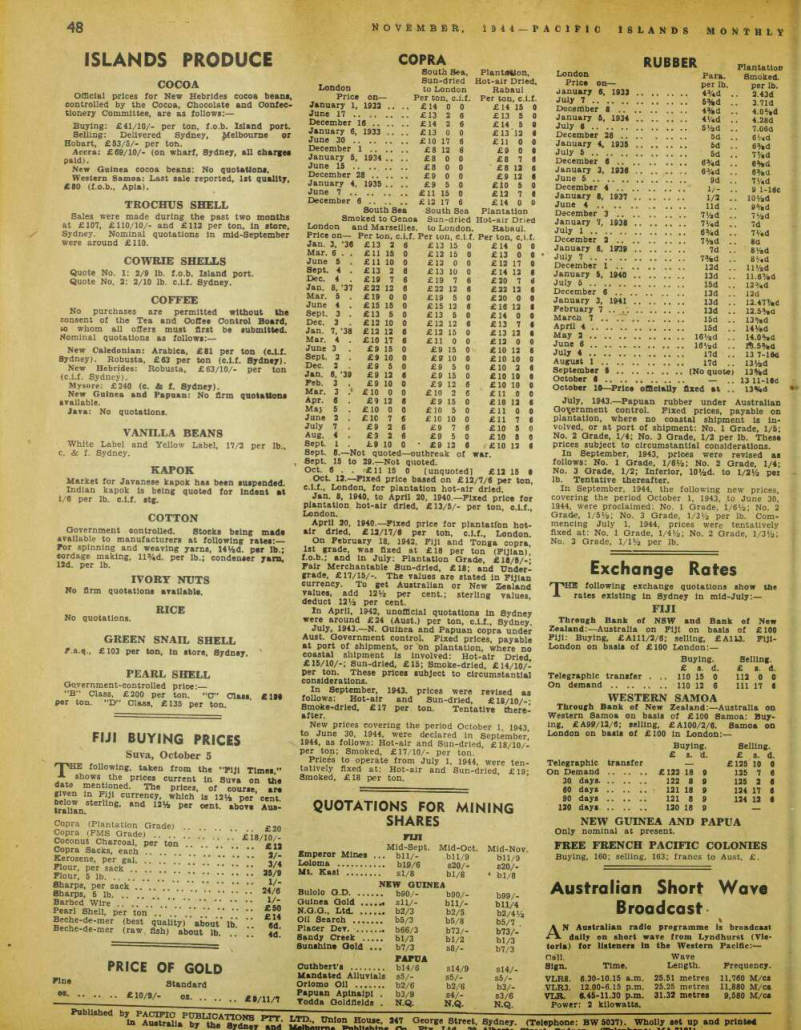
Cocoa
Official prices for New Hebrides cocoa beans, controlled by the Cocoa, Chocolate and Confec tionery Committee, are as follows: Buying: £4l/10/- per ton, f.o.b. Island port.
Selling: Delivered Sydney, Melbourne or Hobart, £53/5/- per ton.
Accra: £69/10/- (on wharf, Sydney, all charges paid).
New Guinea cocoa beans: No quotations.
Western Samoa: Last sale reported, Ist quality, £BO (f.0.b., Apia).
Trochus Shell
Sales were made during the past two months at £lO7, £llO/10/- and £ll2 per ton, In store, Sydney. Nominal quotations in mid-September were around £llO.
Cowrie Shells
Quote No. 1: 2/9 lb. f.o.b. Island port.
Quote No, 2: 2/10 lb. c.l.f. Sydney.
Coffee
No purchases are permitted without the consent of the Tea and Coffee Control Board, ►o whom all offers must first be submitted.
Nominal quotations as follows: New Caledonian: Arablca, £Bl per ton (C.l.f.
Sydney). Robusta, £63 per ton (c.l.f. Sydney).
New Hebrides: Robusta, £63/10/- per ton (c.i.f. Sydney).
Mysore: £240 (C. & f. Sydney).
New Guinea and Papuan: No firm quotations available.
Java: No quotations.
Vanilla Beans
White Label and Yellow Label, 17/2 per lb., c. & f. Sydney.
Kapok
Market for Javanese kapok has been suspended.
Indian kapok is being quoted for indent at 1/6 per lb. c.l.f. stg.
Cotton
Government controlled. Stocks being made available to manufacturers at following rates:— Por spinning and weaving yarns, 14Vid. per lb.; cordage making, ll%d. per lb.; condenser yarn, 12d. per lb.
Ivory Nuts
No firm quotations available.
Rice
No quotations.
Green Snail Shell
P.a.q., £lO3 per ton, in store, Sydney.
Pearl Shell
Government-controlled price:— “B” Class, £2OO per ton. “C” Class £l9O per ton. "D” Class, £135 per ton.
Fiji Buying Prices
Suva, October 5 r T'HE following, taken from the ■'Fiji Times ” shows the prices current in Suva on the date mentioned. The prices, of course are given In Fiji currency, which is 12ft per cent trallan sterllnB, and P« cent, above Aus-
Copra (Plantation Grade) Copra (FMS Grade) .
Coconut Charcoal, per ton Copra Sacks, each ..
Kerosene, per gal, .
Flour, per sack Flour, 5 lb Sharps, per sack ... " * * Sharps, 5 lb. .. , Barbed Wire ... * * * * Pearl Shell, per ton ., Beche-de-mer (best quality) about lb. .. (Jd.
Beche-de-mer (raw fish) about lb. •. .. 4d!
Price Of Gold
Sept. B. —Not quoted—outbreak of war.
Sept. 15 to 29. —Not quoted.
Oct. 6 . . £ll 15 0 [unquoted] £l2 15 • Oct. 12.—Fixed price based on £l2/7/6 per ton, c.1.f., London, for plantation hot-air dried.
Jan. 8, 1940, to April 20, 1940.—Fixed price for plantation hot-air dried, £l3/5/- per ton, c.l.f.
London.
April 20, 1940.—Fixed price for plantation hot air dried. £l2/17/6 per toh, c.1.f., London.
On February 18, 1942, Fiji and Tonga copra, Ist grade, was fixed at £lB per ton (Fijian), f.0.b.; and in July: Plantation Grade, £lB/8/-: Pair Merchantable Sun-dried, £18; and Under grade, £l7/15/-. The values are stated in Fijian currency. To get Australian or New 2*ealand values, add 12 V 2 per cent.; sterling values, deduct 12Va per cent.
In April, 1942, unofficial quotations in Sydney were around £24 (Aust.) per ton, c.1.f., Sydney.
July, 1943.—N. Guinea and Papuan copra under Aust. Government control. Fixed prices, payable at port of shipment, or hn plantation, where no coastal shipment is Involved; Hot-air Dried £l5/10/-; Sun-dried, £l5; Smoke-dried, £l4/10/per ton. These prices subject to circumstantial considerations.
In September, 1943. prices were revised as follows: Hot-air and Sun-dried, £lB/10/-- Smoke-dried, £l7 per ton. Tentative there after.
New prices covering the period October 1, 1943 to June 30, 1944, were declared in September’ 1944, as follows: Hot-air and Sun-dried, £lB/10/per ton; Smoked, £l7/10/- per ton.
Prices to operate from July 1, 1944, were ten tatively fixed at: Hot-air and Sun-dried, £l9- Smoked, £lB per ton.
Fine Standard o*. .. .
Copra
South Sea, Plantation.
London Sun-dried Hot-air Dried. to London Rabaul Price on- Per ton, c.i.f.
Per ton. c.i.f.
January 1 , 1932 , , £14 0 0 £14 15 0 June 17 . £13 2 6 £13 5 0 December 16 .. £14 2 6 £14 5 0 January 6, , 1933 .. . , £13 0 0 £13 12 < June 30 . £10 17 6 £11 0 0 December 1 .. £8 12 6 £9 0 0 January 5, 1934 ., . £8 0 0 £8 7 6 June 15 . . . . . . £8 0 0 £8 12 6 December 28 .. £9 0 0 £9 12 6 January 4, 1935 .. .. £9 5 0 £10 5 0 June 7 ., £11 15 0 £12 7 a December 6 .. £12 17 6 £14 0 0 South Sea South Sea Plantation Smoked to Genoa Sun -dried Hot-air Dried London and Marseilles, to London.
Rabaul.
Price on— Per ton, c.i.f.
Per ton. c.i.f, , Per ton. c.i.f.
Jan. 3, ’36 £13 2 6 £13 15 0 £14 0 0 Mar. 6 . . £11 15 0 £12 15 0 £13 0 0 June 5 £11 10 0 £12 0 0 £12 17 0 Sept. 4 . £13 2 6 £13 10 0 £14 12 a Dec. 4 . £19 7 6 £19 7 6 £20 7 a Jan. 8, ’37 £22 12 6 £22 12 6 £22 12 6 Mar. 5 . £19 0 0 £19 5 0 £20 0 0 June 4 £15 15 0 £15 12 6 £16 12 < Sept. 3 . £13 5 0 £13 5 0 £14 0 0 Dec. 3 . £12 10 0 £12 12 6 £13 7 a Jan. 7, ’38 £12 12 6 £12 15 0 £13 12 a Mar. 4 £10 17 6 £11 0 0 £12 0 0 June 3 £9 15 0 £9 15 0 £10 12 a Sept. 2 . £9 10 0 £9 10 0 £10 10 0 Dec. 2 . £9 5 0 £9 5 0 £10 2 6 Jan. 6. '39 £9 12 6 £9 15 0 £10 10 • Peb. 3 . £9 10 0 £9 12 6 £10 10 0 Mar. 3 • £10 0 0 £10 2 6 £ 11 0 0 Apr. 6 . £9 12 6 £9 15 0 £10 12 a May 5 . £10 0 0 £10 5 0 £11 0 0 June 2 . £10 7 6 £10 10 0 £11 7 a July 7 £9 2 6 £9 7 8 £10 5 0 Aug. 4 £3 2 6 £9 5 0 £10 5 0 Sept. 1 . £9 10 0 ' £9 12 6 £10 12 a
Quotations For Mining
Shares
July, 1943.—Papuan rubber under Australian Government control. Fixed prices, payable on plantation, where no coastal shipment is in volved, or at port of shipment: No. 1 Grade, 1/6; No. 2 Grade, 1/4; No. 3 Grade, 1/2 per lb. These prices subject to circumstantial considerations.
In September, 1943, prices were revised as follows: No. 1 Grade, l/6>/ 2 ; No. 2 Grade, 1/4; No. 3 Grade, 1/2; Inferior, lOVid. to 1/2 Va pei lb. Tentative thereafter.
In September, 1944, the following new prices, covering the period October 1, 1943, to June 30, 1944, were proclaimed: No. 1 Grade, l/6‘/ 2 ; No. 2 Grade, 1/5 y 2; No. 3 Grade, 1/3Vi per lb. Com mencing July 1, 1944, prices wer e tentatively fixed at: No. 1 Grade, l/4y 2 ; No. 2 Grade, l/3y 2 ; No. 3 Grade, l/iy 2 per lb.
FUl Mid-Sept.
Mid-Oct.
Mid-Nov.
Emperor Mines . .. bll/bll/9 bll/9 Loloma .. s20/- S20/- Mt. Kasl sl/8 bl/8 • bl/8
New Guinea
Bulolo Q.D .. b90/b90/b99/- Guinea Gold ... sll/bll/bll/4 N.G.G., Ltdb2/5 b2/4y 2 Oil Search b5/8 b5/7 .
Placer Dev b73/b73/- Sandy Creek ,,. bl/2 bl/3 Sunshine Gold ,. b7/3 s8/b7/3
Papua
Cuthbert’a S14/9 Sl4/- Mandated Alluvlals s5/s5/s5/- Orlomo Oil b2/6 b3/- Papuan Aplnalpl . b3/9 s4/s3/6 Todda Goldfields . N.Q.
N.Q.
N.Q.
London Price on— January 6, 1933 July 7
Rubber
Para, per lb.
Plantation Smoked, per lb. 2.43d 7 71 H December 8 .. . • 0. 1 IQ 4 0 3 -d January 6, 1934 July 6 4.28d December 28 .. , January 4, 1935 July 5 5d !
• I.Uoq
. 6V4d 6ftd IVmfi December 6 .. .
January 3, 1936 .
June 5 • /a a 6Hd 6 3 /*d 7 \J.A December 4 .. . t /4U 9 1 - 1 flr January 8, 1937 .
June 4 December 3 .. . 1/2 ., . lOVad 9 6 /ad 7 ‘Art January 7, 1938 .
July 1 * /2U 7d December 2 .. . 1 /4U BU January 6, 1939 . 7d 8Vad a i .d July 7 December 1 .. .
January 5. 1940 . 13d O /4U 11‘/ad li.6 7 /«d 123/»d July 5 December 6 ,. .. /4vl 12d 12.47’/a0 12.5 s /«a 13 3 /ad January 3, 1941 . 13d February 7 ..
March 7 April 4 14V«d 14.0^ad May 2 June 6 ffi.5*ad 13 7-160 13Vfed 13%d 13 11-160 13*»d July 4 Auguet 1 September 8 .. .
October 6 October 10—Price officially fixed at ..
Exchange Rates
THE following exchange quotations show the rates existing in Sydney in mid-July:—
Fiji
Through Bank of NSW and Bank of New Zealand:—Australia on Fiji on basis of £lOO FIJI; Buying, £Alll/2/6; selling, £AII3. FIJI - on basis of £lOO London:—
Western Samoa
Through Bank of New Zealand:—Australia on Western Samoa on basis of £lOO Samoa: Buy ing, £ A99/12/6; selling, £AIOO/2/6. Samoa on London on basis of £lOO in London:—
New Guinea And Papua
Only nominal at present.
Free French Pacific Colonies
Buying, 160; selling, 163; francs to Aust. £.
Buying.
Selling. £ s. d. £ s. d.
Telegraphic transfer . .. 110 15 0 113 0 0 On demand 111 17 6
Buying.
Selling. £ s. d. £ s. d.
Telegraphic transfer £125 10 0 On Demand £122 18 9 125 7 0 30 days 122 8 9 125 2 0 60 days 121 18 9 124 17 6 90 days 121 8 9 124 12 « 120 days 120 18 9 —
Australian Short Wave
Broadcast
\ AN Australian radio programme is broadcast daily on short wave from Lyndhurst (Vic toria) for listeners in the Western Facific:—
Call.
Wave Sign. Time.
Length.
Frequency.
VLR8. 6.30-10.15 a.m. 25.51 metres 11,760 M/cs VLR3. 12.00-6.15 p.m. 25.25 metres 11,880 M/cs.
VLiR. 5.45-11.30 p.m. 31.32 metres 9,580 M/cs Power: 2 kilowatts.
Advertisements & other items, p. 50 (1 item)
to AuaSu P^l^, A *77* £2*' Unlo^.?.? U w. e * U 1 George street - Sydney. (Telephone: BW 5037). Wholly set up and printed
3 Ula oyoney and UMbourn* Pnhllahln> rv-1 Wd r><« on M . J /m.l i in mill V
Shipping
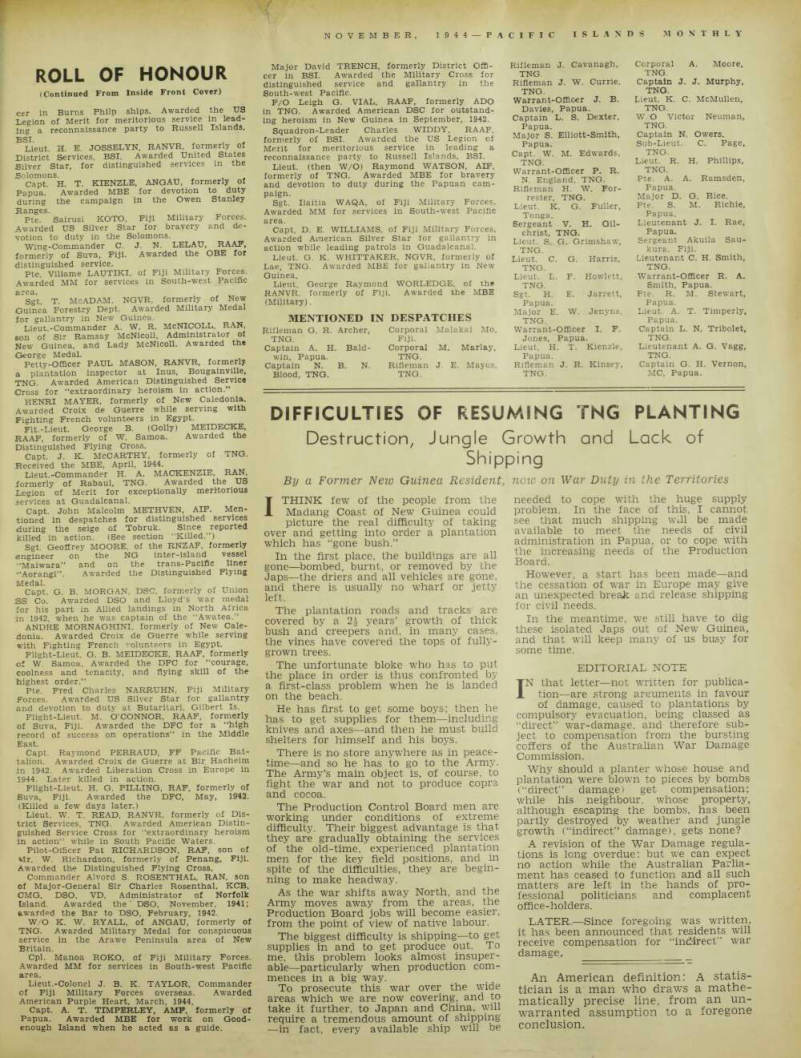
Difficulties Of Resuming Tng Planting
Destruction, Jungle Growth and Lack of Shipping
By a Former New Guinea Resident, I THINK few of the people from the Madang Coast of New Guinea could picture the real difficulty of taking over and getting into order a plantation which has “gone bush.”
In the first place, the buildings are all gone—bombed, burnt, or removed by the Japs—the driers and all vehicles are gone, and there is usually no wharf or jetty left.
The plantation roads and tracks are covered by a 2i years’ growth of thick bush and creepers and. in many cases, the vines have covered the tops of fully grown trees.
The unfortunate bloke who has to put the place in order is thus confronted by a first-class problem when he is landed on the beach.
He has first to get some boys; then he has to get supplies for them —including knives and axes —and then he must build shelters for himself and his boys.
There is no store anywhere as in peace time—and so he has to go to the Army.
The Army’s main object is, of course, to fight the war and not to produce copra and cocoa.
The Production Control Board men are working under conditions of extreme difficulty. Their biggest advantage is that they are gradually obtaining the services of the old-time, experienced plantation men for the key field positions, and in spite of the difficulties, they are begin ning to make headway.
As the war shifts away North, and the Army moves away from the areas, the Production Board jobs will become easier, from the point of view of native labour.
The biggest difficulty is shipping—to get supplies in and to get produce out. To me, this problem looks almost insuper able—particularly when production com mences in a big way.
To prosecute this war over the wide areas which we are now covering, and to take it further, to Japan and China, will require a tremendous amount of shipping —in fact, every available ship will be
now on War Duty in the Territories needed to cope with the huge supply problem. In the face of this, I cannot see that much shipping will be made available to meet the needs of civil administration in Papua, or to cope with the increasing needs of the Production Board.
However, a start has been made —and the cessation of war in Europe may give an unexpected break and release shipping for civil needs.
In the meantime, we still have to dig these isolated Japs out of New Guinea, and that will keep many of us busy for some time.
Editorial Note
IN that letter —not written for publica tion —are strong arguments in favour of damage, caused to plantations by compulsory evacuation, being classed as “direct” war-damage, and therefore sub ject to compensation from the bursting coffers of the Australian War Damage Commission.
Why should a planter whose house and plantation were blown to pieces by bombs (“direct” damage) get compensation; while his neighbour, whose property, although escaping the bombs, has been partly destroyed by weather and jungle growth (“indirect” damage), gets none?
A revision of the War Damage regula tions is long overdue; but we can expect no action while the Australian Parlia ment has ceased to function and all such matters are left in the hands of pro fessional politicians and complacent office-holders.
LATER.—Since foregoing was written, it has been announced that residents will receive compensation for “indirect” war damage, An American definition: A statis tician is a man who draws a mathe matically precise line, from an un warranted assumption to a foregone conclusion.
Advertisements & other items, pp. 51-52 (2 items)
Roll Of Honour
NOVEMBER, 1944 PACIFIC ISLANDS MONTHLY
(Continued From Inside Front Cover)
W. R. Carpenter & Go. Ltd.
Established 1914
THIRTY YEARS OF PACIFIC ISLANDS
DEVELOPMENT AND SERVICE.
W. R. CARPENTER & GO. LTD.
Capital £1,000,000.
GENERAL MERCHANTS AND SHIPOWNERS
Buyers and Exporters of All Kinds of Islands Produce Copra Merchants and Millers Agents for Australian, European and American Manufacturers Distributors of Every Description of Merchandise
AGENTS FOR:
FORD MOTOR COMPANY OF CANADA DODGE BROTHERS INC.
ELECTROLUX REFRIGERATORS WESTINGHOUSE ELECTRICAL CO.
T. G. & C. BOLINDERS (ENGINES) CATERPILLAR TRACTORS Etc., Etc.
BRANCHES THROUGHOUT THE PACIFIC ISLANDS
Head Office: 16 O'CONNELL STREET, SYDNEY
In London: W. R, Carpenter & Co. (London) Ltd., Coronation House, 4 Lloyd's Avenue London, EC.
The W.R.C. Line
first Direct and Regular Cargo and Passenger Service between Eurone and Pacific Islands’ ports was established by W. R. Carpenter & Co. Ltd.