Pacific
Islands
Monthly
Vol. Xii. No. 12.
July 16, 1942
Established 1930
{Registered at toe'<jLP.Qii Sydney, for transmission hy post as a newspaper ]
8 d
The Work Goes On
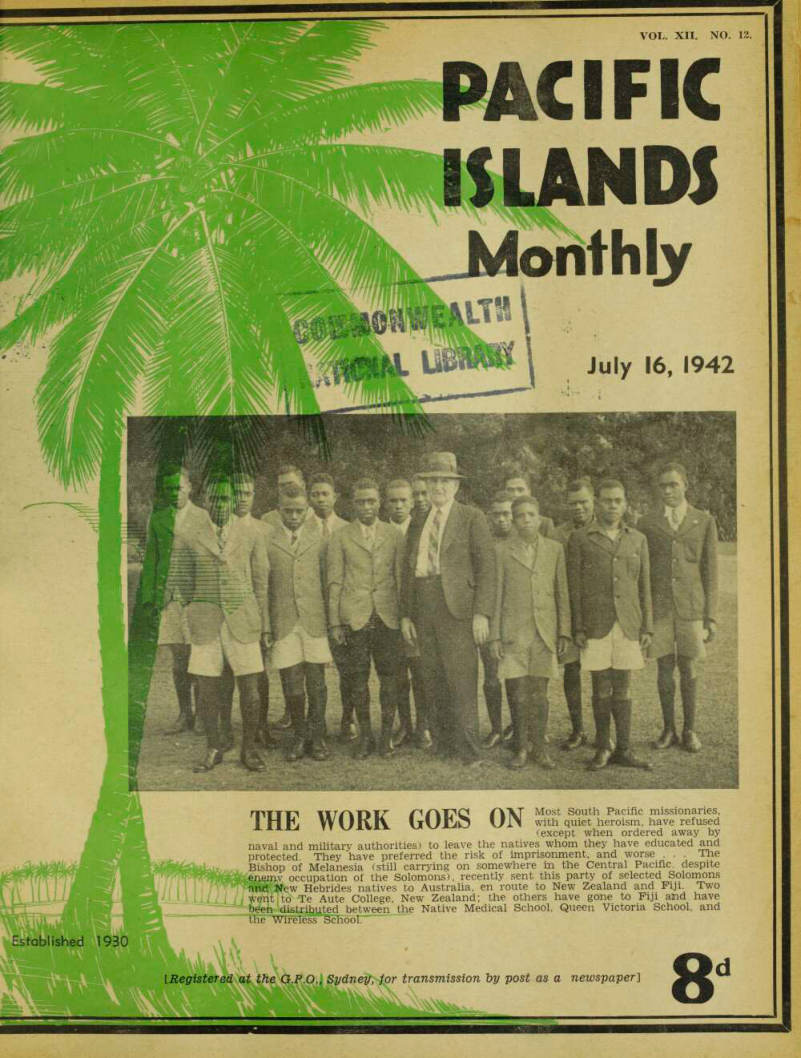
Most South Pacific missionaries, with quiet heroism, have refused (except when ordered away by naval and militarv authorities) to leave the natives whom they have educated and protected. They have preferred the risk of imprisonment, and worse . . . The Bishop of Melanesia (still carrying on somewhere in the Central Pacific, despite enemy occupation of the Solomons), recently sent this party of selected Solomons and ISTew Hebrides natives to Australia, en route to New Zealand and Fiji. Two wentjto Te Aute College, New Zealand; the others have gone to Fiji and have been distributed between the Native Medical School, Queen Victoria School, and the Wireless’ School
Pacific News-Review
Notes And Comment On
The Progress Of The War
From June 15 To July 13
June 15: Twenty-seven heavy Japan ese bombers, escorted by more than 12 Zero fighters, raided- Darwin at noon on Saturday for the first time since April 27 They flew at an enormous height and did little damage.
June 16: Japanese raids on Darwin with more than 20 bombers were repeated on Darwin on Sunday, June 14, and Monday, June 15. , , June 16: British forces have been withdrawn from Tobruk, and Tobruk is now being beseiged by Axis columns Although official communiques still are obscure it is plain that the British have suffered a major defeat in the desert south-westward of Tobruk.
Later reports make it clear that the British tank columns were cleverly ambushed by Rommel in this area and three-quarters of the British tank fOTce of some 300 tanks was wiped out. The position in Libya is now very serious.
June 16 - Germans are still hammering at the Russian Black Sea port of Sebas topol. . ...
June 17: Very severe naval fighting took place in the Mediterranean in con nection with an attempt by the British to send large convoys of men and material to Malta and Tobruk. Large enemy forces attacked our convoys and although a large proportion of our ships got through, it is evident that our losses have been heavy. Enemy losses include.
One 10,000 ton Italian cruiser sunk, and two battleships and a number of cruisers and destroyers damaged. No details of British naval losses have been released.
June 18: The British Eighth Army is retiring from Libya towards the Egyptian frontier, and the Axis columns have now invested Tobruk. . A . , It is apparent that the British Eighth Army has been crippled owing to the loss of its tank forces in the ambush. The British are now retiring to the Mersa Matruh area where it is believed heavy fortifications exist.
June 19: Important decisions probably will be taken by President Roosevelt and Mr. Churchill, who surprised the world by arriving unexpectedly in Washington yesterday.
The newspapers are guessing that the main subjects of the discussions between the democratic leaders will be the open ing of a second front in Europe, the new Anglo-Russian treaty, the shipping situa tion, Allied strategy in the Mediterra nean and the Middle East, and Ameri can supplies to Britain, Russia and China.
June 21: The first news which greeted Mr. Churchill on his arrival in President Roosevelt’s study was the announcement that Tobruk had surrendered to the Germans after only 24 hours’ resistance.
The enemy has captured in Tobruk about 25,000 men, and enormous quantities of war material.
June 21: For the second night in suc cession very heavy formations of British bombers attacked the naval base and industrial centre of Emden.
June 22: To-day, the anniversary of Germany’s attack upon Russia, the Ger mans are attacking Sebastopol in over whelming strength and the position of the fortress it critical.
June 24: The British Government has made a statement that any further advance by the enemy into Egypt will be stoutly resisted and that very import ant reinforcements are on their way to the Eighth Army, , . , June 24; The wave of optimism which has swept over USA in recent weeks,
and which took shape in a forecast that the war might end this year, has now, as a result of Libya and what is hap pening in Russia, given way to black pessimism. “Tobruk fell like a thunder bolt into this mood of hope,” says one commentator.
June 25: Rommel’s panzer forces have made a wide southerly sweep and have advanced more than 70 miles into Egypt, forcing the British to withdraw from Solium and Sidi Omar.
June 25: Reports from many sources suggest that Japan may be now plan ning an attack upon Siberia, so as to assist Germany in crushing Russia, and so as to remove the last land bases from which Japan’s industrial cities could be bombed.
June 26: More than 1,000 British bombers raided Germany last night. The main objective was Bremen, where enormous destruction was done. Fifty two British aircraft are missing.
This is the third RAF 1,000-bomber raid on Germany. The first was on Cologne, the second on Essen.
June 26: Rommel is now engaged in a full-scale attack upon the British forces at Mersa Matruh. Rommel is sacrificing everything to speed and is racing his three panzer columns across the desert.
They are believed to comprise 600 tanks, 10,000 supporting vehicles and several hundreds of mobile guns.
June 28: Mr. Churchill has returned to London from his conferences with Pre sident Roosevelt. A joint statement issued by the President and Prime Minister declares that the United Nations are in good heart and in complete agreement.
It adds that while the plans evolved can not be disclosed “it can be said that the coming operations will divert German strength from the attack on Russia”.
It may be noted that, at the moment of this statement, the British Eighth Armv actually was retiring from the Mersa Matruh line under Rommel’s ham mer blows, and the Germans were mass ing in unprecedented strength for the commencement of their 1942 drive against Russia. It will be interesting to see whether this assurance, made m such circumstances, is merely another example of the soothing-syrup consis tently fed to the Allied people; or whe ther it is justified by events of the coming weeks.
June 29: Communiques issued in Ber lin and Rome claim that the Axis forces this morning occupied Mersa Matruh, but “nothing is known in London officially about this claim”.
General Auchinleck (who took com mand of the Eighth Army after General Ritchie’s defeat near Tobruk) is avmdmg a major battle for the present, while he chooses his own battle-ground, and also gives the very large reinforcements which are on the way an opportunity of reach ing him and taking their place in the line. , , All the reports from the confused battle-front agree on one thing—namely, that the British air-forces are maintain ing supremacy over the battlefield and are inflicting enormous losses upon Rom mel’s greatly attenuated and extended supply lines. Some of them point out that so long as the British hold air supremacy, the battle for Egypt is not lost.
June 29: The Germans have launched a new offensive in the region of Kursk which is over 100 miles north of Khar kov.
July 1: Advancing Axis forces are now
only 90 miles west of Alexandria. Reports from enemy sources say that the British fleet has left Alexandria, and gone southwards through the Suez Canal.
Heavy reinforcements of Americans and American equipment, and Dominion troops, have reached the Eighth Army and the British will stand upon a nar row front between the sea at El Alamein and the Qattara Depression, which is a vast swamp, 35 miles inland from the coast and over which armoured columns may not pass. New Zealand forces, which joined the British, already have distinguished themselves, a magnificent bayonet charge by the Maori battalion being especially noteworthy.
July 2: Creeping on the Japanese gar rison at Salamaua, New Guinea, on Sun day night, Allied land troops killed or wounded at least 60 Japanese, and cap tured some equipment. Their only casu alties were two men wounded.
July 2; A great battle is now proceed ing in the 35 miles bottle-neck between El Alamein and the Qattara Depression.
July 2: The Russian fortress of Sebas topol fell at noon yesterday.
July 3: The British, strongly reinforced, are holding their line in the El Ala mein bottle-neck, and all their positions are intact. Most correspondents say that if only the British can hold this line for a few days there will be a reasonable chance of saving Egypt.
July 5: Correspondents report that the greatest battle since Hitler went to war against Russia, is now raging along the 150-miles front between Kursk and Khar kov. The Germans, squandering unpre cedented quantities of men and muni tions, are trying to break through to the Don River, July 7; The Eighth Army, with its strong reinforcements, is continuing to hold Rommel’s panzer divisions on the El Alamein front, while the RAF retains unquestioned superiority over the West ern Desert.
July 7; Fighting is reported from almost all parts of the Russian front.
The critical sector is the triangle formed by Kursk, Kharkov and Voronej. If the enemy crosses the Don he will cut com munications between Moscow and the Ukraine. The position is grave.
July 8: There is little reported from the other fighting fronts. The Japanese are making attacks upon the Chinese in China, and Chinese armies are hit ting back strongly; and there is much skirmishing between American air anc light naval forces and the Japanese, who secured some small bases in the western part of the Aleutian Islands (Northern Pacific).
July 9: The Germans made important strategical gains by breaking through the Russian front and reaching the River Don 120 miles east of Kursk.
July 13: The Germans have crossed the River Don in considerable strength. The position is now extremely dangerous because the enemy threatens the safety of Moscow to the north and all the east ern Ukraine, to the south. Before him are the wide Steppes of the Don area, which provide ideal going for tanks Unless the Russians can rally and coun ter-attack, in great strength, the Ger mans may get around the Black Sea intc the Caucasus area, and may even invade the country north of the Caspian Sea.
July 13: The British are holding their new desert line and have ceaselessly har assed the enemy with local raids and great air activity.
Advertisements & other items, p. 3 (1 item)
Pacific Islands Mo N H L V-J Vl Y. 1942
Contents
Pacific News Review 1 The Coming Air Armadas 3 Military Plan for Territories’ Plan tations 6 USA Consul-General in New Caledonia 6 Ocean Island Residency 7 Political Clash in New Caledonia .. 7 Territories War Damage Compensa tion 7 Sir Harry Luke Retires 8 Suva War Preparations 9 Escape From Northern New Guinea 10 Suva’s Mosquitoes 11 Destruction of New Guinea Enter prises 11 Rubber from Papua 12 Old Story of Pitcairn 13 Incident of Early Tahiti 14 How Best to Govern Fiji 15 New Guinea Munchausen 17 Boom in Cook Is. Copra 19 Marama of Moorea 20 Schooner “Vagus” Lost 23 No Quinine 24 They Got Away 28 New Guinea Officials in the Forces 30 The Maraamu 32 How France Was Betrayed in 1940 34 Tahiti’s Hats 40 One Night in Greece 41 New Guinea Women 43 Quaint Speech of Niue 45 Commercial Quotations 47 Volume Index 48
Advertisers
Arnott’s Biscuits .. 21 Atkins Pty. Ltd., Wm 26 Baker Ltd., W. Jno. 45 Berger’s Paints . . 28 Brownfields Ltd. . . 27 Brown & Co. Ltd., G 15 Brunton’s Flour . . 42 Burns, Philp & Co, Ltd. ••• 2
B.P. (S.S.) Co. . .24
Burns, Philp Trust Co - Ltd 17 Carlton & United Breweries Ltd. . . 19 Carpenter Ltd., W.
R. ... . cov. 4 Coleman Lamp & Stove Co 36 Colonial Wholesale Meat Co. Ltd. . . 23 “Cystex” 3 6 Donaghy & Sons Ltd. . 43 Donald Ltd., A. B. .32 Dr. Williams Pink Pills 42 Electrolux Refrigerators ... 18 Excelsior Supply Co.
Ltd 45 “Flit” 41 Garrett & Davidson 38 Gillespie’s Flour . . 22 Grand Pacific Hotel 33 Grove & Sons, W.
H. ... 17 Holbrook’s Ltd. . . 25 International Correspondence School -38
Kambala School for Girls 34 Kopsen & Co. Ltd. 39 Masse Batteries . .31 Maxwell Porter Ltd. 29 “Mendaco” ... 41 Meriden School . . 16 Miller & Co. Pty.
Ltd 27 Nelson & Robertson Pty. Ltd. ... 27 Noyes Bros. Ltd. .. 30 Old Monk Olive Oil . 20, 24, 42, 46 Pacific Is. Society . 15 “Pinkettes” ... 33 Prescott Ltd. ... 20 Prouds Pty. Ltd. . 15 Ransome, Sims &’
Jefferies Ltd. . . 46 Riverstone Meat Co.
Ltd 35 Rohu> Sil 44 Rose’s Eye Lotion . 41 st. Ignatius’ College 16 Scott Ltd., J. ... 44 Steamships Trading Co. Ltd 20 Sullivan & Co. . . 43 Swallow & Ariell .34 Talkeries, The ... 45 Taylor & Co., A. .! 46 “Tenax” Soap ... 40 Tillock & Co. Ltd. . 22 Union Assurance Society Ltd. . 43 “Vi-stim” ... ‘ 44 Wills Ltd., W. D. & H. 0 32 Wright & Co. Ltd., E. . . ... 29 Wunderlich’Ltd. .. 29
Advertisements & other items, p. 4 (1 item)
Burns, Philp
USEFUL ADDRESSES
THE following are the Sydney addresses of organisations set up temporarily to deal with Pacific Territories affairs —and especially matters connected with the evacuation of the Territories.
PAPUA., NEW GUINEA , NAURU
NORFOLK IS.
Department of External Territories (Sydney Branch) (Lately the New Guinea Trade Agency), Fifth Floor, Grace Building, York Street, Sydney.
Telephones: MAI2BO, MA 2716, (Dealing with all matters connected with the Australian Pacific Territories and also the Sydney representative of the New Guinea Copra Control Committee.)
BRITISH SOLOMON ISLANDS
Sydney Office of British Solomon Islands Government, (In charge of Mr. F. E. Johnson, Treasurer of the Solomons Administration), 17 Castlereagh Street, Sydney.
Telephone: B 1710.
GILBERT AND ELLICE, AND
OCEAN IS.
Sydney Office of Gilbert and Ellice Islands Colony (In charge of Mr. S. G. Clarke, Acting Resident Commissioner of G. and E. Administration), Bank of New Zealand Building, George Street, Sydney. Telephone: B 2209.
FOR PACIFIC TERRITORIES
EVACUEES GENERALLY
Pacific Territories Association (C. A. M. Adelskold, Secretary), c/o Robert Gillespie Pty., Ltd., 54a Pitt Street, Sydney.
Telephone: BW 4782.
STEAMSHIPS TRADING GO.
OF PAPUA
Sydney Office: Nelson and Robertson Pty,, Ltd., Telephone: B 6461, 12 Spring Street, Sydney.
M. Andre Brenac, Free French representative in Australia, who is well known in New Caledonia and New Hebrides, and Mme. Brenac, received many congratulations on June 14 on the birth of a daughter, Marienne Christine.
Rev. Harry Robinson, the Methodist missionary, is now a member of the Australian forces in Papua, and has the rank of Warrant-Officer. He is carrying out the work of a medical assistant.
asTIT
HUM
llliiltl
mi* 111 im
Pit
mu
vim
m m m j Head Office: 7 Bridge Street, Sydney—-Australia Code Address: " Burphil"
BURNS, PHILP
& Co. Ltd.
GENERAL MERCHANTS
SHIPOWNERS
TOURIST AGENTS
TRAVEL BOOKING AGENTS
FOR
airways, railways and steamship lines
Pacific Islands Monthly
The Newspaper-Magazine of the South Seas IRegistered at the G.P.0., Sydney, for transmission by post as a newspaper .]
Published Once Each Month and Circulated in Australia and New Zealand and in the following Pacific Territories and Islands Groups:
Australian Territory of Papua.
Mandated Territory (Australia) of New Guinea.
Australian Territory of Norfolk Island.
New Zealand Territory of Cook Islands.
Mandated Territory (NZ) of Western Samoa.
British Colony of Fiji.
British Solomon Islands Protectorate.
British Protectorate of Tongan Islands.
British Crown Colony of Gilbert and Ellice Islands.
Mandated Territory of Nauru.
British and Free French Condominium of New Hebrides.
Free French Colony of New Caledonia, Free French Colony of Oceania (Tahiti, etc.).
American Territory of Eastern Samoa.
American Territory of Hawaiian Islands.
Owned and Produced by Pacific Publications Pty, Ltd./ Union House/ 247 George Street, Sydney.
tft fphont I Managing Director .. BW 5037 £ Business and Editorial MA 4369
P.O. Box 3408 R
Registered Address of Telegrams, Radiograms, and Cables: “Pacpub”, Sydney,
Contributions.
Articles, Stories, and Photographs dealing with Pacific Islands subjects are invited and will be paid for on publication.
Subscription Rates.
Per Annum, within British Empire, Prepaid, Post Free 8/- Per Annum, elsewhere, prepaid. Post Free. 107- Single Copies Bd.
Editor and Publisher;
R. W. Robson, F.R.G.S.
Assisted by Selwyn Hughes.
Advertising Manager: L. W. Bailey.
Advertising Office and Printing-House: 29 Alberta Street, Sydney.
Advertising rates furnished on application.
Colours, etc., by arrangement.
Process Blocks made at Advertiser’s expense when required. Screen 100.
Changes of Advertising Copy should reach this office by Ist of each month, otherwise previous advertisement may be repeated.
Representative In London,
W. C. Harvey, Coronation House, 4 Lloyds Avenue, London, E.C.3, from whom may be obtained copies of Pacific Islands Monthly, Pacific Is. Year Book, advertising schedules, etc.
Agents.
The following are authorised to receive sub scriptions for Pacific Islands Monthly:— Burns, Philp & Co., Ltd., and Burns Philp (South Sea) Co., Ltd. All branches.
W. R. Carpenter & Co., Ltd. All branches.
Morris, Hedstrom, Ltd. All branches.
Steamships Trading Co., Papua. All branches.
B.N.G. Trading Co., Ltd., Port Moresby, Papua.
J. Muir, Suva, Fiji.
Miss R. Castles, Suva, Fiji.
N. C. Mackenzie Hunt, Wainunu, Bua, Fiji.
Kirpal & Co., Victoria Parade, Suva, Fiji.
Cook Islands Trading Co., Rarotonga, Cook Is.
A. C. Rowland, Papeete, Tahiti.
Islands Branches and Representatives of W. H.
Grove & Sons, Ltd., Auckland, New Zealand.
Ed. Pentecost, Noumea, New Caledonia.
Kerr & Co., Noumea, New Caledonia.
Vol. XII. No. 12.
July 16, 1942
PrirP f 8d - Per Copy nice Prepaid: 8/- p.a.
The Coming Air Armadas Will End
The War
DURING the grim first week in July, it seemed certain that Rommel’s panzer columns would smash through into Egypt and the Suez area. Most commentators—especially the mer curial Americans—said that the Mediterranean was lost, Alexandria was useless, the British fleet must seek safety in the Indian Ocean, Italy would regain Eritrea and Ethiopia, the backbone of Allied strategy was broken, and Germany and Japan soon would join hands across India.
It hasn’t happened yet—the British are never so dangerous as when they are fighting in the last ditch. But it may happen. Rommel is getting re inforcements, and he will deliver another of his shattering blows.
Let us assume that the present ugly probabilities of the war situation have become actual fact. The prob abilities are: Rommel’s armoured columns will occupy Egypt; the Ger man eastern armies will drive back the Russians and open the road through the Caucasus and the Middle East; Japan will strike Russia in the back by attacking through Man churia; the Germans and Japanese will try to join hands across India.
Some people—and especially those woeful American commentators—then will declare that the Allies have lost all. Those who think that way have lost sight of the outstanding lesson of the last 2£ years: Air power has
altered the course of the war, altered tactics, altered world strategy, altered human history, and given to the Allies an assurance of ultimate vie tory.
Victory will go to the side which not only can overwhelm its enemy with masses of aircraft, but can pro duce men with the intelligence and the spirit to use those aircraft success fully. The Allies can outbuild—and already are outbuilding—the Axis; and we have long known that our airmen are better than theirs.
VTAVAL and military forces are necessary for victory; but the new technique of war says that we can gain a decision with neither un less we also have air superiority, Analyse every victory that has been won by the Axis in these black years, from Norway to Crete, from Malaya to Burma, from Java to New Guinea, and you will find that our men and our ships were defeated on every occasion because the enemy had air superiority.
We were slow to learn. No farther back than December last a British Admiral, refusing to accept the new technique, took his ships within range of Japanese planes land-based in Malaya; and so the Prince of Wales and Repulse were sunk, and the way into Malaya, East Indies and Burma was opened to the enemy. But
the lesson is being learned. British planes sank the “unsinkable” Bis marck. Japanese invasion fleets were met, outwitted and finally defeated, in the Coral Sea and at Midway Island, by American planes.
If the Battle of the Mediterranean and Middle East is lost, the war will be prolonged; but its end will be the same. Its end will come when 100,000 Allied planes, manned by half a million airmen and serviced by two or three millions of groundsmen, drive the Axis air forces out of the skies and paralyse the enemy’s armies and navies. Those are not fantastic figures. They are a calcu lation based upon the logic of the events of 1939-42, and of what actually is happening to-day in United States, Britain and Russia.
The Allies are building 7,000 —perhaps 8,000 —planes per week. They are training millions of fliers and mechanics. Muddling, arguing, squab bling, they are also working mag nificently, and victory is assured.
IN years we have seen war revolu tionised. Our military leaders came into this struggle with all the confidence born of their mastery of 1914-18 technique—and were beaten in every battle in which they met the Germans, or the German-trained Japs, who had developed the tech nique of the tank and the aeroplane.
Bitterly and painfully, through these 30 disastrous months, our generals have learned the new lessons. Soon, they will be level with their teachers.
It is 1914-18 all over again. Then, for 3i ghastly years, we held the Imes bv opposing the unprotected bodies of our young men to the enemy s superior armament and skill. We had to sacrifice our youth to gain time in which to learn the art of war. Then, with the powerful and generous help of the Americans, we finished World War I in six months.
It is so easy, in these black days, to heap reproaches upon “blundering British leadership”. Under modern conditions, the most brilliant leaders cannot win wars without (a) hundreds of thousands of well-trained young officers; (b) endless quantities of the finest war-machines that modern factories can produce; (c) an end less supply of technician-soldiers trained to operate those machines.
Such a war organisation cannot be created in a month or two; it is a miracle that something like it has been created in 2£ years.
We of the British and American democracies are not people trained for war—we hate war, and in normal times we refuse even to think about it. Yet now we are inclined to curse each other because, in a few short months, we cannot go out and meet on equal terms that enemy who, for decades, has planned and thought and dreamed and glorified war.
IF we should thank whatever gods there be that, as the end of the third year of war approaches, we are becoming the masters of war tech nique, we should return even greater thanks that, to-day, we are free to learn the art of war and are not the slaves of the Hun and the Jap. It is true that, in every theatre of war, from Norway to Burma, during two terrible years, we have been sickened by blundering leadership, complacent inefficiency, and incredible stupidity in high official places. But this writer believes that all future gener ations, seeing in the clearer light of history how we defeated the im minent perils of 1939-42, will prefer to praise the high courage, dauntless spirit and eager service of the many, rather than blame the unhappy fail ings of the few.
We have come through the critical years with our freedom unshackled and our democratic institutions in tact—though God alone knows how! —and it is that fact which will be remembered when history is being written.
But something more is happening than the revolutionising of war. We thought that we saw marvellous things, during 1920-40, in the deve lopment of aerial transport. But do we realise what we are seeing in 1940- 42?
Look at the map. This is not a war between nations—it is a war be tween continents. All Europe, except Britain, is Axis-controlled, and against the Allies. All Asia, except Japan, and all the Continent of North America, and all the Continent of Australia, are Allied-controlled, and against the Axis.
To prosecute this war between con tinents, water-transport appears vital whoever commands the sea appar ently has the supreme advantage.
But, actually, neither side controls the sea—underwater craft and air craft make commercial sea-transport hazardous, and the transport of large masses of troops and equipment almost impossible. So, what?
ALREADY, trans-ocean air-trans port is taking the place of urgent shipping. This method of trans portation, as a vital contribution to an Allied victory, already is being developed, to a degree not yet rea lised. It is likely that the develop ments of the next year or two, in this direction, will mark a new phase in the history of mankind.
Much of what is happening may not yet be told. The Japanese thought that the Chinese were crippled when they cut the Burma Road. But, pending the completion of the new Assam Road, the Chinese are carrying on with supplies flown over the Himalayas from India.
Planes are carrying vital supplies from America to Britain, from Britain to Russia, from Germany and Italy to Rommel’s armies in North Africa.
This thing is becoming colossal.
Surface transport has been made difficult—so air transport is being developed to take its place. It would not be surprising, also, if regular freighting by submarines is estab lished within the next two years.
That is the broader pattern of the war. Egypt and the Caucasus may be lost, the Russians may be thrust
back, our shipping may be crippled, Japan may open a new war in Siberia —but the victory of the Allies already is being shaped, in tens of thousands of aircraft factories, upon thousands of fields where our airmen are being intensively trained, in thousands of workshops where tanks and guns are being made, in ten thousand schools where millions of technicians and guerilla fighters are learning, and practising, and waiting.
The time for moaning and pessi mism is past. It is now merely a matter of patience and planning, and hard work.
Pacific Islands Yearbook—Special
Wartime Edition
Owing to Insistent Demand for this well-known Reference Book, and as 1939 Edition is sold out, a Limited Wartime Edition is now being printed.
It will contain the Latest Information relating to all Pacific Islands and Territories, including History, Geographical Description, Administration, Commerce and Industries, Character of Natives, Imports and Exports, Trading Firms, Shipping, Missions, Communications, etc., etc.
The Territories dealt with include— N. Guinea Fiji E. Indies Papua Samoa Philippines Solomons Tonga Hawaii Nauru Gilbert & Ellice N. Caledonia N. Hebrides Cook Is. Fr. Oceania Detailed maps of Practically all Territories and Groups are included.
Owing to Wartime Restrictions, this edition is strictly limited in number. Therefore, to avoid disappointment, Order Your Copy Now.
Price: With stiff board cover, 9’/-; with fairly stiff paper cover, 8/-; plus 6d. extra for postage.
Pacific Publications Pty. Ltd.,
P.O. Box 3408 R., Sydney, or at Union House, 247 George Street, Sydney.
To Kill Two Evils With One Bomb
An artist in Fiji submits this drawing as an expression of his hope that the emergency powers, taken by all the Dominions in order to fight this war, may prove to be not only an embarrassment to the Madman of Munich, but also a bomb under the tail of the trusts and combines which, for far too long, have been battening upon Democracy.
One Suit—No
Shirt !
Pacific Evacuees and the Australian Clothes Ration
rj\HE indifference —often amounting to X cruelty—of officials in their attitude towards the plight of people who arrive in Australia as refugees from Pacific territories invaded or threatened by the Japanese is well illustrated in the treatment experienced by people from Papua or New Guinea at the hands of the clothes-rationing authority.
Clothes-rationing is based on the assumption that the person granted the ration already has a fair average ward robe. and that all that he requires is normal renewals of his wardrobe. Obvi ously. therefore, people who arrive in our midst after having lost all their clothes owing to wartime circumstances beyond their control, should expect some special treatment —that is. a special ration allowance of clothing so as to bring their wardrobe up to a normal average.
But the officials who administer clothes-rationing have other ideas. They apparently recognise that ship-wrecked sailors, refugees, and similarly distressed people are entitled to some special con sideration —but the special consideration is extended with so niggardly and par simonious a hand that the people are more distressed at the end of their appli cation than at the beginning.
The Pacific Territories Association took up the matter vigorously with the War Organisation of Industry officials who, prior to June, administered clothes rationing. But these officials were not helpful. They talked and argued and protested—but hand out a permit for a reasonable amount of clothes to people from the tropics who were facing an Australian winter with practically no warm clothes at all they would not. mHEN the responsibility for clothes ± rationing was nassed over to another set of officials, under the direction of someone called “Deputy- Director of Rationing”. This gentleman, being approached, nromised all sorts of reasonable things; but, when the unfor tunate refugees from the Territories “came down to tin tacks”, they discov ered that the special allowance of cloth ing prenared for them was woefully inadequate.
There was nrofitless argument between the Pacific Territories Association and the official in question. Finally, the Association received an intimation that an evacuee, whose present stock of cloth ing was less than the minimum ward robe (which officialdom listed) could make an application for a permit to bring his wardrobe up to that minimum.
NOW, the following is the minimum stock of clothing prescribed by the official —1 two-piece suit; 1 extra pair of trousers; 2 pairs of underpants: 2 singlets: 4 pairs of socks; 2 pairs of pyjamas: 1 pair of boots; 1 overcoat.
It will be noted that this list refers only to men. The Association was informed that, in respect of women, the schedule “would bp in like proportion”— whatever under Heaven such a phrase may mean.
It will be noted, also, that the so-called minimum wardrobe makes no provision for items which surely should be con sidered necessary, such as shirts and
hats and (in winter) waistcoats or car digans.
The Association, regarding the so-called wardrobe as not only inadequate but ridiculous, has made a further appeal to the rationing authority in Melbourne.
The harshness of this official attitude is on all fours with the treatment being accorded to New Guinea and Papuan evacuees in practically all other direc tions. The refusal of the authorities to pay war damage compensation for what clearly is war damage is referred to else where in this issue.
If every evacuee from New Guinea and Papua were granted permission to obtain a reasonably adequate wardrobe by the rationing authorities the total amount of clothing involved would be so little that it would not affect the general rationing position in Australia one iota.
Members of the Association who may wish to purchase a limited number of blankets at a reasonable price should at once communicate with the secretary.
Rev. R. S. Walker, Methodist mission ary at Cakaudrove, Fiji, for several years, now is serving at Murwillumbah, NSW.
He and Mrs. Walker arrived in Sydney from Suva at the end of May, after wait ing in NZ for a passage to Australia for several months.
"Pour La Patrie"
New Caledonian Free French Killed
From Our Own Correspondent
Noumea, June 29.
THE first list of those killed in action while fighting with the Free French forces at Bir Hakheim, in the Libyan desert, includes men of the Free French Pacific Battalion. Among these is the name of the battalion commander, Lieut.-Colonel Felix Broche, former troop commander in Tahiti and New Cale donia, where he spent several months before the contingent left for Australia in May, 1941.
Marcel Kollen, a Noumea post office employee, who was right in the fore front of the Free French movement here from June, 1940, and who leaves a widow and three young children, was also killed (on June 1).
Young ‘cadet officers missing include Andre Petre, a Noumea magistrate, and G. Payonne, English teacher at the Noumea secondary school (College de la Perouse), a man with a real knowledge and love of the English language and the English people, gained from some years of residence in Leicester. His striking radio talks before the contin gent left are remembered here.
Samarai Lad Missing
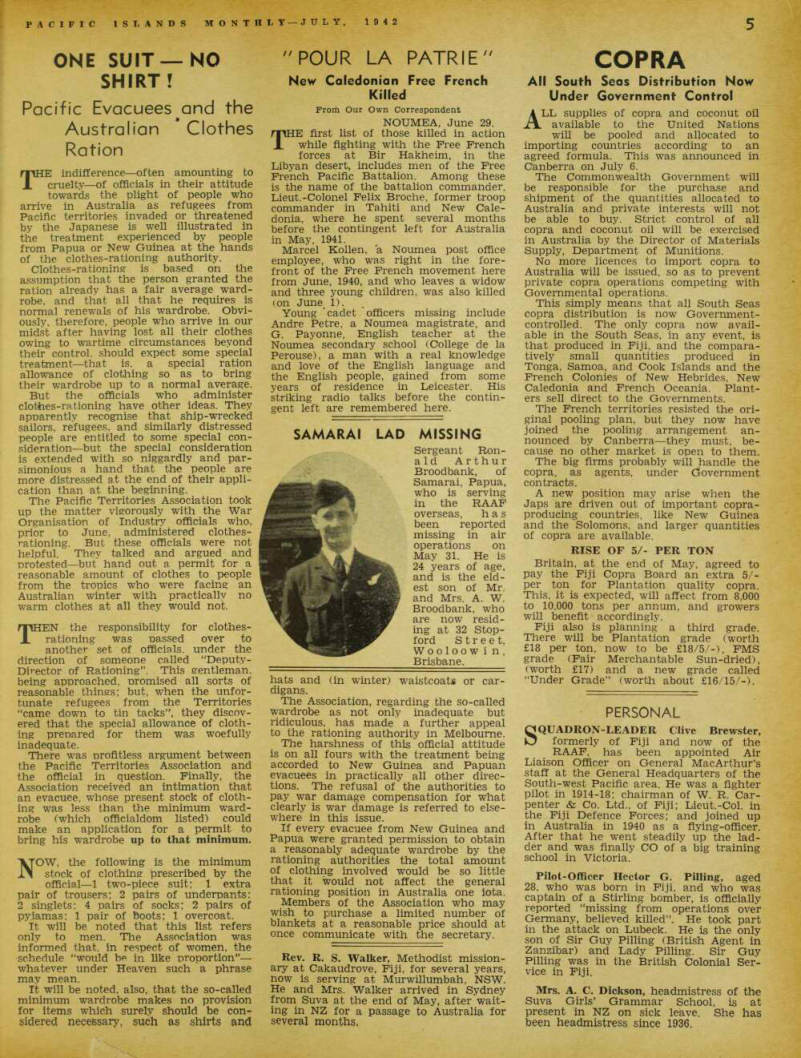
Sergeant Ron ald Arthur Broodbank, of Samarai, Papua, who is serving in the RAAF overseas, has been reported missing in air operations on May 31. He is 24 years of age, and is the eld est son of Mr. and Mrs. A. W.
Broodbank, who are now resid ing at 32 Stop ford Street, Woo 1 oo w i n , Brisbane.
Copra
All South Seas Distribution Now Under Government Control
ALL supplies of copra and coconut oil available to the United Nations will be pooled and allocated to importing countries according to an agreed formula. This was announced in Canberra on July 6.
The Commonwealth Government will be responsible for the purchase and shipment of the quantities allocated to Australia and private interests will not be able to buy. Strict control of all copra and coconut oil will be exercised in Australia by the Director of Materials Supply, Department of Munitions.
No more licences to import copra to Australia will be issued, so as to prevent private copra operations competing with Governmental operations.
This simply means that all South Seas copra distribution is now Government controlled. The only copra now avail able in the South Seas, in any event, is that produced in Fiji, and the compara tively small quantities produced In Tonga, Samoa, and Cook Islands and the French Colonies of New Hebrides, New Caledonia and French Oceania. Plant ers sell direct to the Governments.
The French territories resisted the ori ginal pooling plan, but they now have joined the pooling arrangement an nounced by Canberra—they must, be cause no other market is open to them.
The big firms probably will handle the copra, as agents, under Grovernment contracts.
A new position may arise when the Japs are driven out of important copra producing countries, like New Guinea and the Solomons, and larger quantities of copra are available.
Rise Of 5/- Per Ton
Britain, at the end of May, agreed to pay the Fiji Copra Board an extra 5/per ton for Plantation quality copra.
This, it is expected, will affect from 8,000 to 10,000 tons per annum, and growers will benefit accordingly.
Fiji also is planning a third grade.
There will be Plantation grade (worth £lB per ton, now to be £lB/5/-), FMS grade (Fair Merchantable Sun-dried), (worth £l7) and a new grade called “Under Grade” (worth about £l6/15/-).
Personal
SQUADRON-LEADER Clive Brewster, formerly of Fiji and now of the RAAF, has been appointed Air Liaison Officer on General MacArthur’s staff at the General Headquarters of the South-west Pacific area. He was a fighter pilot in 1914-18; chairman of W. R. Car penter & Co. Ltd., of Fiji; Lieut.-Col. in the Fiji Defence Forces; and joined up in Australia in 1940 as a flying-officer.
After that he went steadily up the lad der and was finally CO of a big training school in Victoria.
Pilot-Officer Hector G. Pilling, aged 28, who was born in Fiji, and who was captain of a Stirling bomber, is officially reported “missing from operations over Germany, believed killed”. He took part in the attack on Lubeck. He is the only son of Sir Guy Pilling (British Agent in Zanzibar) and Lady Pilling. Sir Guy Pilling was in the British Colonial Ser vice in Fiji.
Mrs. A. C. Dickson, headmistress of the Suva Girls’ Grammar School, is at present in NZ on sick leave. She has been headmistress since 1936,
Territories Plantations
Military Plan For Running
Being Strongly Opposed by Evacuated Owners
rERE was dismay among New Guinea and Papua plantation-owners (now mostly resident in Australia) when they learned, during the month, of the Military Administration’s plan for carry ing on the coconut and rubber-growing industries. Very strong protests are being made to the Commonwealth Gov ernment.
The position, in recent months, has been that most of Papua, and a small part of New Guinea, have been free to carry on their plantations, although practically all the planters are evacu ated. New Guinea produces mostly copra; Papua mostly rubber. Both copra and rubber are urgently needed.
As explained in another article in this issue, MA (Military Administration) has sought rubber-planters, enlisted them in the Army, and then detailed them to go out and carry on the plantations, as part of the Army organisation. Everyone regarded that as a temporary arrange ment.
According to information now supplied to plantation-owners, the plan now is to expand that system indefinitely. If and when the enemy retires from New Guinea territory, the system will be extended to plantations, as they become available.
MA proposes to enlist more planters, detail them to work the plantations, and produce and ship rubber and copra as part of military operations. Owners of plantations thus occupied and operated are to be compensated by a payment of 4 per cent, per annum on the capital value of their properties.
Socialism in our time! rpHE plantation-owners—most of whom JL are “small” men, with a lifetime of work and all their resources tied up in their properties—cannot understand why they are not to be allowed to return to their plantations, and to resume production, as conditions permit. Noth ing is more certain than that these men will produce more rubber and copra, more cheaply and efficiently, than an organisation of enlisted men, operating under MA direction.
The sheer cruelty of the plan is obvi ous. These unfortunate planters, after a long period of low prices, have been driven out by enemy invasion, and have lost heavily.
The Australian authority, so far, will not recognise their claims for war dam age compensation unless it is damage inflicted by bursting shells or fighting
soldiers or “scorched earth”—looting, fires, depreciation, runaway labour are (God save the mark!) not “war dam age”. And now, when there may be a chance for these unlucky people to go back to their plantations and get some compensatory benefit from the new high prices for copra and rubber, MA pro poses to take over their properties on a 4 per cent, basis!
MA proposes to treat the Territories as if they were enemy countries, captured from the enemy, and all the enemy planters fled. They are not—they are Australian territories, to be cleared of dangers brought by enemy invasion, and restored to their owners. And their owners—many, many hundreds of them — are here in Australia, anxiously await ing a chance to return, and many of them meanwhile living precariously upon a Commonwealth sustenance allowance.
THE newly-formed Pacific Territories Association has taken up this mat ter vigorously, and is making urgent representations to the Prime Minister.
It is inconceivable that men like Mr.
Curtin, Dr. Evatt, Mr. Beasley, always ready to fight injustice, will approve of the MA plan of administering planta tions.
It is admitted that there may be a period, while the enemy is close and menacing, when it will be advisable to work plantations in the manner described.
Copra and rubber are urgently needed.
But, according to statements made to the plantation-owners, that is not tlie plan. MA proposes to run the planta tions “for the duration”; and that may mean for years after the Japs have left New Guinea.
Planters are asking how strangers can run their plantations efficiently without records or local knowledge: how a man who is merely a unit of the Army can be expected to undertake all those spe cial extra duties which means maximum and cheap production from a plantation; and how it is proposed to assess the damage that certainly will be done to buildings, equipment, plant and the plantation itself during the period of “foreign” occupation.
The PTA is submitting an alternative plan to the Commonwealth Government —a plan which recognises, in every way, the necessity for the paramount authority of MA, but which gives owners the right to run their own plantations in their own way, and to get the full benefit of the plantation’s production.
Prisoners In New
Guinea
LETTERS from prisoners-of-war in the Rabaul area, which the Japan ese have permitted to leave New Guinea, indicate that the following well known residents of Rabaul are prisoners of-war, and are well: Hon. Gerald Hogan, MLC, Crown Law Officer in the New Guinea Administration: Dr Watts who was a private practitioner in Rabaul;’
Mr. Evan Evans, who was a member of the Public Health Department in New ; TT Dr I ViF O £P er ’ ° f the New Guinea Public Health Department,
Basil Chalmers, of the first contingent of RAF recruits to leave Fiji for train ing in South Africa, received his “wings” as a bomber pilot last month.
Rev. R. E. Tempest, who prior to his departure for England in 1935 was a Melanesian missionary at Siota, BSI, has recently been appointed vicar of Adle burgh, Suffolk.
Former Papuan rubber-planters who have returned to rubber-planting, as part of their military duties, include Capt. S. D. Morton, Lieut. E. W. Thomas, Warrant-Officers C. Forbes and F. A. Lord (all of Koitaki plantation). Other well known rubber-planters who have re turned to Papua lately are Lieuts. G. A.
Loudon and F, L, Clarke.
Now "Consul
General"
USA Representative in New Caledonia
From Our Own Correspondent
Noumea, June 29.
EMPHASISING Noumea’s new-found defence, economic and political importance, Washington has pro moted US Consul K. de G. MacVitty to be Consul-General here as from June 22.
The vice-consul is Perry Ellis, evacuated from Singapore last April.
It goes without saying that the work of the consulate has increased since Mr.
MacVitty arrived in March, 1941, to set up his consulate in the former Societe le Nickel offices, Rue de la Somme. Then his position was somewhat invidious, for the United States had not recognised and was not for several more months officially to recognise, the Free French Administration in the Pacific Colonies.
Therefore Mr. MacVitty’s attitude at first was, “The least said about me the better.”
He was at Oxford when the last war broke out and then joined and fought with the French Army. It was stated on his arrival in New Caledonia that he had been intended for Indo-China and, only at the last moment, was sent to Noumea, where at the time the ship ping and economic position in a Colony, cut off from its major European market, was difficult, and where Japanese designs were becoming known.
Mr. MacVitty’s varied experience cov ers such widely scattered places as New Zealand, Sofia, Baghdad, Nairobi, Malta, Leghorn, Rome and Amoy (China).
Quinine Problem
Foresight of Anglican Mission
OWING to the remarkable foresight of Archdeacon Thompson, the Anglican missions in Papua and New Guinea, under the control of the Australian Board of Missions, are well supplied with quinine.
The occupation of the Dutch East Indies by the enemy has cut off the main source of supply of this important drug.
As a rule the Anglican mission purchases only small quantities of quinine at one time, but towards the end of 1941 Arch deacon Thompson purchased 1,000 ounces of quinine from the Dutch East Indies at a cost of over £4oo—and the mission, in consequence, entered this most difficult war period with a supply calculated to last from two to three years.
Because of war conditions, there are, and will be for some time, larger num bers of Europeans in the malaria-ridden territories of Papua, New Guinea, Solo mons, and the New Hebrides, than ever before, and they will all require quinine; but, owing to the supply having been cut off at its source (Netherlands East Indies) it may be expected that the demand now is far in excess of all sup plies in sight.
Advertisements & other items, p. 8 (1 item)
Coconut Charcoal
W. R. Carpenter and Co. (Fiji), Ltd., announced recently that they had been authorised by the CSR Company to increase the price of coconut charcoal from £8 to £9 a ton on plantations.
As It Was; And As It Is
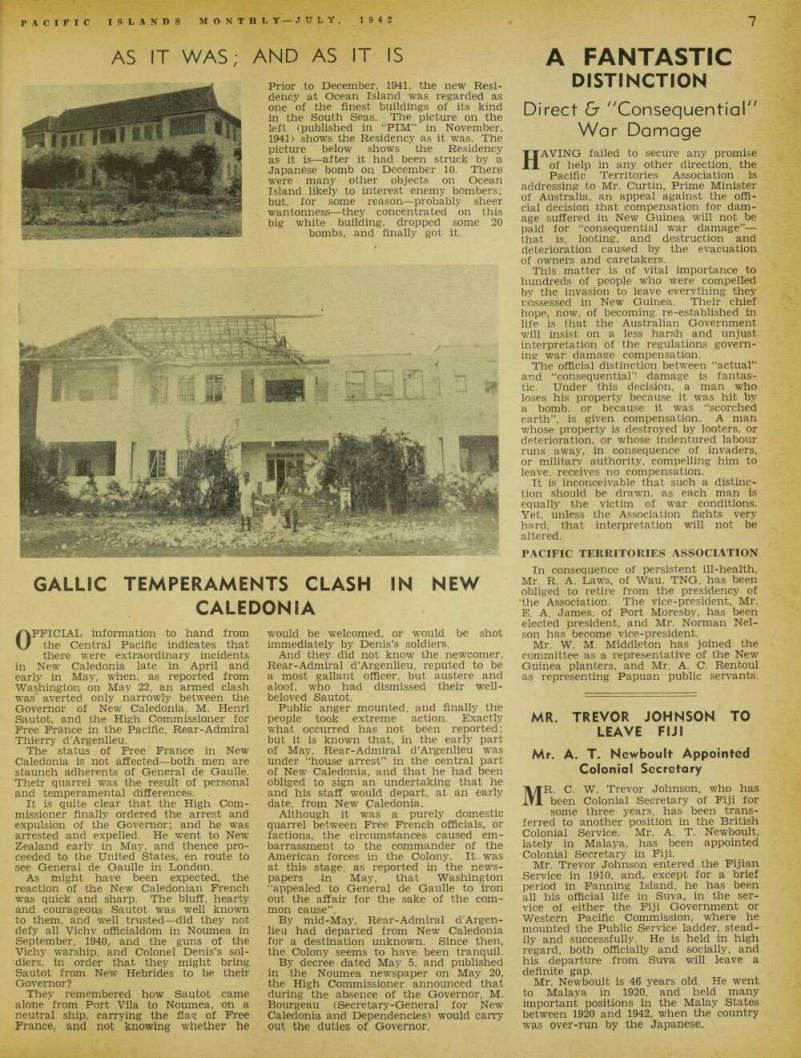
Prior to December, 1941, the new Resi dency at Ocean Island was regarded as one of the finest buildings of its kind in the South Seas. The picture on the left (published in “PIM” in November, 1941) shows the Residency as it was. The picture below shows the Residency as it is—after it had been struck by a Japanese bomb on December 10. There were many other objects on Ocean Island likely to interest enemy bombers; but, for some reason—probably sheer wantonness —they concentrated on this big white building, dropped some 20 bombs, and finally got it.
Gallic Temperaments Clash In New
Caledonia
OFFICIAL information to hand from the Central Pacific indicates that there were extraordinary incidents in New Caledonia late in April and early in May, when, as reported from Washington on May 22, an armed clash was averted only narrowly between the Governor of New Caledonia. M. Henri Sautot, and the High Commissioner for Free France in the Pacific, Rear-Admiral Thierry d’Argenlieu.
The status of Free France in New Caledonia is not affected—both men are staunch adherents of General de Gaulle.
Their quarrel was the result of personal and temperamental differences. .
It is quite clear that the High Commissioner finally ordered the arrest and expulsion of the Governor; and he was arrested and expelled. He went to New Zealand early in May. and thence proceeded to the United States, en route to see General de Gaulle in London.
As might have been expected, the reaction of the New Caledonian French was quick and sharp. The bluff, hearty and courageous Sautot was well known to them, and well trusted—did they not defy all Vichy officialdom in Noumea in September, 1940, and the guns of the Vichy warship, and Colonel Denis’s soldiers, in order that they might bring Sautot from New Hebrides to be their Governor?
They remembered how Sautot came alone from Port Vila to Noumea, on a neutral ship, carrying the flag of Free France, and not knowing whether he
would be welcomed, or would be shot immediately by Denis’s soldiers, And they did not know the newcomer, Rear-Admiral d’Argenlieu, reputed to be a most gallant officer, but austere and aloof, who had dismissed their well beloved Sautot.
Public anger mounted, and finally the people took extreme action. Exactly what occurred has not been reported; but it is known that, in the early part of May, Rear-Admiral d’Argenlieu was under “house arrest” in the central part of New Caledonia, and that he had been obliged to sign an undertaking that he and his staff would depart, at an early date, from New Caledonia, Although it was a purely domestic quarrel between Free French officials, or factions, the circumstances caused em barrassment to the commander of the American forces in the Colony. It was at this stage, as reported in the news papers in May, that Washington "appealed to General de Gaulle to iron out the affair for the sake of the com mon cause”.
By mid-May, Rear-Admiral d’Argen lieu had departed from New Caledonia for a destination unknown. Since then, the Colony seems to have been tranquil, By decree dated May 5, and published in the Noumea newspaper on May 20, the High Commissioner announced that during the absence of the Governor, M.
Bourgeau (Secretary-General for New Caledonia and Dependencies) would carry out the duties of Governor.
Direct & "Consequential”
A Fantastic
Distinction
War Damage
HAVING failed to secure any promise of help in any other direction, the Pacific Territories Association is addressing to Mr. Curtin, Prime Minister of Australia, an appeal against the offi cial decision that compensation for dam age suffered in New Guinea will not be paid for “consequential war damage”— that is, looting, and destruction and deterioration caused by the evacuation of owners and caretakers.
This. matter is of vital importance to hundreds of people who were compelled by the invasion to leave everything they nossessed in New Guinea. Their chief hope, now, of becoming re-established in life is that the Australian Government will insist on a less harsh and unjust interpretation of the regulations govern ing war damage compensation.
The official distinction between “actual” and “consequential” damage is fantas tic. Under this decision, a man who loses his property because it was hit by a bomb, or because it was “scorched earth”, is given compensation. A man whose property is destroyed by looters, or deterioration, or whose indentured labour runs away, in consequence of invaders, or military authority, compelling him to leave, receives no compensation.
It is inconceivable that such a distinc tion should be drawn, as each man is equally the victim of war conditions.
Yet. unless the Association fights very hard, that interpretation will not be altered.
Pacific Territories Association
In consequence of persistent ill-health, Mr. R. A. Laws, of Wau. TNG, has been obliged to retire from the presidency of •the Association. The vice-president, Mr.
E. A. James, of Port Moresby, has been elected president, and Mr. Norman Nel son has become vice-president.
Mr. W. M. Middleton has joined the committee as a representative of the New Guinea planters, and Mr. A. C. Rentoul as representing Papuan public servants.
Colonial Secretary
Mr. Trevor Johnson To
Leave Fiji
Mr. A. T. Newboult Appointed Colonial Secretary
MR. C. W. Trevor Johnson, who has been Colonial Secretary of Fiji for some three years, has been trans ferred to another position in the British Colonial Service. Mr. A. T. Newboult, lately in Malaya, has been appointed Colonial Secretary in Fiji.
Mr. Trevor Johnson entered the Fijian Service in 1910, and. except for a brief period in Fanning Island, he has been all his official life in Suva, in the ser vice of either the Fiji Government or Western Pacific Commission, where he mounted the Public Service ladder, stead ily and successfully. He is held in high regard, both officially and socially, and his departure from Suva will leave a definite gap.
Mr. Newboult is 46 years old. He went to Malaya in 1920, and held many important positions in the Malay States between 1920 and 1942, when the country was over-run by the Japanese.
Wartime Governor
The Work of Sir Harry Luke
rE following tribute to the work of Sir Harry Luke, as Governor of Suva is taken from an article in “Fiji Times” of June 13: — “in September next His Excellency would have completed four years of ser vice in Fiji. They have been full and verv active years. There are few of the Group and the islands of the High Commission which he has not visited .. In his administration the welfare of the native and Indian races has been his constant concern, and in no way has this been better expressed than in the keen personal interest he has shown in the medical training of the native and Indian medical practi tioners, and in the medical services in Fiji recently. During his period of wartime governorship he has kept con tinually in touch with all sections of the community and the general response of the people is a tribute to his leader ship. In matters pertaining to civil defence His Excellency has taken a very nractical interest. The Governor’s Civil Defence Committee has been under his personal control, and his has been the driving force behind the construction of shelters and the organisation of all civil defence services. In these matters he demanded direct action and got it.”
Visit To New Caledonia
Prom Our Own Correspondent
Noumea, June 29.
A RECENT visitor has been the retir ing British High Commissioner for the Western Pacific, Sir Harry Luke, on his way through and also re turning from a farewell visit to Port Vila, where he said good-bye to Mr.
Blandy, tbe British Resident Commis sioner. and to other officials. In Nou mea, he discussed matters of common interest with the French High Commis sioner (Rear-Admiral d’Areenlieu) and Maior-General Alexander M. Patch, Jr.
Noumeans, who took a great liking to this French-sneaking Englishman, recall his former visit, the cheers they greeted him with at the wharf in Governor Peli cier’s unhappy time (September. 1940), when thev shouted “Vive la Nouvelle Caledonie”, “Vive I’Angleterre”, and his friendly collaboration with Governor Sautot (then French High Commis sioner) whose departure is so much regretted. Perhaps they will be able to meet in London to discuss old times.
Evacuees And Income
Taxation
EVACUEES from New Guinea and Papua, who are resident in Austra lia. who are drawing more than £3 per week from an Australian source, and who, in the year ended June 30. received £156 or more as income, between their arrival in Australia and June 30, should lodge an income taxation return before July 31, in the usual way. If they are now in receipt of an income of more than £3 per week, but did not receive more than £156 as income between their arrival in Australia and June 30 they should at once apply to the Income Tax Department, in writing, for a taxation exemption certificate. When they get this, their present income will not be subject to taxation deductions between now and June 30, 1943.
The Pacific Territories Association is attending to a great many inquiries bv evacuees regarding their income tax position In Australia.
New Appointment Apparently Connected With
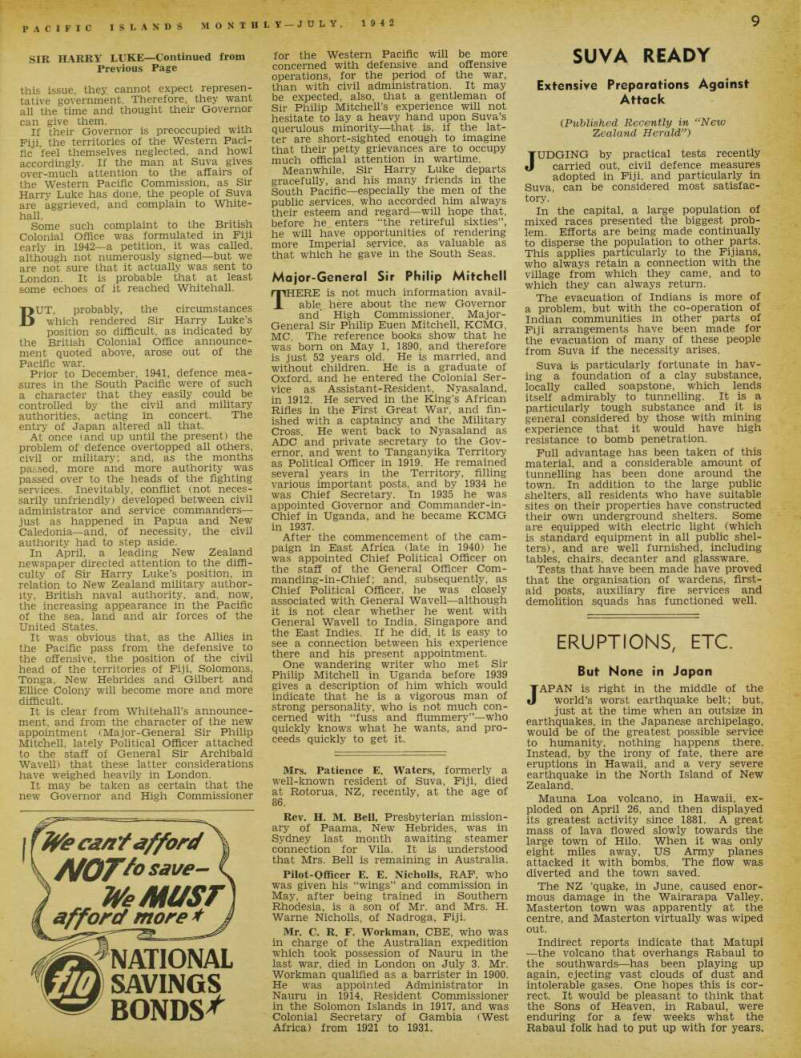
Sir Harry Luke Retires
New Appointment Apparently Connected With South Pacific War Sitation
THE following announcement by the
British Colonial Office, published in Australian newspapers about June
17, caused surprise:—
The Secretary of the State for the Colonies (Lord Cranborne) has been in consultation with Sir Harry Luke, the Governor of Fiji and High Commissioner for the Western Pacific, regarding the new situation that has arisen in that area. With great public spirit, Sir Harry Luke has consented to place his resignation in His Majesty’s hands in order to facilitate the appointment of a younger man to the position. Sir Harry Luke, who is 57 and has had long distin guished colonial service, became Governor of Fiji in 1938.
Until then, there had been no indica tion (outside of Fiji, at any rate) that any such change was contemplated.
Those who know Fiji suspected that there
was more behind the announcement than appeared on the surface.
Sir Harry Luke came to Suva in 1938 —a man with a distinguished career, but tired after many long years of service in the restless Mediterranean area, where he latterly was Governor of Malta. Prob ably, both he and the Colonial Office expected that the quiet Pacific would provide him with some restful years.
If so, he was doomed to disappoint ment, There was the war, and there was Suva.
There is in Fiji a very small, queru lous, almost implacable group of semi public men who seem to find joy in nag ging at Governors —they have made life burdensome for more than one occupant of the big house on the hill. They fell athwart the neck of Sir Harry Luke before he had been there six months. Sir Harry, cultured, artistic, literary, wed ded to the strictest rules of Colonial Office tradition, did not like the cold, critical regard and narrow minds of some of the people whom he met in Suva; and he did not always cloak his feel ings. He did what he wished to do; and, if sharp-nosed people did not like it—
well, he snapped his fingers at them. In other directions, he made warm friend ships and gained admirers.
As Governor of Fiji, he was most con scientious and just; but he did not seem to care much for that job. There was little there that was new—his work was all laid out for him, in set squares and strict routine.
He was far more interested in his duties as High Commissioner of the Western Pacific. Here, as over-lord of the Solomons, New Hebrides, Gilbert and Ellice Colonv and Tonga, he found chances for development, work far more fo his liking, opportunities for his rest less, creative brain. And he loved travel.
EVEN before the war came, in 1939, the cmerulous men of Suva were complaining that Fiji’s Governor was spending far too much time away in the High Commissioner’s domains.
Maybe, they had reason—the other domains certainly agreed, complacently, that they were seeing more of this High Commissioner than of any other HC for long years past. Sir Harry’s interest was not passive—all the territories benefited —he keenly investigated their affairs, and was eager to effect improvements.
Then came the collapse of France, in June. 1940. and immediately a new, heavy burden was thrown unon Sir Harry Luke.
The peonle of the French Colonies of the South Pacific (New Caledonia, New Hebrides and French Oceania) were overwhelmingly for Free France; but the French administrative officials, desper ately afraid of losing their jobs, their property and their pension rights, wanted to adhere to Vichy—or at least to tem porise. Britain and America definitely did not want the taint of Vichy in the South Pacific.
Sir Harry Luke. High Commissioner for the Western Pacific, with his Mediter ranean experience and his intimate knowledge of the French language and character, was the ideal man to handle a difficult and dangerous situation. What he did mav not be told until after the war; but it can be said that, between June and December, 1940, while the French colonies were turning definitely from Vichy and becoming incorporated in Free France, his work was of the great est value to the British Empire. During that period he necessarily spent much time away from Suva.
IN 1941, Sir Harry clearly was out of sympathy with some of Fiji’s lead ing citizens. They did not seem to appreciate the burden he was carrying in. relation to the defence of the Central Pacific: while he, on his part, did not always display tact and patience in deal ing with them. They were concerned only with Fiji; he, necessarily, had to look over the broader field of the West ern Pacific.
The position that developed provides a strong argument in favour of the separa tion of the two important posts—Gover nor of Fiji and High Commissioner for the Western Pacific.
In the post-war readjustment, this separation may become inevitable. The Fiji people must, in their special circum stances, submit to rule by a benevolent dictator in the person of their Governor, As explained in an article elsewhere in
(Continued on Page 9)
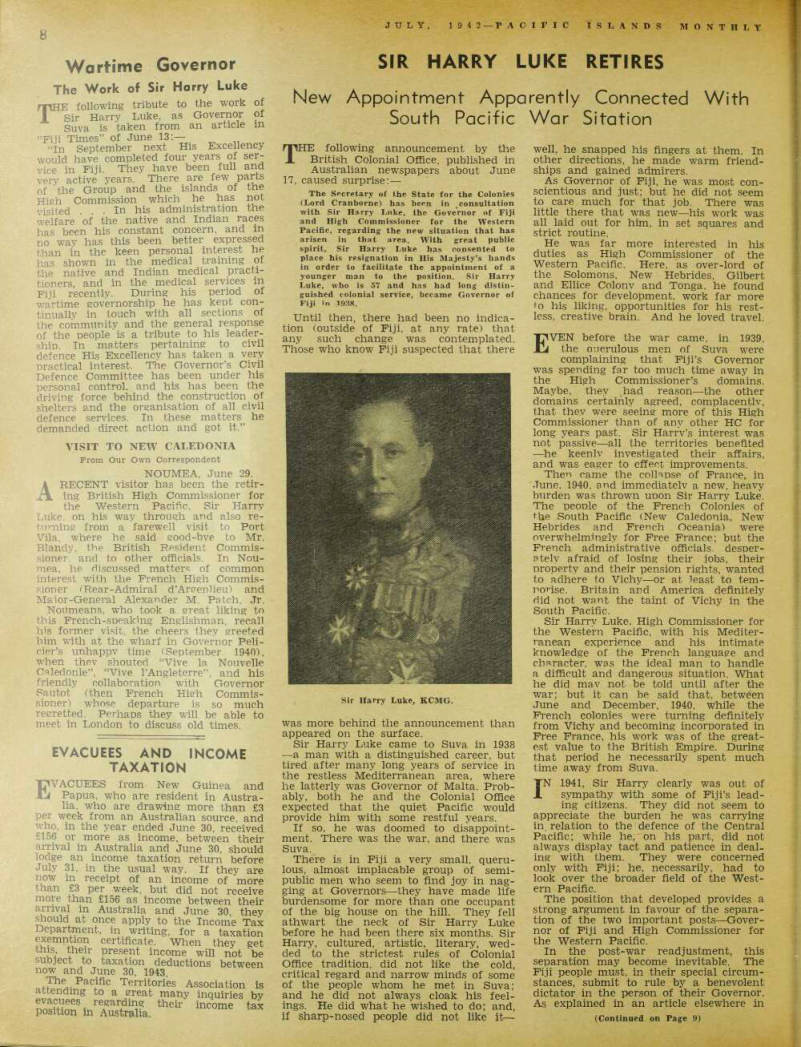
Sir Harry Luke, KCMG.
this issue, they cannot expect represen tative government. Therefore, they want all the time and thought their Governor can give them.
If their Governor is preoccupied with Fiji, the territories of the Western Paci fic feel themselves neglected, and howl accordingly. If the man at Suva gives over-much attention to the affairs of the Western Pacific Commission, as Sir Harry Luke has done, the people of Suva are aggrieved, and complain to White hall.
Some such complaint to the British Colonial Office was formulated in Fiji early in 1942—a petition, it was called, although not numerously signed—but we are not sure that it actually was sent to London. It is probable that at least some echoes of it reached Whitehall.
BUT, probably, the circumstances
which rendered Sir Harry Luke’s position so difficult, as indicated by the British Colonial Office announce ment quoted above, arose out of the Pacific war.
Prior to December. 1941, defence mea sures in the South Pacific were of such a character that they easily could be controlled by the civil and military authorities, acting in concert. The entry of Japan altered all that.
At once (and up until the present) the problem of defence overtopped all others, civil or military; and, as the months passed, more and more authority was passed over to the heads of the fighting services. Inevitably, conflict (not neces sarily unfriendly) developed between civil administrator and service commanders — just as happened in Papua and New Caledonia —and, of necessity, the civil authority had to step aside.
In April, a leading New Zealand newspaper directed attention to the diffi culty of Sir Harry Luke’s position, in relation to New Zealand military author ity, British naval authority, and, now, the increasing appearance in the Pacific of the sea, land and air forces of the United States.
It was obvious that, as the Allies in the Pacific pass from the defensive to the offensive, the position of the civil head of the territories of Fiji, Solomons, Tonga, New Hebrides and Gilbert and Ellice Colony will become more and more difficult.
It is clear from Whitehall’s announce ment, and from the character of the new appointment (Major-General Sir Philip Mitchell, lately Political Officer attached to the staff of General Sir Archibald Wavell) that these latter considerations have weighed heavily in London.
It may be taken as certain that the new Governor and High Commissioner
for the Western Pacific will be more concerned with defensive and offensive operations, for the period of the war, than with civil administration. It may be expected, also, that a gentleman of Sir Philip Mitchell’s experience will not hesitate to lay a heavy hand upon Suva’s querulous minority—that is, if the lat ter are short-sighted enough to imagine that their petty grievances are to occupy much official attention in wartime.
Meanwhile, Sir Harry Luke departs gracefully, and his many friends in the South Pacific —especially the men of the public services, who accorded him always their esteem and regard—will hope that, before he_ enters “the retireful sixties’’, he will have opportunities of rendering more Imperial service, as valuable as that which he gave in the South Seas.
Major-General Sir Philip Mitchell
THERE is not much information avail able here about the new Governor and' High Commissioner, Major- General Sir Philip Euen Mitchell, KCMG, MC. The reference books show that he was born on May 1, 1890, and therefore is just 52 years old. He is married, and without children. He is a graduate of Oxford, and he entered the Colonial Ser vice as Assistant-Resident, Nyasaland, in 1912. He served in the King’s African Rifles in the First Great War, and fin ished with a captaincy and the Military Cross. He went back to Nyasaland as ADC and private secretary to the Gov ernor, and went to Tanganyika Territory as Political Officer in 1919. He remained several years in the Territory, filling various important posts, and by 1934 he was Chief Secretary. In 1935 he was appointed Governor and Commander-in- Chief in Uganda, and he became KCMG in 1937.
After the commencement of the cam paign in East Africa (late in 1940) he was appointed Chief Political Officer on the staff of the General Officer Com manding-in-Chief; and, subsequently, as Chief Political Officer, he was closely associated with General Wavell —although it is not clear whether he went with General Wavell to India, Singapore and the East Indies. If he did, it is easy to see a connection between his experience there and his present appointment.
One wandering writer who met Sir Philip Mitchell in Uganda before 1939 gives a description of him which would indicate that he is a vigorous man of strong personality, who is not much con cerned with “fuss and flummery”—who quickly knows what he wants, and pro ceeds quickly to get it.
Mrs. Patience E. Waters, formerly a well-known resident of Suva, Fiji, died at Rotorua, NZ, recently, at the age of 86.
Rev. H. M. Bell, Presbyterian mission ary of Paama, New Hebrides, was in Sydney last month awaiting steamer connection for Vila. It is understood that Mrs. Bell is remaining in Australia.
Pilot-Officer E. E. Nicholls, RAF, who was given his “wings” and commission in May, after being trained in Southern Rhodesia, is a son of Mr. and Mrs. H.
Warne Nicholls, of Nadroga, Fiji.
Mr. C. R. F. Workman, CBE, who was in charge of the Australian expedition which took possession of Nauru in the last war, died in London on July 3. Mr.
Workman qualified as a barrister in 1900.
He was appointed Administrator in Nauru in 1914, Resident Commissioner in the Solomon Islands in 1917, and was Colonial Secretary of Gambia (West Africa) from 1921 to 1931.
Suva Ready
Extensive Preparations Against Attack
(Published Recently in “New Zealand Herald”) JUDGING by practical tests recently carried out, civil defence measures adopted in Fiji, and particularly in Suva, can be considered most satisfac tory.
In the capital, a large population of mixed races presented the biggest prob lem. Efforts are being made continually to disperse the population to other parts.
This applies particularly to the Fijians, who always retain a connection with the village from which they came, and to which they can always return.
The evacuation of Indians is more of a problem, but with the co-operation of Indian communities in other parts of Fiji arrangements have been made for the evacuation of many of these people from Suva if the necessity arises.
Suva is particularly fortunate in hav ing a foundation of a clay substance, locally called soapstone, which lends itself admirably to tunnelling. It is a particularly tough substance and it is general considered by those with mining experience that it would have high resistance to bomb penetration.
Full advantage has been taken of this material, and a considerable amount of tunnelling has been done around the town. In addition to the large public shelters, all residents who have suitable sites on their properties have constructed their own underground shelters. Some are equipped with electric light (which is standard equipment in all public shel ters), and are well furnished, including tables, chairs, decanter and glassware.
Tests that have been made have proved that the organisation of wardens, first aid posts, auxiliary fire services and demolition squads has functioned well.
Eruptions, Etc.
But None in Japan
JAPAN is right in the middle of the world’s worst earthquake belt; but, just at the time when an outsize in earthquakes, in the Japanese archipelago, would be of the greatest possible service to humanity, nothing happens there.
Instead, by the irony of fate, there are eruptions in Hawaii, and a very severe earthquake in the North Island of New Zealand.
Mauna Loa volcano, in Hawaii, ex ploded on April 26, and then displayed its greatest activity since 1881. A great mass of lava flowed slowly towards the large town of Hilo. When it was only eight miles away, US Army planes attacked it with bombs. The flow was diverted and the town saved.
The NZ ’qua,ke, in June, caused enor mous damage in the Wairarapa Valley.
Masterton town was apparently at the centre, and Masterton virtually was wiped out.
Indirect reports indicate that Matupi —the volcano that overhangs Rabaul to the southwards—has been playing up again, ejecting vast clouds of dust and intolerable gases. One hopes this is cor rect. It would be pleasant to think that the Sons of Heaven, in Rabaul, were enduring for a few weeks what the Rabaul folk had to put up with for years.
Advertisements & other items, p. 11 (2 items)
9
PACIFIC ISLANDS MONTHLY JULY, 1942
SIR HARRY LUKE—Continued from Previous Page
Vj&Ssv
Jffc aurf afford Afor/o save-
JSJnATIONAL
fJJj SAVINGS
-* BONDS'^
Six Men On
A Launch
How They Escaped From the Sepik to Pt. Moresby
rIS is the plain story of “Nifty’
Nixon, an Australian gold-prospec tor from the Upper Sepik River, New Guinea, who has arrived in Austra lia. , With five others, on a 30-ft. launch, navigating by guess and by God, they somehow dodged the patrolling Japs, and crept from the mouth of the Sepik right around the coasts of New Guinea and Papua, to Port Moresby.
Tribute must be paid to the launch -30 ft. long, 10 ft. beam, equipped with a 10 h.p. Frisco Standard motor-engme that was no less than 27 years old. She once was a cabin cruiser, well-known in Sydney Harbour. Her maximum speed was five miles per hour—but the engine kept on going. Six men, whom it prob ably saved from the Japs, saluted it in sound Australian beer before they said farewell to it in Port Moresby.
It was decided, late in January, to evacuate all Europeans from the Wewak area, and instructions were given that the miners along the Sepik should con centrate at Yimas, 300 miles up the Sepik. On January 25, a party consist ing of Messrs. Ruse, Shaw. Scannell, Simcocks, Power, Spencer, Malicki and Haynes left Wewak for the Sepik on a small vessel. They entered the great river at daybreak, and then proceeded to Marienberg, Angoram, Kambrindo, Tum bungu, mouth of Karawari, Masamei, and Yimas, where they arrived on February 1.
Within the next few days, Messrs. V.
R. Nixon (“Nifty”), Harold Hindwood, Taylor, Cook, Lang, and Mason came in from the Avatip goldfield, and Messrs.
Atkinson, Cecil, Moody, Petterson, White and Roy MacGregor from other places.
Hindwood and Mason left for Awim, up river, to build another camp, but were driven back by floods.
A little later, Messrs. Thurston, Keogh, Gallin, Broadbent, McConnell, and Hun ter-Kirke came in to Yimas from down river and Marui; and, on February 13, Messrs. Simcocks, Shaw, Hunter-Kirke, Cook. Keogh and Macgregor set off for Angoram to arrange transport. Two days later, Messrs. Rouse. Nixon, Scan nell, Power, Spencer, Malicki and Haynes took a chance of getting down to Angoram, where they arrived on Feb ruary 17.
It is noted in “Nifty” Nixon’s diary that additional men who had gathered at Angoram included Charles Reason, Tex Archer, Johnny Young, Len Bridger, Len Odges, Roy Smith, Dr. Schroeder, Father Luttner, Ben Hall, and Jack West.
There seemed to be a good deal of confusion regarding transport, and urgent messages were being sent to the DO. The waiting men were disturbed to learn that all suitable vessels from the Wewak area were being sent at once to Madang—far to the eastwards—instead of to the Sepik for the evacuation.
Messrs. Shaw, Cook, Hunter-Kirke and Keogh went down-stream with Johnny Young to catch a boat to Madang.
Voyage Commences
pINALLY, on February 19, Nixon and r^c. Co ™F^ n^ s . made arrange ments with Charlie Reason to set away on the latter’s 30-fee? launlh.
They packed that night and they got away from Angoram at dawn next morn ing. By February 22, they had got down to Simbini, near the mouth of the Sepik, and there they waited a day for Mr.
Geoff. Luff. On February 24 they set off on their remarkable voyage. The party now comprised:— Charles Reason, plantation manager, New Guinea Estates.
C. M. Rouse, planter, from Nubia, Sepik River.
Tom Spencer, plantation manager for Burns, Philp and Co„ Boram.
E. W. Haynes, ground engineer for Parer’s Airways, Wewak.
Geoff. Luff, planter, Sepik River.
Victor R. Nixon, miner, Upper Sepik.
On the 25th, they were at Sek (near Madang), and next day they were at Erimahaven, where they met Roy Mac gregor, Roy Hart and A. Anthony, aboard another vessel. The next day, in this place, they met Father Glover, Nor man Johnson and Karl Nagy, who had come down from the Ramu to remove a plane from the mission-station at Sek.
Across Huon Gulf
BY March 3, the little launch was round the corner of New Guinea mainland, and heading southwards towards Finschhafen.
This day, at Busaga, they met “Blue”
Harris and seven Australian soldiers who had somehow escaped from the Japs in New Britain and crossed to Finschhafen.
These lads were in a pretty bad way, from lack of food. They learned, for the first time, from the experienced men on the launch, that taro is a good vege table food!
They could not be accommodated on the launch, so they were left at Finsch hafen —and the Japanese occupied the place three days later. The fate of the soldiers is unknown.
Hurry—hurry—was the motto on the launch, and how wise it was! As it proved, the Japs were only two days behind them. If they had lingered, they would have been caught in Huon Gulf.
At 9 p.m., they left Busaga, and ran straight across Huon Gulf, leaving Lae and Salamaua, far up the gulf, on their right; and by noon of the following day they were safely in the little port of Morobe, south-east of Salamaua.
Japanese planes and patrol vessels were all'about, preparing for their land ing at Salamaua and Lae, which took place on March 8.
The voyagers did not waste time. On the afternoon and night of March 4 they slept and ate in Morobe, and at dawn on March 5 they were on their way.
They looked in at the Mambare River Mission, and saw the Rev. S. M. R. Gill there; but that night they anchored in Yoga. On March 6 they w r ere in Buna, where they met Mr. Champion, ARM, Mr. Duffield (captain of the mission schooner), and others. By March 9 they were at Tuff (Cape Nelson) where they met another ARM, Mr. Anderson, and next day they reached the Mukawa Mis sion, where they were hospitably received by Rev. Clark, Miss Kent and Mac Rich.
“We had good kaikai and a good bath,” remarks the diary.
In Ruined Samarai
NEXT_ day, March 11, they got to the Dogura Mission, where Bishop New ton, Rev. Thompson and Dr. White house treated them well. But they pushed on again that night, and by noon they were in ruined Samarai.
They reported that all the business portion of Samarai —stores, hotels, main street buildings generally had been smashed by Japanese bombs; but most
of the residences, further around the island, and on the hill, were undamaged.
There was not a soul on the island—that which not long ago was a busy little commercial ana shipping centre, and one oi the most beautiful places in me South Seas, was now a ghost town. Tne launch anchored off Duncan Campbell’s place, and they met Keith Gnbben and two others there.
The next day they left at daybreak— but had to return to Samarai owmg to bad weather. Then they noticed that the date was Friday, the 13th!
The remainder of the run westwards was uneventful—Fyfe Bay—Mogubu— Aoau—Otamato—Rigo—and the long desired Port Moresby at 5 p.m. on March 19.
Within a few days, the six men were on their way to Australia.
Conditions On The Launch
mHE launch was not dependant entirely X on the engine—there was a small mainsail and jib, which were used whenever possible. But the engine was the mainstay; and it was the especial care of Mr. Haynes. He studied it, lived with it, nursed it—and it brought them through. Once or twice, on long runs, it faltered —but always Haynes got it back to health again, and it did its job nobly.
Fuel was a problem, of course—but they picked up petrol wherever they could find it—and they had quite a quan tity aboard when they reached Port Moresby. They were prepared to go across the Gulf of Papua to Cape York and down the Australian coast to civili sation—but it was not necessary.
There was a four-bunk cabin on the launch, but it was filled with supplies, and the luggage of the escaping men.
They slept in the cockpit, and on the top of the launch. They nearly always contrived to find an anchorage for the night, and slept quietly, and they always were off with the first streak of dawn.
They were handicapped by lack of a chart.
“How about food supplies?” we asked “Nifty”.
“We had plenty of tinned stuff,” he said. “We were never hungry.”
“Cooking?” we asked.
“Nifty” wriggled uncomfortably. “We had a little galley,” he said. “Luff was cook. Good chap, Geoff. He’d be a good cook, too, in time. We usually had breakfast about 4 p.m. We got awful sick of tinned tack. We always had a line out, and we got a lot of fish —ate so much damned fish that we began to look like it.”
Although packed together under mis erable conditions, the six men spent four weeks together without a quarrel—with out even one angry word.
On the day they were anchored in Erimahaven, they saw the Japanese planes, far away, bombing Madang; but otherwise they did not sight the enemy.
Enemy planes evidently were near them, on a number of occasions, but they did not hear them, owing to the noise of the engine. Later, at the anchorages, the natives told them the planes had been over.
Pilot-Officer George Beilby Evans, RAAF, son of Mr. and Mrs. Beilby Evans, formerly of Buka Passage, New Guinea, has been reported a prisoner of war in Batavia (Java). He was previously reported missing, believed prisoner of war. He lived in New Guinea for 10 years before he won a scholarship to Brisbane Grammar School, in 1932. He is a member of the staff of the Union Bank of Australia and joined the RAAF in 1939.
New Hebrides Man And Wife In The Services
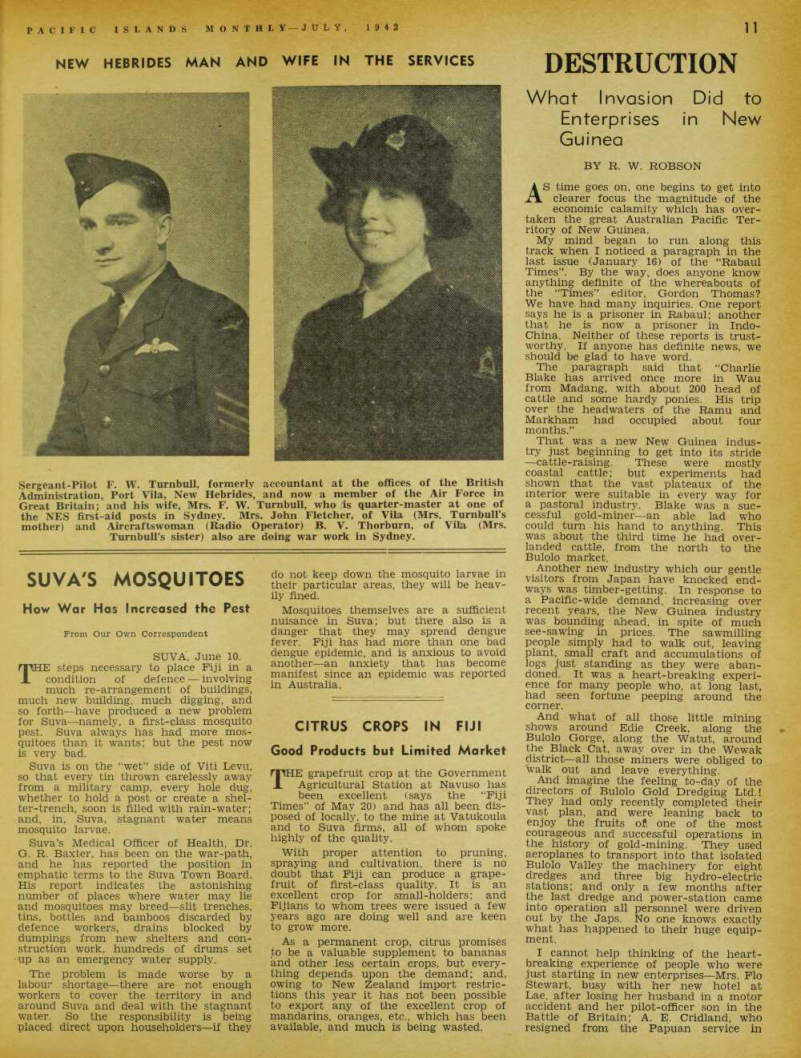
Sergeant-Pilot F. W. Turnbull, formerly accountant at the offices of the British Administration, Port Vila, New Hebrides, and now a member of the Air Force in Great Britain; and his wife, Mrs. F. W. Turnbull, who is quarter-master at one of the NFS first-aid posts in Sydney. Mrs. John Fletcher, of Vila (Mrs. Turnbull’s mother) and Aircraftswoman (Radio Operator) B. V. Thorburn, of Vila (Mrs.
Turnbull’s sister) also are doing war work in Sydney.
Suva's Mosquitoes
How War Has Increased the Pest
Prom Our Own Correspondent SUVA, June 10. rE steps necessary to place Fiji in a condition of defence involving much re-arrangement of buildings, much new building, much digging, and so forth —have produced a new problem for Suva —namely, a first-class mosquito pest. Suva always has had more mos quitoes than it wants; but the pest now is very bad.
Suva is on the “wet” side of Viti Levu, so that every tin thrown carelessly away from a military camp, every hole dug, whether to hold a post or create a shel ter-trench, soon is filled with rain-water; and, in, Suva, stagnant water means mosquito larvae.
Suva’s Medical Officer of Health, Dr.
G. R. Baxter, has been on the war-path, and he has reported the position in emphatic terms to the Suva Town Board, His report indicates the astonishing number of places where water may lie and mosquitoes may breed —slit trenches, tins, bottles and bamboos discarded by defence workers, drains blocked by dumpings from new shelters and con struction work, hundreds of drums set up as an emergency water supply.
The problem is made worse by a labour shortage—there are not enough workers to cover the territory in and around Suva and deal with the stagnant water. So the responsibility is being placed direct upon householders—if they
do not keep down the mosquito larvae in their particular areas, they will be heav ily fined.
Mosquitoes themselves are a sufficient nuisance in Suva; but there also is a danger that they may spread dengue fever. Fiji has had more than one bad dengue epidemic, and is anxious to avoid another—an anxiety that has become manifest since an epidemic was reported in Australia.
Citrus Crops In Fiji
Good Products but Limited Market
THE grapefruit crop at the Government Agricultural Station at Navuso has been excellent (says the “Fiji Times” of May 20) and has all been dis posed of locally, to the mine at Vatukoula and to Suva firms, all of whom spoke highly of the quality.
With proper attention to pruning, spraying and cultivation, there is no doubt that Fiji can produce a grape fruit of first-class quality. It is an excellent crop for small-holders; and Fijians to whom trees were issued a few years ago are doing well and are keen to grow more.
As a permanent crop, citrus promises to be a valuable supplement to bananas "and other less certain crops, but every thing depends upon the demand; and, owing to New Zealand import restric tions this year it has not been possible to export any of the excellent crop of mandarins, oranges, etc., which has been available, and much is being wasted.
Destruction
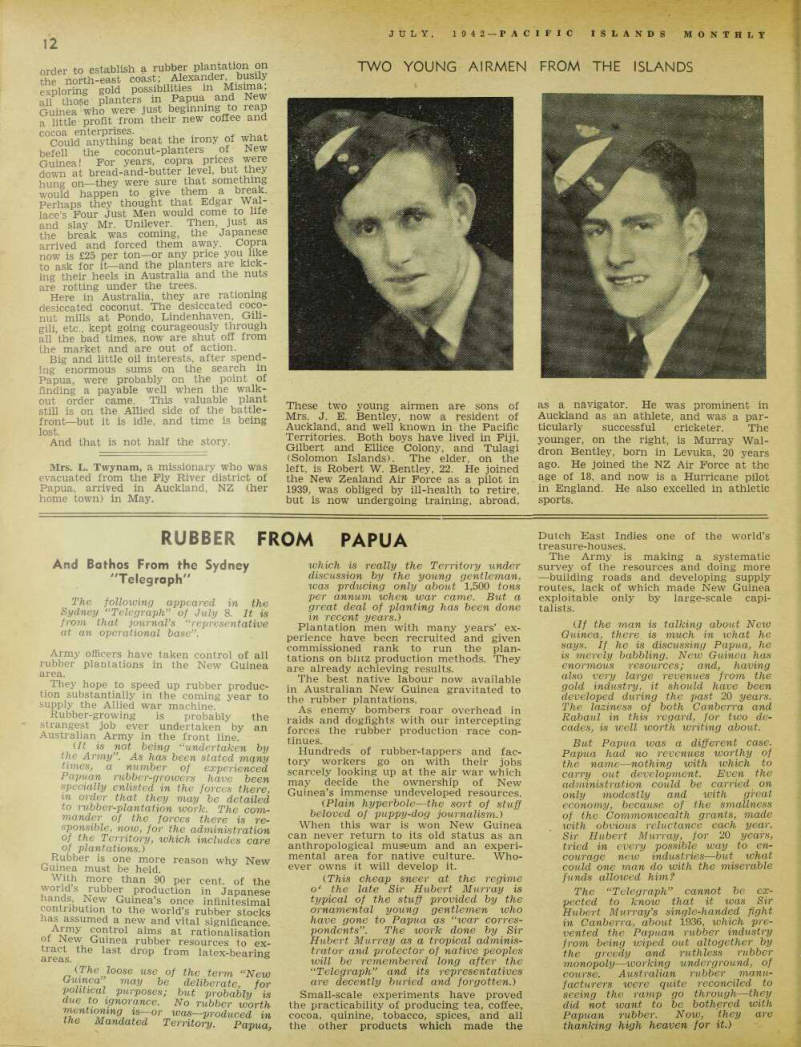
What Invasion Did to Enterprises in New Guinea
By R. W. Robson
AS time goes on, one begins to get into clearer focus the ‘magnitude of the economic calamity which has over taken the great Australian Pacific Ter ritory of New Guinea.
My mind began to run along this track when I noticed a paragraph in the last issue (January 16) of the “Rabaul Times”. By the way, does anyone know anything definite of the whereabouts of the “Times” editor, Gordon Thomas?
We have had many inquiries. One report says he is a prisoner in Rabaul; another that he is now a prisoner in Indo china. Neither of these reports is trust worthy. If anyone has definite news, we should be glad to have word.
The paragraph said that “Charlie Blake has arrived once more in Wau from Madang, with about 200 head of cattle and some hardy ponies. His trip over the headwaters of the Ramu and Markham had occupied about four months.”
That was a new New Guinea indus try just beginning to get into its stride —cattle-raising. These were mostly coastal cattle; but experiments had shown that the vast plateaux of the interior were suitable in every way for a pastoral industry. Blake was a suc cessful gold-miner—an able lad who could turn his hand to anything. This was about the third time he had over landed cattle, from the north to the Bulolo market.
Another new industry which our gentle visitors from Japan have knocked end ways was timber-getting. In response to a Pacific-wide demand, increasing over recent years, the New Guinea industry was bounding ahead, in spite of much see-sawing in prices. The sawmilling people simply had to walk out, leaving plant, small craft and accumulations of logs just standing as they were aban doned. It was a heart-breaking experi ence for many people who, at long last, had seen fortune peeping around the corner.
And what of all those little mining shows around Edie Creek, along the Bulolo Gorge, along the Watut, around the Black Cat, away over in the Wewak district—all those miners were obliged to walk out and leave everything.
And imagine the feeling to-day of the directors of Bulolo Gold Dredging Ltd.!
They had only recently completed their vast plan, and were leaning back to enjoy the fruits ofl one of the most courageous and successful operations in the history of gold-mining. They used aeroplanes to transport into that isolated Bulolo Valley the machinery for eight dredges and three big hydro-electric stations; and only a few months after the last dredge and power-station came into operation all personnel were driven out by the Japs. No one knows exactly what has happened to their huge equip ment.
I cannot help thinking of the heart breaking experience of people who were just starting in new enterprises—Mrs. Flo Stewart, busy with her new hotel at Lae, after losing her husband in a motor accident and her pilot-officer son in the Battle of Britain; A. E. Cridland, who resigned from the Papuan service in
order to establish a rubber plantation on the north-east coast; Alexander, busily
exploring gold possibilities Misima,
all those planters in Papua and New Guinea who were just beginning to reap a little profit from their new coffee and cocoa enterprises. . , .
Could anything beat the irony of what befell the coconut-planters of New Guinea! For years, copra prices were down at bread-and-butter level, but they hung on —they were sure that something would happen to give them a break.
Perhaps they thought that Edgar Wal lace’s Four Just Men would come to life and slay Mr. Unilever. Then, just as the break was coming, the Japanese arrived and forced them away. Copra now is £25 per ton—or any price you like to ask for it—and the planters are kick ing their heels in Australia and the nuts are rotting under the trees.
Here in Australia, they are rationing desiccated coconut. The desiccated coco nut mills at Pondo, Lindenhaven, Gili gili, etc., kept going courageously through all the bad times, now are shut off from the market and are out of action.
Big and little oil interests, after spend ing enormous sums on the search in Papua, were probably on the point of finding a payable well when the walk out order came. This valuable plant still is on the Allied side of the battle front —but it is idle, and time is being lost.
And that is not half the story.
Mrs. L. Twynam, a missionary who was evacuated from the Fly River district of Papua, arrived in Auckland, NZ (her home town) in May.
Two Young Airmen From The Islands
These two young airmen are sons of Mrs. J. E. Bentley, now a resident of Auckland, and well known in the Pacific Territories. Both boys have lived in Fiji, Gilbert and Ellice Colony, and Tulagi (Solomon Islands). The elder, on the left, is Robert W. Bentley, 22. He joined the New Zealand Air Force as a pilot in 1939, was obliged by ill-health to retire, but is now undergoing training, abroad,
as a navigator. He was prominent in Auckland as an athlete, and was a par ticularly successful cricketer. The younger, on the right, is Murray Wal dron Bentley, bom in Levuka, 20 years ago. He joined the NZ Air Force at the age of 18, and now is a Hurricane pilot in England. He also excelled in athletic sports.
Rubber From Papua
And Bathos From the Sydney "Telegraph"
The following appeared in the Sydney “Telegraph” of July 8. It is from that journal’s “representative at an operational base”.
Army officers have taken control of all rubber plantations in the New Guinea area.
They hope to speed up rubber produc tion substantially in the coming year to supply the Allied war machine.
Rubber-growing is probably the strangest job ever undertaken by an Australian Army in the front line. (It is not being “undertaken by the Army”. As has been stated many times, a number of experienced Papuan rubber-growers have been specially enlisted in the forces there, in order that they may be detailed to rubber-plantation work. The com mander of the forces there is re sponsible, now, for the administration of the Territory, which includes care of plantations.) Rubber is one more reason why New Guinea must be held.
With more than 90 per cent, of the world’s rubber production in Japanese hands. New Guinea’s once infinitesimal contribution to the world’s rubber stocks has assumed a new and vital significance.
Army control aims at rationalisation of New Guinea rubber resources to ex tract the last drop from latex-bearing areas. (The loose use of the .term “New Guinea” may be deliberate, for political purposes; but probably is due to ignorance. No rubber worth mentioning is —or was—produced in the Mandated Territory. Papua,
which is really the Territory under discussion by the young gentleman, was prducing only about 1,500 tons per annum when war came. But a great deal of planting has been done in recent years.) Plantation men with many years’ ex perience have been recruited and given commissioned rank to run the plan tations on blnz production methods. They are already achieving results.
The best native labour now available in Australian New Guinea gravitated to the rubber plantations.
As enemy bombers roar overhead in raids and dogfights with our intercepting forces the rubber production race con tinues.
Hundreds of rubber-tappers and fac tory workers go on with their jobs scarcely looking up at the air war which may decide the ownership of New Guinea’s immense undeveloped resources. (Plain hyperbole—the sort of stuff beloved of puppy-dog journalism.) When this war is won New Guinea can never return to its old status as an anthropological museum and an experi mental area for native culture. Who ever owns it will develop it. (This cheap sneer at the regime o f the late Sir Hubert Murray is typical of the stuff provided by the ornamental young gentlemen who have gone to Papua as “war corres pondents”. The work done by Sir Hubert Murray as a tropical adminis trator and protector of native peoples will be remembered long after the “Telegraph” and its representatives are decently buried and forgotten.) Small-scale experiments have proved the practicability of producing tea, coffee, cocoa, quinine, tobacco, spices, and all the other products which made the
Dutch East Indies one of the world’s treasure-houses.
The Army is making a systematic survey of the resources and doing more —building roads and developing supply routes, lack of which made New Guinea exploitable only by large-scale capi talists. (If the man is talking about New Guinea, there is much in what he says. If he is discussing Papua, he is merely babbling. New Guinea has enormous resources; and, having also very large revenues from the gold industry, it should have been developed during the past 20 years.
The laziness of both Canberra and Rabaul in this regard, for two de cades, is well worth writing about.
But Papua was a different case.
Papua had no revenues worthy of the name —nothing with which to carry out development. Even the administration could be carried on only modestly and with great economy, because of the smallness of the Commonwealth grants, made with obvious reluctance each year.
Sir Hubert Murray, for 20 years, tried in every possible way to en courage new industries —but what could one man do with the miserable funds allowed him?
The “Telegraph” cannot be ex pected to know that it was Sir Hubert Murray’s single-handed fight in Canberra, about 1936, which pre vented the Papuan rubber industry from being wiped out altogether by the greedy and ruthless rubber monopoly—working underground, of course. Australian rubber manu facturers were quite reconciled to seeing the ramp go through —they did not want to be bothered with Papuan rubber. Now, they are thanking high heaven for it.)
Value Of New Caledonia
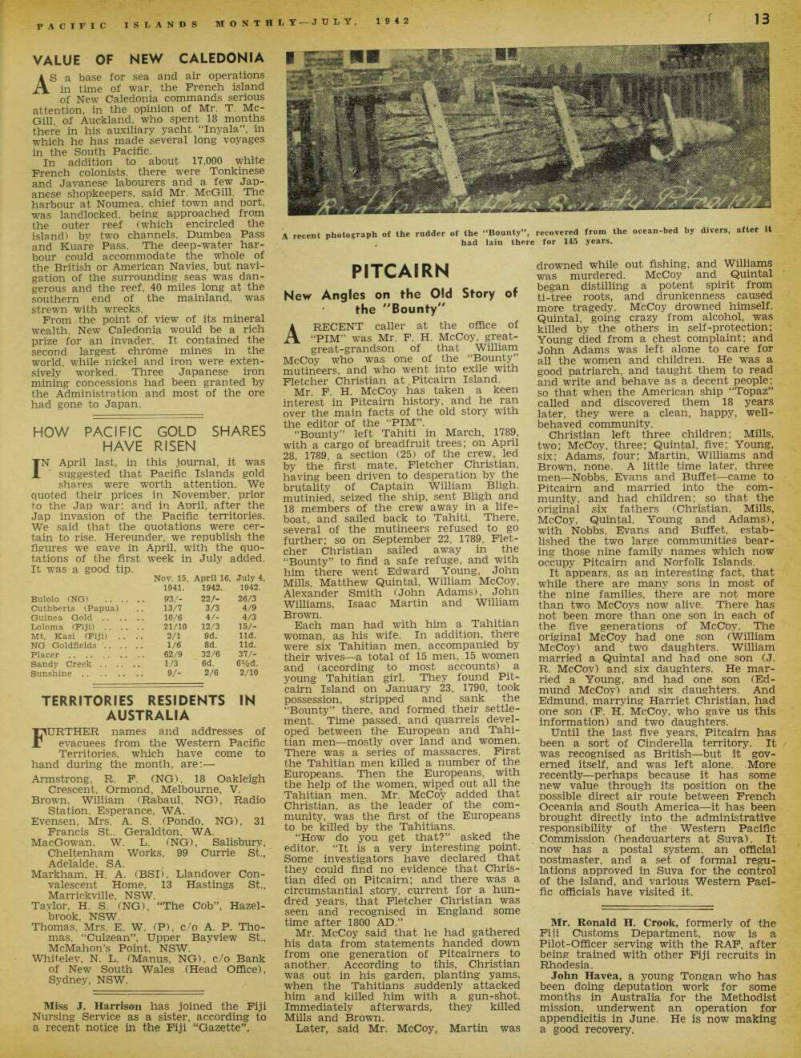
AS a base for sea and air operations in time of war, the French island of New Caledonia commands serious attention, in the opinion of Mr. T. Mc- Gill. of Auckland, who spent 18 months there in his auxiliary yacht “Inyala”, in which he has made several long voyages in the South Pacific.
In addition to about 17,000 white French colonists, there were Tonkinese and Javanese labourers and a few Jap anese shopkeepers, said Mr. McGill. The harbour at Noumea, chief town and port, was landlocked, being approached from the outer reef (which encircled the island) bv two channels. Dumbea Pass and Kuafe Pass. The deep-water har bour could accommodate the whole of the British or American Navies, but navi gation of the surrounding seas was dan gerous and the reef, 40 miles long at the southern end of the mainland, was strewn with wrecks.
From the point of view of its mineral wealth. New Caledonia would be a rich prize for an invader. It contained the second largest chrome mines in the world, while nickel and iron were exten sively worked. Three Japanese iron mining concessions had been granted by the Administration and most of the ore had gone to Japan.
How Pacific Gold Shares
Have Risen
IN April last, in this journal, it was suggested that Pacific Islands gold shares were worth attention. We quoted their prices in November, prior to the Jap war: and in Anril, after the Jap invasion of the Pacific territories.
We said that the quotations were cer tain to rise. Hereunder, we republish the figures we save in April, with the quo tations of the first week in July added.
It was a good tip.
Nov. 15, April 16.
July 4, 1941. 1942. 1942.
Bulolo (NG> .. .. 93/- 22/- 26/3 Cuthberts (Papual 13/7 3/3 4/9 Guinea Gold .. .. 10/6 4/- 4/3 Loloma (Fiji) . . .. 21/10 12/3 15/- Mt. Kasi (Fiji) 2/1 9d. lld.
NG Goldfields .. .. 1/6 8d. lid.
Placer 62/9 32/6 37/- Sandy Creek .. 1/3 6d. 6V 2 d.
Sunshine 9/- 2/6 2/10
Territories Residents In
Australia
FURTHER names and addresses of evacuees from the Western Pacific Territories, which have come to hand during the month, are:— Armstrong, R. F. (NG), 18 Oakleigh Crescent. Ormond, Melbourne, V.
Brown, William (Rabaul, NG), Radio Station. Esperance, WA.
Evensen, Mrs. A. S. (Pondo, NG), 31 Francis St., Geraldton, WA.
MacGowan, W. L. (NG), Salisbury, Cheltenham Works, 99 Currie St., Adelaide. SA.
Markham, H. A. (BSD, Llandover Con valescent Home, 13 Hastings St., Marrickville, NSW.
Tavlor, H. S. (NG), “The Cob”, Hazel brook, NSW.
Thomas, Mrs. E. W. (P), c/o A. P. Tho mas. “Culzean”, Upper Bayview St., McMahon’s Point, NSW.
Whitelev, N. L. (Manus, NG), c/o Bank of New South Wales (Head Office), Sydney, NSW.
Miss J. Harrison has joined the Fiji Nursing Service as a sister, according to a recent notice in the Fiji “Gazette”.
A recent photograph of the rudder of the “Bounty”, recovered from the ocean-bed by divers, after it had lain there for 145 years.
Pitcairn
New Angles on the Old Story of the "Bounty"
A RECENT caller at the office of “PIM" was Mr. F. H. McCoy, great great-grandson of that William McCoy who was one of the “Bounty” mutineers, and who went into exile with Fletcher Christian at Pitcairn Island.
Mr. F. H. McCoy has taken a keen interest in Pitcairn history, and he ran over the main facts of the old story with the editor of the “PIM”.
“Bounty” left Tahiti in March, 1789, with a cargo of breadfruit trees; on April 28, 1789, a section (25) of the crew, led by the first mate, Fletcher Christian, having been driven to desperation by the brutality of Captain William Bligh, mutinied, seized the ship, sent Bligh and 18 members of the crew away in a life boat, and sailed back to Tahiti. There, several of the mutineers refused to go further: so on September 22, 1789, Flet cher Christian sailed away in the “Bounty” to find a safe refuge, and with him there went Edward Young, John Mills, Matthew Quintal, William McCoy, Alexander Smith (John Adams), John Williams, Isaac Martin and William Brown.
Each man had with him a Tahitian woman, as his wife. In addition, there were six Tahitian men, accompanied by their wives—a total of 15 men, 15 women and (according to most accounts) a young Tahitian girl. They found Pit cairn Island on January 23, 1790, took possession, stripped and sank the “Bounty” there, and formed their settle ment. Time passed, and quarrels devel oped between the European and Tahi tian men—mostly over land and women.
There was a series of massacres. First the Tahitian men killed a number of the Europeans. Then the Europeans, with the help of the women, wiped out all the Tahitian men. Mr. McCoy added that Christian, as the leader of the com munity, was the first of the Europeans to be killed by the Tahitians.
“How do you get that?” asked the editor. “It is a very interesting point.
Some investigators have declared that they could find no evidence that Chris tian died on Pitcairn; and there was a circumstantial story, current for a hun dred years, that Fletcher Christian was seen and recognised in England some time after 1800 AD.”
Mr. McCoy said that he had gathered his data from statements handed down from one generation of Pitcairners to another. According to this, Christian was out in his garden, planting yams, when the Tahitians suddenly attacked him and killed him with a gun-shot.
Immediately afterwards, they killed Mills and Brown.
Later, said Mr. McCoy, Martin was
drowned while out fishing, and Williams was murdered. McCoy and Quintal began distilling a potent spirit from ti-tree roots, and drunkenness caused more tragedy. McCoy drowned himself.
Quintal, going crazy from alcohol, was killed by the others in self-protection; Young died from a chest complaint; and John Adams was left alone to care for all the women and children. He was a good patriarch, and taught them to read and write and behave as a decent people; so that when the American ship “Topaz” called and discovered them 18 years later, they were a clean, happy, well behaved community.
Christian left three children; Mills, two; McCoy, three; Quintal, five; Young, six; Adams, four; Martin, Williams and Brown, none. A little time later, three men—Nobbs, Evans and Buffet —came to Pitcairn and married into the com munity. and had children; so that the original six fathers (Christian, Mills, McCoy, Quintal, Young and Adams), with Nobbs, Evans and Buffet, estab lished the two large communities bear ing those nine family names which now occupy Pitcairn and Norfolk Islands.
It appears, as an interesting fact, that while there are many sons in most of the nine families, there are not more than two McCoys now alive. There has not been more than one son in each of the five generations of McCoy. The original McCoy had one son (William McCoy) and two daughters. William married a Quintal and had one son (J.
R. McCoy) and six daughters. He mar ried a Young, and had one son (Ed mund McCoy) and six daughters. And Edmund, marrying Harriet Christian, had one son (F. H. McCoy, who gave us this information) and two daughters.
Until the last five years, Pitcairn has been a sort of Cinderella territory. It was recognised as British—but it gov erned itself, and was left alone. More recently—perhaps because it has some new value through its position on the possible direct air route between French Oceania and South America—it has been brought directly into the administrative responsibility of the Western Pacific Commission (headauarters at Suva). It now has a postal system, an official nostmaster, and a set of formal regu lations approved in Suva for the control of the island, and various Western Paci fic officials have visited it.
Mr. Ronald H. Crook, formerly of the Fiji Customs Department, now is a Pilot-Officer serving with the RAF, after being trained with other Fiji recruits in Rhodesia.
John Havea, a young Tongan who has been doing deputation work for some months in Australia for the Methodist mission, underwent an operation for appendicitis in June. He is now making a good recovery.
Matavai, which
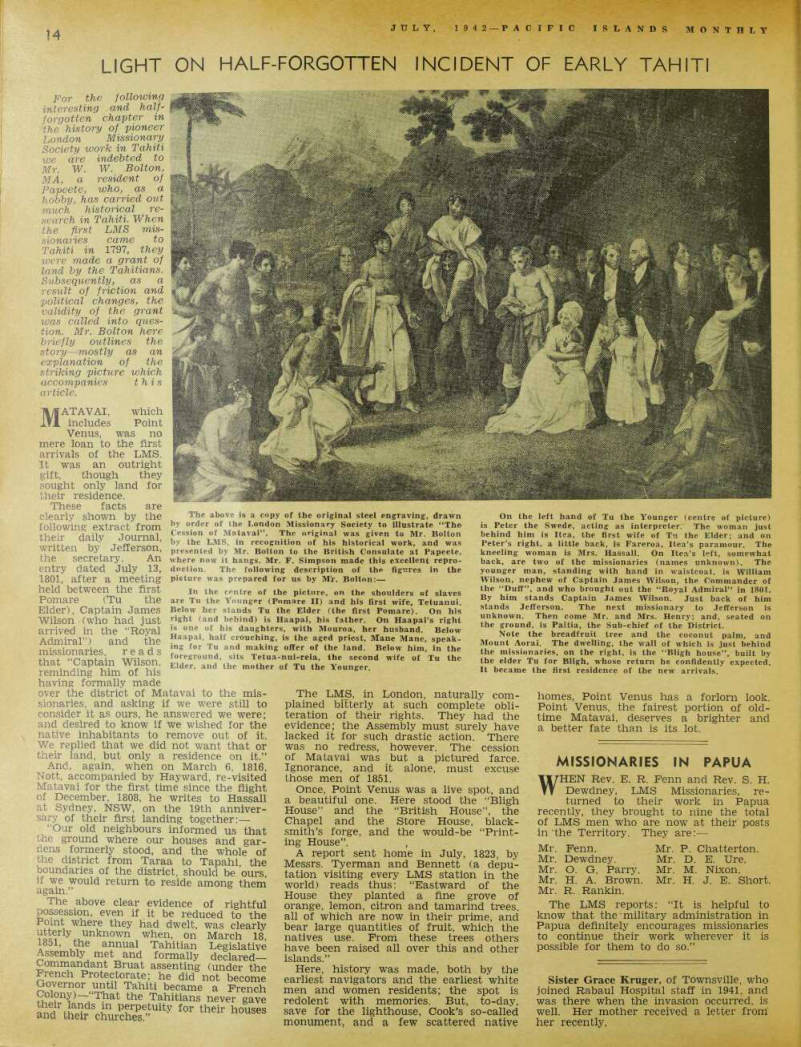
LIGHT ON HALF-FORGOTTEN INCIDENT OF EARLY TAHITI
For the following interesting and half forgotten chapter in the history of pioneer London Missionary Society work in Tahiti we are indebted to Mr. W. W. Bolton, MA, a resident of Papeete, who, as a hobby, has carried out much historical re search in Tahiti. When the first LMS mis sionaries came to Tahiti in 1797, they were made a grant of land by the Tahitians.
Subsequently, as a result of friction and political changes, the validity of the grant was called into ques tion. Mr. Bolton here briefly outlines the story—mostly as an explanation of the striking picture which accompanies this article.
Matavai, which
includes Point Venus, was no mere loan to the first arrivals of the LMS.
It was an outright gift, though they sought only land for their residence.
These facts are clearly shown by the following extract from their daily Journal, written by Jefferson, the secretary. An entry dated July 13, 1801, after a meeting held between the first Pomare (Tu the Elder), Captain James Wilson (who had just arrived in the “Royal Admiral”) and the missionaries, reads that “Captain Wilson, reminding him of his having formally made
over the district of Matavai to the mis sionaries, and asking if we were still to consider it as ours, he answered we were; and desired to know if we wished for the native inhabitants to remove out of it.
We replied that we did not want that or their land, but only a residence on it.”
And, again, when on March 6, 1816, Nott, accompanied by Hayward, re-visited Matavai for the first time since the flight of December, 1808, he writes to Hassall at Sydney, NSW, on the 19th anniver sary of their first landing together:— “Our old neighbours informed us that the ground where our houses and gar dens formerly stood, and the whole of the district from Taraa to Tapahi, the boundaries of the district, should be ours, if we would return to reside among them again.”
The above clear evidence of rightful possession, even if it be reduced to the Point where they had dwelt, was clearly VoS rly^unknown when - on March 18, 1851, the annual Tahitian Legislative Assembly met and formally declared commandant Bruat assenting (under the French Protectorate; he did not become Governor until Tahiti became a French Colony)-“That the Tahitians never gave their lands m perpetuity for their houses and their churches.”
The above is a copy of the original steel engraving, drawn by order of the London Missionary Society to illustrate “The Cession of Matavai”. The original was given to Mr. Bolton by the LMS, in recognition of his historical work, and was presented by Mr. Bolton to the British Consulate at Papeete, where now it hangs. Mr. F. Simpson made this excellent repro duction. The following description of the figures in the picture was prepared for us by ML Bolton: In the centre of the picture, on the shoulders of slaves are Tu the Younger (Pomare II) and his first wife, Tetuanui.
Below her stands Tu the Elder (the first Pomare). On his right (and behind) is Haapai, his father. On Haapai’s right is one of his daughters, with Mouroa, her husband. Below Haapai, half crouching, is the aged priest, Mane Mane, speak ing for Tu and making offer of the land. Below him. in the foreground, sits Tetua-nui-reia, the second wife of Tu the Elder, and the mother of Tu the Younger.
On the left hand of Tu the Younger (centre of picture) is Peter the Swede, acting as interpreter. The woman just behind him is Itea, the first wife of Tu the Elder; and on Peter’s right, a little back, is Fareroa, Itea’s paramour. The kneeling woman is Mrs. Hassall. On Itea’s left, somewhat back, are two of the missionaries (names unknown). The younger man, standing with hand in waistcoat, is William Wilson, nephew of Captain James Wilson, the Commander of the • Duff”, and who brought out the “Royal Admiral” in 1801.
By him stands Captain James Wilson. Just back of him stands Jefferson. Th.e next missionary to Jefferson is unknown. Then come Mr. and Mrs. Henry; and, seated on the ground, is Paitia, the Sub-chief of the District.
Note the breadfruit tree and the coconut palm, and Mount Aorai. The dwelling, the wall of which is just behind the missionaries, on the right, is the “Bligh house”, built by the elder Tu for Bligh, whose return he confidently expected.
It became the first residence of the new arrivals.
The LMS, in London, naturally com plained bitterly at such complete obli teration of their rights. They had the evidence; the Assembly must surely have lacked it for such drastic action. There was no redress, however. The cession of Matavai was but a pictured farce.
Ignorance, and it alone, must excuse those men of 1851.
Once, Point Venus was a live spot, and a beautiful one. Here stood the “Bligh House” and the “British House”, the Chapel and the Store House, black smith’s forge, and the would-be “Print ing House”. , A report sent home in July, 1823, by Messrs. Tyerman and Bennett (a depu tation visiting every LMS station in the world) reads thus: “Eastward of the House they planted a fine grove of orange, lemon, citron and tamarind trees, all of which are now in their prime, and bear large quantities of fruit, which the natives use. From these trees others have been raised all over this and other islands.”
Here, history was made, both by the earliest navigators and the earliest white men and women residents; the spot is redolent with memories. But, to-day, save for the lighthouse, Cook’s so-called monument, and a few scattered native
homes, Point Venus has a forlorn look.
Point Venus, the fairest portion of old time Matavai, deserves a brighter and a better fate than is its lot.
Missionaries In Papua
WHEN Rev. E. R. Fenn and Rev. S. H.
Dewdney, LMS Missionaries, re turned to their work in Papua recently, they brought to nine the total of LMS men who are now at their posts in'the Territory. They are:— Mr. Fenn. Mr. P. Chatterton.
Mr. Dewdney. Mr. D. E. Ure.
Mr. O. G. Parry, Mr. M. Nixon.
Mr. H. A. Brown. Mr. H. J. E. Short.
Mr. R. Rankin.
The LMS reports: “It is helpful to know that the military administration in Papua definitely encourages missionaries to continue their work wherever it is possible for them to do so.”
Sister Grace Kruger, of Townsville, who joined Rabaul Hospital staff in 1941, and was there when the invasion occurred, is well. Her mother received a letter from
her recently.
How Best To Govern Fiji
That Embarrassing Demand for Representative Government
rE time is opportune, in view of the change in the Governorship of Fiji, to make some reference to the administration of Fiji. There is no pos sibility of a change while the war goes on; but, after the war, when all the South Pacific administrations will be more or less in the melting pot, some change in Fiji’s government probably will be sought. Now is the time to think about it.
Because of close connections with Australia and New Zealand, the non official Europeans in Fiji regard their political problems from an Australian- New Zealand angle. That is wrong.
Because of the peculiar problems created by Fiji’s three watertight communities, Fiji cannot have representative govern ment after the Australian pattern.
There are in Fiji 5,000 Europeans, 100,000 Fijians and 90,000 Indians. It is a headache for the British Colonial Office, especially in relation to the recur ring demand by the Indians for a share in the Government. It is a headache for the selected Governor, who can get out of his embarrassing situation between the three communities only by blandly ignoring the principles of representative government, and assuming the authority and methods of a benevolent dictator.
In fact, it is a headache for everyone concerned. But it is none-the-less true that Fiji, under its benevolent dictators, has become one of the happiest and most prosperous territories in the Paci fic, and a shining jewel in the diadem of British Crown Colonies.
But many Europeans in Fiji insist that the present system cannot continue.
Apparently, they want to see, embodied somewhere in their constitution, their right to say Aye or Nay to the Governor.
But not one of them seems to be capable of producing a practicable plan, to show how it is to be done.
PRIOR to 1937, the Europeans had a certain measure of self-government, through the election of members to the Legislative Council. But that con stitution gave the Colony’s 5,000 Euro peans a panel in the Council out of all proportion to the panel there repre senting the Indians, of whom there were some 90,000; and so we had the Indians’ seemingly endless agitation for a “com mon roll”.
A common roll meant that European authority would have been swamped by the Indians; and the British, while genuinely anxious to accord even-handed justice to the Indians, could not permit that. Discussion, argument, and agita tion went on for years, to the great embarrassment of Whitehall.
INDIANS are citizens of the Empire, and entitled to the full rights of citizenship; but the communities do not mix. Their social conditions and ways of life are far apart. “East is East and West is West, and never the twain shall meet.”
The British found Fiji; they accepted the rich territory in trust from the Fijian chiefs; they developed it as a British colony; the welfare of the Fiji ans is their first responsibility; they could not be expected to hand it over to the descendants of the Indian peasants who came swarming in in the eighties and nineties to work the sugar-lands.
Yet (as.the Fiji Indians with increasing clamour reminded us) the Indians are citizens of the Empire, and entitled to the rights of citizenship.
At intervals of many years, two or three genuine attempts were made to give Fiji a government which would pro vide residents with some form of legis lative authority—allowing adequate repre sentation to the Indian and Fijian com munities without depriving the small
European community of the dominating power. The attempts were genuine—but it just could not be done. Indian jealousy and agitation rendered them all abortive.
SO, in 1936, Whitehall gave it up, removed the semblance of represen tative government which the Col ony enjoyed (suffered is a better word!), and introduced the 1937 constitution.
There are some 31 members of the Legis lative Council, and of these only six are elected —three by Europeans and three by Indians. Ail the rest, selected to fairly represent the three communities, are nominated by the Governor.
Actually, the system has worked quite well since 1937, and it certainly has put an end to the hitherto endless agitation
of the Indians. But it seems not to have pleased the Europeans—they want a larger and more authoritative voice in the Colony’s administration.
In the final analysis, the whole thing depends upon the kind of Governor sent by Whitehall to Fiji. If he has wisdom, strength and tact, the present system of government could hardly be improved upon. If he is a slothful man, or lacks austerity, or is influenced by official pimps and babblers, or forgets that in Suva there surely is “the fierce light that beats unon a throne” (in other words he has' little private life, and his every little act is watched and analysed) —then the present governmental system surely will break down.
Conflict of Interests
ONE reform which will be strongly demanded, and which should be granted, is the separation of the offices of Fiji Governor and High Com missioner of the Western Pacific. No one man can adequately fill the two jobs —especially since the introduction in Fiji of the 1937 Constitution.
There may be several alternatives pre
sented as a solution of this problem.
Here are three; — Carry on as at present, except that the two offices described shall be held by two men, instead of one.
Rearrange the whole of the South Pacific Administrations, to form a sort of South Pacific Federation, each ter ritory (including Fiji) to have its own Governor, responsible to a Governor- General.
Break up the present High Commis sion for the Western Pacific by handing over Solomons and New Hebrides to Australian administratoin, and making New Zealand responsible for Tonga and Fiji responsible for Gilbert and Ellice Colony.
Advertisements & other items, pp. 17-18 (1 item)
Prouds Pty. Ltd.
PACIFIC ISLANDS SOCIETY
Visitors from the Islands to Sydney (or those interested in Islands affairs), are advised to communicate with the honorary secretary of the above Society, which has been formed to study the history, traditions, economics, and political developments of the Pacific Islands.
Regular monthly meetings will be held throughout 1942 at Hotel Carlton, Sydney.
Address for Correspondence:
THE PACIFIC ISLANDS SOCIETY,
Bor 2434 MM„ G.P.0., Sydney.
Fine “ Aynsley” China values exclusive to
PRO U D S
■ M ii * i “Aynsley” Fine Bone China is famous for its wonderful variety of distinctive shapes and highly artistic decorations. This Early Morning Teaset for two is delicately decorated with an exquisite Petunia design on an ivory- coloured ground. At Prouds 42/-.
PROUDS PTY. LTD.
Jewellers Watchmakers Silversmiths
Corner KING & PITT STREETS, SYDNEY
POWERFUL MULTI-VALVE BANDSPREAD
Full particulars iron
GEORGE BROWN & CO.
Electrical Engineers
Used by
• Commander R. E. Byrd on his South Pole Expedition. • Official Australian Adviser to British Broadcasting Commission. • Mr. R. N. Shaw, Editor Short-wave Section “Wireless Weekly”. • Mr. L. J. Keast, Editor Short-wave Section “Radio World”.
There is not a better radio obtainable.
AC & BATTERY MODELS
PTY. LTD.
267 Clarence Street, Sydney, N.S.W.
MERIDEN
Church of England Grammar School for Girls.
REDMTRE ROAD, STRATHFIELD, N.S.W.
Situated In beautiful and healthy surroundings within 15 minutes of Sydney.
Comfortable, modern accommodation for boarders. Education from Kindergarten to Leaving Certificate Honours. Scientific Physical Culture and instruction in Art and Musical Appreciation.
Prospectus on Application.
St. Ignatius’ College
Riverview Sydney
Boys are prepared for Intermediate and Leaving Certificate Examinations and for Exhibitions, Scholarships and Bursaries at the University.
Boys are arranged in three Divisions according to age. Each Division has its own Library, Debating Society, Cricket and Football Fields, and Tennis Courts.
Senior and Junior Rowing Sheds, with a large fleet of pleasure and racing boats.
Private Swimming Baths.
Prospectus and further particulars on application to the— Rector: St. Ignatius’ College.
Riverview, Sydney, Australia.
Tel.: JB 1106.
BOARDING AND DAY SCHOOL
H ' • J
Conducted by the Jesuit Fathers
ONE OF SYDNEY'S GREAT PUBLIC SCHOOLS
Natives Are Learning
Baseball
ALL Pacific Islands natives, having a sharp eye and a steady hand, soon excel in European ball games; and this is true of the natives of New Cale donia, who are quickly learning to play good baseball.
Men of the American forces in the Territory have been using the native vil lage greens as baseball grounds, and the natives are picking up the game, and are displaying remarkable throwing powers.
It is recalled that a New Caledonian native won the French Army bomb throwing championship in the last war.
Mr. William Brown, radio operator, formerly of Butaritari. Gilbert Islands, is now at Esperance, West Australia. He escaped from Rabaul in January, just as the Japanese were coming in.
Death Of Mr. Ragg
MR. J. J. Ragg, member of a family well known in Fiji, died in Sydney on June 13, aged 71. He was a kindly, charitable, unassuming old gentleman, who was held in high regard by the many friends he made in Sydney since he retired from the Fiji service of the CSR Co., eight years ago.
He arrived in Fiji from England 52 years ago; was some years in the employ of Mr. W. F. Tate; and then, joining the CSR Co. staff, he gave a lifetime of service as a hospital attendant, in the company’s hospitals at the various sugar centres. He had skill as a chemist and dispenser, a wide knowledge of tropical diseases, and much understanding of Indians and Fijians. He is survived by his wife and daughter.
Matron F. D. Hutcheon, of the Pres byterian Mission’s Paton Memorial Hos pital at Vila. New Hebrides, has returned to Sydney. Two other members of the staff, Miss H. de Morton (Melbourne) and Miss E. T. Edgar (Adelaide) also have returned home.
Mrs. R. H. Green, wife of the princi pal of Davuilevu Methodist College, Fiji, arrived in Sydney recently from Suva, with her son Randall. Mr. Green is still in Fiji.
Mr. B. B. Perriman, of W. R. Carpen ter & Co. Ltd.. Sydney, who was for many years in New Guinea, now is serv ing with the WRC establishment at Suva, Fiji.
Sir Maynard Hedstrom, of Suva, who underwent a serious operation in San Francisco late in 1941, is still in USA.
He is reported to have made an excel lent recovery and now is enjoying good health.
Munchausen


A New Guinea
By Cecil W. Salier, in “Australian National Review”
1 FANCY it must have happened some how like this: The visitor to the publishing house of Chapman & Hall, London, in about 1874, inquired if the house would publish a book about New Guinea.
Well, that all depended . Oh, he’d travelled there recently? A diary of exploration? H’m! We would admit (cautiously) that was some public interest in New Guinea, but, as for pub lication . Would Mister—l beg your pardon—Captain Lawson leave the MS and they’d have their reader run through it? If he could call back in, say, a week or two, we would let him know more definitely. Good day, Captain.
When the Captain called again, his reception was more cordial.
Yes, they’d read the MS. Their reader had reported, favourably—yes, quite favourably—on it, and they would pub lish it. The emendations they would suggest were very trifling, and they’d suggest that a frontispiece be added —a picture of Mount Hercules drawn by their artist from Captain Lawson’s sketch and notes made on the spot.
And so was issued to the scientific and popular world of 1875—a world then considerably interested in the great island of New Guinea—the story of the “Wanderings in the Interior of New Guinea”, by Captain J. A. Lawson.
According to this “veracious” account, Lawson left Sydney on May 25, 1872, in the “Nautilus”, of 220 tons, Captain Dobbs, master, and on June 22 landed at Houtree, a village of 263 inhabitants, situated in latitude 9° 8’ 18” south, and longitude 143° 17’ 8” east, on the south coast of New Guinea. We note, in pass ing, the accuracy of the scientific observer in these particulars, an accur acy observable in many of the later statements; but which, paradoxical as it mav seem, was to be Lawson’s undoing.
On July 10, Lawson started on his journey into the unknown interior, his purpose being to traverse the island from south to north. He took with him three servants and two native guides, who spoke not only English but also French, Dutch, Portuguese, and several Malayan dialects; but his equipment seems to have been scarcely proportionate to the mag nitude of the undertaking. The explorer contented himself with a small quantity of tea and coffee, some pickles and pre serves, medicines, half a bottle of brandy, a set of instruments for observations, 24 lb. of ship’s biscuit, a good supply of ammunition, and a few other articles; also arms for each man in the party.
But what Lawson lacked in equipment he apparently made up in courage and physique, as will appear presently.
In the course of the next few weeks, Lawson crossed the Papuan Ghauts— coastal mountains some 12,000 feet high —and descended to the interior plain, noting the wonders of the country in passing; daisies as large as sunflowers, beetles 5i inches long, 3 inches broad, with horns 2 inches long, and butterflies with wings 12 inches across.
From the village of Burtemmy Tara, whose inhabitants spoke Dutch, he pro ceeded, discovering Lake Alexandrina, 60 to 80 miles long, a volcano (unnamed) 3,117 feet high, and Mount Vulcan, 16,743 feet.
On September 13, from a distance of 30 miles, he caught his first sight of the giant mountain, Mount Hercules, tower
ing some 30,000 feet above the plain, or over 32,000 feet above sea-level; and. arriving at its foot, Lawson decided to ascend it.
At 4 a.m, on September 16, with one companion, and provided with water, arms, blankets and a staff each, the intrepid explorers set out, and by 9 o’clock had ascended 14,000 feet with “no serious difficulty”. Passing the snow-line at about 15,000 feet (whereafter the water in their bottles became a mass of ice) they pushed on, though the blood flowed from their noses and ears; and at 1 o’clock reached a height of 25,314 feet, with the temperature 22 degrees below freezing point. Then they turned back and arrived in camp again at 7 p.m.— “thoroughly beat’'’, says Lawson. We
may easily believe it. One night’s rest secured his restoration, This exploit is probably the highest of the highlights of Lawson’s narrative, although there were other extraordinary adventures, such as the party’s being pelted with nuts by monkeys from the wallah trees; their meeting the terrible yaghi or trap-door spider, 13 inches across; and Lawson’s being tossed 30 feet by a buffalo which fell upon him with “crushing weight”. From the latter misadventure he happily recovered after a day’s rest and the application of some leeches.
The expedition persisted until October 29, when, in a fight with natives, two of the expedition were killed; and though they were then only about 30 miles from
the north-east coast, the survivors turned Lawson reached Houtree again on February 8, 1873, embarked on a Chinese junk (one of the several which were used to trade to that port) sailed to Banda, where he suffered from dysentery for two months, and then to Singapore, Calcutta, and Europe.
OTHELLO’S tales to the attentive Desdemona evidently (to use a mod ern phrase) “had nothing on” the gallant Lawson; and in the then state of public ignorance of, but widespread interest in, New Guinea, it is not remark able that a publisher should be willing to print so attractive, plain and unvar nished a tale, and one so apparently authoritative, related by the chief par ticipant in the remarkable adventures.
But the sceptic, like the poor, is always and uncomfortably with us. One of the species remarked: “Here is a man who, in five short months, all but crosses a mighty island, full of ‘antres vast and deserts idle', and is fortunate enough to find the tallest tree, the highest grass, the biggest apes, the largest daisies and swallows, by far the most gigantic moun tain in the world, and one of the finest waterfalls”; and, “Few travellers have escaped as he did out of the very jaws of the moolah, a beast the existence of which many zoologists have doubted —and still doubt.”
The London “Athenaeum” pointed out that Mount Hercules could not be in New Guinea at all, but hundreds of miles out at sea. Captain J. Moresby, RN, who had recently been engaged in hydro graphic work in that very quarter of the globe, scheduled numerous “difficulties” in the narrative of the explorer which required explanation or parallel proof.
For instance, the position of the village of Houtree, given by Lawson with such exactitude, is, said Moresby, “in the sea, about one mile from the west end of Bristow Island and six miles from the low wooded coast of New Guinea, touch ing a locality marked in the Admiralty charts, ‘shallow flats’, and ‘heavy rollers’.”
Curiously, Lawson seems not to have noticed the great Fly River and its tribu taries, which would certainly have been across his line of march northward from the coast.
Alas, also, the harbour authorities of Sydney must have been negligent, in that they failed to record the 220-ton vessel “Nautilus”, and her departure from Sydney. Perhaps Captain Dobbs acted here, as Lawson reports he did later at Houtree, when he “slipped slyly out of the bay on the night of July 5 and went off without paying for the cargo which had been entrusted to him by the Houtreans, an action,” said Law son, feelingly, “of the meanest sort.”
Under the barrage of criticism the book was withdrawn.
As an authentic narrative of explora tion, “Wanderings in New Guinea” can not be ranked high; but as a work of fiction it is rather good, and as an essay in the art of leg-pulling it is really a fine performance. I have wondered what, if anything, the Captain got out of it. Was his audacity (as virtue proverbially is) its own, and only, reward?
Mr. and Mrs. H. E. Standen, who have conducted the very isolated Bamu River Mission, in Western Papua, for several years, arrived in Sydney in June, after having obeyed orders to evacuate. Mr.
Standen has joined a specialist section of the RAAF. Mrs. Standen sought a v wqr job connected with nursing; but, up to date, has been set aside owing to her tendency to develop bouts of malaria.
Advertisements & other items, pp. 19-20 (1 item)
W.H.Grove & Sons
, 'THA t a A t» /V. % nn
BROADER SHOULDERS
THAN YOUR OWN
The
You can place the burden of your business worries on the broad shoulders of Burns Philp Trust Company. If you will call at the offices of this Company or make a brief request in writing, you will learn of a plan whereby you can be relieved of worry regarding the efficient conduct of your affairs during lifetime and the administration of your Estate should death occur.
To those who have neither time nor liking for the complicated details of taxation, rent collection, estate supervision, and other business matters which are rendered doubly complex by current conditions, this plan has a special appeal. Furthermore, it is one which assures uninterrupted attention to your affairs no matter what contingency may arise.
DIRECTORS —James Burns - Robert John Nosworfhy - Lewis Armstrong ■ Joseph Mitchell MANAGER—C. H. Chester
Burns Philp Trust
COMPANY
L I M
TED
PHONE: B 7901.
BRIDGE STREET. SYDNEY
Box 543 B. G.P.0., Sydney.
W.H.GROVE & SONS
Limited
AUCKLAND
Island Traders. p *°* Box 49 °* Telegraphic and Cable Address: "Grove”, Auckland.
Shippers of all classes of New Zealand products.
Representing English Manufacturers throughout the Cook and Society Islands, Fiji, Tonga, Samoa, Niue, New Caledonia, New Guinea, etc.
In FIJI as—W. H. Grove & Sons (Fiji) Ltd.
Modern Refrigeration for the South Sea Islands
The ELECTROLUX KEROSENE OPERATED
REFRIGERATOR
MARVEL
OF
MODERN
SCIENCE
s - ■ ■ m y m m i
THE
MIRACLE
OF
ICE
FROM
HEAT
ELECTROLUX OFFERS ECONOMICAL, modern and completely efficient
REFRIGERATION FOR ISLANDS' HOMES.
FREEZES CONTINUOUSLY WHILE SMALL LAMP BURNS.
Freezing controlled by simply regulating height of flame. Uses only f gallon of kerosene per week.
MOTORLESS ... NO PARTS TO GET OUT OF ORDER.
MODEL L 22
Capacity * 2.2 cubic feet.
MODEL L3BO
(as illustrated) Capacity 4 cubic feet.
MODEL LKSSO
Capacity 5.5 cubic feet.
GUARANTEED FOR TWO YEARS.
• Write to your Local Distributor for prices and full details.
OBTAINABLE FROM ALL W. R. CARPENTER & CO. LTD.
BRANCHES THROUGHOUT THE ISLANDS
Representation in Papua and New Hebrides.
Boom In Cook Is. Copra
From our own correspondent
Rarotonga, April 27.
AFTER awaiting a copra steamer for ever three years, Rarotonga mer chants are now congratulating themselves on a chance of having all available copra lifted. The whole quan tity, amounting to about 1,000 tons, is under an agreement to purchase, at a comparatively favourable price, by the Canadian Government.
Although the copra was mostly bought at a very low price at outlying islands and brought to Rarotonga by schooner, local merchants hawe had to withstand jieavy losses in storage, insurance and loss of weight during the long period
awaiting shipment. It may be regarded as sheer luck that present conditions in the Pacific have increased the import ance of such a comparatively insignifi cant quantity.
A proposal has already been put for war(i by W. R. Carpenter & Co., acting i n conjunction with the Canadian Gov eminent, to purchase the whole of this year’s production of copra in the Cook Islands. It is therefore probable that copra-making in the outer islands will once again become profitable.
Unfortunately, the present bearing of Rarotonga palms is hardly enough to provide sufficient eating nuts for the island’s increasing population. A few, how T ever, of the larger plantations have made preparations to resume copra production.
Mr. Peter Garrity, who was a lay worker for the Melanesian Mission in the New Hebrides until a short time ago, now is studying for the ministry at College House, Christchurch, NZ.
Nurse Mary Clipstone, Church of Christ missionary in the New Hebrides, has returned to Victoria.
Rt. Rev. G. H. Cranswick, DD, form erly Bishop of Gippsland, Victoria, has taken up duties as chairman of the Aus tralian Board of Missions, in succession to the late Canon J. S, Needham. The ABM is the Anglican organisation that maintains the New Guinea Mission in Papua.
Advertisements & other items, pp. 21-22 (1 item)
Carlton
BREWED BY
UNITED BREWERIES LTD.
OLD MONK
The Worlds Finest Olive Oil San Francisco
PRESCOTT Pty. Ltd.
SUSSEX ST., SYDNEY,
ore sole wholesale agents for
PINEAPPLE BACON&HAMS
DAISY brand BUTTER "375" BUTTER in TINS Hb.-21b.-5Sb. Sixes.
LEA & PERRINS’ Sauces and Most other Super-Quality Lines of the Trade, such as Cheese, Eggs, Etc.
Steamships Trading
Company Limited
PORT MORESBY
SAMARAI
PAPUA.
WHOLESALE & RETAIL MERCHANTS, SHIPOWNERS,
PLANTERS, ENGINEERS & SLIP PROPRIETORS;
Customs, Shipping, Insurance, and Forwarding Agents.
MANAGING AGENTS AND VISITING REPRESENTA-
TIVES FOR COCONUT AND RUBBER ESTATES.
SYDNEY REPRESENTATIVES: Nelson & Robertson Pty. Ltd., 12 Spring Street.
CLIENTS PLEASE NOTE
Temporary War Address— C/o Nelson & Robertson Pty. Ltd., 12 Spring St., Sydney.
WRITE, CABLE, OR CALL
STEAMSHIPS TRADING COMPANY LIMITED
Cable Address: "Steamships".
Tahitian History
Marama Of
Moorea
Colourful Chapter of Tahitian History
By W. W. Bolton, Ma
rE Marama of Moorea was a great heiress, rich in both land and power. Whom she should espouse was, in 1820-1821, a matter of grave con cern to many in Tahiti.
The second Pomare’s only son (his second) was but an infant in arms, as had been the first at his death. There was thus no chance for Pomare II to increase his grip on things. The main aspirant for her hand was Tupu (other wise known as Tati II) the son of Tati I, Chief of Papara, on Tahiti.
The old Chief Tati was Pomare’s friend; but the Paparans had never been other than antagonistic; and might later renew the struggle, with such an addition to their strength.
To fortify himself, Pomare arranged an agreement that all children of the mar riage should marry into the now Royal Family of Pomare'.
Three daughters, no son, were born; and the young women had ideas of their own, flouting their parents’ and grand parents’ plans as to their future.
The eldest, Ariioehau, led off by marry ing an Englishman, Alexander Salmon, and to her we owe it to-day that we know the reason of her mother’s high rank, great wealth and power.
UPON Ariioehau’s marriage, she took the native name of her husband (which had been bestowed upon him by Queen Pomare IV upon his first arrival) as her own; an action closely akin to our own fashion of the wife taking the surname of her husband. Her “Memoirs” are a mine of information as to the past. One gathers that in her old age she dictated them, in the first instance, to her younger daughter, Marau, who had acquired a good know ledge of English by attendance at a school in Auckland, NZ.
Those “Memoirs” are in a volume not easily to be secured to-day, the two edi tions of 1893 and 1901 being very limited.
Good fortune, a while ago, placed a copy in the writer’s hands; and this is the story in outline.
Genealogy was ever a strong point with Tahitians and the “Mefnoirs” play up to it in full. Dealing with her mother’s people, Ariitaimai takes her reader across the ten-miles strait, to the neighbouring islands of Moorea, where to-day the main villages are Papetoai, Maharepa, Haapiti and Afareaitu; but, in earlier days there was Nuurua, adjoin ing Haapiti, and its Chief was Punua.
The Chief of Haapiti was the Marama, a name attached to the office.
A SMALL sub-district of the village Punaauia, on Tahiti, was occupied by the Atiroo, whose leaders were relatives of both these Moorean Chiefs.
The Atiroo therefore had the right of hospitality being extended to them at any time that they saw fit, and many crossed over to Nuurua and were kindly received.
A visit of this sort was always a seri ous matter, for such guests might choose to remain permanently, and custom required that land should be given them to dwell on. These Atiroo did remain, but Punua gave them no land. It was from the Marama of Haapiti they re ceived it. As the Marama’s guests they settled down, and, in course of time, spread also into Nuurua. rEN their Chief felt himself strong enough to declare his entire inde pendence of his -relatives, and set up a Marae of his own, instead of having a seat in that of the Marama, in - Haapiti.
This was not only a great insult, but practically a declaration of war. The Marama, at that time, was a woman, and she had no wish to take up the chal lenge. But their next insult created a blood-feud and forced her hand.
Kite-flying was a favourite amuse ment, both of men and boys, even as it is to-day. The Atiroos were to hold a great feast, with flying of kites; and, in a spirit of mischief, four boys of the Marama’s people, the sons of one mother, planned to take part in the kite racing, though uninvited. When, on the feast-day, the Atiroos flew their kites, eagerly watching which flew the best under the strong trade-wind, they saw four kites start up from a neighbouring
hill, more powerful, more gaudy, and faster. These soon caught up with the Atiroos’ kites, and quickly passed them.
The elders present were furious, and gave orders to their young men to follow these outsiders’ kites, note their fall, then lie in wait for their owners, who would surely reclaim them, and kill the daring ones.
The kites flew far. The young men had to cross from their own district into that of Nuurua before those stranger kites fell close to Punua’s Marae. The Atiroos were first on the ground and, when the four boys appeared, they not only slew but savagely mutilated the body. rE Marama went to war. Her lead ing warriors were twins. They led the attack at the break of the next dawn upon the Atiroo nearest to Haapiti, then swept around Moorea, slaying all who had not fled to the hills. Then, still unsatisfied, they crossed to Tahiti, and wiped out those of the Atiroo Clan at Punaauia. Still vengeful, they sought others who were in Lesser Tahiti penin sula, and made such slaughter that the district has been known since that far off day as Teahupoo (a pile of skulls).
As there was once a Helen of Troy in Tahitian history, so was there a Delilah.
The small remnant of Atirooans still left on Tahiti, unable to beat the blood thirsty twins, set a woman to do the job.
The twins fell to her beauty, and her wiles. She spread a feast before them and poured out the kava till they were helpless. Then, when she should have given the word to the hidden force nearby, she hesitated. Her heart refused the deed. She kept her oath to her people; but, with the same spear which slew them, she slew herself. rE Marama’s power grew steadily after this crisis, till it extended over all Moorea, save Nuurua and Afare aitu. By that time, the Marama was a man; and to him, despite himself (which is another story) these two districts were added. The Marama became the Para mount Chief of Moorea.
Little wonder, therefore, that the Mar ama of the Second Pomare’s day was both a great heiress and a prize.
Ariitaimai had, as has been told, flouted her parents’ agreement; but her sixth child, Marau, carried it out in 1875 by marrying a Pomare (though divorced in 1888); and her grandsons, Opuhara and Moti, married the same princess, Terii navahorua, whose children are on Tahiti to-day.
Thus, in some small measure, Pomare’s aim was fulfilled and the Paramount Chiefs of the neighbouring islands were grafted into a single if slender stock.
A handful of direct Pomares still sur vive, of whom Ariipaea, unnoticed entirely by the powers-that-be, is recog nised by all natives as the head, being the son of Prince Hinoi I, who was the acknowledged heir of his uncle, Pomare V, after sovereignty had gone and with it the succession. But the Marama is, of a truth, but a memory of the past.
Mrs. C. P. Purcell, a member of the Pacific Islands Society, escaped from Singapore to Java, but her husband, Captain Purcell, formerly inspector of schools in the State of Johore, was cap tured, while wounded, by the Japanese.
He was then serving with an English regiment. Mrs. Purcell travelled by a tanker to the Persian Gulf, via Ceylon, and is now in Persia. The four members of the Burma Civil Service who were members of the Society while they attended Sydney University have reached India.
plight
Smokers' Desperate
Experiences of a Ship-less Island
Prom Our Own correspondent
Rarotonga, April 27.
rE inhabitants of comparatively sophisticated Rarotonga recently spent an exciting five months, dis covering quite a lot that they did not know before.
The absence of any ship connection, from the beginning of December, 1941, until May, 1942, has produced some most astonishing conditions, which provided much food for thought to brown man and white man alike.
Both found that life is entirely sup portable without bread for his breakfast, or sugar for his tea, or imported tobacco.
Lack of benzine compelled all to take more healthful exercise, liquor “permits” have been reduced from two to one per month, and the absence of sugar more or less banished the euphemistically-termed “bush-beer” (fermented orange-juice) from the island.
Many new ways of preparing the native foods, such as taro, breadfruit,
cassava and tarotarua (to mention but a few) entirely changed most Europeans’ attitude towards these wholesome foods.
The most important lesson to the Maori population—which will be only too surely disregarded—has been to show that it is just as well off when living on its QWn f 00( j S) produced by itself, as on tinned meats, flour, sugar and rice, bought with money. As a consequence of the Maoris not being able to spend their money on these European food stuffs, many have been able to turn their cash to more profitable account, by buy ing lasting articles, such as bicycles, clothing and hollow-ware.
The most amusing aspect of the situa tion was to be found in the tobacco shortage. . .
Europeans, who previously disdained imported black plug fell on it with zest, in the absence of usual supplies; it was therefore not long before the black plug was but a beautiful memory. Then the little-known native tobacco came into its own. Every other smoker had a different method of curing and preparing his leaf, and, of course, each claimed that his process produced the most appetising and delicate “smoke”. (Incidentally, the handful of tobacco planters on the island made small fortunes.) With the finish of the native tobacco, one raked through one’s old butts—until
somebody found that common tea, pre ferably mixed with a shred of tobacco, lights perfectly well. Fortunately, the island’s supply of tea had not been exhausted when the long-awaited miracle came to pass, in the shape of a steamer.
Messrs. R. Walker, Director of Educa tion at Rarotonga, and J. W. W. Graham, Headmaster of the Avarua School, recently returned to the Cook Group from furlough in NZ.
Mr. R. J. A. Ingram, for some years an employee of A. B. Donald Ltd., at Rarotonga, has joined the staff of the Cook Islands Administration as clerk in the Fruit Control Department.
Advertisements & other items, pp. 23-24 (1 item)
CLmo4l!s
THE FAVOURITE
SCHOOL LUNCH
Usually the school lunch is a very scratchy meal, eaten just when the vigorous exercise of the playground has made a strong demand on the endurance of the child. However, with little trouble it can be improved in value and made wonderfully attractive, simply by adding buttered Milk Arrowroot Biscuits. All children love them.
CLmo4l!s
FAMOUS
MILK
ARROWROOT
BISCUITS
C ALWAYS ASK YOUR GROCER FOR ARNOTTS !
f /
a liette e '
Never before have we all had to preserve the virtue of patience as during this war. So. if you are unable to obtain normal supplies
of AUNT MARY'S BAKING POWDER, remem-
ber it is solely because important ingredients are difficult to procure. Limited supplies are still available.
The shortage is another of those unfortunate war-time problems which all must share until Victory is achieved.
AUNT MARY’S BAKING POWDER
M
One Gay Week
A Trader’S Tale By “Tukapa
Koko”
tn our village, back of the Beach, and A up a 300-feet cliff, there is not much excitement, beyond an occasional dog-fight or a row between ladies who diifer.
But for a whole week we have been enjoying almost Parisian gaiety, since the Makatea Village Cabaret opened.
None seems to kn °w who was the prime moV er. In our village, two gay damsels, V a’i and T oe, had been 1( f J acknow ledged social leaders of the local Smart Set, and I wouldn’t be surprised if they were responsible.
Va’i was a stout young lady of 36 or so, like a prima donna of Italian opera run to seed. Toe, her fellow-stroller of the Boulevarde, was a grass widow of not, I think, more than 43, whose hubby had taken a holiday in Rarotonga and liked the place so much that he had neglected to return.
The shrewd, sharp, rather wizened features of Toe revealed little of the grief she presumably felt.
There was an old house, built of wood and somewhat dilapidated, in the middle of the village street. This was the edi fice that the two gay ladies picked on as their GHQ. to be the scene of gay revels until the witching curfew hour of 9 p.m. called a halt.
We, the Respectables, first became aware of the proceedings when, of an evening, instead of peace and quietness, the village rang with yells, shouts, and ribald laughter. These, so different from the “theme track” of the domestic dramas that heretofore had been our diversion, shocked us out of our evening lethargy, and led me to take the 100yard stroll of investigation that ended in my seeing Night Life.
The filthy old shack was full of toughs, tramps, hoboes and persons of no fixed moral abode. I could not remember see ing so many local bad hats assembled in one place. And the nobility and gentry were not only of our village, either! All the lads turned up to sup port the new venture. Unfortunately, as the proprietresses had not paid for an entertainment licence, they could not charge for admittance. But I fancy they lacked not, all the same.
The place, dimly lit by a dirty-glassed lamp, was cheery enough; the lads and lasses of Mangaia do not take their plea sures sadly.
There were tall “bulls” and short girls, the undulatory style of European dancing as interpreted by natives, greatly aug mented bv flapping nether garments; stout, middle-aged ladies with gay young bucks in their ’teens; and in the midst of all. the two “hostesses” and their numerous retinue—Mangaia’s capital had not seen such a gathering of chivalry and beauty for years.
The music was supplied by an old guitar shy of its “E” string, a ukulele made out of half-a-coconut, and as lead, vox humana—“vox populi”, rather, and rough at that.
With my arrival, a regrettable scene occurred. There had been some small doubt about the true ownership of the “cabaret” locale, and one Ngu, a village stalwart, suddenly forced his way in and blew the lamp out.
Ngu, his duty to public morality nobly done, then departed. The lamp was re-lit by the gentry, and the dance resumed. The stoppage occupied per haps a minute and a half. Ngu, alleged co-owner of the establishment for dwell ing purposes, did not appear again. He no doubt carried his grouch to a higher quarter.
There were falls and stumbles; there were fights, gloriously valorous, but half the blows not connecting by reason of wooziness.
The revels managed to keep -going for a full week; and then His Nibs, doubt less aided by the petitions of honest Ngu and the neighbours, sent Constable Tiki to effect a closure of the “cabaret” on the grounds of undesirableness.
Dr. R. A. Spence, who was well-known as a medical practitioner in Rabaul, New Guinea, in the ’thirties, is reported to have been killed recently in Ceylon. The report is not confirmed.
"Vagus" Lost
Londoner's Bod Luck in Northern Cooks
From Our Own Correspondent
Rarotonga, April 27.
ASAD fate overtook the fine little auxiliary schooner “Vagus”, which arrived in the Cook Islands in December last, after a hazardous voyage, lasting 84 days, direct from Panama.
The lone occupant, Mr. J. Pratt, of London, assesses this as the longest dir ect hop yet made single-handed, a dis tance of approximately 5,800 sea-miles.
The only land sighted between Panama and Rarotonga was the uninviting cliffs of the Southern Marquesas.
Mr. Pratt was in search of an old friend, author and wanderer, Ronald Powell, who recently retired to live on remote Palmerston Island. After a short stay in Rarotonga, the “Vagus” there fore sailed direct for Palmerston; and, although Powell is married to a Palmer ston Island girl, Pratt persuaded him to accompany the ship as far as Suwarrow Island, where he resolved to carry out certain repairs and alterations.
The only other inhabitants of Suwar row at the time were three NZ Public Works men, four native helpers, and author Robert Dean Frisby and his family.
Although reports are not yet clear as to the position at the time, terrific seas and winds of hurricane force struck the island about February 15, compelling all the people to take refuge in trees. For several days, no further news came from
the unfortunate people, but at last a report was received that the “Vagus” had snapped her moorings and was a com plete loss, and that all on the island had barely escaped with their lives, and nothing else.
A passing schooner has now called, to assist them, and their arrival in Raro tonga is awaited with interest.
Those who knew her will indeed mourn the fate of the “Vagus”, for she was one of the trimmest and best-fitted little ships seen around these waters for many a long day.
New Guinea
Reports of Deaths in New Guinea Should be Received With Reserve
Letter to the Editor IN your June issue there is a paragraph headed “Death of Mr. J. T. Mc- Evoy”.
As mv name is mentioned as having left Manus with him, I should like to offer some comment. These reports of death should be treated with extreme reserve, if only to avoid great distress to relatives.
That your informant had no first-hand knowledge is practically certain, since he says that I accompanied Mr. McEvoy.
This is entirely wrong. Mr. McEvoy left Manus in his schooner “Maron” (ex “Daydream”) for Kavieng and Rabaul, about the middle of January, and he was accompanied by Mr. Oaten, of Car penter’s plantation at Komuli. I have heard nothing authentic about their
movements since. I already have received one anxious inquiry from a lady whose husband was reported to be with Mr.
McEvoy.
New Guinea is full of furphies. I my self have heard of the death or capture of several well-known New Guinea-ites — even as to how they were killed—only to find out later that they are very much alive and safe.
Some people place too much reliance on native reports, which, with few excep tions, can be completely discounted.
I left Manus with Mr. Vertigan, Mr.
Armstrong (Medical Assistant) and Mr.
Hamilton (Patrol Officer), and we arrived safely in a southern port.
I am, etc.,
H. S. Taylor.
Hazelbrook, NSW.
Mr. N. L. Whiteley, of Manus, TNG, who arrived in Australia in May, informs us that Mr. McEvoy left Manus on Jan uary 18, for Rabaul, and arrived in Kavieng almost simultaneously with the Japs. Mr. Whiteley says that he has heard no report of Mr. McEvoy’s death, but he has received a fairly reliable report that Mr. McEvoy was one of about a dozen European civilians who were made prisoners by the Japs in Kavieng.
Under the supervision of Mr. Chas.
Leake (Commonwealth Officer) at the New Guinea Trade Office in Sydney, are five members of the late New Guinea Public Service: Messrs. J. Burke, of the Treasury; T. Ellis, Lands; G. Marshall, Customs; H. Downing and A. Taylor, District Services Department.
Advertisements & other items, p. 25 (1 item)
Equal to the World’s Best
Throughout Australia and Overseas there is an ever-increasing demand for
COLONIAL & BRONTE
HIGH-GRADE CANNED MEATS
There is no better quality—none more wholesome.
TRADE MEATS FOR THE ISLANDS
order
“COLONIAL” BRAND
Roast, Corned and Boiled Beef Packed in 6,5, 4,3, 2, 1 lb. and 12 oz. tins.
Also Corned Beef in 12 oz. Taper Tins.
Roast, Corned and Boiled Mutton. 1 lb. and 12 oz. tins.
Choice Dripping
36 lb., 2 lb., 1 lb. tins, and 1 lb. packets.
MB*
NETT
P lto pi*
OUSAtE
MEAT
DELICIOUS
"BRONTE" HOT MEALS
Steak and Kidney Pudding.
Beef Steak Pudding.
Sausages and Tomato.
Sausages and Vegetable.
Lamb and Green Peas.
Corned Beef and Boston Beans with Tomato Sauce.
Steak and Tomato.
Under present conditions it is wise to ensure that you have ample stocks of all our lines.
The Colonial Wholesale Meat Coy. Pty. Ltd.
m 3O GROSVENOR STREET, SYDNEY
No Quinine
One Effect of Loss of Java
OWING to the loss of Java, the world is faced with a grave shortage of quinine, the chief ingredient of the war against malaria.
The Dutch had a monopoly of quinine production in the Netherlands Indies, and they kept such a grip on the trade that there is no accumulation of stocks from which supplies may be drawn.
Quinine comes from the bark of the cinchona tree, also known as Jesuit s bark or Peruvian bark, a native of the eastern slopes of the Andes in Peru, Bolivia, and Ecuador. Until 50 years ago the world’s supply came from Peru. Then the Dutch started plantations in Java
and beat the wild product out of the world’s market.
The Americans are now encouraging extensive bark-stripping in the region of Iquitos. That will take time, but not as long as waiting to secure a reason able supply by planting cinchona trees, which take 12 years to mature. Atten tion is being given to substitutes and to the making of synthetic quinine.
Australia may be able to help in the search for substitutes. We have a so called quinine tree. The bark contains a bitter substance reputed to have proper ties similar to those of quinine.
This tree, known to science as Peta lostigma quadriloculare, is also called native quince, crab-tree, and emu apple.
It is widely distributed in New South Wales and Queensland, and extends to Western Australia. In addition to the principle reputed to act like quinine, the bark yields a camphor-like essential oil and brownish-yellow dyes.
Dance!
On With The
Novel Features of Village Life in Melanesia
A South Seas missionary, writing in happier days before 1939, describes some novel features of Melanesian dancing.
IN most countries, dancing is a' very serious matter. Here in the South Seas its type varies according to outlook and culture; but sexes are not given the opportunity of looking into each other’s eyes to the plaintive rhymes of “blue” and “yeoo”, or “skies” and “eyes”—for, in most cases, sexes dance apart and in some places the songs they sing are simply words in some dialect or other strung together to a tune that suits a simple scale.
Probably it is for this reason—the fad that they use poems passed by word of
mouth from remote villages, where lan guages are completely different—that makes the local Papuan dances seem lacking in fire and vigour. One is coun selled to see Papuan dancing first, and, later, other Melanesian dancing, to really appreciate both.
Here in Papua all the dancers sing, and each carries a tubular drum. He hasn’t heard of Tennyson’s “Brook”, but when he starts dancing there’s a feeling that he may go on for ever. But it ends when he is footsore, and muscle-bound from clearing a patch of grass as long as his “stamping ground” extends; when his feathers, at first splendid tossing plumes, seem to droop with him; when the oil from his body, mixed with per spiration, mingles with the red paint that once decorated (in wonderfully symmetrical lines) his charcoal-blackened face. He is fit, then, for “consolation”.
A Papuan decked for the dance.
His dances are, of course, descriptive of certain happenings. In some cases, they are not quite “delicate”. I know that, a little further up the coast, it is advisable to get the programme well beforehand, if one intends to give any European lady friends a treat —for it may be necessary to ask the dancers to keep some of their efforts till after the visitors withdraw.
From what I have seen, the dancing of the women is not so ambitious nor so spirited as that of the men. They show to advantage better in the crinoline-like grass skirts than in the skimpy tapa cloth of other parts of the coast.
A SIGHT that is very seldom seen, save by the local missionary, Gov ernment official or anthropologist, is the ceremonies of the exchange of food and pigs.
I was invited to one of these at Gm ada. a small village right on the sandy shore, near the extremity of Cape Vogel, N.E. Division, Papua. Here, with a com panion, I arrived at 10 a.m. one day to find great preparations afoot.
Some 500 to 600 bunches of the local banana—a type of plantain—were fes tooned over temporarily-erected poles, high off the ground. In other parts of the village “square”, yams and sweet potatoes were piled in great pyramids; while, under a palm-leaf shelter, were 11 huge pigs.
The men were painting their faces and donning their oil and gorgeous plumes there was a fortune in Paradise-bird feathers there.
Soon, scouts reported the coming of a party from a village six miles away. An ambush was quickly formed, hidden behind the two houses at the limit of the village, and a party of spear-bearmg warriors sallied forth to challenge the progress of the advancing visitors. They quickly made contact, and retreated before them, falling back toward the “ambush”, disputing the passage all the way, until a chief went out and gave the visitors leave to come in—though the “ambush” party then began to harass them.
In the meantime, the young women had formed a circle in the centre of the market-place, and they commenced to
dance, swinging the body from the hips in two swings, then taking two paces to their right and repeating the process.
As it was a complete and unbroken circle, with the grass skirts swinging side by side, the effect was striking.
But the mock battle was in progress, and it forced itself, at last,* amid the shrieks of the old women, into the mar keting area, so that the dance was broken up and the bargaining began.
The bargaining was very keen, and was accompanied by violent dancing, and the waving of spears before the face of the purchaser. Most vile the language must have been if the wild shrieking, the leaping and the fierce gesticulations meant all they seemed to suggest.
The native wiU not eat pigs or dogs which he has fed himself. They are traded, in this way, to a far village; but every bit of the pig is measured, and there is no loss of memory when, later, the return of pig for pig is to be made.
It does seem ridiculous to travel miles, collect other people’s pigs—great heavy things—and cart them the same miles back while at your own place the exact equivalent grunts its way into mischief, or acts the Good Samaritan of village scavenger.
AS one goes farther east, the type of dancing among the men develops more warrior-like aspects. Some of the Malaita (Solomons) men I have seen dancing gave a blood-curdling demonstration, while I was in Fiji—the dancing of the men being eloquent of the fighting spirit of the fiery days of old It is thrilling to see the life and action that these men put into their art, while the ground fairly shakes under the thud of their feet.
They have a freedom of movement that the drum-carrying dancer of Papua cannot have, for the “band” consists of a number of singers squatting apart on the ground, around a drummer, who plays a canoe-shaped drum placed on the chest of another, sitting opposite The women’s dances are a series of rhythmical gestures with the arms and bodies, usually performed in a sitting posture.
A VARIATION of the customary dances raced like wildfire through Fiji. This was the result of the introduction of a little simple kindergar ten dance, in which little children of both sexes took part. But all natives are really grown-up children —aren t we all. —and the novelty soon spread, breaking across the old convention of the separa tion of the sexes.
I attended a performance of it one night, away out on the island of Ngau, at Qarani. The tune used was a varia tion of “Pollywolly Doodle”, in a bar baric setting.
Most of the dances tell of some spec tacular happening or event; for instance the people there had seen Kmgsford Smith fly over in his epic crossing of the Pacific, so they told the tale in song and dance, every action haying a meaning in relation to the subject. rIS portrayal of events has its humorous side. At one place in Papua the villages have gradually gathered around the mission house on either side. In the wilder days, one young missionary is said to have been left alone for a time, so that the place began to irritate him and his nerves began to play havoc. Natives can be most cantankerous; and at last they so tantalised him that he is said to have shut himself up and turned them away.
One evening, some old men were pass
Native dance in the Trobriand Islands, Eastern Papua.
ing on their way home from their gar dens and, seeing him on the verandah, they immediately began to show their contempt in a fashion known to most countries —turning their backs on the person they so desired to honour, and doing a bending exercise, so that their bare and bony posteriors became a spec tacle on the landscape.
It was very effective. Their victim, hastening indoors, produced a shot-gun loaded with small shot, and, taking care ful aim, peppered the offending mem bers, so that they slept prone for some days. The incident, viewed by many of the young men, was thought too good to miss, so that it is still recorded, though many years have passed, in one of their
dances.-
C.W.W.A.
Advertisements & other items, pp. 26-27 (2 items)
Pure
BURNS PHILP
(SOUTH SEA) CO. LTD.
Inc. in Fiji Island Traders and Shipowners Registered Office :
SUVA
FIJI
\\ Also Branches at: Fiji: Levuka, Lautoka, Labasa, Ba, Sigatoka, Rotuma.
Tonga: Nukualofa, Haapai, Vavau.
Samoa: Apia, Pago Pago (American Samoa).
Solomons: Makambo, Gizo, Faisi.
New Hebrides: Vila.
Code Address: Gilberts: Tarawa.
“Burnsouth”. Norfolk Is. Niue. Wallis Is. Futuna Is.
CMIV E R S
PURE
FOODS
GOLD MEDAL JAMS
CANNED ENGLISH FRUITS
CANNED ENGLISH
VEGETABLES
CUSTARD POWDER
OLD ENGLISH MARMALADE
JELLY CRYSTALS, ETC.
Obtainable from all Leading Grocery Stnr** Chivers and Sons Ita m Wr,te A., ■•W. ms * ol1 * Cambridge, England, for attractive Recipe Book.
Old Monk
There is no substitute for
VIRGIN PURE E!a^
OLIVE OIL IP
San Francisco
M lkf6u»ol{
is l»uuie fm finssf
Ohoio
A«ui. ok! sf *s
ClO'ttS.
It may be used in the preparation of many dainty and pleasing savories Anchovy toast is always a welcome choice for a supper party, or if sandwiches are preferred they are delicious when made with my Anchovy Paste Here is a favourite savory: Ingredients: 3 Bananas I Tablespoon Holbrooks Capers i lb. Cheese 6 fingers of Brown Bread and Butter Holbrooks Anchovy Paste Spread the fingers of brown bread and butter with Holbrooks Anchovy Paste. Cut the cheese into thin fingers and place one on each finger o'f bread. Skin the bananas and cut them in half length ways. Put a banana flat side down on each piece of cheese, and decorate it down the centre with a row of Holbrooks Capers.
There are other varieties of Holbrooks Fish and Meat Pastes, too: Bloater, Salmon, Salmon and Shrimp, Chicken and Ham.
Veal and Tongue, Turkey and Tongue.
AP-I
Maori Becomes A
Lieut.-Colonel
MAJOR E. T. Love, husband of the Makea Ariki of Rarotonga, has been promoted to Lieut.-colonel, and suc ceeds Brigadier G. Dittmer as commander of the Maori Battalion in the Middle East.
Although Polynesians have held high positions in other professions—especially law, medicine and the church—this is the first time one has attained such high rank in the Army. Mr. Love, who is a full Maori, obviously has earned his dis tinction on active service. The Maori Battalion, of the NZ Expeditionary Force, has distinguished itself in several battles —the Maori soldiers’ bayonet charges never will be forgotten.
Dr. E. P. Ellison, Chief Medical Officer of the Cook Group, returned to Raro tonga from furlough in NZ in "May. Mrs.
Ellison and their family remained in NZ.
Hen-Pecked Thutmose Iii Of Egypt
Quaint Angle on the Fascinating Theory Which Gives Polynesians' Origin to Egypt
By A. C. Rowland
AMONG the hundred and one theories as to the origin of the Polynesians is that which places the cradle of the race in Egypt. According to this theory, the hegira came about probably as follows.
During 54 years—from 1501 BC to 1447 BC—Thutmose 111 was Pharaoh of Upper and Lower Egypt with his seat of gov ernment at Thebes.
While in the later years of his reign he became the greatest warrior of all the long line of Pharaohs, and extended the boundaries of Egypt to their most distant limits, Thutmose* for two decades was the most hen-pecked man in the ancient world. In the sunny days of his youth he had married a stately damsel descended from the old royal house of the defunct Middle Kingdom, named Hatshepsut.
The period of the Middle Kingdom had been the Feudal Age of Egypt. The heirs of those turbulant nobles, who had torn the country apart until they were brought to heel by the early kings of the Eighteenth Dynasty, were restive under their new masters.
They saw their opportunity for regain ing power and influence in the person of Hatshepsut. “As a result of their efforts Thutmose 111 was forced to acknowledge the co-regency of the queen. Finally, he was forced into the background. She was called the ‘Female Homs’ and was the actual sovereign.”
How Thutmose felt about all this is witnessed by the savage fury with which
he chiselled out Hatshepsut’s name from all inscriptions recording the events of her reign when, after 20 years, she was gathered to the bosom of Osiris These inscriptions depict sound, sea worthy ships, which carried expeditions down the east coast of Africa in quest of gold, ebony, frankincense, ivory. That some of these expeditions arrived at and examined Madagascar, there can be little doubt.
Thutmose, as subsequent events proved had many partisans. Perhaps, some of whispered to him that in the vast island to the south he could found a kingdom far from the petticoat rule of Hatshepsut. It is quite in accord with his character—as history reveals it—that Thutmose seized upon the idea, and despatched surreptitious expeditions, under trusted leaders, to establish on Madagascar colonies in preparation for the day when he could elude the watch ful eye of his spouse.
Fate, however, intervened, and Thut mose, alone on the throne of Egypt for got Madagascar in the turmoil and splen dour of his conquests.
Such, perhaps, was the origin of the Hova of Madagascar—said by scientists * blood-kin of the Polynesians of the Pacific.
How or why Hova tribes navigated to Indonesia we do not know; but, if the scientists have been able to transport them from India to Madagascar, our theory can reverse the proceedings. Thus we can land them safely in Java or
thereabout. Their further migration into the Pacific has been traced in a man ner acceptable to all—except stubborn heretics who contend that the cradle of the Polynesian race was in South America.
Evidences of Egyptian origins are to be found in Polynesia—in addition to the celebrated coincidence of the sun-god of Ra of the Nile, and the Polynesian word Ra for the sun itself.
The ancient Egyptian and Polynesian Conceptions of cosmogenesis are so nearly identical that one needs only to substi tute Polynesian for Egyptian names of the divine actors in the drama to co ordinate the two.
The persons and attributes of Polyne sia’s principal deities, and the concep tion of the celestial and infernal spheres of their habitation, are so akin to those of Egypt that they bear the hallmark of a common origin. The cult of birds, cer tain fish and insects, as “shadows” on earth of the greater gods, was common to both Egypt and Polynesia.
The social organisation in both parts of the world —divided, as it was, into rigid strata under an hierarchy of rulers and nobles possessing sacerdotal as well as civil authority bore extraordinary resemblances.
In addition, certain racial characteris tics have come down the ages unim paired. The ladies of Imperial Rome (who. in manners, cosmetics and con versation differ little from women of the twentieth century) made the same caus tic remarks about the damsels of the Nile, as do the ladies of Imperial Holly wood concerning the golden-brown daughters of our Pacific Isles.
Someone has declared that the culture of Polynesia is the debris of some high form of civilisation. If that ancestral civilisation was Egyptian, we have the historic spectacle of one hen-pecked man —gnawing at his chains —responsible for the Polynesian race in the Pacific.
Goree fort. While recovering he manouvred his little fleet in and out of West African ports, winning several French outposts to the cause of Free France.
From West Africa, Rear-Admiral d’Argenlieu went to the Pacific.
Advertisements & other items, p. 28 (1 item)
William Atkins Pty. Ltd.
Head Office 449-451 KENT ST., SYDNEY.
Iron & Steel Merchants—Engineers' Supplies
ESTABLISHED 50 YEARS
Coach Cr Motor Hardware Cable Address; WILATKIN, Sydney.
-STEEL DEPARTMENT
mild steel
Rounds, Squares, Flats, Half-rounds, Hexagons, Bevel,
Shoeing, Tyre, Angles, Tees, Sheets, Plates, Girder
Plates, Chequer Plates, Channels, Hoops, Etc.
BRIGHT STEEL:
Rounds, Squares, Hexagons.
Extra Special High Speed Tool Steel, Mining Steel, Blister Steel and Spring Steel, Rounds, Flats & Squares!
Bar Iron-— All sections and sizes.
Engineers' Supplies: Set Screws, Studs, Metal Thread Screws, Coach Screws, Files, Cotter Pins, Bright and Black Bolts, Rivets, Etc., Hack Saw Blades.
Power Transmission Gear: Including Plummer Blocks, Couplings, Collars, ill tC.
Coach and Motor Hardware: Axles, Springs, Wheelstuff, Duck, Paints.
Fa rriers' Supplies: Horse Nails, Anvils, Vices, Etc.
Motor-Trimmers and Motor Builders' & Motor Painters' Requirements
C. A. WILLEY'S
Quick-Drying Coach and Car Paints, Roughstuff, Elastic Gloss, Synflex Enamels, Lacquers.
DUCO Lacquers and DULUX Enamels—FAßßEX Motor Toppings and Leather Cloths, House & Decorators' Paints, Varnishes & Brushware.
Sole Distributors of CHAMPION'S Decorators Paint Products, istnbutmg Agents for BROLITE Lacquers, SYNFLEX Enamels and "POLYGLOSS" Finish.
Admiral d'Argenlieu
Remarkable Career of Rear- Admiral d'Argenlieu
rE published report that Rear- Admiral Thierry d’Argenlieu. Free French High Commissioner in the Pacific, had left New Caledonia, after a dispute with M. Henri Sautot, was refer red to in June “PIM”.
It was emphasised that neither Rear- Admiral d’Argenlieu nor M. Sautot had weakened in his allegiance to Free France and the cause of the Allies.
Rear-Admiral d’Argenlieu, in 1914-18, was a famous huntef of U-boats; and in 1919-1939 he was a Carmelite monk.
The following is from an article pub lished recently in Melbourne:— At the outbreak of the present war, he put aside his habit and became again Commander Thierry d’Argenlieu of the French Navy. He was given charge of the arsenal at Cherbourg and, after refusing to obey his superior’s order to hand over the stores to the Germans in June, 1940, he put up a defence with a handful of loyal marines.
The Nazis captured him, and he was placed in one of a convoy of ships bound for Germany. Escaping on the way, he appeared a few days later on the south coast of England, wearing the blue cot ton shirt and the wooden shoes of a Norman peasant. In London, he met General de Gaulle and, as senior chap lain to the Free French Navy, toured Great Britain, cheering French sailors who had become dejected at France’s fall.
He figured in the Dakar incident, land ing unarmed under a flag of truce, and was wounded by Frenchmen firing from
Stewart, of Pt. Moresby
Death of Mr. G. A.
THE death of Mr. George Alexander Stewart, at Vaucluse, Sydney, on June 20, removes still another of the pioneers of Papua.
Mr. Stewart arrived in Port Moresby in 1911, and he selected Napa Napa, Port Moresby, as a site for building a slip for boat-building. He erected a plant which enabled him to cope with all classes of ship-repairing and engin eering work. Prior to this, all such work had to be carried out in Australia. He soon bhilt up a flourishing business. He was successful in carrying out many-sal vaging jobs.
Mr. Stewart was aged 59. He was a popular, charitable and helpful citizen, his passing will be regretted by all who knew him. He is survived by his wife and two sons, Ronald and lan.
Mr. Wallace Kienzle, of Papua, who is with the Australian forces in the Middle East, has been promoted to commissioned rank, and is now Lieutenant Kienzle.
Mr, W. A. Bock, who spent 25 years in the Papuan Public Service (eight years as Government Printer at Port Moresby), is now employed in the Reading Depart ment of the Government Printing Office, Canberra, ACT.
Mr. Drummond Thomson, well-known planter, of Numa-Numa plantation, Bou gainville, New Guinea, is now engaged on naval work. Popular Mrs. Drummond Thomson (for whose address we have had inquiries) is at present living at 6 Myora Road, Glen Iris, Melbourne.
Advertisements & other items, p. 29 (1 item)
Ship Chandlery Hardware
NELSON & ROBERTSON
PTY., LTD.
Established 1895.
Islands Merchants
All classes of merchandise purchased at wholesale prices and original invoices supplied to Islands clients.
Cocoa Beans, Rubber and other Islands 7 produce sold on commission.
Nelson & Robertson
Pty. Ltd. 12 Spring Street, Sydney, Australia.
Ship Chandlery Hardware
/Write for j
Ship Chandlery /
Catalogue J
Special “In Bond” Prices for all Islands enquiries quoted on application.
BROOMFIELDS LIMITED
152 SUSSEX STREET SYDNEY.
Cables: “Boom”, Sydney.
Large and Complete Stocks of
SHIP CHANDLERY
IRONMONGERY OF ALL KINDS, PAINTS,
WHITE LEAD AND OILS.
Sole Agents for: P. H. MUNTZ & CO.’S 3-CROWN BRAND METAL SHEATHING.
PEACOCK & BUCHANS’ ENGLISH READY-MIXED PAINTS.
FOR RELIABILITY
AND LONG SERVICE
HI
MILLER'S "ANCHOR"
BRAND ROPES AND
CORDAGES
Manila, Sisal, New Zealand Coir and Cotton Rope of every description. Twine, Sewing Twine, Shop Twine, Binder Twine and Fishlines, Lashings, Halters, Plough Reins, Sack Cord, Blind Lines, etc.
LENGTH STRENGTH
QUALITY GUARANTEED
• Manufactured by: JAMES MILLER & CO. PTY. LTD.
MELBOURNE, VIC., AUST.
Suva Agents: A. S. FAREBROTHER fir CO.
And at Lautoka, P.O. Box 3fl. Tel.: 2«1.
Sydney Agents: p. f. TAYLOR LTD.
Cook Is. Fruit
From Our Own Correspondent
Rarotonga, April 27.
F spite of fears to the contrary it is now clear that the New Zealand Government is making every effort tc lift this year’s Cook Islands orange crop for the NZ market.
In accordance with custom, the first shipment of Rarotonga oranges in late May will be confined only to clear, unmarked oranges. In further ship ments, however, discoloured or spotted
fruit will be accepted, when it is quite certain that the fruit is fully mature.
Providing that the promised' steamer service during the full orange season can be operated, 1942 will be another good year, generally speaking, for Cook Islands orange-growers.
A shipment of lemons and bananas is to leave Rarotonga for New Zealand in early May.
Mr. Harry Russell (now Sergeant), one-time Collector of Customs at Sam arai, Papua, is now doing duty at a military camp in NSW.
They Got Away
Adventures of Territories' Residents Who Escaped the Japs
OTORIES of the resource, fortitude and courage of New Guinea and Papua residents :who escaped from the Japanese invaders have continued to reach Sydney during the past couple of months, as more and more Europeans came South from those Territories. All women—save a handful of nurses in Papua—and the majority of men over military age now have been evacuated.
Pieced together, here are the accounts of some of the people who got away to safety.
Chased By Jap Warship
INCIDENTS during a two months’ journey getting from Rabaul to Aus tralia including being pursued by a Japanese warship off New Britain and, later, being adrift in Torres Strait, were recounted by Captain E. C. Vider, of the NG Administration’s Marine De partment, when he finally reached a North Queensland port recently.
With other Rabaul men aboard, Cap tain Vider took a Government motor vessel out of Rabaul harbour 15 minutes before Japanese speedboats raced across the bay with advance units to occupy the town. Following the coast south, the party sighted two Jap planes, but dodged into the shadows of land. At dusk next day, an enemy warship (some of the party believed it was an aircraft-carrier) was sighted. They were chased but managed to sneak away during the night. Eventually they reached Port Moresby, Papua, where the boat was taken over by the authorities.
From Moresby, Captain Vider, accom panied by Messrs. E. Austin and L.
Weekes (Pt. Moresby), Mr. R. Staddley (Bulolo), and 20 Papuans, sailed for Thursday Island in a 27-tons ketch.
After only a day at sea, the engines broke down and they drifted for some days. One native, who had been ill, died. Finally, they made landfall at a point about 100 miles north-west of Moresby. A couple of days later they were able to get a tow to Daru, from whence they sailed without further mis hap to TI, arriving exactly a month after leaving Port Moresby.
800 Miles In Govt. Launch
ADVISED in mid-February by Port Moresby to “go while the going is good”, Mr. S. H. Chance, Resident Magistrate at Kikori, outpost in the Delta Division, freed the prisoners in his gaol, collected Mr. H. E. Shaw (of Port Romilly sawmill) and Mr. E. H. Adams (Papuan Medical Dept.) and made pre parations to leave for Australia in the Government launch “Alele”.
The three men (all over-age, and with service in the last war) sailed westward for Daru, headquarters of the Western Division. They met wretched seas and fierce north-west winds on the 22-miles journey across the mouth of Turama River and experienced similar conditions crossing the Ply estuary. From Daru they went west and south to Saibai Island and Banks Island, in Torres Strait, all the while against head-winds.
At Thursday Island, they picked up a deck-hand and a native pilot, who guided them down- through the Barrier Reef to Cairns, Nth. Queensland.
Apart from the adverse weather con ditions, said Mr. Chance, the 818-miles voyage was uneventful; though he added, facetiously, that they were a
trifle puzzled on the last stage of the trip when they passed Bird Island and found it covered with turtles, then Turtle Island carrying nothing but birds!
Mr Chance later went South to Lis more, in New South Wales, where he found his brother, Mr. W. H. Chance, well-known storekeeper of Milne Bay (Eastern Papua) awaiting him—he had got away to Thursday Is. in the Com monwealth Copra Co.’s “Gili Gili”, and then from TI in the coastal vessel, “Wandana”.
After Bombs, Dessert
ONE evacuee, now in Australia, was in Port Moresby when a Japanese fighter pilot, in a Mitsubishi Zero plane, was shot down by ack-ack fire. At first, the Jap airman was afraid his cap tors would torture him, but he calmed down in hospital; after a while he asked for peaches and cream—and got them!
Bomb Splinters As “Souvenirs”
DISPLAYING bomb splinters which he brought “just for souvenirs”, Mr, J.
Ward Nolan, SDA missionary at Orokolo, Papua, told how Jap bombs dropped less than 100 yards from where he was sheltering during a raid on Port Moresby.
He came to Australia from Moresby in a 40-ft. auxiliary ketch, which brought eight others' (including a native mission ary and his wife). As they were leav ing, Japanese planes circled above them, but no attack was made The voyage to. Cairns took 15 days—one of which was spent hove-to when the engine broke down. They were well provisioned; one member of the party, originally from New Guinea, had gathered a plentiful supply at Samarai —he said the BP store there had been thrown open and people were told to “help themselves”.
Mr. Nolan now has joined his wife at Wahroonga, Sydney; she came South from Papua ten months ago.
Jap Destroyer Blew Up Their
Boats
CRAMMED with adventure was the escape from Rabaul of Mr. Leo McMahon, engineer in the NG Public Works Dept. When the Jap “blitz” began, he and two other men, Carson and Earley, made for Kokopo in a Ford truck. Seeing small Jap boats with landing parties leaving their par ent ships along the coast, they decided to continue on to Warengoi River. Then, joined by a party from Put Put planta tion, they left in a pinnace and a schooner for Adler Bay (further south along the coast of Gazelle Peninsula), stealthily avoiding the patrolling Jap warships.
While they camped at Adler Bay, a Jap destroyer steamed into the cove and blew up their two boats. The refugees dispersed into the bush.
Later, Mr. McMahon, Mr. W. L. Mac- Gowan (Public Works Dept.), and Mr.
G. Slater banded together and continued their journey southwards, on foot. After a time the incredibly rough country began to tell on MacGowan and he became too ill to proceed further; he decided to rest while the others made for Tol plantation to seek food.
Arriving at Tol, McMahon and Slater found it had been bombed, machine gunned and looted, but they caught a pig, which they cooked. MacGowan came in later, having been found and assisted by a couple of police boys.
Joined by a Mr. Duncan, they got across to Karlai mission station where they obtained another pinnace. Shortly afterwards they came upon Dr. Norm.
Fisher (Govt. Geologist), Mr. George
Greathead (Patrol Officer) and Mr.
Clem. Knight.
It appeared that Greathead and a com panion had left Rabaul when the inva sion began; rcrossed the Baining Range (6,000 ft.) together; and then separated.
Eventually, he linked up with Dr.
Fisher and others and for a couple of days and nights they made their way cautiously down the coast. Informed by natives that a party of Europeans was only just ahead in a boat, they set off in a canoe, but in the hurry to overtake this boat the canoe was swamped and they were lucky to get ashore on a small island, having lost everything but their lives. It was there that McMahon found them.
Across The Open Sea
THE whole party, by this time num bering nine, proceeded to Palmal mal plantation, after obtaining a second pinnace found hidden near a native village. A refill of petrol at Palmalmal apd they sneaked off again, making for Lindenhafen. First an air craft-carrier was sighted; then a cruiser, flashing signals, bore down 'on them.
Both times the men held their breath as McMahon swung the pinnace hard in shore to elude the Japs.
Their objective was the mainland of New Guinea, but when natives told them the Japanese had landed in Huon Gulf,
they decided to make a break across the open sea for Port Moresby, in Papua. To get sufficient petrol for this voyage, they had an anxious time searching for the “plant” at the back of an abandoned plantation while a Jap warship was lying off-shore, in front.
For a couple of days they, were tossed about in the open water —adrift at times, when the temperamental pinnace engine got up to her tricks. Eventually they reached Sim Sim Island in the Lusancay Group, then on to Kiuaua (Trobriands), Dobu (D’Entrecasteau Islands), and, finally, Samarai. An RAAF Catalina fly ing-boat took them to Moresby; then, after a few days’ rest, they came South to an Australian port.
Through New Guinea Wilds
A PARTY of 32 Wau and Salamaua residents, who reached Australia in mid-March, made a long, hazardous trek through a section of the seldom penetrated country in the centre of New Guinea, near Mt. Lawson and the head waters of the Lakekamu River.
Using rough maps and relying on a surveyor’s knowledge of that part of the Territory, they were able to escape the Japs by crossing from New Guinea to Papua and then going down the Lake kamu by canoes to the coast. The final stage of their journey to Port Moresby was along 60 miles of beaches. They
estimated that in their seven weeks’ trip they covered over 250 miles, during the whole time living on rice and native foodstuffs.
Leader of the party was Mr. J. H. King and all the evacuees acknowledged that his bushcraft was a big factor in their reaching Moresby intact. Among others who arrived in the party were three BP employees, Messrs. A. L. Chapman, R. J.
Brown, and C. R. Ryan.
“Pushed, Bombed, And Towed”
MR. E. W. Harrison, of Dobu Passage, Eastern Papua, with some com panions, arrived in Cairns (Queens land) in March in a small vessel. “We are still alive and kicking,” he said. “We were pushed out of .Samarai; bombed out of Port Moresby; towed 450 miles southwards from Cape York; and here we are in exile.”
One Down First Round
ONE of a group, Mr. W. A. Haydon, a refrigerating engineer of Wau, TNG,
said that an “ack-ack” gun was being assembled when a Japanese four-engined reconnaissance bomber flew over the town, in February. The gun was made ready for action in record time ind the first round fired by its crew scored a hit.
Trailing smoke, the bomb6r crashed into the sea some miles away.
Back To Earth
A SMALL fortune in gold was lost in crossing a flooded river by 30 Wau and Edie Creek miners who arrived m Port Moresby at the end of March after a three weeks’ walk from Morobe goldfield.
Packets containing* 124 ounces of gold were dropped in deep, muddy water, and although hours were spent diving they were not recovered. Another packet of gold worth more than £2,000 was brought through safely.
The miners nonchalantly declared that their trek by jungle and mountain tracks, and voyages by raft down flooded, yellow rivers was “practically unevent ful”. The only casualty v on the long journey through the difficult country was one Chinese, who died of illness.
Advertisements & other items, pp. 30-32 (2 items)
A
m w 1/ - About 1640 a “verie ingeniose” man, John Wilkins, prophesied in his discourse, “The Discovery of a World in the Moon, that in the future man would achieve the process of volitation, enabling travel from planet to planet. We have not yet achieved this, but to-day giant bombers span oceans in one hop, flying 4,000 miles from continent to -continent.
In 1760, 120 years later, another man with equal foresight founded the House of Berger in London. His dreams have also become facts. To-day the products of Lewis Berger are synonymous with quality throughout the Empire. In Australia highly trained personnel of this Company are doing their utmost to develop the most efficient paint products for defence, camouflage and A.R.P. work. The importance of con serving the nation s property assets has not been over looked—an outstanding paint range conforming to National Security Regulations has been formulated.
YOU
CAN
STILL
BUY
B e g i e r s Keeps on keeping on AGENTS throughout the islands
Durfitile
BITUMENOID ROOFING
MADE IN AUSTRALIA.
Bltumenold Roofings, Dampcourse and Insulating Felts are made from the world's best raw materials. Warranted to stand the most rigid tests.
BITUMENOID THE BEST
Roofing. 1,2, 3-ply: Flooring, Waterproof Materials: Saturated Felt; Resilient Road Jointing; Natural Asphalt Dampcourse; 2 and 3-ply Dampcourse; 1-2 lb. Lead-core Dampcourse; Roofing Cement; Asphalt Faints; Roofing Compound.
SAMPLES AND PRICE LISTS ON APPLICATION.
MAXWELL PORTER & SON LTD.
ESTABLISHED 1888. BUILDERS’ SUPPLIED.
107 REDFERN ST., REDFERN, SYDNEY, N.S.W. 'Phone: M 8157. Cables Bltomeiioid.
Woven Wire for all Industry
COPRA DRYING TRAYS, FLOORS, Etc.
FRUIT DRYING TRAYS, MINING SCREENS.
Heavy Mosquito Gauze in Phosphor Bronze and other Metals Impervious to Salt Sea Air.
WIRE DOOR MATS ANP GENERAL WIRE WORKS
E. WRIGHT & CO. LTD.
Office and Works: 148-152 Cleveland Street, Sydney, N.S.W.
Telegraphic Address: “Wrightmake,” Chippendale. \A » Kf Or I* £ o 9
mm will make your kitchen really modern... doit
myoursparetimef
All the colourful, washable advantages of ceramic wall tiles is provided at less cost when you use DU RATI LE. Write for descriptive literature. Wunderlich Ltd., Crown and Cleveland Sts., Redfern, Sydney.
mmnucH*
3 i
GEB.
UJJJJJJJ
cooo
ttfin
DURfITILE
you require
\crH
e\ wrte/y «
T® z/J *
®£l2? ES ’ factories, home and OFFlCE.—Electrical fittings, Crompton Lamps, Fans, Floodlighting.
Household Electrical Appliances, Radio Receivers and Equipment. Jas Rodgers’ Cutlery and Plateware, -Cutglass and Perfection E.P N S Ware “Olympic” Spark Plugs.
® ELECTRIC AL EQUIPMENT.—Parkin-
son Motors, Crompton Switchgear, r«upnr?i’ m ? x r r Instrumen ts, Meters, Callender Wires and Cables, Lighting Equipment, Electric Drills. g ® Crushin g Machinery, Screens, Feeders, Rock Drills, Excavators Diesel and Crude Oil Engines Hoists and Runways, Roller Bearings’
"Tranquil"
Conditions in French Oceania
From Our Own Correspondent
Papeete, June 6.
OUR censorship is strict. I may not write concerning military matters.
I may say this, however. Our old people have told us that the best period in Tahitian history was when officers of the French Navy governed the Colony.
I believe them. As you know, our pre sent governor is a naval officer.
Our community is tranquil. Thanks to the generosity of the British Government and the Governments of the Pacific Commonwealths, we in Tahiti are well provided for.
Death Of Mr. J. J. Griffiths
rE death took place in Sydney on June 20 of Mr. J. J. Griffiths, late manager of the Grand Pacific Hotel, Suva, Fiji, at the age of 64.
Mr. Griffiths was for many years chief steward in the Union Steamship Co.’s steamers, which he left to take over MacDonald’s Hotel, at Suva, of which he was the proprietor for many years. He left Suva and returned to Australia to enter into business, and was afterwards manager of several of the Joynton Smith Trust hotels—Carrington (Katoomba), Astra (Bondi), Arcadia (Sydney), Log Cabin (Penrith). The urge to see Fiji again, resulted in his accepting a posi tion with the Union Steamship Co. as manager of the Grand Pacific Hotel, in 1934; and he resigned on account of ill health in 1939.
The late Mr. Griffiths was highly respected in Fiji. Mrs. Griffiths was extremely popular and her many little acts of kindness will be long remem bered by travellers. Mr. Griffiths leaves a widow, one daughter (Mrs. C. England, of Longueville, North Sydney) and one son, who is on the staff of the USS Co. at Suva.
The funeral, on June 22, was largely attended. The Union Steamship Co. was represented by its Newcastle manager, Mr. W. E. Hancock, who was manager in Fiji when Mr. Griffiths took over the Grand Pacific Hotel.
Officials
In The Forces
Former New Guinea Officials
rE following are the officers of the Public Service in the Territory of New Guinea who were members of the army, air and naval forces at 19/6/42. .The list is incomplete, as other former officials are known to be members of the forces, but confirmation has not been received from the Army authorities.
Anthony, C. L.
Backhouse, T. C.
Baker, K. L.
BarraclufI, J. T.
Bartlett, J. W.
Bayley, S. V.
Beatty, J. S.
Benham, G. W.
Bergin, M. W.
Black, G. B.
Blanden, O. P.
Bloxham, A. A.
Boisen, F. N.
Bowman, C. G.
Brechin, R. F.
Brennan, E. T.
Broad, G. M.
Cameron, R. M. J.
Campbell, S. J.
Challis, B. G.
Chambers, D. G. N.
Chambers, K. M.
Clammer, R. C.
Clappison, N. O.
Clark, J. F.
Clarke, A. J.
Cole, R. R.
Cox, J. W.
Darby shire, C.
Deland, C. M. de Russett, H. R.
Dishon, W. R.
Doonan, J. C.
Downs, I. P. G.
Dwyer, R. E. P.
Ecclestone, J. W.
Ellis, Jr., T. W.
English, W. M.
Erskine, H. H.
Ewen, J. A.
Ewing, A. C.
Farlow, R. M.
Feldt, E. A.
Ferries, D. H.
Fienberg, D. M.
Flanagan, J, D. L.
Fox, C. W. G.
Gilbert, C. F. R.
Giles, F. J.
Giles, W. B.
Gluyas, A. D.
Gow, A. F.
Grant, J. A.
Gray, G. L. W.
Greathead, G.
Haley, V. W.
Haviland, A. R.
Hawke, N. P.
Hayles, V. L.
Hendrick, C.
Hicks, R. H.
Hill, G. M.
Hewlett, L. F.
Hurrell, A. L.
Hurrell, L. T.
Hutchinson, J. G.
Johnson, L. R. P.
Johnston, T. W.
Joycey, D. C.
Kyle, A. F.
Lawler, B. F.
Lonergan, S. A.
Lowney, E. L.
McAdam, J. B.
McCarthy, J. K.
McConnell, R. J.
McGuigan, J. H. L.
Macllwain, R. I.
McIntyre, N.
McKee, R. C.
McKenna, N. V.
Maclean, C. H.
McLennan, G. I.
McLeod, J. S.
McMillan-Kerr, A.
McMullen, K. C.
McWilliam, N. D.
Mainwaring, E. C.
Mann, M. C.
Marr, C. C.
Meares, C. D.
Millar, C. J.
Mitchell, E. H. F.
Montgomery, A.
Morrissey, J. P.
Moy, F. H.
Murphy, J. J.
Nettleship, K. W.
Niall, H. L. R.
Noakes, L. C.
Normoyle, C.
Norris, C. K.
O’Brien, C. M.
O’Connor, B. A.
O’Donnell, G. C.
Ormsby, R. G.
Pascoe, R. J.
Pemberton, R.
Penglase, N.
Peters, R. A.
Phillips, F. B.
Pratt, W. R. S.
Price, A. V. G.
Prior, W. B.
Read, W. J.
Roberts, A. A.
Robinson, A. L.
Robson, E. J.
Roche, F. J.
Ryan, L. P.
Rye, C. M.
Rylands, M. W. S.
Sansom, W. E.
Sayer, J. A.
Seale, H. P.
Shand, F. N. W.
Sheekey, K. S.
Skinner, R. I.
Slee, E. J.
Smeeton, B. L. J, Stamper, L.
Stevenson, G.
Strong, H. G.
Tee, S. F.
Thomas, J. R.
Townsend, G. W. L.
Tulley, C. R.
Vertigan, D. H.
Vial, L. G.
Vickery, F. T.
Walsh, C. B.
Walstab, J.
Warwick, M, J.
Webb, C. J. R.
Weidenhofer, R. T.
Wilkinson, A. E.
Williams, H. L.
Wood, C. C.
Wood, I. J. L.
Woodman, H. E.
Woodhill, P. J.
Gaol-Breakers In
Reverse
A Trader’S Tale By “Tukapa
Koko”
A HOARY old sinner, The Hermit, an acquaintance of mine in the moun tain, was pouring into my youthful ears, not wise saws and admonishing proverbs, but Rabelaisian reminiscences and soliloquies Cytherean.
Ancient, beaky, pipe in mouth, he looked like a wicked, piratical old par rot from the ship of Captain Kidd—less the verbiage. He. in spite of 50 years as trader in Polynesia, was not addicted to oaths, but the sprightliness of his aged discourse made one forget the absence of adjective and noxious noun.
He held forth—all the more shock ingly, for it was the Sabbath, and his “missus” and all other godly natives were in church— pausing occasionally to spit into a little box, sand-filled, like that resorted to by an old maid’s kitten, .on the floor beside his chair.
“Yes, we had some fun in the old days,” said The Hermit. “There was a court, and a gaol, at that time in Raro tonga, even though there was no ad ministration. The law was Mission Law —you daren’t be seen with a girl after dark, unless you had a lighted rama (palm-leaf torch) in one hand. Strangely, there was no very great objections to the unoccupied arm being round her neck.
But- there had to be light; and if you were wise, there WAS light.”
The Hermit spat into the sand-box.
“One time, there were some girls in the Stone Jug, charged with ori po (night-wandering), and they looked SO lonely! Me' and a little fellow named
Wilson felt right-down sorry for ’em.
“They were there to stay, until the fines were worked out; but it seemed a shame, and a waste of good time as well.”
The Hermit re-charged his pipe with a plug of shag.
“Old Tura—he’s been dead this many a year—was the cop in charge, but even half-a-crown wouldn’t persuade him that the ladies were wasting their sweetness on the desert air. It seemed like noth ing doing; but Tura was in the habit of having a smoke outside the gaol each evening, and on such occasions he had the key in the pocket of his sleazy, slept-in khaki jeans—not that there was any hope of a ‘snitch’ while Tura re mained conscious”
The Hermit struck a reflective match, applied the light to his pipe.
“Things didn’t look rosy,” he continued, “but Wilson, who was in funds, thought of getting a bottle of trade square-face —they .were selling it on the beach at two bob then—and trying to soften Tura’s hard heart with that, so that Love could laugh at lock-Schmidts.” (The Hermit here revealed his origin; for he first saw the light in that land that has given Hitler to an admiring world —though having nothing in com mon with that hero.) “The square-face was a big tempta tion to us,” continued The Hermit. “It was a toss-up; drink the bottle ourselves, and lose better, or let Tura drink it, and maybe not find the ladies kind, after all.”
He spat again into the sand.
“We decided that one must suffer a little evil to gain a great good, and that the fracture of hen-fruit is necessary to the manufacture of omelets.
“So we joined Tura in his evening smoke, and Wilson later produced that
whereby Tura was to stumble —if all went well.
“Tura took very kindly to the bait, as there was no one about, and the main drawback to error—being found out—was minus.”
The Hermit stirred the cuspidor-sand with a stick, and again refreshed nim self.
“Well, you know that when a native and a bottle of square-face get together, they don’t part in a hurry. The deed was done. Tura, like Nelson, fell at the post of duty before the bottle was three quarters empty, and soon he was snor ing. And the gaol key was in the pocket of his khaki pants.”
The Hermit fell silent for a second or two, ruminating with a smile that almost united his nose and chin. “The ladies received us with very kind hospitality.
When we left, we very carefully locked up the gaol—just in case some burglar might break in—and we and the ladies went home together.”
He sighed, a wheeze of regret for the glories of the past.
“But what about Tura?” said I, recall ing the Roman Sentinel.
“Oh, he was all right!” replied the Ancient. “Tura was out to the world, and it began to rain a bit; so we put him inside, out of the wet, before we locked up!”
Constable G. Innes, Chief of Police in Rarotonga for nearly four years, has now left with Mrs. Innes for their home in NZ. He has been replaced by Constable C. Best. A farewell presentation was made to them and to Mr. C. F. Cowley, Transport Officer, who also left by the same boat, after several years in the Cook Islands.
Advertisements & other items, p. 33 (1 item)
'Masse
MASSE CAN TAKE IT - -
BETTER. LIGHTING
in iyi
at LONGER LIFE |Jj
MORE STARTS
BRIGHTER
LIGHTS
SPRUNG
AGAINST ROAD
SHOCKS
X. m ■y ■ HI
CRYSTAL
CLEAR RECEPTION
whether it is for cor, motor
cycle, radio or house light-
ing plant.
If you want to keep clear of battery troubles fit Masse—there’s no more reliable battery made. Rugged plates and case, Supercol Separators and rigid testing during manufacture make for long life under all conditions. Insist on Masse next time.
'Masse
BATTERIES
are Tigers for Work—they simply lap
it up I OBTAINABLE EVERYWHERE . . . ASK YOUR
DISTRIBUTOR.
The Maraamu
When Tahiti Yells For Hot-water Bottles
PEOPLE who imagine tropical coun tries as steaming jungles of relent less heat should take care to include blankets, rugs, woollen clothing and hot-water bottles in their baggage, if they visit Tahiti during the months of July and August.
Tahiti lies well within the Torrid Zone, but is in that part of the world where steady winds blow from the south and south-east. The boisterous southerly wind, the Maraamu, originating in the Antarctic, will often blow for days. There are no land masses, or even a warm ocean current, to temper its wintry chill.
The high central mountains protect
the town of Papeete from the direct force of the wind. It pours, however, over the summits, losing there whatever warmth it may have picked up from the comparatively mild waters north of Capricorn, and is cold when it descends the steep slopes and sunless gorges onto the coast.
Before the European incursion, when Tahiti was really civilised, the native people built houses suitable to the cli mate, walled with fine bamboo, spaced so that the air could filter in without causing draughts, and roofed with thatch.
The white man, in his wisdom, has fashioned dwellings, roofed with corru gated iron, which are ovens by day and icy tombs at night. Now, when the Maraamu blows, the inhabitants cower in corners, seeking vainly to escape the cold air currents, or take to their beds, under layers of blankets and steamer rugs.
The Maraamu causes surprising varia tions of weather in different parts of the island. July and August being the dry season, the leeward districts get little rainfall during those months. If, how ever, one journeys around Tahiti, he is likely to run into light showers at Paea, a heavy downpour at Papara, and a veritable deluge at Vaiari.
During our many migrations through Vaiari, we have seldom seen its land scape, except dimly, through a curtain of falling water, or as a succession of soggy fields and plantations. A scientist who lives there disputes the assertion that more rain falls on Vaiari than on any other part of Central Polynesia. He is equipped with rain gauges, barometers, and all the fearsome apparatus of the meteorologist, and his records prove his contention.
We have a theory, nevertheless, that the rain gauges overflow on rainy nights and that all the cats, birds and centi pedes thereabout repair thither to drink, preferring the sweet rain water to the miasmic ooze of the neighbouring swamps. Moreover, the bush vegetation of Vaiari, as compared with that of other districts, bears witness of heavy and continuous rainfall.
Indeed, Vaiari is the garden district of Tahiti. There are the nursery grounds where exotic trees are grown from seed lings for transplanting in other parts of Tahiti, and thence come the loveliest of Islands flowers.
The Maraamu often has surprises' for those who go by sea. One day an excursion to the Peninsula (Taia’rapu) on board the “Hiro” was advertised. A seldom-visited sector near the Pari (the Cliffs) was to be explored. There were to be the amusements afloat and ashore, usual to excursions ever since the first paddle-wheel steamer bore the first per sonally-conducted party to a picnic resort in the wilderness.
A goodly company sailed merrily out of a glassy harbour and over a calm sea, until they turned the corner off Paea.
There they ran, head on, into the Maraamu.
The “Hiro” is a staunch vessel, and there was no danger. But the cross seas stirred up by the wind caused her to pitch and roll and squirm and shiver, until every landlubber aboard was pros trated under a mal-de-mer that grew in intensity as the hours passed.
The ship finally reached a haven far from any settlement. The sad end of that excursion resembled the ending of all such expeditions the world over.
At a late hour the inhabitants of Tea huupoo—the little village 12 kilometers from the landing-place—were startled by the arrival of a procession of pallid ghosts who besought transportation by motor truck, horse-drawn waggon or any land-navigating vehicle, to Papeete.
The Maraamu can make our nights bleak and miserable. But there is one consolation —the icy wind will chill to immobility all the mosquitoes, yellow wasps and other noxious insects.—A.C.R.
Miss I. McArthur, formerly of the Government Secretary’s Department, Papua, now occupies a Commonwealth Government post in Canberra, ACT: before being evacuated from Port Moresby, she was an untiring member of the various patriotic movements in the Territory and held the office of hon. sec retary of the Red Cross Society (Papuan Branch). Another staff member of the Papuan Administration, Miss G. C. Lit tler (Treasury Department), has a com mercial job in Sydney.
Advertisements & other items, p. 34 (1 item)
Capstan
A. B. DONALD Ltd.
AUCKLAND
ISLAND TRADERS & GENERAL MERCHANTS
P.O. Box 1509. Cobles £r Telegrams, "Kingdom", Auckland.
CAPSTAN
Wm The Empire’s favourite cigarette
“Fantastic”
How Ignorant Sydney Newspaper Described New Guinea Resident's Claim in Respect of Runaway Labour.
THE position in regard to compensation for war damage sustained by resi dents of New Guinek and Papua is dealt with in another article in this issue.
One most discouraging aspect of this matter is the gross ignorance of condi tions in Australia’s Pacific Territories displayed by Australian people and their newspapers.
For example, the “Sydney Sun”, m stating that absurd claims for compen sation were being lodged with the War Damage Commission, cited as ridiculous and fantastic a claim made by a New Guinea employer because his native labourers, scared by war conditions, ran away into the jungle. The “Sun” apparently thought that this was funny as well as silly.
It is needless to point out to Terri tories’ people that the loss of native labour under these conditions is not only a very serious matter, but most defi nitely is a loss directly caused by the invasion of New Guinea.
No industrial undertaking can be car ried on in New Guinea without native labourers. Native labourers are not picked up at the roadside. In the major ity of cases they are engaged, in the more remote districts, by experienced recruiters —risky, difficult work for which recruiters get high fees.
An employer may consider himself lucky if he can assemble a labour line
for less than £lO per head—in many cases, cost of recruiting, transport, etc., is well beyond that figure. That cost is written off over the three years’ engage ment. A man with a small line of 50 boys easily can have £5OO invested in the recruiting of them. If that labour goes bush, and cannot be recovered, the loss is serious.
Therefore, the New Guinea Adminis tration normally maintains an organisa tion, not only to safeguard the native labourers against careless or unscrupu lous employers, but also to protect the employers against runaway labourers.
Native labourers make their labour con tracts under conditions of complete free dom; but, having made them, they are compelled to carry, them out, so long as they are well, and are being properly paid and cared for. If labourers run away without good reason, the Adminis tration searches for them and brings them back.
At present, under war conditions, Administration and employers are with drawn from New Guinea. Obviously, in the majority of cases, those labour lines, brought together at heavy cost, just disintegrate, and the boys go bush.
In a few cases, after we re-occupy the Territories, it will be possible to get the native indentured labourers back again, to complete their contracts. But, for the most part, they may be regarded as fin ally gone. Planters, miners and traders will have to start again de novo —in other words, find a sum equal at least to £lO for every native labourer they wish to indenture. All the capital they previously have sunk in indentured labour is gone.
Is this not a war loss, comparable in every way with the loss of stock, or equipment?
Yet the ignorant “Sun”, probably
prompted by equally ignorant members of the War Damage Commission, describes a claim in respect of lost indentured labour as ridiculous and fan tastic! Is it any wonder that our unfor tunate folk from the Territories, realis ing that their chief hope of re-establish ment in the future lies in Australia’s sympathetic understanding of their plight, have their moments of black despair!
Enioying a well-earned two-months furlough in Sydney last month after serving with the Australian Military Forces in Papua, were Lieut. A. de Groen Sd NCO V C. Gabriel, both former members of the Papuan Administration.
Rev E A. Wale, Presbyterian Mission ary of Malekula Island, New Hebrides, who is at present on furlough in Mel bourne, Victoria, was obliged to enter Gres well Sanatorium through illness, last month. Latest reports indicate that he is making good progress.
Advertisements & other items, pp. 35-36 (1 item)
(Dsss®
Unhealthy with
Flabby Fat
GOOD LOOKS AND FIGURE
VANISH
You can always tell the difference between good firm flesh and flabby fat.
There is always something so unhealthy and unattractive looking about fat. It is usually unhealthy and often gained through constipation. Waste matter clogs and congests the digestive tract, remains too long and gets absorbed into the blood stream. Sick headaches, pimply skin, biliousness, bad breath result and fat tissue forms, hiding your good looks and fine figure.
Constipation always responds to treatment with gentle Pinkettes. These tiny laxative pills are compounded of safe ingredients that have an exercising and strengthening influence on the bowels.
Pinkettes painlessly clear away the digestive wastes completely and regularly, help digestion and banish sick headache, bilious attacks, pimples and unhealthy fat. Get a bottle to-day and notice how fine and fit you feel after a few harmless dose*.—•••
Pm ' .. oxe f ' . ■« , *• ** so cV»' *** t ’***“ <r °"' &*■»** , s er^ S - su v». (or 0 >«t ** c^-“ G r Mpc'
(dSSS®
KAMBALA
Church of England Girls’ School Kambala Church of England School for Girls at Rose Bay, Sydney, provides complete modem education for girls from the age of five. Under the direction of the Principal, Miss F. Hawthorne, 8.A., and a fully qualified staff, Kambala offers thorough preparation for either academic or professional careers, Sport and physical training is supervised by a competent Sports Mistress.
For full prospectus apply to the Principal or Secretary.— Miss F, Hawthorne, B.A.
R. E. Cox, Esq., 28 Bond Street, Sydney.
88 TEALS
8 WALLOW cISIELL m
MAKERS OF BISCUITS • PLUM PUDDINGS • CAKES . VITOGEN . ICE CREAM
How France Was Betrayed In 1940
"Inside" Stories of the War
JJ/HY did France collapse so easily in ** June, 1940? We know that there was treachery in high places, that the liberty-loving masses of France were most foully betrayed to the Hun : but who did the betraying, and why? Why did France not elect to fight on in the Mediterranean area, with characteristic high courage, rather than make the shameful armistice with Hitler?
Only now, after two years, are we being given a solution of one of the outstanding mysteries of the war. The man who did more than any other to betray his country to Germany was Maxime Weygand, who was made Commander-in-Chief in the blackest days of May, 1940 ( when Gamelin was dis missed) ; and who forthwith abandoned the Belgians, quarrelled with the British, and allied himself with Petain and Laval in the Vichy Government.
The full story has been told recently by two or three well-informed writers.
For the material in the following article we are indebted mainly to a chapter in a fascinating new book, “That Day Alone”, by Pierre van Paassen, author of “Days of Our Years”.
WEYGAND was the outstanding mili tary strategist of 1918, and the chief collaborator of Marshal Foch, architect of the Allied Victory. But he was distrusted and disliked by Clemen ceau, guardian of French democracy, who described him as “the most danger ous of the clerical-military clique”.
Other eminent French Generals were made Marshals. Weygand was not; and he was placed on the retired list as soon as he was 65.
“Monarchist, anti-Semite, contemp tuously anti-British, with important connections in the world of finance and industry,’’ Weygand became an assiduous attendant at meetings of the French Fascist party, Croix de Feu, led by Colonel de la Rocque. The latter was a fellow Director with Weygand on Paris Gas and Electricity.
Later, both Weygand and Petain were closely associated with a Fascist organi sation called Cagoulards, which was strongly anti-Jewish. Members wore a hood. The Cagoulards caused disturb ances in Paris in 1938, Weygand’s name was uncovered by the police investi gation—and Weygand was immediately sent off to Syria to re-organise the armies of the Levant.
IT now is known that Weygand did not take the job seriously. He made one tour of inspection, and he had one conference with the British Middle East Commander, General Wavell (in January, 1940); otherwise, except for brief periods of two or three weeks, he spent most of his time in Paris. Yet, in those critical days of late 1939 and early 1940, we all imagined Weygand to be busy in the Middle East, organising the defence of Syria, Egypt and the Suez Canal.
The January, 1940, conference was amazing. Wavell proposed a pooling of Franco-British resources in the Middle East, and a transfer of some of France’s best combat troops from Syria to meet the Axis threat from Libya—it was obvious, even then, that Germany’s plan was to bring Italy into the war, and then use Libya as a springboard against Egypt and Suez. Wavell argued that
Egypt was in greater danger than Syria.
“To the amazement of the British staff officers, Weygand hotly disputed General Wavell’s allegations that Musso lini had anything but the best intentions towards France. There was no reason to suppose, he said, that Mussolini in tended to throw in his lot with Berlin.
“The British officers, who knew no better than that the mobs in the Italian cities were clamouring for Tunisia, Nice, Savoy, Djibouti, and Corsica (all of them" French, not British possessions) were stupefied to hear the French Com mander dismiss these chauvinistic out breaks in Italy as insignificant demon strations by irresponsible elements.
“Weygand further claimed to have positive information from his friends, Pierre Laval and Francois Poncet, the French Ambassador to Rome, that the Duce harboured no evil intentions against France. The upshot was that further discussions of close Franco- British collaboration in the Near East were dropped. Thereafter, when Wey gand had occasion to refer to military operations in the Near East, he spoke in downright scurrilous terms of General Wavell and his staff. But he made these contemptuous declarations in Paris, for he remained in the Near East but for brief periods of two and three weeks.
“Most of General Weygand’s time as Commander-in-Chief of France’s Near Eastern forces was spent in France, where he carried on a frenzied cam paign for a declaration of war against ... the Soviet Union! He urged that an expedition be sent to Norway to strike at the Soviet Union in the neighbour hood of Murmansk; and, simultaneously, that an attack be launched in the Caucasus and the Crimea. The French Navy was to sail up the Aegean, through the Dardanelles and the Hellespont, bombard Odessa, and land an expedi tionary force on Russia’s Black Sea shores.
WHAT was his aim in abandoning his important post in the Near East, where France was menaced as much as Britain (for the Suez Canal is the gateway to the French Far Eastern possessions as much as it is England’s and Holland’s road to their Asiatic Em pire), and come to Paris to engage in political intrigue and create even more dissension in French councils?”
All France recognised the immense and imminent danger that lay in the massing of German armies in the West, in early spring of 1940. Yet here was France’s greatest known strategist urg ing the diversion of France’s forces against Russia, which in no way threat ened France.
Pierre van Paassen insists that Wey gand and his friends feared democracy, and democracy’s rising power against established interests, far more than they feared Hitler. They were prepared to attack Russia, and Russia’s new political order, if thereby they could gain the friendship and protection of the Ger mans. They preferred the Nazis of Germany to the Popular Front of France.
FRANCE fell because she was politically rotten. But the decay was not in the hearts of the French masses.
We must look farther, and deeper. Says van Paassen;— “The world has heard, ad infinitum, that the defeat of France must be attri buted to inner disruption, to the fact that the people were split into opposing political groups, to the growth of pacifism and the spirit of international ism, or even —most cynical lie of all — to a growth of luxury and indolence among the French masses. Discord there unquestionably was, but that dis
cord did not manifest itself in the French masses.
“There was not ,a single anti-war de monstration in Paris, or in any of the metropolitan centres of the provinces— not even in the municipalities that con stituted the so-called Ted belt’ around the capital. Not a single political party voted against war credits.
“It is not true, either, as it is so often alleged, that the Communists sabotaged France’s war effort. One has only to consult Winston Churchill’s ‘STEP BY STEP’, to learn what attitude the French Communists took, and how the British Prime Minister lauded their patriotism and included them amongst the best soldiers of France. No, the crux lay elsewhere.
“It was Weygahd and Laval, Petain
and Flandin, Baudouin and Bonnet, who sabotaged the French war effort. It was the French General Staff and the officers’ corps, the Roman Catholic hierarchy, and the trust magnates and utility directors who were afraid to fight Hitler.
“Not that they were afraid of being defeated. They were afraid that the phenomenal Gallic fury, the revolutionary fervour of the French people, would, once the country was seriously menaced, gain the upper hand and not only hurl back the Nazi hordes, but run over into the Reich and liberate the German people from the spiritual and physical tyranny of Fascism. They were afraid of victory.
“They did not want to see Herr Hitler, the man who had vowed to eradicate de mocracy, eliminated. They hated demo
cracy as much as he. They considered democracy—and rightly so—a greater threat than Hitler to their own class hegemony in French society.”
THE story, thenceforward, is but too well known. The Huns, in May and June, smashed into Holland and Belgium: and, to the amazement of the world, they poured through the un guarded Ardennes frontier of France (west of the Maginot Line) and over ran northern France. French resistance was feeble, fumbling, ill-directed. A terrified and quarrelling French Govern ment sacked Commander-in-Chief Game lin, and sent for—Weygand and Retain!
Do you remember, in those black May days of 1940, how all we ill-informed newspaper commentators cheered? Now (we said) we shall see a change. The Victor of Verdun and the brilliant Wey gand will alter this picture. How little we guessed that France had been handed over to . a gang of pro-German arch-
Fascists! Let van Paassen proceed:— “From Syria, Weygand returned helter skelter by aeroplane on May 17, 1940, when Paul Reynaud had taken over the reins of government from Edouard Daladier, and after the German armies had broken through the Dutch and Belgian defences.
“Reynaud had announced that the military situation was grave, but by no means desperate. Moreover, he an nounced, General Weygand had now taken command: Weygand, the man of mystery, who had helped Foch win his phenomenal successes, the man who, when the Bolsheviks were in the suburbs of Warsaw, had shown by a mere stroke of the pen, on the maps of the Polish general staff, the way in which the Red Army could be rolled back. . . .
“This General Weygand, who, to the knowledge of every informed man in France .looked upon defence against Germany as a waste of effort, because Russia, not Hitler, was the real enemy, in his eyes; who held the French Re public, and republican institutions, in execration; who was a member of the Academic Francaise, which was a centre of pro-German and pro-Italian elements, that held victory over the Germans un desirable, and dictatorship the perfect form of social order, as opposed to ‘democratic decadence’; who, moreover, was one of the animating spirits in a Fascist organisation openly calling for collaboration with Germany and Italy in the establishment of a new order in Europe, and which, through its news papers, had more than once suggested that it might become advisable to call in Adolf Hitler to establish order in France (that is, to crush the democracy that the native French Fascists had not been able to crush); this General Wey gand was entrusted with the sole re sponsibility of defending France against the German onslaught in May, 1940!”
WEYGAND made a quick inspection of the front, and then flew to Ypres, where he met General Lord Gort (British Commander), Leopold 111 and General Michiels, in charge of the Belgian armies; and General Bilotte, in command of the French Army in Bel gium. He began by quarrelling with the British over the technique of their with drawal in Belgium.
King Leopold explained the military situation. According to one of those present, the King expressed himself with moderation and ereat restraint, but he pointed out to Weygand that whereas the Belgians and the British were fight ing heroically and were making enor mous sacrifices, the French were falling back without giving battle at a single spot. The King remarked; “The French have fallen back 250 kilometres (about 155 miles) in seven days. . . . My army has suffered enormous losses in cover ing the French retreat, but these opera tions will be absolutely futile if the French do not make a stand. We can not go on holding the entire German army alone. Why do not the French stop retreating when the enemv has not even made contact with them?”
General Gort supported the King, but used more vigorous language.
Leopold then offered to take over the line held by the 16 th French Army Corps, which stood on the left wing of the Belgians in the Dutch province of Zeeland, “but Monsieur Weygand politely refused that generous offer”.
Within an hour of that conference the 16th French Army Corps received orders to fall back, without having fired a shot, and leaving the British and Belgians to withstand the German onslaught alone.
The general military situation, bad be fore. now was thrown into hopeless confusion, and there began the debacle which ended in the surrender of France.
“Weygand,” says van Paassen, “was
plaving his own game. He had the reins in his hands at last, and he was steer ing the French Republic toward the harbour into which he had wanted to steer her for a long time . .
With Weygand supporting him, in the Cabinet, was the ancient Retain, mythical hero of Verdun—who had urged the surrender of France in 1917 and again in 1918.
THE French Government, led now by Reynaud (“a vain little parvenu”), made a plan to fight the Germans in a series of delaying actions, on four successive river lines, so as to give the army time to embark, and continue the war from northern Africa. Then the Government moved from Pans to Tours, on June 10. ‘‘When this plan was brought to the attention of Weygand, at Tours, on June 13 in a Cabinet meeting, both he and Petain immediately vetoed it. One who was present at that session has declared that the attitude of General Weygand not only surprised the Cabinet members, but ‘filled every man present with stupe faction’. Their stupefaction turned to silent horror when Weygand in icy tones mentioned capitulation.
“The General was asked if, m his opinion, the military situation had de generated to such a point that no other course of action was left. It was then that he gave the answer that unmasked him and his intentions. Tt is not the military situation that is so bad’, he re plied. ‘But if you gentlemen do not ask for an armistice, there will be Communism in France’.”
There was argument. Then and there, certain Ministers put through telephone calls to Paris, and gathered information to prove that nowhere was there a sign of Communist risings or unrest.
“Nevertheless, both Weygand and Petain resumed their pressure on Rey naud to bring the war to a quick con clusion. After hours of deliberation, it was decided to move the seat of govern ment to Bordeaux the moment the Ger mans should reach Chartres.
“Before moving, the Cabinet had an other session. When Weygand was not present, President Lebrum seemed to agree that the best course would be to move over to Africa, save the fleet and the colonies, and continue the fight on England’s side. But the moment Wey gand made his reappearance, and began insisting again that France capitulate before exasperating Hitler by her re sistance, and making the Fuehrer s armistice conditions more severe, Lebrum weakened. Still, he insisted that he wanted the consent of the British Gov ernment to an armistice. . . .
WHEN the Government reached Bor deaux on June 14, it was found that a rump Parliament was in session. It was headed by Pierre Laval and was made up of all the appeasers, the anti-British elements in high politics, and the other friends of Hitler and Mussolini. They gathered in the office of Adrien Marquet, Mayor of Bordeaux, a Fascist stalwart of long standing.
“For a few hours, which seemed inter minable, the debate raged between these groups and the members of the regular Government as to what course to pursue.
Reynaud was still in favour, then, of heading for Africa, and several of his Ministers had already set out for the trans-marine colonies to get things in readiness. Among them were Georges Mandel and Edouard Daladier. These men were later arrested and, among other things, charged with desertion by the supreme deserters, Petain and Wey
gand.”
AND now comes a most interesting and dramatic development. The Fascists, Weygand and Detain, had almost won their battle for surrender when Great Britain entered upon the scene, on June 14. Her envoys were Lord Lloyd (personal friend of Winston Churchill), General Spears, and Mr.
Alexander Union. They arrived by plane from England, and were immediately brought into the presence of President Lebrum, the Cabinet Ministers, the pre sidents of the Chamber and the Senate, General Weygand, and Marshal Petain.
Churchill’s now famous offer was sub mitted. Britain proposed an immediate union of the British and French Em pires; Britain would send every available boat, protected by warships, to assist the French in removing a great section of the French army to Africa; Britain and France would use all the resources of their mighty Empire in continuing the war.
“The debate resumed once more: the Government sitting in the Bordeaux pre fecture, Laval and his satellites in the City Hall, with Weygand serving as go between and military adviser to both groups.
“Laval and his friends were for break ing off the British alliance at once, for setting up an anti-democratic Govern ment in unoccupied France, and for entering into negotiations with the Ger mans with a view to bringing France eventually into the Axis combination.
Reynaud favoured transferring the Gov ernment to London, to accept the British offer of union, and to evacuate the army to Africa.
“The three British representatives re mained in constant touch with the Government, and on June 15 they were asked to submit their propositions once more, this time in writing. When they delivered their document to the Cabinet, Weygand received it from the hands of General Spears. As he took the papers, Weygand remarked: ‘This is the offer to France to give up her independence and become a British Dominion’.
“The British took the insult calmly and withdrew to allow the Cabinet to deliberate. For a few hours the majority seemed to have been in favour of ac cepting the British plan.
THEN Weygand, who had gone to fetch Laval, reappeared and began to expostulate on the impossibility of withdrawing the French army. Rey naud, hearing this, again began to waver.
“Someone said to Laval: ‘But if you accept the German conditions, you con nive at the total collapse of France for at least fifty years’.
“To which Laval returned; ‘That is true, but we shall at last be able to take the working-class in hand’.
“‘With Germany?’ asked the diplomat, who had spoken first. ‘With Germany against the French people?’
“ ‘With Germany to eradicate the pestilence’, Laval came back.
“Thereupon, Paul Reynaud resigned, and Marshal Petain agreed to head the Ministry. Petain named Weygand his first assistant, and the advocates of com plete capitulation and collaboration with Fascist Germany were at last in the saddle.” * * * The subsequent story of “the Men of Vichy” does not need recapitulation.
Without actually going to war, these French Fascist Anglophobes have assisted Hitler in many ways against Britain.
They opened a road through Tunisia for German reinforcements going to Libya; they actually fought the British in Syria; and, even as this is being written (July 3) they are arranging that the French fleet, immobilised by the British
in Alexandria two years ago, shall “fall into the hands” of the victorious Rommel.
Dr. Anthony J. Borg, Medical Officer in the Fiji Civil Service, is at present spending long leave in New Zealand. He has been a member of the Medical Department since 1916.
Private F. Bannigan, formerly of Wau, New Guinea, who now is serving in the Australian Army Medical Corps, was very ill at an Australian military camp in June, but he recovered sufficiently well early in July to have his name removed from the Army’s official “seri ously ill” list.
Advertisements & other items, pp. 37-39 (2 items)
Tropical Meals
J&- H O
riU.
* * xv
I A AV
A
Here's How to Serve
COOL
ENTICING
TROPICAL MEALS
And what an idea to serve crisp, cool salad in just 5 minutes with Imperial “Hampe The quick-serve summer delicacy that’s ready-cooked and flavour-sealed. Try it sliced or diced or serve it whole as it comes from the can. Everyone loves the delightful flavour cf the mildcured ham and tender veal in “Hampe”. Be prepared and order some cans to-day!
Imperil^
Product of Riverstone Meat Coy. Pty.
Ltd., Sydney.
FIJI Representatives: Pearce & Co. Ltd. k
Kidneys Must
Clean Out Adds
Your body cleans out excess Acids and poisonous wastes in your blood through 9 million tiny delicate Kidney tubes or filters. If Poisons in the Kidneys or Bladder make you suffer from Getting Up Nights, Nervousness, Leg Pains, Circles Under Eyes, Backache, Aching Joints, Acidity, or Burning passages, don’t rely on ordinary medicines. Fight such Poisons and troubles with the doctor’s prescription Cystex. Cystex starts working in three hours, must prove entirely satisfactory and be exactly the medicine you need or money back is guaranteed. Ask your chemist or store for Cystex (Sisstex) today. The Guarantee protects vou. Now in 3 sizes—l/9; 4/-; 8/-.
GUARANTEED for Kidneys. Bladder. Rheumatism
Cystex
0 Mr- * 500 ml
CANDLE
POWER
*<£* 300
CANDLE
POWER
Coleman
JiuAajJniviz,
o/f the, TvLqktt
All Types Mantles
BRIGHTER LIGHT
for
BETTER SIGHT
Coleman Products can be obtained from all Leading Firms throughout the Pacific Island*.
EASE
Instant Lighting Irons Kerosene Pressure Stoves
OF OPERATION
combines
ECONOMY with COMFORT
In case of difficulty in obtaining supplies write to:— Pearce & Co., Suva, Fiji Is.
Membership of Pacific Territories
Association
Temporary office accommodation has been provided for the new body, and the address of the secretary now is: Mr. C. A. M. Adelskold, secretary of Pacific Territories Association, c/o Robert Gillespie Pty., Ltd., Royal Exchange Building, 54a Pitt Street, Sydney; or, briefly, Secretary, Pacific Territories Association, Box 137 CC, GPO, Sydney. The telephone number is BW 4782. Evacuees who require the services of the Association in any way, or who desire to become members, should communicate with him at that address.
Members are wanted. So are funds. The subscription is 15/- per quarter; but evacuees whose cash position is not what it was are asked to become members anyway, and contribute as much as they feel they can afford.
The secretary informs us that the following form could be used: —
APPLICATION FOR MEMBERSHIP
Secretary, Pacific Territories Association, Box 137 CC, GPO, Sydney.
Please enrol me as a member of your Association.
Name (Mr., Mrs, or Miss) Present address Former Address in Territories .
Present occupation, if any Previous occupation, in Territories If you want employment in Australia send full particulars on an attached statement (which please sign) showing your age, qualifications, details of experience, and what class of work you would prefer.
If you want the assistance of the Association in any way, send full particulars on an attached statement (which please sign).
Amount of subscription forwarded herewith, or to be forwarded: Signature Date
37
PACIFIC ISLANDS MON T H L Y- j tj LY. 1942
Fiji Copra Board
IT has been announced in the Fiji “Gazette’’ that the Governor has constituted a Copra Board to advise and assist the Government of Fiji gener ally in the operation of the Government Copra Purchase Scheme (under which all Fiji copra is sold to the British Gov ernment at £lB (Fijian) per ton). The members of the Board are; The Direc tor of Agriculture (chairman), the Senior
Agricultural Officer (deputy-chairman),
Mr. H. H. Vaskess, OBE, secretary to the Western Pacific High Commission, the Commissioner of Labour, and the Accountant-General.
Roll Of Honour
(It is hoped to assemble, here, the names of men, former residents of the Pacific Territories, which appear in British and Free French casualty lists, or in lists of honours awarded.
We should be grateful if relations and friends would send us details.)
Killed
Pilot-Officer Len BAYLISS, flying instructor in the RAAF. formerly of Rabaul, New Guinea.
Killed in Sydney, 18/11/1940, when he fell from a trainer aircraft in flight.
A/Bdr. Neville W. BERTWISTLE, AIF artillery (tank unit), formerly a clerk on the staff of W. R. Carpenter and Co. Ltd., of Rabaul, New Guinea. Killed in action, April, 1941.
Pte. W. R. M. BRADNAM, of the NZ Forces, formerly of Fiji. Reported killed in action in the Middle East, 25/11/1941.
Flight-Lieutenant G. J. I. CLARKE, of the RAAF, formerly Assistant Flight Superintendent of Carpenter Airlines, New Guinea. Killed in action during operations off Dakar (French West Africa), while attached to HMAS “Aus tralia”, September, 1940.
Georges CLEMENS, of the Free French Pacific contingent from New Caledonia. Reported killed in action in the Middle East, March, 1942.
Flying-Officer Jack R. COATH, of the RNZAF, formerly on the staff of the Bank of New Zealand, in Suva, Fiji. Killed October, 1941, when a training aircraft crashed in NZ.
Pte. Felix CRAIG, AIP, formerly of accounts department, Australasian Petroleum Co., Port Moresby, Papua. Killed in action, June, 1941.
L. J. DAWES, of the NZ Forces, formerly Dis trict Officer of Savaii, Western Samoa. Reported killed in action, February, 1942.
Pilot-Officer V. L. DEARMAN, of the RAAF (observer), formerly overseer and clerk at the Colonial Sugar Refining Co., Ltd., Raravai, Fiji. Reported killed in action in the Middle East, October, 1941.
Captain Kenneth GARDEN, of the RAF Ferry Command, formerly of Guinea Airways Ltd., in New Guinea. Killed September, 1941, when a bomber he “ferried” from USA crashed on west coast of Britain.
Flying-Officer Moresby GOFTON, of the RAP, son of Mrs. F. S. Stewart, of Wau, New Guinea.
Reported missing, 17/5/1940—presumed killed in air operations.
Rifleman J. A. GOODWIN, AIP infantry, for merly of Bulwa, TNG. Reported “accidentally killed”, April, 1942.
Pte. Wallace GRAHAM, of the NZ Forces (infantry), formerly on the staff of Morris Hedstrom Ltd., Fiji. Killed in action in the Middle East, November, 1941.
Squadron-Leader C. R. GURNEY, RAAF, a former chief pilot of Guinea Airways, Ltd, Killed in action in the New Guinea area. May. 1942.
Gerald T. J. HARPER, RAF, son of Major
and Mrs. P. Harper, of Ra, Fiji. Killed in action while navigating a Whitley bomber dur ing a raid on the Continent.
Squadron-Leader Godfrey HEMSWORTH, of the RAAF, formerly a well-known commercial pilot in Morobe, TNG. Reported missing after an operational flight against the Japanese in the New Guinea area—now presumed killed in action.
Flying-Officer Alan JOHNSTONE, of the RAF. who was born in Suva, Fiji, in 1915. Killed during bombing raid on Kristiansand, Norwav.
April, 1940.
LAC Douglas KIRBY, RAP, who left Suva, Fiji, with the first contingent of Air Force trainees. Reported killed in a flying accident in South Africa, March, 1942.
Flying-Officer John C. LOWE, RAAF, formerly an overseer with the CSR Co. in Fiji. Reported, 11/4/1942, “took part in air defence of Rabaul’, TNG, —missing, believed killed’’.
Pte. L. F. McCarthy, Alp infantry, form erly supercargo on W. R. Carpenter and Co.’s inter-island vessels “Desikoko” and “Mako”, in New Guinea. Reported “killed in action” in Syria, 30/10/1941.
Spr. A. L. MORANDINI, AIP Engineers, for merly of Konedobu, Papua. Reported killed in action, April, 1942.
Pte. Edward Harold PRICE, 2nd NZEF (Machine-gun Battalion), youngest son of Mr. and Mrs. J. Price, Savu Savu West, Fiji. Killed in action during the Libyan campaign, Middle East, 27/11/1941.
Captain W. H. ROBERTS, NZEF, who was Accountant in the Samoa Treasury Dept., dur ing 1934-35. Killed in action in Libya, Decem ber, 1941.
Cpl. Alex. C. SCOTT, AIF, formerly manager at Kieta, TNG, for Burns, Philp and Co. Ltd.
Killed in action in the Middle East, 19/6/1941.
Pte. Popoare TANGIITI, of the NZ Forces (Maori Battalion), formerly of Mangaia, Cook Islands. Reported “missing after Battle of Greece—presumed dead”, July, 1941.
Sgt. Edward WILSON, of Suva, serving in the Fiji Defence Force. Accidentally drowned in the Lami River, Fiji, April, 1942.
Died From Wounds
Pte. Ernest HENRY, AIF, formerly of the Rabaul (NG) staff of Burns, Philp and Co.
Ltd. Died from wounds received in Battle of Crete, 1/6/1941.
Pte. Alec. MUNRO, NZ Forces, formerly of Norfolk Island. Died in Libya (Middle East), December, 1941.
Pte. Walter PEARSON, of first NG quota of AIF (infantry). Died from wounds received in action, 24/6/1941.
A/Bdr. W. R. SCOTT, AIF, of New Guinea.
Died from wounds, July, 1941.
Sgt.-Pilot Peter Clarkson WISE, of the RAF, son of Mir. W. Wise, OBE, Director of Public Works, Fiji. Died from wounds received during bombing raid over Germany, January, 1941.
Died From Illness
Pte. Clarence A, HUTTON, ATP, formerly of Edie Creek, TNG. Died from illness, April, 1941.
A/Sgt. J. H. STANE, Royal Australian En gineers, formerly of Port Moresby, Papua. Died from illness. May, 1942, Major P. J. WOODHLLL, AIF Infantry, formerly legal assistant in the Crown Law Office, Rabaul, New Guinea. Reported “deceased”, December, 1941.
Missing
Pte. P. F. BAILEY, AIP infantry, of Rabaul, TNG. Reported missing, 17/2/1942.
Pte. E. L. CHRISTIE, AIF infantry, of Rabaul, TNG. Reported missing, 17/2/1942.
Pte. A. G. DICKSON, AIP infantry, of Rabaul, TNG. Reported “missing, believed wounded”, 17/2/1942.
Pte. R. J. PASCOE, AIF infantry, of Rabaul, TNG. Reported missing, 27/1/1942.
Pilot Tom PATTERSON, of the RNZAF, formerly of Levuka, Fiji. Reported missing, in November, 1941, after bombing raid on the Continent.
Hector PILLING, RAF, who was born in Fiji and who was the son of Sir Guy Pilling, of Zanzibar (formerly of Fiji). Reported missing, while serving with the Royal Air Force Bomber Command.
Gnr. Allan H. ROSS, AIP artillery, formerly planter in New Britain, TNG. Reported “miss ing—believed prisoner of war”, 28/9/1941.
Pte. William RUPE, of the NZ Forces (Maori Battalion), formerly of Aitutaki, Cook Islands.
Reported “missing after Battle of Greece”, July, 1941.
Pilot James SIMPSON, of the RAF, formerly of Vatukoula, Fiji. Reported missing after air operations over Malta, in the Mediterranean, 1/7/1941.
Pilot-Officer Neville George STOKES, of the
RAF, formerly a pilot with Guinea Airways, Ltd., in New Guinea. Reported missing after air operations in Europe, December, 1941.
Wounded
Pte. V. BLANCO, AIF infantry, of Thursday Island. Wounded in action, July. 1941.
L/Cpl. J. p. BLENCOWE, AIF infantry, of Rabaul, TNG. Wounded in action, July, 1941.
Pte. George BUCKNELL, AIF, son of Mr. and Mrs. C. Bucknell, of KoroLevu, Fiji. Wounded in action in Malaya, January, 1942.
Pte. Thomas BYERS, AIF infantry, of Thurs day island. Wounded in action. May, 1941.
Raymond CHAUTARD, of the Free French Pacific contingent from New Caledonia. Re ported a casualty in the Middle East, March, 1942.
Albert CUBADDA, of the Free French con tingent from New Caledonia. Reported a casualty in the Middle East, March, 1942.
V. FAIRHALL, 2nd NZEF, formerly of the Treasury Department, Western Samoa. Reported wounded in action, February, 1942.
Acting Warrant-Officer V. M. I. GORDON, AIF infantry, of Wau, TNG. Wounded in action, February, 1942.
Pte. John GRANT, AIF infantry, of New Guinea. Wounded in neck and thigh, September, 1941; later, reported “rejoined unit”.
Henri GUILBAUD, of the Free French Pacific contingent from New Caledonia. Reported a casualty in the Middle East, March, 1942.
Sgt. C. HENDRICK, AIF infantry, of Rabaul, TNG. Wounded in action, July, 1941.
Stanley HIGGS, son of Mr. and Mrs. Gordon Higgs, of W. R. Carpenter and Co. Ltd., New Guinea. Member of an English Lancers’ regiment, wounded during British evacuation from Dun kirk (Prance), May, 1940.
Lieut. Lloyd T. HURRELL, AIF infantry, of Rabaul, TNG. Wounded in action, July, 1941, Alexandre HUYARD, of the Free French Pacific contingent from New Caledonia. Reported a casualty in the Middle East, March, 1942.
Sgt.-Pilot Andrew KRONFELD, of the NZ Fighter Squadron attached to the RAF. Wounded in knee during operations over France, December, 1941.
Cpl. W. H. LANNEN, AIF artillery, of Rabaul, New Guinea. Wounded in action, June, 1941.
Gnr. E. G. LOBAN, AIF artillery, of Thursday Island. Wounded during campaign in Greece,
May, 1941; invalided home after having his left forearm amputated.
Capt. (now Lt.-Colonel) Edward Tiwi LOVE, NZ Maori Battalion, husband of Mrs. Takau Rio Love, Ariki-nui of Rarotonga, Cook Islands. Re ported missing during campaign in Greece, May, 1941; later, June, 1941, reported “wounded and safe”.
A/Sgt. Alastair MACLEAN, AIF infantry, of Rabaul, New Guinea. Wounded in action, in Libya, June, 1941.
Sgt. J. D. McCLYMONT, NZEF, son of Capt.
D. McClymont, Harbourmaster of Apia, Western Samoa. Wounded in action, November, 1941.
Cpl. R. McKERLIE, AIF, of Yandina, BSI, wounded in face by bomb explosion, April, 1941.
Jean MERIGNAC, of the Free French Pacific contingent from New Caledonia. Reported a casualty in the Middle East, March, 1942.
Henri MEYER, of the Free French Pacific contingent from New Caledonia. Reported a casualty in the Middlq East, March, 15’42.
S/Sgt. Graham B. MIRFIELD, AIF engineers, of Rabaul, New Guinea. Wounded in action, Pte. L. G. (“Mick”) REECE, AIF, of Bulolo, New Guinea. Wounded in action, July, 1941.
Henri RIVIERE, of the Free French Pacific contingent from New Caledonia. Reported a casualty in- the Middle East, March, 1942.
A/Cpl. N. K. SAWYER, AIF infantry, of Rabaul, TNG. Wounded in action, July, 1941.
July, 1941.
Lieut. Jeffrey SEAGOE, serving with the British forces in the Far East, formerly of Vila, New Hebrides. Reported “wounded in action”.
March, 19’42.
Pte. Lance STAMPER, AIF, formerly school master at Wau, New Guinea. Wounded in action, August, 1941.
Pte. Harold G. TURNER, AIF, of Samarai, Eastern Papua. Wounded in action at Bardia (Libya!, January, 1941.
Pte. F. D. TWISS, AIF infantry, of New Guinea. Wounded in action, August, 1941.
Camille VINCENT, of the Free French Pacific contingent from New Caledonia. Reported a casualty in the Middle East, March, 1942.
Sgt.-Pilot W. WRIGHT, of the Australian Spitfire Squadron, attached to the RAF, for merly of New Guinea. Wounded in knee during aerial “dog-fight” over the English Channel, March, 1942.
Prisoners Of War
A/Cpl. Peter W. BOSGARD, ATP infantry, formerly of the Lands Department, Port Moresby, Papua. Reported prisoner of war at Sulmona, Italy, 29/6/1941; transferred to Bolzano prison camp, September, 1941.
A/Sgt. A. A. S. COTMAN, AIF infantry, of Abau, Papua. Reported missing—believed prisoner of war, 5/5/1941; reported later, July, 1941, “wounded in chest and head by shrapnel— taken prisoner”.
Pte. J. DALTON, AIF Transport and Supply, formerly of Thursday Island. Reported prisoner of war, April, 1942.
Pilot-Officer George Beilby EVANS, RAAF, for merly of New Guinea. Reported prisoner of war in Batavia (Java), June, 1942.
Pte. W. GOSSNER, AIF infantry, formerly of the BNG Development Co., Port Moresby, Papua.
Reported prisoner of war, Sulmona, Italy, 6/7/1941.
Lieut. J. M. HARCOURT, 2nd NZEF, son of Mr. H. W. Harcourt, formerly Deputy Treasurer in Fiji. Reported “captured in Libya and now prisoner of war”, March, 1942.
Gnr. A. L. B. KING, AIF artillery, of Rabaul, TNG. Reported prisoner of war, 29/7/1941.
A/Cpl. John H. LONERGAN, AIF, Supply and Transport, of New Guinea. Reported prisoner of war at Corinthia, Italy, 8/7/1941.
Pte. Ernest (“Paddy”) McGEADY, NZEF, son of Mrs. J. McGeady, of Suva, Fiji. Reported “missing, believed killed”, after fighting in Libya, January, 1942; reported prisoner of war in Italy, April, 1942.
Observer Alex. McKAY, of the RAAF, formerly of the CSR Co.’s staff, at Penang sugar-mill, Fiji. Reported missing, 27/7/1941; reported prisoner of war in Italy, 26/10/1941.
Pte. Harry MARCHINGTON, of the NZ Forces, formerly of Fiji. Reported prisoner of war after Battle of Crete, 2/12/1941.
Pte. D. R. PHILLIPS, AIF engineers, formerly of Bulwa, TNG. Reported prisoner of war, June, 1942.
Pte. John O. SMITH, of the NZ Forces, son of Captain Arthur Smith, of the Fiji inter-island vessel “Tui Kauvaro”. Missing after battle of Crete, May, 1941; reported prisoner of war In Germany, 21/10/1941.
Squadron-Leader L. C. SHOPPEE, DSO, RAF, formerly of Edie Creek, New Guinea. Was
in Java during Japanese Invasion; now pre sumed to be a prisoner of war.
Sc Charles SOLLITT, of the RAAF (wire less operator), son of Mr. and Mrs. C. H.
Sollitt, of Nausori, Fiji. Reported missing after air operations in New Guinea, January, 1942; later, March, 1942, reported rescued from sea by Japanese —now prisoner of war.
Pte Fred SWAN, NZ Army Medical Corps, formerly of Apia, Western Samoa, Missing after Battle of Crete, August, 1941; reported prisoner of war in Germany, November, 1941.
Pte John D. WHITCOMBE, of the NZ Forces, formerly of Levuka, Fiji. Reported prisoner of war in Germany, November, 1941.
Decorations
Squadron-Leader G. U. (“Scotty”) ALLEN, RAAF, who is well-known in New Guinea and Papua, having been co-pilot on the “Faith in Australia”, on the first official air-mail flight to the Territories in 1934. Awarded the Air Force Cross for his work with Catalina flying boats in Australia and the Pacific.
Major H. T. ALLEN, A IF, formerly of Wau, Morobe District, TNG. Awarded the OBE.
Sgt. Henry C. S. COTTON, of the RNZAF, who was born in Samoa (his father was Secre tary of Native Affairs during the NZ military occupation). Awarded the Distinguished Flying Cross.
Squadron-Leader Godfrey HEMSWORTH, RAAF, formerly a well-known New Guinea pilot, who was killed in action against the Japanese in May. Posthumously awarded the Air Force Dross.
Flight-Lieut. R. N. DALKIN. RAAF. formerly of W. R. Carpenter and Co., Ltd., Salamaua, TNG. Awarded the DFC for bombing raids against the Japanese in Koepang area, DEI.
Squadron-Leader C. R. GURNEY, RAAF, for merly of Guinea Airways, Ltd., TNG. Posthu mously awarded the Air Force Cross, for bomb ing raids on Japanese-held ports in New Britain.
Lieut. Colin HILL, RANR, of the Australian destroyer, “Waterhen”, formerly second officer on the trans-Pacific liner “Niagara”. Awarded the OBE.
Flying-Officer James R. HYDE, of the RAF, formerly a Patrol Officer in Namatanai and Sepik Districts, TNG. Awarded the Distinguished Plying Cross.
Lieut.-Commander A. W. R. McNICOLL, RAN, son of Sir Ramsay McNicoll, Administrator of New Guinea, and Lady McNicoll. Awarded the George Medal.
Sgt. Geoffrey MOORE, of the RNZAF, formerly engineer on the NG inter-island vessel “Maiwara” and on the trans-Pacific liner “Aorangi”. Awarded the Distinguished Flying Medal.
Pilot-Officer Pat RICHARDSON, RAP, son of Mr. W. Richardson, formerly of Penang, Fiji.
Awarded the Distinguished Plying Cross.
Commander Alvord S. ROSENTHAL, RAN, son of Major-General Sir Charles Rosenthal, KCB, CMG, DSO, VD, Administrator of Norfolk Island. Awarded the DSO, November, 1941; awarded the Bar to DSO, February, 1942.
Lieut, George Raymond WORLEDGE, of the RANVR, formerly of Fiji. Awarded the MBE (Military).
Mr. Ormond Stanley, of the Public Works Department’s clerical staff in Fiji, arrived in New Zealand recently on two months’ leave.
Mr, W. L. MacGowan, formerly Gov ernment Architect in New Guinea, now is on the staff of the Department of the Interior in South Australia.
Advertisements & other items, pp. 40-42 (2 items)
Gold
y —is the
Power behind the Job!
Trained Men are Indispensable That’s why I.C.S. Students get the good jobs and hold them !
Sirs, —Please send free prospectus showing how I can succeed in the occupation I have marked X Accountancy —Secretarial (all Inst. Ex.) Bookkeeping —General, Store, Station.
Salesmanship —Gen., Speciality, Retail.
Psychology and Personality in Business.
Advertising —Retail, Mail-Ord., Agency.
Window Disp. —Show Card, Shop Tckts.
Illustrating —Newspaper, Fash., Poster.
Free Lance Jour'ism —Short Story Writ.
Matriculation —Leaving-Inter.-Pub. Serv, Gen. Education —Bus. and Sales Letters.
Police Entr. Exam., Nurses Entr. Exam.
Architecture —Structural Concrete.
Building Contracting —Air Conditioning.
Draftsmanship (Mech. & all branches).
Motor Eng. —Mtr. Mech., Mtr. Exams.
Diesel Eng. —lllumin. Engr., Weld. Eng.
Internal Comb, and Steam Drivers' Exs.
Radio Eng. —Radio Serv., Radio Exms.
Aero Eng. —Gd. Eng., Licenses, Rigging.
Elec. Eng. —Elec. Cont. & Mechs' Exms.
Civil Eng. —Shire Eng.—Shire Overseer.
Textile (all branches) —Analyt. Chem.
Dress Design —Drafting, Cutting, Mlnry. (Underline your subject above— if not on list write it here ) Enquiries cost a 2d. stamp Post Now! 1.C.5.,
140 ELIZABETH STREET,
SYDNEY.
Name...
Address. pm
INTERNATIONAL CORRESPONDENCE
Highest Prices Paid For
GOLD
Garrett & Davidson’s organisation is acknowledged far and wide as the main clearing house for precious metals in the Southern Hemisphere.
They have earned a reputation for accuracy and integrity in all their business dealings, which is proved by the fact that they are privileged to handle more gold from the Islands of the Pacific than any other organisation.
Therefore for your complete and lasting satisfaction, you are advised to transact all your precious metals business through the house of Garrett & Davidson.
GARRETT & DAVIDSON PTY. LTD.
ASSAYERS METALLURGISTS REFINERS
Bank of N.S.W. Buildings,
REGENT AND GEORGE STS., SYDNEY.
W.KOPSEN & Co. Pty.Ltd.
SIMPLEX
MARINE
ENGINES
Simplex engines from 3 h.p. to 12 h.p. for boats from 14 ft. to 26 ft. are Australia’s best. 2 cycle and 4 cycle with or without reverse gear.
Illustrated is the popular little 3 h.p. suitable for 14 ft. or 16 ft. boats.
Runs for 5 hours on 1 gallon petrol and costs only £29/15/-, complete with all equipment. Ready to instal into any boat, nothing else to buy.
Ask for Simplex catalogue of engines and launches.
SKARSTEN SCRAPERS
TILLEY
Kerosene
LAMPS
British-made Kerosene Lamps providing a steady 300 c.p. light, without flickering, and without smoke or smell.
Model TLIO (illustrated) is a handsome Table Lamp providing exceedingly brilliant illumination and at the same time a fine ornament for any home.
Stands 24 in, high and covers a large area. Attractive parchment shade is finished in autumn tones and matches any furnishings.
Also available is the popular All- Purpose Lamp and Lantern (model EX100) and a variety of Hanging, Table, Wall and Vase Lamps.
Let us send you full details of all Tilley Lamps.
SHIPCHANDLERY
We manufacture and stock the largest range of hoatgear in Australia. Everything for boatbuilder and boatowner. Marine paints and varnishes. Rope and Cordage. Rigging. Anchors and Moorings. Copper Nails and Rod . Lighting Plants. Fire Extinguishers. Oars and Sculls, Lamps, Pumps, etc.
GET OUR PRICES FIRST.
Remove paint, varnish, glue, oil, grease, roughness, etc., from wood and metal surfaces. Most useful for scraping deck and hull planks. They leave the surface smooth and dressed and ready for painting. Have renewable blades.
Prices: No. 35, 2/3; 62, 2/9; 80, 3/7.
Reversible, 7/9.
Write for leaflet.
W.KOPSEN & Co. Pty.Ltd.
376/380 KENT STREET, SYDNEY
'Phone; MA6336 (4 lines). Est. 1868. Cables; Kopsen , . . Sydney.
Guard against Infection with Tenax!
r J' , ENAX Germicidal Soap used regularly is an
unsurpassed safeguard against external germ
infection. It is kind to the most sensitive skin, yet its germicidal action is eleven times as rapid as carbolic. It is non-irritant and non-poisonous.
ITENAX
H *per Tablet.
SOAP„ .5
At All Chemists and Stores.
TENAX C Uhe Genuinely Germicidal SOAP
Tahiti's Hats
Aehos and Paumotus
By A. C. Rowland
FASHION magazines, newspapers and even the “PIM” devote much space to women’s headgear; but little is to be found in any publication about millinery for men.
Hats for men—in Tahiti at least—are of so many and so unusual styles that they merit the attention of fashion editors.
When we undertook our first voyage to Papeete 34 years ago, like all inhabi tants of the Temperate Zone, we thought that Europeans in the Tropics must, of necessity, wear great pith helmets to prevent their brains from becoming de hydrated by the torrid rays of the Equa torial sun. Accordingly, we searched San Francisco for one of these helmets.
The shops of San Francisco (then, as now) are always just out of anything one particularly wants; so we did not find a helmet and had to land at Papeete crowned with a Panama hat.
We hastened, on landing, to the Papeete shops, but all we could find there was a contraption that was de signed, apparently, on the model of head gear worn by the warriors of William the Conqueror, A.D. 1066.
Now, these extraordinary head-pieces look very well atop a countenance adorned by a spade-beard and supported by a lordly paunch. For one of our svelte figure and tall form it accentuated the “lean and hungry look” which aroused the suspicions of Imperial Cae sar. That would never do.
We had to return to our Panama hat while we awaited the arrival of a swag ger pith helmet (such as lieutenant-gen erals and colonial governors wear in the tropics) from London.
Meanwhile, we discovered that the books are as accurate about tempera tures in Equatorial islands as they are about “night comes suddenly in the tropics”.
The hottest day at Tahiti is of refresh ing mildness compared with the fervid heat of August in the mosquito-haunted glens of New Jersey and the parched valleys of California. A little observa tion informed us that the majority of seasoned residents were wearing Aeho hats.
THE light, airy Aeho hat cannot be bought in stores or emporiums. The preparation of the Aeho reeds, the plaiting of the thread-like filaments into a marvellous weave by the clever fingers of native women, the sewing and shap ing into form over a hat-block, are com pleted only after a period of many weeks.
Everyone accustomed to Aeho hats has
his own hat-block of polished Tou wood Our hat-makers often use these blocks to model Aeho hats for visiting celebrities— when the measurements correspond.
On one such occasion we were filled with alarm when our hat-maker informed us that our head measurements were identical with those of an eminent scien tist then sojourning in the island.
The awful fear that deep in our sub conscious mind lurked the germs of a scientific complex was dispelled, however, when we remembered that in the dear, dead days of phrenology a vastly bearded adept in that art had solemnly dedicated us to the practice of law. As a matter of truth, at all times, the mere sight of a shelf of law books has invariably pro duced an attack of acute vertigo.
ANOTHER satisfying head-covering is
the Manahiki hat.
Manahiki, in the Northern Cook Group, has a widely extended reputation as the “Singing Island” of the South Pacific.
We are not so sure about that.
Many years ago, a colony of Mana hiki natives dwelt on Tahiti. At night fall, they were accustomed to sit in con centric circles and emit excruciatingly shrill noises, timed to strange rhythms.
The Manahiki hat is broad-brimmed, light and comfortable. It resembles the head-gear worn by elderly, orthodox Quakers in the far-off days when Phila delphia was truly the “City of Brotherly Love”.
The material, derived from the coco nut, is white and pliant. Indeed, a fine Manahiki hat is not inferior to the aver age product of Ecuador.
The hat universal of both natives and Europeans, for ordinary occasions, is the Taupoo Paumotu. It is manufactured in the Tuamotu Archipelago and its name harks back to the period when those atolls were named the Paumotu (con quered islands) —much to the disgust of the inhabitants who, after years of angry protest, have established Tuamotu (islands of the broad, open sea) as the official designation.
Broad of brim, high of crown and woven loosely of pandanus leaf filaments, the Taupoo is light, cool and efficient under the hottest Tahitian sun.
After months of wandering by sea and land, and having passed inspection by cargo-broachers on the Sydney docks (they left sooty thumb-marks on the snowy integument), our swagger pith helmet eventually arrived. Compared with the Aeho and Manahiki hats, it was cumbersome, heavy and stuffy. We wore it occasionally, and finally discarded it.
The William-the-Conqueror contrap tion still survives in New Caledonia, according to photographic evidence. Long ago, it vanished from the Tahitian land scape and the Aeho, Manahiki and Pau motu hats reign in its stead.
One Night In Greece
Written for "PIM" by Lance-Corporal J. D. Wilkinson, of the AIF, formerly of Papua.
ALONG line of lorries waiting in the dark. Drivers talking in quiet tones. An occasional spark of a cigarette .
A fire burning m a village several miles away flares up for a few minutes and lights up strained faces. Talk ceases for a moment and tin hats are adjusted.
Someone gives a nervous laugh.
Rifle-shots splatter for a few seconds about half a mile away on the hill.
From behind the hill comes a flash of light, silhouetting the treeless hilltop for a split moment. Ages later —it seems— comes the boom-oom of the explosion.
An officer stumbling along the convoy, in the dark, says: “That battery of ours is doing good work. It is right on the spot every time.”
From several miles away comes the flash of shell explosion, reflected by the low clouds over the peaks.
Talk begins again, after several sighs of relief have been heard. “Snow”, driv ing a three-tonner which has been knocked about a bit, says, “Thank God, Fritzy does not come over at night.
Waiting here, ahead of the guns, is bad enough for me.” rOM up the line a voice calls out, “Are all vehicles ready?” and cor porals and lance-corporals rush feverishly about, checking up. Everyone envies them, as they have something to do. to occupy their minds.
The answer, in the affirmative, is passed back. A noise of many feet is heard, and batches of weary, loaded men straggle past.
“How much further to our lorry?”
“Why the hell couldn’t the lorries come up another mile and wait there?” “This is the last war I’ll ever go to!” “Where is the Bren?” “Who has the ammo, and spare parts?” “Can’t we go in this lorry?”
“Give me your rifle, and hang on to my arm.” “Is your wound bleeding again?”
One of the drivers hands out a few packets of cigarettes. Another calls out, “There’s some water here, if your bottles are empty.”
The night is full of men. Tired and dirty, cursing—and yet not meaning it.
Two officers come along and give each lorry a number. Orders are to follow the one ahead till further orders. The troops says they are going to Athens.
An officer is detailed to ride with each driver, to see that he keeps awake.
Drivers go to sleep at the wheel often, these days. Men scramble into the back.
The drivers split up, and go to their own lorries.
SUDDENLY, the lorry in front moves.
We are off. After waiting for two hours in the cold mountain pass, in drizzling rain, we are moving at last.
But where? Will we be able to get to cover before the reconnaissance plane comes over in the morning. We know what to expect if we don’t. We’ve had it before.
Culverts, bridges, and shells of houses float oast in the gloom, like phantoms. A ruined village looms up. The driver curses the lack of light, and strains his eyes into the night ahead. The wind screen has gone, long ago, and the cold wind gets colder.
A twist of the wheel misses a tele graph pole, leaning at a crazy angle. A sudden lurch and bump—more bad lan guage from the driver —a surprised, “Christ, look out!” from the officer, and
the lorry stops, inches from a bomb crater.
Blasphemous language from inside the lorry. Someone’s face has been trodden 01 After a walk ahead by the driver the lorry slowly moves on, and the word passes back, “Keep left, and go slow.”
A figure steps into the road and flashes a torch. We stop. The lorry ahead is in trouble. The drivers confer.
The troops get out and help move the tangle of telephone, wires and masonry from the road, and the convoy moves on.
“That must have been a big bomb,” from the officer.
“Bomb be , that was an aerial mine. A hole 15 feet deep and 35 feet across,” from the driver. His nerves are on edge. He is past politeness. Twenty seven men’s lives depend on his skill and alertness to-night, and he is tired.
Lord! How tired he is. When did he sleep last? It seems weeks ago, and then it was only an hour. A hot cup of tea and 12 hours’ sleep is his idea of heaven just now. Who started the bloody war, anyhow? rE convoy stops, and officers ahead hold a conference. The convoy turns to the right, and passes along a narrow, rough road.
The officer wonders aloud whether the convoy is lost or not. He thought it was to go straight to Athens, but this looks queer. The driver just drives. He is past thinking coherently.
A stop at last! Orders—“ Close up.
Troops dismount.” What a scramble.
Men asleep and trodden on. Arms and ammunition dumped in the road.
“Get off my stomach!” “Drop that rifle on your own foot!” “Let me sleep.” All in the dark.
Out of confusion comes order. The lads line up, and a roll is called. A match flares in the back of the lorry, and a voice—querulous, yet clear—says that everything is out now.
The troops march off. The drivers move together.
“Have you got any orders, Bill?”
“No; have you?”
“No. Only half an hour to daylight, too. Where are we?”
“Why didn’t we go straight through to Athens? This looks like another rear guard.”
“It is. The Hun has broken through on the left flank, and this crowd have to
(Continued on Page 42)
hang on here for 24 hours for the artil lery to come out.”
“Why the hell can’t we get moving, instead of waiting here for the ‘reco’ plane?” , .
Cigarettes glow like red eyes along the line.
AT last we are off. Each lorry moves up, turns, and races back to an , assembly point. Corporals move along the line, speaking to each driver.
We are to move up to a dispersal area.
The convoy moves.
Daylight comes. The road is packed with vehicles of all descriptions. They move—they stop—a lorry ahead some where has broken down. A major runs past, swearing. He has a position to take up with his men, and time is pre cious.
A gang runs to the lorry, and tips it off the road, and the vehicles move on.
The sun comes up. At any time now we can expect a horde of bombing and machine-gunning planes to come over us. Twenty lorries move off into a vacant piece of land to disperse. We still go on. More lorries disperse.
At last our turn comes. We disperse about 200 yards apart, and each driver takes a blanket, some food and water, and looks for a hole to sleep in.
Someone calls out, “There is enough room for two more over here.” A culvert, muddy and slimy, and distasteful at any ordinary time, is welcomed now. It is about four feet high, and four feet wide, and offers good protection.
Further over, three men lie in a small gutter in the shade of an olive tree.
Everyone is in some sort of cover for the day ahead.
A DRONING is heard, and we care fully look up. “Oh, hell, look at this!”
Twenty bombers, and another forty behind them. Fighters thrown around them as a screen.
A cry comes from further up, and we duck as machine-gun bullets whistle about us from a fast travelling, hedge hopping Messerschmitt. The whistle of bombs keeps us down until after the explosions, but we look anxiously then.
All the lorries seem O.K. No one hit!
The boom of hundreds of bombs comes from some miles down the road. Traffic on the road is at a standstill. Small parties of Greeks walking back are the only moving objects.
Another yell, and we duck again.
Seven bombers this time. Bombs whistle and crash—it seems for hours.
Near the road a lorry is on fire. A man—probably the driver—runs towards it. Comes the scream of a diving plane, the rattle of machine-guns, and spurts of dust dance about the runner’s falling figure. Later, his mates go out and carry what is left back to a hole, and bury it.
Explosive bullets make a mess of any thing they hit.
We try to sleep. Several Greek pea sants come down, looking for food.
Another attack. Some bully beef, and
a mouthful of water stave off hunger.
Planes drone continuously over us Bombs crash all the time, for miles along the road. Our lorries get it hourly Sleep is impossible, but we rest, cigar ettes are going continuously. A big plane drones its way over the hills, the sun flashing its last rays on the spin ning “props”.
Suddenly, a white object drops out from beneath the plane, and slowly and mysteriously breaks up into a number of smaller objects, which finally disappear altogether.
We look at each other and wonder.
It couldn’t be parachute troops!
We open some more “bully” and bis cuits, and munch away. Spirits rise night is coming and we soon shall be safe for a few hours from the planes.
Suddenly, a yellow pamphlet comes fluttering down. Then more. At last we have it. A leaflet, but it is printed in Greek. That plane was dropping leaf lets. We tuck some away for future reference, and wonder what they say.
WE also wonder what the latest news is. Some one remembers that to day is race-day in Brisbane and Sydney. An argument crops up as to just what day it is. All days are alike now.
When we get the Hun on the run it will be God help him! We are getting hell now, but we have no idea of giving in. All we want is an air force.
We wonder how the infantry are far ing, and has the Hun broken through.
This waiting time is the worst.
The day drags slowly to an end—too slowly for us. Weary, dirty, unshaven, red-eyed men come out of their holes in the ground, and trudge wearily to their lorries. A quick check, and then back for orders.
One lorry burned. Two riddled with machine-gun bullets, but only one out of commission. Another one a twisted mass of wreckage, the result of a direct hit from a bomb.
Two familiar faces are missing. Objects are passed from hand to hand, and mur murs arise. “Why can’t we hit back at these planes? If ever we get a chance to hit we will hit hard to make up for all this.”
Orders! “Proceed to point where troops were debussed, and stand by to evacuate troops. Vehicles will move at a speed of 15 miles in the hour, at intervals of 100 yards. As visibility gets less, close up until the vehicle in front is in sight. No lights will be used at any time or on any account. Vehicles to be filled with petrol, oil and water, and be ready to move off at 2030 hours. Reserve supplies will be picked up on the way out. Drivers —break off.”
Another day of the retreat in Greece has passed. We move back to pick up troops. Tales of planes, parachutists, and narrow escapes help cigarettes to pass the waiting time. Comes the noise of marching feet.
The AASC did its share in Greece, if never before. Ask the infantry. They will tell you.
Mr. G. M. Rio proceeded to Sydney, for medical attention, in January: but, after two months, he departed, with empha sis, for North Queensland —he does not like cities. “Daintree is not the Islands, by a long chalk; but it has cows, so I can get here the accursed milk diet ordered by the doctor, and it is the nearest place to New Guinea,” he writes. “Rain, snow or Japs, it is my intention to go back to Papua as soon as I can get the doctor’s 0.K,”
Advertisements & other items, pp. 43-44 (1 item)
Asthma Aqony
For Inflamed Eyes and Eyelids
SOLD EVERYWHERE
H. A. Rose & Co. Pty. Ltd.. King St.. Sydney
Asthma Aqony
Curbed in 3 minutes
Choking, gasping, wheezing Asthma and Bronchitis poison your system, ruin your health and weaken your heart. Mendaco, the prescription of an American physician, starts relieving Asthma in 3 minutes, and builds new vitality so that you can sleep soundly all night, eat anything and enjoy life. Mendaco is so successful that it is guaranteed to give you free, easy breathing fn 24 hours, and to satisfy completely or money back on return of empty package. Get Ends Asthma . . . Now 3/2, 6/3, 12/6
Mendaco
Mendaco from your chemist.
The guarantee protects you.
beClU l«nt "'"'^excelled.
o' P h tanoot be ,®JeO«o»t -«V' ,cb undeffioofAnd is °' p\\tbas . ye tests n k .^\ 0 g e%^ aU def» nlte hy you ' uoov-o “ W t>, s*y o „ pov* e j \» cub' V^ d and refuse Fi» l ° f\it sP'*; m (ess ■to hoonans- the bo« e ' soidiee »*
Kills,,
files Molfop Mosquitoes Cockroach**/ Silverfish Bed Bugs/ Ants
There is no substitute for
OLD MONK
VIRGIN PURE
OLIVE OIL
San Francisco
TAKE THE
“LEAD’’ FEELING
OUT OF YOUR LEGS
Get More Oxygen in Your Blood and Get that. Pep that Sends You Bounding Up the Stairs.
People who smother to death die because oxygen has been completely cut off from them. Just as surely you are slowly smothering if your blood lacks red corpuscles. Red corpuscles are your oxygen carriers. They carry the oxygen you breathe in to every part of your system.
Without enough oxygen-carrying corpuscles, your kidneys, liver, stomach and bowels slow down. Your skin gets pale, flabby, often pimply. Your nerves may become jittery—you tire quickly— feel depressed.
What you need is Dr. Williams’ Pink Pills. These world-famous pills help you make more and better red corpuscles and thus increase the oxygen-carrying power of your blood. Get Dr. Williams’
Pink Pills to-day at your chemist or store and see for yourself how quickly this time-proven blood-builder will help give you back your pep and clear complexion.***
PRODUCING UNIFORM GOOD RESULTS SINCE 1868
ALWAYS ASK FOR IT
New Guinea
Women
Much Valuable Work Done
MUCH valuable, unpublicised work has been done by the New Guinea Women’s Club, of Sydney. The story was told on July 4 at the club’s first annual general meeting, held in the rooms of the Feminist Club, when the president, Mrs. H. H. Page, made the following report:— When I came to Australia 18 months ago I felt I would like to do some war work; and, as so many New Guinea folk were in Australia, why not band together and work for the men of our Territory.
I talked about it with Mrs. Brinston and Mrs Perriman, who urged me on with the scheme and we organised a meeting at Vere Matthews on April 16, 1940, when 16 women were present and the office bearers elected were: President, Mrs. H.
H. Page; vice-president, Mrs. B. B. Per riman; secretary, Mrs. H. G. W. Brin ston: treasurer, Mrs. S. A. Lonergan; auditor, Miss I. Grant.
Committee; Mrs. Kelly, Mrs. Newport, Mrs. Lamb, Mrs. Rowe.
We decided to write and ask Lady McNicoll if she would become patroness of the club, to which request she graci ously conceded.
It was through the courtesy of Mr.
Robson, of the “PIM”, that we were able to contact Mrs. Cameron, president of the Feminist Club, who offered us the use of the club rooms each Thursday at the nominal rent of 2/6 per week.
In the interim, I had written to Mrs.
Gordon Thomas, who was then president of the New Guinea Comforts Fund, to ascertain if we could work in conjunc tion with that body. Mrs. Thomas and her committee were delighted with the idea and sent us a £lO draft, but alas! we were soon to discover the New Guinea Security Regulations did not permit of an auxiliary even in the Territory; and, apart from that, any body by the name of Comforts Fund in Australia must work under the Lord Mayor’s Fund.
What a dilemma! » We then called a general meeting on July 17. and we decided with much regret to sever our connection with the New Guinea Comforts Fund and return the £lO and to call ourselves the New Guinea Women’s Club.
It was unanimously decided that the entrance fee be 5/- and 2/- per month and 3d. weekly to enable us to pay the room rent. This arrangement has worked admirably and we have been a very happy group of women. It is amaz ing how the membership has grown.
When we commenced we had 16 mem bers. Now we have 70 financial mem bers, which is far beyond our wildest dreams.
Of course, it has been due to extra ordinary circumstances. Firstly, the evacuation of all New Guinea women; and, secondly, because of the amalgama tion of the New Guinea Comforts Fund with our club. I should like to record our very great pleasure at that amalga mation, for “united we DO stand”.
The Comforts Fund brought with them a quantity of knitted goods and wool, and many other items suitable for sol
diers’ parcels.
We then decided to double our room rent and pay the Feminist Club 5/- per week.
Our very special thanks are due to Mrs Cameron and all members of the Feminist Club for their wonderful help and understanding at all times. We were complete strangers to them, but they extended the warm hand of friend ship and any words of ours are quite inadequate in expressing our gratitude and appreciation to them.
During the year we have had several very fine ‘ entertainments, the first given by Mrs. P. J. Martin, in the form of a bridge party at the Feminist Club, which realised £ll/10/3. On September 5 this same lady generously arranged an Ameri can tea at her home in Chatswood, which realised £9/2/-. Later in the year. Mrs.
Perriman and Mrs. Rowe combined forces and organised a bridge and games after noon, realising £l4/14/6—a truly great effort. On August 14, the Entertainment Committee, led by Mrs. C. H. Maclean, held a delightful card and games after noon. making £B/3/6. Our biggest effort was in November, when the Feminist Club held their Victory Fair and invited us to hold a New Guinea Stall. This func tion was held in the Sydney Girls’ High School picturesque grounds, and was an unqualified success, our wares bringing in £36/14/6. On Melbourne Cup afternoon Mrs. Brinston and Mrs. Lonergan placed their fiat at our disposal and a very plea sant afternoon was enjoyed with radio, chat and “housie-housie”. The last and very successful party was held in the Lyceum Club, on June 27, when £lO/8/7 nett was realised.
The magnificent gift of Dr. Price and Mr. Downing, of Kieta, in donating us 33 Buka baskets, realised the handsome sum of £l2, after expenses had been paid.
I think this generous donation should be placed on record. Thank you, gentle men!
We would like to place on record the services of Mrs. Brinston, who resigned the secretaryship in November. We indeed lost a good secretary, but Mrs. B. B.
Parkes came to our aid till January, and we cannot speak too highly of her busi ness capabilities. Since then, Miss June Ewen has been our secretary. Mrs. Lon ergan, our former treasurer, also resigned in November and her place was filled by Mrs. Harry Adams. Our gratitude is due to Miss Grant, who has been our honorary auditor since the inauguration of the New Guinea Women’s Club.
We gratefully acknowledge the goods
brought in each Thursday for disposal by the various members. They have been quite a source of revenue.
The president and the committee were invited by the Trade Agent to meet the evacuees from the Territory in a purely
social manner, and I think most of the women were glad of familiar faces greeting them.
During the year we have posted to our men 287 parcels containing m all: 228 socks, 35 Balaclavas 48 Aniip 0 /n« 12 scarves, 11 pairs gloves, 47 skull c p ,
pairs garters, 8 pairs mittens, and a
quantity of papers, soap, powders, choco
late, tobacco, cigarette papers, towels,
razors, shaving sticks, handkerchiefs,
singlets, housewives, pegs and shoe laces, We have received a large correspond ence from the recipients of these parcels.
All have been most appreciative and some very touching. I should like to read you one “ln common with so many other soldier New Guineans with whom I have come into contact since the loss of New Guinea to the enemy, I that I should write and express something of thP s y m P ath y we all feel for those friends and others who have lost their homes, posses sions and probably much more, since the inva sion took place. The only way at the moment that this can be done appears to be through your club, as I know of no other organisation representing the interests of Territory ex-resi dents in Australia, “My last communication from New Guinea l T + °\ De f ce ™ bei ; last ’ and having just returned to Australia from over seas, I have heard no news of what has trans pired since the evacuation, other than the meagre news that has been cabled abroad, “At the present I am endeavouring to obtain news of personal friends from some points of contact, but it is too early, as yet. for replies to r me ’ y p * .
A number of Rabaul soldiers just recently were talking together regarding the unhappy events that have so recently been enacted in the Territory, and someone gave expression to the thought that he wished he could return the many parcels (or their equivalent value) that we have received from time to time from gen erous donors, as there must now be consider tunate ex-residents at the present time. This comment received the emphatic endorsement of all Territory men present.
“ If there is any way in which we could be of any assistance to the cause at any time, we hope that you will circularise all of us ex-Ter ritory men to that effect as we really feel we
would like to do something in return in the hour of adversity.
“With best wishes for the club’s future and looking forward to the ‘Blue Horizon’ of hap pier times with you all. Very sincerely—
George Casbolt.”
It is letters like this that make us feel we are doing something worth while.
It is with much sadness we record the passing of so many of our New Guinea folk. We offer their bereaved our heart felt sympathy and pray that time will bring some solace to their aching hearts.
The following were elected as the executive committee for the coming year:— President: Mrs. H. H. Page.
Vice-presidents: Mrs. C. H. Maclean and Mrs. Perriman.
Treasurer: Mrs. Adams.
Secretary: Miss Ewen.
Committee members: Mrs. Coote, Mrs.
McDonald, Mrs. Peadon, Mrs. Hamilton, Mrs. Foxcroft, Miss Mills.
Advertisements & other items, pp. 45-46 (1 item)
Ropes,
UNION
ASSURANCE SOCIETY LTD.
(Incorporated in England)
FIRE ACCIDENT
FIJI A. E. PEARCE & CO.
RABAUL COLYER WATSON
(New Guinea) Ltd.
N. S. WALES 109 PITT STREET,
SYDNEY.
S. Morrison, Mgr.
CONTROLLING OFFICE—
-413 Collins St., MELBOURNE
ALAN H. RUSSELL,
Resident Manager.
KANGAROO BRAND
Ropes,
Cordage,
and Twines (or every purpose
Backed by
86 years of service.
Manufactured by
M. DONAGHY AND SONS,
Pty. Ltd.,Geelong and Sydney.
Fiji Representatives:
PEARCE AND CO.
LIMITED
P.O. BOX 237, SUVA
& Cm xs
379 KENT STREET,
SYDNEY.
Telephones: MJ 4657 (5 lines).
General
Merchants
and
Agents
REPRESENTING LEADING FIRMS IN THE PACIFIC*' ISLANDS Islands Produce Sold on Shippers' Account Liberal Advances against Consignments. 25 Years’ Islands Trade Experience.
Bankers: Bank of New South Wales.
Buyers of all Islands’ requirements on Commission Original Invoices Furnished.
Correspondence in English and French
Gland Discovery
Restores Youth
In 24 Hours
Sufferers from loss of vigour, nervousness, weak body, impure blood, failing memory, and who are old and worn-out before their time will be delighted to learn of a new gland discovery by an American Doctor.
This new discovery makes it possible to quickly and easily restore vigour to your glands and body, to build rich, pure blood, to strengthen your mind and memory and fee] like a new man in only 8 days. In fact, this discovery, which is a home medicine in pleasant, easy-to-take tablet form, does away with gland operations and begins to build new vigour and energy in 24 hours, yet it is absolutely harmless and natural in action.
The success of this amazing discovery, called Vi-Stim has been so great in America that it Is now being distributed by all chemists here under a guarantee of complete satisfaction or money back. In other words, Vi-Stim must make you feel full of vigour and energy and from 10 to 20 years younger, or you merely return the empty package and your money will be refunded. A special, double-strength bottle of 48 Vi-Stim tablets costs little and the guarantee protects you.
Vi-Stim
GUARANTEED
fe to Restore Manhood and Vitality . . .
QUALITY GUNS & FISHING TACKLE
QUALITY GUNS BOUGHT, SOLD OR EXCHANGED.
Write for Firearms Catalogue t6OO illustrations) and Fishing Catalogue (400 illustrations).
SI I QALJ I I 14 3 ELIZABETH STREET (Near Market St.) SYDNEY.
II- n V-/ n u ’PHONE: MA 3540.
Scott’s “Renown” Brand Rope,
Cordage and
Cable Address Ropeyard, Sydney. 32 i
Binder
Twine
of Every Description
MANUFACTURED AT
MASCOT. N.S.W.
J. SCOTT
PTY. LTD.
Head Office and Store:
163 CLARENCE STREET,
SYDNEY,
Many Deaths
have occurred among Pacific Territories’ residents in recent weeks. We report the following. Details of their lives and careers cannot be pub lished until our August issue, owing to pressure on space:— M. Edouard Leroy, New Caledonia.
Mrs. F. N. Brack, formerly of Fiji.
Mr. S. H. Nobbs, Lord Howe Island.
Mrs. Hannah Nicols, wife of Captain W. Nicols.
Rev. A. L. Cannon, former New Guinea missionary.
Rev. W. W. Danks, former New Guinea missionary.
Miss Hester Clark, former Fiji mis sionary.
Mrs. O. A. Q. McGowan, well-known Suva resident.
Captain W. H. Cuthbert, of Suva.
Mrs. M. M. E. Johnstone, former resi dent of Suva.
Miss C. A. Cross, of Suva, Fiji, Miss Lydia Rose Stork, former resi dent of Fiji.
Mr. W. S. Nicol, an old resident of Fiji.
Looting In Misima
IT is. disclosed in a letter from a mis sionary. published in “Missionary Review”, of June, that “the inden tured labour in Misima, Eastern Papua, had run amok, looted houses and had attempted to intimidate people”; but the Tongan pastor there had succeeded in restoring order.
Fiji, Samoa, Tonga
Nz Governor-General In
AIR Chief Marshal Sir Cyril Louis Norton Newall, GCB, KCB, Gov ernor-General of New Zealand, made a round of visits in the South Pacific in June. He flew from New Zea land to Suva, where he was the guest of the Governor. Later, he flew to Tonga, Apia (Western Samoa), and Tutuila (American Samoa), thence back to Suva and Auckland. He was delayed in Suva on his return, for three days, owing to bad weather.
Mr. T. Rule, who narrowly got away from Medan, Sumatra, DEI, where he was manager for Cable and Wireless Ltd., before the Jap invasion, now is an official at the C. & W. station at
Suva, Fiji.
Quaint Speech Of
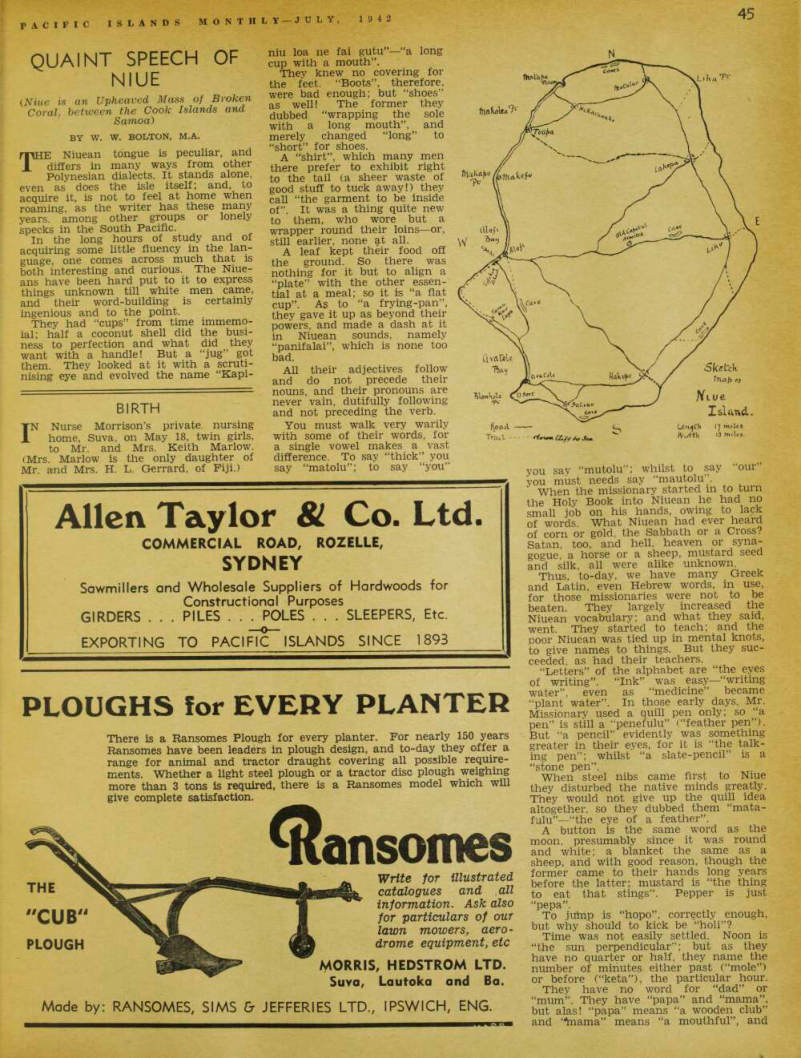
Niue
(Niue is an Upheaved Mass of Broken Coral, between the Cook Islands and Samoa )
By W. W. Bolton, M.A.
rE Niuean tongue is peculiar, and differs in many ways from other Polynesian dialects. It stands alone, even as does the isle itself; and, lo acquire it, is not to feel at home when roaming, as the writer has these many years, among other groups or lonely specks in the South Pacific.
In the long hours of study and of acquiring some little fluency in the lan guage, one comes across much that is both interesting and curious. The Niue ans have been hard put to it to express things unknown till white men came, and their word-building is certainly ingenious and to the point.
They had “cups” from time immemo ial; half a coconut shell did the busi ness to perfection and what did they want with a handle! But a “jug” got them. They looked at it with a scruti nising eye and evolved the name “Kapi-
Birth
IN Nurse Morrison’s private nursing home, Suva, on May 18, twin girls, to Mr. and Mrs. Keith Marlow. (Mrs. Marlow is the only daughter of Mr. and Mrs. H. L. Gerrard, of Fiji.)
niu loa ne fai gutu”—“a long cup with a mouth”.
They knew no covering for the feet. “Boots”, therefore, were bad enough; but “shoes” as well! The former they dubbed “wrapping the sole with a long mouth”, and merely changed “long” to “short” for shoes.
A “shirt”, which many men there prefer to exhibit right to the tail (a sheer waste of good stuff to tuck away!) they call “the garment to be inside of”. It was a thing quite new to them, who wore but a wrapper round their loins —or, still earlier, none at all.
A leaf kept their food off the ground. So there was nothing for it but to align a “plate” with the other essen tial at a meal; so it is “a flat cup”. As to “a frying-pan”, they gave it up as beyond their powers, and made a dash at it in Niuean sounds, namely “panifalai”, which is none too bad.
All their adjectives follow and do not precede their nouns, and their pronouns are never vain, dutifully following and not preceding the verb.
You must walk very warily with some of their words, for a single vowel makes a vast difference. To say “thick” you say “matolu”; to say “you”
you sav “mutolu”; whilst to say “our” you must needs say “mautolu”.
When the missionary started in to turn the Holy Book into Niuean he had no small job on his hands, owing to lack of words. What Niuean had ever heard of corn or gold, the Sabbath or a Cross?
Satan, too, and hell, heaven or syna gogue, a horse or a sheep, mustard seed and silk, all were alike unknown.
Thus, to-day, we have many Greek and Latin, even Hebrew words, in use, for those missionaries were not to be beaten. They largely increased the Niuean vocabulary: and what they said, went. They started to teach; and the poor Niuean was tied up in mental knots, to give names to things. But they suc ceeded. as had their teachers.
“Letters” of the alphabet are “the eyes of writing”. “Ink” was easy—“writing water”, even as “medicine” became “plant water”. In those early days. Mr.
Missionary used a quill pen only; so “a pen” is still a “penefulu” (“feather pen”).
But “a pencil” evidently was something greater in their eyes, for it is “the talk ing pen”; whilst “a slate-pencil” is a “stone pen”.
When steel nibs came first to Niue they disturbed the native minds greatly.
They would not give up the quill idea altogether, so they dubbed them “mata fulu” —“the eye of a feather”.
A button is the same word as the moon, presumably since it was round and white; a blanket the same as a sheep, and with good reason, though the former came to their hands long years before the latter; mustard is “the thing to eat that stings”. Pepper is just “pepa”.
To jutnp is “hopo”, correctly enough, but why should to kick be “holi”?
Time was not easily settled. Noon is “the sun perpendicular”; but as they have no quarter or half, they name the number of minutes either past (“mole”) or before (“keta”), the particular hour.
They have no word for “dad” or “mum”. They have “papa” and “mama”, but alas! “papa” means “a wooden club” and “mama” means “a mouthful”, and
these surely disrespectful words to use to one’s parents. Their words of endearment are very few, whilst father is but “male parent” and ‘ mother female ditto. A boy has to be content with “male child” and a girl is ‘female child”.
They have their ailments and name them adroitly. To be deaf is to have “a frozen ear”; to be blind is “eye-dark ness”; and the parts of the body are as neatly covered. The toes are “the eyes of the feet”, just as the fingers are “the eyes of the hand”. The nails are the ‘ moons” of one’s extremities, whilst tears are strictly apposite: “drops of water from the eyes”.
Whilst they are long-winded as a rule, they beat us handsomely at times. In “I cannot say”, we beat them hollow, for theirs is “Kua nakai maeke au ke pihe atu”. But in “what do you need it for?” they have us, for they cover it in a single word, “moha”.
In Niuean speech every vowel must be clearly and separately sounded —no shirking and slurring as is oft with us.
Try it with “tokaemenaia” (and others which have preceded) and the reader will likely exclaim, with zeal and glad ness its English equivalent, “enough”.
Advertisements & other items, p. 47 (1 item)
Htansomes
PACIFIC ISLANDS MONTHLY—JULY, 1942
Allen Taylor & Co. Ltd.
COMMERCIAL ROAD, ROZELLE,
SYDNEY
Sawmillers and Wholesale Suppliers of Hardwoods for Constructional Purposes GIRDERS . . . PILES . . . POLES . . . SLEEPERS, Etc.
EXPORTING TO PACIFIC” ISLANDS SINCE 1893
PLOUGHS for EVERY PLANTER
There is a Ransomes Plough for every planter. For nearly 150 years Ransomes have been leaders in plough design, and to-day they offer a range for animal and tractor draught covering all possible requirements. Whether a light steel plough or a tractor disc plough weighing more than 3 tons is required, there is a Ransomes model which will give complete satisfaction.
THE
"CUB"
PLOUGH
Htansomes
Write for illustrated catalogues and all information. Ask also for particulars of our lawn mowers, aero drome equipment, etc
MORRIS, HEDSTROM LTD.
Sura, Lautoka and Ba.
Made by: RANSOMES, SIMS & JEFFERIES LTD., IPSWICH, ENG.
Super-Fishermen Of Niue
The following description of Niuean fishermen was written by Judge A.
McCarthy, of the Native Land Court of the Cook Islands, when he sent models of Niue Island canoes to the Southland Centennial Museum, in New Zealand, early in 1942; AS all fishing in Niue is done on the open sea, Unprotected by any outer reef, the island canoes are well and strongly made.
The single canoes are from 15 ft. to 20 ft. long with a beam of not more than 20 in., while the three-men canoes range from 24 ft. to 30 ft. in length and have an inch to three inches more beam. The single canoe is light enough to be picked up by one man with ease and three men can carry the three-men canoes, which are hollowed out to a thickness varying from one-quarter to three-eighths of an inch. They are mere shells.
In these low, narrow catamarans the natives go great distances out to sea at times, but the main fishing grounds lie within a mile of the shore. The ocean bed goes down to great depths and it is nothing for a native to have out 100 to 300 fathoms of line with a fish anywhere from 100 lb. to 400 lb. on his hook The record is said to be a 900 lb. fish, but it was one weighing 558 lb. which gave the greatest thrill. The native hooked it at 6.30 a.m. and it was landed about 5 p.m., after an all-day struggle in which six lines were commissioned for the fight. The original fisherman stuck to his work till 2 p.m., and then, ex hausted, he gave over the lines to other hands. tw o ciL i? reys ,9 f the world catch their swordfish, marlin and tuna on the best of gear and from the finest of launches and the world hears of it as an e 7 T 9 nt ln prose and Picture.
The humble Niuean catches his game
fish—swordfish, shark, vahakula, paala, and many others just as big—and plays them on ah ordinary fishing line with a piece of steel trace about 6 ft. long (a strand of wire hawser) from his modest little canoe.
He is not acclaimed as a superman. He is a food hunter, not a pleasure-hunter.
Sharks tackle the canoes at times and are clubbed off. Think of that, a mile at sea and one-quarter of an inch of wood between you and a monster shark. Just think of that and take your hat off to the Polynesian in his catamaran.
M. Henri Sautot, Governor of New Caledonia, was reported to be in Auck land, en route to London, by the “New Zealand Herald’’ of June 23. He was accompanied by Lieutenant de Vaisseau Fourlinnie, and Paymaster Sub-Lieuten ant Albert Renard. ADC. It is noted that M. Sautot joined the French Colo nial Service in 1908. He was in West Africa for 20 years, and was Governor at St. Pierre (off Newfoundland) before coming to the Pacific to serve succes sively in Tahiti, New Hebrides and New Caledonia.
Mr. W. J. Blaikie, Senior Chemist in the Research Division of the Fiji Agri culture Department, was in New Zealand last month on short furlough.
Advertisements & other items, p. 48 (1 item)
Old Monk
The Worlds Finest Olive Oil San Francisco
The House of Steel for Quality Cutlery C We have a large range of Scissors, Knives, Razors, etc.
W. JNO. BAKER Jg;
3 HUNTER STREET, SYDNEY.
Established 1888.
SHEAFFER’S WORLD FAMOUS
Streamlined, Feather Touch PENS and PENCILS
If you want Design, Beauty and Quality buy
a SHEAFFER
All Lifetime Pens are guaranteed for the life of the user except against loss and wilful damage.
When serviced, they are subject to a small fee for insurance, postage and handling.
Beautiful and Useful Gifts for All Occasi ons.
SKRIP - The
Successor to Ink makes all Pens write better. 2 oz. 1/6, 4 oz. 2/6 Plus Postage Distributors Identify the Lifetime Pen hy the white dot
74T LTSC AA 3T
Feather Touch Lifetime Pencil Regular Pen Lifetime Pen Pencil 9/6 2b/- 75/- each 35/- ea. each each The working parts of the Sheaffer Pencil are guaranteed against wear for the lifetime of the user.
When serviced they are subject to a small fee for insurance, postage and handling.
All Sheaffer regular pens are guaranteed against defects of material and workmanship.
Obtainable from Selected Jewellers and Stationers everywhere
EXCELSIOR SUPPLY CO. PTY. LTD.
278 Post Office Place,
MELBOURNE, VIC.
HEAD OFFICE J
160 BROADWAY,
SYDNEY, N.S,W,
50 Victoria Street,
WELLINGTON, N.Z.
GRAMOPHONE RECORDS
SEND US YOUR ORDERS
Goods sent COD. at no extra charge.
Catalogues sent without obligation lfil n ™E TALKERIES, _bl Castlereagh Street, SYDNEY.
Australian Short Wave
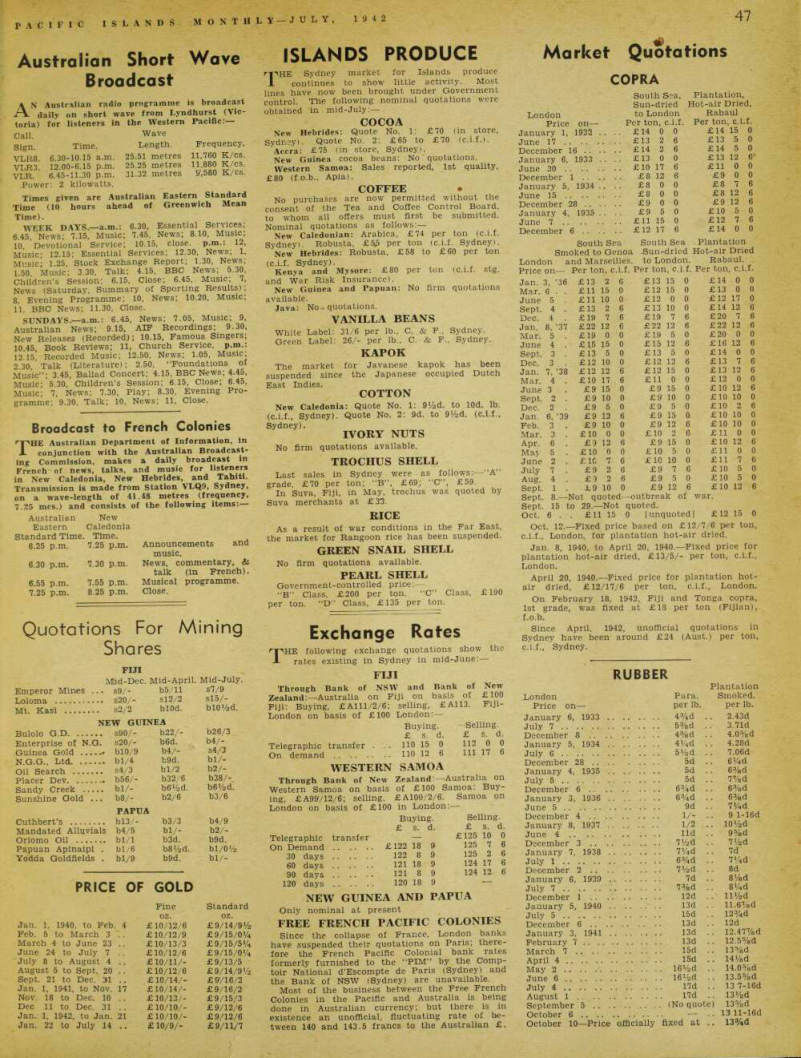
Broadcast
AN Australian radio programme is broadcast daily on short wave from Lyndhurst (Vic toria) for listeners in the Western Pacific:
Times given are Australian Eastern Standard Time (10 hours ahead of Greenwich Mean Time).
WEEK DAYS.— a.m.: 6.30, Essential Services; 6.45, News; 7.15, Music; 7.45, News; 8.10, Music; 10 Devotional Service; 10.15, close, p.m.: 12, Music; 12.15; Essential Services; 12.30. News; 1, Music; 1.25, Stock Exchange Report; 1.30, News; I. Music; 3.30, Talk; 4.15, BBC News; 5.30, Children’s Session; 6.15, Close; 6.45, Music; 7, News (Saturday, Summary of Sporting Results); 8, Evening Programme; 10, News; 10.20, Music; 11, BBC News; 11.30, Close.
SUNDAYS.—a.m.: 6.45, News; 7.05, Music; 9, Australian News; 9.15, AIF Recordings: 9.30, New Releases (Recorded): 10.15, Famous Singers; 10.45, Book Reviews: 11, Church Service, p.m.: 12Y5, Recorded Music; 12.50, News; 1.05, Music; 230 Talk (Literature): 2.50, “Foundations of Music”; 3.45, Ballad Concert; 4.15, BBC News; 4.45, Music; 5.30, Children’s Session; 6.15, Close; 6.45, Music; 7, News; 7.30, Play; 8.30, Evening Pro gramme; 9.30, Talk; 10, News; 11, Close.
Call.
Wave Sign. Time.
Length.
Frequency.
VLR8. 6.30-10.15 a.m. 25.51 metres 11,760 K/cs.
VLR3. 12.00-6.15 p.m. 25.25 metres 11.880 K/cs.
VLR. 6.45-11.30 p.m.
Power: 2 kilowatts. 31.32 metres 9’,580 K/cs.
Broadcast to French Colonies
THE Australian Department of Information, in conjunction with the Australian Broadcast ing Commission, makes a daily broadcast in French of news, talks, and music for listeners in New Caledonia, New Hebrides, and Tahiti.
Transmission is made from Station VLQ9, Sydney, on a wave-length of 41.48 metres (frequency, 7.25 mcs.) and consists of the following items:—
Australian New Eastern Caledonia Standard Time. Time. 6.25 p.m. 7.25 p.m. Announcements and music. 6 30 p.m. 7.30 p.m. News, commentary, & talk (In French). 6.55 p.m. 7.55 p.m. Musical programme. 7.25 p.m. 8.25 p.m. Close.
Quotations For Mining
Shares
Fiji
Mlid-Dec. Mid-April.
Mid-July.
Emperor Mines ... s9/b5/ll s7/9 Loloma s20/si 2/2 sl5/- Mt. Kasl s2/2 blOd. blOV 2 d.
New Guinea
Bulolo G.D s90/b22/b26/3 Enterprise of N.G. s20/b6d. b4/- Guinea Gold • blO/9 b4/s4/3 N.G.G., Ltd bl/4 b9d. bl/- Oil Search s4/3 bl/2 b2/- Placer Dev b56/b32/6 b38/- Sandy Creek bl/b6V 2 d. b6V 2 d.
Sunshine Gold ... b8/b2/6 b3/6 Cuthbert’s
Papua
bl3/b3/3 b4/9 Mandated Alluvials b4/5 bl/b2/- Oriomo Oil bl/1 b3d. b9d.
Papuan Apinaipi . bl/6 b8V 2 d. bi/oy 2 Yodda Goldfields . bl/9 b9d. bl/-
Price Of Gold
Fine Standard oz. oz.
Jan. 1. 1940, to Feb. 4 £10/12/6 £9/14/91/2 Feb. 5 to March 3 £10/12/9 £9/15/01/4 March 4 to June 23 £10/13/3 £9/15/5V4 June 24 to July 7 £10/12/6 £9/15/01/4 July 8 to August 4 .. £10/11/- £9/13/5 August 5 to Sept. 20 £10/12/6 £9/14/91/2 Sept. 21 to Dec. 31 £10/14/- £9716/2 Jan. 1, 1941, to Nov. 17 £10/14/- £9/16/2 Nov. 18 to Dec. 10 £10/13/- £9/15/3 Dec 11 to Dec. 31 £10/10/- £9/12/6 Jan. 1. 1942, to Jan. 21 £10/10/- £9/12/6 Jan. 22 to July 14 £ 10/9/- £9/11/7
Islands Produce
THE Sydney market for Islands produce continues to show little activity. Most lines have now been brought under Government control. The following nominal quotations were obtained in mid-July:—
Cocoa
New Hebrides: Quote No. 1: £7O (in store, Sydneyi. Quote No. 2: £65 to £7O (c.i.f.).
Accra: £75 (in store, Sydney).
New Guinea cocoa beans: No quotations.
Western Samoa: Sales reported, Ist quality, £BO (f.0.b.. Apia).
Coffee
No purchases are now permitted without the consent of the Tea and Coffee Control Board, to whom all offers must first be submitted.
Nominal quotations as follows: — New Caledonian: Arabica, £74 per ton (c.i.f.
Sydney). Robusta, £s£ per ton (c.i.f. Sydney).
New Hebrides: Robusta, £5B to £6O per ton (c.i.f. Sydney).
Kenya and Mysore: £BO per ton (c.i.f. stg. and War Risk Insurance).
New Guinea and Papuan: No firm quotations available.
Java: No . quotations.
Vanilla Beans
White Label: 31/6 per lb., C. & F., Sydney.
Green Label: 26/- per lb., C. & F., Sydney.
Kapok
The market for Javanese kapok has been suspended since the Japanese occupied Dutch East Indies.
Cotton
New Caledonia: Quote No. 1: 9V 2 d. to lOd. lb. (c.i.f., Sydney). Quote No. 2: 9d. to OVad. (c.i.f., Sydney).
Ivory Nuts
No firm quotations available.
Trochus Shell
Last sales in Sydney were as follows: —“A” grade, £7O per ton; “B”, £69; “C”, £59.
In Suva, Fiji, in May, trochus was quoted by Suva merchants at £33.
Rice
As a result of war conditions in the Far East, the market for Rangoon rice has been suspended.
Green Snail Shell
No firm quotations available.
Pearl Shell
Government-controlled price:— “B” Class, £2OO per ton. “C” Class, £l9O per ton. “D” Class, £135 per ton.
Exchange Rates
THE following exchange quotations show the rates existing in Sydney in mid-June;
Fiji
Through Bank of NSW and Bank of New Zealand;—Australia on Fiji on basis of £lo° Fiji: Buying, £Alll/2/6; selling, £AII3. Fiji- London on basis of £lOO London: —
Western Samoa
Through Bank of New Zealand —Australia on Western Samoa on basis of £lOO Samoa: Buy ing, £ A99712/6; selling, £AIOO/2/6. Samoa on London on basis of £lOO in London; —
New Guinea And Papua
Only nominal at present
Free French Pacific Colonies
Since the collapse of France, London banks have suspended their quotations on Paris; there fore the French Pacific Colonial bank rates formerly furnished to the “PIM” by the Comp toir National d’Escompte de Paris (Sydney) and the Bank of NSW (Sydney) are unavailable.
Most of the business between the Free French Colonies in the Pacific and Australia is being done in Australian currency: but there is in existence an unofficial, fluctuating rate of be tween 140 and 143.5 francs to the Australian £.
Buying. Selling. £ s. d. £ S. d.
Telegraphic transfer ... 110 15 0 112 0 0 On demand 110 12 6 111 17 6
Buying.
Selling. £ s. d. £ s. d.
Telegraphic transfer — £125 10 0 On Demand £122 18 9 125 7 6 30 days 122 8 9 125 2 6 60 days 121 18 9 124 17 6 90 days 121 8 9 124 12 6 120 days 120 18 9 —
Market Quotations
Oct. 12.—Fixed price based on £l2/7/6 per ton, c.i.f., London, for plantation hot-air dried.
Jan. 8, 1940, to April 20, 1940.—Fixed price for plantation hot-air dried, £l3/5/- per ton, c.i.f., London.
April 20, 1940. —Fixed price for plantation hot air dried, £l2/17/6 per ton, c.i.f., London.
On February 18, 1942, Fiji and Tonga copra, Ist grade, was fixed at £lB per ton (Fijian), f.o.b.
Since April, 1942, unofficial quotations in Sydney have been around £24 (Aust.) per ton, c.i.f., Sydney.
Copra
South Sea, Plantation, Sun-dried Hot-air Dried, London to London Rabaul Price on— Per ton, ( c.i.f Per ton, c.i.f.
January 1, 1932 £14 0 0 £14 15 0 June 17 . £13 2 6 £13 5 0 December 16 . . £14 2 6 £14 5 0 January 6, 1933 £13 0 0 £13 12 6 June 30 . £10 17 6 £11 0 0 December 1 . . £8 12 6 £9 0 0 January 5, 1934 £8 0 0 £8 7 6 June 15 . £8 0 0 £8 12 6 December 28 . . £9 0 0 £9 12 6 January 4, , 1935 £9 5 0 £10 5 0 June 7 .. £11 15 0 £12 7 6 December 6 . . £12 17 6 £14 0 0 South Sea South Sea Plantation Smoked to Genoa Sun-dried Hot-air Dried London and Marseilles, to London.
Rabaul.
Price on— Per ton, c.i.f. Per ton i, c.i.f.
Per ton, c.i .f.
Jan. 3, '36 £13 2 6 £13 15 0 £14 0 0 Mar. 6 . . £11 15 0 £12 15 0 £13 0 0 June 5 £11 10 0 £12 0 0 £12 17 0 Sept. 4 . £13 2 6 £13 10 0 £14 12 6 Dec. 4 . £19 7 6 £19 7 6 £20 7 6 Jan. 8, '37 £22 12 6 £22 12 6 £22 12 6 Mar. 5 . £19 0 0 £19 5 0 £20 0 0 June 4 . £15 15 0 £15 12 6 £16 12 6 Sept. 3 . £13 5 0 £13 5 0 £14 0 0 Dec. 3 . £12 10 0 £12 12 6 £13 7 6 Jan. 7, ’38 £12 12 6 £12 15 0 £13 12 6 Mar. 4 . £10 17 6 £11 0 0 £12 0 0 June 3 £9 15 0 £9 15 0 £10 12 6 Sept. 2 . £9 10 0 £9 10 0 £10 10 0 Dec. 2 . £9 5 0 £9 5 0 £10 2 6 Jan. 6. ’39 £9 12 6 £9 15 0 £10 10 0 Feb. 3 . £9 10 0 £9 12 6 £10 10 0 Mar. 3 . £10 0 0 £10 2 6 £11 0 0 Apr. 6 . £9 12 6 £9 15 0 £10 12 6 Maj 5 . £10 0 0 £10 5 0 £11 0 0 June 2 . £10 7 6 £10 10 0 £11 7 6 July 7 . £9 2 6 £9 7 6 £10 5 0 Aug. 4 . £9 2 6 £9 5 0 £10 5 0 Sept. 1 . £9 10 0 £9 12 6 £10 12 6 Sept. 8. — Not quoted— outbreak of war.
Sept. 15 to 29.- -Not quoted.
Oct. 6 . . £11 15 0 [unquoted] £12 15 0
London
Rubber
Para.
Plantation Smoked.
Price on— per lb. per lb.
January 6, 1933 . 4%d . 2.43d July 7 5%d . 3.71d December 8 . . . 4,0 5 / 8 d January 5, 1934 . 4>Ad . 4.28d July 6 7.06d December 28 .. . 5d . 6*/ 4 d January 4, 1935 . 5d . 6%d July 5 5d . 7 7 /sd December 6 .. . 6%d . 6%d January 3, 1936 . 6%d June 5 9d . 7V 4 d December 4 .. . 1/- . 9 l-16d January 8, 1937 . 1/2 . 10V 2 d June 4 lid . 9 5 /ad December 3 .. . 7V 2 d January 7, 1938 . 7V 4 d . 7d July 1 6%d . 7‘Ad December 2 .. . 7Vid . 8d January 6, lff39 . 7d . 8Vsd July 7 8V 4 d December 1 .. . 12d . ny 2 d January 5, 1940 . 13d . 11.6 7 /ad July 5 15d . 12 3 Ad December 6 . . ., 13d . 12d January 3, 1941 . 13d . 12.47 7 /ad February 7 .. .. 13d . 12.5 5 /ad March 7 15d . 13 5 /ad April 4 15d . 141/ad May 2 16V 2 d . 14.0 5 /ad June 6 16V 2 d . 13.5 5 /ad July 4 17d . 13 7-16d August 1 17d .
ISMsd September 5 .. . (No quote) 13%d October 6 .. .. 13 ll-16d October 10 —Price officially fixed at . 13%d
Advertisements & other items, p. 49 (1 item)
47
PACIFIC ISLANDS MONTHU-JtILV, 1942
August, 1941, To July, 1942, Inclusive
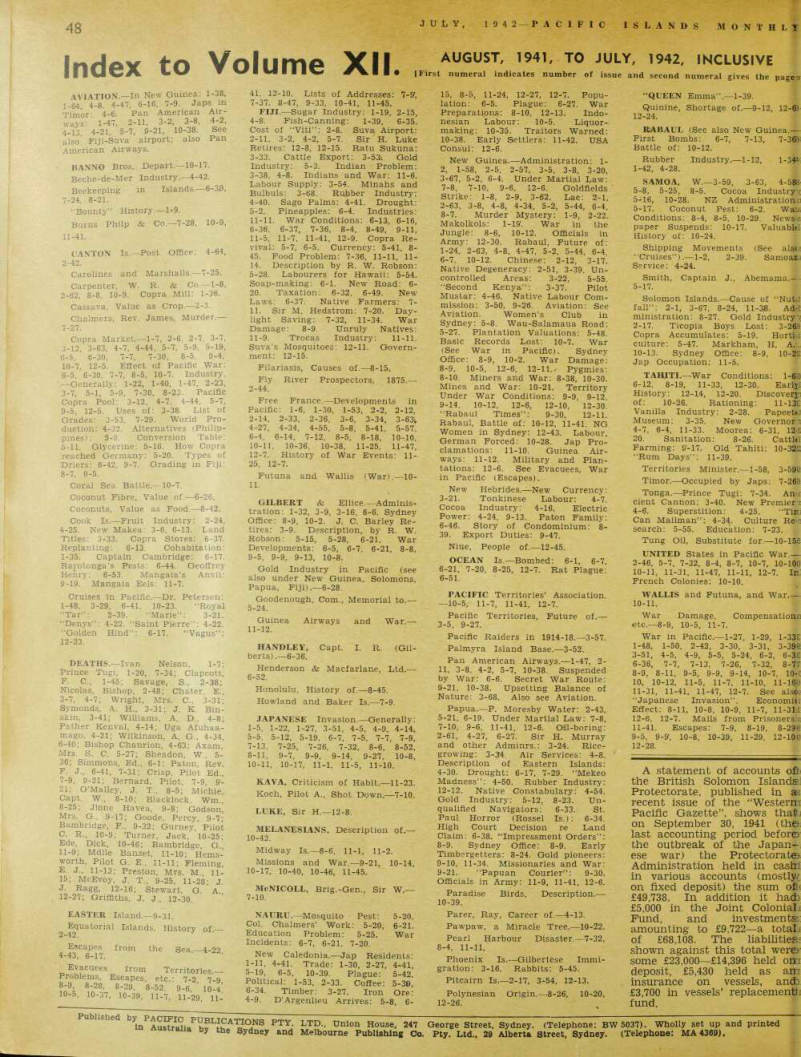
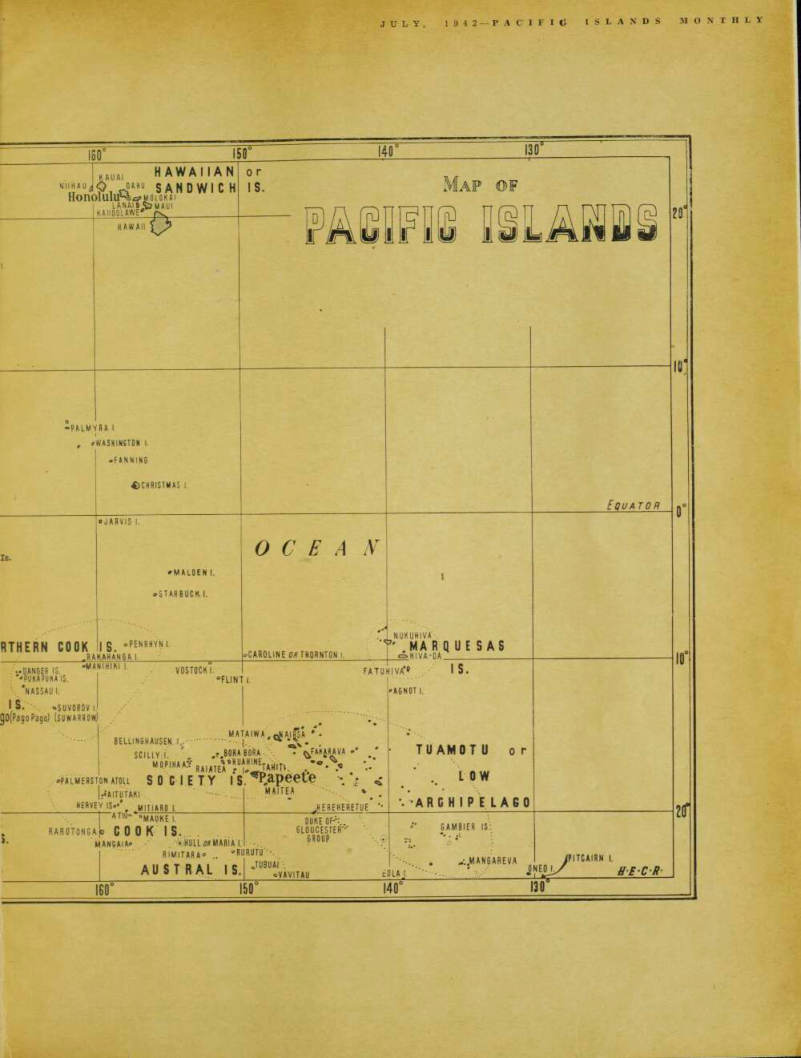
Index to Volume XII.
[First numeral indicates number of issue and second numeral gives the pages
AVIATION. —In New Guinea: 1-38, 1- 4-8, 4-47, 6-16, 7-9. Japs in Timor; 4-6. Pan American Air ways: 1-47, 2-11, 3-2, 3-8, 4-2, 4- 4-21, 5-7, 8-21, 10-38. See also Fiji-Suva airport; also Pan American Airways.
BANNO Bros. Depart.—lo-17.
Beche-de-Mer Industry.—4-42.
Beekeeping in Islands. —6-30, 7-24, 8-21.
“Bounty” History.—l-9.
Burns Philp & Co.—7-28, 10-9, 11- CANTON Is. —Post Office: 4-64, 2- Carolines and Marshalls. —7-25.
Carpenter, W. R. & Co.—l-8, 2- 8-8, 10-9. Copra Mill: 1-36.
Cassava, Value as Crop.—2-3.
Chalmers, Rev. James, Murder. — 7- Copra Market. —1-7, 2-6. 2-7. 3-7, 3- 3-63, 4-7, 4-44, 5-7, 5-9, 5-19, 6-5, 6-30, 7-7, 7-30, 8-5, 9-4, 10-7, 12-5. Effect of Pacific War: 6-5, 6-30, 7-7, 8-5, 10-7. Industry. —Generally: 1-22, 1-40, 1-47, 2-23, 3- 5-1, 5-9, 7-30, 8-23. Pacific Copra Pool: 3-12, 4-7. 4-44. 5-7, 9-5, 12-5. Uses of: 3-38. List of Grades: 3-53, 7-29. World Pro duction: 4-32. Alternatives (Philip pines): 5-9. Conversion Table: 5- Glycerine; 5-16. How Copra reached Germany: 5-20. Types of Driers: 6-42, 9-7. Grading in Fiji: 8- 9-5.
Coral Sea Battle. —10-7.
Coconut Fibre, Value of.—6-26.
Coconuts, Value as Food.—B-42.
Cook Is.—Fruit Industry: 2-24, 4- New Makea: 3-6, 6-13. Land Titles: 3-33. Copra Stores: 6-37.
Replanting: 6-13. Cohabitation: 1-35. Captain Cambridge: 6-17.
Rarotonga’s Pests; 6-44. Geoffrey Henry; 6-53. Mangaia’s Anvil; 9- Mangaia Eels: 11-7.
Cruises in Pacific.—Dr. Petersen; 1- 3-29, 6-41, 10-23. “Royal “Tar”: 2-39. “Marie”; 3-21.
“Denys”: 4-22. “Saint Pierre”: 4-22.
“Golden Hind”: 6-17. “Vagus”: 12- DEATHS. —Ivan Nelson, 1-7; Prince Tugi, 1-20, 7-34; Clapcott, F. C., 1-45; Savage, S., 2-38; Nicolas, Bishop, 2-48; Chater. E., 3- 4-7; Wright, Mrs. C., 3-31; Symonds, A. H., 3-31; J. K Bin skin, 3-41; Williams, A. D., 4-8; Father Kenval, 4-14; Uga Afuhaa mago, 4-21; Wilkinson, A. G., 4-34, 6- Bishop Chanrion, 4-63; Axam, Mrs. S. C. 5-27; Sheadon, W., 5- 36; Simmons, Ed., 6-1; Paton, Rev.
F. J., 6-41, 7-31; Crisp, Pilot Ed., 7- 9-21; Bernard, Pilot, 7-9, 9'- 21; O’Malley, J. T., 8-5; Michie, Capt. W., 8-10; Blacklock. Wm., 8- Jione Havea, 9-8; Godson, Mrs. G., 9-17; Goode, Percy, 9-7; Bambridge, F., 9-32; Gurney, Pilot C. R., 10-9; Turner, Jack, 10-25; Ede, Dick, 10-46; Bambridge, G., 11- Mdlle Banzet, 11-10; Hems worth, Pilot G. E.. 11-11; Fleming, E. J., 11-13; Preston, Mrs. M 11- 15; McEvoy, J. T.. 9-25, 11-28; J.
J. Ragg, 12-16; Stewart, G. A 12- Griffiths, J. J., 12-30.
EASTER Island.—9-31.
Equatorial Islands, History of 2- Escapes from the Sea. —4-22 4- 6-17.
Evacuees from Territories.— Problems, Escapes, etc.: 7-2 7-9 8-9, 8-28, 8-29, 8-52, 9-6 ’ 10-4’ 10- 10-37, 10-39, 11-7, 11-29, 11-
41, 12-10. Lists of Addresses: 7-9, 7-37. 8-47, 9-33, 10-41, 11-45.
FIJI. —Sugar Industry: 1-19, 2-15, 4-8. Fish-Canning: 1-39, 6-35.
Cost of “Viti”: 2-8. Suva Airport: 2- 3-2, 4-2, 5-7. Sir H. Luke Retires; 12-8, 12-15. Ratu Sukuna: 3- Cattle Export: 3-53 t, Gold Industry; 5-3. Indian Problem; 3- 4-8. Indians and War: 11-6.
Labour Supply; 3-54. Minahs and Bulbuls: 3-68. Rubber Industry: 4- Sago Palms: 4-41. Drought: 5- Pineapples: 6-4. Industries: 11-11. War Conditions: 6-13, 6-16, 6- 6-37, 7-36, 8-4, 8-49, 9-11, 11-5, 11-7, 11-41, 12-9. Copra Re vival: 5-7, 6-5. Currency; 5-41, 8- 45. Food Problem: 7-36, 11-11, 11- 14. Description by R. W. Robson: 5- Labourers for Hawaii: 5-54.
Soap-making: 6-1. New Road: 6- 20. Taxation; 6-32, 6-49. New Laws: 6-37. Native Farmers: 7- 11. Sir M. Hedstrom: 7-20. Day light Saving; 7-32, 11-34. War Damage: 8-9. Unruly Natives: 11- Trocas Industry: 11-11.
Suva’s Mosquitoes: 12-11. Govern ment: 12-15.
Filariasis, Causes of.—B-15.
Fly River Prospectors, 1875. — 2-44.
Free France. —Developments in Pacific: 1-6, 1-30, 1-53, 2-2, 2-12, 2-14, 2-33, 2-36, 3-6, 3-34, 3-63> 4- 4-34, 4-55, 5-8, 5-41, 5-57. 6- 6-14, 7-12, 8-5, 8-18, 10-10, 10- 10-36, 10-38, 11-25, 11-47, 12- History of War Events: 11- 25, 12-7.
Futuna and Wallis (War). —10- 11.
GILBERT & Ellice.—Adminis tration: 1-32, 3-9, 3-16, 8-6. Sydney Office: 8-9, 10-2. J. C. Barley Re tires: 3-9. Description, by R. W.
Robson: 5-15, 5-28, 6-21. War Developments; 6-5, 6-7, 6-21, 8-8, 9- 9-9, 9-13, 10-8.
Gold Industry in Pacific (see also under New Guinea, Solomons, Papua, Fiji).—6-28.
Goodenough, Com., Memorial to. — 5- Guinea Airways and War. — 11- HANDLEY, Capt. I. R. (Gil berts) .-6-36.
Henderson & Macfarlane, Ltd. — 6- Honolulu, History of.—B-45.
Howland and Baker Is. —7-9.
JAPANESE Invasion. —Generally: 1-5, 1-22, 1-27, 3-51, 4-5, 4-9, 4-14, 5-5, 5-12, 5-19, 6-7, 7-5, 7-7, 7-9, 7- 7-25, 7-26, 7-32, 8-6, 8-52, 8- 9-7, 9-9, 9-14, 9-27, 10-8, 10- 10-17, 11-1, 11-5, 11-10.
KAVA, Criticism of Habit.—ll-23.
Koch, Pilot A., Shot Down. —7-10.
LUKE, Sir H.—l 2-8.
MELANESIANS, Description of.— 10-42.
Midway Is.—B-6, 11-1, 11-2.
Missions and War.—9-21, 10-14, 10-17, 10-40, 10-46, 11-45.
McNICOLL, Brig.-Gen., Sir W.— 7-10.
NAURU.—Mosquito Pest: 5-20.
Col. Chalmers’ Work: 5-20, 6-21.
Education Problem: 5-25. War Incidents: 6-7, 6-21, 7-20.
New Caledonia.—Jap Residents: 1-11, 4-41. Trade: 1-30, 2-27, 4-41, 5- 6-5, 10-39. Plague: 5-42.
Political: 1-53, 2-33. Coffee: 5-30, 6- Timber: 3-27. Iron Ore: 4-9. D’Argenlieu Arrives: 5-8, 6-
15, 8-5, 11-24, 12-27, 12-7. Popu lation: 6-5. Plague: 6-27. War Preparations: 8-10, 12-13. Indo nesian Labour; 10-5. Liquor making: 10-35. Traitors Warned: 10-38. Early Settlers: 11-42. USA Consul: 12-6.
New Guinea. —Administration; 1- 2, 1-58, 2-5, 2-57, 3-5, 3-8, 3-20, 3-67, 5-2, 6-4. Under Martial Law: 7- 7-10, 9-6, 12-6. Goldfields Strike: 1-8, 2-9, 3-62. Lae: 2-1, 2- 3-8, 4-8, 4-34, 5-2, 5-44, 6-4, 8- Murder Mystery: 1-9, 2-22.
Makolkols: 1-19'. War in the Jungle: 8-6, 10-12. Officials in Army: 12-30. Rabaul, Future of: 1-24, 2-63, 4-8, 4-47, 5-2, 5-44, 6-4. 6-7, 10-12. Chinese: 2-12, 3-17.
Native Degeneracy: 2-51, 3-39. Un controlled Areas: 3-22, 5-55.
“Second Kenya”: 3-37. Pilot Mustar; 4-46. Native Labour Com mission: 3-50, 9-26. Aviation: See Aviation. Women’s Club in Sydney: 5-8. Wau-Salamaua Road: 5- Plantation Valuations: 5-48.
Basic Records Lost: 10-7. War (See War in Pacific). Sydney Office: 8-9, 10-2. War Damage: 8-9, 10-5, 12-6, Pygmies: 8- Miners and War: 8-38, 10-30.
Mines and War: 10-21. Territory Under War Conditions: 9-9, 9-12, 9- 10-12, 12-6, 12-10, 12-30.
“Rabaul Times”: 9-30, 12-11.
Rabaul, Battle of: 10-12, 11-41. NG Women in Sydney: 12-43. Labour, German Forced: 10-28. Jap Pro clamations: 11-10. Guinea Air ways: 11-12. Military and Plan tations: 12-6. See Evacuees, War in Pacific (Escapes).
New Hebrides. —New Currency: 3- Tonkinese Labour: 4-7.
Cocoa Industry; 4-16. Electric Power: 4-24, 9-13. Paton Family; 6- Story of Condominium: 8- 39. Export Duties: 9-47.
Niue, People of. —12-45.
OCEAN Is. —Bombed: 6-1, 6-7, 6-21, 7-20, 8-25, 12-7. Rat Plague: 6- PACIFIC Territories’ Association. -10-5, 11-7, 11-41, 12-7.
Pacific Territories, Future of. — 3- 9-27.
Pacific Raiders in 1914-18.—3-57.
Palmyra Island Base. —3-52.
Pan American Airways.—l-47, 2- 11, 3-8, 4-2, 5-7, 10-38. Suspended by War: 6-6. Secret War Route: 9-21, 10-38. Upsetting Balance of Nature; 3-68. Also see Aviation.
Papua.—P. Moresby Water; 2-43, 5-21, 6-19. Under Martial Law: 7-8, 7- 9-6, 11-41, 12-6. Oil-boring; 2-61, 4-27, 6-27. Sir H. Murray and other Adminrs.: 3-24. Rice growing: 3-34. Air Services: 4-8.
Description of Eastern Islands: 4- Drought: 6-17, 7-29. “Mekeo Madness”: 4-50. Rubber Industry: 12-12. Native Constabulary: 4-54.
Gold Industry: 5-12, 8-23. Un qualified Navigators: 6-33. St.
Paul Horror (Rossel Is.): 6-34.
High Court Decision re Land Claim: 6-38. “Impressment Orders”: 8- Sydney Office; 8-9. Early Timbsrgetters: 8-24. Gold pioneers: 9- 11-34. Missionaries and War: 9- “Papuan Courier”: 9-30.
Officials in Army: 11-9, 11-41, 12-6.
Paradise Birds, Description.— 10- Parer, Ray, Career of.—4-13.
Pawpaw, a Miracle Tree. —10-22.
Pearl Harbour Disaster. —7-32, 8-4, 11-11.
Phoenix Is. —Gilbertese Immi gration: 3-16. Rabbits: 5-45.
Pitcairn Is.-2-17, 3-54, 12-13.
Polynesian Origin.—B-26, 10-20, 12-26.
“QUEEN Emma”. —1-39.
Quinine, Shortage of.—9-12, 12-6) 12-24.
RABAUL (See also New Guinea.— First Bombs: 6-7, 7-13, 7-3691 Battle of: 10-12.
Rubber Industry.—l-12, 1-34 U 1- 4-28.
Samoa, W.—3-59, 3-63, 4-588'
5-8, 5-25, 8-5. Cocoa Industry^ 5-16, 10-28. NZ Administration*! 5-17. Coconut Pest: 6-2. Waus Conditions; 8-4, 8-5, 10-29. Newss paper Suspends; 10-17. Valuable History of: 10-24.
Shipping Movements (See als«s “Cruises”). —1-2, 2-39. Samoam Service; 4-24.
Smith, Captain J., Abemama.—- 5- Solomon Islands. —Cause of "NuW fall”: 2-1, 3-67, 8-24, 11-38. Ad-fc ministration: 8-27. Gold Industry \ 2- Ticopia Boys Lost: 3-269 Copra Accumulates: 5-19. Horti-i culture: 5-47. Markham, H. A... 10-13. Sydney Office: 8-9, 10-2 S Jap Occupation: 11-5, TAHITI. —War Conditions: 1-63 6- 8-19, 11-33, 12-30. Earljl History: 12-14, 12-20. Discovery of: 10-26. Rationing; 11-13 C Vanilla Industry: 2-28. Papeete Museum; 3-35. New Governor! 4-7, 6-4, 11-33. Moorea: 6-31, 12S 20. Sanitation: 8-26. Cattlil Farming: 9-17. Old Tahiti: 10-32 S “Rum Days”: 11-39.
Territories Minister. —1-58, 3-596 Timor. —Occupied by Japs: 7-269 Tonga.—Prince Tugi: 7-34. An-r cient Cannon; 3-40. New Premieri 4-6. Superstition; 4-25. “Tini Can Mailman”: 4-34. Culture Re-s search: 5-55. Education: 7-23.
Tung Oil, Substitute for.—lo-156 UNITED States in Pacific War. — 2- 5-7, 7-32, 8-4, 8-7, 10-7, 10-100 10- 11-31, 11-47, 11-11, 12-7. Ini French Colonies: 10-10.
WALLIS and Futuna, and War.— 10-11.
War Damage, Compensation*! etc.—B-9, 10-5, 11-7.
War in Pacific.—l-27, 1-29, 1-33 C I- 1-50, 2-42, 3-30, 3-31, 3-396 3- 4-5, 4-9, 5-5, 5-24, 6-2, 6-3£ 6-36, 7-7, 7-13, 7-26, 7-32, 8-7 T 8- 8-11, 9-5, 9-9, 9-14, 10-7, 10-0 10, 10-12, 11-5, 11-7, 11-10, 11-168 11- 11-41, 11-47, 12-7. See also?
“Japanese Invasion”. Economic Effect; 8-11, 10-8, 10-9, 11-7, 11-311 12- 12-7. Mails from Prisonersia II- Escapes: 7-9, 8-19, 8-296 9- 9-9, 10-8, 10-39, 11-29, 12-100 12-28.
A statement of accounts oft the British Solomon Islands] Protectorate, published in as recent issue of the “Westerm Pacific Gazette”, shows thatb on September 30, 1941 (the:
last accounting period before'
the outbreak of the Japan-; ese war) the Protectorates Administration held in cashl in various accounts on fixed deposit) the sum oft £49,738. In addition it hacb £5,000 in the Joint Colonialf Fund, and investments: amounting to £9,722 —a totali of £68,108. The liabilities; shown against this total were* some £23,000—£14,396 held om deposit, £5,430 held as am insurance on vessels, and)
£3,700 in vessels’ replacements
fund.
Advertisements & other items, pp. 50-52 (3 items)
48
JULY, 1942 PACIFIC ISLANDS MONTHLY
Published b * p ACIPIO p UBLICAnONS PTY. LTD., Union House, 247 George Street. Sydney. (Telephone: BW 5037). Wholly set up and printed 8 Dy tne Sydney and Melbourne Publishing Co. Pty. Ltd., 29 Alberta Street, Sydney. (Telephone: MA4369).
fgfg
W. R. Carpenter & Co. Lti
TRAVEL
by carpenter airlines in the
I - 5 s*t I •i *-r.
I : : . *' ■ >• s** -
EFFORTLESS SPEED and LUXURIOUS COMFORT
OF A "LOCKHEED 14"
CARPENTER AIRLINES, by the recent installation of worldrenowned Lockheed "14' aircraft on their regular service between Sydney and the Territories, bring to this airway the high standard of the world's best air services. Every detail of comfort and convenience has been studied to assure that travellers may thoroughly enjoy, in every respect, their flight over this most glorious of scenic air routes.
FREIGHT
A special feature of "LockH 14" Aircraft is their large fres capacity and consignees are assured that all Freight boowill be despatched without deljl Minimum Charge 5/-.
Full particulars regarding time-table, fares, etc., are available from the fallowing agencies- SYDNEY: Macdonald, Hamilton & Co. PAPUA: Burns, Philp & Co. Ltd.
Howard Smith Ltd NEW GUINEA: W. R. Carpenter & Co. Ltd.
W. R. CARPENTER & CO. LTI
Merchants and Shipowners.
AGENTS for Australian, European and American Manufacturers and Distributors of Every Description o ere at Complete Range of all Stocks Carried.
Head Office: 16 O’CONNELL STREET, SYDNEY
Blanche? at: RABAUL (New Britain), KAVIENG (New Ireland), M * D^ G ’ T OUineft> ■ Islands), SUVA (Fiji), and other Pacific Islands, and to islands), Suva Lriju, anu Buyers and Shippers of: Copra, Trocas, and all Classes o san s r