Islands
Pacific
Monthly
Vol. Xiii. No. L.
August 17, 1942
Established 1930
IRegistered at the G.P.0., Sydney , /or transmission by post as a newspaper ]
Od
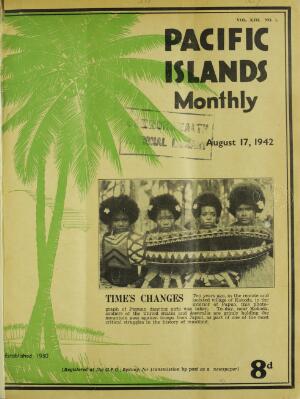
Time's Changes In The
Ten years ago, in the remote and islated village of kokoda, in the interior of Papua, this photo graph of Papuan dancing girls was taken. To-day, near Kokoda, soldiers of the United States and Australia are grimly holding the mountain pass against troops from Japan, as part of one of the most critical struggles in the history of mankind.
Advertisements & other items, p. 2 (1 item)
Pacific Islands Monthl Y—A Ugust, 1942
Pacific News-Review
Notes And Comment On
The Progress Of The War
From July 15 To August 16
July 15.—The Germans, having rossed the lower reaches of the Don, in great strength, north-east of Rostov, are now pouring into the Caucasus region and threatening ■ Rostov and Stalingrad. The Russian armies on the Upper Don and around Stalingrad are holding firm, how ever. The general situation is critical.
July 15.—Rommel Panzer divisions from Libya are still held firmly by the British Bth Army on the El Alamein front. The Eighth Army is being heavily reinforced, especially by Americans. The British maintain air superiority and are so heavily batter ing Rommel’s communications that he is having great difficulty in getting supplies and reinforcements.
July 16.—The public of Britain and United States, appreciating Russia’s critical situation and the need for keeping Russian armies fighting, are raising an increasing clamour for the opening of a second front in Europe.
July 16.—Repeated waves of sabo tage are reported from the German occupied countries, especially France.
The Germans are taking brutal mea sures to discourage sabotage and are seizing and shooting large numbers of hostages, but the underground revolt against the Germans increases steadily in volume.
July 17.—Evidence accumulates that the Japanese have gathered enormous forces in Manchukuo and most ob servers are confident that Japan will attack Russia through Siberia as soon as the German attack on Russia has reached a certain stage.
July 18.—A heavy tank battle raged on the El Alamein front in Egypt, during Thursday and Friday, but without any notable advantage to either side.
July 18.—Allied newspapers declare that Allied shipping losses are so heavy that they have created a critical situation. Lack of transport may yet be the bottleneck which will cripple the Allies’ war effort.
July 22.—1 n continuation of their nightly attacks upon industrial points in western Germany, 300 RAF bom bers last night again attacked the Ruhr district. These heavy attacks are causing enormous damage.
July 22.—Small Japanese force landed at Gona Mission, on north-east coast of Papua and under heavy bom bardment from Allied planes, com menced their advance towards the Kokoda valley.
July 23.—Moscow announces that the Germans are at the gates of Rostov and are attacking from the west, the north and the east.
July 24.—The Germans have cap tured Rostov and still are advancing into the Caucasus region; but further north at Voronej, powerful Russian forces are advancing and have made important gains.
Now that the enemy has broken through on the Lower Don front, and is penetrating the Caucasus, it appar ently is Russia’s intention to firmly hold the line of the Upper Don and Lower Volga—a powerful defensive position which bars the way into the
heart of Russia. While the Russians hold this position they cannot be broken—although the loss of the Caucasus region with its great oil fields represents a major disaster. If the Russians have not accumulated a great reserve of oil in the Urals re gion their armies must be crippled.
July 25.—Japanese planes to-night raided Townsville., Little damage was done.
July 27.—Over 500 RAF bombers last night blasted the industrial districts and docks of Hamburg. Damage is believed to have been enormous. We lost 29 planes.
July 28.—Allied and Japanese forces have been skirmishing in the Kokoda Valley. The Allies firmly hold the mountain passes against any further Japanese advance.
July 29. —There has been consider able severe fighting on the El Alamein front in Egypt, but no change in the general situation.
July 30.—Moscow radio says “This is Russia’s gravest hour”. The news in dicates a slow, fiercely-resisted but steady German advance into the area of the Caucasus and Lower Volga.
July 30.—The RAF bombers last night blasted the German city of Saarbrucken.
August I.—The attack by RAF bom bers on Dusseldorf last night is described as “one of the most devas tating raids in history”. Dusseldorf was ablaze from end to end. RAF lost 30 bombers and one fighter.
August 3.—Moscow radio announces that Russia, Britain and United States are agreed regarding the creation of a second front in Europe in 1942, so that Germany will be confronted with 15,000,000, men, 85,000 tanks, 100,000 guns, and 50,000 aircraft.
August s.—The All-India Committee of Congress Party is assembling at Bombay to consider—and probably adopt—Gandhi’s plan for civil dis obedience in order to force the British to leave India. Grave tension is re ported.
August 6.—German columns, having deeply penetrated the Caucasus re gion, are turning southwards against the Russian armies in the foothills of the Caucasus mountains and north eastwards against Stalingrad.
August B.—lt is announced that the Japanese, in recent weeks, have 9ccupied three small groups of small islands in the Arafura Sea, between Dutch New Guinea and Darwin— namely, Tenimber, Kei, and Aro.
August B.—Congress Party in Bom bay passed by overwhelming majority a resolution in favour of civil dis obedience, and a demand that the British quit India.
August 9.—The British authorities in India, acting swiftly and firmly, have arrested 54 Congress Party leaders, including Gandhi, Nehru and Dr. Azad, and all have been sent away by train for internment in an isolated place. All preparations have been made for an outbreak of violence, especially rioting by mobs.
August 10.—United States naval and air forces, assisted by Australian units, after long and careful prepara
tion, launched a powerful offensive against Japanese in the Tulagi section of the Solomon Islands. (For fuller details, see article on page 5.) August 10.—Although Russians are holding the front on the Upper Don, the position on the Caucasian front has become progressively worse. The Germans claim the capture of two important oil centres.
August 11.—Serious rioting is re ported from many parts of India, but it is disorganised and sporadic in character and the authorities appear to have the situation well in hand.
August 12.—1 n the course of wide spread naval operations in the Medi terranean, the result of the British trying to force supply convoys through to Malta and Alexandria, the British air-craft carrier “Eagle” was sunk. Most of the complement was saved.
August 13.—The Russians, while still holding the Don-Volga-Stalingrad front, appear to have slowed up the Russian advance in the Caucasus and the position, while still extremely grave, is a little better.
August 13.—Disturbances in India have died away and the authorities appear to have the situation well in hand.
August 13.—The battle is still pro ceeding in the Solomon Islands.
American marines appear to have landed in Tulagi and nearby islands.
Allied losses have been severe, as the result of stubborn enemy resistance.
Meanwhile, Allied air-craft have carried out effective raids on enemy shipping and on positions in New Guinea and Timor Sea areas.
August 16.—Announced that Ameri can marines are making satisfactory progress in the consolidation of their shore positions on Tulagi, Guadal canal, Gela and Malaita, in the Solomon Islands.
August 16.—The British and Indian Governments appear to be in com mand of the situation in India, with the Congress Party leaders in gaol, and the Moslem Party “sitting on the fence”. Some Congress spokesmen are urging the Moslems to join with them in the formation of a pro visional Government—which, presum ably, would be anti-British.
August 16.—The Russians defending Stalingrad now are reported to be in a more serious position, owing to a German break-through south of the city, and a strong German drive from the south-west.
Jury Service In Fiji
BECAUSE of the small size of the European community, jury and assessor service, demanded by the Fiji Supreme Court, represents an intol erable burden upon the average business man in Fiji. The Suva Chamber of Com merce accordingly has appealed to the Government to amend the system so as to permit women to serve on juries in Fiji. It also was urged that educated Euronesians, Chinese and Indians, with an adequate knowledge of English, should be asked to give jury and assessor service.
Advertisements & other items, p. 3 (1 item)
.Cific Islands M O N Th L Y—A Ugust, 1942
Contents
Pacific News-Review 1 Some Effects of the “Global War” .. 3 Solomons Battle 5 Light on Vexed Problem of Compen sation in N. Guinea and Papua .. 5 Officialdom Never Hastens 8 How MV “Macdhui" Was Lost ... 9 All the World’s Rice 10 Old Gods of Huahine 12 Japanese in Papua 13 40 Years Ago 14 Fate of Gold 15 How Men of HMAS “Perth" Enjoyed a “Continental Sunday" in Tahiti 21 One Night in Pitcairn 28 Jews in the South Seas 32 Geopolitics and the World Crisis .. 35 Death of R. F. Brechin 35 Suva Pioneer 33 Native Labour Deposits 36 Roll of Honour 37 Papuan Planters’ Appeal 40 Map of Tulagi 46 Commercial Quotations 47
Advertisers
Amalgamated Wire less (A/sia) Ltd. 34 Arnott’s Biscuits . . 23 Atkins Pty. Ltd., Wm 30 Broomfields Ltd. . . 27 Brown & Co. Ltd., G 15 Brunton’s Flour . . 36 Budge Pty. Ltd., J. 26 B.P. (S.S.) Co. . . . 14 Burns, Philip Trust Co. Ltd 33 Carlton & United Breweries Ltd. . . 25 Carpenter Ltd., W.
R co. 4 Chivers & Sons Ltd. 22 Coleman Lamp & Stove Co 45 “Cystex” 42 Donaghy & Sons Ltd 31 Donald Ltd., A. B. . 32 Dr. Williams Pink Pills 43 Electrolux Refrigerators ... 18 “Flit” 46 Garrett & Davidson 31 Gilbey’s Gin ... 44 Gillespie’s Flour . . 20 Orand Pacific Hotel 2 Grove & Sons, W.
H 16 Holbrook’s Ltd. . . 19 International Correspondence School 24 Kopsen & Co. Ltd. . 39
Kambala School for Girls 16 Knox Grammar School 41 Masse Batteries . . 29' Maxwell Porter Ltd. 26 “Mendaco” 48 Miller & Co. Pty.
Ltd 28 Nelson & Robertson Pty. Ltd 28 Noyes Bros. Ltd. . . 42 Old Monk Olive Oil . . 20, 22, 36, 39 Pacific Is. Society . 14 Peck & Co. (Aust.) Pty. Ltd 20 “Pinkettes” ... 40 Prescott Ltd 22 Prouds Pty. Ltd. . . 15 Riverstone Meat Co.
Ltd 37 Rohu, Sil 38 Rose’s Eye Lotion . 44 St. Ignatius’ College 17 Scott Ltd., J 38 Steamships Trading Co. Ltd 24 Sullivan & Co. ... 48 Swallow & Ariell . . 21 Taylor & Co., A. . . 27 “Tenax” Soap ... 40 Tillock & Co. Ltd. , 36 “Vi-stim” 38 Wills Ltd., W. D. & H. 0 32 Wright & Co. . . .43 Wright & Co. Ltd., E 48 Wunderlich Ltd. . . 27
Advertisements & other items, p. 4 (4 items)
2
AUGUST, 194 2—P ACIFIC ISLANDS MONTHLY
Useful Addresses
THE following are the Sydney addresses
of organisations set up temporarily to deal with Pacific Territories affairs —and especially matters connected with the evacuation of the Territories.
PAPUA, NEW GUINEA, NAURU
NORFOLK IS.
Department of External Territories (Sydney Branch) (Lately the New Guinea Trade Agency), Australia House, Carrington Street, Sydney.
Telephone: BW 1776. (Dealing with all matters connected with the Australian Pacific Territories and also the Sydney representative of the New Guinea Copra Control Committee.)
BRITISH SOLOMON ISLANDS
Sydney Office of British Solomon Islands Government, (In charge of Mr. F. E. Johnson, Treasurer of the Solomons Administration), 17 Castlereagh Street, Sydney.
Telephone: B 1710.
GILBERT AND ELLICE, AND
OCEAN IS.
Sydney Office of Gilbert and Ellice Islands Colony (In charge of Mr. S. G. Clarke, Acting Resident Commissioner of G. and E. Administration), Bank of New Zealand" Building, George Street, Sydney. Telephone; B 2209.
FOR PACIFIC TERRITORIES
EVACUEES GENERALLY
Pacific Territories Association (C. A. M. Adelskold, Secretary), c/o Robert Gillespie Pty., Ltd., 54a Pitt Street, Sydney.
Telephone: BW 4782.
STEAMSHIPS TRADING CO.
OF PAPUA
Sydney Office: Nelson and Robertson Pty., Ltd., Telephone: B 6461. 12 Spring Street, Sydney.
A statement of accounts of the British
Solomon Islands Protectorate, published in a recent issue of the “Western Pacific Gazette”, shows that on September 30, 1941 (the last accounting period before the outbreak of the Japanese war) the Protectorate Administration held in cash in various accounts (mostly on fixed deposit) the sum of £49,738. In addition it had £5,000 in the Joint Colonial Fund, and investments amounting to £9,722 —a total of £68,108. The liabilities shown against this total were some £23,000 — £14,396 held on deposit, £5,430 held as an insurance of vessels, and £3,700 in vessels’ replacement fund.
A daughter, Janice Fay, was born to Mr
Mr. and Mrs. Les Clark, formerly of New Guinea, on June 21. Mr. Clark was one of the heads of the Bay Loo Company.
For 18 months in charge of the Papuan Native Police, and for a few months before being evacuated an officer of the Government Stores, Port Moresby, Mr, A.
W. Marshall is now employed- in the Imports Procurement Division, Sydney.
WHEN IN
SUVA
Stay at the GRAND PACIFIC Hotel Delightfully situated in magnificent grounds overlooking Suva's beautiful harbour, the Grand Pacific Hotel is the social centre of Fiji. Specially designed for the tropics. Excellent cuisine, attentive service by trained Indian waiters and servants. Tariff from 17/6 per day. Cable, " GRANPACIF " Suva , for reservations. »:S- ** G « , W* ceo tve °' atieot m £ u. sod*' ce , C U«' < ' T»f'" \» ** t t*ceW** ser . a nts- tor ** s**" *** ' ?t &’ , \nd' a ° “ tT a' ncd C^ Ve ' r daV- ,|6 P er . e '
Pacific Islands Monthly
The Newspaper-Magazine of the South Seas [.Registered at the G.P.0., Sydney, for transmission by post as a newspaper .]
Published Once Each Month and Circulated in Australia and New Zealand and in the following Pacific Territories and Islands Groups:
Australian Territory of Papua.
Mandated Territory (Australia) of New Guinea.
Australian Territory of Norfolk Island.
New Zealand Territory of Cook Islands.
Mandated Territory (NZ) of Western Samoa.
British Colony of Fiji.
British Solomon Islands Protectorate.
British Protectorate of Tongan Islands.
British Crown Colony of Gilbert and Ellice Islands.
Mandated Territory of Nauru.
British and Free French Condominium of New Hebrides.
Free French Colony of New Caledonia.
Free French Colony of Oceania (Tahiti, etc.).
American Territory of Eastern Samoa.
American Territory of Hawaiian Islands.
Owned and Produced by Pacific Publications Pty. Ltd., Union House, 247 George Street, Sydney.
TELEPHONE f Managing Director 5037 I Business and Editorial MA 4369
P.O. Box 3408 R
Registered Address of Telegrams, Radiograms, and Cables: “Pacpub”, Sydney.
Contributions.
Articles, Stories, and Photographs dealing with Pacific Islands subjects are invited and will be paid for on publication.
Subscription Rates.
Per Annum, within British Empire, Prepaid, Post Free 8/- Per Annum, elsewhere, prepaid, Post Free. 107- Single Copies Bd.
Editor and Publisher:
R. W. Robson, F.R.G.S.
Advertising Manager: L. W. Bailey.
Advertising Office and Printing-House: 29 Alberta Street, Sydney.
Advertising rates furnished on application.
Colours, etc., by arrangement.
Process Blocks made at Advertiser’s expense when required. Screen 100.
Changes of Advertising Copy should reach this office by Ist of each month, otherwise previous advertisement may be repeated.
Representative In London.
W. C. Harvey, Coronation House, 4 Lloyds Avenue, London, E.C.3, from whom may be obtained copies of Pacific Islands Monthly, Pacific Is. Year Book, advertising schedules, etc.
Agents.
The following are authorised to receive sub scriptions for Pacific Islands Monthly:— Burns, Philp & Co., Ltd., and Burns Philp (South Sea) Co., Ltd. All branches.
W. R. Carpenter & Co., Ltd. All branches.
Morris, Hedstrom, Ltd. All branches.
Steamships Trading Co., Papua. All branches.
B.N.G. Trading Co., Ltd., Port Moresby, Papua.
J. Muir, Suva, Fiji.
Miss R. Castles, Suva, Fiji.
N. C. Mackenzie Hunt, Wainunu, Bua, Fiji.
Kirpal & Co., Victoria Parade, Suva, Fiji.
Cook Islands Trading Co., Rarotonga, Cook Is.
A. C. Rowland, Papeete, Tahiti.
Islands Branches and Representatives of W. H.
Grove & Sons, Ltd., Auckland, New Zealand.
Ed. Pentecost, Noumea, New Caledonia.
Kerr & Co., Noumea, New Caledonia.
Vol. XIII. No. 1.
August 17, 1942
Prirp f Bd * Per Copy ' ' nte £ Prepaid: 8/- p.a.
Some Aspects Of The "Global War “
THIS is a “global war”. We in the Pacific are affected just as much by what happens in the Caucasus, or the Atlantic, as by developments in the Solomons or the Aleutians. We have no separate national life: we of Fiji or New Zealand, of New Guinea or Australia, stand or fall with the United Nations.
Two events of the past month have profoundly modified the war situation and outlook. They are: The success of the Germans in driving through into the Caucasus area of Russia; and the success of the creeping Japanese in raising revolutionary elements in India against us.
These two things are part of the same Axis plan—the linking of the land-power of Germany and Japan across India and south-western Asia, An attack by Japan upon Russia’s is part of the same plan-it may come before this article is in type. If it does not , it is because the little gentlemen of Tokio are holding back to see wnat the naval and air forces of America are going to do next.
In many minds, the Axis successes in Russia and India present a dismal and depressing picture. that is understandable ; but it is nevertheless a fact that many minds cannot see beyond the ends of their own mental noses. The picture is not all gloomy.
In fact , it has some very cheering aspects.
THE Russians have been driven back and wost of all , their oil supplies have been gravely disorganised.
But they have not been broken. am mey nave not been broken,
Their enormous armies are intact; and even the mendacious Berlin radio has made no claims of great captures of men or booty. The Russians still are fighting strongly; behind them is still their vast new industrial areas in the Urals; it may be assumed that they have somewhere a precautionary store of at least one year’s oil. The Axis generals dare not carry on through the Caucasus, to their rendezvous with the Japanese, while an unbroken, belligerent Russia re mains on their flank.
The picture in India is similarly in complete. It is yet too soon to speak with certainty; but the signs indicate that the firm, strong, uncompromising attitude of the British Raj will keep India quiescent—for the present, at any rate—and allow the organisation of an adequate defence against the Japanese armies, now on the Burma frontier awaiting the end of the monsoonal season. The Japs had hoped to march into a country seeth ing with Fifth Column-ism and inter racial war. We now may hope that India will put up a resistance that at least will hold the Japanese.
We must never forget that there are in India nearly 400,000,000 people; that perhaps half of them are Hindus with an anti-British bias; that a quarter of them are Moslems, who hate the British less than they hate the Hindus; and that the other quarter are generally friendly to the British, and mostly under the control of various Indian princes. Unless some great power, such as Britain, holds this incredible, swarming mass
together, it would fall away into a dozen quarrelling, fighting, semi independent States, which would be at the mercy of any predatory people, such as the Japanese.
None can deny that, until the last couple of decades, Britain made little effort to train the Indians for complete self-government, and that the British carried on the commercial exploitation of India on the grand scale. But neither can it be denied that the British have maintained order and peace over this vast racial powder-magazine; that they have dealt out strict, even-handed justice; and that they have introduced a great measure of local self-government.
Britain is completely justified now in insisting that, for the present, India shall not open her flank to the thrusting power of Japan.
A now, the other side of the picture. Unless these Axis Powers can get a decision before the 1942 winter closes down upon them— and it is now less than 12 weeks away —they must lose this “global war”.
They cannot get a decision unless they can knock out Russia. If they knock out Russia, they will turn their enormous forces against the Anglo- American Alliance the Germans against Britain, the Japanese against the Americans, Even then, we need not be defeated; but it would be difficult to visualise, then, anything better than a nego tiated peace, with the world divided into two spheres, Anglo-American and Axis—an armed peace which would be merely the preliminary to another and more horrible Armageddon.
That is why many important people, representing the United Nations, now are gathered secretly in Moscow, talking with Joseph Stalin. Russia must be kept fighting. Whether there is to be a Second Front, or not, depends entirely upon world-wide factors of which we know little. In the wide sweep of “global war” strategy, we here in the South Pacific count little, We can only wait, and hope.
THE Battle of the Coral Sea, in the first week of May, marked the turn of the Japanese invasion tide.
They had come leap-frogging down through the countless islands of Indonesia and the Western Pacific; and then, poised in Timor, New Guinea and the Solomons, they prepared their final smashing blow at the British and Fighting French communities in the South Pacific—Australia, New Hebrides, New Caledonia, Fiji and New Zealand. But the Americans got here in time.
We do not yet know the full story; but it is now clear that two, and perhaps three, Japanese invasion forces began to move southwards from the New Guinea area, through the Louisiade archipelago (east of Papua) and through the Solomons; and the Americans trapped them very cleverly in the Solomons, and in the waters west of the Solomons, and inflicted upon them a stinging defeat.
We still have not been given full details, but we know that the
Japanese lost two or three aircraft carriers, a couple of warships, and four or five transports, while the Allies’ losses, apart from the aircraft carrier “Lexington”, were small, The Japanese thereupon withdrew their naval forces to the New Guinea area, and planned a more cautious campaign—the construction of ad vanced airfields, in north-eastern Papua, as near as possible to Port Moresby and North Queensland, and in Guadalcanal, in the Solomons, as near as possible to Fiji, Auckland, New Caledonia and Eastern Australia.
The idea, no doubt, was that they should creep southwards under cover of an “air umbrella” from these advanced airfields.
But they have encountered Ameri can and Australian resistance of a kind they never experienced in Indonesia (where we were unprepared and ill-equipped); and, even as this is being written, our land forces are attacking in the Kokoda district of Papua, and a great concentration of American naval and air forces, with some useful Australian units, is clean ing out the rats’ nest which the in vaders had established at Tulagi.
ALL our communiques speak of the strong, bitter resistance of the Japanese, especially in the Solomons area. This is to be expected. It is part of the enemy’s policy to inflict upon us, at this stage of our attack, heavy, discouraging losses.
Planter's Copra Grading Nightmare
HIS NIBS: “Let’s have a look at him, Baalik. H’m, how does he grade, according to the table? Colour?” “Done brown.”
“Cleanliness?” . . . “Filthy.”
“Condition?” . . . “Rubbery.”
“Smell?” . . . “B awful.”
“H’m! Shove him down the hole again; we’ll give him another doing. AND remember the ‘biscuit hardness’, Baalik.”
In an article published here in January, immediately alter the Jap anese launched their attacks upon our Pacific territories, the opinion was expressed that the Japanese would try to very rapidly occupy all possible territories in Indonesia and the western and south-western Pacific; and that they would dig in in those territories, and make of each island or group of islands a self-sufficient, self supporting, fortified zone, so that the recapture by us of all these terri tories would represent many separate, costly and discouraging operations.
“If we can break the neart of the counter-offensive in such places as New Guinea and the Solomons”, argued the Tokio strategists, “we may induce our enemies to stop and parley while we still are in possession of the Indies, Borneo, Philippines and Malaya—and then we may remain in possession”.
So let us be neither surprised nor discouraged if any operations under taken to clear the Japs out of the Solomons and New Guinea prove to be very hard, slow, costly and dis couraging. It is hoped in Tokio that such operations will break our morale.
THESE operations probably will continue in the Pacific and South Asia during the coming European winter, when the situation will be static in the European zone. But, again, let us not forget that our Pacific activities will be simply part of the “global war”. If Russia, in November, still is an unbroken, fighting nation, we may turn with hope and confidence to the enormous, rapidly-growing air and naval power of the United States and Britain, and to their as yet almost untouched military strength.
These are the most critical weeks in the long history of our Western civilisation. But we need not fear them—so long as we really have what those of more delicate speech describe as “intestinal fortitude”.
EXTRACT FROM FIJI COCONUT PLANTER’S LETTER: —“This new Government copra grading is giving me a pain in the neck, and, what’s more—nightmares.” 4
Governor of N. Caledonia
From Our Own Correspondent NOUMEA, August 6.
MONSIEUR Henri Montchamp, the new Governor of New Caledonia, has arrived in Noumea, accompanied by his aide-de-camp, Captain da Costa. He was received on his arrival by the Sec retary General, M. Bourgeau; Colonel Lanusse, Pacific troop commandant; M.
Foureade, Chef de Cabinet Civil of the High Commissariat; and by a represen tative of the officer commanding the American Forces in New Caledonia.
Official honours were rendered the Governor on the following day by French Caledonian and United States troops, French sailors, and the Noumea com pany of the Home Guard.
Monsieur Montchamp was wearing the white kepi of the African administrator and the ribbons of the Legion d’Honneur, Croix de Guerre and Medaille Coloniale.
He impresses one as being the type of man well fitted to govern a Colony like New Caledonia —a job that is far from being a sinecure.
In his first public address in Noumea, the new Governor paid a tribute to the retiring Governor, M. Henri Sautot, whom he had met in New York in July.
M. Sautot had come from New Zealand, en route to London.
Battle Of The Solomons
Allies Now Engaged in Prolonged Offensive Operation
SYDNEY, Friday, August 14.
A GREAT battle for the possession of the Tulagi, or central, section of the British Solomon Islands, has been proceeding for a week between powerful American naval and air forces, supported by Australian naval and air forces, and Japanese naval, air and land forces.
rE battle began on Friday, August 7, in the form of an attack by the Allies, to regain possession of the Tulagi area, and it has gone on ever since.
In the beginning, it appears to have taken the form of attacks by the Allies upon bases established by the Japanese in and around Tulagi; but to-day (Aug ust 14) reports indicate that powerful Japanese naval forces have gone to the assistance of their Tulagi establishment, and that a naval battle of considerable importance is in progress.
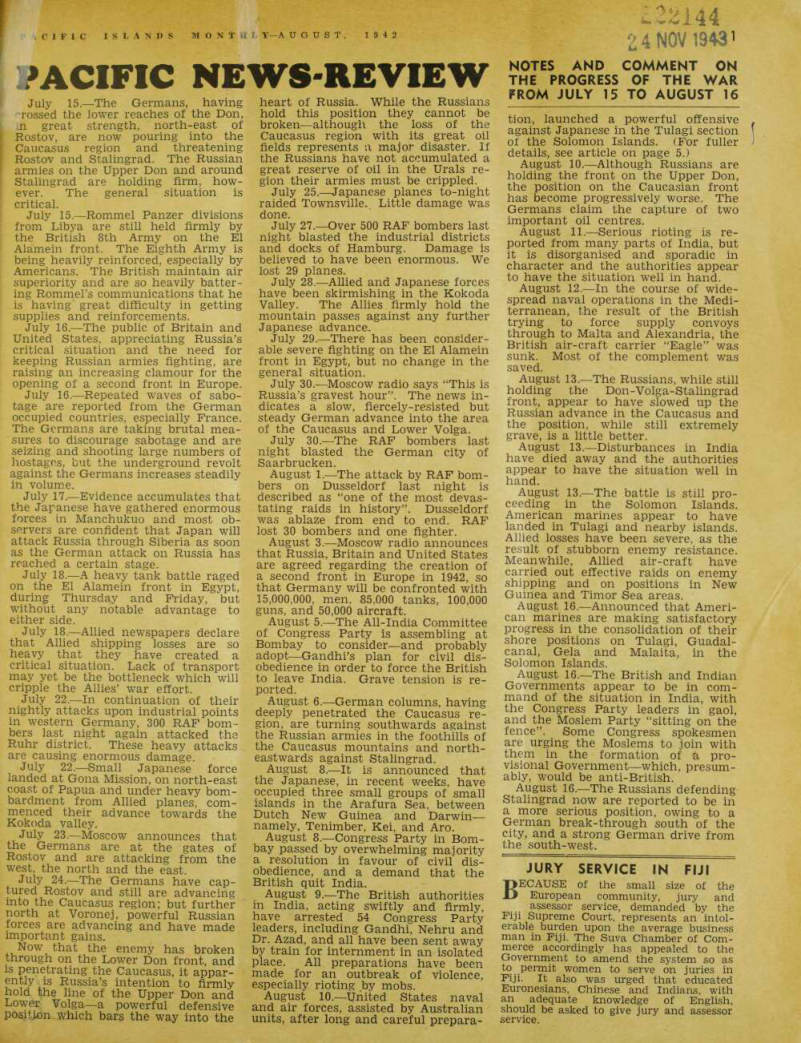
A rough map of the Tulagi area is published on page 46. Reference to this will show that Tulagi is a little island that lies close to the southern shore of the bigger island of Gela (or Florida).
Gela lies between the very large islands of Guadalcanal and Malaita, The deep, sheltered, narrow waters which lie between Tulagi Island and Gela shore comprise the harbour of Tulagi, which the Japanese rapidly turned into a naval and seaplane base after they occupied Tulagi on May 4.
Furthermore, the Japanese, with frantic haste, apparently established strong points and anti-aircraft batteries all around Tulagi—on Tulagi itself, on the nearby islets of Gavutu and Tanamboga, on Makambo islet (in Tulagi harbour), and on the Gela shore. It is easy to imagine that, by August 7, they were in a position to offer a most formidable resistance.
Japanese also, during June and July, cleared an airfield on fairly flat country
on Guadalcanal —presumably, in the vicinity of Tulagi—but it is not yet dis closed to what extent they actually had constructed a base for land planes. Evi dently, they had already assembled some force, because there is a reference in the Allies’ first communique to “opposition by land-based planes and garrisons”.
Between their occupation of Rabaul, in January, and the occupation of Tulagi in May, the Japanese crept down the chain of the Solomon islands and ports (Buka, Bougainville, Faisi, Gizo, etc.) as if they were using a series of stepping-stones; and they must have made effective use of the time allowed them by our period of preparation to dig in very thoroughly, not only in the Tulagi area, but also in the northern Solomons.
The Allies will need all their armed strength, all their enterprise and cour age, and all their spiritual ability to take and stand up to hard blows, before they root out this enemy rats’ nest in the Solomons, and drive the Japs back to the New Guinea area.
The Allied offensive is on a large scale, and was carefully and secretly prepared, over many weeks. The meagre informa tion thus far received shows that Ameri can marines have landed and are hold ing positions on four islands—presum ably, Tulagi, Gela, Guadalcanal and Malaita; that the enemy resistance is bitter, stubborn and prolonged; and that the Allies up to Tuesday, August 11, had lost one cruiser sunk, and two cruisers, two destroyers and one transport dam aged.
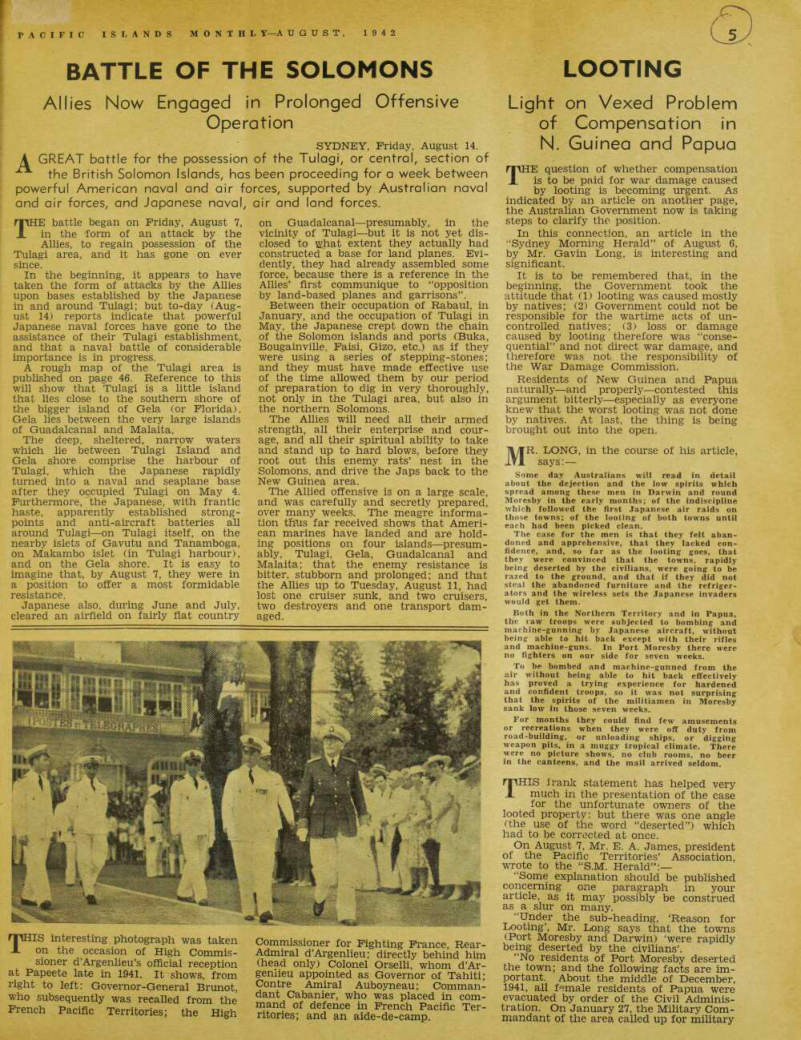
mHIS interesting photograph was taken X on the occasion of High Commissioner d’Argenlieu’s official reception at Papeete late in 1941. It shows, from right to left: Governor-General Brunot, who subsequently was recalled from the French Paciflo nrprrifn-Hoe* fvic rr - •frenen pacific Terntones, the High
Commissioner for Fighting Prance, Rear- Admiral d’Argenlieu; directly behind him (head only) Colonel Orselli, whom d’Ar genlieu appointed as Governor of Tahiti; Centre Amiral Auboyneau; Comman- S as p i a( * d S 1 com ' inand of defence in French Pacific Ter ritories; and an aide-de-camp.
of Compensation in
Looting
Light on Vexed Problem of Compensation in N. Guinea and Papua
THE question of whether compensation is to be paid for war damage caused by looting is becoming urgent. As indicated by an article on another page, the Australian Government now is taking steps to clarify the position.
In this connection, an article in the “Sydney Morning Herald” of August 6, by Mr. Gavin Long, is interesting and significant.
It is to be remembered that, in the beginning, the Government took the attitude that (1) looting was caused mostly by natives; (2) Government could not be responsible for the wartime acts of un controlled natives: (3) loss or damage caused by looting therefore was “conse quential” and not direct war damage, and therefore was not the responsibility of the War Damage Commission.
Residents of New Guinea and Papua naturally—and properly—contested this argument bitterly—especially as everyone knew that the worst looting was not done by natives. At last, the thing is being brought out into the open.
MR. LONG, in the course of his article, says:— Some day Australians will read in detail about the dejection and the low spirits which spread among these men in Darwin and round Moresby in the early months; of the indiscipline which followed the first Japanese air raids on those towns: of the looting of both towns until each had been picked clean.
The case for the men is that they felt aban doned and apprehensive, that they lacked con fidence, and, so far as the looting goes, that they were convinced that the towns, rapidly being deserted by the civilians, were going to be razed to the ground, and that if they did not steal the abandoned furniture and the refriger ators and the wireless sets the Japanese invaders would get them.
Both in the Northern Territory and in Papua, the raw troops were subjected to bombing and machine-gunning by Japanese aircraft, without being able to hit back except with their rifles and machine-guns. In Port Moresby there were no fighters on our side for seven weeks.
To be bombed and machine-gunned from the air without being able to hit back effectively has proved a trying experience for hardened and confident troops, so it was not surprising that the spirits of the militiamen in Moresby sank low in those seven weeks.
For months they could find few amusements or recreations when they were off duty from road-building, or unloading ships, or digging weapon pits, in a muggy tropical climate. There were no picture shows, no club rooms, no beer in the canteens, and the mail arrived seldom.
THIS irank statement has helped very much in the presentation of the case for the unfortunate owners of the looted property: but there was one angle (the use of the word “deserted”) which had to be corrected at once.
On August 7, Mr. E. A. James, president of the Pacific Territories’ Association, wrote to the “S.M. Herald”:— “Some explanation should be published concerning one paragraph in your article, as it may possibly be construed as a slur on many.
“Under the sub-heading, ‘Reason for Looting’, Mr. Long says that the towns (Port Moresby and Darwin) ‘were rapidly being deserted by the civilians’.
“No residents of Port Moresby deserted the town; and the following facts are im portant. About the middle of December, 1941, all female residents of Papua were evacuated by order of the Civil Adminis tration. On January 27, the Military Com mandant of the area called up for military
service, at a few hours’ notice, all male residents not over 45 years of age, and these men immediately were put into camp. From that date the military authorities virtually were in control of the area, making the carrying on of civil administration and commercial activities impossible. From this date, looting commenced.
“On February 3, the Japanese first bombed Port Moresby area. From Feb ruary 3, looting became more general.
“On February 12, the Military Com mandant of the area ordered all civilians not in the forces to leave immediately; and, accordingly, they were evacuated within a few days.
“It will be seen that residents cer tainly did not ‘desert’ the township volun tarily, nor did they abandon their property, but in effect, left it in charge of the military authorities, who assumed control of the whole area.
“It is not our intention to discuss the moral question involved in the matter of looting. But it is a fact that, by the act of looting, those responsible prevent owners from receiving compensation under War Damage Regulations (as the Commonwealth Government at present interprets them). So, while it may sound not unreasonable to steal something be cause it may later fall into enemy hands or be destroyed by enemy action, the actual effect is to rob the owner of the value of the goods so taken.
“This is the position of a great number of evacuees. Having lost their homes, all personal belongings (many were able to leave with only 30 lb. of personal be longings), their livelihood, and, in many cases, a lifetime’s work, they can at present expect some monetary compen sation at the end of the war only if their property be damaged as a direct result of enemy action.
“If, however, no such damage is done, they are faced with the total loss of all their personal effects by reason of loot ing, of their homes due to depreciation owing to white ants, borers, dry rot, etc., or by fire, due to lack of clearing and attention —and with no means of insuring against such losses.
“The somewhat extraordinary position arises, then, that these evacuees will be far better off, from a purely material point of view, if their homes are devas tated by our enemies.
Miss Ivy Ennor, of Annerley, Queens land, was married in June to Mr. C. W.
Walsh, formerly of Salamaua, New Guinea, and now a member of the
Raaf.
No word has been received of the whereabouts of the Rev. James Benson, Miss May Hayman, or Miss M. Parkin son, all of the New Guinea Mission. Gona, Papua, since the Japanese invaded that part of the Territory, but it is presumed by the mission’s headquarters in Sydney that they were able to escape on a pre arranged plan, prior to the arrival of the enemy, and now are either further down the coast, or inland.
Rev. J. Edwards, of the Melanesian Mission, is unable at present to return to his station at Maka, Malaita, Solomon Islands, and has been appointed chap lain to the Lockhart River Mission, Rev. A. P. Jennings, principal of St.
Aidan’s College, Divari, Papua, is carry ing on his work, and writes that there are more students at present than there have been for many years, Mrs. Helen Wayne, wife of Mr. Ron ald N. Wayne, of the staff of the Sup reme Court, Rabaul. is now residing at “The Bungalow”, Woodford, NSW. Mr.
Wayne has been among the missing since the enemy occupation of Rabaul.
Advertisements & other items, p. 7 (1 item)
5
PACIFIC ISLANDS MONTHL Y—A UGUST, 1942
Extraordinary Situation—
Copra
Extraordinary Situation— Little Change
THERE has been no new development in the copra market, the position of which remains fantastic. All the United Nations urgently need copra, and the price has gone to sky-line limits, but two-thirds of the copra-producing terri tories of the world are now in Japanese hands, and the Japanese can neither consume the copra they hold, nor export it to other Axis countries, which need it desperately.
So far as all Pacific —and, it is be lieved, Indian Ocean—copra is concerned, all available supplies are going into a pool, controlled by the United Nations.
Copra is being allocated to United States, Canada, Mexico, New Zealand, Austra lia, South Africa and Britain, according to requirements and circumstances.
The ruling price is governed by the British fixed price in Suva—namely Plantation Grade, £lB/5/-; Fair Mer chantable Sun-dried, £l7; and Under grade, £l6/15/-. The values are stated in Fijian currency. To get Australian or New Zealand values, add 12i per cent.; sterling values, deduct 12i per cent.
This position probably will continue while the enemy occupies the important coconut-growing territories. When such places as New Guinea and Solomons are freed for normal commerce again, the situation may change.
Meanwhile, argument proceeds as to whether New Guinea and Papua plan tation-owners shall be permitted to go back and run their plantations for their own benefit, as soon as conditions per mit. or whether they shall be run, “as a military responsibility, for the duration” and owners “compensated” with 4 per cent. (See articles elsewhere.'*
Road Accidents In New
Caledonia
WITH the presence of Allied troops in New Caledonia there has' come an enormous increase in vehicular traf fic, with a corresponding rise in the proportion of road accidents. It became necessary for Allied headquarters there to issue urgent warnings to civilian pedestrians, and particularly to the numerous users of bicycles.
Death Of Rev. John
Gilkison
REV. John Gilkison, of the LMS, Mailu, Papua, died of blackwater fever, on February 7, three days after his wife and daughter had left Papua for New Zealand. Mr. Maurice Nixon, of the Fife Bay station, arrived after the attack had begun, but all efforts to save the young missionary’s life were in vain. He was buried at Iruna, where he and his wife had plan ned to build the new head-station. Mr.
Gilkison was born in New Zealand in 1913, studied at Otago University, and trained at Trinity Theological College, Auckland. He was appointed by the LMS to Papua in 1938, and in 1939 he mar ried Miss Ngarie Mill, of Samoa.
Three former nurses of the Methodist mission’s field staff. Misses H. Muir and A. Pitty (of the Salamo Hospital. Papua), and Miss D. Coltheart (Rabaul, TNG) now are serving at the NSW Govern ment’s half-caste aborigines’ home at Cootamundra.
Assumed Duty in July
New Governor Of
Fiji
HAVING travelled with remarkable rapidity, Major-General Sir Philip Mitchell —whose appointment was officially announced only on June 19— arrived in Suva in mid-July, and imme diately assumed office as Governor of Fiji and High Commissioner for the West ern Pacific.
Sir Harry Luke, who was appointed in September. 1938, and resigned in June, 1942, left Fiii in July and proceeded to New Zealand, en route to London. His departure was accompanied by expres sions of regret from leaders of all four communities—European, Fijian. Indian and Chinese —among whom he had made manv friends.
Fijian administrative affairs apparently will undergo a considerable change around, as the result of the almost simultaneous arrival of a new Governor and a new Colonial Secretary (Mr. A.
T. Newboult, lately of Malaya, whose appointment was reported in last issue) and the reported transfer of Mr. C. W.
Trevor Johnson (Acting Colonial Secre tarv, who has spent most of his life in Fiji, and whose knowledge of the pdministrative machinery is encyclopae dic). The report that he has been trans ferred was received in Svdney unoffi cially in July, however, and may not be correct.
Mr. A. T. Newboult. whose appointment as Colonial Secretary of Fiji was an nounced recently, arrived in Suva earlv in June, and was already in office when the new Governor arrived.
As stated in July. Mr. Newboult had been over 20 years in Malaya, where he held many important offices. He left Malaya when the Japanese invasion occurred.
John Gu
ON the night of August 11, a new for ward was added to the Rugby Union football team which represents Gor don, a suburb of Sydney. His name was stated to be John Gu. He is 18 years old. six feet in height, and his weight is 18i stone. The Gordon Football Club welcomed him with fervour. He is a first-class footballer.
Officially, the young man is addressed as His Royal Highness Prince John Gu fatahumanunathogo, younger son of the Queen of Tonga. He is a student at Newington College.
Prince John Gu played for Newington College last year. But, because his weight was 19i stone, he was withdrawn from the team because he was too heavy to plav against schoolboys.
Unlike most young men of phenomenal size, he is no victim of glandular de rangement. He merely is the worthy son of a line of Tongan noblemen who were always noted for their size. The Editor of the “PIM” ate luncheon at a picnic with his grandfather in 1914. and that King (George Tubou IV) weighed about 22 stone, yet was so tall that his bulk did not seem out of proportion. His father and grandfather also were men of great height and bulk.
Prince John Gu’s brother is heir to the throne of Tonga, and was until recently a distinguished scholar at the University of Sydney, where he took the degree of BA He was studying law until war con ditions obliged him to return to Nukua lofa.
Advertisements & other items, p. 8 (1 item)
6
AUGUST, 19 4 2—P ACIFIC ISLANDS MONTHLY
Lieut.-Col. Love
Gallant Maori Officer Killed in Action
IT was officially announced in New Zea land on July 17 that Lieutenant- Colonel E. T. W. Love, commander of the Maori Battalion in the Middle East, had been killed in action. Grief
for the untimely loss of a very gallant officer was expressed by the New Zealand Minister for Defence, and other promi nent people.
It is only a few w T eeks since it was reported that Mr. Love, a full-blooded Maori, had been appointed to the com mand of this battalion, and various people commented upon the high honour thus paid to the Polynesian race. Soon afterwards, word came from Egypt of the courage and initiative shown by Colonel Love in leading his men in the bitter fighting then in progress.
He left New Zealand with the battalion as Captain Love, and he fought in Greece and in Crete, where he was at one period reported missing. He later rejoined his company, and then was promoted to the rank of major, and fought in the Libyan campaign last Christmas.
Colonel Love was of very high native rank. His parents are Mr. and Mrs. Hapi Love, of Petone, New Zealand.
Colonel Love’s wife, Mrs. Takau Rio Love, is paramount Chieftainess, or Makea Nui Ariki, of Raratonga, popu larly known as the Queen of Raratonga.
Lieut.-Colonel Love.
Fighting France
Praise for the Pacific Battalion of Fighting France
GENERAL de Gaulle sent the following radiogram to the French High Com missioner in New Caledonia.
“I have pleasure in announcing that the Pacific Battalion covered themselves with glory in the Bir-Hakeim battle of the Libyan campaign. . . . Their con duct and fidelity on that critical occa sion are among the brilliant episodes of this war.”
Mrs. Maddox, wife of the Chairman of the Samoa District of the Methodist Overseas Mission, has arrived in Sydney, after numerous delays en route. She and her four sons will make their home in Dubbo, NSW.
Territories Residents’ Pleas To
Australian Government
Early Move Now Expected Regarding Definition of Looting
THERE are indications that three matters of special interest to resi dents of Papua and New Guinea who have been evacuated to Australia — namely, compensation for looting as war damage, operation of plantations by military units, and a more liberal ration in Australia for clothing—now are receiv ing official attention.
For many weeks past, the executive of the Pacific Territories Association has been making urgent representations to Ministers and officials concerning these matters, but Ministers have shown the usual Ministerial tendency to avoid giv ing decisive answers; and there has been a series of most exasperating delays.
The position (at the end of the first week in August) appears to be about as follows: —
Looting
AS indicated in the “PIM” in June and July, the Australian War Dam age Commission has given an offi cial ruling that compensation will not be paid in respect of “consequential” war damage—only in respect of “direct” war damage. Under this decision, loot ing is not classed as war damage; and, consequently, even persons who have insured their property under the war damage compensation plan will not receive compensation for losses through looting.
This decision is so grossly unfair, in view of all the circumstances existing in Papua and New Guinea, that very strong representations have been made in regard to it. The matter has been pressed urgently upon Ministers—and it can now be stated that the Common wealth Government is giving the matter consideration.
An Australian barrister is at present in Darwin on behalf of the Australian Government, investigating the position there in relation to war damage; and it is probable that at a verv early date a man, or men, will be similarly authorised to proceed to Papua, to commence an investigation in relation to war damage generally. This will embrace all issues relating to damage, including looting.
AS a result of the inquiries made recently by the “PIM”. it can be said that Australian Ministers are not unsympathetic towards the plight of the residents of New Guinea and Papua.
It is recognised that a great many of them have suffered heavy damage through war conditions —damage that is classed as “consequential”, but neverthe less bears lust as heavily unon them as if it were “direct”—and that their claim fo** comnensation is justlv based.
But there is another side to the pic ture. In every community there are unscrupulous or super-shrewd people who
will not hesitate to take advantage of extraordinary general conditions in order to reap a particularly cunning advantage for themselves. If the Australian authority, in the beginning, had given a wide and liberal interpretation of war damage, it is certain that it would have been called upon to pay all sorts of faked and exaggerated claims for compensation.
This the Government is determined not to do.
That explains, in one way, the decision to give so limited an interpretation to war damage—to give, at first, a “No” to all claims for what are called “conse quential” war damages. In the opinion of officials, it apparently is easier to relax the “No” in certain proved and specified cases, than to say “Yes” to the general proposition, and afterwards have to alter the “Yes” in many cases to “No”.
It seems certain that, in the ultimate settlement, all claims for war damage compensation in Papua and New Guinea, whether consequential or direct, will be investigated and dealt with by a special tribunal. Persons affected bv war dam age in the Territories, therefore, should, without loss of time—if they have not done so already—gather together all nossible information which they may have to supply as evidence in support of their claims for compensation. They should keep in close touch with the Paci fic Territories Association, or some com petent body or person, in this connection.
Occupation Of Plantations
THE plan under which plantations in Papua and New Guinea are to be operated under military control, for the duration of the war (outlined in the “PIM” in July) has been receiving a good deal of attention during the month.
It is understood that the matter has received the personal attention of the Australian Prime Minister and that, in some form or other, it has been before the Commonwealth Cabinet.
The general character and purpose of the plan, and the attitude of the Aus tralian Government thereto, are still obscure: but it is clear that a section of the Cabinet regards the matter as hav ing considerable importance, and it is exnected that a clear understanding in relation to policy will be reached at an early date, as between Government and military authorities.
The arguments in favour of permit ting owners of plantations to resume the operation of their plantations, as soon as military conditions permit, rather than to allow military units to remain in occupation of the plantation for the duration of the war, are so strong that it may be taken as certain that in the end they will prevail.
A Reply From Territories Minister
AFTER the above article was in type, the editdV of the “PIM” received a long and courteous letter from the Minister for External Territories (Sena tor J. M. Fraser) in which some useful information was given, somewhat elabo rating the statements in the article.
We had complained to the Minister that renresentations made to his and other Departments repeatedly and ur
gentlv duriner the past two months bv the Pacific Territories’ Association had brought from officials little beyond the soothing assurance that “the matter is receiving attention’’. The editor said frankly that if the Government was not prepared to give some reply, even if a negative one. to these appeals from the unfortunate people of the Pacific terri tories, he personally would place details
Officialdom Never Hastens!
of their treatment in the hands of the Australian daily newspapers. He said he was convinced that the Australian pub lic would be shocked by the examples of heartless and callous treatment of their unfortunate fellow-Australians from the war-torn Territories.
“Looting”
CONCERNING the argument as to how looting shall be classified in relation to claims «for compensation for war damage, the Minister said: “I have been in consultation with my colleague, the Minister for the Army, in regard to the foregoing matters, and I am able to advise you that the representations made by the Pacific Territories’ Association are receiving full consideration ... A highly qualified Adelaide barrister has been appointed ... to inquire into the report upon the position in Northern Territory.
The question of a similar inquiry being made in relation to . . , Papua and New Guinea is being considered.”
Plantation Control
rpHE Minister in his letter states the X reasons (which may not at present be published) why control of all plantations in the Pacific territories is now vested in the General Officer Com manding the New Guinea force; and adds: “Plans for the future control of the plantations, and the position of the owners of these properties, are matters that are being considered by the Com monwealth Government, and as soon as a decision is taken, owners and others interested will be advised. In this con nection, representations have been re ceived direct from the owners, and are being fully considered.”
We submitted this statement by the Minister to the president of the Pacific Territories’ Association (Mr. James) who commented:— “We recognise the military necessity which places control of plantations in the hands of the GOC for the present.
But our members would like to know how much owners are going to receive for their plantations, on what basis it is going to be assessed, and when they are going to receive it. Also, plantation owners would like to know when they are going to receive anything for the produce taken over along with the plan tations. We have been trying for weeks to get some information—but without success.”
Clothes Ration
ON the subject of the inadequate clothes ration made available to Territories’ evacuees concerning which very strong representations have been made to various officials the Minister said:— “The Rationing Commission arranged that where evacuees were identified by a certificate issued by the Department of External Territories, evacuees would be
issued with coupons additional to the normal ration book”; and he added that he had been informed by the Deputy Director of Rationing, Sydney, that the scale of the additional issue was such that a person who had lost his effects would be given coupons to enable his supply of clothing to be brought up to a “reasonable standard”.
We have informed the Minister that the assurance given to him by the Deputy Director of Rationing is not cor rect. All kinds of official difficulties were placed in our way when we tried to obtain from the rationing authority a definition of what is a “reasonable standard” for a man; but eventually we ascertained that the scale published on page 5 of the “PIM” of July (1 two-piece suit; 1 extra pair of trousers; 2 pairs of underpants: 2 singlets; 4 pairs of socks; 2 pairs of pyjamas; 1 pair of boots; 1 overcoat) had been graciously supple mented with 2 shirts and 1 hat. Appar ently, in the view of the rationing authority, this is an adeauate wardrobe for an average man.
It has been suggested to the Minister that such a scale of rationing indicates, on the part of the official mind, a mis erable and callous disregard of the con dition of Pacific Territories evacuees; that the rationing scale for men gener ally has been based on the assumption that the average man has a fair average wardrobe, consisting of at least two suits and half a dozen sets of underclothes, before rationing came into operation, and that the object of the scale was merely to maintain that wardrobe: and that, even if every unfortunate evacuee were allowed three or four suits, and as many underclothes as he wishes, Australia’s economic position would not be in the slightest degree affected.
The Minister also has been informed that these representations were made directly by the Pacific Territories’ Asso ciation to Dr. Coombs, Director of Rationing, some weeks ago, but no deci sion has been given.
Accounts Not Paid
FNALLY, the Minister has been asked if he can assist evacuees by induc ing the Australian Government to pay them various monies due for pro perty purchased or “impressed”.
Scores of evacuees parted with their property in Papua, and in the Morobe district of New Guinea, on the assur ance that they soon would be paid for it. But the great majority of them, six months later, still are running along from Department to Department, and from Sydney to Melbourne, and Can berra, trying to induce some buck-pass ing official to give their claims a little serious notice. The accounts are not repudiated in any way—they are just ignored.
It is a scandalous and incredible posi tion—but it exists, just as we have described it.
Wing-Commander D. W. Baird, who went to Fiji in November, 1940, to com mand an RNZAF unit, has arrived in London from Honolulu to succeed Wing- Commander Newell as New Zealand air liaison officer.
Mr. H. W. Forsyth is interned in Stan ley Camp, Hong Kong, according to advices received by his wife, a resident of Auckland. He was formerly an engineer in the Public Works Depart ment in Fiji and went to Hong Kong in 1940.
The arrival in New Zealand of Rear- Admiral d’Argenlieu, Fighting French High Commissioner in the Pacific, was expected in July, according to “New Zea land Herald”. A recent arrival there was Monsieur E. L, Ricard, a former mer chant in the Dutch East Indies. He barely escaped the Japanese invasion, with his wife and young daughter. His elder daughter, who was in a convent, had to be left behind. M. Ricard has commenced the organisation of an inter mation and propaganda service for Fight ing France in the Pacific.
Advertisements & other items, p. 9 (1 item)
7
PACIFIC ISLANDS MONT II L Y—A UGUST, 1942
Shortage
1/- Notes
How Fiji Solved Coin Shortage
FJI, in recent months, has suffered great inconvenience owing to a shortage of silver currency.
At the end of 1940, Fiji’s currency in circulation amounted to £78,435 in coins (silver 2/, 1/- and 6d., and nickel pen nies and half-pennies), and £637.213 in Fiji notes (including notes for £l, 10/and 5/-). This appeared to be ample.
But the establishment of troops in Fiji apparently created a demand for more coins. There was a serious short age early in the year, and the Fiji Gov ernment put in what additional currency it had; but a crisis developed again in May.
Then the banks rationed silver coins, and would allow customers to draw only £2 worth at a time. Nickel pennies ran short, also, and many traders began to use postage stamps in lieu of small change.
In June, the Government, having no alternative, got busy with the printing press: and notes of 1/- and 2/- deno mination were issued through the trad ing banks, along with the old 5/- note.
They are printed on ledger paper, and are legal tender for sums up to £2.
Complaints from Lautoka, in July, indicated that although the Currency Commissioners had issued 90,000 of the new 1/- notes, none of them had reached the sugar districts, and the shortage of silver currency there had reached an acute stage. A premium of 3/-. in the £ was being offered for pennies; silver was also at a premium; and no notes of 5 and 10/- were available.
Legal And Civil
Powers
Important Regulations Affecting N. Guinea and Papua
IMPORTANT regulations affecting the legal and administrative position in relation to the Territories of Papua and New Guinea (which have been under military administration since February 12) were issued on August 7 by the Commonwealth Government under the National Security Act. They relate to the powers of the officials of the Pacific territories, and make temporary provi sion for carrying on administrative responsibilities.
The effect of the regulations is to vest in the Minister for External Territories all the legal powers and functions pre viously vested in the Administrators and officials of Papua and New Guinea; to provide that such Administrators and officials shall not be entitled to exercise those powers or functions while they are on leave of absence; to authorise the Minister to transfer to any person whom he may select those powers or functions; and to permit such selected persons to take the place of Administrators and officials, who normally are the only people permitted to exercise such powers and functions, according to the special laws of the Territories.
The jurisdiction, powers and functions, in relation to civil matters, held and exercised by the Supreme Courts of Papua and New Guinea on February 11, 1942, are transferred to the Supreme Court in Canberra, “as if the Territories of Papua and New Guinea formed part of the Australian Capital Territory”.
Advertisements & other items, p. 10 (1 item)
8
AUGUST, 194 2—P ACIFIC ISLANDS MONTHLY
How Mv “Macdhui” Was Lost
Bombed and Sunk by Japs in Port Moresby
(Report from Brisbane “Courier Mail” of July 28.) ALIGHT members of the crew of the Burns, Philp motorship, "Mocdhui" were killed when Japanese bombs sank the well-known vessel at Port Moresby on June 18, and later two more died from their injuries.
CAPTAIN J. Campbell, the master, who was injured, and 62 other survivors have reached an Australian port.
The ship was hit and damaged on two successive days. On the first, June 17, three men were killed and one fatally injured. On June 18 five were killed outright and one fatally injured.
The list of killed is:— Herbert Smith, about 55, steward.
William Barrett, about 42, steward.
Dr. C. Tunstall, 74, single, formerly of Chillagoe Hospital, ship’s medical officer.
J. Fiddes, about 64, able-seaman, mar ried.
Harry Rosen, about 40, steward, of Coogee, Sydney.
David Rawson, about 26, second officer, of Sydney.
James Lawson, about 28, first-grade steward, married, of Coogee, Sydney.
Arthur Richards, about 48, butcher, married, lived near Penrith, New South Wales.
William Drury, first-grade steward, was injured on the second day and died in hospital in Port Moresby the next day.
H. Saville, a member of the crew, aged about 56, was injured on the first day and died later in Port Moresby.
Captain Injured
AMONG those injured were:— Captain James Campbell, of Rand wick, Sydney, who suffered burns on the face and injuries to arms and a leg.
Gordon Howe, about 36, chief officer, North Sydney, injuries to arms and legs.
Richard Laws, 73, steward, of Woy Woy, married, injuries to arms and legs.
Other survivors include: Third Offi cer Len Wagner, North Sydney; Elec trician T. Webb, King’s Cross; Chief Steward N. Clarke, Willoughby; Wire less Officer J. Cleary, Strathfield; Second Radio Officer N. Seymour, Sculleryman A. Turner, Purser B. Allen, Sydney; Assistant Pursers W. Kilgour, Ryde, and G. Wilson, Ashfield; Chief Engineer A.
Walsh, Artarmon.
Doctors Brave Rescue
rpHE “Macdhui” received four direct A hits with heavy delayed-action bombs, and was blazing from stern to prow when she went down.
A young Moresby doctor went along side the blazing ship in a fast launch, climbed the side, and daringly rescued a
trapped and badly-injured steward min utes before the ship sank.
The steward died later in hospital.
Captain Campbell told a graphic story.
The captain was thrown from the bridge to the next deck by the last bomb-hit, and was 16 days in hospital, with shrap nel wounds in the arms, and burns on the face and body.
“We had unloaded most of our cargo and were anchored in the stream,” he said. “The alarm sounded, and at 9.45 about 18 Japanese planes came at us from about 18,000 to 20,000 feet.
“Near misses lifted the ship out of the water like giant hands and dropped it back again.
“We were holed several times from these. The Japanese last bomb for the day struck the bridge 14 feet away from me. It cut through three steel decks and exploded in the saloon, killing the ship’s doctor and two stewards. We put into wharf that night to land the killed and wounded.
Gun Crew Wiped Out
r'E next day the Japanese came at us again. They made two direct hits in No. 3 hold, setting the ship on fire. Another direct hit wiped out the gun crew of five men. The next one got us on the bridge, and I was thrown to the deck below.”
Benjamin Allen, the purser, of Wil loughby Road, Carlingford, Sydney, said that a fire started in the ship, and the crew were ordered to take to the boats.
The vessel burned until the following night, and finally drifted on to a reef near a native village, where it was now resting on its side. All cargo had been got ashore before the second attack.
Captain James Campbell, commander of MV “Macdhui”, destroyed on June 18, and who was blown from the bridge and seriously injured, is one of the best known and most popular skippers of the Burns, Philp fleet. He has, in turn, commanded the MV “Bulolo” and SS “Montoro”.
He now has returned to his home, Rand wick, Sydney, and is recovering from his injuries.
Harry Rosen, one of the stewards of the “Macdhui”, who was among those killed, was very well known to Islands travellers. He had served in most of the company’s passenger boats plying be tween Australia and New Guinea.
Motor vessel “Macdhui”, 4,561 tons, which was built in 1930-31, and entered the New Guinea and Papua service in 1931.
Luck Of M.H.
Remarkable Financial Position of Big Pacific Trader
NO company trading in the Pacific occupies a happier position to-day than the big Fiji firm of Morris Hedstrom Ltd., whose annual accounts (for year ended March 31) were pub lished during the month.
Most other big Pacific concerns have been more or less mauled by the Japan ese invasion; but M.H. have had all the luck —none of their territory has been touched, they had no money in shipping, and they held enough copra to get sub stantial benefits from the sensational rise early in this year.
Their chief trouble is that of USA prior to 1939 —they have too much money. Their accounts for the year ended March 31, recently published, show that, while their subscribed capital is £740,000, plus an accumulated reserve of £130,000, they are holding no less than £228,600 in cash, and £182,900 in “invest ments”. This is because, since war broke out, the directors have followed a care ful, conservative policy, so that funds previously represented by plant, mer chandise, and branch balances (totalling £450,000 in 1940, but only £300,000 in 1942) have now become liquid. It is not a good thing. The money is safe in the bank, of course: but £150,000 that was working in 1939-40 is now idle.
Nevertheless,- the company is doing exceedingly well. Its profit for the year just ended was £54,949, compared with £59,296 in 1941 and £51,783 in 1940.
Rarotongans For New
Zealand
From Our Own Correspondent
Rarotonga, July 6.
YOUNG native women and lads con tinue to leave Rarotonga by the dozen for New Zealand, where they contract for domestic and farm labour.
This development is now receiving the attention of the Cook Islands Adminis tration, which in most cases deals with the details of employment, etc., medically examines the young people before leav ing the island, and acts as chaperon generally.
The conditions for these youngsters in New Zealand appear to be satisfactory, judging from their glowing and some times registered letters which are duti fully sent to the poor “old folks at home”.
Rarotongans await their home-coming (and probable subsequent dissatisfaction) with interest.
A report was current in Sydney in July that Lieut.-Colonel E. T. W. Love, commander of the Maori battalion with the New Zealand forces abroad, and husband of Makea Nui Takau Ariki, Rarotonga (the newly-appointed para mount chief), was very prominent in leading his men in some of their famous bayonet charges against the Germans.
Newspaper correspondents referred re peatedly to the bravery of the Maoris, and the gallantry of Lieut.-Colonel Love.
Mr. Eric Ramsden, founder of the Paci fic Islands Society in Sydney, who acted as its secretary until this year, will leave for New Zealand, for medical treatment at Rotorua, at the end of August. “Busby of Waitangi”, Mr. Rams den’s new book, has been published in New Zealand.
Advertisements & other items, p. 11 (1 item)
9
PACIFIC ISLANDS MONl'Ht Y—A CGDST, 1942
All The World's
Rice
What Will Japan Do With It?
WITH the conquest of Burma, Thai land and French Indo-China com pleted, Japan now controls 95 per cent, of the world’s rice supply which normally enters international trade.
These three countries, often referred to in the world rice picture as the Big Three, export on the average over 13 billion pounds of rice annually, while all the countries now in the Japanese orbit import less than 4 billion pounds. Japan, therefore, has a surplus of 9 billion pounds of rice on her hands to dispose of annually. What will she do with it?
Japan needs very little of it. From 1933 to 1938 Japan was practically self sufficient in rice. She was producing 86 per cent, of her own requirements and was receiving 13.7 per cent, from her colonies, Korea and Formosa.
For several decades, however, Japan was gravely concerned about her food supply and spent considerable effort in fostering increased production, both at home and in her colonies. As a result, in all three areas yields per acre were raised substantially and some expansion in acreage occurred. In the middle 1930’s Japan, realising that she had about attained self-sufficiency, shifted her rice expansion programme back into second gear.
How much rice do Japanese-occupied countries require? Manchuria is prac tically s6lf-sufficient and rice production is expanding. Occupied China could use a billion pounds if the “peacemakers of the Far East” permitted its importation.
In fact, with proper distribution the Chinese could consume an even larger quantity, but this seems unlikely under present conditions. The Philippine Islands’ import requirements are insigni ficant, as in recent years of good har vests exports are about equal to imports.
The Netherlands Indies, which a decade ago was a huge importer, has rapidly increased production so that the country had attained self-sufficiency in 1940, British Malaya, the greatest deficit area now under Japanese control, normally produces only about one-third of its total requirements. It is expected that this area will be able to continue to obtain its imports of about two billion pounds annually from Burma and Thailand.
For the time being, it seems probable that Japan will import as much as she desires, will pay for it with printing press money, and will be unconcerned about the remainder. The Burmese, Siamese and Indo-Chinese will be unable to dis pose of the huge surplus and will be unable to obtain textiles and other neces
sities, a matter of vital concern to these peoples. Surplus rice in those areas and shortages elsewhere will usher in Japan’s “co-prosperity sphere”.—“Far Eastern Survey”, June, 1942.
EDITORIAL NOTE.—It seems more likely that Japan, finding this huge quantity of cheap food available, will divert thousands of workers from her domestic rice industry to her essential wartime industries, and in this way will get a substantial and direct benefit from her capture of the rice-growing coun tries of the world.
Australian Rice For
Territories
IT was officially announced on August 11 that all rice in Australia is to be withheld from the civil population, in order that supplies may be sent to Papua, Fiji, New Hebrides, New Caledonia, and other islands to assist in feeding native labour.
The importation of rice to the South Pacific as a staple food for natives gener ally—and especially labour lines—repre sented an important trade between those territories and Burma, Indo-China and the Dutch East Indies.
The whole of the rice production of Indonesia now has been cut off from the world market through the Japanese occupation of Malaya, Burma, Indo-China and the East Indies. The extraordinary position now exists that while Japan has on her hands many times as much rice as she and the countries she now occupies can consume, the rice-consuming coun tries of the world are now without their regular supplies. Even the small amount grown in Australia, plus Australia’s accu mulated store of rice, is needed for the Pacific Territories.
Samoa's Trade in 1941
OWING to war conditions, the usual statistics relating to the trade and commerce of Western Samoa in 1941 have not been published. The Apia Chamber of Commerce, however, has issued the following summary:— Net collections of import and export duties and port and service tax at £50,488 were less by £l9 than in 1940. The financial year which ended on March 31, 1941, closed with a deficit of £2,292, com pared with the estimated deficit of £11,262.
For the year ending March 31, 1942, the Budget estimates expenditure at £110,448 and revenue at £87,750. A de ficit of £22,698 is thus expected. Of the estimated expenditure, public debt charges absorb about 9 per cent., admin istrative departments 36 per cent., social services 38 per cent., and public works and lands and survey 17 per cent. This percentage analysis entirely disregards the post and telegraph, labour, and public trust departments as self-supporting trading services.
In January, 1942, the rebate on cocoa export duty was altered; the full duty of £2 a ton becomes payable when the value f.o.b. reaches £4O a ton.
At the beginning of March, 1942, the full scale of copra export duty was again imposed. This is a sliding scale; the maximum duty of £l/10/- a ton on native produced copra becomes payable when the f.o.b. Apia value reaches £ll a ton, and the maximum duty of £1 a ton on Euro pean produced copra is payable when the f.o.b. Apia value reaches £lO/5/- a ton.
Mrs. Heighway, widow of the late Mr.
W. A. Heighway, Lakeba, Fiji, died recently in Sydney. Both Mr. and Mrs.
Heighway were well-known in Fiji as Methodist Mission workers.
Death of Panuarii Taie
Fine Polynesian
From Our Own Correspondent
Papeete, June 17.
rpHE last of a venerable generation of A aristocrats, descendants of high Chiefs renowned in Polynesian his tory and poetic legend, passed with the death of Punuarii Taie, on June 6, 1942.
Punuarii Taie was of the royal blood of Opoa and was a direct descendant from that mighty warrior and voyager, Tautu, paramount High Chief of Tahaa.
More recently, his family were the early disciples of the great missionary, John Williams, and from among them were ordained the first messengers of the Gos pel to the Cook and Austral Islands.
Punuarii Taie followed the tradition of his forebears in his devotion to the Pro testant Church of Ra’iatea and Tahiti.
During more than 35 years he has been a deacon of the church at Papeete, lat terly exercising the duties of assistant pastor in many ceremonies of the insti tution. Always he has been the leader and spiritual father of the Ra’iatea col ony on Tahiti.
Revered and loved, he became an almost legendary example of that race of noble Polynesians who have all but vanished from the islands of the Pacific.
Americans Popular In
N. Caledonia
From Our Own Correspondent
Noumea, July 17.
AMERICA’S Independence Day and France’s Republic Day celebrations served to show how popular the United States Forces have become in New Caledonia. There were special cheers on the appearance of the American Commander at the salut ing bases, and for the American detachments marching past. Thus was demonstrated the gratitude and the friendship of the New Caledonians, both white and native, and their appreciation of the Americans’ considerate behaviour during four months’ strenuous work, which has meant a noteworthy contri bution to the defensive and offensive capabilities of the South-West Pacific area.
Mr. C. P. Thomas, father of Lieut.
Wyn. Thomas, of Papua, died in the Mater Misericordiae Hospital, North Sydney, on July 27, a fortnight after his son’s arrival on two months’ furlough.
Advertisements & other items, p. 12 (2 items)
10
AUGUST, 194 2 P ACIFIC ISLANDS MONTHLY
Wp
ft y
YOUR
MONEY
fSA/££D£DjjfOHf save for
HO NATIONAL*
SAVINGS BONDS,
Europeans Have "Lost
Face "
Our Responsibilities to Native Races of Pacific
rE health defence of the Pacific Islands were discussed in an address to members of the Pacific Islands Society, in July, by Major-General F. A.
Maguire, of the Australian Medical Ser vice. The following is a summary.
The Pacific Islands, extending over the greater part of the Pacific Ocean, include lands in both the temperate zone and the tropics, and all the big land masses which lie east and south-east of Asia.
It should be the main aim of the white races to preserve the native races in their original state, but to give them the full advantages of modern education and hygiene. These advantages cannot be conferred in a year or two; but by a well planned system of education extend ing over three or four generations, the natives may be brought to higher living standards without disturbing their own natural conditions.
It is essential that first-class aero dromes and sea-plane bases should be developed in every group and ultimately in every island of any size, so that full and free communication may be main tained between the various groups and the continents of Australia, Asia, and America. This will form a basis of defence, as well as give normal channels for trade.
The problems facing the Administra tors of these Islands are well summed up in the advice Kipling gave to the daugh ter nations of the British Empire, when he said that their problems ran along the five points of fellowship—namely, education, immigration, irrigation, trans portation and administration.
The health of the inhabitants is safe guarded by the progress made in mod ern medicine and sanitation. Many of the acute infectious diseases which have swept over them in the past are now under medical control. Quarantine is still a very important problem, particu larly as it is associated with the cutting down of the time factor in travel. Where yellow fever developed in 14 days, while the person was on ship-board, between two large countries, now the same dis tance is covered in a few hours by aeroplane. Carriers of acute infectious diseases can be mingling with the popu lation of other countries within a day or two of receiving their initial infection.
These are problems of quarantine to which the Government authorities are giving the closest attention.
The work done by the Rockefeller Institute of America, in investigating diseases indigenous to the Islands, has been of the greatest value. Medical orderlies from the native groups are being trained and this will give the native population greater confidence in themselves and in the medical adminis tration.
The people of the white races must realise they have lost a very great deal of “face” amongst the people of the Asiatic and other groups. They can only regain this by giving the very best that they have in the service of these groups, and maintaining a high standard of organisation and administration, educa tion and discipline, both among them selves and those native groups which Providence has placed in their care.
The death occurred recently in New Caledonia of Madame Eugenie Charles, aged 79 years.
Wedding Group In Rarotonga
THE marriage took place recently of Miss Rose Estall, daughter of Mr.
Marcus Estall, to Mr. D. S. Reid, private secretary to the Resident Commissioner, Rarotonga. This group (photographed in the grounds of the Catholic Mission, Avarua, Rarotonga),
includes (left to right): Mr. M. B. Baker (Director of Agriculture), best man; Miss Dolly Estall, the bride’s sister; the bride groom; the bride; Mr. Marcus Estall (an old-established planter); Mrs. T. Cowan (Tere Tinirau); Miss Yvonne Estall; Miss Paula Cowan; Mr. Ernest Taripo.
Fighting French
Casualties in Libya Battle
From Our Own Correspondent
Noumea, July 21.
rE official list of casualties in the Bir Hakheim (Libya) battle, of New Caledonian and New Hebridean volunteers of the Bataillon du Pacifique is as follows: —
Killed In Action
Lieut.-Colonel Felix Broche.
Marcel Kollen.
Francois Masson.
Pierre Charpentier.
Missing
Andre Petre. —. Roudeillac.
Henri Payonne. —. Geller.
Victor Dervaux. —. Moutry.
Eugene Pene. Rene Letocart.
Reginald Boulanger. Robert Blum.
J. P. Gouzenes. Eugene Pognon.
Camille Mercier. Louis Anger.
Georges Kabar.
Wounded
—. Asmus. Jean Brial.
Henri Berthelin. Rene Aufant.
Alex Winchester.
Berbere (alias Aresky).
This list is additional to the half-dozen casualties suffered by New Caledonians in previous desert fighting.
The engagement was announced a short time ago of Miss Marie Lorraine Shield, of Suva, Fiji, daughter of Mr. and Mrs. S. D. Shield, of Seaton Park, South Australia, to Corporal Kenneth David HPanckhurst, of Hastings, New Zealand, who is serving with the RNZAF in Fiji.
Mr. A. H. Nicholls, Chief of the Con dominium Customs Service, died suddenly at Port Vila on March 14. Mr. Nicholls was an unusually active man, and had discharged his official duties with his usual vigour up to the time of his death.
Rarotonga
More Trees !
Far-sighted Plan in Rarotonga
From Our Own Correspondent
Rarotonga, July 6.
AN Agricultural Field Day recently held in Rarotonga was an out standing success. The Field Day was designed by Mr. M. B. Baker, Direc tor of Agriculture, to promote interest in his Citrus Re-planting Scheme. Mem bers of the Island Council, Packing Shed Committees and leading growers were invited to inspect newly-established cit rus plots, and other developments of current interest.
Mr. Baker particularly stressed, during the day, the urgent necessity for plant ing shade and shelter trees, which have been destroyed at an alarming rate dur ing the past few years. The present infertility of the strip of flat land sur rounding the island is due, not only to the lack of efficient cultivation, but in a great measure to the disappearance of the “mape” (Tahitian chestnut), bread fruit and other deciduous trees that once upon a time abounded.
The citrus plots inspected, all of 60 to 120 trees per grower, were in hearten ing shape, and the Field Day, the first of its kind yet held here, amply repaid in citrus-planting propaganda the small amount expended in transport and food.
An ample luncheon was provided but the party, to the astonishment of the organisers, left its well-earned siesta to spend a hot afternoon tramping round further plantations.
Mr. Baker also proposes to hold an Agricultural Show and other demonstra tions to help stimulate interest in agri cultural matters. These would appear superfluous in an entirely peasant com munity such as Rarotonga, but unfor tunately they are all too necessary.
Increasing population and decreasing soil fertility do not agree, and some means must be found to offset the well-mean ing ignorance of the average grower.
Advertisements & other items, p. 13 (1 item)
11
PACIFIC ISLANDS MONTHL A—A tIGUST, 1942
The Old Gods Of Huahine
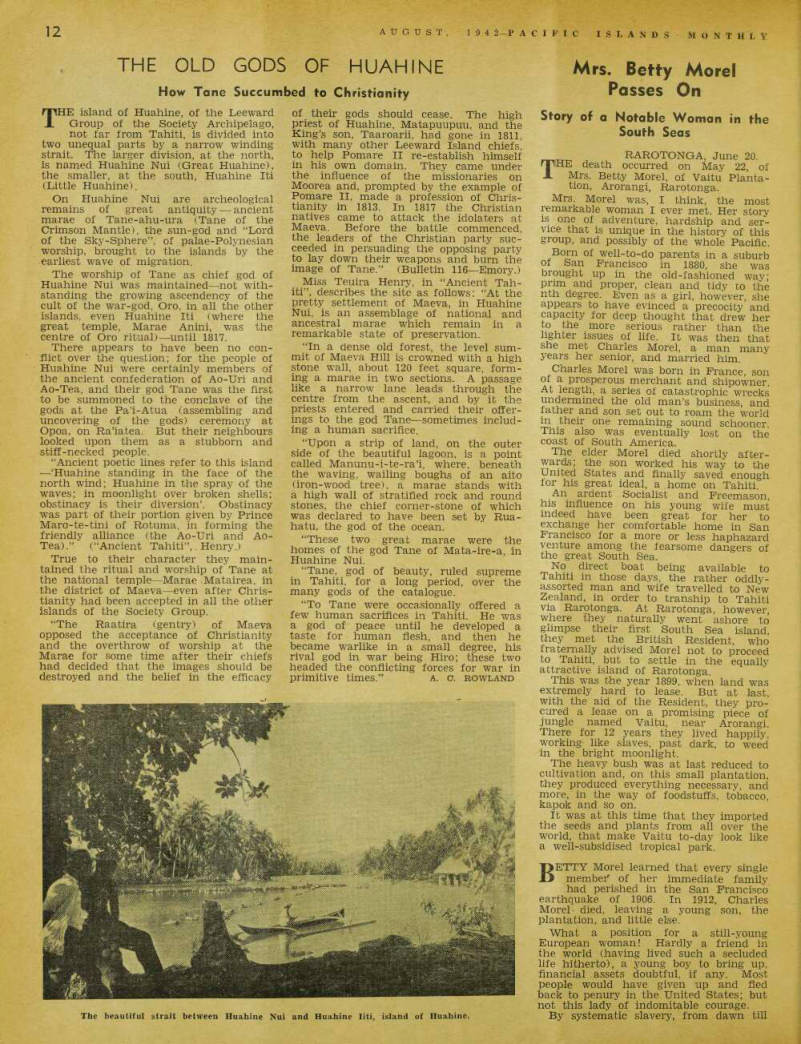
How Tone Succumbed to Christianity
rpHE island of Huahine, of the Leeward X Group of the Society Archipelago, not far from Tahiti, is divided into two unequal parts by a narrow winding strait. The larger division, at the north, is named Huahine Nui (Great Huahine), the smaller, at the south, Huahine Iti (Little Huahine).
On Huahine Nui are archeological remains of great antiquity ancient marae of Tane-ahu-ura (Tane of the Crimson Mantle), the sun-god and “Lord of the Sky-Sphere”, of palae-Polynesian worship, brought to the islands by the earliest wave of migration.
The worship of Tane as chief god of Huahine Nui was maintained—not with standing the growing ascendency of the cult of the war-god, Oro, in all the other islands, even Huahine Iti (where the great temple, Marae Anini, was the centre of Oro ritual) —until 1817.
There appears to have been no con flict over the question; for the people of Huahine Nui were certainly members of the ancient confederation of Ao-Uri and Ao-Tea, and their god Tane was the first to be summoned to the conclave of the gods at the Pa'i-Atua (assembling and uncovering of the gods) ceremony at Opoa, on Ra’iatea. But their neighbours looked upon them as a stubborn and stiff-necked people.
“Ancient poetic lines refer to this island —‘Huahine standing in the face of the north wind; Huahine in the spray of the waves; in moonlight over broken shells; obstinacy is their diversion’. Obstinacy was part of their portion given by Prince Maro-te-tini of Rotuma, in forming the friendly alliance (the Ao-Uri and Ao- Tea).” (“Ancient Tahiti”, Henry.) True to their character they main tained the ritual and worship of Tane at the national temple—Marae Matairea, in the district of Maeva—even after Chris tianity had been accepted in all the other islands of the Society Group.
“The Raatira (gentry) of Maeva opposed the acceptance of Christianity and the overthrow of worship at the Marae for some time after their chiefs had decided that the images should be destroyed and the belief in the efficacy
of their gods should cease. The high priest of Huahine, Matapuupuu, and the King’s son, Taaroarii, had gone in 1811, with many other Leeward Island chiefs, to help Pomare II re-establish himself in his own domain. They came under the influence of the missionaries on Moorea and, prompted by the example of Pomare 11, made a profession of Chris tianity in 1813. In 1817 the Christian natives came to attack the idolaters at Maeva. Before the battle commenced, the leaders of the Christian party suc ceeded in persuading the opposing party to lay down their weapons and burn the image of Tane.” (Bulletin 116—Emory.) Miss Teuira Henry, in “Ancient Tah iti”, describes the site as follows: “At the pretty settlement of Maeva, in Huahine Nui, is an assemblage of national and ancestral marae which remain in a remarkable state of preservation.
“In a dense old forest, the level sum mit of Maeva Hill is crowned with a high stone wall, about 120 feet square, form ing a marae in two sections. A passage like a narrow lane leads through the centre from the ascent, and by it the priests entered and carried their offer ings to the god Tane —sometimes includ ing a human sacrifice.
“Upon a strip of land, on the outer side of the beautiful lagoon, is a point called Manunu-i-te-ra’i, where, beneath the waving, wailing boughs of an aito (iron-wood tree), a marae stands with a high wall of stratified rock and round stones, the chief corner-stone of which was declared to have been set by Rua hatu, the god of the ocean.
“These two great marae were the homes of the god Tane of Mata-ire-a, in Huahine Nui.
“Tane, god of beauty, ruled supreme in Tahiti, for a long period, over the many gods of the catalogue.
“To Tane were occasionally offered a few human sacrifices in Tahiti. He was a god of peace until he developed a taste for human flesh, and then he became warlike in a small degree, his rival god in war being Hiro; these two headed the conflicting forces for war in primitive times.” a. c. Rowland
The beautiful strait between Huahine Nui and Huahine liti, island of Huahine.
Mrs. Betty Morel
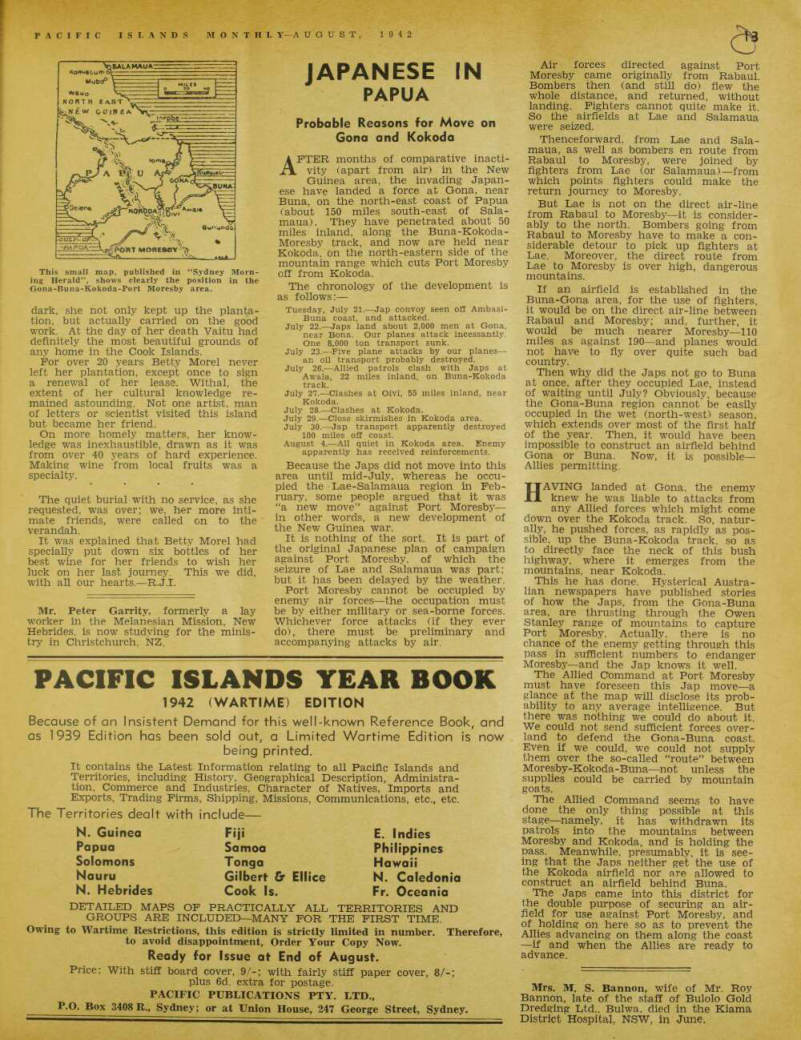
Passes On Story of a Notable Woman in the South Seas
Rarotonga, June 20.
npHE death occurred on May 22, of X Mrs. Betty Morel, of Vaitu Planta tion, Arorangi, Rarotonga.
Mrs. Morel was, I think, the most remarkable woman I ever met. Her story is one of adventure, hardship and ser vice that is unique in the history of this group, and possibly of the whole Pacific.
Born of well-to-do parents in a suburb of San Francisco in 1880, she was brought up in the old-fashioned way; prim and proper, clean and tidy to the nth degree. Even as a girl, however, she appears to have evinced a precocity and capacity for deep thought that drew her to the more serious rather than the lighter issues of life. It was then that she met Charles Morel, a man many years her senior, and married him.
Charles Morel was born in Prance, son of a prosperous merchant and shipowner.
At length, a series of catastrophic wrecks undermined the old man’s business, and father and son set out to roam the world in their one remaining sound schooner.
This also was eventually lost on the coast of South America.
The elder Morel died shortly after wards; the son worked his way to the United States and finally saved enough for his great ideal, a home on Tahiti.
An ardent Socialist and Freemason, his influence on his young wife must indeed have been great for her to exchange her comfortable home in San Francisco for a more or less haphazard venture among the fearsome dangers of the great South Sea.
No direct boat being available to Tahiti in those days, the rather oddly assorted man and wife travelled to New Zealand, in order to tranship to Tahiti via Rarotonga. At Rarotonga, however, where they naturally went ashore to glimpse their first South Sea island, they met the British Resident, who fraternally advised Morel not to proceed to Tahiti, but to settle in the equally attractive island of Rarotonga.
This was the year 1899, when land was extremely hard to lease. But at last, with the aid of the Resident, they pro cured a lease on a promising piece of jungle named Vaitu, near Arorangi.
There for 12 years they lived happily, working like slaves, past dark, to weed in the bright moonlight.
The heavy bush was at last reduced to cultivation and, on this small plantation, they produced everything necessary, and more, in the way of foodstuffs, tobacco, kapok and so on.
It was at this time that they imported the seeds and plants from all over the world, that make Vaitu to-day look like a well-subsidised tropical park.
BETTY Morel learned that every single membefl of her immediate family had perished in the San Francisco earthquake of 1906. In 1912, Charles Morel died, leaving a young son, the plantation, and little else.
What a position for a still-young European woman! Hardly a friend in the world (having lived such a secluded life hitherto), a young boy to bring up, financial assets doubtful, if any. Most people would have given up and fled back to penury in the United States; but not this lady of indomitable courage.
By systematic slavery, from dawn till
dark, she not only kept up the planta tion, but actually carried on the good work. At the day of her death Vaitu had definitely the most beautiful grounds of any home in the Cook Islands.
For over 20 years Betty Morel never left her plantation, except once to sign a renewal of her lease. Withal, the extent of her cultural knowledge re mained astounding. Not one artist, man of letters or scientist visited this island but became her friend.
On more homely matters, her know ledge was inexhaustible, drawn as it was from over 40 years of hard experience.
Making wine from local fruits was a specialty.
The quiet burial with no service, as she requested, was over; we, her more inti mate friends, were called on to the verandah.
It was explained that Betty Morel had specially put down six bottles of her best wine for her friends to wish her luck on her last journey. This we did, with all our hearts.—R.J.l.
Mr. Peter Garrity, formerly a lay worker in the Melanesian Mission, New Hebrides, is now studying for the minis try in Christchurch, NZ.
This small map, published in “Sydney Morn ing Herald”, shows clearly the position in the Gona-Buna-Kokoda-Port Moresby area.
Advertisements & other items, p. 14 (1 item)
12
AUGUST, 194 2—P ACI f t C ISLANDS MONTHLY
Japanese In
Papua
Probable Reasons for Move on Gona and Kokoda
AFTER months of comparative inacti vity (apart from air) in the New Guinea area, the invading Japan ese have landed a force at Gona, near Buna, on the north-east coast of Papua (about 150 miles south-east of Sala maua). They have penetrated about 50 miles inland, along the Buna-Kokoda- Moresby track, and now are held near Kokoda. on the north-eastern side of the mountain range which cuts Port Moresby off from Kokoda.
The chronology of the development is as follows: — Tuesday, July 21.—Jap convoy seen off Ambasi- Buna coast, and attacked.
July 22.—Japs land about 2,000 men at Gona, near Bona. Our planes attack incessantly.
One 8,000 ton transport sunk.
July 23.—Five plane attacks by our planes— an oil transport probably destroyed.
July 26.—Allied patrols clash with Japs at Awala, 22 miles inland, on Buna-Kokoda track.
July 27.—Clashes at Oivi, 55 miles inland, near Kokoda.
July 28. —Clashes at Kokoda.
July 29.—Close skirmishes in Kokoda area.
July 30.—Jap transport apparently destroyed 100 miles off coast.
August 4. —All quiet in Kokoda area. Enemy apparently has received reinforcements.
Because the Japs did not move into this area until mid-July, whereas he occu pied the Lae-Salamaua region in Feb ruary, some people argued that it was “a new move” against Port Moresby— in other words, a new development of the New Guinea war.
It is nothing of the sort. It is part of the original Japanese plan of campaign against Port Moresby, of which the seizure of Lae and Salamaua was part; but it has been delayed by the weather.
Port Moresby cannot be occupied by enemy air forces —the occupation must be by either military or sea-borne forces.
Whichever force attacks (if they ever do), there must be preliminary and accompanying attacks by air.
Air forces directed against Port Moresby came originally from Rabaul.
Bombers then (and still do) flew the whole distance, and returned, without landing. Fighters cannot quite make it.
So the airfields at Lae and Salamaua were seized.
Thenceforward, from Lae and Sala maua, as well as bombers en route from Rabaul to Moresby, were joined by fighters from Lae (or Salamaua)—from which points fighters could make the return journey to Moresby.
But Lae is not on the direct air-line from Rabaul to Moresby—it is consider ably to the north. Bombers going from Rabaul to Moresby have to make a con siderable detour to pick up fighters at Lae. Moreover, the direct route from Lae to Moresby is over high, dangerous mountains.
If an airfield is established in the Buna-Gona area, for the use of fighters, it would be on the direct air-line between Rabaul and Moresby; and, further, it would be much nearer Moresby—llo miles as against 190—and planes would not have to fly over quite such bad country.
Then why did the Japs not go to Buna at once, after they occupied Lae, instead of waiting until July? Obviously, because the Gona-Buna region cannot be easily occupied in the wet (north-west) season, which extends over most of the first half of the year. Then, it would have been impossible to construct an airfield behind Gona or Buna. Now, it is possible— Allies permitting.
HAVING landed at Gona, the enemy knew he was liable to attacks from any Allied forces which might come down over the Kokoda track. So, natur ally, he pushed forces, as rapidly as pos sible, up the Buna-Kokoda track, so as to directly face the neck of this bush highway, where it emerges from the mountains, near Kokoda.
This he has done. Hysterical Austra lian newspapers have published stories of how the Japs, from the Gona-Buna area, are thrusting through the Owen Stanley range of mountains to capture Port Moresby. Actually, there is no chance of the enemy getting through this pass in sufficient numbers to endanger Moresby—and the Jap knows it well.
The Allied Command at Port Moresby must have foreseen this Jap move—a glance at the map will disclose its prob ability to any average intelligence. But there was nothing we could do about it.
We could not send sufficient forces over land to defend the Gona-Buna coast.
Even if we could, we could not supply them over the so-called “route” between Moresby-Kokoda-Buna—not unless the supplies could be carried by mountain goats.
The Allied Command seems to have done the only thing possible at this stage—namely, it has withdrawn its patrols into the mountains between Moresby and Kokoda, and is holding the pass. Meanwhile, presumably, it is see ing that the Japs neither get the use of the Kokoda airfield nor are allowed to construct an airfield behind Buna.
The Japs came into this district for the double purpose of securing an air field for use against Port Moresby, and of holding on here so as to prevent the Allies advancing on them along the coast —if and when the Allies are ready to advance.
Mrs. M. S. Bannon, wife of Mr. Roy Bannon, late of the staff of Bulolo Gold Dredging Ltd.. Bulwa, died in the Kiama District Hospital, NSW, in June.
Advertisements & other items, p. 15 (2 items)
13
PACIFIC ISLANDS MONTHL Y—A UGUST, 1942
Pacific Islands Year Book
1942 (WARTIME) EDITION
Because of an Insistent Demand for this well-known Reference Book, and as 1939 Edition has been sold out, a Limited Wartime Edition is now
being printed.
It contains the Latest Information relating to all Pacific Islands and Territories, including History, Geographical Description, Administration, Commerce and Industries, Character of Natives, Imports and Exports, Trading Firms, Shipping, Missions, Communications, etc., etc.
The Territories dealt with include— N. Guinea Fiji E. Indies Papua Samoa Philippines Solomons Tonga Hawaii Nauru Gilbert & Ellice N. Caledonia N. Hebrides Cook Is. Fr. Oceania DETAILED MAPS OF PRACTICALLY ALL TERRITORIES AND GROUPS ARE INCLUDED—MANY FOR THE FIRST TIME.
Owing to Wartime Restrictions, this edition is strictly limited in number. Therefore, to avoid disappointment, Order Your Copy Now.
Ready for Issue at End of August.
Price; With stiff board cover, 9/-; with fairly stiff paper cover, 8/-; plus 6d. extra for postage.
PACIFIC PUBLICATIONS PTY. LTD.,
Box 3408 R., Sydney; or at Union House, 247 George Street, Sydney.
New Guinea Women's
Club
rE New Guinea Women’s Club, which has done a great deal of useful work for the men in the New Guinea Contingent and among Islands evacuees, is holding a “musical after noon” on Saturday, August 29, in the Feminist Club Rooms, 77 King Street, Sydney, from 2.30 p.m., and all ex-New Guinea residents (men and women) will be welcome.
This “get-together” afternoon tea, for which there will be a nominal charge, provides New Guinea men with an oppor tunity for showing their appreciation for the work their womenfolk are doing in keeping Islands people together—a vitally necessary job in times like these.
Missionaries In Papua
REV. E. R. Fenn, and Rev. S. H. Dewd ney, of the LMS, have returned to their stations in Papua, after re ceiving permission from the military authorities, who encourage missionaries to continue their work if at all possible.
This now makes nine men in the LMS field. News from them is scanty, but they are all cheerfully facing the diffi culties of wartime missionary work.
M. Errard Marcel, has been appointed the French High Commissioner to a posi tion on the French Tribunal at Port Vila, New Hebrides, in place of M.
Charles Berthault, Police Commissioner and Chief of the Immigration Services.
Rescued From
N. Guinea
How Commercial Airmen and Machines Picked up 74 Australians
DETAILS of a hazardous enterprise, by which 78 Australian soldiers and civilians, some time ago, were rescued from a remote and isolated part of New Guinea, were released during the month by the Australian authorities.
It was carried out by well-known com mercial airmen, flying somewhat ancient air-liners, which were released from the Empire air mail service three or four years ago. All the airmen were mem bers of the Qantas staff.
Unarmed and without escort, and fly ing under bad-weather conditions, the air-liners went high over the central ranges of New Guinea, and then drop ped down into a tiny settlement in the heart of the wilderness. There, 78 Europeans, mostly Australians, were waiting for them.
Eighteen of the waiting men had walked hundreds of miles through the jungle, to escape the enemy.
Details of the rescue were given by the operations manager of Qantas Empire Airways (Captain Lester Brain).
The airmen who took part were: Cap tain O. D. Denny (in charge), Captain E. C. Sims, Acting-Captain E. R. Nicholl, Radio-Officers F. S. Furniss, R. J. Ander son, and L. W. Louttit, and Engineers R.
Carswell and D. E. Chambers.
Captain T. ODea, of Guinea Airways, was guide.
All volunteered for the job.
“At the outset, the risks of possible enemy action against the slow, unarmed aircraft were evident, but it was doubted whether these were as great a hazard as flying over rugged mountains, under dif ficult and tricky weather conditions,” said Captain Brain.
“There was no other way of escape open to the evacuees, except a long, arduous walk over the mountains to the coast.”
40 Years Ago
How Germans Treated New Guinea Natives
By K. D. MacPhee, Levuka, Fiji
IWAS a member of the Huon Gulf Expedition (New Guinea) during the years 1902-3. This was an expedi tion sponsored by the German New Guinea Company, and the expedition’s main station was established at Sala maua.
The native meaning of the word Salamaua is “a crossing-place for canoes”—as the isthmus there, between the sea and harbour, is very narrow.
The object of the expedition was to search for minerals and oil; and our first discovery of gold on German ter ritory was on the Waria River, where a small amount of alluvial gold was recovered.
Our operations were transferred to the Markham River, On the left bank, at the mouth of this river, we established a station, known to us as Laikamo; and I think that that is about the present position of the township of Lae.
I was deputed, with another European, seven armed boys and 14 carriers (Buka natives), to explore and prospect the Markham River as far as its source; another section of the expedition was to follow.
We travelled up the Markham Valley and, on the third day out, when we made camp, several of our boys went searching for fish. They fell in with a band of Markham Valley natives, and one of our boys was speared right through the back, the shaft-head penetrating his body. His head was also tomahawked, and from those injuries he died.
A punitive expedition, which subse quently set out to punish the culprits, consisted of seven European members of the expedition and 30 armed Buka boys.
About 30 miles from the river’s mouth we forded the river and travelled across country, until we entered the land occu pied by the natives; and in open order we came to their village. Our instruc tions were to fire at all adult males; but, fortunately, there were only three, at a corner of the village, engaged in cooking in their earthen pots. The pots contained rats and bananas.
A volley was fired by our armed Buka boys. The natives escaped, although blood traces were visible.
Around the village, in their banana gardens, there were many bows and arrows, and.shields, placed in preparation for fighting; but, seeing our strength, the owners had decamped.
The whole of the village houses were then set on fire, and all the surrounding banana plants were cut down. While the houses were burning, wails and cries could be heard from the women, who had fled to the high ridges above the village.
There must be still some natives there who will remember the harsh methods of the Germans.
Mr. Jim Ewen, who was an inspector and instructor in the New Guinea Department of Agriculture, now is Air craftsman Ewen, in the RAAF. At pre sent, he is undergoing training, and hopes eventually to become a pilot.
Before he entered the NG Administra tion, he studied agriculture at Dookie College, in Victoria. His father, Mr. J.
A. Ewen, is a well-known member of BP’s New Guinea staff and for many years was manager at Kokopo; he was on furlough in Australia when the Japs over-ran New Britain early this year.
Advertisements & other items, p. 16 (2 items)
14
AUGUST, 194 2—P ACIFIC ISLANDS MONTHLY
Burns Philp
PACIFIC ISLANDS SOCIETY
Visitors from the Islands to Sydney (or those interested in Islands affairs), are advised to communicate with the honorary secretary of the above Society, which has been formed to study the history, traditions, economics, and political developments of the Pacific Islands.
Regular monthly meetings are held at History House, 8 Young Street, Sydney.
Address for Correspondence:
THE PACIFIC ISLANDS SOCIETY,
Box 2434 MM„ G.P.0., Sydney.
BURNS PHILP
(SOUTH SEA) CO. LTD.
Inc. in Fiji Island Traders and Shipowners Registered Office :
SU V A
FIJI
\Also Branches at: Fiji: Levuka, Lautoka, Labasa, Ba, Sigatoka, Rotuma.
Tonga: Nukualofa, Haapai, Vavau.
Samoa: Apia, Pago Pago (American Samoa).
Solomons: Makambo, Gizo, Faisi.
New Hebrides: Vila.
Code Address: Gilberts: Tarawa.
"Burnsouth". Norfolk Is. Niue. Wallis Is. Futuna Is.
Fate Of Gold
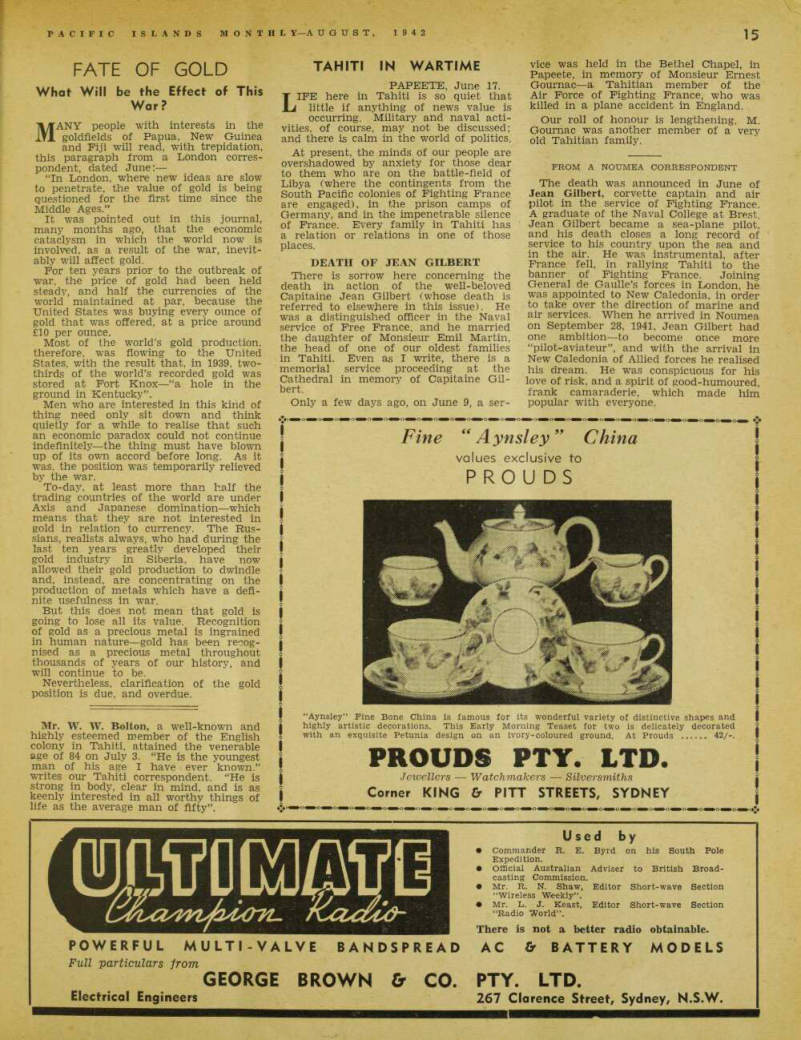
What Will be the Effect of This War?
MANY people with interests in the goldfields of Papua, New Guinea and Fiji will read, with trepidation, this paragraph from a London corres pondent, dated June: — “In London, where new ideas are slow to penetrate, the value of gold is being questioned for the first time since the Middle Ages.”
It was pointed out in this journal, many months ago, that the economic cataclysm in which the world now is involved, as a result of the war, inevit ably will affect gold.
For ten years prior to the outbreak of war. the price of gold had been held steady, and half the currencies of the world maintained at par, because the United States was buying every ounce of gold that was offered, at a price around £lO per ounce.
Most of the world’s gold production, therefore, was flowing to the United States, with the result that, in 1939, two thirds of the world’s recorded gold was stored at Fort Knox—“a hole in the ground in Kentucky”.
Men who are interested in this kind of thing need only sit down and think quietly for a while to realise that such an economic paradox could not continue indefinitely—the thing must have blown up of its own accord before long. As it was, the position was temporarily relieved by the war.
To-day, at least more than half the trading countries of the world are under Axis and Japanese domination—which means that they are not interested in gold in relation to currency. The Rus sians, realists always, who had during the last ten years greatly developed their gold industry in Siberia, have now allowed their gold production to dwindle and, instead, are concentrating on the production of metals which have a defi nite usefulness in war.
But this does not mean that gold is going to lose all its value. Recognition of gold as a precious metal is ingrained in human nature—gold has been recog nised as a precious metal throughout thousands of years of our history, and will continue to be.
Nevertheless, clarification of the gold position is due, and overdue.
Mr. W. W. Bolton, a well-known and highly esteemed member of the English colony in Tahiti, attained the venerable age of 84 on July 3. “He is the youngest man of his age I have ever known.” writes our Tahiti correspondent. “He is strong in body, clear in mind, and is as keenly interested in all worthy things of life as the average man of fifty”.
Tahiti In Wartime
Papeete, June 17.
LIFE here in Tahiti is so quiet that little if anything of news value is occurring. Military and naval acti vities, of course, may not be discussed; and there is calm in the world of politics.
At present, the minds of our people are overshadowed by anxiety for those dear to them who are on the battle-field of Libya (where the contingents from the South Pacific colonies of Fighting France are engaged), in the prison camps of Germany, and in the impenetrable silence of France. Every family in Tahiti has a relation or relations in one of those places.
Death Of Jean Gilbert
There is sorrow here concerning the death in action of the well-beloved Capitaine Jean Gilbert (whose death is referred to elsewhere in this issue). He was a distinguished officer in the Naval service of Free France, and he married the daughter of Monsieur Emil Martin, the head of one of our oldest families in Tahiti. Even as I write, there is a memorial service proceeding at the Cathedral in memory of Capitaine Gil bert.
Only a few days ago, on June 9, a ser
vice was held in the Bethel Chapel, in Papeete, in memory of Monsieur Ernest Gournac —a Tahitian member of the Air Force of Fighting France, who was killed in a plane accident in England.
Our roll of honour is lengthening. M.
Gournac was another member of a very old Tahitian family.
From A Noumea Correspondent
The death was announced in June of Jean Gilbert, corvette captain and air pilot in the service of Fighting France.
A graduate of the Naval College at Brest.
Jean Gilbert became a sea-plane pilot, and his death closes a long record of service to his country upon the sea and in the air. He was instrumental, after France fell, in rallying Tahiti to the banner of Fighting France. Joining General de Gaulle’s forces in London, he was appointed to New Caledonia, in order to take over the direction of marine and air services. When he arrived in Noumea on September 28, 1941, Jean Gilbert had one ambition—to become once more “pilot-aviateur”, and with the arrival in New Caledonia of Allied forces he realised his dream. He was conspicuous for his love of risk, and a spirit of good-humoured, frank camaraderie, which made him popular with everyone.
Advertisements & other items, p. 17 (2 items)
15
PACIFIC ISLANDS MONTHL Y—A UGUST, 1942
Prouds Pty. Ltd.
Fine
“ Aynsley” China
values exclusive to
PRO U D S
/r I Si ■ “Aynsley” Fine Bone China is famous for its wonderful variety of distinctive shapes and highly artistic decorations. This Early Morning Teaset for two is delicately decorated with an exquisite Petunia design on an ivory- coloured ground. At Prouds 42/-.
PROUDS PTY. LTD.
Jewellers Watchmakers Silversmiths
Corner KING & PITT STREETS, SYDNEY
u Id M /
ESB
Used by • Commander R. E. Byrd on his South Pole Expedition. • Official Australian Adviser to British Broadcasting Commission. • Mr. R. N. Shaw, Editor Short-wave Section “Wireless Weekly”. • Mr. L. J. Keast, Editor Short-wave Section “Radio World”.
There is not a better radio obtainable.
POWERFUL MULTI-VALVE BANDSPREAD
Full particulars from
GEORGE BROWN & CO.
Electrical Engineers
AC & BATTERY MODELS
PTY. LTD.
267 Clarence Street, Sydney, N.S.W.
Too Much "Parie" in
the "Mutuel"!
A Memory of Port Vila's Race Club
By “Snikwad"
REPENTANCE, like strong drink, is a thing we are better without —in large quantities, anyway.
That was why I was sitting alone in the kiosk of the Hotel-Vila-Boulangerie bar on that Sunday morning. The night before I had been to what, com mencing as a somewhat decorous dinner party, had ended as a 100 per cent, “wild night”.
I was now trying to reduce or slake the “repentance” content of soul, head and stomach with a bottle of cold V.B. With every cooling sip I was feeling better and
better, and less repentant, and was quietly musing on the strange and excit ing ways of the all-too-human.
My reverie was interrupted by the sud den arrival of a legging-ed, spurred and sombreroed olive-skinned individual, mounted on a disreputable-looking, high withered hack, who rode straight into the kiosk yelling “Allume—allume” (“Let’s get going”). Behind him surged a motley gathering of Frenchmen and near-Frenchmen from all the lieus and purlieus of Vila and the outer planta tions.
Having enjoyed the clattering of his horse’s hooves on the concrete floor of the kiosk, the cowboy-man rode, still “Alluming”, across the yard, and in at one end, and out through the other, of the main hotel building—which, by the way, is of about the size and shape of a large rabbit-hutch. The mob mean while “got going” by re-setting up the chairs and tables which had been knocked over in the kiosk.
At length, everything more or less shipshape, the vaquero dismounted. His beast tethered, the mob seated and drinks ordered, they “got going” again in true Gallic style, everybody talking at once. The French are all for this form of procedure at all their gather ings, and hold that it is in keeping with their Republican motto of “Liberte, Fratenite, Egalite”, for, they argue, a person is free to shut up if he wishes; but no one, excepting the blessedly stone-deaf, has the right not to hear him if he wishes to speak. Shades of Voltaire!
The conversation seemed to be all about the horse, and horsey. Some chat tered of spurs and stirrups, some of saddles and bridles and others of horses, tracks and paces.
Then it dawned upon my dull brain that I was listening-in to a gathering convened for the purpose of starting a racing club.
Before long, somehow or other, it appeared that a president had been elected and someone was loudly calling for a vice-president—and that’s how I got into it. Such is fame!
“Void!” cried a lad, whom I did not know from a bar of soap. “Void, Monsieur Snikwad! The very man. Ne parle-t-il pas francais; n’est il pas
ancien combattant de la grande guerre; n’est il pas anglais; il faut un anglais; n’est il pas un Condominium. Mais mot de Cambronne, alors.”
“Mais oui. Mais mot de mot de Cam bronne, alors,” shouted another.
“Mais, mot de Cambronne de mot de Cambronne, alors, mais oui,” said a third. (Rough translation: “See, there is Monsieur Snikwad. Does he not speak French? Is he not a veteran of the Great War? Is he not English? We must have an Englishman as v.p.—is this not a Condominium?” The remainder may be skipped. The word used by General Cambronne at Waterloo is translatable, but not printable.) And so I found myself vice-president of the “Association des Courses Hippique des Nouvelles Hebrides”, or something of the sort.
A modest and retiring man, the weight of this sudden new responsibility weighed heavily upon me. I couldn’t have felt more denressed if the children of one of the world’s best Revolutions had elected me as “la lanterne” or “la guillotine”.
I NEED not have worried, however. The French, naurally polite, even to whatever gods there are—having, as it were, propitiated the joss by electing officers—just carried on, or “allumed”, taking no more notice of said officers than if they weren’t there.
There followed more meetings, with more discussions about saddlery, tracks, weights and paces, at which president and other officials seemed to do nothing but exercise their prerogative of silence.
But the Gaul is nothing if not enthu siastic; and, once this racing bug had bitten him, it was the races, the whole races, and nothing but the races.
Monsieur Rimbert kindlv loaned his paddock as a race track, and willing hands did the rest. And when at last the great dav arrived there was a grandstand, judge’s box. parie-mutuel and saddling paddock, all complete, as well as a pro gramme that ranged from Stockman’s Handicap to Grand Prix.
It was a great success; and many more meetings followed.
But, alas! Pleasures are like poppies.
Secrets don’t hold together as such for long in Vila. And even the most sacred secrets of the stable at last leaked out; and there came the day when Merdalor won the Stockman’s, and everybody was “on” him. Sacresalop won the Flying, and everybodv was “on” him; and Parle bondieu won the Prix, and everybody was “on” him.
The Parie-Mutuel, of course, deducted its percentage, and paid a minus divi dend: and everybody wondered how they backed the winner and lost money.
Such a state of affairs cannot go on in a great democratic country. Had the races continued the whole of the finan cial resources of the island would have been frozen in the hands of the Parie- Mutuel. So the races ceased; and I, once vice-president, resumed the status of an ordinary citizen.
Mr. and Mrs. L. Maxwell, of the Sev enth Dav Adventist Mission at Raro tonga, left the island for Australia in May.
Doing useful work on Tomanau rub ber plantation, Sagari Valley, Papua, is Mr. J. Palmer, who, after being called up by the military authorities in Port Moresby, was afterwards given permission to return to the plantation. He reports that the plantation is doing well and that he has had little trouble with the native workers—who, for the most part, know little of war developments,
Advertisements & other items, p. 18 (2 items)
16
AUGUST, 1&4 2—P ACIFIC ISLANDS MONTHLY
W.H.Grove & Sons
KAMBALA SCHOOL
Rose Bay, Sydney
A Church of England Day and Boarding School for Girls. —
SCHOLARSHIPS.
Two Entrance Scholarships, each of £4O p.a„ and tenable for 3 years, are open to intending boarders under the age of 14 years at Ist January, 1943. Entries close 20th October.
A NEW TERM WILL COMMENCE
ON 22nd SEPTEMBER.
For full particulars apply to the Principal or Secretary.
MISS F. HAWTHORNE, B.A. Principal.
R. E. COX, Sec., 28 Bond St., Sydney.
W.H.GROVE & SONS
Limited
AUCKLAND
Island Traders. P.o. Box 490.
Telegraphic and Cable Address: “Grove”, Auckland.
Shippers of all classes of New Zealand products.
Representing English Manufacturers throughout the Cook and Society Islands, Fiji, Tonga, Samoa, Niue, New Caledonia, New Guinea, etc.
In FIJI as—W. H. Grove & Sons (Fiji) Ltd.
Tonga, Samoa and Fiji
NZ Governor-General in Tonga, Samoa and Fiji
IN the course of his tour of the Pacific Islands, the Governor-General, Sir Cyril Newall, took part in the cele bration of the King’s Birthday at Apia, at which there was a large gathering of Samoans and Europeans.
On arriving at Nukualofa, the capital of Tonga, on Friday, May 29, the Gov ernor-General wai met by Mr. A. L.
Armstrong, OBE, the British Agent and Consul. After meeting the Premier, the Hon. Mr. Aata, and other Tongan Minis ters, Sir Cyril called on Queen Salote.
The following day he visited the Tonga Defence Force, which is under the com mand of Lieutenant-Colonel Macleod, of the New Zealand Military Forces. In the evening he laid a wreath on the tomb of Prince Tugi, the Queen’s Con sort, and late Premier, who died last year.
The Vice-Regal party reached Western Samoa on Saturday, May 30, and the Governor-General was received by Mr.
A. C. Turnbull, the Acting Administrator, and representative citizens, including the two Fautua, Tamasese and Malietoa. He inspected a guard of honour from the Boys’ Brigade. Proceeding to Malua, Sir Cyril was welcomed by pastors from all over the Samoan group, who were attending the Fone Tele of the London Missionary Society. A visit was paid to Malifa school, where a large number of children were assembled.
After laying a wreath on the Apia war memorial, the Governor-General visited the Fone of Faipule (gathering of repre sentatives) at Mulinu’u, where senior Samoan officials were also assembled, and was welcomed with a Kava cere
mony. On the way to Vailima, the Ad ministrator’s residence, a wreath was laid on the monument to American and Brit ish sailors at Mulinu’u. An official din ner was given that evening.
After attending Divine service on Sun day, May 31, and visiting the Methodist Mission at Piula, an inspection of Gov ernment plantations was made in the afternoon.
The Samoan Local Defence Force pro vided a guard of honour when His Excel lency arrived for the King’s Birthday ceremony. At the conclusion of his address, speeches were given by the Hon.
O. F. Nelson and Tamasese.
The Vice-Regal party on June 1 left Western Samoa for American Samoa, where, at Pago Pago, Sir Cyril was the guest of the Military Governor.
The following day the Governor- General departed for Suva, crossing the date line on the way, and arriving there on Wednesday. His Excellency subse quently visited the Colonial War Memo rial Hospital in Suva, and on Thursday evening he went to the New Zealand Club, which has been erected by the National Patriotic Fund Board for the use of members of the forces. —“NZ Herald”.
Mrs. Hannah Nicols, wife of Captain W. died on Lord Howe Island a short time ago, at the age of 86. She was laid to rest at Ned’s Beach ceme tery. Mrs. Nicols arrived on LHI in 1872; she was the last person on the island who originally crossed to Lord Howe from Australia in the islanders’ ketch, “Sylph”, which was lost without trace on her way to Sydney in April, 1873, with several passengers and a cargo of onions.
Escape From New Guinea
MR. and Mrs. F. H. Conroy, of Rabaul, have added to the long list of remarkable stories of escape from New Guinea. They met again the other day in Brisbane after a series of adven tures, which, in any times but these, would call for, at least, a series of news paper articles and a nation-wide broad cast.
Mrs. Conroy was evacuated by plane, while her husband was away from their plantation; and, when the Japanese invasion came, she lost all trace of him.
She went to Brisbane and, although she had had no previous experience of fac tory life, she went to work on munitions while she waited and watched all New Guinea news in the hope that some of it might have some bearing on her hus band’s whereabouts.
Back in the Territory, Mr. Conroy was not letting the grass grow under his feet. He was one of a party of men who removed a small steamer from beneath the noses of the Japs; and, because he once had been a chief engineer, it naturally fell to his lot to assume, with the aid of a school atlas, the responsibilities of navigating officer!
These he obviously carried out with great success, for he and his team landed their boat-load of refugees safely in an Aus tralian port.
Mrs, Conroy had read of the exploit, but did not know until after they had met in Brisbane that one of the princi pals of the drama was her missing husband.
Rev. Clifford Welch, previously LMS missionary at Nauru, recently was mar ried to an English girl, and now is sta tioned in Auckland, NZ.
Advertisements & other items, pp. 19-20 (3 items)
17
PACIFIC ISLANDS MONTHL Y—A UGUST, 1942
St. Ignatius’ College
Riverview Sydney
Boys are prepared for Intermediate and Leaving Certificate Examinations and for Exhibitions, Scholarships and Bursaries at the University.
Boys are arranged in three Divisions according to age. Each Division has its own Library, Debating Society, Cricket and Football Fields, and Tennis Courts.
Senior and Junior Rowing Sheds, with a large fleet of pleasure and racing boats.
Private Swimming Baths.
Prospectus and further particulars on application to the— Rector: St. Ignatius’ College, Riverview, Sydney, Australia.
Tel.: JB 1106.
BOARDING AND DAY SCHOOL
a • 1 ■* * ay
Conducted by the Jesuit Fathers
ONE OF SYDNEY'S GREAT PUBLIC SCHOOLS
Modern Refrigeration for the South Sea Islands
The ELECTROLUX
KEROSENE OPERATED
REFRIGERATOR
MARVEL
OF
MODERN
SCIENCE
THE
MIRACLE
OF
ICE
FROM
HEAT
ELECTROLUX offers economical, modern and completely efficient
REFRIGERATION FOR ISLANDS' HOMES.
FREEZES CONTINUOUSLY WHILE SMALL LAMP BURNS.
Freezing controlled by simply regulating height of flame. Uses only i gallon of kerosene per week.
MOTORLESS ... NO PARTS TO GET OUT OF ORDER.
MODEL L 22
Capacity 2.2 cubic feet.
MODEL L3BO
(as illustrated) Capacity 4 cubic feet.
MODEL LKSSO
Capacity 5.5 cubic feet.
GUARANTEED FOR TWO YEARS.
• Write to your Local Distributor for prices and full details.
OBTAINABLE FROM ALL W. R. CARPENTER & CO. LTD.
BRANCHES THROUGHOUT THE ISLANDS
Representation in Papua and New Hebrides.
18
AUGUST, 19 4 2 —P ACIFIC ISLANDS MONTHLY
Air-Raid Shelter In
Rotuma
By “Amelt
FIRST there was the news that Japan had opened up her war with America by launching a savage attack on Pearl Harbour. That was bad enough. But what followed was nearly as serious.
One by one, the enemy was taking strategic points •in the Pacific; and, when Tom came home and said, “They’re in the Gilberts,” I rejoined, flip pantly, “Well, it looks as if we’ll need that air-raid shelter now.”
“To-morrow,” he said, gravely. “We’re starting work on it to-morrow.”
What horrible thing was this, creeping evilly and relentlessly across the blue Pacific and giving rise to the necessity of having an air-raid shelter in this beautiful, peaceful, untouched little isle? But there it was. The cataclysm that was shaking the world must be felt, even here.
Tom produced the blue-prints of the shelter, which were duly examined by the handy man and the senior workman.
The latter, however, unused to such flights of architectural construction as a tunnel 7 by 3 x 12. got his angles a trifle mixed, and had to be painlessly removed to a less complicated job.
The handy man carried on very effi ciently. With the assistance of two understrappers, he sank a shaft, and then started on the tunnel. After bring ing a few hundredweight of earth down on top of themselves, they got the hang of the thing, and timbered neatly as they went along.
Every time I poked my head out of the window, the handy man treated me to an authoritative lecture on what would happen to us if some bombers came over and we hadn’t a shelter.
I shuddered, and on the fifth day of operations I was shocked to see the handy man whizz round the corner shouting something that sounded like “Look out! Look out!”
“Heavens!” I gasped, my hair stand ing on end. “Is it an air-raid, and the shelter not finished yet?”
“Oh, no,” said the cook, quite unruffled.
“He’s calling to Taukave, but he’s got no front teeth.” I subsided limply into the nearest chair.
Scores of people came to view the novelty of an air-raid shelter. Little children, giggling flappers, staid matrons and grave-faced men climbed down the ladder, filed through the short tunnel, climbed out the other end and solemnly declared it was very good.
When the shelter was finished, the handy man, very proud of his work, displayed an almost touching faith in its efficacy.
“All your good things that you don’t want to be damaged,” he said, “you could put in that shelter, and no harm would come to them.”
“Wish I had his optimism,” said Tom.
Mr. David Collins, who returned re cently to the Fiji service from second ment to the Gilbert and Ellice Colony service, has been appointed a district officer in Southern and Central Districts, Fiji.
Mr. A. E. Barker, who served in Suva, Fiji, as a member of the Methodist mis sion staff for many years, and who recently retired to live in Australia, has been appointed by the Methodist Church authorities to the charge of Elmore Cir cuit, Victoria.
Jap Cotton-growing in New Guinea
New Guinea
IAM of opinion that there is a Japan ese settlement in Dutch New Guinea where they have been growing, and shipping to Japan, the best wool like cotton, that was first discovered by Rev. James Campbell. He cross-bred Sea Island and other cotton plants, until he found this wool-like “Caravonaca”, as he named it. He started a small plan tation to grow this cotton in North Queensland.
When they heard of this wool-like cot ton, with a curl in it, wool-growers objected to its being produced, as it might damage the great sheep-wool industry.
I got a few seeds from the Queensland Seed Bureau, which I planted. When the plants matured, in the wet season, I flooded one, and kept its roots in water.
This did not kill it. I tested another one by fire, which burned off leaves and twigs, and blistered the trunk —thus proving that the plants were flood- and fire-proof.
All those trees planted by Rev. James Campbell, by some order, were destroyed.
One tree missed destruction, and this was the one I saw.
I believe that the Japanese somehow got that strain of cotton to their cotton growing settlement in Dutch New Guinea.—ROßEßT BRUCE.
Death Of Miss Hester
Clark
WRITERS in the “Missionary Review” of July pay warm tribute to the lifetime’s service given by Miss Hes ter Clark, who died at Manly, Sydney, on June 1. From 1912 to 1938 she worked as a missionary among the Indians in Fiji, except for a short period of 15 months, in India.
“The name of Miss Clark will always be connected with the Dilkusha Orphan ages, for she knew and loved every child who passed through those institutions during her long years of service,” said Mrs. B. C. Meek, MA, of Fiji. “She knew their background, their .family history, and their individual characteristics.
When they grew older and left Dilkusha, Miss Clark’s love and interest still fol lowed them; she sympathised with their ambitions, she was interested in their marriages and their growing families . . . in times of joy and trouble they came back to her, the only mother many of them had ever known.”
“Always unobtrusive, and seeking neither praise nor reward, she devoted herself utterly to the well-being of her Indian sisters,” said Dr. C. M. Church ward. MA. “In her retirement, living at Balgowlah, near Sydney, with her sis ter, she was constantly in touch with her beloved Indian women and the work of God among them.”
Mr. Sidney Herbert Nobbs, who died a few months ago on Lord Howe Island, at the age of 70, was a grandson of the Englishman Nobbs, who went to Pit cairn Island as pastor and schoolmaster in 1820. A saddler by trade, Sid Nobbs first visited Lord Howe Island from Nor folk Island in 1916; a year later he returned and settled there for the rest of his days. All his life, he was actively associated with SDA Mission work and was head of the LHI Church from 1921 until 1935, when he retired.
Advertisements & other items, p. 21 (2 items)
19
PACIFIC ISLANDS MONTHL V—A UGUST, 1942
pnsLpoXcd'icrrK. of
ffc*f
smjs—
h . » i
Hcjutoofts Wostw
SdUCfc is a dftlickius
<f ptM musW
Use, it
on k>f <A cokl mwfb,
fo\ mcojortnaise
dnessirujs *r in
pnsLpoXcd'icrrK. of
fasfij ** cofotuifuf
S<Wc^uCs.
Here are some suggestions- Spread some cutlets lightly with butter, dip into Holbrooks Mustard Sauce, cover with breadcrumbs and fry in hot fat.
When making gravy add one dessertspoon Holbrooks Mustard Sauce.
Holbrooks Mustard Sauce with toasted ham or bacon sandwiches.
Equal parts of Holbrooks Mustard Sauce, butter and cheese beaten to a stiff paste, and spread or heaped on savoury biscuits.
MS-1
Polynesian Club
MANY visitors from Polynesia have been welcomed lately at the Poly nesian Club, Sydney—among them being: Major (Dr.) Moe Kronfeld, of the well-known Samoan family; Mr. Marcel Bambridge, of Papeete, Tahiti, nephew of Monsieur G. Bambridge, recently deceased, former Mayor of the island town; Mr. Floyd McCoy, of Pitcairn Island; Mr. Alexander Salmon, of Tahiti, brother of Princess Genevieve Pomare (Madame Pommier).
Members of the club are giving all possible help to war causes. They assisted the NZ War Unit, when the NZ Govern ment Office in Sydney made its June appeal on behalf of the Commonwealth Liberty Loan. Maori and Samoan dances, in correct costume, were pre sented on a special stage in Martin Place, before a huge audience. Club member Noho Toki, well known Maori tenor, assisted with Maori songs and haka.
Adminiistrative
Problems
In the British Pacific Territories
rE partial occupation by the Japan ese of the British Solomon Islands, and their partial occupation of the Gilbert Islands, necessitating the with drawal of European personnel, created a problem in recent months for the High Commissioner of the Western Pacific, whose headquarters are at Suva. He had to find places for a number of offi cials, some of high grade.
Some have been placed in the Fiji, New Hebrides and Tonga services; others have been transferred by the British Colonial Office to other parts of the Empire; and others are standing by, for the moment.
Gilbert And Ellice
Mr. V. Fox Strangways, who was pro moted from Nyasaland (Central Africa), to be Resident Commissioner in the Gil bert and Ellice Islands Colony, and who was well on his way to his headquarters when the Japanese war shut off com munications between Australia and Ocean Island, has taken his bad luck philsophically. He has settled down in Australia on a temporary, but useful, war job. He still is officially Resident Commissioner, and presumably will go
on to Ocean Island when the war situa tion clears.
Mr. S. G. Clarke, Treasurer of the Gilbert and Ellice Islands Colony, who is in charge of the Colony’s temporary offices in Sydney, has been appointed Acting Resident Commissioner. Mr. A.
W. Dickes, Assistant Treasurer, is with him in Sydney, and they are attending to a variety of somewhat involved affairs connected with the present “evacuated” conditions of the G. and E. Administra tion.
Solomon Islands
Mr. F. E. Johnson, Treasurer of the British Solomon Islands Administration, also is in charge of a temporary office in Sydney, carrying out duties for his Ter ritory similar in character to those being handled by Mr. Clarke and Mr. Dickes.
Advertisements & other items, p. 22 (3 items)
Membership of Pacific Territories
Association
Temporary office accommodation has been provided for the new body, and the address of the secretary now is: Mr. C. A. M. Adelskold, secretary of Pacific Territories Association, c/o Robert Gillespie Pty., Ltd., Royal Exchange Building, 54a Pitt Street, Sydney; or, briefly.
Secretary, Pacific Territories Association, Box 137 CC, GPO, Sydney. The telephone number is BW 4782. Evacuees who require the services of the Association in any way, or who desire to become members, should communicate with him at that address.
Members are wanted. So are funds. The subscription is 15/- per quarter; but evacuees whose cash position is not what it was are asked to become members anyway, and contribute as much as they feel they can afford.
The secretary informs us that the following form could be used:—
APPLICATION FOR MEMBERSHIP
Secretary, Pacific Territories Association, Box 137 CC, GPO, Sydney.
Please enrol me as a member of your Association, Name (Mr., Mrs. or Miss) Present address Former Address in Territories Present occupation, if any Previous occupation, in Territories If you want employment in Australia send full particulars on an attached statement (which please sign) showing your age, qualifications, details of experience, and what class of work you would prefer.
If you want the assistance of the Association in any way, send full particulars on an attached statement (which please sign).
Amount of subscription forwarded herewith, or to be forwarded: Signature Date
Old Monk
There is no substitute for
VIRGIN PURE
OLIVE OIL
I II San Francisco
Fish & Meat Pastes
For lunches or savouries for suppers or breakfast dishes, you can’t beat Peck’s fish and meat pastes , . .
Discriminating hostesses everywhere are using Peck’s Pastes in a hundred different ways. Try them to-day.
Get your supplies from
HARRY J. YOUNG
PTY. LTD.
379 Kent Street, Sydney A Product of Harry Peck & Co. (Aust.), Pty., Ltd., Sydney.
How The Men Of Hmas "Perth" Enjoyed A "Continental
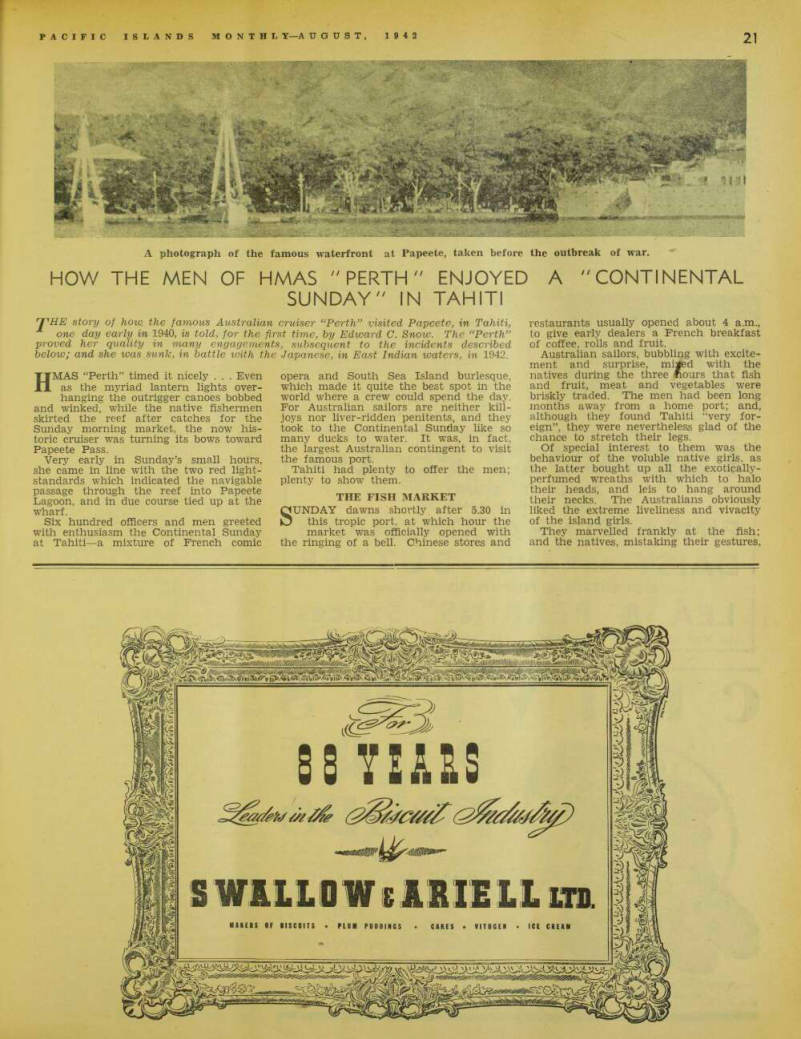
Sunday" In Tahiti
r PHE story of how. the famous Australian cruiser “Perth” visited Papeete, in Tahiti, one day early in 1940, is told, for the first time, by Edward C. Snow. The “Perth” proved her quality in many engagements, subsequent to the incidents described below; and she was sunk, in battle with the Japanese, in East Indian waters, in 1942.
HMAS “Perth” timed it nicely . . . Even as the myriad lantern lights over hanging the outrigger canoes bobbed and winked, while the native fishermen skirted the reef after catches for the Sunday morning market, the now his toric cruiser was turning its bows toward Papeete Pass.
Very early in Sunday’s small hours, she came in line with the two red light standards which indicated the navigable passage through the reef into Papeete Lagoon, and in due course tied up at the wharf.
Six hundred officers and men greeted with enthusiasm the Continental Sunday at Tahiti—a mixture of French comic
opera and South Sea Island burlesque, which made it quite the best spot in the world where a crew could spend the day.
For Australian sailors are neither kill joys nor liver-ridden penitents, and they took to the Continental Sunday like so many ducks to water. It was, in fact, the largest Australian contingent to visit the famous port.
Tahiti had plenty to offer the men; plenty to show them.
The Fish Market
SUNDAY dawns shortly after 5.30 in this tropic port, at which hour the market was officially opened with the ringing of a bell. Chinese stores and
restaurants usually opened about 4 a.m., to give early dealers a French breakfast of coffee, rolls and fruit.
Australian sailors, bubbling with excite ment and surprise, mhled with the natives during the three fiours that fish and fruit, meat and vegetables were briskly traded. The men had been long months away from a home port; and, although they found Tahiti “very for eign”, they were nevertheless glad of the chance to stretch their legs.
Of special interest to them was the behaviour of the voluble native girls, as the latter bought up all the exotically perfumed wreaths with which to halo their heads, and leis to hang around their necks. The Australians obviously liked the extreme liveliness and vivacity of the island girls.
They marvelled frankly at the fish; and the natives, mistaking their gestures,
A photograph of the famous waterfront at Papeete, taken before the outbreak of war.
endeavoured to persuade them to buy.
Some tourists, appraising the general uselessness of the idea as a commercial proposition, went into fits of laughter.
The fish that attracted the sailors’ attention, at which they had pointed, looked like anything but fish! There were yellow fish with green stripes, parrot-fish with two tails, square-fish with streamer tails, cowfish with two homs, and fish that made the ratings look at each other, and question their own sobriety. (For the benefit of those who cannot make the lengthy voyage to the far South Seas, many specimens of queer Tahitian fish are now on view in the aquariums of Sydney and San Francisco.) A native girl carried a baby octopus by the head, and its tentacles trailed in the
mud. Later, it would in all probability be devoured with chop-suey, bought at Too Fat’s restaurant.
Too Fat, the best known and most photographed Chinese at Tahiti, informed a group of sailors enthusiastically that he was in reality an Australian-born Chinese from Menangle, in New South Wales.
The fate and destination of the octo pus caused a good deal of speculation.
Somebody said he had heard they were delicious, when cooked “the right way”.
Whereupon somebody else interjected that it was all poppycock; when he par ticipated, the octopus tasted like “broiled motor-bike tyres served up in crude-oil and salt-water sauce”. (Readers can be safely recommended to keep to bacon and eggs.)
Boxing
QUITE early on the momentous Sun day, the first men lucky enough to be granted shore leave found the public boxing-ring. They had not very far to 100k —it was very handy.
The Tahiti waterfront, from Captain Cook down to movie-actors such as Doug las Fairbanks and Stirling Hayden, has been termed “The World’s Greatest Stage”. The boxing-ring was situated in an open-air yard, opposite where the “Perth” lay, between the coal-dump and a cabaret known as “Col Bleu”. Bouts
between the ratings of the cruiser fol lowed in fast succession. There were no rules or refs, but there was a lot of fun.
Raised on nine oil-drums, gloves pro vided free, the boxing-ring was a more or less successful attempt by the local administration to absorb the superfluous energy of visiting sailors and tourists. (Quite the knottiest problem they have ever had to deal with.) Small boys hit the oil-drums with stone-slings, in lieu of conventional gongs, and the lads in tropic white required no second bidding to get on with it. Contests were in pro gress from the arrival of the cruiser until its departure.
Packed Churches
VISITING sailors and tourists attended the services—in marked contrast with the manner in which they neglect the places of worship back home.
At Tahiti, they couldn’t be kept oUt The churches at Papeete were not merely packed. Even the Protestant churches had a phenomenal overflow, and that was the rule, rather than the exception.
Gregorian Chants, interspersed with the striking of bells, were heard at the Catholic Cathedral, and they were so melodious in tone that the impression they made was unforgettable.
At the Protestant Temple the singing of “himenes” lasted all the morning.
That style of singing differed from any thing the visiting sailors had previously heard. Unlike most congregations, that of the Tahitian church did not sing all at once. The Protestant assembly was invisibly divided into six choirs, repre senting six nearby districts. Each sec tion sang in rotation the “himenes” arranged by the chiefs of the various dis tricts. The effects were lovely—quite beyond description in mere words.
Tahitian singing is the softest and most pleasant to the ear, in all Oceania.
It differs from the hard consonant tones of the white races inasmuch as it is a vowel tongue—two or more vowels to every consonant.
Tourists and sailors sat spell-bound at something so strange and new. They voted it the best experience of all that Tahiti had to offer them.
The Cock-Fight
THE Sunday cock-fight at Tahiti was held in the district of Punaauia, near the Punaaru River Bridge.
What it lacked as an edifying spectacle it more than made up for in humour.
The state of excitement into which the natives transported themselves, rather than the behaviour of the contesting roosters, made the entertainment.
The ring was a small circus affair of bambo and pandanus, while the specta tors leaned on an outer barrier, similar to a racecourse railing.
Tethered by a piece of string tied to one leg, and looped round a handy tree, stood a game contestant. Pouting, crouching and spurring, it awaited its chance at the lists. Tied at safe, and convenient distances, other fighters ruff led their feathers. Two Euronesian bookmakers, puffing at American cigar ettes, and with wads of rather grubby five and twenty-francs notes in their hands, accepted bets.
The cock-fight proved to be a series of contests, some of which were flops, and others rich in unexpected comedy.
One bird, after a great deal of flurry with its wings, proved chicken-hearted in a literal sense of the term. It beat a furious retreat round and round the ring, and then crowned the event by
flying up to an overhanging branch and crowing lustily.
Even funnier was the derisive yelling and gesticulations of the natives.
However, the most humorous feature of the meeting from the viewpoint of the visiting sailors was the manner in which the intervals were filled. The seconds, and owners of the birds, put the beaks of the badly-winded fighters in their own mouths and blew hard, endeavour ing to resuscitate the exhausted roosters for a further contest! An American who won five francs declared quite truthfully that he had done what was impossible in his own country in a thousand Sun days.
Sports
BY far the most popular entertain ments on the South Sea Island Sun day were the regular sporting fix tures —horse-races, football matches and basket-ball contests.
True, the horse-races were only a wild west type of burlesque. However, the visit of the “Perth”, owing to wartime radio prohibitions, was unheralded, and the local committees had not time to stage anything more spectacular than soccer matches between the crew of the “Perth” and the Papeete champions, and basket-ball contests between high school teams, Fei-pi and Ecole Centrale.
There was plenty of Tahiti beer and French wine at the Sports Ground booth, and the large attendance had a very good time.
Taxi Rides
IN that sphere of activity the British Consul interceded with some excel lent work.
It had long been the custom, upon the arrival of a tourist-ship, for the prices charged by native Jehus to increase even faster than their taxis could accelerate.
But, whereas opulent tourists on the Swedish liner “Kungsholme” and the American liner “Monterey” paid up to £l3 for an 80-miles trip round the island, “Perth” sailors had the unique experi ence of finding the price pegged, for their benefit, at 350 francs, or £2/10/-.
The British Consul, taking into con sideration the limited depths of the sail ors’ pockets, saw to it that his charges received good value for their money in the 40 odd trips that were made around the island.
The Cinema
AS the screening of new films always 'fell on Sunday, the price for admis sion was accordingly trebled on that day. The cinema did not open at all on Monday or Friday, but on Tuesday and the middle of the week, films of yester year could be seen at very moderate prices.
The main attraction with the arrival of any large ship was usually Tahiti’s own “Bounty” film. However, what with breaks and wear and tear, since the pre miere in 1936, the screening the men on the “Perth” saw of the famous “Mutiny” film boasted only two-thirds of its ori ginal length!
Cabaret Dances
EVEN as the paradoxes of the Tahitian church services had surprised the sailors, so also did the Polynesian method of dancing. There were anoma lies for which no explanation could be given. With the outbreak of war in 1939 week-day dances and dance bands had been prohibited. Dances were permitted on Saturdays and Sunday nights only!
Tahitian dances never begin in Euro pean ballroom fashion. They start with a violent bang somewhere near the middle of things. They end, just as abruptly, with the dancer falling flat on
the floor. The softer and more subdued passages, which to a certain degree corresponded with the commencement of Western dancing, come in the middle of a Tahitian dance.
The cabarets, “Quinn’s”, “Lionel’s” and “Col Bleu”, were packed to suffocation when the hula dances (and the inevitable stamping noise—like anti-aircraft gunfire—that went with them) came on.
The world-travelled sailors of the “Perth” found it no less exciting than the Tahitians themselves.
Tetua and Natai, the ace hula-girls, were adjudged the equal of anything the men had seen.
“Ain’t she something wonderful!” exclaimed an American tourist admirer of Tetua. “The speed with which she can shake her hips!”
Not everybody was so favourably impressed. The remarks of the speaker’s platinum-blonde wife were apt, pithy and pointed.
Equally spectacular with the dances of the hula-girls were those of the ace hula-boy, Charles Frogier. He performed the “Ori Tahiti”, translated as: “The Jelly-belly Dance of the Stone-age Man”. (Some while ago, when the Tahitian Contingent was stationed at Liverpool, NSW, the members of several Sydney societies had the privilege of viewing Mr.
Frogier’s unique dance at the Australia and Carlton hotels.)
Consul's "At Home"
tujM&tLt) ai Huivifc TOWARD the end of the cruiser's stay, the British Consul held an "at home” on board, and printed invita tions were sent to most of Tahiti’s lead ing British residents. As the reception wore on, there was an element of “gate crashing” by many others, who most decidedly were not British! However, in a land where hospitality was paramount, all concerned turned a benign “blind eye” to it.
The band of the “Perth” returned the kindness shown them on all sides by delighting the cosmopolitan populace of Papeete with a concert of selections in the Place du Marechal Joffre. Everybody applauded the fine open-air entertain ment ‘ maori farfwfit
Maori Farewell
AT length departure came, inexorably A and all too quickly. The visit closed, unmarred by any unpleasant inci dent, and with the men voting the Tahi tian way of life, especially that of spend ing Sunday, as the sweetest of all their experiences.
With the Royal Australian Ensign fluttering from the stern and the band
playing on the lower deck, the “Perth” sailed away. The Maori Farewell was sung. Promises had been made—they would return . . .
And the spirit of the men of the “Perth” will return —perhaps in new ships not yet built—filled with more Australian sailors, just as light-hearted and ,carefree as their predecessors, to greet another bevy of flower-laden girls.
The old ships and the old flowers are
gone, but the spirit of the men and the girls lives on.
So it always has been, to sailors and flower-like Tahitians.
Advertisements & other items, pp. 23-26 (3 items)
21
PACIFIC ISLANDS MONTH L Y—A UGUST, 1942
S 3 Viass
■■ \\ -V" m m
/SIS
S WALLO W£ AR IE LL ltd.
MAKERS OF BISCUITS . PLUM PUDDINGS . CAKES . VITOGEH . ICE CREAM ift
&IBZ
§ v) 3) ggßßßßggHte
There is no substitute for
OLD MONK
VIRGIN PURE
olive oil
San Francisc o
PRESCOTT Pty. Ltd.
SUSSEX ST., SYDNEY,
ore sole wholesale agents for
PINEAPPLE BACON&HAMS
DAISY brand BUTTER "375" BUTTER in TINS Ilb.-21b.-slb. Sixes.
LEA & PERRINS’ Sauces and Most other Super-Quality Lines of the Trade,such as Cheese, Eggs, Etc.
VERS
PURE
FOODS
GOLD MEDAL JAMS
CANNED ENGLISH FRUITS
CANNED ENGLISH
VEGETABLES
CUSTARD POWDER
OLD ENGLISH MARMALADE
JELLY CRYSTALS, ETC.
Obtainable from all Leading Grocery Stores. ... Write to Department A.
Cbivers and Sous, Ltd., Histon, Cambridge, England, for attractive Recipe Book.
W
THEY KEEP YOU FIT
AND KEEP YOU SLIM
The whole grain of rich, sun-ripened wheat, transformed, after careful selection, into a perfect health food, delicious for breakfast, for afternoon tea or supper.
Arnott's Famous Shredded Wheatmeal Biscuits are rich in precious vitamins and proteins, and very easily digested. ... Try them with butter, cheese, jam or honey.
Arnott's
FAMOUS
SHREDDED
WHEATMEAL
BISCUITS
ALWAYS ASK YOUR GROCER FOR ARNOTT'S ! B22
A
injimmT&ffniwrv
Any Employer NEEDS YOU if you arc
AN 1. C. S. TRAINED MAN!
C 140 ELIZABETH STREET,
SYDNEY.
Sin,—Please send free prospectus showing how I can succeed in the occupation 1 have marked X Accountancy—Secretarial (all Inst. Ex.) Bookkeeping—General. Store, Station.
Salesmanship—Gen., Speciality, Retail.
Psychology and Personality in Business.
Advertising—Retail, Mail-Ord., Agency.
Window Disp.—Show Card, Shop Tckts.
Illustrating—Newspaper, Fash., Poster.
Free Lance Jour'ism —Short Story Writ.
Matriculation—Leaving-Inter.-Pub. Serv.
Gen. Education—Bus. and Sales Letters.
Police Entr. Exam., Nurses Entr. Exam.
Architecture—Structural Concrete.
Building Contracting—Air Conditioning.
Draftsmanship (Mech. & all branches).
Motor Eng.—Mtr. Mech., Mtr. Exams, Diesel Eng.—lllumin. Engr., Weld. Eng.
Internal Comb, and Steam Drivers' Exs.
Radio Eng.—Radio Serv., Radio Exms.
Aero Eng.—Gd. Eng., Licenses, Rigging.
Elec. Eng.—Elec. Cont. & Mechs' Exms.
Civil Eng.—Shire Eng.—Shire Overseer.
Textile (all branches) —Analyt. Chem.
Dress Design—Drafting, Cutting, Mlnry. (Underline your subject above—if not on list write it here ) Enquiries cost a 2d. stamp Post Now!
Name pIM Address
INTERNATIONAL CORRESPONDENCE SCHOOLS
Steamships Trading
Company Limited
PORT MORESBY
SAMARAI
PAPUA.
WHOLESALE & RETAIL MERCHANTS, SHIPOWNERS,
PLANTERS, ENGINEERS & SLIP PROPRIETORS.
Customs, Shipping, Insurance, and Forwarding Agents.
MANAGING AGENTS AND VISITING REPRESENTA-
TIVES FOR COCONUT AND RUBBER ESTATES.
SYDNEY REPRESENTATIVES: Nelson & Robertson Pty. Ltd., 12 Spring Street.
CLIENTS PLEASE NOTE
Temporary War Address— C/o Nelson & Robertson Pty. Ltd., 12 Spring St., Sydney.
WRITE, CABLE, OR CALL
STEAMSHIPS TRADING COMPANY LIMITED
Cable Address: "Steamships".
22
AUGUST, 194 2— P ACIFIC ISLANDS MONTHLY
Mission Work In Papua
A LETTER has been received in Syd ney from the Bishop of New Guinea (Eastern Papua) stating that, although it is a very perplexing time for the natives, the great bulk of them are “standing firm”.
There is no doubt, says the Bishop, that the resolve of the European and Polynesian members of the mission staffs to stay at their posts, wherever possible, has gone a long way towards maintain ing morale amongst the Papuans.
Although mission work cannot be car ried on on the same fcale as before the war, the plan of the missionaries is to retain as much as possible in readiness for a quick advance when better days come.
Canon Best, of the Australian Board of Missions, has refuted Mr. George H.
Johnson’s statement, in a recent news paper article, that there were no white women left in the whole of Papua and New Guinea. He points out that there are 18 women missionaries on the staff of the New Guinea Mission (Papua) who have remained at their posts, and who are. determined to carry on their work, whatever happens.
Private Wilfred Warren was killed in a traffic accident recently in Randwick, Sydney. He evidently had alighted from one bus, and was knocked down and killed by another bus, passing in a dif ferent direction. Originally from Pit cairn Island, Private Warren was well known on Norfolk Island, where he had lived for many years with the family of Mr. Peter Buffett. He had recently returned safely from service with the AIP in the Pacific, only to meet his fate in the traffic of Sydney. He was an esteemed member of the Polynesian Club.
From One War To

Another
Interesting New Book on New Guinea
NEW Guinea men, affairs and exploits have become legendary in the space of a generation or two—to New Guinea residents. The rest of the world, in spite of the Pacific war, knows virtu ally nothing of the place and of the people who made it peculiarly their own.
Therefore, a new book concerning New Guinea is very welcome. It is “High Lights and Flights in New Guinea”, by Lloyd Rhys, published in London by Hodder & Stoughton Ltd., for 18/ .
Lloyd Rhys is better known, perhaps, as an artist than as a writer; but he is an attractive writer. He has made a bright and easy-to-take book out of the Territory’s history from early days, through the German era, to the out break of World War 11. Although at times he comes perilously close to giv ing merely a re-hash of what has been written before on the subject, his easy style has caught something of the spirit of the place and people—strong romance and adventure, but shorn of sentimental frills—and here within one book we have a more comprehensive story of New Guinea than has ever before been given.
New Guinea residents, “ex” and actual, will meet old friends, and the scores of yarns and fables that are all of one piece with their names. “Queen” Emma, “Shark-Eye”, the Big Six, Levien, Baum, Ray Parer, and every other person who has left his or her mark on the Territory are all there, and very life-like. *To others, it is a timely introduction to the background and beginnings of a country that is now making daily head lines, and to that dauntless tribe of rabid individualists, men and some few women, who had the necessary fortitude and tenacity of purpose to leave suburbia and hack their own niche in the jungle.
Australians know too little of the pri mitive land that was being pioneered by their own folk. To the great general public an Islands resident means either of two things: (1) He is quite mad (hav ing voluntarily chosen to live away from the newest movie and the tram-line) or (2) He is a millionaire, and therefore greatly to be envied for what is put down to “luck”, or to be fleeced according to the supposed bank-roll. Lloyd Rhys may help to dispel a few of these illusions and create some awareness as to what the war evacuees have lost.
HIS story begins before the German annexation. “In those days,” he says, “Australia was politically rid ren by the Colonial Office, as is the Mandated Territory by the Common wealth to-day.”
Colonial Secretary, Lord Carnarvon, and his successor, Lord Derby, were so affected by their exalted positions that they resented any suggestions from the territories in their charge, and brushed aside all proposals from Australia that that portion of New Guinea, not already gone to Holland, should be taken over by Britain or Australia. Britain, they said, already had black subjects enough and they knew, for a positive fact, that Ger many had no intention of acquiring colonies in that particular direction.
While they were still arguing, Germany annexed North-east New Guinea, New Britain and New Ireland. The noble
lords bleated feebly that Germany had not behaved as a gentleman should.
THIRTY years later came war-and Australians to occupy Rabaul.
Many Germans promptly went “bush” —to wait, as they thought, for the whole thing to blow over. One of the most remarkable stories of escape was that of Hermann Detzner, who remained there until after the Armistice.
When war was declared in 1914 he was somewhere near Morobe, preparing for an expedition to the Sepik; it took three months for the news to reach him and when it did, it came from Australian military forces in a demand for his sur render. To Detzner, iron-willed and proud, the known dangers of the jungle, of disease, privation and existence amongst cannibals, were preferable to surrender. He took his last tinned food from Finschhafen and set off towards Dutch New Guinea, 500 miles away, across the most heart-breaking and forbidding country in the world, and for four years he wandered in the region between Mor obe and Mt. Hagen. There were periods of hunger, and more of sickness, when he nursed his carriers, or they nursed him; but throughout he seems to have had remarkably little trouble with the natives and, with true Teutonic dualness of character, managed to take time off from his stern task to make friends with the birds, and to record in notes his impressions and observations of native life and custom, folk-songs, legends, etc.
Sickness eventually drove him down to a coastal mission; and, while there, news of the Armistice came through.
Lloyd Rhys re-tells this strange story.
He describes, once again, the enterprise and pluck of the Australian gold-pros pectors who fought their way into the Morobe country and found Koranga, Edie Creek and Bulolo: and the manner in which commercial aviators pioneered what was, for years, the world’s greatest and most remarkable aerial transport service.
The author writes interestingly, and boldly, concerning the future of New Guinea. He expresses wonder that “vested interests” have been allowed to exercise so much influence, why roads are practically non-existent, why the free planters were allowed to struggle along under an ever-increasing burden; and he pleads for a better understand ing by the Australian Government of the people and their requirements.
Fthe last chapter, he describes how World War II came to New Guinea.
“On Sunday, September 3, 1939, a Miners’ Conference was held in Wau.
There was a feeling of tension through out the day. It was not caused by any development at the conference. The Germans had entered Poland. There were men who had lived to the full, tasted the ripest fruits of life and drunk of its most bitter dregs.
“When the call came they answered it in various ways; but they were ready.
Throughout that strange, wild land, from comfortable administrative offices, from coastal schooners, mines, plantations, far-distant patrols and around the bars in the local pubs, the answer echoed.
The breed held true.
“Everyone awaited further news. At 8.30 in the evening it came—Chamber lain’s announcement that a state of war existed.
“The reaction in that small mining town was an experience never to be for gotten. At the ‘top’ hotel the proprie tress stood by her wireless, straining to hear every word: for she had a sister in Germany, a nephew in the Plying Corps, a daughter somewhere on the high seas,
and a son in the Bomber Corps in Eng land who, alas, was reported missing in the first few weeks. Moresby Gofton was the first New Guinea man to lose his life in this war.
“At the ‘lower’ hotel men gathered . . .
Relief was on every face and in every voice. Chamberlain’s statement had put an end to their one fear. In full face of the tragedy that faced them their only feeling was one of relief in the knowledge that there was not to be another Munich.” —J.T.
Miss D. Coltheart, Miss H. Muir and Miss N. Pitty, of the Methodist Overseas Mission, Papua, have taken charge of the Government home for half-caste girls, at Cootamundra (NSW).
Rev. A. L. Cannon, who served in New Britain as a Methodist missionary for three years, died recently. Mr. and Mrs.
Cannon were stationed at Ulu, where he was principal of the George Brown Training College.
News comes from Mrs. J. Wyatt (Papua) of Corporal P. W. Bosgard, who has been a prisoner of war in Italy for over a year. The Italians appear to have treated their prisoners well, and the British Red Cross has let them want for nothing—parcels of food, warm cloth ing, and books turning up with great regularity. He reports that he, Cotman and Gossner (also of Papua) are all well and they “hope to get out this year”!
Advertisements & other items, p. 27 (2 items)
25
PACIFIC ISLANDS MONTHL T—A UGUST, 1942
Utter
ALE
o t
BREWED BY
CARLTON & UNITED BREWERIES LTD.
How Australia Got Papua
And How Gladstone Forced Australia to Surrender North-east New Guinea to Germany
With all Western Pacific Territories temporarily facing new conditions, the story of how there came to be a British and a German New Guinea may again he told. The following article was written in 1938 for the “PIM ” by Captain A.
Middenway, since deceased. r WARDS the end of 1882, the British Colonial Office was perturbed by fresh rumours of Germany’s contemplated colonisation in New Guinea, and a renewal of the Australian colonies’ periodical requests for the annexation of New Guinea (which began somewhere about 1867).
Queensland, particularly, was genuinely alarmed; and, in February, 1883, the Premier, Sir Thomas Mcllwraith, cabled advising annexation as a matter of urgency, on the following grounds: (1) The safety of the commercial highway through Torres Strait; (2) The necessity for jurisdiction over the whites in New Guinea: (3) The fact that a coaling station had already been established; (4) Fear of foreign acquisition.
When the matter was brought before the Colonial Office, Lord Derby, Secretary of State for the Colonies, sought assurance that public opinion in the colony of Queensland was likely to sanetion the step, by a vote of Parliament.
Prom the number of despatches that arrived he soon realised that the colonies considered the matter of vital importance.
Simultaneously, the acquisition of New Guinea was openly discussed in Germany. The British Minister at Brussels advised the Foreign Office of a reported
proposal to form a company to make a scientific exploration of the country and gradually to take possession of it as a commercial colony . . . . . , . „ Official m Q ulrie s were made in Berlin.
The British Ambassador was informed that the venture was quite a private one, not yet supported by the Imperial Ger man Government; and this was accepted by Foreign Office. ottf'F'ivqt atvfi aimmitypsh
Queensland Annexes.
ItyTE AN WHILE, public meetings were ItJ. held in all the colonies, and resolu tions were passed demanding Im perial action. Despatches were for warded to London.
But before these had reached their destination, Queensland, on her own responsibility, on the grounds of urgency, took formal possession of the eastern portion of New Guinea, On April 14, 1883, news of Queens land’s action reached Lord Derby. He cabled for confirmation, and received the following reply from Sir A. E. Kennedy, Governor of Queensland: — “To prevent foreign powers from tak ing possession of New Guinea, Queens land Government, through Police Magis trate Thursday Island, took formal pos session in Her Majesty’s name on the 4th inst., pending your decision on my despatch this mail.”
In his despatch, Sir A. E. Kennedy informed Lord Derby that he was entirely satisfied with the action of his Government, which he considered rea sonable and justifiable. The colonies cohcurred.
The “Brisbane Courier”, commenting on the matter at the time, said: “If the Queensland Parliament supports the action of Sir Thomas Mcllwraith, it is * n °t likely that the Home Government will order the flag, once hoisted, to be hauled down, and the beginning of the occupation made at Port Moresby to be stopped short. We think Lord Derby will scarcely venture to repudiate.”
Lord Derby asked what specific infor mation had led the Government to sup pose that foreign intervention was imminent; and, in reply, he was told that there were general rumours, and a special rumour that the German cor vette “Carola” was leaving Sydney for the South Seas with the object of annexation. The “Carola” actually left on March 18, 1883.
Britain Repudiates'
BEFORE repudiating the annexation, Lord Derby again caused inquiries to be made through the Foreign Office, to assure himself that no foreign power meditated intervention in the ter ritory that had been annexed. He was informed that the Foreign Office “had reason to believe that no such action is intended on the part of any foreign power.”
On July 11, 1883—three months after the annexation—Lord Derby wrote:— “Her Majesty’s Government are unable to approve the procedure of your Gov ernment in this matter ... it is well understood that the officers of a Colo nial Government have no power or authority to act beyond the limits of their colony and, if this constitutional principle is not carefully observed, seri ous difficulties and complications must arise.
“If there had been any evidence of the intention of a foreign power to take pos session of any part of New Guinea, the views and proposals of the Colonial Gov ernment could have been placed before Her Majesty’s Government by tele graph; and, if the circumstances had justified immediate action, it could have been taken without a delay of more than a very few hours.
“It is therefore much to be regretted that your advisers should, without appar ent necessity, have taken on themselves the exercise of powers which they did not possess.”
He also said that the apprehension of foreign action was “altogether indefinite and unfounded”, and that the Imperial Government “had the strongest reasons
for believing that no such step was con templated”.
Typically British—doing too little, too late!
The Colonies Insist
CONSIDERABLE disappointment and
annoyance were displayed in Aus tralia. Sir Thomas Mcllwraith replied fully to the despatch, pointing out that “if the Imperial Government eventually annexes, not only is no advan tage to be gained by postponement but, in the meantime, the course which is now open and clear will have become beset with difficulties, and our lost opportunities will have to be recovered at a much greater cost than would be incurred if we were to avail ourselves of them without delay.”
The repudiation of the annexation was directly responsible for the Inter-colonial Convention held at the close of the year 1883—a conference at which the seeds of Australia’s Federation were sown.
The Convention was attended by the Premiers of all Australian States, with supporting Ministers. It was supported by New Zealand and Fiji.
“The annexation of New Guinea was the main subject of discussion. The Con vention considered it essential to the future well-being of Australia that East ern New Guinea and the Western Paci fic Islands, from the Equator to the New Hebrides, should not fall into the hands of any Western European Power. A resolution was passed urging that “such steps should be immediately taken as will most conveniently and effectively secure the incorporation within the British Empire of so much of New Guinea and the small islands adjacent as is not claimed by the Government of the Netherlands”.
The resolutions were passed on Decem ber 4. 1883, and cabled to London imme diately.
The Convention considered that “in view of the foregoing resolutions and of the many questions of pressing import ance in which the Colonies were of one mind, but unable to obtain united action owing to the absence of some common authority, the time has now arrived for the drawing closer of the ties which bind the Colonies to each other by the establishment of a Federal Union”.
Whitehall’S Troubles
IN May, 1884, Lord Derby intimated, in a circular despatch to the Colonies, the intention of the British Gov ernment to set up some form of juris diction in New Guinea. At that time, there was no mention of any move hav ing been made by Germany; but, at a later stage, Germany claimed to have announced to Lord Granville, in a com munication which the British Govern ment denied receiving, her intention of developing New Guinea.
On August 8, 1884, the German Ambas sador in London informed Lord Gran ville of Germany’s intention of establish ing herself in New Guinea.
The Colonies were not consulted dur ing the negotiations between Germany and the British Government, and an undertaking was given to Germany with out any reference to the Colonial Gov ernments.
That the Colonial Office and the Foreign Office were separated by diverse interests is revealed in “The Life of Earl Granville”, by Lord Fitzmaurice.
From this we learn that Lord Derby was anxious to take immediate steps to acquire New Guinea; while, on the other hand, Lord Granville was anxious not to offend Germany.
Lord Derby intended to assume a pro tectorate over all the coast of the island
of New Guinea not in possession of the Dutch, with the exception of that part of the north coast between 145.3 E.
Longitude (which would be in the vicin ity of Madang) and the Dutch boundary.
The proclamation was approved by Cabinet, but the Foreign Office inter vened. In a letter to Mr. Gladstone, dated September 30, 1884, Lord Granville wrote: — “A very awkward question has arisen.
You remember the discussion of the Cabinet, upon which the despatch to Berlin was founded, on the subject of New Guinea. The Germans had pre viously admitted our right to the south side of the island, opposite Australia.
The Colonial Office thought it necessary that we should have more, and should take some of the north of the island.
Lord Derby would have liked to issue a proclamation previous to giving any opinion of our intentions to Germany.
He yielded to the opinion of Northbrook, of Lyons and myself that we could only do so if we wished to quarrel with Ger many.”
The proclamation was postponed and the warship which was to have pro claimed the Protectorate was delayed by telegraphic orders.
On November 6, 1884, Commodore Erskine proclaimed a protectorate—but over only the south-east coast of New Guinea and the adjacent islands.
The difficulty of the situation lay in the fact that, in order to conciliate Ger many in New Guinea and the neigh bouring seas, it was necessary to run the risk of flouting British Colonial requests.
Mr. Gladstone Decides
MR. Gladstone dominated the situa tion. He saw that a choice had to be made, and recognised that the continued hostility of Germany was a danger greater than that of the irrita tion of the Australian colonists about New Guinea and the Pacific Islands. On March 6, 1885, he wrote to Lord Gran ville: — “A word by way of postscript to my note of yesterday, in which I conveyed to you that, according to Herbert Bis mark, there is and could be no quarrel about Egypt, if colonial matters are amicably settled. Now I do hope that you are pressing forward the ‘Pauncefote’ settlement of the north coast of New Guinea, which seems to me the main or only point remaining. It is really impossible to exaggerate the importance of getting out of the way the bar to Egyptian settlement.”
On April 25. 1885, Lord Granville sug gested a specific line which gave an area of 67,000 square miles of New Guinea to Germany, and 63,000 square miles (now Papua) to Great Britain. This Ger many readily accepted, and the New
Guinea dispute ended as far as England and Germany were concerned.
Thus, Britain got the south-eastern part of New Guinea, instead of the east ern half of the great island, as origin ally demanded by Australia.
General Sir Peter Scratchley was appointed Special Commissioner for the new Protectorate (called British New Guinea), but he died there, from malaria, in November, 1885, soon after arrival.
The position was taken over by John Douglas, formerly a Queensland Premier.
Dr. (afterwards Sir) William MacGregor was Administrator in 1888, and he form ally annexed the Protectorate to the British Crown on September 4. 1888. In 1901. after the Commonwealth was formed, it was formally taken over for five years as Australian Territory; and the arrangement was made permanent, as from 1906, by the Papua Act of 1905.
On the outbreak of World War I, in 1914, Australian troops occupied German New Guinea and the adjoining Bismarck Archipelago (New Britain, New Ireland, Bougainville, etc.) and it has been held by Australia under mandate ever since.
Mr. William Walker Cocker, who was widely known throughout the islands of the Western Pacific, as a merchant and planter, died in Nukualofa, Tonga, on May 30, aged 82. Mr. Cocker, who was a son of the late Mr. Joshua Cocker, first British Consul in Tonga, was born in England in 1855, but had lived at Nukua lofa since 1860, when his family went there. He is survived by his wife, one son and four daughters.
Miss R. Cunnold, of the Melanesian Mission, who has been on leave in New Zealand, will return shortly to her work as sister-in-charge of the hospital at Lolowai, New Hebrides.
Miss N. Fagan, of the Melanesian Mis sion, who has been on furlough in Aus tralia, hopes to return shortly to Torgil, New Hebrides, where she has charge of the Native Girls’ School.
Advertisements & other items, pp. 28-30 (3 items)
26
AUGUST, 19 4 2 P ACIFIC ISLANDS MONTHLY
Bitumenoid Roofing
MAD® IN AUSTRALIA,
Bltumenold Roofings, Dampcourse and Insulating Felts are made from the world's best raw materials. Warranted to stand the most rigid tests.
BITUMENOID THE BEST
Roofing, 1,2, 3-ply; Flooring, Waterproof Materials; Saturated Felt; Resilient Road Jointing; Natural Asphalt Dampcourse; 2 and 3-ply Dampcourse; 1-2 lb. Lead-eore Dampcourse: Roofing Cement; Asphalt Paints; Roofing Compound.
SAMPLES AND PRICE LISTS ON APPLICATION.
MAXWELL PORTER & SON LTD.
ESTABLISHED 1888. BUILDERS’ SUPPUEo.
107 BEDFERN ST., BEDFERN, SYDNEY, N.S.W. ’Phone: M 8157. Cables Bltameweld.
JAMES BUDGE
LTD
REFRIGERATION . .
“BUDGE" Automatic or Manually-controlled Refrigeration and Ice-making Plants, with or without insulated Cabinets or Rooms, ranging from 4 cubic feet to 1000 cubic feet or larger, using ammonia in the large and sulphur dioxide (SO2) in the small units. Where electricity is not available, crude oil engines may be utilised for driving the larger plants and petrol engines for driving the smaller machines. The accompanying illustration is of a petrol engine driven SO2 unit. Enquirers please state power (if any), size of cabinet and amount of ice required per day.
ALL CLASSES OP REFRIGERATION EQUIPMENT.
JAMES BUDGE PTY. LIMITED
Refrigeration and General Engineers Office and Works:
McEvoy and Harley Streets
ALEXANDRIA, SYDNEY. Established 1890.
Allen Taylor & Co. Ltd.
COMMERCIAL ROAD, ROZELLE,
SYDNEY
Sawmillers and Wholesale Suppliers of Hardwoods for Constructional Purposes GIRDERS . . . PILES . . . POLES . . . SLEEPERS, Etc.
EXPORTING TO PACIFIC ISLANDS SINCE 1893
‘When searchlights cease
to sweep the skies 99 . . .
When Victory is proclaimed and you build a home of your own, remember the advantages of “Durabestos”
(Asbestos-Cement) Building Sheets.
Obtain a copy of “Durabestos Homes and Plans’’ now, post free. See how attractive, spacious homes can be built at low cost. Write to G.P.O. Box 474aa, Sydney •S' 1 -:?:''#?: k V Island storekeepers stock, or will procure, this material.
DURABESTOS
ASBESTOS-CEMENT b U l e d e't n s g
NELSON & ROBERTSON
PTY., LTD.
Established 1895.
Islands Merchants
All classes of merchandise purchased at wholesale prices and original invoices supplied to Islands clients.
Cocoa Beans, Rubber and other Islands' produce sold on commission.
Nelson & Robertson
Pty. Ltd. 12 Spring Street, Sydney, Australia.
Ship Chandlery— Hardware
r Write for j
j Ship Chandlery /
* Catalogue J
Special “In Bond” Prices for all Islands enquiries quoted on application..
BROOMFIELDS LIMITED
152 SUSSEX STREET :: SYDNEY.
Cables: “Boom”, Sydney.
Large and Complete Stocks of
SHIP CHANDLERY
IRONMONGERY OF ALL KINDS, PAINTS,
WHITE LEAD AND OILS.
Sole Agents for: P. H. MUNTZ & CO.’s 3-CROWN BRAND METAL SHEATHING.
PEACOCK & BUCHANS’ ENGLISH READY-MIXED PAINTS.
FOR RELIABILITY
AND LONG SERVICE
IT~
MILLER'S "ANCHOR"
BRAND ROPES AND
CORDAGES
Manila, Sisal, New Zealand Coir and Cotton Rope of every description. Twine, Sewing Twine, Shop Twine, Binder Twine and Fishlines, Lashings, Halters, Plough Reins, Sack Cord, Blind Lines, etc.
LENGTH STRENGTH
QUALITY GUARANTEED
• Manufactured by: JAMES MILLER & CO. PTY. LTD.
MELBOURNE, VIC., AUST.
Suva Agents: A. S. FAREBROTHER & CO.
And at Lautoka, P.O. Box 38. Tel.: 361.
Sydney Agents: p. T. TAYLOR LTD.
27
PACIFIC ISLANDS MONTHL T—A UGUST, 1942
Pitcairn
One Night On
letters, written by Pitcairn Island officials to Seventh ’Day Adventist headquarters, Sydney (and kindly made available to the “PIM”), describe graphic ally a minor tragedy in that isolated community. They throw some light upon the dangers experienced by Pitcairn and similar Central Pacific islands in main taining communication with ships.
By Roy P. Clark (Postmaster)
A CERTAIN Monday in June was a day of wind and rain, cold and mud. I worked in the fields all day, and we were preparing to retire early when suddenly, out of the still night air, there came faintly the long-drawn call of “Sail-oh!” and almost instantly the ringing of the community bell.
A team of horses could not keep an islander back from the landing-place when the bell peals forth ship call. It does not matter where one is—in church, in a law court, a sitting of the Govern ment Council, or a public meeting— everything is secondary to this call.
There is no time to lose.
There was an important bag of mail to go, so I lost no time in donning my ship clothes and making a bee-line for the Post Office. The rain had ceased, but the pathways were slippery, espe cially the one leading off the Edge to the Landing.
I was just in time to catch the last boat leaving. As it was, I had to wade more than knee-deep to climb over the stern.
It was pitch dark. The steamer was in quite close, the light appearing to be not more than half a mile from shore, so we were soon alongside. A heavy swell was running, and it was with great dif ficulty that the boats were kept along side the ship. In attempting to catch hold of one of the three “Jacob’s lad ders”, one of the boat’s crew fell into the water. It was providential that he was seen by the stem oarsman, who grabbed him as he was passing astern and into darkness, most certainly to be drowned; for this individual could not swim. mHE ship’s crew were very X and our trading and bartering were exceptionally good. After spending a happy and profitable time aboard, we heard the whistle blow, as a warning for all hands to get into their boats.
As the painters were cast off and the long boats drifted astern, we sang a hvmn. waved and called final good-byes.
The lights on the steamer went out, leaving only a black smudge on the water.
The wind was fair for the harbour, so all three boats hoisted sail, and we made ourselves comfortable for the short sail home. The beach was dimly lit with lanterns and torches brought by those who had come from the village to see the boats in. The canoe and long-boat houses, trees and landing point, were all silhouetted before us.
The first boat had gone in through the most dangerous part of the nassage; our boat was the second to make the har bour; and the third was just behind us.
Someone in our boat shouted, “They’re on the rocks!” And then another, “They have capsized!”
Forms hurried to the other side of the harbour, among the rocks. Lights flit ted here and there in every direction.
All was confusion. A cold rain was falling. Some anxious fathers in our
boat knew their sons were in the cap sized boat.
ALL this time we were drifting dan gerously near the breakers. Our captain called, “Back out! Full starboard; back port!” We were almost sideways in the passage.
The boat’s crew behind us were fran tic with anxiety to be ashore to lend aid. There was no time to wait for an opportune moment, when the swells were least heavy. We took a blind chance and pulled right along.
In the passage a large sea caught us up on its crest. We shot forward like a sped arrow, and for a minute I thought we, too, were going to be piled up on the rocks. Fortunately, our rudder “took” just in time, and swerved our boat straight for the sandy beach.
WE heard exclamations of distress from friends and relatives, who had not yet discovered who were injured. As I jumped out of the boat a group of people were carrying a wounded man, who was crying out with pain. Just behind was another company, bearing an unconscious man.
In the largest boat-house the men were laid down. One, Curtis Christian, was in agony, with a leg broken in two places, and a piece of bone protruding through the flesh. The other man had cuts on his face and head, but his case proved not to be serious.
Some of the men were busy cutting splints and binding up Curtis’s leg. He was shaking with cold. In the mean time, someone had run up to the village for a camp chair. On this we placed the youth, and five or six of us took our groaning burden up to his home.
I hurried back to the landing. Two
of the boats had by now been hauled to their respective houses. The third was still overturned in the harbour, and being battered by the waves on the rocks.
Plans were made to secure the boat and save at least some of the planks, thwarts, etc. Those in authority gathered the men around the boat. Ropes were tied on the thwarts towards the sea, passed over the boat and then ashore. The men, women and youths lent a hand, yet even so r it was a hard task to right the boat. This was accomplished at last.
Some of the crew rushed into the water to secure sail, mast, oars and other loose gear. Strewn along the rocks and sandy beach were tins of jam, broken wooden curios, matches, cloth, and other stuff obtained aboard the ship. Almost every thing was lost.
It took two hours’ hard and dangerous work to get the boat into the harbour and on to the skids to haul it up. All the time it was raining hard, and the men were complaining of the cold. I was chilled to the bone. Unable to hold a rope in my hand, I had to give up and seek shelter. In the wee hours of the morning we came home, sad and utterly exhausted.
Later I learned that Herbert's condi tion was not as bad as we thought.
There is no doubt he was saved from drowning, for from the time the boat capsized to the time the other two men were brought to safety, Herbert was not missed. Then someone shouted, “Where’s Herbert?”
At this very moment two of the crew were trying to extricate him from the ropes of the boat sail, still under the boat. One was holding Herbert’s arms, while the other cut the ropes entangling him. Finally they managed to get him free—unconscious and almost drowned.
He suffered no other harm than a slightly injured hip, but the loss of his spec tacles leaves him almost blind.
Edward Grant, though shaken up con siderably, sustained only minor injuries.
He swallowed a lot of the Pacific in his narrow escape from drowning, and bemoans the fact that he lost his upper set of teeth. rE schoolmaster, Mr. F. P. Ward, added a later note: — There were several men who had nar row escapes that night. The Chief Magistrate, Fred. Christian, was in the boat that overturned, but he was thrown clear. The boat was badly broken, but the men are trying to repair it. •Remarkable as it may seem, Edward Grant’s teeth were found the other day; and, the day following, Herbert’s glasses were fished out of the bay!
Curtis Christian, only 19, whose leg was badly smashed, suffered much pain before he died nearly six days later. Had he been able to have proper medical attention, he might have lived. Amputa tion was probably necessary.
A radio message was sent to the High Commissioner, in Suva, who was endeav ouring to arrange medical aid; but, in these days, when ships are so scarce and doctors perhaps more so, this was a difficult matter. The boat must have fallen on the leg on top of a rock, crush ing it badly.
About two weeks before he died, Curtis helped to carry his sister Myrtle to her gfave. It is only six months since their mother died.
Mr. J. H. Spivey, formerly LMS mis sionary in the Gilbert Islands, is now in Australia, doing deputation work.
Advertisements & other items, pp. 30-31 (3 items)
28
AUGUST, 194 2—P ACIFIC ISLANDS MONTHLY
29
PACIFIC ISLANDS MONTHL Y—A UGUST, 1942
Masse Batteries
FOR YOUR BOAT
Fit Masse for lighting, for wire-
less, for starting
Masse Batteries are made of the finest materials obtainable in fhe largest and most scientifically equipped factory in the Southern Hemisphere.
Investigate Massed scientific design and rugged construction and you will be convinced there is no better battery made.
Masse BATTERIES
Masse Batteries are Tigers for Work — they simply lap it up!
OBTAINABLE EVERYWHERE.
Ask your Island Distributor.
The Mccoys Of
Pitcairn
Letter to the Editor I HAVE read with much interest an account of the Pitcairn Islanders, as related to you recently by Mr. F. H.
McCoy, and published in July “PIM”.
I assume that Mr. McCoy was relying on his memory; if so, it could hardly be expected that his account would be entirely free from inaccuracies. Most of the dates given are within a few days of the actual dates.
A particular exception is the date given for the arrival of the “Bounty” at Pitcairn Island—January 23, 1790. The “Bounty” actually arrived at Pitcairn in October or November, 1787. Several weeks were occupied in removing everything of value from the ship to the shore, little more than the framework of the vessel being left. Even the copper sheathing was taken off the hull, and many of the copper bolts removed.
The first entry in “The Pitcairn Island Register Book” reads: 1790. Jan. 23rd.
H.M.S. ‘Bounty’ burned at Pitcairn’s Island”. Obviously the vessel would not be destroyed on the day of arrival. (Regarding the copper sheathing and bolts of the “Bounty”; When the Pitcairn community of 87 persons removed to Tahiti in 1831, they took a quantity of this material with them. Unfortunately, within a few weeks of their arrival, 14 ©f their number died of fever. The condi tions of living in Tahiti were entirely dif ferent from those to which they had been accustomed in Pitcairn, and they were rendered very unhappy by the low stan dard of morality existing among many of the Tahitians with whom they came into contact. They therefore decided to
return to Pitcairn. The copper was sold, and the proceeds—together with a sum of money subscribed by friends in Tahiti —used to charter a vessel to take them back to Pitcairn. I am the proud pos sessor of a small piece of one of the cop per bolts. This was given to me many years ago in Tahiti by an old friend, who sawed it off a piece about a foot long, which had been in his possession for many years.) rERE are several versions of the manner in which the mutineers met their deaths, but most authorities agree that Christian, Brown, Martin, Mills and Williams were killed by the Tahitian men in 1794. I have never come across an account which gives the cause of Martin’s death as drowning.
The particulars given by Mr. McCoy regarding the deaths of McCoy, Quintal and Young are correct.
Mr. McCoy’s statement regarding the children born to the mutineers is cor rect, excepting in regard to Young and McCoy. Young left seven children, not six (Polly, Robert, George, William, Edward, Dolly or Dorothy, and James).
McCoy left two children, not three (Daniel and Catherine), Some accounts show a third child (Sarah).
There has been a good deal of confu sion regarding “the Tahitian child” who was included in the party which settled on Pitcairn. The Rev. T. B. Murray, probably the most reliable of those who wrote about the Pitcairners, says in his book, “Pitcairn: The Island, the People, and the Pastor”, that she was ten months old, and was afterwards the wife of Charles Christian, and the mother of Mrs. G. H. Nobbs. I have read some where that she. was the daughter of McCoy’s Tahitian wife; this would prob ably account for her being known as Sarah McCoy. It seems clear that she
was not the daughter of McCoy.
I cannot understand Mr. McCoy mak ing the statement that there are not more than two McCoys now alive. (I take it that he means male McCoys). I know five on Norfolk Island—namely Danny McCoy and his three sons (Leo, Phil, and Charlie), and William McCoy; and one in Sydney (John McCoy, a member of the Police Force). A list of inhabitants of Pitcairn, compiled in Octo ber, 1937, shows only one (Floyd H. Mc- Coy), probably the gentleman who called on you.
Nor can I understand the statement that there has not been more than one son in each of the five generations of McCoy. The original William McCoy had only one son (Daniel); but Daniel had six sons (William, Daniel 11, Hugh, Matthew, Samuel, and Daniel III).
Daniel II had only one son (Phillip), William and Hugh died unmarried; Mat thew had only one son (James Russell); Samuel appears to have had two sons (Russell and Jacob), and Daniel 111 left no issue. My family tables close with the departure of the Pitcairners for Norfolk Island in 1856; but the figures quoted above show that Daniel McCoy I had six sons, and I personally know Danny McCoy, of Norfolk Island, who has at least three sons.
I may state that I have for the past seven years been studying the history of the Pitcairn and Norfolk Islanders. I have read practically everything that has been published concerning them. My two visits to Norfolk Island covered a period of approximately two years. While there, through the courtesy of various islanders and of the Rector, I had the opportunity of perusing the family trees of the Pitcairners (compiled by the late Gustav Quintal, a Norfolk Island school teacher), some hundreds of letters and other documents left by the late Rev.
George Hunn Nobbs, and an old Register of Births, Deaths and Marriages, com menced on Pitcairn Island and continued for many years on Norfolk Island. I should be very pleased of an opportunity to meet Mr. McCoy and discuss the his tory of his people with him.
Yours faithfully,
Captain J. D. Mccomish.
7 Ceilings Street, Wahroonga, NSW. 25/7/1942
Editorial Note: Mr. F. H. Mccoy
is a merchant seaman, and does not visit Sydney often. He was quite definite about “one son in each generation”; and the point should be cleared up.
Advertisements & other items, p. 32 (2 items)
30
AUGUST, 19 4 2—P ACIPIC ISLANDS MONTHLY
William Atkins Pty. Ltd.
Head Office 449-451 KENT ST., SYDNEY.
Iron & Steel Merchants-Engineers' Supplies
ESTABLISHED 50 YEARS
Coach & Motor Hardware
TRADE
MARK
Cable Address: WILATKIN, Sydney.
STEEL DEPARTMENT
MILD STEEL:
Rounds, Squares, Flats, Half-rounds, Hexagons, Bevel, Shoeing, Tyre, Angles, Tees, Sheets, Plates, Girder Plates, Chequer Plates, Channels, Hoops, Etc.
BRIGHT STEEL:
Rounds, Squares, Hexagons, Extra Special High Speed Tool Steel, Mining Steel, Blister Steel and Spring Steel, Rounds, Flats & Squares.
Bar Iron—All sections and sizes.
Engineers' Supplies: Set Screws, Studs, Metal Thread Screws, Coach Screws. Files, Cotter Pins, Bright and Black Bolts, Rivets, Etc., Hack Saw Blades.
Power Transmission Gear: Including Plummer Blocks, Couplings, Collars, Etc.
Coach and Motor Hardware: Axles, Springs, Wheelstuff, Duck, Paints.
Farriers' Supplies: Horse Nails, Anvils, Vices, Etc.
Motor-Trimmers and Motor Builders' & Motor Painters' Requirements
C. A. WILLEY'S
Quick-Drying Coach and Car Paints. Roughstuff, Elastic Gloss, Synflex Enamels, Lacquers.
DUCO Lacquers and DULUX Enamels—FAßßEX Motor Toppings and Leather Cloths, House & Decorators' Paints, Varnishes & Brushware.
Sole Distributors of CHAMPION'S Decorators Paint Products.
Distributing Agents for BROLITE Lacquers, SYNFLEX Enamels and "POLYGLOSS" Finish.
Talhiti Items
rriHE following items of news relating X td Tahiti were published recently in the Noumea newspaper, “Bulletin du Commerce”: — M. Leon Assaud, originally of New Caledonia, has been placed under mili tary surveillance, because of his hostile attitude to the cause of Free Prance.
The price of a ton of copra in Tahiti has been fixed at 1,85jL francs and of coffee at 8 francs per kilo.
M. Antier (Director of the French High Commission’s Civil Cabinet) has left Tahiti on an important mission, which includes Australia; and M. de la Tribouille (Colonial Administrator) has been on a mission to New Zealand to discuss the organisation there of Free French representation.
Lieut.-Colonel Orselli, Governor of French Oceania, has been made a Colonel (temporary appointment only), on the recommendation of the High Commis sioner.
Compulsory vaccination has been insti tuted in the districts of Pirae and Arue, in order to combat a typhoid epidemic.
M. and Mme. Hoffman, citizens of Luxembourg, have been expelled from Tahiti, by Government order.
Death of Mrs. A. Q. McGowan
THE death occurred in Sydney, late in May, of Mrs. Ella McGowan, wife of Mr. A. Q. McGowan, one of Fiji’s well-known business men. She had been ill for some considerable time, and came to Sydney in search of specialist treat ment. She was a daughter of a Fiji family, Mr. and Mrs. J. E. Kennedy; and she was held in high regard by all who knew her. She is survived by her hus band, and one son and two daughters— Mr. George McGowan, now abroad, Mrs.
Smith (wife of a New Zealand officer), and Miss Doris McGowan. As a mark of sympathy with Mr. McGowan, flags were flown at half-mast in Suva on May 29.
One of Fiji’s best-known cricketers, a Fijian named Aminiasi Turaga, was elec trocuted recently. He was assisting in timber-getting, near the Vatakoula mines, when he somehow came into con tact with a live wire and was killed instantly. He was an extremely fast left hand bowler.
Rev. W. W. Danks, who was for some five years a Methodist missionary in New Britain, died* on June 23. He was the only son of Rev, Benjamin Danks, who was one of the pioneer missionaries in New Guinea and who, later, was general secretary of the Methodist Missionary Society.
Kitchen Tales In
Rotuma
By “Amel”
rEN,” said the cook-cum-gardener- “there is the pool at Lopta. If a black man goes into it, he comes out white,”
“Now, now,” I remonstrated, “this is getting a bit thick. You can fool all of the people some of the time, and some of the people all of the time, but you can’t put a swift one over me like that.”
“It’s true,” he said, stubbornly. “You can ask any Rotuman.”
“I suppose I can. And each one will give me an even more glamorous version of the tale.”
“It’s true,” he insisted. I emitted an unbelieving snort. I had listened to quite a number of these tales and each succeeding one served but to confirm my secret belief that the cook was a stranger to the truth.
He had told me, in all seriousness, of the two fish that swam up when called, and who swam away in a great rage if you spoke harshly to them. With some scepticism, I heard the tale of the row of rocks that represented a hen with her chickens, and how, if you struck any of the chicken rocks, the tide rose with a mighty rush and covered the rocks, and you, too, if you weren’t careful.
I learned, with increasing disbelief, that if a certain little bird went “Heh!
Heh!” outside your window one dark night, somebody in your household would surely die, and that a woman would die in childbirth if a pink cloud of very defi nite shape, size and colour was observed in the sky at sunset.
And now, to cap it all, came this story of the pool containing the water that made black people white.
I didn’t believe it, and, if I had been sure that he wouldn’t put poison in our coffee, I would have called him a liar to his face. However, I satisfied myself by indicating that the story exceeded the bounds of probability, and went off to make a few private inquiries.
Yes, I was told by Those-Who-Knew, it was true about the fish that came
when called, and the hen-rock certainly got in a towering rage if you hit a chjcken-rock. The little bird’s “Heh!
Heh!” always preceded dire misfortune, and the pink cloud had never been miss ing when a woman died in childbirth.
But to say there was a pool that turned black persons white was undiluted bunkum. The truth was, they only looked white when in the water.
“There you are!” I crowed to the imaginative cook.
“Oh, yes,” he admitted sheepishly.
“That’s what I meant to say. But I can tell you that . . .”
“That will be enough of your fairy tales,” I said firmly. “Go and chop some wood.”
An old resident of New Caledonia, M.
Edouard Leroy, died recently at Onegoa, at the age of 71.
Advertisements & other items, p. 33 (2 items)
31
PACIFIC ISLANDS MONTHL Y—A UGUST, 1942
Go L D
KANGAROO BRAND
Ropes,
Cordage,
and Twines for every purpose
Backed by
86 years of service.
Manufactured by
M. DONAGHY AND SONS,
Pty. Ltd./Geelong and Sydney.
Fiji Representatives:
PEARCE AND CO.
LIMITED
P.O. BOX 237, SUVA
Highest Prices Paid For
GO L D
Garrett & Davidson’s organisation is acknowledged far and wide as the main clearing house for precious metals in the Southern Hemisphere.
They have earned a reputation for accuracy and integrity in all their business dealings, which is proved by the fact that they are privileged to handle more gold from the Islands of the Pacific than any other organisation.
Therefore for your complete and lasting satisfaction, you are advised to transact all your precious metals business through the house of Garrett & Davidson.
GARRETT & DAVIDSON PTY. LTD.
ASSAYERS METALLURGISTS REFINERS
Bank of N.S.W. Buildings,
REGENT AND GEORGE STS., SYDNEY.
Seas
Jews In The South 6
Interesting Story of Pioneering Enterprises
rpHE story of Jews in the South Seas X is a record of individual pioneers and pathfinders, rather than one of settlements and communities in that vast area, wrote Mr. A. M. Gurau, of Apia, Western Samoa, in a paper that was read on his behalf before members of the Australian Jewish Historical Society in Sydney on July 27.
In tracing the history of the Jews in the Pacific, Mr. Gurau said it was pos sible that, as in the Spanish voyages of exploration to the New World, Maranos or crypto-Jews had also participated in the first discoveries of the South Sea Islands by Spanish galleons in the 16th 17th centuries.
In all probability the first Jewish set tler mentioned in South Seas history was the man called Samuel Pollend, said to have been an escaped convict from New South Wales, whom Bligh met in Tahiti when he returned there in 1792 in HMS “Providence”. He was believed to have been one of the survivors from the “Matilda”, which was wrecked that year at Osnabruck Island.
Mr. Gurau dealt at some length with the history of Alexander Salmon, the English Jew who became the husband of Arii-taimai, famous Tahitian chieftainess (and the. founders of the numerous Salmon clan in French Oceania).
Sir Julius Vogel, New Zealand’s Jewish Prime Minister in the 70’s, he said, made history in the Pacific; and he also made reference to the activities of Colonel A.
B. Steinberger, agent for the US Gov ernment in Samoa in 1873, who became, in effect, under King Malietoa Laupepa, dictator of those islands. In Hawaii, the German Jew, Paul Neumann, became a close friend of the last King.
The phosphate industry of Nauru and the gold-mining industry in New Guinea were both influenced by Jews. The Jew ish supercargo of the “Archer”, which called at Nauru in 1897, took back a piece of rock to Sydney which, on analy sis years later, was found to be high grade phosphate. The late Cecil J.
Levien, of Melbourne, he said, was re sponsible for the pioneer development of the Morobe goldfield, and was a man of extraordinary vision.
Jews settled in Fiji about the middle of the 19th century. Among the most prominent there he mentioned the Hon.
P. S. Solomon, Q.C., Attorney-General, D. J. Solomon (Mayor of Levuka), Sir Henry Marks, S. L. Lazarus, E. A. Ben jamin and Victor Abel.
In Samoa the brothers Abraham and Alfred Hort did an extensive business at Apia. At a later date, the Polish Jew, Moses David, was also prominent there, and he subsequently transferred his business to Vavau, Tonga. Max Rosen berg, another Apia settler, was a former officer in the German merchant navy. G.
A. Kronfeld was manager of the D. H. and P. G. German firm in Samoa, and also had interests in Tonga and New Zealand. Max Raphael, F. Loibl, Percy Isaacs, Spatz, and Butler were other Jews in Apia; while, at Nukualofa, L. B.
Levin, a former British sailor, estab lished himself in business.
Such commercial firms in Fiji as Brodziak, Marks, Lazarus, Joske, Claude Israel, J. I. Cohen, I. Abel. R. Abel, T.
G. Benjamin, A. E. Samuels and C. J.
Moses all played a part in the develop ment of that group.
At Tarawa, in the Gilberts, E. Mayers was established as a trader for more than 60 years. Emile Levy was one of the foremost merchants in Tahiti. A well-known merchant in New Caledonia was Adolphus Unger, a former Melbourne Jew, who was decorated with the Legion of Honour.
Well-known pioneers at Samarai and in the Trobriands were the brothers Auerbach. In the Carolines lived Fried lander, and at Jaluit, in the Marshalls, was Posnanski, a Jewish hotel-keeper.
Ludwig Kramer, a pupil at the Jewish agricultural school at Ahlem, Germany, was a pioneer planter in New Guinea, at Tahiti, and in the Solomons. The Jewish engineer, Hirsch, built the first powerful radio station at Apia.
Among the scientists and explorers in the Pacific he mentioned the geologist Friedlander, in Samoa, Dr. Max. Mosz kowski, in New Guinea, the ethnographer Professor C. G. Seligmann, in Torres
Straits, and Dr. Felix M. Keesing, now in Hawaii. It was in New Guinea, under the German flag, that another Jew, Dr.
Hoffman, distinguished himself during a native uprising and was decorated.
To-day, there are Jewish medical offi cers employed in the administrations of Fiji, Western Samoa, New Hebrides, and the Cook Islands. In recent years there also had been an influx of Jewish set tlers, notably to Fiji and Hawaii.
“It is only natural that a number of Jewish settlers should have married women of Polynesian blood,’’ concluded the writer. “In all the island groups are numerous men and women descendants of such marriages who, apart from a Jewish name and a more or less hazy consciousness of Jewish origin, have no other Jewish associations.”
Sister Hawkes, lately Matron ,at Niue and in Western Samoa, has taken up duty at the Avarua Hospital, Rarotonga.
Advertisements & other items, p. 34 (2 items)
32
AUGUST, 194 2—P ACIFIC ISLANDS MONTHLY
Capstan
A. B. DONALD Ltd.
AUCKLAND
ISLAND TRADERS & GENERAL MERCHANTS
P.O. Box 1509. Cables Gr Telegrams, "Kingdom", Auckland.
CAPSTAN
1 mi mm m 0.
The Empire’s favourite cigarette
Suva Pioneer
Captain Cuthbert's 73 Years in Fiji
WHEN Captain William Hamilton Cuthbert died in the War Memorial Hospital, Suva, on June 10, aged 88, there passed on a pioneer who had been in Fiji for 73 years. He went to Fiji in 1869 with his father, Charles Devonport Cuthbert, who had purchased land from the Polynesian Land Company. King Cakobau, desperately pressed for money, in the sixties, wherewith to pay the American indemnity, sold 26,000 acres, in Viti Levu, to the company, for £9,000.
The company proceeded to re-sell the land for settlement.
“Fiji Times” says that the ori ginal settlers, who took up land in Suva, included C. D. Cuthbert and the Arm strong brothers, whose section was at Suva Point, extending from Domain Road at Nasese round Suva Point to the Cable Hut and bordering on Mission Hill at the back. Then there were Brewer and Joske (who held what is now the town of Suva), Dr. McGrath. Mr. Tho mas, Mr. T. B. Mathews, a brother-in law of Cantain W. H. Cuthbert, and about 30 others. In addition to Suva property, there were frontaees to Wai manu River and Samabula River.
Oakden and Richards, who were renre sented bv the Cuthberts, held a block from Walu Bay, Suva, running over the peninsula to Samabula River and em bracing part of the land now owned by Mr. J. B. Borron, of Mago Island. Cap tain Cuthbert resided at the last on an allotment of this block facing Rodwell Road, close to Walu Bay.
The total area of the land sold was about 26.600 acres, but only such portions as had been settled upon—a few hun dred acres—were eventually allowed by the Lands Commission, ex gratia, after Cession in 1874.
Of all the pioneer band who arrived in 1869 and 1870, Captain W. H. Cuth bert was the last survivor in Suva. The Cuthbert homestead was at Raiwaqa, now the property of Mr. J. B. Borron.
Captain Cuthbert led an energetic life.
He served as an engineer in Melbourne, until he came with the family to Fiji.
For some time he was a trader on Viti levu, and then he was overseer on his father’s sugar-cane plantation at Rai waqa, which supplied cane to Brewer and Joske’s mill, on the present site of the Whan Construction Company’s work shops in Suva. Later, he joined the CSR Co. and was in charge of the company’s large paddle-steamer, “Ratu Cakobau”.
This vessel was sent back to Sydney, because it was too big for the Rewa.
Next, he took charge of the little steamer Otter, which he acquired from Sharpe.
Fletcher Sz Co., who had a sugar mill on the left bank of the Navua River, not far from the present site of Morris, Hedstrom’s store. The “Otter” was after wards acquired by James McEwan & Co., the then leading business house in Suva.
Captain Cuthbert resided for some years in Melbourne, but he returned to Fiji in the nineties. He had command of the paddle-steamer “Roko”, an im ported steel ship, one of Sharpe, Flet cher’s fleet. About 1902 he took charge of the steamer “Victoria”, on the run from Suva to Lautoka, via Levuka. Later he returned to shore life and started business as an aerated water manufac turer. At the time of his death he had an up-to-date factory on Rodwell Road.
Captain Cuthbert had a family of five—Charlie, who died in Auckland; William Wood, now living in Suva; Leslie, of Ba; James, now in Auckland; and Sarah, wife of Mr. H. W. Garnett, since deceased. His widow survives him.
Another Pioneer M n R - j * lve d in Suv f 5 £ y f ar t’ ? 16d °5 June . aged 81. Scottish born, he arrived m Fiji in 1883; was overseer of native labour for James McEwan & Co., for many years; and then for 23 years, he was in the service of the Public Works Department. He leaves a widow and nine children—Mrs. E. Hopkmson, Sydney; Mr. W. G. Nicol, Sydney; Mr. Stan Nicol, Gisborne, NZ; Mr. Dave Nicol, Melbourne; Mrs. Fred. Parsons, Essex, England: Mrs. J. King, Wellington; and Doris. Edith and Harry, in Suva.
Morobe (Ng) Miners
AWAIHI (NZ) mining contractor, Mr.
W. Lee, who was employed at the Golden Ridges mine at Wau, New Guinea, experienced two air-raids there.
He travelled by air from Wau to Port Moresby, and then to New Zealand.
Referring to former Waihi residents, who have been in New Guinea for some years, Mr. Lee said that Mr. E. Johnson was now in Australia, and that Mr.
James Delaney, prior to the air-raids, was working an alluvial claim on the Bulolo River.
“The last I saw of him,” added Mr.
Lee, “was when he was on his way to Salamaua as a member of the New Guinea Volunteer Rifle Corps.” Another well-known Waihi resident. Mr. W.
Rudd, was now in Sydney. Mr. George Bellamy, a Karangahake miner, who experienced the first enemy air-raid at Lae, had also gone to Sydney.—“ New Zealand Herald”.
Advertisements & other items, pp. 35-36 (2 items)
33
PACIFIC ISLANDS MONTHL Y—A UGUST, 1942
Burns Philp Trust
that the
LET EXPERIENCE
DIRECT YOUR AFFAIRS
The private trustee or executor is not to be envied. Always an onerous and trying task, trusteeship has been rendered trebly difficult by war-time conditions. The truly fortunate executor is the one who can say "Burns Philp save me all that worry/' the one who has legally transferred his responsibility, wholly or partially, to Burns Philp Trust Company Limited, and who therefore knows that all administrative duties are in safe, capable hands. The Company is a permanent institution under experienced and capable direction. It has the combined knowledge of finance, taxation, and investments which no individual executor could be expected to possess. A special brochure, dealing fully with the specialised services offered by this organisation, will be forwarded, free of charge, on reguest.
DIRECTORS:
James Burns Robert John Nosworthy Lewis Armstrong Joseph Mitchell MANAGER: C. H. Chester.
Burns Philp Trust
COMPANY LIMITED
7 BRIDGE STREET. SYDNEY
Telephone: B 7901.
Box 543 B. G.P.0., Sydney.
AWA
PRODUCTION
For
or
WAR
For 29 years A.W.A. has maintained a reputation for making high grade wireless apparatus in Australia.
AMALGAMATED WIRELESS (A/SIA) LTD.
AUSTRALIA'S NATIONAL WIRELESS ORGANISATION
Buy . . .
£lO NATIONAL SAVINGS BONDS
and WAR SAYINGS CERTIFICATES
Death Of R. F.
Brechin
Man Who Did Valuable Agricul tural Work in New Guinea
NEW Guinea people will learn with deep regret of the death, in an acci dental aeroplane crash on June 17, of Warrant-Officer R. F. Brechin, of the New Guinea Force.
Mr. Brechin was an inspector and instructor in the New Guinea Depart ment of Agriculture, and he had been for some years in charge of the Depart ment’s experimental station, established on the Upper Ramu (mainland) table land by Mr. George Murray (Director of the Department, missing since the Jap invasion of Rabaul).
The Ramu station was put there to find out what the newly-discovered uplands of Central New Guinea could produce, and young Brechin threw him self heart and soul into the fascinating job. The extreme isolation of the post did not discourage him or his attractive young wife —their enthusiasm for the work was too great for that—but it is a fact that they were greatly discour aged, at times, by the apparent indiffer ence of the Administration towards their experimental work. There was a period when —according to private letters writ ten by Mr. Brechin, which we have seen —the experimental station was kept going only through the grim determina tion of Mr. Murray that his plan for proving the agricultural value of the central plateaus should not be swept away.
A little time before the war, the Gov ernor-General, Lord Gowrie, paid an official visit to the Ramu station, and this broad-visioned man was intensely interested in Mr. Brechin’s work. He was shown that such tropical products as tea and quinine could be grown there, and at the same time he was presented with the luscious fruits and vegetables of the temperate zone. When Lord Gowrie returned to Sydney, he asked for additional information about the work of the Ramu station, and about the tableland generally.
After that, Mr. Brechin enjoyed the definite goodwill of New Guinea official dom; and, had it not been for the war, the fine pioneering work of Mr. Murray and Mr. Brechin probably would have led the way towards a policy of agricul tural development in Central New Guinea.
Mr. Brechin’s work will not be lost.
Central New Guinea definitely has a future, and Mr. Brechin’s name will be linked with it. But his experience—and, above all, his enthusiasm and his belief in the possibilities of the Ramu-Purari country—will be sadly missed.
He was the only son of Mr. and Mrs.
N. Brechin, of Gurney Road, Dulwich, and he leaves a young widow and a baby son.
Hot Soup!
Courage seems to be pretty evenly dis tributed among men, black or white, and not all natives bolt at the sound of an air-raid siren, or go bush to escape burst ing bombs. Rev. D. E. Ure, LMS mis sionary in Port Moresby, relates that Nou, his cook, had prepared luncheon and got the soup on the table, when the Japs came over on one of their frequent visits. He was ordered to the shelter; but, after a while, he trotted back, gath ered up the soup from the table, and put it back on the stove, to keep hot.
War Crisis
Geopolitics And The World
New and Terrifying Background of World War II
r THIS> condensation of a notable article in the April issue of Pacific Affairs” (an American magazine), by R. S.
Nathan, presents the newer and truer viewpoint on World War 11.
It is now well known that the world conquest plan which Hitler is following actually is the plan formulated in the Geopolitical Institute in Munich, and modified according to changing circum stances by Professor Haushofer and his huge staff.
Part of the article is reproduced here to show the new and somewhat terrify ing background of this war, as compared with World War I.
But the comment must at once be made that Mr. Nathan, in his survey, does not take sufficiently into account the rapid, far-reaching and epochal devel opment of air-transport and air warfare.
The point must soon be reached when air-power will alter both the naval and the military set-up.
Mr. Nathan considers the situation only in relation to sea-power and land power. But the third, air-power, before another year is gone, will be just as important as either. And it is obvious that air-power may upset all these fine, scientific, far-reaching calculations relat ing to sea' and land power. rE discovery that the whole of the globe is a single unity and that there are no Seven Seas but one single ocean, was made by early geopoli ticians a century ago. It was a revolu tionary discovery because it meant that any action, taken anywhere, is liable to produce reactions at the antipodes. It was so revolutionary, indeed, that many nations and men persevered in isolation ist superstitions up to our time.
The so-called Second World War actu ally is the first deserving of this name.
This is the reason why it is so difficult to realise its scope. In the geopolitics of war, the present struggle takes precisely the place which the discovery of the New World occupied in the geopolitics of peace. While then the whole world became an integral entity, now the whole war must be seen as an indivisible occur rence.
The application of geographical know ledge on politics and strategy is called geopolitics. Geopolitics does not claim, as many seem to believe, that everything that happens within the sphere of poli tics, is determined by geography alone; there is no science on earth that could dare to eliminate the unpredictable human factor. It is the human factor that makes for offensive or defensive spirit and for clear geopolitical insight or isolationist superstitions two aspects which alone can determine the outcome of wars.
Geopolitics claims, however, that geo graphy, the face of the earth, is the least variable of all factors determining his tory, and that geopolitical conclusions, therefore, are considerably safer than others.
Geopolitical considerations dominate Axis strategy. To Hitler, this war is a straight duel between land-power and sea-power wherein he himself represents the land-power. Certain that the time of the supremacy of sea-power over land power is over and that Mahan’s theories have ceased to be applicable in the pre
sent stage of technology, his victory appears to him a foregone conclusion.
THIS conclusion is wrong, because Hit ler’s premises are but three-quarters correct. It is true that the suprem acy of sea-power over land-power is past history. To-day the command of the firm ground, of deep hinterlands, again has become the condition of victory. The successful landing manoeuvres of the Japanese do not contradict this theory, because they take advantage of a Grand World Strategy based on land-power, that compels the Western sea-powers to disperse their forces and to be locally inferior everywhere as long as they insist on fighting in precepts of sea-power.
It is also true that Germany is a land power; but it is untrue that she is the land-power. She is the land-power only as long as the Western nations persevere in their untenable position as sea-powers.
GERMANY is a land-power partly because she cannot ever hope to become a sea-power. The British Isles bar her only access to the oceans.
England, on the other hand, is ideally located to rule the waves. Kaiser Wil helm II once thought of trying to out fight England on her terms. Hitler never even considered this possibility. He is opposing sea-power by land-power. His attention is focussed on the only point where the British Empire can be severed by land action—the Suez Canal. Ger many must capture the Near and Middle East.
Germany’s rise to world-power depends on her conquest of what the Nazis call Lehensraum (living space). This living space is no indefinite dream, but a very definite, clearlv outlined area that stretches from Hamburg to Basra, from the North Sea to the Persian Gulf.
Only the complete subjugation of Rus sia, a physical impossibility, could give to Germany access to the Pacific. An expansion, however, that would follow the tracks of the late Kaiser’s Bagdad Rail road. can do this and more: a German Empire, stretching from Hamburg to Basra, would not only dominate the Mediterranean, the Suez Canal, the Persian Gulf and thus have access to the Pacific via the Indian Ocean, it would also gain the freedom of the Atlantic.
For the conquest of the Near East would seal the fate of the British Emnire by severing its life-line, and degrade Eng land to a third-rate Power limited to the British Isles. It is hard to see how these tiny isles could continue to bar the Neo- German Reich from the Atlantic—par ticularly if we consider the decline of sea-power and the necessity of depth to defence.
The establishment of German-world power within the boundaries of German “living space” is an ambitious programme but it is also a logical and, at least in theory, a feasible programme. Compared with it. any plan envisioning the con quest of Russia appears nonsensical.
Hitler may well have considered its successful execution a foregone conclu sion. depending only on the destruction of French and Russian offensive power.
Therefore, his eyes are already focussed on measures that would enable him to control the world.
The very moment the United States
(Continued on Page 41)
recognised the danger menacing it, Hitler knew that he would not be able to rest on the laurels of the conquered living-space. He knew that the USA would have to fight for something that might be called their “breathing space” unless they chose to surrender unconditionally to the New Order to maintain the markets on which the American living standard depends. He knew that the United States would have to try preventing him from gaining a secure foothold on the world’s bridge, the Near East.
The only other way to stop him would be by direct invasion of Germany via France or Russia, and Hitler probably doubts that USA will be able to do that in the course of 1942—the year that to him is the year of decision. The logical strategy, to forestall or to cut off strong American intervention at the Suez Canal, is an attempt to isolate the United States within the Western Hemisphere until the time will come when the master of the European-Asian World-Island can deal with the American satellite continent at leisure.
It is here where Japan enters the picture. Close our doors to the Indian Ocean, add a Hitler-dominated Europe and North Africa, and America is isolated indeed. India and China are at the mercy of the Axis. England is doomed.
The Lebensraum Empire is secure.
ALLEGEDLY, the Fuehrer would have preferred the Japanese to strike against Russia instead of the USA.
Yet what would have been the result of a Japanese attack on Russia? Granted for a moment that Stalin has depleted his Far-Eastern armies to reinforce Mar-
shal Timoshenko, for which there is no definite evidence, General Stern could withdraw into the interior of Siberia where the Japanese have not much to gain and everything to lose. While Japan was preoccupied with Siberia, the United States could have made the Malayan barrier impenetrable. Stalin, obviously one of the coolest political thinkers and strategists of our time, would rather take on the Japanese deep in Siberia than close to their bases.
It appears much more logical that the Japanese struck against the United States, toward the East and the South, because that was part and parcel of Axis Grand Strategy. This means only that they recognise the Axis Grand Strategy as more promising than any independent action—to obtain their very own goals as well as those of their partners. They work withTn the framework of a global strategy designed to establish the world supremacy of the Axis partners.
The practical goal of this Axis Grand Strategy is primarily the closing of the Indian Ocean which by itself suffices to cut off Russia, China, India and the Americas.
The next step, the encirclement of India, foreshadows the juncture of Germany and Japan and the establishment of that true and final axis which the German-Russian pact failed to create; the Eurasian axis, from the Atlantic to the Pacific, from Brest (and Lisbon) to New Guinea and New Zealand. It would cut the world in two.
From the geopolitical point of view, this strategy has certain chances of suecess. We must but realise the true picture of the world at this time in order
to recognise the incredible delusions under which we suffer.
We believe in the teeming millions of stubborn Chinese, but we are unable to help and to use them effectively; we do not even realise yet that the Japanese are wholly sincere when speaking of the Chinese Incident rather than of the war against China. To Japan the fight against China is only an incident, to be settled in time by the overthrow of the present Chinese Government and genu ine Japanese-Chinese collaboration. Rome conquered the ancient world with the effective assistance of her former enemies.
Nor do the Japanese mean to joke if they speak of their hope to dictate the peace in Washington. Once they have finished the first stage of their campaign, they are more than likely to turn against Alaska and to attempt an invasion of North America. They must make this attempt for geopolitical reasons, as well as military ones; they must reduce the threat of a direct offensive against the Japanese Archipelago via Alaska, and of the opening of an avenue into China via Alaska, the Aleutian Islands and Man churia, and they know that one must strike at the heart of the enemy in order to win a war.
Strange as it seems, the Axis geopoli tical set-up is completed by the one power that America so long insisted on considering neutral —Vichy-France. Vichy holds several key positions in this war.
Indo-China is the base for the Japanese position in South-East Asia; French North Africa remains one of the Medi terranean keys, though French Syria has been eliminated. Dakar is the spring board of the Axis against the Americas: and the French Navy can turn the Axis inferiority on the ocean.
This is the geopolitical aspect of the
war which Hitler wants to see continue: the Axis fighting on interior lines—the United Nations fighting under Anglo- Saxon leadership, i.e., in terms of out moded sea-power concepts, on exterior lines; the Axis dominating enough land power to isolate the great land-powers aligned with the Allies —the United Nations trying to storm its land-power bastions from without, the seas; the Axis attempting to cut their lines of com munications and supplies by submarine and aerial warfare.
IT is an aspect that would look dark indeed if the geopolitical world, as pictured in Hitler’s mind, could not be reversed by a simple mental process.
The question whether this mental process will take place, and take place now, spells the difference between victory and defeat. The answer to the Nazi applica tion of geopolitical facts is land-power.
A glance at the map of the world reveals the amazing phenomenon that the land-power par excellence and prin ciple disposes of far less land-power than the sea-power par excellence and prin ciple. The United Nations include China, India and Russia —the largest contigu ous land area of the globe settled by the greater part of all mankind. Germany’s advantages derive less from the actual
land-power which she holds than from the conscious application of land-power strategy.
Here lies the answer to Hitler’s geo political concept: continental Asia. To remove the centre of gravity of Allied strategy from the seas into Asia, means to jump into the circle of interior lines against which the Axis is still battering, instead of battering on exterior lines against the marginal positions which the Axis is already holding.
If the Allies take this decisive step, the geopolitical aspect of the war changes as by a miracle. They will have land power; they will have to apply land power principles instead of outmoded sea-power precepts; they will have the advantage of fighting on interior lines which the Axis holds now; and they will have bases with a depth sufficient to sus tain any offensive. They will have every thing that makes for victory. rE consequences of ,such a basic change in strategy will be particu larly evident in the Pacific area.
While the Allies, for all practical pur poses cut off from India and China, are now facing Japan from the American West Coast and from Australia, they would then face the Pacific Ocean from both sides. Japan is immediately trans formed into a narrow marginal area that must give in to concentric pressure.
Not Australia, but India and China, would serve as springboards for the recapture of the Malayan Peninsula, of the Dutch East Indies and of the Philip pines.
The picture of the Atlantic front would also undergo important changes. The establishment of a new centre of gravity in Allied war geopolitics suggests a change in plans to strike at the heart of Ger many.
While the discussion of plans to take the offensive in Europe and to relieve Russia by the establishment of a second front has been limited so far to weigh ing whether an invasion via Africa or Norway, or else a direct attack on Italy or France, appears more desirable, the accent will then be on the reinforcement of the Red Army proper, rather than on second fronts. The Russian armies, backed up by the tremendous hinterland
depth of all Asia, organised and mobi lised by the Allies, and reinforced not only by Allied war material but also by Allied troops, ought to have a better chance to strike at the heart of Ger many than any armies dependent on maritime supply lines.
IT is self-evident that such a gigantic change in Allied strategy calls for gigantic efforts. Yet it appears some how as if all the great headaches of this war rather shrink once one considers thoroughly the implications of sound geopolitical strategy.
There is, for instance, the crucial problem of shipping space, that seems to jeopardise the best intentions. To-day, the United Nations must not only supply England proper but dispatch great num bers of men and material to far-off places: to Russia and to Australia, to the Near East and to India; and as soon as they succeed in opening a second front on the European Continent, they must send literally millions of men and unheard-of quantities of material to the invasion base. Then these men must be kept supplied.
But this problem would diminish once the United Nations decide to concen trate on the heart of Asia only, tem porarily relinquishing all areas that are not vital to the offensive effort radiating from Asia.
Most important is the fact that China and India possess an abundance of man power and productive potential that needs but organisation. A great num ber of troop transports can be replaced by transports of war material.
It is true that such reorganisation takes time and that time is of the essence. But then, it may not call for so much time as it appears at first sight. China disposes of millions of trained or semi-trained men who are prevented from fighting efficiently for lack of equipment. There are also a million first-rate warriors in India. It ought to be possible to increase this force considerably.
The defeats sustained by the Allies have at least resulted in one great advan tage : the possibility of concentrating forces where they are most needed. The areas lost already would be reconquered more easily within the framework of a land-based Allied Grand Strategy than by separate action. The defeat of Ger man and Japanese power would restitute them automatically.
The one real difficulty in the way of the necessary reorientation of Allied Grand Strategy, is psychological—the Western nations must forget about those sea-power precepts that built their empires and that now appear liable to destroy them. They must learn that Asia is more than mere background in this war. They must learn that colonies and third-rate Powers have become the key to victory. This calls for a complete change in the map of the world, as depicted in the minds of two great nations. A great mental effort is imperative.
The consequences for the Pacific hemi sphere are obvious. Under the old strategy, only the most difficult of actions can result in the recapture of the posi tions that have been lost already. In the new approach, these positions will fall back to the Allies almost automatic ally after the continental defeat of Japan.
In the one case, the Allies emerge from the Pacific Ocean battering, perhaps hopelessly, at strong Japanese coastal bastions. In the other case, the Allies will press the Japanese into the very waters which they may rule up to the last moment.
Advertisements & other items, p. 37 (1 item)
35
PACIFIC ISLANDS MONTHL Y—A UGUST, 1942
Mr. H. E. Maude
, a high official of the High Commission of the Western Pacific, was in London in July, according to a statement in a Sydney newspaper (which reported a reference by him to Pitcairn Island affairs).
Mr. Maude, officially, is Native Lands Commissioner in the Gilbert and Ellice Colony; but, in recent years, he has been all over the Pacific, on special duty. In 1937-8, he was in the Phoenix Islands, supervising the migration of natives from the overcrowded Gilberts to Syd ney, Gardner and Hull Islands, in the Phoenix group; in 1940, he was acting assistant-secretary of the Western Paci fic Commission, in Suva; then he was away on special duty in Pitcairn Island; next he was on special duty in Tonga; and he acted, for a time, as British Con sul in Tonga.
R. H. Garvey (lately acting Resident Commissioner in Gilbert and Ellice, and now en route to Nyasaland) and H. E Maude have been regarded, for years, as the two “handiest” men on the Western Pacific Commission staff.
Mr. G. W. Jenner and Mr. T. L. Clark, manager and accountant respectively of the Burns Philp (SS) Co. Ltd. establish ment in the Gilbert Islands—both of whom escaped from Tarawa after the Japanese invasion—left Sydney in Aug ust for Apia, Western Samoa. Both will join the Burns Philp (SS) Co.’s staff in the Central Pacific—probably at Pago Pago (American Samoa), for the present. Among old friends who recently entertained them in Sydney were Air craftsman John Stewart, Private George Beckett and Mr. L. G. Lee—all former members of the Burns Philp staff in Suva.
Deposits
Native Labour
Terms of Release to NG Depositors
rE Assistant-secretary, Australian
Department of External Territories, has written to the secretary of the Pacific Territories Association, 54a Pitt Street, Sydney, regarding moneys depo sited with the New Guinea Administra tion as a guarantee in respect of inden tured labourers; and, more particularly, in regard to an article on pages 7 and 8 of the “PIM” for June, 1942.
The article, it is pointed out, gives the idea that portion of the moneys so held will be automatically repaid to employers. This is not the - case. A paragraph from the Assistant-secretary’s letter, giving the policy in regard 'to refunds, is as follows: “The policy of the Department is to release deposits, or such portion of them, as are surplus to the commitments of the depositor. It is necessary, however, that each application (for release) be accompanied by a statutory declaration, containing particulars embodied in the specimen enclosed herewith. I should appreciate it, therefore, if you would be so good as to inform members of the Pacific Territories Association accord ingly.”
A copy of the necessary statutory declaration has been sent to us. It is too long to be reproduced here; but any person interested mav obtain a cony by writing to the Association (see address on page 2) or to this office.
The declaration does not seem to have been drawn by practical people. The declarant, for example, is asked to swear that “the costs of repatriation of labour ers employed by me are £ , including belonging to New Britain, to New Ireland. to Manus. to Sepik, to Madang, to Morobe and Kieta districts.”
How can any employer possibly swear to any “costs” of repatriation? The Ter ritory is occunied by the enemy: the hitherto indentured labour is scattered far and wide; all customary transnort has disappeared; no one knows when the Jans will go, and what transport will be available when they do go.
If the Department meant the custom ary (pre-invasion) costs of repatriation, it would have said so. Apparently, it expects the employer to make a wild guess at a figure, and then swear to it!
Gerald T. J. Harper, son of Major and Mrs. P. T. Harper, who was born at Ra, Fiji, in 1916. and educated at Suva Grammar School, has been killed in action, while serving as a navigator on a Whitley bomber, in the RAF. He was a medical student (his father is a well known Fiji doctor) at St. Thomas’ Hos pital, England, before enlisting in the
Raf.
Advertisements & other items, p. 38 (3 items)
36
AUGUST, 194 2 P ACIFIC ISLANDS MONTHLY
Always Ask For It
Never before have we all had to preserve the virtue of patience as during this war. So, if you are unable to obtain normal supplies
of AUNT MARY'S BAKING POWDER, remem-
ber it is solely because important ingredients are difficult to procure. Limited supplies are still available.
The shortage is another of those unfortunate war-time problems which all must share until Victory is achieved.
AUNT MARY’S BAKING POWDER
PRODUCING UNIFORM GOOD RESULTS SINCE 1868
ALWAYS ASK FOR IT
Old Monk
The World's Finest Olive Oil San Francisco
Roll Of Honour
(It is hoped to assemble, here, the names of men, former residents of the Pacific Territories, which appear in British and Free French casualty lists, or in lists of honours awarded.
We should be grateful if relations and friends would send us details.)
Killed
Pilot-Officer Len BAYLISS, flying instructor in the RAAF, formerly of Rabaul, New Guinea.
Killed in Sydney, 18/11/1940, when he fell from a trainer aircraft in flight.
A/Bdr. Neville W. BERTWISTLE, AIF artillery (tank unit), formerly a clerk on the staff of W. R. Carpenter and Co. Ltd., of Rabaul, New Guinea. Killed in action, April, 1941.
Pte. W. R. M. BRADNAM, of the NZ Forces, formerly of Fiji. Reported killed in action in the Middle East, 25/11/1941.
Warrant-Officer R. F. BRECHIN, New Guinea Force. Killed in air accident, June 17, 1942.
Formerly of NG Department of Agriculture.
Flight-Lieutenant G. J. I. CLARKE, of the RAAF, formerly Assistant Flight Superintendent of Carpenter Airlines, New Guinea. Killed in action during operations off Dakar (French West Africa), while attached to HMAS "Aus tralia”, September, 1940.
Georges CLEMENS, of the Free French Pacific contingent from New Caledonia. Reported killed in action in the Middle East, March, 1942.
Flying-Officer Jack R. COATH, of the RNZAF, formerly on the staff of the Bank of New Zealand, in Suva, Fiji. Killed October, 1941, when a training aircraft crashed in NZ.
Pte. Felix CRAIG, AIF, formerly of accounts department, Australasian Petroleum Co., Port Moresby, Papua. Killed in action, June, 1941.
L. J. DAWES, of the NZ Forces, formerly Dis trict Officer of Savaii, Western Samoa. Reported killed in action, February, 1942.
Pilot-Officer V. L. DEARMAN, of the RAAF (observer), formerly overseer and clerk at the Colonial Sugar Refining Co., Ltd., Raravai, Fiji. Reported killed in action in the Middle East, October, 1941.
Captain Kenneth GARDEN, of the RAF Ferry Command, formerly of Guinea Airways Ltd., in New Guinea. Killed September, 1941, when a bomber he "ferried” from USA crashed on west coast of Britain.
Flying-Officer Moresby GOFTON, of the RAF, son of Mrs. F. S. Stewart, of Wau, New Guinea.
Reported missing, 17/5/1940—presumed killed in air operations.
Rifleman J. A. GOODWIN, AIF infantry, for merly of Bulwa, TNG. Reported "accidentally killed”, April, 1942.
Pte. Wallace GRAHAM, of the NZ Forces (infantry), formerly on the staff of Morris Hedstrom Ltd., Fiji. Killed in action in the Middle East, November, 1941.
Squadron-Leader C. R. GURNEY, RAAF, a former chief pilot of Guinea Airways, Ltd.
Killed in action in the New Guinea area, May, 1942.
Gerald T. J. HARPER, RAF, son of Major and Mrs. P. Harper, of Ra, Fiji. Killed in action while navigating a Whitley bomber dur ing a raid on the Continent.
Squadron-Leader Godfrey HEMSWORTH, of the RAAF, formerly a well-known commercial pilot in Morobe, TNG. Reported missing after an operational flight against the Japanese in the New Guinea area—now presumed killed in action.
Flying-Officer Alan JOHNSTONE, of the RAF, who was born in Suva, Fiji, in 1915. Killed during bombing raid on Kristiansand, Norway, April, 1940.
LAC Douglas KIRBY, RAF, who left Suva, Fiji, with the first contingent of Air Force trainees. Reported killed in a flying accident in South Africa, March, 1942.
Flying-Officer John C. LOWE, RAAF, formerly an overseer with the CSR Co. in Fiji. Reported, 11/4/1942, “took part in air defence of Rabaul, TNG, —missing, believed killed”.
Pte. L. F. MCCARTHY, AIF infantry, form erly supercargo on W. R. Carpenter and Co.’s Inter-island vessels "Desikoko” and "Mako”, in New Guinea. Reported "killed in action” in Syria, 30/10/1941.
Lance-Corporal A. D. MacPHEE, son of Mr.
R. D. MacPhee, Levuka, Fiji. He was 35, was a member of the AIF, and was killed in Greece, May, 1941.
Spr. A. L. MORANDINT, AIF Engineers, for merly of Konedobu, Papua. Reported killed in action, April, 1942.
Pte. Edward Harold PRICE, 2nd NZEF (Machine-gun Battalion), youngest son of Mr. and Mrs. J. Price, Savu Savu West, Fiji. Killed in action during the Libyan campaign, Middle East, 27/11/1941.
Captain W. H. ROBERTS, NZEF, who was
Accountant in the Samoa Treasury Dept., during 1934-35. Killed in action in Libya, Decernber, 1941.
Cpl. Alex. C. SCOTT, AIF, formerly manager at Kieta, TNG, for Burns, Philp and Co. Ltd.
Killed in action in the Middle East, 19/6/1941.
Pte. Popoare TANGIITI, of the NZ Forces (Maori Battalion), formerly of Mangala, Cook Islands. Reported ‘‘missing after Battle of Greece—presumed dead”, July, 1941.
Sgt. Edward WILSON, of Suva, serving in the Fiji Defence Force. Accidentally drowned in the Lami River, Fiji, April, 1942. riTiTT* riHur
Died From Wounds
Pte. Ernest HENRY, AIF, formerly of the Rabaul (NG) staff of Burns, Philp and Co.
Ltd. Died from wounds received in Battle of Crete, 1/6/1941.
Pte. Alec. MUNRO, NZ Forces, formerly of Norfolk Island. Died in Libya (Middle East), December, 1941.
Pte. Walter PEARSON, of first NG quota of
AIP (infantry). Died from wounds received in action, 24/6/1941.
A/Bdr. W. R. SCOTT, AIF, of New Guinea.
Died from wounds, July, 1941.
Sgt.-Pilot Peter Clarkson WISE, of the RAF, son of Mr. W. Wise, OBE, Director of Public Works, Fiji. Died from wounds received during bombing raid over Germany, January, 1941. nrvn tttmitcc DlltD IKUM ILUlNltfcfe Pte. Clarence A. HUTTON, AIF, formerly of Edie Creek, TNG. Died from illness, April, 1941.
A/Sgt. J. H. STANE, Royal Australian En gineers, formerly of Port Moresby, Papua. Died from illnesSt May, 1942.
Major P. J. WOODHILL, AIF infantry formerly legal assistant in the Crown Law office, Rabaul, New Guinea. Reported ‘‘deceased”, December, 1941. h/ucctwo
Missing
Pte. P. F. BAILEY, AIF infantry, of Rabaul, TNG. Reported missing, 17/2/1942.
Pte. E. L. CHRISTIE, AIF infantry, of Rabaul, TNG. Reported missing, 17/2/1942.
Pte. A. G. DICKSON, AIF infantry, of Rabaul, TNG. Reported “missing, believed wounded”, 17/2/1942.
Pte. R. J. PASCOE, AIF infantry, of Rabaul, TNG. Reported missing, 27/1/1942.
Pilot Tom PATTERSON, of the RNZAF, formerly of Levuka, Fiji. Reported missing, in November, 1941, after bombing raid on the Continent.
Hector PILLING, RAF, who was born in Fiji and who was the son of Sir Guy Pilling, of Zanzibar (formerly of Fiji). Reported missing, while serving with the Royal Air Force Bomber Command.
Gnr. Allan H. ROSS, AIF artillery, formerly planter in New Britain, TNG. Reported “miss ing—believed prisoner of war”, 28/9/1941.
Pte. William RUPE, of the NZ Forces (Maori Battalion), formerly of Aitutaki, Cook Islands.
Reported “missing after Battle of Greece” Julv 1941.
Pilot James SIMPSON, of the RAF, formerly of Vatukoula, Fiji. Reported missing after air operations over Malta, in the Mediterranean, 1/7/1941.
Pilot-Officer Neville George STOKES, of the RAF, formerly a pilot with Guinea Airways, Ltd., in New Guinea. Reported missing after air operations in Europe, December, 1941.
Reported Missing
Malaya Casualty List, Published 23/7/1942.
Pte. N. H. AMOS, artillery, Port Moresby.
Pte. E. L. CHRISTIE, infantry, Rabaul Pte. A. G. DICKSON, infantry, Rabaul.
Pte. A. I. FOLEY, artillery, Port Moresby.
W.0.l A. N. GRAY, ordnance, Rabaul W. 0.2 V. M. I. GORDON, artillery, Wau, New Guinea.
Pte. J. M. HIRSCHEL, infantry, Rabaul.
Pte. J. G. NEWTON, artillery, Port Moresby.
A./Bdr. B. L. J. MEETON, artillery, Rabaul.
Pte. D. M. SPENCE, artillery, Port Moresby.
Australia and Island Stations.
Pte. W. G. EKBLADE, infantry, Rabaul.
Pte. S. W. HUNTER, infantry, Kokopo.
Wounded
Pte. V. BLANCO, AIF Infantry, of Thursday Island. Wounded in action, July, 1941.
L/Cpl. J. P. BLENCOWE, AIF infantry, of Rabaul, TNG. Wounded in action, July, 1941.
Pte. George BUCKNELL, AIF, son of Mr, and Mrs. C. Bucknell, of Korolevu, Fiji. Wounded in action in Malaya, January, 1942.
Pte. Thomas BYERS, AIF infantry, of Thurs day Island. Wounded in action, May, 1941 Raymond CHAUTARD, of the Free French Pacific contingent from New Caledonia. * Re ported a casualty in the Middle East, March 1942.
Albert CUBADDA, of the Free French con
tingent from New Caledonia. Reported a casualty In the Middle East, March, 1942.
V. FAIRHALL, 2nd NZEF, formerly of the Treasury Department, Western Samoa. Reported wounded in action, February, 1942.
Acting Warrant-Officer V. M. I. GORDON, AIF infantry, of Wau, TNG. Wounded in action, February, 1942.
Pte. John GRANT, AIF infantry, of New Guinea. Wounded in neck and thigh, September, 1941; later, reported “rejoined unit”.
Henri GUILBAUD, of the Free French Pacific contingent from New Caledonia. Reported a casualty in the Middle East, March, 1942.
Sgt. C, HENDRICK, AIF infantry, of Rabaul, TNG. Wounded in action, July, 1941.
Stanley HIGGS, son of Mr. and Mrs. Gordon Higgs, of W. R. Carpenter and Co. Ltd., New Guinea. Member of an English Lancers’ regiment, wounded during British evacuation from Dun kirk (Prance), May, 1940.
Lieut. Lloyd T. HURRELL, AIF infantry, of Rabaul, TNG. Wounded in action, July, 1941.
Alexandre HUYARD, of the Free French Pacific contingent from New Caledonia. Reported a casualty in the Middle East, March, 1942.
Sgt.-Pilot Andrew KRONFELD, of the NZ Fighter Squadron attached to the RAF. Wounded in knee during operations over France, December, 1941.
Cpl. W. H. LANNEN, AIF artillery, of Rabaul, New Guinea. Wounded in action, June, 1941.
Gnr. E. G. LOBAN, AIF artillery, of Thursday Island. Wounded during campaign in Greece, May, 1941; invalided home after having his left forearm amputated.
Capt. (now Lt.-Colonel) Edward Tiwi LOVE, NZ Maori Battalion, husband of Mrs. Takau Rio Love, Ariki-nui of Rarotonga, Cook Islands. Re ported missing during campaign in Greece, May, 1941; later, June, 1941, reported “wounded and safe”.
A/Sgt. Alastair MACLEAN, AIF infantry, of Rabaul, New Guinea. Wounded in action, in Libya, June, 1941.
Sgt. J. D. McCLYMONT, NZEF, son of Capt.
D. McClymont, Harbourmaster of Apia, Western Samoa. Wounded in action, November, 1941.
Cpl. R. McKERLIE, AIF, of Yandina, BSI, wounded in face by bomb explosion, April, 1941.
Jean MERIGNAC, of the Free French Pacific contingent from New Caledonia. Reported a casualty in the Middle East, March, 1942.
Henri MEYER, of the Free French Pacific contingent from New Caledonia. Reported a casualty in the Middle East, March, 1942, S/Sgt. Graham B. MIRFIELD, AIF engineers, of Rabaul, New Guinea. Wounded in action, Pte. L. G. (“Mick”) REECE, AIF, of Bulolo, New Guinea. Wounded in action, July, 1941, Henri RIVIERE, of the Free French Pacific contingent from New Caledonia. Reported a casualty in the Middle East, March, 1942.
A/Cpl. N. K. SAWYER, AIF infantry, of Rabaul, TNG. Wounded in action, July, 1941.
July, 1941.
Lieut. Jeffrey SEAGOE, serving with the British forces in the Far East, formerly of Vila, New Hebrides. Reported “wounded in action”, March, 1&'42.
Pte. Lance STAMPER, AIF, formerly school master at Wau, New Guinea. Wounded in action, August, 1941.
Pte. Harold G. TURNER, AIF, of Samarai, Eastern Papua. Wounded in action at Bardia (Libya), January, 1941.
Pte. F. D. TWISS, AIF infantry, of New Guinea. Wounded in action, August, 1941.
Camille VINCENT, of the Free French Pacific contingent from New Caledonia. Reported a casualty in the Middle East, March, 1942.
Driver Don F. WAUCHOPE, AIF. Formerly employed on his brother’s plantation in New Guinea. Wounded in action, July, 1942.
Sgt.-Pilot W. WRIGHT, of the Australian Spitfire Squadron, attached to the RAF, for merly of New Guinea. Wounded in knee during aerial “dog-fight” over the English Channel, March, 1942.
Prisoners Of War
A/Cpl. Peter W. BOSGARD, AIF infantry, formerly of the Lands Department, Port Moresby, Papua. Reported prisoner of war at Sulmona, Italy, 29/6/1941; transferred to Bolzano prison camp, September, 1941.
A/Sgt. A. A. S. COTMAN, AIF infantry, of Abau, Papua. Reported missing—believed prisoner of war, 5/5/1941; reported later, July, 1941, “wounded in chest and head by shrapnel— taken prisoner”.
Pte. J. DALTON, AIF Transport and Supply, formerly of Thursday Island. Reported prisoner of war, April, 1942, Pilot-Officer George Beilby EVANS. RAAF, for merly of New Guinea. Reported prisoner of war in Batavia (Java), June, 1942.
Pte. W. GOSSNER, AIF infantry, formerly of the BNG Development Co., Fort Moresby, Papua.
Reported prisoner of war, Sulmona, Italy, 6/7/1941.
Lieut. J. M. HARCOURT, 2nd NZEF, son of Mr. H. W. Harcourt, formerly Deputy Treasurer in Fiji. Reported “captured in Libya and now prisoner of war”, March, 1942.
Gnr. A. L. B. KING, A IF artillery, of Rabaul, TNG. Reported prisoner of war, 29/7/1941.
A/Cpl. John H. LONERGAN, A IF, Supply and Transport, of New Guinea. Reported prisoner of war at Corinthia, Italy, 8/7/1941.
Pte. Ernest ("Paddy”) McGEADY, NZEF, son of Mrs. J. McGeady, of Suva, Fiji. Reported "missing, believed killed”, after fighting in Libya, January, 19'42; reported prisoner of war in Italy, April, 1942.
Observer Alex. McKAY, of the RAAF, formerly of the CSR Co.’s staff, at Penang sugar-mill, Fiji. Reported missing, 27/7/1941; reported prisoner of war in Italy, 26/10/1941.
Pte. Harry MARCHINGTON, of the NZ Forces, formerly of Fiji. Reported prisoner of war after Battle of Crete, 2/12/1941.
Pte. D. R. PHILLIPS, AIT engineers, formerly of Bulwa, TNG. Reported prisoner of war, June, 1942.
Pte. John O. SMITH, of the NZ Forces, son of Captain Arthur Smith, of the Fiji inter-island vessel "Tui Kauvaro”. Missing after battle of Crete, May, 1941; reported prisoner of war in Germany, 21/10/1941.
Squadron-Leader L. C. SHOPPEE, DSO, RAF, formerly of Edie Creek, New Guinea. Was in Java during Japanese invasion; now pre sumed to be a prisoner of war.
LAC Charles SOLLITT, of the RAAF (wire less operator), son of Mr. and Mrs. C. H.
Sollitt, of Nausori, Fiji. Reported missing after air operations in New Guinea, January, 1942; later, March, 1942, reported rescued from sea by Japanese—now prisoner of war.
Pte. Fred SWAN, NZ Army Medical Corps, formerly of Apia, Western Samoa. Missing after Battle of Crete, August, 1941; reported prisoner of war in Germany, November, 1941.
Pte. John D. WHITCOMBB, of the NZ Forces, formerly of Levuka, Fiji. Reported prisoner of war in Germany, November, 1941.
Decorations
Squadron-Leader G. U. ("Scotty”) ALLEN, RAAF, who is well-known in New Guinea and Papua, having been co-pilot on the "Faith in
Australia”, on the first official air-mail flight to the Territories in 1934. Awarded the Air Force Cross for his work with Catalina flying boats in Australia and the Pacific.
Major H. T. ALLEN, A IF, formerly of Wau, Morobe District, TNG. Awarded the QBE.
Sgt. Henry C. S. COTTON, of the RNZAP, who was born in Samoa (his father was Secre tary of Native Affairs during the NZ military occupation). Awarded the Distinguished Flying Cross.
Squadron-Leader Godfrey HEMSWORTH, RAAF, formerly a well-known New Guinea pilot, who was killed in action against the Japanese In May. Posthumously awarded the Air Force Cross.
Flight-Lieut. R. N. DALKIN, RAAF, formerly of W. R. Carpenter and Co., Ltd., Salamaua, TNG. Awarded the DFC for bombing raids against the Japanese in Koepang area, DEI.
Squadron-Leader C. R. GURNEY, RAAF, for merly of Guinea Airways, Ltd., TNG. Posthu mously awarded the Air Force Cross, for bomb ing raids on Japanese-held ports in New Britain.
Lieut. Colin HILL, RANR, of the Australian destroyer, "Waterhen”, formerly second officer on the trans-Pacific liner "Niagara”. Awarded the QBE.
Flying-Officer James R. HYDE, of the RAF, formerly a Patrol Officer in Namatanai and Sepik Districts, TNG. Awarded the Distinguished Flying Cross.
Lieut.-Commander A. W. R. McNICOLL, RAN, son of Sir Ramsay McNicoll, Administrator of New Guinea, and Lady McNicoll. Awarded the George Medal.
Sgt. Geoffrey MOORE, of the RNZAF, formerly engineer on the NG inter-island vessel "Maiwara” and on the trans-Pacific liner "Aorangi”. Awarded the Distinguished Flying Medal.
Pilot-Officer Pat RICHARDSON, RAF, son of Mr. W. Richardson, formerly of Penang, Fiji.
Awarded the Distinguished Flying Cross.
Commander Alvord S. ROSENTHAL, RAN, son of Major-General Sir Charles Rosenthal, KCB, CMG, DSO, VD, Administrator of Norfolk Island. Awarded the DSO, November, 1941; awarded the Bar to DSO, February, 1942.
Lieut. George Raymond WORLEDGE, of the RANVR, formerly of Fiji. Awarded the MBE (Military).
Advertisements & other items, pp. 39-40 (3 items)
37
PACIFIC ISLANDS MONTHL Y—A UGUST, 19 4 2
rfUj
.V.,...
Pi fi
* /V J V- A Here’s How to Serve
COOL
ENTICING
TROPICAL MEALS
And what an idea to serve crisp, cool salad in just 5 minutes with Imperial “Hampe”—The quick-serve summer delicacy that’s ready-cooked and flavour-sealed. Try it sliced or diced or serve it whole as it comes from the can. Everyone loves the delightful flavour of the mildcured ham and tender veal in “Hampe”. Be prepared and order some cans to-day!
Imperial
Product of Riverstone Meat Coy. Pty.
Ltd., Sydney.
FIJI Representatives: Pearce & Co. Ltd. k
Vigour Restored,
Glands Made Young
In 24 Hours
It is no longer necessary to suffer from lose of vigour and manhood, weak memory and body, nervousness, impure blood, sickly skin, depression, and poor sleep, because an American Doctor has discovered a quick, easy way to end these troubles.
This discovery is in pleasant, easy-to-take tablet form, is absolutely harmless, does away with gland operations and is bringing new youth and vigour to thousands. It works directly on the glands and nerves, and puts new, rich blood and energy in your veins. In 24 hours you can see and feel yourself getting younger. Your eyes sparkle, you feel alive and full of youthful vigour and power.
And this amazing, new gland and vigour restorer, called Vi-Stim, is guaranteed. It has been proved by thousands in America and is now distributed by chemists here under a guarantee of satisfaction or money back.
Vi-Stim must make you feel full of vigour and energy and from 10 to 20 years younger, or you merely return the empty package and get your money back. A special, double-strength bottle of 48 Vi-Stim tablets costs little, and the guarantee protects you.
Vi-Stim
GUARANTEED
to Restore Manhood and Vitality . .
Wonted to Buy—Quality Guns and Rifles HIGHEST PRICES GIVEN. WILL ALSO EXCHANGE GUNS.
S I L R O H U Quality Firearms and Fishing Tackle. 143 ELIZABETH STREET (Near Market St.) SYDNEY. ’PHONE: MA 3540.
ScottV'Renown” Brand Rope,
Cordage and
Binder
Cable Address: Ropeyard, Sydney.
Twine
of Every
Description
MANUFACTURED AT
MASCOT, N.S.W.
J. SCOTT
PTY. LTD.
Head Office and Store:
163 CLARENCE STREET,
SYDNEY,
N.S.W.
38
AUGUST, 194 2 —P ACIFIC ISLANDS MONTHLY
Personal
Rev. and Mrs. R. S. Walker, of the Methodist Overseas Mission, Cakaudrove, Fiji, have arrived in Sydney after wait ing in New Zealand since May for a passage. Mr. Walker will now serve in the church at Murwillumbah, NSW.
Dr. H. C. Hoskins, who was Acting Director of the Health Department of New Guinea, is at present in the hands of the Japanese. He was captured when the Japanese invaded Rabaul. His wife, who is now residing at Port Augusta, South Australia, received a letter from him not long ago, in which he said that he was well.
Mr. R. F. Armstrong, who was one of the fortunate few who escaped from Manus, New Guinea, after the occupation of the Territory by the Japanese, is now a member of the Department of Supply and Development (Contracts Branch), Melbourne.
Mr. Andrew Kelly, formerly one of the best-known solicitors in New Guinea— his extensive legal practice was con ducted from Rabaul—now is serving in the Royal Australian Air Force as a squadron adjutant. He holds the rank of Pilot-Officer.
Advertisements & other items, p. 41 (2 items)
39
PACIFIC ISLANDS MONTHL Y—A UGUST, 1942
Old Monk
The Worlds Finest Olive Oil San Francisco
SIMPLEX
MARINE
ENGINES
Simplex engines from 3 h.p. to 12 h.p. for boats from 14 ft. to 26 ft. are Australia’s best. 2 cycle and 4 cycle with or without reverse gear.
Illustrated is the popular little 3 h.p. suitable for 14 ft. or 16 ft. boats.
Runs for 5 hours on 1 gallon petrol and costs only £29/15/-, complete with all equipment. Ready to instal into any boat, nothing else to buy.
Ask for Simplex catalogue of engines and launches.
SKARSTEN SCRAPERS
Remove paint, varnish, glue, oil, grease, roughness, etc., from wood and metal surfaces. Most useful for scraping deck and hull planks. They leave the surface smooth and dressed and ready for painting. Have renewable blades.
Prices: No. 35, 2/3; 62, 2/9; 80, 3/7.
Reversible, 7/9.
Write for leaflet.
TILLEY
Kerosene
LAMPS
British-made Kerosene Lamps providing a steady 300 c.p. light, without flickering, and without smoke or smell.
Model TLIO (illustrated) is a handsome Table Lamp providing exceedingly brilliant illumination and at the same time a line ornament for any home.
Stands 24 in. high and covers a large area. Attractive parchment shade Is finished in autumn tones and matches any furnishings.
Also available is the popular All- Purpose Lamp and Lantern (model EX100) and a variety of Hanging, Table, Wall and Vase Lamps.
Let us send you full details of all Tilley Lamps.
SHIPCHANDLERY
We manufacture and stock the largest range of boat gear in Australia. Everything for boatbuilder and boatowner. Marine paints and varnishes. Rope and Cordage. Rigging. Anchors and Moorings. Copper Nails and Rod . Lighting Plants. Fire Extinguishers. Oars and Sculls, Lamps, Pumps, etc.
GET OUR PRICES FIRST.
W.KOPSEN & Co. Pty.Ltd.
376/380 KENT STREET, SYDNEY
’Phone; MA6336 (4 lines). Est. 1868. Cables; Kopsen . . . Sydney.
Papuan Planters'
Appeal
Military Control of the Plantations ?
Letter to the Editor rpHE evacuees from Papua, now resi- J. dent in Australia, have read with disgust, and dismay, about the military plan to take control of our pro perties, our homes and our vessels; and, for the duration' of the war, no matter how many years it may last, keep us in exile here, eating out our hearts in a land with which we have little in common.
The writer, and many other settlers in Papua, have lived in the Territory so long that it now represents home, and holds all that is dear to us. We are as much a part of it as the brown people among whom we have dwelt, and who, like ourselves, would not be happy parted from it.
Ignored by those who should have watched over our interests—namely, the Papuan Government (for the break-down of the Civil Administration left us to the tender mercies of the military)—our stores and homes looted, we are now being treated as aliens, and Australia is
to be our concentration camp “for the duration”.
The realisation of this bitter truth has reduced unfortunates like myself to despair and misery. We are now bank rupt of all that makes for happiness, or life worth living. The writer, being an old soldier, knows only too well the rigidity of the military mind; the lack of sentiment in those who command; the difficulty they experience in seeing any point of view but their own. Neverthe less, we have invariably found the Brit ish or Australian officer a gentleman, who would not deliberately be guilty of cruelty of the kind now proposed by those who rule in Papua. rAT the complete evacuation of civi lians from the Territory was neces sary may now be questioned. Had the Civil Administration shown more courage, the wheels of industry could have been kept in motion, for the bene fit of the war effort of both Papua and Australia.
If it is safe to use soldiers to run plan tations, it is just as safe for the owners to be there—and they are quite as will ing to take risks as are the troops—prob ably more so, as they have more at stake.
In Australia, men are being drafted from industry and trained for the front line. Those who go to Papua should be sent there to fight the enemy, not to run plantations. The owners can do the lat ter work much more efficiently.
We feel certain that men like Mr. Cur tin, and many other kindly and consid erate members of the Australian Gov ernment, will not tolerate injustice of the kind we complain about.
All that we had, we gave to Papua. We poured out our money, our health, our best years; toiling early and late, that it might be a good country for the white man to live in. Surely, the Australian sense of justice and fairplay will now stand by us, and ensure that we unfor tunate exiles are repatriated as early as is consistent with reason.
AUSTRALIA is a fine country, peopled by a great race. But it is not our homeland. Our hearts are far away in Papua. We are in the deadly grip of a nostalgia that grows more unbearable as the months go by, and we shall raise our voices in a ceaseless demand for repatriation, to which no just Government can fail to respond.
We ask for nothing .that is not ours.
We have broken no law. We are willing to toil for victory in the place where our work will be most effective —namely, on our plantations, our trading stations, our vessels. Elsewhere, we are just round pegs in square holes.
I have been asked to write this letter to you, so that it may give public voice in your paper. You have been ever on the side of the under-dog, and I hope
you will find space for it. It may not do much good—but it can do no harm.
I am, etc.,
E. W. Harrison.
Ramage’s Hotel, Townsville, 26/7/42.
South Sea Jews
(See Article on Page 32)
Letter to the Editor IT was my pleasure to hear a paper read this month before members of the Australian Jewish Historical Society from the pen of Mr. A. M.
Gurau, of Apia, Samoa, and I should like to congratulate him upon a most inter esting piece of original research. With the exception of my own paper on Alex ander Salmon, of Tahiti (which .was also read before this Society and reported in Vol. I. Part 111, of its Journal) very little has been placed on record concerning these Jewish pioneers.
The paper on Salmon, by the way, drew comment from the Hebrew Uni versity in Jerusalem, from the English Historical Society, and from other organisations in Canada and the United States.
Mr. Gurau is to be commended for his industry in collating his material—par ticularly when it is remembered that this research worker probably would find few library resources in Apia. It is to be hoped that others interested in this work will follow his example, and gather to gether the threads of historical know ledge while they are available.
The tragedy is that, in the majority of cases, the Polynesian-Jewish issue of such unions have forgotten their Jewish origin; and, in every instance that I am aware of have completely ignored the Jewish religious background and the heritage of their ancestors. The record of the Jews in the Pacific is a notable one, and their descendants might well take pride in the achievements of their ancestors.
It is to be hoped that these traces of Jews in the various Islands groups will be dealt with by competent writers, section by section, and eventually pub lished in book form. They should make a fascinating volume. This is a work that the Australian Jewish Historical Society (which, by the way, will publish Mr. Gurau’s paper in extenso in its Journal) might well sponsor.
I am, etc.,
Eric Ramsden.
Box 2434 Mm, G.P.0.,
Sydney.
July 31, 1942.
Mr. Noel Hides, brother of the late Mr.
Jack Hides, is now on the Sydney staff of Steamship Trading Co. Ltd., of Port Moresby.
Advertisements & other items, pp. 42-44 (5 items)
40
august, 194 2-t Act f i c islands monthly
Flabby Fat
Unhealthy with
GOOD LOOKS AND FIGURE
VANISH
You can always tell the difference between good firm flesh and flabby fat.
There is always something so unhealthy and unattractive looking about fat. It is usually unhealthy and often gained through constipation. Waste matter clogs and congests the digestive tract, remains too long and gets absorbed into the blood stream. Sick headaches, pimply skin, biliousness, bad breath result and fat tissue forms, hiding your good looks and fine figure.
Constipation always responds to treatment with gentle Pinkettes. These tiny laxative pills are compounded of safe ingredients that have an exercising and strengthening influence on the bowels.
Pinkettes painlessly clear away the digestive wastes completely and regularly, help digestion and banish sick headache, bilious attacks, pimples and unhealthy fat. Get a bottle to-day and notice how fine and fit you feel after a few harmless doses.—
BP*
Guard against Infection with Tenax!
Germicidal Soap used regularly is an unsurpassed safeguard against external germ infection. It is kind to the most sensitive skin, yet its germicidal action is eleven times as rapid as carbolic. It is non-irritant and non-poisonoua.
At All Chemists and Stores .
TENAX ‘CT \e Genuinely Germicidal SOAP
Now Only
TENAX
9 per Tablet. mm
SOAP
Geopolitics And This World War
41
PACIFIC ISLANDS MONTHL Y—A UGUST, 1942
( CONTINUED FROM PAGE 35)
Knox Grammar School
WAHROONGA, NEW SOUTH WALES, AUSTRALIA
(Headmaster, Dr. W. Bryden, M.Sc.) The School is situated 12 miles from Sydney, 600 feet above sea level, and accepts day boys and boarders from six years of age. Boys prepared for all usual Examinations.
Spacious playing fields, swimming pool, well equipped gymnasium, library. Cadet Corps, etc. Prospectus on application. *v V.: . * * 4, ! ;> **■
End Rheumatism
While You Sleep
If you suffer sharp, stabbing pains, if joints are swollen, it shows your blood is poisoned through faulty kidney action. Other symptoms of Kidney Disorders are Burning, Itching Passages, "Getting up Nights,” Backaches, Lumbago, Leg Pains, Nervousness, Dizziness, Headaches, Colds, Puffy Ankles, Circles under Eyes, Lack of Energy, Appetite, etc. Ordinary medicines can’t help much —you must kill the germs mining health. Cystex ends these troubles by removing the cause. Get Cystex from any Chemist on Guarantee to put you right or money back. Act Now ! In 24 hours you will feel better and be completely well in one week. The Guarantee protects you. Now in 3 sizes: 1/9, 4/-, 8/-.
GUARANTEED lor Kidneys, Rheumatism, Bladder
Cystex
For Essential Industries
Now, more than ever, speed and efficiency in industry are demanded. Only equipment of the highest reputation is worthy of consideration. You can rely on the products of — CROMPTON. PARKINSON LTD.—Motors, Instruments, Transformers, Crompton Lamps.
FERRANTI LTD.—Transformers, Instruments, Meters.
HERBERT MORRIS LTD.—Pulley Blocks, Runways.
CROMPTON, PARKINSON (AUST.) PTY. LTD
Parkinson Motors, Crompton Minor Motors, Power Transformers.
CALLENDER’S CABLES & CONSTRUCTION CO.
LTD.—Wires, Cables, Flexibles.
RANSOMES & RAPIER LTD.—Mobile and Breakdown Cranes, Excavators.
HOPKINSONS LTD.—Valves and Boiler Fittings.
NORDBERG MFG. CO. LTD.—Symons Cone Crushers, Vibrating Screens.
AUDLEY ENGINEERING CO. LTD.—“Audco”
Lubricated Plug Valves, MATHER & PLATT LTD.—Large Electric Motors.
BROS. (SYDNEY) LTD.
115 Clarence Street, Sydney
And at Port Kembla. 197 Elizabeth Street, Brisbane.
42
AUGUST, 194 2—P ACIFIC ISLANDS MONTHLY
Fiji's Labour
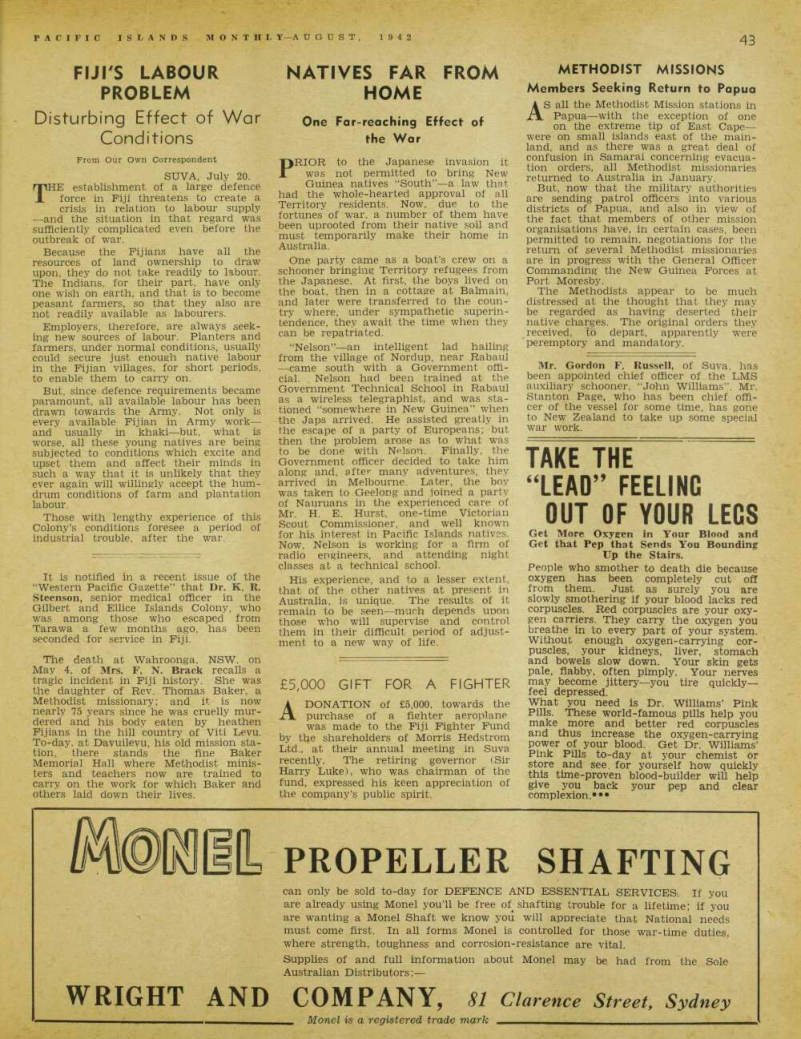
Problem
Disturbing Effect of War Conditions
From Our Own Correspondent SUVA, July 20.
THE establishment of a large defence force in Fiji threatens to create a crisis in relation to labour supply —and the situation in that regard was sufficiently complicated even before the outbreak of war.
Because the Fijians have all the resources of land ownership to draw upon, they do not take readily to labour.
The Indians, for their part, have only one wish on earth, and that is to become peasant farmers, so that they also are not readily available as labourers.
Employers, therefore, are always seek ing new sources of labour. Planters and farmers, under normal conditions, usually could secure just enough native labour in the Fijian villages, for short periods, to enable them to carry on.
But, since defence requirements became paramount, all available labour has been drawn towards the Army. Not only is every available Fijian in Army work— and usually in khaki —but. what is worse, all these young natives are being subjected to conditions which excite and upset them and affect their minds in such a way that it is unlikely that they ever again will willingly accept the hum drum conditions of farm and plantation labour.
Those with lengthy experience of this Colony’s conditions foresee a period of industrial trouble, after the war.
It is notified in a recent issue of the “Western Pacific Gazette” that Dr. K. R.
Steenson, senior medical officer in the Gilbert and Ellice Islands Colony, who was among those who escaped from Tarawa a few months ago, has been seconded for service in Fiji.
The death at Wahroonga. NSW, on May 4, of Mrs. F. N. Brack recalls a tragic incident in Fiji history. She was the daughter of Rev. Thomas Baker, a Methodist missionary; and it is now nearly 75 years since he was cruelly mur dered and his body eaten by heathen Fijians in the hill country of Viti Levu.
To-day. at Davuilevu, his old mission sta tion, there stands the fine Baker Memorial Hall where Methodist minis ters and teachers now are trained to carry on the work for which Baker and others laid down their lives.
Natives Far From
Home
One Far-reaching Effect of the War
PRIOR to the Japanese invasion it was not permitted to bring New Guinea natives “South” —a law that had the whole-hearted approval of all Territory residents. Now, due to the fortunes of war. a number of them have been uprooted from their native soil and must temporarily make their home in Australia.
One party came as a boat’s crew on a schooner bringing Territory refugees from the Japanese. At first, the boys lived on the boat, then in a cottage at Balmain, and later were transferred to the coun try where, under sympathetic superin tendence, they await the time when they can be repatriated.
“Nelson” —an intelligent lad hailing from the village of Nordup, near Rabaul —came south with a Government offi cial. Nelson had been trained at the Government Technical School in Rabaul as a wireless telegraphist, and was sta tioned “somewhere in New Guinea” when the Japs arrived. He assisted greatly in the escape of a party of Europeans: but then the problem arose as to what was to be done with Nelson. Finally, the Government officer decided to take him along and, after many adventures, they arrived in Melbourne. Later, the boy was taken to Geelong and joined a party of Nauruans in the experienced care of Mr. H. E. Hurst, one-time Victorian Scout Commissioner, and well known for his interest in Pacific Islands natives.
Now, Nelson is working for a firm of radio engineers, and attending night classes at a technical school.
His experience, and to a lesser extent, that of the other natives at present in Australia, is unique. The results of it remain to be seen—much depends unon those who will supervise and control them in their difficult period of adjust ment to a new way of life.
£5,000 Gift For A Fighter
A DONATION of £5,000, towards the purchase of a fighter aeroplane was made to the Fiji Fighter Fund by the shareholders of Morris Hedstrom Ltd., at their annual meeting in Suva recently. The retiring governor (Sir Harry Luke), who was chairman of the fund, expressed his keen appreciation of the company’s public spirit.
Methodist Missions
Members Seeking Return to Papua
AS all the Methodist Mission stations in Papua—with the exception of one on the extreme tip of East Cape— were on small islands east of the main land, and as there was a great deal of confusion in Samarai concerning evacua tion orders, all Methodist missionaries returned to Australia in January.
But, now that the military authorities are sending patrol officers into various districts of Papua, and also in view of the fact that members of other mission organisations have, in certain cases, been permitted to remain, negotiations for the return of several Methodist missionaries are in progress with the General Officer Commanding the New Guinea Forces at Port Moresby, The Methodists appear to be much distressed at the thought that they may be regarded as having deserted their native charges. The original orders they received, io depart, apparently were peremptory and mandatory.
Mr. Gordon F. Russell, of Suva, has been appointed chief officer of the LMS auxiliary schooner, “John Williams”. Mr.
Stanton Page, who has been chief offi cer of the vessel for some time, has gone to New Zealand to take up some special war work.
Advertisements & other items, p. 45 (2 items)
43
PACIFIC ISLANDS MONT II L Y—A UGUST, 1942
Propeller Shafting
TAKE THE
“LEAD” FEELING
OUT OF YOUR LEGS
Get More Oxygen in Your Blood and Get that Pep that Sends You Bounding Up the Stairs.
People who smother to death die because oxygen has been completely cut off from them. Just as surely you are slowly smothering if your blood lacks red corpuscles. Red corpuscles are your oxygen carriers. They carry the oxygen you breathe in to every part of your system.
Without enough oxygen-carrying corpuscles, your kidneys, liver, stomach and bowels slow down. Your skin gets pale, flabby, often pimply. Your nerves may become jittery—you tire quickly— feel depressed.
What you need is Dr. Williams’ Pink Pills. These world-famous pills help you make more and better red corpuscles and thus increase the oxygen-carrying power of your blood. Get Dr. Williams’
Pink Pills to-day at your chemist or store and see. for yourself how quickly this time-proven blood-builder will help give you back your pep and clear complexion.***
t
PROPELLER SHAFTING
can only be sold to-day for DEFENCE AND ESSENTIAL SERVICES'. If you are already using Monel you’ll be free of shafting trouble for a lifetime; if you are wanting a Monel Shaft we know you will appreciate that National needs must come first. In all forms Monel is controlled for those war-time duties, where strength, toughness and corrosion-resistance are vital.
Supplies of and full information about Monel may be had from the Sole Australian Distributors;— WRIGHT AND COMPANY, 81 Clarence Street, Sydney ■ Monel is a registered trade mark
Events of 40 Years Ago
Yodda Bloodshed
' T'ODAY’S encounters between the Allies and the Japanese, in the Yodda Valley of Papua, is not the first time this isolated place has known fighting and bloodshed. The following article, by Mollie Lett, describes tragic events of 40 years ago.
IN view of the attention drawn by Messrs. E. Auerbach and D. H.
Osborne to the murder of the two prospectors, Campion and King, by the natives of the Upper Kumusi, Papua, on January 3, 1901, and the reprisals that followed, the report of Sir George Le Hunte and that of Mr. A. Elliot (ARM, stationed at Bogi Police Camp at the time) may be of interest —especially to those who have been under the impres sion that the miners of the district took matters into their own hands, to revenge the murder of their unfortunate mates.
Sir George Le Hunte, on a visit of inspection to the Northern Division, entered the Kumusi River, from the Mambare, and visited Bogi, on April 6, 1901. He was accompanied, among others, by A. L. Walker and R. de Moleyns, newly-appointed RM and ARM to the district. Sir George and his party spent three days at the station, owing to heavy rains and floods, which prevented them from proceeding to the Yodda Valley, a ten-days’ walk from Bogi.
FROM investigations during his visit, Sir George Le Hunte found that the natives who had murdered Campion and King had ceased to molest the min
ers on the track since Mr. Elliot had visited them, and severely punished them, early in January, “The circumstances attending the murder of the two miners, King and Campion,” wrote Sir George on March 20, “appear to be, shortly, as follow: They were working, together with another, S. McLelland, among some gul lies about 20 miles above Bogi, on the Upper Kumusi, and had been on the most friendly terms with the natives in question. In fact, they allowed them to come about their camp in a perfectly unrestricted way—so much so that Mc- Lelland, who was an old and experienced pioneer, warned them that it was unwise in a district where the natives were known to be treacherous and aggressive.
“On a particular day, when they were working in separate places, out of sight of one another, they were attacked with out warning, their rifles seized bv those immediately around them, and both King and Campion were speared, carried off alive, and subsequently eaten in one of the villages near the right bank of the river.
“McLelland’s rifle was taken, but he managed to keep his revolver, and suc ceeded in saving not only himself, but also four native carriers who were with the party, cutting their way through the bush to an old mining camp when their enemies left them.
“He subsequently accompanied Mr.
Elliot on his expedition to the village where the two victims had been killed, and took part in the fight, when the principal chief, Asepo, King’s actual murderer, was shot, with 28 of his men, and several Others severely wounded— without, I am glad to say, any loss to the Government party.
“McLelland died shortly afterwards, from a severe attack of fever. He was much shaken by what he had under gone.”
ELLIOT’S official report shows that immediately on receiving news of the murder from McLelland and his boys, he sent to Tamata for more recruits; and on their arrival he set forth with 12 police and carriers, accompanied by McLelland. In describing an encoun ter with natives near Ilopa Creek, Elliot mentions that he had heard that 30
miners had gone after the natives; “but I have seen nothing of them.”
After crossing Ilopa Creek, where Con stable Maku had been attacked and four natives shot, Elliot camped at Angerita; and, from Angerita, crossed the Kumusi in full flood and struck in through the bush for Kokobahamba “Lookout”, to avoid the natives who were waiting for him on the track.
Before making the hill, however, they were met by a shower of spears. “We fired one volley, aiming low,” writes Elliot, “but some of the police are very poor shots. We then rushed the hill, but it was too late. There were eight men shot dead, and three had their legs broken by a bullet through the bone I camped half-way between the ‘Lookout’ and the villages, on a cleared space.”
Approaching the villages the following morning, they were again attacked in a garden, which lay between two hills, which were covered with spear-men. The garden itself was pitted with spear-pits and, Elliot realising that there was little hope of advancing, gave orders to his police to work round, while he engaged the natives until the police fired their first shots.
“It was 2i hours before I heard the first shot fired,” writes Elliot. “This was followed by a volley, and I then started in in earnest at 250 yards . . . They tried to rush down upon me once, but McLel land opened up with his rifle.”
There then appears to have been a general scramble, in which many natives were killed, including chief Asepo, the murderer of Campion, who was shot while attempting to hide Campion’s skull.
Twenty-eight men were shot, and 14 wounded.
“They fought hard,” commented Elliot.
“But the rifles were too much for them ... I returned to camp that evening, and we shifted down the river.”
THE murder of Campion and King was committed probably as an act of retaliation bv the natives of the Upper Kumusi. From the early days of the discovery of gold in the Yodda Val ley, the natives, by their constant attacks upon the miners, had undoubt edly brought punishment on themselves from both the miners and Government parties who were sent to restore order. It was not surprising, therefore, that these people took advantage of any opportunity to avenge the deaths of friends and rela tives.
In other districts of the Possession, at that time, tribes had been brought gradually under control by peaceful methods; but, on the Mambare, and in the Yodda Valley, this was impossible, owing to the sudden invasion of miners into completely unknown and densely populated districts. Tribes, which had never before made contact with white men. awoke with alarm to find their territory over-run; and. unable to under stand that the intruders had no hostile intentions, their natural and only instinct was either to kill or to drive the white men away.
The systematic patrols that followed, by white officers, with their native police, in time, however, did much to convince the most truculent tribe that the Gov ernment was there, as much in the inter est of the native as of the white man.
Lieutenant-Colonel A. Ross, MBE, who served in World War I, and who in 1920 went to Samoa as Assistant Secretary of the Administration, and ADC to General Sir George Richardson, has been killed in action. He was awarded the MBE for distinguished service in Greece and Libya, in 1941.
Advertisements & other items, p. 46 (2 items)
44
AUGUST, 194 2—P ACIFIC ISLANDS MONTHLY
miners
5 e s
LOTIO
For Inflamed Eyes and Eyelids
SOLD EVERYWHERE
miners
IKY CIM
Distilleries at London . . . England Toronto . . . Canada Moorabbin . . Victoria Cincinnati . . . U.S.A.
Tonga
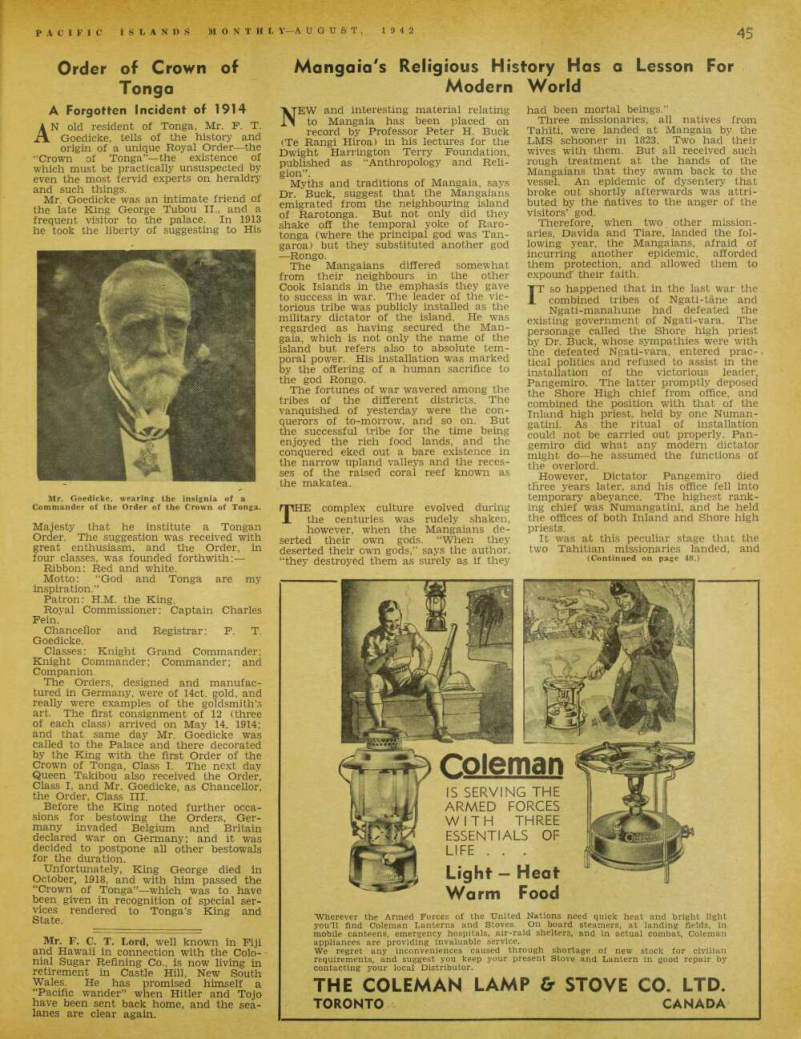
Order of Crown of Tonga A Forgotten Incident of 1914
AN old resident of Tonga, Mr. F. T.
Goedicke, tells of the history and origin of a unique Royal Order —the “Crown of Tonga”—the existence of which must be practically unsuspected by even the most fervid experts on heraldry and such things, Mr. Goedicke was an intimate friend of the late King George Tubou 11., and a frequent visitor to the palace. In 1913 he took the liberty of suggesting to His
Majesty that he institute a Tongan Order. The suggestion was received with great enthusiasm, and the Order, in four classes, was founded forthwith: — Ribbon: Red and white.
Motto: “God and Tonga are my inspiration.”
Patron: H.M. the King.
Royal Commissioner: Captain Charles Fein.
Chancellor and Registrar: F. T.
Goedicke.
Classes: Knight Grand Commander; Knight Commander; Commander; and Companion.
The Orders, designed and manufac tured in Germany, were of 14ct. gold, and really were examples of the goldsmith’s art. The first consignment of 12 (three of each class) arrived on May 14, 1914; and that same day Mr. Goedicke was called to the Palace and there decorated by the King with the first Order of the Crown of Tonga, Class I. The next day Queen Takibou also received the Order, Class I, and Mr. Goedicke, as Chancellor, the Order, Class 111.
Before the King noted further occa sions for bestowing the Orders, Ger many invaded Belgium and Britain declared war on Germany; and it was decided to postpone all other bestowals for the duration.
Unfortunately, King George died in October, 1918, and with him passed the “Crown of Tonga”—which was to have been given in recognition of special ser vices rendered to Tonga’s King and State.
Mr. F. C. T. Lord, well known in Fiji and Hawaii in connection with the Colo nial Sugar Refining Co., is now living in retirement in Castle Hill, New South Wales. He has promised himself a “Pacific wander” when Hitler and Tojo have been sent back home, and the sea lanes are clear again.
Mr. Goedicke, wearing the insignia of a Commander of the Order of the Crown of Tonga.
Mangold's Religious History Has a Lesson For Modern World
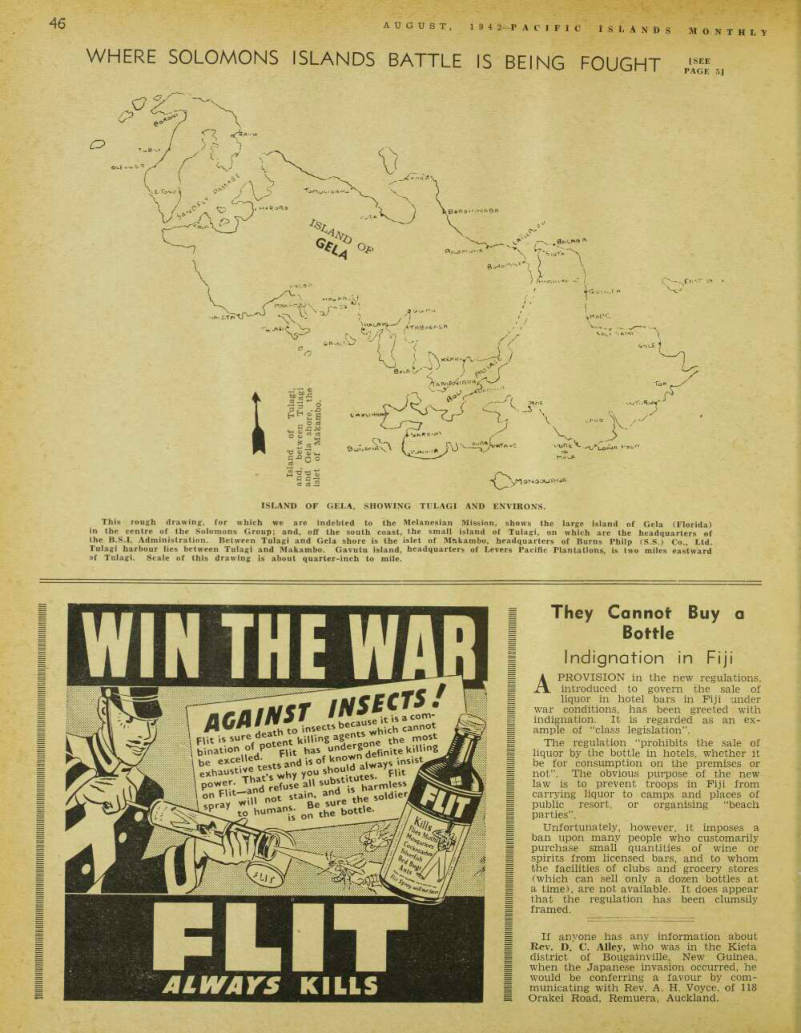
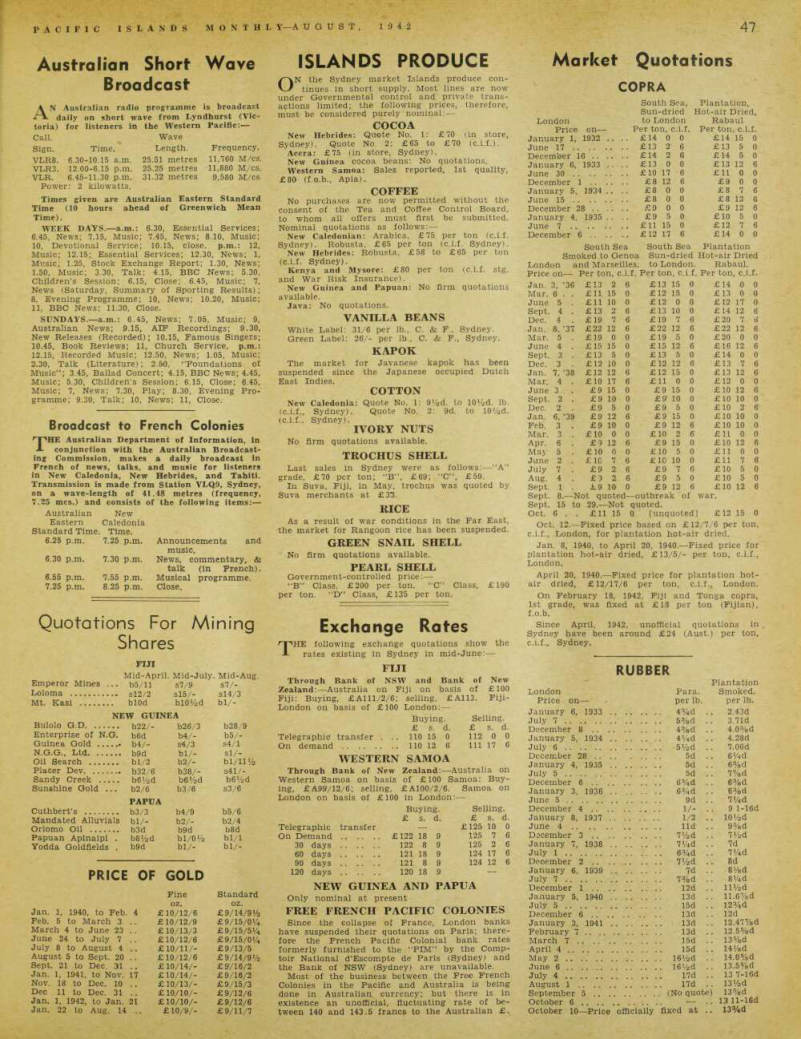
Modern World
NEW and interesting material relating to Mangaia has been placed on record by Professor Peter H. Buck (Te Rangi Hiroa) in his lectures for the Dwight Harrington Terry Foundation, published as “Anthropology and Reli gion”.
Myths and traditions of Mangaia, says Dr. Buck, suggest that the Mangaians emigrated from the neighbouring island of Rarotonga. But not only did they shake off the temporal yoke of Raro tonga (where the principal god was Tan garoa) but they substituted another god —Rongo.
The Mangaians differed somewhat from their neighbours in the other Cook Islands in the emphasis they gave to success in war. The leader of the vic torious tribe was publicly installed as the military dictator of the island. He was regarded as having secured the Man gaia, which is not only the name of the island but refers also to absolute tem poral power. His installation was marked by the offering of a human sacrifice to the god Rongo.
The fortunes of war wavered among the tribes of the different districts. The vanquished of yesterday were the con querors of to-morrow, and so on. But the successful tribe for the time being enjoyed the rich food lands, and the conquered eked out a bare existence in the narrow upland valleys and the reces ses of the raised coral reef known as the makatea.
THE complex culture evolved during the centuries was rudely shaken, however, when the Mangaians de serted their own gods. “When they deserted their own gods,” says the author, “they destroyed them as surely as if they
had been mortal beings.”
Three missionaries, all natives from Tahiti, were landed at Mangaia by the LMS schooner in 1823. Two had their wives with them. But all received such rough treatment at the hands of the Mangaians that they swam back to the vessel. An epidemic of dysentery that broke out shortly afterwards was attri buted by the hatives to the anger of the visitors’ god.
Therefore, when two other mission aries, Davida and Tiare, landed the fol lowing year, the Mangaians, afraid of incurring another epidemic, afforded them protection, and allowed them to their faith.
IT so happened that in the last war the combined tribes of Ngati-tane and Ngati-manahune had defeated the existing government of Ngati-vara. The personage called the Shore high priest by Dr. Buck, whose sympathies were with the defeated Ngati-vara, entered prac tical politics and refused to assist in the installation of the victorious leader, Pangemiro. The latter promptly deposed the Shore High chief "from office, and combined the position with that of the Inland high priest, held by one Numan gatini. As the ritual of installation could not be carried out properly. Pan gemiro did what any modern dictator might do —he assumed the functions of the overlord.
However, Dictator Pangemiro died three years later, and his office fell into temporary abeyance. The highest rank ing chief was Numangatini, and he held the offices of both Inland and Shore high priests.
It was at this peculiar stage that the two Tahitian missionaries landed, and
(Continued on page 48.)
(Continued from page 45.)
they came under the protection of the dominant Ngati-tane. Finally, the chiefs of both that tribe and Ngati-manahune accepted the new religion.
Converted males marked the occasion by cutting off their long hair, removing the taboos that prevented the sexes from eating together, and the national god house was burned. By exposing the gods to the vulgar gaze, they were dishon oured. Led by the native missionaries, the work of destruction went on. Even the groves of noble trees that gave shel ter to the temples were felled.
The Ngati-vara, who remained in opposition, were horrified, and went into mourning. But the new religion preached brotherly love and the cessation of war.
The latter was agreeable to the tribes in power, and the missionaries, perhaps without fully realising it, were political propagandists.
MATTERS reached a head when the Ngati-vara assembled their forces and offered battle to regain the government. European missionary writ ers have described the event as a struggle between the Christians and the “heathens”. But to the anthropologist the struggle was not religious, but political.
During the battle the Tahitian, Davida, remained on his knees supplicating Jehovah to grant victory to the Ngati tane. In a thatched hut, perched on a high rock, Tereavai, priest of the Ngati vara, invoked his tribal god, Te A’ia. But the spiritual power of Te A’ia had departed with that of the other Poly nesian gods, and the heathen were defeated.
The Ngati-vara were offered food lands conditionally upon accepting Christian ity, and these new Christians signalised their conversion by cutting off their long hair, and the women wore garments of white bark cloth instead of the brown colour previously in fashion.
WHAT occurred in Mangaia happened elsewhere in Polynesia. The whole sale conversions reported to Europe were largely political—not religious.
Dr. Buck concluded (this 'was pre- World War II) with some pertinent com ments regarding present-day “civilisa tion”, which he described as sick, and fast losing its right to be called civilisa tion. Instead of brotherly love, we have racial intolerance and merciless persecu tion. Civilisation stands on the verge of a relapse, not into barbarism, but into sheer savagery. He pointed out that the death of the Christian gods would mean the collapse of the culture to which they belong, just as surely as did the death of the Polynesian gods mean the end of Polynesian culture.
Could we but restore our faith, he says, we might be able to say to a sick world, in the words of the Great Master: “Arise, go thy way: thy faith hath made thee whole”.—EßlC RAMSDEN.
Advertisements & other items, p. 47 (2 items)
45
PACIFIC ISLANDS MONtHL Y—A tFGtJ&'T, 1942
Coleman
” m XU
IS SERVING THE
ARMED FORCES
WITH THREE
ESSENTIALS OF
LIFE . . .
Light Heat
Warm Food
"Wherever the Armed Forces of the United Nations need quick heat and bright light you’ll find Coleman Lanterns and Stoves. On board steamers, at landing fields, in mobile canteens, emergency hospitals, air-raid shelters, and in actual combat, Coleman appliances are providing invaluable service.
We regret any inconveniences caused through shortage of new stock for civilian requirements, and suggest you keep your present Stove and Lantern in good repair by contacting your local Distributor.
THE COLEMAN LAMP & STOVE CO. LTD.
TORONTO CANADA
Where Solomons Islands Battle Is Being Fought
[See
Page 51
ISLAND OF GELA, SHOWING TULAGI AND ENVIRONS.
This rough drawing, for which we are indebted to the Melanesian Mission, shows the large island of Gela (Florida) in the centre of the Solomons Group; and, off the south coast, the small island of Tulagi, on which are the headquarters of the B.S.I. Administration. Between Tulagi and Gela shore is the islet of Makambo, headquarters of Burns Philp (S.S.) Co., Ltd.
Tulagi harbour lies between Tulagi and Makambo. Gavutu island, headquarters of Levers Pacific Plantations, is two miles eastward of Tulagi. Scale of this drawing is about quarter-inch to mile.
They Cannot Buy a Bottle Indignation
Bottle Indignation in Fiji
A PROVISION in the new regulations, introduced to govern the sale of liquor in hotel bars in Fiji under war conditions, has been greeted with indignation. It is regarded as an ex ample of “class legislation”.
The regulation “prohibits the sale of liquor by the bottle in hotels, whether it be for consumption on the premises or not”. The obvious purpose of the new law is to prevent troops in Fiji from carrying liquor to camps and places of public resort, or organising “beach parties”.
Unfortunately, however, it imposes a ban upon many people who customarily purchase small quantities of wine or spirits from licensed bars, and to whom the facilities of clubs and grocery stores (which can sell only a dozen bottles at a time), are not available. It does appear that the regulation has been clumsily framed.
If anyone has any information about Rev. D. C. Alley, who was in the Kieta district of Bougainville, New Guinea, when the Japanese invasion occurred, he would be conferring a favour by com municating with Rev. A. H. Voyce, of 118 Orakei Road, Remuera, Auckland.
Advertisements & other items, p. 48 (2 items)
46
AUGUST, 19 4 2-P ACI F I C ISLANDS MONTHLT
1 Art-'d tetsUh
I Flit is sure ., Hng agents " most 1 bination of P° te "it has undergo"^,^ should aiways ins,
l°"ay will not sta,n. an u d re th e so humans. bo ttle.
ALWAYS KILLS
Australian Short Wave
Broadcast
AN Australian radio programme is broadcast daily on short wave from Lyndhurst (Vic toria) for listeners in the Western Pacific:—
Times given are Australian Eastern Standard Time (10 hours ahead of Greenwich Mean Time).
WEEK DAYS.—a.m.: 6.30, Essential Services; 6.45, News; 7.15, Music; 7.45, News; 8.10, Music; 10, Devotional Service; 10.15, close, p.m.: 12, Music; 12.15; Essential Services; 12.30, News; 1, Music; 1.25, Stock Exchange Report; 1.30, News; 1.50, Music; 3.30, Talk; 4.15, BBC News; 5.30, Children’s Session; 6.15, Close; 6.45, Music; 7, News (Saturday, Summary of Sporting Results); 8, Evening Programme; 10, News; 10.20, Music; 11, BBC News; 11.30, Close.
SUNDAYS.— a.m.: 6.45, News; 7.05, Music; 9, Australian News; 9.15, ATP Recordings; 9.30, New Releases (Recorded); 10.15, Famous Singers; 10.45, Book Reviews: 11, Church Service, p.m.: 12.15, Recorded Music; 12.50, News; 1.05, Music; 2.30, Talk (Literature): 2.50, “Foundations of Music”; 3.45, Ballad Concert; 4.15, BBC News; 4.45, Music; 5.30, Children’s Session; 6.15, Close; 6.45, Music; 7, News; 7.30, Play; 8.30, Evening Pro gramme; 9.30, Talk; 10, News; 11, Close.
Call. Wave Sign. Time. ' Length. Frequency.
VLR8. 6.30-10.15 a.m. 25.51 metres 11,760 M/cs.
VLR3. 12.00-6.15 p.m. 25.25 metres 11,880 M/cs.
VLR. 6.45-11.30 p.m. 31.32 metres 9,580 M/cs.
Power: 2 kilowatts.
Broadcast to French Colonies
THE Australian Department of Information, in conjunction with the Australian Broadcast ing Commission, makes a daily broadcast in French of news, talks, and music for listeners in New Caledonia, New Hebrides, and Tahiti.
Transmission is made from Station VLQ9, Sydney, on a wave-length of 41.48 metres (frequency, 7.25 mcs.) and consists of the following items:— Australian New Eastern Caledonia Standard Time. Time. 6.25 p.m. 7.25 p.m. Announcements and music, 6.30 p.m. 7.30 p.m. News, commentary, & talk (In French). 6.55 p.m. 7.55 p.m. Musical programme. 7.25 p.m. 8.25 p.m. Close.
Quotations For Mining
Shares
Fiji
Mid-April. Mid-July. Mid-Aug.
Emperor Mines ... b5/ll s7/9 S7/- Loloma sl2/2 sl5/sl4/3 Mt. Kasi blOd blOVad bl/-
New Guinea
Bulolo G.D b22/b26/3 b28/9 Enterprise of N.G. b6d b4/b5/- Guinea Gold b4/s4/3 s4/l N.G.G., Ltd b9d bl/sl/- Oil Search bl/2 b2/bl/HVa Placer Dev b32/6 b38/s41/- Sandy Creek b6y 2 d b6V 2 d b6y 2 d Sunshine Gold ... b2/6 b3/6 s3/6 Cuthbert’s
Papua
b3/3 b4/9 b5/6 Mandated Alluvials bl/b2/b2/4 Oriomo Oil b3d b9d b8d Papuan Aplnaipi . bSVad bl/OVa bl/1 Yodda Goldfields . b9d bl/bl/-
Price Of Gold
Fine Standard oz. oz.
Jan. 1, 1940, to Feb. 4 £10/12/6 £9/14/9V 2 Feb. 5 to March 3 £10/12/9 £9/15/01/4 March 4 to June 23 £10/13/3 £9/15/51/4 June 24 to July 7 . . £10/12/6 £9/15/01/4 July 8 to August 4 ,. £10/11/- £9/13/5 August 5 to Sept. 20 . . £10/12/6 £9/14/91/2 Sept. 21 to Dec. 31 .. £10/14/- £9716/2 Jan. 1. 1941, to Nov. 17 £10/14/- £9/16/2 Nov. 18 to Dec. 10 £10/13/- £9/15/3 Dec 11 to Dec. 31 £10/10/- £9/12/6 Jan. 1, 1942, to Jan. 21 £10/10/- £9/12/6 Jan. 22 to Aug. 14 .. £ 10/9/- £9/11/7
Islands Produce
ON the Sydney market Islands produce con tinues in short supply. Most lines are now under Governmental control and private trans actions limited; the following prices, therefore, must be considered purely nominal:—
Cocoa
New Hebrides: Quote No. 1; £7O (in store, Sydney). Quote No. 2: £65 to £7O (c.i.f.).
Accra: £75 (in store, Sydney).
New Guinea cocoa beans: No quotations.
Western Samoa: Sales reported, Ist quality, £BO (f.0.b., Apia).
Coffee
No purchases are now permitted without the consent of the Tea and Coffee Control Board, to whom all offers must first be submitted.
Nominal quotations as follows: New Caledonian: Arabica, £75 per ton (c.i.f.
Sydney). Robusta, £65 per ton (c.i.f. Sydney).
New Hebrides; Robusta, £5B to £65 per ton (c.i.f. Sydney).
Kenya and Mysore: £BO per ton (c.i.f. stg. and War Risk Insurance).
New Guinea and Papuan: No firm quotations available.
Java: No quotations.
Vanilla Beans
White Label: 31/6 per lb., C. & F,, Sydney.
Green Label: 26/- per lb., C. & F., Sydney.
Kapok
The market for Javanese kapok has been suspended since the Japanese occupied Dutch East Indies.
Cotton
New Caledonia: Quote No. 1: 9Vsd. to lOVsd. lb. (c.i.f., Sydney). Quote No. 2: 9d. to lOVid. (c.i.f., Sydney).
Ivory Nuts
No firm quotations available,
Trochus Shell
Last sales in Sydney were as follows: —“A” grade, £7O per ton; “B”, £69; “C”, £59.
In Suva, Fiji, in May, trochus was quoted by Suva merchants at £33.
Rice
As a result of war conditions in the Far East, the market for Rangoon rice has been suspended.
Green Snail Shell
No firm quotations available.
Pearl Shell
Government-controlled price:— “B” Class, £2OO per ton. “C” Class, £l9O per ton. “D” Class, £135 per ton.
Exchange Rates
THE following exchange quotations show the rates existing in Sydney in mid-June: —
Fiji
Through Bank of NSW and Bank of New Zealand;— Australia on Fiji on basis of £lOO Fiji: Buying, £Alll/2/6: selling, £AII3. Fiji- London on basis of £lOO London:
Western Samoa
Through Bank of New Zealand:—Australia on Western Samoa on basis of £lOO Samoa: Buy ing, £ A99/12/6; selling, £AIOO/2/6. Samoa on London on basis of £lOO in London: —
New Guinea And Papua
Only nominal at present
Free French Pacific Colonies
Since the collapse of France, London banks have suspended their quotations on Paris; there fore the French Pacific Colonial bank rates formerly furnished to the “PIM” by the Comp toir National d’Escompte de Paris (Sydney) and the Bank of NSW (Sydney) are unavailable.
Most of the business between the Free French Colonies in the Pacific and Australia is being done in Australian currency: but there is in existence an unofficial, fluctuating rate of be tween 140 and 143.5 francs to the Australian £.
Buying.
Selling. £ s. d. £ s. d.
Telegraphic transfer . .. 110 15 0 112 0 0 On demand .. 110 12 6 111 17 6
Buying.
Selling. £ s. d. £ s. d.
Telegraphic transfer — £125 10 0 On Demand £122 18 9 125 7 6 30 days 122 8 9 125 2 6 60 days 121 18 9 124 17 6 90 days 121 8 9 124 12 6 120 days 120 18 9 —
Market Quotations
Copra
Sept. B.—Not quoted—outbreak of war.
Sept. 15 to 29. —Not quoted.
Oct. 6 . . £ll 15 0 [unquoted] £l2 15 0 Oct. 12. —Fixed price based on £l2/7/6 per ton, c.i.f., London, for plantation hot-air dried.
Jan. 8, 1940, to April 20, 1940.—Fixed price for plantation hot-air dried, £l3/5/- per ton, c.i.f., London.
April 20, 1940. —Fixed price for plantation hot air dried, £l2/17/6 per ton, c.i.f., London.
On February 18, 1942, Fiji and Tonga copra, Ist grade, was fixed at £lB per ton (Fijian), f.o.b.
Since April, 1942, unofficial quotations in Sydney have been around £24 (Aust.) per ton, c.i.f., Sydney.
South Sea, Plantation, Sun-dried Hot-air Dried, London to London Rabaul Price on— Per ton, c.i.f Per ton , c.i.f.
January 1, 1932 £14 0 0 £14 15 0 June 17 . £13 2 6 £13 5 0 December 16 . . £14 2 6 £14 5 0 January 6, 1933 £13 0 0 £13 12 6 June 30 . £10 17 6 £11 0 0 December 1 . . £8 12 6 £9 0 0 January 5 1934 £8 0 0 £8 7 6 June 15 . £8 0 0 £8 12 6 December 28 .. £9 0 0 £9 12 6 January 4 1935 £9 5 0 £10 5 0 June 7 . £11 15 0 £12 7 6 December 6 .. £12 17 6 £14 0 0 South Sea South Sea Plantation Smoked to Genoa Sundried Hot-air Dried London and Marseilles to London.
Rabaul.
Price on— Per ton, c.i.f.
Per ton, c.i.f.
Per ton , c.i.f.
Jan. 3, ’36 £13 2 6 £13 15 0 £14 0 0 Mar. 6 . . £11 15 0 £12 15 0 £13 0 0 June 5 . £11 10 0 £12 0 0 £12 17 0 Sept. 4 . £13 2 6 £13 10 0 £14 12 6 Dec. 4 . £19 7 6 £19 7 6 £20 7 6 Jan. 8, ’37 £22 12 6 £22 12 6 £22 12 6 Mar. 5 . £19 0 0 £19 5 0 £20 0 0 June 4 . £15 15 0 £15 12 6 £16 12 6 Sept. 3 . £13 5 0 £13 5 0 £14 0 0 Dec. 3 . £12 10 0 £12 12 6 £13 7 6 Jan. 7. ’38 £12 12 6 £12 15 0 £13 12 6 Mar. 4 . £10 17 6 £11 0 0 £12 0 0 June 3 £9 15 0 £9 15 0 £10 12 6 Sept. 2 . £9 10 0 £9 10 0 £10 10 0 Dec. 2 £9 5 0 £9 5 0 £10 2 6 Jan. 6, ’39 £9 12 6 £9 15 0 £10 10 0 Feb. 3 . £9 10 0 £9 12 6 £10 10 0 Mar. 3 . £10 0 0 £10 2 6 £11 0 0 Apr. 6 . £9 12 6 £9 15 0 £10 12 6 May 5 . £10 0 0 £10 5 0 £11 0 0 June 2 . £10 7 6 £10 10 0 £11 7 6 July 7 . £9 2 6 £9 7 6 £10 5 0 Aug. 4 . £9 2 6 £9 5 0 £10 5 0 Sept. 1 . £9 10 0 £9 12 6 £10 12 6
Rubber
Plantation London Para.
Smoked.
Price on— per lb. per lb.
January 6, 1933 . 4%d . 2.43d July 7 . 5 3 /ad . 3.71d December 8 4%d . 4.0 5 /ad January 5, 1934 . 4>/ 4 d . 4.28d July 6 . 5V 2 d . 7.06d December 28 5d . 6y 4 d January 4, 1935 5d . 6%d July 5 5d . 7 7 /ad December 6 . 6%d . 6%d January 3, 1936 . 6%d . 6%d June 5 9d . 7V 4 d December 4 1/- • 9 l-16d January 8, 1937 1/2 . ioy 2 d June 4 lid . 9 5 /ad December 3 . 7‘/ 2 d . 7*/ 2 d January 7, 1938 . 7»/ 4 d . 7d July 1 . 6%d . 7>/ 4 d December 2 . 7V 2 d . 8d January 6, 15'39 7d .
SVad July 7 . 7%d . sy 4 d December 1 12d . ny 2 d January 5, 1940 13d . 11.6 7 /ad July 5 15d . 12%d December 6 13d . 12d January 3, 1941 13d . 12.47 7 /ad February 7 13d . 12.5 5 /ad March 7 15d . 13 5 /ad April 4 15d . 14 yad May 2 . 16V 2 d . 14.0 s /ad June 6 . iey 2 d . 13.5 5 /ad July 4 17d . 13 7-16d August 1 17d . 13y 2 d September 5 . (No quote 13 5 /ad October 6 — 13 ll-16d October 10—Price officially fixed at • 13%d
Advertisements & other items, p. 49 (1 item)
47
PACIFIC ISLANDS MONtHL Y—A UGUST, 1942
Big Shipment to New
Cook Is. Fruit
Big Shipment to New Zealand
From Our Own Correspondent
R Rarotonga, July 6.
AROTONGA orange shipments, which concluded with approximately 1 000 cases in early July, have been satis factory this year, although the crop was not up to normal.
About 17,400 cases of native wild oranges and 500 cases of imported varie ties have left the island during the past three months, at an average return to the grower of 4/- and 4/9 per case respectively. It is also generally hoped that a bonus will be declared by the New Zealand Internal Marketing Depart ment, which has control of all oranges imported into the Dominion.
The fruit mostly landed with a record low percentage of loss, due primarily to more advanced methods of handling locally, such as gassing with ethylene de-buttoning and proper fumigation Shipments of oranges from the other islands in the Lower Cook Group although affected by high winds prevail ing recently, are expected to fill the steamer for about another three months, after which the question of a steamer for the group seems problematical Mr M. B. Baker (Director of Agriculture)’ spent three weeks on Mauke Island, where a heavy crop is expected, supervis ing the new gassing sheds and seeing to arrangements for shipment.
Growers in Rarotonga have expressed dissatisfaction with the fact that, although the Government has repeatedly asked for banana-planting to be increased, no bananas have been exported on the orange steamer. This is true — but apparently unavoidable with the present hard-felt shortage of oranges in New Zealand, necessitating all available space being given to citrus fruits.
It is pointed out that the Administra tion has had the greatest difficulty in arranging for a steamer at all in these difficult times.
"Pim" Says "Au Revoir"
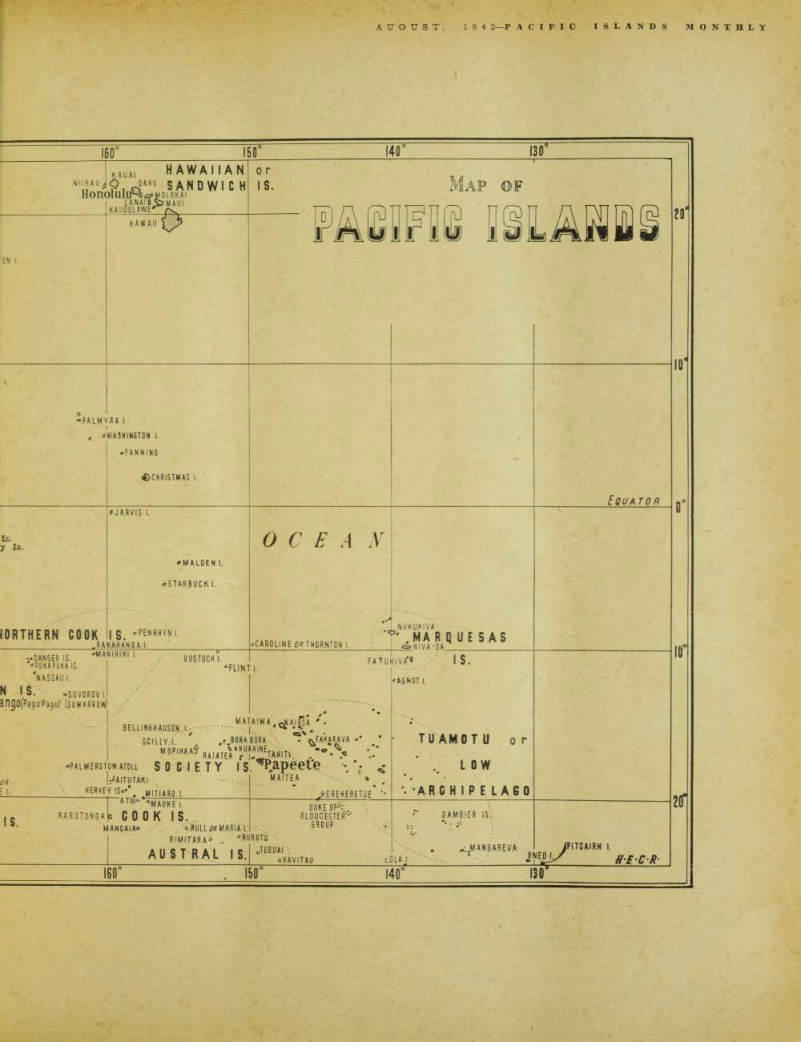
To Its Staff
SELWYN Hughes, whose efficient, unos tentatious work as my assistant over several years simplified many edi torial duties, and enabled me to spend an unharassed month now and again in the Islands, is now LAC Hughes, of the RAAF. One of these days, after train ing is finished, he will be a pilot, or an observer, or an air-gunner—he does not care which, so long as he can assist in placing a bomb or a bullet where it will do most good.
Mr. Hughes came to my office, as a very junior clerk, twelve years ago, when the “PIM” was a very junior publication.
They grew up together—the “PIM” to win friends all over the pre-war world and Selwyn to establish himself as a very competent young journalist. From 1938 until 1942, he was assistant editor of “PIM”, and editor of several periodicals published by Sydney and Melbourne Publishing Co. Ltd.
Mr. Brian Stein, another of my valued young assistants, who will be remem bered by many Pacific Islands travellers as the “PlM’s” reporter and photo grapher, is now a husky sergeant of transport.
Readers will forgive me if I do not personally answer their frequent letters.
I am somewhat busy, these days.—
R.W.R.
Advertisements & other items, pp. 50-52 (2 items)
NoAslhma Yean
Two years ago J. Richards, Hamilton, Ont., Canada, was in bed with Asthma. Had lost 40 pounds weight, suffered coughing, choking and strangling every night—couldn’t sleep— expected to die. Mendaco stopped spasms first night and he has had none since—in OVER TWO YEARS. Mendaco is so successful it is guaranteed to give you free, easy breathing in 24 hours and to stop your Asthma completely «■ in 8 days or money MffiSlUaC® back on return of Ends Asthma empty package.
Now 3/-, 6/- and 12/■
Woven Wire for all Industry \
COPRA DRYING TRAYS, FLOORS, Etc.
FRUIT DRYING TRAYS, MINING SCREENS.
Heavy Mosquito Gauze in Phosphor Bronze and other Metals Impervious to Salt Sea Air.
WIRE DOOR MATS AND GENERAL WIRE WORKS f: Or £ A
“’BIWA
E. WRIGHT & CO. LTD.
Office and Works: 148-152 Cleveland Street, Sydney, N.S.W.
Telegraphic Address: "Wrightmake,” Chippendale. \
General
Merchants
and
Agents
c f o REPRESENTING LEADING FIRMS IN THE PACIFIC" ISLANDS
379 KENT STREET,
SYDNEY.
Telephones: MJ4657 (5 lines).
Islands Produce Sold on Shippers* Account Buyers of all Islands’ requirements on Commis- Liberal Advances against Consignments. sion Original Invoices Furnished. 25 Years’ Islands Trade Experience.
Bankers: Bank of New South Wales. Correspondence in English and French.
. iiiii PHii. mm.
Iliilk w m. ;i; . ~.mm
Travel by CARPENTER AIRLINES
Full particulars from Macdonald, Hamilton Gr Co., or Howard Smith Ltd., Sydney. 1 A m
W. R. CARPENTER & CO. LT]
MERCHANTS, SHIPOWNERS AND AIRCRAFT OPERATORS
Agents for Australian, European and American Manufacturers, and Distributors of Every Description of Mercho Buyers and Shippers of Copra, Trocas, and ail Classes of Islands Produce.
AGENTS FOR:
Ford Motor Company of Canada. Caterpillar Tractors. Dodge Brothers Inc.
T. G. £r C. Bolinders (Engines). Electrolux Refrigerators. Westinghouse Electrical Co. etc., etc.
Branches throughout 1 the Pacific Islands
In London: W. R. Carpenter & Co. (London) Ltd., Coronation House, 4 Lloyds Avenue, London, EC.
Head Office: 16 O’CONNELL STREET, SYDNEY