Advertisements & other items, pp. 1-2 (2 items)
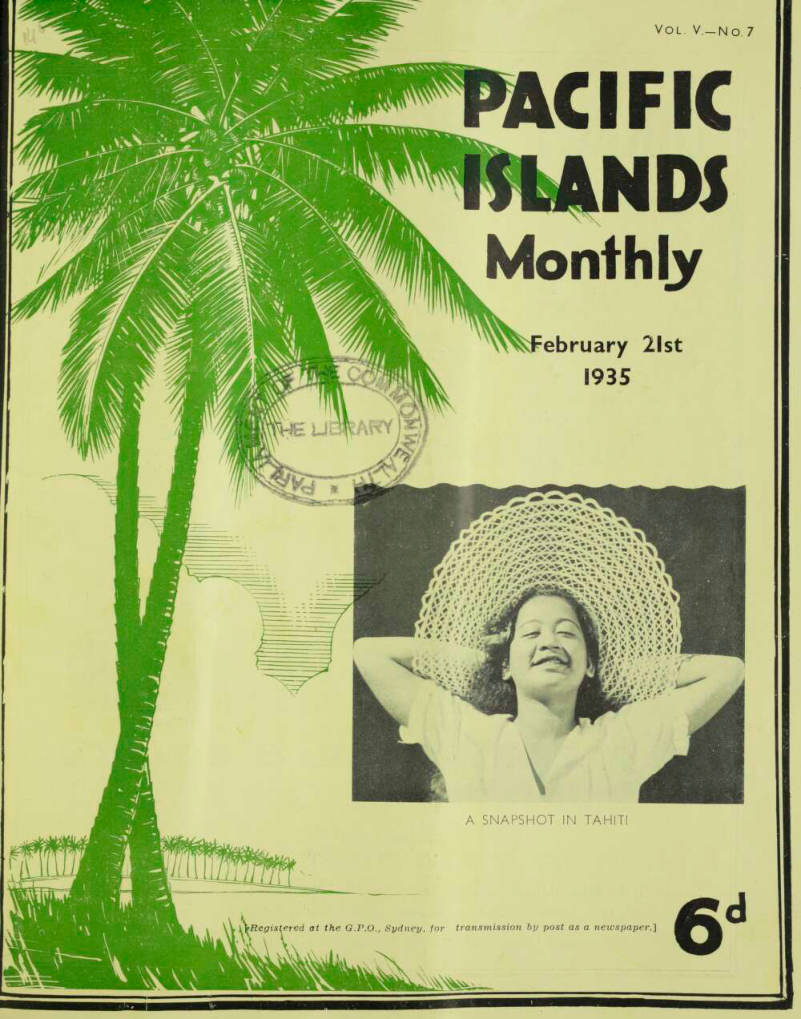
Islands
PACIFIC
Monthly
VOL V.-No. 7
February 21st 1935
Registered at the G.P.O., Sydney, for transmission by post as a newspaper.]
6 d
A SNAPSHOT IN TAHITI
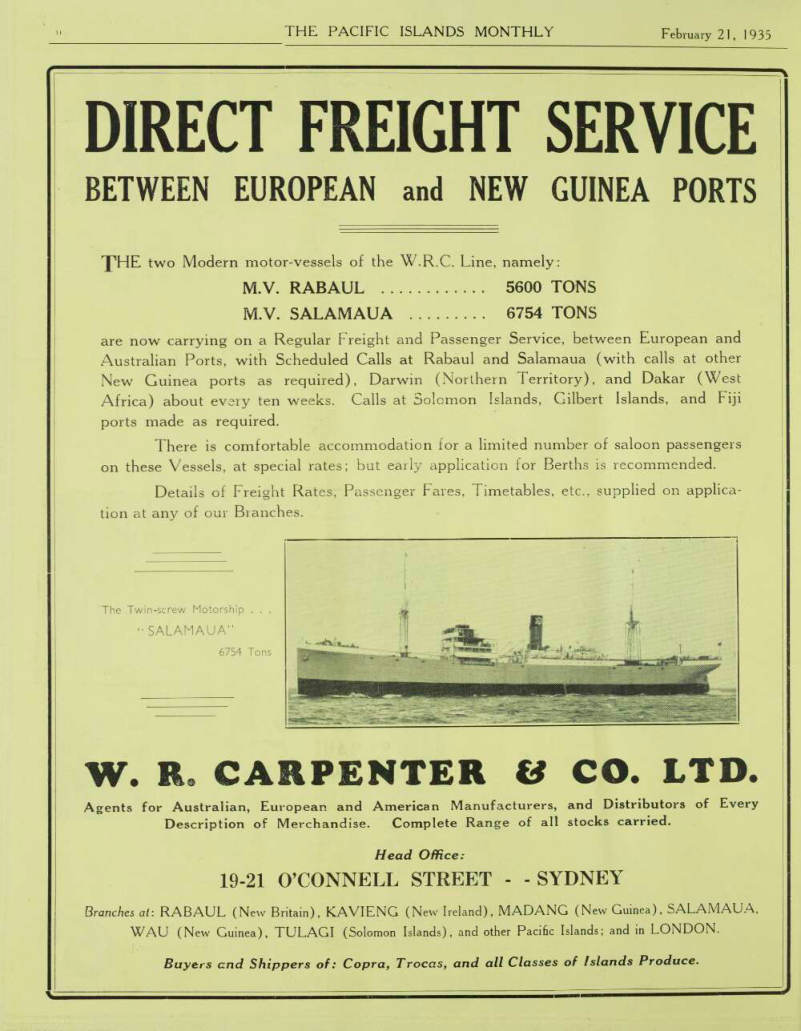
Direct Freight Service
BETWEEN EUROPEAN and NEW GUINEA PORTS
THE two Modern motor-vessels of the W.R.C. Line, namely:
M.V. RABAUL 5600 TONS
M.V. SALAMAUA 6754 TONS
are now carrying on a Regular Freight and Passenger Service, between European and Australian Ports, with Scheduled Calls at Rabaul and Salamaua (with calls at other New Guinea ports as required), Darwin (Northern Territory), and Dakar (West Africa) about every ten weeks. Calls at Solomon Islands, Gilbert Islands, and Fiji ports made as required.
There is comfortable accommodation for a limited number of saloon passengers on these Vessels, at special rates; but early application for Berths is recommended.
Details of Freight Rates, Passenger Fares, Timetables, etc., supplied on application at any of our Branches.
The Twin-screw Motorship . . .
"SALAMAUA”
6754 Tons
W. R. CARPENTER & CO. LTD.
Agents for Australian, European and American Manufacturers, and Distributors of Every Description of Merchandise. Complete Range of all stocks carried.
Head Office:
19-21 O’CONNELL STREET - - SYDNEY
Branches at: RABAUL (New Britain), KAVIENG (New Ireland), MADANG (New Guinea), SALAMAUA, WAU (New Guinea), TULAGI (Solomon Islands), and other Pacific Islands; and in LONDON.
Buyers end Shippers of: Copra, Trocas, and all Classes of Islands Produce.
Pacific Islands Travellers
Passengers Per Neptun, Which Ar
Rived From New Guinea On January
29; —E. MacLeod Laird, R. Lidgate, Mrs. A. M.
Page, Robert Lidgate, O. M. Rondahl, Mrs. M. J.
Kelly, Miss G. W. Stayte, Edward Robert, R. K.
Moore, Mrs. E. E. Moore, Miss H. W. Francis, V. B. Pennyfather, Mrs. A. F. Hitchcock, Miss Katherine M. Nottle, Miss M. E. Harris, W. J.
Staly, T. Walsh, Mrs. M. Walsh, H. Coldham, Mrs. T. M. Parer, A. R. MacKenzie, R. E. Seale, Mrs. J. G. Seale, Master M. Seale, B. Heath, Mrs.
L. M. Heath, Mrs. V. Cooke, Master R. Cook, A. H. de Leuil, B. Lang, H. B. Jamieson, T. J.
Kenward, K. O. Arvidson, Mrs. E. Collins, Master R. A. Collins, Miss A. Bulmer, Mrs. A. A. Denny, Miss Margaret Denny, Mrs. P. Denny.
Passengers Per Aorangi, Which De
Parted From Sydney For Suva, Fiji,
ON JANUARY 31;—F. C. Exon, M. A. Napthali, H. J. Napthali, C. A. Alexander, C. F. Mitchell, Miss D. Dickinson, Mrs. L. M. Saville and infant, W. McGowan, Mrs. W. E. McGowan, Miss E.
McGowan, Miss E. A. Pratt, H. Brady, W. Tar vey, Master A. S. Phelps, Miss I. M. Smith, Mr. and Mrs. Wallace Warden, Miss M. Warden, Mas ter W. Warden, Commander R. W. S. Hinton, V.
J. C. Hembrough, F. E. Troller.
Passengers Per Monterey Which
ARRIVED IN SYDNEY FROM FIJI ON JANU ARY 28: —D. T. Batey, Miss G. I. Bleeck, W. J. Candler, F. C. Clapcott, S. H. Ellis, Mrs.
H. Harkness, Miss P. Harkness, Dr. and Mrs.
J. Jona, Miss A. Jona, Master W. Jona, Master B. A. Kenny, Mrs. L. E. Kildahl, Mrs. I. Lake, Mrs. V. Langdale, Mr. and Mrs. L. M. McLeod, Mr. and Mrs. Frederick W. Nichols, Mr. and Mrs.
W. Phillips, C. W. Pinkerton, Mrs. O. Ryan, Master W. Ryan, Mrs. H. E. Snell, Mr. and Mrs.
L. Storck, Miss L. Storck, J. Sobell, F. Throne man, J. E. Toy, Mr. and Mrs. Max Valentine, Master R. Valentine, Miss J. Valentine, Miss L. S.
Walker, Miss M. E. Walker, Mr. and Mrs. H. F.
Walsh, Mrs. G. Watson, Miss Urie Wingate, R.
Wingate, L. Ambler, Mrs. E. A. Barnett, Misses R. and M. Barnett, Mrs. E. Bannister, F. Burn kip, Miss G. Capon, Miss M. Churchward, O. P.
Lane, Mr. and Mrs. B. Lyon-Field, J. V. Smith, Mrs. I. Swale-Eyre, Mrs. H. Wooley, Master L.
Wooley.
Passengers Per Monterey Which
Left Sydney For Fiji On February
6. —Miss S. Bell, Master G. Bell, R. Boyd, R. V.
Cole, Mrs. G. Crespin, P. Hagarty, Mr. and Mrs.
E. M. Mitchell, Mrs. E. L. Molony, Mrs. N. F.
Puddy, Miss B. F. Puddy, Mr. and Mrs. H. Proc tor Brown, Miss D. Soady, Mrs. Stuart, Mr. and Mrs. J. T. Sutcliff, Miss P. Sutcliff, Miss S. G.
Thompson, Master A. T. Wayne, Mrs. E. Barton, Miss P. Barton, Master H. Barton, A. Dollar, Mr. Fraser (2), V. Jackson, Miss C. M. Wilkins, Mrs. M. Wilson.
Passengers Per Morinda, Which Left
SYDNEY FOR NORFOLK IS. ON JANUARY 24. —Messrs. Ainsworth, Ellis, Dillon, Gidley, Heath, Maher, Wilkinson. Mesdames Dillon, Heath, Bradley. Misses Anderson, Fox, Hines, McArthur, Matthews.
Passengers Per Morinda. Which Ar
RIVED IN SYDNEY FROM NORFOLK IS. ON FEBRUARY 1. —Messrs. Ellis, Gidley, Macrae, Wilkinson; Mesdames Beckman, Cotterill, Hogarth, Kane, Morton, Misses Buffett, Cameron, Fleck, Fox, Hogarth, Matthews, Pinney. Masters Mac rae (2), Pinney, Rossiter.
Passengers Per Macdhui Which
Sailed From Sydney For New Guinea
And Papua On January 31.—Messrs. Ash-
croft, Asquith, Barron, Blacklow, Bockenkotter Currie, Coote, Clay, Cox, Davis, Dickson, Deckert, Dredge, Fortune, Fahey, Granfelt, Guerin Helford-Thompson, Hensche, Hides, Hailes, Hansen, Hislop, Johns, Jones (2), Lambert, Lowe, Moxwell, McLean, Mason (3), Marz, Murche, McDonaid, Munro, Pateman, Paslow, Pittman, Smith, Scharberth, Schmidt, Smith, Stobo, Shaw (2), Swanson, Tait, Turner, Waterhouse, Young. Mesdames Beckett, Coote, Halliday, Kienzle, Lambert, Mason, Marshall, Niall, Sutton, Skelly, Symmonds, Tait. Misses Arliss, Auxilium, Burger, Beckett, Dietsen, Felix, Jackson, Lievering, Mason, Martha, McKern, Spark, Taul, Theophane, Tinnion, Usau rov, Washington, Willoughby.
Passengers Per Malaita, Which
Sailed From Sydney For Solomon Is.
And Rabaul (N.G.), On January 26.-
Messrs. Courtney, Elder, French, Facer, Greer, Gill, Hicks, Hill, Kirby, Mason, Read, Salmon, Spring, Thebon, Thomson, Williamson, Water house, Fathers Caffrau, Durand, Klear, Mesdames French, Greer, Gill, Hill, Misses Coverlid, Fitzgerald, Holmes, Sisters Madeline and Ver onica.
Passengers Per Neptun Which
Sailed From Sydney For New Guinea
ON FEBRUARY 9.—Mr. and Mrs. Adams and infant, C. Beck, W. Bell, R. A. England, Mrs.
Fraser, Misses G. and B. Fraser, Mr. and Mrs.
Harvey, Mr. and Mrs. H. T. Hammond, Mrs. N.
B. Hamilton and child, Miss D. Hamilton, H.
Hayden, Miss G. Hooton, P. V. Lane, S. F. Lewis, A. Lohmann, G. Morris, F. C. Miller, Mrs. G.
Muller and child, A. McIntosh, Miss M. Murphy, Mr. and Mrs. Normoyle and two children, W.
Pritchard, W. R. Paul, C. J. Richards, Mrs.
Smith, Miss Smith.
Passengers Per Montoro Which
Arrived In Sydney From Papua And
New Guinea On February 14:—Messrs.
Brown, Lindeman, Cauldwell, Cowdery, Dewey, Dodd, Crose, Walker, Wood, Baker, Beggs Bryan, Cram, Davis, Fournier, Harland, Hawkes, Irwin, Ives, Kopp, Lucas, Maynard, O’Sullivan, Piper, Powell, Ryan, Smith, Whittaker, Wormald, Johns, Russell, Saker, Dougherty, Scott, Way, Frankling, Butler, Reading, Mesdames Brown, Curtayne, Grose, Dodd, Baker, Baldie, Royce, Russell, Frankling, Moore, Dougherty, Butler, Kilpatrick, Reading. Misses Curtayne, Kirby, Scott, Ede, Cassell, Hogan, Refshauge (2), Rund nagel, Kent, McArthur, Sefton, Moore, Davies, Peak, Masters Woolcott, Hardy, Matley, Giblin (2), Gore, Sefton.
Flood Damage
At Edie Creek
A published letter from Wau, New Guinea, gives a vivid description of a cloudburst which occurred there on De cember 28.
“The water came down the Edie Creek as a solid wall, carrying away much valuable plant. Tremendous damage was done further down, where Edie Creek joins the Bulolo River. There claims were simply gouged out to a depth of 20ft.
At other places claims are covered with great boulders, the stones being piled up high. One claim in particular will require four months’ work to get down to the working surface again. The plant has been washed away, lock, stock, and barrel.
Landslides have taken place, carrying away part of the road to Edie Creek.
“The night of the cloudburst there was also a ’quake, which loosened up the ground. Thousands of tons of ground was shot down into Edie Creek and carried away into the Bulolo River.
Thousands of pounds worth of damage has been done to mining property.”
For further details of flood damage at mines in the Morobe goldfields area, see the Mining Warden’s report on page 72.
The Melanesian Mission training school for native clergy has been transferred from Siota on Florida Island, B.S.I., to Maka on Malaita. Siota will now be used as a training centre for native teachers.
Advertisements & other items, p. 3 (1 item)
W. Kopsen & Co. Limited
SHIP CHANDLERY
Manufacturers of PIONEER BRAND ASH OARS AND IMPLEMENT HANDLES.
Sole Agents for ; KOPSEN’S SPECIAL YELLOW METAL SHEATHING AND NAILS.
Large Stocks of Chains, Anchors, Manilla and Wire Ropes, Wood and Iron Blocks, Oakum, Tar, Pitch, Oils, Paints, Leads, Zincs, Varnishes, Shackles, Rigging, Screws, Sheathing, Felt, Larapware, etc.
Special Under Bond Prices for Island trade.
68-70 CLARENCE STREET, SYDNEY
Cables: "Kopsen.” ’Phone: BW 1114-5
SAICON-BATAVIA-SAMARANC-PORT MORESBY
SAMARAI-RABAUL- PORT VILA-NOUMEA
SYDNEY - PORT MORESBY - BATAVIA - SAIGON
bi-monthly by the "VAN REES"
You will enjoy travelling by this popular, fast and modern steamer of the K.P.M., noted for its comfort, excellent cuisine, and economical fares.
With a fleet of over 130 vessels the K.P.M. Line is in a position to accept cargo for all ports in Netherlands India, and with transhipment at Batavia for Africa.
ROYAL PACKET NAVIGATION CO.
Paketvaart House, 255 George Street, Sydney Diethelm & Co.. Saigon; E. A. James, Port Moresby; Whitten Bros., Samarai; W. R. Carpenter & Co. Ltd.. Rabaul; Gubbay Freres. Port Vila; Carlo Leoni, Noumea.
Contents
Advertisers
Page Adams, Wm. 24 Angus & Coote .. 15 Antinea Drug. Co. . 39 Aquila Steel .. .. 29 Arnott’s Biscuits .. 28 Ashton, Mrs. J. .. 36 Aspro 31 Ausoline Co. 16
A.W.A. 60
Bains’ 16 Bank of N.S.W. .. 36 Barnes, Jas. 26 Barrington D.Y.S. . 30 Bell, L. L. .. .. 60 Berger’s Paints .. 56 Better Brooms ... 69 Blau, Julius .. .. 54 Boyd Shorthand .. S 3 Breckwoldt & Co. . .38 Bridge Bird Shop .. 63 Broomfields, Ltd. .. 62 Bruce, Robert .. .. 72 Brunton’s Flour .. 48 Bullivants 47 Burns, Philp & Co. 2
B.P. (S.S. Co.) .. 31
B.P. Magazine .. 26 Burton, F. W. . .. 17 Buzacott, Ltd. 53 Byrne, C. R. 63 Campbell 28 Capell, J. 52 Carpenter, W. R. .. ii Chapman & Sherack 25 Chapman Eng. .. 65 Christies, Ltd. 39 Close, W. J. 46 Coleman Quicklite . 52 Coral Starch .. .. 33 Cowles & Dunn .. 13 Dangar, Gedye .. 32 Dawson & Row .. 70 Delicia Food Co. 25 Doans 17 Doyle, T. G. 33 Dye & Co., A. W. 64 Eaton, Ltd., J. W. 22 Electrolytic R. & S.
Co. 64 Ellerker, A. J. . .. 20 Excel Battery Co. .. 63 Fairbanks Morse .. 19
Page Fairfax & Roberts . 12 Fletcher & Sons .. 21 Flexible Belt Co. .. 17 Flexibo Lighting .. 24 Flynn, Mrs. W. .. 54 Ford, W. M. 62 Forsyth, A. 32 Foster & Sons, Geo. 65 Garrett & Davidson 43 Gillespie’s Flour .. 21 Gleniffer Engines .. 50 Grahame, C. 31 Great Southern Hotel 12 Gregory, A. 45 Griffin, B. 48 Guinea Airways .. iii Hallstrom, E. 62 Halvorsen, L. 66 Hardie, Jas. 41 Harper, M. 24 Henly’s 31 Holbrooks, Ltd. .. 41 Holden’s Air T. .. 68 Holmes, W. 15 Hordern Bros. . .. 55 Hotel Australia .. 35 Hotel Mansions .. 51 Hurley, Madam .. 11
I.C.I.A.N.Z 18
Invincible Motors .. 61 Jones, A. 32 Kelvin Engines .. 36 Kerr Bros 14 Kilrust 52 Kodak 71 Kopsen & Co. 1 Lane and Girvan .. 22 Light, N. 48 Littlewood 25 Lloyd’s Teas .. .. 38 Lone Hand Soap .. 60 McHugh 51 McIlrath’s, Ltd. .. 16 McKay 72 Mangrovite Belting 29 Marr, E. A. 65 Martins, D.Y.S. .. 26 Matthews, A. E. .. 45 Maxwell, Porter .. 64 Moran & Cato, Ltd. 50 Mortein 14 Mungo Scott, Ltd. . 45
Page
N.D.L. 67
Nelson & Robertson 20 New Brit. Express . 62 Nolan, Spencer .. 28 Norco 34 Noyes Bros. 22 O’Donnell, Griff. Ltd. 30 Ozo Salt Co. 39 Pacific Hotels .. . - 57 Paine & Co. 27 Paris Fair 27 Pike Bros. 34 Pioneer Spring Co. 61 Prescott, Ltd. 33 Prouds, Ltd. 37 Rasmussen 38 Reid, W. M. 27 Reliance School .. 47
Page Robinson, J. 21 Rohu, Sil 56 Rolls Razor .. .. 14 Rosebery Eng. . ..59 Royal Packet N. Co. 1 Royale Soap .. .. 72 Russell, S. 54 Ruston & Hornsby 58 Scott, Ltd., J. . .. 42 Scott & Sons .. .. 18 Selby, H. B. 12 Shell 49 Smith, Geo. F. .. 46 Smyth, J. H. 53 Springwood L. Col. . 18 Standard Drug .. 54 Stanley, Chris. .. 40 Steamships T. Co. . 70
Page Steel Imp. Co. . .. 23 Sterling Varnish Co. 11 Stott’s College .. 59 Swallow & Ariell .. 46 Summerbell, A. .. 54 Tahiti Hdbk .. .. 57 Taubman’s Paints . 40 Thornthwaite, H. G. 50 Tillock & Co., Ltd. 43 Tilly, J. E. 48 Titon 42 Tooheys, Ltd. .. .. 44 Tooth & Co. iv Traders, Ltd 47 Trufood 56 Tudor Hotel .. .. 13
T.W.H. 34
Page Tyrrell’s Museum .. 61 Uka Ant Co. 40 Victor Chemical .. 18 Vincent’s A.P.C. .. 15 Vincent Bros. 69 Wallaringa Mansions 69 Wallis, J. B. 51 Ward, L. A. 63 Ward’s Stoves . .. 12 Wearnes 27 Wesley College .. 29 West, H. 46 Weymark & Son .. 29 While, John .. .. 24 Williams, W. H. .. 23 Wills, W. D. & H. O. 30 Wright & Co., E. . 23 Wunderlich, Ltd. .. 72
Page
Pacific Islands Travellers 1 Future of Western Samoa 3 Prince Henry at Fiji and Samoa .. .. 5 Hurricane Devastates Cook Is 5 Corrupt Indian Law Clerks in Fiji . . 6 Copra Market Healthy 7 Mr. R. Williams, of Savaii (Samoa) .. 8 The “Seth Parker” Incident 8 Desperate Plight of Norfolk Is 9 Another Fiji Ancient Inscription . .. 10 New Laws in N. Guinea 10 Tropicalities 11 About Islands People 12 Fiji’s New Goldfields 15 French Copra Bonus 17 Growing Vegetables in the Tropics .. 18 The Fattened Chinese of Rossel Is. (Papua) 20 Solomon Islands News 22 The Quintals of N.I. 23 Papuan Traders Abandon Lakatoi Custom 26 Cook Is. Citrus Fruits 28 The Durour 29
Page Hawaii Bishop Museum’s Work .. .. 30 “Thou Shalt Not Steal” 32 Strange Rock Carving in Tahiti . . .. 36 Is There Room for Fiji Indians? .. . . 40 Kwato Mission’s Trading 41 Unilever’s Grip on Copra 43 New Caledonian Notes 45 Samoan News 48 Marshall Is. Copra 50 Speculation in Fiji Gold Shares .. . . 51 Fashion Hints for Islands Women .. 54 Methodist Mission Centenary .. .. 56 Cook Islands Health 59 Samoa Exchange Rate 60 Ray Parer’s Adventures 61 Melbourne Science Congress Report .. 62 Pacific Mining Notes 64 South Seas Shipping Services .. .. 67 Market Quotations 69 Islands Produce Prices ... .. 70 Exchange Rates 70 Thursday Is. Notes 71 N.G. Goldfields News 71 Morobe Warden’s December Report .. 72
Advertisements & other items, p. 4 (1 item)
Burns, Philp & Co. Ltd.
GENERAL
MERCHANTS
SHIPOWNERS
TOURIST AGENTS
Head Office: 7 Bridge Street, Sydney—Australia Code Address: "Burphil”
BUYERS OF ALL CLASSES OF ISLAND PRODUCE Regular Steamer Services from Australia to New Guinea Papua Solomon Is.—Lord Howe Is. —Norfolk Is—New Hebrides —Java and Singapore
The Pacific Islands Monthly
The Newspaper-Magazine Of The South Seas
[Registered at G.P.O., Sydney, for transmission by post as a newspaper.]
Published Once Each Month and Circulated in Australia and New Zealand and in the following Pacific Territories and Islands Groups:
Crown Colony of Fiji.
Australian Territory of Papua.
Mandated Territory (Australia) of New Guinea, Bismarck Archipelago, and Northern Solomon Islands.
Mandated Territory (Japan) of Marshall, Caroline and Mariana Islands.
French Territory of New Caledonia.
British and French Condominium of New Hebrides.
American Territory of Eastern Samoa.
American Territory of Guam.
Mandated Territory of Nauru.
British Crown Colony of Gilbert and Ellice Islands.
Mandated Territory (New Zealand) of Samoa.
British Solomon Islands Protectorate.
British Protectorate of Tongan Islands.
New Zealand Territory of Cook Islands.
Australian Territory of Norfolk Island.
French Colony of Oceania (Tahiti, etc.).
American Territory of Hawaiian Islands.
Owned and Produced by Pacific Publications Ltd., Union House, 247 George Street, Sydney.
Telephone Bw 5037
P.O. Box 3408 R
Contributions Articles, Stories, and Photographs dealing with Pacific Islands Subjects are invited, and will be oaid for on publication at usual rates.
Subscription Rates
Per Annum, within British Empire, Prepaid Post Free 6/- Per Annum, elsewhere, prepaid, Post Free .. 87- Single Copies 6d.
Editor and Publisher:
R. W. Robson.
Advertisements Advertising rates furnished on application.
Colours, etc. by Arrangement.
Process Blocks made at Advertiser’s expense when required. Screen, 100.
Changes of Advertising Copy should reach this Office by 8th of each month, otherwise previous advertisement may be repeated.
Registered Address for Radiograms and Cables; “PACPUB” Sydney Agents The following are authorised to receive subscric turns for “The Pacific Islands Monthly”— Islands Branches of Burns, Philp & Co., Ltd., and Burns Philp (South Seas) Co., Ltd.
Islands Branches of W. R. Carpenter & Co.. Ltd.
All Branches of Morris, Hedstrom & Co.. Ltd G. Thomas & Co., Rabaul.
Whitten Bros., Ltd., Samarai.
P. Costello, Suva, Fiji.
All Branches and Representatives of W. H. Grove and Sons. Ltd., Auckland.
S. Russell, Papeete, Tahiti.
Cook Islands Trading Co., Rarotonga.
Vol. V., No. 7.
Sydney, February 21, 1933
Price 6d. Per Copy Prepaid: 6/- p.a.
Future Of Western Samoa
THE decision of the Samoan Mau adherents—representing a very large proportion of the native population—to refrain from taking any part in the welcome to Prince Henry directs public attention again to the relationship between New Zealand and Western Samoa.
The Mau people appear to have made their position quite clear. They are not at all unfriendly to Great Britain, or to members of the British Royal Family: but in no circumstances will they associate themselves officially with the Administration which New Zealand, by virtue of its Geneva Mandate, has set up to govern Samoa. So, while officialdom and the pro-Administration Samoans entertained Prince Henry in the usual way, the Mau section of the native community was ostentatiously absent.
We had hoped that the retiring Administrator, General Hart, had succeeded in breaking down Mau antagonism, and persuading the Samoan nationalists to forget at least some part of their bitter grievances, but the latest incident shows that the Mau memory is long and tena-
cious, and that General Hart’s patience and goodwill have done little to eradicate the effects of the ignorance and stupidity of the officials who preceded him. The Samoans, more than any other race in the Pacific —and perhaps in the world —are controlled by tradition and ceremony; and apparently they never will forgive New Zealand for sending to them, as their governors, heavy-footed, fat-headed soldiers who trampled on their cherished institutions, ignored their forms of good manners and treated them as if they were African “niggers.”
Those words are not too strong. We heard, only recently, of how an Eminent Personage from N.Z., visiting Samoa, tried to make himself popular with the natives. In a public address, he chose the subject of pigs. “When I am at home I am a breeder of pigs,” said the well meaning gentleman. This, in Samoan ears, was bad enough; but the unfortu nate interpreter did not hear clearly, and he rendered it: “When I am at home I am a feeder of pigs!” And then, per haps, the Eminent Personage wondered
why he did not receive from the Samoans that measure of respect that ordinarily is his due.
There have been scores of such incidents. New Zealand, perhaps, has been unfortunate in that she could not pro duce, for Samoa, a Sir Hubert Murray, with his instinctive understanding of the psychology of native races. But New Zealand did not try very hard. A large proportion of the horde of officials sent to Samoa between 1920 and 1930 were men without any qualification for tropi cal administration—and, in many cases, they were just callous, lazy billet-seekers, without any sense of responsibility to wards either New Zealand or the Samoans. As a matter of fact, New Zealand had no personnel trained for this kind of tropical administration.
Some foolish old man, in Westminster probably, decided that a country which could govern the Maoris and the Cook Islanders should be able to control the Samoans. It was a tragic error.
And what now? The Mau, despite all officially-inspired reports to the con trary, remains unfriendly and aloof. The Administrator, who has done his honest best with an impossible situation, is re tiring to N.Z.; and it is proposed to
appoint in his place only a senior official, to act as Commissioner. The country’s finances, owing to the long depression, are not in a good condition, and probably will call again for heavy subsidies from Wellington. Is the time not opportune to suggest that the Mandate for the Government of Samoa be transferred from New Zealand to the British Colonial Office?
A few N.Z. politicians would babble, and some N.Z. newspapers would squawk; but otherwise the rearrangement would please every one —the Samoans most of all. The Samoan Administration then would automatically come under the High Commissioner for the Western Pacific, at Suva. From the Samoan point of view, Suva is a far more convenient place than Wellington. The High Com missioner already is responsible for the government of Fiji, Solomons, Tonga, Gilbert and Ellice, and New Hebrides, and has at his command a large and ex perienced staff trained in the best tradi tions of the British Colonial Office.
Samoans, temperamental and restless, are not people easy to govern. The High Commissioner at Suva probably would handle the problem successfully.
At first glance, it might appear that the severance of the official connection with N.Z. would react disastrously upon Samoa’s trade; because N.Z., during the years when copra and cocoa were in the doldrums, helped Samoa by buying Samoan bananas to the value of between £20,000 and £40,000 per annum. But the total annual value of Samoa’s exports is between £175,000 and £350,000 per annum, and as copra and cocoa are now recovering, the banana trade is of minor importance. New Zealand sells Samoa goods of the value of about £50,000 an nually, so it is likely that that trade would continue, whatever the form of government.
It is interesting to note, from the last official report, that General Hart has made Samoa self-supporting. Prior to his administration, there was a recurring annual deficit, provided for by an annual subsidy from N.Z. of between £20,000 and £40,000. The heavy sacrifices im posed upon the people in order to achieve a balanced budget in such difficult times have not added anything to the popu larity of New Zealanders in Samoa.
Into any consideration of the future of Samoa must come the question of the return of the German colonies. The Germans loved Samoa, and they may hope that some day they will re-occupy the Territory. From a practical point of view, that is very unlikely. If there is
to be a return of German colonies, the restoration probably will be made in Africa, where administration and defence are fairly easy, and not in the Pacific, where it is most difficult to adequately maintain and protect small territories, at the end of lines of communication that stretch right across the world.
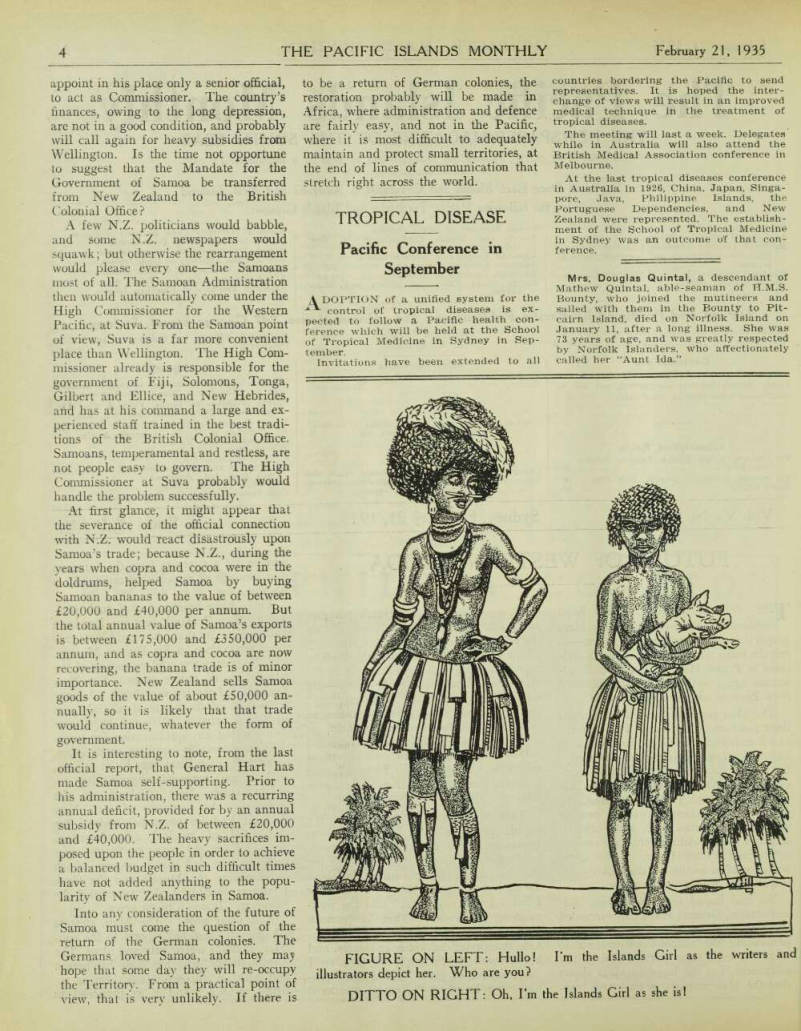
FIGURE ON LEFT: Hullo! I’m the Islands Girl as the writers and illustrators depict her. Who are you?
DITTO ON RIGHT: Oh, I’m the Islands Girl as she is!
September
Tropical Disease
Pacific Conference in September
ADOPTION of a unified system for the control of tropical diseases is ex pected to follow a Pacific health con ference which will be held at the School of Tropical Medicine in Sydney in Sep tember.
Invitations have been extended to all
countries bordering the Pacific to send representatives. It is hoped the inter change of views will result in an improved medical technique in the treatment of tropical diseases.
The meeting will last a week. Delegates while in Australia will also attend the British Medical Association conference in Melbourne.
At the last tropical diseases conference in Australia in 1926, China, Japan, Singa pore, Java, Philippine Islands, the Portuguese Dependencies, and New Zealand were represented. The establish ment of the School of Tropical Medicine in Sydney was an outcome o'f that con ference.
Mrs. Douglas Quintal, a descendant of Mathew Quintal, able-seaman of H.M.S.
Bounty, who joined the mutineers and sailed with them in the Bounty to Pit cairn Island, died on Norfolk Island on January 11, after a long illness. She was 73 years of age, and was greatly respected by Norfolk Islanders, who affectionately called her “Aunt Ida.”
The Duke In Fiji
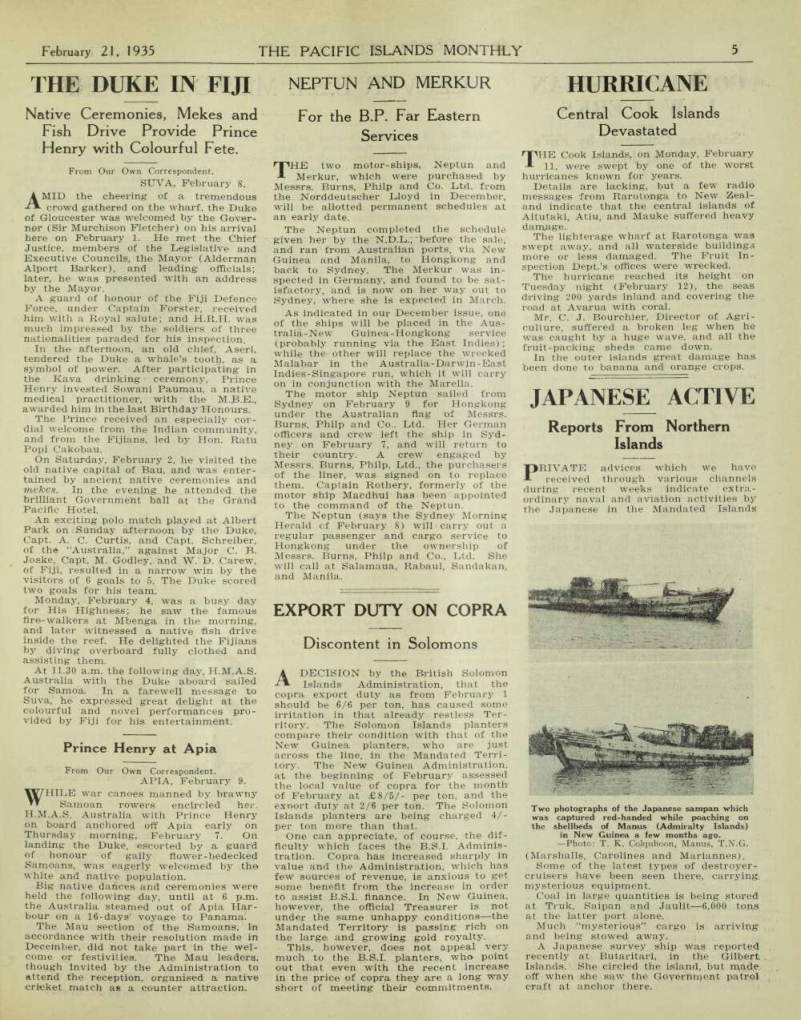
Native Ceremonies, Mekes and Fish Drive Provide Prince Henry with Colourful Fete.
From Our Own Correspondent.
SUVA, February 8.
AMID the cheering of a tremendous crowd gathered on the wharf, the Duke of Gloucester was welcomed by the Gover nor (Sir Murchison Fletcher) on his arrival here on February 1. He met the Chief Justice, members of the Legislative and Executive Councils, the Mayor (Alderman Alport Barker), and leading officials; later, he was presented with an address by the Mayor.
A guard of honour of the Fiji Defence Force, under Captain Forster, received him with a Royal salute; and H.R.H. was much impressed by the soldiers of three nationalities paraded for his inspection.
In the afternoon, an old chief, Aseri, tendered the Duke a whale’s tooth, as a symbol of power. After participating in the Kava drinking ceremony, Prince Henry invested Sowani Paumau, a native medical practitioner, with the M.B.E., awarded him in the last Birthday Honours.
The Prince received an especially cor dial welcome from the Indian community, and from the Fijians, led by Hon. Ratu Popi Cakobau.
On Saturday, February 2, he visited the old native capital of Bau, and was enter tained by ancient native ceremonies and mekes. In the evening he attended the brilliant Government ball at the Grand Pacific Hotel.
An exciting polo match played at Albert Park on Sunday afternoon by the Duke, Capt. A. C. Curtis, and Capt. Schreiber, of the “Australia,” against Major C. B.
Joske, Capt. M. Godley, and W. D. Carew, of Fiji, resulted in a narrow win by the visitors of 6 goals to 5. The Duke scored two goals for his team.
Monday, February 4, was a busy day for His Highness; he saw the famous fire-walkers at Mbenga in the morning, and later witnessed a native fish drive inside the reef. He delighted the Fijians by diving overboard fully clothed and assisting them.
At 11.30 a.m. the following day, H.M.A.S.
Australia with the Duke aboard sailed for Samoa. In a farewell message to Suva, he expressed great delight at the colourful and novel performances pro vided by Fiji for his entertainment.
Prince Henry at Apia
From Our Own Correspondent.
APIA, February 9.
WHILE war canoes manned by brawny Samoan rowers encircled her.
H.M.A.S. Australia with Prince Henry on board anchored off Apia early on Thursday morning, February 7. On landing the Duke, escorted by a guard of honour of gaily flower-bedecked Samoans, was eagerly welcomed by the white and native population.
Big native dances and ceremonies were held the following day, until at 6 p.m. the Australia steamed out of Apia Har bour on a 16-days’ voyage to Panama.
The Mau section of the Samoans, in accordance with their resolution made in December, did not take part in the wel come or festivities. The Mau leaders, though invited by the Administration to attend the reception, organised a native cricket match as a counter attraction.
Neptun And Merkur
For the B.P. Far Eastern Services
THE two motor-ships, Neptun and Merkur, which were purchased by Messrs. Burns, Philp and Co. Ltd. from the Norddeutscher Lloyd in December, will be allotted permanent schedules at an early date.
The Neptun completed the schedule given her by the N.D.L., before the sale, and ran from Australian ports, via New Guinea and Manila, to Hongkong and back to Sydney. The Merkur was in spected in Germany, and found to be sat isfactory, and is now on her way out to Sydney, where she is expected in March.
As indicated in our December issue, one of the ships will be placed in the Aus tralia-New Guinea-Hongkong service (probably running via the East Indies); while the other will replace the wrecked Malabar in the Australia-Darwjn-East Indies-Singapore run, which it will carry on in conjunction with the Marella.
The motor ship Neptun sailed from Sydney on February 9 for Hongkong under the Australian flag of Messrs.
Burns, Philp and Co.. Ltd. Her German officers and crew left the ship in Syd ney on February 7, and will return to their country. A crew engaged by Messrs. Burns, Philp, Ltd., the purchasers of the liner, was signed on to replace them. Captain Rothery, formerly of the motor ship Macdhui has been appointed to the command of the Neptun.
The Neptun (says the Sydney Morning Herald cf February 8) will carry out a regular passenger and cargo service to Hongkong under the ownership of Messrs. Burns, Philp and Co., Ltd. She will call at Salamaua, Rabaul, Sandakan, and Manila.
Export Duty On Copra
Discontent in Solomons
A DECISION by the British Solomon Islands Administration, that the copra export duty as from February 1 should be 6/6 per ton, has caused some irritation in that already restless Ter ritory. The Solomon Islands planters compare their condition with that of the New Guinea planters, who are just across the line, in the Mandated Terri tory. The New Guinea Administration, at the beginning of February assessed the local value of copra for the month of February at £8/5/- per ton, and the exnort duty at 2/6 per ton. The Solomon Islands planters are being charged 4/per ton more than that.
One can appreciate, of course, the dif ficulty which faces the B.S.I. Administration. Copra has increased sharply in value and the Administration, which has few sources of revenue, is anxious to get some benefit from the increase in order to assist B.S.I. finance. In New Guinea, however, the official Treasurer is not under the same unhappy conditions —the Mandated Territory is passing rich on the large and growing gold royalty.
This, however, does not appeal very much to the B.S.I. planters, who point out that even with the recent increase in the price of copra they are a long way short of meeting their commitments.
Hurricane
Central Cook Islands Devastated
THE Cook Islands, on Monday, February 11, were swept by one of the worst hurricanes known for years.
Details are lacking, but a few radio messages from Rarotonga to New Zeal and indicate that the central islands of Aitutaki, Atiu, and Mauke suffered heavy damage.
The lighterage wharf at Rarotonga was swept away, and all waterside buildings more or less damaged. The Fruit In spection Dept.’s offices were wrecked.
The hurricane reached its height on Tuesday night (February 12), the seas driving 200 yards inland and covering the road at Avarua with coral.
Mr. C. J. Bourchier, Director of Agri culture, suffered a broken leg when he was caught by a huge wave, and all the fruit-packing sheds came down.
In the outer islands great damage has been done to banana and orange crops.
Japanese Active
Reports From Northern Islands
PRIVATE advices which we have received through various channels during recent weeks indicate extra ordinary naval and aviation activities by the Japanese in the Mandated Islands
(Marshalls, Carolines and Mariannes).
Some of the latest types of destroyer cruisers have been seen there, carrying mysterious equipment.
Coal in large quantities is being stored at Truk, Saipan and Jaulit—6,000 tons at the latter port alone.
Much “mysterious” cargo is arriving and being stowed away.
A Japanese survey ship was reported recently at Butaritari, in the Gilbert Islands. She circled the island, but made off when she saw the Government patrol craft at anchor there.
Two photographs of the Japanese sampan which was captured red-handed while poaching on the shellbeds of Manus (Admiralty Islands) in New Guinea a few months ago. —Photo: T. K. Colquhoon, Manus, T.N.G.
Corrupt Indian
Law Clerks
Scathing Comment by Fiji's Chief Justice
IN a recent lengthy and complex case relating to perjury before the Fiji Supreme Court at Suva, much evidence was submitted relating to the ethical standards of some of the Indian law clerks in the Colony.
At the conclusion of the case, His Honour the Chief Justice, Captain Sir Maxwell Maxwell-Anderson, C.B.E., K.C., R.N. (ret.), fined the accused, an old Pun jab moneylender named Jaimal, £250 with costs, and sentenced him to six months’ imprisonment. His Honour then delivered a scathing indictment of the conduct of the Indian clerks in the employ of Fiji solicitors. He charged the clerks con nected with the perjury case with corrup tion and unworthiness of confidences.
“The evidence has shown the deplorable standard of ethics existing among Fiji solicitors’ clerks,” said His Honour. “For some time I have had ample reason to suspect the veracity and bona fides of some of these employees, and this case has proved beyond doubt that the time has come when this Court must take action.
“I feel quite certain that the solicitors’ clerks in this case are manufacturers of evidence —I except, perhaps, one of them —and I believe that as touts among them selves they arrange to which solicitor an Indian client is to go. Corruption is ram pant among them, and the type of clerk who is now in this case shown to exist must be stamped out in the interests of the whole community, and more particu larly of the Indian community.
“Evidence manufactured or incited by clerks,” he continued, “and given by them in English to their employers, many of whom cannot converse directly with the client, must be stopped. I am prepared to take the most drastic action should such be necessary to ensure that proceed ings in Fiji Courts shall be conducted ab initio in manner consonant with the high traditions of the profession obtaining in most parts of the Empire.
“I shall compile a list of such clerks, who, in the opinion of this Court,” said His Honour, “have proved themselves utterly unworthy of confidence or to occupy any position of trust. Such clerks will be refused admission to any registry for any purpose whatsoever, even merely to deliver a letter. Further, they will be prohibited from acting as interpreters in connection with any legal document.
If any Commissioner of this Court attests an affidavit interpreted by any clerk whose name is on the list, I shall imme diately cancel his certificate. This will apply both to the solicitor who proffers and to the solicitor who accepts the in terpreter’s service.
“Regarding the activities of clerks in the solicitors’ branch offices, I am left with little doubt that some clerks are acting as solicitors with or without their employers’ consent. I warn all concerned that it is a grave contempt of court, pun ishable by attachment, for any unqualified person to act as a solicitor, or for a solicitor to lend his name as cover for use by an unqualified person.
“Such branch offices cannot be per mitted to continue as they are at present constituted,” proceeded Captain Maxwell- Anderson. “In my view, it is very questionable conduct for a solicitor to keep
permanently open an office at which he attends only at irregular intervals, or when sent for by an unqualified clerk, who has fully discussed the business with the prospective client and whom in many cases the clerk has obtained by touting.
“Recent events have clearly shown that a purge is imperative. If I have to spend the last period of my occupancy of this Bench in cleansing an Augean stable, then I will not hesitate to use every power I possess to ensure that the processes of the Fiji Supreme Court are freed of every suspicion of taint.
“From time to time I have received complaints unfortunately anonymous, and therefore I can take no action on them —as to what is going on, which make it clear to me that the legal profession as a whole in Fiji is in a parlous condi tion. I appeal to the profession to apply the necessary remedies, not leaving it to the Court to perform the surgical opera tion, which will undoubtedly become ne cessary unless healthier conditions rapidly ensue.
“I am not opposing the employment of Indian clerks —there must be such, and there must be interpreters—but the men employed must be of high integrity. I feel assured that the best thought among the Indian community,” concluded the Chief Justice, “will be with this Court in its endeavour to stamp out these para sites, who are a menace to the rights and liberties of their poorer countrymen.”
For the benefit of the large number of Indians present in Court, His Honour re quested the interpreter to translate his comments into Hindustani.
Later, Sir Maxwell-Anderson made out a list of six Indian law clerks, and issued a circular that none of them should be allowed to enter any registry or court, or take part in any legal work within the Colony.
Clever B.S.I. Mission Sisters
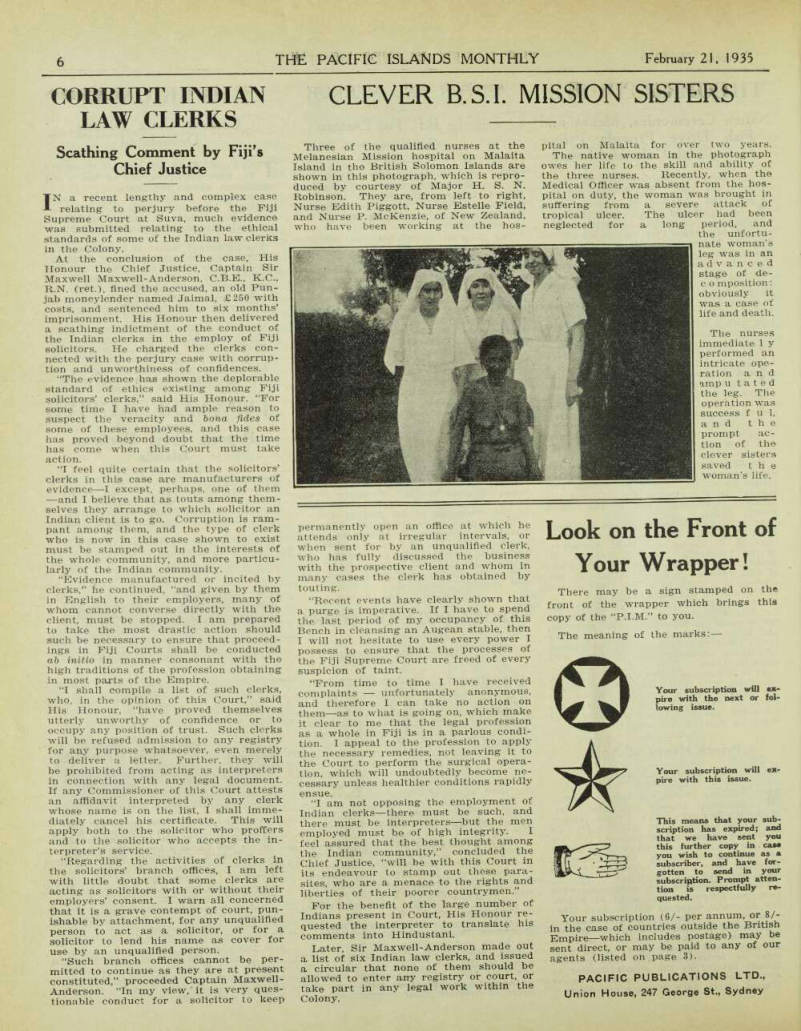
Three of the qualified nurses at the Melanesian Mission hospital on Malaita Island in the British Solomon Islands are shown in this photograph, which is repro duced by courtesy of Major H. S. N.
Robinson. They are, from left to right, Nurse Edith Piggott, Nurse Estelle Field, and Nurse P. McKenzie, of New Zealand, who have been working at the hos-
pital on Malaita for over two years.
The native woman in the photograph owes her life to the skill and ability of the three nurses. Recently, when the Medical Officer was absent from the hos pital on duty, the woman was brought in suffering from a severe attack of tropical ulcer. The ulcer had been neglected for a long period, and
the unfortu nate woman’s leg was in an advanced stage of de composition; obviously it was a case of life and death.
The nurses immediate1y performed an intricate ope ration and amputated the leg. The operation was successful, and the prompt ac tion of the clever sisters saved the woman’s life.
Advertisements & other items, p. 8 (1 item)
Your Wrapper!
Look on the Front of
There may be a sign stamped on the front of the wrapper which brings this copy of the “P.I.M.” to you.
The meaning of the marks: Your subscription will expire with the next or following issue.
Your subscription will expire with this issue.
This means that your subscription has expired; and that we have sent you this further copy in case you wish to continue as a subscriber, and have forgotten to send in your subscription. Prompt attention is respectfully requested.
Your subscription (6/- per annum, or 87in the case of countries outside the British Empire—which includes postage) may be sent direct, or may be paid to any of our agents (listed on page 3).
PACIFIC PUBLICATIONS LTD.,
Union House, 247 George St., Sydney
Copra Price
Market in Healthy Condition
THE copra market continues in a remarkably healthy condition. The price, as we forecast last issue, sagged somewhat after mid-January; but since then it has recovered and, at the moment of writing, the value of copra is higher than at any time since the end of 1932.
The feeling among Sydney traders is optimistic—there are some shrewd judges of the market who think that the London price may shortly settle down at not less than £15.
Causes have been intriguing everyone.
The following is the summary of the Fiji Coconut Planters’ Union: “We are inclined to give a lot of the credit to Roosevelt for imposing a processing tax on coconut oil. The effect of this was to drive up the price of tal low in the United States. With the wholesale slaughtering of cattle, carried out as part of the National Recovery pro gramme, a shortage of material has become evident in the fats and oils mar ket. The manufacturer turns naturally to the oil section and a bigger demand is felt for cotton seed oil, etc. On top of this comes the news of a reduction in the cotton crop from 13,000,000 bales last season to 9,750,000 this season, whilst there has also been a heavy reduction in the maize crop. There is also a con siderable reduction in the soya bean and peanut crops.”
The following is from the monthly circular of Messrs. Faure, Blattman and Co., London, dated January 2: “It is becoming increasingly clear that for some long time to come there will not be any Philippine copra available for European ports. The crop has been damaged by the recent typhoon and this year it is expected that there will be a total decrease of 15 per cent. Edible oils in America are very firm, and there fore U.S.A. crushers will be able to fully take care of supplies from the Philip pines.”
So many factors affect the copra market that a forecast is a risky thing.
But it is pretty certain that if the American demand for copra continues — and everything indicates that it will— the European market will remain in its present comparatively healthy condition lor some time to come.
To Help Pearlers
Grant of About £4 per Ton
The Federal Government has decided to make a grant of £5000 to the pearling industry—£2500 to Western Australia, £1500 to Queensland, and £1000 to the Northern Territory. It is to be distri buted among pearlers on a production basis. A request for payment of a bounty on the shell produced was referred to the Tariff Board for inquiry.
Mr. A. Male, a partner of Streeter and Male, Broome pearlers, said the bonus worked out at about £4 a ton for shell fished, which was an insult to the indus try. Figures, which were supplied to the Federal Government, of the cost of rais ing shell and of prices being realised showed that at least £20 a ton more was required to put the industry on a basis where it would pay working costs.
Rarotongan’S Tribute To
Famous Angler
From a Special Correspondent.
RAROTONGA, January 29.
A CURIOUS incident took place to-day as Dr. Pearce, the famous American angler, who held the New Zealand deep sea record for two years, was about to go ashore from the Makura. He was no sooner in the lighter, with other pas sengers, when he observed a young Rarotongan fishing from the deck of the vessel. The doctor waved his acknow ledgments.
Just as the lighter was about to move off, however, there was a yell of excite ment as the native hauled up a gigantic fish from the deep, and deftly swinging it, landed it at the feet of the famous American angler! Consternation pre vailed amongst the women passengers, until several natives clubbed the fish into unconsciousness.
The Rarotongan angler had used no special tackle. Furthermore, the fish was of a species rarely seen in Cook Is. waters. Meanwhile, some distance away, beyond the reef, the local fishermen were bobbing up and down in their out-rigger canoes, searching the depths at a dis tance of 200 feet and more for the elusive albacore.
Dr. Pearce rose from his seat in the lighter and shouted his congratulations to the Rarotongan lad who had paid him so subtle a compliment.
Mr. Frank Pryke, one of the original “Big Six” of the Morobe goldfield of New Guinea, suffered a bad bout of illness on his last visit to Rabaul; and he had no sooner returned to Sydney than he was laid aside by an acute attack of rheuma toid arthritis. He at present is receiv ing attention at his home in Coogee, Sydney.
Mr. P. C. Hubbard, Chief Magistrate and Legal Adviser in the British Solomon Islands Protectorate, has been transferred to an important magisterial post in Pales tine.
Brother Eugene
Mount Hagen Missionary’s Death at Salamaua
BROTHER EUGENE, the Roman Catho lic missionary who was seriously wounded early in January by natives in the Mount Hagen district of Central New Guinea, died in Salamaua hospital on January 24.
When District Officer J, L. Taylor found Brother Eugene at Buningen village, in the Chimbu Valley, he was in a very criti cal condition. D.O. Taylor immediately took him to Salamaua, where he was ad mitted to hospital suffering from a severe spear wound in the lung. It was thought that his life would be saved, but complica tions set in and he passed away the fol lowing morning.
Born in Illinois, America, Brother Eu gene was 34 years of age, and had been working among the natives of the Mount Hagen area for two years. He arrived In Madang from Sydney in 1927, and before commencing active field work was agricul tural instructor at the Catholic mission station in the Bismarck Ranges.
The Society of the Divine Word at Alexishafen has already appointed another missionary from its station to continue Brother Eugene’s work in the Mt.
Hagen area.
Pilot Denny’S Luck
Mr. Orme Denny, in a ’plane of Guinea Airways, made a forced landing at the Bulldog aerodrome, Lakekamu Field, Papua. He was returning to Port Moresby at a height of 12,000 ft. when he saw clouds of smoke coming from the ’plane. He landed successfully with a cracked propeller.
Patia Fa Spearmen In French Oceania
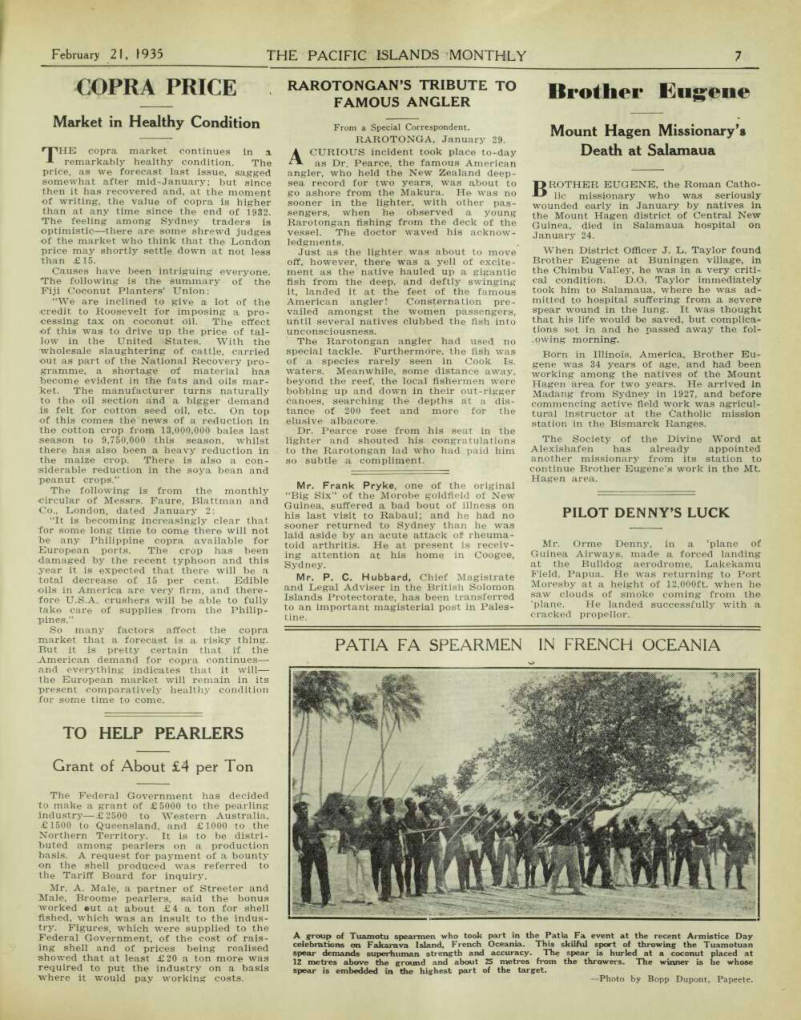
A group of Tuamotu spearmen who took part in the Patia Fa event at the recent Armistice Day celebrations on Fakarava Island, French Oceania. This skilful sport of throwing the Tuamotuan spear demands superhuman strength and accuracy. The spear is hurled at a coconut placed at 12 metres above the ground and about 25 metres from the throwers. The winner is he whose spear is embedded in the highest part of the target. —Photo by Bopp Dupont, Papeete.
Savaii
Mr. R. Williams Of
Death of Former British Official In German Samoan Service
From Our Own Correspondent.
APIA, January 24.
THE advice that Mr. R. Williams, for merly of Western Samoa, died on January 4 at his residence, Devonport, Auckland, N.Z., has been received with sincere sympathy and deep regret by his large circle of friends in Samoa. Mr.
Williams, who had reached the ripe age of 76 years, occupied for 15 years the
important office of Deputy Administrator of the large island of Savaii.
He was appointed “Amtmann” under German Administration in 1905 by Governor Solf. This, in itself, was a very remarkable occurrence, as not only was Mr. Williams a British subject (his father was a British naval officer of Irish descent), but, in addition, he could not speak a word of the German lan guage. In spite of this and the numer ous attacks that Dr. Solf and the Im perial Administration were exposed to in the German Press and the Reichstag, Governor Solf, who knew and valued the efficient work and the ability of the Amtmann, retained Mr. Williams in his responsible position.
He remained there also under Dr. Solf’s successor, Governor Schultz, and it was only after the outbreak of the Great War that Amtmann Williams, or “Viliamu” as his friends called him, was replaced by a German official. He was reinstalled again by the New Zealand Military Ad ministration after the occupation of the former German Colony by N.Z. military forces.
The great influence Williams wielded over the Savaii natives and his popu larity among them enabled him to per form public works, build roads, bridges,
water tanks, etc., with a minimum of expense to the Government. His rule was, in fact, an example of strong and efficient administration. Personally he was a lovable little man of somewhat Falstaffian appearance, with a short, well rounded body surmounted by a bald head from which his bright eyes twinkled merrily. He possessed a well-developed sense of humour and was the object of numerous anecdotes, which at the time amused Apia Beach immensely.
When he went on a lengthy vacation he visited Berlin and called at the Ger man Imperial Colonial Office. The German officials were horrified to find that he could not talk a word of their lan guage. On returning to Samoa he laugh ingly told of his experiences in the Ger man capital, pointing out that the only German word he knew and frequently used was the word “Prosit.”
On one occasion he received a lengthy letter in German from the Central Office in Apia, asking for various information of an ethnological and scientific charac ter. Williams, well knowing that some subordinate official wanted to take ad vantage of his lack of knowledge of the German language, returned the letter with the remark pencilled on it, “Savaii is O.K.”
After 15 years of faithful service, Mr.
Williams retired in 1920 and went to New Zealand, where he married and lived quietly and contentedly.
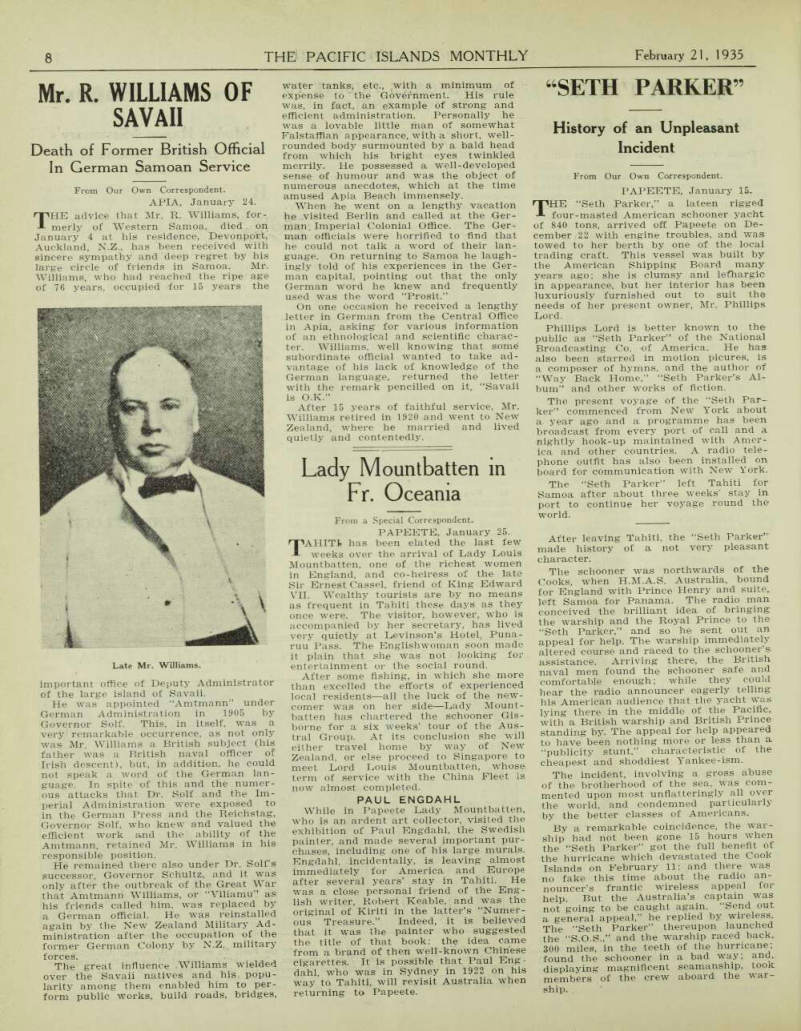
Late Mr. Williams.
Lady Mountbatten in Fr
Fr. Oceania
From a Special Correspondent.
PAPEETE, January 25.
TAHITI has been elated the last few weeks over the arrival of Lady Louis Mountbatten, one of the richest women in England, and co-heiress of the late Sir Ernest Cassel, friend of King Edward VII. Wealthy tourists are by no means as frequent in Tahiti these days as they once were. The visitor, however, who is accompanied by her secretary, has lived very quietly at Levinson’s Hotel, Puna ruu Pass. The Englishwoman soon made it plain that she was not looking for entertainment or the social round.
After some fishing, in which she more than excelled the efforts of experienced local residents —all the luck of the new comer was on her side —Lady Mount batten has chartered the schooner Gis borne for a six weeks’ tour of the Aus tral Group. At its conclusion she will either travel home by way of New Zealand, or else proceed to Singapore to meet Lord Louis Mountbatten, whose term of service with the China Fleet is now almost completed.
Paul Engdahl
While in Papeete Lady Mountbatten, who is an ardent art collector, visited the exhibition of Paul Engdahl, the Swedish painter, and made several important pur chases, including one of his large murals.
Engdahl, incidentally, is leaving almost immediately for America and Europe after several years’ stay in Tahiti. He was a close personal friend of the Eng lish writer, Robert Keable, and was the original of Kiriti in the latter’s “Numer ous Treasure.” Indeed, it is believed that it was the painter who suggested the title of that book: the idea came from a brand of then well-known Chinese cigarettes. It is possible that Paul Engdahl, who was in Sydney in 1922 on his way to Tahiti, will revisit Australia when returning to Papeete.
“Seth Parker”
History of an Unpleasant Incident
From Our Own Correspondent.
PAPEETE, January 15.
THE “Seth Parker,” a lateen rigged four-masted American schooner yacht of 840 tons, arrived off Papeete on De cember 22 with engine troubles, and was towed to her berth by one of the local trading craft. This vessel was built by the American Shipping Board many years ago; she is clumsy and lethargic in appearance, but her interior has been luxuriously furnished out to suit the needs of her present owner, Mr. Phillips Lord.
Phillips Lord is better known to the public as “Seth Parker” of the National Broadcasting Co. of America. He has also been starred in motion picures, is a composer of hymns, and the author of “Way Back Home,” “Seth Parker’s Al bum” and other works of fiction.
The present voyage of the “Seth Par ker” commenced from New York about a year ago and a programme has been broadcast from every port of call and a nightly hook-up maintained with Amer ica and other countries. A radio tele phone outfit has also been installed on board for communication with New York.
The “Seth Parker” left Tahiti for Samoa after about three w'eeks’ stay in port to continue her voyage round the world.
After leaving Tahiti, the “Seth Parker” made history of a not very pleasant character.
The schooner was northwards of the Cooks, when H.M.A.S. Australia, bound for England with Prince Henry and suite, left Samoa for Panama. The radio man conceived the brilliant idea of bringing the warship and the Royal Prince to the “Seth Parker,” and so he sent out an appeal for help. The warship immediately altered course and raced to the schooner’s assistance. Arriving there, the British naval men found the schooner safe and comfortable enough; while they could hear the radio announcer eagerly telling his American audience that the yacht was lying there in the middle of the Pacific,, with a British warship and British Prince standing by. The appeal for help appeared to have been nothing more or less than a “publicity stunt,” characteristic of the cheapest and shoddiest Yankee-ism.
The incident, involving a gross abuse of the brotherhood of the sea, was com mented upon most unflatteringly all over the world, and condemned particularly by the better classes of Americans.
By a remarkable coincidence, the war ship had not been gone 15 hours when the “Seth Parker” got the full benefit of the hurricane which devastated the Cook Islands on February 11: and there was no fake this time about the radio an nouncer’s frantic wireless appeal for help. But the Australia’s captain was not going to be caught again. “Send out a general appeal,” he replied by wireless.
The “Seth Parker” thereupon launched the “S.O.S.,” and the warship raced back, 300 miles, in the teeth of the hurricane, found the schooner in a bad way; ano, displaying magnificent seamanship, tome members of the crew aboard the war ship.
Desperate Plight of Norfolk Is
Norfolk Is.
Continuing Futility of Appeals to Politicians
THE people of Norfolk Island—about 1,000 European men and women—are on the verge of starvation. Yet the majority of them are land-owners; the land of Norfolk Island is immensely fer tile: Norfolk Island produces in profu sion all kinds of fruits and vegetables of high quality; and the climate of Norfolk Island is one of the best in the world.
In ordinary circumstances the people of Norfolk Island should be happy and comparatively rich. Actually, they have become desperately poor. Norfolk Island, in a sentence, is an outstanding example of the asininity of modern methods of government, with its tariffs and quotas and half-understood economic nostrums.
Norfolk Island, originally, was ad ministered from New South Wales. Then came Federation, and Norfolk Island became a Territory of the Common wealth, somewhat similar to Papua. For many years Norfolk Island jogged along happily, “the world forgotten, by the world forgot.”
Then someone, somewhere, decided that the Island should be “developed.” The Commonwealth Government, ten years ago, advertised Crown leaseholds for sale on most favourable terms, and a considerable number of Australian people went to Norfolk Island, took up land there, built their homes, established plantations and proposed to spend the remainder of their lives making a modest living by exporting fruit, vegetables, etc., to Australia and New Zealand. For a few years the community lived and grew according to programme.
Then, about five years ago, everything went awry. Australia began to impose restrictions against produce from Nor folk Island. The Norfolk Island trade and traffic shrank, and the shipping ser vices were curtailed. Australia and New Zealand began to throw tariff restric tions at each other, and New Zealand decided to keep out various kinds of Australian produce. For this purpose the produce of Norfolk Island, as a Ter ritory administered by the Common wealth, was classified as “Australian produce,” and the Norfolk Islanders lost the valuable New Zealand market.
In so many words, Norfolk Island, during the last two years, has been prac tically shut out from every market; and the Norfolk Island residents in conse quence have been deprived of the means of buying even the simplest necessities of life.
If the Commonwealth Government had had any sense of responsibility, it would long since have seen to it that, if the New Zealand market was to remain closed, a suitable market was provided in Australia for Norfolk Island produce.
As a matter of fact Sydney, without the slightest difficulty, could absorb every bit of the high-quality produce that might be sent from Norfolk Island. But, at the slightest suggestion of anything of the kind, there would be a howl from some of the primary producers around Sydney; and as the latter have votes, and the unfortunate Norfolk Islanders have none, the politicians of Canberra have never troubled their heads about the plight of the Norfolk Islanders.
Very recently, driven to desperation, the Norfolk Islanders sent a petition to the Commonwealth Government, praying for relief; and there appeared in the Sydney Morning Herald very outspoken articles by Messrs. J. Barnes, F. Pollard, B. W. Baldwin and Mrs. Sylvia Morgan.
The frank statements of these people about conditions on Norfolk Island could not be ignored, even by the politicians; and it has now been announced by Sir George Pearce (the new Minister-in- Charge of Islands Affairs) that some thing is going to be done about it. Sir George Pearce, in characteristic manner, has announced that the Government has been doing its best to induce New Zeal and to admit Norfolk Island bananas and that New Zealand has most inconsider ately refused. Why New Zealand, which is under obligations to admit bananas from its own Territories of Cook Islands and Samoa, should admit also bananas from the Australian Territory of Norfolk Island, while Australia herself does noth ing to encourage that trade, is something that is not explained. How typical of the politician mind!
Norfolk Island could easily become famous as Sydney’s garden and holiday resort. If the politicians are too feeble and futile to do anything with the Ter ritory—and the history of the past two decades shows that they are—the Island should be handed over to a chartered company to be developed under proper safeguards. Under such circumstances, the present residents of the Island would become prosperous within a few years, and Norfolk Island would be a credit to Australia, instead of a reproach.
Our recommendation to the Norfolk Islanders is that they take whatever steps are necessary to ensure constant publicity and agitation, directing atten tion to their condition, until such time as Canberra is forced to act. Long ex perience has shown that there is only one way in which politicians can be compelled to act in any matter that requires any effort, and a decision, and that is by ceaseless and merciless pub licity. It would not be a costly matter for Norfolk Island, and it would ensure that something was done. Otherwise, the unhappy condition of these voteless people will be ignored by the politicians just as long as they will suffer in silence.
The following monthly return from Norfolk Island, for the month of Decem ber, shows the position:
Imports
Month From Aust. From N.Z. £ £ December, 1933 2274 .. 716 December, 1934 1502... nil
Exports
Month To Aust. To N.Z. £ £ December, 1933 923 .. 105 December, 1934 410 .. nil
Rigorous Weather
Severe Storms And
Landslides
Samoa Experiences Some Rigorous Weather
From Our Own Correspondent.
Apia, Jan. 19.
The torrential rains which started to fall on Wednesday, January 16, con tinued for two days, with strong north westerly winds blowing at a speed up to 47 miles per hour. Much damage was caused to roads, plantations and houses throughout Samoa. The rainfall from Wednesday to Friday was estimated at about 20 to 25 inches.
On the eastern coast of Upolu, along the road from Apia to Saluafata, the damage caused by rains, swollen rivers and land slides was especially serious. Six small bridges on this road were torn away, and the road was blocked by landslides at several places.
The Waikawa, which arrived at noon on Wednesday, January 16, to discharge 200 tons of cargo and load 4000 cases of bananas, had to discontinue discharging on Wednesday afternoon. The following morning, the weather becoming worse, the captain decided to go out to sea and await better weather for loading. It was not until Friday afternoon that the wind and rain had sufficiently died down to allow the steamer’s return, and loading commenced on Friday evening.
The cutter Ellen Betsy, owned by Morris, Hedstrom Ltd., of Fiji, which was engaged in trading in the Lau Group, is reported to have been wrecked at Vatoa, Fiji, in the middle of January.
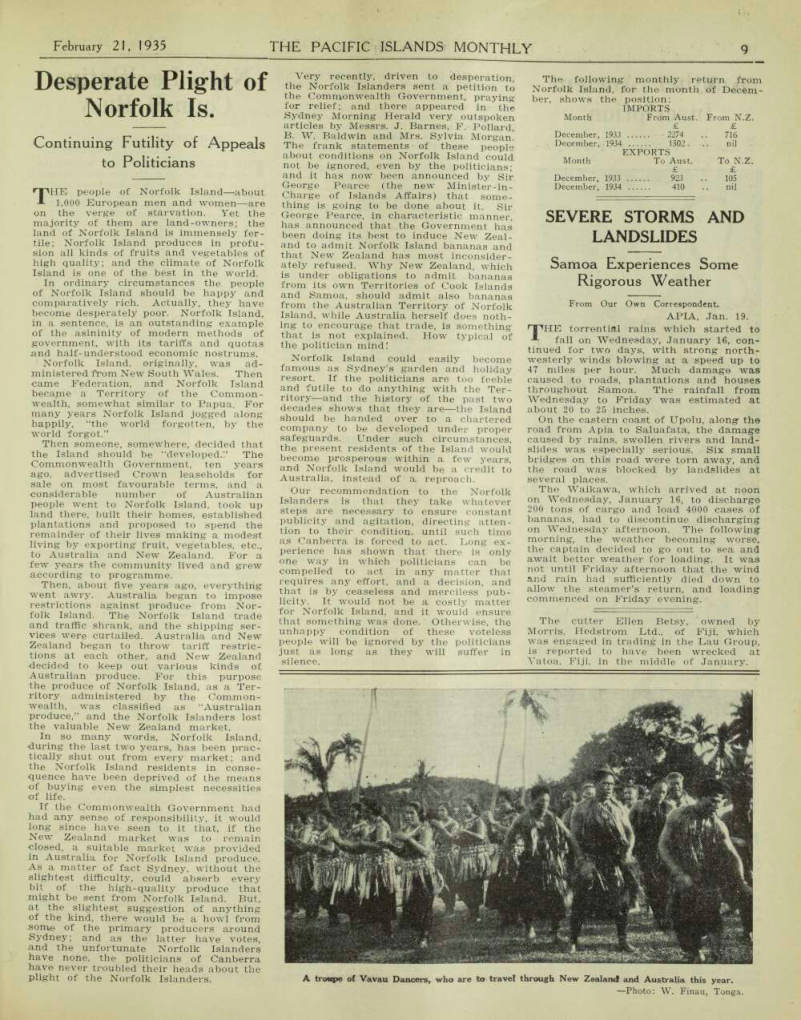
A troupe of Vavau Dancers, who are to travel through New Zealand and Australia this year. —Photo: W. Finau, Tonga.
Inscription
Another Ancient Inscription
By Arthur J. Vogan, F.R.G.S., &C.
I AM only too glad to be able to render tribute to the editor of the bright little “P.I.M.,” whose far-flung columns, alone of all Australasian newspapers, have been so readily open to reporting upon archaeological and ethnological dis coveries through the wide and cryptically susurrous Pacific —still little known, from a scientific point of view.
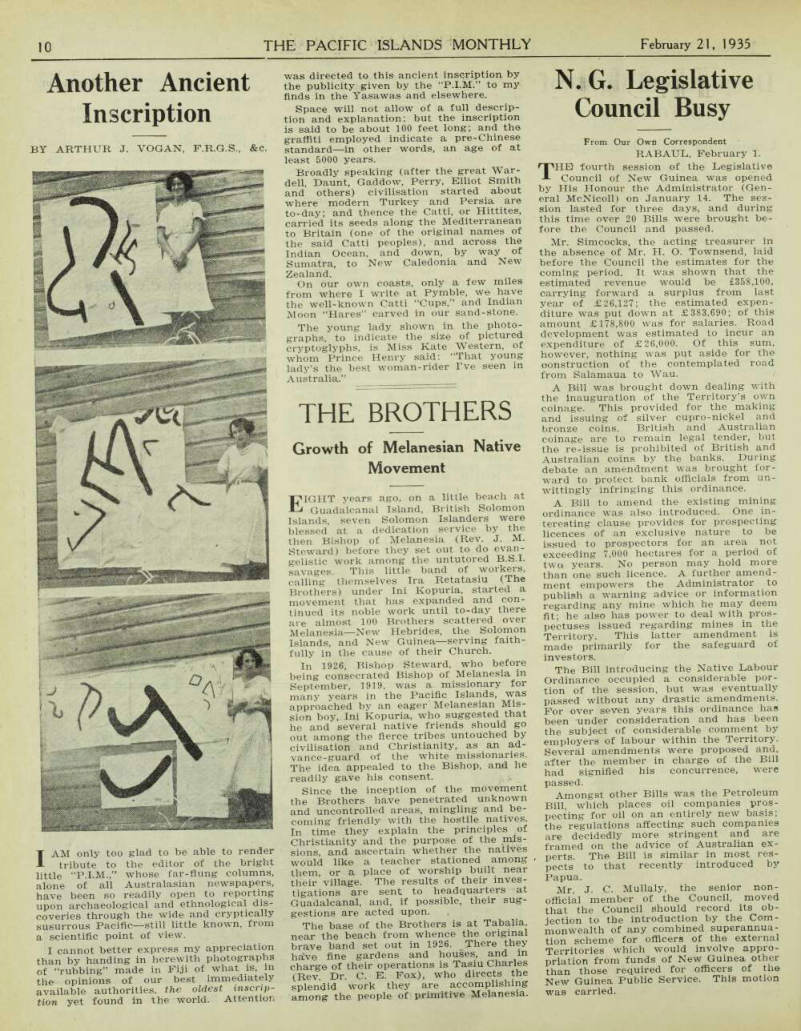
I cannot better express my appreciation than by handing in herewith photographs of “rubbing” made in Fiji of what is, in the opinions of our best immediately available authorities, the oldest inscrip tion yet found in the world. Attention
was directed to this ancient inscription by the publicity given by the “P.I.M.” to my finds in the Yasawas and elsewhere.
Space will not allow of a full descrip tion and explanation; but the inscription is said to be about 100 feet long; and the graffiti employed indicate a pre-Chinese standard —in other words, an age of at least 5000 years.
Broadly speaking (after the great War dell, Daunt, Gaddow, Perry, Elliot Smith and others) civilisation started about where modern Turkey and Persia are to-day; and thence the Catti, or Hittites, carried its seeds along the Mediterranean to Britain (one of the original names of the said Catti peoples), and across the Indian Ocean, and down, by way of Sumatra, to New Caledonia and New Zealand.
On our own coasts, only a few miles from where I write at Pymble, we have the well-known Catti “Cups,” and Indian Moon “Hares” carved in our sand-stone.
The young lady shown in the photo graphs, to indicate the size of pictured cryptoglyphs, is Miss Kate Western, of whom Prince Henry said; “That young lady’s the best woman-rider I’ve seen in Australia.”
The Brothers
Growth of Melanesian Native Movement
EIGHT years ago, on a little beach at Guadalcanal Island, British Solomon Islands, seven Solomon Islanders were blessed at a dedication service by the then Bishop of Melanesia (Rev. J. M.
Steward) before they set out to do evan gelistic work among the untutored B.S.I. savages. This little band of workers, calling themselves Ira Retatasiu (The Brothers) under Ini Kopuria, started a movement that has expanded and con tinued its noble work until to-day there are almost 100 Brothers scattered over Melanesia —New Hebrides, the Solomon Islands, and New Guinea —serving faith fully in the cause of their Church.
In 1926, Bishop Steward, who before being consecrated Bishop of Melanesia in September, 1919, was a missionary for many years in the Pacific Islands, was approached by an eager Melanesian Mis sion boy, Ini Kopuria, who suggested that he and several native friends should go out among the fierce tribes untouched by civilisation and Christianity, as an ad vance-guard of the white missionaries.
The idea appealed to the Bishop, and he readily gave his consent.
Since the inception of the movement the Brothers have penetrated unknown and uncontrolled areas, mingling and be coming friendly with the hostile natives.
In time they explain the principles of Christianity and the purpose of the mis sions, and ascertain whether the natives would like a teacher stationed among them, or a place of worship built near their village. The results of their inves tigations are sent to headquarters at Guadalcanal, and, if possible, their sug gestions are acted upon.
The base of the Brothers is at Tabalia, near the beach from whence the original brave band set out in 1926. There they halve fine gardens and houses, and in charge of their operations is Tasiu Charles (Rev Dr. C. E. Fox), who directs the splendid work they are accomplishing among the people of primitive Melanesia.
Council Busy
N. G. Legislative Council Busy
From Our Own Correspondent RABAUL, February 1.
THE fourth session of the Legislative Council of New Guinea was opened by His Honour the Administrator (Gen eral McNicoll) on January 14. The ses sion lasted for three days, and during this time over 20 Bills were brought be fore the Council and passed.
Mr. Simcocks, the acting treasurer in the absence of Mr. H. O. Townsend, laid before the Council the estimates for the coming period. It was shown that the estimated revenue would be £358,100, carrying forward a surplus from last year of £26,127; the estimated expen diture was put down at £383,690; of this amount £178,800 was for salaries. Road development was estimated to incur an expenditure of £26,000. Of this sum, however, nothing was put aside for the construction of the contemplated road from Salamaua to Wau.
A Bill was brought down dealing with the Inauguration of the Territory’s own coinage. This provided for the making and issuing of silver cupro-nickel and bronze coins. British and Australian coinage are to remain legal tender, but the re-issue is prohibited of British and Australian coins by the banks. During debate an amendment was brought for ward to protect bank officials from un wittingly infringing this ordinance.
A Bill to amend the existing mining ordinance was also introduced. One in teresting clause provides for prospecting licences of an exclusive nature to be issued to prospectors for an area not exceeding 7,000 hectares for a period of two years. No person may hold more than one such licence. A further amend ment empowers the Administrator to publish a warning advice or information regarding any mine which he may deem fit; he also has power to deal with pros pectuses issued regarding mines in the Territory. This latter amendment is made primarily for the safeguard of investors.
The Bill introducing the Native Labour Ordinance occupied a considerable por tion of the session, but was eventually passed without any drastic amendments.
For over seven years this ordinance has been under consideration and has been the subject of considerable comment by employers of labour within the Territory.
Several amendments were proposed and, after the member in charge of the Bill had signified his concurrence, were passed.
Amongst other Bills was the Petroleum Bill, which places oil companies pros pecting for oil on an entirely new basis; the regulations affecting such companies are decidedly more stringent and are framed on the advice of Australian ex perts. The Bill is similar in most res pects to that recently introduced by Papua.
Mr J. C. Mullaly, the senior non official member of the Council, moved that the Council should record its ob jection to the introduction by the Com monwealth of any combined superannua tion scheme for officers of the external Territories which would involve appro priation from funds of New Guinea other than those required for officers of the New Guinea Public Service. This motion was carried.
Tropicalities
ACCORDING to a newspaper report, Mr.
W. C. Groves told the Anthropology section of the Science Congress, in Mel bourne, that “everywhere in New Guinea European representatives were enthusias tic about anthropology. They included planters, judges and miners. Anthropology was beginning to justify itself in the offi cial mind. Only by living with the people and leaving behind European associations was it possible to gain the trust and con fidence of the natives. Thus only was if possible to get at the inner heart of the people and interpret their true spirit.”
True enough. But if ever the spirit of an indigenous people was well and truly “interpreted,” it has been accomplished in New Guinea in recent years. The place has been literally over-run with anthropologists—old and young, male and female, cranks and not-so cranky. Each lady and gentleman seems to produce a new set of theories, and to be eager to ram the same down the throats of a bored and suspicious Administration.
Planters and miners generally are re spectful to the scientists; but the number and variety of the latter have done noth ing to change the local opinion that “coons is just coons, anyway.” * * * THE nations generally are of the opinion that the Japanese, contrary to the letter and spirit of the Mandate they hold, are fortifying the Marshall, Caro line, and Marianne Islands. The Japanese deny it. No one is allowed to go there and ascertain the position. The Man dates Commission of the League of Na tions (from which Japan last year osten tatiously withdrew) suggested that pub lished figures showing expenditure in those Islands was very large. Japan, with equal politeness, said the money was spent on “purely civil and commercial purposes.” There were no details. The Commission rubbed its collective nose, pondered a little, and then said it “would like further particulars.” “Certainly!” said Japan. Nothing further has been heard about it. Everyone concerned seems to be determined that the League of Nations-Mandates farce shall be play ed out to the bitter end. ♦ ♦ * “LUXURY Cruising” in the Pacific is definitely growing, and presently will be included among the staple industries of the Pacific Islands.
Quite apart from the short excursions from Australian ports, extending from four to 14 days, there are huge liners coming into the Pacific in increasing num bers, carrying thousands of passengers on trips embracing many weeks. The “Car mthia,” cruising through Eastern Poly nesia early in 1933, really started it. Then came the “Stella Polaris” and then the ‘Franconia.” The Matson Company, in 1934, organised a “City of Los Angeles” cruise, and when that great liner returned to port from a Pacific wander, she found another load of passengers clamouring for the same trip. It is reported that the Franconia” will bring another load of “cruisers” into Polynesia in 1935.
What Pacific residents think of these rich tourists and their rhapsodising about Pacific Islands Idylls,” had better not be written here. One may say, however, that their influence on the natives is deplor
able; but, fortunately, the tourist ships go only to the well-worn ports, where the indigenes already are accustomed to the ways of festive and irresponsible Euro peans. “Cruising” brings a lot of money into the Islands, for distribution among natives, who provide all sorts of enter tainments, from dancing to hurriedly carved “ancient curios.” The natives nowadays can assemble at a few minutes’ notice, and go through movements that really are a dreadful parody of the old time dances. The “luxury cruisers” shoot off their cameras and are quite happy, however—and the islanders don’t care. * * * Captain R. A. WILLIAMS, formerly well and popularly known as a master of Burns Philp steamers, appears to have settled down happily in his new berth as Captain of M.V. Southern Cross VII., with headquarters in the Solomons.
Not long ago, when the little mission ship, with the Bishop of Melanesia aboard, was bucking a south-easter near Rennell Island, and doing 4½ knots, the Malaita came along, running at 12 knots. The skipper’s old shipmates ran up three flags, reading “Keep me in sight during the night.” In an hour, she was over the horizon. “These little courtesies of the sea!” remarked the Bishop. What Captain Williams said is not recorded. * * * THIS, from “Papuan,” looks like an underhand crack at someone: “Do you think it is right that a man, after retiring on superannuation pension from the service of one Administration, should join the service of another, at a comfortable salary? He was a soldier and he has a soldier’s pension; so that his present income consists of (a) pen sion under superannuation; (b) war pen
sion; (c) present salary. Is it fair that he should keep another good man out of a job?”
A ticklish question; but my sympathy is with the man who is criticised. A man is entitled to all that he can earn, in a fair and legitimate manner. If a man is retired from a Pacific service, while still in life’s prime, and wishes to keep on working, he surely is entitled to do so. If anyone is blameworthy, it is the Adminis tration which fixes the retiring age too low. The fact that a man has a war pension is something between himself, his conscience, and the Pensions Com missioners. Ninety-nine per cent, of war pensions paid to-day were legitimately awarded. * * * THIS is told in a private letter from a shy man who detests publicity— namely, Dr. G. H. Vernon, of Daru, Wes tern Papua—but it is so funny that the good doctor’s feelings must be sacrificed on the altar of journalistic expediency.
There was a wedding anniversary held in Daru; and there was a carefully com piled fruit salad to be served; and to Dr.
Vernon fell the pleasant duty of serving the fruit salad. The doctor served with skill, and poured upon each helping a liberal supply of a thick yellow liquid, which was placed at his right hand by the house boy, when dressing was called for. The fruit salad was passed around.
A few people began to laugh, but the doctor could see no reason for laughter.
“What is the big joke? Is it on me?” asked the doctor. “You will soon find out,” was the answer. The doctor tackled his own share of the fruit salad —and threw down the spoon with a horrid curse.
The liquid was a vinegar and oil salad dressing which had been omitted from a previous course, and which had been care fully placed in the wrong position, in the inevitable way of Papuan house boys. The doctor assumed his most professional manner. “It is an excellent thing for you that you should all have a good laugh,” he said, sententiously.
Advertisements & other items, pp. 13-14 (1 item)
Home
STERLING
COVERS
MORE
COSTS
LESS
GUAR-
ANTEED
STERLING
HOME PAINT
MAKES ALL THE
DIFFERENCE
PAINT
WITH-
STANDS
TROPICAL
SUN AND
SALT-LADEN
AIR
Made by STERLING VARNISH CO., SYDNEY, N.S.W.
MINING AND ASSAY
MATERIAL
BALANCES, CRUSHERS, FURNACES,
CRUCIBLES, FLUXES, ETC.
LABORATORY AND SCHOOL
REQUISITES
Chemicals, Glassware, and all other Equipment
HOSPITAL AND SURGICAL
REQUIREMENTS
Incubators, Sterilizers, Centrifuges, Microscopes, Microtomes, etc.
Measures, Dispensing Scales, Enamel Ware, Bandages, Cotton Wool, and all Dispensing Material.
Write direct to
H. B. SELBY & CO., LTD.,
BULLETIN PLACE :: SYDNEY
Box 173D, G.P.O.
WARD’S
Fuel Stoves
Renowned for 50 Years
The “BEACONLIGHT"
Specially Made for Islands.
Cast Iron Throughout.
May be Purchased through Island Merchants or from
JAMES WARD LTD.,
372 Pitt Street, Sydney
A SPECIAL WATCH
for hot, tropical climates
in rustless steel case
Attractive and modern in appearance and definitely a good, sound time-keeper, this watch has compensated balance and is fully jewelled.
The illustration is actual size and the watch is complete with wide leather band and chromium plated metal buckle.
Guaranteed for 15 years and kept in order free of charge (breakages excepted) for 12 months.
Orders hy mail receive our prompt and careful attention.
PRICE: £5/5/-.
Fairfax Roberts Ltd.
“The Oldest Jewellery House in Sydney.”
23-25 Hunter Street, SYDNEY
About Islands People
Mrs. M. E. Land, widow of the late Capt. P. M. Land, well-known Islands skipper in Fiji some years ago, died at Lami, Fiji, on January 30, aged 76. Going to the Pacific Islands from England over 30 years ago, she lived for many years in Suva, and went to Tonga after her husband was lost at sea. About two years ago Mrs. Land returned to Fiji.
Her son, Mr. J. Land, is at present in charge of the Government wireless stations in the Tongan Group.
M. Cremazy, of the Messageries Maritimes Co. at Noumea, will leave New Caledonia in April next. He is to be re placed by M. Genat, who for many years acted as M.M. agent at Colombo.
Captain H. T. (“Bunny”) Hammond, ac companied by his wife, left Sydney by the Neptun on February 9, for Salamaua, New Guinea, to take up the position of assistant manager with Holden’s Air Transport Services Ltd. Before coming to Sydney some 10 months ago to join the Vacuum Oil Co. Pty. Ltd., as aviation offi cer for New South Wales, Mr. Hammond was a pilot in the H.A.T. service in New Guinea.
Major F. R. Hewitt, who has been in charge of Lever’s operations in the British Solomon Islands for the past 10 years, has been appointed Sydney general manager of Lever’s Pacific Plantations Pty., Ltd.
Mr. Leon L. Williams, manager of Kimadai Estates, Kavieng, New Guinea, returned to Australia by the Maloja from England late in December. After spend ing a brief period in Victoria, he sailed for the Territory by the January Montoro.
While in Great Britain on furlough, Mr.
Williams travelled over 3000 miles by car and train through Wales and England, and expressed pleasure at the service and comfort given him by the English authorities.
Recent arrivals in Sydney from New Guinea include Mrs. V. Cooke, from the Sunshine Mine, Morobe; Mrs. A. J. Kelly, of Rabaul, who is visiting her mother, Mrs. M. Toomey, in Sydney; Mrs. R. K.
Moore, of Rabaul; Mrs. A. Hitchcock, of Wau, who has gone to visit relatives in Mjelbourne; Mrs. H. H. Page, of Rabaul, who will spend the next two years at her Sydney home in Bellevue Hill, while her children are attending school.
Mr. Philip Coote, general manager at Rabaul for Messrs. Burns Philp and Co., Ltd., concluded three months’ furlough in Australia in January, and returned to the Territory by the January Macdhui.
He had benefited much in health by his rest.
Dr. N. T. Coulson, an old retired dentist of San Francisco, U.S.A., arrived in Sydney by the Makura on February 9.
In 1876 he left Cornwall, England, and sailed in the mission barquentine “South ern Cross” to the New Hebrides and Norfolk Island. He is now returning to those islands with the hope of renewing acquaintance with some of his old friends.
Judge H. F. Ayson, C.M.G., Resident Commissioner of the Cook Islands, left Rarotonga for New Zealand by the last Makura to spend a month’s vacation in Rotorua and other centres of the Dominion.
Miss D. Glasson, of Salamo, Papua, who is the Methodist Papua District Chairman’s Assistant and Bookkeeper, ar rived in Sydney on leave by the Macdhui on January 21, Miss K. Connelly, Miss Crawford, and Miss Hayward were recent round-trippers by the Macdhui to Papua and New Guinea. They were enthusiastic on their return regarding the beauty of the kaleidoscopic scenery and the quaint glimpses of native life. They described the trip across from Pt. Moresby to the N.G. goldfields in Guinea Airways’ new Ford ’plane as “the greatest thrill of our lives.”
When You Visit Sydney
Nowhere can you be more highly re commended to stay than at the Great Southern Hotel, 717-723 George Street, Sydney (facing Central Railway Station, opposite Rawson Place). Bed and break fast 7/6, luncheon 2/-, dinner 2/6.
About Islands People
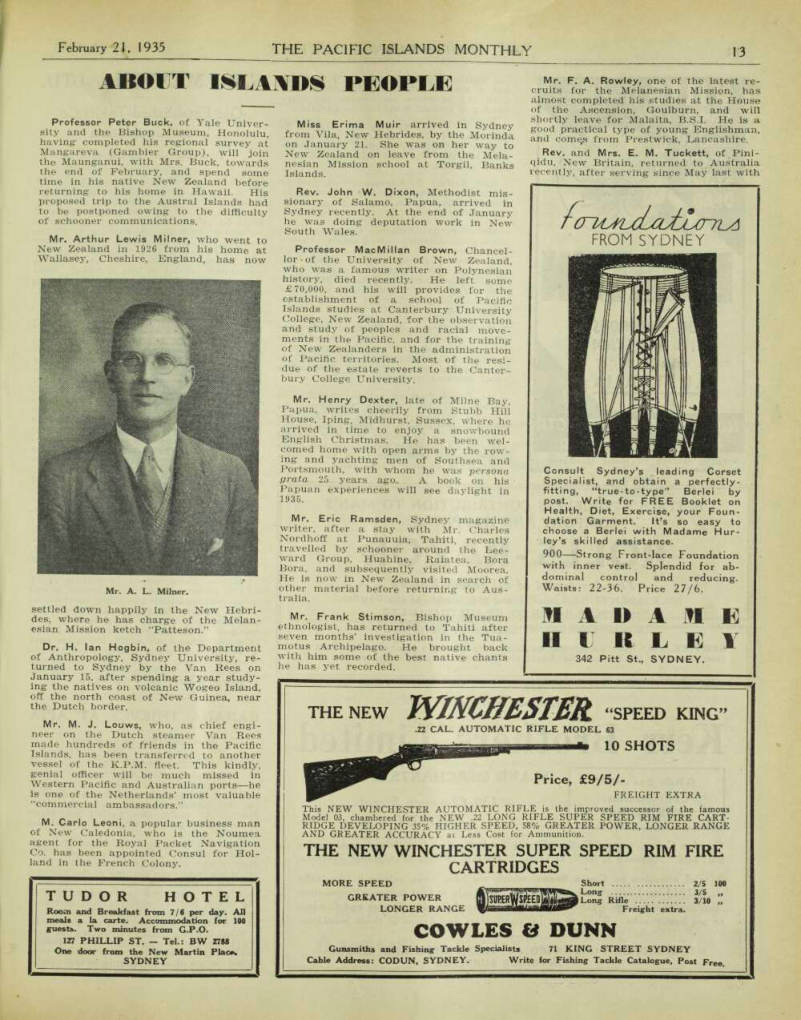
Professor Peter Buck, of Yale Univer sity and the Bishop Museum, Honolulu, having completed his regional survey at Mangareva (Gambler Group), will join the Maunganui, with Mrs. Buck, towards the end of February, and spend some time in his native New Zealand before returning to his home in Hawaii. His proposed trip to the Austral Islands had to be postponed owing to the difficulty of schooner communications.
Mr. Arthur Lewis Milner, who went to New Zealand in 1926 from his home at Wallasey, Cheshire, England, has now
settled down happily in the New Hebri des, where he has charge of the Melan esian Mission ketch “Patteson.”
Dr. H. Ian Hogbin, of the Department of Anthropology, Sydney University, re turned to Sydney by the Van Rees on January 15, after spending a year study ing the natives on volcanic Wogeo Island, off the north coast of New Guinea, near the Dutch border.
Mr. M. J. Louws, who, as chief engineer on the Dutch steamer Van Rees made hundreds of friends in the Pacific Islands, has been transferred to another vessel of the K.P.M. fleet. This kindly, genial officer will be much missed in Western Pacific and Australian ports—he is one of the Netherlands’ most valuable “commercial ambassadors.”
M. Carlo Leoni, a popular business man of New Caledonia, who is the Noumea agent for the Royal Packet Navigation Co. has been appointed Consul for Hol land in the French Colony.
Miss Erima Muir arrived in Sydney from Vila, New Hebrides, by the Morinda on January 21, She was on her way to New Zealand on leave from the Mela nesian Mission school at Torgil, Banks Islands.
Rev. John W. Dixon, Methodist mis sionary of Salamo, Papua, arrived in Sydney recently. At the end of January he was doing deputation work in New South Wales.
Professor MacMillan Brown, Chancel lor of the University of New Zealand, who was a famous writer on Polynesian history, died recently. He left some £70,000, and his will provides for the establishment of a school of Pacific Islands studies at Canterbury University College, New Zealand, for the observation and study of peoples and racial move ments in the Pacific, and for the training of New Zealanders in the administration of Pacific territories. Most of the resi due of the estate reverts to the Canter bury College University.
Mr. Henry Dexter, late of Milne Bay, Papua, writes cheerily from Stubb Hill House, Iping, Midhurst, Sussex, where he arrived in time to enjoy a snowbound English Christmas. He has been wel comed home with open arms by the row ing and yachting men of Southsea and Portsmouth, with whom he was persona grata 25 years ago. A book on his Papuan experiences will see daylight in 1935.
Mr. Eric Ramsden, Sydney magazine writer, after a stay with Mr. Charles Nordhoff at Punauuia, Tahiti, recently travelled by schooner around the Lee ward Group, Huahine, Raiatea, Bora Bora, and subsequently visited Moorea.
He is now in New Zealand in search of other material before returning to Aus tralia.
Mr. Frank Stimson, Bishop Museum ethnologist, has returned to Tahiti after seven months’ investigation in the Tua motus Archipelago. He brought back with him some of the best native chants he has yet recorded.
Mr. F. A. Rowley, one of the latest re cruits for the Melanesian Mission, has almost completed his studies at the House of the Ascension, Goulburn, and will shortly leave for Maiaita, B.S.I, He is a good practical type of young Englishman, and comqs from Prestwick, Lancashire.
Rev. and Mrs. E. M. Tuckett, of Pini qidu, New Britain, returned to Australia recently, after serving since May last with
Mr. A. L. Milner.
the Methodist Mission. Mrs. Tuckett has had a serious breakdown in health, and until she recovers sufficiently her hus band will remain with her in Adelaide.
Rev. H. V. C. Reynolds and Miss A. E.
Samuels, of New Zealand, arrived in Sydney in February en route to the Solo mon Islands, for work with the Melan esian Mission.
Rev. Arthur G. Adamson, Principal of Davuilevu College, Fiji, left Melbourne in February by the s.s. Toulouse on a visit to England.
Mr. George Fulton, chairman and managing director of Lever’s Pacific Plantations Pty. Ltd., will retire from the company at the end of March and will leave for England in April. Mr.
W. D. Mackenzie, chairman of Lever Bros., Ltd., will now take over the chairmanship of Lever’s Pacific Plan tations, Ltd.
Mr. and Mrs. L. H. Stork, of Fiji, were staying with their daughter Monica at Darlinghurst, Sydney in February on a holiday visit to Australia. Mr. Stork is the Colonial Sugar Refining Company’s chief engineer at Labasa.
Mr. Enoch Perkins, general manager in America of the Societe Chemique du Chrome of New Caledonia, left Noumea for Sydney en route to New York by the Laperouse on December 23. For several months he has been inspecting the com pany’s mine at Tiebaghi, on the north west coast of New Caledonia.
Advertisements & other items, pp. 15-16 (1 item)
Foundations
FROM SYDNEY
Consult Sydney’s leading Corset Specialist, and obtain a perfectlyfitting, “true-to-type” Berlei by post. Write for FREE Booklet on Health, Diet, Exercise, your Foundation Garment. It’s so easy to choose a Berlei with Madame Hurley’s skilled assistance. 900 Strong Front-lace Foundation with inner vest. Splendid for abdominal control and reducing.
Waists: 22-36. Price 27/6.
MADAME
HURLEY
342 Pitt St., SYDNEY.
THE NEW WINCHESTER “SPEED KING”
.22 CAL. AUTOMATIC RIFLE MODEL 63
10 SHOTS
Price, £9/5/-
FREIGHT EXTRA
This NEW WINCHESTER AUTOMATIC RIFLE is the improved successor of the famous Model 03, chambered for the NEW .22 LONG RIFLE SUPER SPEED RIM FIRE CART- RIDGE DEVELOPING 35% HIGHER SPEED, 58% GREATER POWER, LONGER RANGE AND GREATER ACCURACY at Less Cost for Ammunition.
THE NEW WINCHESTER SUPER SPEED RIM FIRE
CARTRIDGES
MORE SPEED
GREATER POWER
LONGER RANGE
Short Long Long Rifle Freight extra. 2/5 100 3/5 „ 3/10 „
COWLES & DUNN
Gunsmiths and Fishing Tackle Specialists 71 KING STREET SYDNEY Cable Address: CODUN, SYDNEY. Write for Fishing Tackle Catalogue, Post Free
TUDOR HOTEL
Room and Breakfast from 7/6 per day. All meals a la carte. Accommodation for 100 guests. Two minutes from G.P.O.
127 PHILLIP ST. Tel.; BW 2788
One door from the New Martin Place,
SYDNEY
KILLS flies Fleas
mosquitoes
and all insects
STONE
DEAD
NORTON
NON POISONOUS
WILL NOT STAIN
MADE IN
AUSTRALIA
NOW DOUBLE STRENGTH
BETTER THAN EVER
Obtainable through all Island Merchants, or write Samuel Taylor, Box 9, Surry Hills Sydney.
BRITAIN’S PRICELESS CONTRIBUTION TO MAN’S
COMFORT AND HAPPINESS
ROLLS-RAZOR
The Aristocrat of all Safety Razors SOLE AGENTS for Australia and the Islands of the Pacific.
THE ROLLS RAZOR CO. OF AUSTRALIA LTD.
Mendes Chambers, 8a Castlereagh Street, Sydney.
SERVICE.—We have a complete equipment for Repairs in case of accident to your Razor. Blades can be Reset and adjustments made by return mail.
Established N.H. 1894
Kerr Brothers Limited
G.P.O. Box 3838T
Cable Address:
“CARE SYDNEY"
ISLAND MERCHANTS & AGENTS
139 Clarence Street
SYDNEY
Consign Copra. Cacao, Coffee, Castor Seed, Shell and all Island produce for best sale. Advance of 80% of value, if desired, at time of shipment overseas.
Special attention to Cocoa Beans, which we have been selling in Australia since 1911, and can obtain regular and ready sale at best prices. Preparation is of the greatest importance, and we recommend Gordon Dryers and Graders to get best results. Write to us for particulars and prices of these machines.
MERCHANDISE PURCHASED AT BEST PRICES AND ORIGINAL
INVOICES SUPPLIED
S. R. Maxwell Ltd.
Old Established Tahiti Co Is In Liquidation
From Our Own Correspondent.
PAPEETE, January 15.
THE old established mercantile firm of S. R. Maxwell and Company, Ltd., which has carried on business for many years in French Oceania, has announced officially that by virtue of a decision arrived at by a general meeting of share holders held in Auckland on November 22 last, it is now in a state of voluntary liquidation. Mr. Edward Anderson, a prominent official of the company, resi dent in New Zealand, is the liquidator, and he will be represented locally by Mr.
T. E. Bunkley, who has been the Tahiti branch manager for many years.
It is always depressing to see a well known and reputable firm go out of business, especially one like Maxwell and Co., which has filled such an important place in the life of the community. This firm formerly operated schooners and maintained trading stations throughout the various archipelagoes of French Oceania. For several years past, how ever, these activities have become more and more restricted. Outside stations have been closed up one after another and the schooners sold off, so that prac tically nothing now remains except the Papeete buildings and the stocks of mer chandise contained therein.
Maxwell and Co. also held the local agency of the Union Steam Ship Co. until quite recently, when the business here was taken over by one of the U.S.S.
Co.'s own managers, Mr. Coster.
The islands of Flint, Caroline, and Vos tock are still held by Maxwell and Co. on a lease from the British Government, and it will be interesting to see what is to become of these properties, in which, of course, there can be very little profit at the present time. Flint Island is one of several small islands lying northwards of the Society Islands; it is three miles long by half a mile wide, and is well wooded. Caroline (or Thornton) Island is a low-lying atoll about 400 miles east of Penrhyn, in the Northern Cook Group.
Vostock Island, a low sandy islet, was discovered by Bellingshausen in 1820; it is situated near Flint Island.
Banana Thieves At Apia
From Our Own Correspondent.
Apia, Jan. 24.
THE banana steamer Waikawa had temporarily left Apia harbour owing to the bad weather, without picking up her load of 4000 cases of bananas, stacked on the Customs wharf ready for ship ment. At night two native policemen were posted on the wharf to guard the cases of fruit.
Alas, the early morning found 20 cases of bananas gone, stolen right under the eyes of the guardians of the peace, who, of course, had seen nothing of the thieves.
But as a memento, the artful offenders had, after emptying the bananas out of the cases, left the empties floating about near the Customs wharf. There is only very slight hope of catching the criminals.
What the two native constables did dur ing the night is somewhat of a mystery, but some passers-by assert that they heard noises akin to snoring in the neigh bourhood of the Customs house.
Fiji’S New Goldfields
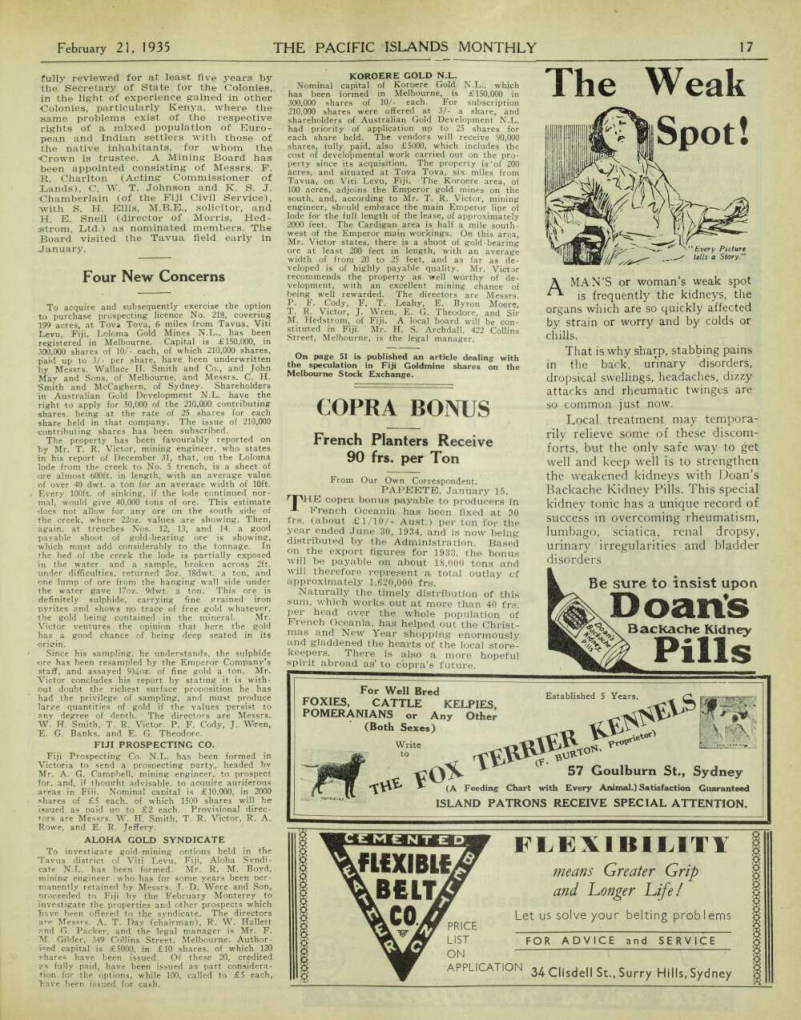
How E. G. Theodore’s Enterprise and Tenacity Are Winning Due Reward
THERE are indications that a rich, new goldfield has been discovered in Fiji— at Tavua, on the northern coast of the great island of Viti Levu. There is also another promising goldfield in Fiji—at Yanawai, near the south-west corner of the great island of Vanua Levu.
In this article, a special correspondent of the Pacific Islands Monthly” discusses the history and prospects of the gold industry in Fiji.
IN the prosperous years before the war one often heard tales in Sydney of “the rich uncle from Fiji’’—usually he had amassed wealth through planting the golden banana.
In recent years the species had become extinct, but now the discoveries of gold in Fiji seem likely to bring about a reincarnation. For there are literally fortunes in sight for many since Pat Costello grub-staked the veteran Borthwick in fossicking for gold at Tavua towards the end of 1933. When, in December of that year, Borthwick re turned to Suva the rumour round the beach of a strike of gold of great rich ness was scarcely believed.
The Costello brothers are well liked, genial Irishmen, with all their country’s blarney and optimism. They came from Queensland, so it was natural that Pat should put his proposals before E. G.
Theodore, who became sufficiently in terested to pay £600 for an option.
First Dr. Loftus Jones was sent to report; and he is said to have been enthusiastic over possibilities, but his enthusiasm was not echoed by a second expert, Tom Victor.
However, E. G. Theodore decided to investigate in person, and arrived on the spot early in 1933 with a picked band of Australian miners, an assayer, and Gray, late of Mt. Isa, as mine manager.
Investigations commenced in April, and a day or so later the Acting Governor, Mr. A. W. Seymour, C.M.G., was on the held. A dish from a spot picked at ran dom by Mr. Seymour was washed in his presence and showed valuable colours.
Before long, Theodore and party de cided to shift to an adjoining claim, belonging to Foulis and Morton. He paid £1000 for an option to purchase for £10,000 cash and 15 per cent, in shares in any company subsequently formed.
Prospects were good enough for Theo dore to exercise his option and the Emperor Gold Mining Co. was incorpor ated about October, 1934, to work the claim, capital being £100,000 in £1 shares. Principal shareholders, beside the Foulis and Morton interests, are Messrs. Theodore, Jack Wren, Cody and Packer, of Sydney.
E. G. Theodore is managing director and is to continue as such so long as he holds the director’s qualification of one share. All along, he has been the main spring of activity and his courage, en terprise and ability will write his name at the head of the pioneers of the gold industry of Fiji—more especially as the necessary funds, to the tune of tens of thousands, came entirely from the poc hets of himself and the three close asso ciates who had complete confidence in his judgment.
Early in 1935, crushing mills and other
equipment arrived from England. The Fiji Government assisted the venture by agreeing to collect Customs duty only when the company had reached th© divi dend-paying stage. Apparently this will not be long delayed, for towards the end of January it was reported in Suva that the 50-tons plant had commenced crush ing and that the yield for four days was 63 ounces.
The Melbourne Stock Exchange had got to hear of Tavua and Mr. Byron Moore visited the field at the end of 1934. Rumour has it that he acquired from the Theodore-Costello syndicate options on two other claims, known as the Koroere and the Cardigan.
It looks, therefore, as though the rush to Tavua has set in. Gold mining will be a godsend to Fiji and, indirectly, through wise mining laws, the whole community will benefit, whilst individu ally may Theodore, Costello and Co. make a real packet!
Since the above was written, Melbourne Press cablegrams of January 30 report Mr. Tom Victor as saying that the Loloma claim is the richest surface proposition he has ever sampled. This claim lies on the northern boundary of Pat Costello’s original Koroere claim. It
was originally taken up by Mr. D.
Riemenschneider, who sold his interest to W. G. Lawler, hotel proprietor at Navua, for £25. He, in his turn, is reported to have disposed of the claim for £10,000 in cash and a 10 per cent. interest in any company which might be
formed. This company has now been floated and shares paid to 3/- are re ported at January 30 to be selling at close on 20/-. Lawler’s investment of £25 is probably worth to-day in the region of £50,000. Colossal!
Since the early stages gold has been found by prospectors in the Yanawai district, near Savu Savu, on the island of Vanua Levu, and 40 odd years ago a prospector used to "make regularly a couple of pounds a week by washing gold in the various creeks there. Many syndicates have been formed from time to time in Suva, and much good paper money poured into the Yanawai.
As recently as 1923 E. Creswell, ex chief steward in the Union S.S. Co., and. then manager of the Grand Pacific Hotel, sank all his life’s savings in the search for gold at Yanawai and came so close to success that the Fiji Government got a special expert down from New Zeal and to report on the field. His report could scarcely be called enthusiastic, but prospecting continued, and in 1929 two brothers named Mitchell struck what is apparently the mother lode. Early in 1930 the Vatukaisia Gold Mining Co. was formed, with a capital of £10,000, subsequently increased to £15,000 in 1932,. to. carry out further prospecting and development work. Results were promis ing and apparently gold did exist in payable quantities in the Yanawai. In September, 1933, Mt. Kasi Mines, Ltd., was duly incorporated with a capital of £60,000 in 3/- shares.
Not much is known in Suva of its operations, as the company is controlled from Pitt Street, Sydney, directors be ing J. Mitchell, D. W. Robertson, Donald Cameron, H. M. Peacock and H. McNalL Various prominent Suva folk are in terested, such as Sir Henry Scott, T..
Horne, A. O. Mackenzie, R. Crompton, etc. Principal shareholder is the pros pecting Co., Vatukaisia. New machinery and plant has been arriving and is prob ably now installed, but no details are available. It is significant that during 1934 over 2000 ounces of gold were ex ported from the Colony and, as Mt. Kasi was really the only concern operating, even although it was still in the testing stages, it is probably safe to say that most of this gold came from Mt. Kasi.
It looks, therefore, as though Mt. Kasi should reach the dividend list before long and that at least two important gold fields have been proved in Fiji to date Tavua and the Yanawai.
Under the new mining ordinance passed in October, 1934, the control of the gold mining industry in Fiji is assured to the Governor. The provisions of this ordinance have been most care
fully reviewed for at least five years by the Secretary of State for the Colonies, in the light of experience gained in other Colonies, particularly Kenya, where the same problems exist of the respective rights of a mixed population of Euro pean and Indian settlers with those of the native inhabitants, for whom the Crown is trustee. A Mining Board has been appointed consisting of Messrs. F.
R. Charlton (Acting Commissioner of Lands), C. W. T. Johnson and K. S. J.
Chamberlain (of the Fiji Civil Service), with S. H. Ellis, M.B.E., solicitor, and H. E. Snell (director of Morris, Hed strom, Ltd.) as nominated members. The Board visited the Tavua field early in January.
Advertisements & other items, pp. 17-18 (1 item)
W. Holmes
STOP
Tired nerves are the cause of Headache, Neuritis, Neuralgia, Rheumatism, Lumbago, Sciatica. Get instant relief from all nerve pains with Genuine VINCENT’S A.P.C. as recommended by Doctors, Dentists, Chemists, and Nurses. 12 for 1/6, 24 for 2/6.
All Chemists and Stores, or direct from Vincent Chemical Company Limited, Market St., Sydney, Australia
Nerve
Pains
FOR SAFETY’S SAKE. SAY “VINCENTS"
W. HOLMES
YACHT AND BOATBUILDER
All Classes of ISLANDS VESSELS a Speciality Sole Agent “ R.N.” DIESEL MARINE ENGINES.
SEND FOR PARTICULARS.
McMAHON’S POINT SYDNEY
Cable Address: “HOLMAC,” Sydney.
Your Engagement Ring
WILL BE A GLITTERING. GRACEFUL THING OF BEAUTY If you permit Angus & Coote to make it for you The factory in which it will be fashioned is here on the premises, and still under the personal supervision of Mr. E. J. Coote, founder business, and Managing Director.
The diamonds used are sparkling, well-cut gems bought for cash—on the best cash basis.
These methods save you 20 per cent.
The ring shown here is a delightful one of 18ct. white gold.
The magnificent diamonds are set in pure platinum. The value at £27/10/- cannot be equalled. Orders sent in care of your bank if you wish. Safe delivery is Angus & Coote s responsibility.
A BOOK OF RINGS SENT
POST FREE TO ANY ADDRESS
Angus & Coote,
500 GEORGE STREET
SYDNEY
USOLINE
COCKROACH DESTROYER
It Attracts —They Eat It —They Die
AUSOLINE CO.
314 CROWN STREET, SYDNEY
Established 1919 PRICES: 1lb. 5/-, 3lbs. 10/-. Postage Extra.
Remit Cash with Order.
It’s Paste
McILRATH’S
THE SYNONYM FOR SERVICE AND YOUR GUARANTEE
OF SATISFACTION.
I.X.L. Best Assorted Jams, 24oz. tins (4 doz.) 10/3 doz., 34/- case Mixed Crown Soap, unwrapped, 56's & 72’s ... 23/- case Ideal Unsweetened Milk, 6oz. tins 3d. tin, 2/10 2 doz.
Castle Fancy Assorted Meats, 16oz. tins (4 doz.) 11/- doz., 40/- case Rex Ox Tongues, 12oz. tins 1/11 tin, 22/- doz.
Pel-la-ca Shrimps, 5oz. tins (4 doz.) 10/- doz., 34/- case Rosa Honey, Best Western, 2lb. tins 1/2 tin, 13/6 doz.
Bisto Gravy Maker, 16oz. tins 1/5 tin, 16/- doz.
Pyramid Fine Salt, 1cwt. bags 5/6 bag New Season’s Khadrewi Dates, loose 4d. lb., 3/9 doz.
Dandy Starch, 14oz. Cartons 7d. carton, 6/9 doz.
Rosa Full Cream Condensed Milk (4 doz.) 5/10½ doz., 22/-case Huoncry Apricots, Plums, and Gooseberries, 6lb. tins 2/6 tin, 28/- doz.
St. George Assorted Meats, 14oz. tins (4 doz.) 15/6 doz., 56/-case St. George Assorted Meats, 7oz. tins (6 doz.) 9/9 doz., 54/- case Garden Vale Green Peas, 16oz. tins 8d. tin 7/6 doz.
Garden Vale Green Peas, 30oz. tins 1/1 tin, 12/6 doz.
Yoga Tea, Finest Ceylon Blend, 1lb 2/- pkt., 2/4 tin Prices f.o.b. Sydney Export Price Lists available on application
McILRATH’S LTD.
Export Department, 202 Pitt Street,
SYDNEY, AUSTRALIA
“BAINOL”
WHITE ANT PREVENTIVE
BORER EXTERMINATOR
WOOD PRESERVATIVE
The most scientific preparation on the market for the above purposes “BAINOL” is packed in containers to suit any size job, and is sold in quarts, halfgallon, one-gallon and four-gallon tins, and in 45-gallon drums at a reduced rate.
Prices: Quarts 2/11, Gallons 7/11, 4-Gallons £1/6/3, 45 Gallons £13/4/2.
Australian Currency, F.O.B., Sydney Sole Manufacturers:
Bains’ White Ant Exterminator
BW 6462 CO. LTD. LM1025
Established 40 Years.
Scottish House, 17-19 Bridge St., Sydney hctjuiries Regarding Agency Invited.
Four New Concerns
To acquire and subsequently exercise the option to purchase prospecting licence No. 218, covering 199 acres, at Tova Tova, 6 miles from Tavua, Viti Levu, Fiji, Loloma Gold Mines N.L., has been registered in Melbourne. Capital is £150,000, in 300,000 shares of 10/- each, of which 210,000 shares, paid up to 3/- per share, have been underwritten by Messrs. Wallace H. Smith and Co., and John May and Sons, of Melbourne, and Messrs. C. H.
Smith and McCaghern, of Sydney. Shareholders in Australian Gold Development N.L. have the right to apply for 50,000 of the 210,000 contributing shares, being at the rate of 25 shares for each share held in that company. The issue of 210,000 contributing shares has been subscribed.
The property has been favourably reported on by Mr. T. R. Victor, mining engineer, who states in his report of December 31, that, on the Loloma lode from the creek to No. 5 trench, is a sheet of ore almost 600 ft. in length, with an average value of over 40 dwt. a ton for an average width of 10ft.
Every 100 ft. of sinking, if the lode continued nor mal, would give 40,000 tons of ore. This estimate does not allow for any ore on the south side of the creek, where 22oz. values are showing. Then, again, at trenches Nos. 12, 13, and 14, a good payable shoot of gold-bearing ore is showing, -which must add considerably to the tonnage. In the bed of the creek the lode is partially exposed in the water and a sample, broken across 2ft. -under difficulties, returned 2oz. 18dwt. a ton, and one lump of ore from the hanging wall side under the water gave 17oz. 9dwt. a ton. This ore is definitely sulphide, carrying fine grained iron pyrites and shows no trace of free gold whatever, the gold being contained in the mineral. Mr.
Victor ventures the opinion that here the gold "has a good chance of being deep seated in its origin.
Since his sampling, he understands, the sulphide ore has been resampled by the Emperor Company’s staff, and assayed of fine gold a ton. Mr.
Victor concludes his report by stating it is with out doubt the richest surface proposition he has had the privilege of sampling, and must produce large quantities of gold if the values persist to any degree of depth. The directors are Messrs.
W. H. Smith, T. R. Victor, P. F. Cody, J. Wren, E. G. Banks, and E. G. Theodore.
Fiji Prospecting Co.
Fiji Prospecting Co. N.L. has been formed in Victoria to send a prospecting party, headed by Mr. A. G. Campbell, mining engineer, to prospect for. and, if thought advisable, to acouire auriferous areas in Fiii. Nominal capital is £10,000, in 2000 shares of £5 each, of which 1500 shares will be issued as oaid un to £2 each. Provisional direc tors are Messrs. W. H. Smith, T. R. Victor, R. A.
Rowe, and E. R. Jeffery.
Aloha Gold Syndicate
To investigate gold-mining options held in the Tavua district of Viti Levu, Fiji, Aloha Syndi cate N.L. has been formed. Mr. R. M. Boyd, mining engineer who has for some years been per manently retained by Messrs. J. D. Were and Son, proceeded to Fiji by the February Monterey to investigate the properties and other prospects which have been offered to the syndicate. The directors are Messrs. A. T. Day (chairman), R. W. Hallett and G. Packer, and the legal manager is Mr. F.
M. Gilder, 349 Collins Street, Melbourne. Author ised capital is £5000, in £10 shares, of which 120 shares have been issued. Of these 20, credited as fully paid, have been issued as part considera tion for the options, while 100, called to £5 each, Lave been issued for cash.
Koroere Gold N.L.
Nominal capital of Koroere Gold N.L., which has been formed in Melbourne, is £150,000 in 300,000 shares of 10/- each. For subscription 210,000 shares were offered at 3/- a share, and shareholders of Australian Gold Development N.L. had priority of application up to 25 shares for each share held. The vendors will receive 90,000 shares, fully paid, also £5000, which includes the cost of developmental work carried out on the pro perty since its acquisition. The property is of 200 acres, and situated at Tova Tova, six miles from Tavua, on Viti Levu, Fiji. The Koroere area, of 100 acres, adjoins the Emperor gold mines on the south, and, according to Mr. T. R. Victor, mining engineer, should embrace the main Emperor line of lode for the full length of the lease, of approximately 2000 feet. The Cardigan area is half a mile south west of the Emperor main workings. On this area, Mr. Victor states, there is a shoot of gold-bearing ore at least 200 feet in length, with an average width of from 20 to 25 feet, and as far as de veloped is of highly payable quality. Mr. Victor recommends the property as well worthy of de velopment, with an excellent mining chance of being well rewarded. The directors are Messrs.
P. F. Cody, F. T. Leahy, E. Byron Moore, T. R. Victor, J. Wren, E. G. Theodore, and Sir M. Hedstrom, of Fiji. A local board will be con stituted in Fiji. Mr. H. S. Archdall, 422 Collins Street, Melbourne, is the legal manager.
On page 51 is published an article dealing with the speculation in Fiji Goldmine shares on the Melbourne Stock Exchange.
Copra Bonus
French Planters Receive 90 frs. per Ton
From Our Own Correspondent.
PAPEETE, January 15.
THE copra bonus payable to producers in French Oceania has been fixed at 30 frs. (about £1/10/- Aust.) per ton for the year ended June 30, 1934, and is now being distributed by the Administration. Based on the export figures for 1933, the bonus will be payable on about 18,000 tons and will therefore represent a total outlay of approximately 1,620,000 frs.
Naturally the timely distribution of this sum, which works out at more than 40 frs. per head over the whole population of French Oceania, has helped out the Christ mas and New Year shopping enormously and gladdened the hearts of the local store keepers. There is also a more hopeful spirit abroad as to copra’s future.
Mr. Burleigh Gorman, well-known as one of the pioneers on the Morobe gold field, New Guinea, is very seriously ill and receiving attention in a private hos pital at Randwick, Sydney.
Advertisements & other items, pp. 19-20 (1 item)
The Weak
A MAN'S or woman’s weak spot is frequently the kidneys, the organs which are so quickly affected by strain or worry and by colds or chills.
That is why sharp, stabbing pains in the back, urinary disorders, dropsical swellings, headaches, dizzy attacks and rheumatic twinges are so common just now.
Local treatment may temporarily relieve some of these discomforts, but the only safe way to get well and keep well is to strengthen the weakened kidneys with Doan’s Backache Kidney Pills. This special kidney tonic has a unique record of success in overcoming rheumatism, lumbago, sciatica, renal dropsy, urinary irregularities and bladder disorders Be sure to insist upon '“Every Picture tells a Story."
Doans
Pills
Backache Kidney
For Well Bred
FOXIES, CATTLE KELPIES,
POMERANIANS or Any Other
(Both Sexes)
Established 5 Years.
Write to
57 Goulburn St., Sydney
(A Feeding Chart with Every Animal.) Satisfaction Guaranteed
ISLAND PATRONS RECEIVE SPECIAL ATTENTION.
FLEXIBLE
BELT
CO
PRICE
LIST
ON
APPLICATION
FLEXIBILITY
means Greater Grip
and Longer Life!
Let us solve your belting problems
FOR ADVICE and SERVICE
34 Clisdell St., Surry Hills, Sydney
AT BLUE MOUNTAINS
SPRINGWOOD. N.S.W.
Springwood Ladies’ College
Est. 1897. Kindergarten to Leaving Certificate. Tennis, Riding, Swimming, Team Games. Unequalled climate. Pure Jersey Milk. Senior and Junior Houses. Open-air sleeping. Inclusive fees. Special vacation arrangements for Island pupils.
M. E. DURAND, Principal.
IN CASES OF EMERGENCY YOUR
HOME IS INCOMPLETE WITHOUT A
MEDICINE CABINET. BE PREPARED!
You can purchase the highest quality surgical dressings, pharmaceutical requirements and all chemists sundries at the lowest possible prices direct from
The VICTOR PHARMACEUTICAL
AGENCIES
Phillip House, Phillip St., Sydney.
Orders, inquiries and quotations attended to immediately. Enclose postage for reply.
Address all mail to The Manager, Box 374955, G.P.O., Sydney
COPRA MATS AND MATTING
Send your enquiries to us for Woven Wire Mesh in Rolls or framed for Copra drying, and all Screening purposes, Bird Cages, Sieves and Riddles, Builder’s Gravel Screens, Rat Traps, Door Mats, Garden Arches, Chain Wire Mesh, Crimped Wire Mesh for Window Guards, etc.
SCOTT AND SONS
WIREWORKS: RAILWAY PARADE AND MURRAY STREET, MARRICKVILLE
NEOFLAK
LOADED
CARTRIDGES
“Neoflak” Powder —the modern propellant for shot guns—makes possible a 2¾in. loading in a 2½in. cartridge without excessive pressure or recoil.
Use "DUXBAC" & "ICIL SPECIAL"
WATERPROOF
CARTRIDGES
Both these brands are “Neoflak” loaded, thus they combine heavy loads, high velocity, and are hard hitting at long range.
Obtainable Everywhere
At Popular Prices A Product of Imperial Chemical Industries of A. & N.Z. Ltd. 277 Clarence Street Sydney 380 Collins Street Melbourne
Growing Vegetables In The Tropics
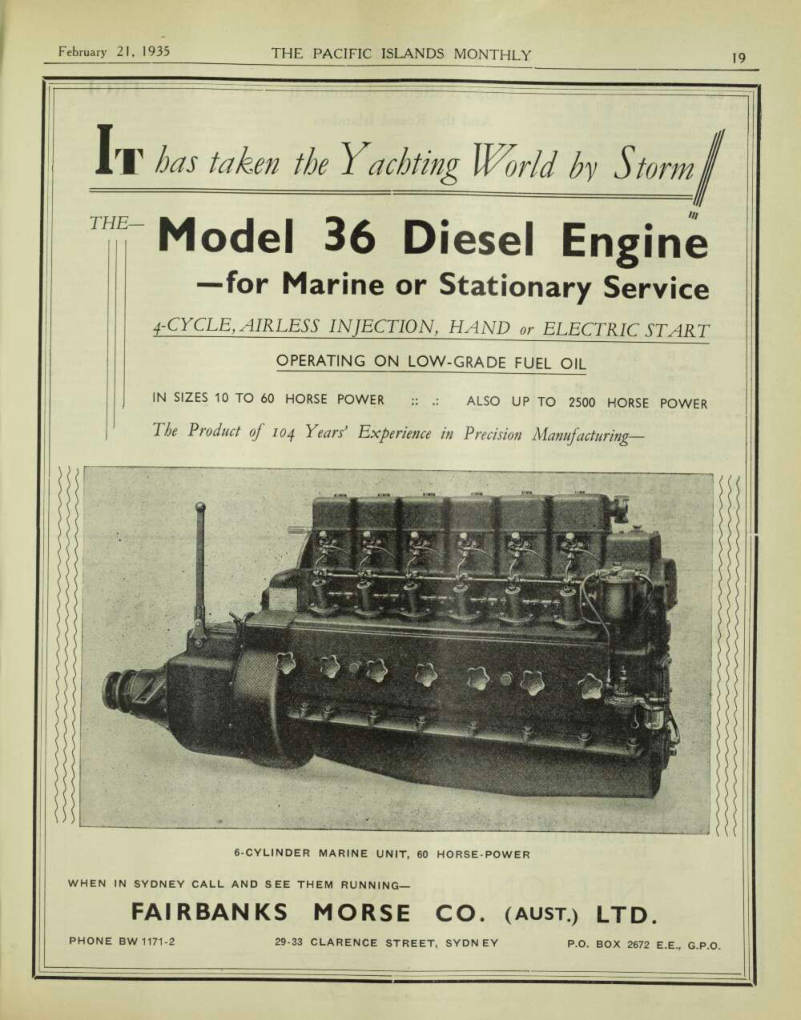
The Control of Sunlight
By R. R. Hanselmann, of Madang, N.G.
In the P.I.M. of June, 1934, there appeared an article by Mr. R. R. Hanselmann, of Madang, New Guinea, in which tropical resi dents were given a most valuable hint on how to grow vegetables by means of “raised gar dens.” There was so much interest in the subject that Mr. Hanselmann was invited to write more about gardening in the tropics, and he has kindly supplied the following hints to growers of vegetables and fruit.
DEAR Gardeners, —A number of friends, besides the gentleman in Daru (No vember P.I.M.) have responded to my article on Raised Gardens, and I would be only too delighted to hear more of honest trials made, for my experiences are truly satisfactory. No matter whether in town or on an isolated station, everyone can manage to have a few square feet of raised garden. Fresh parsley and mint, occasional crisp lettuce, or a few radishes, will make the bachelors smile; and, hus bands, your efforts will be repaid by a happier housewife.
In regard to varieties that grow best in this climate, I have come to various conclusions, but they are somewhat con ditional, depending upon locality and season. However, I can safely say that vegetables which mature more slowly— the winter cabbage, large variety of car rot, beetroot, the giant tomato (1¼lb. was my record), the purple kohlrabbi, and mignonette lettuce —give best results.
Earlier varieties seem to rush to maturity without much quality. After having used seeds from both America and Europe, I find that one Sydney firm offers a noble selection, and with zinc packing, present us seeds fresh and unspoiled.
Proper control of sunlight will give astounding results. Mignonette lettuce, planted on a raised garden, without any shade, grow in long stalks driving for seed; while that permanently under coco nut fronds (three feet above the soil) had fine leaves. The lettuce we left in per manent shade of a calico roof was crisp and very tender, but that under a latticed shade (a roof of two inch wide laths every two inches) delighted us with plants with a heart like a very loose leaf cabbage head. Carrots, again, do better without any shade.
So, gardener of Daru, here is ample room for extensive experimentation.
Incidentally, I found that our general method of gardening in the open soil is not too adaptable for this climate. Pos sibly, more than is being realised, the tropical sun evaporates the moisture of the soil. Garden beds well dug up and tilled are soon after the downpours so dry that the seeds cannot sprout, or the little shoots become parched and wither in the dry, loose soil. Indeed, shading helps greatly; but I dig six-inch-deep ditches, sow the seed in the bottom and have the boys trample down the soil. As the plants grow up, we will fill up the ditches with more soil, and it is surprising what different results are soon to be seen.
Pineapples, being an old stand-by in this country, possibly a hint here will not be amiss. About every three months, a lot of, say, two hundred suckers, planted, will give ripe fruit practically all year round.
Planted three abreast, in ditches 3 feet wide and 10 inches deep, with 4 feet wide alleys, will give the plants good footing by the time the ground is even again, soil being added as the growth requires. Here, however, is the real trick; instead of just breaking the fruit from its stem, cut leaves and suckers off even with the ground, and hardier suckers will follow.
Allow only two or three to come up and the patch will serve for many years with out its products losing in quality or size.
A few Cavendish bananas, planted in the alleys, will guard against insipid or sour tasting (sunburned) pines.
Seven years ago, our oranges and man derins were of age to bear, but as the following year brought no fruit we applied commercial fertilizer. The next year the trees were simply laden with fruit, but the crops have now diminished, so that many trees have only about a dozen or so of oranges. We are anxious to see what a new application of fertilizer will bring forth.
Coming back to “raised gardens": On an old cement floor, soil was boxed in, but nothing more than from an ordinary garden was the result. The few degrees
difference of the soil in the raised garden during the night must be of utmost im portance; and naturally, soil over nine inches deep in raised beds will prove detrimental. The better control of in sects in off-the-ground gardens must not be forgotten, either. Sheet iron, covered with a good coat of tar, or a mixture of water and cement with linseed oil, will guard against the very rapid rusting.
I wonder what the raised garden beds have in store for tobacco planters. Boys examining tobacco plants on my raised garden exclaimed: “Strong bilong white man e come finish long this fella brush.”
Raised beds also offer good nurseries for kapok, coffee, and fruit trees.
Rev. James Edwards, from Mala station of the Melanesian Mission, on Malaita, British Solomon Islands, arrived in Sydney on furlough by the Malaita on January 21.
Advertisements & other items, pp. 21-22 (1 item)
Model 36 Diesel Engine
It has taken the Yachting by Storm!
THE—
—for Marine or Stationary Service
4-CYCLE, AIRLESS INJECTION, HAND or ELECTRIC START
OPERATING ON LOW-GRADE FUEL OIL
IN SIZES 10 TO 60 HORSE ROWER :: ALSO UP TO 2500 HORSE POWER The Product of 104 Years’ Experience in Precision Manufacturing—
6-CYLINDER MARINE UNIT, 60 HORSE POWER
WHEN IN SYDNEY CALL AND SEE THEM RUNNING—
FAIRBANKS MORSE CO. (aust.) LTD.
PHONE BW 1171-2 29-33 CLARENCE STREET, SYDNEY P.O. BOX 2672 E.E. G.P.O.
FOR SALE
Steamer “BUCRA"
86’ 6” x 20’ 6” x 6’ 6”. 35 N.H.P.
Good speed on I 2 tons per 24 hours.
In PERFECT CONDITION throughout. Suit cargo, passengers, towing or any type Island work. Plenty of space for store or trade rooms; carry large cargo copra. Extremely low price.
A. J. ELLERKER
Shipbroker, 63 Pitt Street, Sydney Cables: “Hipex”
and ROBERTSON
ISLAND MERCHANTS. (Established, 1895.)
COCOA BEANS; Special attention devoted to their sale in Australian and Oversea markets.
COPRA, TROCAS SHELL, and other Island produce sold on commission.
All classes of merchandise purchased at wholesale prices and original invoices supplied to Island clients. Small commission.
SOLE AGENTS FOR
PUMPMOBIL, genuine portable pump, capacity up to 12,000 galls., weight 110 lbs.
PENTA ENGINES, utility outboard and inboard, Swedish manufacture, powers 4-60 h.p.
SKANDIA ENGINES, full diesel and semi-diesel, all powers, marine and stationary.
UPSON BRITISH BOARD, wallboard and insulating material in one, strong and light in weight. 6ft. to 12ft. lengths always in stock.
NELSON and ROBERTSON
12 SPRING STREET SYDNEY, AUSTRALIA
Telegraphic Address: “IVAN SYDNEY.”
Those Fattened Chinamen
And the Rossel Islanders
WHEN Mr. Jack Hides, who is now on an important special Government patrol in the centre of Papua, was Assist ant Resident Magistrate at Misima Island last year, he visited Rossel Island, a small irregularly shaped islet at the extreme end of the Louisiade Archipelago, about 100 miles south-east of Misima.
While there he investigated the well known story of the 300 Chinamen who were wrecked there some 60 years ago.
When the French boat Styx arrived on the scene of the wreck four months after wards, so the tale goes, they found that all except one lonely Chinaman had been fattened on a nearby reef and taken ashore to be eaten.
“I met and talked with an old Rossel Islander,” wrote Mr. Hides on his return to Misima Island, “and he explained to me the mystery which has confounded many people for so long. The Chinese were wrecked near the island, when their vessel foundered off the coast in bad weather. The captain and several others put off in a small boat to secure help.
The passengers and crew, numbering 326, made their way along the reef at low tide to Herron Island, a rocky little atoll about a mile from the Rossel Island main land.
“The little Rossel Islanders, afraid of such a large band of men, were frightened to attack them openly. Eventually, they conceived a cunning plan, and decided to bring the victims ashore a few at a time.
Two small canoes with two natives in each were paddled across to Herron Island and the Chinamen.
“By means of signs, the natives made the stranded men understand that there was plenty of food and comfort on the mainland, and that they would take them across in the canoes. Being small, each canoe could carry only one or two Chinese a trip. And so the massacre was carried out; canoe after canoe load of unsuspect ing Chinamen were taken over to Rossel Island, and butchered as they landed.
“The old Islander refused to tell me whether they were eaten or not. How ever, I am inclined to believe they were not, more especially if the Chinese had particularly yellow skins. The Papuans will not eat white pig, if it is strange to them. This may have been the case with the Chinamen.”
Sir William McGregor, who was Ad ministrator of Papua from 1888-1898, visited the scene some years after the occurrence, and in his report stated that the theory that the Chinamen had been openly attacked and killed was absurd.
Fifty Chinese armed with stones, he said, could have beaten off any tribe so small in physique and numbers and poor in weapons as were the Rossel Islanders. In view of this report, it seems that the account of a “pacific massacre,” as told to Mr. Hides by the old native, has some foundation of truth.
To-day the meek and gentlemanly Ros sel Islanders are in great demand in Papua as domestic servants; but they seem to have lost the great interest in life which formerly held them together, and they are dying out.
Matron F. Watson, of the Methodist Hostel for missionaries’ children in Suva, Fiji, returned to Australia by the Niagara at the end of December.
Peking Expert’s Opinion on
“Very Remarkable”
Peking Expert’s Opinion on Fiji Rock Symbols
SEVERAL months ago there were pub lished in the “Pacific Islands Monthly” photographs of a number of very strange inscriptions cut into rock faces in a cave in the northern Fijis, found by Mr. A. J. Vogan. Mr. Vogan, at great expense and incredible personal labour climbed into the upper recesses of this cave which is partly filled by water and made plaster replicas of the inscriptions. He claimed that the inscrip tions strongly resembled ancient Chinese script.
The plaster casts, rubbings from the rock faces, and photographs were brought to Sydney by Mr. Vogan and submitted to the University “authorities.” The latter treated the discovery very cavalierly, and did not even thank Mr. Vogan for sub mitting the specimens. Other “experts” were equally discouraging.
Mr. Vogan submitted photographs to Dr. Fox, who is acquainted with ancient Chinese writings; Dr. Fox was much in terested and sent the photographs to Rev.
Dr. Mathews, of the China Inland Mis sion, Shanghai: and Mr. Mathews sub mitted the photographs to Professor Kok, Chancellor of the Dutch Legation, in Peking, who is said to be one of the greatest authorities on Chinese writings.
The following are extracts written by Dr.
Kok: “The Fiji symbols are very remarkable indeed, and a thorough study of them may become of great value to the science of scripts . . There is indeed some similarity between these Fiji symbols and ancient Chinese script . . . Evidence from ‘books’ is less reliable than stone, bronze, or bone inscriptions, which take us back to 600-900 B.C.”
Dr. Kok asks for information about any further discovery of scripts in Fiji.
As a result of the article published in the “Pacific Islands Monthly” of July last, Mr. Vogan has had many letters; and among them is information about even more remarkable rock inscriptions in another part of Fiji. Mr. Vogan is making plans to visit Fiji to examine this latter discovery more closely.
Papua
Early Miners In East
A CORRESPONDENT in the Trobri ands, Eastern Papua, declares that Mr. Robert Bruce’s history is all wrong, in his recent references (Sept. P.I.M.) to Pat O’Hara’s gold find in Eastern Papua.
Our correspondent says: Cloudy Bay Goldfield was discovered by Frank Pryke and George Klatz, about 1901. The field petered out in 1903, and the miners left for the Yodda field —they were not driven out by natives. Gitara Goldfield was found by Linden, Jack Gray, and Jacob early in 1899; and soon there were 150 to 200 men there. Mrs. Mahony then opened the Cosmopolitan Hotel.
Mr. Bruce’s story about Pat O’Hara going over to the mainland and returning with a chamois of gold is “rot.” O’Hara was never in Samarai. There were 150 to 200 men working at Gebera, and on the mainland opposite Samarai five years before the time of which Mr. Bruce speaks.
The Cloudy Bay miners were not chased out by natives. They stayed there, in
spite of the man-eating Orakivas—the gamest fighters in Papua—so long as there was an ounce of gold. The Ora kivas tried hard enough—to their sorrow.
Guarding France’s Pacific
Colonies
From Our Own Correspondent.
NOUMEA, January 1.
THE Amiral Charner, which has re placed the sloop Aldeberan in these waters, has been cruising on the east coast, where she visited all the principal towns. She is stationed in the Pacific, and will protect France’s possessions: New Caledonia, the New Hebrides, Wallis Island, and the Society group. As the Aldeberan was constructed in 1917, France decided to replace her by the modern Amiral Charner.
France’s new colonial fleet consists of six cruisers which are already in service.
In Indochine, Dumont d’Urville, Savorg nan de Braza and the Regault de Genouilly; for the Indian Ocean, Madag ascar and Reunion, the Bouganville; for Guadeloupe and Martinique, the d’En trecasteau; and for the Pacific, Amiral Charner. The seventh, D'Iterville, is soon to be launched, and five other cruisers are being constructed in France to sup plement the fleet.
Advertisements & other items, pp. 23-24 (1 item)
Gillespie’S
“ANCHOR ”
FLOUR
TRADE
MARK
The Standard of Quality.
THE LARGEST STOVE . . .
in the Pacific Islands is installed at the Bulolo Hotel, Wau —and it is a
YOUNGER
YOUNGER Stoves and Ranges are widely used throughout the Pacific Islands, for they embody in their construction everything calling for Efficiency in Working, Economy in fuel consumption and Durability.
Special Stoves for Island requirements with cast-iron ovens.
Write for quotations and catalogue of single and doume oven stoves.
G. FLETCHER & SON
50 OXFORD STREET. SYDNEY
TIMBER, JOINERY,
Etc.
PREPARED BUILDINGS
ready for erection a speciality.
SHIP and BOAT BUILDING
TIMBERS specially catered for
FIBROLITE, PLYWOODS,
GALVANISED IRON,
CELOTEX.
CONSIGNMENTS shipped by
RETURN STEAMERS to the
Islands.
JOHN W. EATON LTD.,
WEST CRESCENT ST.,
NORTH SYDNEY
TELEPHONES: X 5051 (5 lines)
The
“Caledonia Dover”
A COOKING STOVE guaranteed to give complete satisfaction and now recognised as THE BEST on the market. Suitable for coal, coke or wood fuel.
Illustrated Catalogue on request.
LANE & GIRVAN, LTD.,
BONNY BRIDGE, SCOTLAND.
Above: Gardner - Denver V. type 4-cyl.
Compressor with standard steel wheel mounting.
At Side; The new Gardner- Denver Model SSS hand-held drill.
MINING AND ROAD
MAKING EQUIPMENT
Included in the range of equipment for Mining and general Road Constructional and Maintenance work stocked by Noyes Bros, are the products of the Gardner- Denver Co., makers of Pneumatic Rock Drills, Compressors, etc., for nearly half a century.
The efficiency, rugged construction, ample power and long-wearing life of Gardner- Denver units mean savings in time, money and labour on every job.
Portable Compressors are now available powered by compression ignition or petrol engines. These units are also made on spring-mounted rubber-tyred wheel assemblies, as well as the standard steel road wheels.
Ask for details of the full range
NOYES BROS.
(Sydney) LIMITED
115 Clarence Street, Sydney
BRANCHES AT NEWCASTLE AND BRISBANE
Solomon Islands
Anomalies of New Wage Scale
From Our Own Correspondent.
Tulagi, Jan. 15.
THE first recruits at the new rate of pay have been signed on. Not many orders are out, and recruiters, interviewed at Tulagi, report that the natives have been well prepared by their District Officers for the altered wages, as no one seemed surprised when recruiters ex plained the new terms. Many natives who would recruit at the new rate, baulk at the proportionately reduced advances at the time of signing on with the recruiter.
There are many anomalies and incon sistencies of which employers are guilty, in connection with native wages, which make it doubly hard for the prospective recruit to reconcile himself to the reduc tion. Labourers employed for two weeks’ work on the steamer get six times the minimum adult wage-rate of a boy en gaged for two years’ service.
Recently, some boys at Tulagi had a chance of a trip to Sydney, and held out for eight times the local wage—thereby missing a trip South, at a wage well
above the minimum. Other natives eagerly seized the opportunity.
New “Cash And Carry” Store
B.P.’s new “cash and carry” is well under way, having opened its business with the New Year.
The site is a particularly convenient and desirable one, and would be very useful to the firm as headquarters if ever circumstances should permit the building of a Government wharf and bond stores at Tulagi, in which case B.P.’s present place of business on the separate island of Ma kambo would be very inconvenient. Whether the available land would suffice for the entire B.P. establishment remains to be seen, but quite a few of the clients would be glad to save the trouble of crossing from Tulagi to Makambo.
Charting Vella Lavella.
Quite a few services performed in the Solomons remain unrecognised, and being unknown, are not availed of. Some time ago an official of the Lands Department had occasion to visit Vella Lavella on a special mission, and he took the opportunity of making an accurate map of Vella Is. As the Admiralty chart of Vella consists chiefly of dotted lines in the wrong position, this map, if supplemented by even approximate reef indications (not a difficult task when the coast line is filled in accurately), would be of great value to navigators.
The map is being used so far only in district maps of the group for official use, and for this purpose will probably have to be reduced in scale. The original larger-scale map would make a valuable addition to Admiralty charts, or, if made available by the Administration would be useful to Gizo residents and others in need of navigation help. Maps are being prepared of all districts, and if anything helpful like this plan of Vella is incorporated in them, they will be well worth the trouble the Lands and Survey Department has taken over them.
Xmas Ball At Tulagi
Christmas has passed with very little excite ment. His Honour the Resident Commissioner gave a ball—an unusual social event for Tulagi— to be accounted for by the presence in the Group of Mrs. F. N. Ashley to act as hostess. Very few Tulagi residents went away for the several days’ holiday—partly on account of the event of the Residency, and partly because of the danger of being prevented by the nor-west season from getting back in time for business and the Malaita’s arrival. As it happened, the weather was good.
An unprecedented event has occurred. H.B.M.'s Treasury has been disgorging overpayments, some of them despaired of, while others were over charges of which the suffering public were un aware. If this sort of thing goes on, Government departments will be making themselves popular.
The Resident Commissioner, with Mrs. and Miss Ashley, is at present spending a fortnight in Gizo. They arrived by H.M.C.Y. “Tulagi,” and are residing in the now unoccupied Medical Officer’s bungalow. Already sensible social con tact has appreciably eased the old feud between Tulagi officialdom and Western ideas of sane, progressive, and just administration.
The nor-west season to date has been sur prisingly good, although everybody is more or less prepared for the blow at any time.
When the Malaita left for Sydney the price of copra had risen to £8 per ton locally. While the strained international situation which causes the rise is deplored, planters cannot help rejoicing at the improvement in price of their staple product.
Melanesia
Mission Ketch Sails for Melanesia
CARRYING a cargo of Bibles and explanatory booklets to be distributed to Melanesian natives, the auxiliary ketch Lightbearer, manned by seven evangelists, sailed from Sydney for the Western Pacific on January 25. The party are all members of a non-denommational body called the Watch Tower Bible and Tract Society.
The following day the ketch returned to port, having developed engine trouble a few hours after leaving Sydney harbour. Repairs were effected and she sailed again on January 31.
The Lightbearer, which is one of the best equipped vessels of its size in Australian waters, is commanded by Mr. E. Ewins. She will call at Lord Howe Is., Papua, Thursday Is., Torres Strait Islands, and Batavia.
The Quintals Of
Norfolk Is.
WITH the death of Cornelius Quintal (“Uncle Cornish”) at Norfolk Island on February 10, 1934 (writes Mr. W. D.
Evans, in the “Sydney Morning Herald” of January 19) the band of 194 Pitcairners who arrived on June 8, 1856, by the “Morayshire” is slowly disappearing.
Cornelius Quintal was a grandson of Mathew Quintal, one of the youngest members—he was only 21—of the “Bounty” mutineers, who sent Lieutenant William Bligh, R.N., with 18 loyal mem bers of the crew on a 3600-miles voyage to Koepang, in Timor, in the ship’s launch. Later, young Quintal joined Fletcher Christian, leader of the mutiny, and eight other “Bounty’’ men when they sailed with 12 Tahitian women and six Tahitian men for Pitcairn Island.
Many Quintals, speaking perfect Eng lish, in addition to their quaint Tahitian- English patois, continued Mr. Evans, are domiciled on historic Norfolk Island to day. So, too, are many other descend ants of the Bounty crew, and of those who linked up with them on Pitcairn Island in 1818 and 1828.
Another worthy member of the Quintal family was a sergeant in a New Zealand contingent, which was engaged in veldt and kopje fighting in the Boer War. Ser geant Quintal was a fine athletic type of soldier, lighter-complexioned than many of the half-caste Maoris of the force. He was an excellent horseman, cool-headed, and possessed of bulldog courage.
The intermarriage of the Pitcairn Islanders over a period of 111 years, con cluded Mr. Evans, found no reflex of de generacy, or decadence in physical or mental attributes, in the case of this dauntless fighter.
Through Hurricanes
And Heavy Seas
Adventures of 70-years-old Sailor
From Our Own Correspondent.
Apia, Jan. 17.
TWO years ago two old sailors, in whom the memories of the sea and the love of adventure still pulsed strongly, made up their minds to abandon the hustle of an American city and roam again in search of the colourful and romantic life of the South Sea Islands.
In the 22ft. yawl “Chance,” Captain John Dow, over 70 years old, but still hale and hearty, with his friend Captain John H. Meyers, left New York to sail via the Panama Canal to the Pacific.
The two old adventurers got all the adventures they had longed for. They went through two hurricanes and only by hanging on with their last strength managed to reach Panama. But the glamour of sailing the world in a tiny nutshell had paled considerably to old Captain Meyers. He decided that a month’s experience in the “Chance” was good enough for him, and that he would take his chance on firm soil. So he left the boat at Panama.
Captain Dow, however, was not dis couraged. Unabashed, he set sail from
Panama into the wide Pacific, and so far, in spite of many dangerous adventures, has been fortunate. Leisurely he roamed about, reaching the Galapagos Islands and the Marquesas in the course of his sailings, breaking his voyage wherever it pleased him, staying with newly acquired friends on the hospitable shores of strange islands. The trip from the Mar quesas down to Pago Pago, American Samoa, proved to be very nearly the end of his career. He reached Pago Pago at last, the “Chance” leaking about 25 gal lons an hour, and with only a few bis cuits and very little water left.
He rested a while at Pago Pago, re pairing his boat and gathering strength to continue his trip. On November 12, he reached his next destination, tiny Swain’s Island (or Gente Hermosa) a few hundred miles north of the Samoan Islands. The island, American territory, belongs to Mr. Eli Jennings, and is planted in coconuts. Only Mr. Jennings and another European, with a crowd of native labourers, reside on the island, where the lonely voyager intends to re main for a year or so, before setting out for the Philippine Islands.
Output from the New Guinea goldfields in November amounted to 21,033 ounces, worth £136,401 in Australian currency.
Advertisements & other items, pp. 25-26 (1 item)
Kemp
Impregno Steel Surface
Hardening Compound
For local hardening by sprinkling the compound on the hot steel part, or for case hardening to a depth of one thirty-second of an inch by treating the object to be casehardened in a molten bath of the compound. Equipment required, an open fire, a steel pot, and a tin of compound.
IMPREGNO Case Hardening Crystals
For muffle case hardening.
IMPREGNO Quenching Oil is an invaluable aid to the satisfactory hardening of gears, tools, etc.
Firms handling Engineers’ Supplies or Hardware are invited to communicate with us with a view to acting as distributors for these lines.
THE . .
Steel Improvement Co.
102 BAY ROAD, NORTH SYDNEY,
N.S.W.
Woven Wire for All Industry
COPRA DRYING TRAYS, FLOORS, Etc.
FRUIT DRYING TRAYS, MINING SCREENS
Heavy Mosquito Gauze in Phosphor Bronze and Other Metals Impervious to Salt Sea Air WIRE DOOR MATS AND GENERAL WIRE WORKS
E. WRIGHT & CO. LTD.
Office and Works: 148-152 Cleveland St., Sydney, N.S.W.
Telegraphic Address: “Wrightmake,” Chippendale.
The Genuine
KEMP
Safer for Horse and Rider Improved Design This super quality masterpiece contains all that is wise and new in modern craftsmanship. The KEMP is specially designed for Island use, being built on a rustless, heavily bar-plated tree, oiled kip leather throughout, and handsewn. Extra long flaps. Pads 3” or 4” high, V/ 2 ” dip in seat.
Fitted with Bevelled Leathers, Folded Girth, 4-bar Stirrups & Surcingle £7/7/-
FREIGHT FREE
Not until you ride in the Kemp can you appreciate its superb riding comfort.
Write for new Catalogue P., 1934.
Sydney’s High-class Saddler
NEWMARKET SADDLERY
W. H. Williams for “Safer” Saddles.
Registered Office and Factory: 18-20 WILSON STREET, NEWTOWN, N.S.W.
Tie On Gas Mantles
Something Better for your Lamp
FLEXIBO LIGHTING CO.
9-15 KIPPAX STREET SYDNEY
Manufacturers of the famous Flexibo Gas Mantle, suitable for all petrol storm-proof lamps, table lamps, tilly lamps, and all hollow wire systems. Flying insects will not break this mantle. Agents wanted —samples to all prospective reputable agents.
M. HARPER
MANDOLIANA ISLAND,
NORTH GELA, B.S.I.
Postal Address: P.O. Box 6, Tulagi, Solomon Islands.
Recruiting Contracts Undertaken.
Auxiliary Vessels “Papari” and “Trader” available for Charter.
Full details of Services from
BURNS PHILP (S.S.) CO., LTD.,
Makambo (B.S.I.) and Sydney.
SPRINGS
John While & Sons Ltd.
MANUFACTURERS OF ALL KINDS OF SPIRAL AND
MACHINERY SPRINGS.
Established 1885.
CRYSTAL and WESTBOURNE STREETS
PETERSHAM, N.S.W.
J.W. Shock Absorbers J.W. Wheel Wobble Controllers Gate Springs Spring Washers Agricultural Implement Springs.
Car Spring Specialty.
Upholstering Springs.
Prices on Application.
THERE ARE PAINTS AND
PAINTS!
BUT THERE IS ONLY ONE
FERRODOR PAINT
The value of a Paint is not its cost per cwt, or per gallon, no its covering capacity, but its efficiency as a protective coat for the surface to wh.ch it iis applied. Cheap, inferior Paints cost just as much to apply as good Paint, but the labor cost is repeated within a year or two.
USE THE WORLD’S BEST ANTI-CORROSIVE PAINT
FERRODOR
It combines Long Life and great Covering Capacity, with Moderate Price.
It can be Supplied in Paste Form, or Mixed Ready for Use.
Full particulars and color card from
WILLIAM ADAMS & COMPANY LIMITED
175 CLARENCE STREET, SYDNEY
Sweeps Bottle Messages Across
Queer Ocean Current
Sweeps Bottle Messages Across the Pacific
THERE is evidently a remarkable current flowing from east to west in the Central Pacific, a few degrees north of the Equator.
A resident of Jaluit (Marshall Islands), a well-known missionary, makes a prac tice of collecting and returning to their senders messages which arrive in bottles on the various atolls, having been thrown overboard from ships.
We have just seen two of the latter.
In the first case the message was thrown overboard from R.M.S. Niagara half way between Suva and Honolulu on February 11, 1934, by a passenger, Mr, Dynes Fulton, of New Zealand, who was then en route to England. The bottle was picked up at Mille, in the Marshall Islands, on July 2, 1934, and sent to the missionary at Jaluit. Mille Lagoon, in cidentally, was a favourite resort of the
famous Pacific bucaneer, Bully Hayes.
In the second case the message which the bottle contained was evidently com piled on August 18, 1932 by a merry party aboard R.M.S. Monowai, which was north-bound and practically on the Equator. The merrymakers contributed many quips and jokes, and their signa tures apparently are W. H. Castle, Gene Ermington, of Los Angeles; Sylvia Par ker, of Hollywood; Dennis McGrath, solicitor, of Wellington, New Zealand; A.
E. Foster, of the Union S.S. Co., Welling ton; and W. McClure. This message was picked up at Rongrik Island, Marshall Group, on April 8, 1933 —very water stained but quite decipherable.
The “Pandemonium”
Government
Letter to the Editor.
I HAVE read with interest the views expressed in the “P.I.M.” by some of the residents in this group, the New Hebrides, deploring the position in which the British subjects find them selves.
While it is true that we British are in an extremely tight corner, and that something should be done to assist the planter and trader until copra in particular shows a substantial recovery, it seems most unfair to cast blame for the exist ing state of affairs upon the resident representa tives of the British Government.
Obviously, the only sort of help that is of any use to the colonist is money, be it in the form of direct bonus, subsidy, or protection; and it is difficult to see how the Resident Commissioner can supply that.
I know little indeed of Administrative affairs, but it appears to me that the Resident Commis sioner’s job and that of his staff is mainly to main tain the prestige of the British flag, and, inci dentally. keep their end up, and to make adequate representation to the Colonial Office of conditions in the group under their administration. These duties are, I maintain, most ably carried out.
One supposes that, for any assistance to be forthcoming, the Colonial Office, acting upon ad vice from the Resident Commissioner, would be obliged to petition the Government for a bill authorising the necessary expenditure and as one cannot doubt that all that has been done, there appears to be little use grousing further.
If the British Government chooses to forget their nationals more or less, languishing in this group, it will not be the first occasion for such for getfulness.
One of your contributors remarked that he had not seen the Resident Commissioner for some years and that he did not care if he did not see him again for a like period. I have little doubt that such sentiment was entirely recipro cal; but one cannot quite get at the mental process of a man who expresses it so.
I have just read your article on the “Pande monium Government,” in your September issue.
You appear to have missed but little.
French colonists may recruit women for house or other work from any part of the Group, no matter how distant, while the British colonists may recruit only women residing within a radius of ten miles from their station. Now, a woman, recruited to work near her own village, is almost completely useless, especially as she may be signed on only for a period of three months. If she breaks a plate, and “Missus” has a few words to say about it, she either runs home and has\ to be re-recruited at some expense and vast trouble, or else she breaks some more plates— perhaps to show her independence—who knows.
Another thing: Explain it as we may, the man who is fortunate enough to have a number of women on his pay roll never has difficulty in recruiting male labour.
I am, etc.,
Marooned.
New Hebrides, 18/11/35.
Mass Protest
B.S.I. Natives Complain About Tax Exactions and Harsh Treatment in Gizo Gaol.
From a Special Correspondent.
Gizo, Jan. 9.
THE natives of the Gizo district, B.S.I., combined recently in a manner, and to an extent that surprised European residents, in what appears to be an organised effort at passive resistance to the tax demands of the Government.
Over 40 natives having been sent to prison for failure to pay, sympathisers numbering between 600 and 700 congre gated at Gizo, and lodged heated pro tests against the tax exactions, which they claimed constitute a severe hardship at a time when the price they receive for their produce is so small. They also complained that the treatment meted out to their fellow-natives undergoing sen tences of imprisonment was unduly harsh.
The Gizo District Officer assured them that cases where individual natives found difficulty in paying their tax would be closely and sympathetically investigated, but he was satisfied that most of them could pay, and these would be compelled to comply with the law. An investigation would also be made into the manner in which prisoners in gaol were treated. He knew of no case of harsh or ill-treatment.
It is understood that the Methodist Mission, which operates in the district, has made certain representations on behalf of the natives to the High Com missioner for the Western Pacific (Sir Murchison Fletcher) and there, for the present, the matter stands.
Mystery Death
Did Patrol Officer Bird Die From Insect Bite?
THERE has been much comment in the A Territory and in Australia regarding the death of Patrol Officer W. H. Bird, of New Guinea, who died in Salamaua hospital on January 15.
At first it was thought that he died from a severe bout of fever, but it was later announced that his death was the result of septic conditions caused by the bite of some mysterious insect. For six weeks prior to his death, it is stated, he suffered excruciating agony, and both his legs became paralysed.
His boys carried him over rough moun tain tracks in the Markham Valley to the nearest aerodrome. Bad weather, how ever, delayed the ’plane, and finally, when he did arrive at Wau, there was no room available for him in the hospital, and he had to be taken on to Salamaua, where he died.
Commenting on Mr. Bird’s death, a leading Melbourne entomologist said he doubted whether the death was caused by the bite of an unknown insect. It was more likely, he said, that the patrol officer was bitten by a poisonous spider, of which there are thousands of species in the Ter ritory. Even then, he stated, it was doubt ful whether the poison would take six weeks to kill.
In view of the circumstances surround ing the young officer’s untimely death, it does seem that some investigation is called for on the part of the New Guinea Health Department.
Picnic
Sir Hubert Murray’S
From Our Own Correspondent.
Pt. Moresby, Jan. 10.
THE Government yacht Laurabada was gaily decorated with bunting, and left the wharf punctually at 3 o’clock, with an eager crowd on board, when Sir Hubert Murray, Lieutenant- Governor of Papua, gave a picnic to the Port Moresby children and their parents on December 31. The adult passengers were delighted with the scenery as the vessel cruised around Pt. Moresby’s beautiful harbour, then out to Manubada and the barrier reef; and with the yacht’s smooth motion through the still, calm water.
But the attention of the children was focussed upon things other than scenery. Bags of lollies, huge sections of cake, ice creams, innumerable highly coloured and highly flavoured soft drinks, the freedom of the ice chests, these and other delights kept them in a condition of ecstasy until the trip ended with heartfelt cheers for their host.
Advertisements & other items, pp. 27-28 (1 item)
“Service”
Sutton’s
Canned Vegetables
GREEN PEAS
in ½lb., 1lb. and 2lb. tins.
FRENCH BEANS
(sliced), in ½lb. and 1lb. tins.
Delicia Food Products
Co.
DANK STREET, WATERLOO,
N.S.W.
Est. 1916
“Service”
LEATHER BELTING
The secret of the success of “Service” Brand Belting is in the long tanning process.
Laminated Belting and Mechanical Leathers “Service” Brand is Unequalled for all classes of Drives.
W. H. LITTLEWOOD
38 EWART ST., MARRICKVILLE, N.S.W. Tel. 552 Pet.
Tannery: ULLADULLA, N.S.W.
Catalogue on Application. Applications received for Agency.
n
THE CHAPMAN DIESEL MARINE ENGINE
Heavy Duty Type shewing high propeller efficiency. Patented Starting System. No comair, no wicks or cartridges, no blowlamp, no cranking handle, no valves. 15 h.p. Runs on Black Oil costing sixpence a gallon at Sydney; consumes six gallons in 10 hours. Price of engine complete £325 ex factory.
CHAPMAN & SHERACK, Clara Street, Erskineville, N.S.W., Manufacturers and Patentees
DRIVE YOURSELF
during your stay
in Sydney
in a 1934 Model Sedan at 6d per mile. Minimum from 15/ per day.
Write or cable, and we will reserve a car for you. Free Service all over N.S.W., with advantages enjoyed by N.R.M.A. members.
Martin’s Drive Yourself
Service
191 WILLIAM ST., SYDNEY
F 1092.
GIOBEX
(GLOBE BEEF EXTRACT)
GLOBEX
FOR GOOD BEEF TEA
GLOBEX
FOR SOUPS & GRAVIES
GLOBEX
DELICIOUS SPREAD THINLY ON BREAD
Obtainable from All Island Traders
READ THE
B.P. MAGAZINE
AUTUMN NUMBER
On Sale Ist March Short Stories Pictures Travel Articles Pages for the Children. Stage.
Latest Fashions Screen One Shilling per Copy ON SALE AT ALL NEWSAGENTS AND BOOKSELLERS BP
Motuan Traders Abandon
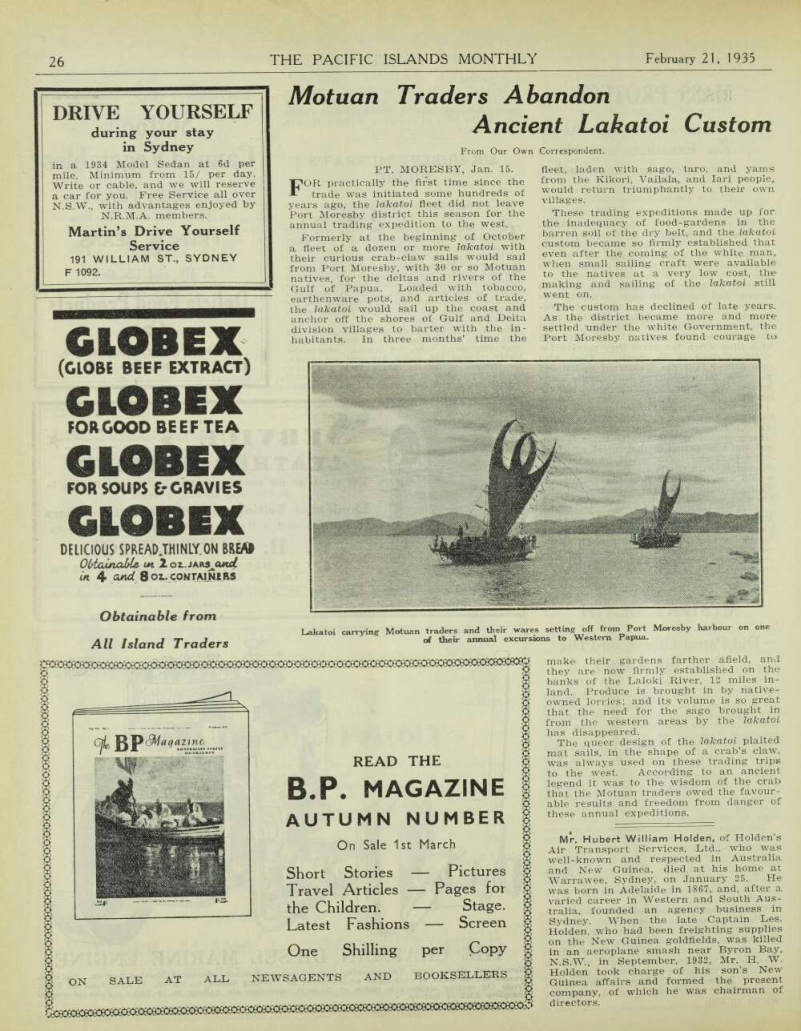
Ancient Lakatoi Custom
From Our Own Correspondent.
Pt. Moresby, Jan. 15.
FOR practically the first time since the trade was initiated some hundreds of years ago, the lakatoi fleet did not leave Port Moresby district this season for the annual trading expedition to the west.
Formerly at the beginning of October a fleet of a dozen or more lakatoi with their curious crab-claw sails would sail from Port Moresby, with 30 or so Motuan natives, for the deltas and rivers of the Gulf of Papua. Loaded with tobacco, earthenware pots, and articles of trade, the lakatoi would sail up the coast and anchor off the shores of Gulf and Delta division villages to barter with the in habitants. In three months’ time the
fleet, laden with sago, taro, and yams from the Kikori, Vailala, and Iari people, would return triumphantly to their own villages.
These trading expeditions made up for the inadequacy of food-gardens in the barren soil of the dry belt, and the lakatoi custom became so firmly established that even after the coming of the white man, when small sailing craft were available to the natives at a very low cost, the making and sailing of the lakatoi still went on.
The custom has declined of late years.
As the district became more and more settled under the white Government, the Port Moresby natives found courage to
make their gardens farther afield, and they are now firmly established on the banks of the Laloki River, 12 miles in land. Produce is brought in by native owned lorries: and its volume is so great that the need for the sago brought in from the western areas by the lakatoi has disappeared.
The queer design of the lakatoi plaited mat sails, in the shape of a crab’s claw, was always used on these trading trips to the west. According to an ancient legend it was to the wisdom of the crab that the Motuan traders owed the favour able results and freedom from danger of these annual expeditions.
Mr. Hubert William Holden, of Holden’s Air Transport Services, Ltd., who was well-known and respected in Australia and New Guinea, died at his home at Warrawee, Sydney, on January 25. He was born in Adelaide in 1867, and, after a varied career in Western and South Aus tralia, founded an agency business in Sydney. When the late Captain Les.
Holden, who had been freighting supplies on the New Guinea goldfields, was killed in an aeroplane smash near Byron Bay, N.S.W., in September, 1932, Mr. H. W.
Holden took charge of his son’s New Guinea affairs and formed the present company, of which he was chairman of directors.
Lakatoi carrying Motuan traders and their wares setting off from Port Moresby harbour on one of their annual excursions to Western Papua.
B.S.I. Boys Are Scornful
Those Bungling N.G.
Wharfies!
From Our Own Correspondent.
Tulagi, Jan. 11.
WHEN the B.P. liner Malaita arrives in the Solomons each trip, a gang of B.S.I. boys is picked up as cargo workers to unload her freight throughout the group.
Usually, when she leaves the Northern Solomons for Rabaul (in the Mandated Territory of New Guinea) the natives are left at Faisi until the Malaita returns to pick them up again on her voyage down through the group to Sydney. On a recent trip, however, the B.S.I. boys were carried on to Rabaul, and spent much time in interested study of the New Guinea freight workers.
Their caustic remarks on the return to Tulagi about the way in which their New Guinea friends mishandle cargo, if true, show that the extended tour is not likely to improve the way the Solomon Island labourers handle things. Apparently, cases of beer are banged on wharves by the New Guinea wharfies till the wharves re semble pools of lager, and other cargo is treated with equal disrespect.
Policemen, in uniforms that greatly im pressed the Solomon boys, according to reports, stood uselessly by. Apparently, neither our labourers nor our police are likely to be improved by seeing how things are done in the Mandated Territory.
by “Waikawa”
Bananas And Cocoa
Beans
First Samoan Shipment to N.Z. by “Waikawa”
From Our Own Correspondent.
Apia, Jan. 21.
THE “Waikawa,” due to leave Apia on January 17, with the first shipment of 4,000 cases of bananas for the Auck land market, was unfortunately delayed nearly a full day owing to the inclemency of the weather. The quantity of bananas offering for shipment was somewhat smaller than usual, as growers have not yet adapted themselves to the new arrangements providing for two banana shipments a month. However, a full shipment was at last procured.
Special care was exercised by the inspectors to ship only fruit of excellent quality, which should well stand the dif ferent conditions of transit. The voyage direct to Auckland takes only six days, compared with 11 days by the “Maui Pomare.” It is confidently expected that the bananas will reach Auckland in good condition and they will find a ready market there, as lately Auckland prices for bananas have been exceptionally high owing to a dearth of fruit offered.
The “Waikawa” also took a shipment of 800 bags of Samoan cocoabeans for the New Zealand and Australian mar kets. A very good crop of cocoabeans has been picked during the last few months, though lately the incessant rains have caused quite a lot of damage on plantations, and a large proportion of cocoapods turned black. The season’s crop, however, is nearly finished.
Of Savo, B.S.I.
Death Of Mrs. F. Keeble,
From Our Own Correspondent.
Tulagi, Jan. 3.
ANOTHER well-known resident of the Group, Mrs. F. Keeble, of Savo, has passed away. Mrs. Keeble, who came from Orange, was a sister of the late Mrs.
James Risby, of Savo, and of Mrs. A.
Olsen, of Guadalcanal. Her long years of residence had preyed upon her health, and she was, a few months ago, compelled to take a long holiday South. She re turned much improved, but was only back in the Solomons a few weeks when she again became ill. She was taken to Tulagi Hospital, where she died on December 7.
Her husband, at present, is managing the Fara Estates on Santa Isabella Island.
His own property is at Savo, a small vol canic island in the D’Entrecasteaux Strait.
Advertisements & other items, pp. 29-30 (2 items)
Shirts, Pyjamas
Malt & Hops
(SOLID BEER)
MADE FROM THE
FINEST ENGLISH
MALT & HOPS
STOCKED BY:
Burns, Philp & Co., Ltd.,
RABAUL
MAKERS :
Paine & Co., Ltd.,
St. Neots, Hunts., England.
“WYRNWAY” BRAND
SHIRTS, PYJAMAS
UNDERWEAR AND TIES
ARE QUALITY PRODUCTS
WEARNES LIMITED
MANUFACTURERS 17 PARKER ST„ SYDNEY
You Must Visit
The PARIS INTERNATIONAL TRADE
FAIR
To be held from MAY 18 to JUNE 3, 1935 Whatever your business, there is a definite advantage in the knowledge of progress being made abroad.
With a marvellous exposition of the world’s manufacture, the Paris International Trade Fair offers the most convenient, economical and pleasant method of gaining this knowledge.
In 1934 the Paris Trade Fair occupied 4,000,000 sq. feet of space, and visitors from all parts of the world numbered over 2,000,000.
Make Paris Your Headquarters in
May, 1935
For full information, write to the FRENCH TRADE COMMISSIONER, 7 WYNYARD STREET, SYDNEY
SPENCER NOLAN
DENTIST
28 OXFORD STREET
(Over Winns’ Ltd.)
SYDNEY
’Phone F 3215 Cable Address: Fastplate, Sydney
SPENCER NOLAN
DENTIST
139 ELIZABETH STREET
(2 doors from Market St.)
SYDNEY
'Phone F 3215
DELICIOUS!!
HE crisp, tempting quality of
ARNOTT’S FAMOUS SAO
BISCUITS is the result of 64 years of specialisation. They stand unrivalled in quality and excellence. For lunch or supper they are delicious with butter and cheese, fresh and stewed fruit, ham paste, or savouries.
ALWAYS ASK FOR ARNOTT’S
AND BE SURE YOU GET THEM
W. M, Reid
C/o Robert Reid & Co., Ltd.
32-34 YORK STREET, SYDNEY
Wholesale Exporter of Goods of all Classes from Australia
Cook Is. Citrus Fruits
Efforts to Improve the Industry
From Our Own Correspondent.
Rarotonga, Jan. 14.
CITRUS fruits shipped from the Cook Is. for the past few years have not been too satisfactory, but strenuous efforts are being made to place the industry on a basis by which it will be possible to supply the New Zealand market with high class citrus fruits. Various planters—the Cook Islands Trading Co. in particular—have imported a large number of specially selected varieties of oranges, lemons, and grape-fruit, which are now coming into bearing. These plantings of new trees combined with the pruning, spraying, and cultivating of the existing trees, will result in Cook Is. citrus fruits being produced under simi lar conditions of cultivation as those pertaining in Florida, California (U.S.A.), and other pro gressive citrus growing districts.
The Cook Islands Trading Co. has two plan tations at Rarotonga on which a considerable amount of citrus development has been made along lines generally in advance of anything yet attempted at the Cook Is. High-class cuttings have been imported from California and else where, planted out, cultivated and carefully
watched. Comprehensive data will thus be avail able for those interested in the rehabilitation of existing orange trees, and the more scientific raising of citrus fruits generally.
Up to the present the native trees have been the sole source of supply of oranges for export v The fruit from these trees ripens during the severest part of the New Zealand winter, when the marketing conditions are in their most un favourable state. In addition to this the oranges, while they are wonderfully juicy and well flav oured, are not particularly good carriers and the percentage of loss on their arrival in N.Z. is usually very high. The object of the experi mental plantings is to introduce varieties of oranges which will ripen earlier than the exist ing native ones, and also oranges which will mature after the native crop is finished. By this means it is hoped to extend by several months the local orange season, allowing the early varieties to catch the end of the N. Zealand summer market and the very late varieties the spring. It is hoped, in this way, to secure bet ter average prices for the season as a whole.
On the Cook Is. Trading Co.’s plantations par ticular attention has been given to the intro duction of oranges of good carrying properties.
Washington Navels have been selected for the early varieties and Late Valencias for the end of the season crop. Experimental plantings also have been made with Mediterranean Sweet, Norris Early and Lue Gim Gong. These have been carried out on a variety of root stocks, so that later on valuable information will be available both as to the most suitable oranges to plant and the most satisfactory root stocks on which to have them budded. In addition to this con siderable plantings have been made of grape fruits and lemons, including the Meyer variety of lemon. In almost every instance the choicest varieties of Californian citrus trees have been introduced, so that the finest and best grade of fruit may be expected when the trees reach a commercial bearing stage.
By means of cultivation, manuring, and the planting of suitable breakwinds, young Washing ton Navel trees scarcely three years old are already in bearing. Also Late Valencias of the same age are in quite good bearing, the fruit of which obviously will ripen many months after the Washington Navels. Two-year-old grape-fruit trees and Meyer lemons of the same age are in heavy bearing, the latter now up to 12ft. in height showing extraordinary vigorous growth.
The company’s plantations are open to all visitors to the island. A striking feature of the work accomplished is the rejuvenation of a num ber of old native trees which have been allowed to remain about the plantations. These when taken in hand were frowsy looking, moss-grown, dying trees, but after careful treatment and suit able cultivation are now in a state of extremely sound growth and in heavy bearing.
The whole area of the young plantations is under constant cultivation, and until the trees come into full bearing tomatoes, bananas, pineapples and watermelons are cropped between the young trees. Two or three years hence these crops will be discontinued and the cultivation devoted entirely to the citrus trees themselves.
The citrus areas have been divided into blocks by means of breakwinds.
A citrus nursery has been established at the plantations where large numbers of rough lemons, and sour and sweet orange root stocks are being raised and budded from the best developed trees of each of the foregoing varieties.
This experimental work is attracting the atten tion of native growers, who visit the plantations regularly and have been much impressed at the short space of time in which these imported trees have come into bearing. Already many of the company’s clients have expressed a wish to be supplied with similar trees, while several of them have made plantings which are develop ing very well.
It is certain that this pioneering work will eventually result in the growing of citrus fruit at Rarotonga under approved methods, and the time is rapidly approaching when some really high-class and dependable citrus fruits will he supplied to the New Zealand market.
Advertisements & other items, p. 30 (1 item)
CANOES, Iron or Canvas
Built to the highest specification Suitable for Islands 7 to 10ft. Lowest Prices
131 KENT ST., SYDNEY
The Durour
Ship with Romantic History Now Freighting Kauri Logs to Melbourne.
she was engaged in a search for precious specimens for the private museum of the Prince of Monaco; then she came to the Pacific Islands to enter the copra trade: now she is freighting huge logs from Vanikoro Island to Mel bourne.
That is something of the history of the little 820-tons steamer Durour, which came up the river to South Wharf, Mel bourne, early in January, but she has known many other changes since 1914, when she was launched in Dutch waters, (writes “Semaphore” in the Melbourne Star).
As a three-masted twin-screw motor ship she was reconstructed at Sliedrecht in 1920, when she was owned by the Societe du Madal, whose name she then bore, and it was in this period of owner ship that she served the Prince of Mon aco.
In 1926 she was purchased for the Pacific Islands trade by her present owners (W. R. Carpenter and Co.), and in the following year she was converted into a steamer at Sydney.
Copra gathering in the ports of the Solomon Islands and New Guinea became her regular task, and now for a time she is fulfilling a freighting contract arranged between her owners and the Vanikoro Kauri Timber Co. Pty. Ltd. (South Solo mon Islands).
When she arrived at South Wharf her cargo consisted of 176 huge logs, mostly kauri, for the handling of which the sturdy little vessel has especially strong gear.
Mixed Nationalities
Captain A. J. D. McArthur, who com mands the Durour, and the chief engineer are the only two Britons on board. She has a Danish mate, three Chinese engi neers, a Chinese cook, and Solomon Islanders for deck hands, firemen, and cabin boys, but in spite of the mixture of nationality there is a common language on board —pidgin English.
Captain McArthur formerly commanded one of the most historic schooners in the Pacific Islands—the former Whitney Ex pedition ship Prance from the United States—which, after a period spent in collecting tropical flora and fauna speci mens, was sold to W. R. Carpenter and Co.
The France has visited every port large enough to admit her in the Pacific Islands, and is regarded as the most travelled ves sel in the Islands trade.
Yacht, Schooner, Steamer
Captain McArthur skippered the Auck land keel yacht Heartsease on a six months’ cruise of the Islands in 1932, and subsequently joined the service of W. R.
Carpenter and Co., who gave him the Prance as his first command.
When he was transferred to the Durour he took with him practically the whole of the France’s crew, most of whom are from the Island of Malaita.
Goward
Memorial To Rev. W. E.
TO perpetuate the memory of Rev. W.
E. Coward, former London Mission ary Society worker in the South Seas, a tablet was unveiled on January 12 by Miss Laura Forth in the Congregational Church, Cronulla, New South Wales.
Mr. Goward was an L.M.S. missionary at various stations in the Pacific Islands, particularly Samoa and Gilbert Islands, from 1888 to 1919. After his work in the South Seas he journeyed to England, where he died at Worthing on February 16, 1931, at the age of 70.
Advertisements & other items, pp. 31-32 (1 item)
Wesley College
MANGROVITE
LEATHER
belting
MANGROVITE BELTING LTD.
Charles Ludowici, Managing Director
49 YORK STREET, WYNYARD SQUARE
SYDNEY, AUSTRALIA.
Post Office Box 1564 E. G.P.O. Sydney, Australia.
Wireless and Cable Address: “Mangrovite,”
Sydney.
Specialise in;— Leather and Rawhide Power Transmission Belting, Belt Laces, Pump and Hydraulic Leathers, Belt Fasteners, Tools of Trade, Sole Leather, Harness Leather, Scrap Leather, etc.
Write for illustrated catalogues. District Agents wanted.
WE ARE SPECIALISTS!
Let us have your confidence, sixty years is our record of supplying the Leading Houses throughout the World in—
FRESH FRUIT VEGETABLES PRODUCE
WEYMARK & SON LTD.,
Fruit and Produce Merchants
14-18 STEAMMILL STREET, SYDNEY
Phone: MA 3612 Cable Address: Codes—Bentleys. (4 lines) "Weymarkson* Private.
WESLEY COLLEGE
ST. KILDA ROAD, MELBOURNE, VIC.
ONE OF THE SIX ASSOCIATED PUBLIC SCHOOLS OF VICTORIA THE NEW BUILDINGS incorporate the latest ideas and conveniences both in the Classrooms and in the Boarding House, Special Classes in
WOOLCLASSING and AGRICULTURAL
SCIENCE and in ACCOUNTANCY, in addi-
tion to a THOROUGH GENERAL EDUCA-
TION.
PREPARATORY SCHOOL BOYS, from 6 to
1 3, have separate School and Boarding Establishment.
Term Dates for 1935: February 12, June 4, September 17 All details may be obtained from: H. STEWART, M.A., Headmaster
Aquila Steel Co. Pty. Ltd.,
MARRIOTT and TELOPEA STS.
REDFERN, N.S.W:
Design all REINFORCED CONCRETE WORKS accord- REINFORCING STEEL of every description at coming to the most modern engineering practice, and supply petitive prices.
Estimates given and the benefit of our Engineering Service may be had without obligation.
Phone FX 3378 Phone FX 3378
BARRINGTON’S
DRIVE YOURSELF
SERVICE
Gars Hired without Drivers from 10/- per day; Tourers, 3d. per mile; Sedans, 4d. and sd. per mile. Our Fleet includes 1934 Dodge Sedans.
Write for Reservations, or 'phone when in city and we will deliver Car to your address.
F. T. S. O’Donnell, Griffin & Co. Ltd.
ELECTRICAL ENGINEERS
and
MACHINERY MERCHANTS
Specialising in —
ELECTRIC MOTORS, DYNAMOS, SWITCHBOARDS,
PUMPS, COMPRESSORS, MOTOR GENERATORS, MARINE
ENGINES, VENTILATING FANS, POWER AND LIGHTING
PLANTS, and all things electric Quotations given for all classes of repair work, ARMATURE WINDING, ETC.
Special attention will be given to any enquiries from the Pacific Islands.
Address all communications to BOX 2690 C, G.P.0., SYDNEY, NEW SOUTH WALES. :: Telegraphic Address: Dongrif., Sydney.
F. T. S. O'DONNELL GRIFFIN & CO. LTD.
51 and 53 DRUITT STREET,
SYDNEY, N.S.W.
CAPSTAN
NAVY CUT TOBACCO
Bishop Museum’S Work
The Scientific Measurement of Polynesia
LATE in 1934, the cutter “Tiare Tahiti,” attached to ‘‘The Islander,” the mas tership of the Eastern Polynesian Expedi tion, financed by the Rockefeller Expedi tion and the Bernice Puahi Bishop Museum at Honolulu, called at Tahiti to meet Dr. Peter Buck, the noted anthro pologist and authority on the Pacific.
Together with Mr. Kenneth D. Emory, a member of the Museum staff, Dr. Buck is now engaged on an ethnological sur vey of Mangareva and surrounding
islands. He proposes to spend two months on Rimatara and Hull Islands before re turning to Hawaii, via his native New Zealand. Since relinquishing his travell ing professorship at Yale, Te Rangi Hiroa (as Dr. Buck is known to his Maori people), has been travelling in Europe, investigating the museums there for Poly nesian exhibits.
The expedition has been at work in the Pacific for some months. With the com pletion of the Mangareva survey, the wealthy Bishop Museum will have com pleted its detailed reconnaisance of the Polynesian Islands, a work upon which it has been engaged for many years. At present it is in the Eastern Tuamotus.
Although most of the Tuamotus are un inhabited, ancient ruins are being studied there. In this eastern section, particu larly on the islands of Hao and Taka poto, the people are said to be living in the primitive state of the Polynesian of old.
Legends and folklore, invaluable in the study of Polynesia, are believed to be practically untouched. That portion of th« Pacific is also considered of the greatest importance to botanists. Many plants growing there are not found else where. The same can be said of its in sect life.
Likewise, land-shells in that area will probably explain the extent to which they were distributed by the ancient Polynesians, or to which islands they are indigenous. New light may, therefore, be thrown upon island connections in the past. Furthermore, those islands, iso lated from the American coast and other land (except Eastern Island which, has been fully studied) may produce evidence that there have been plants and insects from South America, or that the popula tion had such contact.
At Pitcairn, the expedition hopes to complete the measurements of those in habitants who are a cross between the descendants of the Bounty sailors and the Tahitian women they took there; gain information on plant and land shell life; and thus add, very materially, to the world’s knowledge of that remote spot.
Mr. H. L. Shapiro, of the Bishop Museum staff, made a study some time ago of what is termed “English-Tahitian hybrids” on Norfolk Island—a term, inci dentally, that the Islanders rather re sented. Neither did they particularly like having their photographs reproduced in the interests of science. As Mr.
Shapiro was unable to land at Pitcairn Island owing to its inaccessibility, the present expedition has made a special time allowance so that its members may effect a proper landing.
Curiously enough, the natives on that little cluster of islands known as Man gareva, the most eastern home —save Easter Island—of the Polynesians, speak a dialect more like Maori and Hawaiian than Tahitian, and, consequently, are of the greatest interest to scientists. It is possible that the people living there to day are descendants of that earlier popu lation of Tahiti, expelled in all directions about the 12th century. Nearly a century ago early missionary investigators com mented upon the similarity in dialect be tween the Mangarevans and the Maoris.
Very often they stayed at the Bay of Islands, in New Zealand, on their way to their Pacific stations, and so secured a knowledge of both peoples.
The Museum also hopes to find some land-shells there that have not been re discovered for a century. The last report obtained was in 1840, and it is now not certain where some of the shells originated.
Mangareva, incidentally, is one of the few places in the Pacific where hitherto the Bishop Museum has not sent inves tigators. Although the original inhabi tants have almost disappeared and the old culture has all but gone (attributed to the conversion of the natives to Chris tianity in 1835, and later disastrous epi demics of disease), it is believed that modern methods of research will obtain fresh information and furnish further clues.
Research workers from the Museum were at the Tuamotus in 1929. Prior to that, science knew very little about the group. As the eastern portion was only imperfectly investigated, the present ex pedition proposes spending some time there to complete the survey.
Members of the expedition are: Dr. C.
Montague Cook, malacologist; Dr. Peter Buck, and Mr. Kenneth D. Emory, eth nologists; Mr. Donald Anderson, Mr. Ray mond Fosbery, and Professor Harold St.
John, botanists: Mr. E. C. Zimmerman, entomologist: and Mr. J. Frank Stimson anthropologist.
Polynesia is of intense interest to Aus tralian students of anthropology and eth nology. Dr. Raymond Firth, now of the London School of Economics (and for merly Acting-Professor of Anthropology at the University of Sydney), is still work ing in London on his book on the Poly nesian culture on the island of Tikopia.
He spent some time there on behalf of the Australian Council of National Re search.—“Eriki.”
No Desire To Live
THE following note on the natives of Ongtong Java (Lord Howe Group), which lies north-eastward of the Solo mons, is contained in a letter written by the Bishop of Melanesia (Rev. Baddeley), who visited Ongtong Java in September, 1934: “We received a very warm welcome and came away eventually, after two days’ stay, with more boys both for Maravovo and Maka, and two or three young men for Tabalia. Years ago, there was a big population here but it has dwindled to about 700. And they appear to be “chesty” (the coughing on board on the return journey kept most of us awake) and they don’t seem to have mucn desire to live.
“At any rate, we are not too late. The Government will help with medical sup plies and when the folk see there is a real purpose in life, they will begin to come up again. I felt like punching them in the chest and saying, ‘Cheer up, there’s lots
to live for and you are not dead yet.’
I am not a member of the ‘hearty’ school but I am sure we have got to instil some joy of life into folk. These Lord Howe folk will respond, I am sure, as the Sikaianna folk have done.
“The atoll itself is a most extraordin ary sight—a great coral reef in mid ocean, oval in shape, with its long “axis” (is that the right word?) some 26 miles long; here and there on the reef an island —two of them only inhabited—and within the reef a great stretch of beautiful water.”
Canon Horace Packe, of Gisborne, New Zealand, who at one time was Vicar of Suva, Fiji, recently died at Gisborne, where he had been living in retirement.
Advertisements & other items, pp. 33-34 (1 item)
Aspro
’Phone FL 1266. ’Phone FL 1266.
HENLY’S
DRIVE YOURSELF
SERVICE
197 William Street :: Sydney Cars Hired without Drivers on a Mileage Basis as under: — OPEN CARS—By the Day. 3d. per Mile.
Minimum, 30 Miles Week Days. 60 Miles Sundays.
SEDANS—By the Day. 4d. per Mile.
Minimum, 30 Miles Week Days. 60 Miles Sundays.
Special quotations for holidays.
Payment, plus 2/6 per day or 7/6 per week for insurance. A deposit must be left on car, which is refunded when car is returned.
Our Fleet of Cars includes 1934 Plymouths, Hired at a Slight Increase.
HOW TO STOP FEVER
BEFORE IT GETS YOU DOWN
THERE are many forms of fever—Dengue—Malaria—Five Days Fever, etc. All are characterized by high body temperature—thirst—loss of strength, etc. Fever may develop from a chill. A quick, safe and effective method of combating fever k to take “ASPRO” according to the directions on the leaflet in each packet as soon as you develop a temperature. “ASPRO” reduces temperature and fever conditions because, after ingestion in the system, it is anti-pyretic or fever reducing, and is an antiseptic, anti-periodic and anti-fermentative. It is also a powerful germicide. You take no risk with “ASPRO” because it is pure medicine in tablet form. “ASPRO” conforms to the standard of purity laid down by the British Pharmacopoeia (the guiding authority of the Medical Profession). It does not harm the heart and is much preferable to quinine. There are no injurious after-effects.
ASPRO
NIPS FEVER IN THE BUD
BURNS PHILP
(South Sea) Co. Ltd.
Island Traders & Shipowners
Registered Office; Suva, Fiji.
Also Branches at Fiji: Levuka, Lautoka, Labasa, Ba, Sigatoka, Rotuma.
Tonga: Nukualofa, Haapai, Vavau.
Samoa: Apia, Pago Pago (America Samoa).
Solomons: Makambo, Gizo, Faisi.
New Hebrides: Vila.
Gilberts: Tarawa.
Norfolk Is. Nauru. Niue. Wallis Is. Futuna Is.
Code Address: “Burnsouth.”
To Planters I am a Buyer of
CASTOR OIL SEED
IN ANY QUANTITY.
Send Sample for quote, stating quantity available.
Castor Seed Shelters, any capacity.
Advice and Instructions Regarding Planting, Harvesting, and Packing of Castor Oil Seeds given freely. Selected Seed for Planting available.
C. GRAHAME
4 DALLEY STREET SYDNEY.
For Tents, Tarpaulins, Horse Rugs, Birkmyre Coats, Sauls & Riggings, Rope all sizes stocked write
ALBERT JONES
MAKER.
173 CLARENCE STREET, SYDNEY
Pacific Island Business Catered for
“KOOKOOBURRA”
RELIANCE
Sash Cords, Halters, Plow Reins, Jute and Hemp Seaming Twines The largest Rope and Cordage Manufacturers in Australia Head Office:
A. Forsyth & Co. Ltd.
and SPECIAL
Shop Twines Binder Twines Rope Cordage
339 KENT STREET, SYDNEY
’Phone B 3302
The most complete range of
HOME LIGHTING PLANTS
ever offered
The “Nevertire” Full Automatic Plant Here is the lighting plant that THINKS!
From a small 10-light plant, through a wide range to 7.3 kilowatts or more. Semi-automatic, fullautomatic; direct-coupled or belt-driven; all voltages.
LISTER
Petrol or Diesel
Engine drive.
The marvellous “OMNISTAT” automatic engine control starts the Lister engine as soon as you switch on more than half-a-dozen lights, which are lit by the battery. The generator continues to supply current until only a few lights are in use. Then the engine stops, ready to restart automatically, as soon as another call is made for current. Simple in action, and absolutely positive. With this plant you can operate an automatic electric refrigerator on a 32 volt system and you need have no worry about the current supply it is always available, automatically.
Write for catalogues and details of prices free of Australian Customs Duty.
DANGAR, GEDYE & CO., LTD.
Malloch House, 10-14 Young Street - SYDNEY
“Thou Shalt Not Steal”
Whippings Would Reduce Activities of Numerous Native Thieves
Contributed By A Resident Of Papua.
IF there is one subject more than an other that is likely to receive promin ence every month in the columns of the P.I.M., it is the increasing complaint that the natives of certain Pacific territories — notably the Mandated Territory, Papua, and the Solomons —are getting out of hand.
Of the many references made to this important matter, it is only necessary to mention two that appeared in the December issue—the reported remarks of Judge Phillips under the heading “With Intent to Insult”; and the convincing article by a New Guinea resident dealing with the white man’s reaction to native lawlessness. Both were read with in terest, and both seem to be representative of present-day opinion in those countries.
It is now an established fact that the natives are becoming more insolent; and, as this is difficult to check in countries where the white man dare not raise his hand to natives, the insolence grows into crimes of violence against white men, and sexual crimes against white women. It becomes apparent that the old way of giving a native a slap on the jaw for cheek had its merits.
The causes said to be responsible for this change of conduct are various and seem to be reasonable. But, funda mentally, they can all be summed up in
the unfortunate fact that the native is losing his fear, and hence his respect, for the white man. Psychologists tell us that fear (of consequences) is one of the most, powerful agents in governing human con duct, and it is likly to remain so till the coming of the Millenium. Some way of restoring the old fear of the white ruling race must be sought, if we are not to allow the native to drift into further law lessness.
Are We Too Goodnatured?
Apart from this psychological explana tion, we can find a cause among white people themselves. Civilised humanity has, to its credit, become more good natured and tolerant of late years. The native is taking advantage of this. What is a progressive improvement in our English character is producing unex pected and alarming sequences in the un discriminating mind of subject races in the Pacific.
This change was bound to come. Had the Germany retained control of their late colony they must have felt it too.
And, quite possibly, as suggested by more than one of your correspondents, they would have dealt with it more effectively.
It has long been suggested in the P.I.M. that these major crimes should be coun tered by the introduction of corporal pun ishment. Administrative bodies, formerly
strenuously opposed to such a course, have now adopted it. The P.I.M. has played no small part in introducing these penalties, and we may expect in conse quence a diminution of such crimes in the future.
Thieving Natives
But no mention has so far been made of stealing by natives. Possibly it is too common to attract attention.
Speaking for one small part of New Guinea, the western division of Papua, it is no exaggeration to say that every three out of four natives there are thieves, a statement that is founded on long and painful experience, shared with every white man in that community. The practice is universal, and the details too well known, alas, to need repeating here.
Suffice it to say that the white man’s money, possessions, his food and clothing, tools, fowls, and fruit are at the mercy of every native who may covet them.
Australians cannot be described as good "lock and key” men, but they do guard their belongings as well as their national carelessness permits. In spite of this, we are always being robbed. Why? Have the natives ever been taught the rudi ments of honesty?
I confine my accusations to those parts of Papua of which I can speak with accuracy. That natives differ in many districts is true, for here, in the western division, we have no experience of the crimes of violence so common else where. Insolence is so rare as to make it apparent that it is only induced by tactlessness on the part of white men.
Assault on the ruling race, so far as I am aware, is unknown. Sexual crimes on white women are non-existent. This speaks well for the good behaviour of local natives. But the everlasting com plaint of having been taken down echoes through the land, and distinctly is not conducive to that harmonious feeling that should exist between the two races.
The existing legal penalties for thiev ing are fine or imprisonment. The fine is probably more deeply felt, especially among the Western Papuans, who have Jew-like noses and a fondness for money equal to an Aberdonian’s. Neither is im prisonment lightly thought of, for Papuan prisons are not the “cushy” places they are sometimes said to be.
Unfortunately imprisonment brings very little sense of shame and for that reason fails. Neither form of punishment is deterrent. The magistracy of Papua now impose long terms of imprisonment on natives convicted of stealing. But steal ing does not cease.
In the eighteenth century, people in England were hanged for thieving. This is a page of history that few people care to read nowadays, though fully in accord with the spirit of the time. Such severity is unthinkable to-day; but can there be any doubt that the general honesty of the English race is partly founded on the harshness of a former generation? Our ancestors were forced to be honest by the fear of death; Western Papuans must be forced into a higher standard of pro bity on the same principle by a penalty they find unpleasant. And that penalty is corporal punishment as a routine in all cases of thieving.
A Plea For Whipping
The very mention of the words corporal punishment will bring down a flood of re crimination on the head of anyone rash enough to advocate it. It remains, how ever, the time-honoured and most effec tive way of training the young, and the adult Papuan holds very similar views
regarding discipline as an English boy in adolescence. He understands the lash, is impervious to moral suasion, and is not greatly put out by imprisonment.
These are valid reasons in favour of its adoption, though they may not prevent an outcry.
If the arguments of those who oppose corporal punishment, however, are analysed, it will be found that their ob jections are invariably based, not on the principle, but on the technique. It is perfectly reasonable to insist that no
native be thrashed in hot blood (as in the case of Larkin), or with undue severity (as in another M.T. instance): or unless full proof of guilt has been established.
It is purely an administrative matter to attend to these details, and it may be left at that. Provided that, from very light ness, corporal punishment does not be come a farce.
In the case of Western Papua, stealing would be quickly checked if the Govern ment were to make it known that a thrashing would follow on conviction, and
were to administer the first dose of medi cine in public. The Western Papuan is a very reasonable individual and very few examples would be needed. As things are, the prevailing dishonesty is a re flection not only on the character of the natives, but on the Administration.
In a well-conducted public school, cor poral punishment is administered by the headmaster. This adds greatly to the effect on the schoolboy, and adds pres tige to the man who wields the rod. The results would be similar if applied to Papua. White officials and not native underlings should be entrusted with such matters. In their hands there could be no suspicion that it was applied in too harsh a manner.
Native Procurers
One aspect of stealing often escapes notice. The actual thief is not always the most blameworthy.
The comparative honesty of a young house boy often breaks down on the arrival of some swaggering bigwig from his village, who induces him to steal and promises all sorts of disasters at home if he does not comply. These modern Fagins, who exist everywhere through out this division, are the fellows who
should be caught, and, if so, given such a public hiding as to put an end to rob bery by proxy. They are twice guilty, offending both against the white man whose goods they consume, and the un fortunate boy in their power. A little infusion of the third degree in the inves tigation of these cases would often bring the true culprit to light.
Another local method is for some old man to “adopt” young house boys brought from the bush, where they are compara tively honest; or from Moresby, where they are not; and get paid for their pat ronage by thieving from the unsuspect ing white master. This is an unpardon able sort of meanness. Surely no opponent of controlled corporal punishment could have any sympathy with them.
An intensification of educative methods should be introduced, side by side with more effective penalties. Education of natives is in Papua largely placed in the hands of missionaries. The missionary no doubt has his hands full in combating the many other faults of Papuans, but their influence might be sought to launch a campaign directed particularly against dishonesty. The subject needs more than the usual attention that no doubt is given to it.
In conclusion; corporal punishment for major crimes is now recognised in the territories under review, and it is hoped that abler pens than mine will add their opinions as to its advisability in checking stealing also.
These columns are always open to opposing opinions, and herein lies an in vitation to discuss the matter among those concerned.
Interested Australians may need re minding again that pilfering and petty swindling are so common here that com parison with the conditions in their own country cannot be made. The system is only advocated for a race who can under stand the rod and who are not unduly sensible of any great stigma attached to it.
Thanks to an unwise leniency, which has been a feature of civilised adminis tration since the war, there is a world wide increase of crime. Heavier penal ties have been called for in other lands, and New Guinea is no exception.
Advertisements & other items, pp. 35-36 (1 item)
Pure Rice Starch
PRESCOTT Ltd Sussex St Sydney
PINEAPPLE BACON & HAMS
DAISY BRAND BUTTER
FRESCO BRAND BUTTER
LEA & PERRINS’ SAUCE
DOYLE’S famous VETERINARY REMEDIES
REDUCINE—Cures Your Lame Horse. Cures him painlessly and you can work him all the time.
Cures Splints, Curbs, Capped Hocks, Sprung Tendons, Bog Spavins, and all Bony and Bursal Enlargements. Price, 12/6 per can. Postage, 1/-.
LARYNGINE.—A sure cure for Coughs, Colds, Strangles, etc. Price, 5/- per can. Postage, 1/-.
SKIN DRESSING.—A certain remedy for Mange and Allied Parasitic Skin Diseases in Horses, Dogs, etc. Price, 7/6 (large), 3/6 (small). Postage, 1/-.
DISTEMPER MIXTURE.—A safe and reliable remedy for Coughs, Colds, Asthma, etc. Price, 2/6. Postage, 9d.
T. G. DOYLE, v.s., 9 KING STREET. RANDWICK, N.S.W.
Write for Free Veterinary Advice and Booklet
PURE RICE STARCH
Wholly produced in n.s.w.
CORAL BRAND
RICE STARCH
ALWAYS ASK FOR
“CORAL BRAND”
100% PURE
Noted for its
QUALITY and WHITENESS
Goes FARTHEST and gives
LASTING FINISH
Will not stick to iron.
CORAL BRAND
may be obtained from Leading Island Stores Manufactured by
CORAL STARCH LTD.
Sydney, N.S.W.
NEWS...
New Catalogue Out
If you care to dress well, like clothes, shirts and things a little better and different from the ordinary, know the value of quality, then write for your copy of Pike Brothers’ new catalogue; 128 pages profusely illustrated. Simply tear this announcement out and post with your name and address.
PIKE BROTHERS
LIMITED,
QUEEN STREET, BRISBANE
NORCO CO-OP.
LIMITED
SUSSEX STREET,
SYDNEY
AUSTRALIAN LEADING MANUFACTURERS AND DISTRIBUTORS OF CHOICEST
BUTTER, BACON, HAMS AND TINNED GOODS
NORCO LUNCH PIGS’ TONGUES
PIGS’ TROTTERS
1lb. Tins Only.
BRAWN
PORK SAUSAGES
1lb. and ½lb. Tins.
HAM PATE
3oz. and 1½oz. Tins.
IDEAL
FOR LUNCHES AND PICNICS
WATERPROOFING
SOLUTION
Specially prepared for treating Tents, Tarpaulins, Cart, Wheat and Haystack Covers, Horse Rugs, Ground Sheets, and Oilskins Free of injurious chemicals & acids, penetrates, binds, and strengthens, Is flexible and does not stick or rot material.
J. R. CLAY & CO. LTD.,
Agent for Port Moresby and Samarai
MADE IN 15 COLORS
TAYLOR WILLIAMS & HALLIDAY (SALES DEPT.)
180 Elizabeth Street, Sydney
Education In Fiji
“Education in Fiji” is a brochure of over 100 pages, published by the Australian Council for Educational Research, and written by Mr. Cecil Mann, Lecturer in Education, the Teachers’ Col lege, Sydney, who has made this report as a result of a visit to Fiji at the request of the Methodist Missionary Society of Australasia. The report, however, is not confined to the educational work of the missions, but deals with Government re sponsibility and control. A chapter devoted to “The Racial Background” points out the problem of the rapidly increasing Indian population in face of the fact that already the Indians number 78,975 to the Fijians’ 94,976. Mr. Mann stresses the need for training teachers, for revising the curriculum to “bear more fully upon the life-interests of the people of the colony,” and for co-operation be tween the missions and the Government. —S.M.
Herald.
Brothers L. Belanger and J. Boisvert, Canadian missionaries, who have been working at Yule Island, oft the coast of the Central Division of Papua, arrived in Sydney by the Macdhui on January 21 en route to Vancouver on furlough.
Yule Island natives, they stated, are gradually becoming Christians; and the most dangerous part of their work is not in dealing with the islanders themselves, but in crossing the crocodile-infested rivers.
Advertisements & other items, pp. 37-38 (1 item)
Hotel
‘The Australia” Winter-Garden —a cosmopolitan rendezvous.
“The Australia” Vestibule —the centre of social activity ‘The Australia” Dining-room —cuisine recherchee
SYDNEY
From the five continents
and the seven seas, by
express and liner, come
the guests of “The Aus-
tralia.” That these con-
noisseurs in travel should
be so unanimous in their
preference is something
of which we are indeed
proud
May we commend their choice as a guide when you, too, come to Sydney? Your holiday or business trip will truly be favoured with grace and pleasant comfort.
You will find personal appreciation of the brilliant atmosphere, the notable social life, the splendid appointments and convenient location at this world-famous hotel.
NEW “ROOM-ONLY” RATES:
Single Room from . . . . 10/6 Double Room from . . . 20/ Telegraphic Address— “Austraotel, Sydney,”
Write for illustrated rate-card.
In Sydney . .
Its “The AUSTRALIA”
Suites de Luxe —one of the spacious sitting-rooms.
KELVIN ENGINES
MARINE & STATIONARY
The Kelvin-Ricardo Kerosene Engine from 7½ h.p. to 75 h.p. Kelvin Full Diesel Engine, Heavy Duty, from 22- 84 hp. Kelvin Full Diesel Engine, Light Type, from 22-24 h.p.
All kinds of New or Second-hand Craft Estimated for. Engine Repairs Carried out.
Catalogues and Full Particulars direct from
G. RUTHERFORD
46 Pitt Street, Sydney
In Co-operation
with Industry
For 11 7 years the producers, manufacturers and traders of Australia have been able to rely on helpful co-operation from the Bank of New South Wales.
Since its establishment the Bank has safeguarded the people s savings and made its resources available to develop the country, to stimulate production and to finance Australia s internal and external trade.
The Bank has ample funds for those who can profitably use finance to extend their activities, to increase production and expand employment. Advances against usual banking securities are being made at the lowest interest charges on record.
At over 720 branches of the Bank, experienced officers are ready to advise and assist on all problems of finance.
Bank of New South Wales
(Established 1817) With which the Western Australian Bank and The Australian Bank of Commerce Ltd. are amalgamated.
Strange Rock Carving In Tahiti
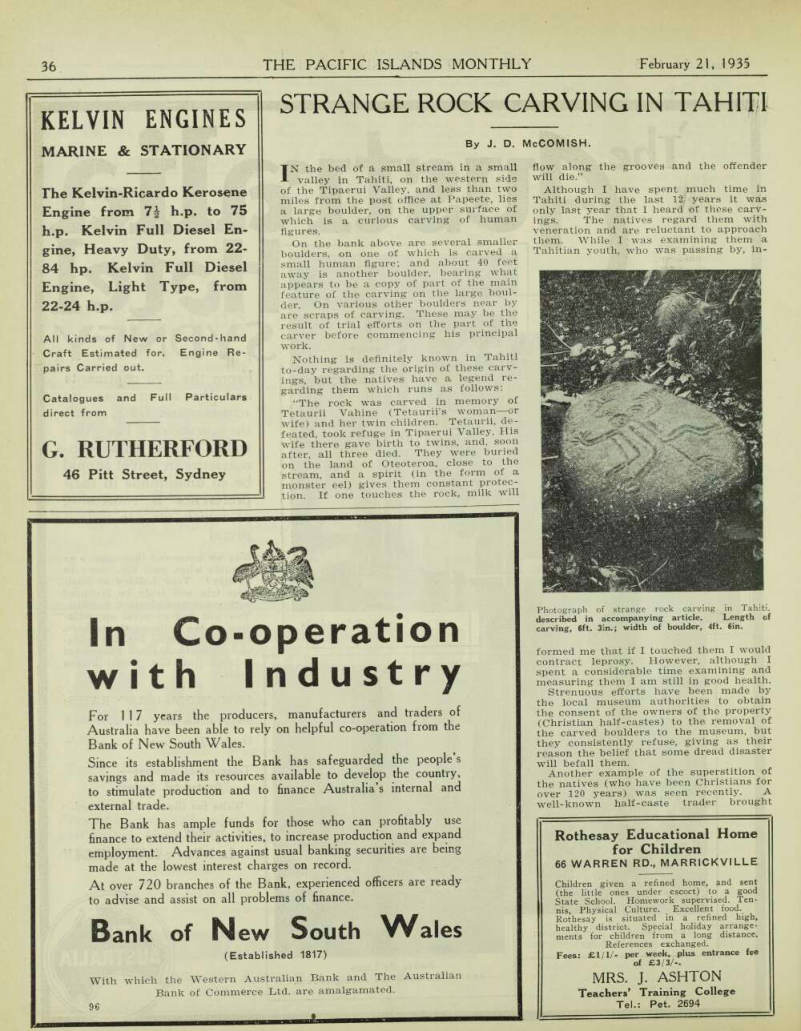
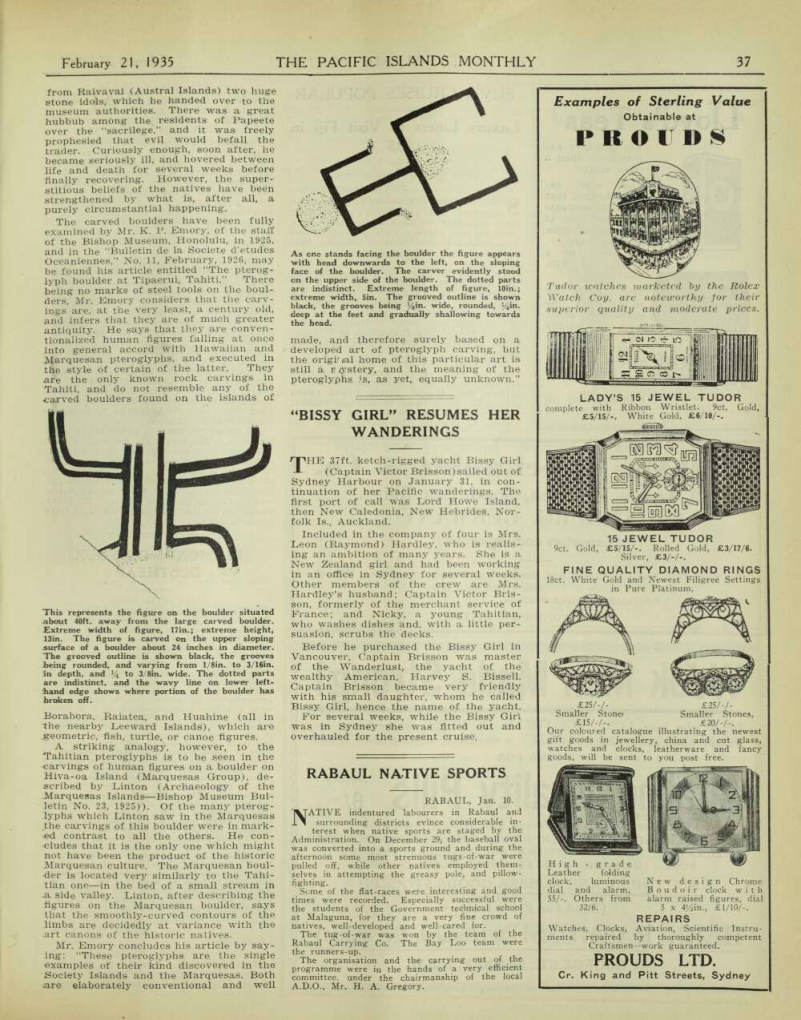
By J. D. Mccomish.
IN the bed of a small stream in a small valley in Tahiti, on the western side of the Tipaerui Valley, and less than two miles from the post office at Papeete, lies a large boulder, on the upper surface of which is a curious carving of human figures.
On the bank above are several smaller boulders, on one of which is carved a small human figure; and about 40 feet away is another boulder, bearing what appears to be a copy of part of the main feature of the carving on the large boul der. On various other boulders near by are scraps of carving. These may be the result of trial efforts on the part of the carver before commencing his principal work.
Nothing is definitely known in Tahiti to-day regarding the origin of these carv ings, but the natives have a legend re garding them which runs as follows: “The rock was carved in memory of Tetaurii Vahine (Tetaurii’s woman—or wife) and her twin children. Tetaurii, de feated, took refuge in Tipaerui Valley. His wife there gave birth to twins, and, soon after, all three died. They were buried on the land of Oteoteroa, close to the stream, and a spirit (in the form of a monster eel) gives them constant protec tion. If one touches the rock, milk will
flow along the grooves and the offender will die.”
Although I have spent much time in Tahiti during the last 12; years it was only last year that I heard of these carv ings. The natives regard them with veneration and are reluctant to approach them. While I was examining them a Tahitian youth, who was passing by, in-
formed me that if I touched them I would contract leprosy. However, although I spent a considerable time examining and measuring them I am still in good health.
Strenuous efforts have been made by the local museum authorities to obtain the consent of the owners of the property (Christian half-castes) to the removal of the carved boulders to the museum, but they consistently refuse, giving as their reason the belief that some dread disaster will befall them.
Another example of the superstition of the natives (who have been Christians for over 120 years) was seen recently. A well-known half-caste trader brought
Photograph of strange rock carving in Tahiti, described in accompanying article. Length of carving, 6ft. 3in.; width of boulder, 4ft. 6in.
from Raivavai (Austral Islands) two huge stone idols, which he handed over to the museum authorities. There was a great hubbub among the residents of Papeete over the “sacrilege,” and it was freely prophesied that evil would befall the trader. Curiously enough, soon after, he became seriously ill, and hovered between life and death for several weeks before finally recovering. However, the super stitious beliefs of the natives have been strengthened by what is, after all, a purely circumstantial happening.
The carved boulders have been fully examined by Mr. K. P. Emory, of the staff of the Bishop Museum, Honolulu, in 1925, and in the “Bulletin de la Societe d’etudes Oceaniennes,” No. 11, February, 1926, may be found his article entitled “The pterog lyph boulder at Tipaerui, Tahiti.” There being no marks of steel tools on the boul ders, Mr. Emory considers that the carv ings are, at the very least, a century old, and infers that they are of much greater antiquity. He says that they are conven tionalized human figures falling at once into general accord with Hawaiian and Marquesan pteroglyphs, and executed in the style of certain of the latter. They are the only known rock carvings in Tahiti, and do not resemble any of the carved boulders found on the islands of
Borabora, Raiatea, and Huahine (all in the nearby Leeward Islands), which are geometric, fish, turtle, or canoe figures.
A striking analogy, however, to the Tahitian pteroglyphs is to be seen in the carvings of human figures on a boulder on Hiva-oa Island (Marquesas Group), de scribed by Linton (Archaeology of the Marquesas Islands—Bishop Museum Bulletin No. 23, 1925)). Of the many pterog lyphs which Linton saw in the Marquesas the carvings of this boulder were in mark ed contrast to all the others. He con cludes that it is the only one which might not have been the product of the historic Marquesan culture. The Marquesan boul der is located very similarly to the Tahi tian one—in the bed of a small stream in a side valley. Linton, after describing the figures on the Marquesan boulder, says that the smoothly-curved contours of the limbs are decidedly at variance with the art canons of the historic natives.
Mr, Emory concludes his article by say ing; “These pteroglyphs are the single examples of their kind discovered in the Society Islands and the Marquesas. Both are elaborately conventional and well
made, and therefore surely based on a developed art of pteroglyph carving, but the original home of this particular art is still a it mystery, and the meaning of the pteroglyphs is, as yet, equally unknown.”
This represents the figure on the boulder situated about 40ft. away from the large carved boulder.
Extreme width of figure, 17in.; extreme height, 13in. The figure is carved on the upper sloping surface of a boulder about 24 inches in diameter.
The grooved outline is shown black, the grooves being rounded, and varying from 1/8in. to 3/16in. in depth, and ¼ to 3/8in. wide. The dotted parts are indistinct, and the wavy line on lower left hand edge shows where portion of the boulder has broken off.
As one stands facing the boulder the figure appears with head downwards to the left, on the sloping face of the boulder. The carver evidently stood on the upper side of the boulder. The dotted parts are indistinct. Extreme length of figure, 10in.; extreme width, Sin. The grooved outline is shown black, the grooves being %in. wide, rounded, ¼in. deep at the feet and gradually shallowing towards the head.
Advertisements & other items, p. 38 (1 item)
Mrs. J. Ashton
Rothesay Educational Home
for Children
66 WARREN RD., MARRICKVILLE
Children given a refined home, and sent (the little ones under escort) to a good State School. Homework supervised. Tennis, Physical Culture. Excellent food.
Rothesay is situated in a refined high, healthy district. Special holiday arrangements for children from a long distance.
References exchanged.
Fees: £1/1/- per week, plus entrance fee of £3/3/-.
MRS. J. ASHTON
Teachers’ Training College Tel.: Pet. 2694
“Bissy Girl” Resumes Her
Wanderings
THE 37ft. ketch-rigged yacht Bissy Girl (Captain Victor Brisson) sailed out of Sydney Harbour on January 31, in con tinuation of her Pacific wanderings. The first port of call was Lord Howe Island, then New Caledonia, New Hebrides, Nor folk Is., Auckland.
Included in the company of four is Mrs.
Leon (Raymond) Hardley, who is realis ing an ambition of many years. She is a New Zealand girl and had been working in an office in Sydney for several weeks.
Other members of the crew are Mrs.
Hardley’s husband; Captain Victor Bris son, formerly of the merchant service of France; and Nicky, a young Tahitian, who washes dishes and, with a little per suasion, scrubs the decks.
Before he purchased the Bissy Girl in Vancouver, Captain Brisson was master of the Wanderlust, the yacht of the wealthy American, Harvey S. Bissell.
Captain Brisson became very friendly with his small daughter, whom he called Bissy Girl, hence the name of the yacht.
For several weeks, while the Bissy Girl was in Sydney she was fitted out and overhauled for the present cruise.
Rabaul Native Sports
Rabaul, Jan. 10.
NATIVE indentured labourers in Rabaul and surrounding districts evince considerable in terest when native sports are staged by the Administration. On December 29 ; the baseball oval was converted into a sports ground and during the afternoon some most strenuous tugs-of-war were pulled off, while other natives employed them selves in attempting the greasy pole, and pillow fighting.
Some of the flat-races were interesting and good times were recorded. Especially successful were the students of the Government technical school at Malaguna, for they are a very fine crowd of natives, well-developed and well-cared for.
The tug-of-war was won by the team of the Rabaul Carrying Co. The Bay Loo team were the runners-up.
The organisation and the carrying out of the programme were in the hands of a very efficient committee, under the chairmanship of the local A.D.O., Mr. H. A. Gregory.
Advertisements & other items, pp. 39-40 (1 item)
Prouds
Examples of Sterling Value
Obtainable at
Tudor watches marketed by the Rolex Watch Coy. are noteworthy for their superior quality and moderate prices.
LADY’S 15 JEWEL TUDOR
complete with Ribbon Wristlet. 9ct. Gold, £5/15/-. White Gold, £6/10/-.
15 JEWEL TUDOR
9ct. Gold, £5/15/-. Rolled Gold, £3/17/6.
Silver, £3/-/-.
FINE QUALITY DIAMOND RINGS
18ct. White Gold and Newest Filigree Settings in Pure Platinum. £25/-/- Smaller Stones £15/-/-. £25/-/- Smaller Stones, £20/-/-.
Our coloured catalogue illustrating the newest gift goods in jewellery, china and cut glas watches and clocks, leatherware and fancy goods, will be sent to you post free.
High - grade Leather folding clock, luminous New design Chrome dial and alarm, Boudoir clock with 55/-, Others from alarm raised figures, dial 32/6. 5 x £1/10/-.
REPAIRS
Watches, Clocks, Aviation, Scientific Instruments repaired by thoroughly competent Craftsmen —work guaranteed.
PROUDS LTD.
Cr. King and Pitt Streets, Sydney
Lloyd’s Teas
Tea drinkers expect more than a mere drink.
That easy, relaxed feeling, that sense of contentment and glow of real satisfaction must be there . . . not once in a while, but with every cup.
Try Lloyds for purity. Try the consistent goodness of quality tea. Try the delicious aroma that is such a feature of Lloyd’s tea blending.
Obtainable at all good island stores.
Wilhelm Kreckwoldt & Co.
9, Lange Muehren, South Sea Bldgs.
HAMBURG, GERMANY
(Exporters and Importers)
We Export: We Import: Trade Goods of any description, Cutlery, Hardware, Miners’
Requisites, etc., etc.
Any kind of Island Produce.
CORRESPONDENCE INVITED
Weak Men Made Strong!
MEN who have LOST YOUTHFUL POWERS: whose brains are dulled: whose energy and VITALITY is weakened: whose memory is bad
SEND FOR
Bottles 6/-
Alfaline Vitality Pills
(Send for Circular on Pills and Lost Vitality Treatment) BLOOD, SKIN, NERVE, BLADDER, KIDNEY, AND LIVER COMPLAINTS,
RHEUMATISM, NEURITIS, ASTHMA, SUCCESSFULLY TREATED BY
POST. (MEDICINES POSTED UNDER PLAIN COVER.)
ALL TOILET AND RUBBER GOODS STOCKED
(Send for Price List).
HERR RASMUSSEN (Danish Herbalist)
541 GEORGE ST., SYDNEY, N.S.W.
Suva Cruises Popular
Luxury Liners to Visit Fiji in 1935
From Our Own Correspondent.
SUVA, January 18.
SUVA has been discovered by Australian shipping men as a good spot to send their steamers on pleasure cruises. Last year several cruises were arranged, and had such a popular appeal that for 1935 half a dozen more cruises have been announced.
The first of this year’s steamers was the Katoomba, which arrived with 400 passengers on January 7, coming via Nukualofa. Unfortunately, the weather broke just before the ship arrived, and the tourists took away a damp recollec tion of Suva, The Katoomba is to make other cruises at Easter and again in October.
In February we are to have the Stella Polaris and the Franconia —luxury cruises for which programmes of native mekes and motor drives have been arranged. Both these vessels are regular visitors on world cruises. As far as is known at present, the Matson Line will
not send out cruises to the South Seas this year. However, a newcomer will be the Rotterdam on a world cruise out of New York, and entertainments are to be arranged for her on a lavish scale.
The most important, however, of all cruises from the Suva point of view are those of the P. and O., carried out with the Strathnaver and Strathaird. Each ship visited Suva last year, bringing on each occasion a full complement of over 1000 passengers. Very comprehensive programmes enabled their passengers to put in a hectic 36 hours at Suva —native mekes on Albert Park, and a special per formance by the fire-walkers of Beqa were arranged by the P. and O. agents.
Brown and Joske Ltd., whilst the Methodist Mission, the Church of Eng land, and the Roman Catholic Mission organised entertainments which proved most interesting to the passengers, and lucrative to the organising bodies. A Strathnaver race meeting, and dances at all the leading hotels, found many sup porters.
For 1935 the Strathnaver is scheduled for early April, and Suva hopes to see her sister ship, the Strathaird, later in the year. It is even rumoured on the beach that the Orient Company are so struck by the successful P. and O. cruises that they plan to send the Oronsay to Suva about September.
All these cruises are wonderfully good bargains. The fortunate Australian with £20 odd to spare can get luxurious accommodation, first-class food, and a lot of fun for a fortnight. Compare this with the return fare charged by the Union and Matson companies for a fortnight’s travel £50 minimum first class. It looks, therefore, as though cruises to Suva have come to stay.
Diamonds On Your
Dustheap
Letter to the Editor.
THE true story of the diamond, finally gracing a royal crown, that was used as a child’s play thing for years, is constantly being repeated in the still “unknown” Pacific. Every Island has treasures worth kings’ ransoms lying about neglected; and recently I have had several cases before me.
The “P.I.M.” and the little French paper, "Le Courier Australien,” are the only Australian pub lications that have published accounts of my archaeological discoveries; but, by their means, other folk have been encouraged to look around and find things of scientific, or practical value.
An inscription has been found which a of experts consider to be “pre-Chinese,” or about 5000 years old; and another 3000 years old—whilst about a dozen plants have been introduced as garden ornaments; and one geological specimen that “kicked about” in a Pitt Street office for years, is now seeing its fellows bringing in mil lions a year to the wide-awake promoters of a new industry. The neglected but beautiful maroon and tangerine Asclepia, which I introduced here from New Guinea in 1883, for example, is now an accepted garden favourite; but I have only recently discovered that this is the oldest flower mentioned in the earliest literature in the world; and from its milky juice was made to first alcoholic drinks, the Ambrosia of the gods and the “Fountain of Youth” which the Greek poets tell us about— apparently somewhat affected by its stimulating properties, to judge by what they tell of its vir tues! Please look around your Islands, dear Pacific folk, for neglected things of great price elsewhere, and in the future!
I am, etc.,
Arthur J. Vogan.
Pymble, 20/1/35.
Miss Edith M. Devitt, of the New Guinea Mission, Naniu, Papua, was in South Australia on furlough in January.
Engine, Near Wau, N.G.
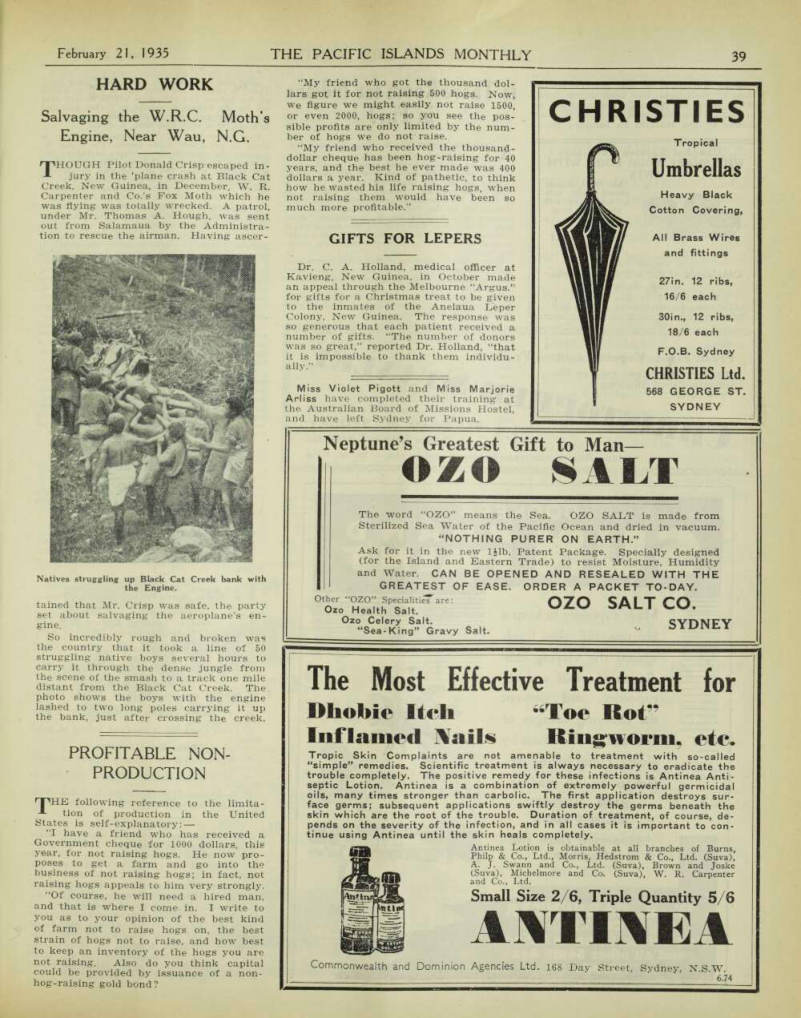
Hard Work
Salvaging the W.R.C. Moth’s Engine, Near Wau, N.G.
THOUGH Pilot Donald Crisp escaped in jury in the ’plane crash at Black Cat Creek, New Guinea, in December, W. R.
Carpenter and Co.’s Fox Moth which he was flying was totally wrecked. A patrol, under Mr. Thomas A. Hough, was sent out from Salamaua by the Administra tion to rescue the airman. Having ascer-
tained that Mr. Crisp was safe, the party set about salvaging the aeroplane’s en gine.
So incredibly rough and broken was the country that it took a line of 50 struggling native boys several hours to carry it through the dense jungle from the scene of the smash to a track one mile distant from the Black Cat Creek. The photo shows the boys with the engine lashed to two long poles carrying it up the bank, just after crossing the creek.
Natives struggling up Black Cat Creek bank with the Engine.
Profitable Non
Production
T'HE following reference to the limita tion of production in the United States is self-explanatory: “I have a friend who has received a Government cheque for 1000 dollars, this year, for not raising hogs. He now pro poses to get a farm and go into the business of not raising hogs; in fact, not raising hogs appeals to him very strongly.
“Of course, he will need a hired man, and that is where I come in. I write to you as to your opinion of the best kind of farm not to raise hogs on, the best strain of hogs not to raise, and how best to keep an inventory of the hogs you are not raising. Also do you think capital could be provided by issuance of a non hog-raising gold bond?
“My friend who got the thousand dol lars got it for not raising 500 hogs. Now, we figure we might easily not raise 1500, or even 2000, hogs; so you see the pos sible profits are only limited by the num ber of hogs we do not raise.
“My friend who received the thousand dollar cheque has been hog-raising for 40 years, and the best he ever made was 400 dollars a year. Kind of pathetic, to think how he wasted his life raising hogs, when not raising them would have been so much more profitable.”
Gifts For Lepers
Dr. C. A. Holland, medical officer at Kavieng, New Guinea, in October made an appeal through the Melbourne “Argus.” for gifts for a Christmas treat to be given to the inmates of the Anelaua Leper Colony, New Guinea. The response was so generous that each patient received a number of gifts. “The number of donors was so great,” reported Dr. Holland, “that it is impossible to thank them individu ally.”
Miss Violet Pigott and Miss Marjorie Arliss have completed their training at the Australian Board of Missions Hostel, and have left Sydney for Papua.
Sister Veronica, of the Sisters of the Cross in Melanesia, has been doing depu tation work in New Zealand while on furlough. She returned to the Solomon Islands by the Malaita on January 26.
Advertisements & other items, pp. 41-42 (1 item)
Antinea
CHRISTIES
Umbrellas
Heavy Black Cotton Covering, All Brass Wires and fittings 27in. 12 ribs, 16/6 each 30in., 12 ribs, 18/6 each F.O.B. Sydney
CHRISTIES Ltd.
568 GEORGE ST.
SYDNEY
Tropical
Neptune’s Greatest Gift to Man—
OZO SALT
The word “OZO” means the Sea. OZO SALT is made from Sterilized Sea Water of the Pacific Ocean and dried in vacuum.
“NOTHING PURER ON EARTH.”
Ask for it in the new lilb. Patent Package. Specially designed (for the Island and Eastern Trade) to resist Moisture, Humidity and Water. CAN BE OPENED AND RESEALED WITH THE GREATEST OF EASE. ORDER A PACKET TO-DAY.
Other “OZO” Speciality are: Ozo Health Salt.
Ozo Celery Salt.
“Sea-King” Gravy Salt.
The Most Effective Treatment for
Dhobie Itch "Toe Rot”
Inflamed Nalls Ringworm* etc.
Tropic Skin Complaints are not amenable to treatment with so-called “simple” remedies. Scientific treatment is always necessary to eradicate the trouble completely. The positive remedy for these infections is Antinea Antiseptic Lotion. Antinea is a combination of extremely powerful germicidal oils, many times stronger than carbolic. The first application destroys surface germs; subsequent applications swiftly destroy the germs beneath the skin which are the root of the trouble. Duration of treatment, of course, depends on the severity of the infection, and in all cases it is important to continue using Antinea until the skin heals completely.
Antinea Lotion is obtainable at all branches of Burns, Philp & Co., Ltd., Morris, Hedstrom & Co., Ltd. (Suva), A. J. Swann and Co., Ltd. (Suva), Brown and Joske (Suva), Michelmore and Co. (Suva), W. R. Carpenter and Co., Ltd.
Small Size 2/6, Triple Quantity 5/6
ANTINEA
Commonwealth and Dominion Agencies Ltd. 168 Day Street Sydney NSW
Uka Ant Euchres Ants, so
WHY SHARE YOUR FOOD WITH
ANTS
This little device, placed under safe or table legs, will positively keep ants out
WITHOUT
WATER OR AT-
TENTION
Success since 1923 Get a Set and you’re Set Obtainable at B.P., W.R.C. or other Island Stores Manufactured by Uka Ant Co. 11 Gelding Street, Dulwich Hill, Sydney
For— Fresh Fruit, Vegetables, and Produce Island residents can rely on the old-established Shipping Providers.
Island Representatives: Only Address: 421 Sussex St., SYDNEY All Orders Promptly Attended Nelson & Robertson W. M. Reid
DOCKERS
SUN BRAND PAINT
Made expressly to keep a lustrous, full gloss finish
against the varying con-
ditions of moist weather exposure, and prevent the decaying ravages of rain and extreme heat by
giving a long lasting pro-
tection to all surfaces.
SUN PROOF
RAIN PROOF
“Stronger than the Weather"
W. R. CARPENTER
& CO. LTD.
New Guinea, Solomon Islands, and all other South Sea Islands.
in Fiji?
Is There Room for Indians in Fiji?
A CORRESPONDENT who signs himself “Fiji- Born Indian,” writes about an article pub lished in this journal several months ago, wherein certain Fiji-Indians were referred to as “cheeky swine” and “mongrels”:— An Indian is never “ ‘cheeky’ to a ‘Sahib.’ ” Of a “Gora,” the average Indian does not take much notice, but if the “Gora” calls for “cheek” he probably gets it. As for the appellation “mon grel,” I will pass that over, as the vapouring of a diseased mind. I do not think your corres pondent meant the word in the dictionary mean ing.
Your remark, that we Indians will overwhelm and push our Fijian brethren out, is absurd and, to say the least of it, uncomplimentary to the Fijians.
How are we likely to overwhelm the Fijians?
There is so little of intermixing of blood between us that it is negligible.
How are we likely to push the Fijians out?
There is enough land lying idle in Fiji to absorb all the Indians and still there will be enough land left for the Fijians to expand in. Our lives and the Fijians’ lives run parallel and are not likely to cross for a very long time, if at all.
Your conception of the present-day Fijian is about 50 years behind the times. The Fijian re cognises the struggle for existence nowadays and is coming to the fore. I know Fijians who have well stocked stores and are carrying on success ful trading businesses. I know Fijians who are settled on their own bits of land and are raising stock and produce for the market.
If more room is needed for Fijians in Fiji then make it—but make it by getting rid of Asiatics who are not British subjects.
Your remark that the Fijians do not supply suitable labour for developmental enterprises is incorrect. Two big developmental enterprises that I know of—namely, the gold mines of Vanua Levu and Viti Levu—employ several hundreds of Fijians, to the complete exclusion of Indians. This seems to point to the fact that the Fijian is not as useless as you think he is.
The statement that “any more Indian publicity will spoil the well-earned reputation for fair deal ing, etc. ...” is not only illogical, but seems to have had its birth in a mind completely void of fair play. It is by publishing both sides of a question that you earn a reputation for fair deal ing.
It certainly is to be deplored that you only publish the abusive part of your correspondent s letter I wonder if you have made him the hap piest man in Fiji. If a letter is not worth pub lishing in its entirety, you should not go publish ing the nasty bits out of it. That sort of thing tends to widen the breach that we should ad fry to bridge.
N.G. Public Service
Alterations in the staff of the New Guinea Public Service announced in the Administration s Bulletin No. 34 (31/12/’34) were as follows: Appointments W J. Allman, Clerk, District Services Dept.
A. Swanson, Clerk, Govt. Secretary’s Dept.
H E. Woodman, Acting District Officer, grade 2.
J. W. Smith, Clerk, promoted to Inspector of Stores.
Transfers F. W. Mantle, A.D.O., Manus to Rabaul.
C. F. Warde, Patrol Officer, Rabaul to Kieta.
R. M. MacKinnon, Public Health, Rabaul to Salamaua.
I. Clark, Medical Assistant, Kavieng to Rabaul.
J. C. Goad, Medical Assistant, Rabaul to Kavieng.
C. M. Pines, Medical Assistant, Rabaul to Kokopo.
A. Ewing, Medical Assistant, Rabaul to Madang.
Temporary Staff J. W. Cox, appointed Assistant, Keravat Planta tion.
H. P. Barrie, appointed Roadmaster, Public Works Dept.
J. Lyall, Carpenter, transferred Rabaul to Salamaua.
Police Force Transfers T. Walker, Warrant Officer, Kokopo to Sepik District.
A. E. Halley, Warrant Officer, Salamaua to Wau.
D. Moncur, Warrant Officer, Rabaul to Wau.
R. W. Feetum, Warrant Officer, Rabaul to Ma dang.
The following appeared in the Mel bourne “Age” in January; “At the Gov ernor-General’s office, Melbourne, Senator Sir George Pearce, K.C.V.O. (Minister for External Affairs and Territories), pre sented to His Excellency the Governor- General, Brigadier-General T. Griffiths, C.M.G., C.B.E., D.S.O., on the occasion of the latter’s relinquishment of his appoint ment as Administrator of the Mandated Territory of New Guinea. Brigadier- General Griffiths handed to His Excel lency two walking-sticks made from coconut palms by the native children of a New Guinea primary school.”
Mission Trading
The Problem of Kwato
Letter to the Editor.
SEVERAL letters have been published lately in the “P.I.M.” on the subject of mission trading. These point out that certain mission stores were offering serious competition to the smaller traders.
In most cases the missions, when it was brought to the notice of their councils, did the fair thing and closed down. The Anglican mission, of course, have always kept themselves clear of business.
The L.M.S. were wrongfully blamed for Kwato Extension Association’s trading activities, and disclaimed all responsibility in the “P.I.M.” and, further, undertook to close all their stores that were in competition with the legitimate trader.
The R.C. mission at this end of the country also keeps out of business as far as I know.
This leaves Kwato as the only concern here who profess to combine religion with business and missionary work with moneymaking.
Can this be done? Whatever overseas people think, it is certain that those in this country consider it impossible. The bias is too great and the advantages of the mission influence too strong.
I know little, or nothing, of Kwato’s mission work, but there is no doubt of its commercial worth in business. Mr. Fletcher has pointed out that apart from direct financial assistance and Government sympathy, the “mission'touch” auto matically frees them from Government supervision, and the Association realises this.
If they are a business concern they should cer tainly not have all these advantages over their competitors and a thorough airing of their methods and activities should be instituted at once, and the Association placed on an equal and fair basis with those with whom they compete. They should have to comply with the Native Labour Ordinance, forego the subsidy and the use of mission gifts (in money or kind) in their business.
If, on the other hand, the mission work is their object, it is no one’s business but their own, and that of their subscribers, and they should follow the very decent example set by the other missions and stick to their job.
If their competition were fair, it would be bad enough, these hard times, for the white artisan to compete with cheap native labour. But with all the additional advantages they have, the Association has a virtual monopoly of the low price work, and no one can quote against them.
The conditions that make these low prices possible are the white tradesman’s difficulty. Till these are altered he has not a hope of competing.
Getting them altered is the trouble. There is a lot of talk about it, but, as usual, nothing is done. Boatbuilders, carpenters, and tradesmen generally have been seriously affected by Kwato competition. They grumble and put up with it because they do not see what can be done. A deputation to the Governor must go armed with facts, and these are hard to obtain. The average white man has a sense of decency which prevents his cross-questioning a native (especially about other whites). The Government is reluctant to give any information as to the conditions of employment of the Kwato natives. The mission subscribers are thousands of miles away.
Though the Government could do much to right things I doubt if they will. They do not realise the advantage that is being taken of their laxity.
What complaints they hear are put down to ordinary business jealousy, and things drift on, and Kwato makes hay whilst the sun shines.
The letters from Mr. Harrison and Mr. Fletcher that you have published will, I hope, be read by the actual subscribers to Kwato, and the donors of the generous gifts they receive. These people are scattered all over the world, and they hear only one side of the story—Kwato’s. They may be interested to know that Kwato has just suc cessfully tendered for the freighting of Waigani and Hagita plantations, in Milne Bay, by cutting the price to a very low figure. They are using the new launch for this, with a native crew. The engines were, I believe, a gift to the mission.
Was it intended that they be used in this way?
I am, etc.,
Norman H. Izod.
Samarai, 14/1/35.
EDITORIAL NOTE: It surely should not be difficult to prepare a case and submit same to the Lieutenant-Governor, who always has shown his readiness to protect and assist legitimate en terprise, and who can be depended upon for absolute impartiality and justice. There appears to be very strong feeling in Eastern Papua regard ing Kwato’s trading activities, and the matter really should have some attention.
Advertisements & other items, pp. 43-44 (1 item)
Holbrooks (A/sia.)
HOLBROOKS’
TABLE DELICACIES.
WORCESTERSHIRE SAUCE
—enjoys a world-wide reputation.
VAT 2 SAUCE a delicious thick, fruity sauce.
VlNEGAR —strong, well matured, and guaranteed Pure Malt.
ESSENCE OF ANCHOVIES—
A fish sauce made from the finest Gorgona Anchovies.
TOMATO SAUCE— made from fresh, ripe tomatoes.
FRENCH CAPERS Capucines and Capottes.
SPANISH OLIVES
Varieties: Spanish Queens, Small Queens, Manzanillas, and Stuffed or Sliced ready for Sandwiches.
PURE OLIVE OlL— French or Italian. From the first pressings of selected Olives.
PICKLES
Varieties: Sweet Gherkins, Tiny White Onions, Walnuts, Piccalilli, Mixed and Green Tomato.
FISH AND MEAT PASTES,
in 1½oz. and 3oz. glass jars.
Varieties: Anchovy, Salmon, Ham and Tongue, Veal and Tongue, Chicken and Ham, Turkey and Tongue, Salmon and Shrimp, Bloater.
SOUPS, in 8oz., 16oz., ½ gal. and 1 gal. tins.
Varieties: Vegetable, Ox Tail, Mulligatawny, Mock Turtle, Tomato.
JELLY CRYSTALS —Specially prepared for warm climates.
They set well, and are deliciously flavoured.
HEALTH SALINE —a refreshing health-giving beverage, suitable for hot climates, in ½lb. and 1 lb. tins.
Holbrooks (A/sia.)
Ltd.
WATERLOO, N.S.W.
By using this Economical, Fire Retardant and White Ant Proof building material for External and Internal Walls and Ceilings, you can build a comfortable and durable Bungalow Home —AT LOW COST! "FIBROLITE" is easily and quickly erected. No waste. Less labour. No oainting. For full information, write for illustrated "Fibrolite" Booklet F. 6 —FREE AND POST FREE!
JAMES HARDIE & COY. LTD.
ASBESTOS HOUSE. YORK STREET, SYDNEY, N.5.W.
(Box 3935 V., G.P.O., Sydney)
Introduced in the Pacific Islands only a few months ago, the reports already received on the new Hormone Preparation TITON show quite conclusively its great efficacy in tropical countries. Following a few extracts from reports: . . . feeling better in every way. . . . not nearly so irritable as I used to be. . . . noticed a remarkable difference
in myself generally.
. . . seems much easier now to pick up after fever attacks. ... no one living in the tropics
should be without it.
. . . and what’s more it gives new
brain activity.
. . . tried one bottle so far and found it very good in my case. . . . wonder what I will feel like after the “full” treatment. . . . feel lots clearer in the head as
regards mental ability.
. . . ordering two more treatments for “run down” friends of mine. . . . am so grateful that lam telling
everybody about it.
. . . tried lots of things but nothing
equal in efficacy.
When living under awkward climatic conditions and desirous of maintaining health and to keep fit, mentally and physically, it is advisable to build up your system and body by means of this new and remarkable tonic and restorative that provides the proper nourishment in the form of hormones, the latest scientific discovery.
Absolutely harmless to take, yet wonderfully effective and will make a remarkable difference to your future health and comfort.
Titon Hormone Preparation No. 24 for men and No. 20 for women at 30/- per full treatment of three bottles, Send cheque or postal notes direct to Titon Laboratories, Box 1304J, G.P.O., Sydney, or to the Island agent, Alfred Stoffer, 16-20 Bridge Street, Sydney, N.S.W., and a treatment will be forwarded by return mail, post free and under plain wrapper, together with interesting literature on this latest scientific discovery.
Dog’S Hill Beacon,
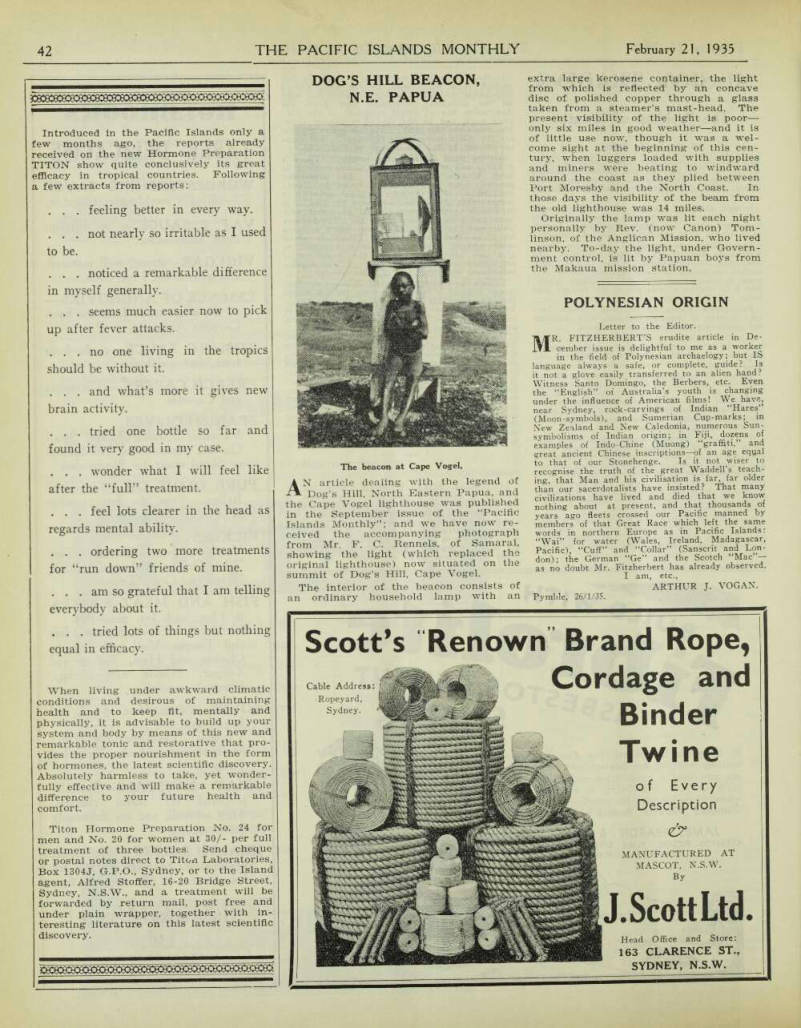
N.E. Papua
AN article dealing with the legend of Dog’s Hill, North Eastern Papua, and the Cape Vogel lighthouse was published in the September issue of the “Pacific Islands Monthly”; and we have now re ceived the accompanying photograph from Mr. F. C. Rennels, of Samarai, showing the light (which replaced the original lighthouse) now situated on the summit of Dog’s Hill, Cape Vogel.
The interior of the beacon consists of an ordinary household lamp with an
extra large kerosene container, the light from which is reflected by an concave disc of polished copper through a glass taken from a steamer’s mast-head. The present visibility of the light is poor— only six miles in good weather —and it is of little use now, though it was a wel come sight at the beginning of this cen tury, when luggers loaded with supplies and miners were beating to windward around the coast as they plied between Port Moresby and the North Coast. In those days the visibility of the beam from the old lighthouse was 14 miles.
Originally the lamp was lit each night personally by Rev. (now Canon) Tom linson, of the Anglican Mission, who lived nearby. To-day the light, under Govern ment control, is lit by Papuan boys from the Makaua mission station.
The beacon at Cape Vogel.
Polynesian Origin
Letter to the Editor.
MR. FITZHERBERT’S erudite article in De cember issue is delightful to me as a worker in the field of Polynesian archaelogy; but IS language always a safe, or complete, guide? Is it not a glove easily transferred to an alien hand?
Witness Santo Domingo, the Berbers, etc. Even the “English” of Australia’s youth is changing under the influence of American films! We have, near Sydney, rock-carvings of Indian “Hares’ (Moon-symbols), and Sumerian Cup-marks; in New Zealand and New Caledonia, numerous Sun symbolisms of Indian origin; in Fiji, dozens of examples of Indo-Chine (Muong) “graffiti,” and great ancient Chinese inscriptions—of an age equal to that of our Stonehenge. Is it not wiser to recognise the truth of the great Waddell’s teach ing, that Man and his civilisation is far, far older than our sacerdotalists have insisted? That many civilizations have lived and died that we know nothing about at present, and that thousands of years ago fleets crossed our Pacific manned by members of that Great Race which left the same words in northern Europe as in Pacific Islands: “Wai” for water (Wales, Ireland, Madagascar, Pacific), “Cuff” and “Collar” (Sanscrit and Lon don); the German “Ge” and the Scotch “Mac”— as no doubt Mr. Fitzherbert has already observed.
I am, etc.,
Arthur J. Vogan.
Pymble, 26/1/35.
Advertisements & other items, p. 44 (1 item)
Cordage and
Scott’s Renown Brand Rope,
Binder
Cable Address: Ropeyard, Sydney.
Twine
of Every
Description
MANUFACTURED AT
MASCOT, N.S.W.
By J. Scott Ltd.
Head Office and Store:
163 CLARENCE ST.,
SYDNEY, N.S.W.
Unilever’S Grip On Copra
Is International Action Possible?
"We coconut planters can expect nothing from individual govern ments. Our only chance of securing protection against this world-wide com bine, which robs us of much of the fruit of our labour and enterprise, is to agitate ceaselessly for combined action by the various governments interested. It is an appalling task, on account of the world-wide character of the copra-industry: yet it is our only hope for the future.”
THAT is an extract from a private letter to the Editor from a copra pro ducer in Fiji: and it is a fair indication of what is in the minds of many thought ful planters. It is indeed an “appalling” problem.
If it were a problem peculiar to the copra industry, we could consider it in a more hopeful spirit. But the whole world to-day is in the grip of rings, com bines, and trusts, to an extent that is only beginning to be recognised, and the way out is not discernible. Primary pro duction throughout the world is almost completely at the mercy of international organisations, which pay producers what they like, charge consumers just as much as they can be forced to pay, and pocket almost every available penny of the resulting profits.
There is a political madness in the world called “economic nationalism.”
Every country, by operating tariffs and restrictions on trade, is trying to become economically independent of the other.
Every country, in consequence, is con tributing to the murder of free trade competition, and creating exactly the conditions for which the international monopolists nightly thank their patron saints—or devils.
If the nations would handle inter national trade in a truly co-operative spirit, the blood-sucking Unilever Com bine, and scores of other similar institu tions, could be laid by the heels in a month or two. As it is, it is practically impossible to limit their power or check their operations.
The financial power of those combines is beyond computation, and their political influence incredible. Governments, in many cases, are unconsciously their puppets. There are few commodities in world-wide general use whose distribu tion they do not control; and they are alert to influence any political move or legislative plan which may affect their Interests.
The power of Unilever in the copra industry is a very good example of what is going on. It operates mainly in European countries and, outside of Uni lever, there is no manufacturer with suf ficient buying power to affect the market.
Unilever’s agents are in every market, and each operates according to the price that daily is fixed— usually in London.
The hopeful shippers may send their car goes to London or the Baltic, to the Mediterranean or to Rotterdam—it makes no difference, beyond a few shillings per ton. So far as the copra-producer is con cerned, the quote of Unilever, London, received through any one of its score of allied companies, is as the voice of God.
There is no appeal.
Unilever, by intensive organisation and
centralisation (“rationalisation”) has wiped out an enormous amount of waste, represented in duplication of effort and plant. If the public received the benefit in cheaper foods there would be some justification for the monopoly. But the public gets the goods at about the same old price, and the saving goes into the maw of the combine. The governments are complaisant, because the public is not being forced to pay a higher price— the Combine is far too cunning for that.
But the absence of competition among buyers allows the Combine to fix its own buying price; and it is the producers (not the consumers) who are being robbed.
The copra producers, scattered over fifty tropical countries, are not the concern of any particular government; and so they take it in the neck. They are quite helpless against a thing like Unilever.
If the copra-producers (of Africa, Philippines, Malaya, Ceylon, East Indies, South Seas, West Indies, etc.) could combine: and if they could present a case, backed by effective propaganda, to a powerful government like that of Bri tain; and if Britain could persuade the governments of France, Holland, Japan, United States and the British Dominions to join her in special action; and if the latter governments could resist the cun ning and cleverness of the Combine pro tagonists—something might be done to assist the copra-producers of the world.
But consider that series of “ifs”!
Copra, in recent weeks, has moved to over £12 per ton, London —the result of developments in America, of increased European purchases, of the new Whaling Convention, and, above all, of European buyers being “caught short” by the American development. If it remains at over £12 per ton it will represent a miracle—it will mean that something, now unforeseen, has happened to limit the power of Unilever. But if Unilever retains its power and influence, the copra price will settle down at less than £12 per ton. Which means that planters
will be able to live —and to work indefinitely to provide rich profits for Unilever.
Advertisements & other items, p. 45 (1 item)
Mary's
AUSTRALIA'S CLEARING HOUSE FOR THE PRECIOUS METALS.
BUYERS OF
GOLD
OSMIRIDIUM, PLATINUM, SILVER, &c.
GARRETT & DAVIDSON, LTD.
ASSAYERS, BULLION MERCHANTS, METALLURGISTS,
Bank of N.S.W. Buildings, Regent Street, Sydney
The Utmost Satisfaction . . .
AUNT
MARY'S
Aunt Mary’s Pure Food Products ensure the utmost satisfaction to consumers. For thirty years the high quality and supreme excellence of these goods have been appreciated by Pacific Islanders. Specially manufactured and packed to meet Island conditions.
PURE FOOD
PRODUCTS
“DEFIANCE” Brand Canned Goods
The proprietors of Aunt Mary’s Pure Food Products also pack “Defiance”
Brand Canned Goods.
Hygienically prepared and hermetically sealed to withstand tropical heat, they are sure of appreciation.
These branded goods are of the highest quality standard, and are prepared and packed only hy
TILLOCK & CO. LTD.
PURE FOOD
MANUFACTURERS
Kent and Liverpool Streets, SYDNEY, N.S.W.
How to Assist Industry
THE following are extracts from an article on the copra situation, written last year by Mr.
F. Harcourt Smith, of Waitavala, Taveum, Fiji: Over a long period of years—half a century steady progress has been made in the Fiji group in the planting and development of coco palms on a commercial basis. In recent years science has rendered valuable service to the work. Planters engaged in this branch of industrial pursuit have given their earnest and diligent attention to the development of their lands, in conjunction with a practical system of culture necessary for the improvement of the plant’s growth and yield of crop.
Struggling planters of to-day are now enmeshed in the maze of conditions associated with the world’s complex economic position. They are compelled to face a persistent fall in the value of copra.
This ubiquitous slump is not of recent origin.
It followed the merging of manufacturers’ interests overseas, and unless some protection is afforded it is inevitable that the European planters in tropical countries will go to the wall!
The formation of this affluent combine, whose interests are colossal throughout the United King dom and Europe, sounded the death-knell of com petitive markets —a serious blow indeed to planters.
It would not be unreasonable to say that if a third of the combine’s huge annual profits—obvi ously so easily reaped where they have not sown —were employed to stabilise the price of copra, it would bring about a feeling of optimism amongst copra producers the world over. A most substan tial credit balance would remain which should be sufficient to suit the take-all desires of any avari cious company. Were this system adopted, then planters’ costs of production (not including living expenses and any other commitments that have
to be met) would about balance. “Britannia rules the waves”; but a business concern is allowed to go blithely on ruling the destiny of ever so many of Britain’s loyal subjects!
Insofar as it concerns Fiji’s planter community, the outlook is pathetic. It would be interesting to learn just how much money has been put into coconut plantations, together with development and maintenance costs spread over many, many years. Candidly, the plight of the planter can no longer be hidden; the position is serious in the exact sense of the word.
Everyone realises the logical necessity for aid at the earliest possible moment. To whom can we look for help? I would suggest two schemes for consideration, viz.: (1) That the Government subsidise the industry to the extent of £2 per ton during the time the local buying price is at or under £7. The scheme could be definitely understood to be a palliative only. Let it be remembered that in the grant ing of a subsidy, the Government would, in directly, be recompensed to a degree, for the money would, of necessity, find an outlet for circulation again within the colony. As a suitable measure, the above appears to be a sound proposition for the powers that be to take into consideration one which I feel sure would meet the wishes of all concerned. (2) In addition, would not the Government con sider the question of raising an external loan of £100,000 at 3 per cent.? Many flourishing business concerns outside the colony are known to have invested largely in stock that returns a rate of interest thereabout. A certain established company, with extensive interests in this colony, may be prepared, if approached, to enter into negotiations with the Fiji Government in respect of their company’s position, which comprises the major share of the Immigration Fund. With the money in hand. I suggest the administration take over and liquidate the debts of planters—those who are in the hands of either banks or private financiers, and charge 4 per cent, for services rendered.
At the inception of the Unilever merger, I wrote to the press on two occasions, and, inter alia, pointed out the loss to planters of competitive mar kets, and what could be expected as a consequence.
Also, I advocated the desirability of converting a portion of the output of copra into nut-butter.
Once again I think it fitting to state that the present seems an opportune time for the science staff of the Agricultural Department—with the Government’s sanction —to put the suggestion into practice, utilising for the purpose the Tailevu factory for experimental purposes.
The continent of Australia, with its established dairying industry, encourages the manufacture of margarine in no less than twenty factories. Surely Fiji is in a position to do somewhat likewise?
Regulations
Absurd B.S.I. Radio
From Our Own Correspondent.
Tulagi, Jan. 12.
THE Wireless Regulations in force in the Solomons become more and more irritating, albeit the irritation has been tempered with disgusted amusement.
Recently, for the second time, the officer in charge of the Government wireless station has been “put on the mat” for having a wireless set. Another wireless owner was warned that he could not lend his set (license duly paid for) to a friend to provide music for a dance.
In both of these cases the regulation is probably on the side of officialdom, but in a country where there is no attempt at wireless service, restrictions in full blast become very irksome. “Restrictions and taxation without service” seems to be a Solomons’ motto.
Sir Charles Marr, former Australian Minister in Charge of Islands Affairs, left Sydney by the Aorangi on January 31, on a business visit to Fiji.
Advertisements & other items, p. 46 (1 item)
Tooheys
N. Caledonian Notes
Relief for Pastoralists
From Our Own Correspondent.
Noumea, Jan. 2.
A NEW scheme has been formulated to help the local pastoralists. The Administration has entered into a provisional arrangement with la Societe Anonyme Francaise de Ouaco to can 2,500 head of cattle, which are to be delivered to the works in the far north.
Monsieur Verges, the Chef du Service Veterinaire, will pass through the various centres shortly to explain the conditions entailed, and a certain measure of relief should be felt by owners of live stock in the near future.
Iron For Japan
There is a movement on foot at Nepoui to open an iron mine, with a view to supplying Japan with iron of a high standard and entirely exempt from chrome. If arrangements are successfully com pleted it should bring a little prosperity to this centre, which is much in need of it. Nickel pros pecting is also being conducted in the same dis trict. About 20 men are employed in these two
undertakings.
Bad Accident At Nickel Works
Early in December a serious accident occurred at the smelting works of the Societe Caledon Nickel at Point Doniambo, Noumea. During the morning, at the end of a shift, some of the workers made an effort to open a large vessel containing molten nickel, and there was an explosion. Five men were blown some distance away, and all sustained in juries. Two were injured seriously, and were immediately rushed to hospital.
The Valuable Ombravarde
A tree of great value here is the Ombravardc, which it is believed came originally from Java.
It has a small pod, slightly larger than that of a sweet pea, containing five round seeds. All domestic animals are very fond of it, and pigeons prefer it to any other grain, when either green or dry. It grows very easily into a tall shrub, and the pods blossom for many months. It lasts for two years when it is then necessary to replant it.
The tree needs very little cultivation, and makes quite a good hedge or breakwind.
Grasses For Stock
The grasses cultivated here for stock are Rhodes grass, which seeds freely three times a year, and Guinea grass. Elephant grass, which does so well in Jamaica, also grows easily here, and has great lood value. A native bush Mimosa, also has great fattening qualities, and, no matter how often the branches are broken, it shoots up again imme diately. This bush makes a soft feathery green hedge, having a cream flower the size of a marble.
Later this turns into a flat black pod, the grain
of which is very fattening for cows and pigs.
Horses are equally fond of it, but at a certain time of year it causes their mane and tail to fall out. All foliage within reach of the stock and deer in these parts is greedily devoured.
Exodus Of Coolies
The Laperouse will leave Noumea on January 13, taking 171 tonkinese coolies from New Cale donia and 118 which are coming from Tahiti on the Ville de Strasbourg. At Vila 460 tonkinese will board the same boat, making the total number of coolies being repatriated about 760.
New Taxes
The last session of the Conseil General (local parliament) was held on December 24. An import ant question came before the house: the tax to be imposed on coal and gypsum imported from Australia. It was decided that coal should be exempt from taxation, and that gypsum be taxed to the extent of five francs a ton.
Mr. and Mrs. Osbourne Grimshaw ar rived in Sydney from Papua by the Mon toro in January. For more than 20 years Mr. Grimshaw has been in the Magis terial Department of the Papuan Public Service, and is on a year’s leave, prior to retiring from the Administration. After spending a few months in Australia they will sail for England.
Advertisements & other items, pp. 47-48 (1 item)
A. E. Matthews
ALBERT GREGORY
107 York Street, Sydney.
Saddlery,
Saddler’s Ironmongery
Leather and Paint Merchant.
LEATHERS— Art Work, Sole, Harness, Roans, Suedes, Bag - , Kangaroo, Bridles, Belts, Spurs, Stirrups, Breastplates. SADDLES Race, Exercising, Park and Stock.
Leather Belting and Pump Cups.
Paint Merchant.
For House and Roofs, ready mixed .. 13/6 gallon Special Value House Paint 10/6 gallon Brushes, Kalsomine, White Lead and Oil.
Samples of Leathers on Application.
A. E. MATTHEWS
Manufacturer of the FAMOUS
“MATTHEWS” BOOTS
Specialising in Heavy Footwear
Standard Screwed Fair Stitch and Machine Sewn.
WHOLESALE ONLY
Enquiries from Traders solicited Catalogues and Price Lists on application We specialise in Island Footwear Trade.
A. E. MATTHEWS. JOHN ST.. LEICHHARDT. N.S.W.
SYDNEY’S SAILMAKER
(Rigger and General Canvas Goods Manufacturer)
HARRY WEST
Caters for Every Class of Sail, Canvas, Rope, or Wire Equipment.
FOR RELIABILITY AND VALUE
(If it’s in Canvas, Wire, or Rope) Send your enquiries to us.
Address: Balmain, Sydney,
N.S.W.
FOR
Pedigreed Terriers, Kelpies, Spaniels,
Greyhounds, Bull Terriers, etc.
Write
GEO. F. SMITH
(Judge for Many N.S.W. Dog Societies) Dealer in All Kinds of Live Animals. Zoos Supplied.
777 GEORGE STREET, SYDNEY.
Swallow & Ariell
LIMITED
Port Melbourne :: Australia Manufacturers Since
HIGH QUALITY . . .
Ship and Cabin Biscuits CABIN (Including Small Cabin)
PACIFIC CABIN
CABIN CRACKERS
BREAKFAST BISCUITS
NAVY and PILOT BREAD
Packed expressly for export in tins up to 50lbs
Sir George Pearce To
Visit New Guinea
It is the intention of the Minister in Charge of Island Territories (Senator Sir George Pearce) to visit the Mandated Territory of New Guinea and Papua during the recess between Easter and the return of the Prime Minister in August.
If the opportunity offers, Sir George will pay a brief visit to Norfolk Island before then.
Foreign Tourist Resents Apia
Under Observation
Foreign Tourist Resents Apia Police Methods
From Our Own Correspondent.
Apia, Jan. 17.
FOR several years the Administration has tried to attract tourist traffic to Western Samoa and encourage tourist steamers to make Apia a regular port of call, well realizing that this policy should result in an increase of revenue for public and Government. Apia Police Depart ment, however, does not seem to be in agreement with this policy. This, at least, must be presumed from the treat ment accorded a recent prominent visitor to Samoa.
The gentleman in question, a foreigner of distinction with ample means at his disposal, and with excellent credentials, who intended to travel in the islands for several months, after 2½ years’ globetrotting in other parts of the world, was subjected to a lengthy interrogation and examination by the Chief of Police. He was asked to obtain special permits to travel to the neighbouring island of Savaii, and was actually placed under some sort of police surveillance during his stay and while on harmless excur sions. When he visited a plantation, the planter was rung up by the police and asked, whether Mr. — was staying at his house.
The whole annoying procedure was resented by the visitor, and caused his hurried departure from shores that he regarded as made inhospitable by the police and red tape.
Papuan M.O.’S Popular
Young Son
From Our Own Correspondent.
PT. MORESBY, January 15.
YOUNG Dexter Giblin is spending his school holidays nominally in Port Moresby. A promising cricketer, he was included, though little more than 16 years of age, the team of sportsmen which went over to Wau. Getting there was easy; but his return was a different matter.
Many of the miners at Wau remembered Dr.
Giblin as medical officer at Samarai. Mrs. Giblin is remembered in the same way, and also for the plucky struggle she put up with an unsatisfactory claim on Edie Creek a couple of years ago. When young Dexter proposed to return to Port Moresby with the rest of the team, a good deal of opposition was offered. As a result he remained there as the guest of old friends and admirers of his parents, and returned to Moresby by ’plane on January 14.
Advertisements & other items, p. 48 (1 item)
W. J. Close
ENGINEER AND MACHINERY
MERCHANT
Erecting and Adjusting Diesel Engines.
Agent for Ailsa Craig (no trouble) Diesel Marine Oil Engine Specialist in British Diesel Engines, Harland and Wolff Ltd., Belfast; Barford and Perkins, Blounte Two Stroke; Diesel Engines and Motors; Mining Plants; Oil and Petrol Engines and all complements; Air Compressors; Jack Hammers; Water Piping in all sizes. 24-26 Taylor St., off Flinders St.,
SYDNEY.
Drilling On Bulolo G.D.
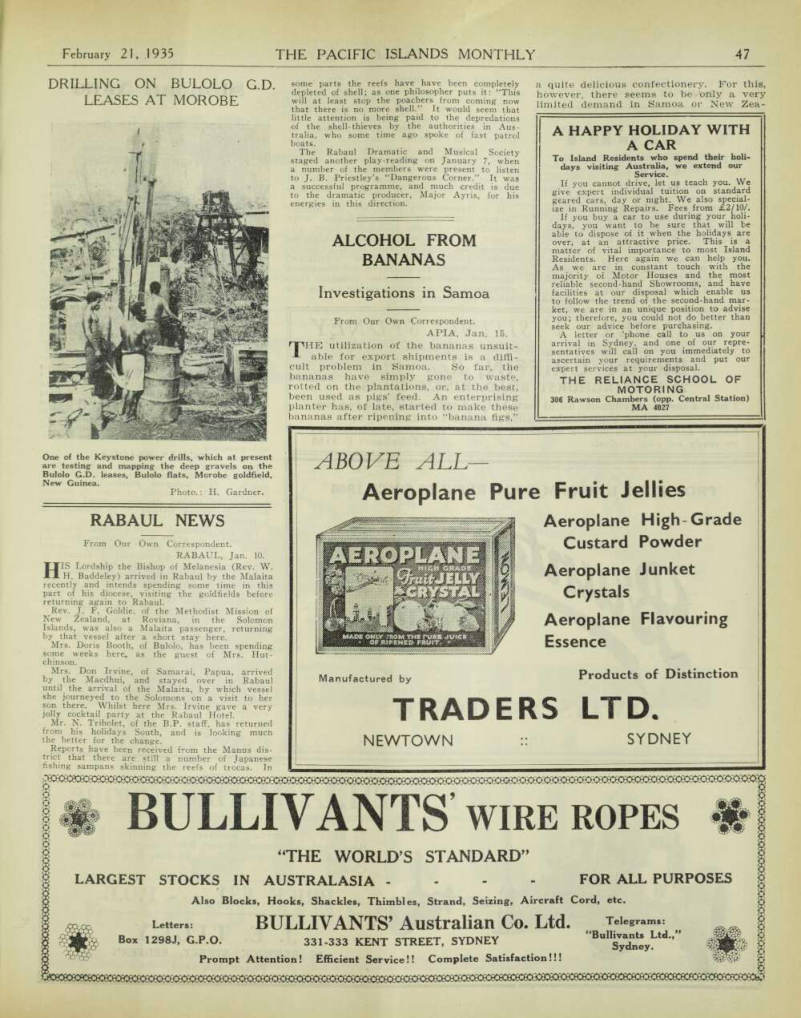
Leases At Morobe
One of the Keystone power drills, which at present are testing and mapping the deep gravels on the Bulolo G.D. leases, Bulolo flats, Morobe goldfield, New Guinea.
Photo.: H. Gardner.
Rabaul News
From Our Own Correspondent.
Rabaul, Jan. 10.
HIS Lordship the Bishop of Melanesia (Rev. W.
H. Baddeley) arrived in Rabaul by the Malaita recently and intends spending some time in this part of his diocese, visiting the goldfields before returning again to Rabaul.
Rev. J. F. Goldie, of the Methodist Mission of New Zealand, at Roviana, in the Solomon Islands, was also a Malaita passenger, returning by that vessel after a short stay here.
Mrs. Doris Booth, of Bulolo, has been spending some weeks here, as the guest of Mrs. Hut chinson.
Mrs. Don Irvine, of Samarai, Papua, arrived by the Macdhui, and stayed over in Rabaul until the arrival of the Malaita, by which vessel she journeyed to the Solomons on a visit to her son there. Whilst here Mrs. Irvine gave a very jolly cocktail party at the Rabaul Hotel.
Mr. N. Tribolet, of the B.P. staff, has returned from his holidays South, and is looking much the better for the change.
Reports have been received from the Manus dis trict that there are still a number of Japanese fishing sampans skinning the reefs of trocas. In
some parts the reefs have have been completely depleted of shell; as one philosopher puts it: “This will at least stop the poachers from coming now that there is no more shell.” It would seem that little attention is being paid to the depredations of the shell-thieves by the authorities in Aus tralia, who some time ago spoke of fast patrol boats.
The Rabaul Dramatic and Musical Society staged another play-reading on January 7, when a number of the members were present to listen to J. B. Priestley’s “Dangerous Corner.” It was a successful programme, and much credit is due to the dramatic producer, Major Ayris, for his energies in this direction.
Alcohol From
Bananas
Investigations in Samoa
From Our Own Correspondent.
Apia, Jan. 15.
THE utilization of the bananas unsuit able for export shipments is a diffi cult problem in Samoa. So far, the bananas have simply gone to waste, rotted on the plantations, or, at the best, been used as pigs’ feed. An enterprising planter has, of late, started to make these bananas after ripening into “banana figs,”
a quite delicious confectionery. For this, however, there seems to be only a very limited demand in Samoa or New Zea
land, while the English market is sup plied very cheaply by tropical countries.
situated more closely than far away Samoa.
At present the possibility of making power alcohol or drinking spirit from bananas is being investigated. This manufacture is extensively undertaken in South and Central American banana growing districts, especially in those re mote from the main avenues of traffic.
The manufacturing process is stated to be comparatively simple, and the initial cost of a distiller is within reasonable limits.
If a Government plant for the manu facture of spirit from bananas were established at Apia the cocoa juice, ob tained on European cocoa plantations during the fermentation of the cocoa, could be utilised. Thus additional revenue would be procured for the cocoa planters, who are at the present time struggling for existence, owing to the low prices for their product.
Advertisements & other items, pp. 49-50 (1 item)
BULLIVANTS wire ropes
A HAPPY HOLIDAY WITH
A CAR
To Island Residents who spend their holidays visiting Australia, we extend our Service.
If you cannot drive, let us teach you. We give expert individual tuition on standard geared cars, day or night. We also specialize in Running Repairs. Fees from £2/10/.
If you buy a car to use during your holidays, you want to be sure that will be able to dispose of it when the holidays are over, at an attractive price. This is a matter of vital importance to most Island Residents. Here again we can help you.
As we are in constant touch with the majority of Motor Houses and the most reliable second-hand Showrooms, and have facilities at our disposal which enable us to follow the trend of the second-hand market, we are in an unique position to advise you; therefore, you could not do better than seek our advice before purchasing.
A letter or ’phone call to us on your arrival in Sydney, and one of our representatives will call on you immediately to ascertain your requirements and put our expert services at your disposal.
THE RELIANCE SCHOOL OF
MOTORING
306 Rawson Chambers (opp. Central Station) MA 4027
ABOVE ALL—
Aeroplane Pure Fruit Jellies Aeroplane High-Grade Custard Powder Aeroplane Junket Crystals Aeroplane Flavouring Essence Manufactured by Products of Distinction
TRADERS LTD.
NEWTOWN
SYDNEY
BULLIVANTS wire ropes
“THE WORLD’S STANDARD”
LARGEST STOCKS IN AUSTRALASIA - FOR ALL PURPOSES Also Blocks, Hooks, Shackles, Thimbles, Strand, Seizing, Aircraft Cord, etc.
Letters: BULLIVANTS’ Australian Co. Ltd.
Box 1298 J, G.P.O. 331-333 KENT STREET, SYDNEY Prompt Attention! Efficient Service!! Complete Satisfaction!!!
Telegrams: “Bullivants Ltd.,"
Sydney.
BOAT BUILDER AND MARINE
ENGINEER
MANLY, SYDNEY
My stocks include strong serviceable working launches, suitable for Islands work, with a special line as under: 26ft. x 8ft. 6in., cruiser stern, raised deck, heavily constructed Launch, big carrying capacity. Kelvin heavy-duty Engine.
Sails and Gear. Instant delivery.
Price £285 f.o.b., Sydney.
ISLANDERS VISITING SYDNEY
Can with confidence place their requirements in my hands.
BRIAN GRIFFIN, Estate
75 DARLINGHURST ROAD, KING’S CROSS
I have a most comprehensive list of furnished and unfurnished flats and bungalows conveniently situated at prices to suit all.
Letters and telegrams receive immediate attention and accommodation can be ready on your arrival. Telephone: F 3588
PRODUCING UNIFORM GOOD RESULTS SINCE 1868
ALWAYS ASK FOR IT
3 h.p.
TILLY Marine Engine
27/8 bore, 2¾ stroke. Balanced crankshaft, 1 1/8 dia., float feed carburettor, Robert Bosch magneto. Equipment: Silencer, Propeller. Shaft. Stuffing Box. and Free Clutch.
J. E. TILLY
25 RENWICK STREET, REDFERN
‘Phone: MA 3430.
Samoan News
Outlook Bright for Samoa In 1935
From Our Own Correspondent.
Apia, Jan. 17.
WE have just buried the old year and nobody could say that 1934 has been a good year for the residents, European and native, of the Mandated Territory. Still, after all, the end was better than the beginning. Apia shopkeepers con firm that Christmas business was considerably better than for the last few years. Especially on Xmas Eve the stores were crowded with hustling shoppers, eager to procure all that was necessary for the worthy celebration.
The New Year began very auspiciously with a rapid rise in world market price of our staple commodity, copra. Within a few weeks this very welcome increase in the London flotations amounted to more than 50 per cent. Though the local price paid to producers has not been raised so far, a substantial increase of the local rate is expected in the near future. The welcome news has reached us, furthermore, that the large stocks of Samoan cocoabeans in London ware houses have been completely cleared at, under the circumstances, fair prices, and some parcels realised as high as £41.
These facts, coupled with the higher banana quotas for 1935 granted by the New Zealand Government and the regular calls of the Union S.S. boats, on their way back from Vancouver to take banana shipments for the Auckland market, every month, make the economic outlook for Western Samoa in 1935 decidedly more hopeful and promising.
Squally Weather.
The New Year, unfortunately, brought us a spell of rainy and showery weather with frequent squalls. This inclement weather has seriously interfered with the cutting of copra by Samoan natives, and traders, therefore, report business in outside trading stations to be practically at a standstill.
The rain increased to a torrential downpour on January 16, which lasted for two days and Sights. The U.S.S. Co.’s “Waikawa” arrived from Vancouver in the morning of January 16 with over 200 tons of cargo for Apia, and to take away the initial shipment of bananas for Auck land* under the new contract. The rain consider ably delayed the landing of the perishable cargo and the shipping of the bananas which was under the personal supervision of Produce Inspector H.
Newton, who travelled to N.Z. on board the “Waikawa.”
Duke Of Gloucester S Tour.
It is sincerely to be hoped that the excep tionally bad weather, which to some extent nas interfered with the preparations for the approach ing visit of the Duke of Gloucester, will change to a brighter sky and sunshine during the stay of our Royal visitor. The Citizens' Committee is working very hard to ensure the success of the arrangements and with the willing co-operation of Administration and general public an enjoyable time may be safely predicted for the Duke and his party, as well as for the complement of H.M.A.S. “Australia."
Advertisements & other items, pp. 51-52 (1 item)
Shell
ON LAND
OR SEA the principle, is the same — use
for SPEED, MILEAGE and POWER,
For All You Require In
Dependable Groceries
You CANNOT Do Better Than At
Moran & Cato’s
Australia’s Largest Grocery Organisation
The fact that Moran & Cato Ltd. has 180 branches throughout the Commonwealth of Australia is sufficient indication of their vast buying power, and is the reason why—when quality is taken into consideration —their
PRICES ARE UNBEATABLE.
SPECIAL OFFERS TO OVERSEAS RESIDENTS ARE:
Trefavenne Sardines, ¼lb. tins Norwegian Sild, ½lb, tins Morton’s Herrings in Sauce, 14oz. tins “Congress” Chum Salmon, 1lb. tins “Parachute” Fancy Pink Salmon, lib. tins “Eveready” Red Salmon, 1lb. tins Fruit Salad, “Summerland,” 1lb. tins Strawberry Conserve, Q.P., 1lb. tins Sweet Corn, Gartsides, 10oz. tins Prunes in Syrup, “Summagold,” 1lb. tins Dessert Prunes, 7lb. tins Eta Peanut Butter, 12oz. tins Dripping, 1lb. pats “Riverstone” Sheep Tongues, 12oz. tins Asparagus Soup Cuts (and for sandwiches) Essences, Full Strength, “Summagold”
Morton’s Assorted Fish Pastes, 6 kinds, 1 ½oz. tins . . . 8d, 7/9 doz. 7½d, 7/3 doz. 9d, 8/9 doz. 8½d, 8/3 doz. 9½d, 9/3 doz. 1/3, 14/6 doz. 7½d, 7/3 doz. 9½d, 9/3 doz. 6½d, 6/3 doz. 6d, 5/9 doz. 3/6 per tin 1/4½, 16/- doz. 6d, 5/6 doz. 10½d, 10/3 doz. 30oz. tins 1/- ea. 2oz. bots, 1/- ea. 2/3 per doz.
“Rosella” Products, Arnott’s Biscuits, Holbrook's Goods, and all other Aus tralian and Imported Products at Lowest Possible Prices.
We Pack and Deliver Free to Boat Sydney, Cash against Documents.
WRITE FOR OUR COMPLETE GROCERY CATALOGUE.
Moran & Cato Ltd.
122-128 Cleveland Street Chippendale, Sydney, Australia.
GLENIFFER
DIESEL ENGINES
INSTAL THE DIESEL THAT HAS BEEN GOING STRONG SINCE 1929, AND HAS PROVED ITSELF IMMUNE FROM ALL DIESEL WEAKNESS.
D.C. Series, 45 to 160 b.h.p., in 3,4, 6, and 8 cylinder sizes at 700 to 9M r.p.m.
D.B. Series, 24 to 96 b.h.p.. in 2. 3. 4. 6. and 8 cylinder sizes, at 1000 r.p.m.
Australian Agents:
H. G. THORNTHWAITE & CO.
KEMBLA BUILDING.
MARGARET STREET, SYDNEY, N.S.W.
TELEGRAMS: “ORTHORN,” SYDNEY. TELEPHONE: B 5240
How Japanese Encourage Good
Marshall Islands
Copra
How Japanese Encourage Good Production
THE methods by which the Japanese Administration encourages the pro duction of good copra in the Japanese Mandated Territory of Marshall Islands is interestingly described in a recent letter from a well-known missionary, Mr.
Carl R. Heine, who is stationed at Jaluit, Marshall Islands.
Mr. Heine says; “The quality of the copra has been much improved during recent years. This has been effected in two ways—(1) An annual exhibition of copra made in the group, to which all are invited to send sample bags. A prize is given to the maker of the best copra on each atoll, and an additional prize is given to the maker of the best copra of all. The names of the winners are entered in the official records, which is something to their credit, and may be of material bene fit at some time. (2) The natives have been advised to make special houses for drying copra, and have been supplied with simple but adequate designs for the same. Quietly, but firmly, and with a cash inducement, many have been per suaded to comply with instructions, and others are beginning to do so likewise.
Thus better copra is possible.
“Moreover, if traders buy inferior copra they do so at their own risk, for all copra arriving here from other islands is inspected by a Government agent. If of good quality, each bag is stamped; in ferior grade stuff is rejected, and can not be exported. When first I heard of the plan I thought it would not work at all. But I was wrong; it works, and the result appears to be satisfactory.”
Norfolk Island Dairy Co.
The Norfolk Island Co-operative Dairy Co. Ltd. was registered at N.I. on January 19. The object of the new company is to manufacture butter, bacon, and cheese, for which purpose a factory will be established. Nominal capital is £5000 in 5000 shares of £1 each. Provisional directors are Messrs. H. M. Benny (Secretary), H. F. Chap man G. A. Laird, A. J. McGrath, R. H. H. Nobbs, W. Rossiter, G. H. Wickstead. The company will receive a £ for £ grant from the Commonwealth Government for money spent on construction. N.I. imports of butter, cheese, and bacon for 1933-34 were 28,670lbs., 3,408lb., and 329lb., respectively.
Fiji Goldmines Shares
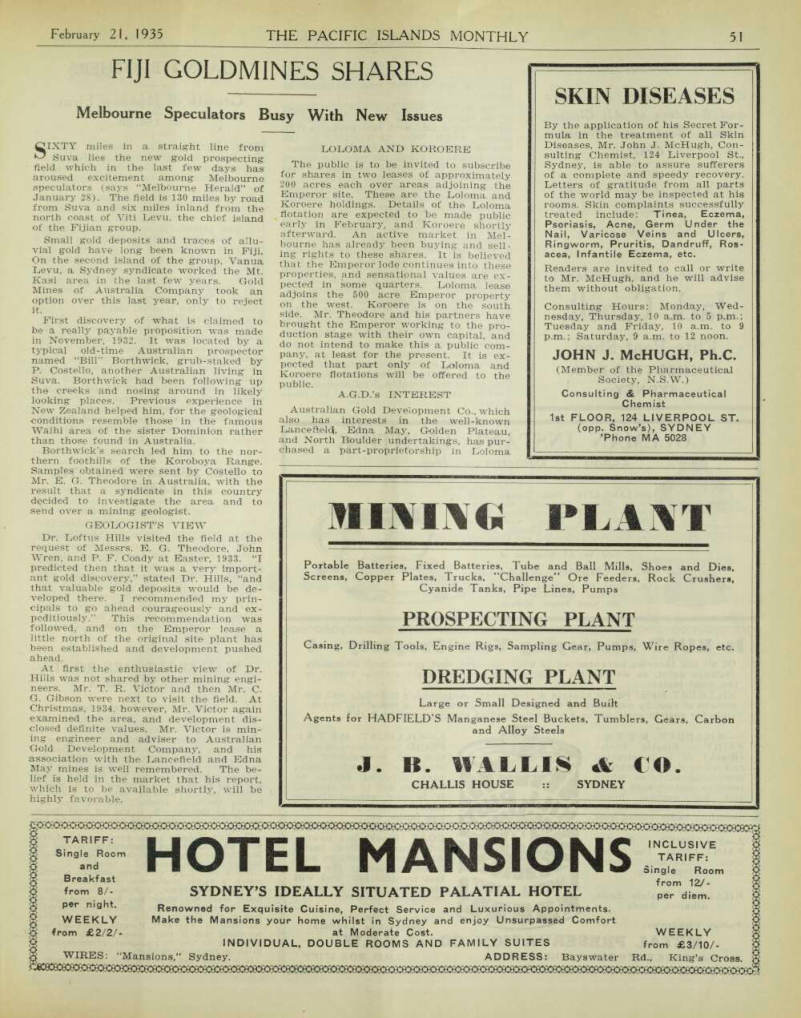
Melbourne Speculators Busy With New Issues
SIXTY miles in a straight line from Suva lies the new gold prospecting field which in the last few days has aroused excitement among Melbourne speculators (says “Melbourne Herald’’ of January 28). The field is 130 miles by road from Suva and six miles inland from the north coast of Viti Levu, the chief island of the Fijian group.
Small gold deposits and traces of allu vial gold have long been known in Fiji.
On the second island of the group, Vanua Levu, a Sydney syndicate worked the Mt.
Kasi area in the last few years. Gold Mines of Australia Company took an option over this last year, only to reject it.
First discovery of what is claimed to be a really payable proposition was made in November, 1932. It was located by a typical old-time Australian prospector named “Bill” Borthwick, grub-staked by P. Costello, another Australian living in Suva. Borthwick had been following up the creeks and nosing around in likely looking places. Previous experience in New Zealand helped him, for the geological conditions resemble those in the famous Waihi area of the sister Dominion rather than those found in Australia.
Borthwick’s search led him to the nor thern foothills of the Koroboya Range.
Samples obtained were sent by Costello to Mr. E. G. Theodore in Australia, with the result that a syndicate in this country decided to investigate the area and to send over a mining geologist.
Geologist’S View
Dr. Loftus Hills visited the field at the request of Messrs. E. G. Theodore, John Wren, and P. F. Coady at Easter, 1933. “I predicted then that it was a very import ant gold discovery,” stated Dr. Hills, “and that valuable gold deposits would be de veloped there. I recommended my prin cipals to go ahead courageously and ex peditiously.” This recommendation was followed, and on the Emperor lease a little north of the original site plant has been established and development pushed ahead.
At first the enthusiastic view of Dr.
Hills was not shared by other mining engi neers. Mr. T. R. Victor and then Mr. C.
G. Gibson were next to visit the field. At Christmas, 1934, however, Mr. Victor again examined the area, and development dis closed definite values. Mr. Victor is min ing engineer and adviser to Australian Gold Development Company, and his association with the Lancefleld and Edna May mines is well remembered. The be lief is held in the market that his report, which is to be available shortly, will be highly favorable.
Loloma And Koroere
The public is to be invited to subscribe for shares in two leases of approximately 200 acres each over areas adjoining the Emperor site. These are the Loloma and Koroere holdings. Details of the Loloma flotation are expected to be made public early in February, and Koroere shortly afterward. An active market in Mel bourne has already been buying and sell ing rights to these shares. It is believed that the Emperor lode continues into these properties, and sensational values are ex pected in some quarters. Loloma lease adjoins the 500 acre Emperor property on the west. Koroere is on the south side. Mr. Theodore and his partners have brought the Emperor working to the pro duction stage with their own capital, and do not intend to make this a public com pany, at least for the present. It is ex pected that part only of Loloma and Koroere flotations will be offered to the public.
A.G.D.’S Interest
Australian Gold Development Co., which also has interests in the well-known Edna May, Golden Plateau, and North Boulder undertakings, has pur chased a part-proprietorship in Loloma
and Koroere leases. A.G.D. Co. had these propositions under consideration in 1933, but was not at that time attracted by them.
The interest now held has contributed to the eager purchase of A.G.D. shares by speculators in the last few weeks. A.G.D. shares, which were at £24/10/- at the end of December, and £43 last Monday, were bought at £62 at the morning call on Saturday. The market anticipates that A.G.D. will receive 50,000 shares out of 300,000 (including vendors) in Loloma, when it is floated this week, and a similar participation in Koroere.
Time will prove whether the glowing expectations of the new Fijian fields are to be fulfilled. It is certain, however, that if any new field develops definite pros pects of success, optimists will peg a host of claims in the vicinity, many of which may be little more than a gamble. Inves tors should, therefore, be sufficiently dis criminating not to build undue hopes on the mere word “Fiji” in a prospectus. The more cautious are likely to require definite evidence of proved values before venturing.
Another group of leases near the Em peror mine has been taken up by Tavua Options Ltd., a Sydney company of which Mr. W. R. Carpenter is chairman. There has been considerable liveliness on the Sydney exchange in relation to these shares.
Advertisements & other items, pp. 53-54 (1 item)
Hotel Mansions
SKIN DISEASES
By the application of his Secret Formula in the treatment of all Skin Diseases, Mr. John J. McHugh, Consulting Chemist, 124 Liverpool St., Sydney, is able to assure sufferers of a complete and speedy recovery.
Letters of gratitude from all parts of the world may be inspected at his rooms. Skin complaints successfully treated include: Tinea, Eczema, Psoriasis, Acne, Germ Under the Nail, Varicose Veins and Ulcers, Ringworm, Pruritis, Dandruff, Rosacea, Infantile Eczema, etc.
Readers are invited to call or write to Mr. McHugh, and he will advise them without obligation.
Consulting Hours: Monday, Wednesday, Thursday, 10 a.m. to 5 p.m.; Tuesday and Friday, 10 a.m. to 9 p.m.; Saturday, 9 a.m. to 12 noon.
JOHN J. McHUGH, Ph.C.
(Member of the Pharmaceutical Society, N.S.W.) Consulting & Pharmaceutical Chemist
1st FLOOR, 124 LIVERPOOL ST.
(opp. Snow’s), SYDNEY ’Phone MA 5028
MINING PLANT
Portable Batteries, Fixed Batteries, Tube and Ball Mills, Shoes and Dies, Screens, Copper Plates, Trucks, "Challenge” Ore Feeders, Rock Crushers, Cyanide Tanks, Pipe Lines, Pumps
PROSPECTING PLANT
Casing, Drilling Tools, Engine Rigs, Sampling Gear, Pumps, Wire Ropes, etc.
DREDGING PLANT
Large or Small Designed and Built Agents for HADFIELD’S Manganese Steel Buckets, Tumblers, Gears, Carbon and Alloy Steels
J. 11. MALLIS CO.
CHALLIS HOUSE :: SYDNEY
TARIFF:
Single Room and Breakfast from 8/per night.
WEEKLY
from £2/2/-
HOTEL MANSIONS
SYDNEY’S IDEALLY SITUATED PALATIAL HOTEL
Renowned for Exquisite Cuisine, Perfect Service and Luxurious Appointments.
Make the Mansions your home whilst in Sydney and enjoy Unsurpassed Comfort at Moderate Cost.
INDIVIDUAL, DOUBLE ROOMS AND FAMILY SUITES
INCLUSIVE
TARIFF:
Single Room from 12/per diem.
WEEKLY
from £3/10/- WIRES: “Mansions,” Sydney.
ADDRESS: Bayswater Rd., King’s Cross.
Expert Engineers, Designers and Builders of All Classes Islands Boats and Pleasure Craft Good Fleet of Boats on Hand.
Estimates Given Freely.
Buyers/Sellers write:
Jack Capell,
Elite Boat Shed
RUSHCUTTER BAY,
SYDNEY
COLEMAN INSTANT LIGHTING
Lamps
Lanterns
Irons
A tremendous IMPROVEMENT on anything we have before manufactured.
INSTANT-LITE Table Lamps, with Creme Shade, Automatic Generator, built-in Pump, Patent Air Release Tank.
INSTANT-LITE Irons, with Roto Generator, Porcelain Enamel Body— two Hot Points —Bevelled and Cambered Base.
Sold by All Branches of W. R. Carpenter & Co , Ltd.
Write for Coloured Catalogue to Coleman Quick-Lite Co., 500 Kent Street, Sydney Coleman
Is RUST Destroying Your Property-?
Of all the theories advanced as to why incipient rust grows and ultimately destroys paint, as well as the underlying metal, the Electrolytical theory is the most logical. ... ...
KILLRUST Metal Paints contain active constituents which definitely kill the growth of rust by neutralising the electrolytic action. It is, therefore, impossible for rust to grow under a properly applied coating of KILLRUST.
1. KILLRUST METAL
PAINT Elastic Finish (Black) is a penetrating and quick drying paint for protecting surfaces which come in contact with water and for general inside work. It is also used for descaling badly rusted iron. (See instructions.)
2. KILLRUST ROOF
PAINT (Red). For rusted iron roofs and general structural painting.
KILLRUST Resists Salts, Alkalies, Acids Factory Distributors:
btULPMd
3. KILLRUST METAL
FLUID is a colourless solution for neutralising the growth of rust when ordinary coloured paints or lacquers are to be applied.
It is used extensively on motor bodies, petrol storage tanks, etc.
4. KILLRUST SUPER
COAT (Black) is a powerful heavily-bodied paint, which can be used on surfaces exposed to the hottest tropical sun, and will also stand up to constant immersion in water.
Write for Descriptive Leaflets
METAL PRESERVATION CO. of N.S.W.
58 MARGARET STREET, SYDNEY. N.S.W. G.P.O. BOX 871 FT
in Tonga
Banno Brothers
Growth of Japanese Firm in Tonga
THE growth of the trading firm of Banno Brothers in Tonga is an inter esting example of how Japanese enter prise and industry are making progress in the Pacific.
Mr. Banno, a young Japanese of good education and character, went to Nukua lofa a few years ago, and looked about.
He was joined by one or two country men, and they began trading as Banno Brothers. In spite of the depression they flourished and grew; and to-day they have branches in all the chief villages of Tonga. There are probably 20 Japanese now engaged in the business. They do a considerable importing trade, and supply goods to native traders, and they are also large buyers of copra.
Recently, alarmed by the growth of this foreign enterprise, the Tongan Govern ment imposed restrictions on the further immigration of Japanese, and there seems also to have been difficulty over leases of land. Banno Brothers have erected sub stantial new buildings at Yavau and else where, under the direction of a skilled shipwright brought from Japan.
Mr. Banno, who speaks good English, and is held in respect in Tonga, left re cently on a visit to Japan.
N.Z. Judge’S Visit To
Samoa
From Our Own Correspondent.
Apia, Jan. 16.
The visit on circuit of His Honour Chief Judge J. H. Luxford, formerly of Samoa and now S.M. of Thames district.
New Zealand, is expected by the “Maui Pomare,” which is to arrive on Feb ruary 7.
The calendar of criminal cases waiting trial is not very heavy. The most serious offence is a case of rape, in which not less than seven young Samoans are to be prosecuted.
Wau Sportsmen Rout
Moresby Men
From Our Own Correspondent.
Pt. Moresby, Jan. 10.
THE visit of the Port Moresby teams to the N.G. goldfields to engage the Wau men in sporting combat to settle the vexed questions of supremacy in cricket, tennis, billiards, and general good-fellowship was delayed owing to brisk shipping activity in port. The Macdhui arrived and sailed for Rabaul on December 26; the Montoro berthed on the following day, and sailed for Sydney the same evening; and the Van Rees arrived on the 28th. So it was not until Decem ber 30 that our ardent band was able to fly over to Wau.
The Port Moresby teams were routed and Wau won all four events comfortably, leaving the Moresby men amazed at the lavish and whole hearted hospitality extended to them.
Into a four days’ visit were crowded a cricket match, a tennis tournament, two public dinners, an impromptu dance, a billiards tournament, a fancy dress ball which was kept going till 4.30 a.m., an evening at the “talkies,” an interesting tour of the district, and a great deal of private entertaining. The Port Moresby teams are quite convinced that if they cannot win, it would be impossible to lose in pleasanter circumstances, cr to more generous opponents.
It is hoped that a return visit may be made at Easter.
Products
Bogus Milk
New Law to Check Sale of Adulterated Food in French Oceania.
From Our Own Correspondent.
PAPEETE, January 14.
OF interest to exporters doing business with French Oceania are the laws re lative to the protection of milk products, and the suppression of fraud in connection with the misrepresentation of imitation silk fabrics. These laws were made applicable to this Colony by promulgation in the Journal Official of January 1.
The provisions regarding milk products will come into force on July 1 next, after which date it is forbidden to manufacture, expose for sale, import, export, or re-export any adulterated product bearing a name calculated to deceive the purchaser or to disguise its true character. Thus the name “cream” for example, even though followed or preceded by a qualifying or fancy adjec tive, could not be used on any article destined for use as cream unless it is de rived exclusively from milk.
Similar provisions apply to cheese, pow dered milk, ice cream, and butter. In the case of canned milk, however, there is no discrimination against added cream or sugar. The importation of milk products is forbidden from countries where the manufacture of margarine is not subject to permanent control by a service of In spection, and where it is not made compul
sory to incorporate in the margarine some substance giving distinct indications of its presence upon analysis, even though pre sent in extremely small amounts. Imported milk products must show in plain characters the country of their origin upon the containers.
New Artificial Silk Laws.
The law relating to artificial silk forbids the importation, stocking, or offering for sale under the name of silk, with or with out qualification, any thread, cloth, or other articles, which are not exclusively com posed of the products or by-products of silk insects. Such articles containing not less than 50 per cent, by weight of pure silk must be denominated “soie melangee.”
Articles containing not less than 25 per cent, by weight of silk should be de nominated “melange do soie.” All articles not comprised within the above mentioned categories may in no case bear the name of silk except in so far as they bear dis tinct indications of the exact amount of silk entering into the mixture.
An Administrative Regulation will be published during the six months following the promulgation of the law, which will complete the definition of the word “silk,” and generally determine the conditions under which its provisions will be applied.
Rev. Franz J. Kirschbaum, Catholic Missionary of the Divine Word, recently stationed on the Sepik River, New Guinea, writes cheerfully to the P.I.M. from Vienna. Although so far away from the land to which he devoted 25 years of his life, he takes a keen personal interest in all that is happening in the Territory.
He sends his warmest personal regards to his friends in New Guinea—especially those in the Sepik River district.
Advertisements & other items, pp. 55-56 (1 item)
Lower Power Costs
Pacific Islands Stamps
BOUGHT AND SOLD
Stamps sent on approved on receipt of reference. Send for free lists and specimen copy “Australian Stamp Journal.”
J. H. SMYTH CO. LTD.
121 a Castlereagh St., Sydney
BOYD SHORTHAND
Based on 2-letter syllables, is aa plain as 1 and 1 makes 2.
Some syllabic signs: in, to, th, is Nothing to unlearn, as students write full words and adopt reporting style from first
GRADUATE in 30 DAYS —150 HOURS
Has easy forward flowing outlines, pleasing to write and easy to read, as vowels are retained at all speeds. Most interesting and simplest system ever invented. Holds world’s record for speed. Used in High Court of Australia and Supreme Court of N.S.W. for taking official notes. Accepted by Public Service Board in examinations for all Departments. No thick and thin strokes to confuse and no position writing.
Taught and used in all countries. Secretarial, Stenographers and Reporting Courses.
Day and Evening Classes and a Correspondence Course available. Call or write to-day for Free Descriptive booklet.
BOYD COMMERCIAL COLLEGE
Daking House Rawson Place, Sydney Postal Address: Box 51, P.O., Haymarket lesson.
Lower Power Costs
For sturdy, thoroughly reliable power at the lowest possible cost, Fetter Atomic Diesel Engines are unsurpassed. Extremely simple in design and of robust construction, Fetter Engines are trouble-free in operation and easy to handle without skilled labour.
The power-rating is conservative and, with their low speeds, years of reliable service are assured.
For full details, write to
PETTER
Atomic Diesel Engines
Buzacott & Limited
Cold Starting, Heavy Oil in Stationery and Marine Types, Auxiliary and Electric Lighting Sets. Sizes 7-11 Market St., Sydney, Australia from 5 B.H.P. to 540 also the famous Petters Type Semi-Diesel Engines. Agents and Spare Parts Stockists
Dependable
“Buzacott” Lines
The “DIGGER” WINCH
A light, portable, one-man machine with enormous power. It will uproot any tree or stump with little effort.
“ALSTON” WINDMILLS
Well - built, light - running models at prices to suit every pocket.
“GILCO” ELECTRIC LIGHT
PLANT
Wind-driven ... no fuel costs.
A proved success.
BUZACOTT “NEWRECORD”
DRAG-SAW
Economical, speedy and efficient. Easy to handle, thoroughly reliable and wellbalanced.
“BUZACOTT” SPRAY
PUMPS
Reasonably priced, well constructed and absolutely reliable.
“BUZACOTT” GATES and
FENCES
Also Chain Wire, all meshes and gauges, for Copra Trays.
INNERCLEAN Intestinal Laxative.
An Aromatic Herb compound Adjuvant for Constipation. Perfected by Prof. Arnold Ehret. 3/6 packet. Send Twopenny stamp for sample.
A. SUMMERBELL
“Wyoming,” Hunter Street, Sydney
SAMUEL RUSSELL
ESTATE AND GENERAL AGENT.
P.O. Box 64, Papeete, Tahiti
Real Estate. Investments. Estate Management and Administration. Valuations and Reports. Houses and Lands for Lease or Sale.
Sole Proprietor: TAHITI PERFUMES Cables; Russell, Tahiti (Bentley’s Code)
STANDARD DRUG CO.
FOR ALL YOUR
CHEMICAL AND TOILET
REQUIREMENTS
Island Representative:
W M. REID, YORK STREET, SYDNEY
Head Office:
26 HUTCHISON STREET, SYDNEY
"4711" refreshes and revives
at any time
The original quality of “4711” Genuine Eau de Cologne will always remain supreme.
There is no substitute for “4711”
Genuine Eau de Cologne because it is impossible to produce an article of “4711 ” quality and excellence at a lower price. Those who require the best will insist on “4711.”
Genuine
Eau De
Cologne
Blue & Gold Label
Factory Representative for Australia, JULIUS BLAU, Australia House, Carrington St. Sydney.
Fashion Hints for Islands Women

By Therese
SINCE colour contrasts are the dernier cri, a colour sense is more important than ever. Much may be learned from nature —from the exquisite cloud effects, the glorious tints of autumn leaves, the gorgeous colourings of flowers against their background of brilliant green; or one may be inspired by all that is beautiful in art —lovely old Japanese prints or the clever blendings of modern art.
Colour contrasts for evening spell chic all along the way, so a slim Eugene model of speedwell blue has its square decolletage outlined by crimson velvet ribbon, ending in a bow at the back with tails that sweep the floor train-wise.
Perfection in itself is the exquisite gown of white satin, severely classical in line; but when detachable sleeves in black and white striped effect are added, it simply shrieks sophistication. The sleeves are held in place by a panel in the middle of the back. Slim fitting gowns of perfect cut sport gaily coloured contrasting coats
and capes, hip, three-quarter, or floor length, with a result that is satisfaction complete.
Evening wraps are irresistible, and in this direction taffetas still play an import ant part and a coolie coat evolved in taf fetas is all that could be desired.
To be an angel is such an easy matter in these days of enormous bows worn on the shoulders in wing-like effect, and a satin coat treated with taffetas in this wise soars rapturously to the heights, and fills the wearer with exhilaration in its flight.
Black, popular as ever, is now allied with brilliant colours. Little frogs of vivid, hue fasten the bodice and neckline of a black afternoon frock with a fascinating air that is different. A black crepe dress is the perfect medium for transformation tricks, and spells Economy with a capital E. It is the foundation for a variety of tops to suit every hour. A sequinned tunic, and you are ready for the rise of the cur tain, a lame blouse, and a cocktail hoves into view; a jacket of two colours is trumps for bridge, and the frock itself, with shoulder or waist posy of real flowers or boasting barbaric jewellery as its sole adornment, belongs to formal hours.
The woman of sophistication risks her throw on massive barbaric jewellery, and achieves the much-sought Cleopatra-ish effect —glamorous beyond dreams.
If pleats you must have for your even ing gown, do let them be knee high only. ’Tis only thus you can avoid that wilted sat-out appearance, and you will go through the evening happily, complacent in the knowledge that all is well.
The palest of pink satin, slim to the knees, flares widely to the l hem by reason of its shirred godets, giving the very new inverted wine-glass effect. It makes the sweetest dance frock for the youthful dam sel. A brilliant clip catches the draped bow adorning the low square decolletage.
“Flowers, and still more flowers,” is fashion’s latest decree —at neck or waist line, cascading down the bodice or skirt in gay abandon —and we love them wher ever they be. Because of this, the low flower decolletage increases in popularity, with or without its picket frill, and is completely charming.
Pierrot frills of tulle from which peep forth demure posies are such an attractive idea and make a delightful frame for the Quaint “Little Women” frocks rustle along in taffeta or faille, with low square neck, fascinating little puff sleeves, and bodice buttoned in approved style. They charm the heart of man with their demure air of innocence, and the eternal feminine that lies in their old worldliness.
A joy to its wearer in the perfection of its simplicity is the afternoon frock with the new bloused back, its fullness spread ing from grouped fan-wise tucks at the neck line, its slim skirt boasting fullness at the centre front only, and with sleeve
wide to the elbow, tapering to slimness at the waist.
Blouses are such gay little affairs these days, and prove their utility the clock round. Russian tunics have a friendly way with them, and readily adapt them selves to anything at any hour. Russian sleeves are intriguing, too, and the last word in chic. The tunic blouse with floor length skirt, is the answer to the prayer of the “not so young and not so svelte,” whom it clothes in dignified distinction.
Gay and attractive are the little cotton frocks, unrivalled for tropical wear. Sprigs, checks, spots, and designs innumerable, they please our hearts. String linen suits hold their own, offering as they do such a wide scope for colour blending.
Adorable are the cape collars of net, with huge cuffs en suite. They are banded and bordered with rouleau and make the little silk frock look cool as a summer breeze—“nor hot, nor cold.” The simply cut sports frock of silk or linen looks charming with the addition of either halter or sling scarf, which hangs one-third of the way down the bodice, or a gaily coloured handkerchief that falls loosely round the neck in cowl fashion.
Old-fashioned hail spot muslins in pas tel shades make deliciously cool little frocks for tropical evenings. A huge taf feta sash and bow in vivid contrasting shade would make it more attractive than ever.
The tender green of the newly-opened leaf is the perfect shade for tropical wear —for the golden haired lass, of course.
Her brunette sister may choose daffodil yellow and wear green accessories, among which must be counted a green glass bangle, when a full measure of success is assured.
A clip on the ear—a jewelled clip, gleam ing and lovely—smacks sophistication and charm. We catch these clips in our hair o’ nights with will o’ the wisp effect. Twin clips are still dear to our hearts —large star-shaped ones, shining clear in the fir mament. One on either side of the neck line, or one at neck and one at waist, and joy is complete.
Sports jewellery is really delightful— bracelets, brooches, buttons, clips, are made in patent leather, and are at their best on the heavy linen tailored sports frock or suit. Log buttons come in many varieties and wear a tailored look. If you are clever, you can paint your own initials on a long-shaped button of natural wood, and be well in the forefront of fashion: or if you are floral minded, a quaint little flower design will make you the envy of your friends.
For nautical occasions, there is the flying pennant brooch in navy blue and scarlet, or a fetching little anchor that catches your scarf or clips your belt in approved style. Jaunty little sailor men perch on your clothes in a manner that is intriguing.
With one eye on the sea, give the other to your beach wear. As shorts ousted slacks from pride of place, so now do shorts give way to beach frocks (though in a lesser degree, of course); and why not, for they are really charming. In striped material cut on the cross and moulded to the figure, they are entirely backless, or else boast only the slimmest of braces. Attractive matching or con trasting coats are a further justification of their popularity.
Miss I. Foulcher, Methodist Missionary of Matavelo, Fiji, arrived in Sydney re cently by the Niagara. She will return to the Colony at the end of March.
By the January Makoa three Samoan natives were sent by the Administration to Fiji to study at the Medical School, Suva.
Advertisements & other items, pp. 56-58 (1 item)
Costumier E,
Mrs. N. WALKER - FLYNN,
Late 35 POWELL STREET, COOGEE
MALAGUNA ROAD, RABAUL
HEMSTITCHING and PICOT EDGING.
Copies of Mab’s Fashions; Romas Pictorial Fashions and Home Fashions available. — P.O. Box 116. Tel.; 141.
There's Style and Wear in every pair
ADDRESS :
420-422
GEORGE
AND 203
207 PITT
STREETS,
SYDNEY
PM. 1.35. Astounding value. Ladies’ Silver or Gold Colt Sandals, stilt heels, smart round toes, white leather lined, new clasp fastening. This advertised by competitors as being of Kid which it resembles.
All sizes and half sizes. Pair PM.1.35 12/11 PM.2.35 PM.2.35. New Summer model. White White Calf Perforated Instep Tie Shoe has medium stilt heel and smart round toe.
Also in black Glace Kid. All sizes 21/and half sizes. Pair / PM.3.3s.—Hordern Bros.’ extra wide fitting Arch Relief Shoes for Matrons, 4hole Derby style, pump soles, covered sports heels. Havana brown or black Glace Kid with self Lizard trim. All sizes and half sizes. 3 to 8. 18/11 PM.3.35
HORDERN BROTHERS
Get your
FREE
COPY
of the
NEW TRUFOOD
RECIPE BOOK
69 specially tested recipes—all kinds of new ideas for attractive things to cook cakes, pastry, puddings, custards, desserts, savouries, sauces, etc.
Post this coupon today “Recipe Department" c/- Box 3922TT G.P.O.
Sydney.
Please send me POST FREE, a copy of The Trufood Book of 69 Tempting Recipes Name
(BLOCK LETTERS)
Address
Firearm Repairs “OUR HANDS MAKE GOOD ARMS”
“THE WONDER RIFLE”
There is no better rifle made than the "WALTHER,” It.tses 22~cal long rifle cartridges, is a single shot, repeater and automatic, ALL IN ONE RIFLE- Price £10/10/-, postage extra.
Winchester latest 22 S.S. Rifles, models 60 and 67, 27 inch barrel, price 45/-, postage extra.
SIL ROHU
(late A.I.F.),
GUNSMITH
IMPORTER OF HIGH-GRADE FIREARMS AND FISHING TACKLE SPECIALIST 143 Elizabeth Street, SYDNEY. (Near Market Street).
“FISHING TACKLE TO TACKLE FISHING.”
"B.P."
[PREPARED],
Guaranteed by the manufacturers to go further, last longer and uniformly give better results than any other paint made. —“B.P.”
“KEEP ON KEEPING ON!”
Agents throughout the Islands.
Mission Centenary
Methodists Revive Memories of First Landing in Fiji
SO many desire to attend the centenary celebrations of the landing of the first Methodist missionaries (Revs. W. Cross and D. Cargill), which will begin at Lakemba, Fiji, on October 12, that prob ably two special steamers will be run from Sydney to Fiji.
The work begun by Cross and Cargill, the massacre of those who followed them, and the present-day activities of the 27 missionaries (apart from native teachers, all trained in the mission stations at Fiji), will be commemorated by services, the unveiling of tablets, and the opening of a new Cross and Cargill memorial church. The history of their hardships will be told, together with the story of the savage killing of their converts, and the impassioned appeal by the Rev.
James Watkin that touched the hearts of Christian workers in England, Among the volunteers who responded to the appeal were a Lincolnshire plough boy, John Hunt; the son of a Yorkshire farmer, James Calvert; and others, whose names will always be associated with the early missionary work of Fiji.
They and others who followed them car ried on undaunted by the threats of murder, and living for a time in huts only a few yards from the ovens of the cannibals. The missionary history of
Fiji tells of the revolting sights they witnessed, sights made more hideous by the yells of blood-maddened savages, and of the way Hunt and others were seized and threatened by the cannibals. Still they laboured on, refusing a free passage away from Fiji offered them by Com modore Wilkes, of the United States exploring expedition.
Cross died in 1842 and Cargill a year later. After 17 years’ missionary work, James Calvert returned to England.
Visitors to the centenary celebrations may visit the iron-railed grave on the top of the hill at Rewa, which bears the simple inscription, “John Hunt, Oct. 4, 1848. Aged 36.”
Part of the centenary celebrations will be the unveiling of a tablet by Miss Baker, a prominent mission worker, at the La Perouse aborigines’ camp, near Sydney, erected to the memory of her father, the Rev. Thomas Baker, the first white missionary to lose his life in Fiji.
In 1865 he was appointed missionary in the interior, with headquarters at Davui levu, but, with seven native mission helpers, he was killed at the order of a native mountain chief. The son of Mr.
Baker’s murderer later became a Chris tian and a local preacher.
A descendant of the first missionary in Fiji now living in Sydney is the Rev.
M. C. Howard, of the Methodist Church at Enfield, who is a great-grandson of the Rev. W. Cross.
Game Birds In Tahiti
From Our Own Correspondent.
PAPEETE, January 13.
ATTEMPTS to acclimatise game birds in Tahiti have not met with much success in the past. Pheasants, par tridges, and guinea fowls have all been tried, but the results with these birds have invariably been the same: they have gradually died out and finally dis appeared. There appears to be much better prospects in the case of the Cali fornia quail, some of which were intro duced last year as a joint venture by Messrs. Nordhoff, Guild and Rougier.
The quail were liberated in the hills of Punaavia, which is a comparatively dry district and where, apparently, the birds have found a congenial environ ment as they are already breeding.
Several coveys have been seen in the vicinity during the last few months. It is to be hoped that our local sportsmen will display enough public spirit to re frain from shooting them till they have had a fair chance of spreading over the island.
In Samoa
Produce Prices Raised
From Our Own Correspondent.
Apia, Jan. 19.
SAMOAN produce buyers have an nounced that the following increased prices will be paid to producers as from Monday, January 21st next: —Copra: Native Apia, 3/- per 100lb. (at present 2/-); outside districts, 2/6 per 100lb, (1/6). Planters: Delivered in Apia, £4/7/6 per ton (£3/5/-); Hot-air dried, £4/17/6 per ton (£3/15/-).
Cocoabeans: Native, Apia, 3 cents; out side 2½ and 2¾ cents (2 and 1½ cents).
European; 1st grade £22/10/-; 2nd grade. £17/10/- per ton —a rise of £2/10/- in each case.
Advertisements & other items, p. 59 (1 item)
Hotel Bulolo
WHERE TO STAY IN PORT MORESBY
THE
PAPUA HOTEL
Catering specially far Tourists & Travellers Situated on high ground overlooking both coasts, its Spacious Lounges are always Cool & Comfortable Tariff: Per day 16/-; per week £.5/5/-; per month £14; bed and breakfast 10/-; bedroom only 7/6.
Cars meet all steamers.
FIRST-CLASS ACCOMMODATION. SPECIAL DINNER
PARTIES ARRANGED.
Licensee: Papua Hotel, Ltd.
HOTEL MORESBY
COMFORTABLE
ACCOMMODATION
ONLY THE BEST
BRANDS OF
WINES, SPIRITS
AND BEERS
IN STOCK
LICENSEE:
Hotel Moresby
Ltd.
NEAR THE
WHARF
COSMOPOLITAN
HOTEL
Samarai
First-class Accommodation for Tourists and Travellers Ball-room; Electric Light; Billiards; Freezing-works; Cold Store. Best brands ol Wines, Spirits, Ales.
MODERATE TARIFF
Fishing Trips and Launch Excursions arranged Licensee: R. LEWIS.
TAHITI
AND
French Oceania
JUST PUBLISHED
This book, by Samuel Russell, has just been published. It is a valuable work of reference, insofar as it gives, in relation to Tahiti and French Oceania, complete details of administration, commerce, sport, tourist resorts, industries, excursions, hotels, immigration and land laws, etc.
Yachtsmen and fishermen, who are visiting Tahiti in increasing numbers, will find this a most useful handbook.
It also supplies a fascinating account of life in Tahiti—one of the most delightful places of residence in the world.
Copies from: S. RUSSELL, Papeete, Tahiti.
ANY SYDNEY BOOK STORE.
Pacific Publications Ltd.,
247 George Street, Sydney
Price in Australia (posted): Cloth bound, 6/-; paper-cover, 5/-.
HOTEL BULOLO
WAU, T.N.G.
Picturesquely situated, overlooking the Wau Aerodrome, at the Business centre of the Morobe Goldfields.
FIRST-CLASS CUISINE 30 com-
fortable Bed-rooms—Hot and Cold Showers —Fresh Fruit, Vegetables, and Dairy Produce from the Hotel Gardens.
The Hotel Bulolo is famous for its wide, cool verandah-lounge.
Only the Best Brands of Wines, Spirits, and Beers in stock.
SAMARAI HOTEL
The Rendezvous of the Miners of Eastern Papua.
Comfortable Accommodation for Tourists, Travellers and Residents. Best Brands of Spirits and Wines—Victorian Lager Beers.
FISHING EXCURSIONS ARRANGED
Licensee: Mrs. L. M. SKELLY.
HOTEL RABAUL
COOL AND SPACIOUS LOUNGES - COMFORTABLE
ROOMS - DINNER PARTIES SPECIALLY ARRANGED
Excellent Dance Floor and Music.
Under the Personal Management of Mrs. H. Luxmoore
Fiji
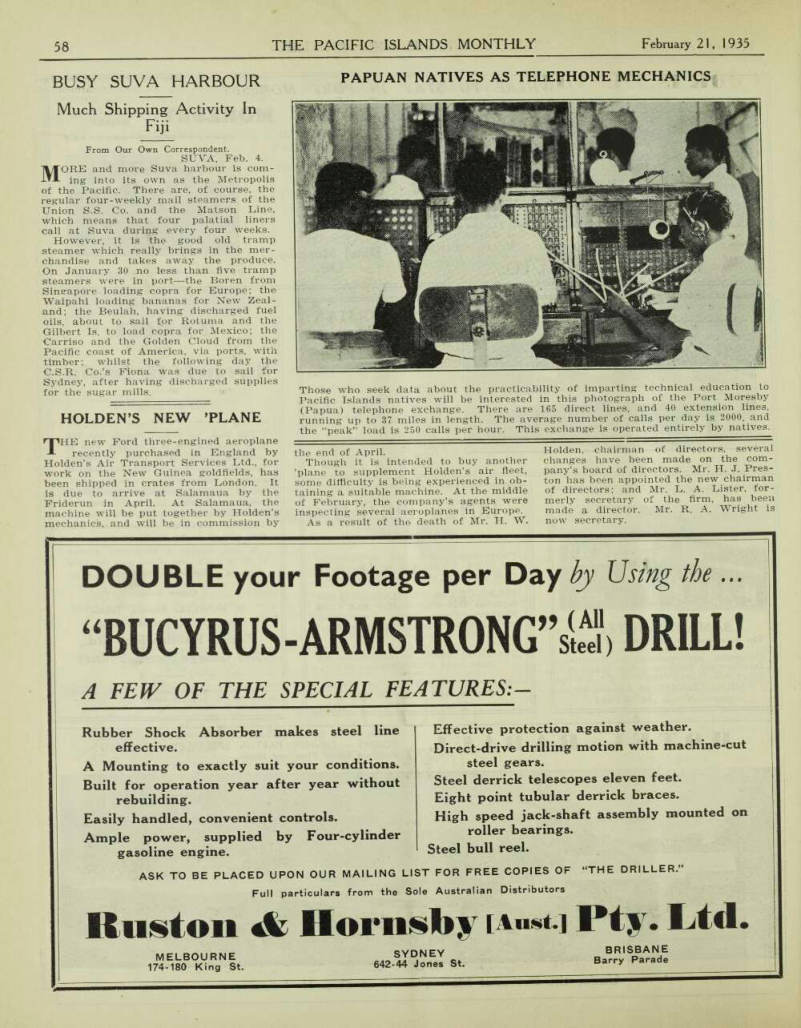
Busy Suva Harbour
Much Shipping Activity In Fiji
From Our Own Correspondent.
Suva, Feb. 4.
MORE and more Suva harbour is com ing into its own as the Metropolis of the Pacific. There are, of course, the regular four-weekly mail steamers of the Union S.S. Co. and the Matson Line, which means that four palatial liners call at Suva during every four weeks.
However, it is the good old tramp steamer which really brings in the mer chandise and takes away the produce.
On January 30 no less than five tramp steamers were in port—the Boren from Singapore loading copra for Europe; the Waipahi loading bananas for New Zeal and; the Beulah, having discharged fuel oils, about to sail tor Rotuma and the Gilbert Is. to load copra for Mexico; the Carriso and the Golden Cloud from the Pacific coast of America, via ports, with timber; whilst the following day the C.S.R. Co.’s Fiona was due to sail for Sydney, after having discharged supplies for the sugar mills.
Holden’S New ’Plane
THE new Ford three-engined aeroplane recently purchased in England by Holden’s Air Transport Services Ltd., for work on the New Guinea goldfields, has been shipped in crates from London. It is due to arrive at Salamaua by the Friderun in April. At Salamaua, the machine will be put together by Holden’s mechanics, and will be in commission by
the end of April.
Though it is intended to buy another ’plane to supplement Holden’s air fleet, some difficulty is being experienced in ob taining a suitable machine. At the middle of February, the company’s agents were inspecting several aeroplanes in Europe.
As a result of the death of Mr. H. W.
Holden, chairman of directors, several changes have been made on the com pany’s board of directors. Mr. H. J. Pres ton has been appointed the new chairman of directors; and Mr. L. A. Lister, for merly secretary of the firm, has been made a director. Mr. R. A. Wright is now secretary.
Papuan Natives As Telephone Mechanics
Those who seek data about the practicability of imparting technical education to Pacific Islands natives will be interested in this photograph of the Port Moresby (Papua) telephone exchange. There are 165 direct lines, and 40 extension lines, running up to 37 miles in length. The average number of calls per day is 2000, and the “peak” load is 250 calls per hour. This exchange is operated entirely by natives.
Advertisements & other items, p. 60 (1 item)
Ruston Hornsby [Aust.] Pty. Ltd
DOUBLE your Footage per Day hy Using the ...
“BUCYRUS - ARMSTRONG” (All Steel) Drill!
A FEW OF THE SPECIAL FEATURES:-
Rubber Shock Absorber makes steel line effective.
A Mounting to exactly suit your conditions.
Built for operation year after year without rebuilding.
Easily handled, convenient controls.
Ample power, supplied by Four-cylinder gasoline engine.
Effective protection against weather.
Direct-drive drilling motion with machine-cut steel gears.
Steel derrick telescopes eleven feet.
Eight point tubular derrick braces.
High speed jack-shaft assembly mounted on roller bearings.
Steel bull reel.
ASK TO BE PLACED UPON OUR MAILING LIST FOR FREE COPIES OF “THE DRILLER.
Full particulars from the Sole Australian Distributors
Ruston Hornsby [Aust.] Pty. Ltd
MELBOURNE
174-180 King St.
SYDNEY
642-44 Jones St.
BRISBANE
Barry Parade
Cook Is. Health
Dr. E. P. Ellison’s Work at Avarua
From a Special Correspondent.
RAROTONGA, January 29.
THE policy of the New Zealand ad ministration in the Cook Is. is wherever possible to utilise the Poly nesian in the Public Service. The system has worked satisfactorily in the hospital and medical services, in the Government offices, and even in the radio department at Avarua, the Cook Islands’ capital.
Tere Williams and Tu Nia-rua, two young Te Aute College (New Zealand) graduates, travelled by the last Makura from Rarotonga to New Zealand in order to attend the Government school of tropical medicine in Fiji. There these young Cook Islanders will be trained, as two of their fellow-countrymen have already been instructed, for their dip lomas as native medical practitioners. A son of the paramount chief, Makea Ariki nui Tinirau (who led the Cook Islands delegation to the Waitangi celebrations in N.Z. last year), is already doing good work in the field at Penrhyn Island.
It is part of the plan of Dr. E. P.
Ellison, the medical officer in charge at Rarotonga (and former Director of Native Hygiene in New Zealand), that these young men shall extend their ac tivities to all the islands in the Cook Group. It is impossible, for instance, for one fully qualified medical officer to visit all the islands. Valuable aid has been given by the Rockefeller Foundation in establishing this school in Fiji; Samoa, Cook Is., Tonga, and, of course, Fiji it
self, are all contributing to its mainten ance.
Important help has also been given in Rarotonga by the Rockefeller Founda tion in the installation of new latrine systems in the villages. According to Dr. Ellison the natives are responding admirably in adopting the new hygienic system. Equally important from the health point of view is the new water supply system. Everything possible is being done to safeguard the health of these islanders.
In Avarua hospital there is now ac commodation for 30 natives, in addition to two wards for Europeans. Matron Butler, who is in charge, is a former New Zealand army nurse; she received her initial training in Christchurch. The five assistant nurses are all girls of native descent, and the Matron speaks highly of their competent services. Here again is additional evidence of the desire of the Resident Commissioner (Judge Ayson) to see that Polynesians are employed in social services.
The latest addition to the equipment at the hospital is an X-ray plant, which was officially switched on by Judge Ayson in the presence of Makea and other Arikis, before he left to spend his annual leave in New Zealand.
When the Governor-General (Lord Bledisloe) paid his recent visit to Raro tonga he asked the Medical Superinten dent (Dr. Ellison) to state what, in his opinion, was the most pressing need of the natives. Dr. Ellison answered, un hesitatingly: “An X-ray plant, sir!”
Sure enough, when the application came before the N.Z. Government in due course, the acquisition of this plant was sanctioned. Hitherto native sufferers in need of such an examination have had to go to New Zealand for treatment.
Only recently one lad was sent to Wel lington hospital for radium treatment. It was his second visit to New Zealand for that purpose.
Experience has shown that the natives
respond to a medical officer of their own blood —Dr. Ellison is partly Maori —and that when the situation is explained to them they invariably lose the usual Poly nesian horror of hospital treatment. Un doubtedly, one of the secrets of the success of Professor Peter Buck in an other field —ethnology—has been due to the Maori blood in his veins. The Poly nesian will always respond to one of his own race.
Dr. Alex Price, of the New Guinea Public Service, has been transferred to Wau. With his wife and baby son, Wil liam Henry, who was born at Kokopo on December 24 last, he has now settled down in an important medical post in the administrative centre of the gold fields.
Advertisements & other items, pp. 61-62 (1 item)
Rosebery Engine Works Ltd.
Sketching
is the hobby
that pays!
Would you like to sell Sketches to Editors, Publishers, and Advertisers? Provided you have the aptitude for sketching, whatever your age, and whether you have had little or no previous training— STOTT’S can teach you to produce Sketches that sell.
STOTT’S CORRESPONDENCE
COLLEGE
100 Russell St., Melb.; 70 Pitt St., Sydney; 290 Adelaide St., Brisbane; 49 Flinders St., Adelaide; 359 Murray St., Perth.
Send the Coupon. Cut here
Without obligation, please send me free, full particulars of your Courses in Commercial Art and Sketching, etc.
My Name Address
P.I.M.235
In the Remote Cornet's
. . . of the Earth
As in the Heart of the City ...
Dual Automatic REFRIGERATOR
DOES DAILY DUTY
Wherever alternating current is available you can enjoy the comforts of refrigeration and safeguard your foodstuffs in the Westinghouse way.
Write for full particulars
Rosebery Engine Works Ltd.
13 MARKET ST., SYDNEY
ONLY THE WESTINGHOUSE IS DUAL AUTOMATIC
L.L BELL, F.I.O. (Syd.)
OPTICIAN
WINGELLO HOUSE,
ANGEL PLACE :: SYDNEY
HEADACHES GLARE
BLURRED VISION
Doctor’s Prescriptions for Distance or Reading Glasses made up and Despatched by Return Mail.
New Lenses fitted on receipt of the broken parts.
Goggles for Aviators, Motorists, Welders & Mechanics.
Cash on Delivery Post :: Sydney Prices
A CLEAN PLANTATION GUARANTEED
WITH
B.A.C. Weed Killer
Used on Malay States Rubber Plantations; approved by British Malay Rubber Institute FOB. Sydney. Sold in 4 gallon tins—2 tins to a case. 4/3 per gallon (Australian Currency). In concentrated form. Agents wanted in every group Particulars from:
LONE HAND SOAP CO.
554 Botany Rd., Alexandria, Sydney, Australia
Use—
Modern Direct Wireless Services
for Your Communications With Australia and Overseas.
DIRECT WIRELESS SERVICES are available fox inter-communication between the Islands of the Pacific and for traffic between the Islands and Australia and overseas countries.
Services are now in operation between Papua and Sydney, New Guinea and Sydney, New Caledonia and Sydney, and Fiji and Sydney. Speedy, economical and efficient service to Australia and overseas. Route your traffic “Via the Wireless Service.”
For overseas traffic to Great Britain, North and South America, and all European countries, route your message via the Direct Australian
BEAM WIRELESS SERVICE
LODGE YOUR MESSAGES AT ANY
WIRELESS STATION OR ISLAND POST
OFFICE ROUTED “VIA WIRELESS."
AMALGAMATED WIRELESS (A'SIA) LIMITED
Samoa Exchange
Rate
Producers Will Now Receive 25% Premium
From Our Own Correspondent.
APIA, January 25.
THE announcement by the local Bank of New Zealand that the exchange rate of Samoa on New Zealand and Aus tralia stands from now on at par, while the exchange on London is fixed at 25 per cent., is welcome news to Samoan pro ducers, who should considerably benefit by this. Most of our produce, copra as well as cocoa, is shipped at present to England or the United States. Only a small portion goes to New Zealand and Australia, besides, of course, bananas, which are sent to New Zealand ex clusively.
On the other hand, prices of certain goods will be raised in the near future.
This affects mainly manufactured goods, hardware, textiles, etc., imported from England and the United States.
The price of our staple product, copra, is rising rapidly, being reported at time of writing to stand at £12 per ton in London. Thus, including exchange, it would be worth approximately £15per ton in Samoan currency. The price paid for copra to the natives in the neighbouring American Samoa is stated to be considerably higher than the local price. Copra buying in American Samoa, however, is a Government monopoly.
Memorial Window To
Late Mrs. John Selwyn
THE mission work of the Selwyn family of New Zealand, particularly Bishop George Augustus Selwyn and his son John, will always be revered by those who remember the early history and record of the Melanesian Mission. Rev. John R, Selwyn was appointed second Bishop of Melanesia when Bishop Coleridge Patte son was murdered by natives in the Santa, Cruz Group in 1871.
With Bishop Selwyn’s faithful work in Melanesia is linked the dutiful and ten der service of his second wife Annie, who shared the hardships and dangers of her distinguished husband. To perpetuate the memory of this gallant and devoted lady, a memorial window was recently installed at the All Saints’ Church, Bodalla, New South Wales.
The inscription reads: “In affectionate memory of Annie Catherine Selwyn, wife of John Selwyn, second Bishop of Mela nesia, and daughter of Thomas Sutcliffe and Theresa Mort. Died December 19, 1930.”
Shareholders
Bonus For Carpenter’S
Directors of W. R. Carpenter and Company, Ltd., in declaring an interim dividend at the rate of 8 per cent, for the half-year ended December 31, have informed shareholders that to commemorate the twenty-first anniversary of the incorporation, of the company they intend to distribute a bonus of 2 per cent, in addition to the usual final divi dend at the annual meeting. The company also contemplates further expansions and will call up the balance due on contributing shares in the near future.
Ray Parer
Stirring Adventures of Pioneer N.G. Aviator, Jogging Along from England to Australia.
THE famous Australian aviator, Ray Parer, who is well-knovm in New Guinea (where he has been operating an air ser vice since 1926), has been having more than his share of adventure and hair breadth escapes since he left London for Australia in October last, in the Melbourne Gentenary Air Race.
Faulty radiators, frequent forced land ings, sickness, burnt out magnetos, and being lost for four days in Burma cannot daunt the inimitable Parer who, with his companion Geoffrey Hemsworth, also of New Guinea, has been making his way to Australia in spite of exasperating misfor tunes and set-backs.
ILL-FORTUNE and calamity, however, are not strangers to Ray Parer. In one of the most remarkable flights in the history of aviation, Parer, with Lieut. J.
C. McIntosh, flew to Australia from England in 1919, in one of the most extraor dinary contraptions that has ever taken to the air in a long-distance flight.
It was an astounding performance car ried out by men of fearless courage and remarkable grit. They arrived at Mascot, Sydney, in a queer, small ramshackle ’plane held together with fencing wire, bootlaces, and dirty string, after having crashed in practically every country be tween England and Australia. The flight, which amazed the world, took eight long weary months of struggle and hardships, but they arrived in Sydney as heroes.
Starting in the handicap section of the London-Melbourne Air Race, Parer and Hemsworth left Mildenhall in a Fairey Fox machine on October 20, last year.
They arrived at Abbeville, France, the following day, where they were delayed by a damaged radiator. Restarting from Le Bouget field, near Paris, they were compelled to return again, owing to fur ther engine trouble.
At this stage, they withdrew from the race. Parer, bitterly disappointed at the mishaps, decided to repair the ’plane and jog leisurely along to Australia, and thence to New Guinea.
In the middle of November they were reported to be at Athens. Since then, other than a few obscure lines in the Sydney newspapers, nothing was heard of the fliers until the end of January, when they were reported missing in Lower Burma.
It appears that after leaving Italy they were delayed at Baghdad, owing to pass port trouble. Away again, they were
forced down shortly afterwards with en gine trouble. To make matters worse Ray Parer became ill, but still he refused to abandon the flight. Between frequent forced landings and irritating delays the airmen made their way down to Burma.
After leaving Mergui, in Burma, they had a very narrow escape from a serious crash. Forty miles from the landing ground, while the ’plane was flying over a mangrove swamp, the engine began to splutter and misfire. The airmen turned back, losing height all the time, and just managed to land safely, finding that a magneto had burnt out.
It was then that they found they had lost their way, and for four days Royal Air Force ’planes searched for them in the jungle-covered, mountainous country.
Eventually, however, the fliers repaired their machine and flew on to Singapore, where an anxious crowd of harassed officials were awaiting them. They left Singapore for Darwin, Australia, via Ba tavia, Sourabaya, Rambang, and Koepang, on February 3, and were reported to be keeping company with the Australian air-mail liner.
They arrived at Koepang on February 7, and landed safely the following day at Darwin, Australia. Making a quick trip to Melbourne, they arrived at Essendon aerodrome to be welcomed by relatives and a few friends on February 13. Their flight from England occupied 116 days.
The airmen intended to remain in Melbourne for about a week before flying to Salamaua, New Guinea, via Sydney and Brisbane.
Ray Parer, who was born in Melbourne, is now 41 years of age, and it is reported that this will be his last big flight. One newspaper says that he will shortly relin quish active control of his New Guinea concern, the Pacific Aerial Transport Co.
Ltd., and that he intends to marry and settle down in England. Another, how ever, reports that he is anxious to get back to his mining interests in N.G. and that the Fairey Fox will be used in his goldfields freight service.
Advertisements & other items, p. 63 (1 item)
Pioneer Spring Co. Ltd
OLD ISLANDS
PHOTOGRAPHS
We have a unique collection of several thousands of original photographs of Natives and Scenes in New Guinea, Solomons, Tonga, Fiji, Samoa, New Hebrides, etc., taken during the years 1875 to 1895.
These supply invaluable records of fastdisappearing races.
Full-plate prints, 1/- each, or 12 for 10/-.
Details on application
TYRRELL’S MUSEUM,
281 GEORGE ST., SYDNEY
INVINCIBLE
30 to 50 h.p., Six-Cylinder Marine Motors Net Wholesale Trade Price: $ 195 F.O.B. San Francisco, Chicago or Sydney Completely equipped as illustrated ‘‘The World’s Greatest Six-Cylinder Value.
Ask for Catalog No. 888
Invincible Motors
CABLE ADDRESS: Vmco-Sydney. Invmcible-San Francisco, Invinco-Chicago.
Established 42 Year
PIONEER SPRING CO. LTD
McEVOY STREET, ALEXANDRIA, SYDNEY, N.S.W.
Are the leading Springmakers, manufacturing Coil, Volute, and Laminated Springs for all Motor Cars, Trucks, Tractors, all kinds of Locomotives and Rolling Stock.
Write for our Catalogue and Price List We are also Expert Forgers and Blacksmiths.
Fiji’S Trade
ALTHOUGH there has been a shrinkage in both exports and imports, the oversea trade of Fiji, in the year 1934, showed a large surplus of income over expenditure, as follows:
Mr. Charles Nordhoff, the American novelist who was in Sydney recently, has been in indifferent health since his return to Tahiti, and will probably leave for the United States almost immediately.
1933 £ 1934 £ Imports 1,069,266 998,204 Exports 1,725,529 1,456,455 Sugar 1,069,049 1.180,782 Copra 195,788 127,941 Bananas 69,243 67,845 Molasses 12,937 16,828 Trochus 19,945 20,733
Native Races In Pacific
Scientists Consider Future Of
LARGE section of this issue would
be needed, to present an adequate
report of the more valuable papers relating to Pacific affairs submitted at the Science
Congress in Melbourne in January; and
as so much space is not available, we give hereunder a summary of same. The full text of most of the articles will be pub lished in the officially printed report of
the proceedings.
Need For Special Officers.
The following is a summary of a paper by Mr. W. C. Groves, B.A., on “Anthropology and the Future of Native Adminis tration in New Guinea”: My experience among the natives of New Guinea, as an anthropologist study ing their social life, has convinced me of the need for approaching certain of the problems of native administration, problems of adjustment to a changing life due to contact with European civiliza tion, along anthropological lines.
Village life to-day has lost its savour.
The breakdown of old customs and weakening of old sanctions and traditions have given rise to many problems, as has the recruiting of natives for work in association with the white man away from their villages. A serious aspect of the situation is the weakening of social cohesion and unity that were such pro nounced and valuable features of the old life, and that is expressed in the con tinuous differences that arise between
the old of “fashion before” and the younger generation.
What the natives need, more than the magistrate, is help, guidance, under standing in their bewilderment. And for this it is suggested that a number of selected young officers of the service, with special aptitude for the work, be set aside as a force of Native Affairs Field Officers, after having had additional training in the principles of anthropology and their application to New Guinea con ditions. While it is urgently necessary to continue the present system under which Cadets in the service of the Administration, after a year or so in the Territory, spend a full academic year in anthropological study at the University of Sydney, where necessary literature and facilities for such study exist, it is suggested that the special Native Affairs Field Officers have the additional training necessary to equip them for the special work of native adjustment guides or advisers, directed by the specially trained, experienced, senior officer of Native Affairs to be stationed at Rabaul, who will be in close touch with the actual problems of administration.
This special training necessary (for the new Field Officers) is not so much in academic anthropology, as in the actual conditions of native life and organization and problems of adjustment, for the understanding of which local experience among natives is necessary. The Director of this special training and the Super visor of the specialist Field Officers should be a Deputy Director of Native Affairs, with social training, and experi ence and the right outlook for this deli cate work.
It is therefore suggested that the Department of Native Affairs include two divisions: the magisterial, for court work, tax collecting, penetrative patrol work, and all routine duties of native adminis tration; while the other section should serve the special purpose indicated, its specialist field officers ultimately coming to be looked upon by the natives as their “Kiap true” (real own officer), and thus gaining their confidence in the Adminis tration —a valuable and necessary thing for their future development.
These officers, besides investigating certain specific troubles and questions that involve sociological aspects—prob lems of land ownership, for example— might serve the more important purpose of effecting a close and understanding liaison between the Central Department of Native Affairs and actual native vil lage administration. Thus the Govern ment would be able to keep an effective finger on the pulse- of changing native society.
Papuan Customs And European
Influences
Mr. F. E. Williams, Government anthro pologist in Papua, submitted a paper in which he described some of the effects of European influence on the natives of Papua.
It was generally agreed, he said, that we could not expect any native culture to survive iu toto and even anthro pologists had come to see—what aca demically minded people saw long before them—that to aim at the perpetuation of any such culture was as ill-advised as it was futile. What we must expect was
some sort of blend of cultures, and all we could do. in the interests of native welfare was to help, guide and control the formation of that blend.
Mr. Williams explained that it could be plainly seen that some confusion obtained in the life of that large class of part-Christians or near-Christians, who divided their allegiance between the strict laws of the church and the very different laws of the tribe; between sexual purity in the Christian sense and the comparative laxity of their own regu lations; between the mission nurse and the native doctor; between prayer and magic.
It was probably realised by the most optimistic missionary, said Mr. Williams, that conversion was a matter of degree.
He well remembered an occasion when the natives of Apiope brought out their flag and ran it up the flagstaff. Apiope was a very heathen village affected by the semi-religious movement known as Vailala madness, the flag and the flag staff belonging to the paraphernalia of the cult. The flag in question was a small Union Jack, with a portrait of King George enclosed. When asked what this picture represented the natives replied, “Jehovah, the younger brother of Jesus.”
The Vailala madness, which had a tre mendously wide vogue, was full of such contortions.
Dealing with the special influence of the missions, Mr. Williams said it would be wrong to charge the missionary with attempting to lower the native’s indivi dual opinion of himself; the native, in deed, was more likely to meet with sym pathy and the gesture of human equality from a missionary than from any other white man. But by constantly preaching the superiority of Christianity and by his unwillingness to tolerate those be liefs and practices which were deemed incompatible with it, the missionary tended to bring some of the most sig nificant parts of native culture into con tempt.
Mr. Williams’ paper, which was gener ally commended for its fairness and frankness, appeared to provoke some missionary wrath. One woman mis sionary from Papua expressed resent ment at Mr. Williams’ references to the part played by the missions in the cul ture breakdown of the natives.
A Secret Society
Mr. F. L. S. Bell presented a peculiarly interesting paper on “Sokapana,” a native secret society in Melanesia, in which he described rites associated with a secret and initiatory society in Tanga Island, off the east coast of New Ireland.
Mr. Todd, as a result of a year spent in the village of Mowehafen (south coast of New Britain), described the native organisation for maintaining law and order—including some very shrewd and practical ideas.
An Appeal To Europeans
“The Need for Europeans in New Guinea to Think Black” was a paper submitted by Mr. Gordon Thomas (Rabaul) and read by Mr. Groves. It was a challenging appeal to all concerned with the employment of natives in New Guinea to try to “think native,” to study and attempt to understand the native, and so avoid the terrible mutual distrust and resentment that animate the two communities in the Territory.
Even white residents should realise their responsibility and set a high moral example. Nothing too bad could be said of the present method of appointing managers and white employees.
Papuan Medical Trainees
Discussing “Medical Education Among Papuans,” Dr. W. M. Strong (chief medi cal officer in Papua) said natives trained in Sydney University were visiting the villages in the island administering simple medicines and giving injections.
After working amongst Papuans for 30 years he would make bold to say that they were no less intelligent than brown and white peoples. They might be deeply ignorant, but that was different from being deeply unintelligent.
Regeneration Of Fijians
In a paper, “Some Aspects of the Education Problem in Fiji,” Mr. C. Sharp of the Fiji Education Department said the history of Fiji in recent years was one of deliberate regeneration by the natives, largely because of missionary enterprise.
The coming of the Indian and the threat to swamp the Fijian out of his birthright; the rise of the sugar indus try and industrialism had caused young Fiji to seek a new life and an education largely along European lines. Primitive Fiji, with its former communal life and social organisation, was almost past.
Individualism had superseded the com munal idea. Education to-day recog nised the inevitable, and offered a school ing and training to fit the natives for their absorption into the new order.
Education showed an increasing ten dency in Fiji to reproduce reality and to interpret the real needs of the natives for their life.
Rev. J. R. Metcalfe, with his wife, ar rived in Melbourne recently on leave, He is a worker for the Methodist Church of New Zealand, at Buka Passage, Bou gainville, New Guinea.
Advertisements & other items, p. 64 (1 item)
Ship Chandlery-Hardware
New Britain Express
Delivery.
GENERAL OVERSEAS AGENTS.
GENERAL CARRIERS, BAGGAGE and
FORWARDING AGENTS
ROYAL MAIL CONTRACTORS
Reliable Cars and Trucks.
We aim to give quick and reliable Service at reasonable costs. P.O. Box 116. ’Phone 141.
W. WALKER-FLYNN, Proprietor, Malaguna Road, Rabaul, T.N.G.
W. M. FORD
Ship, Yacht & Boat Builder
Berry's Bay, North Sydney
(Established 1870.) BUILDERS of all kinds of Island Craft from Dinghies to Auxiliary Schooners of any tonnage. New and Second-hand Island Craft of various types in stock. New and Second-hand Full Diesel, Crude Oil, Benzine and Kerosene Engines.
Please Send on Your Enquiries.
HALLSTROM’S NON - ELECTRIC
Reg. Design 12092 Patent Nos. 16396 and 18485
REFRIGERATORS
KEROSENE
OPERATED
ENJOY the comfort of having cool drinks, cold meats and salads, delicious savouries and sweets, and nice firm butter on the
hottest SEMI-AUTOMATIC MODEL
gives wonderfully efficient refrigeration without trouble, and It parts to wear out, or get out of order, and is so sfmple to operate that a CHILD CAN DO IT All there is to do is to fill the lamp once a day and light it — that's all.
Price, £49/10/-, f.o.b., Sydney. Write for descriptive illustrated Folder.
Other types of Chemical Non- Electric Refrigerators from £20.
SHIP CHANDLERY-HARDWARE
BROOMFIELDS LIMITED, 152 Sussex St., SYDNEY
Large and Complete Stocks of SHIP CHANDLERY.
Ironmongery of all kinds Paints, White Lead and Oils.
Sole Agents for: P H MUNTZ & CO.’S 3-CROWN BRAND METAL SHEATHING.
PEACOCK & BUCHANS’ ENGLISH READY-MIXED PAINTS.
WRITE FOR SHIP CHANDLERY CATALOGUE.
Special “In Bond” Prices for all Island enquiries quoted on application.
CABLES: “BOOM,” SYDNEY.
Temporarily
Van Rees to be Laid Up Temporarily
WHEN the Royal Packet Navigation Co.’s steamer Van Rees (3049 tons) arrives at Batavia from Port Moresby on April 9, she will be laid up for six weeks’ overhaul. At present the Van Rees maintains a regular service between Saigon and Sydney, calling at Java, Papua, Rabaul (New Guinea), New Heb rides, and New Caledonia. She will re enter the service from Batavia on May 29.
The Van Rees’ run will be taken over by the Van Spilbergen (3236 tons). It is un derstood that the genial master of the Van Rees, Captain J. Blaauboer, will not command the relieving vessel, but will go on six weeks’ furlough.
Another K.P.M. liner, the Nieuw Zee land, running on the Australia-Batavia line, will also be withdrawn temporarily from the service to enable her to proceed to Holland to be re-engined. She will be replaced by the Royal Dutch Packet steamer Op Ten Noort.
Mr. L. K. Bryant, a pioneer motorist of Victoria, who built the first car in Aus tralia in 1900, has returned to Melbourne after nine years’ residence at Rabaul, New Guinea.
Rev. X. Haller, of the Marist Mission, Leauvaa, Upolu Island, Western Samoa, left Apia by the Makoa on January 17, for furlough in Australia.
Advertisements & other items, pp. 65-66 (1 item)
“Invincible” and “Duralife”
TENNIS
TROPICAL RESTRINGS AND GUT
CONSULT
L. A. WARD
WEST END SPORTS DEPOT,
8 GEORGE ST. WEST SYDNEY
THE BRIDGE BIRD SHOP
For Well-bred Birds, Dogs, Persian Cats and other Animals All Pedigreed at Reasonable Prices We Buy as Well as Sell Islanders are Invited to Communicate
6 JUNCTION STREET NORTH SYDNEY
“Invincible” and “Duralife”
EST.
1925
ALUMINIUM WARE
MANUFACTURED BY
C. R. BYRNE
187 9 William Street, Bankstown, N.S.W.
Island Traders apply for Price Lists and Agency Terms
EXCEL BATTERIES
15 Months’ Guarantee.
The Product With A Reputation.
Prices F.O.B. Sydney (Australian Currency). Packing and Cases No Charge 13 Plate. 100 amp 30/- SPECIAL CYCLE BATTERY 15 Plate. 120 amp. . . . 35/- Six (6) Months’ Guarantee 17 Plate. 140 amp 45/- At 25/- EACH.
EXCEL BATTERY COY., 77-79 William St., SYDNEY APPLICATIONS FOR AGENCY INVITED FROM ALL CENTRES
A. W. DYE
and Company
ASSAYERS, ANALYSTS,
METALLURGISTS
Buyers of Gold , Silver , Platinum , etc.
T. & G. BUILDING,
ELIZABETH STREET,
SYDNEY, N.S.W.
Established 1914.
Bankers: Commercial Bank of Australia, Ltd.
BITUMENOID ROOFING
MADE IN AUSTRALIA
Bitumenoid Roofings, Dampcourses and Insulating Felts are made from the world s best raw materials. Warranted to stand the most rigid tests.
BITUMENOID THE BEST .
Roofing. 1,2, 3-ply; Flooring, Waterproof Materials; Saturated Felt; Resilient Road Jointing; Natural Asphalt Dampcourse; 2 and 3-ply Dampcourse; 1-2lb. Lead-core Dampcourse, Roofing, Cement; Asphalt, Paint; Roofing Compound.
MAXWELL PORTER & SON LTD.
ESTABLISHED 1888 BUILDERS' SUPPLIES
107 REDFERN ST., REDFERN, SYDNEY, N.S.W. 'Phone M 3157 Cables; Bitumenoid
Producers and sellers of Gold Bullion may feel assured that there are advantages in dealing with a well-established and widely-organised Company.
THE ELECTROLYTIC REFINING & SMELTING COMPANY OF AUSTRALIA LIMITED is equipped to those advantages in the highest degree possible combined with faithful service.
Its facilities for receiving and handling bullion are convenient and safe. Its assaying and refining are in the hands of highly qualified technicians. Its markets are world-wide, ensuring the best prices being paid.
For example the Record Price of gold in Australia was established by this Company on 11th October, 1934, when payment was made to its clients at the rate of £8/16/9½ net per fine oz.
SELLERS IN NEW GUINEA. NEW ZEALAND, PACIFIC ISLANDS, and elsewhere outside Australia should consign their materials to the Company’s Sydney Office.
PROCEEDS FOR NEW GUINEA AND NEIGHBOURING CENTRES are forwarded by the outgoing mail of the same vessel which brings the bullion except in very unusual circumstances. Prompt settlement is a feature of the Company’s service.
Gold Miners : Instruct your Bankers or your Forwarding Agents to deposit your bullion with:
THE ELECTROLYTIC REFINING & SMELTING CO.
OF AUSTRALIA LIMITED
Melbourne- Works: Sydney: Collins House. Port Kembla, N.S.W. 26 O’Connell Street.
PURCHASERS AND REFINERS OF GOLD, SILVER, COPPER IN ANY FORM BANKERS: —The English, Scottish & Australian Bank Ltd.
Pacific Mining Notes
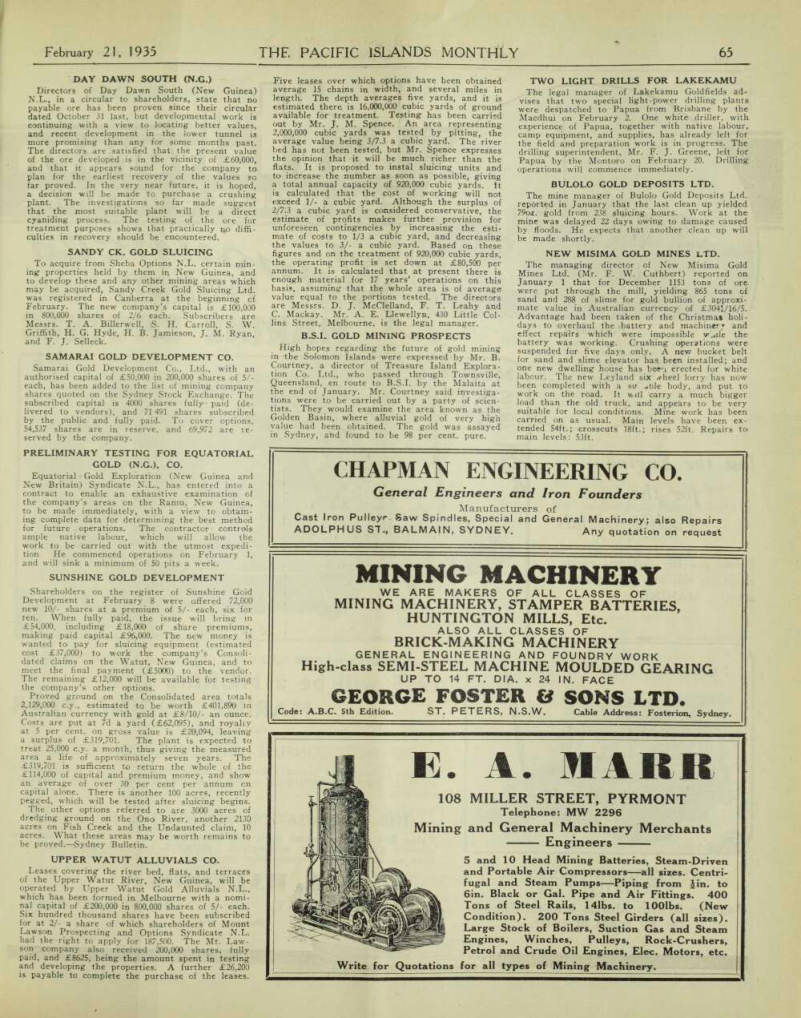
Guinea Dredging N.L.
In a circular setting out the position of Guinea Dredging N.L., the management advises that the early object was to take up a certain area of ground in New Guinea recommended by Mr. A.
E. Dredge, who was in charge of the expeditionary syndicate. Unfortunately, on Mr. Dredge’s arrival he found the ground had already been pegged. An option was obtained over the area, but after inspection did not justify the directors in going on with it. As Mr. Dredge broke down in health, Mr. H. Tudor was appointed to take charge. Mr.
Tudor, at a nominal cost, had credited the com pany with any gold won during his prospecting operations, thus being able to inspect various properties, which unfortunately were not of any material value. Mr. Tudor was now inspecting a property which showed a fair prospect of success.
Meanwhile the directors, to safeguard the interests of shareholders, had obtained two other options, one in West Australia, and the other in New Zealand.
N.G. Platinum Leases
Encouraging assays having been obtained from samples sent from the field in New Guinea by the prospectors of Platinum Guinea Gold N.L., the directors commissioned Mr. H. F. Pearson, for merly assistant warden at Wau, New Guinea, to report fully on the prospects. In view of his report and the negative results obtained from Sydney and Melbourne assayers of the samples obtained by him, the directors have decided it is inadvisable to spend any more money on the field, and have given the leader of the expedition, Mr. A. K.
Smith, instructions to surrender the leases, apply for the refund of the rents paid to the Mines Department, and to realise on any assets of the company in New Guinea. Mr. Pearson’s report states that although platinum exists on the field, the company’s prospectors had failed to locate the parent system from which the platinum was shed, and this was essential to the successful commercial operations by any company.
Bulolo Drege Production
Production of the four dredges of the Bulolo Gold Dredging, Ltd., for January, compares with that of the previous two periods as follows:
Misima Central Leases Report
Having inspected four leases at Misima Island, Papua, under option to Misima Central Gold N.L., Mr. A. A. Hargrave, consulting engineer and metallurgist, has submitted a report to the direc tors. Regarding the ore deposits on the Misima Central leases 129 and 130, Mr. Hargrave strongly recommends a vigorous policy of development. The lodes, he states, are massive, and well defined for miles. The width has to be proved, but in No. 9 tunnel, 70 feet below the cap, 8 feet of width is exposed by a crosscut which is still in the lode, and has not reached the footwall, while in the other places samples were taken from widths up to 18 feet. Mr. Hargrave is of opinion that a secondary enrichment zone is likely to be discover ed about or below the creek levels. Assay values from samples taken from adits averaged 4 dwt. 7 gr. gold and 3 dwt. 17 gr. silver. Mr. Hargrave expresses the opinion that at least one lode runs right through the leases, and probably two, also that it will maintain its average width, as de veloped by the other mining companies. As the workable backs above creek level run up to over 275 feet, and the average is under 180 feet, the company should be able to develop about 333,000 tons of ore of an average value, on the present price of gold, of 37/6 a ton, even if the above assay values only are maintained, although he considers the average will be nearer 7 or 8 dwt.
Based on an output of 5000 tons a month, which would be sufficient to treat the whole of the material from one lode in six years, the cost, after allowing for overhead expenses at the mine, amor tisation and depreciation of plant, buildings, etc., should not exceed 17/- a ton. These figures would show a mine profit of about £50,000 per annum, even if the values did not rise above 4 dwt. 7 gr., as shown by sampling.
Regarding the Ginisea leases, Mr. Hargrave states little development work has been done.
The adits have exposed two lodeis, one a massive black lode, carrying manganese, and the other a red one, junctioning with the black lode where development has taken place. Assay values were: Black lode, 3 dwt. 2 gr. gold; red lode, average 3 dwt. 9 gr. gold; at junction of the two lodes, average 5 dwt. 1 gr. gold. Silver, 1 dwt. 7 gr., 6 dwt. 1 gr., and 6 dwt. 12 gr., respectively. Mr.
Hargrave considers this property also to be well worth further development.
New Papuan Gold Co.
With a nominal capital of £20,000 in 4,000 shares of £5 each, Lakekamu Goldfields (Papua) Develop ment N.L. has been formed in Melbourne to de velop sluicing areas in Papua. Directors are Sir Robert Knox. Mr. G. C. Klug, and Brig.-General E. A. Wisdom (former Administrator of New Guinea) A public issue of 3,000 shares has been subscribed, and 1,000 shares are held in reserve.
The legal manager is Mr. E. R. Hodge (Knox, Schlapp and Co.), 360 Collins Street Melbourne The vendor of the property is Tiven Gold Dredging Co. Ltd., which has granted for £5 a seven months’ working option from January 14, 1935, with the right of extension for three months on payment of £100 a month. Any amount paid in extension of the option will be applied to the pur chase price if the options are exercised. Pur chase consideration is £2,750 in cash and in fully paid shares in a company with a nominal capital of £75,000 and a working capital of not less than £40,000. The areas comprise five dredg ing claims known as the Twisty areas, on the Lakekamu goldfields, and are believed to contain 5,000,000 to 10,000,000 yards of payable wash, in 1932-33 a small sluicing plant on the high flats obtained values of from 1/6 to 3/- a yard, based on gold at 85/- an ounce. A few scout bores indi cate values, with gold at par, ranging from 10d, to 5/10 a yard, bottom from 10ft. to 21ft. All-in cost of sluicing is estimated at 5d to 7d. a yard.
Arrangements are being made by the company to test other alluvial areas from which prospectors have obtained gold but which have not been tested thoroughly.
Nov.
Dec.
Jan.
Nos. 1, 2, and 4 dredges— Cubic yards .. 835,800 881,400 913,000 Bullion, oz 15,557 14,919 16,222 Gold, fine, oz. 10,742 10,986 11,199
Value-
Aust. currency* £91,307 £93,381 £95,191 Per cub. yd. /26.21 /2S.42 /25.02 Working profit £64,132 £66,104 £67,821 * At £A8/10/- per fine ounce.
Day Dawn South (N.G.)
Directors of Day Dawn South (New Guinea) N.L., in a circular to shareholders, state that no payable ore has been proven since their circular dated October 31 last, but developmental work is continuing with a view to locating better values, and recent development in the lower tunnel is more promising than any for some months past.
The directors are satisfied that the present value of the ore developed is in the vicinity of £60,000, and that it appears sound for the company to plan for the earliest recovery of the values so far proved. In the very near future, it is hoped, a decision will be made to purchase a crushing plant. The investigations so far made suggest that the most suitable plant will be a direct cyaniding process. The testing of the ore for treatment purposes shows that practically no diffi culties in recovery should be encountered.
Sandy Ck. Gold Sluicing
To acquire from Sheba Options N.L. certain min ing properties held by them in New Guinea, and to develop these and any other mining areas which may be acquired, Sandy Creek Gold Sluicing Ltd. was registered in Canberra at the beginning cf February. The new company’s capital is £100,000 in 800,000 shares of 2/6 each. Subscribers are Messrs. T. A. Billerwell, iS. H. Carroll, S. W.
Griffith, H. G. Hyde, H. B. Jamieson, J. M. Ryan, and F. J. Selleck.
Samarai Gold Development Co.
Samarai Gold Development Co., Ltd., with an authorised capital of £50,000 in 200,000 shares of 5/each, has been added to the list of mining company shares quoted on the Sydney Stock Exchange. The subscribed capital is 4000 shares fully- paid (de livered to vendors), and 71 491 shares subscribed by the public and fully paid. To cover options, 54,537 shares are in reserve, and 69,972 are re served by the company.
Preliminary Testing For Equatorial
Gold (N.G.), Co.
Equatorial Gold Exploration (New Guinea and New Britain) Syndicate N.L., has entered into a contract to enable an exhaustive examination of the company’s areas on the Ramu, New Guinea, to be made immediately, with a view to obtain ing complete data for determining the best method for future operations. The contractor controls ample native labour, which will allow the work to be carried out with the utmost expedi tion He commenced operations on February 1, and will sink a minimum of 50 pits a week.
Sunshine Gold Development
Shareholders on the register of Sunshine Gold Development at February 8 were offered 72,000 new 10/- shares at a premium of 5/- each, six for ten. When fully paid, the issue will bring in £54,000, including £18,000 of share premiums, making paid capital £96,000. The new money is wanted to pay for sluicing equipment (estimated cost £37,000) to work the company’s Consoli dated claims on the Watut, New Guinea, and to meet the final payment (£5000) to the vendor.
The remaining £12,000 will be available for testing the company’s other options.
Proved ground on the Consolidated area totals 2,129,000 c.y., estimated to be worth £401,890 in Australian currency with gold at £8/10/- an ounce.
Costs are put at 7d a yard (£62,095), and royalty at 5 per cent, on gross value is £20,094, leaving a surplus of £319,701. The plant is expected to treat 25,000 c.y. a month, thus giving the measured area a life of approximately seven years. The £319,701 is sufficient to return the whole of the £114,000 of capital and premium money, and show an average of over 30 per cent per annum on capital alone. There is another 100 acres, recently pegged, which will be tested after sluicing begins.
The other options referred to are 3000 acres of dredging ground on the Ono River, another 2130 acres on Fish Creek and the Undaunted claim, 10 acres. What these areas may be worth remains to be proved.—Sydney Bulletin.
Upper Watut Alluvials Co.
Leases covering the river bed, flats, and terraces of the Upper Watut River, New Guinea, will be operated by Upper Watut Gold Alluvials N.L., which has been formed in Melbourne with a nomi nal capital of £200,000 in 800,000 shares of 5/- each.
Six hundred thousand shares have been subscribed for at 2/- a share of which shareholders of Mount Lawson Prospecting and Options Syndicate N.L. had the right to apply for 187,500. The Mt. Law son company also received 200,000 shares, fully paid, and £8625, being the amount spent in testing and developing the properties. A further £26,200 is payable to complete the purchase of the leases.
Five leases over which options have been obtained average 15 chains in width, and several miles in length. The depth averages five yards, and it is estimated there is 16,000,000 cubic yards of ground available for treatment. Testing has been carried out by Mr. J. M. Spence. An area representing 2,000,000 cubic yards was tested by pitting, the average value being 3/7.3 a cubic yard. The river bed has not been tested, but Mr. Spence expresses the opinion that it will be much richer than the flats. It is proposed to instal sluicing units and to increase the number as soon as possible, giving a total annual capacity of 920,000 cubic yards, it is calculated that the cost of working will not exceed 1/- a cubic yard. Although the surplus of 2/7.3 a cubic yard is considered conservative, the estimate of profits makes further provision for unforeseen contingencies by increasing the estimate of costs to 1/3 a cubic yard, and decreasing the values to 3/- a cubic yard. Based on these figures and on the treatment of 920,000 cubic yards, the operating profit is set down at £80,500 per annum. It is calculated that at present there is enough material for 17 years operations on this basis, assuming that the whole area is of average value equal to the portions tested. The directors are Messrs. D. J. McClelland, F. T. Leahy and C. Mackay. Mr. A. E. Llewellyn, 430 Little Collins Street, Melbourne, is the legal manager.
B.S.L Gold Mining Prospects
High hopes regarding the future of gold mining in the Solomon Islands were expressed by Mr. B.
Courtney, a director of Treasure Island Exploration Co. Ltd., who passed through Townsville, Queensland, en route to B.S.I. by the Malaita at the end of January. Mr. Courtney said investigations were to be carried out by a party of scienlists. They would examine the area known as the Golden Basin, where alluvial gold of very high value had been obtained. The gold was assayed in Sydney, and found to be 98 per cent. pure.
Two Light Drills For Lakekamu
The legal manager of Lakekamu Goldfields ad vises that two special light-power drilling plants were despatched to Papua from Brisbane by the Macdhui on February 2. One white driller, with experience of Papua, together with native labour, camp equipment, and supplies, has already left for the field and preparation work is in progress. The drilling superintendent, Mr. F. J. Greene, left for Papua by the Montoro on February 20. Drilling operations will commence immediately,
Bulolo Gold Deposits Ltd.
The mine manager of Bulolo Gold Deposits Ltd. reported in January that the last clean up yielded 79oz. gold from 238 sluicing hours. Work at the mine was delayed 22 days owing to damage caused by floods. He expects that another clean up will be made shortly.
New Misima Gold Mines Ltd.
The managing director of New Misima Gold Mines Ltd. (Mr. F. W. Cuthbert) reported on January 1 that for December 1153 tons of ore were put through the mill, yielding 865 tons of sand and 288 of slime for gold bullion of approxi mate value in Australian currency of £3041/16/5.
Advantage had been taken of the Christmas holi days to overhaul the battery and machinery and effect repairs which were impossible the battery was working. Crushing operations were suspended for five days only. A new bucket belt for sand and slime elevator has been installed; and one new dwelling house has beeu erected for white labour. The new Leyland six wheel lorry has now been completed with a suitable body, and put to work on the road. It will carry a much bigger load than the old truck, and appears to be very suitable for local conditions. Mine work has been carried on as usual. Main levels have been ex tended 54ft.; crosscuts 18ft.; rises 52ft. Repairs to main levels; 53ft.
Advertisements & other items, pp. 67-68 (1 item)
E. A. Mark
CHAPMAN ENGINEERING CO.
General Engineers and Iron Founders Manufacturers of Cast Iron Pulleys, Saw Spindles, Special and General Machinery; also Repairs ADOLPHUS SI., BALMAIN, SYDNEY. Any quotation on request
MINING MACHINERY
WE ARE MAKERS OF ALL CLASSES OF
MINING MACHINERY, STAMPER BATTERIES,
HUNTINGTON MILLS, Etc.
ALSO ALL CLASSES OF
BRICK-MAKING MACHINERY
GENERAL ENGINEERING AND FOUNDRY WORK
High-class SEMI-STEEL MACHINE MOULDED GEARING
UP TO 14 FT. DIA. x 24 IN. FACE
GEORGE FOSTER & SONS LTD.
Code: A.B.C. 5th Edition. ST. PETERS, N.S.W. Cable Address: Fosterion, Sydney.
E. A. MARK
108 MILLER STREET, PYRMONT
Telephone: MW 2296 Mining and General Machinery Merchants
Engineers
5 and 10 Head Mining Batteries, Steam-Driven and Portable Air Compressors—all sizes. Centrifugal and Steam Pumps—Piping from ½in. to 6in. Black or Gal. Pipe and Air Fittings. 400 Tons of Steel Rails, 14lbs. to 100lbs. (New Condition). 200 Tons Steel Girders (all sizes).
Large Stock of Boilers, Suction Gas and Steam Engines, Winches, Pulleys, Rock-Crushers, Petrol and Crude Oil Engines, Elec. Motors, etc.
Write for Quotations for all types of Mining Machinery.
MORRIS
MARINE ENGINES
“Polyanna"
This magnificent yacht 42’ x 11’ 6”, designed and built by Lars Halvorsen, is powered with two MORRIS
COMMODORE
Marine Engines.
Just the Engine
for the
Pacific Islands
Before you buy that new engine, investigate this new masterpiece—
a 100% MARINE.
MORRIS FOURS 12
ALL ENGINES MAY BE HAD WITH OR WITHOUT REDUCING GEAR,
1935 will be a MORRIS
MARINE ENGINE YEAR
ALSO KEROSENE MODEL IN
NAVIGATOR TYPE
Popular British Morris Marine Engines for all types of craft.
DO NOT CONFUSE WITH CAR CONVERSIONS
Designed, built and tested throughout entirely with marine MORRIS MARINE ENGINES should in no way be confused with car con versions.
THE ORGANISATION BEHIND THE PRODUCT
been an outstanding success ever since they were first introduced.
L. HALVORSEN
NEUTRAL BAY, SYDNEY, N.S.W.
’Phone: X 4738.
Shipping Services in the Pacific
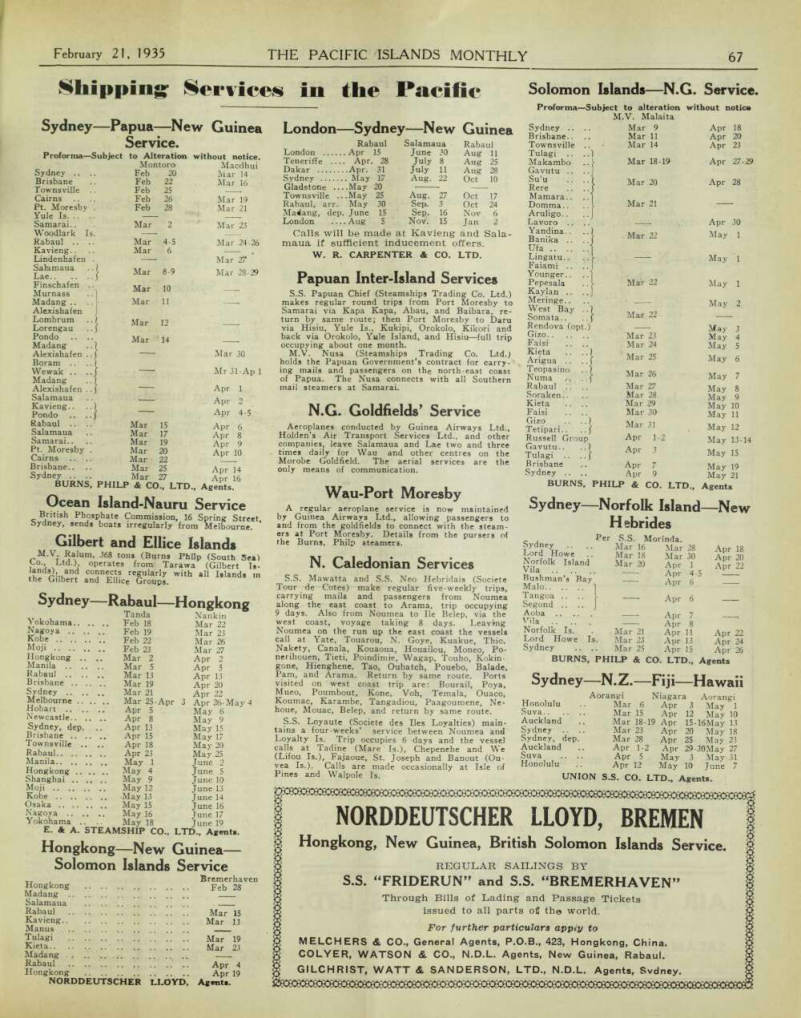
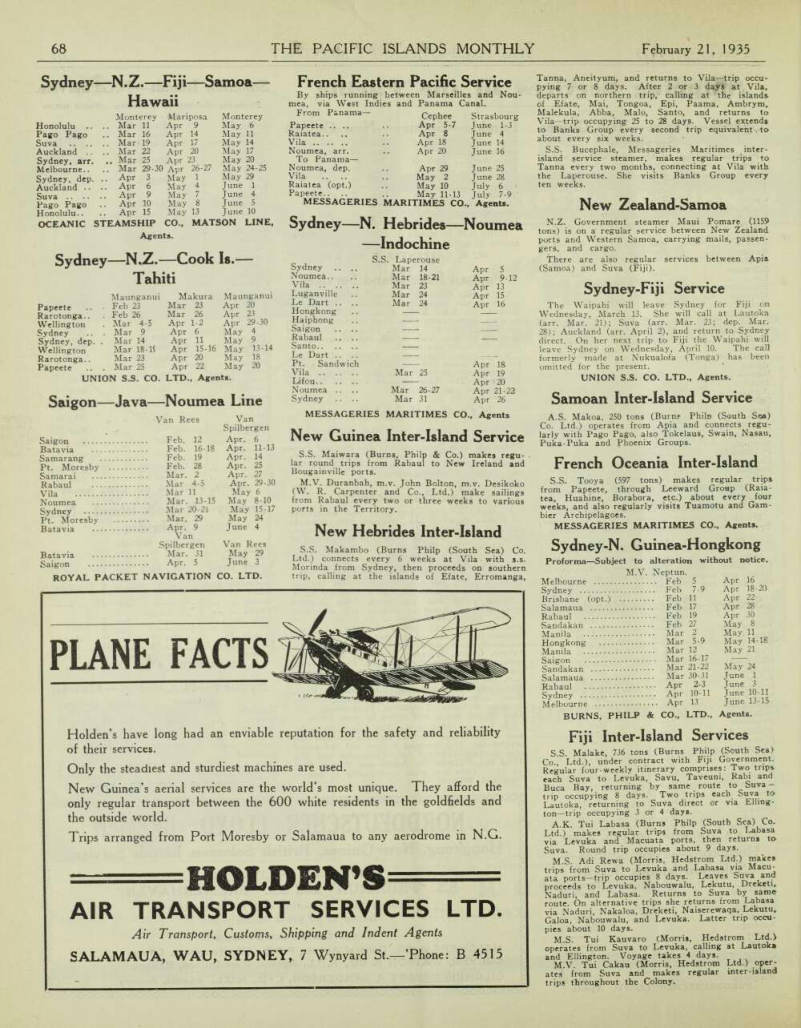
Sydney—Papua—New Guinea Service.
Ocean Island-Nauru Service
British Phosphate Commission, 16 Spring Street.
Sydney, sends boats irregularly from Melbourne.
Gilbert and Ellice Islands
M.V. Ralum, 368 tons (Burns Philp (South Sea) Co. Ltd.) operates from Tarawa (Gilbert Is connects regularly with all Islands in the Gilbert and Ellice Groups.
Sydney—Rabaul— Hongkong
Hongkong—New Guinea— Solomon Islands Service
London —Sydney—New Guinea
Papuan Inter-Island Services
S.S. Papuan Chief (Steamships Trading Co. Ltd.) makes regular round trips from Port Moresby to Samarai via Kapa Kapa, Abau, and Baibara, re turn by same route; then Port Moresby to Daru via Hisiu, Yule Is., Kukipi, Orokolo, Kikori and back via Orokolo, Yule Island, and Hisiu—full trip occupying about one month.
M.V. Nusa (Steamships Trading Co. Ltd.) holds the Papuan Government’s contract for carry ing mails and passengers on the north-east coast of Papua. The Nusa connects with all Southern mail steamers at Samarai.
N.G. Goldfields’ Service
Aeroplanes conducted by Guinea Airways Ltd., Holden’s Air Transport Services Ltd., and other companies, leave Salamaua and Lae two and three times daily for Wau and other centres on the Morobe Goldfield. The aerial services are the only means of communication.
Wau-Port Moresby
A regular aeroplane service is now maintained by Guinea Airways Ltd., allowing passengers to and from the goldfields to connect with the steam ers at Port Moresby. Details from the pursers of the Burns, Philp steamers.
N. Caledonian Services
S.S. Mawatta and S.S. Neo Hebridais (Societe Tour de Cotes) make regular five-weekly trips, carrying mails and passengers from Noumea along the east coast to Arama, trip occupying 9 days. Also from Noumea to He Belep, via the west coast, voyage taking 8 days. Leaving Noumea on the run up the east coast the vessels call at Yate, Touarou, N. Goye, Kuakue, Thio.
Nakety, Canala, Kouaoua, Houailou, Moneo, Po nerihouen, Tieti, Poindimie, Wagap, Touho, Kokin gone, Hienghene, Tao, Oubatch, Pouebo, Balade, Pam, and Arama. Return by same route. Ports visited on west coast trip are; Bourail, Poya, Mueo, Poumbout, Kone, Voh, Temala, Ouaco, Koumac, Karambe, Tangadiou, Paagoumene, Ne houe, Mouac, Belep, and return by same route.
S.S. Loyaute (Societe des lies Loyalties) maintains a four-weeks’ service between Noumea and Loyalty Is. Trip occupies 6 days and the vessel calls at Tadine (Mare Is.), Chepenehe and We (Lifou Is.), Fajaoue, St. Joseph and Banout (Ou vea Is.). Calls are made occasionally at Isle of Pines and Walpole Is.
Solomon Islands —N.G. Service.
Sydney—Norfolk Island—New Hebrides
Sydney—N.Z.—Fiji—Hawaii
Proforma—Subject to Alteration without notice.
Montoro Macdhui Sydney Feb 20 Mar 14 Brisbane Feb 22 Mar 16 Townsville Feb 25 Cairns Feb 26 Mar 19 Pt. Moresby Feb 28 Mar 21 Yule Is.
Samarai Mar 2 Mar 23 Woodlark Is.
Rabaul Mar 4-5 Mar 24-26 Kavieng Mar 6 Lindenhafen Mar 27 Salamaua Lae Mar 8-9 Mar 28-29 Finschafen Murnass Mar 10 Madang Mar 11 Alexishafen Lombrum Mar 12 Lorengau Pondo Madang Mar 14 Alexishafen Mar 30 Boram Wewak Mr 31-Ap 1 Madang Alexishafen Apr 1 Salamaua Apr 2 Kavieng Pondo Apr 4-5 Rabaul Mar 15 Apr 6 Salamaua Mar 17 Apr 8 Samarai Mar 19 Apr 9 Pt. Moresby Cairns Mar 20 Mar 22 Apr 10 Brisbane Mar 25 Apr 14 Sydney Mar 27 Apr 16
Burns, Philp & Co., Ltd., Agents.
Rabaul Salamaua Rabaul London Apr 15 June 30 Aug 11 Teneriffe Apr. 28 July 8 Aug 25 Dakar Apr. 31 July 11 Aug 28 Sydney May 17 Aug. 22 Oct 10 Gladstone May 20 Townsville May 25 Aug. 27 Oct 17 Rabaul, arr.
May 30 Sep. 3 Oct 24 Madang, dep.
June 15 Sep. 16 Nov 6 London Aug 5 Nov. 15 Jan 2 Calls will be made at Kavieng and Salamaua if sufficient inducement offers.
W. R. Carpenter & Co. Ltd.
Proforma—Subject to alteration without notice M.V. Malaita Sydney Mar 9 Apr 18 Brisbane Mar 11 Apr 20 Townsville Mar 14 Apr 23 Tulagi Makambo Mar 18-19 Apr 27-29 Gavutu Su’u Rere Mar 20 Apr 28 Mamara Domma Mar 21 Aruligo Lavoro Apr 30 Yandina Banika Mar 22 May 1 Ufa Lingatu May 1 Faiami Younger Pepesala Mar 22 May 1 Kaylan Meringe May 2 West Bay Mar 22 Somata Rendova (opt.) May 3 Gizo Mar 23 May 4 Faisi Kieta Arigua Mar 24 Mar 25 May 5 May 6 Teopasino Numa Mar 26 May 7 Rabaul Mar 27 May 8 May 9 Soraken Mar 28 Kieta Mar 29 May 10 Faisi Gizo Tetipari Mar 30 Mar 31 May 11 May 12 Russell Group Apr 1-2 May 13-14 Gavutu Tulagi Apr 3 May 15 Brisbane Apr 7 May 19 Sydney Apr 9 May 21
Burns, Philp & Co. Ltd., Agents
Per S.S. Morinda.
Sydney Lord Howe Norfolk Island Vila Bushman’s Bav Malo 1 Mar 16 Mar 18 Mar 20 Mar 28 Apr 18 Mar 30 Apr 20 Apr 1 Apr 22 Apr 4-5 Apr 6 Tangoa Segond Apr 6 Aoba Apr 7 Vila Norfolk Is.
Mar 21 Apr 8 Apr 11 Apr 22 Lord Howe Is.
Mar 23 Apr 13 Apr 24 Sydney Mar 25 Apr 15 Apr 26
Burns, Philp & Co. Ltd., Agents
Aorangi Niagara Aorangi Honolulu Mar 6 Apr 3 May 1 Suva Mar 15 Apr 12 May 10 Auckland Mar 18-19 Apr 15-16 May 13 Sydney Mar 23 Apr 20 May 18 Sydney, dep.
Mar 28 Apr 25 Mav 23 Auckland Apr 1-2 Apr 29-30 May 27 Suva Apr 5 May 3 May 31 Honolulu Apr 12 May 10 June 7
Union S.S. Co. Ltd., Agents.
Tanda Nankin Yokohama Mar 22 Nagoya Mar 23 Kobe Mar 26 Moji Mar 27 Hongkong .
Mar 2 Apr 2 Manila Apr 5 Rabaul Mar 13 Apr 13 Brisbane Apr 20 Sydney Apr 22 Melbourne Hobart 3 Apr 26-May 4 May 6 Newcastle May 9 Sydney, dep, Apr 13 May 15 Brisbane May 17 Townsville Apr 18 May 20 Rabaul May 25 Manila June 2 Hongkong June 5 Shanghai May 9 June 10 Moji June 13 Kobe June 14 Osaka June 16 Nagoya June 17 Yokohama May 18 June 19 E. A A. STEAMSHIP CO.. LTD., Agents.
Tr Bremerhaven Hongkong Feb 28 Madang Salamaua Rabaul Mar 15 Kavieng Mar 13 Manus Tulagi Mar 19 Kieta Mar 23 Madang Rabaul Apr 4 Hongkong Apr 19
Norddeutscher Lloyd. Agent..
Sydney—N.Z.—Fiji—Samoa— Hawaii
Sydney—N.Z. —Cook Is.— Tahiti
Saigon—Java—Noumea Line
French Eastern Pacific Service
By ships running between Marseilles and Nou mea, via West Indies and Panama Canal.
From Panama- Cephee Strasbourg
Sydney—N. Hebrides—Noumea —lndochine
New Guinea Inter-Island Service
S.S. Maiwara (Burns, Philp & Co.) makes regular round trips from Rabaul to New Ireland and Bougainville ports.
M.V. Duranbah, m.v. John Bolton, m.v. Desikoko (W. R, Carpenter and Co., Ltd.) make sailings from Rabaul every two or three weeks to various ports in the Territory.
New Hebrides Inter-Island
S.S. Makambo (Burns Philp (South Sea) Co.
Ltd.) connects every 6 weeks at Vila with s.s.
Morinda from Sydney, then proceeds on southern trip, calling at the islands of Efate, Erromanga,
Tanna, Aneityum, and returns to Vila—trip occu pying 7 or 8 days. After 2 or 3 days at Vila, departs on northern trip, calling at the islands of Efate, Mai, Tongoa, Epi, Paama, Ambrym, Malekula, Abba, Malo, Santo, and returns to Vila—trip occupying 25 to 28 days. Vessel extends to Banks Group every second trip equivalent .to about every six weeks.
S.S. Bucephale, Messageries Maritimes inter island service steamer, makes regular trips to Tanna every two months, connecting at Vila with the Laperouse. She visits Banks Group every ten weeks.
New Zealand-Samoa
N.Z. Government steamer Maui Pomare (1159 tons) is on a regular service between New Zealand ports and Western Samoa, carrying mails, passen gers, and cargo.
There are also regular services between Apia (Samoa) and Suva (Fiji).
Sydney-Fiji Service
The Waipahi will leave Sydney for Fiji on Wednesday, March 13, She will call at Lautoka (arr. Mar. 21); Suva (arr. Mar. 23; dep. Mar. 28); Auckland (arr. April 2), and return to Sydney direct. On her next trip to Fiji the Waipahi will leave Sydney on Wednesday, April 10. The call formerly made at Nukualofa (Tonga) has been omitted for the present.
Union S.S. Co. Ltd., Agents.
Samoan Inter-Island Service
A.S. Makoa, 250 tons (Burn? Philo (South Sea) Co. Ltd.) operates from Apia and connects regu larly with Pago Pago, also Tokelaus, Swain, Nasau, Puka-Puka and Phoenix Groups.
French Oceania Inter-Island
S.S. Tooya (597 tons) makes regular trips from Papeete, through Leeward Group (Raia tea, Huahine, Borabora, etc.) about every four weeks, and also regularly visits Tuamotu and Gam bier Archipelagoes.
Messageries Maritimes Co.. Agents.
Sydney-N. Guinea-Hongkong
Proforma—Subject to alteration without notice,
Fiji Inter-Island Services
S.S. Malake, 736 tons (Burns Philp (South Sea) Co., Ltd.), under contract with Fiji Government.
Regular four-weekly itinerary comprises: Two trips each Suva to Lcvuka, Savu, Taveum, Rabi and Buca Bay, returning by same route to Suva trip occupying 8 days. Two trips each Suva to Lautoka, returning to Suva direct or via Elling ton—trip occupying 3 or 4 days.
A.K. Tui Labasa (Burns Philp (South Sea) Co.
Ltd.) makes regular trips from Suva to Labasa via Levuka and Macuata ports, then returns to Suva. Round trip occupies about 9 days.
M.S. Adi Rewa (Morris, Hedstrom Ltd.) makes trips from Suva to Lcvuka and Labasa via Macu ata ports—trip occupies 8 days. Leaves Suva and proceeds to Levuka, Nabouwalu, Lekutu, Dreketi, Naduri, and Labasa. Returns to Suva by same route. On alternative trips she returns from Labasa via Naduri, Nakaloa, Dreketi, Naiserewaqa, Lekutu, Galoa, Nabouwalu, and Levuka. Latter trip occu pies about 10 days.
M.S. Tui Kauvaro (Morris, Hedstrom Ltd.) operates from Suva to Levuka, calling at Lautoka and Ellington. Voyage takes 4 days.
M.V. Tui Cakau (Morris, Hedstrom Ltd.) oper ates from Suva and makes regular inter-island trips throughout the Colony.
Monterey Mariposa Monterey Honolulu Mar 11 Apr 9 May 6 Pago Pago Mar 16 Apr 14 May 11 Suva Apr 17 May 14 Auckland Mar 22 Apr 20 May 17 Sydney, arr.
Mar 25 Apr 23 May 20 Melbourne Mar 29-30 Apr 26-27 May 24-25 Sydney, dep, Apr 3 May 1 May 29 Auckland Apr 6 May 4 June 1 Suva Apr 9 May 7 June 4 Pago Pago Apr 10 May 8 June 5 Honolulu Apr 15 May 13 June 10
Oceanic Steamship Co., Matson Line,
Agents.
Maunganui Makura Maunganui Papeete Feb 23 Mar 23 Apr 20 Rarotonga..
Feb 26 Mar 26 Apr 23 Wellington Mar 4-5 Apr 1-2 Apr 29-30 Sydney Mar 9 Apr 6 May 4 Sydney, dep.
Mar 14 Apr 11 May 9 Wellington Mar 18-15 Apr 15-16 May 13-14 Rarotonga Mar 23 Apr 20 May 18 Papeete Mar 25 Apr 22 May 20
Union S.S. Co. Ltd., Agents.
Van Rees Van Spilbergen Saigon Feb. 12 Apr. 6 Batavia Feb. 16-18 Apr. 11-13 Samarang Feb. 19 Apr. 14 Pt. Moresby Feb. 28 Apr. 25 Samarai Mar. 2 Apr. 27 Rabaul Mar 4-5 Apr. 29-30 Vila Mar 11 May 6 Noumea Mar. 13-15 May 8-10 Sydney Mar 20-21 May 15-17 Pt. Moresby Mar. 29 May 24 Batavia Van June 4 Spilbergen Van Rees Batavia May 29 Saigon June 3
Royal Packet
Navigation
Co. Ltd.
Papeete ... .. Apr 5-7 June 1-3 Raiatea.. ., .. Apr 8 June 4 Vila .. Apr 18 June 14 Noumea, arr. .. Apr 20 June 16 To Panama— Noumea, dep. .. Apr 29 June 25 Vila .. .. .. May 2 June 28 Raiatea (opt.) .. May 10 July 6 Papeete.. .. .. May 11-13 July 7-9
Messageries Maritimes Co.. Agents.
S.S. Laperouse Sydney Mar 14 Apr 5 Noumea Mar 18-21 Apr 9-12 Vila Mar 23 Apr 13 Luganville Mar 24 Apr 15 Le Dart Mar 24 Apr 16 Hongkong Haiphong Saigon Rabaul Santo Le Dart Pt. Sandwich Apr 18 Vila Mar 25 Apr 19 Lifou Apr 20 Noumea Mar 26-27 Apr 21-22 Sydney Mar 31 Apr 26
Messageries Maritimes Co., Agents
M.V. Neptun, Melbourne Feb 5 Apr 16 Sydney Feb 7-9 Apr 18-20 Brisbane (opt.) Feb 11 Apr 22 Salamaua Feb 17 Apr 28 Rabaul Feb 19 Apr 30 Sandakan Feb 27 May 8 Manila Mar 2 May 11 Hongkong Mar 5-9 May 14-18 Manila Mar 12 May 21 Saigon Mar 16-17 Sandakan Mar 21-22 May 24 Salamaua Mar 30-31 June 1 Rabaul 2-3 June 3 Sydney 10-11 June 10-11 Melbourne 13 June 13-15
Burns, Philp & Co., Ltd., Agents.
Advertisements & other items, pp. 69-70 (1 item)
Norddeutscher Lloyd, Bremen
Hongkong, New Guinea, British Solomon Islands Service.
REGULAR SAILINGS BY
S.S. “FRIDERUN” and S.S. “BREMERHAVEN”
Through Bills of Lading and Passage Tickets issued to all parts of the world.
For further particulars apply to MELCHERS & CO., General Agents, P.O.B., 423, Hongkong, China.
COLYER, WATSON & CO., N.D.L. Agents, New Guinea, Rabaul.
GILCHRIST, WATT & SANDERSON, LTD., N.D.L. Agents, Sydney,
PLANE FACTS
Holden’s have long had an enviable reputation for the safety and reliability of their services.
Only the steadiest and sturdiest machines are used.
New Guinea’s aerial services are the world’s most unique. They afford the only regular transport between the 600 white residents in the goldfields and the outside world.
Trips arranged from Port Moresby or Salamaua to any aerodrome in N.G.
HOLDEN’S
AIR TRANSPORT SERVICES LTD.
Air Transport, Customs, Shipping and Indent Agents SALAMAUA, WAU, SYDNEY, 7 Wynyard St.—’Phone; B 4515
Market Quotations
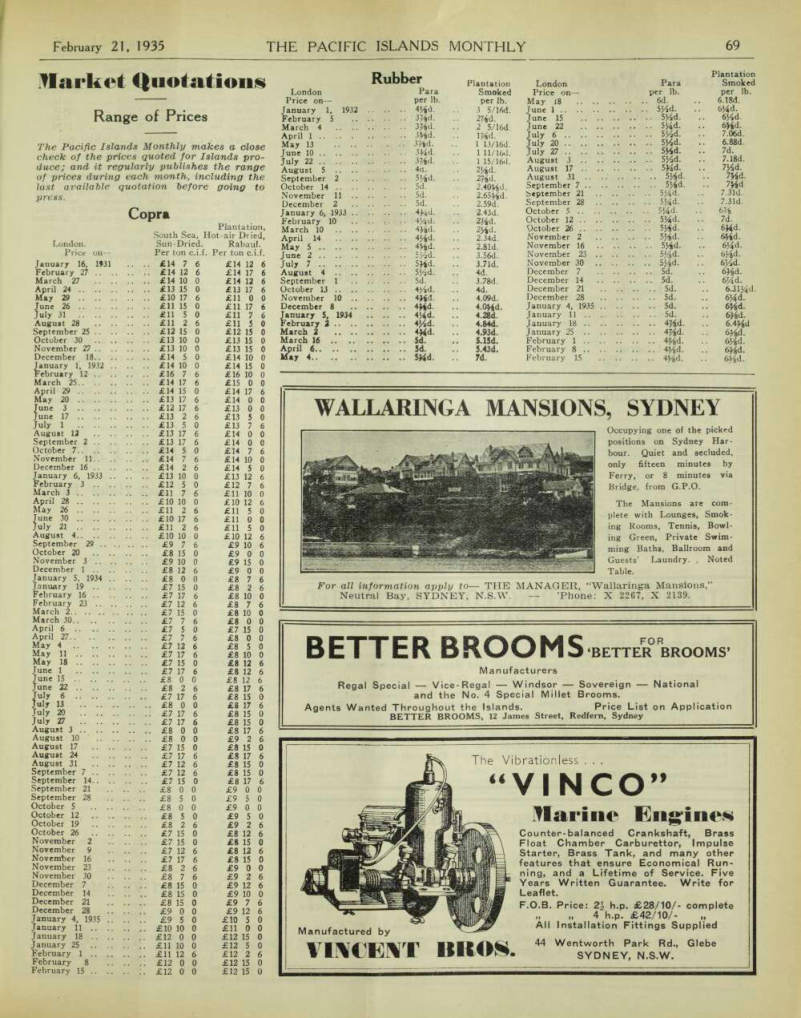
Range of Prices
The Pacific Islands Monthly makes a close check of the prices quoted for Islands pro duce; and it regularly publishes the range of prices during each month, including the last available quotation before going to press.
London Price on—
Rubber
Para per lb.
Plantation Smoked per lb.
January 1, 1932 4*d. 3 5/I6d.
February 5 3m. 27^d.
March 4 37Ad. 2 5/l6d April 1 md.
May 13 m d. 1 13/16d.
June 10 m d. 1 11/16.1.
July 22 3Hd. 1 15/16.1.
August 5 2^d.
September 2 5*d. 2Hd.
October 14 2.40HJ.
November 11 5d. 2.65^d.
December 2 Sd. 2.59d.
January 6, 1933 2.43d.
February 10 .. ... .. 4y 4 d. 2Hd.
March 10 W. 2Hd.
April 14 4«*d. 2.34d.
May 5 4^d. 2.81d.
June 2 5J4 d. 3.56d.
July 7 5Hd. 3.71d.
August 4 5j4d. 4d.
September 1 5d. 3.78d.
October 13 4>4d. 4d.
November 10 4tfd. 4.09d.
December 8 4Hd. 4.0Hd.
January 5, 1934 4.28d.
February 2 4j4d. 4.84d.
March 2 4#d. 4.93d.
March 16 , S.lSd.
April 6 May 4 3d. 5.43d. 5tfd. 7d.
London Price on — Para per lb.
Plantation Smoked per lb.
May 18 .. .. 6d. 6.18d.
June 1 .. .. 5Kad. . . 6Jid.
June 15 .. .. sy a d. 6/ a d.
June 22 .. .. sy A d. 6Hd.
July 6 .. .. sy 3 d. 7.06d.
July 20 6.88d.
July 27 .. .. 5*d. 7d.
August 3 .. .. sy a d. 7.18d.
August 17 .. .. SHd. iy 3 d.
August 31 5^d. . . 7Ad.
September 7 5#d. 7Hd September 21 .. .. 5i4d. 7.3 Id.
September 28 .. .. 5Kd. 7.31d.
October 5 .. .. 5^d. 6?i October 12 .. .. sy 4 d. 7d.
October 26 .. .. 5^d. 6*d.
November 2 .. .. 5Jid.
W.
November 16 .. .. S^d. 6^d.
November 23 .. .. 5y s d. b'Ad.
November 30 .. .. Mid. 6'Ad.
December 7 .. .. 5d. 6A<i.
December 14 .. .. 5d. ey 4 d.
December 21 Sd. 6.31}4d.
December 28 Sd. 6Jid.
January 4, 1935 Sd. 6Hd.
January 11 Sd. 6Hd.
January 18 VAd. 6.4^d January 25 4^d. 6&d.
February 1 .. .. 4$id. 6}id.
February 8 .. .. 4Hd. 6Jid.
February 15 .. .. 4^d. 6Hd.
Copra
South Sea, Sun-Dried. Per ton c.i.f.
Plantation, Hot-air Dried, Rabaul. Per ton c.i.f.
London. Price on— January 16, 1931 .. .. £14 7 6 £14 12 6 February 27 .. .. £14 12 6 £14 17 6 March 27 .. .. £14 10 0 £14 12 6 April 24 .. .. £13 15 0 £13 17 6 May 29 .. .. £10 17 6 £11 0 0 June 26 .. .. £11 15 0 £11 17 6 July 31 .. .. £11 5 0 £11 7 6 August 28 .. .. £11 2 6 £11 5 0 September 25 .. .. £12 15 0 £12 15 0 October 30 .. .. £13 10 0 £13 15 0 November 27 .. .. £13 10 0 £13 IS 0 December 18 .. .. £14 5 0 £14 10 0 January 1, 1932 .. .. £14 10 0 £14 15 0 February 12 .. .. £16 7 6 £16 10 0 March 25 .. .. £14 17 6 £15 0 0
April 29
May 20 .. .. £14 15 0 £14 17 6 .. .. £13 17 6 £14 0 0 Tune 3 .. .. £12 17 6 £13 0 0 June 17 .. .. £13 2 6 £13 5 0 July 1 .. .. £13 5 0 £13 7 6 August 12 .. .. £13 17 6 £14 0 0 September 2 .. .. £13 17 6 £14 0 0 October 7 .. .. £14 5 0 £14 7 6 November 11 .. .. £14 7 6 £14 10 0 December 16 .. .. £14 2 6 £14 5 0 January 6, 1933 .. .. £13 10 0 £13 12 6
February 3
.. .. £12 5 0 £12 7 6 March 3 6 £11 10 0 April 28 0 £10 12 6 May 26 .. .. £11 2 6 £11 5 0 Tune 30 .. .. £10 17 6 £11 0 0 July 21 .. .. £11 2 6 £11 5 0 August 4 .. .. £10 10 0 £10 12 6 September 29 ... £9 7 6 £9 10 6 October 20 .. .. £8 15 0 £9 0 0 November 3 .. .. £9 10 0 £9 IS 0 December 1 .. .. £8 12 6 £9 0 0 January 5. 1934 .. .. £8 0 0 £8 7 6 January 19 .. .. £7 15 0 £8 2 6 February 16 .. .. £7 17 6 £8 10 0
February 23
6 £8 7 6 March 2 ... £7 15 0 £8 10 0 March 30 .. .. £7 7 6 £8 0 0 April 6 .. .. £7 5 0 £7 IS 0 April 27 6 £8 0 0 May 4 .. .. £7 12 6 £8 5 0 May 11 6 £8 10 0 May 18 0 £8 12 6 Tune 1 6 £8 12 6 June 15 0 £8 12 6 June 22 .. .. £8 2 6 £8 17 6
July 6
6 £8 IS 0 July 13 .. .. £8 0 0 £8 17 6
July 20
.. .. £7 17 6 £8 IS 0 July 27 6 £8 IS 0 August 3 0 £8 17 6 August 10 0 £9 2 6 August 17 0 £8 15 0 August 24 6 £8 17 6 August 31 .. .. £7 12 6 £8 IS 0 September 7 .. .. £7 12 6 £8 15 0
September 14
0 £8 17 6 September 21 .. .. £8 0 0 £9 0 0 September 28 .. .. £8 5 0 £9 5 0 October 5 0 £9 0 0 October 12 .. .. £8 5 0 £9 5 0 October 19 .. .. £8 2 6 £9 2 6 October 26 0 £8 12 6 November 2 0 £8 15 0 November 9 .. .. £7 12 6 £8 12 6 November 16 6 £8 IS 0 November 23 6 £9 0 0 November 30 6 £9 2 6 December 7 .. .. £8 15 0 £9 12 6 December 14 0 £9 10 0 December 21 .. .. £8 15 0 £9 7 6 December 28 0 £9 12 6 January 4, 1935 .. .. £9 5 0 £10 5 0
January 11
0 £11 0 0
January 18
0 £12 IS 0 January 25 0 £12 5 0
February 1
6 £12 2 6
February 8
0 £12 15 0
February 15
.. .. £12 0 0 £12 15 0
Advertisements & other items, p. 71 (1 item)
Vinco
BETTER BROOMS FOR BETTER BROOMS
Manufacturers Regal Special Vice-Regal Windsor Sovereign National and the No. 4 Special Millet Brooms.
Agents Wanted Throughout the Islands. Price List on Application BETTER BROOMS, 12 James Street, Redfern, Sydney
The Vibrationless . .
VINCO
Manufactured by
VINCENT BROS.
Marine Engines
Counter-balanced Crankshaft, Brass Float Chamber Carburettor, Impulse Starter, Brass Tank, and many other features that ensure Economical Running, and a Lifetime of Service. Five Years Written Guarantee. Write for Leaflet.
F.O.B. Price: 2½ h.p. £28/10/- complete „ „ 4 h.p. £42/10/- All Installation Fittings Supplied 44 Wentworth Park Rd., Glebe
SYDNEY, N.S.W.
Inlands Produce
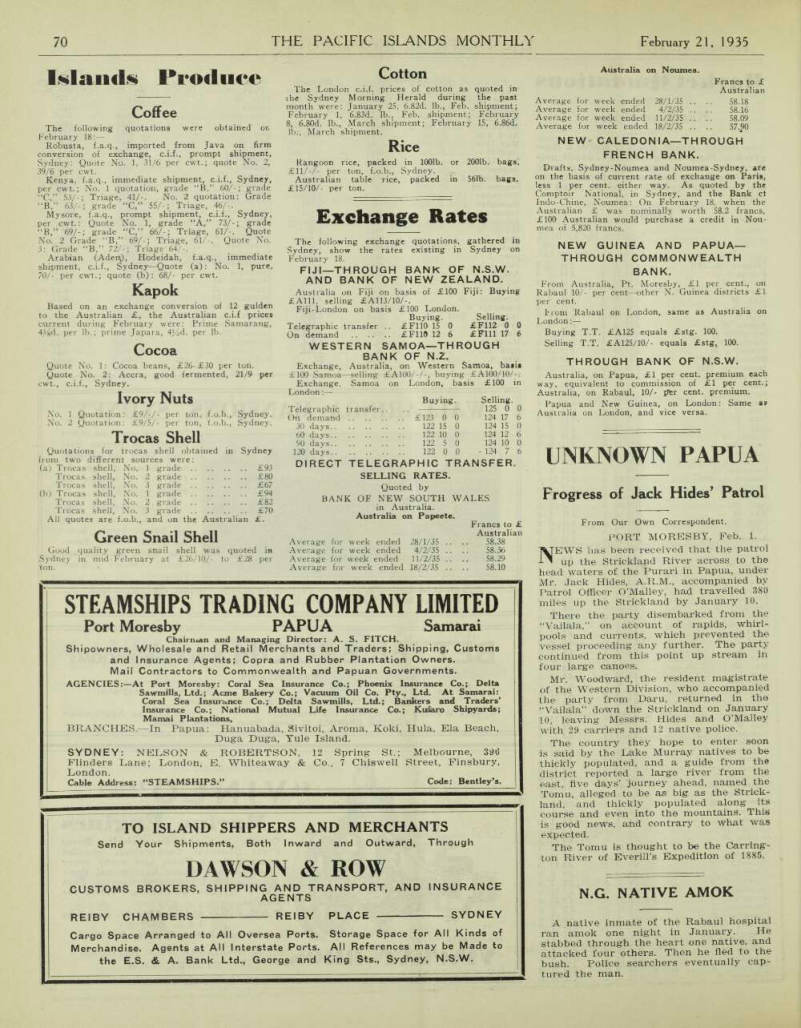
Coffee
The following quotations were obtained or, February 18: — Robusta, f.a.q., imported from Java on firm conversion of exchange, c.i.f., prompt shipment, Sydney: Quote No. 1, 31/6 per cwt.; quote No. 2, 39/6 per cwt.
Kenya, f.a.q., immediate shipment, c.i.f., Sydney, per cwt.; No. 1 quotation, grade “B,” 60/-; grade “C,” 53/-; Triage, 41/-. No. 2 quotation: Grade “B," 63/-; grade “C,” 55/-; Triage, 46/-.
Mysore, f.a.q., prompt shipment, c.i.f., Sydney, per cwt.; Quote No. 1, grade “A,” 73/-; grade “B,” 69/-; grade “C,” 66/-; Triage, 61/-. Quote No. 2 Grade “B,” 69/-; Triage, 61/-. Quote No. 3: Grade “B,” 72/-; Triage 64/-.
Arabian (AderO, Hodeidah, f.a.q., immediate shipment, c.i.f., Sydney—Quote (a): No. 1, pure, 70/- per cwt.; quote (b): 68/- per cwt.
Kapok
Based on an exchange conversion of 12 gulden to the Australian £, the Australian c.i.f prices current during February were: Prime Samarang, per lb.; prime Japara, per lb.
Cocoa
Quote No. 1: Cocoa beans, £26-£30 per ton.
Quote No. 2: Accra, good fermented, 21/9 per cwt., c.i.f., Sydney.
Ivory Nuts
No. 1 Quotation: £9/-/- per ton, f.o.b., Sydney.
No. 2 Quotation; £9/5/- per ton, f.o.b., Sydney.
Trocas Shell
Quotations for trocas shell obtained in Sydney from two different sources were: (a) Trocas shell, No. 1 grade £93 Trocas shell, No. 2 grade £80 Trocas shell, No. 3 grade £67 (b) Trocas shell, No. 1 grade £94 Trocas shell, No. 2 grade £82 Trocas shell, No. 3 grade £70 All quotes are f.o.b., and on the Australian £.
Green Snail Shell
Good quality green snail shell was quoted in Sydney in mid-February at £26/10/- to £28 per ton.
Cotton
The London c.i.f. prices of cotton as quoted in che Sydney Morning Herald during the past month were; January 25, 6.82 d. lb., Feb. shipment; February 1,6.83 d. lb., Feb. shipment; February 8,6.80 d. lb., March shipment; February 15, 6.86 d. lb., March shipment.
Rice
Rangoon rice, packed in 100lb. or 200lb. bags, £11/-/- per ton, f.o.b., Sydney.
Australian table rice, packed in 56lb. bags, £15/10/- per ton.
Exchange Rates
The following exchange quotations, gathered in Sydney, show the rates existing in Sydney on February 18.
FIJI—through bank of n.s.w.
And Bank Of New Zealand.
Australia on Fiji on basis of £100 Fiji: Buying £A111, selling £A113/10/-.
Fiji-London on basis £100 London.
Western Samoa—Through
Bank Of N.Z.
Exchange, Australia, on Western Samoa, basit £100 Samoa —selling £A100/-/-, buying £A100/10/-; Exchange, Samoa on London, basis £100 in London: —
Direct Telegraphic Transfer.
Selling Rates.
Quoted by
Bank Of New South Wales
in Australia.
New Caledonia—Through
French Bank.
Drafts, Sydney-Noumea and Noumea-Sydney, are on the basis of current rate of exchange on Paris, less 1 per cent, either way. As quoted by the Comptoir National, in Sydney, and the Bank ct Indo-Chine, Noumea: On February 18, when the Australian £ was nominally worth 58.2 francs, £100 Australian would purchase a credit in Noumea of 5,820 francs.
New Guinea And Papua
Through Commonwealth
Bank.
From Australia, Pt. Moresby, £1 per cent., on Rabaul 10/- per cent—other N. Guinea districts £1 per cent. h rom Rabaul on London, same as Australia on London Buying T.T. £A125 equals £stg. 100.
Selling T.T. £A125/10/- equals £stg, 100.
Through Bank Of N.S.W.
Australia, on Papua, £1 per cent, premium each way, equivalent to commission of £1 per cent.; Australia, on Rabaul, 10/- per cent, premium.
Papua and New Guinea, on London: Same as Australia on London, and vice versa.
Buying.
Selling.
Telegraphic transfer . £F110 15 0 £F112 0 0 On demand . £F110 12 6 £F111 17 6
Buying. Selling.
Telegraphic transfer.. .. 125 0 0 On demand £123 0 0 124 17 6 30 days 122 15 0 124 15 0 60 days 122 10 0 124 12 6 90 days 122 5 0 124 10 0 120 days 122 0 0 - 124 7 6
Australia on Papeete.
Francs to £ Australian Average for week ended 28/1/35 .. 58.38 Average for week ended 4/2/35 .. .. 58.36 Average for week ended 11/2/35 .. .. 58.29 Average for week ended 18/2/35 .. .. 58.10
Australia on Noumea.
Francs to £ Australian Average for week ended 28/1/35 .. .. 58.18 Average for week ended 4/2/35 .. .. 58.16 Average for week ended 11/2/35 .. .. 58.09 Average for week ended 18/2/35 .. .. 57.90
Unknown Papua
Progress of Jack Hides’ Patrol
From Our Own Correspondent.
Port Moresby, Feb. 1.
NEWS has been received that the patrol up the Strickland River across to the head waters of the Purari in Papua, under Mr. Jack Hides, A.R.M., accompanied by Patrol Officer OMalley, had travelled 380 miles up the Strickland by January 10.
There the party disembarked from the “Vailala,” on account of rapids, whirl pools and currents, which prevented the vessel proceeding any further. The party continued from this point up stream in four large canoes.
Mr. Woodward, the resident magistrate of the Western Division, who accompanied the party from Daru, returned in the “Vailala” down the Strickland on January 10, leaving Messrs. Hides and O’Malley with 29 carriers and 12 native police.
The country they hope to enter soon is said by the Lake Murray natives to be thickly populated, and a guide from the district reported a large river from the east, five days’ journey ahead, named the Tomu, alleged to be as big as the Strick land, and thickly populated along its course and even into the mountains. This is good news, and contrary to what was expected.
The Tomu is thought to be the Carring ton River of Everill’s Expedition of 1885.
N.G. Native Amok
A native inmate of the Habaul hospital ran amok one night in January. He stabbed through the heart one native, and attacked four others. Then he fled to the bush. Police searchers eventually cap tured the man.
Advertisements & other items, p. 72 (1 item)
Steamships Trading Company Limited
Port Moresby PAPUA Samarai
Chairman and Managing Director: A. S. FITCH, Shipowners, Wholesale and Retail Merchants and Traders; Shipping, Customs and Insurance Agents; Copra and Rubber Plantation Owners.
Mail Contractors to Commonwealth and Papuan Governments.
AGENCIES:—At Port Moresby: Coral Sea Insurance Co.; Phoenix Insurance Co.; Delta Sawmills, Ltd.; Acme Bakery Co.; Vacuum Oil Co. Pty., Ltd. At Samarai: Coral Sea Insurance Co.; Delta Sawmills, Ltd.; Bankers and Traders’
Insurance Co.; National Mutual Life Insurance Co.; Kuiaro Shipyards; Mamai Plantations, BRANCHES.—In Papua: Hanuabada, Sivitoi, Aroma, Koki, Hula, Ela Beach, Duga Duga, Yule Island.
SYDNEY: NELSON & ROBERTSON. 12 Spring St.; Melbourne, 39G Flinders Lane; London, E. Whiteaway & Co.. 7 Chiswell Street, Finsbury, London.
Cable Address; “STEAMSHIPS.” Code: Bentley’s,
TO ISLAND SHIPPERS AND MERCHANTS
Send Your Shipments, Both Inward and Outward, Through
DAWSON & ROW
CUSTOMS BROKERS, SHIPPING AND TRANSPORT, AND INSURANCE
AGENTS
REIBY CHAMBERS REIBY PLACE SYDNEY
Cargo Space Arranged to All Oversea Ports. Storage Space for All Kinds of Merchandise. Agents at All Interstate Ports. AH References may be Made to the E.S. & A. Bank Ltd., George and King Sts., Sydney, N.S.W.
Thursday Is.
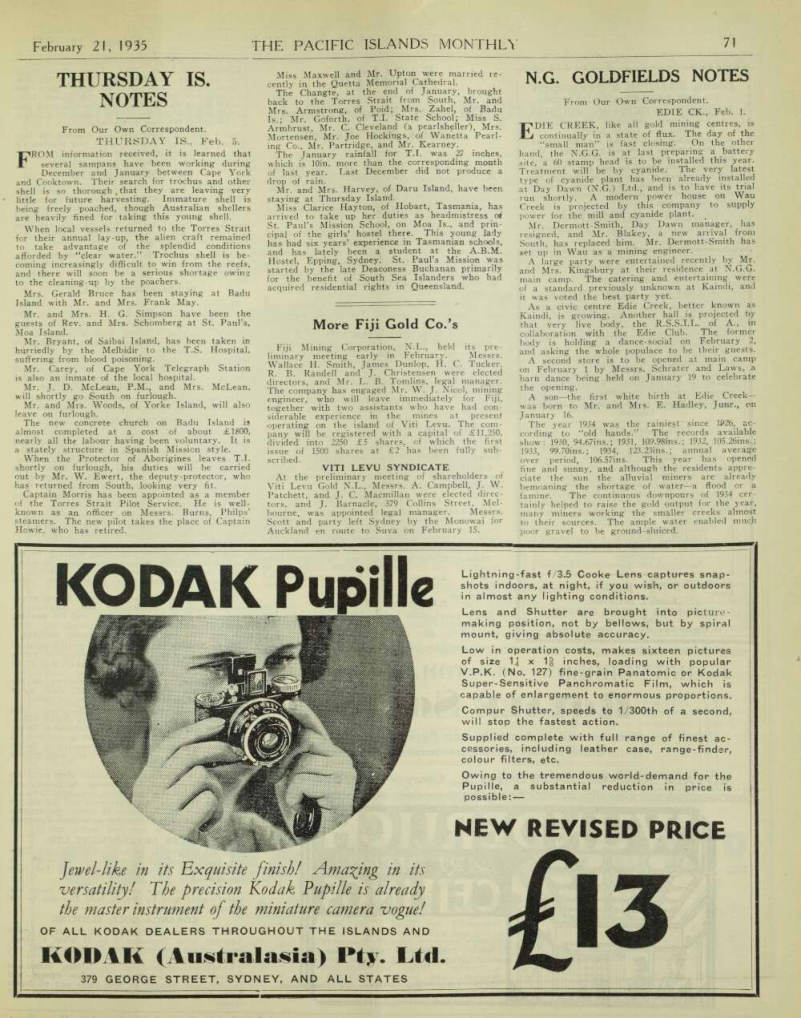
Notes
From Our Own Correspondent.
Thursday Is., Feb. 5.
FROM information received, it is learned that several sampans have been working during December and January between Cape York and Cooktown. Their search for trochus and other shell is so thorough .that they are leaving very little for future harvesting. Immature shell is being freely poached, though Australian shellers are heavily fined for taking this young shell.
When local vessels returned to the Torres Strait for their annual lay-up, the alien craft remained to take advantage of the splendid conditions afforded by “clear water.” Trochus shell is be coming increasingly difficult to win from the reefs, and there will soon be a serious shortage owing to the cleaning-up by the poachers.
Mrs. Gerald Bruce has been staying at Badu Island with Mr. and Mrs. Frank May.
Mr. and Mrs. H. G. Simpson have been the guests of Rev. and Mrs. Schomberg at St. Paul’s, Moa Island.
Mr. Bryant, of Saibai Island, has been taken in hurriedly by the Melbidir to the T.S. Hospital, suffering from blood poisoning.
Mr. Carey, of Cape York Telegraph Station is also an inmate of the local hospital.
Mr. J. D. McLean, P.M., and Mrs. McLean, will shortly go South on furlough.
Mr. and Mrs. Woods, of Yorke Island, will also leave on furlough.
The new concrete church on Badu Island is almost completed at a cost of about £1800, nearly all the labour having been voluntary. It is a stately structure in Spanish Mission style.
When the Protector of Aborigines leaves T.I. shortly on furlough, his duties will be carried out by Mr. W. Ewert, the deputy-protector, who has returned from South, looking very fit.
Captain Morris has been appointed as a member of the Torres Strait Pilot Service. He is well known as an officer on Messrs. Burns, Philps’ steamers. The new pilot takes the place of Captain Howie, who has retired.
Miss Maxwell and Mr. Upton were married re cently in the Quetta Memorial Cathedral.
The Changte, at the end of January, brought back to the Torres Strait from South, Mr. and Mrs. Armstrong, of Poid; Mrs. Zahel, of Badu Is.; Mr. Goforth, of T.I. State School; Miss S.
Armbrust, Mr. C. Cleveland (a pearlsheller), Mrs.
Mortensen, Mr. Joe Hockings, of Wanetta Pearl ing Co., Mr. Partridge, and Mr. Kearney.
The January rainfall for T.I. was 27 inches, which is 10in. more than the corresponding month of last year. Last December did not produce a drop of rain.
Mr. and Mrs. Harvey, of Daru Island, have been staying at Thursday Island.
Miss Clarice Hayton, of Hobart, Tasmania, has arrived to take up her duties as headmistress of St. Paul’s Mission School, on Moa Is., and prin cipal of the girls’ hostel there. This young lady has had six years’ experience in Tasmanian schools, and has lately been a student at the A.B.M.
Hostel, Epping, Sydney. St. Paul’s Mission was started by the late Deaconess Buchanan primarily for the benefit of South Sea Islanders who had acquired residential rights in Queensland.
More Fiji Gold Co.’s
Fiji Mining Corporation, N.L., held its pre liminary meeting early in February. Messrs.
Wallace H. Smith, James Dunlop, H. C. Tucker, R. B. Randell and J. Christensen were elected directors, and Mr. L. B. Tomlins, legal manager.
The company has engaged Mr. W. J. Nicol, mining engineer, who will leave immediately for Fiji, together with two assistants who have had con siderable experience in the mines at present operating on the island of Viti Levu. The com pany will be registered with a capital of £11,250, divided into 2250 £5 shares, of which the first issue of 1500 shares at £2 has been fully sub scribed.
Viti Levu Syndicate
At the preliminary meeting of shareholders of Viti Levu Gold N.L., Messrs. A. Campbell, J. W.
Patchett, and J. C. Macmillan were elected direc tors, and J. Barnacle, 379 Collins Street, Mel bourne, was appointed legal manager. Messrs.
Scott and party left Sydney by the Monowai for Auckland en route to Suva on February 15.
N.G. Goldfields Notes
From Our Own Correspondent,
Edie Ck., Feb. 1.
EDIE CREEK, like all gold mining centres, is continually in a state of flux. The day of the “small man” is fast closing. On the other hand, the N.G.G. is at last preparing a battery site, a 60 stamp head is to be installed this year.
Treatment will be by cyanide. The very latest type of cyanide plant has been already installed at Day Dawn (N.G.) Ltd., and is to have its trial run shortly. A modern power house on Wau Creek is projected by this company to supply power for the mill and cyanide plant.
Mr. Dermott-Smith, Day Dawn manager, has resigned, and Mr. Blakey, a new arrival from South, has replaced him. Mr. Dermott-Smith has set up in Wau as a mining engineer.
A large party were entertained recently by Mr. and Mrs. Kingsbury at their residence at N.G.G. main camp. The catering and entertaining were of a standard previously unknown at Kaindi, and it was voted the best party yet.
As a civic centre Edie Creek, better known as Kaindi, is growing. Another hall is projected by that very live body, the R.S.S.I.L. of A., in collaboration with the Edie Club. The former body is holding a dance-social on February 2, and asking the w’hole populace to be their guests.
A second store is to be opened at main camp on February 1 by Messrs. Schrater and Laws, a barn dance being held on January 19 to celebrate the opening.
A son—the first white birth at Edie Creek— was born to Mr. and Mrs. E. Hadley, Junr., on January 16.
The year 1934 was the rainiest since 1926, ac cording to “old hands.” The records available show: 1930, 94.67in5.; 1931, 109.98in5.; 1932, 105.26in5.; 1933, 99.70in5.; 1934, 123.23in5.; annual average over period, 106.57in5. This year has opened fine and sunny, and although the residents appre ciate the sun the alluvial miners are already bemoaning the shortage of water —a flood or a famine. The continuous downpours of 1934 cer tainly helped to raise the gold output for the year, many miners working the smaller creeks almost to their sources. The ample water enabled much poor gravel to be ground-sluiced.
Advertisements & other items, pp. 73-74 (1 item)
KODAK Pupille
Jewel-like in its Exquisite finish! Amazing in its versatility! The precision Kodak Pupille is already the master instrument of the miniature camera vogue!
OF ALL KODAK DEALERS THROUGHOUT THE ISLANDS AND
KODAK (Australasia) Ptj. Ltd
379 GEORGE STREET, SYDNEY, AND ALL STATES Lightning-fast f/3.5 Cooke Lens captures snapshots indoors, at night, if you wish, or outdoors in almost any lighting conditions.
Lens and Shutter are brought into picturemaking position, not by bellows, but by spiral mount, giving absolute accuracy.
Low in operation costs, makes sixteen pictures of size 1¼ x 1 5/8 inches, loading with popular V.P.K. (No. 127) fine-grain Panatomic or Kodak Super-Sensitive Panchromatic Film, which is capable of enlargement to enormous proportions.
Compur Shutter, speeds to 1/300th of a second, will stop the fastest action.
Supplied complete with full range of finest accessories, including leather case, range-finder, colour filters, etc.
Owing to the tremendous world-demand for the Pupille, a substantial reduction in price is possible:
NEW REVISED PRICE
£13
Books, Magazines & Newspapers
TO ANY PART OF THE ISLANDS
BARGAIN OFFER.—We will send half-a-dozen assorted Magazines for 4/- (post free).
We specialise in selecting reading matter for those unable to choose personally. We specialise in Mail Orders. Parcels posted by every boat. Send for our price list and full particulars of this unusual service for Island residents. You will find your instructions carried out promptly, carefully, and with intelligence.
McKAY’S BOOKSTALL
ROYAL ARCADE. SYDNEY
While You Sleep the Remedy Heals
A WELL-PROVEN
REMEDY FOR PILES
This preparation has been on the market for several months, and it has effected a Cure in every case in which it has been tried.
Cases of Long Standing often Cured within One Month, with one bottle only.
For External Use only—Stainless, Painless and Odourless.
PRICE: 3/6 PER BOTTLE. Posted securely packed for 5/- per bottle. Copies of Testimonials forwarded on request.
Read the Report of an Eminent Analytical Chemist;
THE LABORATORY,
20 and 22 Napoleon Street, Sydney, March 14th, 1933.
ROBERT BRUCE, Esq.
Dear Sir, —The formula of your pile cure submitted to me could have no effect other than beneficial. I gave your sample to a -Client who had suffered many years, and before he had used half the bottle he reported himself completely cured.
Faithfully yours,
GROVE JOHNSON, F.C.S. (Lond.)
“Honours," City and Guilds of London Institute.
Analytical and Consulting Chemist.
Supplies Obtainable from—
Robert Bruce
Room 7, 2nd Floor,
15 HUNTER STREET, SYDNEY
and also at 14 Upper Bayview St., North Sydney
For HOUSEHOLD as well as TOILET Purposes...
Royale Soaps Manufactured in Australia from Purest Ingredients Special Quotes to Island Storekeepers—Samples on Application ROYALE SOAP CO., 24-26 Briggs St., Camperdown, Sydney
WUNDERLICH
ART METAL
Wunderlich Art Metal is the ideal ceiling and walling for Island Homes.
Suitable for every purpose; transports cheaply; easy to erect and decorate; fire-resisting; vermin-proof, and lasts a lifetime. Write for illustrated literature and prices. WUNDER-
LICH, LTD., Box 474 AA, G.P.O.,
SYDNEY
December Morobe Output
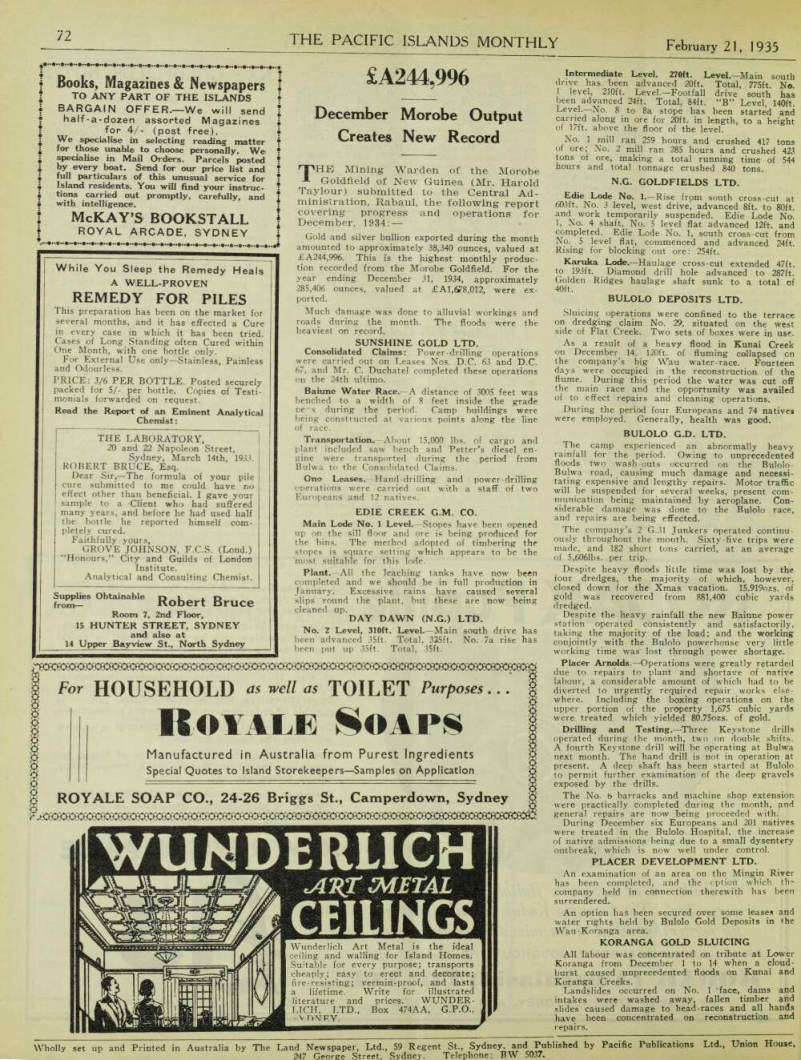
£A244,996 December Morobe Output Creates New Record
THE Mining Warden of the Morobe Goldfield of New Guinea (Mr. Harold Taylour) submitted to the Central Ad ministration, Rabaul, the following report covering progress and operations for December, 1934: Gold and silver bullion exported during the month amounted to approximately 38,340 ounces, valued at £A244,996. This is the highest monthly produc tion recorded from the Morobe Goldfield. For the year ending December 31, 1934, approximately 285,406 ounces, valued at £A1,678,012, were ex ported.
Much damage was done to alluvial workings and roads during the month. The floods were the heaviest on record.
Sunshine Gold Ltd.
Consolidated Claims: Power-drilling operations were carried out on Leases Nos. D.C. 63 and D.C. 67, and Mr. C. Duchatel completed these operations on the 24th ultimo.
Baiune Water Race.—A distance of 3005 feet was benched to a width of 8 feet inside the grade oe~s during the period. Camp buildings were being constructed at various points along the line of race.
Transportation. —About 15,000 lbs. of cargo and plant included saw bench and Fetter’s diesel en gine were transported during the period from Bulwa to the Consolidated Claims.
Ono Leases.— Hand-drilling and power-drilling operations were carried out with a staff of two Europeans and 12 natives.
Edie Creek G.M. Co.
Main Lode No. 1 Level.—Stopes have been opened up on the sill floor and ore is being produced for the bins. The method adopted of timbering the stopes is square setting which appears to be the most suitable for this lode.
Plant.— All the leaching tanks have now been completed and we should be in full production in January. Excessive rains have caused several slips round the plant, but these are now being cleaned up.
Day Dawn (N.G.) Ltd.
No. 2 Level, 310 ft. Level. —Main south drive has been advanced 35ft. Total, 325 ft. No. 7a rise has been put up 35ft. Total, 35ft.
Intermediate Level, 270 ft. Level.— Main south drive has been advanced 20ft. Total, 775 ft. No. 1 level, 210 ft. Level.—Footfall drive south has been advanced 24ft. Total, 84ft. “B” Level, 140 ft.
Level.—No. 8 to 8a stope has been started and carried along in ore for 20ft. in length, to a height of 17ft. above the floor of the level.
No. 1 mill ran 259 hours and crushed 417 tons of ore; No. 2 mill ran 285 hours and crushed 423 tons of ore, making a total running time of 544 hours and total tonnage crushed 840 tons.
N.G. Goldfields Ltd.
Edie Lode No. I. — Rise from south cross-cut at 603 ft. No. 3 level, west drive, advanced 8ft. to 80ft. and work temporarily suspended. Edie Lode No. 1, No. 4 shaft, No. 5 level flat advanced 12ft. and completed. Edie Lode No. 1, south cross-cut from No. 5 level flat, commenced and advanced 24ft.
Rising for blocking out ore: 254 ft.
Karuka Lode. —Haulage cross-cut extended 47ft. to 193 ft. Diamond drill hole advanced to 287 ft.
Golden Ridges haulage shaft sunk to a total of 40ft.
Bulolo Deposits Ltd.
Sluicing operations were confined to the terrace on dredging claim No. 29, situated on the west side of Flat Creek. Two sets of boxes were in use.
As a result of a heavy flood in Kunai Creek on December 14, 120 ft. of fluming collapsed cn the company’s big water-race. Fourteen days were occupied in the reconstruction of the flume. During this period the water was cut off the main race and the opportunity was availed of to effect repairs and cleaning operations.
During the period four Europeans and 74 natives were employed. Generally, health was good,
Bulolo G.D. Ltd.
The camp experienced an abnormally heavy rainfall for the period. Owing to unprecedented floods two wash-outs occurred on the Bulolo- Bulwa road, causing much damage and necessi tating expensive and lengthy repairs. Motor traffic will be suspended for several weeks, present com munication being maintained by aeroplane. Con siderable damage was done to the Bulolo race, and repairs are being effected.
The company’s 2 G. 31 Junkers operated continu ously throughout the month. Sixty-five trips were made, and 182 short tons carried, at an average of 5,6061b5. per trip.
Despite heavy floods little time was lost by the four dredges, the majority of which, however, closed down for the Xmas vacation. 15,919oz5. of gold was recovered from 881,400 cubic yards dredged.
Despite the heavy rainfall the new Baiune power station operated consistently and satisfactorily, taking the majority of the load; and the working conjointly with the Bulolo powerhouse very little working time was lost through power shortage.
Placer Arnolds. —Operations were greatly retarded due to. repairs to plant and shortage of native labour, a considerable amount of which had to be diverted to urgently required repair works else where. Including the boxing operations on the upper portion of the property 1,675 cubic yards were treated, which yielded 80.75ozs. of gold.
Drilling and Testing.—Three Keystone drills operated during the month, two on double shifts.
A fourth Keystone drill will be operating at Bulwa next month. The hand drill is not in operation at present. A deep shaft has been started at Bulolo to permit further examination of the deep gravels exposed by the drills.
The No. 6 barracks and machine shop extension were practically completed during the month, and general repairs are now being proceeded with.
During December six Europeans and 201 natives were treated in the Bulolo Hospital, the increase of native admissions being due to a small dysentery outbreak, which is now well under control.
Placer Development Ltd.
An examination of an area on the Mingin River has been completed, and the option which the company held in connection therewith has been surrendered.
An option has been secured over some leases and water rights held by Bulolo Gold Deposits in the Wau-Koranga area.
Koranga Gold Sluicing
All labour was concentrated on tribute at Lower Koranga from December 1 to 14 when a cloud burst caused unprecedented floods on Kunai and Koranga Creeks.
Landslides occurred on No. 1 face, dams and intakes were washed away, fallen timber and slides caused damage to head-races and all hands have been concentrated on reconstruction and repairs.
Advertisements & other items, pp. 74-76 (2 items)
72
February 21, 1933
THE PACIFIC ISLANDS MONTHLY
Wholly set up and Printed in Australia by The Land Newspaper, Ltd., 59 Regent St., Sydney, and Published by Pacific Publications Ltd., Union House, 247 George Street. Sydney. Telephone: BW 5037.
Guinea Airways Ltd
Goldfields Aerial Transport Service
EVERYTHING required for the Development of the Morobe Goldfield men, foodstuffs, building material, dredges, miscellaneous machinery, cattle and horses has been carried over the mountains, from the coast of New Guinea, by aeroplanes. Modern aviation has made possible the establishment of a flourishing gold-mining industry in the heart of New Guinea. 32 Aerodromes Massive equipment carried in onto the Morobe Goldfield by aeroplanes operated by Guinea Airways Ltd.
TOP PICTURE. —One of the four modern Dredges now being operated by Bulolo G.D. Co. Ltd. —2 at Bulolo and 2 at BulWa.
LOWER PICTURE: Part of the pipe line which brings the water to the Power-house at Bulolo.
Another hydro-electric station has been built near Bulwa.
Aeroplanes, flying on regular schedules, transported all this heavy machinery without mishap. The weight of some of the pieces exceeded 6 tons.
In 1926 the Morobe Goldfield, guarded by dense jungle and precipitous mountain ranges, was almost unexplored and practically inaccessible. To-day, it is the seat of a great and flourishing industry, employing 2000 Europeans and thousands of natives , and equipped with all the amenities of civilisation.
Aerial transport made that possible. There is no road in from the coast.
A road could not be built, except at enormous, crippling cost.
Guinea Airways Ltd., launching this unique aerial service, originally with one machine and a handful of men, now operate a fleet of large modern aeroplanes and employ 100 Europeans and a numerous native staff. Their aeroplanes run on fixed timetables from Lae, Salamaua, Bulolo, Wau, and Port Moresby, carrying passengers and freight, and; maintaining regular communication between 32 aerodromes.
Travellers may leave the steamer at Port Moresby, fly across to Morobe (tune of journey, 1h. 45min.), and spend 9 days in the Goldfield centres before rejoining steamer at Lae for Rabaui.
Or, after visiting RabauJ, they may disembark at Salamaua or Lae, spend several days on the Goldfield, and fly to Pt. Moresby to rejoin the steamer. All information from Pursers on the Steamers.
GUINEA AIRWAYS LTD
LAE - SALAMAUA
Reach's Lager is protected hy the crown It refreshes and invigorates you as no other drink can. In Resch’s Lager, you get all the original freshness and
RESCH'S
flavour, because it is fully protected against climatic conditions by the specially designed “Spot” Crown Seal.
LAGER