Advertisements & other items, pp. 1-2 (2 items)
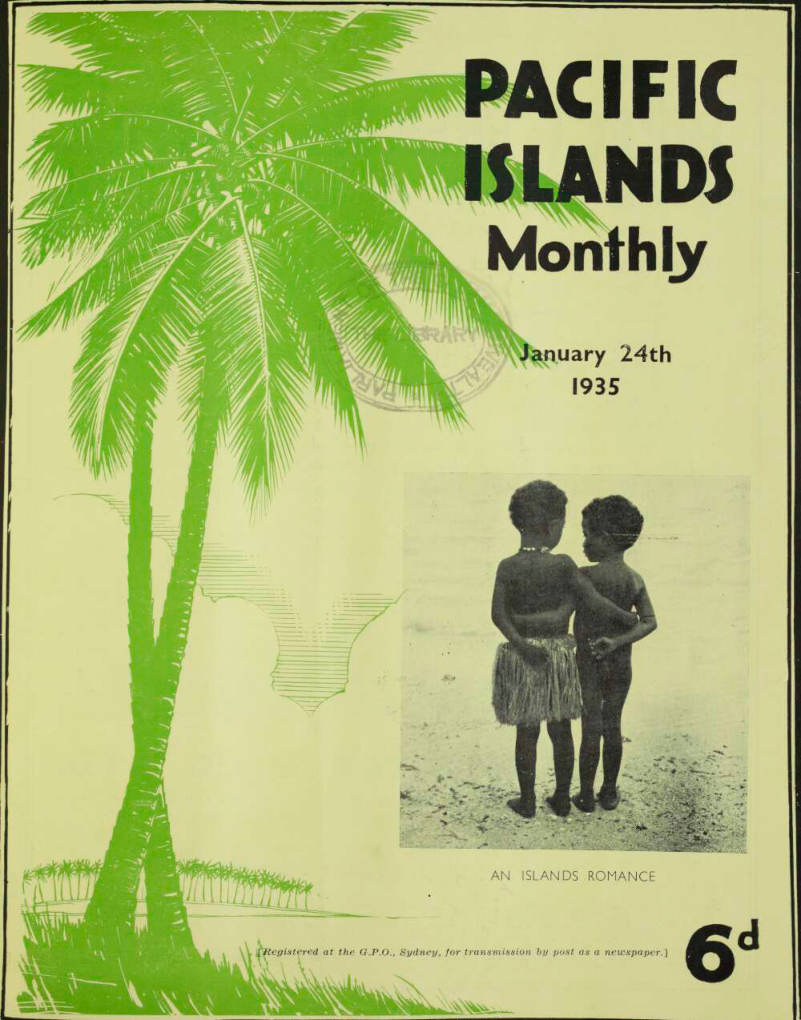
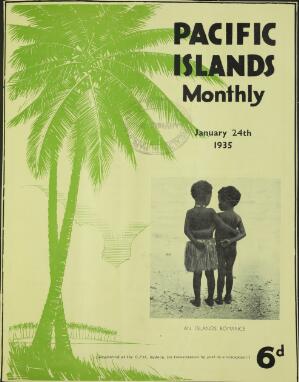
Pacific
ISLANDS
Monthly
January 24th 1935
[Registered at the G.P.O., Sydney, for transmission by post as a newspaper.]
6 d
AN ISLANDS ROMANCE
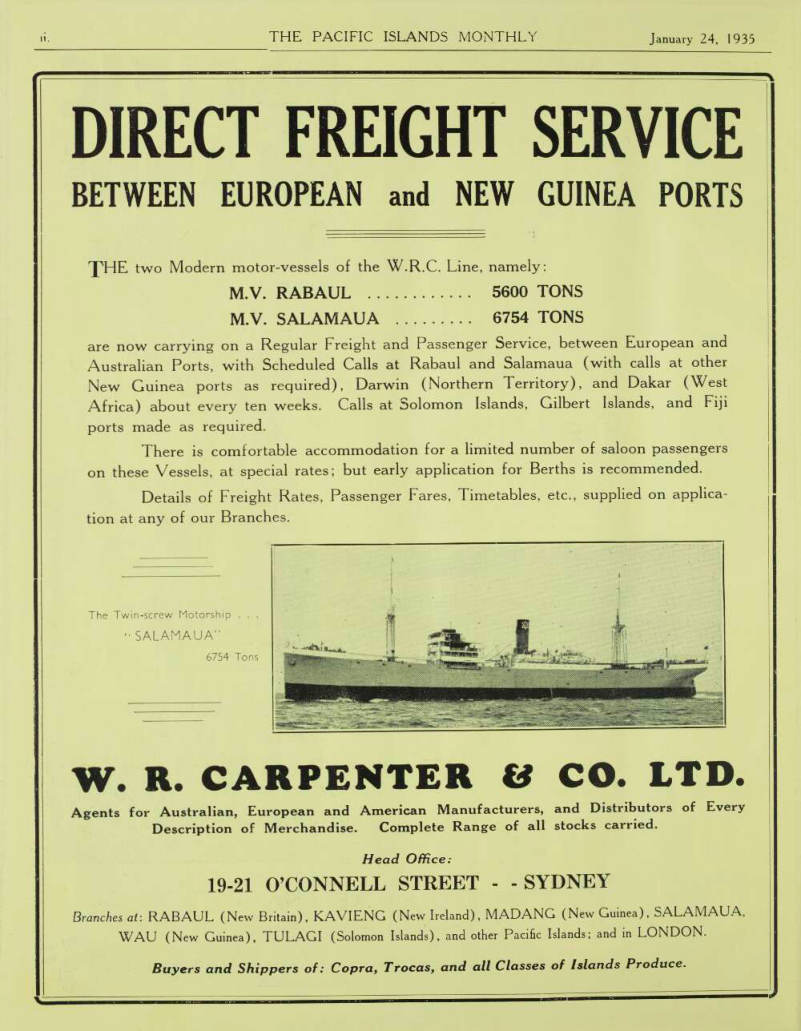
Direct Freight Service
BETWEEN EUROPEAN and NEW GUINEA PORTS
THE two Modern motor-vessels of the W.R.C. Line, namely:
M.V. RABAUL 5600 TONS
M.V. SALAMAUA 6754 TONS
are now carrying on a Regular Freight and Passenger Service, between European and Australian Ports, with Scheduled Calls at Rabaul and Salamaua (with calls at other New Guinea ports as required), Darwin (Northern Territory), and Dakar (West Africa) about every ten weeks. Calls at Solomon Islands, Gilbert Islands, and Fiji ports made as required.
There is comfortable accommodation for a limited number of saloon passengers on these Vessels, at special rates; but early application for Berths is recommended.
Details of Freight Rates, Passenger Fares, Timetables, etc., supplied on application at any of our Branches.
The Twin-screw Motorship . . .
"SALAMAUA”
6754 Tons
W. R. CARPENTER & CO. LTD.
Agents for Australian, European and American Manufacturers, and Distributors of Every Description of Merchandise. Complete Range of all stocks carried.
Head Office:
19-21 O’CONNELL STREET - - SYDNEY
Branches at: RABAUL (New Britain), KAVIENG (New Ireland), MADANG (New Guinea), SALAMAUA, WAU (New Guinea), TULAGI (Solomon Islands), and other Pacific Islands; and in LONDON.
Buyers and Shippers of; Copra, Trocas, and all Classes of Islands Produce.
Pacific Islands Travellers
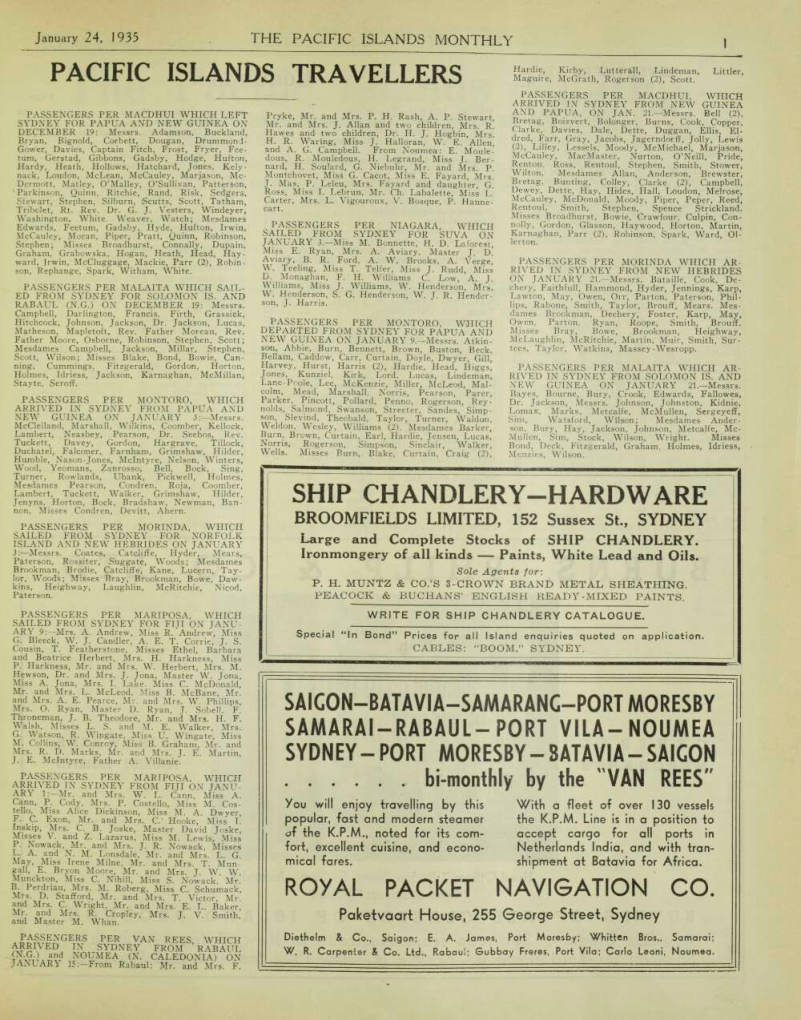
Passengers Per Macdhui Which Left
SYDNEY FOR PAPUA AND NEW GUINEA ON DECEMBER 19: Messrs. Adamson, Buckland, Bryan, Bignold, Corbett, Dougan, Drummond- Gower, Davies, Captain Fitch, Frost, Fryer, Fee tum, Gerstad, Gibbons, Gadsby, Hodge, Hufton, Hardy, Heath, Hollows, Hatchard, Jones, Kely nack, Loudon, McLean, McCauley, Marjason, Mc- Dermott, Matley, O’Malley, O’Sullivan, Patterson, Parkinson, Quinn, Ritchie, Rand, Risk, Sedgers, Stewart, Stephen, Silburn, iScutts, Scott, Tatham, Tribclet, Rt. Rev. Dr. G. J. Vesters, Windeyer, Washington, White, Weaver, Watch; Mesdames Edwards, Feetum, Gadsby, Hyde, Hufton, Irwin, McCauley, Moran, Piper, Pratt, Quinn, Robinson, Stephen; Misses Broadhurst, Connally, Dupain, Graham, Grabowska, Hogan, Heath, Head, Hay ward, Irwin, McCluggage, Mackie, Parr (2), Robin son, Rephange, Spark, Witham, White.
Passengers Per Malaita Which Sail
ED FROM SYDNEY FOR SOLOMON IS. AND
Rabaul (N.G.) On December 19: Messrs.
Campbell, Darlington, Francis, Firth, Grassick, Hitchcock, Johnson, Jackson, Dr. Jackson, Lucas, Matheson, Mapletoft, Rev. Father Moreau, Rev.
Father Moore, Osborne, Robinson, Stephen, Scott; Mesdames Campbell, Jackson, Millar, Stephen, Scott, Wilson; Misses Blake, Bond, Bowie, Can ning, Cummings, Fitzgerald, Gordon, Horton, Holmes, Idriess, Jackson, Karnaghan, McMillan, Stayte, Seroff.
Passengers Per Montoro, Which
Arrived In Sydney From Papua And
New Guinea On January 3:—Messrs.
McClelland, Marshall, Wilkins, Coomber, Kellock, Lambert, Neasbey, Pearson, Dr. Seebos, Rev.
Tuckett, Davey, Gordon, Hargrave, Tillock, Duchatel, Falconer, Farnham, Grimshaw, Hilder, Humble, Nason-Jones, Mclntyre, Nelson, Winters, Wood, Yeomans, Zanrosso, Bell, Bock, Sing, Turner, Rowlands, Ubank, Pickwell, Holmes, Mesdames Pearson, Condren, Roja, Coomber, Lambert, Tuckett, Walker, Grimshaw, Hilder, Jenyns, Horton, Bock, Bradshaw, Newman, Ban non, Misses Condren, Devitt, Ahern.
Passengers Per Morinda, Which
Sailed From Sydney For Norfolk
Island And New Hebrides On January
3: —Messrs. Coates, Catcliffe, Hyder, Mears, Paterson, Rossiter, Suggate, Woods; Mesdames Brookman, Brodie, Catcliffe, Kane, Lucern, Tay lor, Woods; Misses Bray, Brookman, Bowe, Daw kins, Heighway, Laughlin, McRitchie, Nicod, Paterson.
Passengers Per Mariposa, Which
SAILED FROM SYDNEY FOR FIJI ON JANU ARY 9: —Mrs. A. Andrew, Miss R. Andrew, Miss G. Bleeck, W. J. Candler, A. E. T. Corrie, J. S.
Cousin, T. Featherstone, Misses Ethel, Barbara and Beatrice Herbert, Mrs. H. Harkness, Miss P. Harkness, Mr. and Mrs. W. Herbert, Mrs. M.
Hewson, Dr. and Mrs. J. Jona, Master W. Jona, Miss A. Jona, Mrs. I. Lake, Miss C. McDonald, Mr. and Mrs. L. McLeod, Miss B. McBane, Mr. and Mrs. A. E. Pearce, Mr. and Mrs. W. Phillips, Mrs. O. Ryan, Master D. Ryan, J. Sobell, F.
Throneman, J. B. Theodore, Mr. and Mrs. H. F.
Walsh, Misses L. S. and M. E. Walker, Mrs.
G. Watson, R. Wingate, Miss U. Wingate, Miss M. Collins, W. Conroy, Miss B. Graham, Mr. and Mrs. R. D. Marks, Mr. and Mrs. J. E. Martin, J. E. Mclntyre, Father A. Villanie.
Passengers Per Mariposa, Which
ARRIVED IN SYDNEY FROM FIJI ON JANU ARY 1:—Mr. and Mrs. W. L. Cann, Miss A.
Cann, P. Cody, Mrs. P. Costello, Miss M. Cos tello, Miss Alice Dickinson, Miss M. A. Dwyer, F. C. Exon, Mr. and Mrs. C. Hooke, Miss I.
Inskip, Mrs. C. B. Joske, Master David Joske, Misses V. and Z. Lazarus, Miss M. Lewis, Miss P. Nowack, Mr. and Mrs. J. R. Nowack, Misses L. A. and N. M. Lonsdale, Mr. and Mrs. L. G.
May, Miss Irene Milne, Mr. and Mrs. T. Mun gall, E. Bryon Moore, Mr. and Mrs. J. W. W Munckton, Miss C. Nihill, Miss S. Nowack, Mr.
B. Perdriau, Mrs. M. Roberg, Miss C. Schumack, Mrs. D. Stafford, Mr. and Mrs. T. Victor, Mr and Mrs. C. Wright, Mr. and Mrs. E. L. Baker, Mr and Mrs R. Cropley, Mrs. J. V. Smith, and Master M. Whan.
Passengers Per Van Rees Which
Arrived In Sydney From Rabaul
(N.G.) And Noumea (N. Caledonia) On
JANUARY 15;—From Rabaul: Mr. and Mrs. F.
Pryke, Mr. and Mrs. P. H. Rash, A. P. Stewart, Mr. and Mrs. J. Allan and two children, Mrs. R.
Hawes and two children, Dr. H. J. Hogbin, Mrs H. R. Waring, Miss J. Halloran, W. E. Allen, and A. G. Campbell. From Noumea: E. Mouledous, R. Mouledous, H. Legrand, Miss J. Bernard, H. Soulard, G. Niebuhr, Mr. and Mrs. P Montchovet, Miss G. Cacot, Miss E. Fayard, Mrs.
J. Mas, P. Leleu, Mrs. Fayard and daughter, G.
Ross, Miss I. Lebrun, Mr. Ch. Labalette, Miss L.
Carter, Mrs. L. Vigouroux, V. Bosque, P. Hannecart.
Passengers Per Niagara, Which
Sailed From Sydney For Suva On
JANUARY 3.—Miss M. Bonnette, H. D. Laforest, Miss E. Ryan, Mrs. A. Aviary, Master J. D.
Aviary, B. R. Ford, A. W. Brooks, A. Verge, W. Teeling, Miss T. Telfer, Miss J. Rudd, Miss D. Monaghan, F. H. Williams, C. Low, A. J.
Williams, Miss J. Williams, W. Henderson, Mrs.
W. Henderson, S. G. Henderson, W. J. R. Renderson, J. Harris.
Passengers Per Montoro, Which
Departed From Sydney For Papua And
NEW GUINEA ON JANUARY 9.—Messrs. Atkinson, Abbie, Burn, Bennett, Brown, Buston, Beck, Bellam, Caddow, Carr, Curtain, Doyle, Dwyer, Gill, Harvey, Hurst, Harris (2), Hardie, Head, Higgs, Jones, Kunziel, Kirk, Lord, Lucas, Lindeman, Lane-Poole, Lee, McKenzie, Miller, McLeod, Malcolm, Mead, Marshall, Norris, Pearson, Parer, Parker, Pincott, Pollard, Penno, Rogerson, Reynolds, Salmond, Swanson, Streeter, Sandes, Simpson, Slevind, Theobald, Taylor, Turner, Waldon, Weldon, Wesley, Williams (2), Mesdames Barker, Burn, Brown, Curtain, Earl, Hardie, Jensen, Lucas, Norris, Rogerson, Simpson, Sinclair, Walker, Wells, Misses Burn, Blake, Curtain, Craig (2),
Hardie, Kirby, Lutterall, Lindeman, Littler, Maguire, McGrath, Rogerson (2), Scott.
Passengers Per Macdhui, Which
Arrived In Sydney From New Guinea
AND PAPUA, ON JAN. 21.—Messrs. Bell (2), Bretag, Boisvert, Bolonger, Burns, Cook, Copper, Clarke, Davies, Dale, Dette, Duggan, Ellis, El dred, Farr, Gray, Jacobs, Jagerndorff, Jolly, Lewis (2), Lilley, Lessels, Moody, McMichael, Marjason, McCauley, Mac Master, Nurton, O’Neill, Pride, Renton, Ross, Rentoul, Stephen, Smith, Stower, Wilton. Mesdames Allan, Anderson, Brewster, Bretag, Bunting, Colley, Clarke (2), Campbell, Dewey, Dette, Hay, Hides, Hall, Loudon, Melrose, McCauley, McDonald, Moody, Piper, Peper, Reed, Rentoul, Smith, Stephen, Spence Strickland.
Misses Broadhurst, Bowie, Crawfour, Culpin, Con nolly, Gordon, Glasson, Haywood, Horton, Martin, Karnaghan, Parr (2), Robinson, Spark, Ward, Ol lerton.
Passengers Per Morinda Which Ar
Rived In Sydney From New Hebrides
ON JANUARY 21. —Messrs. Bataille, Cook, De chery, Faithfull, Hammond, Hyder, Jennings, Karp, Lawton, May, Owen, Orr, Parton, Paterson, Phil lips, Rabone, Smith, Taylor, Brouff, Mears, Mesdames Brockman, Dechery, Foster, Karp, May, Owen, Parton, Ryan, Roope, Smith, Brouff, Misses Bray, Bowe, Brookman, Heighway, McLaughlin, McRitchie, Martin, Muir, Smith, Surtees, Taylor, Watkins, Massey-Wesropp.
Passengers Per Malaita Which Ar
RIVED IN SYDNEY FROM SOLOMON IS. AND
New Guinea On January 21.—Messrs.
Bayes, Bourne, Bury, Crook, Edwards, Fallowes, Dr. Jackson, Messrs. Johnson, Johnston, Kidnie, Lomax, Marks, Metcalfe, McMullen, Sergeyeff, Sim, Watsford, Wilson; Mesdames Ander son, Bury, Hay, Jackson, Johnson, Metcalfe, Mc- Mullen, Sim, Stock, Wilson, Wright. Misses Bond, Deck, Fitzgerald, Graham, Holmes, Idriess, Menzies, Wilson.
Advertisements & other items, p. 3 (1 item)
Ship Chandlery-Hardware
BROOMFIELDS LIMITED, 152 Sussex St., SYDNEY
Large and Complete Stocks of SHIP CHANDLERY.
Ironmongery of all kinds Paints, White Lead and Oils.
Sole Agents for : P. H. MUNTZ & CO.’S 3-CROWN BRAND METAL SHEATHING.
PEACOCK & BUCHANS’ ENGLISH READY-MIXED PAINTS.
WRITE FOR SHIP CHANDLERY CATALOGUE.
Special “In Bond” Prices for all Island enquiries quoted on application.
CABLES: “BOOM,” SYDNEY.
SAICON-BATAVIA-SAMARANG-PORT MORESBY
SAMARAI-RABAUL- PORT VILA-NOUMEA
SYDNEY - PORT MORESBY - BATAVIA - SAIGON
bi-monthly by the 'VAN REES"
You will enjoy travelling by this popular, fast and modern steamer of the K.P.M., noted for its comfort, excellent cuisine, and economical fares.
With a fleet of over 130 vessels the K.P.M. Line is In a position to accept cargo for all ports in Netherlands India, and with transhipment at Batavia for Africa.
ROYAL PACKET NAVIGATION CO
Paketvaart House, 255 George Street, Sydney
Diethelm & Co., Saigon; E, A. James, Port Moresby: Whitten Bros., Samarai; W. R. Carpenter & Co. Ltd., Rabaui; Gubbay Freres, Port Vila; Carlo Leoni, Noumea.
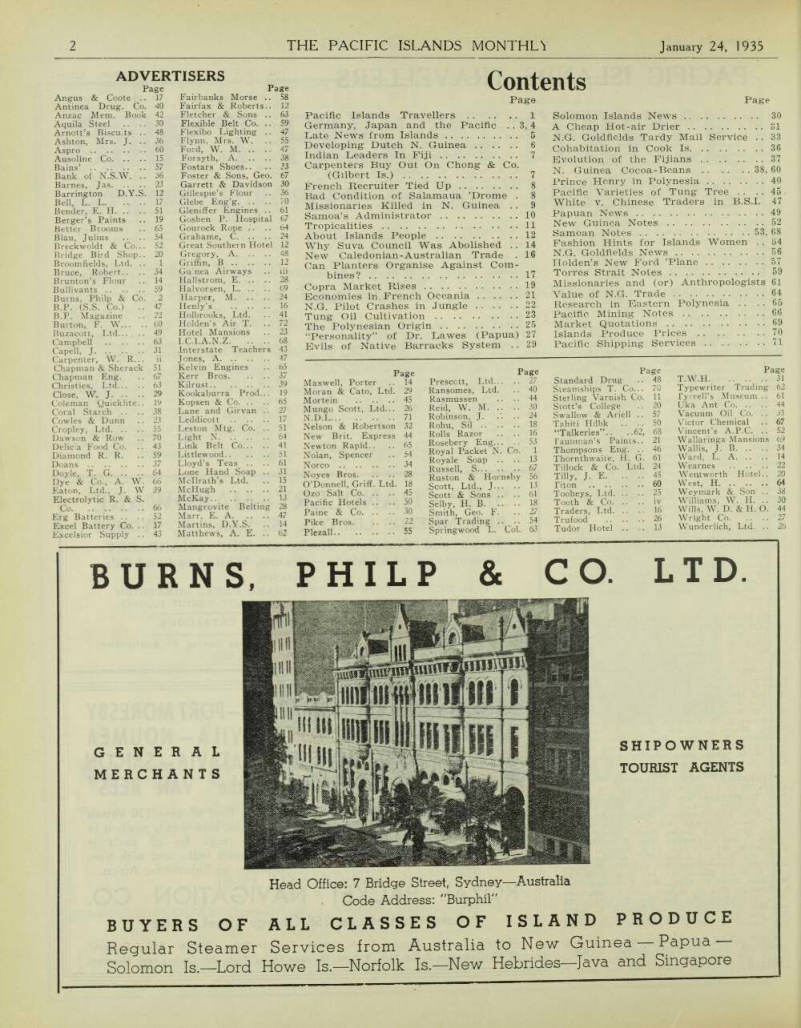
Advertisers
Page Angus & Coote .. 17 Antinea Drug. Co. 40 Anzac Mem. Book 42 Aquila Steel .. .. 30 Arnott’s Biscuits .. 48 Ashton, Mrs. J. .. 36 Aspro 60 Ausoline Co. 15 Bains’ 57 Bank of N.S.W. .. 36 Barnes, Jas. 23 Barrington D.Y.S. 12 Bell, L. L. 17 Bender, E. H. 51 Berger’s Paints .. 19 Better Brooms .. 65 Blau, Julius .. .. 54 Breckwoldt & Co... 52 Bridge Bird Shop.. 20 Broomfields, Ltd. .. 1 Bruce, Robert.. .. 34 Brunton’s Flour .. 14 Bullivants 59 Burns, Philp & Co. 2
B.P. (S.S. Co.) .. 47
B.P. Magazine .. 22 Burton, F. W. 60 Buzacott, Ltd... .. 49 Campbell 63 Capell, J. 31 Carpenter, W. R... ii Chapman & Sherack 51 Chapman Eng. .. 67 Christies, Ltd. 63 Close, W. J. 29 Coleman Quicklite.. 19 Coral Starch .. .. 38 Cowles & Dunn .. 23 Cropley, Ltd. 55 Dawson & Row .. 70 Delicia Food Co. .. 43 Diamond R. R. .. 59 Doans 37 Doyle, T. G. 64 Dye & Co., A. W. 66 Eaton, Ltd., J. W. 39 Electrolytic R. & S.
Co. .. 66 Erg Batteries .. .. 52 Excel Battery Co. .. 17 Excelsior Supply .. 43
Page Fairbanks Morse .. 58 Fairfax & Roberts.. 12 Fletcher & Sons .. 63 Flexible Belt Co. .. 59 Flexibo Lighting .. 47 Flynn, Mrs. W. .. 55 Ford, W. M. 47 Forsyth, A. 38 Fostars Shoes.. .. 33 Foster & Sons, Geo. 67 Garrett & Davidson 30 Gillespie’s Flour .. 36 Glebe Eng’g. 70 Gleniffer Engines .. 61 Goshen P. Hospital 67 Gourock Rope .. .. 64 Grahame, C. 24 Great Southern Hotel 12 Gregory, A. 48 Griffin, B. 12 Guinea Airways .. iii Hallstrom, E. 28 Halvorsen, L. 69 Harper, M. 24 Henly’s 16 Holbrooks, Ltd. .. 41 Holden’s Air T. ..72 Hotel Mansions .. 23
I.C.I.A.N.Z 68
Interstate Teachers 43 Jones, A. 47 Kelvin Engines .. 65 Kerr Bros. 37 Kilrust.. ... 39 Kookaburra Prod... 19 Kopsen & Co. 65 Lane and Girvan .. 27 Leddicott 17 Leston Mtg. Co. .. 51 Light N. 64 Link Belt Co. 41 Littlewood 51 Lloyd’s Teas .. .. 61 Lone Hand Soap .. 31 McIlrath’s Ltd. .. 15 McHugh 21 McKay .. 13 Mangrovite Belting 28 Marr, E. A. 47 Martins, D.Y.S. .. 14 Matthews, A. E. .. 62
Page Maxwell, Porter .. 14 Moran & Cato, Ltd. 29 Mortein 45 Mungo Scott, Ltd... 26
N.D.L. 71
Nelson & Robertson 32 New Brit. Express 44 Newton Rapid.. .. 65 Nolan, Spencer .. 54 Norco 34 Noyes Bros. 28 O’Donnell, Griff. Ltd. 18 Ozo Salt Co. 45 Pacific Hotels .. .. 50 Paine & Co. 30 Pike Bros. 22 Plezall 55
Page Prescott, Ltd. 27 Ransomes, Ltd. .. 40 Rasmussen .. .. 44 Reid, W. M. 30 Robinson, J. .. .. 24 Rohu, Sil 18 Rolls Razor .. .. 16 Rosebery Eng 53 Royal Packet N. Co. 1 Royale Soap .. .. 13 Russell, S. 67 Ruston & Hornsby 56 Scott, Ltd., J. 13 Scott & Sons .. .. 61 Selby, H. B. 18 Smith, Geo. F. ..27 Spar Trading .. 54 Springwood L. Col. 63
Page Standard Drug .. 48 Steamships T. Co... 70 Sterling Varnish Co. 11 Stott’s College .. 20 Swallow & Ariell .. 57 Tahiti Hdbk .. .. 50 “Talkeries”.. ..62, 68 Taubman’s Paints.. 21 Thompsons Eng. .. 46 Thornthwaite, H. G. 61 Tillock & Co. Ltd. 24 Tilly, J. E. 45 Titon 60 Tooheys, Ltd. 25 Tooth & Co. iv Traders, Ltd. 16 Trufood 26 Tudor Hotel .. .. 13
Page
T.W.H. 31
Typewriter Trading 62 Tyrrell’s Museum .. 61 Uka Ant Co. 44 Vacuum Oil Co. .. 35 Victor Chemical .. 67 Vincent’s A.P.C. .. 52 Wallaringa Mansions 69 Wallis, J. B. 34 Ward, L. A. 14 W earnes 22 Wentworth Hotel.. 20 West, H. .. .. .. 64 Weymark & Son .. 38 Williams, W. H. .. 30 Wills, W. D. & H. O. 44 Wright Co. 27 Wunderlich, Ltd. .. 26
Contents
Page Pacific Islands Travellers 1 Germany, Japan and the Pacific .. 3, 4 Late News from Islands 5 Developing Dutch N. Guinea 6 Indian Leaders In Fiji 7 Carpenters Buy Out On Chong & Co. (Gilbert Is.) 7 French Recruiter Tied Up 8 Bad Condition of Salamaua ’Drome . 8 Missionaries Killed in N. Guinea 9 Samoa’s Administrator 10 Tropicalities 11 About Islands People 12 Why Suva Council Was Abolished . . 14 New Caledonian-Australian Trade . 16 Can Planters Organise Against Com bines? 17 Copra Market Rises 19 Economies in French Oceania 21 N.G. Pilot Crashes in Jungle 22 Tung Oil Cultivation 23 The Polynesian Origin 25 “Personality” of Dr. Lawes (Papua) 27 Evils of Native Barracks System .. 29
Page Solomon Islands News 30 A Cheap Hot-air Drier 31 N.G. Goldfields Tardy Mail Service .. 33 Cohabitation in Cook Is. 36 Evolution of the Fijians 37 N. Guinea Cocoa-Beans 38,60 Prince Henry in Polynesia 40 Pacific Varieties of Tung Tree .. .. 45 White v. Chinese Traders in B.S.I. 47 Papuan News 49 New Guinea Notes 52 Samoan Notes 53, 68 Fashion Hints for Islands Women . . 54 N.G. Goldfields News 56 Holden’s New Ford ’Plane 57 Torres Strait Notes 59 Missionaries and (or) Anthropologists 61 Value of N.G. Trade 64 Research in Eastern Polynesia .. .. 65 Pacific Mining Notes 66 Market Quotations 69 Islands Produce Prices 70 Pacific Shipping Services 71
Advertisements & other items, p. 4 (1 item)
Burns, Philp & Co. Ltd.
GENERAL
MERCHANTS
SHIPOWNERS
TOURIST AGENTS
Head Office: 7 Bridge Street, Sydney—Australia Code Address: "Burphil"
BUYERS OF ALL CLASSES OF ISLAND PRODUCE Regular Steamer Services from Australia to New Guinea Papua Solomon Is.—Lord Howe Is.—Norfolk Is.—New Hebrides—Java and Singapore
The Pacific Islands Monthly
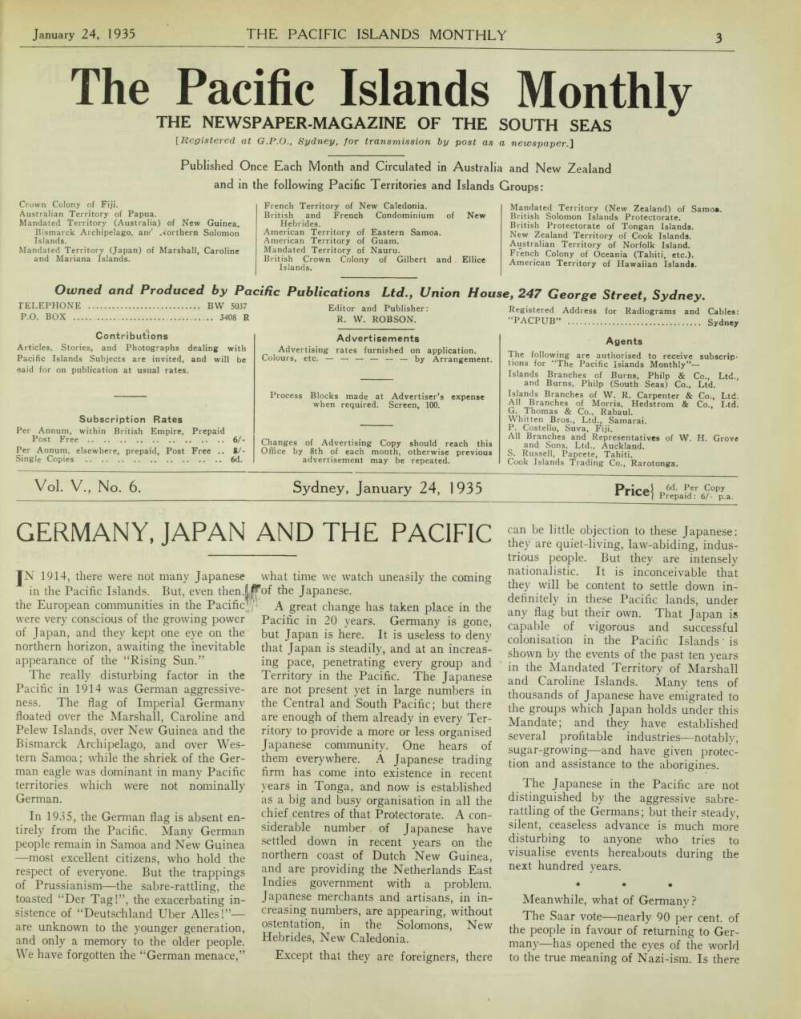
The Newspaper-Magazine Of The South Seas
[Registered at G.P.O., Sydney, for transmission by post as a newspaper.]
Published Once Each Month and Circulated in Australia and New Zealand and in the following Pacific Territories and Islands Groups:
Crown Colony of Fiji.
Australian Territory of Papua.
Mandated Territory (Australia) of New Guinea, Bismarck Archipelago, anr' Northern Solomon Islands.
Mandated Territory (Japan) of Marshall, Caroline and Mariana Islands.
French Territory of New Caledonia.
British and French Condominium of New Hebrides.
American Territory of Eastern Samoa.
American Territory of Guam.
Mandated Territory of Nauru.
British Crown Colony of Gilbert and . Ellice Islands.
Mandated Territory (New Zealand) of Samot.
British Solomon Islands Protectorate.
British Protectorate of Tongan Islands.
New Zealand Territory of Cook Islands.
Australian Territory of Norfolk Island, French Colony of Oceania (Tahiti, etc.).
American Territory of Hawaiian Islands.
Owned and Produced by Pacific Publications Ltd., Union House, 247 George Street, Sydney.
Telephone Bw 5037
P.O. Box 3408 R
Contributions Articles, Stories, and Photographs dealing with Pacific Islands Subjects are invited, and will be oaid for on publication at usual rates.
Subscription Rates
Per Annum, within British Empire, Prepaid Post Free 6/- Per Annum, elsewhere, prepaid, Post Free .. 8/- Single Copies 6d.
Editor and Publisher:
R. W. Robson.
Advertisements Advertising rates furnished on application.
Colours, etc. by Arrangement.
Process Blocks made at Advertiser’s expense when required. Screen, 100.
Changes of Advertising Copy should reach this Office by 8th of each month, otherwise previous advertisement may be repeated.
Registered Address for Radiograms and Cables: “PACPUB” Sydney Agents The following are authorised to receive subscrip tions for “The Pacific Islands Monthly”— Islands Branches of Burns, Philp & Co., Ltd., and Burns, Philp (South Seas) Co., Ltd.
Islands Branches of W. R. Carpenter & Co., Ltd.
All Branches of Morris, Hedstrom & Co., Ltd.
G. Thomas & Co., Rabaul.
Whitten Bros., Ltd., Samarai.
P. Costello, Suva, Fiji.
All Branches and Representatives of W. H. Grove and Sons. Ltd., Auckland.
S. Russell, Papeete, Tahiti.
Cook Islands Trading Co., Rarotonga.
Vol. V., No. 6.
Sydney, January 24, 1933
Price 6d - Per Copy Prepaid: 6/- p.a.
Germany. Japan And The Pacific
IN 1914, there were not many Japanese in the Pacific Islands. But, even then, the European communities in the Pacific were very conscious of the growing power of Japan, and they kept one eye on the northern horizon, awaiting the inevitable appearance of the “Rising Sun.”
The really disturbing factor in the Pacific in 1914 was German aggressive ness. The flag of Imperial Germany floated over the Marshall, Caroline and Pelew Islands, over New Guinea and the Bismarck Archipelago, and over Wes tern Samoa; while the shriek of the Ger man eagle was dominant in many Pacific territories which were not nominally German.
In 1935, the German flag is absent en tirely from the Pacific. Many German people remain in Samoa and New Guinea —most excellent citizens, who hold the respect of everyone. But the trappings of Prussianism—the sabre-rattling, the toasted “Der Tag!”, the exacerbating in sistence of “Deutschland Über Alles!” — are unknown to the younger generation, and only a memory to the older people.
We have forgotten the “German menace,”
what time we watch uneasily the coming the Japanese.
A great change has taken place in the Pacific in 20 years. Germany is gone, but Japan is here. It is useless to deny that Japan is steadily, and at an increas ing pace, penetrating every group and Territory in the Pacific. The Japanese are not present yet in large numbers in the Central and South Pacific; but there are enough of them already in every Ter ritory to provide a more or less organised Japanese community. One hears of them everywhere. A Japanese trading firm has come into existence in recent years in Tonga, and now is established as a big and busy organisation in all the chief centres of that Protectorate. A con siderable number of Japanese have settled down in recent years on the northern coast of Dutch New Guinea, and are providing the Netherlands East Indies government with a problem.
Japanese merchants and artisans, in in creasing numbers, are appearing, without ostentation, in the Solomons, New Hebrides, New Caledonia.
Except that they are foreigners, there
can be little objection to these Japanese: they are quiet-living, law-abiding, indus trious people. But they are intensely nationalistic. It is inconceivable that they will be content to settle down in definitely in these Pacific lands, under any flag but their own. That Japan is capable of vigorous and successful colonisation in the Pacific Islands is shown by the events of the past ten years in the Mandated Territory of Marshall and Caroline Islands. Many tens of thousands of Japanese have emigrated to the groups which Japan holds under this Mandate; and they have established several profitable industries—notably, sugar-growing—and have given protec tion and assistance to the aborigines.
The Japanese in the Pacific are not distinguished by the aggressive sabre rattling of the Germans; but their steady, silent, ceaseless advance is much more disturbing to anyone who tries to visualise events hereabouts during the next hundred years. * * * Meanwhile, what of Germany?
The Saar vote—nearly 90 per cent, of the people in favour of returning to Ger many—has opened the eyes of the world to the true meaning of Nazi-ism. Is there
one intelligent man now who will deny that Germany has been re-born, and that the strongest spiritual and national force in Europe—and perhaps in the world — to-day is this new Germany, reunited and revivified under Hitler? This great and clever country has taken the thrashing it truly earned, and has endured its period of humiliation; and now it is coming back into the world, a stronger nation and—according to Anglo-Saxon stan dards—a better people.
The new Germans will not be content with Germany. They must have new territory: otherwise they cannot develop and expand their vital national structure.
They will take their natural place beside the great European powers: and every one of the latter holds extensive colonies.
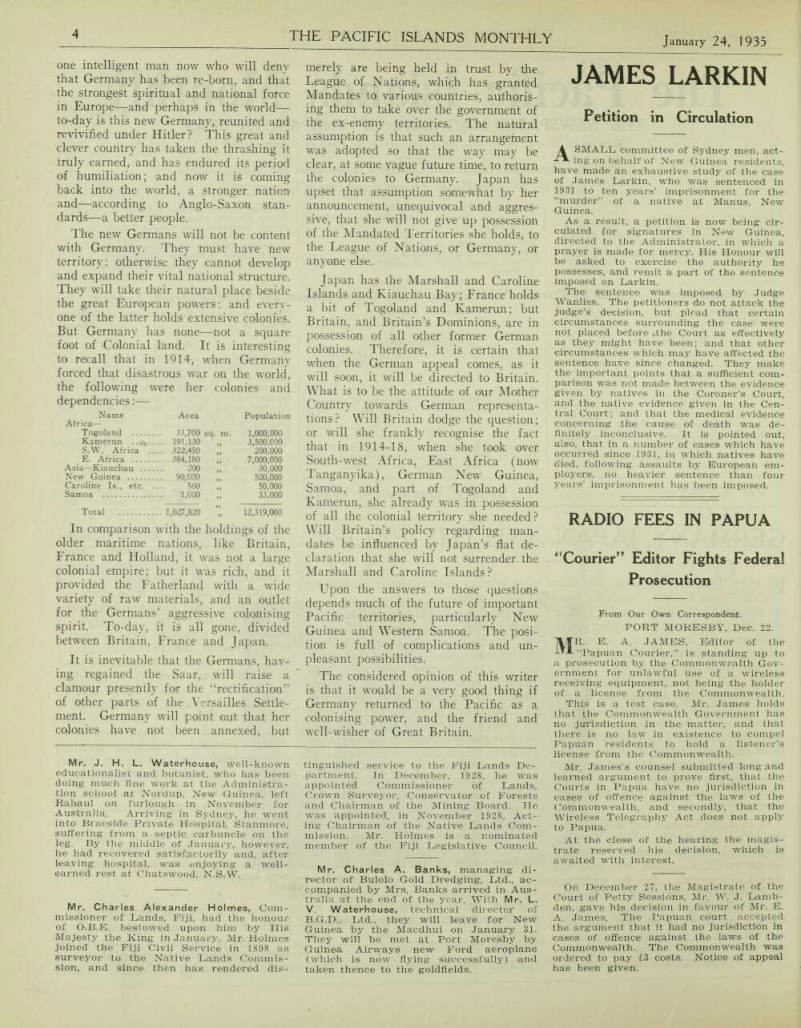
But Germany has none—not a square foot of Colonial land. It is interesting to recall that in 1914, when Germany forced that disastrous war on the world, the following were her colonies and dependencies:—
In comparison with the holdings of the older maritime nations, like Britain, France and Holland, it was not a large colonial empire; but it was rich, and it provided the Fatherland with a wide variety of raw materials, and an outlet for the Germans’ aggressive colonising spirit. To-day, it is all gone, divided between Britain, France and Japan.
It is inevitable that the Germans, hav ing regained the Saar, will raise a clamour presently for the “rectification” of other parts of the Versailles Settle ment. Germany will point out that her colonies have not been annexed, but
merely are being held in trust by the League of Nations, which has granted Mandates to various countries, authoris ing them to take over the government of the ex-enemy territories. The natural assumption is that such an arrangement was adopted so that the way may be clear, at some vague future time, to return the colonies to Germany. Japan has upset that assumption somewhat by her announcement, unequivocal and aggres sive, that she will not give up possession of the Mandated Territories she holds, to the League of Nations, or Germany, or anyone else.
Japan has the Marshall and Caroline Islands and Kiauchau Bay; France holds a bit of Togoland and Kamerun; but Britain, and Britain’s Dominions, are in possession of all other former German colonies. Therefore, it is certain that when the German appeal comes, as it will soon, it will be directed to Britain.
What is to be the attitude of our Mother Country towards German representa tions? Will Britain dodge the question; or will she frankly recognise the fact that in 1914-18, when she took over South-west Africa, East Africa (now Tanganyika), German New Guinea, Samoa, and part of Togoland and Kamerun, she already was in possession of all the colonial territory she needed?
Will Britain’s policy regarding man dates be influenced by Japan’s flat de claration that she will not surrender, the Marshall and Caroline Islands?
Upon the answers to those questions depends much of the future of important Pacific territories, particularly New Guinea and Western Samoa. The posi tion is full of complications and un
pleasant possibilities.
The considered opinion of this writer is that it would be a very good thing if Germany returned to the Pacific as a colonising power, and the friend and well-wisher of Great Britain,
Mr. J. H. L. Waterhouse, well-known educationalist and botanist, who has been doing much fine work at the Administra tion school at Nordup, New Guinea, left Rabaul on furlough in November for Australia. Arriving in Sydney, he went into Braeside Private Hospital, Stanmore, suffering from a septic carbuncle on the leg. By the middle of January, however, he had recovered satisfactorily and, after leaving hospital, was enjoying a well earned rest at Chatswood, N.S.W.
Mr. Charles Alexander Holmes, Com missioner of Lands, Fiji, had the honour of O.B.E. bestowed upon him by His Majesty the King in January. Mr. Holmes joined the Fiji Civil Service in 1898 as surveyor to the Native Lands Commis sion, and since then has rendered dis
tinguished service to the Fiji Lands De partment. In December, 1928, he was appointed Commissioner of Lands, Crown Surveyor, Conservator of Forests and Chairman of the Mining Board. He was appointed, in November 1928, Act ing Chairman of the Native Lands Com mission. Mr. Holmes is a nominated member of the Fiji Legislative Council.
Mr. Charles A. Banks, managing di rector of Bulolo Gold Dredging, Ltd., ac companied by Mrs. Banks arrived in Aus tralia at the end of the year. With Mr. L.
V. Waterhouse, technical director of B.G.D., Ltd., they will leave for New Guinea by the Macdhui on January 31.
They will be met at Port Moresby by Guinea Airways new Ford aeroplane (which is now flying successfully) and taken thence to the goldfields.
Name Area Population Africa — Togoland 33,700 sq. m. 1,000,000 Kamerun ... 191,130 „ 3,500,000 S.W. Africa .. 322,450 „ 200,000 E. Africa .. 384,180 „ 7,000,000 Asia —Kiauchau 200 „ 30,000 New Guinea ... 90,000 „ 500,000 Caroline Is., etc. 560 „ 50,000 Samoa ... 1,000 „ 33,000 Total .. 1,027,820 „ 12,319,000
James Larkin
Petition in Circulation
A SMALL committee of Sydney men, act ing on behalf of New Guinea residents, have made an exhaustive study of the case of James Larkin, who was sentenced in 1931 to ten years’ imprisonment for the “murder” of a native at Manus, New Guinea.
As a result, a petition is now being cir culated for signatures in New Guinea, directed to the Administrator, in which a prayer is made for mercy. His Honour will be asked to exercise the authority he possesses, and remit a part of the sentence imposed on Larkin.
The sentence was imposed by Judge Wanliss. The petitioners do not attack the judge’s decision, but plead that certain circumstances surrounding the case were not placed before the Court as effectively as they might have been; and that other circumstances which may have affected the sentence have since changed. They make the important points that a sufficient com parison was not made between the evidence given by natives in the Coroner’s Court, and the native evidence given in the Cen tral Court; and that the medical evidence concerning the cause of death was de finitely inconclusive. It is pointed out, also, that in a number of cases which have occurred since 1931, in which natives have died, following assaults by European em ployers, no heavier sentence than four years’ imprisonment has been imposed.
Radio Fees In Papua
"Courier” Editor Fights Federal Prosecution
From Our Own Correspondent.
Port Moresby, Dec. 22.
MR. E. A. JAMES, Editor of the “Papuan Courier,’’ is standing up to a prosecution by the Commonwealth Gov ernment for unlawful use of a wireless receiving equipment, not being the holder of a license from the Commonwealth.
This is a test case. Mr. James holds that the Commonwealth Government has no jurisdiction in the matter, and that there is no law in existence to compel Papuan residents to hold a listener’s license from the Commonwealth.
Mr. James’s counsel submitted long and learned argument to prove first, that the Courts in Papua have no jurisdiction in cases of offence against the laws of the Commonwealth, and secondly, that the Wireless Telegraphy Act does not apply to Papua.
At the close of the hearing the magis trate reserved his decision, which is awaited with interest.
On December 27, the Magistrate of the Court of Petty Sessions, Mr. W. J. Lamb den, gave his decision in favour of Mr. E.
A. James, The Papuan court accepted the argument that it had no jurisdiction in cases of offence against the laws of the Commonwealth. The Commonwealth was ordered to pay £3 costs. Notice of appeal has been given.
Late News
SYDNEY, January 23.
RECRUITS at the new reduced rate of pay were signed on in the Solomon Islands early in January. Recruiters did not find great difficulty in persuading na tives to sign on—the main difficulty being the proportionately reduced advances.
Practice has shown that the new regu lations have certain anomalies and in consistencies, which will require smooth ing out.
Sir Hubert Murray (Lieutenant-Gover nor), with eight officials and some leading commercial men, flew from Port Moresby to the new Lakekamu goldfield in Papua on January 3, in Guinea Airways new Ford airliner, inspected the new field, enjoyed much hospitality, and returned to port.
The air-line distance is 350 miles, there and back, and hitherto it involved a pain ful journey of a fortnight.
The Japanese training ship, Kaiwo Maru, with 80 students, arrived in Rabaul on January 7; and enjoyed and dispensed much hospitality during a stay of several days.
It is reported that Japanese sampans have appeared again in the Manus dis trict of New Guinea and are engaged in shell poaching. There is still no sign of the promised Australian patrol.
Pilot Colin Ferguson took off for Sala maua, New Guinea, from Mascot in Car penter’s new Dragon ’plane early on Janu ary 19. He was accompanied by his wife, who is the first woman to fly from Austra lia to New Guinea.
Over 40 natives having been imprisoned for failure to pay taxes, between 600 and
700 natives congregated at Gizo, Solomon Islands, and protested strongly against taxation being enforced at a time when natives generally are receiving a low price for produce. The Methodist Mission, on behalf of the Gizo natives, is making representations to the High Commissioner for the Western Pacific, Suva.
A gang of 50 native labourers salvaged the engine of the Moth plane which crashed near the Black Cat mine between Salamaua and Wau, New Guinea, in De cember. The party took several hours to carry the engine only one mile, over in credibly rough country.
The High Commissioner for the West ern Pacific has decided that a fine will meet the case of Mr. Harvey, radio oper ator, Vila, New Hebrides, whose case was referred to in our December issue.
The sentence of imprisonment and hard labour has been remitted.
Unique Party From Fiji
Three Races In One
Contingent
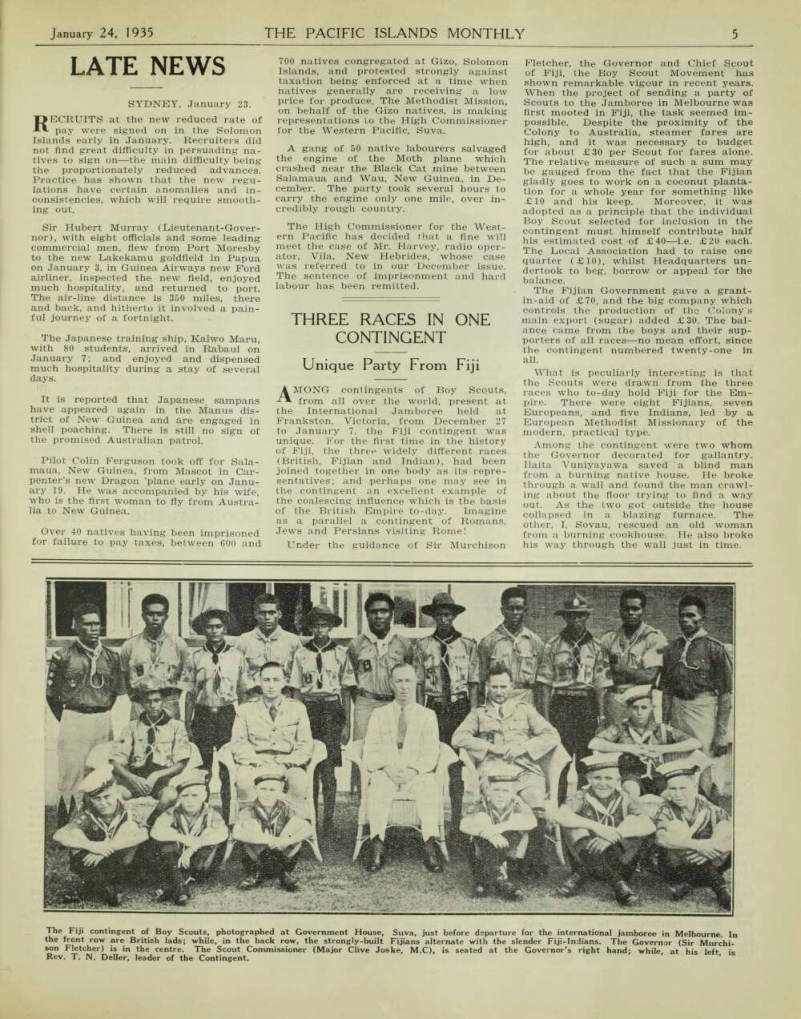
AMONG contingents of Boy Scouts, from all over the world, present at the International Jamboree held at Frankston, Victoria, from December 27 to January 7, the Fiji contingent was unique. For the first time in the history of Fiji, the three widely different races (British, Fijian and Indian), had been joined together in one body as its repre sentatives; and perhaps one may see in the contingent an excellent example of the coalescing influence which is the basis of the British Empire to-day. Imagine as a parallel a contingent of Romans, Jews and Persians visiting Rome!
Under the guidance of Sir Murchison
Fletcher, the Governor and Chief Scout of Fiji, the Boy Scout Movement has shown remarkable vigour in recent years.
When the project of sending a party of Scouts to the Jamboree in Melbourne was first mooted in Fiji, the task seemed im possible. Despite the proximity of the Colony to Australia, steamer fares are high, and it was necessary to budget for about £30 per Scout for fares alone.
The relative measure of such a sum may be gauged from the fact that the Fijian gladly goes to work on a coconut planta tion for a whole year for something like £10 and his keep. Moreover, it was adopted as a principle that the individual Boy Scout selected for inclusion in the contingent must himself contribute half his estimated cost of £40—i.e. £20 each.
The Local Association had to raise one quarter (£10), whilst Headquarters un dertook to beg, borrow or appeal for the balance.
The Fijian Government gave a grant in-aid of £70, and the big company which controls the production of the Colony's main export (sugar) added £30. The balance came from the boys and their sup porters of all races—no mean effort, since the contingent numbered twenty-one in all.
What is peculiarly interesting is that the Scouts were drawn from the three races who to-day hold Fiji for the Em pire, There were eight Fijians, seven Europeans, and five Indians, led by a European Methodist Missionary of the modern, practical type.
Among the contingent were two whom the Governor decorated for gallantry, Ilaita Vuniyayawa saved a blind man from a burning native house. He broke through a wall and found the man crawl ing about the floor trying to find a way out. As the two got outside the house collapsed in a blazing furnace. The other, I. Sovau, rescued an old woman from a burning cookhouse. He also broke his way through the wall just in time.
The Fiji contingent of Boy Scouts, photographed at Government House, Suva, just before departure for the international jamboree in Melbourne. In the front row are British lads; while, in the back row, the strongly-built Fijians alternate with the slender Fiji-Indians. The Governor (Sir Murchi son Fletcher) is in the centre. The Scout Commissioner (Major Clive Joske, M.C), is seated at the Governor’s right hand; while, at his left, is Rev. T. N. Deller, leader of the Contingent.
To Develop Dutch New Guinea
Plans of the New Guinea Committee
CONSIDERABLE activity is being dis played by the New Guinea Commit tee, which was appointed during the past year to encourage the development of Dutch New Guinea, and the headquarters of which are at The Hague, Holland.
The Committee is doing everything possible to encourage private enterprise to investigate and develop the immense and hitherto unexploited wealth of Dutch New Guinea.
An agreement has now been approved by the Government of the Netherland East Indies under which three of the big gest oil companies in the world have been permitted, under Government super vision, to form a company for the de velopment of the oil resources of the north-western portion of Dutch New Guinea. This region is in the shape of a vast peninsula, and it is believed that within its borders are very large natural reservoirs of mineral oil. The three com panies, who have formed what is called the New Guinea Oil Company, are the Shell Co. (which has large Dutch con nections), the Standard Oil Co. of New York, and the Atlantic Oil Co. (which is known in Java as the Colonial Petrol Co.). It is understood that the New Guinea Oil Co. will lose no time in under taking the exploitation of the area over which it has just secured this valuable concession.
Dr. W. C. Klein, who was formerly a well-known technologist in the service of the Shell Co., from which he has now retired, has made arrangements with the New Guinea Committee, under which he will carry out an economic and scientific survey of portion of Dutch New Guinea.
It is expected that Dr. Klein will arrive in Port Moresby by the Van Spilbergen in May and will travel in parts of Papua so as to familiarise himself with structures there. He will then proceed to Dutch
New Guinea, with a view to carefully looking over that country. His primary purpose is to find oil indications, but he will also keep a look out for indications of gold. The New Guinea Committee expects that Dr. Klein’s investigations and reports will be very valuable.
Important investigations were made last year by Mr. P. J. Jansen, who also worked under the auspices of the New Guinea Committee. Mr. Jansen’s main object was to find indications of gold in Dutch New Guinea; and in that connec tion he visited the Morobe goldfield, in the Mandated Territory of New Guinea, and studied structures and mining methods. Mr. Jansen’s report has not yet been issued.
It is understood that the Biliton Tin Company, which is an important cor poration interested in mining develop ment, is making an investigation in the north-eastern portion of Dutch New Guinea near the border of the Mandated Territory, with a view to locating the goldfield which is believed to exist there.
The New Guinea Committee is anxious to encourage private enterprise from all nations to make investigations and seek concessions in Dutch New Guinea. In that connection, it is likely to advance considerably during 1935 the plans for making a survey of this comparatively unknown region by means of aeroplanes.
The only foreign country which, up to date, has shown any interest in Dutch New Guinea is Japan. Already consider able numbers of Japanese are settled along the northern coast of Dutch New Guinea, where they are exploiting the country’s natural wealth. The Japanese are giving attention particularly to the marine and forest wealth of the country —and they are making a considerable success of the exportation of the valuable resin of the Dammar tree.
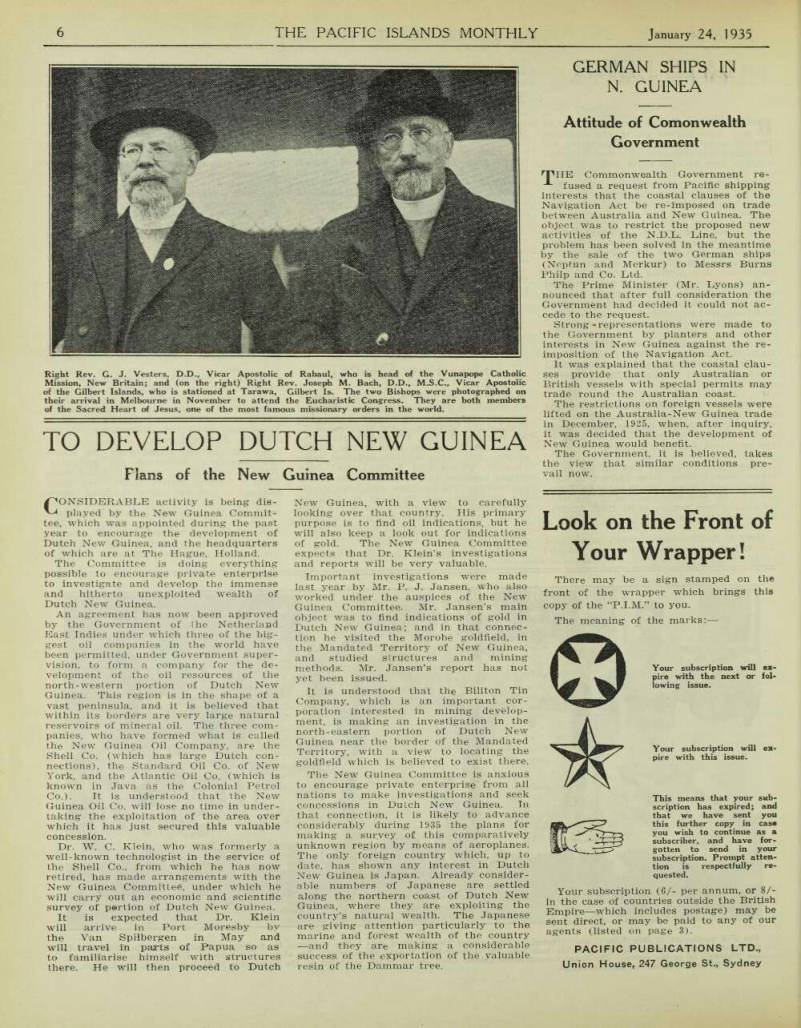
Right Rev. G. J. Vesters, D.D., Vicar Apostolic of Rabaul, who is head of the Vunapope Catholic Mission, New Britain; and (on the right) Right Rev. Joseph M. Bach, D.D., M.S.C., Vicar Apostolic of the Gilbert Islands, who is stationed at Tarawa, Gilbert Is. The two Bishops were photographed on their arrival in Melbourne in November to attend the Eucharistic Congress. They are both members of the Sacred Heart of Jesus, one of the most famous missionary orders in the world.
Attitude of Comonwealth
German Ships In
N. Guinea
Attitude of Comonwealth Government
THE Commonwealth Government refused a request from Pacific shipping interests that the coastal clauses of the Navigation Act be re-imposed on trade between Australia and New Guinea. The object was to restrict the proposed new activities of the N.D.L. Line, but the problem has been solved in the meantime by the sale of the two German ships (Neptun and Merkur) to Messrs Burns Philp and Co. Ltd.
The Prime Minister (Mr. Lyons) an nounced that after full consideration the Government had decided it could not ac cede to the request.
Strong-representations were made to the Government by planters and other interests in New Guinea against the re imposition of the Navigation Act.
It was explained that the coastal clau ses provide that only Australian or British vessels with special permits may trade round the Australian coast.
The restrictions on foreign vessels were lifted on the Australia-New Guinea trade in December, 1925, when, after inquiry, it was decided that the development of New Guinea would benefit.
The Government, it is believed, takes the view that similar conditions pre vail now.
Advertisements & other items, p. 8 (1 item)
Your Wrapper!
Look on the Front of
There may be a sign stamped on the front of the wrapper which brings this copy of the “P.I.M.” to you.
The meaning of the marks: — Your subscription will expire with the next or following issue.
Your subscription will expire with this issue.
This means that your subscription has expired; and that we have sent you this further copy in case you wish to continue as a subscriber, and have forgotten to send in your subscription. Prompt attention is respectfully requested.
Your subscription (6/- per annum, or 8/in the case of countries outside the British Empire—which includes postage) may be sent direct, or may be paid to any of our agents (listed on page 3).
PACIFIC PUBLICATIONS LTD.,
Union House, 247 George St., Sydney
Young Indian Leaders In Fiji
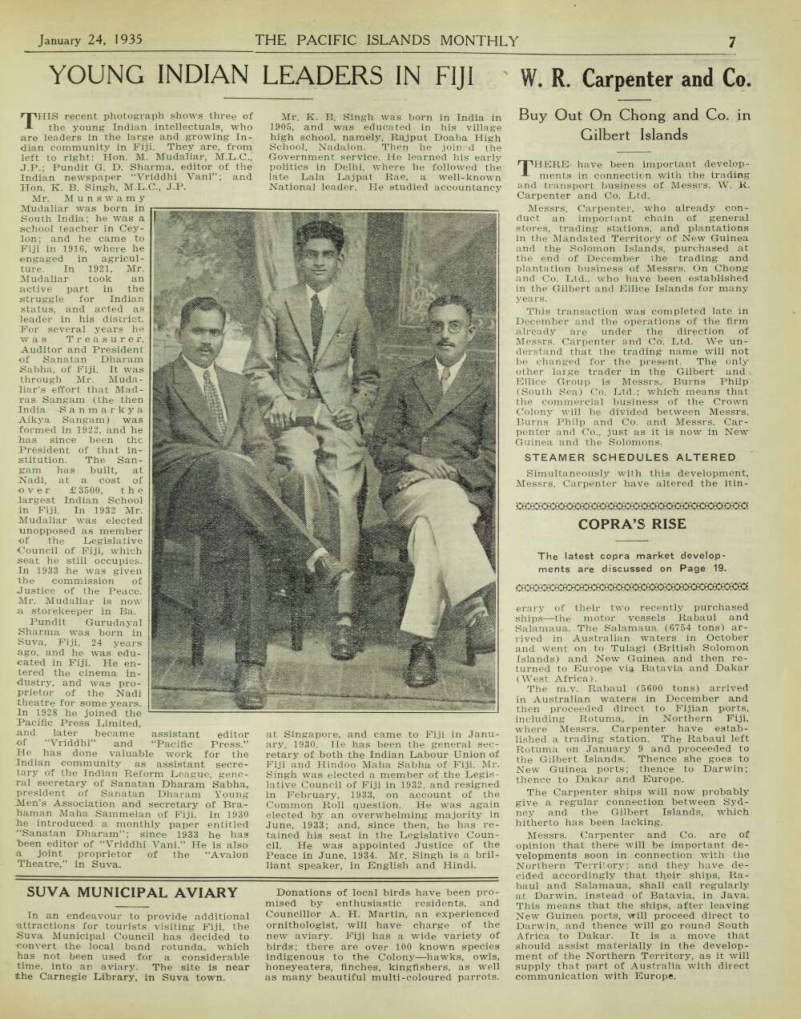
THIS recent photograph shows three of the young Indian intellectuals, who are leaders in the large and growing Indian community in Fiji. They are, from left to right: Hon. M. Mudaliar, M.L.C., J.P.; Pundit G. D. Sharma, editor of the Indian newspaper “Vriddhi Vani”; and Hon. K. B. Singh, M.L.C., J.P.
Mr. Munswamy Mudaliar was born in South India; he was a school teacher in Cey lon; and he came to Fiji in 1916, where he engaged in agricul ture. In 1921, Mr.
Mudaliar took an active part in the struggle for Indian status, and acted as leader in his district.
For several years he was Treasurer.
Auditor and President of Sanatan Dharam Sabha, of Fiji. It was through Mr. Muda liar’s effort that Mad ras Sangam (the then India Sanmarkya Aikya Sangam) was formed in 1922, and he has since been the President of that in stitution. The San gam has built, at Nadi, at a cost of over £3500, the largest Indian School In Fiji. In 1932 Mr.
Mudaliar was elected unopposed as member of the Legislative Council of Fiji, which seat he still occupies.
In 1933 he was given the commission of Justice of the Peace.
Mr. Mudaliar is now a storekeeper in Ba.
Pundit Gurudayal Sharma was born in Suva, Fiji, 24 years ago, and he was edu cated in Fiji. He en tered the cinema in dustry, and was pro prietor of the Nadi theatre for some years.
In 1928 he joined the Pacific Press Limited,
and later became assistant editor of “Vriddhi” and “Pacific Press.”
He has done valuable work for the Indian community as assistant secre tary of the Indian Reform League, gene ral secretary of Sanatan Dharam Sabha, president of Sanatan Dharam Young Men’s Association and secretary of Bra haman Maha Sammelan of Fiji. In 1930 he introduced a monthly paper entitled "‘Sanatan Dharam”; since 1933 he has been editor of “Vriddhi Vani.” He is also a joint proprietor of the “Avalon Theatre,” in Suva.
Mr. K. B. Singh was born in India in 1905, and was educated in his village high school, namely, Rajput Doaba High School, Nadalon. Then he joined the Government service. He learned his early politics in Delhi, where he followed the late Lala Lajpat Rae, a well-known National leader. He studied accountancy
at Singapore, and came to Fiji in Janu ary, 1930. He has been the general sec retary of both the Indian Labour Union of Fiji and Hindoo Maha Sabha of Fiji. Mr.
Singh was elected a member of the Legis lative Council of Fiji in 1932, and resigned in February, 1933, on account of the Common Roll question. He was again elected by an overwhelming majority in June, 1933; and, since then, he has re tained his seat in the Legislative Coun cil. He was appointed Justice of the Peace in June, 1934. Mr. Singh is a bril liant speaker, in English and Hindi.
Suva Municipal Aviary
In an endeavour to provide additional attractions for tourists visiting Fiji, the Suva Municipal Council has decided to convert the local band rotunda, which has not been used for a considerable time, into an aviary. The site is near the Carnegie Library, in Suva town.
Donations of local birds have been pro mised by enthusiastic residents, and Councillor A. H. Martin, an experienced ornithologist, will have charge of the new aviary. Fiji has a wide variety of birds; there are over 100 known species indigenous to the Colony—hawks, owls, honeyeaters, finches, kingfishers, as well as many beautiful multi-coloured parrots.
erary of their two recently purchased ships—the motor vessels Rabaul and Salamaua. The Salamaua (6754 tons) ar rived in Australian waters in October and went on to Tulagi (British Solomon Islands) and New Guinea and then re turned to Europe via Batavia and Dakar (West Africa).
The m.v. Rabaul (5600 tons) arrived in Australian waters in December and then proceeded direct to Fijian ports, including Rotuma, in Northern Fiji, where Messrs. Carpenter have estab lished a trading station. The Rabaul left Rotuma on January 9 and proceeded to the Gilbert Islands. Thence she goes to New Guinea ports; thence to Darwin; thence to Dakar and Europe.
The Carpenter ships will now probably give a regular connection between Syd ney and the Gilbert Islands, which hitherto has been lacking.
Messrs. Carpenter and Co. are of opinion that there will be important de velopments soon in connection with the Northern Territory; and they have de cided accordingly that ships, Ra baul and Salamaua, shall call regularly at Darwin, instead of Batavia, in Java.
This means that the ships, after leaving New Guinea ports, will proceed direct to Darwin, and thence will go round South Africa to Dakar. It is a move that should assist materially in the develop ment of the Northern Territory, as it will supply that part of Australia with direct communication with Europe.
W. R. Carpenter and Co.
Buy Out On Chong and Co. in Gilbert Islands
THERE have been important develop ments in connection with the trading and transport business of Messrs. W. K.
Carpenter and Co. Ltd.
Messrs. Carpenter, who already con duct an important chain of general stores, trading stations, and plantations in the Mandated Territory of New Guinea and the Solomon Islands, purchased at the end of December the trading and plantation business of Messrs. On Chong and Co. Ltd., who have been established in the Gilbert and Ellice Islands for many years.
This transaction was completed late in December and the operations of the firm already are under the direction of Messrs. Carpenter and Co. Ltd. We un derstand that the trading name will not be changed for the present. The only other laige trader in the Gilbert and Ellice Group is Messrs. Burns Philp (South Sea) Co. Ltd.; which means that the commercial business of the Crown Colony will be divided between Messrs.
Burns Philp and Co. and Messrs. Car penter and Co., just as it is now in New Guinea and the Solomons.
Steamer Schedules Altered
Simultaneously with this development, Messrs. Carpenter have altered the itin-
Advertisements & other items, p. 9 (1 item)
Copra’S Rise
The latest copra market develop ments are discussed on Page 19.
French Recruiter Tied Up
Incidents in New Hebrides
AN incident which occurred recently in the New Hebrides throws some light upon the conditions of administration which exist in the Condominium.
A recruiter from a well-known French firm visited the island of Aoba, and for some days was the guest of a well known planter there. When the re cruiter took his departure he took with him the domestic native servant of his host —he apparently had enticed him away as a labour recruit. This form of returning hospitality was bad enough— but it was made worse because this native was the planter’s only trained house servant.
The planter was in a difficulty. He knew that it was useless to appeal to the Administration —there would be months of circumlocution and delay, while officials chattered and argued.
Meanwhile he was without a servant.
A section of the planter’s loyal native staff recognised his difficulty, and the native crew of his boat, without receiv ing any instructions, took action on their own account. They put to sea, overtook the recruiting vessel in the night, many miles away, along the coast of Aoba, crept up beside it and got aboard while the Frenchman was asleep in his cabin.
The planter’s natives, apparently, were well led. They procured some light rope, and tied up the angry and protesting Frenchman, and shut him up in his cabin. Then they aroused the crew of the recruiting vessel and compelled the latter to uncover the hold, and produce the planter’s missing house-boy. The crew of the recruiting vessel apparently were thoroughly cowed, because the miss ing house servant was produced promptly.
With the released native, the planter’s crew triumphantly returned to the plan tation and handed the house-boy over to their master.
The planter recognises that —although he is not personally responsible—the law has been broken in two or three places, and at latest advices he was sitting un comfortably, awaiting developments. But, up to the end of December, nothing had happened. * * * We have received from a correspondent in the New Hebrides a complaint about the recruiting activities of a company which has its headquarters on Santo.
This company has three vessels out, and its methods are stated to be bad. One way in which recruits are obtained is to bribe the chiefs; another is to make available large supplies of trade gin and similar commodities. It is said that the recruiting activities of this organisation in the Banks Islands are actually bring ing about a serious condition of depopu lation.
Our correspondent, in making these statements, gives names and addresses; but it is not desirable that such details be published at this stage. It does ap pear, however, that the whole subject of labour recruiting in the New Hebrides demands some official attention.
Mr. G. K. Shand, who sold out his in terests in Vavau, Tonga, last year, and returned to Australia, is living in Armi dale, N.S.W., at present, but is contem plating an early return to the South Seas.
Salamaua ’Drome
Menace to N.G. Transport System
IF something is not done soon by the Administration of New Guinea to improve the condition of the Salamaua aerodrome, the Administration may have to shoulder the responsibility of a bad aviation accident.
Complaints have been made repeatedly about the condition of this important aerodrome; but nothing has been done and the landing-ground has gone from bad to worse. It is one of the most important aerodromes in New Guinea and is one regularly used by all aviation companies which carry on the vital transport ser vices between the coast and the gold fields.
The trouble seems to lie in the original arrangement which was made between the Administration and New Guinea Goldfields Ltd., under which the aero drome was leased to N.G.G. Ltd., but with the proviso that any aviation concern was free to use the aerodrome. It was assumed, apparently, that N.G.G. Ltd. would keep the aerodrome in reasonably good order; but N.G.G. Ltd. is a concern noted for strange policies and mysterious motives, and for some reason best known to itself, it has failed to keep the aero drome in good order, although much of its important freight has to pass through this station.
In wet weather, the Salamaua ’drome is simply a shallow lake; and in dry weather it is a region of dreadful ruts, and traps for young aviators.
There is plenty of material available — gravel etc. —wheiewith to patch up the aerodrome, and labour is cheap and abundant. In view of the great import ance of the place, both as a landing ground and as a unit in the transport system of New Guinea, the least the Ad ministration should do would be to expend £2,000 or £3,000 in building a concrete runaway of about 300 yards in length, so that aeroplanes using this aerodrome might maintain their regular schedules in reasonable safety.
We have received a number of com munications on this subject; and we are given to understand that the “stand-pat” attitude of the Administration is due to the lease granted to New Guinea Gold fields Limited and the latter’s refusal to accept responsibility for the deplorable condition of the aerodrome. But it does not in any way provide the Administration with an excuse.
In the public interest the Administra tion should, if no other course is possible, deal drastically with N.G.G. Ltd. in this matter. The latter company up-to-date has been a painful embarrassment to the Administration, in connection with the non-development of gold-bearing lands, and no one in New Guinea will be sorry if the Administration takes off its gloves and shows some courage in dealing with the Salamaua aerodrome.
Senator Sir Walter Kingsmill, B.A., K.B., who, for a time, was connected with Papuan Sugar Corporation, Ltd., which acquired land at Wanigela, North-eastern Papua, to develop the sugar industry, died in Sydney on January 15. He visited Papua in September, 1933, to inspect the company’s holding there.
Tamasese’s Death
Samoan Mau Commemorates Tamasese’s Death
From Our Own Correspondent.
Apia, Dec. 30.
DECEMBER 28, the fifth anniversary of the death of High Chief Tamasese was commemorated by a large procession of the Samoan Women’s Man, in black dresses with white stripes, the Man uni form. The procession, preceded by a brass band and wives of the leaders of the Mau Movement, Tamsese (daughter of Mr. O. F. Nelson) and Faamuina, marched through the main Beach Road, of Apia to Tamasese’s grave, upon which a large number of wreaths were laid.
In December, 1929, Mr. Smyth, one of three Mau sympathisers who were de ported from Samoa, returned to Apia at the expiration of his banishment period.
The Mau’s greeting to him took the form of a procession, wherein were several natives for whom the police were search ing. In an attempt to arrest the wanted men a riot was caused, in which a white policeman and eleven Samoans, including High Chief Tamasese, a prominent leader of the Mau, were killed.
Good Type Of Mission
Launch
A NEW 40ft. launch was recently launched from the yards of Lars Halvorsen, Sydney, for the Seventh-day Adventist mission, and for work in the St. Matthias Group, New Guinea.
This is a somewhat new type of boat for open, sea work, and has been evolved as the result of Mr. Halvorsen recently visiting the group and seeing something of the needs of fairly large vessels in open sea travel.
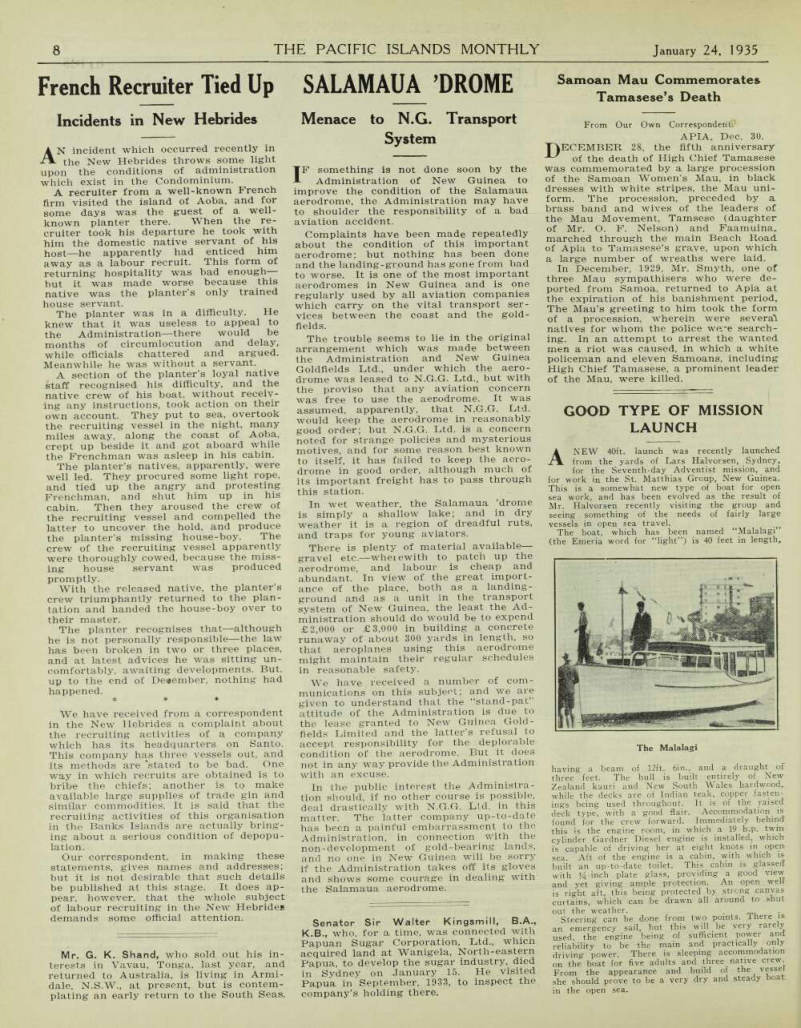
The boat, which has been named “Malalagi" (the Emeria word for “light”) is 40 feet in length.
having a beam of 12ft. 6in., and a draught of three feet. The hull is built entirely of New Zealand kauri and New South Wales hardwood, while the decks are of Indian teak, copper fasten ings being used throughout. It is of the raised deck type, with a good flair. Accommodation is found for the crew forward. Immediately behind this is the engine room, in which a 19 h.p. twin cylinder Gardner Diesel engine is installed, which is capable of driving her at eight knots in open: sea. Aft of the engine is a cabin, with which is built an up-to-date toilet. This cabin is glassed with plate glass, providing a good view and yet giving ample protection. An open well is right aft, this being protected by strong canvas curtains, which can be drawn all around to shut out the weather.
Steering can be done from two points. There is an emergency sail, but this will be very rarely used, the engine being of sufficient power and reliability to be the main and practically only driving power. There is sleeping accommodation on the boat for five adults and three native crew.
From the appearance and build of the vessel she should prove to be a very dry and steady boat in the open sea.
The Malalagi
to Sydney
Chas. B. Nordhoff
Successful Author’s Visit to Sydney
EVERYONE who met him in Sydney formed a warm regard for Charles B.
Nordhoff, the distinguished American writer, who returned to his home in Tahiti in December. Nordhoff is one of that fine type of Americans whom all the world delights to honour —men who love their fellow humans, who know, nothing of personal animosities and international jealousies, and who are courteous gentle men, in all circumstances.
The Mitchell Library, Sydney—repository of Australia’s historical documents—re ceived at the hands of C.B.N. a dredging such as it had never before known. The American writer —with his equally fa-
mous collaborator, James Norman Hall— has a plan for a new book on early Aus tralian history—probably a continuation of the career of Captain William Bligh, whom they have re-introduced to the world in their successful “Bounty” tri ology. (Bligh, after the “Bounty” epi sode, was an early Governor of New South Wales.) Nordhoff discovered in the Mitchell Library, and in private col lections in and about Sydney, historical treasures which few of us knew were in existence and which, doubtless, will provide much excellent material for the clever pens of Messrs. Nordhoff and Hall.
People who spent an hour or two with C.B.N. came away in a sadly deflated condition. There never was a man with a greater capacity for extracting useful information from his willing and happy fellow mortals, and with such a passion tor accuracy and detail. He wanted data about early Australia: and, in a week, he
knew far more concerning economic con ditions and public morals in Sydney in 1800 A.D. than any hundred people who had lived there since birth. He has an amazing memory, and a mind which auto matically sorts, classifies, and card indexes the masses of facts and theories gathered by his eager, questing spirit.
Men found him interesting and enter taining, but a little exhausting. Women thought him charming and good-looking, but baffling. Nordhoff, as a matter of fact, is one of the shyest authors in cap tivity.
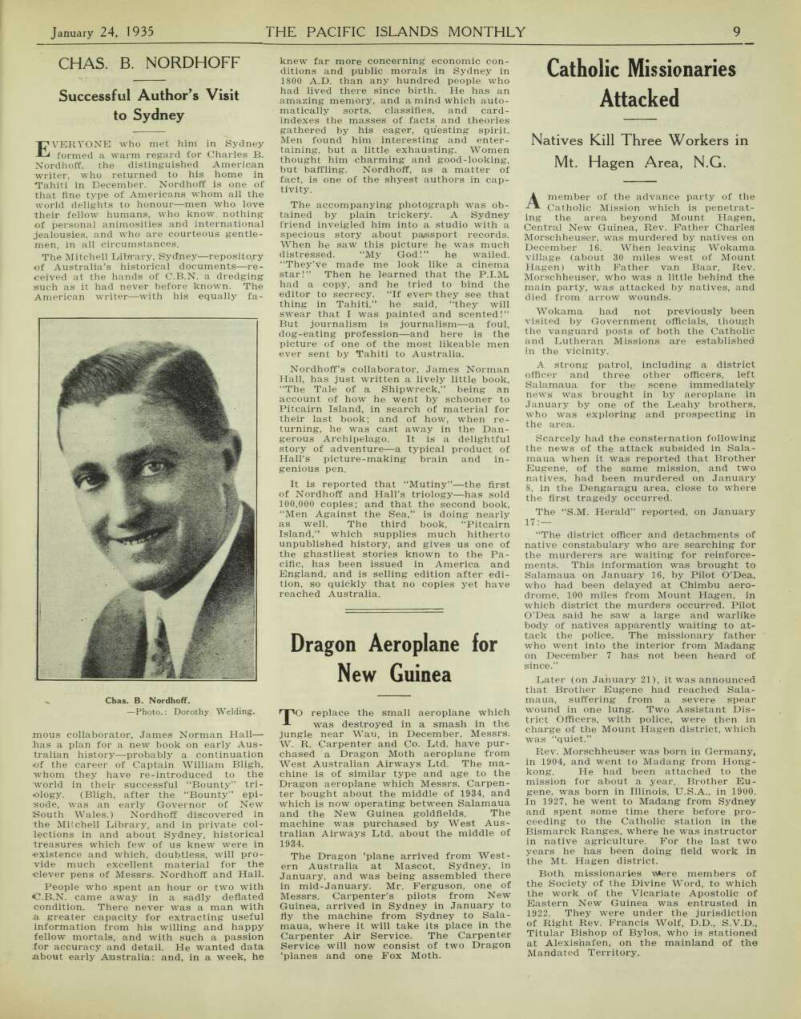
The accompanying photograph was ob tained by plain trickery. A Sydney friend inveigled him into a studio with a specious story about passport records.
When he saw this picture he was much distressed. “My God!” he wailed.
“They’ve made me look like a cinema star!” Then he learned that the P.I.M. had a copy, and he tried to bind the editor to secrecy. “If ever* they see that thing in Tahiti,” he said, “they will swear that I was painted and scented!”
But journalism is journalism—a foul, dog-eating profession—and here is the picture of one of the most likeable men ever sent by Tahiti to Australia.
Nordhoff’s collaborator, James Norman Hall, has just written a lively little book, “The Tale of a Shipwreck,” being an account of how he went by schooner to Pitcairn Island, in search of material for their last book; and of how, when re turning, he was cast away in the Dan gerous Archipelago. It is a delightful story of adventure —a typical product of Hall’s picture-making brain and in genious pen.
It is reported that “Mutiny”—the first of Nordhoff and Hall’s triology—has sold 100,000 copies; and that the second book, “Men Against the Sea,” is doing nearly as well. The third book, “Pitcairn Island,” which supplies much hitherto unpublished history, and gives us one of the ghastliest stories known to the Pa cific, has been issued in America and England, and is selling edition after edi tion, so quickly that no copies yet have reached Australia.
Chas. B. Nordhoff. —Photo.: Dorothy Welding.
Dragon Aeroplane for New Guinea
New Guinea
TO replace the small aeroplane which was destroyed in a smash in the jungle near Wau, in December, Messrs.
W. R. Carpenter and Co. Ltd. have pur chased a Dragon Moth aeroplane from West Australian Airways Ltd. The ma chine is of similar type and age to the Dragon aeroplane which Messrs. Carpen ter bought about the middle of 1934, and which is now operating between Salamaua and the New Guinea goldfields. The machine was purchased by West Aus tralian Airways Ltd. about the middle of 1934.
The Dragon ’plane arrived from West ern Australia at Mascot, Sydney, in January, and was being assembled there in mid-January. Mr. Ferguson, one of Messrs. Carpenter’s pilots from New Guinea, arrived in Sydney in January to fly the machine from Sydney to Sala maua, where it will take its place in the Carpenter Air Service. The Carpenter Service will now consist of two Dragon ’planes and one Fox Moth.
Catholic Missionaries
Attacked Natives Kill Three Workers in Mt. Hagen Area, N.G.
A member of the advance party of the Catholic Mission which is penetrat ing the area beyond Mount Hagen, Central New Guinea, Rev. Father Charles Morschheuser, was murdered by natives on December 16. When leaving Wokama village (about 30 miles west of Mount Hagen) with Father van Baar, Rev.
Morschheuser, who was a little behind the main party, was attacked by natives, and died from arrow wounds.
Wokama had not previously been visited by Government officials, though the vanguard posts of both the Catholic and Lutheran Missions are established in the vicinity, A strong patrol, including a district officer and three other officers, left Salamaua for the scene immediately news was brought in by aeroplane in January by one of the Leahy brothers, who was exploring and prospecting in the area.
Scarcely had the consternation following the news of the attack subsided in Sala maua when it was reported that Brother Eugene, of the same mission, and two natives, had been murdered on January 8, in the Dengaragu area, close to where the first tragedy occurred.
The “S.M. Herald” reported, on January 17:— “The district officer and detachments of native constabulary who are searching for the murderers are waiting for reinforce ments. This information was brought to Salamaua on January 16, by Pilot O’Dea, who had been delayed at Chimbu aero drome, 100 miles from Mount Hagen, in which district the murders occurred. Pilot O’Dea said he saw a large and warlike body of natives apparently waiting to at tack the police. The missionary father who went into the interior from Madang on December 7 has not been heard of since.”
Later (on January 21), it was announced that Brother Eugene had reached Sala maua, suffering from a severe spear wound in one lung. Two Assistant Dis trict Officers, with police, were then in charge of the Mount Hagen district, which was “quiet.”
Rev. Morschheuser was born in Germany, in 1904, and went to Madang from Hong kong. He had been attached to the mission for about a year. Brother Eu gene, was born in Illinois, U.S.A., in 1900.
In 1927, he went to Madang from Sydney and spent some time there before pro ceeding to the Catholic station in the Bismarck Ranges, where he was instructor in native agriculture. For the last two years he has been doing field work in the Mt. Hagen district.
Both, missionaries were members of the Society of the Divine Word, to which the work of the Vicariate Apostolic of Eastern New Guinea was entrusted in 1922. They were under the jurisdiction of Right Rev. Francis Wolf, D.D., S.V.D., Titular Bishop of Bylos, who is stationed at Alexishafen, on the mainland of the Mandated Territory.
Commissioner May Replace
Western Samoa
Commissioner May Replace Administrator
A RESIDENT of Samoa, in a personal letter to the editor, says;— “There are more than a few indications that the present Administrator of Wes tern Samoa, Brigadier-General H. E.
Hart, will retire when his appointment, expires in April, 1935, and that there will be, for the present, no further ap pointment of an Administrator.
“It is believed that the New Zealand Government, for reasons of economy, will appoint Mr. A. C. Turnbull to take charge of the administration, with the status of Commissioner. Mr. Turnbull now is Secretary to the Administrator, and is Acting Administrator in the absence of General Hart.
“Such an arrangement would be wel comed by the people here, as Mr. Turn bull is held in considerable esteem, and the need for economy is generally recog nised.
N. Guinea Aviators Bride
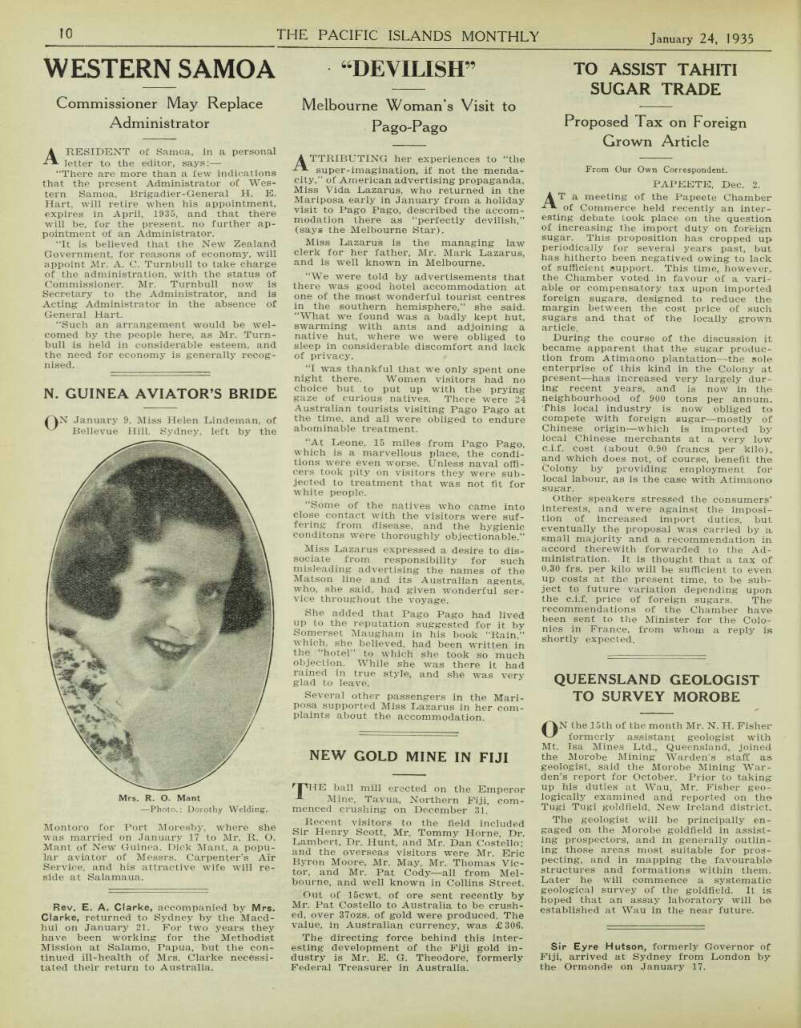
ON January 9, Miss Helen Lindeman, of Bellevue Hill, Sydney, left by the
Montoro for Port Moresby, where she was married on January 17 to Mr. R. O.
Mant of New Guinea. Dick Mant, a popu lar aviator of Messrs. Carpenter’s Air Service, and his attractive wife will re side at Salamaua.
Rev. E. A. Clarke, accompanied by Mrs.
Clarke, returned to Sydney by the Macd hui on January 21. For two years they have been working for the Methodist Mission at Salamo, Papua, but the con tinued ill-health of Mrs. Clarke necessi tated their return to Australia.
Mrs. R. O. Mant —Photo.: Dorothy Welding.
“Devilish”
Melbourne Woman’s Visit to Pago-Pago
ATTRIBUTING her experiences to “the super-imagination, if not the menda city,” of American advertising propaganda, Miss Vida Lazarus, who returned in the Mariposa early in January from a holiday visit to Pago Pago, described the accom modation there as “perfectly devilish,” (says the Melbourne Star).
Miss Lazarus is the managing law clerk for her father, Mr. Mark Lazarus, and is well known in Melbourne.
“We were told by advertisements that there was good hotel accommodation at one of the most wonderful tourist centres in the southern hemisphere,” she said.
“What we found was a badly kept hut, swarming with ants and adjoining a native hut, where we were obliged to sleep in considerable discomfort and lack of privacy.
“I was thankful that we only spent one night there. Women visitors had no choice but to put up with the prying gaze of curious natives. There were 24 Australian tourists visiting Pago Pago at the time, and all were obliged to endure abominable treatment.
“At Leone, 15 miles from Pago Pago, which is a marvellous place, the condi tions were even worse. Unless naval offi cers took pity on visitors they were sub jected to treatment that was not fit for white people.
“Some of the natives who came into close contact with the visitors were suf fering from disease, and the hygienic conditons were thoroughly objectionable.”
Miss Lazarus expressed a desire to dis sociate from responsibility for such misleading advertising the names of the Matson line and its Australian agents, who, she said, had given wonderful ser vice throughout the voyage.
She added that Pago Pago had lived up to the reputation suggested for it by Somerset Maugham in his book “Rain," which, she believed, had been written in the “hotel” to which she took so much objection. While she was there it had rained in true style, and she was very glad to leave.
Several other passengers in the Mari posa supported Miss Lazarus in her com plaints about the accommodation.
New Gold Mine In Fiji
THE ball mill erected on the Emperor Mine, Tavua, Northern Fiji, com menced crushing on December 31.
Recent visitors to the field included Sir Henry Scott, Mr. Tommy Horne, Dr.
Lambert, Dr. Hunt, and Mr. Dan Costello; and the overseas visitors were Mr. Eric Byron Moore, Mr. May, Mr. Thomas Vic tor, and Mr. Pat Cody—all from Mel bourne, and well known in Collins Street.
Out of 15cwt. of ore sent recently by Mr. Pat Costello to Australia to be crush ed, over 37ozs. of gold were produced. The value, in Australian currency, was £ 306.
The directing force behind this inter esting development of the Fiji gold in dustry is Mr. E. G. Theodore, formerly Federal Treasurer in Australia.
Proposed Tax on Foreign
To Assist Tahiti
Sugar Trade
Proposed Tax on Foreign Grown Article
From Our Own Correspondent.
Papeete, Dec. 2.
AT a meeting of the Papeete Chamber of Commerce held recently an inter esting debate took place on the question of increasing the import duty on foreign sugar. This proposition has cropped up periodically for several years past, but has hitherto been negatived owing to lack of sufficient support. This time, however, the Chamber voted in favour of a vari able or compensatory tax upon imported foreign sugars, designed to reduce the margin between the cost price of such sugars and that of the locally grown article.
During the course of the discussion it became apparent that the sugar produc tion from Atimaono plantation—the sole enterprise of this kind in the Colony at present—has increased very largely dur ing recent years, and is now in the neighbourhood of 900 tons per annum.
This local industry is now obliged to compete with foreign sugar—mostly of Chinese origin—which is imported by local Chinese merchants at a very low c.i.f. cost (about 0.90 francs per kilo), and which does not, of course, benefit the Colony by providing employment for local labour, as is the case with Atimaono sugar.
Other speakers stressed the consumers’ interests, and were against the imposi tion of increased import duties, but eventually the proposal was carried by a small majority and a recommendation in accord therewith forwarded to the Ad ministration. It is thought that a tax of 0.30 frs. per kilo will be sufficient to even up costs at the present time, to be sub ject to future variation depending upon the c.i.f. price of foreign sugars. The recommendations of the Chamber have been sent to the Minister for the Colo nies in France, from whom a reply is shortly expected.
Queensland Geologist
To Survey Morobe
ON the 15th of the month Mr. N. H. Fisher formerly assistant geologist with Mt. Isa Mines Ltd., Queensland, joined the Morobe Mining Warden’s staff as geologist, said the Morobe Mining War den’s report for October. Prior to taking up his duties at Wau, Mr. Fisher geo logically examined and reported on the Tugi Tugi goldfield, New Ireland district.
The geologist will be principally en gaged on the Morobe goldfield in assist ing prospectors, and in generally outlin ing those areas most suitable for pros pecting, and in mapping the favourable structures and formations within them.
Later he will commence a systematic geological survey of the goldfield. It is hoped that an assay laboratory will be established at Wau in the near future.
Sir Eyre Hutson, formerly Governor of Fiji, arrived at Sydney from London by the Ormonde on January 17.
Tropicalities
THREE mission workers have been killed by natives in the newly-discovered Mt.
Hagen region. Central New Guinea. Police have gone out to seize the “murderers.”
There are indications that a good deal of fighting will occur and many men be killed, before this “incident” is done with.
There was no need for all this blood shed, disturbance and waste. Last year, when the missionaries began rushing in to “convert” the new-found natives, we urged that the tribes be left alone, to live as they have lived for thousands of years. We said it would be time enough for missionaries to get busy when miners and other European advance guards took the “blessings of civilisation” among the primitive tribes, and the lat ter needed protection accordingly.
But it was no use. The evangelists, with zeal and courage as admirable as their enterprise is unwise and deplor able, have gone In among the untrained natives: and many lives, in the result, are to be sacrificed. Missionary martyrs —punitive expeditions—disappearance of native population. Pacific Islands his tory merely repeats itself —but, the pity of it! * * * AS we predicted, the New Year “Honours List” and Prince Henry’s “Honours List,” announced with the usual newspaper burblings about “public service,” do not contain the name of General Tom Griffiths, who retired re cently from the Administratorship of New Guinea. But knighthoods have been con ferred upon all sorts of professional poli ticians and social limelighters. Mr. Colin Stephen, chairman of the senior Sydney racing club, is now Sir Colin Stephen; but heaven alone knows what this gentle man has done for the public weal, beyond handing out complimentary tickets to distinguished visitors who could well af ford to pay for them.
General Griffiths rose from the ranks, by sheer merit, to become a distinguished and most successful military leader and administrator. There never was, in a re sponsible position, a man who carried out his duty with more conscientious thorough ness than General Griffiths—he gave his great talents unsparingly to every im portant post he occupied. His last term in New Guinea put the coping-stone on a splendid career. He found the Territory surging and seething with grievances and general discontent. His predecessor, in his last years of office, had virtually sur rendered his authority and his judgment to bureaucracy; and Rabaul officialdom was making a welter of it. Griffiths, al most in a day, altered all that. Any man in New Guinea could personally interview the Administrator and could rest assured that his case would be considered with absolute impartiality, free from the in fluence of unimaginative and convention alised departmentalism. Within two years, the praises of General Griffiths were be ing sung by every man in New Guinea— including the bureaucrats whose claws had been clipped. Even the powerful new companies which the gold industry brought into being praised his scrupulous fairness and his liberal point of view. The General did not achieve that result easily—as a
matter of fact, only an iron constitution could have stood up to the immense tasks he imposed on himself. Withal, he remained plain Tom Griffiths—a simple, kindly, unostentatious man, a consistent hater of swank and limelight. He is the sort of man whom this young nation should have been delighted to honour.
But he goes into retirement, unsung and undecorated, while all sorts of useless hangers-on collect titles and gee*-gaws.
The “honours” system, as a method of acknowledging genuine public service, has much to commend it; but Australian governments are reducing it to absurdity.
People already are beginning to giggle when they are introduced to “Sir Something This or That.” Is it to be wondered at? * * * STEAMER fares in the Pacific are sheer murder!” writes a correspondent. "£50 is the minimum return rate between Sydney and Suva, and all other routes in proportion.” We agree that the high rates seem out of proportion to the cost of a great many other things.
There is another side to the picture, however. Recently, we saw the wages lists of a moderate-sized ship which runs in the Pacific on a regular schedule, and on Australian articles. Those lists showed that the chief cook receives monthly in wages more than the captain; the scullion more than the third officer, some of he firemen more than the chief engineer.
The members of the crew are paid at rates prescribed by the Australian industrial awards, in which the monthly sums are properly proportioned between professionals and labourers—between technical skill, and mere brawn. But strict conditions as to hours, and over-
time rates, are provided for the unskilled workers, while there is little similar pro vision for the skilled people. The net result is that the less important people on the ship—kitchen hands, stokers, cooks, etc.—draw in overtime almost as much as their regular wages; the ma jority of them, in addition to being sup plied with food and quarters, receive from £25 to £40 per month. No more need be said. There, in a nutshell, is the principal cause of high fares in the Pacific. * * * A PARAGRAPH in the P.I.M. of Novem ber made unflattering reference to the “Maui Pomare,” the vessel which maintains communication between N.Z. and Western Samoa. This has brought from Mr. L. Derrett, of Hororata, N.Z., who travelled in the vessel in 1934, a spirited defence of the ship and the ser vice. He says: “The vessel is not large—1159 tons gross —and one could not expect the equipment and facilities of a large ocean liner; but she is a good little sea boat. The accom modation is adequate, and comfortable; the equipment sufficient and of good quality: and the whole ship as clean as a new pin. I believe the pantry is near the lavatory, but the galley and dining saloon are some distance away. The food is of first-class quality, well cooked, and tastefully served, while the quantity is greater than any person could possibly eat. In addition to three usual meals, tea in bed, morning beef tea, afternoon tea, and supper are available. The ser vice on this vessel is particularly effi cient and home-like. The stewards know their work and do it well. The ordinary sailors on the boat are very obliging and seem of a better type than one usually meets in such positions. The captain and officers, while quite unobtrusive, do everything possible to make the trip en joyable, both on the boat and ashore. At no time have I been better looked after or made feel more at home than during my trip on the Maui Pomare.”
Advertisements & other items, p. 13 (1 item)
Sterling)
STERLING
HOME
COVERS
MORE
COSTS
LESS
GUAR-
ANTEED
STERLING)
HOME PAINT
STERLING
MAKES ALL THE
DIFFERENCE
PAINT
WITH-
STANDS
TROPICAL
SUN AND
SALT-LADEN
AIR
Made by STERLING VARNISH CO., SYDNEY, N.S.W.
Yams—How to Cook and Eat
Them
IN the December issue a correspondent, Mr. A.
J. Vogan, of Pymble, N.S.W., asked for infor mation regarding the cooking of yams. A reply has been received from Mr. A. H. Joubert, of the Tweed district, Northern New South Wales, who has cultivated and experimented with them.
“Yams can be fried, mashed, grated, boiled, or roasted,” he writes. “If boiled they require to simmer for a long period— most failures to cook yams properly are due to insufficient cooking. Each variety has a different flavour and texture, and takes a different time to cook. I find yams best roasted with a joint (beef or mutton), or baked in their skins and served with butter. They are better than baked or boiled potatoes, and taste quite good if eaten with butter or used as a salad.
“Some people have found the big Australian grown yam insipid; this is due to the acid volcanic soil, and, to a degree, the wet autumn weather.”
About Islands People
Dr. Thomas Moore Clouston, recently appointed Senior Medical Officer at Nauru, was married on December 20 to Miss Mona Duncan of Sydney. They left Mel bourne for their new home by the Triona on January 5.
Rev. F. R. Elder, who had been doing faithful work for the New Guinea Mis sion at Eroro, Papua, for over 20 years, recently relinquished active field work in the Territory, and returned to Australia.
In December he was appointed rector of Mulgoa (New South Wales), and, with his wife and three children, has now settled down in that peaceful country district.
Father Rockliff, who is described as “the international promoter of the Apos tleship of the Sea,” arrived in Sydney from Europe by the Oronsay on Decem ber 19. He left on the Makura the fol lowing day for the Society Islands, where he intends to make scientific researches regarding current changes, and, by sound ings determine the variations of the ocean bed due to submarine volcanic dis turbances. Father Rockliff holds a master mariner’s certificate.
Mr. A. H. Fletcher and Mr. H. S. Hipkin passed through Sydney on their way to New Zealand on furlough early in January, after serving for a considerable time at the Melanesian Mission at Siota, Solomon Islands.
Right Rev. W. H. Baddeley, M.A., D.S.O., M.C., Bishop of Melanesia, will visit Sydney in March next. The object of his visit is to place a number of pro minent matters concerning his large dio cese before the Australian Board of Mis sions, which, together with the Anglican Church in New Zealand and England, maintains the mission.
Miss Winifred Wilson, Melanesian mis sionary in the Solomon Islands, recently arrived in Sydney. Some months ago, at San Cristoval, she was bitten on the foot by a scorpion; the wound became serious, and, after being treated in Tulagi Hospital for a time, she was sent to Sydney for special medical attention.
Mr. D. Lloyd Francis, who has been studying theology for six months at St.
John’s College, Morpeth, N.S.W., left Sydney in December for Siota, B.S.I., where he was to be ordained as deacon.
When Mr. Francis was formerly in the Solomons he was stationed at the Melane sian Mission, Santa Cruz.
Mr. James Raines, headmaster of New stead State School (Victoria), has been appointed Director of Education at Nauru Island. As well as controlling the Euro pean school and supervising the native school, he will train the young Nauruan teachers and have charge of the boys’ farms. With his wife and son Ian, Mr.
Raines sailed for Nauru by the Triona on January 5.
Mrs. R. H. Green, wife of Rev. Green, of Lakeba, Fiji, returned to, the Colony by the December Monterey, after a short vacation in Australia.
Mr. I. H. Grabowsky, general manager of Guinea Airways, Ltd., who arrived in Australia at the end of December, has been seriously ill. He had no sooner reached Melbourne than he suffered a very bad attack of cerebral malaria, which apears to have complicated the thrombosis condition for which he came to Australia to receive attention. The doctors took a grave view of his case, and, in an at tempt to prevent serious developments of the thrombosis, they operated on Janu ary 14, and amputated the lower part of one of Captain Grabowsky’s legs. On latest advices he was doing as well as could be expected, and the doctors were confident that if he made the good general recovery they anticipated, he would be quite able to return to New Guinea and resume the duties of his important posi tion there.
Mr. G. H. Davis, who has been post master of the Cook Islands for the past four years departed from Rarotonga by the Makura with his wife on December 31. Judge Ayson. Resident Commissioner, in presenting Mr. and Mrs. Davis with a suitable gift, praised the courteous manner and mild patience exhibited by Mr. Davis during his term of office.
When You Visit Sydney
Nowhere can you be more highly re commended to stay than at the Great Southern Hotel, 717-723 George Street, Sydney (facing Central Railway Station, opposite Rawson Place). Bed and break fast 7/6, luncheon 2/-, dinner 2/6.
Advertisements & other items, p. 14 (1 item)
Wrist Watch
Phone FX 3378 Phone FX 3378
BARRINGTON’S
DRIVE YOURSELF
SERVICE
Cars Hired without Drivers from 10/- per day; Tourers, 3d. per mile; Sedans, 4d. and sd. per mile. Our Fleet includes 1934 Dodge Sedans.
Write for Reservations, or 'phone when in city and we will deliver Car to your address.
ISLANDERS VISITING SYDNEY
Can with confidence place their requirements in my hands.
BRIAN GRIFFIN, Real Estate
75 DARLINGHURST ROAD, KING’S CROSS
I have a most comprehensive list of furnished and unfurnished flats and bungalows conveniently situated at prices to suit all.
Letters and telegrams receive immediate attention and accommodation can be ready on your arrival. :: Telephone: F 3588
Lady’s full jewelled lever watch in chromium plated metal case 84/-.
In Super Grade Rustless Steel, £11/11/-.
In Super Grade Yellow Gold. £14/14/-.
Consider this Dainty
little ...
Wrist Watch
Note its modern design, fashioned in chromium-plated metal, which gives that sought-after white effect. These watches are imported by us direct from Switzerland, and consequently we can offer them at only 84/-., a wonderful price.
The black cord band gives a much smarter effect than ribbon, and in every way this watch is a thoroughly reliable timepiece.
Fairfax A Roberts Ltd.
“The Oldest Jewellery House in Sydney.”
23-25 HUNTER STREET SYDNEY.
About Islands People
Rev. R. Godfrey, Anglican Archdeacon of Southern Melanesia, arrived in Sydney from Vila, New Hebrides, in December by the Morinda to seek expert ocular at tention.
Mr. T. W. Alport Barker was re-elected Mayor of Suva, Fiji, at a special meeting of the Suva Municipal Council, held on December 5.
Major H. S. N. Robinson, general sec retary and treasurer of the Melanesian Mission, who was secretary of the New Zealand Finance Board of the mission before being transferred from Auckland to the new headquarters at Sydney, will resign shortly. It is understood that he is sorely distressed at the failure of cer tain Sydney authorities to co-operate willingly with him in matters affecting the mission.
Rev. Ian H. Stockdale has resigned from the Anglican Mission in New Guinea and returned to Australia, after two years’ work at Sag Sag, New Britain. At the end of December he was invested by the Bishop of Armidale as Vicar of Nar rabri, N.S.W.
Mrs. A. D. Lelean, wife of Rev. Lelean, Ra, Fiji, arrived in Melbourne by the Monterey on December 7 with her child ren, and is staying at Camberwell. Rev Lelean will join his family in Victoria at the end of this year, and probably will be appointed by the Methodist Mission to circuit work in Australia.
Mr. M. V. Quinn, of New Guinea Gold fields, Ltd., Wau, returned to the Man dated Territory after furlough in Aus tralia by the December Macdhui. He is the hon. secretary of the Wau Progress Association.
Mr. A. S. Gaye, newly-appointed United Kingdom representative of the British Phosphate Commission, arrived in Syd ney by the Monowai on December 31, en route to Nauru and Ocean Islands, on a tour of inspection. He left for Central Pacific at the beginning of January.
Rev. R. L. McDonald, chairman of the Fiji district of the Methodist Church, made a hurried trip to Australia in De cember in connection with matters relat ing to the finances of the Fiji district.
He arrived in Sydney by the Monterey on December 3, and returned to Suva on the same vessel on December 15.
Mr. D. S. Aarons, has been appointed general manager for New South Wales of the Vacuum Oil Co. Pty. Ltd. Formerly he was assistant general manager and has been with the company for 32 years, having served in Melbourne and Western Australia. During the War, Mr. Aarons was in the 16th Battalion and rose to the rank of Captain. He was decorated with the Military Cross and Bar. Mr. J.
D. Rogers is now assistant manager for New South Wales.
Sister E. Field, of Malaita, B.S.I., was in Australia early in December. Later she sailed for New Zealand to spend the remainder of her short furlough in the Dominion. Miss Field is on the staff of the Melanesian Mission Hospital at Mala.
Mr. J. Nason-Jones arrived in Port Moresby from the Lakekamu goldfield, Papua, on December 20. He left the fol lowing week by the Montoro for Sydney on a short holiday. While in Australia he will confer with his directors of Guinea Gold N.L. and acquaint them with the progress made on the extensive pro perties held by them in the Lakekamu area.
Mr. Eric Ramsden, a Sydney journalist and a well-known writer on Polynesian topics, left for Tahiti in December, in company with Mr. C. B. Nordhoff. He will spend several months in the Poly nesian Islands and in New Zealand be fore returning to Sydney.
Nurse Muriel Ward, who returned to Australia from New Guinea early in 1934 owing to ill-health, has now recovered satisfactorily. She left Brisbane to con tinue her work at the Methodist Mission, New Britain, by the Macdhui on De cember 21.
Pastor A. H. Ferris, has retired from work at the Seventh Day Adventist mis sion on Lord Howe Island, where he has been stationed for 25 years. He returned to Australia by the Morinda on December 28. Mr. Ferris’s three sons are S.D.A. missionaries in the South Seas. One is at Ambrym (New Hebrides), another at Suva (Fiji), and the third at Guadalcanal
(B.S.I.),
Mr. H. F. Pearson, Assistant Warden, and Mr. I. W. Morley, Inspector of Mines and Machinery, of the Mining Warden’s staff, Wau, New Guinea, resigned from the service in November. Mr. Morley is the joint author, with Mr. Harold Tay lour (Warden of Morobe goldfields), of a valuable handbook entitled the ‘‘Devel opment of Gold Mining in Morobe, New Guinea.”
Advertisements & other items, p. 15 (1 item)
Cordage
Books, Magazines & Newspapers
TO ANY PART OF THE ISLANDS
BARGAIN OFFER.—We will send halfa-dozen assorted Magazines for 4/- (post free).
We specialise in selecting reading matter for those unable to choose personally. We specialise in Mail Orders. Parcels posted by every boat. Send for our price List and full particulars of this unusual service for Island residents. You will find your instructions carried out promptly, carefully, and with intelligence.
McKAY’S BOOKSTALL
ROYAL ARCADE, SYDNEY
For HOUSEHOLD as well as TOILET Purposes...
Royale Soaps Manufactured in Australia from Purest Ingredients Special Quotes to island Storekeepers—Samples on Application ROYALE SOAP CO., 24-26 Briggs St., Camperdown, Sydney
Scott’s Renown Brand Rope
Cable Address: Ropeyard, Sydney.
Box and
Cordage
of Every
Description
MANUFACTURED AT
MASCOT, N.S.W.
By
J. Scott Ltd.
Head Office and Store:
163 CLARENCE ST.,
SYDNEY, N.S.W.
TUDOR HOTEL
Room and Breakfast from 7/6 per day. All meals a la carte. Accommodation for 100 guests. Two minutes from G.P.O. 127 PHILLIP ST. - Tel.: BW 2758 One door from the New Martin Place,
SYDNEY
Solomons Development Co.
Shareholders in Solomon Islands Development Co. Ltd. have been asked to agree to proposals by the directors that the capital of the company be reduced from £100,000 in shares of £100 each, issued and paid up to £95, to £50,000 in shares of £50 each, paid to £45.
It is to be suggested that the reduction be effected by cancellation of paid up capital, which has been lost or is unrepresented.
The company paid a dividend of 2 per cent, in March, 1932, when its planted area comprised 3*92 acres under coconuts and 190 acres under rubber.
Why Suva Council Was Abolished
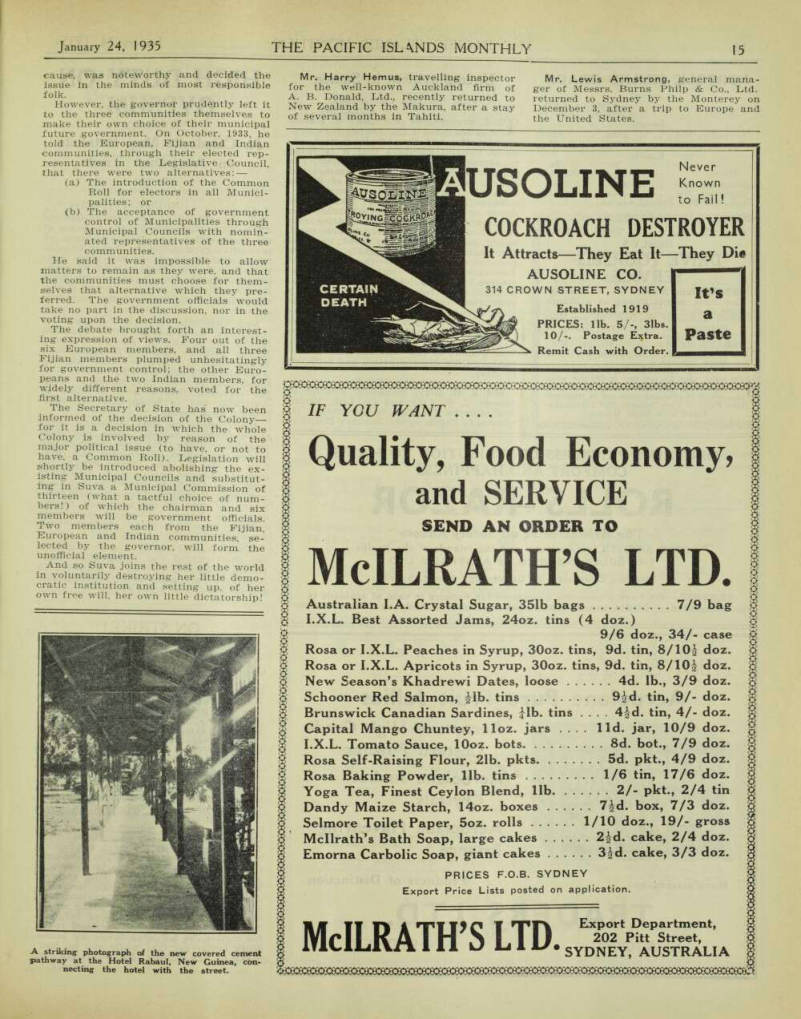
Interesting Phase of the Indian Common Roll Problem
From Our Own Correspondent.
Suva, Dec. 24.
IN a world which is swinging rapidly from democracy to dictatorship, the micocosm which is Suva must needs re flect the spirit of the times.
One by one, the countries of Europe are discarding their systems of demago gic government for popular dictatorships —a reversion to the benevolent despotism of Elizabethan days. Thus the impending changes in the constitution of the Suva Municipal Council are not without in terest.
At present, the Suva Municipal Council consists of eight members elected by about 700 ratepayers of all nationalities, the franchise being given to any person who pays rates on any property within the town area, and who can read, speak and write the English language. Ten years ago the population, within this area was estimated at about 7000 —to-day, it has grown to nearer 13,000.
The necessary revenue for the admini stration of the various services of Suva is provided by a rate upon the unim proved capital value of the lands within the Municipality, and their value is es timated at over £ 500,000. The rate struck by the Council for 1935 was 8¼d in the £. The administration of the Council’s varied activities has been con ducted efficiently and economically and Suva, to-day can point with pride to many miles of tar macadam, with con
crete pavements or concrete kerbing; to an electricity undertaking which is treat ed as a commercial proposition and was rapidly paying itself off—although the price of current has been reduced year after year; and, above all, to the con tinual inspection which ensures that the many dwellings, etc. of the coloured population are kept in sanitary condition.
The total expenditure is in the neigh bourhood of £50,000 per annum, and the check on outgoings is so keen that rates have shown a yearly tendency to decline.
It is obvious that the ratepayers of Suva have been well served by their Municipal Councillors and staff. There is no suggestion that the present method of civic government has produced in efficiency or extravagance—definitely the reverse. Much credit must be given to these public spirited citizens who have occupied the Mayoral chair —names such as those of Sir Henry Scott, Sir Henry Marks, Mr. Grahame and the present Mayor, Honourable Alport Barker, come to one’s mind as those upon whom the responsibility for the direction of affairs has fallen.
What, therefore, is the reason for a change in the system? Broadly speaking, it is the necessity for broadening the present Municipal franchise by the in clusion of languages other than English in the qualifications test.
For the higher body, the Legislative Council, the principle of the inclusion of five Indian languages in the literacy test of electors has already been accepted and incorporated in the Letters Patent of the Colony. It could not, therefore, be denied in a subsidiary body.
The result of such a change is not difficult to gauge—the European popu lation of Suva has increased in ten years by perhaps a couple of hundred; but the Indian and other population has jumped well over a couple of thousands. As Sir Maynard Hedstrom said in Legislative Council: “I think there is no doubt that with the introduction of a bill to establish a Municipal Common Roll, the majority of the names on the electoral roll, within a period of five or six years, will be non- European.”
Even if the literacy test were not ex tended to include the Indian language, there can be no doubt that with the in creased facilities for learning English, the non-Europeans would in the course of a decade or two swamp the Europeans on the electoral roll of Suva.
What was the alternative? To scrap the present democratic system of govern ment by people for on and behalf of the people, and to revert to a system of gov ernment by bureaucracy. What a lovely dish to set before an Elected Legislative Council!
It takes more than courage to raise such an issue—it requires that discretion which is much more than valour to settle it peacefully. Sir Murchison Fletcher deserves to live in the history books of Fiji as the statesman who by the sheer logic of his arguments persuaded the people of Suva to give up governing themselves and to hand the job over to him —a remarkable achievement. The action of Sir Henry Scott in assembling the electors of Suva in the Town Hall, and pleading an obviously unpopular
cause, was noteworthy and decided the issue in the minds of most responsible folk.
However, the governor prudently left it to the three communities themselves to make their own choice of their municipal future government. On October, 1933, he told the European, Fijian and Indian communities, through their elected rep resentatives in the Legislative Council, that there were two alternatives: (a) The introduction of the Common Roll for electors in all Munici palities; or (b) The acceptance of government control of Municipalities through Municipal Councils with nomin ated representatives of the three communities.
He said it was impossible to allow matters to remain as they were, and that the communities must choose for them selves that alternative which they pre ferred. The government officials would take no part in the discussion, nor in the voting upon the decision.
The debate brought forth an interest ing expression of views. Four out of the six European members, and all three Fijian members plumped unhesitatingly for government control; the other Euro peans and the two Indian members, for widely different reasons, voted for the first alternative.
The Secretary of State has now been Informed of the decision of the Colony— for it is a decision in which the whole Colony is involved by reason of the major political issue (to have, or not to have, a Common Roll). Legislation will shortly be introduced abolishing the ex isting Municipal Councils and substitut ing in Suva a Municipal Commission of thirteen (what a tactful choice of num bers!) of which the chairman and six members will be government officials.
Two members each from the Fijian, European and Indian communities, se lected by the governor, will form the unofficial element.
And so Suva joins the rest of the world in voluntarily destroying her little demo cratic institution and setting up, of her own free will, her own little dictatorship!
Mr. Harry Hemus, travelling inspector for the well-known Auckland firm of A. B. Donald, Ltd., recently returned to New Zealand by the Makura, after a stay of several months in Tahiti.
Mr. Lewis Armstrong, general mana ger of Messrs. Burns Philp & Co., Ltd. returned to Sydney by the Monterey on December 3, after a trip to Europe and the United States.
A striking photograph of the new covered cement pathway the Hotel Rabaul, New Guinea, con necting the hotel with the street.
Advertisements & other items, pp. 16-17 (2 items)
Bitumenoid Roofing
TENNIS
TROPICAL RESTRINGS AND GUT
CONSULT
L. A. WARD
WEST END SPORTS DEPOT,
8 GEORGE ST. WEST SYDNEY
DRIVE YOURSELF
during your stay
in Sydney
in a 1934 Model Sedan at 6d per mile. Minimum from 15/ per day.
Write or cable, and we will reserve a car for you. Free Service all over N.S.W., with advantages enjoyed by N.R.M.A. members.
Martin’s Drive Yourself
Service
191 WILLIAM ST., SYDNEY
F 1092.
BITUMENOID ROOFING
MADE IN AUSTRALIA
Bitumenoid Roofings, Dampcourses and Insulating Felts are made from the world s best raw materials. Warranted to stand the most rigid tests.
BITUMENOID THE BEST .
Roofing, 1,2, 3-ply; Flooring, Waterproof Materials; Saturated Felt; Resilient Road Natural Asphalt Dampcourse; 2 and 3-ply Dampcourse; 1-2lb. Lead-core Dampcourse; Roofing Cement; Asphalt Paints; * USTS 0N APP UCATION.
MAXWELL PORTER & SON LTD
ESTABLISHED 1888.
107 REDFERN ST., REDFERN, SYDNEY, N.S.W
BUILDERS’ SUPPLIES
Phone M 3157 Cables: Bitumenoid
PRODUCING UNIFORM GOOD RESULTS SINCE 1868
ALWAYS ASK FOR IT
Mcilrath’S Ltd.
labels!
AUSOLINE
Never Known to Fail!
COCKROACH DESTROYER
It Attracts—They Eat It —They Die
AUSOLINE CO.
CROWN STREET, SYDNEY
Established 1919 PRICES: 1lb. 5/-, 3lbs. 10/-. Postage Extra.
Remit Cash with Order.
It’s Paste
IF YOU WANT ...
Quality, Food Economy,
and SERVICE
SEND AN ORDER TO
McILRATH’S LTD.
Australian I.A. Crystal Sugar, 35lb bags 7/9 bag I.X.L. Best Assorted Jams, 24oz. tins (4 doz.) 9/6 doz., 34/- case Rosa or I.X.L. Peaches in Syrup, 30oz. tins, 9d. tin, 8/101 doz.
Rosa or I.X.L. Apricots in Syrup, 30oz. tins, 9d. tin, 8/101 doz.
New Season’s Khadrewi Dates, loose 4d. lb., 3/9 doz.
Schooner Red Salmon, ½b. tins 9½d. tin, 9/- doz.
Brunswick Canadian Sardines, ¼lb. tins ... 4½d. tin, 4/- doz.
Capital Mango Chuntey, 11oz. jars ... 11d. jar, 10/9 doz.
I.X.L. Tomato Sauce, 10oz. bots 8d. bot., 7/9 doz.
Rosa Self-Raising Flour, 2lb. pkts 5d. pkt., 4/9 doz.
Rosa Baking Powder, 1lb. tins 1/6 tin, 17/6 doz.
Yoga Tea, Finest Ceylon Blend, 1lb 2/- pkt., 2/4 tin Dandy Maize Starch, 14oz. boxes 7½d. box, 7/3 doz.
Selmore Toilet Paper, 5oz. rolls 1/10 doz., 19/- gross Mcllrath’s Bath Soap, large cakes 2½d. cake, 2/4 doz.
Emorna Carbolic Soap, giant cakes 3½d. cake, 3/3 doz.
PRICES F.O.B. SYDNEY
Export Price Lists posted on application.
McILRATH’S LTD.
Norfolk Island Trade
From From Month. Australia. Pacific Is.
Imports November, 1933 .. .. £3494 .. £26 November, 1934 .. .. £2453 .. £7 Exports To To Month. Australia. Pacific Is.
November, 1933 .. .. £1586 .. £1 November, 1934 .. .. £136 .. £1 Trade with New Zealand was nil.
Unemployment in Samoa
From Our Own Correspondent.
Apia, Dec. 1.
THE unemployed question in Samoa was discussed in the Legislative Coun cil recently, and the Administration as sured Council members that it is doing its utmost to cope with the problem. The number of totally and partly unemployed among the European residents of Samoa is larger than appears on the surface.
There has, unfortunately, been a ten dency on the part of the Administration to import officials with high salaries from New Zealand for positions which could easily and efficiently be filled by local Europeans, who would gladly work for lower wages. Recently the N. Zealand Reparation Estates imported two em ployees from N.Z., one of whom was ap pointed to a responsible position on a plantation, though he had no previous experience of tropical agriculture. There are a large number of people available here with good experience of plantation work, who could have filled the position.
The action of the N.Z.R.E. has caused consideration dissatisfaction and criticism in Apia. - Mr. J. R. Clay, managing director of Messrs. J. R. Clay and Co. Ltd., Papua, has been on furlough in Australia. He returns to Papua by the January Macdhui.
Gypsum
High Duty On
N. Caledonia May Retaliate on Australian Trade
From Our Own Correspondent.
NOUMEA, December 6.
AT the session of the Council-General held on November 25, the question of the importation into New Caledonia of Australian gypsum for the Societe Caledon Nickel was discussed. In past years Aus tralia has had a crippling tariff on man ganese entering the Commonwealth from the French colony, and the Council is now advocating a reciprocal policy regarding gypsum.
New Caledonia is a good customer of Australia. According to latest available figures she bought, in 1933, goods (flour, butter, potatoes, gypsum, foodstuff, etc.) to the value of 17,902,000 francs, whereas Australia took only 576,000 francs of New Caledonian produce and minerals. Thus the balance of trade is much in favour of Australia, and is being adversely com mented upon locally.
Much might be done to create better trade relations between these two close neighbours if the facts were placed clearly before the Federal Parliament and care fully studied by them. Great Britain, for instance, entered into a trade agreement with New Caledonia some time ago, and. now many British goods (particularly foot wear) in spite of the additional freight costs, are cheaper in Noumea than those coming from Australia; similarly with American canned fruit, fish, etc.
When the agreement was first mooted, the short-sighted and judgmentless Aus tralian politicians refused to acquiesce to> it. thereby putting the Commonwealth out side all favourable trade relations.
On Strike!
(The minimum wage rate in the Solomons has been reduced from 20/- to 10/- per month.) Brother belong me he talk allsame.
Wages ten shilling, he true. What name- You tink me feller work straight— No more, allgedded stop along Malait.
Me stop along station, now me fimshi four years; Buy one feller Mary, might be no too dear.
He savvy work along garden belong me alright.
Allesame be friend along me long night- Me tink dis Guv’ment he crank alright.
What name me go Tong station more, me no fright.
Got knifle, blanket, waitim ackis.
Dive for shell for pay this tackis.
Ten shilling no fit for work all day.
More better sit along card, make play Catch plenty tambac, lava-lava, mon’, Allgedder no savvy work Tong sun.
Might bimeby me want some rice— Alright, plenty boy make play Tong dice- Plenty meat and ricie stop along store, He no dear too much allsame before.
Time schooner come for boy, and rouse,.
No matter, he laff, stop inside dis house- More better for laze while sun he hot.
Work for ten shilling? No savvy! No got!
Desne.
Advertisements & other items, p. 18 (1 item)
Rolls-Razor
’Phone FL 1266. ’Phone FL 1266.
HENLY’S
DRIVE YOURSELF
SERVICE
197 William Street :: Sydney Cars Hired without Drivers on a Mileage Basis as under:— OPEN CARS—By the Day. 3d. per Mile.
Minimum, 30 Miles Week Days. 60 Miles Sundays.
SEDANS—By the Day. 4d. per Mile.
Minimum, 30 Miles Week Days. 60 Miles Sundays.
Special quotations for holidays.
Payment, plus 2/6 per day or 7/6 per week for insurance. A deposit must be left on car, which is refunded when car is returned.
Our Fleet of Cars includes 1934 Plymouths, Hired at a Slight Increase.
BRITAIN’S PRICELESS CONTRIBUTION TO MAN’S
COMFORT AND HAPPINESS
ROLLS-RAZOR
The Aristocrat of all Safety Razors SOLE AGENTS for Australia and the Islands of the Pacific.
THE ROLLS RAZOR CO. OF AUSTRALIA LTD.
Mendes Chambers, 8a Castlereagh Street, Sydney.
SERVICE. —We have a complete equipment for Repairs in case of accident to your Razor. Blades can be Reset and adjustments made by return mail.
ABOVE ALL—
Aeroplane Pure Fruit Jellies Aeroplane High-Grade Custard Powder Aeroplane Junket Crystals Aeroplane Flavouring Essence Manufactured by Products of Distinction
TRADERS LTD.
NEWTOWN :: SYDNEY
Can Copra-Producers
Organise Against Combines ?
Letter to the Editor.
THE Malayan Committee appointed to report on the economic condition of the coconut and other oil producing in dustries, lays particular stress on the want of co-operation among the producers in Malaya.
The same and worse can be said about us copra producers in these Islands. Cooperation or combination is unknown. We kave no representative Planters’ Associa tion or other body to voice our views and grievances. We are just the obedient slaves of those juggling with our product (to their own advantage) from the date it leaves the estate.
Meanwhile, we copra-producers live on the “bread line,” with little joy or pleasure in life, not knowing when we shall be compelled to abandon our es tates, or hand them over to others, who have been good enough to loan us money, to carry us through the depression. We pioneers of the islands who, with hard earned savings, managed to plant and bring to production the “Consols of the East,” are fools enough to sit down now and take anything that comes to us "without protest, when by co-operation and action we could approach Govern ments and others to right some of our wrongs.
In the Westminster Bank Review of October, 1934, the following remark is made in an article dealing with world trade: “On the one hand, there has arisen a very widespread impatience with the working of democratic institutions in times of crisis. At the same time, there lias been a growing awakening to the de gree of monopolization which has de veloped under the system of private en terprise, accompanied by a fear of the economic power wielded by great combines.”
How true in our industry! The vast combine of Unilever controlling our oil and fat markets —buying out opponents, one after the other, scrapping many of them, but still having to find interest on the purchase of these abandoned fac tories, all of which must react against the raw product price, in the way of over head.
Does this combination benefit mankind?
I doubt it—and so does the housewife, when buying her margarine, soap, candles, cooking oil, etc., etc.
In the case of margarine, they have been compelled to bring down the price in competition, brought about by the over-production of butter, which is produced more or less by hand by millions
of hardworking farmers, who are just eking out an existence. A margarine factory is just one vast bulk-handling by mechanical means, employing a minimum amount of labour. Yet the so-called fin ancial wizards, with all the wealth, scien tific and mechanical means at their dis posal, cannot compete in grade or price with “the small fella,” who milks the cow!
Do you not think if, by way of propa ganda, we showed the housewives of England moving pictures of the produc tion of present-day ingredients of mar garine, they would turn in disgust, and go back to butter for all purposes, or else demand a margarine with vegetable oil and milk contents only: 1. Imagine the film of a whaler depot ship, filth from topmast to keel, and not the slightest supervision by any Govern ment. 2. Compare the farm-dairy and butter factory, the essence of cleanliness and under constant Government supervision. 3. Compare the orderly, well-conducted coconut estate, with its mechanical drier, turning out a fine, white, clean product.
What have Unilever done to bring down the price of the manufactured product?
As an employer of native labour, I have to make a weekly soap issue. The main ingredients of common soap are the low est grade tallow, fats and oil— coconut oil is used only for high-class soaps, etc.
Yet, I have to pay £35 per ton wholesale for common bar soap to issue to the na tives who are producing first class copra for me, for which I nett £5-£6 per ton, Port Moresby.
Here, again, we show ourselves fools, Why buy soap? Why not make it from coconut oil and caustic soda, on our estates?
In writing the above I have tried to explain the necessity of co-operation by planters in the Pacific. What can we do? 1. By proper representation, we can ob tain a better tariff for copra, desiccated coconut, copra oil and cake, throughout the Empire. 2. We can erect central crushing-mills in these Islands. 3. Or we can even have a coconut-oil plant at sea, calling at each estate or depot, treating the product on board, in the same manner as they handle whale oil.
4. Central factories to deal with copra shell-charcoal and coir, both valuable products.
The possibilities are immense, and with money so cheap, one can hardly credit the backward state we are in. Every day one reads in the papers of the flota tion of mines for vast sums, with per haps only the surface scratched, and with poor chance for the investor, of ever getting his money back. Yet capital will not come to the Islands. Why?
I am, etc,,
G. A. Loudon.
Eilogo, Papua, 22/12/’34.
Mr. James Nason-Jones, the explorer and gold-prospector, who is well-known in Papua and New Guinea, was married on January 9 at St. Mark’s Church, Darl ing Point, Sydney, to Miss Margaret Jean Mackay, eldest daughter of Mr. and Mrs.
Donald Mackay, of Warialda, New South Wales.
Mr. John E. Donoghue, chairman of directors of the Rabaul and District Elec tric Light Supply Co., Ltd., died in Syd ney, aged 60, at the end of December.
He was an expert on electrical engineer ing matters, and was connected with most of the big Sydney electric supply cor porations.
Advertisements & other items, pp. 19-20 (1 item)
Excel Batteries
L. L. BELL, F.I.O. (Syd.)
OPTICIAN
WINGELLO HOUSE,
ANGEL PLACE :: SYDNEY
HEADACHES GLARE
BLURRED VISION
Doctor’s Prescriptions for Distance or Reading Glasses made up and Despatched by Return Mail.
New Lenses fitted on receipt of the broken parts.
Goggles for Aviators, Motorists, Welders & Mechanics.
Cash on Delivery Post :: Sydney Prices
EXCEL BATTERIES
15 Months’ Guarantee.
The Product With A Reputation.
Prices F.O.B. Sydney (Australian Currency). Packing and Cases No Charge 13 Plate. 100 amp 30/- 15 Plate. 120 amp 35/. 17 Plate. 140 amp 45/-
SPECIAL CYCLE BATTERY
Six (6) Months’ Guarantee
At 25/- EACH.
EXCEL BATTERY COY., 77-79 William St., SYDNEY APPLICATIONS FOR AGENCY INVITED FROM ALL CENTRES
AICTS and COOTE
Manufacturers of Jewellery and Silver plate, ARE AT YOUR SERVICE WITH THEIR COMPLETE EQUIPMENT Send any shabby table silver or plate, and have it renovated. It will come back to you by the first boat, with newness restored. You’ll be surprised!
Old scraps of jewellery renovated and remade reasonably, or allowed for at highest old gold rates Watches expertly repaired and all work guaranteed.
Illustrated catalogue of beautiful goods gladly sent post free to any address.
ANGUS & COOTE
JEWELLERS, WATCHMAKERS, OPTICIANS AND SILVERSMITHS,
500 George Street :: Sydney Pure Platinum, richly carved and set with diamonds £45
A HOME FOR SCHOOLBOYS
“LEDDICOTT”
School House offers a solution of the problem of education by providing a home for boys attending school in Sydney.
Prospectus on application to
E. F. WHITFELD. B.A..
McMahon’s Point :: :: Sydney
MINING AND ASSAY
MATERIAL
BALANCES, CRUSHERS, FURNACES,
CRUCIBLES, FLUXES, ETC.
LABORATORY AND SCHOOL
REQUISITES
Chemicals, Glassware, and all other Equipment
HOSPITAL AND SURGICAL
REQUIREMENTS
Incubators, Sterilizers, Centrifuges, Microscopes, Microtomes, etc.
Measures, Dispensing Scales, Enamel Ware, Bandages, Cotton Wool, and all Dispensing Material.
Write direct to
H. B. SELBY & CO., LTD.,
BULLETIN PLACE :: SYDNEY
Box 173D, G.P.O.
SURFACE SWIMMING FISH
As Kingfish, Mackerel, Bonito, Tunney, etc., can be easily caught trolling spinner or lure behind a launch. Here’s a selection: Knowles Auto Striker ... No. 4,6, 7 39 6/6 8/6 New Zealand, Dummy ... 2/6 Mounted Feather Lures ... 3/- 3/6 4/6 Glendon Stewart Spoons .. 4/- 5/6 and Sil Rohu Trolling Combination for holding dead Garfish, which will not spin, 2/6 & 3/6.
Flexible Steel Traces, 1/6, 2/-, & 2/6 each.
Postage extra.
Write for my Fishing Tackle Catalogue Sil Rohu, (late A.I.F.) Gunsmith, Importer of High-grade Firearms and Fishing
OIL KUnU, Tackle Specialist.
143 ELIZABETH STREET, SYDNEY (near Market Street).
“FISHING TACKLE TO TACKLE FISHING.”
F. T. S. O’Donnell, Griffin & Co. Ltd.
ELECTRICAL ENGINEERS
and
MACHINERY MERCHANTS
Specialising in —
ELECTRIC MOTORS, DYNAMOS, SWITCHBOARDS,
PUMPS, COMPRESSORS, MOTOR GENERATORS, MARINE
ENGINES, VENTILATING FANS, POWER AND LIGHTING
PLANTS, and all things electric Quotations given for all classes of repair work, ARMATURE WINDING, ETC.
Special attention will be given to any enquiries from the Pacific Islands.
Address all communications to BOX 2690C, G.P.O., SYDNEY, NEW SOUTH WALES. :: Telegraphic Address: Dongrif., Sydney.
F. T. S. O’DONNELL GRIFFIN & CO. LTD.
51 and 53 DRUITT STREET,
SYDNEY, N.S.W.
Carpet Snakes
One Way of Dealing with the Rat Pest
RATS are the outstanding curse of the coconut islands. The pest is worse in some islands than in others; but, what ever its condition, it is a menace to the coconut industry and to the bird life of the Pacific.
There is no keener student of natural history than Charles B. Nordhoff, of Tahiti, well-known American writer; and this scribe recently heard a conver sation which started as a joke, but de veloped into consideration of a practical plan for the elimination of rats. Nord hoff and Ion Idriess, Australian author, were chatting about Australian beasts and reptiles, on which Idriess is an authority; and Idriess became lyrical on the subject of Australian snakes. There are few men—and they mostly are de lirium tremens specialists—who have seen more queer reptiles than Idriess.
In due course, Idriess came to carpet snakes—the big, friendly chaps which are non-venomous, and which are greatly in favour among Australians because of the prompt and efficient manner in which they deal with rats. Hundreds of them are kept as cherished pets in Sydney warehouses. When a carpet snake ar rives in a waterside building, every rat within whistling distance becomes a hasty migrant.
“We could do with a few of those fel lows in Tahiti,” said Nordhoff; and he told us some moving tales of the vicious rodents —how they apparently live per manently in the palm-tops, and crawl from the frond of one tree to the frond of another, thus rendering usless the tin cylinders with which the planters enclose the trunks of the palms.
“Why not take a few carpet snakes to Tahiti?” suggested Idriess. “They do not harm human beings, and they surely would clean up your rats.”
“But how would they manage about the palm-trees?” asked someone.
“They will climb the trees as easily as the rats,” said Idriess.
Nordhoff, who at first was inclined to class the idea with the famous plan of erecting a steam-hammer to kill a wasp, began to be interested.
“These snakes —won’t they harm chil dren? What will they do to the poultry yard? Would they destroy our native birds? Do they like duck-eggs?” He had a dozen questions.
The enthusiastic Idriess gave Monsieur Carpet Snake an excellent character. He insisted that this particular species, like the dog and the horse, is the friend of man.
Nordhoff was not convinced, but he was thoughtful. “It might be worth consider ing,” he said. “The idea of introducing snakes to Tahiti seems fantastic, at first glance. Yet he would have to be a very bad snake to be worse than the rats, which are an absolute curse. I’ll talk it over with some of my friends in Tahiti.
The Administration might be favourable to the idea of making an experiment on one of the small, coconut-covered islets, where the rats have become a plague. It would be interesting to turn a few carpet snakes loose there and see what happens.”
Mr. Philip Osborne-Gibbes, of New Zealand, who was for many years a trader in the Gilbert Islands, died in hospital in Sydney on December 18.
Copra Rises!
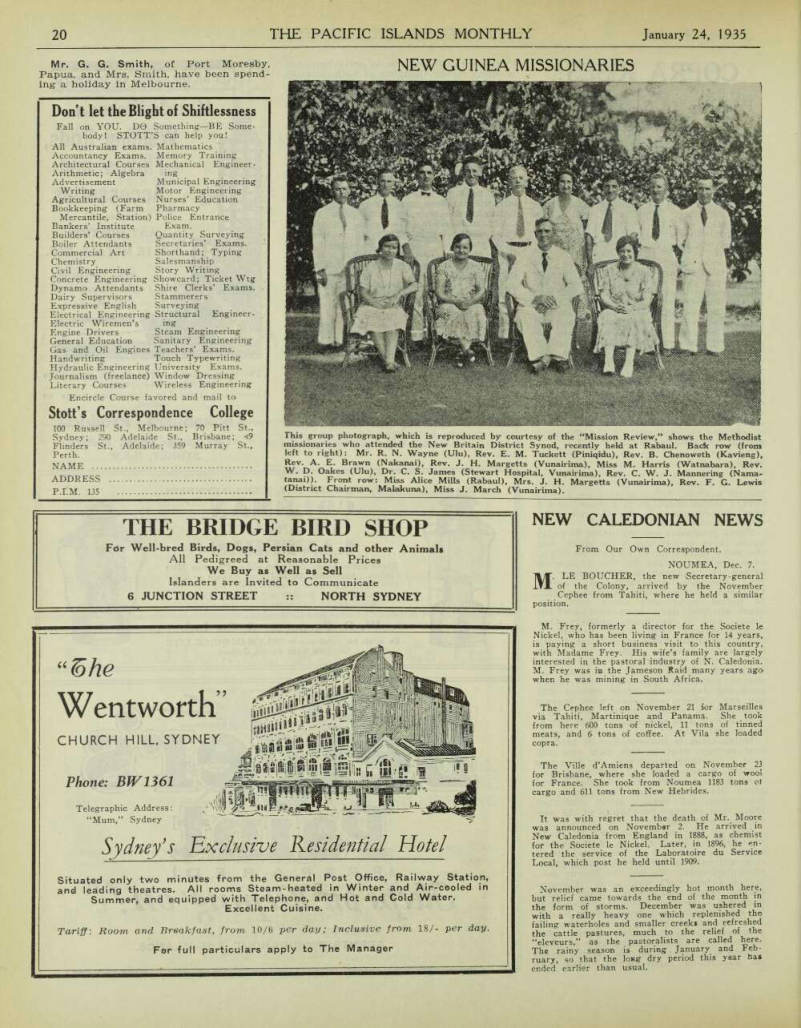
Price Up £3/5/ -per Ton in Five Weeks
THE copra market has moved at last, and in no uncertain manner.
Sundried and smokedried is at £12 per ton, London, which is equal to £15 per ton Australian; hot-air-dried is at £12/15/- London, or just under £16 per ton, Australian. This is a rise, within five weeks, of £3/5/- sterling per ton — an astonishing development.
These are the best prices since Janu ary, 1933.
Economic conditions in Europe are better, if anything—certainly, they are no worse—but the real cause of the market improvement comes from the other side of the world. Several months ago, the United States adopted a new tariff ar rangement, which virtually shut out all Philippines copra and threw it onto the depressed European market. Recently, there have been some readjustments: with the result that Philippines copra is flowing back to U.S.A. We do not know, yet, exactly what has happened; but it is clear that, under the rearrange ment, the Philippines shipper gets about 10 dollars per ton more by sending his copra to U.S.A. than to Europe. The consequent improvement of the European market has been marked.
Another factor, we are informed, is Mexico. This big country, for some reason, has become a large and active buyer of Pacific copra; and this is help ing the market. Other factors are a tem porary butter shortage in Europe; and a great improvement in the German poli tico-economic outlook.
Copra producers are beginning to enjoy again three square meals per diem; but the price must hold to its new level and even improve further if the plantation owner is to make a fair return on his enterprise and invested capital.
Certainly, during the disastrous 1932- 34 period, production costs and over head charges have been ruthlessly cut down, and it is most unlikely that these charges will ever return to the extravagant levels established during the post-war boom period. For that reason, some planters probably will be better off with copra at £15, plus exchange premium, than they were in the good old days, with prices around £25 per ton. There are some very shrewd observers in Sydney to-day who fore cast £14 or £15 per ton, c.i.f. London, at no distant date.
Information is meagre, and it is diffi cult to say whether this new rise will hold. Cautious merchants say that this “jump” is the result of European con sumers being caught short by the Philip pines development, and that the price must soon fall back a little; but they think that perhaps two-thirds of the new advance will hold.
But, if the copra industry is to be stabilised at from £12 to £15 per ton, within the next year or two, much atten tion will have to be given to the problem of capital costs. So far, the thorny sub ject has been left well alone. Govern ments, banks and trading houses have declared a kind of general moratorium, by simply refraining from trying to col lect interest payments, or reductions of principal, from plantation-owners. But the fact that all these thousands of plan tations still are loaded with debts, based on valuations made when copra was
away over £20 per ton, is something that is much in the thoughts of both planters and financiers.
Little has been said on the subject by either class. The planters have been only too glad to let the subject lie dor mant; while the financing institutions, with their thoughts on the assets column of their balance-sheets, have allowed the matter to sleep, in the hope that copra may come back to profit, and thus re store the earning capacity and capital value of the plantations. Copra may come back to £15 or even £17 per ton; but, unless there is a far-reaching inter national development that now is en tirely unforeseen, the price will not in this or the next decade be restored to £25 per ton. This means, simply, that there must be, sooner or later, a writing down of plantation values. And who will bear the loss?
The problem is not peculiar to the copra business. It is common, just now, to every primary industry that “boomed” between 1920 and 1928, and then fell into the depression. The occupiers and part owners of producing lands are holding on grimly, hoping against hope that they may not be dispossessed; while the finan cial institutions, equally grimly, are holding on to and trying to maintain their equities in scores of thousands of properties thus affected.
Where the solution lies, no man can say. It is not a pretty picture. How ever, the comforting fact remains that copra prices are returning to a point where at least they will allow the planter to live.
Mr. G. G. Smith, of Port Moresby, Papua, and Mrs. Smith, have been spend ing a holiday in Melbourne.
Advertisements & other items, pp. 21-22 (1 item)
Welding Rods,
For all the needs of Industry
Kookaburra
Fluxes and
Accessories
together with
ANTIFRICTION
WHITE METALS, ETC.
are increasing the turnover of Distributors.
The range definitely offers distinct possibilities and fills a long-felt need.
Descriptive Price List of complete range on request.
Kookaburra Products
61-65 Lander Street, Redfern,
SYDNEY, N.S.W.
ANY WEATHER—ANY NIGHT—ANYWHERE
colehaiv
INSTANT-LITE
LANTERNS
These Lanterns supplied with either Pyrex or Mica Globes. Automatic Air and Fuel Release Positive Control Valve Can’t Flood.
BRILLIANT LIGHT AT SMALL COST
Wind-proof Gale-proof Insect-proof Apply all branches of
W. R. Carpenter & Co. Ltd.
Or write for catalogue to COLEMAN QUICK-LITE CO., 500 Kent Street, Sydney
(PREPARED)
"Keeps on Keeping on!”
AGENTS THROUGHOUT THE ISLANDS.
Don’t let the Blight of Shiftlessness
Fall on YOU. DO Something—BE Somebody! STOTT’S can help you!
All Australian exams. Mathematics Accountancy Exams. Memory Training Architectural Courses Mechanical Engineering Arithmetic; Algebra Municipal Engineering Motor Engineering Advertisement Writing Agricultural Courses Nurses’ Education Bookkeeping (Farm Pharmacy Mercantile. Station) Police Entrance Bankers’ Institute Exam.
Builders' Courses Quantity Surveying Boiler Attendants Commercial Art Chemistry Civil Engineering Secretaries’ Exams.
Shorthand; Typing Salesmanship Story Writing Concrete Engineering Showcard; Ticket Wtg Dynamo Attendants Shire Clerks’ Exams.
Dairy Supervisors Stammerers Expressive English Surveying Electrical Engineering Structural Engineering Electric Wiremen’s Engine Drivers Steam Engineering General Education Sanitary Engineering Gas and Oil Engines Teachers’ Exams.
Handwriting Touch Typewriting Hydraulic Engineering University Exams.
Journalism (freelance) Window Dressing Literary Courses Wireless Engineering Encircle Course favored and mail to
Stott’s Correspondence College
100 Russell St., Melbourne; 70 Pitt St., Sydney; 290 Adelaide St., Brisbane; 49 Flinders St., Adelaide; 359 Murray St., Perth.
NAME
ADDRESS
THE BRIDGE BIRD SHOP
For Well-bred Birds, Dogs, Persian Cats and other Animals All Pedigreed at Reasonable Prices We Buy as Well as Sell Islanders are Invited to Communicate
6 JUNCTION STREET NORTH SYDNEY
“The
Wentworth"
CHURCH HILL, SYDNEY
Phone; 81V1361
Telegraphic Address: “Mum,” Sydney
Sydney’s Exclusive Residential Hotel
Situated only two minutes from the General Post Office, Railway Station, and leading theatres. All rooms Steam-heated in Winter and Air-cooled in Summer, and equipped with Telephone, and Hot and Cold Water.
Excellent Cuisine.
Tariff : Room and Breakfast, from 10/6 per day; Inclusive from 18/- per day.
For full particulars apply to The Manager
New Guinea Missionaries
This group photograph, which is reproduced by courtesy of the “Mission Review,” shows the Methodist missionaries who attended the New Britain District Synod, recently held at Rabaul. Back row (from left to right): Mr. R. N. Wayne (Ulu), Rev. E. M. Tuckett (Piniqidu), Rev. B. Chenoweth (Kavieng), Rev. A. E. Brawn (Nakanai), Rev. J. H. Margetts (Vunairima), Miss M. Harris (Watnabara), Rev.
W. D. Oakes (Ulu), Dr. C. S. James (Stewart Hospital, Vunairima), Rev. C. W. J. Mannering (Nama tanai)). Front row: Miss Alice Mills (Rabaul), Mrs. J. H. Margetts (Vunairima), Rev. F. G. Lewis (District Chairman, Malaikuna), Miss J. March (Vunairima).
New Caledonian News
From Our Own Correspondent.
Noumea, Dec. 7.
M. LE BOUCHER, the new Secretary-general of the Colony, arrived by the November Cephee from Tahiti, where he held a similar position.
M. Frey, formerly a director for the Societe le Nickel, who has been living in France for 14 years, is paying a short business visit to this country, with Madame Frey. His wife’s family are largely interested in the pastoral industry of N. Caledonia.
M. Frey was in the Jameson Raid many years ago when he was mining in South Africa.
The Cephee left on November 21 for Marseilles via Tahiti, Martinique and Panama. She took from here 600 tons of nickel, 11 tons of tinned meats, and 6 tons of coffee. At Vila she loaded copra.
The Ville d'Amiens departed on November 23 for Brisbane, where she loaded a cargo of wool for France. She took from Noumea 1183 tons ol cargo and 611 tons from New Hebrides.
It was with regret that the death of Mr. Moore was announced on November 2. He arrived in New Caledonia from England in 1888, as chemist for the Societe le Nickel. Later, in 1896, he en tered the service of the Laboratoire du Service Local, which post he held until 1909.
November was an exceedingly hot month here, but relief came towards the end of the month in the form of storms. December was ushered in with a really heavy one which replenished the failing waterholes and smaller creeks and refreshed the cattle pastures, much to the relief of the “eleveurs,” as the pastoralists are called here.
The rainy season is during January and Feb ruary, so that the long dry period this year has ended earlier than usual.
Economies In Fr.
Oceania
Governor Comments on Budget Plans and Taxation
From Our Own Correspondent.
Papeete, Nov. 1.
DISCUSSING the Administrative Bud get for 1935 during the second ses sion of the Financial and Economic Dele gation, which was held recently in Pa peete, His Excellency Governor Montagne said that the estimated expenditure for 1935 of 12,900,000 francs (as compared with 15,400,000 francs for 1934) repre sented a considerable step towards the re-adjustment of expenses to diminished revenue, and that the present figures were only 3.79 times greater than in 1919 (when the franc was five times its value to day). Thus the Colony of French Oceania had achieved a reduction in Administra tive expenditure which was greater than in any other part of the French Empire.
Among other economies effected during the past year, His Excellency drew atten tion to the following items: The reduc tion by two-tenths of the “Supplement Coloniale” (extra Colonial pay for offi cials); Declassment of the Superior Court of Appeal and other economies in the Judicial Service; reduction by one-third of the effective strength of the Colonial Gendarmerie; and the suppression of the Service of Ostreaculture and its replace ment by a simple laboratory. It was also noted that the number of Home officials in the Colony at present amount to 57 (of which seven are magistrates) as com pared with 61 in 1885.
Communications
Dealing with the question of communi cations, His Excellency said that these had been maintained and vigilantly de veloped to the extent permitted by the modest credits at his disposal. He looked upon Tahiti’s circular road as an all important factor in the economic and social life of the people, for the transport of the sick to hospital, and the facilita tion of medical tours to the outlying dis tricts, and also for the development of the tourist traffic. In this connection it was considered that the proposed tax on gasoline—which had been previously dis cussed and rejected—was a matter worthy of renewed examination, as it was calcu lated to yield an additional revenue of 160,000 francs.
Public Health Plans
If the proposed tax on gasoline were adopted the Administration would be able to give serious study to the important question of extending the public health service in the country districts, the plans for which would ultimately be completed by a Sanitarium on the West Coast, where debilitated infants and young people could recover health and vigour.
Public instruction would also be benefited by the innovations he had in mind; these would comprise a school for apprentices, an agricultural farm, and an open air school for infants equipped with free transportation facilities for children at a distance.
Taxation Rate
Commenting upon the per capita rate of taxation in the Colony, His Excellency drew an interesting comparison between the present time and the year 1913, when
the rate was 109.85 francs per head on a population of 31,000, while to-day it works out at 64.50 francs per head on a popu lation of 40,000. Undoubtedly the system of taxation applied in French Oceania was one of very great merit, but a system which could count upon only 17.18 per cent, of direct revenue while the balance of 82.82 per cent, was raised by indirect (and therefore uncertain) means was not without its risks from an Administra tive standpoint.
It had not been found possible to carry out in their entirety all the improvements in agriculture and stockbreeding fore cast in 1933, nevertheless some ameliora tions had been accomplished. During the year 1934 the veterinary service had created hygienic slaughter houses where all meat destined for human consumption was subjected to a rigorous inspection.
Certain measures had also been taken which would ensure an improvement in the quality of fruits and vegetables placed on sale in the Papeete market. A matter of great interest to agriculturists was the liquidation of the old Caisse Agricole and its reorganisation on a new basis as the “Credit Agricole Mutuel.”
His Excellency concluded with a brief resume of his visits to the outlying archi pelagoes of the Colony, some of which were so remote from Papeete that in at least one island the outbreak of the war was not known till 1916. On these tours he had been obliged to travel some 5000 kilometres in order to visit merely a small portion of the French possessions in the South Seas.
Rev. J. W. Raton Gillan, principal of the Presbyterian Mission Teachers’ Train ing Institute at Tangoa, New Hebrides, arrived in Sydney from the Condominium by the Morinda on December 12.
Advertisements & other items, pp. 23-24 (1 item)
Brand
SKIN DISEASES
By the application of his Secret Formula in the treatment of all Skin Diseases, Mr. John J. McHugh, Consulting Chemist, 124 Liverpool St., Sydney, is able to assure sufferers of a complete and speedy recovery.
Letters of gratitude from all parts of the world may be inspected at his rooms. Skin complaints successfully treated include; Tinea, Eczema, Psoriasis, Acne, Germ Under the Nail, Varicose Veins and Ulcers, Ringworm, Pruritis, Dandruff, Rosacea, Infantile Eczema, etc.
Readers are invited to call or write to Mr. McHugh, and he will advise them without obligation.
Consulting Hours: Monday, Wednesday, Thursday, 10 a.m. to 5 p.m.; Tuesday and Friday, 10 a.m. to 9 p.m.; Saturday, 9 a.m. to 12 noon.
JOHN J. McHUGH, Ph.C.
(Member of the Pharmaceutical Society, N.S.W.) Consulting & Pharmaceutical Chemist
1st FLOOR, 124 LIVERPOOL ST.
(opp. Snow’s), SYDNEY ’Phone MA 5028
SUN
DOCKERS
BRAND
PAINT
Made expressly to keep a lustrous, full gloss finish
against the varying con-
ditions of moist weather exposure, and prevent the decaying ravages of rain and extreme heat by
giving a long lasting pro-
tection to all surfaces.
SUN PROOF
RAIN PROOF
"Stronger than the Weather”
W. R. CARPENTER
& CO. LTD.
New Guinea, Solomon Islands, and all other South Sea Islands.
OWN A
ROLLS
RAZOR
Every planter should own a Rolls razor, the world-renowned, .hollowground safety which strops and hones itself. Removes stubble without trouble and will give you a lifetime of perfect shaves.
Complete in nickel plated case 50/- Silver plated case 60/- Write to-day to Desk P.I.M.
Pike Brothers Ltd.
in Queen Street, BRISBANE.
“WYRNWAY” BRAND
SHIRTS, PYJAMAS
UNDERWEAR AND TIES
ARE QUALITY PRODUCTS
WEARNES LIMITED
MANUFACTURERS 17 PARKER ST.. SYDNEY
ON SALE AT ALL
READ THE
B.P. MAGAZINE
SUMMER NUMBER
Now on Sale Short Stories — Pictures Travel Articles — Pages for the Children. — Stage.
Latest Fashions — Screen One Shilling per Copy
NEWSAGENTS AND BOOKSELLERS
Guinea Gold Will
Appeal
Shareholders in Guinea Gold N.L. (the well known Adelaide Company which hold shares in Bulolo G.D. Co. Ltd., Guinea Airways Ltd., the Lakekamu field, etc.) have received a memorandum from the directors of the company that prelimi nary steps have been taken to institute an appeal to the High Court against the decision of the South Australian Supreme Court in the taxation test case.
An extraordinary meeting of share holders has been called for January 4, with the object of securing authorisation for the appeal.
The test case was brought about when Mr. A. E. H. Evans (secretary of Guinea Gold N.L. and Guinea Airways Ltd.) ap pealed against income tax assessments made on 120 shares in Guinea Airways Ltd., 1080 shares in New Guinea Gold fields Ltd., and on an amount of £300 representing a cash distribution of 10/- a share by Guinea Gold N.L. The Chief Justice, Sir George Murray, decided in favour of the Deputy Commissioner in a judgment delivered at the end of Decem ber. The case was heard several months ago.
Jungle Crash
Pilot Crisp’s Lucky Ecape in Mishap near Wau
PILOT DONALD CRISP, who is engaged in the New Guinea goldfields aerial transport service conducted by Messrs. W. R. Carpenter & Co., Ltd., had a fortunate escape from death when his ’plane crashed in the jungle country near Black Cat Creek, between Salamaua and Wau.
On Sunday, December 16, while flying a Fox Moth machine loaded with freight, he ran into a heavy thunderstorm over Bitoi Gorge. The down currents pre vented the machine rising, and he crashed on the treetops. Though the ’plane was totally wrecked, Pilot Crisp escaped with only a slight shaking and bruises.
Relating his experiences after being rescued, the airman said that as the ’plane crashed the engine, cargo, and front of the cabin fell 70ft. to the bottom of the gorge. His safety belt held him to the rear portion of the machine, which remained suspended in the trees. Even tually he descended safely.
He made several unavailing attempts to light a fire to signal the searching ’planes sent out when he was posted missing. On the following Tuesday he set out on foot, and hacked his way through the dense forest until he reached the camp of a miner named Reynolds, on Black Cat Creek. From there native runners were despatched to inform the search parties. He arrived at Salamaua on December 21.
Tahiti Artist
Mr. Alister Macdonald's Final Exhibition
From Our Own Correspondent.
Papeete, Dec. 1.
Mr. Alister Macdonald, The Cele
brated water-colour artist, whose ex quisite reproductions of Island scenery and colour are so well known to Tahiti visitors, is now holding a final exhibition of his works in Papeete, preparatory to leaving this colony, where he has been a resident for many years. Some of his finest examples—the result of a mature experience—are contained in the present collection.
Although he has already attained man’s allotted span of three score years and ten, he is still imbued with an unbounded enthusiasm and activity in the pursuit of his profession. He has been a life-long devotee of the brush, and is a realistic artist of the old school, who believes in fidelity to nature —something which is rarely found in these days.
Mr. Macdonald recently toured the Marquesas Islands and the Tuamotu Ar chipelago to make a representative series of paintings for the big French pictorial, “L'Illustration,” and he also provided the jackets for Messrs. Nordhoff and Hall’s two latest books —works which evoked universal admiration. If his present plans are carried out he will be greatly missed in Tahiti, but we hope that it may yet be possible to persuade him to remain with us.
Tung Oil
No Success Yet Reported In The Islands
MUCH space has been given in this journal during the past three years to discussion of the possibilities of the tung oil tree as an industry suitable for the Pacific Islands.
Tung oil is coming into use throughout the world to an increasing degree, and its production is profitable. It came origin ally from China. One species, Aleurites Fordii, is grown in Central and Northern China. Another variety, Aleurites Mon tana, flourishes in the tropical regions of Cochin China, and thereabouts.
The Fordii variety of tung tree was established in Florida, U.S.A., many years ago, and has flourished, so that there is now a large and valuable tung oil indus try in America as well as in Asia.
After consideration of the available data, we expressed the opinion some three ago that experimentation with tung seeds in the Pacific Islands was worth a trial; but that it appeared that the Fordii variety definitely was not suitable for Pacific Islands cultiva tion. We thought, however, that the Mon tana variety had possibilities.
During the ensuing years experiments with tung oil cultivation have been made to our knowledge in New Guinea, the Solomons, New Caledonia, Fiji, Tonga, and Northern New Zealand; and we have not been able to ascertain that planters have had any success whatever. It ap pears that the tung tree grows vigour ously and apparently healthily in its early years, but that it does not fruit and pro duce nuts in the way that it does in China and North America.
In July last we published an article by Mr. McIntosh Ellis, who stated that a company for which he is technical ad viser had succeeded apparently in estab lishing tung tree plantations in Queens land. Mr. Ellis urged as a result of his experience that experiments with tung trees should be persisted with in the Pacific Islands.
Mr. Ellis’s experience only bears out the opinion that has been repeatedly ex pressed in this journal—i.e., that the tung tree will fruit properly if it is grown on a land mass, such as Asia, North America or Australia; but that it will not run its normal cycle of life if it is cultivated on a small land area, where the climate is oceanic.
An interesting contribution to the dis cussion came recently from a correspon dent in Western Samoa, who said that the well-known candle-nut of the Islands is a species of tung tree and that, as candle nut flourishes so well in all the Pacific Islands, there should be an investigation of its possibilities as a producer of pos sibly a useful variety of tung oil.
If any Pacific Islands planter has had more success with tung oil cultivation than is indicated in the foregoing sum mary we shall be very glad indeed to have details. Some of our friends urge that Islands planters should persist with tung tree experiments, but all our infor mation up to date is that tung cultiva tion in the Islands is a “washout.”
Tung Oil Cultivation
“AS a result of your article on tung oil (‘Cultivation of Tung Trees,’
P.I.M. 19/7/1934), we have had a large number of enquiries from your subscri bers and have made available to planters supplies of tung seed for testing,” writes Mr. L. Macintosh Ellis, consulting forest engineer to Queensland Forests Ltd., which has established a large tung plan tation in North Queensland.
“I believe that in many parts of Oceania the culture of Aleurites Fordii and its brother species Montana will be quite successful. If we had listened to the condemnations and negative head shaking of the various Government offi cers in Queensland there would have been no plantation in that State. But despite discouragements received, my principals had enough faith to proceed with the pro ject, and I am glad to say that it has attained a measure of success. There is nothing to be lost in trying, and if it is successful in only a restricted part of the Southern Pacific Islands, then some ad vance will have been made.”
M4\ Ellis adds that an inaccuracy oc curred in the article mentioned. It was stated, inter alia, that the Queensland
company’s plantation when in full bear ing could produce enough Tung oil to fill the requirements of the Commonwealth and also export a quantity to England.
Mr. Ellis points out that his company alone could not do this, but that there is in Australia a large area of suitable coun try which if planted could produce enough oil to fill Australia’s requirements and ex port a surplus.
Advertisements & other items, pp. 25-26 (1 item)
Hotel Mansions
GLOBEX
(GLOBE BEEF EXTRACT)
GLOBEX
FOR GOOD BEEF TEA
GLOBEX
FOR SOUPS & GRAVIES
GLOBEX
DELICIOUS SPREAD THINLY.ON BREAD
Obtainable in 2 oz. jars and in 4 and 8 oz. CONTAINERS Obtainable from All Island Traders
THE NEW
WINCHESTER
“SPEED KING”
.22 CAL. AUTOMATIC RIFLE MODEL 63
10 SHOTS
Price, £9/5/-
FREIGHT EXTRA
This NEW WINCHESTER AUTOMATIC RIFLE is the improved successor of the famous Model 03, chambered for the NEW .22 LONG RIFLE SUPER SPEED RIM FIRE CART- RIDGE DEVELOPING 35% HIGHER SPEED, 58% GREATER POWER, LONGER RANGE AND GREATER ACCURACY at Less Cost for Ammunition.
THE NEW WINCHESTER SUPER SPEED RIM FIRE
CARTRIDGES
MORE SPEED Short 2/5 100
GREATER POWER
LONGER RANGE Freight extra.
COWLES & DUNN
Gunsmiths and Fishing Tackle Specialists 71 KING STREET SYDNEY Cable Address: CODUN, SYDNEY. Write for Fishing Tackle Catalogue, Post Free.
TARIFF:
Single Room and Breakfast from 8/-
HOTEL MANSIONS
SYDNEY’S IDEALLY SITUATED PALATIAL HOTEL
INCLUSIVE
TARIFF:
Single Room from 12/per diem. per night.
WEEKLY
from £2/2/- Renowned for Exquisite Cuisine, Perfect Service and Luxurious Appointments.
Make the Mansions your home whilst in Sydney and enjoy Unsurpassed Comfort at Moderate Cost.
INDIVIDUAL, DOUBLE ROOMS AND FAMILY SUITES
WIRES: “Mansions,” Sydney. ADDRESS: Bayswater
WEEKLY
from £3/10/- Rd., King’s Cross.
M. HARPER
MANDOLI AN A ISLAND,
NORTH GELA, B.S.I.
Postal Address: P.O. Box 6, Tulagi, Solomon Islands.
Recruiting Contracts Undertaken.
Auxiliary Vessels “Papari” and “Trader” available for Charter.
Full details of Services from
BURNS PHILP (S.S.) CO., LTD.,
Makambo (B.S.I.) and Sydney.
To Planters I am a Buyer of
CASTOR OIL SEED
IN ANY QUANTITY.
Send Sample for quote, stating quantity available.
Castor Seed Shellers, any capacity.
Advice and Instructions Regarding Planting, Harvesting, and Packing of Castor Oil Seeds given freely. Selected Seed for Planting available.
C. GRAHAME
4 DALLEY STREET SYDNEY.
advt
Aunt Mary's
“Defiance”
Brand
Canned
Goods
PURE FOOD
PRODUCTS
—are prepared and packed by the proprietors of Aunt Mary’s Pure Food Products.
The finest quality goods are hermetically sealed to withstand tropical heat and give to consumers maximum satisfaction.
Supreme in quality and flavor, these pure food products have been supplied to the people of the Islands for more than thirty years. Specially manufactured and packed to meet Island conditions, they give complete satisfaction to both retailer and consumer.
Prepared and Packed only by—
TILLOCK & CO. LTD.
PURE FOOD MANUFACTURERS
KENT AND LIVERPOOL STREETS,
SYDNEY, N.S.W.
Sir Raphael W. Cilento
AMONG the list of recipients of New Year Honours was Dr. Raphael West Cilento, M.D., B.S. (Adelaide), D.T.M. and H. (London), Director-General of Health in Queensland, who is well known in Melanesia for his work in con nection with tropical hygiene. He was created a Knight Bachelor.
Born in South Australia in 1893, Dr.
Cilento joined the A.I.F. in 1915 and at tained the rank of captain in the Austra lian Army Medical Corps. In 1920 he was appointed by the British Colonial Service to the Malay States, from whence a year later he accepted appointment to the Australian Institute of Tropical Medicine.
The following year he was made Director of the Institute. In 1925 he was trans ferred to New Guinea as Director of Public Health and remained there for three years.
Dr. Cilento last year presented his rare collection of Melanesian brains and New Guinea skulls to the Australian Institute of Anatomy. Included in this collection were some of the most perfect known specimens of primitive surgery by stone age people.
"Sempill Here!”
An Unexpected Visitor
LORD SEMPILL, flying solo from Somerset, on the Queensland coast,, landed at the Kila-Kila aerodrome, Port Moresby, at about 2.30 p.m. on December 15, and took off again for Wau early on the following morning.
Although his arrival was expected, it was not anticipated that he would strike the coast to the east of Port Moresby and land quietly at Kila-Kila without flying over the town; and more than one of Port Moresby’s commercial executives got rather badly tangled.
One well-known gentleman was sitting at his desk, wondering whether tropical life was really worth living, when the telephone rang.
B.D. (lifting the receiver): “Hullo!”
Distant Voice: “Is that Blank and Company?”
B.D.; “Yes. B.D. speaking.”
D.V.: “Are you the manager?”
B.D. (suspecting a leg-pull); “Who the h— do you think I am?”
D.V.: “Sorry! Sempill here.”
B.D. (now sure of it); “Oh, go to hell!”' Adequate apologies were made later.
Lord Sempill left for Wau (New Guinea) early on December 15, accom panied by Pilot Denny in a Guinea Air ways Fox Moth, and returned to Port Moresby on December 18, continuing his flight to Australia early the following morning (December 19th). His intention was to make Cairns or Townsville tho same day. A small letter mail for Aus tralia was despatched by the ’plane.
Lord Sempill dined with the Lieut.- Governor (Sir Hubert Murray) at Gov ernment House, on the evening of his arrival.
New Ice Works At Rabaul
From Our Own Correspondent.
Rabaul, Dec. 34.
A NEW company, under the name of the Rabaul Freezer Limited, has opened a new ice works in conjunction with a butchery business. It is situated in the vicinity of the Rabaul electric
light works.
Its advent has caused a reduction in meat prices and ice prices are down 25 per cent. The service in connection with these commodities is improved, as orders are now delivered to customers, and the doors are open all day instead of for only a few hours each day. Which goes to show the value of competition.
Exhibit of Plantation Machinery
The extensive range of plantation and agricul tural implements manufactured by Ransomes, Sims and Jeffries, Ltd., of Ipswich, Great Britain, made a striking display at the recent Royal Agricultural Show, held at Ipswich, England. The tine selec tion of tractors, furrow ploughs, disc harvesters, cultivators, mechanical cotton planters, and a host of other plantation machinery units were favor ably commented upon by the Royal Agricultural Society’s experts. A giant “Shugadisc” plough, weighing nearly three tons, which was designed for the use of sugar-cane growers, attracted consider able attention.
In addition to agricultural implements, late model! lawn mowers —electrically and petrol motor driven, as well as the ordinary hand type —were displayed.
Messrs. Ransomes, Sims and Jeffries, Ltd., re cently prepared an attractive souvenir catalogue of the Royal Show, illustrating their different types of machinery. Copies of this brochure may be obtained by writing direct to them.
The Polynesian Origin
What a Study of Languages Suggests
FROM the outset, the European mind has tried to trace a Polynesian trail from somewhere in Asia to somewhere in Polynesia. It is submitted that the col lective efforts, in this direction, have failed. The literature upon the subject is most unconvincing.
Many people appear to overlook or avoid the fact that evidence of contact between Polynesian and Asiatic peoples is just as cogent evidence that Polynesians penetrated into Asia as that Asiatics penetrated into Polynesia. If anything, the evidence is more favorable to the pro position that Polynesian expeditions reached Asia than to the proposition that the Polynesians migrated out of Asia. It will be as well to determine the facts first.
The Hawaiian Islands, Easter Island and New Zealand are three points of an oceanic triangle. The populations, orig inal to all the islands within this triangle including the points, are fundamentally Polynesian. This area is not exclusive.
There are Polynesians elsewhere in the Pacific land areas. The first point that distinguishes Polynesian people from others is that of language. Practically all the different communities of the race speak tongues which are derived from a common origin.
The phonetics of the different dialects are much more similar than the European written interpretations would lead us to
believe. The European ear missed some of the distinctions in both vowel and consonant sounds. In some cases, it was particularly difficult, in fact, impossible, to find established European symbols to fit the case. In other cases, different sym bols were used to record identical sounds —such as “g” for some dialects, and “ng” for others. The word “tagata” is pro nounced “tangata.” The true sound is the “ng” sound in “hanging,” and not that in “anger” or “angel.”
Apart from these, more or less, avoid able disparities, the Polynesians them selves have not treated their original language with any greater cbnformity than have Englishmen in England and elsewhere. Different communities have transposed, changed, or elided certain sounds; more particularly with regard to consonants than with regard to vowels.
It is no difficult matter to bring all the different Polynesian dialects into har mony with a common base.
But it is unfortunate that the evidence of language is still being misread. For example, in a recent book upon the sub ject of Easter Island, there appears this statement: “It has been known for many years that the language of Tahiti was basically similar to that of the Maoris of New Zea land and the natives of the Hawaiian Islands and Samoa. But not until Mr.
Stimson had completed his analysis was
the nature of their relationship suspected . . . It demonstrated that the oldest language in the Pacific as proved by its elisions of consonants and its prodigal use of vowel sounds was that spoken in the Society Islands, including Tahiti. The newest one found in Hawaii, New Zea land and Easter Island.”
The first sentence in the above quota tion is accurate but the remainder is not.
The true relationship has been known for many years and Mr. Stimson is wrong in his deductions, that is to say, if they are as stated above.
It is difficult to understand how a dia lect which elides sounds which are pre sent in a language can be older than the language from which it makes elisions.
In fact, the elisions themselves, apart from accounting for an apparent “pro digal use of vowel sounds” in the Tahitian dialect, establish the fact that the Maoris of New Zealand speak an older form of the language than those of any other Poly nesian group, although they are closely followed by the Rarotongans, Mangarev ans and Easter Islanders.
All these latter people, it would seem, had lost touch with those groups which make elision at a period antecedent to the development of the habit of elision.
But, so far as age is concerned, it would further seem that each dialect is as old, in its fundamentals, as any other dialect derived from the basic source.
The consonants which are elided—one or more in different communities —are “k,” “ng,” “wh,” the “g” of "ng,” and, sometimes, the “w”, and sometimes the “h” of “wh.”
The Tahitians elide both “k” and “ng.”
That the sounds were originally present is proved by the “break.” Thus, “tang ata” becomes ta’ata, “ika” becomes i'a,
“maunga” becomes mau’a, and “pikopiko” becomes pi’opi’o, and so on. This accounts for an apparent “prodigal use of vowel sounds.” In point, of fact, the Tahitians use no more vowels than do the Maoris.
The Hawaiians, Samoans and others elide “k.” The Hawaiians also elide the “g” from “ng.” Yet, strangely enough, having elided the original “k,” the Ha waiians regain a “k” sound by substi tuting it for the “t” sound. The modern Samoans are showing a tendency to copy this idiosyncrasy, much to the annoy ance of conservative high chiefs. Conse quently, we find that the Hawaiians say “kanaka” instead of “tangata,” “uka” and “kai” instead of “uta” and “tai,” and so on.
The Mangarevans elide “wh.” “Whenua” becomes “enua,” “whitu” becomes “itu,”
“wheke” becomes “eke,” and so on. The Easter Islanders elide the “w” from the ‘“wh” sound.
The Maoris retain all these sounds, which obviously were present in the orig inal tongue—obviously, because of the “break” and because a comparison of vocabularies reveals a consensus of clues which determine what was the sound elided.
Now, all this may be quite interesting; but where does it lead us?
It establishes the point that all the Polynesian people speak dialects, much more alike than is thought, of an ancient language, and that the more remote islands, which themselves are separated
by great distances, are inhabited by Poly nesian communities which speak an older form of the tongue than do those com munities which are located upon more favorable bases for outside intercourse.
If the Polynesians came out of Asia, it must be assumed that they brought an Asiatic tongue with them. How, then, can we account for the fact that the grammatical construction, idiom, and, with very minor qualifications, the vocabulary of the ancient Polynesian language presents no affinities, of any import, with any Asiatic language, ancient or modern.
Attempts have been made to show affinities between the Malayan and Poly nesian tongues. The writer is more or less conversant with the salient points of the various Polynesian dialects and of the Malayan tongue. Apart from a very limited number of words acquired either way, the Polynesian and Malayan tongues are utterly different —in construction, idiom, and vocabulary.
True enough, there have been contacts —many contacts —between Polynesian and Malayan, in many places. There has been fusion between the two races, in many places. The tongues have fused, in many places. But the two peoples and their tongues are separate and clean-cut in their differences and characteristics.
The Polynesian, beyond dispute, was a great adventurer and a great navigator.
He compassed great distances. From Samoa and Tonga, the whole of the East Indies, Papua, the New Hebrides, the Philippines, Formosa, and Japan were accessible to him.
That he made use of his powers and opportunities seems clear. He went to these places and put his mark upon them.
Why not?
But the evidence of language is only part of the story. In a concluding article, the writer will endeavor to carry the issue a little further.
P. B. Fitzherbert.
Wellington, N.Z. 18th December, 1934.
Advertisements & other items, pp. 27-28 (1 item)
Page 27
Get your
FREE COPY
of the
NEW TRUFOOD
RECIPE BOOK
69 specially tested recipes—all kinds of new ideas for attractive things to cook cakes, pastry, puddings, custards, desserts, savoures, sauces, etc.
"Recipe Department," c/- Box 3922TT G.P.O.
Sydney.
Please send me POST FREE, a copy of The Trufood Book of 69 Tempting Recipes Name
(BLOCK LETTERS)
Address
DURABESTOS
ISLAND HOME BUILDERS.—You can now
erect everlasting Homes quickly and at LOW COST by using DURABESTOS (Asbestos Cement) Building Sheets for Walls and Ceilings.
Big. sturdy sheets —economical to transporteasy to fix—fireproof—does not need painting Write for prices and Free Catalogue, ‘‘Durabestos Homes of Colourful Beauty,” WUNDERLICH LTD
Box 474 AA. G.P.O., SYDNEY.
RESISTS TIME - WEATHER - WHITE ANTS
Lakekamu Goldfield
THE chairman of directors of Guinea Gold N.L. (Mr. C. V. T. Wells) re ported to the 17th general meeting of shareholders in that successful company, held in Adelaide on November 30, that a large and well-equipped party, under the direction of Mr. J. Nason-Jones, was now engaged in making an examination, with bores and drills, of the 7000 acres recently pegged out by the company in the Lakekamu district, Central Papua.
Mr. Wells laid emphasis on the fact that, while the directors regarded the area as sufficiently valuable to justify examina tion, no data to indicate the actual value of the area would be available for some time. Mr. Nason-Jones had advised that he would leave Papua at the end of De cember and make a hurried trip to Ade laide, to report personally on the progress of operations.
Battery Distributors In Fiji
Erg Batteries Ltd. have announced that the Eltron Electrical Engineering Co. of Suva, have been appointed their agents for Fiji. The Eltron Co. have a fully-equipped electrical engineering shop to give service to battery customers for re pairs, recharging, etc. Messrs. Erg Batteries Ltd., have been manufacturing batteries for the past’ eight years and are now one of the oldest independent battery companies in Australia, All Erg batteries are built to a high standard. They are correctly termed “full weight” batteries. The maximum possible amount of active material in the form of lead oxide and lead correctly assembled is their special feature.
“Personality” Of Dr. Lawes
Papua Honours Great L.M.S. Missionary Who Landed 60 Years Ago
From Our Own Correspondent.
Pt. Moresby, Nov. 26.
THE memory of a great man and a great missionary, was honoured on November 24, when Sir Hubert Murray, K.C.M.G., Lieutenant Governor of Papua, unveiled a memorial in honour of Rev. Dr. Lawes at Metoreia, the L.M.S. station at Port Moresby, before a large gathering of Europeans and natives.
The memorial stands high on a rise, off the harbour beach, on the site of the first Mission house occupied by Dr. Lawes and his wife when they first landed, 60 years ago, and commenced their courage ous work among the savage tribes. They were the only white residents on the whole of the island.
The simple inscription on the plinth of the monument, which is a dignified obelisk in grey granite mounted on a concrete foundation, stands out clearly for all to see, and to those who know what were the dangers and deprivations of life in Papua in the old days, there is food for deep thought in the rugged sim plicity of its wording: “On this site stood the house of the Rev. W. G. Lawes, of the L.M.S., the first white Missionary to settle in Papua. He landed on November 21, 1874.”
The Lieutenant Governor was escorted on his arrival at the Mission by Rev. C.
F. Rich, chairman of the London Mis sionary Society’s Papua Committee, through ranks of native boy scouts and girl guides, past a guard of honour of native armed constabulary, to an open space round the memorial, made gay with flags and bunting. His Excellency was accompanied by the Government Se cretary (Hon. H. W. Champion, C.B.E.), and the Official Secretary, (Hon. H. L.
Murray).
After a hymn had been sung by the native students of the Mission, Mr. Rich in an eloquent speech paid tributes to the work and sterling qualities of Dr. Lawes, to his courageous and wonderfully able wife and to the important part she played in the early years of the Mission.
“It was a great day,” he said, “in the history of the L.M.S., and a great day in the history of the Government, when on this spot 60 years ago, George Lawes and his wife landed as the first white missionaries to live in Papua. For it brought a man, greatly and honourably used in the annexation of the country and in its subsequent administration.
That the Government realised this was made clear by an Executive Council
minutes passed later and signed by the present Governor—Sir Hubert Murray— which read: That so distinguished and so successful a Christian pioneer should have laboured so long in this country and for the best part of his life we regard as
a distinct honour to be recorded in the earliest annals of this Territory.
“The name of Mrs. Lawes,” concluded Mr. Rich, “is not on the Memorial stone, but it was deeply graven in the minds and hearts of those who knew her. Ever ready to help both white and brown alike, she was as greatly loved by the natives as was ‘Misi’ himself (Dr. Lawes). Such were the pioneers whose memory we are honouring to-day, to whom this memorial has been erected.” Mr. Rich then called upon Sir Hubert Murray to unveil the memorial.
His Excellency replied that it gave him much personal satisfaction to be present
on this occasion. He considered it a great privilege to be asked to unveil the memorial to this great missionary, for like Mr, Rich, he had had the honour of knowing him personally.
“I had the good fortune,” said His Ex cellency, “a good fortune which I think was denied to most of those to whom I am speaking, of a personal acquaintance with the great man whose memory we are celebrating. When I first came to Papua—or British New Guinea, as it was called in those far off days—Dr. Dawes was still officiating; and I remember that I stayed a night with him at Vatorata in the company of another old and valued friend of mine who has recently left us, Rev. Mr. Saville.
“Dr. Dawes was a man whose presence and appearance would impress anyone.
He was one of those very exceptional men whom one meets occasionally who carry with them an air of natural dig nity which no one could fail to recognise.
It is comparatively easy to appear dig nified and impressive when surrounded with the paraphernalia of pomp and cir cumstance, but Dr. Dawes required no adventitious aid, his dignity was insepar able from his personality; and when I met him at Vatorata I should have real ised that I was in the presence of a great man even if I had known nothing of his history. And, as in the case with all really great men, his kindness and Sim
plicity were equal to his dignity.”
Sir Hubert then spoke of Lawes' great work; how he, with his devoted wife and his famous companion, Chalmers, suc ceeded in spreading Christianity in what was then a heathen land, among a race of men who were looked upon—very un justly as it turned out—as impatient of civilisation and incapable of assimilating the truths of religion. ‘‘Some of the earlier missionaries,” Sir Hubert continued, “have been criticised on the ground that they tried to turn their converts into inferior imitations of white men. Whether or not that criti cism was justified I cannot say. But I can say that it certainly did not apply to Dr. Dawes. He never tried to turn the Papuan into a poor white; he realised that the Papuan must remain a Papuan, but that he must be made into a Chris tian Papuan, a civilised Papuan, and a better man than he could ever be if he were left alone. How completely he suc ceeded is obvious to us all in Papua to-day.”
After the unveiling the Poreporena mission choir sang “Send Out Thy Light,” and the secretary of the Mission, Rev. H. J. Short, read congratu latory radios from abroad.
Remarkable in the proceedings was a speech made by Vagi Daure, an old native of Hanua bada, who was present at the landing of Lawes, 60 years ago. He remembered well as a small boy, he said, standing on the sea shore, one of a crowd of excited natives, who watched the mis sionary arrive. And he also remembered hearing suggestions by some that the white man should be killed. But the older men said “No; let us wait and see what he will do.”
Councils of caution prevailed, and Lawes was allowed to land unharmed, though excitement ran high, for there were those who would have killed him for the goods he brought—knives, axes and calico, which filled them with astonishment. But little by little the force of the white man’s per sonality made itself felt, and before long all talk of killing him ceased.
Vagi Daure remarked how grateful the natives were in his village for the benefits received from both the Government and the Mission; bene fits which they traced back to Dr. Lawes —their first missionary.
At the close of the ceremony, the visitors witnessed a dramatised re-enactment of the land ing of Dr. Lawes, carried out by natives. On the foreshore, looking across the harbour they watched a dingy, manned by Papuans dressed to resemble Dr. Lawes and sailors of the Mission Schooner “John Williams,” put off from a vessel anchored in the harbour. Decorated canoes, manned by large numbers of excited natives, pushed off from the beach and paddled swiftly to meet the dinghy as it drew nearer to the shore. As they reached it, they circled around, yelling wildly, and splashing the water loudly with their paddles.
Eventually, after calming the natives, “Dr.
Lawes and his crew” landed on the beach. They were surrounded, but pushed their way manfully through the fierce-looking crowd up the rise, until in triumph they reached the spot where stood the newly-erected monument.
The pageant was carried out remarkably well, and the realistic effect was not lost on those who knew the early history of Papua.
Advertisements & other items, pp. 29-30 (1 item)
Presco Brand Butter
PRESCOTT Ltd Sussex St Sydney are sole wholesale agents for
PINEAPPLE BACON & HAMS
DAISY BRAND BUTTER
PRESCO BRAND BUTTER
LEA & PERRINS’ SAUCE
Pedigreed Terriers, Kelpies, Spaniels,
Greyhounds, Bull Terriers, etc.
Write
GEO. F. SMITH
(Judge for Many N.S.W. Dog Societies) Dealer in All Kinds of Live Animals. Zoos Supplied.
777 GEORGE STREET, SYDNEY.
The
“Caledonia Dover”
A COOKING STOVE guaranteed to give complete satisfaction and now recognised as THE BEST on the market. Suitable for coal, coke or wood fuel.
Illustrated Catalogue on request.
LANE & GIRVAN, LTD.,
BONNY BRIDGE, SCOTLAND.
FOR PROPELLER SHAFTS
You’ve Heard of its STRENGTH ... Its PERFECT BALANCE ... Its RESISTANCE to CORROSION Have You Seen Pictures of World Famous Motor Boats Fitted with MONEL SHAFTS? If not we will gladly send you a set.
WRIGHT & COMPANY, 81 Clarence St., Sydney, MONEL METAL is a Registered Trade Mark Cables: "CORNRIGHT,” SYDNEY
MANGROVITE
LEATHER
BELTING
MANGROVITE BELTING LTD.
Charles Ludowici, Managing Director
49 YORK STREET, WYNYARD SQUARE
SYDNEY, AUSTRALIA.
Post Office Box 1564 E. G.P.O. Sydney, Australia.
Wireless and Cable Address; “Mangrovite,”
Sydney.
Specialise in:— Leather and Rawhide Power Transmission Belting, Belt Laces, Pump and Hydraulic Leathers, Belt Fasteners, Tools of Trade, Sole Leather, Harness Leather, Scrap Leather, etc.
Write for illustrated catalogues. District Agents wanted.
Reg. Design 12092 Patent Nos. 16396 and 18485
HALLSTROM’S
NONELECTRIC
REFRIGERATORS
KEROSENE OPERATED
ENJOY the comfort of having cool drinks, cold meats and salads, delicious savouries and sweets, and nice firm butter on the hottest days.
THE NEW SEMI-AUTOMATIC MODEL
gives wonderfully efficient refrigeration without trouble, and at a trifling cost.
It has no moving parts to wear out, or get out of order, and is so simple to operate that a CHILD CAN DO IT. All there is to do is to fill the lamp once a day and light it —that’s all.
Price, £49 10/-, f.o.b., Sydney. Write for descriptive illustrated Folder.
Other types of Chemical Non-Electric Refrigerators from £20.
Manufactured and guaranteed by E. HALLSTROM
462 WILLOUGHBY RD., WILLOUGHBY, SYDNEY
PAXMAN Diesel
ENGINES
The Paxman Diesel Engine satisfies the need for a completely reliable power unit which will operate continuously without the least worry or trouble.
It is completely self-contained, automatic in operation, and looks after its own fuel and lubrication.
Sizes available from 6 to 1,200 B.H.P. in Land and Marine types.
Sole Agents:
NOYES BROS.
(SYDNEY LIMITED)
Sydney Newcastle Brisbane Lismore: A. W. MacKinnon
Pacific Squadron
New Flagship For French
The new flagship of the French Pacific Squadron, Admiral Charner, which is destined to become a familiar sight to residents of Tahiti and Noumea, arrived in Sydney on her maiden voyage from France, late in November.
Built for long-range cruising rather than speed, the warship has luxuriously appointed quarters and has been con structed to suit tropical conditions. She has a complement of 12 officers and 124 ratings, and carries a seaplane in addition to four 5.5 in. guns.
She left Sydney for New Caledonia on December 2.
Barracks System
The Evils of Native Barracks System Planters Discuss Remedies
THE evils that arise out of the “labour barracks” system, so much in evi dence in New Guinea, were referred to re cently in an article in this journal.
Thousands of native labourers are em ployed on New Guinea plantations and goldfields under the indenture system.
They are recruited from their villages, transported sometimes hundreds of miles to their places of employment, and housed and fed en masse, in groups ranging from a dozen to several hundreds.
Nearly always, these communities of young native men are quite isolated — they have no intercourse with native village life, and they usually are divorced entirely from their womenfolk for the period of their indentures. Nothing more need be added —anyone who knows any thing of life among tropical aborigines will know what happens, and it is not a condition creditable to either a British administration, or to the mission bodies, which have assumed responsibility for the moral and social welfare of the natives.
In our previous article, we urged that some attempt should be made to establish native villages and gardens near the scene of employment, where the labour ers might have their womenfolk and children, and live natural lives. Appar ently, we trod on a thorny subject.
Private letters from New Guinea resi dents suggest that the chief obstacle to the reforms we suggested is the hostility of the missions. This is amazing, be cause the conditions which notoriously exist in most labour lines in New Guinea are a standing reproach to Europeans.
We shall quote from one very striking letter, written privately by a planter in Manus, T.N.G.
“Being an idealist of sorts,” he writes, “I once had visions of employing none but married people who would ultimately produce a more or less civilised labour line in the years to come. But I’ve got no further than the idea.” And he pro ceeds to explain why.
"The old men in the native villages are averse to allowing the women to leave; firstly, because they are a work ing asset and secondly, because they can enjoy the younger generation of fe males during the absence of their part ners. This latter phase is kept sub rosa by the natives in their dealings with whites, unless they know the latter in timately, because they know the Ad ministration and Missions to be un sympathetic.
“The Missions are fanatically opposed to native women leaving the sphere of their village influence, unless it is to work for particular missions. The reason for this, given to me by missionaries, is that when women go away among men under such conditions, they almost in evitably drift into a life of prostitution.
This is true enough of unattached women among a lot of men; but, in the case of wives accompanying their husbands to the plantations, there probably would be no more promiscuity than there is in the villages, where the sharing of a man’s wife with his ‘one-talk’ is an age-old custom. I think the real motive behind the attitude of the missions is the wish to keep the women under their own eye
in the villages, so that they can influence the children. The old men support the missions. They urge the young men to leave their women behind so that, when they return, their women may be wait ing for them with a garden and food supply.
“Your suggestion that separate houses be provided for labour, instead of bar racks, is of interest: so I will relate my personal experiences in this regard.
“At one time I provided nothing but small houses, to accommodate ten units.
These were sound, raised three feet off the ground and constructed of native materials. I was visited by a District Officer and told to demolish them and build barracks, with either a cement or sawn timber floor. In the event of my not doing so within six weeks I would be
fined £100 and have all my labour con tracts cancelled. These, he said, were the instructions given by the then Ad ministrator; everyone in this district being similarly instructed.
“A barracks of galvanised iron and cement floor, 120ft. x 20ft. was provided, costing approximately £500. But, in a short time, the labourers asked to be given permission to build their own shacks. This was granted and some half dozen were erected. Then came another District Officer, who ordered me to de molish them, together with four good native-material buildings on the plan of the old one, and force the labour to live in the barracks erected.
“The Administration in this district is still housing native employees in build ings infinitely more dilapidated than any we laid claim to, and were condemned on the two previous occasions.
“I have found that houses occupied by men alone aggravate the unnatural morals to which the native is heir.
Furthermore, we are unable to rear any pigs beyond about three months’ old, and as fast as I replenish our fowl yard it is cleaned out. The native has no respect for the other man’s property, unless it is forced on him and, having no interest in the plantation beyond the period of indenture, they give themselves up to vandalism.”
Mr. Harold Baker, well known in the Pacific Islands through his connection with Dewars Ltd., has been very ill in a Sydney hospital, suffering from appendi citis and complications. Aided by a magnificient physique, he is beating the illness, however, and is now at his home in Sydney, and convalescent.
Advertisements & other items, pp. 31-32 (1 item)
Moran & Cato’s
W. J. CLOSE
ENGINEER AND MACHINERY
MERCHANT
Erecting and Adjusting Diesel Engines.
Agent for Ailsa Craig (no trouble) Diesel Marine Oil Engine Specialist in British Diesel Engines, Harland and Wolff Ltd., Belfast; Barford and Perkins, Blounte Two Stroke; Diesel Engines and Motors; Mining Plants; Oil and Petrol Engines and all complements; Air Compressors; Jack Hammers; Water Piping in all sizes.
24-26 Taylor St., off Flinders St.,
SYDNEY.
For All You Require In
Dependable Groceries
You CANNOT Do Better Than At
Moran & Cato’s
Australia’s Largest Grocery Organisation
The fact that Moran & Cato Ltd, has 180 branches throughout the Commonwealth of Australia is sufficient indication of their vast buying power, and is the reason why—when quality is taken into consideration—their
PRICES ARE UNBEATABLE.
SPECIAL OFFERS TO OVERSEAS RESIDENTS ARE:—
Trefavenne Sardines, ¼lb. tins 8d, 7/9 doz.
Norwegian Sild, ½lb. tins 7½d, 7/3 doz.
Morton’s Herrings in Sauce, 14oz. tins 9d, 8/9 doz.
“Congress” Chum Salmon, 1lb. tins 8½d, 8/3 doz.
“Parachute” Fancy Pink Salmon, 1lb. tins 9½d, 9/3 doz.
“Eveready” Red Salmon, 1lb. tins 1/3, 14/6 doz.
Fruit Salad, “Summerland,” 1lb. tins 7½d, 7/3 doz.
Strawberry Conserve, Q.P., 1lb. tins 9½d, 9/3 doz.
Sweet Corn, Gartsides, 10oz. tins 6½d, 6/3 doz.
Prunes in Syrup, “Summagold,” 1lb. tins 6d, 5/9 doz.
Dessert Prunes, 7lb. tins 3/6 per tin Eta Peanut Butter, 12oz. tins 1/4½, 16/- doz.
Dripping, 1lb, pats 6d, 5/6 doz.
“Riverstone” Sheep Tongues, 12oz. tins 10½d, 10/3 doz.
Asparagus Soup Cuts (and for sandwiches) 30oz. tins 1/- ea.
Essences, Full Strength, “Summagold” 2oz. bots, 1/- ea.
Morton’s Assorted Fish Pastes, 6 kinds, 1½oz. tins .. . 2/3 per doz.
“Rosella” Products, Arnott’s Biscuits, Holbrook’s Goods, and all other Australian and Imported Products at Lowest Possible Prices.
We Pack and Deliver Free to Boat Sydney, Cash against Documents.
WRITE FOR OUR COMPLETE GROCERY CATALOGUE.
Moran & Cato Ltd.
122-128 Cleveland Street Chippendale, Sydney, Australia.
W. M. REID
C/o Robert Reid & Co., Ltd.
32-34 YORK STREET, SYDNEY
Wholesale Exporter of Goods of all Classes from Australia
Malt & Hops
(SOLID BEER)
MADE FROM THE
FINEST ENGLISH
MALT & HOPS
STOCKED BY:
Burns, Philp & Co., Ltd.,
RABAUL
MAKERS:
Paine & Co., Ltd.,
St. Neots, Hunts., England.
The Genuine KEMP
Safer for Horse and Rider Improved Design This super quality masterpiece contains all that is wise and new in modern craftsmanship. The KEMP is specially designed for Island use, being built on a rustless, heavily bar-plated tree, oiled kip leather throughout, and handsewn. Extra long flaps. Pads 3” or 4” high, 4½” dip in seat.
Fitted with Bevelled Leathers, Folded Girth, 4-bar Stirrups & Surcingle £7/7/-
FREIGHT FREE
Not until you ride in the Kemp can you appreciate its superb riding comfort.
Write for new Catalogue P., 1934.
Registered Office and Factory:
Sydney’s High-class Saddler
NEWMARKET SADDLERY
W. H. Williams for ‘'Safer” Saddles.
18-20 WILSON STREET, NEWTOWN, N.S.W.
Aquila Steel Co. Pty. Ltd.,
MARRIOTT and TELOPEA STS.
REDFERN, N.S.W;
Design all REINFORCED CONCRETE WORKS accord- REINFORCING STEEL of every description at coming to the most modern engineering practice, and supply petitive prices.
Estimates given and the benefit of our Engineering Service may be had without obligation.
Solomon Islands News
From Our Own Correspondent.
Tulagi, Nov. 26.
SYMPATHETIC reference was made by the Resident Commissioner recently to the loss of two natives travelling by a native-owned cutter to a village with some money. Eringa, one of the two who lost their lives in the affair, was a well known native of the generation who were in the prime when developmental work in the Solomons, as a result of the return of the kanakas from Queensland and Fiji, was at its height. Probably few natives were better known, particularly in connection with recruiting, than Eringa.
It is only a few years ago that a similar accident, also with a borrowed cutter, but fortunately not attended with loss of life, was Eringa’s experience near Malaita.
There seems little anyone can do to avert these tragedies, which are astonish ingly rare. The natives, like the Vikings of old, have for generations navigated these seas in their own craft; formerly canoes only, now cutters and canoes.
Every few weeks loads of natives are brought in by their own boats to work steamers —usually 40 natives to a cutter.
When public-spirited men spoke to the Acting-Labour Inspector about overload ing, etc., that gentleman proved that with 40 live natives as ballast the cutters were safer than with four —which this event rather proves. Apparently this cutter was unseaworthy and completely opened out.
As a result of the recent changes in executive of Messrs. Levers’ Pacific Plan tations Pty., Ltd., Mr. C. V. Widdy has taken charge of Gavutu. Mr. K. Mitchel hill has been appointed plantation in spector in Mr. Widdy’s stead.
Mrs. F. N. Ashley, wife of the Resident Commissioner, with Miss Ashley, returned to Tulagi by the November Malaita. The unusual sight of a large number of Flor ida (native) women, who came in to wel come Mrs. Ashley, greeted sightseers from the steamer. The steamer, curiously enough, had only one tourist on boards An unusual dearth of medical prac titioners now exists in B.S.I. Dr. H. B.
Hetherington, Chief Medical Officer, is on leave. Both medical men attached to the Melanesian Mission in the Western Solomons have had to be retrenched, al though there are hopes that Bilua Hos pital may get a doctor in 1935. Dr. F. A.
MacPherson recently left the Melanesian Mission’s Fauabu Hospital for Edinburgh.
And by the last Malaita the Health Offi cer of a large plantation company went on furlough.
In most parts of the Group a spell of unusually dry weather has been experi enced. Tanks have been exhausted, and settlers are faced with the water-carry ing problem. Gardeners rather despair, but realise that in a very few weeks the nor’ west, whatever else it does, will remedy any water shortage.
In any case, drought in these parts (unless experiments of the Agricultural Committee fix on it the blame for “nut fall”) is unlikely to mean disaster.
A Cheap Hot-Air Drier
A cheap and apparently effective hot-air drier has been constructed by Mr. A. A.
Bensley, of the Methodist Mission, Solomon Islands. By the December “Malaita” there arrived in Sydney a sample of the copra from one of Mr. Bensley’s driers: and Messrs. Burns, Philp and Co. Ltd. report of it, “it is undoubtedly a very good quality hot-air dried copra.”
Mr. Bensley, who at present is in Australia, very kindly has supplied us, for pub lication, with the following description of his drier.
EVERYONE has his own ideas about driers; and many are experimenting with the idea of making quality copra without going to the expense of an elabor ate plant. Here is a simple idea for a drier which does produce copra of good hot-air-dried quality.
On most Islands of the British Solo mons there is an abundance of light coral stone. This is quite excellent drier material. The idea the writer had in mind was to build a drier without costly material, and which could be built by natives in their own villages, if any one was interested enough to undertake a little supervision and get them going.
While the natives are poor the trader is poor. If the natives could be awakened by a new idea, it will be to the good of the trader.
First of all, select a spot where there is plenty of this stone handy, and, if the spot is sheltered from prevailing winds, so much the better. Put in your posts and bearers. Size is a matter for the builder, but the one under discussion is about 1.0 x 20. After the heavy timbers are In, start building with this soft stone, making the base about 4ft. wide, enclos ing the wood work, touching the posts at the base. Put in a couple of flues at each side, by making a strong box of any rough timber, about six inches square, inside measurement. Put these on the ground opposite each other, and build over them.
Taper the walls up, to about 7ft. high.
Mention should have been made of the fact that the bearers are at a height suf ficient to give the tray a 6ft. space from the fire.
The stone wall is tapered up to about Ift. wide at the top. Two doors are put in, just wide enough and high enough to enable a boy to push in a bag of firing.
These doorways should be constructed with some care as to fit. The one herein described has posts and a heavy piece of rough timber on top, so that the wall may be continued upwards.
Here is the secret. The wall was built like a double wall and lumps of soft stone thrown in and pounded with a hammer.
This cuts out draughts and leakage of heat. For the tray, native material was again used: thin palm laths. A layer of this soft stone was then put down on the floor. Now you have something not at all unlike an oven.
Over the whole thing a leaf house was built, wide enough to leave plenty of room for the firing, and, with the two doors at opposite sides from the doorways in the stone wall. These doors need not be nar row or closed up. This cuts out direct draughts. This is a house complete with walls and not merely a roof.
On the top of the stone wall some rough bush timber was placed and made a fix ture and a few pieces were put cross ways, to enable boys to inspect the copra and move about without the necessity of disturbing the layers of nuts.
Now the drier is complete. For the first fire, of course, some dry shell is needed and it is not a difficult matter to put through a cooking of husked nuts on a smoke drier in the native fashion.
Most people agree that smoke dried copra, cooked in the shell, with some attention paid to the firing up and treatment, is better quality copra than smoke-dried copra that has been cut-out in the pad dock.
As has been emphasised in connection with all these driers, absolutely dry shell is necessary.
The nuts are husked and split. This drier takes about 2500 good nuts. They are arranged on the tray in layers, with the cup upwards, care being taken that they are stacked loosely and not allowed to cup one inside the other. It does not matter much how many layers there are, within limits. Four or five could be accommodated.
When so arranged the fire may be lit.
Of course, it is as dark as the present depression inside the drier, but it is not a
difficult matter to light a few dry shells outside and carry them inside to see the work by. In this drier no particular at tention was given to the placing of the shells for the fire. They were thrown down roughly in the form of a snake, not bunched thickly in one place and out of contact in another. What was done most frequently was to follow the walls along inside, keeping a safe distance from the posts and joining up across in a few places. Singly arranged is a waste of time. Light at each end and, when well alight, close up the doors in the stone wall. Let this burn out and give it about an hour and repeat the process. A third fire will be necessary and perhaps a fourth, especially the first day. The drier will retain the heat for quite a long time.
The stone on the floor gets nicely heated and it will be as hot as tropical sunshine for some hours after the fires are out. On the second day perhaps three fires will be found necessary: morning, midday, and late afternoon. One has to discover for oneself.
On the morning of the third day these half-nuts are easily shelled and the half baked copra is parked at one end of the drier in about a quarter of the space it formerly occupied. The very soft pieces are put at the bottom. Now 2000 more nuts may be put up and the heating car ried on for two days. At the end of this time the first lot should be hard and white and ready to come off. Judicious sorting may be found worth while. The second lot is now treated as the first, and a third lot put up, and so on. A drier of this size, worked in rotation, would produce close on 50 tons a year.
Note: Measurements given above are from memory and there may be a little either way. The nuts are not counted with absolute exactitude.
This drier has produced good-quality heat-dried copra, which keeps well. Of course, some care must be exercised afterwards. The copra is not thrown into a damp leaf-building, but into an iron building with a good floor. There is quite a bit of warmth during the daytime in such a building.
There is always another side; and we will not claim for this drier more than it has performed. At any rate, it is cheap and it is therefore good—within limits.
There is negligible fire danger, unless the firing is bunched. It will serve' a small place admirably, and there is no reason why another one or two could not be built at intervals to deal with a larger place.
What is more to the point, is that anyone with a bit of trying might get the natives busy as a much better price could be given.
Of course, the Government should have done something like this ages ago, and given an interested trader a certain length of coastline, where poachers would be forbidden, as some kind of a guarantee; but any help of this kind never occurs to the Solomon Islands Government.
There are one or two things which will be noticed. The fluffy dust from the husked nuts gets well distributed inside the half-nuts when they are being placed on the drier and this gives the copra a slightly discolored appearance. Well, there is often an old or decrepit labourer about and there are plenty of ready-made small brushes on every beach —those seed affairs often used by the natives for shav ing brushes. Or, it is a nice little job for the planter himelf as he smokes a pipe.
A tap on the floor and a swipe make all the difference —that is if the planter wants an article that comes within a short distance of being equal to that pro duced by the most elaborate kiln. Of
course, one does not need to stroke every piece with a silk handkerchief and kiss it “Good night.” Much of the copra will not need any handling.
Finally, there is plenty of room for modification as this drier has not been tried out scientifically. Doubtless the idea could be improved on.
And again, finally: Up to the present, this drier has not produced quite enough shell for itself. Anyone trying the idea out properly may probably see the reason for this. However, as was stated above, good smoke-dried copra in the shell is good copra, obviously, and there are often plenty of rough and growing nuts about the place. Unsprouted nuts are admittedly the best for good quality hot-air copra.
Advertisements & other items, p. 33 (1 item)
Jack Capell,
Expert Engineers, Designers and Builders of All Classes Islands Boats and Pleasure Craft Good Fleet of Boats on Hand.
Estimates Given Freely.
Buyers/Sellers write:
Jack Capell,
Elite Boat Shed
RUSHCUTTER BAY,
SYDNEY
A CLEAN PLANTATION GUARANTEED
WITH
B.A.C. Weed Killer
Used on Malay States Rubber Plantations; approved by British Malay Rubber Institute F.O.B. Sydney. Sold in 4 gallon tins—2 tins to a case. 4/3 per gallon (Australian Currency). In concentrated form. Agents wanted in every group Particulars from:
LONE HAND SOAP CO.
554 Botany Rd., Alexandria, Sydney, Australia
WATERPROOFING
SOLUTION
Specially prepared for treating Tents, Tarpaulins, Cart, Wheat and Haystack Covers, Horse Rugs, Ground Sheets, and Oilskins Free of injurious chemicals & acids, penetrates, binds, and strengthens.
Is flexible and does not stick or rot material.
J. R. CLAY & CO. LTD.,
Agent for Port Moresby and Samarai
MADE IN 15 COLORS
TAYLOR WILLIAMS & HALLIDAY (SALES DEPT.)
180 Elizabeth Street, Sydney
Rotuman Lepers Leave
For Makogai
Rotuma, Nov. 14.
SAD scenes were witnessed here to-day when the Tui Kanacea sailed for Makogai with 18 Rotumans, who had been declared lepers. Before the lepers sailed.
Chief Jotama and his wife raised £16/19/among friends to assist the unfortunates with clothing and necessary comforts, as the majority of them were in distressed circumstances. Some local firms declined to contribute.
At a meeting of Directors of Holden’s Air Transport Services Ltd., held on No vember 19, an interim dividend of 6d. per share, equal to 10 per cent, per annum, was declared payable on Novem ber 30. The company’s transfer books were closed from November 28 to No vember 30,
Advertisements & other items, p. 34 (1 item)
Nelson And Robertson
ISLAND MERCHANTS. (Established, 1895.)
COCOA BEANS; Special attention devoted to their sale in Australian and Oversea markets.
COPRA, TROCAS SHELL, and other Island produce sold on commission.
All classes of merchandise purchased at wholesale prices and original invoices supplied to Island clients. Small commission.
SOLE AGENTS FOR
PUMPMOBIL, genuine portable pump, capacity up to 12,000 galls., weight 110 lbs.
PENTA ENGINES, utility outboard and inboard, Swedish manufacture, powers 4-60 h.p.
SKANDIA ENGINES, full diesel and semi-diesel, all powers, marine and stationary.
UPSON BRITISH BOARD, wallboard and insulating material in one, strong and light in weight. 6ft. to 1 2ft. lengths always in stock.
NELSON and ROBERTSON
12 SPRING STREET SYDNEY, AUSTRALIA
Telegraphic Address: “IVAN SYDNEY.”
Dilatory Mail
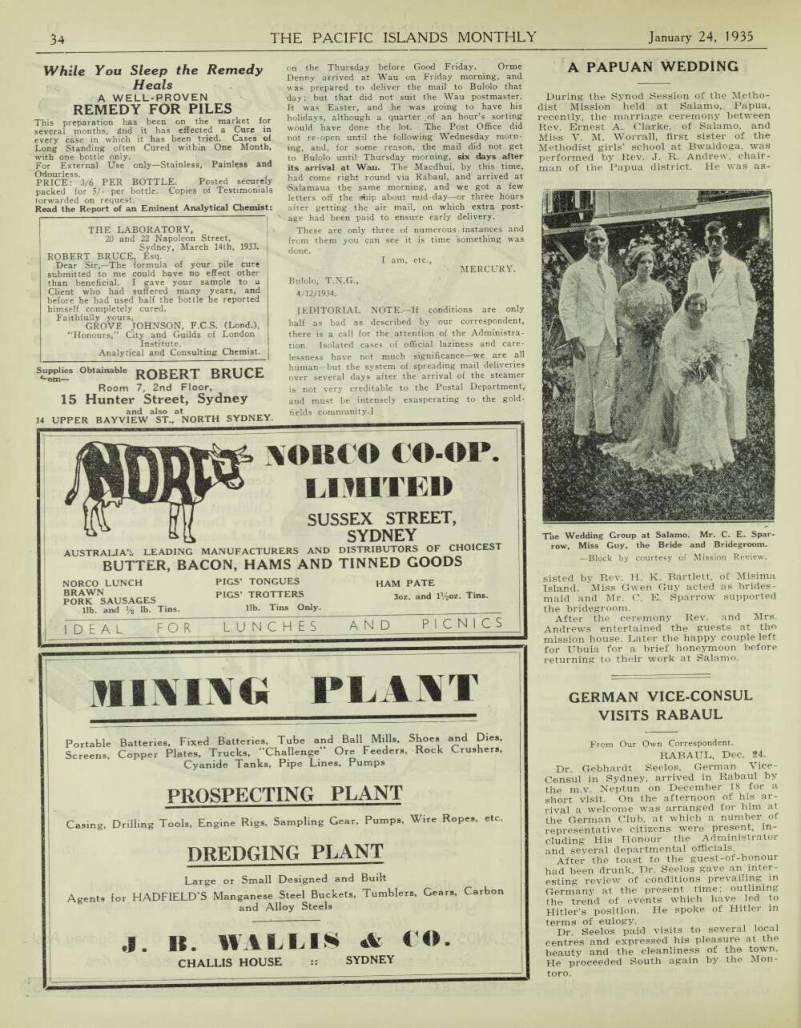
N.G. Goldfields’ Complaint Against P.O.
Letter to the Editor.
CAN I secure the good services of your paper to bring before the public the disgraceful way the mail service is conducted in the Morobe dis trict, particularly in regard to the delivery of the boat mail at Bulolo?
The Bulolo Gold Dredging management have provided a very efficient post office service at Bulolo, and I believe the mail contractors do the hest they can; but the forwarding of mail by the Government post office at Salamaua is beyond a joke. Letters come dribbling in for three and four days after the boat’s arrival, and, as for papers, it is sometimes a week before they are all in, and this in good flying weather.
I suppose the private mail sent from Bulolo is as great, if not greater, per head of population than anywhere in Australasia at least.
For the ordinary mail to the boat at Salamaua we are “blistered” ½d per letter, on top of the ordinary postage, and hundreds of pounds’ weight of mail goes out from Bulolo in a year. Taking the average letter at three-quarters of an ounce, a liberal weight, or, say, 21 letters to the pound, the Postal Department collects per pound in surcharges. Out of this they pay the mail con tractors less than 3d a pound, leaving a clear “rake off” of 7½d a pound to the department over and above the ordinary postage.
The above impost should warrant something extra in the way of service from the Salamaua Post Office; but, at the present, it would dis grace the poorest outback “allowance” Post Office in Australia.
I think it is high time some head office official from South came up here and investigated things, with the object of “strafing” those responsible for the muddle. In addition he could, perhaps, instil into the minds of some of the local officials that they are servants of the public, and that the public expects a little civility, if not always, at least occasionally. I might state, in passing, that the latter remark does not apply to the Postal Department alone.
If such a remote thing should come to pass, I would suggest that the investigating official travels, and pursues his investigations, incognito.
When enquiries are made at Salamaua as to the cause of the delay, the answer always is that the rush of mail, at boat time, is too great for the staff, and the paucity of mail between boats does not warrant increasing the staff.
This is all granted; but, considering the won derful “wicket” the Postal Department is on, here, with its “rake-off,” it surely should be possible to put on a casual hand for a day or two at boat time. There are plenty available.
I will cite three cases of typical, exasperating delays.
The last boat got in to Salamaua early on Sun day morning. To-day is Wednesday, and only about two-thirds of the mail is in so far, and it has been perfect flying weather.
Another case: For some unknown reason, a big lot of the Morobe district mail, on the last Mon toro, was taken off and left at Rabaul; and, if the Drina had not come across a few days later, it would have remained in Rabaul until the arrival of the Macdhui, two weeks later. As it was, mail was drifting in for about ten days.
The first case quoted is typical of nearly every boat; and occurrences similar to the second have happened at odd times.
The third case I am quoting happened 18 months ago, in connection with the air mail from Port Moresby, and concerns Wau Post Office, not Salamaua; but I am quoting it to show the typi cal attitude of most of the Government officials here. I will admit there are exceptions.
In those days there was very little mail by the Moresby route. The Macdhui arrived in Moresby
on the Thursday before Good Friday, Orme Denny arrived at Wau on Friday morning, and was prepared to deliver the mail to Bulolo that day; but that did not suit the Wau postmaster.
It was Easter, and he was going to have his holidays, although a quarter of an hour’s sorting would have done the lot. The Post Office did not re-open until the following Wednesday morn ing, and, for some reason, the mail did not get to Bulolo until Thursday morning, six days after its arrival at Wau. The Macdhui, by this time, had come right round via Rabaul, and arrived at Salamaua the same morning, and we got a few letters off the ship about mid-day—or three hours after getting the air mail, on which extra post age had been paid to ensure early delivery.
These are only three of numerous instances and from them you can see it is time something was done.
I am, etc.,
Mercury.
Bulolo, T.N.G., 4/12/1934. [EDITORIAL NOTE.—If conditions are only half as bad as described by our correspondent, there is a call for the attention of the Administra tion. Isolated cases of official laziness and care lessness have not much significance—we are all human—but the system of spreading mail deliveries over several days after the arrival of the steamer is not very creditable to the Postal Department, and must be intensely exasperating to the gold fields community.]
Advertisements & other items, pp. 35-36 (1 item)
perfectly.
TWL7O.
White Calf Derby Tie.
Block or Brown Silk Calf Trims.
Medium round foe.
Sports Cuban heels. pump soles . . . 10/6
Fostars guarantee to
save you money ... to
deliver all footwear
safely... and satisfy you
perfectly.
Fostars new Catalogue is the most complete Shoe Catalogue ever issued in Australia. Every possible type in footwear is to be found in it. Ladies Genuine Pumps from 7/11 to 39/6.
Mens Genuine Welts from 9/9 to 37/6.
Childrens and Sports Shoes Slippers Heavy Duty Work Boots etc., etc.— all at Factory prices which save up to 15/- per pair, as Fostars are manufacturers selling direct to you.
TWT 16.
White Glace Calf.
Sandal T Strap.
Medium round toe.
Junior spike heels.
Genuine pump soles, 12/9
CTO 116.
Tan or Dark Tan or Black Willow Calf or Block Patent.
Neatly stitched.
Genuine welted soles 12/- Buying your shoes by mail is simplicity itselP when you buy from Fostars COMPLETE Shoe Catalogue.
Write. For FREE Catalogue to "ISLANDS" Department, Fostars Shoes Ltd. Box 3959v. G.P.O. Sydney, Aust.
Storekeepers, traders etc. write For special terms.
While You Sleep the Remedy
Heals
A WELL-PROVEN
REMEDY FOR PILES
This preparation has been on the market for several months, and it has effected a Cure in every case in which it has been tried. Cases of Long Standing often Cured within One Month, with one bottle only.
For External Use only—Stainless, Painless and Odourless. .
PRICE: 3/6 PER BOTTLE. Posted securely packed for 5/- per bottle. Copies of Testimonials forwarded on request. - Read the Report of an Eminent Analytical Chemist:
THE LABORATORY,
20 and 22 Napoleon Street, Sydney, March 14th, 1933.
ROBERT BRUCE, Esq.
Dear Sir,—The formula of your pile cure submitted to me could have no effect other than beneficial. I gave your sample to a Client who had suffered many years, and before he had used half the bottle he reported himself completely cured.
Faithfully yours,
GROVE JOHNSON, F.C.S. (Lond.).
“Honours,” City and Guilds of London Institute.
Analytical and Consulting Chemist.
Supplies Obtainable from— ROBERT BRUCE Room 7, 2nd Floor,
15 Hunter Street, Sydney
and also at
14 UPPER BAYVIEW ST., NORTH SYDNEY.
NORCO CO-OP.
LIMITED
SUSSEX STREET,
SYDNEY
AUSTRALIAN LEADING MANUFACTURERS AND DISTRIBUTORS OF CHOICEST
BUTTER, BACON, HAMS AND TINNED GOODS
PIGS’ TONGUES HAM PATE
PIGS’ TROTTERS 3oz. and 1½oz. Tins, 1lb. Tins Only.
IDEAL for lunches and picnics
NORCO LUNCH
BRAWN
PORK SAUSAGES
1lb. and ½ lb. Tins.
MINING PLANT
Portable Batteries, Fixed Batteries, Tube and Ball Mills, Shoes and Dies, Screens, Copper Plates, Trucks, ‘‘Challenge” Ore Feeders, Rock Crushers.
Cyanide Tanks, Pipe Lines, Pumps
PROSPECTING PLANT
Casing, Drilling Tools, Engine Rigs, Sampling Gear, Pumps, Wire Ropes, etc.
DREDGING PLANT
Large or Small Designed and Built Agents for HADFIELD’S Manganese Steel Buckets, Tumblers, Gears, Carbon and Alloy Steels
J. B. WALLIS & CO.
CHALLIS HOUSE :: SYDNEY
A Papuan Wedding
During the Synod Session of the Metho dist Mission held at Salamo, Papua, recently, the marriage ceremony between Rev. Ernest A. Clarke, of Salamo, and Miss V. M. Worrall, first sister of the Methodist girls’ school at Bwaidoga, was performed by Rev. J. R. Andrew, chair man of the Papua district. He was as-
sisted by Rev. H. K. Bartlett, of Misima Island. Miss Gwen Guy acted as brides maid and Mr. C. E. Sparrow supported the bridegroom.
After the ceremony Rev. and Mrs.
Andrews entertained the guests at the mission house. Later the happy couple left for Ubuia for a brief honeymoon before returning to their work at Salamo.
The Wedding Group at Salamo. Mr. C. E. Spar row, Miss Guy, the Bride and Bridegroom. —Block by courtesy of Mission Review.
German Vice-Consul
Visits Rabaul
From Our Own Correspondent.
Rabaul, Dec. 24.
Dr. Gebhardt Seelos, German Vice- Consul in Sydney, arrived in Rabaul by the m.v. Neptun on December 18 for a short visit. On the afternoon of his ar rival a welcome was arranged for him at the German Club, at which a number of representative citizens were present, in cluding His Honour the Administrator and several departmental officials.
After the toast to the guest-of-honour had been drunk, Dr. Seelos gave an inter esting review of conditions prevailing in Germany at the present time; outlining the trend of events which have led to Hitler’s position. He spoke of Hitler in terms of eulogy.
Dr. Seelos paid visits to several local centres and expressed his pleasure at the beauty and the cleanliness of the town.
He proceeded South again by the Mon toro.
Advertisements & other items, pp. 37-38 (1 item)
Plume
OLD CARS
Every Car runs better on
for all-round performance
GILLESPIE’S
“ANCHOR ”
FLOCK
TRADE
MARK
The Standard of Quality.
Ever Since 1817
Back in the days when Australia’s trade was in its infancy, the Bank of New South Wales provided the pioneer merchants with all necessary banking facilities.
And throughout the past 117 years, the Bank has constantly extended its services to assist producers of all kinds and to finance the rapid expansion of home and foreign trade.
Through a network of over 720 branches the Bank provides every facility for financing internal and external trade. It maintains a highly efficient British and Foreign Exchange Department which advises customers on all exchange matters, including the buying and selling of forward exchange.
Bank of New South Wales
(Established 1817)
Cohabitation In Cook Islands
Letter to the Editor.
METHINKS “Fair-Play,” of Niue (21/9/34) shelters either an Administrative or Eccle siastical pate under his nom-de-plume. But, be that as it may, he certainly writes a lot of non sense. In support of my contention may I give that somewhat worn shuttlecock “cohabitation” just one more belt across the controversial net?
In the first place, let me state, quite definitely, that the anti-cohabitation laws of the Cook Islands are not unanimously supported by the natives. Far from it. If that is the case in Niue, then Niue is very different from the other islands of this Group, and I am sorry to think that the original Adam has been so completely exorcised there as to make such a statement accurate. Wasn’t it Bernard Shaw who said “Heaven for holiness, but Hell for Company”?
“Fair-Play” is perfectly correct when he exoner ates the New Zealand Government from the re sponsibility for making these laws. They are, as he states, purely Local Ordinances, and, indeed, in several of the Cook Islands have never been passed by the Native Councils, presumably because the principle they embodied was not popular with the inhabitants. Thus it would seem that despite “Elders clamouring for action” and “the desire of the people that immorality be kept under control,” there nevertheless was, and is, in the same group another and less sin-conscious section.
In his recurrent mention of “the Elders,” “Fair- Play” betrays the weakness of his argument. Now, I am willing to wager that the Elders of Niud are also deacons of the Church; and at what time and in what country have not the Elders always objected to the younger generation kicking up its heels in the green pastures? Let a secret ballot
be taken—including the vote of the younger gene ration—and then tell us about that unanimity of opinion. Frankly, I don’t believe it does, or ever did, exist in Niue or elsewhere.
But if “Fair-Play” really expects us to take him seriously on the subject of Polynesian morals prior to the advent of the Missionaries . . . well, well, well.
Let me remind him of the authentic reports written by missionaries covering the period to which he alludes.
In Ellis’s “Polynesian Researches,” as well as in the Official Journal of the L.M.S. kept aboard the Duff (1796-8) sufficient evidence of the famous —or infamous —Areoi society of Tahiti will be found to convince the most cloudy intelligence of the lascivious and light-hearted tempo of those days; and among the late Dr. Wyatt Gill’s papers is a record of the coming, in 1820, of Goodenough, the first white man to land on Rarotonga. This ac count goes on to say “trouble grew up with that ship, partly due to the Rarotongan people who incited the white men to take food, coconuts, pigs and women. The women were another cause of trouble on account of their desire for the white men, and the white men were also to blame be cause they followed after the women and carried them on board the ship.”
A secular observer, J. R. Forster (Observations made on a Voyage Round the World, 1778) writes of the Tahitiians that “the unreserved behaviour of their females invite them powerfully to the enjoyments and pleasures of love. They begin very early to abandon themselves to the most libidinous scenes.”
I do not know the early history of Niue, but if the Niueans were any different from their neigh bours they must have been the exception which is erroneously supposed to prove every rule.
Once and for all let it be known that the anti cohabitation enactment is a direct descendant of the old days, when the London Missionary Society virtually ruled these Islands and foisted on to the people, through the Native Councils, their own code of ethics. After the Annexation, cer tain of these laws were retained —at the request of the mission-prodded Councils—and in a number of cases were subsequently ratified by Local Or dinances. Since then a not unnatural dislike of publicity has prevented anyone from making the first move for their repeal.
The question of whether or not such a law is beneficial calls for a discussion too lengthy for this article. Administered sanely and with dis cretion, as it is in Rarotonga, one might almost be inclined to think so, were it not for the fact that the degree of sanity and. discretion must vary with each individual administrator; and one is always liable to find that position occupied by men as narrow and fanatically bigoted as those who drafted the original enactment.
Having a strong aversion for nom-de-plumes or other verbal camouflage when dealing with local topics, j am, etc.,
R. Julian Dashwood.
Rarotonga, 1/11/34.
Advertisements & other items, p. 38 (1 item)
Mrs. J. Ashton
Rothesay Educational Home
for Children
66 WARREN RD., MARRICKVILLE
Children given a refined home, and sent (the little ones under escort) to a good State School. Homework supervised. Tennis, Physical Culture. Excellent food.
Rothesay is situated in a refined high, healthy district. Special holiday arrangements for children from a long distance.
References exchanged.
Fees- £1/1/- per week, plus entrance fee of £3/3/-.
MRS. J. ASHTON
Teachers’ Training College Tel.: Pet. 2694
Evolution Of The
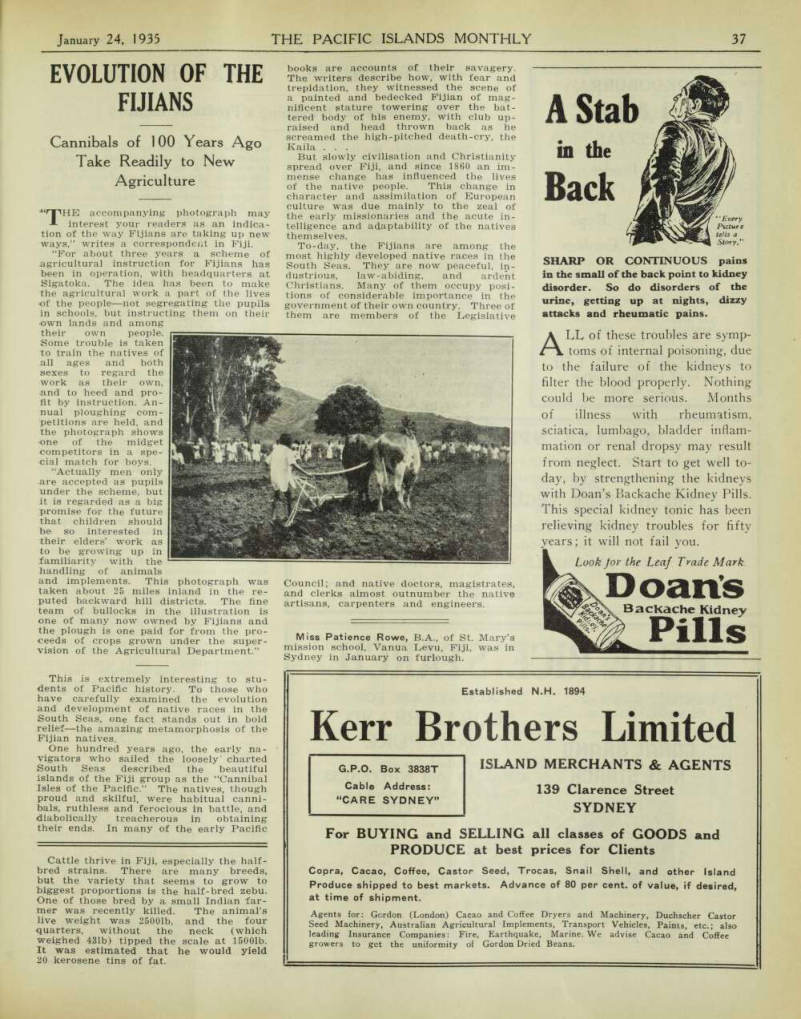
Fijians
Cannibals of 100 Years Ago Take Readily to New Agriculture
"THE accompanying photograph may interest your readers as an indica tion of the way Fijians are taking up new ways,” writes a correspondent in Fiji.
“For about three years a scheme of agricultural instruction for Fijians has been in operation, with headquarters at Sigatoka. The idea has been to make the agricultural work a part of the lives of the people—not segregating the pupils in schools, but instructing them on their own lands and among
their own people.
Some trouble is taken to train the natives of all ages and both sexes to regard the work as their own, to heed and pro fit by instruction. An nual ploughing com petitions are held, and the photograph shows one of the midget competitors in a spe cial match for boys.
“Actually men only are accepted as pupils under the scheme, but it is regarded as a big promise for the future that children should be so interested in their elders’ work as to be growing up in familiarity with the handling of animals
and implements. This photograph was taken about 25 miles inland in the re puted backward hill districts. The fine team of bullocks in the illustration is one of many now owned by Fijians and the plough is one paid for from the pro ceeds of crops grown under the super vision of the Agricultural Department.”
This is extremely interesting to stu dents of Pacific history. To those who have carefully examined the evolution and development of native races in the South Seas, one fact stands out in bold relief —the amazing metamorphosis of the Fijian natives.
One hundred years ago, the early na vigators who sailed the loosely charted South Seas described the beautiful islands of the Fiji group as the “Cannibal Isles of the Pacific.” The natives, though proud and skilful, were habitual canni bals, ruthless and ferocious in battle, and diabolically treacherous in obtaining their ends. In many of the early Pacific
books are accounts of their savagery.
The writers describe how, with fear and trepidation, they witnessed the scene of a painted and bedecked Fijian of mag nificent stature towering over the bat tered body of his enemy, with club up raised and head thrown back as he screamed the high-pitched death-cry, the Kaila . . .
But slowly civilisation and Christianity spread over Fiji, and since 1860 an im mense change has influenced the lives of the native people. This change in character and assimilation of European culture was due mainly to the zeal of the early missionaries and the acute in telligence and adaptability of the natives themselves.
To-day, the Fijians are among the most highly developed native races in the South Seas. They are now peaceful, in dustrious, law-abiding, and ardent Christians. Many of them occupy posi tions of considerable importance in the government of their own country. Three of them are members of the Legislative
Council; and native doctors, magistrates, and clerks almost outnumber the native artisans, carpenters and engineers.
Miss Patience Rowe, B.A., of St. Mary’s mission school, Vanua Levu, Fiji, was in Sydney in January on furlough.
Cattle thrive in Fiji, especially the half bred strains. There are many breeds, but the variety that seems to grow to biggest proportions is the half-bred zebu.
One of those bred by a small Indian far mer was recently killed. The animal’s live weight was 2500lb. and the four quarters, without the neck (which weighed 43lb) tipped the scale at 1500lb.
It was estimated that he would yield 20 kerosene tins of fat.
Advertisements & other items, pp. 39-40 (1 item)
Kerr Brothers Limited
A Stab
in the
Back
Picture
SHARP OR CONTINUOUS pains
in the small of the back point to kidney disorder. So do disorders of the urine, getting up at nights, dizzy attacks and rheumatic pains.
ALL of these troubles are symptoms of internal poisoning, due to the failure of the kidneys to filter the blood properly. Nothing could be more serious. Months of illness with rheumatism, sciatica, lumbago, bladder inflammation or renal dropsy may result from neglect. Start to get well to-
day, by strengthening the kidneys
with Doan’s Backache Kidney Pills.
This special kidney tonic has been
relieving kidney troubles for fifty
years; it will not fail you.
Look Joy the Leaf Trade Mark
Doan’s
Backache Kidney
Pills
Established N.H. 1894
Kerr Brothers Limited
For BUYING and SELLING all classes of GOODS and
PRODUCE at best prices for Clients
Copra, Cacao, Coffee, Castor Seed, Trocas, Snail Shell, and other Island Produce shipped to best markets. Advance of 80 per cent, of value, if desired, at time of shipment.
Agents for: Gordon (London) Cacao and Coffee Dryers and Machinery, Duchscher Castor Seed Machinery, Australian Agricultural Implements, Transport Vehicles, Paints, etc.; also leading Insurance Companies: Fire, Earthquake, Marine. We advise Cacao and Coffee growers to get the uniformity of Gordon Dried Beans.
G.P.O. Box 3838 T
Cable Address:
“CARE SYDNEY"
ISLAND MERCHANTS & AGENTS
139 Clarence Street
SYDNEY
“KOOKOOBURRA”
RELIANCE
and SPECIAL
Binder Twines Rope Cordage Shop Twines Sash Cords, Halters, Plow Reins, Jute and Hemp Seaming Twines The largest Rope and Cordage Manufacturers in Australia Head Office;
A. Forsyth & Go. Ltd.
339 KENT STREET, SYDNEY
’Phone B 3302
WE ARE SPECIALISTS!
Let us have your confidence, sixty years is our record of supplying the Leading Houses throughout the World in—
FRESH FRUIT VEGETABLES PRODUCE
WEYMARK & SON LTD.,
Fruit and Produce Merchants
14-18 STEAMMILL STREET, SYDNEY
Phone: MA 3612 (4 lines) Cable Address: "Weymarkson' Codes Bentleys.
Private.
PURE RICE STARCH
ALWAYS ASK FOR
“CORAL BRAND”
100% PURE
Noted for its
QUALITY and WHITENESS
Goes FARTHEST and gives
LASTING FINISH
Will not stick to iron.
CORAL BRAND
may be obtained from Leading Island Stores Manufactured by
CORAL STARCH LTD.
Sydney, N.S.W.
New Guinea Cocoa-Beans
Possibilities of Developing a Profitable Industry
THE “Pacific Islands Monthly” recently associated itself with a movement, now afoot in Sydney, to develop a mar ket in Australia for cocoa-beans grown in New Guinea.
The consumption of cocoa-beans in Australia is large and growing (6000 tons per annum) and is sufficient to absorb all the beans grown in the South Sea Islands.
The principal sources from which Aus tralia imports cocoa-beans at present are West Africa, West Indies, and, to a limited extent, Western Samoa.
For some time, under the double stimu lus of a collapsed copra market and an Australian bounty of £10 per ton, New Guinea planters have been producing cocoa-beans and sending them to Sydney for marketing; and the quantity thus produced is increasing. The Australian agents to whom the New Guinea beans have been sent have been meeting with serious difficulties, however.
There was first of all an indifference towards the New Guinea product, amount ing in some cases to absolute hostility,
manifested by most of the confectionery manufacturers in Sydney and Melbourne.
It was not a question of quality—these big firms, having fixed contracts and re gular sources of supply, did not wish to be bothered with small consignments from the Islands.
Another difficulty was the deplorably bad condition of the New Guinea pro duct. Generally speaking, the New Guinea producers appear to know little about the proper preparation of the cocoa-bean for marketing. The washing and cleaning of the beans are badly car ried out, and they are bagged with a large proportion of pith still adhering.
The Australian buyers promptly deduct a certain proportion of the weight, to make up for this pith. Furthermore, the appearance of the beans is not attrac tive; and the fermentation that has been carried out is, in most cases, most defec tive.
In spite of these manifest disabilities, cocoa-beans from New Guinea have been bringing up to £26 per ton in Sydney; and, with the Commonwealth bounty of £10 per ton, the N.G. planters have found this product profitable. It should be noted, however, that good quality cocoa beans from Samoa are worth over £30 per ton (sterling), while the best quality beans (the Arriba variety from Ecuador) are worth £50 per ton sterling.
The Sydney price quoted for N.G. beans is by no means to be depended on— buyers have been bitterly disappointed with the quality. It is clear from every point of view that the New Guinea Ad ministration must do something to im prove the quality of the beans—not only to obtain a market, but also to obtain the very profitable price that is available.
The editor of the “Pacific Islands Monthly” wrote personally to a number of confectionery-manufacturing firms in Australia and asked them what was their attitude towards New Guinea cocoa-beans, and he particularly mentioned the report that certain firms would not consider the N.G. product under any condition, and suggested that if that attitude were maintained, it was inevitable that the Commonwealth Government, in order to assist the New Guinea planters, would place a duty upon cocoa-beans imported from other countries. All the confec tionery manufacturers replied promptly and courteously, and the following are some extracts from their letters: Messrs. MacRobertson Pty. Ltd., Melbourne: “Occasionally we have been offered parcels of New Guinea beans in the ordinary course of business, and at times have bought small parcels for test ing purposes, but found they were dis appointing in quality and grading. In fact, we went to some trouble to make suggestions for the better presentation of supplies, and submitted samples as to grading. As only limited parcels could be offered, we lacked interest in them, as we cannot be continually changing our blend. We have certain standards which must be maintained from year to year, therefore the necessity for adequate sup plies of any variety of cocoa-bean we use.
We have always given the authorities every assistance possible, but, judging from sample submitted, little notice ap peared to have been taken of our sug gestions. While quality, grading, and
price are main factors in our considera tion, the governing factor is that of con tinuous adequate supplies.”
Messrs. Griffiths Sweets Pty. Ltd., Mel bourne: In a lengthy and helpful letter this firm denies that it is hostile to Pacific Islands cocoa-beans, and says it has pur chased large quantities of same, and at that moment it had on hand substantial stocks of Samoan beans. New Guinea planters do not give sufficient attention to fermentation and no two shipments of N.G. beans are alike. There was a fatal absence of standardization in fer mentation, which is most important. Far too many small parcels of New Guinea beans are offered which are badly under fermented, in some cases, and over-fer mented in others. This was the trouble with Samoan beans 10 years ago, but it has been overcome. Another difficulty is continuity of supplies—“we would rather have the New Guinea product offered in 5 to 10 ton parcels of a standard fermentation, than have 6 to 10 bags dribbled through at a time, which is the present method of marketing.” This firm adds that the storage of New Guinea beans in some cases has left the bean open to dampness, causing mouldiness, which is fatal. Again, in the fermenta tion process, some N.G. beans showed an excess of pith adhering to the outside skins, proving inefficient fermentation.
This latter in turn produces what is known as a “cheesy” flavour in chocolate, and is most objectionable. This firm con cludes by saying that it is always pre pared to examine sympathetically samples of New Guinea beans, and to give advice to those who are seeking to promote the industry, and is also prepared to pur chase any New Guinea beans which are equal to the Samoan product.
Other firms communicated with have not been quite so helpful—although they strongly resent the suggestion that they are hostile to the New Guinea cocoa in dustry.
The investigations made by the “Pacific Islands Monthly” appear to indicate very clearly that there is a large and profitable market for New Guinea cocoa-beans in Australia; but it is essential that the Australian manufacturers be given, first, a reasonable guarantee of good quality and, secondly, a reasonable assurance of continuity of supplies.
Norfolk Is. Annual Report
THE economic position of Norfolk Is. is serious, and is becoming worse, according to the annual report for 1933-34 submitted to the Commonwealth Govern ment in December by the Administrator (Capt. C. R. Pinney).
Exports to Australia decreased from £18,795 in 1932-33 to £15,714 in 1933-34.
Due mainly to the New Zealand Govern ment’s embargo on N.I. vegetables and fruit, exports to N.Z. fell from £2943 to £105. Total exports were £15,893 as against £21,792 for 1932-33. Imports diminished from £30,821 to £28,660.
Two members of the band of Pitcair ners who landed from Pitcairn Is. on June 8, 1856—Cornelius Quintal (94), and Rachel Taylor (84)— died at Norfolk Is. during the year. The remaining survivors are now Mr. George Christian (81), and Mrs. Marianne Buffett (78).
Major G. D. Ross, chief passenger clerk in the Sydney office of the Union Steam Ship Co,, of N. Zealand, retired in December, after 49 years’ service with the company.
Freights In Papua
Letter to the Editor.
THE patriotic protest made by Australian ship ping firms (P.I.M., November) against the successful competition of the N.D.L. Co. loses weight in face of the conditions which obtain when competition is removed.
Papua suffers from a shipping monopoly. And although it is possible to ship copra direct to Europe, consignments so shipped can only be carried in vessels chartered by the monopolists.
As a result, a rate of 105/- per ton is charged for freight, and a large proportion of the exchange increment is retained by the shipping firm. In addition, coastal freights, which are also largely controlled by the same firm, range from £1 to £4 per ton.
During the worst period of the slump the more fortunate producers in Papua were receiving 30/a ton to cover the cost of bags, production, and overheads; while those in more remote localities found the whole of the proceeds absorbed by coastal and overseas freights.
The shipping companies also plead for immunity from competition on the ground that foreign ship ping introduces foreign merchandise to compete with Australian products. In this connection it is interesting to note that one of the signatories to the appeal owns stores in Port Moresby, at which are offered for sale Japanese clothing, shoes, silks and sundries; American cars, foodstuffs, and toilet articles; tinned meats from Argentina, and steel goods from Germany.
I am etc.,
Copra Bug.
Pt. Moresby, 6/12/1934.
Advertisements & other items, pp. 41-42 (1 item)
Gold
TIMBER, JOINERY,
Etc.
PREPARED BUILDINGS
ready for erection a speciality.
SHIP and BOAT BUILDING
TIMBERS specially catered for
FIBROLITE, PLYWOODS,
GALVANISED IRON.
CELOTEX.
CONSIGNMENTS shipped by
RETURN STEAMERS to the
Islands.
JOHN W. EATON LTD.,
WEST CRESCENT ST.,
NORTH SYDNEY
TELEPHONES: X 5051 (5 lines)
AUSTRALIA’S CLEARING HOUSE FOR THE PRECIOUS METALS.
BUYERS OF
GOLD
OSMIRIDIUM, PLATINUM, SILVER, &c.
GARRETT & DAVIDSON, LTD.
ASSAYERS, BULLION MERCHANTS, METALLURGISTS,
Bank of N.S.W. Buildings, Regent Street, Sydney
Is RUST Destroying Your Property ?
Of all the theories advanced as to why incipient rust grows and ultimately destroys paint, as well as the underlying metal, the Electrolytical theory is the most logical.
KILLRUST Metal Paints contain active constituents which definitely kill the growth of rust by neutralising the electrolytic action. It is, therefore, impossible for rust to grow under a properly applied coating of KILLRUST.
1. KILLRUST METAL
PAINT Elastic Finish (Black) is a penetrating and quick drying paint for protecting surfaces which come in contact with water and for general inside work. It is also used for descaling badly rusted iron. (See instructions.)
2. KILLRUST ROOF
PAINT (Red). For rusted iron roofs and general structural painting.
KILLRUST Resists Salts, Alkalies, Acids Factory Distributors:
3. KILLRUST METAL
FLUID is a colourless solutiort for neutralising - the growth of rust When ordinary coloured paints or lacquers are to be applied.
It is used extensively on motor bodies, petrol storage tanks, etc.
4. SUPER
COAT (Black) is a powerful heavily-bodied paint, which can be used on surfaces exposed to the hottest tropical sun, and will also stand up to constant immersion in water.
Write for Descriptive Leaflets
METAL PRESERVATION CO. of N.S.W.
58 MARGARET STREET, SYDNEY, N.S.W.
G.P.O. BOX 571 FF
So-called
“Simple” Remedies
are useless
in Tropic
Skin Infection
Half measures are valueless when it comes to dealing with Dhobie Itch, Toe Rot, Ringworm of the Nail, etc. Skin specialists regard these diseases as being amongst the most difficult skin complaints to treat successfully; a few years ago they were considered incurable. Recent laboratory tests, however, prove that Antinea Antiseptic Lotion, a combination of powerful germicidal oils, affords a highly successful treatment for Tropic Ringworm in all its forms. It is the one positive treatment; powerful enough to completely destroy the germs, yet harmless to the most tender skin.
Treatment with Antinea is simple. First wash the affected area and dry thoroughly.
Then paint Antinea on the skin, allowing it to dry on. Repeat this treatment every night and morning; within a short time every germ will be destroyed and the skin freed from infection.
“Singapore Foot”
completely cured
with ANTINEA
An Island resident writes: “I have been suffering from Singapore Foot for the past 10 years. I think I have tried everything under the sun to cure this terrible disease vnthout success until I was advised to try Antinea. I am now completely cured by using less than one bottle, and tender my thanks at being relieved from so distressing a malady.”
Antinea is obtainable at all branches of Burns Philp and Co., Ltd.; Morris Hedstrom and Co., Ltd. (Suva); A. J. Swann and Co., Ltd. (Suva); Brown and Joske (Suva); Michelmore and Co. (Suva); W. R. Carpenter and Co., Ltd.
ATIAEA
ANTISEPTIC LOTION
Small Size,
2/6
Triple Quantity,
5/6
COMMONWEALTH & DOMINION AGENCIES
LTD., 168 Day Street, Sydney, N.S.W. 4-94.
Prince Henry In Polynesia
To Be Entertained By Ancient Ceremonies Of Fiji
THE Duke of Gloucester is scheduled to arrive in Fiji by H.M.A.S. Australia on February 1, and elaborate preparations have been made to give him a loyal and warm welcome by the three races— Europeans, Fijians, and Indians—who dwell in Britain’s remotest colony.
Neither expense nor trouble has been spared to enable the distinguished visitor to see the picturesque and historic cus toms and ceremonies, and to observe the native people in their natural setting, at work and play.
As the Duke steps ashore on Suva wharf he will be received by the Governor (Sir M. Fletcher, K.C.M.G., C.B.E.) and the Mayor of Suva (Hon. T. W. A. Bar ker). A guard of honour, comprised of Europeans and Indians in Khaki, and Fijian volunteers resplendent in white sulus and scarlet tunics, standing stiffly beside muscular Fijians from the Con stabulary in neat blue uniforms, will then be inspected. The guard, un der Drill Instructor Sergeant Major Verona, of the Scots Guards, has been diligently rehearsing for some weeks and the Prince, himself a keen sol dier, will be treated to a display of mili tary precision equal to the world’s best.
Following the parade, a Civic Reception will be held at the Town Hall, and later, in the afternoon, the Duke will be greeted by Fijian chiefs at Albert Park,, where he will witness the traditional rite of the presentation of whale’s teeth. After examining the teeth he will hand them to a chief, who will announce in Fijian that the Duke has accepted them.
Then will follow what is probably the best-known ceremony throughout the South Seas —that of Kava (or Yaqona) drinking. Made from the pulverised roots of a shrub (Piper Methysticum) to which fresh water has been added, Kava re
sembles a soapy liquid in appearance and has a most peculiar flavour.
When the fluid has been mixed and strained the native cup-bearer will ad vance in a dancing manner and present Prince Henry with half a coconut shell, Ailed with Kava. As he raises the bowl to drink the liquid—Fijian custom and etiquette has it that the ceremonial cup must be drained to the last drop—the assembled natives will chant, softly at first, then gradually louder until, as the Duke flings his cup in front of him with a spinning motion, the natives now chanting frenziedly will cry “Maca” (It is dry!).
The plaited coconut fibre which has been stretched in front of His Highness during the ceremony will then be coiled up, signifying that the ceremony is now completed. Then the Duke will hear speeches of welcome from the Indian community and the Fijians.
The following day the ancient capital of Bau, where lived the paramount chiefs, will be visited. In the old days King Thakombau, the great war-lord, was com mander of 3,000 warriors who inhabited Bau and, with his large fleet of canoes, he ruled over the Fiji archipelago. But the glory that was Bau’s has now de parted, and the town has fallen into decay.
His excursion to Bau will be a busy and memorable day for H.R.H. Early in the morning, as the sun is making the blue waters sparkle, the Royal visitor will sail from Bau in the canoe of Ratu Popi, Paramount Chief of Fiji and Native Lieutenant-Governor of the Province, to the fishing grounds, where he will see brawny Fijians wielding their two handed fish spears with the skill and judgment that have made them famous.
The fishing expedition over, the party
will return to Bau for lunch —a sumptu ous feast of yams, fish and oysters, cooked and served in Fijian style.
The afternoon will be devoted to a grand display of mekes, when dancers in white tapa cloth will perform the Ua ni loko loko. This famous dance is a real istic imitation of the long blue rollers crashing on a coral reef. The performers in small parties bend and twist them selves in weird contortions, flinging out their arms and intermingling with each other to resemble the waves dipping over a coral reef and sliding into the unruffled waters of a green lagoon. During the dance the chorus chants in deep, boom ing tones to the rhythmic beating of the ancient lalis.
Next will come a meke representing a tribal battle. Advancing from three dif ferent directions, parties of Fijians armed with spears, wooden clubs and prodigious fans will come together in mock battle, stamping upon the ground and wheeling in unison to the thumping beat of the drums, and the chant of stirring war-songs swelling in the back ground.
The Duke’s third day will be spent on Beqa (Mbenga), the island where live the mysterious fire-walkers. Their se cret has been preserved so closely that although there are some 100,000 natives in the Group, the inhabitants of little Beqa are the only tribe to practise this strange ceremony of walking on stones baked to a white heat. Accompanied by the Governor Prince Henry will sail there in the Government yacht Pioneer to witness the rite known as Vilavilairevo (the fire dance).
Many and interesting are the legends that have been handed down throughout the ages to account for the Beqa natives’ secret art. The story generally accepted by the Fijians is that a young chief named Galita, while searching for an eel, caught a human dwarf, who told him the secret. In response to the dwarf’s pleas Galita released him on condition that he should give him the power of being im mune to heat.
The dwarf constructed a lovo (open oven) in the ground and built a log fire.
When the stones became red-hot the
little man took Galita by the hand and they stepped on to the fiery stones. Ga lita enjoyed this experience so much, so the legend goes, that he lay down and baked himself for several days without harm. Finally the chief initiated other members of his tribe into the mystery, and ever since the secret power has been jealously guarded by the tribe.
The ceremony of fire-walking per formed in its natural setting is a spec tacle of weird attractiveness. In a clear ing in the middle of the Beqa tropical forest a pit about 4ft. deep and 15ft. wide is dug and then filled with large stones which are covered with logs. For many hours the fire burns until the stones be come white-hot. Then the remains of the logs are hauled away and the stones levelled.
Suddenly with loud screams the Beqa natives, dressed in ceremonial attire, rush from the forest and, gesticulating as they run, shout their tribal war-cry. Reach ing the side of the pit they follow their leader as he steps on the heated stones and slowly makes his way around the circle of the pit. Some remain standing on the stones for several minutes, while others squat down without any apparent uneasiness. As they leave the pit it is covered with branches, and a winding column of steam and smoke arises to be token the fact that the ceremony has ended.
Advertisements & other items, p. 42 (1 item)
Ransomes
Specially Designed for
SUGAR CANE GROWERS
PLOUGHS and IMPLEMENTS
A complete range to meet all requirements.
Made by
RANSOMES, SIMS & JEFFERIES
LTD.,
Ipswich, England.
Illustrated literature and all information from: Morris, Hedstrom Ltd.
Suva, Lautoka, and Ba
Two Days in Samoa
From Our Own Correspondent.
Apia, Dec. 29.
THE Administration has announced that the Duke of Gloucester will ar rive in Apia early in the morning hours of February 6, and depart in the evening of the following day, February 7. The Duke has intimated that, after his stren uous tour in Australia and New Zealand, the functions in Samoa should be cur tailed as much as possible, and that pro vision should be made to enable him to make excursions inland on horseback.
The forenoon of the first day will be
(Continued on page 43)
occupied by official calls, and the presen tation of the citizens’ address at the Apia Clock Tower. In the evening an official dinner will be given at Vailima, the Ad ministrator’s residence, formerly the home of Robert Louis Stevenson.
The Royal visitor will make a trip along the coast the following morning to see the scenic beauty and native life of Samoa.
In the afternoon a native feast of honour (ta’alolo ) with the celebrated King’s kava ceremony, will be held at Mulinu’u.
At a representative meeting held re cently, a strong citizens’ committee was entrusted with the task of drawing up a tentative programme for the entertain ment of the officers and crew of H.M.A.S.
Australia—the first Australian warship to visit Samoa for 20 years. Amongst the functions planned are a citizens’ ball at the Tifaga Playhouse, a football match and a dance for the crew of the visiting warship. The beach is to be decorated and illuminated very elaborately during the Duke’s stay.
Advertisements & other items, pp. 43-44 (1 item)
Holbrook
The House of
In the old world village of Stourport, Worcestershire, England, just at the point where the River Stour empties itself into the Severn, the House of Holbrook was founded 135 years ago.
In 1919 a factory was established in Sydney, N.S.W., to supply the requirements of Australia, New Zealand and the Pacific Islands. Here are manufactured a wide variety of table delicacies, as well as Holbrook’s Sauces and Pure Malt Vinegar, for which the House of Holbrook has been famous throughout the world for many generations.
There is Essence of Anchovy for fish. Tomato Sauce, made from fresh, ripe tomatoes; French and Italian Olive Oil, with a delicate, creamy taste—so nice with the salad and of such nutritious value for invalids, French Capers, Olives, in many varieties, from Spain; tiny sweet Gherkins and little White Onions, Fish and Meat Pastes, Flavouring Essences and endless other delicacies.
Holbrooks’ Baked Beans, with Pork and Tomato Sauce; tinned Spaghetti and Soups are also tasty and delicious.
Holbrooks (A/sia.)
Ltd.
WATERLOO, N.S.W.
LINK-BELT CO. LTD.
17 GOULBURN STREET, SYDNEY
Modern Machinery Equipment for Elevating, Conveying and Mechanical Handling of Material.
Sole Agents in Australia for Ewart Chain Belting in Malleable or Steel.
Specialists in Power Transmission Machinery.
Large Stocks always kept of Steel Shafting, Cast Iron, Steel, or Wood Split Pulleys.
Plummer Blocks, Collars, Couplings, Leather Belting, Hangar Bearings.
Lubricators, Engineers’ Wrenches.
MANUFACTURING ENGINEERS
The Book of the Anzac Memorial
Reproduced fron. an actual photograph of the De Luxe Edition. Full Morocco cover, blocked in gold.
Produced by the Limbless Soldiers' Association of N.S.W. by permission of the Anzac Memorial Trustees and protected by Act of Parliament.
This magnificent book devotes a considerable section to concise accounts of the work of the A.I.F. (Dr. C. E. W. Bean) —to the conception and idea of the War Memorial —to a gloriously illustrated description of the Memorial itself and to an inspiring article by Right Hon. W. M. Hughes, "Australia Wins Her Nationhood", and a series of appendices detailing the New South Wales Units engaged in all theatres of War.
If you have Soldier-memories to
cherish, you will want this great book In cases where this book is desired as a memorial to some soldier who gave his life for the Empire, a certified replica of his Scroll of Service will be affixed to the book on request Alternatively, a certified copy of a soldier's discharge certificate vv.ll be affixed to the book on request.
Lavishly Illustrated . . .
The book contains many unpublished, original A.I.F. photographs, and the interior and exterior of the War Memorial are profusely illustrated.
The many reproductions of the individual cast granite figures, and of the Bas Reliefs, are unique.
The Full Colour Frontispiece takes the form of an original painting by C. W. Bostock, showing the War Memorial and the pool of reflection in the light of early morning.
De Luxe Edition, limited to
530 numbered copies - 52/6
So many requests tor reservations have been received that less than 400 copies are now available, so that early ordering is imperative.
In addition to being a permanent and wonderfullyillustrated record of the Anzac Memorial itself, the book, under the able editorship of Mr. S Elliott Napier (President of the N.S.W. Institute of Journalists), contains a concise history of Australia's part in, and immediately after, the Great War. All of this material is hitherto unpublished, and only obtainable in the Anzac Memorial Publications.
This unique publication is a handsome specimen of the printer's and bookbinder's craft, of some 96 pages, 11" x 9", on paper specially made for this publication, and finely bound in full morocco or special cloth.
SEND THIS ORDER FORM TO-DAY
Standard Edition
21/.
Similar to the De Luxe edition, except tor the binding which is in special quarter-bound cloth board.
Less than 2.000 copies of this type are available.
O. Beyers, Honorary Director,
ANZAC MEMORIAL OFFICIAL PUBLICATIONS
Wingello House, Angel Place, Sydney.
Enclosed is cheque for £ - . Send me the De Luxe/Standard edition of "The Book of the Anzac Memorial".
Name Postal Address
THIS SPACE HAS BEEN DONATED BY
PACIFIC PUBLICATIONS LIMITED
A Leap From The Stone
Age
THE missionaries who first went to New Guinea, that great island to the north of Australia, found a race of people who were 10,000 years behind the times. Yet in 50 years many members of this race have jumped across the gap of time into 20th century civilisation.”
This statement was made by the Rev.
J. D. Bodger, who has charge of a mis sion station in Papua for the Australian Board of Missions, in a recent address in Melbourne.
“The Papuan on the mission station or the Government outpost,” he said, “rides in a motor-car, a motor-lorry, or a motor launch. He takes his water supply in the house from a tap instead of from a coco nut gourd. His wooden stick has been replaced by a plough drawn by a motor tractor. He often uses axes and knives of steel instead of the axes and adzes of the stone age. He is learning biology, anatomy, and surgery, and to build with cement and similar material instead of with grass and leaves.”
Mr. Bodger went on to say that, in stead of sitting and talking by the light of a fire, the Papuan switched on the electric light and read books printed in English as well as his native language.
He often fished at night with the aid of an electric torch instead of the primitive rush light. Instead of fighting and head hunting he now played cricket and football.
These great changes, he declared, had been brought about by the co-operation of the missionary, the Government and the trader.
Samoa
Fatal Accident In American Samoa
From Our Own Correspondent.
Apia, Dec. 4
AT the recent jubilee celebrations in American Samoa in honour of Rev.
Father Goupellaud, who had completed 25 years’ residence as a Catholic priest in Western and Eastern Samoa, the arrival of His Lordship Bishop Darnand from Apia was signalled by a salute fired from an old ship’s cannon at Leone, Tutuila Island. The native catechists had ob tained the necessary powder from the Governor, who personally attended the ceremony with the officers of the naval station. When firing the charge the muzzle of the gun was blown off and its fragments hit some children playing a hundred yards away.
One child was killed instantly. Two others were wounded, of whom one died in Pago Pago hospital the following day.
An inquiry into the cause of the accident is being conducted by the authorities.
Advertisements & other items, pp. 45-46 (2 items)
Excelsior Supply Co. Ltd.
Delicia
Food Products
PURE MALT VINEGAR
TOMATO SAUCE
JELLY CRYSTALS
PURE FLAVOURING
ESSENCE
CHUTNEY
BAKED BEANS with Pork, in Tomato Sauce SPAGHETTI in Tomato Sauce
Delicia Food Products
Co.
DANKS STREET, WATERLOO,
N.S.W.
EXCELSIOR SUPPLY CO. LTD.
The meet extensive Manufacturers In the British Empire of
RUBBER STAMPS,
INKS, STENCILS.
Marking Devices.
ACME STAMP PADS
We have a big range of Special
FRUIT CASE MARKING SETS
We also Manufacture or Supply a complete line of
Spraying Machines
for all purposes.
Let us know your requirements and we will quote you by return. Ask for our Big Catalogue.
Sele Australasian Distributors of the World Famous SHEAFFER FOUNTAIN
PENS and PENCILS.
EXCELSIOR SUPPLY CO. LTD.
Head Office:—160 GEORGE STREET WEST.
SYDNEY. N.S.W.
Uka Ant Euchres Ants, so
WHY SHARE YOUR FOOD WITH
ANTS
WATER OR AT-
TENTION
Success since 1923 Get a Set and you’re Set Obtainable at B.P. W.R.C. or other Island Stores Manufactured by Uka Ant Co. 11 Gelding Street, Dulwich Hill, Sydney This little device, placed under safe or table legs, will positively keep ants out
WITHOUT
CAPSTAN
CIGARETTES
CORK-TIPPED
OR. PLAIN
NAVY CUT TOBACCO
Weak Men Made Strong!
MEN who have LOST YOUTHFUL POWERS: whose brains are dulled; whose energy and VITALITY is weakened; whose memory is bad
SEND FOR
Alfaline Vitality Pills Botles 6/-
(Send for Circular on Pills and Lost Vitality Treatment) BLOOD, SKIN, NERVE, BLADDER, KIDNEY, AND LIVER COMPLAINTS,
RHEUMATISM, NEURITIS, ASTHMA, SUCCESSFULLY TREATED BY
POST. (MEDICINES POSTED UNDER PLAIN COVER.)
ALL TOILET AND RUBBER GOODS STOCKED
(Send for Price List).
HERR RASMUSSEN (Danish Herbalist)
541 GEORGE ST., SYDNEY. N.S.W.
Interstate Teachers’ Agency
Teachers of all grades, Governesses, Tutors, Book-keepers, Matrons, etc.
27 Swanston Street, Melbourne Established 21 years Has supplied members of the teaching staff to nearly all the leading church and private colleges throughout Australasia. Lists of teachers on application.
Papuan Memories
SOME interesting memories of earlier days in Papua are contained in a letter from London, from Mr. J. E. Nixon- Westwood: “You certainly have given the lone Islanders something to help them pass the time, and you have done a lot for we ex-islanders, who, by having your maga zine regularly, can read of what our friends are doing. Once in a while we notice the death of an identity, and all sorts of memories come back.
“In the October issue, you have notice of Mrs. Inman’s demise, and as I knew the Grand Old Lady for the last 27 years, I feel that, one by one, these real pioneers
of the Commonwealth’s possessions are passing away.
“Mrs. Inman’s son Jimmy is well known, and has done a lot of good work in the Eastern Division of British New Guinea. Years ago, when he was O/C, the ‘Albert MacLaren,’ I made a trip with him to Tuft. My memory of that trip is still vivid, and also the absolute control Jimmy had over the crew, without any sign of ostentation or authority. His word was law, and, although on the boat, one could feel the comradeship which, existed between the crew and the Tau bada. One could also feel that the whole authority was vested in Jimmy.
“His greatest speech seemed to be around 5.30 a.m., when he lazily awoke, and called out ‘Albert, Albert —make some coffee.’ Then, a few minutes later, he would finish the sentence with ‘make some stew and put an onion in it.’ That was the alpha and omega of Jimmy’s early morning speech!
“The Inman family certainly have in scribed an indelible page on the history of British New Guinea. Also, Mrs. Wis dell (later Mrs. Leslie). How many of the Lakekamu miners, as well as the earlier men on Misima and Woodlark, will always remember her in terms of endearment. Also, the Clunns, now no longer interested in the welfare or grub staking of the brave men of long ago.
“In those days, we did not have air planes, neither did we have powered boats; and the journeys took days as against hours. But the spirit was there, and, with reverence, we raise our caps to Matt Crowe, Billy Ivory, and a host of others now gone over that borderline from which there is no returning. Of those who are living, we have Frank Pryke, Leslie Joubert, Joe Sloan, Gus Nelsson and a number of others who are still hardy enough to face the difficulties of that great land.
“Good luck to the P.I.M., and I trust you will be able to continue the great work you have started, and keep the folk in the real outposts of the Empire sup plied with the class of news you so ably edit.”
Where To Send Your Son
A difficult problem confronting parents in the Islands is that of providing children with ade quate and suitable education. In most Island centres there are schools for white children which educate pupils only to a certain standard, fore, the need for sending Islands children to Australia for secondary education is apparent.
The Wesley College, Melbourne, is particularly suited for students who find it necessary to board at their school, as in the case of Islands pupils.
This large and well-conducted college was established in 1866. Last year it was completely rebuilt and now embodies all the latest improvments and facilities for modern education. The boarding establishment, separate from the main class room block, is tastefully furnished and well-equipped. The school maintains its own hospital. There is a junior school for boys from 6 to 11 years of age. Swimming pool, large playing fields, gymnasium, and facilities for rowing are all designed to assist in the physical webfare of boarders. Details may be obtained by writing to the Headmaster, Wesley College, Mel bourne.
Advertisements & other items, p. 46 (1 item)
New Britain Express Delivery.
general overseas agents.
PFNERAL CARRIERS. BAGGAGE AGENTS,
GEN FORWARDING AGENTS.
royal mail contractors
Reliable Cars and Trucks.
We aim to give quick Mid reliable Service at reasonable costs. P.O. Box 116. telephone 141.
W. WALKER-FLYNN, Proprietor.
Malaguna Road, Rabaul, T.N.G.
Tung Tree
Pacific Varieties Of
“Candlenut” and Its Relations
From a Special Correspondent in Samoa.
THERE are to be found growing in the rich humus soils of many of the larger or volcanic islands of the South Seas, several indigenous varieties of what is called the Tung Oil tree. They are better known as Candle-Nuts by the whites, and as “Lama” by the Poly nesians. These trees bear huge annual crops of Tung nuts, rich in oil— some authorities quote the oil content as 60 per cent.
The whites, as a rule, do not know much about this useful tree, but the Islands natives use the “Lama” for their tattooing; for siapo, or tapa-making; for torches; and the extracted oil for various purposes. In flavour, the Tung nuts are quite agreeable; but in action, strongly purging.
The sturdy varieties of Aleurites, such as A. Triloba, A. Trisperma, reach the size of forest trees. These have many names, such as Candle Nuts, Ban-Kul, and Balucanag nuts. The range is from the Pacific to Hong-Kong, where the writer once observed Chinese cracking the Tung nuts singly, on a stone, in order to crush them for the oil. This is the Pacific Islands modus operandi for Tung nuts.
The varieties, A. Fordii and A. Mon tana, are being grown in a small way in some islands of the Pacific. But these two require delicate handling, to succeed.
Firstly, they do not transplant (as with cacao and rubber) in the hands of the novice or inexperienced planter. Then, too, a form of mulch (litter or leaves) banana-trash, etc., should be used as a soil covering around the roots. Perhaps Tung seed is best planted at stake—that is, where the trees are to grow. Allow 15 feet each way for varieties such as A. Cordata, Fordii, Montana; and 35 feet each way for the Islands varieties of Tung tree. Although the Tung tree gives a few specimens of its fruit in about three years after planting, seven years must be allowed before a crop is matured, except in the case of Islands sorts, which bear a good crop in the fourth year.
It is said that the Tung Oil of the Pacific Islands is of better quality than the Chinese product, which is more often than not, adulterated with “Alice same Tung.”
If the “P.I.M.” would like to offer its readers seed for planting of Islands varieties of the Tung tree, I should be happy to secure fresh seed here and for ward same to Sydney, for the cost of transport and packing only.
“Zaca” Expedition at Tahiti
To Collect Pacific
Plants
From Our Own Correspondent.
Papeete, Dec. 1.
THE yacht “Zaca,” a schooner-rigged vessel of 94 tons, owned by Mr. Tem pleton Crocker, a San Francisco banker, recently paid another visit to Papeete, where she spent two weeks before pro ceeding on her voyage. The “Zaca” called here in 1930 in the course of a journey round the world.
On this occasion the “Zaca” accom modated a scientific party comprising several members of the staff of the Ame rican Museum of Natural History (New York), including Dr. Harry L. Shapiro, anthropologist, who created a sensation some time ago by predicting that mankind in 500,000 years’ time will be bald, four toed, and probably toothless.
The main objective of the expedition is to take back plant collections and other material for the construction of bird habitat groups to be installed in the Whitney Memorial Hall of the Museum.
Those who have followed the trend of scientific research in the Eastern Pacific for the last ten years will recall the Whit ney South Seas Expedition of 1923-25, which collected birds from every known island in this area, and also in the Western Pacific.
The “Zaca” called at the Galapagos and the Marquesas Islands en route to Tahiti, and has proceeded to the Austral Islands, Mangareva, Pitcairn and adja cent islands, and thence to Easter Island and the Chilian coast. At Easter Island
some plaster casts of the more important ancient images will be made for the pur pose of reconstructing same in the New York Museum.
Advertisements & other items, p. 47 (1 item)
Mortein
KILLS flies
mosquitoes
and all insects
STONE
DEAD
MORTEIN
NON POISONOUS
WILL NOT STAIN
MADE IN
AUSTRALIA
NOW DOUBLE STRENGTH
BETTER THAN EVER
Obtainable through all Island Merchants, or write Samuel Taylor, Box 9, Surry Hills Sydney.
Neptune’s Greatest Gift to Man—
The word “OZO” means the Sea. OZO SALT is made from Sterilized Sea WAter of the Pacific Ocean and dried in vacuum.
“NOTHING PURER ON EARTH.”
Ask for it in the new 1½lb. Patent Package. Specially designed (for the Island and Eastern Trade) to resist Moisture, Humidity and Water. CAN BE OPENED AND RESEALED WITH THE GREATEST OF EASE. ORDER A PACKET TO-DAY.
OZO SALT
Other “OZO” Specialities are: Ozo Health Salt.
OZO SALT CO
Ozo Celery Salt.
"Sea-King” Gravy Salt.
SYDNEY
3 h.p. TILLY Marine Engine
2 7/8 bore, 2¾ stroke. Balanced crankshaft, 1 1/8 dia., float, feed carburettor, Robert Bosch magneto. Equipment: Silencer, Propeller, Shaft, Stuffing Box, and Free Clutch.
PRICE £31/-/- F.O.B.
J. E. TILLY
25 RENWICK STREET, REDFERN
’Phone: MA 3430.
Copra Prices In B.S.I.
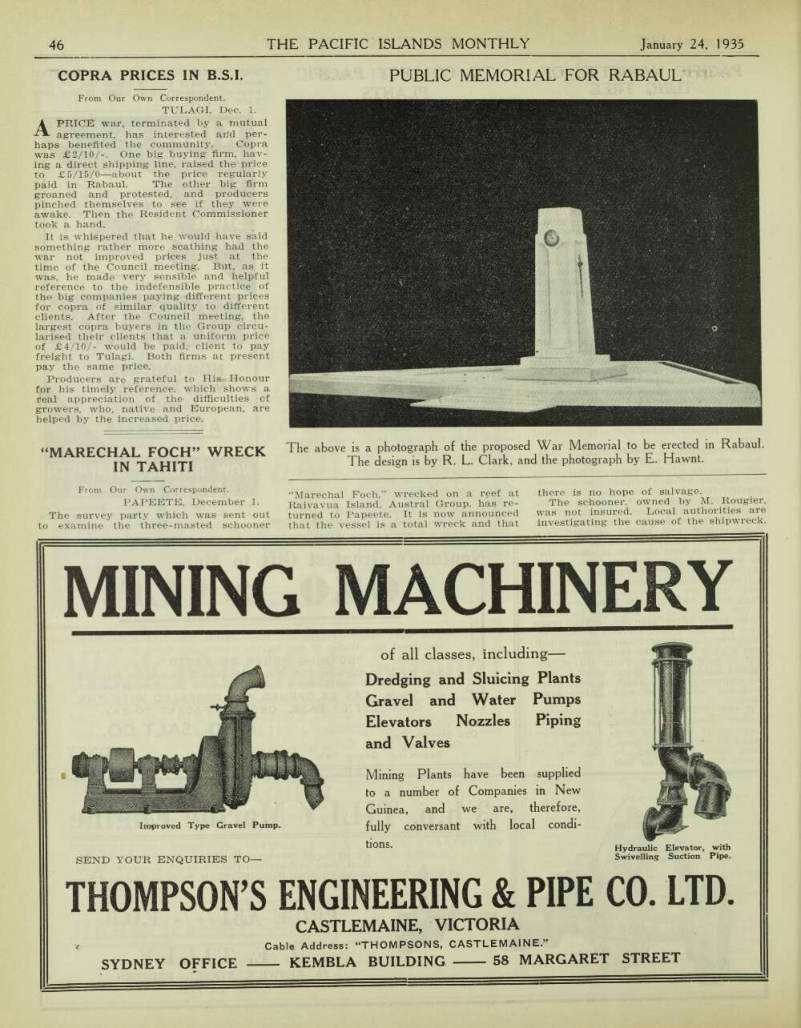
From Our Own Correspondent.
Tulagi, Dec. 1.
A PRICE war, terminated by a mutual agreement, has interested arid per haps benefited the community. Copra was £2/10/-. One big buying firm, hav ing a direct shipping line, raised the price to £5/15/0 —about the price regularly paid in Rabaul. The other big firm groaned and protested, and producers pinched themselves to see if they were awake. Then the Resident Commissioner took a hand.
It is whispered that he would have said something rather more scathing had the war not improved prices just at the time of the Council meeting. But, as it was, he made very sensible and helpful reference to the indefensible practice of the big companies paying different prices for copra of similar quality to different clients. After the Council meeting, the largest copra buyers in the Group circu larised their clients that a uniform price of £4/10/- would be paid,- client to pay freight to Tulagi. Both firms at present pay the same price.
Producers are grateful to His Honour for his timely reference, which shows a real appreciation of the difficulties cf growers, who, native and European, are helped by the increased price.
In Tahiti
“Marechal Foch” Wreck
From Our Own Correspondent.
PAPEETE, December 1.
The survey party which was sent out to examine the three-masted schooner
“Marechal Foch,” wrecked on a reef at Raivavua Island, Austral Group, has returned to Papeete. It is now announced that the vessel is a total wreck and that
there is no hope of salvage.
The schooner, owned by M. Rougier, was not insured. Local authorities are investigating the cause of the shipwreck.
Advertisements & other items, p. 48 (2 items)
Public Memorial For Rabaul
The above is a photograph of the proposed War Memorial to be erected in Rabaul.
The design is by R. L. Clark, and the photograph by E. Hawnt.
Mining Machinery
Improved Type Gravel Pump.
SEND YOUR ENQUIRIES TO—
THOMPSON’S ENGINEERING & PIPE CO. LTD.
CASTLEMAINE, VICTORIA
Cable Address; “THOMPSONS, CASTLEMAINE.”
SYDNEY OFFICE KEMBLA BUILDING 58 MARGARET STREET
White Versus Chinese Traders In Solomon
Islands
Contributed by a Solomon Islands Planter
A DOUBT is now beginning to enter the mind of the Administration of the British Solomon Islands whether it has been just in condemning unheard the white British traders and encourag ing the Chinese to ruin them.
Doubtless as the result of recent publicity in the P.I.M., the Government has given closer examination to the matter of European and Chi nese traders in the native trade. Though mak ing no admission or recantation, it is well under stood that the Administration has been non plussed at finding, upon further inquiry, that the despised white traders were giving the natives a better deal than the much boosted Celestials.
This was at complete variance with all its pre conceived ideas, which we have long contended were erroneously based on evidence supplied from ignorant or biassed sources. It now remains to be seen whether His Excellency the High Com missioner for the Western Pacific will modify the policy which is steadily driving the European small planting and trading class —our pioneers— from the British Solomons.
It must be incomprehensible to outsiders how the British Solomon Islands Administration should be so out of touch in these matters as to make the mistakes it does. The explanation is—lack of direct contact with the natives and so with the problems bound up with them.
In the first place, Tulagi itself and the adminis trative centres of the important Western half of the group are located in places there are practically no resident native populations. In the next place, few, if any, of the District Officers speak the native language of their districts. (But this disability would not be an important one if the officers only had more time to get into touch with the natives when on circuit.) So be tween the natives and the Government are the twin barriers of isolation and language. A busy D.O. can only attempt to cope with the former in the large districts, obtained by a few hurried visits to the villages in the course of each year.
The real contact established with the natives by such brief visits, which are usually fully occu pied by routine official business, is virtually nil.
The only inkling of native affairs that can filter to him through the language barrage, must per force come through native interpreters or Pidgin English, both of which are totally inadequate where matters of a complex or abstract nature are concerned.
Such being the case, is it surprising that the Government knows very little (and that little, very belatedly) of the problems of the natives, and of such complex questions as that of the clash of Europeans and Chinese in the native trade? That being so, if injustice was to have been avoided, the High Commissioner should have launched his hostile policy against the innocent white traders only after careful examination of the position, and not to have condemned them out of hand upon a few inaccurate reports from unreliable sources.
There is far too great a tendency on the part of the Administration to treat native trading as of negligible importance— good enough for Chinese or low-class whites. Whether that attitude is sufficient for other Islands we know not, but it certainly will not do in the British Solomons.
Almost without exception, the white traders of the Solomons are landowners or lessees of land
—debt-ridden small planters, mostly—who have a substantial stake of capital and years invested in the country they have pioneered and developed.
They claim that, as their properties are scattered about amongst the native people, amongst whom they have lived and worked for the last 25 years, they have a practical regard for and a know ledge of the natives exceeding even that of the Administration itself, and certainly outstripping that of any ex-coolie, itinerant Chinese trader.
Yet it is this tropical yeoman class that the High Commissioner’s policy is dispossessing, for the benefit of alien Chinese!
Serious mistakes will continue to be made so long as the Government remains ill-informed on the valuable and considerable native commerce and all its ramifications. It has been shown that the District Officers, owing principally to limita tions of time and place, can supply only a limited amount of sound advice. The Advisory Council, with the exception, perhaps, of one member, though excellently representing the planting industry,
possesses only a superficial knowledge of, and faint interest in, native commerce. This is evidenced by the fact that until the meeting just concluded no mention of the Chinese question had been raised in the Council, notwithstanding that it has been of outstanding importance for many years past. In the future the Council must give more consideration to matters affecting native com merce; the old, lofty, superior attitude thereto will have to be abandoned.
Regarding this Chinese question, in a Protec torate like the Solomons, the touchstone of all policies must be the welfare and benefit of the native people.
The Government should know that a Chinese never educates the natives with whom he may be associated, whether it be as carpenter, engineer, or trader. He jealously guards his special know ledge, and permits the natives to attempt only the most unskilled jobs. Contrast that with the attitude of the whites. Under the instruction of ordinary planters and traders many natives have become useful carpenters, concreters, engine drivers, and store assistants. The writer has known white traders who have taught their prin cipal native assistants arithmetic; while it is a common practice, after having taught the boys to weigh produce, to entrust large sums of money to them and allow them to go forth in charge of vessels and purchase produce from the native
villages. All this must be valuable business training for the native people, though the white trader has been given no credit for it whatever.
Contrast this helpful, kindly attitude with that of the Chinese. Look, and you will see scarcely a native employed in or about a Chinese store— certainly none will be doing skilled work—whereas the European traders’ stores are almost entirely staffed by natives doing work of all degrees, and being given responsibility to the limit of their capacities. Yet the Government which professes to stand for the advancement of the natives encourages the repressive Chinese to oust the help ful whites!
The missionaries join with the white traders in being astounded at the High Commissioner’s policy. It is felt that as the native must continue for a period in a state of tutelage, that that tute lage should be British —in commerce, as it is in matters of Church and State. Why should the natives in this British Protectorate be virtually forced under the control and influence of an alien race in commerce, while remaining British in other respects? Before it is too late it should be realised that the Chinese of to-day are not the humble, servile folk of yore—that they are now definitely anti-European. Even to-day, their con tempt for and antagonism to the white man are not being hidden from the natives, and this atti tude will not improve as time goes on.
The Government has nothing to fear as to the result of entrusting the British with the commer cial development of the native people. In Papua there are no Chinese traders—the country being spared the benefits alleged to follow their intro duction. Can it be said that the natives of Papua have been exploited by the white traders or hin dered in their development as the result of the policy of Asiatic exclusion?
Advertisements & other items, pp. 49-50 (1 item)
Burns Philp
W. M. FORD
Ship, Yacht & Boat Builder
Berry’s Bay, North Sydney
(Established 1870.) BUILDERS of all kinds of Island Craft from Dinghies to Auxiliary Schooners of any tonnage. New and Second-hand Island Craft of various types in stock. New and Second-hand Full Diesel, Crude Oil, Benzine and Kerosene Engines.
Please Send on Your Enquiries.
TIE ON GAS MANTLES
Something better for Your Lamp
FLEXIBO LIGHTING COY.,
9-15 KIPPAX STREET :: SYDNEY
Manufacturers of the famous Flexibo Gas Mantle, suitable for all petrol storm-proof lamps, table lamps, tilly lamps, and all hollow wire systems.
Flying insects will not break this mantle. Agents wanted—samples to all prospective reputable agents.
E. A. MARR
108 MILLER STREET, PYRMONT
Telephone: MW 2296
Mining and General Machinery Merchants
Engineers
5 and 10 Head Mining Batteries, Steam-Driven and Portable Air Compressors—all sizes. Centrifugal and Steam Pumps — Piping from ½in. to 6in. Black or Gal. Pipe and Air Fittings. 400 Tons of Steel Rails, 14lbs. to 100lbs. (New Condition). 200 Tons Steel Girders (all sizes).
Large Stock of Boilers, Suction Gas and Steam Engines, Winches, Pulleys, Rock-Crushers, Petrol and Crude Oil Engines, Elec. Motors, etc.
Write for Quotations for all types of Mining Machinery.
BURNS PHILP
(South Sea) Co. Ltd.
Island Traders & Shipowners Registered Office: Suva, Fiji.
Also Branches at Fiji; Levuka, Lautoka, Labasa, Ba, Sigatoka, Rotuma.
Tonga; Nukualofa, Haapai, Vavau.
Samoa: Apia, Pago Pago (America Samoa).
Solomons: Makambo, Gizo, Faisi.
New Hebrides: Vila.
Gilberts: Tarawa.
Norfolk Is. Nauru. Niue. Wallis Is. Futuna Is.
Code Address: “Burnsouth.”
For Tents, Tarpaulins, Horse Rugs, Birkmyre Coats, Sails & Riggings, Rope all sizes stocked write
ALBERT JONES
MAKER.
173 CLARENCE STREET, SYDNEY
Pacific Island Business Catered for
ALBERT GREGORY
107 York Street, Sydney.
Saddlery,
Saddler’s Ironmongery
Leather and Paint Merchant.
LEATHERS— Art Work, Sole, Harness. Roans, Suedes, Bag, Kangaroo, Bridles, Belts, Spurs, Stirrups, Breastplates. SADDLES Race, Exercising, Park and Stock.
Leather Belting and Pump Cups.
Paint Merchant.
For House and Roofs, ready mixed Special Value House Paint 13/6 gallon 10/6 gallon Brushes, Kalsomine, White Lead and Oil.
Samples of Leathers on Application.
DELICIOUS!!
THE crisp, tempting quality of
ARNOTTS FAMOUS SAO
BISCUITS is the result of 64 years of specialisation. They stand unrivalled in quality and excellence. For lunch or supper they are delicious with butter and cheese, fresh and stewed fruit, ham paste, or savouries.
ALWAYS ASK FOR ARNOTT’S
AND BE SURE YOU GET THEM
An “Ornament”
Letter to the Editor.
YOUR photograph of a so-called “knuckle-duster” in your issue of October 17 is most definitely not a weapon of offence. These ornaments are quite common in this district, and may be found round most villages, having been used, or intended for use, in earlier times, as canoe decorations.
The writer has frequently confiscated knuckle-dusters in the labour lines, most often from Malaita natives. They are usually in the form of a broad finger ring, with one or more spikes, and made either of brass or turtle-shell.
I am, etc.,
New Georgia.
Gizo, B.S.I., 20/11/1934.
Cook Is. Present for the Duke
From Our Own Correspondent.
Rarotonga, Dec. 4.
A casket made of native wood inlaid with pearl shell, together with other examples of the handiwork of Cook Is. craftsmen, besides an address of welcome, have been forwarded to Wellington by the Cook Islands natives for presentation to the Duke of Gloucester. The gifts, which were on exhibition for a time at the Resi dent Commissioner’s office, are of ex tremely fine workmanship.
Advertisements & other items, p. 50 (1 item)
Standard Drug Co.
FOR ALL YOUR
CHEMICAL AND TOILET
REQUIREMENTS
Island Representative:
W. M. REID, YORK STREET, SYDNEY
Head Office:
26 HUTCHISON STREET, SYDNEY
Papuan News
Federal Grant Increased to £42,300
From Our Own Correspondent.
Pt. Moresby, Dec. 23.
THE Papuan Administration has been advised by the Commonwealth Government that the Federal grant for the financial year 1934-35 towards the cost of the administration of the Territory is £42,500. This sum represents £2500 in excess of the grant for the previous year, and the same amount in excess of the estimated receipts in the 1934-35 Papuan estimates.
It had been hoped that the grant would be restored to £50,000 at which it stood in 1928-29.
The most drastic reduction occurred in 1932-33, when the grant dropped as low as £34,000. In 1929-30 it was £42,000, and in 1930-31 and 1931-32, £45,000 and £40,000, respectively.
It seems a pity that the amount of this grant cannot be fixed over a term of years, so as to eliminate the annually recurring period of anxiety and uncertainty which the Treasurer has to face.
Sportsmen For Wau
A team of thirteen or more sportsmen will leave Port Moresby on December 30 and fly over the central range to try out the Wau teams at cric ket and tennis.
Dexter Giblin, the 16-year-old son of our medico, is home from his Sydney school for the Christmas holidays, and will take part in the cricket match.
Both as batsman and fast bowler, as well as in the field, he has displayed much skill.
Lakekamu Leases
Mr. Nason Jones has applied for further dredging areas amounting in the aggregate to 1500 acres on the Lakekamu goldfields; and Mr. P. D. Rad cliffe, who is associated with him, has also applied for an area of 7200 acres.
Drilling operations are proceeding satisfactorily oyer the large areas already under lease, and high hopes are entertained of a big success.
Fatal Snake Bite
A native servant at Government House, Port Moresby, was bitten by a snake when hurrying across the Government House grounds late on the evening of December 20, on his way to his village. He was bitten on the foot, one of the poison fangs penetrating a vein, and although rushed immediately to the hospital, he died in less than two hours.
This is the second Government House servant to die from a snake bite within the last few months. Black snakes are numerous in Port Moresby district, and seem to be particularly poisonous at this time of the year.
A Happy Event
In the Port Moresby Hospital, in the morning of December 22, Mr. and Mrs. A. L. Grant wel comed a Christmas present in the shape of a small daughter. Mr. Grant, as manager of the local branch of the Bank of New South Wales, has made himself respected and liked by all mem bers of the community, who extend hearty con gratulations to the happy parents.
Moresby Landing Ground
In view of the increasing number and size of the ’planes flying between here and Wau, plans are being considered for the preparation of a new and larger landing ground.
The site under consideration lies on the north side of the road from Port Moresby to Rouna, and about three and a half miles from the town, and offers several advantages over the present site in its greater extent, in less liability to flooding in wet weather, and in a better approach by road.
Into Unknown Papua
Mr. Jack Hides, accompanied by Mr. J.
O’Malley, left Port Moresby on December 10 on special patrol to the headwaters of the Strickland River and thence across quite unknown country to the upper reaches of the Purari. His route lies east of that by which Karius descended the Strickland in 1927 from its source to its junction with the Fly.
Mr. Hides will have to make his way through the dreaded limestone belt, where the surface re tains no water, streams run underground, and where carriers are lamed and the stoutest boots cut to pieces by the knife-like edges of coral-lime stone. It is anticipated that a large native popu
lation will be found to the north of the limestone area, where supplies of native foods will help to solve the difficult problem of transport.
Success Of Larvae-Eating Fish
The usual plague of mosquitoes in Port Moresby is very much reduced this year owing to the ener getic efforts of Dr. W. E. Giblin and his staff.
Gambusia affinis, the diminutive fish which live on the larvae of mosquitoes, have been introduced to every swamp and watercourse in the district, and close attention has been given to drainage and general cleanliness with the result that life is much less intolerable than it usually is in the north-west season. It is hoped that in two or three years’ time mosquitoes will be unknown near the capital.
Reliable Diesel Marine Engines
Fairbanks, Morse and Co. have announced the introduction of a new series of Diesel engines for marine and stationary service. These units are known as model 36 and are of the 4 cycle, solid injection type running at a speed of 1200 r.p.m.
The range covers units of 10 h.p. per cylinder,, and is manufactured in 1,2, 3,4, and 6 cylinder combinations. The marine units can be provided with a built-in reduction gear which is situated immediately behind the gear box and clutch, which permits the propeller to operate at half engine speed. The company also announced the intro duction of an opposed piston engine built in sizes tip to 2500 b.h.p. and operating on the 2 cycle solid injection principle. This unit develops its rated power at 1200 r.p.m. and as two pistons operate opposed to each other in a common bore the use of cylinder head gaskets and joints is dispensed with. The unit has been specially de veloped for marine service where weight is an important consideration, and can be provided with a number of modifications, so far as speed reduction to the propeller shaft is concerned.
Miss M. Mooney, who was a teacher at the Rarotonga school for European chil dren, left the Cook Islands for Australia in December. She has joined her parents in Burnie, Tasmania.
Advertisements & other items, pp. 51-52 (1 item)
Speed, Simplicity
Are But Three
Features of the
BUZACOTT
“New Record”
Drag - Saw
It is a complete outfit for sawing logs up to 7ft. in diameter and is exceptionally strong. Well balanced on the two large, wide-tyred wheels, it can easily be handled by one man in almost any type of country.
It is simple to operate and is powered with a sturdy, reliable engine, driving by belt to ensure safety. The cost of fuel is trifling and the power unit can be used for many other purposes without removal.
As supplied to New Guinea Administration (2 machines); Lever Bros. Pacific Plantations (7); Bulolo Gold Mines, Ltd. (4).
and Economy
Fully standardised throughout
Write for Full Details Buzacott & Co. Limited 7-11 Market Street
Sydney, Australia
Some Other Reliable
“Buzacott” Lines
“ALSTON" WINDMILLS
Priced to suit every pocket, requiring little attention. Easy to handle, thoroughly built and well-balanced.
“GILCO” ELECTRIC LIGHT
PLANT
Wind-driven, providing free electricity. No fuel costs — minimum of attention. A PROVED success.
“BUZACOTT” SPRAY
PUMPS
are reasonably priced, wellconstructed, and entirely reliable.
“BUZACOTT” GATES AND
FENCES
One of our “trump” lines.
Recognised everywhere as the best procurable. Prices are right.
“PETTER” ATOMIC
DIESEL ENGINES
These cold-starting, crude-oil engines are famous for their economy of operation, robust construction and long life.
DIGGER WINCH OR TREE
GRUBBER
Quickest, lightest and yet strongest tree-puller made.
WHERE TO STAY IN PORT MORESBY
THE
PAPUA HOTEL
Catering specially for Tourists & Travellers Situated on high ground overlooking both coasts, its Spacious Lounges are always Cool & Comfortable Tariff: Per day 16/-; per week £5/5/-; per month £14; bed and breakfast 10/-; bedroom only 7/6.
Cars meet all steamers.
FIRST-CLASS ACCOMMODATION. SPECIAL DINNER
PARTIES ARRANGED.
Licensee: Papua Hotel, Ltd.
HOTEL MORESBY
COMFORTABLE
ACCOMMODATION
ONLY THE BEST
BRANDS OF
WINES, SPIRITS
AND BEERS
IN STOCK
LICENSEE:
Hotel Moresby
Ltd.
NEAR THE
WHARF
COSMOPOLITAN
HOTEL
Samarai
First-class Accommodation for Tourists and Travellers Ball-room; Electric Light; Billiards; Freezing-works; Cold Store. Best brands of Wines, Spirits, Ales.
MODERATE TARIFF
Fishing Trips and Launch Excursions arranged Licensee: R. LEWIS.
TAHITI
AND
French Oceania
JUST PUBLISHED
This book, by Samuel Russell, has just been published. It is a valuable work of reference, insofar as it gives, in relation to Tahiti and French Oceania, complete details of administration, commerce, sport, tourist resort's, industries, excursions, hotels, immigration and land laws, etc.
Yachtsmen and fishermen, who are visiting Tahiti in increasing numbers, will find this a most useful handbook.
It also supplies a fascinating account of life in Tahiti—one of the most delightful places of residence in the world.
Copies from: S. RUSSELL, Papeete, Tahiti.
ANY SYDNEY BOOK STORE.
Pacific Publications Ltd.,
247 George Street, Sydney
Price in Australia (posted): Cloth bound, 6/-; paper-cover, 5/-.
HOTEL BULOLO
WAU, T.N.G.
Picturesquely situated, overlooking the Wau Aerodrome, at the Business centre of the Morobe Goldfields.
FIRST-CLASS CUISINE—30 com-
fortable Bed-rooms —Hot and Cold Showers —Fresh Fruit, Vegetables, and Dairy Produce from the Hotel Gardens.
The Hotel Bulolo is famous for its wide, cool verandah-lounge.
Only the Best Brands of Wines, Spirits, and Beers in stock.
SAMARAI HOTEL
The Rendezvous of the Miners of Eastern Papua.
Comfortable Accommodation for Tourists, Travellers and Residents. Best Brands of Spirits and Wines—Victorian Lager Beers.
FISHING EXCURSIONS ARRANGED
Licensee: Mrs. L. M. SKELLY.
HOTEL RABAUL
COOL AND SPACIOUS LOUNGES COMFORTABLE
ROOMS - DINNER PARTIES SPECIALLY ARRANGED
Excellent Dance Floor and Music.
Under the Personal Management of Mrs. H. Luxmoore
Not Happy
Goldfields Leases
British-New-Guinea N.L. Is Not Happy
TROUBLE seems to have been encoun tered by the indomitable Charles Lexius Burlington, who spent some months last year in New Guinea on be half of a Melbourne syndicate (British New Guinea Gold Mining, N.L.) and who arrived in Sydney in October with a bunch of leases and options, and a con viction that at last he was going to float a money-spinner. The ground he was interested in was in the ranges near Wau, up behind the Golden Ridges Mill.
The following paragraphs appeared in the Melbourne newspapers in December:
British New Guinea Gold.
Shareholders of British New Guinea Gold Mining N.L., at an extraordinary meeting yesterday, de cided that the question of increasing the com pany’s capital be deferred and that it be left in the hands of directors to realise the assets and grant options as might be considered necessary Another decision was that directors should en deavour to reconstruct the company.
The chairman (Mr. R. A. Rankin) stated that the company’s balance in the bank was only £27, and in the event of liquidation there would be nothing for shareholders.
Mr. Rankin expressed dissatisfaction with re ports received on the property in New Guinea.
The managing director (Mr. C. L. Burlington) intimated that he would resign from the board of directors. The company, he said, had 300 acres of good low ground, but £10,000 was needed to make it do good.
British New Guinea Affairs.
Affairs of British New Guinea Gold N.L. were lengthily discussed at an extraordinary general meeting yesterday. The company has a nominal capital of £5000, in 1000 shares of £5 each. Mr.
R. A. Rankin, a director, who presided, dealt with the position of the company, and explained that after the liabilities were met there would be no return to shareholders, in the event of a voluntary liquidation. The information in the posses sion of the directors, he added, was not sufficient to warrant their recommending shareholders to exercise the options held. Mr. C. Lexius-Bur lington, who visited New Guinea, also addressed shareholders. It was decided that the matter of increasing the capital be deferred; that it be left in the hands of the directors to realise the assets, and in connection therewith to grant an option or options, as may be necessary; or, alternatively, to endeavour to reconstruct the company. After the meeting Mr. C. Lexius-Burlington signified his intention of resigning as a director.
The following was published at the end of December: The legal manager of British New Guinea Gold, N.L., states that reports re ceived from the company’s New Guinea representative (Mr. Charles Lilley) and a consulting mining engineer, recommend abandonment of the leases at Edie Creek secured by Mr. C. Lexius-Burlington. The directors have therefore decided to realise on the assets of the company with a view to winding up.
Mrs. Margaret Wilson was appointed sister at the Ballantine Memorial School, Fiji, at the December meeting of the Methodist Mission Board. She is the widow of the late Mr. W. Wilson, former teacher at Davuiievu College, Fiji.
N. Caledonia Council Elections
From Our Own Correspondent.
Bouloupari, Nov. 7.
THE elections for the Council-general (local Parliament) passed off quietly.
The result of the Conseiller-General was not decisive on October 14 and a second ballot was taken on the 28th, which re sulted in the following being elected: Beaumont, Terrier, Paladini, Laborderie, Milliard, Collardo, Daly, Berges. In ad dition to these, M. Louis Page, M. Andre Robert, and M. Michel Verges were ap pointed by the Chambre d’Agriculture.
The Governor’s nominations were M.
Souland and M. Louis Imboult.
Half the chamber did not stand for election on this occasion, but submit their names for election in three years’ time; the chamber thus is partly renewed every three years. The sitting term for mem bers is six years.
Rev. Eric Yarrington, who recently re signed from the Sangara (Papua) station of the New Guinea Mission, has been ap pointed Rector of Lake Cargelligo, in the Diocese of Riverina, New South Wales.
Advertisements & other items, pp. 53-54 (2 items)
“Service”
PRUNE-SEN
SYRUP OF
PRUNES
With
SENNA & CASCARA
For Constipation, Purifying the Blood, and all complaints of the Stomach, Liver and Bowels.
Price - - 1/6
Prune-Sen Manufacturing Co., Sydney
R. H. BENDER, M.P.C.
689 ANZAC PARADE, MAROUBRA,
SYDNEY
Agents now being arranged
“Service”
LEATHER BELTING
The secret of the success of “Service” Brand Belting is in the long tanning process.
Laminated Belting and Mechanical Leathers “Service” Brand is Unequalled for all classes of Drives.
W. H. LITTLEWOOD
38 EWART ST., MARRICKVILLE, N.S.W. Tel. 552 Pet.
Tannery: ULLADULLA, N.S.W.
Catalogue on Application. Applications received for Agency.
THE CHAPMAN DIESEL MARINE ENGINE
Slow Speed, Heavy Duty Type showing high propeller efficiency. Patented Starting System. No compressed air, no wicks or cartridges no blowlamp, no cranking handle, no valves. 15 h.p. Runs on Black Crude Oil costing sixpence a gallon at Sydney; consumes six gallons in 10 hours. Price of engine complete £325 ex factory, CHAPMAN & SHERACK, Clara Street, Erskineville, N.S.W., Manufacturers and Patentees
STOP
Tired nerves are the cause of Headache, Neuritis, Neuralgia, Rheumatism, Lumbago, Sciatica. Get instant relief from all nerve pains with Genuine VINCENT’S A.P.C. as recommended by Doctors, Dentists, Chemists, and Nurses. 12 for 1/6, 24 for 2/6.
All Chemists and Stores, or direct from Vincent Chemical Company, Market St., Sydney, Australia
Nerve
Pains
FOR SAFETY’S SAKE. SAY “VINCENT’S"
Wilhelm Breckwoldt A €o.
9, Lange Muehren, South Sea Bldgs.
HAMBURG, GERMANY
(Exporters and Importers) We Export: Trade Goods of any description, Cutlery, Hardware, Miners' Requisites, etc., etc.
We Import: Any kind of Island Produce.
CORRESPONDENCE INVITED
advt
For Your
FLY SPRAY lODINE
PEROXIDE OF HYDROGEN
LA FLEUR TOILET PRODUCTS
Leston Manufacturing Co.
SYDNEY
Samples and Price Lists on application
Fox Bros. Safe
N.G. Prospectors Return from the Interior
ANXIOUS fears regarding the safety of Messrs. T. and J. Fox, well-known New Guinea gold prospectors, were al layed when they reached Salamaua in December. For four months they had been on a strenuous prospecting trip into the region near the Sepik River head waters and the borders of the Mandated Territory, Dutch New Guinea, and Papua.
Rumours had been received in Salamaua that the brothers had been murdered in the hostile interior. Mr. “Mick” Leahy, in a Guinea Airways’ machine, piloted by C. R. Gurney, flew 150 miles over the district in which they were known to be prospecting, but could not locate them.
The fliers then returned to Mount Hagen landing ground, and, on arriving at their base, found the missing miners already encamped there.
Messrs. Fox Brothers reported that all the unexplored country they covered was limestone, with no traces of gold. They encountered few natives, but in places were menaced by unfriendly warriors with bows and arrows.
Rabaul's Hot Springs
From Our Own Correspondent.
Rabaul, Dec. 24.
The Administration has now realised the value of the thermal region, which is situated on the outskirts of Rabaul and was used, to a considerable extent, by the old German inhabitants as a bathing re sort for those afflicted with rheumatism, and kindred ailments.
A road is being constructed to the Ma tupi baths, which lie beneath the shadow of the crater, and it is believed that an excellent opportunity awaits a progres sive business concern should it decide to erect conveniences for the public to enjoy the benefits derived from hot sulphur baths.
New Guinea Notes
From Our Own Correspondent.
Rabaul, Dec. 24.
A FIRE occurred at one of the copra driers owned by Messrs. W. R. Carpenter and Co. at Toboi, on the outskirts of Rabaul on December 12. Fortunately the damage occasioned was not great owing to the prompt response made by the local fire brigade, which had on this occasion its first baptism of fire.
Mr. V. Maxwell, of Kavieng, passed through Rabaul recently from the East where he made interesting visits to some of the oil-extracting factories in Manila and elsewhere. Mr. Maxwell was surprised at the fact that the grade of copra, in that country was far inferior to that produced here.
Tenders are being called for the Japanese sam pan, “Yocikune Maru,” which was captured in Mandated waters and of which the captain and crew were imprisoned and fined.
The amount of copra shipped from the Terri tory during November was 8668 tons. Over 4000 tons were consigned to United Kingdom, Germany received 2841 tons, 1101 tons were shipped to Italy, and Australia received 432 tons.
Mrs. Harold Page, wife of the Government Secretary, arrived from Sydney by the Neptun for the Christmas holidays. She will return next month to Sydney to take charge of her children, who are attending school there.
The Rabaul Dramatic and Musical Society pro vided Rabaul music-lovers with a very delightful musicale on December 10. The programme was arranged by Mrs. Backhouse, and included a musical quartette of Messrs. Hopkins, Thornth waite (violins), Haslam (’cello), and Mrs. Back house at the piano. Violin solos were rendered by Miss Hanna Rundnagel and vocal items by Mrs.
Youlden and Mrs. Bates.
Miss Monk, of New Zealand, is staying with her sister, Mrs. C. K. Anthony, of Rabaul.
A jolly Christmas party was held at Mr. and Mrs Waugh’s residence at Kokopo recently when the children of the district were entertained to Christmas fare and a Christmas tree laden with, presents. .
The Rabaul Public School held its Christmas “break-up” on December 14, when prizes were given to the successful students by His Honour the Administrator. The recipients in Grade VII. were; First prize, Cecil Evans; second prize, Jack Steeples.
Mrs. Grace Schmidt departed for South by the Tanda recently.
Mr. J. J. Gilmore, of Put Put plantation, is making a business trip to Australia.
Mr. Maunsell Turner, of the Crown Law Office, left by the Tanda for holidays in Australia.
Mr W. F. Coultas, who is doing excellent work for the Natural History Museum of New York, is in Rabaul after having spent some time in the Lihir Islands, off the New Ireland coast, where he obtained some very interesting ornitholo gical specimens for his collection. He intends making a trip to the Tanga Group before he departs for America in a few months time. Mr.
Coultas is accompanied by his wife, who is of great assistance to him in his work.
Mr. and Mrs. W. L. Heron, of Tovakundum, arrived by the Neptun on December 17.
History of Mission Ships
“Southern Crosses"
NOW that the new Melanesian Mission ship “Southern Cross VII.” is settled down on her important work in the Wes tern Pacific, it is interesting to recall the history of the vessels of this organisation.
It is contained in a pamphlet, a copy of which we have obtained from Major H. S.
N. Robinson, of the Mission Staff. The vessels were: Undine, schooner, 21 tons, 1849-1857: built at Auckland.
Border Maid, 100 tons. 1851-1852.
Southern Cross I., schooner, 100 tons, built by Wigram at Blackwall, England. 1855-1860. Wrecked on New Zealand coast June 18, 1860.
Southern Cross II., yawl-rigged brigantine, 93 tons, built by Wigram at South ampton. 1863-1873. Leased to N.Z. Gov ernment in 1874, and sold to H. Wilson, Islands trader, in 1880.
Southern Cross III., three-masted, twotopsail schooner of 180 tons, with auxiliary steam engine. 1874-1892. Sold to Captain W. Ross, South Seas trader, and used by bim, as the “Ysabel,” mostly in the Tongan trade, until 1915, when she was sold to G.
H. Scales and Co., of Wellington, N.Z. Sold again to buyers in Eastern Pacific in 1925, and destroyed by fire at sea in 1928.
Southern Cross IV., three-masted topsail schooner of 240 tons, with auxiliary steam engine, built in Essex, England. 1892-1903.
A most unsuitable and expensive vessel.
Sold to Alison and McGregor, Auckland and engines removed; sold later to Captain Munns, and ran between Australia, N.Z.
and the Islands; sold again, and carried cargo between Tasmania and Australia; lost with all hands, about 1917, when carryl ing benzine from Sydney to Hobart, Southern Cross V., steel steamer of 500 tons, triple-expansion engines; built by Armstrong and Whitworth at Newcastle, England; rigged at first as three-masted barquentine, but masts subsequently re moved. 1903-1932. Sold in Auckland and broken up.
South Cross VI., twin-screw steamer of 215 tons, built by J. S. White and Sons Ltd. at East Cowes, England. 1932-1932.
Wrecked in New Hebrides on maiden voyage, October 30, 1932.
Southern Cross VII., twin-screw motor vessel, of 220 tons, built by Cammell Laird and Co., London. Arrived in South Seas, November. 1933.
Samoan Notes
From Our Own Correspondent.
Apia, Dec. 6.
THOUGH the copra market in Europe seems to be slightly steadier lately, the price has not changed to any great degree and the local price paid to producers remains as unremunerative as before. This refers also to the cocoa market.
Some sales have been effected recently at prices varying from £30 to £35, which net the cocoa planter here between £25 and £30. Stocks in European and American warehouses, however, re main very large and the demand for Samoan cocoa beans continues to be very unsatisfactory.
More Bananas From Samoa
Owing to the increase in banana exports from Samoa during the coming year, the Samoan growers in more distant districts are to be allowed to share the benefits. The native growers in the
Faasaleleaga district on the island of Savaii have been informed by the Administration that they may prepare to ship bananas next year, and they are duly grateful for the opportunity.
Harbourmaster’S New Launch
A new and locally built motor vessel for the use of the Harbourmaster’s Department was launched recently and christened at a pleasing little ceremony by Mrs. Hart, wife of the Adminis trator. The launch, which is a compliment to the skill of local artisans, has been named the “Pilot.” The last launch was wrecked in Apia Harbour, some time ago.
Bad Weather Damages Plantations
After we had suffered from a lengthy dry spell, the weather has changed at last and we are now right in the middle of the rainy season, with the usual and normal heavy rains. We had, in fact, a taste of hurricane weather recently when the glass dropped very low and a strong north-wester, ac companied by torrential rains, blew the whole day. Since then we have had intermittent rains and oppressively hot and close weather. The strong wind is reported to have caused a good deal of damage on banana and cocoa plantations.
Personal Notes
Rev. Father Schweer, of the Roman Catholic Mission, returned to Apia from Australia, via Pago Pago, after a lengthy vacation, which has benefited his health considerably.
Mr. E. E. Dunwoodie intends to leave for an extended holiday in New Zealand by next Mat son liner from Pago Pago. Mrs. Dunwoodie and Master Dunwoodie will accompany him.
Another batch of Administration officials is leaving the hospitable shores of Samoa by the outgoing “Maui Pomare.” Mr. C. Gair, Auditor to the Administration, who is transferred to the New Zealand Public Service, Mr. Nicol, of the Customs Department, and Mr. Cotton, head teacher of Malifa Government school, who is transferred to the Cook Islands Education Department, were the guests of honour at numerous farewell par ties and recipients of several presentations. Messrs.
Gair and Nicol have taken keen interest in Apia cricket; the former gentleman was president of the Apia Returned Soldiers’ Association.
Advertisements & other items, pp. 55-56 (1 item)
Westinghouse
In tlie Remote Corners
. . . of tlie Earth
As in the Heart of the City .. . .
WESTINGHOUSE
Dual Automatic REFRIGERATOR
DOES DAILY DUTY
Wherever alternating current is available you can enjoy the comforts of refrigeration and safeguard your foodstuffs in the Westinghouse way.
Write for full particulars
Rosebery Engine Works Ltd.
13 MARKET ST., SYDNEY
ONLY THE WESTINGHOUSE IS DUAL AUTOMATIC
SPENCER NOLAN
DENTIST
28 OXFORD STREET
(Over Winns’ Ltd.)
SYDNEY
’Phone F 3215 Cable Address: Fastplate, Sydney
SPENCER NOLAN
DENTIST
139 ELIZABETH STREET
(2 doors from Market St.)
SYDNEY
'Phone F 3215
The fragrant refresher at home and out of doors — invigorates and revives.
Genuine
4711 Eau de
Cologne Factory Representative for Australia, New Zealand, and the Pacific Islands
Julius Blau
Australia House, Carrington Street, Sydney
Fashion Hints for Islands Women
By Therese
“My love in her attire doth show her wit, It doth so well become her.”
A CHARMING tribute to a soignee woman —and where is she who would not delight in the ability to move mere man to poesy? There is nothing so rhythmically lovely as the well-groomed woman who has given the most exacting attention to the minutest details of her toilette. She is endowed with witchery, beside which mere beauty of face and form fades into insignificance.
And this is an achievement possible to every woman who cares. A little time, a little thought, and perfection will be yours—perfection achieved through so many lovely mediums. Line, colour, de sign. new materials glittering and gor geous, are all in league to give us that indefinable something called charm.
Woman is distinctly feminine this sea son. She has developed curves, but curves with a difference, so that in these days of stream-lines she sheathes her rounded beauty, lightly controlled by all the art of the corsetier in a supple elastic weave which moulds the figure along the ap proved lines —lissom and slender.
There is romance in present-day clothes well in keeping with the return to femin inity. A black crepe gown classically cut, is held aloft by glittering shoulder straps. Kiltings outline the bodice and wander up and down the hemline of the slashed skirt in a most unusual way.
A lilting lyric is the exquisite backless gown of white and silver lame with all its fulness drawn to the back with a sil ver cord. It is worn with the new square toed sandal, a fitting accompaniment to so much beauty.
Charming for the ingenue is the even ing gown of white tulle, scattered with gold sequins. Its demure high neckline is banded with them, and a belt of the same glittering loveliness ties into a bow at the waist-deep decolletage. A hint of sweet confusion that is entrancing is in the diaphanous folds of the bouffant skirt.
Ravishing is the gown of golden taf feta, reed silhouetted to the knees, then flaunting boldly a huge flounce which ends up the side seams. A bow of enor mous proportions is at the waist-line, and when worn with a green cape of ostrich feathers and green accessories, it is a complete tone poem.
Evening wraps in styles infinite and varied are lovely to behold. Feather capes in the most exquisite shades hold their popularity. Dashing cavalier capes, brilliantly lined with some con trasting colour, swing jauntily and debonair from our shoulders. Wasp waisted jackets for evening are fascinat ing and different. Taffeta coats fall to the toes, covering loveliness with charm.
The newest length for afternoon frocks is from 6 to 8 inches from the floor, while many of the newest models sport uneven hemlines. Box suits, Edwardian in in spiration, are an advanced fashion which can be well and safely adapted to tropi cal climes. You may have smocks in stead of tunics if you will; smocks, with a little girl air about them that is fas cinating in the extreme. Roumanian peasant embroidery adorns their primness.
Collars are legion, chosen from all pages of history—Medici, Queen Christina, Cromwellian—and they do unbelievable things to little frocks. These, with in terchangeable gillets, jabots, belts, etc., are the answer to the prayer of those of limited means, and are chock full or possibilities for the ingenious minded tropic dweller. Indispensable is the plain well-cut frock that miraculously becomes a whole wardrobe by its lightning changes of bits and pieces.
Gay bandanas muffle the throat or tie
at the waist line of a white sports frock, making a vivid splash of colour that is exciting. The slim straight skirt with its single pleat back or front is ever present, keeping the slim line while yet giving freedom of movement. And the blouses that go with it are delightful.
Little bits of soft femininity with bows or softly falling cascade draperies, and sheer designs with tailored touches, all designed to please at infinitesimal cost.
Bodices of afternoon gowns go draped back and front, terminating at the waist in large bows. Window-box fronts, with upstanding pickets of frills or pleats bor dered with flowers, are a delightful inno vation for afternoon or evening gowns, and spell definite charm. Wide armholes with wide loose sleeves, as sponsored by the lovely Duchess of Kent, have a host of devotees.
Bring out your exquisite little bits of perfection in the shape of the Victorian enameller’s art and joy will be yours. Old World posies peeping demurely through glittering points of paste are hailed as treasures and seized with avidity by the discerning, as brooches, clips, and buckles for all occasions. Bits of scintillating paste adorn the hair with charming effect.
A star twinkling here, a single stone gleaming there, give a touch of light and beauty to the coiffure.
Hats? Surely the craziest conceptions of the brain of the mad hatter, but ab solutely intriguing withal. Such charm do they present that even the most jaded tastes are whetted anew. High hats with stove pipe crowns or pert gnome-llke peaks, flat hats with scarcely a crown to call their own, Salvation Army bonnets, demure and Belle of New Yorkish in their strong appeal, hats feathered and hats plain, flowered or beribboned. Never was there such a wide choice of headgear or such a gamut of styles to suit us all.
Sandals, with jewelled straps are the definite mode for evening wear. Roman, Grecian, or what you will, but sandals they must be. Gold and silver kid, bro cade, made of materials to match your gown, all offer untold charm. With the toeless sandal comes the sandal stocking, sheer right to the toes, through which varnished nails gleam alluringly. Open
work stockings have become the mode since the day of the slashed skirt persists, and are exquisitely lovely in design. Crepe hose, dull and crepey in appearance, are the vogue. Expensive? Yes! but of ex cellent wearing qualities despite their cob web sheer.
Gloves are magnificent. They are made in kid, suede or silk, with long or flared gauntlets. Embroideries in pastel effects adorn them, and lace motifs and ruckings figure among the trimmings. Gauntlets, in a new fabric of almost wafer-like thin ness resembling loofah are most attrac tive. Lace mittens are worn with charac teristic modesty, with the bouffant even ing gown of Grandma’s days.
Advertisements & other items, p. 56 (1 item)
Permanently Wave
YOUR OWN HAIR
With a “RAYWAVE” Curling Set (Pat. 16608/34). Waves last 6 to 9 months guaranteed. Anyone can use. NO ELEC- TRICITY. Simple instructions. 15/per set. Postage 3/- extra. , Spar Trading Co., 10 Rawson Place, Sydney
Walpole Island
Growth of Guano Industry
From Our Own Correspondent.
NOUMEA, December 7.
A NEW ZEALAND firm has entered into a contract with Austral Guano Co. Ltd., of Walpole Island, for 8500 tons of guano. The “Loyaute,” of Societe Tour de Cotes, made a special trip over with material and 40 additional men, bringing the personnel of this little island up to 80.
New Zealand seems to be the sole pur chaser of this splendid fertiliser, which can be placed on the market ready for use far cheaper than any other.
Walpole Island is a small limestone rock island about 150 miles south-east of New Caledonia. It is ¼ mile wide by 2¼ miles long and contains just over 300 acres of limestone covered with large deposits of sea-fowl manure.
Advertisements & other items, p. 57 (1 item)
Shoes
CROPLEYS
Well worn by satisfied customers over three generations. Our Mail Order Service is personal and
prompt.
13/6 Z671 White Buck, black or brown strap, pump sole, sport heel with our special “cushionlike” Pedoflex inner sole; perfect comfort. Half sizes, 2 to 7; Price 13/6. (Add postage. 25/6 560 Tan or Black Fine Calf. Dress Model, with flexible welt sole; available in half size fitting 5 to 10; priced at 25/6. Also in Tan or Black, several shapes, medium or full; 19/11, 24/6. (Kindly add postage). ‘Give your feet the best' AT LEFT —A miniature reproduction of our new Catalogue, gladly posted free to you upon request. You will find it most helpful in choosing satisfactory Footwear We venture to suggest that the name of “Cropley” is not unfamiliar to you as being the expression of good quality shoes.
CROPLEYS LIMITED
HAYMARKET, SYDNEY, N.S.W.
Mailorders to BOX 56 HAYMARKET
Mrs. N. WALKER - FLYNN.
Late 35 POWELL STREET, COOGEE
COSTUMIER E,
MALAGUNA ROAD, RABAUL
HEMSTITCHING and PICOT EDGING.
Copies of Mab’s Fashions; Roma’s Pictorial Fashions and Home Fashions available. — P.O. Box 116. Tel.: 141.
Plezall ... (Please-All) This extraordinary Ready Made Scone Mixture will Delight You Surprise You Amaze You.
Nothing to do No other ingredient to add simply mix with water and bake.
Delicious Milk or Wholemeal Scones in Ten Minutes.
PLEZALL
is specially manufactured and packed to suit the island conditions. The mixture will keep indefinitely.
PLEZALL
may be obtained from all Island Stores.
Packed in 1lb., 2lbs. and 7lbs. tins.
PLEZALL FOOD PRODUCTS
NEWTOWN, SYDNEY, N.S.W.
So Good ... So Nice Worth Double the Price
N. Guinea Goldfields
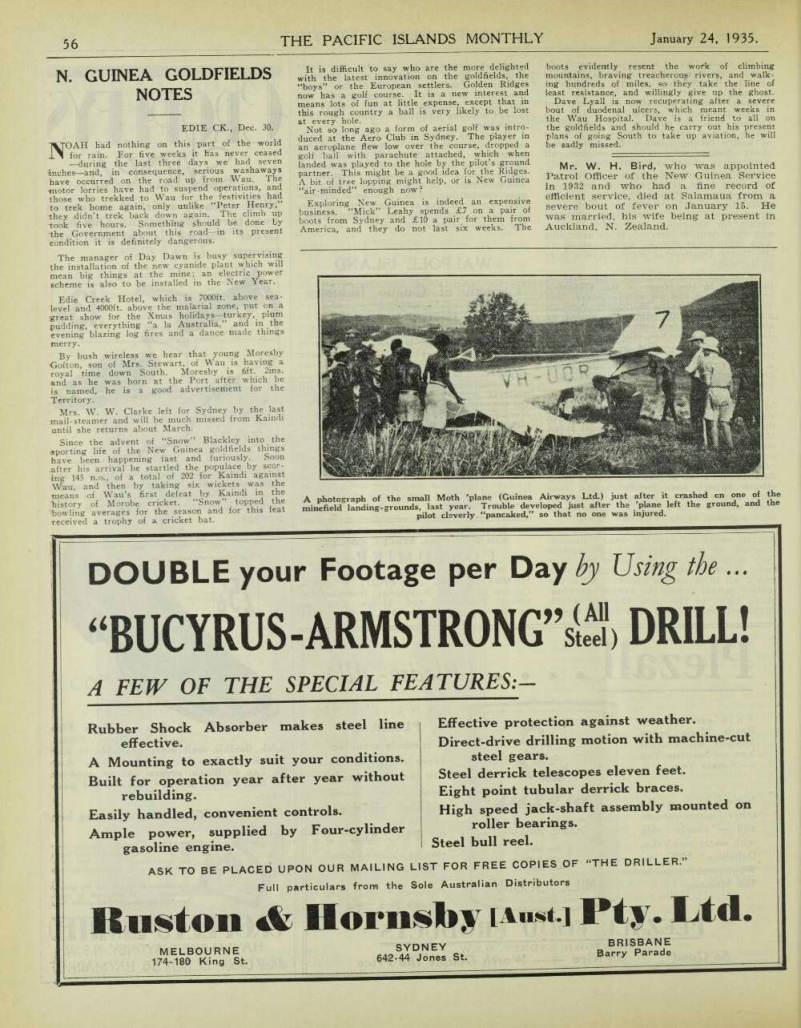
Notes
Edie Ck., Dec. 30.
NOAH had nothing on this part of the world for rain. For five weeks it has never ceased —during the last three days we had seven inches—and, in consequence, serious washaways have occurred on the road up from Wau. The motor lorries have had to suspend operations, and those who trekked to Wau for the festivities had to trek home again, only unlike “Peter Henry," they didn’t trek back down again. The climb up took five hours. Something should be done by the Government about this road —in its present condition it is definitely dangerous.
The manager of Day Dawn is busy supervising the installation of the new cyanide plant which will mean big things at the mine; an electric power scheme is also to be installed in the New Year.
Edie Creek Hotel, which is 7000 ft. above sea level and 4000 ft. above the malarial zone, put on a great show for the Xmas holidays—turkey, plum pudding, everything “a la Australia,” and in the evening blazing log fires and a dance made things merry.
By bush wireless we hear that young Moresby Gofton, son of Mrs. Stewart, of Wau is having a royal time down South. Moresby is 6ft. 2ins. and as he was born at the Port after which he is named, he is a good advertisement for the Territory.
Mrs. W. W. Clarke left for Sydney by the last mail-steamer and will be much missed from Kaindi until she returns about March.
Since the advent of “Snow” Blackley into the sporting life of the New Guinea goldfields things have been happening fast and furiously. Soon after his arrival he startled the populace by scor ing 145 n.o., of a total of 202 for Kaindi against Wau and then by taking six wickets was the means of Wau’s first defeat by Kaindi in the history of Morobe cricket. “Snow” topped the fowling averages for the season and for this feat received a trophy of a cricket bat.
It is difficult to say who are the more delighted with the latest innovation on the goldfields, the “boys” or the European settlers. Golden Ridges now has a golf course. It is a new interest and means lots of fun at little expense, except that in this rough country a ball is very likely to be lost at every hole.
Not so long ago a form of aerial golf was intro duced at the Aero Club in Sydney. The player in an aeroplane flew low over the course, dropped a golf ball with parachute attached, which when landed was played to the hole by the pilot’s ground partner. This might be a good idea for the Ridges.
A bit of tree lopping might help, or is New Guinea “air-minded” enough now?
Exploring New Guinea is indeed an expensive business. “Mick” Leahy spends £7 on a pair of boots from Sydney and £10 a pair for them from America, and they do not last six weeks. The
boots evidently resent the work of climbing mountains, braving treacherous rivers, and walk ing hundreds of miles, so they take the line of least resistance, and willingly give up the ghost.
Dave Lyall is now recuperating after a severe bout of duodenal ulcers, which meant weeks in the Wau Hospital. Dave is a friend to all on the goldfields and should he carry out his present plans of going South to take up aviation, he will be sadly missed.
Mr. W. H. Bird, who was appointed Patrol Officer of the New Guinea Service in 1932 and who had a fine record of efficient service, died at Salamaua from a severe bout of fever on January 15. He was married, his wife being at present in Auckland, N. Zealand.
A photograph of the small Moth ’plane (Guinea Airways Ltd.) just after it clashed on one of the minefield landing-grounds, last year. Trouble developed just after the plane left the ground, and the pilot cleverly “pancaked,” so that no one was injured.
Advertisements & other items, p. 58 (1 item)
Ruston & Hornsby [Aust.] Pty. Ltd.
DOUBLE your Footage per Day by Using the ...
“BUCYRUS-ARMSTRONG" (All Steel) DRILL!
A FEW OF THE SPECIAL FEATURES:-
Rubber Shock Absorber makes steel line effective.
A Mounting to exactly suit your conditions.
Built for operation year after year without rebuilding.
Easily handled, convenient controls.
Ample power, supplied by Four-cylinder gasoline engine.
Effective protection against weather.
Direct-drive drilling motion with machine-cut steel gears.
Steel derrick telescopes eleven feet.
Eight point tubular derrick braces.
High speed jack-shaft assembly mounted on roller bearings.
Steel bull reel.
ASK TO BE PLACED UPON OUR MAILING LIST FOR FREE COPIES OF "THE DRILLER."
Full particulars from the Sole Australian Distributors
Ruston & Hornsby [Aust.] Pty. Ltd.
MELBOURNE
174-180 King St.
SYDNEY
642-44 Jones St.
BRISBANE
Barry Parade
New Ford ’Plane
Holdens Purchase 3-Engined All-metal Monoplane
A NEW Ford three-engined aeroplane has been purchased in England for the New Guinea goldfields transport service, and will arrive in the Territory in March, announced Mr. H. W. Holden, chairman of directors of Messrs. Holden’s Air Trans port Services Ltd., in December.
The machine, a model 4AT all metal high wing monoplane, will be shipped in crates from London at the end of January.
It will be assembled at Holden’s workshops at Salamaua and will be in commission by the middle of April. The ’plane has seat ing accommodation for 12 passengers and a carrying capacity of 3,000 lbs. It had been in use in Great Britain and carries an English certificate of airworthiness.
Three new engines have been fitted and the latest equipment for the comfort and convenience of passengers installed. It is a dual controlled machine.
The Ford will be operated from Sala maua, being the first three-engined ’plane to be stationed there —Guinea Airways large machines are located at Lae. The ’plane will run on a regular schedule be tween Salamaua, Lae, and Bulolo, though when required will make trips to Moresby and other aerodromes in the Territory.
“The directors decided to purchase another machine for their service in May last,” said Mr. Holden, “but we experienced some difficulty in arranging facilities to ship a ’plane to New Guinea. When the Canberra crashed recently it became im perative that we should obtain a ’plane of large capacity as soon as possible.
“Our London agent secured this machine and satisfactory arrangements were ef fected to ship it to the Mandated Territory.
We are now considering buying in Europe a second aeroplane, not quite so large as the new Ford. Probably, it will be a Fok ker, though some good French machines have been inspected. We are also ne gotiating with a Sydney pilot to take up service with our company.
“The Ford has been tested exhaustively in England and proved able to land and take off efficiently when fully loaded,” con tinued Mr. Holden. “It can take off after a 200 yds. run, rising into the air at the rate of 1000 ft. per minute, and can land within 230 yds. Our only anxiety is that the condition of Logui ’drome (Salamaua) in New Guinea might make this difficult.
“After heavy rains—which are frequent in this area—the aerodrome becomes flooded and develops into a dreadful state.
At times it resembles a miniature lake.
Some time ago it was reported that the Administration intended to spend £5,000 reconstructing the ’drome, but so far nothing has eventuated.”
Since 1930, when the late Captain Les.
Holden, M.C., started the service with the old Canberra, the company has been steadily progressing. In addition to the new Ford it now has two DH 50’s, capable of carrying six passengers each; a “Waco,” carrying two passengers; and a single seater Moth. The staff comprises three pilots, Messrs. F. D. (Tommy) O’Dea, S.
E. Sutcliffe, and R. C. Brett, three engineers, two riggers, and about 30 natives.
The Salamaua office with a staff of four Europeans is managed by Mr. F. D. O’Dea.
Mr. Les Farmer, storekeeper at Wau, is in charge of Messrs. Holdens’ affairs in that district. At Salamaua the company has a hangar with room for three aeroplanes, and several cottages for the pilots. A big area of the Logui aerodrome has been rented from New Guinea Goldfields Ltd., who leased the land from the Administration.
When the landing-ground has been im proved Messrs. Holdens intend to erect a large and modern hangar.
The directors report that business opera tions during the past 11 months of the company’s financial year have been excel lent and they are confident of continuing the steady quarterly dividends, equal to 10 per cent, per annum, which have been maintained over a long period.
Sydney
Pacific Wanderer Returns to Sydney
After rambling through the South Seas for nine months in his ketch, Brissy Girl, Captain Victor Brisson arrived in Syd ney on December 16. With a native com panion he had travelled some thousands of miles, visiting Lord Howe Island, New Caledonia, and the New Hebrides. His
small craft was loaded with Islands curios.
Before retiring, after nearly 50 years before the mast, Captain Brisson spent many years in command of Islands ves sels. He is an authority on South Seas customs and dialects.
Advertisements & other items, pp. 59-60 (1 item)
Canterbury Cakes
“BAINOL”
WHITE ANT PREVENTIVE
BORER EXTERMINATOR
WOOD PRESERVATIVE
The most scientific preparation on the market for the above purposes “BAINOL” is packed in containers to suit any size job, and is sold in quarts, halfgallon, one-gallon and four-gallon tins, and in 45-gallon drums at a reduced rate.
Prices: Quarts 2/11, Gallons 7/11, 4-Gallons £1/6/3, 45 Gallons £13/4/2.
Australian Currency, F.O.B., Sydney Sole Manufacturers:
Bains’ White Ant Exterminator
BW 6462 CO. LTD, LM1025
Established 40 Years.
Scottish House, 17-19 Bridge St., Sydney Enquiries Regarding Agency Invited.
Ladies’ Afternoon Tea Biscuits Queen’s Own Mixed Biscuits Scotch Fingers (In Special Tins) Canterbury Cakes Plum Puddings
MADE BY
SWALLOW & ARIELL LIMITED
PORT MELBOURNE : : : : AUSTRALIA 1854 - 1934
It has taken the Yachting World by Storm!
THE-
Model 36 Diesel Engine
—for Marine or Stationary Service
4-CYCLE, AIRLESS INJECTION, HAND or ELECTRIC START
OPERATING ON LOW-GRADE FUEL OIL
IN SIZES 10 TO 60 HORSE POWER :: ALSO UP TO 2500 HORSE POWER The Product of 104. Years' Experience in Precision Manufacturing —
6-CYLINDER MARINE UNIT, 60 HORSE-POWER
WHEN IN SYDNEY CALL AND SEE THEM RUNNING—
FAIRBANKS MORSE CO. (aust.) LTD
PHONE BW 1171-2
29-33 CLARENCE STREET, SYDN EY
P.O. BOX 2672 E.E., G.P.O.
Queen Salote, Of Tonga
To Visit Fiji for Centenary Celebrations
HER Majesty, Salote Tubou Queen of the Kingdom of Tonga, will arrive in Sydney late in 1935, on her return from Great Britain, where she will proceed shortly in connection with King George’s Silver Anniversary. She intends to leave Sydney for Tonga, via Fiji, by the T.S.S.
Katoomba on October 5.
The Queen will remain in Fiji during the Methodist Centenary celebrations, which will commemorate the landing at Lakemba of Rev. David Cargill and Rev.
William Cross, on October 12, 1835.
S.D.A. Teachers
New Stations in Pacific
BY the January “Mariposa” there sailed for Fiji a large body of missionaries working under the direction of the Mission Board of the Seventh-day Adventists.
Mr. and Mrs. L. V. Wilkinson and family are returning to Ovalau, Fiji, from a short furlough; and Mr. Wilkinson will take charge of the train ing school for native teachers at Buresala. Mr. and Mrs. Edward Martin, of Western Australia, are under appointment to the staff of the Buresala school. Mr. and Mrs. E. A. Butler and family, of Sydney, are proceeding to the Indian school, Samabula, Fiji. Mr. Butler will be headmaster of this school. Mr. and Mrs. H. Lansdowne, of Sydney, have gone to the Wainibuka school, where Mr. Lansdowne will be principal. Mr. and Mrs.
R. R. D. Marks, of Sydney, have gone to Viti Levu, where Mr. Marks will be the director of the East Viti Levu district, with headquarters at Nadarivatu.
By the “Monterey,” sailing in February, Mr. and Mrs. A. J. Jacobson, of North Queensland, will proceed to Vanua Levu, Fiji, where Mr.
Jacobson will take charge of the Cakadrove dis trict, with headquarters at Buca Bay.
By the next steamer Pastor Steed and his wife and boy will sail for the St. Matthias Group (Mandated Territory of New Guinea) and will settle on the island of Massau where, at Boliu, Mr. Steed will take charge of a new training school that has recently been established for the natives of the group.
Mr. and Mrs. W. O. Broad and family will sail from Townsville on the “Malaita” for the Solomon Group. Mr. Broad will be Superintendent of the held, taking the place of Pastor L. A. Borgas, who has recently been transferred to the S.D.A. mission for Australian aboriginals at Monamona, North Queensland.
Mr. D. Fahey, who has been wireless operator at Rarotonga station in the Cook Group for three years, returned to New Zealand by the Makura in December.
Torres Strait Notes
from Our Own Correspondent.
Thursday Is., Dec. 29.
THERE are to be some changes in the Public Service. Capt. Smibert, our harbour master, is to be transferred to Brisbane as a relieving harbour master. Capt. J. E. Fawcett is to come from Gladstone to occupy the T.I. position. Capt.
Mortensen, master of the Government ketch Mel bidir, retires on account of age, and Mr. Henry Woodhead takes his place; Mr. Kropp is now to be the engineer.
Mrs. A. J. Williams has returned from her holi day, also Mr. and Mrs. Mortensen, junr.
Nurse Carseldine has gone to Rockhampton to spend three months’ vacation, with her people.
Mrs. Harper, junr., and her children left re cently for Daru as the guests of Mr. and Mrs.
Woodward.
Another sudden death has occurred to distress the community. Mr. Charles Graham was found on the beach with life extinct, the medical evi dence being that he had had a heart seizure. De ceased was the Tyler of Torres Strait Lodge for many years and was a Past Master. The church service was followed by Masonic rites at the graveside.
Mr. W. Cadzow, of the Wyben Pearling Co., has left for the mainland on holidays.
The ruling rates for trochus-shell are most satis factory and the price was as high as £94 last week. Luggers have gone out for another drift to take advantage of this good reward, which sweetens labour.
Old Fred Watson has passed away after a long illness. His brother Otto has re-established his business as a photographer.
Mr. S. West Newman has returned from his visit to the Aru Islands.
Sergt. V. Lambert has been here from Darwin on furlough. His presence reminded us of the great loss sustained by the removal of the garri son from Thursday Island.
Mrs. Zahel, of Badu Island, the senior Govern ment teacher in the Torres Strait, has gone South on holidays.
Mr. and Mrs. Armstrong, of Poid Village, Moa Island, and Mr. Goforth, of T.I. State school, also went on the same steamer on furlough.
Mr. Butler, of Murray Island, is an inmate of the Torres Strait Hospital, suffering from a poisoned foot. Mr. Frank Norgate is also an in mate awaiting to undergo surgical treatment. Mr.
W. O’Mara is making progress after his recent
operation
The Inspector of Pearlshell Fisheries in his an nual report states that the average price for
M-O-P shell during the year was £115 a ton, and that trochus shell varied from £70 to £104, which is a record. He further adds that 27 boats were worked by the Torres Strait Islanders under the successful management of the local Protector of Aboriginals.
Mrs. Williams, of the Grand Hotel, Mr. Jack Partridge, and Mr. C. Cleveland have gone South for varying periods, while Nurse Simpson, Mrs.
L. Williams, and Mr. Massey have returned to the Island.
A quarrel occurred recently on one of the lug gers between some Japanese and Papuans over the distribution of tobacco. As a result two of the former are in hospital with their injuries, but are recovering.
Mr. Tom Cussens is making slow progress as a patient of the Torres Strait Hospital. He is now able to walk unaided for little distances.
Mr. E. Baker, Acting District Commis sioner of Rewa, Fiji, left Suva with his wife for Australia on December 26 by the Mariposa. During Mr. Baker’s fur lough, Mr. W. Burrows will be Acting Commissioner,
Advertisements & other items, pp. 61-62 (1 item)
BULLIVANTS wire ropes
NEW SKIN DISEASE TREATMENT
Remarkable Results
With astounding results, an amazingly successful treatment for all skin diseases discovered by Mr. R. Richard Diamond, Ph.C. M.I.O., the Bondi Consulting Chemist and Skin Specialist, has brought hundreds of letters of endorsement from the whole Commonwealth.
Typical cases are those of a police detective who suffered for years with an apparently incurable septic toe, a well-known wrestler who had wasted pounds in unsuccessfully treating an infected leg rash, and a young surfer whose body rash (dematitis) *was treated successfully within a few days after years of other treatments. Mr.
Diamond’s formula acts almost magically in drawing out poisonous matter in all irritating skin diseases, including Eczema, Psoriasis, Boils, Pimples, Varicose Veins, Surfer’s Foot (Tinea), Pruritis, Germ under nail, Ringworm, etc. Hundreds of patients, many long-suffering, have been treated by post.
Details of treatment are available to readers, who should write mentioning their complaint, or call at
Mr. R. RICHARD DIAMOND
Ph.C., M.P.S., M.I.O.
Consulting Chemist and Skin Specialist
97 HALL STREET, SIX WAYS
BONDI BEACH, N.S.W.
FLEXIBLE
BELT
CO
PRICE
LIST
ON
APPLICATION
FLEXIBILITY
means Greater Grip
and Longer Life!
Let us solve your belting problems
FOR ADVICE and SERVICE
34 Clisdell St., Surry Hills, Sydney
BULLIVANTS wire ropes
“THE WORLD’S STANDARD”
LARGEST STOCKS IN AUSTRALASIA ... FOR ALL PURPOSES Also Blocks, Hooks, Shackles, Thimbles, Strand, Seizing, Aircraft Cord, etc.
Letters: BULLIVANTS’ Australian Co. Ltd. Telegrams:
Box 1298, G.P.O. 331-333 KENT STREET, SYDNEY Prompt Attention! Efficient Service!! Complete Satisfaction!!! ‘Bullivants Ltd.,’
Sydney.
Agents Wanted
Owing to increased demand for Titon Hormone
Preparations
in the Pacific Islands, we wish to appoint Sub-Agents to facilitate distribution.
Correspondence Invited.
A. STOPFER
16-20 Bridge Street, Sydney,
N.S.W. .
For Well Bred
FOXIES, CATTLE KELPIES,
POMERANIANS or Any Other
(Both Sexes)
Write to Established 5 Years. 57 Goulburn St., Sydney (A Feeding Chart with Every Animal.) Satisfaction Guaranteed
ISLAND PATRONS RECEIVE SPECIAL ATTENTION.
HOW TO STOP FEVER
BEFORE IT GETS YOU DOWN
THERE are many forms of fever—Dengue—Malaria—Five Days Fever, etc. All are characterized by high body temperature—thirst—loss of strength, etc. Fever may develop from a chill. A quick, safe and effective method of combating fever k to take “ASPRO” according to the directions on the leaflet in each packet as soon as you develop a temperature. “ASPRO” reduces temperature and fever conditions because, after ingestion in the system, it is anti-pyretic or fever reducing, and is an antiseptic, anti-periodic and anti-fermentative. It is also a powerful germicide. You take no risk with “ASPRO” because it is pure medicine in tablet form. “ASPRO” conforms to the standard of purity laid down by the British Pharmacopoeia (the guiding authority of the Medical Profession). It does not harm the heart and is much preferable to quinine. There are no injurious after-effects.
'ASPRO'
NIPS FEVER IN THE BUD
“Crisis” Year
Prospects for Coconut Planters
THE managing agents of the Coconut Planters’ Union Ltd., of Fiji (Messrs.
Brown and Joske) wrote as follows on December 24; “We wrote last year: ‘We shall all be glad to say good-bye to the year 1933.’
We think all coconut planters will speak of 1934 in very much stronger terms!
“During the year we have seen the price of copra fall to an incredibly low level, and although there has been some re covery from the worst, the value of copra is still at a disastrous figure. The Copra Committee estimated that £1,000,000 has been sunk by Europeans in coconut culti vation, and if we see a continuance of present prices, the word ‘sunk’ is indeed appropriate. However, other primary commodities have been in a similar state, and copra is not alone in a cold hard world. Even a casual glance at inter national affairs reveals the impossibili ties of any general recovery of commodity prices when the door to international trade is almost banged, barred and bolted by tariffs.
“We imagine that 1935 will be the ‘crisis’ year, and that a year hence we shall either have better news to write — or nothing left to write of!”
The Importance of Grading
N.G. Cocoa
A DIRECTOR of the well-known firm of Messrs. Cadbury Fry Pascall Pty.
Ltd., Hobart, writes helpfully to the edi tor on the subject of the New Guinea cocoa industry (referred to on page 38 of this issue): “You will realise that it is a vital mat ter with us to preserve uniformity in flavour and character of established chocolate lines, and we would not take liberties with any of these recipes unless the outcome of long experimental work has assured us that one variety of cocoa bean can be exchanged for another with out detriment to the finished article.
“The thing that has worried us for a long time in passing opinions on samples of beans from the Mandated Territory has been the lack of care in preparing the general run of these samples of cocoa.
They exhibit far too wide variations in size of beans, indicating that in sufficient care is taken in grading the cocoa. It is obvious that a manufacturer is running a grave risk of spoiling the final product if, in the roast ing operation, tiny and shrivelled beans are submitted to the same heat treatment as large, well formed beans, since by the time the operation is concluded, the for mer descriptions are charred or burnt, while the others are only adequately cooked through.
“If one could obtain as consistent a degree of uniformity in Mandated Terri tory cocoa as is exhibited in such growths as fine fermented Accra, fine Bahia and the Estates Trinidad and Grenada, a much more sympathetic attitude would immediately be shown by Australian chocolate manufacturers towards the re latively locally-produced cocoa.”
Fresh Food Prices
Letter to the Editor.
ALTHOUGH Port Moresby residents extend congratulations to Rabaul on the coming competition between refriger ating companies, the prices quoted by our Rabaul correspondent (Nov. P.I.M.) leave them unmoved.
In Port Moresby, where a monopoly regulates the prices of fresh foods, we are charged 1/6 per pound for sirloin roast and 1/7 for rump steak; 1/2 will buy a pound of mutton, either leg or loin, a pound of beef sausages or a pound of corned beef. Brawn, for those who have the courage to face the unknown, is 1/6 a pound, and boiled ham 3/-.
Apples, whether the hard green bullets that pass as “cookers” or the pathetically deformed windfalls whose hectic colour ing alone qualifies them for the dessert class, are 2/6 a dozen, irrespective of size.
Apart from potatoes and onions, vege tables appear to be rated as taxable luxuries. Even the humble swede is glorified by a price of 7d per pound, and nothing else is procurable at less than 10d. A decent sized cabbage costs between five and six shillings.
I am, etc.,
Vitamins.
Port Moresby, 26/12/1934.
Mr. R. D. Blandy, Assistant to the Re sident Commissioner of the New Hebrides has been appointed Acting British Resi dent Commissioner while Mr. G. A. Joy is on six months’ furlough. Mr. R. J.
Keegan is now acting as Assistant to the Resident. Commissioner.
Missionaries And (Or) Anthropologists
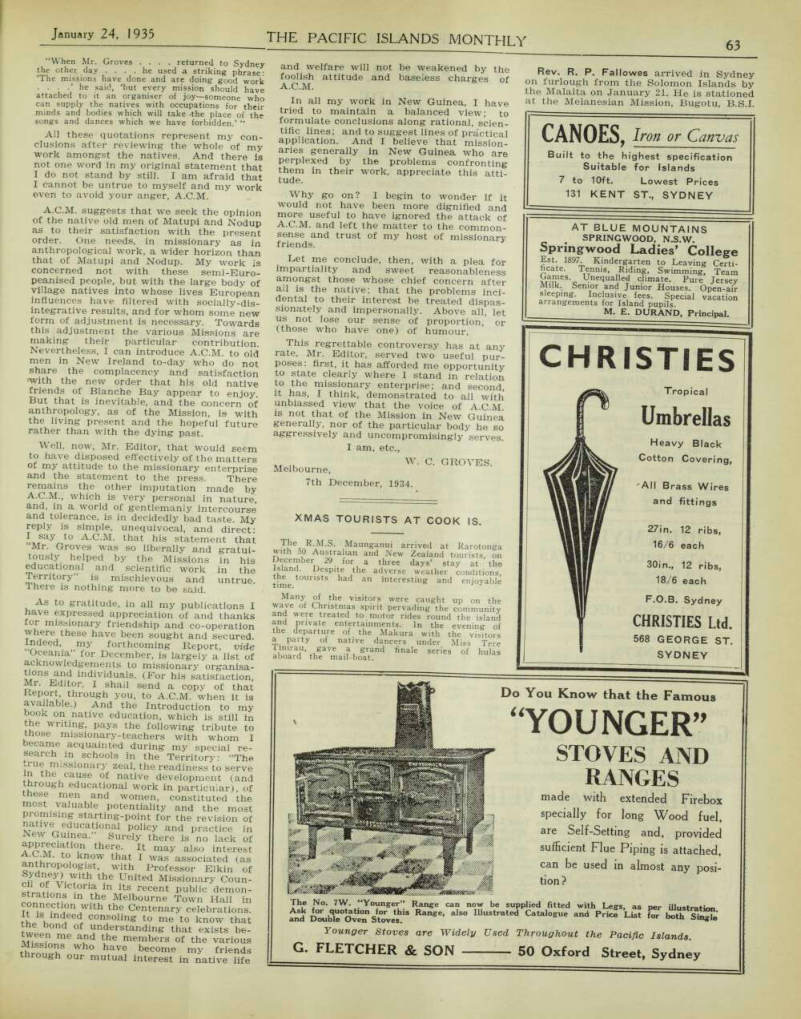
Letter to the Editor.
BEFORE proceeding to reply to the letter of “A Catholic Missionary,” published in your November issue, may I request that you alter the title of this foolish controversy from Missionaries or Anthropologists” to Missionaries and Anthropologists”; and that you allow me to refer throughout this letter to the writer who signs himself “A Catholic Missionary” as merely “A.C.M.”
It is greatly to be deplored that A.C.M. has allowed his spirited justification of the Mission he represents to take the form, in part at least, of an ill-considered and hasty attack upon me personally and upon the work of anthropology generally in New Guinea.
For the provocative nature of his letter not only reflects discredit upon himself; but, if we were to take it seriously, would, I think, be calculated to do a grave disservice to the worthy body to which he belongs, and whose great part in advancing native interests in the Ter ritory I have always freely acknow ledged.
Fortunately for the Mission, we who have any real knowledge of the position will not accept the views expressed and the imputations made by A.C.M. as re presentative of the Mission generally, nor his uncompromising attitude as in any way typical of the great body of worthy missionaries in New Guinea. I value too highly the close and understanding per sonal friendship I have enjoyed over some years with such truly noble and utterly self-negating souls as Fathers Bley and Lakaff; treasure too dearly the saintly memory of my beloved Seigneur Louis Couppe (first Bishop at Vunapope) whose autographed photograph has a permanent place on my writing-table; appreciate too well, too, the record of service of that large band of broad visioned missionaries of all denomina tions who have given their lives in so many places to the uplift of their fellow men; and recognise too certainly the con tributions to science of such men as Kirschbaum (of the Sepik), Lehner (of Finschhafen), Pater Schmidt, Edwin Smith, and hosts of others, to allow myself to be dragged into an unseemly controversy the outcome of which inevitably will be only misunderstanding, and that will serve no useful purpose.
That the attack of A.C.M. does me per sonal injustice matters nothing. The worst that his attitude can do, however, is to cause a breach in that cordial relationship
that has existed between me and his Mis sion since I first went to Kokopo as Head Teacher of the newly-established Govern ment Native School in 1922, a relationship that I value very highly.
Discussing one of my published reports on certain aspects of the European-primi tive contact situation in New Guinea early this year with His Lordship Bishop Vesters, I was assured that he regarded my views as free of bias, and honest of deduction. “Your work could not be other than that,” concluded His Lordship, who has always extended to me the greatest possible assistance and courtesy, and in my relationship with whom I have always en joyed a certain informality. Strange, then, that A.C.M. should suddenly find in me an enemy of his Mission. “You are rendering a splendid service to the natives of the Territory because the sane and balanced attitude you have adopted commands the attention and respect of all students of and workers among the peoples of Oceania,” wrote another missionary to me from New Guinea recently, with special reference to my publication on Sio Island.
Aside from considerations that are purely personal, however, it is certain that no good purpose—certainly not the common purpose of native welfare—can be served by a mutually recriminative attitude be tween missionary and anthropologist. Even A.C.M. insists on the need for understand ing the basis of the native societies amongst whom his missionaries work. How otherwise could the Mission succeed in planting the roots of the Christian teach ings firmly into the soil of native life?
There is not to-day, nor ever has been, any real quarrel between the social anthro pologist and the missionary.
The best missionary, from the native viewpoint, and the most successful from the Christian angle, is the one who, follow ing the method of the enlightened and trained field-anthropologist, works in har mony with the native, understands his life and organisation, and so attunes his mind to the primitive mental key. Conversely,
the least successful missionaries are those who do not give recognition to this idea in their approach to the native. That there are some of the latter type in New Guinea
to-day is of course known to anyone who has moved about with open mind and observant eye.
But there surely is no more need for me to justify the anthropological method than there is for A.C.M. to justify the Mission.
If A.C.M. wants to know, once for all, where I stand with regard to the Mis sionary enterprise, he need only turn up the “Rabaul Times” of March 9, 1934, to read this unequivocal statement: “I have always been on terms of understanding with the Missions of this Territory, and have expressed belief in their work, though I may have found it necessary occasionally to criticise their methods.”
In the Islands to-day one must be either FOR the Mission or AGAINST it; there is no middle road. And I am and always have been for it; not because of considera tions of personal friendship or privilege; not because the missionary organisation is above reproach (none but the type of mis sionary repesented by A.C.M. would claim that); but wholly and solely because, in the situation of European-primitive impact and clash, the Christian mission is the one body that has stood with singleness of pur pose on the side of the native.
This does not mean that I am blind to missionary weaknesses or that I have al ways found agreement with individual mis sionaries in their methods. My special con cern being for the native, inevitably and frequently there have arisen situations in which I have found myself (acting in what I regarded as the natives’ interests) in disagreement with the missionary. And, notwithstanding the suggestion to the con trary made in the letter of A.C.M., I have always discussed such matters freely with the missionary concerned; and, much to the disappointment of those who hoped to find in my critical attitude support for their own unremitting opposition to all aspects of missionary work, I have always refrained from putting these matters of disagree ment into published form!
It is only because of this rule imposed upon myself that I refrain at present from accepting the foolish challenge of A.C.M. to “point to a single good or indifferent custom or habit that has been interfered with by a Catholic Missionary.” If, how ever, the challenge becomes insistent, then I must reluctantly break the rule. A.C.M. makes a big mistake, if he believes that in the 2½ years I have spent in native villages, enjoying the confidence of the natives, I
have not gained a thorough understanding of missionary methods and the reaction of natives to certain aspects of the missionary approach.
Now, to deal with the points in A.C.M.’s letter. First, the statement that the article in September P.I.M., entitled “Uncoordinated Mission Effort,” was “evident ly inspired by and based on a misleading statement made in Sydney by Mr. W. C, Groves.”
I am not seeking shelter in the customary old plea of wrong report. What I said to the Sydney pressmen (who sought me out at the wharf) is precisely what I meant, and the most responsible of the large dailies reported me almost verbatim. So I was correctly reported. That the P.I.M. chose to refer to the statements I made, paraphrasing them pretty broadly, is no affair of mine. Actually, I thought the P.I.M. article a very reasonable plea for the recognition of an obvious need —that of co-ordination, under Government guidance, of certain aspects of missionary efforts to wards native development.
Now let us look at the press statement referred to —not to defend me, but to show that A.C.M. has hastily jumped to erro neous conclusions.
Sydney “Sun,” 31/7/34:
“That the Missions should appoint organisers of joy among the natives was the suggestion made by Mr. W. C. Groves ... who returned to-day by the Macdhui “He arrived at this conclusion after working: on the New Guinea mainland, where he studied the effects of Missions on native society. Mr.
Groves said that, although primitive culture had broken down, satisfactory substitutes, he con sidered, had been provided, and that his conclusions were favorable to the Missions.
“Primitive society was dead, but to-day new economic enterprises were in progress. ... A spirit of joy, however, was required. The people did not play.”
The same idea was expressed in perhaps less staccato terms in the Melbourne “HERALD” of 18/8/34: “As a result of European contact and the attachment of the natives to the new adjustment inspired by the Christian missionaries, there appears to be an absence of that robust joy which is characteristic of the primitive Melanesian peoples.
It would appear that future educational agents should concentrate upon this aspect.” (Black type here is mine.—W.C.G.).
Now let us look at the P.I.M.’s paraphrase, which, mark you, formed only an incidental refer ence in the whole long article, and could not by any stretch of reasonable imagination be regarded as “inspiring” the said article, as A.C.M. assumes it to do:
“When Mr. Groves ... returned to Sydney the other day ... he used a striking phrase: ‘The missions have done and are doing good work . . . .’ he said, ‘but every mission should have attached to it an organiser of joy—someone who can supply the natives with occupations for their minds and bodies which will take the place of the songs and dances which we have forbidden.’ ”
All these quotations represent my conclusions after reviewing the whole of my work amongst the natives. And there is not one word in my original statement that I do not stand by still. I am afraid that I cannot be untrue to myself and my work even to avoid your anger, A.C.M.
A.C.M. suggests that we seek the opinion of the native old men of Matupi and Nodup as to their satisfaction with the present order. One needs, in missionary as in anthropological work, a wider horizon than that of Matupi and Nodup. My work is concerned not with these semi-Euro peanised people, but with the large body of village natives into whose lives European influences have filtered with socially-dis integrative results, and for whom some new form of adjustment is necessary. Towards this adjustment the various Missions are making their particular contribution.
Nevertheless, I can introduce A.C.M. to old men in New Ireland to-day who do not share the complacency and satisfaction with the new order that his old native friends of Blanche Bay appear to enjoy But that is inevitable, and the concern of anthropology, as of the Mission, is with the living present and the hopeful future rather than with the dying past.
Well, now, Mr. Editor, that would seem to have disposed effectively of the matters of my attitude to the missionary enterprise and the statement to the press. There remains the other imputation made by A.C.M., which is very personal in nature, and, in a world of gentlemanly intercourse and tolerance, is in decidedly bad taste. My reply is simple, unequivocal, and direct: I say to A.C.M. that his statement that “Mr. Groves was so liberally and gratui tously helped by the Missions in his educational and scientific work in the Territory’’ is mischievous and untrue There is nothing more to be said.
As to gratitude, in all my publications I have expressed appreciation of and thanks for missionary friendship and co-operation where these have been sought and secured.
Indeed, my forthcoming Report, vide "Oceania’’ for December, is largely a list of acknowledgements to missionary organisations and individuals. (For his satisfaction, Mr. Editor, I shall send a copy of that Report through you, to A.C.M. when it is available.) And the Introduction to my book on native education, which is still in the writing, pays the following tribute to those missionary-teachers with whom I became acquainted during my special re search in schools in the Territory: “The true missionary zeal, the readiness to serve in the cause of native development (and through educational work in particular), of these men and women, constituted the most valuable potentiality and the most promising starting-point for the revision of native educational policy and practice in New Guinea.” Surely there is no lack of appreciation there. It may also interest A.C M. to know that I was associated (as anthropologist, with Professor Elkin of Sydney) with the United Missionary Council of Victoria its recent public demonstrations in the Melbourne Town Hall in connection with the Centenary celebrations.
It is indeed consoling to me to know that the bond of understanding that exists be tween me and the members of the various Missions who have become my friends through our mutual interest in native life
and welfare will not be weakened by the foolish attitude and baseless charges of
A.C.M.
In all my work in New Guinea, I have tried to maintain a balanced view; to formulate conclusions along rational, scien tific lines; and to suggest lines of practical application. And I believe that mission aries generally in New Guinea who are perplexed by the problems confronting them in their work, appreciate this atti tude.
Why go on? I begin to wonder if it would not have been more dignified and more useful to have ignored the attack of A.C.M. and left the matter to the common sense and trust of my host of missionary friends.
Let me conclude, then, with a plea for impartiality and sweet reasonableness amongst those whose chief concern after all is the native; that the problems inci dental to their interest be treated dispas sionately and impersonally. Above all, let us not lose our sense of proportion, or (those who have one) of humour.
This regrettable controversy has at any rate, Mr. Editor, served two useful pur poses: first, it has afforded me opportunity to state clearly where I stand in relation to the missionary enterprise; and second, it has, I think, demonstrated to all with unbiassed view that the voice of A.C.M. is not that of the Mission in New Guinea generally, nor of the particular body he so aggressively and uncompromisingly serves.
I am, etc.,
W. C. Groves.
Melbourne,
7th December, 1934.
Advertisements & other items, pp. 63-64 (1 item)
Gleniffer
OLD ISLANDS
PHOTOGRAPHS
We have a unique collection of several thousands of original photographs of Natives and Scenes in New Guinea, Solomons, Tonga, Fiji, Samoa, New Hebrides, etc., taken during the years 1875 to 1895.
These supply invaluable records of fastdisappearing races.
Full-plate prints, 1/- each, or 12 for 10/-.
Details on application
TYRRELL’S MUSEUM,
281 GEORGE ST., SYDNEY
Lloyd's Teas
Tea drinkers expect more than a mere drink.
That easy, relaxed feeling, that sense of contentment and glow of real satisfaction must be there . . . not once in a while, but with every cup.
Try Lloyds for purity. Try the consistent goodness of quality tea. Try the delicious aroma that is such a feature of Lloyd’s tea blending.
Obtainable at all good island stores.
COPRA MATS AND MATTING
Send your enquiries to us for Woven Wire Mesh in Rolls or framed for Screening purposes, Bird Cages, Sieves and Riddles, Builder’s Gravel Door Mats, Garden Arches, Chain Wire Mesh, Crimped Wire Mesh for
SCOTT AND SONS
WIRE WORKS: RAILWAY PARADE AND MURRAY STREET, Copra drying, and all Screens, Rat Traps, Window Guards, etc.
MARRICKVILLE
GLENIFFER
Diesel engines INSTAL THE DIESEL THAT HAS BEEN GOING STRONG SINCE 1929, AND HAS PROVED ITSELF immune from all diesel weakness.
D.C. Series, 45 to 160 b.h.p., m 3,4, 6, and 8 cylinder sues at 700 to 900 r.p.m.
D.B. Series, 24 to 96 b.h.p., in 2,3, 4,6, and 8 cylinder sizes, at 1000 Australian Agents:
H. G. THORNTHWAITE & CO.
KEMBLA BUILDING.
MARGARET STREET, SYDNEY, N.S.W.
TELEGRAMS: “ORTHORN,” SYDNEY. TELEPHONE; B 5240
Records Posted Free
SEND FOR LISTS
Australia’s finest Record Shop, specialising in Mail Orders.
Any Records procured and sent same day.
Dozens of clients in the Pacific Islands.
We pay Freight.
THE TALKERIES
QUEEN VICTORIA BUILDINGS
SYDNEY, AUSTRALIA
The Recognised Leading Typewriter House in Australia for Rebuilt and Used
TYPEWRITERS
And the safest place to buy Portable, Desk, and every size, in every known make. Buy with confidence.
Royals, Remingtons, Underwoods, Coronas, L. C. Smiths, Imperials, etc., etc. Hundreds to choose from.
Prices include packing and delivery to Island Ports.
Hundreds to choose from; From £4 to £14 each Ask the man who bought here.
Best selection in Australia
Typewriter Trading Co.
140 Castlereagh Street
SYDNEY
Our Good Name is Your Safeguard
G.P.O. Box 2743 N
Cables: Telegrams: “Tytraco”
Telephone MA 4340 Manager; FREDK. G. TUNKS Established 25 Years.
A. E. MATTHEWS
Manufacturer of the FAMOUS
“MATTHEWS ’ BOOTS
Specialising in Heavy Footwear
Standard Screwed Fair Stitch and Machine Sewn.
WHOLESALE ONLY
Enquiries from Traders solicited Catalogues and Price Lists on application We specialise in Island Footwear Trade.
A. E. MATTHEWS, JOHN ST., LEICHHARDT, N.S.W.
Xmas Tourists At Cook Is.
THE R.M. S . Maunganui arrived at Rarotonga with 50 Australian and New Zealand tourists, on December 29 for a three days’ stay at the Island. Despite the adverse weather conditions, the tourists had an interesting and enjoyable time.
Many of the visitors were caught up on the wave of Christmas spirit pervading the community and were treated to motor rides round the island and private entertainments. In the evening of the departure of the Makura with the visitors a party of native dancers under Miss Tere Tinirau, gave a grand finale series of hulas aboard the mail-boat.
Rev. R. P. Fallowes arrived in Sydney on furlough from the Solomon Islands by the Malaita on January 21. He is stationed at the Melanesian Mission, Bugotu, B.S.I,
Advertisements & other items, p. 65 (1 item)
“Younger”
CANOES, Iron or Canvas
Built to the highest specification Suitable for Islands 7 to 10ft. Lowest Prices
131 KENT ST., SYDNEY
AT BLUE MOUNTAINS
SPRINGWOOD, N.S.W.
Springwood Ladies’ College
Est : 1897. Kindergarten to Leaving Certificate. Tennis, Riding, Swimming, Team Games. Unequalled climate. Pure Jersey Milk. Senior and Junior Houses. Open-air sleeping. Inclusive fees. Special vacation arrangements for Island pupils.
M. E. DURAND, Principal.
CHRISTIES
Tropical
Umbrellas
Heavy Black Cotton Covering, All Brass Wires and fittings 27in. 12 ribs, 16/6 each 30in., 12 ribs, 18/6 each F.O.B. Sydney
CHRISTIES Ltd,
568 GEORGE ST.
SYDNEY
Do You Know that the Famous
“YOUNGER”
STOVES AND
RANGES
made with extended Firebox specially for long Wood fuel, are Self-Setting and, provided sufficient Flue Piping is attached, can be used in almost any position?
The No. 7W. “Younger” Range can now be supplied fitted with Legs, as per illustration Ask for quotation for this Range, also Illustrated Catalogue and Price List for both Single and Double Oven Stoves.
Younger Stoves are Widely Used Throughout the Pacific Islands.
G. FLETCHER & SON 50 Oxford Street, Sydney
For Appetizing Milk Scones
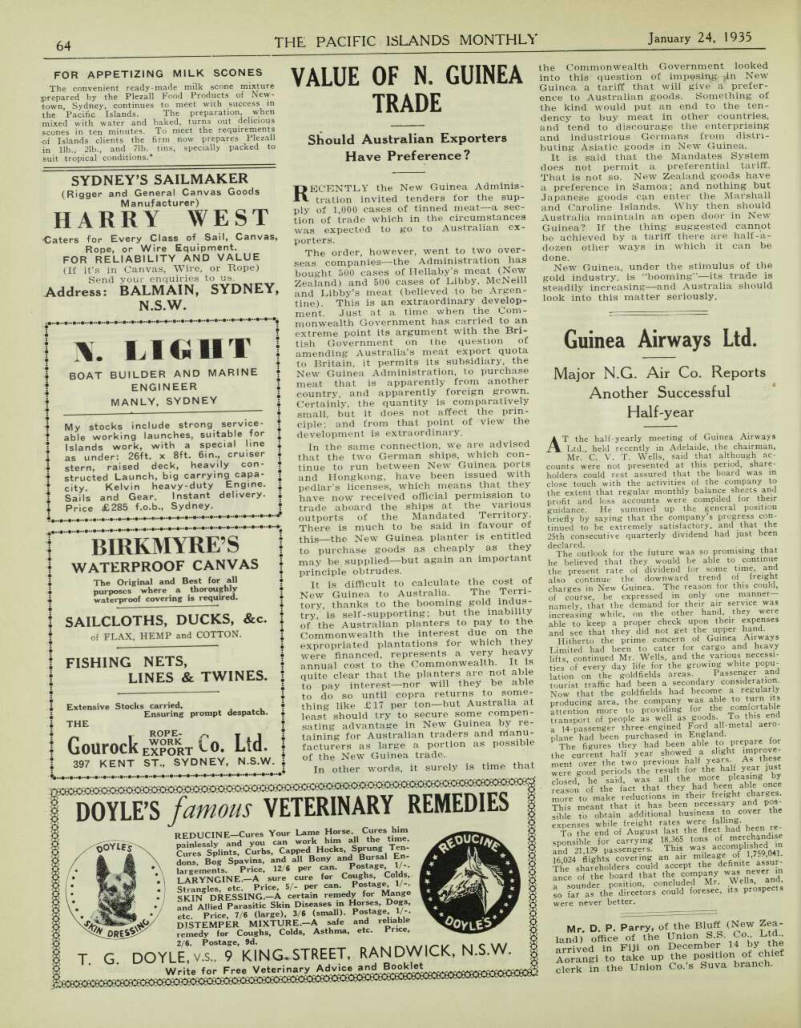
The convenient ready-made milk scone mixture prepared by the Plezall Food Products of New town, Sydney, continues to meet with success m the Pacific Islands. The preparation, when mixed with water and baked, turns out delicious scones in ten minutes. To meet the requirements of Islands clients the firm now prepares Plezall in 1lb., 2lb., and 7lb. tins, specially packed to suit tropical conditions.*
Value Of N. Guinea
Trade
Should Australian Exporters Have Preference?
RECENTLY the New Guinea Adminis tration invited tenders for the sup ply of 1,000 cases of tinned meat —a sec tion of trade which in the circumstances was expected to go to Australian ex porters.
The order, however, went to two over seas companies—the Administration has bought 500 cases of Hellaby’s meat (New Zealand) and 500 cases of Libby, McNeill and Libby’s meat (believed to be Argen tine). This is an extraordinary develop ment. Just at a time when the Com monwealth Government has carried to an extreme point its argument with the Bri tish Government on the question of amending Australia’s meat export quota to Britain, it permits its subsidiary, the New Guinea Administration, to purchase meat that is apparently from another country, and apparently foreign grown.
Certainly, the quantity is comparatively small, but it does not affect the prin ciple: and from that point of view the development is extraordinary.
In the same connection, we are advised that the two German ships, which con tinue to run between New Guinea ports and Hongkong, have been issued with pedlar’s licenses, which means that they have now received official permission to trade aboard the ships at the various outports of the Mandated Territory.
There is much to be said in favour of this —the New Guinea planter is entitled to purchase goods as cheaply as they may be supplied—but again an important
principle obtrudes.
It is difficult to calculate the cost of New Guinea to Australia. The Terri tory, thanks to the booming gold indus try, is self-supporting; but the inability of the Australian planters to pay to the Commonwealth the interest due on the expropriated plantations for which they were financed, represents a very heavy annual cost to the Commonwealth. It is quite clear that the planters are not able to pay interest —nor will they be able to do so until copra returns to some thing like £17 per ton —but Australia at least should try to secure some compen sating advantage in New Guinea by re taining for Australian traders and manufacturers as large a portion as possible of the New Guinea trade.
In other words, it surely is time that
the Commonwealth Government looked into this question of imposing f in New Guinea a tariff that will give a prefer ence to Australian goods. Something of the kind would put an end to the ten dency to buy meat in other countries, and tend to discourage the enterprising and industrious Germans from distri buting Asiatic goods in New Guinea.
It is said that the Mandates System does not permit a preferential tariff.
That is not so. New Zealand goods have a preference in Samoa; and nothing but Japanese goods can enter the Marshall and Caroline Islands. Why then should Australia maintain an open door in New Guinea? If the thing suggested cannot be achieved by a tariff there are half-a dozen other ways in which it can be done.
New Guinea, under the stimulus of the gold industry, is “booming”—its trade is steadily increasing—and Australia should look into this matter seriously.
Guinea Airways Ltd.
Major N.G. Air Co. Reports Another Successful Half-year
AT the half-yearly meeting of Guinea Airways Ltd., held recently in Adelaide, the chairman, Mr. C. V. T. Wells, said that although ac counts were not presented at this period, share holders could rest assured that the board was m close touch with the activities of the company to the extent that regular monthly balance sheets and profit and loss accounts were compiled for their guidance. He summed up the general position briefly by saying that the company’s progress con tinued to be extremely satisfactory, and that the 25th consecutive quarterly dividend had just been declared.
The outlook for the future was so promising that he believed that they would be able to continue the present rate of dividend for some time, and also continue the downward trend of freight charges in New Guinea. The reason for this could, of course, be expressed in only one manner— namely, that the demand for their air service was increasing while, on the other hand, they were able to keep a proper check upon their expenses and see that they did not get the upper hand.
Hitherto the prime concern of Guinea Airways Limited had been to cater for cargo and heavy lifts continued Mr. Wells, and the various necessievery day life for the growing white popu lation on the goldfields areas. Passenger and tourist traffic had been a secondary consideration.
Now that the goldfields had become a regularly producing area, the company was able to turn its attention more to providing for the comfortable transport of people as well as goods. To this end a 14-passenger three-engined Ford all-metal aero plane had been purchased in England.
The figures they had been able to prepare for the current half year showed a slight improvement over the two previous half years. As these were good periods the result for the half year just dosed he said, was all the more pleasing by reason of the fact that they had been able once more to make reductions in their freight charges.
This meant that it has been necessary and pos sible to obtain additional business to cover the expenses while freight rates were falling.
To the end of August last the fleet had been responsible for carrying 18.365 tons of merchandise and 21,129 passengers. This was accomplished in 16,024 flights covering an air mileage of 1,759,041.
The shareholders could accept the define assurance of the board that the company never in a sounder position, concluded Mr. Wells, and, so far as the directors could foresee, its prospects were never better.
Mr D P. Parry, of the Bluff (New Zea land) office of the Union S.S Co Ltd arrived in Fiji on December 14 by the Aorangi to take up the position of chief clerk in the Union Co.’s Suva branch.
Advertisements & other items, p. 66 (1 item)
Doyle’S Famous Veterinary Remedies
SYDNEY’S SAILMAKER
(Rigger and General Canvas Goods Manufacturer)
HARRY WEST
Caters for Every Class of Sail, Canvas, Rope, or Wire Equipment.
FOR RELIABILITY AND VALUE
(If it’s in Canvas, Wire, or Rope) Send your enquiries to us.
Address: BALMAIN, SYDNEY,
N.S.W.
N. LIGHT
BOAT BUILDER AND MARINE
ENGINEER
MANLY, SYDNEY
My stocks include strong serviceable working launches, suitable for Islands work, with a special line as under: 26ft. x 8ft. 6in., cruiser stern, raised deck, heavily constructed Launch, big carrying capacity. Kelvin heavy-duty Engine.
Sails and Gear. Instant delivery.
Price £285 f.o.b., Sydney.
BIRKMYRE’S
WATERPROOF CANVAS
The Original and Best for all purposes where a thoroughly waterproof covering is required.
SAILCLOTHS, DUCKS, &c.
of FLAX, HEMP and COTTON.
FISHING NETS,
LINES & TWINES.
Extensive Stocks carried.
Ensuring prompt despatch.
THE
Gourock Rope-work Export Co. Ltd.
397 KENT ST., SYDNEY, N.S.W.
DOYLE’S famous VETERINARY REMEDIES
REDUCINE—Cures Your Lame Horse. Cures him painlessly and you can work him all the time.
Cures Splints, Curbs, Capped Hocks, Sprung Ten dons. Bog Spavins, and all Bony Bursal Enlargements. Price. 12/6 per can. Postage 1/-.
LARYNGINE.—A sure cure for Coughs, Colds, Strangles, etc. Price, 5/- per can. Postage, 1/-.
SKIN DRESSING.—A certain remedy for Mange and Allied Parasitic Skin Diseases in Horses, Dogs, etc. Price, 7/6 (large), 3/6 (small). Postage, 1/ .
T. G. DOYLE, V.S., 9 KING STREET, RANDWICK, N.S.W.
Write for Free Veterinary Advice and Booklet
Polynesian
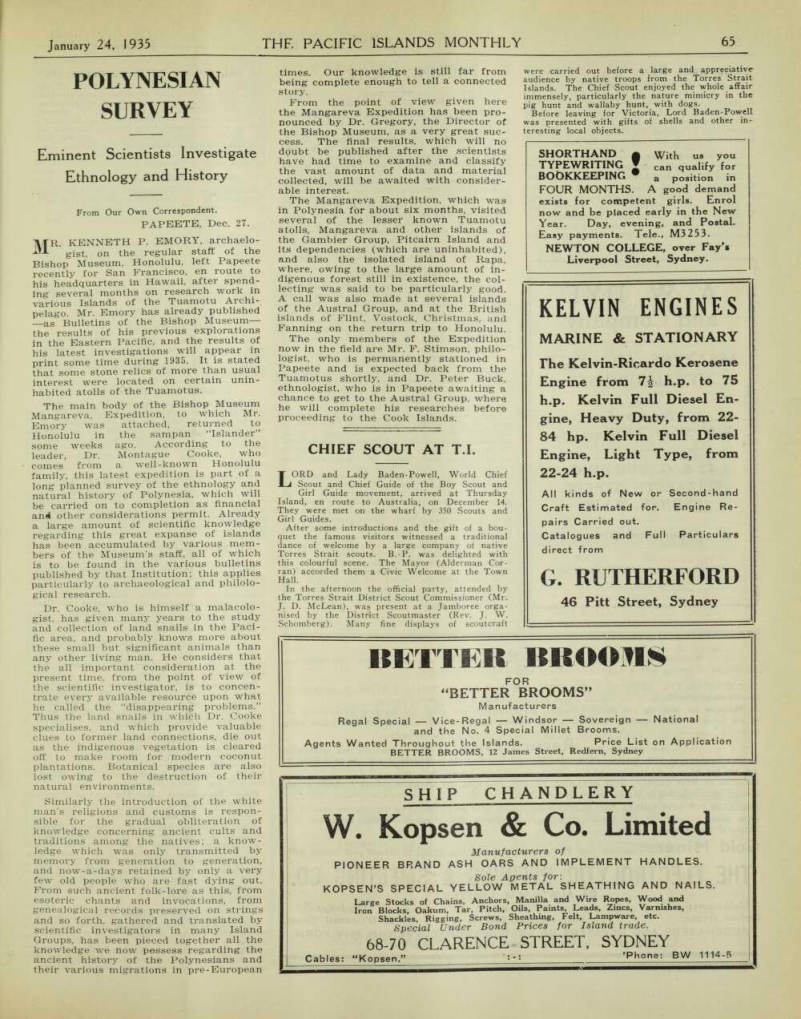
Survey
Eminent Scientists Investigate Ethnology and History
From Our Own Correspondent.
Papeete, Dec. 27.
MR. KENNETH P. EMORY, archaelo gist, on the regular staff of the Bishop Museum, Honolulu, left Papeete recently for San Francisco, en route to his headquarters in Hawaii, after spend ing several months on research work in various Islands of the Tuamotu Archi pelago. Mr. Emory has already published —as Bulletins of the Bishop Museum— the results of his previous explorations in the Eastern Pacific, and the results of his latest investigations will appear in print some time during 1935. It is stated that some stone relics of more than usual interest were located on certain unin habited atolls of the Tuamotus.
The main body of the Bishop Museum Mangareva, Expedition, to which Mr.
Emory was attached, returned to Honolulu in the sampan "Islander” some weeks ago. According to the leader, Dr. Montague Cooke, who comes from a well-known Honolulu family, this latest expedition is part of a long planned survey of the ethnology and natural history of Polynesia, which will be carried on to completion as financial and other considerations permit. Already a large amount of scientific knowledge regarding this great expanse of islands has been accumulated by various mem bers of the Museum’s staff, all of which is to be found in the various bulletins published by that Institution; this applies particularly to archaeological and philolo gical research.
Dr. Cooke, who is himself a malacolo gist, has given many years to the study and collection of land snails in the Paci fic area, and probably knows more about these small but significant animals than any other living man. He considers that the all important consideration at the present time, from the point of view of the scientific investigator, is to concen trate every available resource upon what he called the "disappearing problems.”
Thus the land snails in which Dr. Cooke specialises, and which provide valuable clues to former land connections, die out as the indigenous vegetation is cleared off to make room for modern coconut plantations. Botanical species are also lost owing to the destruction of their natural environments.
Similarly the introduction of the white man’s religions and customs is respon sible for the gradual obliteration of knowledge concerning ancient cults and traditions among the natives; a know ledge which was only transmitted by memory from generation to generation, and now-a-days retained by only a very few old people who are fast dying out.
From such ancient folk-lore as this, from esoteric chants and invocations, from genealogical records preserved on strings and so forth, gathered and translated by scientific investigators in many Island Groups, has been pieced together all the knowledge we now possess regarding the ancient history of the Polynesians and their various migrations in pre-European
times. Our knowledge is still far from being complete enough to tell a connected story.
From the point of view given here the Mangareva Expedition has been pro nounced by Dr. Gregory, the Director of the Bishop Museum, as a very great suc cess. The final results, which will no doubt be published after the scientists have had time to examine and classify the vast amount of data and material collected, will be awaited with consider able interest.
The Mangareva Expedition, which was in Polynesia for about six months, visited several of the lesser known Tuamotu atolls, Mangareva and other islands of the Gambier Group, Pitcairn Island and its dependencies (which are uninhabited), and also the isolated island of Rapa, where, owing to the large amount of in digenous forest still in existence, the col lecting was said to be particularly good.
A call was also made at several islands of the Austral Group, and at the British islands of Flint, Vostock, Christmas, and Fanning on the return trip to Honolulu.
The only members of the Expedition now in the field are Mr. F. Stimson, philo logist, who is permanently stationed in Papeete and is expected back from the Tuamotus shortly, and Dr. Peter Buck, ethnologist, who is in Papeete awaiting a chance to get to the Austral Group, where he will complete his researches before proceeding to the Cook Islands.
Chief Scout At T.I.
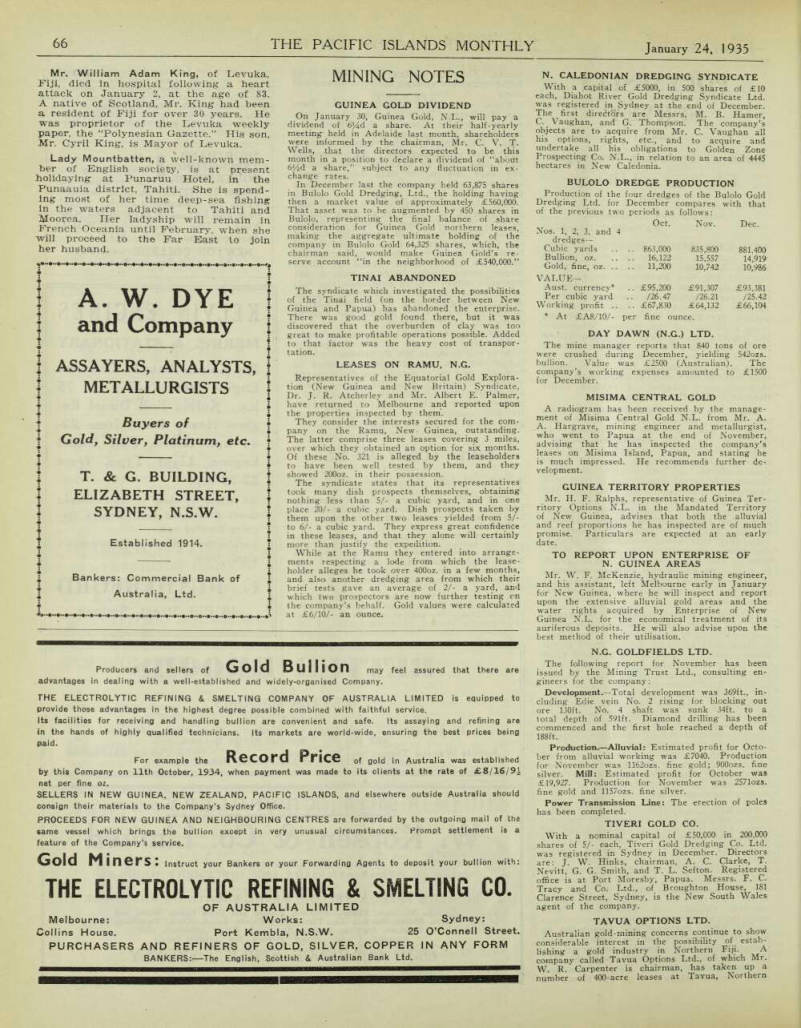
LORD and Lady Baden-Powell, World Chief Scout and Chief Guide of the Boy Scout and Girl Guide movement, arrived at Thursday Island, en route to Australia, on December 14.
They were met on the wharf by 350 Scouts and Girl Guides.
After some introductions and the gift of a bou quet the famous visitors witnessed a traditional dance of welcome by a large company of native Torres Strait scouts. B.-P. was delighted with this colourful scene. The Mayor (Alderman Cor ran) accorded them a Civic Welcome at the Town Hall.
In the afternoon the official party, attended by the Torres Strait District Scout Commissioner (Mr.
J. D. McLean), was present at a Jamboree orga nised by the District Scoutmaster (Rev. J. W.
Schomberg). Many fine displays of scoutcraft
were carried out before a large and appreciative audience by native troops from the Torres Strait Islands. The Chief Scout enjoyed the whole affair immensely, particularly the nature mimicry in the pig hunt and wallaby hunt, with dogs.
Before leaving for Victoria, Lord Baden-Powell was presented with gifts of shells and other in teresting local objects.
Mr. William Adam King, of Levuka, Fiji, died in hospital following a heart attack on January 2, at the age of 83.
A native of Scotland, Mr. King had been a resident of Fiji for over 30 years. He was proprietor of the Levuka weekly paper, the “Polynesian Gazette.” His son, Mr. Cyril King, is Mayor of Levuka.
Lady Mountbatten, a well-known mem ber of English society, is at present holidaying at Punaruu Hotel, in the Punaauia district, Tahiti. She is spend ing most of her time deep-sea fishing in the waters adjacent to Tahiti and Moorea. Her ladyship will remain in French Oceania until February, when she will proceed to the Far East to join her husband.
Advertisements & other items, pp. 67-68 (1 item)
W. Kopsen & Co. Limited
SHORTHAND With us you TYPEWRITING can qualify for BOOKKEEPING a position in FOUR MONTHS! A good demand exists for competent girls. Enrol now and be placed early in the New Year. Day, evening, and Postal.
Easy payments. Tele., M 3253.
NEWTON COLLEGE, over Fay’s Liverpool Street, Sydney.
KELVIN ENGINES
MARINE & STATIONARY
The Kelvin-Ricardo Kerosene Engine from 7-2- h.p. to 75 h.p. Kelvin Full Diesel Engine, Heavy Duty, from 22- 84 hp. Kelvin Full Diesel Engine, Light Type, from 22-24 h.p.
All kinds of New or Second-hand Craft Estimated for. Engine Repairs Carried out.
Catalogues and Full Particulars direct from
G. RUTHERFORD
46 Pitt Street, Sydney
better brooms
FOR
‘‘BETTER BROOMS”
Manufacturers Regal Special Vice-Regal Windsor Sovereign National and the No. 4 Special Millet Brooms.
Agents Wanted Throughout the Islands. Price List on Application BETTER BROOMS, 12 James Street, Redfern, Sydney
SHIP CHANDLERY
W. Kopsen & Co. Limited
Manufacturers of PIONEER BRAND ASH OARS AND IMPLEMENT HANDLES.
Sole Agents for : KOPSEN’S SPECIAL YELLOW METAL SHEATHING AND NAILS.
Large Stocks of Chains, Anchors, Manilla and Wire Ropes, Wood and Iron Blocks, Oakum, Tar, Pitch, Oils, Paints Leads, Zincs, Varmshes, Shackles, Rigging, Screws, Sheathing, Felt, Lampware, etc.
Special Under Bond Prices for Island trade.
68-70 CLARENCE STREET. SYDNEY
Cables: “Kopsen.” ’Phone: BW 1114-B
A. W. DYE
and Company
ASSAYERS, ANALYSTS,
METALLURGISTS
Buyers of Gold, Silver, Platinum, etc.
T. & G. BUILDING,
ELIZABETH STREET,
SYDNEY, N.S.W.
Established 1914.
Bankers: Commercial Bank of Australia, Ltd.
Producers and sellers of Gold Bullion may feel assured that there are advantages in dealing with a well-established and widely-organised Company.
THE ELECTROLYTIC REFINING & SMELTING COMPANY OF AUSTRALIA LIMITED is equipped to provide those advantages in the highest degree possible combined with faithful service.
Its facilities for receiving and handling bullion are convenient and safe. Its assaying and refining are in the hands of highly qualified technicians. Its markets are world-wide, ensuring the best prices being paid.
For example the Record Price of gold in Australia was established by this Company on 11th October, 1934, when payment was made to its clients at the rate of £B/16/93, net per fine oz.
SELLERS IN NEW GUINEA, NEW ZEALAND, PACIFIC ISLANDS, and elsewhere outside Australia should consign their materials to the Company’s Sydney Office.
PROCEEDS FOR NEW GUINEA AND NEIGHBOURING CENTRES are forwarded by the outgoing mail of the same vessel which brings the bullion except in very unusual circumstances. Prompt settlement is a feature of the Company’s service.
Gold Miners: Instruct your Bankers or your Forwarding Agents to deposit your bullion with:
THE ELECTROLYTIC REFINING & SMELTING CO.
OF AUSTRALIA LIMITED
Melbourne: Works: Sydney; Collins House. Port Kembla, N.S.W. 25 O’Connell Street.
PURCHASERS AND REFINERS OF GOLD, SILVER, COPPER IN ANY FORM BANKERS: —The English, Scottish & Australian Bank Ltd,
Mining Notes
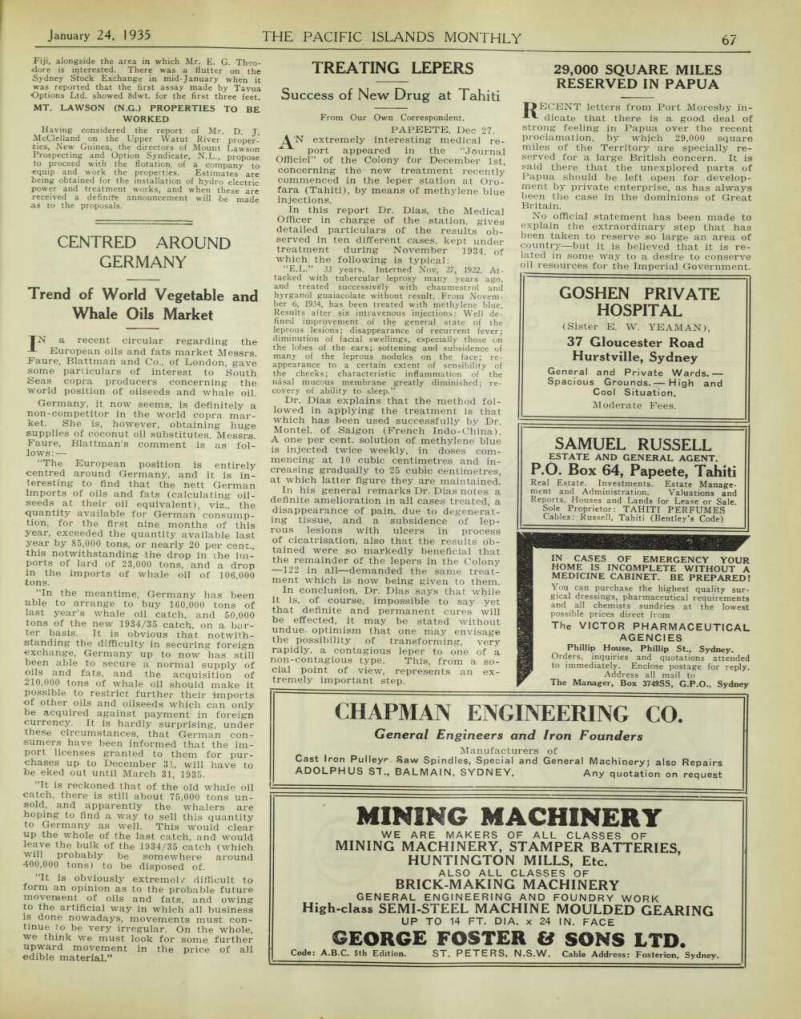
Guinea Gold Dividend
On January 30, Guinea Gold, N.L., will pay a dividend of a share. At their half-yearly meeting held in Adelaide last month, shareholders were informed by the chairman, Mr. C. V. T.
Wells, that the directors expected to be this month in a position to declare a dividend of “about 6½d a share,” subject to any fluctuation in exchange rates.
In December last the company held 63,875 shares in Bulolo Gold Dredging, Ltd., the holding having then a market value of approximately £560,000.
That asset was to be augmented by 450 shares in Bulolo, representing the final balance of share consideration for Guinea Gold northern leases, making the aggregate ultimate holding of the company in Bulolo Gold 64,325 shares, which, the chairman said, would make Guinea Gold’s re serve account “in the neighborhood of £540,000.”
Tinai Abandoned
The syndicate which investigated the possibilities of the Tinai field (on the border between New Guinea and Papua) has abandoned the enterprise.
There was good gold found there, but it was discovered that the overburden of clay was too great to make profitable operations possible. Added to that factor was the heavy cost of transpor tation.
Leases On Ramu, N.G.
Representatives of the Equatorial Gold Explora tion (New Guinea and New Britain) Syndicate, Dr. J. R. Atcherley and Mr. Albert E. Palmer, have returned to Melbourne and reported upon the properties inspected by them.
They consider the interests secured for the com pany on the Ramu, New Guinea, outstanding.
The latter comprise three leases covering 3 miles, over which they obtained an option for six months.
Of these No. 321 is alleged by the leaseholders to have been well tested by them, and they showed 200oz. in their possession.
The syndicate states that its representatives took many dish prospects themselves, obtaining nothing less than 5/- a cubic yard, and in one place 20/- a cubic yard. Dish prospects taken by them upon the other two leases yielded from 5/to 6/- a cubic yard. They express great confidence in these leases, and that they alone will certainly more than justify the expedition.
While at the Ramu they entered into arrange ments respecting a lode from which the lease holder alleges he took over 400oz. in a few months, and also another dredging area from which their brief tests gave an average of 2/- a yard, and which two prospectors are now further testing on the company’s behalf. Gold values were calculated at £6/10/- an ounce.
N. Caledonian Dredging Syndicate
With a capital of £5000, in 500 shares of £10 each, Diahot River Gold Dredging Syndicate Ltd. was registered Sydney at the end of December.
The first directors are Messrs. M. B. Hamer, C. Vaughan, and G. Thompson. The company’s objects are to acquire from Mr. C. Vaughan all his options, rights, etc., and to acquire and undertake all his obligations to Golden Zone Prospecting Co. N.L., in relation to an area of 4445 hectares in New Caledonia.
Bulolo Dredge Production
Production of the four dredges of the Bulolo Gold Dredging Ltd. for December compares with that of the previous two periods as follows:
Day Dawn (N.G.) Ltd.
The mine manager reports that 840 tons of ore were crushed during December, yielding 542ozs. bullion. Value was £2500 (Australian). The company’s working expenses amounted to £1500 for December.
Misima Central Gold
A radiogram has been received by the manage ment of Misima Central Gold N.L. from Mr. A.
A. Hargrave, mining engineer and metallurgist, who went to Papua at the end of November, advising that he has inspected the company’s leases on Misima Island, Papua, and stating he is much impressed. He recommends further de velopment.
Guinea Territory Properties
Mr. H. F. Ralphs, representative of Guinea Ter ritory Options N.L. in the Mandated Territory of New Guinea, advises that both the alluvial and reef proportions he has inspected are of much promise. Particulars are expected at an early date.
To Report Upon Enterprise Of
N. Guinea Areas
Mr. W. F. McKenzie, hydraulic mining engineer, and his assistant, left Melbourne early in January for New Guinea, where he will inspect and report upon the extensive alluvial gold areas and the water rights acquired by Enterprise of New Guinea N.L. for the economical treatment of its auriferous deposits. He will also advise upon the best method of their utilisation.
N.G. Goldfields Ltd.
The following report for November has been issued by the Mining Trust Ltd., consulting en gineers for the company: Development.—Total development was 369 ft., in cluding Edie vein No. 2 rising for blocking out ore 130 ft. No. 4 shaft was sunk 34ft. to a total depth of 591 ft. Diamond drilling has been commenced and the first hole reached a depth of 188 ft.
Production. —Alluvial: Estimated profit for Octo ber from alluvial working was £7040. Production for November was 1162ozs. fine gold; 900ozs. fine silver. Mill: Estimated profit for October was £19,927. Production for November was 2571ozs. fine gold and 1157ozs. fine silver.
Power Transmission Line: The erection of poles has been completed.
Tiveri Gold Co.
With a nominal capital of £50,000 in 200,000 shares of 5/- each, Tiveri Gold Dredging Co. Ltd. was registered in Sydney in December. Directors are; J. W. Hinks, chairman, A. C. Clarke, T.
Nevitt, G. G. Smith, and T. L. Sefton. Registered office is at Port Moresby, Papua. Messrs. F. C.
Tracy and Co. Ltd., of Broughton House, 181 Clarence Street, Sydney, is the New South Wales agent of the company.
Tavua Options Ltd.
Australian gold-mining concerns continue to show considerable interest in the possibility of establishing a gold industry in Northern Fiji. A company called Tavua Options Ltd., of which Mr.
W. R. Carpenter is chairman, has taken up a number of 400-acre leases at Tavua, Northern
Oct. Nov. Dec.
Nos. 1, 2, 3, and 4 dredges— Cubic yards .. .. 863,000 835,800 881,400 Bullion, oz 16,122 15,557 14,919 Gold, fine, oz 11,200 10,742 10,986
Value—
Aust. currency* .. £95,200 £91,307 £93,381 Per cubic yard .. /26.47 /26.21 /2S.42 Working profit .. .. £67,830 £ 64,132 £66,104 * At £A8/10/- per fine ounce.
Fiji, alongside the area in which Mr. E. G. Theo dore is interested. There was a flutter on the Sydney Stock Exchange in mid-January when it was reported that the first assay made by Tavua Options Ltd. showed Bdwt. for the first three feet.
Mt. Lawson (N.G.) Properties To Be
Worked
Having considered the report of Mr. D. J.
McClelland on the Upper Watut River proper ties, New Guinea, the directors of Mount Lawson Prospecting and Option Syndicate, N.L., propose to proceed with the flotation, of a company to equip and work the properties. Estimates are being obtained for the installation of hydro electric power and treatment works, and when these are received a definite announcement will be made as to the proposals.
Centred Around
Germany
Trend of World Vegetable and Whale Oils Market
IN a recent circular regarding the European oils and fats market Messrs.
Faure, Blattman and Co., of London, gave some particulars of interest to South Seas copra producers concerning the world position of oilseeds and whale oil.
Germany, it now seems, is definitely a non-competitor in the world copra mar ket. She is, however, obtaining huge supplies of coconut oil substitutes. Messrs.
Faure, Blattman’s comment is as fol lows: “The European position is entirely centred around Germany, and it is in teresting to find that the nett German Imports of oils and fats (calculating oil seeds at their oil equivalent), viz., the quantity available for German consump tion, for the first nine months of this year, exceeded the quantity available last year by 85,000 tons, or nearly 20 per cent., this notwithstanding the drop in the im ports of lard of 23,000 tons, and a drop in the imports of whale oil of 106,000 tons.
“In the meantime, Germany has been able to arrange to buy 160,000 tons of last year’s whale oil catch, and 50,000 tons of the new 1934/35 catch, on a bar ter basis. It is obvious that notwith standing the difficulty in securing foreign exchange, Germany up to now has still been able to secure a normal supply of oils and fats, and the acquisition of 210,000 tons of whale oil should make it possible to restrict further their imports of other oils and oilseeds which can only be acquired against payment in foreign currency. It is hardly surprising, under these circumstances, that German con sumers have been informed that the im port licenses granted to them for pur chases up to December 31, will have to be eked out until March 31, 1935.
“It is reckoned that of the old whale oil catch, there is still about 75,000 tons un sold, and apparently the whalers are hoping to find a way to sell this quantity to Germany as well. This would clear up the whole of the last catch, and would leave the bulk of the 1934/35 catch (which will probably be somewhere around 400,000 tons) to be disposed of.
“It is obviously extremely difficult to form an opinion as to the probable future movement of oils and fats, and owing to the artificial way in which all business is done nowadays, movements must con tinue to be very irregular. On the whole, we think we must look for some further upward movement in the price of all edible material.”
Treating Lepers
Success of New Drug at Tahiti
From Our Own Correspondent.
Papeete, Dec 27.
AN extremely interesting medical report appeared in the “Journal Officiel” of the Colony for December Ist, concerning the new treatment recently commenced in the leper station at Oro fara (Tahiti), by means of methylene blue injections.
In this report Dr. Dias, the Medical Officer in charge of the station, gives detailed particulars of the results ob served in ten different cases, kept under treatment during November 1934, of which the following is typical; “E.L.” 33 years. Interned Nov. 27, 1922. At tacked with tubercular leprosy many years ago, and treated successively with chaumestrol and hyrganol guaiacolate without result. From Novem ber 6, 1934, has been treated with methylene blue.
Results after six intravenous injections: Well de fined improvement of the general state of the leprous lesions; disappearance of recurrent fever; diminution of facial swellings, especially those on the lobes of the ears; softening and subsidence of many of the leprous nodules on the face; re appearance to a certain extent of sensibility of the cheeks; characteristic inflammation of the nasal mucous membrane greatly diminished; re covery of ability to sleep.”
Dr. Dias explains that the method fol lowed in applying the treatment is that which has been used successfully by Dr.
Montel, of Saigon (French Indo-China).
A one per cent, solution of methylene blue is injected twice weekly, in doses com mencing at 10 cubic centimetres and in creasing gradually to 25 cubic centimetres, at which latter figure they are maintained.
In his general remarks Dr. Dias notes a definite amelioration in all cases treated, a disappearance of pain, due to degenerat ing tissue, and a subsidence of lep rous lesions with ulcers in process of cicatrisation, also that the results ob tained were so markedly beneficial that the remainder of the lepers in the Colony —122 in all—demanded the same treat ment which is now being given to them.
In conclusion, Dr. Dias says that while it is, of course, impossible to say yet that definite and permanent cures will be effected, it may be stated without undue, optimism that one may envisage the possibility of transforming, very rapidly, a contagious leper to one of a non-contagious type. This, from a so cial point of view, represents an ex tremely important step.
29,000 Square Miles
Reserved In Papua
RECENT letters from Port Moresby indicate that there is a good deal of strong feeling in Papua over the recent proclamation, by which 29,000 square miles of the Territory are specially re served for a large British concern. It is said there that the unexplored parts of Papua should be left open for develop ment by private enterprise, as has always been the case in the dominions of Great Britain.
No official statement has been made to explain the extraordinary step that has been taken to reserve so large an area of country—but it is believed that it is re lated in some way to a desire to conserve oil resources for the Imperial Government.
Advertisements & other items, p. 69 (1 item)
Mining Machinery
GOSHEN PRIVATE
HOSPITAL
(Sister E. W. YEAMAN), 37 Gloucester Road
Hurstville, Sydney
General and Private Wards.— Spacious Grounds. High and Cool Situation.
Moderate Fees.
SAMUEL RUSSELL
ESTATE AND GENERAL AGENT.
P.O. Box 64, Papeete, Tahiti
Real Estate. Investments. Estate Management and Administration. Valuations and Reports. Houses and Lands for Lease or Sale.
Sole Proprietor: TAHITI PERFUMES Cables: Russell, Tahiti (Bentley’s Code)
IN CASES OF EMERGENCY YOUR
HOME IS INCOMPLETE WITHOUT A
MEDICINE CABINET. BE PREPARED!
You can purchase the highest quality surgical dressings, pharmaceutical requirements and all chemists sundries at the lowest possible prices direct from
The VICTOR PHARMACEUTICAL
AGENCIES
Phillip House, Phillip St., Sydney.
Orders, inquiries and quotations attended to immediately. Enclose postage for reply.
Address all mail to The Manager, Box 374955, G.P.O., Sydney
CHAPMAN ENGINEERING CO.
General Engineers and Iron Founders Manufacturers of Cast Iron Pulleys, Saw Spindles, Special and General Machinery; also Repairs ADOLPHUS ST., BALMAIN, SYDNEY. Any quotation on request
MINING MACHINERY
WE ARE MAKERS OF ALL CLASSES OF
MINING MACHINERY, STAMPER BATTERIES,
HUNTINGTON MILLS, Etc.
ALSO ALL CLASSES OF
BRICK-MAKING MACHINERY
GENERAL ENGINEERING AND FOUNDRY WORK
High-class SEMI-STEEL MACHINE MOULDED GEARING
UP TO 14 FT. DIA. x 24 IN. FACE
GEORGE FOSTER & SONS LTD.
Code: A.B.C. 5th Edition. ST. PETERS, N.S.W. Cable Address: Fosterion, Sydney.
N. Guinea Public Service
The New Guinea Administration’s Bulletin No. 33 contained the following particulars relating to staff changes in the N. Guinea Public Service: Appointments H. W. Evans, Clerk, Dept, of District Services.
L. A. Considine, Clerk, Dept, of District Services.
W. N. B. Boland, Medical Assistant, Grade 1.
C. M. McArthur, Medical Assistant, Grade 1.
A. L. Noble, Plumber, Dept, of Public Works.
Acting Appointments F. H. G. Simcocks, Acting Treasurer, Treasury Department.
J. H. McDonald, Acting District Officer, Grade 2.
J. K. McCarthy, Acting Assistant District Officer.
A. F. Kyle, Acting Assistant District Officer.
Transfers E. F. Johnson, Clerk, Madang to Rabaul.
C. D. Bates, Patrol Officer, Rabaul to Salamaua.
C. M. Pines, Medical Assistant, Talasea to Rabaul.
S. A. P. Clarke, Temporary Medical Assistant, from Kavieng to Rabaul.
New Guinea Police A. M. Sinclair appointed Warrant Officer, 2nd class.
A. Ashton appointed Warrant Officer, 2nd class.
W. H. Bedser, Wlarrant Officer, transferred from Rabaul to Kokopo.
S. Reilly, Warrant Officer, transferred from Rabaul to Salamaua (en route Wau).
Samoan Notes
From Our Own Correspondent.
APIA, December 30.
WE have had another Christmas marked by the economic depression, which still holds sway in these islands. A silver lining, however, can be detected, as we hear that merchants of Apia have had better Christmas sales this year than, in the preceding years.
Weather, unfortunately, was not good during the holidays. After Christmas we had strong winds, increasing to a gale and torrential rains, which did considerable damage in outside dis tricts. The banana steamer, “Maui Pomare," with numerous passengers on board (a party of school teachers from New Zealand making the round trip), encountered strong headwinds, and arrived nearly a day late.
Prospects for the coming year are a bit brighter for the residents of Samoa. The copra market has firmed slightly, and is expected to improve further. Cocoa is also better in price, and large stocks of Samoan cocoa beans in London ware houses have been sold at considerably better prices. There are, however, stocks of Samoan: beans still unsold in New York.
Banana growers are looking forward to deliver ing their first shipments of fruit for Auckland! by the “Wairuna” on January 17. Produce In spector H. H. Newton interrupted his New Zea land holiday to hurry back to Samoa and accom pany the “Wairuna” banana shipment to Auckland.
He states that Samoa bananas now have an excellent reputation in New Zealand, their qual ity comparing favourably with Fiji and Cook Islands bananas.
Apia is well provided with facilities for light entertainment, a new cabaret having been opened before Xmas.
On Xmas Eve at Apia Cathedral, the large new organ was initiated when, after a sermon preached by Bishop Darnand, Mr. C. A. Driver, the organ builder from Palmerston North, N. Zealand, played it for the first time to the large conge gat ion.
The 25th anniversary of the arrival of Rev.
Father E. Meyer, as a priest in Samoa, was celebrated by the Catholic community of Apia, in the presence of the Administrator and numer ous guests of honour. A musical programme, songs, and various performances entertained a gathering of several hundred visitors at the Catho lic Club House.
Count and Countess Leopold Sternberg have arrived from Czechoslovakia, for a month’s stay at Apia, and Savaii. The Count intends to do some literary work while in the Islands.
Beautiful B.P. Magazine
Photographs
SINCE the middle ages, when long robed, beard ed alchemists discovered the secret of im printing images and scenes on sensitized paper, the art of photography has interested and in trigued mankind. It was the Frenchman Daguerre, who in 1839 first used the process which was the forerunner of the modern camera and photo graphy. From the crude daguerrotype to the exquisite photographs of to-day is a far cry, but the progress made in almost 100 years has been astonishing.
Compare, for instance, the beautiful sepia toned studies in the December B.P. Magazine with the stiff, pompous pictures of yesteryear. Truly the happy out-of-door spirit of the pleasure-loving Australians, and the mellow sunshine of their land, have been faithfully captured in the series of special photographs in this issue of the finely
printed quarterly.
Besides the usual excellent selection of stories, travel sketches, and comment on the films, drama, and music, is a page of photographs giving views of the activities of Guinea Airways Ltd., which conducts an efficient aerial transport service on the New Guinea mainland. The well-known writer on Polynesian themes, Mr. Eric Ramsden, has supplied an enlightening article on the An cient Art of the Maori Carver.”
A bizarre watercolour by the famous Australian artist, Mr. Norman Lindsay, entitled "Out of the Dawn,” makes an unusual front cover sub ject.
Advertisements & other items, p. 70 (1 item)
Duxbac
RECORDS POSTED FREE! Every Possible Record Available
SEND FOR CATALOGUES
THE TALKERIES, Q. V. BLDGS., SYDNEY
(MAIL ORDER RECORD SPECIALISTS)
DUXBAC
and
ICIL SPECIAL
Waterproof
CARTRIDGES
"NEOFLAK"
LOADED
Heavy Loads— High Velocity— Hard Hitting At Long Range A 2¾" Load- In 2½" Shells Without Excessive Pressure or Recoil Loaded with “Neoflak” Powder —the latest and most successful shot gun propellant.
Obtainable Everywhere At Popular Prices Wholesale Only: I.C.I.A.N.Z. Ltd. (Ammunition Section) 380 Collins Street, Melbourne ; 277 Clarence Street, Sydney.
Market Quotations
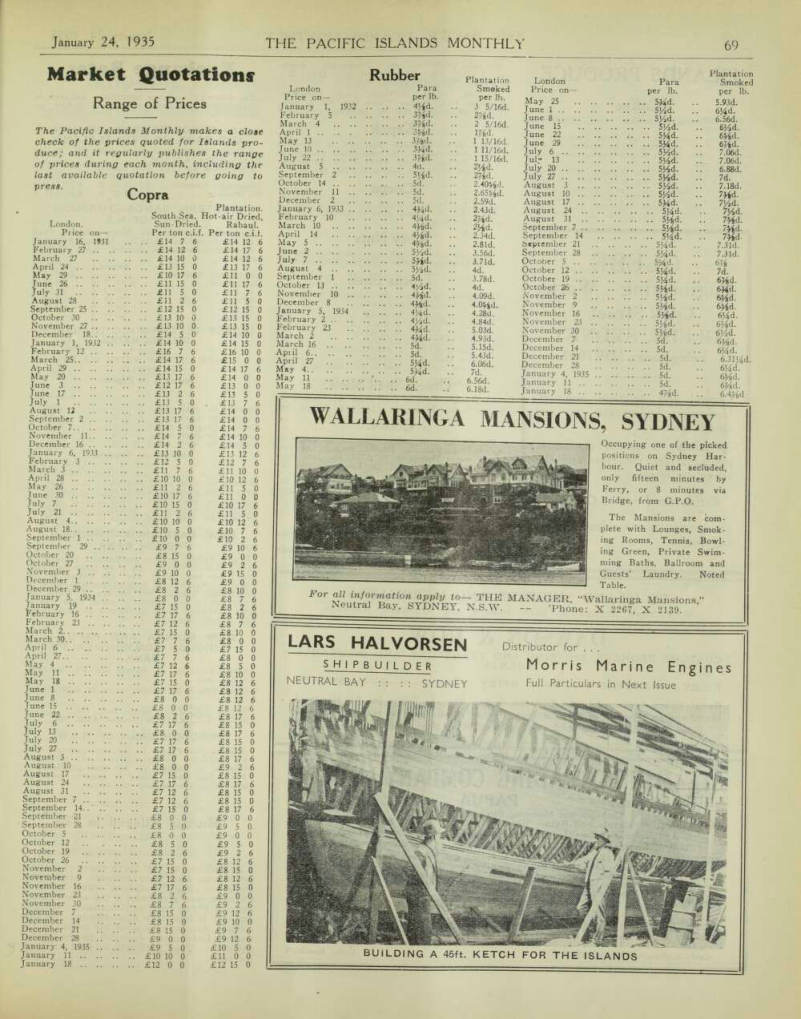
Range of Prices
The Pacific Islands Monthly makes a close check of the prices quoted for Islands pro duce; and it regularly publishes the range of prices during each month, including the last available quotation before going to
press.
London Price on —
Rubber
Para per lb.
Plantation Smoked per lb.
January 1, 1932 February 5 3 5/16d. 3Vtd. • • 2Ad.
March 4 3fcd. 2 S/16d.
April 1 3Hd.
VA d.
May 13 3fcd. 1 13/16d.
June 10 3Hd. 1 ll/16d.
July 22 3Hd. 1 15/16d.
August 5 • • 2'Ad.
September 2 S'Ad. 27Ad.
October 14 5d. 2.40^d.
November 11 5d. 2.65^d.
December 2 5d. 2.59d.
January 6, 1933 4J4d. 2.43d.
February 10 4'Ad. 2^d.
March 10 W. 2*d.
April 14 W. 2.34d.
May 5 2.81d.
June 2 3.56d.
July 7 5Hd. 3.7ld.
August 4 sy 3 d. 4d.
September 1 5d. 3.78d.
October 13 .. 4d.
November 10 4.09d.
December 8 4J*d. 4.0Hd.
January 5, 1934 4J4d. 4.28d.
February 2 4/ a d. 4.84d.
February 23 4**d, 5.03d.
March 2 4.93d.
March 16 5.15d.
April 6 5.43d.
April 27 SVid. 6.06d.
May 4 7d.
May 11 6.56d.
May 18 6.18d.
London Price on — Para per lb.
Plantation Smoked per lb.
May 25 .. .. Stfd. 5.93d.
June 1 .. .. S'Ad. 6'Ad.
June 8 .. .. sy 3 d. 6.56d.
June 15 .. .. 5j4d. 6'Ad.
June 22 .. .. 5Ad. . , 6Ad.
June 29 .. .. sy 4 d.
VAd.
July 6 .. .. 5'Ad. 7.06d.
July 13 .. .. sy a d. 7.06d.
July 20 .. .. 5^d. 6.88d.
July 27 .. .. 5Xd. 7d.
August 3 .. .. 5%d. 7.18d.
August 10 .. .. sy a d. 7Hd.
August 17 .. .. 5^d. 7'Ad.
August 24 S'Ad. 7Ad.
August 31 5'Ad. 7Ad.
September 7 5%d.
'Hd.
September 14 5'Ad. 7Hd September 21 .. .. sy A d. 7.3 Id.
September 28 .. .. 5'Ad. 7,31d.
October 5 .. .. 5'Ad. 6 A October 12 7d.
October 19 .. .. 5Ad. 6^d.
October 26 .. .. 5Hd. 6 Ad.
November 2 .. .. 5'Ad. 6Ad.
November 9 .. .. 5'Ad. 6Hd.
November 16 6'Ad.
November 23 .. .. 5^d. 6'Ad.
November 30 .. .. 5'Ad. 6'Ad.
December 7 6^d.
December 14 .. .. 5d. 6'Ad.
December 21 .. .. 5d. 6.31'Ad. 6'Ad.
December 28 .. .. Sd.
January 4, 1935 .. .. Sd. 6Ad.
January 11 6Vgd.
January 18 .. .. 4Hd. 6.4y s d
Copra
Plantation, Hot-air Dried, Rabaul. Per ton c.i.f.
South Sea, Sun-Dried. Per ton c.i.f.
London. Price on — January 16, 1931 .. .. £14 7 6 £14 12 6 February 27 .. .. £14 12 6 £14 17 6 March 27 .. .. £14 10 0 £14 12 6 April 24 .. .. £13 15 0 £13 17 6 May 29 .. .. £10 17 6 £11 0 0 June 26 .. .. £11 15 0 £11 17 6
July 31
.. .. £11 5 0 £11 7 6 August 28 .. .. £11 2 6 £11 5 0 September 25 .. .. £12 15 0 £12 15 0 October 30 .. .. £13 10 0 £13 15 0 November 27 .. .. £13 10 0 £13 15 0 December 18 .. .. £14 5 0 £14 10 0 January 1, 1932 .. .. £14 10 0 £14 15 0 February 12 .. .. £16 7 6 £16 10 0 March 25 .. .. £14 17 6 £15 0 0 April 29 .. .. £14 15 0 £14 17 6 May 20 .. .. £13 17 6 £14 0 0 June 3 .. .. £12 17 6 £13 0 0
June 17
.. .. £13 2 6 £13 5 0
July 1
.. .. £13 5 0 . £13 7 6 August 12 .. .. £13 17 6 £14 0 0 September 2 .. .. £13 17 6 £14 0 0 October 7 .. .. £14 5 0 £14 7 6 November 11 .. .. £14 7 6 £14 10 0 December 16 .. .. £14 2 6 £14 5 0 January 6, 1933 .. .. £13 10 0 £13 12 6 February 3 .. .. £12 5 0 £12 7 6 March 3 .. .. £11 7 6 £11 10 0 April 28 .. .. £10 10 0 £10 12 6 May 26 .. .. £11 2 6 £11 5 0 June 30 .. .. £10 17 6 £11 0 0
July 7
£10 17 6 July 21 .. .. £11 2 6 £11 5 0 August 4 £10 12 6 August 18 .. .. £10 5 0 £10 7 6 September 1 £10 2 6 September 29 .. .. £9 7 6 £9 10 6 October 20 .. .. £8 15 0 £9 0 0 October 27 .. .. £9 0 0 £9 2 6 November 3 .. .. £9 10 0 £9 15 0 December 1 .. .. £8 12 6 £9 0 0 December 29 .. .. £8 2 6 £8 10 0 January 5, 1934 .. .. £8 0 0 £8 7 6
January 19
.. .. £7 IS 0 £8 2 6
February 16
.. .. £7 17 6 £8 10 0 February 23 .. .. £7 12 6 £8 7 6 March 2 £8 10 0 March 30 £8 0 0 April 6 £7 15 0 April 27 £8 0 0 May 4 .. .. £7 12 6 £8 5 0 May 11 £8 10 0 May 18 £8 12 6 June 1 £8 12 6 June 8 . .. £8 0 0 £8 12 6 June 15 . .. £8 0 0 £8 12 6
June 22
. .. £8 2 6 £8 17 6 July 6 £8 15 0
July 13
£8 17 6 July 20 .. .. £7 17 6 £8 15 0 July 27 £8 15 0 August 3 £8 17 6 August 10 .. .. £8 0 0 £9 2 6 August 17 . .. £7 15 0 £8 IS 0 August 24 £8 17 6
August 31
. .. £7 12 6 £8 15 0 September 7 £8 15 0 September 14 £7 15 0 £8 17 6 September 21 £8 0 0 £9 0 0
September 28
. .. £8 5 0 £9 5 0 October 5 £9 0 0 October 12 . .. £8 5 0 £9 5 0 October 19 . .. £8 2 6 £9 2 6 October 26 £8 12 6 November 2 £7 15 0 £8 15 0 November 9 £7 12 6 £8 12 6 November 16 £8 15 0 November 23 . .. £8 2 6 £9 0 0 November 30 . .. £8 7 6 £9 2 6 December 7 . .. £8 15 0 £9 12 6 December 14 . .. £8 15 0 £9 10 0 December 21 . .. £8 15 0 £9 7 6 December 28 .. £9 0 0 £9 12 6 January 4, 1935 .. £9 5 0 £10 5 0
January 11
.. £10 10 0 £11 0 0
January 18
.. £12 0 0 £12 15 0
Advertisements & other items, p. 71 (1 item)
Wallakinga Mansions, Sydney
Occupying one of the picked positions on Sydney Harbour. Quiet and secluded, only fifteen minutes by Ferry, or 8 minutes via Bridge, from G.P.O.
The Mansions are complete with Lounges, Smoking Rooms, Tennis, Bowling Green, Private Swimming Baths, Ballroom and Guests’ Laundry. Noted Table.
THE MANAGER. “Wallaringa Mansions,”
Neutral Bay, SYDNEY. N.S.W. 'Phone; X 2267, X 2139.
LARS HALVORSEN
shipbuilder NEUTRAL BAY : ; : : SYDNEY Distributor for . . .
Morris Marine Engines Full Particulars in Next Issue BUILDING A 45ft. KETCH FOR THE ISLANDS
Islands Produce
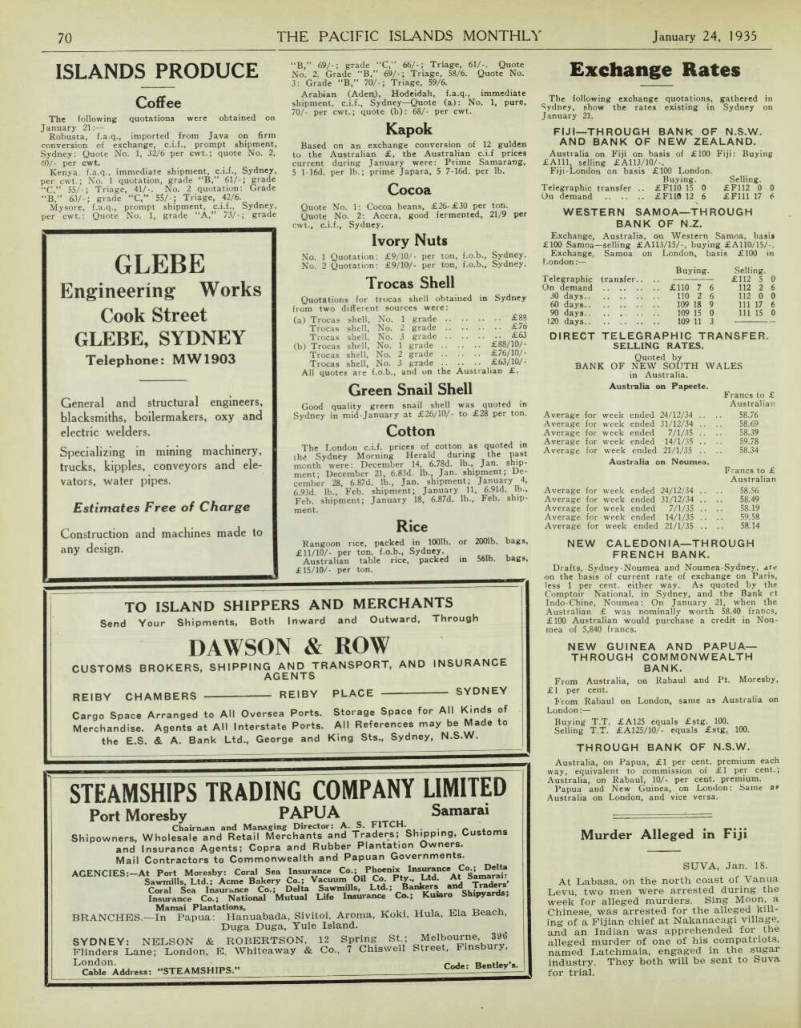
Coffee
The following quotations were obtained on January 21: — Robusta, f.a.q., imported from Java on firm conversion of exchange, c.i.f., prompt shipment, Sydney: Quote No. 1, 32/6 per cwt.; quote No. 2, 40/- per cwt.
Kenya, f.a.q., immediate shipment, c.i.f., Sydney, per cwt.; No. 1 quotation, grade “B,” 61/-; grade “C,” 55/-; Triage, 41/-. No. 2 quotation: Grade “B,” 63/-; grade “C,” 55/-; Triage, 42/6.
Mysore, f.a.q., prompt shipment, c.i.f., Sydney, per cwt.: Quote No. 1, grade “A,” 73/-; grade
“B,” 69/-; grade “C,” 66/-; Triage, 61/-. Quote No. 2. Grade “B,” 69/-; Triage, 58/6. Quote No. 3: Grade “B,” 70/-; Triage, 59/6.
Arabian (Aden), Hodeidah, f.a.q., immediate shipment, c.i.f., Sydney—Quote (a): No. 1, pure, 70/- per cwt.; quote (b): 68/- per cwt.
Kapok
Based on an exchange conversion of 12 gulden to the Australian £, the Australian c.i.f prices current during January were; Prime Samarang, 5 1-16d. per lb.; prime Japara, 5 7-16 d. per lb.
Cocoa
Quote No. 1: Cocoa beans, £26-£30 per ton.
Quote No. 2: Accra, good fermented, 21/9 per cwt., c.i.f., Sydney.
Ivory Nuts
No. 1 Quotation: £9/10/- per ton, f.o.b., Sydney.
No. 2 Quotation: £9/10/- per ton, f.o.b., Sydney.
Trocas Shell
Quotations for trocas shell obtained in Sydney from two different sources were; (a) Trocas shell, No. 1 grade £88 Trocas shell, No. 2 grade £76 Trocas shell, No. 3 grade £63 (b) Trocas shell, No. 1 grade £88/10/- Trocas shell, No. 2 grade £76/10/- Trocas shell, No. 3 grade £63/10/- All quotes are f.o.b., and on the Australian £.
Green Snail Shell
Good quality green snail shell was quoted in Sydney in mid-January at £26/10/- to £28 per ton.
Cotton
The London c.i.f. prices of cotton as quoted in the Sydney Morning Herald during the past month were: December 14, 6.78 d. lb., Jan. ship ment; December 21, 6.83 d. lb., Jan. shipment; De cember 28, 6.87 d. lb., Jan. shipment; January 4, 6.93 d. lb., Feb. shipment; January 11, 6.91 d. lb., Feb. shipment; January 18, 6.87 d. lb., Feb. ship ment.
Rice
Rangoon rice, packed in 100lb. or 200lb. bags, £11/10/- per ton, f.o.b., Sydney.
Australian table rice, packed in 56lb. bags, £15/10/- per ton.
Exchange Rates
The following exchange quotations, gathered in Sydney, show the rates existing in Sydney on January 21.
Fiji—Through Bank Of N.S.W.
And Bank Of New Zealand.
Australia on Fiji on basis of £100 Fiji: Buying £A111, selling £A113/10/-.
Fiji-London on basis £100 London.
Western Samoa—Through
Bank Of N.Z.
Exchange, Australia, on Western Samoa, basis £100 Samoa—selling £A113/15/-, buying £A110/15/-.
Exchange, Samoa on London, basis £100 in London: —
Direct Telegraphic Transfer.
Selling Rates.
Quoted by
Bank Of New South Wales
in Australia.
New Caledonia—Through
French Bank.
Drafts, Sydney-Noumea and Noumea-Sydney, are on the basis of current rate of exchange on Paris, less 1 per cent, either way. As quoted by the Comptoir National, in Sydney, and the Bank of Indo-Chine, Noumea: On January 21, when the Australian £ was nominally worth 58.40 francs, £100 Australian would purchase a credit in Noumea of 5,840 francs.
New Guinea And Papua
Through Commonwealth
Bank.
From Australia, on Rabaul and Pt. Moresby, £1 per cent.
From Rabaul on London, same as Australia on London: — Buying T.T. £A12S equals £stg. 100.
Selling T.T. £A12S/10/- equals £stg, 100.
Through Bank Of N.S.W.
Australia, on Papua, £1 per cent, premium each way, equivalent to commission of £1 per cent.; Australia, on Rabaul, 10/- per cent, premium, Papua and New Guinea, on London: Same as Australia on London, and vice versa.
Buying.
Selling.
Telegraphic transfer £F110 15 0 £F112 0 0 On demand £F110 12 6 £F111 17 6
Buying. Selling.
Telegraphic transfer.. .. £112 5 0 On demand £110 7 6 112 2 6 30 days 110 2 6 112 0 0 60 days 109 18 9 111 17 6 90 days 109 15 0 111 15 0 120 days 109 11 3
Australia on Papeete.
Francs to £ Australian Average for week ended 24/12/34 .. 58.76 Average for week ended 31/12/34 .. 58.69 Average for week ended 7/1/35 .. 58.39 Average for week ended 14/1/35 .. 59.78 Average for week ended 21/1/35 .. 58.34 Australia on Noumea.
Francs to £ Australian Average for week ended 24/12/34 .. 58.56 Average for week ended 31/12/34 .. 58.49 Average for week ended 7/1/35 .. 58.19 Average for week ended 14/1/35 .. 59.58 Average for week ended 21/1/35 .. 58.14
Murder Alleged in Fiji
Suva, Jan. 18.
At Labasa, on the north coast of Vanua Leva, two men were arrested during the week for alleged murders. Sing Moon, a Chinese, was arrested for the alleged kill ing of a Fijian chief at Nakanacagi village, and an Indian was apprehended for the alleged murder of one of his compatriots, named Latchmaia, engaged in the sugar industry. They both will be sent to Suva for trial.
Advertisements & other items, p. 72 (1 item)
Steamships Trading Company Limited
GLEBE
Engineering Works
Cook Street
GLEBE, SYDNEY
Telephone: MW 1903 General and structural engineers, blacksmiths, boilermakers, oxy and electric welders.
Specializing in mining machinery, trucks, kipples, conveyors and elevators, water pipes.
Estimates Free of Charge Construction and machines made to any design.
TO ISLAND SHIPPERS AND MERCHANTS
Send Your Shipments, Both Inward and Outward, Through
DAWSON & ROW
CUSTOMS BROKERS, SHIPPING AND TRANSPORT, AND INSURANCE
AGENTS
REIBY CHAMBERS REIBY PLACE SYDNEY
Cargo Space Arranged to All Oversea Ports. Storage Space for All Kinds of Merchandise. Agents at All Interstate Ports. All References may be Made to the E.S. & A. Bank Ltd., George and King Sts., Sydney, N.S.W.
STEAMSHIPS TRADING COMPANY LIMITED
Port Moresby PAPUA Samarai
and Managing Director: A S. FITCH.
Shipowners, Wholesale and Retail Merchants and Traders; Shaping, Customs and Insurance Agents; Copra and Rubber Plantation Owners.
Mail Contractors to Commonwealth and Papuan Governments.
AGENCIES:- At Port Moresby: Coral Sea Insurance Co.; Phoenix Insurance.; Delta Sawmills. Ltd.; Acme Bakery Co ; Vacuum Oil Co. Pty., Ltd. At Samarai : Coral Sea Insurance Co.; Delta Sawmills, Ltd.; Bankers and Traders' Insurance Co.; National Mutual Life Insurance Co.; Kuiaro Shipyards, Mamai Plantations.
BRANCHES. —In Papua: Hanuabada, Sivitoi, Aroma, Koki, Hula, Ela Beach, Duga Duga, Yule Island.
SYDNEY: NELSON & ROBERTSON, 12 Spring St ; Melbourne, 396 Flinders Lane; London, E. Whiteaway & Co.. 7 Chiswell Street, Finsbury, London.
Cable n Address: “STEAMSHIPS.” Code: Bentley's.
Shipping Services in the Pacific
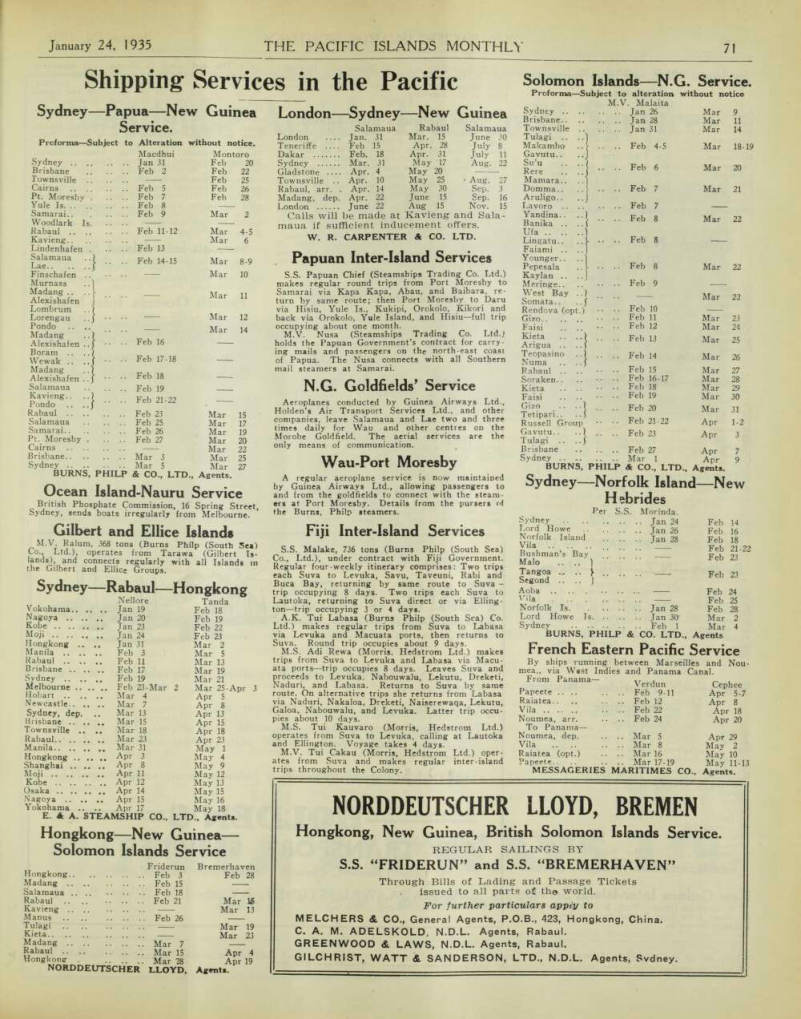
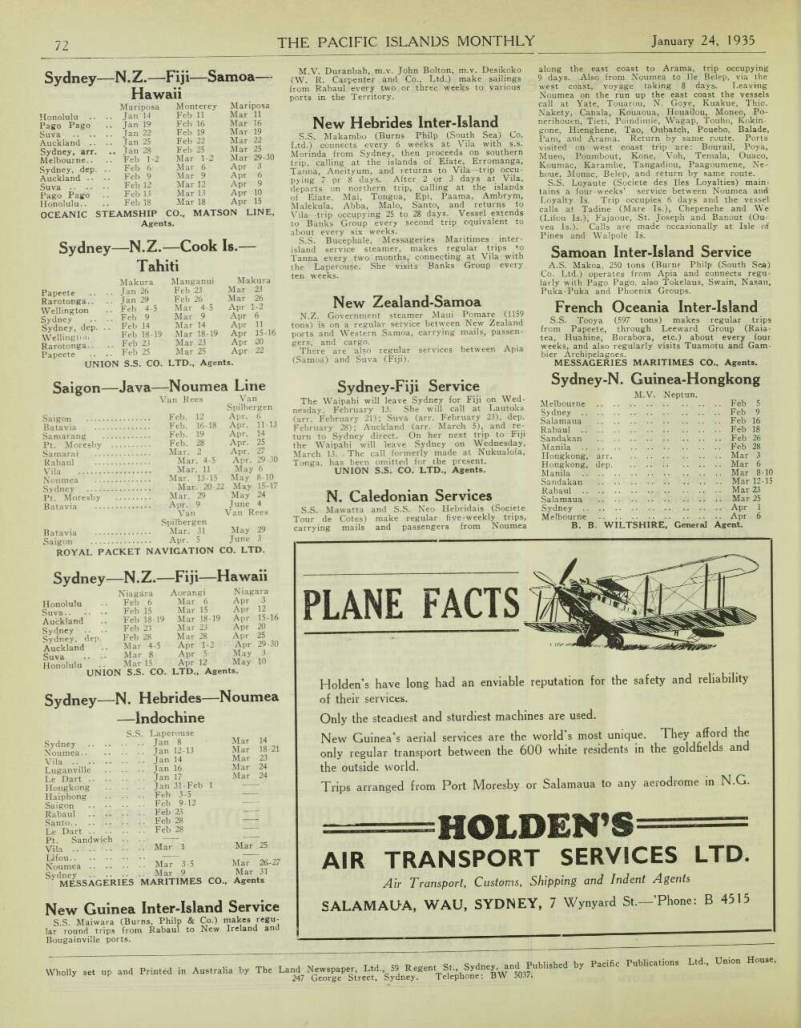
Sydney—Papua—New Guinea Service.
Ocean Island-Nauru Service
British Phosphate Commission, 16 Spring Street, Sydney, sends boats irregularly from Melbourne.
Gilbert and Ellice Islands
M.V. Ralum, 368 tons (Burns Philp (South Sea) Co., Ltd.), operates from Tarawa (Gilbert Is lands), and connects regularly with all Islands in the Gilbert and Ellice Groups.
Sydney—Rabaul—Hongkong
Hongkong—New Guinea— Solomon Islands Service
London—Sydney—New Guinea
Papuan Inter-Island Services
S.S. Papuan Chief (Steamships Trading Co. Ltd.) makes regular round trips from Port Moresby to Samarai via Kapa Kapa, Abau, and Baibara, re turn by same route; then Port Moresby to Daru via Hisiu, Yule Is., Kukipi, Orokolo, Kikori and back via Orokolo, Yule Island, and Hisiu—full trip occupying about one month.
M.V. Nusa (Steamships Trading Co. Ltd.) holds the Papuan Government’s contract for carry ing mails and passengers on the north-east coast of Papua. The Nusa connects with all Southern mail steamers at Samarai.
N.G. Goldfields’ Service
Aeroplanes conducted by Guinea Airways Ltd., Holden’s Air Transport Services Ltd., and other companies, leave Salamaua and Lae two and three times daily for Wau and other centres on the Morobe Goldfield. The aerial services are the only means of communication.
Wau-Port Moresby
A regular aeroplane service is now maintained by Guinea Airways Ltd., allowing passengers to and from the goldfields to connect with the steam ers at Port Moresby. Details from the pursers of the Burns, Philp steamers.
Fiji Inter-Island Services
S.S. Malake, 736 tons (Burns Philp (South Sea) Co., Ltd.), under contract with Fiji Government.
Regular four-weekly itinerary comprises: Two trips each Suva to Levuka, Savu, Taveuni, Rabi and Buca Bay, returning by same route to Suva trip occupying 8 days. Two trips each Suva to Lautoka, returning to Suva direct or via Elling ton —trip occupying 3 or 4 days.
A.K. Tui Labasa (Burns Philp (South Sea) Co.
Ltd.) makes regular trips from Suva to Labasa via Levuka and Macuata ports, then returns to Suva. Round trip occupies about 9 days.
M.S. Adi Rewa (Morris, Hedstrom Ltd.) makes trips from Suva to Levuka and Labasa via Macu ata ports —trip occupies 8 days. Leaves Suva and proceeds to Levuka, Nabouwalu, Lekutu, Dreketi, Naduri, and Labasa. Returns to Suva by same route. On alternative trips she returns from Labasa via Naduri, Nakaloa, Dreketi, Naiserewaqa, Lekutu, Galoa, Nabouwalu, and Levuka. Latter trip occu pies about 10 days.
M.S. Tui Kauvaro (Morris, Hedstrom Ltd.) operates from Suva to Levuka, calling at Lautoka and Ellington. Voyage takes 4 days.
M.V. Tui Cakau (Morris, Hedstrom Ltd.) oper ates from Suva and makes regular inter-island trips throughout the Colony.
Solomon Islands—N.G. Service.
Proforma—Subject to alteration without notice
Sydney—Norfolk Island—New H ebrides
French Eastern Pacific Service
By ships running between Marseilles and Nou mea,, via West Indies and Panama Canal.
From Panama—
Proforma—Subject to Alteration without notice.
Macdhui Montoro Sydney .. .. Jan 31 Feb 20 Brisbane .. .. Feb 2 Feb 22 Townsville — Feb 25 Cairns .. .. Feb 5 Feb 26 Pt. Moresby Feb 7 Feb 28 Yule Is.
Feb 8 Samarai Feb 9 Mar 2 Woodlark — Rabaul Feb 11-12 Mar 4-5 Kavieng Mar 6 Lindenhafen Feb 13 — Salamaua Lae Feb 14-15 Mar 8-9 Finschafen Mar 10 Murnass Madang Mar 11 Alexishafen Lombrum Lorengau Mar 12 Pondo Madang Mar 14 Alexishafen Feb 16 — Boram Wewak Feb 17-18 — Madang Feb 18 Alexishafen Salamaua Feb 19 Kavieng Pondo Feb 21-22 — Rabaul Mar 15 Salamaua Feb 25 Mar 17 Samarai Mar 19 Pt. Moresby Feb 27 Mar 20 Cairns Mar 22 Brisbane Mar 25 Sydney Mar 27
Burns, Philp & Co., Ltd., Agents.
Salamaua Rabaul Salamaua London Jan. 31 Mar. 15 June 30 Teneriffe Feb 15 Apr. 28 July 8 Dakar Feb. 18 Apr. 31 July 11 Sydney Mar. 31 May 17 Aug. 22 Gladstone Apr. 4 May 20 Townsville Apr. 10 May 25 Aug. 27 Rabaul, arr.
Apr. 14 May 30 Sep. 3 Madang, dep.
Apr. 22 June 15 Sep. 16 London June 22 Aug 15 Nov. 15 Calls will be made at Kavieng and Salamaua if sufficient inducement offers.
W. R. Carpenter & Co. Ltd.
M.V. Malaita Sydney Jan 26 Mar 9 Brisbane Mar 11 Townsville Jan 31 Mar 14 Tulagi Makambo Mar 18-19 Gavutu Su’u Rere Feb 6 Mar 20 Mamara Comma Mar 21 Aruligo Lavoro Yandina Banika Feb 8 Mar 22 Ufa Lingatu — Faiami Younger Pepesala Feb 8 Mar 22 Kaylan Meringe — West Bay Somata Mar 22 Rendova (opt.) Feb 10 — Gizo Feb 11 Mar 23 Faisi 12 Mar 24 Kieta Arigua Mar 25 Teopasino Feb 14 Mar 26 Numa Rabaul Feb 15 Mar 27 Soraken Feb 16-17 Mar 28 Mar 29 Faisi Feb 19 Mar 30 Gizo Feb 20 Mar 31 Tetipari Feb 21-22 Russell Group Apr 1-2 Gavutu Apr 3 Tulagi Brisbane Feb 27 Apr 7 Sydney Apr 9
Burns, Philp & Co., Ltd., Agents.
Per S.S. Morinda.
Sydney Feb 14 Lord Howe Feb 16 Norfolk Island Jan 28 Feb 18 Vila Bushman’s Bay Malo Feb 21-22 Feb 23 Tangoa Feb 23 Segond Aoba Feb 24 Vila Feb 25 Norfolk Is.
Jan 28 Feb 28 Lord Howe Is. Jan 30 Mar 2 Sydney Mar 4
Burns, Philp & Co. Ltd., Agents
From Panama — Verdun Cephee Papeete Feb 9-11 Apr 5-7 Raiatea Feb 12 Apr 8 Vila Feb 22 Apr 18 Noumea, arr.
To Panama— Noumea, dep.
Feb 24 Apr 20 Mar 5 Apr 29 Vila Mar 8 May 2 Raiatea (opt.) Mar 16 May 10 Papeete Mar 17-19 May 11-13
Messageries Maritimes Co.. Agents.
Nellore Tanda Yokohama Feb 18 Nagoya Jan 20 Feb 19 Kobe Feb 22 Moji Feb 23 Hongkong Jan 31 Mar 2 Manila Feb 3 Mar 5 Rabaul Mar 13 Brisbane Mar 19 Sydney Feb 19 Mar 21 Melbourne 2 Mar 25-Apr 3 Hobart Mar 4 Apr 5 Newcastle Apr 8 Sydney, dep, Mar 13 Apr 13 Brisbane Apr 15 Townsville Mar 18 Apr 18 Rabaul Mar 23 Apr 23 Manila Mar 31 May 1 Hongkong Apr 3 May 4 Shanghai Apr 8 May 9 Moji May 12 Kobe May 13 Osaka May 15 Nagoya May 16 Yokohama Apr 17 May 18 E. & A. STEAMSHIP CO., LTD., Agents.
Friderun Bremerhaven Hongkong Feb 3 Feb 28 Madang Feb 15 Salamaua Feb 18 Rabaul Feb 21 Mar 16 Kavieng Mar 13 Manus Feb 26 Tulagi Mar 19 Kieta Mar 23 Madang Mar 7 Rabaul Mar 15 Apr 4 Hongkong Mar 28 Apr 19
Norddeutscher Lloyd, Agents.
Sydney—N.Z.—Fiji—Samoa — Hawaii
Sydney—N.Z.—Cook Is. — Tahiti
Saigon—Java—Noumea Line
Sydney—N.Z.—Fiji—Hawaii
Sydney—N. Hebrides —Noumea —lndochine
New Guinea Inter-Island Service
S.S. Maiwara (Burns, Philp & Co.) makes regu lar round trips from Rabaul to New Ireland and Bougainville ports.
M. Duranbah, m.v. John Bolton, m.v. Desikoko (W. R. Carpenter and Co., Ltd.) make sailings from Rabaul every two or three weeks to various ports in the Territory.
New Hebrides Inter-Island
S.S. Makambo (Burns Philp (South Sea) Co.
Ltd.) connects every 6 weeks at Vila with s.s.
Morinda from Sydney, then proceeds on southern trip, calling at the islands of Efate, Erromanga, Tanna, Aneityum, and returns to Vila—trip occu pying 7 or 8 days. After 2 or 3 days at Vila, departs on northern trip, calling at the islands of Efate, Mai, Tongoa, Epi, Paama, Ambrym, Malekula, Abba, Malo, Santo, and returns to Vila—trip occupying 25 to 28 days. Vessel extends to Banks Group every second trip equivalent to about every six weeks.
S.S. Bucephale, Messageries Maritimes interisland service steamer, makes regular trips to Tanna every two months, connecting at Vila with the Laperouse. She visits Banks Group every ten weeks.
New Zealand-Samoa
N. Government steamer Maui Pomare (1159 tons) is on a regular service between New Zealand ports and Western Samoa, carrying mails, passen gers, and cargo.
There are also regular services between Apia (Samoa) and Suva (Fiji).
Sydney-Fiji Service
The Waipahi will leave Sydney for Fiji on Wed nesday, February 13. She will call at Lautoka (arr. February 21); Suva (arr. February 23), dep.
February 28); Auckland (arr. March 5), and re turn to Sydney direct. On her next trip to Fiji the Waipahi will leave Sydney on Wednesday, March 13. The call formerly made at Nukualofa, Tonga, has been omitted for the present.
Union S.S. Co. Ltd., Agents.
N. Caledonian Services
S.S. Mawatta and S.S. Neo Hebridais (Societe Tour de Cotes) make regular five-weekly trips, carrying mails and passengers from Noumea
along the east coast to Arama, trip occupying 9 days. Also from Noumea to Ile Belep, via the west coast, voyage taking 8 days. Leaving Noumea on the run up the east coast the vessels call at Yate, Touarou, N. Goye, Kuakue, Thio.
Nakety, Canala, Kouaoua, Houailou, Moneo, Po nerihouen, Tieti, Poindimie, Wagap, Touho, Kokin gone, Hienghene, Tao, Oubatch, Pouebo, Balade, Pam, and Arama. Return by same route. Ports visited on west coast trip are; Bourail, Poya, Mueo, Poumbout, Kone, Voh, Temala, Ouaco, Koumac, Karambe, Tangadiou, Paagoumene, Ne houe, Mouac, Belep, and return by same route.
S.S. Loyaute (Societe des lies Loyalties) maintains a four-weeks’ service between Noumea and Loyalty Is. Trip occupies 6 days and the vessel calls at Tadine (Mare Is.), Chepenehe and We (Lifou Is.), Fajaoue, St. Joseph and Banout (Ou vea Is.). Calls are made occasionally at Isle of Pines and Walpole Is.
Samoan Inter-Island Service
A.S. Makoa, 250 tons (Burns Philp (South Sea) Co. Ltd.) operates from Apia and connects regu larly with Pago Pago, also Tokelaus, Swain, Nasau, Puka-Puka and Phoenix Groups.
French Oceania Inter-Island
S.S. Tooya (597 tons) makes regular trips from Papeete, through Leeward Group (Raia tea, Huahine, Borabora, etc.) about every four weeks, and also regularly visits Tuamotu and Gam bler Archipelagoes.
Messageries Maritimes Co.. Agents.
Sydney-N. Guinea-Hongkong
Mariposa Monterey Mariposa Honolulu Jan 14 Feb 11 Mar 11 Pago Pago Jan 19 Feb 16 Mar 16 Suva Jan 22 Feb 19 Mar 19 Auckland Jan 25 Feb 22 Mar 22 Sydney, arr Jan 28 Feb 25 Mar 25 Melbourne Feb 1-2 Mar 1-2 Mar 29-30 Sydney, dep Feb 6 Mar 6 Apr 3 Auckland Feb 9 Mar 9 Apr 6 Suva Feb 12 Mar 12 Apr 9 Pago Pago Feb 13 Mar 13 Apr 10 Honolulu Feb 18 Mar 18 Apr 15
Oceanic Steamship Co., Matson Line,
Agents.
Makura Manganui Makura Papeete Jan 26 Feb 23 Mar 23 Rarotonga Jan 29 Feb 26 Mar 26 Wellington Feb 4-5 Mar 4-5 Apr 1-2 Sydney Sydney, dep.
Feb 9 Mar 9 Apr 6 Feb 14 Mar 14 Apr 11 Wellington Rarotonga Papeete Feb 18-19 Mar 18-19 Apr 15-16 Feb 23 Feb 25 Mar 23 Mar 25 Apr 20 Apr 22
Union S.S. Co. Ltd., Agents.
Melbourne M.V. Neptun.
Feb 5 Sydney Salamaua Feb 16 Rabaul Sandakan Feb 26 Manila Feb 28 Hongkong, arr.
Hongkong, dep.
Mar 6 Manila Sandakan Rabaul Mar 23 Salamaua Mar 25 Sydney Melbourne B. B. WILTSHIRE, General Agent,
Van Rees Feb. 12 Van Spilbergen Apr. 6 Feb. 16-18 Apr. 11-13 Feb. 19 Apr. 14 Pt. Moresby Feb. 28 Mar. 2 Apr. 25 Apr. 27 Mar. 4-5 Apr. 29-30 Mar. 11 May 6 Noumea Mar. 13-15 May 8-10 Sydney Mar. 20-22 May 15-17 Pt Moresby Mar. 29 May 24 Batavia Apr. 9 June 4 Batavia Van Spilbergen Mar. 31 Van Rees May 29 Saigon Apr. 5 June 3
Royal Packet Navigation Co. Ltd.
Niagara Aorangi Niagara Honolulu .. Feb 6 Mar 6 Apr 3 Suva .. Feb 15 Mar 15 Apr 12 Auckland .. Feb 18-19 Mar 18-19 Apr 15-16 Sydney .. .. Feb 23 Mar 23 Apr 20 Sydney, dep. Feb 28 Mar 28 Apr 25 Auckland .. Mar 4-5 Apr 1-2 Apr 29-30 Suva .. Mar 8 Apr 5 May 3 Honolulu .. Mar 15 Apr 12 May 10
Union S.S. Co. Ltd., Agents.
S.S. Laperouse Mar 14 Mar 18-21 Sydney Noumea Jan 12-13 Vila Jan 14 Mar 23 Luganville Le Dart Jan 16 Jan 17 Mar 24 Mar 24 Hongkong Jan 31-Feb 1 Haiphong Saigon Feb 9-12 Rabaul Feb 23 Santo Feb 28 — Le Dart Feb 28 — Pt. Sandwich — Vila Mar 25 Lifou Noumea Mar 3-5 Mar 26-27 Sydnev Mar 9 Mar 31
Messageries Maritimes Co., Agents
Advertisements & other items, pp. 73-76 (2 items)
Norddeutscher Lloyd, Bremen
Hongkong, New Guinea, British Solomon Islands Service.
REGULAR SAILINGS BY
S.S. “FRIDERUN” and S.S. “BREMERHAVEN”
Through Bills of Lading and Passage Tickets issued to all parts of the world.
For further particulars appiy to MELCHERS & CO., General Agents, P.O.B., 423, Hongkong, China.
C. A. M. ADELSKOLD, N.D.L. Agents, Rabaul.
GREENWOOD & LAWS, N.D.L. Agents, Rabaul.
GILCHRIST, WATT & SANDERSON, LTD., N.D.L. Agents, Svdney.
PLANE FACTS
Holden’s have long had an enviable reputation for the safety and reliability of their services.
Only the steadiest and sturdiest machines are used.
New Guinea’s aerial services are the world’s most unique. They afford the only regular transport between the 600 white residents in the goldfields and the outside world.
Trips arranged from Port Moresby or Salamaua to any aerodrome in N.G.
HOLDEN’S
AIR TRANSPORT SERVICES LTD.
Air Transport, Customs, Shipping and Indent Agents SALAMAUA, WAU, SYDNEY, 7 Wynyard St.—’Phone: B 4515
Goldfields Aerial Transport Service
EVERYTHING required for the Development of the Morobe Goldfield men,
foodstuffs, building material, dredges,
miscellaneous machinery, cattle and Worses has been carried over the mountains, from the coast of New Guinea, by aeroplanes. Modern aviation has made possible the establishment of a flourishing gold-mining industry in the heart of New Guinea.
32 Aerodromes
BABUAK
BAPI
BULLDOG
BULOLO
BULWA
GABANZIZ
GARINA
JUNI
KAJABIT
KIDJURA
KOKODA*
KABUNA*
LAE
MT. HAGEN
MARILINAN
MENYAMYA
MARAWASSA
NADZAB
PORT
MORESBY*
PURARI
RAMU
SALAMAUA
SANGAN
SUNSHINE
SURPRISE CK
UP. WATUT
WAGAU
WAHGI
WAMPIT
WARONA
WAU
ZENAG
In Papua.
Massive equipment carried in onto the
Morobe Goldfield by aeroplanes operated
by Guinea Airways Ltd.—
TOP PICTURE. —One of the four modern Dredges now being operated by Bulolo G.D. Co. Ltd. —2 at Bulolo and 2 at Bulwa.
LOWER PICTURE: Part of the pipe-line which brings the water to the Power-house at Bulolo.
Another hydro-electric station has been built near Bulwa.
Aeroplanes, flying on regular schedules, transported all this heavy machinery without mishap. The weight of some of the pieces exceeded 6 tons.
In 1926 the Morobe Goldfield, guarded by dense jungle and precipitous mountain ranges, was almost unexplored and practically inaccessible. To-day, it is the seat of a great and flourishing industry, employing 2000 Europeans and thousands of natives, and equipped with
all the amenities of civilisation.
Aerial transport made that possible. There is no road in from the coast.
A road could not be built, except at enormous, crippling cost.
Guinea Airways Ltd., launching this unique aerial service, originally with one machine and a handful of men, now operate a fleet of large modern aeroplanes and employ 100 Europeans and a numerous native staff. Their aeroplanes run on fixed timetables from Lae, Salamaua, Bulolo, Wau, and Port Moresby, carrying passengers and freight, and maintaining regular communication between 32 aerodromes.
Travellers may leave the steamer at Port Moresby, fly across to Morobe (time of journey, 1h. 45min.), and spend 9 days in the Goldfield centres before rejoining steamer at Lae for RabauL Or, after visiting Rabaul, they may disembark at Salamaua or Lae, spend several days on the Goldfield, and fly to Pt. Moresby to rejoin the steamer. All information from Pursers on the Steamers.
GUINEA AIRWAYS Ltd
LAE - SALAMAUA
KB is the finest
of all hot weather drinks
When the air is shimmering with the heat . . . when you're hot and tired, and your throat is parched, what pleasure there is in a long glass of sparkling K.B.—straight off the ice. It sets you up in a moment ... it invigorates and refreshes you as no other drink can with its clean rich flavour of malt and hops. Now and always—on every thirsty occasion—drink Tooth’s K.B. Lager.
TOOTH'S
IN BOTTLES AND HALF BOTTLES
LAGER
TASTE THE MALT AND HOPS
72
January 24, 1935
THE PACIFIC ISLANDS MONTHLY
Wholly so. up and Printed in Australia by The Land Newspaper Ltd., 59 Regent St., Sydney, and Published by Pacific Publications Ltd., Union House, 247 George Street, Sydney. Telephone: BW 5037.
Joseph Larkin
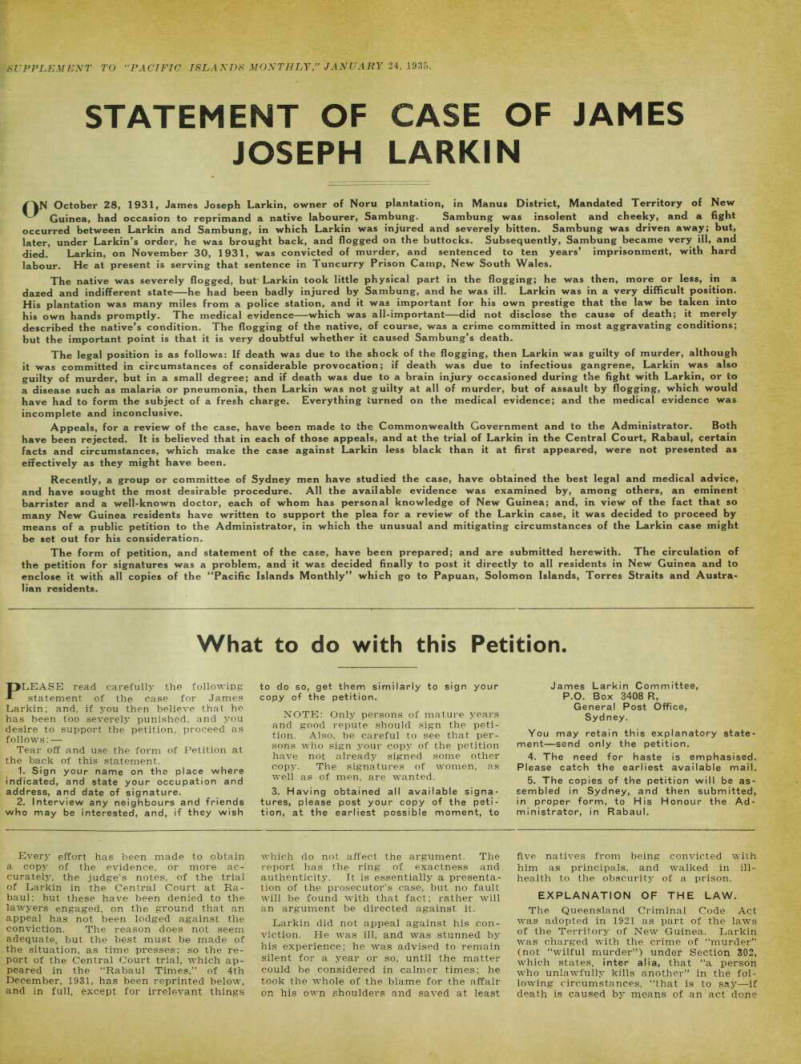
Statement Of Case Of James
October 28, 1931, James Joseph Larkin, owner of Noru plantation, in Manus District, Mandated Territory of New Guinea, had occasion to reprimand a native labourer, Sambung. Sambung was insolent and cheeky, and a fight occurred between Larkin and Sambung, in which Larkin was injured and severely bitten. Sambung was driven away; but, later, under Larkin’s order, he was brought back, and flogged on the buttocks. Subsequently, Sambung became very ill, and died. Larkin, on November 30, 1931, was convicted of murder, and sentenced to ten years’ imprisonment, with hard labour. He at present is serving that sentence in Tuncurry Prison Camp, New South Wales.
The native was severely flogged, but Larkin took little physical part in the flogging; he was then, more or less, in a dazed and indifferent state he had been badly injured by Sambung, and he was ill. Larkin was in a very difficult position.
His plantation was many miles from a police station, and it was important for his own prestige that the law be taken into his own hands promptly. The medical evidence —which was all-important—did not disclose the cause of death; it merely described the native’s condition. The flogging of the native, of course, was a crime committed in most aggravating conditions; but the important point is that it is very doubtful whether it caused Sambung’s death.
The legal position is as follows: If death was due to the shock of the flogging, then Larkin was guilty of murder, although it was committed in circumstances of considerable provocation; if death was due to infectious gangrene, Larkin was also guilty of murder, but in a small degree; and if death was due to a brain injury occasioned during the fight with Larkin, or to a disease such as malaria or pneumonia, then Larkin was not guilty at all of murder, but of assault by flogging, which would have had to form the subject of a fresh charge. Everything turned on the medical evidence; and the medical evidence was incomplete and inconclusive.
Appeals, for a review of the case, have been made to the Commonwealth Government and to the Administrator. Both have been rejected. It is believed that in each of those appeals, and at the trial of Larkin in the Central Court, Rabaul, certain facts and circumstances, which make the case against Larkin less black than it at first appeared, were not presented as effectively as they might have been.
Recently, a group or committee of Sydney men have studied the case, have obtained the best legal and medical advice, and have sought the most desirable procedure. All the available evidence was examined by, among others, an eminent barrister and a well-known doctor, each of whom has personal knowledge of New Guinea; and, in view of the fact that so many New Guinea residents have written to support the plea for a review of the Larkin case, it was decided to proceed by means of a public petition to the Administrator, in which the unusual and mitigating circumstances of the Larkin case might be set out for his consideration.
The form of petition, and statement of the case, have been prepared; and are submitted herewith. The circulation of the petition for signatures was a problem, and it was decided finally to post it directly to all residents in New Guinea and to enclose it with all copies of the “Pacific Islands Monthly” which go to Papuan, Solomon Islands, Torres Straits and Austra lian residents.
What to do with this Petition.
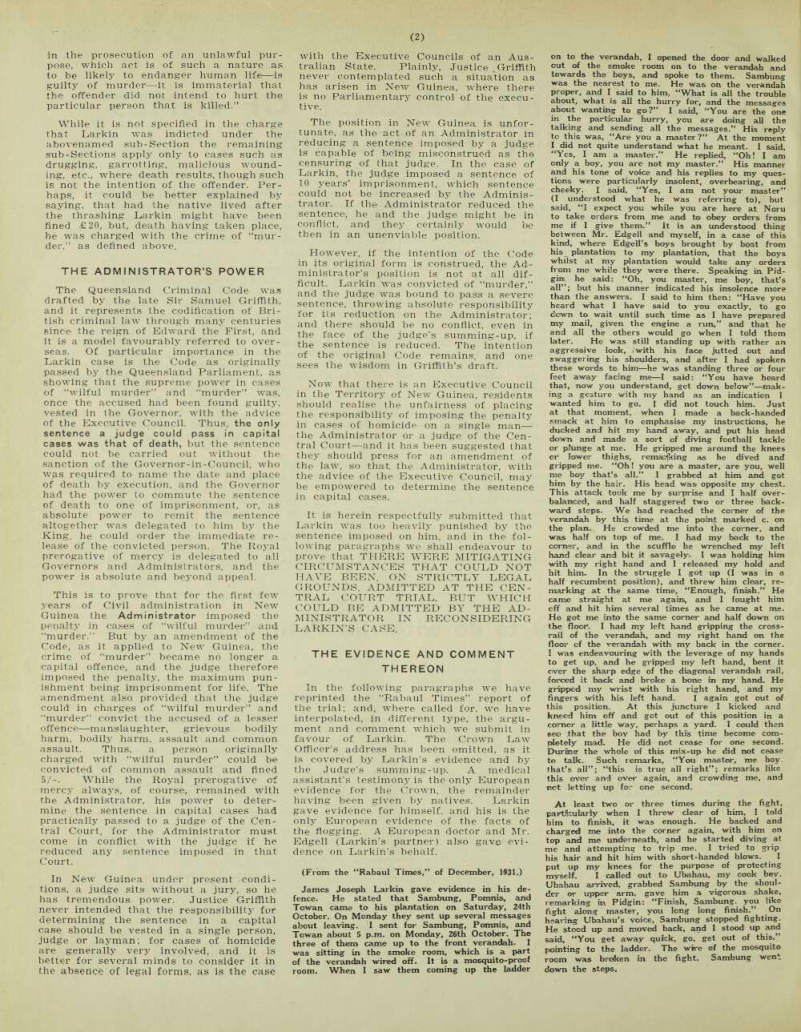
PLEASE read carefully the following statement of the case for James Larkin; and, if you then believe that he has been too severely punished, and you desire to support the petition, procced as follows:— Tear off and use the form of Petition at the back of this statement. 1. Sign your name on the place where indicated, and state your occupation and address, and date of signature. 2. Interview any neighbours and friends who may be interested, and, if they wish
to do so, get them similarly to sign your copy of the petition.
NOTE: Only persons of mature years and good repute should sign the petition. Also, be careful to see that persons who sign your copy of the petition have not already signed some other copy. The signatures of women, as well as of men are wanted. 3. Having obtained all available signatures, please post your copy of the petition, at the earliest possible moment, to
James Larkin Committee, P.O. Box 3408 R, General Post Office, Sydney.
You may retain this explanatory state ment—send only the petition, 4. The need for haste is emphasised.
Please catch the earliest available mail, 5. The copies of the petition will be assembled in Sydney, and then submitted, in proper form, to His Honour the Ad ministrator, in Rabaul.
Every effort has been made to obtain a copy of the evidence, or more ac curately, the judge’s notes, of the trial of Larkin in the Central Court at Ra baul; but these have been denied to the lawyers engaged, on the ground that an appeal has not been lodged against the conviction. The reason does not seem adequate, but the best must be made of the situation, as time presses; so the re port of the Central Court trial, which ap peared in the “Rabaul Times,” of 4th December, 1931, has been reprinted below, and in full, except for irrelevant things
which do not affect the argument. The report has the ring of exactness and authenticity. It is essentially a presenta tion of the prosecutor’s case, but no fault will be found with that fact; rather will an argument be directed against it.
Larkin did not appeal against his con viction. He was ill, and was stunned by his experience; he was advised to remain silent for a year or so, until the matter could be considered in calmer times; he took the whole of the blame for the affair on his own shoulders and saved at least
five natives from being convicted with him as principals, and walked in ill health to the obscurity of a prison.
Explanation Of The Law.
The Queensland Criminal Code Act was adopted in 1921 as part of the laws of the Territory of New Guinea. Larkin was charged with the crime of “murder” (not “wilful murder”) under Section 302, which states, inter alia, that “a person who unlawfully kills another” in the fol lowing circumstances, “that is to say—if death is caused by means of an act done
in the prosecution of an unlawful pur pose, which act is of such a nature as to be likely to endanger human life—is guilty of murder —it is immaterial that the offender did not intend to hurt the particular person that is killed.”
While it is not specified in the charge that Larkin was indicted under the abovenamed sub-Section the remaining sub-Sections apply only to cases such as drugging, garrotting, malicious wound ing, etc., where death results, though such is not the intention of the offender. Per haps, it could be better explained by saying, that had the native lived after the thrashing Larkin might have been fined £20, but, death having taken place, he was charged with the crime of “mur der,” as defined above.
The Administrator’S Power
The Queensland Criminal Code was drafted by the late Sir Samuel Griffith, and it represents the codification of Bri tish criminal law through many centuries since the reign of Edward the First, and it is a model favourably referred to over seas. Of particular importance in the Larkin case is the Code as originally passed by the Queensland Parliament, as showing that the supreme power in cases of “wilful murder” and “murder” was, once the accused had been found guilty, vested in the Governor, with the advice of the Executive Council. Thus, the only sentence a judge could pass in capital cases was that of death, but the sentence could not be carried out without the sanction of the Governor-in-Council, who was required to name the date and place of death by execution, and the Governor had the power to commute the sentence of death to one of imprisonment, or, as absolute power to remit the sentence altogether was delegated to him by the King, he could order the immediate re lease of the convicted person. The Royal prerogative of mercy is delegated to all Governors and Administrators, and the power is absolute and beyond appeal.
This is to prove that for the first few years of Civil administration in New Guinea the Administrator imposed the penalty in cases of “wilful murder” and “murder.” But by an amendment of the Code, as it applied to New Guinea, the crime of “murder” became no longer a capital offence, and the judge therefore imposed the penalty, the maximum pun ishment being imprisonment for life. The amendment also provided that the judge could in charges of “wilful murder” and “murder” convict the accused of a lesser offence—manslaughter, grievous bodily harm, bodily harm, assault and common assault. Thus, a person originally charged with “wilful murder” could be convicted of common assault and fined 5/-. While the Royal prerogative of mercy always, of course, remained with the Administrator, his power to deter mine the sentence in capital cases had practically passed to a judge of the Cen tral Court, for the Administrator must come in conflict with the judge if he reduced any sentence imposed in that Court.
In New Guinea under present condi tions, a judge sits without a jury, so he has tremendous power. Justice Griffith never intended that the responsibility for determining the sentence in a capital case should be vested in a single person, judge or layman; for cases of homicide are generally very involved, and it is better for several minds to consider it in the absence of legal forms, as is the case
with the Executive Councils of an Aus tralian State. Plainly, Justice Griffith never contemplated such a situation as has arisen in New Guinea, where there is no Parliamentary control of the execu tive.
The position in New Guinea is unfor tunate, as the act of an Administrator in reducing a sentence imposed by a judge is capable of being misconstrued as the censuring of that judge. In the case of Larkin, the judge imposed a sentence of 10 years’ imprisonment, which sentence could not be increased by the Adminis trator. If the Administrator reduced the sentence, he and the judge might be in conflict, and they certainly would be then in an unenviable position.
However, if the intention of the Code in its original form is construed, the Ad ministrator’s position is not at all dif ficult. Larkin was convicted of “murder,” and the judge was bound to pass a severe sentence, throwing absolute responsibility for its reduction on the Administrator; and there should be no conflict, even in the face of the judge’s summing-up, if the sentence is reduced. The intention of the original Code remains, and one sees the wisdom in Griffith’s draft.
Now that there is an Executive Council in the Territory of New Guinea, residents should realise the unfairness of placing the responsibility of imposing the penalty in cases of homicide on a single man— the Administrator or a judge of the Cen tral Court—and it has been suggested that they should press for an amendment of the law, so that the Administrator, with the advice of the Executive Council, may be empowered to determine the sentence in capital cases.
It is herein respectfully submitted that Larkin was too heavily punished by the sentence imposed on him, and in the fol lowing paragraphs we shall endeavour to prove that THERE WERE MITIGATING
Circumstances That Could Not
Have Been, On Strictly Legal
Grounds, Admitted At The Cen
Tral Court Trial, But Which
Could Be Admitted By The Ad
Ministrator In Reconsidering
Larkin’S Case.
The Evidence And Comment
Thereon
In the following paragraphs we have reprinted the “Rabaul Times” report of the trial; and, where called for, we have interpolated, in different type, the argu ment and comment which we submit in favour of Larkin. The Crown Law Officer’s address has been omitted, as it is covered by Larkin’s evidence and by the Judge’s summing-up. A medical assistant’s testimony is the only European evidence for the Crown, the remainder having been given by natives. Larkin gave evidence for himself, and his is the only European evidence of the facts of the flogging. A European doctor and Mr.
Edgell (Larkin’s partner) also gave evi dence on Larkin’s behalf. (From the “Rabaul Times,” of December, 1931.) James Joseph Larkin gave evidence in his de fence. He stated that Sambung, Pomnis, and Towan came to his plantation on Saturday, 24th October. On Monday they sent up several messages about leaving. I sent for Sambung, Pomnis, and Tcwan about 5 p.m. on Monday, 26th October. The three of them came up to the front verandah. I was sitting in the smoke room, which is a part of the verandah wired off. It is a mosquito-proof room. When I saw them coming up the ladder
on to the verandah, I opened the door and walked out of the smoke room on to the verandah and towards the boys, and spoke to them. Sambung was the nearest to me. He was on the verandah proper, and I said to him, “What is all the trouble about, what is all the hurry for, and the messages about wanting to go?” I said, “You are the one in the particular hurry, you are doing all the talking and sending all the messages.” His reply to this was, “Are you a master?” At the moment I did not quite understand what he meant. I said, “Yes, I am a master.” He replied, “Oh! I am only a boy, you are not my master.” His manner and his tone of voice and his replies to my ques tions were particularly insolent, overbearing, and cheeky. I said, “Yes, I am not your master” (I understood what he was referring to), but said, “I expect you while you are here at Noru to take orders from me and to obey orders from me if I give them.” It is an understood thing between Mr. Edgell and myself, in a case of this kind, where Edgell’s boys brought by boat from his plantation to my plantation, that the boys whilst at my plantation would take any orders from me while they were there. Speaking in Pid gin he said: “Oh, you master, me boy, that’s all”; but his manner indicated his insolence more than the answers. I said to him then: “Have you heard what I have said to you exactly, to go down to wait until such time as I have prepared my mail, given the engine a run,” and that he and all the others would go when I told them later. He was still standing up with rather an aggressive look, with his face jutted out and swaggering his shoulders, and after I had spoken these words to him—he was standing three or four feet away facing me —I said: “You have heard that, now you understand, get down below”—mak ing a gesture with my hand as an indication I wanted him to go. I did not touch him. Just at that moment, when I made a back-handed smack at him to emphasise my instructions, he ducked and hit my hand away, and put his head down and made a sort of diving football tackle or plunge at me. He gripped me around the knees or lower thighs, remarking as he dived and gripped me. “Oh! you are a master, are you, well me boy that’s all.” I grabbed at him and got him by the hair. His head was opposite my chest.
This attack took me by surprise and I half over balanced, and half staggered two or three back weird steps. We had reached the corner of the verandah by this time at the point marked c. on the plan. He crowded me into the corner, and was half on top of me. I had my back to the corner, and in the scuffle he wrenched my left hand clear and bit it savagely. I was holding him with my right hand and I released my hold and hit him. In the struggle I got up (I was in a half recumbent position), and threw him clear, re marking at the same time, “Enough, finish.” He came straight at me again, and I fought him off and hit him severed times as he came at me.
He got me into the same comer and half down on the floor. I had my left hand gripping the crossrail of the verandah, and my right hand on the floor of the verandah with my back in the corner.
I was endeavouring with the leverage of my hands to get up, and he gripped my left hand, bent it over the sharp edge of the diagonal verandah rail, forced it back and broke a bone in my hand. He gripped my wrist with his right hand, and my fingers with his left hand. I again got out of this position. At this juncture I kicked and kneed him off and got out of this position in a comer a little way, perhaps a yard. I could then see that the boy had by this time become completely mad. He did not cease for one second.
During the whole of this mix-up he did not cease to talk. Such remarks, “You master, me boy that’s all”; “this is true all right”; remarks like this over and over again, and crowding me, and not letting up for one second.
At least two or three times during the fight, particularly when I threw clear of him, I told him to finish, it was enough. He backed and charged me into the corner again, with him on top and me underneath, and he started diving at me and attempting to trip me. I tried to grip his hair and hit him with short-handed blows. I put up my knees for the purpose of protecting myself. I called out to Ubahau, my cook boy.
Ubahau arrived, grabbed Sambung by the shoulder or upper arm, gave him a vigorous shake, remarking in Pidgin: “Finish, Sambung, you like fight along master, you long long finish.” On hearing Ubahau’s voice, Sambung stopped fighting.
He stood up and moved back, and I stood up and said, “You get away quick, go, get out of this,” pointing to the ladder. The wire of the mosquito room was broken in the fight. Sambung went down the steps.
I walked to the bathroom and washed my hands and face, my own blood and Sambung’s blood. I then walked into the bedroom, drying myself, and, standing in front of the mirror, I realised that I had received a rough handling, that I had got the worst of the bout. I was white, and shak ing, and quivering. I yelled out to Ubahau to “bring that boy Sambung back on top.” I then changed my clothes from pyjamas into shorts and singlet. I was wearing my pyjamas at this hour of the day. I had for two weeks past had con tinuous recurring low fever, and I had low fever on this day. I walked out, and up and down the verandah, calling out to the boys to hurry up.
In a couple of minutes Sambung and the other boys, Singori, Wabio, Lowin, and Pomnis, arrived.
About five minutes elapsed from the time I got away from Sambung after the fight until the boys came back again to the verandah. I saw the five boys arrive at the front steps.
COMMENT. —Larkin’s evidence is of particular importance, in view of the attitude which the judge adopted towards it, and we feel that it can only be properly understood by Europeans who have had natives under their control. Larkin was ill and debilitated, which is confirmed by the fact that he was still wearing his pyjamas at that hour.
Sambung and the other natives were irritated at their delayed return to their master (Mr. Edgell) and Sambung had come onto Larkin’s verandah in a defiant frame of mind. Larkin had no legal sanc tion for striking him for impertinence, but he had every moral ground, and if whites in the tropics did not exercise on some occasions that moral ground their control would be lost. It is not usual for a native to join in fisticuffs with a white man, so Larkin’s evidence must be believed when he states that Sambung was the aggressor, and a persistent one. Reference to the depositions of the Coroner’s. Court at Manus leaves one won dering whether there had not been deliberate “bait ing” of Larkin by Sambung and two other natives who had come to Noru plantation in the pinnace (or launch). There was a terrific struggle be tween Larkin and Sambung, and it is evident that Sambung was crazed. Larkin was severely injured, a bone in his hand being broken. In fact, he was practically put hors-de-combat. The native fought with tooth and claw, and he dis played considerable spirit; but the point is that he should have desisted before he was dragged away from Larkin. All the merit appears to be with Larkin, for he was a white man in control of natives and the other was a labourer, and Larkin had given no cause for such impertinence and aggression on the part of Sambung. Sam bung could have broken off the fight simply by ceasing and moving away, but he continued until the cook-boy, Ubahau, who saw that the affair was serious, interfered. Further, Larkin’s plan tation was a considerable distance from the Gov ernment station at Lorungau, and he was the only white man in that area —a fact which, no doubt, influenced Sambung in defying Larkin. Larkin probably owes his life to his cook-boy, who dragged Sambung away, for in his crazed condi tion he might have used a weapon on Larkin.
LARKIN’S EVIDENCE.—I told them to bring Sambung up on the verandah. I told them to put him down and hold him fast, which they did.
His arms were stretched out, legs extended out with a boy holding each limb. I then walked into the dining room, got a walking-cane off the hat rack, calling the boy Ubahau, at the same time.
The top of the stick had a rooted end, used as the handle part of the walking stick, gradually tapering to the smaller end, which was the size of Exhibit B. Ubahau arrived, and I gave him the stick, and said, “You give him, Sambung, stick.” I did not tell him how many strokes to give Sambung. Ubahau struck Sambung on the buttocks with the cane. He was not skinned on the knees. He was not struck below the buttocks.
Ubahau gave Sambung five or six strokes of the cane. I told him to stop. He stopped. I said to Sambung: “You savvy who is master now?”
Sambung did not reply. I said to Ubahau: “Give him some more.” Ubahau hit him again on the buttocks with the stick about ten times. Again I told Ubahau to stop. Ubahau stopped. I spoke to Sambung again, repeated my former question.
He did not reply. I then said to Ubahau: “Give him some more.” Ubahau gave him about ten more strokes. I told Ubahau to stop. He stopped, and I took the cane from him. I then gave Sambung a couple of cuts with the cane on the buttocks. I threw the cane to Lowin, saying to Lowin; “Give him three, four feller.” Lowin gave him about six or seven strokes of the cane. I told Lowin to stop. He stopped. I then told the
boys to release Sambung. I said; “Loose him, Sambung, take him away.” Ubahau did not handle the stick any more after I had struck Sambung myself. I said: “All right, that will do, loose him Sambung, take him away.” I did not use the words “shoot him.”
COMMENT: This part of Larkin’s evidence is the crux of the case for the prosecution. Larkin, alone, was indicted for the offence; but, at law, those natives who assisted at the thrashing were equally guilty with him. They gave evidence against him, but the judge, in his summing, sug gested that they had been guilty of exaggeration, and it is obvious that they were badly scared of the Crown, which could have indicted them later.
IN FACT THEIR EVIDENCE AT THE MANUS
Coroner’S Court Is Largely Romance.
IT IS A TRIUMPH FOR LARKIN’S MANLI NESS THAT HE TOOK THE BLAME WHOLLY ON HIS OWN SHOULDERS. Had he denied the evidence totally the Crown would have been hard put to it to obtain a conviction on any charge. Larkin’s object in giving evidence is quite clear. He believed that in a moment of illness and pain he had committed an indiscretion, but not, to his mind, without justification, and not to an extent beyond giving Sambung a thrashing and so re-establishing his prestige with the natives.
Sambung’s meek submission to being spreadeagled on the verandah floor is beyond explanation except that HE WAS CONSCIOUS THAT HE HAD WRONGED LARKIN, had a “big shame,” as the natives express it in Pidgin-English, and ex pected retribution at Larkin’s hands, rather than be dealt with by the District Officer. Sambung’s return to Larkin’s house on being called could be attributed to arrogance, the belief that Larkin having been worsted could be worsted again; but it is difficult to explain submission to spread eagling, particularly by natives who had been members with him of the pinnace crew and who were his mates. IT IS CLEAR THAT NATIVE
Sympathy During The Thrashing Was
With Larkin And Not With Sambung.
Sambung could easily have run away from Noru Island—as two of his mates did—and reported the affair to the District Officer if he thought that he had been wronged by Larkin during their altercation on the verandah.
It is no use glossing over the thrashing. It was severe, but no one had any idea that it was too severe or could possibly be attended with grave consequences.
The Medical Evidence For The
CROWN IS IMPERFECT. AS THERE IS NO
Overwhelming Or Even Reasonable
Proof That The Flogging Caused
DEATH. Death might have been due to some other cause. The certainty is that no one intended to injure Sambung gravely or kill him. Any other implication than that is unsound, because experi ence has shown that natives will by physical force restrain a white man who is exceeding his powers.
If anything so desperate as killing or maiming Sambung had been Larkin’s intention, there would not have been a native left on Larkin’s planta tion, all being headed for their homes or for the Government station. No one loathes physical force more than a New Guinea native, and no one is slower to apply it.
There are some references to the Pidgin-English expression, “kill him.” It does not mean to kill or to murder, as in English, but rather, “make him feel it.” The word in Pidgin-English is used freely in such expressions as “Hungry he kill him me” (I am faint with hunger); “Kill him along hand” (knocked out or shaken by a blow); “Medicine he kill him me” (the medicine upset me); etc. Even the expression. “Kill him die” only means making one unconscious or comatose.
The expression for killing (i.e, causing death), as in English, would be very definite, as “kill him he die finish, enough along plant him” (kill him and bury him). “Kill him he die finish,” only means knocking one unconscious, the final ex pression being a superlative which must be added to imply loss of consciousness though not of life.
“Kill” and “die” are meaningless in Pidgin when separated from the rest of a sentence. Larkin had been for many years in charge of labourers and was fluent in the use of Pidgin, and he understood that “kill him” only meant striking severely.
Briefly, the thrashing took the form of some strokes, then the question, “Who is master now?” and then more strokes, etc. The important aspect of the flogging is that Larkin took little physical part in it and could not judge of its severity. He was ill, and had been injured and shaken, and sat in an arm-chair as an observer. A cane of
that size applied repeatedly would have drawn blood —the black man’s horror. Had the effect of the flogging been as described by the native wit nesses, there would not have been a native re maining on the plantation afterwards. Another point is that the principal flagellators—Ubahau and Lowin —were fellow-natives, with Sambung, or the Manus (Admiralty Group) District, and, with natives, blood is thicker than water. Larkins contention that the thrashing did not draw blood or cause any extraordinary distress in Sambung seems very sound.
Continuation of “Rabaul Times” Report: Dr. Sinclair and Mr. Edgell were called as wit nesses for the defence.
The hearing continued during the 23rd, 24th, 25th and 26th of November, 1931.
After the addresses by counsel had concluded on Friday, 27th November, His Honour found the accused guilty of murder and remanded him for sentence.
After the accused had been found guilty, he admitted four prior convictions for assault on natives and one prior conviction for flogging a native.
COMMENT: Larkin’s previous convictions, at first sight, seem bad; but his is the fate of prac tically every white man in New Guinea who has charge of natives, and who lives at a great dis tance from a Government station. Larkin spent practically all his years in New Guinea on isolated plantations, and had at times to take the law into his own hands —or walk out of New Guinea.
The law of provocation is the same in New Guinea as in any other country, but it does not make laziness or disobedience provocation for an assault, so many whites have convictions recorded against them for assaults, although morally they were in the right. The Administrator has power under the Native Labour Ordinance to prohibit the controlling or employing of natives by whites who have been convicted of offences committed against natives. THAT LARKIN WAS STILL AN EMPLOYER AT THE TIME OF THE SAM
Bung Affair Suggests That The Ad
Ministration Did Not Take A Serious
View Of His Convictions.
On Monday, 30th November, His Honour the Chief Judge sentenced Larkin to ten years’ im prisonment with hard labour.
Judge's Summing-Up.
Before sentencing the accused, His Honour the Chief Judge summarised the evidence and made comments on it. The following is a summary of his remarks.
In this case the accused has been found guilty of the murder on the 28th October of a native man named Sambung. The accused at the time was residing on a plantation named Noru, some little distance off the North-west coast of the main island of Manus. On the 24th October, three natives, Towan, Pomnis and Sambung, all of whom were indentured to a Mr. Edgell, came to Noru in a pinnace called the “Noru.” That pinnace was used for the business and Noru plantation, but Mr.
Edgell some fortnight before had got it for use elsewhere, and he returned it in the charge of these three natives. They had with them a note from Edgell to the accused. The note gave certain information and mentioned, amongst other things, that Edgell had effected some alterations to the engine of the pinnace, and that these three boys would show the accused what they were and how the pinnace was to be worked. It also stated that they were to return by road to a place called Woenai, where Edgell had a small block of land. Woenai is quite close to Lorengau, and it involved a long walk by road from the place on the main island, they would land at from Noru, right through several plantations, amongst them Imim, to Lorengau, and then to Woenai.
The accused then, was expected to give this boat a run while these boys were there, and there was some mention of letters to be sent back. When the boys arrived in the afternoon of Saturday, 24th October, apparently beyond delivering this note, nothing was done. The next day, Sunday, again nothing was done. It was treated as a holiday or an off day by everyone, including the accused.
On the Monday for some hours in the morning, again nothing was done. The three boys began to get anxious or restive, and sent up to the accused to say that they wanted to get away.
There is some evidence that this was about 10
o'clock, and apparently the accused, although he had his duties to perform in order to let these boys go away, was not yet out of bed. In his evidence he stated that he had been suffering for a fortnight with recurrent fever, or, as he put it in rather an extraordinary phrase, continuous re current low fever. However, from this time on, all traces of that fever suddenly disappeared.
COMMENT: An experienced medical practitioner says—“A person suffering from an attack of malaria is not necessarily prostrated, but merely ill, yet capable of attending in an inefficient way to his work.”
When this message came he had not made the slightest attempt either to write his letters or to give this trial run. The evidence is not quite clear as to what messages were sent, but there is a certain amount of evidence to show that this first message was repeated, and that the boys still wanted to get away. The accused then said to his servant, “Oh! give them some work, give them something to keep them busy,” and they were set to work, washing out the labour house and cutting grass around it. When that was done they naturally again wanted to go, and sent a further message, and he tried to stave them off by giving them more work. He had not made the slightest attempt to write his letters or to have this trial run. Later in the afternoon, prob ably about 4 o’clock, a further message came, and he says himself that he then got annoyed and sent down to ask them what all the hurry was about, all the trouble, and all the messages, and sent for the three boys.
The evidence is that the three boys came up together. The accused says that Sambung was the one who acted as spokesman, but at the same time, on his own evidence, it is clear that it was he who spoke to Sambung first, and said, “You are the boy who is sending all these messages, what do you mean by it, and what is it all about?
You will have to wait and have the trial run, and I have letters to write, and you can’t go until that is done.” The statement by the accused that it was Sambung who started this, even on his own evidence, is erroneous. Sambung was there with the others, but he was the one ad dressed first, and, naturally, he was the one who answered.
As to what happened afterwards, there is a clear cleavage between the evidence for the prose cution and the evidence of the accused. The evi dence for the prosecution is that the accused caught Sambung, with both hands, by the hair, pulled him down, then struck him a severe blow under the eye (it was bleeding an hour later), kicked him on the body and chest, and used his knees on him, and generally committed a most violent assault on that boy, during which Sambung closed with the accused and they both fell. The accused’s statement is that when he spoke to the boy as he did, the boy made a sudden rush at him, a football tackle, he called it, and got him somewhere about the knees, but before that happened he tells us that, having finished saying what he wanted to say to the boy, he told him to clear out, to get out of this, to finish, and get down, and made what he said was a gesture with his hands, that he pointed down the steps, but he did not touch him. In the next breath, he speaks of a back-handed stroke, as he calls it, which Sambung eluded by throwing his hand aside and ducking. It is probable that this seizing the boy by the head occurred, and that he ducked, and that is really what the accused calls the football tackle.
There is no doubt that once they got together there was severe fighting, and that the native retaliated, as under the circumstances he would be quite entitled in doing. If a man seizes another by the hair and kicks him all about the body and hits him in the face, it does not matter whether the one who does it is white, and the other black; they are both human, and the one attacked is perfectly entitled to protect himself.
The accused, of course, tells quite a different story; that as the native’s head was about to come into his chest, the only thing he could do was to seize him by the hair, and that they struggled and there was a very fierce battle, in which he says Sambung bit him somewhere about the thumb—which is extremely probable—and dam aged his hand by bending it back over one of the diagonal rails on the verandah, which again is extremely probable. I think that if one could follow it, it was very likely that Sambung had managed to release one of the accused’s hands and was trying to get it away. That may be.
However, the result was that the accused was getting somewhat the worst of it, and he then called to his cook-boy, Ubahau, who was in the kitchen close by, and Ubahau separated them and got the boy away. The accused says Ubahau got hold of Sambung and pulled him away, saying, “You are mad to hit a master.”
It is undoubted on the evidence that when Ubahau came and spoke to Sambung, Sambung stopped and walked across towards the steps and went off quietly. He went quietly and walked down to the store, which is roughly about a hun dred yards away. He made no attempt to escape, and it is admitted that he could have got away from the Island if he had wanted to. If he had committed this outrageous assault that would be probably the first thing that would occur to him.
But he simply went down to the store and remained there.
COMMENT: Against this contention of the learned Judge must be placed experience, which is that natives who believe themselves aggrieved will leave at once for the District Officer. Prior to the flogging, Sambung’s two workmates had left Noru Island for Lorungau, which they reached two days later. Why Sambung was not with them must remain a mystery, but it is probable that he did not feel himself aggrieved but realised, rather, that he was the aggressor.
The accused after he had gone (this is on his own evidence now) says that he went to the bath room, washed himself, took this blood off—both Sambung’s and his own blood—changed from pyja mas into shorts and a singlet, and had a look at himself in the mirror in his bedroom and then apparently, if one may believe him, he was so shocked at his appearance that he lost control. He says that he locked at himself in the glass, found that he was white and shaking, and that he got the worst of it. Why it had such an extra ordinary effect on him I do not know. I can see no reason why he should suddenly have lost control of himself, as he says he did, but un doubtedly after this interval he called to Ubahau and told him to bring back Towan and Sambung, and to get four other boys and bring them up to his house.
COMMENT: Larkin was ill and had been badly shaken. Bathing only occupied a few minutes.
Had He Allowed Sambung To Escape
Some Punishment He Could Not Have
Remained In Control Of Natives Any
Longer And Would Have Had To
LEAVE NEW GUINEA. The expectation that Larkin would have regained his composure in a few minutes after a bad shaking does not seem reasonable. His mind was in a whirl.
Larkin says he did not know what he was going to do. He had no intentions at all, but the fact remains that these two boys who came in the pinnace were to be brought up—Sambung, being the one who assaulted him, and four other boys, and that he had his cook-boy, Ubahau. Even then one would have thought that Sambung, if he was the desperate assailant of the accused, instead of coming quietly up to the house would have at tempted to clear out, but he came at once on that instruction.
The other four boys were brought up and, finally, the accused found himself on that veran dah with his cook-boy, Ubahau, and four boys he had collected, and Towan and Sambung under the house. It is worthy of note that this was several minutes, one cannot say how many, after this fight had taken place, and after this man had time to cool down and collect himself. When these boys came on to the verandah he told them to bring up Sambung. There is some evidence that Towan came up, but was sent down, and then Sambung was brought up. These servants of the accused were ordered by the accused to place Sambung on the floor of the verandah, face down, and each of them to take an arm or a leg and spreadeagle him in such a way that his limbs were taut. The accused then went into his room, got a heavy thick walking cane from a hat rack, brought it out, gave it to Ubahau and told him to lay it on.
The evidence is that the stick was at one end about an inch and an eighth in diameter, made heavier by the root which was the handle. The other end tapered off somewhat to just under an inch in diameter.
There is some vagueness as to the exact in structions or orders given by the accused to Übahau as regards the whipping. One witness said that he wanted him to have a hundred strokes and said, “Me like kill him.” Others say that they heard no mention of the number of strokes to
be given, and very probably there was not. On the other hand, it is quite possible the number was stated. Be that as it may, Ubahau began to flog this unfortunate spreadeagled native, and continued until he was told to stop and rest. When that had taken place he was ordered to go on again until there was another rest called. Then a third. Apparently the boy Ubahau was too tired with his flogging to continue with sufficient strength for this man’s satisfaction. Ubahau says that he did not want to do it, but was told that he would be flogged like that himself if he did not do it, that he gave some strokes hard and some light, and he was told to lay it on heavily. How ever, finally this man thought that it was insuffi cient so that the cane was taken by himself from Ubahau and he himself started flogging this unfortunate boy. Whether it was that he thought he could do it more severely than the others or whether, as it had been stated by some of them, to show hew it should be done, nobody knows, when he had finished his part of the flogging (I do not think, to do him justice, it would be very long, probably only a few strokes), he did not give this cane to Ubahau again, but he called Towan, who was holding a limb, and he, of course, would be quite fresh—to take the cane and flog Sambung while Ubahau was told off to hold the limb that Towan was holding, and the flogging continued.
COMMENT: The Pidgin-English expression “kill him” has been already referred to. It means nothing.
The learned judge is reported to refer to Towan as being one of the flagellators, but that native had run away from Noru Island with Pomnis before the took place. The natives’ evidence in the Coroner’s Court been commented upon as being unsound.
The learned judge is reported further on as saying that Towan (who probably was not then on the island) went and got a basin of water and threw it over Sambung’s head and back. Towan, in his evidence before the Coroner, said that he saw Singori, Lowin, Wabio and Wowas holding Sambung on the verandah, and he then ran away to a point on Noru Island where he joined Pom nis. He and Pomnis pulled in a canoe to the mainland and then proceeded on foot to the Gov ernment station at Lorungau. Neither saw the flogging. THE REPORT OF THE TRIAL AT THE CENTRAL COURT AS TO THE FLOG GING IS AS HAZY AS THE DESCRIPTION
Given By The Natives Before The
Coroner. Just What The Truth Is
Must Be Inferred From Larkin’S Evi
Dence.
How many strokes were inflicted, and how long they took, must be a matter of uncertainty.
The natives' evidence for the Crown goes to show that it went on from about 4 o’clock until almost dark, which would be about 6 o’clock. I think that is impossible. As cruelly as that boy was used, I do not think there would have been a breath in his body if one could imagine a two hours’ flog ging with the weapon used, even allowing for breaks and rests, and so on. The accused in his evidence puts it at ten minutes. I think he is just as wrong as they are, but that it was some considerable time, and that it was a flogging of the severest description there is no doubt at all.
When the flogging stopped the accused told him to take Sambung away. The accused says that the boy was quite normal then, but that he him self gave the order to take him down—quite un necessary if he were unhurt—and he was taken down. The accused says that he was helped down by one boy; the other evidence is that he was supported down by two of them, and put on the bottom step, which was a square of cement. The accused says that the boy was in a half sitting position, leaning against the post. The other evidence—and it fits in a great deal better than the accused’s—is that he was there lying prone on his face, and that is borne out by the fact that Towan went and got a basin of water and threw it over his head and back, but so as to avoid the buttocks, because water there would have caused him pain. I need not go into the subsequent evi dence as to what happened immediately after the native was taken from the verandah, except that it shows that even then the accused was acting in a brutal way to this boy. He said, “Let him alone, he can walk.” The result was that Sam bung staggered and fell. There is also evidence, which I am inclined to believe, that he forbade Towan getting another basin of water for him.
He denies this. The evidence of the natives who were present at the flogging is that before it was finished Sambung’s buttocks practically from the
waist down to the lower part of his thighs were a mass of lacerated flesh, the skin all off and blood and a watery substance all over.
COMMENT: In the Coroner’s Court the medi cal assistant referred only to injuries on the right buttock and the left buttock, and said that the trunk showed no signs of violence. The learned judge in his summing-up stated that the natives who were present at the flogging said that before the flogging was finished his “buttocks” practically “from the waist down to the lower part of his thighs were a mass of lacerated flesh, the skin all off and blood and a watery substance all over.”
Plainly, The Natives Were Lying.
Larkin had lived for many years in New Guinea, and it was a considerable time before the Sambung affair that he had taken a change of climate. Only those who have lived in the tropics know what that means. Larkin was a bachelor and he bad to depend on his native cook for his food which, at best, would be rough, and debility was his fate, for he was outside the range of refrigerated food.
Superimposed on debility was malaria, and he was ill for some time before and after the Sam bung affair. Considering his courage, as demon strated in the late war, it is not conceivable that he should suddenly develop into an arch-fiend.
And he did not. A person’s actions are guided by his state of bodily health, and the inference that he sat calmly in the deck-chair and saw Sambung flogged to death is unsound. If Sambung was flogged to death it was not because Larkin willed it.
In the deposition of the Coroner’s Court at Manus, from which court Larkin was committed for trial at the Central Court, there are references to “crying out” on two occasions. One native witness, Ubahau, stated that he had a “blister on his hand” through using the cane on Sambung’s buttocks, that he had skinned Sambung’s buttocks in the “first hundred strokes”; that more skin came off on the second and third floggings; and that it was “about four o’clock” when the flogging commenced and about “six o’clock” when he com pleted his part of it!!! Another witness, Lowin, said (in the Coroner’s Court) that “Sambung cried out” and “Ubahau hit lightly” because of that.
Another witness, Wabio, said that “Sambung cried out and said that he felt like dying,” and that Larkin said, “Never mind, die if you want to.
If the District Officer comes up, show him.” THE
Statement Attributed To Larkin Is
UTTER RUBBISH, AND IS A STOCK STATE
Ment Of New Guinea Natives Who
WANT TO “LAY IT ON” IN A COMPLAINT
To The District Officer. Variations
OF IT ARE, “AND HE SAID THAT YOU
Were Nothing, And That He’D Killed
District Officers Before And Would
Do It Again,” Etc. Etc.
Another witness in the Coroner’s Court, Wowas, said that he “was washing the labour house, but followed out of curiosity” to see the first inter view with Larkin, and that he “saw Larkin punch Sambung and was frightened, so ran away to the labour house.”
There is a lot of mystery about the evidence given by the natives before the Coroner, and there is a strong suspicion that Larkin was “baited.”
The native, Towan, said that he, Sambung, and Pomnis were on the verandah when the struggle between Larkin and Sambung commenced, but he and Pomnis ran away to the station store where, later, Sambung joined them, and Sambung was said to be then bleeding from a cut under the left eye. Pomnis then ran away and did not stop until he reached the Government station at Lorun gau, but it is not stated whether he complained to a Government officer or whether Towan, who was hot on his heels, complained.
The Important Point About This Is
That Sambung Meekly Submitted To
A FLOGGING WHILE THE OTHER TWO RAN
Away, After The Fight With Larkin,
Thus Proving That All Could Have
Run Away Had They Considered
Themselves Aggrieved.
The native Lowin also said: “Larkin told me to get the cane quickly. I took the cane and gave Sambung five strokes. Larkin’s attention wandered a little, so the next five strokes I gave I hit the floor with the end of the cane so that SAMBUNG did not feel it. Larkin was angry and asked if the plank was a man that I should
Cane It.” This Statement Is Absolute
Rubbish, And Belongs To The Realm
OF ROMANCE, AND IF IT IS SUBMITTED TO
The District Officers And Other
Members Of Courts For Native Af
FAIRS IN NEW GUINEA WOULD BE DIS
Missed On Their Experience Of Native
Mentality As Utterly Dangerous
Lying.
The depositions in the Manus Coroner’s Court are highly important in supporting the contention that too much was made of the natives’ evidence in the Central Court, and that the Administrator should take action. It is important to note that the depositions in the Coroner’s Court could not have been used in the Central Court except in the case of a witness who had died before the trial, or could not attend through severe illness; or, under cross-examination, to rebut the evidence of a witness who had changed his story in the superior court. The Coroner (Mr. Townsend) is one of the best Pidgin-English speaking officers in New Guinea, and, to one versed in that intricate language, his translations appear admirable as recorded in the depositions he took in the lower court when committing Larkin for trial. One can read in them the mind of the natives; their adherence to a single story, which is undoubtedly collusion; their exaggerated story of the flogging (which, judging from the time they say was taken, was about 1000 strokes!) From the evidence of the native who went to see the show “out of curiosity,” there is clearly an undercurrent in the evidence suggesting that there was native mischief in the air that day with Larkin at Noru Island.
The Depositions Should Be Submitted
TO MR. TOWNSEND AND TO THE OTHER
District Officers For Their Opinions
AS TO THE VALUE OF THE EVIDENCE.
During The Coronial Inquiry, Before
Mr. Towsend. Larkin Did Not Question
The Native Witnesses At All. There
Was No Need To—Their Evidence Was
Plain, Stupid Rubbish.
Larkin was convicted of the assault on the native on his own evidence, which he gave voluntarily and confidently. Whether the crime was “murder” is a matter of law and fact, but the judge’s stric ture, passed on Larkin during the summing-up, that Sambung was flogged to death, cannot be supported at all by the evidence given before the coroner. The judge was bound to follow legal forms in the Central Court AND THEREFORE HE COULD NOT BE SHOWN THE DEPOSI TIONS TAKEN BY THE CORONER. As the case was one of homicide, Larkin would have been in a better position had he been charged and con victed of wilful murder; for then the matter of punishment could have been considered by the Administrator entirely in the absence of legal forms, and the advice of his officers obtained.
Larkin, At The Worst, Was Only
Technically Guilty Of “Murder.” As
native evidence practically decided the nature of the verdict against Larkin and the punishment inflicted on him. it is respectfully submitted that the judge must have placed a greater reliance upon such native evidence than would appear justified by a perusal of the depositions taken from the natives by the Coroner, and remembering the well known propensity of natives generally to lie and exaggerate; and from this point of view it is suggested that Larkin was unjustly treated.
In The Central Court Only Larkin.
The Court Interpreter, And The
Native Witnesses Understood Pidgin
English. Translated. The Evidence
Of The Natives Was Worthless And
Even Highly Dangerous.
It is folly to regard adult natives as being cap able of giving evidence that is to be accepted as being as sound as that given by European children; that is to say, their evidence should not be re ceived without corroboration. Magistrates of the Courts for Native Affairs, where the language used is principally Pidgin-English, are accustomed to native evidence and have repeatedly thrown out cases which in the cold English of the deposi tions—to the inexperienced—appear to be conclu sive as to the accused’s guilt. Hearing native cases, day after day, a magistrate’s mind is able properly to value the evidence given. IN THE
Central Court, The Judge Hears Only
Interpretations.
A BAD ATTRIBUTE OF THE NATIVE IS THAT HE WILL TRY TO CONNECT EVENTS, ALTHOUGH HE HAS NOT SEEN THE LINK.
TO THEM—SO IT APPEARS FROM THE EVI
Dence In The Coroner’S Court-Sam
Bung’Is Death Was Incomprehensible,
So They Have Exaggerated Their Ac
Counts Of The Thrashing.
A bad statement by Ubahau (describing the flogging) is: “I hit Sambung on the buttocks, and (Larkin) said that if Sambung cried out loudly I was to hit him on the head. I hit Sambung hard, as I was afraid of Larkin.” As there was no one to hear on a lonely island, the certain inference is that as Larkin would not be concerned whether Sambung screamed or not, it is at least extremely doubtful whether Sambung screamed at all. This is only one instance, comparatively small, which indicates that a native will exaggerate or invent in order to create an atmosphere to fit the ulti mate event in this case, the death of Sambung.
The native flagellator, Lowin, said: ‘‘Larkin was dissatisfied with the strokes and told Ubahau not to play, but to hit hard. Ubahau did so. Sambung cried out and Ubahau hit lightly. Larkin then threatened Ubahau and Ubahau hit hard. . . . Sambung asked us to ease his legs and we did a little, and Larkin threatened to treat us in a like manner, so we tightened up our holds again. I was holding one hand. Larkin told me to get the cane. I was sitting down and did not get up. He then leant towards me and threatened to punch me, so I got up. Ubahau took the hand I let go,” etc., etc., in this impossible strain. Further quotation only would em phasise the absolute worthlessness of such evidence.
Judge’s summing-up, continued: The accused says that at the end of that flogging the boy was normal, and that the skin was not broken, and that there was practically nothing wrong with him. Perhaps I should say here that the accused's evidence as to the flogging is that he was in such a state of rage that he had no fixed intentions, but whether he had fixed inten tion or not, he had very fixed plans, for according to his own evidence he had this boy spreadagled, he told Ubahau to start beating him, and after about five strokes he told him to stop and said to Sambung, “Do you know who is master now,” and that he got no reply. He was trying to beat down the boy’s resistance to him. When he got no reply he says he ordered Ubahau to continue flogging, and he gave him about ten more strokes, and he told him to stop and asked Sambung this same question again, got no answer and told Ubahau to continue again. Then Ubahau gave him about another ten strokes—it would be about 25 strokes in all. Then he took the cane from Übahau, and, he says, he does not know why, but he himself inflicted some strokes, two or three, and then again, for no reason at all, he did not give the cane back to Ubahau to continue, but handed it to Towan and told him to give Sambung three or four more. Towan then gave, not three or four, but six or seven and then stopped. The accused’s account of the flogging I do not believe for cne moment. To say that the boy was normal is ridiculous. He says that when the flogging was over the skin was not broken. The whole of the evidence for the prosecution is that it was not only broken, but it was lacerated. All the evidence as to the boy’s subsequent condition points to this, because he was, after some time, taken down to the labour house and laid down there. Those who took him there say that he was lying on his face again which, considering the state of the boy’s body, was the only position he could lie in.
COMMENT: Saying that the native Sambung was normal is unsound; but Larkin was a layman, and he obviously meant that there seemed to be nothing wrong with him beyond that expected from a good caning on the buttocks. MEDICAL EXPERIENCE IN RABAUL IS THAT A NA TIVE DOES NOT STAND A FLOGGING WELL, AND MAY FAINT AFTER 15 STROKES HAVE BEEN GIVEN. The fact that Sambung was con scious gives weight to Larkin’s evidence as to the degree of the flogging, which, while severe, was not murderous. While there would be weals on the skin from the strokes of the cane it does not following that there would be lacerations unless, several blows struck the same place. Presuming that the weapon used was a smooth cane, about an inch thick, the damage inflicted is more, doubt ful still. There would be a tenderness of the but tocks which would preclude sitting down. Lying on his face would be a natural position after such an injury, but it does not necessarily point to laceration.
The accused says that when he went down at 7 o’clock at night the boy was just lying on the bed and he spoke to him and asked the boy if he were in pain. He said “Yes”; he was hurt, and
was ashamed of himself. The accused says he took down Condy’s crystals, and bathed him. He may have done so, but was not seen to do it by anybody. However, he was left there that night, and in the morning he was still there. He was taken by one of the boys to the sea, which was between 25 and 30 yards, and washed and cleaned.
The accused, apparently, by this time, was be ginning to get a little anxious. He went to the labour house in the morning and asked how Sam bung was, and asked Singori if in Singori’s opinion the boy was all right, and Singori said “No.” He then asked if he thought he could stand—this boy who was normal the night before—and they got him to the end of the bed and put him on his feet, and he collapsed. After that, he sent him down some things, amongst them a bed sheet, and gave instructions that Sambung should be taken over to the married quarters. Apparently he gave these instructions some time in the morn ing, noticed later that the boy had not gone, and came down again and found him there a second time. Finally the boy was removed to the mar ried quarters and he was in such a state that he was carried on a canvas stretcher to a dinghy and taken in the dinghy to these quarters, and some sacks were got and he was again laid down on his face, because he could not stand in any other position. The accused came some time after wards and asked Singori why he was not in one of the beds, and was told that Sambung said the bed was too hot and he could not stand it. The accused says that practically up to this time the skin was not even broken, that it was puffy and that was all. The evidence of all the others is that it was not only broken, but it was in a hor rible lacerated condition. However, when the accused saw this wretched native in the married quarters, he sent down some ointment, some Zam- Buk and olive oil, and gave instructions that this was to be applied, and he says he sent down a bed sheet. The accused also says that he went down again. He was making very frequent visits by this time. After the ointment had been sent the accused made one of the visits and says he found Singori, one of the boys, rubbing too hard, as if he were rubbing the ointment in and not just placing it on, and that he explained to him how it should be put on. He says that he noticed a break in the skin, not this hideous mass of raw flesh all ever the buttocks, but a break in the skin, and he wishes people to believe that the condition of the boy’s buttocks must have hap pened solely by reason of some rough application.
Such a story is unbelievable.
COMMENT: Larkin had only the roughest ideas of bush medicine. The fact that Sambung stood the irritation of seawater does not point to exten sive laceration.
The boy was left at that labour house all Tues day afternoon and Tuesday night. Singori and another boy attended him, and then on the Wed nesday morning Mr. Townsend, the District Officer of Manus, arrived on the scene with a schooner, to make a labour inspection of the plantation. The accused and the District Officer were together some hours, and the accused never made mention of this boy lying on his face with his body all lacerated. The District Officer asked him if he had a boy from Pak there (which was the name of Mr. Edgell’s plantation from which Sambung had come) and he had to say yes. The District Officer was taken by the accused to the married quarters and there saw the boy and saw his condition. The accused says the boy was asked some questions by the District Officer, and that the accused was told by him that he would re ceive a summons in a few days, and that he, the District Officer, was going to take the boy back to Lorengau in his schooner. The accused said, “Can he not remain with me here?” He was told “No.” The boy was taken and put aboard the schooner in the afternoon with Mr. Townsend and a white engineer on board, and three or four native boys to look after him.
It was a six hours’ journey to Lorengau, and they got there in the afternoon or evening. The boy was taken to the hospital, examined and attended to by the Medical Assistant, a very ex perienced medical assistant. He was with him from about eight to ten; and shortly afterwards the medical assistant, Mr. Lambert, got a message to say the boy was dead.
COMMENT: It will be seen that the evidence given was that the only part of Sambung’s body which was lacerated was the buttocks. As to the reference to the native “lying on his face with his body all lacerated,” it does not seem justified.
Concealing Sambung from the District Officer
would be reprehensible, but there seems to be no evidence that concealment was attempted. Re moving him seems to have served little purpose, except a bad one, as he was exposed to the weather while on shipboard, and possibly, almost certainly, to complications.
I have stated what the evidence was as to the state of the boy’s body after the flogging. Mr Lambert says when he examined the boy he was really in a dying condition. His left buttock was very shrivelled and discoloured and evil-smelling, the whole area of the right buttock devoid of skin and bleeding, and that the left buttock was a mass of gangrene. The right buttock had no gangrene, but he says the boy was skinned and bleeding This is the state of the boy who, according to the accused in his evidence, after the flogging, was normal, I need not go into the symptoms described by Mr. Lambert; but he said the respiration was shal low, the pupils dilated, and other conditions which simply meant that the boy was dying. He did die.
It was suggested by counsel for the defence who was hard put to it to raise a defence, that it was not proved that death was caused by this flogging. To my mind, it was abundantly proved and there was no suggestion of any other cause of death. It was suggested that if he had not been taken in the pinnace to Lorengau he might have survived. The only possible chance he had of living was to be taken to Lorengau, where he would receive attention. If, as it was the case, it was necessary to take him in the pinnace, he had to be taken. He had to be taken in the pinnace or left to die where he was. The suggestion, also that death was due to other causes, also fails.
The cause of death was the flogging. The shock, gangrene, etc., are all attributable to the flogging and nothing else, and if ever a native was flogged to death this one was.
COMMENT: The native’s condition certainly was not improved on board ship. As his friends might apply compresses, his buttocks might have been scalded, or they might have tinkered with any injuries. The “evil-smelling gangrene” de scribed by the medical assistant definitely was due to infection, and not solely to traumatism (by blows)—infection POSSIBLY BY THE BACIL-
Lus Aerogenes Capsulatus, An Ex
Tremely Virulent Organism Which
CAN KILL IN LESS THAN 24 HOURS.
IT IS IMPORTANT TO NOTE THAT IF DEATH WAS THE RESULT OF THE INFEC TION OF AN ABRASION, CAUSED BY THE
Thrashing—That Is, By Toxaemia—And
NOT BY SHOCK, LARKIN WOULD STILL BE
More Or Less Technically Guilty Of
“Murder”; But It Would Not Have
Been Treated In Regard To Punish
MENT AS ANYTHING MORE THAN AN AS
Sault. The Bacillus Mentioned Is A
Death-Dealing Organism From Which
The Strongest Surgeons Shrink In
Dread. This Point Is Most Important
AS IT AFFECTS THE WHOLE SUBJECT OF THE SENTENCE IMPOSED. Altogether, the ship journey did not improve the native’s condi tion; and there is no certain evidence as to Sam bung’s condition before he left Noru Island for the hospital at Lorengau. There is evidence that the District Officer spoke to Sambung and re ceived replies; yet, on arrival at Lorengau, Sam bung is said to have been in a dying condition.
No Evidence Was Taken From Mr.
TOWNSEND, BUT IT IS FELT THAT IT
Would Have Enlightened Everyone.
While the probability that the flogging caused death cannot be ignored, there is almost an equal possibility that death was due to some other cause.
Sambung may have been suffering from some acute infectious illness, producing delirium, which would account for the attack on Larkin. Further, the possibility that he received a brain injury in the fight with Larkin raises a doubt whether Lar kin was guilty at all of unlawful homicide. There is no evidence that Sambung’s skull was examined.
If Sambung died as the result of a brain injury received in the struggle with Larkin, it would have been properly assumed that death was acci dentally caused.
THE MORE THIS CASE IS EXAMINED, THE
Clearer It Becomes That The Medical
Evidence Was Incomplete And Incon-
Clusive. In Fairness To Larkin Sam-
Bung’S Body Should Have Been Sent
To Rabaul For Expert Examination In
The Medical Laboratories. The Incom
Pleteness Of The Medical Evidence
Alone, Raises The Most Serious Doubt
Concerning The Propriety Of The
Sentence (Ten Years’ Hard Labour)
Imposed Upon Larkin.
Dilatation of a native’s pupils is hard to dis cern because of their deep colour and lack of sharp division between the parts; and it might have been caused by a stimulating drug, like strychnine. The treatment given is not described in the evidence in detail; but if Sambung was suffering mainly from shock, blood-transfusion, in jection of saline solution, etc., might have been tried with benefit. The medical assistant stated in the Coroner’s Court that he dressed the wounds warm antiseptics and applied healing medi cines. He made no mention of his treatment, if any, for the “extreme shock” he refers to in the early part of his evidence. THE MEDICAL
Assistant In The Coroner’S Court
DID NOT GIVE ANY OPINION AS TO THE
Cause Of Death. Positive Evidence
Of The Exact Cause Of Samsung’S
Death Is Absent.
Larkin’s request to Mr. Townsend that he be allowed to keep Sambung at Noru was not un reasonable, and does not point to the fact that he or Mr. Townsend regarded Sambung as being in extremis. If Larkin had felt that Sambung was in a dying condition, would he not have made every effort to obtain the best medical assistance for him, as his liberty depended on Sambung’s life.
An Important Absence Is Sambung’S
Dying Depositions. Which Surely
Would Have Been Taken Had Mr.
Townsend Considered That Sambung
WOULD NOT LIVE. As Sambung and Mr.
Townsend were on the same ship for six hours, at least, and for two hours at Lorengau before death took place, the omission is inexplicable, except on the ground that Sambung was not regarded as likely to die.
At law, Larkin was guilty of “murder,” even if a skin abrasion caused by the thrashing had be come infected and death followed. BUT IS THE
Medical Evidence At All Positive As
To The Cause Of Death?
Judge’s summing-up, continued: Now, I have stated that, in my opinion, the first assault or the first fight was the fault of the accused. The boy may have been, as he says, cheeky. That is quite possible, although we had only the accused’s words for it. There is a possi bility that the boy was the attacker in that case, and as it is a possibility I am going to give the accused the benefit of that, but that is no excuse for what happened afterwards.
The flogging, unfortunately, was a considered act, done after the heat of the struggle, after the other party to the struggle had gone, and after Sambung had been brought back for reasons of revenge and punishment. The revenge or punish ment was brutal, cowardly, and deliberate. The act was one which is a disgrace to the white race and one of a type that discredits the Terri tory. These things when they happen do more harm that many cases of violence by natives, and I cannot treat it as other than a serious offence It has been pointed out to me that you served your country during the war. It may be that the hardships of active service have affected you to some extent. That I do not know, but, at any rate, we know that you have served your coun try, and because of that your sentence will be lighter than would otherwise be the case.
COMMENT: Reference to “a considered act (the flogging), done after the heat of the struggle” could, be opposed by medical evidence, which is, that a fractured bone (Larkin’s broken finger) would be followed by numbness, then by pain, increasing with the passage of time. Larkin’s low condition might aggravate the pain; and the bath would reveal injuries that had not been noticed in the heat of the battle.
Advertisements & other items, p. 82 (1 item)
(6)
Petition
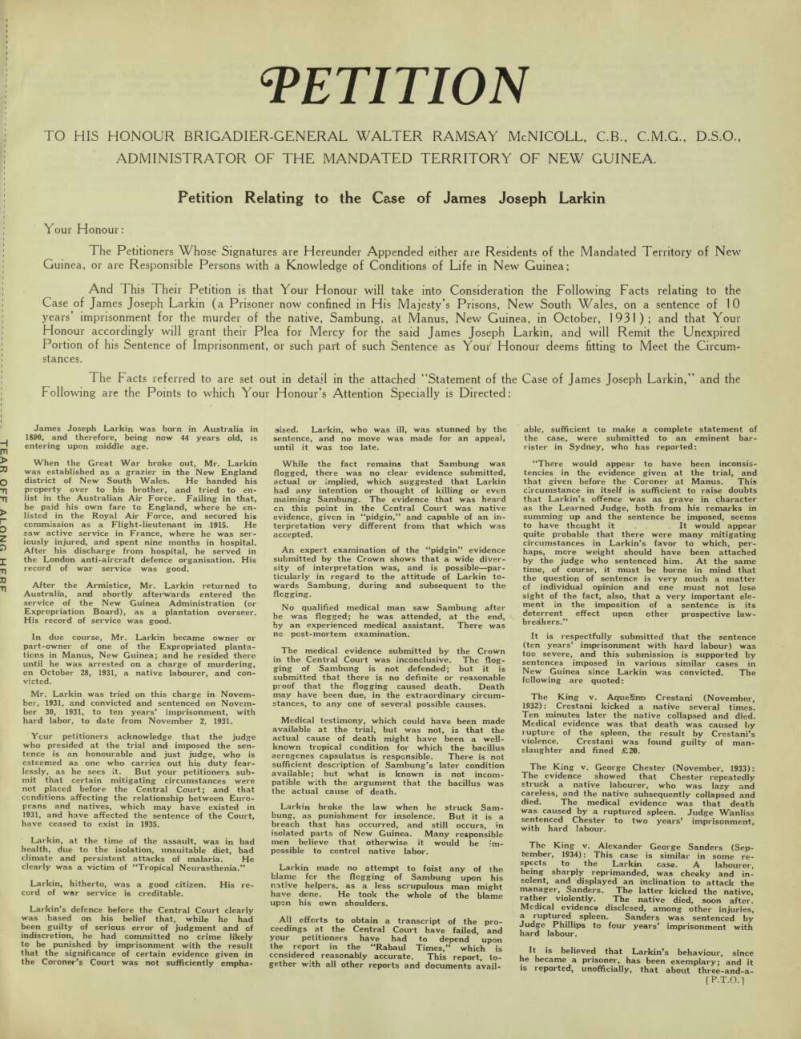
TO HIS HONOUR BRIGADIER-GENERAL WALTER RAMSAY McNICOLL, C.B., C.M.G., D.S.O., ADMINISTRATOR OF THE MANDATED TERRITORY OF NEW GUINEA.
Petition Relating to the Case of James Joseph Larkin Your Honour: The Petitioners Whose Signatures are Hereunder Appended either are Residents of the Mandated Territory of New Guinea, or are Responsible Persons with a Knowledge of Conditions of Life in New Guinea; And This Their Petition is that Your Honour will take into Consideration the Following Facts relating to the Case of James Joseph Larkin (a Prisoner now confined in His Majesty’s Prisons, New South Wales, on a sentence of 10 years’ imprisonment for the murder of the native, Sambung, at Manus, New Guinea, in October, 1931); and that Your Honour accordingly will grant their Plea for Mercy for the said James Joseph Larkin, and will Remit the Unexpired Portion of his Sentence of Imprisonment, or such part of such Sentence as Your Honour deems fitting to Meet the Circumstances.
The Facts referred to are set out in detail in the attached “Statement of the Case of James Joseph Larkin,’’ and the Following are the Points to which Your Honour’s Attention Specially is Directed:
James Joseph Larkin was born in Australia in 1890, and therefore, being now 44 years old, is entering upon middle age.
When the Great War broke out, Mr. Larkin was established as a grazier in the New England district of New South Wales. He handed his property over to his brother, and tried to en list in the Australian Air Force. Failing in that, he paid his own fare to England, where he en listed in the Royal Air Force, and secured his commission as a Flight-lieutenant in 1915. He saw active service in France, where he was ser iously injured, and spent nine months in hospital.
After his discharge from hospital, he served in the London anti-aircraft defence organisation. His record of war service was good.
After the Armistice, Mr. Larkin returned to Australia, and shortly afterwards entered the service of the New Guinea Administration (or Expropriation Board), as a plantation overseer.
His record of service was good.
In due course, Mr. Larkin became owner or part-owner of one of the Expropriated planta tions in Manus, New Guinea; and he resided there until he was arrested on a charge of murdering, on October 28, 1931, a native labourer, and con victed.
Mr. Larkin was tried on this charge in Novem ber, 1931, and convicted and sentenced on Novem ber 30, 1931, to ten years’ imprisonment, with hard labor, to date from November 2, 1931.
Your petitioners acknowledge that the judge who presided at the trial and imposed the sen tence is an honourable and just judge, who is esteemed as one who carries out his duty fear lessly, as he sees it. But your petitioners sub mit that certain mitigating circumstances were not placed before the Central Court; and that conditions affecting the relationship between Euro peans and natives, which may have existed in 1931, and have affected the sentence of the Court, have ceased to exist in 1935.
Larkin, at the time of the assault, was in bad health, due to the isolation, unsuitable diet, bad climate and persistent attacks of malaria. He clearly was a victim of “Tropical Neurasthenia.”
Larkin, hitherto, was a good citizen. His re cord of war service is creditable.
Larkin’s defence before the Central Court clearly was based on his belief that, while he had been guilty of serious error of judgment and of indiscretion, he had committed no crime likely to be punished by imprisonment with the result that the significance of certain evidence given in the Coroner’s Court was not sufficiently empha
sised. Larkin, who was ill, was stunned by the sentence, and no move was made for an appeal, until it was too late.
While the fact remains that Sambung was flogged, there was no clear evidence submitted, actual or implied, which suggested that Larkin had any intention or thought of killing or even maiming Sambung. The evidence that was heard on this point in the Central Court was native evidence, given in “pidgin,” and capable of an in terpretation very different from that which was accepted.
An expert examination of the “pidgin” evidence submitted by the Crown shows that a wide diver sity of interpretation was, and is possible—par ticularly in regard to the attitude of Larkin to wards Sambung, during and subsequent to the flogging.
No qualified medical man saw Sambung after he was flogged; he was attended, at the end, by an experienced medical assistant. There was no post-mortem examination.
The medical evidence submitted by the Crown in the Central Court was inconclusive. The flog ging of Sambung is not defended; but it is submitted that there is no definite or reasonable proof that the flogging caused death. Death may have been due, in the extraordinary circum stances, to any one of several possible causes.
Medical testimony, which could have been made available at the trial, but was not, is that the actual cause of death might have been a well known tropical condition for which the bacillus aerogenes capsulatus is responsible. There is not sufficient description of Sambung’s later condition available; but what is known is not incom patible with the argument that the bacillus was the actual cause of death.
Larkin broke the law when he struck Sam bung, as punishment for insolence. But it is a breach that has occurred, and still occurs, in isolated parts of New Guinea. Many responsible men believe that otherwise it would be im possible to control native labor.
Larkin made no attempt to foist any of the blame for the flogging of Sambung upon his native helpers, as a less scrupulous man might have done. He took the whole of the blame upon his own shoulders.
All efforts to obtain a transcript of the pro ceedings at the Central Court have failed, and your petitioners have had to depend upon the report in the “Rabaul Times,” which is considered reasonably accurate. This report, to gether with all other reports and documents avail-
able, sufficient to make a complete statement of the case, were submitted to an eminent bar rister in Sydney, who has reported: “There would appear to have been inconsis tencies in the evidence given at the trial, and that given before the Coroner at Manus. This circumstance in itself is sufficient to raise doubts that Larkin’s offence was as grave in character as the Learned Judge, both from his remarks in summing up and the sentence he imposed, seems to have thought it . . . . . It would appear quite probable that there were many mitigating circumstances in Larkin’s favor to which, per haps, more weight should have been attached by the judge who sentenced him. At the same time, of course, it must be borne in mind that the question of sentence is very much a matter cf individual opinion and one must not lose sight of the fact, also, that a very important ele ment in the imposition of a sentence is its deterrent effect upon other prospective law breakers.”
It is respectfully submitted that the sentence (ten years’ imprisonment with hard labour) was too severe, and this submission is supported by sentences imposed in various similar cases in New Guinea since Larkin was convicted. The following are quoted: The King v. Aquelino Crestani (November, 1932): Crestani kicked a native several times.
Ten minutes later the native collapsed and died.
Medical evidence was that death was caused by rupture of the spleen, the result by Crestani’s violence. Crestani was found guilty of man slaughter and fined £20.
The King v. George Chester (November, 1933): The evidence showed that Chester repeatedly struck a native labourer, who was lazy and careless, and the native subsequently collapsed and died. The medical evidence was that death was caused by a ruptured spleen. Judge Wanliss sentenced Chester to two years’ imprisonment, with hard labour.
The King v. Alexander George Sanders (Sep tember, 1934): This case is similar in some re spects to the Larkin case. A labourer, being sharply reprimanded, was cheeky and in solent, and displayed an inclination to attack the manager, Sanders. The latter kicked the native, rather violently. The native died, soon after.
Medical evidence disclosed, among other injuries, a ruptured spleen. Sanders was sentenced by Judge Phillips to four years’ imprisonment with hard labour.
It is believed that Larkin’s behaviour, since he became a prisoner, has been exemplary; and it is reported, unofficially, that about three-and-a-
P.T.O.
half years of his 10 years’ sentence already have been remitted for good conduct.
Larkin, when convicted, was engaged to be married. His fiancee, a woman of fine character,
has informed the Sydney committtee that Larkin will not, in any circumstances, return to New Guinea; but that, on his release, they will be married, and probably go to reside in South
America.
Larkin has now completed three years of the sentence imposed upon him. He is entering middle age and his career has been ruined.
Your petitioners humbly submit that James Larkin already has been severely punished for a crime which clearly was not premeditated and in connection with which his previous good record might be allowed to weigh. We submit that even if the remainder of Larkin’s sentence were remitted, he still would have to face the remainder of his life as a man whose career has been broken, and under the stigma of a conviction of serious crime. We submit thirdly, that the laws of the Territory relating to the treatment of natives have been amply vindicated, and that the effect of extending mercy to Larkin would not be detrimental, so far as future observance of and respect for the law are concerned. We submit, fourthly, that clemency in the Larkin case would not establish an embarrassing precedent as the circumstances surrounding the death of the native, and the conviction of Larkin (or murder are very unusual, and not likely to be duplicated in any other case.
The plea of the undersigned, your petitioners, therefore is, that Your Honour will give consideration to the circumstances surrounding the conviction and imprisonment of James Larkin, and to the fact that this man of hitherto good character has now served three years as a felon in the New South Wales Prisons; and that, if Your Honour thinks it fitting, you will exercise your power and remit the remainder of the sentence imposed upon the said James Joseph Larkin.
And in pursuance of this, their petition the following hereunto set their signatures: