Pacific
Islands
Monthly
Vol. V.—No. 8
March 21st 1935
[Registered at the G.P.O., Sydney for transmission by post as a newspaper.]
6 d
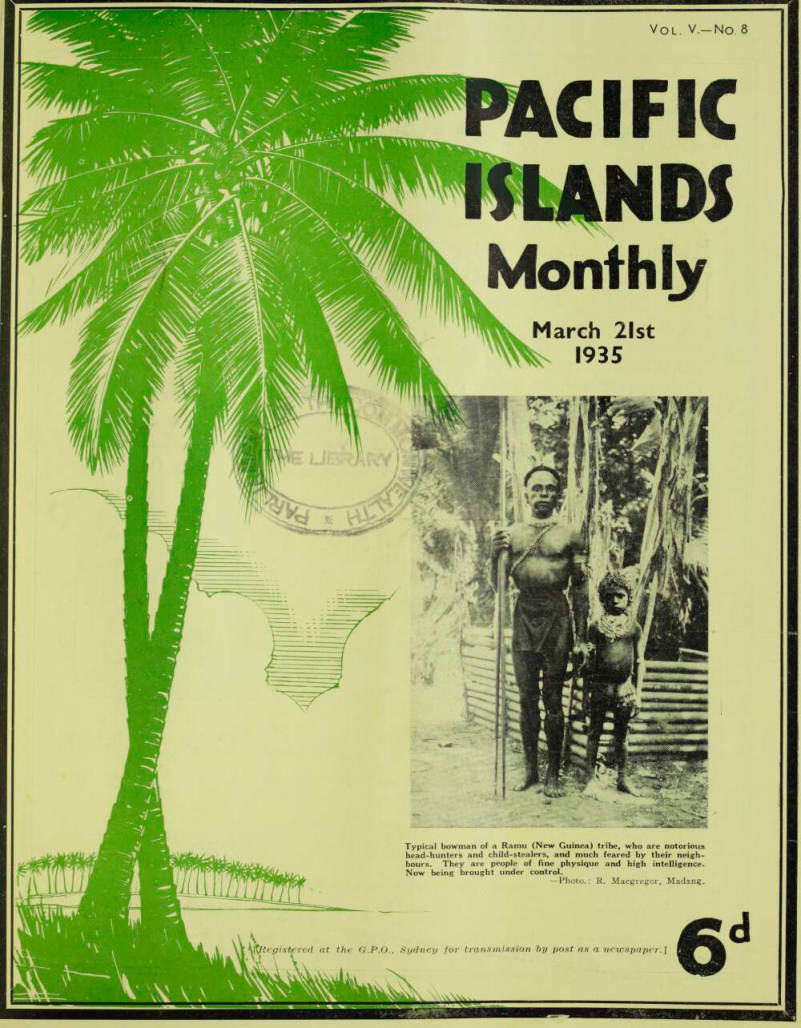
Typical bowman of a Ramu (New Guinea) tribe, who are notorious head-hunters and child-stealers, and much feared by their neigh bours. They are people of fine physique and high intelligence.
Now being brought under control. —Photo.: R. Macgregor, Madang.
Advertisements & other items, p. 2 (1 item)
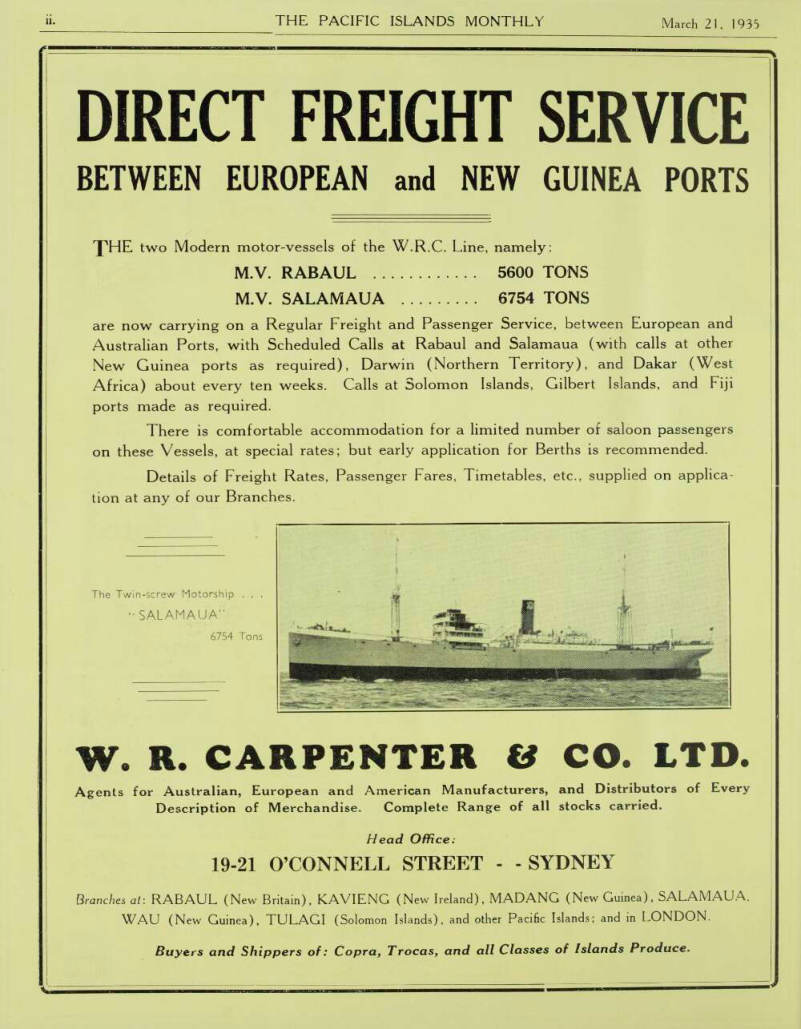
Direct Freight Service
BETWEEN EUROPEAN and NEW GUINEA PORTS
THE two Modern motor-vessels of the W.R.C. Line, namely:
M.V. RABAUL 5600 TONS
M.V. SALAMAUA 6754 TONS
are now carrying on a Regular Freight and Passenger Service, between European and Australian Ports, with Scheduled Calls at Rabaul and Salamaua (with calls at other New Guinea ports as required), Darwin (Northern Territory), and Dakar (West Africa) about every ten weeks. Calls at Solomon Islands, Gilbert Islands, and Fiji ports made as required.
There is comfortable accommodation for a limited number of saloon passengers on these Vessels, at special rates; but early application for Berths is recommended.
Details of Freight Rates, Passenger Fares, Timetables, etc., supplied on application at any of our Branches.
The Twin-screw Motorship . . .
"SALAMAUA"
6754 Tons
W. R. CARPENTER & CO. LTD.
Agents for Australian, European and American Manufacturers, and Distributors of Every Description of Merchandise. Complete Range of all stocks carried.
Head Office:
19-21 O’CONNELL STREET - - SYDNEY
Branches at: RABAUL (New Britain), KAVIENG (New Ireland), MADANG (New Guinea), SALAMAUA.
WAU (New Guinea). TULAGI (Solomon Islands), and other Pacific Islands; and in LONDON.
Buyers and Shippers of: Copra, Trocas, and all Classes of Islands Produce.
Pacific Islands Travellers
Passengers Per Malaita Which
Arrived In Sydney From Solomon
ISLANDS ON MARCH 1:—Mr. Boye, Rev. Butchart, Messrs. Bunskin, Bilton, Father Coicaud, Messrs. Courtney, Catell, Downes, Facer, Hay, Laycock, MacMillan, McGregor, Mason, Pagden, Russell, Stock, Spring, Thebon, Threlfall, War rant, Williams, Mesdames Flood Johnston, Misses Bignell, Blake, Canning, Coverlid, Fitzgerald, Holmes, Johnston, Masters Osborne and Scott.
Passengers Per Macdhui Which
Arrived In Sydney From Papua And
NEW GUINEA ON MARCH 5.—Messrs. Abbie, Anderson, Anscombe, Aumuller, Austin, Baker, Bannigan, Bearup, Black, Bradford, Bilston, Beaney, Cameron, Campbell, Comerford, Cross, Downs, Doe, Davis, Dalton, Eagle, Edwards, Frame, Fryer, Gunner. Godden, Dr. Heydon, Messrs. Hollowed, Harrison, Dr. Hosking, Messrs.
Koskey, King, Lambden, Lee, Lowe, Lucas, Mon teith, McDonald, MacGowan, Moore, Mullaly, McAlpine, McKenzie, McClafferty, McDermott, McMillan, Nicholl, O’Dea, Lanepoole, Pomeroy, Shaw, Schneider, Thompson, Vial, Verey, Wardle, Waterhouse, Warden, Wilde. Mesdames Byrne, Batty, De Groen, Day, Davis, Everall, Hawnt, Ifould, Monteith, Moore, Moran, Nicholl, O’Dea, Phelps, Parker (2), Pollard, Father Reigler, Misses Campbell, Chenoweth, Dupain (2), Grahamslaw, Mathews, McLaren, Reid, Uhe.
Passengers Per Morinda Which
Arrived In Sydney From New Heb
Rides And Norfolk Island On March
5.—Messrs. Kerr, Wilson, More, Judge A de J.
Carey, Judge P. Cruyl, Messrs. Nathan, Michol, Blackburn, Blake, Cameron, Christiansen, Dillon, Howell, King, Scarlett, Sloman, Southey, Tarleton, Westwood, Anderson, Baxter. Mesdames Nathan, Byford, Dillon, Fleck, Howell, King, McCoy, O’Leary, Scarlett, Tarleton. Misses Dupertius, Anderson, Dent, Macfarlane, Blunden.
Passengers Per Montoro Which
Sailed From Sydney For Papua And
New Guinea On February 20: Messrs.
Adelskold, Arnall, Auston, Audsley, Atcherly, Blackley, Best, Butcher, Brereton, Beenham, Boles, Campbell, Coulson, Davies, Ellis (2), Edmonds, Flynn. Farquarson, Ford, Ferguson, Fitzpatrick, Glanville, Gordon, Graydon, Green, Gardiner, Crimson. Hadley, Huxley, Hiles, Heggarty, Hicks, Hindwood, Huish, Kosh, Knox, Lock (2). Lucas, McNicoll, Michell, Mansell, McCrea, McGollan, McArthur, Percy, Preddy, Rae, Rubli, Steed, Searle, Spencer, Sabine, Smith, Smeaton, Sloss, Stewart, Thomas, Turner, Vivian, Wishart, Wurth, Wallace, Woodward, Woods, Wilson; Mesdames Atcherley, Blanch, Caskey, Chinnery, Dette, Flor ance, French, Glanville, Gors, Joubert, Lock (3), Louden. Lucas, Melrose, Newton, Pearce, Parry, Richards, Searle, Steed (2), Smith, Stewart, Wau chope; Misses Allday, Cooper, Caskey, Foxall, Johnstone, Krasnik.
Passengers Per Mariposa Which Ar
RIVED IN SYDNEY FROM SUVA, FIJI, ON FEBRUARY 25: Mr. and Mrs. A. E. Baker, Miss Q. Baker, Miss J. Baker, Mr. B. Bannon, Miss S. Bell, Master G. Bell, Mr. E. H. Coldwell, Mr. and Mrs. G. Coles, Miss S. Coles, Mrs. E. Cres pin. Mr. T. Featherstone, Mr. R. Fisher, Mr. H.
Francis, Mr. P. P. Hagarty, Mr. T. Horne, Mr. and Mrs. G. Mitchell, Mrs. E. L. Malony, Mr. and Mrs. W. C. Nicholson, Mr. and Mrs. H.
Procter-Brown, Mrs. N. F. Puddy, Miss Betty F. Puddy, Mrs. H. L. Saulwick, Miss D. Soady, Mrs. E. Stuart, Mrs. A. M. Tate, Mr. E. G.
Theodore, Miss S. G. Thompson, Mr. and Mrs. W.
L. Trewenack, Masters R. and B. Trewanack, Miss A. Vandenberg, Miss I. Anderson, Mrs. A. Andrews, Mr. V. L. Greenwood, Mr. I. H. Horton, Mr. M. L. Lau, Mr. L. Lau, Mr. T. Nai, Miss R. Nunn, Mr. F. Nunn, Mr. and Mrs. R. B.
Roberts, Misses J. and A. Roberts, Mr. J. Stan nard.
Passengers Per Mariposa Which
Sailed From Sydney For Fiji On
MARCH 6. —Mr. and Mrs. A. W. Andrews, Mrs.
J. Baker, Mr. and Mrs. A. O. Baldridge, G. G.
Bateman, Miss L. Brown, C. R. Browne, R. F.
Brownettes, R. H. Close, Mrs. W. Coleman, H. C.
Cornforth, A. C. Crabtree. Miss M. E. Crabtree, Miss W. A. Crabtree, S. Cruickshank, W. I.
Doran, Mrs. H. J. Durward, M. J. Foster, Mrs. M.
E. Goodsir, Miss J. R. Goodsir, Mr. and Mrs.
R. S. Gordon. Mrs. B. Kelly. Mrs. D. Kelly, R.
Mayne, F. Miller, Miss G. Noall, Miss G. Piere, Mr. and Mrs. E. R. Pitt, J. G. Ryrie, Mrs. V.
Schrader, Miss B. V. Schrader, Max Schirmer, T.
J. Shepard, A. Speed, J. Victor, Mrs. E. Ban nister, F. L. Brown, Rev. J. Calviac, Rev. and Mrs. W. J. Chambers, A. Daja, Mr. and Mrs.
H .E. Ellis, Miss J. Ellis, F. Gatherwood, A.
Grainger. Mr. Guy, M. Halford, F. Halford, F.
Henderson, Rev. and Mrs. H. Johnstone, Miss A.
Johnstone, Master B. Johnstone, Mrs. and Mrs. £. J. Lambert, Miss Maca-Levaci, Mr. and Mrs.
G. M. Masters, Master F. Masters, D. Nagindos, Mr. and Mrs. B. P. Nicholson, Capt. and Mrs.
D. A. Peart, F. A. Pearce, E. J. Rae, T. Rohan, Mr. and Mrs. H. E. Smythe, Masters L. and B.
Smythe, Miss B. Smythe, M. Whan, L. Wilson!
Passengers Per Niagara Which
SAILED FROM SYDNEY FOR FIJI ON FEB RUARY 28: —Mr. E. G. Banks, Mrs. F. Cradick, Mr. W. Chatterton, Mr. F. W. Price, Mrs C L Stafford, Mr. F. Faber, Mr. R. S. M. Southey, Mr. C. D. Cook, Mr. Stanley, Rev. Sister A. M.
Le Cam, Rev. Sister A. Carmes, Rev. Sister Q.
M. Murphy, Miss P. E. Rowe, Mr. and Mrs.
W. Croysdale, Mr. E. Drummond, Mr. W. R.
Morris, Mr. and Mrs. G. Robley, Mr. W. J.
Nichol, Miss M. Elliott, Mr. T. A. Green, Mr. and Mrs. R. L. Forest, Mr. H. B. Bowen, Miss S. Gale, Mrs. C. Elliott, Mr. and Mrs. C. S.
Sharp, Miss Stuckey, Mr. and Mrs. N. S. Stuckey, Mr. and Mrs. T. R. Curry and two children, Miss M. Rutter, Miss J. C. Rutter.
Passengers Per Malaita Which
Sailed For Solomon Islands And Ra
BAUL (N.G.) ON MARCH 9; Messrs. A. N.
Browning, A. E. Buchanan, J. McG. Carson, H.
Cropp, R. Hill, W. G. Jackson, J. Kidnie, J.
Lawrence, D. Murphy, C. J. Moxon, F. L. Pinch ing, G. W. Richardson, P, J. Ranken, V. G.
Smith, V. L. Sherwin, H. McB. Stewart, Rev. U.
Sotutu, H. Traue, Tod, C. R. Thebon, A. T.
Westhoven, J. Waite, H. S. Young; Mesdames: M. F. Barker, Carson, M. Johnston, Kidnie,
Knibbs, D. Lotze and infant, Sotutu and three children, Tod, A. A. Thompson, L. W. S. Wright and infant; Misses M. Clever, E. Field, Harrison, O. M. Johnston, B. Kroening, L. Maguire, Mac- Andrew, Rev. Sister M. Appoline, Rev. Sister M.
Denis.
Passengers Per Macdhui Which
LEFT SYDNEY FOR PAPUA AND N. GUINEA ON MARCH 14: —Messrs. Scott, Ward-Williams, Nelson, Hallam, Howell, Bell, Gubley, Ireland, McCay, Bretag, Gwilt, Koru, Mclntyre, McKen zie, Allen, Cooper, Hemsworth, Digby, Farnham, McLennan, Teasedale-Smith, Sker, Mable, Johann sen, Anderson, Brown, Hargreaves, Panton, Swin field, Rabin, Black, Maroney, Cooper, Jones, Palmer, Stone, Roberts, Judd, Williams, Walsh, Long, Sandford, Doherty, Anderson, Armstrong, Mansell-Turner, Bax, Thompson, Roberts, Gran ter, Munro, Pinnock, Clancy, Foley, Williams, An derson, iStewart, Bell, Moore, Coomber, Aiken, Gibson, Gallagher, Wallent, Blake, Lane, Hill, Davis, Gofton, McAviney, Parnell, Wilkins, Mar shall, Sutherland, McDonald, Plumb, Winterford, Evans, Burns, Andrews, Rudd, Dodds, Clarke, Drayson, Dixon, Skarratt, Taylor, Davies, Dr.
Strong, Rev. Nixon, Rev. Father Janssen, Rev.
Father Fillodeau, Brother Vogt, Brother Pearce, Father Lyons, Capt. Irvine, Brig.-General Wis dom. Mesdames Willis, Nixon, Howell, Kosh, Clay, Hyndman, Clarke, Hargreaves, Bignold, Maroney, Walsh, Long, Headrick, Costello, Barker, Moore, Hennessy, Beer, Winterford, Taylor, Harris, Anderson, Strickland, Ifould, Mitchell, Shennan, Davies. Misses Kellskog, Reilly, Compton, Fellows, Hyndman, Gilmore, Bryant, Watson, Buckerridge, Harris, Keppler, Ward.
A Sydney company is making extensive experiments with soya beans and tung oil trees in the Coff’s Harbour district, New South Wales. A crushing factory is to be established nearby, at Korora.
Results of these experiments may be of interest to Islands planters.
Advertisements & other items, p. 3 (1 item)
W. Kopsen & Co. Limited
SHIP CHANDLERY
Manufacturers of PIONEER BRAND ASH OARS AND IMPLEMENT HANDLES.
Sole Agents for: KOPSEN’S SPECIAL YELLOW METAL SHEATHING AND NAILS.
Large Stocks of Chains, Anchors, Manilla and Wire Ropes, Wood and Iron Blocks, Oakum, Tar, Pitch, Oils, Paints, Leads, Zincs, Varnishes, Shackles, Rigging, Screws, Sheathing, Felt, Lampware, etc.
Special Under Bond Prices for Island trade.
68-70 CLARENCE STREET, SYDNEY
Cables: “Kopsen.” ’Phone: BW 1114-5
SAIGON-BATAVIA-SAMARANC-PORT MORESBY
SAAAARAI-RABAUL- PORT VILA-NOUMEA
SYDNEY - PORT MORESBY - BATAVIA - SAIGON
bi-monthly by the "VAN REES"
You will enjoy travelling by this popular, fast and modern steamer of the K.P.M., noted for its comfort, excellent cuisine, and economical fares.
With a fleet of over 130 vessels the K.P.M. Line is in a position to accept cargo for all ports in Netherlands India, and with transhipment at Batavia for Africa.
ROYAL PACKET NAVIGATION CO.
Paketvaart House, 255 George Street, Sydney
Diethelm & Co., Saigon; E. A. James, Port Moresby; Whitten Bros., Samarai; W. R. Carpenter & Co. Ltd., Rabaul; Gubbay Freres, Port Vila; Carlo Leoni, Noumea.
Advertisers
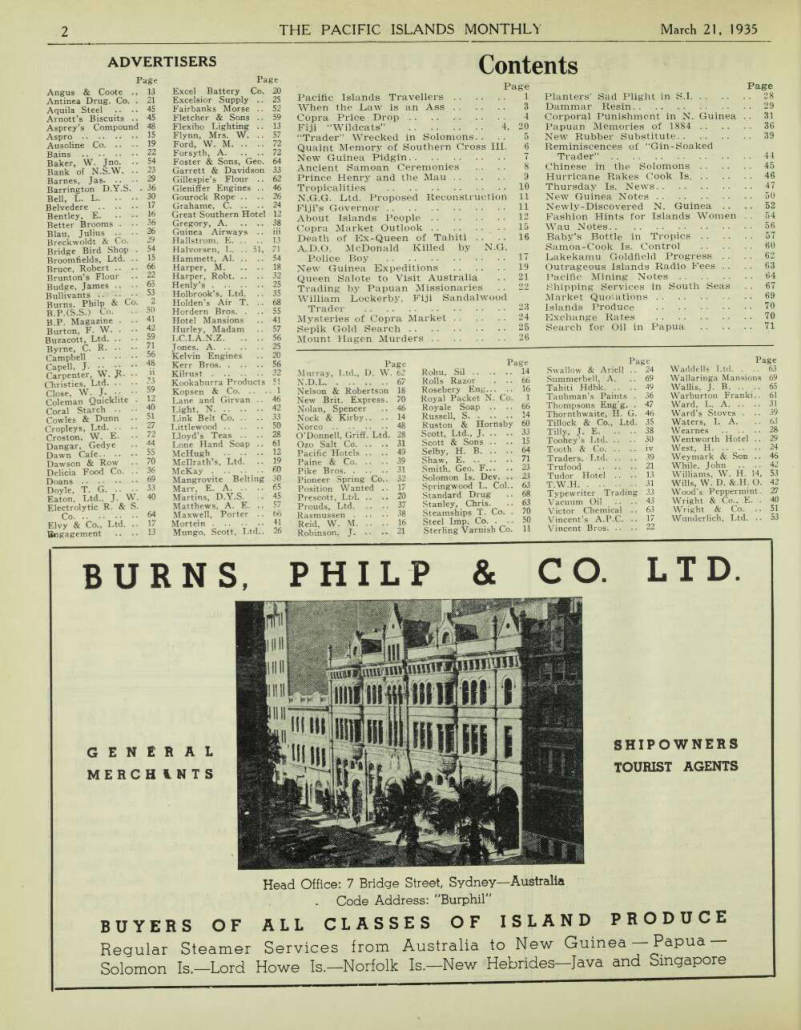
Page Angus & Coote .. 13 Antinea Drug. Co. . 21 Aquila Steel .. . 45 Arnott’s Biscuits .. 45 Asprey’s Compound 48 Aspro 15 Ausoline Co. 19 Bains 22 Baker, W. Jno. .. 54 Bank of N.S.W. •• 23 Barnes, Jas. 29 Barrington D.Y.S. . 36 Bell, L. L. 30 Belvedere 17 Bentley, E. 16 Better Brooms . 36 Blau, Julius 26 Breckwoldt & Co. 29 Bridge Bird Shop . 54 Broomfields, Ltd. .. 15 Bruce, Robert .. 66 Brunton’s Flour .. 22 Budge, James .. 65 Bullivants .. 53 Burns, Philp & Co. 2
B.P.Cs.S.) Co. 50
B.P. Magazine . 41 Burton, F. W. . 42 Buzacott, Ltd 59 Byrne, C. R 71 Campbell 56 Capell, J. 48 Carpenter, W. ii Christies. Ltd Close, W. J. ... 59
Coleman Quicklite . 12
Coral Starch .. 40 Cowles & Dunn 51 Cropkys, Ltd. 27 Croston, W. E. 72 Dangar, Gedye 44 Dawn Cafe 56 Dawson & Row 70 Delicia Food Co. .. 36 Doans 69 Doyle, T. G. 33 Eaton, Ltd.. J. W. 40 Electrolytic R. & S.
Co. 64 Elvy & Co., Ltd. .. 17 Engagement .. 13
Page Excel Battery Co. 20 Excelsior Supply .. 25 Fairbanks Morse .. 52 Fletcher & Sons .. 59 Flexibo Lighting .. 13 Flynn, Mrs. W. .. 57 Ford, W. M. 72 Forsyth, A. 72 Foster & Sons, Geo. 64 Garrett & Davidson 33 Gillespie’s Flour .. 62 Gleniffer Engines .. 46 Gourock Rope .. 26 Grahame, C. 24 Great Southern Hotel 12 Gregory, A. 38 Guinea Airways .. iii Hallstrom, E. 13 Halvorsen, L. .. 51, 71 Hammett, Al. 54 Harper, M. 18 Harper, Robt. 32 Henly’s 25 Holbrook’s, Ltd. .. 35 Holden’s Air T. .. 68 Hordern Bros. . .. 55 Hotel Mansions .. 41 Hurley, Madam .. 57
I.C.I.A.N.Z. 56
Jones, A. 25 Kelvin Engines .. 20 Kerr Bros. 56 Kilrust 32 Kookaburra Products 51 Kopsen & Co. 1 Lane and Girvan .. 46 Light, N. 42 Link Belt Co. 33 Littlewood 50 Lloyd’s Teas .. ..28 Lone Hand Soap .. 61 McHugh 12 Mcllrath’s, Ltd. .. 19 McKay 60 Mangrovite Belting 30 Marr, E. A. 65 Martins, D.Y.S. . 45 Matthews, A. E. .. 57 Maxwell, Porter .. 66 Mortein 41 Mungo, Scott, Ltd.. 26
Page Murray, Ltd., D. W. 62
N.D.L. 67
Nelson & Robertson 18 New Brit. Express. 70 Nolan, Spencer .. 46 Nock & Kirby.. .. 14 Norco 48 O’Donnell, Griff. Ltd. 28 Ozo Salt Co. 31 Pacific Hotels .. .. 49 Paine & Co. 39 Pike Bros 31 Pioneer Spring Co.. 32 Position Wanted .. 17 Prescott, Ltd. 20 Prouds, Ltd. 37 Rasmussen 38 Reid, W. M. 16 Robinson, T. 21
Page Rohu, Sil 14 Rolls Razor . .. 66 Rosebery Eng... .. 16 Royal Packet N. Co. 1 Royale Soap .. .. 66 Russell, S. . .. .. 14 Ruston & Hornsby 60 Scott, Ltd., J. 33 Scott & Sons .. .. 15 Selby, H. B. 64 Shaw, E. .. .. 71 Smith, Geo. F... .. 23 Solomon Is. Dev. .. 23 Spnngwood L. Col.. 63 Standard Drug .. 68 Stanley, Chris. .. 63 Steamships T. Co. . 70 Stee Imp. Co. ... 50 Sterling Varnish Co. 11
Page Swallow & Ariell .. 24 Summerbell, A. ..69 Tahiti Hdbk. 49 Taubman’s Paints . 56 Thompsons Eng’g. . 47 Thornthwaite, H. G. 46 Tillock & Co., Ltd. 35 Tilly, J. E. 38 Toohey’s Ltd. 30 Tooth & Co. iv Traders, Ltd. 39 Trufood 21 Tudor Hotel .. .. 13
T.W.H. 31
Typewriter Trading 33 Vacuum Oil ... 43 Victor Chemical .. 63 Vincent’s A.P.C. .. 17 Vincent Bros. 22
Page Waddells Ltd. . 63 Wallaringa Mansions 69 Wallis, J. B. .. .. 65 Warburton Franki.. 61 Ward, L. A. 31 Ward’s Stoves . ..39 Waters, I. A. .. 63 Wearnes 28 Wentworth Hotel .. 29 West, H. 24 Weymark & Son .. 46 While, John .. .. 42 Williams, W. H. 14, 53 Wills, W. D. &. H. O. 42 Wood’s Peppermint. 27 Wright & Co., E. . 40 Wright & Co. .. 51 Wunderlich, Ltd. .. 53
Contents
Page Pacific Islands Travellers 1 When the Law is an Ass 3 Copra Price Drop 4 Fiji “Wildcats” 4, 20 “Trader” Wrecked in Solomons.. .. 5 Quaint Memory of Southern Cross III. 6 New Guinea Pidgin 7 Ancient Samoan Ceremonies . . . . 8 Prince Henry and the Mau 9 Tropicalities 10 N.G.G. Ltd. Proposed Reconstruction 11 Fiji’s Governor 11 About Islands People 12 Copra Market Outlook 15 Death of Ex-Queen of Tahiti .. .. 16 A.D.O. McDonald Killed by N.G.
Police Boy 17 New Guinea Expeditions 19 Queen Salote to Visit Australia .. 21 Trading by Papuan Missionaries . . 22 William Lockerby, Fiji Sandalwood Trader 23 Mysteries of Copra Market 24 Sepik Gold Search 25 Mount Hagen Murders 26
Page Planters’ Sad Plight in S.I, .. .. .. 28 Dammar Resin 29 Corporal Punishment in N. Guinea .. 31 Papuan Memories of 1884 3G New Rubber Substitute 39 Reminiscences of “Gin-Soaked Trader” 44 Chinese in the Solomons 45 Hurricane Rakes Cook Is. 46 Thursday Is. News 47 New Guinea Notes 50 Newly-Discovered N. Guinea .. .. 52 Fashion Hints for Islands Women . . 54 Wau Notes 56 Baby’s Bottle in Tropics 57 Samoa-Cook Is. Control 60 Lakekamu Goldfield Progress . . .. 62 Outrageous Islands Radio Fees . . . . 63 Pacific Mining Notes 64 Shipping Services in South Seas .. 67 Market Quotations 69 Islands Produce 70 Exchange Rates 70 Search for Oil in Papua 71
Advertisements & other items, p. 4 (1 item)
Burns. Philp & Co. Ltd.
General
MERCHANTS
Head Office: 7 Bridge Street, Sydney—Australia Code Address: "Burphil"
SHIPOWNERS
TOURIST AGENTS
BUYERS OF ALL CLASSES OF ISLAND PRODUCE Regular Steamer Services from Australia to New Guinea — Papua — Solomon Is.—Lord Howe Is.—Norfolk Is.—New Hebrides—Java and Singapore
The Pacific Islands Monthly
The Newspaper-Magazine Of The South Seas
[Registered at G.P.O., Sydney, for transmission by post as a newspaper.]
Published Once Each Month and Circulated in Australia and New Zealand and in the following Pacific Territories and Islands Groups:
Crown Colony of Fiji.
Australian Territory of Papua.
Mandated Territory (Australia) of New Guinea, Bismarck Archipelago, and Northern Solomon Islands.
Mandated Territory (Japan) of Marshall, Caroline and Marianna Islands.
French Territory of New Caledonia.
British and French Condominium of New Hebrides.
American Territory of Eastern Samoa.
American Territory of Guam.
Mandated Territory of Nauru.
British Crown Colony of Gilbert and Ellice Islands.
Mandated Territory (New Zealand) of Samoa.
British Solomon Islands Protectorate.
British Protectorate of Tongan Islands.
New Zealand Territory of Cook Islands, Australian Territory of Norfolk Island.
French Colony of Oceania (Tahiti, etc.).
American Territory of Hawaiian Islands.
Owned and Produced hy Pacific Publications Ltd,, Union House, 247 George Street, Sydney.
Telephone Bw 5037
P.O. Box 3408 R
Contributions Articles, Stories, and Photographs dealing with Pacific Islands Subjects are invited, and will be paid for on publication at usual rates.
Subscription Rates Per Annum, within British Empire, Prepaid Post Free 6/- Per Annum, elsewhere, prepaid, Post Free .. 8/- Single Copies 6d.
Editor and Publisher;
R. W. Robson.
Advertisements Advertising rates furnished on application.
Colours, etc.
Process Blocks made at Advertiser’s expense when required. Screen, 100.
Changes of Advertising Copy should reach this Office by 8th of each month, otherwise previous advertisement may be repeated.
Registered Address for Radiograms and Cables: “PACPUB” Sydney Agents The following are authorised to receive subscrip tions for “The Pacific Islands Monthly"— Islands Branches of Burns, Philp & Cos., Ltd., and Burns Philp (South Seas) Cos., Ltd.
Islands Branches of W. R. Carpenter & Cos., Ltd.
All Branches of Morris, Hedstrom & Cos. Ltd, G. Thomas & Cos., Rabaul.
Whitten Bros., Ltd., Samarai.
P. Costello, Suva, Fiji.
All Branches and Representatives of W. H. Grove and Sons, Ltd., Auckland.
S. Russell, Papeete, Tahiti.
Cook Islands Trading Cos., Rarotonga.
Vol. V., No. 8.
Sydney, March 21, 1933.
Price {6d. Per copy {Prepaid: 6/- p.a.
When The Law Is An Ass
THE law, in its relation to its administration in the Solomon Islands, is in danger of being written down as an ass —unless something has been done or is being done of which we have no infor mation.
We refer to the astonishing history of an assault case in the Solomon Islands.
A native washboy committed an outrageous attack upon the wife of a plantation manager—a clear case of attempted rape —and it appears that he will be released this year after serving a mere twenty months’ imprisonment.
The circumstances are quite well known. The manager’s wife —a Sydney woman of good family—was attacked one morning in September, 1933, in most deliberate and determined fashion, by the washboy Punuhuru; and had she not fought him off with great strength and courage he must have achieved his pur pose, as her husband and the native ser vants were away in the plantation. Her clothes were torn off and she suffered seriously from bruises and shock, Punuhuru ran away; and, when over
taken some time later by the plantation manager, he menaced the latter with a copra knife. He did not then, or at any future time, deny his guilt.
The planter sent for the District Officer and described the urgency of the case.
The D.O., although he had the fastest launch in that part of the Group, did not put in an appearance for three days.
When he did come, he carried out his investigation in leisurely fashion, al though the unfortunate woman, by then, was in a state of nervous collapse, and it was most necessary that the enquiry be hurried on, so that she might be sent away.
The District Officer, and his superiors at Tulagi, appear to have treated the case in lackadaisical fashion, and quite un necessary weeks elapsed before the native was tried. The trial was conducted by the District Officer; and probably it will remain for all time an outstanding example of administrative muddling.
The charge was laid under Section 48 of the Offences Against the Person Act, and the D.O. held that the offence was
punishable with more than 12 months’ imprisonment and less than 7 years. But section 48 deals only with the offence of rape, for which the punishment is penal servitude for life. Attempts to commit crime are otherwise provided for, and the maximum penalty is 2 years’ imprison ment. The charge should have been laid under Section 38 of the Act—i.e., “assault with intent to ravish”—and the maximum penalty provided therefor is 2 years’ imprisonment. The procedure adopted by the D.O. was that which is provided for a preliminary investigation, and not for a trial, and therefore it was all wrong. The court finally convicted Punuhuru of an offence under Section 47 of the Act (an assault occasioning actual bodily harm) and he was awarded 5 years’ penal servitude; and the asses sors who assisted the D.O. recommended further punishment, including a flogging.
The indignant residents of the Solo mons urged that the punishment was inadequate, and the case was brought before the Supreme Court in Fiji. That Court found that Punuhuru had been convicted of something with which he was never charged. He had been charged under Section 48, and not Section 47, and therefore he could not suffer more
than the punishment provided under Sec tion 48. His 5 years of imprisonment accordingly were reduced to 2 years. The High Commissioner for the Western Pacific was perturbed over this matter, and immediately had the law amended to make it clear that flogging may be im posed for rape or indecent assault upon a white woman; but it was decided that this amendment could not be made retro spective to cover the case of Punuhuru.
That seems to have been the end of the matter. Punuhuru will be released from gaol with a clean skin about the middle of this year, after having com mitted one of the worst assaults with intent in the history of the Solomon Islands.
Meanwhile, the manager’s wife, the victim of this flash mission-educated native, has been in Sydney undergoing a series of painful operations, the result of an injury she sustained during her struggle with the native. Complacent officialdom apparently refuses to be further concerned with the case. The Dis trict Officer who was responsible for part of the ghastly legal muddle has dis appeared from the Service; the native
criminal has practically escaped punish
ment owing to a technicality; and that, says officialdom, is the end of the matter.
But, if what we hear is true, the mat ter will not end so peacefully as official dom hopes. There are men in the Solo mons —good and reputable citizens —who have declared that this flash native is not going to escape so easily. It is to be assumed that if officialdom does not find some way of having this case re-tried, and the native properly punished, then the native may disappear from mortal ken in some manner better imagined than described.
What a travesty upon justice! There are Europeans to-day in Australian prisons, condemned to long terms of hard labour because they assaulted native labourers in New Guinea. But Punuhuru, who made a most ferocious attempt to rape an unprotected European woman, and who in that attempt injured her very seriously, escapes with 20 months’ penal Mr. H. Williams and Mr. N. Judd, rep resenting Upper Sepik Gold Syndicate N.L., left Sydney for New Guinea by the Macdhui on March 14.
Mr. George H. Murray, Director of Agriculture for New Guinea, arrived in Sydney from Rabaul on extended leave by the Van Rees on March 19.
Mr. C. J. Moxon, of Guadalcanal, Solo mon Islands, returned to the Protectorate by the March Malaita.
Copra Price
A sharp fall in the London copra quotation was announced on March 18.
The market appears to have Sydney operators completely puzzled, and none now ventures a forecast. A recent authoritative survey of the world position in relation to oils and fats by Messrs.
Harrop, Sydney, discloses a general shortage which, it is said, is likely to last for at least a year.
By March Macdhui
THE B.P. liner Malaita left Sydney for Papua and New Guinea on March 14, with a full complement of passengers. Her skipper was the cheery Captain A. Campbell, who recently took over command from Captain Williams, after many years of service with Burns, Philp and Co. As Chief Officer of the Macdhui, Mr, Campbell became a well-known figure in both Territories, where he is well-liked and highly respected.
The passengers included many prominent Islands folk. Geoffrey Hemsworth, Ray Parer’s companion in the Centenary Air Race, returned to Port Moresby from whence he will fly over to the Morobe goldfield to take charge again of P.A.T Co.’s activities. Brigadier-General A. E. Wisdom, formerly Administrator of New Guinea, was on his way to Papua, where he will look over the various areas taken up by goldmining companies in which he is actively interested.
Mr. J. Ward-Williams, American mining expert, returned to Papua to carry out investigations in the Fly River district. Wally Digby, well-known N.G. prospector and one of the finders of the rich Day Dawn mine, was en route to Morobe to supervise his gold interests, after furlough in Australia.
Father F. Lyons, accompanied by Brothers Pearce and Vogt, left for the Sacred Heart Mission at Saraarai.
Mr. Moresby Gofton, popular son of Mrs. Stewart, of Wau hotel, reluctantly said “good-bye” to Syd ney, after three months’ holidaying. On a tour of inspection of the Sacred Heart Mission stations was Rev. Father Janssen, Superior-General of the Mis sion. Mr. G. V. Maunsell-Turner, of the N.G.
Crown Law Office, returned to Rabaul, after leave in Australia.
On behalf of Misima United N.L., Mr. A. A.
Hargreaves, consulting engineer, left for Misima Island to superintend the preliminary work in con nection with the option his company recently exer cised over four leases there. Captain D. G. Irvine, of W. R. Carpenter and Co., departed for Rabaul, where he will pick up the schooner “France,” and sail her across to the Gilbert and Ellice Islands.
Rev. Maurice Nixon, L.M.S. Missionary, re turned to Port Moresby, en route to Moru Station, after furlough in Tasmania. Dr. W. M, Strong, Chief Medical Officer of Papua, also was a passen ger for Port Moresby. With him were 18 Papuan medical students, who have been undergoing train ing at Sydney University to fit them for medical work among Papuan natives. The students, neatly dressed in Scout uniform, created considerable in terest among the large congregation which had gathered on the wharf to bid farewell to friends.
Among the deck cargo were three draught horses, a pony, two rams, and a small bleating goat, all for Salamaua. On board also was a ferocious looking boar consigned to Wewak. For Sunshine Gold Development Co., a new sturdy Ford lorry was taken aboard. A trim 27-ft. launch, the ‘Pap con,” fitted by Mr. G. Rutherford, of Sydney, with a 15 h.p. Kelvin engine, was shipped for Papuan Concessions N.L., for use on the Fly River.
N.C. Governor On Tour
From Our Own Correspondent.
Noumea, Feb. 2.
Having completed a cruise up the West Coast of Noumea, the French man-of war Admiral Charner left recently with His Excellency the Governor, M. Sia dous, on board for the Loyalty Group (Mare, Lifou, and Ouvea Islands), and the Isle of Pines.
When she returns to port again on Feb ruary 5, the Governor will leave imme diately for Wallis Island in order to investigate the economic conditions there.
Checking “Wildcats”
Comment on Fiji Position
ON page 20 there is an article entitled “Fiji Wildcats Checked.” Since that article was put into type our Suva cor respondent has supplied us with the fol lowing interesting comment upon the mining situation in Fiji.
SUVA, March 1.
The Koroere and the Loloma flotations in Mel bourne put Tavua as a whole right in the centre of the speculative stage in Melbourne, and a scramble took place to secure any old sort of option on any so-called claim on the Tavua field.
Our recent visitors include well-known men. Sir Charles Marr and Mr. Napthali represented Tavua Options for whom Mr. Weekly has been examin ing three areas for some months. Mr. Campbell represented the Fiji Prospecting Syndicate, cf which Messrs. Victor, Jaffrey and Wallace-Smith, of Melbourne, are directors. Mr. Boyd came to look us over on behalf of Messrs. J. C. Were and Sons, of Melbourne; and Mr. Thomas was investigating for another Melbourne group.
By mid-February, Fiji local folk who held areas on Tavua began to dream of great wealth. The price of Tavua options soared, as the 10/- shares of Koroere and Loloma (paid to only 3/-) sky rocketed in Melbourne to 17/- and 29/- respec tively. Current gossip here in Suva is that W. G.
Lawler, who paid £25 for the Loloma area, is now worth something like £60,000; whilst the Pat Cos tello interest in Koroere was valued at £30,000; the Theodore group received shares in both co.’s, upon which the share market put a valuation of £100,000.
The Governor viewed all this speculative activity with some concern, and it was then that, in order to check the wildcats and protect the good name of Fiji, he issued his statement of policy. It came like a dash of cold water to those who had contented themselves with putting four pegs in the ground and then sitting back to await the profits.
On the Tavua field the original prospecting licence over 400 acres was given to Pat Costello, later being transferred to Mr. E. G. Theodore, who had meanwhile taken out a similar licence over an adjoining block of 400 acres. No difficulty was made as to the granting of licences at that time, and altogether 16 prospecting licences covering about 6000/7000 acres were issued. More would have been issued had not Sir Murchison Fletcher, at that time on leave in London, decided firmly on a policy of restriction of licences until the original prospectors had proved, or disproved, the existence of gold. A number of optimists took out mere prospectors’ rights, put in their pegs, and made applications, to be told they could not be considered at that stage. It was the offering for sale at large figures of these non-existent rights which really stirred the Governor, and caused a plain declaration that under no circumstances would alleged transfers be recognised.
The Governor, in his statement, after explain ing the position under the Fiji Mining Ordinance, said that only one mining lease had so far been justified on the Tavua field. The reference, of course, was to E. G. Theodore’s Emperor Gold Mining Co. He then pointed out that of the sixteen prospecting licences granted, four had already expired and the remainder were due to expire on May 31.
It is known that the Government has referred the whole subject of goldmining in Fiji to the Secretary of State for the Colonies, and some instructions from that quarter are expected at an early date.
Mr. E. Lane Poole, of the Common wealth Forestry Department, returned to Australia by the Macdhui on March 5, after investigating the timber resources of the Mandated Territory.
Mr. A. V. Leggo, of Melbourne, has been appointed to the board of directors of the Upper Sepik Gold Syndicate N.L., formed recently in Victoria.
Mr. J. Kidnie, of Gizo, returned to the Solomon Islands by the Malaita from Sydney on March 9.
Awarded Cilento Medal
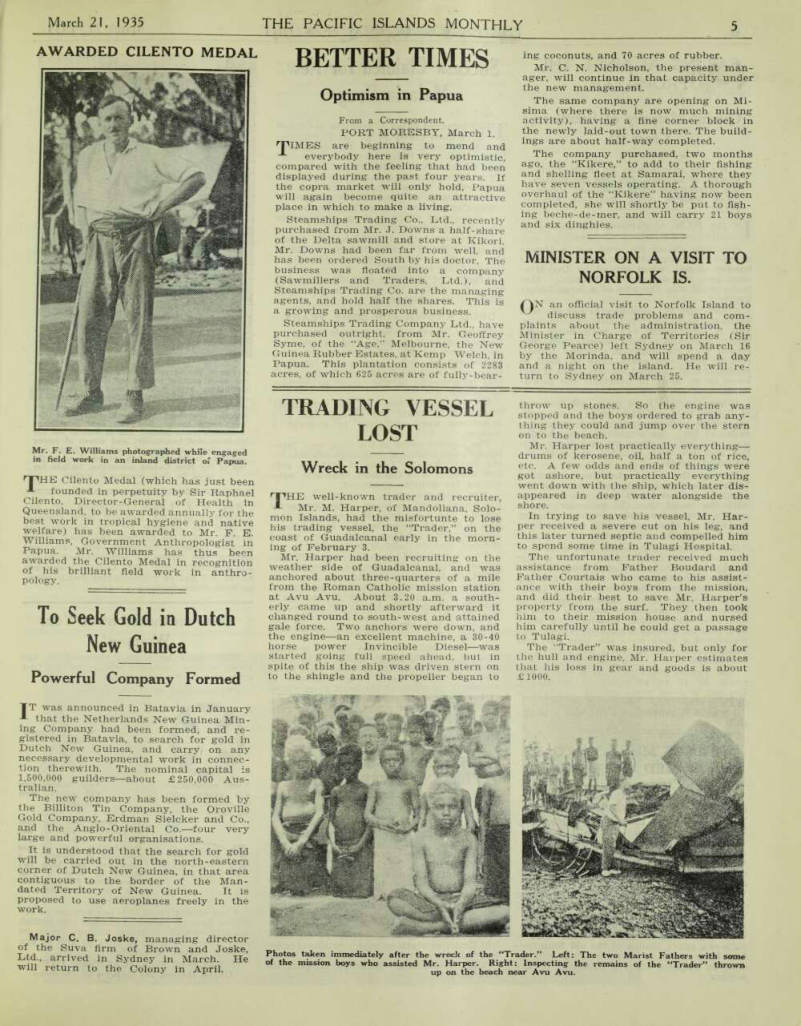
THE Cilento Medal (which has just been founded in perpetuity by Sir Raphael Cilento, Director-General of Health in Queensland, to be awarded annually for the best work in tropical hygiene and native welfare) has been awarded to Mr. F. E.
Williams, Government Anthropologist in Papua. Mr. Williams has thus been awarded the Cilento Medal in recognition of his brilliant field work in anthro pology.
Mr. F. E. Williams photographed while engaged in field work in an inland district of Papua.
New Guinea
To Seek Gold in Dutch New Guinea Powerful Company Formed
IT was announced in Batavia in January that the Netherlands New Guinea Min ing Company had been formed, and re gistered in Batavia, to search for gold in Dutch New Guinea, and carry on any necessary developmental work in connec tion therewith. The nominal capital Is 1,500,000 guilders—about £250,000 Aus tralian, The new company has been formed by the Billiton Tin Company, the Oroville Gold Company, Erdman Sielcker and Co., and the Anglo-Oriental Co.—four very large and powerful organisations.
It is understood that the search for gold will be carried out in the north-eastern corner of Dutch New Guinea, in that area contiguous to the border of the Man dated Territory of New Guinea. It is proposed to use aeroplanes freely in the work.
Major C. B. Joske, managing director of the Suva firm of Brown and Joske, Ltd., arrived in Sydney in March. He will return to the Colony in April,
Better Times
Optimism in Papua
From a Correspondent.
Port Moresby, March 1.
TIMES are beginning to mend and everybody here is very optimistic, compared with the feeling that had been displayed during the past four years. If the copra market will only hold, Papua will again become quite an attractive place in which to make a living.
Steamships Trading Co., Ltd., recently purchased from Mr. J. Downs a half-share of the Delta sawmill and store at Kikori.
Mr. Downs had been far from well, and has been ordered South by his doctor. The business was floated into a company (Sawmillers and Traders, Ltd.), and Steamships Trading Co. are the managing agents, and hold half the shares. This is a growing and prosperous business.
Steamships Trading Company Ltd., have purchased outright, from Mr. Geoffrey Syme, of the “Age,” Melbourne, the New Guinea Rubber Estates, at Kemp Welch, in Papua. This plantation consists of 2283 acres, of which 625 acres are of fully-bear
ing coconuts, and 70 acres of rubber.
Mr. C. N. Nicholson, the present man ager, will continue in that capacity under the new management.
The same company are opening on Mi sima (where there is now much mining activity), having a fine corner block in the newly laid-out town there. The build ings are about half-way completed.
The company purchased, two months ago, the “Kikere,” to add to their fishing and shelling fleet at Samarai, where they have seven vessels operating. A thorough overhaul of the “Kikere” having now been completed, she will shortly be put to fish ing beche-de-mer, and will carry 21 boys and six dinghies.
Minister On A Visit To
Norfolk Is.
On an official visit to Norfolk Island to discuss trade problems and com plaints about the administration, the Minister in Charge of Territories (Sir George Pearce) left Sydney on March 16 by the Morinda, and will spend a day and a night on the island. He will re turn to Sydney on March 25.
Lost
Trading Vessel
Wreck in the Solomons
THE well-known trader and recruiter, A Mr. M. Harper, of Mandoliana, Solo mon Islands, had the misfortunte to lose his trading vessel, the “Trader,” on the coast of Guadalcanal early in the morn ing of February 3.
Mr. Harper had been recruiting on the weather side of Guadalcanal, and was anchored about three-quarters of a mile from the Roman Catholic mission station at Avu Avu. About 3.20 a.m. a south erly came up and shortly afterward it changed round to south-west and attained gale force. Two anchors were down, and the engine—an excellent machine, a 30-40 horse power Invincible Diesel—was started going full speed ahead, but in spite of this the ship was driven stern on to the shingle and the propeller began to
throw up stones. So the engine was stopped and the boys ordered to grab any thing they could and jump over the stern on to the beach.
Mr. Harper lost practically everything— drums of kerosene, oil, half a ton of rice, etc. A few odds and ends of things were got ashore, but practically everything went down with the ship, which later dis appeared in deep water alongside the shore.
In trying to save his vessel, Mr. Harper received a severe cut on his leg, and this later turned septic and compelled him to spend some time in Tulagi Hospital.
The unfortunate trader received much assistance from Father Boudard and Father Courtais who came to his assist ance with their boys from the mission, and did their best to save Mr. Harper’s property from the surf. They then took him to their mission house and nursed him carefully until he could get a passage to Tulagi.
The “Trader” was insured, but only for the hull and engine. Mr. Harper estimates that his loss in gear and goods is about £1000.
Photos taken immediately after the wreck of the “Trader.” Left: The two Marist Fathers with some of the mission boys who assisted Mr. Harper. Right: Inspecting the remains of the “Trader” thrown up on the beach near Avu Avu.
Quaint Memory of Southern
Sailing Against The
Propeller
Quaint Memory of Southern Cross III.
We are indebted to Mr. F. S. Whit combe, of Levuka, Fiji, for the follow ing interesting story of the old Melan esian Mission Ship, Southern Cross
Iii.:
IN the P.I.M. of January you printed a history of “Southern Crosses.”
Southern Cross III. was not a threemasted two-topsail schooner, but was barque-rigged, when owned by the Mis sion, and she was a little beauty. Her main royal was the size of a large hand kerchief.
After Capt. W. Ross bought her she was barquentine-rigged; foresail, two topsails, and a top-gallant sail, with main and upper staysails. Her topsail yard was rigged with Cunningham’s patent topsail reefing gear, and every time we used to reef down it jammed, and a hand would have to go aloft to overhaul the down haul.
When Captain Ross made his first run to Tonga in her (after doing away with the boiler and machinery and making a sailer of her), the propellor, a two-bladed one, was left in place up and down; but the aperture was boarded up, with the propellor inside.
During the trip, when near Sunday Island, we struck dirty weather, and the planking was stripped from the aperture, with the result that the propellor, which was a pretty long one, worked athwart the ship or cross-ways, like a barn door, and stopped the ship’s way.
The dear old man nearly had a fit over the next two days’ runs. With a fair wind, the vessel was only doing 5 to 6 knots, with the wind on her quarter, when she should have been doing 10.
Anyhow, one of the hands happened to think of the propellor, and we lowered him over the weather quarter in a bow line, and he spotted what was wrong. So we rigged a hook on a |in. iron bar, and straightened her up until we arrived at Nukualofa.
The Ysabel could sail like a witch, and could do 30 to 40 miles to windward, against a dead muzzier, any day in a day’s work.
I was A.B. on her, and she was a happy ship.
“Bounty Mutiny” To Be
Filmed In Tahiti
From Our Own Correspondent.
Papeete, Feb. 11.
IT is announced that the advance party of the Metro-Goldwyn Company, which will make two films in Tahiti, is due to arrive by the Maunganui on Feb ruary 23. The party consists of 29 operators who will be housed at the Stuart Hotel.
The company will first of all be occupied with Herman Melville’s story “Typee,” and will then film Messrs. Hall and Nordhoff’s “Mutiny on the Bounty.” In connection with the latter story, it seems that a ship—an exact replica of the old Bounty— has been built in America and will be sent to Papeete for the purposes of the picture
Malaria Drug
Success Claimed for New Malaria Drug
TWO hundred cases of malaria in Ceylon have been cured by Dr. A. T. Simeon, an Englishman, who used the drug ate brim musonal, the Colombo correspon dent of the “Daily Mail” states.
Two injections, it is stated, are sufficient to prevent a relapse, in contrast with the long treatment necessary with quinine.
The Ceylon Government, impressed with the success of the new drug, proposes to treat 50,000 sufferers.
Dr. Simeon, accompanied by his young German wife and one assistant, works in the jungle villages, where thousands clamour for treatment.
Supplies of the drug are exhausted, but more is coming by air from Germany, where it was discovered.
Drug Known For Some Years.
Claims of the new malaria drug by London users were described as “far too optimistic” by Dr. Richard Green, bac teriologist of the Institute for Medical Research, Federated Malay States, who was interviewed by the “Sun” in Sydney on March 9.
Dr. Green, who has used the drug him self, said he could not agreed that two injections were sufficient to prevent a relapse.
The correct name of the drug was “ate brim,” he said. It was introduced by the Bayer Meister Lecus in 1932. A yel low drug, it was the first synthetic sub stitute for quinine produced.
The relapse rate, compared with treatment with quinine, was distinctly lower. The new drug, however, cost two and a half times as much. It had been successfully injected, but the usual method was to take it by tablets.
Dr. Green said malaria was still the major disease in the tropics. Progress is being made against it through the Gov ernment appointed trained malarialo gists. With a rainfall of 250 inches a year it is impossible to control all breed ing places, but the specialist can tell which of 300 odd species of mosquitoes is responsible.
Quinine had been the chief weapon against malaria since as early as 1660, Dr. Green added. During the war, how ever, there had been great difficulty in obtaining supplies of the bark from which it was extracted. Research had led to a substitute, first of plasmoquinine in 1926.
Now atebrim, the first real synthetic, was offered to the world.
Lieutenant-Governor
Visits Western Papua
From Our Own Correspondent.
Pt. Moresby .March 2.
HIS Excellency Sir Hubert Murray, K.C.M.G., Lieutenant-Governor of Papua, accompanied by the Government Secretary, the Official Secretary, and the Hons. H. W. Champion and H. L. Murray, left Port Moresby by the “Laurabada” on February 20, on an official visit to the western stations of the Territory, and those in the Gulf and Central Division, west of Port Moresby.
His Excellency held sittings of the Cen tral Court at stations where criminal cases were awaiting trial.
The “Laurabada” returned to port on February 28.
Rev. F. J. Lewis, Chairman of the Methodist Mission Society, New Guinea, arrived in Sydney by the Macdhui on January 21. He praised the work of the native mission teachers who are out among the tribes in uncontrolled areas.
At present, said Mr. Lewis, there are about 350 native missionaries doing evan gelistic work in such areas.
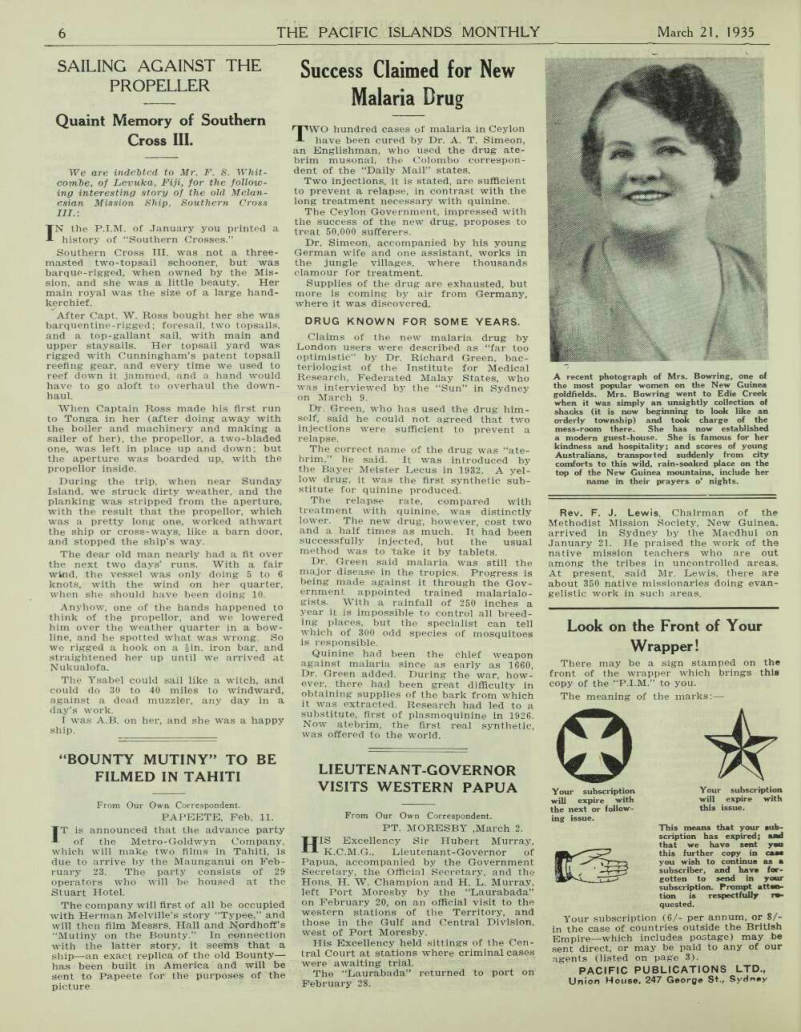
A recent photograph of Mrs. Bowring, one of the most popular women on the New Guinea goldfields. Mrs. Bowring went to Edie Creek when it was simply an unsightly collection of shacks (it is now beginning to look like an orderly township) and took charge of the mess-room there. She has now established a modern guest-house. She is famous for her kindness and hospitality; and scores of young Australians, transported suddenly from city comforts to this wild, rain-soaked place on the top of the New Guinea mountains, include her name in their prayers o’ nights.
Advertisements & other items, p. 8 (1 item)
Wrapper!
Look on the Front of Your
There may be a sign stamped on the front of the wrapper which brings this copy of the “P.I.M.” to you.
The meaning of the marks: — Your subscription will expire with this issue.
This means that your subscription has expired; and that we have sent you this further copy in case you wish to continue as a subscriber, and have forgotten to send in your subscription. Prompt attaotion is respectfully requested.
Your subscription will expire with the next or following issue.
Your subscription (6/- per annum, or 87in the case of countries outside the British Empire—which includes postage) may be sent direct, or may be paid to any of our agents (listed on page 3).
PACIFIC PUBLICATIONS LTD.,
Union House. 247 George St., Sydney
Pidgin
A New Guinea resident supplies the
following delightful examples of Pidgin as
it is used in the Territory :— Planter (arriving on the beach after having previously made arrangements for his departure to town): Pinnace ’e stop?
Boss Boy: ’e stop.
Planter: Boat’s crew ’e stop?
Boss Boy: ’e stop.
Planter: All the time-finish boy ’e stop?
Boss Boy: 'e stop.
Planter: Boat’s crew ’e got kai-kai?
Boss Boy: ’e got.
Planter: Kai kai belong me he come up?
Boss Boy: ’e stop finish.
Planter: Bed belong me he come up?
Boss Boy: ’e come finish.
Planter: Got water?
Boss Boy: ’e got.
Planter: Got benzine?
Boss Boy: ’e got.
Planter: Now altogether something he all right?
Boss Boy: Altogether sumfin ’e all right; thas all; crank shaft; ’e b — up finish.
Cook Boy to Planter; One fella Master ’e come—now he ’ide all Beer belong you.
Planter (meeting one of his old boys in town, after he has repeatedly but vainly asked him to sign on again): What for you make new paper along one fella Mas ter? Before me hard work along you to make new time —close up three fella moon me askem you all the time.
Boy: Master, what for you no askem me one time more?
Planter (who is about to be married, to cook-boy who swears on the least pro vocation) : Missis belong me he come up lik-lik time and this talk-talk no good, must finish.
Cook-boy: Me savvy fashion belong all the Misses, Master.
Bride duly arrives and they are wait ing for dinner to be served, when there is
a crash of crockery on the concrete floor of the kitchen.
Cook-boy rushes in: Master altogether new fella dishes 'e come along Sydney, 'e b—r up finish!
Planter (looking sternly at boy):
What ?
Cook-boy: Altogether new fella dishes 'e come along Sydney ’e (turning to Missis) Aw —me make mistake Missis —’e no b—r up—’e broke thas all.
Boy (who has lodged 10/- in bank during previous week) to bank teller: Me like catchem altogether money belong me.
Bank Teller: What? Altogether?
Boy: Yes, Masta.
Bank Teller closes the account and hands over 10/-.
Boy, having spread the silver along the countar and, carefully counted, it, pushes it back across counter; Me like putem back —me like lookem, thas all!
Collapse of bank teller.
Planter (addressing house-boy, who has a habit of entering the bedroom of plan ter’s wife before she has finished dress ing); “You no can go along room belong Missis suppose she no got clos,”
House-boy: “Masta me like talk straight along this sumthin. All time me look along hole belong lock—suppose Missis he no got clos, me no go along room belong him.”
Goods From Papua and New
Guinea
From March 15, goods imported into Australia from Papua and New Guinea will be subject to primage duty at the same rates as similar goods admissible under the British preferential tariff, in stead of at the foreign rate, as hitherto.
There are now about 700 cars of British and American make in Rabaul, and the roads are fairly good. The climate of New Guinea has a destructive influence on cars unless special precautions are taken.
Mr. A. W. Seymour
Promoted from Fiji to Trinidad
MR. A. W. SEYMOUR, Colonial Secretary of Fiji, has been selected for appointment as Colonial Secretary of Trinidad, in succession to Sir Selwyn Grier, Governor designate of the Wind ward Islands.
This is an important promotion for Mr.
Seymour, and he has received many con gratulations. Mr. Alfred Seymour is 53 years old. He was educated at St. An drew’s University, and joined the Colonial Office Service, as a cadet in Ceylon, in 1905, and rose, step by step, in that ad ministration, until he was Registrar-Gen eral, in 1926.
He was appointed Government Secre tary in Fiji in December, 1926, and he since has acted, on occasion, as Governor and High Commissioner. Before leaving Suva in May last for ten months’ furlough in England, Mr. Seymour was invested with the Order of C.M.G., which had been conferred upon him by the King.
Solomon Is. Goldmining
From Our Own Correspondent.
TULAGI, February 20.
A DEFINITE effort is now being made to put the Solomons gold industry on a satisfactory footing. Messrs. Thebon and J. Williamson arrived from Sydney by the February Malaita to inspect one of the propositions.
Two other syndicates actively inter ested in prospecting on Guadalcanal have availed themselves of the opportunity to have their areas given an expert survey, with a view to development or abandon ment, according to the verdict.
Two new German liners, which are be ing placed in the N.D.L. service between Hong Kong and Germany, have been named Scharnhorst and Gneisenau —recalling the names of German warships which made Pacific history in 1914.
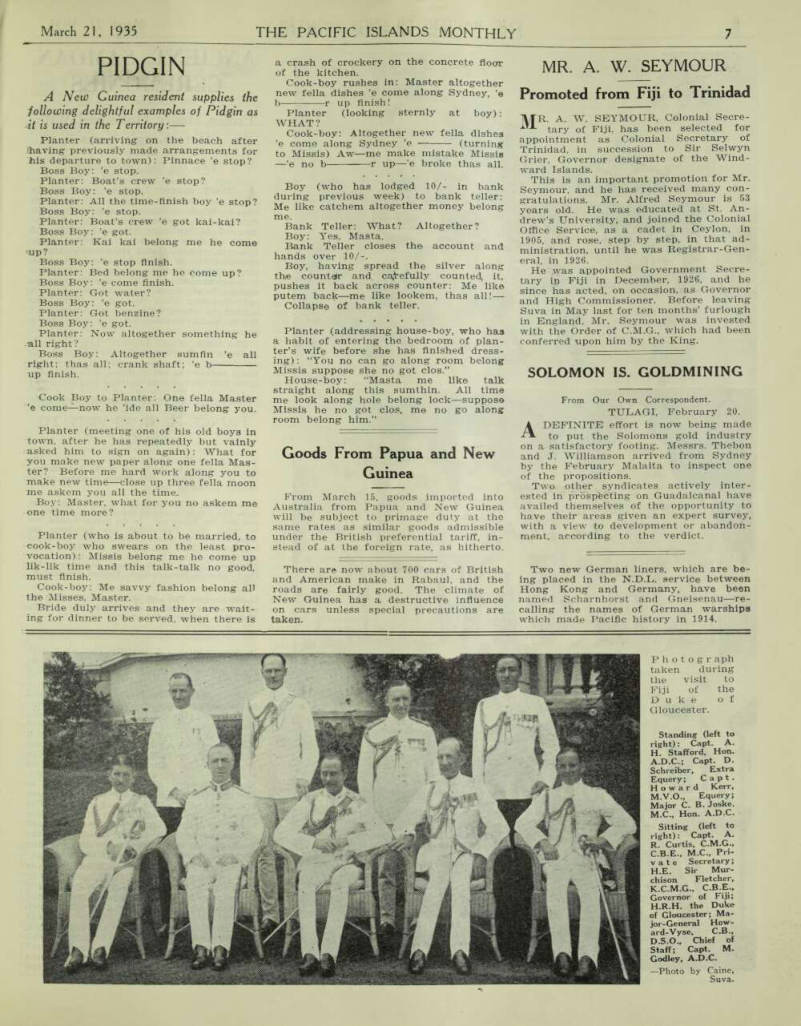
Photograph taken during the visit to Fiji of the Duke of Gloucester.
Standing (left to right): Capt. A.
H. Stafford, Hon.
A.D.C.; Capt. D.
Schreiber, Extra Equery; Capt.
Howard Kerr, M.V.O., Equery; Major C. B. Joske,
M.C., Hon. A.D.C.
Sitting (left to right): Capt. A.
R. Curtis, C.M.G.,
C.B.C., M.C., Pri
vate Secretary; H.E. Sir Mur chison Fletcher,
K.C.M.G., C.B.E.,
Governor of Fiji; H.R.H. the Duke of Gloucester; Ma jor-General How ard-Vyse, C.B., D.S.O., Chief of Staff; Capt. M.
Godley, A.D.C. —Photo by Caine, Suva.
Ceremonies
Ancient Samoan
Prince Henry Honoured With Rare King’s Kava
From Our Own Correspondent.
Apia, Feb. 12.
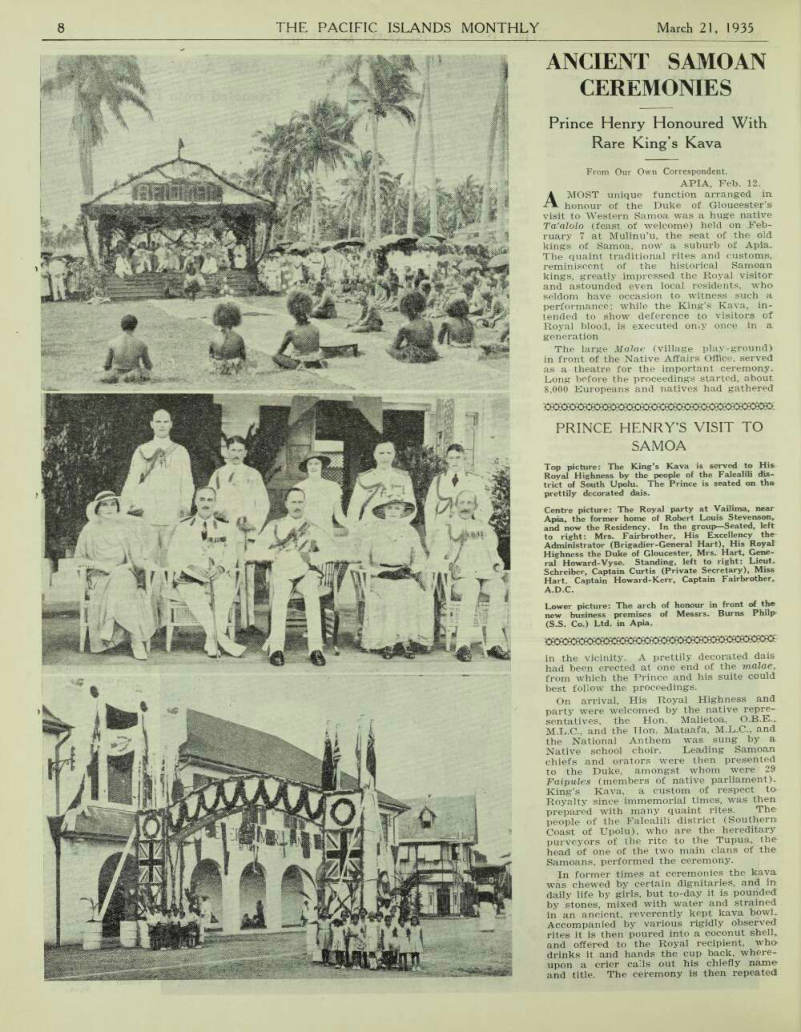
A MOST unique function arranged in honour of the Duke of Gloucester’s visit to Western Samoa was a huge native Ta’alolo (feast of welcome) held on Feb ruary 7 at Mulinu’u, the seat of the old kings of Samoa, now a suburb of Apia.
The quaint traditional rites and customs, reminiscent of the historical Samoan kings, greatly impressed the Royal visitor and astounded even local residents, who seldom have occasion to witness such a performance; while the King’s Kava, in tended to show deference to visitors of Royal blood, is executed only once in a generation The large Malae (village play-ground) in front of the Native Affairs Office, served as a theatre for the important ceremony.
Long before the proceedings started, about 8,000 Europeans and natives had gathered
in the vicinity. A prettily decorated dais had been erected at one end of the malae, from which the Prince and his suite could best follow the proceedings.
On arrival, His Royal Highness and party were welcomed by the native repre sentatives, the Hon. Malietoa, O.B.E., M.L.C., and the Hon. Mataafa, M.L.C., and the National Anthem was sung by a Native school choir. Leading Samoan chiefs and orators were then presented to the Duke, amongst whom were 29 Faipules (members of native parliament).
King’s Kava, a custom of respect to Royalty since immemorial times, was then prepared with many quaint rites. The people of the Falealili district (Southern Coast of Upolu), who are the hereditary purveyors of the rite to the Tupua, the head of one of the two main clans of the Samoans, performed the ceremony.
In former times at ceremonies the kava was chewed by certain dignitaries, and in daily life by girls, but to-day it is pounded by stones, mixed with water and strained in an ancient, reverently kept kava bowl.
Accompanied by various rigidly observed rites it is then poured into a coconut shell, and offered to the Royal recipient, who drinks it and hands the cup back, where upon a crier calls out his chiefly name and title. The ceremony is then repeated
for each recipient lower in rank than the first. The serving of the kava is accom panied by clapping of hands by all those present.
After the kava ceremony the Su’d Taute took place, the offering of food to Royalty.
To the accompaniment of beating drums a large line of Samoans, headed by a taupou (village virgin) approached the Duke, carrying an opened drinking coconut and cooked food, wrapped in leaves, amongst which was large cooked pig.
The Ta’alolos then followed by the tra ditional old districts of Savaii and Upolu.
The men of these districts in a dense crowd approached the dais, slowly march ing forward, singing songs of welcome, preceded by chiefs and a number of taupous in full ceremonial dancing dress with tuigas (high headdresses), dancing to the tune of the Samoan songs sung by the men. In front of the dais they paraded, district after district, offering a pretty and colourful typically Samoan spectacle.
After the ta’alolos a Samoan song in honour of the Royal visitor was sung by the male choir of Laulii village, followed by a dance performed by 200 girls from the Government native schools, dressed in Samoan style and singing songs specially composed in honour of the occasion. This dance and the subsequent performances of an axe dance by 200 natives of the Aana district, and a spear dance by 250 Manono Islanders were heartily applauded by the Prince and the large crowd.
At the finish of the programme a presen tation of gifts by representative Sameans from all the districts of Western Samoa took place. The gifts consisted ot fine mats, kava bowls, walking sticks, tapa cloth, native carvings, fans, etc.
Samoa
Prince Henry’S Visit To
Top picture: The King’s Kava is served to His Royal Highness by the people of the Falealili dis trict of South Upolu. The Prince is seated on the prettily decorated dais.
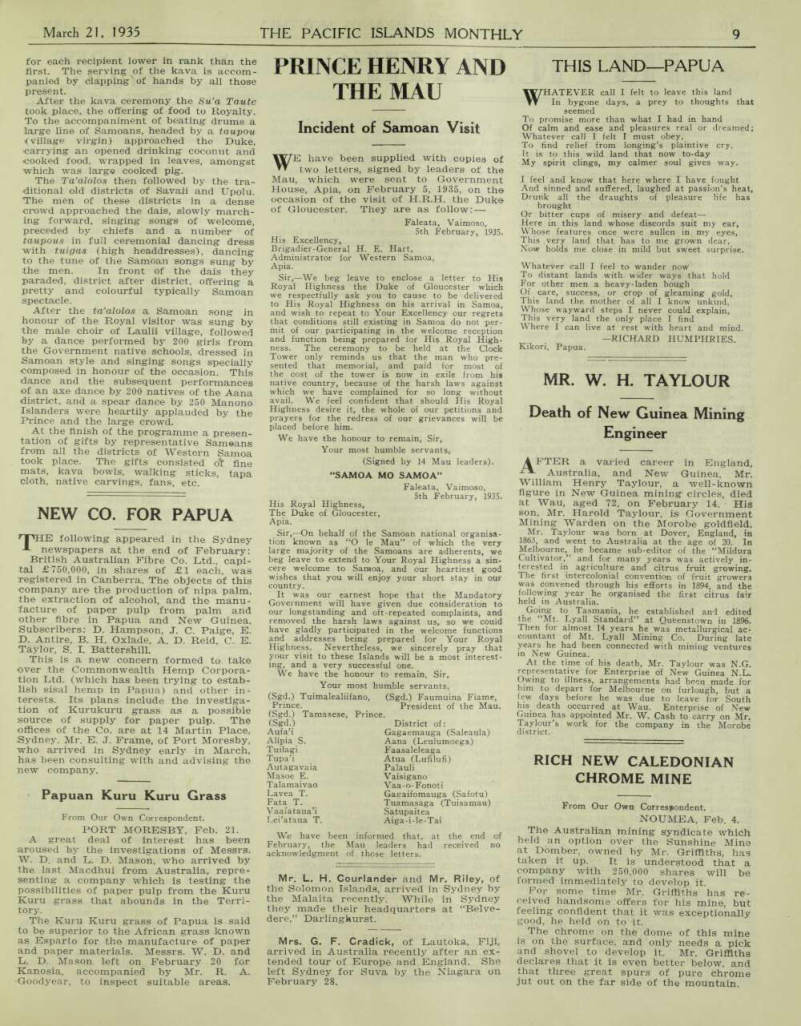
Centre picture: The Royal party at Vailima, near Apia, the former home of Robert Louis Stevenson, and now the Residency. In the group—Seated, left to right: Mrs. Fairbrother, His Excellency the Administrator (Brigadier-General Hart), His Royal Highness the Duke of Gloucester, Mrs. Hart, Gene ral Howard-Vyse. Standing, left to right: Lieut.
Schreiber, Captain Curtis (Private Secretary), Miss Hart. Captain Howard-Kerr, Captain Fairbrother,
A.D.C.
Lower picture: The arch of honour in front of the new business premises of Messrs. Burns Philp (S.S. Co.) Ltd. in Apia.
New Co. For Papua
T'HE following appeared in the Sydney newspapers at the end of February: British Australian Fibre Co. Ltd., capi tal £750,000, in shares of £1 each, was registered in Canberra. The objects of this company are the production of nipa palm, the extraction of alcohol, and the manu facture of paper pulp from palm and other fibre in Papua and New Guinea.
Subscribers: D. Hampson, J. C. Paige, E.
D. Antire, B. H. Oxlade, A. D. Reid, C. E.
Taylor, S. I. Battershill.
This is a new concern formed to take over the Commonwealth Hemp Corpora tion Ltd. (which has been trying to estab lish sisal hemp in Papua) and other in terests. Its plans include the investiga tion of Kurukuru grass as a possible source of supply for paper pulp. The offices of the Co. are at 14 Martin Place, Sydney. Mr. E. J. Frame, of Port Moresby, who arrived in Sydney early in March, has been consulting with and advising the new company.
Papuan Kuru Kuru Grass
From Our Own Correspondent.
Port Moresby, Feb. 21.
A great deal of interest has been aroused by the investigations of Messrs.
W. D. and L. D. Mason, who arrived by the last Macdhui from Australia, repre senting a company which is testing the possibilities of paper pulp from the Kuru Kuru grass that abounds in the Terri tory.
The Kuru Kuru grass of Papua is said to be superior to the African grass known as Esparto for the manufacture of paper and paper materials. Messrs. W. D. and L. D. Mason left on February 20 for Kanosia, accompanied by Mr. R. A.
Goodyear, to inspect suitable areas.
The Mau
Prince Henry And
Incident of Samoan Visit
WE have been supplied with copies of two letters, signed by leaders of the Mau, which were sent to Government House, Apia, on February 5, 1935, on the occasion of the visit of H.R.H. the Duke of Gloucester. They are as follow: — Faleata, Vaimoso, 5th February, 1935.
His Excellency, Brigadier-General H. E. Hart, Administrator for Western Samoa, Apia.
Sir, —We beg leave to enclose a letter to His Royal Highness the Duke of Gloucester which we respectfully ask you to cause to be delivered to His Royal Highness on his arrival in Samoa, and wish to repeat to Your Excellency our regrets that conditions still existing in Samoa do not per mit of our participating in the welcome reception and function being prepared for His Royal High ness. The ceremony to be held at the Clock Tower only reminds us that the man who pre sented that memorial, and paid for most of the cost of the tower is now in exile from his native country, because of the harsh laws against which we have complained for so long without avail. We feel confident that should His Royal Highness desire it, the whole of our petitions and prayers for the redress of our grievances will be placed before him.
We have the honour to remain. Sir, Your most humble servants, (Signed by 14 Mau leaders).
“Samoa Mo Samoa”
Faleata, Vaimoso, 5th February, 1935.
His Royal Highness, The Duke of Gloucester, Apia.
Sir, —On behalf of the Samoan national organisa tion known as “O le Mau” of which the very large majority of the Samoans are adherents, we beg leave to extend to Your Royal Highness a sin cere welcome to Samoa, and our heartiest good wishes that you will enjoy your short stay in our country.
It was our earnest hope that the Mandatory Government will have given due consideration to our longstanding and oft-repeated complaints, and removed the harsh laws against us, so we could have gladly participated in the welcome functions and addresses being prepared for Your Royal Highness. Nevertheless, we sincerely pray that your visit to these Islands will be a most interest ing, and a very successful one.
We have the honour to remain, Sir, Your most humble servants, (Sgd.) Tuimalealiifano, (Sgd.) Faumuina Fiame, Prince. President of the Mau. (Sgd.) Tamasese, Prince. (Sgd.) District of: Aufa’i Gagaemauga (Saleaula) Alipia S. Aana (Leulumoega) Tuilagi Faasaleleaga Tupa’i Atua (Lufilufi) Autagavaia Palauli Masoe E. Vaisigano Talamaivao Vaa-o-Fonoti Lavea T. Gagaifomauga (Safotu) Fata T. Tuamasaga (Tuisamau) Vaafataua’i Satupaitea Lei’ataua T. Aiga-i-le-Tai We have been informed that, at the end of February, the Mau leaders had received no acknowledgment of those letters.
Mr. L. H. Courlander and Mr. Riley, of the Solomon Islands, arrived in Sydney by the Malaita recently. While in Sydney they made their headquarters at “Belve dere,” Darlinghurst.
Mrs. G. F. Cradick, of Lautoka, Fiji, arrived in Australia recently after an ex tended tour of Europe and England. She left Sydney for Suva by the Niagara on February 28.
This Land—Papua
WHATEVER call I felt to leave this land In bygone days, a prey to thoughts that seemed To promise more than what I had in hand Of calm and ease and pleasures real or dreamed; Whatever call I felt I must obey, To find relief from longing’s plaintive cry, It is to this wild land that now to-day My spirit clings, my calmer soul gives way.
I feel and know that here where I have fought And sinned and suffered, laughed at passion’s heat.
Drunk all the draughts of pleasure life has brought Or bitter cups of misery and defeat— Here in this land whose discords suit my ear, Whose features once were sullen in my eyes, This very land that has to me grown dear, Now holds me close in mild but sweet surprise.
Whatever call I feel to wander now To distant lands with wider ways that hold For other men a heavy-laden bough Of care, success, or crop of gleaming gold, This land the mother of all I know unkind, Whose wayward steps I never could explain, This very land the only place I find Where I can live at rest with heart and mind.
Richard Humphries.
Kikori, Papua.
Engineer
Mr. W. H. Taylour
Death of New Guinea Mining Engineer
AFTER a varied career in England, Australia, and New Guinea, Mr.
William Henry Taylour, a well-known figure in New Guinea mining circles, died at Wau, aged 72, on February 14. His son, Mr. Harold Taylour, is Government Mining Warden on the Morobe goldfield.
Mr. Taylour was born at Dover, England, in 1863, and went to Australia at the age of 20. In he became sub-editor of the “Mildura Cultivator,” and for many years was actively in terested in agriculture and citrus fruit growing.
The first intercolonial convention of fruit growers was convened through his efforts in 1894, and the following year he organised the first citrus fair held in Australia.
Going to Tasmania, he established and edited the “Mt. Lyall Standard” at Queenstown in 1896.
Then for almost 14 years he was metallurgical ac countant of Mt. Lyall Mining Co. During late years he had been connected with mining ventures in New Guinea.
At the time of his death, Mr. Taylour was N.G. representative for Enterprise of New Guinea N.L.
Owing to illness, arrangements had been made for him to depart for Melbourne on furlough, but a few days before he was due to leave for South his death occurred at Wau. Enterprise of New Guinea has appointed Mr. W. Cash to carry on Mr.
Taylour’s work for the company in the Morobe district.
Chrome Mine
Rich New Caledonian
From Our Own Correspondent.
Noumea, Feb. 4.
The Australian mining syndicate which held an option over the Sunshine Mine at Bomber, owned by Mr. Griffiths, has taken it up. It is understood that a company with 250,000 shares will be formed immediately to develop it.
For some time Mr. Griffiths has re ceived handsome offers for his mine, but feeling confident that it was exceptionally good, he held on to it.
The chrome on the dome of this mine is on the surface, and only needs a pick and shovel to develop it. Mr. Griffiths declares that it is even better below, and that three great spurs of pure chrome jut out on the far side of the mountain.
Tropicalities
THE social life of Apia is not devoid of amusing incidents, and European residents, usually belonging to this or that clique, find the social game interest ing and entertaining. A certain highly placed official organised a champagne dinner and a dance at a certain place of entertainment recently. He had inten tionally and pointedly, for reasons of his own, omitted to invite to his party, given in honour of several distinguished visitors to Samoa, some of the more prominent residents of his set, who con sidered this omission a deliberate slight offered to them. They quickly decided to get even with their friend, and organized a “counter” dinner and dance on a much larger scale at another place of enter tainment, but at the identical time. Of the two parties, that of the official was a complete washout, while the “counter” party proved to be a huge success, form ing a welcome topic of conversation for several days on the Beach. Since then relations have been somewhat strained between the various sets of Apian society. * * * A SYDNEY journal, noted for the inti mate character of its social revelations, has announced, in a “front page story,” that Prince Henry became dis creetly gay in Suva. It is stated that the first evidence of His Highness’s determi nation to break away from official bore dom was seen at the Government Ball in Suva when, after a couple of duty dances, the Royal eye fell upon Miss Marjorie Harcourt, “the tall, blue-eyed, dark-haired daughter of a well-known Fiji family’’; and that he danced with her far more often than with any one girl during his tour. Later, at a private Government House dance, Miss Harcourt was again the favourite. At the conclusion of this function, the Prince clambered from his room down a fire-escape, and joined a merry “bacon-and-eggs” party at the house of a well-known bachelor. Here, His Highness again met Miss Harcourt and (says the newspaper, with a journal istic smack of its lips) he escorted the young lady home at 4 a.m. * * * MR. W. R. CARPENTER, since he pur chased the motor vessels “Rabaul” and “Salamaua” for the Pacific Ocean- Europe trade, has experienced some of the joys of trans-ocean shipowners. The “Rabaul,” en route to London from New Guinea, called at Darwin at the end of February; and had to lie there four days before a berth was available.
Then, because of the notorious “go slow” tactics of the wharf workers, and partly because of the lowness of the tide, she had to leave the berth with only about half of the 50 tons of pearl shell she was to have loaded for the London market.
When the Rabaul moved out into the channel, police searched the ship and found two men, who had stripped off all their clothing, owing to the excessive heat.
They were hiding underneath the cargo of copra in a forward hold. Soon afterwards, another stowaway was discovered among the cargo in the after hold. They were taken ashore by the police.
A search was also made for two men (one a prominent Communist), who went aboard early in the morning, but who were not seen to come ashore. They had not been found when the Rabaul finally clear ed the harbour.
Darwin was included in the itinerary of this new line because it was believed that added shipping facilities would assist in the development of the Northern Ter ritory. What with one thing and another, the shipowners must be wondering whether any public spirit is worth while, after all.
Later: Officially announced that no more Carpenter ships will call at Darwin. * * * JAPANESE cruisers will be seen in Is lands ports during the coming year. The training squadron cruisers Asama and Yakumo, under the command of Rear- Admiral Kanesaburo Nakamura, with 180 cadets, sailed from Yokosuka on Feb ruary 20, via Hongkong and Singapore, arriving at Fremantle on April 13. The cruisers will visit Adelaide, Melbourne, and Sydney, and New Zealand, returning via Suva, Apia, Honolulu, and the Man dated Islands. * * *
Congratulations To Mr. Jack
Hides, Papuan A.R.M., on the birth of a daughter. The happy event occurred in Camden, New South Wales, at the end of February. Both doing well. Jack Hides will not receive these congratula tions, nor recognise the glad thrill of proud paternity, for some months yet; because Mr. Hides is leading an explor ing expedition in the far interior of un known Papua. He disappeared, accord ing to plan, beyond the headwaters of the Fly River in January, and if all goes well his expedition will re-appear in the Mandated Territory of New Guinea, somewhere between Mount Hagen and the Sepik River, about May.
Messrs. Blackie, London, will publish this year a book recently written by Mr.
Hides. * * * WE beg to make formal protest against the continued use of “British” Solo mon Islands. The word “British” actu ally has no meaning. At the beginning of the century, as the result of some terri torial adjustments in the Pacific, the Northern Solomon Islands (Bougainville and Buka) went to Germany, while the remainder of the Solomons remained British. Thenceforward, we had the British and the German Solomons. But, in 1914, Germany lost her Pacific terri tories; and in 1920 Bougainville and Buka were included, with New Ireland and New Britain, as part of the Mandated Territory of New Guinea, and now virtually part of the British Empire, The use of the term “British” Solomons, therefore, has been quite unnecessary since 1920, and, indeed, absurd, and confusing to the people of the younger generation. * * * MR. A. H. E. SCOTT, who has just retired from the service of the Union Bank of Australia, joined that staff in Fiji in 1889; and he has told the newspapers some interesting things about that period. Fiji in 1893 was not linked by cable with the outside world. One day the mail steamer arrived with sufficient bullion aboard for the bank to make possible the immediate discharge in gold, if necessary, of all the Union Bank's liabilities to its Fijian customers. A mystified local manager rubbed his eyes.
Letters and newspapers brought by the steamer soon made things clear. The first great Australian banking crisis had arrived, and. the bank was determined not to risk suspension of payments even
by the most remote of its branches. But the run on the Fiji branch began and ended with a single customer, who was back next day to deposit the gold he had withdrawn. He did not redeposit it. The bank took the stand that it had no fur ther desire for his business. * * * A CHEERFUL letter is to hand from Mr. I. H. Grabowsky, general manager of Guinea Airways, Ltd., who recently underwent an operation in Melbourne and had one of his legs amputated. He now is making a satis factory recovery from his serious illness.
“I was particularly ‘tickled’ with your statement that I would be a better man with a wooden leg,” writes “Grab.” “I am in agreement with that fact myself and, to put it quite frankly, I was darned glad to get rid of the one that had been causing so much trouble.
“I do not know what my personal boys in New Guinea will think when I pass them over a perfectly good artificial leg to play around with and polish up. They tell weird stories about Shark-eye Park’s eye and artificial teeth, so there may be a few running around about the collapsible leg.”
Queen Of Sud-Est
Mrs. Elizabeth Mahony, known to an earlier generation as “the Queen of Sud-Est Island," and still remembered and loved by all the older residents of Eastern Papua, is now living in Bathurst, N.S.W.
DEAR lady, if you would but please— For you amongst them long did. dwell — What stories of the tropic seas And Islands frolics you could tell!
You queened it o’er that coral isle, And ruled your subjects white and brown, At times by force, at times by guile, And some times merely with, a frown.
With confidence the natives came To sell to you the gold they’d won; You held respect, but, all the same, They knew how you could use a gun.
The gentle savage, white or tan.
Would see he didn’t get too. gay, While it was known you’d “get your man/ From over fifty yards away.
And when the stocks were getting low Around your little trading store You’d take a native crew and! go Away to Samarai, for more.
You’d safely steer your little craft Past island, atoll, reef, and palm, When seas were crashing fore and aft, Or when both wind and sea were calm-.
Whether skies were grey or blue, You’d never seem to care a rap; You’d bring your vessel safely through, With neither sextant, chart, nor map.
And when the stores were in the hold.
Be it sunshine, storm, or rain, Perchance if cyclone were foretold, You’d sail her straight back home* again.
Sick miners in that tropic land Young and blithe or old and grey, They blessed your skilful, soothing handl That drove their fevered pains away.
And victims of misfortune’s whim, Your help were always sure to find — Tho’ sometimes you looked rather grim, Your heart was tender, warm and kind.
Old days are gone; but know that we All join to wish you Fortune’s best.
In you, old timers always see Their Queen of Fair Sud-Est.
Frank Pryke.
Reconstruction
New Guinea Goldfields Ltd. are Proposing Reconstruction
THERE is little comfort for either shareholders in New Guinea Goldfields Ltd. or the Administration of New Guinea in a statement made by Earl Castle Stew art, the chairman of the Mining Trust (which controls N.G.G. Ltd.) at the annual meeting of the Trust in London recently.
The Earl said that for some time past negotiations had been going on with the Sydney board of the New Guinea Gold fields Ltd. in regard to financial recon struction of the latter company. He had recently received a cablegram to the effect that agreement had been reached upon the general principles which should govern such a reorganisation. There were still some details of substantial importance to be settled.
Which probably means that, as we have forecast repeatedly, those shareholders of N.G.G. Ltd. who trustingly accepted N.G.G. scrip in payment for their valuable leases on the Morobe field, are going to “take it in the neck.” They have seen this “pup” of the all-powerful Mining Trust muddle along for about five years, wasting many tens of thousands of pounds through stupidity and inefficiency, and they are just as helpless to do anything now as they were then. It is a tragic example of the kind of thing that has distinguished some large-scale mining operations in every country and in every decade.
The Trust chairman stated also that New Guinea Goldfields Ltd. had in hand at the beginning of December £A240,255 and £stg 45,000 was due to the company as the remainder of the call on the Min ing Trust’s shares. It had been estimated that ore reserves at the Golden Ridges would permit of work being continued until early in 1936 at the present rate of profit. Before then the mill at Edie Creek would be erected and would be treating 30,000 tons a year. It was estimated that the scale of operations could be maintain ed for five years at least.
It was impossible to estimate profits from alluvial work (he continued) and no statement of annual profits for the five year period could be made. Further profits would depend on the results of develop ment work now being undertaken to test the Edie veins at depth, and on discoveries on the other leases of the company. The search for sulphide ore in depth on the Edie veins was being continued by drift ing from the No. 1 shaft.
Any casual person, reading that vague statement of pious hopes, would suppose that N.G.G. Ltd. had commenced opera tions quite recently. Instead the Co, has been at work in New Guinea for at least five years. The Mining Trust group and the Placer-Bulolo group got in on this rich, new goldfield almost simultaneously.
The Placer-Bulolo people formulated a plan and set to work to produce gold on a worth-while scale; and their gold has been coming out for the better part of two years, on a steadily increasing scale, to the great enrichment of the Territory. By comparison, the Mining Trust-N.G.G. Ltd. group have not appeared in a favourable light. Their gold production to-day, when set against the issued capital of N.G.G.
Ltd. (4,405,389 shares of £1, of which 4,130,389 are fully paid) is ludicrous— particularly when it is remembered that N.G.G. Ltd. is squatting on a large sec tion of the rich and still undeveloped leases of the field.
Bulolo G.D. Ltd.’s £1 shares are quoted
at £9; N.G.G. Ltd.’s £1 shares at 6/3.
Further comment is needless.
The Annual Meeting
The annual meeting of shareholders in New Guinea Goldfields, Ltd., will be held in Sydney on March 27. It is reported that Mr. Frank Hambridge will retire from the directorate.
A proposition has been made—but, we understand, has not been seriously con sidered—that the interests of New Guinea Goldfields, Ltd., should be sold to the Placer-Bulolo group; or that, alterna tively, the two groups should be amal gamated. From the public point of view, it seems a great pity that something of the kind cannot be done. The connec tion with Placer-Bulolo would provide a guarantee that operations on the field would move swiftly on a well-ordered plan, and that there would be adequate gold-production within a reasonable time; and it also would assist the un fortunate N.G.G. shareholders by raising immediately the market value of their holdings.
Something of a definite and drastic character should be done. Only a super optimist can expect the price of gold to remain indefinitely at its present level.
If N.G.G. continue at their present rate they will reach worth-while production about 1938, when the economic pendulum will be swinging back to lower gold prices. [Since the above article was put into type, the company’s directors issued their annual report, and proposals, for the general meeting. It is proposed to reduce nominal capital from £5,250,000, in £1 shares, to £1,312,500, in 5/- shares.
Paid-up capital which has been lost or is, unrepresented by available assets is to be cancelled, representing a loss of 15/- per share on 4,472,331 issued shares that is, £3,354,248 is to be wiped out.
The issued capital would then be £1,118,083, in 5/- shares.]
Governor Of Fiji
Sir Murchison Fletcher, K.C.M.G., Gov ernor of Fiji, left Suva for England by the Niagara on March 8. He intends to return at the end of July.
Our Suva correspondent reports that during the absence on leave of Sir Mur chison Fletcher, Hon. A. A. Wright, the Acting Colonial Secretary, is to act as officer administering the Government of Fiji, whilst Hon. A. L. Armstrong is to act as Colonial Secretary. The affairs of the Western Pacific High Commission will be administered by the Assistant to the High Commissioner, Captain Sir Maxwell Maxwell-Anderson, C.B.E., R.N. (retired).
The health of the Governor of Fiji (who is also High Commissioner for the Wes tern Pacific) has not been satisfactory, and he is suffering from nervous strain.
He plans to return in July; but as his term of office expires about September he is unlikely to do so unless his appoint ment is extended for another twelve months. In any case, a lot depends upon medical advice.
Sir Murchison joined the Colonial Ser vice in Hongkong in 1901, and most of his earlier career was in the East. Later, he had a strenuous period of service as Colonial Secretary in Ceylon at the time when the Donaughmore report was being framed. From Ceylon he was appointed to his present post in 1930. His prede cessor, Sir Eyre Hutson, had taken office when the Colony’s balance sheet showed an accumulated deficit of nearly £250,000, but had turned that deficit into a surplus. Sir Murchison continued the good work and to-day the Colony’s accu mulated surplus is round about the half million mark. Naturally such an amaz ing reversal inside a decade has been only possible through unexpected wind falls, such as gold sales and exchange,. but Sir Murchison’s policy of stringent and meticulous economy has helped con siderably to build up the present rock sound state of affairs.
Mr. C. Southey, of Ba, Fiji, was stay ing at “Belvedere,” Darlinghurst. early in March. He was joined later by his son Jack, from Norfolk Island.
Advertisements & other items, pp. 13-14 (1 item)
Home Paint
for SEA AIR
AND
TROPICAL
SUN
STERLING
Home Paint
Will Look Better—Longer
STERLING VARNISH CO., N.S.W.
SKIN DISEASES
By the application of his Secret Formula in the treatment of all Skin Diseases, Mr. John J. McHugh, Consulting Chemist, 124 Liverpool St., Sydney, is able to assure sufferers of a complete and speedy recovery.
Letters of gratitude from all parts of the world may be inspected at his rooms. Skin complaints successfully treated include: Tinea, Eczema, Psoriasis, Acne, Germ Under the Nail, Varicose Veins and Ulcers, Ringworm, Pruritis, Dandruff, Rosacea, Infantile Eczema, etc.
Readers are invited to call or write to Mr. McHugh, and he will advise them without obligation.
Consulting Hours; Monday, Wednesday, Thursday, 10 a.m. to 5 p.m.; Tuesday and Friday, 10 a.m. to 9 p.m.; Saturday, 9 a.m. to 12 noon.
JOHN J. McHUGH, Ph.C.
(Member of the Pharmaceutical Society, N.S.W.) Consulting & Pharmaceutical Chemist
1st FLOOR, 124 LIVERPOOL ST.
(opp. Snow’s), SYDNEY 'Phone MA 5028
Just Think of — !
COLEMAN
Kerosene
Burning: Lamps
The Same Splendid Construction & Efficiency but
GREATER BRILLIANCE
GREATER ECONOMY
These Beautiful KEROSENE Burning Lamps are finished in the New Silvertone colorings, and equipped with handsome modern parchment shades lending dignity to the Home, and giving Brilliance of Light to the user.
Built especially for Kerosene, BUT if your supply of Kerosene runs out, it will burn benzine equally as well.
Coleman Kerosene Junior Lantern
Look at its Splendid Features — Pyrex Globe Porcelain Enamel Top Brass throughout Roto Long Life Generator Built-in pump Hand Operated Filler Plug, and it Burns
KEROSENE or BENZINE.
A Lantern for every Island use Indoors or Out-of-doors.
Ask your Island Storekeeper for Catalogues and Information COLEMAN LAMP & STOVE CO., LTD., Toronto, Canada 500 Kent Street, Sydney
About Islands People
Miss Patience Rowe, B.A., Th.L., of Labasa, Fiji, who had been in Bundaberg and Brisbane on furlough, left Queens land on February 18 to return to her mis sion station.
Mr. T. J. Shepherd and Mr. J. Victor, Victorian mining engineers, left Mel bourne for Suva by the Mariposa on March 2. On behalf of the Australian Prospecting Co. N.L., they will prospect several gold-bearing areas in Fiji.
Mr. C. Thebon, mining, engineer for Pioneer Goldmining Syndicate N.L., de parted for the Solomon Islands from Sydney by the Malaita on March 9. In January last he left Sydney for Guadal canal to examine an auriferous deposit there. While in the Protectorate, he was laid up with dysentery and was ordered back to Sydney for treatment.
He has now returned to S.I. to carry out further investigations for six weeks on Guadalcanal.
Mr. E. C. Carr arrived recently in Papua to collect specimens of plant life for the British Museum. He left Pt.
Moresby in February for Kanosia and the western districts, where he com menced his collections.
Sir Maynard Hedstrom, of Suva, has been appointed to the boards of Koroere Gold N.L. and Loloma Gold Mines N.L.
He is a director of Messrs. Morris Hed strom Ltd., and a member of the Execu tive and Legislative Councils of Fiji.
Mr. S. Elliott Smith, Patrol Officer in the Papuan Administration, who has been stationed for some time at loma, is at present on leave. In February, he was spending a quiet holiday with relatives at Bathurst, N.S.W.
Mr. W. E. Grose, of Kavieng, New Ireland, who has been visiting Sydney, sailed by the Orontes on March 13 for the Far East. He will return to Rabaul in June.
Mr. N. Hagen, well-known merchant and ship-owner of Noumea, who has been spending a few days in Brisbane and Sydney, will leave for New Caledonia before the end of the month.
Mr. Dermott Lane, son of the late Dr.
R. M. Lane, of Melbourne, and Mrs. H.
M. Lane, of Manly, sailed for Edie Creek by the Macdhui on March 14.
Prior to leaving Sydney, he announced his engagement to Miss Anne D’Arcy, of Newcastle.
Pastor A. G. Stewart, of the Seventh Day Adventist Mission, left by the March Macdhui to visit the St. Mathias Group, in New Guinea, and the Ramu-Purari section of the Morobe goldfield. He will return to Sydney in May.
Mr. L. Williams, of the staff of Messrs.
Burns Philp (S.S.) Co. Ltd., at Ma kambo, Solomon Islands, has been trans ferred to Salamaua, in the Mandated Ter ritory of New Guinea.
Mr. T. H. Downs and his wife, of the Solomon Islands, are at present spending their furlough at Mittagong, New South Wales.
Right Rev. Walter H. Baddeley, M.A., Bishop of Melanesia, arrived in Sydney via Brisbane on March 12. He addressed meetings of the Australian Board of Missions, and left for Perth on March 17.
He will return to Sydney, after visiting Adelaide and Melbourne, and depart for the Solomon Islands by the Malaita on April 18. Bishop Baddeley who, before going to the South Seas, was Vicar at South Bank, England, had a very dis tinguished war record, being awarded the M.C. and D.S.O.
Mr. Charles Lewaid, of Kalbar, Queens land, left Brisbane for New Guinea early in February. He proceeded to Madang, where he will do mission work for the Lutheran Church.
Mr. Frank Stock, postmaster of the Solomon Islands Protectorate, left Sydney by the Ballarat on March 6, for furlough in England.
Miss Margaret Carvers, who has been working for the Melanesian Mission for two years, returned to Raga station in the New Hebrides by the Morinda on February 14.
When You Visit Sydney
Nowhere can you be more highly re commended to stay than at the Great Southern Hotel, 717-723 George Street, Sydney (facing Central Railway Station, opposite Rawson Place). Bed and break fast 7/6, luncheon 2/-. dinner 2/6.
About Inlands People
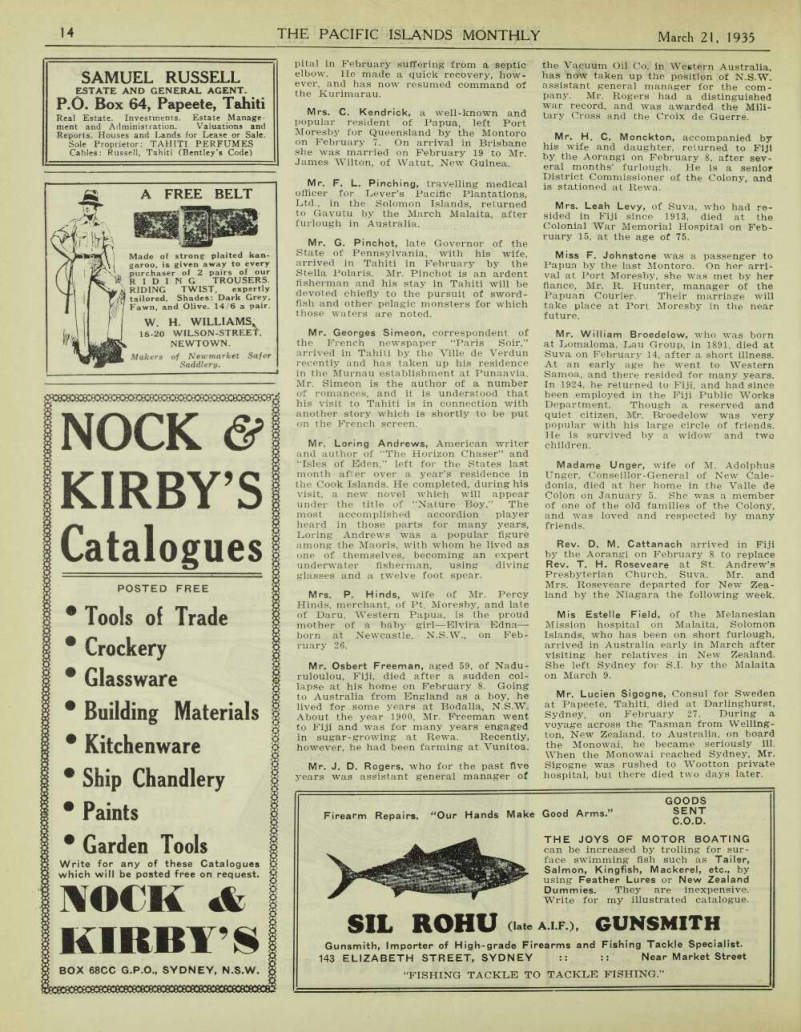
Dr. E. P. Ellison, who took command of the situation following the hurricane in Rarotonga last month, in the absence of the Commissioner (Judge Ayson), is a New Zealander, who has served as a medical officer in different parts of the Pacific. He comes from well-known South island stock, and married into the famous Taia roa family, of football prowess. Dr. Elli son was himself a footballer of promin ence in his young days.
Professor Peter Buck and Mrs. Buck, who have been staying in Tahiti for some months, arrived in New Zealand by the “Maunganui” en route to their home in Honolulu, where the former will resume his duties at the Bishop Museum.
Hon. Sir Apirana Ngata, until recently Native Minister in New Zealand, is seri ously ill in Rotorua, and has been excused from attendance in Parliament.
Judge Ayson, Resident Commissioner for the Cook Islands, who went to New Zea land on furlough by the last “Makura,” left Wellington hurriedly on his return by the same vessel when he learned the extent of damage sustained by Rarotonga and other islands following the recent hurricane. Consequently, a proposed stay in Rotorua was abandoned.
Dr. N. T. Coulson, a retired American doctor of dentistry, departed from Sydney by the Montoro in February on a visit to Papua and New Guinea. An Englishman by birth, Mr. Coulson was a member of the company on the mission ship Southern Cross, which left Cornwall and sailed the South Seas with Bishop Patteson, who was later murdered by Santa Cruz natives in the Solomon Islands. Having attained the venerable age of 80 years, Dr. Coul son was anxious to visit Norfolk Island and New Hebrides to view again the Islands among which he voyaged as a youth. Unfortunately, however, he was unable to make satisfactory steamer con nections, and was compelled to abandon his plans. On his return from the Man dated Territory in March, he will sail direct for his home in San Francisco.
Mr. Frank Hambridge, the local head of New Guinea Goldfields Ltd., returned to Sydney by the Narkunda in February, after visiting New York, London, and Paris.
Mr. D. G. Kennedy and Mr. H. E. Maude, Administrative Officers in the Gilbert and Ellice Islands service, have been appoint ed by the Western Pacific High Commis sion as Native Lands Commissioners for the Ellice Islands and Gilbert Islands, respectively.
Mr. H. Pitman, driller, and Mr. S. C.
Shaw, engineer, arrived in Sydney re cently from South Australia, en route to the New Guinea goldfields, where they will complete a 12 months’ engagement with Guinea Gold N.L. They sailed for the Territory by the Macdhui on January 31.
Mr. E. G. Banks, technical managing director for Australian Mining Trust, Limited, sailed from Melbourne for Fiji
on February 28 to inspect certain areas in which Australian Mining Trust Limi ted is interested. Mr. Banks, who is a director of Loloma Gold Mines, N.L., Fiji, will also visit that company’s property.
Rev. H. S, Perkins, London Missionary Society worker, who had been at Apia, Western Samoa, from 1925 until he left with his wife for England last year, will return to Australia in April next. For six months he will do deputation work in various Australian States and will then sail for Samoa.
Sir Charles Marr, M.P., who is chairman of directors of Mineral Developments, Ltd., returned to Sydney by the Niagara on February 23, after visiting the company’s gold options at Tavua, Fiji. He said there were big possibilities for gold mining in the group.
Rev. Alfred A. Butchart, of the Melane sian Mission at North Mala, S.I., fell down some steps at his home on Malaita in February, and broke his left leg in three places. He was put aboard the Malaita and spent the whole of the voyage South in his bunk, with his leg in plaster. At Sydney he was trans
ferred by ambulance to St. Luke’s Hos pital, Darlinghurst, where he was re ported at the middle of March to be making good progress.
Captain J. L. W. Rawson, skipper of Lever’s Pacific Plantations Ltd. motor vessel Kurimarau, was in Tulagi Hos
pital in February suffering from a septic elbow. He made a quick recovery, how ever, and has now resumed command of the Kurimarau.
Mrs. C. Kendrick, a well-known and popular resident of Papua, left Port Moresby for Queensland by the Montoro on February 7. On arrival in Brisbane she was married on February 19 to Mr.
James Wilton, of Watut, New Guinea.
Mr. F. L. Pinching, travelling medical officer for Lever’s Pacific Plantations, Ltd., in the Solomon Islands, returned to Gavutu by the March Malaita, after furlough in Australia.
Mr. G. Pinchot, late Governor of the State of Pennsylvania, with his wife, arrived in Tahiti in February by the Stella Polaris. Mr. Pinchot is an ardent fisherman and his stay in Tahiti will be devoted chiefly to the pursuit of sword fish and other pelagic monsters for which those waters are noted.
Mr. Georges Simeon, correspondent of the French newspaper “Paris Soir,” arrived in Tahiti by the Ville de Verdun recently and has taken up his residence in the Murnau establishment at Punaavia.
Mr. Simeon is the author of a number of romances, and it is understood that his visit to Tahiti is in connection with another story which is shortly to be put on the French screen.
Mr. Loring Andrews, American writer and author of “The Horizon Chaser” and “Isles of Eden,’’ left for the States last month after over a year’s residence in the Cook Islands. He completed, during his visit, a new novel which will appear under the title of “Nature Boy.” The most accomplished accordion player heard in those parts for many years, Loring Andrews was a popular figure among the Maoris, with whom he lived as one of themselves, becoming an expert underwater fisherman, using diving glasses and a twelve foot spear.
Mrs. P. Hinds, wife of Mr. Percy Hinds, merchant, of Pt. Moresby, and late of Daru, Western Papua, is the proud mother of a baby girl—Elvira Edna— born at Newcastle, N.S.W., on Feb ruary 26.
Mr. Osbert Freeman, aged 59, of Nadu ruloulou, Fiji, died after a sudden col lapse at his home on February 8. Going to Australia from England as a boy, he lived for some years at Bodalla, N.S.W.
About the year 1900, Mr. Freeman went to Fiji and was for many years engaged in sugar-growing at Rewa. Recently, however, he had been farming at Vunitoa.
Mr. J. D. Rogers, who for the past five years was assistant general manager of
the Vacuum Oil Co. in Western Australia, has now taken up the position of N.S.W. assistant general manager for the com pany. Mr. Rogers had a distinguished war record, and was awarded the Mili tary Cross and the Croix de Guerre.
Mr. H. C. Monckton, accompanied by his wife and daughter, returned to Fiji by the Aorangi on February 8, after sev eral months’ furlough. He is a senior District Commissioner of the Colony, and is stationed at Rewa.
Mrs. Leah Levy, of Suva, who had re sided in Fiji since 1913, died at the Colonial War Memorial Hospital on Feb ruary 15, at the age of 75.
Miss F. Johnstone was a passenger to Papua by the last Montoro. On her arri val at Port Moresby, she was met by her fiance, Mr. R. Hunter, manager of the Papuan Courier. Their marriage will take place at Port Moresby in the near future.
Mr. William Broedelow, who was born at Lomaloma, Dau Group, in 1891, died at Suva on February 14, after a short illness.
At an early age he went to Western Samoa, and there resided for many years.
In 1924, he returned to Fiji, and had since been employed in the Fiji Public Works Department. Though a reserved and quiet citizen, Mr. Broedelow was very popular with his large circle of friends.
He is survived by a widow and two children.
Madame Unger, wife of M. Adolphus Unger, Conseillor-General of New Cale donia, died at her home in the Valle de Colon on January 5. She was a member of one of the old families of the Colony, and was loved and respected by many friends.
Rev. D. M. Cattanach arrived in Fiji by the Aorangi on February 8 to replace Rev. T. H. Roseveare at St. Andrew’s Presbyterian Church, Suva. Mr. and Mrs. Roseveare departed for New Zea land by the Niagara the following week.
Mis Estelle Field, of the Melanesian Mission hospital on Malaita, Solomon Islands, who has been on short furlough, arrived in Australia early in March after visiting her relatives in New Zealand.
She left Sydney for S.I. by the Malaita on March 9.
Mr. Lucien Sigogne, Consul for Sweden at Papeete, Tahiti, died at Darlinghurst, Sydney, on February 27. During a voyage across the Tasman from Welling ton, New Zealand, to Australia, on board the Monowai, he became seriously ill.
When the Monowai reached Sydney, Mr.
Sigogne was rushed to Wootton private hospital, but there died two days later.
Engagement
THE engagement is announced of Miss Olive Leiwia Newman, elder daughter of Mr. and Mrs. J.
F. Newman, of Pentecost, New Hebrides, to Mr. Stanley Breusch, of Longana, New Hebrides, eldest son of Mr, and Mrs. J. Breusch, of Bundaberg, Queensland.
Advertisements & other items, pp. 15-16 (2 items)
Swim
Tie On Gas Mantles
Something Better for your Lamp
FLEXIBO LIGHTING CO.
9-15 KIPP AX STREET :: SYDNEY
Manufacturers of the famous Flexibo Gas Mantle, suitable for all petrol storm-proof lamps, table lamps, tilly lamps, and all hollow wire systems. Flying insects will not break this mantle. Agents wanted —samples to all prospective reputable agents.
HALLSTROM’S NON ELECTRIC
Reg. Design 12092 Patent Nos. 16396 and 18485
REFRIGERATORS
KEROSENE
OPERATED
ENJOY the comfort of having cool drinks, cold meats and salads, delicious savouries and sweets, and nice firm butter on the hottest days.
THE NEW SEMI-AUTOMATIC MODEL
gives wonderfully efficient refrigeration without trouble, and at a trifling cost.
It has no moving parts to wear out, or get out of order, and is so simple to operate that a CHILD CAN DO IT. All there is to do is to fill the lamp once a day and light it —that’s all.
Price, £49/10/-, f.o.b., Sydney. Write for descriptive illustrated Folder.
Other types of Chemical Non-Electric Refrigerators from £20.
Manufactured and E. Hallstrom 162 WILLOUGHBY RD., guaranteed by WILLOUGHBY, SYDNEY
YOU
COULD
97/6
SWIM
WEARING
THIS WATCH
AND YET
NOT HARM IT!
YOU COULD
KNOCK IT OR DROP IT
AND YET NOT BREAK IT
IT IS “THE INDESTRUCTIBLE LEVER”
A wonderfully accurate timekeeper, absolutely dust and damp-proof— and in modern chrome case. Complete with strap. Safe delivery and 20 years’ service guaranteed. Kept in order two years free of charge.
ANGUS COOTE 500 George Street SYDNEY
SAMUEL RUSSELL
ESTATE AND GENERAL AGENT.
P.O. Box 64, Papeete, Tahiti
Real Estate. Investments. Estate Management and Administration. Valuations and Reports. Houses and Lands for Lease or Sale.
Sole Proprietor: TAHITI PERFUMES Cables: Russell, Tahiti (Bentley’s Code)
A FREE BELT
Made of strong plaited kangaroo, is given away to every purchaser of 2 pairs of our
RIDING TROUSERS.
RIDING TWIST, expertly tailored. Shades: Dark Grey, Fawn, and Olive. 14/6 a pair.
W. H. WILLIAMS
18-20 WILSON-STREET,
NEWTOWN.
Makers of Newmarket Safer Saddlery.
NOCK &
KIRBY’S
Catalogues
POSTED FREE
• Tools of Trade • Crockery • Glassware • Building Materials • Kitchenware • Ship Chandlery • Paints • Garden Tools Write for any of these Catalogues which will be posted free on request.
NOCK &
KIRBY’S
BOX 68CC G.P.O., SYDNEY, N.S.W.
Firearm Repairs. “Our Hands Make Good Arms.”
GOODS
SENT
C.O.D.
THE JOYS OF MOTOR BOATING
can be increased by trolling for surface swimming fish such as Tailer, Salmon, Kingfish, Mackerel, etc., by using Feather Lures or New Zealand Dummies. They are inexpensive.
Write for my illustrated catalogue.
SIL ROHU (late A.I.F.). GUNSMITH
Gunsmith, Importer of High-grade Firearms and Fishing Tackle Specialist. 143 ELIZABETH STREET, SYDNEY :: :: Near Market Street
“FISHING TACKLE TO TACKLE FISHING.”
Tudor Hotel
Room and Breakfast from 7/6 per day. All meals a la carte. Accommodation for 100 guests. Two minutes from G.P.O.
127 PHILLIP ST. Tel.: BW 2788
One door from the New Martin Place,
SYDNEY
Copra Outlook
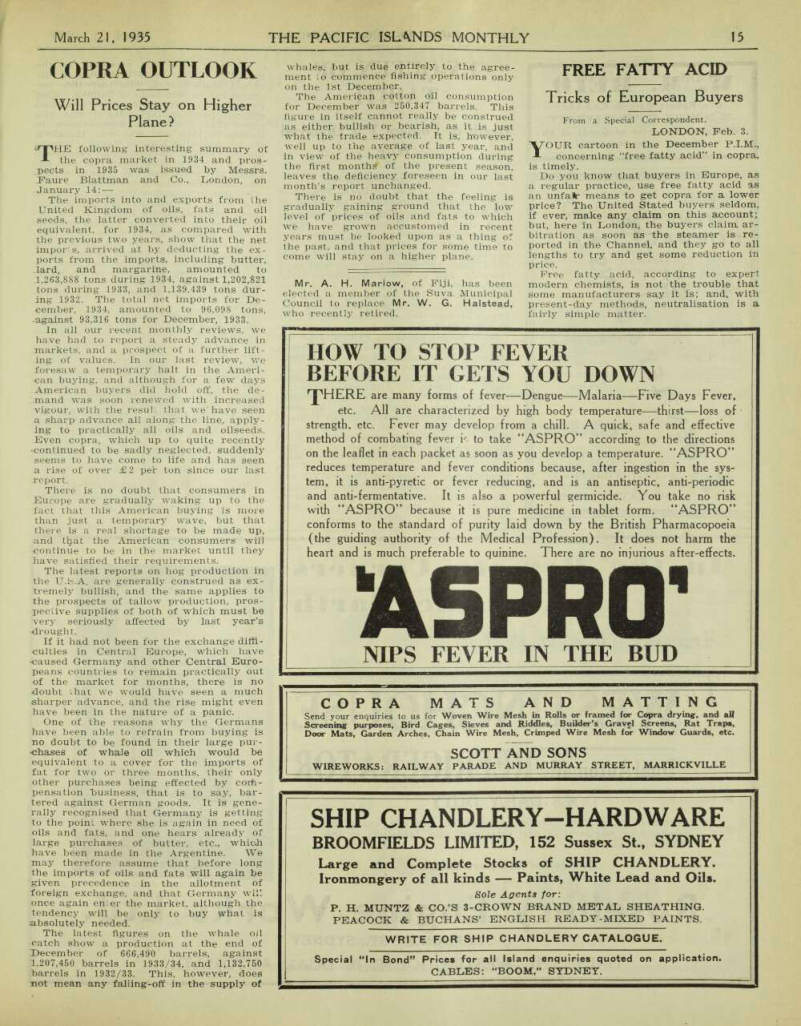
Will Prices Stay on Higher Plane?
THE following interesting summary of the copra market in 1934 and pros pects in 1935 was issued by Messrs.
Faure Blattman and Co., London, on January 14: The imports into and exports from the United Kingdom of oils, fats and oil seeds, the latter converted into their oil equivalent, for 1934, as compared with the previous two years, show that the net impor: s, arrived at by deducting the ex ports from the imports, including butter, lard, and margarine, amounted to 1,263,888 tons during 1934, against 1,202,821 tons during 1933, and 1,139,439 tons dur ing 1932. The total net imports for De cember, 1934, amounted to 96,098 tons, against 93,316 tons for December, 1933.
In all our recent monthly reviews, we have had to report a steady advance in markets, and a prospect of a further lift ing of values. In our last review, we foresaw a temporary halt in the Ameri can buying, and although for a few days American buyers did hold off, the de mand was soon renewed with increased vigour, with the result that we have seen a sharp advance all along the line, apply ing to practically all oils and oilseeds.
Even copra, which up to quite recently continued to be sadly neglected, suddenly seems to have come to life and has seen a rise of over £2 per ton since our last report.
There is no doubt that consumers in Europe are gradually waking up to the fact that this American buying is more than just a temporary wave, but that there is a real shortage to be made up, and tljat the American consumers will continue to be in the market until they have satisfied their requirements.
The latest reports on hog production in the U.S.A. are generally construed as extremely bullish, and the same applies to the prospects of tallow production, pros pective supplies of both of which must be wery seriously affected by last year’s drought.
If it had not been for the exchange diffi culties in Central Europe, which have caused Germany and other Central Euro peans countries to remain practically out of the market for months, there is no doubt that we would have seen a much sharper advance, and the rise might even have been in the nature of a panic.
One of the reasons why the Germans have been able to refrain from buying is no doubt to be found in their large pur chases of whale oil which would be equivalent to a cover for the imports of fat for two or three months, their only other purchases being effected by corti pensation business, that is to say, bar tered against German goods. It is gene rally recognised that Germany is getting to the point where she is again in need of oils and fats, and one hears already of large purchases of butter, etc., whioh have been made in the Argentine. We may therefore assume that before long the imports of oils and fats will again be given precedence in the allotment of foreign exchange, and that Germany will once again enter the market, although the tendency will be only to buy what is absolutely needed.
The latest figures on the whale oil catch show a production at the end of December of 666,490 barrels, against 1,207,450 barrels in 1933/34, and 1,132,750 barrels in 1932/33. This, however, does not mean any falling-off in the supply of
whales, but is due entirely to the agree ment to commence fishing operations only on the Ist December.
The American cotton oil consumption for December was 250,347 barrels. This figure in itself cannot really be construed as either bullish or bearish, as it is just what the trade expected. It is, kowever, well up to the average of last year, and in view of the heavy consumption during the first months of the present season, leaves the deficiency foreseen in our last month’s report unchanged.
There is no doubt that the feeling is gradually gaining ground that the low level of prices of oils and fats to which we have grown accustomed in recent years must be looked upon as a thing of the past, and that prices for some time to come will stay on a higher plane.
Mr. A. H. Marlow, of Fiji, has been elected a member of the Suva Municipal Council to replace Mr. W. G. Halstead, who recently retired.
Tricks of European Buyers
Free Fatty Acid
From a Special Correspondent.
London, Feb. 3.
YOUR cartoon in the December P.1.M., concerning “free fatty acid” in copra, is timely.
Do you know that buyers in Europe, as a regular practice, use free fatty acid as an unfair means to get copra for a lower price? The United Stated buyers seldom, if ever, make any claim on this account; but, here in London, the buyers claim ar bitration as soon as the steamer is re ported in the Channel, and they go to all lengths to try and get some reduction in price.
Free fatty acid, according to expert modern chemists, is not the trouble that some manufacturers say it is; and, with present-day methods, neutralisation is a fairly simple matter.
Advertisements & other items, pp. 17-18 (1 item)
Aspro
HOW TO STOP FEVER
BEFORE IT GETS YOU DOWN
THERE are many forms of fever—Dengue—Malaria—Five Days Fever, etc. All are characterized by high body temperature—thirst—loss of strength, etc. Fever may develop from a chill. A quick, safe and effective method of combating fever is to take “ASPRO” according to the directions on the leaflet in each packet as soon as you develop a temperature. “ASPRO” reduces temperature and fever conditions because, after ingestion in the system, it is anti-pyretic or fever reducing, and is an antiseptic, anti-periodic and anti-fermentative. It is also a powerful germicide. You take no risk with “ASPRO” because it is pure medicine in tablet form. “ASPRO” conforms to the standard of purity laid down by the British Pharmacopoeia (the guiding authority of the Medical Profession). It does not harm the heart and is much preferable to quinine. There are no injurious after-effects.
ASPRO
NIPS FEVER IN THE BUD
COPRA MATS AND MATTING
Send your enquiries to us for Woven Wire Mesh in Rolls or framed for Copra drying, and all Screening purposes. Bird Cages, Sieves and Riddles, Builder’s Gravel Screens, Rat Traps, Door Mats, Garden Arches, Chain Wire Mesh, Crimped Wire Mesh for Window Guards, etc.
SCOTT AND SONS
WIREWORKS: RAILWAY PARADE AND MURRAY STREET, MARRICKVILLE
SHIP CHANDLERY-HARDWARE
BROOMFIELDS LIMITED, 152 Sussex St.. SYDNEY
Large and Complete Stocks of SHIP CHANDLERY.
Ironmongery of all kinds Paints, White Lead and Oils.
Sole Agents for: P. H. MUNTZ & CO.’S 3-CROWN BRAND METAL SHEATHING.
PEACOCK & BUCHANS’ ENGLISH READY-MIXED PAINTS.
WRITE FOR SHIP CHANDLERY CATALOGUE.
Special “In Bond" Prices for all Island enquiries quoted on application.
CABLES: “BOOM,” SYDNEY.
W. M. REID
C/o Robert Reid & Co., Ltd.
32-34 YORK STREET, SYDNEY
Wholesale Exporter of Goods of all Classes from Australia
Specialists In TWINES and
CORDAGE
Cotton-Hemp-Jute All Enquiries Plough Reins Halter’s Sewing Twines Fishing Lines And Sash Cords Invited And where Not Represented Agents are Desired Prices on Application Fitzroy St.
Marrickville N.S.W.
CABLE ADDRESS:
"BENTLEYSON” SYDNEY
In the Remote Corners
. . . of the Earth
As in the Heart of the City ...
The WESTINGHOUSE
Dual Automatic REFRIGERATOR
DOES DAILY DUTY
Wherever alternating current is available you can enjoy the comforts of refrigeration and safeguard your foodstuffs in the Westinghouse way.
Write for full particulars
Rosebery Engine Works Ltd.
13 MARKET ST., SYDNEY
ONLY THE WESTINGHOUSE IS DUAL AUTOMATIC
Ex-Queen Of
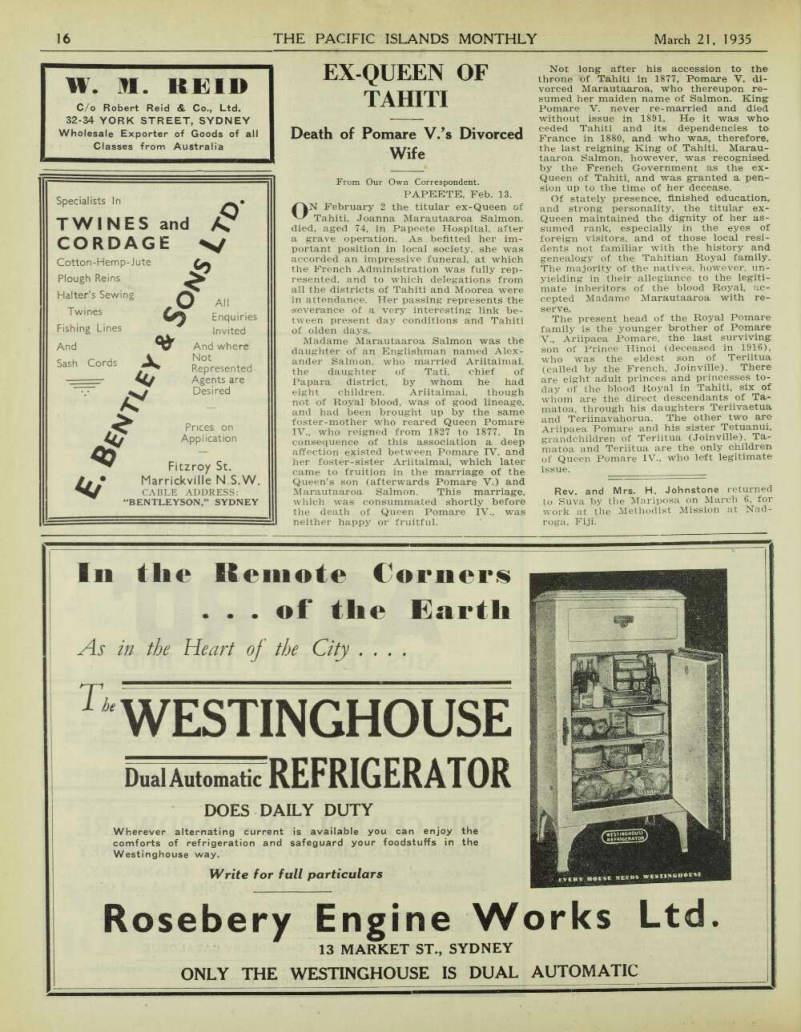
Tahiti
Death of Pomare V.’s Divorced Wife
From Our Own Correspondent.
Papeete, Feb. 13.
February 2 the titular ex-Queen of Tahiti, Joanna Marautaaroa Salmon, died, aged 74, in Papeete Hospital, after a grave operation. As befitted her im portant position in local society, she was accorded an impressive funeral, at which the French Administration was fully rep resented, and to which delegations from all the districts of Tahiti and Moorea were in attendance. Her passing represents the severance of a very interesting link be tween present day conditions and Tahiti of olden days.
Madame Marautaaroa Salmon was the daughter of an Englishman named Alex ander Salmon, who married Ariitaimai, the daughter of Tati, chief of Papara district, by whom he had eight children. Ariitaimai, though not of Royal blood, was of good lineage, and had been brought up by the same foster-mother who reared Queen Pomare IV., who reigned from 1827 to 1877. In consequence of this association a deep affection existed between Pomare IV. and her foster-sister Ariitaimai, which later came to fruition in the marriage of the Queen’s son (afterwards Pomare V.) and Marautaaroa Salmon. This marriage, which was consummated shortly before the death of Queen Pomare IV., was neither happy or fruitful.
Not long after his accession to the throne of Tahiti in 1877, Pomare V. di vorced Marautaaroa, who thereupon re sumed her maiden name of Salmon. King Pomare V. never re-married and died without issue in 1891. He it was who ceded Tahiti and its dependencies to France in 1880, and who was, therefore, the last reigning King of Tahiti. Marau taaroa Salmon, however, was recognised by the French Government as the ex- Queen of Tahiti, and was granted a pen sion up to the time of her decease.
Of stately presence, finished education, and strong personality, the titular ex- Queen maintained the dignity of her as sumed rank, especially in the eyes of foreign visitors, and of those local resi dents not familiar with the history and genealogy of the Tahitian Royal family- The majority of the natives, however, un yielding in their allegiance to the legiti mate inheritors of the blood Royal, ac cepted Madame Marautaaroa with re serve.
The present head of the Royal Pomare family is the younger brother of Pomare V., Ariipaea Pomare, the last surviving son of Prince Hinoi (deceased in 1916), who was the eldest son of Teriitua (called by the French, Joinville). There are eight adult princes and princesses to day of the blood Royal in Tahiti, six of whom are the direct descendants of Ta matoa, through his daughters Teriivaetua and Teriinavahorua. The other two are Ariipaea Pomare and his sister Tetuanui, grandchildren of Teriitua (Joinville). Ta matoa and Teriitua are the only children of Queen Pomare IV., who left legitimate issue.
Rev. and Mrs. H. Johnstone returned to Suva by the Mariposa on March 6, for work at the Methodist Mission at Nad roga, Fiji.
Young N. Guinea Officer Murdered
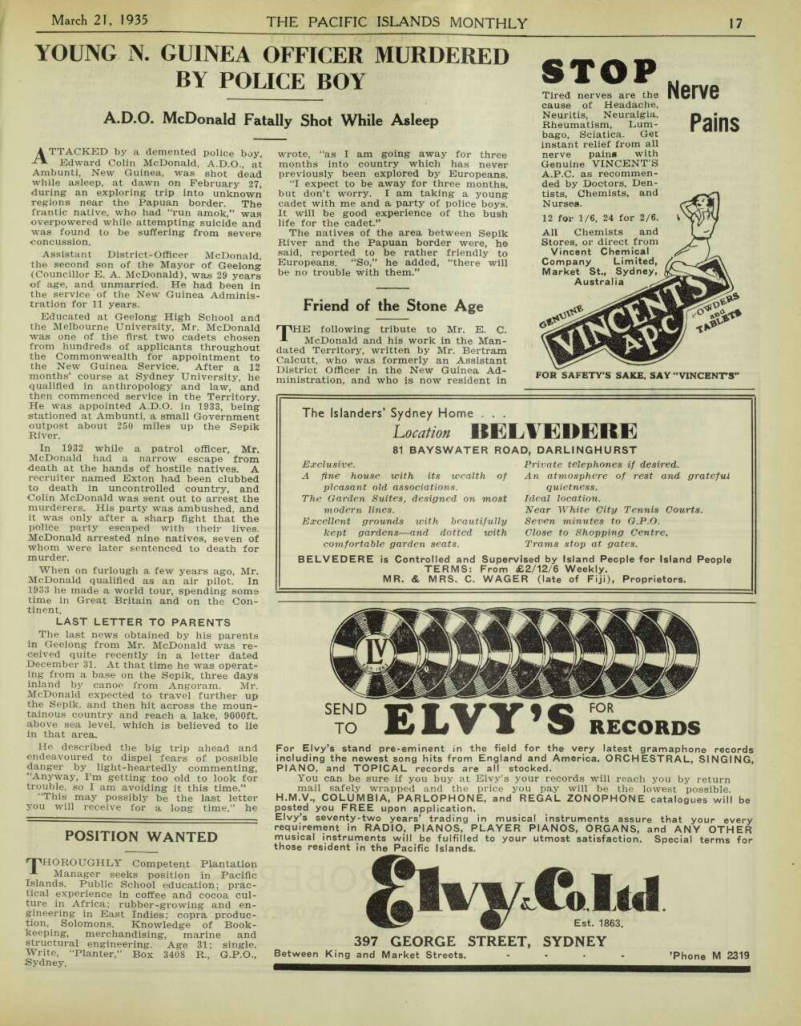
By Police Boy
A.D.O. McDonald Fatally Shot While Asleep
ATTACKED by a demented police boy, Edward Colin McDonald, A.D.O., at Ambunti, New Guinea, was shot dead while asleep, at dawn on February 27, during an exploring trip into unknown regions near the Papuan border. The frantic native, who had “run amok,” was overpowered while attempting suicide and was found to be suffering from severe concussion.
Assistant District-Officer McDonald, the second son of the Mayor of Geelong (Councillor E. A. McDonald), was 29 years of age, and unmarried. He had been in the service of the New Guinea Administration for 11 years.
Educated at Geelong High School and the Melbourne University, Mr. McDonald was one of the first two cadets chosen from hundreds of applicants throughout the Commonwealth for appointment to the New Guinea Service. After a 12 months’ course at Sydney University, he qualified in anthropology and law, and then commenced service in the Territory.
He was appointed A.D.O. in 1933, being stationed at Ambunti, a small Government outpost about 250 miles up the Sepik River.
In 1932 while a patrol officer, Mr.
McDonald had a narrow escape from death at the hands of hostile natives. A recruiter named Exton had been clubbed to death in uncontrolled country, and Colin McDonald was sent out to arrest the murderers. His party was ambushed, and it was only after a sharp fight that the police party escaped with their lives.
McDonald arrested nine natives, seven of whom were later sentenced to death for murder.
When on furlough a few years ago, Mr.
McDonald qualified as an air pilot. In 1933 he made a world tour, spending some time in Great Britain and on the Con tinent.
Last Letter To Parents
The last news obtained by his parents in Geelong from Mr. McDonald was received quite recently in a letter dated December 31. At that time he was operating from a base on the Sepik, three days inland by canoe from Angoram. Mr.
McDonald expected to travel further up the Sepik, and then hit across the mountainous country and reach a lake, 9000 ft. above sea level, which is believed to lie in that area.
He described the big trip ahead and endeavoured to dispel fears of possible danger by light-heartedly commenting, “Anyway, I’m getting too old to look for trouble, so I am avoiding it this time.”
“This may possibly be the last letter you will receive for a long time,” he
wrote, “as I am going away for three months into country which has never previously been explored by Europeans.
“I expect to be away for three months, but don’t worry. I am taking a young cadet with me and a party of police boys.
It will be good experience of the bush life for the cadet.”
The natives of the area between Sepik River and the Papuan border were, he said, reported to be rather friendly to Europeans. “So,” he added, “there will be no trouble with them.”
Friend of the Stone Age
THE following tribute to Mr. E. C.
McDonald and his work in the Mandated Territory, written by Mr. Bertram Calcutt, who was formerly an Assistant District Officer in the New Guinea Administration, and who is now resident in
Sydney, appeared in the “Sydney Morning Herald” on March 9: I first met Colin McDonald at Gasmata, New Britain, in 1929, a fortnight after the chief, Porlo, had felled me with an axe.
A few weeks later, after a stay in hospital, I returned to Gasmata, where I found that McDonald had the chief in custody, and that Porlo’s area had been quietened by him.
McDonald was then a patrol officer and a magistrate of the Native Court, and 23 years old. He was of military bearing, well-educated, and of good family. About Moewe Harbour was an area which was a fester on New Britain; the people lived in stockades built under fig-trees, the trees themselves being converted into fortresses into which the natives retired at an alarm; and it was the last stronghold of widow-strangling, a deeply religious ceremony. I had patrolled through portion of the area the previous year, and I then decided that a military situation existed in it, requiring only a strong hand.
McDonald was athletic, could do anything physically which the Stone Age could do, and he had physical and moral courage.
He was an officer of the Commonwealth Forces, and had the command of men, his
patrol organisation being the model of efficiency.
An Outstanding Triumph
In 1929 I sent McDonald to Moewe Harbour with instructions to bring the area under control, after building a substation at a place to be selected by him self, and to abolish the custom of strangling a man’s widow, or widows (for they were polygamous), immediately after his death. Formerly immolation of women was the custom in the whole of the area between Cape Merkus and Roebuck Bay, on southern New Britain, the native belief being that at death a man required everything he had possessed on earth. His coconut palms were cut down, his garden stripped for a feast, his house burned down, and his pigs killed for a feast; finally, his widow was strangled, after a gruesome dance under the waistband with which her blood-relations killed her. There are still recrudescences of the ceremony, but McDonald more than any other, by his presence and dash, must have saved the lives of hundreds of widows.
He was then fresh from his courses at the University of Sydney in anthropology, public health, law, and physical geography, and this knowledge, combined with his personality and dash, fitted him for the stupendous task of refining the Stone Age and bringing its conduct into line with that of educated English people.
By Christmas, 1929, McDonald, metaphorically, had the Stone Age people of Moewe Harbour “eating out of his hand,” and on such good terms was he with them that even the savage yokels from far inland attended his feasting and dancing assembly at Arung Bay, and a spot which was formerly a fester took on a healthy appearance. McDonald was young, but he did not fail to carry the heavy responsibilities I had placed on him, and Moewe
Harbour, an area where Government in fluence was small because of the natives' resistance to penetration of their country is one of his triumphs.
I next heard of McDonald in 1933, when, he was in charge of Wewak, on the New Guinea mainland, at which place I was in charge in 1925. At 27 McDonald had been promoted to the position of Assistant District Officer, a magisterial office with the same powers as a police magistrate in Australia. The hinterland, as with Moewe Harbour, needed a firm guiding hand, and McDonald distinguished himself by pressing deep into the Sepik Basin, at places fighting through armed opponents, to a village in which a recruiter had been murdered. He was tall and thin, healthy, physically and mentally vigorous; just the type of man the Stone Age admires —a foeman worthy of their spears, and one to whom it was not disgraceful to submit.
Exacting Service
The Sepik Basin was just the place for a man of McDonald’s ability, although it is a ghastly drain on health. McDonald was in charge at Ambunti, the Government station established in 1925, situated about 240 miles along the course of the Sepik River from the coast. I was stationed there in 1925 and 1926, and spent nine months amongst myriads of mosquitoes in the swamps which fringe the river.
Service there is the severest drain on physical and mental health, and the people need a strong hand, such as McDonald and few others could show.
There must be a quarter of a million members of the Stone Age in the Sepik.
Basin, and at the time of his death Mc- Donald was their temporal leader, guide, and friend. This at twenty-nine!
The Sepiks are head-hunters except in those areas under full Government con-
trol, head-hunting simply being part of a boy’s initiation to the privileges and re sponsibilities of manhood. The natives are grand physical and mental types, courageous, superior, and have highly cul tured arts and crafts. In the well-edu cated McDonald the Steel Age had sent its best product to guide, refine, and pro tect the Stone Age, which is the Stone Age’s right.
On February 27, 1935, McDonald was asleep in that sweet coolness of a tropic dawn, when he was shot by one of his own men, a maniacal police “boy.” The man whose sole aim was to guide, refine, and protect the Stone Age was destroyed by it. Vale, Colin McDonald—a splendid son of Australia!
Advertisements & other items, pp. 19-20 (2 items)
Elvy’S Records
STOP
Tired nerves are the cause of Headache, Neuritis, Neuralgia, Rheumatism, Lumbago, Sciatica. Get instant relief from all nerve pains with Genuine VINCENT’S A.P.C. as recommended by Doctors, Dentists, Chemists, and Nurses. 12 for 1/6, 24 for 2/6.
All Chemists and Stores, or direct from Vincent Chemical Company Limited, Market St., Sydney, Australia
Nerve
Pains
FOR SAFETY'S SAKE. SAY “VINCENT'S"
The Islanders’ Sydney Home . . .
Location BELVEDERE
81 BAYSWATER ROAD, DARLINGHURST
Exclusive.
A fine house with its wealth of pleasant old associations.
The Garden Suites, designed on most modern lines.
Excellent grounds with beautifully kept gardens—and dotted with comfortable garden seats.
Private telephones if desired.
An atmosphere of rest and grateful quietness.
Ideal location.
Near White City Tennis Courts.
Seven minutes to G.P.O.
Close to Shopping Centre.
Trams stop at gates.
BELVEDERE is Controlled and Supervised by Island People for Island People TERMS: From £2/12/6 Weekly.
MR. & MRS. C. WAGER (late of Fiji), Proprietors.
ELVY’S RECORDS
For Elvy’s stand pre-eminent in the field for the very latest gramaphone records including the newest song hits from England and America. ORCHESTRAL, SINGING, PIANO, and TOPICAL records are all stocked.
You can be sure if you buy at Elvy’s your records will reach you by return mail safely wrapped and the price you pay will be the lowest possible.
H.M.V., COLUMBIA, PARLOPHONE, and REGAL ZONOPHONE catalogues will be posted you FREE upon application.
Elvy’s seventy-two years’ trading in musical instruments assure that your every requirement in RADIO, PIANOS, PLAYER PIANOS, ORGANS, and ANY OTHER musical instruments will be fulfilled to your utmost satisfaction. Special terms for those resident in the Pacific Islands.
Est. 1863.
397 GEORGE STREET, SYDNEY
Between King and Market Streets. ... 'Phone M 2319
M. HARPER
MANDOLIANA ISLAND,
NORTH GELA, B.S.I.
Postal Address; P.O. Box 6, Tulagi, Solomon Islands.
Recruiting Contracts Undertaken.
Auxiliary Vessel “Papari” available for Charter.
Full details of Services from
BURNS PHILP (S.S.) CO., LTD.,
Makambo (B.S.I.) and Sydney.
NELSON and ROBERTSON
ISLAND MERCHANTS. (Established, 1895.)
COCOA BEANS: Special attention devoted to their sale in Australian and Oversea markets.
COPRA, TROCAS SHELL, and other Island produce sold on commission.
All classes of merchandise purchased at wholesale prices and original invoices supplied to Island clients. Small commission.
SOLE AGENTS FOR
PUMPMOBIL, genuine portable pump, capacity up to 12,000 galls., weight 110 lbs.
PENTA ENGINES, utility outboard and inboard, Swedish manufacture, powers 4-60 h.p.
SKANDIA ENGINES, full diesel and semi-diesel, all powers, marine and stationary.
UPSON BRITISH BOARD, wallboard and insulating material in one, strong and
NELSON and ROBERTSON
12 SPRING STREET SYDNEY, AUSTRALIA
Address: “IVAN SYDNEY."
Position Wanted
THOROUGHLY Competent Plantation Manager seeks position in Pacific Islands. Public School education; practical experience in coffee and cocoa culture in Africa; rubber-growing and engineering in East Indies; copra production, Solomons. Knowledge of Bookkeeping, merchandising, marine and structural engineering. Age 31; single.
Write, “Planter,” Box 3408 R., G.P.O., Sydney.
Honour For Tahiti
Botanist
From Our Own Correspondent.
Papeete, Feb. 12.
IN recognition of his services to agriculture in the Colony, Mr. Harrison W.
Smith, at one time Professor of Electrical Engineering at the Massachusetts Insti tute of Technology (Boston, U.S.A.), lias recently had conferred upon him by the French Government the distinction of Chevalier du Merite Agricole.
Since his arrival here many years ago with a cargo of tropical plants and seeds from Borneo and the East Indies, Mr.
Smith has been actively engaged in the introduction and propagation of useful plants and trees. His plantation at Pa peari has developed into a fair-sized botanical garden, the practical value of which will become more and more appre ciated as time goes on.
N. Guinea Expeditions
Two Advertised in London Arouse Criticism
THE London newspaper, “John Bull,” of January 26, 1935, with unfavourable criticism, reviews “two remarkable ex peditions to the South Sea Islands,” which at that time were being extensively ad vertised in England.
The South Seas Film Expedition pro posed to go to New Guinea in a “luxurious yacht” (the “Jungle Hawk,” said to be lying at Southhampton) to make a film of wild animal life and of tribal customs, in the unexplored interior. A party of ten persons is to penetrate the region be tween Port Moresby and Aitape. The producer and general manager of the ex pedition (Mr. E. A. Cross) hopes to find, among the unexplored swamps and moun tains, “prehistoric animals and mon sters the like of which have never yet been seen by civilised man.” The secre tary is Mr. V. H. Tumidge, and the offices are in High Holborn. “John Bull” says that persons have been asked to sub scribe varying amounts, from £750 to £20,000.
The other concern has its offices at 84 Kingsway, and is directed by Lieut.- Colonel Delme-Radcliffe, D.S.O., formerly of the Indian Army, who is trying to get in touch with men to put in £400 each, wherewith to seek for gold in New Guinea, Papua and Dutch New Guinea. The pros pectus is based on reports made by the
Colonel’s son, Mr. Peter Delme-Radcliffe, who has been prospecting in New Guinea for two years, apparently in the Ramu, Purari, Finisterre Range region, and the company is to be called New Guinea Exploration Syndicate Ltd, There seems nothing more speculative
about the gold-prospecting- plan than about dozens of others now being hawked in Australia, but “John Bull,” for some reason, warns investors against it. The paper says that Colonel Delme-Radcliffe was formerly interested in gold enter prises in Western and Central Australia.
Advertisements & other items, p. 21 (1 item)
Mcilrath’S
AUSOLINE
Never Known to Fail!
COCKROACH DESTROYER
It Attracts—They Eat It—They Die
AUSOLINE CO.
314 CROWN STREET, SYDNEY
Established 1919 PRICES: 1lb. 5/-, 3lbs. 10/-. Postage Extra.
Remit Cash with Order.
It’s a Paste
"FOR GOODNESS’ SAKE”
BUY YOUR FOOD SUPPLIES FROM
McILRATH’S
Del Monte Asparagus Tips, 9½oz. tins ... 1/2 tin, 13/- doz.
Gartside’s Sweet Corn, 10oz. tins 6½d. tin, 6/3 doz.
Garden Vale Beetroot, 16oz. tins 8d. tin, 7/6 doz.
Excello Dripak Prunes, 16oz. tins ... 11½d. tin, 11/- doz.
Pullar’s Prunes in Syrup, 16oz. tins 7d. tin, 6/6 doz.
I.X.L. Quinces in Syrup, 30oz. tins 10d. tin, 9/6 doz.
Rosa Self-raising Flour, 2lb. pkts 5d. pkt., 4/9 doz.
Capital Mango Chutney, 11oz. jars ... 11d. jar, 10/9 doz.
Tooths Pure Lime Juice, 26oz. bots 2/3 bot., 26/- doz.
Rosa Pure Plantation Coffee, 1lb. tins ... 2/4 tin, 26/6 doz.
Temple Indian Curry Powder, 1lb. tins ... 2/1 tin, 24/- doz.
Osprey Salmon, ½lb. tins 11½d. tin, 11/- doz.
Trefavenne Sardines, ¼lb. tins 8d. tin, 7/6 doz.
Brunswick Sardines, tins 4½d. tin, 4/- doz.
Eno’s Fruit Salts, large bots 3/3 bot., 37/6 doz.
Selmore Fruit Saline, 1lb. tins 1/3 tin, 14/6 doz.
Prices f.o.b. Sydney Price Lists available, post free, on application.
McILRATH’S LTD. Export Department 202 Pitt Street Sydney, AUSTRALIA
Fiji “Wild Cats” Checked
No Speculation in Mining Permits Allowed Until Values are Proved
THERE appear to be interesting de posits of gold in Fiji—on the Tavua field, near the northern coast of Viti Levu, and on the Tanawai field, in the south west of Vanua Levu. No one knows yet whether these are really rich fields—they appear to be profitable. All deposits must come close to being profitable, while gold maintains its present record price in terms of sterling.
There seems to be a curious charm about the name of “Fiji gold.” Or does the excitement lie in the name of Theodore? It is a fact that, ever since it was seen that Mr. E. G. Theodore (the Labour
politician whose cleverness and long vision made him a very rich man) was interested in Fiji gold, Fiji developments have been followed feverishly by Aus tralian speculators.
The “boom” commenced about Novem ber. All sorts and conditions of people began to rush off from Australia to Fiji and seek some sort of title over land near the area taken up by the Theodore- Costello interests; and by the end of De cember there were Fiji wild-cats prowling, naked and unashamed, in Pitt Street and Collins Street.
People were falling over each other in
their eagerness to invest, when the Gov ernor of Fiji (Sir Murchison Fletcher) and his responsible Council stepped in, and effectively put a stop to the shear ing of the tender lambs. (The metaphor is getting mixed! Shall we say that the swallowing of the innocent lambs by the sophisticated wild cats received a check?) The Fiji Government very wisely de cided that no person, syndicate or com pany should have the right to hold and exploit mining land until it had been clearly shown that such land contained gold of value.
The baffled wild-cats are snarling and cursing: but everyone who is jealous of the good name of Pacific Islands gold mining will heartily commend the action of Fiji officialdom.
A message from Suva, published in Syd ney on February 25, stated that the Fijian prospecting board will not consider appli cations for prospecting licences on the Tavua and Yanawai goldmining areas for the present. A number of applications has been made on behalf of Australian in terests.
The Fijian Government’s goldmining policy is published officially in the “Fiji Royal Gazette” of February 15. The Gov ernment invites the co-operation of pri vate enterprise in the proving and extrac tion of Fiji’s gold deposits, and it will assist genuine enterprise by all reasonable means. It intends, as far as lies in its power, to prevent any form of specula tion which may tend to damage the colony’s good name. It is proposed to amend the law in order to enable the Gov ernment to issue a prospecting licence for such term as it may think fit. A prospect ing licence is not transferable, except upon conditions approved by the Govern ment. The holder of a prospecting licence has a prior right to a mining lease, but a mining lease will not be granted unless reasonable evidence is produced that the gold is present in payable quantities within the area which it is desired to lease, and that the applicant possesses or commands sufficient working capital. It may be made a condition that suitable ex traction plant shall be installed.
The proclamation continues: “Rumours have reached the Government regarding proposals which are being made for the sale of Tavua prospecting licences. All existing Tavua licences expire on June 1, 1935, they are not renewable, and they cannot be transferred except upon con ditions approved by the Government, and interested parties are warned that they should ascertain those conditions before they conclude an agreement. . . . The Government is informed that certain per sons who have filed applications for pros pecting licences are endeavoring to sell non-existent rightsi. No trafficking in such applications will, in any circum stances, be recognised. ...
“Persons proposing to float companies in connections with the colony’s gold de posits are reminded that the conditions must be approved by the Government. As at present advised, the Government is of opinion that ‘no liability’ companies are undesirable. Generally speaking, it is the desire of the Government to promote by all means in its power the orderly com mercial development of the colony's gold deposits. It intends to prevent the get rich-quick type of speculation which seeks to gain unearned wealth at the ex pense of the community.”
The Cunard liner Franconia, which is carrying more than 200 passengers of all nationalities on a luxury cruise around the world, arrived in Sydney from New York on March 4. She left on March 6 for East Indies, via Port Moresby.
Advertisements & other items, p. 22 (1 item)
Prescott Ltp
are sole wholesale agents for
PINEAPPLE BACON & HAMS
DAISY BRAND BUTTER
FRESCO BRAND BUTTER
LEA & PERRINS’ SAUCE
Excel Batteries 15 Months ’ Guarantee.
The Product With A Reputation.
Prices F.O.B. Sydney (Australian Currency). Packing and Cases No Charge 13 Plate. 100 amp, 15 Plate. 120 amp. 17 Plate. 140 amp.
30/- SPECIAL CYCLE BATTERY
35/- Six (6) Months’ Guarantee
45/. At 25/- EACH.
EXCEL BATTERY COY., 77-79 William St., SYDNEY APPLICATIONS FOR AGENCY INVITED FROM ALL CENTRES
Accessibility. . .
All running parts, liable to damage, of the Kelvin Engines are enclosed, and yet a piston and connecting rod may be removed and replaced in 7 minutes.
All repairs can be carried out without removing engine from boat.
Such accessibility is essential for Island marine work.
Kelvin Marine and Stationary Engines
TYPES FOR ALL KINDS OF CRAFT
All kinds of New or Second-hand Craft estimated for. Engine repairs carried out.
CATALOGUES AND FULL PARTICULARS DIRECT FROM
G. RUTHERFORD, 46 Pitt Street, Sydney
Queen Salote
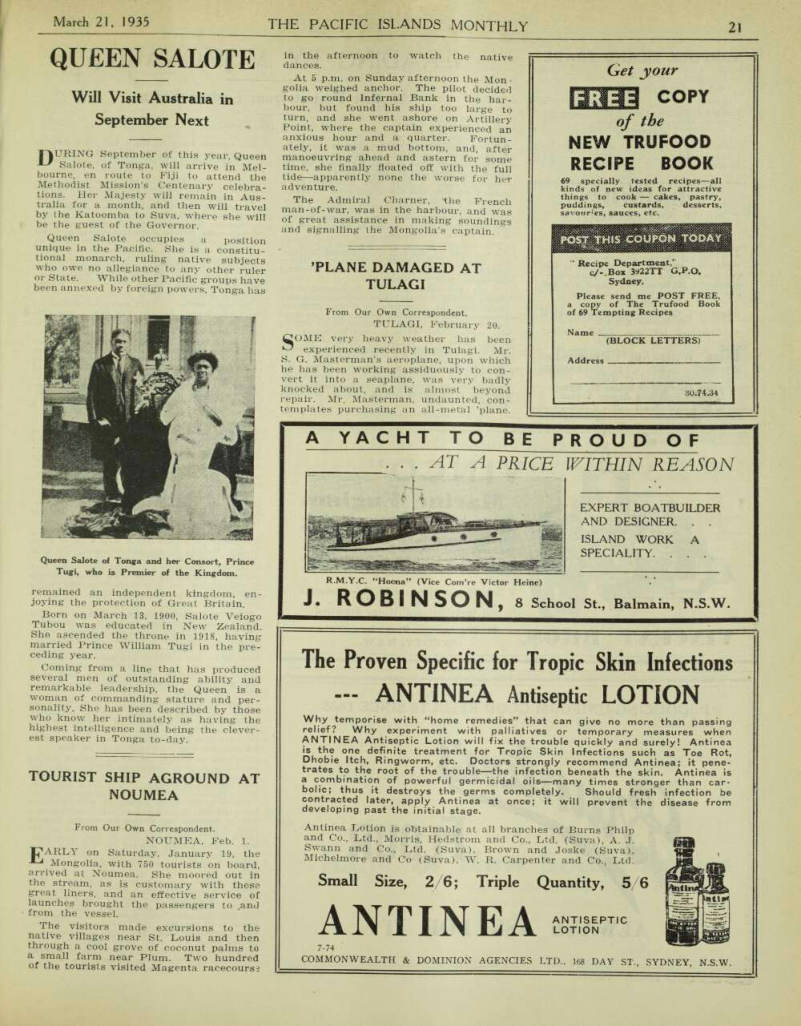
Will Visit Australia in September Next
TOURING September of this year, Queen Salote, of Tonga, will arrive in Mel bourne, en route to Fiji to attend the Methodist Mission’s Centenary celebra tions. Her Majesty will remain in Aus tralia for a month, and then will travel by the Katoomba to Suva, where she will be the guest of the Governor.
Queen Salote occupies a position unique in the Pacific. She is a constitu tional monarch, ruling native subjects who owe no allegiance to any other ruler or State. While other Pacific groups have been annexed by foreign powers, Tonga has
remained an independent kingdom, en joying the protection of Great Britain.
Born on March 13, 1900, Salote Veiogo Tubou was educated in New Zealand.
She ascended the throne in 1918, having married Prince William Tugi in the pre ceding year.
Coming from a line that has produced several men of outstanding ability and remarkable leadership, the Queen is a woman of commanding stature and per sonality. She has been described by those who know her intimately as having the highest intelligence and being the clever est speaker in Tonga to-day.
Queen Salote of Tonga and her Consort, Prince Tugi, who is Premier of the Kingdom.
Tourist Ship Aground At
Noumea
From Our Own Correspondent.
Noumea. Feb. 1.
EARLY on Saturday, January 19, the Mongolia, with 750 tourists on board, arrived at Noumea. She moored out in the stream, as is customary with these great liners, and an effective service of launches brought the passengers to and from the vessel.
The visitors made excursions to the native villages near St. Louis and then through a cool grove of coconut palms to a small farm near Plum. Two hundred of the tourists visited Magenta racecourse
in the afternoon to watch the native dances.
At 5 p.m. on Sunday afternoon the Mongolia weighed anchor. The pilot decided to go round Infernal Bank in the har bour, but found his ship too large to turn, and she went ashore on Artillery Point, where the captain experienced an anxious hour and a quarter. Fortun ately, it was a mud bottom, and, after manoeuvring ahead and astern for some time, she finally floated off with the full tide—apparently none the worse for her adventure.
The Admiral Charner, the French man-of-war, was in the harbour, and was of great assistance in making soundings and signalling the Mongolia’s captain.
’Plane Damaged At
Tulagi
From Our Own Correspondent.
TULAGI, February 20.
SOME very heavy weather has been experienced recently in Tulagi, Mr.
S. G. Masterman’s aeroplane, upon which he has been working assiduously to con vert it into a seaplane, was very badly knocked about, and is almost beyond repair. Mr. Masterman, undaunted, con templates purchasing an all-metal ’plane.
Advertisements & other items, p. 23 (1 item)
Antinea
Get your
free copy
of the
NEW TRUFOOD
RECIPE BOOK
69 specially tested recipes—all kinds of new ideas for attractive things to cook cakes, pastry, puddings, custards, desserts, savoor'es, sauces, etc.
POST THIS COUPON TODAY
“Recipe Department," c/- Box 3922TT G.P.O.
Sydney.
Please send me POST FREE, a copy of The Trufood Book of 69 Tempting Recipes Name
(BLOCK LETTERS)
Address
A YACHT TO BE PROUD OF
. . AT A PRICE WITHIN REASON
EXPERT BOATBUILDER
AND DESIGNER. . .
ISLAND WORK A
SPECIALITY. . . .
R.M.Y.C. “Hoctia” (Vice Com’re Victor Heine) J. ROBINSON, 8 School St., Balmain, N.S.W.
The Proven Specific for Tropic Skin Infections
ANTINEA Antiseptic LOTION
Why temporise with “home remedies” that can give no more than passing relief? Why experiment with palliatives or temporary measures when ANTINEA Antiseptic Lotion will fix the trouble quickly and surely! Antinea is the one definite treatment for Tropic Skin Infections such as Toe Rot, Dhobie Itch, Ringworm, etc. Doctors strongly recommend Antinea; it penetrates to the root of the trouble—the infection beneath the skin. Antinea is a combination of powerful germicidal oils—many times stronger than carbolic; thus it destroys the germs completely. Should fresh infection be contracted later, apply Antinea at once; it will prevent the disease from developing past the initial stage.
Antinea Lotion is obtainable at all branches of Burns Philp and Co., Ltd., Morris, Hedstrom and Co., Ltd. (Suva), A. J.
Swann and Co., Ltd. (Suva), Brown and Joske (Suva), Michelmore and Co (Suva), W. R. Carpenter and Co., Ltd.
Small Size, 2/6; Triple Quantity, 5/6
ANTINEA
ANTISEPTIC
LOTION
COMMONWEALTH & DOMINION AGENCIES LTD., 168 DAY ST., SYDNEY, N.S.W.
Norfolk Island Trade
Imports
Month. From Aust. From N.Z.
January. 1934 £1804 .. Nil January, 1935 £2266 .. Nil
Exports
Month. To Aust. To N.Z.
January, 1934 £2034 .. Nil January, 1935 £1584 .. Nil
Trading By Missionaries
Another Protest from Eastern Papua
Letter to the Editor.
IF you would allow me space again in your valu able paper, I would like to follow up my letter, published in your issue of November, on the old subject—Missionaries and Traders.
Since writing, I have been informed by a Samarai resident that the grant given to Kwato Extension Inc. is £1200 per year (£800 for technical training and £400 for child welfare). This information was obtained direct from the Govern ment Secretary by the person to whom I am in debted for the information.
The contradiction of Mr. Harrison’s letter by the secretary of the L.M.S. in Sydney in June, also one by a Mr. Smith in October, is rather amusing to read by any resident in this Territory conversant with the subject.
It is a remarkable thing that the mention of the subject trading always brings forth an indignant denial from the secretaries of Mission Societies.
Some time ago we had the spectacle of a secretary publicly denying that any member of his Society was trading, and when he was proved in the wrong, there was no apology tendered per the medium of your paper, which he used to make his absurd statement.
Mr. Smith talks of an apology. What for?
When Kwato were under the L.M.S., years ago, they traded in opposition to Europeans in Milne Bay, the same as the foreign Company are doing to-day.
The excuses made by the L.M.S. that they do not trade in opposition to the man on the spot is a mere quibble. They do trade, and that is the bone of contention at present.
We will take Fife Bay as an example of Mr.
Smith’s argument. This is controlled by the L.M.S., under the Rev. C. F. Rich, one of the most popular and best-respected men in the Ter ritory, and incidentally, one of the most success ful traders. There has never been any complaint as far as his trading is concerned, but to follow up Mr. Smith’s contention about the “man on the spot,” the reason the Mission have the field to themselves, is simply because any ordinary trader has no earthly chance of competing against them. I can safely say that if Fife Bay was not used as a Trading Station, two or three traders would be making a living there.
The same applies to Mailu and other stations on the South Coast. Further, Fife Bay is also run ning in opposition to the three slips in Samarai, for all boat repairs, etc.
I would further remind the secretary of the L.M.S. and Mr. Smith that if it was not for their Society handing over or selling their interests in the Eastern division, we would not be inflicted with the Kwato Extension Inc., and, instead of asking for apologies, it would enlighten a be wildered public, if they would explain why they handed over this part of the Territory to a foreign Mission.
There is a very considerable population in the Kwato area, and as the land was granted in the first place for religious purposes *to the L.M.S., and they continued their teaching there for some years, it seems incredible that a sound financial Society like theirs should suddenly abandon this area to another Society not recog nised in Australia.
As the two gentlemen both disclaim any asso ciation with Kwato, one may now ask what re ligion is being taught the natives since the L.M.S. faded out of the picture.
In 1925, Kwato was under the New Guinea Evangelization Society Inc. of New York, of which Walter McDougall was the treasurer, 156 Fifth Avenue, New York. Who they are and what re ligion they represent I have no idea. That they are not a recognised Australian Mission Society is well known, and it is astonishing how readily they were received and recognised by the Papuan Government.
To show that some Missionary Societies do a bit of exploiting, as well as the trader, I am enclosing you a document issued by a Society asking for public subscriptions towards evangelizing the poor natives; and, on enquiry from any Govern ment office, you will find this document is, in the main, a tissue of false statements, issued to delude the public into subscribing to a cause which does not exist. (Document received—very remark able.—Ed. P.I.M.).
I omitted several ventures in my last list which Kwato had tried —viz.; Milk vendors, sawmillers, and caterers. In your issue of November it says “shop” proprietors. This should read slip pro prietors. It is now announced that they are enter ing into the freighting trade in Milne Bay.
To trade in Papua, one has to obtain a trading license, a nominal amount of £1 per year, but the site selected must be quarter of a mile away from the nearest village. This is not a regulation, only instructions issued to the Government officers.
Owing to the small amount of gold obtainable here, the only hope I had to pay living expenses was to augment my income by opening a small trade store. I built a home and store on the beach, on Crown lands, not 66 feet from high water. The natives selected the site and asked me to build there. I am only 100 ft. from four village houses on one side of me. I am now told no license will be granted to me, as I am not a quarter of a mile from the village. This deters me from making a living at all here, as there is no spot anyway handy, that I could get within a quarter of a mile from a village.
Kwato Extension Inc. have been trading for years in Milne Bay, on sites granted “for re ligious purposes only,” and they do not pay any license fee at all. Why the distinction? I have no £1200 a year grant, or rich friends in America to contribute towards my support.
Can we not find someone in the Federal Parlia
ment with the same courage as Mr. Casey (As sistant Treasurer), who brought up the matter of the S.D.A. trading. The reply given him would not apply here, as the Government give grants for educational and medical work.
We constantly read this piffle about the ex ploitation of the natives by traders. It may have been the case 40 years ago, but for nearly 25 years, to my knowledge, the natives in the Eastern and South-Eastern divisions, through working for and mixing with Europeans, know too much about prices of trade goods ever to be exploited. To-day we find that if any exploita tion does occur, it is done by the native to the European.
In this respect, he is encouraged by the Gov ernment. If you assist a native by giving him credit to go fishing for shell or searching for gold, you have no redress if the native sells the result of his trip to someone else, and you are left with the debt. The Government informs the native he need not pay the white man. Most firms in Samarai and elsewhere have had to write off large sums as bad debts, incurred by natives.
Another thing all the missionaries lose sight of when uttering the old fallacy about exploitation is that, although being a Missionary Society, they can buy all their trade goods at a price much below that given to a small trader, and as they sell to the natives at the same price as the trader, it looks as if the exploitation is on their side.
Missionary Societies are, or were, granted con cessions in freight on their goods by the sub sidised mail steamers —another little bit of extra profit over the trader.
Mission trading is a matter for the Federal Gov ernment to take up. So far, any redress that has been received has been solely due to your valuable paper; and we further hope that by the constant publication of these grievances a fur ther improvement will take place.
I am, etc.,
Reg. Fletcher.
Kwanaula,
Normanby Island, E. Papua. 7/1/35.
Advertisements & other items, p. 24 (1 item)
Brunton's Flour
“BAINOL”
WHITE ANT PREVENTIVE
BORER EXTERMINATOR
WOOD PRESERVATIVE
The most scientific preparation on the market for the above purposes “BAINOL” is packed in containers to suit any size job, and is sold in quarts,- halfgallon, one-gallon and four-gallon tins, and in 45-gallon drums at a reduced rate.
Prices: Quarts 2/11, Gallons 7/11, 4-Gallons £1/6/3, 45 Gallons £13/4/2, Australian Currency, F.O.B., Sydney Sole Manufacturers:
Bains’ White Ant Exterminator
BW 6462 CO. LTD. LM1025
Established 40 Years.
Scottish House, 17-19 Bridge St., Sydney LstjMiries Regarding Agency Invited.
The Vibrationless
VINCO
Manufactured by
VINCENT BROS.
Marine Engines
Counter-balanced Crankshaft, Brass Float Chamber Carburettor, Impulse Starter, Brass Tank, and many other features that ensure Economical Running, and a Lifetime of Service. Five Years Written Guarantee. Write for Leaflet.
F.O.B. Price: 2½ h.p. £28/10/- complete „ 4 h.p. £42/10/- „ All Installation Fittings Supplied 44 Wentworth Park Rd., Glebe
SYDNEY, N.S.W.
PRODUCING UNIFORM GOOD RESULTS SINCE 1868
Brunton's Flour
ALWAYS ASK FOR IT
William Lockerby
In Fiji 135 Years Ago
A WRITER in England, when inquiring about an old house that was being demolished in Liverpool, England, brought to light a bit of the fascinating early history of the Pacific. The house, known as Fairfield House, was built and occupied over 100 years ago by William Lockerby—the man who wrote the “Jour nal of William Lockerby, Sandalwood Trader in Fiji, 1808-1809,” which was pub lished some 25 years ago—a long time after his death.
Lockerby came from the famous Lock erby family of Annandale, in the county of Dumfries, and he was born in Annan dale in 1782. This family was devoted to the Stuart cause, and most of the Lockerbys threw in their lot with Bonnie Prince Charlie, in the 1745 rebellion. A notable incident in the southward march of Prince Charlie in 1745 was the rescue of Janet Halliday from a burning house.
Janet Halliday carried in her arms an infant girl; and this infant was after wards the mother of William Lockerby.
William Lockerby settled in Liverpool, and was married there about 1798 or 1799. Then he mysteriously disappeared, and it was thought that he had been taken by a Press Gang. But it turned out subsequently that he had somehow got away into the Pacific, and he was shipwrecked or marooned in the then totally unknown Fiji Islands. He was there from 1800 until 1802; and then he was able to get away to America and thence to Liverpool, where he rejoined his wife. He had some amazing adven tures in Fiji; but he was a shrewd, far seeing man and he noted many things in Fiji which he afterwards turned to good
account. He settled down at Fairfield, in Liverpool, and established himself in business as a ship owner. He apparently returned afterwards to Fiji, and did much to develop the sandalwood business there. He was still living in Fairfield, Liverpool, in 1849.
He wrote an extraordinary account of his experiences in Fiji, but this was strictly preserved from publication until one of his great-grandchildren, in co operation with Sir Everard F, im Thurn (at one time Governor of Fiji) had it published by the Hakluyt Society, some time early in the present century, as “a unique cpntribution to the history of savage life in the South Seas.”
Lockerby’s old home, Fairfield House, was recently demolished, and his fascin ating story was retold.
Lockerby had several children, and Jane, his second daughter, married one Richard Gaskell. Mr. Robert Gaskell, who is a resident of Tulagi, Solomon Islands, is a grandson of this Richard Gaskell, and, therefore, a great-grandson of William Lockerby.
Pastor W. N. Lock returned to Papua by the Montoro on February 20, after six months’ furlough in Australia. He is a Seventh Day Adventist missionary at Mirigeda, the S.D.A. headquarters near Port Moresby.
Advertisements & other items, pp. 25-26 (1 item)
Travellers’ Cheques
LEGAL NOTICE
IN THE SUPREME COURT OF NEW SOUTH
SOUTH WALES.—IN EQUITY. No. 183 of
1935. —In the matter of the COMPANIES ACT, 1899, and in the matter of SOLOMON ISLANDS
DEVELOPMENT COMPANY LIMITED.—Notice
is hereby given that a Petition for confirming a resolution reducing the capital of the above company from £100,000 to £50,000 was on the sixth day of March one thousand nine hundred and thirty-five, presented to the Chief Judge in Equity, and is now pending. And further take notice that the aforesaid Petition has been set down to be heard before the Chief Judge in Equity in the Equity Court Supreme Court House Building, Elizabeth Street, Sydney, on Monday, the 8th day of April, A.D., 1935. Dated this 6th day of
March. A.D., 1935 McMASTER, HOLLAND AND
CO., Solicitors for the Company, 129 Pitt Street, Sydney.
FOR
Pedigreed Terriers, Kelpies, Spaniels,
Greyhounds, Bull Terriers, etc.
Write
GEO. F. SMITH
(Judge for Many N.S.W. Dog Societies) Dealer in All Kinds of Live Animals. Zoos Supplied.
777 GEORGE STREET, SYDNEY.
TRAVELLERS’ CHEQUES
Payable Throughout the World
For the convenience of travellers to all parts of the world, the Bank of New South Wales now issues Travellers’ Cheques in amounts of £2, £3 and £10 English currency.
These cheques can be exchanged for local currency in any country that the traveller is visiting.
Bank of New South Wales Travellers’ Cheques are obtainable through any branch of the Bank or at the special Travel Departments provided for travellers at the Bank’s Sydney, Melbourne and Brisbane Offices.
Bank of New South Wales
(ESTABLISHED 1817)
For Safety and Convenience carry Bank of New South Wales Travellers' Cheques.
SYDNEY’S SAILMAKER
(Rigger and General Canvas Goods Manufacturer)
HARRY WEST
Caters for Every Class of Sail, Canvas, Rope, or Wire Equipment.
FOR RELIABILITY AND VALUE
(If it’s in Canvas, Wire, or Rope) Send your enquiries to us.
Address: Balmain, Sydney,
N.S.W.
To Planters I am a Buyer of
CASTOR OIL SEED
IN ANY QUANTITY.
Send Sample for quote, stating quantity available.
Castor Seed Shellers, any capacity.
Advice and Instructions Regarding Planting, Harvesting, and Packing of Castor Oil Seeds given freely. Selected Seed for Planting available.
C. GRAHAME
4 DALLEY STREET SYDNEY.
Swallow & Ariel!
LIMITED
Port Melbourne : Australia Manufacturers Since 1854 of
HIGH QUALITY . . .
Ship and Cabin Biscuits CABIN (Including Small Cabin)
PACIFIC CABIN
CABIN CRACKERS
BREAKFAST BISCUITS
NAVY and PILOT BREAD
Packed expressly for export in tins up to 50lbs
Mysteries Of The Copra Market
From a Special Correspondent.
London, Jan. 22.
THE Copra market seems to have taken a definite trend for the better. But how long it will last, is a horse of another colour.
One of the brilliant Financial Editors of one of the Sunday newspapers starts his page this week by: “I had a letter from a friend in Fiji last week . . . He runs a 7,000 acre Plantation (coconut).
His landlords are the ‘Ecclesiastical Commissioners’, who I believe are the world’s largest owners of land”; and so on until the Benevolent Editor is asked whether his good friend in Fiji should sell his land and come home, or words to that effect. And the “B.E.” has told him not to.
With all due respect to such an august person, I feel that if the Benevolent Editor were asked what copra is made from and also why it is made, he would need to refer to a book to have the questinn answered for him The reason I am giving all this detail
is to enable the reader of your journal, to understand just how much faith they may put into any report which appears in the ultra-controlled English news papers.
Some of the reasons given for the rise in the selling price of copra are too well known to the coconut planter to need re telling; but, at the same time, there is a strangeness in the air, and even the Benevolent Editor will need to dig deep down to explain the position.
I refer to the lowering of the retail price of soap. Sunlight soap, which has never been (at least not for some years) below 5d per box, has now dropped to 4d, or fully 20 per cent., and at the same time the selling price of the essential parts have increased almost that equiva lent. In fact, although all vegetable oils have advanced fairly rapidly, the com modities which need the oil for their manufacture have been reduced in price.
The cotton seed market is not so plenti fully supplied as during the past few years; consequently Soya Bean oil has benefitted to the extent of £2 per long ton. But whale oil has not moved much, and the soap people have purchased the balance of the Norwegian stocks of this commodity for around £10 per ton.
But, with all this, the exact position of the copra industry is still shrouded in mystery, and it is still impossible to get anything definite in the way of a forecast from the people who have handled the produce for over 25 years past.
In any case, seeing that Soya Bean is a short oil producing crop, and also that 80 per cent, of it comes from a foreign country, why cannot the British Govern ment put a huge embargo on it, so as to give the Empire copra producers a chance. I do not think that the soya cake is any better than copra cake; and, if that is the case, then why not do what, other nations are doing, and put their own countries first, and then work with the foreigner on the same basis he works with us.
We all know, however, that Manchuria cum-Japan supplies the largest tonnage of soya bean, and also that the trading side of the balance sheet between the Empire and Japan is largely in the Empire’s favour. But surely something could be done to enable the Old Country to get this oil business down on to a different basis. If nothing else can be done, for the coconuts, then give them the same backing as is given to bacon, potatoes, etc., in England, and lay a definite programme of help for those Colonies which are still, for all practical purposes, an integral part of the British Isles.
Anyway, our friend with the 7,000 acres; owned by the Church will need to join the anti-tithe community now operating in England, and if he has such a nice large block of land in one area, then he is in a most difficult position, as the collector of tithes in England does not appear to have any soul, and cannot even read the Bible on such questions as benevolence.
We can leave that to the editors of the Financial Sections of some English news papers.
Miss A. I. Samuels, a young nurse from Ashburton, New Zealand, left Sydney for New Hebrides by the Morinda on Feb ruary 14. She is en route to the Melane sian' Mission station at Torgil, Banks; Islands.
Sepik Gold
Dr. Atcherley to Search in N.W.
New Guineea
DH. J. R. ATCHERLEY, well-known in the Mandated Territory of New Guinea as a skilful gold-prospector and explorer, sailed from Sydney for Salamaua with Mr. George Beenhan, mining en gineer, by the Montoro on February 20.
On behalf of Morobe (New Guinea) Gold Options N.L., they will recruit a line of boys, and will then leave on an eight months’ prospecting and exploring trip into the north-west interior of New Guinea.
The expedition intends to travel 300 miles up the great Sepik River, and then cut across into the little known region between the Sepik and the borders of Papua and Dutch N. Guinea, where the party will prospect for gold. Dr. Atcherley is confident that rich dirt in payable quantities will be found in the area he intends to search.
Morobe (New Guinea) Gold Options N.L. was formed in Victoria at the middle of February with a capital of £7,500, the shares of which, paid to £3, were quoted at the end of February on the Mel bourne Stock Exchange at £ll. The directors of the new company include Brigadier-General E. A. Wisdom, C.B., C.M.G., D.S.O. (Administrator of New Guinea from 1921 to 1932), Mr. Wallace- Smith (stockbroker of Melbourne), Mr.
Douglas (mining investor) and Mr. Blake more (solicitor). The Melbourne firm of Stringer and Phillips is the legal adviser.
Some months ago, Dr. Atcherley with Mr. Albert E. Palmer, led a prospecting expedition to the Mandated Territory for the Equatorial Gold Exploration (New Guinea and New Britain) Syndicate.
After taking up gold-bearing areas on New Britain, and pegging out dredging claims on the Ramu River, the party re turned to Australia by the Macdhui on December 13.
The report submitted to his principals by Dr. Atcherley was very optimistic, and the syndicate decided to form a subsi diary concern to work the Ramu leases.
Subsequently, Ramu Gold Reefs N.L. was formed in Melbourne; the name, however, was later altered to Barola Gold Reefs N.L.
Barola Gold Reefs N.L. has a nominal capital of £7,500, in shares of £5 each. Of the 1500 shares, 690 fully paid were allotted to the Equatorial Syndicate. About £300 was also paid to the Syndicate for ex penses incurred in securing an option over Mr. E. R. Rowlands’ leases on the Ramu.
If Barola Gold Reefs decide to purchase the property after an option period of 12 months, Mr. Rowlands will receive £2000 in cash, and £6000 in fully paid shares. In the meantime he will get £300 cash and 10 per cent. of gold won during the option period.
Rev. S. Ray Rooney, a pioneer Metho dist missionary in the British Solomon Islands, died at Prospect, South Australia, on February 1, after a long illness. In 1903 he went to Roviana and served there until he was transferred in 1906 to Choi seul, Northern Solomon Islands, remaining there until he went to South Australia in 1913. The name of Rooney ranks high in the annals of the Methodist Mission Society, his father also having accom plished much pioneer mission work in New Britain, after serving for 15 years in the Fiji Group.
Crime In Samoa
From Our Own Correspondent.
Apia, Feb. 13.
JUDGE J. H. LUXFORD arrived recently from New Zealand by the Maui Po mare, on circuit, and presided at the High Court of Samoa on February 8, when a number of cases were tried.
There were several sexual offences of a serious character on the calendar.
The most serious case was that in which a native of Saleaula (Savaii) was prosecuted for rape on a young Samoan girl. The unanimous verdict of the four assessors (three Europeans and one Sa moan) was “guilty,” and the judge, con curring with the verdict, sentenced the accused to seven years’ imprisonment with hard labour. In a second rape case, several Samoans of Aleipata district were found guilty by the jury, and sentenced to five and three years’ imprisonment respectively.
In a case of forgery of documents, sev eral Samoans, after pleading guilty, were sentenced to 18 months’ imprisonment. A few cases of theft and burglary were also tried before Judge Luxford.
IT was announced from Paris, during the Melbourne Centenary Air Race, that France shortly would organise a similar competition—“probably to some distant colony, such as New Hebrides.”
Nothing further has been heard of the project, however. Such a spectacular event certainly would place some of the Pacific Islands Territories on the world’s map—particularly New Guinea, Solomon Islands and New Caledonia.
Advertisements & other items, pp. 27-28 (1 item)
Excelsior Supply Co. Ltd.
For Tents, Tarpaulins, Horse Rugs, Birkmyre Coats, Sails & Riggings, Rope all sizes stocked write
ALBERT JONES
MAKER.
173 CLARENCE STREET, SYDNEY
Pacific Island Business Catered for
’Phone FL 1266. ’Phone FL 1266.
HENLY’S
DRIVE YOURSELF
SERVICE
197 William Street Sydney Cars Hired without Drivers on a Mileage Basis as under: — OPEN CARS—By the Day. 3d. per Mile.
Minimum, 30 Miles Week Days. 60 Miles Sundays.
SEDANS—By the Day. 4d. per Mile.
Minimum, 30 Miles Week Days. 60 Miles Sundays.
Special quotations for holidays.
Payment, plus 2/6 per day or 7/6 per week for insurance. A deposit must be left on car, which is refunded when car is returned.
Our Fleet of Cars includes 1934 Plymouths, Hired at a Slight Increase.
EXCELSIOR SUPPLY CO. LTD.
The most extensive Manufacturers in the British Empire of
RUBBER STAMPS,
INKS, STENCILS.
Marking Devices.
ACME STAMP PADS
We have a big range of Special
FRUIT CASE MARKING SETS
We also Manufacture or Supply a complete line of
Spraying Machines
for all purposes.
Let us know your requirements and we will quote you by return. Ask for our Big Catalogue.
Sole Australasian Distributors of the World Famous SHEAFFER FOUNTAIN
PENS and PENCILS.
EXCELSIOR SUPPLY CO. LTD.
Head Office: 160 GEORGE STREET WEST,
SYDNEY, N.S.W.
BIRKMYRE'S
WATERPROOF CANVAS
The Original and Best for all purposes where a thoroughly waterproof covering is required.
SAILCLOTHS, DUCKS, &c.
of FLAX, HEMP and COTTON.
FISHING NETS,
LINES & TWINES.
Extensive Stocks carried.
Ensuring prompt despatch.
THE
Gourock ROPE-WORK EXPORT Co.
LIMITED
397 KENT ST., SYDNEY, N.S.W.
advt
Just a few drops inhaled from the handkerchief will alleviate headache and banish fatigue. Fragrant and refreshing in bath and handbasin too.
Murders
The Mount Hagen
"Story Behind the Story”
From a Special Correspondent.
SALAMAUA, February 18.
NONE of the newspapers appear to have told “the story behind the story” of the murder of the Roman Catholic mis sionary at Mount Hagen, in New Guinea.
As I understand it, the Roman Catholic missionary fathers pushed out into this unknown and uncontrolled area quite a long time ago—I think that Father van Braan was actually the first man in. The missionary was not welcomed by the natives and they resisted the building of his church. These missionaries, however, do not lack courage and they went on with their enterprise. Then the hostile people burned down the mission buildings. The exasperated missionaries are said to have then committed an error of judgment they promptly retaliated by shooting a number of the natives’ pigs. This was tantamount to fining a white man in his worldly goods.
Father Morschheuser, the murdered mis sionary, was unlucky enough to follow in the footsteps of the pioneers, and he
merely collected the punishment intended by the natives for white people generally.
One cannot blame the primitive savages— they acted simply in accordance with age old customs. Neither can one blame the missionaries —they were fearlessly carry ing out their duty as they saw it. But, the basic conception of the whole thing is wrong, and lives —both European and native —have been uselessly wasted.
It has been suggested that the influence of another mission organisation is at the back of the natives’ refusal to have the Roman Catholic church established in their midst. I do not believe this for a moment —although there are others who do. It is a fact, however, that there is very keen competition between the missionaries re presenting different churches who have pushed out into the new country.
Old Man New Guinea
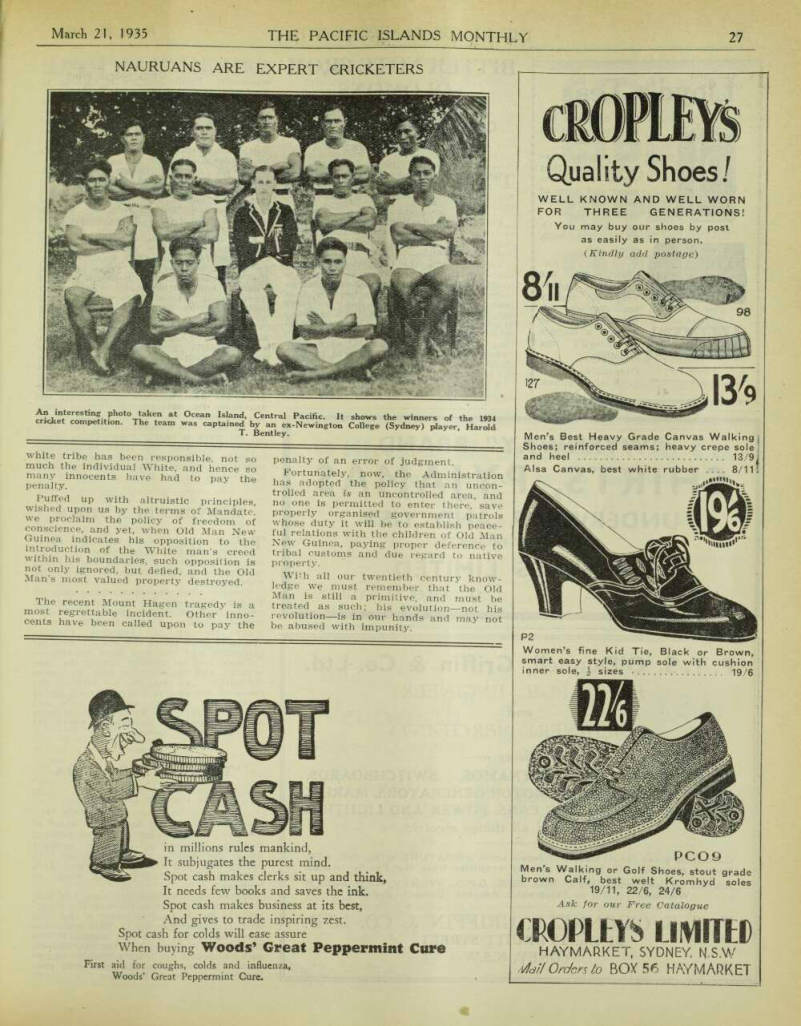
By Gordon Thomas.
EVERY now and then Old Man New Guinea stirs from his lethargy and strikes, and the sound reaches round the world in a tragic echo.
From its mysterious hinterland there comes a voice saying: “You can pene trate my vastness; you can take away my distances with aeroplanes, and you can become familiar with my people; but I am still New Guinea, with my sacred, customs, which are as old as the Cross and none the less sacred to my people because you term them pagan.”
And when we hear the voice of Old Man New Guinea and see him strike we suddenly realise the truthfulness of it all.
Because of our own modern powers of penetration, and our self-satisfied western slant on things primitive, we underesti mate the power and ignore the feelings; of the Old Man. We are liable, too, to forget that New Guinea, under its skin, is still New Guinea —despite our aero planes zooming over its jungles, our re frigerating plants standing in homes in. its valleys, and the wireless sets bringing to-day’s news to our ears.
The Old Man has his customs and his prejudices, as deep-rooted as our own; his ethics are as worthy of recognition as ours. When he objects to their dese cration by the White strangers he feels, perfectly justified in meting out justice and retaliation in his own methods. The trouble is, his methods are not our methods; A wrong is committed by the Whites and the Old Man deals with the offence collectively: not individually. The
white tribe has been responsible, not so much the individual White, and hence so many innocents have had to pay the penalty.
Puffed up with altruistic principles wished upon us by the terms of Mandate, we proclaim the policy of freedom of conscience, and yet, when Old Man New Guinea indicates his opposition to the introduction of the White man’s creed within his boundaries, such opposition is not only ignored, but defied, and the Old Man s most valued property destroyed.
The recent Mount Hagen tragedy is a most regrettable incident. Other innocents have been called upon to pay the
penalty of an error of judgment.
Fortunately, now, the Administration has adopted the policy that an uncon trolled area is an uncontrolled area, and no one is permitted to enter there, save properly organised government patrols whose duty it will be to establish peace ful relations with the children of Old Man New Guinea, paying proper deference to tribal customs and due regard to native property.
With all our twentieth century know ledge we must remember that the Old Man is still a primitive, and must be treated as such; his evolution—not his revolution—is in our hands and may not be abused with impunity.
Nauruans Are Expert Cricketers
An interesting photo taken at Ocean Island, Central Pacific. It shows the winners of the 1934 cricket competition. The team was captained by an ex-Newington College (Sydney) player, Harold T. Bentley.
Advertisements & other items, pp. 29-30 (1 item)
Quality Shoes!
WELL KNOWN AND WELL WORN
FOR THREE GENERATIONS!
You may buy our shoes by post as easily as in person. (Kindly add postage) Men’s Best Heavy Grade Canvas Walking Shoes; reinforced seams; heavy crepe sole and heel 13/9 Alsa Canvas, best white rubber ... 8/11 P2 Women’s fine Kid Tie, Black or Brown, smart easy style, pump sole with cushion 19/6 inner sole, 2 sizes PC09 Men’s Walking or Golf Shoes, stout grade brown Calf, best welt Kromhyd soles 19/11, 22/6, 24/6 Ask for our Free Catalogue
CROPLtYS LIMITED
HAYMARKET, SYDNEY, N S.W
Mail Orders to BOX 56 HAYMARKET
in millions rules mankind, It subjugates the purest mind.
Spot cash makes clerks sit up and think, It needs few books and saves the ink.
Spot cash makes business at its best, And gives to trade inspiring zest.
Spot cash for colds will case assure When buying Woods’ Great Peppermint Cure First aid for coughs, colds and influenza, Woods’ Great Peppermint Cure.
Lloyd’s Teas
Tea drinkers expect more than a mere drink.
That easy, relaxed feeling, that sense of contentment and glow of real satisfaction must be there . . . not once in a while, but with every cup.
Try Lloyd’s for purity. Try the consistent goodness of quality tea. Try the delicious aroma that is such a feature of Lloyd's tea blending.
Obtainable at all good island stores.
“WYRNWAY” BRAND
SHIRTS, PYJAMAS
UNDERWEAR AND TIES
ARE QUALITY PRODUCTS
WEARNES LIMITED
MANUFACTURERS 17 PARKER ST.. SYDNEY
F. T. S. O’Donnell, Griffin & Co. Ltd.
ELECTRICAL ENGINEERS
and
MACHINERY MERCHANTS
Specialising in —
ELECTRIC MOTORS, DYNAMOS, SWITCHBOARDS,
PUMPS, COMPRESSORS, MOTOR GENERATORS, MARINE
ENGINES, VENTILATING FANS, POWER AND LIGHTING
PLANTS, and all things electric Quotations given for all classes of repair work, ARMATURE WINDING, ETC.
Special attention will be given to any enquiries from the Pacific Islands.
Address all communications to BOX 2690 C, G.P.O., SYDNEY, NEW SOUTH WALES. :: Telegraphic Address: Dongrif., Sydney.
F. T. S. O’DONNELL, GRIFFIN & CO. LTD.
51 and 53 DRUITT STREET,
SYDNEY, N.S.W.
Bitter Note From
Solomons
Could Australia Save The White Planters?
THE following is an extract from a letter to the editor, from a planter in the Solomon Islands. Its date is January 18, 1935: The ruin of the Western Solomons and of its British pioneer settlers and traders continues. Two more sailed by the last boat to Australia.
Vella Lavella, the most closely-settled island in the Group a few years ago, is to-day littered with abandoned planta tions. Of the ten properties on that island that were in production two years ago, eight have been closed down or aban doned. His Excellency the High Commis sioner will, no doubt, be pleased to leani that while the last two pioneers were passing, the prosperous Chinese in Gizo slapped on another trading vessel against the few remaining doomed British traders.
A deep hatred of Fiji has become pre valent here. We feel we have been
thrown to the wolves and can expect no pity nor redress from the High Com missioner. Public opinion is turning to Australia as our sole means of salvation.
There is an upsurge of feeling against the Colonial Office connection, and it is con sidered that we would get a fairer deal from Rabaul than from Suva. At least we would receive from Rabaul the sympa thetic consideration, which is denied us by Whitehall and Suva.
As all our affiliations —commercial, shipping, banking and ethic —are with Australia or the Mandated Territory, the last step, that of political union, should be taken, and freedom from the always irksome and illogical Fijian connections be bestowed upon us.
Fiji’s indifference to the settlers of the Solomons is no new development. Sir Cecil Rodwell, when High Commissioner, on a visit to Gizo many years ago, told the Secretary of the Solomon Islands Planters and Settlers’ Association that the Government “wished there were no small settlers in the Solomons —as they only added to the difficulty of Government”!
No doubt, it would have been much more simple for the High Commissioner to solve administrative problems over a dinner and cigars with the executives of a few big companies than have to endure the boredom of listening to the troubles of the small settlers. Certainly, Suva ever since has done its best to eliminate the nuisances by encouraging Chinese com against them.
Fiji can take comfort in the fact that its fell work is nearly done. Quite effec tively, and with the most satisfactory rapidity, the new policy is removing the unwanted, obnoxious white settlers. What a pity Fiji did not think of it earlier!
Montoro In A Storm
THE Burns, Philp Islands liner Montoro ran into a heavy storm after leaving Brisbane for Townsville, en route to Papua and New Guinea, at the end of February.
Shortly after departing from port on Friday, February 22, the vessel struck severe weather, which increased in vio lence on Sunday. Unable to pick up land marks through bad visibility, Captain Williams hove-to, as the squally weather continued and the seas grew heavier.
There was no anxiety among the pas sengers, and the Montoro rode the storm splendidly. At midnight on Sunday she resumed her course and continued on to Townsville, through gusty squalls and dim visibility. The Montoro’s deck cargo and the numerous animals on board did not receive any damage.
“Talkies” For Samoa
From Our Own Correspondent.
Apia, Feb. 14.
A FEW years ago Apia could boast of two picture theatres. Competition and the depression, however, brought about the ruin and liquidation of both enterprises, and for the last year, Apia has had no moving pictures, silent or “talkies.”
A new picture-show company has now been formed in Samoa through the enter prise of Mr. E. Paul (director of the Gold Star Transportation Co.). This new com pany has taken over the assets of the late Tifaga Playhouse Co. (in liquidation), and will instal up-to-date “talkie” equip ment. The new establishment will pro bably be opened at Easter.
Dammar Resin
Possible New Industry for N. Guinea
AN industry that may be worth investigating so far as the Mandated Ter ritory of New Guinea is concerned is that of exploiting a species of Kauri pine, the Dammara (or Agathis) tree. The Dam mara tree (Agathis Orientalis) is well known in the Federal Malay States, the East Indies and India, where it produces a resin of value in manufacturing colourless varnish.
A Japanese company in recent years discovered that this tree grew in large quantities in the vicinity of Geelvink Bay, on the northern shores of Dutch New Guinea. This company obtained from the Nederlands East Indies Govern ment valuable concessions under which it proposed to export timber from this region and also the valuable Dammar resin obtained from the Agathis tree.
Believing that investigations would show that the tree grows in the Man dated Territory of New Guinea, the “Pacific Islands Monthly” made inquiries at the National Herbarium, Sydney, which controls the Botanie Gardens, where several species of the Agathis tree from the Pacific Islands are growing.
“I am of opinion that if investigations were made,” said Mr. E. Cheel, Curator of the Herbarium, “varieties of the Aga this tree, very closely related to the Kauri pines of North Queensland, Fiji, New Hebrides, the Solomons, and New Caledonia, would be found growing in the mountainous regions of New Guinea.
They would yield a gum very similar to the so-called Dammar resin.
“At the end of last century, the Ger man botanists made a very thorough examination of the lower forms of New Guinea flora, the valuable results of which were subsequently published. The scientists were still engaged on the tre mendous work of cataloguing the higher forms of plant life when the Great War broke out.
“I am sure that had not their work been interrupted,” he continued, “they would have completed a comprehensive survey of the major flora of the Territory and found the Agathis pine growing pro fusely in certain elevated districts on the mainland.
“When in Fiji several years ago, I saw magnificent Agathis Vitiensis trees growing to a height of over 150 ft. With the hotter New Guinea climate, the trees should grow even taller there.”
The Agathis trees in the Botanic Gar dens are well-developed trees of the Ovata and Moorei (New Caledonia), Viti ensis (Fiji), Robusta (Nth. Queensland), and Obtusa (New Hebrides) varieties.
The North Queensland variety, which it is thought is similar to the New Guinea species, is a large tall specimen of about 100 ft. in height. The girth of its mottled brown trunk measures six to eight feet at the base and tapers to about 18 ins. at the summit. Branching out on alter nate sides, the slim limbs bear a profuse growth of smooth, bright green leaves, about three inches long and one inch wide.
The valuable Dammar resin has many uses, the chief of which is its use in the making of colourless spirit varnishes. It is also utilized, with certain other pre parations, for varnishing fabrics, paper, cloth, etc., and for interior decorative
work. Dammar resin is an important constituent of duco for renovating auto mobile bodies, etc. In India the black resin has a wide variety of uses for medi cinal purposes. Its present worth in Sydney is about £50 per ton, though No. 1 Singapore grade is selling on the world market at about £78 per ton.
Apart from the resin, the Agathis tree itself, having a close grained, easily worked wood, is in considerable demand for housebuilding and for the manufac ture of furniture. This aspect has been commercialised in the Solomon Islands by the Vanikoro Kauri Timber Co., which exports (mostly to Melbourne) the huge logs cut from the forests in the southern Solomon Islands.
In Fiji the Agathis Vitiensis tree is known locally as the Dukua, and the resin is called “makadre.” The Fijian natives collect this gum from time to time and occasionally small parcels are shipped from the Colony, The general practice of extracting the gum is by incision, or by cutting down the tree, firing the roots, and gathering the gum as it oozes from the cut. In New Zealand, however, large deposits of fossilized Dammar resin are found at 5 to 6ft. below the earth’s surface, thus indicating the presence of huge forests of Kauri trees at some former period. The gathering of this “Kauri gum” has been
for many decades an important industry in northern New Zealand.
In 1924, the Government of Papua sent the Imperial Institute of London samples of Dammar resin dug from the ground on Sudest Island, 180 miles S.E. of Papua.
The resin, somewhat stalactic in form, was a light brown colour and mostly transparent. On analysing it, the Im perial Institute’s chemists found that it softened at 115 degrees Centigrade and turned into liquid at 170 degrees.
When mixed with two parts of turpen tine oil the resin formed a good colour less varnish. The main difficulty, how ever, was that this particular type of resin was almost insoluble in alcohol, and therefore useless in the preparation of com mercial spirit varnishes. It was stated at the time that to render the gum sale able it would have to be sold in England at £30 to £40 per ton. At that time, before the use of synthetic resins was widespread, first class Dammar resin was bringing £150 per ton.
As far as could be ascertained nothing further was done to develop the Sudest Island resin.
Advertisements & other items, pp. 31-32 (1 item)
Giobex
(GLOBE BEEF EXTRACT)
GIOBEX
FOR GOOD BEEF TEA
GIOBEX
FOR SOUPS & GRAVIES
GIOBEX
DELICIOUS SPREAD THINLY ON BREAD
Obtainable in 2 oz., jars and in 4 and 8 oz. containers Obtainable from All Island Traders
Wilhelm Breckwoldt & Co. 9, Lange Muehren, South Sea Bldgs.
HAMBURG, GERMANY
(Exporters and Importers) We Export: Trade Goods of any description, Cutlery, Hardware, Miners’
Requisites, etc., etc.
We Import: Any kind of Island Produce.
CORRESPONDENCE INVITED
“The
Wentworth"
CHURCH HILL, SYDNEY
Telegraphic Address: “Mum,” Sydney
Sydney’s Exclusive Residential Hotel
Situated only two minutes from the General Post Office, Railway Station, and leading theatres. All rooms Steam-heated in Winter and Air-cooled in Summer, and equipped with Telephone, and Hot and Cold Water.
Excellent Cuisine.
Tariff : Room and Breakfast, from 10/6 per day; Inclusive from 18/- per day.
For full particulars apply to The Manager
MANGROVITE
LEATHER
BELTING
MANGROVITE BELTING LTD.
Charles Ludowici, Managing Director
49 YORK STREET, WYNYARD SQUARE
SYDNEY, AUSTRALIA.
Post Office Box 1564 E. G.P.O. Sydney, Australia.
Wireless and Cable Address: “Mangrovite,”
Sydney.
Specialise in: — Leather and Rawhide Power Transmission Belting, Belt Laces, Pump and Hydraulic Leathers, Belt Fasteners, Tools of Trade, Sole Leather, Harness Leather, Scrap Leather, etc.
Write for illustrated catalogues. District Agents wanted.
L.L. BELL, F.I.O. (Syd.)
OPTICIAN
WINGELLO HOUSE,
ANGEL PLACE :: SYDNEY
HEADACHES GLARE
BLURRED VISION
Doctor’s Prescriptions for Distance or Reading Glasses made up and Despatched by Return Mail.
New Lenses fitted on receipt of the broken parts.
Goggles for Aviators, Motorists, Welders & Mechanics.
Cash on Delivery Post :: Sydney Prices
BE SURE ITS
TOOHEYS
PILSENER.
Murals for Rabaul Church
WHEN Archdeacon Ralph de Voil, of New Guinea, returned to Rabaul from Sydney in March, he took back with him a unique trip tych for the Children’s Chapel of the Church of St.
George at Rabaul. The triptych, which consists of a centre mural and two side panels, is intended to link up Bible history with the surroundings familiar to the New Guinea children.
Portrayed on the main mural (centre) is the arrival of the Holy Family at Rabaul; the scene being Rabaul Harbour with the Madonna and Child in the foreground. Local atmosphere is supplied further by hibiscus and frangipanni blos soms scattered at the feet of the central figures.
Carrying the banner of St. George, the Rabaul choirboys are depicted climbing a hill in the back ground.
The side panels each represent a New Guinea savage wearing a brilliant head-dress and arrayed in ceremonial costume; while standing behind the native is an angel beseeching him to turn to the Church.
These interesting mural panels were executed by the foundation members of the Turramurra Group of Wall Painters, Mrs. A. T. Anderson, Mrs. B. Foott, and the Misses Jean and Gwen Ramsay.
Effect Of Betel-Nut
Chewing
Letter to the Editor.
MR. , VOGAN’S article in your December P.I.M. concludes with the statement that “Two facts seem already harvested from Pacific investigation; That Northern races de teriorate under tropical conditions for a time, and then slowly recover themselves; and that the Arica-nut (the mis-named betel chewing) has a very deleterious effect upon the brain, although preserving the teeth from decay.”
In answer to the first “fact” I would refer him to Northern Queensland; and in answer to the second “fact” to the Mandated Territory and the Morobe District as an example.
The most intelligent natives are from the coastal area, and the Markham and Waria valleys, where betel-nut chewing is rife. In the rest of the district, by far the major portion, the habit is unknown to the Kanakas, although their teeth are equally as good, and look a lot better. But their physique and intelligence are far below that of the betel-nut chewers.
So that Mr. Vogan’s “researches” have not even disclosed two “facts.”
Every country in the world has its own par ticular stimulant and benefits by it. It is only abuse that makes it deleterious.
I am, etc.,
Salamaua.
January 24, 1935.
Question Of Corporal Punishment
In New Guinea
Letter to the Editor.
I READ with a mixture of pity and amusement the outpourings of “Veri” from New Ireland and “Duk Duk” of Rabaul (comrades in dis tress) in the December issue of your valued jour nal. Both are at least deserving of a little sym pathy, but unfortunately of a great deal of correction.
Our friend “Veri” was evidently quite oblivious while writing the latter portion of his letter of his opening remarks; or at least he quite forgot to read over his journalistic product, otherwise he could not have failed to observe the glaring inconsistency that one part bears to the other. (1) “Veri” begins by informing us that ten white men have been charged with killing natives, and countless others have been imprisoned and fined for assaults on natives. (He might have added that only a fraction of the cases ever reach a court.) (2) The cause of all this trouble, accord ing to “Veri,” is the lax system of governing the natives. (Truly a scathing indictment on Austra lian intelligence and administrative ability.) (3) The remedy, in “Veri’s” opinion, is the re-introduction of the German system obtaining here over twenty years ago, of giving a settler legal power to punish natives. (This is alleged to be the panacea for all evils.) Unfortunately, however, for “Veri’s” case, he states further down in his letter (and I do not for a moment dispute the veracity of the admis sion) that the natives are receiving far more punishment now than in the German time.
If the Germans used corporal punishment on natives and secured by means of it such happy results —contentment, docility, obedience, respect for authority and, most important of all, more work-one would naturally conclude that as the quantity of corporal punishment has been greatly increased (and it certainly has) the bulk of happy results would have increased, at least in equal ratio. Yet, according to “Veri,” the identical op posite is the case.
It would be very difficult to reconcile the evi dence placed before the court in the killing cases with the claim that those who committed the heinous crimes were men of such high moral and social virtues as “Veri” would like us to believe.
Facts are stubborn things and very unyielding. An honest survey of the court records would upset many fantastic calculations. If those few who have been convicted and punished are types of cultured Australians with honourable records, I can quite understand the notice posted up outside at least two South African hotels after the Boer War, “No admittance for dogs, devils or Aus tralians.”
Whether the Germans were right or wrong in giving settlers legal power to punish natives (and I do not agree with it), we are not concerned now. At least the German Administration gave legal status to the practice, so the poor native knew at least he was receiving legalised cruelty.
Now the native’s back is bruised, but a far greater injury is inflicted on his mind. The natives here to-day are naturally far more men tally developed than their primitive ancestors twenty or thirty years ago. The natives know through officials, luluais and the village schools, that the white man is forbidden in law to inflict corporal punishment; and, still, according to “Veri,” the natives are receiving more punish ment than ever before. No wonder there exists resentment, bitterness and disrespect for law. If we wish to teach the natives respect for law and reverence for authority we should first set the example.
Take, for instance, a case that came before the cdurt from that perpetually unhappy region, the Kavieng District. Natives were charged with attempting to kill their master. Yet evidence wrung from that employer in the court showed that natives were forced to work on Sundays, and
were corporally punished by the master, as well as given bitter medicines to drink for punishment Evidence was placed before the court showing that the oppressed people made an attempt to go away a long distance and report the matter to the District Officer, and were brought back and punished. The employer concerned knew the law as clearly as he knows the alphabet, yet the cruel practices were continued. The facts of the case were faithfully presented to the court by the Crown Law Officer; the Chief Judge, in summing up, strongly pointed out that each of the cruelties used were illegal. Yet the offender was neither fined nor imprisoned. Why? No wonder the oppresssed people are so often driven to seek re dress by violence, after having exhausted all rea sonable means!
In my opinion the “White Australia Policy," stretched and strained until it has become an instrument of oppression in the hands of a number of unscrupulous whites, is the cause of 95 per cent, of the troubles between Europeans and natives to-day. People come here from Australia and make no attempt to conceal the fact that they loathe the native and, in fact, everything coloured.
They cannot dispense with the native’s service, but this only accentuates their ingrained aversion of him. For such people the native is and ever will be a beast of burden, and is entitled to no better treatment.
When Mr. McKenna (Permanent Head of the Queensland Education Department) was invited here to report and advise on the education of the natives, he wrote, inter alia, “That one of the
strangest things in this strange land was the attitude of the whites towards the natives. Any suggestion that a little kindness would produce better results meets with derision and contempt.”
Mr. McKenna was a keen and intelligent observer and in my opinion he was not long in noting the cause at the root of nearly all the trouble here to-day.
All colonial administrations have found it necessary to check and restrain the exploitation tendencies of their colonists. Australia, in dealing with her own aboriginals, has a black and bloody history to live down. Arsenic was deliberately put in bags of sugar to poison off the people; they were shot down most cruelly by early settlers; and these facts are known even to school children in English schools to-day. In my opin ion, if one thing more than another will prompt Geneva, Canberra or the local Administration to tighten up and more rigorously apply laws for the protection of the native races, it will be the perpetual hate now at white heat, seeking to legalise barbarity in the Territory. If the German system applied to primitive people was reintro duced even for a month among the at their present stage of development, those whites now clamouring for it would be the first to urge its repeal to save their own lives.
“Duk Duk’s” lament is that there is no jury system in the Territory. Yet if his letter is a faithful reflex of his mind it is evident that zeal for the execution of justice was not his primary motive in writing. The introduction of the jury system in this Territory now would certainly benefit and unjustly protect the white and even in many cases give him a licence to violate law.
It would absolutely rob the native of the pro tection of law.
If the jury system, on account of the many loopholes it offers to injustice, is on trial in so many places, what hope is there it would ever succeed here? The system has been caustically criticised in Victoria and N.S. Wales many times by those whose legal training gives value to their
opinions. Tasmania is reported to have dispensed with it.
In a country like New Guinea with its sparse and scattered European population and its large native and coloured population, where the native is condemned and despised, I honestly believe that the jury system would mean the collapse of jus tice in the Territory. The work of Police, District Officers, Crown Law Office and Judges would be at the mercy of cliques whose ingrained aversion would prejudice and blind them in any dispute or case where Black would be against White. The jury system would be an inducement for prospec tive law-breakers to act with impunity and would drive the native to seek redress by the only means left to him—violence. Twelve jurymen could never be empanelled in this Territory to re turn. a verdict of guilty against a European.
Even after the clear exposition of the barbarous details of the killing of a native, published in succeeding issues of the “Rabaul Times” recently,, potential jurymen, volatile and talkative with liquor, were holding up the culprit as an unfor tunate hero, more deserving of a V.C. than a terra of imprisonment.
If there is anything in “Duk Duk’s” case, the only sane and logical inference must be that we have a judge or judges who are corrupt, incom petent, or at least prejudiced against their own countrymen. Mr. Justice Wahliss, the Chief Judge, is a sound lawyer and a just judge, and has, moreover, a long and honourable military ser vice. He enjoys the respect and confidence of every educated person here to-day.
It is neither pleasant nor just to the living relatives of those who have been sentenced to review the details of the cases cited by “Duk Duk,” in support of his plea for a jury system.
The reports can be read by any interested party.
How any sincere critic could hope to succeed by pointing to such cases is beyond comprehension.
If they are types of “cultured” white men with honourable records, Australian culture must be of an extremely inferior quality. Perhaps this ex plains why the natives are so slow at absorbing it.
“Duk Duk,” I observe, has quoted approvingly the Crown Law Officer for the Territory (Mr. G.
Hogan) as stating that native evidence was worthless and unreliable. Only last week the Crown Law Officer stated in the Legislative Coun cil that he did not cause a letter to be written stating that he fully realised that native evidence was worthless and unreliable. I know that the Crown Law Officer has repeatedly stated in court the direct opposite to “Duk Duk’s” contention.
What the Crown Law Officer probably did say was that in a particular case the native’s evidence was worthless and unreliable.
I would remind “Duk Duk” that a person who sets out to prove too much usually ends by prov ing nothing. The logical, sane and traditional way is to collect and survey the evidence first and then draw conclusions.
I am, etc.,
Lover Of Justice.
Rabaul, N.G., 1st February, 1935.
Mr. David R. McNicoll, son of the Ad ministrator of the Mandated Territory of New Guinea, sailed by the Montoro for Rabaul on February 20. After spending several weeks with his parents at Nama nula, New Britain, he made a trip across to New Ireland in the Administration schooner Thetis. Mr. McNicoll, who is a journalist, will return to his duties on the editorial staff of the “Sydney Morn ing Herald” in April next.
Advertisements & other items, pp. 33-34 (1 item)
Ozo Salt
Neptune’s Greatest Gift to Man—
The word “OZO” means the Sea. OZO SALT is made from Sterilized Sea Water of the Pacific Ocean and dried in vacuum.
“NOTHING PURER ON EARTH.”
Ask for it in the new Patent Package. Specially designed (for the Island and Eastern Trade) to resist Moisture, Humidity and Water. CAN BE OPENED AND RESEALED WITH THE GREATEST OF EASE. ORDER A PACKET TO-DAY.
Other “OZO” SpecialitieT are: Ozo Health Salt.
Ozo Celery Salt. cvnMCV “Sea-King” Gravy Salt. bIUINtI
OZO SALT CO.
WATERPROOFING
SOLUTION
Specially prepared for treating Tents, Tarpaulins, Cart, Wheat and Haystack Covers, Horse Rugs, Ground Sheets, and Oilskins Free of injurious chemicals & acids, penetrates , binds, and strengthens.
Is flexible and does not stick or rot material.
J. R. CLAY & CO. LTD..
for Port Moresby and Samarai
TAYLOR WILLIAMS & HALLIDAY (SALES DEPT.)
180 Elizabeth Street, Sydney
TENNIS
TROPICAL RESTRINGS AND GUT
CONSULT
L. A. WARD
WEST END SPORTS DEPOT.
8 GEORGE ST. WEST SYDNEY
Is RUST Destroying Your Property ?
Of all the theories advanced as to why incipient rust grows and ultimately destroys paint, as well as the underlying metal, the Electrolytical theory is the most logical. . .
KILLRUST Metal Paints contain active constituents which definitely kill the growth of rust by neutralising the electrolytic action. It is, therefore, impossible for rust to grow under a properly applied coating of KILLRUST.
1. —KILLRUST METAL
PAINT Elastic Finish (Black) is a penetrating and quick drying paint for protecting surfaces which come in contact with water and for general inside work. It is also used for descaling badly rusted iron. (See instructions.)
2. KILLRUST ROOF
PAINT (Red). For rusted iron roofs and general structural painting.
KILLRUST Resists Salts, Alkalies, Acids Factory Distributors:
3. KILLRUST METAL
FLUID is a colourless solution for neutralising the growth of rust when ordinary coloured paints or lacquers are to be applied.
It is used extensively on motor bodies, petrol storage tanks, etc.
4. KILLRUST SUPER
COAT (Black) is a powerful heavily-bodied paint, which can be used on surfaces exposed to the hottest tropical sun, and will also stand up to constant immersion in water.
Write for Descriptive Leaflets
METAL PRESERVATION CO. of N.S.W.
58 MARGARET STREET, SYDNEY, N.S.W. G.P.O. BOX 571FF
Established 42 Years.
Cable Address: “PIOSPRING.
PIONEER SPRING CO. LTD.
McEVOY STREET, ALEXANDRIA, SYDNEY, N.S.W.
Are the leading Springmakers, manufacturing Coil, Volute, and Laminated Springs for all Motor Cars, Trucks, Tractors, all kinds of Locomotives and Rolling Stock.
Write for our Catalogue and Price List We are also Expert Forgers and Blacksmiths.
Anthropology
And “Enthusiasm” in New Guinea
Letter to the Editor.
THE statement in your Tropicalities column, that, according to a newspaper report, I told the Anthropology Section of the Science Con gress that “everywhere in New Guinea European representatives were enthusiastic about anthro pology . . . including planters, judges, and miners,” will be as much enjoyed by my friends as it was “by me. The idea of those Morobe miners rushing away from their claims to pursue the fascinating lore of the Kanaka is enough to reduce us all to tears.
It is true that one Melbourne journal did report me thus; but that particular journal is notorious for its lack of sense of humour.
Needless to say, nowhere at the Congress did I make any such stupid statement. My whole paper pleaded to the anthropologists to face reali ties; to come down to Earth from their academic planets; pointing out that, except in the official world, where the work was beginning to be ac cepted as having relation to and value for native administration, our science was not regarded with esteem or favour; and this was because its pur pose was not understood. I quoted the critical reference by a member of the Legislative Council in Rabaul, last year, to the “horde of anthropolo gists” who have been in and out of New Guinea, without, according to the critic, having shown any great or practical results for the Territory.
So that the point I tried to emphasise was not that planters, etc., were enthusiastic, but rather that it behoved each anthropological field-worker who goes to New Guinea to attempt to give his work a practical application; and, in addition, always to be prepared to show to any European who appeared interested or critically inquisitive, the nature of the work being done and some idea of the technique of a sociological survey.
“Let the anthropologist come out into the open; table all his cards; show that he has nothing to hide; attempt to have his work and his point of view understood by the Europeans in the Terri tory, and so remove from the work the blight of suspicion and ridicule that are due solely to lack of understanding. Anthropology is beginning to justify itself in the official mind—after a long and uphill fight,” I said; “it is still far from finding acceptance and justification in the mind of the ordinary European. And until it does—as it will do when it is understood—it cannot hope to achieve anything great or of lasting worth.”
When I met the late Eric Randahl at Sio Island last year, for instance, I spent a couple of hours showing him, with all my records in front of us, what I was trying to do. At the outset, he was openly critical. He had just come from the Sepik River, where he had heard from the natives some thing of the doings of an anthropological party.
“What do you anthropology birds do?” he had asked me, in all seriousness. And I was glad of the opportunity to show him what one at least of the “horde” was doing. His honest remark after our session, “H’m—there’s something in this anthropology after all,” was reward for my pains.
That every anthropologist—or “ethnographer,”
if you like (perhaps we ought to put it more simply and say “every one who sets out to understand native life”) —should attempt to bring about under standing of his work and point of view amongst the Europeans in the Territory, who, after all, are responsible for its management and development (including planters and miners; I don’t know why the paper dragged the judges ini), was the burden of my plea.
But that they are enthusiastic about it already —Oh, la, lal One more point, Mr. Editor. In the summary of the paper of Mr. F. E. Williams, you quote: “Even anthropologists have come to see what academically-minded people saw long before them,” etc. This should read: “Even anthropologists have come to see . . . what less academically-minded people saw long before them.” The omission of the little word “less” makes a world of difference in the meaning. And Williams’s paper is too im portant and valuable to be misinterpreted.
I am, etc.,
W. C. Groves.
Melbourne, 23/2/35.
Ta’Ina—The Sisters
THE success of the Melanesian Brothers movement has led to the formation of a similar order for Melanesian native girls—the Ta’ina (the Sikaianna word for Sisters).
Six years ago, before the Melanesian Mission white Sisters of the Cross went to Sikaianna, a small group of atolls about 100 miles east of Malaita, the natives were heathens. Gradually, the mission influence asserted itself and the natives turned towards the Church.
Among those who were baptised were two young Sikaianna girls—Marie and Anna who expressed a desire to live consecrated lives, doing for native women what the Brothers have accomplished for their fellowmen. For various reasons, however, nothing was done until three years later Bishop Baddeley took them in the Southern Cross to Siota, Florida Island, for instruction. Now they are back at the Sisters’ school at Sikaianna conducting small kindergarten classes for young native children.
These two young teachers were later joined by three other young girls—Mary, Ruth, and Nesta —and the five brown Sis ters emulating their guardian white Sisters of the Cross, are doing much helpful work for their own Christian people on lonely Sikaianna.
Advertisements & other items, pp. 35-36 (1 item)
Link-Belt Co. Ltd.
The Recognised Leading Typewriter House in Australia for Rebuilt and Used
TYPEWRITERS
And the safest place to buy Portable, Desk, and every size, in every known make. Buy with confidence.
Royals, Remingtons, Underwoods, Coronas, L. C. Smiths, Imperials, etc., etc. Hundreds to choose from.
Prices include packing and delivery to Island Ports.
Hundreds to choose from: From £4 to £14 each Ask the man who bought here.
Best selection in Australia
Typewriter Trading Co.
140 Castlereagh Street
SYDNEY
Our Good Name is Your Safeguard
G.P.O. Box 2743 N
Cables: Telegrams: “Tytraco”
Telephone MA 4340 Manager: FREDK. G. TUNKS Established 25 Years.
DOYLE’S famous VETERINARY REMEDIES
REDUCINE—Cures Your Lame Horse. Cures him painlessly and you can work him all the time.
Cures Splints, Curbs, Capped Hocks, Sprung Tendons, Bog Spavins, and all Bony and Bursal Enlargements. Price. 12/6 per can. Postage, 1/-.
LARYNGINE.—A sure cure for Coughs, Colds.
Strangles, etc. Price, 5/- per can. Postage, 1/-.
SKIN DRESSING.—A certain remedy for Mange and Allied Parasitic Skin Diseases in Horses, Dogs, etc. Price, 7/6 (large), 3/6 (small). Postage, 1/-.
DISTEMPER MIXTURE.—A safe and reliable remedy for Coughs, Colds, Asthma, etc. Price, 2/6. Postage, 9d.
T. G. DOYLE, v.s„ 9 KING STREET, RANDWICK, N.S.W, Write for Free Veterinary Advice and Booklet
LINK-BELT CO. LTD.
17 GOULBURN STREET, SYDNEY
Centrifugal
Discharge
Bucket Elevator Modern Machinery Equipment for Elevating, Conveying and Mechanical Handling of Material.
Sole Agents in Australia for Ewart Chain Belting in Malleable or Steel, Specialists in Power Transmission Machinery.
Large Stocks always kept of Steel Shafting, Cast Iron, Steel, or Wood Split Pulleys.
Plummer Blocks, Collars, Couplings, Leather Belting, Hangar Bearings.
Lubricators, Engineers’ Wrenches.
MANUFACTURING ENGINEERS
CHRISTIES
Tropical
Umbrellas
Heavy Black Cotton Covering, All Brass Wires and fittings 27in. 12 ribs, 16/6 each 30in., 12 ribs, 18/6 each F.O.B. Sydney
CHRISTIES Ltd.
568 GEORGE ST.
SYDNEY
AUSTRALIA’S CLEARING HOUSE FOR THE PRECIOUS METALS.
BUYERS OF
GOLD
OSMIRIDIUM, PLATINUM, SILVER, &c.
GARRETT & DAVIDSON, LTD.
ASSAYERS, BULLION MERCHANTS, METALLURGISTS,
Bank of N.S.W. Buildings, Regent Street, Sydney
Scott’s Renown Brand Rope,
Cordage and
Binder
Twine
Cable Address: Ropeyard, Sydney.
of Every
Description
MANUFACTURED AT
MASCOT, N.S.W.
By
J. Scott Ltd.
Head Office and Store;
163 CLARENCE ST.,
SYDNEY, N.S.W.
The Pending Appeal
Mr. O. F. Nelson
Letter to the Editor, WHEN the Supreme Court of New Zea land delivered judgment last June on my appeal against convictions entered against me for political offences by Judge Luxford at the High Court of Western Samoa in March, 1934, and the four Supreme Court Judges were evenly divided for and against the main convic tions, my counsel asked in open court for leave to appeal to the Judicial Commit tee of the Privy Council.
After some discussion of the matter, the Judges ruled that they did not think they had power to grant leave to appeal, but it was suggested that leave may be grant ed by the Judicial Committee direct, so it was no secret that leave to appeal was being applied for. Latest advices from London state that an early fixture is expected for the hearing of that petition.
It will be remembered that Mr. Justice Blair, one of the four Judges who sat on the Supreme Court hearing in Wellington, gave a very strong dissenting judgment, in which he ruled that the whole of the convictions should be quashed, and the
Chief Justice, Sir Michael Myers, sup ported him in regard to what he termed the main conviction. It was therefore surprising to read Mr. Marc Greene’s let ter in your December issue, in which he stated, inter alia ; “ . . . There is not a chance in a hun dred of the Privy Council reversing it, even if it is taken to that body.” And “I am the last person to maintain that the system is a success or should be con tinued, but it is certain that no High Court would take the responsibility of action that would amount to a settings aside of the authority of the Mandatory.”
In view of the facts mentioned above, there is no question but that the case is sub judice, and had it been an Australian, instead of a New Zealand case, the ques tion of privilege to publish such com ments at this stage might have arisen.
To say the least of Mr. Greene’s remarks, they show no respect for the high integ rity and discretion of the highest judicial tribunal in the British Empire, with juris diction over appeals from outside of the United Kingdom. Perhaps this cannot be expected from an American journalist like Mr. Marc Greene, but that a British journal of the high standing of the P.I.M. should publish such a letter, at this junc ture, must be amazing to many who hold the last court of appeal in Dominions and Colonial matters in that high respect to which it should be entitled.
I am, etc.,
O. F. Nelson.
Auckland, 11 February, 1935.
Norfolk Island’s Customs
Tariff
THE following letter by the Collector of Customs in Sydney, which appear ed in the “Sydney Morning Herald” on February 22, is self-explanatory; In a letter bearing the caption “Back to the- Dark Ages,” appearing in your issue of to-day’s date, Mrs. Sylvia K. Morgan complained about the collection of duty on a case of groceries sent by Anthony Hordern and Sons, Ltd., to her son at Norfolk Island, and expressed the opinion that as Norfolk Island is a part of the Commonwealth, such duty should not have been charged any more than if the goods had been sent to Victoria or any of the other States.
Now, Norfolk Island is not a part of the Com monwealth, but is a territory which, by the Norfolk Island Act, 1913, was placed under the authority of, and accepted as a territory by, the Commonwealth, the Parliament of which is em powered to make laws for the government of any territory placed by the King under the authority of, and accepted by, the Commonwealth. Nor folk Island has a Customs Tariff, which is ap plicable to all goods, including those of Australian origin, which are provided for therein, and such duties are collected by this department in Sydney prior to the shipment of the goods to Norfolk Island, and are paid to the revenue of Norfolk Island for defraying the expenditure of the island, as provided in Section 14 of the Norfolk Island Act, 1913.
It might be added that duties of Customs are not chargeable on goods imported into Australia from Norfolk Island if the goods (a) are the produce or manufacture of Norfolk Island, and (b) are shipped direct from Norfolk Island to Australia, and (c) are not goods which, if manu factured or produced in Australia, would be sub ject to any duty of excise.
Mr. Howard S. Hipkin, of the Solomon Islands, arrived in Sydney recently from short furlough in New Zealand. At pre sent he is studying at the House of the Ascension, Goulburn, N.S.W., before re turning to his work at the Melanesian Mission, Mala.
House-Keeping Aboard
Ship
FOR those who can spare the time, a pleasure-cruise on a well-found ship provides the ideal holiday. One travels in luxury, various sports, bathing and dancing can be enjoyed on board, and there are interesting trips ashore.
Passengers have often remarked on the good condition and spotless cleanliness maintained aboard; some have also said that they have never seen the sailors working.
Cleaning a ship and keeping her clean means a great deal of careful planning and hard work; this is particularly the case with the liners employed in ocean cruising.
The Chief Officer is responsible for the general maintenance and smartness of the ship, as far as the deck is con cerned. The Boatswain and his mates supervise the actual working. With the large amount of work to be done there is no time to waste, and a regular routine has been carefully planned out ahead to cover the entire voyage. Wind, weather and the vagaries of passengers must all be taken into consideration, but the ship’s reputation for smartness must be upheld.
In the early hours of the morning, from about two until six, the ship is the scene of a co-ordinated rush in which every man gets his job and has to carry
it out with mathematical precision. The decks are swept, litter and rubbish thrown overside, deck-chairs are folded and stacked away, and a general clear ance made for washing down. Paint work is cleaned, decks scrubbed with sand and hosed off, all surplus water being removed with rubber squeegees.
All this work is carried out quickly and
quietly without disturbing the sleeping
passengers.
The cleaning operations over, the decks are marked out again for the vari ous sports. Nets and screens are rigged for tennis, courts are prepared for shuffleboard and quoits, and deck-chairs
are replaced.
It is amazing how many odds and ends, handkerchiefs, wrist-watches, cam eras and occasional pieces of jewellery are found each night and turned in to the Purser’s office. Some passengers are very casual with their property.
Life-saving equipment is inspected
daily, boats, rafts and lifebuoys must be ready for any emergency. A large pro portion of the crew are constantly on duty, while the remainder are available at very short notice.
A Sydney resident who tried to take a New Guinea parrot into Australia without notifying the Customs officers was fined £5/2/-. Australia is en deavouring to keep out a parrot-disease which attacks humans. It has a name that apparently was coined by a parrot— psittacosis.
Advertisements & other items, pp. 37-38 (1 item)
Holbrook
The House of
In the old world village of Stourport, Worcestershire, England, just at the point where the River Stour empties itself into the Severn, the House of Holbrook was founded 135 years ago.
In 1919 a factory was established in Sydney, N.S.W., to supply the requirements of Australia, New Zealand and the Pacific Islands. Here are manufactured a wide variety of table delicacies, as well as Holbrook’s Sauces and Pure Malt Vinegar, for which the House of Holbrook has been famous throughout the world for many generations.
There is Essence of Anchovy for fish. Tomato Sauce, made from fresh, ripe tomatoes; French and Italian Olive Oil, with a delicate, creamy taste —so nice with the salad and of such nutritious value for invalids, French Capers, Olives, in many varieties, from Spain; tiny sweet Gherkins and little White Onions, Fish and Meat Pastes, Flavouring Essences and endless other delicacies.
Holbrooks’ Baked Beans, with Pork and Tomato Sauce; tinned Spaghetti and Soups are also tasty and delicious.
Holbrooks (A/sia.)
Ltd.
WATERLOO, N.S.W.
AUNT
MARY'S
PURE FOOD
PRODUCTS
For more than thirty years these quality food products have been supplied to the people of the Islands.
Specially manufactured and packed to meet Island conditions they can be relied on to give positive satisfaction.
“DEFIANCE”
Brand
Canned Goods
These high-grade canned goods are prepared and packed by the proprietors of Aunt Mary’s Pure Food Products. Hermetically sealed to withstand tropical heat, they are sure of consumer appreciation.
The Proprietors of these branded foods keep faith with their clients and consumers by packing only tho finest quality goods.
Prepared and packed only by
TILLOCK & CO. LTD.
Pure Food Manufacturers
KENT and LIVERPOOL STREETS, SYDNEY, N.S.W.
Delicia
Food Products
PURE MALT VINEGAR
TOMATO SAUCE
JELLY CRYSTALS
PURE FLAVOURING
ESSENCE
CHUTNEY
BAKED BEANS with Pork, in Tomato Sauce SPAGHETTI in Tomato Sauce
Delicia Food Products
Co.
DANKS STREET. WATERLOO,
N.S.W.
BETTER
FOR
BETTER BROOMS
Manufacturers Regal Special Vice-Regal Windsor Sovereign National and the No. 4 Special Millet Brooms.
Agents Wanted Throughout the Islands. Price List on Application BETTER BROOMS, 12 James Street, Redfem, Sydney
Made expressly to keep a lustrous, full gloss finish
against the varying con-
ditions of moist weather exposure, and prevent the decaying ravages of rain and extreme heat by
giving a long lasting pro-
tection to all surfaces.
SUN PROOF
RAIN PROOF
"Stronger than the Weather”
W. R. CARPENTER
& CO. LTD.
New Guinea, Solomon Islands, and all other South Sea Islands.
Native Memories Of 1884
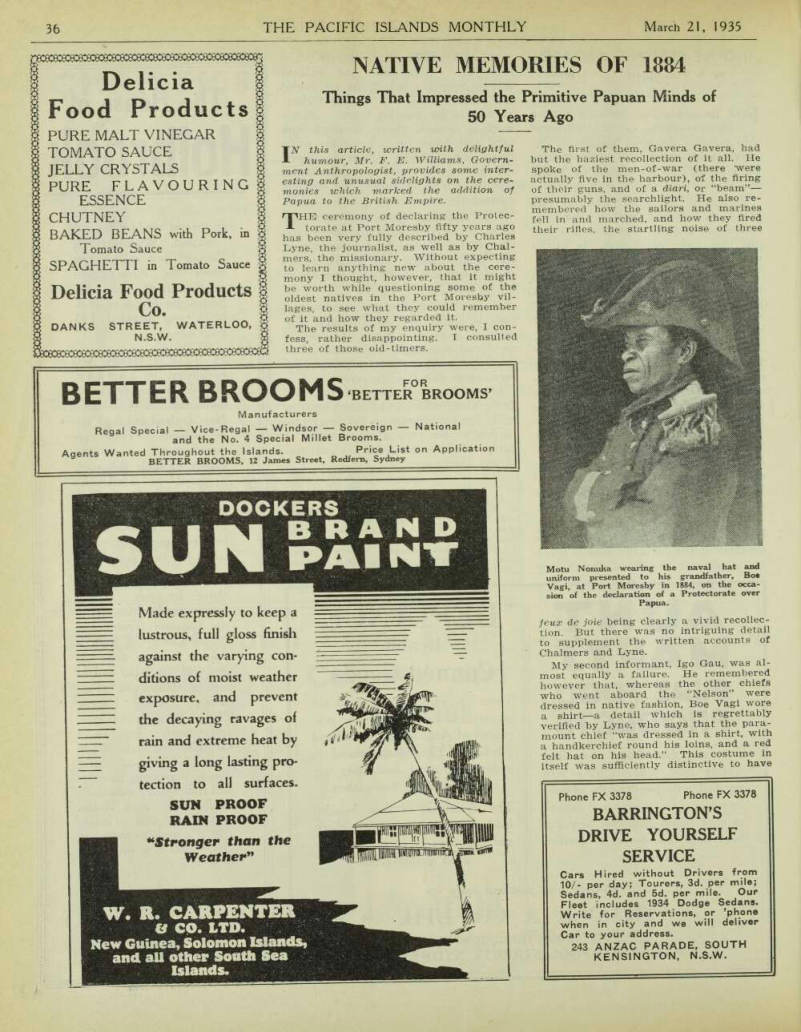
Things That Impressed the Primitive Papuan Minds of 50 Years Ago
IN this article, written with delightful humour, Mr. F. E. Williams, Govern ment Anthropologist, provides some inter esting and unusual sidelights on the cere monies which marked the addition of Papua to the British Empire.
THE ceremony of declaring the Protec torate at Port Moresby fifty years ago has been very fully described by Charles Lyne, the journalist, as well as by Chal mers, the missionary. Without expecting to learn anything new about the cere mony I thought, however, that it might be worth while questioning some of the oldest natives in the Port Moresby vil lages, to see what they could remember of it and how they regarded it.
The results of my enquiry were, I con fess, rather disappointing. I consulted three of those old-timers.
The first of them, Gavera Gavera, had but the haziest recollection of it all. He spoke of the men-of-war (there “were actually five in the harbour), of the firing of their guns, and of a diari, or “beam”— presumably the searchlight. He also re membered how the sailors and marines fell in and marched, and how they fired their rifles, the startling noise of three
feux de joie being clearly a vivid recollec tion. But there was no intriguing detail to supplement the written accounts of Chalmers and Lyne.
My second informant, Igo Gau, was al most equally a failure. He remembered however that, whereas the other chiefs who went aboard the “Nelson” were dressed in native fashion, Boe Vagi wore a shirt —a detail which is regrettably verified by Lyne, who says that the para mount chief “was dressed in a shirt, with a handkerchief round his loins, and a red felt hat on his head.” This costume in itself was sufficiently distinctive to have
Motu Nonuka wearing the naval hat and uniform presented to his grandfather, Boe Vagi, at Port Moresby in 1884, on the occa sion of the declaration of a Protectorate over Papua.
made an impression—and no doubt a favourable one—on Igo Gau; but it was nothing to what he was to see presently.
He was not himself one of the privileged fifty to go aboard the flagship. He had watched with the others for their return, and remembers how the villagers were amazed at the appearance of their newly created chief. For whereas he had gone onto the “Nelson” clad in a shirt, he came out of it carrying a stick and wearing a naval officer’s uniform. There is no doubt that Boe Vagi did wear a naval uniform later on, in his official capacity; but I think my informant may have anticipated this investiture in his account, for neither Chalmers nor Lyne makes mention of what would have been at least a very surpris ing transformation.
Igo does not forget the noise of the cannon, though he mistook its signifi cance, In the words of an English-speak ing native who has transcribed his ac count, “the meaning of the cannons which they fired, saluting the chief Boe Vagi.”
Dr. Lawes, the missionary, had fore warned the people of the display of fire works which was to take place on the evening before the actual ceremony, (It happened to be November 5. Were the rockets solely to impress the natives, or did the Commodore send up a few extra for Guy Fawkes?) To use the words of my scribe again: “In this occasion Dr.
Lawes told the villagers that they would not be afraid, but to watch and they can see some amazing things, viz., flashing lights, crackers, sky-rockets, etc. When the light flashed towards them, and when they heard the sounds, these things will do no harms; so they may not move from their villages. If this does not be told, I should say the villagers would be rushed to and fro.” As it happened, only the Koiari, visitors from the hinterland, were sufficiently scared by the entertain ment which had been staged for their "benefit to run away from it.
The last of the three old-timers was Taubada Ova. I entrusted the task of dragging out his recollections to a young educated native, and in due course re ceived a written account of them. It was a very short one, to which the young man, digusted at the failure of Taubada’s memory, wrote an indignant preface: “In my opinion he can remember things that happened yesterday, but not day before yesterday. His head is full saw-dusts, etc.” This is strong language for an up start to use of a rather eminent and cer tainly intelligent old native; but then the youth was anxious to please, and pump ing informants without result can be a little exasperating, Taubada Ova had been on a hunting expedition with his friends when they heard, reverberating through the hills, the thunder of the Royal Salute, They hastened back to the village to learn the meaning of these unaccountable noises, but by that time of course the celebration was all over. There was, however, “lots of news about appointment of Boe Vagi as a chief”; and he had been driven walking-stick, uniform, and hat by “Gamadoa (Commodore), a big man which was sent here for appointing some one as chief.”
Later in the evening, Taubada went to see the flag flying at Boe Vagi’s house— not the Union Jack of the Declaration, but a lesser emblem which will be referr ed to presently, “a beautiful flag . . . en aigned with Bird of Paradise.” Beneath it were gathered a crowd of natives who "talked amongst themselves about obey ing Boe Vagi’s order and respecting him when he walked about.”
But if living memories have grown in
distinct, some concrete mementos of the scene remain in a rather better state of preservation. Boe Vagi had been ap pointed by the Commodore (no doubt on adequate recommendation) as leader among the fifty or more assembled chiefs.
And at the conclusion of the reception on board the “Nelson,” when the guests had disposed of the “great tub of boiled rice, sweetened with brown sugar,” and had listened to the Commodore’s haran gue, he, Boe Vagi, was called forward and presented with an ebony stick. It was to be, said the Commodore, an emblem to him of his authority, and all the tribes represented by the chiefs there present were to “look to the holder of this stick, Boe Vagi.”
The emblem of authority—it would have made a very serviceable weapon—is a thick black stick, encircled at the top by a band of silver. This band encloses a florin, face upwards, and we may picture Boe Vagi and his fellow tribesmen (who had hitherto seen but one white woman, the wife of Dr. Lawes) passing the stick from hand to hand and gazing with won der at their new Queen who, as the Com modore had said, would guard and watch over them and would look upon them as her children.
At subsequent ceremonies performed at different parts of the coast, Commodore Erskine presented five of these staffs of office to “paramount chiefs,” the sixth being given to Mr. Chalmers as a souve nir. It is more than doubtful whether any of them, except the last, now serves the purpose for which it was given. Boe Vagi’s remains in the house of his grand son, and neither he nor any other is bold enough to carry it as a staff of office. For Boe Vagi's status from the beginning was a fictitious one, and his place was not taken by a successor.
The ebony stick passed into the hands of his only daughter, Gabadi Boe. She it was whom Dyne described as the “vil lage belle,” but as “not very beautiful according to English or Australian ideas of female beauty, for her face is broad, her nose flat, her mouth large, and her head of hair immense.” But her form was robust; she wore many bands of shells, and a large piece of pearl around her neck; and she “wagged her petticoat with as much style and effect as her sex in Sydney, much more elaborately dressed, can show in a walk round the block.”
It is not a very sympathetic picture.
Gabadi Boe must have looked, dressed, and behaved like the Motu kekeni of to day, who is uncommonly attractive; and incidentally I am sure she wagged her petticoat with more verve than would be tolerated on the streets of Sydney.
She was no doubt making the most of her father’s glory, for Lyne adds, some what fancifully, that she was “evidently the admiration if not the envy of a select circle of young female acquaintances who were generally with her in a capacity something like that of maids of honour.”
In short, she was permitting herself to be lionised.
Gabadi Boe in due course married, and it is her son, Motu Nonuka, who now has the stick in his possession. He is a re spectable little native with no pretensions to chieftainship, the highest public honour he has achieved being no more than mem bership of the Village Council.
When I visited his house he had the relics of his distinguished grandfather placed ready on a table. Besides the ebony staff, there was an old moth-eaten flag, dark blue, with a white square in the corner. Unfortunately, the white cor ner had almost totally disappeared, though on what remained of it could be distinguished some streaks of dye or
painting. This was the flag which Tau bada Ova had admired. It had been sub stituted by Commodore Erskine for the Union Jack given to Boe Vagi in the pre vious year by Mr. H. M. Chester, when the country was prematurely annexed to Queensland. The streaks of painting are all the remains of a design printed on the white square by Mr. Cooper, of the N.S.W. Civil Service —viz., a Bird of Para dise —the first official appearance of Papua’s emblem.
But the most interesting of the relics were still to come. Motu Nonuka opened a rusty tin box of most unusual shape, and disclosed a naval officer’s cocked hat, and then, unwrapping a brown-paper parcel, he carefully laid out a naval offi cer’s cut-away. Both were grievously moth-eaten and tattered; but some 60 per cent. of the gilt buttons remained on the coat, and there were a pair of heavy epaulettes which, despite their dilapida tion, still gave it an air of magnificence.
As we have seen, there is some doubt whether this uniform was actually given to Boe Vagi by the Commodore; though Motu, his grandson, as well as two of my ancient informants, declared that it was.
But whoever gave it, we may be sure that the paramount chief often wore it and that it made its due impression.
On his death it passed, like the ebony stick, into the hands of his daughter, Gabadi Boe; nor does it appear that anyone ever ventured to wear it again, save on one occasion Gabadi Boe herself.
She had married a man, Nonuka Daroa, who once found himself in gaol for the incautious or malicious use of fire in a native garden. His highly-connected wife came to his rescue. I have the story from their son Motu, who remembers see ing his mother don the naval uniform and thus apparelled proceed from Hanu abada to the office of the Resident Magis trate, where she petitioned for her hus band’s release. The Government —or so it would appear from Motu’s story—was sufficiently sentimental to be affected, and the husband speedily found himself free again.
This ludicrous but charming episode is enough to prove, what one suspected al ready, that Boe Vagi’s daughter was a woman of character. It is worth adding that she could not on this heroic occasion have worn the trousers belonging to the uniform, because Boe Vagi had been buried in them.
The present possessor of ebony stick, flag, and uniform is a modest man.
Though his mother habitually carried the stick and once dared ridicule by wearing the uniform, he keeps them inside his house. He readily agreed to dress him self up for a photograph, but if there is anything Napoleonic in his pose it is the photographer’s fault.
Motu Nonuka has no vanity in the pos session of these heirlooms. He regards them —the flag and uniform, at any rate —as junk, and suggested burning them.
I realiy did not know whether it was right to dissuade him, they are so far gone.
But he has decided to put them away for a further span, and recently turned up at my office to accept a handful of moth balls.
Advertisements & other items, pp. 38-40 (1 item)
Barrington’S
Phone FX 3378 Phone FX 3378
DRIVE YOURSELF
SERVICE
Cars Hired without Drivers from 10/- per day; Tourers, 3d. per mile; Sedans, 4d. and 5d. per mile. Our Fleet includes 1934 Dodge Sedans.
Write for Reservations, or 'phone when in city and we will deliver Car to your address.
243 ANZAC PARADE, SOUTH
KENSINGTON, N.S.W.
Examples of Sterling Value . .
Obtainable at
PROUDS
Tudor Watches, marketed by the Rolex Watch Coy., are noteworthy for their superior quality and moderate prices.
LADY’S 15 JEWEL TUDOR
complete with Ribbon Wristlet, 9ct.
Gold, £5/15/-; White Gold, £6/10/-.
15 JEWEL TUDOR
9ct. Gold £15/15/-, Rolled Gold £3/17/6, Silver £3/-/-.
OUR COLOURED CATALOGUE
ILLUSTRATING THE NEWEST
GIFT GOODS IN JEWELLERY,
CHINA AND CUT GLASS,
WATCHES AND CLOCKS,
LEATHERWARE AND FANCY
GOODS WILL BE SENT TO YOU
POST FREE.
An attractive Tudor Wristlet Watch with 15-jewel movement in 9ct. gold case, complete with Silk Ribbon and Snap, £5/10/-.
A popular shape Tudor Wristlet Watch with 15-jewel lever movement, 9ct. gold, £5/15/-. White Gold, £6/10/-.
REPAIRS
Watches, Clocks, Aviation, Scientific Instruments repaired by thoroughly competent Craftsmen—work guaranteed.
PROUDS LTD.
CORNER KING & PITT STREETS,
SYDNEY
ALBERT GREGORY
107 York Street, Sydney.
Saddlery,
Saddler’s Ironmongery
Leather and Paint Merchant.
LEATHERS— Art Work, Sole, Harness, Roans, Suedes, Bag, Kangaroo, Bridles, Belts, Spurs, Stirrups, Breastplates. SADDLES Race, Exercising, Park and Stock.
Leather Belting and Pump Cups.
Paint Merchant.
For House and Roofs, ready mixed . . 13/6 gallon Special Value House Paint 10/6 gallon Brushes, Kalsomine, White Lead and Oil.
Samples of Leathers on Application.
Weak Men Made Strong!
MEN who have LOST YOUTHFUL POWERS; whose brains are dulled; whose energy and VITALITY is weakened; whose memory is bad
SEND FOR
Alfaline Vitality Pills
(Send for Circular on Pills and Lost Vitality Treatment) BLOOD, SKIN, NERVE, BLADDER, KIDNEY, AND LIVER COMPLAINTS,
RHEUMATISM, NEURITIS, ASTHMA, SUCCESSFULLY TREATED BY
POST. (MEDICINES POSTED UNDER PLAIN COVER.)
ALL TOILET AND RUBBER GOODS STOCKED
(Send for Price List).
HERR RASMUSSEN (Danish Herbalist)
541 GEORGE ST., SYDNEY, N.S.W.
3 h.p. TILLY Marine Engine
2 7/8 bore, 2¾ stroke. Balanced crankshaft, 1 1/8 dia., float, feed carburettor, Robert Bosch magneto. Equipment: Silencer, Propeller. Shaft, Stuffing Box, and Free Clutch.
PRICE £31/-/- F.O.B.
J. E. TILLY
25 RENWICK STREET, REDFERN
’Phone: MA 3430.
Cocoa-Planting Not
Recommended
“One should take with a grain of salt the advice of those who are urging cocoa-growing upon New Guinea plan ters,” says a correspondent in Western Samoa.
“New Guinea cocoa-planters already have to struggle with marketing difficul ties and the opinion that cocoa may be the salvation of New Guinea planters seems wholly unwarranted. You find hardly any well-to-do cocoa-planters in Samoa, and this after 10 to 25 years of struggle.”
Rubber Substitute
Many Industrial Uses Indicated For New Rubber Company Product
(The following article, which appeared in an American business journal in January, 1934, will be of interest to planters in Papua.) PERFECTED in the laboratories of the B. F. Goodrich Co., Koroseal, a new synthetic rubber-like substance, is just being put into production on a commercial basis.
Continuous tests of the material and a wide variety of experimental applica tions to uses where rubber or other ma terials are used at present, have failed to exhaust market possibilities; new and previously unlooked for properties are still being discovered by Goodrich chemists and engineers.
Although of a different chemical com position, Koroseal, like rubber, can be variously compounded to be hard or soft. When given a doughy consistency, it can be molded into any shape. It takes a variety of colours and is odourless, Goodrich chemists point out that, un like ordinary rubber, Koroseal does not swell and soften when exposed to oils and greases, resists disintegration in the presence of corrosive chemicals, stands up under the action of hot, concentrated nitric acid or chromic acid, and offers great ‘ resistance to light and oxidation.
J. W. Schade, director of research of the B. F. Goodrich Co., adds that it also has a far longer flexing life than rubber.
For Moulding, For Gaskets
The ability of Koroseal to resist mois ture and its stability over a wide range of temperature is held to make it ideal for moulding ornamental plaster casts. In regular factory operation, over 500 casts from a single Koroseal mould left it still serviceable, where an ordinary glue mould would have failed after perhaps 50 castings.
For use at points where swelling is objectionable, oil sealing gaskets made from the new material have been found far superior to rubber, Koroseal also has been found effective for piston pack ing since it insures a tight seal around the piston in the presence of oil.
Mr. Schade states that at present the cost of manufacturing Koroseal pre cludes its adoption as a general substitute for rubber.
A Lucky Landing
From Our Own Correspondent.
PORT MORESBY, February 12.
THE new Dragon two-engined ’plane, to be used by Carpenter and Co., Ltd., on the goldfields service, flying from Queensland, arrived safely in Port Moresby at 2.30 p.m, on Friday, January 25, on the Kila Kila aerodrome.
Approaching the Papuan coast the pilot, Mr. Ferguson, who was accom panied by his wife, had some extremely alarming moments. With visibility bad and no land in sight, and petrol so low that another 20 minutes would find it exhausted, they feared disaster and gave up all for lost.
But their luck held. Land loomed ahead and the landing was made —on time, but with not a pint of petrol to spare.
Bluejackets’ Graves
Wanted, A Brass
Plate!
Navy League Does Not Mark Bluejackets’ Graves
IN 1880, a number of naval men were murdered by natives on Mandoliana Island, near the present town of Tulagi, in the Solomons. They were buried at the scene of the tragedy.
Fifty years afterwards, Mr. M. Harper, formerly of the Australian Navy, became lessee of Mandoliana; he was interested in the 1880 tragedy, and finally located the unmarked graves.
Mr. Harper asked for the names of the murdered men; and the P.I.M., with the assistance of the Australian Naval authorities, obtained the names and other details, from London.
Then Mr. Harper decided that, at his own expense, he would place a concrete slab over the graves, and he inquired whether the Navy League would supply him with a suitable brass plate, bearing the names of the men, to be embedded in the concrete.
We wrote to the Navy League of Aus
tralia, passing on the request, explaining the reason for it, and formally applying for a brass plate.
The Navy League was not helpful and refused to take any interest in the matter.
It had no funds for such a purpose. We were left to wonder what a Navy League is for, anyway. Apparently, another or ganisation for the glorification of super annuated old gentlemen.
So then we compiled another explana tion, and made formal application to the Navy Office, Australian Department of Defence, for a brass plate.
The Navy Office “regretted that it was unable to comply with the request,” and suggested that we apply to the Admiralty, Whitehall, London. Which we now pro pose to do.
It is an extraordinary thing that, with all these naval organisations functioning, mere civilians like Mr. Harper and the editor of the P.I.M. should have to fuss and fret in order to arrange so simple a thing as the marking of the graves of bluejackets wfio were killed while on duty.
Rev. J. W. P. Gillan, Principal of the Teachers’ Training College, Tangoa, New Hebrides, who is in Victoria on holidays, was relieving the Presbyterian Minister at Beechmet, Melbourne, in February. He will return to the Condominium in May next.
Advertisements & other items, pp. 41-42 (1 item)
Traders Ltd.
Malt & Hops
(SOLID BEER)
MADE FROM THE
FINEST ENGLISH
MALT & HOPS
STOCKED BY:
Burns, Philp & Co., Ltd.,
RABAUL
MAKERS:
Paine & Co., Ltd.,
St. Neots, Hunts., England.
WARD’S famous
Fuel Stoves
Renowned for 50 Years
The “BEACONLIGHT"
Specially Made for Islands.
Cast Iron Throughout.
May be Purchased through Island Merchants or from
JAMES WARD LTD.,
372 Pitt Street. Svdnev
ABOVE ALL—
Aeroplane Pure Fruit Jellies Aeroplane High-Grade Custard Powder Aeroplane Junket Crystals Aeroplane Flavouring Essence Manufactured by Products of Distinction
TRADERS LTD.
NEWTOWN SYDNEY
TIMBER, JOINERY,
Etc.
PREPARED BUILDINGS
ready for erection a speciality.
SHIP and BOAT BUILDING
TIMBERS specially catered for
FIBROLITE, PLYWOODS.
GALVANISED IRON.
CELOTEX.
CONSIGNMENTS shipped by
RETURN STEAMERS to the
Islands,
JOHN W. EATON LTD.,
WEST CRESCENT ST.,
NORTH SYDNEY
TELEPHONES: X 5051 (5 lines)
Woven Wire for All Industry
COPRA DRYING TRAYS, FLOORS, Etc.
FRUIT DRYING TRAYS, MINING SCREENS
Heavy Mosquito Gauze in Phosphor Bronze and Other Metals Impervious to Salt Sea Air WIRE DOOR MATS AND GENERAL WIRE WORKS
E. WIUGVIT A CO. LTD.
Office and Works: 148-152 Cleveland St., Sydney, N.S.W.
Telegraphic Address: “Wrightmake,” Chippendale.
PURE RICE STARCH
WHOLLY PRODUCED IN
CORAL BRAND
RICE STARCH
ALWAYS ASK FOR
“CORAL BRAND”
100% PURE
Noted for its
QUALITY and WHITENESS
Goes FARTHEST and gives
LASTING FINISH
Will not stick to iron.
CORAL BRAND
may be obtained from Leading Island Stores Manufactured by
CORAL STARCH LTD.
Sydney, N.S.W.
A Moving Mass Of
Crabs
Egg-laying Rite in the Solomons
From, A Lady Resident of the Solomon Islands ALWAYS there are a few crabs about the garden and paddocks, making a nuisance of themselves, digging holes in the front paths and nipping the tops off very special plants or eating chickens not properly cooped; but for the first week or two in November we noticed their numbers steadily increasing.
The climax came one night, about the third week in November, when, sitting inside reading, we could hear a strange rustling going on outside. A friend described it as a flock of sheep on the move. Going out to the front gate and flashing a shooting light round about we saw a sight which made me “creep” for nights after.
The ground was just a moving mass or carpet of crabs. On every bush and fence they swarmed in hundreds, all moving, with their funny cumbrous gait in the one direction —towards the sea. I was informed they were all female crabs because they didn’t have hairy legs.
Next morning, I was up at dawn, and it was still a case of “watch your step,” as they were still on the move. But as the light of day approached and the sun became hotter, those that had not reached the water’s edge, made haste to hide themselves under coral and pieces of rub bish, wood, or anything at all, until by 9 o’clock there was not a crab to be seen, unless one went looking for them.
We went to the beach, and there wit nessed what appeared to be almost a reli gious rite of some kind, for each crab advanced to the water’s edge, and, cross ing its claws above its head, shook itself hard —not once, but many times; and then moved back among the stones to make way for another. The crab’s belly was covered with what appeared to be a dark-coloured rubber sponge, only with very, very minute knobs in place of the holes in a sponge. Perhaps that’s not a very good simile, but anyway those are the eggs, and the natives told us that the female crab goes to the sea every year at the same time, and washes her eggs in the salt water and then goes back and hatches them in the sand.
On going round the plantation we saw the whole foreshore was riddled with crab-holes —looked just like a miniature battlefield.
Needless to say, a few of the creatures died on the journey, and a sickening stench hung over everything for days.
We are now awaiting developments, as the natives say they come back again in February.
At Rere, I have seen, at a certain time of the year, millions of very tiny crabs come out of the salt water, and my theory is that they are those hatched from the eggs we saw, and that they are left in the rocks and not taken back to terra firma at all. One year at Rere the baby ones were feet deep on the beach and against the copra shed. I cannot remem ber having seen the big crabs there, though.
These, here, are about 4in. to 5in. across, I suppose, and most ferocious looking creatures.
No Patrol ’Plane
Federal Govt. Shelves Plan To Check Shell Poachers
THE Federal Government has decided to defer the project of supplying the New Guinea Administration with a sea plane to check poaching activities of Japanese shell-raiders in the Territory, and also to provide transport for admini strative officers.
It is some months now since the Com monwealth Government, as a result of representations made by the Administra tions and commercial interests in New Guinea, Papua, and Torres Straits, de cided to call for tenders for a seaplane and patrol launches. Tenders were in vited, but only one was received. This, however, was not accepted. The Federal Ministry was thus faced with the al ternatives of supplying a Government machine, pilot and mechanics, or of de ferring the project.
Formerly the New Guinea Administra tion maintained a steam-yacht for ad ministrative and other purposes in the Territory. This vessel —the Franklin— was sold about two years ago and, as the seaplane proposal was in the air, nothing was done to replace her. Now that the plan to obtain a suitable machine has been shelved, it is likely that a small steamer will be purchased in Australia for the New Guinea Administration.
No decision has been made concerning the patrol launches, and inquiries by the Federal Government are still proceeding.
Rev. James Orsmond
His Valuable Work in Tahiti
WRITING in the “Sydney Morning Herald” of February 2 last, Mr. Eric Ramsden supplies some interesting ma terial concerning Rev. James Muggridge Orsmond, pioneer “Duff” missionary to Tahiti. Mr. Ramsden has based his article on data contained in a document purchased by the Mitchell Library (Sydney) from the collection of the late Dr. John Dunmore Lang.
According to the recently purchased document, which was compiled by Mr.
Orsmond himself, the Church gained a firm footing in Tahiti only after King Pomare II. was converted, and, for his own political ends, advocated Christianity.
“After the King was baptised,” wrote Mr.
Orsmond, “the door was open, and a desire to follow his example ran through the islands like wild fire among stubble.”
Travelling to Sydney in 1817 in the company of two natives, Mr. Orsmond acquired a workable knowledge of Tahi tian. On his return to Papeete he studied
the language diligently until he obtained complete mastery over it. He saw the people in transition and made full use of this by going among the chiefs, priests, and commoners seeking their opinions, studying their customs and legends, and assimilating the fundamentals of their inherent culture. This mass of detail he recorded while it was still fresh in his memory, and so gathered a comprehensive and valuable collection of ancient Tahitian lore.
Later he generously presented his col lected writings, embodying his observa tions and researches, to the French Gov ernment. Unfortunately, these documents of inestimable value were subsequently destroyed in Paris. Years later his bril liant granddaughter, Teuira Henry, a fluent linguist and a profound student of Tahitian culture, undertook the tremen dous task of restoring Mr. Orsmond’s life work. After her death in 1915, Miss Henry’s manuscripts, elaborated with notes by other Tahiti experts, were pub lished by the Bernice P. Bishop Museum, of Honolulu.
When his wife died in Tahiti on Janu ary 6, 1815, Mr. Orsmond went to Sydney and married Miss Isabella Nelson, a Sun day school teacher of Parramatta, N.S.W.
Their daughter Eliza married Isaac S.
Henry, son of Rev. William Henry (vete ran missionary of the “Duff,” who later settled at Ryde, N.S.W.). From this union was born Teuira Henry, on January 24, 1847; thus she was the granddaughter of both the old "Duff” missionaries, Rev.
James Orsmond and Rev. William Henry.
After the French occupation of Tahiti, Mr. Orsmond realised that Britain would
not interfere with the position, and so he opposed the actions of the Protestant missionaries in encouraging the Tahitians to resist the French by arms. For this attitude he was accused of aiding the French, and, finally, dismissed from the London Missionary Society in July, 1844.
Subsequently, the French authorities made him Government pastor at the Papeete French Protestant Mission.
While on his way to Sydney in 1856, Rev. James Orsmond died at sea on April 23, at the age of 72.
Mr. Harbour, who is studying theology at St. John’s College, Auckland, New Zea land, will shortly be appointed to an Islands post by the Melanesian Mission.
Advertisements & other items, pp. 43-44 (1 item)
Hotel Mansions
KILLS Flies Fleas
mosquitoes
and all
insects
STONE
DEAD
NON POISONOUS
WILL NOT STAIN
MADE IN
AUSTRALIA
NOW DOUBLE STRENGTH
ETTER THAN EVER
Obtainable through all Island Merchants, or write Samuel Taylor, Box 9, Surry Hills Sydney.
READ THE
B.P. MAGAZINE
AUTUMN NUMBER
On Sale 1st March Short Stories Pictures Travel Articles Pages for the Children. Stage.
Latest Fashions Screen One Shilling per Copy ON SALE AT ALL NEWSAGENTS AND BOOKSELLERS
TARIFF:
Single Room and Breakfast from 8/per night,
WEEKLY
from £2/2/-
HOTEL MANSIONS
SYDNEY’S IDEALLY SITUATED PALATIAL HOTEL
Renowned for Exquisite Cuisine, Perfect Service and Luxurious Appointments.
Make the Mansions your home whilst in Sydney and enjoy Unsurpassed Comfort at Moderate Cost.
INDIVIDUAL, DOUBLE ROOMS AND FAMILY SUITES
WIRES: “Mansions,” Sydney.
INCLUSIVE
TARIFF:
Single Room from 12/ per diem.
WEEKLY
from £3/10/- ADDRESS: Bayswater Rd., King’s Cross.
N. LIGHT
BOAT BUILDER AND MARINE
ENGINEER
MANLY, SYDNEY
My stocks include strong serviceable working launches, suitable for Islands work, with a special line as under: 26ft. x 8ft. 6in., cruiser stern, raised deck, heavily constructed Launch, big carrying capacity. Kelvin heavy-duty Engine.
Sails and Gear. Instant delivery.
Price £285 f.o.b., Sydney.
For Well Bred
FOXIES, CATTLE KELPIES,
POMERANIANS or Any Other (Both Sexes) Established 5 Years.
Write
57 Goulburn St., Sydney
(A Feeding Chart with Every Animal.) Satisfaction Guaranteed
ISLAND PATRONS RECEIVE SPECIAL ATTENTION.
SPRINGS
John While & Sons Ltd.
MANUFACTURERS OF ALL KINDS OF SPIRAL AND
MACHINERY SPRINGS.
Established 1885.
J.W. Shock Absorbers J.W. Wheel Wobble Controllers Gate Springs Spring Washers Agricultural Implement Springs.
Car Spring Specialty.
Upholstering Springs.
Prices on CRYSTAL and WESTBOURNE STREETS, PETERSHAM, N.S.W. Application.
CAPSTAN
NAVY CUT TOBACCO
CAPSTAN
CIGARETTES
CORK-TIPPED
OR PLAIN
Incredible Story
How Lost Bag of Gold Was Recovered
THE following description of an inci dent in Papua is always given a prominent place among “Incredible Stories.” Yet it is absolutely true.
It is amusing to recall that the story was once written by a certain Bishop, and sent to a magazine that publishes “only truth” ! It was returned with thanks, and a reminder to the above effect.
Henry Dexter, writing from England to the editor, recalls the story, and re marks that Percy Leigh, the diver con cerned, and Sandy Christy, owner of the salvaged bag, were at the wharf to say good-bye to him when he left the Terri tory last November. Dexter retells the story in the book he now is writing.
A cutter from the North-east Coast of Papua was nearing Samarai, and there was much bustle on board as the miners stacked their goods on deck, ready for disembarkation. There came a sudden squall from the nearby mountains. The cutter was thrown on her beam ends and four bags, containing gold, slid gently overboard and sank.
The skipper kept his head, and imme diately gybed the cutter and took cross bearings to mark the spot. Then he went on to Samarai; and, soon afterwards, re turned with diver Leigh, and Christy, the frantic owner of the gold.
The cutter was jibbed about until the marks were in line, and Leigh went over board. They were right on the spot, and three bags were sent up. But a long search failed to reveal the fourth; and the despondent Christy said that that bag contained gold worth about £1000.
The diver, finally, gave it up, and climbed aboard.
“Heave up, boys!” called the skipper, and the native crew slowly raised the anchor.
A native, looking over the bow, sud
denly yelled:’
“Pusa yen-o-o Talbudda!” (The bag is there, Taubada.) And there it was.
When the anchor was dropped, it fell onto the bag, hiding it from the diver.
When the anchor was raised, one of its flukes caught one of the shoulder-straps of the bag and brought it to the surface, and into the hands of its anxious owner.
Danish Scientist
Saves His Pacific Specimens
DR. AXEL HOLLER, a Danish scientist, who experienced many exciting ad ventures in the Pacific Ocean, including the wreck of his schooner, in the Southern Solomons, arrived at Darwin on the motor-ship Rabaul on February 24, on his return voyage.
Dr. Holler said that, with the schooner’s launch, they salvaged all the valuable ex hibits and the schooner’s equipment. The loss of the schooner was negligible com pared with the value of the exhibits, which were probably the best collection ever sent to Denmark.
Advertisements & other items, p. 45 (1 item)
Manufacture
IN METHODS OF
Careful selection of crude oils is important, but in manufacturing motor oils the "processes of refining" are decisive in determining quality and suitability.
Vacuum Refineries are leaders in terms of Modern Refinery and Processing Equipment, Engineering and Chemical Laboratories, and in man-power-the chemists and engineers have the knowledge and experience of 68 years at their command.
This unrivalled background of manufacturing resources is an important reason why Mobiloil is known as the World s Quality Motor Oil.
ALWAYS INSIST ON
FIRST FOR PERFORMANCE AND ECONOMY
VACUUM OIL COMPANY PTY. LTD.
(INCORPORATED IN AUSTRALIA)
Soaked Trader”
Reminiscences of “Gin- Soaked Trader”
Henry Dexter is Compiling a Book
NO one expected that Henry Dexter, late trader, of Papua, when he retired to England, would sit about with folded hands; but at least he might have rested a while, after 25 years of hard work.
He is not like that, however. He says, in a letter dated January 15, that already he has written 20,000 words of his book of Papuan memories.
The sections of the book are intriguing.
“The Voyage of the Bentinck,” “Abau Patrol, 1915,” “Queer Happenings,” “The Prospector,” “The Mysterious Fish of the Veri Veri Islands,” “Types of Natives,”
“Missionaries v. Traders,” etc. —those titles will mean something to old Papuans.
Mr. Dexter writes: “The Bentinck yarn is readable, I know ; the Abau parol, in which I played a minor part as emergency magistrate, being in charge of the island at the time, keeping up communication with the patrol, trying all cases that a magistrate for native matters is competent to try. You know, of course, that the affair arose out of the massacre of a sergeant and three police.
“ ‘Queer Happenings’ are a collection of weird events, that are either my own experiences, or those of men whom I knew well.
“ ‘The Prospector’ deals with the man who is plucky to a fault, who would try
to get to the South Pole if gold was re ported there, a man ‘who knows every thing but how to keep his gold when he has found it.’ That last sentence was written by Beatrice Grimshaw over twenty years ago, but is equally true to day. I’ve given instances that are almost forgotten.
“ ‘The Mysterious Fish of the Veri Veri Islands’ was last seen by Butler (engineer) and me in 1910. Those who saw it during a number of years were Jimmy Fowler, Kunson, His Excellency the Governor, Chalmers (afterwards killed and eaten at the mouth of the Fly River), Thomp kins (a missionary who was also killed at the same time as Chalmers), Rev.
Dauncey (one time of Delana). Dauncey, with Chalmers and Thompkins, were bound up to P.M. from Yule Island when they saw it.
“Passing the spot in 1925 I told Rev.
Dauncey of my experience. ‘And you saw that fish, too,’ he said. ‘Chalmers, Thomp kins, and I were in a small cutter; it was before the days of motors. The fish came up astern of us; really, it almost looked as if it could take us—cutter and all —into its mouth.’
“In 1897, this water was being fished by three Japanese luggers after pearl shell.
On the first day, things were going well, and shell was plentiful. Suddenly the tube and line of one of the divers parted.
There was no pull, which showed it was not through the diver putting his foot into the shell of a giant clam. The tube was cut clean as if with a pair of giant shears.
“The next day the same thing happened and the boats left.
“Was this giant fish, which has never been identified by those who have seen it, responsible for the tragedy?
“As far as I know, that water has
never been fished since. In 1914, a firm in Thursday Island were sending me over two pearling luggers to give it a try.
They were to arrive in September; but war was declared just as they were about to leave.
“‘Missionaries v. Traders’: You can guess the line taken. It hasn’t a word that will hurt the ordinary, common, or garden missionary. I’m careful tp say that missionaries were among the most genuine friends I had in Papua. It is only the minority, who keep the old stock yarns going, that I hit at. In short, I ask for fair play for the trader, and that he should not be saddled with the sins of his forebears.
“The compilation is entitled ‘Reminis cences of a Gin-Soaked Trader.”
“A chapter is called ‘Paradise Plumes.’
It treats of the traffic after it became ille gal, and one or two of the incidents are humorous. The five men (Roche, Jack son, Dressier, Penrose, and Bell) who were all killed at different times over the Dutch border, were all known to me personally. Your article in the P.I.M., 22/2/’33, gives quite a good account of these men, but omits mentioning that Dressler’s skull was found by Lyons (R.M.) on the British side of the border.
“I tell of how it was found in a dubu.
The gold stopping in the teeth told of its being that of a white man. It was shown to ‘Daddy’ Leigh, who used to travel the coast doing dentistry work. He claimed two stoppings as being his work; two others were identified by a dentist at the internment camp, South. Dressier was an Austrian, not a German, as Doc. Vernon has it.”
Dr. Alan Grant, formerly Government Medical Officer at Nauru, left Sydney with his wife recently to do post-graduate study in England.
Advertisements & other items, p. 46 (1 item)
Home Lighting Plants
The most complete range of
The “Nevertire” Full Automatic Plant Here is the lighting plant that THINKS!
ever ottered
From a small 10-light plant, through a wide range to 7.5 kilowatts or more. Semi-automatic, fullautomatic ; direct-coupled or belt-driven; all voltages.
LISTER
Petrol or Diesel
Engine drive.
The marvellous "OMNISTAT" automatic engine control starts the Lister engine as soon as you switch on more than half-a-dozen lights, which are lit by the battery. The generator continues to supply current until only a few lights are in use. Then the engine stops, ready to restart automatically, as soon as another call is made for current. Simple in action, and absolutely positive. With this plant you can operate an automatic electric refrigerator on a 32 volt system and you need have no worry about the current supply—it is always available, automatically.
Write for catalogues and details of prices free of Australian Customs Duty.
DANGAR, GEDYE & CO., LTD
Malloch House, 10-14 Young Street - SYDNEY
Solomons
Chinese In The
Letter to the Editor.
A PERSISTENT investigator reports that when the Chinese question is mentioned in Tulagi, he receives a chilly reception, followed by a “heated championship of the Chinese by the higher officials.” Continues he: “Those officials will not hear a word against the Chinese, because they are considered so industrious and law-abiding.”
Granted. But, by implication, the British traders feel that in the official mind they are regarded as loafers and law-breakers, in comparison with the Chinese.
Regarding the industriousness of the two classes of traders, those officials would be the first to condemn as “beachcombers” and “loafers” a num ber of whites seen lolling about a small store, laughing and chatting with a crowd of lounging natives. Yet when the Chinese do this they are praised for being “industrious and giving service to the natives.”
The records of the Courts will bear witness that the Chinese break the trading regulations probably to a greater degree than the whites.
Though, taken on the whole, the laws are obeyed very well by both classes of traders.
The British traders feel that the Tulagi officials are altogether too eager to adopt the role of apologist for the Chinese. This excessive friend liness is undoubtedly responsible for the lack of perspective with which the trading position is viewed by Tulagi, to the benefit of the Chinese and to the prejudice of the Whites.
As Chinatown is on Tulagi’s doorstep, while the white traders are remotely scattered throughout the length and breadth of the Group, the Chinese, Because of their propinquity, are virtually in the position of permanently being in residence at Court. As the Chinese as a race are masters of diplomacy and underground engineering it behoves Tulagi to be ever on its guard against the danger of viewing trading conditions through Chinese spectacles only.
The trader is the only European in the Group who is subjected to Chinese competition. Assum ing it was possible to subject Government officials to similar competition, the complacency with which the majority of those good folk view the death throes of the white trader would receive a rude shock. The introduction into the Group of Chinese officials would result in an en masse native change over to the newcomers, and the British officials would be left in splendid isolation. When in due course they had lost nearly all their income and self-respect, they would feel as we few doomed British traders are feeling now.
The trader is criticised often enough, but has the Government courage enough to invite the natives to indicate their opinion by taking a vote on the question “Chinese Officials or British Offi cials”? It knows only too well that the vote would be overwhelmingly in favour of the Chinese.
Competition is a wonderful thing—for the other fellow.
The fantastic proposals in the foregoing para graph are deliberately made to bring into high relief the realities of the matter at issue.
The native is a child and is swayed by childish impulses and desires—all of which are not neces sarily for his own good. With him, the question of European versus Asiatic is not an economic one, as it is with us, but a racial one. The native feels he is nearer in race to the Chinese than to the Whites. The fact that the white traders’ prices, quality, and service are as good or better than those of the Chinese, carries no weight against the blind, unreasoning, racial pre ference of the native for the Chinese. The funda mental unfairness to the European was committed when the Government permitted the Chinese to compete against him. There being a kind of Gresham’s Law in this connection—“Asiatic
traders will drive out European traders.” The natives treat the Chinese more like one of them selves, and speak to them in a manner they would be afraid to adopt to a white man. This insolent indulgence of the natives’ inferiority complex spells business to the Celestials—who smile and rake in the shekels —but at the same time it means ruin to the Whites.
From what has been said we arrive at the con clusion that the official policy of the ‘‘open go,” and so-called “equality,” is utterly unfair, be cause the European, by virtue of his being a European, is always under a heavy handicap, the handicap of race.
Can the Government, or the Missionaries, for that matter, as guardians of the infant native race, contend that Asiatic contacts that breed insolence and create an anti-white complex in their charges, are desirable or necessary?
I am, etc.,
B.S.I.
Tulagi, 28 Jan., 1935.
Advertisements & other items, pp. 47-48 (1 item)
Delicious!!
DRIVE YOURSELF
during your stay
in Sydney
in a 1934 Model Sedan at 6d per mile. Minimum from 15/ per day.
Write or cable, and we will reserve a car for you. Free Service all over N.S.W., with advantages enjoyed by N.R.M.A. members.
Martin’s Drive Yourself
Service
191 WILLIAM ST., SYDNEY
F 1092.
DELICIOUS!!
THE crisp, tempting quality of
ARNOTT’S FAMOUS SAO
BISCUITS is the result of 64 years of specialisation. They stand unrivalled in quality and excellence. For lunch or supper they are delicious with butter and cheese, fresh and stewed fruit, ham paste, or savouries.
ALWAYS ASK FOR ARNOTT’S
AND BE SURE YOU GET THEM
Aquila Steel Co. Pty. Ltd.,
Design all REINFORCED CONCRETE WORKS accord- REINFORCING STEEL of every description at com mg to the most modern engineering practice, and supply petitive prices.
Estimates given and the benefit of our Engineering Service may be had without obligation.
SPENCER NOLAN
DENTIST
28 OXFORD STREET
(Over Winns’ Ltd.)
SYDNEY
’Phone F 3215 Cable Address: Fastplate, Sydney
SPENCER NOLAN
DENTIST
139 ELIZABETH STREET
(2 doors from Market St.)
SYDNEY
’Phone F 3215
WE ARE SPECIALISTS!
Let us have your confidence, sixty years is our record of supplying the Leading Houses throughout the World in—
FRESH FRUIT VEGETABLES PRODUCE
WEYHIARK A SON LTD.
Fruit and Produce Merchants
14-18 STEAMMILL STREET, SYDNEY
Phone: MA 3612 Cable Address: Codes Bentleys. (4 lines) "Weymarkson Private.
The
“Caledonia Dover”
A COOKING STOVE guaranteed to give complete satisfaction and now recognised as THE BEST on the market. Suitable for coal, coke or wood fuel.
Illustrated Catalogue on request.
LANE & GIRVAN, LTD.,
BONNY BRIDGE, SCOTLAND.
INSTAL THE DIESEL THAT HAS BEEN GOING STRONG SINCE 1929, AND HAS PROVED ITSELF IMMUNE FROM ALL DIESEL WEAKNESS.
D.C. Series, 45 to 160 b.h.p., in 3,4, 6, and 8 cylinder sixes at 700 to 960 r.p.m.
D.B. Series, 24 to 96 b.h.p., in 2,3, 4,6, and 8 cylinder sizes, at 1000 r.p.m.
Australian Agents:
H. G. THORNTHWAITE & CO.
KEMBLA BUILDING.
MARGARET STREET, SYDNEY, N.S.W.
TELEGRAMS: "ORTHORN,” SYDNEY. TELEPHONE; B 5240
Hurricane Rakes Rarotonga
Cargo Lighters Stranded in Main Street
From Our Own Correspondent.
Rarotonga, Feb. 25.
AFTER years of comparative immunity Rarotonga, is now recovering from the effects of the most severe weather expenenced since 1893.
On Thursday, February 7, barometers started to fall, reaching, on Sunday night, the lowest known recording of 28.97.
Meanwhile, the wind had increased from a gale to hurricane pitch, blowing at 90 miles an hour from the north-west.
Huge seas rolled in on the island, churning and volleying along the white curve of the reef like lines of smoking destroyers racing for the shore.
The main settlement of Avarua received the full force of the storm, the approach of which, strangely enough, roused singularly little activity until it
was too late to make any effective pro tection of property. With sinister rapidity the hurricane gathered strength, leaping with amazing ferocity from the darkness of Saturday night on to the ex posed, already shaken township. Jerry built native shacks went down before it, while galvanised iron roofs clattered like castanets, in several cases ripping away from their wooden rafters to be whirled off like so many sheets of grey blotting paper.
Along the water-front, where the buildings stand as close as 30 or 40 yards above high-tide mark, the damage was heaviest. A small shop and a neighbour ing dwelling-house were completely de molished, leaving in their places only a barren expanse of coral-studded ground.
Further along, the seas pounded the rear portion of Messrs, dagger and Harvey’s store.
Shortly after midday on Sunday the road skirting the settlement was torn up for a distance of several hundred yards and deposited, together with a consider able quantity of sand and loose rock, in the gardens of the Hotel Rarotonga and the Chief Customs Officer. At the same time a fleet of large cargo lighters be longing to the Union Steamship Co. were lifted off the slipway and sent foaming past the Administration offices, before stranding in the middle of the Tukuvaine road. One, caught by cross-currents, careened onto the Government steps and came to rest with its. bows a few feet from the Resident Commissioner’s room- The volume of water was so great that a tract of low-lying and thickly popu lated land behind the hotel was inun dated to a depth of six or seven feet.
In the hospital Dr. Ellison, S.M.O., performed a major emergency operation while waves lashed at the base of the back verandah, forcing a thin sandy trickle under the ward doors.
On Monday, the island presented an unusual appearance. Telephone wires curled in festoons across the Circular Road, which was for two or three days impassable at certain points. Here and, there whole sections had been obliterated by the sea, while at others passage was barred by fallen trees. Every village had its own quota of roofless or wrecked houses; and in Avarua the posts of Messrs. A. B. Donald and Co.’s private wharf rose from the surrounding waters
like blackened teeth in a rush of foam flecked saliva.
Considering the exceptional severity of the storm, surprisingly small damage was done. Volunteer labour corps were quickly organised to clear the roads; individuals rebuilt or removed the re mains of their houses, and rubbish was burnt so expeditiously and with such general good temper that it is now almost impossible to credit the memories of two weeks ago.
But, in events of this kind, the most serious effects are not immediately vis ible. They lie in the losses among orange and banana plantations, losses which have been unofficially estimated at be tween 60 and 80 per cent, of the total crop. The coming year will be a “lean” one, not only for native growers but for those business firms who depend largely for their trade upon the circulation of money derived from the sale of fruit.
The Resident Commissioner, Judge H.
F. Ayson, C.M.G., who was away on furlough, returned hurriedly from New Zealand by yesterday’s mail steamer.
The north-westerly hurricane which raked Rarotonga is reported to have extended over an area of 400 miles and fear has been expressed locally for the small low-lying atolls of the Northern Group. In response to radio requests the New Zealand Government have des patched the Union Co.’s ship Maital, which is due to arrive here early this week, whence she will proceed north on a tour of investigation. On board are Mr. Smith, Secretary for the Cook Is lands Department, and Dr. Dawson, of Christchurch. The Maitai is expected to call at Penrhyn, Manihiki and Rakahanga in addition to visiting the islands of the Lower Group.
Only incomplete reports of the hurri
cane in the Lower Group are available.
In all cases heavy damage to fruit crops is reported, the island of Aitutaki being particularly hard hit.
The White Star’s luxury cruiser Fran conia, scheduled to reach Rarotonga on February 13, was diverted on the request on the local authorities. The Franconia’s captain reiterated his wish to visit the scene of the hurricane, with 500 moneyed sightseers, but was again refused on grounds of inadequate provision for their reception. Steaming for Samoa, dis gruntled luxury passengers saw nothing, but saved the money which might other wise have been spent in the island.
Thursday Is.
Notes
From Our Own Correspondent.
Thursday Is., March 2.
Prior to leaving Thursday Is. to return to her home in Sydney, Mrs. Gerald Bruce tendered a large picnic at Port Lihou on Prince of Wales Island, in return for some of the hospitality that had been extended to her during her long stay.
The picnic was a most enjoyable one, being favoured with splendid weather conditions.
The prices obtained for local mother-of-pearl shell lately have been rather low, making the future of the pearling industry insecure. The Commonwealth Government has undertaken to give financial as sistance to pearlers in order to prevent more un employment.
The business of the Port Kennedy Engineering and Shipyards Co. is now in full swing, owing to the presence in the harbour of most of the luggers and cutters used in the marine industry. The manager, Mr. S. West Newman, will pay a private visit to England in the near future.
Mr. Donald Walker, of the Customs Service, has been transferred back to Townsville, much to the regret of his friends.
The Bishop of Carpentaria has travelled down to Sydney to take part in the meeting of the House of Bishops on March 12. The chief item of business is the election of the Anglican Primate of Australia.
Mr. and Mrs. Harry Rowan, of the Lockhart River Mission, have been on a visit to T.I., where they were the guests of Mr. and Mrs. Arthur Sulli van.
Mrs. J. I. Adams has proceeded South in order to place her two younger daughters in boarding schools. One of them, Patricia, has fine promise as an elocutionist.
The Pilot Service has lost a valued officer of long standing by the passing of Captain C. Priest, The deceased has been ailing for a considerable time. He was 58 years of age.
A mail left recently on a Norwegian tanker by the kind favour of Captain A. Rule. Thursday Island owes a great debt of gratitude to the mem bers of the Queensland Coast and Torres Strait Pilot Service for the trouble in bringing in and taking out mailbags to passing steamers. The regular mail service is scanty.
Mrs. Eric Corran has returned to T.I. for a holiday.
The Protector of Aboriginals has been on the annual recruiting tour of the Torres Strait Islands for the “company” boats—the luggers and cutters owned by the natives working in the marine in dustry.
His other partners having withdrawn from the business, Mr. Gordon Vidgen is now controlling the Port Kennedy Butchering and Ice Co., on lease.
A relieving teacher is being sought for the Torres Strait Island Schools. His duties when he is not relieving absent white teachers, will be to train native teachers, and assist in the growing office work of the Protector of Aborigines.
All five candidates from the local State school have passed the recent Scholarship Examination.
This is very creditable for all concerned, especi ally the head teacher, Mr. Harry Finter, who has been working hard bringing the candidates up to concert pitch.
The Synod of the Diocese of Carpentaria has been called to foregather on July 7, at the see-town, Thursday Island. The proceedings are likely to last about a week, and will be commenced with a Quiet Day to be conducted by the Rector of Darwin, Rev. Housden.
Advertisements & other items, pp. 49-50 (1 item)
Mining Machinery
Improved Type Gravel Pump.
SEND YOUR ENQUIRIES TO—
THOMPSON’S ENGINEERING & PIPE CO. LTD.
CASTLEMAINE, VICTORIA
Cable Address; “THOMPSONS, CASTLEMAINE.”
SYDNEY OFFICE KEMBLA BUILDING 58 MARGARET STREET
Expert Engineers, Designers and Builders of All Classes Islands Boats and Pleasure Craft Good Fleet of Boats on Hand.
Estimates Given Freely.
Buyers/Sellers write:
Jack Capell,
Elite Boat Shed
RUSHCUTTER BAY,
SYDNEY
FT
NORCO CO-OP.
LIMITED
SUSSEX STREET,
SYDNEY
AUSTRALIA’S LEADING MANUFACTURERS AND DISTRIBUTORS OF CHOICEST
BUTTER, BACON, HAMS AND TINNED GOODS
NORCO LUNCH
BRAWN
PORK SAUSAGES
1lb. and ½ lb. Tins.
IDEAL FOR
PIGS’ TONGUES
PIGS’ TROTTERS
1lb. Tins Only.
LUNCHES
HAM PATE
3oz. and 1½oz. Tins.
AND PICNICS
ASPREY’S LATEX COMPOUND
(PATENTED)
FOR IMPROVING LUBRICATING OILS
Adds Years to the Life of Machinery and Motor Cars LATEX COMPOUND improves any oil, adds extra oiliness, resists heat and makes the Oil last twice as long, saves wear and tear, and halves lubrication and maintenance costs.
INTERNAL Add ½ pint of Asprey’s Latex Compound to each gallon of lubri- COMBUSTION eating oil for motor cars, lorries, tractors and stationary engines, ENGINES and note cooler and sweeter running, lower fuel consumption, greater power, fewer repairs and lower oil consumption.
FARMING Add ½ pint of Asprey's Latex Compound to each gallon of lubri- MACHINEBY eating oil for headers, harvesters, reapers and binders, ploughs, drills, mowers, disc cultivators windmills, separators, chaffcutters, etc., and save time and repair bills
SAWMILLING
MACHINERY
STEAM
CYLINDER
LUBRICATION
Add ½ pint of Asprey’s Latex Compound to each gallon of oil for saw spindle bearings and all sawmilling machinery and be free from hot and scored bearings.
Add ½ pint of Asprey’s Latex Compound to each gallon of oil, which will result in more horsepower with lessened oil consumption and general increase in efficiency.
MANUFACTURERS ALSO OF ASPREY'S SUPER BELT DRESSING Obtainable from the Trade and from WILLIAM BROOKS & CO., LTD., 35 Pitt Street, Sydney.
Circuit Courts In New
Guinea
Proposal Under Consideration
THE establishment of Circuit Courts in New Guinea has been urged on a number of occasions. Mr. W. E. Grose, M.L.C., brought the matter up for con sideration at the last meeting of the Legislative Council in Rabaul, in January.
The Crown Law Officer (Mr. Gerald Hogan) said that the introduction of the system of circuit courts advocated by Mr.
Grose was under consideration.
“In my opinion,” added Mr. Hogan, “no machinery for the administration of jus tice can be regarded as effective unless it takes justice to the people and admin isters it with dispatch, with independence, with certainty, and with skill. Judicial work should be performed by persons with adequate experience who are trained in the weighing of evidence and the re quirements of legal proof; and, if practic able, by such persons in the district in which a crime is committed and the wit nesses reside. Sittings of the Supreme Court held at frequent intervals at Dis trict Headquarters would remove some of the defects of the existing system.
“Because of general agreement with these views, the error is sometimes com mitted of assuming that the holding of sittings of the Supreme Court in Districts must of itself improve the administra tion of justice. Whilst I agree that it is very important that trials by the Supreme Court should be held in the District in which the crime was committed and the witnesses reside, yet I think all matters affecting the administration of justice in the Territory have to be carefully weighed when considering the introduction of the circuit system. One cannot ignore finan cial considerations, the staff available, and Territory conditions generally when con sidering any matter of administration.
“The question is, would the introduction of the circuit system under conditions existing in the Territory at present im prove the administration of justice in the Territory? The paramount consideration is the administration of justice to the prisoner.
“Even if the necessary transport were available and the circuit courts could be held at frequent intervals in each District, I doubt whether the advantages which would result from the introduction of the circuit court system outweigh the disad vantages under present Territory condi tions. The question of the introduction of the circuit court system is being carefully considered by the Administration at the present time. lam in favour of the in troduction of the system as soon as prac ticable.”
In Papua
Methodist Missions and Work In Papua
MISSION activities in the Pacific Islands were described at the annual demonstration of the Foreign Mission section of the Australian Methodist Con ference, held in Sydney on February 28.
The new President of the Conference, by the way, is the Rev. M. K. Gilmour, who, for 33 years, was a missionary in Papua, and retired last year. His many Papuan friends will be glad that his notable career has been marked by this signal honour.
Rev. John W. Dixon, of Papua, in an address recalled that it was 44 years ago that the ship Lord of the Isles took from Sydney the first party of missionaries to Papua. This pioneer party included Ton gans, Samoans, and Fijians, as well as European missionaries. That was an effective answer to those who asked what could be made of the natives. Amongst the 38,000 people for whom the Church was working there were many victims of the purveyors of magic. The work of evan gelism included education, trade tech nique, medical service, printing work, and agriculture.
Mr. Dixon told how he secured a print ing press for his work in Papua. By means of friends, he made a search of Sydney for what he wanted, without suc cess. Then Mr. E. C. Sommerlad, M.L.C., told him of a press that was held by the police—the property of men in gaol, who had used it for illegally printing postage stamps and Irish lottery tickets.
Having purchased this, he taught three of the natives in Papua to operate it, and by its means produced in six languages magazines and school primers. He be lieved “that the sound of the printing presses is dealing a death-blow to heathen darkness.”
The Rev. Usaia Sotutu, a Fijian min ister, stationed in the Solomon Islands, also spoke by the aid of an interpreter.
Advertisements & other items, pp. 51-52 (1 item)
Hotel Bulolo
WHERE TO STAY
THE
PAPUA HOTEL
Catering specially for Tourists & Travellers Situated on high ground overlooking both coasts, ts Spacious Lounges are always Cool & Comfortable Tariff: Per day 16/-; per week £5/5/-; per month £14; bed and breakfast 10/-; bedroom only 7/6.
Cars meet all steamers.
FIRST-CLASS ACCOMMODATION. SPECIAL DINNER
PARTIES ARRANGED.
Licensee; Papua Hotel, Ltd.
IN PORT MORESBY
HOTEL MORESBY Near the wharf
COMFORTABLE
ACCOMMODATION
ONLY THE BEST
BRANDS OF
WINES, SPIRITS
AND BEERS
IN STOCK
LICENSEE:
Hotel Moresby
COSMOPOLITAN
HOTEL
Samarai
First-class Accommodation for Tourists and Travellers Ball-room; Electric Light; Billiards; Freezing-works; Cold Store. Best brands of Wines, Spirits, Ales.
MODERATE TARIFF
Fishing Trips and Launch Excursions arranged Licensee: E. J. Morrow
TAHITI
AND
French Oceania
JUST PUBLISHED
This book, by Samuel Russell, has just been published. It is a valuable work of reference, insofar as it gives, in relation to Tahiti and French Oceania, complete details of administration* commerce, sport, tourist resorts, industries, excursions, hotels, immigration and land laws, etc.
Yachtsmen and fishermen, who are visiting Tahiti in increasing numbers, will find this a most useful handbook.
It also supplies a fascinating account of life in Tahiti—one of the most delightful places of residence in the world.
Copies from: S. RUSSELL, Papeete, Tahiti.
ANY SYDNEY BOOK STORE.
Pacific Publications Ltd.,
247 George Street, Sydney
Price in Australia (posted): Cloth bound, 6/-; paper-cover, 5/-.
SAMARAI HOTEL
The Rendezvous of the Miners of Eastern Papua.
Comfortable Accommodation for Tourists, Travellers and Residents. Best Brands of Spirits and Wines—Victorian Lager Beers.
FISHING EXCURSIONS ARRANGED
Licensee: Mrs. L. M. SKELLY.
HOTEL BULOLO
WAU, T.N.G.
Picturesquely situated, overlooking the Wau Aerodrome, at the Business centre of the Morobe Goldfields.
FIRST-CLASS CUISINE—30 com-
fortable Bed-rooms —Hot and Cold Showers—Fresh Fruit, Vegetables, and Dairy Produce from the Hotel Gardens.
The Hotel Bulolo is famous for its wide, cool verandah-lounge.
Only the Best Brands of Wines, Spirits, and Beers in stock.
HOTEL RABAUL
COOL AND SPACIOUS LOUNGES - COMFORTABLE
ROOMS - DINNER PARTIES SPECIALLY ARRANGED
Excellent Dance Floor and Music.
Under the Personal Management of Mrs. H. Luxmoore
Impregno Steel Surface
Hardening Compound
For local hardening by sprinkling the compound on the hot steel part, or for case hardening to a depth of one thirty-second of an inch by treating the object to be casehardened in a molten bath of the compound. Equipment required, an open fire, a steel pot, and a tin of compound.
IMPREGNO Case Hardening Crystals For muffle case hardening.
IMPREGNO Quenching Oil is an invaluable aid to the satisfactory hardening of gears, tools, etc.
Firms handling Engineers’ Supplies or Hardware are invited to communicate with us with a view to acting as distributors for these lines.
THE . .
Steel Improvement Co.
102 BAY ROAD, NORTH SYDNEY,
N.S.W.
"SERVICE"
LEATHER BELTING
The secret of the success of “Service” Brand Belting is in the long tanning process.
Laminated Belting and Mechanical Leathers “Service” Brand is Unequalled for all classes of Drives.
W. H. LITTLEWOOD
Est. 1916 38 EWART ST.. MARRICKVILLE, N.S.W. Tel. 552 Pet.
Tannery: ULLADULLA, N.S.W.
Catalogue on Application. Applications received for Agency.
BURNS PHILP
(South Sea) Co. Ltd.
Island Traders & Shipowners
Registered Office: Suva, Fiji.
Also Branches at Fiji: Levuka, Lautoka, Labasa, Ba, Sigatoka, Rotuma.
Tonga: Nukualofa, Haapai, Vavau.
Samoa: Apia, Pago Pago (America Samoa).
Solomons: Makambo, Gizo, Faisi.
New Hebrides: Vila.
Gilberts: Tarawa.
Norfolk Is. Nauru. Niue. Wallis Is. Futuna Is.
Code Address: “Burnsouth.”
New Guinea Notes
Administration Closes Mount Hagen Area
From Our Own Correspondent
Rabaul, Feb. 9.
AS a result of the tragic death of Father Mor schheuser and the subsequent passing away of Brother Eugene, who were attacked by natives in the Mount Hagen area, the Administra tion has decided definitely to close the "uncontrolled'’ areas in this part of the mainland. Govern ment patrols are now penetrating to villages where disturbances have occurred, and no other white parties will be allowed to enter the region.
Official sanction has been granted for members of the N.G. Legislative Council to bear the cour tesy title of “Honourable” during their term of office.
The motor ketch “Marina,” when leaving Rabaul Harbour recently, was struck by a nor'-west squall, and capsized when off Matupi Point. While being towed in the vessel sank in 13 fathoms of water, but was subsequently salvaged by the Japanese diver Nozaki.
The Rabaul Dramatic and Musical Society held a successful musicale on January 28, under the capable supervision of Mrs. Clive Backhouse. The string quartette, consisting of Messrs. Hopkins and Thornthwaite (violins), Haslam (cello), and Mrs. Backhouse (pianiste) rendered several items which were well received. The vocalists were:
Madames Bates and Youlden, and Messrs. Clive Mears and Virgil King. An outstanding item of the programme was an able pianoforte solo rendered by Mr. Keith Chambers.
On January 21 Rabaul hot air dried copra was quoted at £11/1/6 per ton in store Rabaul. This is the best price paid for our staple product since February, 1933, and, consequently, the rise has gladdened the hearts of all local planters and traders.
Advice has been received from the Australian Customs authorities to the effect that New Guinea residents, when taking their cars with them to Australia, are now permitted to enter into a guarantee instead of having to deposit in cash the value of their car during the time it is being used in Australia. This permission is a great convenience to New Guinea residents, who in the past have not always found it practicable to make a cash deposit while on leave.
During December the exports of copra from the Territory amounted to 2,941 tons. The amount shipped to Australia was 600 tons; the balance being exported to European ports, of which 1,195 tons was consigned to the United Kingdom.
The District Office of New Britain has been transferred from Kokopo to Rabaul and the Dis trict Officer, Mr. Don Waugh, and his staff have taken up their residence in Rabaul.
On February 9, the Rabaul Bowling Club was officially opened by His Honour the Administrator, assisted by Mrs. McNicoll, who bowled the first bowl. The greens were in excellent condition, and there was a good attendance. The club’s presi dent is Mr. T. W. Ellis, who for some time now has been an enthusiastic worker for its formation.
The secretary is Mr. J. E. Bennie.
The engagement has been announced of Miss Donella Refshauge, ok Melbourne, who has been attached to the Custodian’s office here, and Mr.
J. R. Walker of the Commonwealth Bank staff, Rabaul. Miss Refshauge recently departed for South on the “Montoro.”
Tontouta Bridge, N.C.
Washaway Near
From Our Own Correspondent.
Noumea, Feb. 1.
The new Tontouta bridge was to have been opened on Saturday, January 12, at 3 p.m., by His Excellency, the Governor, M. Siadous. Unfortunately, torrential rain rendered this quite impossible, so the ceremony was postponed.
The river rose to a great height, five metres (about eighteen feet) above nor mal height, and there was a serious wash away in the approach on the Noumean side of the road. A hastily improvised bridge soon spanned the gap and the traffic was only interrupted for a few days.
Curiously, the old punt had been dam aged the day before through carrying a large canion heavily loaded, and was thus also put out of action.
Maui Pomare Refitted
From Our Own Correspondent.
Apia, Feb. 12.
AFTER having been refitted and partly rebuilt in New Zealand, the N.Z.
Government steamer Maui Pomare ar rived here on February 7, the second day of Prince Henry’s visit to Samoa. She brought a number of passengers, who were fortunate in being in time to see the town in holiday dress and to be able o witness the rare spectacle of a mon ster ta’alolo and King’s Kava at Mulinu’u.
Amongst the passengers were Judge Luxford (on circuit duty), Mr. and Mrs.
Jones (manager of Vaitele Plantation), Mr Robson (Resident Commissioner of Savaii), and Mrs. Possin (Central Office).
A full shipment of over 7,000 cases of bananas of excellent quality was pro cured for Lyttleton and Wellington.
Youthful Veterans Of
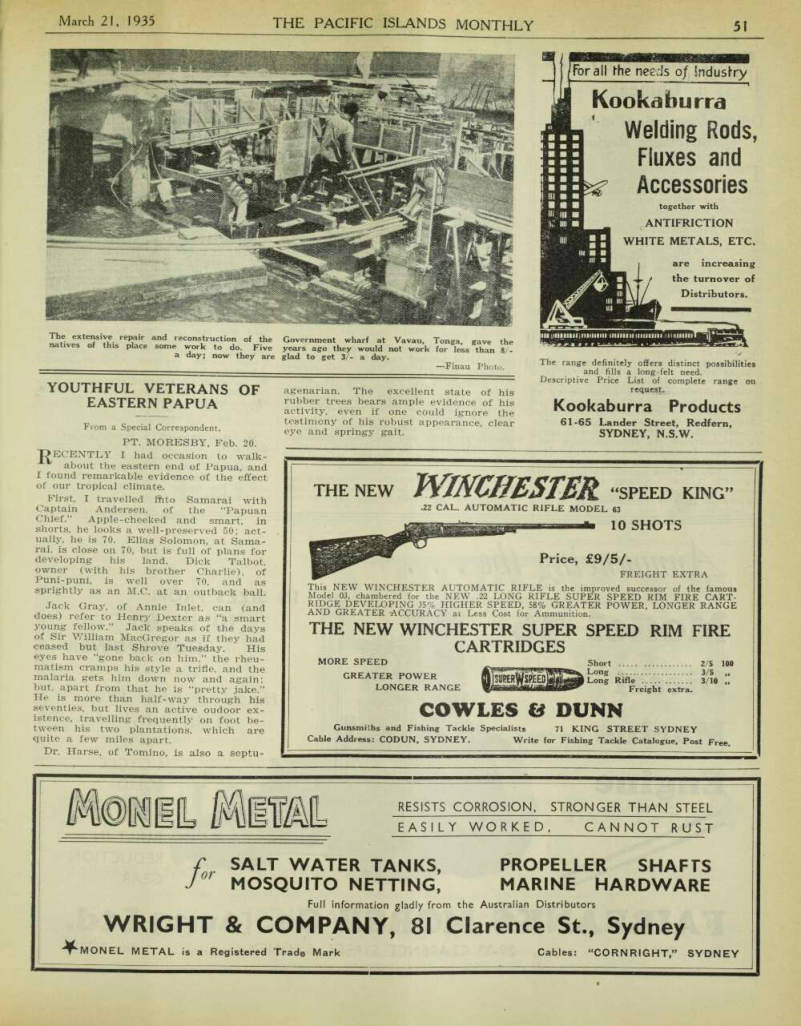
Eastern Papua
From a Special Correspondent.
Pt. Moresby, Feb. 20.
RECENTLY I had occasion to walkabout the eastern end of Papua, and I found remarkable evidence of the effect of our tropical climate.
First, I travelled xhto Samarai with Captain Andersen, of the “Papuan Chief.” Apple-cheeked and smart, in shorts, he looks a well-preserved 50; act ually, he is 70. Elias Solomon, at Sama rai, is close on 70, but is full of plans for developing his land. Dick Talbot, owner (with his brother Charlie), of Puni-puni, is well over 70, and as sprightly as an M.C. at an outback ball.
Jack Gray, of Annie Inlet, can (and does) refer to Henry Dexter as “a smart young fellow.” Jack speaks of the days of Sir William MacGregor as if they had ceased but last Shrove Tuesday. His eyes have “gone back on him,” the rheu matism cramps his style a trifle, and the malaria gets him down now and again; but, apart from that he is “pretty jake.”
He is more than half-way through his seventies, but lives an active oudoor ex istence, travelling frequently on foot be tween his two plantations, which are quite a few miles apart.
Dr. Harse, of Tomino, is also a septu
agenarian. The excellent state of his rubber trees bears ample evidence of his activity, even if one could ignore the testimony of his robust appearance, clear eye and springy gait.
The extensive repair and reconstruction of the Government wharf at Vavau, Tonga, gave the natives of this place some work to do. Five years ago they would not work for less than 8/a day; now they are glad to get 3/- a day. —Finau Photo.
Advertisements & other items, p. 53 (1 item)
Winchester
For all the needs of Industry
Kookaburra
Welding Rods,
Fluxes and
Accessories
together with
ANTIFRICTION
WHITE METALS, ETC.
are increasing the turnover of Distributors.
The range definitely offers distinct possibilities and fills a long-felt need.
Descriptive Price List of complete range on request.
Kookaburra Products
61-65 Lander Street, Redfern,
SYDNEY, N.S.W.
THE NEW
WINCHESTER
SPEED KING
.22 CAL. AUTOMATIC RIFLE MODEL 63
10 SHOTS
Price, £9/5/-
FREIGHT EXTRA
This NEW WINCHESTER AUTOMATIC RIFLE is the improved successor of the famous Model 03, chambered for the NEW .22 LONG RIFLE SUPER SPEED RIM FIRE CART- RIDGE DEVELOPING 35% HIGHER SPEED, 58% GREATER POWER, LONGER RANGE AND GREATER ACCURACY at Less Cost for Ammunition.
THE NEW WINCHESTER SUPER SPEED RIM FIRE
CARTRIDGES
MORE SPEED Short 2/5 100
GREATER POWER
LONGER RANGE Freight extra.
COWLES & DUNN
Gunsmiths and Fishing Tackle Specialists 71 KING STREET SYDNEY Cable Address: CODUN, SYDNEY. Write for Fishing Tackle Catalogue, Post Free
RESISTS CORROSION, STRONGER THAN STEEL
EASILY WORKED, CANNOT RUST
for SALT WATER TANKS, PROPELLER SHAFTS
MOSQUITO NETTING, MARINE HARDWARE
Full information gladly from the Australian Distributors WRIGHT & COMPANY, 81 Clarence St., Sydney MONEL METAL is a Registered Trade Mark Cables: “CORNRIGHT,” SYDNEY
Newly-Discovered New
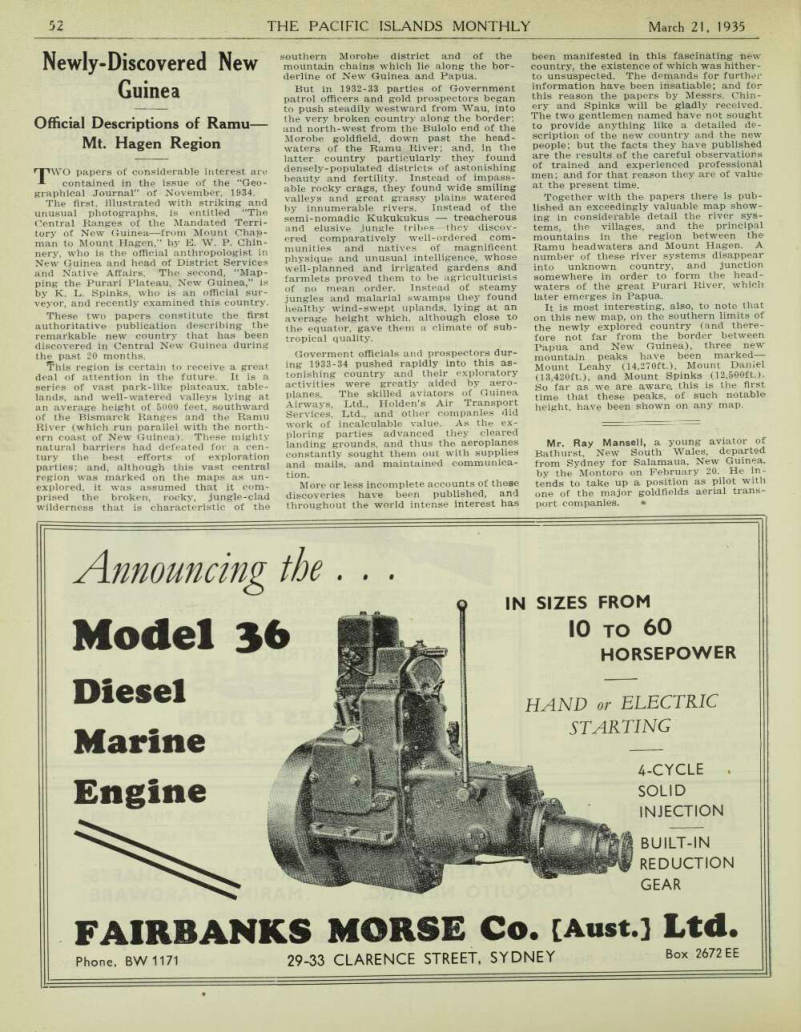
Guinea Official Descriptions of Ramu — Mt. Hagen Region
TWO papers of considerable interest are contained in the issue of the “Geo graphical Journal” of November, 1934.
The first, illustrated with striking and unusual photographs, is entitled “The Central Ranges of the Mandated Terri tory of New Guinea —from Mount Chap man to Mount Hagen,” by E. W. P. Chin nery, who is the official anthropologist in New Guinea and head of District Services and Native Affairs. The second, “Map ping the Purari Plateau, New Guinea,” is by K. L. Spinks, who is an official sur veyor, and recently examined this country.
These two papers constitute the first authoritative publication describing the remarkable new country that has been discovered in Central New Guinea during the past 20 months.
This region is certain to receive a great deal of attention in the future. It is a series of vast park-like plateaux, table lands, and well-watered valleys lying at an average height of 5000 feet, southward of the Bismarck Ranges and the Ramu River (which run parallel with the north ern coast of New Guinea). These mighty natural barriers had defeated for a cen tury the best efforts of exploration parties; and, although this vast central region was marked on the maps as un explored, it was assumed that it com prised the broken, rocky, jungle-clad wilderness that is characteristic of the
southern Morobe district and of the mountain chains which lie along the bor derline of New Guinea and Papua.
But in 1932-33 parties of Government patrol officers and gold prospectors began to push steadily westward from Wau, into the very broken country along the border; and north-west from the Bulolo end of the Morobe goldfield, down past the head waters of the Ramu River; and, in the latter country particularly they found densely-populated districts of astonishing beauty and fertility. Instead of impass able rocky crags, they found wide smiling valleys and great grassy plains watered by innumerable rivers. Instead of the semi-nomadic Kukukukus treacherous and elusive jungle tribes —they discov ered comparatively well-ordered com munities and natives of magnificent physique and unusual intelligence, whose well-planned and irrigated gardens and farmlets proved them to be agriculturists of no mean order. Instead of steamy jungles and malarial swamps they found healthy wind-swept uplands, lying at an average height which, although close to the equator, gave them a climate of sub tropical quality.
Goverment officials and prospectors dur ing 1933-34 pushed rapidly into this as tonishing country and their exploratory activities were greatly aided by aero planes. The skilled aviators of Guinea Airways, Ltd., Holden’s Air Transport Services. Ltd., and other companies did work of incalculable value. As the ex ploring parties advanced they cleared landing grounds, and thus the aeroplanes constantly sought them out with supplies and mails, and maintained communica tion.
More or less incomplete accounts of these discoveries have been published, and throughout the world intense interest has
been manifested in this fascinating new country, the existence of which was hither to unsuspected. The demands for further information have been insatiable; and for this reason the papers by Messrs. Chin ery and Spinks will be gladly received.
The two gentlemen named have not sought to provide anything like a detailed de scription of the new country and the new people; but the facts they have published are the results of the careful observations of trained and experienced professional men; and for that reason they are of value at the present time.
Together with the papers there is pub lished an exceedingly valuable map show ing in considerable detail the river sys tems, the villages, and the principal mountains in the region between the Ramu headwaters and Mount Hagen. A number of these river systems disappear into unknown country, and junction somewhere in order to form the head waters of the great Purari River, which later emerges in Papua.
It is most interesting, also, to note that on this new map, on the southern limits of the newly explored country (and there fore not far from the border between Papua and New Guinea), three new mountain peaks have been marked Mount Leahy (14,270 ft.), Mount Daniel (13,420 ft.), and Mount Spinks (12,500 ft.).
So far as we are aware this is the first time that these peaks, of such notable height, have been shown on any map.
Mr. Ray Mansell, a young aviator of Bathurst, New South Wales, departed from Sydney for Salamaua, New Guinea, by the Montoro on February 20. He in tends to take up a position as pilot with one of the major goldfields aerial trans port companies.
Advertisements & other items, p. 54 (1 item)
Announcing the.. .
Model 36
Diesel
Marine
Engine
IN SIZES FROM
10 to 60
HORSEPOWER
HAND or ELECTRIC
STARTING
4-CYCLE .
SOLID
INJECTION
BUILT-IN
REDUCTION
GEAR
FAIRBANKS MORSE Co. [Aust.] Ltd.
Phone. BW 1171 29-33 CLARENCE STREET. SYDNEY Box 2672EE
First Belgian Ship at Tahiti
From Our Own Correspondent.
Papeete, Feb. 9.
Belgian school ship, “Mercator,” a steel-built barque with auxiliary power, came into Papeete Harbour in the middle of January. As this was the first time that a vessel flying the Belgian flag had been seen in Tahiti, her arrival was something of an event, and she was ac corded an enthusiastic reception.
Official visits to His Excellency Gov ernor Montagne and the Mayor of Papeete (Mr. George Bambridge) were paid by Commandante Van de Sanie. He also placed a splendid wreath upon the monu ment to the Tahitian soldiers killed in the Great War. During the ceremony the band from the Ecole des Freres de Ploer mel rendered the Marseillaise and the Brabancone —the National Anthems of France and Belgium.
A native style fete was held in honour of the visitors at the beautiful King Albert Park, at Papeete. This was fol lowed by an animated ball in the open air, which, in true Tahitian style, did not end till well after daybreak.
The Mercator came to Papeete by way of the Canary Islands, Martinique, Gua quil, Easter Island, and Pitcairn. By arrangement with the Chillian Government, two large stone images were picked up at Easter Island for the Trocadero Museum in Paris and the Museum at Brussels.
Dr. Metraux, from the Trocadero Museum, and Dr. de Lavacherie, from the Brussels Institution were passengers on board.
Mission Launch Shipped to New Guinea
New Guinea
The new 40ft, Seventh Day Adventist mission launch Malalagi, built in Sydney in January, was shipped to New Guinea as deck cargo by the February Montoro. Embodying several new feat ures for ocean-going craft, the launch was built specially for tropical conditions by Lars Hal vorsen at Neutral Bay.
Mr. H. R. Steed, the S.D.A. missionary in charge of the launch, also left for the Territory by the Montoro, with his wife and son. After leaving the Montoro, Pastor Steed, with a party of S.D.A. workers, took the boat to Mussau Island, in the St. Matthias Group, about 100 miles north of New Ireland. The party landed at Bolin, where the head S.D.A. school for the Mandated Territory was recently established.
Mr. Steed, who formerly was at Buresala Train ing School for native teachers at Ovalau, Fiji, said that almost £2000 had been subscribed for the new launch. As it cost only £1300, the balance of the subscribed money is being devoted to the construction of another mission boat. Work on tthis new craft has been already commenced at Halvorsen’s shipyards.
Injuries
Died From Storm
Cook Is. Official
Mr. CECIL J. BOUCHIER, Director of Agriculture at Rarotonga, died as an indirect cause of the cyclone in the Cook Islands last month. He was caught and carried along by a great wave, and his leg was broken. Dr. Ellison, medical officer in charge (who was also acting as Resident Commissioner in Judge Ayson’s absence), had to amputate the leg beneath the knee. At first it was believed that Mr.
Bouchier was making good progress, but complications set in and he lost his life.
Mr. Bouchier had had an extremely use ful experience in other parts of the Pacific and his late post was considered one of the most important, because of his expert knowledge of citrus fruits, in the Cook Group. The New Zealand Prime Minister (Mr. Forbes), who is also Minister in Charge of the Cook Islands, declared that Mr, Bouchier would be a difficult man to replace.—E.R.
French Scouts at Noumea
From Our Own Correspondent.
Noumea, Feb. 6.
A party of 24 French Boy Scouts, who attended the Australian Jamboree at Melbourne, arrived here recently by the Laperouse, en route to France via the South Seas and Panama Canal.
On arrival they were welcomed by the troop of New Caledonian Scouts and, later, M.
Schlemmer placed a wreath on the Monument Aux Morts in honour of those brave New Caledonians who fell in the Great War. The party visited many places of interest in the nearby towns, and tramped many miles through the country districts.
They sailed for Marseilles by the Ville de Strasbourg after spending four days in the Colony.
Advertisements & other items, pp. 55-56 (1 item)
Durabestos
Find out What’s Inside
before you buy a low-priced Saddle.
THE KING OF ’EM ALL
Is a "Safer" Saddle and offers Sensational Advantages Being built on a Rustless Tree, heavily bar plated, and strained with English web, riders are assured of its genuine foundation. Its soft, pliant kip flaps are hardwearing, while the sweepy seat gives superb riding comfort.
Fitted with Best Leather, Folded Girth, Stirrups Freight Free.
Capped Pads as illustrated, 15/- extra.
Write for Catalogue P 1935.
SYDNEY’S HIGH-CLASS
SADDLER.
Newmarket Saddlery
W. H. Williams for “Safer” Saddles
18-20 WILSON ST., NEWTOWN
N.S.W.
WUNDERLICH
DURABESTOS
ISLAND HOME BUILDERS.—You can now
erect everlasting Homes quickly and at LOW COST by using DURABESTOS (Asbestos Cement) Building Sheets for Walls and Ceilings.
Big, sturdy sheets —economical to transporteasy to fix—fireproof—does not need painting Write for prices and Free Catalogue, “Durabestos Homes of Colourful Beauty,” WUNDERLICH LTD
Box 474 AA, G.P.O., SYDNEY.
RESISTS TIME - WEATHER - WHITE ANTS
BULLIVANTS wire ropes
“THE WORLD’S STANDARD”
LARGEST STOCKS IN AUSTRALASIA ... FOR ALL PURPOSES Also Blocks, Hooks, Shackles, Thimbles, Strand, Seizing, Aircraft Cord, etc.
Letters: BULLIVANTS’ Australian Co. Ltd. Telegrams:
Box 1298 J, G.P.O. 331-333 KENT STREET, SYDNEY Prompt Attention! Efficient Service!! Complete Satisfaction!!! ‘Bullivants Ltd.,’
Sydney.
Useful Gifts
Ladies’ Scissor Case, made of fancy leather, containing 4 pairs nickle-plated Scissors, 37/8 containing 3 pairs ruckle-plated Scissors, 25/
NEW EMPIRE MODEL WILKINSON
SAFETY RAZOR
This is a Self-stropping Razor, without removing the blade from the frame No. 7. —Same as above, with 2 blades, 14/8 Extra Blades (packet of five) 7/6 each Postage 3d.
Post Free for cash with order.
Send for Illustrated Catalogue Post Free.
W. JNO. BAKER Ltd.
3 HUNTER STREET, SYDNEY
THE BRIDGE BIRD SHOP
For Well-bred Birds, Dogs, Persian Cats and other Animals All Pedigreed at Reasonable Prices We Buy as Well as Sell Islanders are Invited to Communicate
6 JUNCTION STREET NORTH SYDNEY
BE A SOCIAL SUCCESS—LEARN TO PLAY THE
PIANO In Modern Dance Style
BY OUR SPECIAL CORRESPONDENCE COURSE
You are never too old to learn. Whether you have had previous experience with the piano or not, our course will teach you rapidly. Everything is carefully graded, making it concise and the essence of simplicity. Only the one course needed to make you a proficient pianist.
Moderate Fees. We guarantee results. Write for our prospectus. Mr. Hammett
At HAMMETT’S
SCHOOL OF MODERN DANCE MUSIC
3rd FLOOR, REVUE HOUSE, 106 KING ST., SYDNEY
will personally
test, select, and have shipped any Musical Instrument that any of our readers may be interested in, free of charge.
Fashion Hints for Islands Women
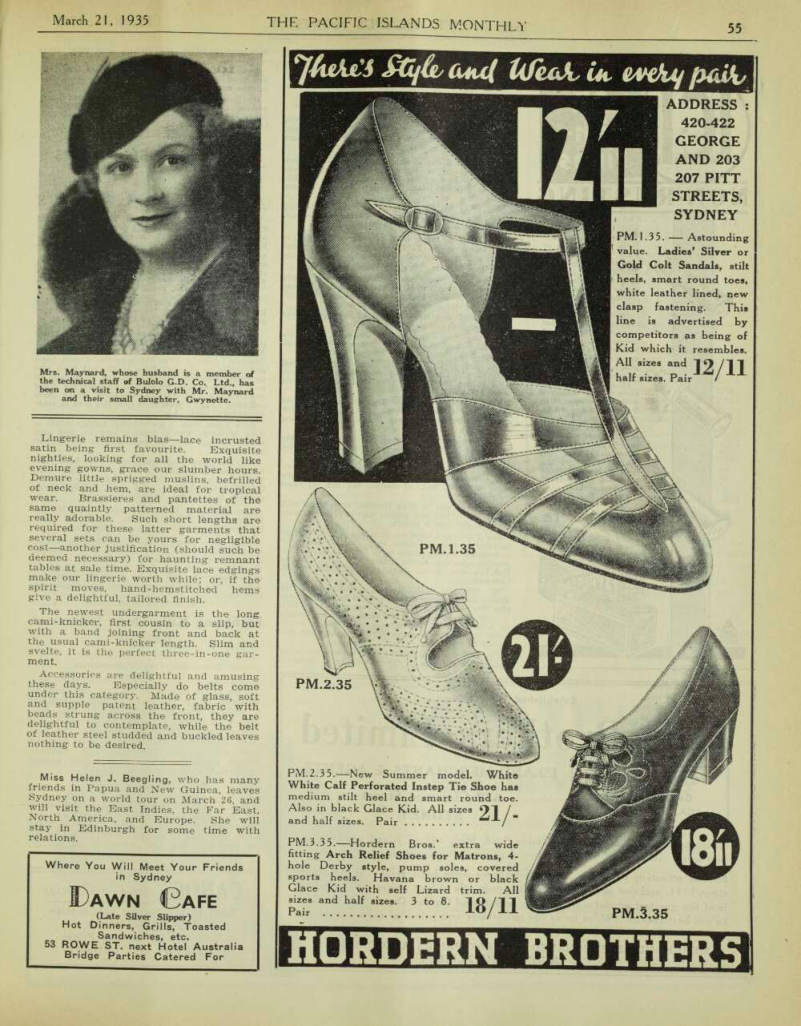
By Therese
NEARING a change of seasons, the jaded eye hails with delight any new idea that gives a new lease of life to our slightly jaundiced wardrobe. Bits and pieces, popped here and there with an in genuity that is surprising, lift clothes that have lost their pristine freshness to the heights. Equally is this true of both day and evening gowns.
Sales being everywhere, the woman of discernment sees in short lengths the medium for many changes. She wears yokes, but is not bowed down, so she chooses a short length of lace to make the most fascinating yoke for an afternoon or evening gown of simple design. The resultant success is exhilarating . Again, any short lengths may form a colour con trast in the way of sleeves, collars or peplums.
Gathered ruffles peep from out the neckline of a close fitting jacket with a softening effect that is essentially femi nine. For evening, a soft fluttering scarf ties high at the throat, and falls in lovely folds to the floor.
A delightful rejuvenation medium is the plaited ties of gaily coloured wools, knot ted at the neckline. Gaily coloured plaid taffetas form the most jaunty and fas cinating scarves to wear with an en semble. So supple is this material that whichever way clever fingers may twist it, chic is its portion. Large jabots of the same adaptable silk are equally suc cessful.
Sashes are more popular than ever.
Matching, contrasting, or a combination of colours, they do delightful things to one’s frocks. Large striped sashes, widen ing out to a train, are most effective on a simply-cut gown of black or white, and are astonishingly smart. A sash of velvet ribbon looped like a hangman’s noose, falls to the knees with most unusual effect. A huge taffeta bow at the hip gives a slimness unbelievable.
Sleeves are teeming with interest and come in many shapes—high set-in sleeves with sloping shoulder effect, wide set-in sleeves loose to the wrist like a nun s
habit, sleeves shirred, their fullness fall ing below the elbow, sleeves slim and straight to the wrist or the very newest three-quarter effect —and all are charm ing, offering as they do great scope for individuality.
Blouses and skirts have a host of devo tees, and are a marvellous standby in one’s wardrobe. Skirts have many ups and downs, and the newer models tilt surprisingly upwards in the front while trailing floorwards at the back. The slashed skirt mode still persists and is both comfortable and attractive, reveal ing as it does, ever and anon, a discreet glimpse of silken-clad nether limb. Skirts are still cut on the cross, giving that lovely svelte line. Wrap-on skirts are the answer to the prayer of the pleasingly plump. The crossover bodice with softly falling revers is a fitting accompaniment, its slenderizing lines being most flatter ing to the full figure.
A reversal of form is the skirt of silver lame topped by a satin blouse. A little startling, but of undoubted chic.
O’er the tight-fitting bodice of a black taffeta evening gown huge revers of silver lame, for all the world like a shining breast-plate, give a Puritan effect that is belied by the almost backless decolletage.
The skirt flows voluminously from slim hips.
A slim sheath-like evening gown of soft flame-coloured satin, shrieking sophisti cation in its utter simplicity, has as sole adornment a gold gauze rose at the deep- V neckline. Large gold filagree ear-rings and sandals, body and sole held together by strips of gold kid, make loveliness com plete.
We sing a paean of praise to the cape,, for it comes in sizes and shapes innumer able and covers a multitude of discrepan cies in our wardrobes.
A pleated mariette cape falling to the knees is a fitting accompaniment to a frock of the same softly feminine material.
Shoulder capes of taffeta, tightly box pleated into a yoke, tie high at the neck with an enormous bow. Capes of tulle or fine silk net, shirred with incredible fineness, are dream-like possessions, en trancing in their fairy-like effect, and are aired on every possible occasion with smug self-satisfaction.
Shirt frocks continue to give yeoman service and are a wonderful standby for every hour of the day. There are many variations of them and all successful. It has its skirt pleated, plain, or slashed, and sports many varieties of buttons.
The suit of string linen also holds its own. It is very distinctive when worn with a navy spotted blouse and navy accessories, and proves a delightful change from the inevitable brown which seems a natural combination with string and beige shades.
The Cossack influence is still with us, not so much in the tunic as of yore, but in the bloused and belted coat and cap, and these spell chic personified. Short jackets hold pride of place in the en semble. Swaggers are seen, but in modi fied form only. Jackets need not match the dress, but clever colour contrasts may be introduced. Box pleated short coats, their pleats flaring widely and dipping at centre back are extremely smart when worn over a plain frock which has that poured-in effect, achieved only by virtue of having been cut on the cross.
Lingerie remains bias—lace incrusted satin being first favourite. Exquisite nighties, looking for all the world like evening gowns, grace our slumber hours.
Demure little sprigged muslins, befrilled of neck and hem, are ideal for tropical wear. Brassieres and pantettes of the same quaintly patterned material are really adorable. Such short lengths are required for these latter garments that several sets can be yours for negligible cost—another justification (should such be deemed necessary) for haunting remnant tables at sale time. Exquisite lace edgings make our lingerie worth while; or, if the spirit moves, hand-hemstitched hems give a delightful, tailored finish.
The newest undergarment is the long cami-knicker, first cousin to a slip, but with a band joining front and back at the usual cami-knicker length. Slim and svelte, it is the perfect three-in-one gar ment.
Accessories are delightful and amusing these days. Especially do belts come under this category. Made of glass, soft and supple patent leather, fabric with beads strung across the front, they are delightful to contemplate, while the belt of leather steel studded and buckled leaves nothing to be desired.
Miss Helen J. Beegling, who has many friends in Papua and New Guinea, leaves Sydney on a world tour on March 26, and will visit the East Indies, the Far East, North America, and Europe. She will stay in Edinburgh for some time with relations.
Mrs. Maynard, whose husband is a member of the technical staff of Bulolo G.D. Co. Ltd., has been on a visit to Sydney with Mr. Maynard and their small daughter, Gwynette.
Advertisements & other items, pp. 57-58 (1 item)
Hordern Brothers
There's style and wear in every pair
ADDRESS :
420-422
GEORGE
AND 203
207 PITT
STREETS,
SYDNEY
PM. 1.35. Astounding value. Ladies’ Silver or Gold Colt Sandals, stilt Keels, smart round toes, white leather lined, new clasp fastening. This line is advertised by competitors as being of Kid which it resembles.
All sizes and half sizes. Pair 12/11 PM.1.35 PM. 2. 35 PM. 2.3 s.—New Summer model. White White Calf Perforated Instep Tie Shoe has medium stilt heel and smart round toe.
Also in black Glace Kid. All sizes 21/and half sizes. Pair PM. 3.33. —Hordern Bros.’ extra wide fitting Arch Relief Shoes for Matrons, 4hole Derby style, pump soles, covered sports heels. Havana brown or black Glace Kid with self Lizard trim. All sizes and half sizes. 3 to 8.
Pair 18/11 PM.3.35
HORDERN BROTHERS
Where You Will Meet Your Friends in Sydney
Dawn Cafe
(Late Silver Slipper) Hot Dinners, Grills, Toasted Sandwiches, etc. 53 ROWE ST. next Hotel Australia Bridge Parties Catered For
NON-RUSTING
The signal success of “I.C.I.” and
EXPRESS ” .22 Rim
Fires is the result of the very latest scientific methods in production.
Both are loaded with smokeless powder in conjunction with the new developed noncorrosive I.C.I. priming composition that assures accurate and speedy ignition, whilst the use of an entirely new progressive burning smokeless powder in
“I.C.I. - EXPRESS ”
gives higher velocities with low pressures.
Sure and swift “I.C.I.” .22’s are ammunition that the small - game shooter can absolutely rely upon and know, too, that they protect the bore of his rifle from rust and make cleaning unnecessary.
Obtainable
Everywhere
In Short, Long, and Long Rifle, Solid and Hollow Point.
Established N.H. 1894
Kerr Brothers Limited
G.P.O. Box 3838 T
Cable Address:
“CARE SYDNEY”
ISLAND MERCHANTS & AGENTS
139 Clarence Street
SYDNEY
Consign Copra. Cacao, Coffee, Castor Seed, Shell and all Island produce for best sale. Advance of 80% of value, if desired, at time of shipment overseas.
Special attention to Cocoa Beans, which wc have been selling in Australia since 191 I. and can obtain regular and ready sale at best prices. Preparation is of the greatest importance, and we recommend Gordon Dryers and Graders to get best results. Write to us for particulars and prices of these machines. merchandise purchased at best prices and original
INVOICES SUPPLIED
Wau Notes
From Our Own Correspondent.
Edie Ck., Feb. 24.
MISS J. PARER has been staying on the Creek for the past week, together with her cousin, Miss G. Luttrell, of Melbourne, who is here on a holiday. They stayed at the Hotel Edie.
Mr. Frank Brenton who has been at Day Dawn for the past three years as mine foreman, was given a send-off by his fellow-employees. He has gone to Misima Island (Papua), for the Pratten Co.
Mr. W. C. Abbie, has left for another holiday South, his second since Xmas. During his absence, “Nobby” Clarke has charge of his lease.
The following have been recently added to the Day Dawn staff, T. G. Blakey (general man ager), R. Greenwood (assayer), W. Wesley (assayer), and A. Anderson (mine manager).
Edie Creek people are holding a benefit sports meeting for the late Mr. Charlie Ramm, who was employed at Day Dawn for a considerable time.
There will be a dance in the evening.
Mr. J. Passlow has returned to the Creek after three months’ holiday South.
Mrs. Rex, who has been goldmining on Lyall’s Creek, has packed up and is now working a claim on the Edie.
Mr. and Mrs. N. P. H. Neal paid a hurried visit to the Creek during the month. It takes a lot to get them away from their beautiful little home at Wau.
New Guinea Goldfields Ltd. power line from Bulolo has been completed, and they are now drawing their power from Bulolo Gold Dredging Co., over 13 miles of power line.
Day Dawn’s late manager (Mr. Dermott-Smith) has settled in Wau. He is going into business with his old friend, Jack Spence.
Mr. J. Ashcroft returned to Edie by the Mon toro after three months’ leave. He is still the same old Jim, but, of course, has put on more weight.
Niall Lane was in Wau Hospital for a week with fever, but is out and smiling again. He had only been on the field a month.
Ray Parer and Geoffrey Hemsworth are expected to return to New Guinea very shortly, and what a welcome awaits them here. During Mr. Hems worth’s absence Kevin Parer has been keeping P.A.T.’s flag flying, with the assistance ot M.
Cameron.
W. (“Bill”) Cash arrived recently from the Watut area and spent a few days in Wau. Even the Watut country does not seem to stop Bill, it is a pity he never went to the Empire Games he is the fastest walker in these parts, as we all know too well. Ted Nichterlein is another who should be hobbled.
The new swimming baths at Salamaua are being opened on Saturday. They will be a boon to
Salamaua residents and visitors from other parts of Morobe.
Mrs. D. Lyall is off to Rabaul next boat, she has been staying at the Hotel Edie for some months now.
By the next Macdhui will arrive Dermott Lane, making three Lanes on the goldfields; Niall and Brian being both at Day Dawn. There will soon be as many Lanes in Morobe as Parers.
N.G. Goldfields News
EDIE CK., February 13.
AROUSING send-off was given recently to popular Bob Farr, who has been engineer at Day Dawn for four years. Bob has left for New Zealand to take over a big mining concern at Greymouth and will be greatly missed. The hotel at Upper Edie was en fete when 40 guests sat down to a sumptuous dinner, much “bubbly” and a dance following, in honour of Bob, who, when attempting to reply to the very flattering remarks of his friends, was quite overcome and just said, “You’re great coves, thank you everybody.”
Ken Austin, the electrical engineer at Golden Ridges has had more honours showered on him and is now in charge of all the electrical plant.
The Kirke Bros. (Clem and Hunter) have called their new farm “Bukit Bharn,” which is the Malay for “New Garden.” These enterprising “diggers” have a large consignment of stud fowls and ducks on the way from South, and have also imported some Berkshire sows. It is worthy of note that oranges, lemons and bananas are doing exceptionally well on this plantation, which bears out Mick Leahy’s contention that this area is great agricultural land.
Back again from a six months’ holiday South is Alex Malcolm, who is looking very fit, and once more working with his partner, Len Budger, at the Merri.
Mr. and Mrs. J. Nason Jones, who have been honeymooning in New Zealand, are expected back very shortly. Mrs. Nason Jones is a niece of G.O.M. Artist Cummins, of Pymble, N.S.W., whose pictures hang in the National Gallery.
New arrivals at Day Dawn mine include Messrs.
R. Greenwood, of Uratha Mine, N.S.W., W. Wes ley from Queensland, and young Niall Lane.
Anzac Day—April 25—at Wau (Morobe branch of the R.S. and S.L.) promises to be a big event in this part of the world. ’Planes will bring all the Diggers from various districts. After the celebrations, there is to be a sports meeting, a dance at the hotel in the evening, and a gala pic ture show.
Ba, Fiji
Lightning Kills Three Indians at Ba, Fiji
From Our Own Correspondent.
SUVA, March 2.
The little town of Ba, on the north western coast of Viti Levu, experienced a sudden and severe thunderstorm, fol lowed by heavy rainfall, on February 21.
Near the village of Natanuku an In dian dwelling containing seven persons was struck by lightning and burned.
Three Indians —a youth and two young children —were killed outright.
Mr. F. T. (“Tommy”) O’Dea, the popular general manager for Holden’s Air Transport Services in the Mandated Ter ritory, arrived in Sydney from New Guinea by the Macdhui on March 5, on annual furlough.
Advertisements & other items, p. 58 (1 item)
CANOES, Iron or Canvas
Built to the highest specification Suitable for Islands 7 to 10ft. Lowest Prices
131 KENT ST., SYDNEY
the Tropics
The Baby’s Bottle in the Tropics
By Christina.
AFTER every meal make the nurse or cookboy wash the bottle in cold water, and boil it in a covered saucepan. This is later removed from the fire and placed in toto on a tray, on the baby’s food table, to await the next meal.
Should the mother be in poor health, and unable to attend to other details, it is better to have the rubber teat washed with cold water, and boiled with the bottle.
Be sure the boy knows how to “make a bottle” for the baby. Watch him make It and feed the baby (lying in his cot) until you are satisfied that he will do it pro perly if an emergency should arise. The mother of a young baby is very suscep tible to malaria in places where it is prevalent. Once I went to bed with a high temperature for several days, and had no woman neighbour to come and take charge of my home. The boy did everything for both baby and toddler, and they pulled through all right, though I should hate it to happen again.
For this reason one cannot beat Vi Lactogen for a young baby and Lactogen for an older one. The manufacture of a mixture with boiled milk, emulsion, and milk sugar, is not suited to unskilled black labour.
Don’t be in a hurry to discard the bottle for this same reason. I righteously de parted from its use for my first baby when he was nine months, and it was the greatest mistake I ever made with him.
A teething baby, or one up to eighteen months, being put on to new foods, will probably refuse to take food from a boy.
But he’ll always take a bottle. Raw egg (if baby is used to it) can be shaken up with the milk, or the Lactogen can be made very strong, and given from an old teat with a large hole. A baby resolutely refusing solid food, for teething or other reasons, can be tided over a bad few days in this way till he is ready to eat again.
No good comes of letting a baby go hungry in the tropics—contrary to all other advice from excellent people whose time-tables for feeding are drawn up to suit other climes. I know
a tropical doctor, who, like myself with regard to his elder child and mine, ob served carefully the recognised rules for hot weather, some of which are: A weaker mixture of food for hot weather, and not pushing food when the child was not hungry. Our two elder children are very light, with an appearance of being under fed, and not much appetite. The younger child in both cases was given a stronger mixture of bottle food, and not refused a second bottle if the child were hungry for it. Both our younger ones are really lovely specimens of childhood. This doc tor told me he had definitely concluded that so far from a weaker mixture being desirable for a child in the tropics, a stronger mixture than normal seemed indicated.
Also another reason for urging the con tinued use of a bottle is the ease with which an aperient can be administered.
Milk of magnesia is readily taken in a bottle. Also, should there be any fear that the baby may be developing malaria, two grains of powdered ethlycarbonate of quinine (tasteless), can be included in the bottle.
I am not saying that these instructions represent the ideal. Far from it. But if illness comes to you in the tropics and for some days the care of your baby de pends on a native boy, these hints will enable the baby to pull through the try ing days without loss of weight or sleep, or impairment to the system from under feeding.
A Big International Event
With a rapid growth since its inception in 1904, the Paris International Trade Fair is to-day one of the most important events of international com merce. For buyer and manufacturer alike it offers invaluable opportunities for the study and promo tion of overseas trading. More than 8,000 firms, representing 33 countries, annually exhibit at the Fair, occupying the huge space of 4,000,000 sq. ft., and showing to over 2,000,000 visitors. Practically every industry is represented with products of craftsmen from all nations. Whatever your in terest, you will find products of intimate appeal, and whatever you may manufacture, you will find buyers and visitors directly interested in your display. Held from May 18 to June 3, the Trade Fair coincides with the Spring and early Summer, when Paris is at its gayest and brightest, and in true gala dress. For information regarding trans port concessions and ticket discounts, intending visitors should communicate with the Trade Com missioner for France, Bank of N.S.W. Chambers, Wynyard Street, Sydney.*
Advertisements & other items, p. 59 (1 item)
Foundations
FROM SYDNEY
Consult Sydney’s leading Corset Specialist, and obtain a perfectlyfitting, “true-to-type” Berlei by post. Write for FREE Booklet on Health, Diet, Exercise, your Foundation Garment. It’s so easy to choose a Berlei with Madame Hurley’s skilled assistance. 900—Strong Front-lace Foundation with inner vest. Splendid for abdominal control and reducing.
Waists: 22-36. Price 27/6.
MADAME
HURLEY
342 Pitt St., SYDNEY.
Mrs. N. WALKER - FLYNN,
Late 35 POWELL STREET, COOGEE
COSTUMIERE,
MALAGUNA ROAD, RABAUL
HEMSTITCHING and PICOT EDGING.
Copies of Mab’s Fashions; Roma’s Pictorial Fashions and Home Fashions available — P.O. Box 116. Tel.: 141
A. E. MATTHEWS
Manufacturer of the FAMOUS
“MATTHEWS” BOOTS
Specialising in Heavy Footwear
Standard Screwed Fair Stitch and Machine Sewn.
WHOLESALE ONLY
Enquiries from Traders solicited Catalogues and Price Lists on application We specialise in Island Footwear Trade.
A.E. MATTHEWS. JOHN ST., LEICHHARDT, N.S.W.
Vale Burleigh
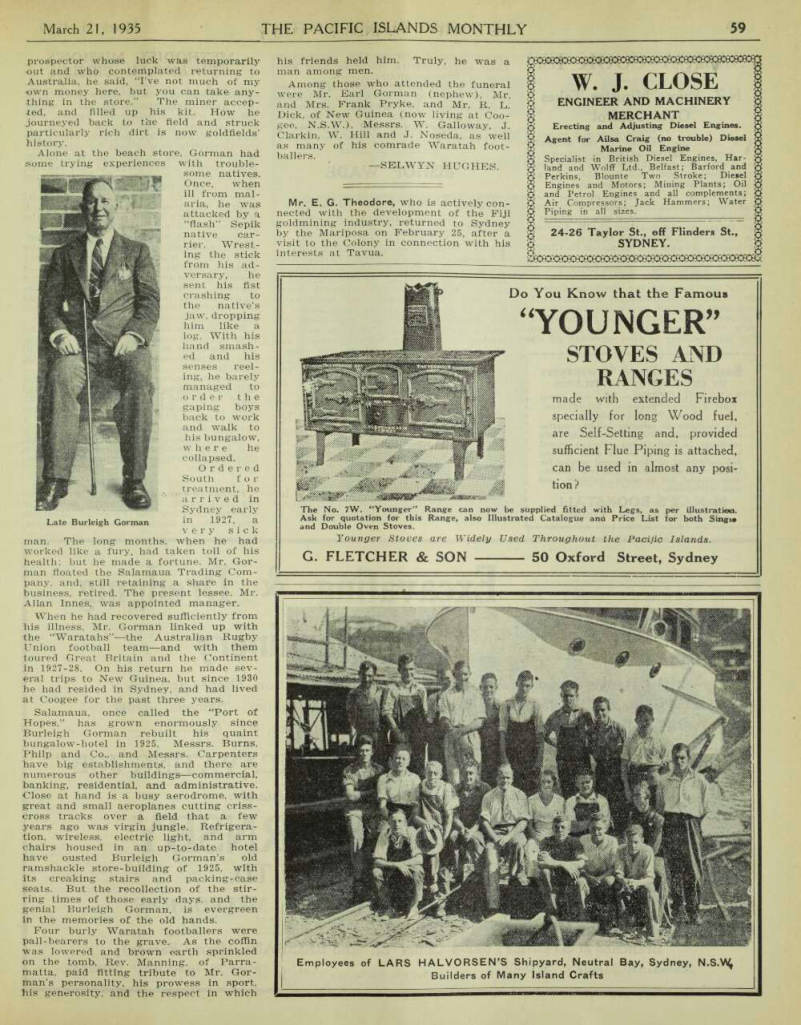
Gorman
Death of Well-known Pioneer of Salamaua, N.G.
AS the sun glittered on the silver coffin rails and the fragrant scent of white flowers and red pervaded the still heat of a February afternoon, Burleigh Gorman, footballer, miner, soldier, New Guinea prospector, storekeeper, and prince of good-fellows was laid to his last rest. For three weeks in a private hospital at Rand wick, N.S.W., he had waged a losing battle with Death and, finally, on February 27, at the age of 66, he succumbed to a serious illness, complicated by a recurrent attack of malaria.
BURLEIGH GORMAN, typical of those Australian pioneers who blazed the path on the New Guinea goldfields, and helped to bring to an eager world the vast dormant wealth of the Morobe gold fields, had an incredibly varied career.
Possibly not half a dozen men in the whole of the Mandated Territory knew his correct name—Alexander William — but as “Burleigh” Gorman he was known and beloved by all whom the rays of his warm personality descended on.
Born at Bloomfield station, near Yass, Southern New South Wales, on October 22, 1868, he went to Sydney at an early age, and there became well-known in sporting circles —especially Rugby Union football. After engaging in various commercial businesses in N.S.W., he
joined the rush to the Western Austra lian goldfields in the ’nineties, and for some years was mining at Kalgoorlie and Coolgardie fields.
After the outbreak of the Great War, he enlisted in the Miners’ Corps at Blackboy Hill Camp, W.A., being drafted to New Guinea. After service at Rabaul, he was discharged from the army as medically unfit, and returned to Sydney for home service at Liverpool Camp, N.S.W. On being demobilised he pur chased a store at Leeton in the N.S.W.
Irrigation Area, and remained in that charming district regaining his health for a year or so. But Burleigh Gorman had breathed the disturbing air of dark New Guinea, and his restless spirit bade him return to the land that called.
It was sometime in 1924 when he made his way to Rabaul and thence across to the mainland, plunging into the jungle to join the other pioneers seeking the elu sive yellow gleam. Finally, he drifted to Koranga Creek, where gold was being won by such early goldfields’ identities as the mysterious Sharkeye Park, Nettle ton the rover, the lean Queenslander Joe Sloan, and C. J. Levien. the tireless vis ionary to whose grit and energy New Guinea owes so much.
For weeks and months Burleigh Gor man struggled on, prospecting; winning sjmalli quantities of gold, only to see it swallowed up by the heavy expense entailed in getting supplies. Bad luck dogged his efforts, and, though most of the other pioneers reaped huge fortunes in those early days, Gorman could not “strike it rich." Time went on, and on one occasion on a trek to Salamaua to obtain supplies he met Captain Will Money, who had erected a palm-thatched
store-shed on the little strip of tropical beach at Salamaua. They chummed up, and Money, eager to get on to the field to join his pal, Dick Glasson, who was on good gold, asked Gorman to take over his little depot.
Within several months Gorman had bought the store, rebuilt it into a two storey bungalow, and erected a jetty on the beach. That was in 1925. Soon after wards arrived the advance-guard of the rush, clamouring to get to the field. By the old Marsina they came; veteran pros pectors—wrinkled and toothless, with a wise eye and taciturn manner, and young tyros fresh from the cities —the cuff and collar team, with loads of hope, vague ideas, not much money, and still more hope.
It was Burleigh Gorman who checked their stores and equipment, sorted their tools and belongings, collected their junk and battered suitcases that littered the narrow palm-fringed isthmus after the B.P. boat steamed away. It was Gor man who helped and encouraged them, provided them with a string of sweating native boys to carry the precious pro visions up the mountains and through the jungle track on a 14-days’ tortuous journey to Wau, the Mecca of those feverish, struggling, gold-hungered pros pectors.
Gorman became the miners’ general and shipping agent; looking after their stores, packing their carriers with fresh provisions, transacting their business, and taking care of their hard-won gold.
On one occasion there was £50,000 worth of the cherished metal in bags, battered tins and crazy parcels lying in his rickety store, awaiting shipment South.
The amiability and generosity of Bur leigh Gorman became by-words among the early men. To one well-known
prospector whose luck was temporarily out and who contemplated returning to Australia, he said, “I’ve not much of my own money here, but you can take any thing in the store.” The miner accep ted, and filled up his kit. How he journeyed back to the field and struck particularly rich dirt is now goldfields’ history.
Alone at the beach store, Gorman had some trying experiences with trouble-
some natives.
Once, when ill from mal aria, he was attacked by a “flash” Sepik native car rier. Wrest ing the stick from his ad versary, he sent his fist crashing to the native’s jaw, dropping him like a log. With his hand smash ed and his senses reel ing, he barely managed to order the gaping boys back to work and walk to his bungalow, where he collapsed.
Ordered South for treatment, he arrived in Sydney early in 1927, a very sick
man. The long months, when he had worked like a fury, had taken toll of his health; but he made a fortune. Mr. Gor man floated the Salamaua Trading Com pany, and, still retaining a share in the business, retired. The present lessee, Mr.
Allan Innes, was appointed manager.
When he had recovered sufficiently from his illness, Mr. Gorman linked up with the “Waratahs” —the Australian Rugby Union football team —and with them toured Great Britain and the Continent in 1927-28. On his return he made sev eral trips to New Guinea, but since 1930 he had resided in Sydney, and had lived at Coogee for the past three years.
Salamaua, once called the “Port of Hopes,” has grown enormously since Burleigh Gorman rebuilt his quaint bungalow-hotel in 1925. Messrs. Burns, Philp and Co., and Messrs. Carpenters Tiave big establishments, and there are numerous other buildings—commercial, banking, residential, and administrative.
Close at hand is a busy aerodrome, with great and small aeroplanes cutting criss cross tracks over a field that a few years ago was virgin jungle. Refrigera tion, wireless, electric light, and arm chairs housed in an up-to-date hotel have ousted Burleigh Gorman’s old ramshackle store-building of 1925, with its creaking stairs and packing-case seats. But the recollection of the stir ring times of those early days, and the genial Burleigh Gorman, is evergreen in the memories of the old hands.
Four burly Waratah footballers were pall-bearers to the grave. As the coffin was lowered and brown earth sprinkled on the tomb. Rev. Manning, of Parra matta, paid fitting tribute to Mr. Gor man’s personality, his prowess in sport, bis generosity, and the respect in which
his friends held him. Truly, he was a man among men.
Among those who attended the funeral were Mr. Earl Gorman (nephew), Mr. and Mrs. Frank Pryke, and Mr. R. L.
Dick, of New Guinea (now living at Coo gee, N.S.W.), Messrs. W. Galloway, J.
Clarkin, W. Hill and J. Noseda, as well as many of his comrade Waratah foot ballers.
Selwyn Hughes.
Mr. E. G. Theodore, who is actively con nected with the development of the Fiji goldmining industry, returned to Sydney by the Mariposa on February 25, after a visit to the Colony in connection with his interests at Tavua.
Late Burleigh Gorman
Advertisements & other items, pp. 60-61 (1 item)
Reliable ... Economical
For thoroughly dependable power at the lowest possible cost, Petter Atomic Diesel Engines are supreme. With their simple design and robust construction, Petter Engines are trouble-free in operation and require no skilled attendant. The
low operating speeds and light bear-
ing pressure ensure a remarkable length of life.
Write now for full details of these reliable, economical, British power units.
Atomic Diesel Engines
Cold Starting, Heavy Oil in Stationery and Marine Types, Auxiliary and Electric Lighting Sets. Sizes from 5 B.H.P. to 540 also the famous Petter Type Semi-Diesel Engines. Agents and Spare Parts Stockists
Dependable
“Buzacott” Lines
The “DIGGER” WINCH
A light, portable, one-man machine with enormous power. It will uproot any tree or stump with little effort.
“ALSTON” WINDMILLS
Well - built, light - running models at prices to suit every pocket.
“GILCO” ELECTRIC LIGHT
PLANT
Wind-driven ... no fuel costs.
A proved success.
BUZACOTT ‘NEW RECORD’
DRAG-SAW
Economical, speedy and efficient. Easy to handle, thoroughly reliable and wellbalanced.
“BUZACOTT” SPRAY
PUMPS
Reasonably priced, well coi. structed and absolutely reliable.
“BUZACOTT” GATES and
FENCES
Also Chain Wire, all meshes and gauges, for Copra Trays.
W. J. CLOSE
ENGINEER AND MACHINERY
MERCHANT
Erecting and Adjusting Diesel Engines.
Agent for Ailsa Craig (no trouble) Diesel Marine Oil Engine Specialist in British Diesel Engines, Harland and Wolff Ltd., Belfast; Barford and Perkins, Blounte Two Stroke; Diesel Engines and Motors; Mining Plants; Oil and Petrol Engines and all complements; Air Compressors; Jack Hammers; Water Piping in all sizes. 24-26 Taylor St., off Flinders St.,
SYDNEY.
Do You Know that the Famous
“YOUNGER”
STOVES AND
RANGES
made with extended Firebox specially for long Wood fuel, are Self-Setting and, provided sufficient Flue Piping is attached, can be used in almost any position?
No. 7W. “Younger Range can now be supplied fitted with Legs, as per illustration. for quotation for this Range, also Illustrated Catalogue and Price List for both Singte Double Oven Stoves.
Younger Stoves are Widely Used Throughout the Pacijic Islands.
G. FLETCHER & SON 50 Oxford Street, Sydney
Employees of LARS HALVORSEN’S Shipyard, Neutral Bay, Sydney, Builders of Many Island Crafts
Samoa-Cook Is.
N.Z. Prime Minister Takes Over Control
AN important change in the adminis trative control of native affairs of the territories administered by New Zea land —Samoa and Cook Islands —was an nounced at the end of February.
The Cook Is. Department has been transferred to the Department of External Affairs and is now under the direction of the Prime Minister (Hon. G. W. Forbes).
As Minister of External Affairs, Minister of Native Affairs and Minister in Charge of the Cook Islands, Mr. Forbes will have general Ministerial responsibility for all native matters.
The secretary of the Cook Is. Depart ment, Mr. S. J. Smith, will continue to hold that position under the direction of the permanent head of the Prime Minis ter’s Department, Mr. C. A. Berendsen.
The latter officer is also secretary of Ex
ternal Affairs, and in that capacity is chief administrative officer in New Zea land of Samoan affairs.
In referring to the change, Mr. Forbes said it would be of advantage to Islands administration in Rarotonga and Samoa to co-ordinate effort. It would also give greater opportunities and experience to officers engaged in the Islands services.
and Europe
Bishop Wade
Takes Useful Film to U.S.A. and Europe
MR. THOMAS WADE, Bishop of the Roman Catholic Church in the Northem Solomon Islands, has been responsible for the display in Australia of a cinema film which has aroused much interest. It presents the remarkable story of the work of the missionaries in the Pacific Islands and the conditions which they face when they go to those places. It is aptly called “Saints and Savages,” and no more effective propaganda could be devised to show the value pf the work of the missionaries. The film, in a technical sense, is quite an excellent production.
Wade left Sydney by the Mariposa on March 6 for America and he will then go on to Europe, and will visit the Pope in Rome. He is taking with him this notable film and intends to display it in many places. It will accomplish more than a dozen volumes in describing the work that Bishop Wade is doing in the South Seas.
Incidentally Dr Wade will visit his birthplace (Providence, Rhode Is., U.S.A.) where his father died at the end of February.
Methodist Mission’S
Financial Crisis
THE Methodist Missionary Society of Australasia, the operations of whose 100-odd white missionaries extend over five sections of the Pacific Islands, is facing a grave crisis, not only financially but through a lack of zeal for missionary work, according to Rev. J. W. Burton, M.A., general secretary, at the annual session of the Methodist Foreign Mission Board, held in Sydney in February.
“Since 1924,” he said, “the financial position has steadily become worse until, with last year’s deficit of over £6000, the accumulated deficit is now £22,337.
“This is not wholly due to the depres sion,” continued Mr. Burton, “but to the fact that the missionary appeal has very largely, lost its glamour; the world is shrinking, and there are now no ‘unknown corners.’ Instead of enthusiasm for mis sionary work, the youth of the churches are turning their attention to economic and international problems.”
The Mission Board has decided to hand over to the Government the work of prim ary education in Fiji. The mission will still control vocational and other special schools.
A general policy for education in Papua and New Guinea was adopted. It was de cided to co-operate in every possible way with the Administrations to ensure that every child of school age was given a suitable education.
For the extension of its work in Papua, the Board decided to purchase land on Goodenough Island, in the D’Entrecas teaux Group.
Father Flynn, of the Catholic Sacred Heart Mission, Koki, Papua, sailed for the Territory by the February Montoro, after three months’ holiday in Australia.
Advertisements & other items, p. 62 (2 items)
Books, Magazines & Newspapers
TO ANY PART OF THE ISLANDS
BARGAIN OFFER.—We will send half-a-dozen assorted Magazines for 4/- (post free).
We specialise in selecting reading matter for those unable to choose personally. We specialise in Mail Orders. Parcels posted by every boat. Send for our price list and full particulars of this unusual service for Island residents. You will find your instructions carried out promptly, carefully, and with intelligence,
McKAY’S BOOKSTALL
ROYAL ARCADE. SYDNEY
Machinery
Excavating & Dredging
The Range includes: Alluvial Mining Dredges; Suction, Dipper and Placer Dredges; Gravel Pumps; Tower Excavators; Draglines; Shovels; Dragshovels; Skimmers; Cranes; Grabs; Oil Locomotives, &c., &c.
“AN EXCAVATOR FOR EVERY EXCAVATING JOB"
Sole Distributors for Australia and the Islands:
RUSTON & HORNSBY
(AUSTRALIA) PTY. LTD.
Registered Office: 174-180 KING ST., MELBOURNE
Cables: “HORNSBYS.” MELBOURNE
Branches at SYDNEY, 642-4 Jones St. and BRISBANE (Barry Parade)
Cables: “RUSTHORN,” SYDNEY
Cables: ”RUSTON HORNSBY,” BRISBANE
Faked Invoices
B.S.I. Chinese Firm’s Astute Methods
From Our Own Correspondent.
TULAGI, February 22.
A VERY large local Chinese firm has been in trouble over invoices. This case may throw a little light on the problem of how the Asiatics are able to undersell European traders. At any rate it is a sad comment on the Official preference to Chinese as the more desirable traders.
Some difficulty was found in getting the Chinese firm’s invoices for Customs purposes to work out as they should.
Investigations followed, and it was found that the firm’s shippers were supplying faked invoices for Customs purposes, and genuine ones for the firm’s own use and information.
Much could be said, and is being said, on this subject, but will it change the official attitude and opinion—that the Chinese trader is the better for the Group?
Mr. And Mrs. R. O. Mant, Of
New Guinea
Mr. And Mrs. Richard O. Mant,
who were married at Port Moresby, Papua, in January, have settled down hap pily at their new home at Salamaua, New Guinea.
Included among those who attended the wedding at the Church of England were Captain A. Campbell, relieving skipper of the Montoro, Mr. E. Lane Poole, of Can berra, and Captain A. S. Fitch, Managing Director of Papuan Steamships Trading Co. Ltd. After the ceremony, Capt. Camp bell entertained the wedding party on board the Montoro, and then the bridal couple flew across to New Guinea.
Mrs. Mant was formerly Miss Helen Lindemann, daughter of Commander and Mrs. Y. G. Lindemann, of Bellevue Hill.
The groom, Dick Mant, son of the late Mr.
W. Mant and Mrs. Mant, of Double Bay, is a well-known pilot engaged in the aerial freighting service of Messrs. W. R.
Carpenter and Co. Ltd.
Papuan Accounts For
Last Half Year
From Our Own Correspondent.
Pt. Moresby, Feb. 24.
Statements issued by the Papua Treasury Dept., for the six months ended December 31, 1934, show that the half year concluded with a short surplus of revenue over expenditure of £83. The surplus for the six months ended December 31, 1933, was £279.
Total revenue increased £14,903, to £69,509. Of this amount, however, £10,674 represented addi tional grants from the Federal Govt.—subsidy in crease, £1250, and rubber subsidy, £9424. Prin cipal increase in revenue was Customs receipts, which advanced from £2035 to £19,256. Mining revenue rose from £1568 to £1789. Only decrease was the Lands revenue, which dropped £202.
For the six months under review expenditure in creased £15,047, to £69,716. Of this amount, it is understood that £9424 was expended in grants-inaid to rubber growers. At December 31, the Trust Fund totalled £44,151, and the Public Debt at £65,504, all of which is due to the Commonwealth of Australia.
The French sloop Amiral Charner, which is stationed at New Caledonia, arrived in Sydney on March 2 to be over hauled. She is commanded by Capt. P.
C. Adelus.
The 1552 tons diesel engined yacht Rosaura, owned by Lord Moyne of Eng land, arrived in Sydney on February 6.
She sailed the same evening for New Zealand, and then cruised to New Guinea.
Advertisements & other items, pp. 63-64 (1 item)
Frigidaire
has 1,000,000 more users
than any other make!
Standard Series Model 434 (operates on A.C. only). Uses less current than an ordinary lamp hulh.
Australian Distributors: The reason for this fact is that, despite the world-wide reputation of Frigidaire, the manufacturers have not relaxed their constant research to further improve the efficiency of Frigidaire. Today, therefore, it is the apex of economy and dependability in household and commercial refrigeration.
Frigidaire Models offer advantages that cannot be duplicated in any other refrigerator. Advantages such as: Automatic defrosting; Automatic Cold Control; Automatic Ice-tray release; Silent, care-free operation; Ample food space in its porcelain interior; White always white Dulux exterior finish.
In fact, Frigidaire “takes care of itself” and gives life-time dependable, economical operation.
Prices now Range from
£30 in Bond, Sydney
It is extravagance to pay less for “cheaper” refrigerators. Why gamble on apparent price-saving when Frigidaire will save you money from the day it is purchased. Write for particulars of Frigidaire and Frigidaire Koldchest write by next mail.
WARBURTON, FRANKI LTD.
307-15 KENT STREET, SYDNEY
MELBOURNE ... BRISBANE
FRIGIDAIRE
ALWAYS THE BEST—NOW EVEN BETTER
A CLEAN PLANTATION GUARANTEED
WITH
B.A.C. Weed Killer
Used on Malay States Rubber Plantations; approved by British Malay Rubber Institute F.O.B. Sydney. Sold in 4 gallon tins —2 tins to a case. 4/3 per gallon (Australian Currency). In concentrated form. Agents wanted in every group Particulars from:
LONE HAND SOAP CO.
554 Botany Rd., Alexandria, Sydney, Australia
GILLESPIE’S
“ANCHOR ”
FLOUR
TRADE
MARK
The Standard of Quality.
Lakekamu
Progress And Activity On Papuan Goldfield
From Our Own Correspondent.
Pt. Moresby, Feb. 25.
THE Lakekamu goldfield, which was reopened by the Administration in 1930, appears to be going ahead rapidly.
New areas are being taken up, and the population on the field is increasing each month as new men arrive by the Southern steamers. Latest arrivals at Lakekamu are Messrs. W. Brewster, A. Timberly, and M. P. Curtain. More engineers and prospectors are expected by the Montoro and by the March Macdhui.
The light dredge erected by Tiveri Gold Dredging Co. is still running successfully, and the company is doing very well.
About £15,000 worth of gold per annum, it is estimated, is being produced by the small dredge.
Five dredging claims in the Twisty area of Lakekamu have been taken up by a newly formed company, the Lake kamu Goldfields (Papua) Development N.L. This company, with a nominal capital of £20,000, includes among its directors the former Administrator of New Guinea, Brigadier-General A. E.
Wisdom, and his co-directors are men reputed on Collins Street for their fore sight and shrewd-headedness.
The vendor of the Twisty area is Tiveri Gold Dredging Co., and it is rumoured that their principal share holders. have large interests in the new company. Lakekamu Development Com
pany’s engineers will arrive by fche Montoro on February 28. They will proceed immediately to the field to test the leases and report to their headquar ters in Melbourne.
A small staff of engineers and tech nicians are still carrying out investiga tions with drills and bores on behalf of Guinea Gold N.L. Mr. J. Nason Jones, who has been prospecting and exploring around Lakekamu for Guinea Gold, is expected here shortly after re porting to his directors in Adelaide the results of his recent months of activity, which culminated in the pegging out of 7,000 acres in the Lakekamu district.
Beri Beri Sickness
An outbreak of Beri Beri sickness among the native labourers on Lakekamu field received prompt attention by the Administration. Dr. Eric Giblin, Govern ment Medical Officer, flew over to the field from Port Moresby on February 25 in a Guinea Airways Moth piloted by Mr. Orme Denny.
After investigations Dr. Giblin diag nosed the sickness as a mild outbreak of Beri Beri, which nowadays is easily remedied by corrections in diet. Beri Beri was once a dreaded disease, but the march of medical science has robbed it of most of its terrors.
It was extremely fortunate for the goldfields people that they were able to secure so promptly the services of a medical man, experienced in the endemic conditions of the district.
In 1910 Dr. Giblin was stationed on the old Lakekamu goldfield as medical officer when, after the discovery of gold by the Pryke Brothers in 1909, miners poured into the field and sickness broke out among their 600 labourers.
Astrolabe Copper Field
Some interest has been awakened in the Astrolabe mineral field by the appli cation of Mr. Alexander Christie, a well known miner and trader, for leases pre viously held for the mining of copper.
Mr. Christie, it is understood, intends to work these leases for copper and other minerals, including gold and silver.
Between 1920 and 1927 the Astrolabe copper field was a hive of industry.
After many delays New Guinea Copper- Mines, Ltd., established smelting plant, seven miles of railway from the Dubuna mine, and three miles of aerial tramway from the Laloki mine to the sintering plant. The company then commenced producing a steady output of blister cop per. In 1927, however, the price of copper declined sharply, causing the company to suspend operations, and 100 white men and 1,000 native labourers were thrown out of employment.
Advertisements & other items, p. 64 (1 item)
a genuine
This brand is
guarantee
Look for the Challenge Brand on Manchester Goods, Dress Materials, Frocks, Underwear, Hosiery, Millie nery, Haberdashery, Fancy Goods, etc. This advertisement mentions several widely-advertised Challenge Products. If unable to obtain locally, write for full particulars.
CHALLENGE BLANKETS Guaranteed unconditionally.
DOUBLEWEAR SHEETS AND PILLOW CASES
Guaranteed for 2. 3, or 4 years, according to Coloured Labels.
GRIPU TROUSERS No belts, no side straps. Ideal for Tropical Wear. In Creams, Worsteds and Flannels.
WESTMINSTER HANDKERCHIEFS Ladies and Gents’.
Fine Egyptian Yarns, Coloured Borders, or Plain.
LADY RUTH CORSETS the genuine Practical Fronts, assure correct figure control.
BRITISH CHIEF AND MURRALTA FABRICS
Dainty, All-Purpose Washing Dress Fabrics. Patterns on request if unobtainable locally.
CHALLENGE MEN’S WEAR covers all styles of Men’s Clothing, Shirts, Hats, Underwear and Hosiery.
D. W. MURRAY LTD. 111 York Street, Sydney
Outrageous Radio
Fees
Imposed on Pacific Listeners
A RESIDENT of the Cook Islands writes to point out that he is charged the exorbitant amount of 30/- per annum, as a license fee on his radio receiving set.
He remarks that this, on top of static, battery troubles, and absence of daylight reception, has induced him to abandon his wireless outfit.
We have had similar complaints from other Islands territories. The majority of Administrations seem to think they have some kind of Divine right to tax the owners of radio sets, while acknowledging no responsibility for reception or service.
A most interesting development has occurred in Papua, where the proprietor of the “Papuan Courier,” with most com mendable public spirit, has successfully resisted in the Courts the Commonwealth Government’s demand for a wireless re ceiving license fee. While that resistance was offered on the ground that the Com monwealth has no jurisdiction in Papua, it directs attention to the fact that these demands are made, in practically all the islands, by taxing authorities who make no effort to supply listeners with a reliable service.
The position of radio listeners in the Pacific is tragic. They are so isolated that radio makes a tremendous difference in their daily lives, yet their needs are not catered for in any way. Every resi dent of the Islands, almost, has a listen ing set of some kind, in the hope that, between bursts of static, he may be able to pick up some indication of what is happening in the world. A few keep on listening, but the majority, after a time, become discouraged, and use their radio cabinets as containers for bottled goods.
Not one of these people would object to paying radio fees if some honest at tempt were made to give them service, either by way of a central transmitting station somewhere in the Western Pacific, or by a technical study of their require ments, so that a North Queensland station could so improve its transmission as to give reliable service. So far as the Cent ral and Eastern Pacific is concerned, there should be a special transmission from Suva or Apia.
If a few score people will follow the ex ample of Mr. James, In Port Moresby, and fight the rapacious tax-collector in such a way as to direct public attention to the iniquity, there will be some chance of re form.
To Investigate Cape York
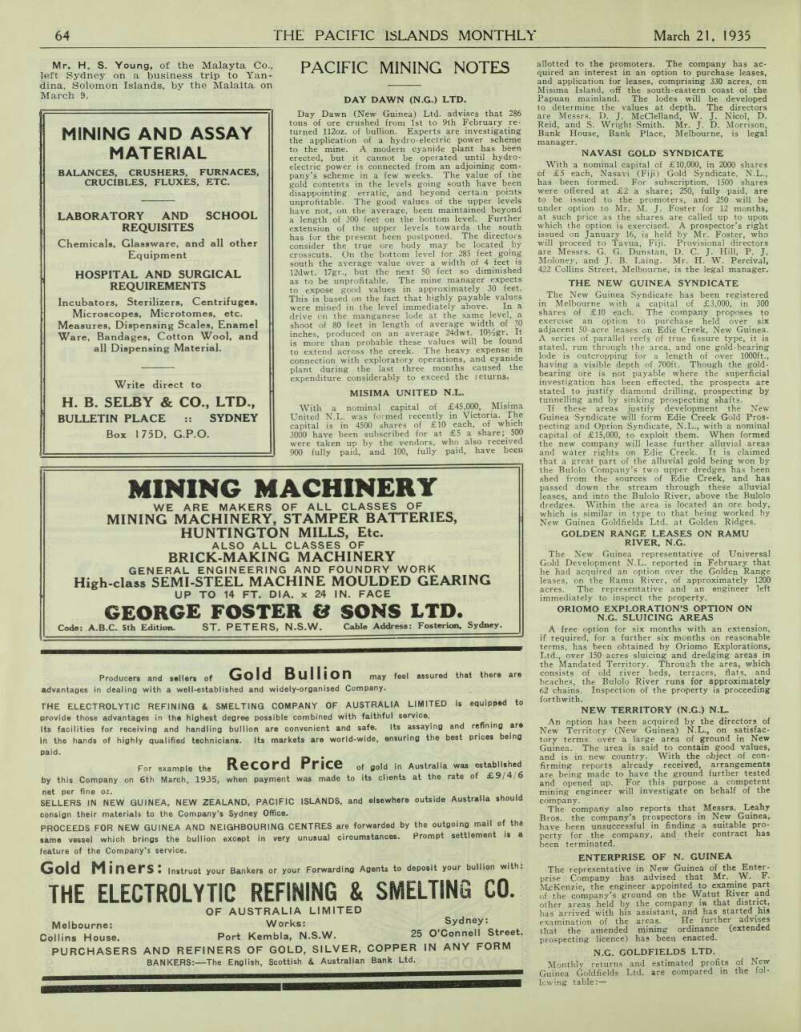
Ray Parer
To Investigate Cape York Landing Ground
Mr. Raymond Parer And Mr.
Geoffrey E. Hemsworth, the New Guinea airmen who, after setting out from England in the Centenary Air Race in October last, recently arrived in Mel bourne after many adventures and set backs, landed at Sydney on their return to New Guinea on February 26. Early in March their machine, still giving them trouble, was being overhauled at Mascot aerodrome.
En route to New Guinea at the end of March, Mr. Parer will visit Cape York, at the tip of Northern Queensland, and in vestigate the possibility of establishing an official landing ground there. The ground would eliminate the dangerous 400-mile water hop between Port Douglas (Queensland) and Port Moresby, stated Mr. Parer.
Apart from its assistance to aviators flying to New Guinea, the Cape York aerodrome would be of strategic value to the Commonwealth. It would also pave the way for a weekly aerial mail service between New Guinea, Papua and Queensland. The 120-mile flight across from Cape York to New Guinea, he con tinued, would take only an hour, and would be virtually accident-proof be cause there was a string of islands in the line of flight.
Possibly the reason why New Guinea airmen prefer to fly from Port Douglas to Papua is that after the flight across from Cape York, there is still some 450 miles to be flown along the Papuan coast before Port Moresby landing ground is reached.
Mr. H. S. Young, of the Malayta Co., left Sydney on a business trip to Yan dina, Solomon Islands, by the Malaita on March 9.
Advertisements & other items, pp. 65-66 (1 item)
Waddell's
AT BLUE MOUNTAINS
SPRINGWOOD, N.S.W.
Springwood Ladies’ College
Est. 1897. Kindergarten to Leaving Certificate. Tennis, Riding, Swimming, Team Games. Unequalled climate. Pure Jersey Milk. Senior and Junior Houses. Open-air sleeping. Inclusive fees. Special vacation arrangements for Island pupils.
M. E. DURAND, Principal.
JN CASES OF EMERGENCY YOUR
WITHOUT A
MEDICINE CABINET. BE PREPARED !
You can purchase the highest quality surgical dressings, pharmaceutical requirements and all chemists sundries at the lowest possible prices direct from
The VICTOR PHARMACEUTICAL
AGENCIES
Phillip House, Phillip St., Sydney.
Orders, inquiries and quotations attended to immediately. Enclose postage for reply.
Address all mail to The Manager, Box 374955, G.P.O., Sydney
YOOTHA STUD
Smooth and Wire Fox Terriers Fully 90 per cent, of Australasian winning dogs are Yootha-bred.
MRS. A. F.
WATERS
Yootha Park Baulkham Hills, N.S.W., Australia
For— Fresh Fruit, Vegetables, and Produce Island residents can rely on the old-established Shipping Providers.
Only Address: 421 Sussex St., SYDNEY All Orders Promptly Attended Island Representatives: Nelson & Robertson W. M. Reid
Specially Manufactured for the Tropics
Waddell's
Tennis Rackets
Our Complete Range of Rackets are finished in attractive colours with our exclusive Waterproof Process, that will not chip or crack. All the latest ideas in shape and vital point reinforcements.
ASK FOR AUSTRAL, THE SHEEP GUT
THAT HAS STOOD THE TEST OF ALL
CLIMATES
Inspect our range at your local Sports Depot If not procurable write us direct for Price Lists
WADDELLS LIMITED,
RALPH STREET
ALEXANDRIA, Sydney
MINING AND ASSAY
MATERIAL
BALANCES, CRUSHERS, FURNACES,
CRUCIBLES, FLUXES, ETC.
LABORATORY AND SCHOOL
REQUISITES
Chemicals, Glassware, and all other Equipment
HOSPITAL AND SURGICAL
REQUIREMENTS
Incubators, Sterilizers, Centrifuges, Microscopes, Microtomes, etc.
Measures, Dispensing Scales, Enamel Ware, Bandages, Cotton Wool, and all Dispensing Material.
Write direct to
H. B. SELBY & CO., LTD,,
BULLETIN PLACE :: SYDNEY
Box 175D, G.P.O.
MINING MACHINERY
WE ARE MAKERS OF ALL CLASSES OF
MINING MACHINERY, STAMPER BATTERIES,
HUNTINGTON MILLS, Etc.
ALSO ALL CLASSES OF
BRICK-MAKING MACHINERY
GENERAL ENGINEERING AND FOUNDRY WORK
High-class SEMI-STEEL MACHINE MOULDED GEARING
UP TO 14 FT. DIA. x 24 IN. FACE
GEORGE FOSTER & SONS LTD.
Coda: A.B.C. sth Edition. ST. PETERS, N.S.W. Cable Address: Fosterion. Sydney.
Producers and sellers of Gold Bullion may feel assured that there are advantages in dealing with a well-established and widely-organised Company.
THE ELECTROLYTIC REFINING & SMELTING COMPANY OF AUSTRALIA LIMITED is equipped to provide those advantages in the highest degree possible combined with faithful service.
Its facilities for receiving and handling bullion are convenient and safe. Its assaying and refining are in the hands of highly qualified technicians. Its markets are world-wide, ensuring the best prices being paid.
For example the RECORD PRICE of gold in Australia was established by this Company on 6th March, 1935, when payment was made to its clients at the rate of £9/4,6 net per fine oz.
SELLERS IN NEW GUINEA, NEW ZEALAND, PACIFIC ISLANDS, and elsewhere outside Australia should consign their materials to the Company’s Sydney Office.
PROCEEDS FOR NEW GUINEA AND NEIGHBOURING CENTRES are forwarded by the outgoing mail of the same vessel which brings the bullion except in very unusual circumstances. Prompt settlement is a feature of the Company’s service.
Gold M iners : Instruct your Bankers or your Forwarding Agents to deposit your bullion with:
THE ELECTROLYTIC REFINING & SMELTING CO.
OF AUSTRALIA LIMITED
Melbourne: Works: Sydney: Collins House. Port Kembla, N.S.W. 25 O’Connell Street.
PURCHASERS AND REFINERS OF GOLD, SILVER, COPPER IN ANY FORM BANKERS:—The English, Scottish & Australian Bank Ltd.
Pacific Mining Notes
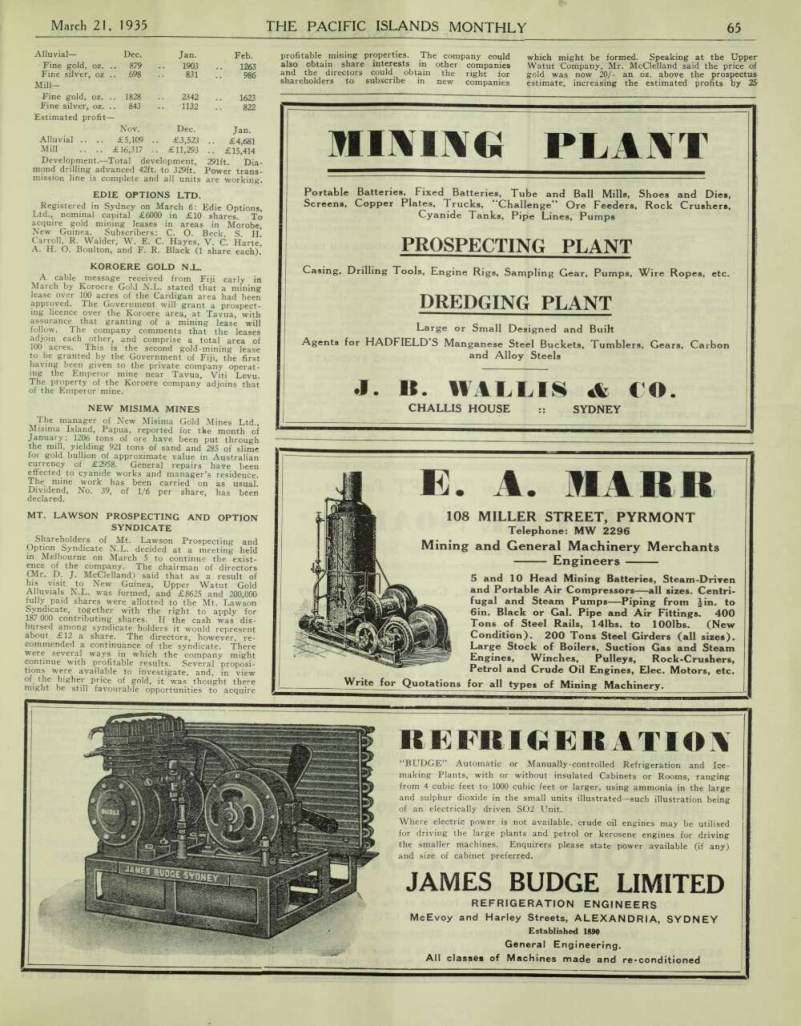
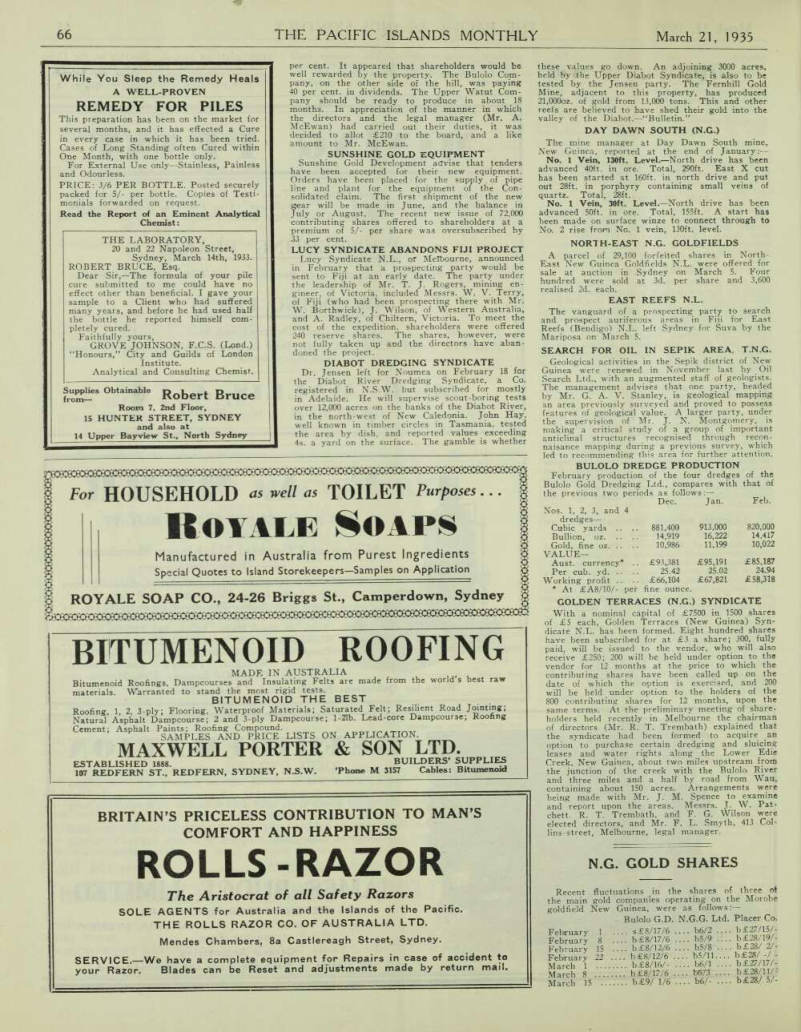
Day Dawn (N.G.) Ltd.
Day Dawn (New Guinea) Ltd. advises that 286 tons of ore crushed from Ist to 9th February re turned 112oz. of bullion. Experts are investigating the application of a hydro-electric power scheme to the mine. A modern cyanide plant has been erected, but it cannot be operated until hydro electric power is connected from an adjoining com pany’s scheme in a few weeks. The value of the gold contents in the levels going south have been disappointing, erratic, and beyond certain points unprofitable. The good values of the upper levels have not, on the average, been maintained beyond a length of 300 feet on the bottom level. Further extension of the upper levels towards the south has for the present been postponed. The directors consider the true ore body may be located by crosscuts. On the bottom level for 285 feet going south the average value over a width of 4 feet is 12dwt. 17gr., but the next 50 feet so diminished as to be unprofitable. The mine manager expects to expose good values in approximately 30 feet.
This is based on the fact that highly payable values were mined in the level immediately above. In a drive on the manganese lode at the same level, a shoot of 80 feet in length of average width of 30 inches, produced on an average 24dwt. lt is more than probable these values will be found to extend across the creek. The heavy expense in connection with exploratory operations, and cyanide plant during the last three months caused the expenditure considerably to exceed the returns.
Misima United N.L.
With a nominal capital of £45,000. Misima United N.L. was formed recently in Victoria. The capital is in 4500 shares of £10 each, of which 3000 have been subscribed for at £5 a share; 500 were taken up by the vendors, who also received 900 fully paid, and 100, fully paid, have been
allotted to the promoters. The company has ac quired an interest in an option to purchase leases, and application for leases, comprising 330 acres, cn Misima Island, off the south-eastern coast of the Papuan mainland. The lodes will be developed to determine the values at depth. The directors are Messrs. D. J. McClelland, W. J. Nicol, D.
Reid, and S. Wright-Smith. Mr. J. D. Morrison, Bank House, Bank Place, Melbourne, is legal manager.
Navasi Gold Syndicate
With a nominal capital of £10,000, in 2000 shares of £5 each, Nasavi (Fiji) Gold Syndicate, N.L., has been formed. For subscription, 1500 shares were offered at £2 a share; 250, fully paid, are to be issued to the promoters, and 250 will be under option to Mr. M. J. Foster for 12 months, at such price as the shares are called up to upon which the option is exercised. A prospector’s right issued on January 16, is held by Mr. Foster, who will proceed to Tavua, Fiji. Provisional directors are Messrs. G. G. Dunstan, D. C. J. Hill, P. J.
Moloney, and J. B. Laing. Mr. H. W. Percival, 422 Collins Street, Melbourne, is the legal manager.
The New Guinea Syndicate
The New Guinea Syndicate has been registered in Melbourne with a capital of £3,000, in 300 shares of £10 each. The company proposes to exercise an option to purchase held over six adjacent 50-acre leases on Edie Creek, New Guinea.
A series of parallel reefs of true fissure type, it is stated, run through the area, and one gold-bearing lode is outcropping for a length of over 1000 ft., having a visible depth of 700 ft. Though the gold bearing ore is not payable where the superficial investigation has been effected, the prospects are stated to justify diamond drilling, prospecting by tunnelling and by sinking prospecting shafts.
If these areas justify development the New Guinea Syndicate will form Edie Creek Gold Pros pecting and Option Syndicate, N.L., with a nominal capital of £15,000, to exploit them. When formed the new company will lease further alluvial areas and water rights on Edie Creek. It is claimed that a great part of the alluvial gold being won by the Bulolo Company’s two upper dredges has been shed from the sources of Edie Creek, and has passed down the stream through these alluvial leases, and into the Bulolo River, above the Bulolo dredges. Within the area is located an ore body, which is similar in type to that being worked by New Guinea Goldfields Ltd. at Golden Ridges.
Golden Range Leases On Ramu
River, N.G.
The New Guinea representative of Universal Gold Development N.L. reported in February that he had acquired an option over the Golden Range leases, on the Ramu River, of approximately 1200 acres. The representative and an engineer left immediately to inspect the property.
Oriomo Exploration’S Option On
N.G. Sluicing Areas
A free option for six months with an extension, if required, for a further six months on reasonable terms, has been obtained by Oriomo Explorations, Ltd., over 150 acres sluicing and dredging areas in the Mandated Territory. Through the area, which consists of old river beds, terraces, flats, and beaches, the Bulolo River runs for approximately 62 chains. Inspection of the property is proceeding forthwith.
New Territory (N.G.) N.L.
An option has been acquired by the directors of New Territory (New Guinea) N.L., on satisfac tory terms, over a large area of ground in New Guinea. The area is said to contain good values, and is in new country. With the object of con firming reports already received, arrangements are being made to have the ground further tested and opened up. For this purpose a competent mining engineer will investigate on behalf of the company.
The company also reports that Messrs. Leahy Bros, the company’s prospectors in New Guinea, have been unsuccessful in finding a suitable pro perty for the company, and their contract has been terminated.
Enterprise Of N. Guinea
The representative in New Guinea of the Enter prise Company has advised that Mr. W. F.
McKenzie, the engineer appointed to examine part of the company’s ground on the Watut River and other areas held by the company in that district, has arrived with his assistant, and has started his examination of the areas. He further advises that the amended mining ordinance (extended prospecting licence) has been enacted.
N.G. Goldfields Ltd.
Monthly returns and estimated profits of New Guinea Goldfields Ltd. are compared in the fol lowing table:—
Development.—Total development, 291 ft. Dia mond drilling advanced 42ft. to 329 ft. Power trans mission line is complete and all units are working.
Edie Options Ltd.
Registered in Sydney on March 6: Edie Options, Ltd., nominal capital £6000 in £10 shares. To acquire gold mining leases in areas in Morobe, New Guinea. Subscribers: C. O. Beck, S. H.
Carroll, R. Waider, W. E. C. Hayes, V. C. Harte, A. H. O. Boulton, and F. R. Black (1 share each).
Koroere Gold N.L.
A cable message received from Fiji early in March by Koroere Gold N.L. stated that a mining lease over 100 acres of the Cardigan area had been approved. The Government will grant a prospect ing licence over the Koroere area, at Tavua, with assurance that granting of a mining lease will follow. The company comments that the leases adjoin each other, and comprise a total area of 100 acres. This is the second gold-mining lease to be granted by the Government of Fiji, the first having been given to the private company operat ing the Emperor mine near Tavua, Viti Levu.
The property of the Koroere company adjoins that of the Emperor mine.
New Misima Mines
The manager of New Misima Gold Mines Ltd., Misima Island, Papua, reported for the month of January: 1206 tons of ore have been put through the mill, yielding 921 tons of sand and 285 of slime for gold bullion of approximate value in Australian currency of £2958. General repairs have been effected to cyanide works and manager’s residence.
The mine work has been carried on as usual.
Dividend, No. 39, of 1/6 per share, has been declared.
Mt. Lawson Prospecting And Option
Syndicate
Shareholders of Mt. Lawson Prospecting and Option Syndicate N.L. decided at a meeting held in Melbourne on March 5 to continue the exist ence of the company. The chairman of directors (Mr. D. J. McClelland) said that as a result of his visit to New Guinea, Upper Watut Gold Alluvials N.L. was formed, and £8625 and 200,000 fully paid shares were allotted to the Mt. Lawson Syndicate, together with the right to apply for 187 000 contributing shares. If the cash was dis bursed among syndicate holders it would represent about £12 a share. The directors, however, recommended a continuance of the syndicate. There were several ways in which the company might continue with profitable results. Several proposi tions were available to investigate, and, in view of the higher price of gold, it was thought there might be still favourable opportunities to acquire
profitable mining properties. The company could also obtain share interests in other companies and the directors could obtain the right for shareholders to subscribe in new companies
which might be formed. Speaking at the Upper Watut Company, Mr. McClelland said the price of gold was now 20/- an oz, above the prospectus estimate, increasing the estimated profits by 25
Alluvial— Dec. Jan. Feb.
Fine gold, oz. .. 879 .. 1903 .. 1263 Fine silver, oz .. 698 .. 831 .. 986 Mill- Fine gold, oz. .. 1828 2342 ,. 1623 Fine silver, oz. .. 843 .. 1132 .. 822 Estimated profit— Nov. Dec. Jan.
Alluvial .. .. £5,109 .. £3,523 .. £4,681 Mill .. .. £16,317 .. £11,293 .. £15,414
per cent. It appeared that shareholders would be well rewarded by the property. The Bulolo Com pany, on the other side of the hill, was paying 40 per cent, in dividends. The Upper Watut Com pany should be ready to produce in about 18 months. In appreciation of the manner in which the directors and the legal manager (Mr, A.
McEwan) had carried out their duties, it was decided to allot £210 to the board, and a like amount to Mr. McEwan.
Sunshine Gold Equipment
Sunshine Gold Development advise that tenders have been accepted for their new equipment.
Orders have been placed for the supply of pipe line and plant for the equipment of the Con solidated claim. The first shipment of the new gear will be made in June, and the balance in July or August. The recent new issue of 72,000 contributing shares offered to shareholders at a premium of 5/- per share was oversubscribed by 33 per cent.
Lucy Syndicate Abandons Fiji Project
Lucy Syndicate N.L., or Melbourne, announced in February that a prospecting party would be sent to Fiji at an early date. The party under the leadership of Mr. T. J. Rogers, mining en gineer, of Victoria, included Messrs. W. V. Terry, of Fiji (who had been prospecting there with Mr.
W. Borthwick), J. Wilson, of Western Australia, and A. Radley, of Chiltern, Victoria. To meet the cost of the expedition, shareholders were offered 240 reserve shares. The shares, however, were not fully taken up and the directors have aban doned the project.
Diabot Dredging Syndicate
Dr. Jensen left for Noumea on February 18 for the Diabot River Dredging Syndicate, a Co. registered in N.S.W. but subscribed for mostly in Adelaide. He will supervise scout-boring tests over 12,000 acres on the banks of the Diabot River, in the north-west of New Caledonia. John Hay, well known in timber circles in Tasmania, tested the area by dish, and reported values exceeding 4s. a yard on the surface. The gamble is whether
these values go down. An adjoining 3000 acres, held by the Upper Diabot Syndicate, is also to be tested by the Jensen party. The Fernhill Gold Mine, adjacent to this property, has produced 21,0000 z. of gold from 13,000 tons. This and other reefs are believed to have shed their gold into the valley of the Diabot.—“Bulletin.”
Day Dawn South (N.G.)
The mine manager at Day Dawn South mine, New Guinea, reported at the end of January:— No. 1 Vein, 130 ft. Level. —North drive has been advanced 40ft. in ore. Total, 290 ft. East X cut has been started at 160 ft. in north drive and put out 28ft. in porphyry containing small veins of quartz. Total, 28ft.
No. 1 Vein, 30ft. Level. —North drive has been advanced 50ft. in ore. Total, 155 ft. A start has been made on surface winze to connect through to No. 2 rise from No. 1 vein, 130 ft. level.
North-East N.G. Goldfields
A parcel of 29,100 forfeited shares in North- East New Guinea Goldfields N.L. were offered for sale at auction in Sydney on March 5. Four hundred were sold at 3d. per share and 3,600 realised 2d. each.
East Reefs N.L.
The vanguard of a prospecting party to search and prospect auriferous areas in Fiji for East Reefs (Bendigo) N.L. left Sydney for Suva by the Mariposa on March 5.
SEARCH FOR OIL IN SEPIK AREA, T.N.G.
Geological activities in the Sepik district of New Guinea were renewed in November last by Oil Search Ltd., with an augmented staff of geologists.
The management advises that one party, headed by Mr. G. A. V. Stanley, is geological mapping an area previously surveyed and proved to possess features of geological value. A larger party, under the supervision of Mr. J. N. Montgomery, is making a critical study of a group of important anticlinal structures recognised through recon naisance mapping during a previous survey, which led to recommending this area for further attention.
Bulolo Dredge Production
February production of the four dredges of the Bulolo Gold Dredging Ltd., compares with that of
Golden Terraces (N.G.) Syndicate
With a nominal capital of £7500 in 1500 shares of £5 each, Golden Terraces (New Guinea) Syn dicate N.L. has been formed. Eight hundred shares have been subscribed for at £3 a share; 300, fully paid, will be issued to the vendor, who will also receive £250; 200 will be held under option to the vendor for 12 months at the price to which the contributing shares have been called up on the date of which the option is exercised, and 200 will be held under option to the holders of the 800 contributing shares for 12 months, upon the same terms. At the preliminary meeting of share holders held recently in Melbourne the chairman of directors (Mr. R. T. Trembath) explained that the syndicate had been formed to acquire an option to purchase certain dredging and sluicing leases and water rights along the Lower Edie Creek, New Guinea, about two miles upstream from the junction of the creek with the Bulolo River and three miles and a half by road from Wau, containing about 150 acres. Arrangements were being made with Mr. J. M. Spence to examine and report upon the areas. Messrs. J. W. Pat ched. R. T. Trembath, and F. G. Wilson were elected directors, and Mr. F. L. Smyth, 413 Col lins-street, Melbourne, legal manager.
the previous two periods as follows: — Dec. Jan. Feb.
Nos. 1, 2, 3, and 4 dredges— Cubic yards .. .. 881,400 913,000 820,000 Bullion, oz 14,919 16,222 14,417 Gold, fine oz 10,986 11,199 10,022
Value-
Aust. currency* .. £93,381 £95,191 £85,187 Per cub. yd 25.42 25.02 24.94 Working profit .. £66,104 £67,821 £58,318 * At £A8/10/- per fine ounce.
Advertisements & other items, pp. 67-68 (1 item)
Mining Plant
Portable Batteries, Fixed Batteries, Tube and Ball Mills, Shoes and Dies, Screens, Copper Plates, Trucks, "Challenge” Ore Feeders, Rock Crushers, Cyanide Tanks, Pipe Lines, Pumps
PROSPECTING PLANT
Casing, Drilling Tools, Engine Rigs, Sampling Gear, Pumps, Wire Ropes, etc.
DREDGING PLANT
Large or Small Designed and Built Agents for HADFIELD S Manganese Steel Buckets, Tumblers, Gears, Carbon and Alloy Steels
J. B. WALLIS & CO.
CHALLIS HOUSE :: SYDNEY
E. A. MARR
108 MILLER STREET, PYRMONT
Telephone: MW 2296 Mining and General Machinery Merchants
Engineers
5 and 10 Head Mining Batteries, Steam-Driven and Portable Air Compressors—all sizes. Centrifugal and Steam Pumps—Piping from ½in. to 6in. Black or Gal. Pipe and Air Fittings. 400 Tons of Steel Rails, 14lbs. to 100lbs. (New Condition). 200 Tons Steel Girders (all sizes).
Large Stock of Boilers, Suction Gas and Steam Engines, Winches, Pulleys, Rock-Crushers, Petrol and Crude Oil Engines, Elec. Motors, etc.
Write for Quotations for all types of Mining Machinery.
REFRIGERATION
“BUDGE” Automatic or Manually-controlled Refrigeration and Icemaking Plants, with or without insulated Cabinets or Rooms, ranging from 4 cubic feet to 1000 cubic feet or larger, using ammonia in the large and sulphur dioxide in the small units illustrated—such illustration being of an electrically driven 802 Unit.
Where electric power is not available, crude oil engines may be utilised for driving the large plants and petrol or kerosene engines for driving the smaller machines. Enquirers please state power available (if any) and size of cabinet preferred.
JAMES BUDGE LIMITED
REFRIGERATION ENGINEERS
McEvoy and Harley Streets, ALEXANDRIA, SYDNEY Established 1890
General Engineering.
All classes of Machines made and re-conditioned
While You Sleep the Remedy Heals
A WELL-PROVEN
REMEDY FOR PILES
This preparation has been on the market for several months, and it has effected a Cure in every case in which it has been tried.
Cases of Long Standing often Cured within One Month, with one bottle only.
For External Use only—Stainless, Painless and Odourless.
PRICE: 3/6 PER BOTTLE. Posted securely packed for 5/- per bottle. Copies of Testimonials forwarded on request.
Read the Report of an Eminent Analytical Chemist:
THE LABORATORY,
20 and 22 Napoleon Street, Sydney, March 14th, 1933.
ROBERT BRUCE, Esq.
Dear Sir, —The formula of your pile cure submitted to me could have no effect other than beneficial. I gave your sample to a Client who had suffered many years, and before he had used half the bottle he reported himself completely cured.
Faithfully yours,
GROVE JOHNSON, F.C.S. (Lend.)
“Honours,” City and Guilds of London Institute.
Analytical and Consulting Chemist.
Supplies Obtainable from Robert Bruce
Room 7, 2nd Floor,
15 HUNTER STREET, SYDNEY
and also at 14 Upper Bay view St., North Sydney
for HOUSEHOLD as well as TOILET Purposes...
Manufactured in Australia from Purest Ingredients Special Quotes to Island Storekeepers —Samples on Application ROYALE SOAP CO., 24-26 Briggs St., Camperdown, Sydney
BITUMENOID ROOFING
MADE IN AUSTRALIA
Bitumenoid Roofings, Dampcourses and Insulating Felts are made from the world s best raw materials. Warranted to stand the most rigid tests.
BITUMENOID THE BEST
Roofing, 1,2, 3-ply: Flooring, Waterproof Materials; Saturated Felt; Resilient Road Jointing; Natural Asphalt Dampcourse; 2 and 3-ply Dampcourse; 1-2lb. Lead-core Dampcourse; Roofing
MAXWELL PORTER & SON LTD.
BRITAIN’S PRICELESS CONTRIBUTION TO MAN’S
COMFORT AND HAPPINESS
ROLLS-RAZOR
The Aristocrat of all Safety Razors SOLE AGENTS for Australia and the Islands of the Pacific.
THE ROLLS RAZOR CO. OF AUSTRALIA LTD.
Mendes Chambers, 8a Castlereagh Street, Sydney.
SERVICE. —We have a complete equipment for Repairs in case of accident to your Razor. Blades can be Reset and adjustments made by return mail.
N.G. Gold Shares
Recent fluctuations in the shares of three of the main gold companies operating on the Morobe goldfield New Guinea, were as follows: —
Bulolo G.D.
N.G.G. Ltd.
Placer Co.
February 1 ... s£8/17/6 ... b6/2 ... , b£27/15/- February 8 ... b£8/17/6 ... b5/9 ... . b £28/19/- February 15 ... b£8/12/6 ... b5/8 ... . b£28/ 2/- February 22 . ... b£8/12/6 . ... b5/ll... b£28/ -/ - March 1 ... b£8/16/b6/l ... , b £27/17/- March 8 ... b£8/17/6 . ... mn ... b £28/11/- March 15 ... ... b£9/ 1/6 ... b6/- ... . b£28/ 5/-
Shipping Services in the Pacific
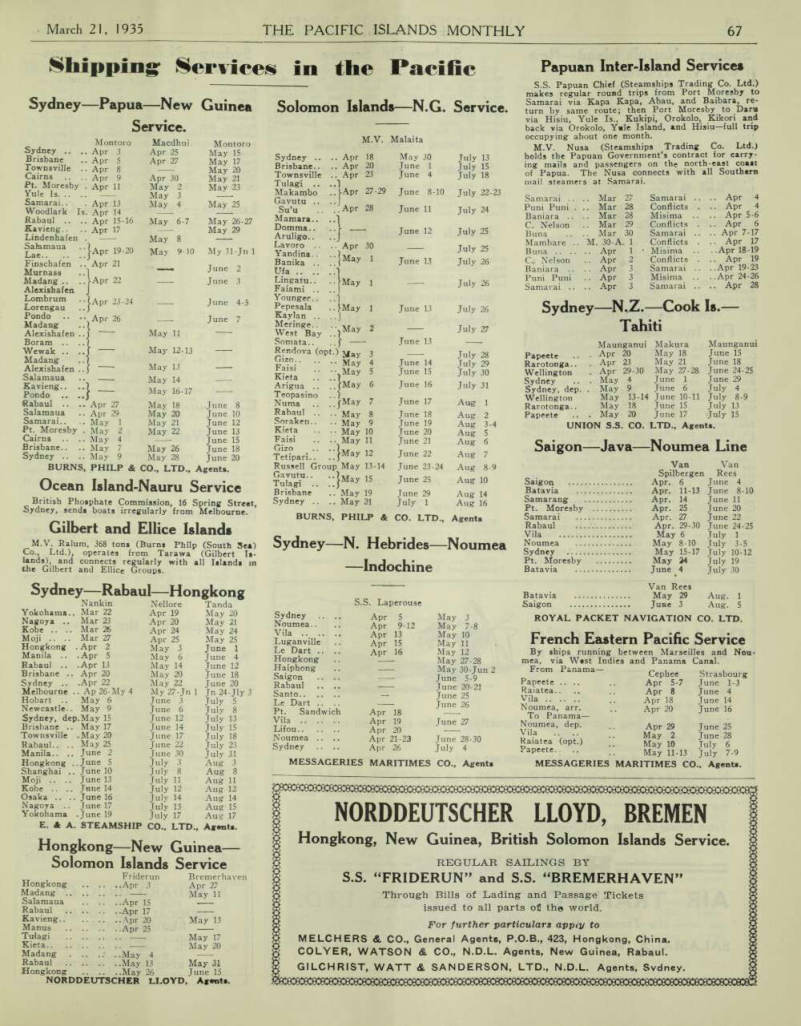
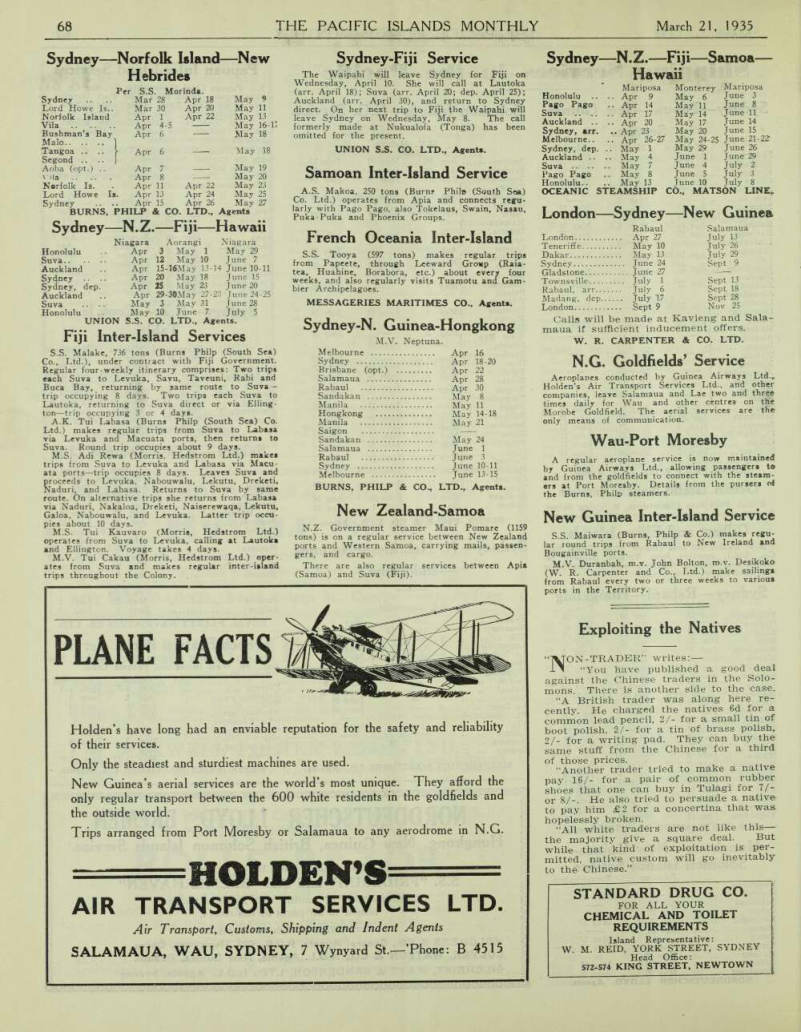
Sydney—Papua—New Guinea Service.
Ocean Island-Nauru Service
British Phosphate Commission, 16 Spring Street, Sydney, sends boats irregularly from Melbourne.
Gilbert and Ellice Islands
M.V. Ralum, 368 tons (Burns Philp (South Sea) Co., Ltd.), operates from Tarawa (Gilbert Is lands), and connects regularly with all Islands in the Gilbert and Ellice Groups.
Sydney—Rabaul—Hongkong
Hongkong—New Guinea— Solomon Islands Service
Solomon Islands—N.G. Service.
Sydney—N. Hebrides—Noumea —lndochine
Papuan Inter-Island Services
S.S. Papuan Chief (Steamships Trading Co. Ltd.) makes regular round trips from Port Moresby to Samarai via Kapa Kapa, Abau, and Baibara, re turn by same route; then Port Moresby to Dana via Hisiu, Yule Is., Kukipi, Orokolo, Kikori and back via Orokolo, Ynle Island, and Hisiu —full trip occupying about one month.
M.V. Nusa (Steamships Trading Co. Ltd.) holds the Papuan Government’s contract for carry ing mails and passengers on the north-cast coast of Papua. The Nusa connects with all Southern mail steamers at Samarai.
Sydney—N.Z.—Cook Is.— Tahiti
Saigon—Java—Noumea Line
French Eastern Pacific Service
By ships running between Marseilles and Nou mea, Wast Indies and Panama Canal.
Sydney Montoro Macdhui Montoro Apr 3 Apr 25 May 15 Brisbane Apr 5 Apr 27 May 17 Townsville Apr 8 May 20 Cairns Apr 9 Apr 30 May 21 Pt. Moresby Apr 11 May 2 May 23 Yule Is May 3 Samarai Apr 13 May 4 May 25 Woodlark Is.
Apr 14 Rabaul Apr 15-16 May 6-7 May 26-27 Kavieng Apr 17 May 29 Lindenhafen May 8 Salamaua Lae
Apr 19-20
May 9-10 My 31-Jn 1 Finschafen Apr 21 June 2 Murnass Madang Apr 22 June 3 Alexishafen Lombrum Lorcngau Apr 23-24 June 4-5 Pondo Madang Apr 26 June 7 Alexishafen May 11 Boram Wewak May 12-13 Madang May 13 Alexishafen Salamaua May 14 Kavieng Pondo May 16-17 Rabaul Apr 27 May 18 June 8 Salamaua Apr 29 May 20 June 10 Samarai May 1 May 21 June 12 Pt. Moresby May 2 May 22 June 13 Cairns May 4 June 15 Brisbane May 7 May 26 June 18 Sydney May 9 May 28 June 20
Burns, Philp & Co., Ltd., Agents.
M.V. Malaita Sydney Apr 18 May 30 July 13 Brisbane Apr 20 June 1 July 15 Townsville Apr 23 June 4 July 18 Tulagi Apr 27-29 Makambo June 8-10 July 22-23 Gavutu Apr 28 Su’u June 11 July 24 Mamara Domma Aruligo June 12 July 25 Lavoro Yandina Apr 30 July 25 Banika May 1 June 13 July 26 Ufa Lingatu Faiami May 1 July 26 Younger Pepesala Kaylan May 1 June 13 July 26 Meringe West Bay May 2 July 27 Somata June 13 Rendova (opt.) Gizo Faisi Kieta May 3 July 28 May 4 June 14 July 29 May 5 June 15 July 30 Arigua May 6 June 16 July 31 Teopasino June 17 Numa
May 7
Aug 1 Rabaul May 8 June 18 Aug 2 Soraken May 9 June 19 Aug 3-4 Kieta May 10 June 20 Aug 5 Faisi Gizo Tetipari May 11 June 21 Aug 6 May 12 June 22 Aug 7 Russell Group May 13-14 June 23-24 Aug 8-9 Gavutu Tulagi May 15 June 25 Aug 10 Brisbane May 19 June 29 Aug 14 Sydney May 21 July 1 Aug 16
Burns, Philp & Co. Ltd., Agents
S.S. Laperouse Sydney Apr 5 May 3 Noumea Apr 9-12 May 7-8 Vila Apr 13 May 10 Luganville Apr 15 May 11 Le Dart Apr 16 May 12 Hongkong May 27-28 Haiphong May 30-Jun 2 Saigon June 5-9 Rabaul June 20-21 Santo June 25 Le Dart June 26 Pt. Sandwich Apr 18 Vila Apr 19 June 27 Lifou Apr 20 Noumea Apr 21-23 June 28-30 Sydney Apr 26 July 4
Messageries Maritimes Co., Agents
Samarai Mar 27 Samarai Apr 4 Puni Puni Mar 28 Conflicts Apr 4 Baniara Mar 28 Misima Apr 5-6 C. Nelson Mar 29 Conflicts Apr 6 Buna Mar 30 Samarai Apr 7-17 Mambare M. 30-A. 1 Conflicts Apr 17 Buna 1 Misima Apr 18-19 C. Nelson Apr 2 Conflicts Apr 19 Baniara Apr 3 Samarai Apr 19-23 Puni Puni Apr 3 Misima Apr 24-26 Samarai Apr 3 Samarai Apr 28
Maunganui Makura Maunganui Papeete Apr 20 May 18 June 15 Rarotonga Apr 23 May 21 June 18 Wellington Apr 29-30 May 27-28 June 24-25 Sydney May 4 June 1 June 29 Sydney, dep.
May 9 June 6 July 4 Wellington May 13-14 June 10-11 July 8-9 Rarotonga May 18 June 15 July 13 Papeete May 20 June 17 July IS
Union S.S. Co. Ltd., Agents.
Van Van Spilbergen Rees Saigon 6 June 4 Batavia 11-13 June 8-10 Samarang 14 June 11 Pt. Moresby 25 June 20 Samarai 27 June 22 Rabaul 29-30 June 24-25 Vila 6 July 1 Noumea 8-10 July 3-5 Sydney 15-17 July 10-12 Pt. Moresby 24 July 19 Batavia 4 July 30 Van Rees Batavia 29 Aug. 1 Saigon 3 Aug. 5
Royal Packet Navigation Co. Ltd.
From Panama — Cephee Strasbourg Papeete Apr 5-7 June 1-3 Raiatea Apr 8 June 4 Vila Apr 18 June 14 Noumea, arr.
To Panama— Apr 20 June 16 Noumea, dep.
Apr 29 June 25 Vila Raiatea (opt.) May 2 May 10 June 28 July 6 Papeete.
May 11-13 July 7-9
Messageries Maritimes Co., Agents.
Nankin Nellore Tanda Yokohama Mar 22 Apr 19 May 20 Nagoya Mar 23 Apr 20 May 21 Kobe Mar 26 Apr 24 May 24 Moji Mar 27 Apr 25 May 25 Hongkong Manila Apr 2 Apr 5 May 3 May 6 June 1 June 4 Rabaul Apr 13 May 14 June 12 Brisbane Apr 20 May 20 June 18 Sydney Melbourne Apr 22 May 22 June 20 Ap 26-My 4 My 27-Jn 1 Jn 24-Jly 3 Hobart May 6 June 3 July 5 Newcastle May 9 June 6 July 8 Sydney, dep.May 15 June 12 July 13 Brisbane May 17 June 14 July 15 Townsville May 20 June 17 July 18 Rabaul May 25 June 22 July 23 Manila June 2 June 30 July 31 Hongkong June 5 July 3 Aug 3 Shanghai June 10 July 8 Aug 8 Moji June 13 July 11 Aug 11 Kobe June 14 July 12 Aug 12 Osaka June 16 July 14 Aug 14 Nagoya June 17 July 15 Aug 15 Yokohama June 19 July 17 Aug 17 E. & A. STEAMSHIP CO.. LTD., Agents.
Friderun Bremerhaven Hongkong Apr 27 Madang May 11 Salamaua Rabaul Apr 17 Kavieng May 13 Manus Tulagi May 17 Kieta May 20 Madang Rabaul May 31 Hongkong May 26 June 15
Norddeutscher Lloyd, Agents.
Sydney—Norfolk Island —New Hebrides
Sydney—N.Z.—Fiji—Hawaii
Fiji Inter-Island Services
S.S. Malake, 736 tons (Burns Philp (South Sea) Co., Ltd.), under contract with Fiji Government.
Regular four-weekly itinerary comprises: Two trips each Suva to Lcvuka, Savu, Taveuni, Rabi and Buca Bay, returning by same route to Suva — trip occupying 8 days. Two trips each Suva to Lautoka, returning to Suva direct or via Elling ton —trip occupying 3 or 4 days.
A.K. Tui Labasa (Burns Philp (South Sea) Co.
Ltd.) makes regular trips from Suva to Labasa via Levuka and Macuata ports, then return* to Suva. Round trip occupies about 9 days.
M.S. Adi Rewa (Morris, Hedstrom Ltd.) makes trips from Suva to Levuka and Labasa via Macu ata ports—trip occupies 8 days. Leaves Suva and proceeds to Levuka, Nabouwalu, Lekutu, Dreketi, Naduri, and Labasa. Returns to Suva by same route. On alternative trips she returns from Labasa via Naduri, Nakaloa, Dreketi, Naiserewaqa, Lekutu, Galoa, Nabouwalu, and Levuka. Latter trip occu pies about 10 days.
M.S. Tui Kauvaro (Morris, Hedstrom Ltd.) operates from Suva to Levuka, calling at Lautoka and Ellington. Voyage takes 4 days.
M.V. Tui Cakau (Morris, Hedstrom Ltd.) oper ates from Suva and makes regular inter-island trips throughout the Colony.
Sydney-Fiji Service
The Waipahi will leave Sydney for Fiji on Wednesday, April 10. She will call at Lautoka (arr. April 18); Suva (arr, April 20; dep. April 25); Auckland (arr. April 30), and return to Sydney direct. On her next trip to Fiji the Waipahi will leave Sydney on Wednesday, May 8. The call formerly made at Nukualofa (Tonga) has been omitted for the present.
Union S.S. Co. Ltd., Agents.
Samoan Inter-Island Service
A.S. Makoa, 250 tons (Burn? Philo (South Sea) Co. Ltd.) operates from Apia and connects regu larly with Pago Pago, also Tokelaus, Swain, Nasau, Puka-Puka and Phoenix Groups.
French Oceania Inter-Island
S.S. Tooya (597 tons) makes regular trips from Papeete, through Leeward Group (Raia tea, Huahine, Borabora, etc.) about every four weeks, and also regularly visits Tuamotu and Gam
bier Archipelagoes.
Messageries Maritimes Co.. Agents.
Sydney-N. Guinea-Hongkong
New Zealand-Samoa
N.Z. Government steamer Maui Pomare (1159 tons) is on a regular service between New Zealand ports and Western Samoa, carrying mails, passen gers, and cargo.
There are also regular services between Apia (Samoa) and Suva (Fiji).
Sydney—N.Z.—Fiji—Samoa— Hawaii
London —Sydney—New Guinea
N.G. Goldfields’ Service
Aeroplanes conducted by Guinea Airways Ltd., Holden’s Air Transport Services Ltd., and other companies, leave Salamaua and Lae two and three times daily for Wau and other centres on the Morobe Goldfield. The aerial services are the only means of communication.
Wau-Port Moresby
A regular aeroplane service is now maintained by Guinea Airways Ltd., allowing passengers to and from the goldfields to connect with the steam ers at Port Moresby. Details from the pursers of the Burns, Philo steamers.
New Guinea Inter-Island Service
S.S. Maiwara (Burns, Philp & Co.) makes regu lar round trips from Rabaul to New Ireland and Bougainville ports.
M.V. Duranbah, m.v. John Bolton, m.v. Desikoko (W. R. Carpenter and Co., Ltd.) make sailings from Rabaul every two or three weeks to various ports in the Territory,
Per S.S. Morinda.
Sydney Mar 28 Apr 18 May 9 Lord Howe Is.
Mar 30 Apr 20 May 11 Norfolk Island Apr 1 Apr 22 May 13 Vila Apr 4-5 May 16-11 Bushman’s Bay Apr 6 May 18 Malo Tangoa Apr 6 May 18 Segond Aoba (opt.) Apr 7 May 19 Vila Apr 8 May 20 Norfolk Is.
Apr 11 Apr 22 May 23 Lord Howe Is.
Apr 13 Apr 24 May 25 Sydney Apr 15 Apr 26 May 27
Burns, Philp & Co. Ltd., Agents
Niagara Aorangi Niagara Honolulu Apr 3 May 1 May 29 Suva Apr 12 May 10 June 7 Auckland Apr l5-16May 13-14 June 10-11 Sydney Apr 20 May 18 June 15 Sydney, dep. Apr 25 May 23 June 20 Auckland Apr 29-30 May 27-23 June 24-25 Suva May 3 May 31 fune 28 Honolulu May 10 June 7 July 5
Union S.S. Co. Ltd., Agents.
M.V. Neptuna.
Melbourne Sydney Apr 18-20 Brisbane (opt.) Salamaua Apr 28 Rabaul Sandakan May 8 Manila May 11 Hongkong May 14-18 Manila Saigon Sandakan Salamaua Rabaul Sydney June 10-11 Melbourne June 13-15
Burns, Philp & Co., Ltd., Agents.
Mariposa Monterey Mariposa Honolulu Apr 9 May 6 June 3 Pago Pago Apr 14 May 11 June 8 Suva May 14 June 11 Auckland Apr 20 May 17 June 14 Sydney, arr.
Apr 23 May 20 June 15 Melbourne Apr 26-27 May 24-25 June 21-22 Sydney, dep.
May 1 May 29 June 26 Auckland May 4 June 1 June 29 Suva May 7 June 4 July 2 Pago Pago May 8 June 5 July 3 Honolulu May 13 June 10 July 8
Oceanic Steamship Co., Matson Line.
Rabaul Salamaua London Apr 27 July 13 Teneriffe May 10 July 26 Dakar July 29 Sydney Sept 9 Gladstone
June 27
Townsville July 1 Sept 13 Rabaul, arr.
July 6 Sept 18 Madang, dep.
July 17 Sept 28 London Nov 25 Calls will be made at Kavieng and Salamaua if sufficient inducement offers.
W. R. Carpenter & Co. Ltd.
Advertisements & other items, pp. 69-70 (1 item)
Norddeutscher Lloyd, Bremen
Hongkong, New Guinea, British Solomon Islands Service.
REGULAR SAILINGS BY
S.S. “FRIDERUN” and S.S. “BREMERHAVEN”
Through Bills of Lading and Passage Tickets issued to all parts of the world.
For further particulars apply to MELCHERS & CO M General Agents, P.O.B., 423, Hongkong, China.
COLYER, WATSON & CO., N.D.L. Agents, New Guinea, Rabaul.
GILCHRIST, WATT & SANDERSON, LTD., N.D.L. Agents, Svdney.
PLANE FACTS
Holden’s have long had an enviable reputation for the safety and reliability of their services.
Only the steadiest and sturdiest machines are used.
New Guinea’s aerial services are the world’s most unique. They afford the only regular transport between the 600 white residents in the goldfields and the outside world.
Trips arranged from Port Moresby or Salamaua to any aerodrome in N.G.
HOLDEN’S
AIR TRANSPORT SERVICES LTD.
Air Transport, Customs, Shipping and Indent Agents SALAMAUA, WAU, SYDNEY, 7 Wynyard St.—’Phone: B 4515
NON-TRADER” writes:
Exploiting the Natives
“You have published a good deal against the Chinese traders in the Solo mons. There is another side to the case.
“A British trader was along here re cently. He charged the natives 6d for a common lead pencil, 2/- for a small tin of boot polish, 2/- for a tin of brass polish, 2/- for a writing pad. They can buy the same stuff from the Chinese for a third of those prices.
“Another trader tried to make a native pay 16/- for a pair of common rubber shoes that one can buy in Tulagi for 7/or 8/-, He also tried to persuade a native to pay him £2 for a concertina that was hopelessly broken.
“All white traders are not like this — the majority give a square deal. But while that kind of exploitation is per mitted, native custom will go inevitably to the Chinese.”
Advertisements & other items, p. 70 (1 item)
Standard Drug Co.
FOR ALL YOUR
CHEMICAL AND TOILET
REQUIREMENTS
Island Representative:
W. M. REID, YORK STREET, SYDNEY
Head Office;
572-574 KING STREET, NEWTOWN
Market Quotations
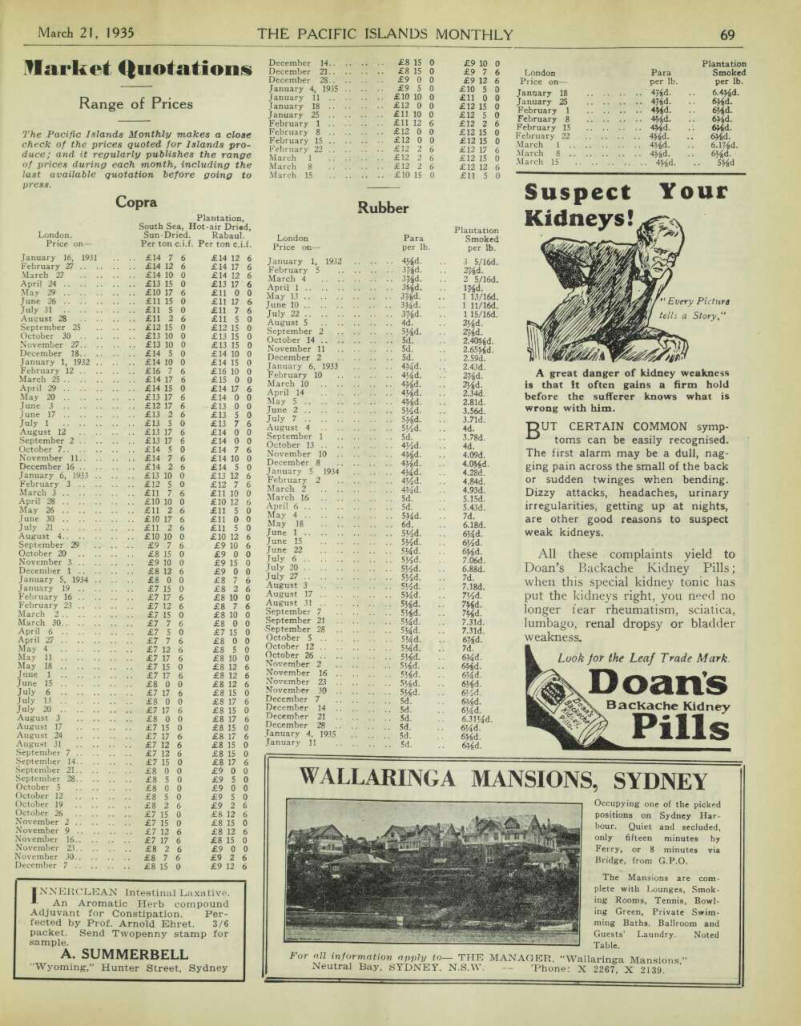
Range of Prices
The Pacific Islands Monthly makes a close check of the prices quoted for Islands pro duce; and it regularly publishes the range of prices during each month, including the last available quotation before going to press.
London Price on — Para per lb.
Plantation Smoked per lb.
Janaary 18 .. .. 4?Ad. 6.4^d.
January 25 .. .. 4Hd. 6^d.
February 1 .. .. 4Ud. 6^d.
February 8 .. .. 4*$d. 6^d.
February 15 .. .. 4^d. 6tfd.
February 22 .. .. 4Hd. .. 6^d.
March 1 .. .. 454d. 6.1^d.
March 8 .. .. 4&d. 6%d.
March 15 .. Sftd
December 14 .. .. £8 15 0 £9 10 0 December 21 ... £8 15 0 £9 7 6 December 28 ... £9 0 0 £9 12 6 January 4, 1935 ... £9 5 0 £10 5 0 January 11 .. .. £10 10 0 £11 0 0
January 18
.. .. £12 0 0 £12 15 0 January 25 .. .. £11 10 0 £12 5 0 February 1 .. .. £11 12 6 £12 2 6 February 8 .. .. £12 0 0 £12 15 0 February 15 .. .. £12 0 0 £12 15 0 February 22 .. .. £12 2 6 £12 17 6 March 1 .. .. £12 2 6 £12 IS 0 March 8 .. .. £12 2 6 £12 12 6 March 15 .. .. £10 15 0 £11 5 0
London Price on—
Rubber
Para per lb.
Plantation Smoked per lb.
January 1, 1932 February 5 W. 3 S/16d. 3fcd. 2Hd.
March 4 3&d. 2 S/16d.
April 1 3**d. md.
May 13 3^d. 1 13/16d.
June 10 3Hd. 1 ll/16d.
July 22 3Hd. 1 15/16d.
August 5 4d. 2Hd.
September 2 SHd. 2Hd.
October 14 Sd. 2.40Hd.
November 11 Sd. 2.6SHd.
December 2 Sd. 2.59d.
January 6, 1933 4Hd. 2.43d.
February 10 4Hd. 2Hd.
March 10 4«d. 2Hd.
April 14 4Hd. 2.34d.
May 5 4^d. 2.81d.
June 2 SHd. 3.56d.
July 7 SHd. 3.7ld.
August 4 sy,d. 4d.
September 1 5d. 3.78d.
October 13 4Hd. 4d.
November 10 4Hd. 4.09d.
December 8 4Hd. 4.0Hd.
January 5 1934 4Hd. 4.28d.
February 2 4*/ 2 d. 4.84d.
March 2 4.93d.
March 16 5d.
S.lSd.
April 6 5.43d.
May 4 SHd. 7d.
May 18 6.18d.
June 1 SHd. 6Hd.
June 15 SHd. 6Hd.
June 22 554d- 6Hd.
July 6 7.06d.
July 20 S^d. 6.88d.
July 27 SHd. 7d.
August 3 SHd. 7.18d.
August 17 SHd. 7Hd.
August 31 SHd. 7Hd.
September 7 SHd. 7Hd.
September 21 SHd. 7.31d.
September 28 SHd. 7.31d.
October 5 SHd. 6Hd.
October 12 7d.
October 26 6Hd.
November 2 6Hd.
November 16 SHd. 6Hd.
November 23 SHd. 6Hd.
November 30 6Hd.
December 7 6^gd.
December 14 6% d.
December 21 6.31Hd. 6Hd.
December 28 January 4, 1935 6Hd January 11 6Hd.
London. Price on —
Copra
Plantation, Hot-air Dried, Rabaul. Per ton c.i.f.
South Sea, Sun-Dried. Per ton c.i.f.
January 16, 1931 .. .. £14 7 6 £14 12 6 February 27 .. .. £14 12 6 £14 17 6 March 27 .. .. £14 10 0 £14 12 6 April 24 .. .. £13 15 0 £13 17 6 May 29 .. .. £10 17 6 £11 0 0 June 26 .. .. £11 15 0 £11 17 6 July 31 .. .. £11 5 0 £11 7 6 August 28 .. .. £11 2 6 £11 5 0 September 25 .. .. £12 15 0 £12 15 0 October 30 .. .. £13 10 0 £13 15 0 November 27 .. .. £13 10 0 £13 15 0 December 18 .. .. £14 5 0 £14 10 0 January 1, 1932 .. .. £14 10 0 £14 IS 0 February 12 .. .. £16 7 6 £16 10 0 March 25 .. .. £14 17 6 £15 0 0 April 29 .. .. £14 IS 0 £14 17 6 May 20 .. .. £13 17 6 £14 0 0 June 3 .. .. £12 17 6 £13 0 0 June 17 .. .. £13 2 6 £13 5 0 July 1 .. .. £13 5 0 £13 7 6 August 12 .. .. £13 17 6 £14 0 0 September 2 .. .. £13 17 6 £14 0 0 October 7 .. .. £14 5 0 £14 7 6 November 11 .. .. £14 7 6 £14 10 0 December 16 .. .. £14 2 6 £14 5 0 January 6, 1933 .. .. £13 10 0 £13 12 6 February 3 .. .. £12 5 0 £12 7 6 March 3 .. .. £11 7 6 £11 10 0 April 28 .. .. £10 10 0 £10 12 6 May 26 6 £11 5 0
June 30
.. .. £10 17 6 £11 0 0 July 21 .. .. £11 2 6 £11 5 0 August 4 0 £10 12 6 September 29 ... £9 7 6 £9 10 6 October 20 ... £8 15 0 £9 0 0 November 3 ... £9 10 0 £9 15 0 December 1 ... £8 12 6 £9 0 0 January 5, 1934 ... £8 0 0 £8 7 6 January 19 .. .. £7 15 0 £8 2 6
February 16
.. .. £7 17 6 £8 10 0 February 23 .. .. £7 12 6 £8 7 6 March 2 .. .. £7 15 0 £8 10 0 March 30 ... £7 7 6 £8 0 0 April 6 ... £7 5 0 £7 15 0 April 27 6 £8 0 0 May 4 .. .. £7 12 6 £8 5 0 May 11 .. .. £7 17 6 £8 10 0 May 18 .. .. £7 15 0 £8 12 6 June 1 .. .. £7 17 6 £8 12 6 June IS .. .. £8 0 0 £8 12 6 July 6 .. .. £7 17 6 £8 IS 0 July 13 .. .. £8 0 0 £8 17 6 July 20 6 £8 15 0 August 3 .. .. £8 0 0 £8 17 6 August 17 .. .. £7 15 0 £8 15 0 August 24 .. .. £7 17 6 £8 17 6 August 31 .. .. £7 12 6 £8 15 0 September 7 .. .. £7 12 6 £8 15 0 September 14 0 £8 17 6 September 21 .. .. £8 0 0 £9 0 0 September 28 .. .. £8 5 0 £9 5 0 October 5 .. .. £8 0 0 £9 0 0 October 12 .. .. £8 5 0 £9 5 0 October 19 .. .. £8 2 6 £9 2 6 October 26 .. .. £7 IS 0 £8 12 6 November 2 .. .. £7 15 0 £8 IS 0 November 9 .. .. £7 12 6 £8 12 6 November 16 • • £7 17 6 £8 15 0 November 23 .. .. £8 2 6 £9 0 0 November 30 £8 7 6 £9 2 6 December 7 £8 15 0 £9 12 6
Advertisements & other items, p. 71 (1 item)
Pills
Suspect Your Kidneys!
A great danger of kidney weakness is that it often gains a firm hold before the sufferer knows what is wrong with him.
BUT CERTAIN COMMON symp-
toms can be easily recognised.
The first alarm may be a dull, nagging pain across the small of the back or sudden twinges when bending.
Dizzy attacks, headaches, urinary irregularities, getting up at nights, are other good reasons to suspect weak kidneys.
All these complaints yield to Doan's Backache Kidney Pills; when this special kidney tonic has put the kidneys right, you need no longer fear rheumatism, sciatica, lumbago, renal dropsy or bladder weakness.
Leaf Trade Mark.
"Every Picture tells a Story,”
Doan’s
Backache Kidney
Pills
WALLARINGA MANSIONS, SYDNEY
Occupying one of the picked positions on Sydney Harbour, Quiet and secluded, only fifteen minutes by Ferry, or 8 minutes via Bridge, from G.P.O.
The Mansions are complete with Lounges, Smoking Rooms, Tennis, Bowling Green, Private Swimming Baths, Ballroom and Guests’ Laundry. Noted Table.
For nil information apply to— THE MANAGER, “Wallaringa Mansions ”
Neutral Bay, SYDNEY. N.S.W. ’Phone: X 2267, X 2139.
INNERCLEAN Intestinal Laxative.
An Aromatic Herb compound Adjuvant for Constipation. Perfected by Prof. Arnold Ehret. 3/6 packet. Send Twopenny stamp for sample.
A. SUMMERBELL
"Wyoming," Hunter Street, Sydney
Islands Produce
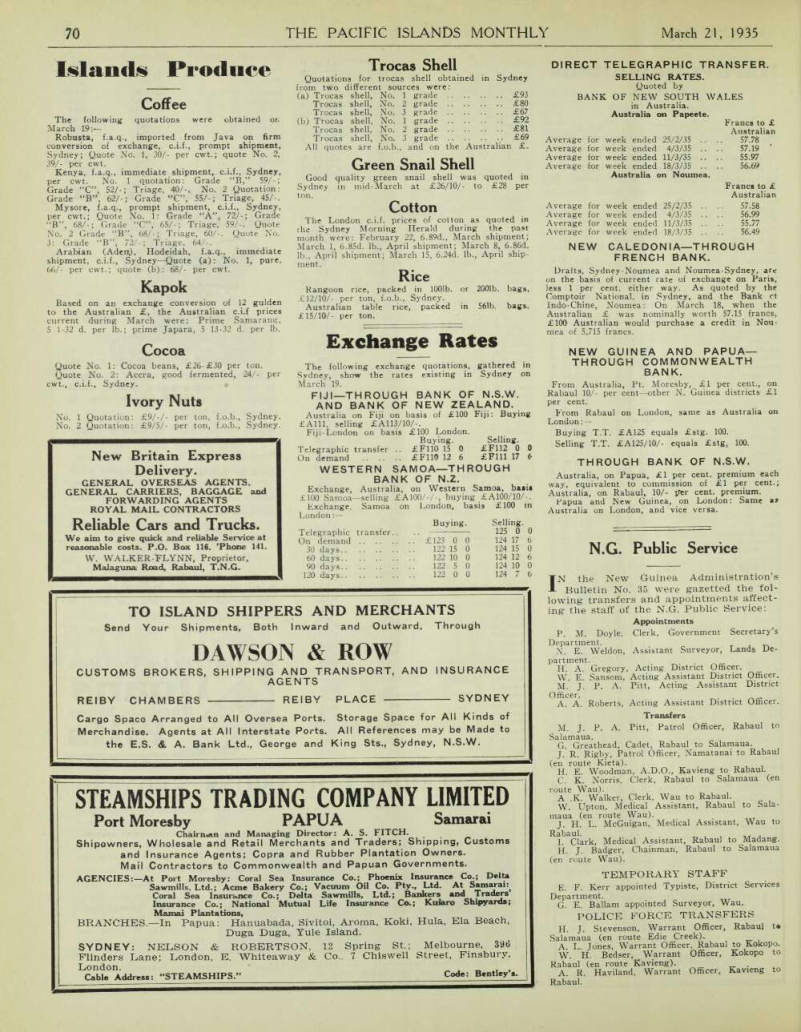
Coffee
The following quotations were obtained or.
March 19:- Robusta, f.a.q., imported from Java on firm conversion of exchange, c.i.f., prompt shipment, Sydney; Quote No. 1, 30/- per cwt.; quote No. 2, 39/- per cwt.
Kenya, f.a.q., immediate shipment, c.i.f., Sydney, per cwt. No. 1 quotation: Grade “B,” 59/-; Grade “C”, 52/-; Triage, 40/-. No. 2 Quotation: Grade “B”, 62/-; Grade “C”, 55/-; Triage, 45/-.
Mysore, f.a.q., prompt shipment, c.i.f., Sydney, per cwt.; Quote No. 1: Grade “A”, 72/-; Grade “B”, 68/-; Grade “C”, 65/-; Triage, 59/-. Quote No. 2 Grade “B”, 68/-; Triage, 60/-. Quote No. 3: Grade “B”, 72/-; Triage, 64/-.
Arabian (AdenJ, Hodeidah, f.a.q., immediate shipment, c.i.f., Sydney—Quote (a); No. 1, pure, 66/- per cwt.; quote (b): 68/- per cwt.
Kapok
Based on an exchange conversion of 12 gulden to the Australian £, the Australian c.i.f prices current during March were: Prime Samarang, 5 1-32 d. per lb.; prime Japara, 5 13-32 d. per lb.
Cocoa
Quote No. 1: Cocoa beans, £26-£30 per ton.
Quote No. 2: Accra, good fermented, 24/- per cwt., c.i.f., Sydney.
Ivory Nuts
No. 1 Quotation: £9/-/- per ton, f.o.b., Sydney.
No. 2 Quotation: £9/5/- per ton, f.o.b., Sydney.
Trocas Shell
Quotations for trocas shell obtained in Sydney from two different sources were:
Green Snail Shell
Good quality green snail shell was quoted in Sydney in mid-March at £26/10/- to £28 per ton.
Cotton
The London c.i.f. prices of cotton as quoted in the Sydney Morning Herald during the past month were: February 22, 6.89 d., March shipment; March 1,6.85 d. lb., April shipment; March 8,6.86 d, lb., April shipment; March 15, 6.24 d. lb., April ship ment.
Rice
Rangoon rice, packed in 100lb. or 200lb. bags, £12/10/- per ton, f.o.b., Sydney.
Australian table rice, packed in 56lb. bags. £15/10/- per ton.
(a) Trocas shell, No. 1 grade £93 Trocas shell, No. 2 grade £80 Trocas shell. No. 3 grade £67 (b) Trocas shell, No. 1 grade £92 Trocas shell, No. 2 grade £81 Trocas shell, No. 3 grade £69 All quotes are f.o.b., and on the Australian £.
Exchange Rates
The following exchange quotations, gathered in Sydney, show the rates existing in Sydney on March 19.
FlJl—through bank of n.s.w.
And Bank Of New Zealand.
Australia on Fiji on basis of £100 Fiji: Buying £A111, selling £A113/10/-.
Fiji-London on basis £100 London.
Buying. Selling.
Telegraphic transfer .. £F110 15 0 £F112 0 0 On demand £F110 12 6 £F111 17 6
Western Samoa—Through
Bank Of N. 2.
Exchange, Australia, on Western Samoa, basis £100 Samoa —selling £A100/-/-, buying £A100/10/-.
Exchange, Samoa on London, basis £100 in London:—
Direct Telegraphic Transfer.
Selling Rates.
Quoted by
Bank Of New South Wales
in Australia.
Australia on Papeete.
New Caledonia—Through
French Bank.
Drafts, Sydney-Noumea and Noumea-Sydney, are on the basis of current rate of exchange on Paris, less 1 per cent, either way. As quoted by the Comptoir National, in Sydney, and the Bank of Indo-Chine, Noumea: On March 18, when the Australian £ was nominally worth 57.15 francs, £100 Australian would purchase a credit in Noumea of 5,715 francs.
New Guinea And Papua
Through Commonwealth
Bank.
From Australia, Pt. Moresby, £1 per cent., on Rabaul 10/- per cent—other N. Guinea districts £1 per cent.
From Rabaul on London, same as Australia on London: — Buying T.T. £A125 equals £stg. 100.
Selling T.T. £A125/10/- equals £stg, 100.
Through Bank Of N.S.W.
Australia, on Papua, £1 per cent, premium each way, equivalent to commission of £1 per cent.; Australia, on Rabaul, 10/- per cent, premium.
Papua and New Guinea, on London; Same a» Australia on London, and vice versa.
Buying. Selling.
Telegraphic transfer.. .. 125 0 0 On demand £123 0 0 124 17 6 30 days 122 15 0 124 15 0 60 days 122 10 0 124 12 6 90 days 122 5 0 124 10 0 120 days 122 0 0 124 7 6
Average for week ended 25/2/35 .. 57.78 Francs to £ Australian Average for week ended 4/3/35 .. 57.19 Average for week ended 11/3/35 .. 55.97 Average for week ended 18/3/35 .. 56.69 Average for week ended 25/2/35 .. 57.58 Australia on Noumea.
Francs to £ Australian Average for week ended 4/3/35 .. 56.99 Average for week ended 11/3/35 .. 55.77 Average for week ended 18/3/35 .. 56.49
N.G. Public Service
IN the New Guinea Administration’s Bulletin No. 35 were gazetted the fol lowing transfers and appointments affect ing the staff of the N.G. Public Service: Appointments P. M. Doyle, Clerk, Government Secretary’s Department. , N. E. Weldon, Assistant Surveyor, Lands De partment.
H. A. Gregory, Acting District Officer.
W. E. Sansom, Acting Assistant District Officer.
M. J. P. A. Pitt, Acting Assistant District Officer.
A. A. Roberts, Acting Assistant District Officer.
Transfers M. J. P. A. Pitt, Patrol Officer, Rabaul to Salamaua.
G. Greathead, Cadet, Rabaul to Salamaua.
J. R. Rigby, Patrol Officer, Namatanai to Rabaul (en route Kieta).
H. E. Woodman, A.D.O., Kavieng to Rabaul.
C. K. Norris, Clerk, Rabaul to Salamaua (en route Wau).
A .K. Walker, Clerk, Wau to Rabaul.
W. Upton, Medical Assistant, Rabaul to Sala maua (en route Wau).
J. H. L. McGuigan, Medical Assistant, Wau to Rabaul.
I. Clark, Medical Assistant, Rabaul to Madang.
H. J. Badger, Chainman, Rabaul to Salamaua (en route Wau).
Temporary Staff
E. F. Kerr appointed Typiste, District Services Department.
G. E. Ballam appointed Surveyor, Wau.
Police Force Transfers
H. J. Stevenson, Warrant Officer, Rabaul to Salamaua (en route Edie Creek).
A. L Jones, Warrant Officer, Rabaul to Kokopo.
W. H. Bedser, Warrant Officer, Kokopo to Rabaul (en route Kavieng).
A. R. Haviland, Warrant Officer, Kavieng to Rabaul.
Advertisements & other items, p. 72 (1 item)
Steamships Trading Company Limited
New Britain Express
Delivery.
GENERAL OVERSEAS AGENTS.
GENERAL CARRIERS, BAGGAGE and
FORWARDING AGENTS
ROYAL MAIL CONTRACTORS
Reliable Cars and Trucks.
We aim to give quick and reliable Service at reasonable costs. P.O. Box 116. 'Phone 141.
W. WALKER-FLYNN, Proprietor, Malaguna Road, Rabaul, T.N.G.
TO ISLAND SHIPPERS AND MERCHANTS
Send Your Shipments, Both Inward and Outward, Through
DAWSON & ROW
CUSTOMS BROKERS, SHIPPING AND TRANSPORT, AND INSURANCE
AGENTS
REIBY CHAMBERS REIBY PLACE SYDNEY
Cargo Space Arranged to All Oversea Ports. Storage Space for All Kinds of Merchandise. Agents at All Interstate Ports. All References may be Made to the E.S. & A. Bank Ltd., George and King Sts., Sydney, N.S.W.
STEAMSHIPS TRADING COMPANY LIMITED
Port Moresby PAPUA Samarai
Chairnutn and Managing Director: A. S. FITCH.
Shipowners, Wholesale and Retail Merchants and Traders; Shipping, Customs and Insurance Agents; Copra and Rubber Plantation Owners.
Mail Contractors to Commonwealth and Papuan Governments.
AGENCIES:—At Port Moresby: Coral Sea Insurance Co.; Phoenix Insurance Co.; Delta Sawmills. Ltd.; Acme Bakery Co.; Vacuum Oil Co. Pty., Ltd. At Samarai: Coral Sea Insurance Co.; Delta Sawmills, Ltd.; Bankers and Traders Insurance Co.; National Mutual Life Insurance Co.; Kularo Shipyards; Mamai Plantations, BRANCHES.—In Papua: Hanuabada, Sivitoi, Aroma, Koki, Hula, Ela Beach, Duga Duga, Yule Island.
SYDNEY: NELSON & ROBERTSON, 12 Spring St.; Melbourne, 396 Flinders Lane; London, E. Whiteaway & Co.. 7 Chiswell Street, Finsbury, London.
Cable Address: “STEAMSHIPS.” Code; Bentley's.
Again?
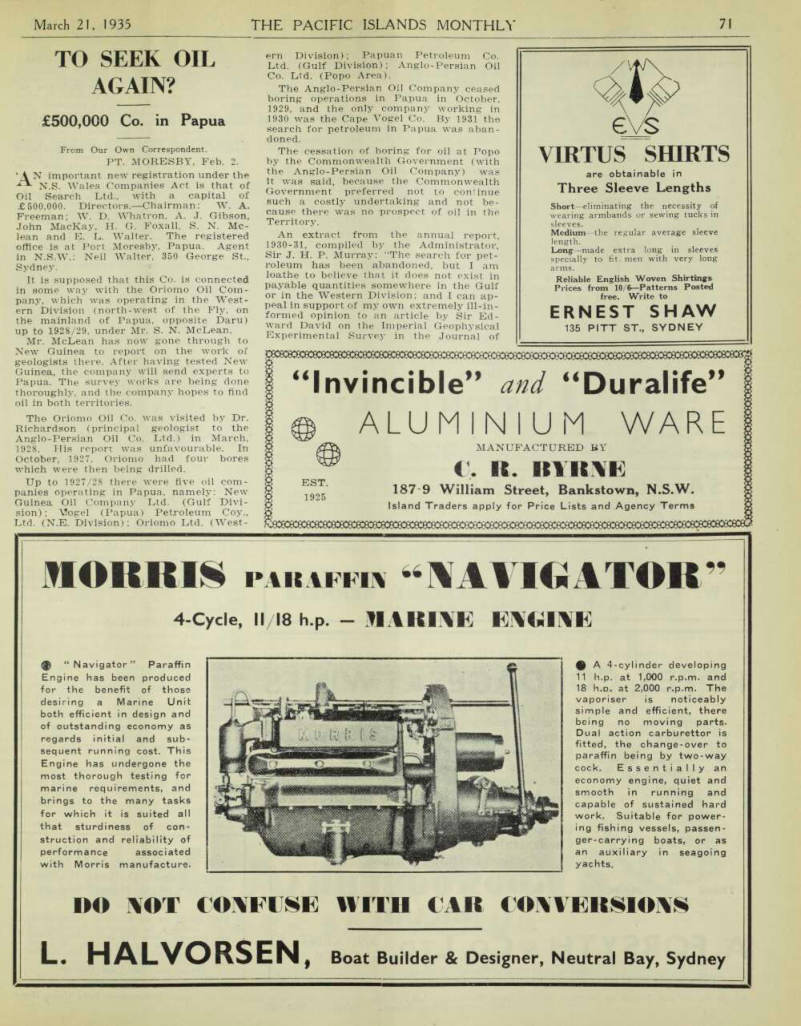
To Seek Oil
£500,000 Co. in Papua
From Our Own Correspondent.
Pt. Moresby, Feb. 2.
AN important new registration under the N.S. Wales Companies Act is that of Oil Search Ltd., with a capital of £500,000. Directors. —Chairman: W. A.
Freeman; W. D. Whatron, A. J. Gibson, John Mac Kay, H. G. Foxall, S. N. Mc lean and E. L. Walter. The registered office is at Port Moresby, Papua. Agent in N.S.W.: Neil Walter, 350 George St., Sydney.
It is supposed that this Co. is connected in some way with the Oriomo Oil Com pany, which was operating in the Western Division (north-west of the Fly, on the mainland of Papua, opposite Daru) up to 1928/29, under Mr. S. N. McLean.
Mr. McLean has now gone through to New Guinea to report on the work of geologists there. After having tested New Guinea, the company will send experts to Papua. The survey works are being done thoroughly, and the company hopes to find oil in both territories.
The Oriomo Oil Co. was visited by Dr.
Richardson (principal geologist to the Anglo-Persian Oil Co. Ltd.) in March, 1928. His report was unfavourable. In October, 1927, Oriomo had four bores which were then being drilled.
Up to 1927/28 there were five oil com panies operating in Papua, namely: New Guinea Oil Company Ltd. (Gulf Divi sion); Vogel (Papua) Petroleum Coy., Ltd. (N.E. Division): Oriomo Ltd. (West
ern Division): Papuan Petroleum Co.
Ltd. (Gulf Division); Anglo-Persian Oil Co. Ltd. (Popo Area).
The Anglo-Persian Oil Company ceased boring operations in Papua in October, 1929, and the only company working in 1930 was the Cape Vogel Co. By 1931 the search for petroleum in Papua was aban doned.
The cessation of boring for oil at Popo by the Commonwealth Government (with the Anglo-Persian Oil Company) was it was said, because the Commonwealth Government preferred not to continue such a costly undertaking and not be cause there was no prospect of oil in the Territory.
An extract from the annual report, 1930-31, compiled by the Administrator, Sir J, H. P. Murray: “The search for pet roleum has been abandoned, but I am loathe to believe that it does not exist in payable quantities somewhere in the Gulf or in the Western Division; and I can ap peal in support of my own extremely ill-in formed opinion to an article by Sir Ed ward David on the Imperial Geophysical Experimental Survey in the Journal of
the Council for Scientific and Industrial Research for May, 1931. Referring to the “vast alluvial plains of the Fly River and other rivers in Papua.” this authority says, “There can be little doubt that under the alluvial of this great plain are, in places, what will eventually prove to be payable oilfields.’”
Advertisements & other items, p. 73 (1 item)
L. Halvorsen,
VIRTUS SHIRTS
are obtainable in
Three Sleeve Lengths
Short—eliminating the necessity of wearing armbands or sewing tucks in sleeves.
Medium —the regular average sleeve length.
Long—made extra long in sleeves specially to fit men with very long arms.
Reliable English Woven Shirtings Prices from 10/6 —Patterns Posted free. Write to
ERNEST SHAW
136 PITT ST., SYDNEY
"Invincible” and “Duralife"
ALUMINIUM WARE
MANUFACTURED BY
EST.
1925
C. R. BYRNE
187 9 William Street, Bankstown, N.S.W.
Island Traders apply for Price Lists and Agency Terms
MORRIS PARAFFIN "NAVIGATOR"
4-Cycle, 11/18 h.p. - MARINE ENGINE
“Navigator” Paraffin Engine has been produced for the benefit of those desiring a Marine Unit both efficient in design and of outstanding economy as regards initial and subsequent running cost. This Engine has undergone the most thorough testing for marine requirements, and brings to the many tasks for which it is suited all that sturdiness of construction and reliability of performance associated with Morris manufacture.
A 4-cylinder developing 11 h.p. at 1,000 r.p.m. and 18 h.o. at 2,000 r.p.m. The vaporiser is noticeably simple and efficient, there being no moving parts.
Dual action carburettor is fitted, the change-over to paraffin being by two-way cock. Essentially an economy engine, quiet and smooth in running and capable of sustained hard work. Suitable for powering fishing vessels, passenger-carrying boats, or as an auxiliary in seagoing yachts.
DO NOT CONFUSE WITH CAR CONVERSIONS
L. HALVORSEN,
Boat Builder & Designer, Neutral Bay, Sydney
Explanation of Recent
Ordinance
From Our Own Correspondent.
Pt. Moresby, Feb. 20.
IN the January number of the P.I.M. a paragraph dealt with a recent proclama tion, by which 29,000 square miles of the Territory are specially reserved for a large British concern. Recent letters from Port Moresby, it was stated, indicated that there was a good deal of strong feeling against the Ordinance, and in considera tion of this feeling, the following informa tion may be of interest.
The Mining (Facilities for Develop ment) Ordinance, 1934, was passed in
order to facilitate prospecting on a large scale and in remote parts of the country.
It was based upon similar legislation passed by a Labour Government in West ern Australia; and there is also similar legislation in Queensland.
It has nothing to do with Oil.
The area reserved is still open to pros pecting as before, but the Company has the right of first refusal over mining tene ments acquired after the grant of the reserve; and no lease or tenement will be granted except upon conditions that the applicant gives the grantee of the reserve the first right of purchase “on terms not more onerous than those which he would be prepared to offer it to others.”
Mining tenements already existing are not affected at all.
Such an opportunity of testing this re mote part of the country by a company with ample capital was not to be refused, and it would have been madness not to have accepted it.
The Bill was explained and discussed in the Legislative Council. The following is from Legislative Council Debates Meeting No. 2, July, 1934.
“The Bill is introduced for the greater encourage men of prospecting and mining for the ultimate good of the Territory. The physical features of the country make the efforts of individuals for the most part unproductive. The Territory can the more readily, and the more successfully, be pros pected for its mineral wealth, by companies with ample capital than by individuals who mostly have no capital at all, and cannot command capital for development, even if successful in prospecting.
Companies are known to exist, ready and willing to spend money in the search for gold and other minerals in the Territory. It seems only proper that some benefits should be bestowed upon them in return for the money they spend in the risky business of prospecting; “By the provisions of this Bill, areas may be reserved in which the grantee Company has right of first refusal over mining tenements acquired after the grant of the reserve. The rights of original mining tenants, whether tenants before or after the creation of the reserve, are not dis turbed. The Bill is destined, too, to assist the individual prospector to find a ready market for his mining tenement should he wish to dispose of it.”
It is reported that Mr. Ward Williams, the well known mining engineer, will ac company members of the Oroville Com pany up the Fly River to Palmer Junc tion, where a base camp will be made from which prospecting parties will work eastwards.
Aftermath Of Royal
Visit
From Our Own Correspondent SUVA, March 2.
BOTH visitors and visited appear to have enjoyed themselves thoroughly during the recent visit to Suva of H.R.H. the Duke of Gloucester and H.M.A.S.
Australia. It is known that Prince Henry expressed himself in no uncertain terms; it was probably the restriction of official functions to the bare minimum, coupled with the informality and the outdoor life that appealed to H.R.H. particularly.
Apart from that, much credit is due to the Governor and his officials for the very able staff work which resulted in a pro gramme that ran without a hitch. But, crowning everything, was the glorious weather, bright sunshine and not unduly hot, which was not at all true to the usual February sample,
The Australian Navy.
The Australian Navy deserves a sin cere compliment upon the excellent im pression created by the officers and men of H.M.A.S. Australia. Suva folk see the personnel of the Royal Navy, the United States Navy, the Japanese Navy, etc., at various times at close quarters, and are by now shrewd critics. On all sides opinion as to the Australians’ splendid behaviour and personal courtesy was unanimous and perhaps in the future we may hope to see other of H.M.’s Austra lian ships in Suva.
Rev. H. J. E. Short, of Hula, Papua, arrived in Sydney from Port Moresby by the Van Rees on two months’ furlough on March 19. He is the secretary of the London Missionary Society in Papua.
Advertisements & other items, pp. 74-76 (3 items)
72
March 21, 1933
THE PACIFIC ISLANDS MONTHLY
Wholly set up and Printed in Australia by The Land Newspaper, Ltd., 59 Regent St., Sydney, and Published by Pacific Publications 247 George Street, Sydney. Telephone: BW 5037.
A. Forsyth & Co. Ltd
TARIFF:
Bed and Breakfast 8/6 per day, £2/10/- weekly Luncheon and Dinner a la Carte Euston Hotel
CENTRALLY SITUATED
Modern Services Throughout
A. HOBAN, Prop.
272 GEORGE ST., SYDNEY, opp. Wynyard Station
SALFORD KENNELS
PRIZE-WINNING SMOOTH and WIRED-HAIRED FOX TERRIERS
Bred from English Imported Stock. For Show or Breeding Purposes.
Always available. CERTIFIED PEDIGREES SUPPLIED.
I am not a dealer, and all stock is bred by me from selected stock.
Dogs at Stud.
Salford-bred Terriers win at all the leading Shows in Australia and New Zealand. Write stating requirements to:
W. E. CROSTON, Prop) SALFORD KENNELS
22 Thurlow Street, Redfern, N.S. Wales.
Save time, trouble, temper specify these universally preferred
ROPES, CORDAGES & TWINES
Made by the largest Rope and Cordage manufacturers in Australasia, “Kookooburra” Ropes, Cordages, and Twines are tested to provide that extra endurance, which is only found in “Kookooburra” quality lines.
Specially manufactured for the stresses of tropical conditions.
Other well-known products include Sash Cords, Halters, Plow Reins, Jute and Hemp Seaming Twines.
KOOKOOBURRA
BRAND
339 KENT ST
SYDNEY.
A. FORSYTH & Co. Ltd
Cable Address: “Rope,” Sydney
W. M. Ford
Ship, Yacht & Boat Builder
Berry’s Bay, North Sydney
(Established 1870.) BUILDERS of all kinds of Island Craft from Dinghies to Auxiliary Schooners of any tonnage. New and Second-hand Island Craft of various types in stock. New and Second-hand Full Diesel, Crude Oil. Benzine and Kerosene Engines.
Please Send on Your Enquiries.
AERIAL TRANSPORT
PIONEERED AND CARRIES ON
THE NEW GUINEA GOLD INDUSTRY
Centre —One of the Bulolo Dredges under construction in Central New Guinea—three aeroplanes operated by Guinea Airways Ltd. discharging cargo.
Top right—Dairy cattle being loaded into a Guinea Airways plane for transport to the Goldfields.
Lower left —Interior of one of Guinea Airways car go-carrying aeroplanes.
SAFETY . . . SPEED . . . COMFORT . . . DEPENDABILITY Eight years ago, Central New Guinea was almost unexplored, and practically inaccessible.
To-day, although there are no roads through the dense jungles and precipitous mountains, the Morobe Goldfield, in Central New Guinea, is the seat of a flourishing industry. There are half a dozen growing townships, four huge, modern dredges, two hydro-electric stations, crushing-mills, saw-mills, etc. . . Aerial transport alone made this possible.
Aeroplanes, flying in all weathers on regular timetables, connecting the coastal towns of Lae, Salamaua and Port Moresby with over thirty inland aerodromes and landing-grounds, have carried in thousands of tons of engineering equipment, a large European population, thousands of native labourers, foodstuffs, livestock, mails ,etc.
Guinea Airways Ltd. launched its unique aerial transport service seven years ago, with one machine and a handful of men. To-day, it operates a fleet of modern aeroplanes, and employs very large European and native staffs.
GUINEA service aeroplanes carry on one of the biggest transport organisations in the world, in one of the world’s most primitive tropical countries; yet no aerial transport system in the world can show a smaller percentage of accidents, or a better record of efficiency
and dependability.
A visit to Central New Guinea, in one of Guinea Airways speedy and comfortable air-liners, is a unique and delightful experience.
Travellers may leave the steamer at Port Moresby, fly across to Morohe (time of journey, 1 hour 45 minutes) and spend nine days in the Goldfield centres before rejoining steamer at Lae for Rabaul. Or, after visiting Rabaul, they may disembark at Salamaua or Lae, spend several days on the Goldfields, and fly to Port Moresby to rejoin the steamer. All information from Pursers on the steamers.
GUINEA AIRWAYS Ltd
LAE
SALAMAUA
The mosf important
feature of
RESCH’S PILSENER
is the “SPOT” crown seal Resch’s Pilsener is protected against tropical heat by this specially designed “Spot” Crown Seal.
It ensures perfect freshness in all climates.
RESCH’S
LONG BOTTLE
PILSENER