M Paradise

Pacific Islands
Monthly
INSIDE; WASHINGTON VS CNMI - PROGRESS VS TRADITION
October 1997
Paedophiua
M Paradise
American Samoa USS2.SO; Australia A 53.50; Cook Islands NZ$3; Fiji F 52.50 Vat incl; FS Micronesia US$3; Kiribati A 52.50; Nauru A 52.50; Niue NZ$3; Norfolk As 3; New Caledonia cpf2so; New Zealand NZ53.45 incl GST: Northern Marianas US$3; Papua New Guinea K 2.90; Palau US$3; Marshall Islands US$3; Solomon Islands As 3; French Polynesia cpf3oo: Tonga P 3; USA USS 3; Vanuatu VT22O; Western Samoa T 5.50. These are recommended prices only.
Advertisements & other items, pp. 2-5 (1 item)
Susp
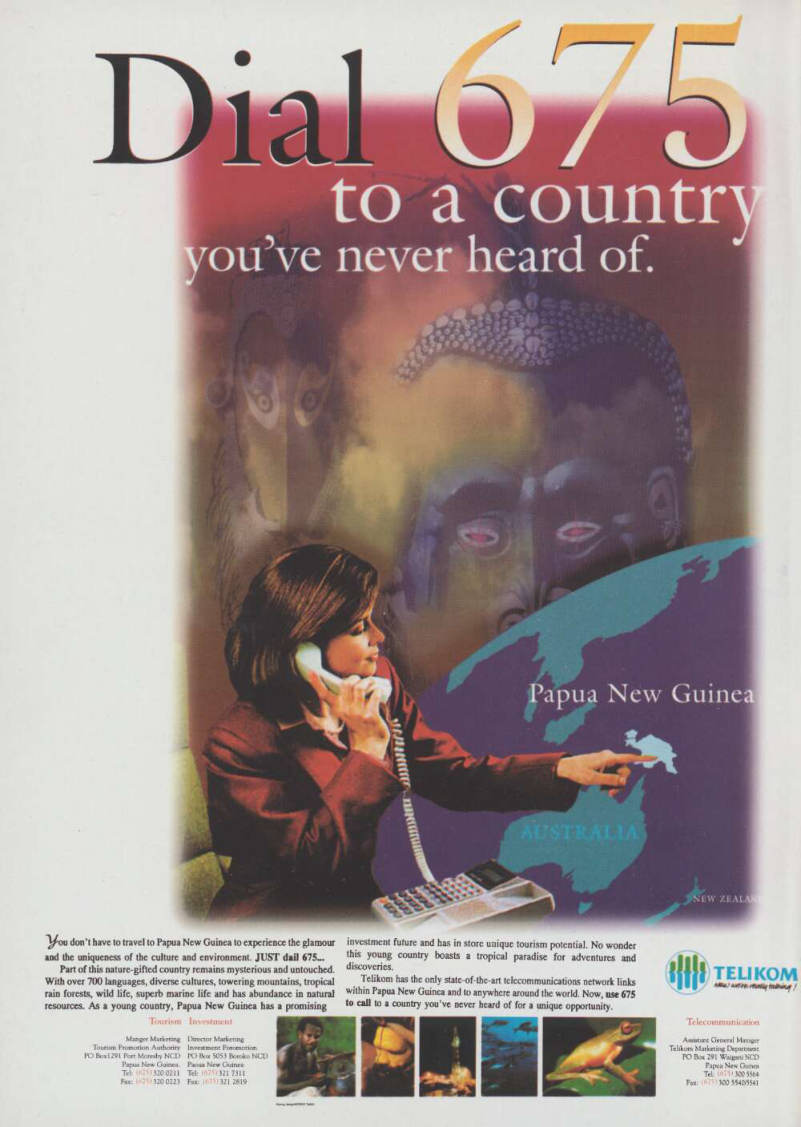
don’t have to travel to Papua New Guinea to experience the glamour and the uniqueness of the culture and environment. JUST dail 675_.
Part of this nature-gifted country remains mysterious and untouched.
With over 700 languages, diverse cultures, towering mountains, tropical rain forests, wild life, superb marine life and has abundance in natural resources. As a young country, Papua New Guinea has a promising Tourism Investment Manger Marketing Director Marketing Tourism Promotion Authority Investment Poromotion PO Box 1291 Port Moresby NCD PO Box 5053 Boroko NCD Papua New Guinea. Paoua New Guinea Tel: 1675)320 0211 Tel: (675)321 7311 Fax: (675)3200223 Fax: (675)321 2819 investment future and has in store unique tourism potential. No wonder this young country boasts a tropical paradise for adventures and discoveries.
Telikom has the only state-of-the-art telecommunications network links within Papua New Guinea and to anywhere around the world. Now, use 675 to call to a country you’ve never heard of for a unique opportunity.
SUSP
■HHH mmm hbqh
{III} TELIKOM
Ml / Telecommunication Assistant General Manager Telikom Marketing Department PO Box 291 Waigani NCD Papua New Guinea Tel: (675)300 5564 Fax: (675)300 5540/5541
Island Soda
Distributors Wanted
SLAND
IHEAPPI. -
m am
Popular
Product
Competitive
Pricing
Export
Packaging
Our tropical soft drink line has made a big splash across the Pacific Islands
Pineapple Tropical Soda
Orange Grape
Dew Lemon-Lime
Cola Strawberry
Delicious flavors are complimented with highly visual packaging and
exciting product advertising.
Island Soda U.S.A.
Aspen International Export, Inc. 1402-3rd Avenue, Suite 1024 Seattle, WA 98101 Phone (206) 628-6151 Fax (206) 628-6421
ISLAND
SODA
•- 'P- Island Soda Samoa Island Soda Tahiti Haleck's Pago Pago Beverages Eico Phone 684 633 7270 Fax 684 633 7273 Phone 689 421 660 Fax 689 429 838 Island Soda Tonga Tonga Cooperative Federation Limited Phone 676 23 670 Fax 676 23 203
i ss ■ r «*«fc f¥% *v: |S| HM - ■ ■ * fzmim * ▲ ▲
MARKET M A K ER
Ocean Shrinker The new generation 50-seat Saab 2000 Jet Prop, flying nearly 180 mph faster than the competition, is shrinking the long distances of the Pacific, slashing hours from other turboprop schedules. With flexibility to meet the needs of passengers and airlines, the Saab 2000 is the Pacific's best choice. Fly the Saab 2000 and enjoy a new era of passenger comfort and service. Saab 2000 - the Market Maker and Money Maker now uniting nations of the Pacific! ■_ ■ ,
uniting tne Pacific
Saab Aircraft AB http;//www/saab.com.se SWEDEN • +46 13 182000 * FAX +46 13 18210*USm*U* • +6l 2 9369 1666 * FAX +6l 2 9369 2500 HONG KONG • +852 2810 4220 * FAX +852 2810 4135 UK • +44 1753 859991 * FAX+44 1753 858884
mrnmam
Fiji's first and only fully equipped
computer lab open for public
© zrzi c
AVAILABLE
• TURBO PASCAL
• FOX PRO
• DBASE S(WINDOWS)
• VISUAL BASIC 5.0
• AUTOCAD LT 13
SOFTWARE
• MS OFFICE 97
• MS PUBLISHER
COREL WORD PERFECT
• LOTUS 123R5
• C++ FOR WINDOWS
Enquire about our courses in Microsoft certification, Novell CNA & CNE
MEMBERSHIP RATES
1 Month 3 Months School students $20.00 $55.00 Tertiary students $35.00 $95.00 Adults $35.00 $95.00
Pacific Islands
Monthly
Vol 67 No. 10
The News Magazine
October 1997
PUBLISHER: Alan Robinson ACTING EDITOR: Bernadette Hussein SENIOR WRITER: Bernadette Hussein
Correspondents:
Sally Andrew, Patrick Decloitre, Giff Johnson, Chris Peteru, Susan Prokop, Atama Raganivatu, Kalinga Seneviratne, Liz Thompson, Lili Tuwai, Sam Vulum, lan Williams COLUMNISTS: David Barber (Wellington), Jemima Garrett (Sydney), Debbie Singh (South Pacific Commission).
GRAPHIC ARTISTS: James Ranuku, Josefa Bola, Andrew Williams
Advertising Sales
Senior Regional Sales (South Pacific) Shabana Naaz Tel (679) 304111, 303244, Fax (679) 303809.
Sydney, Canberra: Bob Hill Media Representation, Tel (61-2) 4164245, Fax (61-2) 4165064.
Brisbane: Jane Fewings Media and Advertising Associates Tel (61-7) 3378 4522, Fax (61-7)3878 1071.
Adelaide: Hastwell Williamsons Representatives. Tel (61-8) 3799522, Fax (61-8) 3799735.
Melbourne: Brown Orr Fletcher Burrows (Aust) Pty Ltd.
Tel (61-3) 98265188, Fax (61-3) 98265644.
Auckland: McKay & Bowman, Internationa!
Media Representatives Limited, Tel (64-9)4190561, Fax (64-9) 4192243.
Japan: Universal Media Corporation. Tokyo, Tel (3) 3266626741, Cable: UNI-MEDIA Tokyo, Fax (3) 32626742.
Pacific Islands Monthly was founded in 1930
(Usps 9522480).
A Fiji Times Limited production.
Cover prices are recommended retail only. Registered by Australia Post, Publication No. NBPI2IO. © Copyright Fiji Times Limited, 177 Victoria Parade, Suva, Fiji.
Tel (679) 304111, fax (679) 303809.
Pacific Islands Monthly is published monthly by Fiji Times Limited, a division of Nationwide News, 2 Holt Street, Surry Hills, Sydney, NSW 2010.
Send Address Changes To:
Pacific Islands Monthly PO Box 1167 Suva, Fiji.
Typeset and printed by The Fiji Times Limited, 177 Victoria Parade, Suva, Fiji.
Layout and cover design by Andrew Williams Cover photo by Asaeli Lave
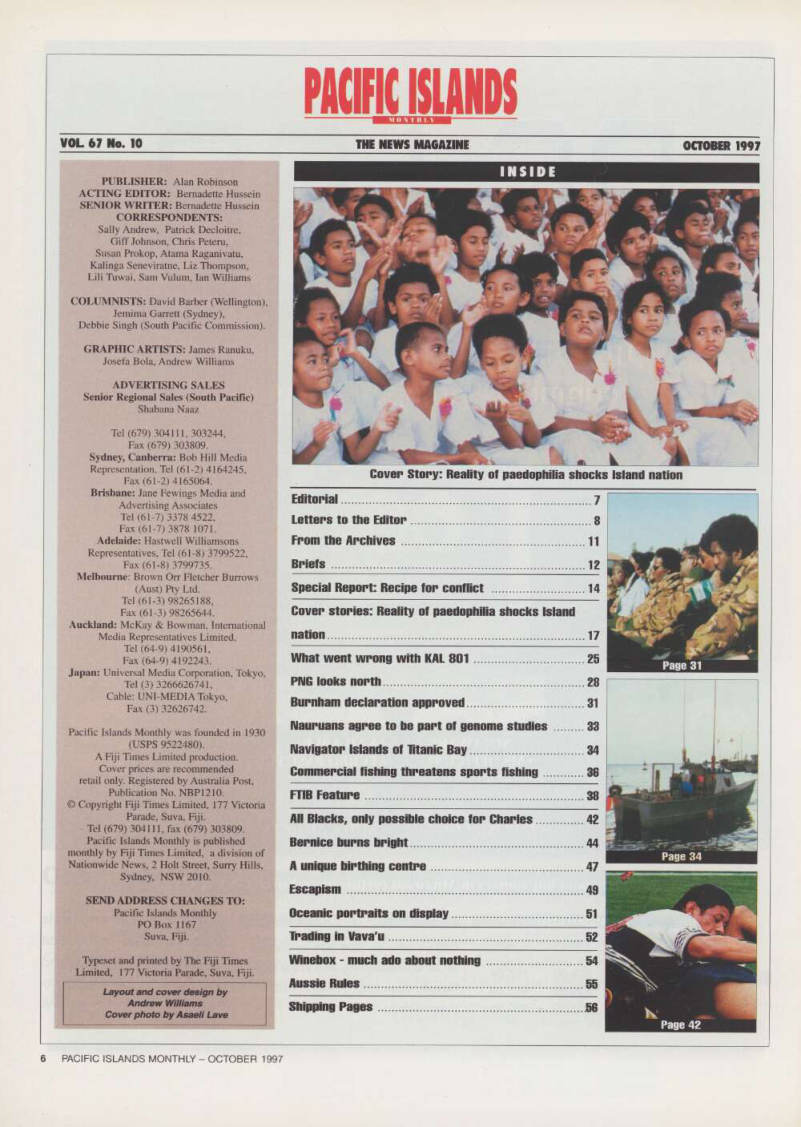
Inside
Editorial 7 Letters to the Editor 8 From the Archives it Briefs 12 Special Report: Recipe tor conflict 14 Cover stories: Reality of paedophilia shocks Island nation 17 What went wrong with KAL 801 25 PNG looks north 28 Burnham declaration approved 31 Nauruans agree to be part of genome studies 33 Navigator Islands of litanic Bay 34 Commercial fishing threatens sports fishing 36 FTIB Feature 38 All Blacks, only possible choice for Charles 42 Bernice burns bright 44 A unique birthing centre 47 Escapism 49 Oceanic portraits on display 51 Trading in Vava'u 52 Winebox - much ado about nothing 54 Aussie Rules 55 Shipping Pages 56
Page 31
Page 34
Page 42
Cover Story: Reality of paedophilia shocks Island nation
Save the
Editorial
Save the Children
Children have rights. And perhaps chief among these is the right to be protected from exploita tion of any description. Tomorrow’s adults, the people who will shape the future of mankind,need to approach
their task untainted by childhood trauma. In recent months the Pacific islands region appears to have suffered an influx of the worst kind of child exploiters - those who use children for sexual
gratification.
Theirs is possibly the worst sin that can be visited on any inno cent child. It can and does destroy the child before he or she has even a chance to grow. These criminals take away from the young perhaps the very essence of their childhood, their innocence, leav ing a damaged shell that more often than not will never fully recover. It is a crime that strikes fear into the heart of every par ent. Yet too often those same people seem strangely reluctant to impart to their children the knowledge that may help protect them from this evil activity. Wishing, no doubt, to protect that same innocence, we tend in this part of the world not to tell our children of such things. Most people, however, can agree that those found guilty of this crime should be punished to the full extent of the law. But as lawyer Anthony Gates points out, the region’s laws are not always equal to this dreadful crime. For while most nations are signatories to the UN Convention on Children’s Rights, few have enacted enabaling legislation to enshrine this convention in domestic law. Parents throughout the region will support such leg
islation. Without it, after all, all the promises made in the document, impor tant though it is, are close to worthless.
Governments in our part of the world may have been unaware of such dan gers to children. If that is so recent rev elations may shock them into action.
But it is in the nature of politics that there has to be a political rea son for change. In other words, if parents and concerned profes sionals do not press governments to pass laws, there is a risk that some politicians, at least, will find other priorities. On the other hand it would be quite wrong to suppose that a handful of evil expatriates are solely responsible for the abuse of our children.
Clearly that would be naive in the extreme.
Research and emerging material in our region indicates that the overwhelming majority of child sex abuses are perpetrated by a family member or by someone very close to the family. The harsh truth is that we have probably never been without child abuse any more than the so-called developed nations have been.
But people overseas are learning to come to terms with this while most of us come from a culture of silence on such matters. Adults find it very difficult to openly discuss sexual offences. Imagine, then, the difficulties faced by children who have been subject to abuse. The terror a child has endured can only be multiplied by the lack of opportunity to seek the comfort of explaining the hurt to a caring parent. It's time to end the silence. Children should know that sexual abuse is a crime and that it should be reported.
Silence on this matter is far from golden. ■
Letters To The Editor
Secretariat responds
Dear Sir, It is not my practice to write in order to get in the ‘paper’, but on this occasion there is no option if the record is to be put
straight.
Your article in the August edition on the Forum particularly the part about the alle gation of inconsistent and administrative malpractice, ignored important informa tion in order to ‘invent’ a story.
At the time our 1995 accounts were audited, the Auditor-General raised a num ber of queries seeking an explanation from the Secretariat.
There is nothing unusual about that. It is a normal procedure and part of the pro cess to enable the auditor to form an opin ion about the accounts and other important matters.
The fact that they were raised by the auditor does not in itself prove that the Secretariat, was “bedevilled with allega tions of inconsistent and poor administra tive practices’ as your article states.
The issue is whether the Auditor- General is satisfied with our explanation.
In this particular case and in all the previ ous five years at least, the auditors have always been satisfied with our explana tions provided both in writing and in dis cussion with them.
As a result there were clean audit reportseverytimg.
Not only that, but the auditorduring this period has been able to advise the members that there has been nothing sig nificant that he needed to bring to their attention.
Any organisation with that independent unqualified Audit Report will be justifi ably pleased with the result.
It is unfortunate that your article conve niently ignored the Auditor General’s Report, even though a copy was provided to your reporter.
This leaves your readers with an inac curate impression about how the Forum Secretariat is managed.
Ieremia T. Tabai
Secretary General South Pacific Forum Secretariat
Mormons-doing more,
recognised less?
Dear Sir, I refer to Chris Peteru’s highly unflat tering and heavily biased article title "Religion or Scam”, PIM, Aug., 1997.
Mr Peteru wrote the most derogative, and disrespectful material relating to one of the largest growing religion in the Pacific, the Mormons. He had completely endorsed the exaggerated opinions of a few Mormon-bashers to dictate his own feeling and contempt for the Mormon religion in Samoa.
I don’t resent people making condem nation against other religion for whatever reason provided they substantiate their argument with a depth of subtlety and logic. It seems that the whole intent of his article was to demean and denigrate the LDS church in Samoa.
Mr Peteru has completely ignored the tremendous history and contribution pro vided by the Mormon church to religion itself, and to the thousands of Samoans who have achieved remarkably in the areas of education, medical and social research .
The growth of the Mormon church in Samoa, as in other parts of the Pacific, had little to do with the “vigorous” missionary work, or the two year “stint”, which the writer has sarcastically tried to put.
Ironically, Mr Peteru failed to empha sise the growth in other contemporary churches such as the Assemblies of God who have managed to recruit Congregational and Catholic faithfuls in the past 10-15 years. However, with respect to the major churches in the Pacific, including Samoa, I must put the Mormon position in perspective It would appear that Mr Peteru had treated the Mormon church as though this denomination has just reached the shores of Samoa, and it is suddenly becoming a threat to other mainstream churches in Samoa. The missionaries who goes around knocking on people’s front door had been doing this for half a century or more, and I don’t see why this practice is suddenly becoming a threat to other churches in Samoa either.
Several quotes and statements in Mr Peteru’s article clearly indicate that he had little regard for the Mormon history by treating the church as some kind of a com
mercial venture or commodity. Sure the Mormon church had been able to build a foundation unequalled to any other church es in the Pacific but it’s the management of this structure that has made Mormons financially secure and stable.
The Mormon church is a major contrib utor to,government coffers forming part of the Samoan government’s revenue, but this is returned to the public in the way of edu cation and health provisions.
The growth in the Mormon membership in Samoa are the consequences of social attitude and I totally disagree that this increase is due to some petty get-rich scheme which the article is seemingly will ing to misinform.
I hate to think too that people have been given the impression that the Mormon foundation is resting on a gold and silver plate because that itself is a total miscon ception.
As mentioned in Mr Peteru’s article, money raising in traditional churches was and still is one of the key factors driving people to other churches. However, this isn’t just an issue about people exploring other religions.
Mr Peteru should also look at the social and class structure within the religious cir cles in Samoa. The cost of living is a major issue with many families unable to meet their financial commitment to their local minister. There is also peer pressure which compels one family to put in more than they should.
Sure, those who are deserting other churches to join Mormonism won’t neces sary tell you their life story or why they have deserted their previous religion. But perhaps the donation issue is a key point for discussion which could explain peo
ple’s decision to change religion.
Mormon members who donate by way of a tithe are not placed in a pressure posi tion to donate. If members donate their “10 percent’ tithing, this is usually done discreetly with the bishop or the ward clerk, but it doesn’t matter how much you put in. The important outcome for this is no else knows how much you’re putting in., Just you and the bishop’s clerks.
The structural boundaries within the Mormon church also ensures that no room is given for the abuse of church funds. The local bishop and stake president rarely have access to these funds, and if they do,
it is checked under strict protocol.
In other churches, many of the minis ters themselves have absolute access to these donations, and sometimes abused their ministerial position carelessly. There is also the increasing number of self appointed and so called “church ministers’ whose only motive is to create an empire for themselves. They exploit the naivety of the community and often get away without any feeling of remorse or regret.
You don’t see this practice exercised in the Mormon hierarchy. Mormon bishops are appointed and the likelihood of anyone seeking self-appointment is painstakingly impossible. And that’s what attracting out siders to join Mormonism.
The Mormon doctrine may be different but so is the hundred other religions in the world. And the Mormon teachings had never been prevented from anyone who needs to know nor has it been treated as a secret.
Joining Mormonism is not a numbers game either. There is certainly no fortune to be gained from becoming a Mormon. I
noticed Mr Peteru’s reference about the Mormon church having a share investment in Coca Cola in the USA. Now I don’t see Mr Peteru’s point (or disappointment) here when in fact major religions around the world, including Catholics and Uniting Churches, are involved in investments to boost returns on their funds.
They might as well because any church who doesn’t invest in a fool but I hope Mr Peteru is not implying that money launder ing is involved here. Any way is it that the creation of empty seats at Congregational or Methodist Sunday services had to be attributed to the 134 Mormon missionaries undergoing their two year service in Samoa?
If Methodist or Congregational num bers are on the decline as I’m led to believe, Mr Peteru should look at the real causes for this unfortunate decrease instead of taking a cheap shot at the achievements made by Mormons in Samoa.
The Rev Auvaa was quoted to have said that his Methodist church was completely
self-funded and “cannot compete” with the Mormons. Yet what many outsiders, including the Rev. Auvaa, failed to under stand is that any funds used for Mormon development or building construction in Samoa or elsewhere is considered on a global basis. Usually determined from the Mormon headquarters in Utah. And the formula is simple.
If what you raise in Samoa is insuffi cient, then the church will consider the fea sibility of the project and its significance to the Mormon members in that country.
And the lines of communication is clear.
Mormons rarely hold any notion that it is competing financially with the Methodists or the Catholics, etc.
The Mormon faith was originally con ceived in the United States and it seems quite natural for the Mormon headquarters in Utah to assist Mormon members in countries other than America.
There is no such thing as unlimited cash flow coming to Samoa from Utah as incorrectly claimed in the article. If the Methodist or Catholic faith are not gaining
sufficient financial support, they should direct their concerns to their masters in England and Rome. Their masters brought the religion to Samoa.
It would appear that the condemnation that is being levelled against Mormons in Samoa is indeed a very sad moment in Samoa’s Christian history.
I can imagine the Catholics, the Congregationalists and the Methodist Christians all cheering from the sideline if the local chiefs were successful in their endeavour to bum at stake Mr Lupe Lio.
Here we have the community taking the law into their own hand. And all for the wrong reasons. Yet, the decision by the local council to bum Mr Lio, if this is true, does bring back memories of the Nazi regime in their effort to hunt down every Jews, and their intent to create genocide and murder during the Second World War.
For me and in the face of hostility, I’d like to think of Mr Lio as a Samoan martyr.
Christians everywhere should marvel at his courage in standing up to his peers.
John Uri
Advertisements & other items, p. 9 (2 items)
Letters To The Editor
9
PACIFIC ISLANDS MONTHLY - OCTOBER 1997
packs more
tO rht 'M mm
W'f —V- -A—^
%1-Jm lv; 1 ; ;a jV, \ V
S.SS
; ■m
'•JM'HJ WT''*i:r,
C'V'Hom.iV.) BMuur ■-* f*Xh * V r
One airline
i* #7
packs more
value and the
best connections
in business trips.,
•Si at f I tfif • ••• Whether you’re travelling around the globe or across the nation, Air Niugini takes care of business with the right connections, and the largest network of regular services
throughout Papua New Guinea.
To find out how we’re taking care of business, call Air Niugini or our nearest representative now.
If you’re travelling on business, why not stay and see more of our wonderful country.
Contact Air Niugini or your travel agent for full details.
S Air
Cruelty to Animals
Dear Sir, It is obvious, Timeon loane, Makania Ehor and Polycarp Smallfield never got the message from Miss Hussein’s report: Food For Thought - (PIM Oct 1996) - the message was Cruelty to Animals - four “unused” sea turtles lay slowly dying on the beach under a scorching sun ...
Such were the facts - that was the sub ject of the report; more than necessary turtles for food were caught and then left to die on a beach. One more time Gandhi’s words: "The greatness of a nation and its moral progress can be judged by the way its animals are treated.” Torture/Cruelty to animals - apparently - is a non-issue to loane, Ehor and Smallfield.
Animals for food can be slaughtered in a human way! Did I ever hear of the "Pacific Way”? Yes - Mr. Smallfield! I have lived in the Pacific for almost 18 years To loane: Stop twisting facts! I did not (in my letter to the Editor) accuse an Island Nation of using 50km long drift nets! I am not a big land-owner” in Montana, I am not an American, I did not “make nuclear tests” in the Pacific, the US
is not my “own country” ... like loane stated, all accusations are false! After my work is done in Montana -1 fly back to my “homeland”.
Inge Mathiesen
315 McDougal St.
Glendive, Montana 59330-1916
untimely demise
Media to be blamed for Di’s untimely demise
Dear Sir, The untimely and tragic death of Princess Diana and her companion in Paris is the outcome of the disgustingly voyeuristic preoccupation of the media and the media moguls with her private life.
The media in general and the photo-jour nalists of Paris in particular have success fully hounded a simple, gentle soul to her tortuous demise. I hope those who have been purveyors of the constant barrage of details of her life by prying into her priva cy and those who greedily enthralled themselves in the cheap gossip that per meated the media about her, will have leamt a lesson from this tragedy.
The scum-bag of a photo-journalist who took photos of the dying Princess entrapped in the mangled wreck manifest the worst qualities of Western journalism and moral indigence of our modem civili sation.
Dr Vijay Naidu
The Century Turns-But when?
Is the year 2000 the last year of the twentieth century or the first year of the 21st century? It all depends upon when the counting started. If the first year was year zero, then one was the second year, two was the first year ... and year nine, being the 10th year, was the last year of the first decade. This made January 1, 10, the first day of the second decade.
Then 99 would have been the one-hun dredth year and the last year of the first century: 199 the last year of the second century, 200 the first year of the third cen tury; 1999 will be the last year of the 20th century and 2000 will be the first year of the 21st century. However, if the first year was year one, then one was the first year, two was the second year, etc., and 10 was the last year of the first decade; 200 was the last year of the second century, January
1, 201, the first day of the third century; 2000 will be the last year of the 20th cen tury and 2001 will be the first year of the 21st century. But then; If the first year was minus four, -three was the second year, zero was the fifth year... five was the tenth year and the last year of the first decade, six being the first year of the second decade. Thus, if the counting started with four being the first year, this would lead to 1995 being the last year of 20th century and 1996 being first year of the 21st centu ry. On the other hand; If the first year was plus three, then four was the second year, five the third year and 12 the last year of the first decade. If the counting actually started with plus three being the first year, the last year of the 20th century will be 2002 and January 1, 2003, will be the first day of the 21 st century.
So you see how it depends which year was the first year, that is, with what year number the counting started, which deter mines what year is the last year of the 20th century. Since, in fact, we don’t know with which year-number the counting started, we don’t know which year is the first year of the 21st century. Besides, it is not important anyway - who cares? If the year one was, indeed, the first year, then 1900 was the last year of the 19th century and 1901 was the first year of the 20th century.
Further, the 20th century is encompassed by the dates January 1, 1901, and December 31, 2000. In the same way as January 1, 1901, was the first day of the 20th century, January 1, 2001, will be the first day of the 21 st century. (Of course, as said, only if year one was the first year).
Every second another century starts.
January 1, 1955, was the first day of a cen tury; the last day of that century will be December 31, 2054. A century began on the day of June 18, 1987; the last day of that century will be June 17, 2087. So, what else is new?
Short Form If year zero was the first year, then December 31, 1999, will be the last day of the 20th century and January 1, 2000, will be the first day of the 21st cen tury. ■
Letters to the Editor should be addressed to: The Editor Pacific Islands Monthly PO Box 1167 Suva Fiji
Advertisements & other items, p. 10 (1 item)
Letters To The Editor
10
PACIFIC ISLANDS MONTHLY - OCTOBER 1997
From The Archives

September 1930
SW Pacific Market Report The Americans, be they at peace or war are commercially minded.
According to Newsweek, latest market
reports from the South-west Pacific state i* 7 that Jap sou ...m ' venirs ( gas masks, hel mets, paper money etc) are still
selling strongly in New Britain.
Favourite exchange mediums for these trinkets are fresh eggs, oranges, canned good. Wristlets and watch bands made from scrap plane duraluminium, scapped Guadacanal or Tarawa, bring $8 to $l5, according to craftsmanship.
Necklaces of cat’s-eye shells $2O-$5O.
Shares have been sold to provide new offi cers’ clubs. One such, in the Hotel du Pacifique in Noumea - complete with a long bar, slot machines and a mess - orig inally sold issued shares at $25. These shares are now quoyed at $6OO, and have
Pacific Islands
paid handsome divi dends in cash - or grog.
New Airmail Service
for Fiji
Fiji is to share in the new British Dominions airmail
letter arrangements which came into oper ation on August 28.
Letters must be written on the correct lightweight forms. Neither registration of these letters nor enclosures will be permit ted. Fiji residents will be able to take advantage of this new service as soon as a supply of the forms is received in the Colony. Details of charges and a list of the countries to which the special airmail letters may be sent is expected to be pub lished in Fiji shortly.
Only Private Car on Tarawa In England, the rate of postage has been i fixed at 6d; in New Zealand, at Bd.
There are numerous trucks and jeeps on Betio (Tarawa) which now a busy
American base, but there is only one pri vate car. It is owned by Captain Edwards, a British officer who commands the local detachment of Gilbert and Ellice Islands labour corps.
It is not much of a car - one door is missing and the body fabric is percolated with bullet holes - but Edwards is proud of it. It belonged originally to the Jap admiral in command of Tarawa and was still in running order when captured by the Marines.
It was presented to Edwards in recog nition of the work done by his Labour Force in unloading stores for the Marshallese campaign.
Edward finds ownership of the car embarrasing in one respect only: newcom ers to the island are apt to plant them-
selves in its path, in good American > fashion, and —k attempt to ( j bring it to a
wfgr standstill
with shouts of “taxi.”
Established 1930
Advertisements & other items, p. 11 (1 item)
Round Tea
Specially selected teas from the highlands of PNG,blended to give a smooth and m % 4 \ mm
MAPI
WARREN PLANTATION
(NIT. HAGEN) PTY LTD
Y P.O. Box 95, Mt Hagen Papua New Guinea Telephone: 545 1335 Fax: 545 1239
Briefs
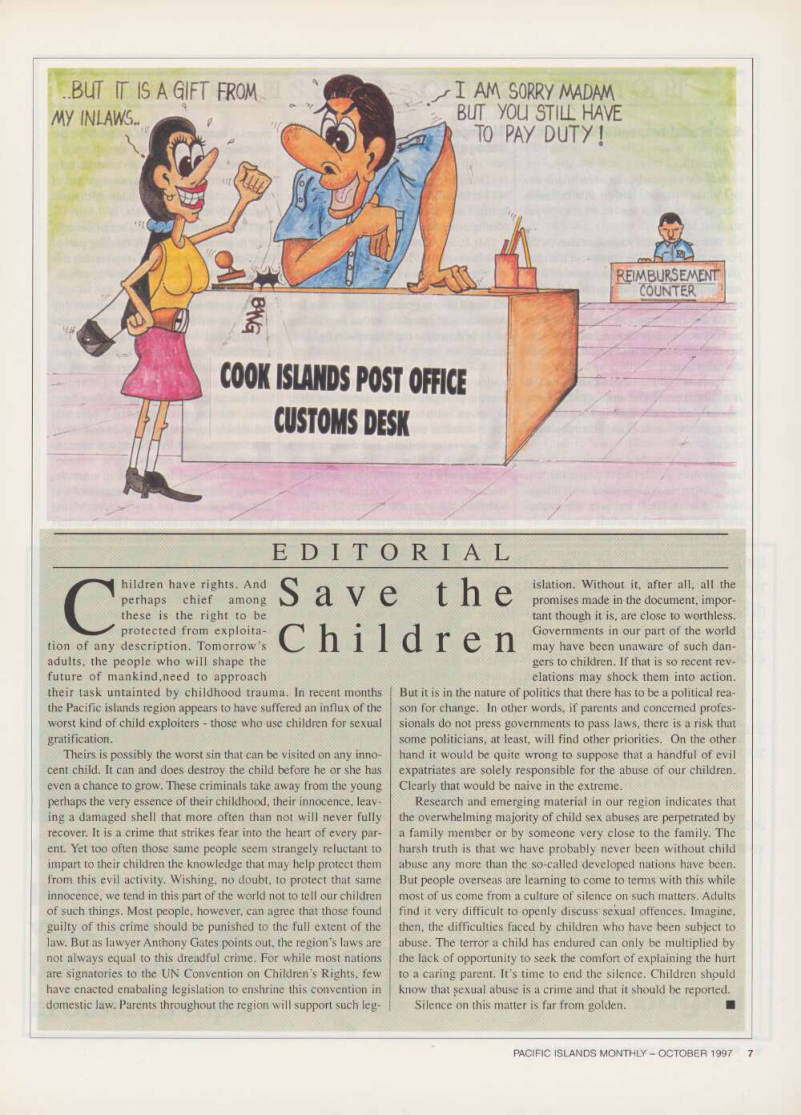
Cooks high customs duties Cook Islanders are complaining about high customs rates being charged on gifts. One woman was charged NZ$7O (US$44) on baby clothes sent from her mother-in-law in England. Another had a NZ$l7OO (US$lO9l) jacket sent to New Zealand for dry cleaning, only to be charged NZ$4OO (US$256) when it was couriered back. Local media has received complaints about cus toms charging duty and value added tax to varied items like video tapes of rugby games, wedding gifts, shoes and book.
But a customs spokesman who did not want to be named said people who received a gift that was bonified unsolicited worth less than NZ$65 (US$4l) should have to pay duties r tax. He advised people who were charged for the gifts, to go to the head office for the reassessment of their costs.
Drought hits PNG The worst drought conditions in the Papua New Guinea Highlands for almost 30 years has resulted in people dying from starvation. The drought also caused the
shut down of the Porgera gold mine for the second time in three months. The drought blamed, on the El Nino weather cycle, caused water levels to drop to less than five percent in a nearby creek and reservoir.
When this issue went to press, 10 people had died in the Oro province. Nine children and an elderly man died from starvation and shortage of water. Food gardens had withered and dried up forcing the villagers to depend on sago which would not last long unless there was rain. Rivers and creeks were also drying up mak ing life more difficult for the villagers and forcing them to move to the provincial town on Popendetta.
In the Manus Province, about 20,000 people were in desperate shortage of water as most areas of the province was facing acute water shortage. More people were dying and government sources suspected that this would increase. The PNG Electricity Commission has also imposed electricity restrictions and called on consumers to cooperate by conserving power.
Fiji accepted as IPU member Fiji has been formally accepted as a member of the Inter parliamentary Union (IPU). Speaker of the House of Representatives, Dr Apenisa Kuruisaqila told members of the IPU council meeting in Cairo that members of parliament were repre sentatives of a multi party system.
He said the importance that Fiji attached to being affiliated to the union was evident from the large number of delegates which attended the meeting. He also informed the IPU council that Fiji had just completed its constitutional review and had adopted elec toral reforms to establish democracy.
PNG churches oppose VAT The Papua New Guinea’s Council of Churches has strongly opposed the government’s initiative to introduce value added tax
next year. General secretary Rev Kila Pat said that government’s move was untimely and will have a widespread effect on the aver age people. He said churches throughout the country were con cerned because the general workforce will have a serious 10 per cent charge on goods and services tax. He urged government to defer the introduction of the tax until people were fully aware of its effects.
Feared extinction for bluefin tuna Environmental lobby group Greenpeace says the world’s most sought after fish, the southern bluefin tuna could be extinct by Year 2020 if present fishing levels continue. It said a report by Australian scientists warned that even the official quota of 11,750 tonnes would give the souhthem bluefin tuna a greater than 10 percent chance of extinction.
It says the international catch had exceeded the official quota by as much as 5000 tonnes in recent years which would increase the probability of extinction by Year 2020 by more than 50 per cent. Greenpeace called for a ban on fishing until the species had time to recover. Officials from Australia, Japan and New Zealand will begin talks to set fishing quotas for next year’s season.
Rabuka thanks India for support Fijian prime minister Sitiveni Rabuka has expressed apprecia tion at opposition leader Jai Ram Reddy’s
initiative in going to India to brief the Indian government on constitutional develop ments. Rabuka said he was very pleased with the expression of goodwill and support by Indian leaders for the people of Fiji.
Reddy who met the Indian prime minister, Indar Kumar Gujeral, and other senior political leaders, also believes India will actively support Fiji’s application to rejoin the Commonwealth.
Rabuka has also invited the Indian government to re-open its embassy in Fiji. India’s embassy in Fiji was forced to shut down in 1988 for alleged interference into Fiji’s internal affairs follow ing the coups of 1987.
Solomons to be observer in peace process Solomon Islands is to be included as an observer in the peace process on Bougainville under the Burnham Declaration. This was agreed on during formal talks between the newly elected prime minister Bartholomew Ulufa’alu and his PNG counterpart, Bill Skate during talks last month.
During the talk, both the prime ministers committed them selves to build on the progress made so far under the Burnham Declaration which stipulates a peaceful resolution to the Bougainville crisis. They agreed that the peace process on Bougainville be approached on a time frame basis such as that on the issue of the future of New Caledonia.
Reconstruction of school buildings completed Reconstruction of primary school buildings on Tonga’s
Tongatapu and Eua Islands damaged by Cyclone Hina this year had been completed. The 300,000 pa’anga (U 55219,000) project was funded by the Tongan government. Under another project, New Zealand and Australia have funded the construction of new accommodation for primary school teachers in some islands at Ha’apai and the two Niuas. The two countries donated about 200,000 pa’anga SUSS 146,000) for this project.
Vanuatu's new minister of finance Veteran Vanuatu politician Vincent Boulekone has been appointed the new minister of finance. Prime Minister Serge Vohor appointed Boulekone only hours after sacking Willie Jimmy from the post.
Vohor wrote to Jimmy requesting him to resign or be sacked.
But Jimmy refused to resign. Vohor sacked Jimmy because he has discredited the government’s position on its Comprehensive Reform Programme (CRP). He said Jimmy had written a critical letter to the Asian Development Bank, one of the main institutions behind the government’s reform initiative, opposing the bank for its backing.
Families renew call for Kangu enquiry The families of Papua New Guinean soldiers massacred at Kangu Beach by Bougainville rebels have renewed their call for a Royal Commission of Inquiry into deaths. Ten soldiers and a policeman died in the massacre. The families said that even though a defence force investigation report had been furnished to the Chan/Haiveta government, they maintain that only an inde pendent and impartial inquiry will bring out the truth.
Bill introduced not to recognise the name Samoa American Samoa representative, Seti Lopa, has introduced a bill which will stop the territory from recognising Western Samoa’s name change to just Samoa. Lopa’s bill stated that the people and government of American Samoa would not recognise use of the name Samoa by the independent state of Western Samoa. Lopa said he was prompted the bill during the last mini South Pacific Mini Games in American Samoa when Western
Samoan athletes were referred to as Samoans and the local ath letes as American Samoans. He said the reference made it seem that locals were less Samoan than those from Western Samoa.
FSM to survey labour force The government of the Federated States of Micronesia is preparing to conduct two nationwide surveys later this year that will provide updated information about the FSM labour force and household income and expenditures.
This information will be used by the department of resources and development for government economic planning purposes.
Forty high school graduates are now being recruited for the sur
vey project.
Corruption rife at customs department The customs inquiry report in Fiji has revealed that corruption is rife in the customs and excise department. The report recom mended that the department undergo a major overhaul with early retirement of senior staff who were found to be inefficient.
The report also stated that corruption varied from collusion with traders and the acceptance of money to carry out illegal acts or not to carry out their duties in a proper manner.
But the report also stated that while corruption occurred at all levels of the department, not all officers were corrupt.
Samoan PM criticised by sacked chief auditor Samoan Prime Minister Tofilau Eti Alesana has rebuffed claim by sacked chief auditor Su’a Rimoni Ah Chong that he (Alesana) lied in parliament to ensure the chief auditor’s ousting. In a 20minute speech on national television, Alesana said stories pub
lished in several papers in which Ah Chong called him a liar, were all wrong. Alesana insisted that Ah Chong had been given fair treatment by cabinet and the Human Rights Protection Party following his two-year sus pension for tabling a report in 1994. The
report alleged top level corruption and financial ineptness within the government. M
Advertisements & other items, p. 13 (1 item)
Imported Engines
BLAIRS
TRANSMISSIONS
NEW PARTS - SECONDHAND PARTS
DIESELS - PETROL
1000 UNITS AVAILABLE
Bedford * BMW * Cummins * Daihatsu * Detroit * Ford * Gardner Duetz * Hino * Isuzu * Ivaco * Komatsu * Kubota * Leyland * Mazda • Mercedes * Mitsubishi * Nissan * Perkins * Peugeot * Special stationary engines Perkins, Kubota, Yanmar 9hp to 200 hp, * Scania * Main * Suzuki * Toyota * Volvo * Yanmar
all terrain vehicles
6X6 - BXB
AMPHIBIOUS
Carries 6 persons or 454kgs All Wheel Drive IF you require " off road transport Argo will do it. Swamps, Lakes, Beaches, Loose Rocks, Dense Forest.
P.O Box 14 Geraldine, New Zealand. Phone: 643-6938122. Fax: 643-6938120
Recipe for conflict
Special Report
Washington’s concern over trade-immigration-labour anomalies vs Marianas desire to maintain status quo
By Susan Prokop
Take a United States government concerned about the global economy’s impact on its workers and domestic industries. Combine it with a small territory’s efforts to assert its self governance and promote its economic development.
Overlay this with philosophical arguments about the degree
to which “American” values of fair play and equal treatment and opportu nity take precedence over a country’s desire to preserve its unique culture and society and manage its own affairs.
Add in heightened partisanship that accompanies a divided US government along with impending local elections in the territory. All these ingredients provide the recipe for the current volatile relationship between the Commonwealth of the Northern Mariana Islands and the United States.
Twenty years ago, CNMI and the US entered into a political union which estab lished the Islands as a Commonwealth under US sovereignty. The agreement that established this partnership, called the Covenant, granted US citizenship to the indigenous people and applied US laws to the Island, with two major exceptions.
CNMI negotiators won concessions exempting them from US immigration and minimum wage laws.
The immigration provision was meant to protect the Marianas’ native population from the fate that had just befallen their neighbour, Guam, which was flooded with Vietnamese refugees after the fall of Saigon. The minimum wage exemption was intended as a temporary measure to spur economic growth in the Island.
Ironically, the immigration and wage law exceptions were used by the Island’s lead ers to open the doors to thousands of low
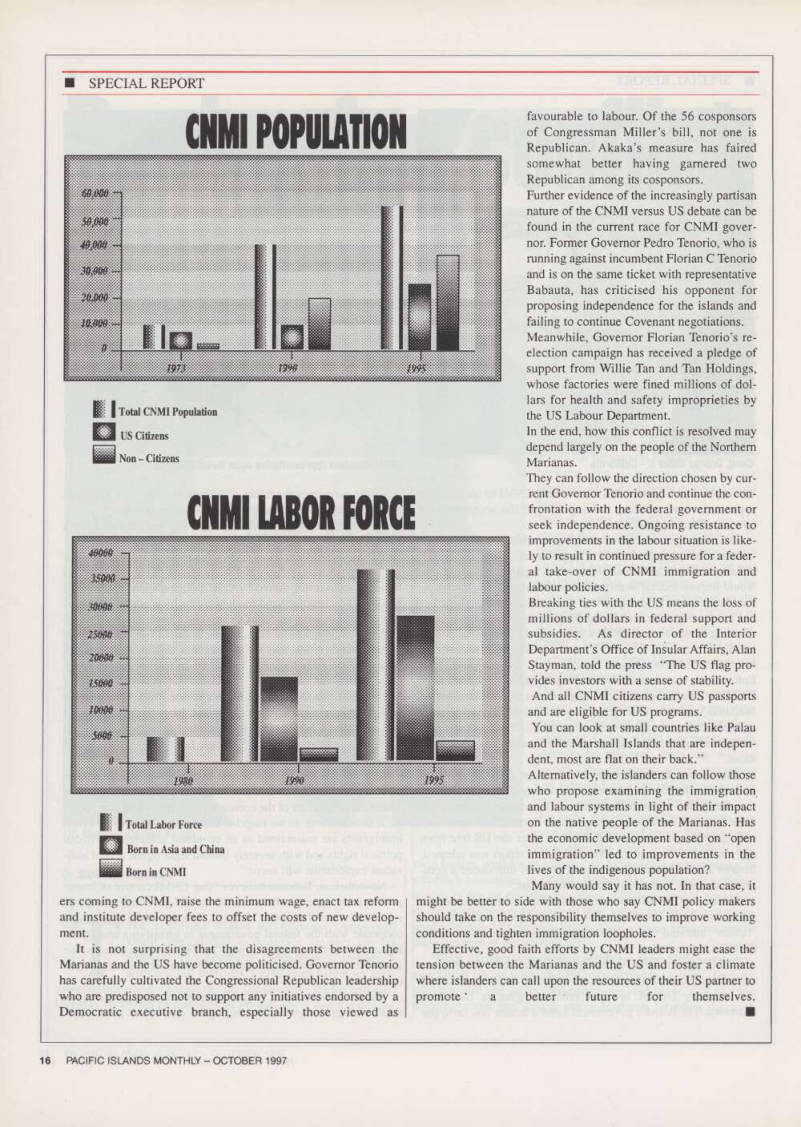
paid foreign workers to serve as an inducement to companies to establish businesses in CNMI. Rather than promoting a higher quality of life for the islanders, these policies caused an explosion in the immigrant population so that, today, foreigners constitute approximately half the population. Alien workers represent nearly three quarters of the labour force.
While the open immigration policy has helped businesses pro cure cheap labour, it has also led to overcrowded schools, strained public health and safety infrastructures, and led to a 14 percent unemployment rate among native Marianas Islanders. Lack of
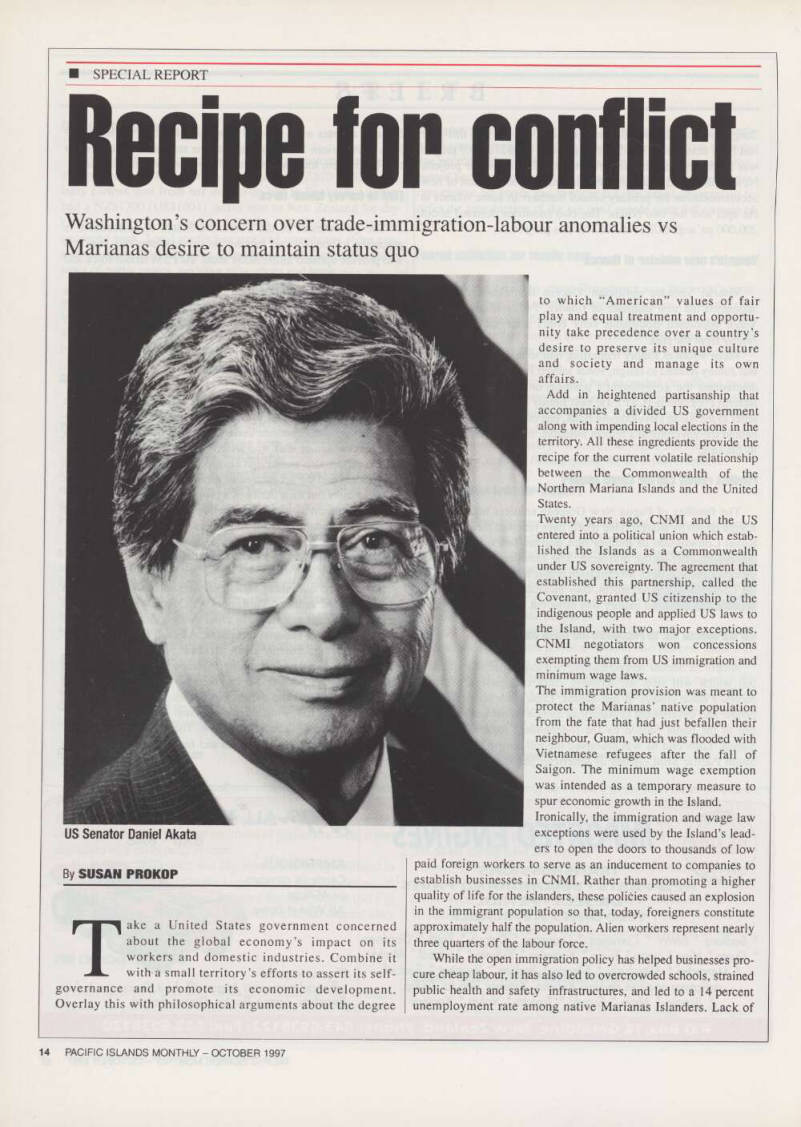
US Senator Daniel Akata
immigration enforcement has also opened CNMI to an influx of organised crime and drug training with all the accompanying adverse effects on its citizens.
Ongoing reports of harsh working conditions and abuses of immigrants prompted US Congressman George Miller, (Democrat from California), to introduce legislation in April that would impose federal immigration and minimum wage laws on the Marianas (see PIM July 1997). This was followed by an inter nal US Immigration and Naturalisation Service study recom mending termination of CNMI’s open-ended immigration policy.
Then, on July 22, 1997, the Clinton administration’s Interagency Initiative on Immigration, Labour and Law Enforcement issued its third annual report on labour conditions in CNMI. It concluded that clothing and textiles created in the Marianas “cause serious damage to the United States mainland apparel industry’s employment and profits... CNMI garment pro duction is largely at the expense of the fifty states and other terri tories.”
The report indicates that many factories are completely owned and operated by foreign governments, notably China, that use for eign fabric and are staffed completely by foreign workers. Yet, these factories are able to sew a “Made in the USA” label into each garment produced which can then enter the US free from any import tariffs or quotas. Soon after that report was released, Senator Daniel Akaka (Democrat of Hawaii) introduced a com panion measure to the Miller bill in the Senate.
Noting that CNMI authorities have few reliable records on aliens coming to the islands, he called its immigration policy a “failure”, and said "the application of US immigration law to the CNMI is long overdue.”
CNMI’s government, led by Governor Froilan C. Tenorio, has aggressively opposed such efforts insisting that any problems identified by federal law enforcement agencies had been addressed. The Island’s government hired a Seattle law firm, one
of whose partners is the father of Microsoft mogul Bill Gates, to lobby the leadership of the US Congress on its behalf.
Writing in the Marianas Variety (4/14/97), that “CNMI is not a foreign country, though at times I feel some of our federal agen cies and officials treat us as such,” Tenorio clashed with the US not only over immigration and wage issues but also safety and health violations discovered by OSHA (Occupational Safety and Health Administration) and funding for badly needed classrooms space. Tenorio went so far as to suspend Covenant negotiations with the Clinton administration after it called for imposition of federal immigration and wage laws and threatened to seek a change in the island’s status to that of an independent, “freely associated” state.
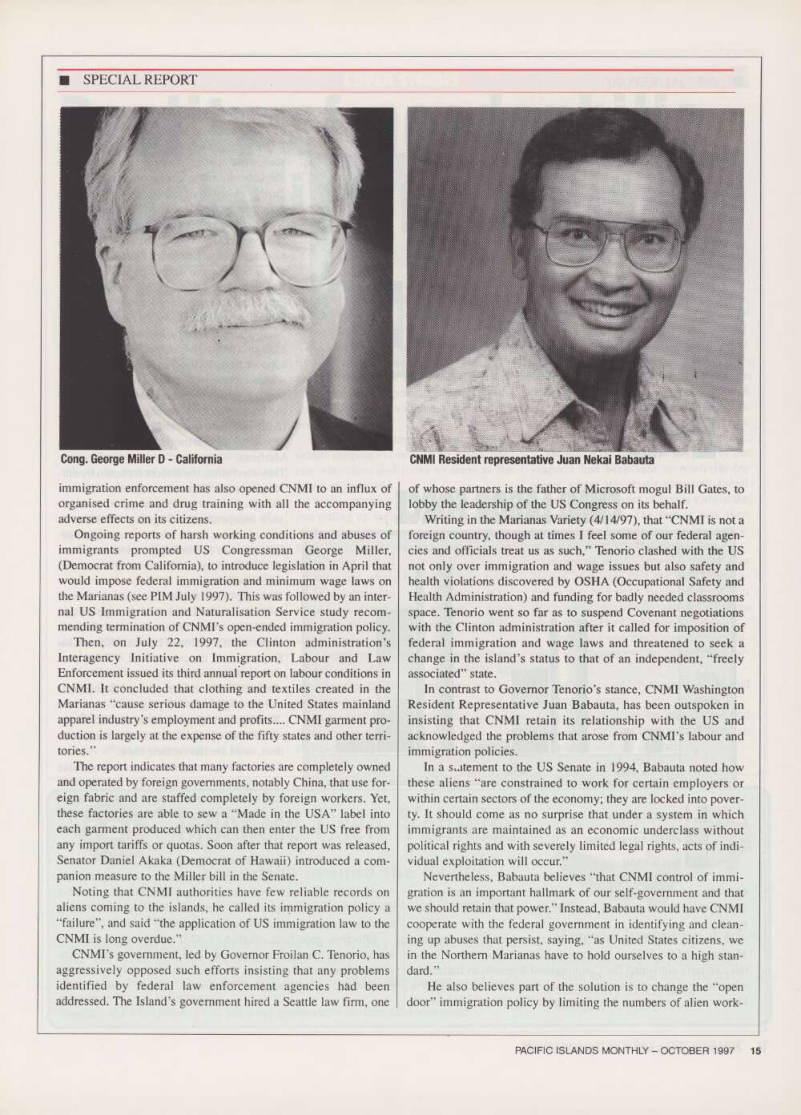
In contrast to Governor Tenorio’s stance, CNMI Washington Resident Representative Juan Babauta, has been outspoken in insisting that CNMI retain its relationship with the US and acknowledged the problems that arose from CNMI’s labour and
immigration policies.
In a statement to the US Senate in 1994, Babauta noted how these aliens “are constrained to work for certain employers or within certain sectors of the economy; they are locked into pover ty. It should come as no surprise that under a system in which immigrants are maintained as an economic underclass without political rights and with severely limited legal rights, acts of indi vidual exploitation will occur.”
Nevertheless, Babauta believes “that CNMI control of immi gration is an important hallmark of our self-government and that we should retain that power.” Instead, Babauta would have CNMI cooperate with the federal government in identifying and clean ing up abuses that persist, saying, “as United States citizens, we in the Northern Marianas have to hold ourselves to a high stan dard.”
He also believes part of the solution is to change the “open door” immigration policy by limiting the numbers of alien work-
Cong. George Miller D-California
CNMI Resident representative Juan Nekai Babauta
ers coming to CNMI, raise the minimum wage, enact tax reform and institute developer fees to offset the costs of new develop ment.
It is not surprising that the disagreements between the Marianas and the US have become politicised. Governor Tenorio has carefully cultivated the Congressional Republican leadership who are predisposed not to support any initiatives endorsed by a Democratic executive branch, especially those viewed as
favourable to labour. Of the 56 cosponsors of Congressman Miller’s bill, not one is Republican. Akaka’s measure has faired somewhat better having garnered two Republican among its cosponsors.
Further evidence of the increasingly partisan nature of the CNMI versus US debate can be found in the current race for CNMI gover nor. Former Governor Pedro Tenorio, who is running against incumbent Florian C Tenorio and is on the same ticket with representative Babauta, has criticised his opponent for proposing independence for the islands and failing to continue Covenant negotiations.
Meanwhile, Governor Florian Tenorio’s re election campaign has received a pledge of support from Willie Tan and Tan Holdings, whose factories were fined millions of dol lars for health and safety improprieties by the US Labour Department.
In the end, how this conflict is resolved may depend largely on the people of the Northern Marianas.
They can follow the direction chosen by cur rent Governor Tenorio and continue the con frontation with the federal government or seek independence. Ongoing resistance to improvements in the labour situation is like ly to result in continued pressure for a feder al take-over of CNMI immigration and
labour policies.
Breaking ties with the US means the loss of millions of dollars in federal support and subsidies. As director of the Interior Department’s Office of Insular Affairs, Alan Stayman, told the press “The US flag pro vides investors with a sense of stability.
And all CNMI citizens carry US passports and are eligible for US programs.
You can look at small countries like Palau and the Marshall Islands that are indepen dent, most are flat on their back.”
Alternatively, the islanders can follow those who propose examining the immigration and labour systems in light of their impact on the native people of the Marianas. Has the economic development based on “open immigration” led to improvements in the lives of the indigenous population?
Many would say it has not. In that case, it
might be better to side with those who say CNMI policy makers should take on the responsibility themselves to improve working
conditions and tighten immigration loopholes.
Effective, good faith efforts by CNMI leaders might ease the tension between the Marianas and the US and foster a climate where islanders can call upon the resources of their US partner to promote ’ a better future for themselves. ■
Cnmi Population
Cnmi Labor Force
Reality of paedophilia

Cover Stories
Reality of paedophilia shocks island nation
By Bernadette Hussein
Th e x plo ita tion of children
through prostitution
and pornography is a global growth
industry driven largely by poverty.
The increasing demand on families to feed, clothe and educate children becomes so overbearing that they stop caring. And this is the sort of neglect which causes children from such backgrounds to become vulnerable causing them to be lured by money, clothes and promises of a better life.
People who offer these ‘luxuries’, lis ten to children, are caring, show that they understand and come across as the perfect person to bring up a child because he can support the child and its family. But their help has strings attached and in many cases children are sexually assaulted and molested.
Sadly, this situation has emerged in our part of the world where resources are scarce and money very hard to come by.
With the economy on the downturn in the region, poverty is rife and many people cannot afford even the basics of life.
Society’s attitude to child sexual abuse and exploitation can be summed up in one word - denial.
Most people do not want to hear about it and would prefer to think that child sex ual victimisation does not occur. In today’s society, however, it is difficult to pretend that it does not happen. Stories and reports about child sexual victimisation are daily occurrences.
The fact that children are being used for sexual purposes is enough to worry any one who cares and looks to them as the future of the world.
While countries overseas are looking at and setting up legislation to stop this sort of thing from happening, Fiji has recently been faced with the truth of such an
exploitation.
A society where family values, tradi tion and culture has a strong bearing, it has come as a shock for everyone to leam about the alleged existence of paedophilia in this tropical paradise.
Allegations which have appeared in the media range from a six-year-old in sex movies to pornographic pictures of chil dren appearing on the internet.
The case was discovered purely through co-incidence. Police have also charged a former expatriate civil servant
with the alleged crimes.
Police believe this to be part of a pae dophilia racket ring in which local girls were being used in the production of pornographic pictures which were sent overseas through the internet.
Fiji’s police commissioner Isikia Savua said his department had sought the help of the International Police Organisation (Interpol) to establish people and places where the pornographic pictures were sent.
He said a computer used by one of the suspects had been sent to Australia for repair where the repair company found pornographic pictures of young girls in the computer system. The matter was then referred to the Victoria police who contact ed Fiji for further investigation.
In earlier media reports, Savua was quoted as saying that the police intelli gence unit had been aware of the racket since 1994 but could not lay charges because of lack of evidence.
Since the expatriate’s arrest, more chil dren, his alleged victims, have come for ward.
The stories which these children told shocked the nation.
Police picked up on expatriates and locals after their photographs appeared on the internet with the children.
Interpol was helping in the search for people and places where the pornographic pictures of the young local girls and boys were sent.
Savua said police were also working closely with Telecom Fiji’s internet depart ment to find out where the pornographic pictures were sent. The case of the expatri ate who has been arrested and charged is still in court and police and prosecution are gathering evidence. He has pleaded not guilty to all the charges of defilement and abuse against him. While this is happening the question which has now cropped up is whether the laws are sufficient to prosecute such offenders.
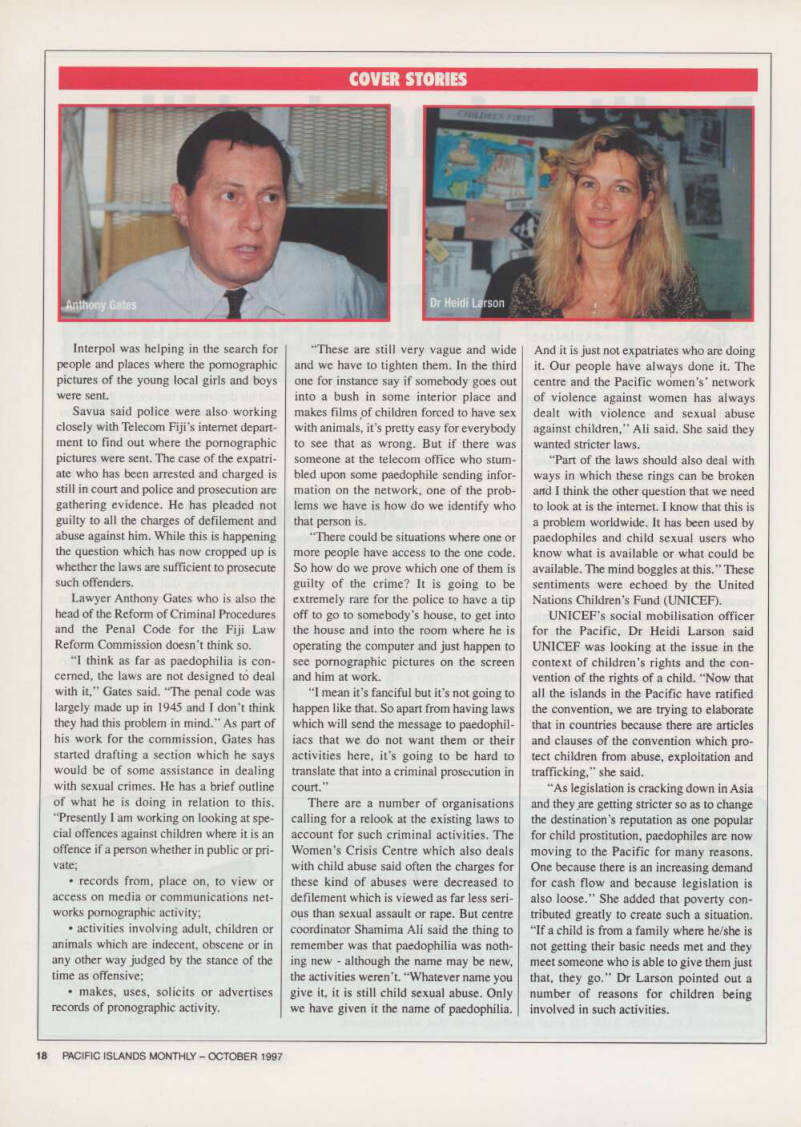
Lawyer Anthony Gates who is also the head of the Reform of Criminal Procedures and the Penal Code for the Fiji Law Reform Commission doesn’t think so.
“I think as far as paedophilia is con cerned, the laws are not designed to deal with it,” Gates said. “The penal code was largely made up in 1945 and I don’t think they had this problem in mind.” As part of his work for the commission, Gates has started drafting a section which he says would be of some assistance in dealing with sexual crimes. He has a brief outline of what he is doing in relation to this.
“Presently I am working on looking at spe cial offences against children where it is an offence if a person whether in public or pri vate; • records from, place on, to view or access on media or communications net
works pornographic activity;
• activities involving adult, children or animals which are indecent, obscene or in any other way judged by the stance of the time as offensive; • makes, uses, solicits or advertises
records of pronographic activity.
“These are still very vague and wide and we have to tighten them. In the third one for instance say if somebody goes out into a bush in some interior place and makes films of children forced to have sex with animals, it’s pretty easy for everybody to see that as wrong. But if there was someone at the telecom office who stum bled upon some paedophile sending infor mation on the network, one of the prob lems we have is how do we identify who that person is.
“There could be situations where one or more people have access to the one code.
So how do we prove which one of them is guilty of the crime? It is going to be extremely rare for the police to have a tip off to go to somebody’s house, to get into the house and into the room where he is operating the computer and just happen to see pornographic pictures on the screen and him at work.
“I mean it’s fanciful but it’s not going to happen like that. So apart from having laws which will send the message to paedophil iacs that we do not want them or their activities here, it’s going to be hard to translate that into a criminal prosecution in court.”
There are a number of organisations calling for a relook at the existing laws to account for such criminal activities. The Women’s Crisis Centre which also deals with child abuse said often the charges for these kind of abuses were decreased to defilement which is viewed as far less seri ous than sexual assault or rape. But centre coordinator Shamima Ali said the thing to remember was that paedophilia was noth ing new - although the name may be new, the activities weren’t. “Whatever name you give it, it is still child sexual abuse. Only we have given it the name of paedophilia.
And it is just not expatriates who are doing it. Our people have always done it. The centre and the Pacific women’s’ network of violence against women has always dealt with violence and sexual abuse against children,” Ali said. She said they wanted stricter laws.
“Part of the laws should also deal with ways in which these rings can be broken and I think the other question that we need to look at is the internet. I know that this is a problem worldwide. It has been used by paedophiles and child sexual users who know what is available or what could be available. The mind boggles at this.” These sentiments were echoed by the United Nations Children’s Fund (UNICEF).
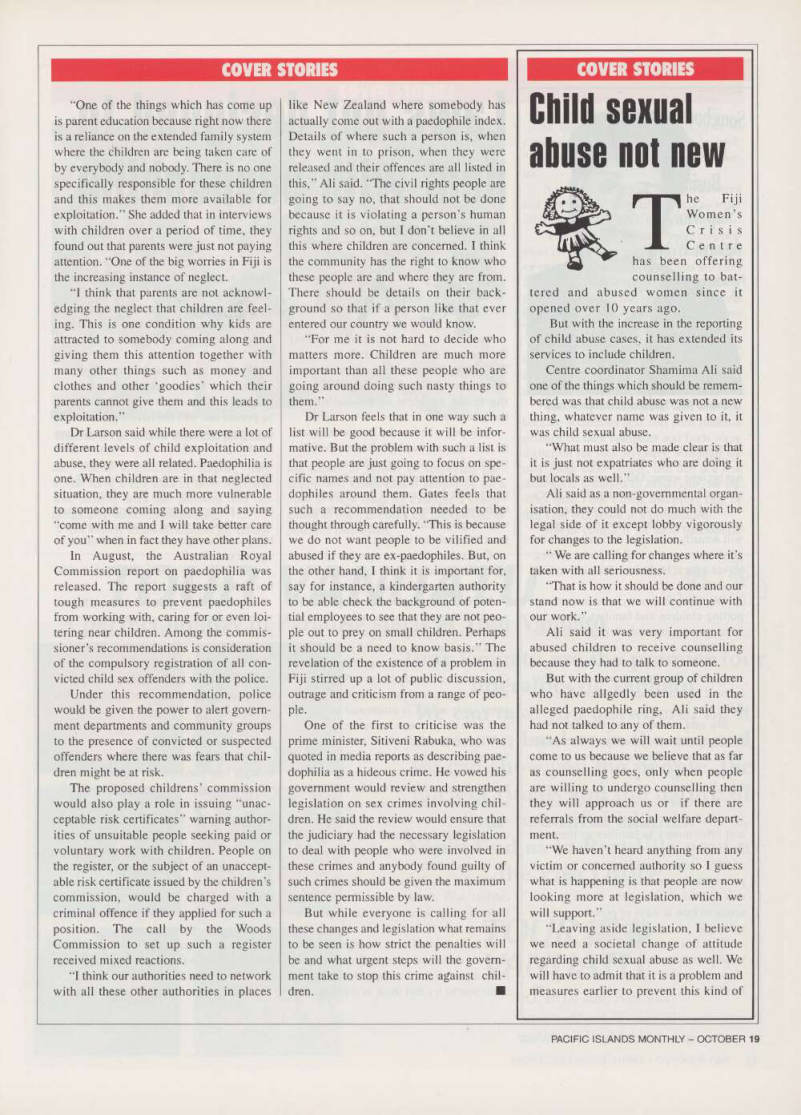
UNICEF’s social mobilisation officer for the Pacific, Dr Heidi Larson said UNICEF was looking at the issue in the context of children’s rights and the con vention of the rights of a child. “Now that all the islands in the Pacific have ratified the convention, we are trying to elaborate that in countries because there are articles and clauses of the convention which pro tect children from abuse, exploitation and trafficking,” she said.
“As legislation is cracking down in Asia and they are getting stricter so as to change the destination’s reputation as one popular for child prostitution, paedophiles are now moving to the Pacific for many reasons.
One because there is an increasing demand for cash flow and because legislation is also loose.” She added that poverty con tributed greatly to create such a situation.
“If a child is from a family where he/she is not getting their basic needs met and they meet someone who is able to give them just that, they go.” Dr Larson pointed out a number of reasons for children being involved in such activities.
Anthony Gates
Dr Heidi Larson
“One of the things which has come up is parent education because right now there is a reliance on the extended family system where the children are being taken care of by everybody and nobody. There is no one specifically responsible for these children and this makes them more available for exploitation.” She added that in interviews with children over a period of time, they found out that parents were just not paying attention. “One of the big worries in Fiji is the increasing instance of neglect.
“I think that parents are not acknowl edging the neglect that children are feel ing. This is one condition why kids are attracted to somebody coming along and giving them this attention together with many other things such as money and clothes and other ‘goodies’ which their parents cannot give them and this leads to
exploitation.”
Dr Larson said while there were a lot of different levels of child exploitation and abuse, they were all related. Paedophilia is one. When children are in that neglected situation, they are much more vulnerable to someone coming along and saying “come with me and I will take better care of you” when in fact they have other plans.
In August, the Australian Royal Commission report on paedophilia was released. The report suggests a raft of tough measures to prevent paedophiles from working with, caring for or even loi tering near children. Among the commis sioner’s recommendations is consideration of the compulsory registration of all con victed child sex offenders with the police.
Under this recommendation, police would be given the power to alert govern ment departments and community groups to the presence of convicted or suspected offenders where there was fears that chil dren might be at risk.
The proposed childrens’ commission would also play a role in issuing “unac ceptable risk certificates” warning author ities of unsuitable people seeking paid or voluntary work with children. People on the register, or the subject of an unaccept able risk certificate issued by the children’s commission, would be charged with a criminal offence if they applied for such a position. The call by the Woods Commission to set up such a register received mixed reactions.
“I think our authorities need to network with all these other authorities in places
like New Zealand where somebody has actually come out with a paedophile index.
Details of where such a person is, when they went in to prison, when they were released and their offences are all listed in this,” Ali said. “The civil rights people are going to say no, that should not be done because it is violating a person’s human rights and so on, but I don’t believe in all this where children are concerned. I think the community has the right to know who these people are and where they are from.
There should be details on their back ground so that if a person like that ever entered our country we would know.
“For me it is not hard to decide who matters more. Children are much more important than all these people who are going around doing such nasty things to them.”
Dr Larson feels that in one way such a list will be good because it will be infor mative. But the problem with such a list is that people are just going to focus on spe cific names and not pay attention to pae dophiles around them. Gates feels that such a recommendation needed to be thought through carefully. “This is because we do not want people to be vilified and abused if they are ex-paedophiles. But, on the other hand, I think it is important for, say for instance, a kindergarten authority to be able check the background of poten tial employees to see that they are not peo ple out to prey on small children. Perhaps it should be a need to know basis.” The revelation of the existence of a problem in Fiji stirred up a lot of public discussion, outrage and criticism from a range of peo
ple.
One of the first to criticise was the prime minister, Sitiveni Rabuka, who was quoted in media reports as describing pae dophilia as a hideous crime. He vowed his government would review and strengthen legislation on sex crimes involving chil dren. He said the review would ensure that the judiciary had the necessary legislation to deal with people who were involved in these crimes and anybody found guilty of such crimes should be given the maximum sentence permissible by law.
But while everyone is calling for all these changes and legislation what remains to be seen is how strict the penalties will be and what urgent steps will the govern ment take to stop this crime against chil dren. ■
Advertisements & other items, p. 17 (1 item)
Japanese Used Vehicles
Exporting around the Pacific
Fiji, Kiribati, Palau, Nauru Is, Norfolk Is, Solomon Is, Papua New Guinea, Niue, New Zealand, Tonga, Samoa.
All Shipping and Documentation arranged for YOU. Buy direct from Japan and save sss. Vehicles from USDSIOOO plus Freight.
Fax today for your Order form and List of Vehicles. Big Selection of used Japanese Motor vehicles.
Special P.I.M. Offer. $lOO off your purchase with this advertisement. r
Trust Company Ltd
Kobac Bldg 3F, 3-2-26 Nishiki Naka ku, Nagoya 460, JAPAN Phone (81) 52 953 5602 Fax (81) 52 953 5634/1
The Fiji
Child sexual abuse not new
Women’s Crisis Centre has been offering counselling to bat
tered and abused women since it opened over 10 years ago.
But with the increase in the reporting of child abuse cases, it has extended its services to include children.
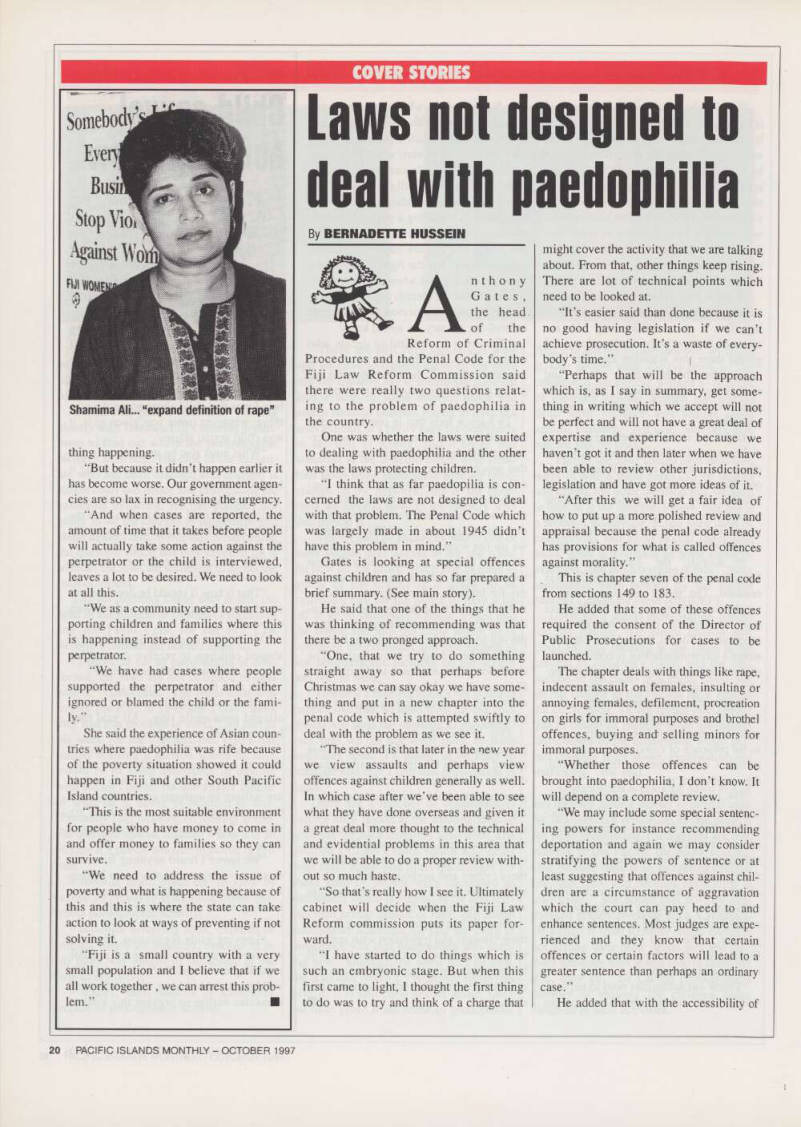
Centre coordinator Shamima AH said one of the things which should be remem bered was that child abuse was not a new thing, whatever name was given to it, it was child sexual abuse.
“What must also be made clear is that it is just not expatriates who are doing it but locals as well.”
Ali said as a non-governmental organ isation, they could not do much with the legal side of it except lobby vigorously for changes to the legislation.
“ We are calling for changes where it’s taken with all seriousness.
“That is how it should be done and our stand now is that we will continue with our work.”
Ali said it was very important for abused children to receive counselling because they had to talk to someone.
But with the current group of children who have allgedly been used in the alleged paedophile ring, Ali said they had not talked to any of them.
“As always we will wait until people come to us because we believe that as far as counselling goes, only when people are willing to undergo counselling then they will approach us or if there are referrals from the social welfare depart ment.
“We haven’t heard anything from any victim or concerned authority so I guess what is happening is that people are now looking more at legislation, which we will support.”
"Leaving aside legislation, I believe we need a societal change of attitude regarding child sexual abuse as well. We will have to admit that it is a problem and measures earlier to prevent this kind of
thing happening.
“But because it didn’t happen earlier it has become worse. Our government agen cies are so lax in recognising the urgency.
“And when cases are reported, the amount of time that it takes before people will actually take some action against the perpetrator or the child is interviewed, leaves a lot to be desired. We need to look at all this.
“We as a community need to start sup porting children and families where this is happening instead of supporting the perpetrator.
“We have had cases where people supported the perpetrator and either ignored or blamed the child or the fami ly-”
She said the experience of Asian coun tries where paedophilia was rife because of the poverty situation showed it could happen in Fiji and other South Pacific Island countries.
"This is the most suitable environment for people who have money to come in and offer money to families so they can survive.
“We need to address the issue of poverty and what is happening because of this and this is where the state can take action to look at ways of preventing if not
solving it.
“Fiji is a small country with a very small population and I believe that if we all work together, we can arrest this prob lem.” ■
Shamima Ali... “expand definition of rape”
Anthony
Laws not designed to deal with paedophilia
By Bernadette Hussein
Gates, the head of the Reform of Criminal
Procedures and the Penal Code for the Fiji Law Reform Commission said there were really two questions relat ing to the problem of paedophilia in the country.
One was whether the laws were suited to dealing with paedophilia and the other was the laws protecting children.
“I think that as far paedopilia is con cerned the laws are not designed to deal with that problem. The Penal Code which was largely made in about 1945 didn’t have this problem in mind.”
Gates is looking at special offences against children and has so far prepared a brief summary. (See main story).
He said that one of the things that he was thinking of recommending was that there be a two pronged approach.
“One, that we try to do something straight away so that perhaps before Christmas we can say okay we have some thing and put in a new chapter into the penal code which is attempted swiftly to deal with the problem as we see it.
“The second is that later in the new year we view assaults and perhaps view offences against children generally as well.
In which case after we’ve been able to see what they have done overseas and given it a great deal more thought to the technical and evidential problems in this area that we will be able to do a proper review with out so much haste.
“So that’s really how I see it. Ultimately cabinet will decide when the Fiji Law Reform commission puts its paper for ward.
“I have started to do things which is such an embryonic stage. But when this first came to light, I thought the first thing to do was to try and think of a charge that
might cover the activity that we are talking about. From that, other things keep rising.
There are lot of technical points which need to be looked at.
“It’s easier said than done because it is no good having legislation if we can’t achieve prosecution. It’s a waste of every body’s time.” “Perhaps that will be the approach which is, as I say in summary, get some thing in writing which we accept will not be perfect and will not have a great deal of expertise and experience because we haven’t got it and then later when we have been able to review other jurisdictions, legislation and have got more ideas of it.
“After this we will get a fair idea of how to put up a more polished review and appraisal because the penal code already has provisions for what is called offences against morality.”
This is chapter seven of the penal code from sections 149 to 183.
He added that some of these offences required the consent of the Director of Public Prosecutions for cases to be launched.
The chapter deals with things like rape, indecent assault on females, insulting or annoying females, defilement, procreation on girls for immoral purposes and brothel offences, buying and selling minors for immoral purposes.
“Whether those offences can be brought into paedophilia, I don’t know. It will depend on a complete review.
“We may include some special sentenc ing powers for instance recommending deportation and again we may consider stratifying the powers of sentence or at least suggesting that offences against chil dren are a circumstance of aggravation which the court can pay heed to and enhance sentences. Most judges are expe rienced and they know that certain offences or certain factors will lead to a greater sentence than perhaps an ordinary case.”
He added that with the accessibility of
the Woods Commission Report, they would have a fair idea of how Australia was dealing with the problem and the things they were recommending.
On Woods recommendation for releas
ing names of former or suspected pae dophiliacs, Gates said it should be on a need to know basis for example a kinder garten to use it to check the background of potential employees.
As for checking the backgrounds of expatriates entering the country he said: “Well that is really an administrative mat ter.
No doubt the police through Interpol and other means may have access to more information and I think that’s inevitable.
“I would think there was more co-oper ation on that, most people say fair enough so probably it means that if you are pae dophiliac or a paedophile you have to stay put where you are and not be able to cross boundaries because nobody wants you.
That’s what your track record is.”
He also thought it would be a good idea to retain the sanction of the Director of Public Prosecutions who can review cases and give consent before prosecution.
“That way we can make sure that just because somebody gets soft pom material perhaps on their computer and finds some titillation for this privately, although we may judge those people, that this is a less than good standard of behaviour, on the other hand I don’t think that every case of that kind will result in a prosecution.
“But of course if we have paedophile
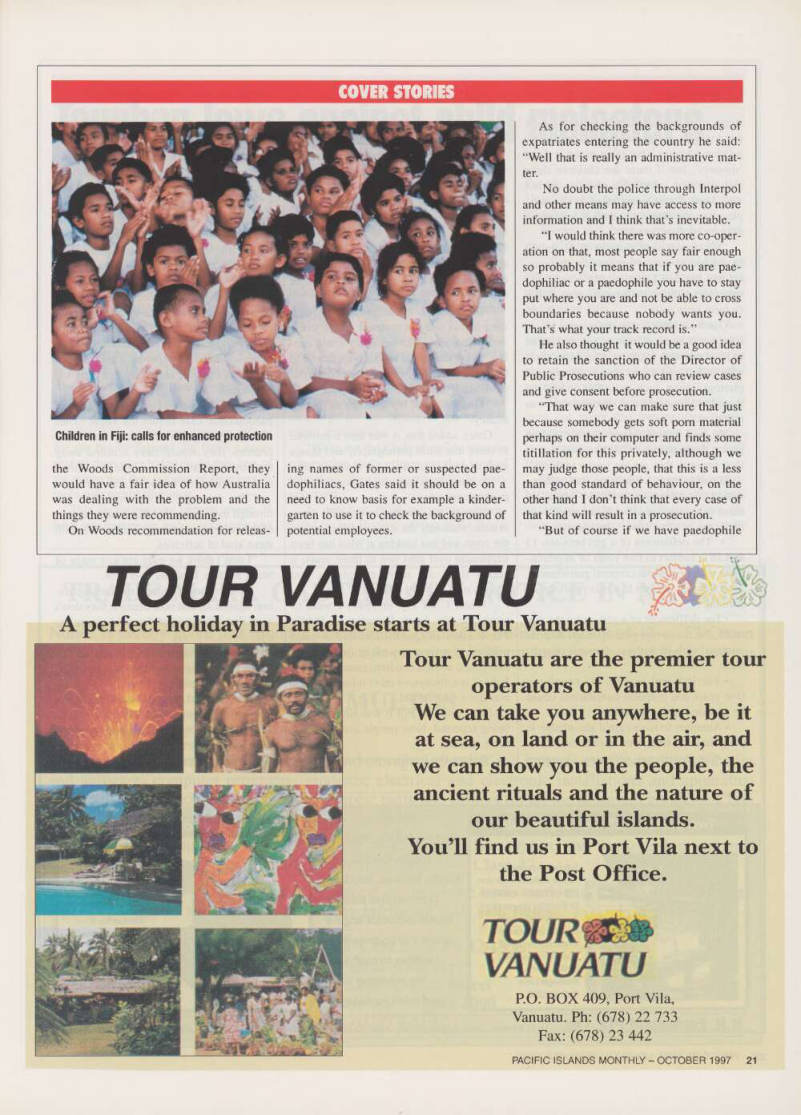
Children in Fiji: calls for enhanced protection
rings, what they call family dinners, where paedophiles get together in a group and goodness knows what takes place at these ‘dinners’, but if there are children there and goodness sakes what else, we are not very keen that it be recorded in any way, placed on the internet and made into video copy to be distributed.”
“We do not want children to be abused in this sort of way or any way for that mat ter and we don’t particularly want these people to indulge their habits here in Fiji or form little cells.”
Gates said that under the current law, it would still be an offence to force children to have sex with adults or even bribe them with lollies and things and in fact people photographing such activities would be thought to be aiding and abetting what was going on.
He said people talked about children giving their consent. “Children cannot give their consent, they are too young to do so.”
He added that while there was nothing concrete against paedophilia, many of these activities would still be an offence under the existing laws. For instance: • The defilement of a girl between 13 and 16 is subject to five years of imprison ment with or without corporal punishment; procreation is subject to a two year impris onment. • For defilement of a girl under the age of 13, the maximum penalty is life impris onment, with or without corporal punish ment. • For indecent assault, the penalty is five years and corporal punishment could be included in the sentence. • Attempts to have carnal knowledge is punishable by five years imprisonment. • For unnatural offences (between
males) or with an animal, the crime is pun ishable by up to 14 years imprisonment.
But Gates believed there were instances where there needed to be stricter penalties introduced.
“I think all of it needs to be reviewed and if changes are to be made to existing legislation, maybe that is one way to go.
On the other hand, as I had said earlier, I think we need something that seems to catch this shocking and modern form of offence.
"The idea that these people can roam the internet and put material on the inter net, with a simple camera they could cap ture this material and send it back from Fiji to Thailand or any of these other countries, particularly those that are quite poor.
“That’s a trade. It’s a means of getting money.”
Gates added that it was also a mistake to think that child pornography and things such as paediophiliacs were anything new.
“It's not new just maybe some of the methods are new.
“Putting the internet to one side for a minute, currently the case which is before the court and just looking at what has been happening over past two to three years, it seems there are more complaints and reports now of child abuse.
“When I left Fiji in 1987, I went to work for the State Director of Public Prosecution in Queensland and a good number of my cases were child molesta tion cases, abused children, usually by step fathers, not always, or other relatives and it was quite widespread.
But I think in Fiji it was not a matter being reported. Now people are reporting these matters.
“Before the families were so ashamed
they hushed it up but I think they are more inclined to report things now so that’s why we are seeing more cases. This means we will see much more of it going through the courts.”
On children giving evidence in such cases, Gates said it was the duty of the court and all involved that their evidence be taken in camera and in a friendly room that wasn’t going to make them shy or scared.
“I have seen children put before the court and not being able to give evidence or participate in a court proceeding which is easy and informal - still, unfortunately, a rather intimidating experience and some of them can’t get the story out. They are too
frightened.”
On the publicity given to the alleged paedophiliac case before the court, Gates said if anybody from the group was in the country, they would have scuttled away back overseas and some would be terrified to the point of not daring to do anything.
“The message must have gone out through the region that Fiji is not the sort of place you want to get involved with these kind of activities.
“I don’t think we ever got to a stage of being another Thailand over here.
“I understand Thailand too has legisla tion against all that now because they don’t want that reputation of the child sex indus try.
“I think the main thing is yes we are doing something about this and trying to get something going.
“I haven’t yet reported back to my fel low commissioners and the directors on this but no doubt a lot of people are going to be looking carefully at this, it is just not going to be just put away in the drawer.” ■
Advertisements & other items, pp. 21-22 (1 item)
Tour Vanuatu I
A perfect holiday in Paradise starts at Tour Vanuatu I i ! : i ** Tour Vanuatu are the premier tour operators of Vanuatu We can take you anywhere, be it at sea, on land or in the air, and we can show you the people, the ancient rituals and the nature of our beautiful islands.
You’ll find us in Port Vila next to the Post Office.
TOUROM
VANUATU
P.O. BOX 409, Port Vila, Vanuatu. Ph: (678) 22 733 Fax: (678) 23 442
Two Ruston VCB Generator Sets
Suit prime power?
Power station installation. 175 kVa each @ 600 rpm.
Ex Standby power plant.
Auxiliary equipment and control panels to suit synchronised operation. Located in Melbourne.
Package price
AUD $20,000
m Dealers in Perkins, Ruston, Paxman,
English Electric.
Keivin, Mirriees, Baudouin, Dorman and Rolls
Royce Industrial engine
parts. Full Engineering facilities available
for servicing
and manufacturing.
Dorman Engines and Generator Sets
(air cooled). New engines or rebuilds.
Presently available 47 and 58 BMP.
Suitable for 50 or 60 Hz operation as required.
K.H. Equipment Ply, Ltd. 14-16 Westpool Drive. Hatlam Victoria. Australia 3003. Phone (03) 9796 4766. Fax: (03) 9796 4878. Int:+6l 3 9796 4766
The United

Tougher laws against child molesters
Nations Children’s Fund (UNICEF) is not sure if paedophilia is
really new or if it is newly recognised.
It is in fact looking at this problem in the context of children’s rights and the con vention of the rights of a child.
Now that all the Pacific Island countries have ratified the Convention on the Rights of the Child, UNICEF is trying to elabo rate it in these countries as they carry clauses and articles which protect the child from any type of abuse.
UNICEF’s social mobilisation officer for the Pacific Islands, Dr Heidi Larson said as they were trying to do this, one of the things that they felt was of great impor tance was parent education.
This meant making parents aware of what was happening and to take steps and
precautions to protect their children.
She said parents and the community in general had to realise that they couldn’t trust children with everybody.
Another cause of this situation was poverty where children were coming from homes in which their basic needs were not being met and sonjeone came along with some cash and ‘goodies’ and off the chil dren went.
Dr Larson said the person doing this, usually came across as someone who did everything in the best interest of the child and family by paying school fees, electric bill, dressed well, was successful, offered nice trips for the family or the child to exotic destinations.
"These are the kinds of people who are committing these crimes, so that kind of education for the community is very
important.”
A paper on child sexual assault pre pared by lan Hopley, adviser to the Royal
Papua New Guinea Constabulary Development project, talked about pae dophiles and their characteristics.
Hopley said these people seduced chil dren with attention, affection and gifts.
“They literally befriend children by talking to them, listening to them, paying attention to them, spending time with them
and buying gifts.”
In his paper he reported that law enforcement investigations in many parts of the world had verified that paedophiles almost always collected child pornography or child erotica.
“The key word here is collection. It does not mean that paedophiles merely view pornography, They save it. It comes to represent their most cherished sexual fantasies.
“Paedophiles swap pornographic pho tographs the same way children swap cards or stamps. As they add to their collections, they get strong reinforcement for their
behaviour. The collecting and trading pro cess becomes a common bond.
Paedophiles get active validation from other paedophiles.”
Dr Larson added that what people had to remember was that a sexually abused child would always have characteristics opposite of a normal happy child.
“This is where teachers can be of great help. They should pay particular interest and should raise questions if a particular child is not paying attention or if is looking malnourished, retired or cranky.
“It is usually an indication that there is obviously some problem at home,” said Dr Larson.
She added that such activities were rife worldwide.
“But I think the other thing right now is that as the attention that is put on to the issue, every parent and agency dealing with the plight of children have the responsibility of bringing attention to the fact that it is happening and that we are not immune to child sexual abuse
and exploitation.
“And as a community it becomes our responsibility to prevent it and not to deny that exists because we don’t want to believe that it can or it is happening.”
Another important point raised by Dr Larson was that there was a lack of profes sional counsellors, people who could talk to children about these problems and were very sensitive to their problems.
“That is one limitation which most developing nations lack and this is one area where a lot of training is needed.”
She added that while it was children
who were being exploited, people should
not rule out the fact that children could become advocates of their rights.
“Kids need to become alert about the signs of abuse or sexual exploitation that they can be exposed to. They can become
keen investigators and alert us when they know that something wrong is happening.
“There are so many kids being exploit ed but are just too afraid to talk about it or tell anyone.
“You can get a group of kids together and talk to them and maybe they will realise that they should not be treated this way and then this could prompt them to talk about what is happening or what was happening to them.”
“I think children if they know what’s involved, I mean when they read and hear about things, would not be lured by money or presents especially in an environment where they are not getting money without realising the implications of it all.
“Educating children and understanding
what their needs are is very important.
“One issue that we have been support ing is helping children give evidence in court. That’s another area which needs to be addressed. There needs to be an envi ronment where children will be comfort able with talking about what they have
been through.
“I think children feel afraid to open their mouths. It’s going to be very hard to find out who’s being abused until some times when it’s too late.
If we create an environment which is friendly and supportive and encourage children to talk about these things, I’m sure it is going to help.” ■
Children need to be aware of paedophiles or child molesters.
Poverty-a major cause for the problem
Advertisements & other items, p. 23 (1 item)
Trade Mark Cautionary Notice In Nauru
Notice is hereby given that Mondex International Limited, a British company of 47 53 Canon Street, London EC4M SSQ, England, is the sole proprietor in Nauru and elsewhere of the following trade mark: used in respect of:-
MULTOS
Data processing, transmitting, receiving and storage apparatus and instruments; computer hardware and software; computer programs; modems; electrical and electronic installations and apparatus; magnetic and/or encoded cards, discs or tapes; parts and fittings for all the aforesaid goods Class 9.
Advisory and consultancy services relating to electronic data capture and transmission systems, computers, computer software and computer programs Class 42.
The said proprietor claims all rights in respect of the above trade mark and will take all necessary legal steps against any person or company infringing their said rights.
DAVIES COLLISON CAVE
Patent Attorneys One Little Collins Street Melbourne, Victoria 3000
AUSTRALIA
What went wrong with KAL 801
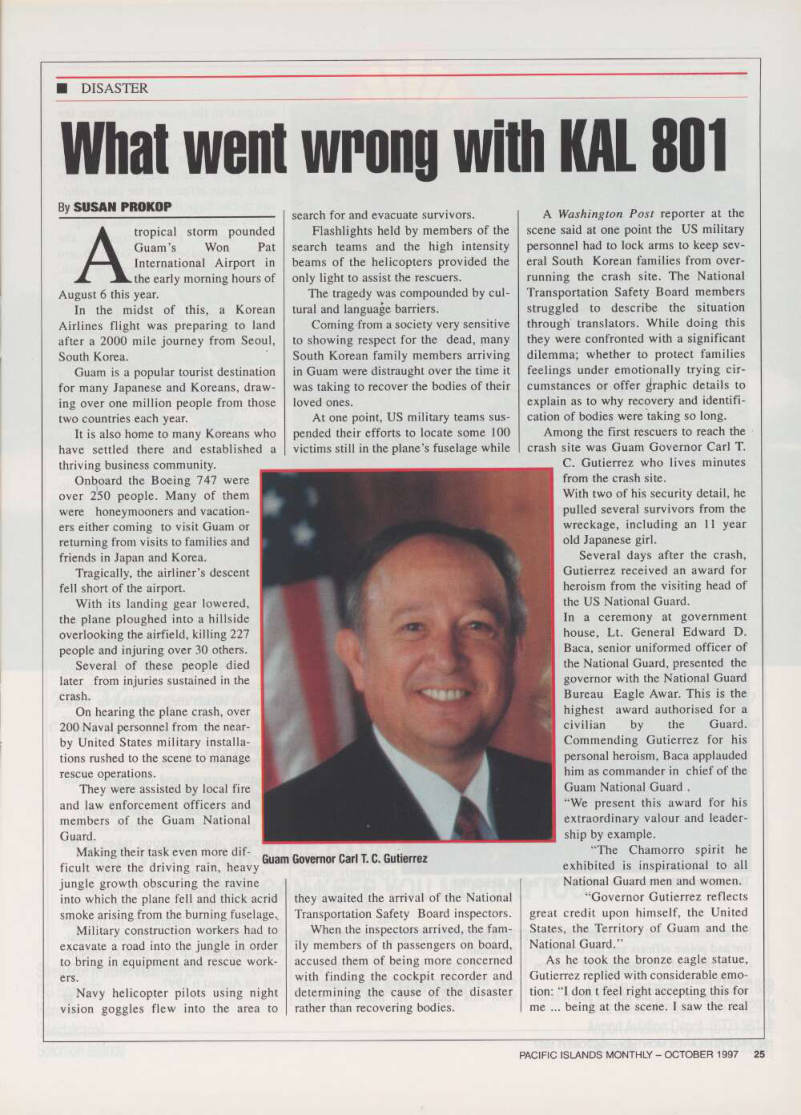
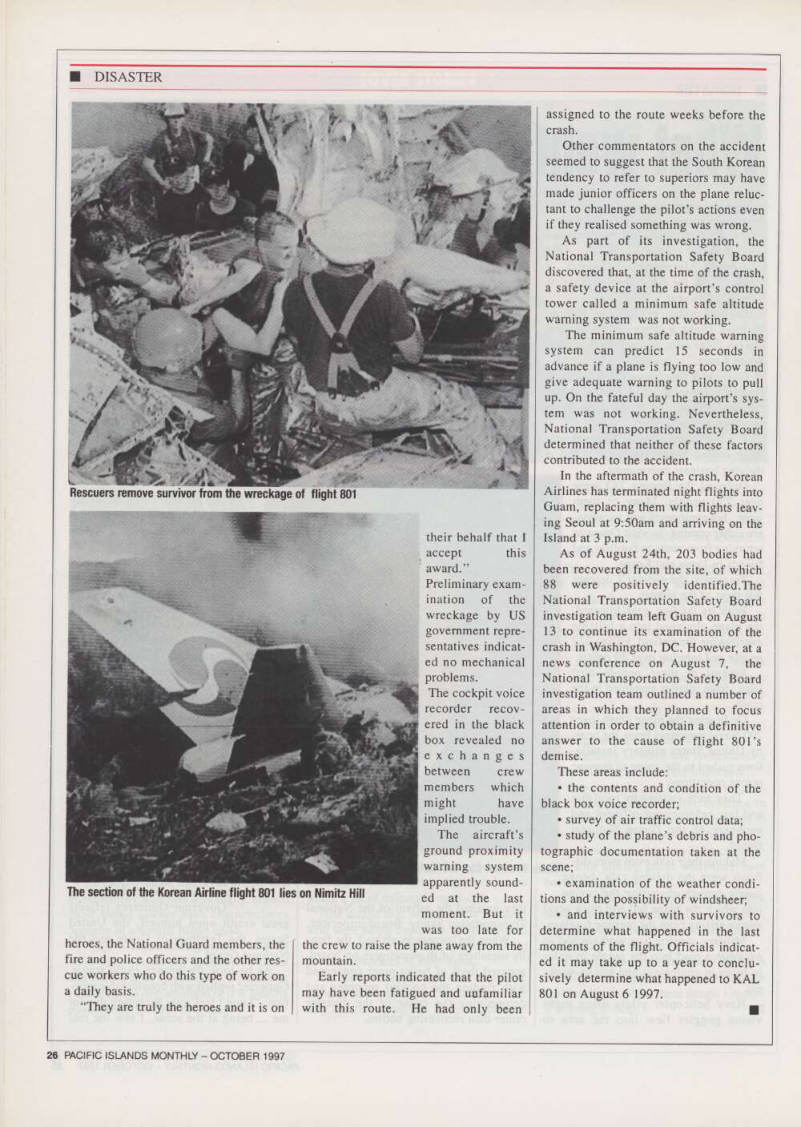
Disaster
By Susan Prokop
A tropical storm pounded
Guam’s Won Pat International Airport in the early morning hours of August 6 this year.
In the midst of this, a Korean Airlines flight was preparing to land after a 2000 mile journey from Seoul, South Korea.
Guam is a popular tourist destination for many Japanese and Koreans, draw ing over one million people from those two countries each year.
It is also home to many Koreans who have settled there and established a
thriving business community.
Onboard the Boeing 747 were over 250 people. Many of them were honeymooners and vacation ers either coming to visit Guam or returning from visits to families and friends in Japan and Korea.
Tragically, the airliner’s descent fell short of the airport.
With its landing gear lowered, the plane ploughed into a hillside overlooking the airfield, killing 227 people and injuring over 30 others.
Several of these people died later from injuries sustained in the crash.
On hearing the plane crash, over 200 Naval personnel from the near by United States military installa tions rushed to the scene to manage rescue operations.
They were assisted by local fire and law enforcement officers and members of the Guam National Guard.
Making their task even more dif ficult were the driving rain, heavy jungle growth obscuring the ravine
into which the plane fell and thick acrid smoke arising from the burning fuselage..
Military construction workers had to excavate a road into the jungle in order to bring in equipment and rescue work ers.
Navy helicopter pilots using night
vision goggles flew into the area to
search for and evacuate survivors.
Flashlights held by members of the search teams and the high intensity beams of the helicopters provided the only light to assist the rescuers.
The tragedy was compounded by cul tural and language barriers.
Coming from a society very sensitive to showing respect for the dead, many South Korean family members arriving in Guam were distraught over the time it was taking to recover the bodies of their loved ones.
At one point, US military teams sus pended their efforts to locate some 100 victims still in the plane’s fuselage while
they awaited the arrival of the National Transportation Safety Board inspectors.
When the inspectors arrived, the fam ily members of th passengers on board, accused them of being more concerned with finding the cockpit recorder and determining the cause of the disaster rather than recovering bodies.
A Washington Post reporter at the scene said at one point the US military personnel had to lock arms to keep sev eral South Korean families from over running the crash site. The National
Transportation Safety Board members
struggled to describe the situation through translators. While doing this they were confronted with a significant dilemma; whether to protect families feelings under emotionally trying cir cumstances or offer graphic details to explain as to why recovery and identifi cation of bodies were taking so long.
Among the first rescuers to reach the crash site was Guam Governor Carl T.
C. Gutierrez who lives minutes from the crash site.
With two of his security detail, he pulled several survivors from the wreckage, including an 11 year old Japanese girl.
Several days after the crash, Gutierrez received an award for heroism from the visiting head of the US National Guard.
In a ceremony at government house, Lt. General Edward D.
Baca, senior uniformed officer of the National Guard, presented the governor with the National Guard Bureau Eagle Awar. This is the highest award authorised for a civilian by the Guard.
Commending Gutierrez for his personal heroism, Baca applauded him as commander in chief of the Guam National Guard .
“We present this award for his extraordinary valour and leader ship by example.
“The Chamorro spirit he exhibited is inspirational to all National Guard men and women.
“Governor Gutierrez reflects
great credit upon himself, the United States, the Territory of Guam and the National Guard.”
As he took the bronze eagle statue, Gutierrez replied with considerable emo tion: “I don t feel right accepting this for me ... being at the scene. I saw the real
Guam Governor Carl T. C. Gutierrez
heroes, the National Guard members, the fire and police officers and the other res cue workers who do this type of work on a daily basis.
“They are truly the heroes and it is on
their behalf that I accept this award.”
Preliminary exam ination of the wreckage by US government repre sentatives indicat ed no mechanical problems.
The cockpit voice recorder recov ered in the black box revealed no exchanges between crew members which
might have
implied trouble.
The aircraft’s ground proximity warning system apparently sound ed at the last moment. But it was too late for
the crew to raise the plane away from the mountain.
Early reports indicated that the pilot may have been fatigued and unfamiliar with this route. He had only been
assigned to the route weeks before the crash.
Other commentators on the accident seemed to suggest that the South Korean tendency to refer to superiors may have made junior officers on the plane reluc tant to challenge the pilot’s actions even if they realised something was wrong.
As part of its investigation, the National Transportation Safety Board discovered that, at the time of the crash, a safety device at the airport’s control tower called a minimum safe altitude warning system was not working.
The minimum safe altitude warning system can predict 15 seconds in advance if a plane is flying too low and give adequate warning to pilots to pull up. On the fateful day the airport’s sys tem was not working. Nevertheless, National Transportation Safety Board determined that neither of these factors contributed to the accident.
In the aftermath of the crash, Korean Airlines has terminated night flights into Guam, replacing them with flights leav ing Seoul at 9:soam and arriving on the Island at 3 p.m.
As of August 24th, 203 bodies had been recovered from the site, of which 88 were positively identified. The National Transportation Safety Board investigation team left Guam on August 13 to continue its examination of the crash in Washington, DC. However, at a news conference on August 7, the National Transportation Safety Board investigation team outlined a number of areas in which they planned to focus attention in order to obtain a definitive answer to the cause of flight 801’s demise.
These areas include: • the contents and condition of the black box voice recorder; • survey of air traffic control data; • study of the plane’s debris and pho tographic documentation taken at the scene; • examination of the weather condi tions and the possibility of windsheer; • and interviews with survivors to determine what happened in the last moments of the flight. Officials indicat ed it may take up to a year to conclu sively determine what happened to KAL 801 on August 6 1997. ■
Rescuers remove survivor from the wreckage of flight 801
The section of the Korean Airline flight 801 lies on Nimitz Hill
Advertisements & other items, pp. 26-27 (2 items)
■ Disaster
We Keep Solomon Airlines Airborne
■ aw m
Safe
.lii * ll 111 i 1 s The Management & staff at Shell (Pacific Islands) Limited wish to congratulate the government and people of Solomon Islands on the Celebration of 19 years of Independence,
WE KEEP SOLOMON AIRLINES AIRBORNE
AND WITH OUR WIDE RANGE OF PETROLEUM PRODUCTS
WE CAN KEEP YOU MOVING TOO!
Contact us for all your requirements of: Shell Co. (Pacific Islands) Ltd Telephone PO Box 879 • Fuels & Lubrication Honiara Installation (677)21838 Honiara Area Sales Manager (677)22974 Guadalcanal Airport Aviation Depot (677 36142 Solomon Islands Facsimile (677)23481
PNG looks north
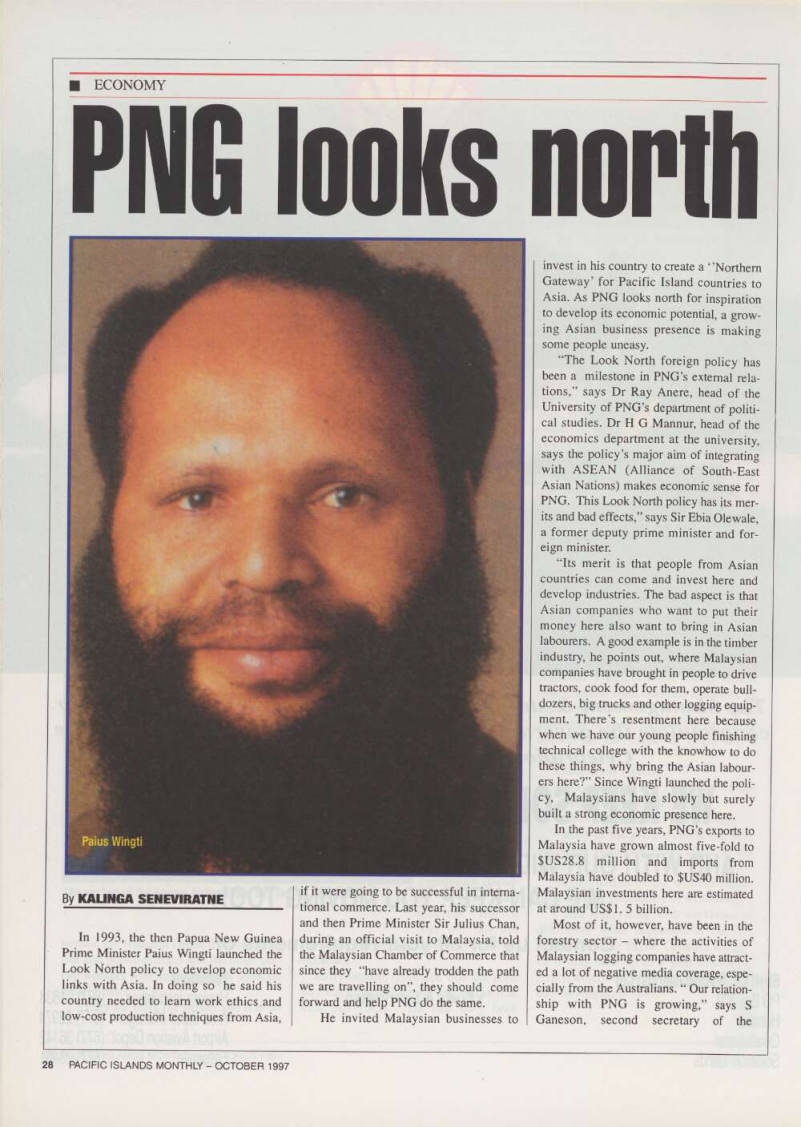

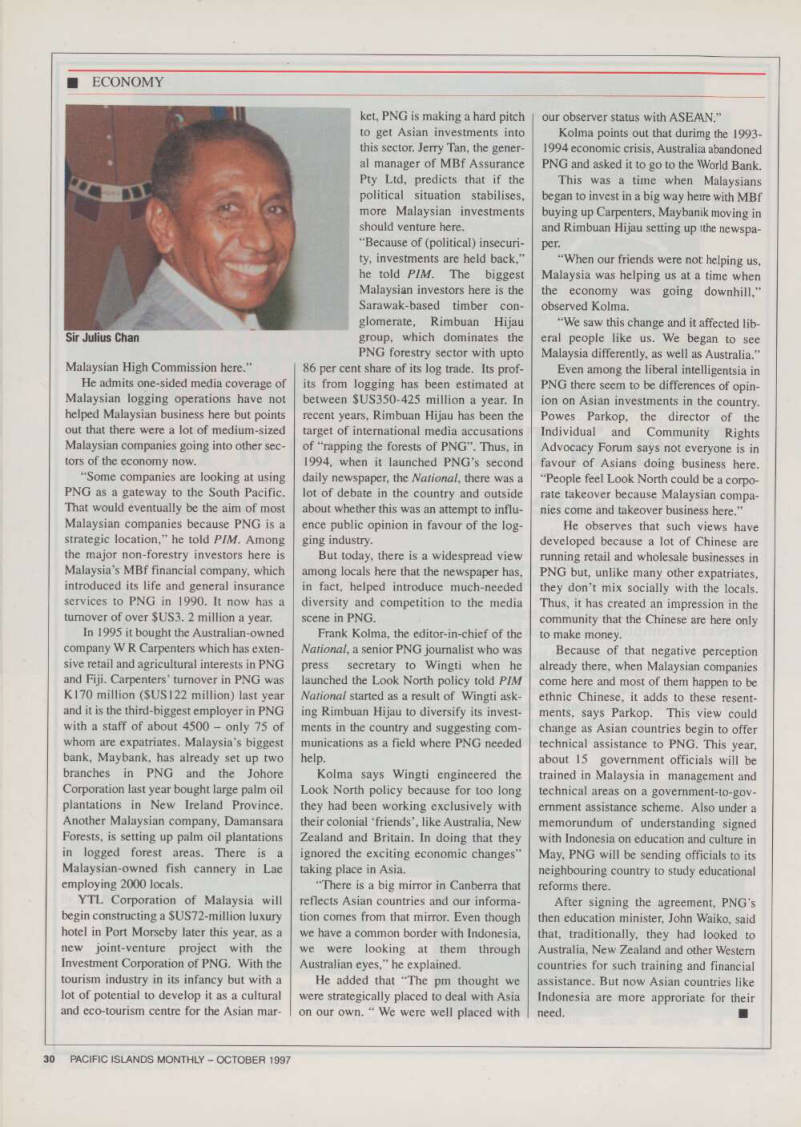
Economy
By Kalinga Seneviratne
In 1993, the then Papua New Guinea Prime Minister Paius Wingti launched the Look North policy to develop economic links with Asia. In doing so he said his country needed to leam work ethics and low-cost production techniques from Asia,
if it were going to be successful in interna tional commerce. Last year, his successor and then Prime Minister Sir Julius Chan, during an official visit to Malaysia, told the Malaysian Chamber of Commerce that since they “have already trodden the path we are travelling on”, they should come forward and help PNG do the same.
He invited Malaysian businesses to
invest in his country to create a ‘ ’Northern Gateway’ for Pacific Island countries to Asia. As PNG looks north for inspiration to develop its economic potential, a grow ing Asian business presence is making some people uneasy.
“The Look North foreign policy has been a milestone in PNG’s external rela tions,” says Dr Ray Anere, head of the University of PNG’s department of politi cal studies. Dr H G Mannur, head of the economics department at the university, says the policy’s major aim of integrating with ASEAN (Alliance of South-East Asian Nations) makes economic sense for PNG. This Look North policy has its mer its and bad effects,” says Sir Ebia Olewale, a former deputy prime minister and for eign minister.
“Its merit is that people from Asian countries can come and invest here and develop industries. The bad aspect is that Asian companies who want to put their money here also want to bring in Asian labourers. A good example is in the timber industry, he points out, where Malaysian companies have brought in people to drive tractors, cook food for them, operate bull dozers, big trucks and other logging equip ment. There’s resentment here because when we have our young people finishing technical college with the knowhow to do these things, why bring the Asian labour ers here?” Since Wingti launched the poli cy, Malaysians have slowly but surely built a strong economic presence here.
In the past five years, PNG’s exports to Malaysia have grown almost five-fold to SUS2B.B million and imports from Malaysia have doubled to SUS4O million.
Malaysian investments here are estimated at around US$l. 5 billion.
Most of it, however, have been in the forestry sector - where the activities of
Malaysian logging companies have attract
ed a lot of negative media coverage, espe cially from the Australians. “ Our relation ship with PNG is growing,” says S Ganeson, second secretary of the
Paius Wingti
Malaysian High Commission here.”
He admits one-sided media coverage of Malaysian logging operations have not helped Malaysian business here but points out that there were a lot of medium-sized Malaysian companies going into other sec tors of the economy now.
“Some companies are looking at using PNG as a gateway to the South Pacific.
That would eventually be the aim of most Malaysian companies because PNG is a strategic location,” he told PIM. Among the major non-forestry investors here is Malaysia’s MBf financial company, which introduced its life and general insurance services to PNG in 1990. It now has a turnover of over SUS 3. 2 million a year.
In 1995 it bought the Australian-owned company W R Carpenters which has exten sive retail and agricultural interests in PNG and Fiji. Carpenters’ turnover in PNG was Kl7O million (SUSI 22 million) last year and it is the third-biggest employer in PNG with a staff of about 4500 - only 75 of whom are expatriates. Malaysia’s biggest bank, Maybank, has already set up two branches in PNG and the Johore Corporation last year bought large palm oil plantations in New Ireland Province.
Another Malaysian company, Damansara Forests, is setting up palm oil plantations in logged forest areas. There is a Malaysian-owned fish cannery in Lae employing 2000 locals.
YTL Corporation of Malaysia will begin constructing a SUS72-million luxury hotel in Port Morseby later this year, as a new joint-venture project with the Investment Corporation of PNG. With the tourism industry in its infancy but with a lot of potential to develop it as a cultural and eco-tourism centre for the Asian mar
ket, PNG is making a hard pitch to get Asian investments into this sector. Jerry Tan, the gener al manager of MBf Assurance Pty Ltd, predicts that if the political situation stabilises, more Malaysian investments should venture here.
“Because of (political) insecuri ty, investments are held back,” he told PIM. The biggest Malaysian investors here is the Sarawak-based timber con glomerate, Rimbuan Hijau group, which dominates the PNG forestry sector with upto
86 per cent share of its log trade. Its prof its from logging has been estimated at between SUS3SO-425 million a year. In recent years, Rimbuan Hijau has been the target of international media accusations of “rapping the forests of PNG”. Thus, in 1994, when it launched PNG’s second daily newspaper, the National, there was a lot of debate in the country and outside about whether this was an attempt to influ ence public opinion in favour of the log ging industry.
But today, there is a widespread view among locals here that the newspaper has, in fact, helped introduce much-needed diversity and competition to the media scene in PNG.
Frank Kolma, the editor-in-chief of the National, a senior PNG journalist who was press secretary to Wingti when he launched the Look North policy told PIM National started as a result of Wingti ask ing Rimbuan Hijau to diversify its invest ments in the country and suggesting com munications as a field where PNG needed help.
Kolma says Wingti engineered the Look North policy because for too long they had been working exclusively with their colonial Triends’, like Australia, New Zealand and Britain. In doing that they
ignored the exciting economic changes”
taking place in Asia.
"There is a big mirror in Canberra that reflects Asian countries and our informa tion comes from that mirror. Even though we have a common border with Indonesia, we were looking at them through Australian eyes,” he explained.
He added that “The pm thought we were strategically placed to deal with Asia on our own. “ We were well placed with
our observer status with ASEAN.”
Kolma points out that durimg the 1993- 1994 economic crisis, Australua abandoned PNG and asked it to go to the World Bank.
This was a time when Malaysians began to invest in a big way heire with MBf
buying up Carpenters, Maybanik moving in
and Rimbuan Hijau setting up ithe newspa per.
“When our friends were not: helping us, Malaysia was helping us at a time when the economy was going downhill,” observed Kolma.
“We saw this change and it affected lib eral people like us. We began to see Malaysia differently, as well as Australia.”
Even among the liberal intelligentsia in PNG there seem to be differences of opin ion on Asian investments in the country.
Powes Parkop, the director of the
Individual and Community Rights
Advocacy Forum says not everyone is in favour of Asians doing business here.
“People feel Look North could be a corpo rate takeover because Malaysian compa nies come and takeover business here.”
He observes that such views have developed because a lot of Chinese are running retail and wholesale businesses in PNG but, unlike many other expatriates, they don’t mix socially with the locals.
Thus, it has created an impression in the community that the Chinese are here only to make money.
Because of that negative perception already there, when Malaysian companies come here and most of them happen to be ethnic Chinese, it adds to these resent ments, says Parkop. This view could change as Asian countries begin to offer technical assistance to PNG. This year, about 15 government officials will be trained in Malaysia in management and technical areas on a govemment-to-gov emment assistance scheme. Also under a memorundum of understanding signed with Indonesia on education and culture in May, PNG will be sending officials to its neighbouring country to study educational reforms there.
After signing the agreement, PNG’s then education minister, John Waiko, said that, traditionally, they had looked to Australia, New Zealand and other Western countries for such training and financial assistance. But now Asian countries like Indonesia are more approriate for their need. ■
Sir Julius Chan
Advertisements & other items, p. 29 (1 item)
When in The Kingdom of Tonga
) i .. < v\ ,'S* 1 ■■■ i jaw® ' :p-K ■ ' 4 ■■■ -*.* *2 •!
HI m ass: S)
Stay at - The International Dateline Hotel Seventy-six airconditioned rooms with, all amenities over-looking 1 sparkling Nuku’alofa Harbour make the International Dateline Hotel the perfect retreat for complete relaxation.
Delicious international and local cuisine at our licensed a-la-carte restaurant, exotic cocktails at our two bars, floor shows, private guest lounge, open air dancing terrace, swimming pool, variety shop and duty free shopping, baby sitting on request, everything you could want for a relaxing holiday in the sun.
Major upgrading and expansion is planned for late 1997 and 1998. And for those of you here on business we offer two conference rooms, business centre, international direct dial telephones, telex and facsimile services, daily laundry and drycleaning services and a safety deposit facility to make life a little more convenient when you’re doing business away from home.
P
INTERNATIONAL
DATELINE HOTEL
PO Box 39 Nuku’alofa
KINGDOM OF TONGA
Tel: +676 23411 Fax: +676 23410
Burnham declaration approved
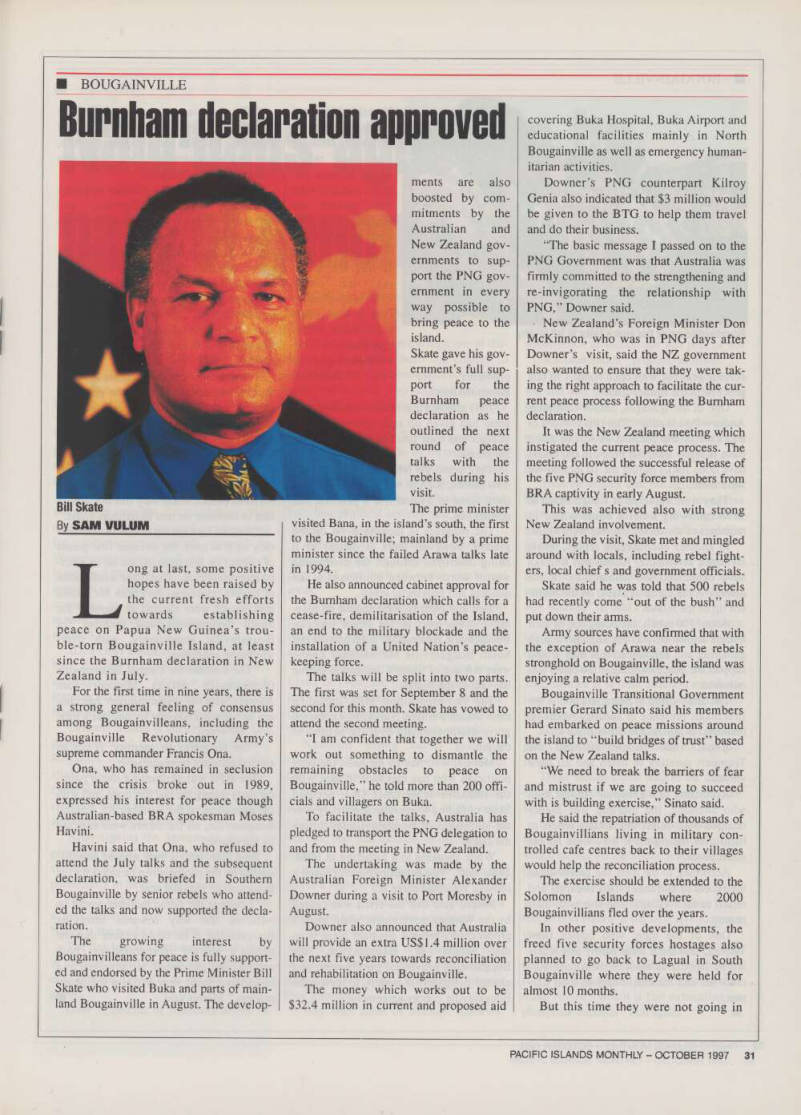
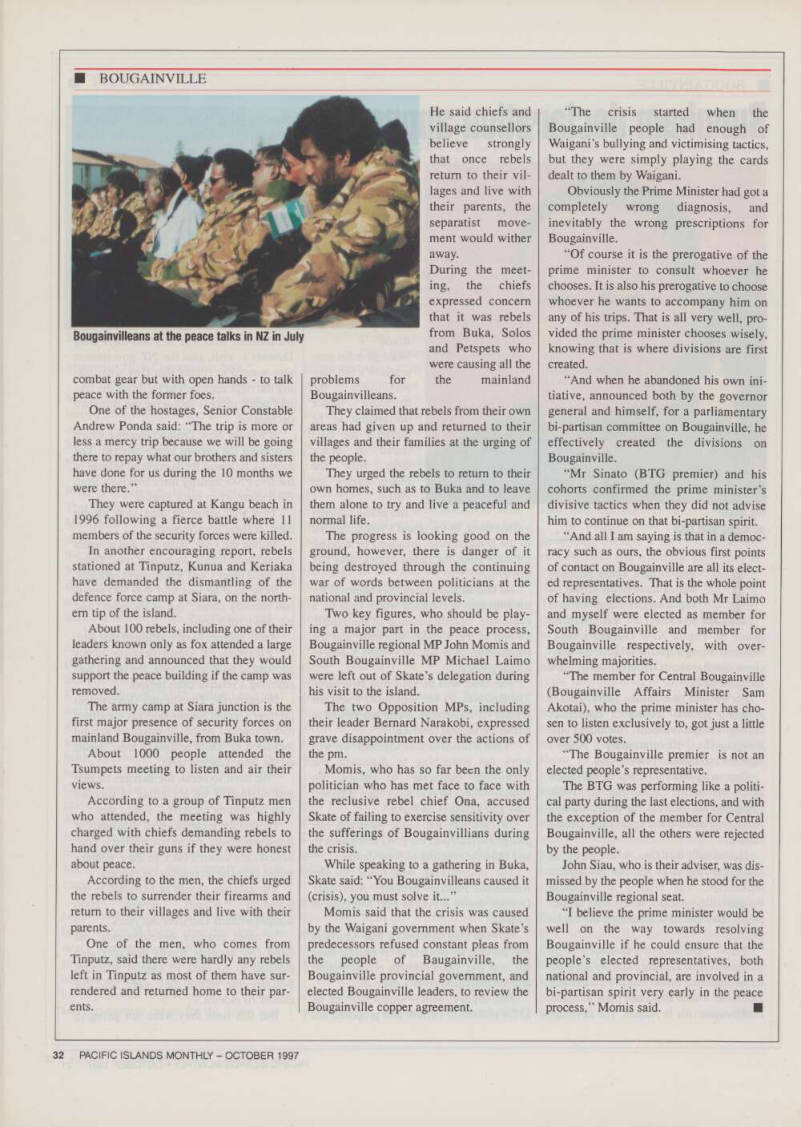
Bougainville
By Sam Vulum
Long at last, some positive hopes have been raised by the current fresh efforts towards establishing peace on Papua New Guinea’s trou ble-torn Bougainville Island, at least since the Burnham declaration in New Zealand in July.
For the first time in nine years, there is a strong general feeling of consensus among Bougainvilleans, including the Bougainville Revolutionary Army’s supreme commander Francis Ona.
Ona, who has remained in seclusion since the crisis broke out in 1989, expressed his interest for peace though Australian-based BRA spokesman Moses Havini.
Havini said that Ona, who refused to attend the July talks and the subsequent declaration, was briefed in Southern Bougainville by senior rebels who attend ed the talks and now supported the decla ration.
The growing interest by Bougainvilleans for peace is fully support ed and endorsed by the Prime Minister Bill Skate who visited Buka and parts of main land Bougainville in August. The develop
ments are also boosted by com mitments by the Australian and New Zealand gov ernments to sup port the PNG gov ernment in every way possible to bring peace to the island.
Skate gave his gov ernment’s full sup port for the Burnham peace declaration as he outlined the next round of peace talks with the rebels during his visit.
The prime minister
visited Bana, in the island’s south, the first to the Bougainville; mainland by a prime minister since the failed Arawa talks late in 1994.
He also announced cabinet approval for the Burnham declaration which calls for a cease-fire, demilitarisation of the Island, an end to the military blockade and the installation of a United Nation’s peace keeping force.
The talks will be split into two parts.
The first was set for September 8 and the second for this month. Skate has vowed to attend the second meeting.
“I am confident that together we will work out something to dismantle the remaining obstacles to peace on Bougainville,” he told more than 200 offi cials and villagers on Buka.
To facilitate the talks, Australia has pledged to transport the PNG delegation to and from the meeting in New Zealand.
The undertaking was made by the Australian Foreign Minister Alexander Downer during a visit to Port Moresby in August.
Downer also announced that Australia will provide an extra US$l.4 million over the next five years towards reconciliation and rehabilitation on Bougainville.
The money which works out to be $32.4 million in current and proposed aid
covering Buka Hospital, Buka Airport and educational facilities mainly in North Bougainville as well as emergency human itarian activities.
Downer’s PNG counterpart Kilroy Genia also indicated that $3 million would be given to the BTG to help them travel and do their business.
“The basic message I passed on to the PNG Government was that Australia was firmly committed to the strengthening and
re-invigorating the relationship with
PNG,” Downer said.
New Zealand’s Foreign Minister Don McKinnon, who was in PNG days after Downer’s visit, said the NZ government also wanted to ensure that they were tak ing the right approach to facilitate the cur rent peace process following the Burnham declaration.
It was the New Zealand meeting which instigated the current peace process. The meeting followed the successful release of the five PNG security force members from
BRA captivity in early August.
This was achieved also with strong New Zealand involvement.
During the visit, Skate met and mingled around with locals, including rebel fight ers, local chief s and government officials.
Skate said he was told that 500 rebels had recently come “out of the bush” and put down their arms.
Army sources have confirmed that with the exception of Arawa near the rebels stronghold on Bougainville, the island was enjoying a relative calm period.
Bougainville Transitional Government premier Gerard Sinato said his members had embarked on peace missions around the island to “build bridges of trust” based on the New Zealand talks.
“We need to break the barriers of fear and mistrust if we are going to succeed with is building exercise,” Sinato said.
He said the repatriation of thousands of Bougainvillians living in military con trolled cafe centres back to their villages would help the reconciliation process.
The exercise should be extended to the Solomon Islands where 2000 Bougainvillians fled over the years.
In other positive developments, the freed five security forces hostages also planned to go back to Lagual in South Bougainville where they were held for almost 10 months.
But this time they were not going in
Bill Skate
combat gear but with open hands - to talk peace with the former foes.
One of the hostages, Senior Constable Andrew Ponda said: “The trip is more or less a mercy trip because we will be going there to repay what our brothers and sisters have done for us during the 10 months we were there.”
They were captured at Kangu beach in 1996 following a fierce battle where 11 members of the security forces were killed.
In another encouraging report, rebels stationed at Tinputz, Kunua and Keriaka have demanded the dismantling of the defence force camp at Siara, on the north ern tip of the island.
About 100 rebels, including one of their leaders known only as fox attended a large gathering and announced that they would support the peace building if the camp was removed.
The army camp at Siara junction is the first major presence of security forces on mainland Bougainville, from Buka town.
About 1000 people attended the Tsumpets meeting to listen and air their views.
According to a group of Tinputz men who attended, the meeting was highly charged with chiefs demanding rebels to hand over their guns if they were honest about peace.
According to the men, the chiefs urged the rebels to surrender their firearms and return to their villages and live with their parents.
One of the men, who comes from Tinputz, said there were hardly any rebels left in Tinputz as most of them have sur rendered and returned home to their par ents.
He said chiefs and village counsellors believe strongly that once rebels return to their vil lages and live with their parents, the separatist move ment would wither away.
During the meet ing, the chiefs expressed concern that it was rebels from Buka, Solos and Petspets who were causing all the
problems for the mainland Bougainvilleans.
They claimed that rebels from their own areas had given up and returned to their villages and their families at the urging of the people.
They urged the rebels to return to their own homes, such as to Buka and to leave them alone to try and live a peaceful and normal life.
The progress is looking good on the ground, however, there is danger of it
being destroyed through the continuing
war of words between politicians at the national and provincial levels.
Two key figures, who should be play ing a major part in the peace process, Bougainville regional MP John Momis and South Bougainville MP Michael Laimo were left out of Skate’s delegation during his visit to the island.
The two Opposition MPs, including their leader Bernard Narakobi, expressed grave disappointment over the actions of the pm.
Momis, who has so far been the only politician who has met face to face with the reclusive rebel chief Ona, accused Skate of failing to exercise sensitivity over
the sufferings of Bougainvillians during
the crisis.
While speaking to a gathering in Buka, Skate said: “You Bougainvilleans caused it (crisis), you must solve it...”
Momis said that the crisis was caused by the Waigani government when Skate’s predecessors refused constant pleas from the people of Baugainville, the
Bougainville provincial government, and
elected Bougainville leaders, to review the Bougainville copper agreement.
“The crisis started when the Bougainville people had enough of Waigani’s bullying and victimising tactics, but they were simply playing the cards dealt to them by Waigani.
Obviously the Prime Minister had got a
completely wrong diagnosis, and
inevitably the wrong prescriptions for
Bougainville.
“Of course it is the prerogative of the prime minister to consult whoever he chooses. It is also his prerogative to choose whoever he wants to accompany him on any of his trips. That is all very well, pro vided the prime minister chooses wisely, knowing that is where divisions are first created.
“And when he abandoned his own ini tiative, announced both by the governor general and himself, for a parliamentary bi-partisan committee on Bougainville, he effectively created the divisions on
Bougainville.
“Mr Sinato (BTG premier) and his cohorts confirmed the prime minister’s divisive tactics when they did not advise him to continue on that bi-partisan spirit.
“And all I am saying is that in a democ racy such as ours, the obvious first points of contact on Bougainville are all its elect ed representatives. That is the whole point of having elections. And both Mr Laimo and myself were elected as member for South Bougainville and member for
Bougainville respectively, with over
whelming majorities.
“The member for Central Bougainville (Bougainville Affairs Minister Sam Akotai), who the prime minister has cho sen to listen exclusively to, got just a little over 500 votes.
“The Bougainville premier is not an elected people’s representative.
The BTG was performing like a politi cal party during the last elections, and with the exception of the member for Central Bougainville, all the others were rejected by the people.
John Siau, who is their adviser, was dis missed by the people when he stood for the
Bougainville regional seat.
“I believe the prime minister would be well on the way towards resolving Bougainville if he could ensure that the people’s elected representatives, both national and provincial, are involved in a bi-partisan spirit very early in the peace process,” Momis said. ■
Bougainvilleans at the peace talks in NZ in July
part of genome studies
Health
Nauruans agree to be part of genome studies
By Kalinga Seneviratne
The Republic of Nauru and the Melbourne based International Diabetes Institute (IDI) signed a historic agreement on July 31st which will pave the way for the people of Nauru to be used for a genome studies project to find prevention methods for diabetes, which is afflicting over a third of the Island population.
While some may see this agreement as yet another example of a small developing country’s people being used as guinea pigs for sophisticated scientific research by Western scientists, both the president of Nauru and the head of IDI hail this agree ment as a model for other developing countries in terms of ensuring proper returns for using its citizens in medical research.
IDEs chief executive officer, Professor Paul Zimmet described this as the “first such agreement’ ’ between any research institute to carry out genome studies on the Nauruan population for the next 20 years.
Genome studies is the definition of key genes involved in the cause of disease.
Royalties from any discovery from the study which leads to a commercial out come will be shared with the Nauru gov ernment, which will use the money for the advancement of its people.
After signing the agreement, Nauru’s president Kinza Clodumar said that it “will set new standards for population research,
particularly in developing countries.”
Just 21 sq km, the tiny Island state with a population of just over 5000 people, Nauru is the world’s smallest republic.
The tiny island which was virtually free of diabetes until 1954, has the world’s sec ond highest prevalence of the disease today.
Over 32 percent of Nauruans above 20
years of age suffer from diabetes, which is nearly eight times that for populations in Europe and Australia.
“A major reason for the high rate of dia betes in Nauru has been the change in lifestyle from the former traditional one” says Prof Zimmet, who has been the medi cal advisor to the Nauru Government since 1975.
“The changes in Nauru mirror those throughout the Pacific as formerly tradi tional living populations become urbanised and modernised with a more Western diet of refined carbohydrate and high saturated fat - less physical activity and increasing obesity” he added.
Nauru has not been able to develop an organised agricultural economy due to the poor soil and lack of water catchment areas.
Large scale phosphate mining this cen tury by western powers also killed any chance of developing such agriculture activity in the Island.
Before mining operations began on the island in 1906, the traditional diet of the islanders consisted of coconut products, fish and pandanus, with birds, mainly black noodies, providing extra protein.
Nauruans eating habits gradually changed after that to a low-fibre western diet of imported food.
It started with German traders opening a small store in the Island in the early 19205, selling canned salmon, sugar, rice, biscuits, beer and tobacco, in exchange for copra.
Royalties from mining gave Nauru the world’s highest per capita income by the 19705, which made Western provisions affordable for most of the population.
“The increase in diabetes and other western style diseases in populations such as Nauru’s, has to be seen in the context of globalisation of world economies” argues Prof Zimmet.
Very high rates of obesity, diabetes,
hypertension and cardiovascular diseases, coupled with cigarette smoking, alcohol abuse, and other effects and outcomes of subsistence affluence are just part of the “Cocacolonization” process, he notes.
The professor believes that changes to the diet and more exercise alone will not prevent diabetes But he said improvements to the socio economic situation and cultural status of the people in the developing world is nec essary.
Thus he argues that the agreement his institute signed with Nauru to recognise such a process. It is in no way designed to use the people of Nauru as scientific guinea pigs he assures.
“The agreement with Nauru seeks to ensure that if any discovery is made from samples from surveys, the people of Nauru will benefit,” he told PIM.
“Many of the major diseases of western life are due to genetic factors and, or muta tions of genes” he explained. ‘A disease like diabetes may be due to abnomalities at several different metabolic sites in the body which may be determined by different genes.
Genome studies seek to find the gene or genes responsible for diseases such as dia betes.”
These studies could lead to the discov ery of testing methods to pre diagnose dia betes.
By finding the genetic abnomalities, it
may be possible to develop special drugs which targets the metabolic reactions caus ing diabetes.
Prof Zimmet is confident that there would be a positive outcome from IDTs research in Nauru in the next five to seven years.
If it does materialise, the discovery will not only help tens of millions of diabetes sufferers around the world, it could also make Nauru - which is fast exhausting its phosphate deposits - rich again. ■
Navigator Islands
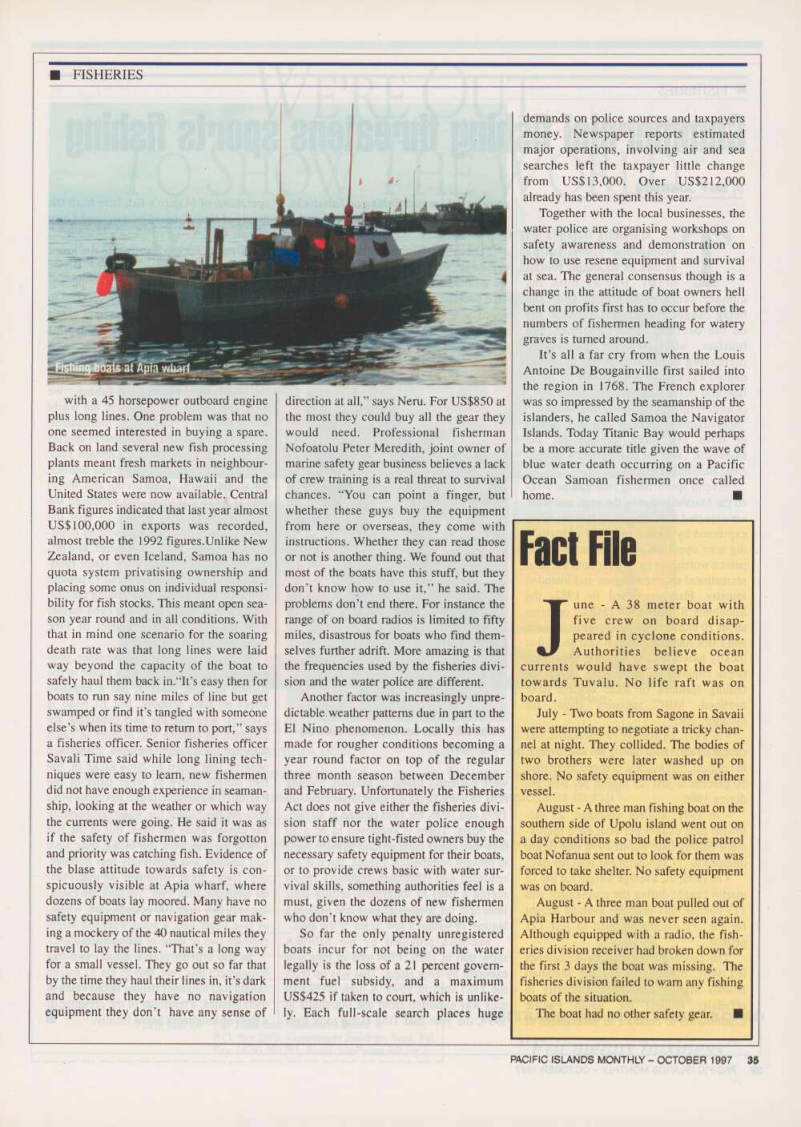
Fisheries
or Titanic Bay
...the increasing number of fishermen going missing at sea has called for more stringent rules regarding safety at sea
By Chris Peteru
Samoa’s budding long line
fishing industry is facing its most serious challenge - missing fishermen.
In 11 weeks, 13 long line fishermen have been lost at sea. The figure surpasses the total of three for the whole of last year, and is way ahead of the current road toll.
Authorities point to greedy boat owners chasing full nets at any cost, plus crews who lack experience. As the toll continues to mourn, the government has so far stood by without voiding any concern. Despite having one of the smallest economic fish ing zones in the world’s biggest ocean, police estimate the number of Samoan fishermen at the bottom of the Pacific shows no signs of slowing down. Inspector Lawrence Neru of the police marine divi sion, and commander of the Nafanua patrol boat said he had never seen anything like it in his nine years of service. His appraisal of what was happening was sim ple: “I can honestly say the owners do not care about the people on the boat.”
“If this attitude doesn’t change there will probably be (another) 20 in the next six months,” he told the Samoa Newsline.
Sources within the industry agreed.
They said boat owners, often prominent businessmen or community figures were indifferent to the safety of those working their vessels. Others openly flaunted the law knowing the odds of being prosecuted
by a legally underpowered police force
were pretty much zero. “I have just found out from the fisheries division that about 80 per cent of the boats are not registered.
That’s where the problem comes. Anyone thinks he can build a boat or a floating
craft and just put it out,” says Neru.
Significantly only one major operator, a foreigner was prepared to go on a record about the issue. New Zealander John Luff, director of Apia Export Fisheries said there was a desperate need for better safety fea tures. “If the problem is not addressed there will be more deaths,” he said.
Several fishermen say typically the employers attitude is akin to “Go and get the fish when I say so or go and get anoth er job.” For about US$l2 per day - consid ered top money on the cash strapped island, where the average wage is US$2l a week - fishermen are expected to clock up 14 hour five and six day weeks, in condi tions that are unsafe, backbreaking and arduous. Accompanying that was a certain element of bravado by locals - “we have this Samoan mentality that it won’t happen to me I’m strong.” Even things like taking on fresh water they say “we don’t need water we are only going out for a couple of hours,” says inspector Neru. Paytime sees boats hauling in a minimum US$425 (WS$ 1000) dollars a night. The most com mon catch, yellow fin tuna, fetch US 72 cents a pound.
With so much cash to be made, the local boat building industry has boomed.
“Every lawyer, doctor and member of parliament in town, now wants to own a fishing boat,” says the foreman at one of three small scale shipyards operating near Apia, the capital. All the yards have 12 month waiting lists on orders. Based around a traditional design the demand for the 15 meter long twin hulled aluminium boats, called alia has more than doubled to 142 in less than 12 months with new craft hitting the water regularly. Around US$l4,OOO will turn out a three men boat,
with a 45 horsepower outboard engine plus long lines. One problem was that no one seemed interested in buying a spare.
Back on land several new fish processing plants meant fresh markets in neighbour ing American Samoa, Hawaii and the United States were now available. Central Bank figures indicated that last year almost US$lOO,OOO in exports was recorded, almost treble the 1992 figures. Unlike New Zealand, or even Iceland, Samoa has no quota system privatising ownership and placing some onus on individual responsi bility for fish stocks. This meant open sea son year round and in all conditions. With that in mind one scenario for the soaring death rate was that long lines were laid way beyond the capacity of the boat to safely haul them back in.“lt’s easy then for boats to run say nine miles of line but get swamped or find it’s tangled with someone else’s when its time to return to port,” says a fisheries officer. Senior fisheries officer Savaii Time said while long lining tech niques were easy to leam, new fishermen did not have enough experience in seaman ship, looking at the weather or which way the currents were going. He said it was as if the safety of fishermen was forgotten and priority was catching fish. Evidence of the blase attitude towards safety is con spicuously visible at Apia wharf, where dozens of boats lay moored. Many have no
safety equipment or navigation gear mak
ing a mockery of the 40 nautical miles they travel to lay the lines. “That’s a long way for a small vessel. They go out so far that by the time they haul their lines in, it’s dark and because they have no navigation equipment they don’t have any sense of
direction at all,” says Neru. For US$B5O at the most they could buy all the gear they would need. Professional fisherman Nofoatolu Peter Meredith, joint owner of marine safety gear business believes a lack of crew training is a real threat to survival chances. “You can point a finger, but whether these guys buy the equipment from here or overseas, they come with instructions. Whether they can read those or not is another thing. We found out that most of the boats have this stuff, but they don’t know how to use it,” he said. The problems don’t end there. For instance the range of on board radios is limited to fifty miles, disastrous for boats who find them selves further adrift. More amazing is that the frequencies used by the fisheries divi sion and the water police are different.
Another factor was increasingly unpre dictable, weather patterns due in part to the El Nino phenomenon. Locally this has made for rougher conditions becoming a year round factor on top of the regular three month season between December and February. Unfortunately the Fisheries Act does not give either the fisheries divi sion staff nor the water police enough power to ensure tight-fisted owners buy the necessary safety equipment for their boats, or to provide crews basic with water sur vival skills, something authorities feel is a must, given the dozens of new fishermen who don’t know what they are doing.
So far the only penalty unregistered boats incur for not being on the water legally is the loss of a2l percent govern ment fuel subsidy, and a maximum US$425 if taken to court, which is unlike
ly. Each full-scale search places huge
demands on police sources and taxpayers money. Newspaper reports estimated
major operations, involving air and sea
searches left the taxpayer little change from US$l3,OOO. Over U 55212,000 already has been spent this year.
Together with the local businesses, the water police are organising workshops on safety awareness and demonstration on how to use resene equipment and survival at sea. The general consensus though is a change in the attitude of boat owners hell bent on profits first has to occur before the numbers of fishermen heading for watery graves is turned around.
It’s all a far cry from when the Louis Antoine De Bougainville first sailed into the region in 1768. The French explorer was so impressed by the seamanship of the islanders, he called Samoa the Navigator Islands. Today Titanic Bay would perhaps be a more accurate title given the wave of blue water death occurring on a Pacific Ocean Samoan fishermen once called home. ■
Fishing boats at Apia Wharf
Advertisements & other items, p. 34 (1 item)
Orly
THE ONE AND ONLY
MATCHMAKER
WHAT IS THE MEDIA
SAYING ABOUT ORLY?
The Phil Donahue Show "Orly is a unique personal matchmaker...”
Ron Reagan Show "Orly, bom a matchmaker..."
Sally Jesse Rafael Show "Orly's service is designed for die professionals...
AM Los Angeles Show "two of Orly's clients were married live on the show... The wedding of the year"
Eyewitness News (ABC) "Orly, world renowned matchmaker..”
KTLA Morning News "Orly, matchmaker in action..."
Jewish T.V. Network "Orly is real marriage broker..."
Montel Williams Show "Orly's clients are the cream de la cream..."
AM Philadelphia Show "Orly’s clients are simply top of (he line..."
Cleveland Tonight Show "Orly, a touch of class.."
Orange County News Channel "Orly is champagne wishes..."
AM Northwest Show, Oregon "Orly the one and only matchmaker..."
Good Evening Seattle Show "Orly is an investment in your future..."
The Dimi Petty Show, Canada "Orly has sixth sense..."
National Enquirer "Orly has a dream date for y0u..."
Orange County Register "Orly has a match for the sincere singles..."
The Heritage Weekly "Orly is nationally and internationally known..."
Los Angeles Times "Orly matches the rich and successful..."
Dallas Morning Newspaper "Orly made countless introductions..."
Beverly Hills Today "Orly is the Rolls Royce of matchmaking..."
KFI Talk Radio "Orly, a matchmaker with a sixth sense...”
WLAC Nashville Radio "Orly is a celebrity matchmaker..."
FREE
30 MINUTES PHONE CONSULTATION
(310)659-7337 ‘Beverly Hills
Fact File
June - A 38 meter boat with five crew on board disap peared in cyclone conditions.
Authorities believe ocean currents would have swept the boat towards Tuvalu. No life raft was on board.
July - Two boats from Sagone in Savaii were attempting to negotiate a tricky chan nel at night. They collided. The bodies of two brothers were later washed up on shore. No safety equipment was on either vessel.
August - A three man fishing boat on die southern side of Upolu island went out on a day conditions so bad the police patrol boat Nofanua sent out to look for them was forced to take shelter. No safety equipment was on board.
August - A three man boat pulled out of Apia Harbour and was never seen again.
Although equipped with a radio, the fish eries division receiver had broken down for the first 3 days the boat was missing. The fisheries division failed to warn any fishing boats of the situation.
The boat had no other safety gear. ■
Commercial fishing threatens sports fishing
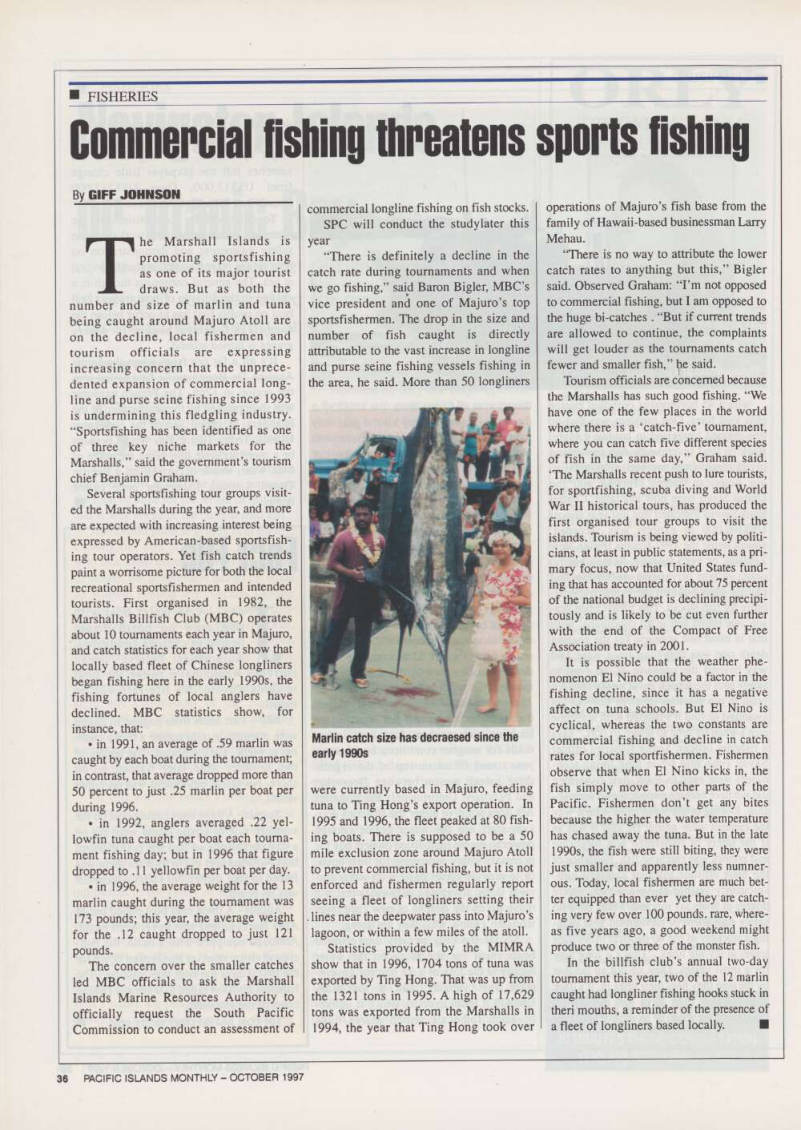
By Giff Johnson
The Marshall Islands is
promoting sportsfishing
as one of its major tourist draws. But as both the number and size of marlin and tuna being caught around Majuro Atoll are on the decline, local fishermen and tourism officials are expressing increasing concern that the unprece dented expansion of commercial long line and purse seine fishing since 1993 is undermining this fledgling industry.
“Sportsfishing has been identified as one of three key niche markets for the Marshalls,” said the government’s tourism chief Benjamin Graham.
Several sportsfishing tour groups visit ed the Marshalls during the year, and more are expected with increasing interest being expressed by American-based sportsfish ing tour operators. Yet fish catch trends paint a worrisome picture for both the local recreational sportsfishermen and intended tourists. First organised in 1982, the Marshalls Billfish Club (MBC) operates about 10 tournaments each year in Majuro, and catch statistics for each year show that locally based fleet of Chinese longliners began fishing here in the early 19905, the fishing fortunes of local anglers have declined. MBC statistics show, for instance, that: • in 1991, an average of .59 marlin was caught by each boat during the tournament; in contrast, that average dropped more than 50 percent to just .25 marlin per boat per during 1996. • in 1992, anglers averaged .22 yel lowfin tuna caught per boat each tourna ment fishing day; but in 1996 that figure dropped to .11 yellowfin per boat per day. • in 1996, the average weight for the 13 marlin caught during the tournament was 173 pounds; this year, the average weight for the .12 caught dropped to just 121 pounds.
The concern over the smaller catches led MBC officials to ask the Marshall Islands Marine Resources Authority to officially request the South Pacific Commission to conduct an assessment of
commercial longline fishing on fish stocks.
SPC will conduct the studylater this year “There is definitely a decline in the catch rate during tournaments and when we go fishing,” said Baron Bigler, MBC’s vice president and one of Majuro’s top sportsfishermen. The drop in the size and number of fish caught is directly attributable to the vast increase in longline and purse seine fishing vessels fishing in the area, he said. More than 50 longliners
were currently based in Majuro, feeding tuna to Ting Hong’s export operation. In 1995 and 1996, the fleet peaked at 80 fish ing boats. There is supposed to be a 50 mile exclusion zone around Majuro Atoll to prevent commercial fishing, but it is not enforced and fishermen regularly report seeing a fleet of longliners setting their . lines near the deepwater pass into Majuro’s lagoon, or within a few miles of the atoll.
Statistics provided by the MIMRA show that in 1996, 1704 tons of tuna was exported by Ting Hong. That was up from the 1321 tons in 1995. A high of 17,629 tons was exported from the Marshalls in 1994, the year that Ting Hong took over
operations of Majuro’s fish base from the family of Hawaii-based businessman Larry Mehau.
“There is no way to attribute the lower catch rates to anything but this,” Bigler said. Observed Graham: “I’m not opposed to commercial fishing, but I am opposed to the huge bi-catches . “But if current trends are allowed to continue, the complaints will get louder as the tournaments catch fewer and smaller fish,” Ijie said.
Tourism officials are concerned because the Marshalls has such good fishing. “We have one of the few places in the world where there is a ‘catch-five’ tournament, where you can catch five different species of fish in the same day,” Graham said. ‘The Marshalls recent push to lure tourists, for sportfishing, scuba diving and World War II historical tours, has produced the first organised tour groups to visit the islands. Tourism is being viewed by politi cians, at least in public statements, as a pri mary focus, now that United States fund ing that has accounted for about 75 percent of the national budget is declining precipi tously and is likely to be cut even further with the end of the Compact of Free Association treaty in 2001.
It is possible that the weather phe nomenon El Nino could be a factor in the fishing decline, since it has a negative affect on tuna schools. But El Nino is cyclical, whereas the two constants are commercial fishing and decline in catch rates for local sportfishermen. Fishermen observe that when El Nino kicks in, the fish simply move to other parts of the Pacific. Fishermen don’t get any bites because the higher the water temperature has chased away the tuna. But in the late 19905, the fish were still biting, they were just smaller and apparently less numner ous. Today, local fishermen are much bet ter equipped than ever yet they are catch ing very few over 100 pounds, rare, where as five years ago, a good weekend might produce two or three of the monster fish.
In the billfish club’s annual two-day tournament this year, two of the 12 marlin caught had longliner fishing hooks stuck in theri mouths, a reminder of the presence of a fleet of longliners based locally. ■
Marlin catch size has decraesed since the early 1990s
Advertisements & other items, p. 37 (1 item)
We’re Out
To Show The World
We Mean Business
k
BBNSTAf*
m i *V r.
Qeneral Manufacturing Qarment Fish ■ ..A if S.
i mi
Qold Sugar Tourism With exports that will exceed $ 1 billion this year; where business opportunities offer a varitable treasure trove of possibilities, and where the quality of life is unequalled, in one of the most beautiful countries on earth - isn’t it time you discovered the Fiji Islands.
We’re out to show the world we mean business. Find out how you can be part of it. Fill out the coupon below for your free copy of “Investment In Fiji”.
Fiji. What a wonderful place to do business.
Please send me my free copy of “Investment In Fiji”
Name Company or business Position Fax State or province Telephone Country Zip code Fax or mail to: Fiji Trade and Investment Board P.O. Box 2303, Government Buildings, Suva, Fiji.
Fax: (679) 301783. Email; httpl/unvw.ftib.org.fj
FIJI TRADE AND INVESTMENT BOARD
“Fiji means business”
Awards-a symbol of quality
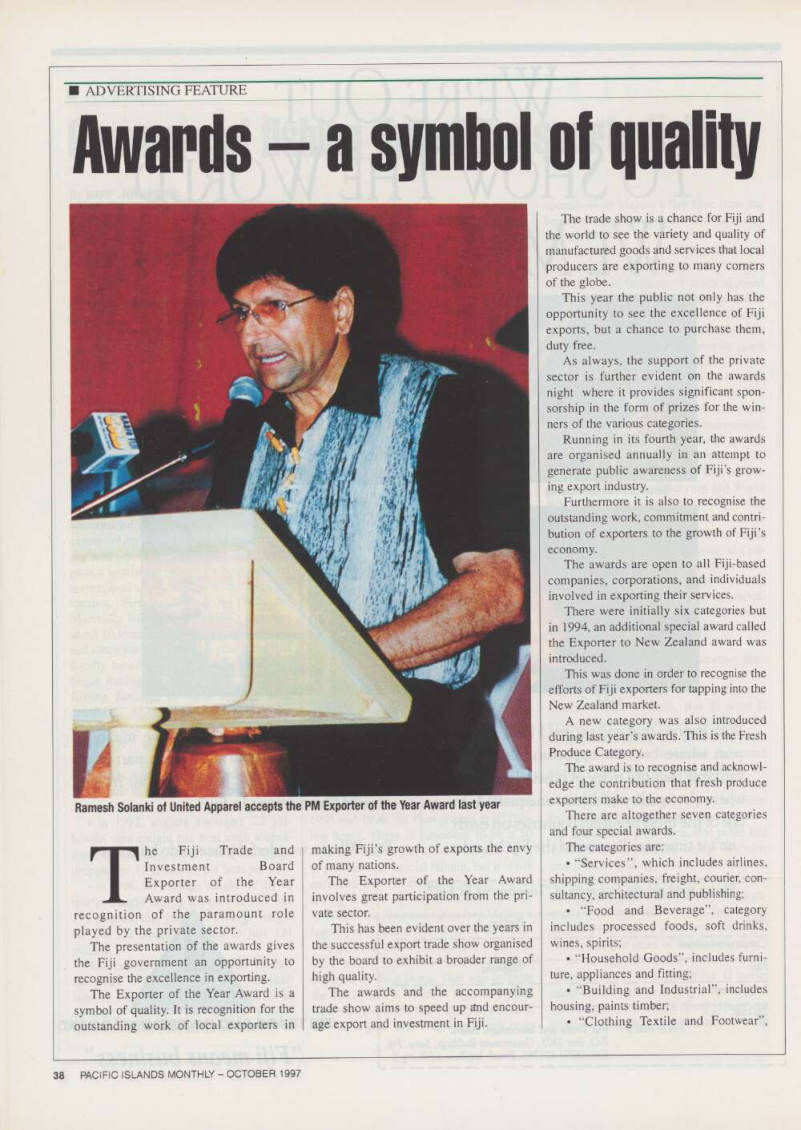
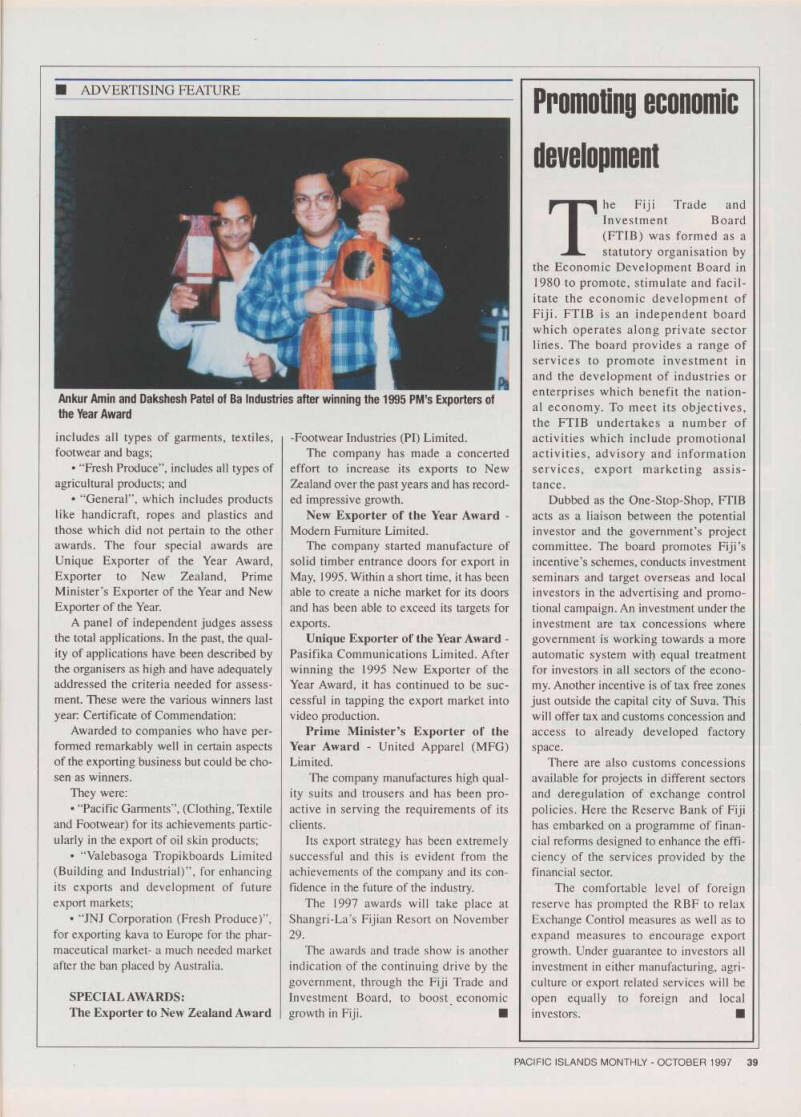
Advertising Feature
The Fiji Trade and Investment Board Exporter of the Year Award was introduced in recognition of the paramount role played by the private sector.
The presentation of the awards gives the Fiji government an opportunity to recognise the excellence in exporting.
The Exporter of the Year Award is a symbol of quality. It is recognition for the outstanding work of local exporters in
making Fiji’s growth of exports the envy of many nations.
The Exporter of the Year Award involves great participation from the pri vate sector.
This has been evident over the years in the successful export trade show organised by the board to exhibit a broader range of
high quality.
The awards and the accompanying trade show aims to speed up and encour age export and investment in Fiji.
The trade show is a chance for Fiji and the world to see the variety and quality of manufactured goods and services that local producers are exporting to many corners of the globe.
This year the public not only has the opportunity to see the excellence of Fiji exports, but a chance to purchase them, duty free.
As always, the support of the private sector is further evident on the awards night where it provides significant spon sorship in the form of prizes for the win ners of the various categories.
Running in its fourth year, the awards are organised annually in an attempt to generate public awareness of Fiji’s grow ing export industry.
Furthermore it is also to recognise the outstanding work, commitment and contri bution of exporters to the growth of Fiji’s economy.
The awards are open to all Fiji-based
companies, corporations, and individuals
involved in exporting their services.
There were initially six categories but in 1994, an additional special award called the Exporter to New Zealand award was introduced.
This was done in order to recognise the efforts of Fiji exporters for tapping into the New Zealand market.
A new category was also introduced during last year’s awards. This is the Fresh Produce Category.
The award is to recognise and acknowl edge the contribution that fresh produce exporters make to the economy.
There are altogether seven categories and four special awards.
The categories are: • ‘"Services”, which includes airlines,
shipping companies, freight, courier, con
sultancy, architectural and publishing; • “Food and Beverage”, category includes processed foods, soft drinks,
wines, spirits;
• “Household Goods”, includes furni ture, appliances and fitting; • "Building and Industrial”, includes housing, paints timber; • “Clothing Textile and Footwear”,
Ramesh Solanki of United Apparel accepts the PM Exporter of the Year Award last year
includes all types of garments, textiles, footwear and bags; • “Fresh Produce”, includes all types of agricultural products; and • “General”, which includes products like handicraft, ropes and plastics and those which did not pertain to the other awards. The four special awards are Unique Exporter of the Year Award, Exporter to New Zealand, Prime Minister’s Exporter of the Year and New Exporter of the Year.
A panel of independent judges assess the total applications. In the past, the qual ity of applications have been described by the organisers as high and have adequately addressed the criteria needed for assess ment. These were the various winners last year: Certificate of Commendation: Awarded to companies who have per formed remarkably well in certain aspects of the exporting business but could be cho sen as winners.
They were: • “Pacific Garments”, (Clothing, Textile and Footwear) for its achievements partic ularly in the export of oil skin products; • “Valebasoga Tropikboards Limited (Building and Industrial)”, for enhancing its exports and development of future export markets; • “JNJ Corporation (Fresh Produce)”, for exporting kava to Europe for the phar maceutical market- a much needed market after the ban placed by Australia.
Special Awards:
The Exporter to New Zealand Award
-Footwear Industries (PI) Limited.
The company has made a concerted effort to increase its exports to New Zealand over the past years and has record ed impressive growth.
New Exporter of the Year Award - Modem Furniture Limited.
The company started manufacture of solid timber entrance doors for export in May, 1995. Within a short time, it has been able to create a niche market for its doors and has been able to exceed its targets for exports.
Unique Exporter of the Year Award - Pasifika Communications Limited. After winning the 1995 New Exporter of the Year Award, it has continued to be suc cessful in tapping the export market into
video production.
Prime Minister’s Exporter of the Year Award - United Apparel (MFC) Limited.
The company manufactures high qual ity suits and trousers and has been pro active in serving the requirements of its clients.
Its export strategy has been extremely successful and this is evident from the achievements of the company and its con fidence in the future of the industry.
The 1997 awards will take place at Shangri-La’s Fijian Resort on November 29.
The awards and trade show is another indication of the continuing drive by the government, through the Fiji Trade and Investment Board, to boost economic growth in Fiji. ■
Ankur Amin and Dakshesh Patel of Ba Industries after winning the 1995 PM’s Exporters of the Year Award
Promoting economic
development
The Fiji Trade and
Investment Board (FTIB) was formed as a statutory organisation by the Economic Development Board in 1980 to promote, stimulate and facil itate the economic development of Fiji. FTIB is an independent board which operates along private sector lines. The board provides a range of services to promote investment in and the development of industries or enterprises which benefit the nation al economy. To meet its objectives, the FTIB undertakes a number of activities which include promotional activities, advisory and information services, export marketing assis tance.
Dubbed as the One-Stop-Shop, FTIB acts as a liaison between the potential investor and the government’s project committee. The board promotes Fiji’s incentive’s schemes, conducts investment seminars and target overseas and local investors in the advertising and promo tional campaign. An investment under the investment are tax concessions where government is working towards a more automatic system with equal treatment for investors in all sectors of the econo my. Another incentive is of tax free zones just outside the capital city of Suva. This will offer tax and customs concession and access to already developed factory space.
There are also customs concessions available for projects in different sectors and deregulation of exchange control policies. Here the Reserve Bank of Fiji has embarked on a programme of finan cial reforms designed to enhance the effi ciency of the services provided by the financial sector.
The comfortable level of foreign reserve has prompted the RBF to relax Exchange Control measures as well as to expand measures to encourage export growth. Under guarantee to investors all investment in either manufacturing, agri culture or export related services will be open equally to foreign and local investors. ■
Ftib Exporter Of The Year Awards

Past Winners
Category
1996 1995 1994 Services Williams &
Gosling Ltd
Shotover Jet Fiji Ltd Architects Pacific Food &
Beverages
Yee Wah Sing -
Freshpac Ltd
Fiji Fish Co Ltd Fiji Fish Co Ltd Household Goods Pacific Green Furniture Co Ltd
Che
International CHE International Ltd
Building &
Industrial Ba Industries Ltd
Valebasoga
Tropicboards Ltd Ba Industries Ltd
Clothing, Textile
& Footwear Footwear International (F) Ltd Kalacraft
(Fiji) Ltd
Kalacraft
(Fiji) Ltd
Fresh Produce Joe's Farm Produce Ltd General Perfomance Flotation
Development Fiji Ltd
Emperor Gold
Mining Ltd
Punia & Sons Ltd
Unique Exporter
of the Year Pasifika Communications Ltd Yee Wah Sing -
Freshpac Ltd
Yong Tong Button
Mfg Co Ltd
Exporter to
New Zealand Footwear Industries (PI) Ltd Footwear International (Fiji) Ltd Footwear International (Fiji) Ltd
PM's Exporter
of the Year
United Apparel
(MFG) Ltd Ba Industries Ltd Kala Craft Ltd
New Exporter
of the Year Modem Furniture Ltd Pasifika Communications Ltd Flour Mills of
Fiji Ltd
PIM GRAPHICS : James Ranuku
Advertisements & other items, p. 41 (1 item)
Adlca L
Invest in
New Caledonia
mmm
9 S I o Authorities in France and New Caledonia recently formed ADECAL : The Economic Development Bureau of New Caledonia. x. % 'j Member of the "Invest in France Network", ADECAL advises foreign investors and entrepreneurs on doing business in New Caledonia, from tourism to industry.
Our free of charge services include: - Identification of opportunities and strategic alliances, - Liaison with government and local economic actors, - Assistance in financial negotiations and business plan preparation, - Advice on regulatory environment and bridging cultures.
Your contacts at ADECAL: Tourism and Domestic Business Development: Yam Pitollet International Projects: David H. Delisle X
ADLCA L
15, rue Guynemer •PO Box 2384 98846 Noumea Cedex * New Caledonia • Tel: (687) 24 90 77 • Fax: (687) 24 90 87
All Blacks, only possible
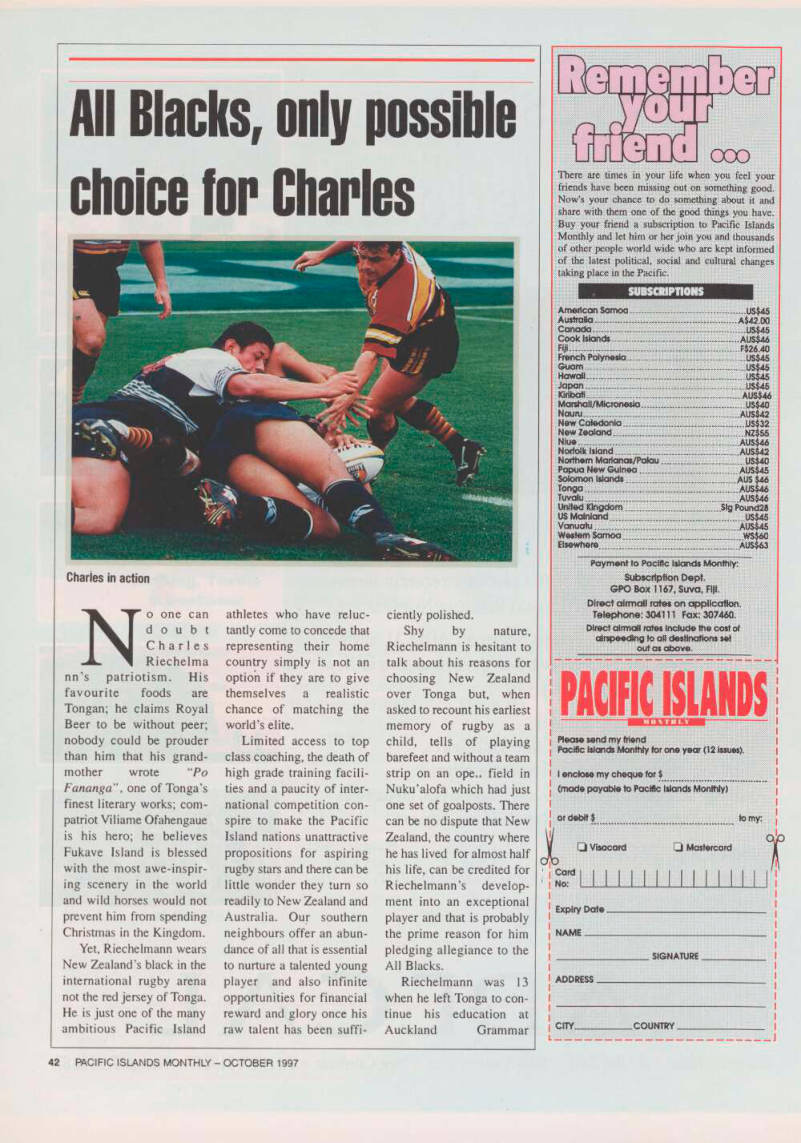
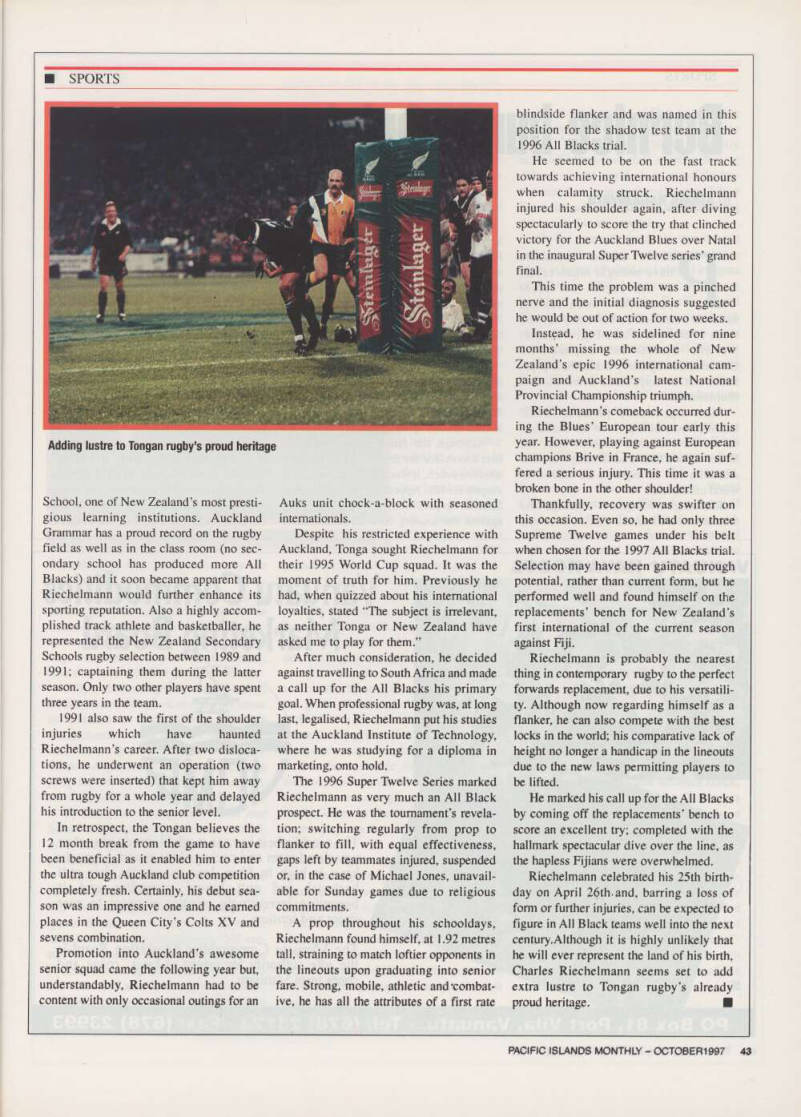
choice for Charles
No one can doubt Charles Riechelma nn’s patriotism. His favourite foods are Tongan; he claims Royal Beer to be without peer; nobody could be prouder than him that his grand mother wrote "Po Fananga" , one of Tonga’s finest literary works; com patriot Viliame Ofahengaue is his hero; he believes Fukave Island is blessed with the most awe-inspir ing scenery in the world and wild horses would not prevent him from spending Christmas in the Kingdom.
Yet, Riechelmann wears New Zealand’s black in the international rugby arena not the red jersey of Tonga.
He is just one of the many ambitious Pacific Island
athletes who have reluc tantly come to concede that representing their home country simply is not an option if they are to give themselves a realistic chance of matching the world’s elite.
Limited access to top class coaching, the death of high grade training facili ties and a paucity of inter national competition con spire to make the Pacific Island nations unattractive
propositions for aspiring
rugby stars and there can be little wonder they turn so readily to New Zealand and Australia. Our southern neighbours offer an abun dance of all that is essential to nurture a talented young player and also infinite opportunities for financial reward and glory once his raw talent has been suffi
ciently polished.
Shy by nature, Riechelmann is hesitant to talk about his reasons for choosing New Zealand over Tonga but, when asked to recount his earliest memory of rugby as a child, tells of playing barefeet and without a team strip on an ope., field in Nukualofa which had just one set of goalposts. There can be no dispute that New Zealand, the country where he has lived for almost half his life, can be credited for
Riechelmann’s develop
ment into an exceptional player and that is probably the prime reason for him
pledging allegiance to the
All Blacks.
Riechelmann was 13 when he left Tonga to con tinue his education at Auckland Grammar
Charles in action
■ Sports
School, one of New Zealand’s most presti gious learning institutions. Auckland Grammar has a proud record on the rugby field as well as in the class room (no sec ondary school has produced more All Blacks) and it soon became apparent that Riechelmann would further enhance its sporting reputation. Also a highly accom plished track athlete and basketballer, he represented the New Zealand Secondary Schools rugby selection between 1989 and 1991; captaining them during the latter season. Only two other players have spent three years in the team. 1991 also saw the first of the shoulder injuries which have haunted Riechelmann’s career. After two disloca tions, he underwent an operation (two screws were inserted) that kept him away from rugby for a whole year and delayed his introduction to the senior level.
In retrospect, the Tongan believes the 12 month break from the game to have been beneficial as it enabled him to enter the ultra tough Auckland club competition completely fresh. Certainly, his debut sea son was an impressive one and he earned places in the Queen City’s Colts XV and sevens combination.
Promotion into Auckland’s awesome senior squad came the following year but, understandably, Riechelmann had to be content with only occasional outings for an
Auks unit chock-a-block with seasoned internationals.
Despite his restricted experience with Auckland, Tonga sought Riechelmann for their 1995 World Cup squad. It was the moment of truth for him. Previously he had, when quizzed about his international loyalties, stated "The subject is irrelevant, as neither Tonga or New Zealand have asked me to play for them.”
After much consideration, he decided against travelling to South Africa and made a call up for the All Blacks his primary goal. When professional rugby was, at long last, legalised, Riechelmann put his studies at the Auckland Institute of Technology, where he was studying for a diploma in marketing, onto hold.
The 1996 Super Twelve Series marked Riechelmann as very much an All Black prospect. He was the tournament’s revela tion; switching regularly from prop to flanker to fill, with equal effectiveness, gaps left by teammates injured, suspended or, in the case of Michael Jones, unavail able for Sunday games due to religious commitments.
A prop throughout his schooldays, Riechelmann found himself, at 1.92 metres tall, straining to match loftier opponents in the lineouts upon graduating into senior fare. Strong, mobile, athletic and-combat ive, he has all the attributes of a first rate
blindside flanker and was named in this position for the shadow test team at the 1996 All Blacks trial.
He seemed to be on the fast track towards achieving international honours when calamity struck. Riechelmann injured his shoulder again, after diving spectacularly to score the try that clinched victory for the Auckland Blues over Natal in the inaugural Super Twelve series’ grand final.
This time the problem was a pinched nerve and the initial diagnosis suggested he would be out of action for two weeks.
Instead, he was sidelined for nine months’ missing the whole of New Zealand’s epic 1996 international cam paign and Auckland’s latest National Provincial Championship triumph.
Riechelmann’s comeback occurred dur ing the Blues’ European tour early this year. However, playing against European champions Brive in France, he again suf fered a serious injury. This time it was a broken bone in the other shoulder!
Thankfully, recovery was swifter on this occasion. Even so, he had only three Supreme Twelve games under his belt when chosen for the 1997 All Blacks trial.
Selection may have been gained through potential, rather than current form, but he performed well and found himself on the replacements’ bench for New Zealand’s first international of the current season against Fiji.
Riechelmann is probably the nearest thing in contemporary rugby to the perfect forwards replacement, due to his versatili ty. Although now regarding himself as a flanker, he can also compete with the best locks in the world; his comparative lack of height no longer a handicap in the lineouts due to the new laws permitting players to be lifted.
He marked his call up for the All Blacks by coming off the replacements’ bench to score an excellent try; completed with the hallmark spectacular dive over the line, as the hapless Fijians were overwhelmed.
Riechelmann celebrated his 25th birth day on April 26th. and, barring a loss of form or further injuries, can be expected to figure in All Black teams well into the next century. Although it is highly unlikely that he will ever represent the land of his birth, Charles Riechelmann seems set to add extra lustre to Tongan rugby’s already proud heritage. ■
Adding lustre to Tongan rugby’s proud heritage
Advertisements & other items, p. 42 (1 item)
Pacific Islands
i t 3 j
oco
There arc times in your life when you feel your friends have been missing out on something good.
Now's your chance to do something about it and share with them one of the good things you have.
Buy your friend a subscription to Pacific Islands Monthly and let him or her join you and thousands of other people world wide who are kept informed of the latest political, social and cultural changes taking place in the Pacific.
American Samoa US$45 Austrofla A $42.00 Canada US$45 Cook Islands AUSS4S Fiji F 526.40 French Polynesia US$45 Guam US$45 Hawaii US$45 Japan US$45 Kiribati AUss46 Marsball/Micronesia US$4O Nauru AUSS42 New Caledonia US$32 New Zealand NZ$55 Niue AUSS4S Norfolk Island AUSS42 Northern Marlanas/Palau US$4O Papua New Guinea AUSS4S Solomon Islands AUS $45 Tonga AUSS4S Tuvalu AUSS46 United Kingdom JStg Pound2B US Mainland US$45 Vanuatu AUSS4S Western Samoa WS$6O Elsewhere AUSS63 Payment to Pacific Islands Monthly; Subscription Dept.
GPO Box 1167, Suva, Fiji.
Direct airmail rates on application.
Telephone: 304111 Fax: 307460.
Direct alrmcA rates Include the cost of crirspeecHng to all destinations set out as above.
PACIFIC ISLANDS
Please send my Wend Pacific tslcmds Monthly for one year (12 issues).
I enclose my cheque (or $ (made payable to Pacific Islands Monthly) 1 or debit $ to my: □ Visacard □ Mastercard Card No: t Expiry Date.
NAME
SIGNATURE
ADDRESS.
CITY.
.COUNTRY,
Bernice burns bright
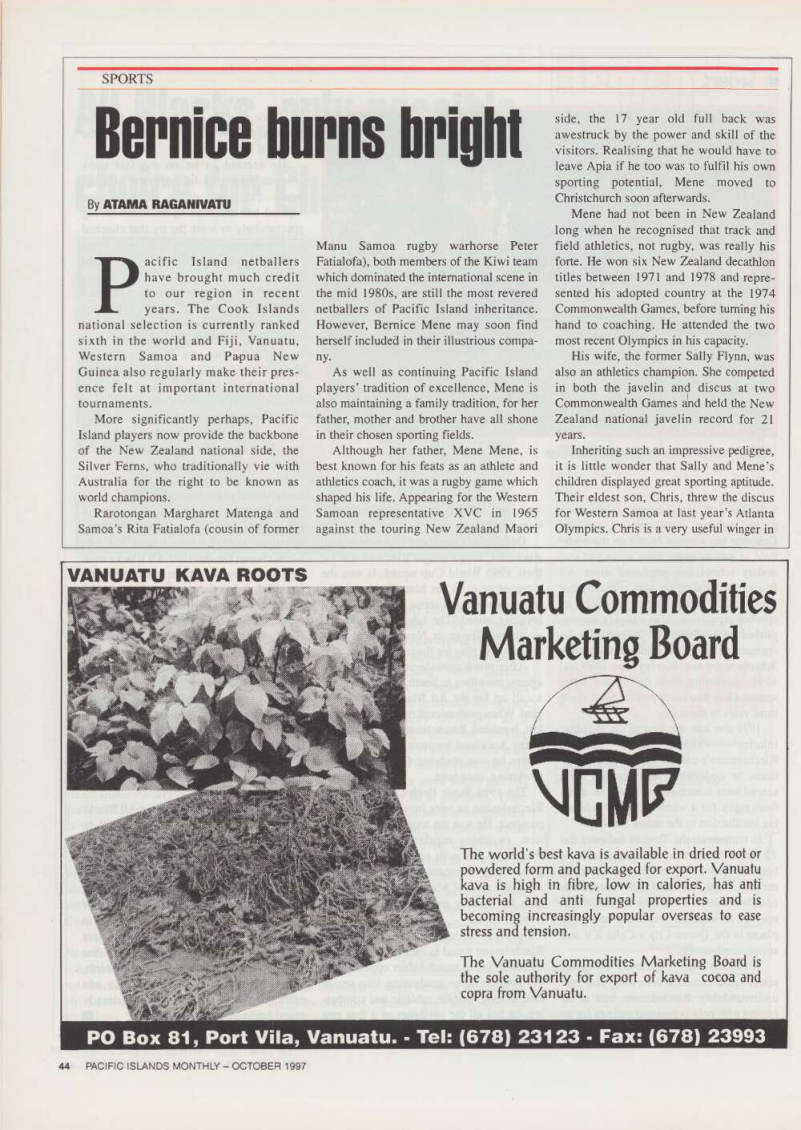
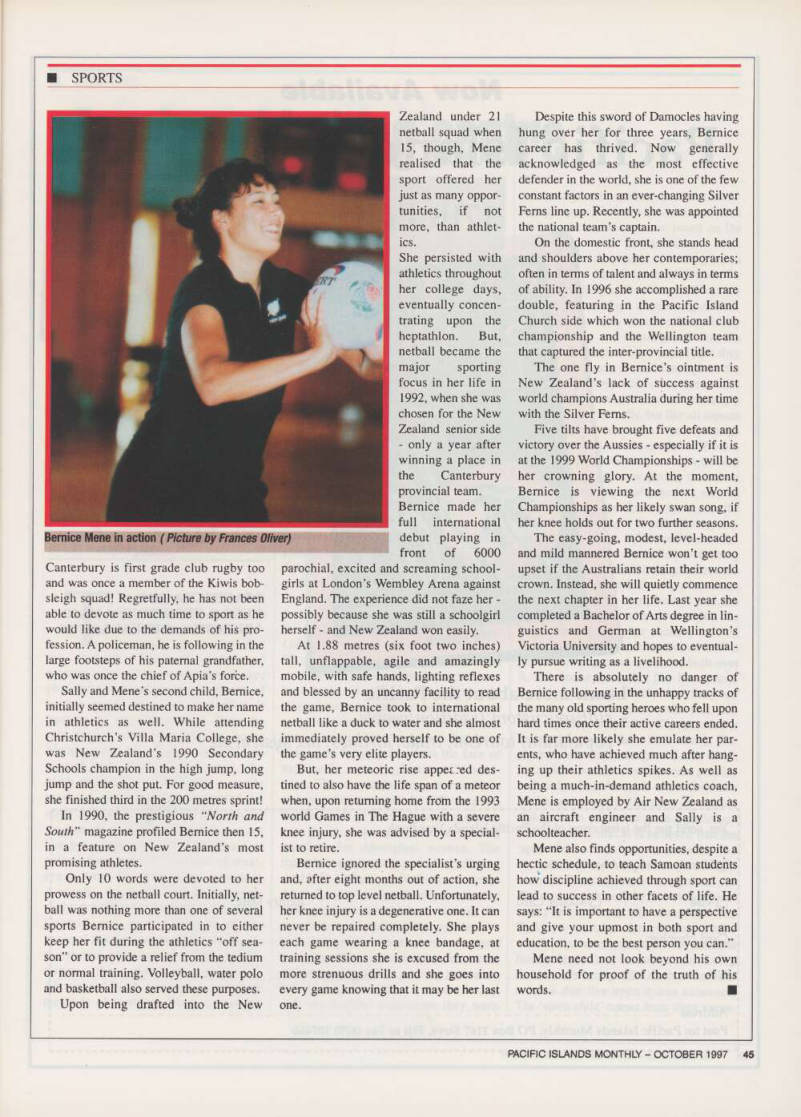
By Atama Raganivatu
Pacific Island netballers have brought much credit to our region in recent years. The Cook Islands national selection is currently ranked sixth in the world and Fiji, Vanuatu, Western Samoa and Papua New Guinea also regularly make their pres ence felt at important international tournaments.
More significantly perhaps, Pacific Island players now provide the backbone of the New Zealand national side, the Silver Ferns, who traditionally vie with Australia for the right to be known as
world champions.
Rarotongan Margharet Matenga and Samoa’s Rita Fatialofa (cousin of former
Manu Samoa rugby warhorse Peter Fatialofa), both members of the Kiwi team which dominated the international scene in the mid 1980 s, are still the most revered netballers of Pacific Island inheritance.
However, Bernice Mene may soon find herself included in their illustrious compa ny.
As well as continuing Pacific Island players’ tradition of excellence, Mene is also maintaining a family tradition, for her father, mother and brother have all shone in their chosen sporting fields.
Although her father, Mene Mene, is best known for his feats as an athlete and athletics coach, it was a rugby game which shaped his life. Appearing for the Western Samoan representative XVC in 1965 against the touring New Zealand Maori
side, the 17 year old full back was awestruck by the power and skill of the visitors. Realising that he would have to leave Apia if he too was to fulfil his own sporting potential, Mene moved to Christchurch soon afterwards.
Mene had not been in New Zealand long when he recognised that track and field athletics, not rugby, was really his forte. He won six New Zealand decathlon titles between 1971 and 1978 and repre sented his adopted country at the 1974 Commonwealth Games, before turning his hand to coaching. He attended the two most recent Olympics in his capacity.
His wife, the former Sally Flynn, was also an athletics champion. She competed in both the javelin and discus at two Commonwealth Games and held the New Zealand national javelin record for 21 years.
Inheriting such an impressive pedigree, it is little wonder that Sally and Mene’s children displayed great sporting aptitude.
Their eldest son, Chris, threw the discus for Western Samoa at last year’s Atlanta Olympics. Chris is a very useful winger in
Canterbury is first grade club rugby too and was once a member of the Kiwis bob sleigh squad! Regretfully, he has not been able to devote as much time to sport as he would like due to the demands of his pro fession. A policeman, he is following in the large footsteps of his paternal grandfather, who was once the chief of Apia’s force.
Sally and Mene’s second child, Bernice, initially seemed destined to make her name in athletics as well. While attending Christchurch’s Villa Maria College, she was New Zealand’s 1990 Secondary Schools champion in the high jump, long jump and the shot put. For good measure, she finished third in the 200 metres sprint!
In 1990, the prestigious “North and South" magazine profiled Bernice then 15, in a feature on New Zealand’s most
promising athletes.
Only 10 words were devoted to her prowess on the netball court. Initially, net ball was nothing more than one of several sports Bernice participated in to either keep her fit during the athletics “off sea son” or to provide a relief from the tedium
or normal training. Volleyball, water polo
and basketball also served these purposes.
Upon being drafted into the New
Zealand under 21 netball squad when 15, though, Mene realised that the sport offered her just as many oppor tunities, if not more, than athlet ics.
She persisted with athletics throughout her college days,
eventually concen
trating upon the heptathlon. But, netball became the
major sporting
focus in her life in 1992, when she was chosen for the New Zealand senior side - only a year after winning a place in
the Canterbury
provincial team.
Bernice made her full international debut playing in front of 6000
parochial, excited and screaming school girls at London’s Wembley Arena against England. The experience did not faze her possibly because she was still a schoolgirl herself - and New Zealand won easily.
At 1.88 metres (six foot two inches) tall, unflappable, agile and amazingly mobile, with safe hands, lighting reflexes and blessed by an uncanny facility to read the game, Bernice took to international netball like a duck to water and she almost immediately proved herself to be one of the game’s very elite players.
But, her meteoric rise appeared des tined to also have the life span of a meteor when, upon returning home from the 1993 world Games in The Hague with a severe knee injury, she was advised by a special ist to retire.
Bernice ignored the specialist’s urging and, after eight months out of action, she returned to top level netball. Unfortunately, her knee injury is a degenerative one. It can never be repaired completely. She plays each game wearing a knee bandage, at training sessions she is excused from the more strenuous drills and she goes into every game knowing that it may be her last one.
Despite this sword of Damocles having hung over her for three years, Bernice career has thrived. Now generally acknowledged as the most effective defender in the world, she is one of the few constant factors in an ever-changing Silver Ferns line up. Recently, she was appointed the national team’s captain.
On the domestic front, she stands head and shoulders above her contemporaries; often in terms of talent and always in terms of ability. In 1996 she accomplished a rare double, featuring in the Pacific Island Church side which won the national club championship and the Wellington team that captured the inter-provincial title.
The one fly in Bernice’s ointment is New Zealand’s lack of shccess against world champions Australia during her time with the Silver Ferns.
Five tilts have brought five defeats and victory over the Aussies - especially if it is at the 1999 World Championships - will be her crowning glory. At the moment, Bernice is viewing the next World Championships as her likely swan song, if her knee holds out for two further seasons.
The easy-going, modest, level-headed and mild mannered Bernice won’t get too upset if the Australians retain their world crown. Instead, she will quietly commence the next chapter in her life. Last year she completed a Bachelor of Arts degree in lin guistics and German at Wellington’s Victoria University and hopes to eventual ly pursue writing as a livelihood.
There is absolutely no danger of Bernice following in the unhappy tracks of the many old sporting heroes who fell upon hard times once their active careers ended.
It is far more likely she emulate her par ents, who have achieved much after hang ing up their athletics spikes. As well as being a much-in-demand athletics coach, Mene is employed by Air New Zealand as an aircraft engineer and Sally is a schoolteacher.
Mene also finds opportunities, despite a hectic schedule, to teach Samoan students how discipline achieved through sport can lead to success in other facets of life. He says: “It is important to have a perspective and give your upmost in both sport and education, to be the best person you can.”
Mene need not look beyond his own household for proof of the truth of his words. ■
Bernice Mene in action (Picture by Frances Oliver)
Advertisements & other items, pp. 44-46 (1 item)
Marketing Board
VANUATU KAVA ROOTS
■■ s *sss*J m m m i ■ .*• ns m ms m m m b*2 fc,. '.V ?:r* ,v' ■■ "'
Vanuatu Commodities
Marketing Board
The world's best kava is available in dried root or powdered form and packaged for export. Vanuatu kava is high in fibre, low in calories, has anti bacterial and anti fungal properties and is becoming increasingly popular overseas to ease stress and tension.
The Vanuatu Commodities Marketing Board is the sole authority for export of kava cocoa and copra from Vanuatu.
PO Box 81, Port Vila, Vanuatu. ■ Tel: (678) 23123 ■ Fax: (678) 23993
Now Available
Pacific Islands Yearßook
17th Edition
PACI
A mm II Hill 3 1508 00693265 6 / Price v
AUD
1 39. 00 « > f
PIUS POSTAGE*
* PACIFIC SAIO.OO
* USA & TERRITORY A 515.00
* EUROPE & OTHERS $A17.00
Learn more about the Pacific - culture / custom tradition/people - population, tourism, trade, airlines, tax system etc Yes, send me the latest copy of the Pacific Islands Year Book. □ Here is a cheque/money order □ Visa □ Master Card Expiry Date Card Number Name Signature Address 1 Post to: Pacific Islands Monthly, PO Box 1167 Suva, Fiji or Fax (679) 307460 i
A unique birthing centre
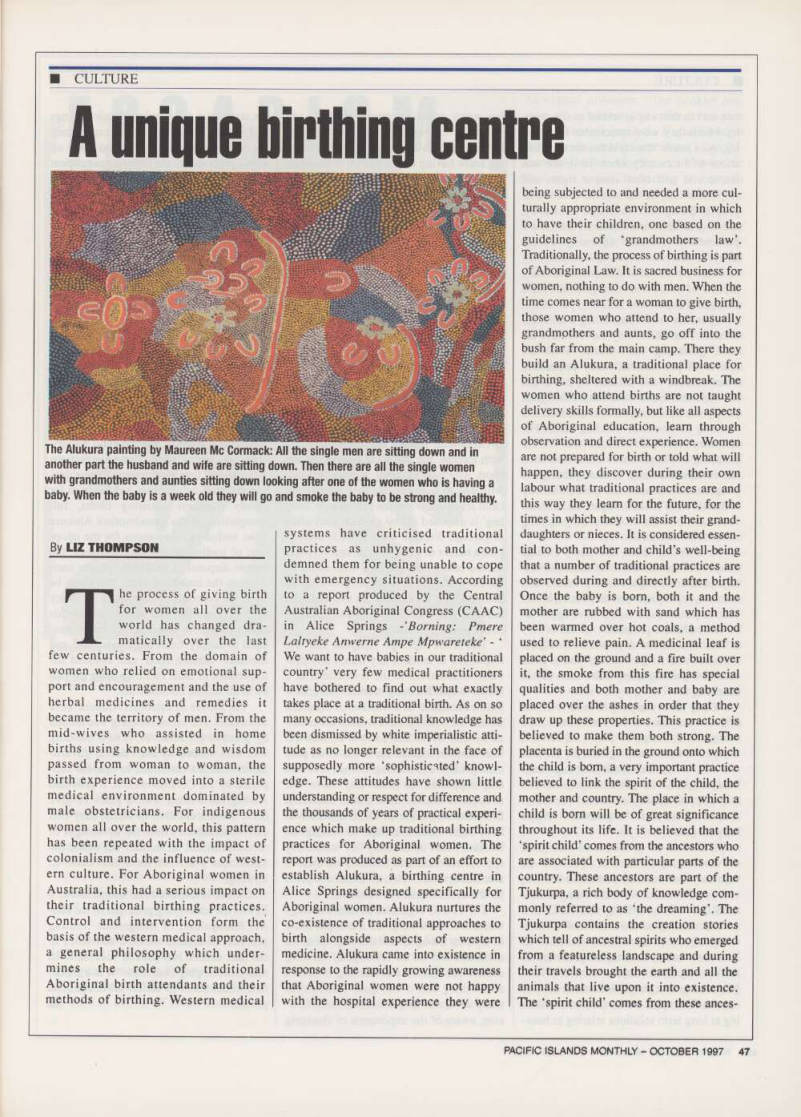
Culture
By Liz Thompson
The process of giving birth for women all over the world has changed dra matically over the last few centuries. From the domain of women who relied on emotional sup port and encouragement and the use of herbal medicines and remedies it became the territory of men. From the mid-wives who assisted in home births using knowledge and wisdom passed from woman to woman, the birth experience moved into a sterile medical environment dominated by male obstetricians. For indigenous women all over the world, this pattern has been repeated with the impact of colonialism and the influence of west ern culture. For Aboriginal women in Australia, this had a serious impact on
their traditional birthing practices.
Control and intervention form the basis of the western medical approach, a general philosophy which under mines the role of traditional Aboriginal birth attendants and their methods of birthing. Western medical
systems have criticised traditional practices as unhygenic and con demned them for being unable to cope with emergency situations. According to a report produced by the Central Australian Aboriginal Congress (CAAC) in Alice Springs -’Horning: Pmere Laltyeke Anwerne Ampe Mpwareteke’ - ‘ We want to have babies in our traditional country’ very few medical practitioners have bothered to find out what exactly takes place at a traditional birth. As on so many occasions, traditional knowledge has been dismissed by white imperialistic atti tude as no longer relevant in the face of supposedly more ‘sophisticated’ knowl edge. These attitudes have shown little understanding or respect for difference and the thousands of years of practical experi ence which make up traditional birthing practices for Aboriginal women. The report was produced as part of an effort to establish Alukura, a birthing centre in Alice Springs designed specifically for Aboriginal women. Alukura nurtures the co-existence of traditional approaches to birth alongside aspects of western medicine. Alukura came into existence in response to the rapidly growing awareness that Aboriginal women were not happy with the hospital experience they were
being subjected to and needed a more cul turally appropriate environment in which to have their children, one based on the guidelines of ‘grandmothers law’.
Traditionally, the process of birthing is part of Aboriginal Law. It is sacred business for women, nothing to do with men. When the time comes near for a woman to give birth, those women who attend to her, usually grandmothers and aunts, go off into the bush far from the main camp. There they build an Alukura, a traditional place for birthing, sheltered with a windbreak. The women who attend births are not taught delivery skills formally, but like all aspects of Aboriginal education, leam through observation and direct experience. Women are not prepared for birth or told what will
happen, they discover during their own
labour what traditional practices are and this way they leam for the future, for the times in which they will assist their grand daughters or nieces. It is considered essen tial to both mother and child’s well-being that a number of traditional practices are observed during and directly after birth.
Once the baby is born, both it and the mother are rubbed with sand which has been warmed over hot coals, a method used to relieve pain. A medicinal leaf is placed on the ground and a fire built over it, the smoke from this fire has special qualities and both mother and baby are placed over the ashes in order that they draw up these properties. This practice is believed to make them both strong. The placenta is buried in the ground onto which the child is bom, a very important practice believed to link the spirit of the child, the mother and country. The place in which a child is bom will be of great significance throughout its life. It is believed that the ‘spirit child’ comes from the ancestors who are associated with particular parts of the country. These ancestors are part of the Tjukurpa, a rich body of knowledge com monly referred to as ‘the dreaming’. The Tjukurpa contains the creation stories which tell of ancestral spirits who emerged from a featureless landscape and during their travels brought the earth and all the animals that live upon it into existence.
The ‘spirit child’ comes from these ances
The Alukura painting by Maureen Me Cormack: All the single men are sitting down and in another part the husband and wife are sitting down. Then there are all the single women with grandmothers and aunties sitting down looking after one of the women who is having a baby. When the baby is a week old they will go and smoke the baby to be strong and healthy.
tors and in this way is related to the coun try which they were responsible for creat ing. As a result “the child has strong affili ations to the country where he or she was found and will later assume rights and responsibilities for the law, the land and its people. Being bom is related to country, kin and the dreamtime stories which are particularly relevant” (Earning: Pmere Laity eke Anwerne Ampe Mpwaretyeke).
Since the arrival of Europeans, so many aspects of traditional Aboriginal life have changed. People have settled in permanent communities rather than living a nomadic existence in which they survived off the land, gathering bush tucker. With the arrival of pastoralists, many permanent water sources were polluted by cattle and the numerous bores were sunk. Aboriginal people settled around stations and missions working as labourers building roads. For this they were paid with rations - white flour, tea and sugar. Since then, store food has formed the basis of most Aboriginal peoples diet. Stores sell predominantly ‘rubbish food’, flour, sugar, tea, canned foods and biscuits all completely lacking in terms of nutrition.
As a result there has been a huge increase in the incidence of diabetes, kid ney problems, high blood pressure and alcohol. A frequent use of pain relievers such as panadol and aspirin have aggravat ed some of these problems. All this is very different to the old days when Aboriginal women were fit and strong eating good food and walking many miles each day in search of it.
“Long time, old people used to check after the mother and baby with bush food like goanna, kangaroo and wild berries.
Before when she was pregnant, for her kids she ate a lot of bush tucker like sugarbag, wild potatoes, witchetties and yams. That’s why she had healthy children." (Earning: Pmere Laltyeke Anwerne Ampe
Mpwaretyeke).
In addition to problems of diet, girls, are also having children at a younger age than they used to when traditional law was strictly adhered to. All these changes have seen the infant mortality rate rise. As a result, Aboriginal women have been encouraged by the white authorities to have their babies in what are promoted as ‘safe and clean’ hospital environments.
The answer to a rise in infant mortality is seen to be hospital births rather than look ing at long term solutions relating to hous
ing, water, communications, nutrition and so on. In response to these pressures, an increasing number of Aboriginal women are know having their children in hospitals which completely neglect to take into account the sacred law which had sur rounded traditional homing practices. As a result, women are left felling empowered, alienated and often very frightened. Male doctors or obstetricians often attend to the births. This is a cause for great shame and embarrassment. Nurses and medical assis tants are unable *to communicate their thoughts or needs. Hospitals often have an interventionist approach, the use of drugs, drips, epidurals, shaving, monitors and so on are all very unfamiliar.
Caesarean’s are a terrifying intrusion.
Women are not comforted or supported by other women but instead find themselves in a strange and completely unfamiliar environment. Babies are often delivered with forceps, the umbilical cord is cut too short which Aboriginal women believe will lead to sickness. Neither mother nor child are smoked and the placenta or ‘baby bag’ is disposed off by medical staff often in garbage disposal units. This is consid ered a matter of great sadness and very bad for the health and spiritual well being of the baby. Women in hospitals give birth on beds, on their backs, they are allowed little movement and are unable to take up tradi tional birthing postures.
The Alice Springs Hospital has not responded to modem day trends and pro vided alternatives to the restrictions of a labour ward. Birthing centres have now been established in a number of hospitals around the country. Here women are assist ed by mid-wives and there is no medical intervention. Instead the focus is on pain management and making women feel safe and supported so that they have the strength to deliver their babies naturally.
Unfortunately none of these alternatives have been made available to Aboriginal women, the inadequacy of culturally appropriate childbirth facilities led them to take matters into their own hands and press for the establishment of Alukura.
The CAAC organised several meetings where women were given the opportunity to air their thoughts and develop ideas for establishment of an Aboriginal birthing centre. The business of horning is such a secret thing that it was quite difficult for many women to talk about the issues, how ever, aware of the importance of changing
the status quo they spoke of their feelings and experiences. At the final conference the Aboriginal women involved came up with a proposal for the Federal government which outlined their needs. This proposal put forward several important points. It recommended among other things that the Federal government finance the Congress Alukura immediately and permanently; recognise that the Congress Alukura will be a model for Aboriginal communities in the future; the Northern Territory govern ment cooperate in providing a suitable site of at least five acres for this.
There were also a lot of recommenda tions made in relation to mobile bush clin ics designed to attend bush births and the
improvement of hospital environments.
Women asked that the Federal government and the Northern Territory department of health implement a number of services which would make the hospital experi ence, less intimidating. These suggestions included full time interpreters, female doc tors and staff only; access and facilities for family members assisting births, full recognition of the grandmother Alukura Law, including allowances for the adop tion of traditional birthing postures, the proper disposal of afterbirth, proper inci sions to the umbilical cord, that there be signs in Aboriginal languages in Alice Springs Hospital. The women asked that stores in remote communities be encour aged to supply fresh nutritious food and minimal ‘rubbish food’ and stressed the importance of basic facilities being provid ed in all remote communities.
The moves to establish Alukura were successful. The initial building was funded by grant-in-aid schemes. A new building was then funded by the Federal govern ment. Alukura continues to operate sup
ported by the Commonwealth. It provided
Aboriginal women with a place to give birth to their children in which they feel safe, in which they have the advantages of modem medical techniques but where the traditional practices form the basis of
birthing.
Culture is respected and Grandmother’s Law is the underlying principle of the cen
tre. Recognition of indigenous birthing
practices alongside western obstetrics in the past decade has proved successful in many developing countries. It is a model that would seem to beneft all indigenous people. ■
Escapism
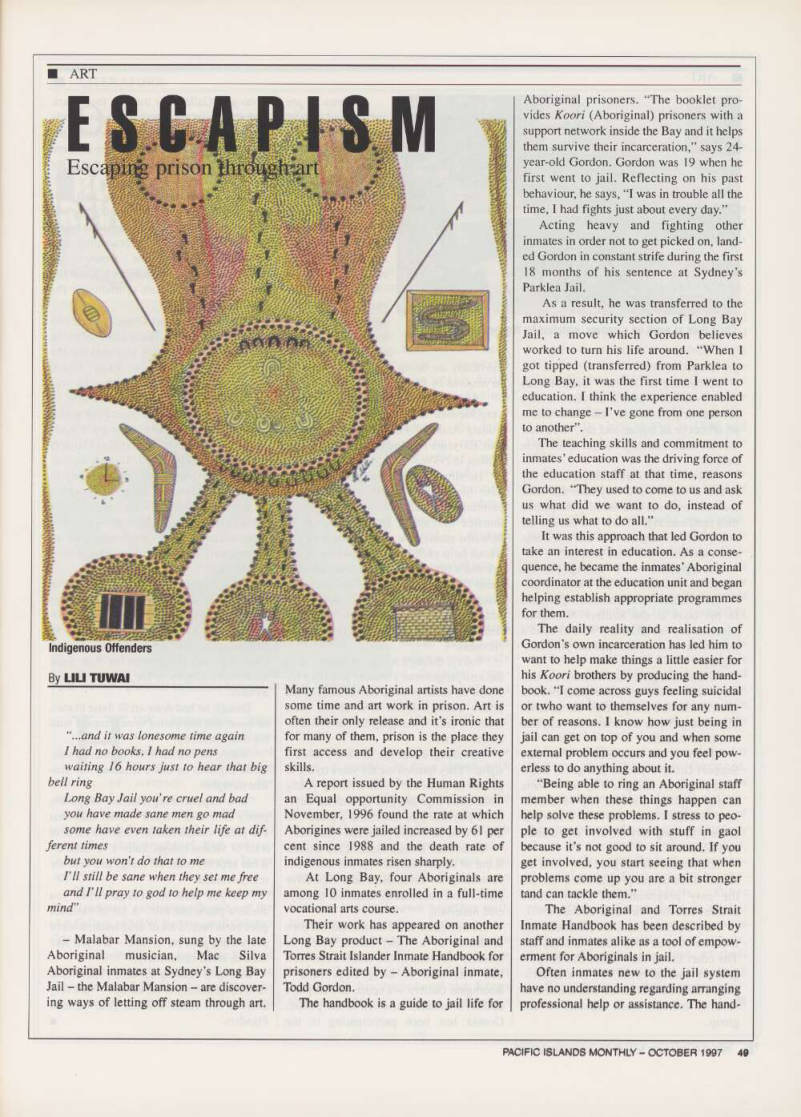
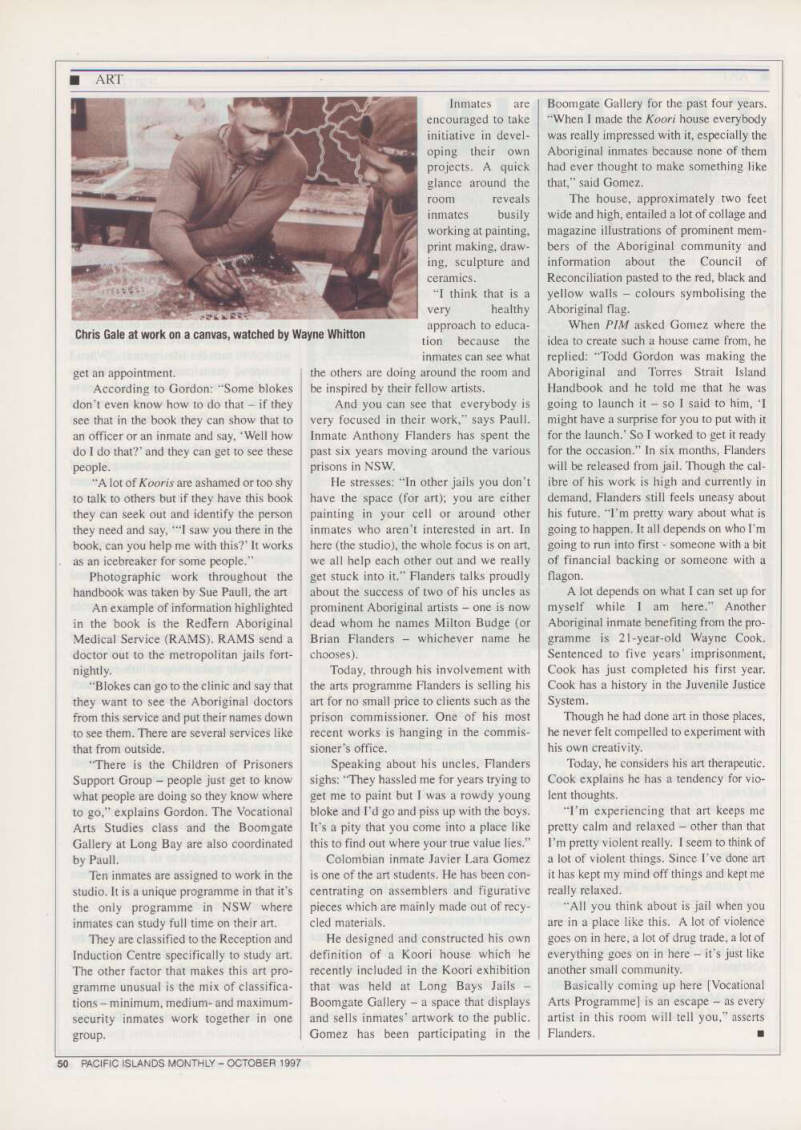
Art
Escaping prison through art
By Lili Tuwai
“...and it was lonesome time again I had no books, I had no pens waiting 16 hours just to hear that big bell ring Long Bay Jail you’re cruel and bad you have made sane men go mad some have even taken their life at dif ferent times but you won’t do that to me I’ll still be sane when they set me free and I’ll pray to god to help me keep my mind’’ - Malabar Mansion, sung by the late Aboriginal musician, Mac Silva
Aboriginal inmates at Sydney’s Long Bay
Jail - the Malabar Mansion - are discover ing ways of letting off steam through art.
Many famous Aboriginal artists have done some time and art work in prison. Art is often their only release and it’s ironic that for many of them, prison is the place they first access and develop their creative skills.
A report issued by the Human Rights an Equal opportunity Commission in November, 1996 found the rate at which Aborigines were jailed increased by 61 per cent since 1988 and the death rate of indigenous inmates risen sharply.
At Long Bay, four Aboriginals are among 10 inmates enrolled in a full-time vocational arts course.
Their work has appeared on another Long Bay product - The Aboriginal and Torres Strait Islander Inmate Handbook for prisoners edited by - Aboriginal inmate, Todd Gordon.
The handbook is a guide to jail life for
Aboriginal prisoners. “The booklet pro vides Koori (Aboriginal) prisoners with a support network inside the Bay and it helps them survive their incarceration,” says 24year-old Gordon. Gordon was 19 when he first went to jail. Reflecting on his past behaviour, he says, “I was in trouble all the time, I had fights just about every day.”
Acting heavy and fighting other
inmates in order not to get picked on, land ed Gordon in constant strife during the first 18 months of his sentence at Sydney’s Parklea Jail.
As a result, he was transferred to the maximum security section of Long Bay Jail, a move which Gordon believes worked to turn his life around. “When I got tipped (transferred) from Parklea to Long Bay, it was the first time I went to education. I think the experience enabled me to change - I’ve gone from one person to another”.
The teaching skills and commitment to inmates’ education was the driving force of the education staff at that time, reasons Gordon. “They used to come to us and ask us what did we want to do, instead of telling us what to do all.”
It was this approach that led Gordon to take an interest in education. As a conse quence, he became the inmates’ Aboriginal coordinator at the education unit and began helping establish appropriate programmes for them.
The daily reality and realisation of Gordon’s own incarceration has led him to want to help make things a little easier for his Koori brothers by producing the hand book. “I come across guys feeling suicidal or twho want to themselves for any num ber of reasons. I know how just being in jail can get on top of you and when some external problem occurs and you feel pow erless to do anything about it.
“Being able to ring an Aboriginal staff member when these things happen can help solve these problems, I stress to peo ple to get involved with stuff in gaol because it’s not good to sit around. If you get involved, you start seeing that when problems come up you are a bit stronger land can tackle them,”
The Aboriginal and Torres Strait Inmate Handbook has been described by staff and inmates alike as a tool of empow erment for Aboriginals in jail.
Often inmates new to the jail system
have no understanding regarding arranging
professional help or assistance. The hand-
Indigenous Offenders
get an appointment.
According to Gordon: “Some blokes don’t even know how to do that - if they see that in the book they can show that to an officer or an inmate and say, ‘Well how do I do that?’ and they can get to see these people.
“A lot of Kooris are ashamed or too shy to talk to others but if they have this book they can seek out and identify the person they need and say, “‘I saw you there in the book, can you help me with this?’ It works as an icebreaker for some people.”
Photographic work throughout the handbook was taken by Sue Pauli, the art An example of information highlighted in the book is the Redfern Aboriginal Medical Service (RAMS). RAMS send a doctor out to the metropolitan jails fort nightly.
"Blokes can go to the clinic and say that they want to see the Aboriginal doctors from this service and put their names down to see them. There are several services like that from outside.
“There is the Children of Prisoners Support Group - people just get to know what people are doing so they know where to go,” explains Gordon. The Vocational Arts Studies class and the Boomgate Gallery at Long Bay are also coordinated by Pauli.
Ten inmates are assigned to work in the studio. It is a unique programme in that it’s the only programme in NSW where inmates can study full time on their art.
They are classified to the Reception and Induction Centre specifically to study art.
The other factor that makes this art pro gramme unusual is the mix of classifica tions - minimum, medium- and maximum security inmates work together in one group.
Inmates are encouraged to take initiative in devel oping their own projects. A quick glance around the room reveals
inmates busily
working at painting,
print making, draw ing, sculpture and ceramics.
“I think that is a very healthy approach to educa tion because the inmates can see what
the others are doing around the room and be inspired by their fellow artists.
And you can see that everybody is very focused in their work,” says Pauli.
Inmate Anthony Flanders has spent the past six years moving around the various prisons in NSW.
He stresses: “In other jails you don’t have the space (for art); you are either painting in your cell or around other inmates who aren’t interested in art. In here (the studio), the whole focus is on art, we all help each other out and we really get stuck into it.” Flanders talks proudly about the success of two of his uncles as prominent Aboriginal artists - one is now dead whom he names Milton Budge (or Brian Flanders - whichever name he chooses).
Today, through his involvement with the arts programme Flanders is selling his art for no small price to clients such as the prison commissioner. One of his most recent works is hanging in the commis sioner’s office.
Speaking about his uncles, Flanders sighs; "They hassled me for years trying to get me to paint but I was a rowdy young bloke and I’d go and piss up with the boys.
It’s a pity that you come into a place like this to find out where your true value lies.”
Colombian inmate Javier Lara Gomez is one of the art students. He has been con centrating on assemblers and figurative pieces which are mainly made out of recy cled materials.
He designed and constructed his own definition of a Koori house which he recently included in the Koori exhibition that was held at Long Bays Jails - Boomgate Gallery - a space that displays and sells inmates’ artwork to the public.
Gomez has been participating in the
Boomgate Gallery for the past four years.
"When I made the Koori house everybody was really impressed with it, especially the Aboriginal inmates because none of them had ever thought to make something like that,” said Gomez.
The house, approximately two feet wide and high, entailed a lot of collage and magazine illustrations of prominent mem bers of the Aboriginal community and information about the Council of Reconciliation pasted to the red, black and yellow walls - colours symbolising the Aboriginal flag.
When PIM asked Gomez where the idea to create such a house came from, he replied: “Todd Gordon was making the Aboriginal and Torres Strait Island Handbook and he told me that he was going to launch it - so I said to him, T might have a surprise for you to put with it for the launch.’ So I worked to get it ready for the occasion.” In six months, Flanders will be released from jail. Though the cal ibre of his work is high and currently in demand, Flanders still feels uneasy about his future. “I’m pretty wary about what is going to happen. It all depends on who I’m going to run into first - someone with a bit of financial backing or someone with a
flagon.
A lot depends on what I can set up for myself while I am here.” Another Aboriginal inmate benefiting from the pro gramme is 21-year-old Wayne Cook.
Sentenced to five years’ imprisonment, Cook has just completed his first year.
Cook has a history in the Juvenile Justice
System.
Though he had done art in those places, he never felt compelled to experiment with his own creativity.
Today, he considers his art therapeutic.
Cook explains he has a tendency for vio lent thoughts.
"I’m experiencing that art keeps me pretty calm and relaxed - other than that I’m pretty violent really. I seem to think of a lot of violent things. Since I’ve done art it has kept my mind off things and kept me really relaxed.
"All you think about is jail when you are in a place like this. A lot of violence goes on in here, a lot of drug trade, a lot of everything goes on in here - it’s just like another small community.
Basically coming up here [Vocational Arts Programme] is an escape - as every artist in this room will tell you,” asserts Flanders. ■
Chris Gale at work on a canvas, watched by Wayne Whitton
Oceanic portraits on display
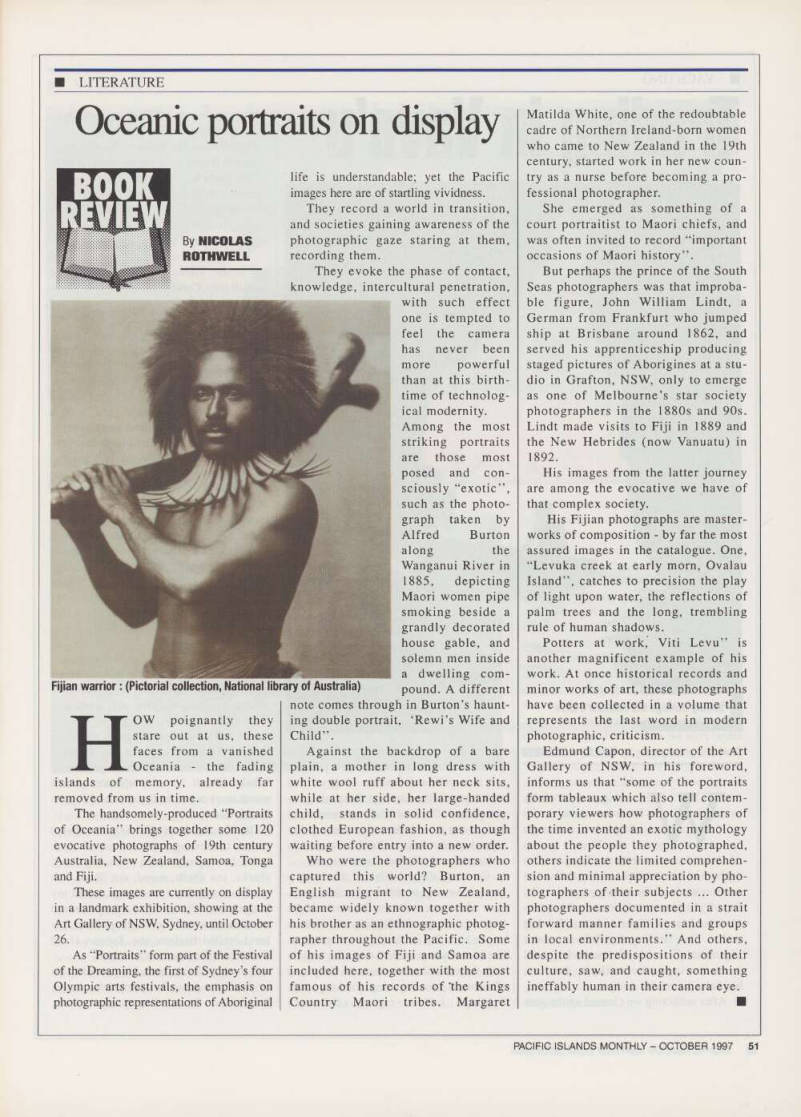
Literature
By Nicolas
Rothwell
HOW poignantly they stare out at us, these faces from a vanished Oceania - the fading islands of memory, already far removed from us in time.
The handsomely-produced “Portraits of Oceania” brings together some 120 evocative photographs of 19th century Australia, New Zealand, Samoa, Tonga and Fiji.
These images are currently on display in a landmark exhibition, showing at the Art Gallery of NSW, Sydney, until October 26.
As “Portraits” form part of the Festival of the Dreaming, the first of Sydney’s four Olympic arts festivals, the emphasis on photographic representations of Aboriginal
life is understandable; yet the Pacific images here are of startling vividness.
They record a world in transition, and societies gaining awareness of the photographic gaze staring at them, recording them.
They evoke the phase of contact, knowledge, intercultural penetration,
with such effect one is tempted to feel the camera has never been more powerful than at this birth time of technolog ical modernity.
Among the most striking portraits are those most posed and con
sciously “exotic”,
such as the photo graph taken by Alfred Burton along the Wanganui River in
1885, depicting
Maori women pipe smoking beside a grandly decorated house gable, and solemn men inside a dwelling com pound. A different
note comes through in Burton’s haunt ing double portrait, ‘Rewi’s Wife and Child”.
Against the backdrop of a bare plain, a mother in long dress with white wool ruff about her neck sits, while at her side, her large-handed child, stands in solid confidence, clothed European fashion, as though waiting before entry into a new order.
Who were the photographers who captured this world? Burton, an English migrant to New Zealand, became widely known together with his brother as an ethnographic photog rapher throughout the Pacific. Some of his images of Fiji and Samoa are included here, together with the most famous of his records of 'the Kings Country Maori tribes. Margaret
Matilda White, one of the redoubtable cadre of Northern Ireland-born women who came to New Zealand in the 19th century, started work in her new coun try as a nurse before becoming a pro
fessional photographer.
She emerged as something of a court portraitist to Maori chiefs, and was often invited to record “important occasions of Maori history”.
But perhaps the prince of the South Seas photographers was that improba ble figure, John William Lindt, a German from Frankfurt who jumped ship at Brisbane around 1862, and
served his apprenticeship producing
staged pictures of Aborigines at a stu dio in Grafton, NSW, only to emerge as one of Melbourne’s star society photographers in the 1880 s and 90s.
Lindt made visits to Fiji in 1889 and the New Hebrides (now Vanuatu) in 1892.
His images from the latter journey are among the evocative we have of that complex society.
His Fijian photographs are master works of composition - by far the most assured images in the catalogue. One, “Levuka creek at early morn, Ovalau Island”, catches to precision the play of light upon water, the reflections of palm trees and the long, trembling rule of human shadows.
Potters at work, Viti Levu” is another magnificent example of his work. At once historical records and minor works of art, these photographs have been collected in a volume that represents the last word in modern
photographic, criticism.
Edmund Capon, director of the Art Gallery of NSW, in his foreword, informs us that “some of the portraits form tableaux which also tell contem porary viewers how photographers of the time invented an exotic mythology about the people they photographed, others indicate the limited comprehen
sion and minimal appreciation by pho
tographers of their subjects ... Other photographers documented in a strait forward manner families and groups in local environments.” And others, despite the predispositions of their culture, saw, and caught, something ineffably human in their camera eye. ■
Fijian warrior: (Pictorial collection, National library of Australia)
Trading in Vava'u
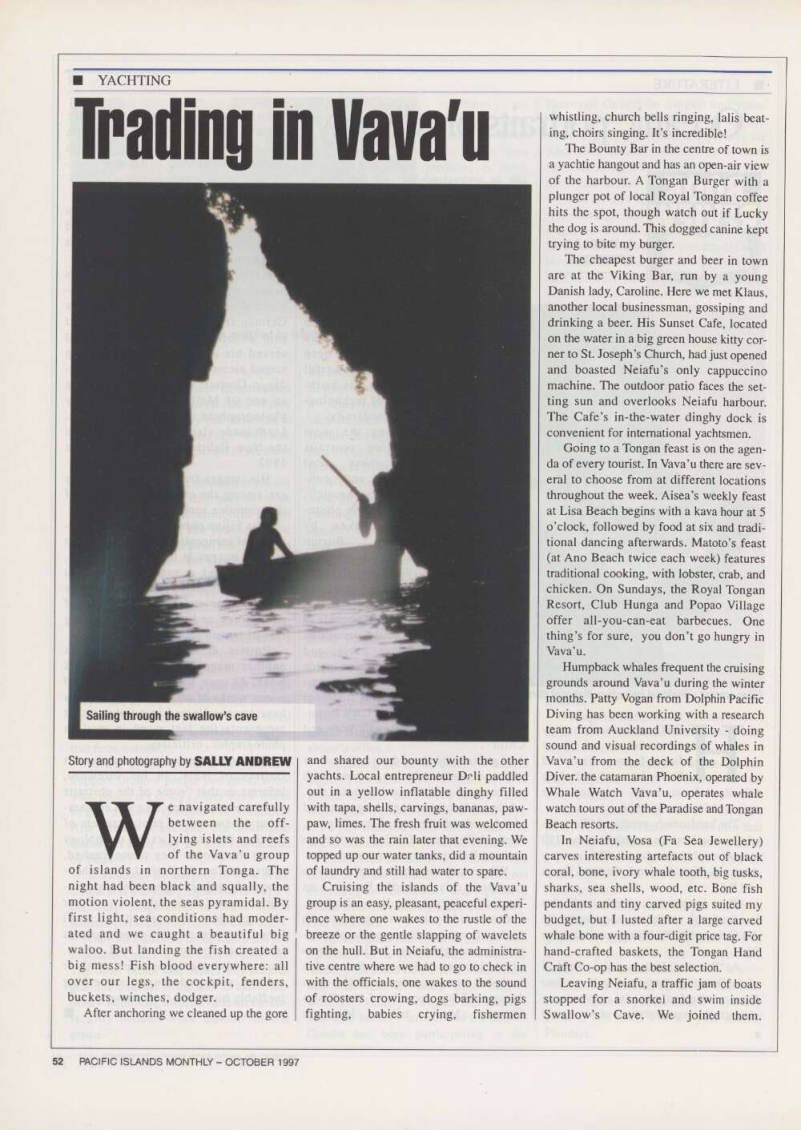
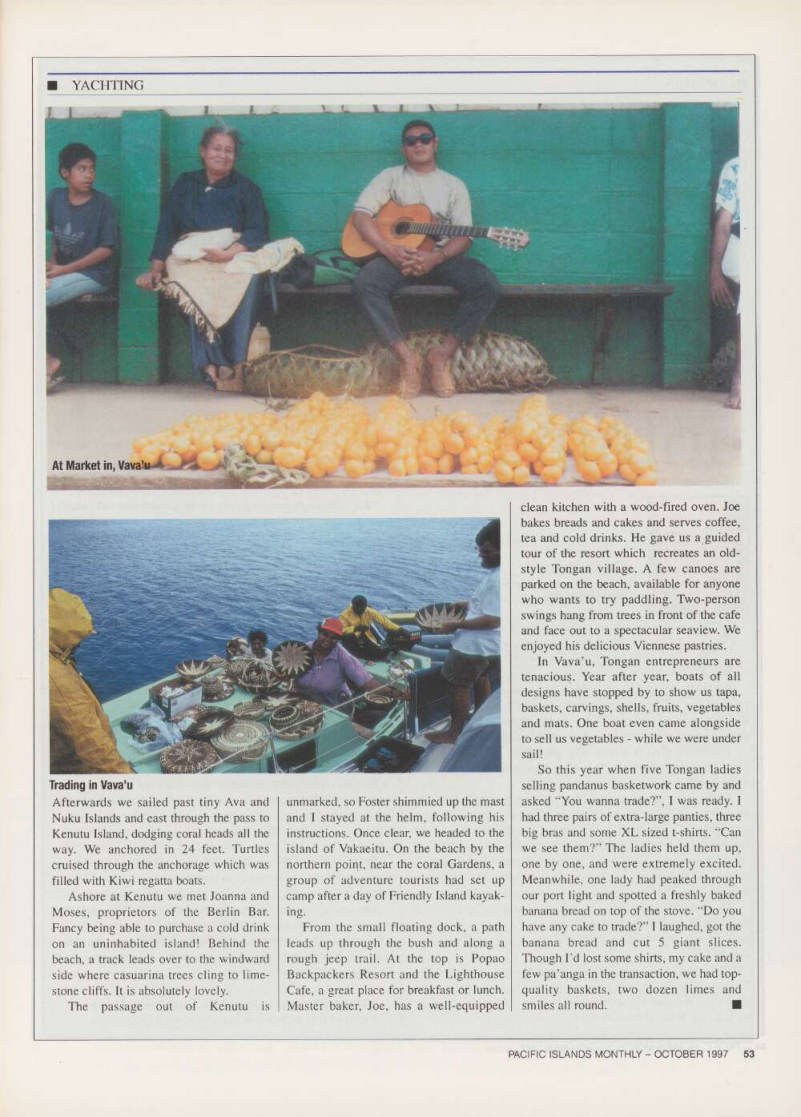
Yachting
Story and photography by SALLY ANDREW
We navigated carefully between the off lying islets and reefs of the Vava’u group of islands in northern Tonga. The night had been black and squally, the motion violent, the seas pyramidal. By first light, sea conditions had moder ated and we caught a beautiful big waloo. But landing the fish created a big mess! Fish blood everywhere: all over our legs, the cockpit, fenders, buckets, winches, dodger.
After anchoring we cleaned up the gore
and shared our bounty with the other yachts. Local entrepreneur Dfdi paddled out in a yellow inflatable dinghy filled with tapa, shells, carvings, bananas, paw paw, limes. The fresh fruit was welcomed and so was the rain later that evening. We topped up our water tanks, did a mountain of laundry and still had water to spare.
Cruising the islands of the Vava’u group is an easy, pleasant, peaceful experi ence where one wakes to the rustle of the breeze or the gentle slapping of wavelets on the hull. But in Neiafu, the administra tive centre where we had to go to check in with the officials, one wakes to the sound of roosters crowing, dogs barking, pigs fighting, babies crying, fishermen
whistling, church bells ringing, lalis beat ing, choirs singing. It’s incredible!
The Bounty Bar in the centre of town is a yachtie hangout and has an open-air view of the harbour. A Tongan Burger with a plunger pot of local Royal Tongan coffee hits the spot, though watch out if Lucky the dog is around. This dogged canine kept trying to bite my burger.
The cheapest burger and beer in town are at the Viking Bar, run by a young Danish lady, Caroline. Here we met Klaus, another local businessman, gossiping and drinking a beer. His Sunset Cafe, located on the water in a big green house kitty cor ner to St. Joseph’s Church, had just opened and boasted Neiafu’s only cappuccino machine. The outdoor patjo faces the set ting sun and overlooks Neiafu harbour.
The Cafe’s in-the-water dinghy dock is convenient for international yachtsmen.
Going to a Tongan feast is on the agen da of every tourist. In Vava’u there are sev eral to choose from at different locations throughout the week. Aisea’s weekly feast at Lisa Beach begins with a kava hour at 5 o’clock, followed by food at six and tradi tional dancing afterwards. Matoto’s feast (at Ano Beach twice each week) features traditional cooking, with lobster, crab, and chicken. On Sundays, the Royal Tongan Resort, Club Hunga and Popao Village offer all-you-can-eat barbecues. One thing’s for sure, you don’t go hungry in Vava’u.
Humpback whales frequent the cruising grounds around Vava’u during the winter months. Patty Vogan from Dolphin Pacific Diving has been working with a research team from Auckland University - doing sound and visual recordings of whales in Vava’u from the deck of the Dolphin Diver, the catamaran Phoenix, operated by Whale Watch Vava’u, operates whale watch tours out of the Paradise and Tongan Beach resorts.
In Neiafu, Vosa (Fa Sea Jewellery) carves interesting artefacts out of black coral, bone, ivory whale tooth, big tusks, sharks, sea shells, wood, etc. Bone fish pendants and tiny carved pigs suited my budget, but I lusted after a large carved whale bone with a four-digit price tag. For hand-crafted baskets, the Tongan Hand Craft Co-op has the best selection.
Leaving Neiafu, a traffic jam of boats stopped for a snorkel and swim inside Swallow’s Cave. We joined them.
Sailing through the swallow’s cave
Afterwards we sailed past tiny Ava and Nuku Islands and east through the pass to Kenutu Island, dodging coral heads all the way. We anchored in 24 feet. Turtles cruised through the anchorage which was filled with Kiwi regatta boats.
Ashore at Kenutu we met Joanna and Moses, proprietors of the Berlin Bar.
Fancy being able to purchase a cold drink on an uninhabited island! Behind the beach, a track leads over to the windward side where casuarina trees cling to lime stone cliffs. It is absolutely lovely.
The passage out of Kenutu is
unmarked, so Foster shimmied up the mast and I stayed at the helm, following his instructions. Once clear, we headed to the island of Vakaeitu. On the beach by the northern point, near the coral Gardens, a group of adventure tourists had set up camp after a day of Friendly Island kayak ing.
From the small floating dock, a path leads up through the bush and along a rough jeep trail. At the top is Popao Backpackers Resort and the Lighthouse Cafe, a great place for breakfast or lunch.
Master baker, Joe, has a well-equipped
clean kitchen with a wood-fired oven. Joe bakes breads and cakes and serves coffee, tea and cold drinks. He gave us a guided tour of the resort which recreates an old style Tongan village. A few canoes are parked on the beach, available for anyone who wants to try paddling. Two-person swings hang from trees in front of the cafe and face out to a spectacular seaview. We enjoyed his delicious Viennese pastries.
In Vava’u, Tongan entrepreneurs are tenacious. Year after year, boats of all designs have stopped by to show us tapa, baskets, carvings, shells, fruits, vegetables and mats. One boat even came alongside to sell us vegetables - while we were under sail!
So this year when five Tongan ladies selling pandanus basketwork came by and asked “You wanna trade?”, I was ready. I had three pairs of extra-large panties, three big bras and some XL sized t-shirts. “Can we see them?” The ladies held them up, one by one, and were extremely excited.
Meanwhile, one lady had peaked through our port light and spotted a freshly baked banana bread on top of the stove. “Do you have any cake to trade?” I laughed, got the banana bread and cut 5 giant slices.
Though I’d lost some shirts, my cake and a few pa’anga in the transaction, we had top quality baskets, two dozen limes and smiles all round. ■
At Market in, Vava’u
Trading in Vava’u
nothing
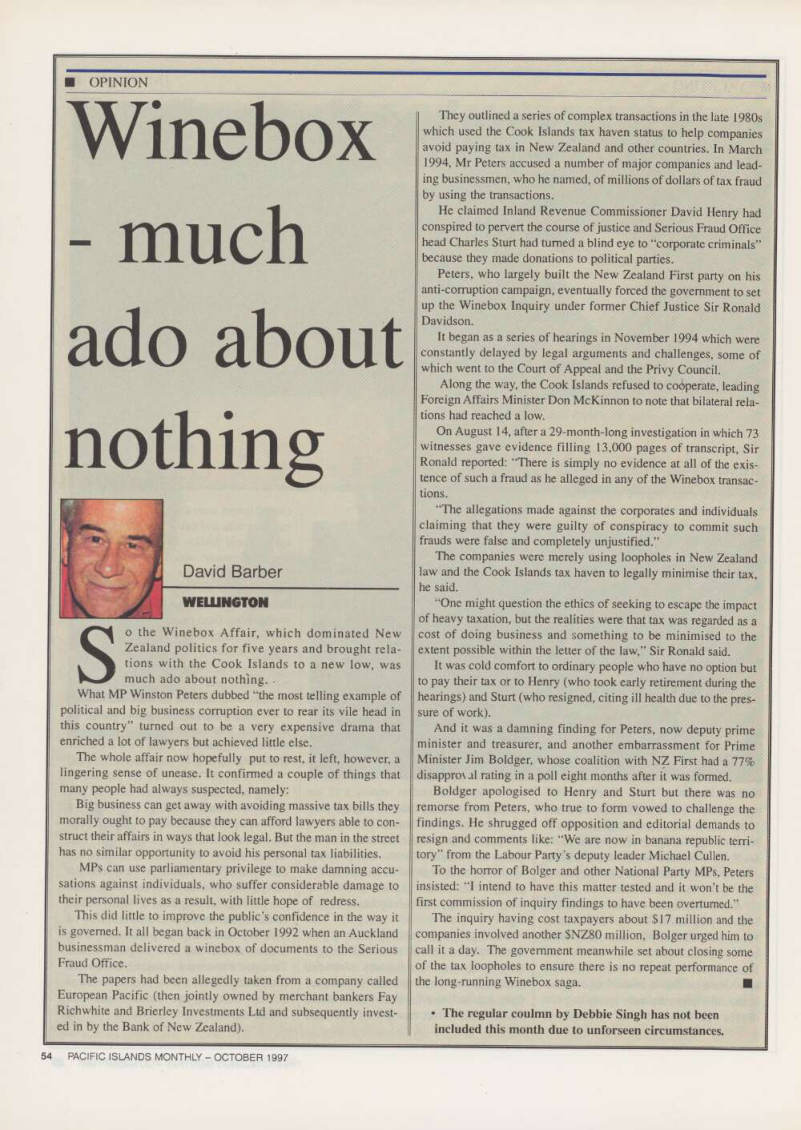
Opinion
Winebox -much ado about nothing
David Barber
Wellington
So the Winebox Affair, which dominated New Zealand politics for five years and brought rela tions with the Cook Islands to a new low, was much ado about nothing. - What MP Winston Peters dubbed “the most telling example of political and big business corruption ever to rear its vile head in this country” turned out to be a very expensive drama that enriched a lot of lawyers but achieved little else.
The whole affair now hopefully put to rest, it left, however, a lingering sense of unease. It confirmed a couple of things that
many people had always suspected, namely:
Big business can get away with avoiding massive tax bills they morally ought to pay because they can afford lawyers able to con struct their affairs in ways that look legal. But the man in the street has no similar opportunity to avoid his personal tax liabilities.
MPs can use parliamentary privilege to make damning accu sations against individuals, who suffer considerable damage to their personal lives as a result, with little hope of redress.
This did little to improve the public’s confidence in the way it is governed. It all began back in October 1992 when an Auckland businessman delivered a winebox of documents to the Serious Fraud Office.
The papers had been allegedly taken from a company called European Pacific (then jointly owned by merchant bankers Fay Richwhite and Brierley Investments Ltd and subsequently invest ed in by the Bank of New Zealand).
They outlined a series of complex transactions in the late 1980 s which used the Cook Islands tax haven status to help companies avoid paying tax in New Zealand and other countries. In March 1994, Mr Peters accused a number of major companies and lead ing businessmen, who he named, of millions of dollars of tax fraud by using the transactions.
He claimed Inland Revenue Commissioner David Henry had conspired to pervert the course of justice and Serious Fraud Office head Charles Sturt had turned a blind eye to “corporate criminals” because they made donations to political parties.
Peters, who largely built the New Zealand First party on his anti-corruption campaign, eventually forced the government to set up the Winebox Inquiry under former Chief Justice Sir Ronald Davidson.
It began as a series of hearings in November 1994 which were constantly delayed by legal arguments and challenges, some of which went to the Court of Appeal and the Privy Council.
Along the way, the Cook Islands refused to cooperate, leading Foreign Affairs Minister Don McKinnon to note that bilateral rela tions had reached a low.
On August 14, after a 29-month-long investigation in which 73 witnesses gave evidence filling 13,000 pages of transcript, Sir Ronald reported; “There is simply no evidence at all of the exis tence of such a fraud as he alleged in any of the Winebox transac tions.
“The allegations made against the corporates and individuals claiming that they were guilty of conspiracy to commit such frauds were false and completely unjustified.”
The companies were merely using loopholes in New Zealand law and the Cook Islands tax haven to legally minimise their tax, he said.
“One might question the ethics of seeking to escape the impact of heavy taxation, but the realities were that tax was regarded as a cost of doing business and something to be minimised to the extent possible within the letter of the law,” Sir Ronald said.
It was cold comfort to ordinary people who have no option but to pay their tax or to Henry (who took early retirement during the hearings) and Sturt (who resigned, citing ill health due to the pres sure of work).
And it was a damning finding for Peters, now deputy prime minister and treasurer, and another embarrassment for Prime Minister Jim Boldger, whose coalition with NZ First had a 77% disappro\ al rating in a poll eight months after it was formed.
Boldger apologised to Henry and Sturt but there was no remorse from Peters, who true to form vowed to challenge the findings. He shrugged off opposition and editorial demands to resign and comments like: "We are now in banana republic terri tory” from the Labour Party’s deputy leader Michael Cullen.
To the horror of Bolger and other National Party MPs, Peters insisted: "I intend to have this matter tested and it won’t be the first commission of inquiry findings to have been overturned.”
The inquiry having cost taxpayers about $l7 million and the companies involved another SNZBO million, Bolger urged him to call it a day. The government meanwhile set about closing some of the tax loopholes to ensure there is no repeat performance of the long-running Winebox saga. ■ • The regular coulmn by Debbie Singh has not been included this month due to unforseen circumstances.
Aussie rules
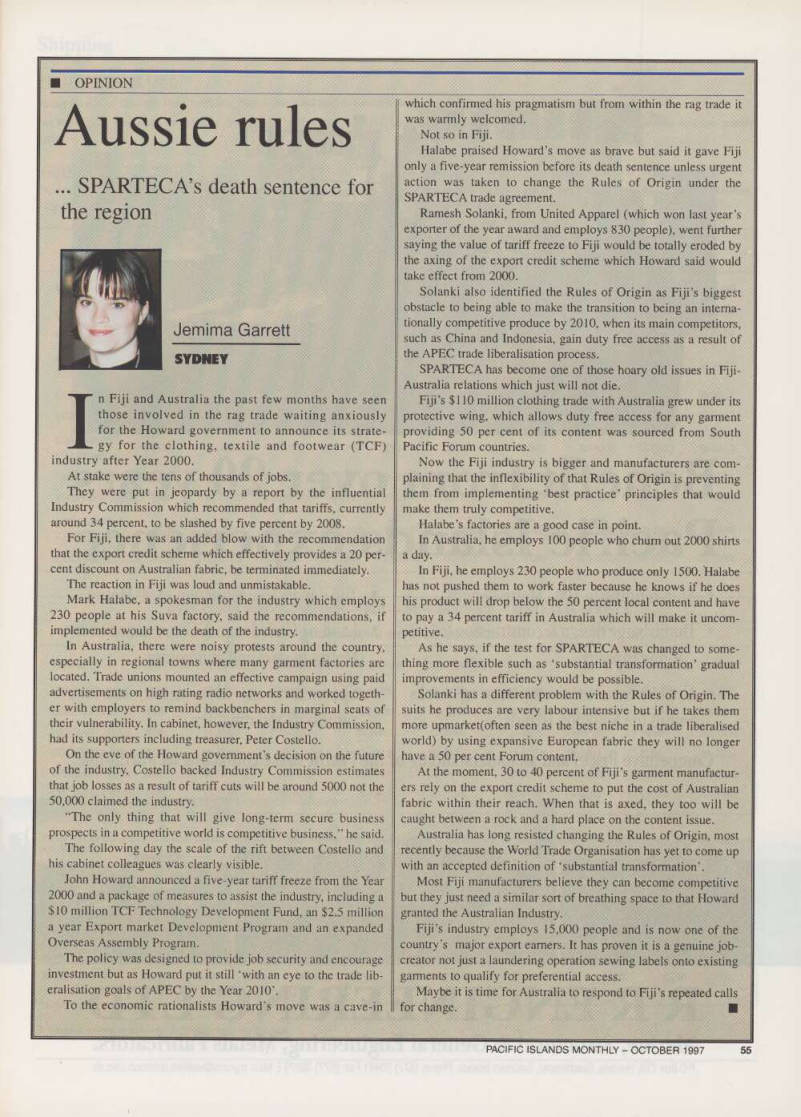
...SPARTECA’s death sentence for the region
Jemima Garrett
Sydney
In Fiji and Australia the past few months have seen those involved in the rag trade waiting anxiously for the Howard government to announce its strate gy for the clothing, textile and footwear (TCF) industry after Year 2000.
At stake were the tens of thousands of jobs.
They were put in jeopardy by a report by the influential Industry Commission which recommended that tariffs, currently around 34 percent, to be slashed by five percent by 2008.
For Fiji, there was an added blow with the recommendation that the export credit scheme which effectively provides a 20 per cent discount on Australian fabric, be terminated immediately.
The reaction in Fiji was loud and unmistakable.
Mark Halabe, a spokesman for the industry which employs 230 people at his Suva factory, said the recommendations, if implemented would be the death of the industry.
In Australia, there were noisy protests around the country, especially in regional towns where many garment factories are located. Trade unions mounted an effective campaign using paid advertisements on high rating radio networks and worked togeth er with employers to remind backbenchers in marginal seats of their vulnerability. In cabinet, however, the Industry Commission, had its supporters including treasurer, Peter Costello.
On the eve of the Howard government's decision on the future of the industry, Costello backed Industry Commission estimates that job losses as a result of tariff cuts will be around 5000 not the 50,000 claimed the industry.
"The only thing that will give long-term secure business prospects in a competitive world is competitive business,” he said.
The following day the scale of the rift between Costello and his cabinet colleagues was clearly visible.
John Howard announced a five-year tariff freeze from the Year 2000 and a package of measures to assist the industry, including a $lO million TCF Technology Development Fund, an $2.5 million a year Export market Development Program and an expanded Overseas Assembly Program.
The policy was designed to provide job security and encourage investment but as Howard put it still ’with an eye to the trade lib eralisation goals of APEC by the Year 2010’.
To the economic rationalists Howard's move was a cave-in
which confirmed his pragmatism but from within the rag trade it was warmly welcomed.
Not so in Fiji.
Halabe praised Howard’s move as brave but said it gave Fiji only a five-year remission before its death sentence unless urgent action was taken to change the Rules of Origin under the SPARTECA trade agreement.
Ramesh Solanki, from United Apparel (which won last year’s exporter of the year award and employs 830 people), went further saying the value of tariff freeze to Fiji would be totally eroded by the axing of the export credit scheme which Howard said would take effect from 2000.
Solanki also identified the Rules of Origin as Fiji’s biggest obstacle to being able to make the transition to being an interna tionally competitive produce by 2010, when its main competitors, such as China and Indonesia, gain duty free access as a result of the APEC trade liberalisation process.
SPARTECA has become one of those hoary old issues in Fiji- Austral ia relations which just will not die.
Fiji’s $llO million clothing trade with Australia grew under its protective wing, which allows duty free access for any garment providing 50 per cent of its content was sourced from South Pacific Forum countries.
Now the Fiji industry is bigger and manufacturers are com plaining that the inflexibility of that Rules of Origin is preventing them from implementing ‘best practice’ principles that would make them truly competitive.
Halabe’s factories are a good case in point.
In Australia, he employs 100 people who chum out 2000 shirts a day.
In Fiji, he employs 230 people who produce only 1500. Halabe has not pushed them to work faster because he knows if he does his product will drop below the 50 percent local content and have to pay a 34 percent tariff in Australia which will make it uncom petitive.
As he says, if the test for SPARTECA was changed to some thing more flexible such as ‘substantial transformation’ gradual improvements in efficiency would be possible.
Solanki has a different problem with the Rules of Origin. The suits he produces are very labour intensive but if he takes them more upmarket(often seen as the best niche in a trade liberalised world) by using expansive European fabric they will no longer have a 50 per cent Forum content.
At the moment, 30 to 40 percent of Fiji’s garment manufactur ers rely on the export credit scheme to put the cost of Australian fabric within their reach. When that is axed, they too will be caught between a rock and a hard place on the content issue.
Australia has long resisted changing the Rules of Origin, most recently because the World Trade Organisation has yet to come up with an accepted definition of ’substantial transformation’.
Most Fiji manufacturers believe they can become competitive but they just need a similar sort of breathing space to that Howard granted the Australian Industry.
Fiji’s industry employs 15,000 people and is now one of the country’s major export earners. It has proven it is a genuine job creator not just a laundering operation sewing labels onto existing garments to qualify for preferential access.
Maybe it is time for Australia to respond to Fiji’s repeated calls for change. ■
Advertisements & other items, p. 56 (1 item)
iciimi* |«n
Benefit from over 20 years
Pacific Islands experience
• Ship refitting to 100 - Metre Length • Dumb barge design & construction to 600 - tonne capacity • Civil & Structural engineering works within the Solomon Islands • Tug design & construction to 20 Metres • Landing Craft design & Construction to 30 Metres in steel and aluminium • Specialists in Aluminium canoes, runabouts and dinghies Competitive Prices and an understanding of the Pacific make contacting us worthwhile.
Than m nnsiiiiii H
R R ENGINEERING LTD
Marine, Structural & General Engineering, Metals Fabricators.
P.0.80x 710, Honiara, Guadalcanal, Solomon Islands. Phone: (677) 30441 Fax: (677) 30279 E Mail: [email protected]
Shipping
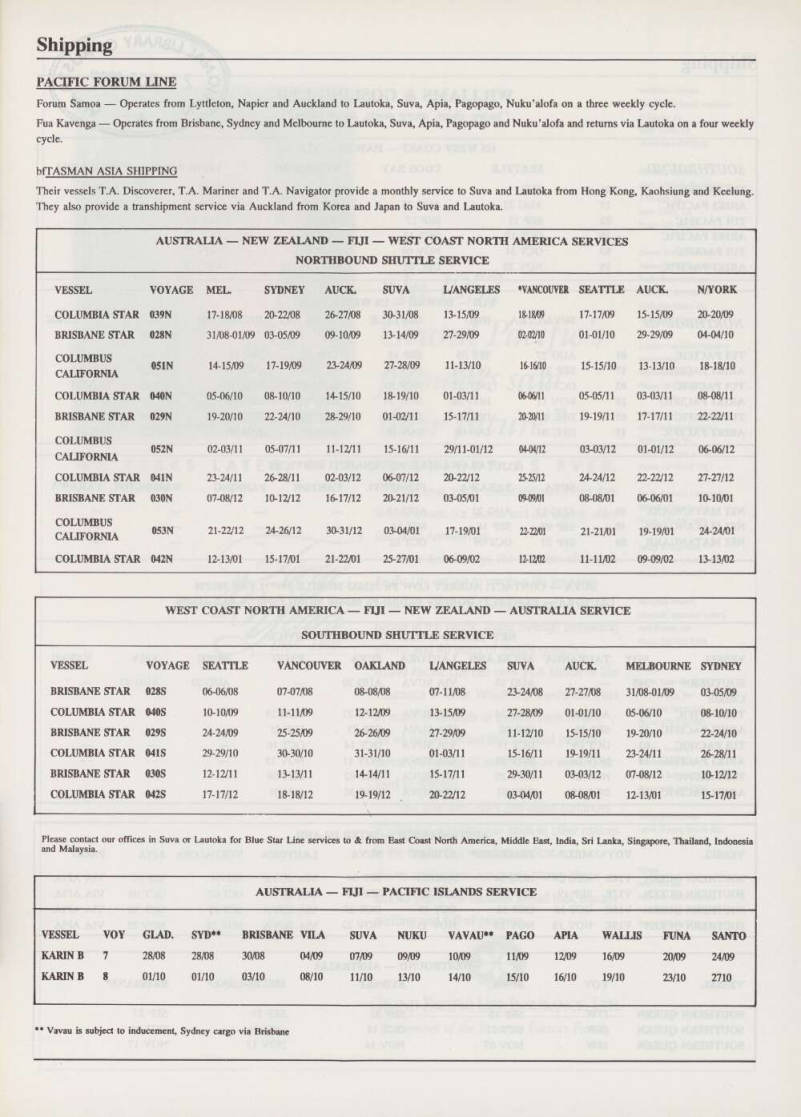
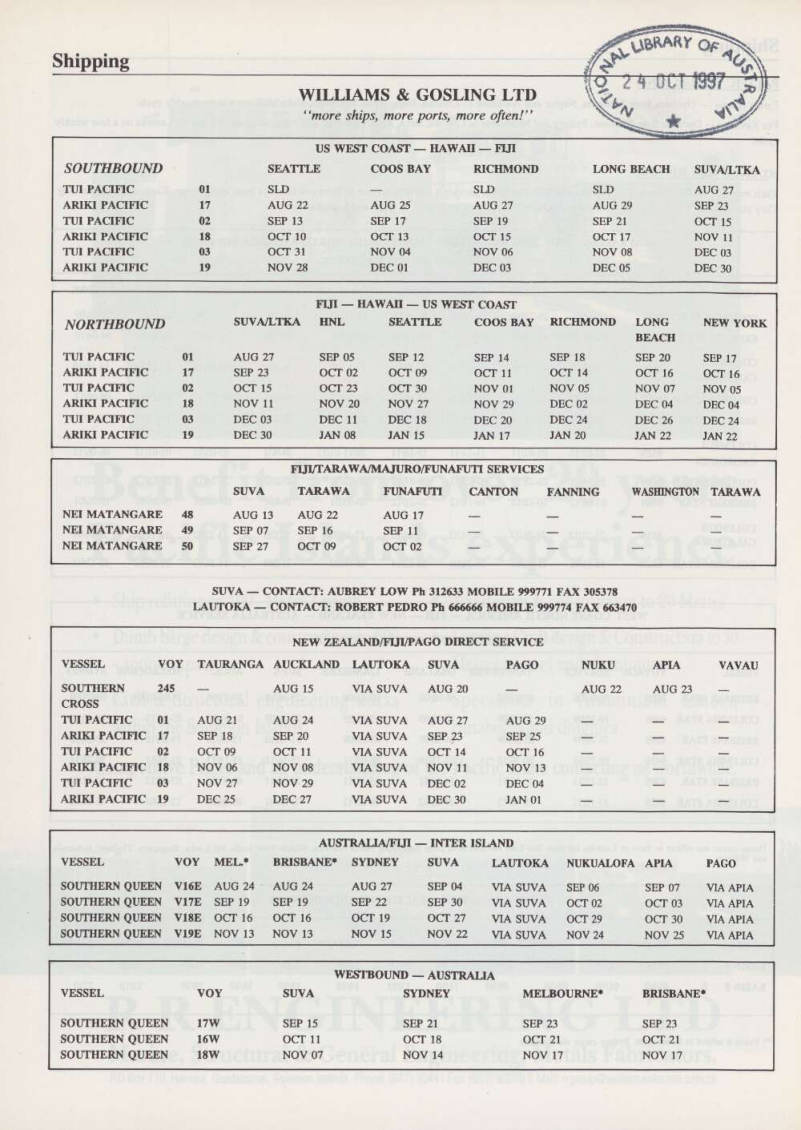
Pacific Forum Line
Forum Samoa Operates from Lyttleton, Napier and Auckland to Lautoka, Suva, Apia, Pagopago, Nuku’alofa on a three weekly cycle.
Fua Kavenga Operates from Brisbane, Sydney and Melbourne to Lautoka, Suva, Apia, Pagopago and Nuku’alofa and returns via Lautoka on a four weekly cycle.
Bftasman Asia Shipping
Their vessels T.A. Discoverer, T.A. Mariner and T.A. Navigator provide a monthly service to Suva and Lautoka from Hong Kong, Kaohsiung and Keelung.
They also provide a transhipment service via Auckland from Korea and Japan to Suva and Lautoka.
Please contact our offices in Suva or Lautoka for Blue Star Line services to & from East Coast North America, Middle East, India, Sri Lanka, Singapore, Thailand, Indonesia and Malaysia.
** Vavau is subject to inducement, Sydney cargo via Brisbane
AUSTRALIA — NEW ZEALAND — FIJI -
- West Coast North America Services
Northbound Shuttle Service
Vessel
Voyage
Mel
Sydney
Auck.
Suva
L/Angelks
•Vancouver
Seattle
Auck.
N/York
Columbia Star
039N 17-18/08 20-22/08 26-27/08 30-31/08 13-15/09 18-18/09 17-17/09 15-15/09 20-20/09
Brisbane Star
028N 31/08-01/09 03-05/09 09-10/09 13-14/09 27-29/09 02-02/10 01-01/10 29-29/09 04-04/10
Columbus
California
051N 14-15/09 17-19/09 23-24/09 27-28/09 11-13/10 16-16/10 15-15/10 13-13/10 18-18/10
Columbia Star
(Mon
05-06/10 08-10/10 14-15/10 18-19/10 01-03/11 06-06/11 05-05/11 03-03/11 08-08/11
Brisbane Star
029N 19-20/10 22-24/10 28-29/10 01-02/11 15-17/11 20-20/11 19-19/11 17-17/11 22-22/11
Columbus
California
052N 02-03/11 05-07/11 11-12/11 15-16/11 29/11-01/12 04-04/12 03-03/12 01-01/12 06-06/12
Columbia Star
041N 23-24/11 26-28/11 02-03/12 06-07/12 20-22/12 25-25/12 24-24/12 22-22/12 27-27/12
Brisbane Star
030N 07-08/12 10-12/12 16-17/12 20-21/12 03-05/01 09-09/01 08-08/01 06-06/01 10-10/01
Columbus
California
053N 21-22/12 24-26/12 30-31/12 03-04/01 17-19/01 22-22/01 21-21/01 19-19/01 24-24/01
Columbia Star
042N 12-13/01 15-17/01 21-22/01 25-27/01 06-09/02 12-12/02 11-11/02 09-09/02 13-13/02
WEST COAST NORTH AMERICA — FIJI — NEW ZEALAND -
Southbound Shuttle Service
Australia Service
Vessel
Voyage
Seattle
Vancouver
Oakland
L/Angeles
Suva
Auck.
Melbourne
Sydney
Brisbane Star
028S 06-06/08 07-07/08 08-08/08 07-11/08 23-24/08 27-27/08 31/08-01/09 03-05/09
Columbia Star
040S 10-10/09 11-11/09 12-12/09 13-15/09 27-28/09 01-01/10 05-06/10 08-10/10
Brisbane Star
029S 24-24/09 25-25/09 26-26/09 27-29/09 11-12/10 15-15/10 19-20/10 22-24/10
Columbia Star
041S 29-29/10 30-30/10 31-31/10 01-03/11 15-16/11 19-19/11 23-24/11 26-28/11
Brisbane Star
030S 12-12/11 13-13/11 14-14/11 15-17/11 29-30/11 03-03/12 07-08/12 10-12/12
Columbia Star
042S 17-17/12 18-18/12 19-19/12 20-22/12 03-04/01 08-08/01 12-13/01 15-17/01
Australia —
Fiji —
Pacific Islands Service
Vessel
Voy
Glad.
Syd**
Brisbane Vila
Suva
Nuku
Vavau**
Pago
Apia
Wallis
Funa
Santo
Karin B
7 28/08 28/08 30/08 04/09 07/09 09/09 10/09 11/09 12/09 16/09 20/09 24/09
Karin B
8 01/10 01/10 03/10 08/10 11/10 13/10 14/10 15/10 16/10 19/10 23/10 2710
Williams & Gosling Ltd
“more ships, more ports, more often!’’
SUVA CONTACT: AUBREY LOW Ph 312633 MOBILE 999771 FAX 305378 LAUTOKA CONTACT; ROBERT PEDRO Ph 666666 MOBILE 999774 FAX 663470
US WEST COAST — HAWAII — FIJI
Southbound
Seattle
Coos Bay
Richmond
Long Beach
Suva/Ltka
Tui Pacific
01
Sld
Sld
Sld
Aug 27
Ariki Paqf1C
17
Aug 22
Aug 25
Aug 27
Aug 29
Sep 23
Tui Pacific
02
Sep 13
Sep 17
Sep 19
Sep 21
Oct 15
Ariki Pacific
18
Oct 10
Oct 13
Oct 15
Oct 17
Nov 11
Tui Pacific
03
Oct 31
Nov 04
Nov 06
Nov 08
Dec 03
Ariki Pacific
19
Nov 28
Dec 01
Dec 03
Dec 05
Dec 30
FIJI — HAWAII — US WEST COAST
Northbound
Suva/Ltka
Hnl
Seattle
Coos Bay
Richmond
Long
Beach
New York
Tui Pacific
01
Aug 27
Sep 05
Sep 12
Sep 14
Sep 18
Sep 20
Sep 17
Ariki Pacific
17
Sep 23
Oct 02
Oct 09
Oct 11
Oct 14
Oct 16
Oct 16
Tui Pacific
02
Oct 15
Oct 23
Oct 30
Nov 01
Nov 05
Nov 07
Nov 05
Ariki Pacific
18
Nov 11
Nov 20
Nov 27
Nov 29
Dec 02
Dec 04
Dec 04
Tui Pacific
03
Dec 03
Dec 11
Dec 18
Dec 20
Dec 24
Dec 26
Dec 24
Ariki Pacific
19
Dec 30
Jan 08
Jan 15
Jan 17
Jan 20
Jan 22
Jan 22
Fuiytarawa/Majuro/Funafuti Services
Suva
Tarawa
Funafuti
Canton Fanning
Washington Tarawa
Nei Matangare
Nei Matangare
Nei Matangare
48 49 50
Aug 13
Sep 07
Sep 27
Aug 22
Sep 16
Oct 09
Aug 17
Sep 11
Oct 02
New Zealand/Fiji/Pago Direct Service
Vessel
Voy
Tauranga
Auckland Lautoka
Suva
Pago
Nuku
Apia
Vavau
Southern
Cross
245 —
Aug 15
Via Suva
Aug 20
Aug 22
Aug 23
Tui Pacific
01
Aug 21
Aug 24
Via Suva
Aug 27
Aug 29
Ariki Pacific
17
Sep 18
Sep 20
Via Suva
Sep 23
Sep 25
Tui Pacific
02
Oct 09
Oct 11
Via Suva
Oct 14
Oct 16
Ariki Pacific
18
Nov 06
Nov 08
Via Suva
Nov 11
Nov 13
Tui Pacific
03
Nov 27
Nov 29
Via Suva
Dec 02
Dec 04
Ariki Pacific
19
Dec 25
Dec 27
Via Suva
Dec 30
Jan 01
Australia/Fiji -
- Inter Island
Vessel
Voy
Mel.*
Brisbane* Sydney
Suva
Lautoka
Nukualofa
Apia
Pago
Southern Queen
V16E
Aug 24
Aug 24 Aug 27
Sep 04
Via Suva
Sep 06
Sep 07
Via Apia
Southern Queen
V17E
Sep 19
Sep 19 Sep 22
Sep 30
Via Suva
Oct 02
Oct 03
Via Apia
Southern Queen
Vise
Oct 16
Oct 16 Oct 19
Oct 27
Via Suva
Oct 29
Oct 30
Via Apia
Southern Queen
V19E
Nov 13
Nov 13 Nov 15
Nov 22
Via Suva
Nov 24
Nov 25
Via Apia
Westbound — Australia
Vessel
Voy
Suva
Sydney
Melbourne*
Brisbane*
Southern Queen
17W
Sep 15
Sep 21
Sep 23
Sep 23
Southern Queen
16W
Oct 11
Oct 18
Oct 21
Oct 21
Southern Queen
18W
Nov 07
Nov 14
Nov 17
Nov 17
Advertisements & other items, pp. 58-60 (2 items)
Shipping
Grand Pacific’s
“In 1957,
founders saw
their future.”
AS BRIGHT AS EVER,
This year, we're celebrating an event that should please our clients and our agents alike.
Our 40th Anniversary.
Four decades ago, the founders of Grand Pacific Life set out to create a life insurance
company designed to safeguard and serve
people in the Pacific. Today, through pioneering efforts and 40 years of steady growth, Grand Pacific Life has over $3.8 billion of life insurance in force. Which represents the trust of many thousands of people, ones whom
we've helped secure the financial indepen-
dence and peace of mind they've worked so
hard to achieve.
Our founders' spirit and vision continues
in reaching out with new ideas to other nations in the Pacific. Our steadfast dedication to our clients and agents has made history these last 40 years. The decades ahead look equally
exciting and full of promise.
O
Grand Pacific Life Insurance, Ltd.
American Samoa Mark Solofa Pacific Insurance & Finance, Inc.
Mark Solofa, GA Phone: 684-699-5796 Western Samoa Mark Solofa Pacific Insurance & Finance, Inc.
Mark Solofa, GA Phone:6Bs-24059 Chuuk State. Federated States of Micronesia Pacific Basin Insurance & General Services, Inc.
Kachutosy Paulus, GA Phone: 691-330-2606 Actouka Executive Insurance Underwriters Maridell Actouka Phone: 691 -320-5331 Guam Great National Insurance Underwriters, Inc.
Domie Bumagat Jr., GA Phone: 671-646-5736 Pacific Financial Corporation Eduardo Camacho, GA Phone: 671-646-1990 Takagi & Associates Pamela Cruz, Life Manager Phone: 671-475-4373 Marshall Islands Marshalls Insurance Agency Jerry Kramer, GA Phone: 692-625-3366 Saipan Pacific Basin Insurance Underwriters, Inc.
Mary Ann Milne, GA Phone: 670-234-7861 Pacifica Insurance Underwriters, Inc.
Norman Tenorio, GA Phone: 670-234-6267 Takagi & Associates Laurie Sturges, Branch Mgr.
Phone: 670-322-8117 Tonga Peseti Ma'afu Insurance & Finance, Ltd.
Peseti Ma'afu, GA Phone: 676-24-777 A member of the Finance Factors Family
. RR
3. Pol PfICUFi c_
"S 9)9
PRO
3, SHEInJCS
ND CRUISER
‘V *0 &#ubgmr' ; : , ■' a? ’ -; j,
LAND CRUISER
ms - ■: . Pt- Some of the specs may vary according to market specifications.
Heavy duty beauties - Toyota Land Cruiser and Land Cruiser PRADO Land Cruiser’s got a reputation for go anywhere toughness, with style and ability to take you there in total comfort, on road or off.
Its luxury matches most expensive sedans. And it has more space than many large passenger cars. With impeccable fit and finish.
And graceful, elegant form.
Land Cruiser PRADO inherits these traditions, and all Toyota’s 4x4 know-how for great performance off road and passenger car comfort on the highway, and stylish beauty everywhere it goes.
What you can’t see is also important. Tough frames. Suspensions built to take you as far off road as you want to go, in comfort. Your choice of powerful petrol or diesel engines. And bodies thoroughly protected from rust.
Land Cruiser and Land Cruiser PRADO - two champions, on and off the road.
®> TOYOTA
DISTRIBUTORS/DEALERS
NORFOLK ISLAND BORRY’S PTY LTD. PH 22114
SOLOMON ISLANDS ELA MOTORS PH 30314
VANUATU ASCO MOTORS PH 22341
COOK ISLANDS PACIFIC MOTORS LTD. PH 20796
KIRIBATI TARAWA MOTORS PH 21090
PAPUA NEW GUINEA ELA MOTORS PH 3229400
TAHITI NIPPON AUTOMOTO PH 429819
WESTERN SAMOA ASCO MOTORS PH 20800
FIJI ASCO MOTORS PH 384888
NEW CALEDONIA S.I.A.P. PH 275562
TONGA ASCO MOTORS PH 23500
AMERICAN SAMOA* ,ASCO MOTORS PH 633-4281
(*PRADO is not being handled.)