Furl CtKIM
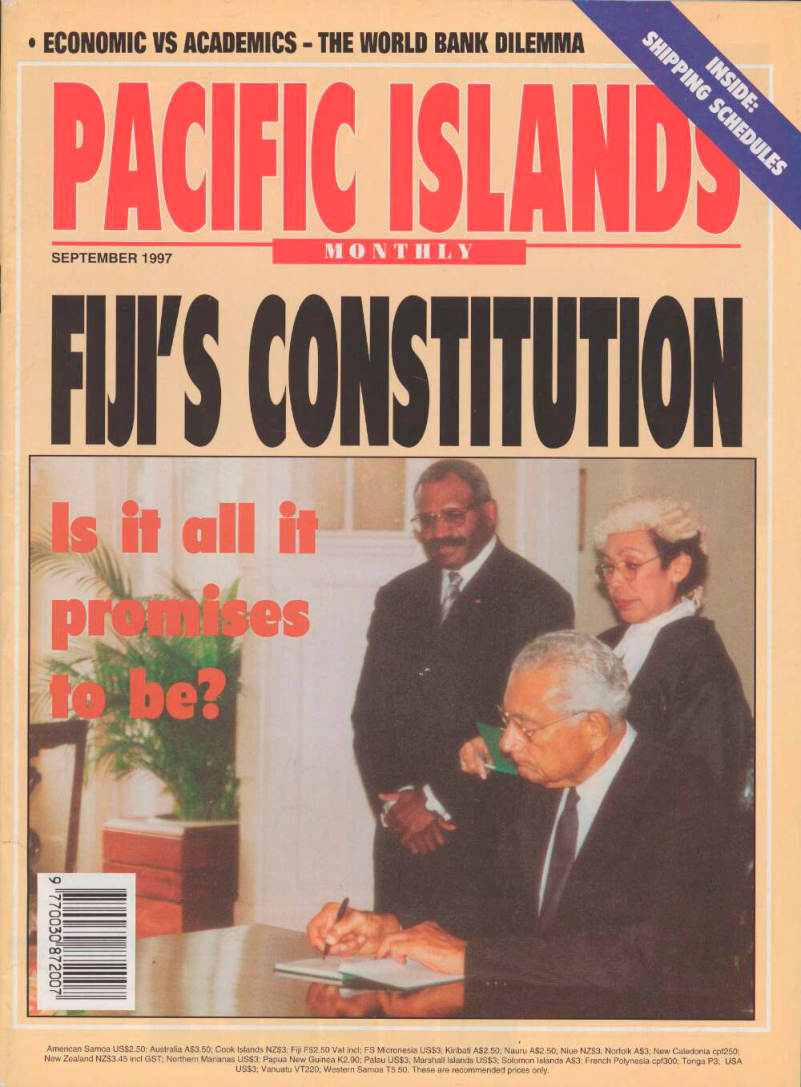
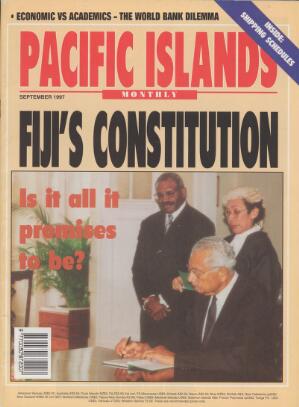
Pacific Islands
Monthly
• ECONOMIC VS ACADEMICS - THE WORLD BANK DILEMMA
\\ X
September 1997
Furl CtKIM
\ h all it I m i f tXj|
American Samoa US$2.5O; Australia A 53.50; Cook Islands NZ$3; Fiji F 52.50 Vat incl; FS Micronesia US$3; Kiribati A 52.50; Nauru A 52.50; Niue NZ$3; Norfolk As 3; New Caledonia cpf2so; New Zealand NZ53.45 incl GST; Northern Marianas US$3: Papua New Guinea K 2.90; Palau US$3; Marshall Islands US$3; Solomon Islands As 3; French Polynesia cpf3oo; Tonga P 3; USA US$3; Vanuatu VT22O; Western Samoa T 5.50. These are recommended prices only.
Advertisements & other items, pp. 2-4 (1 item)
Telikom
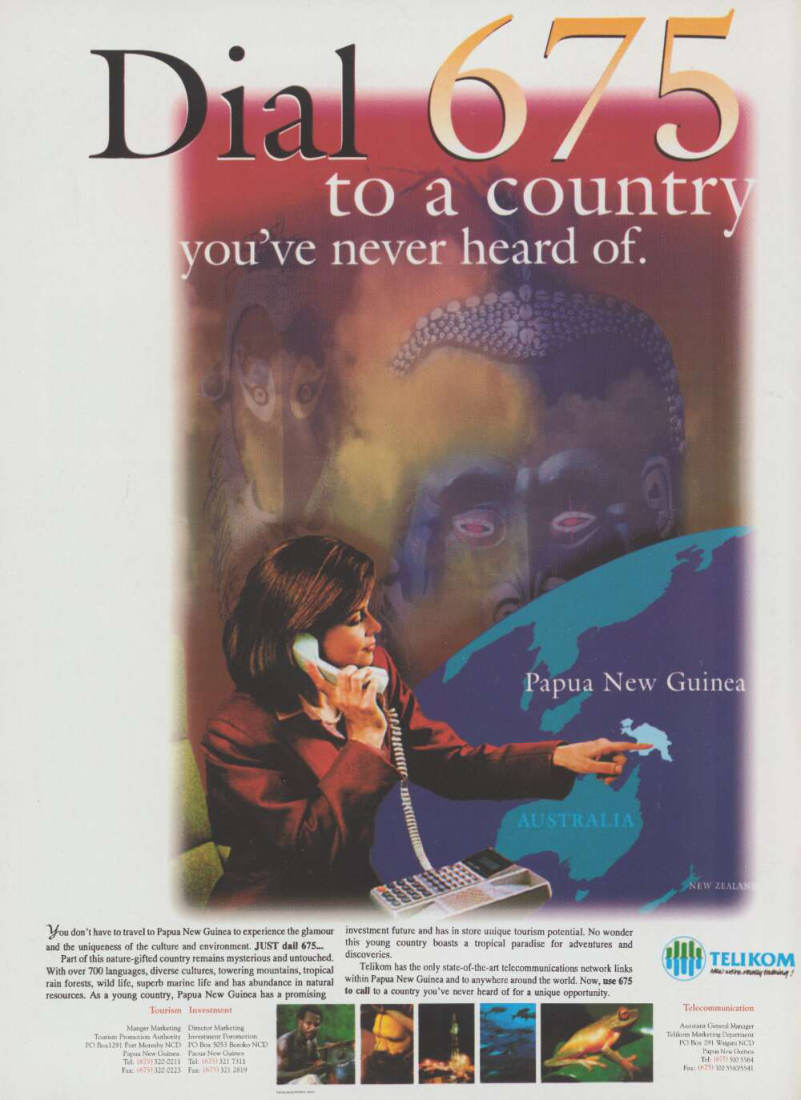
don’t have to travel to Papua New Guinea to experience the glamour and the uniqueness of the culture and environment. JUST dail 675- Part of this nature-gifted country remains mysterious and untouched.
With over 700 languages, diverse cultures, towering mountains, tropical rain forests, wild life, superb marine life and has abundance in natural resources. As a young country, Papua New Guinea has a promising investment future and has in store unique tourism potential. No wonder this young country boasts a tropical paradise for adventures and discoveries.
Telikom has the only state-of-the-art telecommunications network links within Papua New Guinea and to anywhere around the world. Now, use 675 to call to a country you’ve never heard of for a unique opportunity.
Tourism Investment Manger Marketing Director Marketing Tourism Promotion Authority Investment Poromotion PO Box 1291 Port Moresby NCD PO Box 5053 Boroko NCD Papua New Guinea. Paoua New Guinea Tel: 1675)320 0211 Tel: (675)321 7311 Fax: (675)320 0223 Fax: (675)321 2819 m
TELIKOM
««#•■ MftKty tatunj, / Telecommunication Assistant General Manager Telikom Marketing Department PO Box 291 Waigani NCD Papua New Guinea Tel: (675)300 5564 Fax: (675) 300 5540/5541
ah 0N v ■"
SggSL. il ... - i !S Sfes
Popular
Product
Competitive
Pricing
Export
Packaging
Island Soda U.S.A.
Aspen International Export, Inc. 1402-3rd Avenue, Suite 1024 Seattle, WA 98101 Phone (206) 628-6151 Fax (206) 628-6421 Our tropical soft drink line has made a big splash across the Pacific Islands
Pineapple Tropical Soda
Orange Grape
Dew Lemon-Lime
Cola Strawberry
Delicious flavors are complimented
with highly visual packaging and
exciting product advertising.
ISLAND
SODA
m Island Soda Samoa Haleck's Pago Pago Beverages Phone 684 633 7270 Fax 684 633 7273 Island Soda Tahiti Eico Phone 689 421 660 Fax 689 429 838 Island Soda Tonga Tonga Cooperative Federation Limited Phone 676 23 670 Fax 676 23 203
ns m % m ■ m 1 ▲ A
MARKET M A K ER
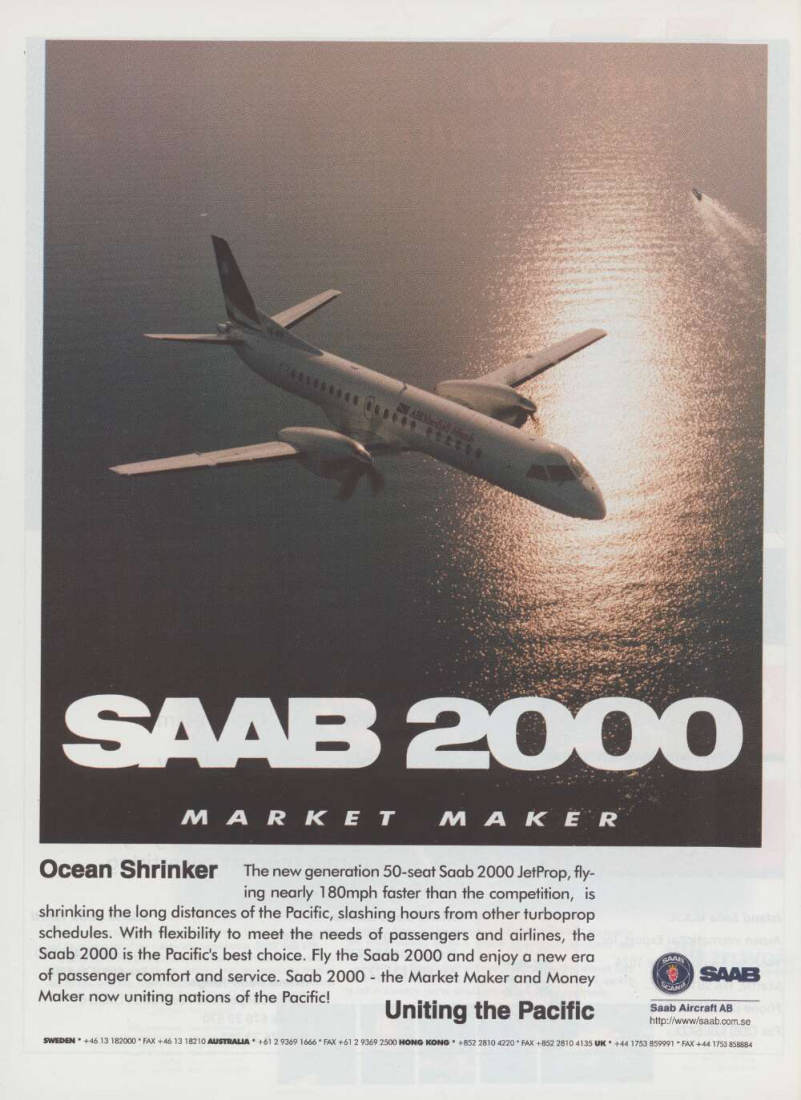
Ocean Shrinker The new generation 50-seat Saab 2000 Jet Prop, flying nearly 180 mph faster than the competition, is shrinking the long distances of the Pacific, slashing hours from other turboprop schedules. With flexibility to meet the needs of passengers and airlines, the Saab 2000 is the Pacific's best choice. Fly the Saab 2000 and enjoy a new era of passenger comfort and service. Saab 2000 - the Market Maker and Money Maker now uniting nations of the Pacific! --
Uniting the Pacific
Saab Aircraft AB http://www/saab.com.se SWEDEN * +46 13 182000 * FAX +46 13 1 8210 AUSTRALIA • +6l 2 9369 1666 * FAX +6l 2 9369 2500 HONG KONG • +852 2810 4220 • FAX +852 2810 4135 UK * +44 1753 859991 * FAX +44 1753 858884
Pacific Islands
Monthly
Vol 67 No. 09
The News Magazine
September 1997
PUBLISHER: Alan Robinson EDITOR: Manivannan Naidu SENIOR WRITER: Bernadette Hussein
Correspondents:
Sally Andrew, Patrick Decloitre, Gift Johnson, Chris Peteru, Susan Prokop, Atama Raganivatu, Kalinga Seneviratne, Liz Thompson, Lili Tuwai, Sam Vulum, lan Williams COLUMNISTS: David Barber (Wellington), Jemima Garrett (Sydney), Debbie Singh (South Pacific Commission).
GRAPHIC ARTISTS: James Ranuku, Josefa Bola, Andrew Williams
Advertising Sales
Senior Regional Sales (South Pacific) Shabana Naaz Satish Kumar Tel (679) 304111, 303244, Fax (679) 303809.
Sydney, Canberra: Bob Hill Media Representation, Tel (61-2) 4164245, Fax (61-2) 4165064.
Brisbane: Jane Fewings Media and Advertising Associates Tel (61-7) 3378 4522, Fax (61-7) 3878 1071.
Adelaide: Hastwell Williamsons Representatives. Tel (61-8) 3799522, Fax (61-8) 3799735.
Melbourne: Brown Orr Fletcher Burrows (Aust) Pty Ltd.
Tel (61-3)98265188, Fax (61-3) 98265644.
Auckland: McKay & Bowman, International Media Representatives Limited, Tel (64-9)4190561, Fax (64-9)4192243.
Japan: Universal Media Corporation, Tokyo, Tel (3) 3266626741, Cable: UNI-MEDIA Tokyo.
Fax (3) 32626742.
Pacific Islands Monthly was founded in 1930
(Usps 9522480).
A Fiji Times Limited production.
Cover prices are recommended retail only. Registered by Australia Post, Publication No. NBPI2IO. © Copyright Fiji Times Limited, 177 Victoria Parade, Suva, Fiji.
Tel (679) 304111, fax (679) 303809.
Pacific Islands Monthly is published monthly by Fiji Times Limited, a division of Nationwide News, 2 Holt Street, Surry Hills, Sydney, NSW 2010.
Send Address Changes To:
Pacific Islands Monthly PO Box 1167 Suva, Fiji.
Typeset and printed by The Fiji Times Limited, 177 Victoria Parade, Suva, Fiji.
Layout and cover design by Andrew Williams Cover photo by Bernadette Hussein
Inside
Cover Story: A time of change
Editorial G Letters to the Editor 7 From the Archives 9 Briefs 11 Special Reports: Pennywise 12 Are World Bank reforms causing an education crisis?
Mining giant spreads benefits 14 Cover stories: A time of change 16 Can Fiji’s constitution bring down the race barriers?
The winebox inquiry 25 Peace - a real prospect 2G Skate on thin ice 29 Solomons' worsening crisis 32 FWTC Feature 34 South Pacific Forum Feature 40 Little fun in games 44 The top end of music 46 Contemporary Pacific sound 46 The great colonial mystery 50 Sailing the big canoes 51 An age-old question 53 The big leak 54 Women's bureau heads for 2000 55 Shipping schedules 57
Page 12
Page 28
Page 29
Beyond the
Editorial
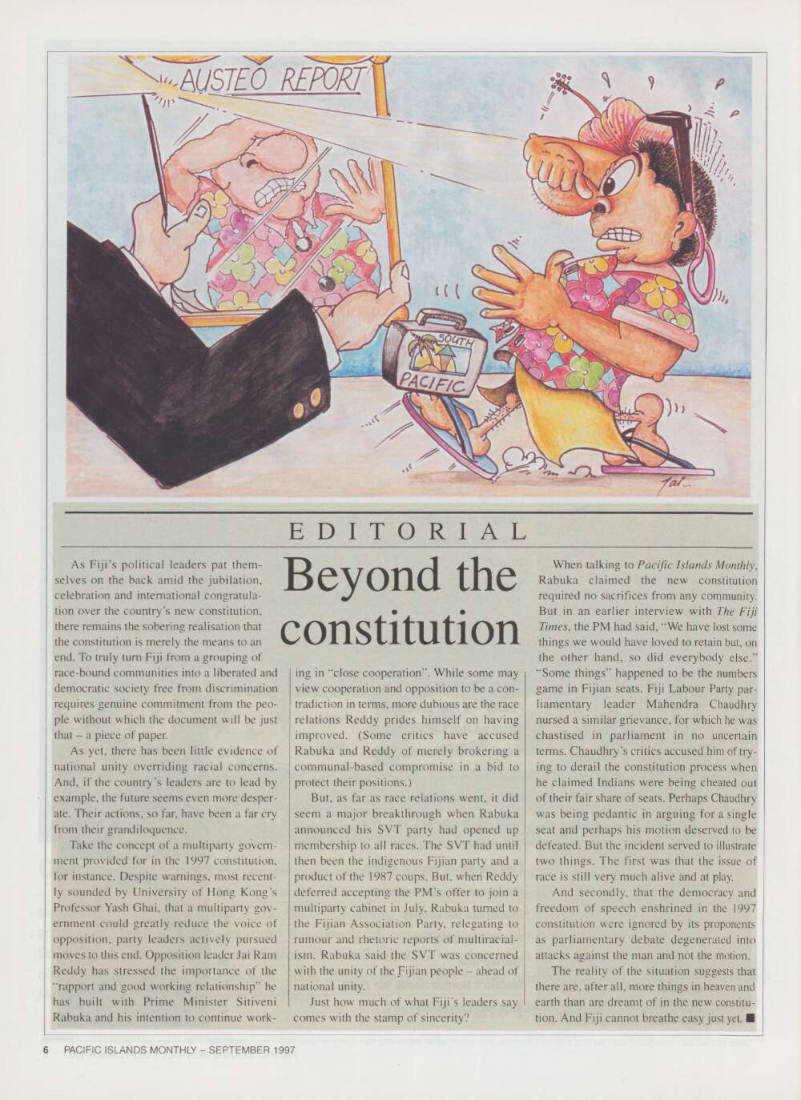
Beyond the constitution
As Fiji's political leaders pat themselves on the back amid the jubilation, celebration and international congratulation over the country's new constitution. there remains the sobering realisation that the constitution is merely the means to an
end. To truly turn Fiji from a grouping of race-bound communities into a liberated and democratic society free from discrimination requires genuine commitment from the peo ple without which the document will be just that - a piece of paper.
As yet, there has been little evidence of national unity overriding racial concerns.
And, if the country's leaders are to lead by example, the future seems even more desper ate. Their actions, so far, have been a far cry from their grandiloquence.
Take the concept of a multiparty govern ment provided for in the 1997 constitution, for instance. Despite warnings, most recent ly sounded by University of Hong Kong's Professor Yash Ghai, that a multiparty gov ernment could greatly reduce the voice of opposition, party leaders actively pursued moves to this end. Opposition leader Jai Ram Reddy has stressed the importance of the "rapport and good working relationship" he has built with Prime Minister Sitiveni Rabuka and his intention to continue work
ing in “close cooperation”. While some may view cooperation and opposition to be a con tradiction in terms, more dubious are the race
relations Reddy prides himself on having
improved. (Some critics have accused Rabuka and Reddy of merely brokering a communal-based compromise in a bid to protect their positions.) But. as far as race relations went, it did seem a major breakthrough when Rabuka announced his SVT party had opened up membership to all races. The SVT had until then been the indigenous Fijian party and a product of the 1987 coups. But, when Reddy deferred accepting the PM's offer to join a multiparty cabinet in July, Rabuka turned to
the Fijian Association Party, relegating to
rumour and rhetoric reports of multiracial ism. Rabuka said the SVT was concerned with the unity of the Fijian people - ahead of national unity.
Just how much of what Fiji's leaders say comes with the stamp of sincerity?
When talking to Pacific Islands Monthly , Rabuka claimed the new constitution required no sacrifices from any community.
But in an earlier interview with The Fiji Times , the PM had said, “We have lost some things we would have loved to retain but, on the other hand, so did everybody else.”
"Some things” happened to be the numbers game in Fijian seats. Fiji Labour Party par liamentary leader Mahendra Chaudhry nursed a similar grievance, for which he was chastised in parliament in no uncertain terms. Chaudhry’s critics accused him of try ing to derail the constitution process when he claimed Indians were being cheated out of their fair share of seats. Perhaps Chaudhry was being pedantic in arguing for a single seat and perhaps his motion deserved to be defeated. But the incident served to illustrate two things. The first w'as that the issue of race is still very much alive and at play.
And secondly, that the democracy and freedom of speech enshrined in the 1997 constitution were ignored by its proponents as parliamentary debate degenerated into attacks against the man and not the motion.
The reality of the situation suggests that there are, after all, more things in heaven and earth than are dreamt of in the new constitu tion. And Fiji cannot breathe easy just yet. ■
Letters To The Editor

A step in the wrong direction?
Dear Sir, Mention was made in a PIM article (‘‘The Earhart mystery” March, 1997) of a woman’s shoe and human remains being found on Nikumaroro Island. I have looked into the relevant file, held in the Kiribati National Archives, and this throws more light on the subject.
It was part only of the sole of a woman’s shoe which was found and apparently no one thought of testing it to see whether it floated in the sea (many shoes and parts of shoes are washed up on Pacific Island beaches and not taken there by man).With regards to the human remains which were found in 1940, it was remarked by the finders that they looked more than four years old, and this was confirmed by the senior medical officer at the Central Hospital in Tarawa. The find ing was that they were those of an elderly male Polynesian and that they had been on Nikumaroro for upwards of 20 years - and possibly much longer. They could not
therefore have been the remains of Earhart or her navigator.
Incidentally, the doctor who examined the remains. Dr Isaac, later lived in Suva for many years where he was well known as Dr Verrier, a colourful local character.
Peter Mcquarrie
Tarawa Republic of Kiribati
Sole of a women’s left shoe found October 1991 during Tighar’s Niku II expedition
Appeal for information
Dear Sir, • I am investigating the origins and distri bution of Red Jungle Fowl ( Callus gallus ) throughout the Pacific.
These wild fowl, together with modem poultry, are a very important part of island
village life. Any information on the sub ject will be greatly appreciated. • A review of my book, Maekera, the biography of a Solomon Island chief appeared in your magazine. Part of Maekera’s story involved the rescue of a crashed pilot near Mbelombelo Island, eastern Roviana Lagoon, circa late 1942.
Maekera is now 88 years old and in ail ing health. I would dearly love to be able to reunite him with the pilot. However, all official searches through US Marine archives have been unsuccessful.
Perhaps there is a reader out there who has knowledge of the area at the time and who may know someone named David Andren or similar to help with our search.
My Email address is: [email protected] Ph: (61) 67 361083/67 362468; fax: (61) 67 362759.
Russell Parker, P O Box 242, Tenterfield, New South Wales 2372, Australia
Advertisements & other items, p. 7 (1 item)
packs more
'-v;' \ j . w - A %£ UeK
Wj&j
One airline
packs more
value and the
best connections
in business trips.
r iiSBIiIS lill ..\„J * t m iXPSK m m .X. 1 J % Mf i m Sh 64® j • •• Whether you’re travelling around the globe or across the nation, Air Niugini takes care of business with the right connections, and the largest network of regular services
throughout Papua New Guinea.
To find out how we’re taking care of business, call Air Niugini or our nearest representative now.
If you’re travelling on business, why not stay and see more of our wonderful country.
Contact Air Niugini or your travel agent for full details.
§ Air Niugini
NZ-big brother or best friend?
Dear Sir.
Having recently returned from a goodwill visit to five countries in the South Pacific, I would like to consider one important question which very rarely gets asked: how important are the Pacific countries to New Zealand?
Aside from a great place to take a trop ical holiday, is there another relationship between New Zealand and the South Pacific?
In my role as the minister of foreign affairs and trade and the minister for Pacific Island affairs, I have visited the countries of our home region numerous times, but what struck me this time was the dynamic political atmosphere which I encountered in the region, as a whole, and in each of the five countries I visited - con stitution review in Fiji, questions of nation al identity in Tonga, concerns about eco nomic viability in Niue, issues of sovereignty and good governance in Samoa, indigenous rights to independence in New Caledonia. Whoever said nothing happens in the Pacific?
Unfortunately, a trip involving a 37member delegation which takes in five countries - Fiji, Tonga, Niue, Samoa and New Caledonia - in 10 days does not allow for more than the briefest taste of these issues; hardly enough time to unpack the suitcases, but just long enough to impress upon me once again the importance of the South Pacific to New Zealand.
This is New Zealand’s home region.
Our countries share many characteristics and historical experiences which should be considered and which can serve as impor tant lessons for the future.
New Zealand is an island and is linked
to the other islands by the waters of the Pacific Ocean. It took only three hours to fly to Suva, and Noumea is even closer.
During my discussions with both mem bers of governments and opposition parties in each of the five countries, I was struck by how closely our countries were linked through history - through our shared expe riences of colonisation and decolonisation.
Most importantly still, immigration throughout the Pacific has linked the coun tries in the region with ties that are as thick as blood and many New Zealanders proud ly identify themselves as Pacific Islanders.
Not surprisingly, agendas for political dis cussions frequently include social issues; for a country the size of Niue, whose expa triate population in Auckland is larger than that on the island, has its future inextrica bly linked to that of New Zealand.
Even in my randomly selected 37-mem ber delegation there were two people with Niuean ancestry, five of Samoan extrac tion, one each from Tokelau, Cook Islands and Solomon Islands, and three Maori. In this respect. New Zealand has a role to play in the Pacific because the policies which New Zealand implements domestically in the areas of health, education, foreign affairs and regional security, directly or indirectly, affect the future of the other countries of the South Pacific.
New Zealand simply has to be engaged in the Pacific because it influences the political environment of the Pacific region.
While this is inevitable, the role that new Zealand plays is subject to choice.
Should New Zealand be 'big brother’ and dictate developments?
When one considers fragile economies whose GDP is directly influenced by a sin gle export product, as is the case with Tonga or Niue which has to maintain eco nomic viability with a population of only about 2000, this would certainly be an easy option. And yet, let us not forget that each of the countries in our region has sovereignty and is in control of its political and social destiny.
One sentiment which was frequently expressed to me was that of preserving
national identity.
The struggle was often between the realisation that their country depended on foreign aid and technical expertise to main tain certain living standards, and the free dom to make decisions that would lead towards true independence. In its position of a large donor in the Pacific region, New Zealand should be very sensitive to senti ments such as these. For let us not forget that, although our economy is strong, New Zealand is a small island in the world of global economy. Issues such as sovereign ty, national identity, land ownership and indigenous rights are as topical for New Zealand as they are for Fiji, Tonga, Niue, Samoa and New Caledonia.
I am convinced that, while encouraging and supporting positive political, econom ic and social developments in the region, New Zealand can, in turn, learn valuable lessons for its present and future.
New Zealand will do well to recognise the importance of the South Pacific region.
And, as we consider these issues, there is one more reason to value our relationship with the Pacific - where would New Zealand rugby or many sporting codes be without team mates from the Pacific
region?
The Pacific Islanders are now and will always be part of our larger whanau.
Don McKinnon,
Minister of Foreign Affairs and Trade, New Zealand
Letters to the Editor should be addressed to: The Editor Pacific Islands Monthly PO Box 1167 Suva Fiji
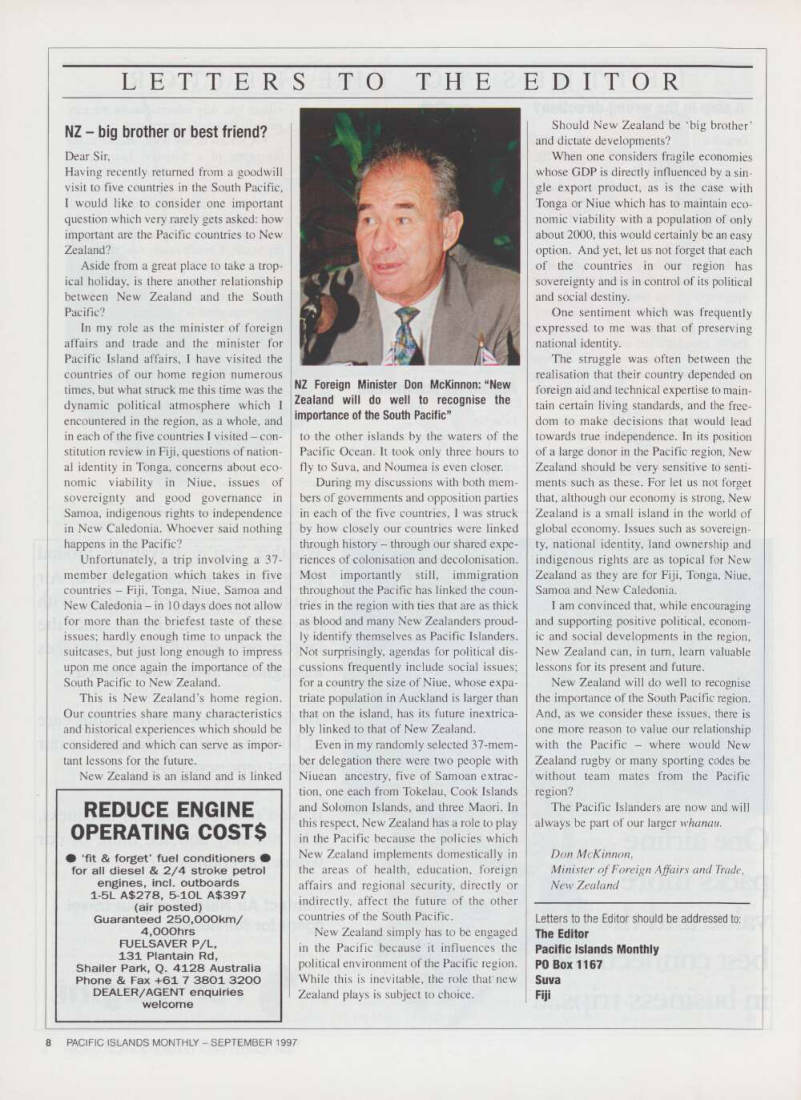
NZ Foreign Minister Don McKinnon: “New Zealand will do well to recognise the importance of the South Pacific”
Advertisements & other items, p. 8 (2 items)
Letters To The Editor
8
PACIFIC ISLANDS MONTHLY - SEPTEMBER 1997
Operating Costs
REDUCE ENGINE
• ‘fit & forget’ fuel conditioners • for all diesel & 2/4 stroke petrol engines, incl. outboards 1-5 L As27B, 5-10 L A 5397 (air posted) Guaranteed 250,000 km/ 4,ooohrs
FUELSAVER P/L,
131 Plantain Rd, Shailer Park, Q. 4128 Australia Phone & Fax +6l 7 3801 3200 DEALER/AGENT enquiries welcome
From The Archives

August, 1930
Proper Puri-Puri Man Sorcery; or puri-puri, as it is known by r the natives, is now T being stamped out by the Government of Papua. A case occurred a
short time ago in the Northern Division. A man of the Aringi district made a complaint that T his brother-in-law had j practised puri-puri on V him, causing him to 1 HI I|j wander in the bush, wTiere he often had to pass the night. After some days of
this, he reported the fact to the village constable. The alleged sorcerer was brought before the Court for Native Matters but the case was dismissed much to the disgust of the complainant.
Later, the Court Interpreter discov ered a leaf containing “sorcery medicine” on the court-room floor. The natives who attended the case were resummoned, including the sorcerer, and, although he denied ownership of the medicine, some more leaves were found on him. A convic tion naturally followed. Thereupon, the
Pacific Islands Monthly ■k
defendant stated that, by holding the leaf containing the medicine in his hand, he was able to win his case. But because he dropped the leaf while leav ing, the verdict on
the second occasion went against him.
Gilbertian Regulations
There are numerous stupid and irritating regulations and laws, some Gilbertian in character, which have done much to crip ple our trade in recent years.
There is a regulation that, when Islands produce which can possibly be classified as “seeds” is received, the con signees before they can take possession, must obtain a certificate from the Department of Agriculture that the seeds are free from plant disease and pests.
This regulation applies to copra, for instance, and to cocoa beans. The regula tion is a mere ridiculous formality, serv
ing no purpose which can possibly be regarded as useful - yet it represents much waste of time and expensive cleri cal work.
There is a regulation that no shipment of camied fruits may go out of this port until the Customs Department has received at least two tins for sampling purposes”. It is an entirely useless for mality, and is now simply regarded as “a little present for the Customs officials.”
Boy Scout Arrives The Boy Scout Movement has just reached our happy shores, and is raging like a pestilence.
Dressed in brand new uni forms, with whistles and knives complete, little
boys, middling-sized
boys and large boys, are galloping about the island performing, every day, some good deeds and others not so good, as is the
manner of boyhood all the world over.
Established 1930
Advertisements & other items, pp. 9-10 (1 item)
K.H. Equipment Pty. Ltd.
Two Ruston VCB Generator Sets Suit prime power/Power station installation. 175 kVa each @ 600 rpm. Ex Standby power plant. Auxiliary equipment and control panels to suit synchronised operation. Located Melbourne.
Package price AUD $20,000 ■ ■ m i .
Dorman Engines and Generator Sets (air cooled). New engines or rebuilds. Presently available 47 and 58 BMP. Suitable for 50 or 60 Hz operation as required.
Dealers in Perkins, Ruston, Paxman, English Electric, Kelvin, Miniees, Baudouin, Dorman and Rolls Royce industrial engine parts. Full Engineering workshop facilities available for servicing and manufacturing.
K.H. Equipment Pty. Ltd.
14-16 Westpool Drive, Hallam Victoria, Australia 3803 it (03) 9796 4766 Fax (03) 9796 4878
THE
SOLOMON KLANEK
Welcomes Your Investment
% 11, mm Msgm tT "re SB 8 #• The Solomon Islands - over 100 islands and 27,000 square kilometres of rainforests,
mountains, lagoons and picture-perfect
coral beaches set in the heart of Melanesia.
Independent since 1978, the Solomon Islands have a democratic constitution of national and provincial government.
Solomon Islanders are a lively and healthy collection of 370,000 law-abiding and cheerful Pacific islanders whose diverse culture (over 87 languages) has blended with the modern technological world.
The islands enjoy a free and active press and radio (with television coming soon); and high-technology satellite communications links (including ISD telephone, telex and facsimile facilities) which link the islands both domestically
SOLOMON
ISLANDS
PNC -V V
L VANUATU
NEW
ZEALAND
» J w and internationally.
In addition regular, scheduled sea and air transport links can connect you with any place in the world from our central location in the South-West Pacific.
The Solomon Islands seeks and welcomes investment from genuine private commercial investors interested in • F |j| manufacturing, commercial agriculture, timber processing, fisheries, electronics, electrical engineering, tourism and hotels, mining, food processing, textile and garment manufacturing or one of the many other opportunities available.
For more information please contact: The Secretary, Foreign Investment Board, Ministry of Commerce, Industries & Employment PO Box G 26, Honiara, Solomon Islands. Telephone: (677) 23015 or (677) 21928. Facsimile: (677) 21 651.
Briefs
Ombudswoman receives award Vanuatu’s ombudswoman,
Marie-Noelle Ferrieux Patterson, and her office were given PINA’s Pacific Freedom of Information Award.
The award was presented at the annual general convention of the Pacific Islands News Association held in Port Vila, Vanuatu, last month.
“The ombudswoman combines her knowledge of the law and accounting to bring to the public domain all sorts of questionable practices by people in public office. And, in the true spirit of freedom of information, she ensures that her findings are passed on to the public,” PINA said of Ferrieux Patterson.
Chief immigration officer charged
Samoa’s chief immigration officer was
charged with 18 offences in connection with the alleged sale of the country’s pass ports, Pacnews reported last month.
Tuipoloa Suisala Eteuati was the immedi ate head of immigration until his suspen sion in April.
Former Palau president dies The former Palau president, Ngiratkel Etpison, died last month in California at the age of 72, Pacnews reported.
Etpison, Palau’s third elected presi dent, served a four-year term beginning in 1988 during which time he campaigned for an end to the country’s status as a US administered territory.
Palau gained independence on October 1, 1994.
At the time of his death, Etpison was special envoy for economic matters.
Hanson inspires NZ party Australia’s Pauline!
Hanson has provided the inspiration for a
new anti-immigration political party claimed to have the support of thousands in New Zealanders, AAP reported. John Lehmann said he was turning his four year-old anti-immigration lobby into a
political party.
“I’ve been good friends with Pauline though I don’t agree with everything she says,” he said.
Asia-Pacific links Addressing the Asia Pacific Parliamentary Union meeting in Fiji last month, Fiji Prime Minister Sitiveni Rabuka comment ed on the importance of the support the Pacific could receive from Asian countries.
He said Asia could be valuable in help ing island countries find markets for their products as well as new investors prepared to develop existing industries.
ABC announces new head The Australian Broadcasting Corporation announced Jean-Gabriel Manguy as its new chief executive for Radio Australia last month, Pacnews reported.
Manguy takes over at a time when bud get cuts have forced the closure of Radio Australia’s main transmitter and the loss of more than 50 per cent of the staff. ■
Advertisements & other items, p. 11 (1 item)
Suva, Fiji
n
SOUTH PACIRC FORUM SECRETARIAT
The Forum Secretariat was established in 1972 by the South Pacific Forum to encourage economic and political co-operation between its member countries*, and between those states and the more industrialised countries. To help fulfil the aims of the Forum Secretariat, the following position needs to be filled:
ECONOMIC ADVISER
The Secretariat is seeking a suitably qualified and experienced person to work as Economic Adviser in its Development and Economic Policy Division. The Economic Adviser reports to the Director of the Division and will assist the Director in coordinating the economic analysis and planning section of the Division.
The Economic Adviser will: prepare policy papers on regional economic issues; provide advice for member countries* on economic development issues; organise and coordinate annual Forum Economic Ministers Meetings; collate and disseminate information and analysis on key economic development issues; and plan and implement capacity building programs for development planners.
Applicants must be citizens of Forum member countries* and should have an advanced university degree in economics with sound analytical abilities and appropriate experience, preferably in the Pacific. Extensive travel in the region will
be required.
The appointment will carry a competitive remuneration package, starting at approximately FJD6O,OOO, depending on qualifications and experience. For non Fiji citizens remuneration should be tax free in Forum member courilries*.
There are generous establishment and education allowances and free medical and life insurance. Appointments are normally for three years, with the option to renew for a further three years.
All applications should be addressed to: The Secretary General Forumm Secretariat Private Mail Bag, Suva, FIJI An Information Package on the position is available from the Secretariat and applicants are urged to obtain one from Mr Aklesh Nand, on (679) 312600 Extn 207 or fax (679) 301366 or via eraial: [email protected]. Applications close on 19 September 1997 and should contain full information on education and career background, addresses and telephone numbers of three employment referees. * Member States of the South Pacific Forum: Australia, Cook Islands, Federated States of Micronesia, Fiji, Kiribati, Nauru, New Zealand, Niue, Palau, Papua New Guinea, Republic of the Marshall Islands, Solomon Islands, Tonga, Tuvalu, Vanuatu and Samoa.
Pennywise...
Special Report
Are World Bank reforms contributing to a looming education crisis?
By Kalinga Seneviratne
Educationists and teachers' unions in the South Pacific are warning that Melanesian countries face a serious education crisis before the turn of the century. Vanuatu, Papua New Guinea and Solomon Islands are already having difficulty accomo dating the large numbers of children leaving primary schools. Fiji, which has traditionally had a good education system, is feeling the pinch with private schools increas ingly having to take on added burdens as the government slashes its education budget.
Professor Tupeni Baba, head of the department of education at the University of the South Pacific in Suva, blames United Nations policies and their advisers for the education crisis facing the region. Obed Massing, president of the Vanuatu Teachers’
Union agrees. He says it is the World Bank-IMF (International Monetary Fund) structural adjustment policy prescriptions (espoused by the Asian Development Bank in the Pacific) which are forcing governments to cut education budgets.
The Vanuatu government cut this year's education budget from VI billion (SUS9.S million) to V7OO million (SUS 6.3 million) and moved to sack over 180 temporary school teachers around the country.
“We believe it’s a policy adopted from the World Bank’s struc tural adjustment programmes,” Massing told PIM. “At a time when the population is growing, we can’t see the point in govern ment laying off teachers.
“The government can only provide room in secondary schools for 30 to 40 per cent of students who pass the Year 6 (final year of primary school) exam. Lots of students have to go back to their villages and that’s the end of their education.”
John Liu, secretary to the Vanuatu ministry of education argues that these students are not really school dropouts. "They have passed Year 6 but don’t have a place to go to from Year 7 upwards... We are working with our donor agencies to build more room in secondary schools for them,” he told PIM.
Liu says just building rooms won’t solve the crisis and, because of budget cuts, it will always be a problem for his min istry to find the money to run these schools.
“The school dropout problem is acute all over Melanesia,” observes Dr Savenaca Siwatibau, director of the Port Vila-based Pacific Operations Centre of UN agency ESCAP (Economic and Social Commission for Asia and the Pacific).
Dr Siwatibau argues the root cause is the high population growth in these countries, which have created a very young pop ulation clamouring to get into schools. He points out that, in Vanuatu, if you take 120 children at six years, 20 of them will
have no chance at all of getting into primary school. Out of the other 100, only 20 will get into Year 7 and only five have any chance of ultimately getting into tertiary education.
“The problem in these countries is: how do you address the needs of these 80 who fail to go beyond sixth form, when a bulk of educational resources are chanelled catering for those five who ultimately go through the system?” says Dr Siwatibau.
Baba disagrees with UN experts, like fellow countryman Dr Siwatibau, that less emphasis should be placed on tertiary educa tion in Pacific Island countries. He argues that if Melanesian countries are to address the problem areas in their education sys tem, they will have to sacrifice a lot of their financial resources to meet these demands.
“World Bank wants a literate population in the Pacific, not a high proportion of critical-thinking people... There’s a lot of edu cationists from Australia and UN agencies who are proponents of that,” notes Baba. "Being an educationist from the South Pacific Tm critical of that. World Bank sees education largely as an eco nomic investment...for their movement towards globalisation.
They would like our people to become workers - productive units - for their globalised economy rather than critical thinkers. What we need in the Pacific are thinkers, apart from those who can read and write.”
If one looks at the current public education funding crisis in PNG, Baba’s theory seems to hold water. Under the World Bank-
Imf
Structural Adjustment Programme (SAP) prescribed for the country, the government’s high priority for funding tertiary edu cation has been curtailed.
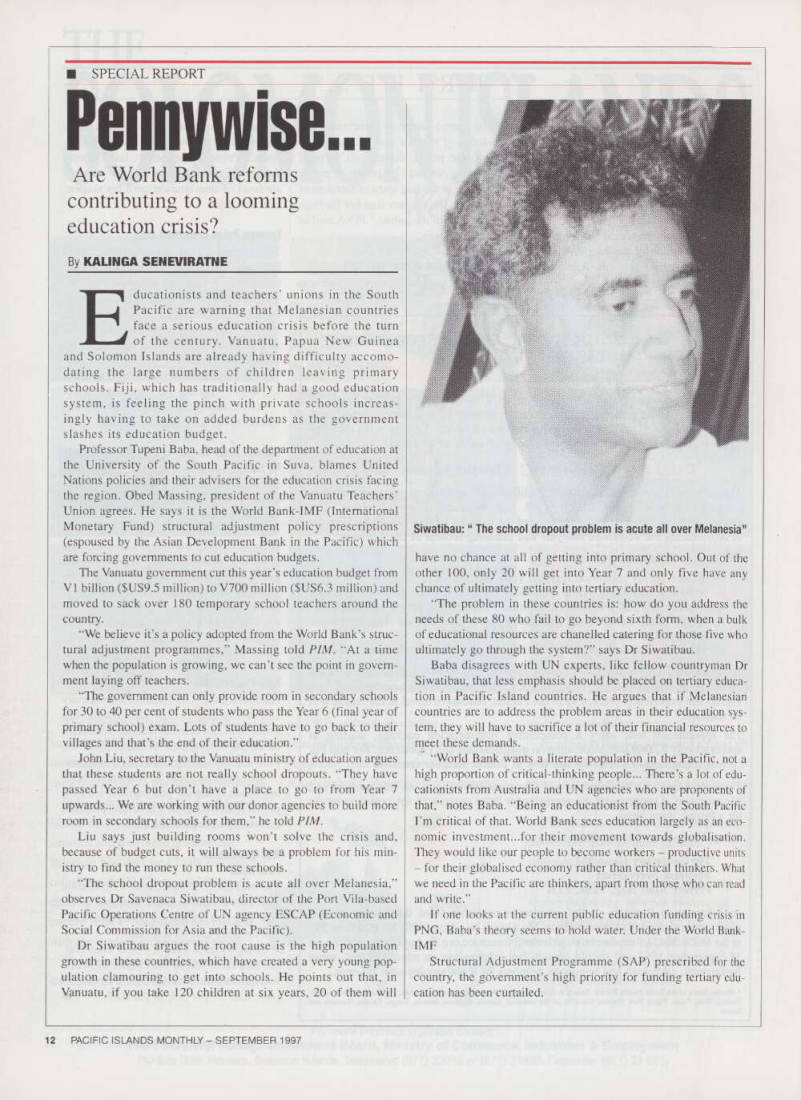
Siwatibau: “The school dropout problem is acute all over Melanesia”
Last year, for the first time, the government asked students to contribute 10 per cent of the cost of their university education. It was to have increased by 10 per cent each year until the govern ment started recovering 100 per cent of university fees. But vio lent demonstrations by students at the University of PNG last year forced the government to withhold the 10 per cent increase this year.
“The government first told us - the parents - that it would be good for the students because it would make them more serious and they would contribute towards their education,” Kevin Kepore, president of the UPNG students union said.
"We have now realised that our Kl 5 (SUS9.4O) a fortnight allowance has been abolished. Sometimes our book allowances are reduced and we have been pressured to pay an extra 10 per cent of our overall university fees. We never used to pay any fees before the user-pays policy was introduced,” he added.
"For most students at UPNG, about 80 to 85 per cent of their parents are subsistence fanners. So students are finding it hard to pay their fees,” said James Nala, a UPNG student from the Southern Highlands Province who has taken a year off from his studies to earn some money to fund his education. He now works for the PNG Unemployed Workers Association setting up training programmes for unemployed youth.
While tertairy education is now feeling the financial squeeze, the real problem area seems to be at high school level, where, like in Vanuatu, all eligible students could not be accomodated in pub lic schools. A 1996 study by AusAid found that only one per cent of age-eligible students enter Grade 11 and only 36 per cent of primary school leavers gain a place in secondary schools. Yet, in
1996, the national education budget was cut from KllO million Kina (SUSB4 million) to K 53 million (SUS4I million).
PNG was forced to accept a World Bank structural adjustment programme in 1995 when it faced a severe economic crisis.
Deveni Temu, a former school teacher-tumed-librarian told PIM these economic problems which have resulted in cutbacks on pub lic spending on education have put a heavy burden on parents who want to educate their children.
“The government abolished free education in the 19905... So, the school dropouts are not due to no incentive to study - but par ents have no money to pay for their children’s education,” he says.
Senior officials at PNG’s department of education are quick to admit that they face a severe funding crisis and there’s lack of space at high schools for a majority of the country’s children.
They say they have gone to foreign donor agencies to get money to build new classrooms and other facilities.
Pompirou Kujei, an assistant secretary for policy planning at the education department in Port Morseby says 1 that in 1993, in response to the school dropout problem, they had started a major reform programme. “We want every child to finish Grade 8, pre viously we could take kids to only Grade 6. Basic education is our priority.”
For Malia Tafili, youth development officer of the Noumea based South Pacific Commission, the problem with education in the Pacific is that teachers are not properly trained to function within their own cultures. She argues both the teaching methods used and the way schools are built have not taken into account the traditional cultural practices of islanders.
“Our people are not those who read. We are not brought up to read,” she explains. “We have to develop more our oral tradition as a way of communicating messages [teaching] - of course, not leaving aside the written [system].”
Tafili observes that much of education budgets is spent on buildings, when in most island countries there exist traditional meeting houses and many of the parish churches have large halls which can be used for schooling.
A UN Development Programme report into poverty in Fiji released in March noted that about 30 per cent of students left school by Class 8 (second year of secondary school) and, since most of them came from poor communities, poverty continued from one generation to the next.
Pratap Chand, general secretary of the Fiji Teachers Federation, agrees that Fiji is facing a similar situation to others in the South Pacific. "Twenty-five per cent of school-aged children drop out before they are 14 years old,” he notes. “As a result, child labour is becoming very noticable.”
Chand says the government has cut the education budget in recent years from 20 per cent to 17 per cent of the total budget and the private education system is now taking the major share of the education burden in Fiji.
This is a story which is common in all Melanesian countries as the governments are forced to cut spending on public educa tion, it is the private sector, especially the churches, which are increasingly taking on the burden of educating the young. But as Salvation Army’s educational services officer in Port Morseby, Louisa Timmer, points out, their services are also dependent on government subsidies. ■
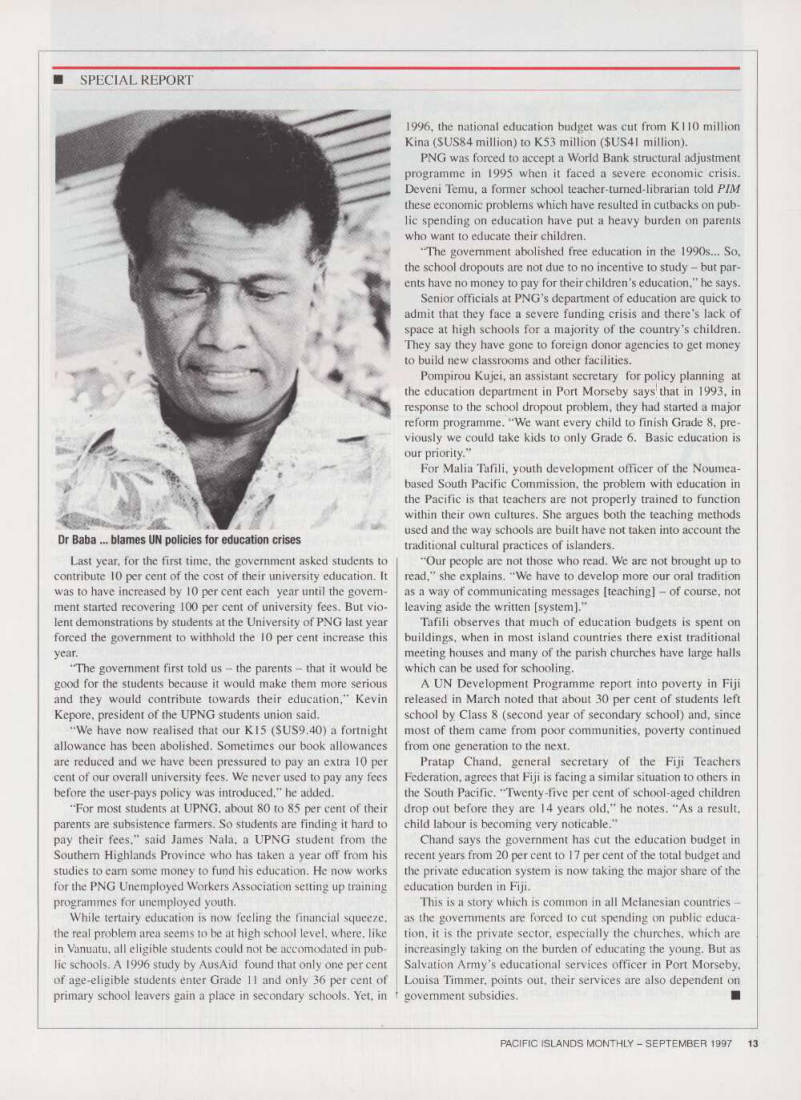
Dr Baba...blames UN policies for education crises
Mining giant spreads benefits
By Kalinga Seneviratne
After successfully negotiating an out-of-court compensation settlement with landowners along the 1200 km Fly River for environmen tal damage caused by the OK Tedi gold and copper mine, the Australian multinational mining company BHP is keen to show the world that a rich mining company does care about the long-term survival of communities affected by its activities.
BHP’s local subsidiary OK Tedi Mining Ltd (OTML) has set up the OK Tedi Development Trust (OTDT) and allocated over K 4 million (SUS 3 million) a year to help build local infrastructure and introduce sustainable development projects among the com munities in one of the remotest and least developed areas in Pqpua New Guinea.
The mine, which makes an annual profit of over SUS3OO mil lion a year, has at least another 12-13-year operational period. If OTDT succeeds in leaving behind a sustainable development model for the communities, it would set a precedent for mining companies around the world.
“This could well be the single biggest community develop ment programme by any mining company anywhere,” Robin Ette, senior supervisor of OTDT told PIM.
BHP was rocked by a SA4-billion (SUS2.B-million) compen sation claim against them brought by Melbourne-based law firm Slater and Gordon in 1995 on behalf of 6000 village landowners for environmental damage caused by the OK Tedi mine. For more than a decade, a grey tide of mud from the mine spread from the banks of the OK Tedi river into food gardens, fishing grounds and villages, disrupting the age-old traditional lifestyle of the people.
After agitating for over four years, the local landowners finally allowed the law firm to take action in the Victorian supreme courts, as the BHP headquarters are situated in that state.
In May, the landowners and OTML signed a compensation agreement worth K4O million (SUS2B million) to be paid over the next 13 years, in return for dropping the court action. The mining company will also undertake a two-year dredging trial down stream. A special dredging vessel hired from Singapore was
expected to start operation in the area last month).
Company officials, however, are quick to point out that the development trust they have set up to help villagers in the area is not a result of the court action. OTDT was, in fact, set up in 1990 with an initial budget of K 2.5 million (SUSI.S6 million) and has since spent over K2O million (SUSI2.S million) on development projects in over 100 villages scattered in an area of 76,000 sqkm, most of which is covered in pristine rainforest and inaccessible terrain.
“The development trust is not designed in any shape or form to be part of a compensation package,” says Ette. “This is an initia tive of the company to split the benefits of the company outside the mine lease area alongside the river.”
In the first six years of its operations, the OTDT has placed emphasis on projects increasing access to drinking water, health care and education, and on building community meeting places.
Now they are moving to introducing sustainable industries such as rubber plantations and rabbit farming into the communities.
This mining town of Tabubil, with a population of 4000, is some 2000 metres above sea level and has the world’s second highest rainfall. Set in the middle of solid jungle, the OK Tedi mine has produced a number of spin-off businesses. In addition to supermarkets, shops, a hospital and schools, there is a hotel and engineering businesses which are joint ventures between the min ing company and landowners. Before the mine operations began in 1984, the 25,000 or so people in this province had lifestyles which remained unchanged for centuries.
Now that many of them have been introduced to the 20th cen tury, company officials say they are keen to ensure the people have enough turnover from business activities by the time the mine closes in 2010, to continue their new lifestyles.
The mining company is funding a local branch of CODE (College of Distance Education and University Centre) to the tune of K 400,000 ($U5250,000) a year to train locals from the "pre ferred areas” (areas affected by mining activities) in technical skills and for university entrance.
“It’s a government responsibility, but we’re doing it because the government doesn’t have money,” lan Wild, training manag er of OTML told PIM. Last year, there were 1000 applicants for
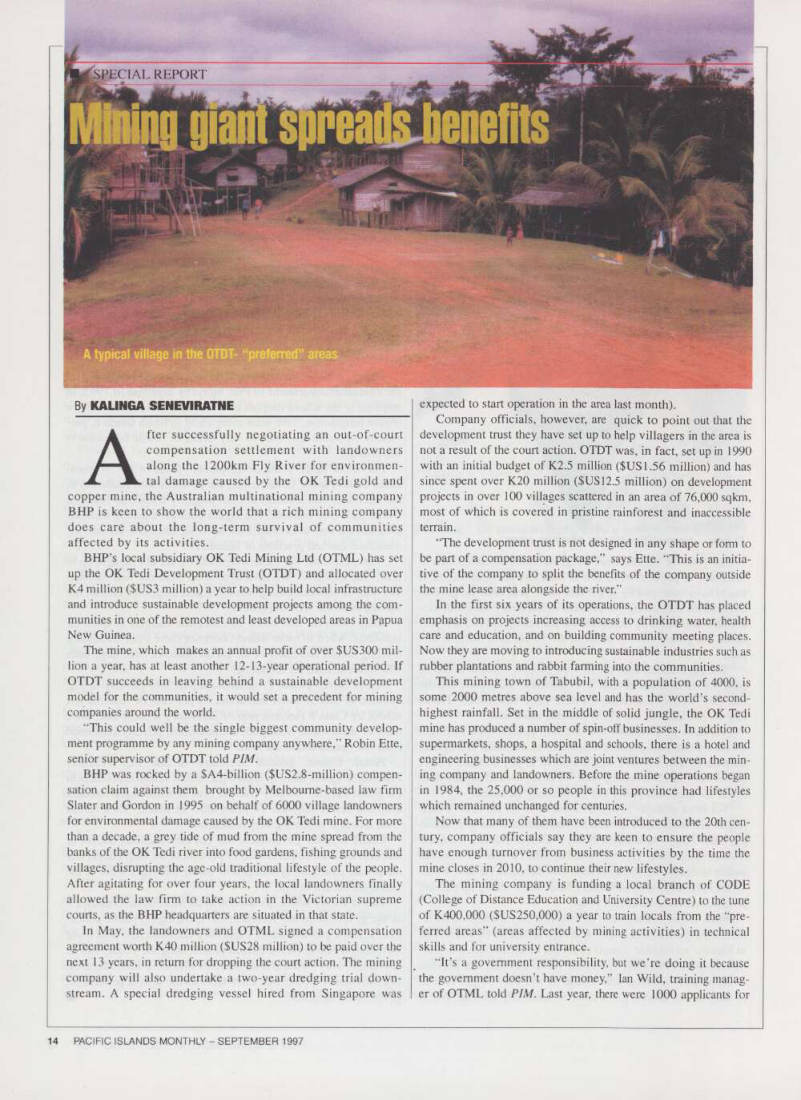
A typical village in the OTDT-“preferred” areas
40 first-year apprenticeships offered here. Wild says the increase is due to more locals now having completed Grade 10.
“Earlier, locals couldn’t qualify because schools started only recently here.”
OTML officials, however, are aware that training locals in such technical fields may not help the communities in the long run because once the mining operations are over, there will be limited technical jobs available. Thus, they are looking at intro ducing more sustainable industries to the area.
“We’re trying to establish rubber plantations to provide people with cash incomes,” explains Ette. “It is not overnight invest ment, but takes five to eight years to develop a resource that can be harvested later.”
Rubber was first planted in the province in the 19605, but because of the prohibitive costs of transporting rubber to Port Morseby, the industry never took off. In 1994, OTDT teamed up with a private company North Fly Rubber Pty Ltd in a joint-ven ture project to set up a rubber-processing factory in Kuinga, a township about 150 km south of Tabubil. There is a regular ship ping service down the Fly River from Kuinga.
The company now employs over 20 locals and shipped 1700 tonnes of rubber last year. The factory buys the rubber from local growers. In the Kuinga district alone there are 860 growers plant ing 898 hectares of rubber. “The local customs and the way they live blends very well with rubber production,” says 800 Kui Chew, the Malaysian-trained managing director of North Fly Rubber company. Chew says the company is financially stable and has been able to give growers a steady price even though the world market price for rubber fluctuates all the time. Since there is no local market for rubber in PNG, all their produce is export ed to Italy, Germany and Australia.
“Now we are into sustaining the industry and encouraging planting of new trees,” he says. “If we don’t do replanting pro grammes, in 10 years’ time, we’ll have to close the factory.”
OTDT is chipping in to help villages set up nurseries by bring ing in seeds from outside. “Anybody who clears the land and has a ground nursery established, can get seeds from us,” says David Wissink, agricultural superintendent of OTML. "In Kuinga area there 11,000 farmers right now wanting rubber to plant.”
Wissink is also introducing rabbit farming to the communities.
He is certain such an industry will be sustainable beyond the life of the mine and not have any adverse environmental impact.
"They will be fanned domestically,” he says. "These rabbits don't rely on outside feeds. They can eat sweet potato, banana, beetle leaves - all grown locally.” Wissink’s office provides rabbits to the villagers at K 5 (SUS3.IO) each in batches of four - one male and three females. He says only nine months into the project, there’s a high degree of interest in the scheme already.
Recent changes to PNG’s tax system has given OTDT added incentive. Mining companies providing infrastructure develop ment to remote communities can claim up to two per cent of their taxable income in tax credits. Depending on world copper and gold prices, OTDT will have access to an extra K5-I0 million (SUS3.I-6.3 million) a year to spend on the communities under this scheme from this year. "This year, the trust budget is K 3.5 million (SUS2.I9 million) and all of a sudden we’ll get another K 5 million. It's an enormous boost to our work,” observes Ette.
He says they have plans to build a high school and a hospital in
Kuinga and other health and educational facilities along the Fly River further to the south.
“We see ourselves as providing infrastructure development which governments don’t have funds to do. We leave the govern ment to fund health and educational services,” says Ette. The court action by villagers against OK Tedi has obviously made the locals aware about their rights, especially when environmental damage is concerned. OTML officials also seem to be very sensi tive to this and have appointed a number of community liaison officials, who are PNG nationals, in an attempt to build bridges with the community. Willie Uho, who is a councillor in the vil lage of Gii near Kuinga, is one who seems to know how to get things done in this new environment. He has lived in this com munity for 20 years “because the government moved us here to make use of the infrastructure”. He told PIM he would like a road constructed to his village of Ningerun and a school built there, so they could go back to their own land and develop them into rub ber plantations. “For 27 years, no government official went to our village,” he says. “Now, as councillor, I have gone to my village, taught them about rubber. They are now clearing the forests and planting rubber seeds.”
“OK Tedi sees only the river area, but we see the whole main land... We need roads going, schools. This is the infrastructure we expect when the time comes for OK Tedi to leave,” says Uho.
With a history of conflict and suspicion behind them, environ mentalists in Port Morseby are somewhat sceptical of the mining company’s claims to have the long-term prosperity of the local communities at heart, while they make multi-million-dollar prof its out of the mineral resources in the area. But many of them wel come OTDT’s focus on sustainable development schemes. Powes Parkop, the director of the Individual and Community Rights Advocacy Forum who has been an outspoken critic of the activi ties of foreign mining companies in PNG agrees that OTDT may well be creating a good model for other mining companies to fol low. Parkop, who is a lawyer, was involved in the villagers’ action against OK Tedi and has since set his sights on the Porgera mine up in the highlands of PNG. He says there is a similar environ mental problem there affecting a major river system.
"In our dealings with the mining company, we have found they are more willing to negotiate because of the OK Tedi expe rience. They are more willing to deal with social and environ mental problems.” observed Parkop. Greg Anderson, executive director of the PNG Chamber of Mines and Petroleum, does not agree that court action against OK Tedi was instrumental in changing the attitudes of mining companies in PNG towards the local communities, but acknowledges that OTDT may well be setting a model for others to follow. ■’There’s starting to be a realisation that you have to look at the project impact area and try to provide some benefits to all those people,” he told PIM. Though Anderson believes the government must provide those services from the taxes the mining companies pay, this is not happening. He observes there are big disparaties between communities in the immediate vicinity and those on the
periphery.
”We've had problems with the projects because immediate landowners have enormous benefits and the concentric rings of people have nothing or get very little,” he says and agrees that what OTDT is doing ”is a method of dealing with this”. ■
A time of change

Cover Stories
As Fiji pats itself on the back over the new constitution, it must also realise that the real test is still to come
By Bernadette Hussein
They say time heals all wounds, especially as Fiji adopts a new constitution seen by many as one serv ing the interests of the nation rather than any one racial group. But it remains to be seen whether the pass ing of the new constitution will bring to an end the political crises, racial divisions, ailing economy, high unem ployment and increasing crime rates which have become the sad reality in this island country. Fiji’s political leaders seem confident it will. But it has been pointed out that the constitution itself is only the means to this end. And while Prime Miniter Sitiveni Rabuka admits that decisions are often made along racial lines, he believes there will come a time when there will be more national unity among the peoples of Fiji.
"The constitution will force us to work together whether we like it or not because we are there together,” PM Rabuka said.
The sentiment is echoed by Josevata Kamikamica, the leader of the Fijian Association Party. “In politics there has always been a racial divide but this consti tution will help move away from that, and this is a healthy development in terms of a democratically elected government.”
He added that people would have to work together to achive national unity.
"The constitution itself will not provide that. It will be based on the willingness of people to see their future together and work together for the future of the coun try.” Opposition and National Federation Party leader Jai Ram Reddy feels the same.
He says that the structure of the 1997 con stitution is cooperation with the concept of powersharing at heart.
"I think it will take a lot of the rivalry out of the political system. Under the 1970 constitution, it was essentially rivalry for
political office between the indigenous community through their political parties
and the Indo-Fijian community through
their political party. I believe that a lot of tensions will go out of the political sys tem.”
A multiparty cabinet The FAP recently merged with Rabuka’s ruling Soqosoqo ni Vakavulewa ni Taukei party and have two members in the new cabinet announced early last month. However, the SVT/FAP merger was itself based on race. In July, Rabuka had invited the NFP to form a multiparty and multiracial - cabinet, as provided for in the 1997 constitution. The offer was declined by Reddy, who has preferred to remain in opposition until the next general elections in 1999. “He is very noble and mature enough to realise that he can make constructive contributions to issues of national importance from either side of the house,” the PM said of Reddy at the time, agreeing to defer the multiparty concept.
But it was only a few weeks later that the PM made similar overtures towards the FAP. This time the offer was accepted. The SVT and FAP have had something of a his tory of always nearly merging since their split in 1993; the latter was formed by SVT breakaway members. (The SVT is also in a coalition with the General Voters Party which is made up of general voters or, racially speaking, mainly those of European and Fijian descent.) The common ground for the SVT/FAP merger seems to have been Fijian interests.
At the time of the offer, Rabuka had stated the SVT's aim to be the unity of the Fijian people. "If there is a merger with the FA, then it will show the nation that we have at least tried before we go for national unity,” he said. Ironically, the SVT had only recently proclaimed it was turning multira cial by opening membership to all races.
Reddy said the reason he had turned down the multiparty cabinet offer was because they were not ready for the merg
er at the time. On claims that NFP’s merg er would weaken the voice of opposition Reddy said: “Opposition in Fiji since 1970 has meant the Indians. They have provided the opposition and the government has meant the indigenous Fijians with their partners.
"We need to move away from that. My own feeling is that when you talk govern ment and opposition, you are really trans lating a system which is meant for a more homogeneous society. I think that the con cept of opposition is completely overrated.
But we need more than opposition - the cooperation between the two communities and one that should not overlook that dimension of multiethnic politics. But it would be wrong to think that opposition will not exist. 1 believe there will be party or parties who will not want to be govern ment.”
Electoral arrangements Mahendra Chaudhry, parliamentary leader of the Fiji Labour Party (the ruling party before the 1987 coups), while acknowledging that the constitution is a major breakthrough in Fijian politics, has also admitted his reservations about the document. The constitution was certainly a long-awaited development, Chaudhry said. "It has now been passed and, to a large extent, the grievances of the people against the 1990 constitution have been satisfied. The new constitution has a lot of provisions which were not in the 1970 and the 1990 constitutions and will provide good governance. It has a very compre hensive section on the Bill of Rights and the public service. So, from that view, I would say that we have good document with most of the recommendations by the Constitution Review Commission being approved.”
But the issue of race comes into play again. Of concern to the Labour leader are the electoral arrangements, which, he said, were contrary to the Constitution Review Commission’s recommendations.
"Commission head Sir Paul Reeves emphasised the need for us to move away from the very decisive communal politics, and I'm afraid that has not happened.
"Under the new arrangement, the enact ing of parliament is largely on a communal basis. Two-thirds of parliament will be elected along communal lines.
"In respect of the open seats, Sir Paul had recommended that there be multi-
member constituencies. Here again what we can see is that that has been converted from multi-member constituencies to sin gle-member constituencies; so they are really communal seats in disguise.” And Chaudhry blames Rabuka and Reddy for
letting this through. The JPSC committee was made up largely of SVT and NFP members, with the Labour Party having only two members. The thinking was dom inant that they keep the segregation, which is that SVT remain a Fijian party and NFP
an Indian party. I think this arrangement suits these people fine. They want the sta tus which protects their interest.”
And, Chaudhry said, in this process, the Indian community was cheated of a seat.
“Whatever the arrangement was, at the end of the day, it was agreed that commu nal seats would be shared on the basis of coagulation of the respective communities and, on that basis, the Indians were enti tled to 20 seats, Fijians 23 seats, and the general voters and Rotumans one seat each.
“But what has happened is that the Indian seat was traded off ...[and] it went to the general electors.”
During parliamentary debate on the Constitution Amendment Bill, Chaudhry was shouted down and I pretty much ostracised when he moved that Indian seats be increased from 19 to 20, which is the number of seats he said Indians were proportionately entitled to. When put to the vote, the amendment was defeated and, interestingly, among those voting against were two Labour parliamentarians. “The
Members of the Joint Parliamentary Select Committee with President Ratu Mara (middle)
fact remains that the Indians were cheated
of their rightful representation,” Chaudhry
maintains. But Reddy feels that there is nothing wrong with the electoral system.
On claims that the JPSC went totally against the commission on this, Reddy said; “All we did was to take their 25 reserved seats and turn them into open seats and took the 45 propsed seats and turned them into communal seats. What must be remembered is these compromises were reached in a political environment in which we were working. The communal seats guarantee representation and they are not arbitrary, they are based on fairness and on proportionality.”
Indigenous rights
Extremist Fijians, who carried much clout in Fiji’s coup era, have been strange ly silent since the passage of the new con stitution. There was a protest march by extremists and a burning of the JPSC report while the bill was before parliament. The only other incident of note occurred after the Constitution Amendment Bill was passed by the senate, when Fijian national ist Sakeasi Butadroka reportedly verbally abused the attorney-general, Etuate Tavai, outside parliament. No charges were pressed and the incident was soon forgot ten. The extremist view was that the new constitution had gone against all that the two military coups of 1987 had stood for.
They saw the 1997 constitution take away the Fijian dominance provided for in the 1990 constitution. However, Kamikamica is quick to say that this is a completely wrong interpretation of the constitution. “I think the interpretation arises out of the assumption that Fijians should be given the numbers, the power and all the things they
want. But the world does not operate that way. You have to work and compete with others to get what you want. That is the reality of the situation and you advance because of your hard work and skills. "The extremists force that line. They, I believe, are suppressing indigenous initiatives to excel and to succeed. I think the Fijians need to rethink their strategy. We need to free the Fijians to compete.”
This view was also shared by Rabuka who said objectives of the coups were achieved because the position of Fijian leadership had been secured in the sense that the pinnacle leadership of Fiji - the president - would be appointed by the Great Council of Chiefs, the highest assem bly in the land. (The new constitution, how ever, allows for an Indian PM, which is a major step from the 1990 constitution.) The new constitution has found much favour with the international community, putting Fiji on the path back into the Commonwealth. Fiji has been invited to the Commonwealth Heads of Government meeting in Edingburgh next month. But while the country’s political leaders gener ally accept that the new constitution is a step in the right direction, they are also very conscious that there is much hard work that still needs to be done.
As Kamikamica said: “All these years, our political development has been based on racial stance, and it is a major challenge for us to move away from it and focus on issues that affect the lives of people and their development as one group rather than two separate groups.”
Only time will tell how much headway Fiji has made with its new constitution and whether it has indeed healed all wounds. ■
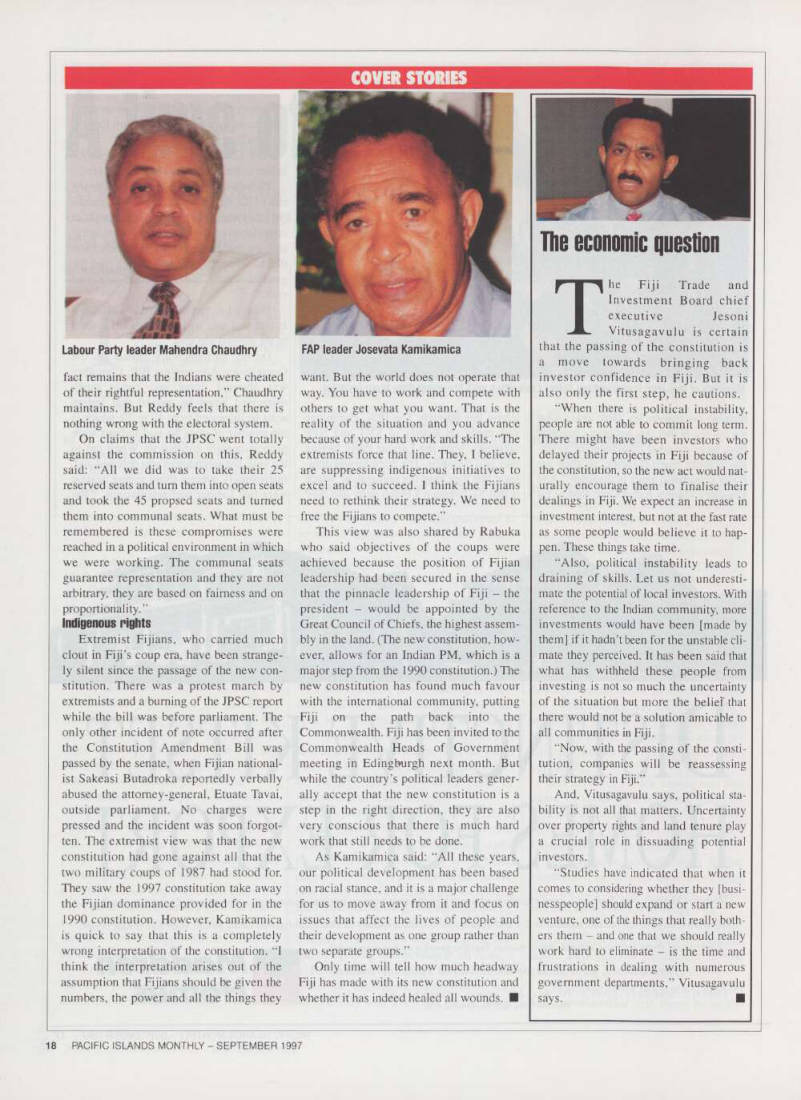
Labour Party leader Mahendra Chaudhry
FAR leader Josevata Kamikamica
Advertisements & other items, p. 17 (1 item)
Distinctive kitset
HOMES FOR EXPORT
Maddren Homes, New Zealand's most experienced exporters of kitset homes, has just announced a new range of superior dwellings.
Available in a variety of architectural styles and appointments, these homes can be reconfigured easily to suit your individual needs.
Apart from their aesthetic appeal, these homes feature proven cyclone resistant construction methods as well as durable termite resistant timbers.
CONTACT MADDREN HOMES: PO Box 244. Kumeu. Auckland. New Zealand.
Phone: 64-9-412 9070. fax: 64-9-412 7251
Maddren
Homes
The economic question
The Fiji Trade and Investment Board chief executive Jesoni Vitusagavulu is certain that the passing of the constitution is a move towards bringing back investor confidence in Fiji. But it is also only the first step, he cautions.
"When there is political instability, people are not able to commit long term.
There might have been investors who delayed their projects in Fiji because of the constitution, so the new act would nat urally encourage them to finalise their dealings in Fiji. We expect an increase in investment interest, but not at the fast rate as some people would believe it to hap pen. These things take time.
“Also, political instability leads to draining of skills. Let us not underesti mate the potential of local investors. With reference to the Indian community, more investments would have been [made by them] if it hadn’t been for the unstable cli mate they perceived. It has been said that what has withheld these people from investing is not so much the uncertainty of the situation but more the belief that there would not be a solution amicable to all communities in Fiji.
"Now, with the passing of the consti tution, companies will be reassessing their strategy in Fiji.”
And, Vitusagavulu says, political sta bility is not all that matters. Uncertainty over property rights and land tenure play a crucial role in dissuading potential investors.
“Studies have indicated that when it comes to considering whether they [busi nesspeople] should expand or start a new venture, one of the things that really both ers them - and one that we should really work hard to eliminate - is the time and frustrations in dealing with numerous government departments,” Vitusagavulu says. ■
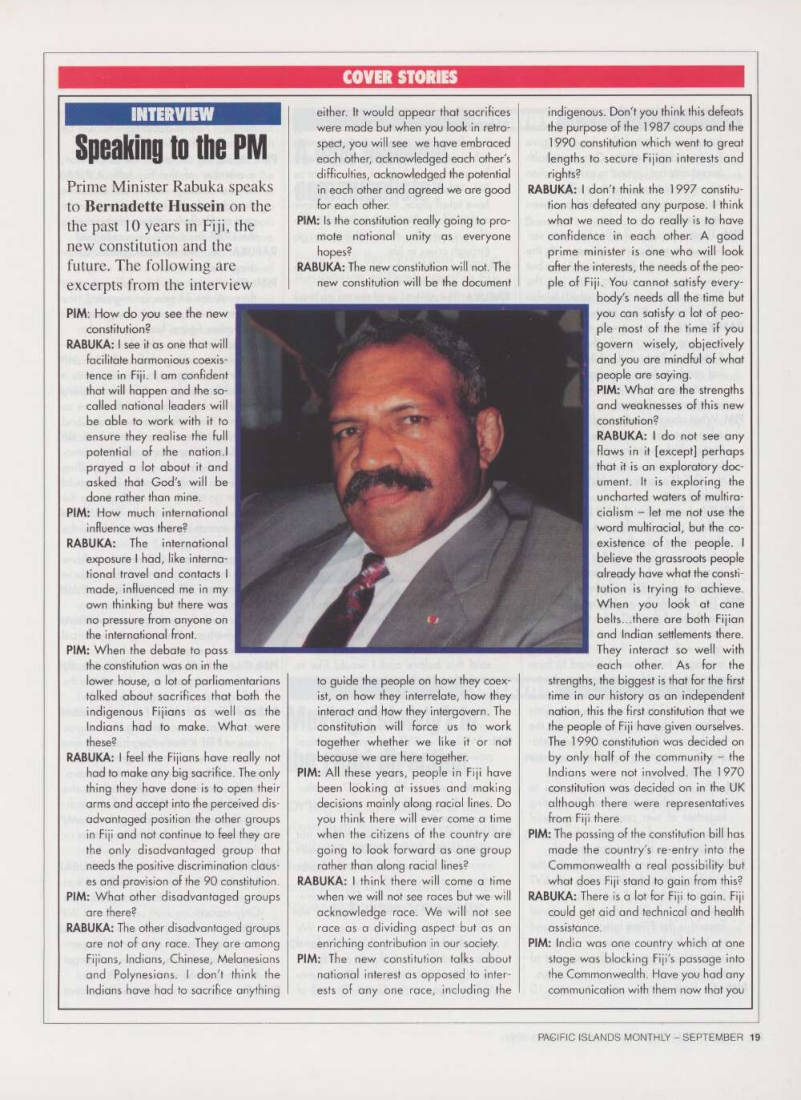
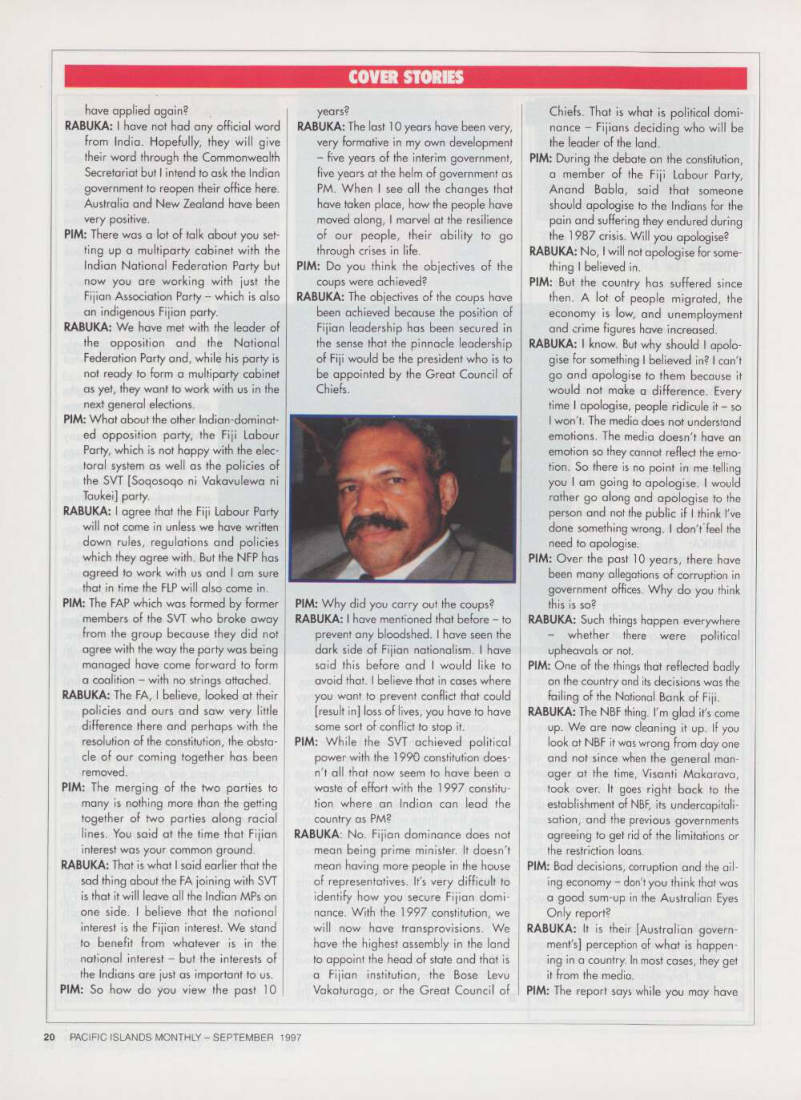
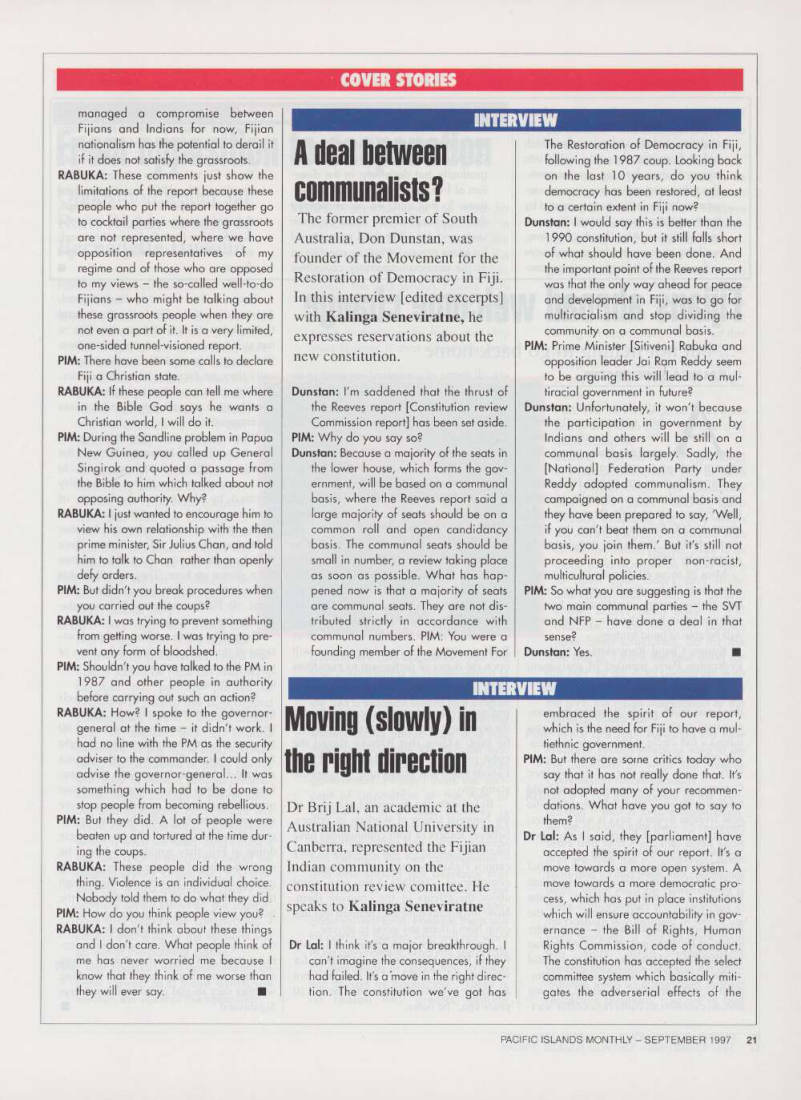
Speaking to the PM
Interview
Prime Minister Rabuka speaks to Bernadette Hussein on the the past 10 years in Fiji, the new constitution and the future. The following are excerpts from the interview
PIM: How do you see the new constitution?
RABUKA: I see it as one that will facilitate harmonious coexis tence in Fiji. I am confident that will happen and the so called national leaders will be able to work with it to ensure they realise the full
potential of the nation.l
prayed a lot about it and asked that God's will be done rather than mine.
PIM: How much international influence was there?
RABUKA: The international exposure I had, like interna tional travel and contacts I made, influenced me in my own thinking but there was no pressure from anyone on the international front.
PIM; When the debate to pass the constitution was on in the
lower house, a lot of parliamentarians talked about sacrifices that both the indigenous Fijians as well as the Indians had to make. What were these?
RABUKA: I feel the Fijians have really not had to make any big sacrifice. The only thing they have done Is to open their arms and accept Into the perceived dis advantaged position the other groups In Fiji and not continue to feel they are the only disadvantaged group that needs the positive discrimination claus es and provision of the 90 constitution.
PIM: What other disadvantaged groups are there?
RABUKA: The other disadvantaged groups are not of any race. They are among Fijians, Indians, Chinese, Melanesians and Polynesians. I don't think the Indians have had to sacrifice anything
either. It would appear that sacrifices were made but when you look in retro spect, you will see we have embraced each other, acknowledged each other's difficulties, acknowledged the potential in each other and agreed we are good for each other.
PIM: Is the constitution really going to pro mote national unity as everyone hopes?
RABUKA: The new constitution will not. The new constitution will be the document
to guide the people on how they coex ist, on how they interrelate, how they interact and how they intergovern. The constitution will force us to work together whether we like it or not because we are here together.
PIM: All these years, people in Fiji have been looking at issues and making decisions mainly along racial lines. Do you think there will ever come a time when the citizens of the country are going to look forward as one group rather than along racial lines?
RABUKA: I think there will come a time when we will not see races but we will acknowledge race. We will not see race as a dividing aspect but as an enriching contribution in our society.
PIM: The new constitution talks about national interest as opposed to inter ests of any one race, including the
indigenous. Don't you think this defeats the purpose of the 1 987 coups and the 1990 constitution which went to great lengths to secure Fijian interests and rights?
RABUKA: I don't think the 1997 constitu tion has defeated any purpose. I think what we need to do really is to have confidence in each other. A good prime minister is one who will look after the interests, the needs of the peo ple of Fiji. You cannot satisfy every
body's needs all the time but you can satisfy a lot of peo ple most of the time if you govern wisely, objectively and you are mindful of what people are saying.
PIM: What are the strengths and weaknesses of this new constitution?
RABUKA: I do not see any flaws in it [except] perhaps that it is an exploratory doc ument. It is exploring the uncharted waters of multira cialism - let me not use the word multiracial, but the co existence of the people. I believe the grassroots people already have what the consti tution is trying to achieve.
When you look at cane belts...there are both Fijian and Indian settlements there.
They interact so well with each other. As for the
strengths, the biggest is that for the first time in our history as an independent nation, this the first constitution that we the people of Fiji have given ourselves.
The 1 990 constitution was decided on by only half of the community - the Indians were not involved. The 1970 constitution was decided on in the UK although there were representatives from Fiji there.
PIM: The passing of the constitution bill has made the country's re-entry into the Commonwealth a real possibility but what does Fiji stand to gain from this?
RABUKA: There is a lot for Fiji to gain. Fiji could get aid and technical and health assistance.
PIM: India was one country which at one stage was blocking Fiji's passage into the Commonwealth. Have you had any communication with them now that you
have applied again?
RABUKA: I have not had any official word from India. Hopefully, they will give their word through the Commonwealth Secretariat but I intend to ask the Indian government to reopen their office here.
Australia and New Zealand have been very positive.
PIM: There was a lot of talk about you set ting up a multiparty cabinet with the Indian National Federation Party but now you are working with just the Fijian Association Party - which is also an indigenous Fijian party.
RABUKA: We have met with the leader of the opposition and the National Federation Party and, while his party is not ready to form a multiparty cabinet as yet, they want to work with us in the next general elections.
PIM: What about the other Indian-dominat ed opposition party, the Fiji Labour Party, which is not happy with the elec toral system as well as the policies of the SVT [Soqosoqo ni Vakavulewa ni Taukei] party.
RABUKA: I agree that the Fiji Labour Party will not come in unless we have written down rules, regulations and policies which they agree with. But the NFP has agreed to work with us and I am sure that in time the FLP will also come in.
PIM: The FAP which was formed by former members of the SVT who broke away from the group because they did not agree with the way the party was being managed have come forward to form a coalition - with no strings attached.
RABUKA: The FA, I believe, looked at their policies and ours and saw very little difference there and perhaps with the resolution of the constitution, the obsta cle of our coming together has been removed.
PIM: The merging of the two parties to many is nothing more than the getting together of two parties along racial lines. You said at the time that Fijian interest was your common ground.
RABUKA: That is what I said earlier that the sad thing about the FA joining with SVT is that it will leave all the Indian MPs on one side. I believe that the national interest is the Fijian interest. We stand to benefit from whatever is in the national interest - but the interests of the Indians are just as important to us.
PIM: So how do you view the past 10
years?
RABUKA: The last 10 years have been very, very formative in my own development - five years of the interim government, five years at the helm of government as PM. When I see all the changes that have taken place, how the people have moved along, I marvel at the resilience of our people, their ability to go through crises in life.
PIM: Do you think the objectives of the coups were achieved?
RABUKA: The objectives of the coups have been achieved because the position of Fijian leadership has been secured in the sense that the pinnacle leadership of Fiji would be the president who is to be appointed by the Great Council of Chiefs.
PIM: Why did you carry out the coups?
RABUKA: I have mentioned that before - to prevent any bloodshed. I have seen the dark side of Fijian nationalism. I have said this before and I would like to avoid that. I believe that in cases where you want to prevent conflict that could [result in] loss of lives, you have to have some sort of conflict to stop it.
PIM: While the SVT achieved political power with the 1 990 constitution does n't all that now seem to have been a waste of effort with the 1 997 constitu tion where an Indian can lead the country as PM?
RABUKA: No, F ijian dominance does not mean being prime minister. It doesn't mean having more people in the house of representatives. It's very difficult to identify how you secure Fijian domi nance. With the 1997 constitution, we will now have transprovisions. We have the highest assembly in the land to appoint the head of state and that is a Fijian institution, the Bose Levu Vakaturaga, or the Great Council of
Chiefs. That is what is political domi nance - Fijians deciding who will be the leader of the land.
PIM: During the debate on the constitution, a member of the Fiji Labour Party, Anand Babla, said that someone should apologise to the Indians for the pain and suffering they endured during the 1 987 crisis. Will you apologise?
RABUKA: No, I will not apologise for some thing I believed In.
PIM: But the country has suffered since then. A lot of people migrated, the economy is low, and unemployment and crime figures have increased.
RABUKA: I know. But why should I apolo gise for something I believed in? I can't go and apologise to them because it would not make a difference. Every time I apologise, people ridicule it - so I won't. The media does not understand emotions. The media doesn't have an emotion so they cannot reflect the emo tion. So there is no point in me telling you I am going to apologise. I would rather go along and apologise to the person and not the public if I think I've done something wrong. I don't’feel the need to apologise.
PIM; Over the past 10 years, there have been many allegations of corruption in government offices. Why do you think this is so?
RABUKA: Such things happen everywhere - whether there were political upheavals or not.
PIM: One of the things that reflected badly on the country and its decisions was the failing of the National Bank of Fiji.
RABUKA: The NBF thing. I'm glad it 's come up. We are now cleaning it up. If you look at NBF it was wrong from day one and not since when the general man ager at the time, Visanti Makarova, took over. It goes right back to the establishment of NBF, its undercapitali sation, and the previous governments agreeing to get rid of the limitations or the restriction loans.
PIM: Bad decisions, corruption and the ail ing economy - don't you think that was a good sum-up in the Australian Eyes Only report?
RABUKA; It is their [Australian govern ment's] perception of what is happen ing in a country. In most cases, they get It from the media.
PIM: The report says while you may have
managed a compromise between Fijians and Indians for now, Fijian nationalism has the potential to derail it if it does not satisfy the grassroots.
RABUKA: These comments just show the limitations of the report because these people who put the report together go to cocktail parties where the grassroots are not represented, where we have opposition representatives of my regime and of those who are opposed to my views - the so-called well-to-do Fijians - who might be talking about these grassroots people when they are not even a part of it. It is a very limited, one-sided tunnel-visioned report.
PIM: There have been some calls to declare Fiji a Christian state.
RABUKA: If these people can tell me where in the Bible God says he wants a Christian world, I wi II do it.
PIM: During the Sandl ine problem in Papua New Guinea, you called up General Singirok and quoted a passage from the Bible to him which talked about not opposing authority. Why?
RABUKA: I just wanted to encourage him to view his own relationship with the then prime minister. Sir Julius Chan, and told him to talk to Chan rather than openly defy orders.
PIM: But didn't you break procedures when you carried out the coups?
RABUKA: I was trying to prevent something from getting worse. I was trying to pre vent any form of bloodshed.
PIM: Shouldn't you have talked to the PM in 1987 and other people in authority before carrying out such an action?
RABUKA: How? I spoke to the governor general at the time - it didn't work. I had no line with the PM as the security adviser to the commander. I could only advise the governor-general... It was something which had to be done to stop people from becoming rebellious.
PIM: But they did. A lot of people were beaten up and tortured at the time dur ing the coups.
RABUKA: These people did the wrong thing. Violence is an individual choice.
Nobody told them to do what they did.
PIM: How do you think people view you?
RABUKA: I don't think about these things and I don't care. What people think of me has never worried me because I know that they think of me worse than they will ever say. ■
A deal between
Interview
A deal between communalists?
The former premier of South Australia, Don Dunstan, was founder of the Movement for the Restoration of Democracy in Fiji.
In this interview [edited excerpts] with Kalinga Seneviratne, he expresses reservations about the new constitution.
Dunstan: I'm saddened that the thrust of the Reeves report [Constitution review Commission report] has been set aside.
PIM: Why do you say so?
Dunstan: Because a majority of the seats in the lower house, which forms the gov ernment, will be based on a communal basis, where the Reeves report said a large majority of seats should be on a common roll and open candidancy basis. The communal seats should be small In number, a review taking place as soon as possible. What has hap pened now is that a majority of seats are communal seats. They are not dis tributed strictly in accordance with communal numbers. PIM; You were a founding member of the Movement For
The Restoration of Democracy in Fiji, following the 1 987 coup. Looking back on the last 10 years, do you think democracy has been restored, at least to a certain extent in Fiji now?
Dunstan: I would say this is better than the 1 990 constitution, but it still falls short of what should have been done. And the important point of the Reeves report was that the only way ahead for peace and development in Fiji, was to go for multiracialism and stop dividing the community on a communal basis.
PIM: Prime Minister [Sitiveni] Rabuka and opposition leader Jai Ram Reddy seem to be arguing this will lead to a mul tiracial government in future?
Dunstan: Unfortunately, it won't because the participation in government by Indians and others will be still on a communal basis largely. Sadly, the [National] Federation Party under Reddy adopted communalism. They campaigned on a communal basis and they have been prepared to say, 'Well, if you can't beat them on a communal basis, you join them.' But it's still not proceeding into proper non-racist, multicultural policies.
PIM: So what you are suggesting is that the two main communal parties - the SVT and NFP - have done a deal in that sense?
Dunstan: Yes. ■
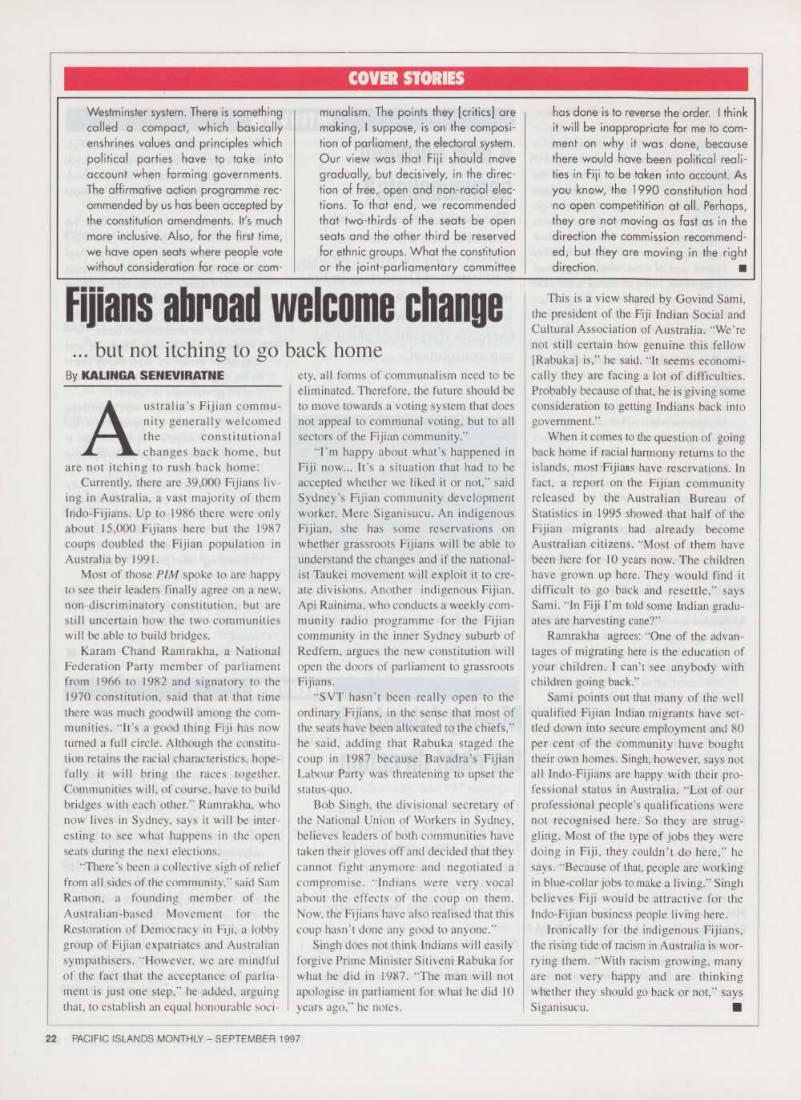
Moving (slowly) in
Interview
Moving (slowly) in the right direction
Dr Brij Lai, an academic at the Australian National University in Canberra, represented the Fijian Indian community on the constitution review comittee. He speaks to Kalinga Seneviratne Dr Lai: I think it's a major breakthrough. I can't imagine the consequences, if they had failed. It's a "move In the right direc tion, The constitution we've got has
embraced the spirit of our report, which is the need for Fiji to have a mul tiethnic government.
PIM: But there are some critics today who say that it has not really done that. It's not adopted many of your recommen dations. What have you got to say to them?
Dr Lai: As I said, they [parliament] have accepted the spirit of our report. It's a move towards a more open system. A move towards a more democratic pro cess, which has put in place institutions which will ensure accountability in gov ernance - the Bill of Rights, Human Rights Commission, code of conduct.
The constitution has accepted the select committee system which basically miti gates the adverserial effects of the
Westminster system. There is something called a compact, which basically enshrines values and principles which political parties have to take into account when forming governments.
The affirmative action programme rec ommended by us has been accepted by the constitution amendments. It's much more inclusive. Also, for the first time, we have open seats where people vote without consideration for race or com
munalism. The points they [critics] are making, I suppose, is on the composi tion of parliament, the electoral system.
Our view was that Fiji should move gradually, but decisively, in the direc tion of free, open and non-racial elec tions. To that end, we recommended that two-thirds of the seats be open seats and the other third be reserved for ethnic groups. What the constitution or the joint-parliamentary committee
has done is to reverse the order. I think it will be inappropriate for me to com ment on why it was done, because there would have been political reali ties in Fiji to be taken into account. As you know, the 1990 constitution had no open competitition at all. Perhaps, they are not moving as fast as in the direction the commission recommend ed, but they are moving In the right direction. ■
Fijians abroad welcome change
but not itching to go back home
By Kalinga Seneviratne
Australia’s Fijian commu nity generally welcomed the constitutional changes back home, but are not itching to rush back home; Currently, there are 39,000 Fijians liv ing in Australia, a vast majority of them Indo-Fijians. Up to 1986 there were only about 15,000 Fijians here but the 1987 coups doubled the Fijian population in Australia by 1991.
Most of those PIM spoke to are happy to see their leaders finally agree on a new, non-discriminatory constitution, but are still uncertain how the two communities will be able to build bridges.
Karam Chand Ramrakha, a National Federation Party member of parliament from 1966 to 1982 and signatory to the 1970 constitution, said that at that time there was much goodwill among the com munities. "It's a good thing Fiji has now turned a full circle. Although the constitu tion retains the racial characteristics, hope fully it will bring the races together.
Communities will, of course, have to build bridges with each other.” Ramrakha, who now lives in Sydney, says it will be inter esting to see what happens in the open seats during the next elections.
"There's been a collective sigh of relief from all sides of the community,” said Sam Ramon, a founding member of the Australian-based Movement for the Restoration of Democracy in Fiji, a lobby group of Fijian expatriates and Australian sympathisers. "However, we are mindful of the fact that the acceptance of parlia ment is just one step,” he added, arguing that, to establish an equal honourable soci
ety, all forms of communalism need to be eliminated. Therefore, the future should be to move towards a voting system that does not appeal to communal voting, but to all sectors of the Fijian community.”
"I’m happy about what’s happened in Fiji now... It's a situation that had to be accepted whether we liked it or not,” said
Sydney’s Fijian community development
worker, Mere Siganisucu. An indigenous Fijian, she has some reservations on whether grassroots Fijians will be able to understand the changes and if the national ist Taukei movement will exploit it to cre ate divisions. Another indigenous Fijian, Api Rainima, who conducts a weekly com munity radio programme for the Fijian community in the inner Sydney suburb of Redfem, argues the new constitution will open the doors of parliament to grassroots Fijians.
"SVT hasn’t been really open to the ordinary Fijians, in the sense that most of the seats have been allocated to the chiefs,” he said, adding that Rabuka staged the coup in 1987 because Bavadra’s Fijian Labour Party was threatening to upset the status-quo.
Bob Singh, the divisional secretary of the National Union of Workers in Sydney, believes leaders of both communities have taken their gloves off and decided that they cannot fight anymore and negotiated a compromise. "Indians were very vocal about the effects of the coup on them.
Now, the Fijians have also realised that this coup hasn't done any good to anyone.”
Singh does not think Indians will easily forgive Prime Minister Sitiveni Rabuka for what he did in 1987. "The man will not apologise in parliament for what he did 10 years ago,” he notes.
This is a view shared by Govind Sami, the president of the Fiji Indian Social and Cultural Association of Australia. '‘We’re not still certain how genuine this fellow [Rabuka] is,” he said. “It seems economi cally they are facing a lot pf difficulties.
Probably because of that, he is giving some consideration to getting Indians back into government.”
When it comes to the question of going back home if racial harmony returns to the islands, most Fijians have reservations. In fact, a report on the Fijian community released by the Australian Bureau of Statistics in 1995 showed that half of the Fijian migrants had already become Australian citizens. “Most of them have been here for 10 years now. The children have grown up here. They would find it difficult to go back and resettle,” says Sami. “In Fiji Fm told some Indian gradu ates are harvesting cane?”
Ramrakha agrees: "One of the advan tages of migrating here is the education of your children. I can’t see anybody with children going back.”
Sami points out that many of the well qualified Fijian Indian migrants have set tled down into secure employment and 80 per cent of the community have bought their own homes. Singh, however, says not all Indo-Fijians are happy with their pro fessional status in Australia. "Lot of our professional people's qualifications were not recognised here. So they are strug gling. Most of the type of jobs they were doing in Fiji, they couldn’t do here,” he says. "Because of that, people are working in blue-collar jobs to make a living.” Singh believes Fiji would be attractive for the
Indo-Fijian business people living here.
Ironically for the indigenous Fijians, the rising tide of racism in Australia is wor rying them. "With racism growing, many are not very happy and are thinking whether they should go back or not,” says Siganisucu. ■
From opposition to cooperation
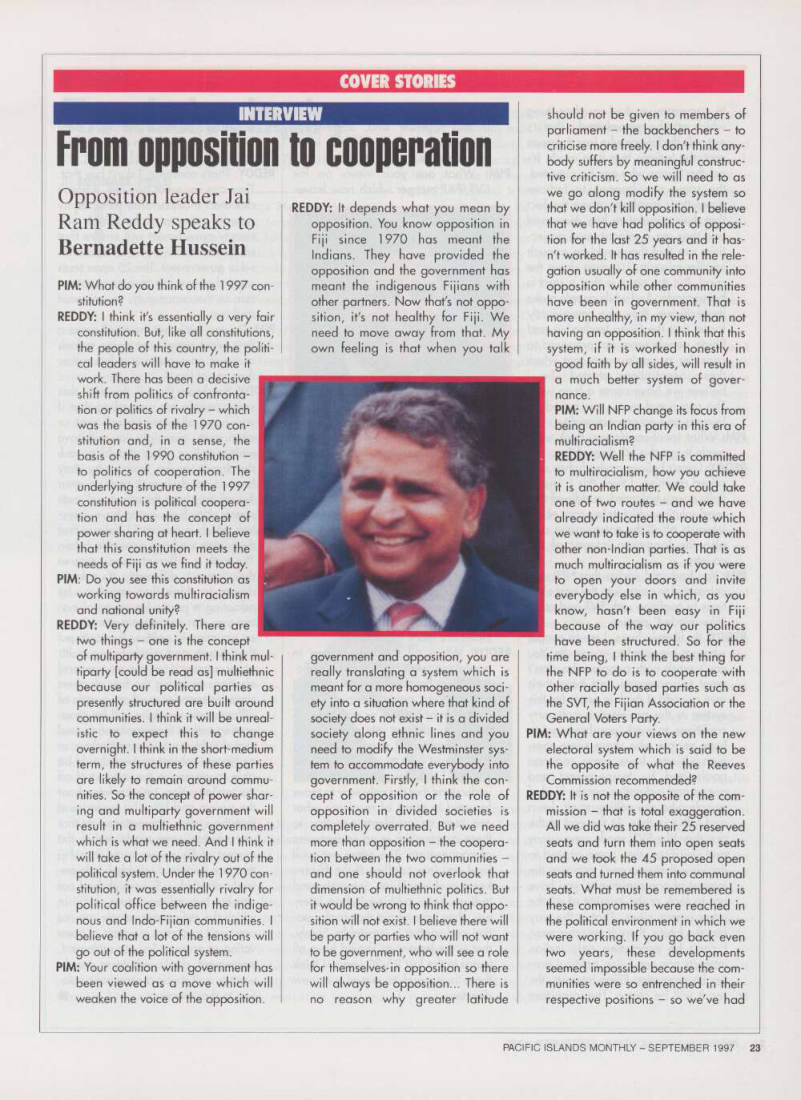
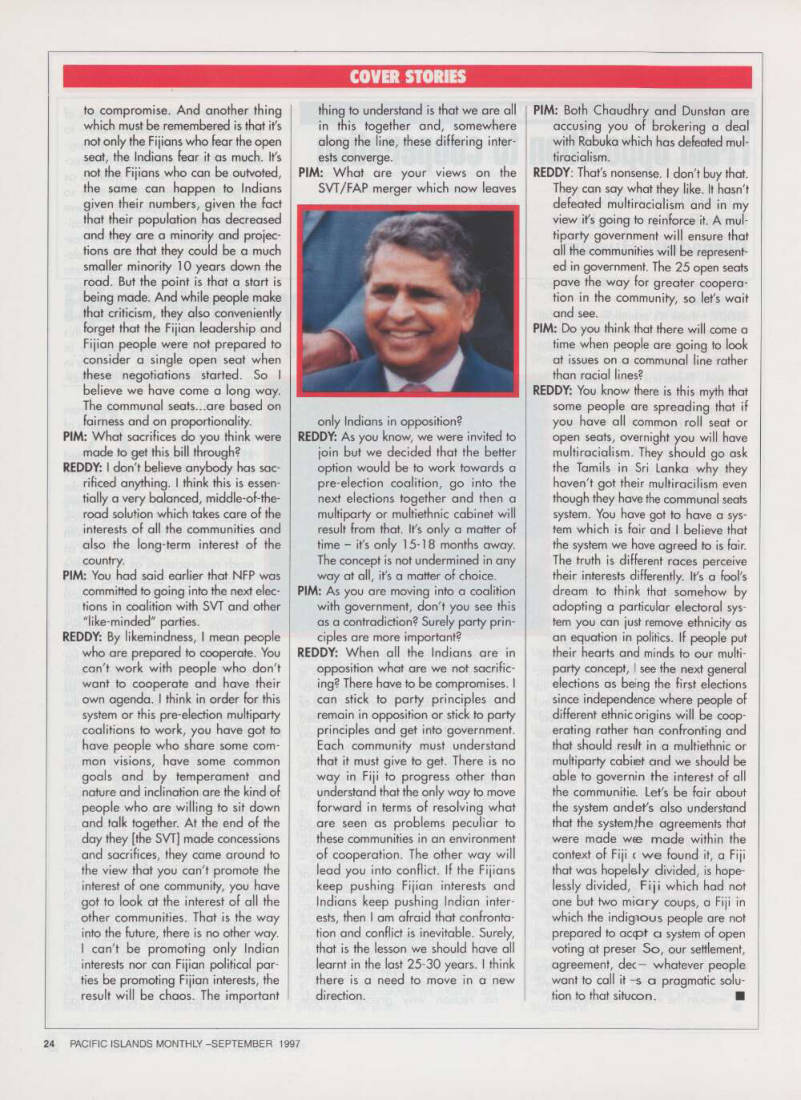
Interview
Opposition leader Jai
Ram Reddy speaks to
Bernadette Hussein
PIM: What do you think of the 1 997 con stitution?
REDDY: I think it's essentially a very fair constitution. But, like all constitutions, the people of this country, the politi cal leaders will have to make it
work. There has been a decisive shift from politics of confronta tion or politics of rivalry - which was the basis of the 1 970 con stitution and, in a sense, the basis of the 1 990 constitution to politics of cooperation. The underlying structure of the 1 997 constitution is political coopera tion and has the concept of power sharing at heart. I believe that this constitution meets the needs of Fiji as we find it today.
PIM: Do you see this constitution as working towards multiracialism and national unity?
REDDY: Very definitely. There are two things - one is the concept
of multiparty government. I think mul tiparty [could be read as] multiethnic because our political parties as presently structured are built around communities. I think it will be unreal istic to expect this to change overnight. I think in the short-medium term, the structures of these parties are likely to remain around commu nities. So the concept of power shar ing and multiparty government will result in a multiethnic government which is what we need. And I think it will take a lot of the rivalry out of the political system. Under the 1 970 con stitution, it was essentially rivalry for political office between the indige nous and Indo-Fijian communities. I believe that a lot of the tensions will go out of the political system.
PIM: Your coalition with government has been viewed as a move which will weaken the voice of the opposition.
REDDY: It dep ends what you mean by opposition. You know opposition in Fiji since 1970 has meant the Indians. They have provided the opposition and the government has meant the indigenous Fijians with other partners. Now that's not oppo sition, it's not healthy for Fiji. We need to move away from that. My own feeling is that when you talk
government and opposition, you are really translating a system which is meant for a more homogeneous soci ety into a situation where that kind of society does not exist - it is a divided society along ethnic lines and you need to modify the Westminster sys tem to accommodate everybody into government. Firstly, I think the con cept of opposition or the role of opposition in divided societies is completely overrated. But we need more than opposition - the coopera tion between the two communities and one should not overlook that dimension of multiethnic politics. But it would be wrong to think that oppo sition will not exist. I believe there will be party or parties who will not want to be government, who will see a role for themselves-in opposition so there will always be opposition... There is no reason why greater latitude
should not be given to members of parliament - the backbenchers - to criticise more freely. I don't think any body suffers by meaningful construc tive criticism. So we will need to as we go along modify the system so that we don't kill opposition. I believe that we have had politics of opposi tion for the last 25 years and it has n't worked. It has resulted in the rele gation usually of one community into opposition while other communities have been in government. That is more unhealthy, in my view, than not having an opposition. I think that this system, if it is worked honestly in
good faith by all sides, will result in a much better system of gover nance.
PIM: Will NFP change its focus from being an Indian party in this era of multiracialism?
REDDY: Well the NFP is committed to multiracialism, how you achieve it is another matter. We could take one of two routes - and we have already indicated the route which we want to take is to cooperate with other non-Indian parties. That is as much multiracialism as if you were to open your doors and invite everybody else in which, as you know, hasn't been easy in Fiji because of the way our politics have been structured. So for the
time being, I think the best thing for the NFP to do is to cooperate with other racially based parties such as the SVT, the Fijian Association or the General Voters Party.
PIM: What are your views on the new electoral system which is said to be the opposite of what the Reeves Commission recommended?
REDDY: It is not the opposite of the com mission - that is total exaggeration.
All we did was take their 25 reserved seats and turn them into open seats and we took the 45 proposed open seats and turned them into communal seats. What must be remembered is these compromises were reached in the political environment in which we were working. If you go back even two years, these developments seemed impossible because the com munities were so entrenched in their respective positions - so we've had
to compromise. And another thing which must be remembered is that it's not only the Fijians who fear the open seat, the Indians fear it as much. It's not the Fijians who can be outvoted, the same can happen to Indians given their numbers, given the fact that their population has decreased and they are a minority and projec tions are that they could be a much smaller minority 10 years down the road. But the point is that a start is being made. And while people make that criticism, they also conveniently forget that the Fijian leadership and Fijian people were not prepared to consider a single open seat when these negotiations started. So I believe we have come a long way.
The communal seats...are based on fairness and on proportionality.
PIM: What sacrifices do you think were made to get this bill through?
REDDY: I don't believe anybody has sac rificed anything. I think this is essen tially a very balanced, middle-of-the road solution which takes care of the interests of all the communities and also the long-term interest of the country.
PIM: You had said earlier that NFP was committed to going into the next elec tions in coalition with SVT and other "like-minded" parties.
REDDY: By likemindness, I mean people who are prepared to cooperate. You can't work with people who don't want to cooperate and have their own agenda. I think in order for this system or this pre-election multiparty coalitions to work, you have got to have people who share some com mon visions, have some common goals and by temperament and nature and inclination are the kind of people who are willing to sit down and talk together. At the end of the day they [the SVT] made concessions and sacrifices, they came around to the view that you can't promote the interest of one community, you have got to look at the interest of all the other communities. That is the way into the future, there is no other way.
I can't be promoting only Indian interests nor can Fijian political par ties be promoting Fijian interests, the result will be chaos. The important
thing to understand is that we are all in this together and, somewhere along the line, these differing inter ests converge.
PIM: What are your views on the SVT/FAP merger which now leaves
only Indians in opposition?
REDDY: As you know, we were invited to join but we decided that the better option would be to work towards a pre-election coalition, go into the next elections together and then a multiparty or multiethnic cabinet will result from that. It's only a matter of time - it's only 15-18 months away.
The concept is not undermined in any way at all, it's a matter of choice.
PIM: As you are moving into a coalition with government, don't you see this as a contradiction? Surely party prin ciples are more important?
REDDY: When all the Indians are in opposition what are we not sacrific ing? There have to be compromises. I can stick to party principles and remain in opposition or stick to party principles and get into government.
Each community must understand that it must give to get. There is no way in Fiji to progress other than understand that the only way to move forward in terms of resolving what are seen as problems peculiar to these communities in an environment of cooperation. The other way will lead you into conflict. If the Fijians keep pushing Fijian interests and Indians keep pushing Indian inter ests, then I am afraid that confronta tion and conflict is inevitable. Surely, that is the lesson we should have all learnt in the last 25-30 years. I think there is a need to move in a new direction.
PIM: Both Chaudhry and Dunstan are accusing you of brokering a deal with Rabuka which has defeated mul tiracialism.
REDDY: That's nonsense. I don't buy that.
They can say what they like. It hasn't defeated multiracialism and in my view it's going to reinforce it. A mul tiparty government will ensure that all the communities will be represent ed in government. The 25 open seats pave the way for greater coopera tion in the community, so let's wait and see.
PIM: Do you think that there will come a time when people are going to look at issues on a communal line rather than racial lines?
REDDY: You know there is this myth that some people are spreading that if you have all common roll seat or open seats, overnight you will have multiracialism. They should go ask the Tamils in Sri Lanka why they haven't got their multiracilism even though they have the communal seats system. You have got to have a sys tem which is fair and I believe that the system we have agreed to is fair.
The truth is different races perceive their interests differently. It's a fool's dream to think that somehow by adopting a particular electoral sys tem you can just remove ethnicity as an equation in politics. If people put their hearts and minds to our multi party concept, I see the next general elections as being the first elections since independence where people of different ethnic origins will be coop erating rather ban confronting and that should resilt in a multiethnic or multiparty cabiiet and we should be able to governin the interest of all the communitie. Let's be fair about the system andet's also understand that the system/he agreements that were made wee made within the context of Fiji c we found it, a Fiji that was hopelsly divided, is hope lessly divided, Fiji which had not one but two miary coups, a Fiji in which the indigious people are not prepared to accpt a system of open voting at preser So, our settlement, agreement, dec— whatever people want to call it -s a pragmatic solu tion to that situcon. ■
The winebox inquiry
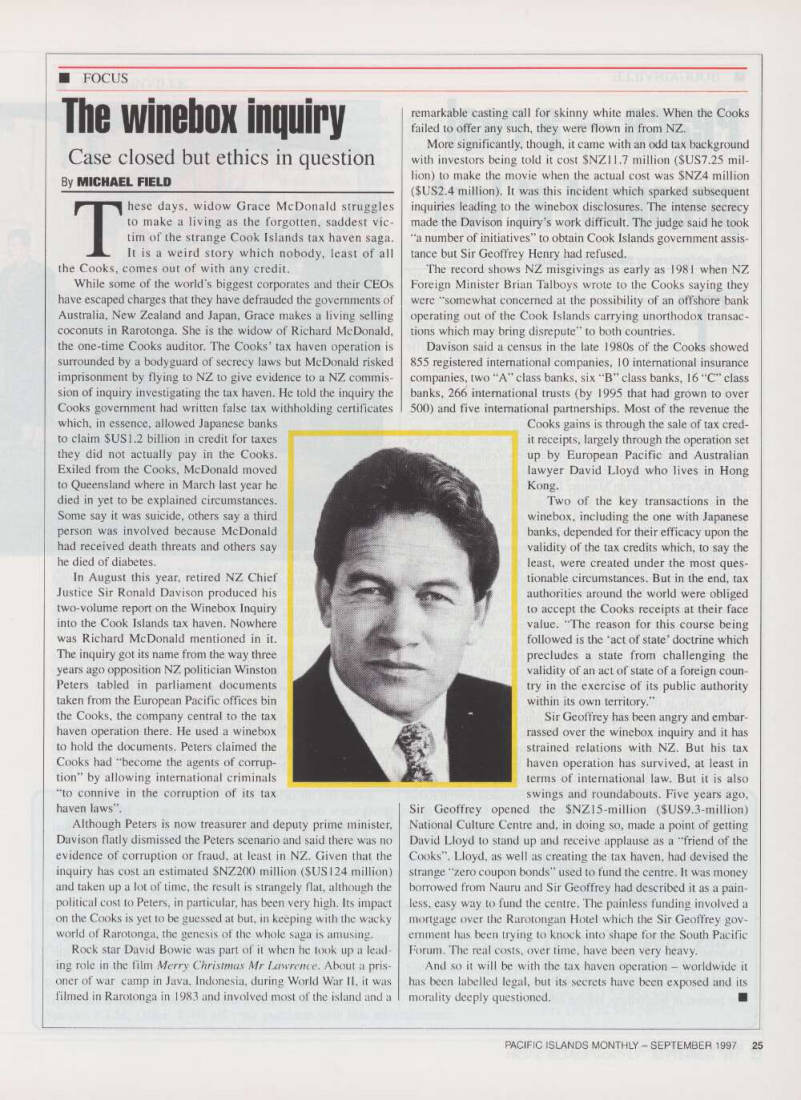
Focus
The winebox inquiry Case closed but ethics in question
By Michael Field
These days, widow Grace McDonald struggles to make a living as the forgotten, saddest vic tim of the strange Cook Islands tax haven saga.
It is a weird story which nobody, least of all the Cooks, comes out of with any credit.
While some of the world’s biggest corporates and their CEOs have escaped charges that they have defrauded the governments of Australia, New Zealand and Japan, Grace makes a living selling coconuts in Rarotonga. She is the widow of Richard McDonald, the one-time Cooks auditor. The Cooks’ tax haven operation is surrounded by a bodyguard of secrecy laws but McDonald risked imprisonment by flying to NZ to give evidence to a NZ commis sion of inquiry investigating the tax haven. He told the inquiry the Cooks government had written false tax withholding certificates
which, in essence, allowed Japanese banks to claim SUSI. 2 billion in credit for taxes they did not actually pay in the Cooks.
Exiled from the Cooks, McDonald moved to Queensland where in March last year he died in yet to be explained circumstances.
Some say it was suicide, others say a third person was involved because McDonald had received death threats and others say he died of diabetes.
In August this year, retired NZ Chief Justice Sir Ronald Davison produced his two-volume report on the Winebox Inquiry into the Cook Islands tax haven. Nowhere was Richard McDonald mentioned in it.
The inquiry got its name from the way three years ago opposition NZ politician Winston Peters tabled in parliament documents taken from the European Pacific offices bin the Cooks, the company central to the tax haven operation there. He used a winebox to hold the documents. Peters claimed the Cooks had "become the agents of corrup tion” by allowing international criminals “to connive in the corruption of its tax haven laws”.
Although Peters is now treasurer and deputy prime minister, Davison flatly dismissed the Peters scenario and said there was no evidence of corruption or fraud, at least in NZ. Given that the inquiry has cost an estimated SNZ2OO million (SUSI 24 million) and taken up a lot of time, the result is strangely flat, although the political cost to Peters, in particular, has been very high. Its impact on the Cooks is yet to be guessed at but, in keeping with the wacky world of Rarotonga, the genesis of the whole saga is amusing.
Rock star David Bowie was part of it when he took up a lead ing role in the film Merry Christmas Mr Lawrence. About a pris oner of war camp in Java, Indonesia, during World War 11, it was filmed in Rarotonga in 1983 and involved most of the island and a
remarkable casting call for skinny white males. When the Cooks failed to offer any such, they were flown in from NZ.
More significantly, though, it came with an odd tax background with investors being told it cost SNZII.7 million ($U57.25 mil lion) to make the movie when the actual cost was SNZ4 million (SUS 2.4 million). It was this incident which sparked subsequent inquiries leading to the winebox disclosures. The intense secrecy made the Davison inquiry’s work difficult. The judge said he took “a number of initiatives” to obtain Cook Islands government assis tance but Sir Geoffrey Henry had refused.
The record shows NZ misgivings as early as 1981 when NZ Foreign Minister Brian Talboys wrote to the Cooks saying they were “somewhat concerned at the possibility of an offshore bank operating out of the Cook Islands carrying unorthodox transac tions which may bring disrepute” to both countries.
Davison said a census in the late 1980 s of the Cooks showed 855 registered international companies, 10 international insurance companies, two “A” class banks, six “B” class banks, 16 “C” class banks, 266 international trusts (by 1995 that had grown to over 500) and five international partnerships. Most of the revenue the
Cooks gains is through the sale of tax cred it receipts, largely through the operation set up by European Pacific and Australian lawyer David Lloyd who lives in Hong Kong.
Two of the key transactions in the winebox, including the one with Japanese banks, depended for their efficacy upon the validity of the tax credits which, to say the least, were created under the most ques tionable circumstances. But in the end, tax authorities around the world were obliged to accept the Cooks receipts at their face value. "The reason for this course being followed is the 'act of state’ doctrine which precludes a state from challenging the validity of an act of state of a foreign coun try in the exercise of its public authority within its own territory.”
Sir Geoffrey has been angry and embar rassed over the winebox inquiry and it has strained relations with NZ. But his tax haven operation has survived, at least in terms of international law. But it is also swings and roundabouts. Five years ago,
Sir Geoffrey opened the SNZIS-million (SUS9.3-million) National Culture Centre and, in doing so, made a point of getting David Lloyd to stand up and receive applause as a "friend of the Cooks”. Lloyd, as well as creating the tax haven, had devised the strange "zero coupon bonds” used to fund the centre. It was money borrowed from Nauru and Sir Geoffrey had described it as a pain less, easy way to fund the centre. The painless funding involved a mortgage over the Rarotongan Hotel which the Sir Geoffrey gov ernment has been trying to knock into shape for the South Pacific Forum. The real costs, over time, have been very heavy.
And so it will be with the tax haven operation - worldwide it has been labelled legal, but its secrets have been exposed and its morality deeply questioned. ■
prospect at last
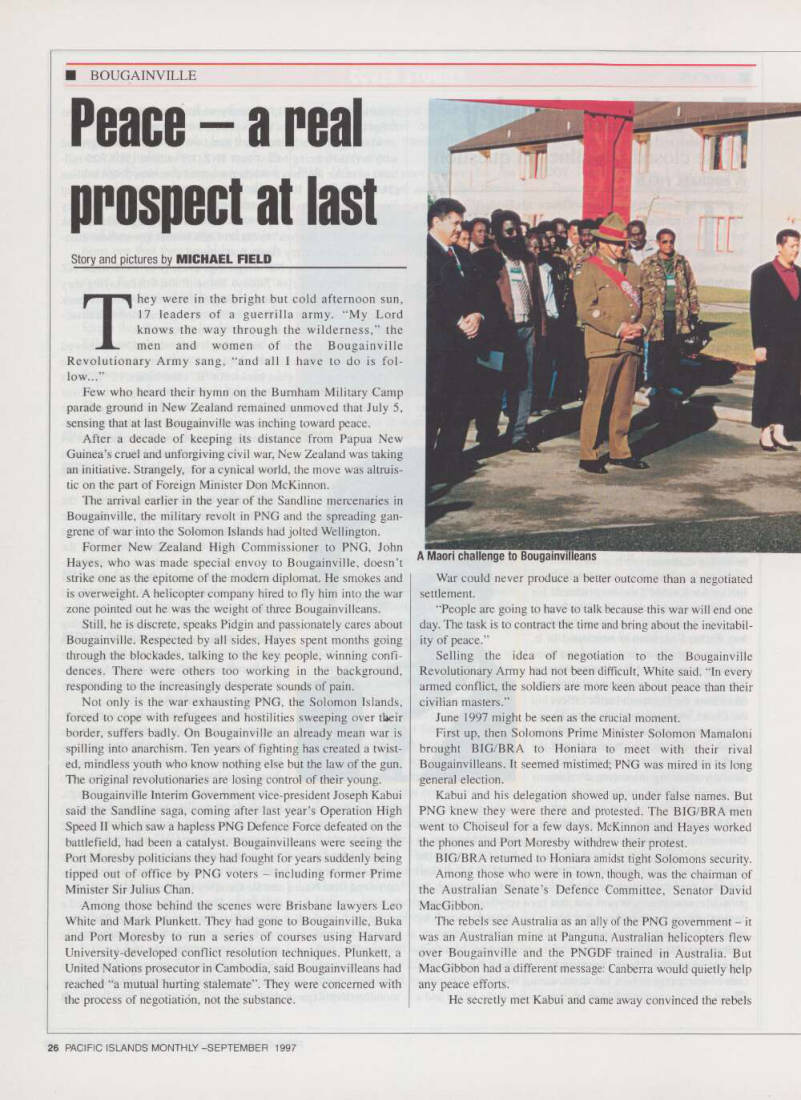
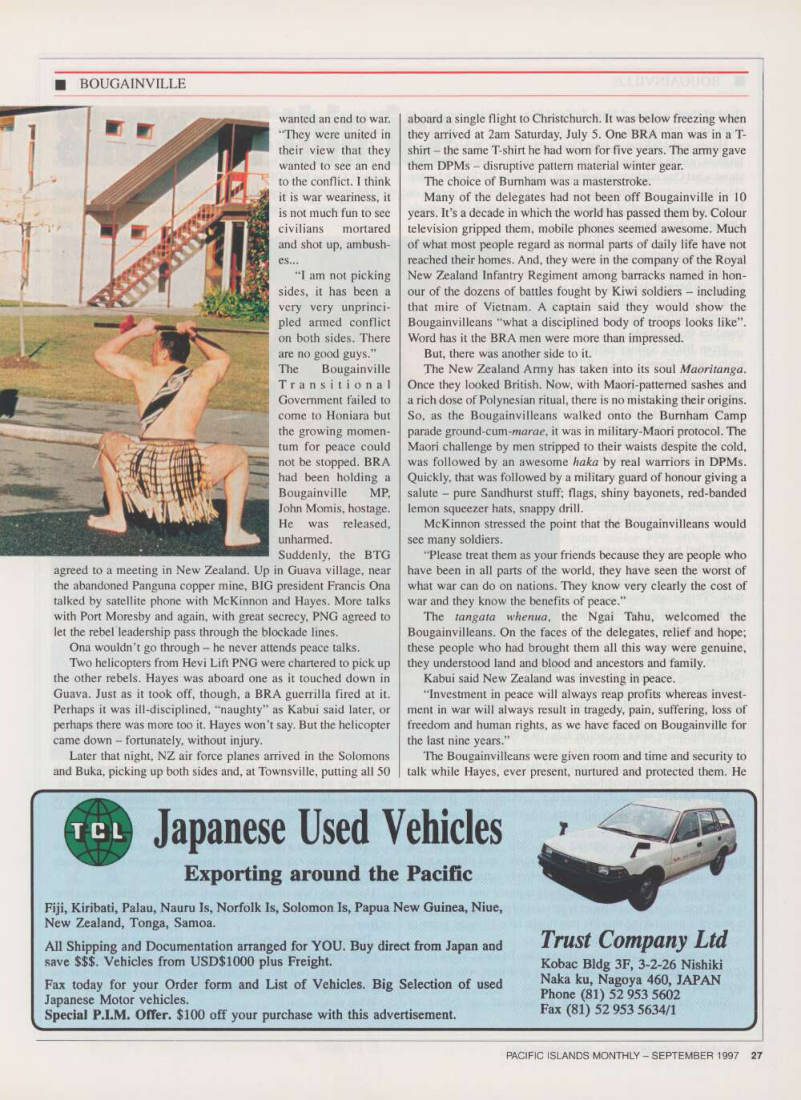
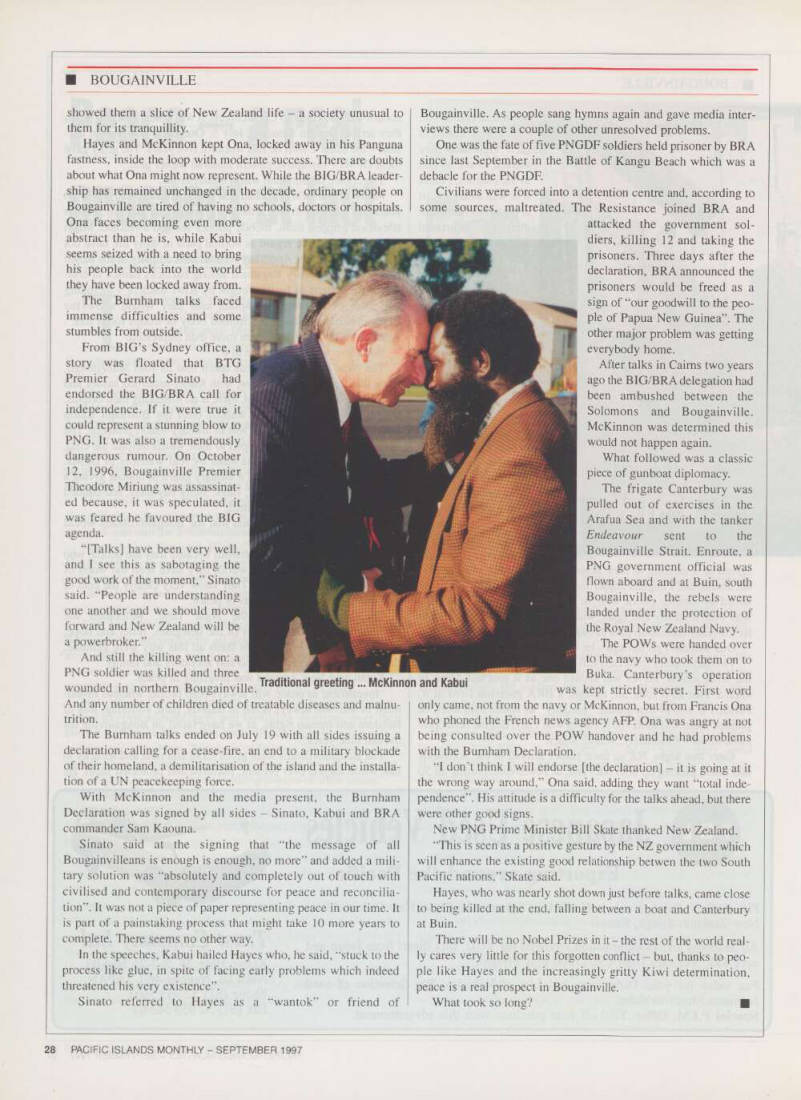
Bougainville
Peace-a real prospect at last
Story and pictures by MICHAEL FIELD
They were in the bright but cold afternoon sun, 17 leaders of a guerrilla army. “My Lord knows the way through the wilderness,” the men and women of the Bougainville Revolutionary Army sang, “and all I have to do is f0110w...” low...”
Few who heard their hymn on the Burnham Military Camp parade ground in New Zealand remained unmoved that July 5, sensing that at last Bougainville was inching toward peace.
After a decade of keeping its distance from Papua New Guinea’s cruel and unforgiving civil war, New Zealand was taking an initiative. Strangely, for a cynical world, the move was altruis tic on the part of Foreign Minister Don McKinnon.
The arrival earlier in the year of the Sandline mercenaries in Bougainville, the military revolt in PNG and the spreading gan grene of war into the Solomon Islands had jolted Wellington.
Former New Zealand High Commissioner to PNG, John Hayes, who was made special envoy to Bougainville, doesn’t strike one as the epitome of the modem diplomat. He smokes and is overweight. A helicopter company hired to fly him into the war zone pointed out he was the weight of three Bougainvilleans.
Still, he is discrete, speaks Pidgin and passionately cares about Bougainville. Respected by all sides, Hayes spent months going through the blockades, talking to the key people, winning confi dences. There were others too working in the background, responding to the increasingly desperate sounds of pain.
Not only is the war exhausting PNG, the Solomon Islands, forced to cope with refugees and hostilities sweeping over their border, suffers badly. On Bougainville an already mean war is spilling into anarchism. Ten years of fighting has created a twist ed, mindless youth who know nothing else but the law of the gun.
The original revolutionaries are losing control of their young.
Bougainville Interim Government vice-president Joseph Kabui said the Sandline saga, coming after last year’s Operation High Speed II which saw a hapless PNG Defence Force defeated on the battlefield, had been a catalyst. Bougainvilleans were seeing the Port Moresby politicians they had fought for years suddenly being tipped out of office by PNG voters - including former Prime Minister Sir Julius Chan.
Among those behind the scenes were Brisbane lawyers Leo White and Mark Plunkett. They had gone to Bougainville, Buka and Port Moresby to run a series of courses using Harvard University-developed conflict resolution techniques. Plunkett, a United Nations prosecutor in Cambodia, said Bougainvilleans had reached “a mutual hurting stalemate”. They were concerned with the process of negotiation, not the substance.
War could never produce a better outcome than a negotiated settlement.
“People are going to have to talk because this war will end one day. The task is to contract the time and bring about the inevitabil ity of peace.”
Selling the idea of negotiation to the Bougainville Revolutionary Army had not been difficult, White said. “In every armed conflict, the soldiers are more keen about peace than their civilian masters.”
June 1997 might be seen as the crucial moment.
First up, then Solomons Prime Minister Solomon Mamaloni brought BIG/BRA to Honiara to meet with their rival Bougainvilleans. It seemed mistimed; PNG was mired in its long general election.
Kabui and his delegation showed up, under false names. But PNG knew they were there and protested. The BIG/BRA men went to Choiseul for a few days. McKinnon and Hayes worked the phones and Port Moresby withdrew their protest.
BIG/BRA returned to Honiara amidst tight Solomons security.
Among those who were in town, though, was the chairman of the Australian Senate’s Defence Committee, Senator David Mac Gibbon.
The rebels see Australia as an ally of the PNG government - it was an Australian mine at Panguna, Australian helicopters flew over Bougainville and the PNGDF trained in Australia. But Mac Gibbon had a different message: Canberra would quietly help any peace efforts.
He secretly met Kabui and came away convinced the rebels
A Maori challenge to Bougainvilleans
wanted an end to war.
“They were united in their view that they wanted to see an end to the conflict. I think it is war weariness, it is not much fun to see civilians mortared and shot up, ambush es...
“I am not picking sides, it has been a very very unprinci pled armed conflict on both sides. There are no good guys.”
The Bougainville
Transitional Government failed to come to Honiara but the growing momen tum for peace could not be stopped. BRA had been holding a
Bougainville MP,
John Momis, hostage.
He was released, unharmed.
Suddenly, the BTG
agreed to a meeting in New Zealand. Up in Guava village, near the abandoned Panguna copper mine, BIG president Francis Ona talked by satellite phone with McKinnon and Hayes. More talks with Port Moresby and again, with great secrecy, PNG agreed to let the rebel leadership pass through the blockade lines.
Ona wouldn’t go through - he never attends peace talks.
Two helicopters from Hevi Lift PNG were chartered to pick up the other rebels. Hayes was aboard one as it touched down in Guava. Just as it took off, though, a BRA guerrilla fired at it.
Perhaps it was ill-disciplined, “naughty” as Kabui said later, or perhaps there was more too it. Hayes won’t say. But the helicopter came down - fortunately, without injury.
Later that night, NZ air force planes arrived in the Solomons and Buka, picking up both sides and, at Townsville, putting all 50
aboard a single flight to Christchurch. It was below freezing when they arrived at 2am Saturday, July 5. One BRA man was in a T shirt - the same T-shirt he had worn for five years. The army gave them DPMs - disruptive pattern material winter gear.
The choice of Burnham was a masterstroke.
Many of the delegates had not been off Bougainville in 10 years. It’s a decade in which the world has passed them by. Colour television gripped them, mobile phones seemed awesome. Much of what most people regard as normal parts of daily life have not reached their homes. And, they were in the company of the Royal New Zealand Infantry Regiment among barracks named in hon our of the dozens of battles fought by Kiwi soldiers - including that mire of Vietnam. A captain said they would show the Bougainvilleans “what a disciplined body of troops looks like”.
Word has it the BRA men were more than impressed.
But, there was another side to it.
The New Zealand Army has taken into its soul Maoritanga.
Once they looked British. Now, with Maori-patterned sashes and a rich dose of Polynesian ritual, there is no mistaking their origins.
So, as the Bougainvilleans walked onto the Burnham Camp parade ground-cum-marae, it was in military-Maori protocol. The Maori challenge by men stripped to their waists despite the cold, was followed by an awesome haka by real warriors in DPMs.
Quickly, that was followed by a military guard of honour giving a salute - pure Sandhurst stuff; flags, shiny bayonets, red-banded lemon squeezer hats, snappy drill.
McKinnon stressed the point that the Bougainvilleans would see many soldiers.
“Please treat them as your friends because they are people who have been in all parts of the world, they have seen the worst of what war can do on nations. They know very clearly the cost of war and they know the benefits of peace.”
The tangata whenua, the Ngai Tahu, welcomed the Bougainvilleans. On the faces of the delegates, relief and hope; these people who had brought them all this way were genuine, they understood land and blood and ancestors and family.
Kabui said New Zealand was investing in peace.
“Investment in peace will always reap profits whereas invest ment in war will always result in tragedy, pain, suffering, loss of freedom and human rights, as we have faced on Bougainville for the last nine years.”
The Bougainvilleans were given room and time and security to talk while Hayes, ever present, nurtured and protected them. He
showed them a slice of New Zealand life - a society unusual to them for its tranquillity.
Hayes and McKinnon kept Ona, locked away in his Panguna fastness, inside the loop with moderate success. There are doubts about what Ona might now represent. While the BIG/BRA leader ship has remained unchanged in the decade, ordinary people on Bougainville are tired of having no schools, doctors or hospitals.
Ona faces becoming even more abstract than he is, while Kabui seems seized with a need to bring his people back into the world they have been locked away from.
The Burnham talks faced ] immense difficulties and some P stumbles from outside.
From BlG’s Sydney office, a 1 story was floated that BTG \ Premier Gerard Sinato had I endorsed the BIG/BRA call for ■ independence. If it were true it r; could represent a stunning blow to I PNG. It was also a tremendously I dangerous rumour. On October 12, 1996, Bougainville Premier |j Theodore Miriung was assassinat- II ed because, it was speculated, it H was feared he favoured the BIG H
agenda. I|
“[Talks] have been very well, I and I see this as sabotaging the I good work of the moment,” Sinato I said. "People are understanding I one another and we should move I forward and New Zealand will be I a powerbroker.” I And still the killing went on; a M PNG soldier was killed and three " wounded in northern Bougainville.
And any number of children died of treatable diseases and malnu trition.
The Burnham talks ended on July 19 with all sides issuing a declaration calling for a cease-fire, an end to a military blockade of their homeland, a demilitarisation of the island and the installa tion of a UN peacekeeping force.
With McKinnon and the media present, the Burnham Declaration was signed by all sides - Sinato, Kabui and BRA commander Sam Kaouna.
Sinato said at the signing that "the message of all Bougainvilleans is enough is enough, no more" and added a mili tary solution was "absolutely and completely out of touch with civilised and contemporary discourse for peace and reconcilia tion”. It was not a piece of paper representing peace in our time. It is part of a painstaking process that might take 10 more years to complete. There seems no other way.
In the speeches, Kabui hailed Hayes who, he said, "stuck to the process like glue, in spite of facing early problems which indeed threatened his very existence".
Sinato referred to Hayes as a “wantok” or friend of
Bougainville. As people sang hymns again and gave media inter views there were a couple of other unresolved problems.
One was the fate of five PNGDF soldiers held prisoner by BRA since last September in the Battle of Kangu Beach which was a debacle for the PNGDF.
Civilians were forced into a detention centre and, according to some sources, maltreated. The Resistance joined BRA and
attacked the government sol diers, killing 12 and taking the prisoners. Three days after the declaration, BRA announced the prisoners would be freed as a sign of “our goodwill to the peo ple of Papua New Guinea”. The other major problem was getting everybody home.
After talks in Cairns two years ago the BIG/BRA delegation had been ambushed between the Solomons and Bougainville.
McKinnon was determined this would not happen again.
What followed was a classic piece of gunboat diplomacy.
The frigate Canterbury was pulled out of exercises in the Arafua Sea and with the tanker Endeavour sent to the Bougainville Strait. Enroute, a PNG government official was flown aboard and at Buin, south Bougainville, the rebels were landed under the protection of the Royal New Zealand Navy.
The POWs were handed over to the navy who took them on to Buka. Canterbury’s operation
i dim i\auui i , was kept strictly secret. First word only came, not from the navy or McKinnon, but from Francis Ona who phoned the French news agency AFP. Ona was angry at not being consulted over the POW handover and he had problems with the Burnham Declaration.
“I don't think I will endorse [the declaration] - it is going at it the wrong way around,” Ona said, adding they want “total inde pendence”. His attitude is a difficulty for the talks ahead, but there were other good signs.
New PNG Prime Minister Bill Skate thanked New Zealand.
"This is seen as a positive gesture by the NZ government which will enhance the existing good relationship betwen the two South Pacific nations,” Skate said.
Hayes, who was nearly shot down just before talks, came close to being killed at the end, falling between a boat and Canterbury at Buin.
There will be no Nobel Prizes in it - the rest of the world real ly cares very little for this forgotten conflict - but, thanks to peo ple like Hayes and the increasingly gritty Kiwi determination, peace is a real prospect in Bougainville.
What took so long? ■
Traditional greeting...McKinnon and Kabui
Advertisements & other items, p. 27 (1 item)
Japanese Used Vehicles
Exporting around the Pacific
Fiji, Kiribati, Palau, Nauru Is, Norfolk Is, Solomon Is, Papua New Guinea, Niue, New Zealand, Tonga, Samoa.
All Shipping and Documentation arranged for YOU. Buy direct from Japan and save sss. Vehicles from USDSIOOO plus Freight.
Fax today for your Order form and List of Vehicles. Big Selection of used Japanese Motor vehicles.
Special P.I.M. Offer. $lOO off your purchase with this advertisement.
Trust Company Ltd
Kobac Bldg 3F, 3-2-26 Nishiki Naka ku, Nagoya 460, JAPAN Phone (81) 52 953 5602 Fax (81) 52 953 5634/1
Skate on thin ice
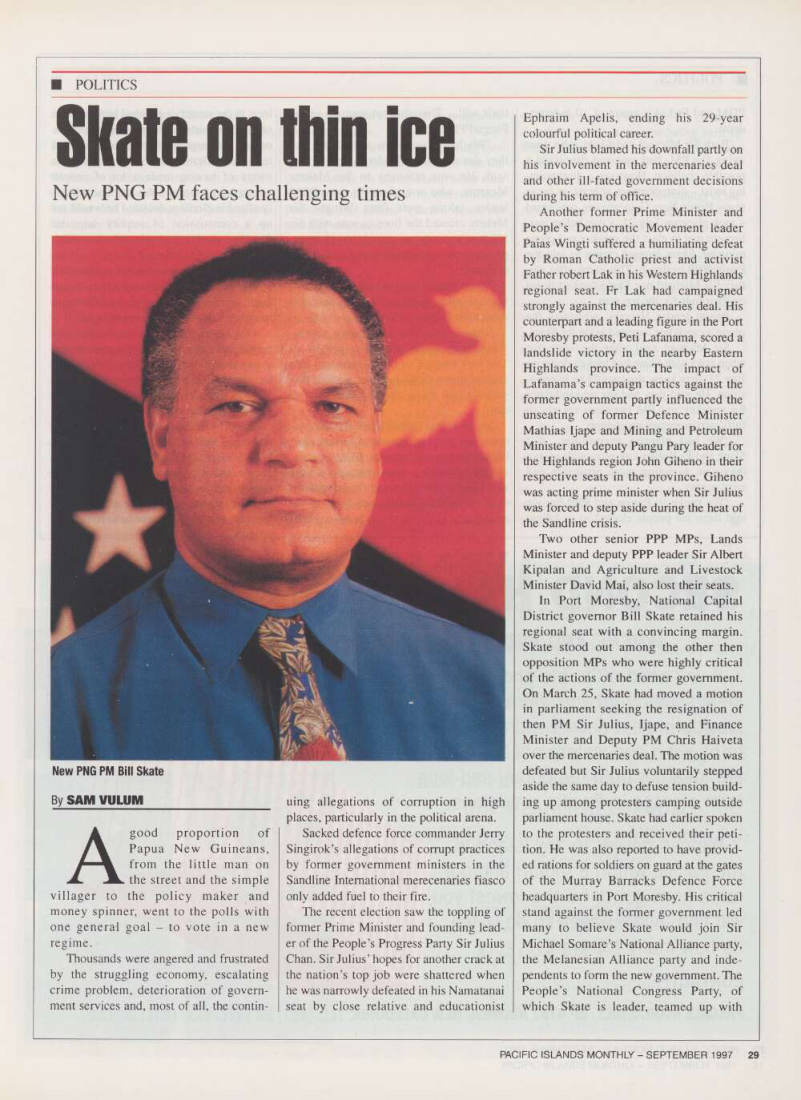

Politics
Skate on thin ice New PNG PM faces challenging times
By Sam Vulum
A good proportion of Papua New Guineans, from the little man on the street and the simple villager to the policy maker and money spinner, went to the polls with one genera! goal - to vote in a new
regime.
Thousands were angered and frustrated by the struggling economy, escalating crime problem, deterioration of govern ment services and, most of all, the contin
uing allegations of corruption in high places, particularly in the political arena.
Sacked defence force commander Jerry Singirok’s allegations of corrupt practices by former government ministers in the Sandline International merecenaries fiasco only added fuel to their fire.
The recent election saw the toppling of former Prime Minister and founding lead er of the People’s Progress Party Sir Julius Chan. Sir Julius’ hopes for another crack at the nation’s top job were shattered when he was narrowly defeated in his Namatanai seat by close relative and educationist
Ephraim Apelis, ending his 29-year colourful political career.
Sir Julius blamed his downfall partly on his involvement in the mercenaries deal and other ill-fated government decisions during his term of office.
Another former Prime Minister and People’s Democratic Movement leader Paias Wingti suffered a humiliating defeat by Roman Catholic priest and activist Father robert Lak in his Western Highlands regional seat. Fr Lak had campaigned strongly against the mercenaries deal. His counterpart and a leading figure in the Port Moresby protests, Peti Lafanama, scored a landslide victory in the nearby Eastern Highlands province. The impact of Lafanama’s campaign tactics against the former government partly influenced the unseating of former Defence Minister Mathias Ijape and Mining and Petroleum Minister and deputy Pangu Pary leader for the Highlands region John Giheno in their respective seats in the province. Giheno was acting prime minister when Sir Julius was forced to step aside during the heat of the Sandline crisis.
Two other senior PPP MPs, Lands Minister and deputy PPP leader Sir Albert Kipalan and Agriculture and Livestock Minister David Mai, also lost their seats.
In Port Moresby, National Capital District governor Bill Skate retained his regional seat with a convincing margin.
Skate stood out among the other then opposition MPs who were highly critical of the actions of the former government.
On March 25, Skate had moved a motion in parliament seeking the resignation of then PM Sir Julius, Ijape, and Finance Minister and Deputy PM Chris Haiveta over the mercenaries deal. The motion was defeated but Sir Julius voluntarily stepped aside the same day to defuse tension build ing up among protesters camping outside parliament house. Skate had earlier spoken to the protesters and received their peti tion. He was also reported to have provid ed rations for soldiers on guard at the gates of the Murray Barracks Defence Force headquarters in Port Moresby. His critical stand against the former government led many to believe Skate would join Sir Michael Somare’s National Alliance party, the Melanesian Alliance party and inde pendents to form the new government. The People’s National Congress Party, of which Skate is leader, teamed up with
New PNG PM Bill Skate
PDM and Fr Lak’s group of 10 indepen dents.
Both Sir Michael and Skate, who were vying for PM, had met and discussed a possible coalition. However, a disappoint ing twist - disappointing, at least, as far as many Papua New Guineans are concerned - took place on July 21, a day before par liament met to elect the speaker and prime minister. Skate jumped camps to join the Pangu/PPP coalition. This came after nei ther Sir Michael nor Skate backed down on their bids for the top post.
Pangu leader Haiveta, who was the group’s candidate, stepped aside for Skate.
Sir Michael said after the vote that when talks with Skate had broken down on July 21, they knew they would be in oppo sition. He said they had put up candidates for speaker and PM positions merely to fulfil parliamentary procedures.
“We had planned everything... Bill Skate and Fr Robert Lak were with us, but they saw someting more attractive and went across.
“We spoke to Pangu and PPP but we told them the people elected us to follow
their wi11... They did not want to se the
Pangu/PPP regime.
“We had discussions with PDM but they deserted their leader,” Sir Michael said. He was referring to Sir Mekere Morauta, who was then the new PDM leader, taking over from Wingti. Sir Mekere crossed the floor to vote with Sir Michael’s group on principles of trans parency, good government and on fighting corruption.
While commenting on his decision. Sir Mekere told reporters: “I just could not work with Pangu or PPP.
“We seem to have continued a govern ment many people wanted to get rid of.
The very essence of the government that created many problems over the last few years is still there, even by remote con trol.”
Sir Mekere, a former Bank of PNG gov ernor and veteran top public servant, lost his leadership role with the PDM by join ing the opposition. Skate teamed with the very people whom he sought to bring down only two months earlier, and took up the reins of one of the most inexperienced cab
inets in the country’s political history. Nine of the 28 ministries are first-timers and six others, although in their second or third terms, are first-time ministers. Skate is aware of having made a lot of people unhappy by jumping sides and, immediate ly after his election, declared he would set up a commission of inquiry into the Sandline deal - and other deals - with wider terms of reference.
“There have been so many accusations against our leaders. We are going to set up a commission of inquiry to see if there is evidence that they have been at fault.
“We have been been misled by so many people and have been fighting among our selves and destroying leaders. As long as I am prime minister, that nonsense will stop.
We will fight corruption and we will do it
properly.
“I will ensure that foreigners do not come and leak out information to destroy PNG leaders. We have destroyed our own people and why should we become ene mies of our own people?
“This government will be a transparent government. We want it to be seen that we
are doing the right thing,” Skate said.
But Skate is expected to face stiff oppo sition from within his government, espe cially when a good number of ministers in the former government make up his cabi net, including one of the key players in the Sandline deal - Haiveta, who has retained his deputy PM post.
He will also face the challenge of keep ing his coalition intact. A rift has already become apparent among the coalition part ners. Some government MPs are not happy with Haiveta being a cabinet member. The ill-feelings stemmed from the fact that the PM, in making the appointment, side stepped from his previous public assertions that leaders in the initial Sandline inquiry should not be allowed to hold a public office.
The rift has widened following claims by PPP leader Andrew Baing and his deputy, Michael Nali, that Haiveta had watered down the original terms of refers ence set by their former party leader and PM Sir Julius. Agriculture and Livestock Mininster Baing and Trade and Tourism Minister Nali made the revelations while
supporting Skate’s decision to reopen the
Sandline inquiry.
Haiveta accused them of breaching cab inet confidentiality but admitted that the cabinet, under his chairmanship while then PM Sir Julius attended to other official business, had indeed watered down the terms of reference.
“The NEC as a collective body...nar rowed down the terms of reference,”
Haiveta said.
Skate committed his first major blunder when, in an unprecedented move, he ordered police to put on hold all charges against military personnel and members of non-governmental organsations involved in the Sandline crisis.
The order was intended to calm down tensions at Murray Barracks among sol diers following the release of operation Rausin Kwik commander Major Walter Enuma from a Port Moresby police cell by armed loyalists and the subsequent house arrest of Brigadier-General Leo Nuia and a senior officer.
Enuma had been charged with raising an illegal army in the Highlands of PNG
during the recent elections. The other 16 members of the army are being held in Baisu jail in the Western Highlands province. Part of Skate’s order was that all military personnel held in Baisu were to be released on bail pending the findings of the new inquiry. This saw attacks from the public accusing him of interfering in the
judiciary.
Internal Affairs Minister Tom Pelika announced days later that the order did not cover the 16 soldiers. He said the offences allegedly committed by the soldiers were not related to the Sandline saga and would be dealt with under the normal process of law. Only weeks in office, Skate became the subject of more controversy, following revelations of payments towards an exclu sive residence for his family in Cairns, Australia.
The opposition accused the PM of using Papua New Guineans’ money to pay Australians and of “putting his foot in another canoe” and waiting to flee PNG if the country sinks. Skate’s office, has said that the money for the rental fees had come from his own pocket. ■
Advertisements & other items, pp. 30-31 (1 item)
Second Hand Containers
WHERE AND WHEN YOU WANT THEM IN THE PACIFIC If you need a flexible and safe storage space we have the ideal solution for you. Our second hand containers provide instant secure storage. Guaranteed to be wind and waterproof these containers are ideal for both temporary and longterm storage in Pacific conditions.
We can deliver to any island in the Pacific within a month and our rates have got to be the lowest you will find. All you need to do is tell us how many you want.
CONTACT:
PASCALS MARCONNET, BP 4757 NOUMEA, NEW CALEDONIA. TEL: (687) 28 7450. FAX; (687) 26 3248
TOUR VANUATU
A perfect holiday in Paradise starts at Tour Vanuatu Tour Vanuatu are the premier tour operators of Vanuatu We can take you anywhere, be it at sea, on land or in the air, and we can show you the people, the ancient rituals and the nature of our beautiful islands.
You’ll find us in Port Vila next to the Post Office.
TOURisfjk
VANUATU
P.O. BOX 409, Port Vila, Vanuatu. Ph: (678) 22 733 Fax: (678) 23 442 -1 - : J V
V.7TT-V
V?
A worsening crisis
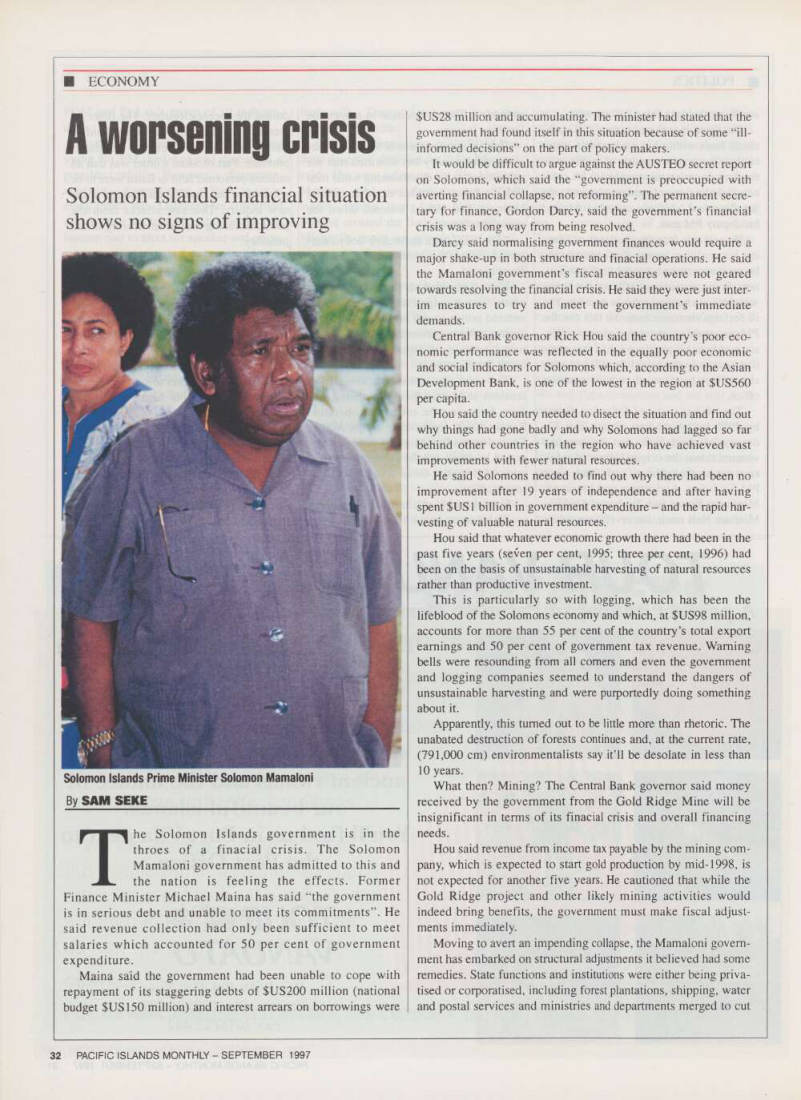
Economy
Solomon Islands financial situation shows no signs of improving
By Sam Seke
The Solomon Islands government is in the throes of a finacial crisis. The Solomon Mamaloni government has admitted to this and the nation is feeling the effects. Former Finance Minister Michael Maina has said “the government is in serious debt and unable to meet its commitments”. He said revenue collection had only been sufficient to meet salaries which accounted for 50 per cent of government expenditure.
Maina said the government had been unable to cope with repayment of its staggering debts of SUS2OO million (national budget SUSISO million) and interest arrears on borrowings were
sUS2B million and accumulating. The minister had stated that the government had found itself in this situation because of some “ill informed decisions” on the part of policy makers.
It would be difficult to argue against the AUSTEO secret report on Solomons, which said the “government is preoccupied with averting financial collapse, not reforming”. The permanent secre tary for finance, Gordon Darcy, said the government’s financial crisis was a long way from being resolved.
Darcy said normalising government finances would require a major shake-up in both structure and finacial operations. He said the Mamaloni government’s fiscal measures were not geared towards resolving the financial crisis. He said they were just inter im measures to try and meet the government’s immediate demands.
Central Bank governor Rick Hou said the country’s poor eco nomic performance was reflected in the equally poor economic and social indicators for Solomons which, according to the Asian Development Bank, is one of the lowest in the region at SUSS6O per capita.
Hou said the country needed to disect the situation and find out why things had gone badly and why Solomons had lagged so far behind other countries in the region who have achieved vast improvements with fewer natural resources.
He said Solomons needed to find out why there had been no improvement after 19 years of independence and after having spent SUS 1 billion in government expenditure - and the rapid har vesting of valuable natural resources.
Hou said that whatever economic growth there had been in the past five years (seven per cent, 1995; three per cent, 1996) had been on the basis of unsustainable harvesting of natural resources rather than productive investment.
This is particularly so with logging, which has been the lifeblood of the Solomons economy and which, at SUS9B million, accounts for more than 55 per cent of the country’s total export earnings and 50 per cent of government tax revenue. Warning bells were resounding from all comers and even the government and logging companies seemed to understand the dangers of unsustainable harvesting and were purportedly doing something about it.
Apparently, this turned out to be little more than rhetoric. The unabated destruction of forests continues and, at the current rate, (791,000 cm) environmentalists say it’ll be desolate in less than 10 years.
What then? Mining? The Central Bank governor said money received by the government from the Gold Ridge Mine will be insignificant in terms of its finacial crisis and overall financing needs.
Hou said revenue from income tax payable by the mining com pany, which is expected to start gold production by mid-1998, is not expected for another five years. He cautioned that while the Gold Ridge project and other likely mining activities would indeed bring benefits, the government must make fiscal adjust
ments immediately.
Moving to avert an impending collapse, the Mamaloni govern ment has embarked on structural adjustments it believed had some remedies. State functions and institutions were either being priva tised or corporatised, including forest plantations, shipping, water and postal services and ministries and departments merged to cut
Solomon Islands Prime Minister Solomon Mamaloni
costs. Maina said the fiscal measures undertaken in light of the government’s serious cash-flow problem included restraints on credit, seeing that ministries worked within their monthly budgets, strengthening of revenue-collection departments and review of remissions and exemptions on tax and duty for both local and for eign investors. And after years of implementing control measures, how far has the country come? Debt servicing became slow and neglected while arrears continued to accumulate.
The securities market, which Maina said during an election campaign rally on June 21 would be normalised by the August national elections, has seen no improvement. Darcy said the gov ernment did not have the money to restore the securities market, which collapsed more than two years ago.
The Solomon Islands securities market collapsed when gov ernment borrowing at the Central Bank broke the legal ceiling and did not have the money to restore it.
The National Bank of the Solomon Islands (partly owned by the Bank of Hawaii) has gone as far as taking the government to court over its unpaid principal and interest arrears for treasury bills and bonds with the Central Bank.
But although the NBSI won its case, the SUS 1.4 million is still unsettled. The bank, therefore, closed down the government’s cheque account, saying the account does not have sufficient funds.
However, since the closure of the cheque account at the end of July, the government has opened a new account with the ANZ Bank.
Government telephones had been barred by Solomon Telekom from making outbound calls since April 9 because of non-pay ment of accounts and apart from essential telephones, the govern ment’s phone service for outgoing calls remained barred.
Accountant-general Peter Lokei said government owed Solomon Telekom almost SUSI million and payment of outstand ing accounts had been slow.
Other effects of the cash-flow problem is reflected on delays of up to one day in payment of public servant salaries.
Long queues are a common sight in front of the treasury office each working day, and government cheques are now something one dreads taking to the banks to cash; cheques for as little as SUS3O are known to have bounced.
The country’s bleak financial status is most evident in the state of social and public services.
The government has been having difficulties meeting its finan
cial commitments for the education of its sponsored students at the University of the South Pacific and PNG institutions. In July, SI students at the UPNG were told to pack up and leave because of non-payment of school fees.
And while the government was trying to upgrade the SI College of Higher Education (SICHE) into a university, it was already experiencing serious problems keeping SICHE opera tional. For the 1997 school year, SICHE had requested SUS 4.7 million to enable it to function normally but the government said it could only afford $2.8 million.
Even so, the government has been unable to meet its commit ments for service grants and living and book allowances for stu dents which have accumulated to SUSI. 4 million, and got to a stage where the college closed down in the first week of August.
The same story goes for the government King George VI. Once a prestigious institution, it is now run-down and serves its board ers rice, noodles and canned tuna as the staple.
Morale in the police force has dropped as a result of, among other things, dissatisfaction over shortage and general disrepair of housing.
Health authorities have not been able to implement public health programmes budgeted for and immunisation services have been low with service grants not forthcoming and a shortage of drugs, nurses and doctors. Road conditions in Honiara and other urban centres, as well as in the provinces, are also deteriorating and, in some cases, unpassable.
One could say that the real situation with the treasury is worse than a case of living from hand to mouth, as stated in the AUS TEO report. Mamaloni had correctly said that the government was living beyond its means. But why is the Solomons in this state? To quote Solomons Islands senior statesman Sir Mariano Kelesi, "The problem was not cash flow, but rather proper management of government spending.” He said that with an annual budget of SUSISO million, the government cannot say it has a cash-flow problem.
Could it be that the controversial AUSTEO report was right when it stated: "While the economy has been growing strongly, the [Solomon Island] government has no policies to support sus tainable economic development. Forestry resources have been overexploited, subsistence agriculture and infrastructure largely neglected and government administration corrupted for the per sonal gain of ministers and bureaucrats”? ■
Advertisements & other items, p. 33 (1 item)
Imported Engines
BLAIRS
TRANSMISSIONS
NEW PARTS - SECONDHAND PARTS
DIESELS - PETROL
1000 UNITS AVAILABLE
Bedford * BMW * Cummins * Daihatsu * Detroit * Ford * Gardner Duetz * Hino * Isuzu * Ivaco * Komatsu * Kubota * Leyland * Mazda * Mercedes * Mitsubishi * Nissan * Perkins * Peugeot * Special stationary engines Perkins, Kubota, Yanmar 9hp to 200 hp, * Scania * Main * Suzuki * Toyota * Volvo * Yanmar
firga all terrain vehicles
6X6 - BXB
AMPHIBIOUS
Carries 6 persons or 454kgs All Wheel Drive IF you require off road transport Argo will do it. Swamps, Lakes, Beaches, Loose Rocks, Dense Forest.
P.O Box 14 Geraldine, New Zealand. Phone: 643-6938122. Fax: 643-6938120
Towards productivity and quality

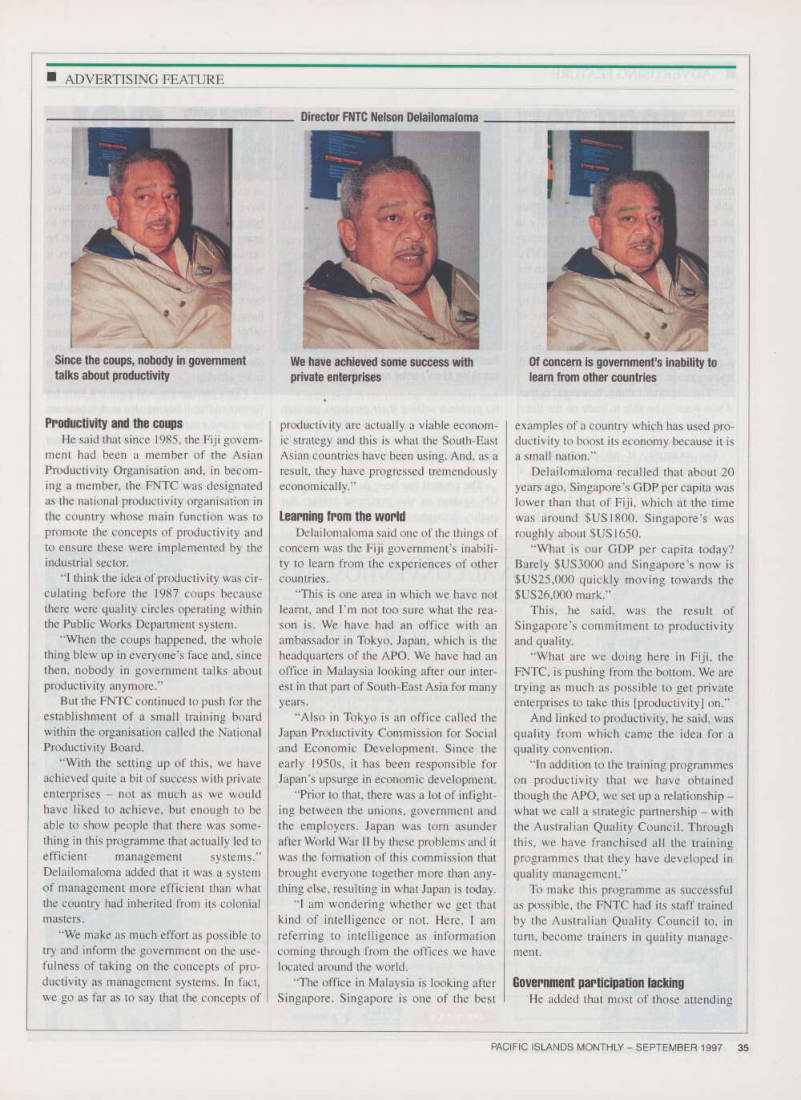

Advertising Feature
Fiji National Training Council
FNTC director-general Nelson Delailomaloma talks to Bernadette Hussein about the organisation and its role in
providing a productive work
force able to deliver quality goods and services.
Training, quality and pro ductivity are on company agendas around the world - and Fiji is no different.
Companies, with the help of the Fiji National Training Council, are doing much to attain internationally recog nised standards. The FNTC has come a long way since it started in 1973, but as it forges ahead it has maintained its initial goal - to provide skilled and
productive labour.
“When the country was heading for independence in 1970, the British govern ment set up a number of study missions.
Some of these missions [funded] by the World Bank indicated there were certain needs in Fiji that needed to be adjusted and addressed.
“One of the studies indicated there was a lack of skilled labour at the time. There was only one institute providing training and it was the Derrick Institute which is now called the Fiji Institute of
Technology.”
Setting up the FNTC In recognising this shortage, moves were under way to set up the FNTC. As far as funding went, the government of the day decided the beneficiaries of the council would pay for the training. This saw the
one per cent levy.
The one per cent levy applies to employers, including the government; exempt are the armed forces, education authorities, social welfare, agriculture and fisheries.
“I don’t think any records were kept of the number of people who benefited, but I have reason to believe through discussions I have had with employers that the contri bution that this organisation has made towards the skilled labour of the workforce has been very real and significant,” the
director-general said.
“We got into the area of training in supervision, middle management and office practices to certify some of the other needs employers had indicated to us.
“And then, in the last six years, the ideas of productivity and quality have come up.”
Director FNTC Nelson Delailomaloma
Productivity and the coups He said that since 1985, the Fiji govern ment had been a member of the Asian Productivity Organisation and, in becom ing a member, the FNTC was designated as the national productivity organisation in the country whose main function was to promote the concepts of productivity and to ensure these were implemented by the industrial sector.
“I think the idea of productivity was cir culating before the 1987 coups because there were quality circles operating within the Public Works Department system.
“When the coups happened, the whole thing blew up in everyone’s face and, since then, nobody in government talks about productivity anymore.”
But the FNTC continued to push for the establishment of a small training board within the organisation called the National Productivity Board.
“With the setting up of this, we have achieved quite a bit of success with private enterprises - not as much as we would have liked to achieve, but enough to be able to show people that there was some thing in this programme that actually led to efficient management systems.”
Delailomaloma added that it was a system of management more efficient than what the country had inherited from its colonial masters. ”We make as much effort as possible to try and inform the government on the use fulness of taking on the concepts of pro ductivity as management systems. In fact, we go as far as to say that the concepts of
productivity are actually a viable econom ic strategy and this is what the South-East Asian countries have been using. And, as a result, they have progressed tremendously economically.”
Learning from the world Delailomaloma said one of the things of concern was the Fiji government’s inabili ty to learn from the experiences of other countries.
“This is one area in which we have not learnt, and Fm not too sure what the rea son is. We have had an office with an ambassador in Tokyo, Japan, which is the headquarters of the APO. We have had an office in Malaysia looking after our inter est in that part of South-East Asia for many years.
“Also in Tokyo is an office called the Japan Productivity Commission for Social and Economic Development. Since the early 19505, it has been responsible for Japan’s upsurge in economic development.
“Prior to that, there was a lot of infight ing between the unions, government and the employers. Japan was torn asunder after World War II by these problems and it was the formation of this commission that brought everyone together more than any thing else, resulting in what Japan is today.
"1 am wondering whether we get that kind of intelligence or not. Here, I am referring to intelligence as information coming through from the offices we have located around the world.
"The office in Malaysia is looking after Singapore. Singapore is one of the best
examples of a country which has used pro ductivity to boost its economy because it is a small nation.”
Delailomaloma recalled that about 20 years ago, Singapore’s GDP per capita was lower than that of Fiji, which at the time was around SUSIBOO. Singapore’s was roughly about SUSI6SO. ”What is our GDP per capita today?
Barely SUS3OOO and Singapore’s now is $U525,000 quickly moving towards the $U526,000 mark.”
This, he said, was the result of Singapore’s commitment to productivity and quality. ‘‘What are we doing here in Fiji, the FNTC, is pushing from the bottom. We are trying as much as possible to get private enterprises to take this [productivity] on.”
And linked to productivity, he said, was quality from which came the idea for a quality convention.
“In addition to the training programmes on productivity that we have obtained though the APO, we set up a relationship what we call a strategic partnership - with the Australian Quality Council. Through this, we have franchised all the training programmes that they have developed in quality management.”
To make this programme as successful as possible, the FNTC had its staff trained by the Australian Quality Council to, in turn, become trainers in quality manage ment.
Government participation lacking
He added that most of those attending
Since the coups, nobody in government talks about productivity
We have achieved some success with private enterprises
Of concern is government’s inability to learn from other countries
these programmes came from the private sector, with very few from government
organisations.
“It just appears to me that there is a whole lot of shaking up that needs to be done in the public sector for them to be able to understand that we are moving into an era where productivity and quality in everything we do is becoming very impor tant.” Delailomaloma said the latest FNTC initiative was to become involved with the United Nations Trade Development Centres. “These centres have been set up to ease enterprises into the business of trading through the internet.
What this means is there is going to be a reduction in time and paperwork with
trading deals.
"The important thing, however, is that, if you want to be able to trade on the inter net, your products must have the quality mark.
For example, if an organisation is accredited under the ISO 9000 system, it means their products are up to internation al standards.
"With this accreditation, they will have
no problem selling their products through the internet. The role FNTC plays in this is that we have a strategic partnership with the Australian Quality Council.
The council has been designated by the UN system as the preferred trainer for quality throughout the world.”
Towards quality
"This means that FNTC also becomes a preferred trainer. We had six people trained three years ago and they are the only peo ple in the country who can train enterpris es to get their ISO 9000 accreditation. We have productivity specialists who have been trained through the APO system to bring them up to a level where they can be certified."As for the quality convention, it will be held from October 23 to 24.
"In the past, what [the convention] has been doing is trying to get people who have been involved in quality circles and other productivity activities to come together and demonstrate how quality cir cles have made their organisations much more efficient.
"This convention will push it a little bit further so that it begins also to demonstrate how some enterprises have utilised train ing that we provide for ISO 9000 for them to be more efficient.
"We have now customised the Australian Quality Award system. So, by the end of 1999 we should be in a position to offer a Fiji national quality award.” ■
Australian ambassador to Fiji Greg Urwin speaking at an earlier convention
Advertisements & other items, pp. 34-36 (1 item)
People yoiir
WARNING
irou >, A ‘ fi
greatest asset
With more than 24 years of working experience in Fiji, we have a solid reputation for developing human resources, particularly in the area of improving organisational skills through the wide range of services we offer.
These include: • Training - in disciplines ranging from Construction to Executive development • Skills Certification - in 25 different trades • Aptitude Testing - to enable you to select the best candidates for vacancies • Apprenticeship Scheme - producing quality tradesmen and technicians • Consultancy Services - ranging from management development skills to helping you achieve ISO 9000 certification
FIJI NATIONAL
TRAINING COUNCIL
Box 6890, Nasinu, Fiji.
Phone: (679) 392000. Fax: (679) 340184
We are here for you
NATIONAL CONVENTION ON QUALITY
RAFFLES TRADEWINDS CENTRE, 23-24 October 1997
CALL FOR PAPERS
The Council invites Quality Practitioners and Organisations to present papers and projects at the National Convention on Quality - 1997. The Papers offered for presentation should be in English and preferably related to the theme of this year's Convention which is "Productivity Through Teams".
The Convention will feature the National Quality Control Circles Competition.
Presentation from Speakers and an exhibition of Quality related services.
Areas in which such papers could be presented include: • Corporate Success Stories • Quality Teamwork in Action • Quality Excellent in Industries * Integration of QCC and other forms of Employee participation • Integrating QCC and other forms of Quality Management Initiatives • Success stories on ISO 9000 • Laying foundation for Quality Improvement
• Implementing Total Quality
Interested individuals, Circles and Organisations should submit a 200-250 word abstract of their paper together with a brief resume to the Manager, Training Productivity Support Services, Fiji National Training Council, Box 6890, Valelevu no later than 1 September, 1997.
All Applicants will be advised by 15 September, 1997 whether their papers have been accepted. Final papers, typewritten should be submitted by 26 September, 1997. Forbore details please contact Mr Jone Usamate on Tel: (679) 592000 or Fax (679) 340184.
iift Telecomfyi
TRAINING COUNCIL
ISO standards
ISO or the International Organisation for Standardisation is a world wide federation of national standards bodies from some 100 coun tries, one from each country.
It is a non-govemmental organisation established in 1947 and its mission is to promote the development of standardisa tion and related activities in the world with a view to facilitating the international exchange of goods and services and to developing co-operation in the spheres of intellectual, scientific, technological and economic activity.
So what are standards?
Standards are documented agreements containing technical specifications or other precise criteria to be used consistently as rules, guidelines, or definitions of charac teristics, to ensure that materials, products, processes and services are fit for their pur pose.
For example, the format of the credit cards, phone cards and "smart” cards that have become commonplace is derived from an ISO International Standard.
Adhering to the standard, which defines such features as an optimal thickness means that the cards can be used world wide.
International Standards thus contribute to making life simpler, and to increasing the reliability and effectiveness of the goods and services we use.
International standardisation: What does it achieve?
Industry-wide standardisation is a con dition existing within a particular industri al sector when the large majority of prod ucts of services conform to the same stan dards.
It results from consensus agreements reached between all economic players in that industrial sector - suppliers, users and often governments.
They agree on specifications and crite ria to be applied consistently in the choice and classification of materials, the manu
facture of products and the provision of services.
The aim is to facilitate trade, exchange
and technology through:
• enhanced product quality and reliabil ity at a reasonable price; • improved health, safety and environ mental protection and reduction of waste; • greater compatibility and inter pretability of goods and services; • simplification of improved usability; • reduction in the number of models and thus reduction in costs; • increased distribution efficiency and ease of maintenance.
Users have confidence in products and services that conform to International Standards. Assurance of conformity can be provided by manufactures’ declarations, or by audits carried out by independent bod ies.
Why is international standardisation
necessary?
The existence of non-harmonised stan dards for similar technologies in different countries or regions can contribute to so called "technical barriers to trade”.
Export-minded industries have long sensed the need to agree on world stan dards to help rationalise the international trading process.
This was the origin of the establishment of ISO.
International standardisation is now well established for very many technolo gies in such diverse fields as information processing and communications, textiles, packaging, distribution of goods, energy production and utilisation, shipbuilding, banking and financial services. It will con tinue to grow in importance for all sectors of industrial activity in the foreseeable future.
The main reasons Worldwide progress in trade liberalisa tion; interpenetration of sectors; world wide communications systems; global standards needs for emerging technologies and developing countries. ■
Series
Iso 9000
This series is a road map to basic defini tions and concepts of the ISO 9000 and explains how to select and use other standards in the series. There are four levels in the ISO 9000 series: • ISO 9001 - most compre hensive and used to ensure quality in design/development, production, installation and servicing. It is typically used by manufacturing organisations which design andtDuild their own products. • ISO 9002 - used when conformity to specified produc tion and installation require ments needs to be ensured, for example, when products are manufactured to specifications provided by outside contrac tors. • ISO 9003 - required when only conformity with final test and inspection needs to be assured. Of the three core stan dards, this has the least market ing value and is the least often applied for.
It is typically used by such organisations as testing labora tories, calibration houses and equipment distributors which inspect and test supplied prod ucts. • ISO 9004 - used internal ly and lists in some detail the essential elements making up a complete quality assurance sys tem, including the responsibili ties of management action, human resource, product safety and use of statistical methods.■
Advertisements & other items, pp. 38-39 (1 item)
P C Lab
offers
Pentium
166 MMX
- Intel Pentium 166 MHz MMX CPU - 512 kb L 2 Cache
- 16 MB RAM
- 1.44 MB FDD
- 1.3 GIG HDD
- ON Board FIDE - 2MB 3D Video Display - 104 Key Keyboard - 14" Acer SVGA Monitor
- 16 Speed ACER CD ROM
- 16 Bit Sound Blaster - Stereo Speakers - 2 YEARS warranty
Pentium
200 MMX
- Intel Pentium 200 MHz MMX CPU - 512 kb L 2 Cache
- 16 MB RAM
- 1.44 MB FDD
- 2.1 GIG HDD
- ON Board FIDE - 2MB 3D Video Display - 104 Key Keyboard - 14" Acer SVGA Monitor
- 16 Speed ACER CD ROM
- 16 Bit Sound Blaster - Stereo Speakers - 2 YEARS warranty M SI 799 00 $2 199 0 *THIS OFFER IS ON FOR *THIS OFFER IS ON FOR 2 MONTHS. SO HURRY 2 MONTHS. SO HURRY Address: 36 Cumming Street, 2nd floor IB House, opt Pala Jewellers P.O. Box 11628,Suva.
Ph: (679) 385162/306206
Among our
souvenirs
m 7T wrn m m 11. 1
Fiji’s Premium Export Rum
Enjoy it back at home with special friends. Available from the dutyfree shops at Nadi International Airport.
South Pacific Distilleries Limited
The 6th national
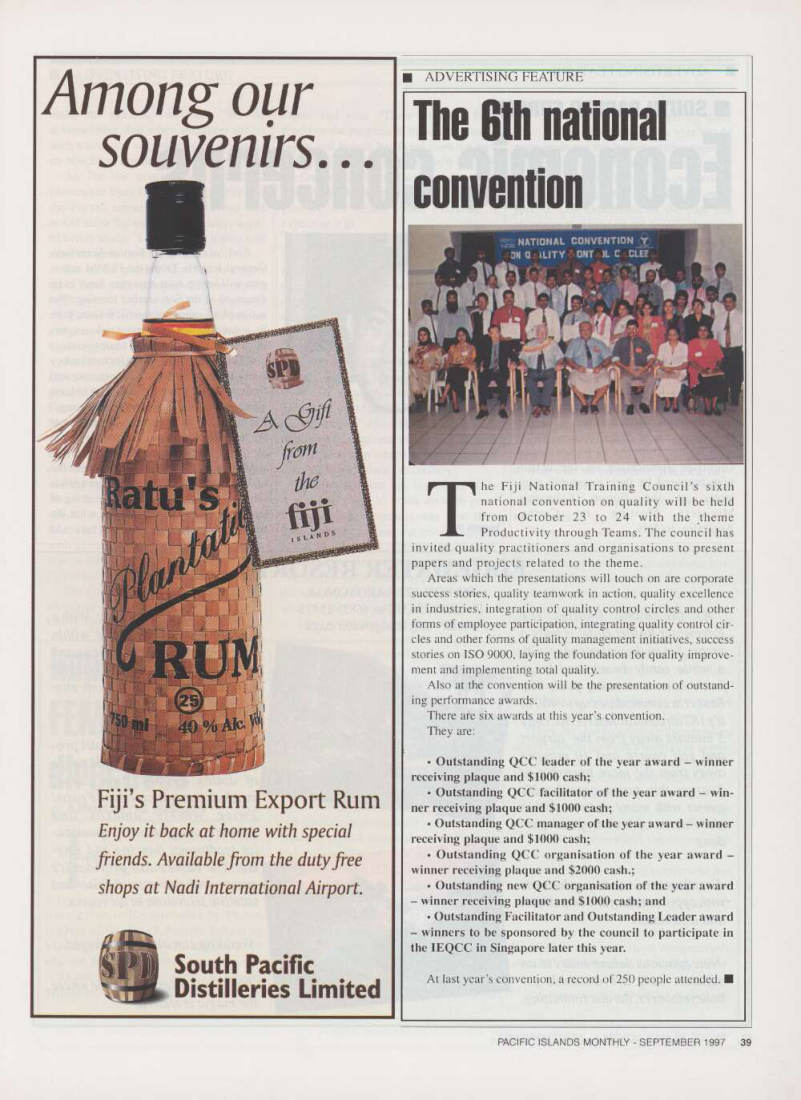
convention
The Fiji National Training Council’s sixth national convention on quality will be held from October 23 to 24 with the theme Productivity through Teams. The council has invited quality practitioners and organisations to present papers and projects related to the theme.
Areas which the presentations will touch on are corporate success stories, quality teamwork in action, quality excellence in industries, integration of quality control circles and other forms of employee participation, integrating quality control cir cles and other forms of quality management initiatives, success stories on ISO 9000, laying the foundation for quality improve ment and implementing total quality.
Also at the convention will be the presentation of outstand ing performance awards.
There are six awards at this year’s convention.
They are: • Outstanding QCC leader of the year award - winner receiving plaque and $lOOO cash; • Outstanding QCC facilitator of the year award - win ner receiving plaque and $lOOO cash; • Outstanding QCC manager of the year award - winner receiving plaque and $lOOO cash; • Outstanding QCC organisation of the year award winner receiving plaque and $2OOO cash.; • Outstanding new QCC organisation of the year award - winner receiving plaque and $lOOO cash; and • Outstanding Facilitator and Outstanding Leader award - winners to be sponsored by the council to participate in the lEQCC in Singapore later this year.
At last year’s convention, a record of 250 people attended. ■
Economic concerns
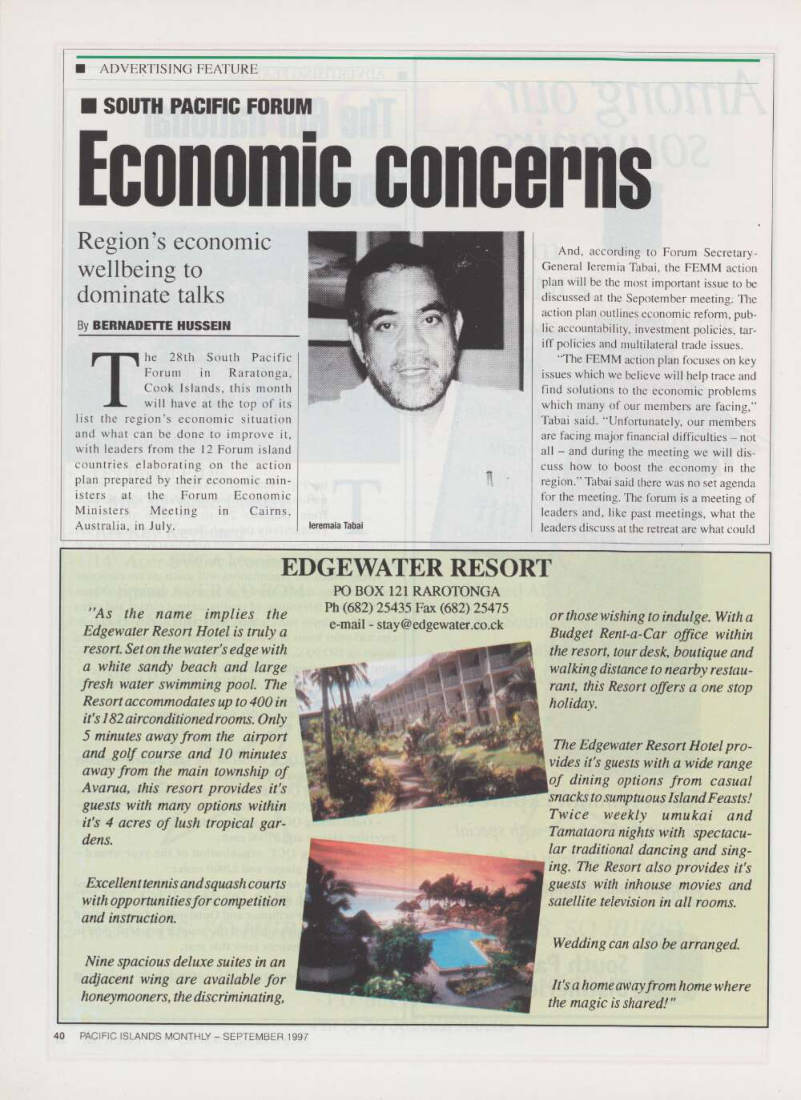
South Pacific Forum
Region’s economic wellbeing to dominate talks
By Bernadette Hussein
The 28th South Pacific Forum in Raratonga, Cook Islands, this month will have at the top of its list the region's economic situation and what can be done to improve it, with leaders from the 12 Forum island countries elaborating on the action plan prepared by their economic min isters at the Forum Economic Ministers Meeting in Cairns, Australia, in July.
And, according to Forum Secretary- General leremia Tabai, the FEMM action plan will be the most important issue to be discussed at the Sepotember meeting. The action plan outlines economic reform, pub lic accountability, investment policies, tar iff policies and multilateral trade issues.
"The FEMM action plan focuses on key issues which we believe will help trace and find solutions to the economic problems which many of our members are facing,”
Tabai said. "Unfortunately, our members are facing major financial difficulties - not all - and during the meeting we will dis cuss how to boost the economy in the region.” Tabai said there was no set agenda for the meeting. The forum is a meeting of leaders and, like past meetings, what the leaders discuss at the retreat are what could
leremaia Tabai
make the agenda,” he said. "We do acknowledge that when members are in such a situation ways should be discussed on how these can be improved.”
As for the controversial AUSTEO (Australian Eyes Only) reports, Tabai said the Forum agenda was very broad and would allow for anything the leaders want ed to talk about. “I do not know if they will raise the issue or not,” he said.
But as for placing Australia in a tight spot, Tabai said he hoped that this would not happen. I hope it does not complicate the Forum relationship because I think, as a region, we can try and help ourselves and work together.”
As for Australian Prime Minister John Howard attending, Tabai said it would be good if he did because the South Pacific Forum was an annual event and it would be a good time for the leaders to get togeth er and talk things over. Tabai added that another issue of equal importance had to do with the high-level fisheries meetings in the Republic of the Marshall Islands in June. "Issues raised at the meeting greatly affect our members. This meeting, for the first time, allowed our members to meet with distant fishing nations and discuss how to manage the resources, the needs of fishermen and fishing countries,” he said.
The Forum will also talk about the pos sibility of opening a trade office in Beijing, China, similar to the one opened in Tokyo,
Japan, last year. "There will also be a report on the progress of the trade office in Japan and how it has fared over the past year. The office is working well but it is the first year and people are not fully aware of it. But give it another year, and it should produce the result which everyone is expecting it to. ■'Like anything else, we are trying to improve it all the time. Japan will come to the Forum as a post-Forum dialogue part ner and hopefully we will discuss how we can further improve the performance of the office.”
This year will also see Malaysia attend the meeting as a post-Forum dialogue part ner. "Malaysia is very keen in this part of the world. And Malaysia, as everyone knows, is an aggressive investor in this part of the world and that would be a good starting point. "Also, Malaysia is a very important international player and we have a lot of issues on which we want support from the international community.”
Tabai added that one important issue which was going to come up with post- Forum dialogue partners was how they were going to support the reform agenda of the region. A new secretary-general will also be appointed at this year's meeting.
"We do not know who is applying because the applications have all gone to the cur rent chairman,” he said.
Tabai added that he would not be apply
ing for another term and was getting ready to go bqck home. He said this year would once again see the leaders getting together in their retreats and discussing issues in a less formal atmosphere. "The discussions are quite serious but in a less formal atmo sphere. Our experience in the past has shown us that retreats are usually the time when leaders meet and make decisions.
"A lot of decisions come out of the retreats and are accepted and these are done as a group so it's the decision which is more important than who said what.
"Such environments really help. You see, the meeting has changed over the years. In the beginning, the leaders would spend hours behind closed doors deliberat ing. But it is no longer like that. In fact, organisers have realised that a relaxed atmosphere is needed to encourage the leaders to open up even more. In the retreat when they meet, there is no agenda, but the chairman has a fair idea of what he wants to raise with his colleagues. But then, any body can raise an issue. In my view, these retreats are very important mechanisms to raise issues.”
Prior to the summit, will be -the offi cials' meeting where we will discuss the finer points of the meetings and make last minute changes. Tabai added that prepara tions for the summit were well under way with the hosts more than eager to welcome the leaders to their shores. ■
Advertisements & other items, p. 40 (1 item)
Edgewater Resort
"As the name implies the Edgewater Resort Hotel is truly a resort. Set on the water's edge with a white sandy beach and large fresh water swimming pool. The Resort accommodates up to 400 in it'siB2airconditionedrooms. Only 5 minutes away from the airport and golf course and 10 minutes away from the main township of Avarua, this resort provides it's guests with many options within it's 4 acres of lush tropical gardens.
Excellent tennis and squash courts with opportunities for competition and instruction.
Nine spacious deluxe suites in an adjacent wing are available for honeymooners, the discriminating,
PO BOX 121 RAROTONGA
Ph (682) 25435 Fax (682) 25475 e-mail - [email protected] or those wishing to indulge. With a Budget Rent-a-Car office within the resort, tour desk, boutique and walking distance to nearby restaurant, this Resort offers a one stop holiday.
The Edgewater Resort Hotel provides it's guests with a wide range of dining options from casual snacks to sumptuous Island Feasts!
Twice weekly umukai and Tamataora nights with spectacular traditional dancing and singing. The Resort also provides it's guests with inhouse movies and satellite television in all rooms.
Wedding can also be arranged.
It's a homeaWay from home where the magic is shared!"
Implementing
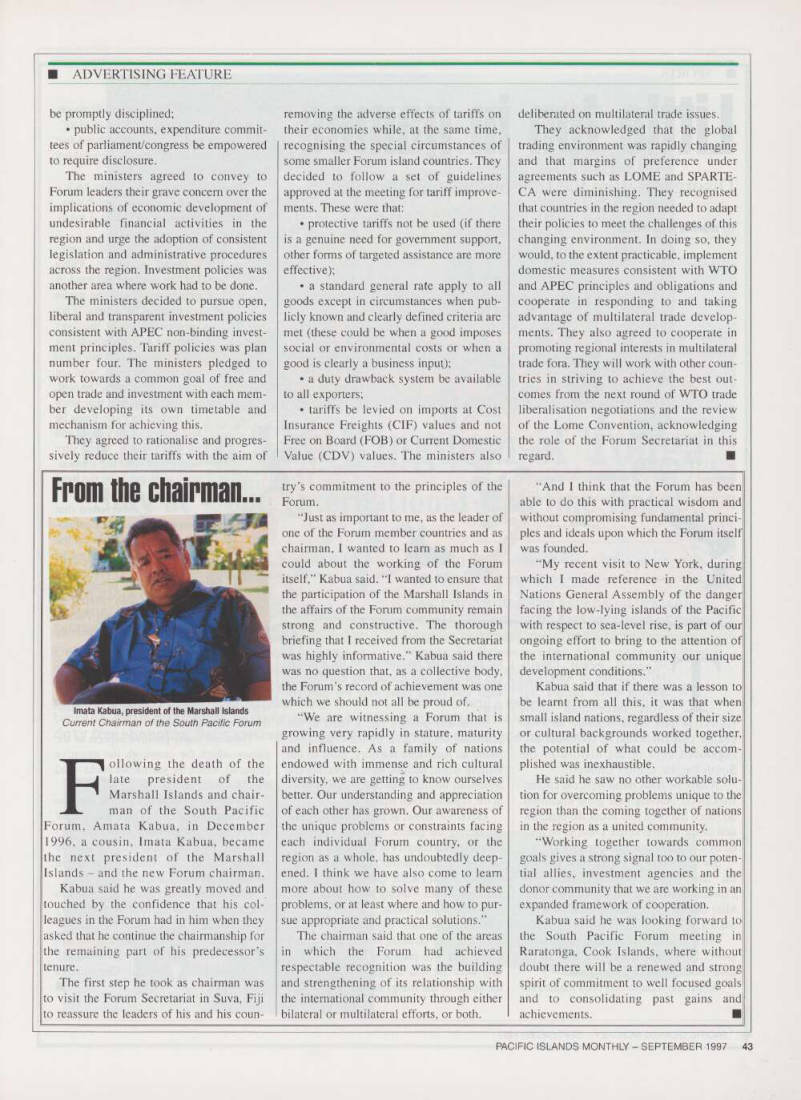
Femm
directives
By Bernadette Hussein
Economic ministers from Forum island countries met in Cairns, Australia, July 11 to discuss the best ways in which to implement the direc tives given to the ministers by Forum leaders at the South Pacific Forum in Madang, Papua New Guinea, in 1995 and the Marshall Islands last year.
It was agreed at the Forum Economic Ministers Meeting that private-sector
development was central to ensuring sus tained economic growth, and that govern ments should provide a policy environment to encourage this. And an action plan was agreed on to this end. Plan number one was to continue implementing economic reform strategies in accordance with the 1996 Forum directives.
The ministers agreed to develop nation al economic reform strategies encompass ing all components of their reform process and identify measures for ensuring that essential service delivery was maintained and potentially adverse social impacts were minimised. They also agreed that these strategies be developed in consulta tion with community groups and the pri vate sector. They agreed to invite the pri vate sector to identify issues affecting busi ness competitiveness that could be addressed by government policy reform, advise on the relative importance of these to business productivity and recommend
steps which could be taken to improve the economic environment within which they operate.
Public accountability was the second plan which the leaders agreed upon.
They decided to promote the adoption, at government level, of a number of princi ples of best practice for public accountabil ity. Some of these principles were: • budgetary processes, including multi year frameworks, to ensure parliament/congress is sufficiently informed to understand the longer-term implications of appropriation decisions; • government, statutory corporation and state-owned enterprise accounts be promptly and fully audited and made avail able to the public; • all government and public-sector con tracts be openly advertised, competitively awarded, administered and publicly report ed; • contravention of financial regulations
be promptly disciplined; • public accounts, expenditure commit tees of parliament/congress be empowered to require disclosure.
The ministers agreed to convey to Forum leaders their grave concern over the implications of economic development of undesirable financial activities in the region and urge the adoption of consistent legislation and administrative procedures across the region. Investment policies was another area where work had to be done.
The ministers decided to pursue open, liberal and transparent investment policies consistent with APEC non-binding invest ment principles. Tariff policies was plan number four. The ministers pledged to work towards a common goal of free and open trade and investment with each mem ber developing its own timetable and mechanism for achieving this.
They agreed to rationalise and progres sively reduce their tariffs with the aim of
removing the adverse effects of tariffs on their economies while, at the same time, recognising the special circumstances of some smaller Forum island countries. They decided to follow a set of guidelines approved at the meeting for tariff improve ments. These were that: • protective tariffs not be used (if there is a genuine need for government support, other forms of targeted assistance are more effective); • a standard general rate apply to all goods except in circumstances when pub licly known and clearly defined criteria are met (these could be when a good imposes social or environmental costs or when a good is clearly a business input); • a duty drawback system be available to all exporters; • tariffs be levied on imports at Cost Insurance Freights (GIF) values and not Free on Board (FOB) or Current Domestic Value (CDV) values. The ministers also
deliberated on multilateral trade issues.
They acknowledged that the global trading environment was rapidly changing and that margins of preference under agreements such as LOME and SPARTE CA were diminishing. They recognised that countries in the region needed to adapt their policies to meet the challenges of this changing environment. In doing so, they would, to the extent practicable, implement domestic measures consistent with WTO and APEC principles and obligations and cooperate in responding to and taking advantage of multilateral trade develop ments. They also agreed to cooperate in promoting regional interests in multilateral trade fora. They will work with other coun tries in striving to achieve the best out comes from the next round of WTO trade liberalisation negotiations and the review of the Lome Convention, acknowledging the role of the Forum Secretariat in this regard. ■
Advertisements & other items, p. 42 (1 item)
F 535536 to F 560360 inclusive + substantial housing subsidy
& m ip m ioi] mini
COMPUTER PROFESSIONALS FOR THE SOUTH PACIFIC
F 535536 to F 560360 inclusive + substantial housing subsidy The University of the South Pacific, with its headquarters in Suva, Fiji, is embarking on a major expansion of its IT facilities. To support this, we now seek to add a range of skills and experience at different levels, from the equivalent of Analyst/Programmer to Section manager. Both long term and shorter, fixed-term appointments can be considered.
We are currently running a basic University Management Information System, using Oracle, and are looking for innovative professionals who can take us forward, and develop this to deliver effective access to information required by Management, and the whole University community.
As a regional institution, USP has very special communications requirements. We have extensive LANs on our Suva campus, which are currently being re-engineered. An exciting project is underway to extend these facilities to all twelve University member countries, throughout the South Pacific. We are looking for experienced local and wide-area network professionals who can contribute and lead in these areas.
At USP most client computing is PC based, and central facilities are offered on Digital VMS and Unix systems, with NT servers increasingly being used. We are also looking for support staff in these areas.
Suva, Fiji’s capital city, is a diverse and bustling port which serves as a pivotal point for much of the region’s trade and travel. While ideally you will already have some regional experience, at least part of the attraction this post will be the opportunity to live and work in this fascinating part of the world, with its diverse cultural and leisure attractions.
We are talking a flexible approach to recruitment. If you feel that you have something to offer, get in touch with us and tell us about yourself. For further discussion about USP and our requirements, contact Dr John Clayton, Director of Computer Services on telephone: (679) 302598 (W) (679) 301369 (H), fax: (679) 304089 or email :[email protected]. Further information is also available through a special recruitment web page at http:/ /www. usp. ac. fj/itposts.
The University of the South Pacific USP serves the needs of twelve countries in the South Pacific; it has three campuses Alafua in Samoa, Emalus in Vanuatu and the main Laucala campus in Suva, Fiji. While the Schools of USP are based on the three campuses, a large part of their work is directed to students resident in other member countries by distance education.
There are University Extension Centres in all member countries except Tokelau, offering a variety of distance-learning programmes including course offerings through Summer Schools. The University is well equipped for computer and library facilities and access to Internet, and has a full range of audio and video production facilities. Voice and data satellite telecommunications networks link campuses and extension centres.
Salary and Benefits The salary packages stated above are from Lecturer I to Senior Lecturer equivalent levels, inclusive of 15% gratuity payment and 20% inducement payment plus the University contributes 10% of salary to an approved superannuation scheme and substantially subsidises housing costs.
To apply: Manager-Personnel University of the South Pacific Suva Fiji Fax: (679) 303437 Email: [email protected] Apply directly by sending two copies of your CV to this address, including fax contacts of three referees. To expedite the appointment procedure, applicants are advised to request their referees to send confidential reports direct to the University without waiting to be contacted quoting the number and title of the post.
Applications to reach the University by 15 September 1997.
From the chairman...
Following the death of the late president of the Marshall Islands and chair man of the South Pacific Forum, Amata Kabua, in December 1996, a cousin, Imata Kabua, became the next president of the Marshall Islands - and the new Forum chairman.
Kabua said he was greatly moved and touched by the confidence that his col leagues in the Forum had in him when they asked that he continue the chairmanship for the remaining part of his predecessor’s tenure.
The first step he took as chairman was to visit the Forum Secretariat in Suva, Fiji to reassure the leaders of his and his coun
try’s commitment to the principles of the Forum.
“Just as important to me, as the leader of one of the Forum member countries and as chairman, I wanted to learn as much as I could about the working of the Forum itself,” Kabua said. “I wanted to ensure that the participation of the Marshall Islands in the affairs of the Forum community remain strong and constructive. The thorough briefing that I received from the Secretariat was highly informative.” Kabua said there was no question that, as a collective body, the Forum’s record of achievement was one which we should not all be proud of.
“We are witnessing a Forum that is growing very rapidly in stature, maturity and influence. As a family of nations endowed with immense and rich cultural diversity, we are getting to know ourselves better. Our understanding and appreciation of each other has grown. Our awareness of the unique problems or constraints facing each individual Forum country, or the region as a whole, has undoubtedly deep ened. I think we have also come to learn more about how to solve many of these problems, or at least where and how to pur sue appropriate and practical solutions.”
The chairman said that one of the areas in which the Forum had achieved respectable recognition was the building and strengthening of its relationship with the international community through either bilateral or multilateral efforts, or both.
“And I think that the Forum has been able to do this with practical wisdom and without compromising fundamental princi ples and ideals upon which the Forum itself was founded.
“My recent visit to New York, during which I made reference in the United Nations General Assembly of the danger facing the low-lying islands of the Pacific with respect to sea-level rise, is part of our ongoing effort to bring to the attention of the international community our unique development conditions.”
Kabua said that if there was a lesson to be learnt from all this, it was that when small island nations, regardless of their size or cultural backgrounds worked together, the potential of what could be accom plished was inexhaustible.
He said he saw no other workable solu tion for overcoming problems unique to the region than the coming together of nations in the region as a united community.
“Working together towards common goals gives a strong signal too to our poten tial allies, investment agencies and the donor community that we are working in an expanded framework of cooperation.
Kabua said he was looking forward to the South Pacific Forum meeting in Raratonga, Cook Islands, where without doubt there will be a renewed and strong spirit of commitment to well focused goals and to consolidating past gains and achievements. ■
Imata Kabua, president of the Marshall Islands Current Chairman of the South Pacific Forum
Little fun in games
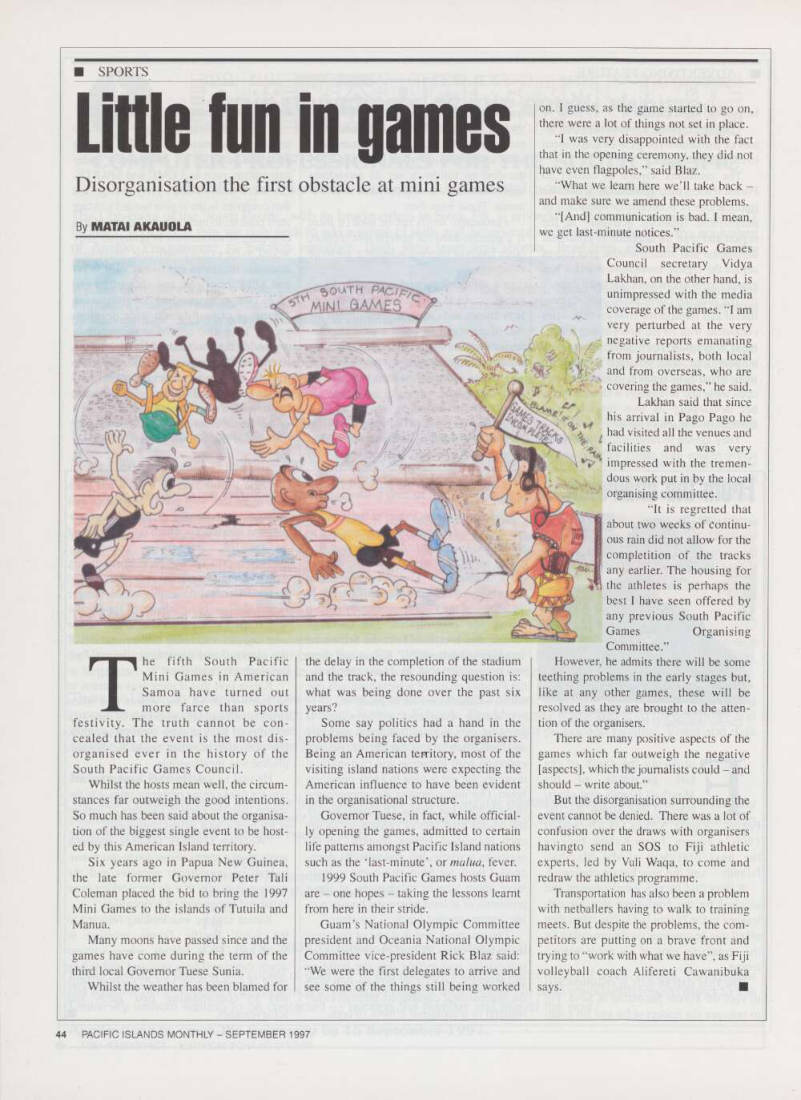
Sports
Little fun in games Disorganisation the first obstacle at mini games
By Matai Akauola
The fifth South Pacific Mini Games in American Samoa have turned out more farce than sports festivity. The truth cannot be con cealed that the event is the most dis organised ever in the history of the South Pacific Games Council.
Whilst the hosts mean well, the circum stances far outweigh the good intentions.
So much has been said about the organisa tion of the biggest single event to be host ed by this American Island territory.
Six years ago in Papua New Guinea, the late former Governor Peter Tali Coleman placed the bid to bring the 1997 Mini Games to the islands of Tutuila and Manua.
Many moons have passed since and the games have come during the term of the third local Governor Tuese Sunia.
Whilst the weather has been blamed for
the delay in the completion of the stadium and the track, the resounding question is: what was being done over the past six years?
Some say politics had a hand in the problems being faced by the organisers.
Being an American territory, most of the visiting island nations were expecting the American influence to have been evident in the organisational structure.
Governor Tuese, in fact, while official ly opening the games, admitted to certain life patterns amongst Pacific Island nations such as the Mast-minute’, or malua, fever. 1999 South Pacific Games hosts Guam are - one hopes - taking the lessons leamt from here in their stride.
Guam’s National Olympic Committee president and Oceania National Olympic Committee vice-president Rick Blaz said: "We were the first delegates to arrive and see some of the things still being worked
on. I guess, as the game started to go on, there were a lot of things not set in place.
"I was very disappointed with the fact that in the opening ceremony, they did not have even flagpoles,” said Blaz.
"What we learn here we’ll take back and make sure we amend these problems.
"[And] communication is bad. I mean, we get last-minute notices.”
South Pacific Games Council secretary Vidya Lakhan, on the other hand, is unimpressed with the media coverage of the games. "I am very perturbed at the very negative reports emanating from journalists, both local and from overseas, who are covering the games,” he said.
Lakhan said that since his arrival in Pago Pago he had visited all the venues and facilities and was very impressed with the tremen dous work put in by the local organising committee.
“It is regretted that about two weeks of continu ous rain did not allow for the completition of the tracks any earlier. The housing for the athletes is perhaps the best I have seen offered by any previous South Pacific Games Organising Committee.”
However, he admits there will be some teething problems in the early stages but, like at any other games, these will be resolved as they are brought to the atten tion of the organisers.
There are many positive aspects of the games which far outweigh the negative [aspects], which the journalists could - and should - write about.”
But the disorganisation surrounding the event cannot be denied. There was a lot of confusion over the draws with organisers havingto send an SOS to Fiji athletic experts, led by Yuli Waqa, to come and redraw the athletics programme.
Transportation has also been a problem with netballers having to walk to training meets. But despite the problems, the com petitors are putting on a brave front and trying to "work with what we have”, as Fiji volleyball coach Alifereti Cawanibuka says. ■
Advertisements & other items, p. 45 (1 item)
When in The Kingdom of Tonga
Stay at - The International Dateline Hotel Seventy-six airconditioned rooms with all amenities over-looking- sparkling Nuku’alofa Harbour make the International Dateline Hotel the perfect retreat for complete relaxation.
Delicious international and local cuisine at our licensed a-la-carte restaurant, exotic cocktails at our two bars, floor shows, private guest lounge, open air dancing terrace, swimming pool, variety shop and duty free shopping, baby sitting on request, everything you could want for a relaxing holiday in the sun.
Major upgrading and expansion is planned for late 1997 and 1998. And for those of you here on business we offer two conference rooms, business centre, international direct dial telephones, telex and facsimile services, daily laundry and drycleaning services and a safety deposit facility to make life a little more convenient when you’re doing business away from home.
The top end of music
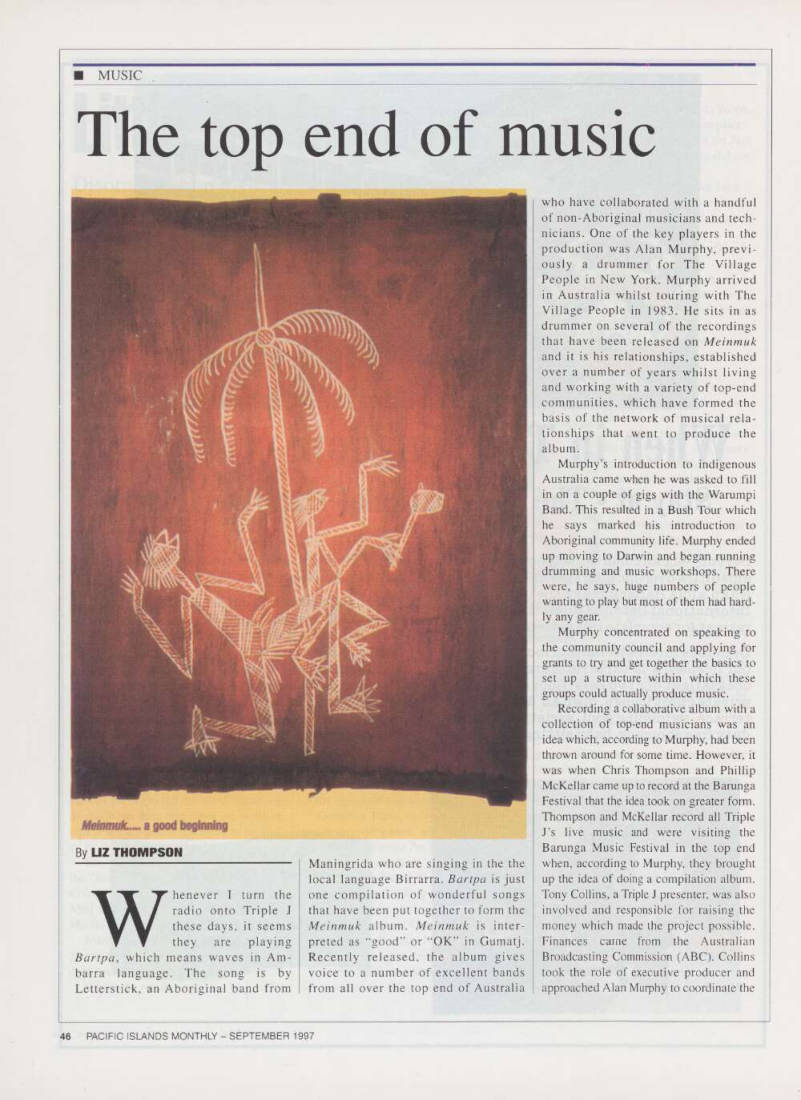
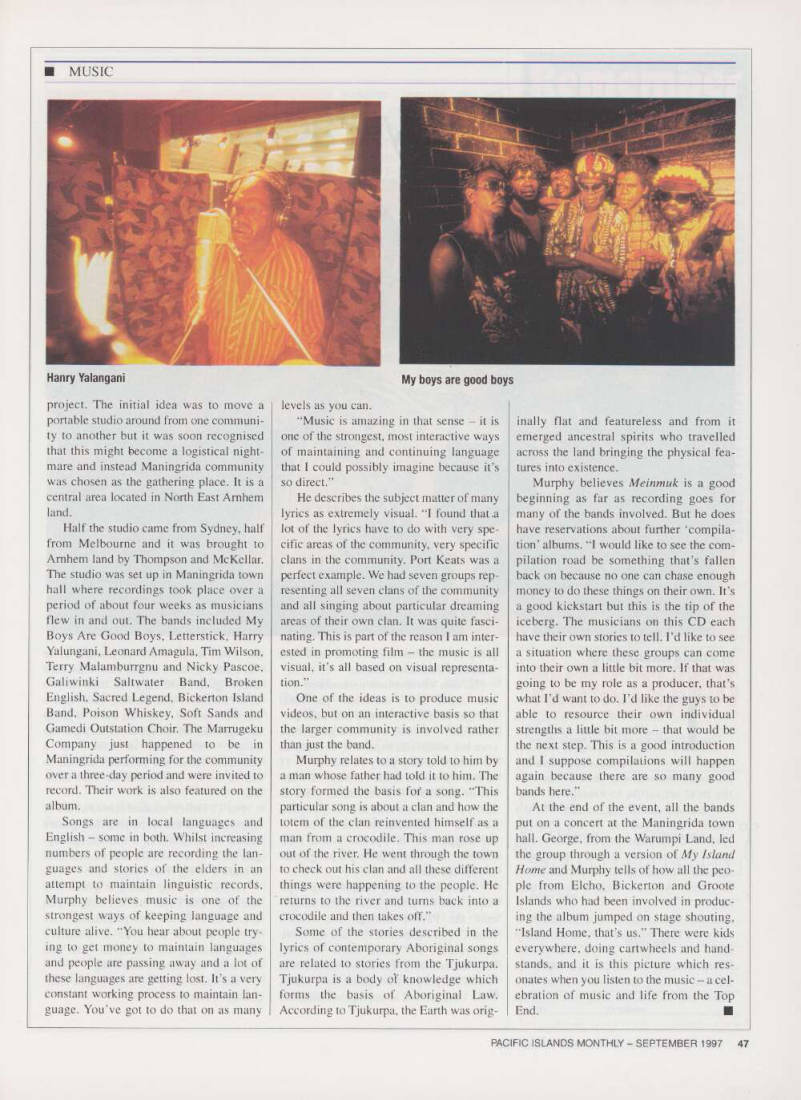
Music
By Liz Thompson
Whenever I turn the radio onto Triple J these days, it seems they are playing Bartpa, which means waves in Am barra language. The song is by Letterstick, an Aboriginal band from
Maningrida who are singing in the the local language Birrarra. Bartpa is just one compilation of wonderful songs that have been put together to form the Meinmuk album. Meinmuk is inter preted as "good” or "OK” in Gumatj.
Recently released, the album gives voice to a number of excellent bands from all over the top end of Australia
who have collaborated with a handful of non-Aboriginal musicians and tech nicians. One of the key players in the
production was Alan Murphy, previ
ously a drummer for The Village People in New York. Murphy arrived in Australia whilst touring with The Village People in 1983. He sits in as drummer on several of the recordings that have been released on Meinmuk and it is his relationships, established over a number of years whilst living and working with a variety of top-end communities, which have formed the basis of the network of musical rela tionships that went to produce the album.
Murphy’s introduction to indigenous Australia came when he was asked to fill in on a couple of gigs with the Warumpi Band. This resulted in a Bush Tour which he says marked his introduction to
Aboriginal community life. Murphy ended
up moving to Darwin and began running drumming and music workshops. There were, he says, huge numbers of people wanting to play but most of them had hard ly any gear.
Murphy concentrated on speaking to the community council and applying for grants to try and get together the basics to set up a structure within which these groups could actually produce music.
Recording a collaborative album with a collection of top-end musicians was an idea which, according to Murphy, had been thrown around for some time. However, it was when Chris Thompson and Phillip McKellar came up to record at the Barunga Festival that the idea took on greater form.
Thompson and McKellar record all Triple J’s live music and were visiting the Barunga Music Festival in the top end when, according to Murphy, they brought up the idea of doing a compilation album.
Tony Collins, a Triple J presenter, was also involved and responsible for raising the money which made the project possible.
Finances came from the Australian Broadcasting Commission (ABC). Collins took the role of executive producer and approached Alan Murphy to coordinate the
Meinmuk... a good beginning
project. The initial idea was to move a portable studio around from one communi ty to another but it was soon recognised that this might become a logistical night mare and instead Maningrida community was chosen as the gathering place. It is a central area located in North East Amhem land.
Half the studio came from Sydney, half from Melbourne and it was brought to Amhem land by Thompson and McKellar.
The studio was set up in Maningrida town hall where recordings took place over a period of about four weeks as musicians flew in and out. The bands included My Boys Are Good Boys, Letterstick, Harry Yalungani, Leonard Amagula, Tim Wilson, Terry Malamburrgnu and Nicky Pascoe, Galiwinki Saltwater Band, Broken English. Sacred Legend, Bickerton Island Band, Poison Whiskey, Soft Sands and Gamedi Outstation Choir. The Marrugeku Company just happened to be in Maningrida performing for the community over a three-day period and were invited to record. Their work is also featured on the album.
Songs are in local languages and English - some in both. Whilst increasing numbers of people are recording the lan guages and stories of the elders in an attempt to maintain linguistic records, Murphy believes music is one of the strongest ways of keeping language and culture alive. "You hear about people try ing to get money to maintain languages and people are passing away and a lot of these languages are getting lost. It's a very constant working process to maintain lan guage. You've got to do that on as many
levels as you can.
“Music is amazing in that sense - it is one of the strongest, most interactive ways of maintaining and continuing language that I could possibly imagine because it’s so direct.”
He describes the subject matter of many lyrics as extremely visual. “I found that .a lot of the lyrics have to do with very spe cific areas of the community, very specific clans in the community. Port Keats was a perfect example. We had seven groups rep resenting all seven clans of the community and all singing about particular dreaming areas of their own clan. It was quite fasci nating. This is part of the reason I am inter ested in promoting film - the music is all visual, it’s all based on visual representa tion.”
One of the ideas is to produce music videos, but on an interactive basis so that the larger community is involved rather than just the band.
Murphy relates to a story told to him by a man whose father had told it to him. The story formed the basis for a song. “This particular song is about a clan and how the totem of the clan reinvented himself as a man from a crocodile. This man rose up out of the river. He went through the town to check out his clan and all these different things were happening to the people. He returns to the river and turns back into a crocodile and then takes off.”
Some of the stories described in the lyrics of contemporary Aboriginal songs are related to stories from the Tjukurpa.
Tjukurpa is a body of knowledge which forms the basis of Aboriginal Law.
According to Tjukurpa, the Earth was orig
inally flat and featureless and from it emerged ancestral spirits who travelled across the land bringing the physical fea tures into existence.
Murphy believes Meinmuk is a good beginning as far as recording goes for many of the bands involved. But he does have reservations about further ‘compila tion’ albums. “I would like to see the com pilation road be something that’s fallen back on because no one can chase enough money to do these things on their own. It’s a good kickstart but this is the tip of the iceberg. The musicians on this CD each have their own stories to tell. I’d like to see a situation where these groups can come into their own a little bit more. If that was going to be my role as a producer, that’s what I’d want to do. I’d like the guys to be able to resource their own individual strengths a little bit more - that would be the next step. This is a good introduction and I suppose compilations will happen again because there are so many good bands here.”
At the end of the event, all the bands put on a concert at the Maningrida town hall. George, from the Warumpi Land, led the group through a version of My Island Home and Murphy tells of how all the peo ple from Elcho, Bickerton and Groote Islands who had been involved in produc ing the album jumped on stage shouting, "Island Home, that's us.” There were kids everywhere, doing cartwheels and hand stands, and it is this picture which res onates when you listen to the music - a cel ebration of music and life from the Top End. ■
Hanry Yalangani
My boys are good boys
Contemporary Pacific sound
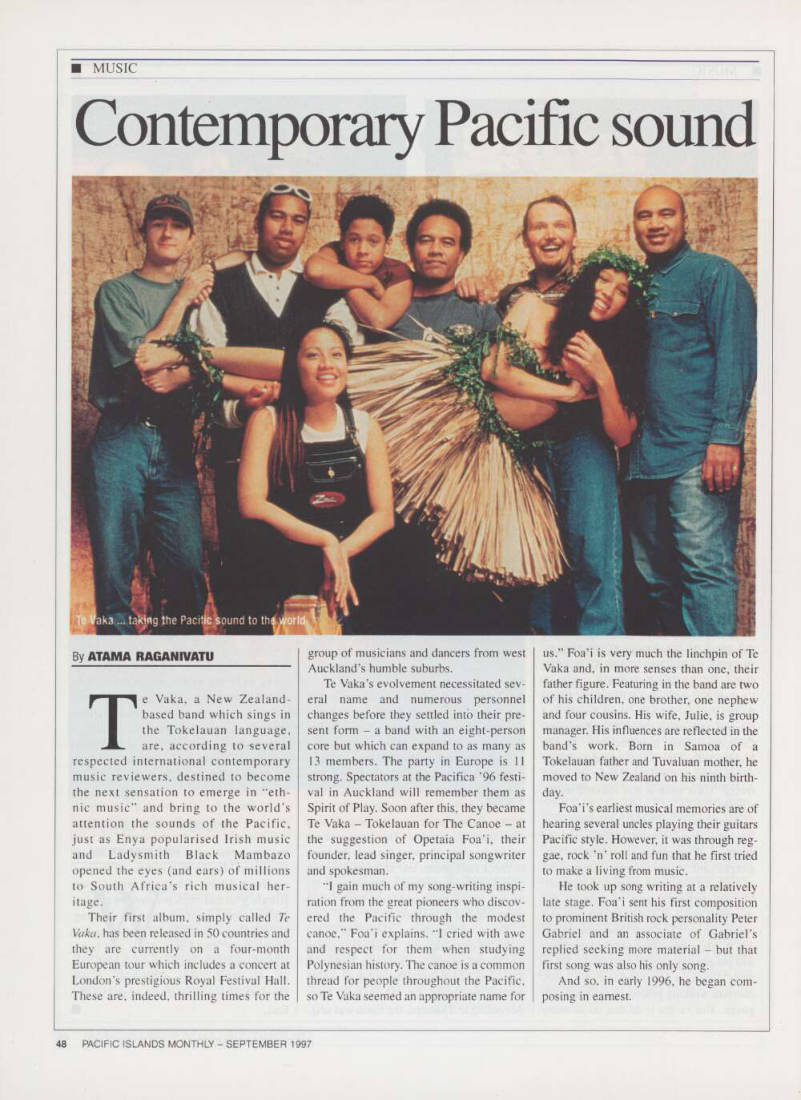
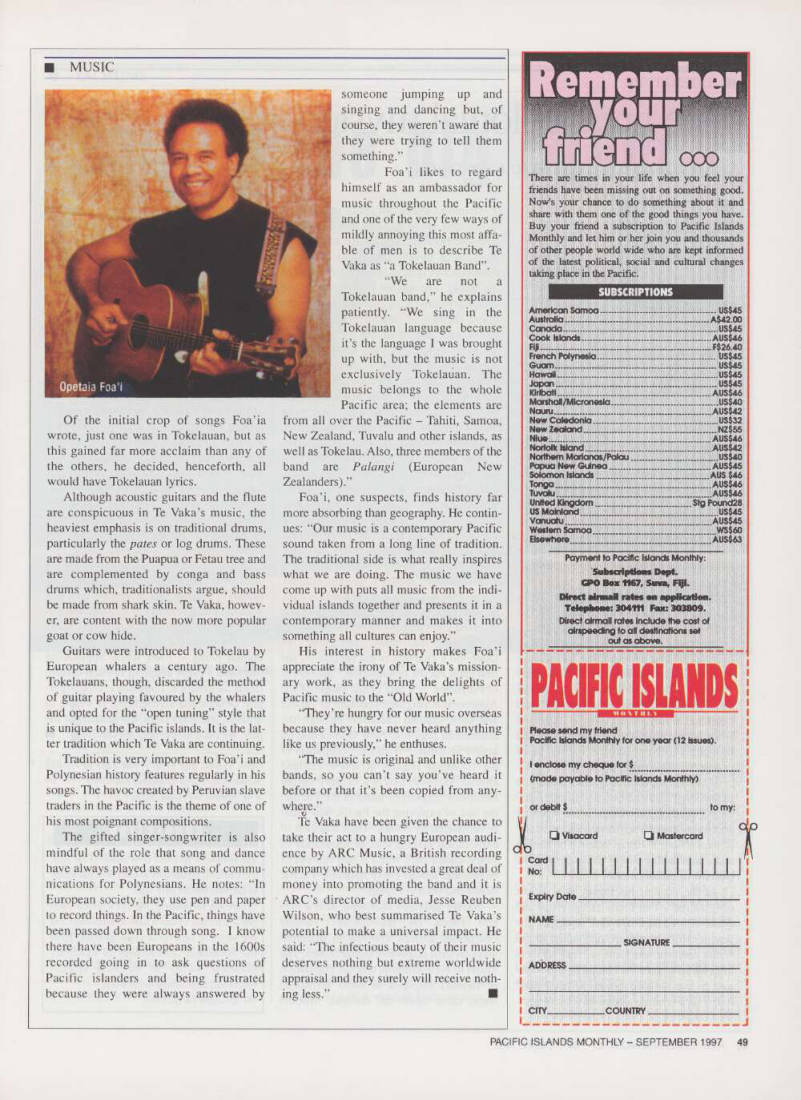
By Atama Raganivatu
Te Vaka, a New Zealand based band which sings in the Tokelauan language, are, according to several respected international contemporary music reviewers, destined to become the next sensation to emerge in "eth nic music” and bring to the world’s attention the sounds of the Pacific, just as Enya popularised Irish music and Ladysmith Black Mambazo opened the eyes (and ears) of millions to South Africa’s rich musical her itage.
Their first album, simply called Te Vaka , has been released in 50 countries and they are currently on a four-month European tour which includes a concert at London’s prestigious Royal Festival Hall.
These are, indeed, thrilling times for the
group of musicians and dancers from west Auckland’s humble suburbs.
Te Vaka’s evolvement necessitated sev eral name and numerous personnel changes before they settled into their pre sent form - a band with an eight-person core but which can expand to as many as 13 members. The party in Europe is 11 strong. Spectators at the Pacifica ’96 festi val in Auckland will remember them as Spirit of Play. Soon after this, they became Te Vaka - Tokelauan for The Canoe - at the suggestion of Opetaia Foa’i, their founder, lead singer, principal songwriter and spokesman.
"I gain much of my song-writing inspi ration from the great pioneers who discov ered the Pacific through the modest canoe,” Foa’i explains. "I cried with awe and respect for them when studying Polynesian history. The canoe is a common thread for people throughout the Pacific, so Te Vaka seemed an appropriate name for
us.” Foa’i is very much the linchpin of Te Vaka and, in more senses than one, their father figure. Featuring in the band are two of his children, one brother, one nephew and four cousins. His wife, Julie, is group manager. His influences are reflected in the band’s work. Born in Samoa of a Tokelauan father and Tuvaluan mother, he moved to New Zealand on his ninth birth day.
Foa’i’s earliest musical memories are of hearing several uncles playing their guitars Pacific style. However, it was through reg gae, rock V roll and fun that he first tried to make a living from music.
He took up song writing at a relatively late stage. Foa’i sent his first composition to prominent British rock personality Peter Gabriel and an associate of Gabriel's replied seeking more material - but that first song was also his only song.
And so, in early 1996, he began com posing in earnest.
Te vaka ... taking the Pacific sound to the world
Of the initial crop of songs Foa’ia wrote, just one was in Tokelauan, but as this gained far more acclaim than any of the others, he decided, henceforth, all would have Tokelauan lyrics.
Although acoustic guitars and the flute are conspicuous in Te Vaka’s music, the heaviest emphasis is on traditional drums, particularly the pates or log drums. These are made from the Puapua or Fetau tree and are complemented by conga and bass drums which, traditionalists argue, should be made from shark skin. Te Vaka, howev er, are content with the now more popular goat or cow hide.
Guitars were introduced to Tokelau by European whalers a century ago. The Tokelauans, though, discarded the method of guitar playing favoured by the whalers and opted for the “open tuning” style that is unique to the Pacific islands. It is the lat ter tradition which Te Vaka are continuing.
Tradition is very important to Foa’i and Polynesian history features regularly in his songs. The havoc created by Peruvian slave traders in the Pacific is the theme of one of his most poignant compositions.
The gifted singer-songwriter is also mindful of the role that song and dance have always played as a means of commu nications for Polynesians. He notes: “In European society, they use pen and paper to record things. In the Pacific, things have been passed down through song. I know there have been Europeans in the 1600 s recorded going in to ask questions of Pacific islanders and being frustrated because they were always answered by
someone jumping up and singing and dancing but, of course, they weren’t aware that they were trying to tell them
something.”
Foa’i likes to regard himself as an ambassador for music throughout the Pacific and one of the very few ways of mildly annoying this most affa ble of men is to describe Te Vaka as “a Tokelauan Band”.
“We are not a Tokelauan band,” he explains patiently. “We sing in the Tokelauan language because it’s the language 1 was brought up with, but the music is not exclusively Tokelauan. The music belongs to the whole Pacific area; the elements are
from all over the Pacific - Tahiti, Samoa, New Zealand, Tuvalu and other islands, as well as Tokelau. Also, three members of the band are Palangi (European New Zealanders).”
Foa’i, one suspects, finds history far more absorbing than geography. He contin ues: “Our music is a contemporary Pacific sound taken from a long line of tradition.
The traditional side is what really inspires what we are doing. The music we have come up with puts all music from the indi vidual islands together and presents it in a contemporary manner and makes it into something all cultures can enjoy.”
His interest in history makes Foa’i appreciate the irony of Te Vaka’s mission ary work, as they bring the delights of Pacific music to the “Old World”.
“They’re hungry for our music overseas because they have never heard anything like us previously,” he enthuses.
“The music is original and unlike other bands, so you can’t say you’ve heard it before or that it’s been copied from any where.” ‘Km Te Vaka have been given the chance to take their act to a hungry European audi ence by ARC Music, a British recording company which has invested a great deal of money into promoting the band and it is ARC’S director of media, Jesse Reuben Wilson, who best summarised Te Vaka’s potential to make a universal impact. He said; “The infectious beauty of their music deserves nothing but extreme worldwide appraisal and they surely will receive noth ing less.” ■
Opetaia Foa’i
Advertisements & other items, p. 49 (1 item)
Pacific Blands
IoLLIIJ 000
There are times in your life when you feel your friends have been missing out on something good.
Now's your chance to do something about it and share with them one of the good things you have.
Buy your friend a subscription to Pacific Islands Monthly and let him or her join you and thousands of other people world wide who are kept informed of the latest political, social and cultural changes taking place in the Pacific.
SUBSCRIPTIONS
American Samoa US$45 Australia A 542.00 Canada US$45 Cook Islands AUSS46
FIJI F 526.40
French Polynesia „ US$45 Guam US$45 Hawaii US$45 Japan US$45 Kiribati AUSS46 Marshall/Micronesia US$4O Nauru AUSS42 New Caledonia US$32 New Zealand NZ$55 Niue AUSS46 Norfolk Island AUSS42 Northern Marianas/Palau US$4O Papua New Guinea AUSS4S Solomon Islands AUS $45 Tonga AUSS46 Tuvalu AUSS46 Unted Kingdom Sfg Pound2B US Mainland . . US$45 Vanuatu AUSS4S Western Samoa ,WS$6O Elsewhere AUSS63 Payment to Pacific Islands Monthly: Subscriptions Dept.
CPO Box H€ 7, Suva, Fiji.
Direct alnoai rates on application.
Telephone: 304111 Fax: 303809.
Direct airmail rates include the cost of airspeeding to all destinations set out as above.
PACIFIC BLANDS
Please send my friend ; Pacific (stands Monthly for one year 02 issues). I enclose my cheque for $ (made payable to Pacific Islands Monthly) 1 Card No: Expiry Date.
NAME
. SIGNATURE.
ADDRESS.
CITY COUNTRY
or debit $ to my: , □ Visacard □ Mastercard I I
The great colonial mystery
Literature
The great colonial mystery ...of Europe’s explosive expansion
By Nicolas
Rothwell
Why was it that
European civilisa
tion, and no other, colonised the globe?
What was it about the cultures of that particular continent that permitted them such explosive expansion? Why, in short, did white men, who seem, on the face of things, just as quarrelsome and rapacious as any other race, have such material and technological advantage?
These problems, so often pondered in private by anyone exposed to the realities of post-colonial life, and yet so little dis cussed in public, form the trigger for American biogeographer Jared Diamond’s challenging master-work, Guns, Germs and Steel - The Fates of Human Societies.
Professor Diamond, one of the most persuasive and entertaining of science writers, seeks in this book to answer “Yali’s question”, an inquiry put to him by a charismatic Papua New Guinea local politician in July, 1972: “Why is it that you white people developed so much cargo and brought it to New Guinea, but we black people had little cargo of our own?”
Diamond’s answer, a quarter century in the making, leads him on a long and fasci
nating road. He develops a far-reaching
account of human settlement and econom ic interaction, a virtual science of history and a painstaking survey of the geographic patterns of colonisation.
At the core of his theory is a simple observation - that many of the crops and domesticated animals that underpin the practices of agriculture originated in the fertile crescent and Eurasia. This accident of geography gave the human beings fortu nate to live in those regions a "head start” in the race towards advanced technology.
Diamond teases out every implication of this idea. He looks at the shapes and cli mates of continents, the ease with which they can be travelled, the trials of human development in less favoured regions of the world. The upshot is a startling, and ultimately convincing, explanation for the grand themes of human history. Guns, germs and steel then are the tools that allowed colonisers to achieve easy supremacy at the time of first contact - European guns, the infectious diseases the explorers carried in their bodies, and the steel-manufactured goods they brought in their train. History, according to Diamond, “followed different courses for different peoples because of differences among peo ples’ environments, not because of biolog ical differences among peoples them selves”. Such is his one-sentence summary of his own work. Succinct and apposite, it yet does little justice to the constant sug gestiveness and informing splendour of the book. There is hardly a page that fails to challenge the reader’s preconceptions, startle with recondite combinations of data, or invert the traditional stereotypes of our received knowledge.
Among the most intriguing of Diamond’s chapters is his section on the first great Pacific colonisation: “Speedboat to Polynesia” - a tale of the origin of the Austronesian language speakers in Taiwan and their gradual radiation through the Indonesian region to New Guinea and on across Oceania. “With the occupation of the Chatham Islands off New Zealand around AD 1400, barely a century before European "explorers’ entered the Pacific, the task of exploring the Pacific was final ly completed by Asians. Their tradition of exploration lasting tens of thousands of years, ended only when it had run out of targets and almost every habitable Pacific island had been occupied.”
Nature provides Diamond with a pre cise check on his theory. Various Polynesian groups evolved in different ways on their respective island homes. The Maori of New Zealand, a dense population of farmers engaged in bitter territorial wars, came upon the tranquil Moriori
hunter-gatherer population of Chatham Islands in late 1835. These peoples were cousins, separated by only a few hundred years of social evolution. The Maori effaced the weaker population; proof, if you will, that variation is in significant degree a product of historical geography.
All Polynesia was a striking stage of diverse environments; ranging from atolls to large high islands, from a micro conti nent to tiny specks of coral. In social sys tem, Polynesian societies ran from “fairly egalitarian village societies to some of the most stratified societies in the world, with many hierarchically ranked lineages and with chief and commoner classes whose members married within their own class”.
"All these differences among Polynesian societies developed, within a relatively short time and modest fraction of the Earth's surface, as environmentally related variations on a single ancestral society.” The grand conclusion Diamond is reaching for becomes, as a result of hun dreds of well-argued examples, clear: that human diversity has a direct and environ mental explanation, and hence arguments that trace different outcomes to differences in capability between peoples are not merely “loathsome” - they are wrong.
More controversial is Diamond’s attempt to sketch a full-fledged ‘"science of history”, placing this discipline on a par with such hard sciences as geology and cli matology. Perhaps we should still leave some room for the action of the individual human being - even while applauding Diamond’s eager coupling of such diverse fields as genetics, linguistics, biogeogra phy, politics and archaeology. If we are to unravel, and leant from, the patterns of the past, we need all the help we can find. ■
Guns, Germs and Steel - The Fate of Human Societies by Jared Diamond published 1997 by WW Norton, NY, USA. $U527.50
Correction
The review of In Their Own Words (PIM July, 97) carried a typographical error. The paragraph in question should have read: "There are. fortunately, signs of a revival tradi tion - a revival Uriam is keen to encourage, and one which he believes is amply justified, given the tremendous achievements of customary Gilbertese society as the most efficient specialised atoll culture in the world.”
We apologise for the error.
Sailing the big canoes
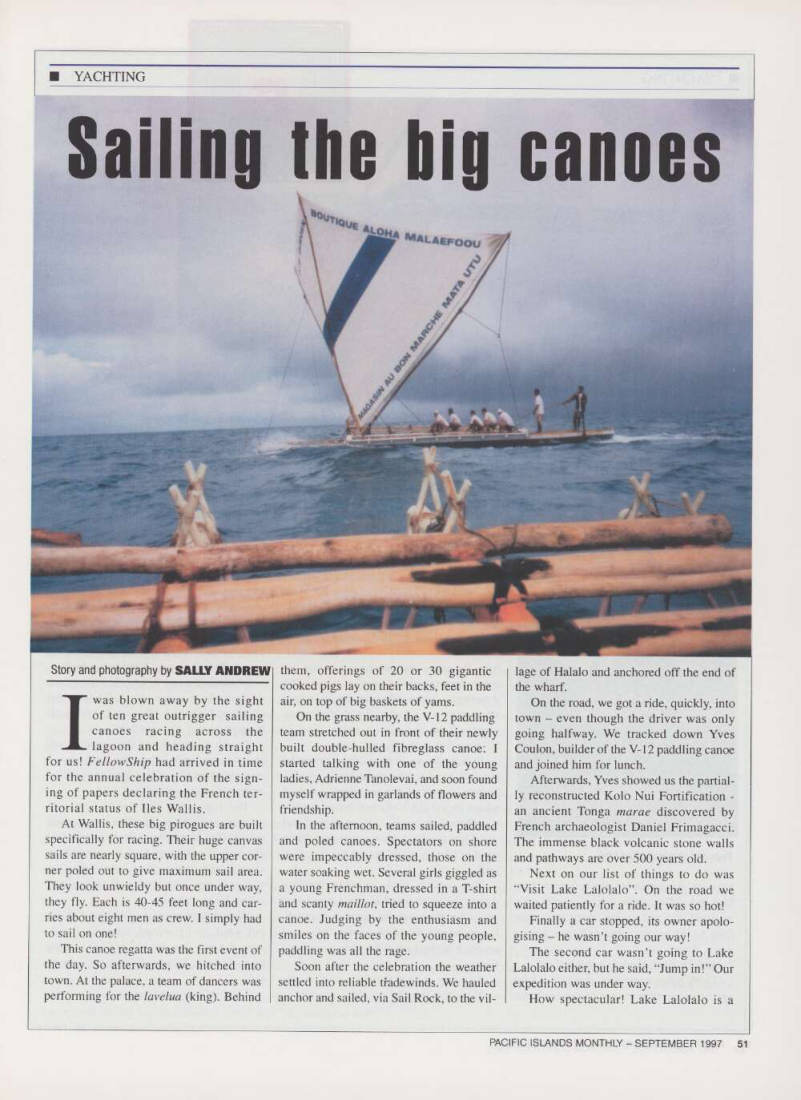
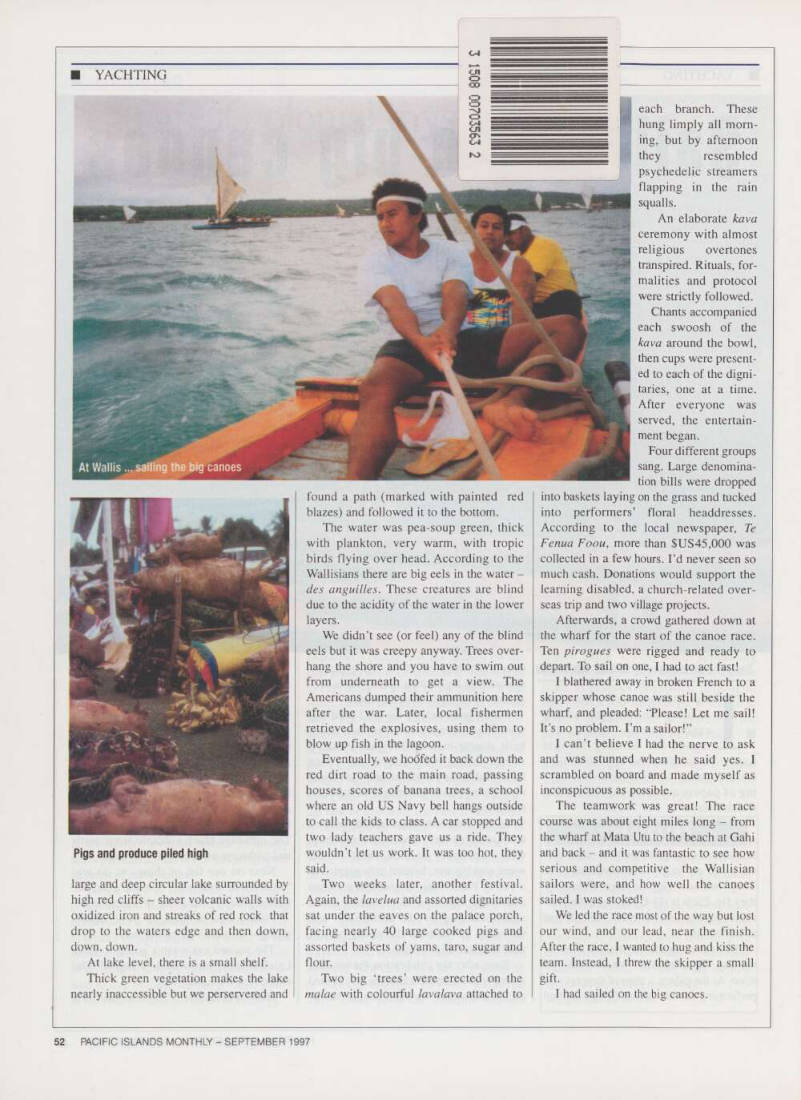
Yachting
Story and photography by SALLY ANDREW
Iwas blown away by the sight of ten great outrigger sailing canoes racing across the lagoon and heading straight for us! Fellowship had arrived in time for the annual celebration of the sign ing of papers declaring the French ter ritorial status of lies Wallis.
At Wallis, these big pirogues are built specifically for racing. Their huge canvas sails are nearly square, with the upper cor ner poled out to give maximum sail area.
They look unwieldy but once under way, they fly. Each is 40-45 feet long and car ries about eight men as crew. I simply had to sail on one!
This canoe regatta was the first event of the day. So afterwards, we hitched into town. At the palace, a team of dancers was performing for the lavelua (king). Behind
them, offerings of 20 or 30 gigantic cooked pigs lay on their backs, feet in the air, on top of big baskets of yams.
On the grass nearby, the V-12 paddling team stretched out in front of their newly built double-hulled fibreglass canoe: I started talking with one of the young ladies, Adrienne Tanolevai, and soon found myself wrapped in garlands of flowers and
friendship.
In the afternoon, teams sailed, paddled and poled canoes. Spectators on shore were impeccably dressed, those on the water soaking wet. Several girls giggled as a young Frenchman, dressed in a T-shirt and scanty maillot, tried to squeeze into a canoe. Judging by the enthusiasm and smiles on the faces of the young people, paddling was all the rage.
Soon after the celebration the weather settled into reliable tfadewinds. We hauled anchor and sailed, via Sail Rock, to the vil
lage of Halalo and anchored off the end of the wharf.
On the road, we got a ride, quickly, into town - even though the driver was only going halfway. We tracked down Yves Coulon, builder of the V-12 paddling canoe and joined him for lunch.
Afterwards, Yves showed us the partial ly reconstructed Kolo Nui Fortification an ancient Tonga marae discovered by
French archaeologist Daniel Frimagacci.
The immense black volcanic stone walls and pathways are over 500 years old.
Next on our list of things to do was ‘‘Visit Lake Lalolalo”. On the road we waited patiently for a ride. It was so hot!
Finally a car stopped, its owner apolo gising - he wasn’t going our way!
The second car wasn’t going to Lake Lalolalo either, but he said, “Jump in!” Our expedition was under way.
How spectacular! Lake Lalolalo is a
large and deep circular lake surrounded by high red cliffs - sheer volcanic walls with oxidized iron and streaks of red rock that drop to the waters edge and then down, down, down.
At lake level, there is a small shelf.
Thick green vegetation makes the lake nearly inaccessible but we perservered and
found a path (marked with painted red blazes) and followed it to the bottom.
The water was pea-soup green, thick with plankton, very warm, with tropic birds flying over head. According to the Wallisians there are big eels in the water des anguilles. These creatures are blind due to the acidity of the water in the lower layers.
We didn’t see (or feel) any of the blind eels but it was creepy anyway. Trees over hang the shore and you have to swim out from underneath to get a view. The Americans dumped their ammunition here after the war. Later, local fishermen retrieved the explosives, using them to blow up fish in the lagoon.
Eventually, we hoofed it back down the red dirt road to the main road, passing houses, scores of banana trees, a school where an old US Navy bell hangs outside to call the kids to class. A car stopped and two lady teachers gave us a ride. They wouldn’t let us work. It was too hot, they said.
Two weeks later, another festival.
Again, the lavelua and assorted dignitaries sat under the eaves on the palace porch, facing nearly 40 large cooked pigs and assorted baskets of yams, taro, sugar and flour.
Two big ‘trees’ were erected on the malae with colourful lavalava attached to
each branch. These hung limply all morn ing, but by afternoon
they resembled
psychedelic streamers flapping in the rain squalls.
An elaborate kava ceremony with almost religious overtones transpired. Rituals, for malities and protocol were strictly followed.
Chants accompanied each swoosh of the kava around the bowl, then cups were present ed to each of the digni taries, one at a time.
After everyone was served, the entertain ment began.
Four different groups sang. Large denomina tion bills were dropped
into baskets laying on the grass and tucked into performers’ floral headdresses.
According to the local newspaper, Te Fenua Foou, more than $U545,000 was collected in a few hours. I’d never seen so much cash. Donations would support the learning disabled, a church-related over seas trip and two village projects.
Afterwards, a crowd gathered down at the wharf for the start of the canoe race.
Ten pirogues were rigged and ready to depart. To sail on one, I had to act fast!
I blathered away in broken French to a skipper whose canoe was still beside the wharf, and pleaded: “Please! Let me sail!
It’s no problem. I’m a sailor!’’
I can’t believe I had the nerve to ask and was stunned when he said yes. I scrambled on board and made myself as inconspicuous as possible.
The teamwork was great! The race course was about eight miles long - from the wharf at Mata Utu to the beach at Gahi and back - and it was fantastic to see how serious and competitive the Wallisian sailors were, and how well the canoes sailed. I was stoked!
We led the race most of the way but lost our wind, and our lead, near the finish.
After the race, I wanted to hug and kiss the team. Instead, I threw the skipper a small
gift.
I had sailed on the big canoes.
Pigs and produce piled high
At Wallis...sailing the big canoes
An age-old
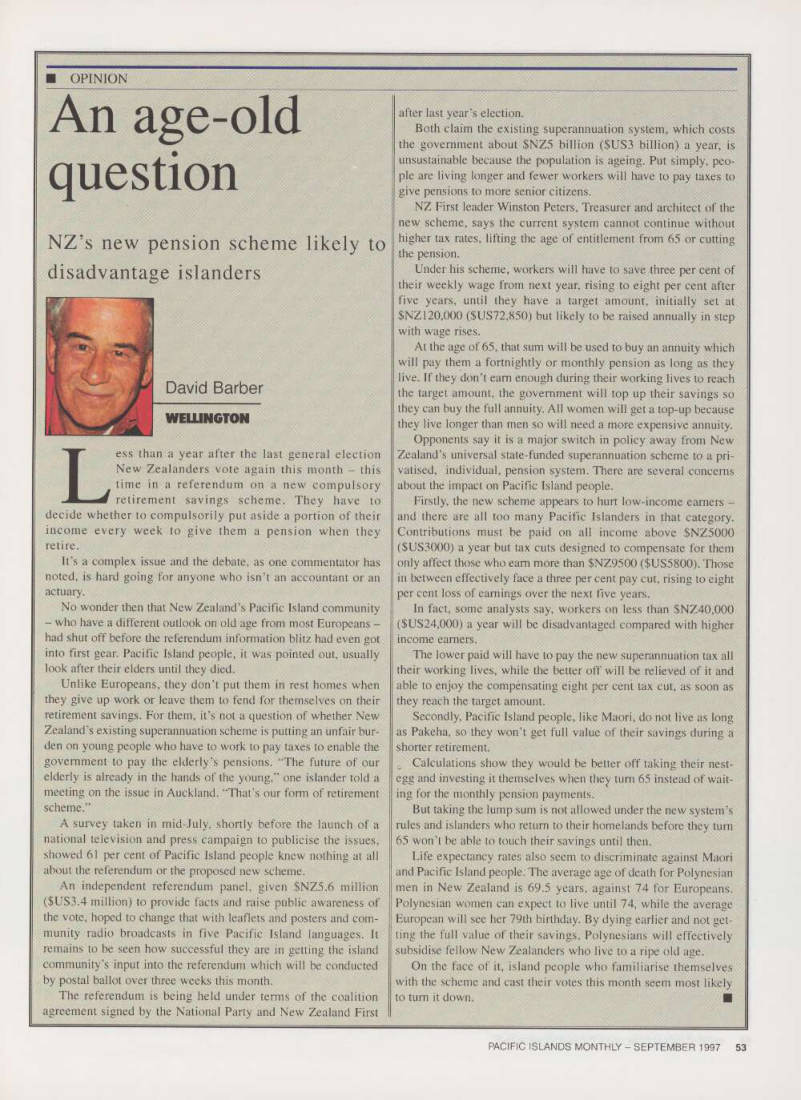
Opinion
An age-old question NZ’s new pension scheme likely to disadvantage islanders
David Barber
Wellington
Less than a year after the last general election New Zealanders vote again this month - this time in a referendum on a new compulsory retirement savings scheme. They have to decide whether to compulsorily put aside a portion of their income every week to give them a pension when they retire.
It’s a complex issue and the debate, as one commentator has noted, is hard going for anyone who isn’t an accountant or an actuary.
No wonder then that New Zealand’s Pacific Island community - who have a different outlook on old age from most Europeans had shut off before the referendum information blitz had even got into first gear. Pacific Island people, it was pointed out, usually look after their elders until they died.
Unlike Europeans, they don’t put them in rest homes when they give up work or leave them to fend for themselves on their retirement savings. For them, it’s not a question of whether New Zealand’s existing superannuation scheme is putting an unfair bur den on young people who have to work to pay taxes to enable the government to pay the elderly’s pensions. "The future of our elderly is already in the hands of the young,” one islander told a meeting on the issue in Auckland. "That’s our form of retirement scheme.”
A survey taken in mid-July, shortly before the launch of a national television and press campaign to publicise the issues, showed 61 per cent of Pacific Island people knew nothing at all about the referendum or the proposed new scheme.
An independent referendum panel, given SNZS.6 million (SUS 3.4 million) to provide facts and raise public awareness of the vote, hoped to change that with leaflets and posters and com munity radio broadcasts in five Pacific Island languages. It remains to be seen how successful they are in getting the island community’s input into the referendum which will be conducted by postal ballot over three weeks this month.
The referendum is being held under terms of the coalition agreement signed by the National Party and New Zealand First
after last year’s election.
Both claim the existing superannuation system, which costs the government about SNZS billion (SUS 3 billion) a year, is unsustainable because the population is ageing. Put simply, peo ple are living longer and fewer workers will have to pay taxes to give pensions to more senior citizens.
NZ First leader Winston Peters, Treasurer and architect of the new scheme, says the current system cannot continue without higher tax rates, lifting the age of entitlement from 65 or cutting the pension.
Under his scheme, workers will have to save three per cent of their weekly wage from next year, rising to eight per cent after five years, until they have a target amount, initially set at SNZ 120,000 ($U572,850) but likely to be raised annually in step with wage rises.
At the age of 65, that sum will be used to buy an annuity which will pay them a fortnightly or monthly pension as long as they live. If they don’t earn enough during their working lives to reach the target amount, the government will top up their savings so they can buy the full annuity. All women will get a top-up because they live longer than men so will need a more expensive annuity.
Opponents say it is a major switch in policy away from New Zealand’s universal state-funded superannuation scheme to a pri vatised, individual, pension system. There are several concerns about the impact on Pacific Island people.
Firstly, the new scheme appears to hurt low-income earners and there are all too many Pacific Islanders in that category.
Contributions must be paid on all income above SNZSOOO (SUS3OOO) a year but tax cuts designed to compensate for them only affect those who earn more than SNZ9SOO (SUSSBOO). Those in between effectively face a three per cent pay cut, rising to eight per cent loss of earnings over the next five years.
In fact, some analysts say, workers on less than SNZ4O,OOO ($U524,000) a year will be disadvantaged compared with higher income earners.
The lower paid will have to pay the new superannuation tax all their working lives, while the better off will be relieved of it and able to enjoy the compensating eight per cent tax cut, as soon as they reach the target amount.
Secondly, Pacific Island people, like Maori, do not live as long as Pakeha, so they won’t get full value of their savings during a shorter retirement. 0 Calculations show they would be better off taking their nest egg and investing it themselves when they turn 65 instead of wait ing for the monthly pension payments.
But taking the lump sum is not allowed under the new system’s rules and islanders who return to their homelands before they turn 65 won’t be able to touch their savings until then.
Life expectancy rates also seem to discriminate against Maori and Pacific Island people. The average age of death for Polynesian men in New Zealand is 69.5 years, against 74 for Europeans.
Polynesian women can expect to live until 74, while the average European will see her 79th birthday. By dying earlier and not get ting the full value of their savings, Polynesians will effectively subsidise fellow New Zealanders who live to a ripe old age.
On the face of it, island people who familiarise themselves with the scheme and cast their votes this month seem most likely to turn it down. ■
The big leak
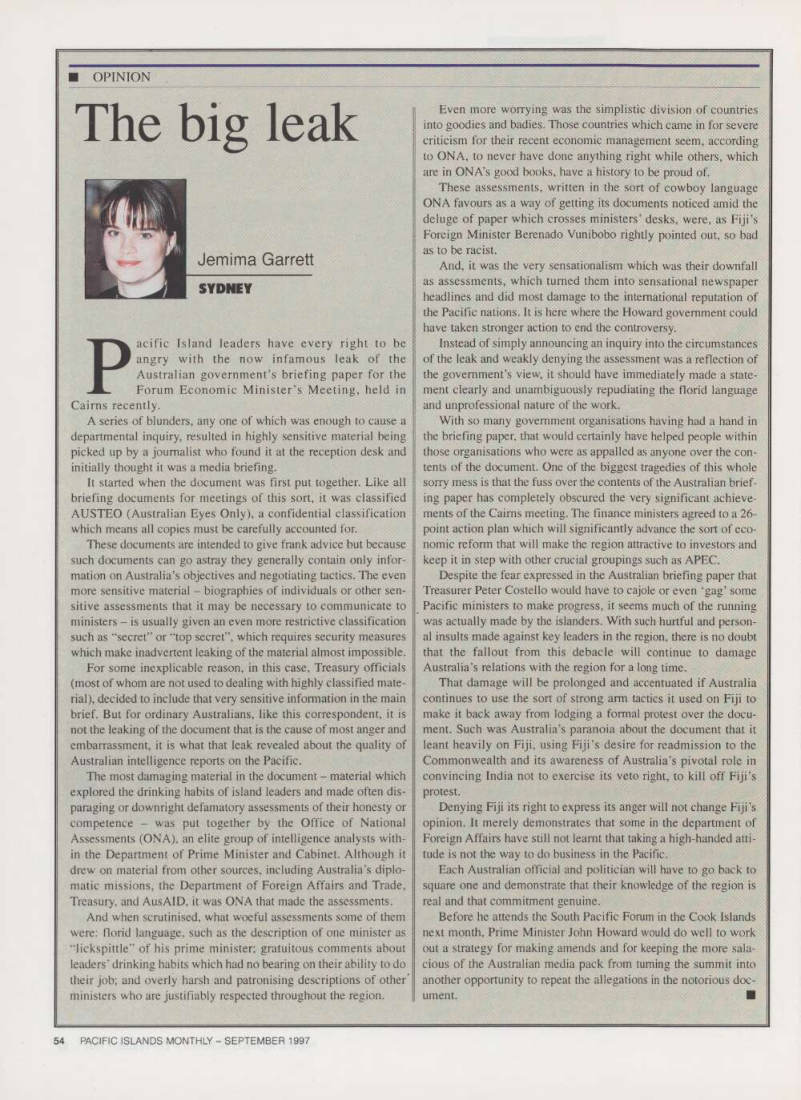
Jemima Garrett
Sydney
Pacific Island leaders have every right to be angry with the now infamous leak of the Australian government’s briefing paper for the Forum Economic Minister’s Meeting, held in Cairns recently.
A series of blunders, any one of which was enough to cause a departmental inquiry, resulted in highly sensitive material being picked up by a journalist who found it at the reception desk and initially thought it was a media briefing.
It started when the document was first put together. Like all briefing documents for meetings of this sort, it was classified AUSTEO (Australian Eyes Only), a confidential classification which means all copies must be carefully accounted for.
These documents are intended to give frank advice but because such documents can go astray they generally contain only infor mation on Australia’s objectives and negotiating tactics. The even more sensitive material - biographies of individuals or other sen sitive assessments that it may be necessary to communicate to ministers - is usually given an even more restrictive classification such as “secret” or “top secret”, which requires security measures which make inadvertent leaking of the material almost impossible.
For some inexplicable reason, in this case. Treasury officials (most of whom are not used to dealing with highly classified mate rial), decided to include that very sensitive information in the main brief. But for ordinary Australians, like this correspondent, it is not the leaking of the document that is the cause of most anger and embarrassment, it is what that leak revealed about the quality of Australian intelligence reports on the Pacific.
The most damaging material in the document - material which explored the drinking habits of island leaders and made often dis paraging or downright defamatory assessments of their honesty or competence - was put together by the Office of National Assessments (ONA), an elite group of intelligence analysts with in the Department of Prime Minister and Cabinet. Although it drew on material from other sources, including Australia’s diplo matic missions, the Department of Foreign Affairs and Trade, Treasury, and AusAID, it was ONA that made the assessments.
And when scrutinised, what woeful assessments some of them were: florid language, such as the description of one minister as "lickspittle” of his prime minister; gratuitous comments about leaders’ drinking habits which had no bearing on their ability to do their job; and overly harsh and patronising descriptions of other' ministers who are justifiably respected throughout the region.
Even more worrying was the simplistic division of countries into goodies and badies. Those countries which came in for severe criticism for their recent economic management seem, according to ONA, to never have done anything right while others, which are in ONA’s good books, have a history to be proud of.
These assessments, written in the sort of cowboy language ONA favours as a way of getting its documents noticed amid the deluge of paper which crosses ministers’ desks, were, as Fiji’s Foreign Minister Berenado Vunibobo rightly pointed out, so bad as to be racist.
And, it was the very sensationalism which was their downfall as assessments, which turned them into sensational newspaper headlines and did most damage to the international reputation of the Pacific nations. It is here where the Howard government could have taken stronger action to end the controversy.
Instead of simply announcing an inquiry into the circumstances of the leak and weakly denying the assessment was a reflection of the government’s view, it should have immediately made a state ment clearly and unambiguously repudiating the florid language and unprofessional nature of the work.
With so many government organisations having had a hand in the briefing paper, that would certainly have helped people within those organisations who were as appalled as anyone over the con tents of the document. One of the biggest tragedies of this whole sorry mess is that the fuss over the contents of the Australian brief ing paper has completely obscured the very significant achieve ments of the Caims meeting. The finance ministers agreed to a 26point action plan which will significantly advance the sort of eco nomic reform that will make the region attractive to investors and keep it in step with other crucial groupings such as APEC.
Despite the fear expressed in the Australian briefing paper that Treasurer Peter Costello would have to cajole or even ‘gag’ some Pacific ministers to make progress, it seems much of the running was actually made by the islanders. With such hurtful and person al insults made against key leaders in the region, there is no doubt that the fallout from this debacle will continue to damage Australia’s relations with the region for a long time.
That damage will be prolonged and accentuated if Australia continues to use the sort of strong arm tactics it used on Fiji to make it back away from lodging a formal protest over the docu ment. Such was Australia’s paranoia about the document that it leant heavily on Fiji, using Fiji’s desire for readmission to the Commonwealth and its awareness of Australia’s pivotal role in convincing India not to exercise its veto right, to kill off Fiji’s protest.
Denying Fiji its right to express its anger will not change Fiji’s opinion. It merely demonstrates that some in the department of Foreign Affairs have still not leamt that taking a high-handed atti tude is not the way to do business in the Pacific.
Each Australian official and politician will have to go back to square one and demonstrate that their knowledge of the region is real and that commitment genuine.
Before he attends the South Pacific Forum in the Cook Islands next month. Prime Minister John Howard would do well to work out a strategy for making amends and for keeping the more sala cious of the Australian media pack from turning the summit into another opportunity to repeat the allegations in the notorious doc ument. ■
Women’s bureau
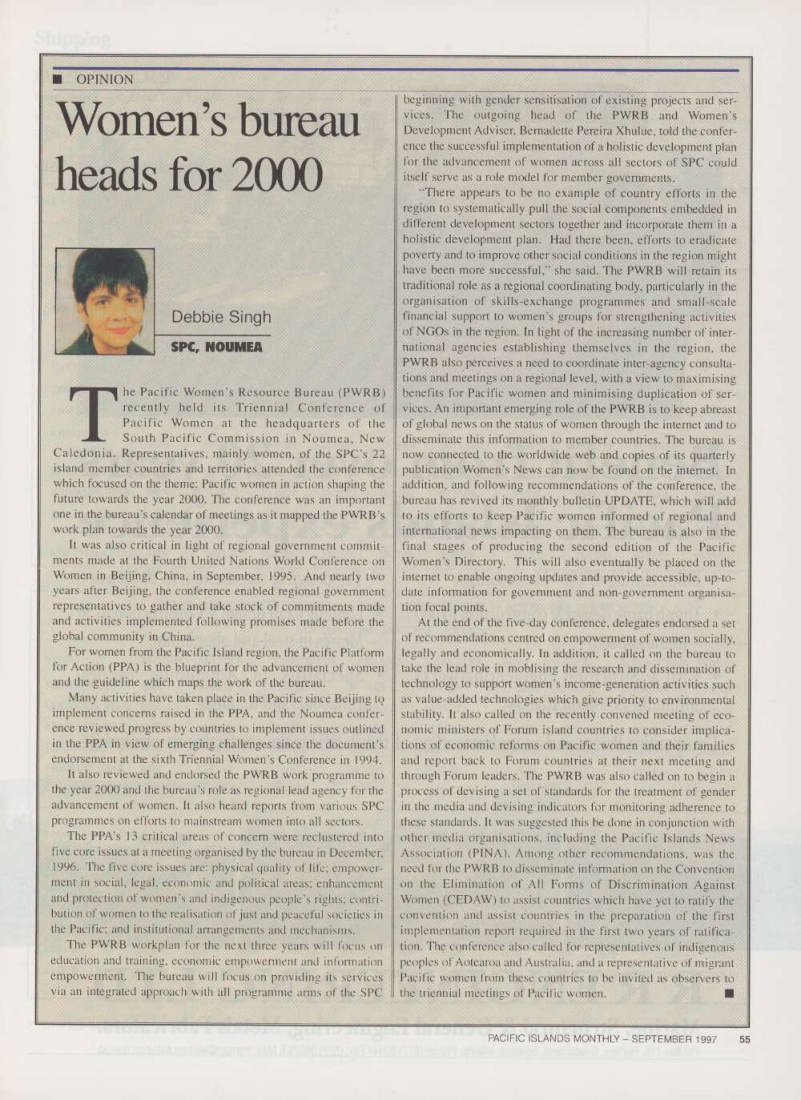
heads for 2000
Debbie Singh
Spc, Noumea
The Pacific Women's Resource Bureau (PWRB) recently held its Triennial Conference of Pacific Women at the headquarters of the South Pacific Commission in Noumea, New Caledonia. Representatives, mainly women, of the SPC’s 22 island member countries and territories attended the conference which focused on the theme: Pacific women in action shaping the future towards the year 2000. The conference was an important one in the bureau's calendar of meetings as it mapped the PWRB’s work plan towards the year 2000.
It was also critical in light of regional government commit ments made at the Fourth United Nations World Conference on Women in Beijing, China, in September, 1995. And nearly two years after Beijing, the conference enabled regional government representatives to gather and take stock of commitments made and activities implemented following promises made before the global community in China.
For women from the Pacific Island region, the Pacific Platform for Action (PPA) is the blueprint for the advancement of women and the guideline which maps the work of the bureau.
Many activities have taken place in the Pacific since Beijing to implement concerns raised in the PPA, and the Noumea confer ence reviewed progress by countries to implement issues outlined in the PPA in view of emerging challenges since the document’s endorsement at the sixth Triennial Women’s Conference in 1994.
It also reviewed and endorsed the PWRB work programme to the year 2000 and the bureau’s role as regional lead agency for the advancement of women. It also heard reports from various SPC programmes on efforts to mainstream women into all sectors.
The PPA's 13 critical areas of concern were reclustered into five core issues at a meeting organised by the bureau in December, 1996. The five core issues are; physical quality of life; empower ment in social, legal, economic and political areas; enhancement and protection of women's and indigenous people's rights; contri bution of women to the realisation of just and peaceful societies in the Pacific; and institutional arrangements and mechanisms.
The PWRB workplan for the next three years will focus on education and training, economic empowerment and information empowerment. The bureau will focus on providing its services via an integrated approach with all programme arms of the SPC
beginning with gender sensitisation of existing projects and ser vices. The outgoing head of the PWRB and Women’s Development Adviser. Bernadette Pereira Xhuluc, told the confer ence the successful implementation of a holistic development plan for the advancement of women across all sectors of SPC could itself serve as a role model for member governments.
"There appears to be no example of country efforts in the region to systematically pull the social components embedded in different development sectors together and incorporate them in a holistic development plan. Had there been, efforts to eradicate poverty and to improve other social conditions in the region might have been more successful,” she said. The PWRB will retain its traditional role as a regional coordinating body, particularly in the organisation of skills-exchange programmes and small-scale financial support to women’s groups for strengthening activities of NGOs in the region. In light of the increasing number of inter national agencies establishing themselves in the region, the PWRB also perceives a need to coordinate inter-agency consulta tions and meetings on a regional level, with a view to maximising benefits for Pacific women and minimising duplication of ser vices. An important emerging role of the PWRB is to keep abreast of global news on the status of women through the internet and to disseminate this information to member countries. The bureau is now connected to the worldwide web and copies of its quarterly publication Women's News can now be found on the internet. In addition, and following recommendations of the conference, the bureau has revived its monthly bulletin UPDATE, which will add to its efforts to keep Pacific women informed of regional and international news impacting on them. The bureau is also in the final stages of producing the second edition of the Pacific Women’s Directory. This will also eventually be placed on the internet to enable ongoing updates and provide accessible, up-to date information for government and non-govemment organisa tion focal points.
At the end of the five-day conference, delegates endorsed a set of recommendations centred on empowerment of women socially, legally and economically. In addition, it called on the bureau to take the lead role in moblising the research and dissemination of technology to support women’s income-generation activities such as value-added technologies which give priority to environmental stability. It also called on the recently convened meeting of eco nomic ministers of Forum island countries to consider implica tions of economic reforms on Pacific women and their families and report back to Forum countries at their next meeting and through Forum leaders. The PWRB was also called on to begin a process of devising a set of standards for the treatment of gender in the media and devising indicators for monitoring adherence to these standards. It was suggested this be done in conjunction with other media organisations, including the Pacific Islands News Association (PINA). Among other recommendations, was the need for the PWRB to disseminate information on the Convention on the Elimination of All Forms of Discrimination Against Women (CEDAW) to assist countries which have yet to ratify the convention and assist countries in the preparation of the first implementation report required in the first two years of ratifica tion. The conference also called for representatives of indigenous peoples of Aotearoa and Australia, and a representative of migrant Pacific women from these countries to be invited as observers to the triennial meetings of Pacific women. ■
Advertisements & other items, p. 56 (1 item)
Silllßi*
- T-':?
Lik-"
Benefit from over 20 years
Pacific Islands experience
• Ship refitting to 100 - Metre Length • Dumb barge design & construction to 600 - tonne capacity • Civil & Structural engineering works within the Solomon Islands • Tug design & construction to 20 Metres • Landing Craft design & Construction to 30 Metres in steel and aluminium • Specialists in Aluminium canoes, runabouts and dinghies Competitive Prices and an understanding of the Pacific make contacting us worthwhile.
if m\
itJ nnncHmi M 3 ’■ * ll*
R R ENGINEERING LTD
Marine, Structural 8c General Engineering, Metals Fabricators.
P.0.80x 710, Honiara, Guadalcanal, Solomon Islands. Phone: (677) 30441 Fax: (677) 30279 E Mail: [email protected]
Shipping
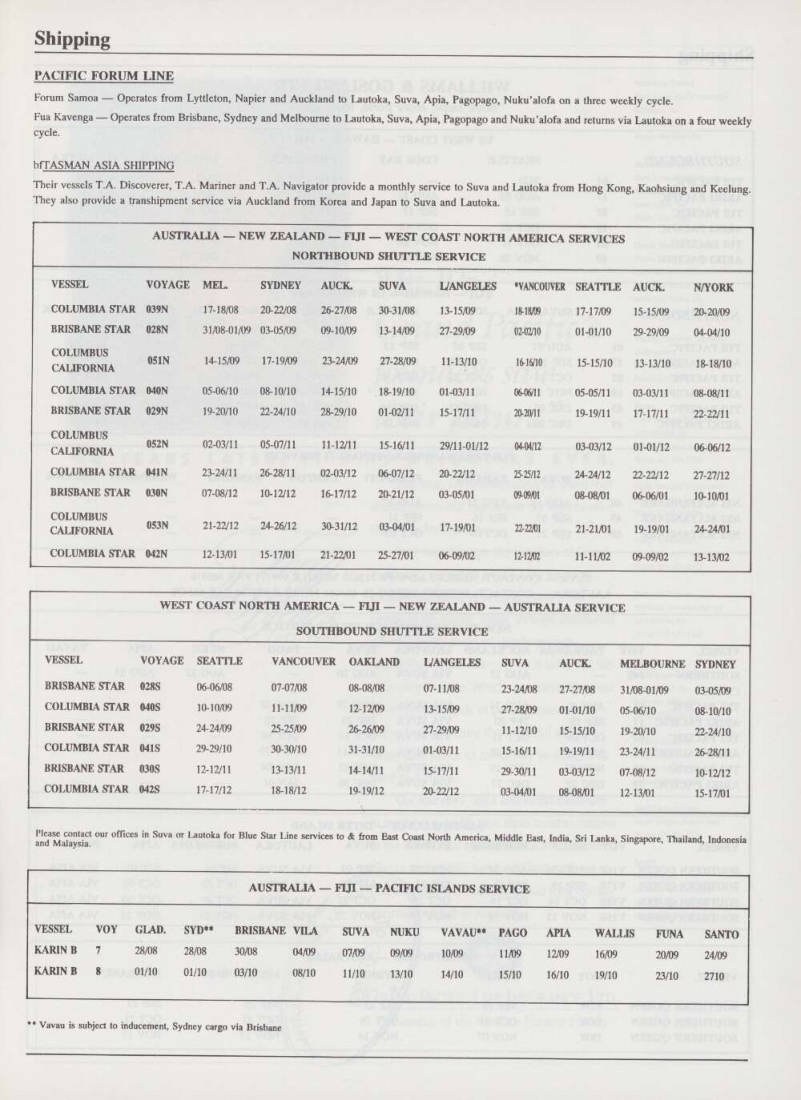
Pacific Forum Line
Forum Samoa Operates from Lyttleton, Napier and Auckland to Lautoka, Suva, Apia, Pagopago, Nuku’alofa on a three weekly cycle.
Fua Kavenga Operates from Brisbane, Sydney and Melbourne to Lautoka, Suva, Apia, Pagopago and Nuku’alofa and returns via Lautoka on a four weekly cycle.
Bftasman Asia Shipping
Their vessels T.A. Discoverer, T.A. Mariner and T.A. Navigator provide a monthly service to Suva and Lautoka from Hong Kong, Kaohsiung and Keelung.
They also provide a transhipment service via Auckland from Korea and Japan to Suva and Lautoka.
SUVa ” Lautoka for Blue Star Line services t 0 & from East Coast North America, Middle East, India, Sri Lanka, Singapore, Thailand, Indonesia
** Vavau is subject to inducement, Sydney cargo via Brisbane
AUSTRALIA — NEW ZEALAND — FIJI — WEST COAST NORTH AMERICA SERVICES
Northbound Shuttle Service
Vessel
Voyage
Mel.
Sydney
Auck.
Suva
L/Angeles
♦Vancouver
Seattle
Auck.
N/York
Columbia Star
039N 17-18/08 20-22/08 26-27/08 30-31/08 13-15/09 18-18/09 17-17/09 15-15/09 20-20/09
Brisbane Star
028N 31/08-01/09 03-05/09 09-10/09 13-14/09 27-29/09 02-02/10 01-01/10 29-29/09 04-04/10
Columbus
California
Osin
14-15/09 17-19/09 23-24/09 27-28/09 11-13/10 16-16/10 15-15/10 13-13/10 18-18/10
Columbia Star
040N 05-06/10 08-10/10 14-15/10 18-19/10 01-03/11 06-06/11 05-05/11 03-03/11 08-08/11
Brisbane Star
029N 19-20/10 22-24/10 28-29/10 01-02/11 15-17/11 20-20/11 19-19/11 17-17/11 22-22/11
Columbus
California
052N 02-03/11 05-07/11 11-12/11 15-16/11 29/11-01/12 04-04/12 03-03/12 01-01/12 06-06/12
Columbia Star
041N 23-24/11 26-28/11 02-03/12 06-07/12 20-22/12 25-25/12 24-24/12 22-22/12 27-27/12
Brisbane Star
030N 07-08/12 10-12/12 16-17/12 20-21/12 03-05/01 09-09/01 08-08/01 06-06/01 10-10/01
Columbus
California
053N 21-22/12 24-26/12 30-31/12 03-04/01 17-19/01 22-22/01 21-21/01 19-19/01 24-24/01
Columbia Star
042N 12-13/01 15-17/01 21-22/01 25-27/01 06-09/02 12-12/02 11-11/02 09-09/02 13-13/02
WEST COAST NORTH AMERICA — FIJI — NEW 7-F.AT.ANT>
Southbound Shuttle Service
— Australia Service
Vessel
Voyage
Seattle
Vancouver
Oakland
L/Angeles
Suva
Auck.
Melbourne
Sydney
Brisbane Star
028S 06-06/08 07-07/08 08-08/08 07-11/08 23-24/08 27-27/08 31/08-01/09 03-05/09
Columbia Star
040S 10-10/09 11-11/09 12-12/09 13-15/09 27-28/09 01-01/10 05-06/10 08-10/10
Brisbane Star
029S 24-24/09 25-25/09 26-26/09 27-29/09 11-12/10 15-15/10 19-20/10 22-24/10
Columbia Star
041S 29-29/10 30-30/10 31-31/10 01-03/11 15-16/11 19-19/11 23-24/11 26-28/11
Brisbane Star
030S 12-12/11 13-13/11 14-14/11 15-17/11 29-30/11 03-03/12 07-08/12 10-12/12
Columbia Star
042S 17-17/12 18-18/12 19-19/12 20-22/12 03-04/01 08-08/01 12-13/01 15-17/01
Australia —
Fiji — Pacific Islands Service
Vessel
Voy
Glad.
Syd**
Brisbane Vila
Suva
Nuku
Vavau**
Pago
Apia
Wallis
Funa
Santo
Karin B
7 28/08 28/08 30/08 04/09 07/09 09/09 10/09 11/09 12/09 16/09 20/09 24/09
Karin B
8 01/10 01/10 03/10 08/10 11/10 13/10 14/10 15/10 16/10 19/10 23/10 2710
OCT iff
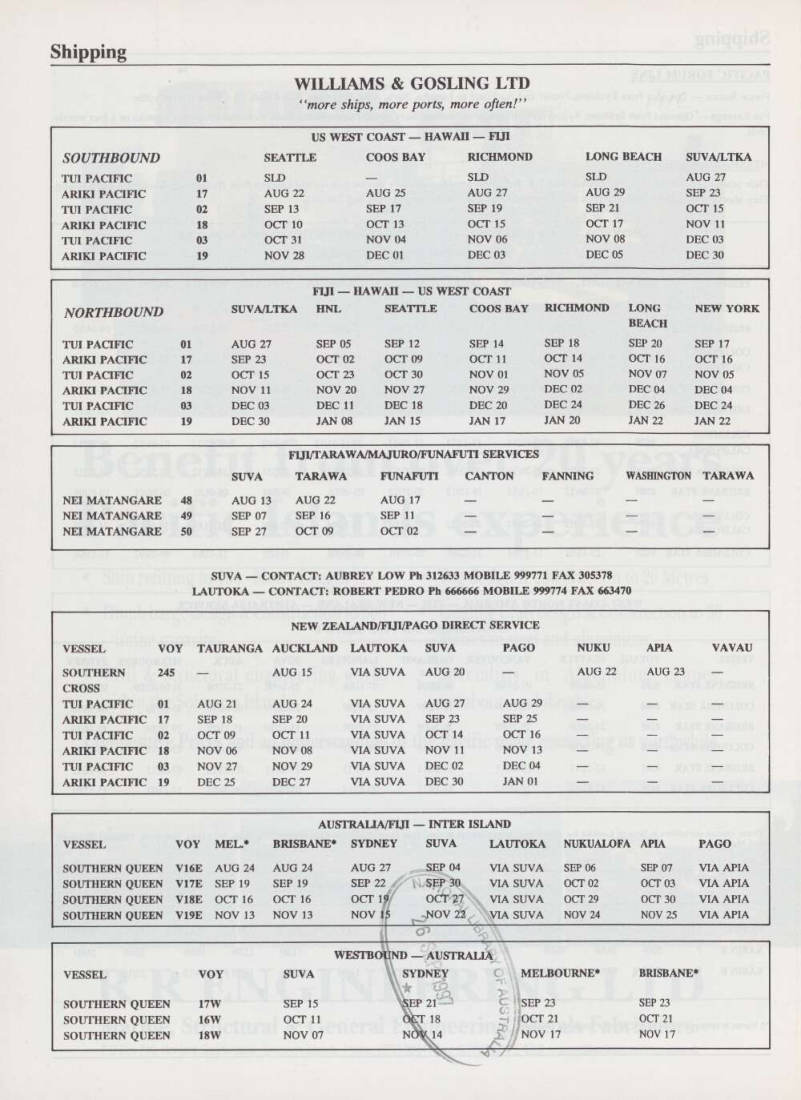
Williams & Gosling Ltd
“more ships, more ports, more often!”
SUVA CONTACT: AUBREY LOW Ph 312633 MOBILE 999771 FAX 305378 LAUTOKA CONTACT: ROBERT PEDRO Ph 666666 MOBILE 999774 FAX 663470
Southbound
US WEST COAST — HAWAII — FIJI
Seattle Coos Bay Richmond
Long Beach
Suva/Ltka
Tui Pacific
01
Sld
Sld
Sld
Aug 27
Ariki Pacific
17
Aug 22
Aug 25
Aug 27
Aug 29
Sep 23
Tui Pacific
02
Sep 13
Sep 17
Sep 19
Sep 21
Oct 15
Ariki Pacific
18
Oct 10
Oct 13
Oct 15
Oct 17
Nov 11
Tui Pacific
03
Oct 31
Nov 04
Nov 06
Nov 08
Dec 03
Ariki Pacific
19
Nov 28
Dec 01
Dec 03
Dec 05
Dec 30
FIJI — HAWAII — US WEST COAST
Northbound
Suva/Ltka
Hnl
Seattle
Coos Bay
Richmond
Long
Beach
New York
Tui Pacific
01
Aug 27
Sep 05
Sep 12
Sep 14
Sep 18
Sep 20
Sep 17
Ariki Pacific
17
Sep 23
Oct 02
Oct 09
Oct 11
Oct 14
Oct 16
Oct 16
Tui Pacific
02
Oct 15
Oct 23
Oct 30
Nov 01
Nov 05
Nov 07
Nov 05
Ariki Pacific
18
Nov 11
Nov 20
Nov 27
Nov 29
Dec 02
Dec 04
Dec 04
Tui Pacific
03
Dec 03
Dec 11
Dec 18
Dec 20
Dec 24
Dec 26
Dec 24
Ariki Pacific
19
Dec 30
Jan 08
Jan 15
Jan 17
Jan 20
Jan 22
Jan 22
Fu1/Tarawa/Majuro/Funafuti Services
Suva
Tarawa
Funafuti
Canton Fanning
Washington Tarawa
Nei Matangare
Nei Matangare
Nei Matangare
48 49 50
Aug 13
Sep 07
Sep 27
Aug 22
Sep 16
Oct 09
Aug 17
Sep 11
Oct 02
Vessel
Voy
Tauranga
New Zealand/Fiji/Pago Direct Service
Auckland Lautoka Suva Pago
Nuku
Apia
Vavau
Southern
245 —
Aug 15
Via Suva
Aug 20
Aug 22
Aug 23
Cross
Tui Pacific
01
Aug 21
Aug 24
Via Suva
Aug 27
Aug 29
Ariki Pacific
17
Sep 18
Sep 20
Via Suva
Sep 23
Sep 25
Tui Pacific
02
Oct 09
Oct 11
Via Suva
Oct 14
Oct 16
Ariki Pacific
18
Nov 06
Nov 08
Via Suva
Nov 11
Nov 13
Tui Pacific
03
Nov 27
Nov 29
Via Suva
Dec 02
Dec 04
Ariki Pacific
19
Dec 25
Dec 27
Via Suva
Dec 30
Jan 01
Austraua/Fui
— Inter Island
Vessel
Voy
Mel.*
Brisbane* Sydney
Suva
Lautoka
Nukualofa
Apia
Pago
Southern Queen
V16E
Aug 24
Aug 24
Aug 27
Sep 04
Via Suva
Sep 06
Sep 07
Via Apia
Southern Queen
V17E
Sep 19
Sep 19
Sep 22 £
V Sep 30
Via Suva
Oct 02
Oct 03
Via Apia
Southern Queen
Vise
Oct 16
Oct 16
OCT iff
Oct'tf
Via Suva
Oct 29
Oct 30
Via Apia
Southern Queen
V19E
Nov 13
Nov 13
Nov 15
-Nov 22
Via Suva
Nov 24
Nov 25
Via Apia
Westbo
Uno — Australia
Vessel
Voy
Suva
Vl Sydney
Melbourne*
Brisbane*
Southern Queen
17W
Sep 15
\\* tP
Vr to
%EP 21“-‘
£ Sep 23
c
~-I Oct 21
Sep 23
Southern Queen
16W
Oct 11
6|T 18
Oct 21
Southern Queen
18W
Nov 07
No& 14 Nov 17
A. // —
Nov 17
Advertisements & other items, pp. 58-60 (2 items)
Shipping
founders saw
“In 1957,
Grand P’s
AS BRIGHT AS EVER.
This year, we're celebrating an event that should please our clients and our agents alike.
Our 40th Anniversary.
Four decades ago, the founders of Grand Pacific Life set out to create a life insurance
company designed to safeguard and serve
people in the Pacific. Today, through pioneering efforts and 40 years of steady growth, Grand Pacific Life has over $3.8 billion of life insurance in force. Which represents the trust of many thousands of people, ones whom
we've helped secure the financial indepen-
dence and peace of mind they've worked so
hard to achieve.
Our founders' spirit and vision continues
in reaching out with new ideas to other nations in the Pacific. Our steadfast dedication to our clients and agents has made history these last 40 years. The decades ahead look equally
exciting and full of promise.
Grand Pacific Life Insurance, Ltd.
American Samoa Mark Solofa Pacific Insurance & Finance, Inc.
Mark Solofa, GA Phone: 684-699-5796 Western Samoa Mark Solofa Pacific Insurance & Finance, Inc.
Mark Solofa, GA Phone: 585-24059 Chuuk State. Federated States of Micronesia Pacific Basin Insurance & General Services, Inc.
Kachutosy Paulus, GA Phone: 691-330-2606 Actouka Executive Insurance Underwriters Maridell Actouka Phone:69l-320-5331 Guam Great National Insurance Underwriters, Inc.
Domie Bumagat Jr,, GA Phone: 671-646-5736 Pacific Financial Corporation Eduardo Camacho, GA Phone: 671-646-1990 Takagi & Associates Pamela Cruz, Life Manager Phone: 671-475-4373 Marshall Islands Marshalls Insurance Agency Jerry Kramer, GA Phone: 692-625-3366 Saipan Pacific Basin Insurance Underwriters, Inc.
Mary Ann Milne, GA Phone: 670-234-7861 Pacifica Insurance Underwriters, Inc.
Norman Tenorio, GA Phone: 670-234-6267 Takagi & Associates Laurie Sturges, Branch Mgr.
Phone: 670-322-8117 Tonga Peseti Ma'afu Insurance & Finance, Ltd.
Peseti Ma'afu, GA Phone: 676-24-777 A member of the Finance Factors Family
4*>i mt it
LAND CRUISER
P , ■
CRUISER
"v '
wmmmm
Some of the specs may vary according to market specifications.
Heavy duty beauties - Toyota Land Cruiser and Land Cruiser PRADO Land Cruiser’s got a reputation for go anywhere toughness, with style and ability to take you there in total comfort, on road or off.
Its luxury matches most expensive sedans. And it has more space than many large passenger cars. With impeccable fit and finish.
And graceful, elegant form.
Land Cruiser PRADO inherits these traditions, and all Toyota’s 4x4 know-how for great performance off road and passenger car comfort on the highway, and stylish beauty everywhere it goes.
What you can’t see is also important. Tough frames. Suspensions built to take you as far off road as you want to go, in comfort. Your choice of powerful petrol or diesel engines. And bodies thoroughly protected from rust.
Land Cruiser and Land Cruiser PRADO - two champions, on and off the road.
TOYOTA
DISTRIBUTORS/DEALERS
NORFOLK ISLAND BORRY’S PTY LTD. PH 22114
SOLOMON ISLANDS ELAMOTORS PH 30314
VANUATU ASCO MOTORS PH 22341
COOK ISLANDS PACIFIC MOTORS LTD. PH 20796
KIRIBATI TARAWA MOTORS PH 21090
PAPUA NEW GUINEA ELA MOTORS PH 3229400
TAHITI NIPPON AUTOMOTO PH 429819
WESTERN SAMOA ASCO MOTORS PH 20800
FIJI ASCO MOTORS PH 384888
NEW CALEDONIA S.I.A.P. PH 275562
TONGA ASCO MOTORS PH 23500
AMERICAN SAMOA* ASCO MOTORS PH 633-4281
(*PRADO is not being handled.)