Pacific
Islands
Monthly
May 1997
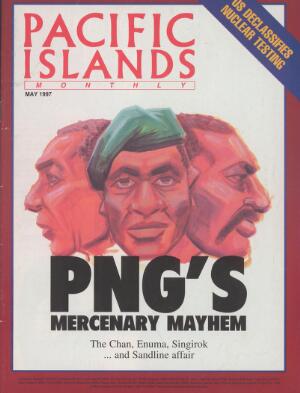
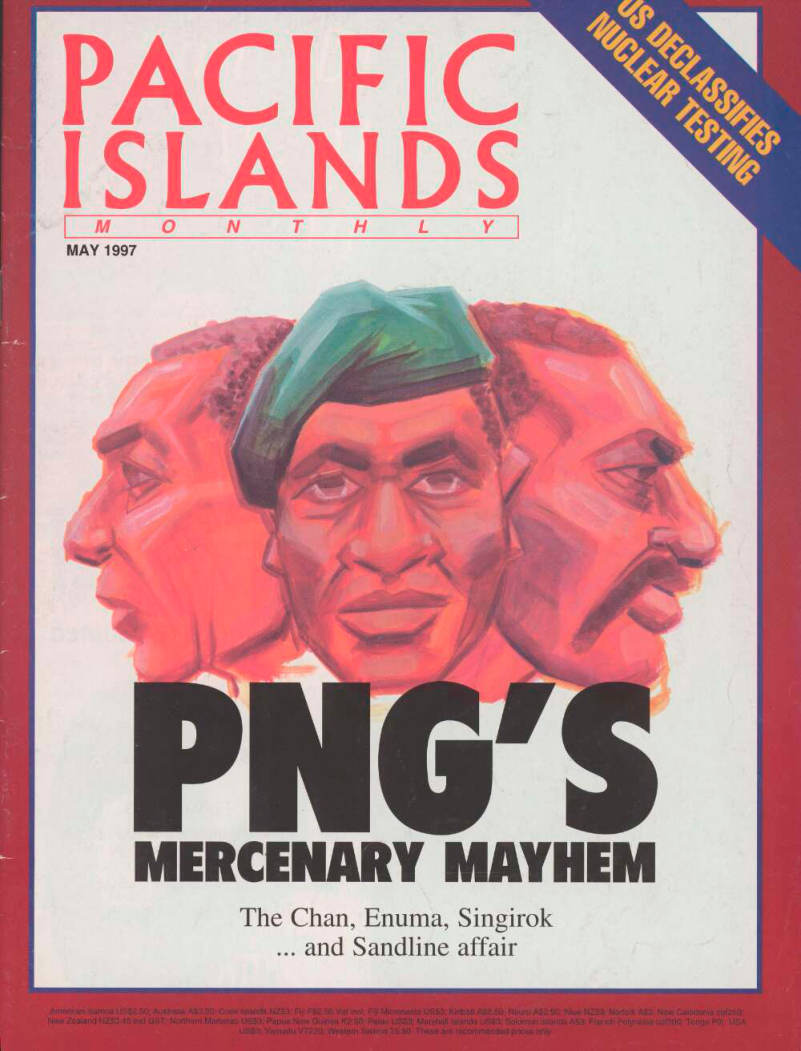
Mercenary Mayhem
The Chan, Enuma, Singirok ... and Sandline affair
American Samoa USS2.SO; Australia A 53.50; Cook Islands NZ$3; Fiji F 52.50 Vat incl; FS Micronesia US$3; Kiribati A 52.50; Nauru A 52.50; Niue NZ$3; Norfolk As 3; New Caledonia cpf2so; New Zealand NZ53.45 incl GST; Northern Marianas US$3; Papua New Guinea K 2.90; Palau US$3; Marshall Islands US$3; Solomon Islands As 3; French Polynesia cpf3oo; Tonga P 3; USA US$3; Vanuatu VT22O; Western Samoa T 5.50. These are recommended prices only.
Advertisements & other items, pp. 2-3 (1 item)
is by phone •••
<1 for whatever reason ...
The sofest
and the quickest way to Papua New Guinea
is by phone •••
Just dial +675 plus the number and you're hone.
In Papua New Guinea, Telikom does the connection for you.
TELIKOM
PAPUA NEW GUINEA
Island Distributors
Wanted For
"Island Soda"
ou Nu
AND
Ew m* ■ ■ ■ W.i ‘
Island pineaple
Island Orange
Island Dew Island Colo
Tropical Soda
Grope
Lemon-Lime
Strawberry
Lei or full container shipments available.
For information on our competitively priced line of quality beverages, fax, phone or write us at: US Mainland: Aspen International, Inc. 1402-3rd Avenue, Suite 1024 Seattle, Washington 98101 Phone (206) 628-6151 Fax (206) 628-6421 Tahiti Distributor: Eico P.O. Box 184 Papeete - Tahiti Phone 421 660 Fax 429 838
ISLAND
SODA
Product of U.5.A. Island Soda is a registered trademark
Pacific
Islands
Monthly
Vol 67 No. 05
The News Magazine
May 1997
PUBLISHER: Alan Robinson EDITOR: Manivannan Naidu SENIOR WRITER: Bernadette Hussein
Correspondents:
Sally Andrew, Patrick Decloitre, David North, Chris Peteru, Atama Raganivatu, Kalinga Seneviratne, Liz Thompson, Lili Tuwai, Sam Vulum, lan Williams COLUMNISTS: David Barber (Wellington), Jemima Garrett (Sydney), Debbie Singh (South Pacific Commission).
GRAPHIC ARTISTS: James Ranuku, Josefa Bola, Andrew Williams
Advertising Sales
Senior Regional Sales (South Pacific) Shailendra Kumar Shabana Naaz Tel (679) 304111,303244, Fax (679) 303809.
Sydney, Canberra: Bob Hill Media Representation, Tel (61-2) 4164245, Fax (61-2) 4165064.
Brisbane: Jane Fewings Media and Advertising Associates Tel (61-7) 3378 4522, Fax (61-7) 3878 1071.
Adelaide: Hastwell Williamsons Representatives, Tel (61-8) 3799522, Fax (61-8) 3799735.
Melbourne; Brown Orr Fletcher Burrows (Aust) Pty Ltd.
Tel (61-3) 98265188, Fax (61-3)98265644.
Auckland: McKay & Bowman, International Media Representatives Limited, Tel (64-9)4190561, Fax (64-9) 4192243.
Japan: Universal Media Corporation, Tokyo, Tel (3) 3266626741.
Cable: UNI-MEDIA Tokyo.
Fax (3) 32626742.
Pacific Islands Monthly was founded in 1930
(Usps 9522480).
A Fiji Times Limited production.
Cover prices are recommended retail only. Registered by Australia Post, Publication No. NBPI2IO. © Copyright Fiji Times Limited, 177 Victoria Parade, Suva, Fiji.
Tel (679) 304111, fax (679) 303809.
Pacific Islands Monthly is published monthly by Fiji Times Limited, a division of Nationwide News, 2 Holt Street, Surry Hills, Sydney. NSW 2010.
Send Address Changes To:
Pacific Islands Monthly PO Box 1167 Suva, Fiji.
Typeset and printed by The Fiji Times Limited. 177 Victoria Parade, Suva, Fiji.
Cover and layout design: James Ranuku
Inside
Cover Story: Mercenaries and mayhem
Editorial 5 Letters to the Editor 5 Briefs 9 Special Report: South Pacific documentary 10 US declassifies nuclear footage but just what are the motives?
Cover stories: Mercenaries and mayhem 12 PNG’s hired help leads to government’s breakdown Marshall Islands and the economy 22 RMI assesses its economic future as the Compact of Free Association nears end Reaping the benefits 25 New president eyes personal gain New Caledonia 26 The politics and economy of a nation teetering on the possibility of independence Telecommunications feature 38 Insurance feature 44 A king regains his crown 49 Fiji’s success at the World Cup Sevens Lam's lament 50 Fishy market for Ebony and Ivory duo 53 Controversy surrounds CD release Book Review 55 Figiel’s novel marks new generation in Pacific writers Yachting 56 Lewis sails to Samoa Opinion 58 The Pacific paradox
Page 10
Page 49
Page 53
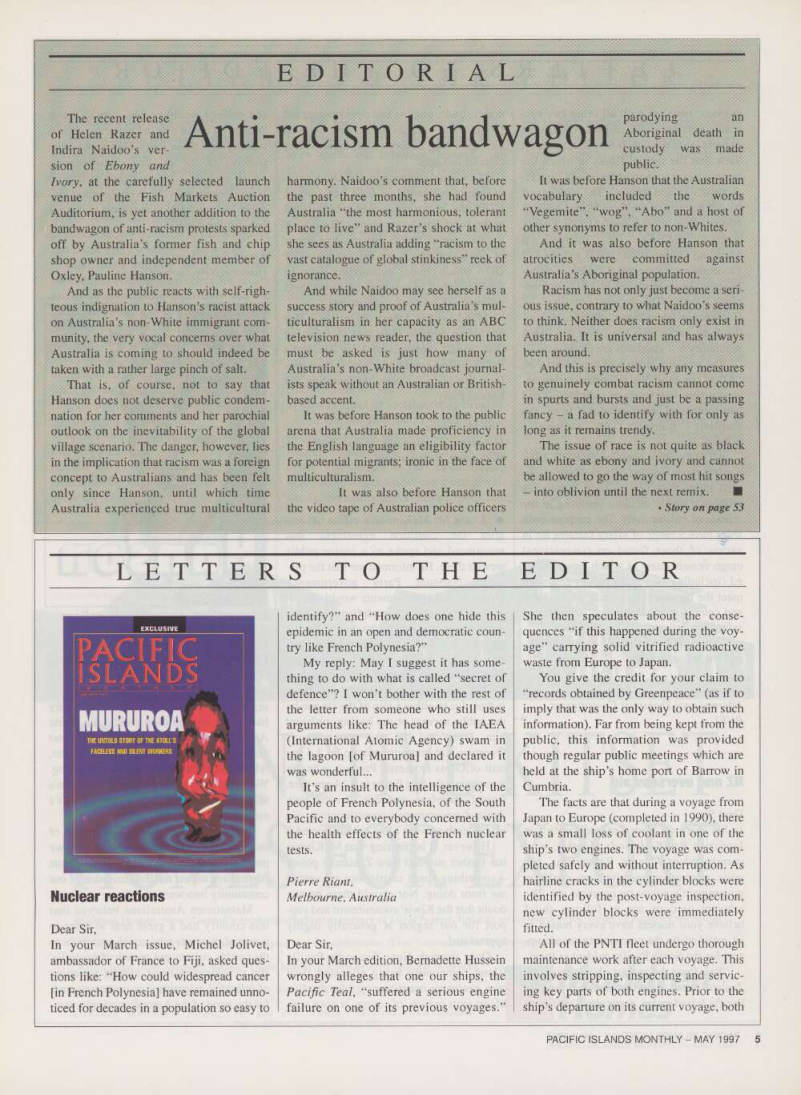
Anti-racism bandwagon
Editorial
The recent release of Helen Razer and Indira Naidoo’s ver sion of Ebony and
Ivory, at the carefully selected launch venue of the Fish Markets Auction Auditorium, is yet another addition to the bandwagon of anti-racism protests sparked off by Australia’s former fish and chip shop owner and independent member of Oxley, Pauline Hanson.
And as the public reacts with self-righ teous indignation to Hanson’s racist attack on Australia’s non-White immigrant com munity, the very vocal concerns over what Australia is coming to should indeed be taken with a rather large pinch of salt.
That is, of course, not to say that Hanson does not deserve public condem nation for her comments and her parochial outlook on the inevitability of the global village scenario. The danger, however, lies in the implication that racism was a foreign concept to Australians and has been felt only since Hanson, until which time Australia experienced true multicultural
harmony. Naidoo’s comment that, before the past three months, she had found Australia “the most harmonious, tolerant place to live” and Razer’s shock at what she sees as Australia adding “racism to the vast catalogue of global stinkiness” reek of ignorance.
And while Naidoo may see herself as a success story and proof of Australia’s mul ticulturalism in her capacity as an ABC television news reader, the question that must be asked is just how many of Australia’s non-White broadcast journal ists speak without an Australian or British based accent.
It was before Hanson took to the public arena that Australia made proficiency in the English language an eligibility factor for potential migrants; ironic in the face of multiculturalism.
It was also before Hanson that the video tape of Australian police officers
parodying an Aboriginal death in custody was made public.
It was before Hanson that the Australian vocabulary included the words “Vegemite”, “wog”, “Abo” and a host of other synonyms to refer to non-Whites.
And it was also before Hanson that atrocities were committed against
Australia’s Aboriginal population.
Racism has not only just become a seri ous issue, contrary to what Naidoo’s seems to think. Neither does racism only exist in Australia. It is universal and has always been around.
And this is precisely why any measures to genuinely combat racism cannot come in spurts and bursts and just be a passing fancy - a fad to identify with for only as long as it remains trendy.
The issue of race is not quite as black and white as ebony and ivory and cannot be allowed to go the way of most hit songs - into oblivion until the next remix. ■
• Story on page 53
Letters To The Editor
Nuclear reactions
Dear Sir, In your March issue, Michel Jolivet, ambassador of France to Fiji, asked ques tions like; “How could widespread cancer [in French Polynesia] have remained unno ticed for decades in a population so easy to
identify?” and “How does one hide this epidemic in an open and democratic coun try like French Polynesia?”
My reply: May I suggest it has some thing to do with what is called “secret of defence”? I won’t bother with the rest of the letter from someone who still uses arguments like: The head of the lAEA (International Atomic Agency) swam in the lagoon [of Mururoa] and declared it was wonderful...
It’s an insult to the intelligence of the people of French Polynesia, of the South Pacific and to everybody concerned with the health effects of the French nuclear tests.
Pierre Riant,
Melbourne, Australia Dear Sir, In your March edition, Bernadette Hussein wrongly alleges that one our ships, the Pacific Teal, “suffered a serious engine failure on one of its previous voyages.”
She then speculates about the conse quences “if this happened during the voy age” carrying solid vitrified radioactive waste from Europe to Japan.
You give the credit for your claim to “records obtained by Greenpeace” (as if to imply that was the only way to obtain such information). Far from being kept from the public, this information was provided
though regular public meetings which are
held at the ship’s home port of Barrow in Cumbria.
The facts are that during a voyage from Japan to Europe (completed in 1990), there was a small loss of coolant in one of the ship’s two engines. The voyage was com pleted safely and without interruption. As hairline cracks in the cylinder blocks were identified by the post-voyage inspection, new cylinder blocks were immediately fitted.
All of the PNTI fleet undergo thorough maintenance work after each voyage. This involves stripping, inspecting and servic ing key parts of both engines. Prior to the ship’s departure on its current voyage, both
engines, together with all other key sys tems, were carefully inspected. Genuine experts also do not share Greenpeace’s view that the special flasks in which the material is transported have had “inade quate design and testing”. The joint expert working group of the three United Nations bodies - the International Atomic Energy Agency (lAEA), the International Maritime Organisation (IMO) and the UN Environmental Program (UNEP) - careful ly analysed these claims in 1993 and con cluded that: “The papers submitted by Greenpeace International provided no evi dence to justify their allegation that lAEA regulatory test standards are inadequate.”
The working group also concluded that.
“All of the available information demon strates very low levels of radiological and environmental consequences from the maritime transport of radioactive material.”
All of the ships operated by PNTL have a safety record second to none, having cov ered more than five million kilometres without a single incident resulting in the release of radioactivity. The purpose-built ships have a range of safety features far in excess of those found on conventional cargo vessels many of which are duplicat
ed (including two independent engines),
meet the highest safety rating of the IMO and comply with all relevant international safety regulations.
I hope this information - based on fact sets the record straight
Gavin Carter,
International Transport Co-ordinator,
Bnfl
NZ and overseas aid
Dear Sir, In his story on New Zealand politics in January’s Pacific Islands Monthly, your correspondent, Atama Raganivatu, has quite misrepresented the new coalition government’s policy on overseas aid. The relevant sections are as follows and I believe your readers have every reason to be gratified by the commitments and sup port for the South Pacific evident in them.
“Reinforce the special obligations New Zealand has to assist the small independent Pacific Island states, particularly with eco
nomic, trade, training and development aid programmes, obligations that have evolved through a long history of immigration and cultural linkages.”
“Continual increase in NZ ODA com mitments (currently at 0.24 per cent of GDP), the greater proportion to be directed to the South Pacific (as above). The cost of the delivery of health services to citizens of countries which are the recipients of ODA which creates outstanding debts in the CHEs shall be met from funds withheld during ODA bilateral negotiations.”
May I say that I think the article is also confusing opinion with fact in asserting that “most” members of New Zealand’s Pacific Island community would have pre ferred to see a government featuring the Labour Party.
Don McKinnon,
Minister of Foreign Affairs and Trade, Wellington, New Zealand • I rang Mr McKinnon’s office the day after the coalition agreement was announced and spoke to a senior public servant there. He informed me that the pre vious National Party government’s Overseas Aid commitments would remain in place, with a slight (undefined) increase in the percentage being allocated to Pacific Island states. I duly included this informa tion in my January, 1997 article and McKinnon has confirmed it in his letter.
The only misrepresentation I can detect is that, due to either a slip of the tongue by the public servant or me having misheard him, I reported the new government’s Overseas Aid commitments to be 2.4 per cent of Gross Domestic Product, whereas it transpires the true figure is 0.24 per cent.
I must, therefore, concede that the New Zealand government’s commitment to aid is one-tenth of what I had initially stated.
However, it is pleasing that McKinnon has further outlined New Zealand’s policy - something space restrictions prevented me from doing. Nor should there be any doubt that the Kiwis’ commitment and sup port for our region is generally highly
appreciated.
Only through New Zealand’s Pacific Island community being allocated their own exclusive constituency, like the five Maori seats (which, of course, is not a seri
ous option) would one be able to prove beyond all doubt that the majority of them support the Labour Party. However, voting patterns in the existing constituencies which include large numbers of Pacific Island people provide overwhelming evi dence that my opinion in respect of this are one and the same.
Atama Raganivatu,
Oamaru, New Zealand
Intergration vs multiculturalism

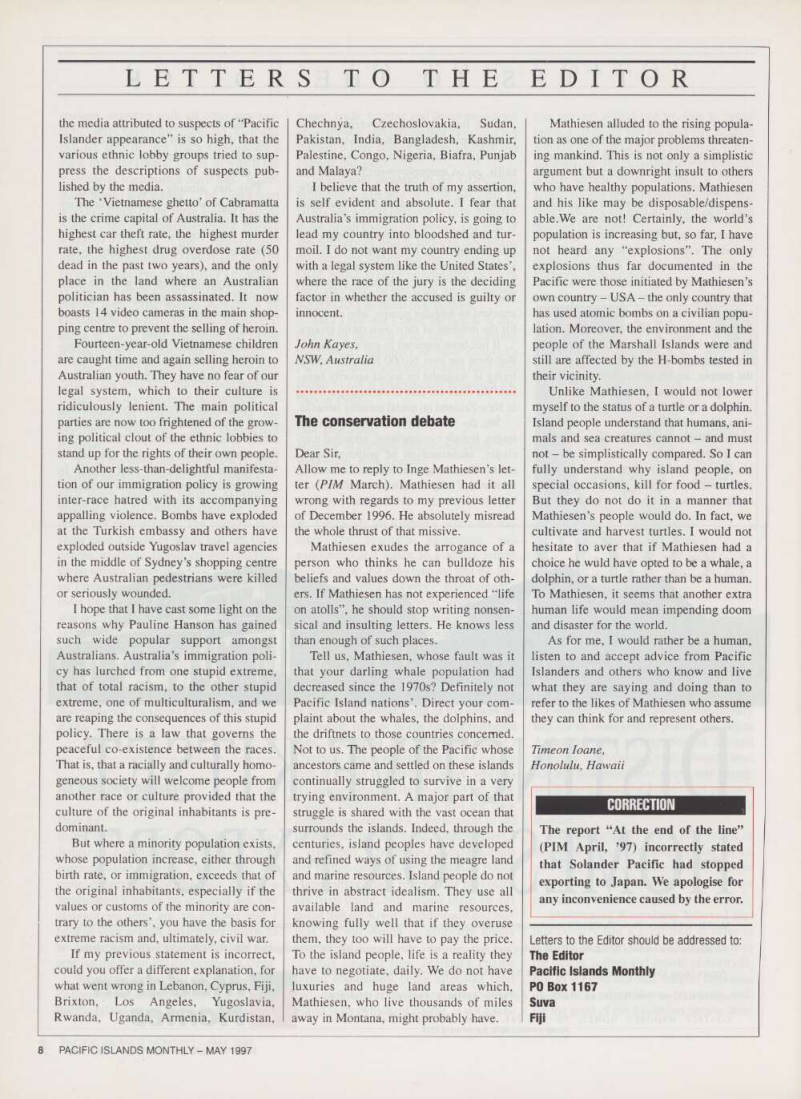
Dear Sir, I read your article “The Hanson debate” (.PIM Feb) at first with annoyance, then with amusement, shaking my head in pity ing wonder. Twenty years ago, this country had, as its immigration policy, the White Australia Policy. As time went on, the vast majority of “Anglo-Celtic” Australians, felt that this policy was stupid and wrong.
We believed that the colour of a person’s skin was immaterial to their suitability as a migrant.
But we believed in the integration of migrants into our community, not, as we now have, multiculturalism, which to most Australians means the Balkanisation of our community into warring tribes.
Mainstream Australians believed that this country had a great deal to offer to potential migrants who could contribute to the wealth, culture and growth of Australia.
But to achieve this end, careful screening of potential migrants was necessary, and, for the good of the Australian people, stan
dards of entry had to be applied.
These were that potential migrants must know how to speak English. Every year, this country squanders $2BO million teach ing migrants, who aspire to be citizens of this country, how to speak our language. A further $6O million is squandered, printing government pamphlets in the language of just about every country in the world.
Many more millions are poured down the drain providing interpreters for courts and every government department you can name. Australia has a bankrupt army, a bankrupt public hospital system, a lack of resources in our public schools, poor roads, a creaking public transport system, and we, the people, are understandably angry that our high taxes are being pillaged, to pro vide for migrants, who should never have been selected for migration.
Australia’s social security safety net was created to help Australia’s poor peo ple. But our social security system is being plundered by migrant groups who have never contributed a penny to its finances.
That the Australian government can bring people into my country who cannot even speak our language, have no job skills, go on unemployment benefits, free health care, and then be put on a public housing list, incenses the Australian
people.
The prime minister’s feeble response to this outrage was to propose that newly arrived migrants should wait for 12 months to be eligible for social security payments.
But even this mild reform was viciously attacked by migrant groups, who care only for the interests of their own racial groups.
It has been reported in our newspapers, that there are over 60,000 New Zealanders living in Australia on social security bene fits. Yet there are just 13 Australians living in New Zealand on social security benefits.
We do not believe in multiple mar riages, female circumcision, arranged mar riages, assassination of political oppo nents. The danger is that as increasing numbers of migrants, whose cultural val ues are abhorrent to Australians, pour into
our country and set up ethnic ghettos in our cities, these alien communities will demand special laws appropriate to their alien cultures.
This has already begun to happen.
Local people who live in migrant areas are finding that they can not take their children to their local council swimming pools on days reserved as “Muslim womens’ swim
ming days”.
Recently, Australian naval forces were involved in the war against Iraq when that country invaded Kuwait. The attitude of Australia’s Arab community was a sad indictment of Australia’s immigration fias co. Casual Arab acquaintances of mine were pro-Saddam Hussein and anti- American.
Ethnic crime in this country is spiralling out of control. Your own magazine has an article in it, “The lost boys” (Feb), which states that there are not many islanders in Washington, but there are a lot of them in jail. A similar situation exists in Australia.
The scale of violent crime reported in
the media attributed to suspects of “Pacific Islander appearance” is so high, that the various ethnic lobby groups tried to sup press the descriptions of suspects pub lished by the media.
The ‘Vietnamese ghetto’ of Cabramatta is the crime capital of Australia. It has the highest car theft rate, the highest murder rate, the highest drug overdose rate (50 dead in the past two years), and the only place in the land where an Australian politician has been assassinated. It now boasts 14 video cameras in the main shop ping centre to prevent the selling of heroin.
Fourteen-year-old Vietnamese children are caught time and again selling heroin to Australian youth. They have no fear of our legal system, which to their culture is ridiculously lenient. The main political parties are now too frightened of the grow ing political clout of the ethnic lobbies to stand up for the rights of their own people.
Another less-than-delightful manifesta tion of our immigration policy is growing inter-race hatred with its accompanying appalling violence. Bombs have exploded at the Turkish embassy and others have exploded outside Yugoslav travel agencies in the middle of Sydney’s shopping centre where Australian pedestrians were killed or seriously wounded.
I hope that I have cast some light on the reasons why Pauline Hanson has gained such wide popular support amongst
Australians. Australia’s immigration poli
cy has lurched from one stupid extreme, that of total racism, to the other stupid extreme, one of multiculturalism, and we are reaping the consequences of this stupid policy. There is a law that governs the peaceful co-existence between the races.
That is, that a racially and culturally homo geneous society will welcome people from another race or culture provided that the culture of the original inhabitants is pre dominant.
But where a minority population exists, whose population increase, either through birth rate, or immigration, exceeds that of the original inhabitants, especially if the values or customs of the minority are con trary to the others’, you have the basis for extreme racism and, ultimately, civil war.
If my previous statement is incorrect, could you offer a different explanation, for what went wrong in Lebanon, Cyprus, Fiji, Brixton, Los Angeles, Yugoslavia, Rwanda, Uganda, Armenia, Kurdistan,
Chechnya, Czechoslovakia, Sudan, Pakistan, India, Bangladesh, Kashmir, Palestine, Congo, Nigeria, Biafra, Punjab and Malaya?
I believe that the truth of my assertion, is self evident and absolute. I fear that Australia’s immigration policy, is going to lead my country into bloodshed and tur moil. I do not want my country ending up with a legal system like the United States’, where the race of the jury is the deciding factor in whether the accused is guilty or innocent.
John Kayes,
NSW, Australia
Advertisements & other items, pp. 6-7 (2 items)
Letters To The Editor
6
PACIFIC ISLANDS MONTHLY - MAY 1997
Distinctive kitset
HOMES FOR EXPORT
Maddren Homes, New Zealand's most experienced exporters of kitset homes, has just announced a new range of superior dwellings.
Available in a variety of architectural styles and appointments, these homes can be reconfigured easily to suit your individual needs.
Apart from their aesthetic appeal, these homes feature proven cyclone resistant construction methods as well as durable termite resistant timbers.
CONTACT MADDREN HOMES: PO Box 244. Kumeu. Auckland. New Zealand.
Phone: 6 4-9-412 9070. fax: 64-9-412 7251
■Maddren
Homes
The conservation debate
Dear Sir, Allow me to reply to Inge Mathiesen’s let ter {PIM March). Mathiesen had it all wrong with regards to my previous letter of December 1996. He absolutely misread the whole thrust of that missive.
Mathiesen exudes the arrogance of a person who thinks he can bulldoze his beliefs and values down the throat of oth ers. If Mathiesen has not experienced “life on atolls”, he should stop writing nonsen sical and insulting letters. He knows less than enough of such places.
Tell us, Mathiesen, whose fault was it that your darling whale population had decreased since the 19705? Definitely not Pacific Island nations’. Direct your com plaint about the whales, the dolphins, and the driftnets to those countries concerned.
Not to us. The people of the Pacific whose ancestors came and settled on these islands continually struggled to survive in a very trying environment. A major part of that struggle is shared with the vast ocean that surrounds the islands. Indeed, through the centuries, island peoples have developed and refined ways of using the meagre land and marine resources. Island people do not thrive in abstract idealism. They use all available land and marine resources, knowing fully well that if they overuse them, they too will have to pay the price.
To the island people, life is a reality they have to negotiate, daily. We do not have luxuries and huge land areas which, Mathiesen, who live thousands of miles away in Montana, might probably have.
Mathiesen alluded to the rising popula tion as one of the major problems threaten ing mankind. This is not only a simplistic argument but a downright insult to others who have healthy populations. Mathiesen and his like may be disposable/dispens able.We are not! Certainly, the world’s population is increasing but, so far, I have not heard any “explosions”. The only explosions thus far documented in the Pacific were those initiated by Mathiesen’s own country - USA - the only country that has used atomic bombs on a civilian popu lation. Moreover, the environment and the people of the Marshall Islands were and still are affected by the H-bombs tested in their vicinity.
Unlike Mathiesen, I would not lower myself to the status of a turtle or a dolphin.
Island people understand that humans, ani mals and sea creatures cannot - and must not - be simplistically compared. So I can fully understand why island people, on special occasions, kill for food - turtles.
But they do not do it in a manner that Mathiesen’s people would do. In fact, we cultivate and harvest turtles. I would not hesitate to aver that if Mathiesen had a choice he wuld have opted to be a whale, a dolphin, or a turtle rather than be a human.
To Mathiesen, it seems that another extra human life would mean impending doom and disaster for the world.
As for me, I would rather be a human, listen to and accept advice from Pacific Islanders and others who know and live what they are saying and doing than to refer to the likes of Mathiesen who assume they can think for and represent others.
Timeon Ioane,
Honolulu, Hawaii
Correction
The report “At the end of the line” (PIM April, ’97) incorrectly stated that Solander Pacific had stopped
exporting to Japan. We apologise for
any inconvenience caused by the error.
Letters to the Editor should be addressed to; The Editor Pacific Islands Monthly PO Box 1167 Suva Fiji
Advertisements & other items, p. 8 (1 item)
Letters To The Editor
8
PACIFIC ISLANDS MONTHLY - MAY 1997
Briefs
Pago Pago tuna plant dodges the bullet HJ Heinz Company, the multi-billion-dol lar-a-year, world wide food concern, keeps threatening to move its 2500-worker tuna plant out of American Samoa, on the grounds that local taxes and wages are too high. (As a result it gets dozens of tax breaks from the poverty-stricken territorial government and has the lowest minimum wage under the US Flag.) But in March, when Heinz laid off sev eral thousand workers worldwide, closed one of its trademark ketchup plants, and cut back its weight-watcher programme all as a part of the firm’s largest retrench ment program in its history - the Pago
Pago plant was spared.
In fact, Heinz said that its cutbacks were aimed at concentrating the firm’s focus on its core products, including tuna.
So far, Heinz’s threats to close American Samoa’s largest factory have proved hollow.
The announcement of the cutbacks was made by Dr Anthony JF O’Reilly, Heinz chairman, who in a good year earns per sonally more than three times as much as all 2500 of his firm’s Samoan fish packers combined. His income, which has reached $U575,000,000 a year, also has exceeded the whole gross national product of some of the smaller nations of the Pacific (see Who’s making money? PIM March, 1992).
By David North
Western Samoan PM attacks man The prime minister of Western Samoa, Tofilau Eti Alesana, allegedly verbally abused and punched Mafutaga, a 20-year old man, about the head after a road acci dent, a Pacnews report said.
The 72-year-old prime minister allegedly turned violent after his vehicle smashed into the back of a pick-up truck, said Salu Toitua, Mafutaga’s father and the owner of the truck. However, Mafutaga’s family has decided not to press charges against the prime minister. The accident occurred outside Moototua National Hospital near Apia. Although both vehicles were exten sively damaged, there were no injuries.
Islands taken into classroom Pacific Passages, a 30-minute video on contemporary life in Pacific Island coun tries was completed in March and will be
used in Hawaii’s seventh grade, where stu dents are now required to study a semester of Pacific Island studies, Pacnews reported.
Caroline Yacoe, executive producer of Pacific Passages, said the video included footage of coming-of-age rituals in Papua New Guinea and funerals in Tonga. The narrator of the video, teenager Susan Hellerman, is a Pacific Islander-American.
Women's issues addressed for image Fiji intends to include an item on the role of women in Melanesia at the 11th Melanesian Spearhead Group (MSG) meeting to be held in Fiji this month, Pacnews reported Fiji’s minister for foreign affairs, Filipe Bole, last month said that if the matter could be achieved in the framework of MSG member countries, it would be a sig nal to the international community that Melanesia recognises the role of women.
ARU wants Pacific rugby team The Australian Rugby Union has called for a Pacific Islands team with players from Fiji, Tonga and Western Samoa to be intro duced in a Super 15 tournament, Pacnews reported from Canberra.
Officials of the present Super 12 Series are expected to meet this month to decide on adding two more teams to the tourna ment next season. ARU chief executive John O’Neill has suggested that the Super 12 be extended further to include a South Pacific team based in Auckland, New Zealand.
Australians may face jail over PNG crisis Some Australians could face jail for their involvement in Papua New Guinea’s abort ed Sandline mercenary operation, accord ing to a report carried in The Canberra Times last month.
An inquiry into the affair being con ducted in Port Moresby was expected to expose the involvement of several Australian businessmen in the recruitment of foreign mercenaries to allegedly deal with the country’s Bougainville crisis.
Earlier media reports stated that four Australian Vietnam veterans were among the mercenaries recruited by Sandline for the PNG government.
Electrification scheme may save Pacific Island coconut palms Coconut prices have sunk to all-time lows in recent years, forcing some governments in the region to abandon the traditional crop. But new technology being developed by the South Pacific Commission’s Rural Development unit to use coconut oil for rural electrification may get their economies fired up again. The system,
developed by Patrice Courty, a technology
adviser attached to the unit, says his objec tive is not to produce energy - “any stupid guy can do it” - but to design an integrated energy system where the people can add value to their produce in the village. He points out that most remote islands in the Pacific have just two products to sell - fish and coconuts. But for people to sell coconuts, they have to turn it to copra, which in turn needs government subsidies to survive, because it needs transport to export outlets.
“If they use this copra to produce ener gy, they don’t need these subsidies,” argues Courty. Courty’s dream of having a chain of remote Pacific Island communities pro ducing coconuts to fuel their own small electricity generators came a step closer in February, when the French government signed an agreement with the SPC worth 50,000 francs ($U595,000) to fund coconut fuel driven rural electrification projects in the Pacific.
By Kalinga Seneviratne
Fiji backs off PNG crisis The government of Fiji regards the situa tion in Papua New Guinea as the country’s internal matter and will not make a politi cal stand on it. Foreign Affairs permanent secretary Gyani Nand said this was despite bilateral agreements between the two countries. Fiji has a bilateral air services agreement, a bilateral trade agreement and a bilateral technical co-operation agree ment with PNG. Early this year, Fiji’s Foreign Affairs Minister Filipe Bole visit ed PNG where he met with the then Prime Minister Sir Julius Chan and the Foreign Affairs and Trade Minister Kilroy Genia.
Nand said this was a goodwill visit which also included discussion on the prepara tions for the MSG hosted by Fiji from May 7 to 9. Again discussions focused largely on the MSG and bilateral issues.
By Bernadette Hussein
Advertisements & other items, pp. 10-14 (2 items)
sdsdsdsd
SPECIAL REPORT
US declassifies nuclear fo
By lAN WILLIAMS
As one of her last acts before leaving her job last month. US Secretary for Energy Hazel O'Leary ordered the release of 6500 films taken of the nuclear tests that began in New Mexico in 1946. and then con tinued, mostly in the Pacific, until 1962.
Part of her “Openness Initiative", the Department of Energy says that the release will support “government accountability and trust in
government by the public".
The images are of haunting beauty, and the stills could almost be sold as works of art. It lakes an effort of imagination to consider the death and destruction these explosions represented. It also represents an effort of analysis, as Pacific Island representatives and their lawyers scrutinise the footage for signs of disasters and mistakes that could revive their claims for increased compensa tion . It is just as likely to confirm their suspicions about the US government as it is to promote trust Author Jonathan Weisgall, whose book. Operation Crossroads, mercilessly dissected the horrors and incompetence involved in some of the tests com mented: “There is a lot of new material, and there may be a renewed discussion of the mistakes that were made. This footage reinforces what 1 have been saying.”
O'Leary may have been too open for the admin istration’s liking, and is now considering her future - although she definitely excludes politics as a career option, she told PIM, adding: “1 put the word out that at each individual site, the people in charge of declassification should be pushing for openness. My job at senior level was to use tact and diplomacy to move it through and make sure it happened on my watch.
“The good news was that the people at the high er levels of the defence department came behind it.
I was concerned that the film we showed shouldn’t editorialise, and let people draw their own conclu sions. If you want to make the point of who was used, lots of people were, in the US and in the Pacific, military and civilian."
For her, especially since her department includ ed the former Atomic Energy Commission, the openness was a point of principle. “This is about how the government lives up to its responsibility to
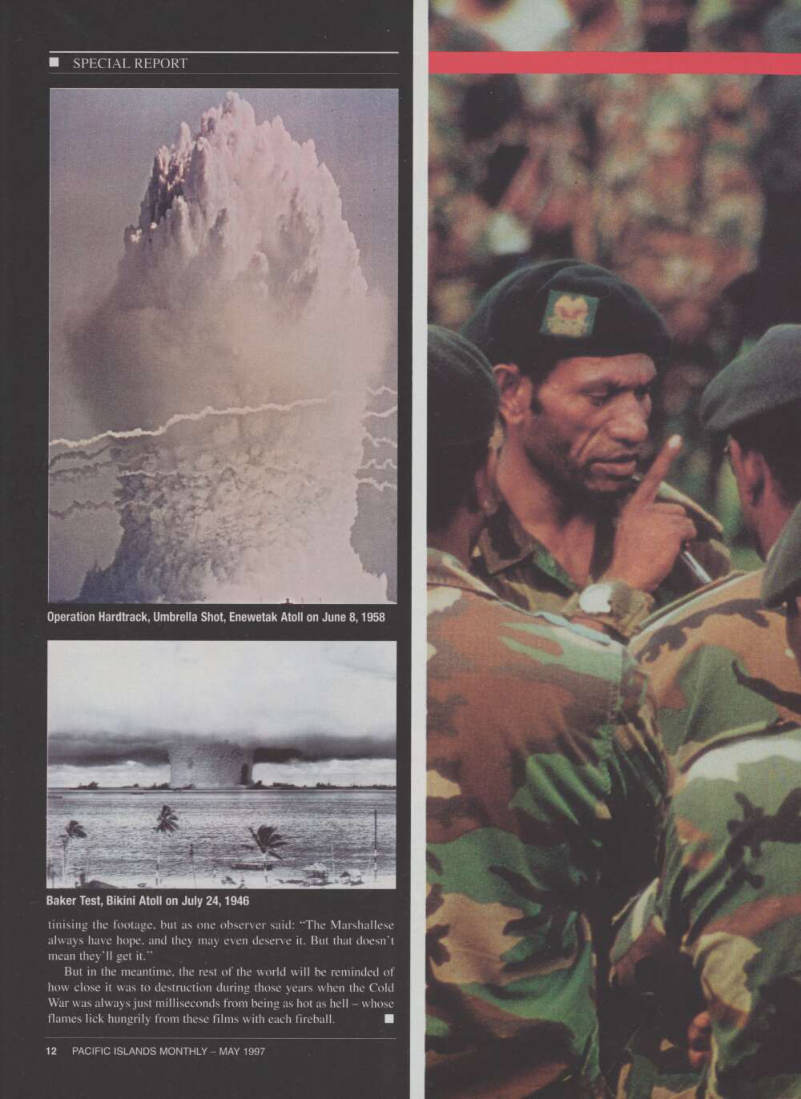
Photographs have been taken from declassified US nuclear footage The 11 megaton Romeo shot, part of Operation Castle, near Bikini Atoll on March 26,1954
age but just what are the motives?
all of us. ordinary people. Some of us who work in government begin to think we are extraordinary. But in the end public service is about the ordinary men, women and children. I am sure you have photographs that are beautiful, but you also have photos of
ordinary men, dwarfed by what is happening.”
The suggestion to release the films came from Charles Dimos at the Albuquerque DOE facility, who is following up on O'Leary's openness ini tiative. He told Pacific Islands Monthly. “I remembered, a picture is worth a thousand words and so moving...!” Since then he has been a mainstay of the effort, which involves the films being transferred to digital video before being examined for material too dangerous to declassi , fy. which is defined as material that would help someone else make a bomb.
The footage so far released includes Test Able, where a bomb was dropped from a 829 on a fleet of 90 vessels moored in Bikini Lagoon and Operations Sandstone. Greenhouse, and Ivy at Enewetak. Operation Castle shared its dubious favours between Bikini and Enewatak and includ ed the largest ever US explosion, and the biggest disaster. Operation Bravo, which weighed in at 15 Megaton.
Later films show US Army engineers clearing up the Pacific test sites. It reinforces O'Leary's point that these tests used people. US military and civilians and Pacific Islanders. One official told PIM of being called by the wife of a man in a wheelchair, dying of three types of cancer, who had been a soldier in Hiroshima just after the war, and had been marched into a mushroom cloud but who could not prove his case because all the documents that would prove his presence at these events were either destroyed or classified.
Many of the films are now physically deterio rating. and many others were lost or destroyed over the years. It will now take up to .seven years at a cost of $US200.()()0 to transfer the archives to video format.
The work of converting them to videotapes has already begun, and footage has been shown on television. But there is a lot more to come.
Even after the video transfer, censors will check
that no classified information is left in the publicly issued footage.
One reason for the effort is not so peaceful. The archives of preserved films will help preserve the US deterrent, according to the DOE press release. It is now 35 years since the US conducted such nuclear tests, and the people who worked on the tests are now
mostly retired or dead. If the US were ever to resurrect its nuclear programme, the details of the preparations shown in these films would be invaluable. As they say, among other objectives, this project tries to determine why things were done the way they were, and may provide “valuable information for the training of future Defence Programs scientists and engineers”.
The department also claims that release of the films should encourage other nations to declassify similar information, and
establishes the US government as a responsible global leader in nuclear information transparency. Just how transparent, will prob ably soon be put to the test by the Marshall Islands government, which seems to have great hopes of being able to reopen the ques tion of compensation for nuclear explosion damage. They are scru-
Ivy Mike, an experimental thermonuclear device, fired on Enewetak on October 31,1952.
tinising the footage, but as one observer said: "The Marshallese always have hope, and they may even deserve it. But that doesn't mean they'll get it.”
But in the meantime, the rest of the world w ill be reminded of how close it was to destruction during those years when the Cold War was always just milliseconds from being as hot as hell - whose flames lick hungrily from these films with each fireball. ■
Operation Hardtrack, Umbrella Shot, Enewetak Atoll on June 8,1958
Baker Test, Bikini Atoll on July 24,1946
Page 12
COVER STORIES
Mercenaries
and mayhem
PNG’s hired help leads to government breakdown
By ALFRED SASAKO
Nine years after it started with thousands of civil ian lives lost and thou sands more displaced, a solution to the Bougainville crisis remains as elusive as ever.
It is the single biggest regional issue which has claimed lives since World War 11, and a conflict that no regional govern ments wanted to discuss openly.
In many regional capitals, the Bougainville issue was off-limits even within the confines of the South Pacific Forum - the annual summit of the region’s top political brass where political and secu rity issues continue to feature prominently on its agenda.
Political leaders treat the conflict - and rightly so, as Bougainville is still an inte gral part of PNG - as an internal matter for the Port Moresby government to deal with.
Until early this year, that is.
In March, news leaked out that the PNG government had signed a SUS36-million deal with the London-based Sandline International, effectively paving the way for the first “import” of mercenaries into the Pacific.
Under the deal approved by Prime Minister Sir Julius Chan, one of the region’s veteran politicians, the mercenar
ies would train an elite PNG squad to elim inate the Bougainville Revolutionary Army (BRA) leadership and its supporters, effec tively declaring a war intent on wiping out the estimated 110,000 BRA civilian sup porters scattered across what was once the North Solomons province.
The deal led to a very tense stand-off between Sir Julius and the 4500-strong PNG military which demanded that Sir Julius along with his deputy, Chris Haiveta and defence minister Mathias Ijape, stand aside to make way for a commission of
inquiry.
At the height of the stand-off, the deal was suspended, Sir Julius and his two min isters stood aside and a commission of inquiry was set up to investigate allega tions of corruption involving the deal.
It was a deal that sent the PNG political system on a downward spiral, only stop ping short of a military coup and in the pro cess saving the country from fear of total anarchy.
News of the deal also triggered alarm bells in Canberra and Wellington as well as in all other regional capitals.
After all, hiring of soldiers of fortune was never the ‘Pacific Way’ of resolving disputes - any kind of disputes.
Incidentally, under the deal signed by Haiveta with Sandline’s Chief executive, Tim Spicer, the mercenaries were to go to
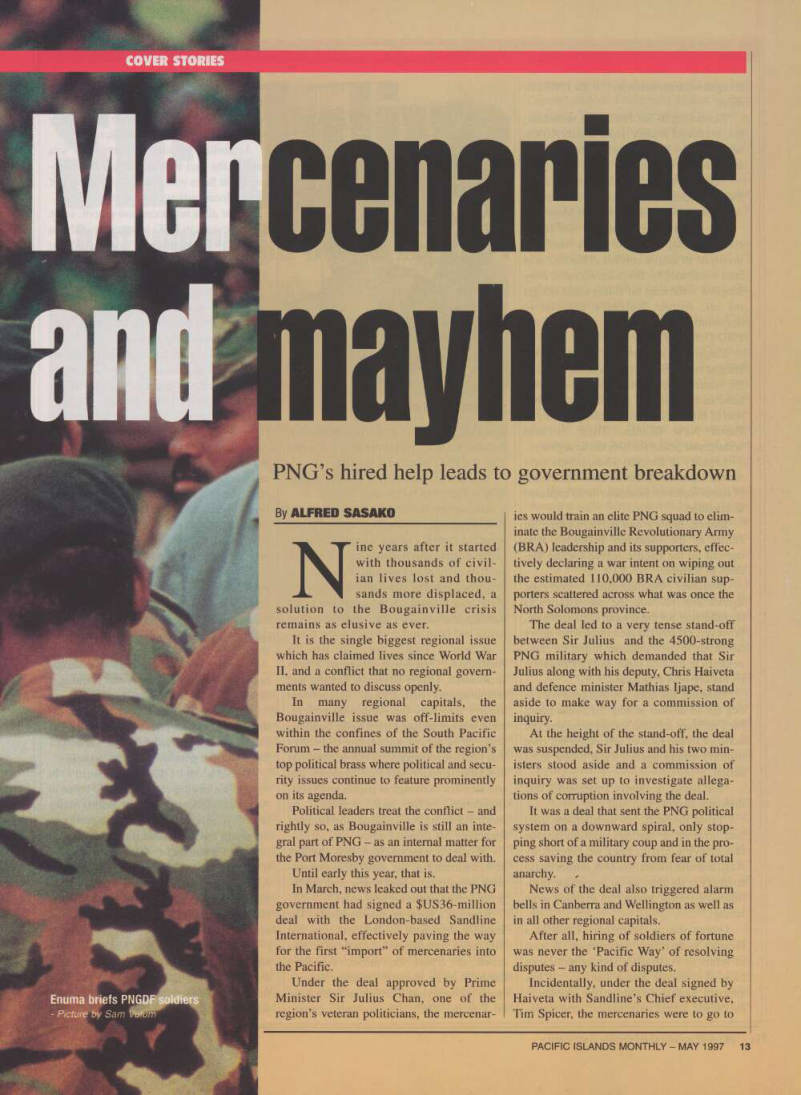
Enuma briefs PNGDF soldiers - Picture by Sam vulum
Bougainville as “advisers” to the PNG sol diers.
According to Sir Julius, the mercenar ies, recruited mainly from South Africa, would go to Bougainville - but only as advisers.
“They would not be used on the front line,” he told reporters as the unfortunate saga continued to unfold in Port Moresby.
But as pressure mounted, Sir Julius conceded that the mercenaries would be involved in active combat. This fact was later confirmed by Brigadier-General Jerry Singirok - the man Sir Julius could not get rid off, despite Waigani’s decision to decommission him as commander of the PNG Defence Force.
Singirok’s unrelenting stand against alleged corruption in the Sandline deal and the restraint he exercised over his troops have earned him the respect and admira tion of his men and the general populace of Papua New Guinea. There is also widespread praise for him in the region.
Legality of the deal aside, debate over the merits or otherwise of the intended use of mercenaries on Bougainville is expected to continue.
Indeed, history will perhaps judge Sir
Julius as the infamous politician who opened up the Pacific region for the sol diers of fortune.
Whatever the argument, everyone agrees that inviting the mercenaries is destabilising for the region. Diplomats are, however, clearly divided over what drove Sir Julius to even consider hiring the mer cenaries in the first place and risk isolation by his regional colleagues.
To many, the question that continues to beg for an answer is why Sir Julius opted for a military solution for the nine-year old conflict in the face of advice by his own military chiefs against such a course of action.
“Sir Julius is clearly frustrated,” one diplomat close to him said.
“From the start, his number one goal was to find a lasting solution to the Bougainville crisis. Lack of support by Australia and frustration over unsuccessful attempts in the past for an acceptable reso lution has really driven him to doing what he did.”
Others see the mercenary issue as a blessing in disguise for the region, at least in terms of Australia’s foreign policy or lack of it in the South Pacific. “It has exposed Australia’s patronising attitude to its Pacific Island neighbours,” one diplo-
mat said. “It is my hope that Australia- Pacific relations will enter a new chapter after the PNG mercenary debacle.”
It is a hope that only a change in atti tude in Canberra will realise.
One other disturbing aspect that the PNG mercenary tussle has exposed is the apparent inability of the Australian intelli gence community to detect such a signifi cant security development. According to published reports, the Australian govern ment was briefed on the situation when training conducted by the Sandline merce naries had been under way for some time.
It was a fiasco that had left the Australian Opposition foreign affairs spokesman, Laurie Brereton, fuming and renewing his call for an independent inquiry into why the Australian govern ment was not alerted earlier to the Sandline deal. “It is almost impossible to believe
that these negotiations, including meetings
in Caims, London and Port Moresby and an extensive exchange of papers and corre spondence, were not detected by Australia’s highly capable intelligence agencies,” Mr Brereton said.
“Whatever way you look at it, the lack of forewarning to the Australian govern ment constitutes a diplomatic and intelli gence failure of the highest order.”
Brereton’s anger is understandable. The Sandline deal was not the first time the Australian intelligence community had failed to report or, rather, forewarn Canberra of an event of immense signifi cance to the region. The first military coup in Fiji in 1987, for instance, caught
Australia napping. Australia’s then high commissioner to Fiji was said to be on a boat travelling to Tuvalu when the military took over the government in Suva.
According to some reports, this was despite the fact that the diplomatic com munity in Suva was abuzz with rumours of an imminent military takeover.
While all is not doom and gloom, some see the events in PNG in recent months as a “window of opportunity” for Australia to play an active role in finding a lasting solu tion to the Bougainville conflict.
“Time is of the essence here. Once this opportunity is allowed to slip through our hands, we can be sure of a long haul,” one top government official said.
Still others want to see Australia use the opportunity to take stock and to improve its aid and investment policy in the Pacific.
According to one diplomat, the only country in the region with serious investors from Australia is Papua New Guinea.
Australia’s investment there, particularly in the rich mineral and natural gas sector is estimated at $4 billion. Australia’s annual return on this investment is a cool $1.5 bil lion. When taken into account, Canberra is still the biggest aid donor to some coun tries in the region, although it is particular now about where its aid dollar is going.
How does the Pacific want to see Australia? One diplomat put it this way: “Australia has the potential to be the eco nomic power in this part of the world. It does not have to go to Asia to become that.” The diplomat’s assessment is that Australia will only become a world eco nomic power in this part of the world if it is willing to do two things.
First, it must come out of its “head-in the-sand” attitude and, second, its politi cians must be forward thinking - ahead of its 17 million people, the diplomat said.
The diplomat also sees merits in Australia allowing more people to come to Australia. He argued that the United States is both a military and economic power in the world today because it has the popula tion. “As a continent, Australia is equiva lent in size to the continental US and Alaska combined, and yet Australia’s pop ulation is only 17 million people, while the US has about 250 million or so people,” he said.
“It is unfortunate that Australia, with such a potential, treats the Pacific the same way the United States treats the world throwing money only at the world’s spots where its interests are served.” ■
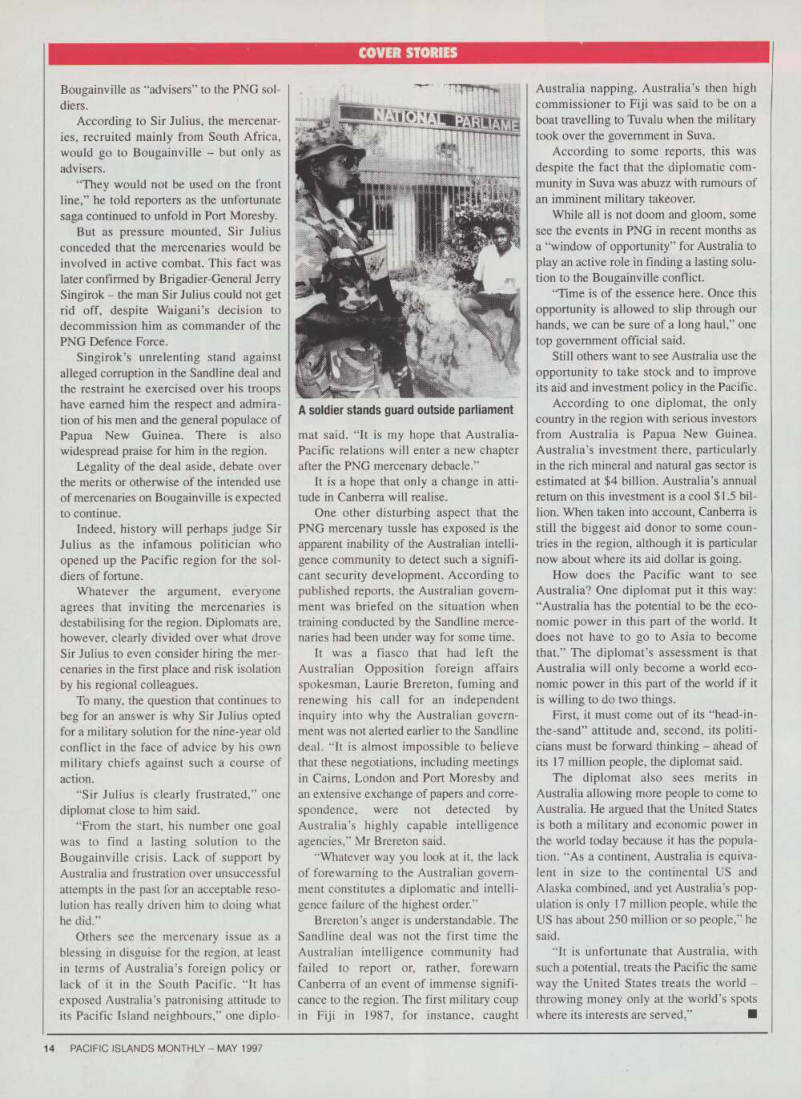
A soldier stands guard outside parliament
Sr Julius
just where did he go wrong?
By Sam Vulum
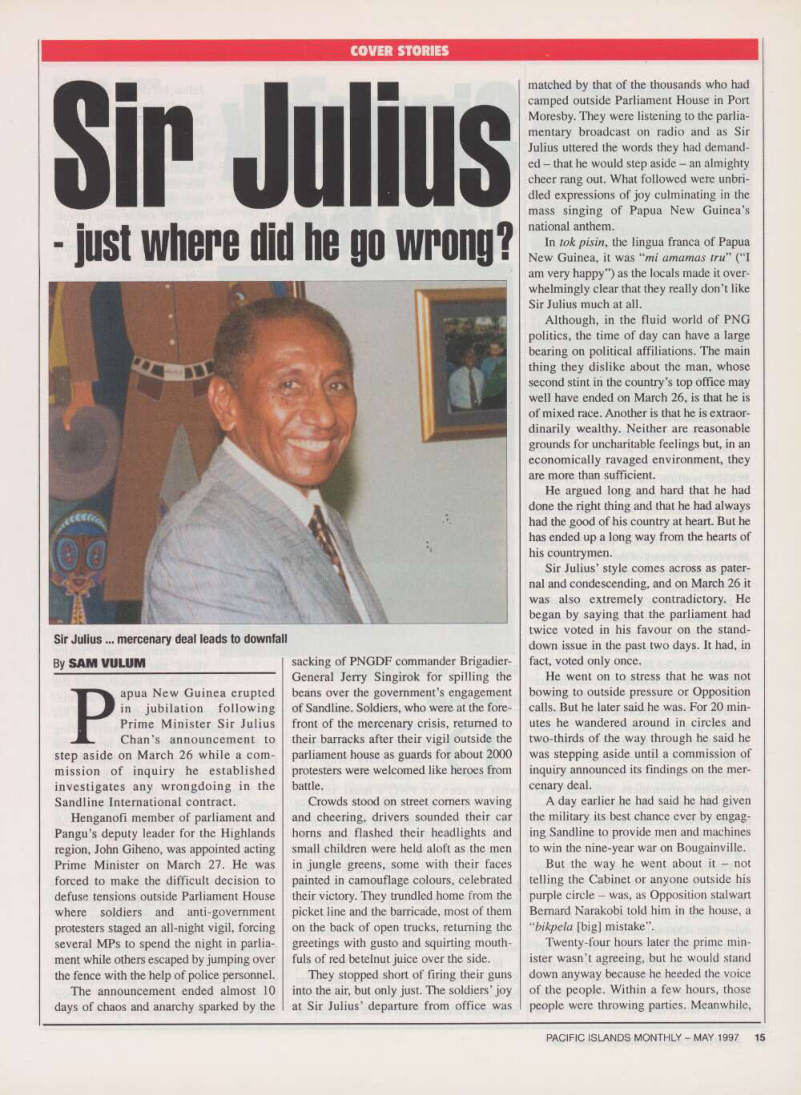
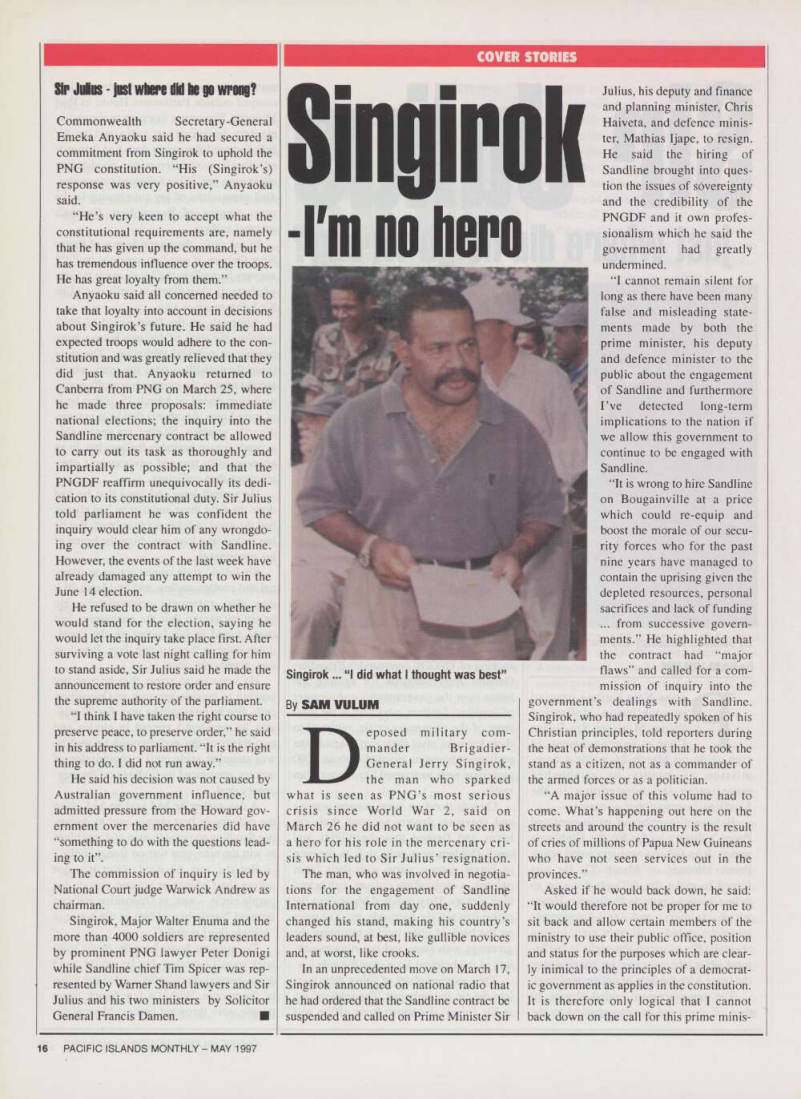
Papua New Guinea erupted in jubilation following Prime Minister Sir Julius Chan’s announcement to step aside on March 26 while a com mission of inquiry he established investigates any wrongdoing in the Sandline International contract.
Henganofi member of parliament and Pangu’s deputy leader for the Highlands region, John Giheno, was appointed acting Prime Minister on March 27. He was forced to make the difficult decision to defuse tensions outside Parliament House where soldiers and anti-government protesters staged an all-night vigil, forcing several MPs to spend the night in parlia ment while others escaped by jumping over the fence with the help of police personnel.
The announcement ended almost 10 days of chaos and anarchy sparked by the
sacking of PNGDF commander Brigadier-
General Jerry Singirok for spilling the
beans over the government’s engagement of Sandline. Soldiers, who were at the fore front of the mercenary crisis, returned to their barracks after their vigil outside the parliament house as guards for about 2000 protesters were welcomed like heroes from battle.
Crowds stood on street comers waving and cheering, drivers sounded their car horns and flashed their headlights and small children were held aloft as the men in jungle greens, some with their faces painted in camouflage colours, celebrated their victory. They trundled home from the picket line and the barricade, most of them on the back of open trucks, returning the greetings with gusto and squirting mouth fuls of red betelnut juice over the side.
They stopped short of firing their guns into the air, but only just. The soldiers’ joy at Sir Julius’ departure from office was
matched by that of the thousands who had camped outside Parliament House in Port Moresby. They were listening to the parlia mentary broadcast on radio and as Sir Julius uttered the words they had demand ed - that he would step aside - an almighty cheer rang out. What followed were unbri dled expressions of joy culminating in the mass singing of Papua New Guinea’s national anthem.
In tok pisin, the lingua franca of Papua New Guinea, it was “mi amamas tru ” (“I am very happy”) as the locals made it over whelmingly clear that they really don’t like Sir Julius much at all.
Although, in the fluid world of PNG politics, the time of day can have a large bearing on political affiliations. The main thing they dislike about the man, whose second stint in the country’s top office may well have ended on March 26, is that he is of mixed race. Another is that he is extraor dinarily wealthy. Neither are reasonable grounds for uncharitable feelings but, in an
economically ravaged environment, they
are more than sufficient.
He argued long and hard that he had done the right thing and that he had always had the good of his country at heart. But he has ended up a long way from the hearts of his countrymen.
Sir Julius’ style comes across as pater nal and condescending, and on March 26 it was also extremely contradictory. He began by saying that the parliament had twice voted in his favour on the stand down issue in the past two days. It had, in fact, voted only once.
He went on to stress that he was not bowing to outside pressure or Opposition calls. But he later said he was. For 20 min utes he wandered around in circles and two-thirds of the way through he said he was stepping aside until a commission of inquiry announced its findings on the mer cenary deal.
A day earlier he had said he had given the military its best chance ever by engag ing Sandline to provide men and machines to win the nine-year war on Bougainville.
But the way he went about it - not telling the Cabinet or anyone outside his purple circle - was, as Opposition stalwart Bernard Narakobi told him in the house, a “bikpela [big] mistake”.
Twenty-four hours later the prime min ister wasn’t agreeing, but he would stand down anyway because he heeded the voice of the people. Within a few hours, those people were throwing parties. Meanwhile,
Sir Julius ... mercenary deal leads to downfall
Sir Jiius - just where did he go wrong?
Commonwealth Secretary-General
Emeka Anyaoku said he had secured a commitment from Singirok to uphold the PNG constitution. “His (Singirok’s) response was very positive,” Anyaoku said.
“He’s very keen to accept what the constitutional requirements are, namely that he has given up the command, but he has tremendous influence over the troops.
He has great loyalty from them.”
Anyaoku said all concerned needed to take that loyalty into account in decisions about Singirok’s future. He said he had expected troops would adhere to the con stitution and was greatly relieved that they did just that. Anyaoku returned to Canberra from PNG on March 25, where he made three proposals: immediate national elections; the inquiry into the Sandline mercenary contract be allowed to carry out its task as thoroughly and impartially as possible; and that the PNGDF reaffirm unequivocally its dedi cation to its constitutional duty. Sir Julius told parliament he was confident the inquiry would clear him of any wrongdo ing over the contract with Sandline.
However, the events of the last week have already damaged any attempt to win the June 14 election.
He refused to be drawn on whether he would stand for the election, saying he would let the inquiry take place first. After surviving a vote last night calling for him to stand aside, Sir Julius said he made the announcement to restore order and ensure the supreme authority of the parliament.
“I think I have taken the right course to preserve peace, to preserve order,” he said in his address to parliament. “It is the right thing to do. I did not run away.”
He said his decision was not caused by Australian government influence, but admitted pressure from the Howard gov ernment over the mercenaries did have “something to do with the questions lead ing to it”.
The commission of inquiry is led by National Court judge Warwick Andrew as chairman.
Singirok, Major Walter Enuma and the more than 4000 soldiers are represented by prominent PNG lawyer Peter Donigi while Sandline chief Tim Spicer was rep resented by Warner Shand lawyers and Sir Julius and his two ministers by Solicitor General Francis Damen. ■
Singirok
I'm no hero
By Sam Vulum
Deposed military com mander Brigadier-
General Jerry Singirok,
the man who sparked what is seen as PNG’s most serious crisis since World War 2, said on March 26 he did not want to be seen as a hero for his role in the mercenary cri sis which led to Sir Julius’ resignation.
The man, who was involved in negotia tions for the engagement of Sandline International from day one, suddenly changed his stand, making his country’s leaders sound, at best, like gullible novices and, at worst, like crooks.
In an unprecedented move on March 17, Singirok announced on national radio that he had ordered that the Sandline contract be suspended and called on Prime Minister Sir
Julius, his deputy and finance and planning minister, Chris Haiveta, and defence minis ter, Mathias Ijape, to resign.
He said the hiring of Sandline brought into ques tion the issues of sovereignty and the credibility of the PNGDF and it own profes sionalism which he said the government had greatly undermined.
“I cannot remain silent for long as there have been many false and misleading state ments made by both the prime minister, his deputy and defence minister to the public about the engagement of Sandline and furthermore I’ve detected long-term implications to the nation if we allow this government to continue to be engaged with Sandline.
“It is wrong to hire Sandline on Bougainville at a price which could re-equip and boost the morale of our secu rity forces who for the past nine years have managed to contain the uprising given the depleted resources, personal sacrifices and lack of funding ... from successive govern ments.” He highlighted that the contract had “major flaws” and called for a com mission of inquiry into the
government’s dealings with Sandline.
Singirok, who had repeatedly spoken of his Christian principles, told reporters during the heat of demonstrations that he took the stand as a citizen, not as a commander of the armed forces or as a politician.
“A major issue of this volume had to come. What’s happening out here on the streets and around the country is the result of cries of millions of Papua New Guineans who have not seen services out in the provinces.”
Asked if he would back down, he said: “It would therefore not be proper for me to sit back and allow certain members of the ministry to use their public office, position and status for the purposes which are clear ly inimical to the principles of a democrat ic government as applies in the constitution.
It is therefore only logical that I cannot back down on the call for this prime minis-
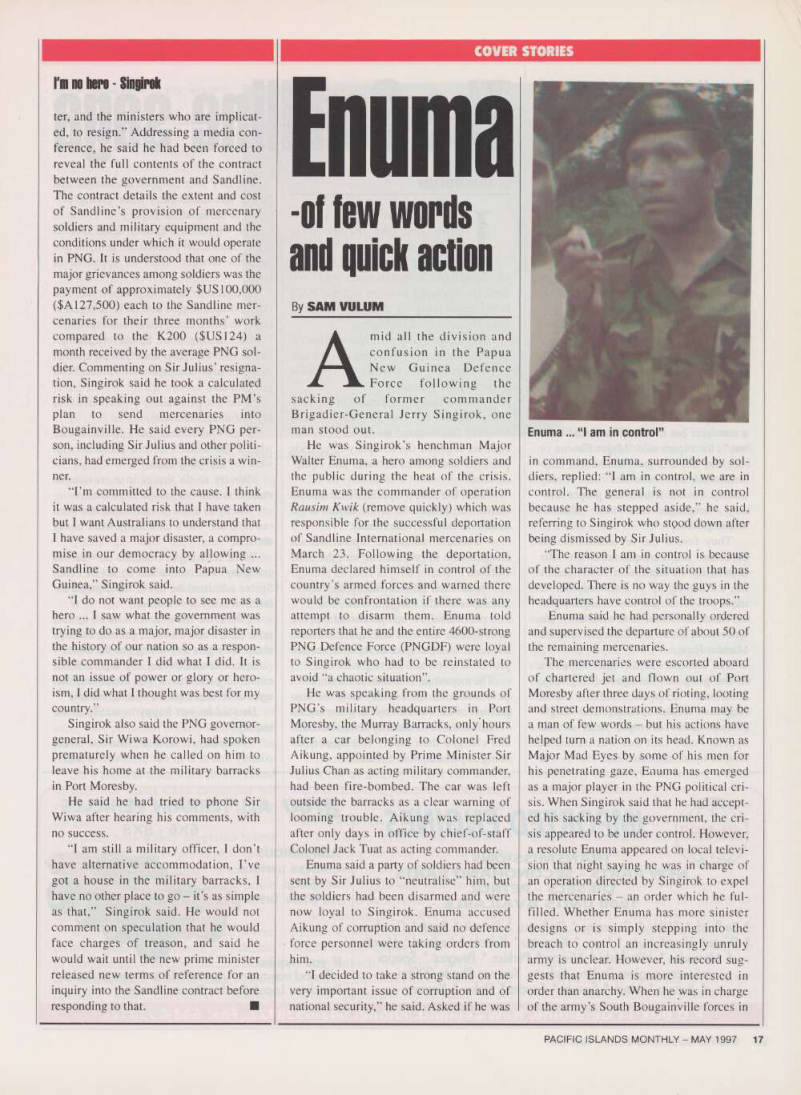
Singirok ... “I did what I thought was best”
I'm no hero - Singirok
ter, and the ministers who are implicat ed, to resign.” Addressing a media con ference, he said he had been forced to reveal the full contents of the contract between the government and Sandline.
The contract details the extent and cost of Sandline’s provision of mercenary soldiers and military equipment and the conditions under which it would operate in PNG. It is understood that one of the major grievances among soldiers was the payment of approximately SUS 100,000 ($A 127,500) each to the Sandline mer cenaries for their three months’ work compared to the K2OO (SUSI 24) a month received by the average PNG sol dier. Commenting on Sir Julius’ resigna tion, Singirok said he took a calculated risk in speaking out against the PM’s plan to send mercenaries into Bougainville. He said every PNG per son, including Sir Julius and other politi cians, had emerged from the crisis a win ner.
“I’m committed to the cause. I think it was a calculated risk that I have taken but I want Australians to understand that I have saved a major disaster, a compro mise in our democracy by allowing ...
Sandline to come into Papua New Guinea,” Singirok said.
“I do not want people to see me as a hero ... I saw what the government was trying to do as a major, major disaster in the history of our nation so as a respon sible commander 1 did what I did. It is not an issue of power or glory or hero ism, I did what I thought was best for my country.”
Singirok also said the PNG governor general, Sir Wiwa Korowi, had spoken prematurely when he called on him to leave his home at the military barracks in Port Moresby.
He said he had tried to phone Sir Wiwa after hearing his comments, with no success.
“I am still a military officer, I don’t have alternative accommodation, I’ve got a house in the military barracks, I have no other place to go - it’s as simple as that,” Singirok said. He would not comment on speculation that he would face charges of treason, and said he would wait until the new prime minister released new terms of reference for an inquiry into the Sandline contract before responding to that. ■
Enuma

-of few words and quick action
By Sam Vulum
Amid all the division and confusion in the Papua New Guinea Defence Force following the sacking of former commander Brigadier-General Jerry Singirok, one man stood out.
He was Singirok’s henchman Major Walter Enuma, a hero among soldiers and the public during the heat of the crisis.
Enuma was the commander of operation Rausiw Kwik (remove quickly) which was responsible for the successful deportation of Sandline International mercenaries on March 23. Following the deportation, Enuma declared himself in control of the country’s armed forces and warned there would be confrontation if there was any attempt to disarm them. Enuma told reporters that he and the entire 4600-strong PNG Defence Force (PNGDF) were loyal to Singirok who had to be reinstated to avoid “a chaotic situation”.
He was speaking from the grounds of PNG’s military headquarters in Port Moresby, the Murray Barracks, only hours after a car belonging to Colonel Fred Aikung, appointed by Prime Minister Sir Julius Chan as acting military commander, had been fire-bombed. The car was left outside the barracks as a clear warning of looming trouble. Aikung was replaced after only days in office by chief-of-staff Colonel Jack Tuat as acting commander.
Enuma said a party of soldiers had been sent by Sir Julius to “neutralise” him, but the soldiers had been disarmed and were now loyal to Singirok. Enuma accused Aikung of corruption and said no defence force personnel were taking orders from him.
“I decided to take a strong stand on the very important issue of corruption and of national security,” he said. Asked if he was
in command, Enuma, surrounded by sol diers, replied: “I am in control, we are in control. The general is not in control because he has stepped aside,” he said, referring to Singirok who stpod down after being dismissed by Sir Julius.
“The reason I am in control is because of the character of the situation that has developed. There is no way the guys in the headquarters have control of the troops.”
Enuma said he had personally ordered and supervised the departure of about 50 of the remaining mercenaries.
The mercenaries were escorted aboard of chartered jet and flown out of Port Moresby after three days of rioting, looting and street demonstrations. Enuma may be a man of few words - but his actions have helped turn a nation on its head. Known as Major Mad Eyes by some of his men for his penetrating gaze, Enuma has emerged as a major player in the PNG political cri sis. When Singirok said that he had accept ed his sacking by the government, the cri sis appeared to be under control. However, a resolute Enuma appeared on local televi sion that night saying he was in charge of an operation directed by Singirok to expel the mercenaries - an order which he ful filled. Whether Enuma has more sinister designs or is simply stepping into the breach to control an increasingly unruly army is unclear. However, his record sug gests that Enuma is more interested in order than anarchy. When he was in charge of the army’s South Bougainville forces in
Enuma ... “I am in control”
Enuma-of few words and quick action
1994 and 1995 he helped restore a sem blance of peace and order unseen in the area since the secessionist conflict began nine years ago.
He co-operated with traditional lead ers and invited the Foundation for Law, Order and Justice to run conflict resolu tion courses which were attended by sol diers, rebel fighters and military-backed
resistance fighters.
He also established a good relation ship with the then rebel leader of south ern Bougainville, Paul Bobby.
In 1992, Enuma led successful strikes
deep into Bougainville Revolutionary
Army territory with a contingent of only five men to show the rebels that the army could strike anywhere.
Despite many rebels being killed he was respected by the BRA for not being a murderer but a “disciplined soldier of war”, the report said. Major Enuma or Ace was one of a gang of five that mas terminded and executed the 10-day mutiny. For the five, in the proper mili tary language, it was Mission Accomplished.
They forced the revocation of the Sandline International contract, the deportation of Sandline’s 70 mercenar ies, the setting up of a commission of inquiry to investigate any wrongdoing in the Sandline contract and eventually, the removal, of Sir Julius, Chris Haiveta and
Mathias Ijape.
The identities of the other members of the gang are Renegade (Singirok), Terminator (Corporal Allen), Skull (Captain Belden Nama) and Eagle (Major Gilbert Toropo, head of the Special Force Unit that was trained in Wewak by the mercenaries). ■
The Sandline saga
By Sam Vulum
It has become public knowl edge that the Papua New Guinea government had lied in saying that the engagement of Sandline International was not directly intended to wipe out the BRA rebel leadership in Bougainville but only to train PNG soldiers.
Sir Julius, however, had indirectly admitted on various occasions that the aim of the exercise was to wipe out the BRA leadership on the island.
This was further confirmed in the con tract, signed by the government and Sandline International on January 31. The contract required the company to provide personal and related services and equip ment to: • train the state’s Special Force Unit in tactical skills specific to the objective (to neutralise Bougainville rebels); • conduct offensive operations in Bougainville in conjunction with the PNG Defence Force; • render the BRA militarily ineffective and repossess the Panguna mine; and • provide follow-up operational support, to be further specified and agreed between the parties and subject to separate service provision levels and fee negotiations.
The more than 70 Sandline mercenaries have since left the country after the sus pension of the contract by the government.
However, PNG security forces detained and charged their chief, Tim Spicer, for being in possession of firearms.
The DPP later dropped the charges and Spicer left the country after giving evi dence to the Sandline inquiry.
The 44-year-old former Scots Guards officer had earlier pleaded not guilty to two firearms charges when he appeared in court.
A request to have his passport returned failed, despite a plea that he be allowed to travel to Hong Kong for medical reasons.
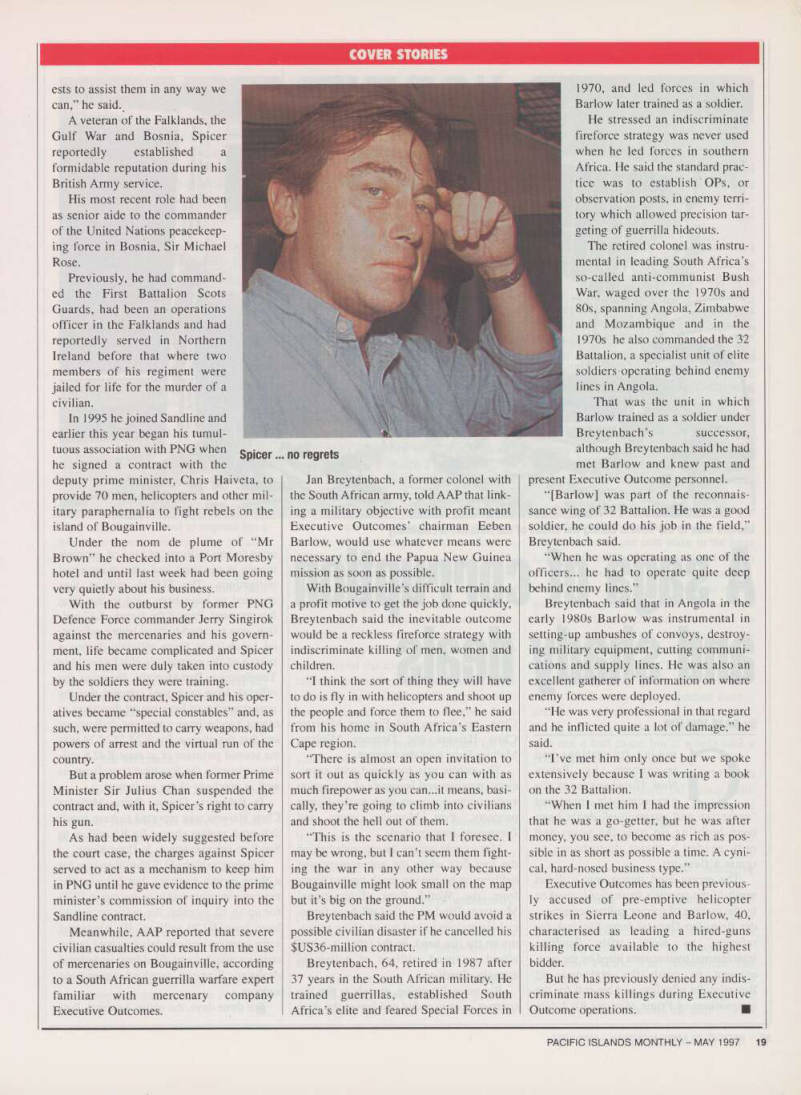
After leaving court, Spicer told journal ists he had no regrets about having entered into the mercenaries contract with the PNG government.
“I am not particularly concerned about my self image,” he said.
“I don’t particularly have problems with what I do. I don’t have a problem with what my company does.
“We try to do things in a reasonable manner within our technical profession.
“We try to assist governments that need our help and that’s all I really want to say about it.”
While refusing to elaborate on what his company was contracted to do in PNG, Spicer admitted he never anticipated the reaction that has occurred.
“I think the situation took us all by sur prise [but] I don’t want to get into a debate about the rights and wrongs of the issue.”
Spicer denied having any regrets about embarking on his PNG adventure but agreed “it hasn’t been a roaring success”.
He said he was happy to testify at the inquiry.
“Obviously, it is in the interests of the country and it is in our professional inter
ests to assist them in any way we can,” he said.
A veteran of the Falklands, the Gulf War and Bosnia, Spicer reportedly established a
formidable reputation during his
British Army service.
His most recent role had been as senior aide to the commander of the United Nations peacekeep ing force in Bosnia, Sir Michael Rose.
Previously, he had command ed the First Battalion Scots Guards, had been an operations officer in the Falklands and had reportedly served in Northern Ireland before that where two members of his regiment were jailed for life for the murder of a civilian.
In 1995 he joined Sandline and earlier this year began his tumul tuous association with PNG when he signed a contract with the
deputy prime minister, Chris Haiveta, to provide 70 men, helicopters and other mil itary paraphernalia to fight rebels on the island of Bougainville.
Under the nom de plume of “Mr Brown” he checked into a Port Moresby hotel and until last week had been going very quietly about his business.
With the outburst by former PNG Defence Force commander Jerry Singirok against the mercenaries and his govern ment, life became complicated and Spicer and his men were duly taken into custody by the soldiers they were training.
Under the contract, Spicer and his oper atives became “special constables” and, as such, were permitted to carry weapons, had powers of arrest and the virtual run of the country.
But a problem arose when former Prime Minister Sir Julius Chan suspended the contract and, with it, Spicer’s right to carry his gun.
As had been widely suggested before the court case, the charges against Spicer served to act as a mechanism to keep him in PNG until he gave evidence to the prime minister’s commission of inquiry into the Sandline contract.
Meanwhile, AAP reported that severe civilian casualties could result from the use of mercenaries on Bougainville, according to a South African guerrilla warfare expert familiar with mercenary company Executive Outcomes.
Jan Breytenbach, a former colonel with the South African army, told AAP that link ing a military objective with profit meant Executive Outcomes’ chairman Eeben Barlow, would use whatever means were necessary to end the Papua New Guinea mission as soon as possible.
With Bougainville’s difficult terrain and a profit motive to get the job done quickly, Breytenbach said the inevitable outcome would be a reckless fireforce strategy with indiscriminate killing of men, women and children.
“I think the sort of thing they will have to do is fly in with helicopters and shoot up the people and force them to flee,” he said from his home in South Africa’s Eastern
Cape region.
“There is almost an open invitation to sort it out as quickly as you can with as much firepower as you can...it means, basi cally, they’re going to climb into civilians and shoot the hell out of them.
“This is the scenario that I foresee. I may be wrong, but I can’t seem them fight ing the war in any other way because Bougainville might look small on the map but it’s big on the ground.”
Breytenbach said the PM would avoid a possible civilian disaster if he cancelled his SUS36-million contract.
Breytenbach, 64, retired in 1987 after 37 years in the South African military. He trained guerrillas, established South Africa’s elite and feared Special Forces in
1970, and led forces in which Barlow later trained as a soldier.
He stressed an indiscriminate fireforce strategy was never used when he led forces in southern Africa. He said the standard prac tice was to establish OPs, or observation posts, in enemy terri tory which allowed precision tar geting of guerrilla hideouts.
The retired colonel was instru mental in leading South Africa’s so-called anti-communist Bush War, waged over the 1970 s and 80s, spanning Angola, Zimbabwe and Mozambique and in the 1970 s he also commanded the 32 Battalion, a specialist unit of elite soldiers operating behind enemy lines in Angola.
That was the unit in which Barlow trained as a soldier under
Breytenbach’s successor,
although Breytenbach said he had
met Barlow and knew past and present Executive Outcome personnel.
“[Barlow] was part of the reconnais sance wing of 32 Battalion. He was a good soldier, he could do his job in the field,”
Breytenbach said.
“When he was operating as one of the officers... he had to operate quite deep behind enemy lines.”
Breytenbach said that in Angola in the early 1980 s Barlow was instrumental in setting-up ambushes of convoys, destroy ing military equipment, cutting communi cations and supply lines. He was also an excellent gatherer of information on where enemy forces were deployed.
“He was very professional in that regard and he inflicted quite a lot of damage,” he said.
“I’ve met him only once but we spoke extensively because I was writing a book on the 32 Battalion.
“When I met him I had the impression that he was a go-getter, but he was after money, you see, to become as rich as pos sible in as short as possible a time. A cyni cal, hard-nosed business type.”
Executive Outcomes has been previous ly accused of pre-emptive helicopter strikes in Sierra Leone and Barlow, 40, characterised as leading a hired-guns killing force available to the highest bidder.
But he has previously denied any indis criminate mass killings during Executive Outcome operations. ■
Spicer ... no regrets
Advertisements & other items, p. 18 (2 items)
Cover Stories
Imported Engines
BLAIRS
NEW
TRANSMISSIONS
PARTS - SECONDHAND PARTS
DIESELS - PETROL
1000 UNITS AVAILABLE
* Bedford * BMW * Cummins * Daihatsu * Detroit * Ford * Gardner * Duetz * Hino * Isuzu * Ivaco * Komatsu * Kubota * Leyland * Mazda * Mercedes * Mitsubishi * Nissan * Perkins * Peugeot * Special stationary engines Perkins, Kubota, Yanmar 9hp to 200 hp, * Scania * Main * Suzuki * Toyota * Volvo * Yanmar
firga all terrain vehicles n
6X6 - BXB
AMPHIBIOUS
Carries 6 persons or 454kgs All Wheel Drive •• IF you require off rood transport Argo will do it. Swamps, Lakes, Beaches, Loose Rocks, Dense Forest.
P.O Box 14 Geraldine, New Zealand. Phone: 643-6938122. Fax: 643-6938120
A saga of corrupfion
and shady deals
By Sam Vulum
Growing frustrations and resentment by Papua New Guineans over the government’s incessant “secretive and suspicious” deals have been building up over the years and only needed a major disturbance to ignite a flare-up.
The recent civil unrest was a direct result of the people’s frustrations, sparked by the sacking of former military comman der Brigadier-General Jerry Singirok for refusing to work with Sandline International mercenaries hired by the gov ernment to crush the eight-year-old Bougainville rebellion and his call for the resignations of Prime Minister Sir Julius
Chan, his deputy and Finance Minister Chris Haiveta and Defence Minister Mathias Ijape over the contract.
The public was frustrated with suspi cions, rumours and innuendo of corruption surrounding contracts such as the Cairns property, Port Moresby water and Poreporana freeway deals.
Many could not see the rationale behind the fact that while the government was hellbent on borrowing much-needed funds from the World Bank, International Monetary Fund and other offshore finan cial institutions to bail out its ailing econo my on the one hand, on the other, it could afford to spend millions of dollars in engaging Sandline.
But more disturbing, though, is that the contract is open ended and leaves the state
open to pay millions of kina of people’s money in penalties and other contractual obligations. The SUS 36 million was reported to have been paid to Sandline International. Part of the money, K 42 mil lion, was reported to have been confiscat ed by defence force officials during a search of the company’s chief executive Tim Spicer in Port Moresby. However, the officials have expressed concern that the government may have issued directives to cancel it and reissue a new one. Indications are that the cheque for K 24,557,534 was the second payment of at least K 42.6 mil lion to engage the Sandline consultants as well as purchase of the equipment.
In February, Deputy Prime Minister Chris Haiveta was reported to have hand delivered another cheque for K 8 million to Sandline representatives in Hong Kong.
Singirok said the SUS 36 million was for a three-month contract, but because the mercenaries were likely to remain in PNG for up to 12 months, the real cost would have been Kl2O million. He suggested some government officials involved in the contract may have profited from underhand
dealings. Singirok received nationwide
support.
For three days, the nation’s capital, Port
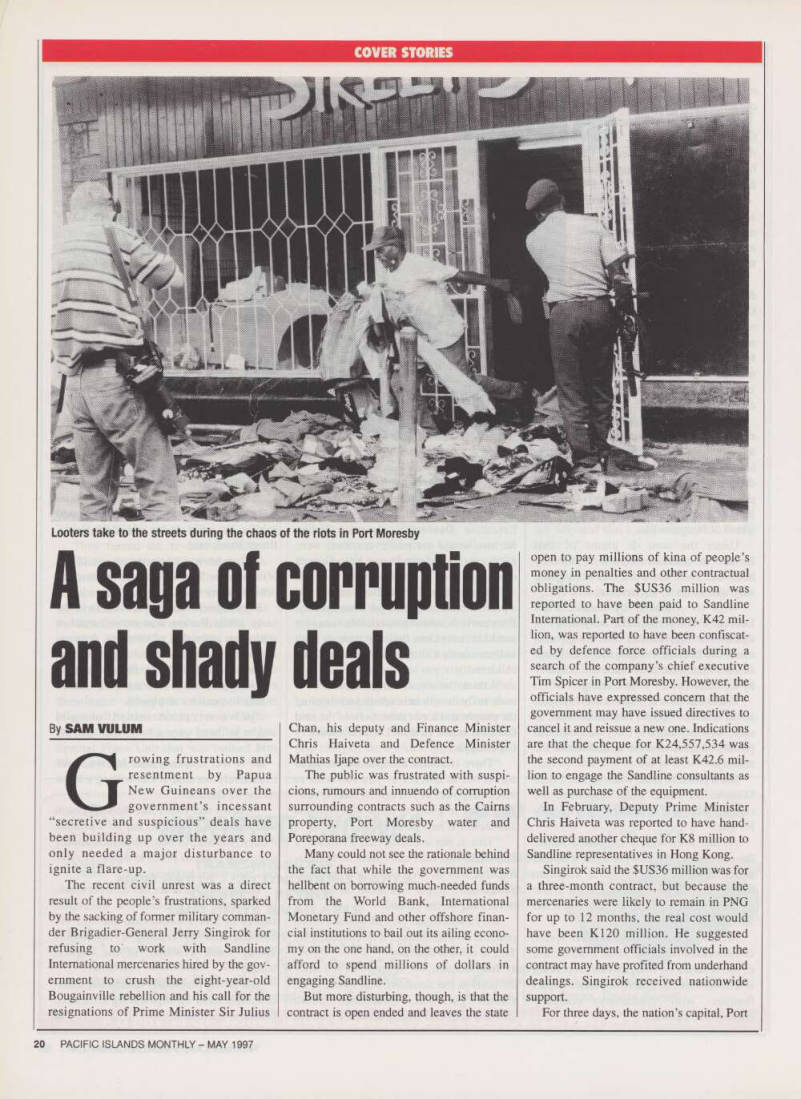
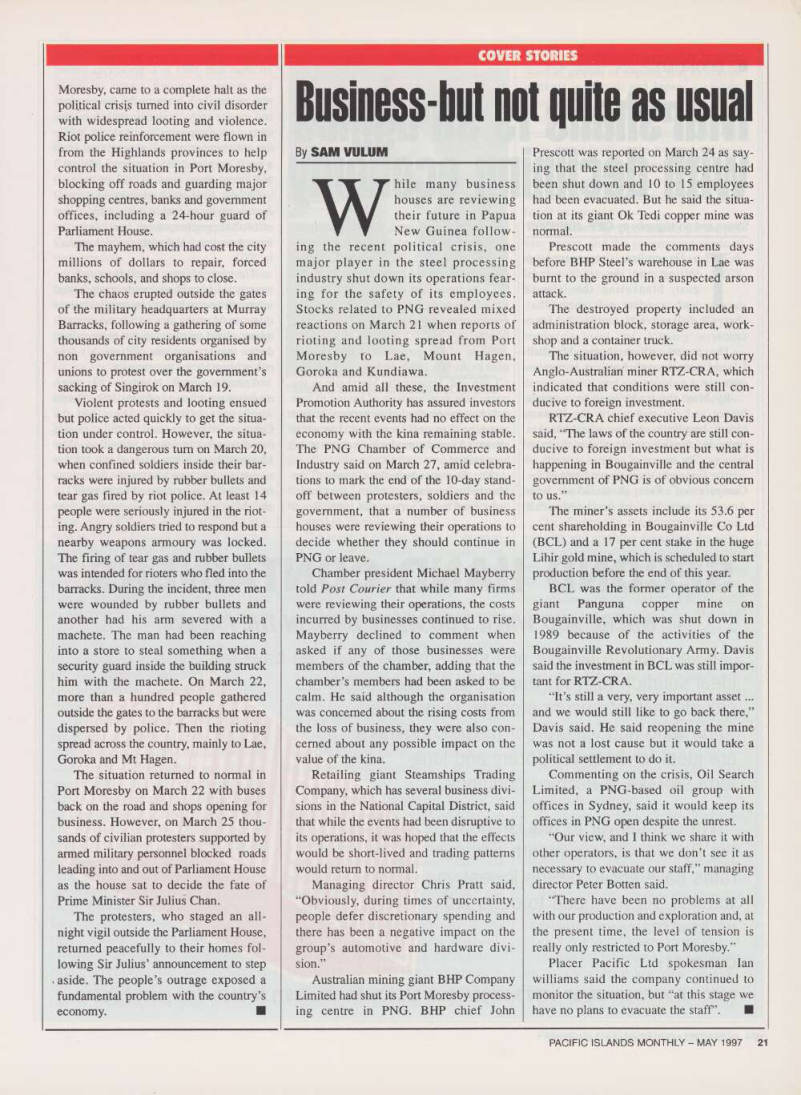
Looters take to the streets during the chaos of the riots in Port Moresby
Moresby, came to a complete halt as the political crisis turned into civil disorder with widespread looting and violence.
Riot police reinforcement were flown in
from the Highlands provinces to help
control the situation in Port Moresby,
blocking off roads and guarding major
shopping centres, banks and government offices, including a 24-hour guard of Parliament House.
The mayhem, which had cost the city millions of dollars to repair, forced banks, schools, and shops to close.
The chaos erupted outside the gates of the military headquarters at Murray Barracks, following a gathering of some thousands of city residents organised by non government organisations and unions to protest over the government’s sacking of Singirok on March 19.
Violent protests and looting ensued but police acted quickly to get the situa tion under control. However, the situa tion took a dangerous turn on March 20, when confined soldiers inside their bar racks were injured by rubber bullets and tear gas fired by riot police. At least 14 people were seriously injured in the riot ing. Angry soldiers tried to respond but a nearby weapons armoury was locked.
The firing of tear gas and rubber bullets was intended for rioters who fled into the barracks. During the incident, three men were wounded by rubber bullets and another had his arm severed with a machete. The man had been reaching into a store to steal something when a security guard inside the building struck him with the machete. On March 22, more than a hundred people gathered outside the gates to the barracks but were dispersed by police. Then the rioting spread across the country, mainly to Lae, Goroka and Mt Hagen.
The situation returned to normal in Port Moresby on March 22 with buses back on the road and shops opening for business. However, on March 25 thou sands of civilian protesters supported by armed military personnel blocked roads leading into and out of Parliament House as the house sat to decide the fate of Prime Minister Sir Julius Chan.
The protesters, who staged an all night vigil outside the Parliament House, returned peacefully to their homes fol lowing Sir Julius’ announcement to step . aside. The people’s outrage exposed a fundamental problem with the country’s economy. ■
Business-bill not quite as usual
By Sam Vulum
While many business houses are reviewing their future in Papua New Guinea follow ing the recent political crisis, one major player in the steel processing industry shut down its operations fear ing for the safety of its employees.
Stocks related to PNG revealed mixed reactions on March 21 when reports of rioting and looting spread from Port Moresby to Lae, Mount Hagen, Goroka and Kundiawa.
And amid all these, the Investment Promotion Authority has assured investors that the recent events had no effect on the economy with the kina remaining stable.
The PNG Chamber of Commerce and Industry said on March 27, amid celebra tions to mark the end of the 10-day stand off between protesters, soldiers and the government, that a number of business houses were reviewing their operations to decide whether they should continue in PNG or leave.
Chamber president Michael Mayberry
told Post Courier that while many firms were reviewing their operations, the costs incurred by businesses continued to rise.
Mayberry declined to comment when asked if any of those businesses were members of the chamber, adding that the chamber’s members had been asked to be calm. He said although the organisation was concerned about the rising costs from the loss of business, they were also con cerned about any possible impact on the value of the kina.
Retailing giant Steamships Trading
Company, which has several business divi sions in the National Capital District, said that while the events had been disruptive to its operations, it was hoped that the effects would be short-lived and trading patterns would return to normal.
Managing director Chris Pratt said,
“Obviously, during times of uncertainty,
people defer discretionary spending and there has been a negative impact on the group’s automotive and hardware divi sion.”
Australian mining giant BHP Company
Limited had shut its Port Moresby process ing centre in PNG. BHP chief John
Prescott was reported on March 24 as say ing that the steel processing centre had been shut down and 10 to 15 employees had been evacuated. But he said the situa tion at its giant Ok Tedi copper mine was normal.
Prescott made the comments days before BHP Steel’s warehouse in Lae was burnt to the ground in a suspected arson attack.
The destroyed property included an administration block, storage area, work shop and a container truck.
The situation, however, did not worry Anglo-Australian miner RTZ-CRA, which indicated that conditions were still con ducive to foreign investment.
RTZ-CRA chief executive Leon Davis said, “The laws of the country are still con ducive to foreign investment but what is happening in Bougainville and the central government of PNG is of obvious concern to us.”
The miner’s assets include its 53.6 per cent shareholding in Bougainville Co Ltd (BCL) and a 17 per cent stake in the huge Lihir gold mine, which is scheduled to start production before the end of this year.
BCL was the former operator of the giant Panguna copper mine on Bougainville, which was shut down in 1989 because of the activities of the Bougainville Revolutionary Army. Davis said the investment in BCL was still impor tant for RTZ-CRA.
“It’s still a very, very important asset... and we would still like to go back there,”
Davis said. He said reopening the mine was not a lost cause but it would take a political settlement to do it.
Commenting on the crisis, Oil Search Limited, a PNG-based oil group with offices in Sydney, said it would keep its offices in PNG open despite the unrest.
“Our view, and I think we share it with other operators, is that we don’t see it as necessary to evacuate our staff,” managing director Peter Botten said.
“There have been no problems at all with our production and exploration and, at the present time, the level of tension is really only restricted to Port Moresby.”
Placer Pacific Ltd spokesman lan williams said the company continued to monitor the situation, but “at this stage we have no plans to evacuate the staff’. ■
Marshalls Is struggles

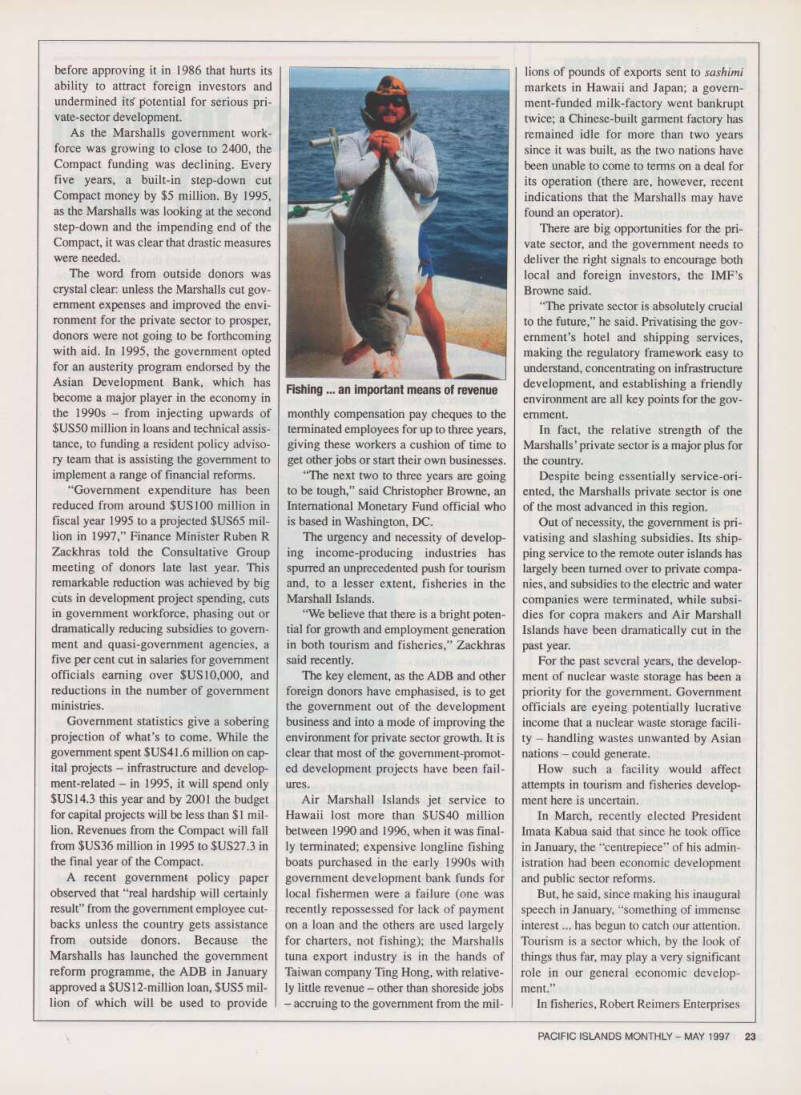
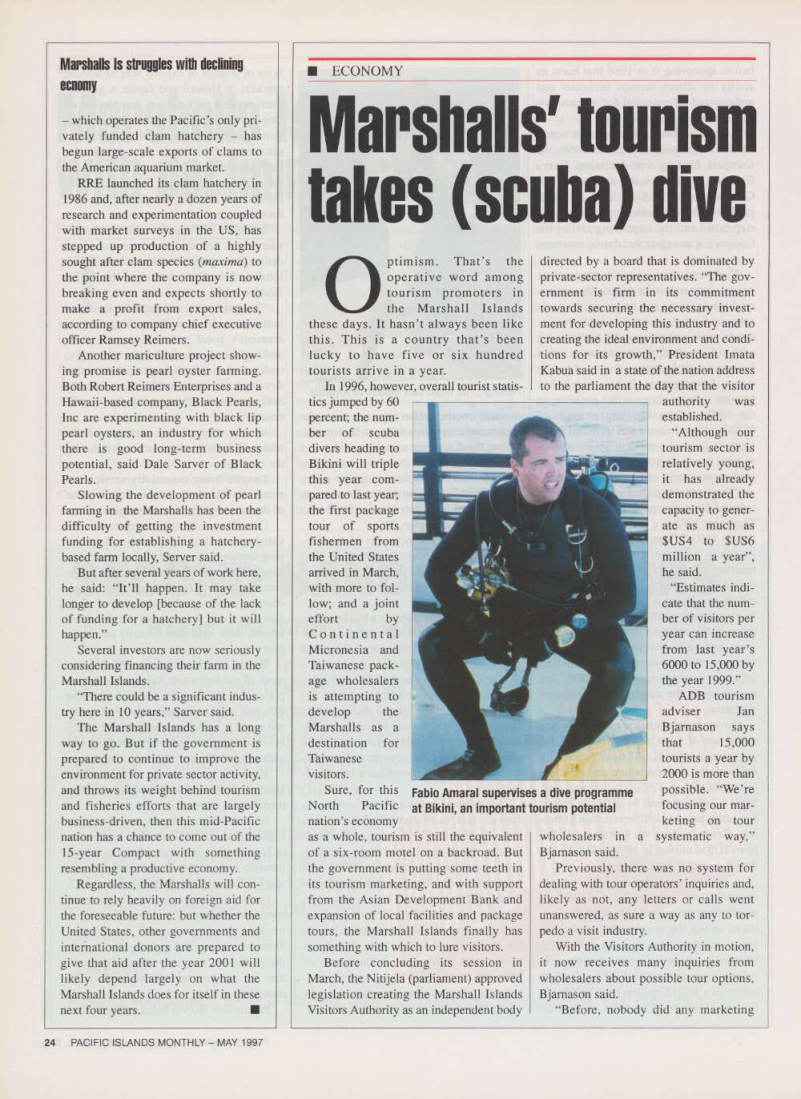
Economy
Marshalls Is struggles with declining economy
Stories and photography by GIFF JOHNSON
In December, the rains stop falling and the trade winds gust, blanketing the islands with a gritty salt spray that shrivels foliage and stunts the fruit crops.
The period, which in the Marshall Islands runs through April, is known as anenean.
By May, the trades ease to a gentle breeze and the rain pours: the flowers bloom, breadfruits, pandanus and bananas ripen, and the fish are plentiful in the calm lagoons. The season of rak has arrived.
The first eight years (from 1986) of the Compact of Free Association with American were like rak for the Marshall
Islands. Money flowed, government-fund ed projects flourished, the business service sector grew. But the Marshall Islands dependency on aid from Washington, DC has now turned the economy into the sea son of anenean: a time of belt-tightening, government cutbacks and private sector
layoffs.
Most of the government investments tried in the late 1980 s and early 1990 s did n’t pan out, leaving the Marshalls in the unenviable position now of having to fork out close to one-third of its national budget annually to pay off its foreign debt while almost no income-producing industries are in evidence.
The Compact brought a boom to the Marshalls economy when the first injec tion of aid began arriving in 1986. But it
was primarily a boon to the government and service sector activities such as restau rants, taxi companies, retail stores. While the government payroll skyrocketed from a pre-Compact 1985 figure of SUSIO.9 million to more than SUS 22 million 10 years later, little was happening in the pro ductive sector to enable this watery nation of 60,000 people to wean itself from the large American aid package, which expires in 2001.
The compact was intended to give the
country up-front capital to develop needed
infrastructure and fund business initiatives that would make the nation more self reliant. Solid infrastructure - power plant, docks, communications, air service - was put in place by the government.
Scant progress, however, has been made on productive industry. US officials won’t go so far as to admit that the Compact is an economic failure, saying that there are still several years to go. The Marshall Islands has blamed the US for removing key tax and trade incentives from the Compact (agreed to by both US and Marshalls Islands negotiators) just
before approving it in 1986 that hurts its ability to attract foreign investors and undermined its potential for serious pri
vate-sector development.
As the Marshalls government work force was growing to close to 2400, the
Compact funding was declining. Every
five years, a built-in step-down cut Compact money by $5 million. By 1995, as the Marshalls was looking at the second step-down and the impending end of the Compact, it was clear that drastic measures were needed.
The word from outside donors was crystal clear: unless the Marshalls cut gov ernment expenses and improved the envi ronment for the private sector to prosper, donors were not going to be forthcoming with aid. In 1995, the government opted for an austerity program endorsed by the Asian Development Bank, which has become a major player in the economy in the 1990 s - from injecting upwards of SUSSO million in loans and technical assis tance, to funding a resident policy adviso ry team that is assisting the government to implement a range of financial reforms.
“Government expenditure has been reduced from around SUSIOO million in fiscal year 1995 to a projected SUS6S mil lion in 1997,” Finance Minister Ruben R Zackhras told the Consultative Group meeting of donors late last year. This remarkable reduction was achieved by big cuts in development project spending, cuts in government workforce, phasing out or dramatically reducing subsidies to govern ment and quasi-govemment agencies, a five per cent cut in salaries for government officials earning over SUS 10,000, and reductions in the number of government ministries.
Government statistics give a sobering projection of what’s to come. While the government spent SUS4I.6 million on cap ital projects - infrastructure and develop ment-related - in 1995, it will spend only SUSI 4.3 this year and by 2001 the budget for capital projects will be less than $1 mil lion. Revenues from the Compact will fall from SUS 36 million in 1995 to $U527.3 in the final year of the Compact.
A recent government policy paper observed that “real hardship will certainly result” from the government employee cut backs unless the country gets assistance from outside donors. Because the Marshalls has launched the government reform programme, the ADB in January approved a SUS 12-million loan, SUSS mil lion of which will be used to provide
monthly compensation pay cheques to the terminated employees for up to three years, giving these workers a cushion of time to get other jobs or start their own businesses.
“The next two to three years are going to be tough,” said Christopher Browne, an International Monetary Fund official who is based in Washington, DC.
The urgency and necessity of develop
ing income-producing industries has
spurred an unprecedented push for tourism and, to a lesser extent, fisheries in the Marshall Islands.
“We believe that there is a bright poten tial for growth and employment generation in both tourism and fisheries,” Zackhras said recently.
The key element, as the ADB and other foreign donors have emphasised, is to get the government out of the development business and into a mode of improving the environment for private sector growth. It is clear that most of the government-promot ed development projects have been fail ures.
Air Marshall Islands jet service to Hawaii lost more than SUS4O million between 1990 and 1996, when it was final
ly terminated; expensive longline fishing
boats purchased in the early 1990 s with government development bank funds for local fishermen were a failure (one was recently repossessed for lack of payment on a loan and the others are used largely for charters, not fishing); the Marshalls tuna export industry is in the hands of Taiwan company Ting Hong, with relative ly little revenue - other than shoreside jobs - accruing to the government from the mil
lions of pounds of exports sent to sashimi markets in Hawaii and Japan; a govern
ment-funded milk-factory went bankrupt
twice; a Chinese-built garment factory has remained idle for more than two years since it was built, as the two nations have been unable to come to terms on a deal for its operation (there are, however, recent indications that the Marshalls may have found an operator).
There are big opportunities for the pri vate sector, and the government needs to deliver the right signals to encourage both local and foreign investors, the IMF’s Browne said.
“The private sector is absolutely crucial to the future,” he said. Privatising the gov ernment’s hotel and shipping services, making the regulatory framework easy to understand, concentrating on infrastructure
development, and establishing a friendly
environment are all key points for the gov ernment.
In fact, the relative strength of the Marshalls’ private sector is a major plus for the country.
Despite being essentially service-ori ented, the Marshalls private sector is one of the most advanced in this region.
Out of necessity, the government is pri
vatising and slashing subsidies. Its ship
ping service to the remote outer islands has largely been turned over to private compa nies, and subsidies to the electric and water companies were terminated, while subsi dies for copra makers and Air Marshall Islands have been dramatically cut in the past year.
For the past several years, the develop ment of nuclear waste storage has been a priority for the government. Government officials are eyeing potentially lucrative income that a nuclear waste storage facili ty - handling wastes unwanted by Asian nations - could generate.
How such a facility would affect attempts in tourism and fisheries develop ment here is uncertain.
In March, recently elected President Imata Kabua said that since he took office in January, the “centrepiece” of his admin istration had been economic development and public sector reforms.
But, he said, since making his inaugural speech in January, “something of immense interest... has begun to catch our attention.
Tourism is a sector which, by the look of things thus far, may play a very significant role in our general economic develop ment.”
In fisheries, Robert Reimers Enterprises
Fishing ... an important means of revenue
Marshalls Is struggles with declining ecnomy
- which operates the Pacific’s only pri vately funded clam hatchery - has begun large-scale exports of clams to the American aquarium market.
RRE launched its clam hatchery in 1986 and, after nearly a dozen years of
research and experimentation coupled
with market surveys in the US, has
stepped up production of a highly
sought after clam species ( maxima ) to the point where the company is now breaking even and expects shortly to make a profit from export sales, according to company chief executive officer Ramsey Reimers.
Another mariculture project show
ing promise is pearl oyster farming.
Both Robert Reimers Enterprises and a Hawaii-based company, Black Pearls, Inc are experimenting with black lip pearl oysters, an industry for which there is good long-term business potential, said Dale Sarver of Black Pearls.
Slowing the development of pearl farming in the Marshalls has been the difficulty of getting the investment funding for establishing a hatchery based farm locally. Server said.
But after several years of work here, he said: “It’ll happen. It may take longer to develop [because of the lack of funding for a hatchery] but it will
happen.”
Several investors are now seriously considering financing their farm in the Marshall Islands.
“There could be a significant indus try here in 10 years,” Sarver said.
The Marshall Islands has a long way to go. But if the government is prepared to continue to improve the environment for private sector activity, and throws its weight behind tourism and fisheries efforts that are largely business-driven, then this mid-Pacific nation has a chance to come out of the
15-year Compact with something
resembling a productive economy.
Regardless, the Marshalls will con tinue to rely heavily on foreign aid for the foreseeable future; but whether the United States, other governments and international donors are prepared to give that aid after the year 2001 will
likely depend largely on what the
Marshall Islands does for itself in these next four years. ■
Advertisements & other items, p. 22 (1 item)
Second Hand Containers
WHERE AND WHEN YOU WANT THEM IN THE PACIFIC If you need a flexible and safe storage space we have the ideal solution for you. Our second h; provide instant secure storage. Guar to be wind and waterproof these cor are ideal for both temporary and lonj term storage in Pacific conditions.
We can deliver to any island in the Pacific within a month and our rates have got to be the lowest you will find. All you need to do is tell us how many you want.
CONTACT:
PASCALE MARCONNET, BP 4757 NOUMEA, NEW CALEDONIA. TEL: (687) 28 7450. FAX: (687) 26 3248
Marshalls' taurism
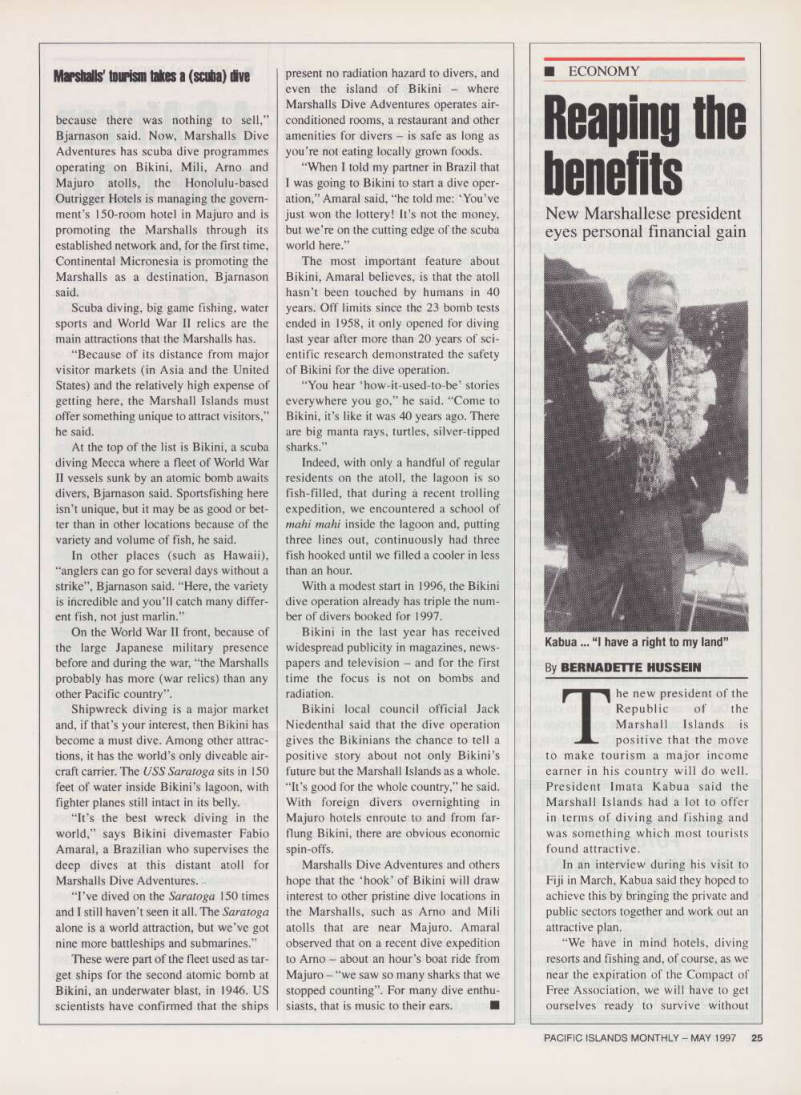
takes (scuba) dive
Optimism. That’s the operative word among tourism promoters in the Marshall Islands these days. It hasn’t always been like this. This is a country that’s been lucky to have five or six hundred tourists arrive in a year.
In 1996, however, overall tourist statis
tics jumped by 60 percent; the num ber of scuba divers heading to Bikini will triple this year com pared to last year; the first package tour of sports fishermen from the United States arrived in March, with more to fol low; and a joint effort by Continental Micronesia and Taiwanese pack age wholesalers is attempting to develop the Marshalls as a destination for Taiwanese visitors.
Sure, for this North Pacific nation’s economy
as a whole, tourism is still the equivalent of a six-room motel on a backroad. But the government is putting some teeth in its tourism marketing, and with support from the Asian Development Bank and expansion of local facilities and package tours, the Marshall Islands finally has something with which to lure visitors.
Before concluding its session in
March, the Nitijela (parliament) approved
legislation creating the Marshall Islands Visitors Authority as an independent body
directed by a board that is dominated by private-sector representatives. “The gov ernment is firm in its commitment towards securing the necessary invest ment for developing this industry and to creating the ideal environment and condi tions for its growth,” President Imata Kabua said in a state of the nation address to the parliament the day that the visitor
authority was established.
“Although our tourism sector is relatively young, it has already demonstrated the capacity to gener ate as much as
Sus 4 To Sus 6
million a year”, he said.
“Estimates indi cate that the num ber of visitors per year can increase from last year’s 6000 to 15,000 by the year 1999.”
ADB tourism adviser Jan
Bjamason says
that 15,000 tourists a year by 2000 is more than
possible. “We’re
focusing our mar keting on tour
wholesalers in a systematic way,”
Bjamason said.
Previously, there was no system for dealing with tour operators’ inquiries and, likely as not, any letters or calls went unanswered, as sure a way as any to tor pedo a visit industry.
With the Visitors Authority in motion, it now receives many inquiries from wholesalers about possible tour options, Bjamason said.
“Before, nobody did any marketing
Fabio Amaral supervises a dive programme at Bikini, an important tourism potential
Marshalls' tourism takes a (scuba) dive
because there was nothing to sell,”
Bjarnason said. Now, Marshalls Dive Adventures has scuba dive programmes operating on Bikini, Mili, Arno and Majuro atolls, the Honolulu-based Outrigger Hotels is managing the govern ment’s 150-room hotel in Majuro and is promoting the Marshalls through its established network and, for the first time, Continental Micronesia is promoting the Marshalls as a destination, Bjarnason said.
Scuba diving, big game fishing, water sports and World War II relics are the main attractions that the Marshalls has.
“Because of its distance from major visitor markets (in Asia and the United States) and the relatively high expense of getting here, the Marshall Islands must offer something unique to attract visitors,” he said.
At the top of the list is Bikini, a scuba diving Mecca where a fleet of World War II vessels sunk by an atomic bomb awaits divers, Bjarnason said. Sportsfishing here isn’t unique, but it may be as good or bet ter than in other locations because of the variety and volume of fish, he said.
In other places (such as Hawaii), “anglers can go for several days without a strike”, Bjarnason said. “Here, the variety is incredible and you’ll catch many differ ent fish, not just marlin.”
On the World War II front, because of the large Japanese military presence before and during the war, “the Marshalls probably has more (war relics) than any other Pacific country”.
Shipwreck diving is a major market and, if that’s your interest, then Bikini has become a must dive. Among other attrac tions, it has the world’s only diveable air craft carrier. The USS Saratoga sits in 150 feet of water inside Bikini’s lagoon, with fighter planes still intact in its belly.
“It’s the best wreck diving in the world,” says Bikini divemaster Fabio Amaral, a Brazilian who supervises the deep dives at this distant atoll for Marshalls Dive Adventures. ..
“I’ve dived on the Saratoga 150 times and I still haven’t seen it all. The Saratoga alone is a world attraction, but we’ve got nine more battleships and submarines.”
These were part of the fleet used as tar get ships for the second atomic bomb at Bikini, an underwater blast, in 1946. US scientists have confirmed that the ships
present no radiation hazard to divers, and even the island of Bikini - where Marshalls Dive Adventures operates air conditioned rooms, a restaurant and other amenities for divers - is safe as long as you’re not eating locally grown foods.
“When I told my partner in Brazil that I was going to Bikini to start a dive oper ation,” Amaral said, “he told me: ‘You’ve just won the lottery! It’s not the money, but we’re on the cutting edge of the scuba world here.”
The most important feature about Bikini, Amaral believes, is that the atoll hasn’t been touched by humans in 40 years. Off limits since the 23 bomb tests ended in 1958, it only opened for diving last year after more than 20 years of sci entific research demonstrated the safety of Bikini for the dive operation.
“You hear ‘how-it-used-to-be’ stories everywhere you go,” he said. “Come to Bikini, it’s like it was 40 years ago. There are big manta rays, turtles, silver-tipped sharks.”
Indeed, with only a handful of regular residents on the atoll, the lagoon is so fish-filled, that during a recent trolling expedition, we encountered a school of mahi mahi inside the lagoon and, putting three lines out, continuously had three fish hooked until we filled a cooler in less than an hour.
With a modest start in 1996, the Bikini dive operation already has triple the num ber of divers booked for 1997.
Bikini in the last year has received widespread publicity in magazines, news papers and television - and for the first time the focus is not on bombs and radiation.
Bikini local council official Jack Niedenthal said that the dive operation gives the Bikinians the chance to tell a positive story about not only Bikini’s future but the Marshall Islands as a whole.
“It’s good for the whole country,” he said.
With foreign divers overnighting in Majuro hotels enroute to and from far flung Bikini, there are obvious economic
spin-offs.
Marshalls Dive Adventures and others hope that the ‘hook’ of Bikini will draw interest to other pristine dive locations in the Marshalls, such as Arno and Mili atolls that are near Majuro. Amaral observed that on a recent dive expedition to Amo - about an hour’s boat ride from Majuro - “we saw so many sharks that we stopped counting”. For many dive enthu siasts, that is music to their ears. ■
Reaping the benefits
benefits
New Marshallese president eyes personal financial gain
By Bernadette Hussein
The new president of the Republic of the Marshall Islands is positive that the move to make tourism a major income earner in his country will do well.
President Imata Kabua said the Marshall Islands had a lot to offer in terms of diving and fishing and was something which most tourists found attractive.
In an interview during his visit to Fiji in March, Kabua said they hoped to achieve this by bringing the private and public sectors together and work out an attractive plan.
“We have in mind hotels, diving resorts and fishing and, of course, as we near the expiration of the Compact of Free Association, we will have to get ourselves ready to survive without
Kabua ... “I have a right to my land”
Reaping the benefits
that,” Kabua said.
And the major focus of developing the tourism industry would be on Majuro, Bikini, Kwajalein and the Mili atolls, he said.
“I don’t think it [Bikini’s nuclear past] will be a problem; neither on Bikini or
Kwajalein.
“In fact, it isn’t a problem because already we have a large number of people going to Bikini to dive. All we need is to make a prop er dive resort.”
And, more controversially, Kabua believes, that being a landowner in the region, he is entitled to its financial success es.
Earlier in March, Kabua had been inter viewed by Nicholas Kristoff, for The New York Times in the US, on a number of issues regarding Bikini and its people. In his article, Kristoff accused Kabua of being a drunkard and foul-mouthed - accusations which Kabua
strongly denies.
“You see, that reporter broke his code of ethics because he interviewed me when I was drunk but that doesn’t mean I am a drunkard, no. I enjoy a drink and I think the reporter took advantage of this.”
During the interview, Kabua allegedly said that he wanted a third of the Bikinians’ revenue.
“What revenue is he talking about? I don’t know anything about any revenue from the Bikinians. But I do have land interests on Bikini and because of this I am free to do whatever I want on my land.
“My grandfather and father were landowners and so am I. So why do I need to tell the people what I want because the land is rightfully mine?”
Did this mean he was going to claim the land back from the people and develop it for other purposes. “Why do I have to claim it? It is mine and I am going there to live. I do not
need anybody’s permission to do so. If I want to build a dive resort or whatev er I want, I can - and nobody has the
right to say anything.”
The article also said that Kabua had demanded that the people of Bikini build him a “fine new house”.
“Yes, I did. I wrote a letter and told them to build me one. The people of the Marshall Islands built one for the speaker and the senator - and I want one too.
“The people who built these houses are from the islands where the two peo ple are landowners. Their people built these houses for them because they have these titles and positions. So what was wrong in me asking the Bikinians to build me one too?
“The house is to be built on Ebeye.
The local government built one for the speaker and for the senator, and when those two people die the houses are going to remain with the family, not go to the next person.”
Kabua said, keeping these things in mind, he wrote to the mayor and the council of Bikini. They still have not responded.
“People should stop building houses for people only because they hold such high place in society. If they want to, they should build only if he has a land right on one of the islands. In that respect, I don’t think they should build a house for me as president - but as a landowner.
“Everyone has a right to speak and express themselves, so I have a right to my land.”
As for Kabua’s “foul mouth”, Kristoff’s article stated that the presi dent swore when questioned about the attitude of the Bikinians. Kabua, how ever, denies this.
“It is a lie because I did not swear at
anyone.”
According to The New York Times article, Kabua said that if the Bikinians resisted, he would sue them to gain access to some of their money.
“What money? I have no idea what money he kept referring to. Besides, I do not have to sue them because it is my land and I have more right to it then
they do.
“But what I will say is that any rev enue which comes from the land in terms of business or development, I have a right to because it is of course coming from my land.” ■
style option
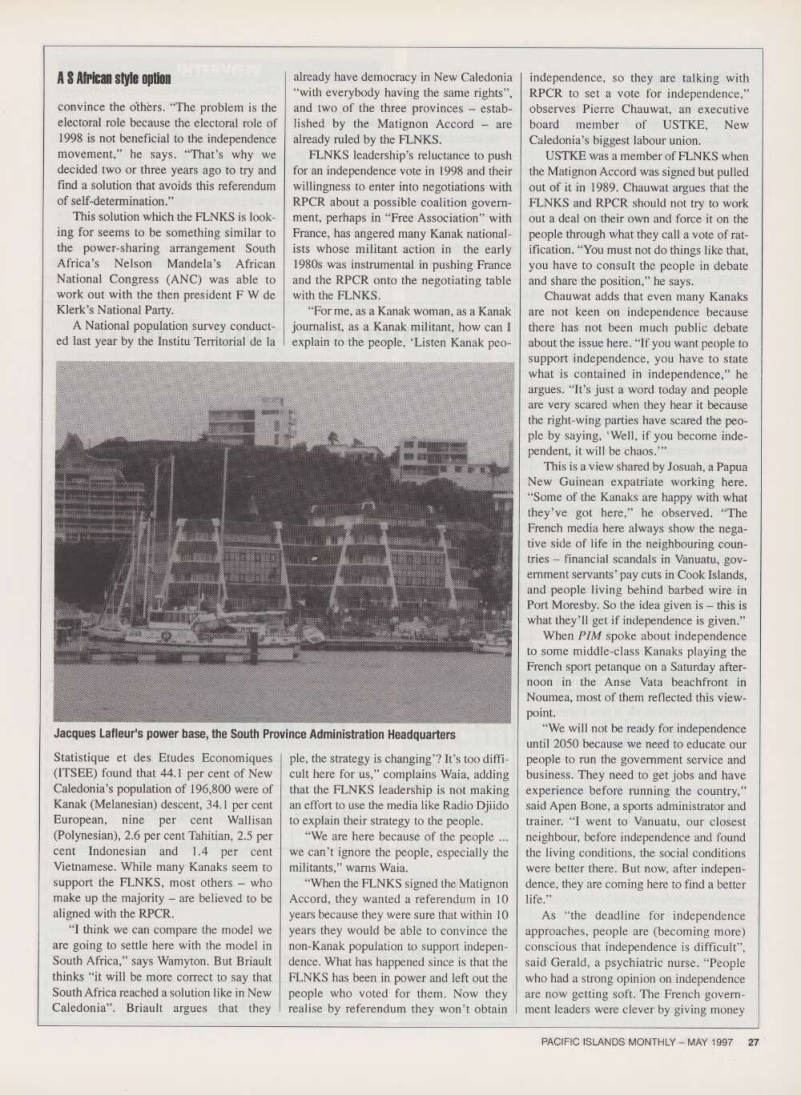
New Caledonia
A S African style option
Reports and photographs by
Kalinga Seneviratne
in New Caledonia / / f our leaders,
• • I Flnks And Rpcr,
want no self-inde- M pendence in 1998 but carry on for another 20 years or something like that - I don’t know how many years - then they must tell the people. The problem is they organise secret meetings - we don’t know what happens, the people are confused,” says Nicole Waia, man ager of the Kanak-run Radio Djiido here.
Waia’s comments perhaps reflect the mood of most New Caledonians today, as the French colony approaches the deadline set in the 1998 Matignon Accord to hold a referendum on idepen dence in 10 years.
All parties which signed the accord - the Kanak Independence movement, the Front de Liberation Nationale Kanak et Socioaliste (FLNKS), the pro- French right-wing party Rassemblement pour Caledonie dans la Republique (RPCR) and the French government - are now reluctant to go for the independence vote as agreed to in the 1998 referendum.
“If we go through this vote, there is a risk for the population ... we can go into a cycle of violence,” Rock Wamyton, the president of FLNKS told Pacific Islands Monthly.
RPCR’s National Congress member, Jean Claude Briault, agrees. “If the ref erendum is held, there will be probably 60 to 70 per cent of voters in favour of maintaining New Caledonia in the French Republic; only 30 to 40 per cent for independence. My thought is that it will be a step back,” he told PIM.
This is a view Wamyton seems to share. Even though he believes 80 per cent of the Kanak population support independence from France, he admits that the FLNKS has not been able to
AS African style option
convince the others. “The problem is the electoral role because the electoral role of 1998 is not beneficial to the independence movement,” he says. “That’s why we decided two or three years ago to try and find a solution that avoids this referendum of self-determination.”
This solution which the FLNKS is look ing for seems to be something similar to the power-sharing arrangement South Africa’s Nelson Mandela’s African National Congress (ANC) was able to work out with the then president F W de Klerk’s National Party.
A National population survey conduct ed last year by the Institu Territorial de la
Statistique et des Etudes Economiques (ITSEE) found that 44.1 per cent of New Caledonia’s population of 196,800 were of Kanak (Melanesian) descent, 34.1 per cent European, nine per cent Wallisan (Polynesian), 2.6 per cent Tahitian, 2.5 per cent Indonesian and 1.4 per cent Vietnamese. While many Kanaks seem to support the FLNKS, most others - who make up the majority - are believed to be aligned with the RPCR.
“I think we can compare the model we are going to settle here with the model in South Africa,” says Wamyton. But Briault thinks “it will be more correct to say that South Africa reached a solution like in New Caledonia”. Briault argues that they
already have democracy in New Caledonia “with everybody having the same rights”, and two of the three provinces - estab lished by the Matignon Accord - are already ruled by the FUNKS.
FUNKS leadership’s reluctance to push for an independence vote in 1998 and their willingness to enter into negotiations with RPCR about a possible coalition govern ment, perhaps in “Free Association” with France, has angered many Kanak national ists whose militant action in the early 1980 s was instrumental in pushing France and the RPCR onto the negotiating table with the FUNKS.
“For me, as a Kanak woman, as a Kanak journalist, as a Kanak militant, how can I explain to the people, ‘Uisten Kanak peo
ple, the strategy is changing’? It’s too diffi cult here for us,” complains Waia, adding that the FUNKS leadership is not making an effort to use the media like Radio Djiido to explain their strategy to the people.
“We are here because of the people ... we can’t ignore the people, especially the militants,” warns Waia.
“When the FUNKS signed the Matignon Accord, they wanted a referendum in 10 years because they were sure that within 10 years they would be able to convince the non-Kanak population to support indepen dence. What has happened since is that the FUNKS has been in power and left out the people who voted for them. Now they realise by referendum they won’t obtain
independence, so they are talking with RPCR to set a vote for independence,” observes Pierre Chauwat, an executive board member of USTKE, New Caledonia’s biggest labour union.
USTKE was a member of FUNKS when the Matignon Accord was signed but pulled out of it in 1989. Chauwat argues that the FUNKS and RPCR should not try to work out a deal on their own and force it on the people through what they call a vote of rat ification. “You must not do things like that, you have to consult the people in debate and share the position,” he says.
Chauwat adds that even many Kanaks are not keen on independence because there has not been much public debate about the issue here. “If you want people to support independence, you have to state what is contained in independence,” he argues. “It’s just a word today and people are very scared when they hear it because the right-wing parties have scared the peo ple by saying, ‘Well, if you become inde pendent, it will be chaos.’”
This is a view shared by Josuah, a Papua New Guinean expatriate working here.
“Some of the Kanaks are happy with what they’ve got here,” he observed. “The French media here always show the nega tive side of life in the neighbouring coun tries - financial scandals in Vanuatu, gov ernment servants’ pay cuts in Cook Islands, and people living behind barbed wire in Port Moresby. So the idea given is - this is what they’ll get if independence is given.”
When PIM spoke about independence to some middle-class Kanaks playing the French sport petanque on a Saturday after noon in the Anse Vata beachfront in Noumea, most of them reflected this view point.
“We will not be ready for independence until 2050 because we need to educate our people to run the government service and business. They need to get jobs and have experience before running the country,” said Apen Bone, a sports administrator and trainer. “I went to Vanuatu, our closest neighbour, before independence and found the living conditions, the social conditions were better there. But now, after indepen dence, they are coming here to find a better life.”
As “the deadline for independence approaches, people are (becoming more) conscious that independence is difficult”, said Gerald, a psychiatric nurse. “People who had a strong opinion on independence are now getting soft. The French govern ment leaders were clever by giving money
Jacques Lafleur’s power base, the South Province Administration Headquarters
A S African style option
to independence leaders; it softened their mind on independence. Now, the real issue is not independence even though they pretend that independence has to be [achieved] by the deadline.”
Gerald argues that because the ‘independentists’ have softened their line, the ‘anti-independentists’ are doing the same. “Both sides are soften ing and a kind of balance is coming in to negotiate independence - but we don’t know what type of indepen dence.”
“This vision of Kanaks not being ready for independence is the vision of France,” argues Aloision Sako, the leader of Rassemblement Democratique Oceanien (RDO), a new political party aligned with the FLNKS, which has attracted strong support from young Wallisians.
“They (France) say you can’t become independent because you don’t have doctors, engineers, and so on.
True, because France opened Kanak schools only in 1956,” he observed.
“FLNKS says when we get indepen dence it’s not Kanaks only, there are Wallisians, Vietnamese, French. So, we will have many Europeans who want to stay here, Vietnamese would want to do business here. So, independence means a government of many colours.”
It was with this vision that Sako decided to throw in his lot with the FLNKS in December, 1994 - some thing for which he may have paid a heavy price. He was sacked from his job as a policeman in Noumea by the French government. He is now fighting this in a tribunal in Paris.
“Many of my people are afraid of the French because they hold power here,” Sako says. Peter, a 23-year-old sports personality in the Wallisian com munity here, who has represented New Caledonia in international competition, says: “I don’t like the FLNKS. They believe New Caledonia is only for Kanaks. We also helped to build the country but we are discriminated against in scholarships and other bene fits given after the Matignon Accord.
Kanaks think they have a right to all of it.”
While the FLNKS is facing an uphill battle in convincing other com munities that independence is for everyone, there are also deep divisions
within the Kanak community on what real ly constitutes the path towrads indepen dence. But Wamyton believes their political struggle today is also an economic one.
He knows that you cannot dismantle 140 years of French colonial rule where the indigenous people were denied an educa tion and a share of the country’s wealth without creating the economic structures to absorb them into the country’s mainstream activities. Thus today, the FLNKS, using funds allocated to the two provinces con trolled by them, has bought a direct stake in
the nickle mining and tourism sectors.
These were sectors which were solely under the control of the RPCR, mainly through investments made by its leader, Jacques Lafleur - the richest man in New Caledonia - before the Matignon Accord was signed.
The challenge facing the FLNKS leader ship today is to convince its socialist-ori ented grassroots that getting into business sometimes even doing deals with the RCPR in the process - is not a sell-out of its social ist egalitarian vision for an independent Kanaky (New Caledonia). ■
Advertisements & other items, pp. 26-28 (1 item)
Vital social and personal
issues that affect your
FUTURE!!
the: real meaning
TO LIFE
For this FREE booklet please write to:-
THE CHRISTADELPHIANS
PO Box 43 BLACKWOOD
SOUTH AUSTRALIA 5051
Remember your Friend
There are times in your life when you feel your friends have been missing out on something good. Now's your chance to do something about it and share with them one of the good things you have. Buy your friend a subscription to Pacific Islands Monthly and let him or her Join you and the thousands of other people worldwide who are kept informea of the latest political, social and cultural
changes taking place in the Pacific.
SUBSCRIPTIONS
American Samoa US$45 Australia A 542.00 Canada US$45 Cook Islands AUSS46 Fiji F 526.40 French Polynesia US$45 Guam US$45 Hawaii US$45 Japan US$45 Kiribati AUSS46 Marshall/Micronesia US$4O Nauru AUSS42 New Caledonia US$32 New Zealand NZ$55 Niue AUSS46 Norfolk Island AUSS42 Northern Marianas/Palau US$4O Papua New Guinea AUSS4S Solomon Islands AUSS46 Tonga AUSS46 Tuvalu AUSS46 United Kingdom Stg Pound2B US Mainland US$45 Vanuatu AUSS4S Western Samoa WS$6O Elsewhere AUSS63 Payment to Pacific Islands Monthly: Subscriptions Dept, QPO Box 1167, Suva, Fiji.
Subscriptions rates include the cost of airspeeding to all destinations set out above.
Direct airmail rates on application.
Telephone: 304111 Fax: 303809
1 "PACIFIC
! ISLANDS
1 I M O N T H L y I ! Please send my friend Pacific Islands Monthly for one year (12 issues).
I enclose my cheque for $ (made payable to Pacific Islands Monthly) or debit $ to my: □ Bankcard □ Visacard □ Mastercard Card No: i I I I I I 1 I 1 1 1 t 1 I I—l Expiry Date .
NAME
SIGNATURE
MY FRIEND'S NAME -
MY FRIEND'S ADDRESS
1 CITY COUNTRY
... independent
Interview
To be or not to be ... independent
Kalinga Seneviratne talks to Jean Calude Briault on the future (These are edited excerpts) PIM: Under the Matignon Accord there has to be a referen dum held on independence by 1998, but even the Kanak leaders don’t seem to be that keen on a yes-no vote. There seems to be a mood towards a sort of South African-style solution to it. So, would your party be looking at a coalition government with the FLNKS to rule New Caledonia after getting indepedence from France?
JCB: It’s not exactly the question. The question is not to reach a coalition to lead the country. The question is what would be the situation of New Caledonia in the French republic. The coalition is existing now. For example, the province of the Loyalty is ruled by a coalition of FLNKS and one member of RPCR. It’s already under way. Now the question is what could be the very next future for New Caledonia, and what could be the future after maybe 20 years. The problem of ruling the coun try together is today not a problem. For example, since 10 years, practically all the decisions in the Congress have been taken together. It’s not a minority against the majority, etc. We try to vote the defence rules, budget or the taxes and so on through an agreement with the FLNKS. So the question is not to lead a coalition. We already rule the country together.
PIM: My understanding is that the FLNKS wants to break the colonial linkage with France. What you are arguing is that there is no need to break it?
JCB: I think New Caledonia is no longer a colony. Because the colonial links between a colony and a mother country are ruled by a sort of domination, which is not the case.
PIM: As a result of the Matignon Accord, the Kanaks who control the northern province have bought into mining ...
JCB; Please don’t say Kanaks, say independentistes, because one-third of the Kanaks are in the RPCR. It’s not a problem of Whites against Blacks here because, take my case a quarter of my blood is Melanesian, another quarter is French, a quarter is Vietnamese and a quarter Indonesian. I’m not an exception. So we talk about the independentistes and non-inde pendentistes. It’s not a racial thing.
PIM; Well, the FLNKS controls the northern province where most of the mining is done. But the impression I get talk ing to their mining company, SMSP, is that they are not getting the full cooperation of the French government in developing the resources?
JCB: I cannot reply on behalf of the French government or the minister, what I can reply is ...
PIM: Let me add to it. The reason they say is probably the RPCR is pressuring the French government...
JCB: We had an official debate in the congress about this proposal and officially we support totally the project for a new
nickle plant in the north. I think it’s one of the solutions for the rebalancing of the economy in New Caledonia. Now the big tool in the mining field for the independentistes in the north is SMSP. And SMSP was formerly owned by Lafluer and he decided to sell because he promised to Tjibaou to have his peo ple involved in a company dealing with international trading and so on. We support [this proposal] completely because we know the soluton for New Caledonia is to balance the place of each community of each province.
PIM; People here, especially the middle class, seem to fear independence - they say that New Caledonia will end up like Vanuatu, Papua New Guinea or some of the other Pacific Island countries which are facing economic problems. Do you think that this fear is real?
JCB: It’s not a relevant question at present. Two provinces out of three are already ruled by independentistes and Kanaks.
The responsibilities of the provinces are very big ... They are responsible for economic development, for culture, health, social welfare - in a word, everything ... So, they really rule the province. They have reached not independence but [a] sort of internal autonomy close to independence. There are many peo ple who are not independentistes [who] live in the north and Loyalty Islands and the relationship between all the people is better now than it was 10 years ago. There is a sort of feeling that all the people belong to the country. Formerly, people had trouble about this, but now they are sure in New Caledonia you have people who are black, white, mixed people, yellow. But all these people living in New Caldonia share the same future and they belong to Caledonia. So, the relationship is more peaceful, though sometimes we have in congress very animat ed debates. But it generally remains peaceful because we share the same future. The question is not if we have independence will it be a crisis for New Caledonia. The debate is more mature now: how to develop the economy. The problem for all the leaders ... is what to do to ensure each person one job and one home and, of course, the dignity of everybody. ■
A change of heart?
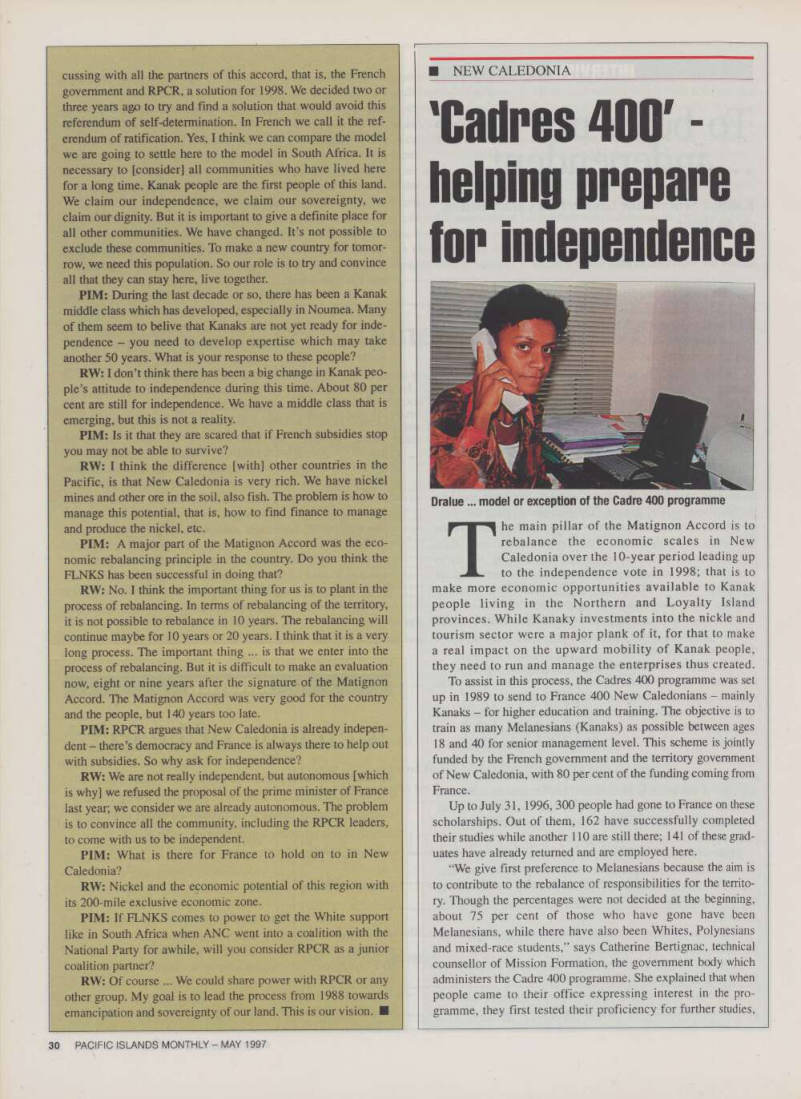
Kalinga Seneviratne discusses what is seen as a move by Vanuatu’s Kanak population away from securing independence in favour of what may be a South African-style compromise with Rock Wamyton, president of the FLNKS. (These are edited excerpts) PIM: When the Matignon Accord was signed in 1988, it was seen as an agreement which might pave the way for inde pendence from France in 10 years’ time. But, today, it looks like everybody is talking about a South African-style compromise.
RW: The Matignon Accord was signed for 10 years; we are now one year away from the deadline and we are now dis
cussing with all the partners of this accord, that is, the French government and RPCR, a solution for 1998. We decided two or three years ago to try and find a solution that would avoid this referendum of self-determination. In French we call it the ref erendum of ratification. Yes, I think we can compare the model we are going to settle here to the model in South Africa. It is necessary to [consider] all communities who have lived here for a long time. Kanak people are the first people of this land.
We claim our independence, we claim our sovereignty, we claim our dignity. But it is important to give a definite place for all other communities. We have changed. It’s not possible to exclude these communities. To make a new country for tomor row, we need this population. So our role is to try and convince all that they can stay here, live together.
PIM: During the last decade or so, there has been a Kanak middle class which has developed, especially in Noumea. Many of them seem to belive that Kanaks are not yet ready for inde pendence - you need to develop expertise which may take another 50 years. What is your response to these people?
RW: I don’t think there has been a big change in Kanak peo ple’s attitude to independence during this time. About 80 per cent are still for independence. We have a middle class that is emerging, but this is not a reality.
PIM: Is it that they are scared that if French subsidies stop you may not be able to survive?
RW: I think the difference [with] other countries in the Pacific, is that New Caledonia is very rich. We have nickel mines and other ore in the soil, also fish. The problem is how to manage this potential, that is, how to find finance to manage and produce the nickel, etc.
PIM: A major part of the Matignon Accord was the eco nomic rebalancing principle in the country. Do you think the FLNKS has been successful in doing that?
RW: No. I think the important thing for us is to plant in the process of rebalancing. In terms of rebalancing of the territory, it is not possible to rebalance in 10 years. The rebalancing will continue maybe for 10 years or 20 years. I think that it is a very long process. The important thing ... is that we enter into the process of rebalancing. But it is difficult to make an evaluation now, eight or nine years after the signature of the Matignon Accord. The Matignon Accord was very good for the country and the people, but 140 years too late.
PIM: RPCR argues that New Caledonia is aheady indepen dent - there’s democracy and France is always there to help out with subsidies. So why ask for independence?
RW: We are not really independent, but autonomous [which is why] we refused the proposal of the prime minister of France last year, we consider we are already autonomous. The problem is to convince all the community, including the RPCR leaders, to come with us to be independent.
PIM: What is there for France to hold on to in New Caledonia?
RW: Nickel and the economic potential of this region with its 200-mile exclusive economic zone.
PIM: If FLNKS comes to power to get the White support like in South Africa when ANC went into a coalition with the National Party for awhile, will you consider RPCR as a junior
coalition partner?
RW: Of course ... We could share power with RPCR or any other group. My goal is to lead the process from 1988 towards emancipation and sovereignty of our land. This is our vision. ■
Advertisements & other items, p. 29 (1 item)
Interview
helping prepare

'Cadres 400' helping prepare for independence
The main pillar of the Matignon Accord is to rebalance the economic scales in New Caledonia over the 10-year period leading up to the independence vote in 1998; that is to make more economic opportunities available to Kanak people living in the Northern and Loyalty Island provinces. While Kanaky investments into the nickle and tourism sector were a major plank of it, for that to make a real impact on the upward mobility of Kanak people, they need to run and manage the enterprises thus created.
To assist in this process, the Cadres 400 programme was set up in 1989 to send to France 400 New Caledonians - mainly Kanaks - for higher education and training. The objective is to train as many Melanesians (Kanaks) as possible between ages 18 and 40 for senior management level. This scheme is jointly funded by the French government and the territory government of New Caledonia, with 80 per cent of the funding coming from France.
Up to July 31, 1996, 300 people had gone to France on these scholarships. Out of them, 162 have successfully completed their studies while another 110 are still there; 141 of these grad uates have already returned and are employed here.
“We give first preference to Melanesians because the aim is to contribute to the rebalance of responsibilities for the territo ry. Though the percentages were not decided at the beginning, about 75 per cent of those who have gone have been Melanesians, while there have also been Whites, Polynesians and mixed-race students,” says Catherine Bertignac, technical counsellor of Mission Formation, the government body which administers the Cadre 400 programme. She explained that when people came to their office expressing interest in the pro gramme, they first tested their proficiency for further studies,
Draiue ... model or exception of the Cadre 400 programme
'Cadres 400' - helping prepare (or independence
then found out what field they wanted to pursue studies in and tried to match them with the needs of the country, especially that of the Melanesian community.
“They must choose a field of study where they will have an opportunity to work here, once they come back,” says Bertignac, adding that during their studies in France the students have access to a counsellor, and before they come back her office writes to potential employers and tries to arrange a job.
She said that about 80 per cent of scholarship-holders had been men and they were now trying to increase the num ber of women, as well as encourage new applicants to apply for fields of study which would help them to get employment in the private sector. “[For the] last two years we have tried to encourage students to apply for industrial technology and health and social science courses,” added Bertignac.
Christiane Dralue, a 29-year-old Kanak woman who is now the director of the newly established Loyalty Island Tourist Office in Noumea, is one of the success stories of the Cadre 400 programme.
“My parents are poor farmers; for all my studies I got grants from the French government,” Dralue told Pacific Islands Monthly. Dralue has completed a four-year degree course at a reputable business school in Paris, after which she undertook three months of special language studies in Britain, followed by a one-year MBA course in the United States, which she completed in 1994.
“Christiane was an exception, we fund ed her to do an MBA in the US,” observed Bertignac. “We did it to help the (Kanak) tourist industry.”
Since returning from the US, Dralue has worked as the director of the Maritime Society of the Loyalty Island for two years and became the director of Destination lies Loyalite when it was set up in November, 1996. She also works as the personal sec retary for the president of the Loyalty Island Province. When asked by PIM if she was a model success story of the Cadre 400 programme, she was reluctant to accept the idea because, she said, it would give the wrong picture.
She is concerned that very few Kanak women got the same opportunity she had, and would like to see more women bene fitting from the programme. ■
Advertisements & other items, pp. 31-32 (1 item)
We've gel
The best in
marine engines, gen sets
and equipment.
We've gel
Ihe name for it.
; : ■<#- Av mm \A^
LISTER
REITER
MARINE DIESEL ENGINES
28 bhp to 420 bhp
MARINE DIESEL ENGINES
AND GEN SETS
WaterMota
Built in the British tradition
MARINE DIESEL ENGINES
20 bhp to 260 bhp
AMOT
ENGINE SAFETY
EQUIPMENT
nail
rn
THERMOWRAP AND
SILENCERS
(JD Martec
FRESH WATER HEAT
EXCHANGER KITS
diyfit
LONG LIFE
MAINTENANCE FREE GEL
BATTERIES
JOHNSON
SWEDISH MARINE PUMPS
You won’t beat this combination. Top engine products and the hands-on experience the R.A.L.F. Marine team can bring to their selection and installation. With our 45 years’ combined background in the industry we offer a seamless service to satisfy your needs with a range of quality equipment we are proud to represent. We’re ready when you are. Just give us a call.
FAX NOW FOR HOTLINE
SERVICE FOR ALL PNG AND
PACIFIC ISLANDS ENQUIRIES.
LservicesJ
R.A.L.F. MARINE SERVICES PTY. LTD.
4Tengah Cres., (PO Box 419) Mona Vale N.S.W. 2103 Sydney, Australia Tel: 61 2 9979 6644
FAX : 61 2 9979 6647
Now Availablo
Pacific Islands Yearßook
17th Edition
r > 2 Price
AUD
oo 2® I
PLUS
POSTAGE
Leant more about the Pacific
culture/custom tradition!people
population, tourism, trade, airlines, tax system etc. x_ Yes, send me the latest copy of the Pacific Islands Year Book. □ Here is a cheque /money order □ Visa □ Master Card Card Number Name Signature Expiry Date Address Post to: Pacific Islands Monthly, PO Box 1167 Suva, Fiji or Fax (679) 303809.
U
The French
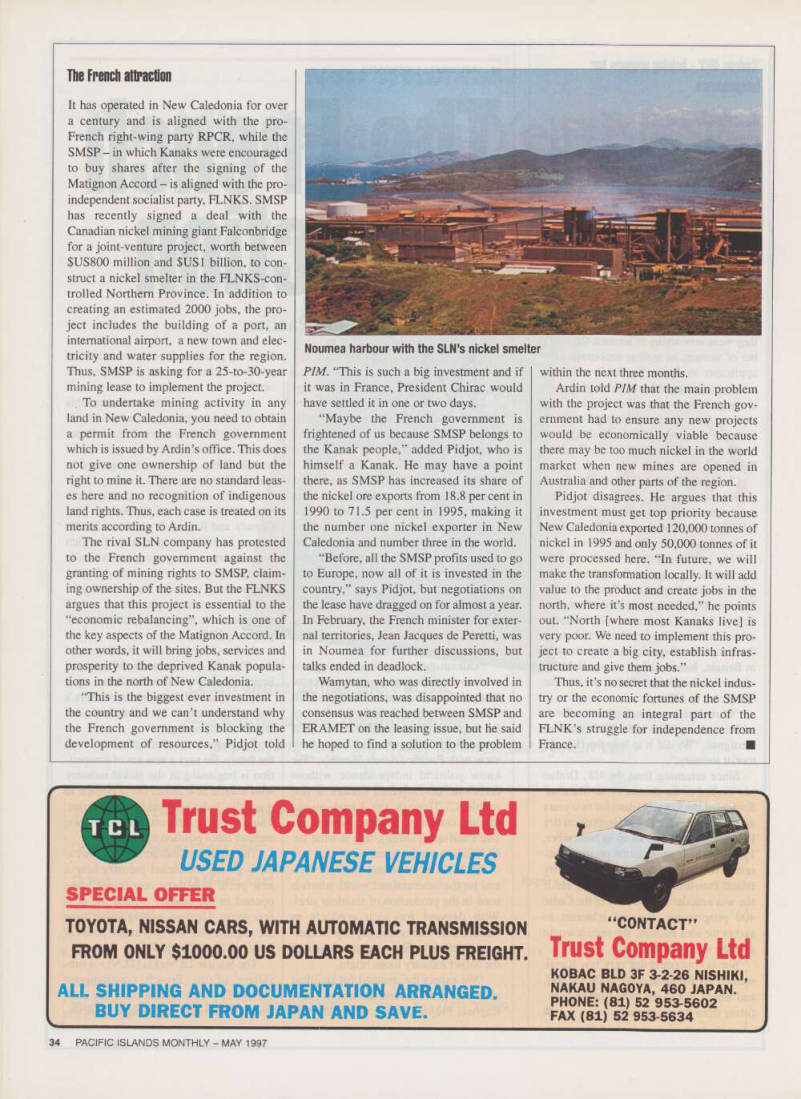
attraction
Nickel wealth in the Pacific
Many players in the New Caledonian independence strug gle are well aware that the nickel wealth and the poli tics of independence cannot be seperated. But those on the French side do not necessarily agree.
The pro-independence grassroots activists, who believe the French have been pouring subsidies into New Caledonia, since the Matignon Accord was signed in 1988, to buy off the Kanaks, will be quick to point out that this is the result of nickel wealth return ing to their country.
Thus, the leadership of the FLNKS believe that if they grab control of the nickel industry here, they have all but won the indepedence struggle.
“Our struggle is a political struggle to achieve our independence, but we know that political independence must be built on economic rules. I think nickel mines are important in this process,” FLNKS leader Rock Wamyton said in an inter view with Pacific Islands Monthly. “We know political independence without economic development creates a real problem.” Through the Kanak-owned mining company, Societe Miniere du Sud Pacifique (SMSP), this is what the FLNKS has set out to achieve.
Nickel is an important strategic min eral for the industrialised world, which is used in the production of stainless steel.
With demand for such products as kitchenware increasing rapidly in fast growing South-East Asia, the future of the nickel industry looks bright.
“We expect the demand for stainless steel will grow around the world,” says Raphael Pidjot, director of SMSP. “We
have big plans to develop the north; to produce nickel here, not just export the ore.”
According to various estimates, this Pacific Island territory of roughly 18,000 square km holds between 25 and 40 per cent of the world’s known reserves of nickel. These deposits are expected to last well into the 21st century. New Caledonia is today the world’s third biggest producer of nickel behind Canada and Russia. It exported 50,000 tonnes in 1995, 60 per cent of which went to Japan, 36 per cent to Ausralia and four per cent to the United States.
The industry provides some 3000 jobs and contributes to between seven and 10 per cent of the territory’s gross domestic
product (GDP).
As Jean Charles Ardin, the director of the French government’s Mines and Energy Service of New Caledonia, says, “If you speak of industry, sure there’s only one industry in New Caledonia and that is nickel mining.”
But Ardin is not that optimistic about the future. He says a new era of competi tion is beginning in the nickel industry with several new mines being opened in Australia, Indonesia and South America.
Thus, it may be difficult to maintain their number three position in the world.
The politics of independence, howev er, is giving the nickel industry here a new push, with three new mines to be opened in the country within the next few years. The two mining giants here are aligned with the two major political forces in New Caledonia.
The Societe Le Nickel (SLN) - a sub sidiary of the French conglomerate ERAMET - is a private company con trolled by French government agencies.
The French attraction
It has operated in New Caledonia for over a century and is aligned with the pro- French right-wing party RPCR, while the SMSP - in which Kanaks were encouraged to buy shares after the signing of the Matignon Accord - is aligned with the pro independent socialist party, FLNKS. SMSP has recently signed a deal with the Canadian nickel mining giant Falconbridge for a joint-venture project, worth between SUSBOO million and SUSI billion, to con struct a nickel smelter in the FLNKS-con trolled Northern Province. In addition to creating an estimated 2000 jobs, the pro ject includes the building of a port, an international airport, a new town and elec tricity and water supplies for the region.
Thus, SMSP is asking for a 25-to-30-year
mining lease to implement the project.
To undertake mining activity in any land in New Caledonia, you need to obtain a permit from the French government which is issued by Ardin’s office. This does not give one ownership of land but the right to mine it. There are no standard leas es here and no recognition of indigenous land rights. Thus, each case is treated on its merits according to Ardin.
The rival SLN company has protested to the French government against the granting of mining rights to SMSP, claim ing ownership of the sites. But the FLNKS argues that this project is essential to the “economic rebalancing”, which is one of the key aspects of the Matignon Accord. In other words, it will bring jobs, services and
prosperity to the deprived Kanak popula
tions in the north of New Caledonia.
“This is the biggest ever investment in the country and we can’t understand why the French government is blocking the development of resources,” Pidjot told
PIM. “This is such a big investment and if it was in France, President Chirac would have settled it in one or two days.
“Maybe the French government is frightened of us because SMSP belongs to the Kanak people,” added Pidjot, who is himself a Kanak. He may have a point there, as SMSP has increased its share of the nickel ore exports from 18.8 per cent in 1990 to 71.5 per cent in 1995, making it the number one nickel exporter in New Caledonia and number three in the world.
“Before, all the SMSP profits used to go to Europe, now all of it is invested in the
country,” says Pidjot, but negotiations on
the lease have dragged on for almost a year.
In February, the French minister for exter nal territories, Jean Jacques de Peretti, was in Noumea for further discussions, but talks ended in deadlock.
Wamytan, who was directly involved in the negotiations, was disappointed that no consensus was reached between SMSP and ERAMET on the leasing issue, but He said he hoped to find a solution to the problem
within the next three months.
Ardin told PIM that the main problem with the project was that the French gov ernment had to ensure any new projects would be economically viable because there may be too much nickel in the world market when new mines are opened in Australia and other parts of the region.
Pidjot disagrees. He argues that this investment must get top priority because New Caledonia exported 120,000 tonnes of nickel in 1995 and only 50,000 tonnes of it were processed here. “In future, we will make the transformation locally. It will add value to the product and create jobs in the north, where it’s most needed,” he points out. “North [where most Kanaks live] is very poor. We need to implement this pro ject to create a big city, establish infras tructure and give them jobs.”
Thus, it’s no secret that the nickel indus try or the economic fortunes of the SMSP are becoming an integral part of the FLNK’s struggle for independence from France. ■
Noumea harbour with the SLN’s nickel smelter
Advertisements & other items, p. 34 (1 item)
Trust Company Ltd
m
USED JAPANESE VEHICLES
SPECIAL OFFER
TOYOTA, NISSAN CARS, WITH AUTOMATIC TRANSMISSION
FROM ONLY $lOOO.OO US DOLLARS EACH PLUS FREIGHT.
ALL SHIPPING AND DOCUMENTATION ARRANGED.
BUY DIRECT FROM JAPAN AND SAVE.
* / i
CONTACT’
Trust Company Ltd
KOBAC BLD 3F 3-2-26 NISHIKI,
NAKAU NAGOYA, 460 JAPAN.
PHONE: (81) 52 953-5602
FAX (81) 52 953-5634
economic rebalancing
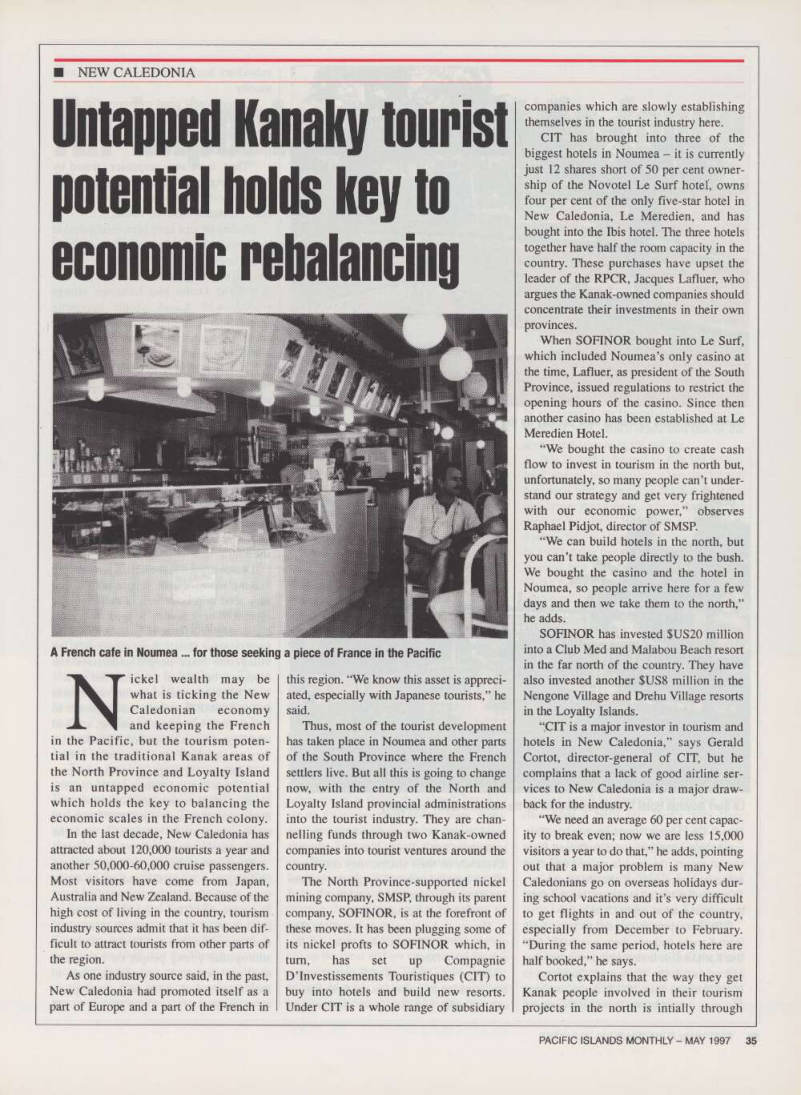
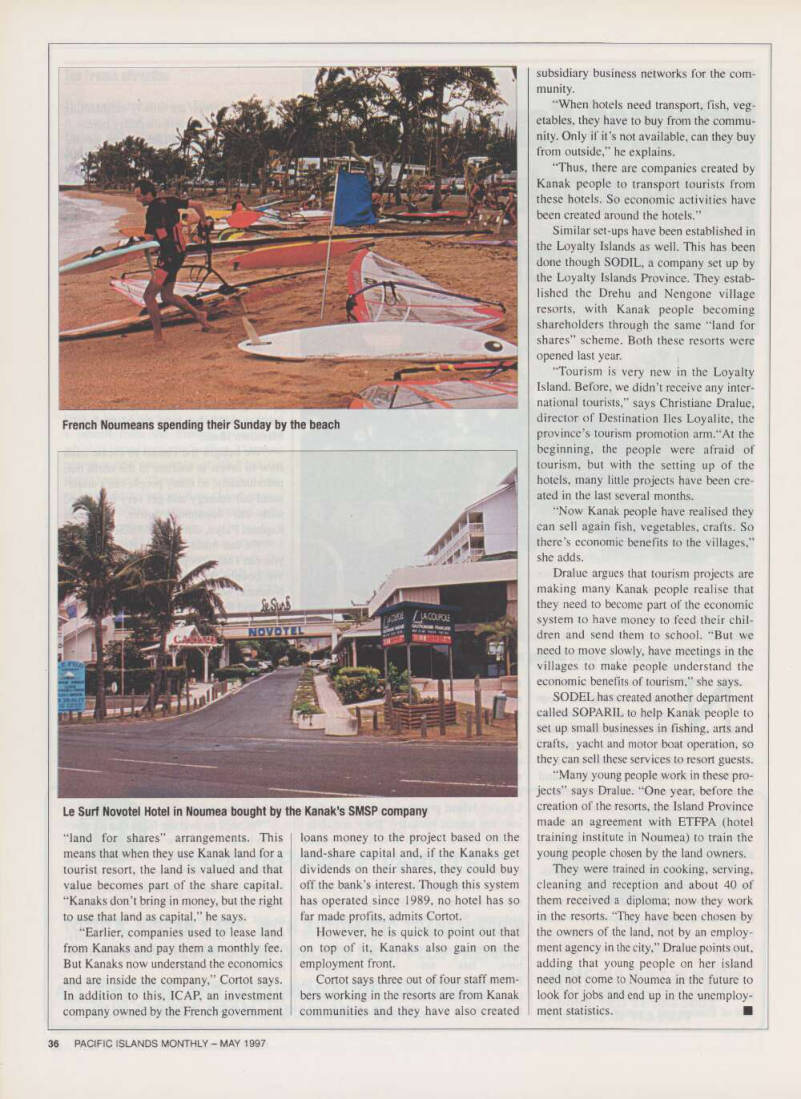
Untapped Kanaky tourist potential holds key to economic rebalancing
Nickel wealth may be what is ticking the New Caledonian economy and keeping the French in the Pacific, but the tourism poten tial in the traditional Kanak areas of the North Province and Loyalty Island is an untapped economic potential which holds the key to balancing the economic scales in the French colony.
In the last decade, New Caledonia has attracted about 120,000 tourists a year and another 50,000-60,000 cruise passengers.
Most visitors have come from Japan, Australia and New Zealand. Because of the high cost of living in the country, tourism industry sources admit that it has been dif ficult to attract tourists from other parts of
the region.
As one industry source said, in the past, New Caledonia had promoted itself as a part of Europe and a part of the French in
this region. “We know this asset is appreci ated, especially with Japanese tourists,” he said.
Thus, most of the tourist development has taken place in Noumea and other parts of the South Province where the French settlers live. But all this is going to change now, with the entry of the North and Loyalty Island provincial administrations into the tourist industry. They are chan nelling funds through two Kanak-owned companies into tourist ventures around the country.
The North Province-supported nickel mining company, SMSP, through its parent company, SOFINOR, is at the forefront of these moves. It has been plugging some of its nickel profts to SOFINOR which, in turn, has set up Compagnie D’lnvestissements Touristiques (CIT) to buy into hotels and build new resorts.
Under CIT is a whole range of subsidiary
companies which are slowly establishing themselves in the tourist industry here.
CIT has brought into three of the biggest hotels in Noumea - it is currently just 12 shares short of 50 per cent owner ship of the Novotel Le Surf hotel, owns four per cent of the only five-star hotel in New Caledonia, Le Meredien, and has bought into the Ibis hotel. The three hotels together have half the room capacity in the country. These purchases have upset the leader of the RPCR, Jacques Lafluer, who argues the Kanak-owned companies should concentrate their investments in their own
provinces.
When SOFINOR bought into Le Surf, which included Noumea’s only casino at the time, Lafluer, as president of the South Province, issued regulations to restrict the opening hours of the casino. Since then another casino has been established at Le Meredien Hotel.
“We bought the casino to create cash flow to invest in tourism in the north but, unfortunately, so many people can’t under stand our strategy and get very frightened with our economic power,” observes Raphael Pidjot, director of SMSP.
“We can build hotels in the north, but you can’t take people directly to the bush.
We bought the casino and the hotel in Noumea, so people arrive here for a few days and then we take them to the north,” he adds.
SOFINOR has invested SUS2O million into a Club Med and Malabou Beach resort in the far north of the country. They have also invested another SUSB million in the Nengone Village and Drehu Village resorts in the Loyalty Islands.
“CIT is a major investor in tourism and hotels in New Caledonia,” says Gerald Cortot, director-general of CIT, but he complains that a lack of good airline ser vices to New Caledonia is a major draw back for the industry.
“We need an average 60 per cent capac ity to break even; now we are less 15,000 visitors a year to do that,” he adds, pointing out that a major problem is many New Caledonians go on overseas holidays dur ing school vacations and it’s very difficult to get flights in and out of the country, especially from December to February.
“During the same period, hotels here are half booked,” he says.
Cortot explains that the way they get Kanak people involved in their tourism projects in the north is intially through
A French cafe in Noumea ... for those seeking a piece of France in the Pacific
“land for shares” arrangements. This means that when they use Kanak land for a tourist resort, the land is valued and that value becomes part of the share capital.
“Kanaks don’t bring in money, but the right to use that land as capital,” he says.
“Earlier, companies used to lease land from Kanaks and pay them a monthly fee.
But Kanaks now understand the economics and are inside the company,” Cortot says.
In addition to this, ICAP, an investment company owned by the French government
loans money to the project based on the land-share capital and, if the Kanaks get dividends on their shares, they could buy off the bank’s interest. Though this system has operated since 1989, no hotel has so far made profits, admits Cortot.
However, he is quick to point out that on top of it, Kanaks also gain on the
employment front.
Cortot says three out of four staff mem bers working in the resorts are from Kanak communities and they have also created
subsidiary business networks for the com
munity.
“When hotels need transport, fish, veg etables, they have to buy from the commu nity. Only if it’s not available, can they buy from outside,” he explains.
“Thus, there are companies created by Kanak people to transport tourists from these hotels. So economic activities have been created around the hotels.”
Similar set-ups have been established in the Loyalty Islands as well. This has been done though SODIL, a company set up by the Loyalty Islands Province. They estab lished the Drehu and Nengone village resorts, with Kanak people becoming shareholders through the same “land for shares” scheme. Both these resorts were opened last year.
“Tourism is very new in the Loyalty Island. Before, we didn’t receive any inter national tourists,” says Christiane Dralue, director of Destination lies Loyalite, the province’s tourism promotion arm.“At the beginning, the people were afraid of tourism, but with the setting up of the hotels, many little projects have been cre ated in the last several months.
“Now Kanak people have realised they can sell again fish, vegetables, crafts. So there’s economic benefits to the villages,” she adds.
Dralue argues that tourism projects are making many Kanak people realise that they need to become part of the economic system to have money to feed their chil dren and send them to school. “But we need to move slowly, have meetings in the villages to make people understand the economic benefits of tourism,” she says.
SODEL has created another department called SOPARIL to help Kanak people to set up small businesses in fishing, arts and crafts, yacht and motor boat operation, so they can sell these services to resort guests.
“Many young people work in these pro jects” says Dralue. “One year, before the creation of the resorts, the Island Province made an agreement with ETFPA (hotel training institute in Noumea) to train the young people chosen by the land owners.
They were trained in cooking, serving, cleaning and reception and about 40 of them received a diploma; now they work in the resorts. “They have been chosen by the owners of the land, not by an employ ment agency in the city,” Dralue points out, adding that young people on her island need not come to Noumea in the future to look for jobs and end up in the unemploy ment statistics. ■
French Noumeans spending their Sunday by the beach
Le Surf Novotel Hotel in Noumea bought by the Kanak’s SMSP company
An Important economic force
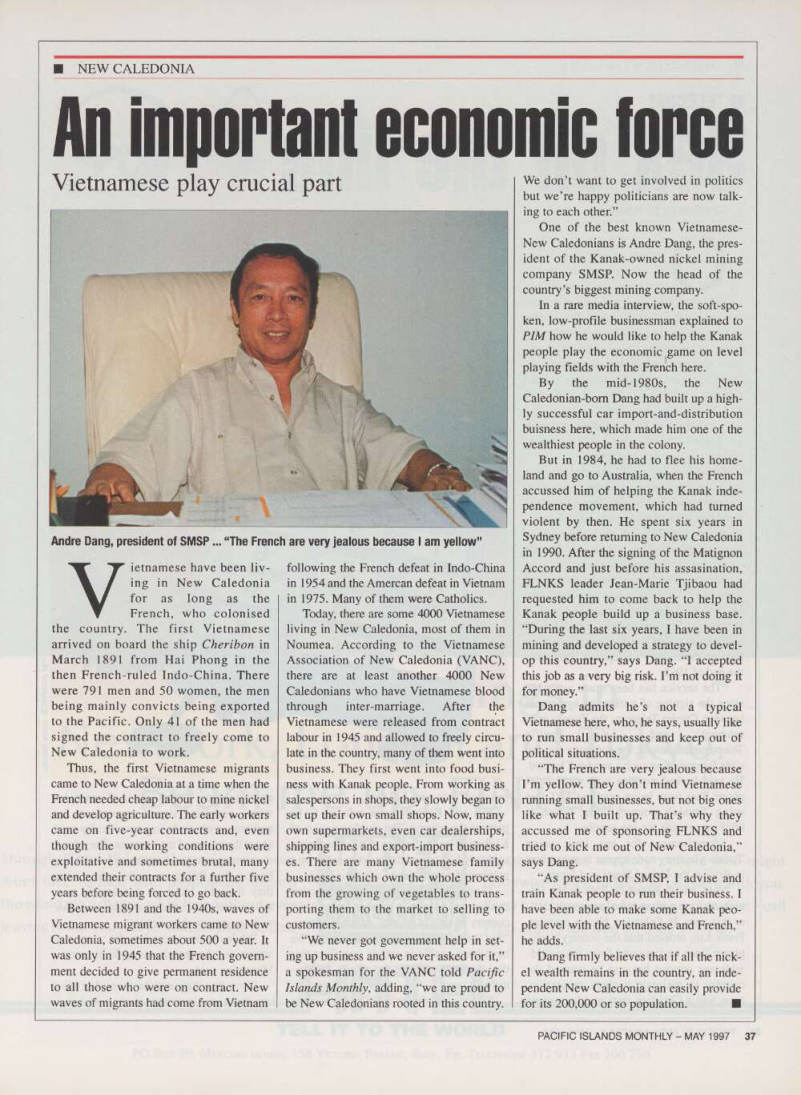
Vietnamese play crucial part
Vietnamese have been liv ing in New Caledonia for as long as the French, who colonised the country. The first Vietnamese arrived on board the ship Cheribon in March 1891 from Hai Phong in the then French-ruled Indo-China. There were 791 men and 50 women, the men being mainly convicts being exported to the Pacific. Only 41 of the men had signed the contract to freely come to New Caledonia to work.
Thus, the first Vietnamese migrants came to New Caledonia at a time when the French needed cheap labour to mine nickel and develop agriculture. The early workers came on five-year contracts and, even though the working conditions were exploitative and sometimes brutal, many extended their contracts for a further five years before being forced to go back.
Between 1891 and the 19405, waves of Vietnamese migrant workers came to New Caledonia, sometimes about 500 a year. It was only in 1945 that the French govern ment decided to give permanent residence to all those who were on contract. New waves of migrants had come from Vietnam
following the French defeat in Indo-China in 1954 and the Amercan defeat in Vietnam in 1975. Many of them were Catholics.
Today, there are some 4000 Vietnamese living in New Caledonia, most of them in Noumea. According to the Vietnamese Association of New Caledonia (VANC), there are at least another 4000 New Caledonians who have Vietnamese blood through inter-marriage. After the Vietnamese were released from contract labour in 1945 and allowed to freely circu late in the country, many of them went into business. They first went into food busi ness with Kanak people. From working as salespersons in shops, they slowly began to set up their own small shops. Now, many own supermarkets, even car dealerships, shipping lines and export-import business es. There are many Vietnamese family businesses which own the whole process from the growing of vegetables to trans porting them to the market to selling to customers.
“We never got government help in set ing up business and we never asked for it,” a spokesman for the VANC told Pacific Islands Monthly, adding, “we are proud to be New Caledonians rooted in this country.
We don’t want to get involved in politics but we’re happy politicians are now talk ing to each other.”
One of the best known Vietnamese- New Caledonians is Andre Dang, the pres ident of the Kanak-owned nickel mining company SMSP. Now the head of the
country’s biggest mining company.
In a rare media interview, the soft-spo ken, low-profile businessman explained to PIM how he would like to help the Kanak people play the economic game on level playing fields with the French here.
By the mid-1980s, the New Caledonian-bom Dang had built up a high ly successful car import-and-distribution buisness here, which made him one of the wealthiest people in the colony.
But in 1984, he had to flee his home land and go to Australia, when the French accussed him of helping the Kanak inde pendence movement, which had turned violent by then. He spent six years in Sydney before returning to New Caledonia in 1990. After the signing of the Matignon Accord and just before his assasination, FLNKS leader Jean-Marie Tjibaou had requested him to come back to help the Kanak people build up a business base.
“During the last six years, I have been in mining and developed a strategy to devel op this country,” says Dang. “I accepted this job as a very big risk. I’m not doing it for money.”
Dang admits he’s not a typical Vietnamese here, who, he says, usually like to run small businesses and keep out of
political situations.
“The French are very jealous because I’m yellow. They don’t mind Vietnamese running small businesses, but not big ones like what I built up. That’s why they accussed me of sponsoring FLNKS and tried to kick me out of New Caledonia,” says Dang.
“As president of SMSP, I advise and train Kanak people to run their business. I have been able to make some Kanak peo ple level with the Vietnamese and French,” he adds.
Dang firmly believes that if all the nick el wealth remains in the country, an inde pendent New Caledonia can easily provide for its 200,000 or so population. ■
Andre Dang, president of SMSP ... “The French are very jealous because lam yellow”
Sex on the line



Advertising Feature
Telecom
By Bernadette Hussein
One of the more popular means of attaining sexu al gratification, espe cially in the current era of safe sex, has indirectly been creep ing into the South Pacific. Telephone sex or, more technically speaking, a form of audiotec is, in fact, already here with the potential to increase rev enue for some of the smaller island nations, including Tuvalu, Tokelau and Niue. Niue and Tuvalu, for exam ple, had 10 per cent of their revenue generated from the international phone sex service last year.
But that is not to say the ethics of the situation have not come into play. In an interview earlier this year, Tuvalu’s prime minister, Bikenibeu Paeniu, said that the discovery that Tuvalu’s phone lines were being used for the sex service was a major moral issue for the religious country.
Tuvalu, which is a tiny atoll nation, earned SUSI. 2 million last year and looks set to earn double that amount this year. A spokesman for Carrier Telecom in Tuvalu said the sex service had been available through the country’s telephone lines since the end of 1995.
“The service has been made available since the signing of a tripartite agreement between Carrier Telecom, the Tuvalu gov ernment and Asia Pacific Telecommunications, the company respon sible for providing such a service,” he said.
He said he had no idea how many tele phone lines were being used but APT was using Tuvalu’s country code, which is 0688, to provide the sex service.
Advertisement for sex lines using Tuvalu’s country code appear in magazines in Britain, the United States and Japan.
Niue, which leased its lines to the ser vice, took on a more moral approach earli er this year. In February, Niue’s premier, Frank Lui, ordered that the country’s tele phone lines be removed from the world wide sex service because he wanted the country to maintain a clean reputation.
Niue was a Christian state and he wanted
to keep it that way, Lui said.
Fiji and Kiribati have refused to be party to the scheme. The chief executive of Kiribati Telecom Service, Cliff Macalpine, said they had turned down approaches by a number of companies to use their lines.
“Superficially, it is a very attractive business and there is income without the country having to invest,” said Macalpine.
“But there are a number of drawbacks. We have been unable to satisfy ourselves that the contents of the service can be con trolled.
“Some stuff shown is OK but others are
quite dubious. I have heard of examples where countries signed agreements for audiotec without being specifically told about the nature of the contents. They think the contents are good and clean but, to their horror, find things are nothing like what they thought. Until we can satisfy our selves that the contents will be clean we will not go into this service.”
While the short-term benefits were very attractive, the rental was quite insecure,
Macalpine said.
“One day they will be there, but they can decide at any time to pack up and go -
Sex on the line
and then what happens? This is OK, but if you have forecast the use of the money made from this in other projects and have started on them, then you are in trouble.”
Macalpine said that he, personally, did not see the government of Kirbati ever supporting such a basis for busi ness. And, he added, it was a question of ethics.
Like Kiribati, it was a question of ethics for Fiji. Fiji International Telecommunications Limited (FINTEL) general manager Mohammed Farouk said the company had been approached several times to lease telephone lines but that they had refused. Farouk said audiotec involved a lot of factors, some of which were fairly sensitive to some people, for example, adult programmes.
“When approached, we made our position clear that we would not enter tain those sorts of programmes. But any thing else, for instance, services like horoscopes, tarot cards, etc - if the oper ators can come up with things like that, then we would take them up on those.
“We’ve had offers over the past 18 months to two years for the use of our lines. The requests come from various sources. There is quite a large number of operators out there and we have been approached by operators in Israel, Germany and Hong Kong.”
Another country considering this deal is Tokelau. However, a representative from the country’s telecommunications company declined to comment on the issue. And, according to a report carried by Agence France-Presse, the country codes of Papua New Guinea, Solomon Islands and Vanuatu were also being used in the business. However, confir mation of this could not be obtained by the respective countries. So, how does the system work?
Each country has a country code which is its international identity, Farouk said, then within the national network, depending on how big the network is, uses up number ranges. Smaller coun tries, such as Niue and Tokelau, have a very small number of subscribers.
“How these operators offer audiotec is that they try and lease a block of num bers from these countries together with their country code. “Then what they do is have an interim arrangement because you need three parties to set this up. “For
example, if a call originates from some where in Europe the originator will detect that it is a call for, say, Fiji. It will then route it in a certain direction because we do not have direct routes to Europe. “So, for instance, if it is going to come through New Zealand, the service provider will have to have an arrange ment with New Zealand that the numbers from, say, Niue, Tokelau and Fiji will be detected in the New Zealand exchange.
“While this number will have a coun try code for Fiji, this number range is not supposed to go to Fiji, so it will go and terminate in some data bank in New Zealand and then is connected to the ser vice dialled for.”
He stressed that, like other telecom operators, the country which leases these numbers usually would not have access to the data banks and be unable to access this service.
“Basically, the system works because of the difference in what we call accounting rates. So it is only attractive if you have high accounting rates.
“If the accounting rate is low then the benefits, according to the service provider, are going to be very low.”
Accounting rates, Farouk said, were agreements between two countries.
For instance, if someone sets up a ser vice between New Zealand and Fiji, they agree to a certain fixed fee to carry each other’s traffic. So, if someone from Fiji calls New Zealand, the call goes through FINTEL, in Fiji, who then switches it to New Zealand and then the New Zealand exchange has the responsibility of redis tributing it to the number dialled. Each of the parties agrees at so many cents to carry each other’s traffic onwards.
The general accounting rate is then split halfway. Farouk said while this was quite an old trade for the rest of the world, it was fairly new in the Pacific.
So why the sudden interest in the Pacific?
“These operators move from country to country, and I think what is happening is that the interest in the Pacific is gener ated by the fact that we still have fairly high accounting rates. Accounting rates is where the money is, which is why they try and use the smaller and developing countries which have these high rates.”
As for the countries leasing their lines: “Well without any overheads, they make profits. “They don’t have to set up an exchange and can still make a lot of money out of it.” ■
Advertisements & other items, pp. 39-40 (1 item)
Fintei
"I’ve got meetings in
New York, London and Tokyo.
Beam me up, FINTEL.”
Through Fintel Videoconferencing, you can meet face to face with associates around the world via a digital cable link, without ever leaving town! You’ll save thousands of dollars on travel costs, and key people who might otherwise be excluded can be there with you.
For a brochure - or a free demonstration - call Fred Atalifo toll free on 0800 315 718.
FINTEI
TELL IT TO THE WORLD
PO Box 39, Mercury house, 158 Victoria Parade, Suva, Fiji. Telephone 312 933 Fax 300 750
ATLAS GIVES YOU THE WORLD
IN A BRIEF CASE.
With STN Atlas (Australia), you can open an Inmarsat Satcom-M briefcase terminal to the stars!
The SPI6OO-B provides a reliable digital secure satellite phone service anywhere within the Pacific, Indian and Atlantic Ocean Regions, covering about two thirds of the earth’s surface, including the Pacific Islands, Asia and Europe.
Weighing only 10.5 kg and running on batteries or 110-240 V AC, the briefcase also has an optional external wet weather antenna which can be set up permanently outside. Thus you can use the phone as an office phone (it can be connected to a PABX) or when needed as a fully portable field phone. This makes the Atlas SPI6OO-B ideal for a wide range of applications hotel communications including offshore island resorts, exploration and mining, oil and gas rigs, construction, emergency backup, independent communications for government diplomats and business executives.
With fax and data capability you have a portable office that allows you to send and receive fax and data communications no matter how remote your location, Plus, it’s backed by a world-wide sales and service network and carries a 12 month warranty.
Take advantage of this and put the world in your briefcase by calling: 612 437 4577 or Fax 612 439 7576 If you’re in the marine business we also have a maritime version with a stabilised antenna allowing voice, fax and data. Allow us to quote you a very competitive price and enjoy the luxury of dialling the world at any time and at any place. New dealerships are now available and welcomed.
STN ATLAS (AUSTRALIA) Innovations in Electronics
UNIT 6, 39 HERBERT ST, ST LEONARDS, NSW 2065, AUSTRALIA.
STN ATLAS (AUSTRALIA) PTY LTD ACN 056 058 952
Something
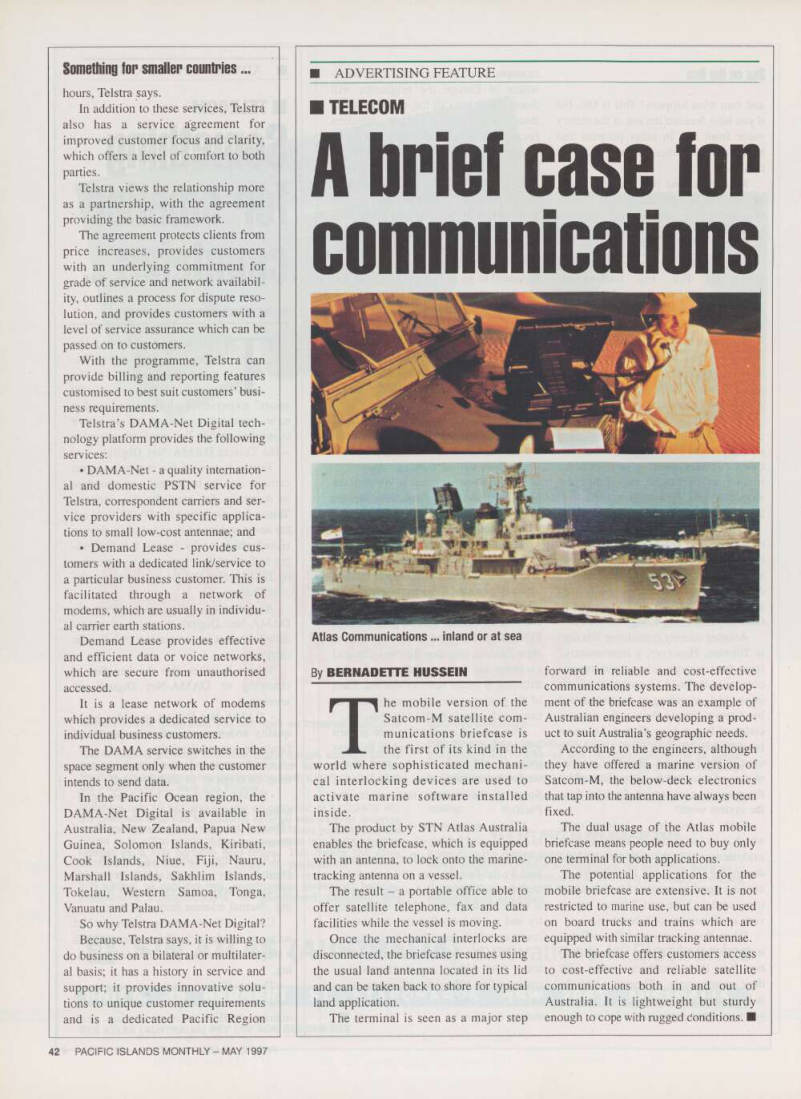
for smaller countries ...
By Bernadette Hussein
Telstra, ranked among the top 10 telecommunica tions companies in the world with over a 100 years’ experience, has introduced a new product expected to improve communications for smaller countries - the Telstra DAMA-Net Digital.
Telstra is one of the region’s largest carriers, and the traditional correspondent in Australia for most Pacific carriers.
Telstra has supported the PACT Network for seven years and is proud of its proven record which is why, it says, it is commit ted to further developing and supporting its DAMA-Net Digital services into the 21 st Century.
As a carrier, Telstra can deliver via DAMA-Net Digital, a range of value added services in partnership with Pacific carriers.
Telstra believes that the benefits of changing to DAMA-Net Digital are several: • DAMA-Net Digital provides high quality and economical voice, data and facsimile communications; * an increase in facsimile and data rates from 4800 bps to 14,4000 bps; and • DAMA-Net charges have been signif icantly reduced, providing a flat, cost effective rate for both international and domestic traffic.
One of the features of DAMA-Net Digital is that it has the ability to provide private network services, thereby increas ing internal revenue from customers.
Users will also have full-switched access to and from the Telstra Network via a single satellite hop plus forward switch
ing.
There will be capital costs savings as well as the capability to cost effectively manage traffic overflow during peak
Something for smaller countries...
hours, Telstra says.
In addition to these services, Telstra also has a service agreement for improved customer focus and clarity, which offers a level of comfort to both
parties.
Telstra views the relationship more as a partnership, with the agreement providing the basic framework.
The agreement protects clients from
price increases, provides customers
with an underlying commitment for grade of service and network availabil ity, outlines a process for dispute reso lution, and provides customers with a level of service assurance which can be passed on to customers.
With the programme, Telstra can provide billing and reporting features customised to best suit customers’ busi
ness requirements.
Telstra’s DAMA-Net Digital tech nology platform provides the following services; • DAMA-Net - a quality internation al and domestic PSTN service for Telstra, correspondent carriers and ser vice providers with specific applica tions to small low-cost antennae; and • Demand Lease - provides cus tomers with a dedicated link/service to a particular business customer. This is facilitated through a network of modems, which are usually in individu al carrier earth stations.
Demand Lease provides effective and efficient data or voice networks, which are secure from unauthorised accessed.
It is a lease network of modems which provides a dedicated service to individual business customers.
The DAMA service switches in the space segment only when the customer intends to send data.
In the Pacific Ocean region, the DAMA-Net Digital is available in Australia, New Zealand, Papua New Guinea, Solomon Islands, Kiribati, Cook Islands, Niue, Fiji, Nauru, Marshall Islands, Sakhlim Islands, Tokelau, Western Samoa, Tonga, Vanuatu and Palau.
So why Telstra DAMA-Net Digital?
Because, Telstra says, it is willing to do business on a bilateral or multilater al basis; it has a history in service and support; it provides innovative solu tions to unique customer requirements and is a dedicated Pacific Region
Advertisements & other items, p. 41 (1 item)
■ Telecom
PACIFIC ISLANDS MONTHLY - MAY 1997
■ ADVERTISING FEATURE
communications
A brief case for communications
By Bernadette Hussein
The mobile version of the Satcom-M satellite com munications briefcase is the first of its kind in the world where sophisticated mechani cal interlocking devices are used to activate marine software installed inside.
The product by STN Atlas Australia enables the briefcase, which is equipped with an antenna, to lock onto the marine tracking antenna on a vessel.
The result - a portable office able to offer satellite telephone, fax and data facilities while the vessel is moving.
Once the mechanical interlocks are disconnected, the briefcase resumes using the usual land antenna located in its lid and can be taken back to shore for typical
land application.
The terminal is seen as a major step
forward in reliable and cost-effective communications systems. The develop ment of the briefcase was an example of Australian engineers developing a prod uct to suit Australia’s geographic needs.
According to the engineers, although they have offered a marine version of Satcom-M, the below-deck electronics that tap into the antenna have always been fixed.
The dual usage of the Atlas mobile briefcase means people need to buy only one terminal for both applications.
The potential applications for the mobile briefcase are extensive. It is not restricted to marine use, but can be used on board trucks and trains which are equipped with similar tracking antennae.
The briefcase offers customers access to cost-effective and reliable satellite communications both in and out of Australia. It is lightweight but sturdy enough to cope with rugged conditions. ■
Atlas Communications ... inland or at sea
Advertisements & other items, pp. 42-43 (2 items)
■ Telecom
42
■ ADVERTISING FEATURE
PACIFIC ISLANDS MONTHLY - MAY 1997
ijelstra
TRADE MARK CAUTIONARY NOTICE
Notice is hereby given that Telstra Corporation Limited, a corporation duly organised and existing under the laws of Australia, and having ACN 051 775 556, the Corporate Secretary being located at 242 Exhibition Street, Melbourne, Australia is the sole proprietor of the following trade marks:- Used in respect of:— Telecommunications and communications equipment, apparatus and systems, including but not limited to electronic and optical telecommunications and communications equipment, apparatus and systems; satellite and earth station telecommunications and communications equipment, apparatus and systems; Telephone equipment, apparatus and systems, including but not limited to telephone; telephone receivers; telephone handsets; telephone network, telephone exchanges, telephone switching, telephone answering, telephone card vending and telephone dialling equipment, apparatus and systems; Transmission, receiving and storage equipment, apparatus and systems, includingbut not limited to facsimile, telegraph, telex, teleprinting, cable and paging equipment, apparatus and systems; data and video networking and conferencing equipment, apparatus and systems; data processing, message handling and switching equipment, apparatus and systems; digital equipment, apparatus and systems; electronic, voice, text and facsimile mail equipment, apparatus and systems; electronic directory equipment, apparatus and systems; Computer equipment, apparatus and systems, including but not limited to computer programs; computer software; computer hardware; computer terminals; computer memories; computer networking equipment, apparatus and systems; computer manuals in this class; modems; Video and audio equipment, apparatus and systems, including but not limited to sound and image recording, transmission and reproduction equipment, apparatus and systems; video cassettes and tapes; compact discs; records; digital, electric and electronic radio equipment, apparatus and systems; magnetic tapes; cinematographic, television and amusement equipment, apparatus and systems; amusement machines; All associated parts and accessories being goods in class 9, paper, cardboard and goods made from these materials; printed matter including directories, journals and manuals and all goods in class 16; advertising, promotional, consultancy and business services; compiling, arranging and publishing directories; telephone answering services; market research and statisticalservices; being services in class 35, repair installation, maintenance and construction services; being services in class 37, telecommunication services being services in class 38, amusement, entertainment, education and information services; multi-media services; being services in class 41, research services; computer programming services; retail and wholesaling services; consultancy services being services in Class 42'.
The said proprietor claims all rights in respect of the above trade marks and will take all necessary legal steps against any person or company infringing their said rights.
TELSTRA
— elstra
ijelstra
DAVIES COLLISON CAVE
PATENT ATTORNEYS
One Little Collins Street Level 10 AMP Building Melbourne, Victoria, 3000 10 Barrack Street Hobart Place Australia Sydney, New South Wales, 2000 Canberra City 2601
Understanding insurance



Insurance
Understanding insurance coverage in the Pacific
By Bernadette Hussein
Most insurance in the South Pacific is geared towards cover ing property because of the high risk of natural catastrophes such as cyclones, hurricanes and earthquakes in the region, says Paul Dunk, regional director for Aon Risk Services in the South Pacific.
“This is unlike what happens in bigger countries such as Australia, the United States and the United Kingdom, where there is a big exposure to liabilities. The exposure to liabilities in this part of the world isn’t much,” said Dunk. “It comes
down primarily to physical assets either on the land or the sea. Insurance prices and cover are geared by climatic and natural problems. There are other problems which relate to property, such as the ability to replace property in the event of damage as raw materials are not as easily available here as they are in more developed coun tries.
“But it’s better in Fiji than it is in Tonga, and it is better in Tonga than probably Niue. So, the smaller the country, the less service by ships or airlines, the bigger the
problem.”
Another problem facing the region, he said, was communications. “As an insur ance broker, we have offices around the
Dunk ... most insurance covers property
Understanding insurance coverage in the Pacific
Pacific. Say, for instance, if our comput ers break down in the Solomon Islands, basically, we have to send them down to Australia to get them fixed.
“So, operating an office becomes more difficult because your availability of ser vices and trained staff isn’t as good.”
Aon also deals in medical insurance but, Dunk says, this becomes difficult when these insurances are in countries which do not have regular airline services.
We are insuring people for health in the Solomon Islands where medical services are nowhere near to what is available in Fiji - so, there is a greater need to evacu ate. “Sometimes we are in a situation where people need to be evacuated as soon as possible and the next flight is not due out for the next three days. So what we have to do here is hire a plane which comes equipped with medical facilities.
But these don’t come cheap and we have to pay so much more for these facilities compared to how much it would cost us to fly these people out.”
He said he found that in the Pacific there was a great reliance on the sea.
“The boats sailing in the South Pacific
are mostly inter-island trading vessels which are often in far more hazardous waters because there are so many reefs.”
One problem you will find in the Pacific is overcrowding of boats. What we find is that if someone owns a boat, he tends to take about 100 people when his boat only has the capacity to carry 50. Sometimes, these boats are not in very good condition and insurance companies don’t insure them for much. In cases where boats do not have a proper survey report, some insurance companies will not insure them at all.”
Dunk explained the procedure of marine insurance, saying most shipping companies insured their crew in case of mishaps. “First, what the insurance com panies do is look at the boat and then the survey reports if there are inadequacies.
Then, chances are these boats will not be insured. All this is done to ensure that the boat is as safe as possible.”
Aon prides itself on being one of the largest insurance brokers in the world and has been operating in the South Pacific for over 13 years with offices throughout the
region. ■
Advertisements & other items, pp. 44-45 (1 item)
Cable Capacity
Expand Your Subscriber
with
DlgiGain ™ -2 and DigiGaln ™ - 4
Digital Pair Gain Systems
Features • Up to 4 voice/data/fax channels (mixed) over a single twisted copper pair. • CO equipment mounts in 19” rack. • Remote terminals designed for pole, wall or underground mounting. • Remote power feeding from CO end no separate power source required. • Automatic recovery from fault shutdown. • Supports both decadic and tone dialling. • Subscriber can be up to 15km from the CO (exchange) (depending on cable gauge).
Designed and manufactured in Australia email: [email protected] For additional information visit our web 10 COM DC Power Systems For Telecommunications Applications . • From 25 amps to 7,000 amps • Flexible, compact, modular • High reliability and quality • Sophisticated intelligent monitoring and control • Suitable for multiple applications, telephone exchange, transmission equipment, mobile base stations, PABX, etc. • Remote monitoring facility • Strong design and research capability • Equipment is used in more than 25 countries worldwide • System design and installation service site shown below, or write/fax/email to:
COM
io
POWER IN COMMUNICATIONS
Mead Office Units R4-R8 Regents Park Estate Cnr Park Rd and Princes Rd East Regents Park New South Wales 2143 Australia Tel: +6l-2-9722 3310 Fax: +6l-2-9722 3344 Internet: http://www.exicom.oz.au [or http://www.comlO.com.au]
A Fully Digital Telephone System fro
Panasonic to fit your office need
Whether you have just started a new business or you are opening new offices around the country, your choice of a telecommunications system is one of the nost important decisions you will make.
Panasonic's flexibility lets your
system grow as you do. The sysem grows from 8 external li and 16 extensions to 12 exj ines and 32 extensions. 3 row even further to 24 ines and 128 extensions. \nd look at all these fea
I ease of growth
• user friendly
I dual port usage t PC-based programming I remote maintenance I direct inward system access I trunk answer from any station I account code entry
I absent message capability
I voice mail integration eXtra Device Port (XDP) ■ mupp iv The eXtra Device Port of digital telephones accommodates virtually any singlejine device, which can have a different extension number frorji the Digital telephone. Therefore, in conjunction with the System Connection, you can have up tol 2Pextehsions connected. / C^.
Display Set Enhanced Display Set v„/ w Single Line Telephone Answering System Cordless Phone Facsimile Machine Data Termi Computer with Modem Ser Sr
KX-T7235
Enhanced Display Set im Connection Wr •t: Two KX-TD 1232 systems can be connected together to form if injii " I iiMitf MMni ini doubles in size, then so candour telephone system. With the System Connection, you can have up to 24 CO lines and 64 extensions. peakerphone Set Monitor Set DSS Consol Sales & service by:
datec
Phone: (679) 314411 Fax: (679) 300162 (Suva) Phone: (679) 720181 Fax; (679) 720194 (Nadi)
What of insurance brokers?

insurance brokers?
By Bernadette Hussein
The trend worldwide and in Fiji, in particu lar - is towards reduc
ing insurance premi
ums, says insurance broker Marsh and McLennan.
Director Paul Wilkins said this was due to a general oversupply of capital in the insurance market. This was particu larly true of the reinsurance market, which has allowed insurance companies
What of insurance brokers?
to obtain more favourable reinsurance protection and pass these benefits on to policy holders. As insurance broker, the work of the company is to get into the situation after a loss and settle claims as quickly as possible.
For example, after the destruction left behind in Fiji by Cyclone Gavin earlier this year, the company was quick to come on the scene to provide and set tle the necessary claims. Wilkins said that a number of island resorts on the western side of the country were great ly affected and the losses were big.
“There will be over two months of rebuilding which may cost over SFO.S million ($U5350,000). Finance is not a problem - it’s just that we want to get things done as quickly and efficiently as possible and make sure there is not much interruption to business.” For hotels and resorts, an area of concern is the reluctance by the local insurance market to provide cyclone coverage unless properties have engineers’ cer tificates, and then the wording is nor mally restricted to exclude factors such as sea surges, sandblasting and proper ties in the open.
Wilkins said it could be seen that the term “cyclone coverage” could mean a number of things and it was important that clients were fully aware of what was covered or, more importantly, what was not covered. “In cases where broader coverage is required or where clients do not have an engineer’s certifi cate, we have entered into an arrange ment with a number of overseas insur ers to provide coverage at much more favourable terms than have recently been available, subject to certain mini mum criteria,” Wilkins said.
Another area of concern for the peo ple of Fiji is that insurance companies do not pay for water damage that might have occurred through a leakage. But, Wilkins added, as insurance brokers, they made sure their clients knew exact ly what they were covered for. We tailor policies for individual needs, he said.
“People experience such problems
when they go directly to insurance com panies. If they go through a broker they will have a fair idea of what they are paying for.”
The company also advises on risk management as well as deals with cor porate or group insurance. It is in the
process of putting together a life and medi cal scheme at the request of the Fiji Public Service Commission for parliamentarians.
The brokers also operate in Papua New Guinea, which is its biggest insurance mar ket in the Pacific because of its size and resources. And, because of the country’s politically unstable atmosphere, insurance companies there provide cover for riots and strikes as well. Marsh and McLennan’s global network allows it to call on the tech nical and marketing expertise of the world wide group. “For example, if we have a par ticularly difficult or unusual insurance or
risk-management problem in Fiji, we can tap into our worldwide resources in search of solutions,” Wilkins said. At the end of January, Marsh and McLennan Limited announced it had purchased CECAR, the second largest insurance broker in France.
They had gross revenues in 1996 of approx imately SUSI3S million and 900 employees in 18 countries worldwide.
In February, it was announced that Marsh and McLennan were in formal discussion with ST Paul relating to a purchase of at least part of their Minet worldwide broking
operations. Negotiations are continuing. ■
Advertisements & other items, pp. 46-47 (2 items)
■ Insurance
46
■ ADVERTISING FEATURE
PACIFIC ISLANDS MONTHLY - MAY 1997
Mclennan
Marsh &
The world’s leading risk management consultant and insurance broker. Established in the Pacific for 27 years and specialists in:— Power Utilities Telecommunications Port Services Marine Huli/Cargo Hotels/Resorts (Cyclone coverage) Construction Aviation Group Schemes Please contact us to discuss any of your risk management & insurance requirements at:- Suva Office sth Floor Civic House Town Hall Road PO Box 1333 Suva, Fiji Telephone: (679) 312799 Facsimile: (679) 300737 Lautoka Office Marsh & McLennan House 117 Vitogo Parade PO Box 571 Lautoka, Fiji Telephone: (679) 660788 Facsimile: (679) 661422
Progressive
'4k %7t % , l i *?« C •"•w* *»•» *«w ; 11 I ■■ S - '• '• 2^ \ /V 1 We Provide * Insurance Cover for:
N B oS^t SS pepS x
general‘domestic /•
‘PROFESSIONAL
CLAIMS SERVICE .. *
These are only 3 of our many clients.
They all have ONE thing in common!
WE'VE GOT
THEM FULLY
COVERED
mmmM
3
WF OFFER
» * lj HIGHLY
COMPETITIVE
RATES
FEEL SECURE IN THE KNOWLEDGE THAT WE HAVE YOUR BEST INTERESTS COVERED.
OUR STAFF ARE QUALIFIED LOCALS WHO FULLY UNDERSTAND YOUR NEEDS.
Level 2, Lotemau Center, Convent St Apia. PHONE; 26-110/26-111. FAX: 26-112
me problem
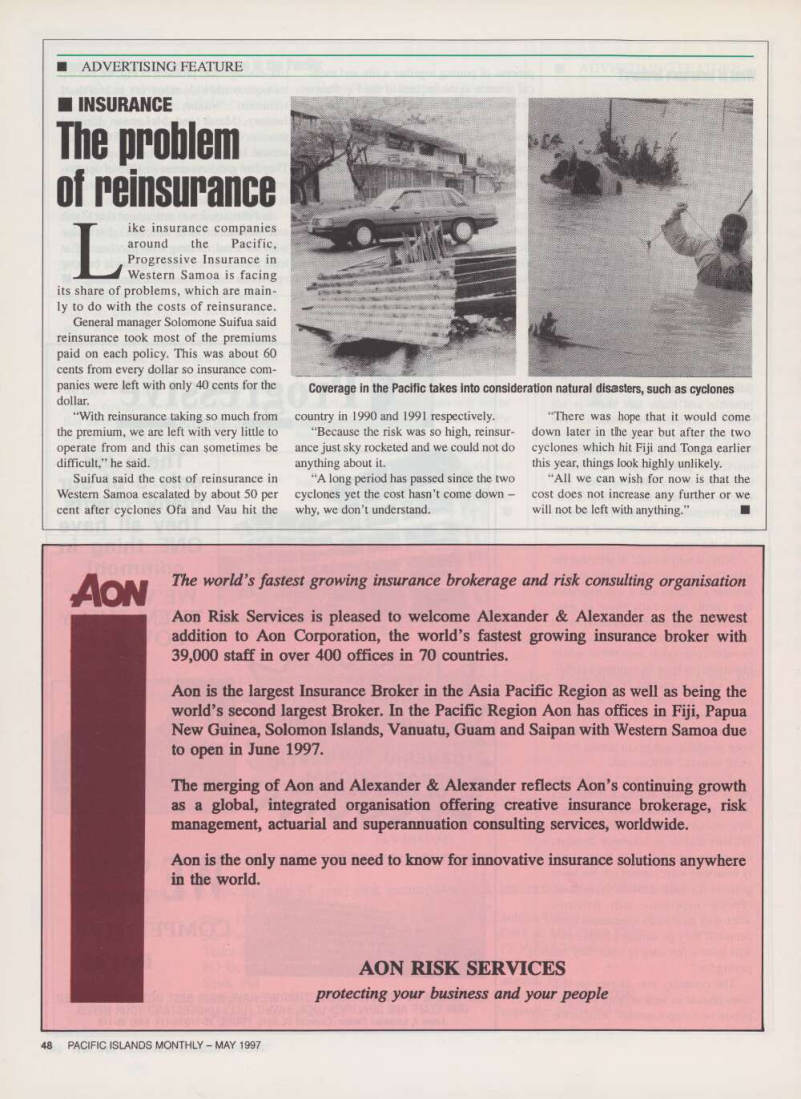
of reinsurance
Like insurance companies
around the Pacific, Progressive Insurance in Western Samoa is facing its share of problems, which are main ly to do with the costs of reinsurance.
General manager Solomone Suifua said reinsurance took most of the premiums paid on each policy. This was about 60 cents from every dollar so insurance com panies were left with only 40 cents for the dollar.
“With reinsurance taking so much from the premium, we are left with very little to operate from and this can sometimes be difficult,” he said.
Suifua said the cost of reinsurance in Western Samoa escalated by about 50 per cent after cyclones Ofa and Vau hit the
country in 1990 and 1991 respectively.
“Because the risk was so high, reinsur ance just sky rocketed and we could not do anything about it.
“A long period has passed since the two cyclones yet the cost hasn’t come down why, we don’t understand.
“There was hope that it would come down later in tlhe year but after the two cyclones which hit Fiji and Tonga earlier
this year, things look highly unlikely.
“All we can wish for now is that the cost does not increase any further or we will not be left with anything.” ■
Coverage in the Pacific takes into consideration natural disasters, such as cyclones
Advertisements & other items, p. 48 (2 items)
■ Insurance
48
PACIFIC ISLANDS MONTHLY - MAY 1997
■ ADVERTISING FEATURE
Aon
The world’s fastest growing insurance brokerage and risk consulting organisation Aon Risk Services is pleased to welcome Alexander & Alexander as the newest addition to Aon Corporation, the world’s fastest growing insurance broker with 39,000 staff in over 400 offices in 70 countries.
Aon is the largest Insurance Broker in the Asia Pacific Region as well as being the world’s second largest Broker. In the Pacific Region Aon has offices in Fiji, Papua New Guinea, Solomon Islands, Vanuatu, Guam and Saipan with Western Samoa due to open in June 1997.
The merging of Aon and Alexander & Alexander reflects Aon’s continuing growth as a global, integrated organisation offering creative insurance brokerage, risk management, actuarial and superannuation consulting services, worldwide.
Aon is the only name you need to know for innovative insurance solutions anywhere in the world.
AON RISK SERVICES
protecting your business and your people
A king regains
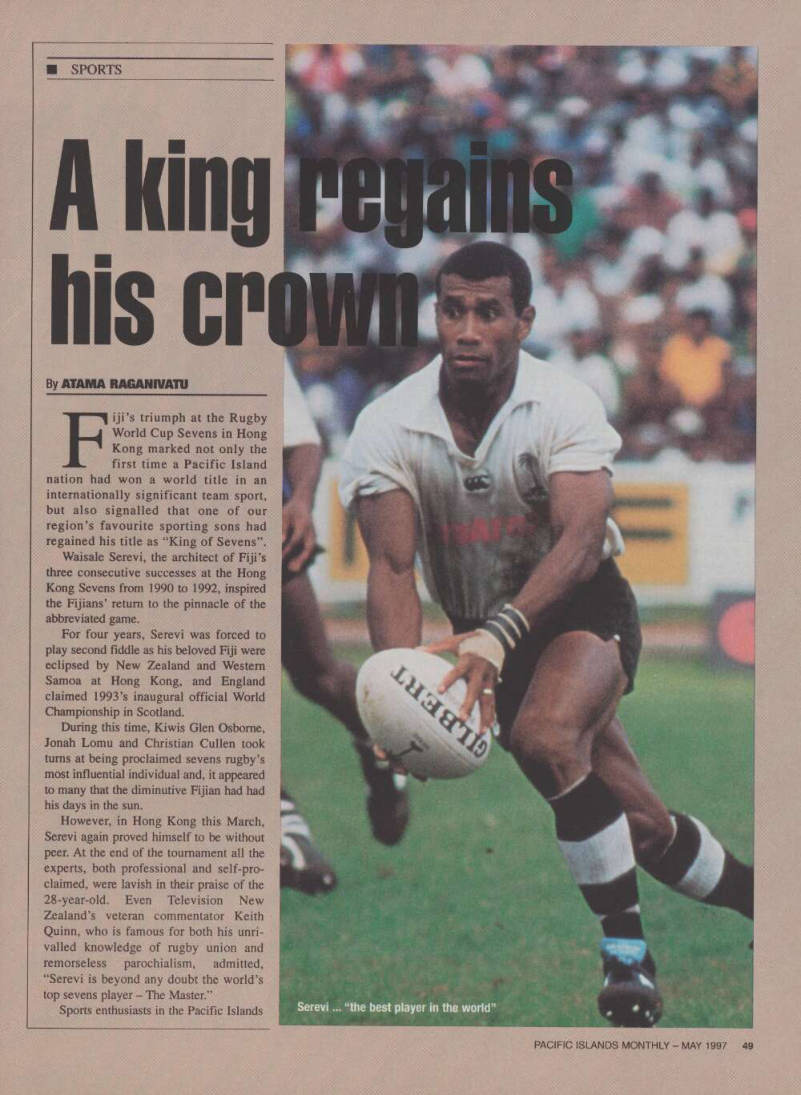
Sports
A king regains his crown
By Atama Raganivatu
Fiji’s triumph at the Rugby World Cup Sevens in Hong Kong marked not only the first time a Pacific Island nation had won a world title in an internationally significant team sport, but also signalled that one of our region’s favourite sporting sons had regained his title as “King of Sevens”.
Waisale Serevi, the architect of Fiji’s three consecutive successes at the Hong Kong Sevens from 1990 to 1992, inspired the Fijians’ return to the pinnacle of the abbreviated game.
For four years, Serevi was forced to play second fiddle as his beloved Fiji were eclipsed by New Zealand and Western Samoa at Hong Kong, and England claimed 1993’s inaugural official World Championship in Scotland.
During this time, Kiwis Glen Osborne, Jonah Lomu and Christian Cullen took turns at being proclaimed sevens rugby’s most influential individual and, it appeared to many that the diminutive Fijian had had his days in the sun.
However, in Hong Kong this March, Serevi again proved himself to be without peer. At the end of the tournament all the experts, both professional and self-pro claimed, were lavish in their praise of the 28-year-old. Even Television New Zealand’s veteran commentator Keith Quinn, who is famous for both his unri valled knowledge of rugby union and remorseless parochialism, admitted, “Serevi is beyond any doubt the world’s top sevens player - The Master.”
Sports enthusiasts in the Pacific Islands
Serevi ... “the best player in the world”
A king regains bis crown
can take particular pride in Serevi’s achievements, for he is a rare breed someone who achieved world fame with out leaving this region.
Christened Waisale Tikoisolomoni Serevi, he was born in Suva but spent most of the first eight years of his life at Qarani, a village situated on the island of Gau in the outlying Lomaiviti Group.
The Serevi family then moved to Nasinu, a Suva suburb, and young Waisale’s first experiences of rugby came when playing improvised games with friends there. Invariably, a plastic bottle was substituted for the ball they were too poor to buy.
At Lelean Memorial School, Serevi had access to real balls and basic coach ing. He played with distinction for the school’s first XV at halfback - a position, curiously, that was discarded almost immediately upon the completion of his education. Serevi made his first class rugby debut just over a year after leaving LMS, being 17 when drafted into the Rewa district representative side’s line up. Less than three seasons of senior grade experience were under his belt as Fiji called him up for international duty. 1989 saw Serevi grace the Hong Kong Sevens for the first time and it was love between the two at first sight. Fiji did not win that year (New Zealand pipped them 12-10 in the semi final) but, such was the impact made by the precocious debutant, who from the start adopted his team’s “playmaker” role, he gained the player of the tournament award - a rare achieve ment for a member of a losing side.
Much to the delight of his quickly acquired army of admirers, Serevi proved himself to be a totally irresistible force 12 months later.
Fiji hammered the Kiwis 22-10 in a memorable final and their gifted pivot became the first and, to date, only man to take the player of the tournament acco lade for a second successive time. His 1990 Fiji Sportsman of the Year trophy
was equally predictable.
During the next two years, he consoli dated his position as the maestro of inter national sevens rugby as the team now known as the “traditional enemy”, New Zealand, succumbed in both Hong Kong finals, 18-14 in 1991 and 22-6 in 1992.
The latter win prompted the presti gious British publication the Rothmans Rugby Almanac to name him amongst
their five Players of the Year, while Clem Thomas, the revered Welsh rugby journal ist, declared Serevi “the best player in the world”.
Fiji’s dominance of sevens ended in 1993 when Western Samoa secured the Perpetual Cup with a shock 14-12 win over the holders. Then, New Zealand emulated the Fijian feat of a hat trick of successes in Hong Kong.
By this time, Serevi had become known to the vast majority of the world’s rugby fans purely as a sevens player for virtually all his 15-a-side activity was confined to the Japanese club champi onship.
He signed a contract with Mitsubishi Motors in 1992 and, since then, his com mitments to them have severely limited appearances for the Fiji XV. But, Serevi was very nearly lost to rugby union alto gether.
In June, 1993 he signed a three-year contract with the Brisbane based rugby league club South Queensland Crushers for what now seems like a pitifully low figure - US$l6O,OOO. This brought gasps of astonishment from his numerous devo tees, who envisaged him taking horren dous batterings in Australian rugby league, which is noted, first and foremost, for the brutishness and intensity of its tackling (often executed by ‘posses’ of three players).
Just 1.76 metres tall and weighing 80 kilograms, no mountains remain for him to conquer in sevens rugby and, surely, his greatest aspiration now must be make an impression in the 15-man game corre sponding to his talents.
There are several theories why Serevi has not made his presence fully felt in conventional rugby. The likeliest are the inferiority of the players around him and the fact he is constantly being switched between fullback, wing and first five eighth and not allowed to settle in one position.
But, his greatest gifts - speed, flair, elusiveness, doggedness and ability to read the game superbly - are prime assets in the 15-man game too.
Recently introduced International Rugby Board regulations give the Fiji Rugby Football Union the right to call him back from Japan for international duty whenever they wish, Serevi has an excellent opportunity to prove he is more than just a sevens specialist - and that would be this King’s crowning achievement. ■
Lan's lament
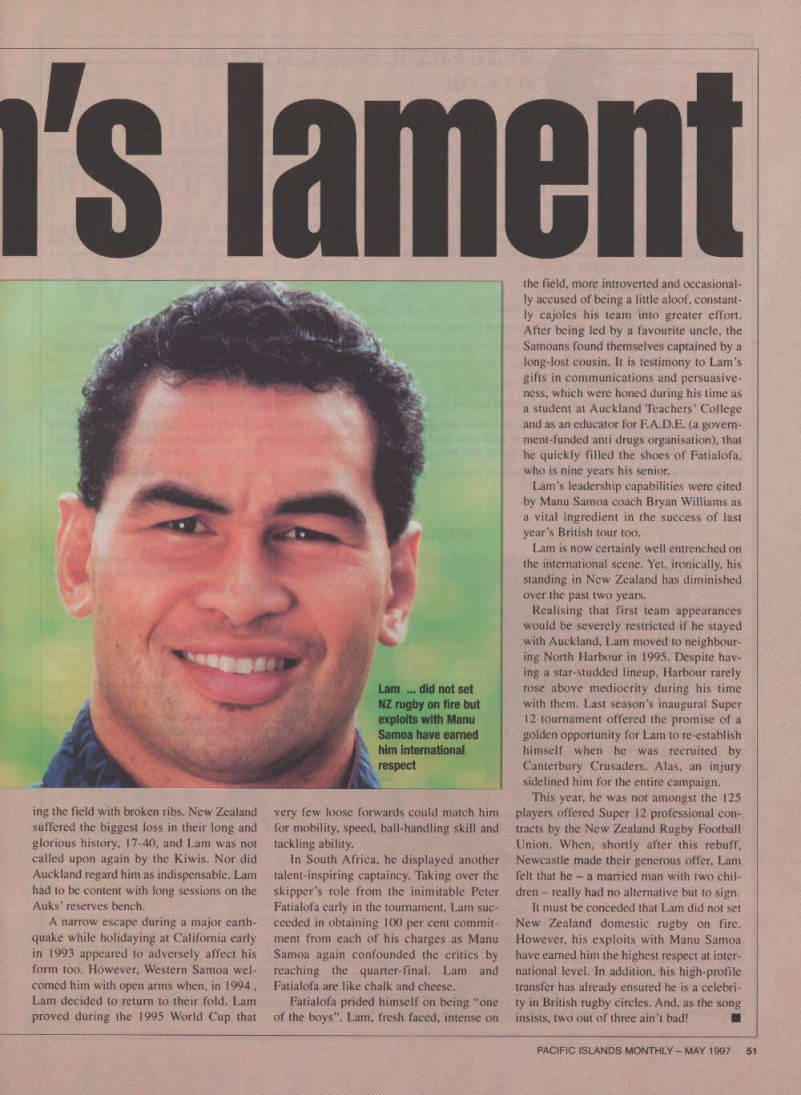
By Atama Raganivatu
Manu Samoa captain Pat Lam must have
been experiencing
mixed feelings when he recently boarded a plane at Auckland airport for England and a lucractive contract with the Newcastle club.
Doubtless, he would be anticipating with relish the opportunity to become involved in the burgeoning and highly rewarding European professional rugby circuit, but there must also have been a tinge of regret at leaving New Zealand without making an impact on the local scene which equated to his talent.
After playing a starring role in Western Samoa’s glorious World Cup campaign in 1991 Lam, then just 23, seemed destined to become one of the greatest loose forwards Kiwi rugby had produced.
Lam gained selection for Manu Samoa’s World Cup squad after only two seasons of first-class rugby with the awesomely strong Auckland outfit.
His senior international career could not possibly have had a better start - a Man-of-the-Match performance in Western Samoa’s never-to-be-forgotten win over Wales at Cardiff’s National Stadium. Subsequent perfomances in October, 1991 were only slightly less impressive and when, at the tourna ment’s end, a World XV was selected, Lam found himself named their number eight.
Upon returning to Auckland, his birthplace, Lam, decided that the time was now ripe for him to push for All Black honours and the fame and fortune obtained therewith. But his All Black career was both brief and disastrous.
Making his debut against Sydney on the 1992 Australian tour, he lasted just 30 minutes against Sydney before leav-
ing the field with broken ribs. New Zealand suffered the biggest loss in their long and glorious history, 17-40, and Lam was not called upon again by the Kiwis. Nor did Auckland regard him as indispensable. Lam had to be content with long sessions on the Auks’ reserves bench.
A narrow escape during a major earth
quake while holidaying at California early
in 1993 appeared to adversely affect his form too. However, Western Samoa wel comed him with open arms when, in 1994 , Lam decided to return to their fold. Lam proved during the 1995 World Cup that
very few loose forwards could match him for mobility, speed, ball-handling skill and tackling ability.
In South Africa, he displayed another
talent-inspiring captaincy. Taking over the
skipper’s role from the inimitable Peter Fatialofa early in the tournament, Lam suc ceeded in obtaining 100 per cent commit ment from each of his charges as Manu Samoa again confounded the critics by reaching the quarter-final. Lam and Fatialofa are like chalk and cheese.
Fatialofa prided himself on being “one of the boys”. Lam, fresh faced, intense on
the field, more introverted and occasional ly accused of being a little aloof, constant ly cajoles his team into greater effort.
After being led by a favourite uncle, the Samoans found themselves captained by a long-lost cousin. It is testimony to Lam’s gifts in communications and persuasive ness, which were honed during his time as a student at Auckland Teachers’ College and as an educator for F.A.D.E. (a govern ment-funded anti drugs organisation), that he quickly filled the shoes of Fatialofa, who is nine years his senior.
Lam’s leadership capabilities were cited by Manu Samoa coach Bryan Williams as a vital ingredient in the success of last year’s British tour too.
Lam is now certainly well entrenched on the international scene. Yet, ironically, his standing in New Zealand has diminished over the past two years.
Realising that first team appearances would be severely restricted if he stayed with Auckland, Lam moved to neighbour ing North Harbour in 1995. Despite hav ing a star-studded lineup, Harbour rarely rose above mediocrity during his time with them. Last season’s inaugural Super 12 tournament offered the promise of a golden opportunity for Lam to re-establish himself when he was recruited by Canterbury Crusaders. Alas, an injury sidelined him for the entire campaign.
This year, he was not amongst the 125 players offered Super 12 professional con tracts by the New Zealand Rugby Football Union. When, shortly after this rebuff, Newcastle made their generous offer, Lam felt that he - a married man with two chil dren - really had no alternative but to sign.
It must be conceded that Lam did not set New Zealand domestic rugby on fire.
However, his exploits with Manu Samoa have earned him the highest respect at inter national level. In addition, his high-profile transfer has already ensured he is a celebri ty in British rugby circles. And, as the song insists, two out of three ain’t bad! ■
Lam ... did not set NZ rugby on fire but exploits with Manu Samoa have earned him international respect
Advertisements & other items, p. 52 (1 item)
South Pacific Forum Secretariat
rHH SUVA, FIJI
VACANCIES
The Forum Secretariat was established in 1972 by the South Pacific Forum to encourage economic and political co-operation between its member countries*, and between those states and the more industrialised countries. In order to fulfil the economic aims of the Forum Secretariat, the following two positions need to be filled:
REGIONAL COORDINATION ADVISER
The Secretariat is seeking a suitably qualified and experienced person to work as Regional Coordination Adviser in its Development and Economic Policy Division. The Regional Coordination Adviser reports to the Director of the Division and will assist the Director in the coordination of regional issues and policy initiatives including regional priority setting. (Previous applicants will be considered and need not
reapply).
The Regional Coordination Adviser will: analyse key regional development issues and develop policy papers and advice; oversee coordination and development of regional policy initiatives on a broad range of sustainable development issues; coordinate with other regional organisations the development of regional positions on and inputs in key global issues and processes; develop and implement the Regional Strategy for establishing regional development priorities; represent the Secretariat at regional meetings; and provide secretarial service and technical support for the South Pacific Organisations Coordinating Committee.
Applicants must be citizens of Forum member countries* and should have an advanced degree in a development related field and at least ten years relevant experience in development issues relating to Pacific Island countries, including economic (monetised and semi-subsistence) and social issues. Extensive travel throughout the region will be required.
The appointment will cany a competitive remuneration package, starting at approximately FJD6O 150, depending on qualifications and
experience.
RESOURCES ADVISER
The Forum Secretariat is also seeking to appoint a suitably qualified person as Resources Adviser in its Development and Economic Policy Division. The Resources Adviser reports to the Director and will be responsible for coordinating regional policy initiatives and development activities in resources areas including agriculture, forestry, marine and fisheries, environment and mining.
The Resources Adviser will: coordinate and clarify regional priorities in resources areas; prepare policy advice on key resources objectives of member countries*; coordinate views of member countries* and regional organisations on resources issues; represent the Secretariat at meetings on resources issues; assist with the coordination of technical assistance to the resources sectors of member countries*; and assist in the servicing and support of the South Pacific Organisation Coordination Committee.
Applicants must be citizens of Forum member countries* and should have an advanced degree and at least ten years relevant experience in resources fields, including resource economics, preferably in the Pacific. Extensive travel throughout the region will be required.
The appointment will carry a competitive remuneration package, starting at approximately FJD 60 150, depending on qualifications and experience.
For both positions there are generous establishment and education allowances and free medical and life insurance. For non Fiji citizens, remuneration should be tax free in Forum member countries*. Appointments are normally for three years, with the option to renew for a further three years.
All applications should be addressed to: The Secretary General Forum Secretariat Private Mail Bag, Suva, FIJI Information packages on both positions are available from the Secretariat and applicants are urged to obtain one. Inquiries should be addressed to Mr Aklesh Nand, on (679) 312600 Extn 207 or fax (679) 305573. Applications close on 30 May 1997 and should contain full information on educatiion and career background, addresses and telephone numbers of three employment referees. • Member States of the South Pacific Forum: Australia, Cook Islands, Federated States of Micronesia, Fiji, Kiribati, Nauru, New Zealand, Niue, Palau, Papua New Guinea, Republic of the Marshall Islands, Solomon Islands, Tonga, Tuvalu, Vanuatu and Western Samoa. 101979V1
and Ivory singing duo

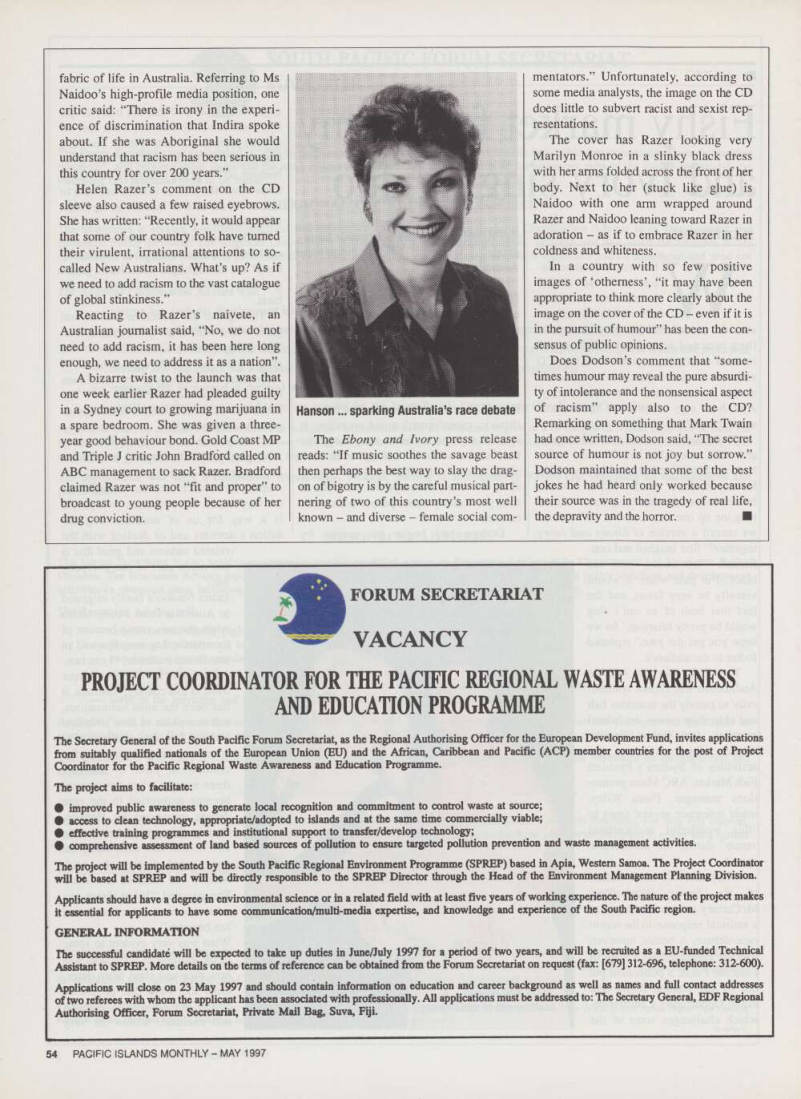
Music
Fishy market for Ebony and Ivory singing duo
By Liu Tuwai
What would lead some one to hold a CD launch at a venue where fish odour per meates the air? Why would anyone then proceed to tell several hundred invited media and guests that the CD and music video features two female media personalities who cannot sing?
And how can a reviewer then make sense out of the obvious nonsense?
Giving her explanation, Australia’s pop ular ABC television news reader, Indira Naidoo, told the crowd how she and Helen Razer, presenter on the Triple J Youth Network became recording stars. “Helen rang me up one day, and said: ‘Why don’t we record a version of Ebony and Ivory together?’ She laughed and con
firmed: ‘Obviously, you are black. I’m pale white. It would visually be very funny, and the fact that both of us can’t sing would be pretty hilarious.’ So we hope you get the joke,” repeated Indira to the audience.
The Fish Markets Auction Auditorium was chosen symboli cally to parody the notorious fish and chip shop owner, the federal member for Oxley, Pauline Hanson. Commenting on the activities of Sydney’s Pyrmont Fish Market, ABC Music promo tions manager, Fiona Wiley, made reference several times to “this wonderful multicultural venue” during the introduction speech.
Wiley said this cover version of the Stevie Wonder/Paul McCartney song was launched as a satirical response to the recent race debate. A bonus, however, was the simultaneous release of Face the Facts, a publication put out by the Human Rights and Equal Opportunity Commission, which challenges some of the
myths and stereotypes held about immi
grants, refugees and indigenous
Australians.
Zita Antonios, the Federal Race Discrimination commissioner, spoke briefly about the level of misinformation that had led to recent “public acts of racial hatred”.
Mick Dodson, the Aboriginal and Torres Strait Islander Social Justice commission er, was the honoured speaker for the event.
He told the crowd: “Humour cuts through rhetoric, misinformation and prejudice. It is often devastating in its simplicity. The best humour seeks to challenge us to think about how we view the world and to con sider the many assumptions we hold as true, particularly about people from other cultures.”
Dodson had begun his speech by
expressing he hoped that the irony of the fish market venue had not been lost on anyone present. He said: “I think irony is a completely different kettle of fish from humour, so I’m going to attempt not to con tinue down the line of irony. I am here to talk about the role of humour in the midst of intolerance.”
Dodson reasoned that humour was one of the most potent weapons a community could use to highlight and disarm racial prejudice, particularly when based on solid facts.
Throughout his speech he told several jokes with a hard edge. One example was: “Pik Botha [asked] Gareth Evans at one stage, when he was foreign minister, if Aborigines had the right to vote and Evans replied, ‘Yes, if they live to be 18.’” The audience was unsure whether it was appro priate to laugh or not.
Dodson went on to explain, “For many Aboriginal people the laughing in the midst of intolerance, laughing in the midst of Australia’s social confusion, joking about the very racism that oppresses your people is a way for us of understanding the nation’s demons and of dealing with the
related sadness and grief that is too much part of our everyday life.”
Indira Naidoo’s family migrated
to Australia from South Africa when she was young because of the apartheid system. She told an astonished audience, “I can hon estly say in all the time I have lived in this country, Australia, it has been the most harmonious, tolerant place to live”. Naidoo claimed that she had not experi enced any serious racism or dis crimination prior to the past three months when the country became embroiled in the race debate generated by Hanson.
During this period her family
and friends had suffered racial and verbal abuse, she said.
Naidoo had received hate mail.
She reasoned, “It just shows you what a serious issue that [race] has become.”
What was very evident to some of the indigenous attendants was how race and class often deter mine the ways that people of colour are arbitrarily included and excluded within the very
Razer and Naidoo ... a melting pot of controversy j
fabric of life in Australia. Referring to Ms Naidoo’s high-profile media position, one critic said: “There is irony in the experi ence of discrimination that Indira spoke about. If she was Aboriginal she would understand that racism has been serious in this country for over 200 years.”
Helen Razer’s comment on the CD sleeve also caused a few raised eyebrows.
She has written; “Recently, it would appear that some of our country folk have turned their virulent, irrational attentions to so called New Australians. What’s up? As if we need to add racism to the vast catalogue of global stinkiness.”
Reacting to Razer’s naivete, an Australian journalist said, “No, we do not need to add racism, it has been here long enough, we need to address it as a nation”.
A bizarre twist to the launch was that one week earlier Razer had pleaded guilty in a Sydney court to growing marijuana in a spare bedroom. She was given a three year good behaviour bond. Gold Coast MP and Triple J critic John Bradford called on ABC management to sack Razer. Bradford claimed Razer was not “fit and proper” to broadcast to young people because of her drug conviction.
The Ebony and Ivory press release reads: “If music soothes the savage beast then perhaps the best way to slay the drag on of bigotry is by the careful musical part nering of two of this country’s most well known - and diverse - female social com
mentators.” Unfortunately, according to some media analysts, the image on the CD does little to subvert racist and sexist rep resentations.
The cover has Razer looking very Marilyn Monroe in a slinky black dress with her arms folded across the front of her body. Next to her (stuck like glue) is Naidoo with one arm wrapped around Razer and Naidoo leaning toward Razer in adoration - as if to embrace Razer in her coldness and whiteness.
In a country with so few positive images of ‘otherness’, “it may have been appropriate to think more clearly about the image on the cover of the CD - even if it is in the pursuit of humour” has been the con
sensus of public opinions.
Does Dodson’s comment that “some times humour may reveal the pure absurdi ty of intolerance and the nonsensical aspect of racism” apply also to the CD?
Remarking on something that Mark Twain had once written, Dodson said, “The secret source of humour is not joy but sorrow.”
Dodson maintained that some of the best jokes he had heard only worked because their source was in the tragedy of real life, the depravity and the horror. ■
Hanson ... sparking Australia’s race debate
Advertisements & other items, p. 54 (1 item)
And Education Programme
FORUM SECRETARIAT
VACANCY
PROJECT COORDINATOR FOR THE PACIFIC REGIONAL WASTE AWARENESS
AND EDUCATION PROGRAMME
The Secretary General of the South Pacific Forum Secretariat, as the Regional Authorising Officer for the European Development Fund, invites applications from suitably qualified nationals of the European Union (EU) and the African, Caribbean and Pacific (ACP) member countries for the post of Project Coordinator for the Pacific Regional Waste Awareness and Education Programme.
The project aims to facilitate: improved public awareness to generate local recognition and commitment to control waste at source; access to clean technology, appropriate/adopted to islands and at the same time commercially viable; effective training programmes and institutional support to transfer/develop technology; comprehensive assessment of land based sources of pollution to ensure targeted pollution prevention and waste management activities.
The project will be implemented by the South Pacific Regional Environment Programme (SPREP) based in Apia, Western Samoa. The Project Coordinator will be based at SPREP and will be directly responsible to the SPREP Director through the Head of the Environment Management Planning Division.
Applicants should have a degree in environmental science or in a related field with at least five years of working experience. The nature of the project makes it essential for applicants to have some communication/multi-media expertise, and knowledge and experience of the South Pacific region.
GENERAL INFORMATION
The successful candidate will be expected to take up duties in June/July 1997 for a period of two years, and will be recruited as a EU-funded Technical Assistant to SPREP. More details on the terms of reference can be obtained from the Forum Secretariat on request (fax; [679] 312-696, telephone: 312-600).
Applications will close on 23 May 1997 and should contain information on education and career background as well as names and full contact addresses of two referees with whom the applicant has been associated with professionally. AD applications must be addressed to: The Secretary General, EDF Regional Authorising Officer, Forum Secretariat, Private Mail Bag, Suva, Fiji.
Artfully subjective,

Literature
Contemporary, cultural and confessional
Figiel’s novel marks new generation of Pacific writers
By Nicolas
Rothwell
Artfully subjective,
relentlessly innovative, by turns charming and disquieting, but never failing in freshness and strength of observation, Where We Once Belonged announces the appearance on the world fiction stage of the first major representative of the Pacific’s new generation of writers.
Sia Figiel, a 30-year-old performance poet, Western Samoa bom, has produced an appropriately hybrid first novel, com bining an open-eyed appreciation of Samoan culture with the unconstrained narrative style of Western writing in the confessional 90s.
In fact, like all substantial fiction, this is not a reductive work of political con sciousness. Indeed, it’s a-coming-of-age novel, intimate in tone, startlingly well handled, with all the force and immediacy of lived experience. The reader travels with Sia Figiel’s central character, a young Samoan girl named Alofa, through the time of adolescence, when the senses are most keen in their exploring of the world, when the set-up of life, the way things work, still seems strange and one’s perception of it can still ring true.
Sex, menstruation, attraction - these are the building bricks of the book.
Sia Figiel is a knowing writer. Her style is well honed. Her performance poetry has evidently embraced some of this text,, which includes fragments of verses and of Samoan-language pieces. It’s a defiantly modem book - broken, pulled together from a smash of kaleidoscopic shards; composed of oblique glances and record
ings, yet profoundly unified. There’s a con stant, bold passage between the individual, the specific and the general, indeed the moral: “Is there more than one surface to a human being?” wonders the narrator early in the tale, and the quest to answer this
question reverberates throughout her
pages, as she strips away layers of motiva tion, of belief, of cultural formation.
So, far from being a simple lament for the passing of Samoan culture, Where We Once Belonged can also be read as a kind of backhanded celebration of the persis tence of Polynesian patterns of life: in the jingle-jangle of its words, the shifts of attention, the loose narration, the constant darting between traditional references and the galaxies of American television stars’ names and Western consumer brands.
Sometimes one feels one’s in a conven tional contemporary novel, then, abruptly, the order of myth and story makes its tri umphant return: “The fish took the girl by the hair, between his teeth and flew into the sea...and her body was never found
again.”
And so the mosaic builds up. School; family; the anticipation of sexual encoun ters; their harsh fruition. Modem Apia; vil lage life; the world of newspaper head lines; the resonance of Christian religion.
Lists and episodes of common life are at the centre of this mazy, unconsidered seeming but consummately well made book. Not to give away the movement of the plot, Alofa, comes to a shattering dis covery of the role of sex, and power, at the heart of her own family. She is furiously punished for a brief sexual indiscretion: “Fists blew in my eyes and mouth and cheeks and blood flowed out on to the cement floor” - and yet the relationship between Alofa and her father is changed forever by what she has seen, and learned, and what he has done - “as if I was the punisher and he the punished ... and he knew it ... and I knew it.” All this is achieved, in the story, with boundless sub tlety, through almost subterranean
expression. Close to the end of the account, the enigmatic figure of Alofa’s aunt comes into focus. This character, Siniva, the dera cinated and troubled intellectual “fool” and precursor heroine, articulates the critical, conscious vision of the modem Pacific.
“Gauguin is dead! There is no paradise!”
Siniva used to call out to Western tourists, who “were confused when they heard such words - most of them were shocked, shocked that someone recognised them
doing what they usually did: Peeping-
Tomming for a past, an illusion long dead, long buried in museums of their own
making.”
In a slightly over-neat conclusion, which nevertheless makes a striking coda, Siniva takes her own life: “Suicide - it is the only way. For isn’t that what we’re all slowly doing anyway? Each time a child cries for Coca-Cola instead of coconut juice the waves close into our lungs. Each time we choose one car, two cars, three cars over canoes and our own feet, the waves close in further... but tell me this once, my little dreamer, did I have a choice? Do you have a choice now that your own eyes are opened to the darkness?”
This boundlessly assured and elegant book, brimming with the intermingled feel of modem and traditional, is clearly in some sense Sia Figiel’s answer. The author has already published a second book, The Girl In The Moon Circle, which focuses once more on the circumstances of a young
girl’s growing up in Samoan society.
In March this year, Where We Once Belonged won the Commonwealth Writers Prize for the best first book in the South East Asian and South Pacific region, upon the recommendation of three judges from New Zealand, Australia and Malaysia. The award is significant recognition, and fully deserved. This is exactly the kind of syn thetic, boundary-crossing fiction an inter cultural world under construction most needs.
One feels, though, that Sia Figiel stands now at a crossroads. Either she can repeat her first book’s touching formula and explore the same terrain further - or rein vent her art and her personality. She faces the dilemma that awaits all writers of auto biographical fiction - the need to transcend herself. ■ • Where We Once Belonged, published October 1996 by Pasifika Press, RRP, NZ. • An English version of Arts of Vanuatu, which was reviewed last month, is available from Crawford House Publishing, P O Box 1484, Bathurst, NSW 2795, Australia.
to Samoa
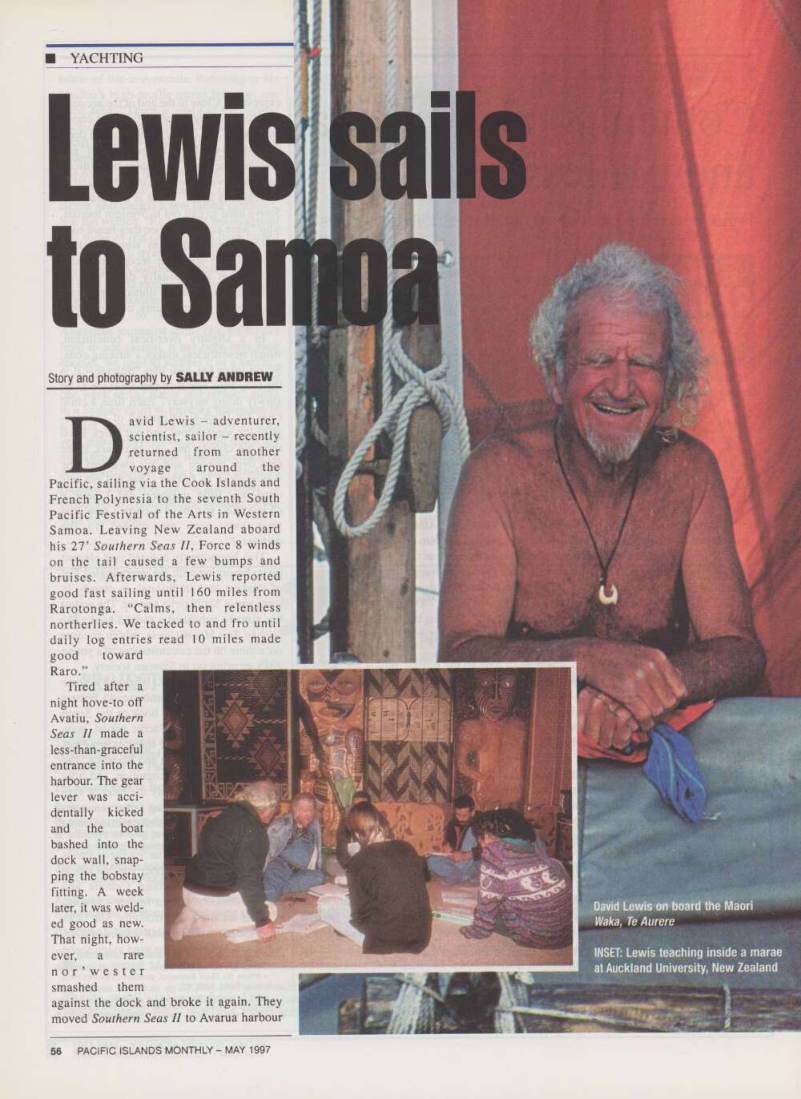
Yachting
Lewis sails to Samoa
Story and photography by SALLY ANDREW
David Lewis - adventurer, scientist, sailor - recently returned from another voyage around the Pacific, sailing via the Cook Islands and French Polynesia to the seventh South Pacific Festival of the Arts in Western Samoa. Leaving New Zealand aboard his 27’ Southern Seas 11, Force 8 winds on the tail caused a few bumps and bruises. Afterwards, Lewis reported good fast sailing until 160 miles from Rarotonga. “Calms, then relentless northerlies. We tacked to and fro until daily log entries read 10 miles made
good toward Raro.”
Tired after a night hove-to off Avatiu, Southern Seas II made a
less-than-graceful
entrance into the harbour. The gear lever was acci dentally kicked and the boat bashed into the dock wall, snap ping the bobstay fitting. A week later, it was weld ed good as new.
That night, how ever, a rare nor’wester smashed them
against the dock and broke it again. They moved Southern Seas II to Avarua harbour
David Lewis on board the Maori Waka, Te Aurere
INSET: Lewis teaching inside a marae at Auckland University, New Zealand
and made repairs. Lewis lived in Rarotonga as a young boy and
enjoyed returning home.
In Tahiti, friends from Hokule’a’s 1976 voyage gave him a big wel come. “So it went in enjoyable cruis ing style,” comments Lewis, “though trade winds this season were mostly absent.” Moorea was “a haven of peace and beauty after noisy expen sive Papeete” and, at remote Suvarov in the north Cooks, Southern Seas II found coconut crabs and no less than eight yachts anchored there.
In Raiatea, “we payed our respects to the sacred site of Taputapuatea”.
According to legend, in 1350, at the last great gathering of voyaging canoes, a curse was placed on the temple of Taputapuatea by a Maori tohunga in revenge for murder. In 1995, a flotilla of contemporary dou ble-hulled sailing canoes from Hawaii, New Zealand, the Cook Islands and Tahiti gathered in Taputapuatea for a special ceremony.
The ancient tapu was lifted off the sacred site. Dr Lewis spent last September in Western Samoa where 200 musicians, dancers and artisans from 21 neighbouring islands took part in the South Pacific Festival of the Arts. There were 75 cruising yachts anchored in tiny Apia harbour - you could just about step from deck to deck to get ashore. Two traditional ocean-voyaging canoes arrived - Te Au O Tonga (Southern Mist) from the Cook Islands, skippered by Sir Tom Davis who reported an easy five-day sail from Aitutaki. American Samoa’s newly launched canoe Folauga O Samoa (Navigators of Samoa) had problems with high seas and reported a 19-hour roller coaster ride. In the end, they were towed into port.
According to Dr Lewis, a work shop on “ceremonial navigation” by Sosthenes Emwalu of Puluwat (Micronesia) made the whole festival worthwhile. Lewis explains; “Ceremonial navigation is the spiritu al and ritualistic side of the art...knowing how to navigate by the stars, waves and winds as well as how to predict weather, use medicines, sing chants and call on magic for fish ing and planting.”
In general, though, the symposium on non-instrument navigation was a
shambles. “It was poorly organised [and] largely videos of Hokule’a’s trips ...[which were designed] as presentations to Hawaiian school kids [rather than spurs to] serious debate. Hekenukumai Busby, builder/owner of New Zealand’s voyaging canoe Te Aurere, got squeezed out of the programme and it was pure chance I heard the Puluwat delega tion was there at all. I rushed over just before they left and, sure enough, there was the old pirate and master navigator Hipour looking unchanged after 28 years. [lt was] a great joyous reunion!”
After the festival at Apia, Southern Seas II headed back to Auckland via Vava’u which Lewis calls “a yachting paradise” and Nuku’alofa, capital of the Kingdom of Tonga. After a fast trip towards New Zealand, “we were stopped in our tracks 150 miles off Opua - by southerlies this time.
Oh, I do want a boat that can go to wind ward”.
Lewis and his boat are now in Auckland, moored up a creek in a friend’s back garden.
“A rather dull prospect after the islands but I must get to writing sometime.” ■
Advertisements & other items, p. 57 (1 item)
Sophc
DIRECTOR and PROGRAM MANAGER
Applications are invited from nationals of South Pacific Applied Geoscience Commission (SOPAC) member countries for the positions of Director and Program Manager of the Secretariat based in Suva, Fiji.
SOPAC is a South Pacific regional organisation with membership including Australia, Cook Islands, Federated States of Micronesia, Fiji, Kiribati, Guam, Marshall Islands, New Zealand, Niue, Papua New Guinea, Solomon Islands, Tonga, Tuvalu, Vanuatu and Western Samoa.
Associate members are New Caledonia and Tahiti Nui.
SOPAC’s main objective is to assist member countries in the identification, development and management of non-living resources, in the management of development and protection of the marine environment especially in coastal areas and in the training of their nationals in all areas within SOPAC’s mandate.
Secretariat The Director is responsible for the overall management of the Secretariat, which currently has a staff establishment of 42 people of whom about half are professional or technical staff recruited internationally. The Director is supported by a Program Manager who has responsibility for management of the technical programs.
Qualifications Applicants for both positions should have a sound understanding of the Pacific Islands region and should be capable of developing effective relationships with the member countries of SOPAC and with other Governments and organisations providing funding, technical and scientific support to SOPAC.
Applicants for the Director position should in addition have proven leadership qualities, management ability and experience in leading a multidisciplinary team effort. A commitment to the aspirations of the Pacific Islands peoples and good health. An academic qualification, preferably related to geoscience, will be an advantage.
Applicants for the Program Manager position should have a degree in one of the earth sciences and research experience in geology or geophysics, the ability to provide technical and managerial leadership, and to lead a multidisciplinary team effort. A commitment to the aspirations of the Pacific Islands peoples and good health are also required.
Remuneration An attractive remuneration package at regional levels will apply.
Terms of Appointment The appointments will be for 3 years initially, and may be renewable for a further 3 year contract.
Selections are expected to be made in October 1997, for commencement of duties in January, 1998.
Applications All applications should be fully documented and include details of work experience and qualification and the names of at least three referees. Applications for the Director position to be marked “Director Application”, should be addressed to the Chairman of SOPAC and should reach the following address by July 31,1997. Applications for the Program Manager position to be marked “Program Manager Application”, should be addressed to the Director of SOPAC and should reach the following address by 30 September, 1997: SOPAC Secretariat Private Mail Bag, GPO Suva, Fiji.
Further information on the above positions can be obtained from the Finance and Administration Controller, SOPAC Secretariat, on Telephone 381 -377, Fax 370-040 or E-mail [email protected]. kmcmsmo
The Pacific paradox
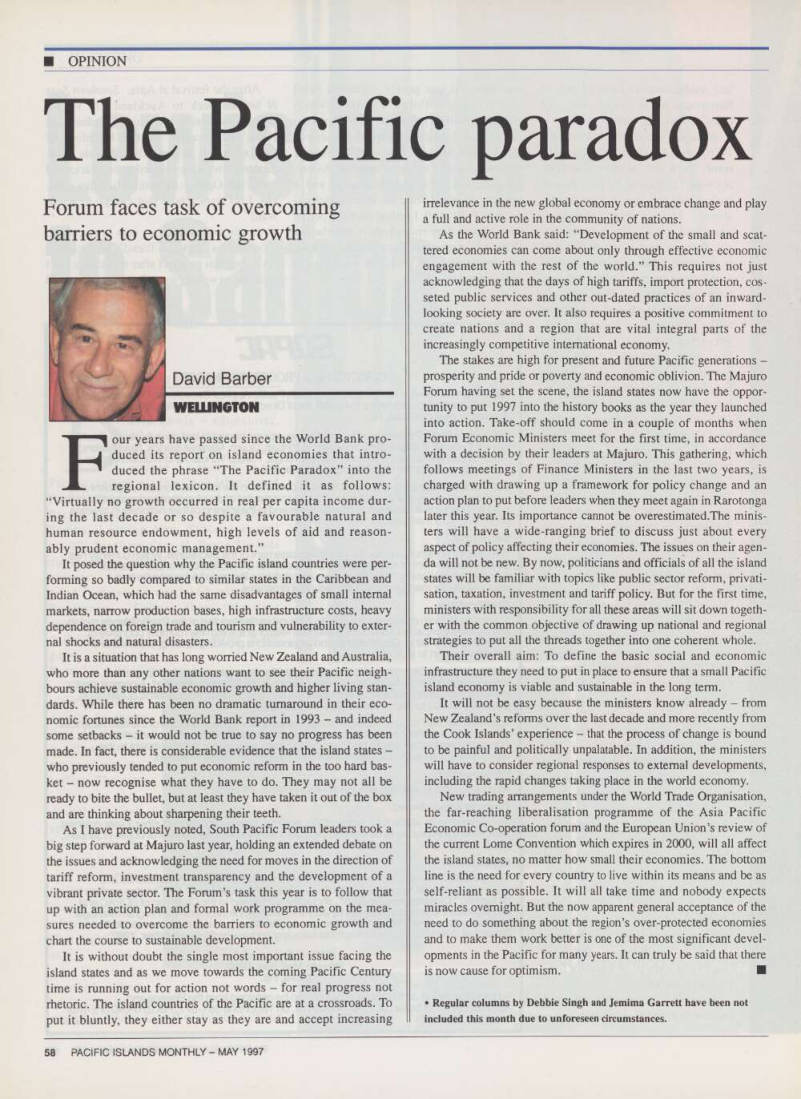
Opinion
Forum faces task of overcoming barriers to economic growth
Four years have passed since the World Bank pro duced its report on island economies that intro duced the phrase “The Pacific Paradox” into the regional lexicon. It defined it as follows: “Virtually no growth occurred in real per capita income dur ing the last decade or so despite a favourable natural and human resource endowment, high levels of aid and reason ably prudent economic management.”
It posed the question why the Pacific island countries were per forming so badly compared to similar states in the Caribbean and Indian Ocean, which had the same disadvantages of small internal markets, narrow production bases, high infrastructure costs, heavy dependence on foreign trade and tourism and vulnerability to exter nal shocks and natural disasters.
It is a situation that has long worried New Zealand and Australia, who more than any other nations want to see their Pacific neigh bours achieve sustainable economic growth and higher living stan dards. While there has been no dramatic turnaround in their eco nomic fortunes since the World Bank report in 1993 - and indeed some setbacks - it would not be true to say no progress has been made. In fact, there is considerable evidence that the island states who previously tended to put economic reform in the too hard bas ket - now recognise what they have to do. They may not all be ready to bite the bullet, but at least they have taken it out of the box and are thinking about sharpening their teeth.
As I have previously noted, South Pacific Forum leaders took a big step forward at Majuro last year, holding an extended debate on the issues and acknowledging the need for moves in the direction of tariff reform, investment transparency and the development of a vibrant private sector. The Forum’s task this year is to follow that up with an action plan and formal work programme on the mea sures needed to overcome the barriers to economic growth and chart the course to sustainable development.
It is without doubt the single most important issue facing the island states and as we move towards the coming Pacific Century time is running out for action not words - for real progress not rhetoric. The island countries of the Pacific are at a crossroads. To put it bluntly, they either stay as they are and accept increasing
irrelevance in the new global economy or embrace change and play a full and active role in the community of nations.
As the World Bank said; “Development of the small and scat tered economies can come about only through effective economic engagement with the rest of the world.” This requires not just acknowledging that the days of high tariffs, import protection, cos seted public services and other out-dated practices of an inward looking society are over. It also requires a positive commitment to create nations and a region that are vital integral parts of the
increasingly competitive international economy.
The stakes are high for present and future Pacific generations prosperity and pride or poverty and economic oblivion. The Majuro Forum having set the scene, the island states now have the oppor tunity to put 1997 into the history books as the year they launched into action. Take-off should come in a couple of months when Forum Economic Ministers meet for the first time, in accordance with a decision by their leaders at Majuro. This gathering, which follows meetings of Finance Ministers in the last two years, is charged with drawing up a framework for policy change and an action plan to put before leaders when they meet again in Rarotonga later this year. Its importance cannot be overestimated. The minis ters will have a wide-ranging brief to discuss just about every aspect of policy affecting their economies. The issues on their agen da will not be new. By now, politicians and officials of all the island states will be familiar with topics like public sector reform, privati sation, taxation, investment and tariff policy. But for the first time, ministers with responsibility for all these areas will sit down togeth er with the common objective of drawing up national and regional strategies to put all the threads together into one coherent whole.
Their overall aim; To define the basic social and economic infrastructure they need to put in place to ensure that a small Pacific island economy is viable and sustainable in the long term.
It will not be easy because the ministers know already - from New Zealand’s reforms over the last decade and more recently from the Cook Islands’ experience - that the process of change is bound to be painful and politically unpalatable. In addition, the ministers will have to consider regional responses to external developments, including the rapid changes taking place in the world economy.
New trading arrangements under the World Trade Organisation, the far-reaching liberalisation programme of the Asia Pacific Economic Co-operation forum and the European Union’s review of the current Lome Convention which expires in 2000, will all affect the island states, no matter how small their economies. The bottom line is the need for every country to live within its means and be as self-reliant as possible. It will all take time and nobody expects miracles overnight. But the now apparent general acceptance of the need to do something about the region’s over-protected economies and to make them work better is one of the most significant devel opments in the Pacific for many years. It can truly be said that there is now cause for optimism. ■ • Regular columns by Debbie Singh and Jemima Garrett have been not included this month due to unforeseen circumstances.
David Barber
Wellington
Advertisements & other items, pp. 59-60 (1 item)
What Would You Like Them To Say About You
f m a He knew
Grand Pacific
would look after
his family
His bills are covered w m 3 1508 00676009 9 «ss c ; Bs, ¥ yS r da % & r J V v- d //is' children will get a good education
She trusted someone local,
Grand facific Life
She put her family first
What Would You Like Them To Say About You
After You’re Gone?
Ordinarily, it takes a lifetime to accumulate a fortune. Not with life insurance.
Life insurance is the only sure way to build a legacy - one that will instantly perpetuate your good name as a provider and sustain your family’s financial security.
Let us help you choose a plan that meets your goals. ® Grand Pacific Life Insurance, Ltd.
A member of the Finance Factors Family American Samoa Mark Solofa Pacific Insurance & Finance, Inc.
Mark Solofa, GA Phone: 684-699-5796 Western Samoa Mark Solofa Pacific Insurance & Finance, Inc.
Mark Solofa, GA Phone: 685-24059 Chuuk State.
Federated States of Micronesia Pacific Basin Insurance & General Services, Inc.
Kachutosy Paulus, GA Phone: 691-330-2606 Guam Great National Insurance Underwriters, Inc.
Domie Bumagat Jr., GA Phone: 671-646-5736 Pacific Financial Corporation Eduardo Camacho, GA Phone: 671-646-1990 Takagi & Associates Pamela Cruz, GA Phone: 671-475-4373 Marshall Islands Marshalls Insurance Agency Jerry Kramer, GA Phone; 692-625-3366 Saipan Pacific Basin Insurance Underwriters, Inc.
Mary Ann Milne, GA Phone: 670-234-7861 Pacific Insurance Underwriters, Inc.
Norman Tenorio, GA Phone: 670-234-6267 Tonga Peseti Ma‘afu Insurance & Finance, Ltd.
Peseti Ma‘afu, GA Phone: 676-24-777
ife.O
(L °U9
PftC
1. SkSLUvai
ZM
MWW>
i . ■
LAND CRUISER
A K\ n Li ' I >: d Some of the specs may vary according to market specifications.
Heavy duty beauties - Toyota Land Cruiser and Land Cruiser PRADO Land Cruiser’s got a reputation for go anywhere toughness, with style and ability to take you there in total comfort, on road or off.
Its luxury matches most expensive sedans. And it has more space than many large passenger cars. With impeccable fit and finish.
And graceful, elegant form.
Land Cruiser PRADO inherits these traditions, and all Toyota’s 4x4 know-how for great performance off road and passenger car comfort on the highway, and stylish beauty everywhere it goes.
What you can’t see is also important. Tough frames. Suspensions built to take you as far off road as you want to go, in comfort. Your choice of powerful petrol or diesel engines. And bodies thoroughly protected from rust.
Land Cruiser and Land Cruiser PRADO - two champions, on and off the road.
®TOYOTA
DISTRIBUTORS/DEALERS
NORFOLK ISLAND BORRY’S PTY LTD.
SOLOMON ISLANDS ELA MOTORS
VANUATU ASCO MOTORS
COOK ISLANDS PACIFIC MOTORS LTD.
PH 22114 PH 30314 PH 22341 PH 20796
KIRIBATI TARAWA MOTORS PH 21090
PAPUA NEW GUINEA ELA MOTORS PH 3229400
TAHITI NIPPON AUTOMOTO PH 429819
WESTERN SAMOA ASCO MOTORS PH 20800
FIJI ASCO MOTORS
NEW CALEDONIA S.I.A.P.
TONGA ASCO MOTORS
AMERICAN SAMOA* ASCO MOTORS
(*PRADO is not being handled.) PH 384888 PH 275562 PH 23500 PH 633-4281