Pacific




Islands
Monthly
F -J - It||Ett^Tv'h
Women and Children ; laP lust how far have we come?
9 American Samoa USS2.SC Australia ASS,SO: Cook Islands NZS3: Fiji F 52.50 Vat mcl: FS Micronesia USS 3: Kiribati A 52.50: Nauru A 52.50: Niue NZS3: Norfolk ASS: New Caledonia cpf2so' New Zealand NZ53.45 mcl GST: Northern Marianas USS 3: Papua New Guinea K 2 90: Palau USS 3: Marshall Islands USS 3: Solomon Islands ASS: French Polynesia cpf3oo Tonga P 3: USA USS 3: Vanuatu VT22O: Western Samoa T 5.50 These are recommended prices only.
Cover design: Josefa Bola Photographs by Bernadette Hussein, Asaeli Lave, Michele McConell-Wilson
Advertisements & other items, pp. 2-5 (1 item)
L\M) Telikom
! i I :
For whatever
Ml
The safest
and the quickest
way to
Papua New Guinea
is by phone •••
Just dial +675 plus the number and you're hone.
In Papua New Guinea , Telikom does the connection for you.
l\m) TELIKOM
PAPUA NEW GUINEA
1 I I : I I I aO Hu H EW s Island pineaple Island Orange Island Dew Island Cola Tropical Soda Grape Lemon-Lime Strawberry Lei or full container shipments available.
For information on our competitively priced line of quality beverages, fax, phone or write us at: US Mainland: Aspen International, Inc. 1402-3rd Avenue, Suite 1024 Seattle, Washington 98101 Phone (206) 628-6151 Fax (206) 628-6421 Tahiti Distributor: Eico P.O. Box 184 Papeete - Tahiti Phone 421 660 Fax 429 838
ISLAND
SODA
Product of U.S.A. Island Soda is a registered trademark
DOU Power Edge Servers
• <s> §• 44 i——
Power Edge 2100
Entry Level
■ File/ print & OA ■ Dedicated tasks ■ Remote offices ■ Limited Scalability
Power Edge 4100
Mid Range
■ Groupware and communications ■ File and print
■ Departments
■ Dedicated
Application Server
■ Medium Scalability
Power Edge XL
High End
■ Database
processing
■ File server consolidation ■ Dedicated
Application Server
■ High Scalability
Greater performance/ capacity
Customer Configuration: Dell instills and configures each Power Edge server to your unique specifications at the factory so you can just open the box and immediately after the system arrives!
For more information, call your friendly retailer...
South feci/ Computing
GPO Box 1001 269 Grantham Rd, Grantham Plaza Suva, FIJI ISLANDS.
MOBILE: (679) 936455, PH: (679) 386455, FAX: (679) 370875 [email protected]
mtv 1 CRKftU 3
SUVR
THE CHAMPION TEAM TO
CONTACT TO SATISFY
all your winning
export & import needs
MV TUICAKAU
MV CAPITAINE COOK
THE
THE
"CAPITAINE KEEMADEC"
CHAMPION
S. . I
CHAMPION
t ' THE EXPERTS, UNA, ALBERT, JONA, IMPORTS & EXPORTS ‘ t -.5
TEAM
in
TEAM
Meet the CHAMPION TEAM that gives you direct dedicated services to New Zealand and Australia at unbeatable freight rates.
MV Tui Cakau 111 is a dedicated day service departing Suva and Lautoka every third Wednesday and Thursday for New Zealand, while the Capitaine Kermadec turns around every 25 days to Australian. Capitaine Cook arrives four weekly from Australia with all the bulk wheat, rice and blue peas (or Fiji. So for a winning deal on all your export and import needs, contact our playermakers. Albert Una or Jona today. Our champion team will give you the edge.
MV CAPTANINE COOK
SOFRANA UNILINES
Contact the Champion Team on telephone (679) 304528 or fax (679) 300057 or Albert on Mobile 930794 and Jona on 930528.
Or coach/manager/owner's representative Harold Swann.
Sofrana Unilines—We're more Pacific for your money.
Fiji Agents: Carpenters Shipping Suva Suva Ph: (679) 312244 Fax: (679) 301572 Lautoka Ph; (679) 663988 Fax: (679) 664896.
Pacific

Islands
Monthly
Vol. 67 No. 04
The News Magazine
April 1997
PUBLISHER: Alan Robinson EDITOR: Manivannan Naidu SENIOR WRITER: Bernadette Hussein
Correspondents:
Sally Andrew, Patrick Decloitre, David North, Chris Peteru, Atama Raganivatu, Kalinga Seneviratne, Liz Thompson, Lili Tuwai, Sam Vulum lan Williams COLUMNISTS: David Barber (Wellington), Jemima Garrett (Sydney), Debbie Singh (South Pacific Commission).
GRAPHIC ARTISTS: James Ranuku, Josefa Bola, Andrew Williams
Advertising Sales
Senior Regional Sales (South Pacific) Shailendra Kumar Shabana Naaz Te1(679) 304111, 303244, Fax (679) 303809.
Sydney, Canberra: Bob Hill Media Representation, Tel (61-2) 4164245, Fax (61-2) 4165064.
Brisbane: Jane Fewings Media and Advertising Associates Tel (61-7) 3378 4522, Fax (61-7) 3878 1071.
Adelaide: Hastwell Williamsons Representatives, Tel (61-8) 3799522, Fax (61-8) 3799735.
Melbourne: Brown Orr Fletcher Burrows (Aust) Pty Ltd.
Tel(6l-3) 98265188, Fax (61-3) 98265644.
Auckland: McKay & Bowman, International Media Representatives Limited, Tel (64-9)4190561, Fax (64-9) 4192243.
Japan: Universal Media Corporation, Tokyo, Tel(3) 3266626741, Cable: UNI-MEDIA Tokyo, Fax(3)32626742.
Pacific Islands Monthly was founded in
1930 (Usps 9522480).
A Fiji Times Limited production.
Cover prices are recommended retail only. Registered by Australia Post, Publication No. NBPI2IO. © Copyright Fiji Times Limited, 177 Victoria Parade, Suva, Fiji.
Tel (679) 304111, fax (679) 303809.
Pacific Islands Monthly is published monthly by Fiji Times Limited, a division of Nationwide News, 2 Holt Street, Surry Hills, Sydney, NSW 2010.
Send Address Changes To:
Pacific Islands Monthly PO Box 1167 Suva, Fiji.
Typeset and printed by The Fiji Times Limited, 177 Victoria Parade, Suva, Fiji.
iage 16
Page 11
Page 48
Cover
Women and children UNICEF sheds light on how far the Pacific in the Pacific has come and how far it has still to go in improving the status of women and children
Special Report
Bikini 5l years Bikini elders return home to mark Bikini Day later and hopes for resettlement seem more real
This Month
A healthy Start NZ’s PMA out to cure Islanders’ ailing 24 Signals to the Proposal to close down Radio Australia Pacific seen as re^ection °f the Howard 44 government’s attitude to its neighbours Exposed First Maori TV channel becomes cause of cultural embarrassment Nobel laureate Gajdusek pleads guilty to sexual abuse of ** faces jail island youth 4/ On death row Three await death by hanging 5Q Australia’s dark, Questions surround missing fiiles on Secret past Australian executions in PNG 50
In Every Issue
Letters to the Editor 7 In Brief 9_ Business Kava to calm Western nerves 48 Sports Ingots for Inga 51 Literature Capturing the flavour of Vanuatu 52 Yachting Looking for adventure 54 Jemima Garrett Mercenaries, PNG and Aussie aid 55 David Barber The race issue 57 Debbie Singh The retreat 58
Features
Tourism in the Pacific 25 Fisheries in the Pacific 36
dialogue
Political dialogue
Dear Sir,
As Arthur Anae’s letter in the January, 1997 edition of Pacific Islands Monthly appears to ques tion my credibility as a neutral observer of New Zealand politics, I would appreci ate an opportunity to reply and make the
following points:
• The basis of my statement that “Kiwis no longer want Bolger as their prime minister” was the fact that 54.87 per cent of the electorate voted for parties which, during the election campaign, indicated they intended to replace him.
What New Zealanders could not deter mine amongst themselves was who they wished to replace him with. • Anae is right in claiming that an opinion poll did, prior to the election, show Jim Bolger as the most preferred prime minister. However, a combined total of 76 per cent of those polled opted for the half a dozen or so others also nominated. • I would be interested to know the basis of Anae’s insistence that “Jim Bolger’s leadership over the past three years has placed New Zealand in the top line-up of OECD countries”. The OECD issues a plethora of reports each year. The latest I have encountered rated New Zealand’s life expectancy figures as the 13th best for males and 17th for females amongst the 25 member countries.
Commenting on the report, New Zealand’s Ministry of Health admitted that “there is a strong correlation between the incidence of ill health and low income”. New Zealand’s income per capita and average wage figures rate equally lowly amongst OECD members. • I have insufficient knowledge to comment upon how effective radio sta tion 531 PI has been on educating the Pacific Island community on the MMP political environment. However, I believe it would have been ethical for Anae to disclose he is the chairman of the sta tion’s management board. • I stand by my original comment that “it seems likely that Pacific Island people opted overwhelmingly for the Labour Party”. Taito Phillip Field won 56 per cent of the vote in Mangere. National did, as Anae wrote, increase its vote in the constituency by 6.6 per cent since 1993.
However, the electorate boundaries have been changed substantially and the results from individual polling stations
suggest that this improvement was gained through European voters previ ously outside the electorate. • I apologise for not having realised Tukuoroirangi Morgan’s Cook Islands connections earlier. But they also appeared to have been missed by his party leader, Winston Peters, who, during the 'election, expressed his regret that New Zealand First had no Pacific Island people amongst its candidates.
However, I certainly support the essence of Anae’s letter - that it would be unhealthy for our community to slavishly support any one party; that employment creation, education opportunities and an improvement in health services are equally important to all sections of New Zealand society irrespective of their
political allegiances, including the
Pacific Island populace; that we can be proud of our people’s achievements in New Zealand but must recognise we face distinct problems needing to be addressed urgently and we must acknowledge and appreciate the opportu nities New Zealand gives us which aren’t always available in our home countries.
One of the joys of living in a democ racy such as New Zealand is the chance to engage in earnest political dialogue without acrimony and, hopefully, this is what Anae and I have done.
Atama Raganivatu
North Otago New Zealand
Rocket
launch
Dear Sir The article “Rocket launch: Kiribati misses out on being launch site” by Michael Field in your December, 1996 issue was obviously interesting but should not pass without having some of
the issues raised corrected.
In describing the proposed rocket launch and the potential that Kiribati has to become the appropriate site for the launch. Field had obviously obtained information needed for the important article. I say important because from our point of view we believe we could con tribute to rocket-launch activities for the advancement of satellite communications network the world over. We believe we can do this by rendering Kiritimati Island for this purpose, having the appropriate location, environment and space for the rocket launch. This is why the Japanese NASDA is interested to use Kiritimati as a launching site for its satellite-monitor
ing activities.
However, when Field describes Kiribati in his article as “one of the world’s poorest states ...”, he obviously holds misconceptions about the state of affairs in Kiribati, which can be quite misleading to readers. Indeed, Kiribati is classified as one of the Least Developing States, which could be interpreted as being one of the world’s poorest states.
But that is based on economic statistics which are becoming accepted as incom plete to reflect accurately the real state of affairs of a country and its people.
Whilst we do not dispute the current status with which Kiribati is classified as a Least Developing State - the tone in which the article described Kiribati is certainly irritating. It clearly shows lack of respect for the people of Kiribati and lack of appreciation for what the people and the government are trying to do to achieve greater economic independence.
Further, I wish to make it clear that Kiribati has never requested the American-led consortium to put their launch pad near Kiritimati and should they decide to put it in international waters in spite of what may be best avail able at hand at Kiritimati Island for launching activities, that is their own decision. But our talks with NASDA on the possible use of Kiritimati Island for such launching purposes, should contin
ue to proceed regardless.
Kaburoro Ruaia
Secretary for Foreign Affairs Tarawa Republic of Kiribati
Letters to the Editor should be addressed to: The Editor Pacififc Islands Monthly P O Box 1167 Suva
Fiji
Pacific
colonies
Dear Sir Tapua, P, Kwaluna, K and Vanugana, V’s response to my let ter on the “Independence for
Bougainville” (Pacific Islands Monthly
October, (996) need not go unchal lenged. The response (“Pacific colonies”) was published in PIM of December, 1996.
The trio’s assertion that the citizens of mainland France are “... no way close to
the indigenous people” of Kanaky in
terms of geographical, cultural and racial considerations is shared. However, the view to ascertain Bougainville as an inte gral part of the sovereign state of Papua New Guinea in similar terms and classi fication is an oversimplification. It is this proposition that I am obliged to explain.
Firstly, is it not contradictory to say that the “19 provinces and over 700 lan guages in PNG” qualify the country to be
geographically, culturally and racially
united? Hence, unity in diversity is vague in this context.
On the one hand, I entirely agree that PNG, including Bougainville as a province of the island country, is a Melanesian nation. In this regard, one can assume with no fault that unlike France with the Kanaky of New Caledonia and in terms of racial configu ration, Bougainville is an integral part of PNG. However, on the other, to proclaim that Bougainville is geographically and culturally integral to PNG is an over statement.
This is to say that, in terms of loca
tion, Bougainville is geographically
closer to the Western Province of Solomon Islands than the island of Papua New Guinea or the Tobriand Islands for that matter. Similarly, in sociological terms it would be fitting to say that Bougainville is culturally distinct from Papua New Guinea and its Solomon Islands neighbour. The markings of the international boundaries that were referred to by Tapua, et al were the mis takes of the colonial masters and need not remain in that order.
Second is the question of being a colony or province as irrelevant to the fight for independence. Should the
indigenous people want self-govern
ment, then by all means let it be granted.
Should international boundary marks need to be redesigned then let it be done.
It is this pursuit of self-government and redesigning process of international
boundary that the BRA has been fighting to achieve in the last eight years.
Sir Julius Chan - or any other (past, present or future) leaders of PNG for that matter - has not got a big heart for Bougainville. Instead, Sir Julius and the Papua New Guinea Defence Force as an excuse for the disintegration of PNG and fear of the would-be economically healthy country of Bougainville will want to wipe out by whatever means all human existence on the troubled island.
Finally, the eight-year-old war has conveyed the message of perseverance and identification to land on the part of the Bougainvilleans. Hence, the spirit of self-determination will not stop at any thing less than the proclamation of inde pendence. Nothing will stop the eight year-old tested and proven spirit of self determination and independence for Bougainville. Simple logic, isn’t it?
Renee Sore
Ministry of National Planning and Development Provincial Development Unit Honiara Solomon Islands
sensitivity
Culture and sensitivity
Dear Sir This is in response to some parts of Peter Walker’s letter in Pacific
Islands Monthly (January, 1997)
which I find very insulting because they were directed at me. I will not comment on his views regarding the environment and conservation etc, because my posi tion on this issue was clear in my last let ter.
I assure Walker I have never in my life “buried my head in the sand” as he insinuated. I am aware of current events affecting most Pacific countries, espe cially my homeland Kiribati. As an I- Kiribati, I find Walker’s figurative phrase “... as deep in the sand as Timeon loane does his head” extremely offen sive. I understand what he means accord ing to his cultural views and interpreta tions.
To me, however, mentioning some one’s head in such a manner, even in a figurative sense, is a direct challenge to the person’s name and honour. The per son making the bold statement (in this case Walker) should be ready to back up his words with deeds. The other person (myself in this case) should be ready to defend and regain his honour and digni ty and to restore his maligned named.
This is because I-Kiribati (including
myself) regard the person - espeecially the head - as sacred. Therefore, Waalker’s statement - even if it’s a figure of sspeech - really hurts me.
I find it amazing that peoplee like Walker would come to the islands?, stay for two or more years and become self appointed experts on the protection of the environment or contemporary cul ture. I will never do anything like that if I stay in England or in Hawaii (as I am right now because of schooling) for the same number of years.
When people, like Walker, try to sub tly impose their values that are alien on another society, I think it is an act of arrogance and smacks of cultural imperi alism. To Walker, Pacific Islanders who kill turtles are an ignorant group.
Therefore, they need people like him to save them from their “destructive” cus toms and traditions or they will perish from the face of the universe.
Apparently, Walker is one of those people whose main concern (among the numerous ones he has) is the welfare and well-being of the turtles. I have no prob lem with that; it is his business.
However, it is the ultimate indignity, insult, and humiliation when he com pares an entire group of people to ani mals because these people have “mind lessly” killed turtles for food. I can only comment on behalf of my fellow I- Kiribati. In applying his comparison or analogy, many I-Kiribati would qualify as animals because they sometimes carry out “mindless” killings of turtles for food. To me, this clearly shows Walker as someone who considers himself as possessing higher and worthier values, and probably considers those with dissi miliar values barbarians or worse.
I thought this attitude had gone into the rubbish heap of colonial history, but obviously it has not.
Finally, I would like to reiterate my point that I made in my last letter. In Kiribati, as I believe in most other Pacific nations, the family and the larger
community are the most important things
in life.
Timeon loane
Honolulu Hawaii
Corrections
• “The Hanson debate” (January, 97) incorrectly stated that Pauline Hanson “lost Labour Party endorsement”. It should have read “lost Liberal Party endorsement”. • The third to last paragraph of “Native vs patoral land rights” (Jan, 97) should have read “... an extension of the repudiation of the terra nullis belief ...”
The errors are regretted.
Allegations
In Brief
The PNGDF and the death plot
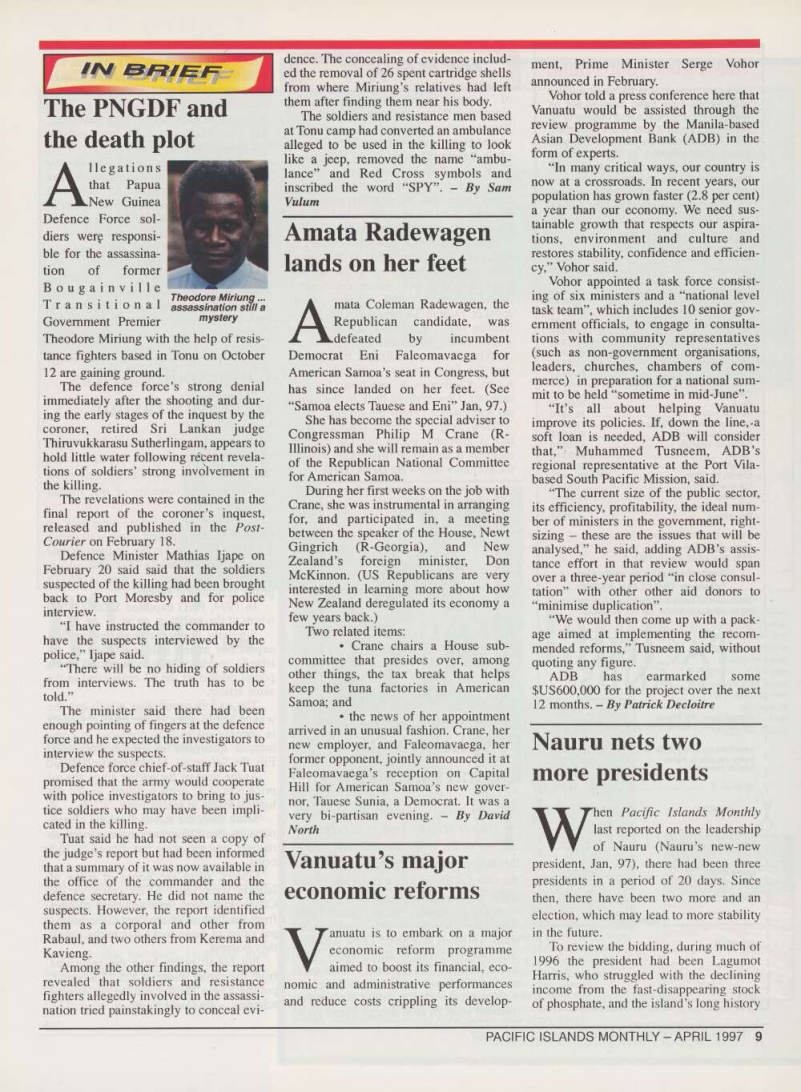
that Papua New Guinea Defence Force sol diers were responsi ble for the assassina tion of former Bougainville Transitional Government Premier
Theodore Miriung with the help of resis tance fighters based in Tonu on October
12 are gaining ground.
The defence force’s strong denial immediately after the shooting and dur ing the early stages of the inquest by the coroner, retired Sri Lankan judge Thiruvukkarasu Sutherlingam, appears to hold little water following recent revela tions of soldiers’ strong involvement in
the killing.
The revelations were contained in the final report of the coroner’s inquest, released and published in the Post- Courier on February 18.
Defence Minister Mathias Ijape on February 20 said said that the soldiers suspected of the killing had been brought back to Port Moresby and for police interview.
“I have instructed the commander to have the suspects interviewed by the
police,” Ijape said.
“There will be no hiding of soldiers from interviews. The truth has to be told.”
The minister said there had been enough pointing of fingers at the defence force and he expected the investigators to interview the suspects.
Defence force chief-of-staff Jack Tuat promised that the army would cooperate with police investigators to bring to jus tice soldiers who may have been impli cated in the killing.
Tuat said he had not seen a copy of the judge’s report but had been informed that a summary of it was now available in the office of the commander and the defence secretary. He did not name the suspects. However, the report identified them as a corporal and other from Rabaul, and two others from Kerema and
Kavieng.
Among the other findings, the report revealed that soldiers and resistance fighters allegedly involved in the assassi nation tried painstakingly to conceal evi
dence. The concealing of evidence includ ed the removal of 26 spent cartridge shells from where Miriung’s relatives had left them after finding them near his body.
The soldiers and resistance men based at Tonu camp had converted an ambulance alleged to be used in the killing to look like a jeep, removed the name “ambu lance” and Red Cross symbols and
inscribed the word “SPY”.
By Sam
Vulum
Theodore Miriung... assassination still a mystery
Amata Radewagen
lands on her feet
Amata Coleman Radewagen, the
Republican candidate, was defeated by incumbent Democrat Eni Faleomavaega for American Samoa’s seat in Congress, but has since landed on her feet. (See “Samoa elects Tauese and Eni” Jan, 97.) She has become the special adviser to Congressman Philip M Crane (R- Illinois) and she will remain as a member of the Republican National Committee for American Samoa.
During her first weeks on the job with Crane, she was instrumental in arranging for, and participated in, a meeting between the speaker of the House, Newt
Gingrich (R-Georgia), and New
Zealand’s foreign minister, Don McKinnon. (US Republicans are very interested in learning more about how New Zealand deregulated its economy a few years back.) Two related items: • Crane chairs a House sub committee that presides over, among other things, the tax break that helps keep the tuna factories in American Samoa; and • the news of her appointment arrived in an unusual fashion. Crane, her new employer, and Faleomavaega, her former opponent, jointly announced it at
Faleomavaega’s reception on Capital
Hill for American Samoa’s new gover nor, Tauese Sunia, a Democrat. It was a
very bi-partisan evening.
By David
North
Vanuatu’s major
economic reforms
Vanuatu is to embark on a major economic reform programme aimed to boost its financial, eco nomic and administrative performances and reduce costs crippling its develop
ment, Prime Minister Serge Vohor announced in February.
Vohor told a press conference here that Vanuatu would be assisted through the review programme by the Manila-based Asian Development Bank (ADB) in the form of experts.
“In many critical ways, our country is now at a crossroads. In recent years, our population has grown faster (2.8 per cent) a year than our economy. We need sus tainable growth that respects our aspira tions, environment and culture and restores stability, confidence and efficien cy,” Vohor said.
Vohor appointed a task force consist ing of six ministers and a “national level task team”, which includes 10 senior gov ernment officials, to engage in consulta tions with community representatives (such as non-government organisations, leaders, churches, chambers of com merce) in preparation for a national sum mit to be held “sometime in mid-June”.
“It’s all about helping Vanuatu improve its policies. If, down the line,-a soft loan is needed, ADB will consider that,” Muhammed Tusneem, ADB’s regional representative at the Port Vila based South Pacific Mission, said.
“The current size of the public sector, its efficiency, profitability, the ideal num ber of ministers in the government, right sizing - these are the issues that will be analysed,” he said, adding ADB’s assis tance effort in that review would span over a three-year period “in close consul tation” with other other aid donors to
“minimise duplication”.
“We would then come up with a pack age aimed at implementing the recom mended reforms,” Tusneem said, without quoting any figure.
ADB has earmarked some SUS6OO,OOO for the project over the next
12 months.
By Patrick Decloitre
more presidents
Nauru nets two more presidents
When Pacific Islands Monthly last reported on the leadership of Nauru (Nauru’s new-new president, Jan, 97), there had been three presidents in a period of 20 days. Since then, there have been two more and an election, which may lead to more stability in the future.
To review the bidding, during much of 1996 the president had been Lagumot Harris, who struggled with the declining income from the fast-disappearing stock of phosphate, and the island’s long history
of sloppy fiscal management. On November 7, the narrowly divided par liament (which has only 18 members) ousted Harris in favour of a former pres ident, Bernard Dowiyogo; on November 26, Kennan Adeang, a reformer, replaced Dowiyogo but, in turn, lost a no-confi dence vote and an interim president, Reuben Kun, was named while an Island-wide election took place.
The election was held on February 8 and everyone mentioned in the prior paragraph was re-elected to the parlia ment. But there were some newcomers, including replacements for the sitting
speaker (Maein Deireragea) and Ruby
Dediya (an Adeang ally and the only woman in the earlier house).
When the dust settled, a fifth presi dent (in four months) emerged; he is Kinza Clodumar, a one-time finance minister. Dowiyogo is back in the cabi net and Adeang is now the speaker.
How long the current coalition will last is anyone’s guess, but the current majority is said to be firmer than any of
the previous ones
By David North
Earhart mystery
PIM helps with Earhart mystery
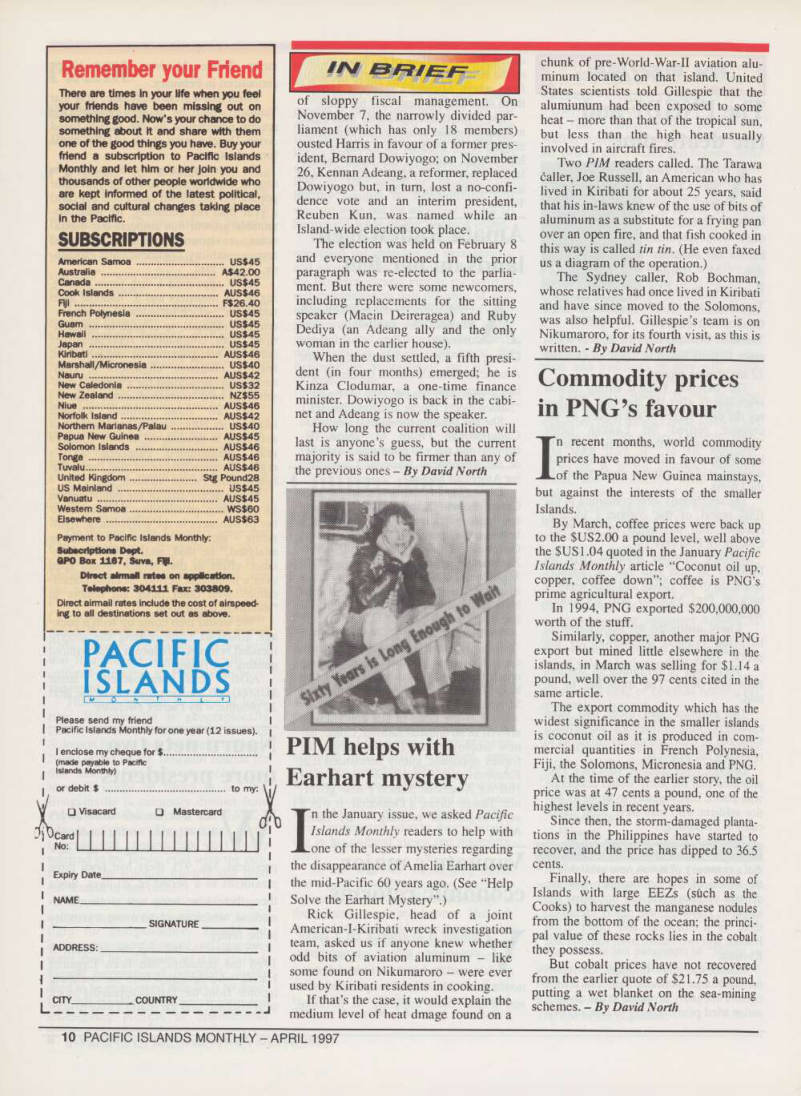
In the January issue, we asked Pacific Islands Monthly readers to help with one of the lesser mysteries regarding the disappearance of Amelia Earhart over the mid-Pacific 60 years ago. (See “Help Solve the Earhart Mystery”.) Rick Gillespie, head of a joint American-I-Kiribati wreck investigation team, asked us if anyone knew whether odd bits of aviation aluminum - like some found on Nikumaroro - were ever used by Kiribati residents in cooking.
If that’s the case, it would explain the medium level of heat dmage found on a
chunk of pre-World-War-II aviation alu minum located on that island. United States scientists told Gillespie that the alumiunum had been exposed to some heat - more than that of the tropical sun, but less than the high heat usually involved in aircraft fires.
Two PIM readers called. The Tarawa caller, Joe Russell, an American who has lived in Kiribati for about 25 years, said that his in-laws knew of the use of bits of aluminum as a substitute for a frying pan over an open fire, and that fish cooked in this way is called tin tin. (He even faxed us a diagram of the operation.) The Sydney caller, Rob Bochman, whose relatives had once lived in Kiribati and have since moved to the Solomons, was also helpful. Gillespie’s team is on Nikumaroro, for its fourth visit, as this is
written.
By David North
Commodity prices
in PNG’s favour
In recent months, world commodity prices have moved in favour of some of the Papua New Guinea mainstays, but against the interests of the smaller Islands.
By March, coffee prices were back up to the SUS2.OO a pound level, well above the SUSI.O4 quoted in the January Pacific Islands Monthly article “Coconut oil up, copper, coffee down”; coffee is PNG’s prime agricultural export.
In 1994, PNG exported $200,000,000 worth of the stuff.
Similarly, copper, another major PNG export but mined little elsewhere in the islands, in March was selling for $1.14 a pound, well over the 97 cents cited in the same article.
The export commodity which has the widest significance in the smaller islands is coconut oil as it is produced in com mercial quantities in French Polynesia, Fiji, the Solomons, Micronesia and PNG.
At the time of the earlier story, the oil price was at 47 cents a pound, one of the highest levels in recent years.
Since then, the storm-damaged planta tions in the Philippines have started to recover, and the price has dipped to 36.5 cents.
Finally, there are hopes in some of Islands with large EEZs (such as the Cooks) to harvest the manganese nodules from the bottom of the ocean; the princi pal value of these rocks lies in the cobalt they possess.
But cobalt prices have not recovered from the earlier quote of $21.75 a pound, putting a wet blanket on the sea-mining
schemes.
By David North
Advertisements & other items, p. 10 (1 item)
Pacific
Remember your Friend
There are times in your life when you feel your friends have been missing out on something good. Now's your chance to do something about It and share with them one of the good things you have. Buy your friend a subscription to Pacific Islands Monthly and let him or her Join you and thousands of other people worldwide who are kept informed of the latest political, social and cultural changes taking place in the Pacific.
SUBSCRIPTIONS
American Samoa US$45 Australia A 542.00 Canada US$45 Cook Islands AUSS46
FIJI F 526.40
French Polynesia US$45 Guam US$45 Hawaii US$45 Japan US$45 Kiribati AUSS46 Marshall/Micronesia US$4O Nauru AUSS42 New Caledonia US$32 New Zealand NZ$55 Niue AUSS46 Norfolk Island AUSS42 Northern Marianas/Palau US$4O Papua New Guinea AUSS4S Solomon Islands AUSS46 Tonga AUSS46 Tuvalu AUSS46 United Kingdom Stg Pound2B US Mainland US$45 Vanuatu AUSS4S Western Samoa WS$6O Elsewhere AUSS63 Payment to Pacific Islands Monthly: Subscriptions Dept QPO Box 1167, Suva. F*.
Direct airmail rates on application.
Telephone: 304111 Fax: 303809.
Direct airmail rates include the cost of airspeeding to all destinations set out as above.
PACIFIC
ISLANDS
Please send my friend Pacific Islands Monthly for one year (12 issues).
I enclose my cheque for $ (made payable to Pacific Islands Monthly) or debit $ to my: □ Visacard □ Mastercard JCard No: Expiry Date.
NAME.
SIGNATURE.
ADDRESS:.
CITY.
.COUNTRY.
I
Special Report
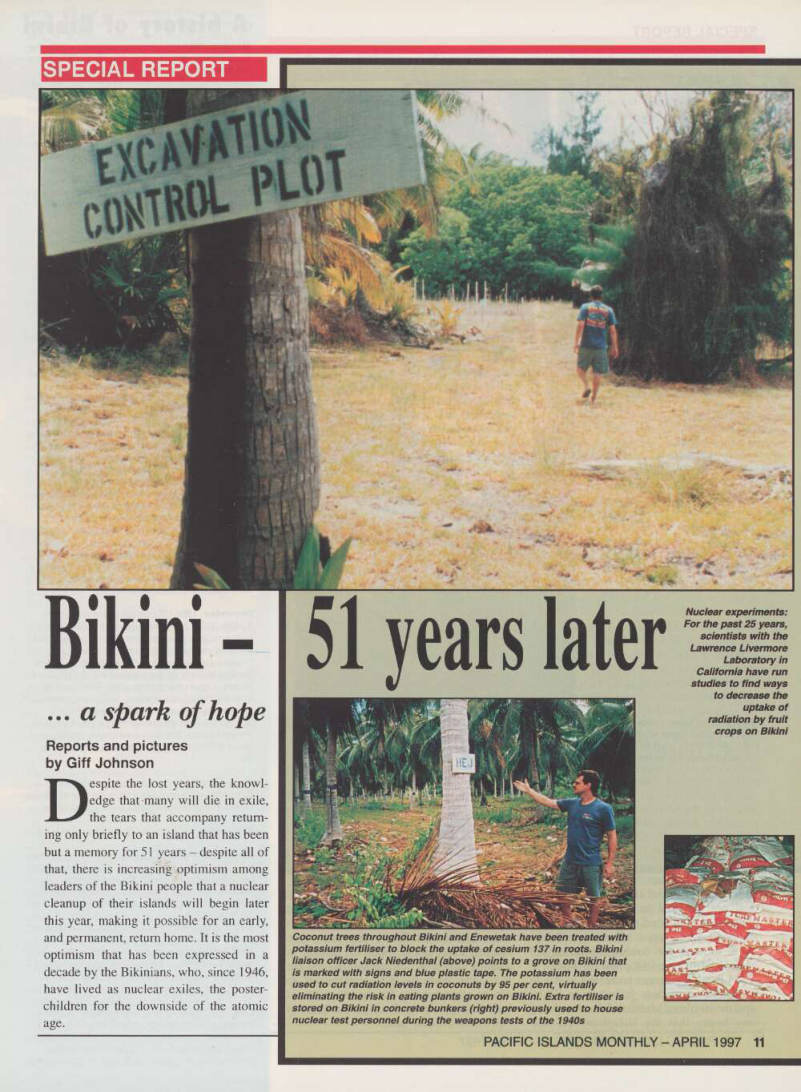
Nuclear experiments: For the past 25 years, scientists with the Lawrence Livermore Laboratory in California have run studies to find ways to decrease the uptake of radiation by fruit crops on Bikini
Bikini -
...a spark of hope
Reports and pictures
by Gift Johnson Despite the lost years, the knowl edge that many will die in exile, the tears that accompany return ing only briefly to an island that has been but a memory for 51 years - despite all of that, there is increasing optimism among leaders of the Bikini people that a nuclear cleanup of their islands will begin later this year, making it possible for an early, and permanent, return home. It is the most optimism that has been expressed in a decade by the Bikinians, who, since 1946, have lived as nuclear exiles, the poster children for the downside of the atomic age.
51 years later
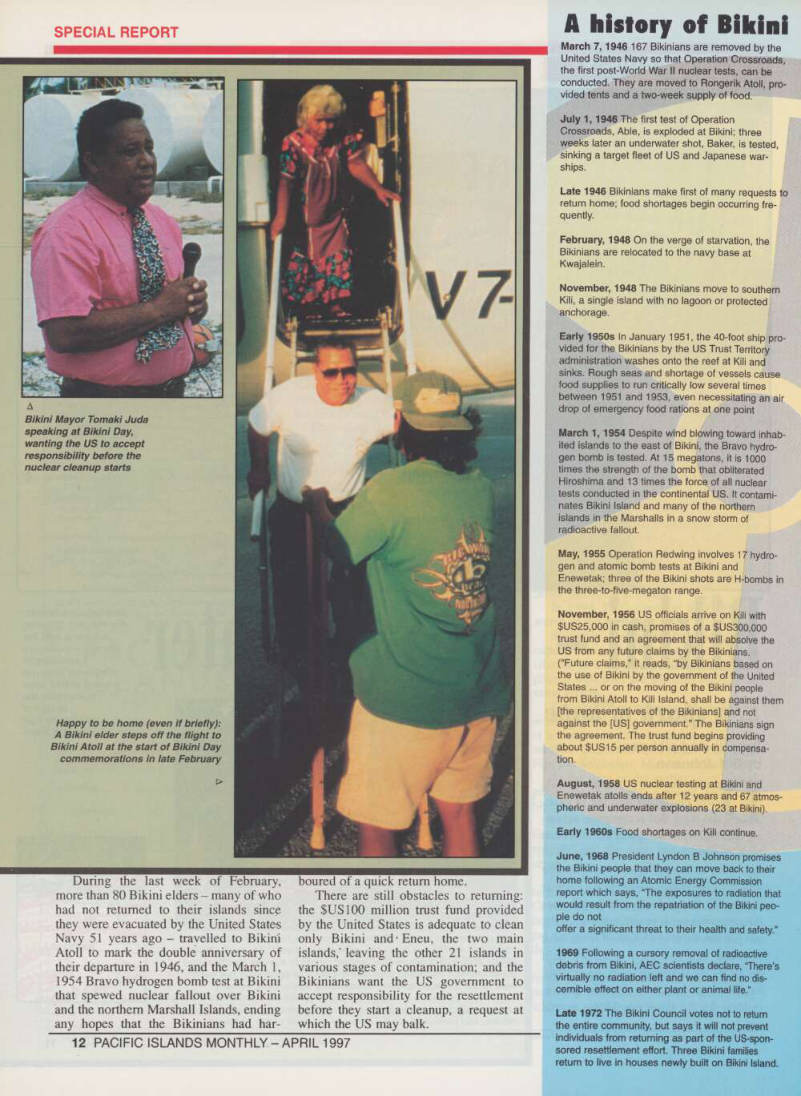
Coconut trees throughout Bikini and Enewetak have been treated with potassium fertiliser to block the uptake of cesium 137 in roots. Bikini liaison officer Jack Niedenthal (above) points to a grove on Bikini that is marked with signs and blue plastic tape. The potassium has been used to cut radiation levels in coconuts by 95 per cent, virtually eliminating the risk in eating plants grown on Bikini. Extra fertiliser is stored on Bikini in concrete bunkers (right) previously used to house nuclear test personnel during the weapons tests of the 1940s
During the last week of February, more than 80 Bikini elders - many of who had not returned to their islands since they were evacuated by the United States Navy 51 years ago - travelled to Bikini Atoll to mark the double anniversary of their departure in 1946, and the March 1, 1954 Bravo hydrogen bomb test at Bikini that spewed nuclear fallout over Bikini and the northern Marshall Islands, ending any hopes that the Bikinians had har
boured of a quick return home.
There are still obstacles to returning: the SUSIOO million trust fund provided by the United States is adequate to clean only Bikini and 1 Eneu, the two main islands,' leaving the other 21 islands in various stages of contamination; and the Bikinians want the US government to accept responsibility for the resettlement before they start a cleanup, a request at which the US may balk.
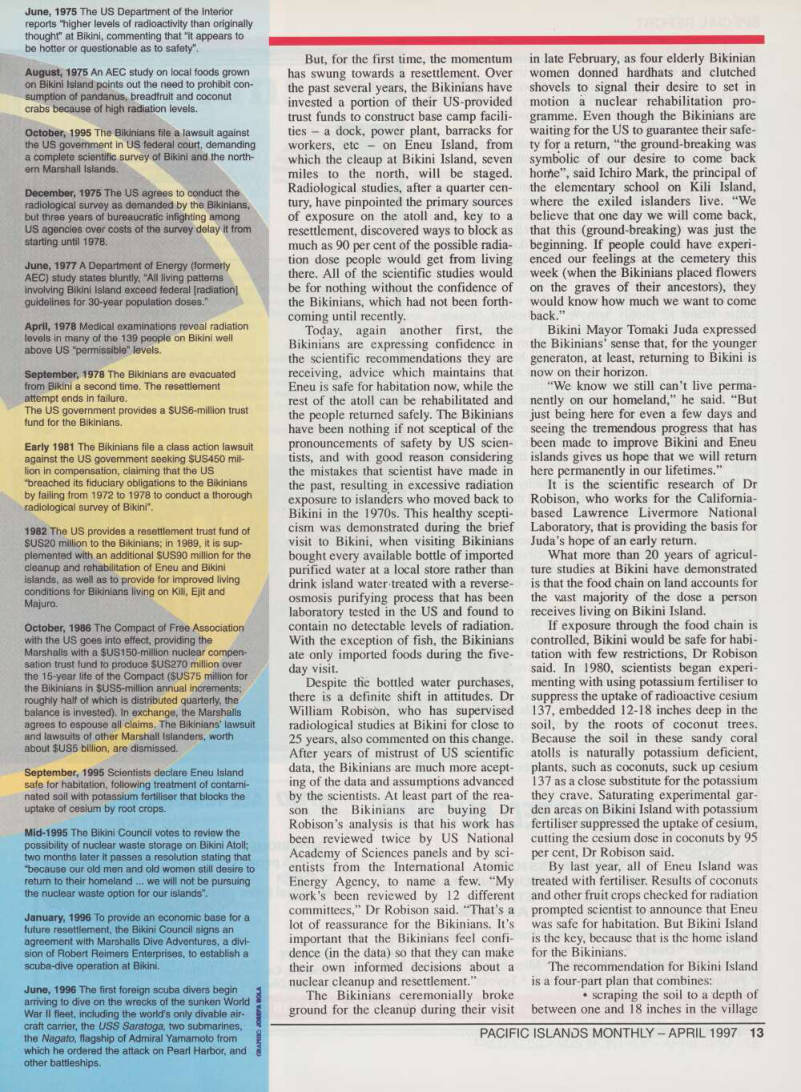
Bikini Mayor Tomaki Juda speaking at Bikini Day, wanting the US to accept responsibility before the nuclear cleanup starts
Happy to be home (even if briefly): A Bikini eider steps off the flight to Bikini Atoll at the start of Bikini Day commemorations in late February
A history of Bikini

March 7,1946 167 Bikinians are removed by the United States Navy so that Operation Crossroads, the first post-World War II nuclear tests, can be conducted. They are moved to Rongerik Atoll, pro vided tents and a two-week supply of food.
July 1,1946 The first test of Operation Crossroads, Able, is exploded at Bikini; three weeks later an underwater shot, Baker, is tested, sinking a target fleet of US and Japanese war ships.
Late 1946 Bikinians make first of many requests to return home; food shortages begin occurring fre quently.
February, 1948 On the verge of starvation, the Bikinians are relocated to the navy base at Kwajalein.
November, 1948 The Bikinians move to southern Kili, a single island with no lagoon or protected anchorage.
Early 1950 s In January 1951, the 40-foot ship pro vided for the Bikinians by the US Trust Territory administration washes onto the reef at Kili and sinks. Rough seas and shortage of vessels cause food supplies to run critically low several times between 1951 and 1953, even necessitating an air drop of emergency food rations at one point March 1,1954 Despite wind blowing toward inhab ited islands to the east of Bikini, the Bravo hydro gen bomb is tested. At 15 megatons, it is 1000 times the strength of the bomb that obliterated Hiroshima and 13 times the force of all nuclear tests conducted in the continental US. It contami nates Bikini Island and many of the northern islands in the Marshalls in a snow storm of radioactive fallout.
May, 1955 Operation Redwing involves 17 hydro gen and atomic bomb tests at Bikini and Enewetak; three of the Bikini shots are H-bombs in the three-to-five-megaton range.
November, 1956 US officials arrive on Kili with $U525,000 in cash, promises of a SUS3OO,OOO trust fund and an agreement that will absolve the US from any future claims by the Bikinians. (“Future claims,” it reads, “by Bikinians based on the use of Bikini by the government of the United States ... or on the moving of the Bikini people from Bikini Atoll to Kili Island, shall be against them [the representatives of the Bikinians] and not against the [US] government.” The Bikinians sign the agreement. The trust fund begins providing about SUSIS per person annually in compensa tion.
August, 1958 US nuclear testing at Bikini and Enewetak atolls ends after 12 years and 67 atmos pheric and underwater explosions (23 at Bikini).
Early 1960 s Food shortages on Kili continue.
June, 1968 President Lyndon B Johnson promises the Bikini people that they can move back to their home following an Atomic Energy Commission report which says, “The exposures to radiation that would result from the repatriation of the Bikini peo ple do not offer a significant threat to their health and safety.” 1969 Following a cursory removal of radioactive debris from Bikini, AEC scientists declare, “There’s virtually no radiation left and we can find no dis cernible effect on either plant or animal life.”
Late 1972 The Bikini Council votes not to return the entire community, but says it will not prevent individuals from returning as part of the US-spon sored resettlement effort. Three Bikini families return to live in houses newly built on Bikini Island.
June, 1975 The US Department of the Interior reports “higher levels of radioactivity than originally thought” at Bikini, commenting that “it appears to be hotter or questionable as to safety”.
August, 1975 An AEG study on local foods grown on Bikini Island points out the need to prohibit con sumption of pandanus, breadfruit and coconut crabs because of high radiation levels.
October, 1995 The Bikinians file a lawsuit against the US government in US federal court, demanding a complete scientific survey of Bikini and the north ern Marshall Islands.
December, 1975 The US agrees to conduct the radiological survey as demanded by the Bikinians, but three years of bureaucratic infighting among US agencies over costs of the survey delay it from starting until 1978.
June, 1977 A Department of Energy (formerly AEG) study states bluntly, “All living patterns involving Bikini Island exceed federal [radiation] guidelines for 30-year population doses.”
April, 1978 Medical examinations reveal radiation levels in many of the 139 people on Bikini well above US “permissible” levels.
September, 1978 The Bikinians are evacuated from Bikini a second time. The resettlement attempt ends in failure.
The US government provides a SUS6-million trust fund for the Bikinians.
Early 1981 The Bikinians file a class action lawsuit against the US government seeking SUS4SO mil lion in compensation, claiming that the US “breached its fiduciary obligations to the Bikinians by failing from 1972 to 1978 to conduct a thorough radiological survey of Bikini”. 1982 The US provides a resettlement trust fund of SUS2O million to the Bikinians; in 1989, it is sup plemented with an additional SUS9O million for the cleanup and rehabilitation of Eneu and Bikini islands, as well as to provide for improved living conditions for Bikinians living on Kili, Ejit and Majuro.
October, 1986 The Compact of Free Association with the US goes into effect, providing the Marshalls with a SUSISO-million nuclear compen sation trust fund to produce SUS27O million over the 15-year life of the Compact (SUS7S million for the Bikinians in SUSS-million annual increments; roughly half of which is distributed quarterly, the balance is invested). In exchange, the Marshalls agrees to espouse all claims. The Bikinians’ lawsuit and lawsuits of other Marshall Islanders, worth about SUSS billion, are dismissed.
September, 1995 Scientists declare Eneu Island safe for habitation, following treatment of contami nated soil with potassium fertiliser that blocks the uptake of cesium by root crops.
Mid-1995 The Bikini Council votes to review the possibility of nuclear waste storage on Bikini Atoll; two months later it passes a resolution stating that “because our old men and old women still desire to return to their homeland ... we will not be pursuing the nuclear waste option for our islands”.
January, 1996 To provide an economic base for a future resettlement, the Bikini Council signs an agreement with Marshalls Dive Adventures, a divi sion of Robert Reimers Enterprises, to establish a scuba-dive operation at Bikini.
June, 1996 The first foreign scuba divers begin a arriving to dive on the wrecks of the sunken World War II fleet, including the world’s only divable air- craft carrier, the USS Saratoga, two submarines, ? the Nagato, flagship of Admiral Yamamoto from which he ordered the attack on Pearl Harbor, and % other battleships.
But, for the first time, the momentum has swung towards a resettlement. Over the past several years, the Bikinians have invested a portion of their US-provided trust funds to construct base camp facili ties - a dock, power plant, barracks for workers, etc - on Eneu Island, from which the cleaup at Bikini Island, seven miles to the north, will be staged.
Radiological studies, after a quarter cen tury, have pinpointed the primary sources of exposure on the atoll and, key to a resettlement, discovered ways to block as much as 90 per cent of the possible radia tion dose people would get from living there. All of the scientific studies would be for nothing without the confidence of the Bikinians, which had not been forth
coming until recently.
Today, again another first, the Bikinians are expressing confidence in the scientific recommendations they are receiving, advice which maintains that Eneu is safe for habitation now, while the rest of the atoll can be rehabilitated and the people returned safely. The Bikinians have been nothing if not sceptical of the pronouncements of safety by US scien tists, and with good reason considering the mistakes that scientist have made in the past, resulting in excessive radiation exposure to islanders who moved back to Bikini in the 19705. This healthy scepti cism was demonstrated during the brief visit to Bikini, when visiting Bikinians bought every available bottle of imported purified water at a local store rather than drink island water treated with a reverse osmosis purifying process that has been laboratory tested in the US and found to contain no detectable levels of radiation.
With the exception of fish, the Bikinians ate only imported foods during the five day visit.
Despite the bottled water purchases, there is a definite shift in attitudes. Dr William Robison, who has supervised radiological studies at Bikini for close to 25 years, also commented on this change.
After years of mistrust of US scientific data, the Bikinians are much more acept ing of the data and assumptions advanced by the scientists. At least part of the rea son the Bikinians are buying Dr Robison’s analysis is that his work has been reviewed twice by US National Academy of Sciences panels and by sci entists from the International Atomic Energy Agency, to name a few. “My work’s been reviewed by 12 different committees,” Dr Robison said. “That’s a lot of reassurance for the Bikinians. It’s important that the Bikinians feel confi dence (in the data) so that they can make their own informed decisions about a nuclear cleanup and resettlement.”
The Bikinians ceremonially broke ground for the cleanup during their visit
in late February, as four elderly Bikinian women donned hardhats and clutched shovels to signal their desire to set in motion a nuclear rehabilitation pro gramme. Even though the Bikinians are waiting for the US to guarantee their safe ty for a return, “the ground-breaking was symbolic of our desire to come back hon'ie”, said Ichiro Mark, the principal of the elementary school on Kill Island, where the exiled islanders live. “We believe that one day we will come back, that this (ground-breaking) was just the
beginning. If people could have experi
enced our feelings at the cemetery this week (when the Bikinians placed flowers on the graves of their ancestors), they would know how much we want to come back.”
Bikini Mayor Tomaki Juda expressed the Bikinians’ sense that, fpr the younger generaton, at least, returning to Bikini is now on their horizon.
“We know we still can’t live perma nently on our homeland,” he said. “But just being here for even a few days and seeing the tremendous progress that has been made to improve Bikini and Eneu islands gives us hope that we will return here permanently in our lifetimes.”
It is the scientific research of Dr Robison, who works for the California based Lawrence Livermore National Laboratory, that is providing the basis for Juda’s hope of an early return.
What more than 20 years of agricul ture studies at Bikini have demonstrated is that the food chain on land accounts for the vast majority of the dose a person receives living on Bikini Island.
If exposure through the food chain is controlled, Bikini would be safe for habi tation with few restrictions, Dr Robison said. In 1980, scientists began experi menting with using potassium fertiliser to suppress the uptake of radioactive cesium 137, embedded 12-18 inches deep in the soil, by the roots of coconut trees.
Because the soil in these sandy coral atolls is naturally potassium deficient, plants, such as coconuts, suck up cesium 137 as a close substitute for the potassium they crave. Saturating experimental gar den areas on Bikini Island with potassium fertiliser suppressed the uptake of cesium, cutting the cesium dose in coconuts by 95 per cent. Dr Robison said.
By last year, all of Eneu Island was treated with fertiliser. Results of coconuts and other fruit crops checked for radiation prompted scientist to announce that Eneu was safe for habitation. But Bikini Island is the key, because that is the home island for the Bikinians.
The recommendation for Bikini Island is a four-part plan that combines: • scraping the soil to a depth of between one and 18 inches in the village
area to ensure that radioactive material is removed from the area where people will spend the bulk of their time; • blanketing the village with a two-inch layer of small coral rocks, as is customary in this country but which will have the added impact of acting as a shield against any possible resid ual contamination that exists; • dousing the rest of the island with potassium fertilis er to block cesium uptake by fruit crops; and • continuing US Department of Agriculture food sup plements to ensure that the Bikinians continue a diet heavy on imported foods, at least at the outset of the resettlement.
Dr Robison said that, with this remedial action, Bikini’s background radiation dose would be well within acceptable international limits. “A person living at Bikini (under these cir cumstances) would receive about 280 millirems annually,” Dr Robison said. “This is well within the range of normal back ground radiation levels.”
Bikini leaders have for years said they wanted to scrape the entire island to simply remove the dreaded “poison”, as islanders call the radioactive materials embedded in the soil.
However, while they haven’t announced any shift in their desire for ain extensive scrape, this may change behind the weight of recommendations by scientists. An lAEA report on Bikini issued late last year declared that scraping all of Bikini, aside from being astronomically expensive, would be an ecological disaster because it would remove topsoil that has taken centuries to develop on this coral island. And, the lAEA said, such a scrape would be unnecessary because the potassium fertiliser option reduces the radioactive content of fruit plants by 95 per cent.
Dr Robison, who visits Bikini repeatedly each year to follow up on ongoing scientific experiments, said that “when the reme dial work starts at Bikini, we’ll be there to look at the food crops and make sure that what we said is what is in fact happening”.
“We’ll monitor the village after it is scraped to make sure there are no ‘hot spots’ of radiation. Scientific support for the cleanup is very important, it’s a key part of any resettlement pro gramme. The people need to know what’s happening and have the reassurances that it is working.”
But a decision on cleanup methods won’t be made until after Bikini leaders meet with top American officials in Washington, DC, probably in early April. Mayor Juda is adamant that the highest levels of the US government must endorse the planned nuclear cleanup, not just scientists, to avoid a repeat of the aborted resettlement attempt in the 19705. “We cannot start the cleanup until high US officials give it to us in writing that they will stand behind us if we come back,” Juda said. The Bikinians want the US government to accept any liability if the resettle ment goes awry, and Bikinians are exposed to hazardous levels of radiation. “We’re ready to start,” Juda said. “But we need something in writing from the United States first.” ■
(Above): Flags - US, Bikinian and Marshall Islands - mark Bikini Day. The Bikini flag has 23 stars for the islands in the atoll; three stars in the stripes representing the islands vapourised by nuclear tests; and two for the islands of Kili and Ejit, where they live now
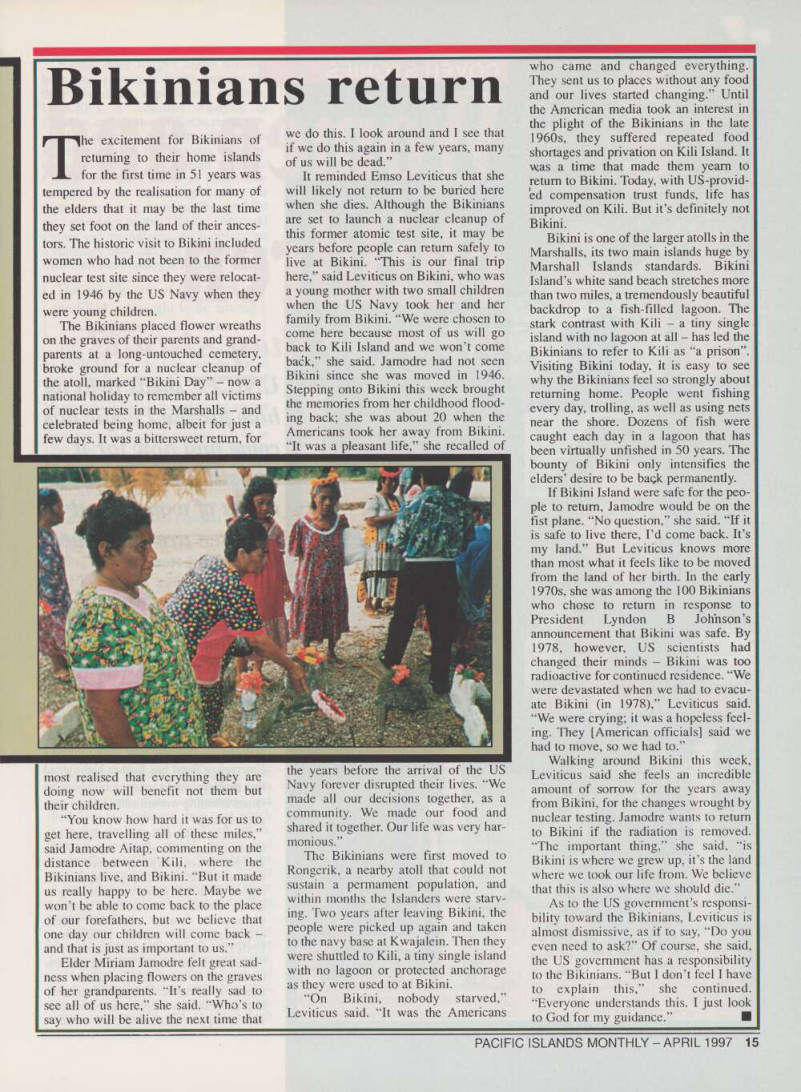
(Bottom left): Elder Bikini women break ground on Bikini Island to signal the Bikinians’ desire to launch a nuclear cleanup and resettlement of the atoll. Many of the women who returned in late February for the ceremony had not been to Bikini since they were relocated as young women 51 years ago. (Bottom right): Bikini elders lay flowers and wreaths on the graves of their ancestors on Bikini Island
Advertisements & other items, p. 14 (1 item)
Imported Engines
BLAIRS
NEW
TRANSMISSIONS
PARTS - SECONDHAND PARTS
DIESELS - PETROL
1000 UNITS AVAILABLE
* Bedford * BMW * Cummins * Daihatsu * Detroit * Ford * Gardner * Duetz * Hino * Isuzu * Iveco * Komatsu * Kubota * Leyland * Mazda * Mercedes * Mitsubishi * Nissan * Perkins * Peugeot * Scania * Main * Suzuki * Toyota * Volvo * Yanmar
all terrain vehicles
6X6 - BXB
AMPHIBIOUS
Carries 6 persons
or 454kgs
All Wheel Drive
USED BY
Foresters, Contractors, Fishermen, Tourist Operators, Councils, Disabled persons P.O Box 14 Geraldine, New Zealand. Phone: 643-6938122. Fax: 643-6938120
Bikinians return
The excitement for Bikinians of returning to their home islands for the first time in 51 years was tempered by the realisation for many of the elders that it may be the last time they set foot on the land of their ances tors. The historic visit to Bikini included women who had not been to the former nuclear test site since they were relocat ed in 1946 by the US Navy when they were young children.
The Bikinians placed flower wreaths on the graves of their parents and grand parents at a long-untouched cemetery, broke ground for a nuclear cleanup of the atoll, marked “Bikini Day” - now a national holiday to remember all victims of nuclear tests in the Marshalls - and celebrated being home, albeit for just a few days. It was a bittersweet return, for
most realised that everything they are doing now will benefit not them but their children.
“You know how hard it was for us to get here, travelling all of these miles,” said Jamodre Aitap, commenting on the distance between Kili, where the Bikinians live, and Bikini. “But it made us really happy to be here. Maybe we won’t be able to come back to the place of our forefathers, but we believe that one day our children will come back and that is just as important to us.”
Elder Miriam Jamodre felt great sad ness when placing flowers on the graves of her grandparents. “It’s really sad to see all of us here,” she said. “Who’s to say who will be alive the next time that
we do this. I look around and I see that if we do this again in a few years, many of us will be dead.”
It reminded Emso Leviticus that she will likely not return to be buried here when she dies. Although the Bikinians are set to launch a nuclear cleanup of this former atomic test site, it may be years before people can return safely to live at Bikini. “This is our final trip here,” said Leviticus on Bikini, who was a young mother with two small children when the US Navy took her and her family from Bikini. “We were chosen to come here because most of us will go back to Kili Island and we won’t come back,” she said. Jamodre had not seen Bikini since she was moved in 1946.
Stepping onto Bikini this week brought the memories from her childhood flood ing back; she was about 20 when the Americans took her away from Bikini.
“It was a pleasant life,” she recalled of
the years before the arrival of the US Navy forever disrupted their lives. “We made all our decisions together, as a community. We made our food and shared it together. Our life was very har monious.”
The Bikinians were first moved to Rongerik, a nearby atoll that could not sustain a permament population, and within months the Islanders were starv ing. Two years after leaving Bikini, the people were picked up again and taken to the navy base at Kwajalein. Then they were shuttled to Kili, a tiny single island with no lagoon or protected anchorage as they were used to at Bikini.
“On Bikini, nobody starved,”
Leviticus said. “It was the Americans
who came and changed everything.
They sent us to places without any food and our lives started changing.” Until the American media took an interest in the plight of the Bikinians in the late 19605, they suffered repeated food shortages and privation on Kili Island. It was a time that made them yearn to return to Bikini. Today, with US-provid ed compensation trust funds, life has improved on Kili. But it’s definitely not Bikini.
Bikini is one of the larger atolls in the Marshalls, its two main islands huge by Marshall Islands standards. Bikini Island’s white sand beach stretches more than two miles, a tremendously beautiful backdrop to a fish-filled lagoon. The stark contrast with Kili - a tiny single island with no lagoon at all - has led the Bikinians to refer to Kili as “a prison”.
Visiting Bikini today, it is easy to see why the Bikinians feel so strongly about returning home. People went fishing every day, trolling, as well as using nets near the shore. Dozens of fish were caught each day in a lagoon that has been virtually unfished in 50 years. The bounty of Bikini only intensifies the elders’ desire to be baqk permanently.
If Bikini Island were safe for the peo ple to return, Jamodre would be on the fist plane. “No question,” she said. “If it is safe to live there, I’d come back. It’s my land.” But Leviticus knows more than most what it feels like to be moved from the land of her birth. In the early 19705, she was among the 100 Bikinians who chose to return in response to President Lyndon B Johnson’s announcement that Bikini was safe. By 1978, however, US scientists had changed their minds - Bikini was too radioactive for continued residence. “We were devastated when we had to evacu ate Bikini (in 1978),” Leviticus said.
“We were crying; it was a hopeless feel ing. They [American officials] said we had to move, so we had to.”
Walking around Bikini this week, Leviticus said she feels an incredible amount of sorrow for the years away from Bikini, for the changes wrought by nuclear testing. Jamodre wants to return to Bikini if the radiation is removed.
“The important thing,” she said, “is Bikini is where we grew up, it’s the land where we took our life from. We believe that this is also where we sholild die.”
As to the US government’s responsi bility toward the Bikinians, Leviticus is almost dismissive, as if to say, “Do you even need to ask?” Of course, she said, the US government has a responsibility to the Bikinians. “But I don’t feel I have to explain this,” she continued.
“Everyone understands this. I just look to God for my guidance.” ■
Women and

Cover Stories
childern Where do they stand?
UNICEF sheds light on how far die Pacific has come and how far it has still to go as far as
rights of women and
children are concerned
By Bernadette Hussein
As countries develop and move forward, the attitudes of people change; they leave behind the traditional and newer cultural norms are established. However, change is often met by some resistance, proving to be the biggest obstacle to progress or develop ment in the region. A situation analysis of women and children in several Pacific Island countries conducted by the United Nations International Children’s Emergency Fund has further highlighted this problem. And turning a blind eye to issues affecting women and children does not help any.
For example, there is no official data collected on child abuse in Tonga, where the issue is not seen as a problem “due to the role of the extended family system”, reports UNICEF. However, according to crime statistics, there has been an increase in female offenders, whose offences include cruelty to children.
UNICEF suspects that child abuse is a hidden problem on the basis of the few cases which have been reported and anecdotal evidence. Tonga has no wel fare programmes in place to either pre vent or support victims of child abuse.
Neither does Tonga’s health ministry have any appropriate health services for the disabled, especially children, UNICEF’s A Situation Analysis of Children and Women in Tonga reports.
Most of Tonga’s welfare work seems to be undertaken by religious organisa tions, including the Roman Catholic Church and the Church of Latter Day Saints, which run programmes for orphans and poor families. The disabled are catered for by the ’Ofa Tui ’ Amanaki Centre and the Aalonga. Both operate on a voluntary basis and rely on donations or their own fund-raising activities.
The suicide rate of teenagers in the FSM is thought to be among the highest in the world.
One of the more startling revelations by UNICEF was the high suicide rate in some island countries. The suicide rate of teenagers in the Federated States of Micronesia (FSM) is thought to be among the highest in the world. In 1989 alone there were 33 reported suicides and 61 in 1991 and 1992. The average suicide rate for FSM is calculated at about 20 per 100,000 persons (double the US rate), the UNICEF report states. The majority who commit suicides are young men (a shock ing 200 out of 100,000 persons) and rea sons given are predominantly anger (75- 80 per cent), with ‘shame’ and ‘family feuding’ (often related to familial incest) as secondary reasons, the report said.
The Marshall Islands also records a high suicide rate for teenage males. Of the 88 suicides between 1988 and 1994, 87 were committed by young men, the majority of whom were between 16 and 25 years of age, UNICEF stated.
The youth bureau at the ministry of social services conducts health promotion workshops and coordinates youth projects with local youth clubs and organisations, but there is an obvious need for more identity-building programmes and recre ational outlets for the country’s youth.
As the report highlights, the Marshallese youth are struggling with two crucial transitions - adolescence; and straddling two cultures, their own which is on the decline and American which, through television, music, videos and newspaper advertising, is becoming the most dominant for this generation. Adults in the Marshall Islands customarily adopt a passive attitude of non-involvement toward youth.
Attempts to get comments from the Marshall Islands embassy in Fiji and the Tongan government proved unsuccessful.
In Tonga, crime is on the increase and reasons given for this are unemployment, low income, limited family planning, abandoned mothers and children, high
school dropouts and domestic violence.
Domestic violence is not seen as an official problem in Tonga
But domestic violence is not seen as an official problem in Tonga either. “It is known that the number of cases reported is more than what is being officially noted,” UNICEF states. The number of cases increased from 20 in 1987-88 to more than 40 in 1989-90. The only ser vices available to victims are the police, hospital or informal services such as elders, church ministers or relatives.
As for Fiji, the report refers to it as having a subculture of violence. This sit uation is recognised by health and social welfare providers but is not well reflected in social statistics because the data is not well collected. In Fiji, it is generally con sidered appropriate for the male head of the family to discipline his wife and chil dren in any physical manner, UNICEF states.
Domestic violence appears to be increasing in Fiji, a problem that is diffi cult to measure because most cases go unreported. There are several reasons for domestic violence and they extend from alcohol abuse to social and material pres sures on families. But people are becom ing aware of the criminal nature of domestic violence and, with women becoming more conscious of their rights, more cases are now being recorded.
Police records show that 400 per cent of all murders committed in Fiji between 1992 and mid-1995 were domestic relat ed. Records also show that such murders are increasing each year with a 40 per cent rise each year since 1992.
In the Marshall Islands, alcohol is seen as a serious problem accounting for poor health and social problems as well as spouse and child abuse, which is quite common. The National Women’s Policy statement for the country observed that women from all age groups and econom ic strata and from both urban and rural areas told stories of injuries suffered at the hands of husbands or boyfriends.
While no study has been carried out to indicate the exact nature and extent of domestic violence, it is common knowl edge that a large number of women were subjected to physical violence in the home. On the issue of legal support, since 1990, more women have been filing suits in the high court to obtain child support from their husbands.
The report said that the high court had adopted'the stance of favouring women for child support. In cases of separation where couples were not formally married, the court has ruled that common law mar riage is tantamount to formal marriage.
The ruling has provided many women
with the legal status to obtain court orders requiring their former husbands to pro vide child support. Under Fiji law, the courts have powers to ensure that children are financed and maintained by their par ents, whether they live together or sepa rately. Fiji has agreements to enforce child maintenance court orders with sev eral countries, including Australia, New Zealand, Canada, the United Kingdom and some Pacific Island countries.
But, despite this, children are still not
benefitting. Although orders are given to
parents to pay up, very few do so.
According to the UNICEF report, magis trates were often reluctant to send default ers to prison as they would be less able to pay. But Fiji’s Department of Social Services denied the allegation, saying most defaulters ended up in prison. And, if they defaulted again, they were sent back to prison until they paid.
Also affecting island women is dis crimination in the workforce. There has been an increase in the number of women workers in Fiji working under conditions trade unions and welfare organisations
consider exploitative. However, despite
the increased number of working women, they comprise only 21 per cent of the workforce, mainly because many occupa tions are reserved for men. In Tonga, no woman has ever been appointed a cabinet minister. To date, there have only been three women representatives in the Legislative Assembly. Since women can not be nobles, no woman can represent the nobles in the Legislative Assembly.
As far as official records go, there has been no woman elected as a town or dis trict officer, states UNICEF.
“Women are getting educated, getting smarter and they recognise their rights - and want them.”
Decision-making and politics have tra ditionally been the role of men in Tongan society. But the director of the United Nations Development Fund (UNDP), Noeleen Heyzer, said this would eventu ally change. There were many countries around the world which were holding tightly on to its traditions and the place it gave to women but, over the years, they all gave in,” Heyzer said. “Women are getting educated, getting smarter and they recognise their rights - and want them.
When that happens, it will just be hard to stop,” she said.
The Pacific is not without hope. Most island governments are working on recti fying laws and conventions relating to women and children to help minimise and, hopefully, bring to an end - the lev els of abuse and disparity. The first step is always recognising that problems do exist and need redress.
Advertisements & other items, p. 16 (1 item)
16
sadadsadsadsa
Islands of example...
Niue, Tokelau, Tuvalu present an encouraging, if not perfect, picture
By Bernadette Hussein
Situation analysis reports, recently
released by UNICEF, on women and children in the Pacific, while showing that there is much room for improvement, have also demonstrated that there might still be a hint of paradise in the Pacific. The United Nations International Children’s Emergency Fund survey included Niue, Tokelau and Tuvalu, of which the reports paint a pic ture, which, though not perfect, is encour aging. The islands boast a high level of participation by women at various levels, high literacy rates and readily available family and village support.
In Tokelau, most children attend kindergarten at three years of age. At five and-a-half, they attend government schools. A hundred per cent of all children attend school, A Situation Analysis of Children and Women in Tokelau reported.
Most scholarship students attend schools in Western Samoa, Tonga and Niue, those qualifying for higher educa tion and training attend tertiary institu tions in Fiji and New Zealand.
In Tuvalu, primary education is com pulsory and free from Class One (age six) to Class Eight (age 13). Parents are required by law to send their children to school and attendance is closely moni tored by the school head office. Secondary education is compulsory at Forms Three and Four, but not free. All Tuvalu children are expected to attend secondary school until they are 15 years old.
The 1991 census puts Tuvalu’s overall
literacy rate at above 90 per cent. The downside, however, according to the report, is limited resources - the chil dren’s only source of reading material in the vernacular is the Bible.
“This, to a large degree, influences the their view of life at a very early stage,” the report states. “Islands do not have libraries where children and communities can get reading materials from. The lack of reading materials in English affects adversely the familiarity of children with the written English words.”
Niue’s adult literacy rates are at almost 100 per cent. Education has been compulsory and free for ages five to 14 since the 19505. However, males are more likely than females to proceed to tertiary studies; the figure for women has dropped slightly while that for males has increased.
In all three countries, the situation fac ing women is better than in some other Pacific Islands with larger populations.
For example, in Niue, women take their place in paid employment, politics and education, while, at the same time, maintaining their maternal roles.
Traditionally, they were seen as important contributors to the family’s income. They weeded plantations, cut copra, planted root crops, performed household chores and conformed to the unwritten beliefs and norms of a traditional society.
However, they did not participate in vil lage politics, which was the men’s domain.
This has changed over the years and today, women are the driving force behind village communities, churches and the family, UNICEF reports.
Women’s participation at national and local government levels is relatively high.
Niue’s one woman cabinet minister holds the portfolios of education, health, com munity affairs, tourism and the media.
“On occasions when the premier has been absent, this minister has acted as pre mier,” the report states.
There is at least one woman member in each of the village council elected posts. Women’s participation as senior officers in the administrative and legisla tive sectors is higher than men’s. And more women are employed in the clerical and service sectors than men.
Women play a significant role in agri cultural production. In the age group 45 to 54. four women to every man reportedly manage an agricultural unit.
Attempts are being made in Tokelau, to change the role of women from involv ing only traditional duties to including the social, cultural and economic develop
merit of the country. Tokelau is going
through major political changes and this
is going to have a major impact on women, the report says. Women do not play any direct part in politics and this is because members of the Fono are select ed from the matai or the head of the extended family group and it is unusual for a woman to head an extended family.
The future role of women in Tuvalu is presenting a dilemma brought on by the growing influence of the cash economy and other demands of a modem society.
Women are underrepresented in the wage sector, making up only 38 per cent of total paid employees. Due to lack of educa tional qualifications, women are outnum bered 2:1 in professional/technical and managerial positions. Instead, they are concentrated in lower-paid clerical jobs,
including public service grades.
Few women have occupied places in decision-making bodies, but in 1990 a woman for the first time a woman was appointed to the Public Service Commission.
The status of the youth in these coun tries is generally very good. In Niue, there have been no cases of sexually transmit ted diseases or AIDS reported. However, a national policy regarding AIDS/HIV/STD education was approved by the cabinet in 1993, specifically target ing Forms Five and Six students.
Youth in Tuvalu are treated as a very important sector in the overall develop ment of a nation. All islands in the coun try have their own youth groups which have their own programmes of activities, most of which revolve around social gath erings, gardening, picnics, Bible studies and sports activities.
A problem faced by the youth of Tuvalu is that development activities such as income-generating projects are rather limited and they tend to presume that their activities are mainly centred on recreation and the pursuit of spiritual ide
als. Despite limited youth development
programmes, many young adults keep themselves occupied with traditional skills learned when they were young, such as constructing local building struc
tures, weaving, cultivating, fishing and
other subsistence activities which con tribute to the general welfare of the fami ly. Health records show that no young person between the ages of 12 and 18 has ever been pregnant or contracted a sexu ally transmitted disease. The medical records at the health department indicate that the youngest person infected with an STD in the country was a 20-year-old.
Though life on the three islands may not be perfection, it is nearly paradise.
The only concern would be that the trends continue in a positive direction and not regress. ■
Advertisements & other items, p. 18 (1 item)
Antique Books, Maps &
ENGRAVINGS OF THE PACIFIC
Large stock of rare and out of print books on the islands of the Pacific.
Antique engraving & maps of most island groups from British & French voyagers to the Pacific 1773-1840, Write for free lists stating your areas of interest.
Efficient postal service with payment accepted by major credit cards.
COUN HINCHCUFFE
12 QUEEN’S STAITH MEWS.
YORK YOIIHH. U.K
Streets of no return
no return
Rising incidence of child
abuse and parental neglect
are seeing more and more children turn to a life on the streets in Western Samoa Text and photographs
by Chris Peteru
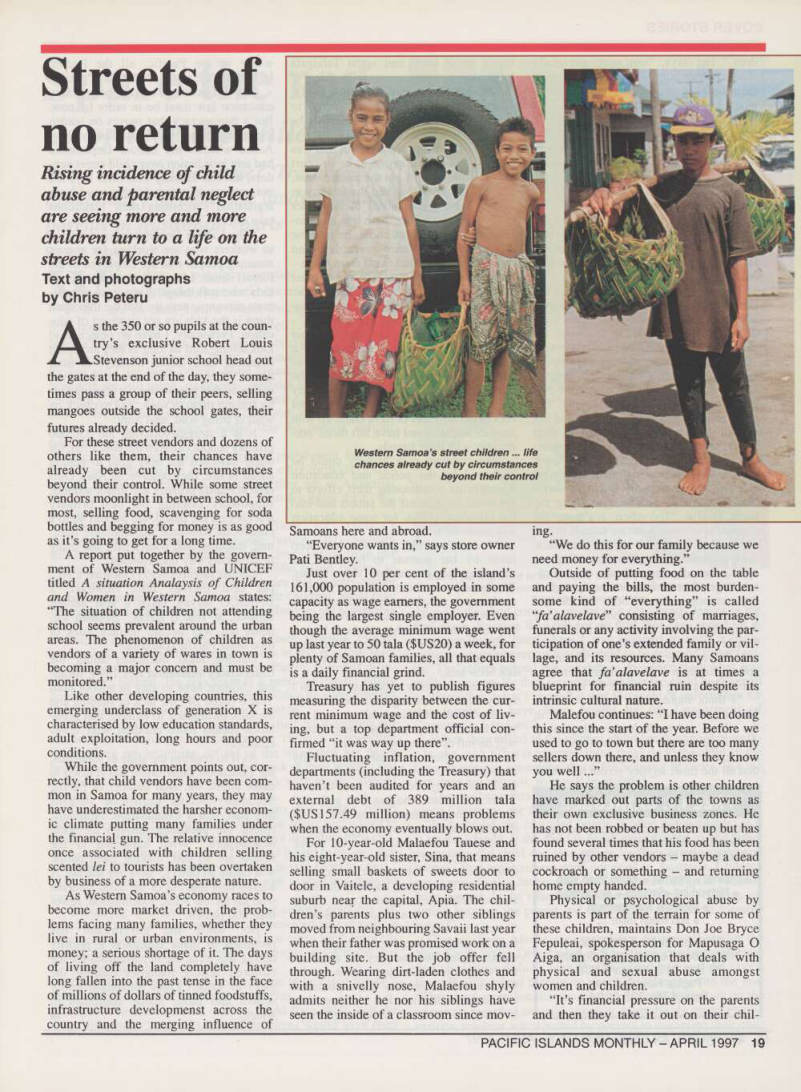
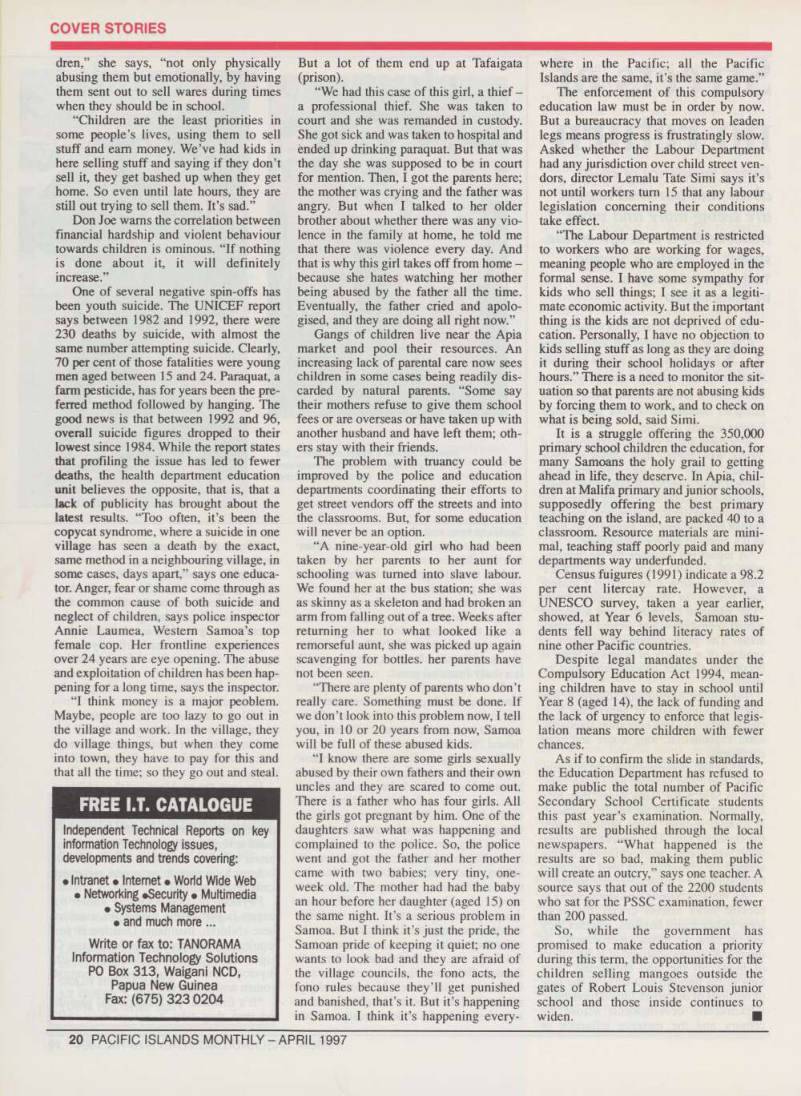
As the 350 or so pupils at the coun try’s exclusive Robert Louis Stevenson junior school head out the gates at the end of the day, they some times pass a group of their peers, selling mangoes outside the school gates, their futures already decided.
For these street vendors and dozens of others like them, their chances have already been cut by circumstances beyond their control. While some street vendors moonlight in between school, for most, selling food, scavenging for soda bottles and begging for money is as good as it’s going to get for a long time.
A report put together by the govern ment of Western Samoa and UNICEF titled A situation Analaysis of Children and Women in Western Samoa states: “The situation of children not attending school seems prevalent around the urban areas. The phenomenon of children as vendors of a variety of wares in town is becoming a major concern and must be monitored.”
Like other developing countries, this emerging underclass of generation X is characterised by low education standards, adult exploitation, long hours and poor conditions.
While the government points out, cor rectly, that child vendors have been com mon in Samoa for many years, they may have underestimated the harsher econom ic climate putting many families under the financial gun. The relative innocence once associated with children selling scented lei to tourists has been overtaken by business of a more desperate nature.
As Western Samoa’s economy races to become more market driven, the prob lems facing many families, whether they live in rural or urban environments, is money; a serious shortage of it. The days of living off the land completely have long fallen into the past tense in the face of millions of dollars of tinned foodstuffs, infrastructure developmenst across the country and the merging influence of
Samoans here and abroad.
“Everyone wants in,” says store owner Pati Bentley.
Just over 10 per cent of the island’s 161,000 population is employed in some capacity as wage earners, the government being die largest single employer. Even though the average minimum wage went up last year to 50 tala (SUS2O) a week, for plenty of Samoan families, all that equals is a daily financial grind.
Treasury has yet to publish figures measuring the disparity between the cur rent minimum wage and the cost of liv ing, but a top department official con firmed “it was way up there”.
Fluctuating inflation, government departments (including the Treasury) that haven’t been audited for years and an external debt of 389 million tala (SUS 157.49 million) means problems when the economy eventually blows out.
For 10-year-old Malaefou Tauese and his eight-year-old sister, Sina, that means selling small baskets of sweets door to door in Vaitele, a developing residential suburb near the capital, Apia. The chil dren’s parents plus two other siblings moved from neighbouring Savaii last year when their father was promised work on a building site. But the job offer fell through. Wearing dirt-laden clothes and with a snivelly nose, Malaefou shyly admits neither he nor his siblings have seen the inside of a classroom since mov
ing.
“We do this for our family because we need money for everything.”
Outside of putting food on the table and paying the bills, the most burden some kind of “everything” is called
“fa alavelave" consisting of marriages,
funerals or any activity involving the par ticipation of one’s extended family or vil lage, and its resources. Many Samoans agree that fa’alavelave is at times a blueprint for financial ruin despite its intrinsic cultural nature.
Malefou continues: “I have been doing this since the start of the year. Before we used to go to town but there are too many sellers down there, and unless they know you we 11...”
He says the problem is other children have marked out parts of the towns as their own exclusive business zones. He has not been robbed or beaten up but has found several times that his food has been ruined by other vendors - maybe a dead cockroach or something - and returning home empty handed.
Physical or psychological abuse by
parents is part of the terrain for some of these children, maintains Don Joe Bryce
Fepuleai, spokesperson for Mapusaga O
Aiga, an organisation that deals with physical and sexual abuse amongst women and children.
“It’s financial pressure on the parents and then they take it out on their chil
Western Samoa’s street children ... life chances already cut by circumstances beyond their control
dren,” she says, “not only physically
abusing them but emotionally, by having
them sent out to sell wares during times when they should be in school.
“Children are the least priorities in some people’s lives, using them to sell stuff and earn money. We’ve had kids in here selling stuff and saying if they don’t sell it, they get bashed up when they get home. So even until late hours, they are still out trying to sell them. It’s sad.”
Don Joe warns the correlation between financial hardship and violent behaviour towards children is ominous. “If nothing is done about it, it will definitely increase.”
One of several negative spin-offs has been youth suicide. The UNICEF report says between 1982 and 1992, there were 230 deaths by suicide, with almost the same number attempting suicide. Clearly, 70 per cent of those fatalities were young men aged between 15 and 24. Paraquat, a farm pesticide, has for years been the pre ferred method followed by hanging. The good news is that between 1992 and 96, overall suicide figures dropped to their lowest since 1984. While the report states that profiling the issue has led to fewer deaths, the health department education unit believes the opposite, that is, that a lack of publicity has brought about the latest results. “Too often, it’s been the copycat syndrome, where a suicide in one village has seen a death by the exact, same method in a neighbouring village, in some cases, days apart,” says one educa tor. Anger, fear or shame come through as the common cause of both suicide and
neglect of children, says police inspector
Annie Laumea, Western Samoa’s top female cop. Her frontline experiences over 24 years are eye opening. The abuse and exploitation of children has been hap pening for a long time, says the inspector.
“I think money is a major peoblem.
Maybe, people are too lazy to go out in the village and work. In the village, they do village things, but when they come into town, they have to pay for this and that all the time; so they go out and steal.
But a lot of them end up at Tafaigata
(prison).
“We had this case of this girl, a thief a professional thief. She was taken to court and she was remanded in custody.
She got sick and was taken to hospital and ended up drinking paraquat. But that was the day she was supposed to be in court for mention. Then, I got the parents here; the mother was crying and the father was angry. But when I talked to her older brother about whether there was any vio lence in the family at home, he told me that there was violence every day. And that is why this girl takes off from home because she hates watching her mother being abused by the father all the time.
Eventually, the father cried and apolo gised, and they are doing all right now.”
Gangs of children live near the Apia market and pool their resources. An increasing lack of parental care now sees children in some cases being readily dis carded by natural parents. “Some say their mothers refuse to give them school fees or are overseas or have taken up with another husband and have left them; oth ers stay with their friends.
The problem with truancy could be improved by the police and education departments coordinating their efforts to get street vendors off the streets and into the classrooms. But, for some education will never be an option.
“A nine-year-old girl who had been taken by her parents to her aunt for schooling was turned into slave labour.
We found her at the bus station; she was as skinny as a skeleton and had broken an arm from falling out of a tree. Weeks after returning her to what looked like a remorseful aunt, she was picked up again scavenging for bottles, her parents have not been seen.
“There are plenty of parents who don’t really care. Something must be done. If we don’t look into this problem now, I tell you, in 10 or 20 years from now, Samoa will be full of these abused kids.
“I know there are some girls sexually abused by their own fathers and their own uncles and they are scared to come out.
There is a father who has four girls. All the girls got pregnant by him. One of the daughters saw what was happening and complained to the police. So, the police went and got the father and her mother came with two babies; very tiny, one week old. The mother had had the baby an hour before her daughter (aged 15) on the same night. It’s a serious problem in Samoa. But I think it’s just the pride, the Samoan pride of keeping it quiet; no one wants to look bad and they are afraid of the village councils, the fono acts, the fono rules because they’ll get punished and banished, that’s it. But it’s happening in Samoa. I think it’s happening every
where in the Pacific; all the Pacific Islands are the same, it’s the same game.”
The enforcement of this compulsory education law must be in order by now.
But a bureaucracy that moves on leaden legs means progress is frustratingly slow.
Asked whether the Labour Department had any jurisdiction over child street ven dors, director Lemalu Tate Simi says it’s not until workers turn 15 that any labour
legislation concerning their conditions
take effect.
“The Labour Department is restricted to workers who are working for wages, meaning people who are employed in the formal sense. I have some sympathy for kids who sell things; I see it as a legiti mate economic activity. But the important thing is the kids are not deprived of edu cation. Personally, I have no objection to kids selling stuff as long as they are doing it during their school holidays or after hours.” There is a need to monitor the sit uation so that parents are not abusing kids by forcing them to work, and to check on what is being sold, said Simi.
It is a struggle offering the 350,000 primary school children the education, for many Samoans the holy grail to getting ahead in life, they deserve. In Apia, chil dren at Malifa primary and junior schools,
supposedly offering the best primary
teaching on the island, are packed 40 to a classroom. Resource materials are mini mal, teaching staff poorly paid and many departments way underfunded.
Census fuigures (1991) indicate a 98.2 per cent litercay rate. However, a UNESCO survey, taken a year earlier, showed, at Year 6 levels, Samoan stu dents fell way behind literacy rates of nine other Pacific countries.
Despite legal mandates under the Compulsory Education Act 1994, mean ing children have to stay in school until Year 8 (aged 14), the lack of funding and the lack of urgency to enforce that legis lation means more children with fewer chances.
As if to confirm the slide in standards, the Education Department has refused to make public the total number of Pacific Secondary School Certificate students this past year’s examination. Normally, results are published through the local newspapers. “What happened is the results are so bad, making them public will create an outcry,” says one teacher. A source says that out of the 2200 students who sat for the PSSC examination, fewer than 200 passed.
So, while the government has promised to make education a priority during this term, the opportunities for the children selling mangoes outside the gates of Robert Louis Stevenson junior school and those inside continues to widen. ■
Advertisements & other items, p. 20 (1 item)
Free I.T. Catalogue
Independent Technical Reports on key information Technology issues, developments and trends covering: • Intranet • Internet • World Wide Web • Networking •Security • Multimedia • Systems Management • and much more ...
Write or fax to: TANORAMA Information Technology Solutions PO Box 313, Waigani NCD, Papua New Guinea Pax: (675) 323 0204
Spare the rod
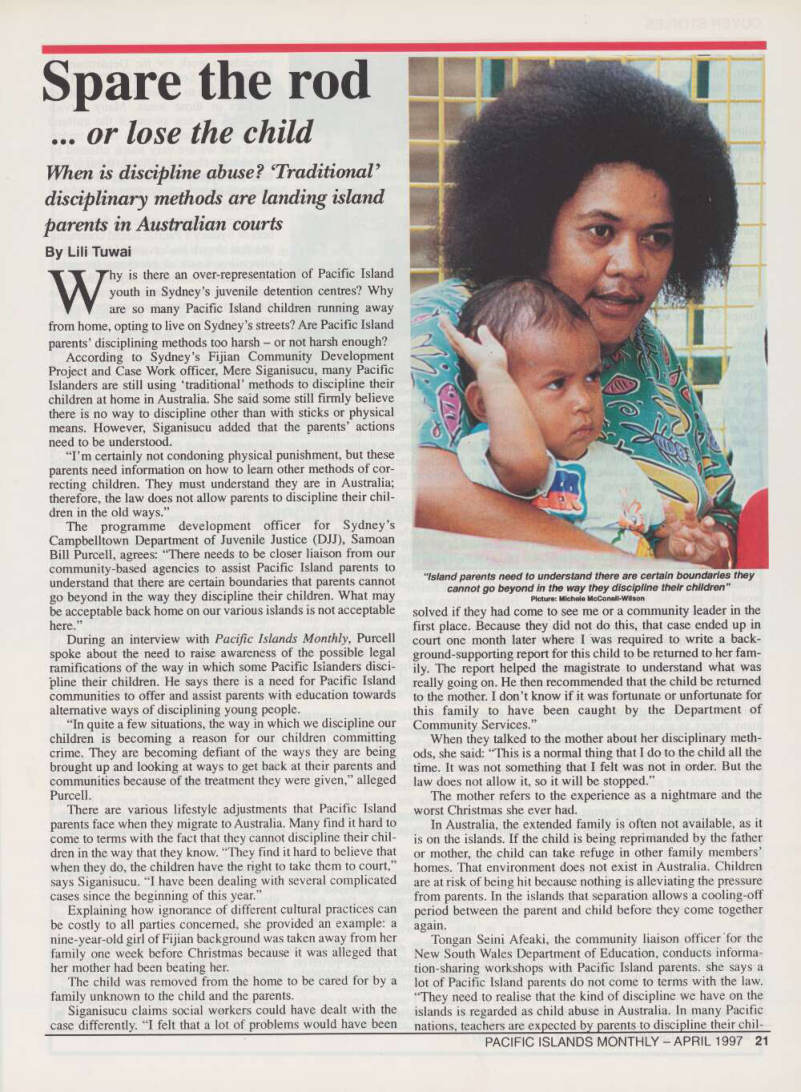
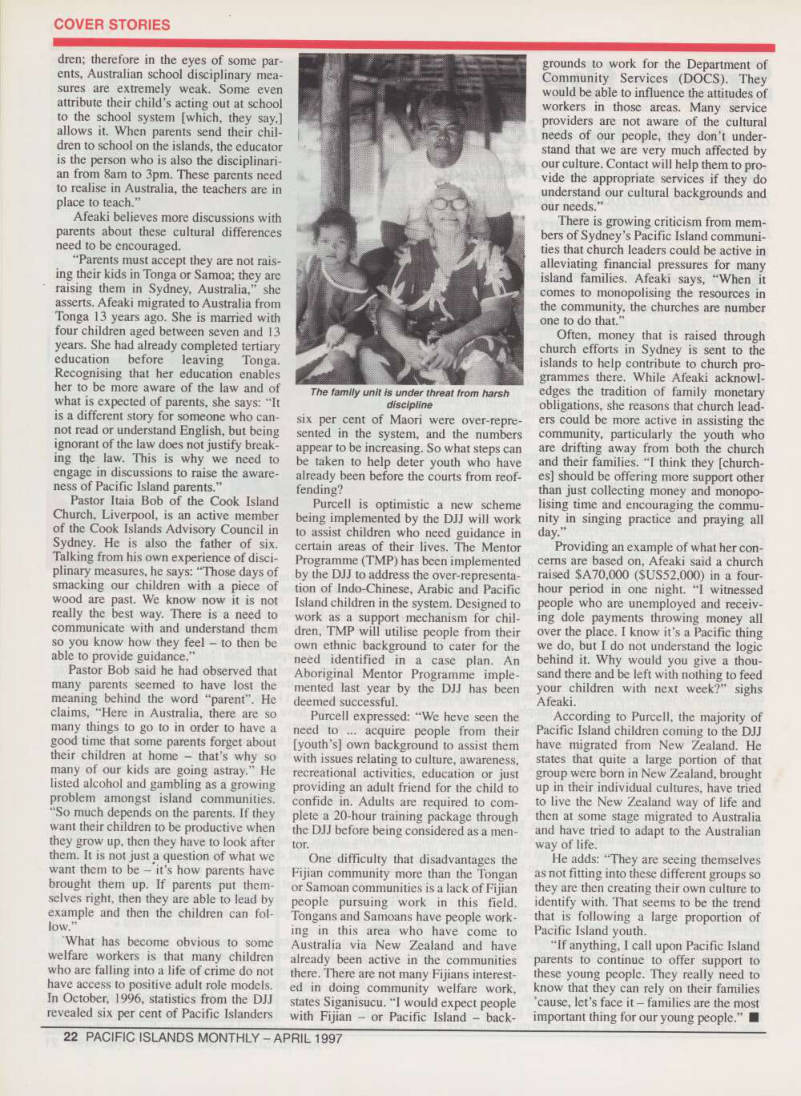
or lose the child
When is discipline abuse? 6 Traditional 9 disciplinary methods are landing island parents in Australian courts
By Lili Tuwai
Why is there an over-representation of Pacific Island youth in Sydney’s juvenile detention centres? Why are so many Pacific Island children running away from home, opting to live on Sydney’s streets? Are Pacific Island parents’ disciplining methods too harsh - or not harsh enough?
According to Sydney’s Fijian Community Development
Project and Case Work officer, Mere Siganisucu, many Pacific Islanders are still using ‘traditional’ methods to discipline their children at home in Australia. She said some still firmly believe there is no way to discipline other than with sticks or physical means. However, Siganisucu added that the parents’ actions need to be understood.
“I’m certainly not condoning physical punishment, but these parents need information on how to leam other methods of cor recting children. They must understand they are in Australia; therefore, the law does not allow parents to discipline their chil dren in the old ways.”
The programme development officer for Sydney’s Campbelltown Department of Juvenile Justice (DJJ), Samoan Bill Purcell, agrees: “There needs to be closer liaison from our community-based agencies to assist Pacific Island parents to understand that there are certain boundaries that parents cannot go beyond in the way they discipline their children. What may be acceptable back home on our various islands is not acceptable here.”
During an interview with Pacific Islands Monthly, Purcell spoke about the need to raise awareness of the possible legal ramifications of the way in which some Pacific Islanders disci pline their children. He says there is a need for Pacific Island communities to offer and assist parents with education towards alternative ways of disciplining young people.
“In quite a few situations, the way in which we discipline our children is becoming a reason for our children committing crime. They are becoming defiant of the ways they are being brought up and looking at ways to get back at their parents and communities because of the treatment they were given,” alleged Purcell.
There are various lifestyle adjustments that Pacific Island parents face when they migrate to Australia. Many find it hard to come to terms with the fact that they cannot discipline their chil dren in the way that they know. “They find it hard to believe that when they do, the children have the right to take them to court,” says Siganisucu. “I have been dealing with several complicated cases since the beginning of this year.”
Explaining how ignorance of different cultural practices can be costly to all parties concerned, she provided an example: a nine-year-old girl of Fijian background was taken away from her family one week before Christmas because it was alleged that her mother had been beating her.
The child was removed from the home to be cared for by a family unknown to the child and the parents.
Siganisucu claims social workers could have dealt with the case differently. “I felt that a lot of problems would have been
solved if they had come to see me or a community leader in the first place. Because they did not do this, that case ended up in court one month later where I was required to write a back ground-supporting report for this child to be returned to her fam ily. The report helped the magistrate to understand what was really going on. He then recommended that the child be returned to the mother. I don’t know if it was fortunate or unfortunate for this family to have been caught by the Department of
Community Services.”
When they talked to the mother about her disciplinary meth ods, she said: “This is a normal thing that I do to the child all the time. It was not something that I felt was not in order. But the law does not allow it, so it will be stopped.”
The mother refers to the experience as a nightmare and the worst Christmas she ever had.
In Australia, the extended family is often not available, as it is on the islands. If the child is being reprimanded by the father or mother, the child can take refuge in other family members’ homes. That environment does not exist in Australia. Children are at risk of being hit because nothing is alleviating the pressure from parents. In the islands that separation allows a cooling-off period between the parent and child before they come together
again.
Tongan Seini Afeaki, the community liaison officer for the New South Wales Department of Education, conducts informa tion-sharing workshops with Pacific Island parents, she says a lot of Pacific Island parents do not come to terms with the law.
“They need to realise that the kind of discipline we have on the islands is regarded as child abuse in Australia. In many Pacific nations, teachers are expected by parents to discipline their chil
“Island parents need to understand there are certain boundaries they cannot go beyond in the way they discipline their children"
Picture: Michele McConell-Wilson
dren; therefore in the eyes of some par ents, Australian school disciplinary mea sures are extremely weak. Some even attribute their child’s acting out at school to the school system [which, they say,] allows it. When parents send their chil dren to school on the islands, the educator is the person who is also the disciplinari an from Sam to 3pm. These parents need to realise in Australia, the teachers are in place to teach.”
Afeaki believes more discussions with parents about these cultural differences need to be encouraged.
“Parents must accept they are not rais ing their kids in Tonga or Samoa; they are raising them in Sydney, Australia,” she asserts. Afeaki migrated to Australia from Tonga 13 years ago. She is married with four children aged between seven and 13 years. She had already completed tertiary education before leaving Tonga.
Recognising that her education enables her to be more aware of the law and of what is expected of parents, she says: “It is a different story for someone who can not read or understand English, but being ignorant of the law does not justify break ing the law. This is why we need to engage in discussions to raise the aware ness of Pacific Island parents.”
Pastor Itaia Bob of the Cook Island Church, Liverpool, is an active member of the Cook Islands Advisory Council in Sydney. He is also the father of six.
Talking from his own experience of disci plinary measures, he says; “Those days of smacking our children with a piece of wood are past. We know now it is not really the best way. There is a need to communicate with and understand them so you know how they feel - to then be able to provide guidance.”
Pastor Bob said he had observed that many parents seemed to have lost the meaning behind the word “parent”. He claims, “Here in Australia, there are so many things to go to in order to have a good time that some parents forget about their children at home - that’s why so many of our kids are going astray.” He listed alcohol and gambling as a growing problem amongst island communities.
“So much depends on the parents. If they want their children to be productive when they grow up, then they have to look after them. It is not just a question of what we want them to be - it’s how parents have brought them up. If parents put them selves right, then they are able to lead by example and then the children can fol low.”
"What has become obvious to some welfare workers is that many children who are falling into a life of crime do not have access to positive adult role models.
In October, 1996, statistics from the DJJ revealed six per cent of Pacific Islanders
six per cent of Maori were over-repre sented in the system, and the numbers appear to be increasing. So what steps can be taken to help deter youth who have already been before the courts from reof
fending?
Purcell is optimistic a new scheme being implemented by the DJJ will work to assist children who need guidance in certain areas of their lives. The Mentor Programme (TMP) has been implemented by the DJJ to address the over-representa tion of Indo-Chinese, Arabic and Pacific Island children in the system. Designed to work as a support mechanism for chil dren, TMP will utilise people from their own ethnic background to cater for the need identified in a case plan. An
Aboriginal Mentor Programme imple
mented last year by the DJJ has been deemed successful.
Purcell expressed: “We heve seen the need to ... acquire people from their [youth’s] own background to assist them with issues relating to culture, awareness, recreational activities, education or just providing an adult friend for the child to confide in. Adults are required to com
plete a 20-hour training package through
the DJJ before being considered as a men tor.
One difficulty that disadvantages the
Fijian community more than the Tongan
or Samoan communities is a lack of Fijian people pursuing work in this field.
Tongans and Samoans have people work ing in this area who have come to Australia via New Zealand and have already been active in the communities there. There are not many Fijians interest ed in doing community welfare work, states Siganisucu. “I would expect people with Fijian - or Pacific Island - back
grounds to work for the Department of Community Services (DOCS). They would be able to influence the attitudes of workers in those areas. Many service providers are not aware of the cultural needs of our people, they don’t under stand that we are very much affected by our culture. Contact will help them to pro vide the appropriate services if they do understand our cultural backgrounds and our needs.”
There is growing criticism from mem bers of Sydney’s Pacific Island communi ties that church leaders could be active in alleviating financial pressures for many island families. Afeaki says, “When it comes to monopolising the resources in the community, the churches are number one to do that.”
Often, money that is raised through church efforts in Sydney is sent to the islands to help contribute to church pro grammes there. While Afeaki acknowl edges the tradition of family monetary obligations, she reasons that church lead ers could be more active in assisting the community, particularly the youth who are drifting away from both the church and their families. “I think they [church es] should be offering more support other than just collecting money and monopo lising time and encouraging the commu nity in singing practice and praying all day.”
Providing an example of what her con cerns are based on, Afeaki said a church raised $A70,000 ($U552,000) in a four hour period in one night. “I witnessed people who are unemployed and receiv ing dole payments throwing money all over the place. I know it’s a Pacific thing we do, but I do not understand the logic behind it. Why would you give a thou sand there and be left with nothing to feed your children with next week?” sighs Afeaki.
According to Purcell, the majority of Pacific Island children coming to the DJJ have migrated from New Zealand. He states that quite a large portion of that group were bom in New Zealand, brought up in their individual cultures, have tried to live the New Zealand way of life and then at some stage migrated to Australia and have tried to adapt to the Australian way of life.
He adds: “They are seeing themselves as not fitting into these different groups so they are then creating their own culture to identify with. That seems to be the trend that is following a large proportion of Pacific Island youth.
“If anything, I call upon Pacific Island parents to continue to offer support to these young people. They really need to know that they can rely on their families ’cause, let’s face it - families are the most important thing for our young people.” ■
The family unit is under threat from harsh discipline
Advertisements & other items, p. 23 (1 item)
Suva, Fiji
FORUM SECRETARIAT
The Forum Secretariat was established in 1972 by the South Pacific Forum to encourage economic and political cooperation between its member countries*, and between those states and the more industrialised countries. In order to fulfil the economic aims of the Forum Secretariat, the following positions need to be recruited: The Secretariat is seeking a suitably qualified and experienced person to work as Petroleum Adviser in its Trade and Investment Division. The Petroleum Adviser reports to the Director of the Division and works closely with Forum Island Countries (FICs), either directly or with consultants, on a wide range of petroleum related issues, including petroleum product pricing and supply contracts, safety, environmental and technical areas.
The Petroleum Adviser will: plan and participate in studies of petroleum and petroleum operations; advise FICs on petroleum issues; represent the Secretariat with other groups working on petroleum issues in the Pacific; plan and direct training programs for Forum Island personnel; and collect, collate and publish regional petroleum data.
Applicants must be citizens of Forum member countries* and should have tertiary qualifications and at least ten years experience in the petroleum industry, preferably in the Pacific. Extensive travel throughout the region will be required.
The appointment will carry a competitive remuneration package, starting at approximately FID 60 150, depending on qualifications and experience.
The Forum Secretariat is also seeking to appoint a suitably qualified and experienced person as Import Management Officer in its Trade and Investment Division. The Import Management Officer reports to the Director of the Division and works closely with Forum Island Countries (FICs) particularly those heavily reliant on imports. The appointee will be expected to develop initiatives aimed at improving the balance of payments situation through adoption of Import procurement and efficiency policies.
The Import Management Officer will: liaise with FICs on import operations and techniques, material management and procurement; advise FICs on cost effective imports, supply sources, shipping and freight rates; ' enhance FICs capacity and expertise to manage imports cost effectively in all sectors; develop policies and procedures for effective imports; and plan and direct import related training programs for FICs personnel.
Applicants must be citizens of Forum member countries* and should have relevant tertiary qualifications and at least ten years experience In international supply and procurement management, preferably in the Pacific. Extensive travel will be required.
The appointment will carry a competitive remuneration package, starting at approximately FJD 48 067 depending on qualifications and experience.
For both positions there are generous establishment and education allowances and free medical and life insurance. For non Fiji citizens remuneration is tax free. Appointments are normally for three years, with the option to renew for a further three years.
All applications should be addressed to: Information Package on both positions are available from the Secretariat and applicants are urged to obtain it. Inquiries should be addressed to Mr Aklesh Nand, on (679) 312600 Extn 207 or fax (679) 305573. Applications close on 25 April 1997 and should contain full information on education and career background, addresses and telephone numbers of three employment referees.
PETROLEUM ADVISER
IMPORT MANAGEMENT OFFICER
The Secretary General Forum Secretariat Private Mall Bag, Suva, FIJI * Member States of the South Pacific Forum: Australia, Cook Islands, Federated States of Micronesia, Fiji, Kiribati, Nauru, New Zealand, Niue, Palau, Papua New Guinea, Republic of the Marshall Islands, Solomon Islands, Tonga, Tuvalu, Vanuatu and Western Samoa.
A healthy start
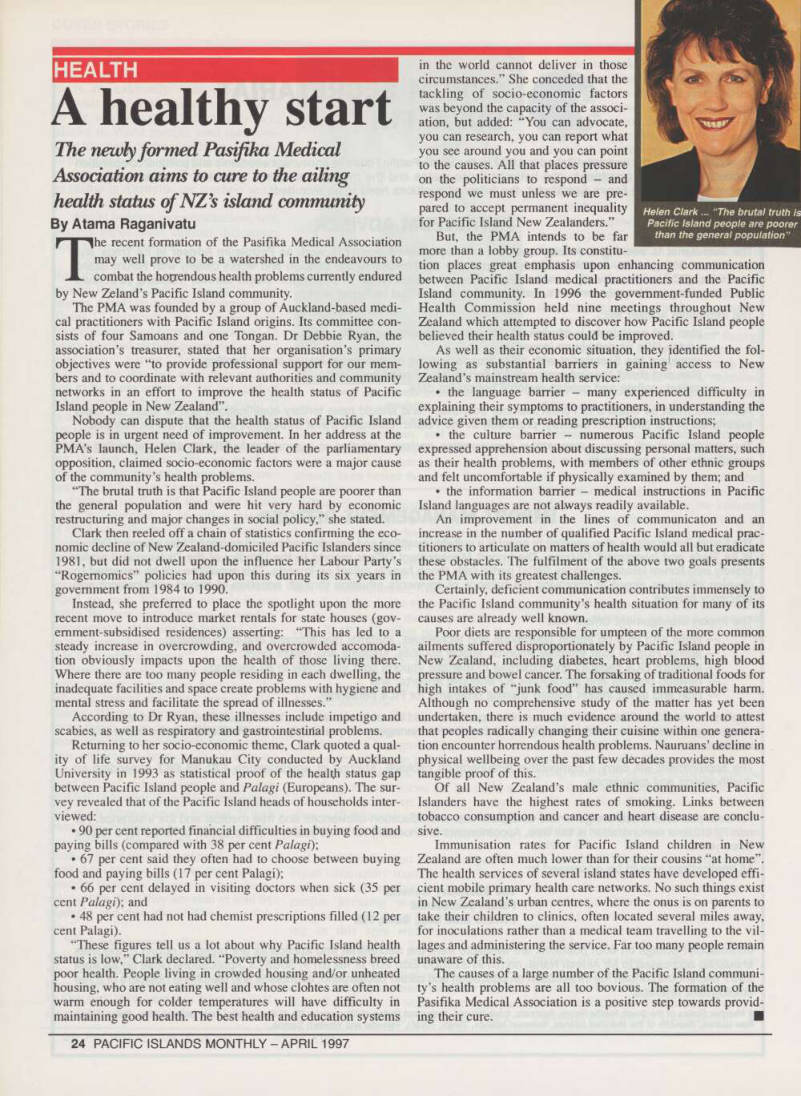
Health
The newly formed Pasifika Medical
Association aims to cure to the ailing health status ofNZ’s island community
By Atama Raganivatu
The recent formation of the Pasifika Medical Association may well prove to be a watershed in the endeavours to combat the horrendous health problems currently endured by New Zeland’s Pacific Island community.
The PMA was founded by a group of Auckland-based medi cal practitioners with Pacific Island origins. Its committee con sists of four Samoans and one Tongan. Dr Debbie Ryan, the association’s treasurer, stated that her organisation’s primary objectives were “to provide professional support for our mem bers and to coordinate with relevant authorities and community networks in an effort to improve the health status of Pacific Island people in New Zealand”.
Nobody can dispute that the health status of Pacific Island people is in urgent need of improvement. In her address at the PMA’s launch, Helen Clark, the leader of the parliamentary opposition, claimed socio-economic factors were a major cause of the community’s health problems.
“The brutal truth is that Pacific Island people are poorer than the general population and were hit very hard by economic restructuring and major changes in social policy,” she stated.
Clark then reeled off a chain of statistics confirming the eco nomic decline of New Zealand-domiciled Pacific Islanders since 1981, but did not dwell upon the influence her Labour Party’s “Rogemomics” policies had upon this during its six years in government from 1984 to 1990.
Instead, she preferred to place the spotlight upon the more recent move to introduce market rentals for state houses (gov ernment-subsidised residences) asserting: “This has led to a steady increase in overcrowding, and overcrowded accomoda tion obviously impacts upon the health of those living there.
Where there are too many people residing in each dwelling, the inadequate facilities and space create problems with hygiene and mental stress and facilitate the spread of illnesses.”
According to Dr Ryan, these illnesses include impetigo and scabies, as well as respiratory and gastrointestinal problems.
Returning to her socio-economic theme, Clark quoted a qual ity of life survey for Manukau City conducted by Auckland University in 1993 as statistical proof of the health status gap between Pacific Island people and Palagi (Europeans). The sur vey revealed that of the Pacific Island heads of households inter viewed; • 90 per cent reported financial difficulties in buying food and paying bills (compared with 38 per cent Palagi ); • 67 per cent said they often had to choose between buying food and paying bills (17 per cent Palagi); • 66 per cent delayed in visiting doctors when sick (35 per cent Palagi ); and • 48 per cent had not had chemist prescriptions filled (12 per
cent Palagi).
“These figures tell us a lot about why Pacific Island health status is low,” Clark declared. “Poverty and homelessness breed poor health. People living in crowded housing and/or unheated housing, who are not eating well and whose clohtes are often not warm enough for colder temperatures will have difficulty in maintaining good health. The best health and education systems
in the world cannot deliver in those circumstances.” She conceded that the tackling of socio-economic factors was beyond the capacity of the associ ation, but added: “You can advocate, you can research, you can report what you see around you and you can point to the causes. All that places pressure on the politicians to respond - and respond we must unless we are pre pared to accept permanent inequality for Pacific Island New Zealanders.”
But, the PMA intends to be far more than a lobby group. Its constitu-
tion places great emphasis upon enhancing communication between Pacific Island medical practitioners and the Pacific Island community. In 1996 the government-funded Public Health Commission held nine meetings throughout New Zealand which attempted to discover how Pacific Island people believed their health status could be improved.
As well as their economic situation, they identified the fol lowing as substantial barriers in gaining access to New Zealand’s mainstream health service: • the language barrier - many experienced difficulty in explaining their symptoms to practitioners, in understanding the advice given them or reading prescription instructions; • the culture barrier - numerous Pacific Island people expressed apprehension about discussing personal matters, such as their health problems, with members of other ethnic groups and felt uncomfortable if physically examined by them; and • the information barrier - medical instructions in Pacific Island languages are not always readily available.
An improvement in the lines of communicaton and an increase in the number of qualified Pacific Island medical prac titioners to articulate on matters of health would all but eradicate these obstacles. The fulfilment of the above two goals presents the PMA with its greatest challenges.
Certainly, deficient communication contributes immensely to the Pacific Island community’s health situation for many of its causes are already well known.
Poor diets are responsible for umpteen of the more common ailments suffered disproportionately by Pacific Island people in New Zealand, including diabetes, heart problems, high blood pressure and bowel cancer. The forsaking of traditional foods for high intakes of “junk food” has caused immeasurable harm.
Although no comprehensive study of the matter has yet been undertaken, there is much evidence around the world to attest that peoples radically changing their cuisine within one genera tion encounter horrendous health problems. Nauruans’ decline in physical wellbeing over the past few decades provides the most
tangible proof of this.
Of all New Zealand’s male ethnic communities. Pacific Islanders have the highest rates of smoking. Links between tobacco consumption and cancer and heart disease are conclu sive.
Immunisation rates for Pacific Island children in New Zealand are often much lower than for their cousins “at home”.
The health services of several island states have developed effi cient mobile primary health care networks. No such things exist in New Zealand’s urban centres, where the onus is on parents to take their children to clinics, often located several miles away, for inoculations rather than a medical team travelling to the vil lages and administering the service. Far too many people remain unaware of this.
The causes of a large number of the Pacific Island communi ty’s health problems are all too bovious. The formation of the Pasifika Medical Association is a positive step towards provid ing their cure. ■
Helen Clark... “The brutal truth is Pacific Island people are poorer than the general population”
Advertisements & other items, p. 25 (1 item)
FirtTEl
Tve got meetings in
New York, London and Tokyo.
Beam me up, FINTEL."
on travel costs, and key people who might otherwise be excluded can be there with you.
For a brochure - or a free demonstration - call Fred Atalifo toll free on 0800 315 718.
FirtTEl
Through Fintel Videoconferencing, you can meet face to face with associates around the world via a digital cable link, without ever leaving town! You'll save thousands of dollars
TELL IT TO THE WORLD
PO Box 39, Mercury house, 158 Victoria Parade, Suva, Fiji. Telephone 312 933 Fax 300 750
Pacific
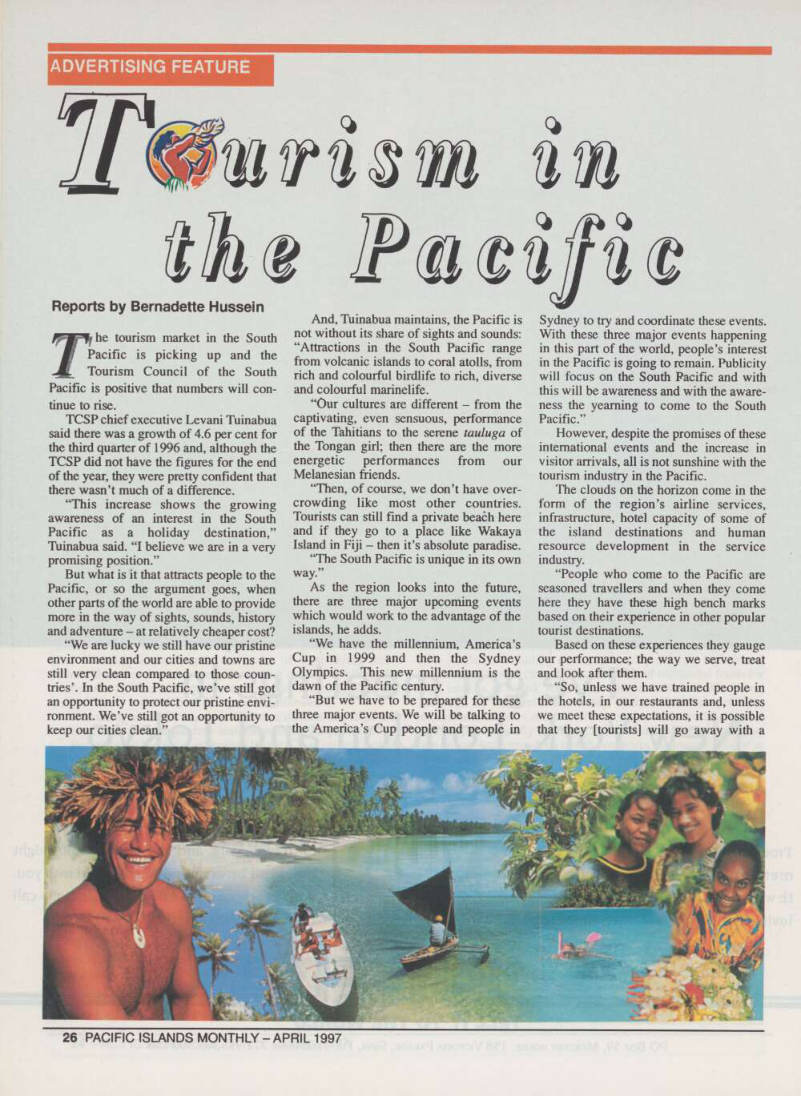

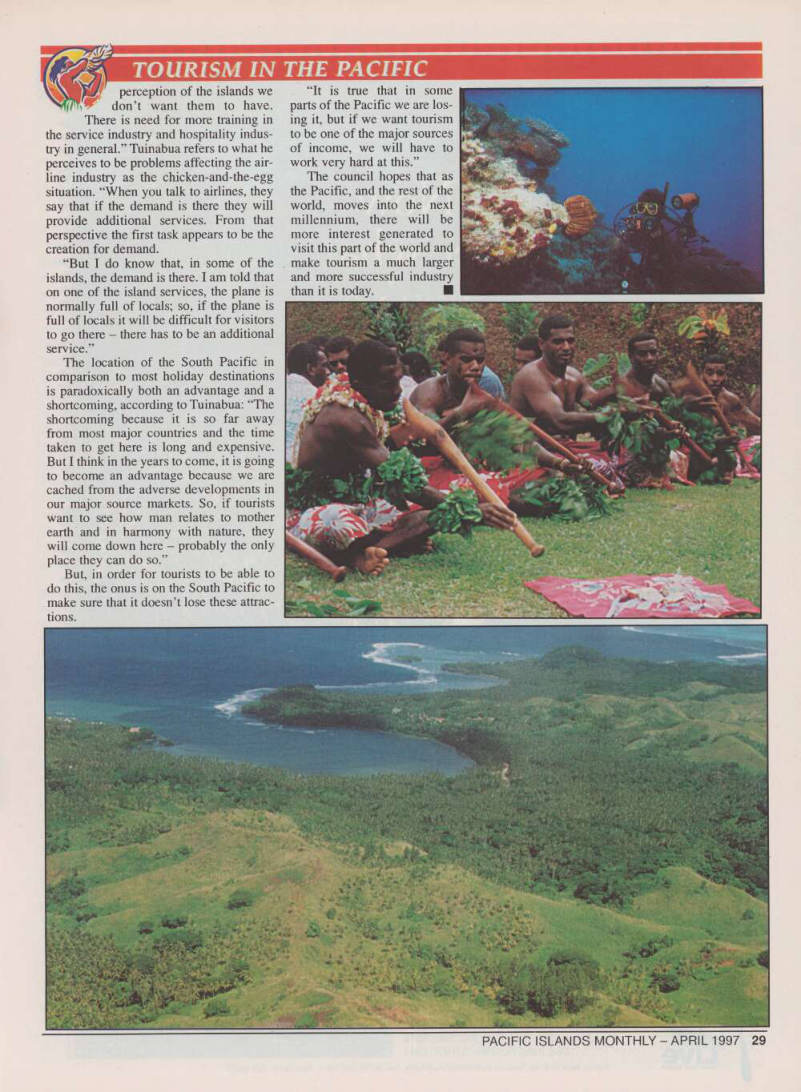
Advertising Feature
Tourism in
the
Pacific
Reports by Bernadette Hussein
J!f he tourism market in the South Pacific is picking up and the Tourism Council of the South Pacific is positive that numbers will con tinue to rise.
TCSP chief executive Levani Tuinabua said there was a growth of 4.6 per cent for the third quarter of 1996 and, although the TCSP did not have the figures for the end of the year, they were pretty confident that there wasn’t much of a difference.
“This increase shows the growing awareness of an interest in the South Pacific as a holiday destination,”
Tuinabua said. “I believe we are in a very promising position.”
But what is it that attracts people to the Pacific, or so the argument goes, when other parts of the world are able to provide more in the way of sights, sounds, history and adventure - at relatively cheaper cost?
“We are lucky we still have our pristine environment and our cities and towns are still very clean compared to those coun tries’. In the South Pacific, we’ve still got an opportunity to protect our pristine envi ronment. We’ve still got an opportunity to keep our cities clean.”
And, Tuinabua maintains, the Pacific is not without its share of sights and sounds; “Attractions in the South Pacific range from volcanic islands to coral atolls, from rich and colourful birdlife to rich, diverse and colourful marinelife.
“Our cultures are different - from the captivating, even sensuous, performance of the Tahitians to the serene tauluga of the Tongan girl; then there are the more energetic performances from our Melanesian friends.
“Then, of course, we don’t have over crowding like most other countries.
Tourists can still find a private beach here and if they go to a place like Wakaya Island in Fiji - then it’s absolute paradise.
“The South Pacific is unique in its own way.”
As the region looks into the future, there are three major upcoming events which would work to the advantage of the islands, he adds.
“We have the millennium, America’s Cup in 1999 and then the Sydney Olympics. This new millennium is the dawn of the Pacific century.
“But we have to be prepared for these three major events. We will be talking to the America’s Cup people and people in
Sydney to try and coordinate these events.
With these three major events happening in this part of the world, people’s interest in the Pacific is going to remain. Publicity will focus on the South Pacific and with this will be awareness and with the aware ness the yearning to come to the South Pacific.”
However, despite the promises of these international events and the increase in visitor arrivals, all is not sunshine with the tourism industry in the Pacific.
The clouds on the horizon come in the form of the region’s airline services, infrastructure, hotel capacity of some of the island destinations and human resource development in the service industry.
“People who come to the Pacific are seasoned travellers and when they come here they have these high bench marks based on their experience in other popular tourist destinations.
Based on these experiences they gauge our performance; the way we serve, treat and look after them.
“So, unless we have trained people in the hotels, in our restaurants and, unless we meet these expectations, it is possible that they [tourists] will go away with a
perception of the islands we don’t want them to have.
There is need for more training in the service industry and hospitality indus try in general.” Tuinabua refers to what he perceives to be problems affecting the air line industry as the chicken-and-the-egg situation. “When you talk to airlines, they say that if the demand is there they will provide additional services. From that perspective the first task appears to be the creation for demand.
“But I do know that, in some of the islands, the demand is there. I am told that on one of the island services, the plane is normally full of locals; so, if the plane is full of locals it will be difficult for visitors to go there - there has to be an additional service.”
The location of the South Pacific in comparison to most holiday destinations is paradoxically both an advantage and a shortcoming, according to Tuinabua: “The shortcoming because it is so far away from most major countries and the time taken to get here is long and expensive.
But I think in the years to come, it is going to become an advantage because we are cached from the adverse developments in our major source markets. So, if tourists want to see how man relates to mother earth and in harmony with nature, they will come down here - probably the only place they can do so.”
But, in order for tourists to be able to do this, the onus is on the South Pacific to make sure that it doesn’t lose these attrac tions.
“It is true that in some parts of the Pacific we are los ing it, but if we want tourism to be one of the major sources of income, we will have to work very hard at this.”
The council hopes that as the Pacific, and the rest of the world, moves into the next millennium, there will be more interest generated to visit this part of the world and make tourism a much larger and more successful industry than it is today. ■
Advertisements & other items, pp. 27-30 (2 items)
This Could Be Your Year!
THE SOUTH PACIFIC EXCELLENCE IN
TOURISM AWARDSI997, >/
The South Pacific Excellence in Tourism Awards were introduced by the TCSPin 1995 to recognise and promote excellence in
Jse tourism industry in the region.
and you have the permanent the prestigious Awards ur Mi onal material and nery - an instant that your service w or product stands out from the crowd.
The South Pacific Excellence in Tourism Awards 1997 will be presented at the inaugural South Pacific Tourism Conference to be held in Tahiti on October 23rd and 24th.
Entry is free. Your only investment is a little time spent in the preparation of your written submission, and in the selection and production of any supporting materials. A brochure, VHS video or photographs may form part of your entry.
WHO THE JUDGES ARE,
AND WHAT THEY’RE LOOKING FOR.
In 1995, our panel of judges included an ambassador and prominent names drawn from the South Pacific business and religious communities. The 1997 panel will again comprise people of this calibre, who are based in Suva. They will be looking for business activity that contributes to the development of tourism in the South Pacific region, or of a member country within it. / They’ll want to see evidence of extreme customer satisfaction, outstanding initiative or the successful implementation of a worthwhile business or marketing plan. In a word, Excellence. If you think they may be looking for you, and your company, we suggest you reach for a pen right now.
“COUNT ME IN -1 WANT TO WIN!”
THE AWARD CATEGORIES:
• DE LUXE ACCOMMODATION AWARD.
• STANDARD ACCOMMODATION AWARD.
(1995 winner: Hideaway Resort, Fiji)
• BUDGET ACCOMMODATION AWARD.
(1995 winner: Samoan Outrigger Hotel, Western Samoa)
• TOURIST TRANSPORTATION AWARD.
(1995 winner: Tourist Transportation Fiji)
• PHOTOGRAPHY AWARD.
(1995 winner: John Nagive, Solomon Islands)
• INBOUND TOUR OPERATORS AWARD.
(1995 winner: Rosie The Travel Service, Fiji)
• ECOTOURISM AWARD.
(1995 winner: Koroyanitu National Park, Fiji)
•HERITAGE CULTURAL AWARD.
(1995 winner: Cook Islands Cultural Village)
• INTERNATIONAL AIRLINES AWARD.
(1995 winner: Polynesian Airlines, Western Samoa)
• DOMESTIC AIRLINES AWARD.
The first step to winning an Award is to secure your free entry kit.
Complete this request and mail it to The South Pacific Excellence in Tourism Awards 1997, PO Box 13119, Suva, Fiji Islands. Or fax it to us on (679) 301 995.
Z
TOURISM COUNCIL
OF THE SOUTH PACIFIC
TCSP works for everyone.
Tourism Council of The South Pacific, PO Box 13119, Level 3. FNPF Place, 343-359 Victoria Parade, Suva, Fiji Islands.
Tel: (679) 304 177. Fax : (679) 301 995.
Internet: http://www.tcsp.com E-Mail: spice ©is.com.fj TCSP extends its thanks to the European Union for providing the financial support for these awards.
YOUR NAME
'f?
POSITION;
COMPANY:
POSTAL ADDRESS:
'V ’it’
PREFERRED AWARD CATEGORY (see list)T„7
m «: SM lil For reservations/information: w r M □ AMERICAN SAMOA Ph: (684) 699-9106. Fax: (684) 699-9751. □ WESTERN SAMOA Ph: (685) 22321. Fax: (685) 23851. □ VAVAU, TONGA Ph: (676) 70644 Fax: (676) 70464.
Charters available throughout the South Pacific.
Apia, • Western Samoa**. ■►• Tau, Manua ---■#** • Ofu, Manua Pago Pago, American Samoa • Vavau, Tonga
SBmaß bu r
P.0.80x 280, Pago Pago, American Samoa 96799. Ph: (684) 69999106. Fax: (684) 6999751.
*■* «v • ,N '-—■i \ mm «£* N-> 4 -i *d§T: r -'m .*• TSk- ' ■ I 'rr~ a..« a»fN '•< .//* 'SV'v. v(- / W T»» . . » ‘ *'* I-.-
see what
you ve
been
missing
?T * x . -• vi •* I . v •?:;' :>v '.*• ■'•■ v \ .■*• \ ■ ; ■•>: •'■ ■ 4' ■ '■' - ■ . »> „ ■ fsfs■■; *«{ • Kgijt .
Sr<'. ■'•-.• v , •■• v, v-'x '■’VS •. 4 sV . -V '•". . r ' v ' \N ' ;' N, v%ipjk_ ,' /■
': A'V^t
V\ • •' v? -: Iti // V' . S v „ \;\ 7r• '. Sii A// , ':> ?i ' - ./• V ' At\ ■>\ 1 v v • '• i v ■■ A- v t : * K*f/ 9^ Si
rV a
V/ . f •■-, ’[ '. • M , - ■" r^v
G' N A ' 1
>■> W-Vi V* ' *' A • A\t ■'/- / f
\. vuf
ffp
I fflKlfe# A-'"
* S*W.YV
/* mTk • ■
If you re bored taking the same old holidays, year in—year out, you need to live a little in Papua New Guinea. For most of our visitors, Papua New Guinea is one of the world’s last frontiers; a fascinating living culture that is thousands of years old.
And for others, its the chance to enjoy nature's gifts while trekking, diving, mountain climbing or simply absorb the majesty of our misty rainforests. Start your holiday today, call the Papua New Guinea holiday specialists now.
UAAAAAAAAAAAAAAiAAAAAAiAA
ive
Air Niugini 13 13 80 Sea New Guinea (02) 267 5563 Dive Adventure (02) 299 4633 or (03) 9866 5738 Pro Dive Travel (02) 264 9499 Allways Dive Expedition (03) 9885 8818 Dive Travel Australia (02) 970 6311 Papua New Guinea Tourism Promotion Authority. Tel: (675) 320 021 1 Fax: (675) 320 0223 ' -v A m r r i
Designwise TPAO1 8
Tourism In Th
The dawn of a new era
the rest of the world tries to work out how and where they are going to wel come the new millennium, the South Pacific region is making plans on how it can make
this event memorable for those visiting their shores to welcome the new century. Focus will be on the South Pacific at the turn of the century as people from all over the world celebrate the dawn of the Year
2000. The Tourism Council of the South Pacific has set up a mil
lennium co-ordinating
committee which will be in charge of putting together the programme for this special event.
Bernadette Rounds-Ganilau has been appointed millennium co-ordinator and she talks about the exciting pro gramme being planned. “The South Pacific has the advantage of being the region to get the first and the last ray of dawn so it will be celebrated here twice,”
Rounds-Ganilau says.
“The day is going to begin in Tonga and end in Western Samoa. We are using the novelty of that particular idea to draw people here to enjoy the new century twice - it’s not just one particular day but the lead-up to it. It is going to be one big
exciting programme.”
The committee is at the moment involved in the preparatory process, whereby each country is putting together a programme which they expect to be the attraction of the century for them.
“All these programmes will go towards a calendar of events which will be distributed at trade, travel and tourism fairs around the world.” Rounds-Ganilau is confident that many countries are going to take advantage of these fairs to pro mote themselves and the attractions in their country overseas.
“While planning for the programme, we are not just looking at the attractions and events that hotels will offer, but a whole range of other things, including
Millennium
Of The South Seas
crossing the threshold of time
culture, sports, education, religion, chil dren and women.”
Rounds-Ganilau, who was in New Zealand last month attending a committee meeting, said the countries were excited and TCSP members who are on the com mittee were throwing in a wide range of ideas. “One good idea would be to set up a huge network throughout the region and to set up sub-stations strategically in, say.
Western Samoa, Tonga, Fiji and perhaps Tahiti. The anchor would probably be in Fiji and there will be several centres in Fiji where they’ll have staff just tuning in to what people in these countries are doing leading up to the new millennium.
She added that there was also talk of getting television stations involved because they always want to be part of what is happening and make things hap pen. “They could set up in several parts of the region and see what happens at the time. They will be able to film people in, say, Kiribati, a small ancient atoll, and find out what the millennium means for them. “While we are doing our best to promote the event, we are not stressing the point so that it becomes competitive
or that you are going to see it first. We are the Pacific and the dawn rises on all of us.
It just so happens that one or two of us will receive the rays first.
“So, we are doing a solidarity thing so the whole of the South Pacific benefits and just not
one or two countries.”
Rounds-Ganilau added that countries such as the United States, the United Kingdom and
Europe had expressed
interest in what was happening and had put forward some ideas. These include festivals and events such as the America’s Cup, which will be held in 1999.
“There is talk about letting it run in this part of the world and letting people trace the journey of
the yachts through the
Pacific.”
While the committee and the whole of the Pacific is excited about the idea, they are not rushing
into things because there is a lot to be done and careful planning is necessary.
But while most of the countries are busy preparing themselves for the big event, Rounds-Ganilau said there were some countries where, she realised, “the penny hadn’t dropped”.*** “I think give it until about next year and, in typical Pacific Island fashion, we are going to do things last minute - and do very well out of it.” In order to have these efforts recognised worldwide, the TCSP launched its new millennium logo at the International Travel Fair in Berlin, Germany, last month. One of the largest international tourism trade fairs, it was attended by 115 participants from all 12 member countries of the TCSP. The logo
was recently approved by the Millennium
2000 Consortium, which first met in April, 1996 to co-ordinate celebrations for the new millennium. The logo and by line “Millennium of the South Seas, crossing the threshold of time” evokes the spirit of the South Pacific and our unique ness, says the TCSP.
The council feels that the South Pacific is the place to be to bid farewell to the 20th century as well as the place to be
for a once-in-a-thousand-years experi
ence. ■
Advertisements & other items, p. 32 (1 item)
The Challenge
With a substantial increase in visitors into Fiji predicted over the next fifteen years, coupled with the Millennium, the Sydney 2000 Olympics, and the America's Cup in Auckland, meeting the demands for expanded services at Nadi International Airport will be challenging.
We'll be ready
The overlaying of both runways will ensure their worthiness beyond the year 2000, and the enhancement of the secondary runway will enable short haul Boeing 767 services to use the runway without penalty.
Additionally,a feasibility study was completed to extend the secondary runway into Nadi Bay to handle 8747 traffic.
The apron has been extended to accommodate six 87475,tw0 B767s,and two B737s,with a further expansion
planned.
An air freight complex is planned to service the ever increasing demand of both exports and imports. An apron in front of the complex large enough to handle a 8747 aircraft is included in the plan.
The transit lounge can now seat the equivalent of the total passengers off two jumbos, but can be expanded to a capacity of 2000 passengers.
Duty free shopping has been expanded to now include two major stores in the transit lounge, and a further two in the arrivals area.A new restaurant has been opened on the observation deck for fine dining.
The check-in area has been redesigned, and the baggage area is expected to provide increased facilities, with a left luggage deposit centre available now.
As one of the safest and most technically advanced airports in the world (we were the first to introduce the Global Positioning System into domestic commercial aviation), Nadi International Airport will continue to maintain its high international standard, updating equipment as required.
Nadi International Airport. When the opportunities in the year 2000 and beyond pose their challenge, we'll be ready.
Preparing for the boom
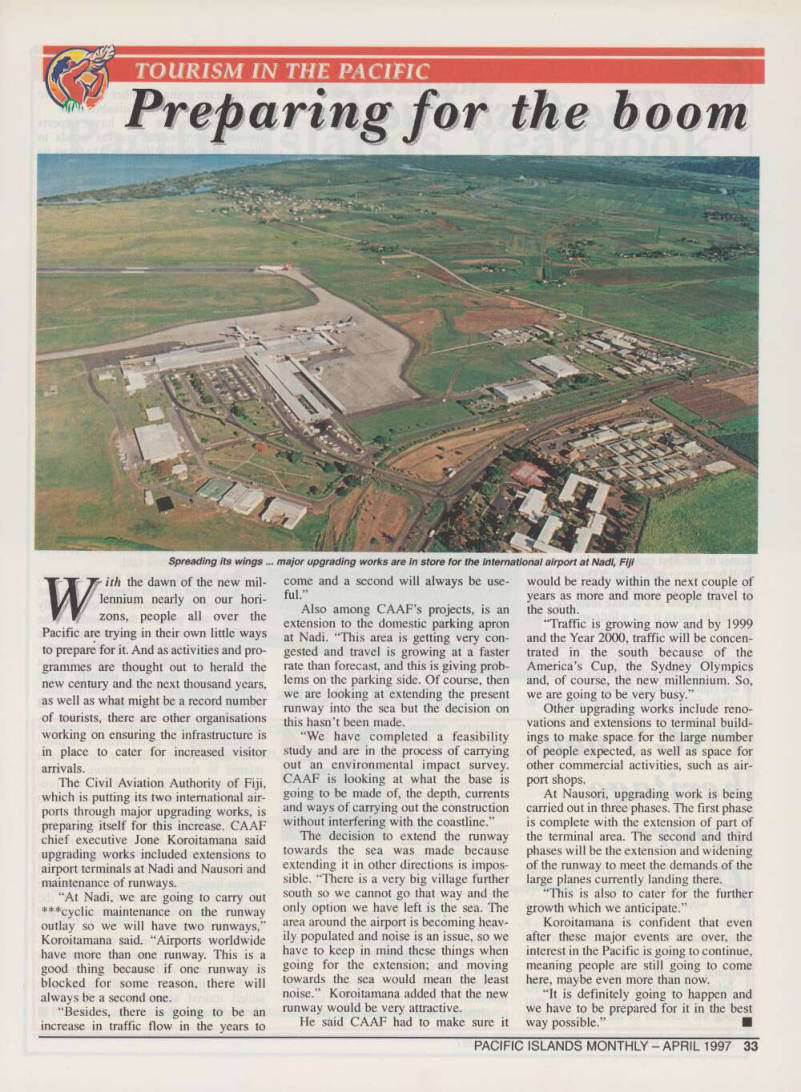
W- ith the dawn of the new mil lennium nearly on our hori zons, people all over the Pacific are trying in their own little ways to prepare for it. And as activities and pro grammes are thought out to herald the new century and the next thousand years, as well as what might be a record number of tourists, there are other organisations working on ensuring the infrastructure is in place to cater for increased visitor arrivals.
The Civil Aviation Authority of Fiji, which is putting its two international air ports through major upgrading works, is preparing itself for this increase. CAAF chief executive lone Koroitamana said upgrading works included extensions to airport terminals at Nadi and Nausori and maintenance of runways.
“At Nadi, we are going to carry out ***cyclic maintenance on the runway outlay so we will have two runways,”
Koroitamana said. “Airports worldwide have more than one runway. This is a good thing because if one runway is blocked for some reason, there will always be a second one.
“Besides, there is going to be an increase in traffic flow in the years to
come and a second will always be use ful.”
Also among CAAF’s projects, is an extension to the domestic parking apron at Nadi. “This area is getting very con gested and travel is growing at a faster rate than forecast, and this is giving prob lems on the parking side. Of course, then we are looking at extending the present runway into the sea but the decision on this hasn’t been made.
“We have completed a feasibility study and are in the process of carrying out an environmental impact survey.
CAAF is looking at what the base is going to be made of, the depth, currents and ways of carrying out the construction without interfering with the coastline.”
The decision to extend the runway towards the sea was made because extending it in other directions is impos sible. “There is a very big village further south so we cannot go that way and the only option we have left is the sea. The area around the airport is becoming heav ily populated and noise is an issue, so we have to keep in mind these things when going for the extension; and moving towards the sea would mean the least noise.” Koroitamana added that the new runway would be very attractive.
He said CAAF had to make sure it
would be ready within the next couple of years as more and more people travel to the south.
“Traffic is growing now and by 1999 and the Year 2000, traffic will be concen trated in the south because of the America’s Cup, the Sydney Olympics and, of course, the new millennium. So, we are going to be very busy.”
Other upgrading works include reno vations and extensions to terminal build ings to make space for the large number of people expected, as well as space for other commercial activities, such as air
port shops.
At Nausori, upgrading work is being carried out in three phases. The first phase is complete with the extension of part of the terminal area. The second and third phases will be the extension and widening of the runway to meet the demands of the large planes currently landing there.
“This is also to cater for the further
growth which we anticipate.”
Koroitamana is confident that even after these major events are over, the interest in the Pacific is going to continue, meaning people are still going to come here, maybe even more than now.
“It is definitely going to happen and we have to be prepared for it in the best way possible.” ■
Spreading its wings... major upgrading works are in store for the international airport at Nadi, Fiji
The first Pacific
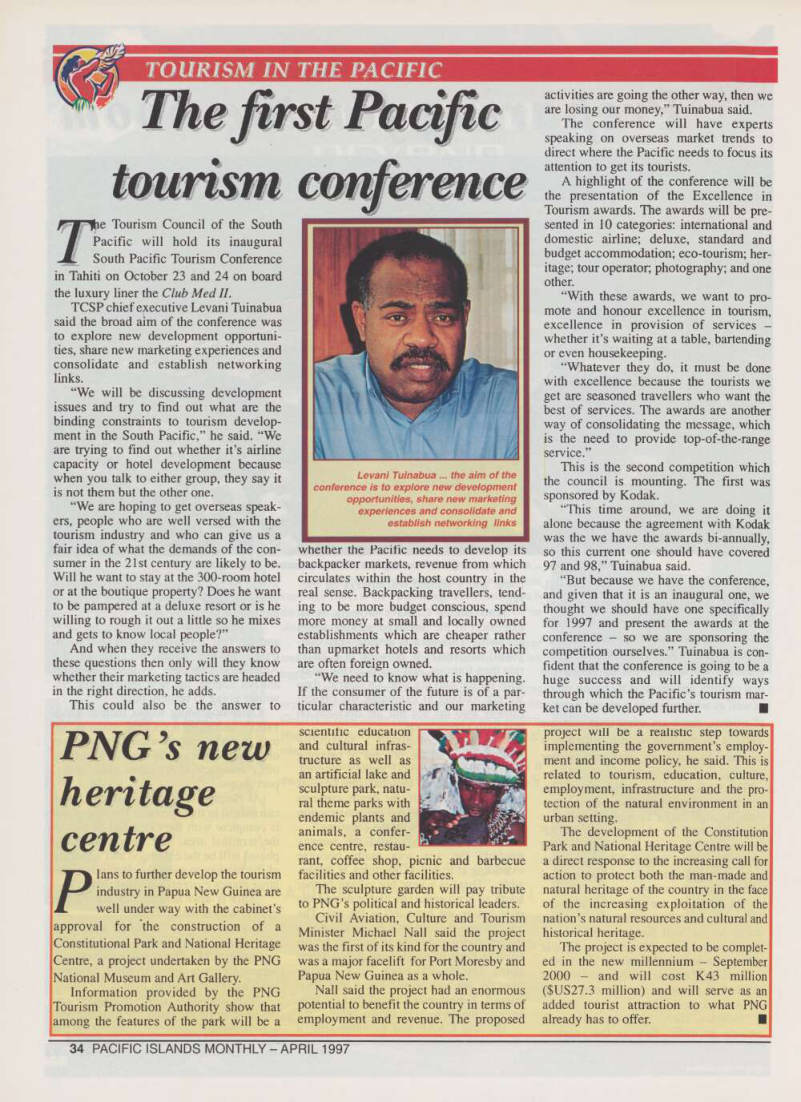


tourism conference
Tourism Council of the South M Pacific will hold its inaugural ~M L South Pacific Tourism Conference in Tahiti on October 23 and 24 on board the luxury liner the Club Med 11.
TCSP chief executive Levani Tuinabua said the broad aim of the conference was to explore new development opportuni ties, share new marketing experiences and consolidate and establish networking links.
“We will be discussing development issues and try to find out what are the binding constraints to tourism develop ment in the South Pacific,” he said. “We are trying to find out whether it’s airline capacity or hotel development because when you talk to either group, they say it is not them but the other one.
“We are hoping to get overseas speak ers, people who are well versed with the tourism industry and who can give us a fair idea of what the demands of the con sumer in the 21st century are likely to be.
Will he want to stay at the 300-room hotel or at the boutique property? Does he want to be pampered at a deluxe resort or is he willing to rough it out a little so he mixes and gets to know local people?”
And when they receive the answers to these questions then only will they know whether their marketing tactics are headed in the right direction, he adds.
This could also be the answer to
whether the Pacific needs to develop its backpacker markets, revenue from which circulates within the host country in the real sense. Backpacking travellers, tend ing to be more budget conscious, spend more money at small and locally owned establishments which are cheaper rather than upmarket hotels and resorts which are often foreign owned, “We need to know what is happening, If the consumer of the future is of a par ticular characteristic and our marketing
activities are going the other way, then we are losing our money,” Tuinabua said.
The conference will have experts speaking on overseas market trends to direct where the Pacific needs to focus its attention to get its tourists.
A highlight of the conference will be the presentation of the Excellence in Tourism awards. The awards will be pre sented in 10 categories: international and domestic airline; deluxe, standard and budget accommodation; eco-tourism; her itage; tour operator; photography; and one other.
“With these awards, we want to pro mote and honour excellence in tourism, excellence in provision of services whether it’s waiting at a table, bartending or even housekeeping.
“Whatever they do, it must be done with excellence because the tourists we get are seasoned travellers who want the best of services. The awards are another way of consolidating the message, which is the need to provide top-of-the-range service.”
This is the second competition which the council is mounting. The first was
sponsored by Kodak.
“This time around, we are doing it alone because the agreement with Kodak was the we have the awards bi-annually, so this current one should have covered 97 and 98,” Tuinabua said.
“But because we have the conference, and given that it is an inaugural one, we thought we should have one specifically for 1997 and present the awards at the conference - so we are sponsoring the competition ourselves.” Tuinabua is con fident that the conference is going to be a huge success and will identify ways through which the Pacific’s tourism mar ket can be developed further. ■
Levant Tuinabua ... the aim of the conference is to explore new development opportunities, share new marketing experiences and consolidate and establish networking links
\ Until about two years V, lago, fisheries was a f^jv iable and profitable People all / over the Pacific were moving into this business,
money was flowing in.
Japan was the biggest buyer of Pacific tuna and, with the high exchange rate of the Japanese yen, suppliers were getting a very good price for their fish.
But, as the yen dropped over the years, so has the profitability of the fisheries
industry.
The industry is in serious trouble and something needs to be done.
Fiji Fish, once a major supplier of Japan’s sashimi market, has stopped exporting to Japan. Company chairman Grahame Southwick said the yen had fall en 35 to 40 per cent over the past two and-a-half years and it wasn’t hard to work out what was happening.
The margins had never been as wide; it was always around 18 to 20 per cent, he said.
“The yen has never been this bad and if it goes down any further, we will suffer more.
Japan is the largest market and because we are not able to get much out of this market right now we have to look for alternative markets,” says lan Chute, managing director of Feeders Seafoods
(Fiji) Ltd.
“Currently, it amuses us to hear the kind of talk going around about other islands buying more boats and getting into this lucrative business,” Southwick said.
“If only people knew that there is hardly a boat making money in this whole industry at the moment.”
In terms of dollars, most companies are losing a $ 1 a kilo for every fish that is going into Japan at this point, Southwick stressed.
The sentiment was shared by Solander (Pacific) Limited’s director, Captain David Lucas.
The fall of the yen was a major blow to
companies exporting tuna to Japan, Lucas
said.
“We have stopped exporting to Japan because we are not making much and, with the high cost of fuel and freight, we are looking at other viable markets.”
Both Fiji Fish and Solander are exporting fish to other Asian markets and North America.
The two companies export yellowfin, big eye and albacore tuna.
The situation last year was very bad because companies were not getting much out of their exports and this year could be the same, Lucas warned.
Southwick couldn’t agree more, say
ing there was going to be a severe shake out in the next 12 months and this was going to see a lot of casualties. “The smaller and newer will probably go down and the bigger ones are going to be great ly affected as well.”
However, while most fisheries compa nies may have stopped exporting to Japan, some are still continuing to do so; something neither Southwick nor Lucas can understand the logic behind, they say.
As if the fall of the yen was not enough, companies in Fiji are also suffer ing from what they consider are very high fuel and freight costs.
Southwick, Lucas and Chute said these problems were close to breaking the back of the fisheries industry.
According to Lucas, because of the high cost of fuel, they are unable to take their fishing boats out too far. The further the boats went, the more fuel they used, said Chute.
“The government should remove the duty on fuel because we are paying so much more than our competitors to stay in the business,” Chute added.
“It is absolutely ridiculous because the Fiji fishing industry is paying double the amount of fuel compared to anyone else,”
\ Southwick said. \ “This is happening hg] because the govern ment refuses to fry/ recognise this as an export industry. The government charges very
high duty on fuel and this is one of the reasons why we can’t make as much prof it. It is killing us.”
Fisheries will never become a seri ous and viable industry in Fiji, Southwick said, “while the government is trying to throttle it”.
“We have said to them on many occa sions that we need some sort of conces sion but they want to harvest and benefit from the industry even before it’s on its feet.”
Southwick added that there was a vast misconception over the profitability of the industry.
“People look at the numbers coming in but they don’t see the expenses and the high price we have to pay for fuel and freight and, after all that is done, there is not much left on the table. This is where the crunch is.”
However, the Forum Fisheries Agency assures that this problem has been identi fied and work is about to commence on a joint study with the Forum Secretariat to
review fuel distribution and pricing sys tems in the region.
Fuel is a significant cost component of all commercial fishing operations and the FFA recognises that the current high costs of fuel in its member countries is a signif icant deterrent to locally based investors from establishing new fishing enterpirses.
Similarly, this works against island countries’ attempts to encourage existing foreign-based fleets to base their opera tions in the region.
The study will apply a regional per spective to identify the options available to FFA member countries to reduce fuel costs borne by locally based fishing ves sels.
The successful implementation of this would identify opportunities for FFA member countries to obtain their fuel sup plies at a lower price.
Such a result will provide a real impe tus not only to the local fishing industry but to the overall economies of FFA mem ber countries.
“So, when you look at the situation in Fiji, where freight is double our competi tors’ and the fuel price is double, you have to be a magician to stay in the game,” said Southwick.
“Not only that, but you have govern ment fiscal policies which seem to be
The fisheries industry is facing difficult times and it will take awhile before the situation starts improving, says Solander Pacific Limited’s director, Captain David Lucas (pictured above)
working against you.
“One wonders what the hell it is we are doing in this business.
“All you hear is politicians standing up in parliament and saying we are sur rounded by fish and we should be exploit ing our resources but, at the same time, they are chopping our hands off - and the very fact that we are still managing to survive is a miracle.
“We have made submission after sub mission to the government for about five years and there has been no positive response; we get promises, but no action whatsoever.
“We know that the government is short
of money - and they have their own rea sons for that - but if they intend on drag ging the industry down with them, it’s
very disappointing.
The industry has a lot of potential but, so long as it is being held back in this manner, it’s very difficult to move ahead.”
He added that, previously, the industry had enjoyed very good communications with the fisheries ministry and depart ment, but, recently, some “unbelievable” decisions had been made that have placed the industry in its “current strife” - the kind of decisions which allowed the industry to be dominated by foreign-
The ‘catch’ ... despite being surrounded by the ocean, one of the islands’ largest resources, there are numerous other factors at play where the fisheries industry is concerned. Solander Pacific’s operations have been affected by the fall of the yen and high fuel and freight costs
owned vessels.
“The government has allowed main land Chinese boats to come in here and fish in our waters and then export. There has been a lot of talk about these boats.
They have been in all the northern areas
in the Pacific and have been thrown out of all these areas.
“For a long time, they have eyed Fiji and, for a long time, we managed to keep them out, but not any more.
“The Taiwanese and Korean vessels
are on the same cost structure as us and, in order for them to survive, they put the prices up which is beneficial to everyone.
“But the Chinese are operating at half the cost and they have the effect of driv ing the prices down - and that’s not ben-
Feeders Seafood will be moving its operations to bigger premises, confident that the economic climate will improve and the industry will get back on its feet
\eficial to anyone,” i I Southwick said. %t) Both Southwick and y Lucas agree that the situation is the same all over the Pacific and, of
course, this is largely to do with the drop of the yen because Japan is the biggest buyer of tuna from the Pacific.
Lucas said the situation was very difficult and it would take some time before it got better. “But the question is: when will the yen return to normal? Right now, there is no profit in the industry and, in Fiji, there would hardly be a company breaking even at the moment.
“It is going to be this way for the next 12 months,” Southwick predicts.
However, despite the problems plagu
ing the industry, it seems that all hope is not lost with the number of fisheries com
panies still holding on.
How? Why?
“Because this is everything we do.
Everything we have has been invested in this business,” said Southwick.
“It’s not the sort of thing you walk away from. We have vessels, factories, machinery and people in it.”
Lucas said he was still here because of job satisfaction and, of course, there were so many locals for whom they provided jobs. And Chute is confident his company
will survive and continue to do well again. His optimism goes hand in hand with the company’s move to a new site.
Feeders will be moving its operations to where the Ports Authority of Fiji is mak ing extensions at one of the wharves to accommodate more vessels.
“This wharf is for the local fishing industry and involves the extension of present jetty facilities,” Chute said.
“There is a need for this because,
despite the problems, the industry is
expanding.” The new jetty will be able to accommodate up to 18 boats.
The FFA is trying its best, Andrew Richards, manager monitoring, control and surveillance, says, to develop initia tives which will assist in increasing eco nomic benefits to its member countries from the tuna industry. The agency says that its work programme, which was determined by its members, was becom
ing increasingly involved in identifying
options to attract more investment in the local industry. One of the FFA’s missions will be to reduce the number of foreign bilateral licences.
Starting this month, a number of FFA member countries will implement a 10 per cent cut in the number of bilateral access licences available to the foreign based purse seine fleet.
This cut has been implemented under
the Palau Arrangement for the Management of the Western Pacific Purse Seine Fishery and will limit the number of such vessels being licensed in the waters of the parties to the arrangement.
According to the Richards, these fore gone bilateral licences had been made available to locally-based vessels, thereby keeping overall vessel numbers intact but altering the numbers more favourably towards locally based fleets. The strength of FFA countries’ development aspira tions are indicated by their decision to impose alO per cent cut on the number of US vessels licensed under the multilateral treaty, which also becomes effective this month.
The FFA Secretariat has the overall responsibility for a joint FFA-South Pacific Commission project designed to improve national capacity building in fisheries. In particular, individual projects have focused on laying the groundwork for the development of viable, locally based tuna industries.
Throughout the above project, empha sis has been placed on private-sector involvement, including assistance to small-scale entrepreneurs. The role of governments has been promoted as one of the stewardship towards the resource and facilitator of a sound investment climate in fisheries. ■
heritage
PNG’s new
centre
Plans to further develop the tourism industry in Papua New Guinea are well under way with the cabinet’s {approval for the construction of a (Constitutional Park and National Heritage [Centre, a project undertaken by the PNG (National Museum and Art Gallery.
Information provided by the PNG (Tourism Promotion Authority show that among the features of the park will be a
scientific education and cultural infras tructure as well as an artificial lake and
sculpture park, natu
ral theme parks with endemic plants and animals, a confer ence centre, restau-
rant, coffee shop, picnic and barbecue facilities and other facilities.
The sculpture garden will pay tribute to PNG’s political and historical leaders.
Civil Aviation, Culture and Tourism Minister Michael Nall said the project was the first of its kind for the country and was a major facelift for Port Moresby and Papua New Guinea as a whole.
Nall said the project had an enormous potential to benefit the country in terms of employment and revenue. The proposed
project will be a realistic step towards
implementing the government’s employ
ment and income policy, he said. This is related to tourism, education, culture, employment, infrastructure and the pro tection of the natural environment in an urban setting.
The development of the Constitution Park and National Heritage Centre will be a direct response to the increasing call for action to protect both the man-made and natural heritage of the country in the face of the increasing exploitation of the nation’s natural resources and cultural and
historical heritage.
The project is expected to be complet ed in the new millennium - September 2000 - and will cost K 43 million ($U527.3 million) and will serve as an added tourist attraction to what PNG already has to offer. ■
Advertisements & other items, pp. 35-42 (1 item)
Pacific Islands Yearßook
Now Avai
17th Edition
Price
AUD
oo ■
PLUS
POSTAGE
ilßii Leant more about the Pacific
culture!custom tradition/people
population, tourism, trade, airlines, tax system etc. r"" 1 i Yes, send me the latest copy of the Pacific Islands Year Book. I I □ Here is a cheque/money order 1 □ Visa □ Master Card Expiry Date I l Card Number I Name Signature I , Address [ Post to: Pacific Islands Monthly, PO Box 1167 Suva, Fiji or Fax (679) 303809. j I J
i e en
f the line
adette Hussein
... but hanging on
he ocean is one of Pacific Island countries’ largest resources and the backbone of the fisheries industry. Yet harnessing this valuable resource in a way that would generate profits as well as be sustainable has become increasingly difficult for the region. And, according to fisheries operators in Fiji, the blame for this lies with the
Specialist Importers and
Manufacturers of Quality Commercial
and Recreational Fishing Equipment
Hooks, Snaps, Swivels, Floats, Lures and associ- Phone, fax or write for quotations or a copy of our ated Fishing Gear, for the T\ina Fishery. catalogue.
Our specialty is Nylon Monofilament Fishing Line 3.omm, 3.5 mm, and 4.omm diameter for Longline Fishing in 5 mile and 9 mile reels. (Colour clear) 1000 metre hanks available from I.2mm diameter (65 kg B/S) to smm diameter (900 kg B/S). (In light blue or clear colour) Very competitive prices ranging from US$9.OO per kg depending on quantities. ii
Fishing Supplies Ltd
P.0.80x 4138, Mount Maunganui, New Zealand.
Phone: (64) 7- 5755130. Fax: (64) 7 - 5755914, Contact: lan Trott (Managing Director).
A/H Phone: (64) 7-5332320.
Remember your Friend
There are times in your life when you feel your friends have been missing out on something good. Now's your chance to do something about it and share with them one of the good things you have. Buy your friend a subscription to Pacific Islands Monthly and let him or her join you and the thousands of other people worldwide who are kept informed of the latest political, social and cultural
changes taking place in the Pacific.
SUBSCRIPTIONS
American Samoa US$45 Australia A 542.00 Canada US$45 Cook Islands AUSS46 Fiji F 526.40 French Polynesia US$45 Guam US$45 Hawaii US$45 Japan US$45 Kiribati AUSS46 Marshall/Micronesia US$4O New Zealand NZ$55 Niue AUSS46 Norfolk Island AUSS42 Northern Marianas/Palau US$4O Papua New Guinea AUSS4S Solomon Islands AUSS46 Tonga AUSS46 Tuvalu AUSS46 United Kingdom Stg Pound2B US Mainland US$45 Vanuatu AUSS4S Western Samoa WS$6O Elsewhere AUSS63 Nauru AUSS42 New Caledonia US$32 Payment to Pacific Islands Monthly: Subscriptions Dept, GPO Box 1167, Suva, FIJI.
Subscriptions rates include the cost of airspeeding to all destinations set out above.
Direct airmail rates on application.
Telephone: 304111 Fax; 303809 r
PACIFIC
ISLANDS
Please send my friend Pacific Islands Monthly for one year (12 issues).
I enclose my cheque for $ (made payable to Pacific Islands Monthly) or debit $ to my: □ Bankcard Card No:
NAME
□ Visacard □ Mastercard
Expiry Date
.SIGNATURE.
MY FRIEND'S NAME.
MY FRIEND'S ADDRESS.
I CITY.
COUNTRY
I '-1
r Ji] . i i **» w
JD VO
r Ca •■*»• - dfcn m,w s - •»* P.O. Box 178 Suvar._ Phone: (679) 314 819 Fax:(679) 314 973
Emailr solandeitgis.com.fj
FOR SALE BY TENDER
ON INSTRUCTIONS FROM THE
AUSTRALIAN PUBLIC TRUSTEE
MV “SWAGMAN” (FORMERLY KNOWN AS 'CHARLES SYDNEY’)
CRAY/CHARTER/TUNA BOAT
Length: 60 ft. Beam: 18 ft. Draft: 7ft Built to the highest standards by W. Patterson, Melbourne, Australia, 1985.
Steel single chine hull • steel decks • aluminium wheelhouse Engines (both driving props) Gardiner 8 XLCT 230 hp; Gardiner 4LW 70hp (plus Ketch rig 60ft mast, S/S rigging and sails) Cruises 9 Knots# 45 KVA 240 and 24 Volt# 12,000 litre diesel 2,000 litre water# twin ram hydraulic steering# 10-12 ton blast freezer-49 degrees F large storage hold wheelhouse aft# very large foredeck# toilet • shower# TV# video# microwave# wall oven# ceramic hot plates • fridge • 104nan life raft# GPS# 2 depth sounders radar 72-mile colour# satnav# radios SSB and VHP# auto fire alarm 2CB radios# air conditioning MV ‘SWAGMAN’ is currently located at Port Vila harbour, Vanuatu, and is sold ‘as is, where is’.
Contact: CLAYTON UTZ SOLICITORS
KPMG House, Rue Pasteur PO Box ±272, Port Vila
VANUATU
Tel: 678-27222 Fax: 678-27223 For further Information, as a tender bid form
Established 1983
We are suppliers of
bait & fishing gear, vessel
management, seafood
processing & export
FRESHNESS, QUALITY and EFFICIENCY are key
elements in Feeders Seafoods processing and export operations to markets all over USA, Hawaii, Japan, Australia, New Zealand and the South Pacific.
Our new, modern hygienic processing plant situated at the new Ports Authority dedicated fishing wharf will provide berthing for up to 20 vessels at any one time.
Among the many facilities available will be. A 400-ton freezer facility for fish and bait storage.
Two sashimi processing lines capable of handling up to 60 tons per day. Chill storage for up to 60 tons and blast freezing especially for albacore and tuna.
Our business is service to the Fishing Industry.
For more information contact: lan or Adrian Chute ... mmmm mm
FEEDERS SEAFOODS
ESI 1983.
G.P.O. Box 13968, Suva, Fiji. Fax: (679) 302 079 Ph: (679) 302 756, 303 705, Sales: (679) 303 333 Mobile Ph: Adrian Chute ■ 994 308, lan Chute • 994 302, After hours -320 297
•Ts* its -> *«? I *> C'X » i *»L - V w* SPPF can help fisheries project sponsors in three main areas: • Formulating, evaluating and promoting fisheries projects and providing consultancy services to develop and implement business plans; • Obtaining equity and loan financing on commercial terms from financial institutions; • Raising additional equity from the Pacific Island Investment Facility.
The Pacific Islands Investment Facility (PIIF) The PIIF was established by the International Finance Corporation (IFC) in 1995 initial capital of US$2 million. PIIF can invest amounts between US$lOO,OOO and U 55350,000 in private sector fisheries projects in Pacific island countries. PIIF acts to supplement the region’s limited sources of equity and commercial finance.
PIIF funding has proved useful in a number of fisheries projects where funding is not readily available for the fisheries sector. Funds from this source made available to Pacific islands fisheries projects through SPPF is approaching USsi million. Applications for funding assistance from the PIIF are processed through SPPF in Sydney and approved by IFC in
Washington, DC.
South Pacific Project Facility Enquiries concerning fisheries projects where SPPF might be of assistance may be directed to:
Peter Philipson
Fisheries Sector Specialist South Pacific Project Facility Level 8, 89 York Street
Sydney, Australia
GPO Box 1612 Sydney, Australia 2001 Phone 61-2-9299 2500 Fax 61-2-9299 2551
Email [email protected]
Watching out for the sharks
Vessel-monitoring system to guard against illegal fishing or violations by foreign boats
By Bernadette Hussein
m ior several years, member coun ty tries of the South Pacific Forum ML Fisheries Agency have been con sidering the research, development and implementation of a satellite-based Vessel Monitoring System (VMS) in the central and western Pacific.
Following the production of a VMS business plan in 1995, FFA member coun tries developed a VMS business require ments baseline plane.
The baseline form of the FFA member countries’ VMS, in accordance with the stated preference of FFA member coun tries, will enhance the effectiveness of several other measures being implement ed to assist with the sustainable develop ment and management of the tuna resources of the central-western Pacific.
The VMS will assist with monitoring the position, speed and direction of Distant Water Fishing Nation vessels that are fitted with approved Automatic Location Communicator (ALC) devices.
The VMS will be simultaneously mon itoring the positions of up to 1000 fishing vessels, with the potential to monitor up to 2000 vessels. It will also be capable of securely transferring vessel positions to each FFA member country, as required, on a timely basis, enabling individual mem ber countries to track the movements of vessels in their Exclusive Economic Zones (EEZ).
Almost immediately following the contract signature for the FFA Member Country VMS Project on November 4, 1996, between FFA and Aspect Computing Pty Ltd of Australia, a team of four personnel representing the VMS con tractor and sub-contractor visited the FFA headquarters in Honiara, Solomon Islands
for three weeks to commence the VMS
project implementation.
A confidence trial, commenced on January 2, will run until later this month. , This will help FFA staff to -become familiar with the operational characteris tics of the VMS. During this period, sev eral fishing vessels carrying ALCs have been tracked by using the tracking soft ware. According to the FFA, the VMS will have the scope to monitor commer cial tuna vessels on its regional register, and local tuna vessels if, and when, required by an FFA member.
Future enhancements to the baseline will enable the system to provide critical information on other fisheries resources as well as the transfer of fisheries man agement information on a close-to-real time basis.
The VMS will support enhance moni toring by assisting with the detection of
illegal fishing and/or potential fishing
violations and proving near-real-time and historical analysis, the FFA said.
Operators of foreign vessels licensed to fish in the region will be required to install FFA-approved Automatic Location Communication devices at their own cost to enable a two-way communication sys tem with FFA headquarters and for emer gency uses. ■
Signals to
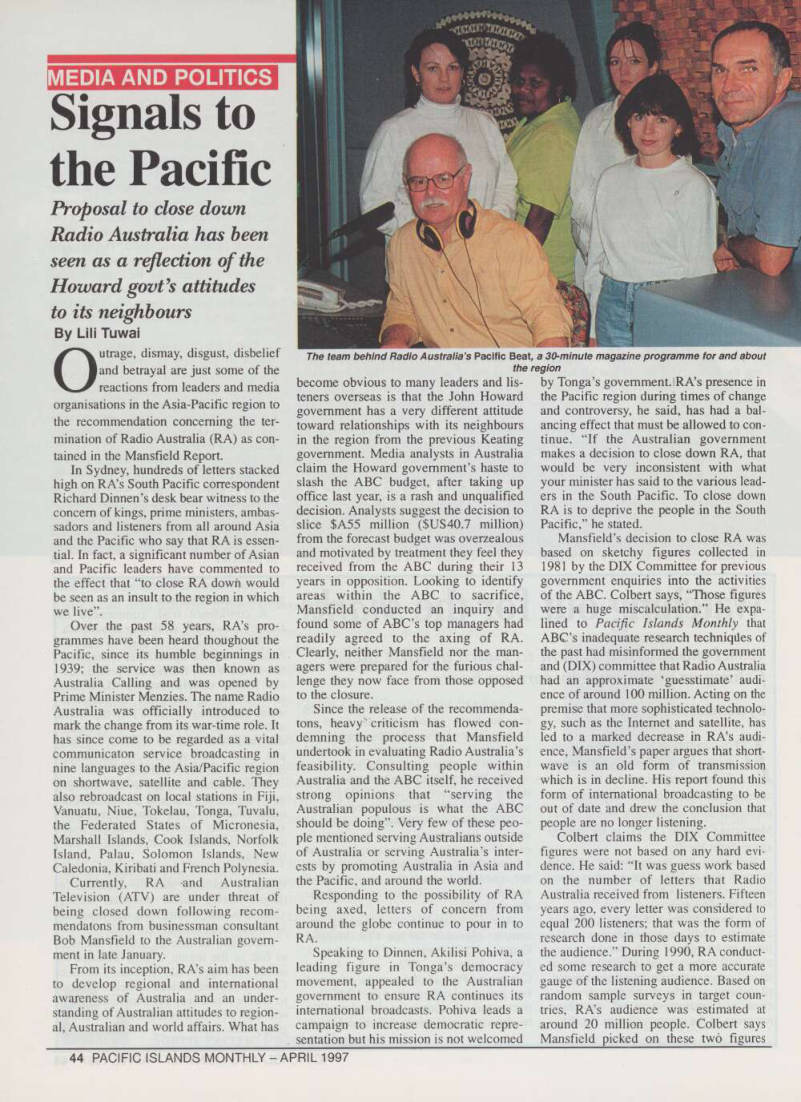
Media And Politics
Signals to the Pacific
Proposal to close down Radio Australia has been seen as a reflection of the Howard govt’s attitudes to its neighbours
By Lili Tuwai
Outrage, dismay, disgust, disbelief and betrayal are just some of the reactions from leaders and media organisations in the Asia-Pacific region to the recommendation concerning the ter mination of Radio Australia (RA) as con tained in the Mansfield Report.
In Sydney, hundreds of letters stacked high on RA’s South Pacific correspondent Richard Dinnen’s desk bear witness to the concern of kings, prime ministers, ambas sadors and listeners from all around Asia and the Pacific who say that RA is essen tial. In fact, a significant number of Asian and Pacific leaders have commented to the effect that “to close RA down would be seen as an insult to the region in which we live”.
Over the past 58 years, RA’s pro grammes have been heard thoughout the Pacific, since its humble beginnings in 1939; the service was then known as Australia Calling and was opened by Prime Minister Menzies. The name Radio Australia was officially introduced to mark the change from its war-time role. It has since come to be regarded as a vital communicaton service broadcasting in nine languages to the Asia/Pacific region on shortwave, satellite and cable. They also rebroadcast on local stations in Fiji, Vanuatu, Niue, Tokelau, Tonga, Tuvalu, the Federated States of Micronesia, Marshall Islands, Cook Islands, Norfolk Island, Palau, Solomon Islands, New Caledonia, Kiribati and French Polynesia.
Currently, RA and Australian Television (ATV) are under threat of being closed down following recom mendatons from businessman consultant Bob Mansfield to the Australian govern ment in late January.
From its inception, RA’s aim has been to develop regional and international awareness of Australia and an under standing of Australian attitudes to region al, Australian and world affairs. What has
become obvious to many leaders and lis teners overseas is that the John Howard government has a very different attitude toward relationships with its neighbours in the region from the previous Keating government. Media analysts in Australia claim the Howard government’s haste to slash the ABC budget, after taking up office last year, is a rash and unqualified decision. Analysts suggest the decision to slice SASS million (SUS4O.7 million) from the forecast budget was overzealous and motivated by treatment they feel they received from the ABC during their 13
years in opposition. Looking to identify
areas within the ABC to sacrifice, Mansfield conducted an inquiry and found some of ABC’s top managers had readily agreed to the axing of RA.
Clearly, neither Mansfield nor the man agers were prepared for the furious chal lenge they now face from those opposed to the closure.
Since the release of the recommenda tons, heavy ’criticism has flowed con demning the process that Mansfield undertook in evaluating Radio Australia’s
feasibility. Consulting people within
Australia and the ABC itself, he received strong opinions that “serving the Australian populous is what the ABC should be doing”. Very few of these peo ple mentioned serving Australians outside of Australia or serving Australia’s inter ests by promoting Australia in Asia and the Pacific, and around the world.
Responding to the possibility of RA being axed, letters of concern from around the globe continue to pour in to RA.
Speaking to Dinnen, Akilisi Pohiva, a leading figure in Tonga’s democracy movement, appealed to the Australian government to ensure RA continues its international broadcasts. Pohiva leads a campaign to increase democratic repre sentation but his mission is not welcomed
by Tonga’s government.lßA’s presence in
the Pacific region during times of change and controversy, he said, has had a bal ancing effect that must be allowed to con tinue. “If the Australian government makes a decision to close down RA, that would be very inconsistent with what your minister has said to the various lead ers in the South Pacific. To close down RA is to deprive the people in the South Pacific,” he stated.
Mansfield’s decision to close RA was based on sketchy figures collected in 1981 by the DIX Committee for previous government enquiries into the activities of the ABC. Colbert says, “Those figures were a huge miscalculation.” He expa lined to Pacific Islands Monthly that ABC’s inadequate research techniques of the past had misinformed the government and (DIX) committee that Radio Australia had an approximate ‘guesstimate’ audi ence of around 100 million. Acting on the premise that more sophisticated technolo gy, such as the Internet and satellite, has led to a marked decrease in RA’s audi ence, Mansfield’s paper argues that short wave is an old form of transmission which is in decline. His report found this form of international broadcasting to be out of date and drew the conclusion that
people are no longer listening.
Colbert claims the DIX Committee figures were not based on any hard evi dence. He said: “It was guess work based on the number of letters that Radio Australia received from listeners. Fifteen years ago, every letter was considered to equal 200 listeners; that was the form of research done in those days to estimate the audience.” During 1990, RA conduct ed some research to get a more accurate gauge of the listening audience. Based on random sample surveys in target coun tries, RA’s audience was estimated at around 20 million people. Colbert says Mansfield picked on these two figures
The team behind Radio Australia’s Pacific Beat, a 30-minute magazine programme for and about the region
and now we have had to try and go back to say the 1981 figures were, in fact, a gross overstatement and we should not be comparing the two. “This is the reason why we are being condemned and told we are out of date and are dispensable.”
An undisclosed source within the ABC claimed that some ABC managers decid ed last August that if it did have to suffer the SASS-million cuts, these would cause the least pain to itself if RA was dropped.
In the early days of looking at where to cut, rumours such as the amalgamation of Radio Nation and metropolitan radio, or the dropping of Triple J or Classic FM were floated publicly and met with howls of protest by newspapers and listeners around the country. As a result, ABC man agement backed away from those options.
“Extreme disappointment and concern over (the) proposed closure” was how Eliki Bomani, Fiji’s director of Information, expressed himself in a letter of support to Radio Australia’s Pacific Bureau. He wrote, “It seems apparent that no prior consultation with your important audience here in the South Pacific region was undertaken to gauge the important utility of Radio Australia as a broadcast ing medium before this very significant recommendation was made.”
Considering that Australia is still
recovering internationally and internally
from the racist remarks and ideology of federal member of parliament Pauline Hanson, the government has acted quick ly to be seen as wanting to engage in a process to calm the storm. Recently, the senate voted that the future of Radio Australia and Australia Television would be examined by the Senate Committee on Defence, Trade and Foreign Affairs, and this committee will report back to the government by May 15. Colbert explains; “We see this as a very positive move from our point of view; the government has
backed away from the notion that they can push ahead and do away with us. We think they are midway from doing a u-tum, they have diverted the issue to a committee.”
Pacific Islands Monthly asked Colbert that if the government allowed the cuts, could this be interpreted as an extension of their attitude toward domestic multi culturism. “I think that you can make that connection, that for all of our lip-service, the importance of this egalitarian society and equal opportunity and welcoming immigrants and students from all around the place and trying to provide our techni cal expertise and knowledge to support developing societies in this part of the world, that if they then turn around and cut off this area of activity, it is really cut ting off our nose,” said Colbert.
A letter to RA from Fiji written by Peter Salamonsen, secretary of the Programme for Justice, Peace and Development, which operates through the Pacific Conference of Churches, states: “At a time where costs have a pri ority over service, we, who live in a region characterised by many developing and varied nations scattered over a vast area of ocean, find this decision ill advised, if not appalling.
“The truthful and accurate reporting of this international service has in no small way contributed to the very growth of democracy in this part of the world.”
He concludes, “Let not the commit ment of the Australian government to the continuing development of the Pacific neighbours, so strongly articulated at annual meetings of the South Pacific Forum and reported by the Pacific ser vices of Radio Australia, be silenced by the forces of profit and self-interest.”
The director of the Department of Youth and Civil Affairs in the State of Yap in FSM, Tony Tareg, wrote to RA express ing his concern over the possibility of its
closure. He said, “ If this happens, most, if not all, the FSM media services and their listeners, viewers as well as readers will be left in total darkness.” He stressed the point that “due to our under-developed broadcasting systems and inability to access information elsewhere, we certain ly rely on RA transmissions in getting regional and international news for our people in this part of the Pacific.”
Dinnen is quick to make the point that the RA-Pacific connection is a two-way trade of information, techniques and approaches. He stresses learning how to talk about another person’s culture and tradition is really important. He said: “I’m here in Sydney telling stories from the Pacific, I can listen to the way they are reporting and what they are saying so that I, too, can leam a better way to tell an audience in Australia or other European societies about the Pacific. I am con vinced that is where Radio Australia can contribute as a bridge between our little world in Australia and all those worlds out in the Pacific.” Currently, all responses of support are being forwarded to the senate committee where a group of six to eight politicians in Canberra will look seriously at this information and get a clear mes sage from that as to the importance of RA in the region.
Critical of Mansfield’s recommenda
tions, foreign affairs opposition
spokesman Laurie Brereton said the net works played a critical role in Austrlalia’s engagement in the Asia-Pacific region.
“There has already been a strong reaction from the South Pacific countries which depend on Radio Australia for essential news and information.
“Such an action, driven by short-term cost-cutting, runs contrary to Australia’s national interest. It would be just plain stupid; a classic case of being penny-wise and pound-foolish.” ■
Exposed
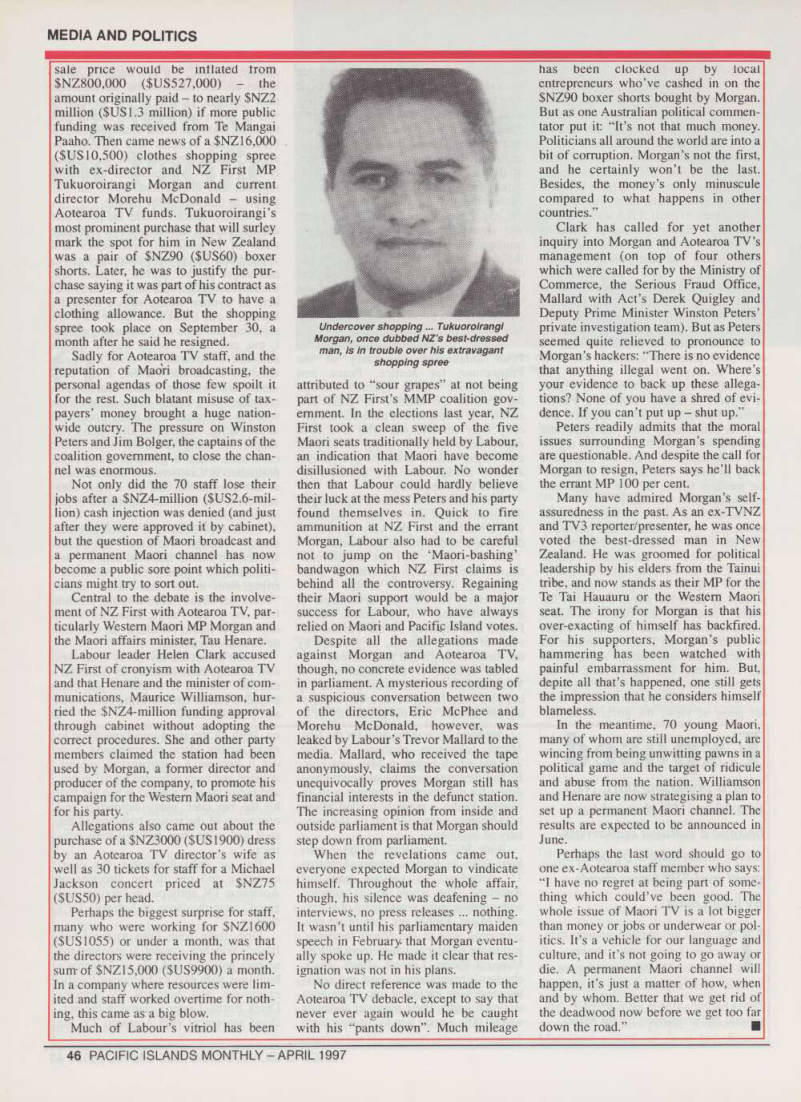
After a promising start , NZ’s first Maori TV channel has become a cultural embarrass
ment, undermined by politics,
greed and $9O boxer shorts By lulia Leilua The truth has seemed stranger than fiction with the drama of Aotearoa TV. What was supposed to have been a pioneering vehicle for Maori culture, ended up a political and cultural embarrassment for the Maori.
Aoteraoa TV was the pilot for the first Maori television channel in New Zealand which began in May, last year.
Its five directors were the successful ten derers for the channel’s contract with Te Mangai Paaho, a publicly funded Maori broadcasting agency set up by the min istry of commerce.
With SNZ2.6 million (SUSI. 7 mil
lion) from Te Mangai Paaho, Aotearoa TV broadcast to various parts of Auckland. The whole thing brimmed with promise and a young team of starry eyed Maori. Eighty per cent of its pro gramming was in the Maori language, part of the contractual agreement with Te Managai Paaho. Current affairs, news, children’s programmes, sport and enter tainment were packaged into a five-hour slot each night. Their potential audience was 60,000, a good size to cut their teeth
on. With all the good intentions there to make quality Maori programming, how did it become a controversial subject, debated and even ridiculed by the public and politicians for weeks? When the flak hit the fan later, many supporters and opponents of the station both agreed the staff had more than fulfilled their con tract.
But, as Puhi Rangiaho, the chief executive and one of the directors of Aoteraroa TV, aptly put it, “politics and greed” were the cause of Aotearoa TV’s demise.
First, there were links to the Cook Islands Winebox scandal. It involved the suspect purchase and sale of Aotearoa’s buildings with two ex-European Pacific executives, and Aotearoa TV director Derek Burns. Under a clause in the pur chase agreement with Aotearoa TV, the
sale price would be inflated from
Snzboo,Ooo ($U5527,000) - The
amount originally paid - to nearly SNZ2 million (SUSI. 3 million) if more public funding was received from Te Mangai Paaho. Then came news of a SNZ 16,000 (SUS 10,500) clothes shopping spree with ex-director and NZ First MP
Tukuoroirangi Morgan and current
director Morehu McDonald - using Aotearoa TV funds. Tukuoroirangi’s
most prominent purchase that will surley
mark the spot for him in New Zealand was a pair of SNZ9O (SUS6O) boxer shorts. Later, he was to justify the pur chase saying it was part of his contract as a presenter for Aotearoa TV to have a clothing allowance. But the shopping spree took place on September 30, a month after he said he resigned.
Sadly for Aotearoa TV staff, and the reputation of Maori broadcasting, the personal agendas of those few spoilt it for the rest. Such blatant misuse of tax
payers’ money brought a huge nation
wide outcry. The pressure on Winston Peters and Jim Bolger, the captains of the coalition government, to close the chan nel was enormous.
Not only did the 70 staff lose their jobs after a SNZ4-million (SUS2.6-mil lion) cash injection was denied (and just after they were approved it by cabinet), but the question of Maori broadcast and a permanent Maori channel has now become a public sore point which politi cians might try to sort out.
Central to the debate is the involve ment of NZ First with Aotearoa TV, par ticularly Western Maori MP Morgan and the Maori affairs minister, Tau Henare.
Labour leader Helen Clark accused NZ First of cronyism with Aotearoa TV and that Henare and the minister of com munications, Maurice Williamson, hur ried the SNZ4-million funding approval through cabinet without adopting the correct procedures. She and other party members claimed the station had been used by Morgan, a former director and producer of the company, to promote his campaign for the Western Maori seat and for his party.
Allegations also came out about the purchase of a SNZ3OOO (SUSI9OO) dress by an Aotearoa TV director’s wife as well as 30 tickets for staff for a Michael Jackson concert priced at SNZ7S (SUSSO) per head.
Perhaps the biggest surprise for staff,
many who were working for SNZI6OO (SUSIOSS) or under a month, was that the directors were receiving the princely sum-of SNZIS,OOO (SUS99OO) a month.
In a company where resources were lim ited and staff worked overtime for noth ing, this came as a big blow.
Much of Labour’s vitriol has been
attributed to “sour grapes” at not being part of NZ First’s MMP coalition gov ernment. In the elections last year, NZ First took a clean sweep of the five Maori seats traditionally held by Labour, an indication that Maori have become disillusioned with Labour. No wonder then that Labour could hardly believe their luck at the mess Peters and his party found themselves in. Quick to fire ammunition at NZ First and the errant Morgan, Labour also had to be careful not to jump on the ‘Maori-bashing’ bandwagon which NZ First claims is behind all the controversy. Regaining their Maori support would be a major success for Labour, who have always relied on Maori and Pacific Island votes.
Despite all the allegations made against Morgan and Aotearoa TV, though, no concrete evidence was tabled in parliament. A mysterious recording of a suspicious conversation between two of the directors, Eric McPhee and Morehu McDonald, however, was leaked by Labour’s Trevor Mallard to the media. Mallard, who received the tape anonymously, claims the conversation unequivocally proves Morgan still has financial interests in the defunct station.
The increasing opinion from inside and outside parliament is that Morgan should step down from parliament.
When the revelations came out, everyone expected Morgan to vindicate himself. Throughout the whole affair, though, his silence was deafening - no interviews, no press releases ... nothing.
It wasn’t until his parliamentary maiden
speech in February, that Morgan eventu
ally spoke up. He made it clear that res ignation was not in his plans.
No direct reference was made to the Aotearoa TV debacle, except to say that never ever again would he be caught with his “pants down”. Much mileage
has been clocked up by local entrepreneurs who’ve cashed in on the
SNZ9O boxer shorts bought by Morgan.
But as one Australian political commen tator put it: “It’s not that much money.
Politicians all around the world are into a bit of corruption. Morgan’s not the first, and he certainly won’t be the last.
Besides, the money’s only minuscule compared to what happens in other countries.”
Clark has called for yet another inquiry into Morgan and Aotearoa TV’s management (on top of four others which were called for by the Ministry of Commerce, the Serious Fraud Office, Mallard with Act’s Derek Quigley and Deputy Prime Minister Winston Peters’ private investigation team). But as Peters seemed quite relieved to pronounce to Morgan’s hackers: “There is no evidence that anything illegal went on. Where’s your evidence to back up these allega tions? None of you have a shred of evi dence. If you can’t put up - shut up.”
Peters readily admits that the moral issues surrounding Morgan’s spending are questionable. And despite the call for Morgan to resign, Peters says he’ll back the errant MP 100 per cent.
Many have admired Morgan’s self assuredness in the past. As an ex-TVNZ and TV3 reporter/presenter, he was once voted the best-dressed man in New Zealand. He was groomed for political leadership by his elders from the Tainui tribe, and now stands as their MP for the Te Tai Hauauru or the Western Maori seat. The irony for Morgan is that his over-exacting of himself has backfired.
For his supporters, Morgan’s public
hammering has been watched with painful embarrassment for him. But, depite all that’s happened, one still gets the impression that he considers himself blameless.
In the meantime, 70 young Maori, many of whom are still unemployed, are wincing from being unwitting pawns in a political game and the target of ridicule and abuse from the nation. Williamson and Henare are now strategising a plan to set up a permanent Maori channel. The results are expected to be announced in June.
Perhaps the last word should go to one ex-Aotearoa staff member who says: “I have no regret at being part of some thing which could’ve been good. The whole issue of Maori TV is a lot bigger than money or jobs or underwear or pol itics. It’s a vehicle for our language and culture, and it’s not going to go away or die. A permanent Maori channel will happen, it’s just a matter of how, when and by whom. Better that we get rid of the deadwood now before we get too far down the road.” ■
Undercover shopping... Tukuoroirangi Morgan, once dubbed NZ’s best-dressed man, is in trouble over his extravagant shopping spree
Nobel laureate
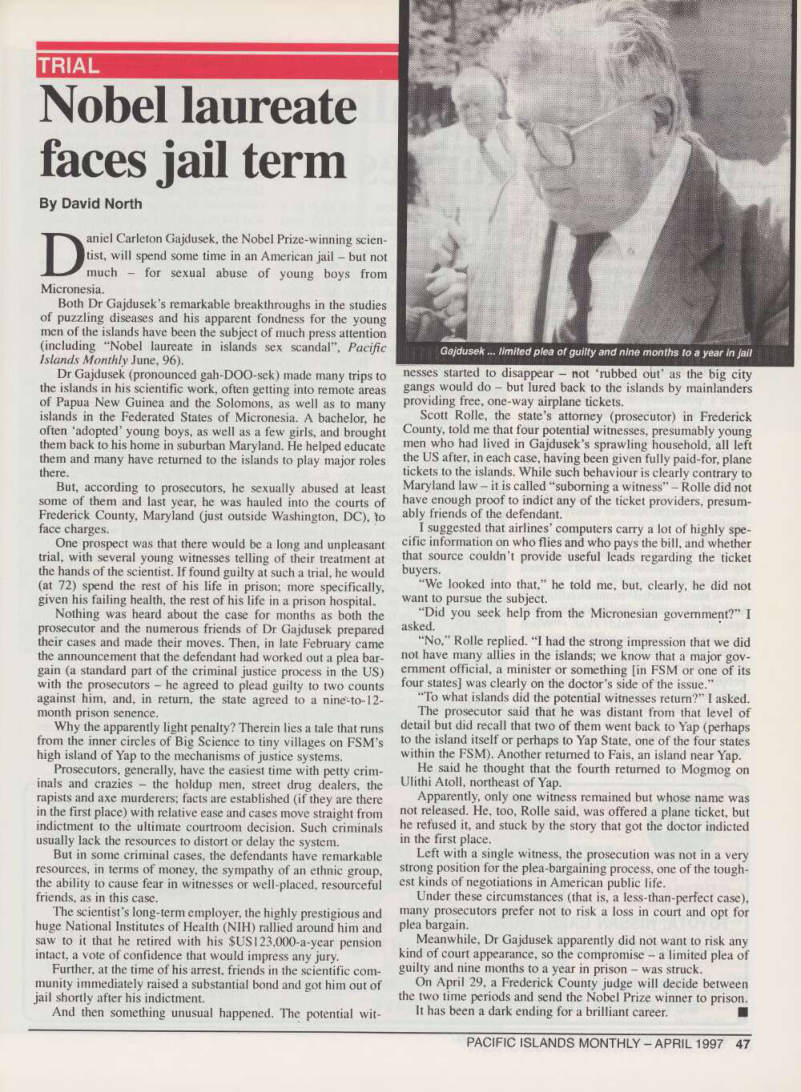
Trial
Nobel laureate faces jail term
By David North
Daniel Carleton Gajdusek, the Nobel Prize-winning scien tist, will spend some time in an American jail - but not much - for sexual abuse of young boys from Micronesia.
Both Dr Gajdusek’s remarkable breakthroughs in the studies of puzzling diseases and his apparent fondness for the young men of the islands have been the subject of much press attention (including “Nobel laureate in islands sex scandal”, Pacific Islands Monthly June, 96).
Dr Gajdusek (pronounced gah-DOO-sek) made many trips to the islands in his scientific work, often getting into remote areas of Papua New Guinea and the Solomons, as well as to many islands in the Federated States of Micronesia. A bachelor, he often ‘adopted’ young boys, as well as a few girls, and brought them back to his home in suburban Maryland. He helped educate them and many have returned to the islands to play major roles there.
But, according to prosecutors, he sexually abused at least some of them and last year, he was hauled into the courts of Frederick County, Maryland (just outside Washington, DC), to
face charges.
One prospect was that there would be a long and unpleasant trial, with several young witnesses telling of their treatment at the hands of the scientist. If found guilty at such a trial, he would (at 72) spend the rest of his life in prison; more specifically, given his failing health, the rest of his life in a prison hospital.
Nothing was heard about the case for months as both the prosecutor and the numerous friends of Dr Gajdusek prepared their cases and made their moves. Then, in late February came the announcement that the defendant had worked out a plea bar gain (a standard part of the criminal justice process in the US) with the prosecutors - he agreed to plead guilty to two counts against him, and, in return, the state agreed to a nine-to-12month prison senence.
Why the apparently light penalty? Therein lies a tale that runs from the inner circles of Big Science to tiny villages on FSM’s high island of Yap to the mechanisms of justice systems.
Prosecutors, generally, have the easiest time with petty crim inals and crazies - the holdup men, street drug dealers, the rapists and axe murderers; facts are established (if they are there in the first place) with relative ease and cases move straight from indictment to the ultimate courtroom decision. Such criminals usually lack the resources to distort or delay the system.
But in some criminal cases, the defendants have remarkable resources, in terms of money, the sympathy of an ethnic group, the ability to cause fear in witnesses or well-placed, resourceful friends, as in this case.
The scientist’s long-term employer, the highly prestigious and huge National Institutes of Health (NIH) rallied around him and saw to it that he retired with his $U5123,000-a-year pension intact, a vote of confidence that would impress any jury.
Further, at the time of his arrest, friends in the scientific com munity immediately raised a substantial bond and got him out of jail shortly after his indictment.
And then something unusual happened. The potential wit-
nesses started to disappear - not ‘rubbed oiit’ as the big city gangs would do - but lured back to the islands by mainlanders providing free, one-way airplane tickets.
Scott Rolle, the state’s attorney (prosecutor) in Frederick County, told me that four potential witnesses, presumably young men who had lived in Gajdusek’s sprawling household, all left the US after, in each case, having been given fully paid-for, plane tickets to the islands. While such behaviour is clearly contrary to Maryland law - it is called “suborning a witness” - Rolle did not have enough proof to indict any of the ticket providers, presum ably friends of the defendant.
I suggested that airlines’ computers carry a lot of highly spe cific information on who flies and who pays the bill, and whether that source couldn’t provide useful leads regarding the ticket
buyers.
“We looked into that,” he told me, but, clearly, he did not want to pursue the subject.
“Did you seek help from the Micronesian government?” I asked.
“No,” Rolle replied. “I had the strong impression that we did not have many allies in the islands; we know that a major gov ernment official, a minister or something [in FSM or one of its four states] was clearly on the doctor’s side of the issue.”
“To what islands did the potential witnesses return?” I asked.
The prosecutor said that he was distant from that level of detail but did recall that two of them went back to Yap (perhaps to the island itself or perhaps to Yap State, one of the four states within the FSM). Another returned to Fais, an island near Yap.
He said he thought that the fourth returned to Mogmog on Ulithi Atoll, northeast of Yap.
Apparently, only one witness remained but whose name was not released. He, too, Rolle said, was offered a plane ticket, but he refused it, and stuck by the story that got the doctor indicted in the first place.
Left with a single witness, the prosecution was not in a very strong position for the plea-bargaining process, one of the tough est kinds of negotiations in American public life.
Under these circumstances (that is, a less-than-perfect case), many prosecutors prefer not to risk a loss in court and opt for
plea bargain.
Meanwhile, Dr Gajdusek apparently did not want to risk any kind of court appearance, so the compromise - a limited plea of guilty and nine months to a year in prison - was struck.
On April 29, a Frederick County judge will decide between the two time periods and send the Nobel Prize winner to prison.
It has been a dark ending for a brilliant career. ■
Gajdusek... limited plea of guilty and nine months to a year in Jail
Kava set to calm
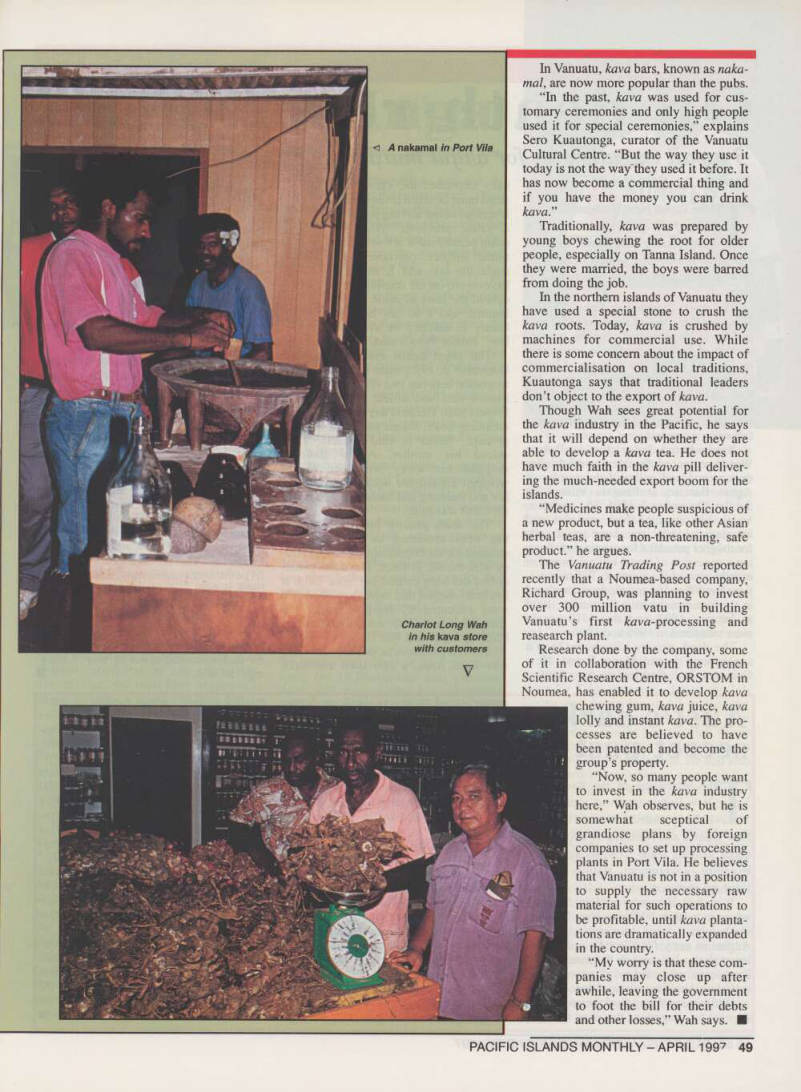
Business
Kava set to calm Western nerves
Text and photographs by
Kalinga Seneviratne
Kava Kompany, a locally regis tered kava exporting company operated by an American expatri ate businesswoman, is keen to make this traditional Pacific brew a multi-million dollar money spinner for Pacific Island countries.
“At the moment, kava is a hot item in the US. It is getting huge publicity and there’s potentially a 500,000-tonnes-a -year market out there” Roxanna Naylor, director of the Port Vila-based Kava Kompany told Pacific Islands 'Monthly.
But the man who initially'commer cialised this traditional Pacific brew in Vanuatu, local businessman Charles Long Wah, is not sure whether Vanuatu can produce enought kava to satisfy such a market.
Wah, a Vanuatu citizen of Chinese ancestry, has been instrumental in setting up the kava industry here and has been promoting kava since 1976.
“When I started commercialising it here, all the missionaries in Vanuatu were against me,” he told PIM. “When European missionaries arrived here, they wanted to destroy all the kava plants. So, when I asked all Melanesian ni-Vanuatu people to go back to their traditional drink, instead of (the imported) wine and beer, the missionaries were up in arms. It made headline news here. Now, they sit down with me and drink kava,” said Wah with a chuckle.
Westerners who once wanted to
destroy the kava plants, viewing it as a “devil’s drink”, are today putting its roots under the microscopes in laboratories in the United States, Germany, France and Australia and finding out that the Pacific Islanders were correct in the first place when drunk it could induce tranquility and restfulness in both body and soul.
Thus, capsules, tablets and juices made from kava are now slowly entering markets in the West as stress-relief “dietary-supplement”. There are also plans by German and American compa nies to market stress-relief capsules made of, kava extracts in South-East Asian mar kets, Recent studies have shown that it may help to treat schizophrenia and epilepsy, and acts as a muscle relaxant.
During the past two years, working with a US research laboratory, the Kava Kompany has been able to introduce 10 new products into the US market, sold mainly as dietary supplements.
Among the products in the US market is a drink called Mellow Out sold at SUS9O per litre bottle, which is a blend of kava and a Chinese heart). Kavatrol is a 30-capsule packet sold for under SUS 9, advertised mainly in airline margazines targeting the ‘jet-lag’ market. fdquid Kalm is a syrup where three to four tea spoons are recommended after dinner as stress relief, and Erotikava is a 200 ml bot tle of kava syrup recommended to be taken after dinner preferably in a candle lit room with soft music.
“The US Food and Drug Administration (FDA) is still nervous about kava” says Naylor, explaining the beaurocratic wrangle she had to go through to get her first shipment of kava
from Vanuatu into the US in 1994.
“In true definition, it is a narcotic there. That word sends most health authorities into a spin,” she observes.
When the first kava shipment arrived in the US, the FDA wanted a zero defect level in the product when tested for things like insects, “foreign material”, soil, etc, which is impossible to achieve. Thus, Naylor had to hire lawyers, senators and consultants to overturn the decision. She was also helped by Pacific Island country embassies in Washington which wrote to the FDA in support of kava.
Now that kava is allowed to be imported into the US for use as a dietary supplement, being a new product promot ed in the market for its therapeutic quali ties, it is facing new challenges.
“Dietary supplements have various advertising restrictions - such as you can’t make any wild outlandish claims which has made the industry a little bit nervous,” she says.
“It has held up the release of some of our new products.”
Naylor claims that she and her part ners in the US have plugged in SUS2S million into advertising so far this year.
Naylor also believes that if the US market pontential is realised, the region will not have enough kava to supply it, at the current rates of production. Thus, she argues rather than worry about Intellectual Property Rights (IPR) issues, Pacific Island countries must increase its kava production and regional govern ments, through the South Pacific Commission, must fund a research pro gramme in the region.
Kava is already a big export earner for Pacific Island countries, Vanuatu has increased its export income from kava by six-fold within five years, earning $U5520,000 in 1994.
Wah says he has created a SUS3-mil lion industry here which produced over 6000 tonnes in 1996 and employs some 6000 people in a country whose popula tion is just 145,000. Most of this income is generated locally.
In Vanuatu, kava bars, known as naka mal, are now more popular than the pubs.
“In the past, kava was used for cus tomary ceremonies and only high people used it for special ceremonies,” explains Sero Kuautonga, curator of the Vanuatu Cultural Centre. “But the way they use it today is not the way'they used it before. It has now become a commercial thing and if you have the money you can drink kava .”
Traditionally, kava was prepared by young boys chewing the root for older people, especially on Tanna Island. Once they were married, the boys were barred from doing the job.
In the northern islands of Vanuatu they have used a special stone to crush the kava roots. Today, kava is crushed by machines for commercial use. While there is some concern about the impact of commercialisation on local traditions, Kuautonga says that traditional leaders don’t object to the export of kava.
Though Wah sees great potential for the kava industry in the Pacific, he says that it will depend on whether they are able to develop a kava tea. He does not have much faith in the kava pill deliver ing the much-needed export boom for the islands.
“Medicines make people suspicious of a new product, but a tea, like other Asian herbal teas, are a non-threatening, safe product.” he argues.
The Vanuatu Trading Post reported recently that a Noumea-based company, Richard Group, was planning to invest over 300 million vatu in building Vanuatu’s first £ava-processing and reasearch plant.
Research done by the company, some of it in collaboration with the French Scientific Research Centre, ORSTOM in Noumea, has enabled it to develop kava
chewing gum, kava juice, kava lolly and instant kava. The pro cesses are believed to have been patented and become the group’s property.
“Now, so many people want to invest in the kava industry here,” Wah observes, but he is somewhat sceptical of grandiose plans by foreign companies to set up processing plants in Port Vila. He believes that Vanuatu is not in a position to supply the necessary raw material for such operations to be profitable, until kava planta tions are dramatically expanded in the country.
“My worry is that these com panies may close up after awhile, leaving the government to foot the bill for their debts and other losses,” Wah says. ■
A nakamal in Port Vila
Chariot Long Wah in his kava store with customers
Advertisements & other items, p. 48 (1 item)
Trust Company Ltd
USED JAPANESE VEHICLES
SPECIAL OFFER
TOYOTA, NISSAN CARS, WITH AUTOMATIC TRANSMISSION
ROM ONLY $lOOO.OO US DOLLARS EACH PLUS REIGHT.
ALL SHIPPING AND DOCUMENTATION ARRANGED.
BUY DIRECT FROM JAPAN AND SAVE.
r
“CONTACT”
Trust Company Ltd
KOBAC BLD 3F 3-2 26 NISHIKI,
NAKAU NAGOYA, 460 JAPAN.
PHONE: (81) 52 953-5602
FAX (81) 52 953-5634
On death row
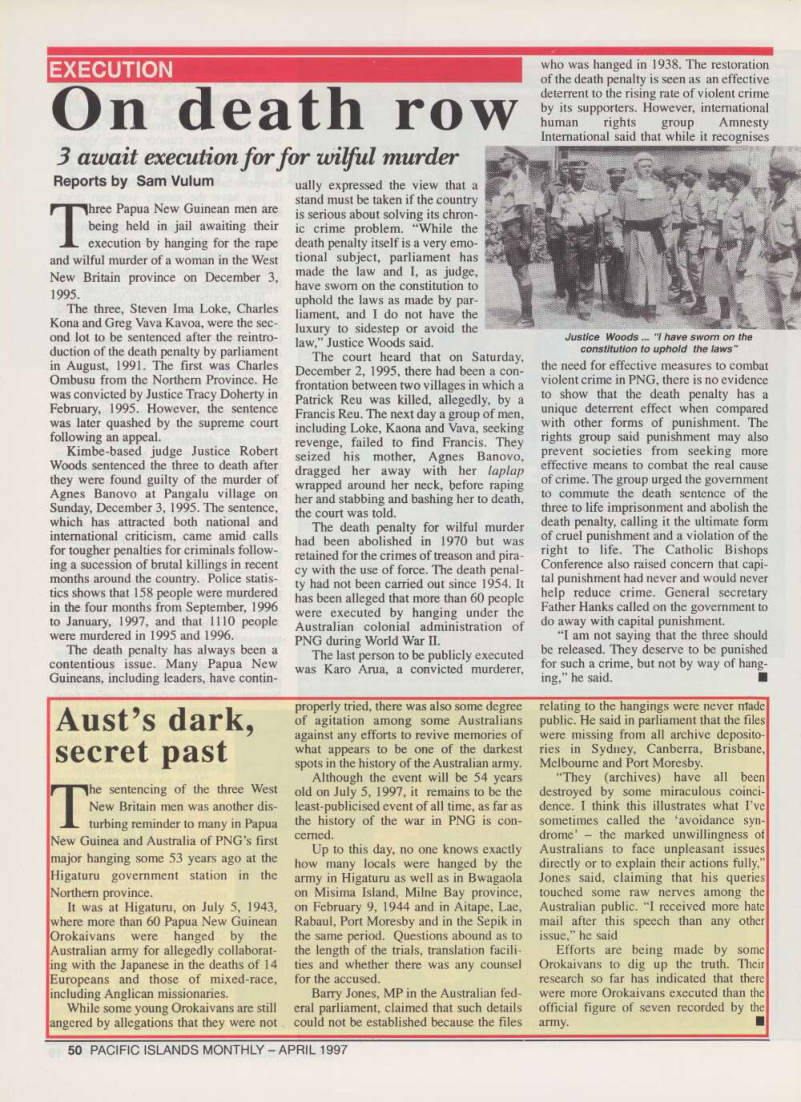
Execution
3 await execution for for wilful murder
Reports by Sam Vulum
Three Papua New Guinean men are being held in jail awaiting their execution by hanging for the rape and wilful murder of a woman in the West New Britain province on December 3, 1995.
The three, Steven Ima Loke, Charles Kona and Greg Vava Kavoa, were the sec ond lot to be sentenced after the reintro duction of the death penalty by parliament in August, 1991. The first was Charles Ombusu from the Northern Province. He was convicted by Justice Tracy Doherty in February, 1995. However, the sentence was later quashed by the supreme court following an appeal.
Kimbe-based judge Justice Robert Woods sentenced the three to death after they were found guilty of the murder of Agnes Banovo at Pangalu village on Sunday, December 3, 1995. The sentence, which has attracted both national and international criticism, came amid calls for tougher penalties for criminals follow ing a sucession of brutal killings in recent months around the country. Police statis tics shows that 158 people were murdered in the four months from September, 1996 to January, 1997, and that 1110 people were murdered in 1995 and 1996.
The death penalty has always been a contentious issue. Many Papua New Guineans, including leaders, have contin
ually expressed the view that a stand must be taken if the country is serious about solving its chron ic crime problem. “While the death penalty itself is a very emo tional subject, parliament has made the law and I, as judge, have sworn on the constitution to uphold the laws as made by par liament, and I do not have the luxury to sidestep or avoid the law,” Justice Woods said.
The court heard that on Saturday, December 2, 1995, there had been a con frontation between two villages in which a Patrick Reu was killed, allegedly, by a Francis Reu. The next day a group of men, including Loke, Kaona and Vava, seeking revenge, failed to find Francis. They seized his mother, Agnes Banovo, dragged her away with her laplap wrapped around her neck, before raping her and stabbing and bashing her to death, the court was told.
The death penalty for wilful murder had been abolished in 1970 but was retained for the crimes of treason and pira cy with the use of force. The death penal ty had not been carried out since 1954. It has been alleged that more than 60 people were executed by hanging under the Australian colonial administration of PNG during World War 11.
The last person to be publicly executed was Karo Arua, a convicted murderer,
who was hanged in 1938. The restoration of the death penalty is seen as an effective deterrent to the rising rate of violent crime by its supporters. However, international human rights group Amnesty International said that while it recognises
u the need for effective measures to combat violent crime in PNG there is no evidence to show that the death jxmalty has a unl 3 ue dete f m effe « whe " compared w,th other forms of punishment. The rights group said punishment may also prevent societies from seeking more effective means to combat the real cause of crime - ' Rle B rou P ur B ed ,he government commute the death sentence of the three to life imprisonment and abolish the death P enalt y> calling it the ultimate form of cruel punishment and a violation of the J>ght to life. The Catholic Bishops Conference also raised concern that cap.tal punishment had never and would never |i el P r f du f crime. General secretary Father Hanks called on the government to do away with capital punishment, * am not sa y m 8 t^at the three should be released. They deserve to be punished for such a crime, but not by way of hang_ mg, he said. ■
Justice Woods... “I have sworn on the constitution to uphold the laws’’
Aust’s dark,
secret past
The sentencing of the three West New Britain men was another dis turbing reminder to many in Papua New Guinea and Australia of PNG’s first major hanging some 53 years ago at the Higaturu government station in the Northern province.
It was at Higaturu, on July 5, 1943, where more than 60 Papua New Guinean Orokaivans were hanged by the Australian army for allegedly collaborat ing with the Japanese in the deaths of 14 Europeans and those of mixed-race, including Anglican missionaries.
While some young Orokaivans are still angered by allegations that they were not
properly tried, there was also some degree of agitation among some Australians against any efforts to revive memories of what appears to be one of the darkest spots in the history of the Australian army.
Although the event will be 54 years old on July 5, 1997, it remains to be the least-publicised event of all time, as far as the history of the war in PNG is con cerned.
Up to this day, no one knows exactly how many locals were hanged by the army in Higaturu as well as in Bwagaola on Misima Island, Milne Bay province, on February 9, 1944 and in Aitape, Lae, Rabaul, Port Moresby and in the Sepik in the same period. Questions abound as to the length of the trials, translation facili ties and whether there was any counsel for the accused.
Barry Jones, MP in the Australian fed eral parliament, claimed that such details could not be established because the fdes
relating to the hangings were never made public. He said in parliament that the files were missing from all archive deposito ries in Sydney, Canberra, Brisbane, Melbourne and Port Moresby.
“They (archives) have all been destroyed by some miraculous coinci dence. I think this illustrates what I’ve sometimes called the ‘avoidance syn drome’ - the marked unwillingness of Australians to face unpleasant issues directly or to explain their actions fully,”
Jones said, claiming that his queries touched some raw nerves among the Australian public. “I received more hate mail after this speech than any other issue,” he said Efforts are being made by some Orokaivans to dig up the truth. Their research so far has indicated that there were more Orokaivans executed than the official figure of seven recorded by the army. ■
Ingots for Inga
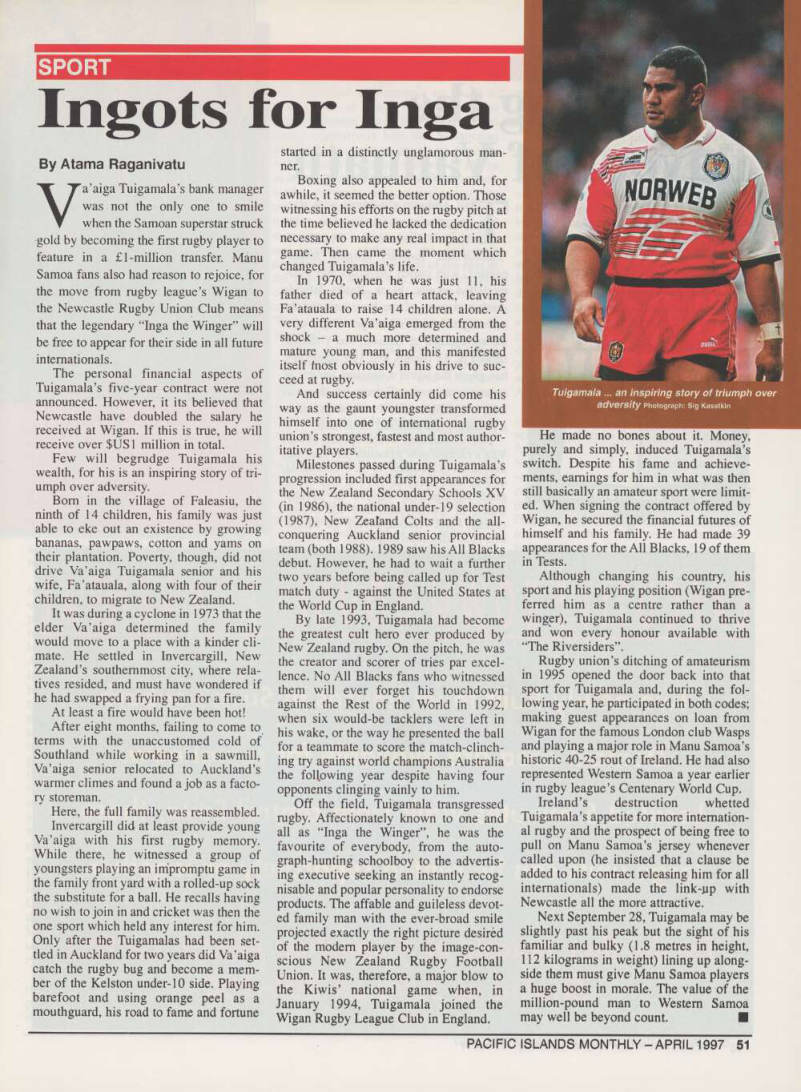
Sport
By Atama Raganivatu
Va’aiga Tuigamala’s bank manager was not the only one to smile when the Samoan superstar struck gold by becoming the first rugby player to feature in a £l-million transfer. Manu Samoa fans also had reason to rejoice, for the move from rugby league’s Wigan to the Newcastle Rugby Union Club means that the legendary “Inga the Winger” will be free to appear for their side in all future internationals.
The personal financial aspects of Tuigamala’s five-year contract were not announced. However, it its believed that Newcastle have doubled the salary he received at Wigan. If this is true, he will receive over SUSI million in total.
Few will begrudge Tuigamala his wealth, for his is an inspiring story of tri umph over adversity.
Bom in the village of Faleasiu, the ninth of 14 children, his family was just able to eke out an existence by growing bananas, pawpaws, cotton and yams on their plantation. Poverty, though, did not drive Va’aiga Tuigamala senior and his wife, Fa’atauala, along with four of their children, to migrate to New Zealand.
It was during a cyclone in 1973 that the elder Va’aiga determined the family would move to a place with a kinder cli mate. He settled in Invercargill, New Zealand’s southernmost city, where rela tives resided, and must have wondered if he had swapped a frying pan for a fire.
At least a fire would have been hot!
After eight months, failing to come to terms with the unaccustomed cold of Southland while working in a sawmill, Va’aiga senior relocated to Auckland’s warmer climes and found a job as a facto ry storeman.
Here, the full family was reassembled.
Invercargill did at least provide young Va’aiga with his first rugby memory.
While there, he witnessed a group of youngsters playing an impromptu game in the family front yard with a rolled-up sock the substitute for a ball. He recalls having no wish to join in and cricket was then the one sport which held any interest for him.
Only after the Tuigamalas had been set tled in Auckland for two years did Va’aiga catch the rugby bug and become a mem ber of the Kelston under-10 side. Playing barefoot and using orange peel as a mouthguard, his road to fame and fortune
started in a distinctly unglamorous man ner.
Boxing also appealed to him and, for awhile, it seemed the better option. Those witnessing his efforts on the rugby pitch at the time believed he lacked the dedication necessary to make any real impact in that game. Then came the moment which changed Tuigamala’s life.
In 1970, when he was just 11, his father died of a heart attack, leaving Fa’atauala to raise 14 children alone. A very different Va’aiga emerged from the shock - a much more determined and mature young man, and this manifested itself fnost obviously in his drive to suc ceed at rugby.
And success certainly did come his way as the gaunt youngster transformed himself into one of international rugby union’s strongest, fastest and most author itative players.
Milestones passed during Tuigamala’s progression included first appearances for the New Zealand Secondary Schools XV (in 1986), the national under-19 selection (1987), New Zealand Colts and the all conquering Auckland senior provincial team (both 1988). 1989 saw his All Blacks debut. However, he had to wait a further two years before being called up for Test match duty - against the United States at the World Cup in England.
By late 1993, Tuigamala had become the greatest cult hero ever produced by New Zealand rugby. On the pitch, he was the creator and scorer of tries par excel lence. No All Blacks fans who witnessed them will ever forget his touchdown against the Rest of the World in 1992, when six would-be tacklers were left in his wake, or the way he presented the ball for a teammate to score the match-clinch ing try against world champions Australia the following year despite having four opponents clinging vainly to him.
Off the field, Tuigamala transgressed rugby. Affectionately known to one and all as “Inga the Winger”, he was the favourite of everybody, from the auto graph-hunting schoolboy to the advertis ing executive seeking an instantly recog nisable and popular personality to endorse products. The affable and guileless devot ed family man with the ever-broad smile projected exactly the right picture desired of the modem player by the image-con scious New Zealand Rugby Football Union. It was, therefore, a major blow to the Kiwis’ national game when, in January 1994, Tuigamala joined the Wigan Rugby League Club in England.
He made no bones about it. Money, purely and simply, induced Tuigamala’s switch. Despite his fame and achieve ments, earnings for him in what was then still basically an amateur sport were limit ed. When signing the contract offered by Wigan, he secured the financial futures of himself and his family. He had made 39 appearances for the All Blacks, 19 of them in Tests.
Although changing his country, his sport and his playing position (Wigan pre ferred him as a centre rather than a winger), Tuigamala continued to thrive and won every honour available with “The Riversiders”.
Rugby union’s ditching of amateurism in 1995 opened the door back into that sport for Tuigamala and, during the fol lowing year, he participated in both codes; making guest appearances on loan from Wigan for the famous London club Wasps and playing a major role in Manu Samoa’s historic 40-25 rout of Ireland. He had also represented Western Samoa a year earlier in rugby league’s Centenary World Cup.
Ireland’s destruction whetted Tuigamala’s appetite for more internation al rugby and the prospect of being free to pull on Manu Samoa’s jersey whenever called upon (he insisted that a clause be added to his contract releasing him for all internationals) made the link-up with Newcastle all the more attractive.
Next September 28, Tuigamala may be slightly past his peak but the sight of his familiar and bulky (1.8 metres in height, 112 kilograms in weight) lining up along side them must give Manu Samoa players a huge boost in morale. The value of the million-pound man to Western Samoa may well be beyond count, ■
Tuigamala ... an inspiring story of triumph over adversity Photograph: Sig Kasatkin
Capturing the

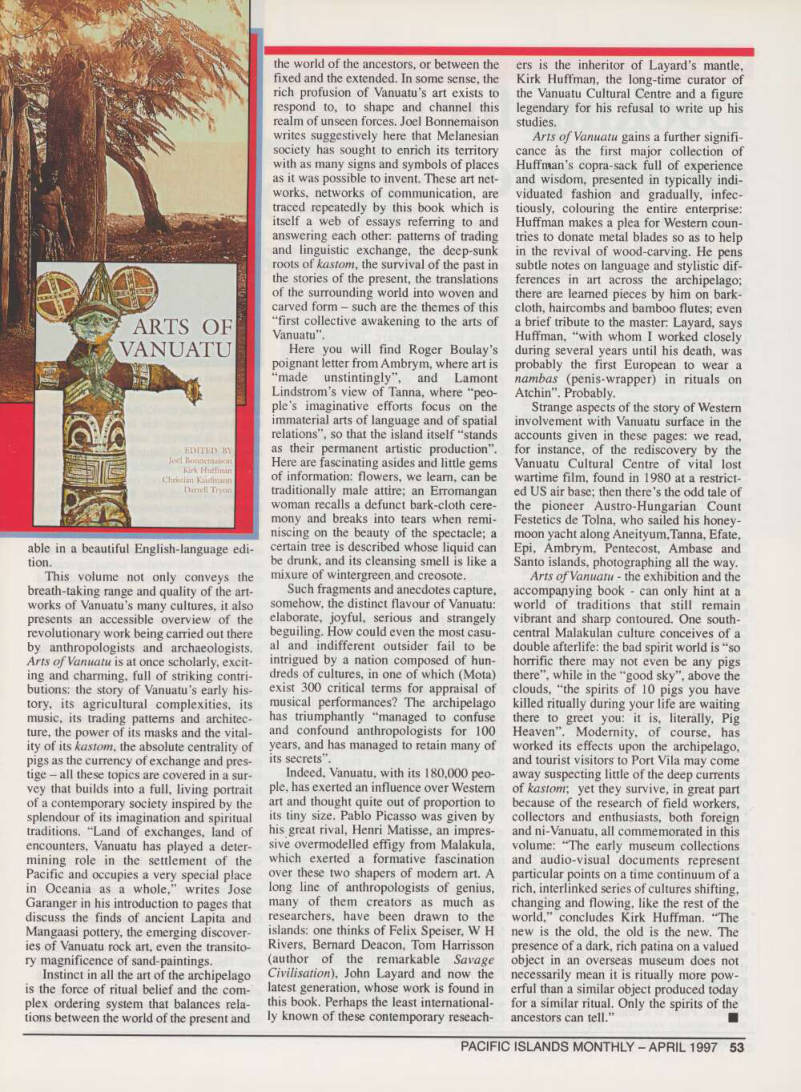
Literature
Capturing the flavour of Vanuatu
A collection of fascinating asides and little gems of information
By Nicolas Rothwell
Tall Ambrym slit-drums with star
ing disc-eyes, fine-woven mats
from Pentecost, Malakulan
‘ Ramboramp ’ funerary effigies, bright
painted, with curled pig-tusks and over modelled skulls, black Banks Islands grade sculptures of tree-fern, their mouths seeming to whisper mesages of power the archipelago of Vanuatu, that Y-shaped sprawl of 83 islands and 100 languages, has given the world a dazzling variety of artistic styles and traditions, which are at long last being assessed and recognised in a landmark international exhibition.
Arts of Vanuatu, which opened in Port Vila’s elegant new museum last year and moved on to Noumea, in New Caledonia, will be on display in 1997 in two of the great ethnographic centres of Europe: Basel, in Switzerland, and the French capital, Paris. Accompanying the exhibi tion is an imporatnt catalogue, now avail-
19th-century photograph by J W Lindt of Vanuatu slit gongs
able in a beautiful English-language edi tion.
This volume not only conveys the breath-taking range and quality of the art works of Vanuatu’s many cultures, it also presents an accessible overview of the revolutionary work being carried out there by anthropologists and archaeologists.
Arts of Vanuatu is at once scholarly, excit ing and charming, full of striking contri butions: the story of Vanuatu’s early his tory, its agricultural complexities, its music, its trading patterns and architec ture, the power of its masks and the vital ity of its kastom, the absolute centrality of pigs as the currency of exchange and pres tige - all these topics are covered in a sur vey that builds into a full, living portrait of a contemporary society inspired by the splendour of its imagination and spiritual traditions. “Land of exchanges, land of encounters, Vanuatu has played a deter mining role in the settlement of the Pacific and occupies a very special place in Oceania as a whole,” writes Jose Garanger in his introduction to pages that discuss the finds of ancient Lapita and Mangaasi pottery, the emerging discover ies of Vanuatu rock art, even the transito ry magnificence of sand-paintings.
Instinct in all the art of the archipelago is the force of ritual belief and the com plex ordering system that balances rela tions between the world of the present and
the world of the ancestors, or between the fixed and the extended. In some sense, the rich profusion of Vanuatu’s art exists to respond to, to shape and channel this realm of unseen forces. Joel Bonnemaison writes suggestively here that Melanesian society has sought to enrich its territory with as many signs and symbols of places as it was possible to invent. These art net works, networks of communication, are traced repeatedly by this book which is itself a web of essays referring to and answering each other: patterns of trading and linguistic exchange, the deep-sunk roots of kastom, the survival of the past in the stories of the present, the translations of the surrounding world into woven and caived form - such are the themes of this “first collective awakening to the arts of Vanuatu”.
Here you will find Roger Boulay’s poignant letter from Ambrym, where art is “made unstintingly”, and Lament Lindstrom’s view of Tanna, where “peo ple’s imaginative efforts focus on the immaterial arts of language and of spatial relations”, so that the island itself “stands as their permanent artistic production”.
Here are fascinating asides and little gems of information: flowers, we leam, can be traditionally male attire; an Erromangan woman recalls a defunct bark-cloth cere mony and breaks into tears when remi niscing on the beauty of the spectacle; a certain tree is described whose liquid can be drunk, and its cleansing smell is like a mixure of wintergreen, and creosote.
Such fragments and anecdotes capture, somehow, the distinct flavour of Vanuatu: elaborate, joyful, serious and strangely beguiling. How could even the most casu al and indifferent outsider fail to be intrigued by a nation composed of hun dreds of cultures, in one of which (Mota) exist 300 critical terms for appraisal of musical performances? The archipelago has triumphantly “managed to confuse and confound anthropologists for 100 years, and has managed to retain many of its secrets”.
Indeed, Vanuatu, with its 180,000 peo ple, has exerted an influence over Western art and thought quite out of proportion to its tiny size. Pablo Picasso was given by his great rival, Henri Matisse, an impres sive overmodelled effigy from Malakula, which exerted a formative fascination over these two shapers of modem art. A long line of anthropologists of genius, many of them creators as much as researchers, have been drawn to the islands: one thinks of Felix Speiser, W H Rivers, Bernard Deacon, Tom Harrisson (author of the remarkable Savage Civilisation ), John Layard and now the latest generation, whose work is found in this book. Perhaps the least international ly known of these contemporary reseach
ers is the inheritor of Layard’s mantle, Kirk Huffman, the long-time curator of the Vanuatu Cultural Centre and a figure legendary for his refusal to write up his studies.
Arts of Vanuatu gains a further signifi cance as the first major collection of Huffman’s copra-sack full of experience and wisdom, presented in typically indi viduated fashion and gradually, infec tiously, colouring the entire enterprise: Huffman makes a plea for Western coun tries to donate metal blades so as to help in the revival of wood-carving. He pens subtle notes on language and stylistic dif ferences in art across the archipelago; there are learned pieces by him on bark cloth, haircombs and bamboo flutes; even a brief tribute to the master: Layard, says Huffman, “with whom I worked closely during several years until his death, was probably the first European to wear a nambas (penis-wrapper) in rituals on Atchin”. Probably.
Strange aspects of the story of Western involvement with Vanuatu surface in the accounts given in these pages; we read, for instance, of the rediscovery by the Vanuatu Cultural Centre of vital lost wartime film, found in 1980 at a restrict ed US air base; then there’s the odd tale of the pioneer Austro-Hungarian Count Festetics de Tolna, who sailed his honey moon yacht along Aneityum,Tanna, Efate, Epi, Ambrym, Pentecost, Ambase and Santo islands, photographing all the way.
Arts of Vanuatu - the exhibition and the accompanying book - can only hint at a world of traditions that still remain vibrant and sharp contoured. One south central Malakulan culture conceives of a double afterlife: the bad spirit world is “so horrific there may not even be any pigs there”, while in the “good sky”, above the clouds, “the spirits of 10 pigs you have killed ritually during your life are waiting there to greet you; it is, literally. Pig Heaven”. Modernity, of course, has worked its effects upon the archipelago, and tourist visitors to Port Vila may come away suspecting little of the deep currents of kastonv, yet they survive, in great part because of the research of field workers, collectors and enthusiasts, both foreign and ni-Vanuatu, all commemorated in this volume: “The early museum collections and audio-visual documents represent particular points on a time continuum of a rich, interlinked series of cultures shifting, changing and flowing, like the rest of the world,” concludes Kirk Huffman. “The new is the old, the old is the new. The presence of a dark, rich patina on a valued object in an overseas museum does not necessarily mean it is ritually more pow erful than a similar object produced today for a similar ritual. Only the spirits of the ancestors can tell.” ■
Advertisements & other items, p. 52 (1 item)
Executive Town Houses Fod Rental
Two newly-built town houses in Suva's suburb Domain area are available for rental now.
Located 5 minutes walk from central Suva, these large units can be rented separately or together. for further details or inspection please contact Shalini or Julia on 306-100
Looking for
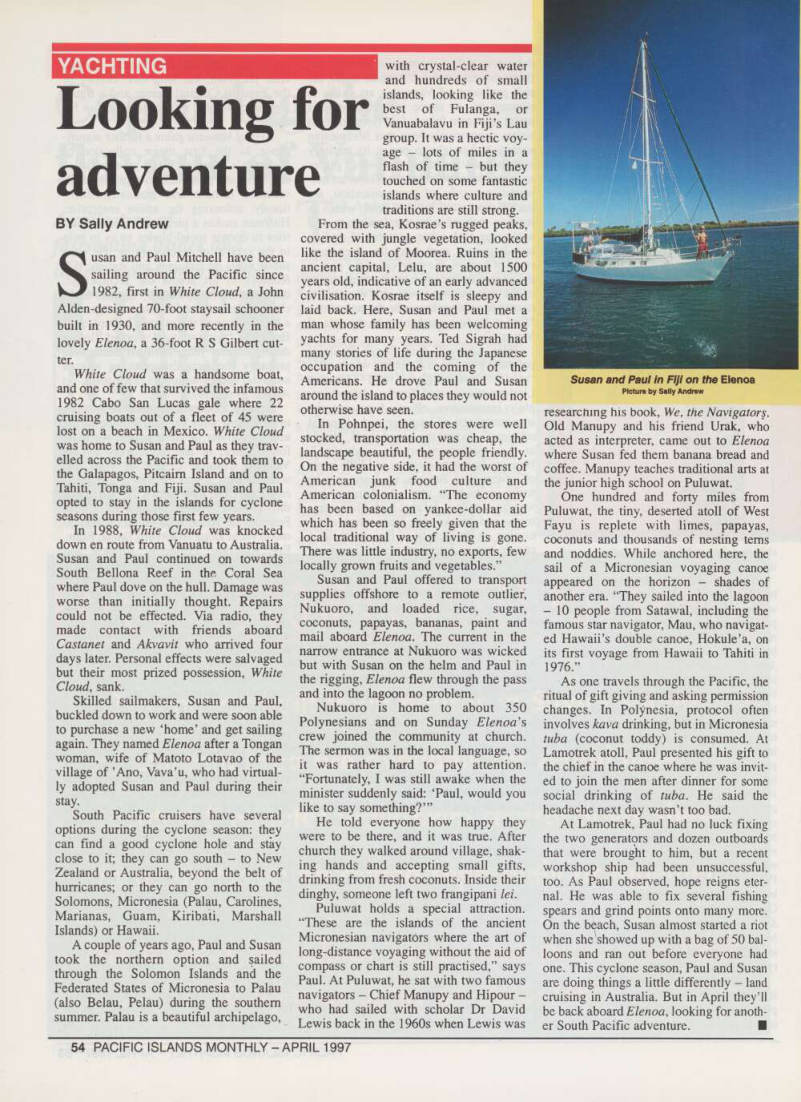
Yachting
Looking for adventure
BY Sally Andrew
Susan and Paul Mitchell have been sailing around the Pacific since 1982, first in White Cloud, a John Alden-designed 70-foot staysail schooner built in 1930, and more recently in the lovely Elenoa, a 36-foot R S Gilbert cut ter.
White Cloud was a handsome boat, and one of few that survived the infamous 1982 Cabo San Lucas gale where 22 cruising boats out of a fleet of 45 were lost on a beach in Mexico. White Cloud was home to Susan and Paul as they trav elled across the Pacific and took them to the Galapagos, Pitcairn Island and on to Tahiti, Tonga and Fiji. Susan and Paul opted to stay in the islands for cyclone seasons during those first few years.
In 1988, White Cloud was knocked down en route from Vanuatu to Australia.
Susan and Paul continued on towards South Bellona Reef in the Coral Sea where Paul dove on the hull. Damage was worse than initially thought. Repairs could not be effected. Via radio, they made contact with friends aboard Castanet and Akvavit who arrived four days later. Personal effects were salvaged but their most prized possession. White Cloud, sank.
Skilled sailmakers, Susan and Paul, buckled down to work and were soon able to purchase a new ‘home’ and get sailing again. They named Elenoa after a Tongan woman, wife of Matoto Lotavao of the village of ’Ano, Vava’u, who had virtual ly adopted Susan and Paul during their stay.
South Pacific cruisers have several options during the cyclone season: they can find a good cyclone hole and stay close to it; they can go south - to New Zealand or Australia, beyond the belt of hurricanes; or they can go north to the Solomons, Micronesia (Palau, Carolines, Marianas, Guam, Kiribati, Marshall Islands) or Hawaii.
A couple of years ago, Paul and Susan took the northern option and sailed through the Solomon Islands and the Federated States of Micronesia to Palau (also Belau, Pelau) during the southern summer. Palau is a beautiful archipelago,
with crystal-clear water and hundreds of small islands, looking like the best of Fulanga, or Vanuabalavu in Fiji’s Lau group. It was a hectic voy age - lots of miles in a flash of time - but they touched on some fantastic islands where culture and
traditions are still strong.
From the sea, Kosrae’s rugged peaks, covered with jungle vegetation, looked like the island of Moorea. Ruins in the ancient capital, Lelu, are about 1500 years old, indicative of an early advanced civilisation. Kosrae itself is sleepy and laid back. Here, Susan and Paul met a man whose family has been welcoming yachts for many years. Ted Sigrah had many stories of life during the Japanese occupation and the coming of the Americans. He drove Paul and Susan around the island to places they would not otherwise have seen.
In Pohnpei, the stores were well stocked, transportation was cheap, the landscape beautiful, the people friendly.
On the negative side, it had the worst of American junk food culture and American colonialism. “The economy has been based on yankee-dollar aid which has been so freely given that the local traditional way of living is gone.
There was little industry, no exports, few locally grown fruits and vegetables.”
Susan and Paul offered to transport supplies offshore to a remote outlier, Nukuoro, and loaded rice, sugar, coconuts, papayas, bananas, paint and mail aboard Elenoa. The current in the narrow entrance at Nukuoro was wicked but with Susan on the helm and Paul in the rigging, Elenoa flew through the pass and into the lagoon no problem.
Nukuoro is home to about 350 Polynesians and on Sunday Elenoa' s crew joined the community at church.
The sermon was in the local language, so it was rather hard to pay attention.
“Fortunately, I was still awake when the minister suddenly said: ‘Paul, would you like to say something?”’
He told everyone how happy they were to be there, and it was true. After church they walked around village, shak ing hands and accepting small gifts, drinking from fresh coconuts. Inside their dinghy, someone left two frangipani lei.
Puluwat holds a special attraction.
“These are the islands of the ancient Micronesian navigators where the art of long-distance voyaging without the aid of compass or chart is still practised,” says Paul. At Puluwat, he sat with two famous navigators - Chief Manupy and Hipour who had sailed with scholar Dr David Lewis back in the 1960 s when Lewis was
researching his book, We, the Navigators.
Old Manupy and his friend Urak, who acted as interpreter, came out to Elenoa where Susan fed them banana bread and coffee. Manupy teaches traditional arts at the junior high school on Puluwat.
One hundred and forty miles from Puluwat, the tiny, deserted atoll of West Fayu is replete with limes, papayas, coconuts and thousands of nesting terns and noddies. While anchored here, the sail of a Micronesian voyaging canoe appeared on the horizon - shades of another era. “They sailed into the lagoon - 10 people from Satawal, including the famous star navigator, Mau, who navigat ed Hawaii’s double canoe, Hokule’a, on its first voyage from Hawaii to Tahiti in 1976.”
As one travels through the Pacific, the ritual of gift giving and asking permission
changes. In Polynesia, protocol often
involves kava drinking, but in Micronesia tuba (coconut toddy) is consumed. At Lamotrek atoll, Paul presented his gift to the chief in the canoe where he was invit ed to join the men after dinner for some social drinking of tuba. He said the headache next day wasn’t too bad.
At Lamotrek, Paul had no luck fixing the two generates and dozen outboards that were brought to him, but a recent workshop ship had been unsuccessful, too. As Paul observed, hope reigns eter nal. He was able to fix several fishing spears and grind points onto many more.
On the beach, Susan almost started a riot when she'showed up with a bag of 50 bal loons and ran out before everyone had one. This cyclone season, Paul and Susan are doing things a little differently - land cruising in Australia. But in April they’ll be back aboard Elenoa , looking for anoth er South Pacific adventure. ■
Susan and Paul in Fiji on the Elenoa Picture by Sally Andrew
Mercenaries,

Opinion
Mercenaries, PNG and Aussie aid
Australia’s foreign minister, Alexander Downer, was right when he described the decision by Papua New Guinea’s prime minister, Sir Julius Chan, to use mercenaries on Bougainville as “disastrous”.
It is more than disastrous. It has again halted aid and basic supplies getting to people who, after nine years of war, are more desperate than ever and it is likely to further derail the peace process which has been steadily building among ordi nary citizens.
If the surgical strikes to assassinate key seccessionist leaders and/or release the five PNG Defence Force hostages being held by the Bougainville Revolutionary Army (for which the mer cenaries appear to have been hired) go ahead, PNG will seriously alienate its allies in the region and create repercus sions amongst its major aid donors bigger than anything seen to date.
In his first response. Sir Julius argued that the 40 mercenaries, supplied by the British-registered Sandline International, which is a subsidiary of the notorious Executive Outcomes (the largest supplier of private armies to African trouble spots), were in PNG in a training capaci ty to upgrade the PNGDF so that it was “physically and psychologically” pre pared to fight.
Hard to believe, when Sandline had approached hospitals in Queensland seek ing facilities for treating their badly wounded operatives in emergency situa tions. The hospital refused to help and Sir Julius soon admitted that he was planning to use the mercenaries in Bougainville but, he said, not in frontline positions.
Initially, it appeared the Australian government had been taken by surprise by the revelations of the region’s first experience with mercenaries.
The news was broken by Mary-Louise O’Callaghan in The Australian just days after a visit by Downer to PNG, during which the public face was one of business as usual. In fact. Downer went to pains to trumpet a new SA4-million (SUS 2.9 mil
lion) humanitarian package for Bougainville, which, with the permission of Port Moresby, would for the first time allow a large aid package to be delivered by non-govemment organisations and for some of that aid to be delivered to people living in BRA-controlled areas.
In private during that visit. Downer was already making the Australian gov ernment’s position clear. Downer had been receiving intelligence briefings about the situation for at least the few weeks leading up to his trip.
If he had any doubts, when his plane landed in Port Moresby, it touched down between the two Russian transport planes which had brought the Sandline opera tives and their equipment into the country.
Downer called a meeting attended by the high commissioners for Britain and New Zealand and the United States charge d’affairs at which he briefed them and asked them to express their own con cerns to PNG.
After his meeting with Sir Julius, Downer briefed the Australian prime min ister, John Howard, who then rang Sir Julius to reinforce his concern at what were, in discussions, still only being described as “rumours”.
Once the story broke, Howard made his opposition clear, telling parliament the use of mercenaries was “absolutely and completely unacceptable” to Australia.
A meeting of Australia’s new peak security committee, the National Security Committee, was called and, under Howard’s chairmanship, went through all the options for handling the issue.
Afterwards, Downer took an extraor dinary step, one which indicates the depth of concern in Canberra, by refusing to rule out the possibility of cancelling Australia’s entire SA32O-million (SUS2SI -million) aid allocation to PNG.
While that is highly unlikely, unless there is some terrible conflagration on Bougainville, it is clear that some serious questions need to be asked about Australia’s defence aid to PNG.
Since independence, Australia’s tax payers have spent nearly half a billion dollars on the PNGDF. It is Australia’s
biggest defence aid allocation and its least successful.
Early in the war on Bougainville, Australia poured in huge amounts of aid and much of it, such as the three iroquois helicopters which were given with the condition that they were not to be used in an offensive capacity, have caused noth ing but trouble, most of all for innocent
Bougainvilleans.
Since the early 19905, Australia has taken the position that there can be no military solution to the Bougainville cri sis and that peace efforts are the only way forward.
These may not be easy but it is a stance which has been proven by events.
When the PNGDF has gone for all-out war, as it did in mid-1996 with Operation High Speed 11, it has met only humiliating defeat and prompted more skirmishes which have led to deaths on both sides.
Not only that, but the military approach leads hostility towards all Bougainvilleans such that, in 1996, Amnesty International reported that the PNGDF was responsible for 44 unlawful killings or disappearances on the island.
When the defence force plays a role in reconstruction, as it did under Sir Julius’ peace plan during 1994-95, it is more dis ciplined and peace efforts move forward.
As a result of Australia’s concern about PNGDF actions on Bougainville, its defence aid to PNG has gone down from a peak of around SA2O-SA2S mil lion (SUSI4.2-SUSI7.B million) a year to around SAI2 million (SUSB.S million).
Now, however, it looks as though Howrad may be going to increase that aid again.
After a five-hour meeting with Sir Julius in Sydney last month, the Australian PM said: “We don’t like mer cenaries. We think any reasonable alter native to mercenaries is to be preferred.”
Those “reasonable alternatives” are believed to include extra defence aid, which would be given only if PNG aban dons its plans to use mercenaries on
Bougainville.
At the same time, Australia would increase funding for peace efforts. While the PNG delegation was delighted with the prime ministerial talks, there will be many in Australia, including in the defence establishment, who will be want ing to see some big improvements in the PNGDF structure and discipline if such aid is to go ahead.
Since the war on Bougainville began, the lack of discipline, which leads to human rights abuses has become so bad that it is one of the major factors under mining peace efforts.
The assassination of the then premier of Bougainville, Theodore Miriung, is just one example.
Despite the enormous change in its
Australia
Jemma
Garrett
role, the PNGDF has not had its structure overhauled since independence, more than 20 years ago. Money is not the only answer to the PNGDF’s problems.
The political will to ensure human rights abuses are stamped out and those which do occur are properly dealt with, are much more important, as are measures to ensure that those troops returning from time on Bougainville have the necessary help they need to adjust to life out of a war zone.
Australia also needs to indulge in some self-examination on the mercenary issue if reports in the Bulletin are to be believed.
In the March 4 issue, Laurie Oakes claims that as far back as October last year, a well-known and unsavoury ex- Australian army officer was attempting to recruit Australians for mercenary work on Bougainville, offering as much as $A120,000 ($U585,700).
If intelligence sources are aware of that sort of information, one wonders why they are not able to charge the man under the Crimes (Foreign Incursions and Recruitment) Act and why the issue was not raised with Port Moresby much soon er. ■
A paradise no more ... a solution to the Bougainville crisis seems more remote in the face of PNG's mercenary attempts
Advertisements & other items, p. 56 (1 item)
Volunteers Required
COMMONWEALTH SECRETARIAT
FOR ASSIGNMENTS IN
COMMONWEALTH COUNTRIES
The Commonwealth Secretariat has launched the Commonwealth Service Abroad Programme to enhance the Secretariat’s capacity to meet shortterm technical assistance needs of member governments through the deployment of highly qualified volunteers, supplementing the Secretariat’s existing technical assistance programmes. The programme offers the possibility of rewarding developmental work in over fifty Commonwealth countries.
In anticipation of future needs we wish to expand our database of highly qualified Commonwealth nationals with professional qualifications and at least 10 years experience in senior positions within their relevant fields, particularly in the areas listed below: Computing (including Systems Analysis and Networks), Economics (including Finance, and Taxation Policy), Environment, Gender Planning, Human Resource Development, Industry Development (especially small and medium scale), Natural Resources Management (including Mining, Energy, Marine and Fisheries), State Enterprise Restructuring and Privatisation, Public Service Reform & Good Governance, Stock Market/Securities Trading Regulations, Technology (e.g. geodetics, hydrographies, GIS), Trade Policy Promotion and Tourism.
Volunteers are contracted on a no fee basis but receive a daily living allowance at UN rates and return economy class airfares (and airfares for the volunteer’s spouse, where assignments are for more than six weeks).
Applicants who wish to be considered for volunteer assignments should contact:
CHIEF PERSONNEL OFFICER
Commonwealth Secretariat Marlborough House, Pall Mall London SWIY SHX United Kingdom Phone: 0171 747 6185 Fax: 0171 747 6520
The race issue
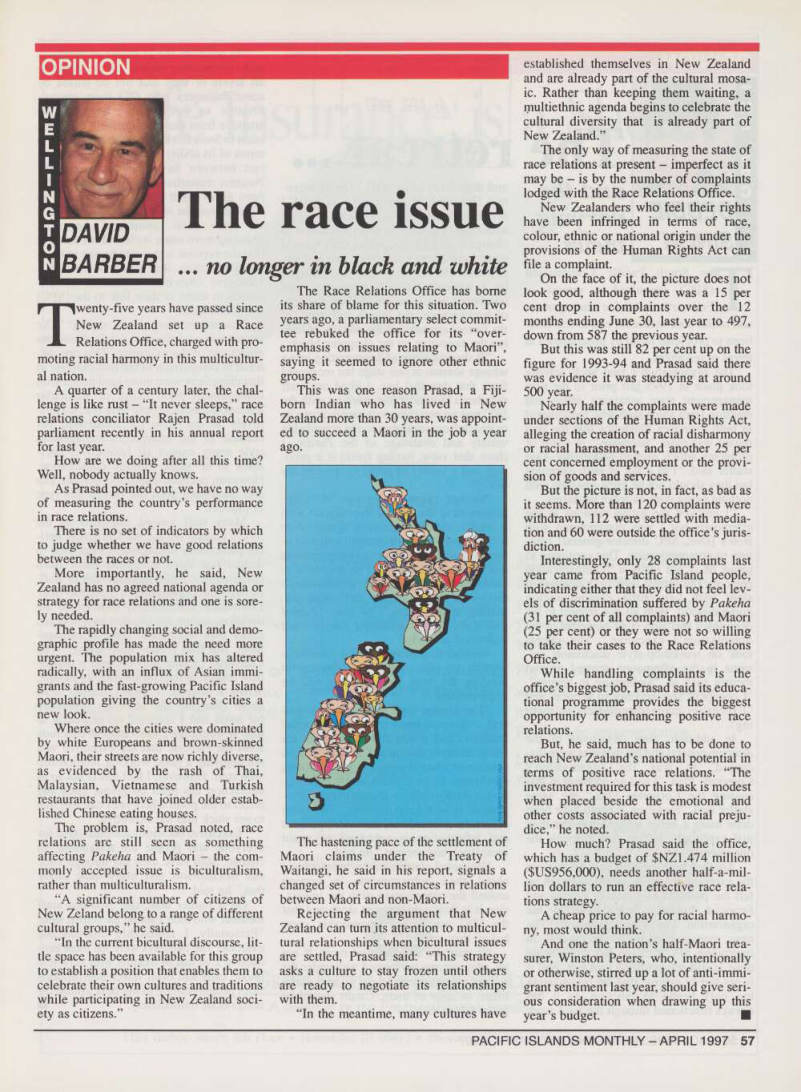
no longer in black and white
Twenty-five years have passed since New Zealand set up a Race Relations Office, charged with pro moting racial harmony in this multicultur al nation.
A quarter of a century later, the chal lenge is like rust - “It never sleeps,” race relations conciliator Rajen Prasad told parliament recently in his annual report for last year.
How are we doing after all this time?
Well, nobody actually knows.
As Prasad pointed out, we have no way
of measuring the country’s performance
in race relations.
There is no set of indicators by which to judge whether we have good relations between the races or not.
More importantly, he said, New Zealand has no agreed national agenda or strategy for race relations and one is sore
ly needed.
The rapidly changing social and demo graphic profile has made the need more urgent. The population mix has altered radically, with an influx of Asian immi grants and the fast-growing Pacific Island population giving the country’s cities a new look.
Where once the cities were dominated by white Europeans and brown-skinned Maori, their streets are now richly diverse, as evidenced by the rash of Thai, Malaysian, Vietnamese and Turkish restaurants that have joined older estab lished Chinese eating houses.
The problem is, Prasad noted, race relations are still seen as something affecting Pakeha and Maori - the com monly accepted issue is biculturalism, rather than multiculturalism.
“A significant number of citizens of New Zeland belong to a range of different cultural groups,” he said.
“In the current bicultural discourse, lit tle space has been available for this group to establish a position that enables them to celebrate their own cultures and traditions while participating in New Zealand soci ety as citizens.”
The Race Relations Office has borne its share of blame for this situation. Two years ago, a parliamentary select commit tee rebuked the office for its “over emphasis on issues relating to Maori”, saying it seemed to ignore other ethnic groups.
This was one reason Prasad, a Fiji born Indian who has lived in New Zealand more than 30 years, was appoint ed to succeed a Maori in the job a year ago.
The hastening pace of the settlement of Maori claims under the Treaty of Waitangi, he said in his report, signals a changed set of circumstances in relations between Maori and non-Maori.
Rejecting the argument that New Zealand can turn its attention to multicul tural relationships when bicultural issues are settled, Prasad said: “This strategy asks a culture to stay frozen until others
are ready to negotiate its relationships
with them.
“In the meantime, many cultures have
established themselves in New Zealand and are already part of the cultural mosa ic. Rather than keeping them waiting, a multiethnic agenda begins to celebrate the cultural diversity that is already part of New Zealand.”
The only way of measuring the state of race relations at present - imperfect as it may be - is by the number of complaints lodged with the Race Relations Office.
New Zealanders who feel their rights have been infringed in terms of race, colour, ethnic or national origin under the provisions of the Human Rights Act can file a complaint.
On the face of it, the picture does not look good, although there was a 15 per cent drop in complaints over the 12 months ending June 30, last year to 497, down from 587 the previous year.
But this was still 82 per cent up on the figure for 1993-94 and Prasad said there was evidence it was steadying at around 500 year.
Nearly half the complaints were made under sections of the Human Rights Act, alleging the creation of racial disharmony or racial harassment, and another 25 per cent concerned employment or the provi sion of goods and services.
But the picture is not, in fact, as bad as it seems. More than 120 complaints were withdrawn, 112 were settled with media tion and 60 were outside the office’s juris diction.
Interestingly, only 28 complaints last year came from Pacific Island people, indicating either that they did not feel lev els of discrimination suffered by Pakeha (31 per cent of all complaints) and Maori (25 per cent) or they were not so willing to take their cases to the Race Relations Office.
While handling complaints is the office’s biggest job, Prasad said its educa tional programme provides the biggest opportunity for enhancing positive race relations.
But, he said, much has to be done to reach New Zealand’s national potential in terms of positive race relations. “The investment required for this task is modest when placed beside the emotional and other costs associated with racial preju dice,” he noted.
How much? Prasad said the office, which has a budget of $NZ1.474 million ($U5956,000), needs another half-a-mil lion dollars to run an effective race rela tions strategy.
A cheap price to pay for racial harmo ny, most would think.
And one the nation’s half-Maori trea surer, Winston Peters, who, intentionally or otherwise, stirred up a lot of anti-immi grant sentiment last year, should give seri ous consideration when drawing up this year’s budget. ■
Wellington
David
Barber
The retreat...
and the
varying
views
The South Pacific Commission (SPC) organised a retreat in February to enable management and senior staff to discuss and devise solu tions to problems faced by programmes in terms of resources.
The organisation’s first such activity took place in 1995 just prior to the new management team assuming office and reaction from some staff who participated in both exercises illustrates that the first retreat was more “necessary” in terms of problems which needed addressing. One staffer said: “I’m a fan of such exercises but they should not be gripe sessions with nothing being done to solve problems.
“I enjoyed the group sessions in the afternoons but I was disappointed with Bob’s [Dun, SPC director-general] reac tion to communication. This continues to prove he is not really a ‘communication person’. The retreat took on a downward slant with very little communication going upward. With all due respect to his deputies, I feel Bob is all-powerful in the organisation’s executive.” The retreat took on workshop-style discussion ses sions in the afternoons centred around themes such as “Swimming in change”, “Concept of Service/Pride in Service” and
“Executive management/decision-mak
ing”.
In addition, duty objectives of the director-general and his deputies were dis cussed, as was the organisation’s Corporate Plan. “I had no problem in dis cussing the Corporate Plan,” the same staffer said. “However, it could have been done using a better technique rather than just expecting staff to read through the document.”
Another staff member said he thought the exercise generally useful although he felt the problem of a lack of human and financial resources being faced by the organisation was still a problem. “The new management have succeeded in improving SPC’s image but work being done is still subject to an acid test. And it is not fair to assume that the organisation has only begun to function, as it has always functioned through the hard work
and dedication of its staff.” Director-gen eral Dun said: “I thought it was great. I certainly learned a great deal of value about the organisation and its reaction to change - and I hope participants learned something about each other, me and my deputies. The retreat was always going to be a difficult meeting given the large number of people involved, their diversity of backgrounds, the length and depth of the formal agenda and the novelty of hav ing the executive on the chopping block.
“It showed signs of degenerating into a whinge session at one stage but recovered from that dreadful fate. I liked one staff member’s comment that working with the SPC was an enriching experience given its outreach from insularity to the remarkable variety and challenge of the Pacific. I share that view, having found it a privi lege and a source of pride to serve in the
Spc.”
Another opinion was one of disap pointment at the start of the exercise with a staffer saying the retreat appeared to focus heavily on management and execu tive issues and objectives and neglected to discuss areas which could be improved to facilitate delivery of the commission’s services. “Only senior staff attended, making it top heavy,” he said. “Actual problems and solutions were not
addressed properly.”
Another staff memeber said: “As far as retreats go, this one I consider useful pending the way its outcomes will be
implemented.
“The present style of the director-gen eral was considered autocratic in some instances and if this is working well for administrative decisions, it can lead to discontent when it comes to staff working conditions. Even in cases where consulta tion is impossible or unwarranted, infor mation should keep flowing. The more autocratic the decision, the more openness and information is necessary to retain motivation and morale,” he said.
“Repeated statements by management about their achievements in turning
around the organisation give the impres
sion it is their achievement alone and that the SPC was in an unspeakable mess before they arrived.
“It must be stressed that most, if not all, programmes performed well under the former management teams - and some times, in spite of them. Credit should be given where due.
“In addition, the principle of openness and transparency should trickle down to all levels of staff and not be stifled by some managers who find them uncom fortable to work with,” he said. An attendee from the commission’s Fiji oper ation in Suva felt the exercise beneficial in terms of its ability to enable physical con tact between Suva personnel and the Noumea executive. “We do not usually have direct input into decisions made in Noumea and the retreat enabled Suva staff to voice their opinions,” he said.
“Management made it clear from the start that the exercise was not to be one in com plaining, thus the title ‘Vision 97’.
Executive objectives needed to be dis cussed in terms of their link to the [SPC]
Corporate Plan.”
Dun shares these views, saying: “The retreat was a mechanism for finalising the objectives of the executive. This one dif fered in comparison to the first exercise in that objectives were more hard nosed with management style being of particular interest. Broadly, people have reacted pos itively to our style [of leadership] but because of our transparent management style many expect all [executive] deci sions to be made through consultation.
However, decision-making is not like this and oftentimes does not permit this type
of process.”
Many staff voiced objection to the SPC’s closure during the Christmas peri od, particularly management’s decision to deduct five days of annual leave from each member. And a large number of staff,
through the organisation’s Staff Advisory
Committee, continuously objected to the decision, saying it indicated an autocratic rather than democratic style of manage ment. But Dun refutes this, saying: “The Christmas closure will become a perma nent feature of the commission’s calendar.
When I arrived, I didn’t consult staff about changing the selection procedure for posts and I received no objection to this. It would have been easy to conclude from the exercise that the executive was
not enjoying a good working relationship
with staff. However, I feel this is not so as interaction has been on-going, open and direct to the point where staff can feel free to get stuck into the executive.
“Executive decisions are publicised for everyone and people are responding to change. Staff have their say through vari ous mechanisms and many quite enjoy that,” he said.
On a lighter note, one Noumea staff member who didn’t attend the retreat said: “Personally, I thoroughly enjoyed the exercise. The two days were the most pro ductive I’ve had in months with very few phone calls and even fewer interruptions from people coming to my desk asking for
things done immediately.” ■
The Spc
Debbie
Singh
Advertisements & other items, pp. 58-60 (2 items)
Opinion
life Insur
e
is a Shell
grows
protects
customized
rare
portable
natural
What nature does to protect the inhabitants of the ocean, Grand Pacific Life Insurance does for the people of the Islands.
Every shell is tailored to its environment. Each one of our policies is customized; yours will be perfectly suited to you.
And shells are “portable” to their owners. With the help of your Grand Pacific agent, your policy easily keeps up with you.
Just as the shell grows with its occupant, our insurance grows in value as an investment in your life.
Within a shell’s protection, there’s future safety and security.
In somewhat the same way, Grand Pacific Life Insurance helps protect your family’s financial security.
For more information on security much as nature intended, call your Grand Pacific Life representative.
Let us provide a protective shell for you.
Many shells are a rarity.
You’re respected as a rare individual because there is only one of you.
Grand Pacific Life Insurance, Ltd.
A member of the Finance Factors Family 00454 488 1164 Bishop Street, sth Floor • Honolulu, HI 96813 • Phone: (808) 548-3333 • Fax: (808) 548-5122
V'
; efcmps of fij
FIJI
C n
FIJ
iftfivi *'»
FIJI
FIJI
fci « iff 51 « V' " 44C 1C L Kl
PfVC
Discover Fiji through its stamps. Fiji boasts to produce some of the most beautiful and exotic stamps in the world. Our rich
traditional heritage, culture and abundance
off flora and fauna together with important local and international events are all featured in our stamps. Do not miss your
chance.
Take home the perfect gift
STANDING ORDER APPLICATION FORM FOR FIJI
Please And enclosed: British Postal Order I I Bank Draft I I Bank Cheque I I Payable to the Philatelic Bureau Amount of F$ OR Please debit my standing Account No. for the Amount of F$ -*€■ To ,1.
MANAGER
PHILATELIC BUREAU
PO BOX 100, SUVA
FIJI
FROM
NAME
ADDRESS
OR Please debit my credit card for the Amount of F$ Visa Card I I Master Card American Express I I Dinners Club Minimum credit card charge is Fss. 00 Credit Card Expiry Date Credit Card No Card Holders Name ffe Signature □ □ Ph:(679) 312928 Fax:(679) 308156
FIJI
\ FIJI
mm'. 4 'jtOf, L 3 \
> FIJI
* » *1 H/C
FIJ!
t * rjj tm I