Pacific
Islands
Monthly
June 1994
LliJiiJljjij ]jj ujj
Nuclear
Waste
Marshall Islands considers giving up one of its atolls as a dumping ground ...in return for cash
Barbados
Conference
t
Hawaii
Dalai Lama on a mission - p 26
American Samoa US$2.5O; Australia A 53.50; Cook Islands NZ$3; Fiji (Incl VAT) F 51.92; FS Micronesia US$3; Hawaii US$3; Kiribati A 52.50: Nauru A 52.50; Niue NZ$3; Norfolk As 3; New Caledonia cpf2so; New Zealand (Incl GST) NZ53.45; Nth Marianas US$3; Papua New Guinea K 3; Palau US$3; Marshalls US$3; Solomon Islands As 3; French Polynesia cpf3oo; Tonga P 3; USA US$3; Vanuatu VT22O; Western Samoa T 3.25. ‘RpnnmmpnHpH retail nriro nnl\/
Advertisements & other items, p. 2 (1 item)
Cable & Wireless
Cable and Wireless began keep-
ing people in touch around the
world more than a century ago. Today,
while the technology has changed,
the tradition of service to our customers in the
South Pacific is just the same.
We work in partnership with Governments,
dedicated to meeting the need of communities and businesses to stay in touch. From one island to the next or to the other side of the world, the message is the same: Cable and Wireless is
your South Pacific
connection bringing the
islands together.
CABLE & WIRELESS
Asia Pacific Head Office Cable and Wireless pic Cable and Wireless (Pacific) Limited 22nd Floor Office Tower Convention Plaza 1 Harbour Road Hong Kong Tel: (852) 848 8620 Facsimile: (852) 868 5195 Fiji In association with the Government of Fiji Fiji International Telecommunications Ltd.
PO. Box 59 Mercury House 158 Victoria Parade Suva Fiji Tfel: (679) 312933 Solomon Islands In association with the Government of the Solomon Islands Solomon Telekom Company Limited PO. Box 148 Honiara Solomon Islands Tel: (677) 21576 Tonga Cable and Wireless pic Private Mail Bag 4 General Post Office Nuku Alofa Tonga South Pacific Tel: (676) 23499 Vanuatu In association with the Government of Vanuatu and France Cdbies el Radio Telecom Vanuatu Limited P.O. Box 146 Port Vila Vanuatu Tel: (678) 22185
Pacific
Islands
Monthly
Vol 64 No. 6
The News Magazine
June 1994
Letters 4
Headlines 4
Pacific Diary 10
Cover Story
Cashing in on nuclear waste 11
Norfolk Island
More women in power 14
Papua New Guinea
Another Bougainville? 16 A plea for peace 18
Issue
Pacific leaders meet in Hawaii 20
Aid
Population debate heats up 22
New Caledonia
Nickel drivers angry 23
Hawaii
Dalai Lama visits 26
Theatre
Sex comedy a hit 27
Fiji/Australia Business
Council Feature 31
Business
Where the money went 36 Tourists controls 37 Aust to maintain aid 38
Business Bulletin 39
Aviation Feature 41
Ptc Telecom Features?
Sport
Tahiti’s soccer tradition 60 W Samoa’s boxers grab gold 61
Yachting
Bastille Day celebrations 63
Shipping
Shipping schedules 65
Columnists
David Barber 15 'Atu Emberson-Bain 24 Jemima Garrett 25 Futa Helu 33 Bill McCabe 55
Publisher: Brian O’Flaherty Acting Editor: Arvind Kumar Senior Writer: Fiona Phillips Correspondents: Christine Hatcher, David North, Ed Rampell, Ian Williams, Johnson Honimae, Karen Mangnall, Liz Thompson, Nicholas Rothwell, Pesi Fonua, Wally Hiambohn.
Columnists: David Barber (Wellington), Futa Helu (Tonga, covering the Pacific Islands), Jemima Garrett (Sydney).
Julian Moti (Pacific Law). Alfred Sasako (The Forum).
Advertising sales; • Regional Sales (South Pacific; Salendra Narayan, Tel (679) 304111, 303244, Fx (679) 303809, • Sydney, Canberra Bob Hill Media Represen tations, Tel (61-2) 4164245, Fx (61-2) 4165064 • Brisbane: Robert Walker, Media House, Tel (61-7) 3710533, Fx (61-7) 371-8904 • Adelaide: Hastwell Williamsons Representatives, Tel (61-8) 3799522, Fx (61-8) 3799735. • Melbourne: Brown Orr Fletcher Burrows (Aust).
Pty Ltd. Tel (613) 8265188; Fx: (613) 8265644 • Auckland: McKay & Bowman, International Media Representatives Ltd, Tel (64-9) 4190561, Fx (64-9) 4192243.
• Japan: Universal Media Corrporation, Tokyo, Tel (3) 32626741, Cable: UNIMEDIA Tokyo, Fx (3) 32626742.
Founded 1930 (USPS 952480). A Fiji Times Limited production.
Cover prices are recommended retail only. Regis tered by Australia Post, Publication No. NBP 1210. © Copyright Fiji Times Limited, 177 Victoria Parade, Suva. Fiji. Tel (679) 304111, Fx (679)
303809, Tx Fj2124.
Pacific Islands Monthly is published monthly by The Fiji Times Limited, a division of Nationwide News, 2 Holt Street, Surry Hills. Sydney. NSW 2010, Send address changes to: • Pacific Islands Monthly, PO Box 1167, Suva, Fiji.
Typeset and printed by The Fiji Times Limited, 17 7 Victoria Parade, Suva, Fiji.
Ian Williams
Barbados beauty: a report on the UN Global Conference on the Sustainable Development of Small Island Developing States begins on page 6
Saving
Letters
the coral
Sir,
I WOULD like to correct some inaccuracies in the article ‘Saving the Coral’ ( PIM , May). The author refers to the South Pacific Regional Environment Programme (SPREP) com missioning “...the creation of guidelines for coral exploitation”, that the guidelines had been completed but they were not being released by SPREP, and that the document was “creating difficulties for member countries”.
The document referred to is the recently completed ‘Environmental Guidelines for Coral Harvesting Operations’ (36 pages long, not 12 as mentioned). The purpose of the guidelines is to provide SPREP Pacific island member countries with the information necessary to assess coral harvesting proposals. If countries decide to allow harvesting, it provides guidelines for evaluating and managing the coral harvesting operations. SPREP’s position, however, is clearly stated in the
booklet. “Overall, it is strongly recommended that coral
harvesting not be allowed (page 22).
When your magazine contacted SPREP it was told that the document was in draft form, being layed out for printing. The reason for not releasing the guidelines at that stage were the same as why PIM does not release its magazine in draft format.
SPREP has a policy of assessing all reports internally before they are released to ensure that information and recommen dations in them are sound. The guidelines have now been printed and are freely available from SPREP.
The statement that the guidelines are creating difficulties for our member countries is news to us. No member country has contacted SPREP with any such comments. In fact, the guidelines were developed in response to member countries' requests to more information on how to assess coral harvesting proposals. I trust that this clarifies any concerns of your readers about SPREP’s position on coral harvesting.
Dr Vili A. Fuavao,
Director, SPREP
Hawaiians try
Headlines
Hawaii
to arrest mayor TWELVE Hawaiian sovereignty activists burst into Hono lulu’s City Hall and tried to arrest the mayor.
The group called the Re-established Kingdom of Hawaii says it wants to put Mayor Frank Fasi and other state leaders in chains because they are not Hawaiians and are illegally occupying office. In addition to being mayor of Honolulu, Fasi is also seeking election as governor of Hawaii this year. Police arrested eight men and four women for causing a disturbance and impersonating public officials. One of them was an old Hawaiian woman in a wheel chair, Lenore Kaawan, who claimed she was Hawaii’s new queen.
with police
Cook Islands
Witnesses angry
WITNESSES in the Cook Islands capital Rarotonga to police shooting of stray dogs in public have expressed dismay at such incidents and have expressed a hope that officers involved are
penalised.
The public sentiment was expressed after an incident in which police officers shot at two dogs in the business area of Avarua town. One of them was injured by gunfire, but both managed to run away as police carried out the shooting in front of witnesses who described the event as “sickening”. Witnesses said the use of guns in public is dangerous and officers involved should be reprimanded. Cook Islands News reports the incident follows a series of shootings last month in a police drive to reduce the number of stray dogs.
seek compensation
Papua New Guinea
About 4000
SOME 4000 people in Papua New Guinea’s East Sepik Province will ask for US$lOO million compensation from the United States, Japan and Australia for World War II damages
to their land and environment. The National says this threat to seek compensation is the third among the hefty money claims for land and environment damages sought by local people
against foreign companies or countries.
The first was the US$lO billion compensation demanded by landowners of the giant Panguna mine in North Solomons Province against Australian company CRA. ***
Malaysian firm to get
big stake of project
THE Malaysian Mining Corporation is set to grab a significant stake of PNG’s rich Lihir gold project after the withdrawal of Canadian listed Venezuelan Gold.
The Canadian company was to become a joint venture Partner in a company controlled by the project manager, ritain’s Rio Tinto Zinc, which would control 40 per cent after the first round of restructuring was completed. VenGold was expected to gain about 10 per cent direct exposure to the project which is now up for grabs following its withdrawal.
Executive director of Niu Gini Mining Ltd, Gavin Thomas, says negotiations on the eventual ownership of the project are continuing behind closed doors. But, Thomas says progress in gaining a special mining licence has been disappointingly slow. ***
Government office
to be demolished
PAPUA New Guinea’s department of works has ordered the immediate closure and demolition of the country’s Central Government Office complex at Waigani in Port Moresby.
But the one-thousand-odd public servants who work in the building are not likely to move until alternative office space is found for them. Some of the departments are reported to be already looking for space elsewhere. The building is home to 12 departments including the departments of foreign affairs and trade, village services and provincial affairs, environment and conservation, justice and the national disaster and emergency services.
Diplomats concerned
Headlines
Vanuatu
Government stops MB** deductions THE Vanuatu government has stopped the automatic fortnightly deduction of subscriptions from teachers salaries to their teaches union. The salary section of the department of finance was directed by the government to stop the deductions, beginning April.
Vanuatu Teachers Union president Obed Massing described the government’s decision as another deliberate move to undermine the union. He said the deductions were legal because they were authorised by the members and he could not see any reason for the government’s action. Massing said he has written to the ministry of education urging it to re-consider the decision. The VTU has 713 financial members. In February members joined a strike called by the Vanuatu Trade Union Congress in support of striking civil servants demanding a 16 per cent pay rise. A hundred and seventy-nine teachers were suspended for taking part in the strike.
Ministers expelled
from party
THREE ministers in the Vanuatu government have been expelled by their political party.
The annual congress of the National United Party approved the expulsion of three breakaway MPs and their political secretaries. The three are the deputy prime minister, Sethy Regenvanu; health minister, Doctor Edward Tambisari and communications minister, Cecil Sinka.
They have continued to defy the NUP leadership, led by former prime minister, Fr Walter Lini, by remaining in coalition with the Union of Moderate Parties-led government.
The fourth NUP People’s Congress also decided not to recognise the agreement by Regenvanu and his faction and Prime Minister Maxime Carlot Korman forming the basis of the present coalition government.
Korman makes stand on nuclear issues VANUATU’S prime minister Maxime Carlot Korman says his country has taken in independent stand on nuclear issues, and has advised both the United States and France of its position.
Carlot Korman made the statement after the French president, Francois Mitterand, announceed France would halt its nuclear testing programme at Murorua Atoll in French Polynesia. The prime minister says Vanuatu is committed to a clean environment and is totally against nuclear testing. 9|e9|e9|e9|ca|c9ic9|c9fe9|ca|c9|e9|e
Diplomats concerned
about logging
DIPLOMATS of European Union countries based in Vanuatu have called on the prime minister, Maxime Carlot Korman, to express their concern on expanding logging operations in his country, particularly on timber-rich Erromango Island.
The call has come from the French ambassador, Jean Mazeo, who is also president of European Union member countries in Vanuatu; acting British high commissioner, David Miller; and the resident representative of the European Union in Vanuatu, Hangjorg von Bieler. They reminded Carlot Korman of their financial commitments to the country’s reafforestation projects as well as Vanuatu’s own outstanding reputation as a firm defender of the environment and sustainable development both in the region and internationally.
issues warning
Solomon Islands
Bank governor MHHI
THE governor of the Central Bank of Solomon Islands, Rick Hou, says the country’s dependency on log exports is a major weakness in the national economy and warns that this weakness will get worse if the situation is allowed to continue.
Hou made the remark while releasing the Central Bank’s 1993 annual report in Honiara. He said log production rose by another 20 per cent in 1993 following a huge increase of 80 per cent in 1992. Hou said exploitation of logs in the country is now running at well over twice the sustainable rate, while prices for round log exports doubled in 1993.
He said during the year, Solomon Islands exported logs worth $69 million, accounting for well over half the country’s total export value. This was the first time since the 1960 s that the export base has been dependent on a single commodity. He said this clearly runs counter to the longer term aim of establishing diversified export base which is capable of providing sustainable export growth. Hou added the main problem with the present level of logging activity is in the long term damage done to the forestry sector itself. 181 public servants made redundant THE Solomon Islands government is prematurely retiring the 181 public servants in what used to be the government printery, government supply department and the water unit.
The three organisations have been corporatised under the government’s privatisation and corporatisation policy.
Solomon Islands Broadcasting Commission says the new corporations, namely the Solomon Islands Water Authority, the Solomon Islands Supplies Limited and the Solomons Islands Printing Limited, could offer employment to employees they may wish to retain. The Solomon Islands government information service says those who are not offered any employment with the three new corporations will get redundancy payments.
New Zealand
Bolger comes ■■■ under attack THERE’S mounting criticism of New Zealand prime minister Jim Bolger’s acceptance of Indonesia’s reasons for occupying East Timor.
Bolger raised the occupation with the Indonesian govern ment during his visit to Jakarta. After the meeting he said he accepted Indonesia’s reasons and that the Indonesian foreign minister knows more about the situation than New Zealand’s MPs who are critical of the occupation. That angered Labour MP Phil Goff, who is accusing Bolger of being an apologist for Jakarta.
Kiribati
Call for women E22S In high office A KIRIBATI member of parliament has called for women to be elected to high public office. The MP for South Tarawa, Roniti Teiwaki, made the call while opening a church workshop for women. Teiwaki, said women should be elected to public offices and to parliament, be appointed cabinet ministers and be elected to the country’s highest office, the presidency.
The north tells all islands to drown
The United Nations
By lan Williams
DEPENDING on whom you spoke to, the first UN Global Conference on the Sustainable Development of Small Island Developing States was either a great success or a significant addition to global warming because of the column of hot air rising from Barbados’ brand new Sherbourne Conference Centre.
Trying to report the conference was something like watching the grass grow.
It is very important whether grass grows, or dies, but the description of the process is not too exciting.
In fact, the conference fell somewhere between the two stools. The donor countries did not honour their pledges at the Rio Conference to put new and additional resources towards the small island developing states. On the other
hand, they did not explicitly repudiate
them. It was pretty much as though they
had been handed an lOU that they had signed two years before, and instead of ripping it up, had re endorsed it but still not put any date or amount on the promise to pay.
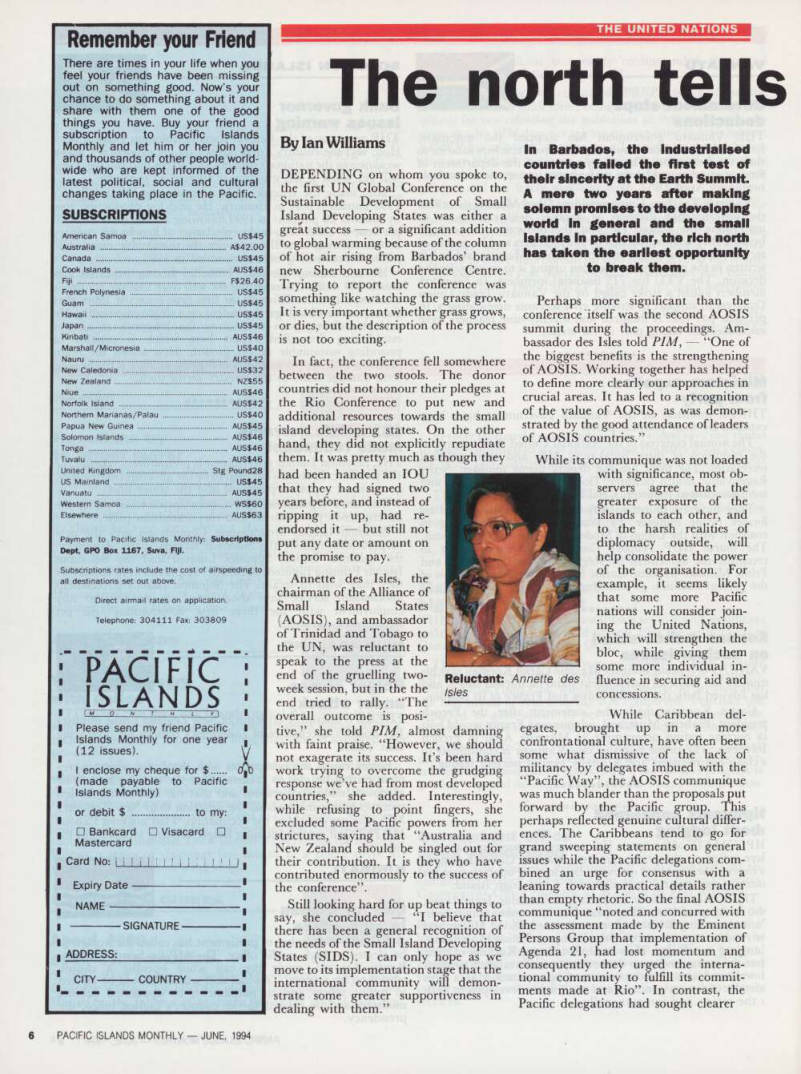
Annette des Isles, the chairman of the Alliance of Small Island States (AOSIS), and ambassador of Trinidad and Tobago to the UN, was reluctant to speak to the press at the end of the gruelling two week session, but in the the end tried to rally. “The overall outcome is posi
tive,” she told PIM, almost damning with faint praise. “However, we should not exagerate its success. It’s been hard work trying to overcome the grudging response we’ve had from most developed countries,” she added. Interestingly,
while refusing to point fingers, she
excluded some Pacific powers from her strictures, saying that “Australia and New Zealand should be singled out for their contribution. It is they who have contributed enormously to the success of the conference”.
Still looking hard for up beat things to say, she concluded “I believe that there has been a general recognition of the needs of the Small Island Developing States (SIDS). I can only hope as we move to its implementation stage that the international community will demon strate some greater supportiveness in dealing with them.”
In Barbados, the Industrialised countries failed the first test of their sincerity at the Earth Summit.
A mere two years after making solemn promises to the developing world In general and the small Islands In particular, the rich north has taken the earliest opportunity to break them.
Perhaps more significant than the conference itself was the second AOSIS summit during the proceedings. Am bassador des Isles told PIM, “One of the biggest benefits is the strengthening of AOSIS. Working together has helped to define more clearly our approaches in crucial areas. It has led to a recognition of the value of AOSIS, as was demon strated by the good attendance of leaders of AOSIS countries.”
While its communique was not loaded
with significance, most ob servers agree that the greater exposure of the islands to each other, and to the harsh realities of diplomacy outside, will help consolidate the power of the organisation. For example, it seems likely that some more Pacific nations will consider join ing the United Nations, which will strengthen the bloc, while giving them some more individual in fluence in securing aid and concessions.
While Caribbean del
egates, brought up in a more confrontational culture, have often been some what dismissive of the lack of militancy by delegates imbued with the “Pacific Way”, the AOSIS communique was much blander than the proposals put forward by the Pacific group. This perhaps reflected genuine cultural differ ences. The Caribbeans tend to go for grand sweeping statements on general issues while the Pacific delegations com bined an urge for consensus with a leaning towards practical details rather than empty rhetoric. So the final AOSIS communique “noted and concurred with the assessment made by the Eminent Persons Group that implementation of Agenda 21, had lost momentum and consequently they urged the interna tional community to fulfill its commit ments made at Rio”. In contrast, the Pacific delegations had sought clearer
Reluctant: Annette des Isles
commitment calling for example, for the “early negotiation of binding proto cols which will recognise the real costs of adverse environmental impacts. These protocols should address, in particular, the issues of targets and timetables for the reduction of carbon dioxide and the greenhouse gas emissions”. Equally, the Pacific called for the implementation of the Basel Convention which bans the transport of hazardous waste, welcomed the implementation of the Law of the
Sea, and called for specific attention to trade policies that took into account the special needs of SIDS.
All these specifics were vetoed in favour of a general and ineffectual statement. On? reason perhaps is the price of success. AOSIS was launched with an appeal based on the vulnerability of small islands to sea level rise. As the alliance gathered momentum, it expanded its horizons to address the whole complex of development issues affecting the islands, and to some extent lost the clear and emotionally grabbing focus on the physical obliteration of the islands.
The expanded agenda allowed the donors to point out that most small islands get far more aid per head of population than land-based developing countries, and so, to some extent, gave them the excuse they sought to renege on their Rio commitments. That was fairly apparent from the beginning. The indus trialised countries sent no heads of state, and only a few, like Australia, New Zealand, Germany and Canada, sent ministers. Organisers had been hoping
that vice-president A 1 Gore, who has made much of his green credentials, would come. He did not, perhaps for fear of being overshadowed and embarrassed theother star of the conference, Fidel Castro . P resldent of Cuba, whose party s “ e P* , ln '. 10 much excitement, on two * us m J ets * But the US sent former Senator Tim Wirth, and there vyas a noticeable change from such conferences in years past. Then, other donor countries could rely upon the often obtuse hostility of the Republican administration in Washington to cover their own curmudgeonly policies. Under the Clinton administra-
tion they no longer have that cover, and the Europeans in particular are revealed to be the dogs in the manger.
This is particularly perfidious in that many of the small islands are former colonies of France and Britain, who have shamefully neglected them since inde pendence. For example, Britain sent only an under secretary of the department ol the environment, the Earl ol Arran, while France merely sent its local ambassador to Barbados, who was so
well informed that he told local TV that the South Pacific Forum had represen tation from French territories.
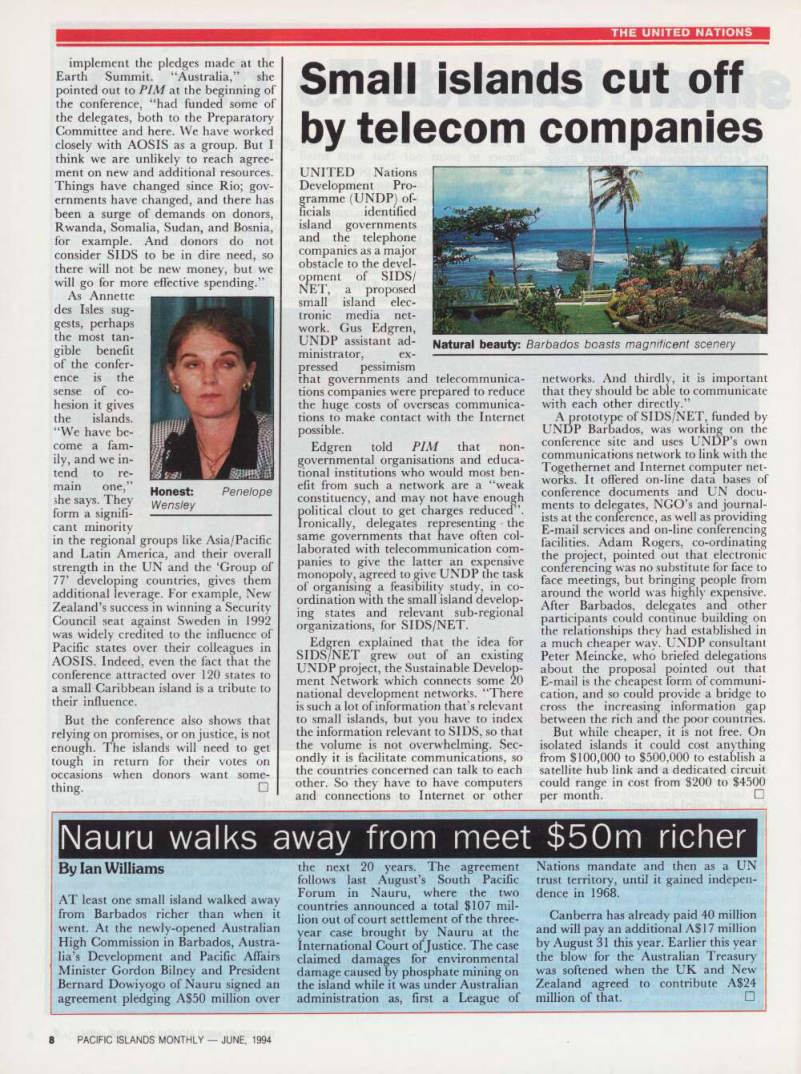
In contrast, Australia’s ambassador at large for the environment, Penelope Wensley, who chaired the Main Com mittee where the serious horse trading was done, made many friends by being pragmatically honest about the lack of commitment by donors from the very onset. She cut through the diplomatic waffle to reiterate the message that there would be no new money available, and she was instrumental in securing the compromise Programme of Action that, at least repeated, although it did not
lan Williams
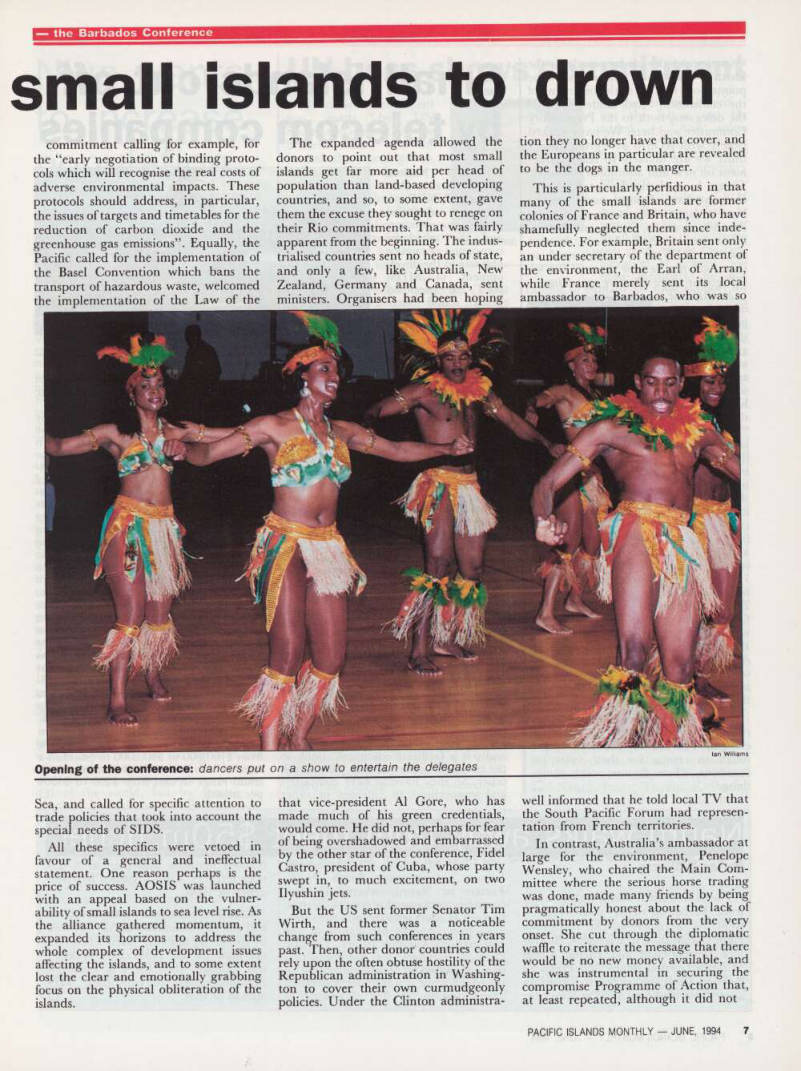
Opening of the conference: dancers put on a show to entertain the delegates
implement the pledges made at the Earth Summit. “Australia,” she pointed out to PIM at the beginning of the conference, “had funded some of the delegates, both to the Preparatory Committee and here. We have worked closely with AOSIS as a group. But I think we are unlikely to reach agree ment on new and additional resources.
Things have changed since Rio; gov ernments have changed, and there has been a surge of demands on donors, Rwanda, Somalia, Sudan, and Bosnia, for example. And donors do not consider SIDS to be in dire need, so there will not be new money, but we will go for more effective spending.”
As Annette des Isles sug
gests, perhaps
the most tan
gible benefit
of the confer ence is the sense of co hesion it gives the islands.
“We have be come a fam ily, and we in tend to re main one,” she says. They form a signifi
cant minority
in the regional groups like Asia/Pacific and Latin America, and their overall strength in the UN and the ‘Group of IT developing countries, gives them additional leverage. For example, New Zealand’s success in winning a Security Council seat against Sweden in 1992 was widely credited to the influence of Pacific states over their colleagues in AOSIS. Indeed, even the fact that the conference attracted over 120 states to a small Caribbean island is a tribute to their influence.
But the conference also shows that relying on promises, or on justice, is not enough. The islands will need to get tough in return for their votes on occasions when donors want some
thing. □
Honest: Penelope Wensley
Advertisements & other items, pp. 6-7 (2 items)
"Pacffic
Remember your Friend
There are times in your life when you feel your friends have been missing out on something good. Now’s your chance to do something about it and share with them one of the good things you have. Buy your friend a subscription to Pacific Islands Monthly and let him or her join you and thousands of other people worldwide who are kept informed of the latest political, social and cultural
changes taking place in the Pacific.
SUBSCRIPTIONS
American Samoa US$45 Australia A 542.00 Canada US$45 Cook Islands AUSS46 Fiji F 526.40 French Polynesia US$45 Guam US$45 Hawaii US$45 Japan US$45 Kiribati AUSS46 Marshall/Micronesia US$4O Nauru AUSS42 New Caledonia US$32 New Zealand NZ$55 Niue AUSS46 Norfolk Island AUSS42 Northern Mananas/Palau US$4O Papua New Guinea AUSS4S Solomon Islands AUSS46 Tonga AUSS46 Tuvalu AUSS46 United Kingdom Stg Pound2B US Mainland US$45 Vanuatu AUSS4S Western Samoa WS$6O Elsewhere AUSS63 Payment to Pacific Islands Monthly: Subscriptions Dept. GPO Box 1167, Suva. Fiji.
Subscriptions rates include the cost of airspeeding to all destinations set out above.
Direct airmail rates on application.
Telephone: 304111 Fax: 303809
"PACfFiC
SLANDS ■
IMowr H L VI I
Please send my friend Pacific I Islands Monthly for one year (
(12 issues). W
I enclose my cheque for $ C^b (made payable to Pacific Islands Monthly) 1 or debit $ to my: □ Bankcard □ Visacard □ ( Mastercard I Card No: I i I M : ; ! i ! : i ! 1 i I ( Expiry Date 1 I
NAME 1
SIGNATURE 1
ADDRESS;
CITY COUNTRY
small islands to drown
7
PACIFIC ISLANDS MONTHLY JUNE, 1994
t
by telecom companies
The United Nations
Small islands cut off by telecom companies
UNITED Nations Development Pro gramme (UNDP) of ficials identified island governments and the telephone companies as a major obstacle to the devel opment of SIDS/ NET, a proposed small island elec tronic media net work. Gus Edgren, UNDP assistant ad ministrator, ex pressed pessimism
that governments and telecommunica tions companies were prepared to reduce the huge costs of overseas communica tions to make contact with the Internet possible.
Edgren told PIM that non governmental organisations and educa tional institutions who would most ben efit from such a network are a “weak constituency, and may not have enough political clout to get charges reduced”.
Ironically, delegates representing the same governments that have often col laborated with telecommunication com panies to give the latter an expensive monopoly, agreed to give UNDP the task of organising a feasibility study, in co ordination with the small island develop ing states and relevant sub-regional organizations, for SIDS/NET.
Edgren explained that the idea for SIDS/NET grew out of an existing UNDP project, the Sustainable Develop ment Network which connects some 20 national development networks. “There is such a lot of information that’s relevant to small islands, but you have to index the information relevant to SIDS, so that the volume is not overwhelming. Sec ondly it is facilitate communications, so the countries concerned can talk to each other. So they have to have computers and connections to Internet or other
networks. And thirdly, it is important that they should be able to communicate with each other directly.”
A prototype of SIDS/NET, funded by UNDP Barbados, was working on the conference site and uses UNDP’s own communications network to link with the Togethernet and Internet computer net works. It offered on-line data bases of conference documents and UN docu ments to delegates, NGO’s and journal ists at the conference, as well as providing E-mail services and on-line conferencing
facilities. Adam Rogers, co-ordinating
the project, pointed out that electronic conferencing was no substitute for face to
face meetings, but bringing people from
around the world was highly expensive.
After Barbados, delegates and other participants could continue building on the relationships they had established in a much cheaper way. UNDP consultant Peter Meincke, who briefed delegations about the proposal pointed out that E-mail is the cheapest form of communi cation, and so could provide a bridge to cross the increasing information gap between the rich and the poor countries.
But while cheaper, it is not free. On isolated islands it could cost anything from SIOO,OOO to 5500,000 to establish a satellite hub link and a dedicated circuit could range in cost from S2OO to 54500 per month. □
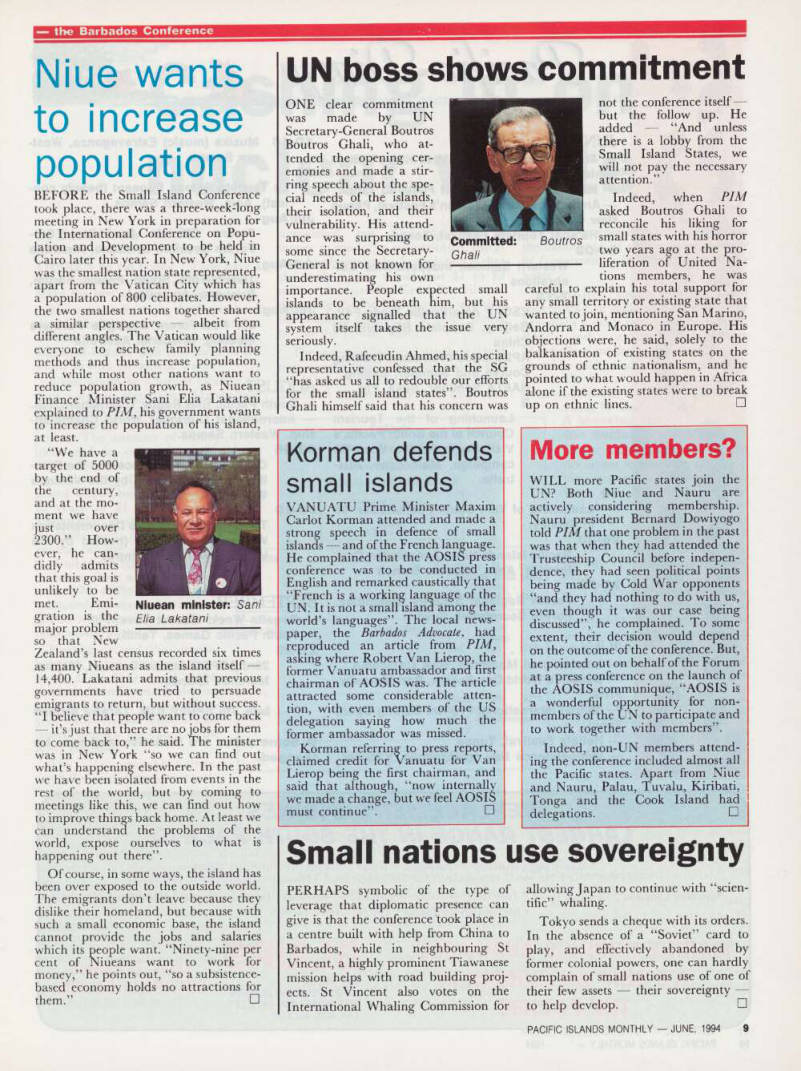
Natural beauty: Barbados boasts magnificent scenery
Nauru walks away from meet $50m richer
By lan Williams
AT least one small island walked away from Barbados richer than when it went. At the newly-opened Australian High Commission in Barbados, Austra lia’s Development and Pacific Affairs Minister Gordon Bilney and President Bernard Dowiyogo of Nauru signed an agreement pledging Asso million over
the next 20 years. The agreement follows last August’s South Pacific Forum in Nauru, where the two countries announced a total SIO7 mil lion out of court settlement of the three year case brought by Nauru at the International Court ofjustice. The case claimed damages for environmental damage caused by phosphate mining on the island while it was under Australian administration as, first a League of
Nations mandate and then as a UN trust territory, until it gained indepen dence in 1968.
Canberra has already paid 40 million and will pay an additional AS 17 million by August 31 this year. Earlier this year the blow for the Australian Treasury was softened when the UK and New Zealand agreed to contribute AS24 million of that. □
population
the Barbados Conference
Niue wants to increase population
BEFORE the Small Island Conference took place, there was a three-week-long meeting in New York in preparation for the International Conference on Popu lation and Development to be held in Cairo later this year. In New York, Niue was the smallest nation state represented, apart from the Vatican City which has a population of 800 celibates. However, the two smallest nations together shared a similar perspective albeit from different angles. The Vatican would like everyone to eschew family planning methods and thus increase population, and while most other nations want to reduce population growth, as Niuean Finance Minister Sani Elia Lakatani explained to PIM, his government wants to increase the population of his island, at least.
“We have a target of 5000 by the end of the century, and at the mo ment we have
just over
2300.” How ever, he can
didly admits
that this goal is unlikely to be met. Emi gration is the
major problem
so that New
Zealand’s last census recorded six times as many Niueans as the island itself 14,400. Lakatani admits that previous governments have tried to persuade emigrants to return, but without success.
“I believe that people want to come back it’s just that there are no jobs for them to come back to,” he said. The minister was in New York “so we can find out what’s happening elsewhere. In the past we have been isolated from events in the rest of the world, but by coming to meetings like this, we can find out now to improve things back home. At least we can understand the problems of the world, expose ourselves to what is happening out there”.
Of course, in some ways, the island has been over exposed to the outside world.
The emigrants don’t leave because they dislike their homeland, but because with such a small economic base, the island cannot provide the jobs and salaries which its people want. “Ninety-nine per cent of Niueans want to work for money,” he points out, “so a subsistence based economy holds no attractions for them.” □
Niuean minister: Sani Elia Lakatani
UN boss shows commitment
ONE clear commitment was made by UN
Secretary-General Boutros
Boutros Ghali, who at tended the opening cer emonies and made a stir ring speech about the spe cial needs of the islands, their isolation, and their vulnerability. His attend ance was surprising to some since the Secretary- General is not known for underestimating his own
importance. People expected small islands to be beneath him, but his appearance signalled that the UN system itself takes the issue very seriously.
Indeed, Rafeeudin Ahmed, his special representative confessed that the SG “has asked us all to redouble our efforts for the small island states”. Boutros Ghali himself said that his concern was
not the conference itself — but the follow up. He added — “And unless there is a lobby from the Small Island States, we will not pay the necessary attention.”
Indeed, when PIM asked Boutros Ghali to reconcile his liking for small states with his horror two years ago at the pro liferation of United Na tions members, he was
careful to explain his total support for any small territory or existing state that wanted to join, mentioning San Marino, Andorra and Monaco in Europe. His objections were, he said, solely to the balkanisation of existing states on the grounds of ethnic nationalism, and he pointed to what would happen in Africa alone if the existing states were to break up on ethnic lines. D
Committed: Boutros Ghali
Korman defends
small islands
VANUATU Prime Minister Maxim Carlot Korman attended and made a strong speech in defence of small islands and of the French language.
He complained that the AOSIS press conference was to be conducted in English and remarked caustically that “French is a working language of the UN. It is not a small island among the world’s languages”. The local news paper, the Barbados Advocate, had reproduced an article from PIM, asking where Robert Van Lierop, the former Vanuatu ambassador and first chairman of AOSIS was. The article attracted some considerable atten tion, with even members of the US delegation saying how much the former ambassador was missed.
Korman referring to press reports, claimed credit for Vanuatu for Van Lierop being the first chairman, and said that although, “now internally we made a change, but we feel AOSIS must continue”. □
More members?
WILL more Pacific states join the UN? Both Niue and Nauru are actively considering membership.
Nauru president Bernard Dowiyogo told PIM that one problem in the past was that when they had attended the Trusteeship Council before indepen dence, they had seen political points being made by Cold War opponents “and they had nothing to do with us, even though it was our case being discussed”, he complained. To some extent, their decision would depend on the outcome of the conference. But, he pointed out on behalf of the Forum at a press conference on the launch of the AOSIS communique, “AOSIS is a wonderful opportunity for non members of the UN to participate and to work together with members”.
Indeed, non-UN members attend ing the conference included almost all the Pacific states. Apart from Niue and Nauru, Palau, Tuvalu, Kiribati, Tonga and the Cook Island had delegations. □
Small nations use sovereignty
PERHAPS symbolic of the type of leverage that diplomatic presence can give is that the conference took place in a centre built with help from China to Barbados, while in neighbouring St Vincent, a highly prominent Tiawanese mission helps with road building proj ects. St Vincent also votes on the International Whaling Commission for
allowing Japan to continue with “scien tific” whaling.
Tokyo sends a cheque with its orders.
In the absence of a “Soviet” card to play, and effectively abandoned by former colonial powers, one can hardly complain of small nations use of one of their few assets their sovereignty to help develop. □
Advertisements & other items, p. 10 (1 item)
U^acifii
jJiara
V.
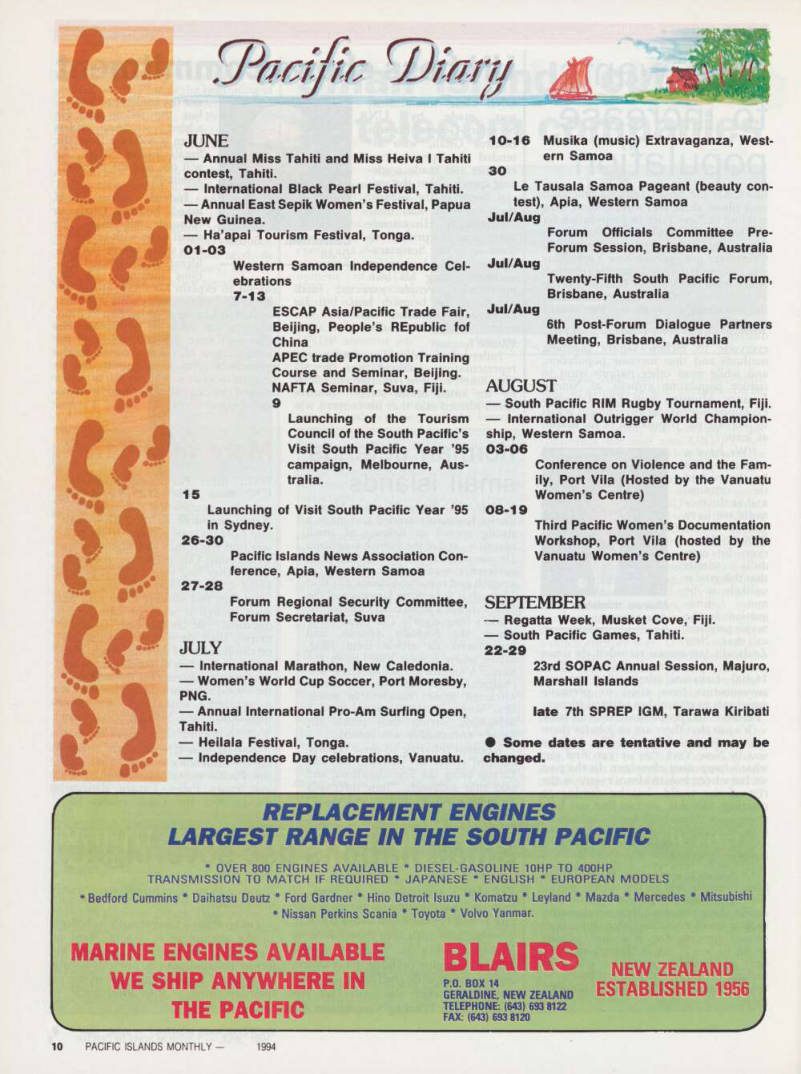
JUNE
Annual Miss Tahiti and Miss Heiva I Tahiti contest, Tahiti.
International Black Pearl Festival, Tahiti.
Annual East Sepik Women’s Festival, Papua New Guinea.
Ha’apai Tourism Festival, Tonga. 01-03 Western Samoan Independence Celebrations 7-13 ESCAP Asia/Pacific Trade Fair, Beijing, People’s REpublic fof China APEC trade Promotion Training Course and Seminar, Beijing.
NAFTA Seminar, Suva, Fiji. 9 Launching of the Tourism Council of the South Pacific’s Visit South Pacific Year ’95 campaign, Melbourne, Australia. 15 Launching of Visit South Pacific Year ’95 in Sydney. 26- Pacific Islands News Association Conference, Apia, Western Samoa 27- Forum Regional Security Committee, Forum Secretariat, Suva
JULY
International Marathon, New Caledonia.
Women’s World Cup Soccer, Port Moresby,
PNG.
Annual International Pro-Am Surfing Open, Tahiti.
Heilala Festival, Tonga.
Independence Day celebrations, Vanuatu. 10-16 Musika (music) Extravaganza, Western Samoa 30 Le Tausala Samoa Pageant (beauty contest), Apia, Western Samoa Jul/Aug Forum Officials Committee Pre- Forum Session, Brisbane, Australia Jul/Aug Twenty-Fifth South Pacific Forum, Brisbane, Australia Jul/Aug 6th Post-Forum Dialogue Partners Meeting, Brisbane, Australia
AUGUST
South Pacific RIM Rugby Tournament, Fiji.
International Outrigger World Championship, Western Samoa. 03-06 Conference on Violence and the Family, Port Vila (Hosted by the Vanuatu Women’s Centre) 08-19 Third Pacific Women’s Documentation Workshop, Port Vila (hosted by the Vanuatu Women’s Centre)
SEPTEMBER
Regatta Week, Musket Cove, Fiji.
South Pacific Games, Tahiti. 22-29 23rd SOPAC Annual Session, Majuro, Marshall Islands late 7th SPREP IGM, Tarawa Kiribati • Some dates are tentative and may be changed.
REPLACEMENT ENGINES
LARGEST RANGE IN THE SOUTH PACIFIC
* OVER 800 ENGINES AVAILABLE * DIESEL-GASOLINE 10HP TO 400 HP TRANSMISSION TO MATCH IF REQUIRED * JAPANESE * ENGLISH * EUROPEAN MODELS * Bedford Cummins * Daihatsu Deutz * Ford Gardner * Hino Detroit Isuzu * Komatzu * Leyland * Mazda * Mercedes * Mitsubishi * Nissan Perkins Scania * Toyota * Volvo Yanmar.
MARINE ENGINES AVAILABLE
WE SHIP ANYWHERE IN
THE PACIFIC
BLAIRS
P.O. BOX 14
GERALDINE, NEW ZEALAND
TELEPHONE: (643) 633 8122
FAX: (643) 693 8120
NEW ZEALAND
ESTABLISHED 1956
w
nuclear waste
Cover Story
Cashing in on nuclear waste
By David North
THERE’S an old saying, “if you have a lemon, make lemonade”. In other words, make the best of a bad situation.
Some major forces in the Republic of the Marshall Islands want to do just that take one or more of the nuclear damaged islands, and rent them to the world as sites for atomic waste.
Bikini would be a logical location for such a dump, argue some Marshallese,
while others are adamantly op posed to even entertaining the notion. The amounts of money mentioned in connection with such a development are stagger ing. The New York Times sug gested US$5O million a year for 20 years, or $1 billion. RMTs ambassador to the US, Wilfred Kendall, told PIM that the annual income could be more than all of the republic’s current revenues, from all sources, now some $7O million a year. He cautioned, however, that conver sations are currently at a “very
preliminary phase”.
Floating around Washington, however, is an unsigned docu ment, dated February 1, 1994, marked “confidential” dealing with this subject. I was told on good authority that it had at least passed through the hands of the RMI embassy.
The smoothly-written, carefully-worded document seeks
funding for a feasibility study on the question of locating a nuclear storage facility on one or more uninhabited or nuclear-damaged islands in the Mar shalls. No island names are specified. The heading for the 16-page paper is “Long term Storage and Permanent Disposal of Nuclear Materials - a Proposal for a Feasibility Study in the Marshall Islands.” As one who is familiar with both island and Washington writing styles, my assumption is that it was written by mainland lawyers or consult ants. It is clearly intended to persuade a mainland source of money to put up an
unspecified, but substantial sum of money to conduct a sophisticated, three part feasibility study. Speculation is that the study alone, would cost $1 to $2 million. Ambassador Kendall, while not discussing the cost of the study, said that the potential sponsor of the study would be “in the private sector”.
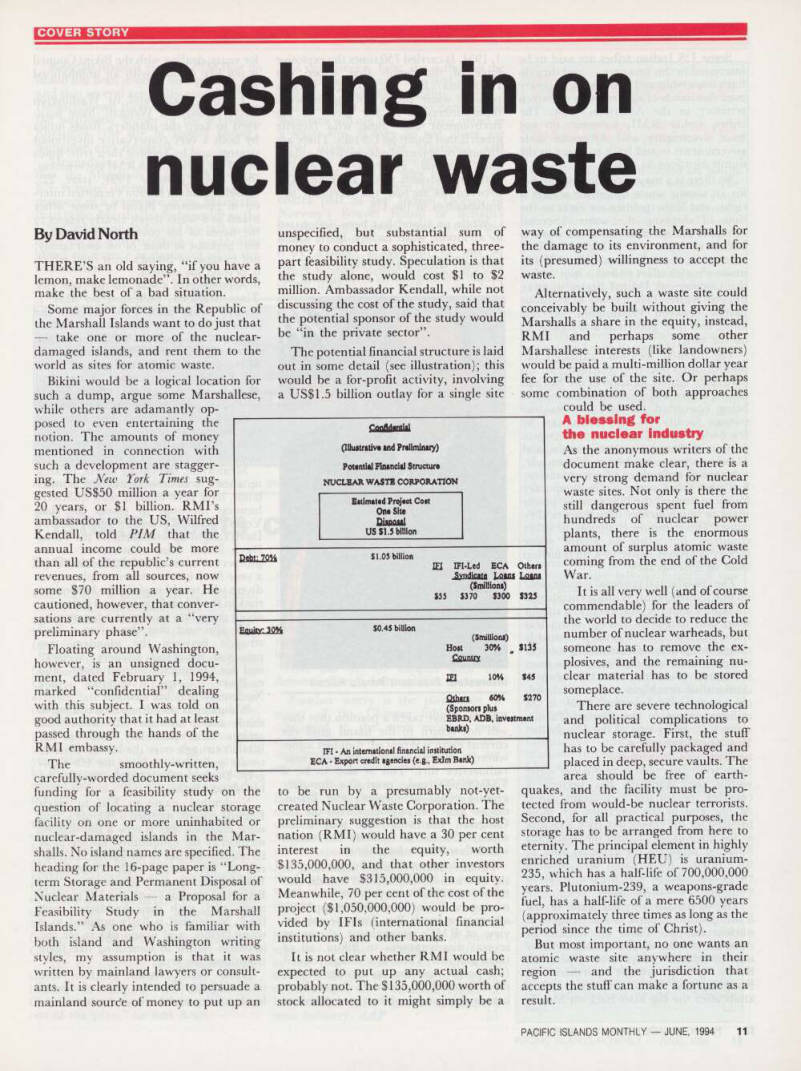
The potential financial structure is laid out in some detail (see illustration); this would be a for-profit activity, involving a US$l.5 billion outlay for a single site
to be run by a presumably not-yet created Nuclear Waste Corporation. The preliminary suggestion is that the host nation (RMI) would have a 30 per cent interest in the equity, worth $135,000,000, and that other investors would have $315,000,000 in equity.
Meanwhile, 70 per cent of the cost of the project ($1,050,000,000) would be pro vided by IFIs (international financial institutions) and other banks.
It is not clear whether RMI would be expected to put up any actual cash; probably not. The $135,000,000 worth of stock allocated to it might simply be a
way of compensating the Marshalls for the damage to its environment, and for its (presumed) willingness to accept the waste.
Alternatively, such a waste site could conceivably be built without giving the Marshalls a share in the equity, instead, RMI and perhaps some other
Marshallese interests (like landowners)
would be paid a multi-million dollar year fee for the use of the site. Or perhaps some combination of both approaches
could be used.
A blessing for the nuclear Industry As the anonymous writers of the document make clear, there is a very strong demand for nuclear waste sites. Not only is there the still dangerous spent fuel from hundreds of nuclear power plants, there is the enormous amount of surplus atomic waste coming from the end of the Cold War.
It is all very well (and of course commendable) for the leaders of the world to decide to reduce the number of nuclear warheads, but someone has to remove the ex plosives, and the remaining nu clear material has to be stored
someplace.
There are severe technological
and political complications to
nuclear storage. First, the stuff has to be carefully packaged and placed in deep, secure vaults. The area should be free of earth
quakes, and the facility must be pro tected from would-be nuclear terrorists, Second, for all practical purposes, the storage has to be arranged from here to eternity. The principal element m highly pinched uranium HEU) is uranium -235, which has a half-life of 700,000,000 years. Plutomum-239, a weapons-grade a half . life of a mere 650 0 years / approximate i y t h ree times as long as the iod since the t j me 0 f Christ), g ut most important, no one wants an atomic waste site anywhere in their region and the jurisdiction that accepts the stuff can make a fortune as a result.
Some US Indian tribes are said to be interested in this prospect and they do have ownership and some political power over thousands of square miles of barren territory in the American West. The tribes, unlike RMI, however, do not have sovereignty and American state governments would have to agree to the dump locations as well.
So there is a major, continuing market for an atomic waste site, if the setting is right, and if the politics are right at the time of shipping the waste. (Second thoughts are not a factor; if the waste is buried someplace, it is highly unlikely ever to be moved away.) The US has made a major effort to find a spot within the Continental United States to store nuclear waste. This has led to vigorous battles between Washington, on one hand, and state governors and legislators on the other.
The likeliest location, although the politics are not yet clarified, is an extremely remote location in the Nevada desert, where a large abandoned mine is being converted for use as a nuclear storage facility. If agreement can be reached, it would take care of only a portion of America’s atomic waste, and so far no storage has begun. Meanwhile, substantial collections of spent nuclear fuel and other waste sit in temporary locations around the US, near the power plant or bomb factory from whence they came. The situation is similar in other countries, but siting an atomic waste facility is always easier in a dictatorship than in a democracy.
The confidential proposal is quite clear on one related point. While it encourages thinking about the Marshalls as a site for short and long-term storage of nuclear materials, it is opposed to the presumably dangerous process of dismantling nuclear weapons in the islands. That is to be done elsewhere. (Currently the US Army is dismantling nerve gas and other chemi cal weapons on Johnston Atoll, a US military island in the Central Pacific, some 1500 miles east of the Marshalls.) The controversies among the islanders Meanwhile, the politics of nuclear waste within the Marshalls has become a complex, potentially high-stakes game.
At one end of the spectrum are those pressing for the creation of such a facility as the obvious way to end the Marshalls financial problems for decades; and, at the other, there are the staunch environmentalists who do not want to even think about the issue.
The Marshalls also has some of the leading world experts in the dangers of nuclear fall-out. These are families of those people who died of various forms of nuclear-related cancer after Operation Bravo spewed atomic particles on Rongelap and Utirik and many other atolls after the big blast back on March
1, 1954. It carried 750 times the explosive force of the bomb that wiped out Hiroshima. But the struggle over a possible waste site is not just between those interested in the green of the environment and those who favorite green is that found on US bills. There are
disputes or potential ones between village
and national government, between mainland advisers to the Bikinians, and between (we are told) the Marshalls’ two ambassadors in the US.
While no island has been designated for an atomic waste facility, Bikini would be one of the logical choices. It is currently uninhabited except for a few people working on its reclamation; the
Bikinians have taken a position that they will not return to the island until the current earth is removed, dumped some where, and replaced by nice, new, non radioactive dirt. This is said to be a $200,000,000 task (even if a dumping ground could be located) and Bikini, despite generous payments from the US Congress, has only half that much money. So Bikini is likely to remain uninhabited for a long time.
Further, Bikini is larger than some of the alternative, uninhabited islands, and there would be few surprises to waste site managers. Bikini is as well mapped as any spot on earth. But, from the point of view of RMl’s government, there are several disadvantages to Bikini, all of them political. There is a village council (the people now live on another island, the 200-acre Kili) and the villagers have been making many of their own decisions
lor years; dealing with the Bikini Council is not like dealing with an uninhabited island.
Further, Bikini and its Washington
lawyer, Jonathan Wcisgall, have man
aged to keep the islanders’ funds intact by both a very conservative investment strategy and by keeping their trust funds out of the hands of the RMI government.
(See PIM, January 1994, page 22).
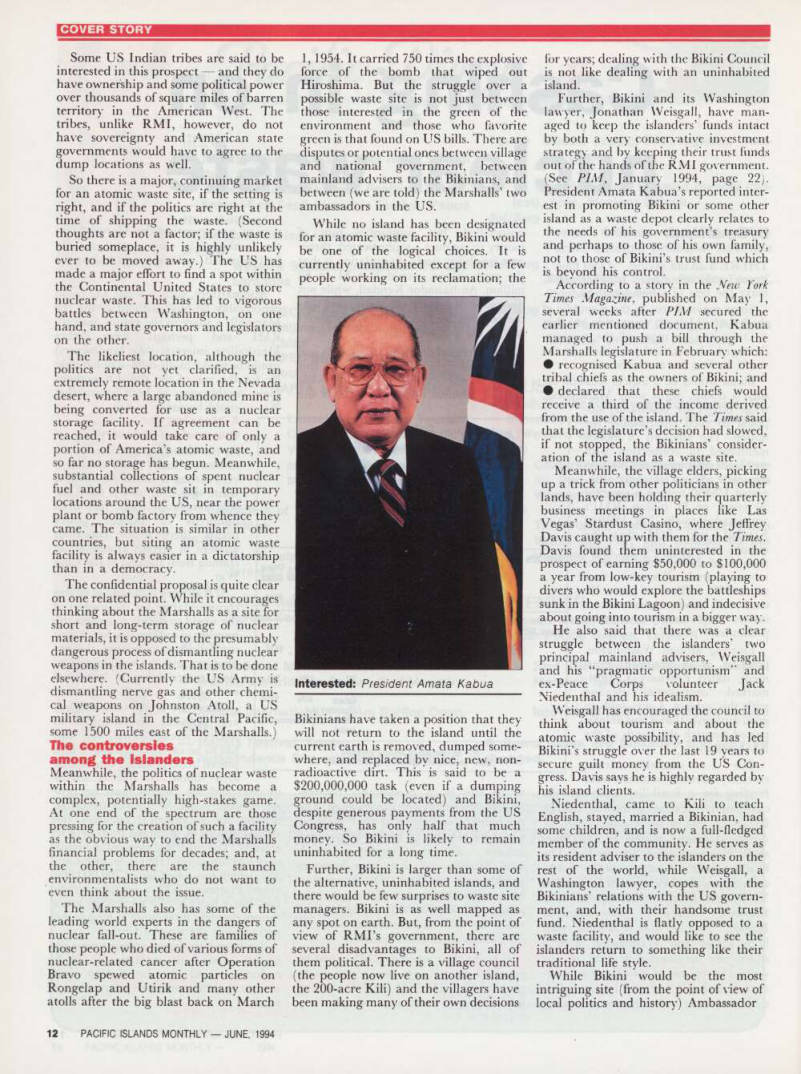
President Amata Kabua’s reported inter est in promoting Bikini or some other island as a waste depot clearly relates to the needs of his government’s treasury and perhaps to those of his own family, not to those of Bikini’s trust fund which is beyond his control.
According to a story in the New York
Times Magazine, published on May 1,
several weeks after PIM secured the earlier mentioned document, Kabua managed to push a bill through the Marshalls legislature in February which; • recognised Kabua and several other tribal chiefs as the owners of Bikini; and • declared that these chiefs would receive a third of the income derived from the use of the island. The Times said that the legislature’s decision had slowed, if not stopped, the Bikinians’ consider ation of the island as a waste site.
Meanwhile, the village elders, picking up a trick from other politicians in other lands, have been holding their quarterly business meetings in places like Las Vegas’ Stardust Casino, where Jeffrey Davis caught up with them for the Times.
Davis found them uninterested in the prospect of earning $50,000 to SIOO,OOO a year from low-key tourism (playing to divers who would explore the battleships sunk in the Bikini Lagoon) and indecisive about going into tourism in a bigger way.
He also said that there was a clear struggle between the islanders’ two
principal mainland advisers, Weisgall
and his “pragmatic opportunism" and
ex-Peace Corps volunteer Jack
Niedenthal and his idealism.
Weisgall has encouraged the council to think about tourism and about the atomic waste possibility, and has led Bikini's struggle over the last 19 years to secure guilt money from the US Con gress. Davis says he is highly regarded by his island clients.
Niedenthal, came to Kili to teach English, stayed, married a Bikinian, had some children, and is now a full-fledged member of the community. He serves as its resident adviser to the islanders on the rest of the world, while Weisgall, a Washington lawyer, copes with the Bikinians’ relations with the US govern ment, and, with their handsome trust fund. Niedenthal is flatly opposed to a waste facility, and would like to see the islanders return to something like their traditional life style.
While Bikini would be the most intriguing site (from the point of view of local politics and history) Ambassador
Interested: President Amata Kabua
Kendall made it clear to PIM that no island has been selected for a possible site, and that several are under consideration.
He mentioned three other islands, all in the northwest corner of the Republic: Enewetak (the site of atomic testing),
Alinginae and Rongerik.
Meanwhile, we gather in Washington that the Marshalls’ ambassador to the US, is more interested in exploring the prospect of a waste site in the Marshalls, than is the Marshalls’ ambassador to the UN, Carl Heine. We could not talk to the latter, as he was attending a world-wide island conference in Barbados while this was written.
What happens next? It probably will
be a slow process. First, the authors of the confidential paper need to find someone willing to fund the feasibility study and once that is under way perhaps the Bikinians will opt for using their island as a waste site. If they do not, there are other islands, in the Marshalls, and elsewhere. (If the seas are not impossible, and harbours exist, why not France’s uninhabited Kerguelen Islands in the colder part of the Indian Oceaxi, or Norway’s Bouvet Island or Britain’s South Georgia Islands, both in the frigid South Atlantic?) I suspect that we will be reading about where to store atomic waste for the rest of our lives. □
Arvind Kumar
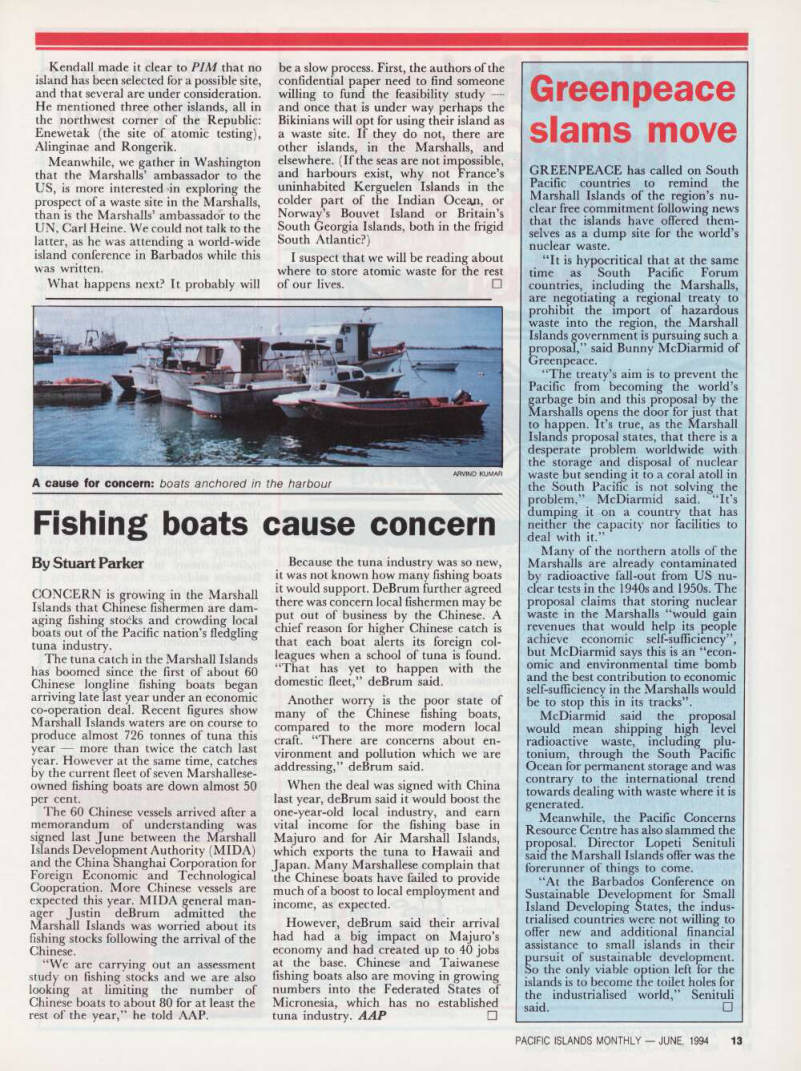
A cause for concern: boats anchored in the harbour
Fishing boats cause concern
By Stuart Parker
CONCERN is growing in the Marshall Islands that Chinese fishermen are dam aging fishing stocks and crowding local boats out of the Pacific nation’s fledgling
tuna industry.
The tuna catch in the Marshall Islands has boomed since the first of about 60 Chinese longline fishing boats began arriving late last year under an economic co-operation deal. Recent figures show Marshall Islands waters are on course to produce almost 726 tonnes of tuna this year more than twice the catch last year. However at the same time, catches by the current fleet of seven Marshallese owned fishing boats are down almost 50 per cent.
The 60 Chinese vessels arrived after a memorandum of understanding was signed last June between the Marshall
Islands Development Authority (MIDA)
and the China Shanghai Corporation for Foreign Economic and Technological Cooperation. More Chinese vessels are expected this year. MIDA general man ager Justin deßrum admitted the Marshall Islands was worried about its fishing stocks following the arrival of the Chinese.
“We are carrying out an assessment study on fishing stocks and we are also looking at limiting the number of Chinese boats to about 80 for at least the rest of the year,” he told AAP.
Because the tuna industry was so new, it was not known how many fishing boats it would support. Deßrum further agreed there was concern local fishermen may be put out of business by the Chinese. A chief reason for higher Chinese catch is that each boat alerts its foreign col leagues when a school of tuna is found.
“That has yet to happen with the domestic fleet,” deßrum said.
Another worry is the poor state of many of the Chinese fishing boats, compared to the more modern local craft. “There are concerns about en vironment and pollution which we are addressing,” deßrum said.
When the deal was signed with China last year, deßrum said it would boost the one-year-old local industry, and earn vital income for the fishing base in Majuro and for Air Marshall Islands, which exports the tuna to Hawaii and Japan. Many Marshallese complain that the Chinese boats have failed to provide much of a boost to local employment and income, as expected.
However, deßrum said their arrival had had a big impact on Majuro’s economy and had created up to 40 jobs at the base. Chinese and Taiwanese fishing boats also are moving in growing numbers into the Federated States of Micronesia, which has no established tuna industry. AAP □
Greenpeace
slams move
GREENPEACE has called on South Pacific countries to remind the Marshall Islands of the region’s nu clear free commitment following news that the islands have offered them selves as a dump site for the world’s nuclear waste.
“It is hypocritical that at the same time as South Pacific Forum countries, including the Marshalls, are negotiating a regional treaty to prohibit the import of hazardous waste into the region, the Marshall Islands government is pursuing such a proposal,” said Bunny McDiarmid of
Greenpeace.
“The treaty’s aim is to prevent the Pacific from becoming the world’s garbage bin and this proposal by the Marshalls opens the door for just that to happen. It’s true, as the Marshall Islands proposal states, that there is a desperate problem worldwide with the storage and disposal of nuclear waste but sending it to a coral atoll in the South Pacific is not solving the problem,” McDiarmid said. “It's dumping it on a country that has neither the capacity nor facilities to deal with it.”
Many of the northern atolls of the Marshalls are already contaminated by radioactive fall-out from US nu clear tests in the 1940 s and 19505. The proposal claims that storing nuclear waste in the Marshalls “would gain revenues that would help its people achieve economic self-sufficiency”, but McDiarmid says this is an “econ omic and environmental time bomb and the best contribution to economic self-sufficiency in the Marshalls would be to stop this in its tracks”.
McDiarmid said the proposal would mean shipping high level radioactive waste, including plu tonium, through the South Pacific Ocean for permanent storage and was contrary to the international trend towards dealing with waste where it is generated.
Meanwhile, the Pacific Concerns Resource Centre has also slammed the proposal. Director Lopeti Senituli said the Marshall Islands offer was the forerunner of things to come.
“At the Barbados Conference on Sustainable Development for Small Island Developing States, the indus trialised countries were not willing to offer new and additional financial assistance to small islands in their pursuit of sustainable development.
So the only viable option left for the islands is to become the toilet holes for the industrialised world,” Senituli said. □
in after poll

Norfolk Island
More women in after poll
THERE will be more women and probably more harmony in government following a general election on the remote Australian territory of Norfolk Island, the returning officer says.
A record three women were elected to Norfolk Island’s nine-member legislative assembly in a poll held in April three more than in the previous legislature, said returning officer David Rodgers.
There are nearly 1200 registered voters on Norfolk Island, where around half the population are descendants of the Bounty mutiny families, w'ho moved there from Pitcairn Island in 1856.
The assembly called the election one year early because of deadlock and inertia among the island’s four-person executive. The government had no chief minister and the four executive members were divided down the middle on many key issues, Rodgers said. One executive member w'as even the unofficial leader of the opposition, although there are no
political parties on Norfolk.
“It was unworkable,” Rodgers said.
Voters reacted to the deadlock and
administrative bickering by dumping
two ministers from their seats. One of those defeated, Ric Robinson, has been campaigning for self-determination for the island, about 1600 kilometres east of Brisbane. “I think there will be a lot more harmony in government now,”
Rodgers said.
The legislative assembly will meet on May 4 to choose a new’ president, or speaker. It also must select an executive, although the size of the “cabinet” has yet to be determined.
Rodgers said unlike the last assembly, the new' legislature may decide to pick a government leader. “There seems to be a consensus there is a need for one.”
Twenty-seven independent candidates
contested the poll in a single electorate.
Under the island's electoral system, voters had nine votes each and were able to cast up to four votes for one candidate.
Aap □
Advertisements & other items, p. 14 (2 items)
loto-Charged
How Honiara
Their Motor Repair
Industry
£ w.
They were driven by change.
With more and more sophisticated vehicles being landed in the Solomon Islands, it had become obvious that the repairmen working on them needed advanced training.
The South Pacific Trade Commission organised intensive courses in Brisbane and Cairns that covered not only up-to-the-minute mechanical and electrical engineering, but also light engineering and fabrication along with inventory and retail procedures for spare parts.
Another to benefit recently from the Trade Commission’s efforts was the proprietor of a company supplying firefighting equipment at Honiara.We arranged training with the New South Wales Fire Brigade, which involved a full curriculum of modern firefighting techniques and equipment.
We also provided a two-week course for some other Solomon Islanders interested in the retail and commercial areas of the upholstery and furniture business.
And our charge for organising all this? Nothing. All our services are absolutely free.
If you are interested in our help, just post or fax us the coupon below. If you’re in a hurry, feel free to phone. [ Name I Company . . Address ss & PS 3 Level 6, 50 Park Street, Sydney NSW 2000.
Phone: (612)2835933, Fax: (012)28:15948 AdvriUors 1249
To be Changed by Christ
NZ, Aust defence
ties under debate
IF there is one thing that has provided continuity and stability in the Pacific over the years it has been the closeness of the New Zealand-Australia relation
ship.
The two countries’ governments and particularly their prime ministers have not always seen eye to eye, even on Pacific affairs where their interests are so alike. But in the main they were always mates when it counted.
“It is hard to think of two countries in the world with closer ties,” Austra lia’s Governor-General Bill Hayden said a few years ago. “I cannot foresee circumstances in which we will not have close relations including defence ties with Australia,” New Zealand’s then prime minister David Lange said in 1986. This co-operation, especially in the area of defence and security, was a
comfort to the Pacific Island states, particularly in the bad old days of the Cold War when all that was certain was uncertainty and the Soviet Union was doing its utmost to seed dissent and expand its influence in the region.
Anzac co-operation even survived New Zealand’s anti nuclear legislation, which cost it its long-time ally status with the United States and strained the trans-Tasman relation ship. The Australian government did not like New Zealand’s move any more than one or two Pacific Island countries but it agreed to maintain defence ties, even at substantial cost to itself. This promised continuity for New Zealand and Australian links with the Pacific and a united response to natural disasters or civil unrest should an island government request Anzac intervention.
It is significant then that a number of influential New Zealanders have begun to question the defence relationship with Australia. The crux of the debate is whether New Zealand should stick with the Anzac alliance or put its faith in the United Nations to protect its interests should they ever be threatened. The main issues are the cost of defence self reliance and the need for New Zealand politicians to find the middle ground in a new political environment. Spending on defence is not popular and the politicians will need popularity more than ever if they are to share in power from the next election, which will be held under a new system of voting that makes coalition governments inevitable.
There are already signs that they see defence spending and the cost of the security relationship with Australia as soft targets. The opposition Labour Party is reviewing its entire foreign and defence policy. Former Prime Minister David Lange, who once said: “We cannot regard our interest in Australia’s security as confined to this side of the Blue Mountains,” says openly that he wants this country to distance itself from Canberra’s defence planning. Having
already decided to move away from bilateral alliances in favour of a multi lateral defence strategy, Lange says the party debate is now centred on the relationship with Australia. The New Zealand Alliance, which increasingly looks certain to figure in a future coalition government, is already com mitted to a non-aligned foreign and defence policy.
But the debate is not confined to the opposition. It has spread to the ruling National Party which has embraced the anti-nuclear policy and is now showing signs of questioning ties with Australia.
Cabinet minister Doug Graham and prominent National backbencher John Robertson have both openly questioned the contemporary value of Anzac de fence co-operation. Graham, the Min
ister for Disarmament and Arms Control, went to the heart of “middle” New Zealand when he cast doubt on the trans- Tasman defence alliance, saying: “It is becoming increas ingly difficult to justify diverting money from hospitals to hardware for defence forces designed to provide some self sufficiency.”
And Robertson tapped New Zealand chauvinism when he told Parliament New Zealand was providing “an increasing contribution to the defence of Australia and an increasingly dubious contribution to the defence of New Zealand”.
He was referring to the former Labour government’s decision to spend NZ$l.2 billion on two new frigates being built as part of a major Australian Navy re-equipment programme. Rubbing it in, Robertson, a former chairman of Parliament’s foreign affairs and defence select committee, added: “We are in danger of becoming trapped in the jaws of the Australian military machine.”
Nobody is talking about cancelling the frigate order, but there is little prospect of any party buying the two extra ships the government has on option. All sides agree that the global situations has changed dramatically since the contract was signed. Lange says the defence interests of Australia, a country with middle-power pretensions, a growing military industrial complex and a continuing nagging fear of invasion by Indonesia, are very different from New Zealand’s.
Australian Prime Minister Paul Keating and Foreign Minister Gareth Evans have both made explicit warnings in the last year that New Zealand must maintain its defence spending (which had been cut by nearly a third over the past six years to 1.6 per cent of Gross Domestic Product) to make a “realistic” contribution to regional security.
The tensions are bound to increase. The implications for the Pacific are not yet clear, but it’s a situation that bears watching.
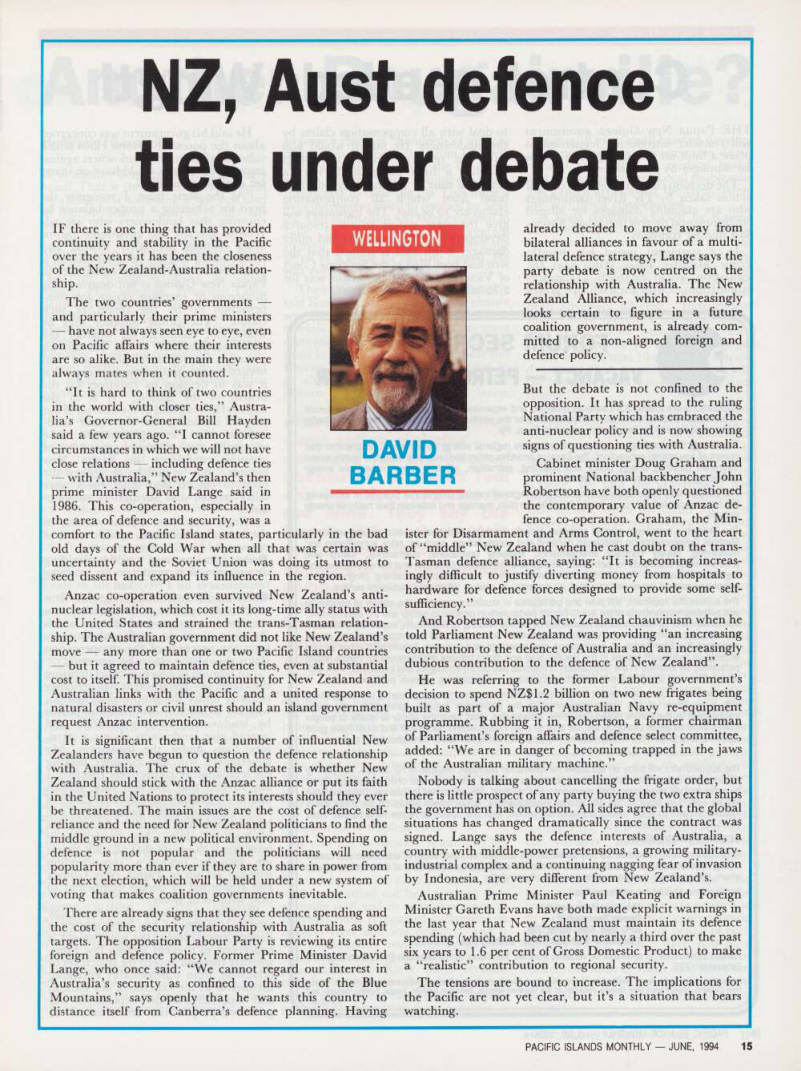
Wellington
David
Barber
Control needed: Wingti
Papua New Guinea
THE Papua New Guinea government will consider introducing legislation to place a limit on the aggregate of claims for damages by landowners.
The decision comes in the wake of legal action taken by Fly River landowners who are claiming damages for alleged environmental destruction by an Australian mining company.
In a statement issued last month, Prime Minister Paias Winti said the legislation would establish a compensation tribunal with the exclusive power
to deal with all compensation claims by the landowners. He said it would also have the resource project developers establish a fund progressively over a period of time or alternatively put up a bond from which all compensation claims are to be met. The legislation will give the state power to sue resource developers for environmental and other damage. Wind said it seemed that the writ had been filed at the Supreme Court of Victoria and that the claim was for 2.75 billion kina.
He said his government was concerned about the potential adverse effect which substantial claims by landowners against resource developers could have on inves tor confidence m PNG.
“At the same time, I recognise the need for achieving a proper balance by ensuring that landowners who are ad versely affected by environmental or other damage are fairly treated and compensated and the national interest is Protected in that investor confidence in apua New' Guinea is not destroyed by numerous or excessive claims for com pensation or by the threat of such claims.” The prime minister said he would not comment on whether the claim was justifiable or not. He said his country was a developing one and needed substantial investment capital if it was to develop its resources for the benefit of the nation. “It is in the national interest and in the interest of our
people, including the Fly River land
owners, that my government take reasonable steps to ensure against loss of investor confidence in Papua New Guinea.” But he said he recognised the need to ensure that landowners were fairly treated and adequately compen sated.
Wingti said other aspects relating to the recently filed writ, which were of concern to his Government were: • that a foreign court would be deciding on a claim which could have far reaching consequences on PNG; and • the involvement of a foreign law firm which w’as reported to have undertaken the case on a success fee basis and which therefore stood to profit substantially from the proceeds of the compensation claim should the claim be successful.
“In relation to a foreign court deciding the claim, my government will seriously consider under the proposed legislation, whether to abolish common law claims by landowners for compensation and instead give landowners claims a status tory basis under the legislation. My government will also consider making the legislation retrospectively effective. I am advised that this will raise serious doubts on whether the Supreme Court of Victoria or any other foreign court will have jurisdiction to hear the current
landowners’ claim. My government’s
intention is to ensure that all such claims are brought before a compensation tribunal set up in Papua New Guinea and comprised of people competent to deal with local issues.
“In relation to the involvement of any foreign law firm in any legal matter in
Papua New Guinea, my government is
concerned to prevent foreign law firms, whether through agreed fee structures or
otherwise, from unreasonably enriching
themselves at the expense of our citizens and especially at the expense of our grassroots people from remote areas.” □
Advertisements & other items, p. 16 (1 item)
Forum Secretariat
&BP VACANCY - PETROLEUM ADVISER
Applications are invited from suitably qualified and experienced persons, who must be nationals of a member state of the South Pacific Forum*, for the position of Petroleum Adviser in the Energy Division of the Forum Secretariat, based in Suva, Fiji.
The Energy Division implements a comprehensive regional energy development programme that covers all key energy subsectors. The Division provides policy and technical advice to Forum Island Countries covering energy policy and planning, petroleum, electric power, renewable energy technologies and environmental issues.
The Division also undertakes a comprehensive regional training programme directed at increasing the national capacity of Forum Island Countries to plan, manage and maintain their national energy sectors.
The Division’s petroleum related activities include providing technical assistance and advice to Member Governments on petroleum demand and supply issues, such as; price surveillance and monitoring; supply contract arrangements; shipping operations; engineering, safety and environmental standards for petroleum storage and distribution facilities: and trends in global and regional oil markets. The Division also undertakes a comprehensive training programme in petroleum related areas and provides an on-going oil market information advisory service.
The successful applicant, will plan and participate in studies concerning the supply of petroleum and petroleum operations in the South Pacific particularly in relation to safety and the environment: advise Member Governments as requested on issues relating to petroleum, especially petroleum product price control and supply contract negotiation issues, but also technical operations areas; represent the Secretariat on committees and meetings and maintain liaison with other groups working on petroleum issues in the Pacific; plan and direct training programmes for Forum Island personnel; be involved in the formulation of regional petroleum strategies and initiatives: work with other officers of the Division in collecting, collating and publishing regional petroleum data.
Applications should have relevant tertiary qualifications in economics, engineering or management with a minimum of ten years experience in the petroleum industry, preferably with some involvement in the Forum Island Countries. Candidates must have the ability to relate to people from a wide range of backgrounds, be able to train Forum Island personnel and must have good written and oral communication skills. The position will entail travel throughout the region.
The appointment will carry an attractive remuneration package, payable in Fiji dollars. For non Fiji citizens this is tax free and includes housing assistapce, education and child allowance. Other benefits include superannuation payments and medical, life and travel insurance. The appointee will be based in Suva at the Secretariat Headquarters. Appointment would be for three years initially, subject to a six month probationary period, with the option to renew for a further three years by mutual agreement.
GENERAL INFORMATION
Applications, which close on 15 July 1994 should contain full information of education and career background and should include names, addresses and telephone numbers of three referees with whom the applicant has been associated professionally.
Applications should be addressed to; The Secretary General Forum Secretariat GPO Box 856, Suva, FIJI, Telephone 312-600 Telex: 2229FJ Fax: 305-573 Further information is available on request from Mr Tiu Livino, Administration Officer, on 312-600 Extension: 335. ♦ Member states of tbe South Pacific Forum: Australia, Cook Islands, Federated States of Micronesia, Fiji, Kiribati, Nauru, New Zealand, Niue, Papua New Guinea, Republic of the Marshall Islands, Solomon Islands, Tonga, Tuvalu, Vanuatu and Western Samoa. 101120* ,
Another Bougainville?
By Wally Hiambohn
HAS another Bougainville reared its ugly head? That is the question many would be asking now following a law suit filed in the Melbourne Supreme Court last month.
The suit, filed by members of the Miripiki clan of PNG’s Western Prov
ince, is against Australian mining giant
Ok Tedi mining company, in which Broken Hill Minerals Propriety Com pany Ltd (BHP) has a majority stake of the Ok Tedi copper mine in the Star Mountains near the PNG-Irian Jaya border. The landowners are claiming damages and compensation for the alleged destruction of the Ok Tedi and Fly River systems by the< mine which
began production in 1984.
Clan leader Rex Dagi, days before filing the suit on May 6, said the Fly River environment issue was another Bougainville. Although both issues in volve mining and environmental con cerns, while Bougainville’s Francis Ona claimed for US$lO billion in compen sation and is fighting a bloody guerilla war with guns, Dagi has resorted to using the courts as the battleground. Dagi claims his village on the floodplains of the Ok Tedi River has been one of the worst areas affected by “tonnes of rock being deposited on the river bed and caused floods in the area”.
“It might happen like Bougainville
and I’m scared because I’m the only key person who’s been stopping these people not to do any action, until we tried the legal proceedings,” he told the media in PNG. “Everybody down the river, es pecially the Ok Tedi river, are very angry about what’s happened. Francis Ona has gone to a far extreme to take everything into his own hands. I’m only trying to settle it peacefully ... (so) all parties are happy the investors, the PNG government as well as my people.”
Dagi said his people did not want the mine to close but wanted Ok Tedi to give them more financial compensation and put in place environmental restoration programmes. “The river must come back as it used to be ... the forest and the fish and people’s lives have been totally destroyed.” The likelihood of such a court case was indicated in May of 1992, when a group of Western Province
leaders, including premier Isidore
Kaseng arrived in Port Moresby, camped at a motel for a week and waited in vain to meet with government officials to discuss the environment and trust fund arrangements. After the long wait Kaseng had this to say “I am totally fed up.” Kaseng said then that his (Fly River provincial) government was in the process of seeking international support
to press a claim of “hundreds of millions of kina” in compensation from Ok Tedi Mining Ltd for polluting the Fly River system. Kaseng, before leaving for Daru, threatened to close the Ok Tedi mine if the government failed to respond by May 29. This ultimatum was later extended to June 13. The government reacted strongly to the threats and ordered the arrest of Kaseng for making threats. He was released on a K2OO bail.
Then Prime Minister Rabbie Namaliu said Kaseng’s attempt to force the closure was illegal. Namaliu said government officials had gone to Kiunga to meet representatives of the provincial govern ment in a bid to sort out the dispute but Kaseng and his cabinet had decided to go ahead with the push for the mine closure. “I cannot imagine a worse
PNG landowners have filed court action claiming damages for the alleged destruction of the Ok Tedi and Fly River systems by the mine. They say the forest, fish and people’s live are completely destroyed. But the mining company concerned insists the long-term importance of the mine outweighs its environmental effects.
example of leadership and responsibil
ity,” Namaliu said. “I don’t belive his concern about the environment is genu ine.” Ok* Tedi defended itself against
criticisms saying the long-term import
ance of the mine outweighed its environ mental effects. It said the mine operated to environmental standards based on “one of the most comprehensive monitor ing and research programmes ever un dertaken on a tropical river”.
It said the monitoring began in 1981 and now covered 1000 kilometres from the headwaters of the Ok Tedi to the Fly River delta and the Gulf of Papua. This work was carried out by the mine’s own scientific staff and in collaboration with
internationally recognised authorities on
tropical river and soil research, and it was continuously reviewed by govern ment regulatory authorities, the com pany said. “Fly River water remains completely safe to drink and the fish are safe to eat.” The company said the local people were benefiting from royalties, a
community trust, small business develop ment programmes, infrastructure devel opment and improved medical health and education services. Local people who lost garden areas along the river system
are also being compensated.
A press conference called by Kaseng but which he did not attend was told by his deputy Gonene Kurokuro that the impact of the tailings dumping into the river had a serious impact on the river.
Independent research, he said, showed fish stocks or the quality of water had
been adversely affected. “Independent
studies show there is a serious problem.
Our people have been told to start preparing because the problems will get worse over the next 10 years. The fish are dying and the crocodiles are going into the tributaries and out of the main river
system.”
PNG’s current Environment and Con servation Minister Parry Zeipi, who is from the Fly River area, in a statement issued on July 5 when he was in
opposition supported Kaseng and criti
cised the government’s actions to arrest Kaseng. He said the government had Eressed the panic button “too soon”, ast month, when the claim was filed, Zeipi expressed surprise saying he did not expect the issue to go that far, and blamed foreigners of influencing his people. In July 1989, the government of Namaliu had to decide between the country’s economy and the environment when it was confronted with the choice of building a tailings dam or for the mine to discharge sediments directly into the river system. It was presented with options to either force the company to build a tailings dam, or shut down the mine altogether. It opted for the former.
Namaliu said the discharge of sedi ments down the Fly River had been continuously monitored and studied by world-renown environmental scientists from a number of countries. These experts, he said, had advised the govern ment that there was no evidence of reduction in fish catches in the Fly River below Kuambit, a village just below the junction of the Ok Tedi and Fly Rivers.
The landowners’ lawyer in the Mel bourne case, Nick Styant-Browne, said the villagers’ subsistence lifestyle of thousands of years had been wiped out
by an “environmental catastrophe”.
“The forms that clan leaders have been asked to sign specify in detail the costs to which the lawyers are entitled to be paid from settlement or compensation monies received by or on behalf of each member of the clan,” BHP said in a statement. Ok Tedi’s environment
spokesman Murray' Eagle said there has
been very little effect on the environment until about 70 kilometres downstream of the mine. □
A plea for peace on Bougainville

PNG-Bougainville
By Wally Hiambohn
“THE time for weapons and firepower in Bougainville is now long past. It is a time for discussions between the parties to the conflict, leading ultimately to a nego tiated political settlement,” wrote Aus tralian politician Senator Stephen Loosley in April following a visit to Papua New Guinea's strife-torn Bou gainville Island. He had led a delegation of five parliamentarians to government controlled parts of Bougainville and came away moved by destructions and suffering he saw.
He wrote that peace could not be delayed any longer because of the intensity of the sufferings of the people
and the number of killings that took
place. Senator Loosley’s delegation was
allowed in after the PNG government took a significant step in its approach to Bougainville by allowing foreign ob servers to the island. Man) - others from the Pacific region have also been invited to go in and see for themselves. Said Senator Loosley “While the govern ment appears to have steadily broadened its support, the Bougainville Revolution ary Army still controls significant areas.
particularly in the central and southern Earts of the island. About 45,000 ougainvilleans, of a total population of around 150,000, still live in those areas.”
Senator Looslcy said neither side could win the war, although both sides retain an easy capacity to inflict casualties on the other. “Unfortunately, ordinary civ ilians suffer the consequences, becoming refugees on their own island. The view of the Australian delegation is that Austra lia may have contributed, at different times and in the colonial past particu larly, to the current problems. This may have been the result of inadvertence or neglect but the perception is widespread on Bougainville that Australia has an obligation to the people there as friend and neighbour.” He said Australia could assist by offering to host peace talks and/ or make it clear that Australia was not only committed to the peace process but stood ready to accelerate "our humani tarian assistance and our infrastructure programmes in the wake of a peace settlement”.
“Our delegation saw far too much destruction on Bougainville but not once did we confront any sense of hopelessness among the Bougainvilleans, who are a deeply religious and spiritual people.
Only the war is hopeless. The people have been damaged in their communities but their lives seem far from broken. We urged the leadership of PNG to open Bougainville to more visitors and more organisations. This can only serve to reinforce international interest in a positive way, while providing broader, additional humanitarian assistance and skills training for rebuilding across the island.” Australian Associated Press PNG correspondent Lucy Palmer who accompanied the Australian delegation filed this report after the visit: Peter is 16, and he’s in hospital with a nervous breakdown. Around him are some of the casualties of Bougainville’s bloody and divisive six-year war. Young men in plaster rest wearily on stretcher beds in gloomy makeshift tents, confused and shaken by their horrifying gunshot wounds. At the other end of the island, more than 60 former members of the Bougainville Revolutionary Army (BRA) from the Motuna region are clasping hands and exchanging heads in a reconciliation ceremony with the villagers of Kaparo. Even the brightly-dressed widow of Tony Anugu, a former Mf killed by the BRA last year, stands tearfully in line, still grieving but willing to forgive the young men, and accept them hack into the community. .Nothing is more striking than the human face of the Bougainville crisis.
The Australian delegation, which only went into government-controlled areas, were greeted with the same refrain everywhere they went ---■ Bougainvilleans want peace. They want to move out of the crowded government '’care centres" and go back to their villages.
They want to tend their gardens without fear of being attacked. In fact, they want what most Australians want — to raise and educate their children in peace. “The people here, we have all suffered and many people are bitter. But the people also know that if they do not forgive everything that has happened the war will go on for generations even if the fighting stops, one elderly chief said.
Theresa Jaintong, once the mayor of the
provincial capital Arawa, is an impressive
woman. She has only just emerged from four years of hiding in the dense and mountainous jungle which surrounds her home town. When the government security forces pulled out of
Bougainville in March 1990, Jaintong fled
into the mountains with her four young children.
“At one stage my little girl’s name was on a list to be raped but we found out and we called a meeting. We said we would march to (BRA leader) Francis Ona and tell him to control his guys,” she said.
“When the BRA heard this, they said if we don’t stop the meetings we’ll rape the mothers too. It will he a long time before we forget experiences like that.” The Bougainville crisis began in late 1988 when landowners, angry at the lack of benefits from the giant CRA-
operated Panguna copper mine, began sabotag-
ing the plant. After the PNG government sent in the troops, the dispute escalated into a fullscale campaign for secession by the BRA, and despite several attempts to make peace, the war
has since continued unabated. Peter’s family is hiding somewhere in the bush in central Bougainville. He hasn't seen them for over a year, but he can't go and look for them because he’s frightened the BRA will kill him. He now lives in Buka, a government-controlled island just north of the Bougainville mainland.
“Sometimes I get very upset very quickly especially when I think about it all,” he said,
quietly understating the tremendous psychologi
cal impact of the war. A few hundred kilometres away, Amos, also 16, expressed similar feelings. Sitting on the floor in the cardboard partitioned care centre at Loloho, he said he felt very angry a lot of the time.
“When I can, I want to fight. I want to join the resistance. I am angry with the BRA, they are spoiling my country,” he said. The Australian delegation, which heard many of these stories, was advised not to go to BRA controlled areas, mainly in the centre of the island, because of concerns for their safety. The BRA did invite them, and has, through its interim government, expressed a desire for peace and a willingness to negotiate with the PNG government. Last month, after calling on the BRA to negotiate, Prime Minister Paias Wingti announced a nine-fold increase in the budget for the security forces operating on the island. The message this sent, as far as the Bougainville Interim Government was con cerned, was that the PNG government was
preparing for further assaults on BRA
strongholds. “The extra funding can only cause more bloodshed and suffering. Wingti's declar ation will send them (the BRA) back into the field to fight,” an interim government spokes man said.
As if to balance what the delegation did not see, the Catholics Bishops Conference of Pj\G and the. Solomon Islands held their annual general meeting in Port Moresby on the week after the visit and made sonic alarming claims of the situation on the island. People were being “killed like pigs and buried like dogs” by
resistance fighters working alongside the Papua
New Guinea Defence Force (PNGDF) the bishops said. In a nine-page statement, the Catholic Bishops Conference said untrained resistance fighters, armed by the PNGDP in the six-year war against the BRA, were carrying out brutal murders as “ payback”
against BRA killings.
From eyewitness accounts in southwest Bougainville, an area that the Australian parliamentary delegation visited the bishops said one resistance fighter, the younger brother of a BRA commander, was dragged into a Catholic mission post by the army and other resistance fighters, after he disappeared into the bush for several hours without explanation.
“There, without any trial, he was brutally beaten, cut with knives, hit with fence posts and finally shot in the chest. Still bleeding, but not yet dead, he was dumped in a hole and covered with soil. All this took place in the presence of relatives, school children and others,” the statement said. The bishops said many resistance fighters were using their powers to settle old scores, “with the blessing of and armed by the army”. □
Advertisements & other items, p. 18 (1 item)
Alliance Corporation Ltd
SPECIALISING IN IMPORTED FASHION
CLOTHING FOR ALL OCCASIONS
* FASHION CLOTHING
* CASUAL AND FORMAL SHOES
* MANCHESTER
* BEDROOM UNEN
* ELECTRICAL APPLIANCES
AGENTS FOR ELECTRIC
♦ TABLE UTENSILS
♦ MARINE PRODUCTS EXPORTER
♦ STATIONERY SUPPLIES
♦ OFFICE FURNITURE
♦ MUSICAL INSTRUMENTS
ACOUSTIC GUITARS,
DRUMS, PIANOS,
KEYBOARDS,
AMPLIRERS, SPEAKERS,
MIKES AND STAGE
SOUND SYSTEM
MUSICAL INSTRUMENTS CO. LTD.
LOCATION:
ACOR BOOKSHOP BUILDING
ASHLEY STREET
HONIARA
SOLOMON ISLANDS
POSTAL ADDRESS:
PO BOX 780
HONIARA, SOLOMON ISLAND
FAX: (677) 21477
PHONE: (677) 21239
Party leader hopes to end war
By Wally Hiambohn
A NEW mediator has appeared on the scene with the hope of bringing an end to the war on Bougainville. Joseph Onguglo, leader and sole member of the Blacks Action Party in the local sense has the remotest connection with Bou gainville, but being a Papua New Guinea nationalist whose political
party’s principles mean Papua New
Guinea for Papua New Guineans he has made very radical suggestions to solving the Bougainville crisis. His party is offering that if it gets into government it will grant amnesty to Francis Ona and his band of rebels who started the armed conflict, grant 100 per cent ownership of the Panguna copper mine to landowners who would then contract developers (the same would go for any other resource projects in the country), and the party would push for the immediate full involvement of the United Nations in bringing normalcy to the island.
While Port Moresby took a passing interest or ignored it as another poli
tician seeking publicity, those with connections with the Bougainville Rev-
olutionary Army (BRA) seized the
opportunity and took Ongugio into
their confidence. ' '
... , . . „ . . 0 W Jthin a , we <* Ongugio was m the Solomon Islands capital Honiara to h . old talks , wlth B RA representatives, those oi the sell-styled Bougainville Interim Government, and even members of the Solomon Islands govern- JJjrludmg Prime Minister francis Blll Y Hilly to seek a way to rekindle the hope for renewed dialogue for peace which had been lost since the Endeavour Accord and the Honiara Declarations of three years ago.
The talks led to Ongugio speaking to BRA commander Francis Ona by radio.
In their discussions Qua indicated his endorsement of Onguglo’s party policies y or cer t a i n members of the Bougainville insurgency to be granted amnesty from prosecution, that the Panguna mine be £ wned 100 per cent by landowners who would then contact foreign developers, and that the United Nations take full charge of the peace process on the
island, as being the first step in the right direction and “only realistic way’ to establishing dialogue between the two disputing parties the PNG govern ment and pro-secessionist rebels, , , , , ,•
Ona also agreed to Ongugio leading
a delegation of Pacific parliamentarians to visit the rebel-held areas which was, for security reasons, avoided by an
Australian parliamentary delegation
which toured the government con trolled areas the same week. In a statement Ona issued alter speaking with Ongugio he said —• “We are most encouraged by the fact that we have had this chance to talk directly with a parliamentarian from PNG after all these years. We fully endorse the
principles being proposed by Ongugio
and his Blacks Acd ° n Part^* “We still believe that it is a matter that we Bougainvilleans need to sort out among ourselves before we talk formally with PNG about a political settlement ...” Ona said a lot needed to be done to bring peace to Bougainville and that he welcomed Ongugio s fresh initiatives as “a promising start . D
Pacific leaders focus on Sustainable development
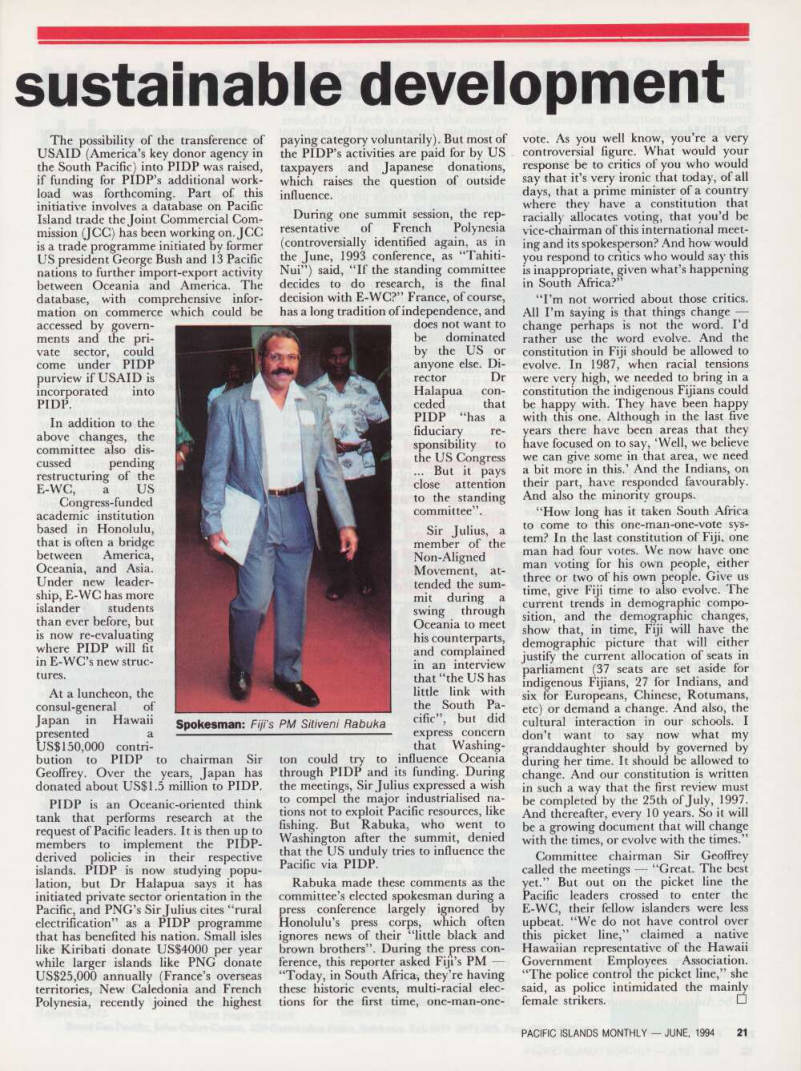
Issue
By Ed Rampell
AT the same historic mo ment South Africa voted in its first non-racial, one person-one-vote election, Pacific Island leaders hold ing a South Seas summit in Hawaii elected as their vice-chair and press spokes man Major-General Siti veni Rabuka the coup plotter-cum-Prime- Minister-of Fiji who presides over one of the world’s last apartheid-like constitutions, created at gunpoint. Prime ministers, presidents, and other high ranking Oceanic poli ticians crossed the picket lines of striking govern ment workers struggling for the rights of a small island people to hold the 21st meeting of the Standing Committee of the Pacific
Conference of Leaders at Honolulu’s East-West Centre (E-WC).
The largely US taxpayer-funded meetings were held behind closed doors, in apparent violation of Hawaii’s “sun shine law”, which guarantees the media and others access to public facilities used for political and other purposes.
Besides Rabuka and his security detail, participants in the April 26 to 27 Hawaii summit included Cooks prime minister Sir Geoffrey Henry, Papua New Guinea deputy prime minister/foreign minister Sir Julius Chan, Nauru president Bernard Dowiyogo, Tonga prime minis ter Baron Vaea, Federated States of Micronesia vice-president Jacob Nena, Vanuatu deputy prime minister Sethy J.
Regenvanu, French Polynesia represen tative Alexandre Moeava Ata, New Caledonia observer Gerard Bauchdon, and Hawaii representative Palani Vaughan. Guam governor Joseph Ada was among the no-shows.
Despite the media ban on the working sessions, this reporter managed to attend one of the meetings held in E-WC’s Pacific Room of Jefferson Hall (named after a great champion of a free press).
In fact, the discussions among the summiteers proved to be substantial, informative, and devoid of rancour or anything else to be secretive about. To a large extent, the standing committee reviewed the research and training activities of the E-WC’s Pacific Islands
Development Programme (PIDP),
which serves as the secretariat and research arm of the Pacific Islands
Conference, an organisation of heads of government (the standing committee is composed of their representatives). The conference last met in June last year in Tahiti. For two days, the summit ran smoothly and ahead of time. The Cooks’
Sir Geoffrey was elected standing com mittee’s chair, Fiji’s Rabuka was elected vice-chair and spokesman. Much dis cussion centred around the concept of sustainable development, which chair man Sir Geoffrey succinctly described as “how to make money without exhausting the pool”. In his cogent, complex presentation called ‘Harmonizing Re-
sources for Sustainable Economic Development in the Pacific Islands Con text’, PIDP director Dr Sitiveni Halapua went on to define this important idea as “meeting the needs of the present without compromising or under mining the ability of future generations to meet their own needs”.
Prime Minister Sir Geoffrey praised Dr Halapua’s report, complete with charts, because it “puts ideas into paper, with a practical way to pursue sustainable devel opment. It’s one of the most important works PIDP has done”. The standing committee was so impressed with Dr Halapua’s work that it transmitted a related resol ution to the UN Confer
ence on the Sustainable Development of Small Island States held in Barbados last month, and will send one to the South Pacific Forum when it meets in August in Australia.
In his analytical framework, Dr Halapua, a Tongan, stressed the import ance of respecting culture, which has often been displaced by development.
This prompted Rabuka to say, with understatement “Fiji had a series of development plans. Something hap pened in 1987 (then-Colonel Rabuka’s two military coup d’etats that overthrew democratically elected, pro-labour, anti nuclear governments with broad Indian support) that put an end to the plans (laughter from participants) ... Our cultures have suffered in development.
Our forefathers believed development turned away from culture. Only recently we’ve reoriented our thinking, that culture can optimise development.”
The Fiji prime minister cited two examples of how he thought develop ment impacted negatively on indigenous traditions industrial jobs brought womenfolk into the workplace and out of their homes, where custom believes they belong. In an interview, Rabuka added that the 19th century British introduc tion of indentured laborers from India to work in the sugarcane plantations, sup posedly on a short term basis, caused big changes in Fijian culture.
Another important matter considered by the standing committee is the closing of the Pacific’s two USAID offices at Suva and Port Moresby.
Ed Rampell
Japan donation: Japan’s consul-general Kensaku Hogen presents PIDP chairman Sir Geoffrey Henry with the US$150,000 cheque
Concerned: Sir Julius Chan
The possibility of the transference of USAID (America’s key donor agency in the South Pacific) into PIDP was raised, if funding for PIDP’s additional work load was forthcoming. Part of this initiative involves a database on Pacific Island trade the Joint Commercial Com mission (JCC) has been working on. JCC is a trade programme initiated by former US president George Bush and 13 Pacific nations to further import-export activity between Oceania and America. The database, with comprehensive infor mation on commerce which could be
accessed by govern ments and the pri vate sector, could come under PIDP purview if USAID is incorporated into
Pidp.
In addition to the above changes, the committee also dis cussed pending restructuring of the
E-Wc, A Us
Congress-funded academic institution based in Honolulu, that is often a bridge between America, Oceania, and Asia.
Under new leader ship, E-WC has more islander students than ever before, but is now re-evaluating where PIDP will fit in E-WC’s new struc tures.
At a luncheon, the consul-general of Japan in Hawaii presented a US$l5O,OOO con tri
bution to PIDP to chairman Sir Geoffrey. Over the years, Japan has donated about US$l.5 million to PIDP.
PIDP is an Oceanic-oriented think tank that performs research at the request of Pacific leaders. It is then up to members to implement the PlDP derived policies in their respective islands. PIDP is now studying popu lation, but Dr Halapua says it has initiated private sector orientation in the Pacific, and PNG’s Sir Julius cites “rural electrification” as a PIDP programme that has benefited his nation. Small isles like Kiribati donate US$4OOO per year while larger islands like PNG donate U 5525,000 annually (France’s overseas territories, New Caledonia and French
Polynesia, recently joined the highest
paying category voluntarily). But most of the PI DP’s activities are paid for by US taxpayers and Japanese donations, which raises the question of outside influence.
During one summit session, the rep resentative of French Polynesia (controversially identified again, as in the June, 1993 conference, as “Tahiti- Nui”) said, “If the standing committee decides to do research, is the final decision with E-WC?” France, of course, has a long tradition of independence, and
does not want to be dominated by the US or anyone else. Di rector Dr Halapua con ceded that PIDP “has a fiduciary re sponsibility to the US Congress ... But it pays close attention to the standing committee”.
Sir Julius, a member of the Non-Aligned Movement, at tended the sum mit during a swing through Oceania to meet his counterparts, and complained in an interview that “the US has little link with the South Pa cific”, but did express concern that Washing
ton could try to influence Oceania through PIDP and its funding. During the meetings, Sir Julius expressed a wish to compel the major industrialised na tions not to exploit Pacific resources, like fishing. But Rabuka, who went to Washington after the summit, denied that the US unduly tries to influence the Pacific via PIDP.
Rabuka made these comments as the committee’s elected spokesman during a press conference largely ignored by Honolulu’s press corps, which often ignores news of their “little black and brown brothers”. During the press con ference, this reporter asked Fiji’s PM “Today, in South Africa, they’re having these historic events, multi-racial elec tions for the first time, one-man-one
vote. As you well know, you’re a very controversial figure. What would your response be to critics of you who would say that it’s very ironic that today, of all days, that a prime minister of a country where they have a constitution that
racially allocates voting, that you’d be
vice-chairman of this international meet ing and its spokesperson? And how would you respond to critics who would say this
is inappropriate, given what’s happening
in South Africa?”
“I’m not worried about those critics.
All I’m Saying is that things change change perhaps is not the word. I’d rather use the word evolve. And the constitution in Fiji should be allowed to evolve. In 1987, when racial tensions were very high, we needed to bring in a constitution the indigenous Fijians could be happy with. They have been happy with this one. Although in the last five years there have been areas that they have focused on to say, ‘Well, we believe we can give some in that area, we need a bit more in this.’ And the Indians, on their part, have responded favourably.
And also the minority groups.
“How long has it taken South Africa to come to this one-man-one-vote sys tem? In the last constitution of Fiji, one man had four votes. We now have one man voting for his own people, either three or two of his own people. Give us time, give Fiji time to also evolve. The current trends in demographic compo sition, and the demographic changes, show that, in time, Fiji will have the demographic picture that will either justify the current allocation of seats in parliament (37 seats are set aside for indigenous Fijians, 27 for Indians, and six for Europeans, Chinese, Rotumans, etc) or demand a change. And also, the cultural interaction in our schools. I don’t want to say now what my
granddaughter should by governed by
during her time. It should be allowed to change. And our constitution is written in such a way that the first review must be completed by the 25th of July, 1997.
And thereafter, every 10 years. So it will be a growing document that will change with the times, or evolve with the times.”
Committee chairman Sir Geoffrey called the meetings “Great. The best yet.” But out on the picket line the Pacific leaders crossed to enter the E-WC, their fellow islanders were less upbeat. “We do not have control over this picket line,” claimed a native Hawaiian representative of the Hawaii Government Employees Association.
“The police control the picket line,” she said, as police intimidated the mainly female strikers. □
Spokesman: Fiji’s PM Sitiveni Rabuka
Advertisements & other items, p. 21 (1 item)
sustainable development
Population debate heats up
Aid
By Bill Morton
THE Australian government’s overseas aid funding for population programmes came under the spotlight once again last month with the release of an independent
‘lnquiry Report into Population and
Development’. The report examined the link between population growth and the economic growth and well-being of
developing countries.
In its 1993/94 budget the Australian government announced a trebling of funding for population programmes to the tune of $3O million for that year and $l3O million over four years. But in October last year the government at tracted criticism from international aid organisations when it froze part of the funding pending the outcome of the independent inquiry. The move was the result of a deal struck with Independent Senator Brian Harradine to win support for the budget. Harradine, who holds the balance of power in the senate, is a devout Catholic and is opposed to population control programmes.
Part of the budget allocation included an extra $2.5 million for family planning programmes in the South Pacific. Since the release last year of the first editions in the Pacific 2010 series, the issue of
population growth in the region has
become hotter than ever. These reports found that if present growth rates persist in the Pacific Islands, in 20 years time there will be a dramatic shortfall in the number of jobs available for those who need them. They also found that Pacific Island governments will have consider
able difficulty in properly educating its
citizens as well as in providing adequate services and infrastructure.
The Australian government’s decision last year to stall part of its funding for population programmes underlines how much clout one independent senator can wield in Australia’s parliamentary sys tem. More importantly it has ensured the debate on the relationship between the population and development is alive and well. At the heart of the debate is the question of whether slowing down popu lation growth assists development and
whether funding for family planning
programmes should be increased.
Australia’s Minister for Development Co-operation and Pacific Islands Affairs Gordon Bilney says the importance of
population and family planning pro
grammes to sustainable development cannot be overstated. He says family planning services benefit the lives and health of women and children and access
to family planning greatly reduces infant
and maternal mortality rates in develop
ing countries.
The Australian government’s aid arm,
Australian International Development Assistance Bureau, provides funding for population programmes in the South Pacific at a number of levels, including policy formulation, population educa tion, training for family planning service providers and programmes for marketing
contraceptives. Specific programmes in
clude Project Excel, a joint programme with the USA funded for $3.6 million over five years. The project aims to improve the quality and level of family planning services in Fiji, the Solomon Islands, Tonga and Vanuatu through the private and public sectors and through non-governmental organis ations.
Russell Rollason, executive director of the Australian Council for Overseas Aid, says it is “extremely important” that the Australian government continues to pro vide support for family planning pro
'The crucial thing in the population and development argument is access to resources. If all the families in the world who wanted to plan their children had the means to do so, all population targets would be met/
grammes in the Pacific Islands. “Popu lation growth means governments are going to find it more difficult to provide basic services. Family planning pro grammes are needed which are non coercive, and which focus on education and provide basic resources for families.”
Rollason says the crucial thing in the
population and development argument
is access to resources. “If all the families in the world who wanted to plan their children had the means to do so, all population targets would be met.”
Harradine, however, remains highly critical of the Australian government’s aid funding for population activities in the Pacific Islands. He says the govern ment’s attitude is one of “cultural imperialism” and is “predicated on the assertion that there are too many Poly nesians and Melanesians”. He claims a proposal by the government involves
using Indonesian population control
operatives to train Pacific Islanders. He says Indonesian programmes have been coercive, and have operated on the basis of incentives including offering credit for villagers to become sterilised and for farm labourers to have vasectomies.
When compared to international con sensus on population and development, Harradine appears to represent a min ority view. In April at the final meeting before September’s International Con ference on Population and Development, 140 countries agreed to spend more money on population programmes.
Harradine’s own credibility came under a cloud last year when he suggested aid money could be better spent on milk biscuits for women in developing countries. He referred to the link between breast feeding and family spacing and claimed the milk biscuits enhanced the lactation process.
The findings of the ‘lndependent Inquiry into Population and Develop ment’ would also seem to confirm what the supporters of aid funding for popu lation programmes have been saying. It found that slowing population growth is advantageous to economic development, health, food availability, housing, pov erty, the environment and possibly education, and that effective family planning can reduce infant and maternal mortality. Bilney said the report supports his view that family planning pro grammes are an important part of Australia’s aid budget. Rollason said the report “provides conclusive evidence to support increased expenditure on family planning programmes”, and said the government should restore all suspended family planning funding.
Harradine, however, maintains a close reading of the report shows that “popu lation growth is not the problem many people think it is”. He claims the contributors to the report “conceded that poverty, environmental damage, educa tional inequalities, poor housing etc are caused by factors other than population growth per se”, and says an urgent assessment should be made of the costs and benefits of alternative policies in achieving development.
No matter what the outcome in Australia is of the squabbles about population and development, the issue will continue to be of vital importance for Pacific Island nations. It appears clear that family planning programmes can provide regional governments with one means of addressing the demands which growing populations place on precious resources. They also represent an oppor tunity for governments to enhance the health of women and children. And for the people of the region, the availability of family planning resources represents something the average Australian per haps takes for granted: the freedom of choice to decide whether or not to actually make use of them. □
drivers up
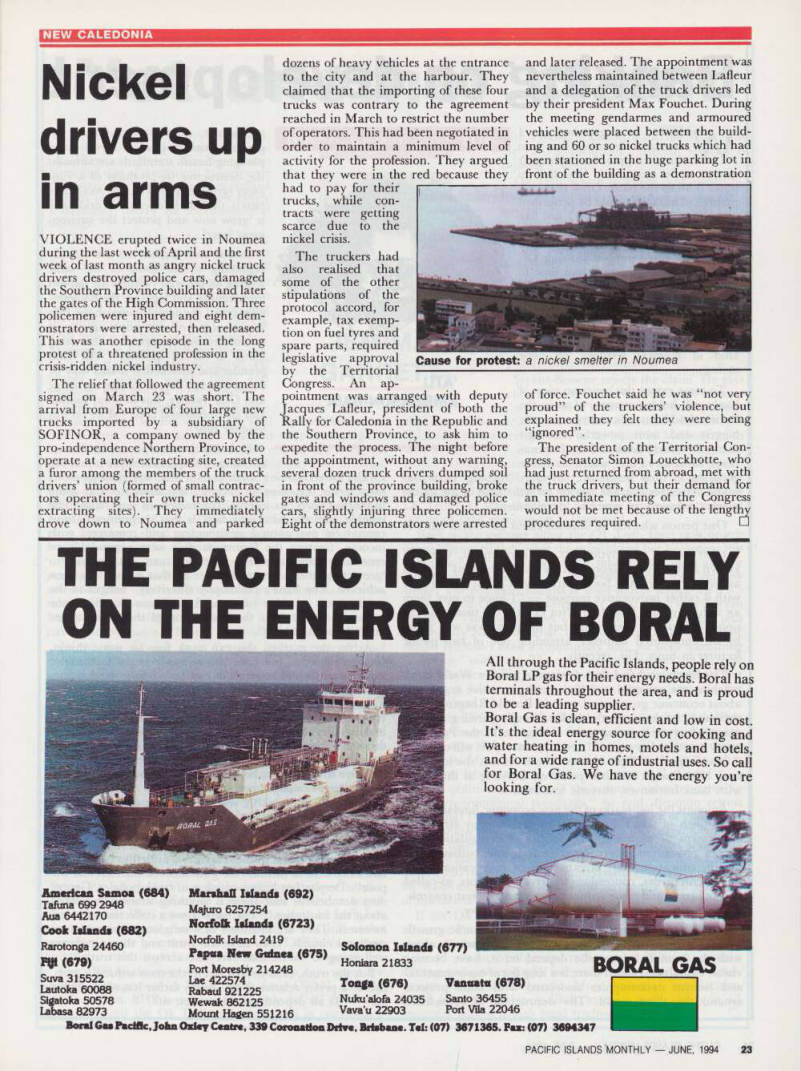
New Caledonia
Nickel drivers up in arms
VIOLENCE erupted twice in Noumea during the last week of April and the first week of last month as angry nickel truck drivers destroyed police cars, damaged the Southern Province building and later the gates of the High Commission. Three policemen were injured and eight dem onstrators were arrested, then released.
This was another episode in the long protest of a threatened profession in the crisis-ridden nickel industry.
The relief that followed the agreement signed on March 23 was short. The arrival from Europe of four large new trucks imported by a subsidiary of SOFINOR, a company owned by the pro-independence Northern Province, to operate at a new extracting site, created a furor among the members of the truck drivers’ union (formed of small contrac tors operating their own trucks nickel extracting sites). They immediately drove down to Noumea and parked
dozens of heavy vehicles at the entrance to the city and at the harbour. They claimed that the importing of these four trucks was contrary to the agreement reached in March to restrict the number of operators. This had been negotiated in order to maintain a minimum level of
activity for the profession. They argued
that they were in the red because they
had to pay for their trucks, while con tracts were getting scarce due to the nickel crisis.
The truckers had also realised that some of the other stipulations of the protocol accord, for example, tax exemp tion on fuel tyres and spare parts, required
legislative approval
by the Territorial Congress. An ap
pointment was arranged with deputy Jacques Lafleur, president of both the Rally for Caledonia in the Republic and the Southern Province, to ask him to expedite the process. The night before the appointment, without any warning, several dozen truck drivers dumped soil in front of the province building, broke gates and windows and damaged police cars, slightly injuring three policemen.
Eight of the demonstrators were arrested
and later released. The appointment was nevertheless maintained between Lafleur and a delegation of the truck drivers led by their president Max Fouchet. During the meeting gendarmes and armoured vehicles were placed between the build ing and 60 or so nickel trucks which had been stationed in the huge parking lot in front of the building as a demonstration
of force. Fouchet said he was “not very proud” of the truckers’ violence, but
explained they felt they were being
“ignored”.
The president of the Territorial Con gress, Senator Simon Loueckhotte, who had just returned from abroad, met with the truck drivers, but their demand for an immediate meeting of the Congress would not be met because of the lengthy
procedures required. □
Cause for protest: a nickel smelter in Noumea
Advertisements & other items, p. 23 (1 item)
The Pacific Islands Rely
ON THE ENERGY OF BORAL
"VRlliV Ga American Samoa (684) Tafuna 699 2948 Aua 6442170 Cook Islands (682) Rarotonga 24460 Pfll (679) Suva 315522 Lautoka 60088 Sigatoka 50578 Labasa 82973 Marshal! Islands (692) Majuro 6257254 Norfolk Islands (6723) Norfolk Island 2419 Papua New Guinea (675) Port Moresby 214248 Lae 422574 Rabaul 921225 Wewak 862125 Mount Hagen 551216 Solomon Islands (677) Honiara 21833 All through the Pacific Islands, people rely on Boral LP gas for their energy needs. Boral has terminals throughout the area, and is proud to be a leading supplier.
Boral Gas is clean, efficient and low in cost.
It’s the ideal energy source for cooking and water heating in homes, motels and hotels, and for a wide range of industrial uses. So call for Boral Gas. We have the energy you’re
looking for.
Tonga (676) Nukualofa 24035 Vava’u 22903 Vanuatu (678) Santo 36455 Port Vila 22046
BORAL GAS
Boral Gas Pacific. John Oxley Centra. 339 Coronation Drive, Brisbane. T«I: (07) 3671365. Fax: (07) 3694347
Banking on development
WHEN I was growing up, I remember learning that you weren’t supposed to hide your money under your bed. You had to move it all to the bank. Once there, all manner of miracles would be performed and the money would ‘grow’, just like you. Chances were, of course, that by the time you had enough money to open an account, you’d stopped growing. Or, that you spent it before it had time to grow. But the moral of the story was that banks deserved a special kind of respect, rather like policemen. They were trusted benefactors that protected your interests and even sprinkled some kind of magical fertiliser on your
savings.
To some extent this generous view of banks still holds for many of us in the Pacific. And it extends, moreover, to the biggest and most powerful amongst them, the World Bank and the Interna tional Monetary Fund, which out of the
goodness of their hearts are currently ‘helping’ numerous island states get into the fast (ie growth) lane of the global market economy en route to ‘development’.
One person who has no illusions about the World Bank as a beneficent situation, and who recently did a magnificent hatchet job on the myths that still surround it, was well known author Susan George. In the year of the bank’s golden anniversary, her latest book (currently at press) is a critique with a rather provocative purpose “I hope to give them an unhappy 50th birthday!” Not exactly the most conven tional of birthday sentiments, but the point was well taken by an enraptured audience attending one of two public lectures in Suva, Fiji, recently.
The ideological fuel that drives the massive World Bank machine are powerful and (for some) persuasive arguments about economic growth and, to coin Ronald Reagen’s term, the ‘magic of the market’. Market-friendly thinking and the growth bug are proving quite contagious in the Pacific as many a national or regional development report will confirm.
A case in point is Fiji’s historic (she loves me, she loves me not) 1994 Budget which is positively bursting at the seams with bank initiatives, rhetoric and zeal.
Amongst the hallmarks of the new economic fundamental ism (much of which crystallises in carbon-copy structural adjustment programmes) are policies of deregulation and export promotion, government expenditure cutbacks (on health, education etc), privatisation or corporatisation of public enterprises, concessions to private investors, so-called tax ‘reforms’, and some stringent wage and labour controls.
All told, the private sector is having a field day.
But one of the major handicaps of the economic growth model and its market policies is that the environment, along with the human beings who depend on it, have become visible casualties. Indeed there is a long list of environmental and human catastrophies associated with bank projects around the third world. The destruction of subsistence
agriculture, deforestation, forced mi gration, rising poverty levels and plunging health standards are amongst the destructive by-products of a run away (growth) rollercoaster. As George puts it, the watchdog of the World Bank is ‘grow now and protect the environ ment later’.
In our own region, we are already beginning to see some of the same writing on the wall (witness the fall-out from mining and logging, the Bougain ville crisis, the female sweatshops that sustain some of our booming export manufacturing sectors, and the rising levels of urban poverty). All that plunder and production mania may be doing wonders for our foreign exchange and GDP ratings, but at what human and environmental cost? (More on this another time).
Probably the most persuasive feature of George’s eloquent critique is that she
tackles the economic growth/market economy ideology on its own terms, exposing in laconic, dispassionate and quite humorous ways, its internal contradictions and flaws. The trouble with the bank, she says, is that if confuses natural capital (ie our natural environment and resources) with income, treating the former as if it were expendable or renewable, and implying that you can get around to ‘protecting’ the environment after all that growth has been achieved. The bank’s philosophy effectively “assigns to the environment a value of zero. And if you do this, your equation will be that the destruction of the environment doesn’t cost anything”.
As for the market, this can work fine for some things, George concedes, but once you seriously begin to consider people’s needs and interests, it can be woefully inadequate.
For one thing, “the market tells you too late when costs on natural capital are excessive. It can only give you a snap shot today. Therefore counting on the market to do the job of looking after the environment is contradictory”. Similarly, if decisions about public expenditure are to be based on an anticipated rate of return, then you might as well say goodbye to education, housing and just about anything else that offers to improve people’s livelihoods.
As George puts is, “If you believe that the market will provide education, health care, employment etc for everyone, you are wrong. It is not the task of the market to do this.
If it does provide jobs, this is a by-product of its basic aims of accumulation and profit. The market if left to its own will naturally tend to increase the gulf between the rich and the poor”. Despite her biting criticism of bank policies, George does not believe that there is anything inherently wicked about the institution. “The bank is not a collection of moral monsters. They are members of a religious organisation, a medieval church. They have the truth and they are damn well going to ensure that everyone accepts this truth.”
But the truth, even decked out in the most seductive garb, can be a pretty relative thing. As my father has often chided me “It all depends on where you sit!” □
Not The Mainstream
Atu
Emberson-Bain
Yet another claim
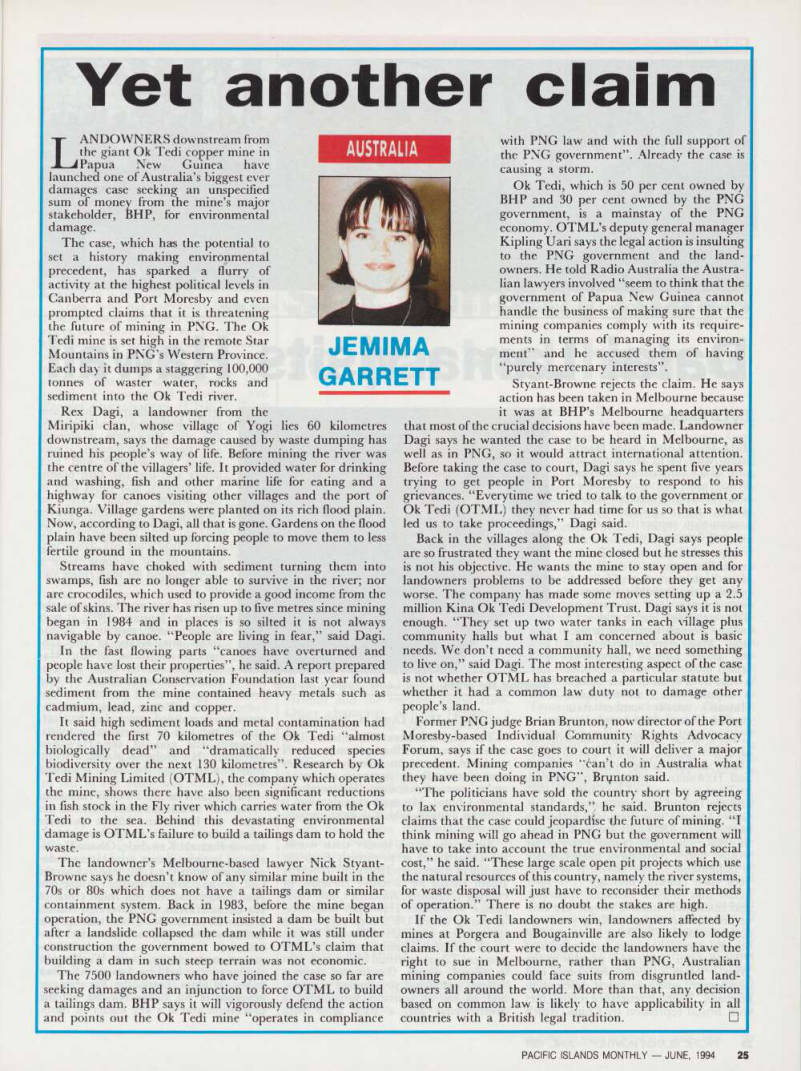
LANDOWNERS downstream from the giant Ok Tedi copper mine in Papua New Guinea have launched one of Australia’s biggest ever
damages case seeking an unspecified
sum of money from the mine’s major stakeholder, BHP, for environmental
damage.
The case, which has the potential to set a history making environmental
precedent, has sparked a flurry of
activity at the highest political levels in Canberra and Port Moresby and even prompted claims that it is threatening the future of mining in PNG. The Ok Tedi mine is set high in the remote Star Mountains in PNG’s Western Province.
Each day it dumps a staggering 100,000 tonnes of waster water, rocks and sediment into the Ok Tedi river.
Rex Dagi, a landowner from the
Miripiki clan, whose village of Yogi lies 60 kilometres downstream, says the damage caused by waste dumping has ruined his people’s way of life. Before mining the river was the centre of the villagers’ life. It provided water for drinking and washing, fish and other marine life for eating and a highway for canoes visiting other villages and the port of Kiunga. Village gardens were planted on its rich flood plain.
Now, according to Dagi, all that is gone. Gardens on the flood plain have been silted up forcing people to move them to less fertile ground in the mountains.
Streams have choked with sediment turning them into swamps, fish are no longer able to survive in the river; nor are crocodiles, which used to provide a good income from the sale of skins. The river has risen up to five metres since mining began in 1984 and in places is so silted it is not always navigable by canoe. “People are living in fear,” said Dagi.
In the fast flowing parts “canoes have overturned and people have lost their properties”, he said. A report prepared by the Australian Conservation Foundation last year found sediment from the mine contained heavy metals such as cadmium, lead, zinc and copper.
It said high sediment loads and metal contamination had rendered the first 70 kilometres of the Ok Tedi “almost
biologically dead” and “dramatically reduced species
biodiversity over the next 130 kilometres”. Research by Ok Tedi Mining Limited (OTML), the company which operates the mine, shows there have also been significant reductions in fish stock in the Fly river which carries water from the Ok Tedi to the sea. Behind this devastating environmental damage is OTML’s failure to build a tailings dam to hold the waste.
The landowner’s Melbourne-based lawyer Nick Styant- Browne says he doesn’t know of any similar mine built in the 70s or 80s which does not have a tailings dam or similar containment system. Back in 1983, before the mine began operation, the PNG government insisted a dam be built but after a landslide collapsed the dam while it was still under construction the government bowed to OTML’s claim that building a dam in such steep terrain was not economic.
The 7500 landowners who have joined the case so far are seeking damages and an injunction to force OTML to build a tailings dam. BHP says it will vigorously defend the action and points out the Ok Tedi mine “operates in compliance
with PNG law and with the full support of the PNG government”. Already the case is causing a storm.
Ok Tedi, which is 50 per cent owned by BHP and 30 per cent owned by the PNG government, is a mainstay of the PNG economy. OTML’s deputy general manager Kipling Uari says the legal action is insulting to the PNG government and the land owners. He told Radio Australia the Austra lian lawyers involved “seem to think that the government of Papua New Guinea cannot handle the business of making sure that the
mining companies comply with its require
ments in terms of managing its environ ment” and he accused them of having “purely mercenary interests”.
Styant-Browne rejects the claim. He says action has been taken in Melbourne because it was at BHP’s Melbourne headquarters
that most of the crucial decisions have been made. Landowner Dagi says he wanted the case to be heard in Melbourne, as well as in PNG, so it would attract international attention.
Before taking the case to court, Dagi says he spent five years trying to get people in Port Moresby to respond to his grievances. “Everytime we tried to talk to the government or Ok Tedi (OTML) they never had time for us so that is what led us to take proceedings,” Dagi said.
Back in the villages along the Ok Tedi, Dagi says people are so frustrated they want the mine closed but he stresses this is not his objective. He wants the mine to stay open and for landowners problems to be addressed before they get any worse. The company' has made some moves setting up a 2.5 million Kina Ok Tedi Development Trust. Dagi says it is not enough. “They set up two water tanks in each village plus community halls but what I am concerned about is basic needs. We don’t need a community hall, we need something to live on,” said Dagi. The most interesting aspect of the case is not whether OTML has breached a particular statute but whether it had a common law duty not to damage other
people’s land.
Former PNG judge Brian Brunton, now director of the Port
Moresby-based Individual Community' Rights Advocacy
Forum, says if the case goes to court it will deliver a major precedent. Mining companies "6an’t do in Australia what they have been doing in PNG", Brqnton said.
“The politicians have sold the country short by agreeing to lax environmental standards,”, he said. Brunton rejects claims that the case could jeopardise the future of mining. “I think mining will go ahead in PNG but the government will have to take into account the true environmental and social cost,” he said. “These large scale open pit projects which use the natural resources of this country, namely the river systems, for waste disposal will just have to reconsider their methods of operation.” There is no doubt the stakes are high.
If the Ok Tedi landowners win, landowners affected by mines at Porgera and Bougainville are also likely to lodge claims. If the court were to decide the landowners have the right to sue in Melbourne, rather than PNG, Australian mining companies could face suits from disgruntled land owners all around the world. More than that, any decision based on common law is likely to have applicability in all countries with a British legal tradition. □
Australia
Jemima
Garrett
Dalai Lama visits Hawaii
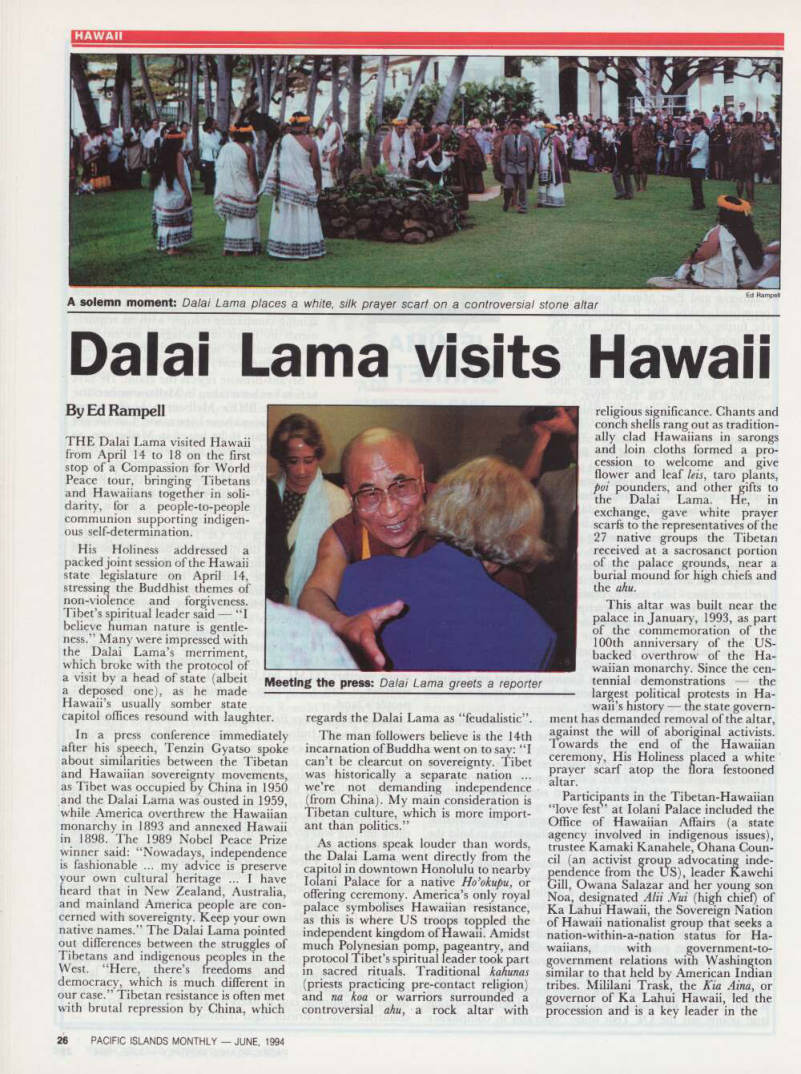

Hawaii
By Ed Rampell
THE Dalai Lama visited Hawaii from April 14 to 18 on the first stop of a Compassion for World Peace tour, bringing Tibetans and Hawaiians together in soli darity, for a people-to-people communion supporting indigen ous self-determination.
His Holiness addressed a packed joint session of the Hawaii state legislature on April 14, stressing the Buddhist themes of non-violence and forgiveness.
Tibet’s spiritual leader said “I believe human nature is gentle ness.” Many were impressed with the Dalai Lama’s merriment, which broke with the protocol of a visit by a head of state (albeit a deposed one), as he made Hawaii’s usually somber state
capitol offices resound with laughter.
In a press conference immediately after his speech, Tenzin Gyatso spoke about similarities between the Tibetan and Hawaiian sovereignty movements, as Tibet was occupied by China in 1950 and the Dalai Lama was ousted in 1959, while America overthrew the Hawaiian monarchy in 1893 and annexed Hawaii in 1898. The 1989 Nobel Peace Prize winner said; “Nowadays, independence is fashionable ... my advice is preserve your own cultural heritage ... I have heard that in New Zealand, Australia, and mainland America people are con cerned with sovereignty. Keep your own native names.” The Dalai Lama pointed out differences between the struggles of Tibetans and indigenous peoples in the West. “Here, there’s freedoms and democracy, which is much different in our case.” Tibetan resistance is often met with brutal repression by China, which
regards the Dalai Lama as “feudalistic”.
The man followers believe is the 14th incarnation ofßuddha went on to say: “I can’t be clearcut on sovereignty. Tibet was historically a separate nation ... we’re not demanding independence (from China). My main consideration is Tibetan culture, which is more import ant than politics.”
As actions speak louder than words, the Dalai Lama went directly from the capitol in downtown Honolulu to nearby lolani Palace for a native Ho’okupu, or offering ceremony. America’s only royal palace symbolises Hawaiian resistance, as this is where US troops toppled the independent kingdom of Hawaii. Amidst much Polynesian pomp, pageantry, and protocol Tibet’s spiritual leader took part m sacred rituals. Traditional kahunas (priests practicing pre-contact religion) and na koa or warriors surrounded a controversial ahu, a rock altar with
religious significance. Chants and
conch shells rang out as tradition ally clad Hawaiians in sarongs and loin cloths formed a pro cession to welcome and give flower and leaf leis, taro plants,
poi pounders, and other gifts to
the Dalai Lama. He, in exchange, gave white prayer scarfs to the representatives of the 27 native groups the Tibetan received at a sacrosanct portion of the palace grounds, near a burial mound for high chiefs and the ahu.
This altar was built near the palace in January, 1993, as part of the commemoration of the 100th anniversary of the US backed overthrow of the Ha waiian monarchy. Since the cen tennial demonstrations the largest political protests in Ha waii’s history tne state govern
ment has demandea removal of the altar, against the will of aboriginal activists.
Towards the end of the Hawaiian ceremony, His Holiness placed a white prayer scarf atop the flora festooned altar.
Participants in the Tibetan-Hawaiian “love fesi at lolani Palace included the Office of Hawaiian Affairs (a state agency involved in indigenous issues), trustee Kamaki Kanahele, Ghana Coun cil (an activist group advocating inde pendence from the US), leader Kawehi Gill, Owana Salazar and her young son Noa, designated Alii JVui (high chief) of Ka Lahui Hawaii, the Sovereign Nation of Hawaii nationalist group that seeks a nation-within-a-nation status for Ha waiians, with government-to government relations with Washington similar to that held by American Indian tribes. Mililani Trask, the Kia Aina, or governor of Ka Lahui Hawaii, led the procession and is a key leader in the
Ed Rampell
A solemn moment: Dalai Lama places a white, silk prayer scarf on a controversial stone altar
Meeting the press: Dalai Lama greets a reporter
Hawaiian sovereignty movement which seeks native self government with land, cultural and religious rights. In an interview Trask said: “The Dalai Lama’s visit here, the way he has done the ceremony with us, is very positive for us.
He’s a great world leader, and when he comes here to recognise the Hawaiian people, the Hawaiian nation, he is an indigenous person and is also a refugee from his own land ... By his coming here he endorses and shows support for the
struggle of indigenous people and self
determination. That’s why all indigen ous leaders from all over the islands came to be with Dalai Lama today to honour him. Because we know that he, like us, is fighting for self determination, but fighting in a peaceful way.”
Trask, who has previously heard His Holiness speak at United Nations confer ences on native rights at Vienna, said that Ka Lahui Hawaii was co-operating with Tibetans in a UN-linked organis ation. “The Dalai Lama and his sup porters created an organisation in 1991 called Unrepresented Nations and Peoples Organisations (UNPO). Tibet and Dalai Lama were, of course, charter members, but over the years other indigenous peoples and nations that are not recognised were added to it, includ ing the Kurds ... Aboriginal organis ations from Australia, and, in 1993, Ka Lahui Hawaii became the first of the indigenous nations of the Pacific basin to be admitted. They provide facilitation in the international arena, at Geneva and elsewhere, and they provide a bridge for communications with nations that do not wish to recognise indigenous peoples.”
As for the issue of repression, Trask, an activist attorney, contends: “The op pression of our people by America is different than what the Chinese are doing to Tibet. The Chinese armed forces are visible on all the streets. Here, we have more American military in Hawaii than in any other state, but they’re not as visibly oppressive as they are in China ... Hawaiians are being arrested every day. The night before Dalai Lama came, police forces came and tore down the home of one of our sisters (Marie Beltran) living on the beach with her family. All over the islands Hawaiians are arrested and taken to jail in the same way China arrests people in Tibet and takes them to jail. So in civil disobedient practice we nave a common thread.”
After the convocation of two peoples, His Holiness spoke to large crowds at a number of Oahu and Big Island forums, on Local Identity in the Global Com munity Creating Peace in the 21st Century, Compassion for World Peace, Is a Non-Violent Society Possible?, and Compassion and Wisdom A Teaching and Ceremony for Generating the Mind of Enlightenment. On April 18 he left Hawaii for a US tour after leaving behind a strong spirit, and that white prayer scarf on the stone altar, making it harder for authorities to remove the altar. □
Sex comedy plays
Theatre
Sex comedy plays to packed house
By Ed Rampell
LAST Virgin in Paradise , the new play by Fiji playwright Vilsoni Hereniko, opened in April to sell-out crowds in Honolulu, and may be the best play about South Seas sex since Somerset Maugham’s Rain.
Like Rain, Virgin has a wicked sense of humor about sexuality, although Virgin is more lighthearted. And as with Sadie Thompson, major characters are Pacific based expats (sexpats?), although Virgin is written by an indigenous author, not a British spy on a secret WWI mission.
Virgin is about Helmut, a German, alcoholic, retired psychology professor in his fifties, who is drawn to the South Pacific because of its “free love” repu tation, but is so crazy that he’s been travelling from island to island, seeking to marry a virgin. At the fictional isle of Marawa, a marriage is arranged between Helmut and the reputed virgin Hina.
Other characters include Temanu, a part-islander who has returned to Marawa from America in order to find her roots and spread feminism. Jean is an Australian anthropologist in a Margaret Mead mode, studying the sex lives of “savages”. Jeke is a Polynesian playboy.
The comedy explores and spoofs the contradictions of contemporary sex in the South Seas, where Pacific promiscuity has often been replaced by Europe’s missionary imposition, so that Western tourists after a lost uninhibitedness are disappointed by religious repression now.
Hereniko has a reportorial instinct in that the playwright is able to look at an issue from all points of view if not impartially. For Hereniko, a Rotuman, definitely has an indigenous take on the characters and story.
Hereniko is very much the star of Virgin, which is loosely based on a true story told to him by Banaban/African- American Teresia Teaiwa. (Hereniko
refuses to tell where the actual incidents took place.) Hereniko wrote, co-directed (with Kumu Kahua Theater’s Gene Shofner), and acts in the play. Hereniko displays comedic gifts as an actor, as well as a playwright, and (conveniently) gives himself Virgin’s best line. Playing an ancestral spirit, Hereniko says he prefers living in hell “because there are no missionaries there”. Surely, this is one of the Pacific’s wittiest gems of dialogue since Sadie Thompson’s, “Men, you’re all pigs!” line (also inspired by a missionary). Virgin is raucous, bawdy, and incorporates Pacific styles, such as Rotuman clowning. Although generally original enough to set Malinowski spin ning in his grave, Hereniko does steal a line from a Woody Allen movie, when Helmut complains that his wife left him for another woman. But the play’s weakest point is the poor performance of Ke’alaonapuahinano Campion as Temanu. Like her character, Campion who has come back from the Conti nental US to Hawaii is, to paraphrase Hereniko’s mentor Albert Wendt, “a daughter for the return home”. But she overacts terribly and is very grating as the confused feminist.
The cast features Pacific Islanders from Fiji, the Cooks, Hawaii, and Tonga, giving Honolulu theatre a rare Oceanic ambiance. Langakali Halapua (daugh ter of Pacific Islands Development Pro gramme director Steven Halapua) is fine in her debut as the tall, slim, long haired cafe-au-lait Hina (a reference to a mythic Polynesian beauty). The 15-year-old merely laughs uproariously when asked if she’s a virgin in paradise. Hereniko, who lectures on Pacific literature at the University of Hawaii, is quick to point out that Virgin is about much more than just sex, a theme, he says, which “Western plays deal more earnestly with”. □
Ed Rampell Sell-out play: Vilsoni Hereniko dressed as an ancestral spirit dances with the cast
Advertisements & other items, p. 28 (1 item)
■Austrade
Need to Import?
Why not consider Australia.
The products are right - the prices are right.
Austrade can supply you with contact details of over 8000 Australian firms.
If you want:- • Product contacts in Australia or • Personal advice on trading opportunities with Australia Contact:-
■AUSTRADE
Australian Trade Commission Ask the Australian Trade Commission: 7th Floor, Dominion House, Thomson Street P.O. Box 1252, Suva. Telephone: 312844, 305879. Facsimile: (679) 301633
The spin-offs for Fiji
FIJI’ S business and industrial leaders, together with government, have a chance to be in on the ground floor as the economic benefits of the Sydney Olym pics begin to flow, says Australia’s senior trade commissioner for the Pacific Islands Steve Ryan.
The reason for such optimism is based on the forthcoming Fiji/Australia - Aus tralia/Fiji Business Councils’joint confer ence at the Regent of Fiji Resort from June 22 to 24. The title theme for this year’s conference is Let’s Get Fair Dinkum. The business councils have planned the 1994 joint conference in anticipation that the South Pacific will gain tremendous economic benefit not only from the tourism spin-off but from the first hand experience that some of the visitors will gain of the economic poten tial of countries such as Fiji.
A keynote speaker will be a top personality, a person whose successful track record has been seen by all the world, the man behind Sydney’s success ful Qlympic bid, Rod McGeoch.
“McGeoch will be speaking on not only the opportunities for tourism but also the vast linkages the Sydney 2000 Olympics present for trading opportunities, begin ning right now in 1994,” Ryan said. “I believe that any business or commercial undertaking in this country needs to look further than the confines of Fiji if it is to remain viable in the competitive world of
trade. Many of the visitors to the Olympics will be businessmen and indus trialists who will take the opportunity to see the commercial potential of the South Pacific while they are in the region.
Already there are visitors connected to the Olympics arriving in Australia.
Fiji and the South Pacific stand to gain tremendous economic benefit not only from the tourism spin-off but from the first hand experience that some of the visitors will gain.
“It is not too early to establish those links indeed it is vital to get in on the ground floor and establish an early rapport with Australian companies who will be an integral part of what will become, for want of a better name, an Olympic associated industry.”
In an associated measure the councils have secured as a further keynote speaker R V Cole. Cole, a previous financial secretary for the Fiji government, will present a paper entitled, ‘Broadening the
Australian-Fiji Trade Relationship’.
This is seen as being a critical component for the future and is designed to look beyond the current trading relationship between Australia and Fiji and is in recognition that a fresh look needs to be taken.
At the business working level, a number of Australian companies from the Rockhampton area would be exhibit ing throughout the joint conference with a special invitees day on June 25. They include designer groups specialising in crocodile leather products, sapphires and precious stones, architects wno featured designs for the tropics, an auto accessories firm, a nursery/landscaping exhibit highlighting tropical plants, and an educational stand from the University of Central Queensland. Tourism, invest ment and export credit insurance and export finance, the latter by Derek Hill, the secretary-general International Union of Credit and Investment Insurers and an acknowledged authority is this field, are also on the agenda. “We believe we have a conference equal to any that has gone before with a relevance to the times and conditions the Fiji industry and business face right at this moment,”
Ryan said.
“At the same time, we have planned that this is a forward looking conference, preparing delegates for the scenario for the region until the end of the century, that is Olympics 2000.” □
Trade group to lead Queensland
THE Rockhampton-based IBECQ (International Business Exchange Central Queensland) will lead a group of central Queensland participants to the Fiji/ Australia business council meeting.
IBECQ is an organisation which was founded to establish direct trade, educational and cultural link ages between central Queensland and similar regions in the Pacific. IBECQ is supported by a • i r u • 7 . wide range of businesses government agencies and educational institutions.
The chairman of IBECQ is Professor Geoff Wilson, vice chancellor of the Central Queensland University. IBECQ has worked in close association with Atistrade in developing images m the Pacific Islands.
Central Queensland lies in a tropical zone and has many similarities to countries within the Pacific Islands region. The capabilities of central Queensland companies and institutions are diverse. The direct development of trade linkages gives many of the smaller regional-based companies an oppor-
tunity to enter international markets on a scale which would be denied them in more distant markets such as Japan and Europe.
From a geographic perspective major
central Queensland centres such as Rockhampton, Mackay and Gladstone are in some instances located closer to Pacific Island nations than they are to the major southern cities of Australia.
Chief executive of IBECQ Robert
Armstrong represented central Queens
land as part of a Queensland government trade mission to New Caledonia last November. This initiative has already led to the development of direct trade opportunities and has resulted in a return visit to central Queensland by several senior New Caledonian delegations.
Leopold Joredie, president of the North ern province, visited Rockhampton in
April.
Armstrong said that IBECQ was looking forward to creating a similar focus in Fiji to the mutual benefit of both Fiji and central Queensland. He said he
was confident that the visit would assist in developing long term linkages with the region and that central Queensland
companies were becoming increasingly
keen to focus opportunities in the Pacific.
Apart from Armstrong the team led by IBECQ will consist of Professor Kevin Fagg, dean of the faculty of business, Central Queensland University; Paul Bell, mayor of the Emerald Shire; John Lever, proprietor of the Koorana Croco diles Farm; and Jean Me Gruvie, manager of the Central Highlands De
velopment Bureau.
IBECQ will also mount a display of central Queensland product and services.
These wul include crocodiles skin prod ucts, education and training services, gemstone, agricultural products and manufactured goods.
IBECQ was initially established over two years ago after research identified a need for a regional-based organisation capable of both developing export awareness and assisting regional businesses to develop international mar kets for their goods and services. □
Advertisements & other items, pp. 29-30 (2 items)
advertising feature
Fiji/Australia - Australia/Fiji Business Council
Cable Leaders
mem m m
THE MOST COMPREHENSIVE RANGE
OF CABLES AND ACCESSORIES
IN AUSTRALASIA
From the smallest domestic wiring job to a sophisticated industrial application, MM Cables has the most comprehensive product range in Australasia.
MM Cables is Australia’s largest supplier of cables and associated equipment produced to the highest applicable quality standards.
With a product range that far exceeds that of its nearest competitor, MM Cables supply: data communication and energy cable; optical fibre cable; flameproof and mining cable; telephone cords; busduct; aerial cable; local area network products and much more.
MM Cables is recognised throughout the Southern Hemisphere as the leader in power and information cable technology, and is the preferred supplier to more companies in Australasia than any other cable company.
Why shouldn’t you enjoy MM Cables Total Cable Service?
CABLES
A DIVISION OF METAL MANUFACTURES LIMITED
(INC IN NSW)
MM Cables, 1 Heathcote Rd, Liverpool NSW 2170 Phone: (02) 600 0777 Fax: (02) 600 0724 MM Cables Brisbane Export Office: 101 Links Ave, Eagle Farm, Brisbane Old 4007. Phone: (07) 868 0111 Fax: (07) 868 0120
Linking the Pacific
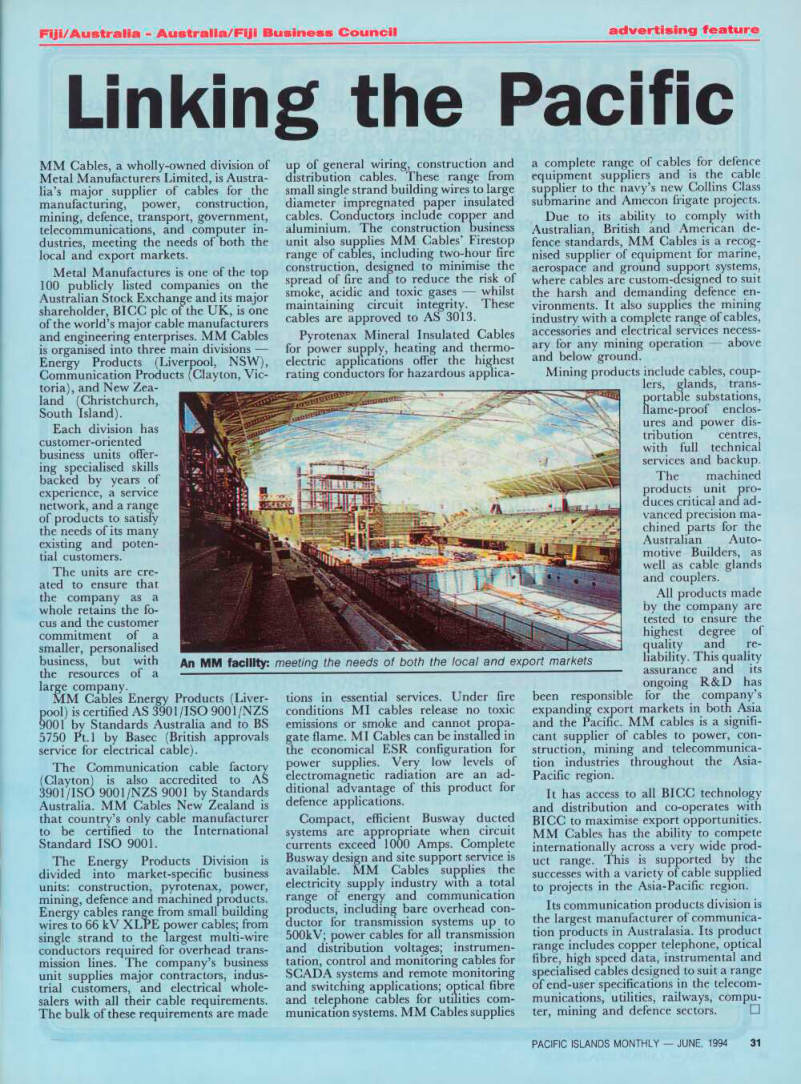
Fiji/Australia - Australia/Fiji Business Council
advertising feature
MM Cables, a wholly-owned division of Metal Manufacturers Limited, is Austra lia’s major supplier of cables for the manufacturing, power, construction, mining, defence, transport, government, telecommunications, and computer in dustries, meeting the needs of both the local and export markets.
Metal Manufactures is one of the top 100 publicly listed companies on the Australian Stock Exchange and its major shareholder, BICC pic of the UK, is one of the world’s major cable manufacturers and engineering enterprises. MM Cables is organised into three main divisions Energy Products (Liverpool, NSW), Communication Products (Clayton, Vic
toria), and New Zea
land (Christchurch,
South Island).
Each division has customer-oriented business units offer ing specialised skills backed by years of experience, a service network, and a range of products to satisfy the needs of its many existing and poten tial customers.
The units are cre ated to ensure that the company as a whole retains the fo cus and the customer commitment of a
smaller, personalised
business, but with the resources of a large company.
MM Cables Energy Products (Liver pool) is certified AS 3901/ISO 9001/NZS 9001 by Standards Australia and to BS 5750 Pt.l by Basec (British approvals service for electrical cable).
The Communication cable factory (Clayton) is also accredited to AS 3901/ISO 9001/NZS 9001 by Standards Australia. MM Cables New Zealand is that country’s only cable manufacturer to be certified to the International Standard ISO 9001.
The Energy Products Division is divided into market-specific business units: construction, pyrotenax, power, mining, defence and machined products.
Energy cables range from small building wires to 66 kV XLPE power cables; from single strand to the largest multi-wire conductors required for overhead trans mission lines. The company’s business unit supplies major contractors, indus trial customers, and electrical whole salers with all their cable requirements.
The bulk of these requirements are made
up of general wiring, construction and distribution cables. These range from small single strand building wires to large diameter impregnated paper insulated cables. include copper and aluminium. The construction business unit also supplies MM Cables’ Firestop range of cables, including two-hour fire construction, designed to minimise the spread of fire and to reduce the risk of smoke, acidic and toxic gases whilst maintaining circuit integrity. These cables are approved to AS 3013.
Pyrotenax Mineral Insulated Cables for power supply, heating and thermo electric applications offer the highest rating conductors for hazardous applica-
tions in essential services. Under fire conditions MI cables release no toxic emissions or smoke and cannot propa gate flame. MI Cables can be installed in the economical ESR configuration for P° wer supplies. Very low levels of electromagnetic radiation are an ad ditional advantage of this product for defence applications.
Compact, efficient Busway ducted systems are appropriate when circuit currents exceed 1000 Amps. Complete Busway design and site support service is available. MM Cables supplies the electricity supply industry with a total range of energy and communication products, including bare overhead con ductor for transmission systems up to 500kV; power cables for all transmission and distribution voltages; mstrumen tation, control and monitoring cables for SCADA systems and remote monitoring and switching applications; optical fibre and telephone cables for utilities com munication systems. MM Cables supplies
a complete range of cables for defence equipment suppliers and is the cable supplier to the navy’s new Collins Class submarine and Amecon frigate projects.
Due to its ability to comply with Australian, British and American de fence standards, MM Cables is a recog nised supplier of equipment for marine, aerospace and ground support systems, where cables are custom-designed to suit the harsh and demanding defence en vironments. It also supplies the mining industry with a complete range of cables, accessories and electrical services necess ary for any mining operation above and below ground.
Mining products include cables, coup
lers, glands, trans-
Sortable substations,
ame-proof enclos
ures and power dis tribution centres, with full technical services and backup.
The machined products unit pro duces critical and ad vanced precision ma chined parts for the Australian Auto motive Builders, as well as cable glands and couplers.
All products made by the company are tested to ensure the highest degree of quality and re
liability. This quality
assurance and its ongoing R&D has
been responsible for the company’s expanding export markets in both Asia and the Pacific. MM cables is a signifi cant supplier of cables to power, con struction, mining and telecommunica tion industries throughout the Asia-
Pacific region.
It has access to all BICC technology and distribution and co-operates with BICC to maximise export opportunities.
MM Cables has the ability to compete internationally across a very wide prod uct range. This is supported by the successes with a variety of cable supplied to projects in the Asia-Pacific region.
Its communication products division is the largest manufacturer of communica tion products in Australasia. Its product range includes copper telephone, optical fibre, high speed data, instrumental and specialised cables designed to suit a range of end-user specifications in the telecom munications, utilities, railways, compu ter, mining and defence sectors. □
An MM facility: meeting the needs of both the local and export markets
Advertisements & other items, p. 32 (1 item)
IbßBebobqh Central Queensland Is Pleased To Be Able
TO PRESENT A DISPLAY OF PRODUCTS AND SERVICES AT THE FIJI/AUSTRALIA BUSINESS COUNCIL MEETING. THE DISPLAY HAS BEEN ORGANISED BY THE INTERNATIONAL BUSINESS EXCHANGE OF CENTRAL QUEENSLAND 179 EAST
STREET, ROCKHAMPTON, QUEENSLAND, AUSTRALIA, 4700.
FOR FURTHER INFORMATION CONTACT:— ROBERT ARMSTRONG
PHONE: (61-79) 228144 FAX: (61-79) 228151. PRODUCTS AND SERVICES WILL BE DISPLAYED BY THE FOLLOWING COMPANIES AND INSTITUTIONS.
EDUCATIONAL SERVICES
FACULTY OF BUSINESS
CENTRAL QUEENSLAND
UNIVERSITY
ROCKHAMPTON QLD 4702
PHONE (61-79) 309600
FAX: (61-79) 309700
GEMSTONE, COTTON, GRAIN
PRODUCTS
CENTRAL HIGHLAND PROMOTION
AND
DEVELOPMENT ORGANISATION
P.O. BOX 1425, EMERALD QLD
4720.
CONTACT: JEAN McCRUVIE
PHONE: (61-79) 824889
FAX: (61-79)824068
TROPICAL FRUIT TREES
AND PLANTS
FITZROY NURSERIES PTY LTD
EDMISTONE ROAD
PINK LILY QLD 4702
CONTACT: HORST DARGEL
PHONE (61-79) 272388
FAX: (61-79) 223203.
ARCHITECTURAL SERVICES
PAUL CRUICE ARCHITECT PTY LTD.
248 QUAY STREET
ROCKAMPTON 4700
CONTACT; PAUL CRUICE
PHONE: (61-79) 222988
FAX (61-79) 221691.
CROCODILE SKIN PRODUCTS
KOORANA CROCODILE FARM
COOWOONGA ROAD
KEPPEL SANDS QLD 4702
CONTACT : JOHN LEVER
PHONE: (61-79) 344749
FAX (61-79) 344702
MOTOR VEHICLE SPRINGS
AND
SPRING REPAIRS
DOBINSONS SPRING &
SUSPENSION
58 ROLLINGS WORTH STREET
ROCKHAMPTON QLD 4702
CONTACT: GLEN DOBINSON
PHONE (61-79) 277444
FAX: (61-79) 223082
PEWTER GIFTWARE AND
GEMSTONES
ARADON PTY LTD
CAPRICORN HIGHWAY'
WYCARBAH QLD, 4702
CONTACT: BERT KAYES
PHONE (61-79) 347183
FAX (61-79) 347346.
under persecution?
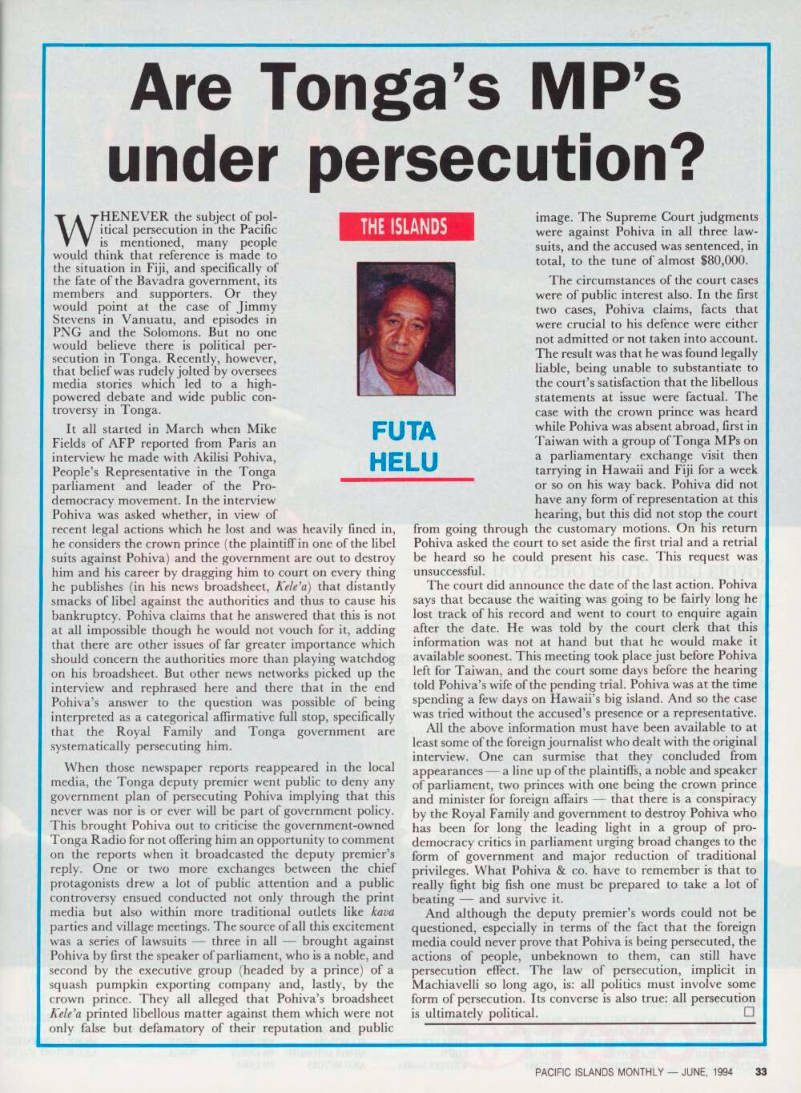
Are Tonga’s MP's under persecution?
WHENEVER the subject of pol itical persecution in the Pacific is mentioned, many people would think that reference is made to the situation in Fiji, and specifically of the fate of the Bavadra government, its members and supporters. Or they would point at the case of Jimmy Stevens in Vanuatu, and episodes in PNG and the Solomons. But no one would believe there is political per secution in Tonga. Recently, however, that belief was rudely jolted by oversees media stories which led to a high powered debate and wide public con troversy in Tonga.
It all started in March when Mike Fields of AFP reported from Paris an interview he made with Akilisi Pohiva, People’s Representative in the Tonga parliament and leader of the Pro democracy movement. In the interview Pohiva was asked whether, in view of
recent legal actions which he lost and was heavily fined in, he considers the crown prince (the plaintiff in one of the libel suits against Pohiva) and the government are out to destroy him and his career by dragging him to court on every thing he publishes (in his news broadsheet, Kele’a) that distantly smacks of libel against the authorities and thus to cause his bankruptcy. Pohiva claims that he answered that this is not at all impossible though he would not vouch for it, adding that there are other issues of far greater importance which should concern the authorities more than playing watchdog on his broadsheet. But other news networks picked up the interview and rephrased here and there that in the end Pohiva’s answer to the question was possible of being interpreted as a categorical affirmative full stop, specifically that the Royal Family and Tonga government are systematically persecuting him.
When those newspaper reports reappeared in the local media, the Tonga deputy premier went public to deny any government plan of persecuting Pohiva implying that this never was nor is or ever will be part of government policy.
This brought Pohiva out to criticise the government-owned Tonga Radio for not offering him an opportunity to comment on the reports when it broadcasted the deputy premier’s reply. One or two more exchanges between the chief protagonists drew a lot of public attention and a public controversy ensued conducted not only through the print media but also within more traditional outlets like kava parties and village meetings. The source of all this excitement was a series of lawsuits three in all brought against Pohiva by first the speaker of parliament, who is a noble, and second by the executive group (headed by a prince) of a squash pumpkin exporting company and, lastly, by the crown prince. They all alleged that Pohiva’s broadsheet Kele’a printed libellous matter against them which were not only false but defamatory of their reputation and public
image. The Supreme Court judgments
were against Pohiva in all three law suits, and the accused was sentenced, in total, to the tune of almost $BO,OOO.
The circumstances of the court cases were of public interest also. In the first two cases, Pohiva claims, facts that were crucial to his defence were either not admitted or not taken into account.
The result was that he was found legally liable, being unable to substantiate to the court’s satisfaction that the libellous statements at issue were factual. The case with the crown prince was heard while Pohiva was absent abroad, first in Taiwan with a group of Tonga MPs on a parliamentary exchange visit then tarrying in Hawaii and Fiji for a week or so on his way back. Pohiva did not have any form of representation at this hearing, but this did not stop the court
from going through the customary motions. On his return Pohiva asked the court to set aside the first trial and a retrial be heard so he could present his case. This request was unsuccessful.
The court did announce the date of the last action. Pohiva says that because the waiting was going to be fairly long he lost track of his record and went to court to enquire again after the date. He was told by the court clerk that this information was not at hand but that he would make it available soonest. This meeting took place just before Pohiva left for Taiwan, and the court some days before the hearing told Pohiva’s wife of the pending trial. Pohiva was at the time spending a few days on Hawaii’s big island. And so the case was tried without the accused’s presence or a representative.
All the above information must have been available to at least some of the foreign journalist who dealt with the original interview. One can surmise that they concluded from appearances a line up of the plaintiffs, a noble and speaker of parliament, two princes with one being the crown prince and minister for foreign affairs that there is a conspiracy by the Royal Family and government to destroy Pohiva who has been for long the leading light in a group of pro democracy critics in parliament urging broad changes to the form of government and major reduction of traditional privileges. What Pohiva & co. have to remember is that to really fight big fish one must be prepared to take a lot of beating and survive it.
And although the deputy premier’s words could not be questioned, especially in terms of the fact that the foreign media could never prove that Pohiva is being persecuted, the actions of people, unbeknown to them, can still have persecution effect. The law of persecution, implicit in Machiavelli so long ago, is: all politics must involve some form of persecution. Its converse is also true: all persecution is ultimately political. □
The Islands
Futa
Helu
Advertisements & other items, pp. 34-35 (1 item)
and long-lasting durability.
mm ' S-A- »"i~e»rs v .i~ T O
Toyota Land Cruiser offers you more
rugged reliability, elegant luxury...
and long-lasting durability.
Land Cruiser’s reputation is second to none. No one doubts its rugged constitution. Yet here is a vehicle that rivals the finest limousines where comfort is concerned. And its fit and finish, the attention to detail, and the graceful lines and fine trim are reminiscent of exquisite luxury cars.
Nevertheless, hidden beneath its elegance, Land Cruisers still offer tough ladder frames and suspension engineered to go wherever you wish... in total comfort powered by your choice of 4,5-litre petrol or 4.2-litre diesel engines. And everything is carefully protected from rust and corrosion so it lasts longer.
Toyota Land Cruiser. The best for your world.
Now and forever.
DISTRIBUTORS/DEALERS
AMERICAN SAMOA...
GUAM & MICRONESIA
NORFOLK ISLAND
SOLOMON ISLAND
VANUATU
BURNS PHILP MOTORS PH 633-4281
ATKINS KROLL, INC. PH 646-1876/9
BORRY’SPTYLTD. PH 22114
ELA MOTORS PH 30746
ASCO MOTORS PH 22341
COOK ISLANDS
KIRIBATI
PAPUA NEW GUINEA
TAHITI
WESTERN SAMOA...
PACIFIC MOTORS LTD PH 20796
TARAWA MOTORS PH 21090
ELA MOTORS PH 229400
NIPPON AUTOMOTO PH 429819
ASCO MOTORS PH 23664
FIJI ASCO MOTORS
NEW CALEDONIA S.I.A.P.
SAIPAN MICROL CORPORATION
TONGA ASCO MOTORS
ft tr-' - • yr,.- <s\ s* :' »" r '~ '*• l Hi gi'2^:: ' T& », ’ ! fo-S - ■ ' w t iu,,. -», w '%£S4f. 3 v * .-s
land cruiser
LAND CRUISER
Exact features and specifications may vary depending on country of purchase. Please check with your nearest TOYOTA distributor/dealer for details.
PH312666 PH 275562
PH234-59H
PH 23500
® TOYOTA
Pacific Business
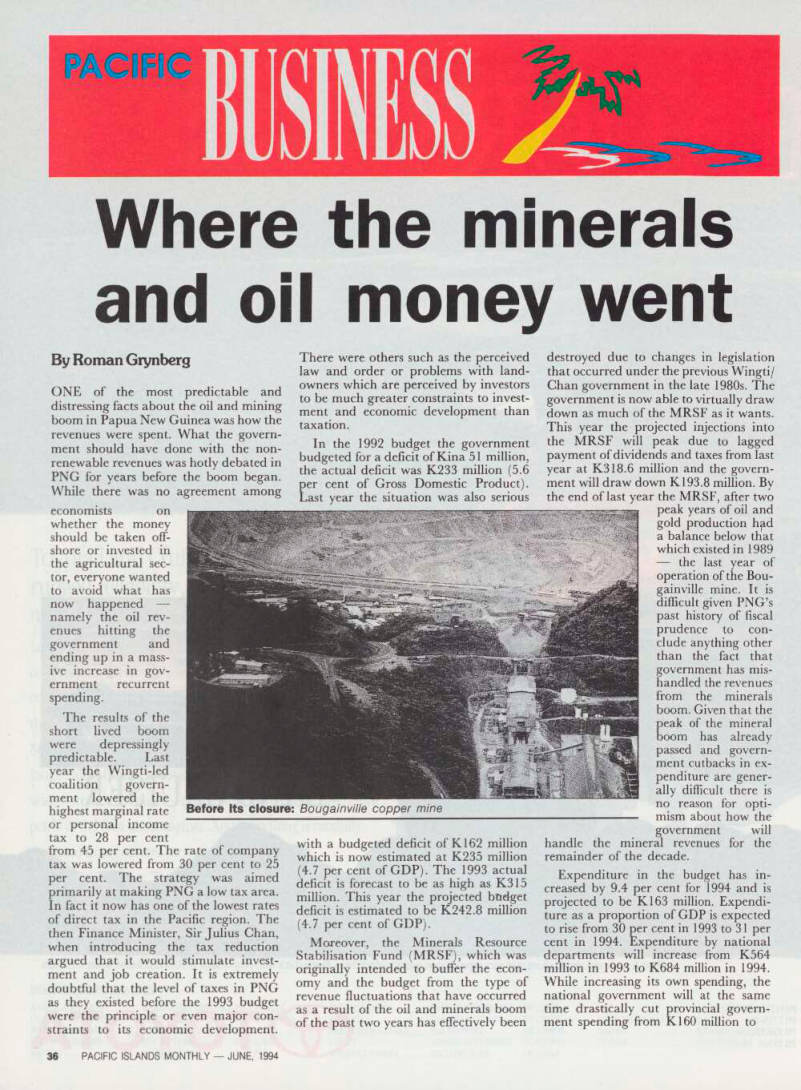
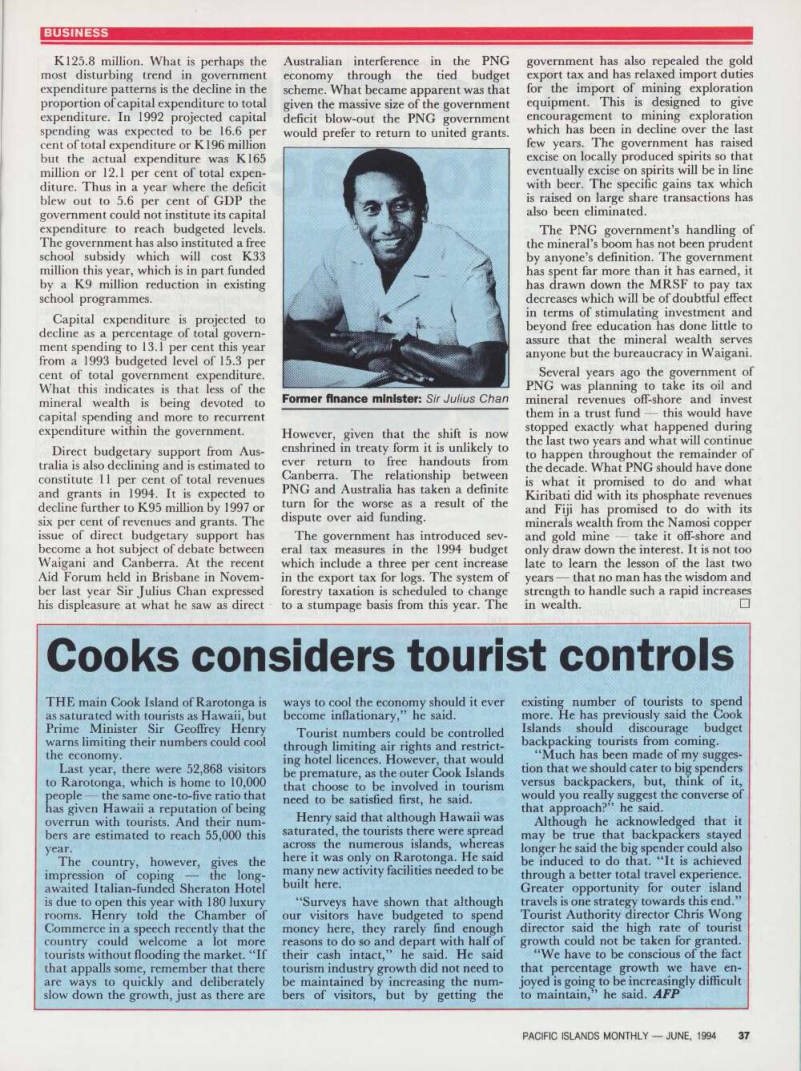
Where the minerals and oil money went
By Roman Grynberg
ONE of the most predictable and distressing facts about the oil and mining boom in Papua New Guinea was how the revenues were spent. What the govern ment should have done with the non renewable revenues was hotly debated in PNG for years before the boom began.
While there was no agreement among
There were others such as the perceived law and order or problems with land owners which are perceived by investors to be much greater constraints to invest ment and economic development than taxation.
In the 1992 budget the government budgeted for a deficit of Kina 51 million, the actual deficit was K 233 million (5.6 per cent of Gross Domestic Product).
Last year the situation was also serious
economists on whether the money should be taken off shore or invested in the agricultural sec tor, everyone wanted to avoid what has now happened namely the oil rev enues hitting the government and ending up in a mass ive increase in gov ernment recurrent
spending.
The results of the short lived boom were depressingly predictable. Last year the Wingti-led coalition govern ment lowered the highest marginal rate or personal income
tax to 28 per cent from 45 per cent. The rate of company tax was lowered from 30 per cent to 25 per cent. The strategy was aimed primarily at making PNG a low tax area.
In fact it now has one of the lowest rates of direct tax in the Pacific region. The then Finance Minister, Sir Julius Chan, when introducing the tax reduction argued that it would stimulate invest ment and job creation. It is extremely doubtful that the level of taxes in PNG as they existed before the 1993 budget were the principle or even major con straints to its economic development.
with a budgeted deficit of K 162 million which is now estimated at K 235 million (4.7 per cent of GDP). The 1993 actual deficit is forecast to be as high as K 315 million. This year the projected blidget deficit is estimated to be K 242.8 million (4.7 per cent of GDP).
Moreover, the Minerals Resource Stabilisation Fund (MRSF), which was originally intended to buffer the econ omy and the budget from the type of revenue fluctuations that have occurred as a result of the oil and minerals boom of the past two years has effectively been
destroyed due to changes in legislation
that occurred under the previous Wingti/ Chan government in the late 1980 s. The government is now able to virtually draw down as much of the MRSF as it wants.
This year the projected injections into the MRSF will peak due to lagged payment of dividends and taxes from last year at K 318.6 million and the govern ment will draw down K 193.8 million. By the end of last year the MRSF, after two
peak years of oil and
gold production
a balance below that which existed in 1989 the last year of operation of the Bou gainville mine. It is difficult given PNG’s past history of fiscal prudence to con clude anything other than the fact that government has mis handled the revenues from the minerals boom. Given that the peak of the mineral boom has already passed and govern ment cutbacks in ex penditure are gener ally difficult there is no reason for opti mism about how the government will
handle the mineral revenues for the remainder of the decade.
Expenditure in the budget has in creased by 9.4 per cent for 1994 and is projected to be K 163 million. Expendi ture as a proportion of GDP is expected to rise from 30 per cent in 1993 to 31 per cent in 1994. Expenditure by national departments will increase from K 564 million in 1993 to K 684 million in 1994.
While increasing its own spending, the national government will at the same time drastically cut provincial govern ment spending from Kl6O million to
Before Its closure: Bougainville copper mine
K 125.8 million. What is perhaps the most disturbing trend in government expenditure patterns is the decline in the
proportion of capital expenditure to total
expenditure. In 1992 projected capital
spending was expected to be 16.6 per cent of total expenditure or K 196 million but the actual expenditure was K 165 million or 12.1 per cent of total expen diture. Thus in a year where the deficit blew out to 5.6 per cent of GDP the government could not institute its capital expenditure to reach budgeted levels.
The government has also instituted a free school subsidy which will cost K 33 million this year, which is in part funded by a K 9 million reduction in existing school programmes.
Capital expenditure is projected to
decline as a percentage of total govern ment spending to 13.1 per cent this year from a 1993 budgeted level of 15.3 per cent of total government expenditure.
What this indicates is that less of the mineral wealth is being devoted to capital spending and more to recurrent expenditure within the government.
Direct budgetary support from Aus tralia is also declining and is estimated to constitute 11 per cent of total revenues and grants in 1994. It is expected to decline further to K 95 million by 1997 or six per cent of revenues and grants. The issue of direct budgetary support has become a hot subject of debate between Waigani and Canberra. At the recent Aid Forum held in Brisbane in Novem ber last year Sir Julius Chan expressed his displeasure at what he saw as direct
Australian interference in the PNG economy through the tied budget scheme. What became apparent was that given the massive size of the government deficit blow-out the PNG government would prefer to return to united grants.
However, given that the shift is now enshrined in treaty form it is unlikely to ever return to free handouts from Canberra. The relationship between PNG and Australia has taken a definite turn for the worse as a result of the dispute over aid funding.
The government has introduced sev eral tax measures in the 1994 budget which include a three per cent increase in the export tax for logs. The system of forestry taxation is scheduled to change to a stumpage basis from this year. The
government has also repealed the gold export tax and has relaxed import duties
for the import of mining exploration
equipment. This is designed to give
encouragement to mining exploration
which has been in decline over the last few years. The government has raised excise on locally produced spirits so that eventually excise on spirits will be in line with beer. The specific gains tax which is raised on large share transactions has also been eliminated.
The PNG government’s handling of the mineral’s boom has not been prudent by anyone’s definition. The government has spent far more than it has earned, it has drawn down the MRSF to pay tax decreases which will be of doubtful effect in terms of stimulating investment and beyond free education has done little to assure that the mineral wealth serves anyone but the bureaucracy in Waigani.
Several years ago the government of PNG was planning to take its oil and mineral revenues off-shore and invest them in a trust fund this would have
stopped exactly what happened during
the last two years and what will continue to happen throughout the remainder of the decade. What PNG should have done is what it promised to do and what Kiribati did with its phosphate revenues and Fiji has promised to do with its minerals wealth from the Namosi copper and gold mine take it off-shore and only draw down the interest. It is not too late to learn the lesson of the last two years that no man has the wisdom and strength to handle such a rapid increases in wealth. □
Former finance minister: Sir Julius Chan
Cooks considers tourist controls
THE main Cook Island of Rarotonga is as saturated with tourists as Hawaii, but Prime Minister Sir Geoffrey Henry warns limiting their numbers could cool the economy.
Last year, there were 52,868 visitors to Rarotonga, which is home to 10,000 people the same one-to-five ratio that has given Hawaii a reputation of being overrun with tourists. And their numbers are estimated to reach 55,000 this year.
The country, however, gives the
impression of coping the long-
awaited Italian-funded Sheraton Hotel is due to open this year with 180 luxury rooms. Henry told the Chamber of Commerce in a speech recently that the country could welcome a lot more tourists without flooding the market. “If that appalls some, remember that there are ways to quickly and deliberately slow down the growth, just as there are
ways to cool the economy should it ever become inflationary,” he said.
Tourist numbers could be controlled through limiting air rights and restrict ing hotel licences. However, that would be premature, as the outer Cook Islands that choose to be involved in tourism need to be satisfied first, he said.
Henry said that although Hawaii was saturated, the tourists there were spread across the numerous islands, whereas here it was only on Rarotonga. He said many new activity facilities needed to be built here.
“Surveys have shown that although our visitors have budgeted to spend money here, they rarely find enough reasons to do so and depart with half of their cash intact,” he said. He said tourism industry growth did not need to be maintained by increasing the num bers of visitors, but by getting the
existing number of tourists to spend more. He has previously said the Cook Islands should discourage budget backpacking tourists from coming, . uc h has been made of my sugges *lon that we should cater to big spenders versus backpackers, but, think of it, would Y ou really «W»t the converse of that approach?” he said, Although he acknowledged that it ma y be true that backpackers stayed longer he said the big spender could also be induced to do that. “It is achieved through a better total travel experience, Greater opportunity for outer island travels is one strategy towards this end.”
Tourist Authority director Chris Wong director said the high rate of tourist growth could not be taken for granted, “We have to be conscious of the fact that percentage growth we have en joyed is going to be increasingly difficult to maintain,” he said. AFP
aid to Pacific
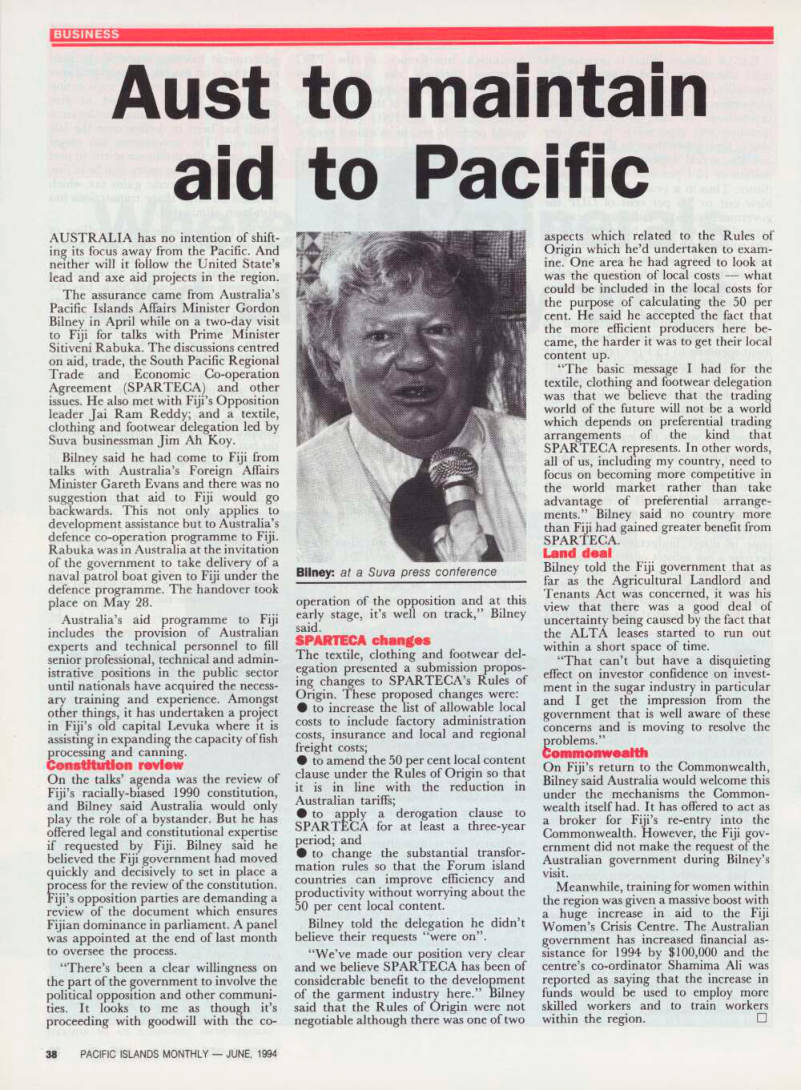
Aust to maintain aid to Pacific
AUSTRALIA has no intention of shift ing its focus away from the Pacific. And neither will it follow the United State’s lead and axe aid projects in the region.
The assurance came from Australia’s Pacific Islands Affairs Minister Gordon Bilney in April while on a two-day visit to Fiji for talks with Prime Minister Sitiveni Rabuka. The discussions centred on aid, trade, the South Pacific Regional Trade and Economic Co-operation Agreement (SPARTECA) and other issues. He also met with Fiji’s Opposition leader Jai Ram Reddy; and a textile, clothing and footwear delegation led by Suva businessman Jim Ah Koy.
Bilney said he had come to Fiji from talks with Australia’s Foreign Affairs Minister Gareth Evans and there was no suggestion that aid to Fiji would go backwards. This not only applies to development assistance but to Australia’s defence co-operation programme to Fiji.
Rabuka was in Australia at the invitation of the government to take delivery of a naval patrol boat given to Fiji under the defence programme. The handover took place on May 28.
Australia’s aid programme to Fiji includes the provision of Australian experts and technical personnel to fill senior professional, technical and admin istrative positions in the public sector until nationals have acquired the necess ary training and experience. Amongst other things, it has undertaken a project in Fiji’s old capital Levuka where it is assisting in expanding the capacity of fish processing and canning.
Constitution review On the talks’ agenda was the review of Fiji’s racially-biased 1990 constitution, and Bilney said Australia would only play the role of a bystander. But he has offered legal and constitutional expertise if requested by Fiji. Bilney said he believed the Fiji government had moved quickly and decisively to set in place a process for the review of the constitution.
Fiji’s opposition parties are demanding a review of the document which ensures Fijian dominance in parliament. A panel was appointed at the end of last month to oversee the process.
“There’s been a clear willingness on the part of the government to involve the political opposition and other communi ties. It looks to me as though it’s proceeding with goodwill with the co-
operation of the opposition and at this early stage, it’s well on track,” Bilney said.
SPARTECA changes The textile, clothing and footwear del egation presented a submission propos ing changes to SPARTECA’s Rules of Origin. These proposed changes were: to increase the list of allowable local costs to include factory administration costs, insurance and local and regional freight costs; to amend the 50 per cent local content clause under the Rules of Origin so that it is in line with the reduction in Australian tariffs; to apply a derogation clause to SPARTECA for at least a three-year
period; and
to change the substantial transfor mation rules so that the Forum island countries can improve efficiency and productivity without worrying about the 50 per cent local content.
Bilney told the delegation he didn’t believe their requests “were on”.
“We’ve made our position very clear and we believe SPARTECA has been of considerable benefit to the development of the garment industry here.” Bilney said that the Rules of Origin were not negotiable although there was one of two
aspects which related to the Rules of Origin which he’d undertaken to exam ine. One area he had agreed to look at was the question of local costs what could be included in the local costs for the purpose of calculating the 50 per cent. He said he accepted the fact that the more efficient producers here be came, the harder it was to get their local content up.
“The basic message I had for the textile, clothing and footwear delegation was that we believe that the trading world of the future will not be a world which depends on preferential trading arrangements of the kind that SPARTECA represents. In other words, all of us, including my country, need to focus on becoming more competitive in the world market rather than take advantage of preferential arrange ments.” Bilney said no country more than Fiji had gained greater benefit from
Sparteca.
Land deal Bilney told the Fiji government that as far as the Agricultural Landlord and Tenants Act was concerned, it was his view that there was a good deal of uncertainty being caused by the fact that the ALTA leases started to run out within a short space of time.
“That can’t but have a disquieting effect on investor confidence on invest ment in the sugar industry in particular and I get the impression from the government that is well aware of these concerns and is moving to resolve the
problems.”
Commonwealth On Fiji’s return to the Commonwealth, Bilney said Australia would welcome this under the mechanisms the Common wealth itself had. It has offered to act as a broker for Fiji’s re-entry into the Commonwealth. However, the Fiji gov ernment did not make the request of the Australian government during Bilney’s visit.
Meanwhile, training for women within the region was given a massive boost with a huge increase in aid to the Fiji Women’s Crisis Centre. The Australian government has increased financial as sistance for 1994 by SIOO,OOO and the centre’s co-ordinator Shamima Ali was reported as saying that the increase in funds would be used to employ more skilled workers and to train workers within the region. □
Bilney: at a Suva press conference
Guns: a tourism
niche market
By David North
TOURISM is full of specialised sub markets. People gawk at nude beaches, lose money in gambling casinos, or go backpacking in environmentally-correct locations de pending on their whim and the tourist business caters to them.
Guam, with a long record of attracting middle class Japanese tour ists, has worked out a new niche for a subset of them legal access to guns ranging from pistols to assault rifles.
Japanese civilians are not allowed to own firearms, and, as a result, the nation has one of the lowest murder rates in the world. But the yen for playing the role of cowboy or gangster is very much alive in Japan, and Guam is making the best of it.
For example, one of the island’s
tourist publications, Guam Today,
carries an advertisement in colour
showing a Japanese man wearing a
camouflage bush hat; he is seen firing a pistol at a watermelon at the point of impact and its bits of bright red (watermelon) flesh fly in all direc tions. The dominant language in the ad is Japanese.
But the thrill of shooting does not
come cheap. The Top Gun Shooting
Range, for example, will charge you
$35 for firing 36 rounds from a .38 revolver at a snarling image of a gun toting soldier. If you prefer the .44
Magnum (of the detective stories)
those three dozen shots cost you $45, and it’s $5O for using either a Uzi or the Thompson submachine gun.
Elsewhere along Turnon Bay, where the high-rise tourist hotels catering to the Japanese look out at the Pacific, one can find galleries offering indoor shoot ing experience with a wide variety of weapons. There are, among others, the M-16 and the AK-47 assault rifles, which are outlawed on much of the US mainland. The tourist also has his choice of various pistols, rifles and shotguns, bearing well-known names like Colt, Clock and Smith and Wesson.
Similar gun galleries can also be found on nearby Saipan, which also
specialises in Japanese tourists. Saipan
and Guam, both held by the Japanese for varying periods of time earlier in this century, are the closest tropical islands to Japan, and are, by Japanese stan dards, relatively inexpensive. In March, for instance, Guam entertained some 110,000 tourists, most of them middle class Japanese. Tourism is the largest industry in Guam, accounting for an infusion of about one billion dollars a year into the local economy. □
AT&T phone service
available from Fiji
USADirect Service has now made it faster and easier for the estimated 30,000 travellers from the United States who visit Fiji annually to keep in touch with loved ones and business colleagues back home.
AT&T’s USADirect Service was made available in Fiji from last month. AT&T USADirect Service provides immediate 4 access to an English-speaking AT&T operator or automated English-language voice prompts, making it simple to place a call to the United States, Puerto Rico and the Virgin Islands.
To use the service from Fiji, callers dial the USADirect access code 004-890-1001. Calls can be charged to the AT&T Calling Card, AT&T Uni versal Card and most local telephone company cards, or placed collect. The cost of a call from Fiji is U 553.75 for the first minute and U 552.35 for each additional minute. There is an additional US$2.5O charge for a calling card call and a U 552.75 charge for a collect call.
Hawaii bank looking at
expanding into Solomons
THE Bank of Hawaii is planning further expansion in the South Pacific. It is already established in Micronesia, Poly nesia and Fiji. A few months ago it bought Banque Indosuez, in Vanuatu, and now it is looking at moving into the Solomon Islands. Bank vice-president William Ord was in Honiara last month to look at the possibility of setting up a branch there.
Ord has also announced plans for extensive renovations and expansion of the Banque Indosuez building in Port Vila and modernisation of its operations.
He said the bank was also looking at setting up a branch in Lugainville, on the northern island of Santo.
Solomons gets new
conference centre
THE Solomon Islands is expected to benefit greatly from the new Forum Fisheries Agency (FFA) conference centre which opened in Honiara last month. The centre has been funded by the European Community for US$l.2 million. EC delegate in Honiara George Gwyer said the purpose of the building was to provide a place where the FFA meetings can be held.
PNG urban growth rate
among highest in region
PAPUA New Guinea’s urban growth rate is among the highest in the 19-member group of Pacific island na tions, excluding Australia and New
Zealand. With an urban growth rate of 4.4 per cent per year, PNG ranks fourth after Solomon Islands (5.3 per cent), Tuvalu (4.8 per cent) and Vanuatu (4.5 per cent).
In terms of population growth, PNG and Kiribati are both in sixth place among the 19 island nations at 2.3 per cent per year. The Marshall Islands, with a 4.2 per cent population growth, tops the table, followed by Federated States of Micronesia (3.6 per cent), the Solomon Islands (3.5 per cent), French Polynesia (three per cent), Vanuatu (2.5 per cent), and Guam and Palau (2.2 per cent).
Swiss invited to
invest in PNG
THE Papua New Guinea government would like to see Switzerland invest in the country. Acting governor-general Bill Skate said last month that Swiss investment in PNG was welcome and would strengthen bilaterall relations between the countries.
He said PNG would welcome invest ment from Switzerland in areas like forestry, fisheries, marine, mineral, pet roleum, agriculture and infraastructure development. Skate extended the invita tion when he received credentials of Swiss ambassador Peter Niegerberger.
Financial support for
Tonga Development Bank
THE Tonga Development Bank is to receive more financial support from the European Investment Bank (EIB). The EIB has granted approval for its fifth line of credit to the Tonga Development Bank of US$2.4 million. The EIB loan is intended for small and medium sized enterprise in Tonga in the industrial, manufacturing, agro-industrial, fisheries, tourism, transport and production infra structure sectors. The EIB has now granted the Tonga Development Bank five loans totalling US$6.6 million since its first line of credit in 1981.
Fiji’s US sugar quota
safe, Rabuka told
FIJI Prime Minister Sitiveni Rabuka has been told by senior United States officials that his country’s sugar quota was secure.
The assurance came after the US signed a new trade agreement with Canada and Mexico, called the North American Free Trade Agreement. Rabuka was in Wash ington last month for talks with US officials.
Acting Secretary of State Strobe Talbott told Rabuka that Fiji’s allo cation of 0.9 per cent of the American sugar market was not threatened. He said the special payment granted to Fiji under the generalised system of preference would continue. □
Advertisements & other items, p. 40 (1 item)
Your Ears!
YOU
WON'T
BELIEVE
YOUR EARS!
♦ THE REVOLUTIONARY NEW MD 520 N ..
Representing a technological breakthrough unmatched since the introduction of turbine engines 30 years ago, the amazing MD 520 N with NOTAR ™ anti-torque system, changes everything you know about helicopters.
It's a system so advanced that the aircraft is up to 50% quieter than its closest competitor - and a system so safe, if rewrites the book on safety for anyone on the ground or in the air.
Capable of handling a heavier payload, and at higher altitudes than the competition, the superbly elegant MD 520 N boasts so much power, speed, performance and ease of handling, it's every pilot's dream. Your accountant will love if too, because the MD 520N's advanced design and engineering, utilising new graphite, kevlar and composite materials, mean lightweight, strong and durable components, which are more resistant to damage, extend time between maintenance and provide lower direct operating costs. Little wonder then the competitors are in a spin!
So, if you want the buzz on how McDonnell Douglas has produced the world's quietest and safest helicopter, contact their sole Australasian distributor, Flightline Aviation Limited.
Flightline Aviation Ardmore Airport PO Box 75 Papakura Auckland New Zealand Telephone: 0-9-299 6710 Free Fax: 0800-800 066 Dave Macmillan: 0-3-486 2002
MCDONNELL DOUGLAS
CHANGE IS IN THE AIR
V Kunnmm r Flightline Aviation Archerfield Airport PO Box 34 Archerfield Brisbane 4108 Australia Telephone: 0-7- 111 6955 Free Fax: 008-633 374 Chris Wolff: 018-782 862
ties with the region
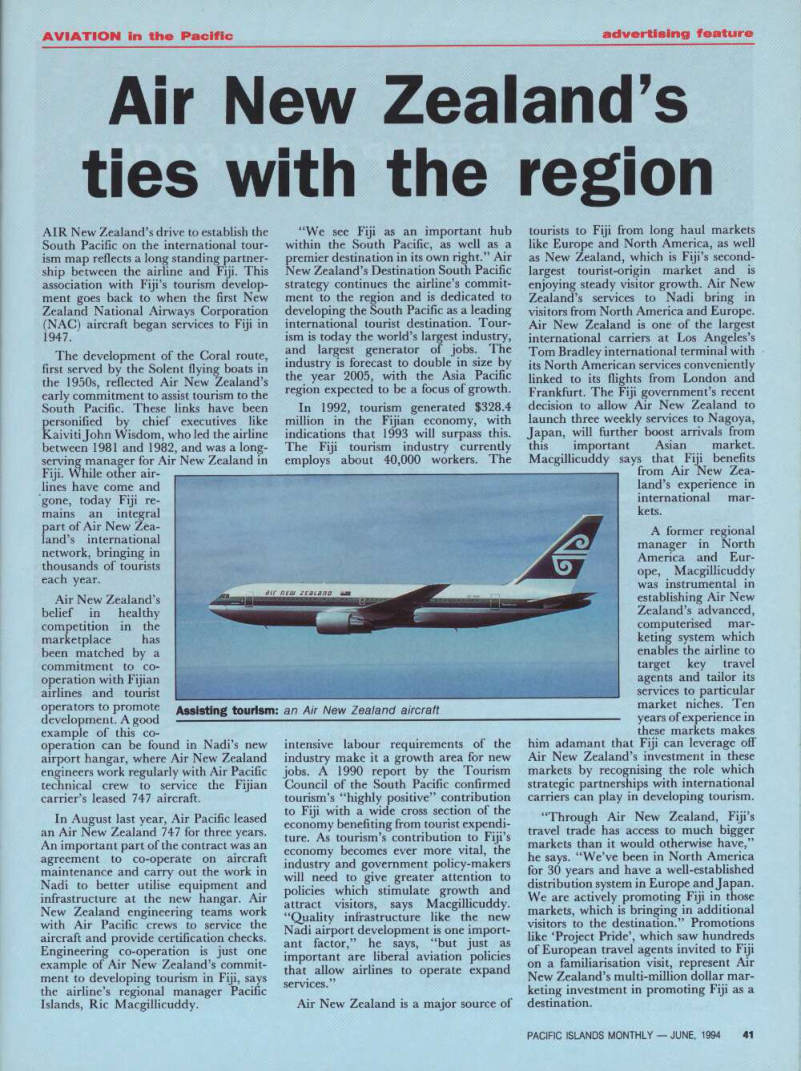
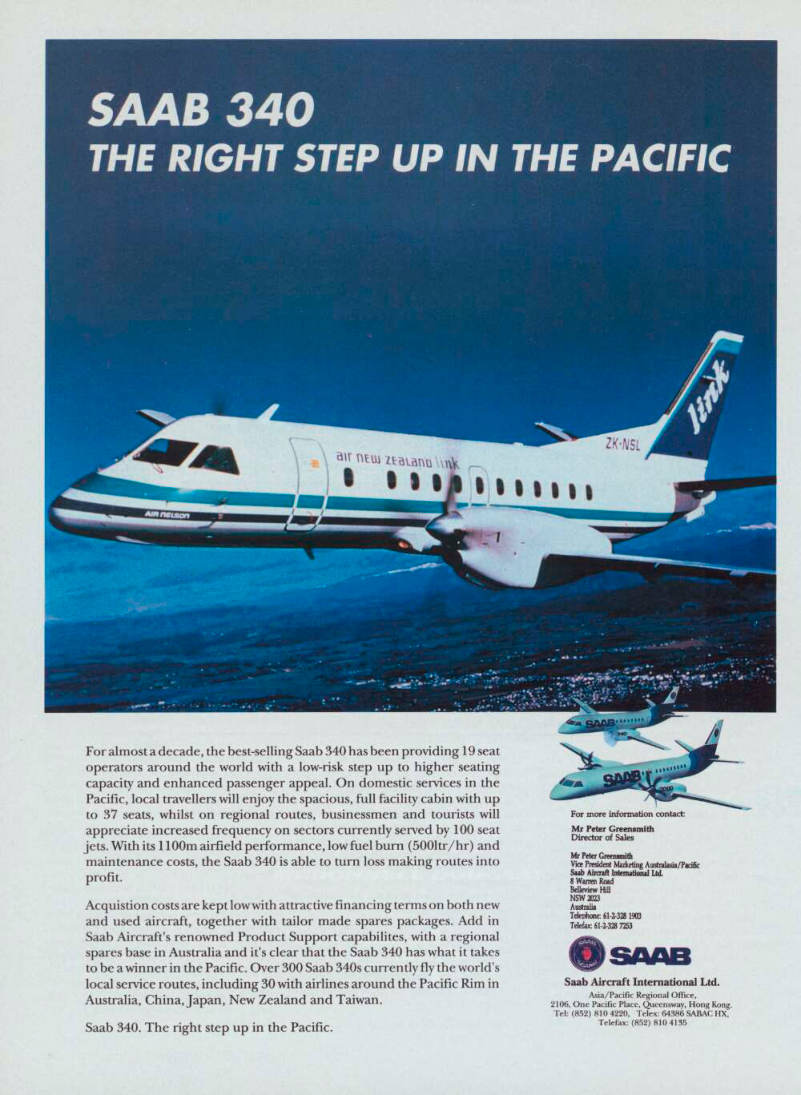
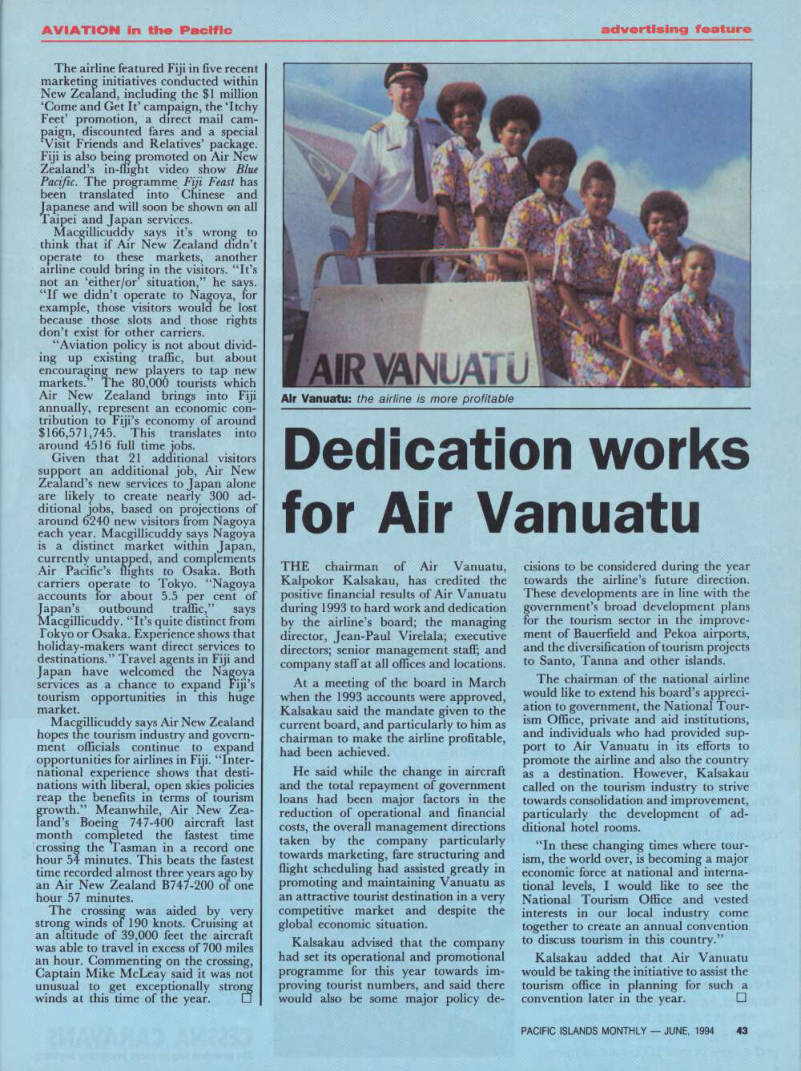
Air New Zealand’s ties with the region
AVIATION in the Pacific
advertising feature
AIR New Zealand’s drive to establish the South Pacific on the international tour ism map reflects a long standing partner ship between the airline and Fiji. This association with Fiji’s tourism develop ment goes back to when the first New
Zealand National Airways Corporation
(NAC) aircraft began services to Fiji in 1947.
The development of the Coral route, first served by the Solent flying boats in the 19505, reflected Air New Zealand’s early commitment to assist tourism to the South Pacific. These links have been personified by chief executives like Kaiviti John Wisdom, who led the airline between 1981 and 1982, and was a long serving manager for Air New Zealand in
Fiji. While other air lines have come and gone, today Fiji re mains an integral part of Air New Zea land’s international network, bringing in thousands of tourists each year.
Air New Zealand’s belief in healthy competition in the
marketplace has
been matched by a commitment to co operation with Fijian airlines and tourist operators to promote development. A good example of this co
operation can be found in Nadi’s new airport hangar, where Air New Zealand engineers work regularly with Air Pacific technical crew to service the Fijian carrier’s leased 747 aircraft.
In August last year, Air Pacific leased an Air New Zealand 747 for three years.
An important part of the contract was an agreement to co-operate on aircraft maintenance and carry out the work in Nadi to better utilise equipment and infrastructure at the new hangar. Air New Zealand engineering teams work with Air Pacific crews to service the aircraft and provide certification checks.
Engineering co-operation is just one example of Air New Zealand’s commit ment to developing tourism in Fiji, says the airline’s regional manager Pacific Islands, Ric Macgillicuddy.
“We see Fiji as an important hub within the South Pacific, as well as a premier destination in its own right.” Air New Zealand’s Destination South Pacific strategy continues the airline’s commit ment to the region and is dedicated to developing the South Pacific as a leading international tourist destination. Tour ism is today the world’s largest industry, and largest generator of jobs. The industry is forecast to double in size by the year 2005, with the Asia Pacific region expected to be a focus of growth.
In 1992, tourism generated 5328.4 million in the Fijian economy, with indications that 1993 will surpass this.
The Fiji tourism industry currently employs about 40,000 workers. The
intensive labour requirements of the industry make it a growth area for new jobs. A 1990 report by the Tourism Council of the South Pacific confirmed tourism’s “highly positive” contribution to Fiji with a wide cross section of the economy benefiting from tourist expendi ture. As tourism’s contribution to Fiji’s economy becomes ever more vital, the industry and government policy-makers will need to give greater attention to policies which stimulate growth and attract visitors, says Macgillicuddy.
“Quality infrastructure like the new Nadi airport development is one import ant factor,” he says, “but just as important are liberal aviation policies that allow airlines to operate expand services.”
Air New Zealand is a major source of
tourists to Fiji from long haul markets like Europe and North America, as well as New Zealand, which is Fiji’s second largest tourist-origin market and is
enjoying steady visitor growth. Air New
Zealand’s services to Nadi bring in visitors from North America and Europe.
Air New Zealand is one of the largest international carriers at Los Angeles’s Tom Bradley international terminal with its North American services conveniently linked to its flights from London and Frankfurt. The Fiji government’s recent decision to allow Air New Zealand to launch three weekly services to Nagoya, Japan, will further boost arrivals from this important Asian market.
Macgillicuddy says that Fiji benefits
from Air New Zea land’s experience in international mar kets.
A former regional manager in North America and Eur
ope, Macgillicuddy
was instrumental in establishing Air New Zealand’s advanced,
computerised mar
keting system which enables the airline to target key travel agents and tailor its services to particular market niches. Ten years of experience in these markets makes
him adamant that Fiji can leverage off Air New Zealand’s investment in these markets by recognising the role which strategic partnerships with international carriers can play in developing tourism.
“Through Air New Zealand, Fiji’s travel trade has access to much bigger markets than it would otherwise have,” he says. “We’ve been in North America for 30 years and have a well-established distribution system in Europe and Japan.
We are actively promoting Fiji in those markets, which is bringing in additional visitors to the destination.” Promotions like ‘Project Pride’, which saw hundreds of European travel agents invited to Fiji on a familiarisation visit, represent Air New Zealand’s multi-million dollar mar keting investment in promoting Fiji as a destination.
Assisting tourism: an Air New Zealand aircraft
The airline featured Fiji in five recent marketing initiatives conducted within New Zealand, including the SI million ‘Come and Get It’ campaign, the ‘ltchy Feet’ promotion, a direct mail cam paign, discounted fares and a special Visit Friends and Relatives’ package.
Fiji is also being promoted on Air New Zealand’s in-flight video show Blue Pacific. The programme Fiji Feast has been translated into Chinese and Japanese and will soon be shown on all Taipei and Japan services.
Macgillicuddy says it’s wrong to think that if Air New Zealand didn’t operate to these markets, another airline could bring in the visitors. “It’s not an ‘either/or’ situation,” he says.
“If we didn’t operate to Nagoya, for example, those visitors would oe lost because those slots and those rights don’t exist for other carriers.
“Aviation policy is not about divid ing up existing traffic, but about encouraging new players to tap new markets.” The 80,000 tourists which Air New Zealand brings into Fiji annually, represent an economic con tribution to Fiji’s economy of around $166,571,745. This translates into around 4516 full time jobs.
Given that 21 additional visitors support an additional job, Air New Zealand’s new services to Japan alone are likely to create nearly 300 ad ditional jobs, based on projections of around 6240 new visitors from Nagoya each year. Macgillicuddy says Nagoya is a distinct market within Japan,
currently untapped, and complements
Air Pacific’s flights to Osaka. Both carriers operate to Tokyo. “Nagoya accounts for about 5.5 per cent of Japan’s outbound traffic,” says Macgillicuddy. “It’s quite distinct from Tokyo or Osaka. Experience shows that holiday-makers want direct services to destinations.” Travel agents in Fiji and Japan have welcomed the Nagoya services as a chance to expand Fiji’s tourism opportunities in this huge market.
Macgillicuddy says Air New Zealand hopes the tourism industry and govern ment officials continue to expand opportunities for airlines in Fiji. “Inter national experience shows mat desti nations with liberal, open skies policies reap the benefits in terms of tourism growth.” Meanwhile, Air New Zea land’s Boeing 747-400 aircraft last month completed the fastest time crossing the Tasman in a record one hour 54 minutes. This beats the fastest time recorded almost three years ago by an Air New Zealand 8747-200 of one hour 57 minutes.
The crossing was aided by very strong winds of 190 knots. Cruising at an altitude of 39,000 feet the aircraft was able to travel in excess of 700 miles an hour. Commenting on the crossing, Captain Mike McLeay said it was not unusual to get exceptionally strong winds at this time of the year. □
Advertisements & other items, p. 42 (1 item)
Saab 340
THE RIGHT STEP UP IN THE PACIFIC
zk-mi
itauano \\\V
• Mini
A For almost a decade, the best-selling Saab 340 has been providing 19 seat operators around the world with a low-risk step up to higher seating capacity and enhanced passenger appeal. On domestic services in the Pacific, local travellers will enjoy the spacious, full facility cabin with up to 37 seats, whilst on regional routes, businessmen and tourists will appreciate increased frequency on sectors currently served by 100 seat jets. With its 1100 m airfield performance, low fuel bum (5001tr/hr) and maintenance costs, the Saab 340 is able to turn loss making routes into
profit.
Acquistion costs are kept low with attractive financing terms on both new and used aircraft, together with tailor made spares packages. Add in Saab Aircraft's renowned Product Support capabilites, with a regional spares base in Australia and it's clear that the Saab 340 has what it takes to be a winner in the Pacific. Over 300 Saab 340 s currently fly the world's local service routes, including 30 with airlines around the Pacific Rim in Australia, China, Japan, New Zealand and Taiwan.
Saab 340. The right step up in the Pacific.
For more information contact Mr Peter Greensmith Director of Sales Mr Peter Greensmith Vice President Marketing Australasia/Padfic Sub Aircraft International Ltd. 8 Warren Road Belleview Hill
NSW 2023
Australia Telephone: 61-2-328 1903 Telefax 61-2-328 7253 Saab Aircraft International Ltd.
Asia/Pacific Regional Office, 2106, One Pacific Place, Queensway, Hong Kong.
Tel: (852) 810 4220, Telex: 64386 SABAC HX, Telefax: (852) 810 4135
Dedication works
for Air Vanuatu
THE chairman of Air Vanuatu, Kalpokor Kalsakau, has credited the positive financial results of Air Vanuatu during 1993 to hard work and dedication by the airline’s board; the managing director, Jean-Paul Virelala; executive directors; senior management staff; and company staff at all offices and locations.
At a meeting of the board in March when the 1993 accounts were approved, Kalsakau said the mandate given to the current board, and particularly to him as chairman to make the airline profitable, had been achieved.
He said while the change in aircraft and the total repayment of government loans had been major factors in the reduction of operational and financial costs, the overall management directions taken by the company particularly towards marketing, fare structuring and
flight scheduling had assisted greatly in
promoting and maintaining Vanuatu as an attractive tourist destination in a very competitive market and despite the global economic situation.
Kalsakau advised that the company had set its operational and promotional programme for this year towards im proving tourist numbers, and said there would also be some major policy de
cisions to be considered during the year towards the airline’s future direction.
These developments are in line with the government’s broad development plans for the tourism sector in the improve ment of Bauerfield and Pekoa airports, and the diversification of tourism projects to Santo, Tanna and other islands.
The chairman of the national airline would like to extend his board’s appreci ation to government, the National Tour ism Office, private and aid institutions, and individuals who had provided sup port to Air Vanuatu in its efforts to promote the airline and also the country as a destination. However, Kalsakau called on the tourism industry to strive towards consolidation and improvement, particularly the development of ad ditional hotel rooms.
“In these changing times where tour ism, the world over, is becoming a major economic force at national and interna tional levels, I would like to see the National Tourism Office and vested interests in our local industry come together to create an annual convention to discuss tourism in this country.”
Kalsakau added that Air Vanuatu would be taking the initiative to assist the tourism office in planning for such a convention later in the year. □
Air Vanuatu: the airline is more profitable
Advertisements & other items, pp. 43-44 (2 items)
43
advertising feature
PACIFIC ISLANDS MONTHLY JUNE, 1994
AVIATION in the Pacific
Why Does The Woru)
cau nos new mcm
THE OID RELIABLE?
A tm
6W WF
Jz: 5 m ---•■ sm TrX~< «v sag • • • • £•? - t . ; Uh «ilPi .
' - fi» it ■»;* sm flf: ’ ■3RS I* .**: Sr ■ V Wfc it ■ =4 "‘- i«Si The Grand Caravan from Cessna is the only aircraft of its kind being built today.
No new aircraft can match its costeffectiveness and rugged versatility.
No used aircraft can approach the day-in day-out reliability of a new Caravan.
The Caravan line is already one of the most proven in the world. For a decade now, Caravans have been the aircraft of choice for cargo haulers, bush pilots and charter operators around the globe.
Operators who want big, tough, reliable aircraft count on Caravans. They are not disappointed. The dispatch rate of the Federal Express fleet of over 200 Caravans, for example, is over 99%.
With all this solid dependability, you also get superior speed, up to 180 kts, and a range of over 1000 nautical miles.
This Caravan’s 675bp Pratt & Whitney engine is one of the most efficient and dependable turboprops ever built. And the aircraft’s modest takeoff and landing requirements, plus its overall toughness, get you in and out of some of the most remote places on earth. ; MM When you fly a Grand Caravan, versatility is right up there with reliability.
You get 340 cu/ft of cargo hauling capacity (451 cu/ft with optional cargo pod). Or, with seats that install in less than 30 minutes, you have room for as many as fourteen people. It’s like having two aircraft for the price of one.
FUGHTUNE
Flightline Aviation Limited, m PO Box 75, Papakura, Ardmore Airport, Auckland. New Zealand.
Tel: 64-9-299 6710 Fax: 64-9-299 6112
CESSNA CARAVANS
The practical way to carry practically anything.
Air Nauru puts quality first
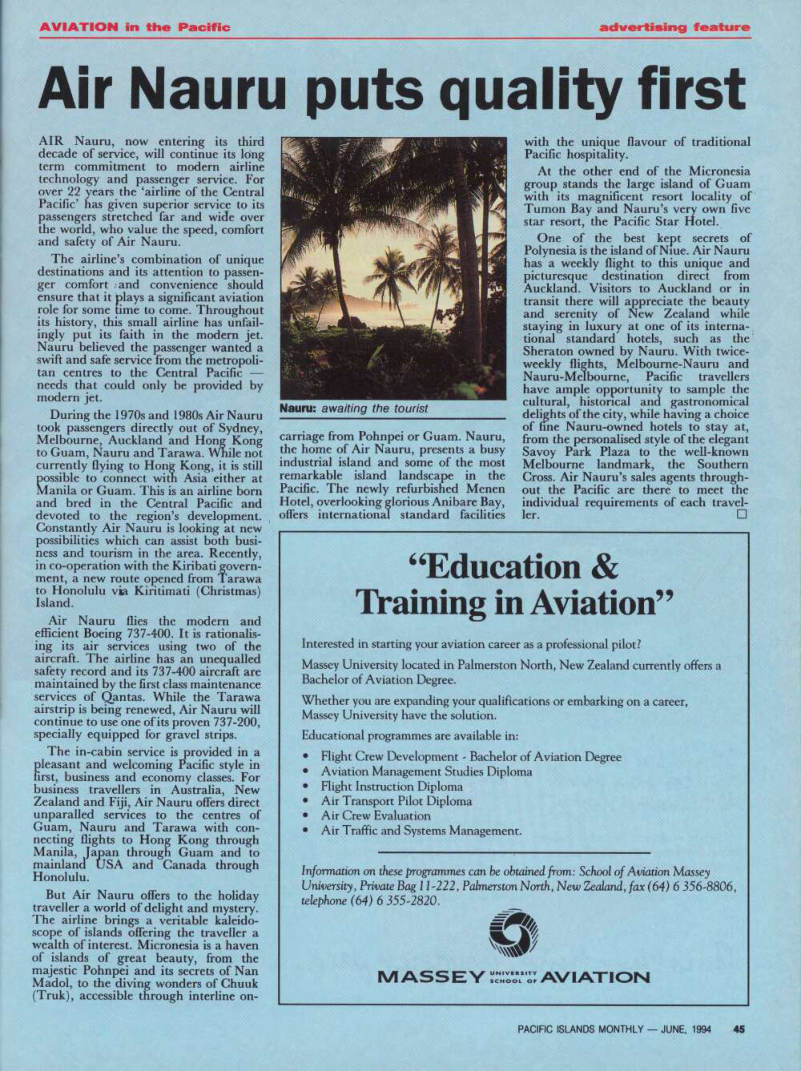
AIR Nauru, now entering its third decade of service, will continue its long term commitment to modern airline technology and passenger service. For over 22 years the ‘airline of the Central Pacific’ has given superior service to its passengers stretched far and wide over the world, who value the speed, comfort and safety of Air Nauru.
The airline’s combination of unique destinations and its attention to passen ger comfort and convenience should ensure that it plays a significant aviation role for some time to come. Throughout its history, this small airline has unfail ingly put its faith in the modern jet.
Nauru believed the passenger wanted a swift and safe service from the metropoli tan centres to the Central Pacific needs that could only be provided by modern jet.
During the 1970 s and 1980 s Air Nauru took passengers directly out of Sydney, Melbourne, Auckland and Hong Kong to Guam, Nauru and Tarawa. While not currently flying to Hong Kong, it is still possible to connect with Asia either at Manila or Guam. This is an airline born and bred in the Central Pacific and devoted to the region’s development.
Constantly Air Nauru is looking at new possibilities which can assist both busi ness and tourism in the area. Recently, in co-operation with the Kiribati govern ment, a new route opened from Tarawa to Honolulu via Kiritimati (Christmas) Island.
Air Nauru flies the modern and efficient Boeing 737-400. It is rationalis ing its air services using two of the aircraft. The airline has an unequalled safety record and its 737-400 aircraft are maintained by the first class maintenance services of Qantas. While the Tarawa airstrip is being renewed, Air Nauru will continue to use one of its proven 737-200, specially equipped for gravel strips.
The in-cabin service is provided in a {Peasant and welcoming Pacific style in irst, business and economy classes. For business travellers in Australia, New Zealand and Fiji, Air Nauru offers direct unparalled services to the centres of Guam, Nauru and Tarawa with con necting flights to Hong Kong through Manila, Japan through Guam and to mainland USA and Canada through Honolulu.
But Air Nauru offers to the holiday traveller a world of delight and mystery.
The airline brings a veritable kaleido scope of islands offering the traveller a wealth of interest. Micronesia is a haven of islands of great beauty, from the majestic Pohnpei and its secrets of Nan Madol, to the diving wonders of Chuuk (Truk), accessible through interline on-
carriage from Pohnpei or Guam. Nauru, the home of Air Nauru, presents a busy industrial island and some of the most remarkable island landscape in the Pacific. The newly refurbished Menen Hotel, overlooking glorious Anibare Bay, offers international standard facilities
with the unique flavour of traditional
Pacific hospitality.
At the other end of the Micronesia group stands the large island of Guam with its magnificent resort locality of Turnon Bay and Nauru’s very own five star resort, the Pacific Star Hotel.
One of the best kept secrets of Polynesia is the island of Niue. Air Nauru has a weekly flight to this unique and picturesque destination direct from Auckland. Visitors to Auckland or in transit there will appreciate the beauty and serenity of New Zealand while staying in luxury at one of its interna-. tional standard hotels, such as the Sheraton owned by Nauru. With twice weekly flights, Melbourne-Nauru and Nauru-Melbourne, Pacific travellers have ample opportunity to sample the cultural, historical and gastronomical delights of the city, while having a choice of fine Nauru-owned hotels to stay at, from the personalised style of the elegant Savoy Park Plaza to the well-known Melbourne landmark, the Southern Cross. Air Nauru’s sales agents through out the Pacific are there to meet the individual requirements of each travel ler. □
Nauru: awaiting the tourist
Advertisements & other items, pp. 45-46 (2 items)
45
advertising feature
PACIFIC ISLANDS MONTHLY JUNE, 1994
AVIATION in the Pacific
4 ‘Education &
Training in Aviation”
Interested in starting your aviation career as a professional pilot?
Massey University located in Palmerston North, New Zealand currently offers a Bachelor of Aviation Degree.
Whether you are expanding your qualifications or embarking on a career, Massey University have the solution.
Educational programmes are available in: • Flight Crew Development - Bachelor of Aviation Degree • Aviation Management Studies Diploma • Flight Instruction Diploma • Air Transport Pilot Diploma • Air Crew Evaluation • Air Traffic and Systems Management.
Information on these programmes can be obtained from: School of Aviation Massey University, Private Bag 11 '222, Palmerston North, New Zealand, fax (64) 6 356'8806, telephone (64) 6 355'2820.
A mass e y aviation
< - r W' ‘m / \ ' / ■ r \ Sir*' 4
VANUATU
Sarto
IIP:
i AUSI
k
AUSTRALIA
J / *
T FIJI
V V
I.AI.FDOMA
m ' * m * «
NEW ZEALAND
■> m « *■
ixfaM (Tv\
m fv^
MI iVtU cvwA w\or e \. * Where would you find white powder beaches overhung with coconut palms, reaching down to tropical blue water?
Where would you find diving in coral seas so clear and warm?
Where would you find top class resorts featuring world class cuisine, sporting activities, shows, casino and
night clubs?
Where would you find a live volcano and ancient custom villages, fresh grown market produce and some of the friendliest people you’ll ever meet?
Where?
Vanuatu, that’s where.
An untouched paradise on earth.
Air Vanuatu Reservations & Sales Offices: Port Vila (678) 23 848, Santo (678) 36 429, Sydney (612) 223 8333, Melbourne (613) 417 3977, Brisbane (617) 221 2566, Auckland (649) 373 3435, Nadi (679) 72 2521, Suva (679) 314 666, Apia (685) 212 61, Noumea (687) 286 677, Los Angeles (310) 670 7302, Paris (331) 40 53 82 25, Spain (34) 72 27 02 62, Denmark (45) 33 11 02 02, Germany (49) 60231028, Italy (39) 2 551 80528, Hong Kong (852) 336 6916.
CUxdrihty'jvfr , fahciH&V WHJL.
The Untouched Paradise
AIR VANUATU
MBE 8759
Reaching new heights

THIS year, Polynesian Airlines is con solidating its activities following the completion of an 18-month expansion programme. The airline will continue to be available to do charters which currently include 107 Trans-Tasman flights to secondary airports in Auckland, New Zealand; Brisbane, Sydney and Melbourne flights into Invercargill; Bris bane flights into Hamilton and Auckland flights into Townsville. These charters will operate from this month to October this year.
Polynesian Airlines will also operate eight charters between Apia and Nagoya next month and in August. Polynesian Airlines has had a 12-month introduc tion of the Boeing 767 service and is now aware of the market variations and changes. The United States market is now the largest market for Polynesian Airlines with Australia and New Zealand competing for second position and West ern Samoa holding fourth.
Polynesian Airlines plans to consoli date the gains made in various markets and intends to continue efforts to reduce costs and increase yields. Revenues are
currently running at three times the last financial year and passenger numbers have also increased by the same amount.
Staffing numbers have only increased by
15 per cent. It is intended that this level
Polynesian Airlines plans to consolidate the gains made in various markets and intends to continue efforts to reduce costs and increase yields.
Revenues are running at three times the last financial year and passenger numbers have risen by the same amount.
will be maintained and more sophisti cated computers used to cope with the workload. Productivity per staff member has risen dramatically as a result.
Average yields over the last nine months have increaseed by 30 per cent
and the passenger-seat-kilometres flown have increased by 300 per cent. The average load factor in the past nine months rose by 15 per cent and is now running at 58 per cent.
Access to the US market has improved dramatically as has the inter-island flow, thus improving the viability of connect ing services between islands. This is particularly vital for the development of Pacific Island co-operation, trade and communications. Polynesian Airlines’ fo cus is regional rather than national in nature.
In the interim period, the airline has also welcomed Royal Tongan Airlines aboard and has commenced training Royal Tongan fight attendants to enable them to become part of Polynesian Airlines crew. This welcome partnership will improve transport links for both countries.
An additional service Wellington to Melbourne has commenced and Polynesia Airlines looks forward to providing this service to Pacific
Islanders living in the lower half of the North Island of New Zealand and the South Island. The withdrawal of Conti nental Airlines and the increased de mand for stop-over tourist traffic will assist the aspirations of island nations in
developing tourism.
Polynesian Airlines foresees some stab ility in Pacific Island markets with South Pacific carriers providing the bulk of transport needs into and through the region. Fuel savings have been achieved at major ports. However, in the island nation ports, it is noticeable that despite the downward trend in fuel prices worldwide, prices have remained firm because of the monopoly position en
joyed by the fuel suppliers.
The airline feels there is a need for governments to ensure that vital trans port links are supplied at as low a cost as possible.
Freight revenue for Polynesia Airlines continues to remain strong and has increased dramatically in the last year despite reductions in scheduled cargo capacity. The backlogs of freight which have been common prior to the introduc tion of the Boeing 737 QC (Quick Change) cargo aircraft are no longer apparent.
This has assisted in the development of
manufacturing through the ability to immediately and readily transport goods and, of course, the ability to meet the short term needs of the nations. This added flexibility has enhanced Western Samoa as a nation for investment.
Polynesian Airlines secures 90 per cent of its revenue offshore. This is in sharp contrast to 12 months ago when seven
The airline expects that as the US economy continues to move out of the recession, passenger numbers and yields will increase. As New Zealand continues to solidify gains made in the last three years, it expects to see improvements out of there.
per cent of its revenue was secured offshore. The introduction of the Boeing 737 in the first quarter of the 1993/1994 financial year (July to June) saw rev enues increase 225 per cent. In the second quarter, revenues were up 300 per cent and the third quarter was greater again. The fourth quarter has started
with a higher seat load factor while yield and passenger numbers continue to increase. So Polynesian Airlines is very confident about the airline’s performance in the fourth quarter.
Polynesian Airlines expects that as the US economy continues to move out of the current recession, passenger numbers and yields will increase. As New Zealand continues to solidify gains made in the last three years, the airline expects to see improvements out of there.
As Australia improves as well, Poly nesian Airlines expects to see Australia become its second major market after the US with overall increases of 400 to 500 per certt. In the last 12 months, Poly nesian Airlines has taken advantage of trading opportunities created by in creased free market access to New Zealand. This has enabled Polynesian Airlines to provide greater frequency to its core markets.
In its cost cutting exercises, Polynesian Airlines has selected a replacement Boeing 767 for the current Boeing 767.
This has realised savings of 50 per cent on lease charges and additional savings on maintenance and pilots costs.
These savings will be translated into very profitable operations for the airline. □
Advertisements & other items, pp. 47-48 (3 items)
advertising feature
AVIATION in the Pacific
Second Hand Containers
WHERE AND WHEN YOU WANT THEM IN THE PACIFIC If you need a flexible and safe storage space we have the ideal solution for you. Our second hand containers provide instant secure storage. Guaranteed to be wind and waterproof these containers are ideal for both temporary and longterm storage in Pacific conditions.
We can deliver to any island in the Pacific within a month and our rates have got to be the lowest you will find. All you need to do is tell us how many you want.
CONTACT:
PASCALE MARCONNET, BP 4757 NOUMEA, NEW CALEDONIA. TEL: (687) 28 7450. FAX: (687) 26 3248
The Bank Line
YOUR EXPERTS IN THE SOUTH PACIFIC
1111 i : V'-- .’9S r > : A?* w ri-_SV« S \*toil . » ■’Vi"'' Contact us on PH: (675) 422988 FAX: (675) 422925
TLX; 44265 NE
The Bank Line P O Box 2225, Lae, Morobo Province, Papua New Guinea
advertising feature
AVIATION in the Pacific
Flightline
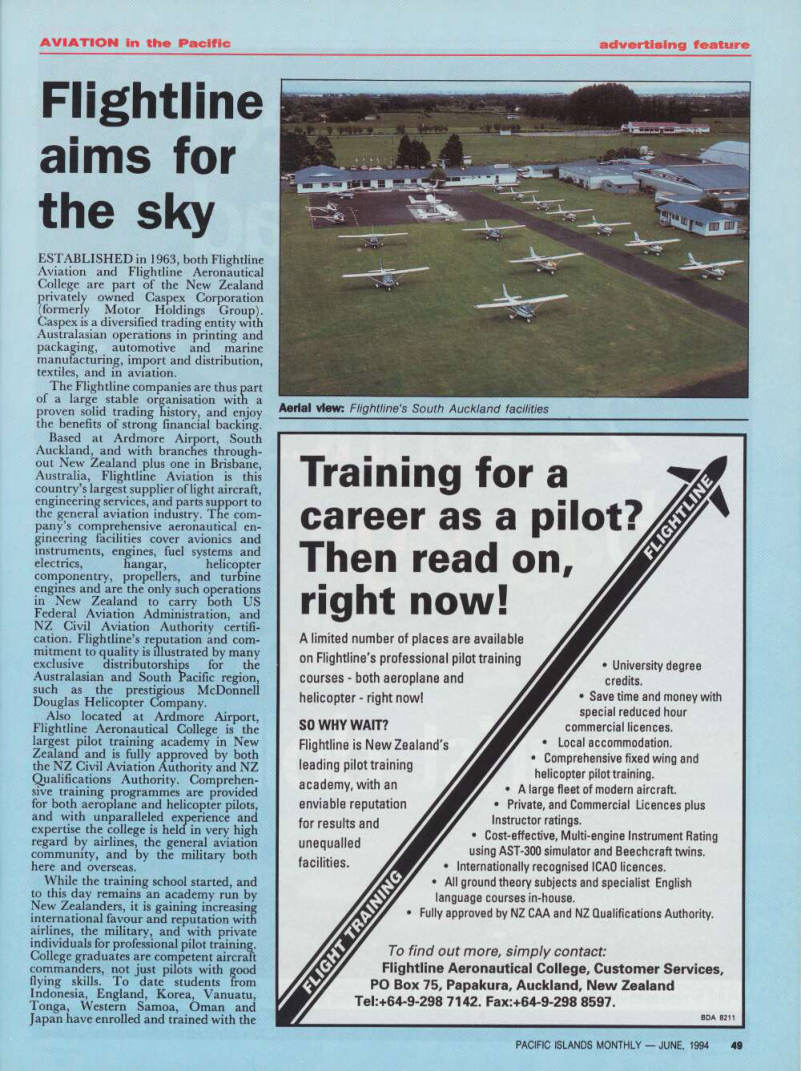

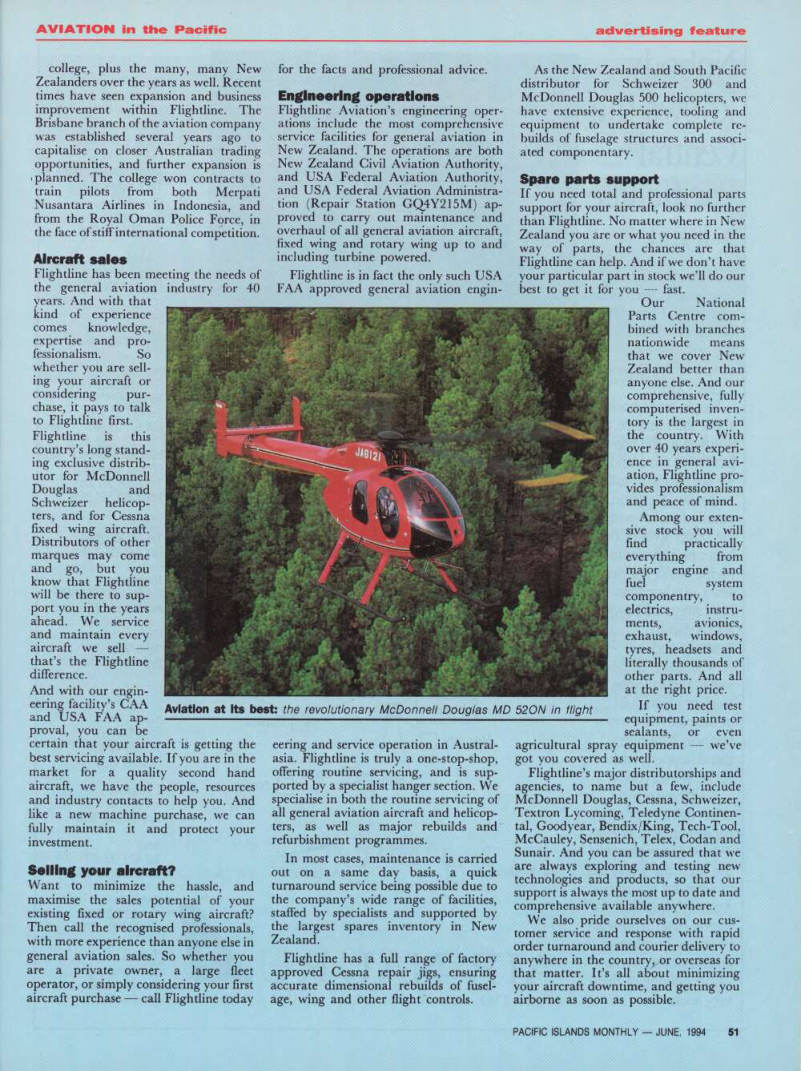
aims for the sky
ESTABLISHED in 1963, both Flightline Aviation and Flightline Aeronautical College are part of the New Zealand privately owned Caspex Corporation (formerly Motor Holdings Group).
Caspex is a diversified trading entity with Australasian operations in printing and packaging, automotive and marine manufacturing, import and distribution, textiles, and in aviation.
The Flightline companies are thus part of a large stable organisation with a proven solid trading history, and enjoy the benefits of strong financial backing.
Based at Ardmore Airport, South Auckland, and with branches through out New Zealand plus one in Brisbane, Australia, Flightline Aviation is this country’s largest supplier of light aircraft, engineering services, and parts support to the general aviation industry. The com pany’s comprehensive aeronautical en gineering facilities cover avionics and instruments, engines, fuel systems and electrics, hangar, helicopter componentry, propellers, and turbine engines and are the only such operations in New Zealand to carry both US Federal Aviation Administration, and NZ Civil Aviation Authority certifi cation. Flightline’s reputation and com mitment to quality is illustrated by many exclusive distributorships for the Australasian and South Pacific region, such as the prestigious McDonnell Douglas Helicopter Company.
Also located at Ardmore Airport, Flightline Aeronautical College is the largest pilot training academy in New Zealand and is fully approved by both the NZ Civil Aviation Authority and NZ
Qualifications Authority. Comprehen
sive training programmes are provided for both aeroplane and helicopter pilots, and with unparalleled experience and expertise the college is held in very high regard by airlines, the general aviation community, and by the military both here and overseas.
While the training school started, and to this day remains an academy run by New Zealanders, it is gaining increasing international favour and reputation with airlines, the military, and with private individuals for professional pilot training.
College graduates are competent aircraft commanders, not just pilots with good flying skills. To date students from Indonesia, England, Korea, Vanuatu, Tonga, Western Samoa, Oman and Japan have enrolled and trained with the
Aerial view: Flightline’s South Auckland facilities
college, plus the many, many New Zealanders over the years as well. Recent times have seen expansion and business improvement within Flightline. The Brisbane branch of the aviation company was established several years ago to capitalise on closer Australian trading opportunities, and further expansion is planned. The college won contracts to train pilots from both Merpati Nusantara Airlines in Indonesia, and from the Royal Oman Police Force, in the face of stiff international competition.
Aircraft sales Flightline has been meeting the needs of the general aviation industry for 40
years. And with that kind of experience comes knowledge, expertise and pro fessionalism. So whether you are sell ing your aircraft or considering pur chase, it pays to talk to Flightline first.
Flightline is this country’s long stand ing exclusive distrib utor for McDonnell Douglas and Schweizer helicop ters, and for Cessna fixed wing aircraft.
Distributors of other marques may come and go, but you know that Flightline will be there to sup port you in the years ahead. We service and maintain every aircraft we sell that’s the Flightline difference.
And with our engin
eering facility’s CAA
and USA FAA ap proval, you can be
certain that your aircraft is getting the best servicing available. If you are in the market for a quality second hand aircraft, we have the people, resources and industry contacts to help you. And like a new machine purchase, we can fully maintain it and protect your investment.
Selling your aircraft?
Want to minimize the hassle, and maximise the sales potential of your existing fixed or rotary wing aircraft?
Then call the recognised professionals, with more experience than anyone else in general aviation sales. So whether you are a private owner, a large fleet operator, or simply considering your first aircraft purchase call Flightline today
for the facts and professional advice.
Engineering operations
Flightline Aviation’s engineering oper ations include the most comprehensive service facilities for general aviation in New Zealand. The operations are both New Zealand Civil Aviation Authority, and USA Federal Aviation Authority, and USA Federal Aviation Administra tion (Repair Station GQ4Y2ISM) ap proved to carry out maintenance and overhaul of all general aviation aircraft, fixed wing and rotary wing up to and including turbine powered.
Flightline is in fact the only such USA FAA approved general aviation engin-
eering and service operation in Austral asia. Flightline is truly a one-stop-shop, offering routine servicing, and is sup ported by a specialist hanger section. We specialise in both the routine servicing of all general aviation aircraft and helicop ters, as well as major rebuilds and refurbishment programmes.
In most cases, maintenance is carried out on a same day basis, a quick turnaround service being possible due to the company’s wide range of facilities, staffed by specialists and supported by the largest spares inventory in New Zealand.
Flightline has a full range of factory approved Cessna repair jigs, ensuring accurate dimensional rebuilds of fusel age, wing and other flight controls.
As the New Zealand and South Pacific distributor for Schweizer 300 and McDonnell Douglas 500 helicopters, we have extensive experience, tooling and equipment to undertake complete re builds of fuselage structures and associ ated componentary.
Spare parts support
If you need total and professional parts support for your aircraft, look no further than Flightline. No matter where in New Zealand you are or what you need in the way of parts, the chances are that Flightline can help. And if we don’t have your particular part in stock we’ll do our best to get it for you fast.
Our National Parts Centre com bined with branches nationwide means that we cover New Zealand better than anyone else. And our comprehensive, fully computerised inven tory is the largest in the country. With over 40 years experi ence in general avi ation, Flightline pro vides professionalism and peace of mind.
Among our exten sive stock you will find practically everything from major engine and fuel system componentry, to electrics, instru ments, avionics, exhaust, windows, tyres, headsets and literally thousands of other parts. And all
at the right price.
If you need test
equipment, paints or
sealants, or even
agricultural spray equipment we’ve
got you covered as well.
Flightline’s major distributorships and
agencies, to name but a few, include McDonnell Douglas, Cessna, Schweizer, Textron Lycoming, Teledyne Continen tal, Goodyear, Bendix/King, Tech-Tool, McCauley, Sensenich, Telex, Codan and Sunair. And you can be assured that we are always exploring and testing new technologies and products, so that our support is always the most up to date and comprehensive available anywhere.
We also pride ourselves on our cus tomer service and response with rapid order turnaround and courier delivery to anywhere in the country ? or overseas for that matter. It’s all about minimizing your aircraft downtime, and getting you airborne as soon as possible.
Aviation at its best: the revolutionary McDonnell Douglas MD 520 N in flight
Advertisements & other items, pp. 49-52 (3 items)
49
advertising feature
PACIFIC ISLANDS MONTHLY JUNE, 1994
AVIATION in the Pacific
right now!
Training for a
career as a
Then read on,
right now!
A limited number of places are available on Flightline's professional pilot training courses - both aeroplane and helicopter - right now!
pilot?
• University degree credits. • Save time and money with special reduced hour commercial licences. • Local accommodation. 1 Comprehensive fixed wing and helicopter pilot training. * A large fleet of modern aircraft.
Private, and Commercial Licences plus Instructor ratings.
Cost-effective, Multi-engine Instrument Rating using AST-300 simulator and Beechcraft twins. • Internationally recognised ICAO licences.
All ground theory subjects and specialist English language courses in-house.
Fully approved by NZ CAA and NZ Qualifications Authority.
To find out more, simply contact: Flightline Aeronautical College, Customer Services, PO Box 75, Papakura, Auckland, New Zealand Tel:+64-9-298 7142. Fax:+64-9-298 8597.
SO WHY WAIT?
Flightline is New Zealand's leading pilot training academy, with an enviable reputation for results and unequalled facilities.
Every week
we unload
1,600 passengers.
24 tonnes of
baggage and
8.2 million
tourist dollars:
r
HMH
■ •• ' ■ Mi the 40 years we've been flying into Nadi, we're proud of the fact that our customers keep coming back to spend their holidays here. air new *As supplied by Fijian Statistics Department
SAATCHIINT 0198
Nobody
knows the
Central
Pacific like
a local.
Air Nauru’s local neighbourhood is Micronesia, a garland of beautiful islands dotted around the perfectly blue waters of the Central Pacific Ocean People write books about the romance, the beauty and the hospitality of the islands we are happy to call home But Air Nauru is equally familiar with the busier lives of our
larger neighbours in the
Pacific Basin For many years, our horizons have stretched beyond Micronesia to . . Manila Australia and *— l New Zealand in the south, Manila in the west and Honululu in the east We carry business passengers,
island-hoppers, back-
packers-everybody!
We have recently taken delivery of two handsome new Boeing 737-400 Series planesthe latest the world has to offer. Air Nauru has Agents throughout the Pacific Basin who will be happy to organise an itinerary to suit you.
Please call one of them - Honolulu
n Guam
Pohnpei Tarawa Nauru Canton Honiara Suva Nadi Sydney Nauru Head Office Sales and Administration Tel 674 444 3724 Fax 674 444 3705 Airport Sales Office Tel 674 444 3218 Civic Centre Sales Office Tel 674 444 3488 Auckland Tel 649 379 8113/8114 Fax 649 379 3763 Guam Tel 671649 7106 Fax 671 649 4856 Honiara (Guadalcanal Travel Service) Tel 677 22 587 Fax 677 23 887 Honululu (Travel Sales Ltd) Tel 1 808 591 2163 Fax 1 808 593 8433 Manila Tel 632 818 3580 Fax 632 817 7386 Melbourne Tel 613 653 5602/5626 Fax 613 654 7376 Nadi Tel 679 722 795 Fax 679 721010 Christmas Is.
Niue Melbourne Auckland very sooa
AIR NAURU^I
AIRLINE OF THE CENTRAL PACIFIC
Niue (Rex Travel) Tel 683 42 86 Fax 683 4131 Pohnpei Tel 691320 5963 Fax 691 320 5932 Suva Tel 679 312 377 Fax 6798 302 861 Sydney Tel 612 2218622 Fax 612 221 7032 Tarawa (Air Tungaru) Tel 686 28 232 Fax 686 28 216
51
advertising feature
PACIFIC ISLANDS MONTHLY JUNE, 1994
AVIATION in the Pacific
Cessna to celebrate with tour
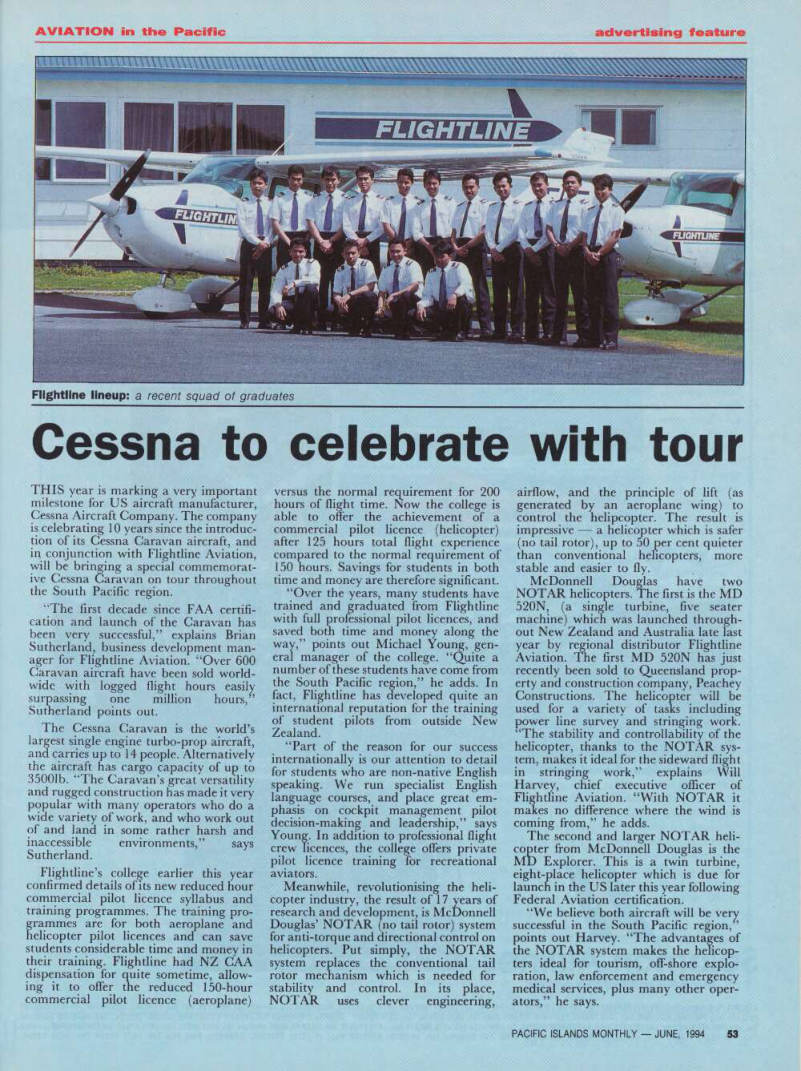
THIS year is marking a very important milestone for US aircraft manufacturer, Cessna Aircraft Company. The company is celebrating 10 years since the introduction of its Cessna Caravan aircraft, and in conjunction with Flightline Aviation, will be bringing a special commemorative Cessna Caravan on tour throughout the South Pacific region.
“The first decade since FAA certification and launch of the Caravan has been very successful,” explains Brian
Sutherland, business development man-
ager for Flightline Aviation. “Over 600 Caravan aircraft have been sold worldwide with logged flight hours easily surpassing one million hours,”
Sutherland points out. ’ ™ „ . . , The Cessna Caravan is the world s arges sing e engine turbo-prop aircraft, an carries up to 14 people. Alternatively Carg ° , Capa ° ty of u P r to , , e Caravan s great versatility an rugged construction has made it very pqpu ar wi rp an > operators who do a wide variety of work, and who work out o an an m some rat er harsh and Suth rl §1 environments, says k u er an .
Flightline’s college earlier this year confirmed details of its new reduced hour commercial pilot licence syllabus and training programmes. The training programmes are for both aeroplane and helicopter pilot licences and can save students considerable time and money in their training. Flightline had NZ CAA dispensation for quite sometime, allowing it to offer the reduced 150-hour commercial pilot licence (aeroplane)
versus the normal requirement for 200 hours of flight time. Now the college is able to offer the achievement of a commercial pilot licence (helicopter) after 125 hours total flight experience compared to the normal requirement of 150 hours. Savings for students in both time and money are therefore significant.
“Over the years, many students have trained and graduated from Flightline professional pilot licences, and saved both time and money along the wa Y>” P oints out Michael Young, genman ager of the college. “Quite a number of these students have come from South Pacific region,” he adds. In act ’ Flightline has developed quite an international reputation for the training of student pilots from outside New Zealand.
“Part of the reason for our success internationally is our attention to detail for students who are non-native English speaking. We run specialist English language courses, and place great emphasis on cockpit management pilot decision-making and leadership,” says Young. In addition to professional flight crew n cenceS) t he college offers private pilot licence training for recreational aviators.
Meanwhile, revolutionising the helicopter industry, the result of 17 years of research and development, is McDonnell Douglas’ NOTAR (no tail rotor) system for anti-torque and directional control on helicopters. Put simply, the NOTAR system replaces the conventional tail rotor mechanism which is needed for stability and control. In its place, NOTAR uses clever engineering,
airflow, and the principle of lift (as
generated by an aeroplane wing) to
control the helipcopter. The result is impressive a helicopter which is safer (no tail rotor), up to 50 per cent quieter than conventional helicopters, more stable and easier to fly.
McDonnell Douglas have two NOTAR helicopters. The first is the MD 520 N, (a single turbine, five seater machine) which was launched through out New Zealand and Australia late last
year by regional distributor Flightline
Aviation. The first MD 520 N has just recently been sold to Queensland prop erty and construction company, Peachey Constructions. The helicopter will be used for a variety of tasks including power line survey and strinsrinar work.
“The stability and controllability of the helicopter, thanks to the NOTAR sys tern, makes it ideal for the sideward flight in stringing work,” explains Will Harvey, chief executive officer of Flightline Aviation. “With NOTAR it makes no difference where the wind is coming from,” he adds, The second and larger NOTAR heli copter from McDonnell Douglas is the MD Explorer. This is a twin turbine, eight-place helicopter which is due for launch in the US later this year following Federal Aviation certification, “We believe both aircraft will be very successful in the South Pacific region,”
points out Harvey. “The advantages of
the NOTAR system makes the helicop ters ideal for tourism, off-shore explo ration, law enforcement and emergency medical services, plus many other oper ators,” he says.
Flightline lineup: a recent squad of graduates
Advertisements & other items, pp. 53-54 (2 items)
advertising feature
AVIATION in the Pacific
Solomon Airlines
- - WP.
The South Pacific?
with Solomon Airlines
, .. „ ft ess? /" y *6 «
Ilf
'v, BE EO m* -
NADI, twice weekly
m f'
port VILA, twice weekly
Solomon Airlines
the new spirit of the pacific
AUSTRALIA: Brisbane Tel: +6l (07) 8604342 Fax: +6l (07) 8604351; Cairns Tel: +6l (70) 311120 Fax: +6l (70) 312378; Melbourne Tel: +6l (03) 321 6860 Fax: +6l (03) 3290082; Sydney Tel: +6l (02) 2391722 Fax: +6l (02) 2903306. FIJI; Nadi Tel: +679 722831 Fax: +679 722140; Suva Tel: +679 315755 Fax: +679 305027. GERMANY: Frankfurt Tel: +37 (69) 172260 Fax: +37 (69) 729314. NEW ZEALAND: Auckland Tel: +64 (09) 308 9098 Fax; +64 (09) 3775654. PAPUA NEW GUINEA: Port Moresby Tel: +675 255724 Fax: +675 250975. SOLOMON ISLANDS; Honiara Tel: +677 20031 Fax: +677 23992. UNITED KINGDOM: London Tel: +44 (732) 743050 Fax: +44 (732) 743055. UNITED STATES: Los Angeles Tel: +1 (310) 6707302 Fax: +1 (310) 3380708. VANUATU; Port Vila Tel: +678 23838 Fax: +678 23250.
Promoting business
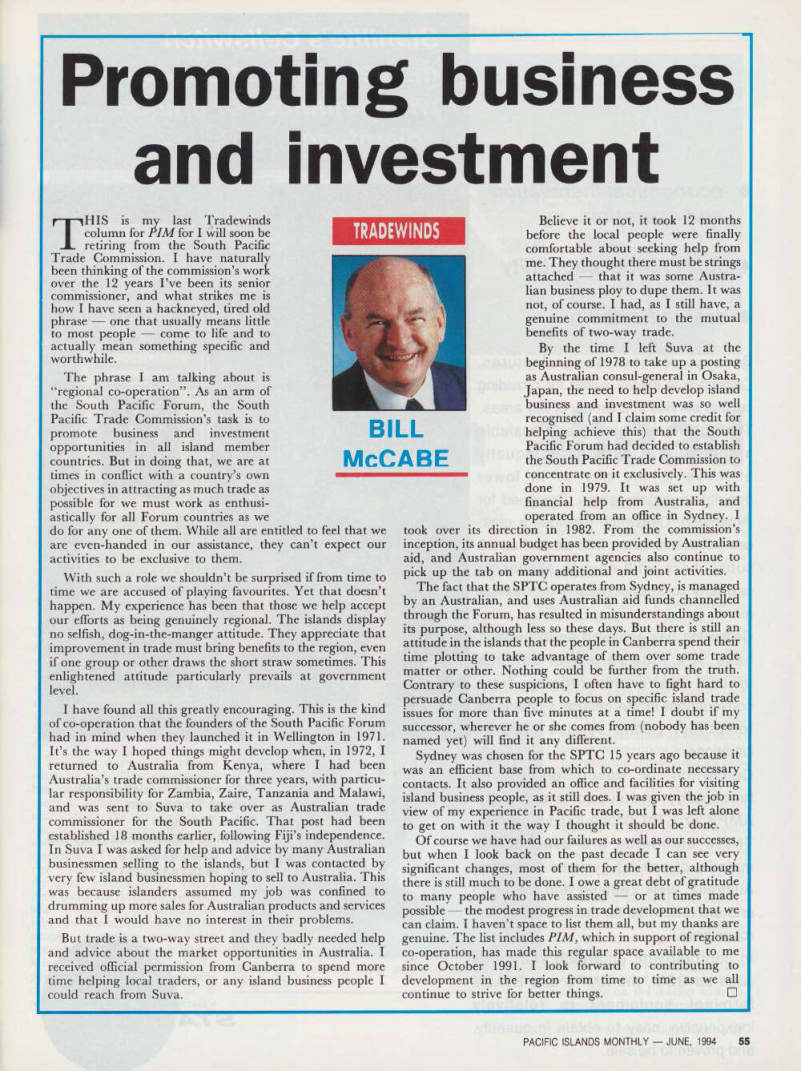
and investment
THIS is my last Tradewinds column for PIM for I will soon be retiring from the South Pacific Trade Commission. I have naturally been thinking of the commission’s work over the 12 years I’ve been its senior commissioner, and what strikes me is how I have seen a hackneyed, tired old phrase one that usually means little to most people come to life and to
actually mean something specific and
worthwhile.
The phrase I am talking about is “regional co-operation”. As an arm of the South Pacific Forum, the South Pacific Trade Commission’s task is to promote business and investment opportunities in all island member countries. But in doing that, we are at times in conflict with a country’s own objectives in attracting as much trade as possible for we must work as enthusi astically for all Forum countries as we
do for any one of them. While all are entitled to feel that we are even-handed in our assistance, they can’t expect our activities to be exclusive to them.
With such a role we shouldn’t be surprised if from time to time we are accused of playing favourites. Yet that doesn’t happen. My experience has been that those we help accept our efforts as being genuinely regional. The islands display no selfish, dog-in-the-manger attitude. They appreciate that improvement in trade must bring benefits to the region, even if one group or other draws the short straw sometimes. This
enlightened attitude particularly prevails at government
level.
I have found all this greatly encouraging. This is the kind of co-operation that the founders of the South Pacific Forum had in mind when they launched it in Wellington in 1971.
It’s the way I hoped things might develop when, in 1972, I returned to Australia from Kenya, where I had been Australia’s trade commissioner for three years, with particu lar responsibility for Zambia, Zaire, Tanzania and Malawi, and was sent to Suva to take over as Australian trade commissioner for the South Pacific. That post had been established 18 months earlier, following Fiji’s independence.
In Suva I was asked for help and advice by many Australian businessmen selling to the islands, but I was contacted by very few island businessmen hoping to sell to Australia. This was because islanders assumed my job was confined to drumming up more sales for Australian products and services and that I would have no interest in their problems.
But trade is a two-way street and they badly needed help and advice about the market opportunities in Australia. I received official permission from Canberra to spend more time helping local traders, or any island business people I could reach from Suva.
Believe it or not, it took 12 months before the local people were finally comfortable about seeking help from me. They thought there must be strings attached that it was some Austra lian business ploy to dupe them. It was not, of course. I had, as I still have, a genuine commitment to the mutual benefits of two-way trade.
By the time I left Suva at the beginning of 1978 to take up a posting as Australian consul-general in Osaka, Japan, the need to help develop island business and investment was so well recognised (and I claim some credit for helping achieve this) that the South Pacific Forum had decided to establish the South Pacific Trade Commission to concentrate on it exclusively. This was done in 1979. It was set up with financial help from Australia, and operated from an office in Sydney. I
took over its direction in 1982. From the commission’s inception, its annual budget has been provided by Australian aid, and Australian government agencies also continue to pick up the tab on many additional and joint activities.
The fact that the SPTC operates from Sydney, is managed by an Australian, and uses Australian aid funds channelled through the Forum, has resulted in misunderstandings about its purpose, although less so these days. But there is still an attitude in the islands that the people in Canberra spend their time plotting to take advantage of them over some trade matter or other. Nothing could be further from the truth.
Contrary to these suspicions, I often have to fight hard to persuade Canberra people to focus on specific island trade issues for more than five minutes at a time! I doubt if my successor, wherever he or she comes from (nobody has been named yet) will find it any different.
Sydney was chosen for the SPTC 15 years ago because it was an efficient base from which to co-ordinate necessary contacts. It also provided an office and facilities for visiting island business people, as it still does. I was given the job in view of my experience in Pacific trade, but I was left alone to get on with it the way I thought it should be done.
Of course we have had our failures as well as our successes, but when I look back on the past decade I can see very significant changes, most of them for the better, although there is still much to be done. I owe a great debt of gratitude to many people who have assisted or at times made possible the modest progress in trade development that we can claim. I haven’t space to list them all, but my thanks are genuine. The list includes PIM, which in support of regional co-operation, has made this regular space available to me since October 1991. I look forward to contributing to development in the region from time to time as we all continue to strive for better things. □
Tradewinds
Bill
Mccabe
Advertisements & other items, p. 56 (1 item)
advantages:
♦ economical installation
and operation
♦ quick rollout capability
♦ design flexibility
Because of these design features, Cellswitch is ideally suited for providing cellular service in a variety of key areas.
Through its modularity and scalable architecture, Cellswitch is equally effective in the city or in lower population density areas. Designed for expansion, Cellswitch provides a costcompetitive solution with as few as 50 subscribers, with enough expansion capacity to support many thousands more.
Cellswitch has achieved an installation base in a wide variety of settings around the world, ranging from conventional urban cellular systems to temporary public service support situations.
Cellswitch is based on proven technology and supports either the AMPS or ETACS cellular standards.
These standards are used by the majority of cellular systems (including Australia, New Zealand and the U.S.) and are renowned for their reliability and robustness.
In contrast with emerging standards such as GSM, the AMPS and ETACS terminal equipment is relatively inexpensive, easy to obtain in quantity, and proven to be safe.
Stan Hite’s Cellswitch
delivers cellular capacity
with a number of unique
advantages:
IBEEBSHEaHiiaaIIB
4 m For further information call: Robert Tomlinson Sales Manager Stanilite Electronics (NZ) Ltd Ph: (649)4156370 Fax: (649)4156371
STiA
*44
Competition ahead



PTC Telecom Advertising Feature
THE managing director of Post and Telikom Corporation, Isikeli Taureka, has said that Telikom faces possible competition due to the deregulation of the telecommunications market. He also called on senior Telikom managers to draw up strategic plans to fit an achievable business plan.
Taureka said this when he opened a
week-long strategic planning workshop
for senior Telikom managers at
the Port Moresby Travelodge
Hotel in April. The workshop was conducted by strategic plan ning experts Doctor Noel Lindsay and Owen Tilbury from
Bond University, in Queensland,
Australia.
Taureka warned his officers when he said: “The government has re-established the Depart ment of Information and Com munications, the development of the policy on information and communications which does not recognise PTC as the sole car rier.” The policy, he said, did not
recognise ownership by Papua
New Guineans. Instead, Taureka said, it intended to liberalise the telecommunications network by people or entities who could provide services efficiently and at a competitive price. He said the possible introduction of a second cellular mobile carrier or a second international gateway
Telikom boss urges
preparedness for
changes in industry
gave emphasis to the government policy that they meant business.
“In fact, it’s the government’s policy to commercialise and corporatise PTC as
a carr^er anc * P°li c y regulator or both.
The notion that has been ingrained that PTC has the complete monopoly on communications services owned by the people of PNG is out the window,”
Taureka said.
“I would suggest that there is nothing to stop Hitron or EMTV from introduc *n§ vo * ce or data,” Taureka said, “Our strategy must recognise these
competitive threats and take them into account and accommo date an objective to be preferred carrier. I say this because change is inevitable,” he said.
“The unbungling of regulation
which constraints us from react ing to competition will be affec ted with the corporatisation pro cess which is slowly gaining momentum.” He said that in stead of reacting to competition in a negative and confrontative manner, Telikom should respond positively in re-assessing its busi ness strategies.
On whether Telikom should look at joint ventures in areas of a network where it was vulner able to lack resources and exper tise or whether it should establish wholly owned departments such as data services, pay phones, and information technology, ad equately funded and autonomous and take on the market with an aggressive stance, Taureka said:
Advanced technology: four transportable interim mobile earth stations installed and ready for use in emergencies. In the background is the full DOMSAT Earth Station
On the Job: restoring power supply to domestic satellite equipment in Buin
“Frankly, as I see it, that in an
industry perspective and the community
requires access to freedom of information and communication.”
The managing director said the gov ernment or PTC could not deny the people this basic human right.
“In these circumstances, there might be partial dismantling of the network and the corporation may only hold a dominant position in the trunk routes and external plant because of the substantial up front investment on ongo ing maintenance of these networks and anything else would be up for grabs.”
Taureka told the senior Telikom managers that there was no room for complacency and internal conflict and
that they must plan strategies which
should be linked to an achievable business plan. □
Client service: two linesmen connect telephones for a customer
Equipment: antennas of HF radio on Tasman Island
Reliable service: an operator talks to a customer reporting a line fault
Advertisements & other items, pp. 58-59 (1 item)
pmsm i(r~ 4
I IE Hflflnus DIGITAL OPEfllfiG 6/ * r 77/8 rr-T » ■» *r »' , y % if; ‘ *#s ■y. i #/ >•■* % v » ms ' ii • .ia •s *1 ,#•’ - .X * 4K ♦# .7-*. / *■- A W a > \ c V-v ■ W at,» * . iiM> r S' ~.’*j M
- r-;' stvrv
t : • . -
WPSB
s® •V', «... A > 4ft *-
rSC»
8 a * ■ 9U A* H m r* : d mt m * nw
NICATION CORPO
* / * /. **• l¥
Olex Cables design and manufacture the following range of standards
approved cables:
• Fibre Optic Cables • Flexible Cobles • Instrumentation Cobles • Mining Cobles • Rend Cobles • Telephone Cobles • Lead Covered Pocuer Cobles • High Voltage Pouuer Cobles • Doto Cobles • Pyrolex Cobles • Ship LUiring Cobles Olex Cables Project Services offer o full design, installation and management service. For further information contact:
INTCRNfITIONfIL SfILCS
207 Sunshine Rood Tottenham Victoria Australia 3012 Phone 613 316 2222 Fox 613 314 0383
OlE\cn6ies
AUSTRALIA
The specialist
cable manufacturer
Tahiti boasts proud soccer tradition
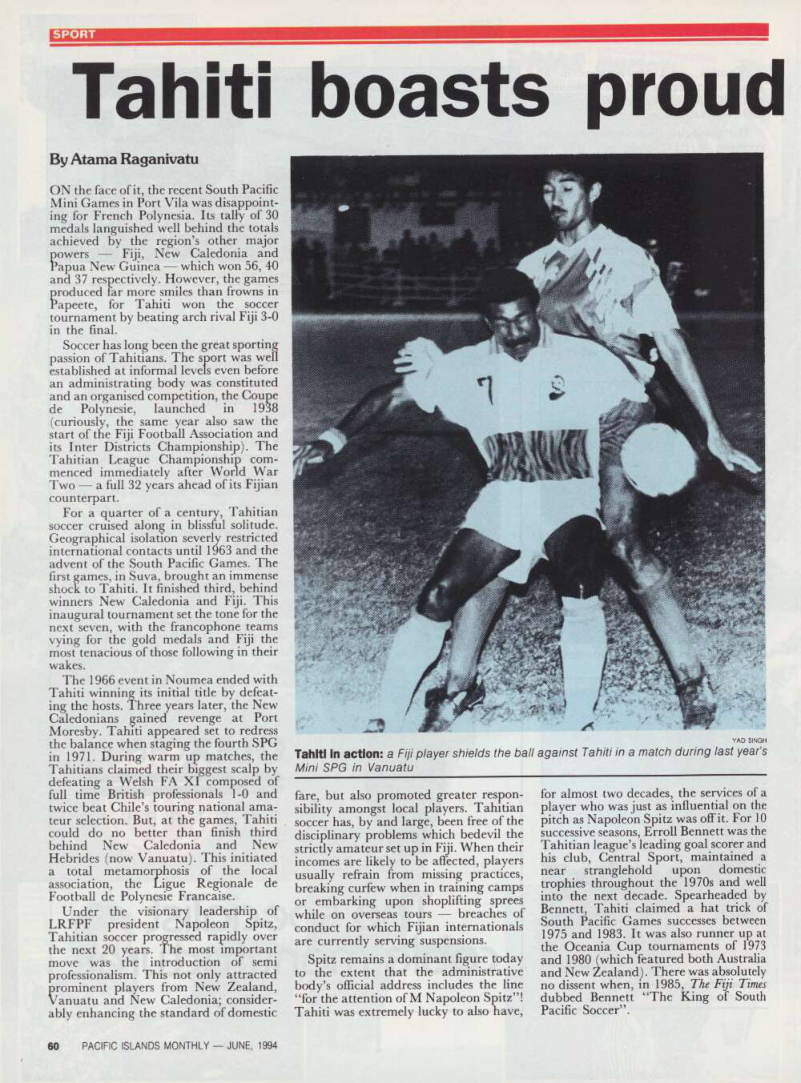
Sport
By Atama Raganivatu
ON the face of it, the recent South Pacific Mini Games in Port Vila was disappoint ing for French Polynesia. Its tally of 30 medals languished well behind the totals achieved by the region’s other major powers Fiji, New Caledonia and Papua New Guinea which won 56, 40 and 37 respectively. However, the games produced far more smiles than frowns in Papeete, for Tahiti won the soccer tournament by beating arch rival Fiji 3-0 in the final.
Soccer has long been the great sporting passion of Tahitians. The sport was well established at informal levels even before an administrating body was constituted and an organised competition, the Coupe de Polynesie, launched in 1938 (curiously, the same year also saw the start of the Fiji Football Association and its Inter Districts Championship). The Tahitian League Championship com menced immediately after World War Two a full 32 years ahead of its Fijian counterpart.
For a quarter of a century, Tahitian soccer cruised along in blissful solitude.
Geographical isolation severly restricted international contacts until 1963 and the advent of the South Pacific Games. The first games, in Suva, brought an immense shock to Tahiti. It finished third, behind winners New Caledonia and Fiji. This inaugural tournament set the tone for the next seven, with the francophone teams vying for the gold medals and Fiji the most tenacious of those following in their wakes.
The 1966 event in Noumea ended with Tahiti winning its initial title by defeat ing the hosts. Three years later, the New Caledonians gained revenge at Port Moresby. Tahiti appeared set to redress the balance when staging the fourth SPG in 1971. During warm up matches, the Tahitians claimed their biggest scalp by defeating a Welsh FA XI composed of full time British professionals 1-0 and twice beat Chile’s touring national ama teur selection. But, at the games, Tahiti could do no better than finish third behind New Caledonia and New Hebrides (now Vanuatu). This initiated a total metamorphosis of the local association, the Ligue Regionale de Football de Polynesie Francaise.
Under the visionary leadership of LRFPF president Napoleon bpitz, Tahitian soccer progressed rapidly over the next 20 years. The most important move was the introduction of semi professionalism. This not only attracted prominent players from New Zealand, Vanuatu and New Caledonia; consider ably enhancing the standard of domestic
fare, but also promoted greater responsibility amongst local players. Tahitian soccer has, by and large, been free of the disciplinary problems which bedevil the strictly amateur set up in Fiji. When their incomes are likely to be affected, players usually refrain from missing practices, breaking curfew when in training camps or embarking upon shoplifting sprees while on overseas tours - breaches of , . c t • i T 7- • . conduct for which Fijian internationals are currently serving suspensions.
Spitz remains a dominant figure today to the extent that the administrative body’s official address includes the line “for the attention of M Napoleon Spitz”!
Tahiti was extremely lucky to also have,
for almost two decades, the services of a player who was just as influential on the pitch as Napoleon Spitz was offit. For 10 successive seasons, Erroll Bennett was the Tahitian league s leading goal scorer and his club, Central Sport, maintained a near stranglehold upon domestic trophies throughout the 1970 sand we '' llo the Jl ext . decade. Spearheade by Bennett Tahiti claimed a hat trick of South Pacific Games successes between an( 1933. It was also runner up at the oceania Cup tourna ments of and 1980 (which featured both Australia and New Zealand). There was absolutely no dissent when, in 1985, The Fiji Times dubbed Bennett “The King of South Pacific Soccer”.
Yad Singh
Tahiti in action: a Fiji player shields the ball against Tahiti in a match during last year's Mini SPG in Vanuatu
Such was Bennett’s standing that when he joined the Church of Jesus Christ of Latter Day Saints in 1977, the Tahitian League switched its fixtures from Sun days to mid week dates and prevented his retirement due to Mormons’ refusal to play sport on the Sabbath. Spitz also persuaded the South Pacific Games Committee to reschedule its soccer pro gramme to accommodate his captain!
However, the slightly built policeman failed in his attempt to become a full time professional in Europe. Homesickness led to Bennett’s early return to Papeete after a short, unproductive, stint with the now defunct FC Paris in 1971. The next outstanding product of Tahitian soccer fared better.
Pascal Vahirua, an “old fashioned” left winger blessed with superb ball control joined one of Papeete’s Cinderella clubs, Mataia, when eight just as his father and elder brother had done before him. By the time he was 16, Vahirua’s goals were keeping Mataia in the league’s top section, the Honours Division. After starring for the Tahitian side that won an international youth tournament in Corsica, Vahirua was signed by French first division outfit AJ Auxerre in 1983 and, in the intervening years, played a major role in the little provincial club’s establishment, for the first time, as a real power.
In 1990, Vahirua became the only Tahitian to ever represent France when gaining the first of a handful of caps against Kuwait. Cynics claim his call up was in membership to FIFA, the govern ing body of international soccer, in the same year. Once selected for one FIFA
member, a player is ineligible to appear for another.
Tahitian soccer administrators are notoriously independently minded. For many years, the most apparent indi cation of this was their sides going into battle under the banner of Tahiti rather than the government-preferred and of ficially correct (although very few
Tahiti has established Itself as a force to be reckoned with on the soccer field. Free of disciplinary problems which plague other countries, the Tahitians have grown from strength to strength
players from the outer islands groups have ever been included) French Poly nesia.
France has been averse to permitting her colonies to become visible separate entities and, although Macao, Hong Kong and several British and Dutch territories in the Caribbean have been part of the international soccer main stream for a long time, Paris only reluctantly permitted Tahiti to become a FIFA member in 1990 after a protracted battle. Membership enabled Tahiti to make its World Cup debut two years ago when Australia was given a couple of hard games. Kingpin of the current team is gifted linkman Reynald Temarii. In 1990, he followed in the footsteps of
Bennet and Vahirua and spent two seasons with leading French club EC Nantes but failed to make an impact there. Nor did Temarii achieve much during a short stint at Brisbane United of Australia’s national league. He has never let Tahiti down though and his dominance of midfield was instrumental in Fiji’s downfall at the Mini Games.
Fiji’s triurrmh at the 1991 SPG in Papua New Guinea was, at the time, regarded as a major turning point in regional soccer. However, it must now be recognised as merely an aberration. With Spitz’s hand still firmly on the organis ation now known as the Federation Tahitienne de Football and the domestic structure as strong as ever, Tahiti is well placed to continue producing players of the calibre of Bennett, Vahirua and Temarii. Add to this the turmoil that appears to be the norm now in Fiji as well as the state of the game in New Caledonia, which has yet to overcome the lengthy disruption to domestic com petitions caused by civil unrest in the mid 1980s and nobody can blame the Tahitians for being ultra-confident of success at the SPG it will host next year.
On the broader front, Tahiti is intent upon overtaking a seriously-on-the-wane New Zealand as Oceania’s second best team before too long. The future cer tainly appears to be bright for Tahitian soccer. ■ The team last month completed a three-match tour in Fiji with games in the capital Suva and two of the main towns. The first was held at Labasa on May 19, with the others in Suva and Lautoka on May 23 and 25 respectively.
W Samoa boxers grab gold
WESTERN Samoa broke Australia and New Zealand’s traditional stranglehold upon the annual Oceania Amateur Boxing Championships by capturing two gold medals at this year’s tournament in Port Vila; light middle weight Bob Casio and super heavy weight Emelio Led both gaining decis ive points decisions over Kiwi and Aussie opponents in their respective finals.
Host Vanuatu was delighted to capture a first ever silver medal and the young, inexperienced Solomon Islands squad fully deserved the same reward after a series of impressive showings.
Papua New Guinea took home two silvers, but must have felt it should have done better.
Fiji’s failure to provide a finalist largely reflected the strength of profes sional boxing there with fighters now joining the paid ranks after only the briefest amateur experience.
Tonga’s morale received a battering when the highly rated Peaa Wolfgramm was declared ineligible to compete on the tournament’s eve due to “residential ineligibility”. He had not lived in the Kingdom for the previous six months. Nonetheless, the team’s Australian coach, Cameron Todd, had every reason to state on the finals night that he was “encouraged by the boys’ performances and thrilled we got a bronze medal”. Disappointingly, Cook Islands, Guam and American Samoa were unable to send teams. □
Poaching days over
THE days of New Zealand poaching Manu Samoa players are over. A ruling by the International Rugby Board that any player wishing to switch from one country to another must stand down for three years has effectively slammed down the door on “dual internationals”. Previously, a gentleman’s agreement existed be tween the Western Samoan and New Zealand rugby unions which allowed players until February 15 of each year to declare the nation they would represent if eligible for both. Upon learning of the ruling, Western Samoa’s technical director Bryan Williams observed, “It practically stops any player from appearing for a second country because, at interna tional level, players can’t afford to wait for three years.” □
Maori setback
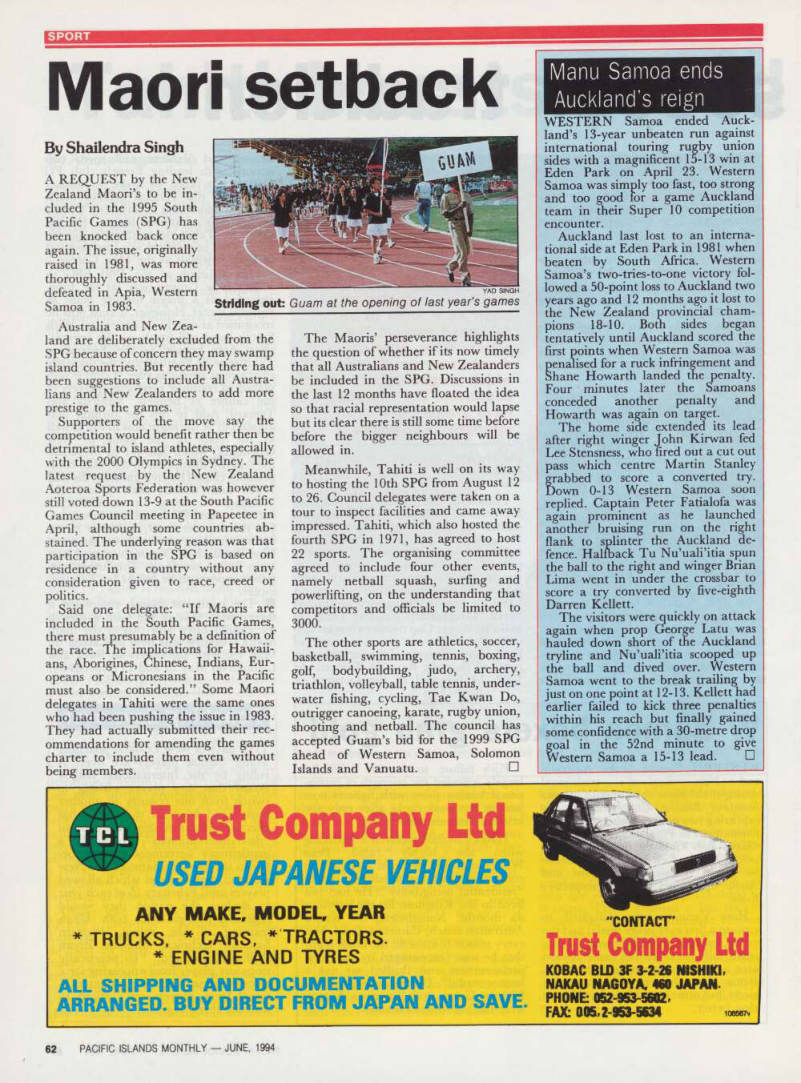
By Shailendra Singh
A REQUEST by the New Zealand Maori’s to be in cluded in the 1995 South Pacific Games (SPG) has been knocked back once again. The issue, originally raised in 1981, was more thoroughly discussed and defeated in Apia, Western Samoa in 1983.
Australia and New Zea land are deliberately excluded from the SPG because of concern they may swamp island countries. But recently there had been suggestions to include all Austra lians and New Zealanders to add more prestige to the games.
Supporters of the move say the competition would benefit rather then be detrimental to island athletes, especially with the 2000 Olympics in Sydney. The latest request by the New Zealand Aoteroa Sports Federation was however still voted down 13-9 at the South Pacific Games Council meeting in Papeetee in April, although some countries ab stained. The underlying reason was that participation in the SPG is based on residence in a country without any consideration given to race, creed or
politics.
Said one delegate: “If Maoris are included in the South Pacific Games, there must presumably be a definition of the race. The implications for Hawaii ans, Aborigines, Chinese, Indians, Eur opeans or Micronesians in the Pacific must also be considered.” Some Maori delegates in Tahiti were the same ones who had been pushing the issue in 1983.
They had actually submitted their rec ommendations for amending the games charter to include them even without being members.
The Maoris’ perseverance highlights the question of whether if its now timely that all Australians and New Zealanders be included in the SPG. Discussions in the last 12 months have floated the idea so that racial representation would lapse but its clear there is still some time before before the bigger neighbours will be allowed in. „ Meanwhile, Tahiti is well on its way to hosting the 10th SPG from Angus 2 to 26. Council delegates were taken on a tour to inspect facilities and came away impressed. Tahiti, which also hosted the fourth SPG in 1971, has agreed to host 22 sports. The organising committee agreed to include four other events, namely netball squash, surfing and powerlifting, on the understanding that competitors and officials be limited to 3000. are athled soccer „K. . , • basketball swimming, tennis, boxing,
P'C, bodybuilding, udo, archery,
triathlon volleyba 1, table tennis, under water fishing, cycling, Tae Kwan o, outrigger canoeing, karate, rugby union, shooting and netball. The council has accepted Guam s bid for the 1999 SPG ahead of Western Samoa, Solomon Islands and Vanuatu. D
Yad Singh
Striding out: Guam at the opening of last year's games
Auckland's reign
Manu Samoa ends Auckland's reign
WESTERN Samoa ended Auck land’s 13-year unbeaten run against international touring rugby union sides with a magnificent 15-13 win at Eden Park on April 23. Western Samoa was simply too fast, too strong and too good for a game Auckland team in their Super 10 competition encounter.
Auckland last lost to an interna tional side at Eden Park in 1981 when beaten by South Africa. Western Samoa’s two-tries-to-one victory fol lowed a 50-point loss to Auckland two years ago and 12 months ago it lost to the New Zealand provincial cham pions 18-10. Both sides began tentatively until Auckland scored the first points when Western Samoa was penalised for a ruck infringement and Shane Howarth landed the penalty.
Four minutes later the Samoans conceded another penalty and Howarth was again on target.
The home side extended its lead after right winger John Kirwan fed Lee Stensness, who fired out a cut out pass which centre Martin Stanley grabbed to score a converted try.
Down 0-13 Western Samoa soon replied. Captain Peter Fatialofa was again prominent as he launched another bruising run on the right flank to splinter the Auckland de fence. Halfback Tu Nu’uali’itia spun the ball to the right and winger Brian Lima went in under the crossbar to score a try converted by five-eighth Darren Kellett.
The visitors were quickly on attack again when prop George Latu was hauled down short of the Auckland tryline and Nu’uali’itia scooped up the ball and dived over. Western Samoa went to the break trailing by just on one point at 12-13. Kellett had earlier failed to kick three penalties within his reach but finally gained some confidence with a 30-metre drop goal in the 52nd minute to give Western Samoa a 15-13 lead. □
Advertisements & other items, p. 62 (1 item)
Trust Company Ltd
USED JAPANESE VEHICLES
ANY MAKE. MODEL YEAR
* TRUCKS, * CARS, * TRACTORS.
* ENGINE AND TYRES
ALL SHIPPING AND DOCUMENTATION
ARRANGED. BUY DIRECT FROM JAPAN AND SAVE.
"CONTACT
Trust Company Ltd
KOBAC BLD 3F 3-2-26 NISHIKI.
NAKAU NAGOYA. 460 JAPAN.
PHONE: 052-953-5602'
FAX! 005.2-953-5634
‘Don’t mention Rainbow’
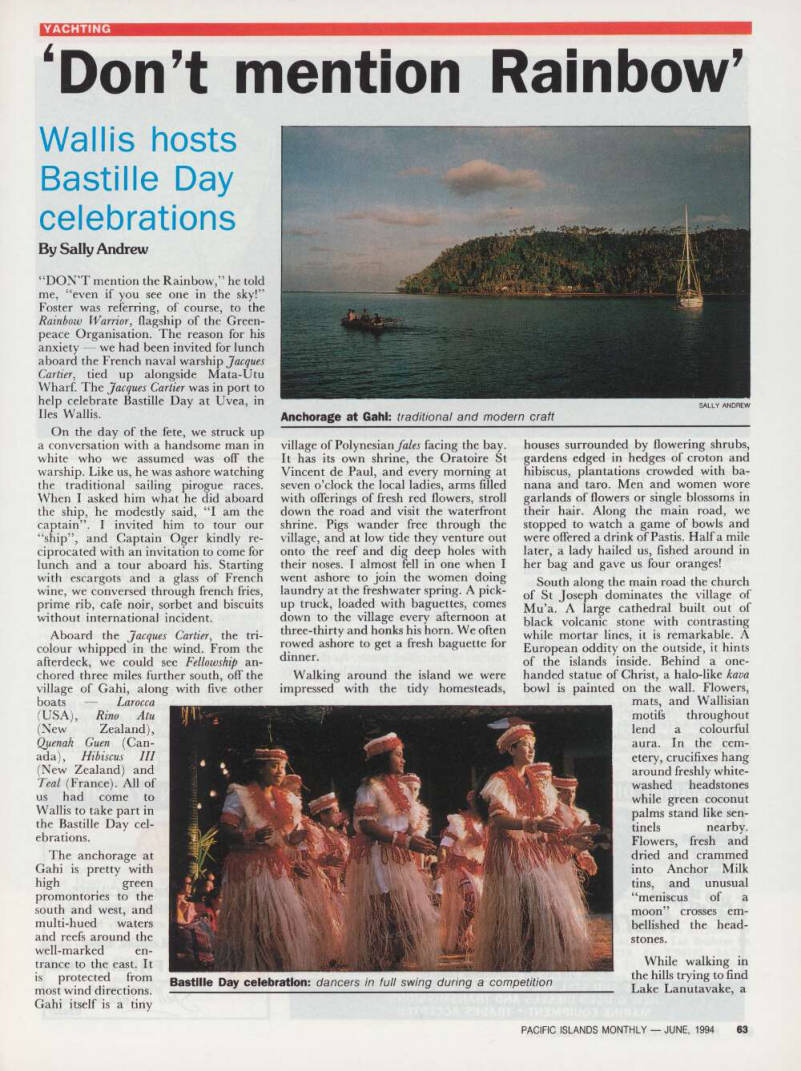
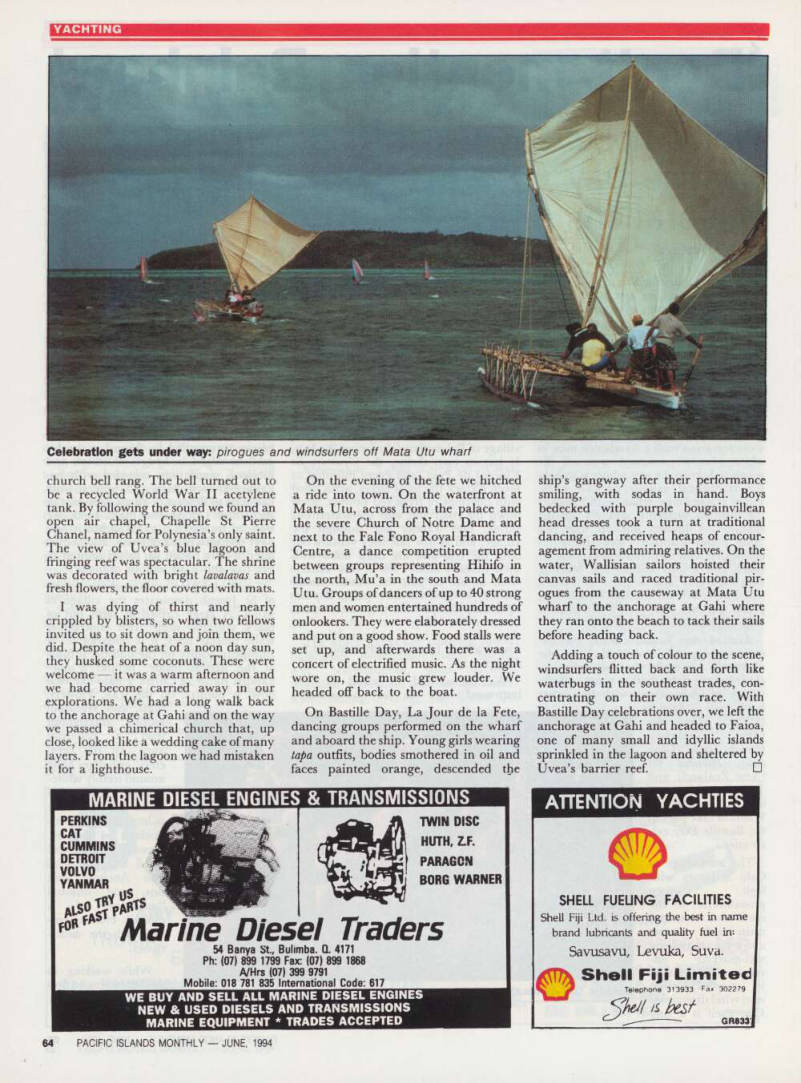
Yachting
Wallis hosts Bastille Day celebrations
By Sally Andrew
“DON’T mention the Rainbow,” he told me, “even if you see one in the sky!”
Foster was referring, of course, to the Rainbow Warrior, flagship of the Green peace Organisation. The reason for his anxiety we had been invited for lunch aboard the French naval warship Jacques Cartier, tied up alongside Mata-Utu Wharf. The Jacques Cartier was in port to help celebrate Bastille Day at Uvea, in lies Wallis.
On the day of the fete, we struck up a conversation with a handsome man in white who we assumed was off the warship. Like us, he was ashore watching the traditional sailing pirogue races.
When I asked him what he did aboard the ship, he modestly said, “I am the captain”. I invited him to tour our
“ship”, and Captain Oger kindly re
ciprocated with an invitation to come for lunch and a tour aboard his. Starting with escargots and a glass of French wine, we conversed through french fries, prime rib, cafe noir, sorbet and biscuits without international incident.
Aboard the Jacques Cartier, the tri colour whipped in the wind. From the afterdeck, we could see Fellowship an chored three miles further south, off the village of Gahi, along with five other
boats Larocca (USA), Rino Atu
(New Zealand),
Quenah Guen (Can
ada), Hibiscus 111 (New Zealand) and Teal (France). All of us had come to Wallis to take part in the Bastille Day cel ebrations.
The anchorage at Gahi is pretty with
high green
promontories to the south and west, and multi-hued waters and reefs around the well-marked en trance to the east. It is protected from most wind directions.
Gahi itself is a tiny
village of Polynesian fales facing the bay.
It has its own shrine, the Oratoire St Vincent de Paul, and every morning at seven o’clock the local ladies, arms filled with offerings of fresh red flowers, stroll down the road and visit the waterfront shrine. Pigs wander free through the village, and at low tide they venture out onto the reef and dig deep holes with their noses. I almost fell in one when I went ashore to join the women doing laundry at the freshwater spring. A pickup truck, loaded with baguettes, comes down to the village every afternoon at three-thirty and honks his horn. We often rowed ashore to get a fresh baguette for dinner.
Walking around the island we were impressed with the tidy homesteads,
houses surrounded by flowering shrubs, gardens edged in hedges of croton and hibiscus, plantations crowded with ba nana and taro. Men and women wore garlands of flowers or single blossoms in their hair. Along the main road, we stopped to watch a game of bowls and were offered a drink of Pastis. Half a mile later, a lady hailed us, fished around in her bag and gave us four oranges!
South along the main road the church j ose pp dominates the village of Mu’a A large cathedral built out of bl ac k volcanic stone with contrasting w hile mortar lines, it is remarkable. A E uro pean oddity on the outside, it hints 0 f the islands inside. Behind a one handed statue of Christ, a halo-like kava bowl is painted on the wall. Flowers,
mats, and Wallisian
motifs throughout
lend a colourful aura. In the cem etery, crucifixes hang around freshly white washed headstones while green coconut palms stand like sen
tinels nearby.
Flowers, fresh and dried and crammed into Anchor Milk tins, and unusual “meniscus of a moon” crosses em bellished the head stones.
While walking in the hills trying to find Lake Lanutavake, a
Bastille Day celebration: dancers in full swing during a competition
Sally Andrew
Anchorage at Gahl: traditional and modern craft
church bell rang. The bell turned out to be a recycled World War II acetylene tank. By following the sound we found an open air chapel, Chapelle St Pierre Chanel, named for Polynesia’s only saint.
The view of Uvea’s blue lagoon and fringing reef was spectacular. The shrine was decorated with bright lavalavas and fresh flowers, the floor covered with mats.
I was dying of thirst and nearly crippled by blisters, so when two fellows invited us to sit down and join them, we did. Despite the heat of a noon day sun, they husked some coconuts. These were welcome it was a warm afternoon and we had become carried away in our explorations. We had a long walk back to the anchorage at Gahi and on the way we passed a chimerical church that, up close, looked like a wedding cake of many layers. From the lagoon we had mistaken it for a lighthouse.
On the evening of the fete we hitched a ride into town. On the waterfront at Mata Utu, across from the palace and the severe Church of Notre Dame and next to the Fale Fono Royal Handicraft Centre, a dance competition erupted between groups representing Hihifo in the north, Mu’a in the south and Mata Utu. Groups of dancers of up to 40 strong men and women entertained hundreds of onlookers. They were elaborately dressed and put on a good show. Food stalls were set up, and afterwards there was a concert of electrified music. As the night wore on, the music grew louder. We headed off back to the boat.
On Bastille Day, La Jour de la Fete, dancing groups performed on the wharf and aboard the ship. Young girls wearing tapa outfits, bodies smothered in oil and faces painted orange, descended the
ship’s gangway after their performance smiling, with sodas in hand. Boys bedecked with purple bougainvillean head dresses took a turn at traditional dancing, and received heaps of encour agement from admiring relatives. On the water, Wallisian sailors hoisted their canvas sails and raced traditional pir ogues from the causeway at Mata Utu wharf to the anchorage at Gahi where they ran onto the beach to tack their sails before heading back.
Adding a touch of colour to the scene, windsurfers flitted back and forth like waterbugs in the southeast trades, con centrating on their own race. With Bastille Day celebrations over, we left the anchorage at Gahi and headed to Faioa, one of many small and idyllic islands sprinkled in the lagoon and sheltered by Uvea’s barrier reef. □
Celebration gets under way: pirogues and windsurfers off Mata Utu wharf
Advertisements & other items, p. 64 (1 item)
Als ( °.St$ Ts
MARINE DIESEL ENGINES & TRANSMISSIONS
PERKINS
CAT
CUMMINS
DETROIT
VOLVO
YANMAR
AlS ( °.sT$ TS
Marine Diesel Traders
TWIN DISC
HUTH, Z.F.
PARAGON
BORG WARNER
fOB
54 Banya St, Bulimba. Q. 4171 Ph: (07) 899 1799 Fax: (07) 899 1868 A/Hrs (07) 399 9791 Mobile: 018 781 835 International Code: 617 WE BUY AND SELL ALL MARINE DIESEL ENGINES
NEW & USED DIESELS AND TRANSMISSIONS
MARINE EQUIPMENT * TRADES ACCEPTED
ATTENTION YACHTIES
SHELL FUEUNG FACILITIES
Shell Fiji Ltd. is offering the best in name brand lubricants and quality fuel in: Savusavu, Levuka, Suva.
Shell Fiji Limited Telephone 313933 Fax 302279 ©
/s best
GRB33
Shipping
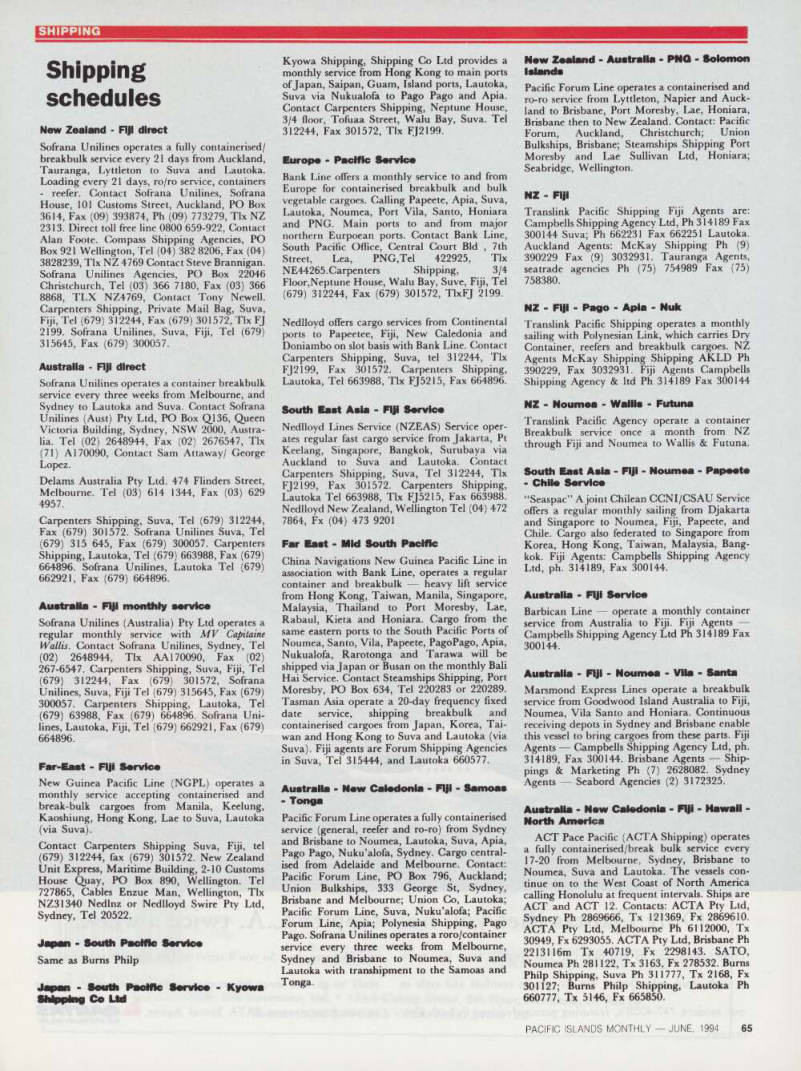
schedules
New Zealand - FIJI direct Sofrana Unilines operates a fully containerised/ breakbulk service every 21 days from Auckland, Tauranga, Lyttleton to Suva and Lautoka.
Loading every 21 days, ro/ro service, containers - reefer. Contact Sofrana Unilines, Sofrana House, 101 Customs Street, Auckland, PO Box 3614, Fax (09) 393874, Ph (09) 773279, Tlx NZ 2313. Direct toll free line 0800 659-922, Contact Alan Foote. Compass Shipping Agencies, PO Box 921 Wellington, Tel (04) 382 8206, Fax (04) 3828239, Tlx NZ 4769 Contact Steve Brannigan.
Sofrana Unilines Agencies, PO Box 22046 Christchurch, Tel (03) 366 7180, Fax (03) 366 8868, TLX NZ4769, Contact Tony Newell.
Carpenters Shipping, Private Mail Bag, Suva,
Fiji, Tel (679) 312244, Fax (679) 301572, Tlx FJ 2199. Sofrana Unilines, Suva, Fiji, Tel (679) 315645, Fax (679) 300057.
Australia - FIJI direct Sofrana Unilines operates a container breakbulk service every three weeks from Melbourne, and Sydney to Lautoka and Suva. Contact Sofrana Unilines (Aust) Pty Ltd, PO Box Q 136, Queen Victoria Building, Sydney, NSW 2000, Austra lia. Tel (02) 2648944, Fax (02) 2676547, Tlx (71) A 170090, Contact Sam Attaway/ George
Lopez.
Delams Australia Pty Ltd. 474 Flinders Street, Melbourne. Tel (03) 614 1344, Fax (03) 629 4957.
Carpenters Shipping, Suva, Tel (679) 312244, Fax (679) 301572. Sofrana Unilines Suva, Tel (679) 315 645, Fax (679) 300057. Carpenters Shipping, Lautoka, Tel (679) 663988, Fax (679) 664896. Sofrana Unilines, Lautoka Tel (679) 662921, Fax (679) 664896.
Australia - FIJI monthly service Sofrana Unilines (Australia) Pty Ltd operates a regular monthly service with MV Capitaine Wallis. Contact Sofrana Unilines, Sydney, Tel (02) 2648944, Tlx AA170090, Fax (02)
267-6547. Carpenters Shipping, Suva, Fiji, Tel
(679) 312244, Fax (679) 301572, Sofrana Unilines, Suva, Fiji Tel (679) 315645, Fax (679) 300057. Carpenters Shipping, Lautoka, Tel (679) 63988, Fax (679) 664896. Sofrana Uni lines, Lautoka, Fiji, Tel (679) 662921, Fax (679) 664896.
Far-East - FIJI Service New Guinea Pacific Line (NGPL) operates a monthly service accepting containerised and break-bulk cargoes from Manila, Keelung, Kaoshiung, Hong Kong, Lae to Suva, Lautoka
(via Suva).
Contact Carpenters Shipping Suva, Fiji, tel
(679) 312244, fax (679) 301572. New Zealand Unit Express, Maritime Building, 2-10 Customs House Quay, PO Box 890, Wellington. Tel 727865, Cables Enzue Man, Wellington, Tlx NZ31340 Nedlnz or Nedlloyd Swire Pty Ltd, Sydney, Tel 20522.
Japan - South Pacific Sondes Same as Burns Philp Japan - South Pacific Service - Kyowa Shipping Co Ltd
Kyowa Shipping, Shipping Co Ltd provides a monthly service from Hong Kong to main ports of Japan, Saipan, Guam, Island ports, Lautoka, Suva via Nukualofa to Pago Pago and Apia.
Contact Carpenters Shipping, Neptune House, 3/4 floor, Tofuaa Street, Walu Bay, Suva. Tel 312244, Fax 301572, Tlx FJ2199.
Europe - Pacific Service Bank Line offers a monthly service to and from Europe for containerised breakbulk and bulk vegetable cargoes. Calling Papeete, Apia, Suva, Lautoka, Noumea, Port Vila, Santo, Honiara and PNG. Main ports to and from major northern Eurpoean ports. Contact Bank Line, South Pacific Office, Central Court Bid , 7th Street, Lea, PNG,TeI 422925, Tlx NE4426s.Carpenters Shipping, 3/4 Floor,Neptune House, Walu Bay, Suve, Fiji, Tel (679) 312244, Fax (679) 301572, TIxFJ 2199.
Nedlloyd offers cargo services from Continental ports to Papeetee, Fiji, New Caledonia and Doniambo on slot basis with Bank Line. Contact Carpenters Shipping, Suva, tel 312244, Tlx FJ2199, Fax 301572. Carpenters Shipping, Lautoka, Tel 663988, Tlx FJ5215, Fax 664896.
South East Asia - Fiji Service Nedlloyd Lines Service (NZEAS) Service oper ates regular fast cargo service from Jakarta, Pt Keelang, Singapore, Bangkok, Surubaya via Auckland to Suva and Lautoka. Contact Carpenters Shipping, Suva, Tel 312244, Tlx FJ2199, Fax 301572. Carpenters Shipping, Lautoka Tel 663988, Tlx FJ5215, Fax 663988.
Nedlloyd New Zealand, Wellington Tel (04) 472 7864, Fx (04) 473 9201 Far East - Mid South Pacific China Navigations New Guinea Pacific Line in association with Bank Line, operates a regular container and breakbulk heavy lift service from Hong Kong, Taiwan, Manila, Singapore, Malaysia, Thailand to Port Moresby, Lae, Rabaul, Kieta and Honiara. Cargo from the same eastern ports to the South Pacific Ports of Noumea, Santo, Vila, Papeete, PagoPago, Apia, Nukualofa, Rarotonga and Tarawa will be shipped via Japan or Busan on the monthly Bali Hai Service. Contact Steamships Shipping, Port Moresby, PO Box 634, Tel 220283 or 220289.
Tasman Asia operate a 20-day frequency fixed date service, shipping breakbulk and containerised cargoes from Japan, Korea, Tai wan and Hong Kong to Suva and Lautoka (via Suva). Fiji agents are Forum Shipping Agencies in Suva, Tel 315444, and Lautoka 660577.
Australia - New Caledonia - FIJI - Samoa* - Tonga Pacific Forum Line operates a fully containerised service (general, reefer and ro-ro) from Sydney and Brisbane to Noumea, Lautoka, Suva, Apia, Pago Pago, Nuku’alofa, Sydney. Cargo central ised from Adelaide and Melbourne. Contact: Pacific Forum Line, PO Box 796, Auckland; Union Bulkships, 333 George St, Sydney, Brisbane and Melbourne; Union Co, Lautoka; Pacific Forum Line, Suva, Nuku’alofa; Pacific Forum Line, Apia; Polynesia Shipping, Pago Pago. Sofrana Unilines operates a roro/container service every three weeks from Melbourne, Sydney and Brisbane to Noumea, Suva and Lautoka with transhipment to the Samoas and Tonga.
N«w Zealand - Australia - PNQ - Solomon Islands Pacific Forum Line operates a containerised and ro-ro service from Lyttleton, Napier and Auck land to Brisbane, Port Moresby, Lae, Honiara, Brisbane then to New Zealand. Contact: Pacific Forum, Auckland, Christchurch; Union
Bulkships, Brisbane; Steamships Shipping Port
Moresby and Lae Sullivan Ltd, Honiara;
Seabridge, Wellington.
Nz - Fiji
Translink Pacific Shipping Fiji Agents are: Campbells Shipping Agency Ltd, Ph 314189 Fax 300144 Suva; Ph 662231 Fax 662251 Lautoka.
Auckland Agents; McKay Shipping Ph (9)
390229 Fax (9) 3032931. Tauranga Agents, seatrade agencies Ph (75) 754989 Fax (75) 758380.
NZ - FIJI - Pago - Apia - Nuk Translink Pacific Shipping operates a monthly sailing with Polynesian Link, which carries Dry Container, reefers and breakbulk cargoes. NZ
Agents McKay Shipping Shipping AKLD Ph
390229, Fax 3032931. Fiji Agents Campbells Shipping Agency & ltd Ph 314189 Fax 300144 NZ - Noumea - Wallis - Futuna Translink Pacific Agency operate a container Breakbulk service once a month from NZ through Fiji and Noumea to Wallis & Futuna.
South East Asia - FIJI - Noumea - Papeete - Chile Service “Seaspac” A joint Chilean CCNI/CSAU Service offers a regular monthly sailing from Djakarta and Singapore to Noumea, Fiji, Papeete, and Chile. Cargo also federated to Singapore from
Korea, Hong Kong, Taiwan, Malaysia, Bang
kok. Fiji Agents: Campbells Shipping Agency
Ltd, ph. 314189, Fax 300144.
Australia - FIJI Service Barbican Line operate a monthly container service from Australia to Fiji. Fiji Agents Campbells Shipping Agency Ltd Ph 314189 Fax 300144.
Australia - FIJI - Noumea - Vila - Santa Marsmond Express Lines operate a breakbulk service from Goodwood Island Australia to Fiji, Noumea, Vila Santo and Honiara. Continuous receiving depots in Sydney and Brisbane enable this vessel to bring cargoes from these parts. Fiji
Agents Campbells Shipping Agency Ltd, ph.
314189, Fax 300144. Brisbane Agents Ship pings & Marketing Ph (7) 2628082. Sydney Agents Seabord Agencies (2) 3172325.
Australia - Now Caledonia - Fiji - Hawaii - North America ACT Pace Pacific (ACTA Shipping) operates a fully containerised/break bulk service every 17-20 from Melbourne, Sydney, Brisbane to Noumea, Suva and Lautoka. The vessels con tinue on to the West Coast of North America calling Honolulu at frequent intervals. Ships are ACT and ACT 12. Contacts: ACTA Pty Ltd, Sydney Ph 2869666, Tx 121369, Fx 2869610.
ACTA Pty Ltd, Melbourne Ph 6112000, Tx 30949, Fx 6293055. ACTA Pty Ltd, Brisbane Ph 2213116 m Tx 40719, Fx 2298143. SATO, Noumea Ph 281122, Tx 3163, Fx 278532. Burns Philp Shipping, Suva Ph 31 1777, Tx 2168, Fx 301127; Bums Philp Shipping, Lautoka Ph 660777, Tx 5146, Fx 665850.
Advertisements & other items, pp. 66-68 (1 item)
Only Qantas flies you non-stop to L.A. twice a week.
Only Qantas can fly you direct to Los Angeles from Fiji, twice and Business class. So you’ll arrive in Los Angeles refreshed ad a week. And only Qantas can fly you in comfort and style in ready to go. For more information or bookings contact Qams our modern 747-400 B’s, featuring personal videos in both First or see your nearest lATA Travel Agent. OAiVW
THE AUSTRALIAN A/RtE
QUF 0587
2O 25 30 35 40 45 50 55 60
I A LIFETIME OF SERVICES
40 45 Grand Pacific Life Insurance offers you a lifetime of safe, secure products at very competitive rates. * Choose from a full range of products such as
• Super Ordinary Life
• Super Universal • Non-Participating Whole Life • 10-Year Level Term • Flexible Premium Annuities • Group Life Insurance
• IRAs
• Graded Premium Whole Life We've been dedicated to providing fast, personalized service for more than 35 years through local ownership and management.
That's why Grand Pacific Life is your Family for ...throughout the Pacific. -J 25 25 40 45 45 50 55
Grand Pacific Life Insurance, Ltd.
A member of the Finance Factors Family
FEDERATED STATES
OF MICRONESIA
Actouka Executive Insurance Underwriters P.O. Box 55, Kolonia, Pohnpei, Federated States of Micronesia 96941 nesia 96942 nee, Ltd. au Bldg.
GUAM
Great National Insurance Underwriters, Inc.
P.O. Box GA, Agana, Guam 96910 Pacific Financial Corporation P.O. Box AT, Agana, Guam 96910 Takagi & Associates, Inc.
GCIC Bldg., Suite 100 414 W. Soledad Ave.
Agana, Guam 96910
MARSHALL ISLANDS
Marshalls Insurance Agency P.O. Box 113, Majuro, Marshall Islands 96960
AMERICAN SAMOA
Mark Solofa Pacific Insurance & Finance, Inc.
P.O. Box 3149 Pago Pago, American Samoa 96799
WESTERN SAMOA
Mark Solofa Pacific Insurance & Finance, Inc.
P.O. Box 3149 Pago Pago, American Samoa 96799
NORTHERN MARIANAS
Pacific Basin Insurance Underwriters, Inc.
P.O. Box 710 Saipan, Mariana Islands 96950 Pacifica Insurance Underwriters, Inc.
P.O. Box 168, Saipan, Mariana Islands 96950 3 1508 00276350 1 ocific Life Insurance, Ltd. *1164 Bishop Street, sth Floor, Honolulu, HI 96813 Phone: (808) 548-3363 • FAX: (808) 548-5122
$
rrf-
WITH THE
CROWD?
KWfeIUHMSW
The All New Mitsubishi Galant —
The Freedom to Drive as You Choose Imagine...you’re on a long ride home from a long day’s work. You want to get home as soon as possible, but you want to do so effortlessly... or maybe you’re on a winding road, and you have the urge to experience truly sporty driving.
Typically, you would need two different cars to enjoy these two experiences fully. But with the new Mitsubishi Galant, it’s all possible.
The new Galant features an innovative approach to engine efficiency that dramatically expands driving potential. Compared to cars with conventional engines, the Galant has far better combustion efficiency and reduced friction losses.
This allows smoother, more powerful operation with almost no noise or vibration. So whether you want to relax and cruise, or drive more sportily, the Galant gives you exactly what you want — when you need it.
Each of the Galant’s new multi-valve engines gives you the unparalleled freedom to drive as you choose. They are an integral part of All Wheel Control, Mitsubishi’s unique approach to car design that gives you total control over the driving experience. With true communication between you and the road, the new Galant ensures total control with quicker, safer and more responsive performance than ever before imaginable.
Discover the meaning of driving freedom with the new Mitsubishi Galant —and feel how All Wheel Control sets you apart from the crowd.
The All New
MITSUBISHI GRLRNT
A AMERICAN SAMOA: PACIFIC MARKETING INC. P.O. Box 698, Pago Pago. Tel 699 9140 / AUSTRALIA: MITSUBISHI MOTORS AUSTRALIA LTD, 1284 South Road, Clovelly Park, South Australia, Tel. (08) 2757297 1 EDI: NIVIS MOTOR & MACHINERY CO. LTD. G.PO. Box 150, Suva, Tel. 383411 / GUAM: TRIPPLE J ENTERPRISES INC. PO. Box 6066, Tamunlng, Tel. 6469126/ NEW CALEDONIA: SOCIETE DTMPORTATION D'AUTD DU PACIFIQUE SUD S.A. PO, Box 2548, Noumea, Tel. 274 144 /NEW ZEALAND: MITSUBISHI MOTORS NEW ZEALAND LTD. Private Bag. Porirua, Tel 237 0109 1 NORFOLK ISLAND: BORRY'S PTY LTD. PO. Box 169, Tel. 2114 /PAPUA NEW GUINEA: TOBA PTY LTD. PO. Box 503, Port Moresby, Tel. 217-874 /SAIPAN: AUTO MOTION INC. PO. Box 569, SKY Dlst. 4, Tel. 234 3332/ SOLOMON ISLANDS: HARVEST PACIFIC LTD. G.PO. Box 823, Honiara, Tel. 30407/ TAHITI (FRENCH POLYNESIA): SOPADEP S.A. P.O, Box 1617, Papeete, Tel. 427393/ TONGA: SITANI MAPI CD, LTD. P.O. Box 83, Nuku'Alola, Tel. 24044 /VANUATU: SOCOMETRA VANUATU LTD. B.P. 06, Route de Lagon, Port-Vila, Tel. 2314 /WESTERN SAMOA: MOTOR DISTRIBUTORS (SAMOA) LTD. PO. Box 576, Apia, Tel. 20957
MITSUBISII
MOTORS
CREATING TOGTHER