Pacific
Islands
Monthly
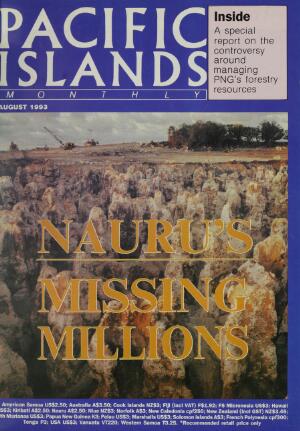
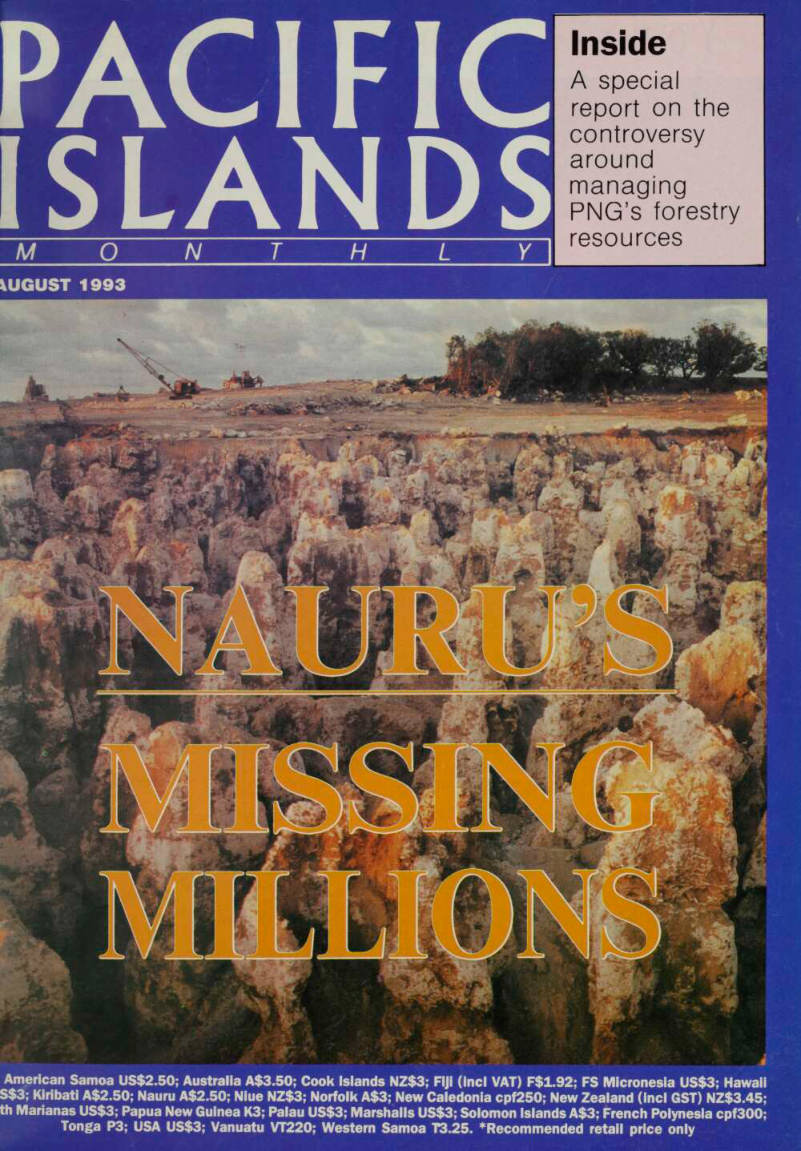
Inside A special report on the controversy around managing PNG’s forestry resources
Vugust 1993
%5% Wmm L m * ;M' W’ , 1 J JQmL flVv B v]Br/ X* * H
American Samoa US$2.5O; Australia A 53.50; Cook Islands NZ$3; FIJI (Incl VAT) F 51.92; FS Micronesia US$3; Hawaii Ss3; Kiribati A 52.50; Nauru A 52.50; Niue NZ$3; Norfolk As 3; New Caledonia cpf2so; New Zealand (Incl GST) NZ53.45; th Marianas US$3; Papua New Guinea K 3; Palau US$3; Marshalls US$3; Solomon Islands As 3; French Polynesia cpf3oo; Tonga P 3; USA US$3; Vanuatu VT22O; Western Samoa T 3.25. ’Recommended retail price only
Advertisements & other items, p. 2 (1 item)
Cable & Wireless
5»
Cable and Wireless began keep-
ing people in touch around the
world more than a century ago. Today,
while the technology has changed,
the tradition of service to our customers in the
South Pacific is just the same.
We work in partnership with Governments,
dedicated to meeting the need of communities and businesses to stay in touch. From one island to the next or to the other side of the world, the message is the same; Cable and Wireless is
your South Pacific
connection bringing the
islands together.
CABLE & WIRELESS
Asia Pacific Head Office Cable and Wireless pic Cable and Wireless (Pacific) Limited 22nd Floor Office Tower Convention Plaza 1 Harbour Road Hong Kong '* Tel: (852) 848 8620 Facsimile: (852) 868 5195 Fiji In association with the Government of Fiji Fiji International Telecommunications Ltd.
PO. Box 59 Mercury House 158 Victoria Parade Suva Fiji Tel: (679) 312933 Solomon Islands In association with the Government of the Solomon Islands Solomon Telekom Company Limited RO. Box 148 Honiara Solomon Islands Tel: (677) 21576 Tonga Cable and Wireless pic Private Mail Bag 4 General Post Office Nuku Alofa Tonga South Pacific Tel: (676) 23499 Vanuatu In association with the Government of Vanuatu i France Cables et Radio Vanuatu International Telecommunications Ltd.
RO. Box 164 Port Vila Vanuatu Tel: (678) 22185
Pacific
Islands
Monthly
)l 63 No.B
The News Magazine
August 1993
Rom The
Ditor’S Desk 4
Etters 5
Eadlines 8
Vcific Diary 10
Jsiness Bulletin 12
Jsiness
o-cents worth for fish cannery rkers 13 nstraints to development 14
Elebration 17
)Ver Stories
ere has the money gone? 25 nned in bank scam 31
Estern Samoa
)wdown in Apia 32
Ie Region
at future the islands? 36
Ig/Solomon
Lations
tep in the right direction 43
Forestry
The glass beads and mirrors trick4s The industry’s view 47
Books
The mouse that roared 49
Theatre
South Sea guano 50
Advertising Feature 57
Sports
Medal assault 61
Yachting
Island cruising 64
Shipping
Shiping schedules 66
Columnists
Jemima Garrett 11 David Barber 15 Futa Helu 40 Bill McCabe 41
jblisher: Brian O’Flaherty
litor; Mala Jagmohan
jnior Writer: Martin Tiffany
respondents: iristine Hatcher, David North, Ed Rampell, lan lliams, Johnson Honimae, Karen Mangnall, Liz ompson, Nicholas RothwelJ, Pesi Fonua, Wally ambohn. dumnists: David Barber (Wellington), Futa Helu cnga, covering the Pacific Islands), Jemima irrett (Sydney). lian Moti (Pacific Law), Alfred Sasako (The rum).
Advertising Sales: • Regional Sales (South Pacific); Salendra Narayan, Tel (679) 304111. Fx (679) 303809 • Sydney, Canberra: Bob Hill Media Reoresentations, Tel (61-2) 4164245, Fx (61-2) 4165064 • Brisbane: Robert Walker, Media House, Tel (61-7) 3710533. Fx (61-7) 371-8904 • Adelaide: Hastwell Williamsons Representations, Tel (61-8) 799522, Fx (61-8) 799735 • Melbourne: Brown Orr Fletcher Burrows (Aust).
Ptv Ltd Tel (3) 696 5188 Fx (03) 696 5131. • Auckland: McKay International Media Reps Ltd, Tel (64-9) 4190561, Fx (64-9) 4192243 • Japan: Universal Media Corporation, Tokyo, Tel (3) 6663036, 6663094, Cable; UNIMEDIA Tokyo, Tx 2524665.
Founded 1930 (USPS 952480). A Fiji Times Limited production „ .
Cover prices are recommended retail only Regis tered by Australia Post, Publication No. NBP 1210. © Copyright Fiji Times Limited, 177 Victoria Parade, Suva. Fiji. Tel (679) 304111, Fx (679)
303809. Tx Fj2124.
Pacific Islands Monthly is published monthly by The Fiji Times Limited, a division of Nationwide News, 2 Holt Street. Surry Hills. Sydney, NSW 2010.
Send address changes to: • Pacific Islands Monthly, PO Box 1167. Suva, Fiji.
Typeset and printed by The Fiji Times Limited, 177 Victoria Parade, Suva, Fiji.
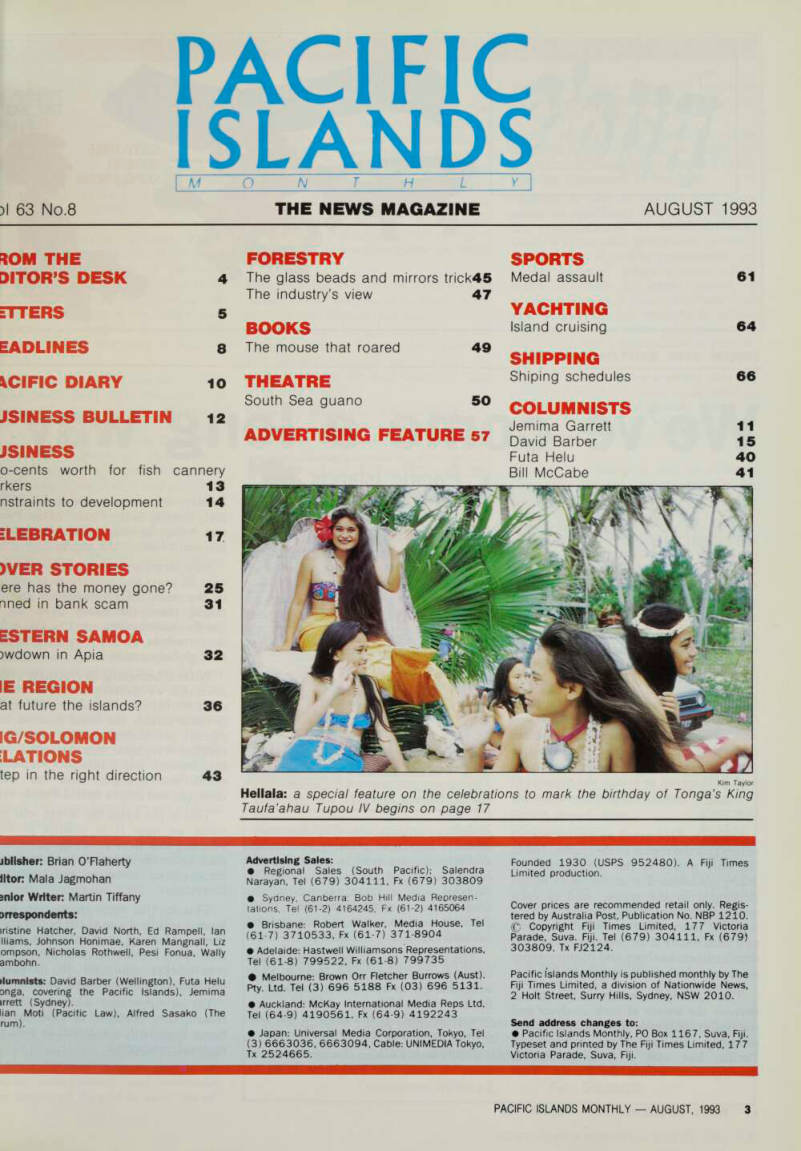
Kim Taylor Heilala: a special feature on the celebrations to mark the birthday of Tonga’s King Taufa’ahau Tupou IV begins on page 17
We’ve come a long way
From The Editor’S Desk
YES, it’s our birthday this month, and we are 63 this year no mean achievement for a publication that covers an area extending over a third of the planet’s surface and spanning a region with diverse cultures, histories and ways of life. But survive we have, and this anniversary is perhaps an opportune time for us to pause in our tracks and reflect on a bit of our history and our future role in the Pacific.
On August 16, 1930, R.W. Robson launched PIM as a journal linking Central and South Pacific nations. It was around that time the separate nations realised there was a bond they had in common the vast Pacific Ocean and PIM served to bridge the expanse of the ocean and bring the communities closer.
Initially, PIM acted as the messenger of news on the region to the region. It was the only source of this information for many countries. But as the news media developed in the region, and as each nation became self-sufficient in providing national news, PIM saw itself emerging as a focal medium for presenting more in depth stories, analyses and commentaries on news which had already broken.
Today, PIM has extended this role to become the source of such analyses and discussion not only for regional com munities, but for those outside the Pacific, but with a keen interest in developments within the Pacific. That
probably explains why PIM has main
tained a loyal and growing readership,
and why we are read in more than 70 countries around the world. That also explains why a large portion of our readers are national leaders in government, in business and in social and cultural fields.
The change in our approach to news coverage has also gone hand-in-hand with changes to our format and look from the 12-page tabloid size, newspaper-style publication to the full colour, glossy publication that it is today.
PlM’s base has also changed in recent times from our long-time home in
Sydney, we moved to Suva in 1988 truly coming to the “hub” of the Pacif and being, in many ways, in a bett( position to cover the region.
Now, as we are poised to move into th next 63 years and into the next centur in the midst of revolutionary chang< taking place the world over, we, < Pacific communities, need to also reflet on our role in relation to one another an in a global context.
What is becoming increasingly appai ent is that we cannot continue to focus o our national identities alone. We need t develop further the bond that we hav already established among ourselves t redefine a regional identity, which take into account our similarities and differ ences, our strengths and our shorl comings, and forge a united Pacific voice This is the voice the world will hea when we raise it in defence of issue affecting our lives as a region issue such as the environment, trade, manage ment of our resources and matters c sovereignty.
This is the very thing our islam leaders will be doing at the South Pacifit Forum Meeting in Nauru this month And the Forum is just the sort o
organisation equipped to develop *
regional identity for the region.
Let us hope that when our leader return, they continue to view issues a home from both a national as well as £ regional perspective.
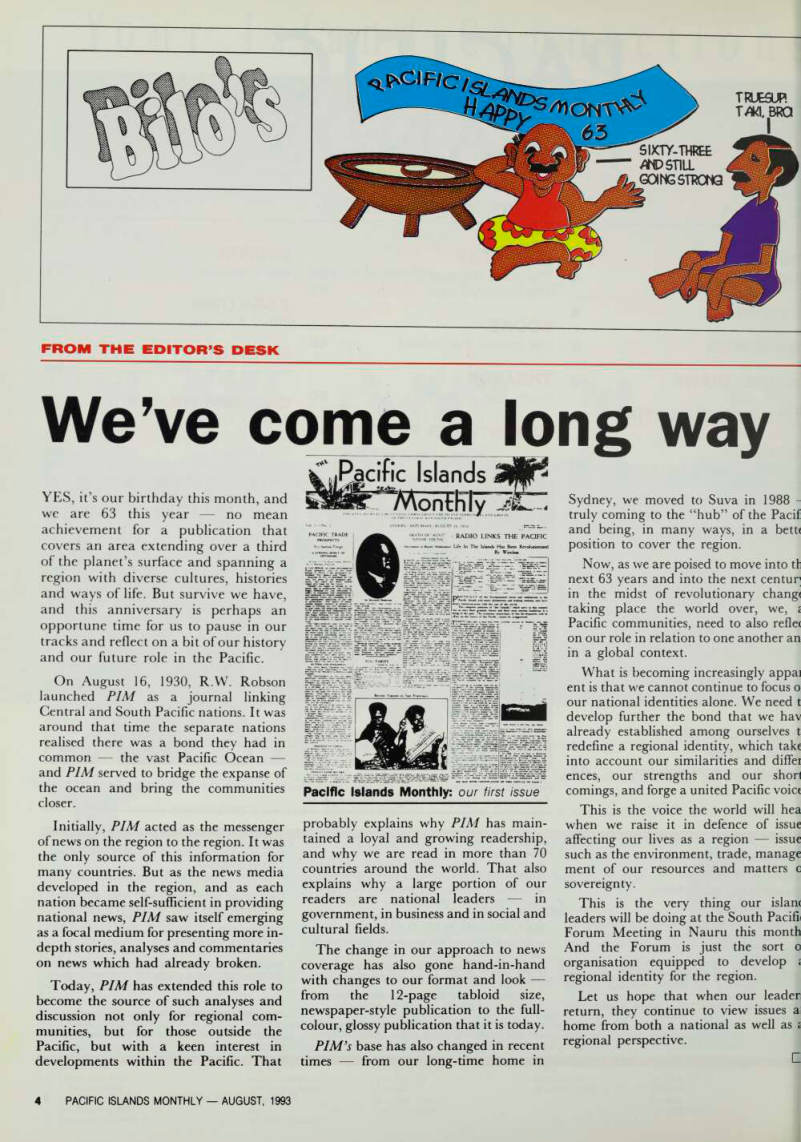
Pacific Islands Monthly: our first issue
Advertisements & other items, pp. 5-7 (2 items)
» this
LETTERS
NG?
Madam, have read and re-read the article Irime Wave” in the June issue o {P1M th mounting incredulity and annoy ce. Can the anonymous author really writing about my country, Papua w Guinea? How can you, as the editor the oldest and one of the most
luential periodical publications in the
cific region, justify the “beat-up” on
; cover? Do either of you believe that : manner in which the story has been ;sented can be described as accurate 1 fair. th a population of almost four million >ple, more than eight hundred lan iges and many cultures, as well as *e parts of the country undergoing •id, widespread and often discontinu change, society in Papua New
inea is certainly experiencing prob
is. The number, variety and gravity of se problems is inevitably greater than se which occur in much smaller, less erogeneous countries where change is er, slighter and more gradual — or, some cases, almost impossible to tern. even the list of offences presented in article as evidence of an alleged ime wave”, dreadful and worrying ugh it might be, is shorter and bably less diverse that a comparable for any other parts of the world over milar period of time (say, any other jor American, European or Austra i city of four million). The comments t the list includes “only those reported the media” not only adds snide uendo to what the author is unable — for some unknown reason, reluctant to substantiate more openly and :isely but would apply to any such list my country. .Iso suggests that the author has not arched the situation directly, and t the story is a product, so to say, of media feeding on itself. s many other people in Papua New nea — and other countries — my ily and I have had personal experi “, as victims, of crime. But we do not that our over-all is “a great risk.” My
:, friends, colleagues and acquaint
es do not fear going out to shop or to \ the children to school. ile the Government and many other pie are seriously concerned with real
blems, “gloom” cannot despite the
►tive, unsupported and untestable is employed, be said to have “set in”
throughout the country.
Moreover, the Government, the Na tional Parliament and many community groups are both concerned and trying to do something about those problems, as the story (despite the feverish headlines and introduction) itself eventually shows.
But, despite the inaccurate, exaggerated, and derivative character of the main feature, even it does not justify the cover on the issue of your magazine in which it appears.
How can the country be described as having been “thrown into chaos” when Government, Opposition and other com munity leaders, though differing over the most appropriate strategy for legislation and law-enforcement, agree what the major problems are and that they need to be addressed?
What can justify use of the headline “on the brink of anarchy’ when the National Parliament has taken the firm steps outlined (though inexactly reported) in the body of the article to review and amend legislation on as comprehensive a range of issues such as summary offences, bail, dangerous drugs, and other aspects of law and order?
In fact, even the overblown language on the cover is curiously self-contradictory: how can the country be described at once as having been “thrown into chaos” and “on the brink of anarchy”?
Over all, the manner in which the story has been presented suggests that both
author and editor were more interested in striving for effect than in achieving accuracy or fairness.
Thus, nothing is said about the efforts made by police to bring to justice the perpetrators of the crime reported in the opening paragraph of the story.
Nothing is said to suggest that there might be significant differences between the circumstances in which different kinds of crime arise or between the ways in which they should be approached - yet “tribal fighting”, which is often under taken in order to secure justice in traditional ways, is clearly different from armed hold-up, for example in origin, meaning as far as many participants are concerned, effect, and method of preven tion.
Nothing is said to demonstrate that the events reported constitute or justify a headline about a “crime wave” as distinct from a series of unconnected, often grave and uniformly reprehensive offences.
Absolutely nothing is said to make it clear that the few events actually re ported (as distinct from the sweeping generalisations made) have occurred in a context in which even some urban areas are not seriously affected and at least 85 per cent of all Papua New Guineans continue to live in villages where tra ditional methods of preventing and resolving threats of law and order continue to prevail.
Papua New Guinea has very real prob lems, as I do not hesitate to admit. Some
resemble those being experienced in other developing countries. Some are unique.
But the manner in which the story about the “crime wave”, so-called, is reported and, even more, the manner in which the story is presented in your magazine contribute little public under standing of the situation, and nothing to alleviating the uncertainty in business and other circles at which the author professes to be concerned.
Both the cover and the contents of the article are seriously misleading, generally and in their particulars a typical bias that you and the other Suva-based monthly continue to demonstrate against my country, its leaders and people.
The approach which they take in addressing serious issues in the largest country in the region is unworthy of a journal which has “Pacific Islands” on its masthead.
Gabriel Dusava
Secretary for Foreign Affairs Papua New Guinea
Aid and
education
Madam, Jemima Garrett’s column ( PIM June 1993) on “Aid and Pacific Education” is timely. She is right, too much education aid blatantly serves the interests of donors and the (relatively) prosperous island minorities, and too little shows any “particular vision” of the need for relevant skills, broadly spread across the Pacific populations of the 21st century.
At the USP School of Agriculture at Alafua, Western Samoa, student num bers are down, and off-campus access to courses remains in the planning stage.
The school is the poor sibling in a USP family itself at the mercy of more prestigious Pacific rim institutions.
Here at Hango, we attract few students for want of adequate resources, reasonable facilities, fully trained staff... and hence a dynamic reputation.
Aid programs in agricultural education certainly exist; I am part of one small Australian contribution. But Pacific leaders and forum donor governments continue to pay only lip service to the massive development needs in agricul tural (and marine) production, product processing and marketing education re quired here, in the Pacific.
Fhe central importance of primary production in the welfare of future Pacific islanders is inevitable and widely acknowledged. When will donor
lations stop pussyfooting and profiteer
ing? Instead, ask some tough questions of orum island nations; set some far-sighted iid conditions; and urge some local decisions which may upset influential dites but which might impart some of
that vision to the application of aid to education and training.
K.J. Blackman
Hango Agricultural College Tonga
Pacific
press
Madam, Firstly, let me thank you for an excellent magazine, which does a fine job of keeping one in touch of what is happen ing in the region. I was very interested to read your special report in the April issue on the media in the Pacific islands, and the clash with authority that is occuring in some places. As Futa Helu alluded to in his column, this is often represented as a clash between western liberal ideals of freedom of speech, and Pacific nations’ cultural respect for those in positions of authority. But surely that argument appertains to the view that culture is a static thing: it fails to allow for evolution of the culture.
In the past, individuals have attained prominence in these societies often through blood, geographical and similar qualifications, not necessarily through their fitness as individuals to hold positions of respect. Whilst this way may have produced some excellent leaders, it is nevertheless restricted. I believe it to be mark of maturity in a culture when the views of competent individuals are ac corded the respect they deserve within their societies, as is virtually ubiquitous in the Pacific islands. But surely it is a sign of cultural evolution when narrow criteria, such as blood ties for example, are vastly expanded in favour of far wider credentials that establish an indi viduals fitness to hold such respect. We only have to look at the pathetic trivia that fills the media in Britain — a supposedly highly sophisticated, mature society — with regard to the activities of the British Royal Family, to see what happens when purely ritualistic consider ations maintains individuals in positions of prominence that ordinarily they would have no claim on whatsoever.
It is, no doubt, these very same excesses of a free press that the champions of journalistic control seek to prevent hap pening in the Pacific; yet their attempts to lock the islands in a cultural time warp are likely to have the reverse effect, if we are to learn from the crude experience of Britain where the press may be free, but the culture is not.
Surely, a free press is one factor amongst several — by which individuals of exceptional value to their societies and cultures can become known. The respect accorded such people, as is customary in the Pacific, is a great and valuable thing.
Those who would seek to prevent this process, by muzzling the press amongst
other measures, are attempting to lock the island nations in the past: in effect,
perpetuating the patronising western
myth of “The Noble Savage’.
In this way. they are denying the peoples of the Pacific the opportunities of a cultural evolution which will demon strate to the world that, notwithstanding technological superiority elsewhere on this planet, they are in fact amongst the most mature societies on earth.
Alice Leney
Newborough Victoria
Keeping culture
alive
Madam , I read with interest the articles covering the build up to the Sixth Festival of Pacific Arts held in October 1992 in the Cook Islands. Following the festival I was then delighted to read the first post festival article “The Fastest Canoe In The Pacific”, (Dec 1992). My appetite for more festival news was wetted but has since grown into disappointment as almost nine months have passed and no further articles have been published.
This festival was the greatest cultural event in the Pacific for the year and it also being the year for indigenous peoples one would expect that it would be given a much higher priority. Why has news been not forth coming? I am sure many readers would be interested in pictures and stories associated with the voyaging canoes that sailed to Rarotonga.
I was living in Atiu when their canoe was being built. The months of labour that it took and the community support given to the craftsmen was immense. These crafts men have all but vanished. Very few men have folowed the craft of their fore fathers. I suspect that Atiu is not alone in experiencing the impact the canoe building had on its community.
The festival was a fine opportunity for young men and women to take the opportunity to learn the crafts of their forebears before it is forever lost. As one not wishing to see these crafts lost then rekindled into an abhoration of what might have been, I would encourage everyone to keep alive their culture and craft.
PIM could be a catalyst in this process by devoting less attention to political tyrants and focusing more on the threshold of what is about to be lost...island culure, that thing that gives us our identity, our pride and sense of belonging. Without it, our beautiful islands are just floating rafts of rotting remains.
Ross & Vaine Little
Badu Island Torres Strait
Pacific Islands Monthly
SUBSCRIPTIONS
American Samoa US$45 Australia A 542.00 Canada US$45 Cook Islands AUSS46 Fiji F 526.40 French Polynesia US$45 Guam US$45 Hawaii US$45 Japan US$45 Kiribati AUSS46 Marshall/Micronesia US$4O Nauru AUSS42 New Caledonia US$32 Payment to Pacific Islands Monthly: New Zealand NZ$55 Niue AUSS46 Norfolk Island AUSS42 Northern Marianas/Palau US$4O Papua New Guinea AUSS4S Solomon Islands AUSS46 Tonga AUSS46 Tuvalu AUSS46 United Kingdom Stg Pound2B US Mainland US$45 Vanuatu AUSS4S Western Samoa WS$6O Elsewhere AUSS63 Subscriptions Dept GPO Box 1167, Suva, Fiji.
Subscriptions rates include the cost of airspeeding to all destinations set out above.
Direct airmail rates on application.
Telephone: 304111 Fax: 303809
The most beautiful islands on earth
just got more inviting.
Air Nauru has introduced the Boeing 737-400 to its fleet, bringing new levels of comfort to travellers bourn for Central and South Pacific island destinations. The 737-400 represents the newest generation of the 7375 with more powerful engines, roomier cabins and the highest reliability record in aviation history. Worldwid( the 737 fleet averages 99.3% dispatch reliability; the 737-400 is a couple of points higher at 99.3%. Thi; dependability is just one reason leading airlines have made the 737 the world’s most popular jetliner Another is that passengers appreciate the 737’s abundant on-board stowage, its easy-in, easy-out cabins, the high levels of comfort and convenience offers in flight. No wonder Air Nauru chose this airplane to be its ambassador to the world. You are cordially to fly the 737 and see for yourseli how it makes some of the most beau- JH M tiful places on earth a little more inviting; -
Break-away
Headlines
Papua New Guinea
New citizenship laws looked at
The Papua New Guinea government is looking at introducing new laws to control the granting of citizenship to foreigners.
Foreign Affairs Minister John Kaputin said this after a former PNG government minister Karl Stack and businessman John Cunningham renounced their PNG citizenships to become Australians.
Kaputin said while he accepted the principle that people should have the right to choose their nationalities, he would not tolerate foreigners who thinks they could treat PNG without dignity, respect or integrity. He said for two prominent naturalised citizens, with such large business interests in PNG to resume their original nationalities called into question the provision for granting of citizenships. ***
Break-away
discussed
A delegation from the border village of Wutung in Papua New Guinea’s Sandaun province had travelled to Indonesia to discuss with authorities their moves to break away from PNG.
The Indonesian consulate in Vanimo has already given assistance to facilitate the talks in the West Irian capital Jayapura, but Sandaun’s provincial premier has urged the national government for immediate intervention. He said the case was a national matter and out of his jurisdiction. Wutung villagers say most of their traditional land was now on the Indonesian side of the border and if they could not have it back, they would rather break away from PNG and join with Indonesia. ***
Rabbits
introduced
Rabbits have been introduced to Papua New Guinea after a 30-year government ban on their import was lifted. Forty-five rabbits were exported from Western Australia and there are plans to release their offspring to village farmers throughout the country.
The first batch of nine females and six males have already mated and, according to the person who imported them, Dr Tan Grant, a lecturer in agriculture, there should be enough rabbits by next year to sell and distribute. He said the idea was to encourage rabbit farming at village level. ***
Legal
services halted
Government legal services in Papua New Guinea came to a halt as lawyers from the attorney-general’s department continued their indefinite strike which started on June 7. Lawyers from the offices of Public Prosecutor, Public Solicitor and State Solicitor, backed by their support staff were on strike after a two-week notice to the government to remove justice secretary, Luke Lucas.
State lawyers say the appointment of Lucas was illegal in that it went against public service regulations on retirements and age limits.
constitution
Tonga
Alternative constitution
The leader of Tonga’s Pro-Democracy Movement, Akilisi Pohiva, has said he is preparing an alternative constitution for his country. Pohiva, who is a commoner representative in the nobility-dominated parliament, said such a document was the last peaceful attempt to change the system.
Under Tonga’s 1875 constitution, King Taufa’ahau Tupou IV, appoints the 12-member cabinet, while the kingdom’s 10 nobles elect nine members of the legislature. Pohiva has been calling for universal elections for all assembly members, with the members of parliament electing Cabinet members. He said frustration among the people was growing and his movement must try every peaceful strategy. But he warned that if the new bid were rejected, non-violent demonstrations would follow.
fight
Vanuatu
Anti-corruption fight
Vanuatu Opposition leader and president of the Vanuaaku Party, Donald Kalpokas, has called for a fight against injustice and corrupt practices in government. He made the call at the 23rd annual congress of his party and told delegates the injustice now prevalent in Vanuatu discriminated against citizens who did not support the present coalition governmetn of Prime Minister Maxime Carlot Korman and Father Walter Lini.
Kalpokas said this discrimination could be clearly seen in the awarding of scholarships, business licences and jobs to government supporters only. He said this was a violation of their human rights and a suppression of their constitutional rights to express themselves.
post reinstated
Solomon Islands
Solicitor-General post reinstated
In Solomon Islands, the post of Solicitor-General in the Attorney-General’s Chambers, which had been suspended since early 1977, has been reinstated. And a lawyer from the Attorney-General’s Chambers, Primo Afeau, now holds the post.
Attorney-General Frank Kabui said the post was reinstated last year, but remained unfilled until recently when the Judicial and Legal Services Commission appointed Afeau as acting Solicitor-General. The commission formally appointed him on
July 1.
New
prime minister
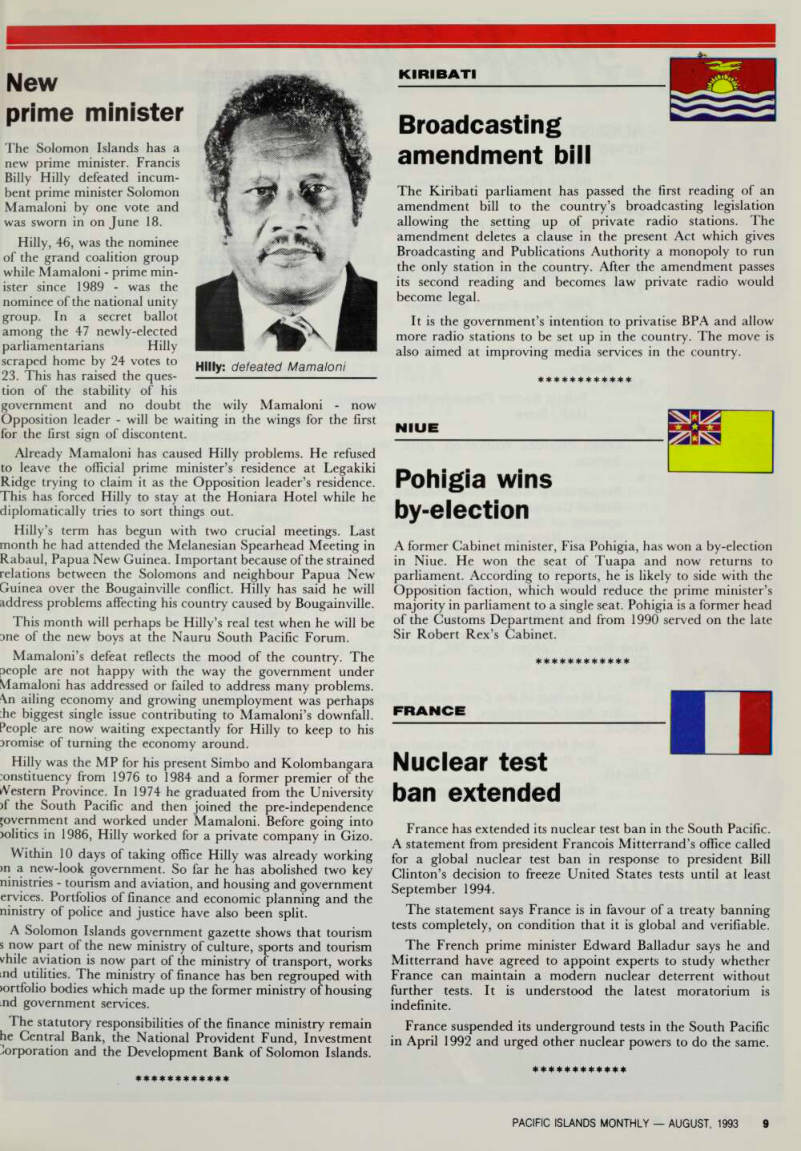
The Solomon Islands has a new prime minister. Francis Billy Hilly defeated incum bent prime minister Solomon Mamaloni by one vote and was sworn in on June 18.
Hilly, 46, was the nominee of the grand coalition group while Mamaloni - prime min ister since 1989 - was the nominee of the national unity group. In a secret ballot among the 47 newly-elected
parliamentarians Hilly
scraped home by 24 votes to 23. This has raised the ques tion of the stability of his
government and no doubt the wily Mamaloni - now Opposition leader - will be waiting in the wings for the first for the first sign of discontent.
Already Mamaloni has caused Hilly problems. He refused to leave the official prime minister’s residence at Legakiki Ridge trying to claim it as the Opposition leader’s residence.
This has forced Hilly to stay at the Honiara Hotel while he diplomatically tries to sort things out.
Hilly’s term has begun with two crucial meetings. Last month he had attended the Melanesian Spearhead Meeting in Rabaul, Papua New Guinea. Important because of the strained relations between the Solomons and neighbour Papua New Guinea over the Bougainville conflict. Hilly has said he will address problems affecting his country caused by Bougainville.
This month will perhaps be Hilly’s real test when he will be ane of the new boys at the Nauru South Pacific Forum.
Mamaloni’s defeat reflects the mood of the country. The people are not happy with the way the government under Mamaloni has addressed or failed to address many problems. \n ailing economy and growing unemployment was perhaps fie biggest single issue contributing to Mamaloni’s downfall.
People are now waiting expectantly for Hilly to keep to his Dromise of turning the economy around.
Hilly was the MP for his present Simbo and Kolombangara xmstituency from 1976 to 1984 and a former premier of the Western Province. In 1974 he graduated from the University )f the South Pacific and then joined the pre-independence government and worked under Mamaloni. Before going into politics in 1986, Hilly worked for a private company in Gizo.
Within 10 days of taking office Hilly was already working m a new-look government. So far he has abolished two key ninistries - tourism and aviation, and housing and government ervices. Portfolios of finance and economic planning and the ninistry of police and justice have also been split.
A Solomon Islands government gazette shows that tourism s now part of the new ministry of culture, sports and tourism vfiile aviation is now part of the ministry of transport, works md utilities. The ministry of finance has ben regrouped with >ortfolio bodies which made up the former ministry of housing nd government services.
The statutory responsibilities of the finance ministry remain he Central Bank, the National Provident Fund, Investment Corporation and the Development Bank of Solomon Islands.
Hilly: defeated Mamaloni
Broadcasting
Kiribati
Broadcasting amendment bill
The Kiribati parliament has passed the first reading of an amendment bill to the country’s broadcasting legislation allowing the setting up of private radio stations. The amendment deletes a clause in the present Act which gives Broadcasting and Publications Authority a monopoly to run the only station in the country. After the amendment passes its second reading and becomes law private radio would
become legal.
It is the government’s intention to privatise BPA and allow more radio stations to be set up in the country. The move is also aimed at improving media services in the country.
by-election
Niue
Pohigia wins by-election
A former Cabinet minister, Fisa Pohigia, has won a by-election in Niue. He won the seat of Tuapa and now returns to parliament. According to reports, he is likely to side with the Opposition faction, which would reduce the prime minister’s majority in parliament to a single seat. Pohigia is a former head of the Customs Department and from 1990 served on the late Sir Robert Rex’s Cabinet.
Nuclear test
France
Nuclear test ban extended
France has extended its nuclear test ban in the South Pacific.
A statement from president Francois Mitterrand’s office called for a global nuclear test ban in response to president Bill Clinton’s decision to freeze United States tests until at least
September 1994.
The statement says France is in favour of a treaty banning tests completely, on condition that it is global and verifiable.
The French prime minister Edward Bahadur says he and Mitterrand have agreed to appoint experts to study whether France can maintain a modern nuclear deterrent without further tests. It is understood the latest moratorium is indefinite.
France suspended its underground tests in the South Pacific in April 1992 and urged other nuclear powers to do the same.
Pacific Diary
August
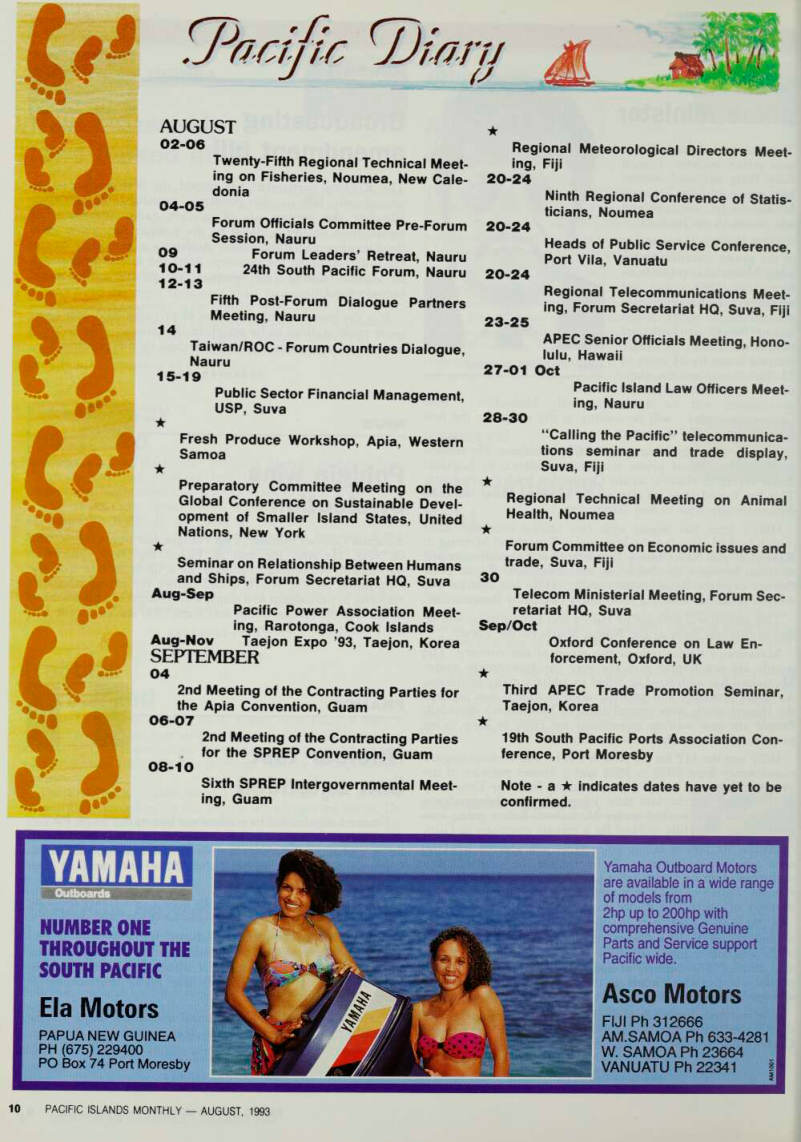
02-06 Twenty-Fifth Regional Technical Meet ing on Fisheries, Noumea, New Cale donia 04-05 Forum Officials Committee Pre-Forum Session, Nauru 09 Forum Leaders’ Retreat, Nauru 10-11 24th South Pacific Forum, Nauru 12-13 Fifth Post-Forum Dialogue Partners Meeting, Nauru 14 Taiwan/ROC - Forum Countries Dialogue, Nauru 15-19 Public Sector Financial Management, USP, Suva ★ Fresh Produce Workshop, Apia, Western Samoa ★ Preparatory Committee Meeting on the Global Conference on Sustainable Devel opment of Smaller Island States, United Nations, New York ★ Seminar on Relationship Between Humans and Ships, Forum Secretariat HQ, Suva Aug-Sep Pacific Power Association Meet ing, Rarotonga, Cook Islands Aug-Nov Taejon Expo ’93, Taejon, Korea
September
04 2nd Meeting of the Contracting Parties for the Apia Convention, Guam 06-07 2nd Meeting of the Contracting Parties for the SPREP Convention, Guam 08-10 Sixth SPREP Intergovernmental Meet ing, Guam
★ Regional Meteorological Directors Meet ing, Fiji 20-24 Ninth Regional Conference of Statis ticians, Noumea 20-24 Heads of Public Service Conference, Port Vila, Vanuatu 20-24 Regional Telecommunications Meet ing, Forum Secretariat HQ, Suva, Fiji 23-25 APEC Senior Officials Meeting, Hono lulu, Hawaii 27- Oct Pacific Island Law Officers Meet ing, Nauru 28- “Calling the Pacific” telecommunica tions seminar and trade display, Suva, Fiji ★ Regional Technical Meeting on Animal Health, Noumea ★ Forum Committee on Economic issues and trade, Suva, Fiji 30 Telecom Ministerial Meeting, Forum Sec retariat HQ, Suva Sep/Oct Oxford Conference on Law En forcement, Oxford, UK ★ Third APEC Trade Promotion Seminar, Taejon, Korea ★ 19th South Pacific Ports Association Con ference, Port Moresby Note - a ★ indicates dates have yet to be confirmed.
Advertisements & other items, p. 10 (1 item)
Asco Motors
NUMBER ONE
THROUGHOUT THE
SOUTH PACIFIC
Ela Motors
PAPUA NEW GUINEA
PH (675) 229400 PO Box 74 Port Moresby Yamaha Outboard Motors are available in a wide range of models from 2hp up to 200 hp with comprehensive Genuine Parts and Service support Pacific wide.
Asco Motors
FIJI Ph 312666
AM.SAMOA Ph 633-4281
W. SAMOA Ph 23664
VANUATU Ph 22341
Paeniu prods G-7
TUVALU’S Prime Minister Bikenibeu Paeniu is leading a one-man crusade to get the world’s rich industrialised nations to face up to the dangers of global warming. While he was not able to persuade the leaders at the Tokyo Group of Seven Summit last month to act on his request for an emergency conference on global warming he has made a big impact on public opinions.
During a six-day trip to Japan Paeniu’s demands that the threat to the Pacific islands from climate change be taken seriously got coverage in all Tokyo’s major daily newspapers and on tele vision.
Perhaps most significantly, Asahi Shimbun, a leading daily with eight million readers dedicated an entire edition of its Tensei Jingo opinion column to a piece outlining the dangers of global warming and backing
Paeniu. The front-page column, which deals with ethical issues, is one of Japan’s most influential pieces of journalism.
Paeniu’s trip to Japan was the culmination of more than a month of lobbying the G-7 leaders. In a letter to United States President Bill Clinton, Paeniu said, “Worrying indications are building up, we fear, that the first signs of global warming might be appearing around the world.” In Tuvalu, he said, “we are now sure that we are seeing the first signs of dangerous changes in the stability of our regional climate. The statistics show we are expecting an increase in cyclone activity, and we can see the waves taking our land away.
“You will know from discussions with your own scientific advisers,” Paeniu said, “that I am being uncontroversial when I say that continued emission of the Greenhouse gases at today’s levels threatens Tuvalu and her sister low-lying nations with physical and cultural extinction, and perhaps within the lifetime of today’s children.” While Paeniu was keen to set out just how stark the threat is to small nations his main aim was to “suggest three courses of action whereby you can begin the process of setting the world on course for effective mitigations of the global warming threat.”
Paeniu has asked president Clinton to : • call a conference to review the evidence that emergency action is needed to deal with global warming and that current national policies are inadequate to save low-lying countries like Tuvalu; • help create a United Nations Agency on Renewable and Efficient Energy Technologies with funding appropriate to the spirit the massive environment blueprint negotiated at last year’s Earth Summit (known as Agenda 21); • take responsibility as leader of the world’s major greenhouse-gas emitting nations by setting immediate targets of at least 20 per cent reduction in carbon dioxide (the main Greenhouse gas) by the year 2005.
A similar letter went to leaders in Japan, Great Britain, France, Germany, Italy and Canada. Although the environment was one of five issues on the agenda for the Tokyo summit it was, as one observe put it, “the dog that didn’t bark”. The only statement in the Summit com munique on global warming was a lame endorsement of progress with the much watered down International Climate
Convention which was signed at Rio. Worse still, many of the summit’s economic decisions will result in a big increase in greenhouse gas emissions.
The G-7’s Russian aid package is a case in point. Of the US$6lO million so far donated, every cent has been spent on developing greenhouse gas emitting oil and gas reserves. Add to that the summit’s support for the environmental de regulation included in the current GATT deal it is clear the G-7 leaders have failed to make the link between environment and econ omics.
While Paeniu’s demand for a 20 per cent reduction in carbon diox ide emissions may seem radical to those familiar with the targets the industrialised countries have set
themselves an increasing stack of prestigious studies are showing such reductions to be necessary and even cost effective. A United States Office of Technology assessment report issued in February 1991 estimated a 29 to 39 per cent cut in US carbon dioxide emissions over the next 25 years would result in savings of $2O billion a year under favourable legislative circumstances. In June 1991 the US Academy of Sciences found a 10 to 40 per cent reduction in carbon dioxide could be achieved at very low cost. Some reductions may even be at net savings if the proper policies are implemented. Other studies have shown that renewable energy sources could not only cut greenhouse gas emissions and save money, but create tens of thousands of jobs.
Comparing the energy efficiency of the industrialised countries also reveals just how much could be done.
While the G-7 leaders did not take up Paeniu’s suggestions that will not be the end of the story. Paeniu intends to continue his campaign, taking the issue up with other South Pacific leaders at this month’s South Pacific Forum in Nauru.
Both the political and scientific arms (the International Negotiating Committee on Climate Change and the Inter government Panel on Climate Change) of the international effort on climate change are still meeting and the scientific body (the IPCC) in particular is expected to continue to come out with more frightening evidence which may eventually be able to penetrate the current stranglehold the coal and oil lobby currently enjoys over many industrialised country governments.
Once 50 nations have ratified the Climate Convention, another avenue for action will be open, through the crucial Meeting of the Parties in which all signatories sit down together to examine each others national greenhouse action plans. The ratifications which will trigger that meeting are likely to take place in next couple of months.
Unfortunately, the Alliance of Small Islands States, which has played such a crucial role in getting the islands agenda on the climate change heard around the world, is likely to suffer from the withdrawal of its chairman from his post at the United nations in New York. The AOSIS chairman, Vanuatu’s respected Ambassador to the UN, Robert Van Lierop, is to be replaced by his government. □
Australia
Jemima
Garrett
road project
Business Bulletin
Capital gains
tax
The Fiji government’s proposal to introduce a capital gains tax has been criticised by the Fiji Institute of Account ants. Institute president Vishnu Prasad said the tax would discourage overseas investment and would make local inves tors think twice before putting money into long term projects. He said one of the factors investors looked for was capital gain at the end of a certain period of investment. But a capital gains tax would be detrimental to Fiji’s investment market.
Plane purchase
on hold
Fiji’s domestic airline, Fiji Air, has shied away from buying two more aircraft from China. New chief executive David Young said he stopped the purchase because it would have been unprofitable.
The company had announced plans last year to acquire two more 19-seater Harbin Y-17 aircraft from China. Young said Fiji Air would need to get a larger aircraft to meet the increasing demands of domestic travel and passengers had been critical of the cramped interior of the Chinese Harbin planes.
Pacific at
Korean expo
Pacific Forum countries will display their national heritage and products at an international exposition at the South Korean city of Taejon beginning this month. Western Samoa, Cook Islands and Niue will not be attending the three month exhibition. The South Korean government has agreed to meet travel and accommodation costs of all represen tatives to the expo from the Pacific.
Papua New Guinea’s ambassador to South Korea, Lucy Bogari, has been
appointed commissioner-general of the South Pacific Multi-national Pavilion.
Board
reinstated
The new Solomon Islands government has reinstated the Central Bank board which was dismissed by the former Mamaloni government earlier this year.
Former finance minister Christopher Columbus Abe had suspended the Cen tral Bank board members in January for
allegedly acting inconsistently with gov
ernment economic policies and national interests. But Andrew Nori, finance minister in the new coalition government of Francis Billy Hilly, has revoked the dismissal order and reinstated the board members. They have welcomed their reinstatement saying they will now be able to perform the statutory functions of the Central Bank which had ceased in
January.
Pangia gets Fiji
road project
A Papua New Guinea construction company will upgrade and seal a section of one of Fiji’s two main highways, the Kings Road, for US$lB million. Fiji’s Public Works Department has awarded the contract to Pangia Construction Ltd after considering eight tenders for the work. The project is part of Fiji’s road upgrading project and is expected to be completed in 1995.
BMP to sell
PNG shares
BHP Petroleum, a partner in Papua New Guinea’s Kutubu oil project, has decided to sell US$2OO million of its shares. It hopes to make a profit of US$5OO,OOO from this transaction. The company’s head of public relations, Don Norton, said the company was selling the shares purely for commercial reasons, not be cause of the poor investment climate in
PNG. Norton said the company would continue to maintain its interest in PNG.
PNG’s mines and petroleum minister, Masket langalio, has also denied the sale had anything to do with lack of investor confidence in the country.
New
guidelines
The Papua New Guinea government is to introduce new investment guidelines for all public institutions and insurance agencies in the country. Finance and planning minister Sir Julius Chan said this was to ensure that availability of credit was combined with measures aimed at improving competitiveness. Sir Julius also said the government had already made reductions to corporate tax and import duties in the 1993 budget to encourage investment and the creation of
new jobs.
Short run
for Leonardo
Leonardo the Nauru-government backed West End musical is to close after less than a month following disas trous reviews. The musical is about a supposed love affair between Leonardo da Vinci and Mona Lisa. The show was co-written and produced by Duke Minks, a British entrepreneur, songwriter and investment adviser to the Nauru government. Minks, who had never staged a musical before, told London media, critics had killed the show. However, he admitted he was not really happy with the production. Nigel Everett, general manager of the Strand Theatre where Leonardo was showing, said critics had made “cruel and un necessary” comments about the show and its funding.
Emperor expects
production shortfall
Gold production at Emperor Mines Ltd’s operations in Fiji is expected to fall 12 per cent short of budget this financial year.
Poor grades and mining difficulties have marred the final quarter and will lower output in the first quarter of the 1993-94 year. But Emperor Mines expects to bounce back with a doubling of its reserves and resource base with a com mitment to lift annual milling capacity to one million tonnes from around 550,000.
The project would require debt capital of US$7-8 million in the next 18 months with repayment within the next two years of completion of the underground expansion.
Advertisements & other items, p. 12 (1 item)
The Specialist Consultants
to the Textile, Clothing k Footwear Industries
Exporting, Sourcing, Manufacturing, Marketing,
Business Planning, Human Resources, Feasibility Studies Suite 3, 8/138 Albert Street Brisbane 4000 Australia T’Phone: 61 7 221 5988 Fax; 61 7 229 0055
petersen
1 & associates
PTY
LTD
• CORPORATE MANAGEMENT CONSULTANTS •
for fish cannery
Business
Two-cents worth for fish cannery workers
American Samoa determines new minimum wage rates for tuna and government workers
By David North
fHE US government huffed and it >uffed in Pagopago and forced the 175-million-dollar man to pay his fish leaners another two cents an hour.
"he $ 75-million-man is Dr Anthony leilly, the Brit who is CEO of HJ. Heinz l Co., owner of StarKist the larger of imerican Samoa’s two tuna canneries, n 1991 his total corporate pay topped 75,000,000, several times the collective arnings of all 4500 tuna workers in imerican Samoa. he decision was the once-every-two ears determining of the minimum wage i American Samoa, a complex and nusual bit of American government igulation. he minimum wage for the tuna workers ad been set at $2.92 two years earlier, ut most of them had, in fact, been taking $2.98 an hour. he decision was that the new minimum ould be an even $3.00 an hour ifective some time in July), giving a few andred of them an eight-cents-an hour ise, and the rest a two-cents-an-hour X)st. (The canneries may add a few
mts to that level.)
he tuna workers, if anything, did better an the low-wage workers of the
merican Samoan government (ASG).
hundred of the least well-paid of e latter had been getting along on !.17 an hour; the decision was to raise e minimum to $2.37 an hour, but to :lay the effective date until October, •94, to give the new Lutali Administra
tion a chance to raise the funds to meet the increase.
Now giving 200 people another 20 cents an hour, or $B.OO a week, would come to all of $l6OO a week or $83,200 a year.
The problem is that employers, when faced with a minimum wage hike, also raise the wages of other hourly workers, to keep wage ratios in line with the past and that is much more expensive.
The lower rates, and the slower im plementation of the rises for the ASG workers, as opposed to the cannery workers, reflect the differential financial prowess of the two sets of employers, both of which have roughly 4500 workers each.
The territorial government has been having trouble meeting its payroll, has laid off a number of workers, and put others on a short-work week. It is also trying to collect back taxes, and raise new ones.
The tuna canneries, on the other hand, are owned by affluent multi-national firms. Pittsburgh-based Heinz is an American company, and its finances must be reported in some detail. The other, and slightly, smaller cannery on Pagopago harbour is Samoa Packing, now owned by a conglomerate in Indonesia, where corporate finances can be kept secret. Both companies process tuna in American Samoa, not because it is caught nearby and not because Pagopago buys a lot of canned fish they use it because it brings them attractive US tariff breaks as well as low wages.
Heinz world-wide operations created a net profit of about two-thirds of a billion dollars last year, and though sub corporate details are not plentiful, the tuna operation was said by the New York Times to produce more than $7O million in gross profits in a recent year. What is quite clear, however, is Tony Reilly’s good year in 1991, when his corporate pay, perks and stock benefits brought him more than $75,000,000, a bit of financial information brought to the islands by PIM in March, 1992.
No where else under the US flag is the minimum wage set as it is in American Samoa. Everywhere else (except CNMI) the Congress rules, and years ago put the minimum wage at $4.25 an hour. In American Samoa a six-member board, consisting of three islanders and three Mainlanders, sets the rate. Each del egation includes a representative of management, of labour, and of the public; the three Samoans are appointed by the Governor, and the three Mainlanders by the US Secretary of Labour. At least a four-to-two-majority is needed to raise wages, a major obstacle to the workers.
This year Goveror Lutali went to the territorial senate, appointing two of these matai-selected shiefs to represent labour (Senator Moaali’itele Tu’ufuli) and management (Senator Lealaifuaneva Reid); the third Samoan, representing the public, was Taesaliali’i Lutu, ASG’s Deputy Election Commissioner. The three Mainlanders were a staffer for the national labour movement (AFL-CIO), a businessman, and, as chair, a profes sional arbitrator. Everybody on the board got $238 a day for his work.
The hearings were lack-luster this year, due to the recent failure of the Mainland based Teamsters Union to win a rep resentation election; the union did not attend the meetings. Congressman Eni F.H. Faleomavaega, who once flirted with the idea of seeking congressional action to raise the Samoan minimum wage, did not press the wage panel to take any drastic action. Similarly, the appointment of the chair, who had done the task in the past, indicated a hands off posture on the part of the newly arrived Clinton Administration.
With all this in mind, and with little public attendance at the meetings, the six-member board made most of its decisions unanimously; the only roll-call vote was on the question of what the cannery workers should get a year hence.
The four management and public del egates voted for $3.05 an hour, the two worker representatives wanted more.
development
Constraints to development
Good management, incentives and diversification are the buzz words for Western Samoa’s recovery and growth
By Norman Douglas
GROWTH potential in Western Samoa lies in the more intensive exploitation of existing resources such as agriculture, tourism and small industry. But to realise this potential a number of current constraints have to be overcome and a favourable macro economic climate must be developed.
These are some of the views expressed
in a report on Western Samoa’s prospects for recovery and growth.
The report, published under the aus pices of the Australian International Development Assistance Bureau (AIDAB) in their series International Development Issues , identifies the con straints as both external and domestic.
Among the former are falling or fluctu
ating commodity prices; among the latter
government policies that discourage in itiative in the private sector. On top of
these are the constraints of natural disasters, such as the cyclones which have affected Samoa in recent years. It is a major task, says the report, for the government to ensure that economic recovery continues after the reversals caused by the cyclones, particularly Ofa in early 1990.
Although agriculture (including
subsistence) was still the backbone of the economy, accounting for over 50 per cent of GDP and 60 per cent of the labour force, merchandise exports had de creased significantly in recent years, with falling prices and volume in most traditional exports, such as copra, coco nut oil and cocoa. Part of the decline in output can be blamed on the cyclones, but in the last decade a generally downward trend in agricultural exports had been evident, although there had been substantial consumption of some products, such as bananas and cocoa, by the local market. Poor management in the large, government-owned Western Samoa Trust Estates Corporation was seen as one factor in the decline of some agricultural enterprises. The report rec ommends a degree of privatisation of the trust estates to make additional land available to the private sector.
The high degree of remittances from Samoans overseas also affected agricul ture, tending to lessen the incentive to
produce.
Manufacturing has some potential for
achieving growth and diversification.
The success of the Japanese-owned wire harness manufacturer Yazaki Samoa is already well-known, but scope exists for the processing of coconut by-products, tropical fruit and fish. The pool of low cost and unemployed labour provides some basis for further small-scale indus trialisation.
Tourism and related activities have
much growth potential, according to the
report, although the servicing of tourism requires a high import content, and many Samoans still express reservations about an increase in tourism, fearing the erosion of their culture. The ability of the four-year old finance center to contribute substantially to economic growth is doubtful because of the uncertainty of the international economic climate.
In the short and medium terms, the report says, much depends on the performance of agriculture and the movements in international commodity
prices. Overall productivity, however,
may be subject to yet another of Samoa’s constraints, the high rate of emigration.
Advertisements & other items, p. 14 (1 item)
Marine Diesel Traders
MARINE DIESEL ENGINES
& TRANSMISSIONS
TWIN DISC
HUTH, I.F.
PARAGON
BORG WARNER
PERKINS
CAT
CUMMINS
DETROIT
VOLVO
YANMAR
Marine Diesel Traders
54 Banya St, Bulimba. Q. 4171 Ph: (07) 899 1799 Fax: (07) 899 1868 A/Hrs (07) 399 9791 Mobile: 018 781835 International Code: 617 WE BUY AND SELL ALL MARINE DIESEL ENGINES
NEW & USED DIESELS AND TRANSMISSIONS
MARINE EQUIPMENT * TRADES ACCEPTED
A touch of nostalgia
A GENERATION has grown up know ing nothing of those days 20 years ago when the eyes of the world were focussed on the Pacific, and memories of their elders who were around at the time have faded.
But it’s an anniversary worth remem bering, for the events of mid-1973 put an end to nuclear testing in the Pacific atmosphere and as such deserve a permanent place in the history of the region.
I refer to an extraordinary piece of unconventional diplomacy, the brainchild of New Zealand Prime Min ister Norman Kirk, who had a deep personal loathing of nuclear testing in this part of the world and was deter mined to do something about it.
Kirk, who became Prime Minister in December 1972, first tried conventional diplomatic means to stop France’s
atmospheric testing program that began in the Pacific six years earlier. He persuaded Australia to join New Zealand in a case against France at the World Court in The Hague and sent his deputy, Hugh Watt, on an abortive trip to Paris to plead for an end to the tests.
In June 1973, the World Court voted eight-six to grant New Zealand and Australia an interim injunction restraining France from starting a new series of tests at Mururoa Atoll.
France rejected the verdict, saying the court was not competent to rule on matters of “national defence”.
Kirk decided to send a New Zealand navy frigate to the testing zone not to try physically to stop the tests but to “ensure the eyes of the world are riveted on Mururoa”. The HMN£S Otago would, he said, station itself on France’s 12-mile limit as a “silent, accusing witness”.
“What we aim to do is to publicise what is happening in this remote part of the world, so as to stimulate world opinion (against nuclear testing) and attract wider support for rights of small nations.”
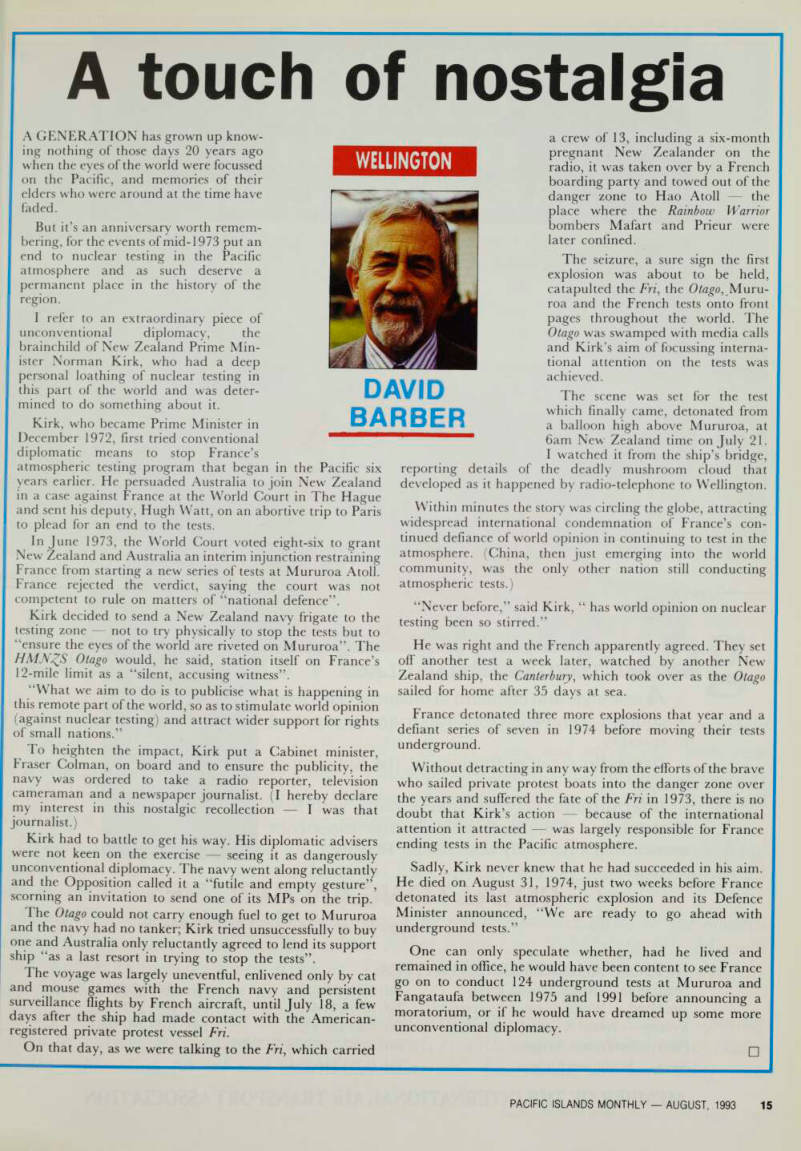
To heighten the impact, Kirk put a Cabinet minister, Fraser Colman, on board and to ensure the publicity, the navy was ordered to take a radio reporter, television cameraman and a newspaper journalist. (I hereby declare my interest in this nostalgic recollection I was that
journalist.)
Kirk had to battle to get his way. His diplomatic advisers were not keen on the exercise seeing it as dangerously unconventional diplomacy. The navy went along reluctantly and the Opposition called it a “futile and empty gesture”, scorning an invitation to send one of its MPs on the trip.
The Otago could not carry enough fuel to get to Mururoa and the navy had no tanker; Kirk tried unsuccessfully to buy one and Australia only reluctantly agreed to lend its support ship “as a last resort in trying to stop the tests”.
The voyage was largely uneventful, enlivened only by cat and mouse games with the French navy and persistent surveillance flights by French aircraft, until July 18, a few days after the ship had made contact with the American registered private protest vessel Fri.
On that day, as we were talking to the Fri, which carried
a crew of 13, including a six-month pregnant New Zealander on the radio, it was taken over by a French boarding party and towed out of the danger zone to Hao Atoll the place where the Rainbow Warrior bombers Mafart and Prieur were later confined.
The seizure, a sure sign the first explosion was about to be held, catapulted the Fri, the Otago, Muru roa and the French tests onto front pages throughout the world. The Otago was swamped with media calls and Kirk’s aim of focussing interna tional attention on the tests was achieved.
The scene was set for the test which finally came, detonated from a balloon high above Mururoa, at Gam New Zealand time on July 21.
I watched it from the ship’s bridge,
reporting details of the deadly mushroom cloud that developed as it happened by radio-telephone to Wellington.
Within minutes the story was circling the globe, attracting widespread international condemnation of France’s con tinued defiance of world opinion in continuing to test in the atmosphere. (China, then just emerging into the world community, was the only other nation still conducting atmospheric tests.) “Never before,” said Kirk, “ has world opinion on nuclear testing been so stirred.”
He was right and the French apparently agreed. They set off another test a week later, watched by another New Zealand ship, the Canterbury , which took over as the Otago sailed for home after 35 days at sea.
France detonated three more explosions that year and a defiant series of seven in 1974 before moving their tests underground.
Without detracting in any way from the efforts of the brave who sailed private protest boats into the danger zone over the years and suffered the fate of the Fri in 1973, there is no doubt that Kirk’s action because of the international attention it attracted was largely responsible for France ending tests in the Pacific atmosphere.
Sadly, Kirk never knew that he had succeeded in his aim.
He died on August 31, 1974, just two weeks before France detonated its last atmospheric explosion and its Defence Minister announced, “We are ready to go ahead with underground tests.”
One can only speculate whether, had he lived and remained in office, he would have been content to see France go on to conduct 124 underground tests at Mururoa and Fangataufa between 1975 and 1991 before announcing a moratorium, or if he would have dreamed up some more unconventional diplomacy.
Wellington
David
Barber
Advertisements & other items, p. 16 (1 item)
He G Ah.
z> *' s - ■p 5-- V-. m S & ■
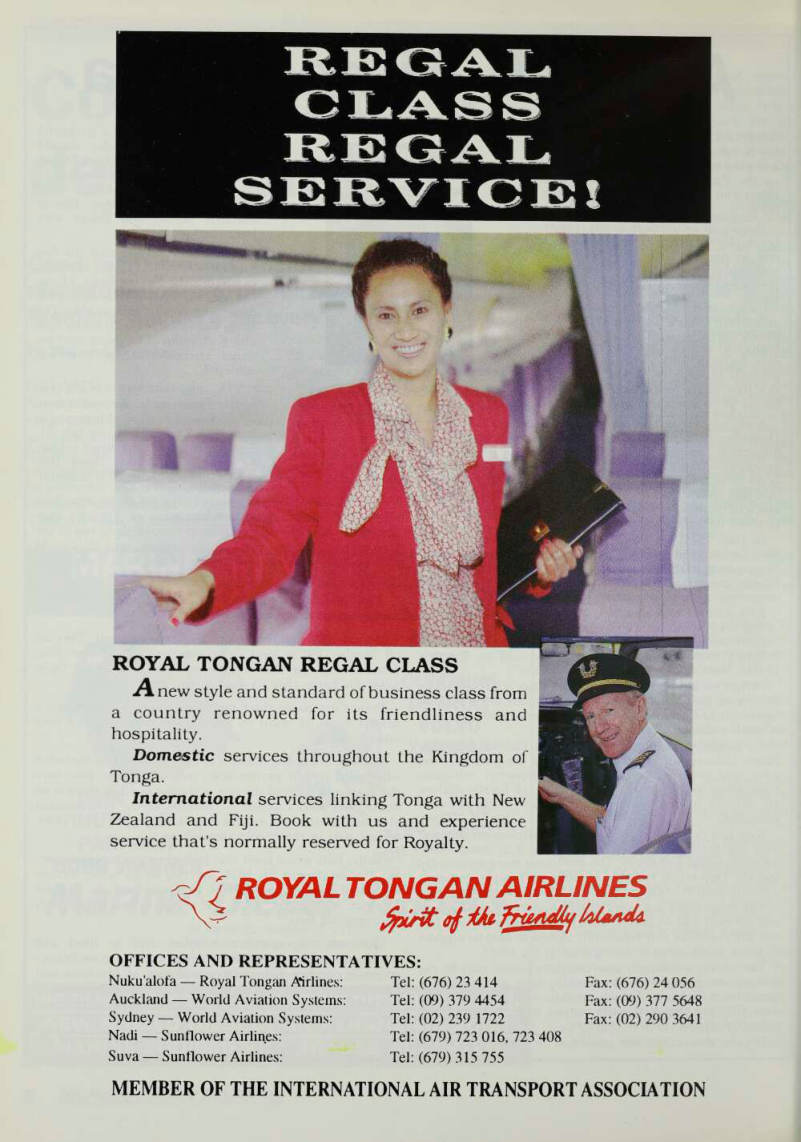
ROYAL TONGAN REGAL CLASS
Anew style and standard of business class from a country renowned for its friendliness and
hospitality.
Domestic services throughout the Kingdom of Tonga.
International services linking Tonga with New Zealand and Fiji. Book with us and experience service that's normally reserved for Royalty.
ROYAL TONG AN AIRLINES
farft 4 TnudbfUuuU
OFFICES AND REPRESENTATIVES:
Nukualofa Royal Tongan Airlines: Auckland World Aviation Systems: Sydney World Aviation Systems: Nadi Sunflower Airlines: Suva Sunflower Airlines: Tel: (676) 23 414 Tel: (09) 379 4454 Tel: (02) 239 1722 Tel: (679) 723 016, 723 408 Tel: (679)315 755 Fax: (676) 24 056 Fax: (09) 377 5648 Fax: (02) 290 3641 MEMBER OF THE INTERNATIONAL AIR TRANSPORT ASSOCIATION
Long live the King


Celebration
\sk a Tongan when the best time to visit his country would be and the answer would nost likely be “ during the Heilala Festival”. In late June and early July each year he world smallest - and arguably quietest - kingdom is suddenly shaken from its slumber s a kaleidoscope of colour explodes. Dancing, singing and music rock the capital Vuku’alofa as work is forgotten and general merriment begins.
Heilala is celebrated to coincide with the birthday on the Tongan monarch King Taufa’ahau Tupou IV. This year being his 75th birtday and the celebration of his 25 ear on the throne celebrations naturally more elaborate than normal.
Many Tongans see July 4, 1967 as one of the most important dates in the modern istory of their country. On this day in the Royal Chapel in Nukualofa His Majesty ling Tupou IV was crowned King of Tonga. A day many hailed as a new era as ley felt they had the leader to take them into the modern world. r They were not wrong. His 25year reign has seen many innovations such as opening r onga to tourism, encouraging foreign investment, establishing a small industries centre nd the exploration for oil and underwater minerals. The results are now being seen
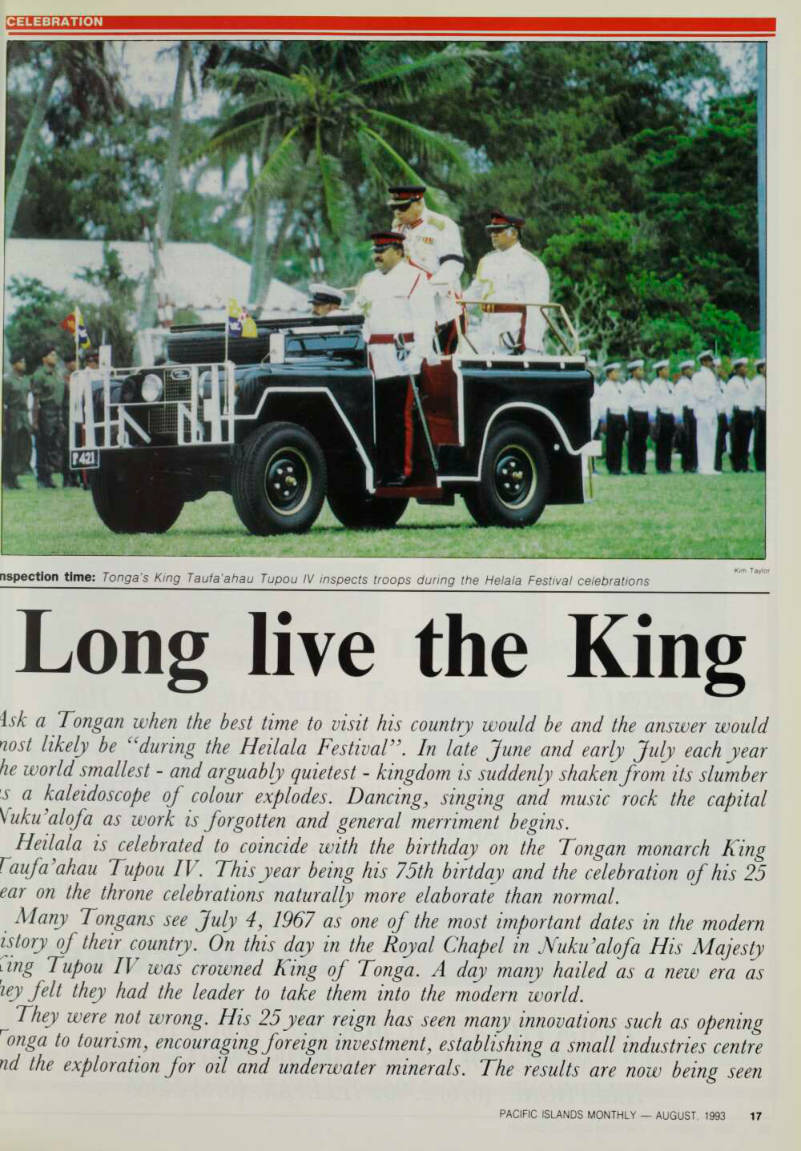
Kim Taylor
[?]nspection time: Tonga's King Taufa'ahau Tupou IV inspects troops during the Helala Festival celebrations
with tourism numbers increasing annu ally, foreign investors coming in and foreign exchange earnings climbing.
The King is the eldest son of the late Queen Salote Tupou 111 and was born on July 4, 1918 at the Royal Palace, Nuku’alofa. On the birth of the Crown Prince Tonga’s three ancient lines of kings, the Tu’i Tonga, Tu’i Ha’atakalaua and the Tu’i Kanokupolu, were united making him the paramount traditional leader.
After receiving his early education in Tonga King Taufa’ahau Tupou IV left for Australia and became the first Tongan to receive a university degree when he graduated from the University of Sydney with a BA and LLB degrees. The King was also an outstand ing sportsman and his pole vault record set at the age of 14 still stands. He also enjoyed gymnastics, rugby, cricket and lawn tennis. Also a keen mathematician the King is a member of the Interna tional Mathematics Association. He is an expert on the abacus and was responsible for its introduction to all Free Wesleyan primary schools in Tonga.
Also very interested in music the Tongan monarch, while Minister of Education in the mid- 19405, wrote a booklet on how to read the English musical notation and its translation into
the Tongan notation. The booklet is still in use.
In 1944, while Minister of Education, the portfolio of Health was added to his responsibilities. He was responsible for the two until he became Premier in December 1949. With this came the responsibility of Education, Agriculture and Foreign Affairs and later Works.
Wanting to better the standards of the kingdom’s education the king was the driving force behind the establishment of the Teachers’ Training College in 1944 and Tonga High School in 1947. He also established the Tonga Copra Board and was instrumental in setting up The Tonga Produce Board and the Agricul tural Council. His aim want the im proved marketing of the Kingdom’s produce.
During his 16 years as Premier he did much to firmly establish ties with overseas nations. For example the close links between Tonga and the United Kingdom has seen much financial and technical assistance provided. Further strengthening the bonds between the two countries, the king was appointed a CBE in 1951 and in 1958 was awarded the KBE by Queen Elizabeth 11.
The King married Halaevalu Mata’aho on June 10, 1947, they have three sons and a daughter. □
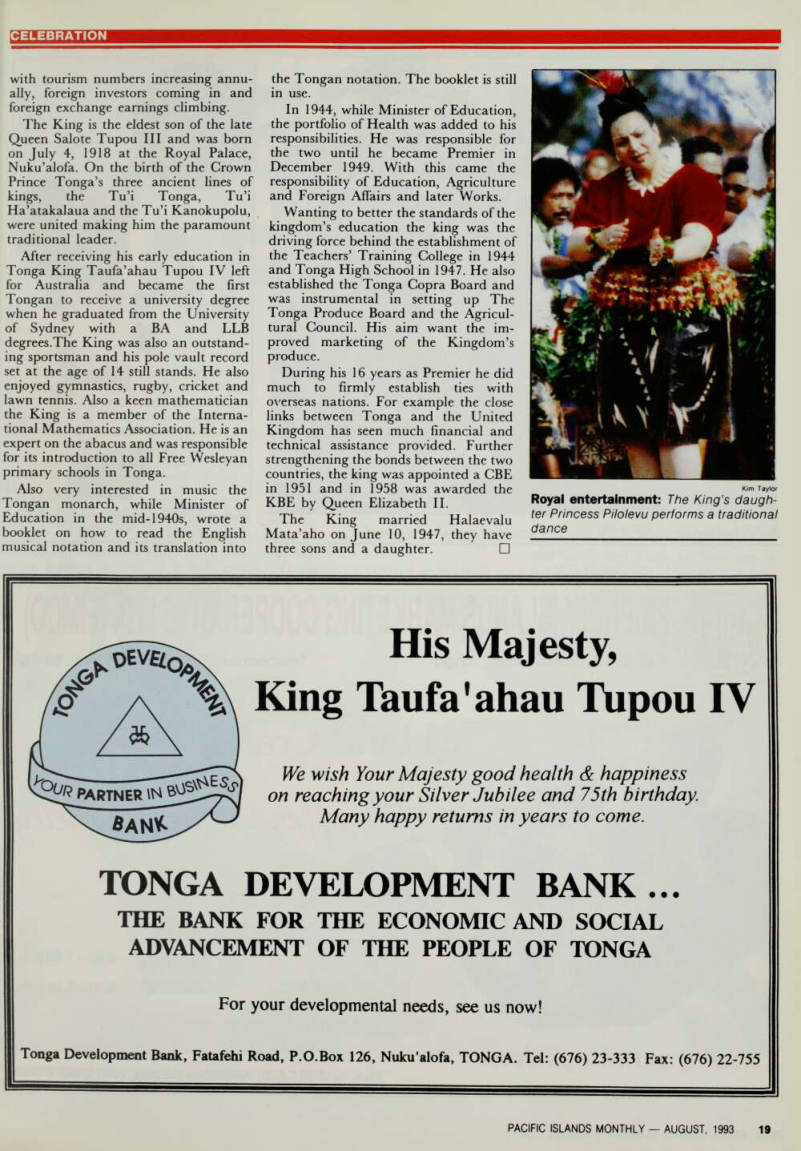
Kim Taylor Royal entertainment: The King's daugh ter Princess Pilolevu performs a traditional dance
The entertainers: some of the students who provided entertainment
Martin Tiffany Women power: just one of the happenings during Heilala
Kim Taylor
Advertisements & other items, pp. 18-20 (2 items)
The Kingdom of Tonga
+ * 11 li ij *
TONGA 80
A-wVAVWAVvWJ
The Kingdom of Tonga
THE FRIENDLY ISLAND IN THE SOUTH PACIFIC
STAMPS OF THE ONLY EXISTING POLYNESIAN
KINGDOM IN THE WORLD,
THE HISTORY
OF TONGA IS UNIQUE SO ARE
ITS STAMPS. IF UNIQUE
QUALITY IS WHAT YOU
WANT CALL OR WRITE.
Bin hdav ■ Tupou IV Hfli
SPECIMEN
I 25th.Annivmary of Tonga Police Training College
Kl HAO KAMA U LELEI
ANGE FAKAKAUKAUi
HOFAMIU
it Cl
NIUAFO’OU
T$ King a 45s 75th.. ofHM Taufa'ahauHipou
YOU CAN’T TELL THE
DIFFERENCE OF THE STAMPS
OF TONGA AND THAT OF
NIUAFO’OU BECAUSE THERE IS
NO DIFFERENCE IN THE
UNIQUENESS OF THE QUALITY.
YES, THERE ARE LOTS MORE
TO CHOOSE FROM.
ASK THE EXPERTS
TONGA PHILATELIC BUREAU, PO BOX 164,
NUKUALOFA,KINGDOM OF TONGA.
TELEPHONE: (676) 23066 TELEFAX: (676) 24366
NIUAFOOU
MIMMI «
of Aviation in Niuafrfou e
t^ oev %
PARTNER IN )
«an*-
His Majesty,
King Taufa'ahau Tupou IV
We wish Your Majesty good health & happiness on reaching your Silver Jubilee and 75th birthday.
Many happy returns in years to come.
TONGA DEVELOPMENT BANK ...
THE BANK FOR THE ECONOMIC AND SOCIAL
ADVANCEMENT OF THE PEOPLE OF TONGA
For your developmental needs, see us now!
Tonga Development Bank, Fatafehi Road, P.0.80x 126, Nukualofa, TONGA. Tel: (676) 23-333 Fax: (676) 22-755
P.O. Box 523 Nukualofa, Tonga Telephones: 21-988, 23-155 Fax: 23-928 4* i % m.
Hand Crafts
oj-j-z’i tbs, cjuatitjj
Locations: Fatafehi Road opposite Hours Tonga Development Bank, or O.G. Sanft Bldg., Taufa'ahau Road also in Vava'u Mon-Frl: 8.00 - 7.00 p.m.
Saturday: 8.30 - 2.00 p.m.
Packing and mailing services
VISA. MASTERCARD, AMERICAN EXPRESS, AND DINER’S CLUB
Celebration
Happiness

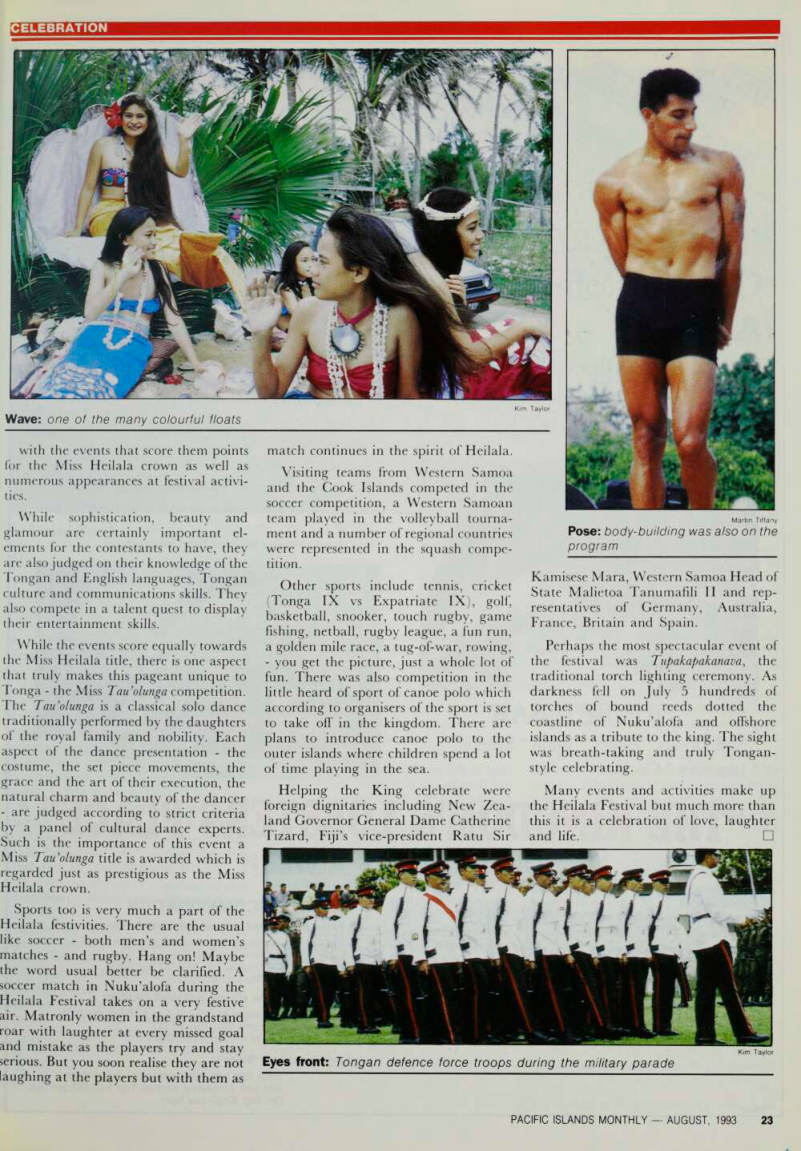
Heilala
IT ALL began fairly quietly with an art and craft exhibition on June 26. But slowly built up to a crescendo of music, dancing, singing, and out and out celebration as Tonga was gripped by 15 days of the Heilala Festival. Without a doubt one of the biggest affairs the tiny island kingdom has seen - and will see for a long time.
Brass bands, military parades, tra ditional dancing, singing, sports, a float parade, a choral festival, a fishing tournament - the list of happenings goes on as business ground to a halt and
Tonga came alive.
The Heilala Festival is held annually to coincide with the birthday of Tongan monarch King Taufa’ahau Tupou IV.
This year being his 75th birthday celebrations naturally stepped up a pace and to further add to the festivity the silver jubilee of his coronation was also celebrated (although this officially hap pened last year). All this turned the
normally quiet, slow-paced capital,
Nuku’alofa, into a sea of colour and activity.
Elaborately decorated arches went up
across roads in and around the capital wishing the King happy birthday and a long life, hundreds of Tongans from abroad arrived for the celebrations, overseas sports teams came to compete and food by the basket-load was pre pared for the many feasts.
Undoubtedly the major highlight of the festival is the Miss Heilala beauty pageant. Young Tongan ladies are joined by contestants from the Tongan communities in New Zealand, Australia and the United States to challenge for the Miss Heilala title. They are kept busy
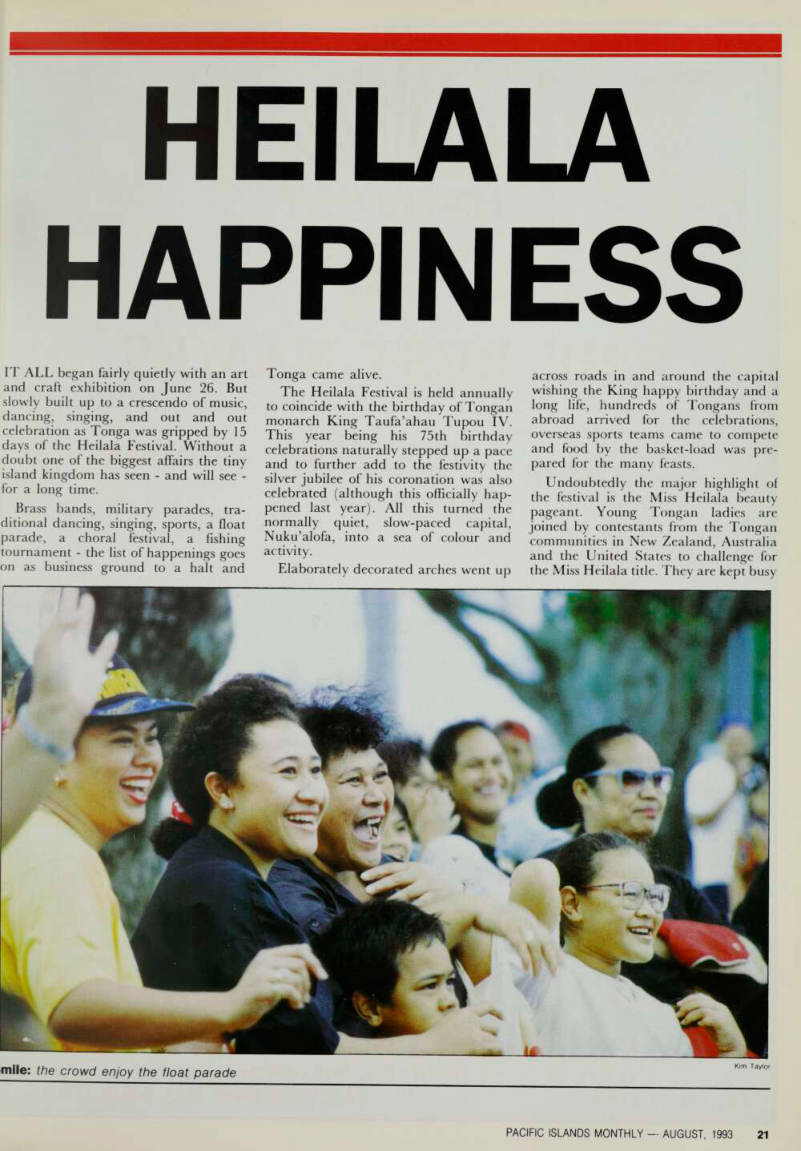
[?] mile: the crowd enjoy the float parade
Kim Taylor
with the events that score them points for the Miss Heilala crown as well as numerous appearances at festival activi ties.
While sophistication, beauty and glamour are certainly important el ements for the contestants to have, they are also judged on their knowledge of the Tongan and English languages, Tongan culture and communications skills. They also compete in a talent quest to display their entertainment skills.
While the events score equally towards the Miss Heilala title, there is one aspect that truly makes this pageant unique to Tonga - the Miss Tau’olunga competition.
The Tau’olunga is a classical solo dance traditionally performed by the daughters of the royal family and nobility. Each aspect of the dance presentation - the costume, the set piece movements, the grace and the art of their execution, the natural charm and beauty of the dancer - are judged according to strict criteria by a panel of cultural dance experts.
Such is the importance of this event a Miss Tau’olunga title is awarded which is regarded just as prestigious as the Miss Heilala crown.
Sports too is very much a part of the Heilala festivities. There are the usual like soccer - both men’s and women’s matches - and rugby. Hang on! Maybe the word usual better be clarified. A soccer match in Nuku’alofa during the Heilala Festival takes on a very festive air. Matronly women in the grandstand roar with laughter at every missed goal and mistake as the players try and stay serious. But you soon realise they are not laughing at the players but with them as
match continues in the spirit of Heilala.
Visiting teams from Western Samoa and the Cook Islands competed in the soccer competition, a Western Samoan team played in the volleyball tourna ment and a number of regional countries were represented in the squash compe tition.
Other sports include tennis, cricket
(Tonga IX vs Expatriate IX), golf,
basketball, snooker, touch rugby, game fishing, netball, rugby league, a fun run, a golden mile race, a tug-of-war, rowing, - you get the picture, just a whole lot of fun. There was also competition in the little heard of sport of canoe polo which according to organisers of the sport is set to take off in the kingdom. There are plans to introduce canoe polo to the outer islands where children spend a lot of time playing in the sea.
Helping the King celebrate were foreign dignitaries including New Zea land Governor General Dame Catherine Tizard, Fiji’s vice-president Ratu Sir
Kamisese Mara, Western Samoa Head of State Malietoa Tanumafili II and rep resentatives of Germany, Australia, France, Britain and Spain.
Perhaps the most spectacular event of the festival was Tupakapakamva , the traditional torch lighting ceremony. As darkness fell on July 5 hundreds of torches of bound reeds dotted the coastline of Nuku’alofa and offshore islands as a tribute to the king. The sight
was breath-taking and truly Tongan
style celebrating.
Many events and activities make up the Heilala Festival but much more than this it is a celebration of love, laughter and life. □
Wave: one of the many colourful floats
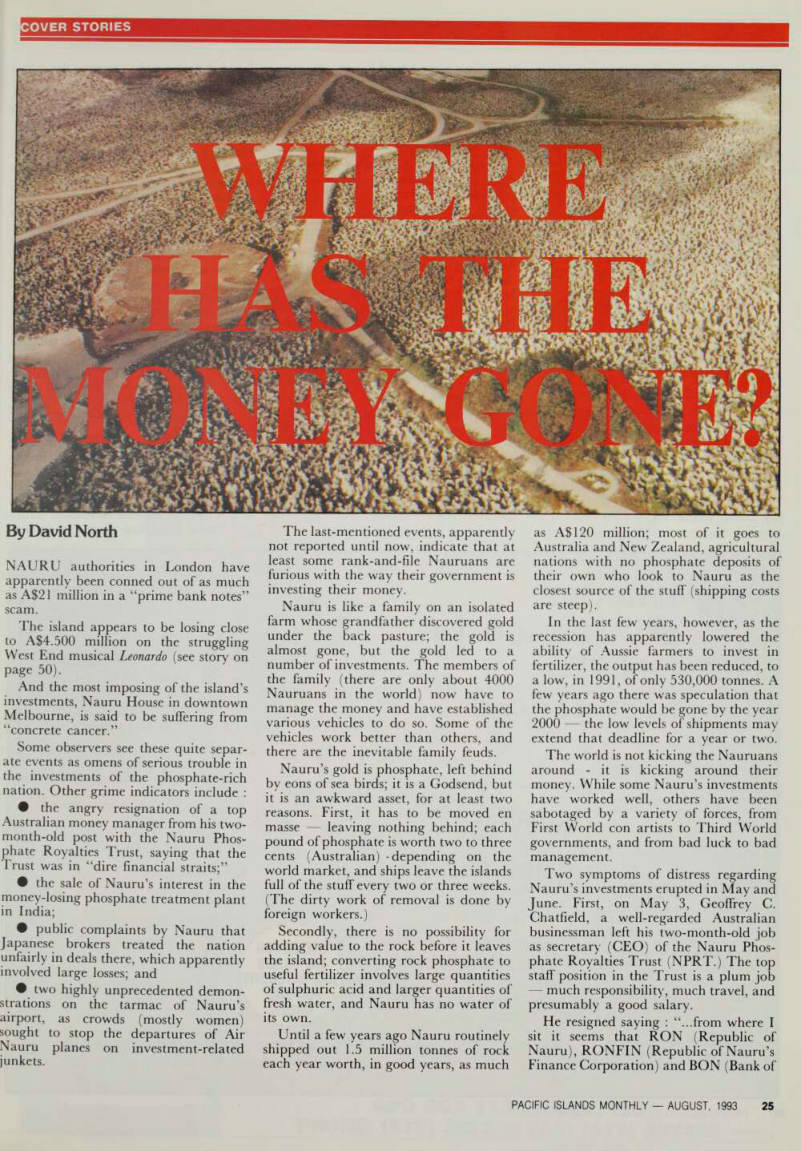
Marlin Tiffany Pose: body-building was also on the program
Kim Taylor
Kim Taylor
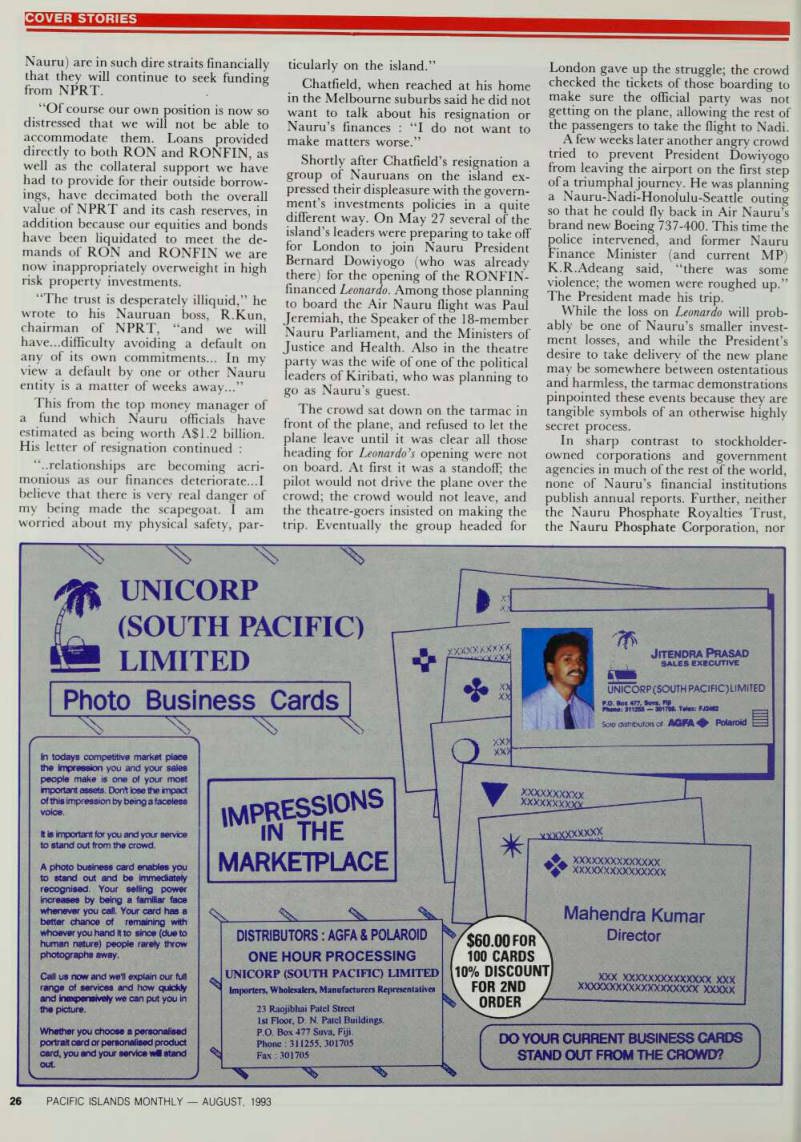
Eyes front: Tongan defence force troops during the military parade
Advertisements & other items, pp. 22-24 (1 item)
Tijfer
YA
HARVEST
THE BEST NAMES
•*/\rtline
A
MITSUBISHI
MOTORS
SOUTH PACIFIC
BREWERIES
PAPUA NEW GEANIUE
Canon
COPIER
FACSIMILE
Olivetti
TCM
TYPEWRITER
COMPUTER
AUDIO VIDEO
HIFI
<sajb£tFAX
Tijfer
Obhr
OIIBXION
s
HARVEST PACIFIC LIMITED
DEVELOPMENTS TRADE INVESTMENT
G.P.O. BOX 823, HONIARA, SOLOMON ISLANDS
TEL: (677) 30407 FAX (677) 30460 H.Q. 66356 WANG
$ w
GOOD SAMARITAN INN BEACH RESORT
“A HOME AWAY FROM HOME”
OUR MOTTO IS
“WE CARE”
C Customers
A Are
R Really
E Everything
SUNSET BAR
Soft Drinks * Beers * Wine * Spirits Liqueurs * Cocktails V
SPECIALIZING IN:—
* Sea Food, French Cuisine * Traditional Tongan Food * Tropical Delight Desserts * Right on the beach and 20 minutes drive West of Nukualofa * Ocean View Bar with breath-taking views of the beautiful sunset horizon * Next door to Tonga’s historical flying fox sanctuary • w wL y
“THE KINGDOM’S LOBSTERS PLACE”
OPEN 7 DAYS A WEEK
FOR BOOKINGS AND INQUIRIES
PLEASE CONTACT:—
P.O. BOX 306 NUKUALOFA
PHONE: (676) 41-022 OR 41-095
KINGDOM OF TONGA
118689v3
ACCOMMODATION
* Fales with shared shower and toilet facilities.
Single Top $lO.OO per night (W= Top $50.00) Double Top $16.00 per night (W=Top $100.00) * Fale with private shower and toilet facilities Single or Double Top $25.00 per night.
Extra Bed Top $6.00 (W Top $150.00) * Self Contained “Fales”
Each fale has two bedrooms, living room and self contained kitchen Top $40.00 per fale (W=Top $250 per fale)
Where
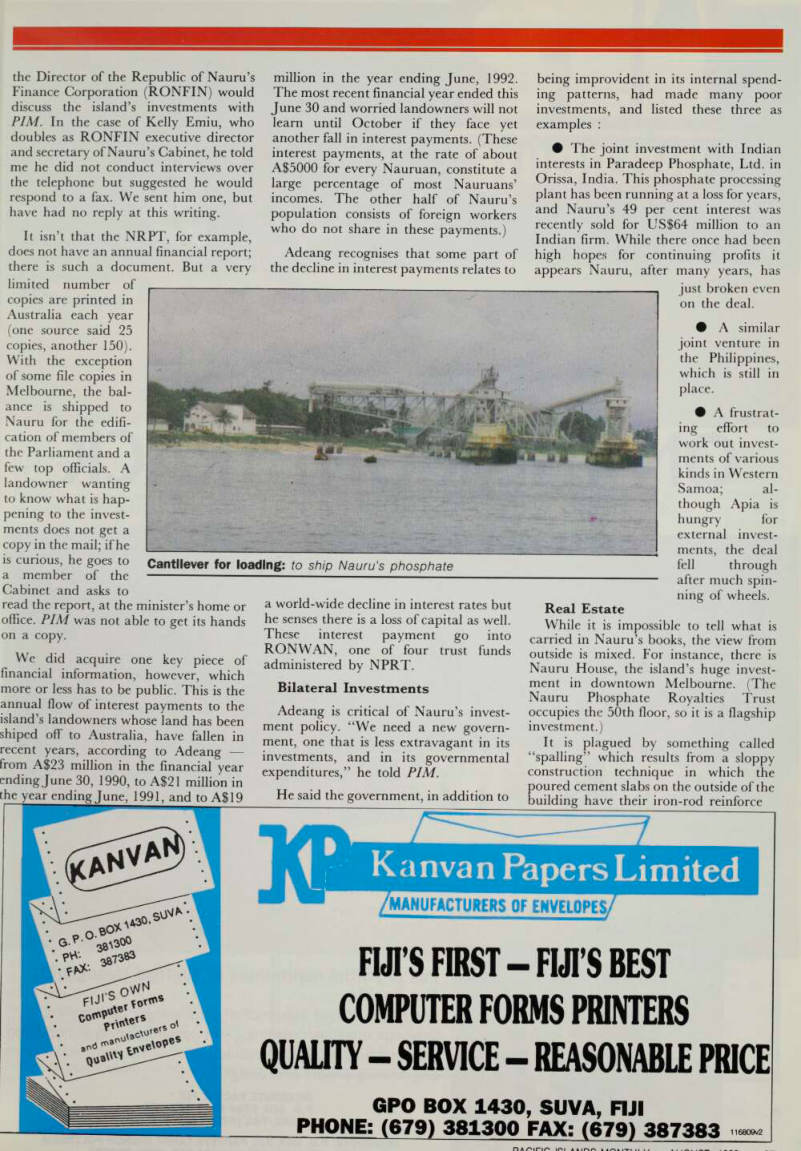
Cover Stories
Has The
Money Gone?
By David North
NAURU authorities in London have apparently been conned out of as much as AS2I million in a “prime bank notes” scam.
The island appears to be losing close to A 54.500 million on the struggling West End musical Leonardo (see story on page 50).
And the most imposing of the island’s investments, Nauru House in downtown Melbourne, is said to be suffering from “concrete cancer.”
Some observers see these quite separ ate events as omens of serious trouble in the investments of the phosphate-rich nation. Other grime indicators include : • the angry resignation of a top Australian money manager from his two month-old post with the Nauru Phos phate Royalties Trust, saying that the Trust was in “dire financial straits;” • the sale of Nauru’s interest in the
money-losing phosphate treatment plant
in India; • public complaints by Nauru that Japanese brokers treated the nation unfairly in deals there, which apparently involved large losses; and • two highly unprecedented demon strations on the tarmac of Nauru’s airport, as crowds (mostly women) sought to stop the departures of Air Nauru planes on investment-related junkets.
The last-mentioned events, apparently not reported until now, indicate that at least some rank-and-file Nauruans are furious with the way their government is investing their money.
Nauru is like a family on an isolated farm whose grandfather discovered gold under the back pasture; the gold is almost gone, but the gold led to a number of investments. The members of the family (there are only about 4000 Nauruans in the world) now have to manage the money and have established various vehicles to do so. Some of the vehicles work better than others, and there are the inevitable family feuds.
Nauru’s gold is phosphate, left behind by eons of sea birds; it is a Godsend, but it is an awkward asset, for at least two reasons. First, it has to be moved en masse leaving nothing behind; each pound of phosphate is worth two to three cents (Australian) -depending on the world market, and ships leave the islands full of the stuff every two or three weeks. (The dirty work of removal is done by
foreign workers.)
Secondly, there is no possibility for adding value to the rock before it leaves the island; converting rock phosphate to useful fertilizer involves large quantities of sulphuric acid and larger quantities of fresh water, and Nauru has no water of its own.
Until a few years ago Nauru routinely shipped out 1.5 million tonnes of rock each year worth, in good years, as much
as AS 120 million; most of it goes to Australia and New Zealand, agricultural nations with no phosphate deposits of their own who look to Nauru as the closest source of the stuff (shipping costs
are steep).
In the last few years, however, as the recession has apparently lowered the ability of Aussie farmers to invest in fertilizer, the output has been reduced, to a low, in 1991, of only 530,000 tonnes. A few years ago there was speculation that the phosphate would be gone by the year 2000 the low levels of shipments may extend that deadline for a year or two.
The world is not kicking the Nauruans around - it is kicking around their money. While some Nauru’s investments have worked well, others have been sabotaged by a variety of forces, from First World con artists to Third World governments, and from bad luck to bad management.
Two symptoms of distress regarding Nauru’s investments erupted in May and June. First, on May 3, Geoffrey C.
Chatfield, a well-regarded Australian businessman left his two-month-old job as secretary (CEO) of the Nauru Phos phate Royalties Trust (NPRT.) The top staff position in the Trust is a plum job much responsibility, much travel, and presumably a good salary.
He resigned saying : “...from where I sit it seems that RON (Republic of Nauru), RONFIN (Republic of Nauru’s Finance Corporation) and BON (Bank of
Nauru) are in such dire straits financially that they will continue to seek funding from NPRT.
“Of course our own position is now so distressed that we will not be able to accommodate them. Loans provided directly to both RON and RONFIN, as well as the collateral support we have had to provide for their outside borrow ings, have decimated both the overall value of NPRT and its cash reserves, in addition because our equities and bonds have been liquidated to meet the de mands of RON and RONFIN we are now inappropriately overweight in high risk property investments.
“The trust is desperately illiquid,” he wrote to his Nauruan boss, R.Kun, chairman of NPRT, “and we will have...difficulty avoiding a default on any of its own commitments... In my view a default by one or other Nauru entity is a matter of weeks away...”
This from the top money manager of a fund which Nauru officials have estimated as being worth Asl.2 billion.
His letter of resignation continued :
“..relationships are becoming acri
monious as our finances deteriorate...! believe that there is very real danger of my being made the scapegoat. I am worried about my physical safety, par
ticularly on the island.”
Chatfield, when reached at his home in the Melbourne suburbs said he did not want to talk about his resignation or Nauru’s finances : “I do not want to make matters worse.”
Shortly after Chatfield’s resignation a group of Nauruans on the island ex pressed their displeasure with the govern ment’s investments policies in a quite different way. On May 27 several of the island’s leaders were preparing to take off for London to join Nauru President Bernard Dowiyogo (who was already there) for the opening of the RONFlN financed Leonardo. Among those planning to board the Air Nauru flight was Paul Jeremiah, the Speaker of the 18-member Nauru Parliament, and the Ministers of Justice and Health. Also in the theatre party was the wife of one of the political leaders of Kiribati, who was planning to go as Nauru’s guest.
The crowd sat down on the tarmac in front of the plane, and refused to let the plane leave until it was clear all those heading for Leonardo’s opening were not on board. At first it was a standoff; the pilot would not drive the plane over the crowd; the crowd would not leave, and the theatre-goers insisted on making the trip. Eventually the group headed for
London gave up the struggle; the crowd checked the tickets of those boarding to make sure the official party was not getting on the plane, allowing the rest of the passengers to take the flight to Nadi.
A few weeks later another angry crowd tried to prevent President Dowiyogo from leaving the airport on the first step of a triumphal journey. He was planning a Nauru-Nadi-Honolulu-Seattle outing so that he could fly back in Air Nauru’s brand new Boeing 737-400. This time the police intervened, and former Nauru Finance Minister (and current MP) K.R.Adeang said, “there was some violence; the women were roughed up.”
The President made his trip.
While the loss on Leonardo will prob ably be one of Nauru’s smaller invest ment losses, and while the President’s desire to take delivery of the new plane may be somewhere between ostentatious and harmless, the tarmac demonstrations pinpointed these events because they are tangible symbols of an otherwise highly secret process.
In sharp contrast to stockholder owned corporations and government agencies in much of the rest of the world, none of Nauru’s financial institutions publish annual reports. Further, neither the Nauru Phosphate Royalties Trust, the Nauru Phosphate Corporation, nor
the Director of the Republic of Nauru’s Finance Corporation (RONFIN) would discuss the island’s investments with PIM. In the case of Kelly Emiu, who doubles as RONFIN executive director and secretary of Nauru’s Cabinet, he told me he did not conduct interviews over the telephone but suggested he would respond to a fax. We sent him one, but have had no reply at this writing.
It isn’t that the NRPT, for example, does not have an annual financial report; there is such a document. But a very
limited number of copies are printed in Australia each year (one source said 25 copies, another 150).
With the exception of some file copies in Melbourne, the bal ance is shipped to Nauru for the edifi cation of members of the Parliament and a few top officials. A landowner wanting to know what is hap pening to the invest ments does not get a copy in the mail; if he is curious, he goes to a member of the Cabinet and asks to
read the report, at the minister’s home or office. PIM was not able to get its hands on a copy.
We did acquire one key piece of financial information, however, which more or less has to be public. This is the annual flow of interest payments to the island’s landowners whose land has been shiped off to Australia, have fallen in
recent years, according to Adeang
from AS23 million in the financial year ending June 30, 1990, to AS2I million in the year ending June, 1991, and to AS 19
million in the year ending June, 1992.
The most recent financial year ended this June 30 and worried landowners will not learn until October if they face yet another fall in interest payments. (These interest payments, at the rate of about Assooo for every Nauruan, constitute a large percentage of most Nauruans’ incomes. The other half of Nauru’s population consists of foreign workers who do not share in these payments.) Adeang recognises that some part of the decline in interest payments relates to
a world-wide decline in interest rates but he senses there is a loss of capital as well.
These interest payment go into RONWAN, one of four trust funds administered by NPRT.
Bilateral Investments Adeang is critical of Nauru’s invest ment policy. “We need a new govern ment, one that is less extravagant in its investments, and in its governmental expenditures,” he told PIM.
He said the government, in addition to
being improvident in its internal spend ing patterns, had made many poor investments, and listed these three as
examples :
. . * The joint investment with Indian interests in Paradeep Phosphate, Ltd. in Orissa, India. This phosphate processing pl an t has been running at a loss for years, anc * Nauru’s 49 per cent interest was recently sold for US$64 million to an Indian firm. While there once had been high hopes for continuing profits it appears Nauru, after many years, has
just broken even on the deal. • A similar joint venture in the Philippines, which is still in place. • A frustrat ing effort to work out invest ments of various kinds in Western Samoa; al though Apia is hungry for external invest ments, the deal
fell through
after much spin ning of wheels.
Real Estate
while it u impossible to tell what is carried in Nauru’s books, the view from outside is mixed. For instance, there is Nauru House the island’s hncre invest iMauru Mouse, me island s huge invest ™ent ,n downtown Melbourne. (The Nauru Phosphate Royalties Trust occupies the 50th floor, so it is a flagship investment.) g P It is plagued by something called “spalling” which results from a sloppy construction technique in which the poured cement slabs on the outside of the building have their iron-rod reinforce
Cantilever for loading: to ship Nauru’s phosphate
ments too close to the outer surface. The nearness of the iron to the exterior allows the rods to rust, which leads to chipping of the cement, and the dropping of small segments of cement no bigger than pebbles, we were told on those below.
To prevent this Nauru has, at some considerable cost, decided to cover the cement surface with aluminium.
So Nauru House is not falling down, but the not-fully rented building has scaffolds all around it as an expensive new face is applied. Co-incidentally, this is exactly what is happening to the otherwise attractive building owned by Nauru in Houston; the six-storey struc ture, occupied by CAE-Link, manufac turer of pilot training devices, suffers from expensive complexion problems.
The facial board that had covered its exterior, since it was erected about a dozen years ago, has developed leaks and other failings and is now being replaced with black glass.
Continuing in this mixed vein, there are, for example, two of Nauru’s invest ments within 150 miles of each other the Pacific Star Hotel in Guam and the Nauru office building in Saipan. The Pacific Star, one of the largest and most successful hotels in Guam, is apparently prosperous, and is usually full of Japan ese tourists.
The Saipan building had a promising
start. It was a spanking new, highly attractive office building; on the roof was the first revolving restaurant on the island, the initially successful Taipei Cafe. But after a while the mechanism to make the restaurant revolve stopped working, and a little later the restaurant went out of business. Now the place, we are told, has only a few tenants and appears unkempt. Apparently the man agers set the rental rates too high when it opened, and never adjusted to the market realities.
One can draw a similar comparison between Nauru’s successful venture into Washington D.C.’s real estate market, and its disastrous hotel in Majuro. Now fully rented, Washington’s Pacific House contains the offices of Fred Radewagen, the publisher of Washington Pacific Report who handled the development of the building, and several other Pacific related interests, such as the Embassy of Papua New Guinea.
Then, in contrast, there is the never quite-finished, 15-year-old Nauru hotel in Majuro. When, and if, completed it will double the number of hotel rooms in the principal city of the Marshalls. It stood so long half-completed that it became an eyesore, and the President of RMI, Amata Kabua, had to intervene with the President of Nauru to get construction going again.
On the other hand, the Nauru invest
ment in real estate near Honolulu’s Waikiki appears to be going well the whole picture is indeed a mixed bag.
Duke Minks Two of Nauru’s other real-estate ventures in Australia are associated with Duke Minks, who, it turns out, is much more to Nauru than just the producer of Leonardo. Minks, through his Australian corporation, Austfin Pty. Ltd., manages the Randwick Shopping Mall in the Sydney suburbs for Nauru, and is working on a project with the island to build the Railway Square Hotel near the Sydney railroad station.
Former Finance Minister Adeang thinks Duke Minks plays too important a role in Nauru’s finances. The island and the 47-year-old native of Liverpool have had several adventures together.
Minks, a one-time manager for a rock group, is not only interested in theatre, he loves airlines. At one point Nauru lent substantial funds to the low-fare, East- West Airlines of which Minks was the president. This was an Australian ven ture which apparently did Nauru little or no harm. More recently Minks con vinced Nauru, which already has one money-losing airline (Air Nauru), to join him in a bidding war to acquire another failed carrier, Compass Airlines. But the Australian government opted for a bid from Southern Cross Airlines. It was just as well that Nauru lost that one Southern Cross tried to run the line for six months, and then it collapsed again.
Air Nauru The airline is simultaneously a contri bution to the small island states of the Central Pacific and consistent money
loser.
For example, it recently worked out an arrangement with Kiribati’s airline, Air Tungaru, to operate a Tarawa/Christ mas Island/Honolulu service. But no matter how good the sport fishing is off Christmas Island, flying long distances between small population centers is a guaranteed way to lose money in the airlines business. And Air Nauru, in the island’s tradition, does not issue financial reports.
Oldtimers in the Pacific love to swap Air Nauru stores. In the early days the then president of the country, Hammer Deßoburt, would charge off in the plane without thought of its schedule. On one occasion the plane was scheduled to go to Guam, but Deßoburt wanted to go to Manila; so the plane, the president and the passengers all went to Manila.
Air Nauru put the passengers up in a hotel for a day or two, and eventually they all reached Guam but at considerable expense to the airline, and thus to the people of Nauru.
Then there was a period, a few years ago, when the pilots, worried about their safety and that of their passengers, refused to fly until better arrangements were made for aircraft maintenance.
This has been done, but not before the carrier was de-certified by international authorities for a while.
On the other hand, since Air Nauru uses its home airport as its hub, many travellers who would not otherwise visit Nauru find themselves there, often over night, between legs of a single journey. In addition to the Christmas Island run for Air Tungaru, Air Nauru serves Manila; Guam; Chuuk, Pohnpei and Kosrae in
FSM; Tarawa; Nadi and Suva; Honiara; Noumea; Auckland; and Sydney and Melbourne.
Air Nauru, in 1991 had ordered two Boeing 737-400 s, one of which was delivered in June (following the tarmac demonstration) and the other is sched uled to arrive in October. It is not clear whether the two would expand the fleet or replace two older 737-200 s.
The purchase was totally leveraged with borrowed money. According to the loan officer in charge at the US Export- Import Bank, Air Nauru did not make even a symbolic down payment.
The two planes cost U 5579.5 million; the Export-Import Bank guaranteed US$69 million of that, and Citibank N.A., Hong Kong put up the rest. There are to be 48 quarterly installments beginning no later than February 20, 1994.
The Ex-Im Bank’s press release ofjune 28, 1993 reads as follows on the owner ship of the planes : “Victoria Aircraft
Leasing Coorporation, Georgetown,
Grand Cayman Islands (a semi autonomous British territory in the Caribbean) will purchase the aircraft for lease to the Republic of Nauru Finance
Corporation (RONFIN).”
This sounds as if Victoria Aircraft was
to be the owner of the plane, and I asked about it. The loan officer brushed aside this concept saying, “Oh, no, Nauru will own the plane when it pays off the loans; Victoria is just a dummy corporation used for tax purposes; its stock is owned by Nauru and is pledged against the loan.”
The Ex-Im press release also said, “The Bank’s current exposure in Nauru is 54.4 million.” This turns out to be another Nauru borrowing, this time for a telecommunications system based in the island’s hotel; we could get no further description of what the $4.4 million purchased.
The World Court Suit In addition to its troubled investments Nauru has two remaining major assets the last of the phosphate on the island and a suit against Australia for As 72 million. Nauru’s claim in the World Court is that it had been woefully underpaid by Australia, New Zealand and the United Kingdom for the phos phate removed prior to 1968; the Austra lians reply that a deal is a deal, and it is too late for Nauru to re-open an agreement concluded almost 25 years ago.
The UK and New Zealand apparently have taken moves with the World Court
that prevent them from being sued, as Australia is. The World Court’s decisions are significant (particularly vis-a-vis a
democracy like Australia) but they are
not binding.
Nauru has invested an unknown but presumably large amount of money hiring lawyers to mount the court case, and employing researchers to provide the documentation. (The exhibits are said to run to ten volumes).
If Nauru wins, or gains a substantial out-of-court settlement, it will prove to be a wise investment; if not, not. If it loses it will be another long-shot, like Leonardo ; if it wins, there will be new money to invest, and it will be interesting to see what happens to it.
At press time the Australian govern ment indicated it might prefer to settle the case out of court for something like Asso million with the notion these negotiations might be concluded by the upcoming Forum meeting in Nauru.
It was not clear how the Nauru government felt about the offer, but Adeang told PIM he and his supporters would fight it if it meant another large hunk of cash for the current administra tion. Adeang preferred the settlement take the form of, say, Asso million worth of physical restoration of the island. □
Advertisements & other items, pp. 26-30 (1 item)
Vs6O.Oofor\
UNICORP
(SOUTH PACIFIC)
LIMITED
Photo Business Cards
In todays competitive market place the impression you and your sales people make is one of your most important assets. Don't lose the impact of this impression by being a faceless voice.
I is important for you and your service to stand out from the crowd.
A photo business card enables you to stand out and be immediately recognised. Your selling power incresses by being a familiar face whenever you call. Your card has a better chance of refraining with whoever you hand it to since (due to human nature) people rarely throw photographs away.
Calf us now and well explain our full range of services and how quickly and inexpeneivefy we can put you in the picture.
Whether you choose a personalised portrait card or personalised product card, you and your service w« stand out.
impress* o1 '* 5
IN THE
MARKETPLACE
DISTRIBUTORS: AGFA & POLAROID
ONE HOUR PROCESSING
UNICORP (SOUTH PACIFIC) LIMITED
Importers, Wholesalers, Manufacturers Representatives 23 Raojibhai Patel Street Ist Floor. D. N. Patel Buildings.
P.O. Box 477 Suva, Fiji.
Phone : 311255. 301705 Fax : 301705 I Jitendra Prasad
SALES EXECUTIVE
V *
UNICORP(SOUTH PACIFIC)LiMITED
P.O. Sol 477, m
PhMM; JII7SS —3017 m FJ2442
Soto distributors of AGFA* Polaroid [= Q T
**XXXXXXX*
* A xxxxxxxxxxxxxx
yr XXXXXXXXXXXXXXX
Mahendra Kumar
Director
VS6O.OOFOR\
/ 100 CARDS 1
10% DISCOUNT
\ FOR 2ND j
vv order /-
xxx xxxxxxxxxxxxxx xxx xxxxxxxxxxxxxxxxxxx xxxxx
DO YOUR CURRENT BUSINESS CARDS
STAND OUT FROM THE CROWD?
\_r-' Kanvan Papers Limited
/MANUFACTURERS OF ENVELOPES/
FIJI’S FIRST-FIJI’S BEST
COMPUTER FORMS PRINTERS
QUALITY - SERVICE - REASONABLE PRICE
GPO BOX 1430, SUVA, FIJI
PHONE: (679) 381300 FAX: (679) 387383 -«««
I 1
ON THE RIGHT TRACK
38 AIRPORTS CONSTRUCTED IN THE PACIFIC
* m & J v « ~-,C ■ m Mm Full or partial realizations of airstrips throughout: the Pacific.
Contractor in road construction/asphalting / Earthmoving Drainage Blasting/Crushing/Port construction/Wall protection Civil engineering/Water reticulation...
Engineering project and design.
INTEROUTE PACIFIC FIJI
P.O. BOX 9714 NADI AIRPORT
PHONE/FAX(679) 780773
INTEROUTE: P.O. BOX 371 PAPEETE TAHITI FRENCH POLYNESIA
Save the Children Fund
Australia
Employment opportunities in the Solomon Islands:
Health Training Adviser
A senior position providing support to the Ministry of Health in training needs analysis amongst nurses and village health workers, and the subsequent design, conduct and evaluation of training courses.
lEC Project Officer
Developing, producing and evaluating Information, Education and Communication materials for Save the Children and UNICEF health projects in the Solomons.
Full Position Descriptions are available on request. Both positions are based in Honiara, with two year contracts and a salary in the range A 514,000 A 516,000 p.a. plus living allowances. Closing date for applications is 20 August, 1993, and should be addressed to: The Executive Director Save the Children Fund Australia P.O. Box 1281, Collingwood, 3066, Victoria, Australia Fax (61-3) 419 9518 Phone: 61.3-4177662 121605v3
Leaders in quality home refrigeration
Conned in bank scam
By David North
NAURU’S representatives in London apparently were duped by flim-flam artists for a loss of As2l million. It could have been worse, as As9o million was at stake in the bank-related scheme, but most of it was recovered.
The bank scam reads like an over written international thriller. The cast and plot included an Australian lawyer said to be an addicted gambler, who has spent some time recently in a mental hospital; investigations by the City (of London) Fraud Squad, the Bank of England, and Hong Kong police; the mysterious Dr Gopal and his Vanuatu connection; and the use of highly unusual financial instruments that the London Sunday Times described in quotation marks as “prime bank notes”.
The story though known to US bank regulators as early as December, 1992 surfaced in June when one of Nauru’s British law firms, Waltons & Morse, sued the big Australian firm of Allen Allen & Hemsley. The London firm said Nauru had entrusted some AS9O million with A A & H, that much had been recovered, but it wanted the balance returned. Managing the action for Nauru was one of its London financial advisers, Martin Weston, who appar ently had not been involved in the original investment.
The investment was more than a little unusual. The very careful Sunday Times identified it this way “The inter-bank market for prime bank notes is little known. The people who promoted trad ng to the Nauruans said it was highly secretive and it was important to keep it Tat way so that outsiders would not indermine the spectacular returns. The promoters said bankers who used the market for off-sheet balance sheet bor owing would deny its existence.”
The more outspoken Private Eye maga :ine wrote of “the mythical markets in )rime bank notes and standby letters of redit... which... form part of a sophisti ated franchised fraud which has been leveloped and orchestrated by a syndi cate of international conmen... Down Jnder questions are being asked about vhy those in charge of administering the funds there could be taken in so asily...”
John Shockey, a US Treasury official
in charge of breaking up phoney “brass plate banks” told PIM banking officials world-wide had known for years that prime bank notes were worthless.
“Had Nauru come to us, or the FBI, or Scotland Yard, or any of the big banks in Australia they would have learned that this is a fraudulent activity but they did not.” While Shockey wants Nauru to get all of its money back, he noted Nauru has not cooperated regard ing the brass plate banks that defraud other people. He read a list of 18 institutions, such as the Jefferson Bank and Trust and the Pioneer Development Bank; each has been called to the Treasury’s attention regarding suspicious activities, and each is said to be licensed by Nauru.
Nauru not only will not respond to inquiries about these banks, it has not accepted US offers to help set up a bank regulation scheme. Further, classified ads run regularly in both the Economist and the Wall Street Journal placed by a consultant who says he has Nauru banking licences for sale.
If the description of the financial instrument offered to Nauru suggests a scam, so did many other elements of the story. First, there was the promised rate of return —as much as a stunning 10 per cent a month.
Then there is the Australian lawyer, R A Powles, who had been, until Novem ber, the London resident manager of Allens.
His law firm now says of him, “Allen Allen & Hemsley has recently discovered certain transactions in which its former London resident partner, Mr R A Powles
has been involved. At the request of the firm Mr Powles resigned on November 18, 1992 and has been receiving treat ment for a medical condition in the psychiatric unit at the Royal North Shore Hospital.” Powles is also said to have had a gambling problem, and may have tried to commit suicide.
Dr Gopal (no other name given) was identified as the leader of the promoters, and in the process he used what was described as a Vanuatu-registered financial entity, Linpar. (Linpar also operates in Switzerland.) While Dr Gopal apparently played a role in the disposal of the money, Nauru’s lawyers had the impression the sums had been entrusted to the big Australian law firm, and this was reassuring to Nauru.
The story began in late 1991 when the perpetrators convinced someone in Nauru’s London operation to invest AS 12.7 million in the “prime bank notes”. It brought the promised return quickly, and Nauru’s representative put in another A 577.2 million some time in the first half of 1992. By July, 1992 the Nauruans were asking questions, and by October it became clear that something might be amiss. But it was not until June that legal action was taken.
The controversy is now headed to wards a judicial decision, perhaps in British courts, or perhaps in Australian ones. Wherever it lands it will be the Nauru Phosphate Royalties Trust vs.
Allen Allen & Hemsley. Nauru’s leaders were angry at Allens for not settling immediately. Nauru has apparently also hired a firm of investigators, headquartered in New York, to help get its money back. □
Advertisements & other items, pp. 31-32 (1 item)
Blairs
REPLACEMENT ENGINES
Largest Range in the South Pacific
Over 800 engines available: Diesel-Gasoline lOhp to 400 hp Transmission to match if required Japanese English European Models Engine Overhaul Kits for most models Huge Range of Parts on hand GOOD supply of Bedford Detroit Gardner Leylands Mercedes Perkins Scania engines
BLAIRS
Geraldine, New Zealand Telephone (643) 693-8122 Fax (643) 693-8120 P.O. Box 14 New Zealand Established 1956 We ship anywhere In the Pacific
How Tahiti
Sold $2 Million
Worth Of Products
In One Night.
0-61 5^ 23 -< P3* > xs*= -<O-5t * y *y The Tahiti Exportation Board wanted to promote French Polynesian products in Sydney.
Everything from chocolates to beer to black pearls.
The Board enlisted participants, arranged shipment of their products and funded the displays.
The Trade Commission, in turn, put together a mailing list of people likely to be interested and sent out invitations to a gala evening in the ballroom of the Regent.
We had displays built. Generated press coverage. And we hired three lovely ladies to move among the guests wearing some of those black pearls. (The most expensive jewels were in a case under armed guard.) When the evening was over, products totalling more than $2 million had been sold.
Needless to say, the Tahiti Exportation Board was quite pleased with the way everything went.
If you’d like to feel the same sort of pleasure, just post or fax us the coupon below. If you’re in a hurry, feel free to phone. i Name Company Address p 4C S 9 £ «r> I Level 6, 50 Park Street, Sydney NSW 2000.
Phone: (612) 2835933, Fax: (612) 2835948
Showdown in Apia
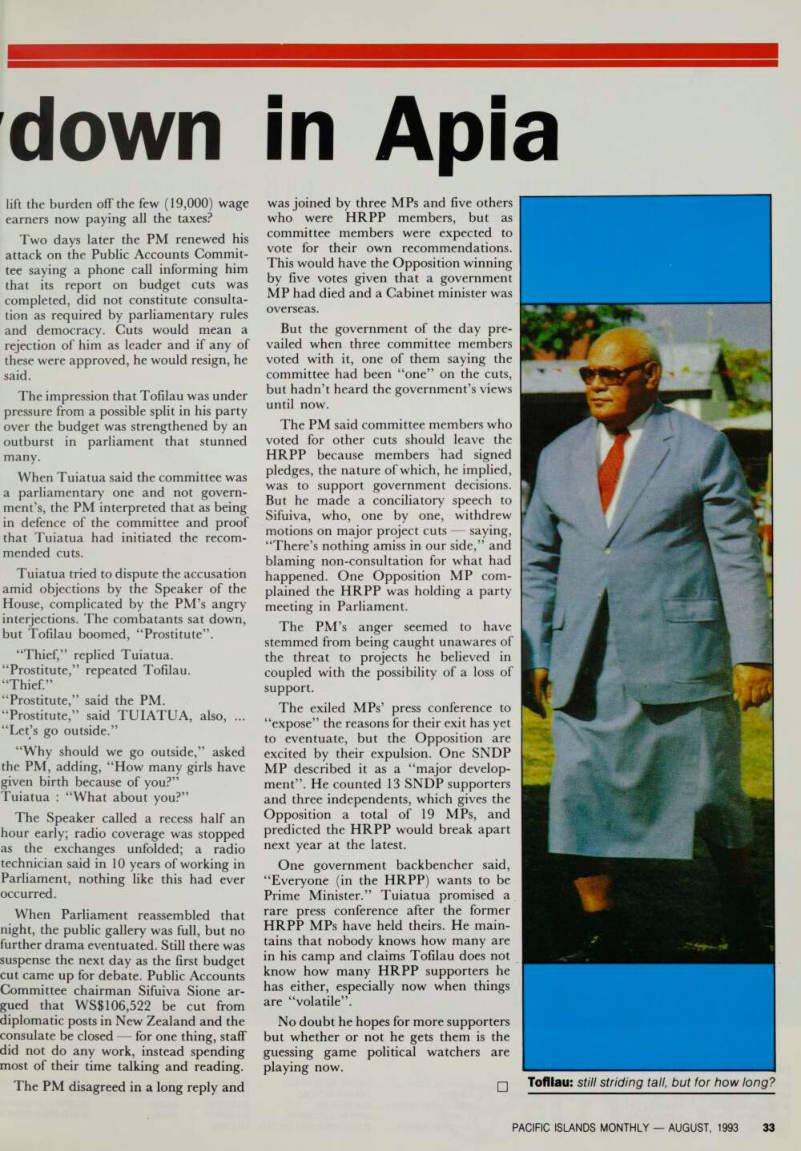
Western Samoa
By Alan Ah Mu
FOR a few days in June, the startling possibility of a break-up of the Human
Rights Protection Party government
hovered in Parliament.
Previously the party was anything but vulnerable, enjoying a big majority and
being able to push through heatedly
opposed legislations without any trouble.
Deputy Prime Minister Tuilaepa Sailele Malielegaoi could even afford to joke he had “33 and a half’ MPs in the 49-seat parliament. And the HRPP was well organised : weekly caucus meetings at new party headquarters, weekly media conferences and a discipline that saw Tuilaepa postpone a press conference mid-way in order to be in Parliament on time because lateness was penalised.
But when the 1993/94 budget was before Parliament, Prime Minister Tofilau Eti Alesana confirmed that three MPs had been expelled from the HRPP, and blamed this on the tactics ofTuiatua Tupua Tamasese, leader of the Samoa National Development Party, the main opposition. The three were in the Public Accounts Committee which Tofilau then attacked. MPs had just asked for phones, cattle and a counsellor for overseas students but the committee was recom mending cutting back on budgetary funds, he said. He accused the committee of not consulting with him and getting carried away with the power of their
positions.
Further displaying a need to gather support, he said parliament should work together for victory for Samoa. His offer to reign (made last year) because of differences within the party and “incom plete strength” had been turned down, but attempts were still being made to “shake” the government when it was engaged in projects beneficial to the country.
Tuiatua denied trying to sign up government MPs but said motions of no confidence occurred world-wide and weren’t bad things.
Tofilau defended controversial gov ernment actions and “inaction” which is supposed to be causing discontent within the HRPP and is a target for the Opposition. He said amenities like piped water and electricity took time to provide which was why parliament’s term was extended (from three) to five years. He asked how GST (approved by parlia ment to be introduced next year) could be said to enslave people when it would
lift the burden off the few (19,000) wage earners now paying all the taxes?
Two days later the PM renewed his attack on the Public Accounts Commit tee saying a phone call informing him that its report on budget cuts was completed, did not constitute consulta tion as required by parliamentary rules and democracy. Cuts would mean a rejection of him as leader and if any of these were approved, he would resign, he said.
The impression that Tofilau was under pressure from a possible split in his party over the budget was strengthened by an outburst in parliament that stunned many.
When Tuiatua said the committee was a parliamentary one and not govern ment’s, the PM interpreted that as being in defence of the committee and proof that Tuiatua had initiated the recom mended cuts.
Tuiatua tried to dispute the accusation amid objections by the Speaker of the House, complicated by the PM’s angry interjections. The combatants sat down, but Tofilau boomed, “Prostitute”.
“Thief,” replied Tuiatua, “Prostitute,” repeated Tofilau.
“Thief.”
“Prostitute,” said the PM.
“Prostitute,” said TUIATUA, also, ...
“Let’s go outside.”
“Why should we go outside,” asked the PM, adding, “How many girls have given birth because of you?”
Tuiatua : “What about you?”
The Speaker called a recess half an hour early; radio coverage was stopped as the exchanges unfolded; a radio technician said in 10 years of working in Parliament, nothing like this had ever occurred.
When Parliament reassembled that night, the public gallery was full, but no further drama eventuated. Still there was suspense the next day as the first budget cut came up for debate. Public Accounts Committee chairman Sifuiva Sione ar gued that WSS 106,522 be cut from diplomatic posts in New Zealand and the consulate be closed for one thing, staff did not do any work, instead spending most of their time talking and reading.
The PM disagreed in a long reply and
was joined by three MPs and five others who were HRPP members, but as committee members were expected to vote for their own recommendations.
This would have the Opposition winning by five votes given that a government MP had died and a Cabinet minister was overseas.
But the government of the day pre vailed when three committee members voted with it, one of them saying the committee had been “one” on the cuts, but hadn’t heard the government’s views until now.
The PM said committee members who voted for other cuts should leave the HRPP because members had signed pledges, the nature of which, he implied, was to support government decisions.
But he made a conciliatory speech to Sifuiva, who, one by one, withdrew motions on major project cuts saying, “There’s nothing amiss in our side,” and blaming non-consultation for what had happened. One Opposition MP com plained the HRPP was holding a party meeting in Parliament.
The PM’s anger seemed to have stemmed from being caught unawares of the threat to projects he believed in coupled with the possibility of a loss of support.
The exiled MPs’ press conference to “expose” the reasons for their exit has yet to eventuate, but the Opposition are excited by their expulsion. One SNDP MP described it as a “major develop ment”. He counted 13 SNDP supporters and three independents, which gives the Opposition a total of 19 MPs, and predicted the HRPP would break apart next year at the latest.
One government backbencher said, “Everyone (in the HRPP) wants to be Prime Minister.” Tuiatua promised a rare press conference after the former HRPP MPs have held theirs. He main tains that nobody knows how many are in his camp and claims Tofilau does not know how many HRPP supporters he has either, especially now when things are “volatile”.
No doubt he hopes for more supporters but whether or not he gets them is the guessing game political watchers are
playing now.
Tofilau: still striding tall, but for how long?
Advertisements & other items, pp. 34-35 (1 item)
Is It Possible To Achieve 1 Hi Level Of Aerodynamk
Creating a highly efficient, dynamic-looking car woe be simple if it weren’t for one complicating detail; t passengers that must ride in it. Accommodating people comfortably in a pleasant, roor interior usually means a certain amount of aerodynamic potential has to be sacrifice 4 * IS a Exact features and specifications may vary depending on country of purchase. Please check with your nearest TOYOTA distributor/dealer for details.
DISTRIBUTORS/DEALERS
AMERICAN SAMOA BURNS PHILP (S.S.) CO. LTD.
GUAM & MICRONESIA... ATKINS KROLL. INC.
NORFOLK ISLANDS BORRY’S PTY LTD.
SOLOMON ISLANDS MENDANA MOTORS
VANUATU VANUATU MOTORS
PH 633-4281 PH 646-1876/9 PH 2114 PH 30314 PH 22341 COOK ISLANDS PACIFIC MOTORS LTD. PH 20796
KIRIBATI TARAWA MOTORS PH 21090
PAPUA NEW GUINEA ... ELA MOTORS PH 217036
TAHITI NIPPON AUTOMOTO PH 429819
WESTERN SAMOA BURNS PHILP (S.S.) CO. LTD. PH 20800
FIJI ASCO MOTORS
NEW CALEDONIA .. S.I.A.P.
SAIPAN MICROL CORPORATION
TONGA BURNS PHILP (TONGA) LT
s Until now. Using a con- . cept called total airflow nagement, Toyota engineers were able to realize an efficient, wedge-shaped design ile at the same time perfecting the alignment between body panels and components. course our own innovative style of civilized ;ineering makes sure that none of this comes the expense of the luxurious, leg-stretching - interior. Because we realize that even a 0.33 is useless if no one wants to drive the car.
®TOYOTA
the islands?
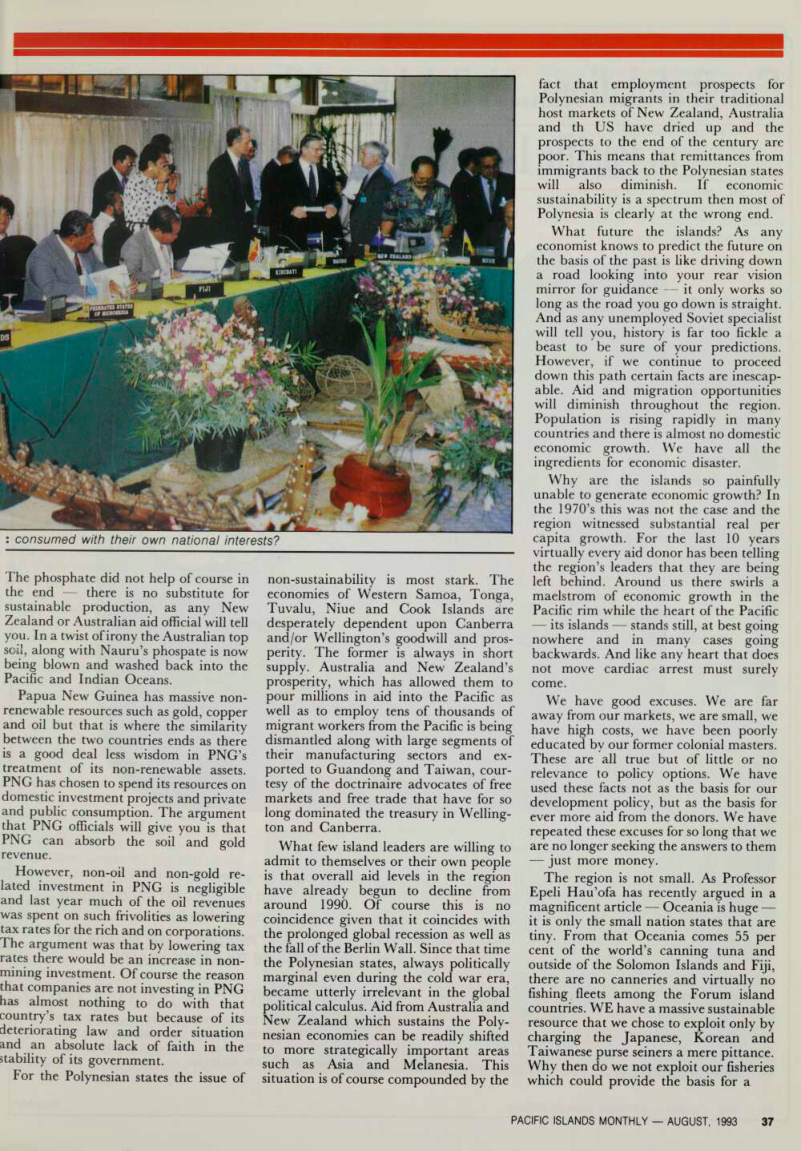


The Region
What furture the islands?
As a market we are tiny, as allies irrelevant, and as a source of supply, we don’t matter one dollar beyond the PNG oil fields
By Roman Grynberg
THIS month our leaders will meet again for the annual Forum Meeting. It is fitting in a sense that the meeting should be held in Nauru an island that so vividly represents the bizarre economic and environmental relationship between the developed nations of the region and that of the aspirations of the islands. Nauru has for decades been one of the most important suppliers of phosphates for the Australian and New Zealand agricul tural sectors. It has in a sense been one
of the few islands in the region that has actually been at the heart of the wealth of Australia and New Zealand. The rest of the region has been gold mines, oil fields and tourist resorts not withstand ing, a massive financial burden for Canberra and Wellington, It was Nauru’s phosphates that permit ted both the Australians and New Zealanders to continue agricultural and soil conservation practices that they have long known to be utterly unsustainable.
Regional leaders at last year’s Forum:
The phosphate did not help of course in the end there is no substitute for sustainable production, as any New Zealand or Australian aid official will tell you. In a twist of irony the Australian top soil, along with Nauru’s phospate is now being blown and washed back into the Pacific and Indian Oceans.
Papua New Guinea has massive nonrenewable resources such as gold, copper and oil but that is where the similarity between the two countries ends as there is a good deal less wisdom in PNG’s treatment of its non-renewable assets.
PNG has chosen to spend its resources on domestic investment projects and private and public consumption. The argument that PNG officials will give you is that PNG can absorb the soil and gold reveniip ‘ However, non-oil and non-gold related investment in PNG is negligible and last year much of the oil revenues was spent on such frivolities as lowering fcax rates for the rich and on corporations.
I he argument was that by lowering tax rates there would be an increase in nonmining investment. Of course the reason that companies are not investing in PNG has almost nothing to do with that country s tax rates but because of its detenoratmg law and order situation and u .i an a bsolute lack of faith in the stability of its government.
For the Polynesian states the issue of
non-sustainability is most stark. The economies of Western Samoa, Tonga, Tuvalu, Niue and Cook Islands are
desperately dependent upon Canberra
and/or Wellington’s goodwill and pros perity. The former is always in short supply. Australia and New Zealand’s prosperity, which has allowed them to pour millions in aid into the Pacific as well as to employ tens of thousands of migrant workers from the Pacific is being dismantled along with large segments of their manufacturing sectors and ex ported to Guandong and Taiwan, cour tesy of the doctrinaire advocates of free markets and free trade that have for so long dominated the treasury in Welling ton and Canberra. what few island i eaders are wil ii ng t 0 • o admit to themselves or their own people is that overall aid levels in the region have already begun to decline from around 1990. Of course this is no coincidence given that it coincides with the prolonged global recession as well as the fall of the Berlin Wall. Since that time the Polynesian states, always politically marginal even during the cold war era, became utterly irrelevant in the global political calculus. Aid from Australia and New Zealand which sustains the Poly nesian economies can be readily shifted to more strategically important areas such as Asia and Melanesia. This situation is of course compounded by the
fact that employment prospects for Polynesian migrants in their traditional host markets of New Zealand, Australia and th US have dried up and the prospects to the end of the century are poor. This means that remittances from immigrants back to the Polynesian states will also diminish. If economic sustainability is a spectrum then most of Polynesia is clearly at the wrong end.
What future the islands? As any economist knows to predict the future on the basis of the past is like driving down a road looking into your rear vision mirror for guidance it only works so long as the road you go down is straight.
And as any unemployed Soviet specialist will tell you, history is far too fickle a beast to be sure of your predictions.
However, if we continue to proceed down this path certain facts are inescap able. Aid and migration opportunities will diminish throughout the region.
Population is rising rapidly in many
countries and there is almost no domestic economic growth. We have all the ingredients for economic disaster.
Why are the islands so painfully unable to generate economic growth? In the 1970’s this was not the case and the region witnessed substantial real per capita growth. For the last 10 years virtually every aid donor has been telling the region’s leaders that they are being left behind. Around us there swirls a maelstrom of economic growth in the Pacific rim while the heart of the Pacific its islands stands still, at best going nowhere and in many cases going backwards. And like any heart that does not move cardiac arrest must surely come.
We have good excuses. We are far away from our markets, we are small, we have high costs, we have been poorly educated by our former colonial masters.
These are all true but of little or no relevance to policy options. We have used these facts not as the basis for our development policy, but as the basis for ever more aid from the donors. We have repeated these excuses for so long that we are no longer seeking the answers to them just more money.
The region is not small. As Professor Epeli Hau’ofa has recently argued in a magnificent article Oceania is huge it is only the small nation states that are tiny. From that Oceania comes 55 per cent of the world’s canning tuna and outside of the Solomon Islands and Fiji, there are no canneries and virtually no fishing fleets among the Forum island countries. WE have a massive sustainable resource that we chose to exploit only by charging the Japanese, Korean and Taiwanese purse seiners a mere pittance.
Why then do we not exploit our fisheries which could provide the basis for a
: consumed with their own national interests?
sustainable but an albeit modest stan dard of living for our people? The problem of the tuna fisheries in many ways typifies our problem. To compete on the world market we must set our wages at levels close to those in Philip pines and Thailand, who are our prin ciple competitors in tuna canning. We are not willing to do this because the massive amount of aid we receive makes us relatively rich and makes it unneces sary for us to have to compete. This situation is of course coming to an end and while we may not wish to have the meagre standard of living of Thai and Filipino cannery workers, we one day may have no choice.
What then of Australia and New Zealand? Let us tell the ugly truth. They really do not care whether the islands exist or not. As a market we are tiny, as allies we are irrelevant and as a source of supply, given that Nauru’s phosphate is gone, we do not matter one dollar beyond the oil fields of New Guinea.
Only Melanesia matters to Australia and that is primarily for reasons of defence. Australia’s defence strategy, despite protestations to the contrary, rests in large measure as it has since the beginning of the century on PNG as either a buffer or battleground. Australia has no interest in this region beyond PNG and possibly the Solomon Islands and this is witnessed by some of its most recent policy changes the creation of the new portfolio of minister for the Pacific islands Gordon Bilney. This is not proof, as some have argued that Australia is paying more attention to the region, but rather the opposite. It is proof of our increasing marginalisation the Australian foreign minister prefers the view from the Bangkok Hilton to that of Suva harbour and feels comfortable
enough to delegate regional responsibil
ities to a junior minister. Asia is now the centre of Australia’s attention, and well it should be as it is Australia’s most
important market.
In the Pacific the Australians offer no leadership, not because they are unwill ing to do so their leadership in the UN over Cambodia proved that but because they simply do not care about the region due to its economic insignifi cance. This would be fine if the region’s leaders were to provide serious regional initiatives. But most do not see them selves as a part of a region either they are consumed with their own national issues which are sometimes of micro scopic importance. There is no greater vision of the Pacific islands not from within and not from without.
It is a time for hard economic policy in the islands because we must adapt to :he post-cold war economic reality or link into ever more miserable poverty.
This time also calls for dreams for we may soon be able to afford little else.
Australia, and to a lesser degree New Zealand, has no place for us in their headlong race to Asia. If Australia and New Zealand join a greater trading block we shall probably be dragged along as an afterthought> but that is aII The structures that were created for us at independence - the tiny nation states —cannot generate wealth. Only poverty or emigration are our common future. It is time to change these political struc tures into something larger. We have
hope of serious development as a group of nations in federations based possibly on the Melanesian Spearhead Group example and other sub-regional group ings. Such federations may be the only real hope for the region to solve its problems of economic viability and more serious political issues such as the Bou „r D & a ! nv ! e ?° n , . 1C ' course, i e ou- amvllle the bigger issues are not on the forum agenda. It is time lor the rorum t( ?. lts root:s again and go back to the vlslon oi its creators, □
Advertisements & other items, pp. 36-39 (1 item)
•Dhl
"DHL
m -. mmk
- VIIHII.
assss m Jk lJ =& J 1924 out And you thought dhl only delivered documents?
We’re certainly equipped to rush your vital, one-off document across the world in an emergency. But our customers are increasingly calling on us to transport their regular consignments of parcels. For packages of up to 30 kilos each, our worldwide network is the fastest and most reliable way of making
deliveries throughout the globe.
All our offices are backed up by a computerised, satellite-linked tracking system which, in a matter of seconds, can tell you the precise status of your parcel along its journey. So when you’ve got a parcel to deliver or, of course, a document call us at 313166. You’ll be in safe hands all the way.
DHL International (FIJI) Ltd SUVA 10 Holland Street, Suva. Tlx: 2244, Fax: 302707. Tel: 313166, 300024.
NADI Office 115, Ist Floor, ATS Cargo Bldg. Tlx: 5209. Fax: 790123. Tel: 723800, 722019.
LAUTOKA Narara Parade, Lautoka. Phone: 665400, 665401.
LABASA Nasekula Road, Labasa. Phone 811162.
LEVUKA Beach Street. Phone 440139.
WOn*JO*MO€ EXPTt€SS •
fYou Couldn't ExpfOM It Bettorl
Congratulations... A Bright and Prosperous Future
to Pacific Islands Monthly Magazine.
From all your friends at Kirby Paper Co Ltd, Auckland, New Zealand, come our sincerest wishes for the future.
It was a smart move on your part when you chose to print your magazine on UTRILLO GLOSS ART Paper, the top quality stock supplied exclusively in Fiji by Kirby Paper Co Ltd.
We are proud to be your suppliers of UTRILLO GLOSS ART Paper, and look forward to continuing to supply your paper needs in the future.
SUPPLIERS OF TOP QUALITY PRINTING PAPER , BOARDS AND SELF ADHESIVE MATERIAL TO THE PACIFIC ISLANDS
Kirby Paper Co. Ltd
877 BEACH ROAD, BROWNS BAY AUCKLAND 10, NEW ZEALAND P.0.80X 35395, BROWNS BAY, AUCKLAND 10, NEW ZEALAND PHONE: +64 (09) 479 6534 • FAX: +64 (09) 479 6434
MOBILE PHONE: 025-960-966
Kirby Ad/
QUALITY
O ▼
IN MOTION
DISTRIBUTORS OF NISSAN PASSENGER & COMMERCIAL MOTOR VEHICLES; MASSEY FERGUSON TRACTORS, TRAILERS & FARMING IMPLEMENTS:
SUBARU PASSENGER & COMMERCIAL MOTOR VEHICLES;
TIMKEN BEARINGS: RYCO FILTERS; YOMOTO BATTERIES.
WE RE THE TOP MOTOR DEALER IN TOWN WITH THE
BEST PRODUCTS AND EXCELLENT SERVICE.
WE OFFER YOU THE BEST AFTER SALES SUPPORT WITH SPARE PARTS ALWAYS’ AVAILABLE AND BACKED UP BY A TOP TEAM OF MOTOR MECHANICS WITH LONG EXPERIENCE. WE WON’T SELL TO YOU AND FORGET YOU WE’LL BE THERE TO BACK YOU UP.
UNITED ENTERPRISES LIMITED
FOR ALL YOUR ENQUIRIES SEE US AT OUR OFFICE AT RANADI, KUKUM HIGHWAY. PO BOX 262. HONIARA SOLOMON ISLANDS. TEL: (677) 30129 OR 30348, 30434. MANAGER 22814 A/H. FAX: (677) 30696.
Burgeoning governments
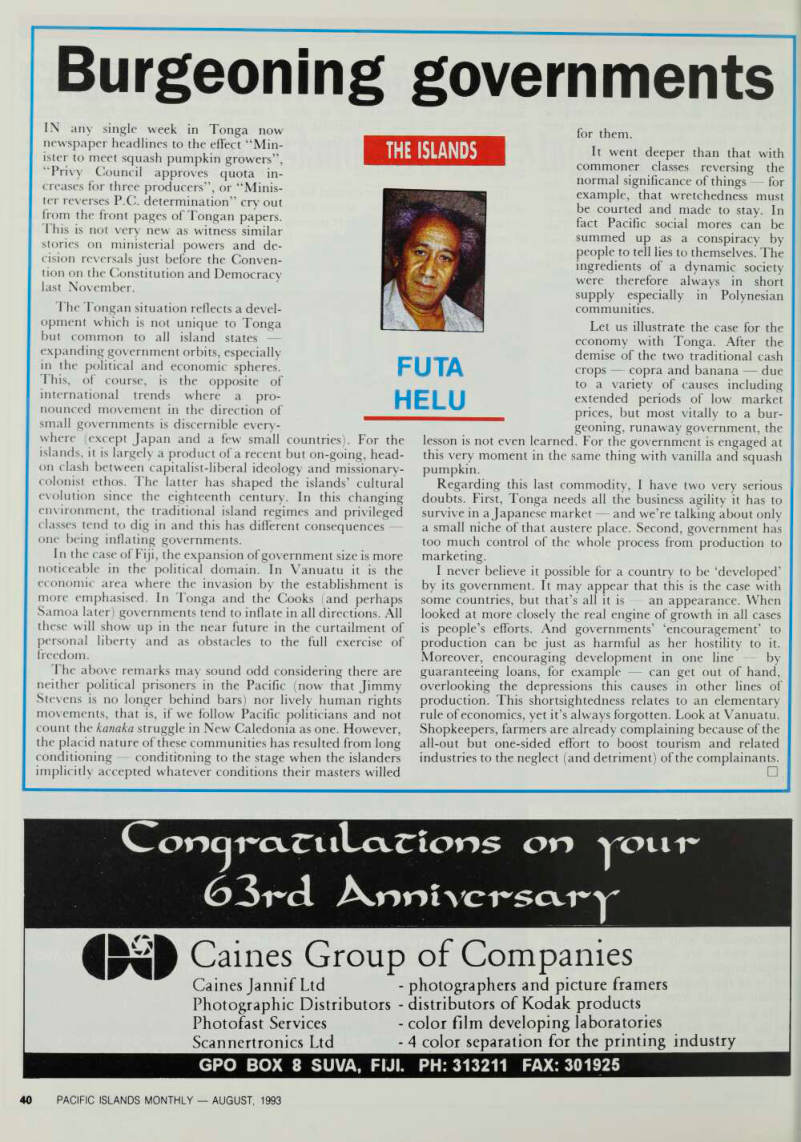
IN any single week in Tonga now newspaper headlines to the effect “Min ister to meet squash pumpkin growers”, “Privy Council approves quota in creases for three producers”, or “Minis ter reverses P.C. determination” cry out from the front pages of Tongan papers.
This is not very new as witness similar stories on ministerial powers and de cision reversals just before the Conven tion on the Constitution and Democracy last November.
The Tongan situation reflects a devel opment which is not unique to Tonga but common to all island states -
expanding government orbits, especially
in the political and economic spheres.
This, of course, is the opposite of international trends where a pro nounced movement in the direction of small governments is discernible every
where (except Japan and a few small countries). For the islands, it is largely a product of a recent but on-going, head on clash between capitalist-liberal ideology and missionary colonist ethos. The latter has shaped the islands’ cultural evolution since the eighteenth century. In this changing environment, the traditional island regimes and privileged classes tend to dig in and this has different consequences one being inflating governments.
In the case of Fiji, the expansion of government size is more noticeable in the political domain. In Vanuatu it is the economic area where the invasion by the establishment is more emphasised. In Tonga and the Cooks (and perhaps Samoa later) governments tend to inflate in all directions. All these will show up in the near future in the curtailment of personal liberty and as obstacles to the full exercise of freedom.
The above remarks may sound odd considering there are neither political prisoners in the Pacific (now that Jimmy Stevens is no longer behind bars) nor lively human rights movements, that is, if we follow Pacific politicians and not count the kanaka struggle in New Caledonia as one. However, the placid nature of these communities has resulted from long conditioning conditioning to the stage when the islanders implicitly accepted whatever conditions their masters willed
for them.
It went deeper than that with commoner classes reversing the normal significance of things for example, that wretchedness must be courted and made to stay. In fact Pacific social mores can be summed up as a conspiracy by people to tell lies to themselves. The ingredients of a dynamic society were therefore always in short supply especially in Polynesian communities.
Let us illustrate the case for the economy with Tonga. After the demise of the two traditional cash crops copra and banana due to a variety of causes including extended periods of low market prices, but most vitally to a bur geoning, runaway government, the
lesson is not even learned. For the government is engaged at this very moment in the same thing with vanilla and squash
pumpkin.
Regarding this last commodity, I have two very serious doubts. First, Tonga needs all the business agility it has to survive in a Japanese market and we’re talking about only a small niche of that austere place. Second, government has too much control of the whole process from production to marketing.
I never believe it possible for a country to be ‘developed’ by its government. It may appear that this is the case with some countries, but that’s all it is an appearance. When looked at more closely the real engine of growth in all cases is people’s efforts. And governments’ ‘encouragement’ to production can be just as harmful as her hostility to it.
Moreover, encouraging development in one line by guaranteeing loans, for example can get out of hand, overlooking the depressions this causes in other lines of production. This shortsightedness relates to an elementary rule of economics, yet it’s always forgotten. Look at Vanuatu.
Shopkeepers, farmers are already complaining because of the all-out but one-sided effort to boost tourism and related industries to the neglect (and detriment) of the complainants.
The Islands
Futa
Helu
Advertisements & other items, p. 40 (1 item)
Caines Group of Companies
ConomruLar
ions on yotn~
63i~d A*nnivc
V'SCVV'Y
Caines Group of Companies
Caines Jannif Ltd - photographers and picture framers Photographic Distributors - distributors of Kodak products Photofast Services - color film developing laboratories Scannertronics Ltd - 4 color separation for the printing industry GPO BOX 8 SUVA, FIJI. PH: 313211 FAX: 301925
The taste of the islands
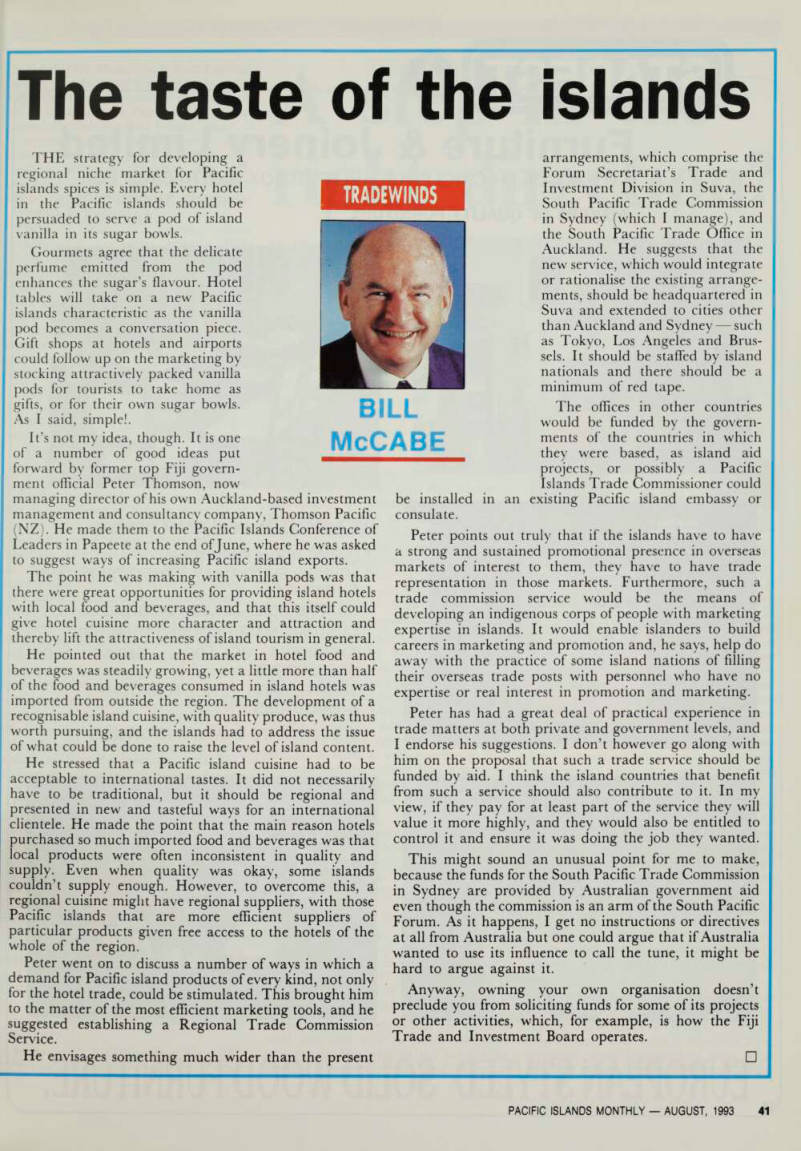
THE strategy for developing a regional niche market for Pacific islands spices is simple. Every hotel in the Pacific islands should be persuaded to serve a pod of island vanilla in its sugar bowls.
Gourmets agree that the delicate perfume emitted from the pod enhances the sugar’s flavour. Hotel tables will take on a new Pacific islands characteristic as the vanilla pod becomes a conversation piece.
Gift shops at hotels and airports could follow up on the marketing by
stocking attractively packed vanilla
pods for tourists to take home as gifts, or for their own sugar bowls.
As I said, simple!.
It’s not my idea, though. It is one of a number of good ideas put forward by former top Fiji govern ment official Peter Thomson, now
managing director of his own Auckland-based investment management and consultancy company, Thomson Pacific (NZ). He made them to the Pacific Islands Conference of Leaders in Papeete at the end ofjune, where he was asked to suggest ways of increasing Pacific island exports.
The point he was making with vanilla pods was that there were great opportunities for providing island hotels with local food and beverages, and that this itself could give hotel cuisine more character and attraction and thereby lift the attractiveness of island tourism in general.
He pointed out that the market in hotel food and beverages was steadily growing, yet a little more than half of the food and beverages consumed in island hotels was imported from outside the region. The development of a recognisable island cuisine, with quality produce, was thus worth pursuing, and the islands had to address the issue of what could be done to raise the level of island content.
He stressed that a Pacific island cuisine had to be acceptable to international tastes. It did not necessarily have to be traditional, but it should be regional and presented in new and tasteful ways for an international clientele. He made the point that the main reason hotels purchased so much imported food and beverages was that local products were often inconsistent in quality and supply. Even when quality was okay, some islands couldn’t supply enough. However, to overcome this, a regional cuisine might have regional suppliers, with those Pacific islands that are more efficient suppliers of particular products given free access to the hotels of the whole of the region.
Peter went on to discuss a number of ways in which a demand for Pacific island products of every kind, not only for the hotel trade, could be stimulated. This brought him to the matter of the most efficient marketing tools, and he suggested establishing a Regional Trade Commission Service.
He envisages something much wider than the present
arrangements, which comprise the Forum Secretariat’s Trade and Investment Division in Suva, the South Pacific Trade Commission
in Sydney (which I manage), and
the South Pacific Trade Office in Auckland. He suggests that the new service, which would integrate or rationalise the existing arrange ments, should be headquartered in Suva and extended to cities other than Auckland and Sydney such as Tokyo, Los Angeles and Brus sels. It should be staffed by island nationals and there should be a minimum of red tape.
The offices in other countries would be funded by the govern ments of the countries in which they were based, as island aid projects, or possibly a Pacific Islands Trade Commissioner could
be installed in an existing Pacific island embassy or consulate.
Peter points out truly that if the islands have to have a strong and sustained promotional presence in overseas markets of interest to them, they have to have trade representation in those markets. Furthermore, such a trade commission service would be the means of developing an indigenous corps of people with marketing expertise in islands. It would enable islanders to build careers in marketing and promotion and, he says, help do away with the practice of some island nations of filling their overseas trade posts with personnel who have no expertise or real interest in promotion and marketing.
Peter has had a great deal of practical experience in trade matters at both private and government levels, and I endorse his suggestions. I don’t however go along with him on the proposal that such a trade service should be funded by aid. I think the island countries that benefit from such a service should also contribute to it. In my view, if they pay for at least part of the service they will value it more highly, and they would also be entitled to control it and ensure it was doing the job they wanted.
This might sound an unusual point for me to make, because the funds for the South Pacific Trade Commission in Sydney are provided by Australian government aid even though the commission is an arm of the South Pacific Forum. As it happens, I get no instructions or directives at all from Australia but one could argue that if Australia wanted to use its influence to call the tune, it might be hard to argue against it.
Anyway, owning your own organisation doesn’t
preclude you from soliciting funds for some of its projects or other activities, which, for example, is how the Fiji Trade and Investment Board operates.
Tradewinds
Bill
Mccabe
Advertisements & other items, p. 42 (1 item)
European Styled Solid Wood Furniture.
r
Furniture & Joinery Limited
LOT 24 BOILER CIRCLE KALABU P.O. BOX 6666 NASINU, FIJI.
MAKERS OF QUALITY FURNITURE PHONE:
jil
[GET.
IK ~JX I s iiVnu ■L um 5 s r
WE SPECIALIZE IN CUSTOM DESIGN
* DINING ROOM FURNITURE
* LOUNGE SUITE FULLY UPHOLSTERED AND
SHOW WOOD.
* CUSTOM BUILT HOUSE FURNITURE
* CUSTOMS MANUFACTURED FURNITURE
* EXPORTERS OF LOCAL TIMBER AND
ACCESSORIES
* SHOP FITTINGS, OFFICE FURNITURE
& PARTITIONS
* SPECIALIST TO BANKS AND OFFICES
EUROPEAN STYLED SOLID WOOD FURNITURE.
right direction?
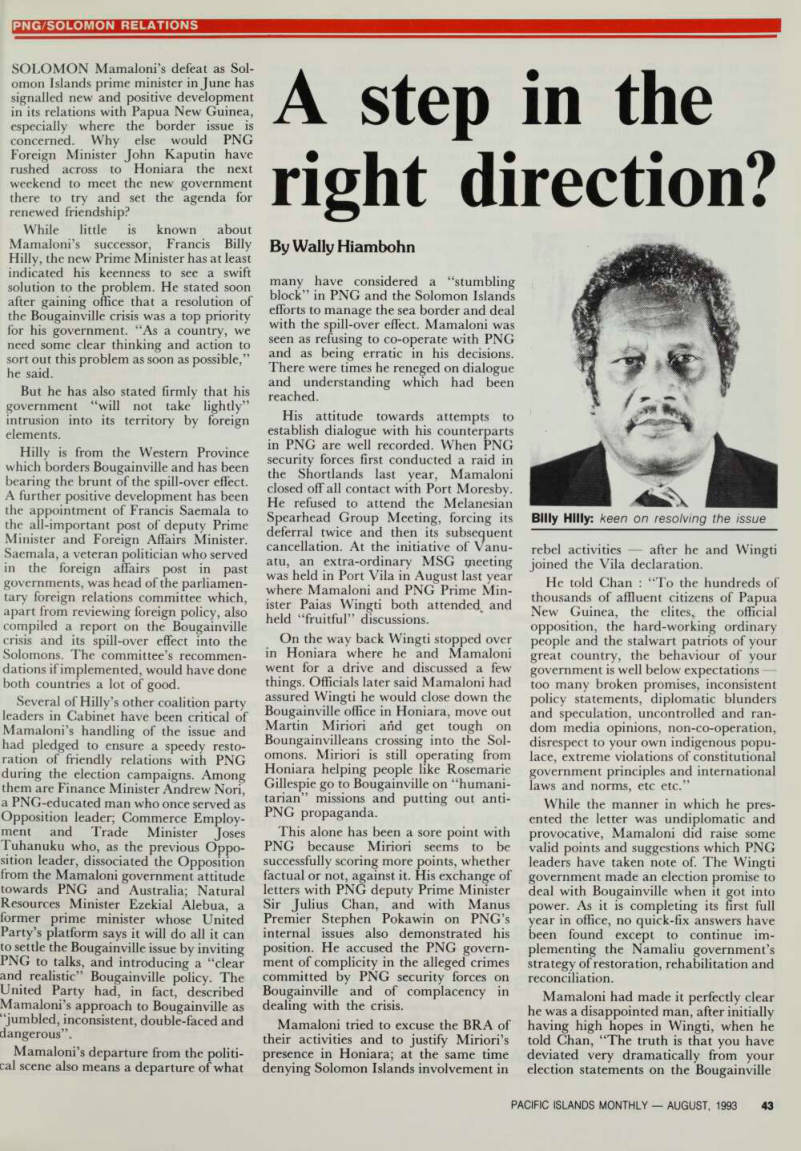
Png/Solomon Relations
A step in the right direction?
SOLOMON Mamaloni’s defeat as Sol omon Islands prime minister in June has signalled new and positive development in its relations with Papua New Guinea, especially where the border issue is concerned. Why else would PNG Foreign Minister John Kaputin have rushed across to Honiara the next weekend to meet the new government there to try and set the agenda for
renewed friendship?
While little is known about Mamaloni’s successor, Francis Billy Hilly, the new Prime Minister has at least indicated his keenness to see a swift solution to the problem. He stated soon after gaining office that a resolution of the Bougainville crisis was a top priority for his government. “As a country, we need some clear thinking and action to sort out this problem as soon as possible,” he said.
But he has also stated firmly that his government “will not take lightly” intrusion into its territory by foreign elements.
Hilly is from the Western Province which borders Bougainville and has been bearing the brunt of the spill-over effect.
A further positive development has been the appointment of Francis Saemala to the all-important post of deputy Prime Minister and Foreign Affairs Minister.
Saemala, a veteran politician who served in the foreign affairs post in past governments, was head of the parliamen tary foreign relations committee which, apart from reviewing foreign policy, also compiled a report on the Bougainville crisis and its spill-over effect into the Solomons. The committee’s recommen dations if implemented, would have done both countries a lot of good.
Several of Hilly’s other coalition party leaders in Cabinet have been critical of Mamaloni’s handling of the issue and had pledged to ensure a speedy resto ration of friendly relations with PNG
during the election campaigns. Among
them are Finance Minister Andrew Nori, a PNG-educated man who once served as
Opposition leader; Commerce Employ
ment and Trade Minister Joses Tuhanuku who, as the previous Oppo sition leader, dissociated the Opposition from the Mamaloni government attitude towards PNG and Australia; Natural Resources Minister Ezekial Alebua, a former prime minister whose United Party’s platform says it will do all it can to settle the Bougainville issue by inviting PNG to talks, and introducing a “clear
and realistic” Bougainville policy. The
United Party had, in fact, described Mamaloni’s approach to Bougainville as “jumbled, inconsistent, double-faced and
dangerous”.
Mamaloni’s departure from the politi cal scene also means a departure of what
By Wally Hiambohn
many have considered a “stumbling block” in PNG and the Solomon Islands efforts to manage the sea border and deal with the spill-over effect. Mamaloni was seen as refusing to co-operate with PNG and as being erratic in his decisions.
There were times he reneged on dialogue and understanding which had been reached.
His attitude towards attempts to establish dialogue with his counterparts in PNG are well recorded. When PNG security forces first conducted a raid in the Shortlands last year, Mamaloni closed off all contact with Port Moresby.
He refused to attend the Melanesian
Spearhead Group Meeting, forcing its
deferral twice and then its subsequent cancellation. At the initiative of Vanu atu, an extra-ordinary MSG meeting was held in Port Vila in August last year where Mamaloni and PNG Prime Min ister Paias Wingti both attended, and held “fruitful” discussions.
On the way back Wingti stopped over in Honiara where he and Mamaloni went for a drive and discussed a few things. Officials later said Mamaloni had assured Wingti he would close down the Bougainville office in Honiara, move out Martin Miriori and get tough on Boungainvilleans crossing into the Sol omons. Miriori is still operating from Honiara helping people like Rosemarie Gillespie go to Bougainville on “humani tarian” missions and putting out anti-
PNG propaganda.
This alone has been a sore point with PNG because Miriori seems to be successfully scoring more points, whether factual or not, against it. His exchange of letters with PNG deputy Prime Minister Sir Julius Chan, and with Manus Premier Stephen Pokawin on PNG’s internal issues also demonstrated his position. He accused the PNG govern ment of complicity in the alleged crimes committed by PNG security forces on Bougainville and of complacency in dealing with the crisis.
Mamaloni tried to excuse the BRA of their activities and to justify Miriori’s presence in Honiara; at the same time denying Solomon Islands involvement in
rebel activities after he and Wingti joined the Vila declaration.
He told Chan : “To the hundreds of thousands of affluent citizens of Papua New Guinea, the the official opposition, the hard-working ordinary people and the stalwart patriots of your great country, the behaviour of your government is well below expectations too many broken promises, inconsistent policy statements, diplomatic blunders and speculation, uncontrolled and ran dom media opinions, non-co-operation, disrespect to your own indigenous popu lace, extreme violations of constitutional government principles and international laws and norms, etc etc.”
While the manner in which he pres ented the letter was undiplomatic and provocative, Mamaloni did raise some valid points and suggestions which PNG leaders have taken note of. The Wingti government made an election promise to deal with Bougainville when it got into power. As it is completing its first full year in office, no quick-fix answers have been found except to continue im plementing the Namaliu government’s strategy of restoration, rehabilitation and reconciliation.
Mamaloni had made it perfectly clear he was a disappointed man, after initially having high hopes in Wingti, when he told Chan, “The truth is that you have deviated very dramatically from your election statements on the Bougainville
Billy Hilly: keen on resolving the issue
crisis. If I were to offer you my personal opinion, I would say that your statement reflects some disarray in your govern ment.”
Hilly has come at a time when both sides have now agreed on joint border surveillance and direct communications to ensure there are no longer any rebel
crossings.
The recommendations of the Saemala committee report are : • That the parliament of Solomon Islands recognises Bougainvilleas an integral part of Papua New Guinea and, on this basis, endorses the PNG govern ment’s position that while the Bougain ville crisis is an internal matter it, unfortunately, does have spill-over effects into the sovereign territory of Solomon Islands, and thereby causes peace and security concerns for the Solomon Islands government and people. • That the Solomon Islands govern ment undertakes a much more subtle diplomatic role in an endeavour to bring the two parties to the principles of the Honiara Declaration. This is in view of the difficulty with formulating and adopting a realistic refugee policy, and as such a safer strategy would be to prevent such an incident from occuring. • Because of the peace and security
concerns resulting from the spill-over effects of the crisis, the government should, without any further delay, attend to formalising the Memorandum of Understanding (MOU) for the Joint Surveillance of the Border with Papua New Guinea and to implement it forthwith after its ratification by both governments. • Immediately following the im plementation of the MOU the two governments should conclude, sign, rat ify and implement the Draft Agreement concerning the Administration of the
Special Area.
• The operation of an office in Honiara, ostensibly as an information clearing centre on the Bougainville crisis, has caused embarrassment to the Sol omon Islands government. Accommo dating this office on Solomon Islands sovereign territory is of grave concern to the Papua New Guinea government which has claimed this office has been used to wage a campaign against its sovereignty. Having regard to the mutual respect which these two govern ments have towards each other, the Solomon Islands government should close this office and request a reputable non-governmental organisation to set up and operate a centre for co-ordinating
humanitarian assistance for the suffering people of Bougainville. • Martin Miriori has attested to the committee that his residency in Honiara has contributed to the strained relations between Solomon Islands and Papua New Guinea. For the interest of good neighbourliness, the government should review its grant of residency to both Miriori and Rutana. • The governments of Great Britain, Germany and United States of America should be approached to assist with the setting up of the administrative system for the Special Border Areas since they contributed to the initial separation of the people in those areas who were geographically and culturally related. • The government should consult closely with both Commonwealth and Forum countries on the need to study and consider the implications of United Nations Resolution 46/43 of December 9, 1991 regarding the protection and secur ity of small states. • The Foreign Relations Committee should continue to monitor the situation with regard to the Bougainville crisis to ensure the spill-over effects into Solomon Islands are being contained or elimin ated under the bilateral arrangements as recommended herein. □
Advertisements & other items, p. 44 (1 item)
Ford Papers
IS APIA . PAGO PAGO
FIJI "
PAPEETE
Ford Papers
l M T E D
WE SOLELY SPECIALIZE IN THE NEEDS
OF PACIFIC ISLAND PRINTERS
★ Fiji ★ Solomon Islands ★ Western Samoa ★ Kiribati ★ Vanuatu ★ Rarotonga ★ New Caledonia ★ Nauru ★ Tonga ★ American Samoa.
LETDOWN BY ANOTHER OVERSEAS SUPPLIERS?
TRY US, WE WONT.
★ PAPER-SHEET, ROLS, ★ INKS ★ GRAPHICS ★ MACHINERY ★ PLATES ★ FILMS ★ CHEMISTRY ★ BLANKETS ★ LAMP BULBS
GIVE US A CALL NOW
BEE FORD PAPER & SUPPLIERS LTD
AUCKLAND, NEW ZEALAND. PHONE: 064-9-2769900, FAX 064-9-2761997
mirrors trick
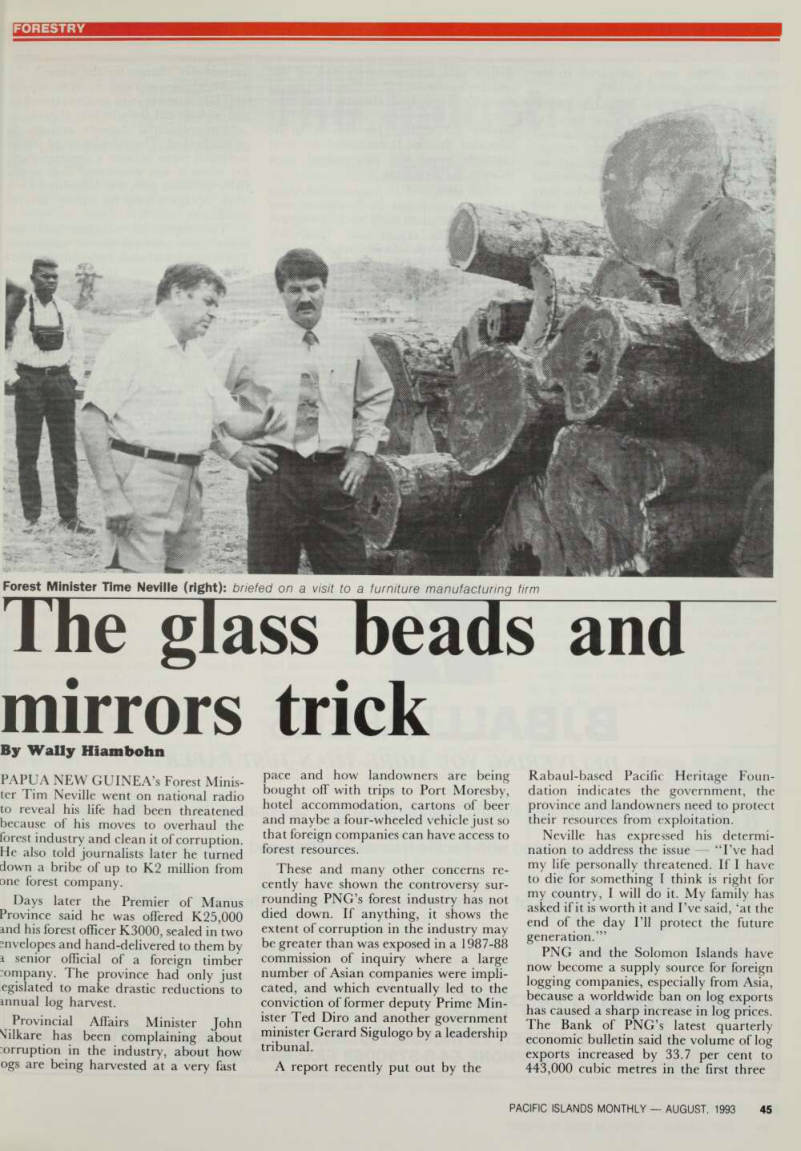

Forestry
The glass beads and mirrors trick
By Wally Hiambohn
PAPUA NEW GUINEA’S Forest Minis ter Tim Neville went on national radio to reveal his life had been threatened because of his moves to overhaul the forest industry and clean it of corruption.
He also told journalists later he turned down a bribe of up to K 2 million from one forest company.
Days later the Premier of Manus Province said he was offered K 25,000 and his forest officer K3OOO, sealed in two envelopes and hand-delivered to them by a senior official of a foreign timber zompany. The province had only just egislated to make drastic reductions to
annual log harvest.
Provincial Affairs Minister John Vilkare has been complaining about zorruption in the industry, about how ogs are being harvested at a very fast
pace and how landowners are being bought off with trips to Port Moresby, hotel accommodation, cartons of beer and maybe a four-wheeled vehicle just so that foreign companies can have access to forest resources.
These and many other concerns re cently have shown the controversy sur rounding PNG’s forest industry has not died down. If anything, it shows the extent of corruption in the industry may be greater than was exposed in a 1987-88 commission of inquiry where a large number of Asian companies were impli cated, and which eventually led to the conviction of former deputy Prime Min ister Ted Diro and another government minister Gerard Sigulogo by a leadership tribunal.
A report recently put out by the
Rabaul-based Pacific Heritage Foun dation indicates the government, the province and landowners need to protect their resources from exploitation.
Neville has expressed his determi nation to address the issue “I’ve had my life personally threatened. If I have to die for something I think is right for my country, I will do it. My family has asked if it is worth it and I’ve said, ‘at the end of the day I’ll protect the future generation.”’
PNG and the Solomon Islands have now become a supply source for foreign logging companies, especially from Asia, because a worldwide ban on log exports has caused a sharp increase in log prices.
The Bank of PNG’s latest quarterly economic bulletin said the volume of log exports increased by 33.7 per cent to 443,000 cubic metres in the first three
Forest Minister Time Neville (right): briefed on a visit to a furniture manufacturing firm
months of the year, compared to the corresponding period m 1992.
Neville’s new Forest Resources Development Guidelines, which he hopes to get Cabinet approval on soon, are aimed at achieving sustainable yields, encouraging downstream processing and increasing local revenue generation and benefit. A Cabinet colleague who fully supports it is John Nilkare, who said logging was out of control and causing a trail of environmental and social disruphons.
According to Nilkare, landowners were being duped into handing over their forests for a few quick bucks by a few foreign companies who were making millions of kina by exporting a rapidly increasing number of logs back to their own countries for processing. “The timber prices are now high/and the industry is now undertaking 24-hour logging and shipping to ensure they take out as much as possible before the government comes down and imposes toueh new rules ” tough new rules.
Forest resources would be wiped out m ess than 10 years if exploitation contmued at the current rate, a recent private study has warned.
In a startling 30-page report released recently, the Pacific Heritage Foun-
dation said approximately half of the country’s estimated 15 million hectares of operable forest had already been allo cated for harvesting, and believed a further 2.5 million hectares is to be allocated shortly. It estimated the total operable forest was now valued at a massive KlOO billion.
“For all practical purposes, all these resources controlled by foreigners, and the gigantic profits will be in foreigners pockets,” the report said. It further stated, “If the forest resource was sustainably managed and harvested by Papua New Guineans or PNG com panies, the annual income to the country would be as high as K 3.1 billion or nearly KBOOO for every man, woman and child amongst the highest per capita income in the world.”
Calling for drastic measures, including another inquiry into the forest industry, the report said the devastating transfor mation of PNG’s forest was continuing and increasing, despite a wide-ranging and thorough investigation by the Barnett Inquiry in 1989. “The investi gation revealed almost universal corrup tion, mismanagement and malpractice,” the report said.
It said, following the Barnett Inquiry there had been a “qualitative and
quantitative change for the worse”
The abuses exposed by the inquiry continue, and are even more entrenched and widespread than before, it said, “Environmental damage appears to go unchecked. The submission of envir onmental plans became a separate scan dal when it was discovered that essen tiall Y the same P lan was submitted for a score operations in widely diverse conditions.
“The rights of villagers and the landowners continue to be neglected.
The financial abuses undoubtedly con tinue. . “Reform has suffered from a continu ing conflict of interest, a conflict of interest both inside government and outside. “Some people are fighting for reform; others are indifferent. Some actively oppose reform; others only wish r\ ft, inn r “ d y found ther c are )00 overseas com P ames halvestln S, logs m PNG °f them are mter-related. The study found that while log export value incre y ased from K 74 8 mil jl on f n 1990 to KB4O million in M this the value ofsawn timber rema y ined K j 2 mi i| ion and K 1 million and woodchips at K 7.1 miUion and K 9.3 million for the two periods, The report goes in depth into the
history of the forest industry, the laws, recent developments, revealing accounts of corruption and damaging effects to the environment, people and the economy.
It is punctuated with serious questions and warnings.
The Foundation has recommended five actions the government should take to avoid a quick depletion of PNG’s forest resources communicate with landowners, support the new Forest Policy and Forest Act, ban log exports, enforce processing and start a new inquiry.
The report states massive community education is needed to reach resource owners. “Churches, women’s councils,
literacy workers and non-governmental
organisations can be given information to pass on to the villages and rural areas.”
“Awareness education is especially needed by landowners who are now being approached by logging companies.
As fully as possible, they must under stand the consequences of selling and losing their forests.”
The report said the Forest Authority should be allowed to work in ways it was intended for, in particular, to ensure decision-making was decentralised. It said amendments to the Forestry Act returned power to the minister and reduced the democracy of the National Forest Board members.
It said there should be an immediate tnd total ban on log exports, and the
ninimum processing requirement was to
dc sawn and kiln-dried timber.
On a new inquiry, the report said Prime Minister Paias VVingti had com nitted himself to open a full inquiry. ‘Such an investigation should begin vithout delay and be totally open,” the eport recommends.
The report concludes : “The present Minister for Forests (Tim Neville) ap >cars to be determined to change the rots )f the past. However, he will have a najor battle inside Cabinet and inside he administration from people who have eceived favours from loggers.
“He will also be opposed by those andowners who have sold their souls to he foreign exploiters. The minister leserves and needs all the support we can ;ive.
“We can take action and change what » happening. Or we can do nothing and dsc forests of incalculable value to Papua Jew Guinea and the world.
“The same glass beads and mirrors rick is being played. The choice is ours.”
Advertisements & other items, p. 46 (1 item)
B J Ballpapers
DELIVERING YOU MORE THAN JUST PAPER
B J Ballpapers congratulates Pacific Islands Monthly in celebrating its 63rd birthday.
We are proud to be associated with Pacific Islands Monthly, and its publisher, The Fiji Times Limited.
B J Ballpapers suppliers of printing and writing papers to the South Pacific.
BJ BALLPAPERS
395 CHURCH STREET, PENHOUSE, P.O. BOX 12544 AUCKLAND, NEW ZEALAND
PHONE 64-9-5790059 FAX: 64-9-5799715
The industry’s view
PNG CABINET has deferred discussion on the controversial National Forestry Devel opment Guidelines because they did not include input from the Forest Industry Association, according to Forest Minister Tim Neville.
While agreeing the Forest Industry Association had raised valid points in its submission, Neville expressed disappoint ment it did not make any input on two major issues downstream processing and revenue. He said the FlA’s input had been “a long time coming” and it still had not made a satisfactory contribution. “Their outcry is only associated with the export of raw logs, nothing about downstream pro cessing or revenue. The Forestry Industry Association basically represents log export ers.”
The FIA has made a submission to Neville in which it discusses the proposed guidelines. The submission says there is much in the proposed guidelines that is good, and in accordance the National Forests Policy, but the association opposed any attempt to unilaterally and detrimentally alter existing rights held by its members and. Other matters which, in its view, will assist the development of an ongoing and viable forest industry and should be reconsidered and perhaps recast in a different form. On government at tempts to alter existing rights, the FIA states some of the proposals are “illegal as well commercially devastating”.
“These items are strenuously opposed and members have indicated they will take legal action under the Investment Promo tion Act for compensation for any expropri ation,” the submission states. It was concerned existing rights negotiated in good faith over many years and agreed to by many parties would be unilaterally changed. “As you see, it is not the industry’s view that the guidelines ... maintain a reasonable investment climate.
We note your comments that infer the industry is still ‘out of control’.
The FIA presented statistics it said show the state of affairs in the industry has been exaggerated. The overall industry base of investors and resource owners warranted more respect and consideration than just to be treated as a convenient whipping post for somebody else’s problems.
Firstly, it estimated the accessible, com mercial timber volume of PNG on areas not previously harvested was 170 million cubic metres on a net production forest area of 12 million hectares. This is from a total forested area of some 32 million hectares.
Other area and volume estimates have placed the volume as high as 950 million cubic metres on an area of 19.1 million hectares.
The statement said the total annual permitted cut was about five million cubic
metres, however, in 1992 only about two million cubic metres was harvested. “This year would see a harvest of a little more than three million cubic metres, still well below the alloted target production grant ed by the state through issue of timber permits.
“The association notes the 1992 annual figure from the Central Bank show annual export of logs at 1.601 million cubic metres, having an average value of K87 per cubic metre, giving a gross value of K140 million.
The FIA said, according to the Bank’s break-up of the gross f.o.b (free on board) were ; government export tax — K24.5 million; landowner royalty — K8 million; landowner company return — K16 mil lion; operating cost — K83.5 million and profit for operator — K8 million. “This can hardly be a situation investors could get enthusiastic about, particularly from the risk/return point of view, and it will be noted there are not “hundreds of millions” of profit. Any claim that industry operators are profiting by ‘hundreds of million of kina’ are wild exaggerations and do not give a fair recognition to committed operators in a difficult industry, nor do such comments generate credibility for govern ment.”
The Association acknowledged log prices had risen dramatically this year, and that it was in a position to enjoy good profit margins while the market situation re mained buoyant. But it added that in PNG the industry was a follower of market trends, not market leaders. It said PNG’s log products represent only about five per cent of the regional log supply. n
Advertisements & other items, pp. 47-48 (1 item)
To Anywhere
IN THE WORLD
Call us now
SUVA NADI
313166 723800 Your artifacts, gifts, souvenirs, carvings, artworks, documents whatever. DHL will deliver anywhere worldwide Freight Forwarder% Air Cargo DHL Worldwide Express Service
LAUTOKA
665400 665401
LABASA
811162
LEVUKA
440139 with DHL "You're in safe hands all the way" worlowkx expncss*
Honolulu q
Q
Manila
Guam
•Yap po
Palau 4-
• Majuro
—-Jawwa
Truk
Chnctmac (s
Naur
HooLara >
Apia
O o
'afto Pago
Sy
Auc
JL
Melbourne
IS
Hqutvi Offices & Agencies
Australia Air Nauru Plaza Level, Nauru House, 80 Collins Street,
MELBOURNE Vic. 3000
Phone: 653 5709
Telex: AA31158 SITA: MELRRON
FIJI
Nauru Air & Shipping Agency, Ratu Sukuna Building, Ground Floor, Victoria Parade,
SUVA
Phone: 312 377
Telex: 2340 FJ SITA: SUVRRON
Air Nauru, The Concourse, Nadi Airport,
NADI
Phone: 722795
Telex: SITA NANRRON
Guam Nauru Air & Shipping Agency, Ada Building, Ground Floor,
AGANA, GUAM 96910
Phone: 646 5939, 477 7106
Telex: 6370 GM SITA: GUMRRON
Hawaii Nauru Air & Shipping Agency, 18th Floor, Room 1890, Pioneer Plaza Building, 900 Fort Street Mall,
HONOLULU, HAWAII 96813
P.O. Box 85 Phone: (808) 524 2502 Telex: 8200 NAURU HR
SITA: HNLRRON
Cable; DOMANEB HAWAII
Japan Air Nauru C/o Nauru Air & Shipping Agency, IF, Fukuoka Dental Building, Kajiya-cho 12-13, Kagoshima-Shi, 892 JAPAN Nauru Head Office, Department of Civil Aviation, Government Offices,
NAURU
Phone: 3310 3311
Telex: 3081 GOVNAURU SV
SITA: INUDGON INUDCON
Nauru Air & Shipping Agency, Nauru International Airport,
NAURU
Phone: 3418, 3415, 3488 Cable: Air Agent, Nauru
SITA: INURRON
Telex: 3083 DOMANEB ZV
New Caledonia UTA French Airlines,
NOUMEA
Phone: 27.33.22 New Zealand Nauru Air & Shipping Agency, Samoa House, Karangahape Road,
NEWTON, AUCKLAND
Telex: NZ2383 SITA AKLRRON
PHONE: 798113/114
Philippines Nauru Air & Shipping Agency, Legaspi Tower Building 300, Ground Floor, Roxas Boulevarde Cnr of Vito Cruz St, Pasay City, Metro Manila,
PHILIPPINES 3194
Phone: 574 011-34 Ext. 215 Telex: 27308 NAOERO PH
SITA: MNLRRON
Cable: DOMANEB MANILA
Ponape Nauru Air & Shipping Agency, Bank of Hawaii Building, Kolonia,
PONAPE
Phone: 458
Cable; NASA PONAPE
Republic of Kiribati Air Tangaru, Bairiki,
TARAWA,
Phone: 447 Solomon Islands Solomon Island Airways (Solair),
HONIARA
Phone: 20031 22586
The mouse
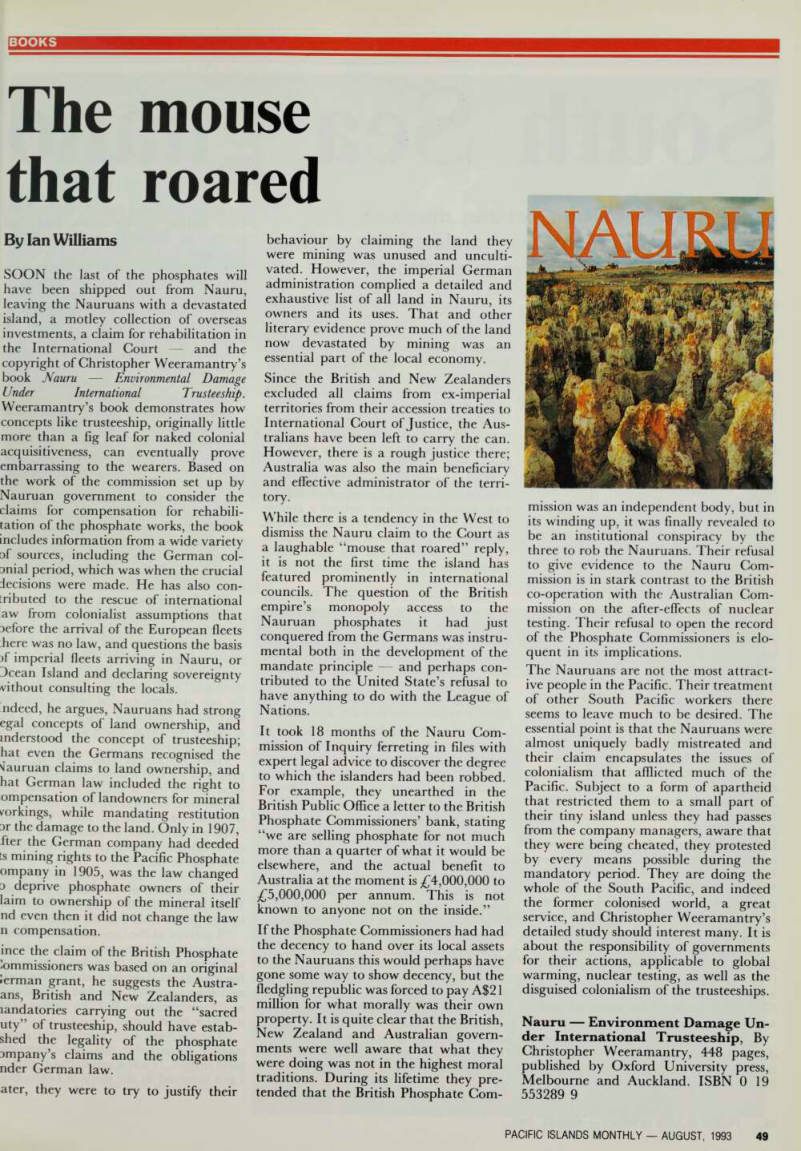
Books
The mouse that roared
By Ian Williams
SOON the last of the phosphates will have been shipped out from Nauru, leaving the Nauruans with a devastated island, a motley collection of overseas investments, a claim for rehabilitation in the International Court and the
copyright of Christopher Weeramantry’s
book Nauru Environmental Damage Under International Trusteeship.
Weeramantry’s book demonstrates how concepts like trusteeship, originally little more than a fig leaf for naked colonial acquisitiveness, can eventually prove embarrassing to the wearers. Based on the work of the commission set up by Nauruan government to consider the claims for compensation for rehabili tation of the phosphate works, the book includes information from a wide variety of sources, including the German col onial period, which was when the crucial decisions were made. He has also con tributed to the rescue of international aw from colonialist assumptions that oefore the arrival of the European fleets here was no law, and questions the basis )f imperial fleets arriving in Nauru, or Dcean Island and declaring sovereignty
vithout consulting the locals.
ndeed, he argues, Nauruans had strong egal concepts of land ownership, and mderstood the concept of trusteeship; hat even the Germans recognised the Nauruan claims to land ownership, and hat German law included the right to ompensation of landowners for mineral
workings, while mandating restitution
dt the damage to the land. Only in 1907, fter the German company had deeded ts mining rights to the Pacific Phosphate ompany in 1905, was the law changed
3 deprive phosphate owners of their
laim to ownership of the mineral itself nd even then it did not change the law n compensation, ince the claim of the British Phosphate Commissioners was based on an original lerman grant, he suggests the Austra ans, British and New Zealanders, as landatories carrying out the “sacred uty” of trusteeship, should have estab
shed the legality of the phosphate
Dmpany’s claims and the obligations nder German law. a ter, they were to try to justify their
behaviour by claiming the land they were mining was unused and unculti vated. However, the imperial German administration complied a detailed and exhaustive list of all land in Nauru, its owners and its uses. That and other literary evidence prove much of the land now devastated by mining was an essential part of the local economy.
Since the British and New Zealanders excluded all claims from ex-imperial territories from their accession treaties to International Court of Justice, the Aus tralians have been left to carry the can.
However, there is a rough justice there; Australia was also the main beneficiary and effective administrator of the terri tory.
While there is a tendency in the West to dismiss the Nauru claim to the Court as a laughable “mouse that roared” reply, it is not the first time the island has featured prominently in international councils. The question of the British empire’s monopoly access to the Nauruan phosphates it had just conquered from the Germans was instru mental both in the development of the mandate principle and perhaps con tributed to the United State’s refusal to have anything to do with the League of Nations.
It took 18 months of the Nauru Com mission of Inquiry ferreting in files with expert legal advice to discover the degree to which the islanders had been robbed.
For example, they unearthed in the British Public Office a letter to the British
Phosphate Commissioners’ bank, stating
“we are selling phosphate for not much more than a quarter of what it would be elsewhere, and the actual benefit to Australia at the moment is £4,000,000 to £5,000,000 per annum. This is not known to anyone not on the inside.”
If the Phosphate Commissioners had had the decency to hand over its local assets to the Nauruans this would perhaps have gone some way to show decency, but the fledgling republic was forced to pay AS2I million for what morally was their own property. It is quite clear that the British, New Zealand and Australian govern ments were well aware that what they were doing was not in the highest moral traditions. During its lifetime they pre tended that the British Phosphate Com-
mission was an independent body, but in its winding up, it was finally revealed to be an institutional conspiracy by the three to rob the Nauruans. Their refusal to give evidence to the Nauru Com mission is in stark contrast to the British co-operation with the Australian Com mission on the after-effects of nuclear testing. Their refusal to open the record of the Phosphate Commissioners is elo quent in its implications.
The Nauruans are not the most attract ive people in the Pacific. Their treatment of other South Pacific workers there seems to leave much to be desired. The essential point is that the Nauruans were almost uniquely badly mistreated and their claim encapsulates the issues of colonialism that afflicted much of the Pacific. Subject to a form of apartheid that restricted them to a small part of their tiny island unless they had passes from the company managers, aware that they were being cheated, they protested by every means possible during the mandatory period. They are doing the whole of the South Pacific, and indeed the former colonised world, a great
service, and Christopher Weeramantry’s
detailed study should interest many. It is about the responsibility of governments for their actions, applicable to global warming, nuclear testing, as well as the disguised colonialism of the trusteeships.
Nauru Environment Damage Un
der International Trusteeship, By
Christopher Weeramantry, 448 pages,
published by Oxford University press, Melbourne and Auckland. ISBN 0 19 553289 9
South Sea guano
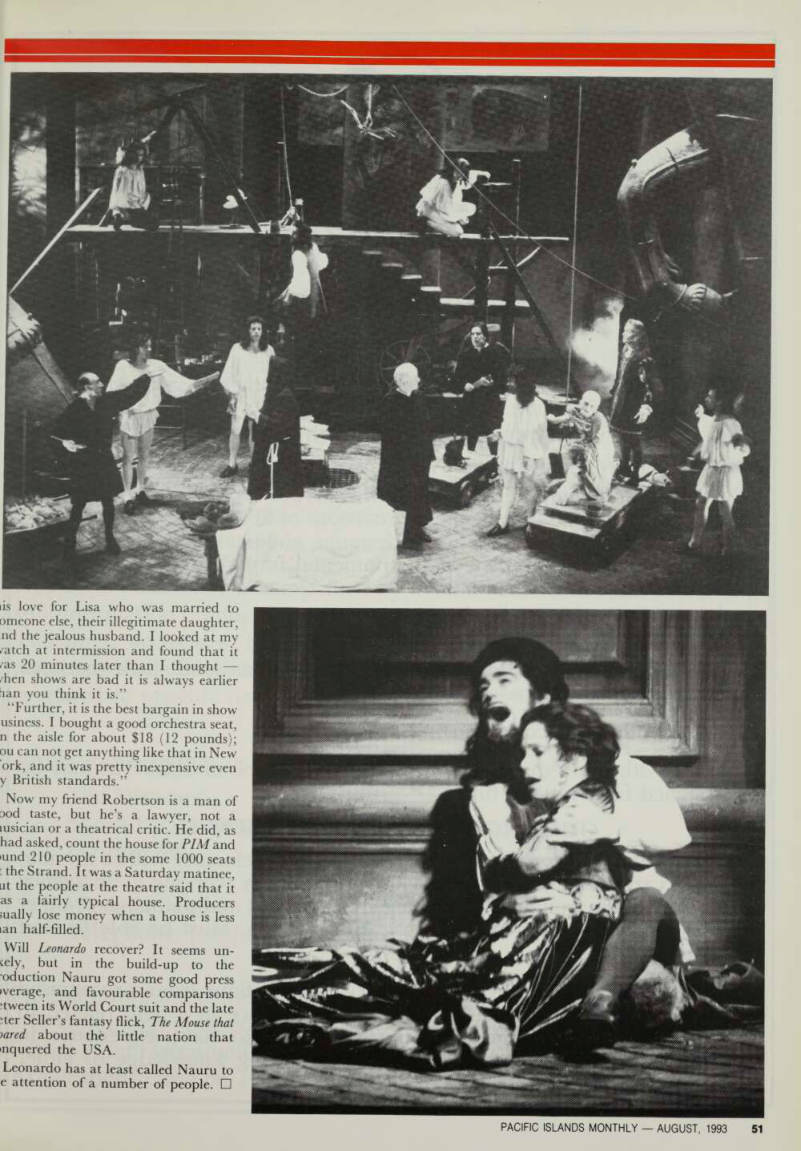
Theatre
Nauru’s $2.9 million London musical, Leonardo, suffers at the hands of the critics.
But is there hope at the box-office?
By David North
NAURU’S theatrical investment, the London musical production Leonardo: A Portrait of Love, is doing badly.
A headline in the London Times says it all : “Critics compare Leonardo musical to South Sea guano.”
While the show was still running (and
probably depleting Nauru’s phosphate
rich treasure in the process) the signs were not encouraging; the Times placed it in its lowest of three popularity categories (you can buy a ticket any night in any price range); at one point it was the only show in the West End advertising half-price tickets, and the box office will accept no orders for perform ances after September 25.
Nauru had high hopes for the musical, and thought it had found another fortune-making blockbuster, like Cats or Phantom of the Opera. It decided to be the only investor in the show, and put up two
million pounds (U 552,900,000) to bring
it to the Strand Theatre.
The show revolves around an in triguing idea, that the painter Leonardo Da Vinci was hopelessly in love with his most famous model, Mona Lisa, the woman with the enigmatic half smile. It was the brainchild of a Liverpool-born entrepreneur, who has operated out of Australia for the last 20 years, Duke Minks. Minks had several things going for himself in this connection, a show business background (having been the road manager of a 1960’s singing group, Unit 4 + 2) and a role as one of Nauru’s financial advisers. He also ap parently has a gift of gab, and charmed journalists writing about the show before it opened.
He was identified in the press as a former owner of an Australian airline (“with 600 people working for me”) and a former vice-president of New York’s Citibank (“looking after a quarter of the world”).
To our knowledge the London press did not raise the issue of conflict of interest if you are a government’s financial adviser, maybe you should not
let that government invest in your own project.
Nauru’s leadership was thoroughly
involved in the decision to back the play.
Minks was first in touch with Kelly Emiu, who serves both as Nauru Cabinet Secretary and as Chairman of the national finance corporation which handles its investments. Emiu who loves music, liked the idea of backing a play, and studied the genre by going to all the musicals in London.
Minks then played him the songs from Leonardo , an unstaged production that he and three buddies had written a couple of years earlier. Emiu loved it, made a recording of it, gathered up press clips of the huge profits made by some other London shows, and took the next plane to Nauru.
Emiu persuaded Nauru’s President Bcrnand Dowiyogo to summon a cabinet meeting to hear Emiu’ presentation about the play. The Cabinet Secretary sketched the profits made by some London musicals, described the play, and then sang one of the songs from the show, Her Heart Beats , and the Cabinet voted unanimously to back the show.
According to Minks the objective was always a show in London; theatrical runs are too short in Australia to make any serious money, he argued, and “there would be no point in putting it on in Nauru, it would be easier to fly the 8000 citizens over here.”
One of the motivations for the decision to back the play was to secure a little recognition of Nauru prepartory to the island’s case in the World Court against the various British Commonwealth gov ernments and enterprises that had bought the phosphate for a song prior to Nauru’s independence in 1968.
Given the go-ahead, Minks pulled together some show business profes sionals and did an out-of-town tryout at the Old Fire Station Theatre in Oxford last October. As is usually the case with tryouts, the scenery was not impressive, and the orchestra was small, but the Nauru cabinet joined the audience it sold out there and loved the play. It was off to the big time.
Casting included Jane Arden as Lisa, Paul Collins as Leonardo, and Hal Fowler as Metzi, a male in whom Leonardo had a homosexual interest.
Rob Bettingson, with a respectable collection of credits, was the director.
When the show opened in June, President Dowiyogo, the Nauru cabinet, and many other Nauruans were in the Strand Theatre for opening night (pre sumably at some considerably cost to some Nauruan account). Nauru issued invitations to other island heads of state to attend. It was a gala affair.
But the critics were not kind. Some objected to the whole notion of a heterosexual or at least bi-sexual Leonardo as a gross inaccuracy. (History records two arrests for homosexual be haviour). One summarized his reaction : “great sets but daft story”.
Nicholas De Jongh, in the Evening Standard was heartless : “...if Nauru were not rich in seafowls’ excrement I doubt that a load of extreme rubbish like Leonardo would have been dumped upon a West End theatre”.
The Daily Express was equally unkind : “There are only six shopping months to Christmas and already the turkey has arrived in the West End ... (turkey being show business term for disaster).
“There is a great deal of tosh to sit through,” said the Daily Telegraph , “not for one moment do you believe that its portrait of Leonardo comes close to an accurate portrayal of one of civilization’s
greatest geniuses.”
Producer Minks said that he was prepared for bad reviews, that the critics tend to act like a mafia, and that the people who had attended the numerous previews had liked the show. He said, “We are prepared to finance the show until Christmas, though I do not think that will be necessary.”
It was with this background in hand that I convinced my Washington friend, Peter Robertson, to check out the show in late June. This was his report “I arrived at the theatre with minimal expectations; I knew about the reviews, and when I bought the ticket I asked the booking agent if she had seen it. She had, said it was terrible, and had walked out at the intermission. But the cabbie said it was a good show, “I really liked it good music, great staging, remarkable sets and costumes, good singers. It was a wonderful evening.
I got involved in the story of Leonardo,
lis love for Lisa who was married to omeone else, their illegitimate daughter, nd the jealous husband. I looked at my /atch at intermission and found that it 'as 20 minutes later than I thought 'hen shows are bad it is always earlier tian you think it is.”
“Further, it is the best bargain in show usiness. I bought a good orchestra seat, n the aisle for about $lB (12 pounds); ou can not get anything like that in New ork, and it was pretty inexpensive even y British standards.”
Now my friend Robertson is a man of Dod taste, but he’s a lawyer, not a msician or a theatrical critic. He did, as had asked, count the house for PIM and •und 210 people in the some 1000 seats ; the Strand. It was a Saturday matinee, nt the people at the theatre said that it as a fairly typical house. Producers >ually lose money when a house is less tan half-filled.
Will Leonardo recover? It seems un tely, but in the build-up to the eduction Nauru got some good press ►verage, and favourable comparisons its World Court suit and the late 'ter Seller’s fantasy flick, The Mouse that lared about the little nation that •nquered the USA.
Leonardo has at least called Nauru to e attention of a number of people. □
Advertisements & other items, pp. 52-56 (1 item)
Environment Programme
f * * * ★
SOUTH PACIFIC REGIONAL
(SPREP)
VACANCY ANNOUNCEMENT
(This vacancy is advertised in the region) POST TITLE: Assistant Project Officer (Environment Management and
Planning)
DUTIES AND RESPONSIBILITIES
Assist the Environment Impact Assessment Officer to: 1. Develop and computerise the following types of information bases: 1.1 environmental management provisions of SPREP member countries; 1.2 guidelines on El A practice, techniques, and environmental standard; 1.3 catalogue of completed environmental impact assessments in the South Pacific; 1.4 directory of consultants; 2. train SPREP staff on the use of database; 3. assist countries to develop data informations and their national environmental database; 4. update other databases existing in SPREP; 5. assist with other duties within the general scope of SPREP as may be assigned from time to time.
QUALIFICATIONS AND EXPERIENCE
A specialist database programmer is required but preference will be given to those who are also used to using data and currently working in an agency involved with environmental database management and planning, or other management agencies using database informations. Must be able to start
immediately.
Candidate must have appropriate tertiary qualifications from a recognised institution and at least three years' work experience in a field related to database management and planning. Desirable to have experience in developing database systems and a good working knowledge of either Fox Pro or dßaselV or both , 101741v3
Other essential requirements are the abilities to prepare reports, to work as part of a small, inter-disciplinary team, to manage the work of consultants, to meet project deadlines (often under difficult circumstances) and to adapt to living in tropical island communities. Applicants with a demonstrated interest and involvement in environmental management and planning issues affecting the region, particularly as they relate to the use of information bases, will be highly regarded.
TERMS AND CONDITIONS OF EMPLOYMENT
Appointment will be at Assistant Project Officer level of salary range W5T29,912 to W5T40,026, and will be for 24 months or until the 31 December 1995, whichever comes first. May be renewable for a further term by mutual agreement. An attractive remuneration package and other employment benefits will be offered, with commencing salary dependent on qualifications, experience and current salary in country of recruitment.
For non-Western Samoan citizens, salary will be tax free in Western Samoa. Details are available on request.
Applications must be accompanied by detailed curricula vitae containing full information on qualifications and experience for the position as well as names, addresses, telephone and/or fax contact numbers of three referees associated with the applicant professionally and who would be prepared to provide necessary references.
Applications should be addressed to: The Director South Pacific Regional Environment Programme PO Box 240
APIA
Western Samoa Telephone: (685) 21 929 Fax: (685) 20 231 Further information, including a full duty statement and schedule of terms and conditions of appointment, can be obtained by contacting SPREFs Senior Administrative Officer, Mr Ueligitone Sasagi, at these numbers.
Applications close on 1 October 1993. 123234v5
Steelage safes and other products
Steelage
TL3O Safes Stock available Model No.
TL30675 s2Bso.oo+Vat TL3OBOO s33so.oo+Vat TL301050-S s4oso.oo+Vat TL301050-L s4sso.oo+Vat TL301225 ss6oo.oo+Vat
Steelage
REGENT
An economic safe for domestic Retail and commercial use I
Steelage
regent
safes Stock available Model No.
RS-0 slloo.oo+Vat RE-1 sl27s.oo+Vat RS-2 sl49s.oo+Vat RS-2D sl67s.oo+Vat RS-3 sl72s.oo+Vat RS-4 s2oso.oo+Vat RS-5 $2465.00+Vat Fife Resisting Ftfcng Cabinet Bi Vf f & Steelage torch & tool resisting safes Approved by Underwriters Laboraties U with TRTL-30 6 Label .S.A. a
■ts3 ilsas?
trtl trtl trtl 1215 1380 1660
TRTL
1880 Safe with safe deposit lockers Ideal for small branches of Banks as well as for Co-operatives where provision of a strongroom is uneconomical.
Fire resisting
book quality door Fitted with strap hinge, designed for resisting fire & burglars, lined with special non- conducting & moisture generating high grade chemicals, complete with grille gate.
Seelage bankers
treasury safe Model Ret TDR/1050 TDR/1225 TDR/1525
E»GUARD
Steelage
fire
protection
computer
data
cabinet.
Special
bankers
quality
strongroom
door.
Special
‘A’ Quality
Strongroom
Door
Fitted with strap hinge, designed for resisting fire & burglars, lined with special non-conducting & moisture generating high grade chemicals, complete with grille gate.
Steelage Stainless steel Vault door 90mm The increase in attacks on Bank Vaults is a security challenge that Steelage has consistently met with some of the finest security equipment made today.
Intensive research in metal strength insulation, torch and drill resistant materials and various modes of safe breaking have enabled us to maintain this high degree of success in our campaign.
The door has been designed to protect your Bank Vault against the master cracksman.
Steelage
safe deposit
locker cabinets 106069v2
Mahesh Syndicate
31 Raojibhai Patel Street, Suva.
P.0.80x 1187. Phone: 313 688, 304 446. Fax: (679) 302 485.
From Our Islands
in the Sun ...
... to every corner of our planet, Solomon Telekom puts the world at your fingertips.
With rapid advances in communications
technology, Solomon Telekom is proud to
be at the forefront in providing the latest in innovative developments. • International Direct Dialing (IDD) International Direct Dial telephone service is available from most hotel rooms and other telephones in Solomon Islands. • Cardphones International and national telephone services are available from all cardphones which are located at prominent locations in Solomon Islands. • Credit card calling Make your call with Mastercard, Amexor Visa from our Telekom office in Honiara or call and ask for our credit card serx'ice. • Other services from Telekom A full range of services are available from Telekom including facsimile, data, paging telex and leased services. Contact Solomon Telekom on 23647for further details.
TELEKwM
teleKwM| s 0 omon Telekom Company Limited ... providing communication services for
businesspeople, visitors and residents of
Solomon Islands.
DAM A-NET
Switch on to DAMA-NET, the digital update of
the familiar PACT Network
DAMA-NET will improve regional telecommunications and business services by providing: - quiet and echo free digital connections - full speed fax transmission - high quality 14.4 KBits/second in-band data transfer.
DAMA-NET will be provided in the South Pacific in association with the following administrations: Telstra Australia, Telecom Cook Islands, Fintel Fiji, TSKL Kiribati, NTA Marshall Islands, Nauru Telecom, Telecom New Zealand International, Telecom Niue, PTC Papua New Guinea, Solomon Telekom and Telecom Tuvalu.
Australian enquiries can be directed to Graham Huddy, Business Manager DAMA Networks, Telstra, Telephone +612 287 4320 or facsimile +612 287 5507.
OTC AUSTRALIA
new exchange
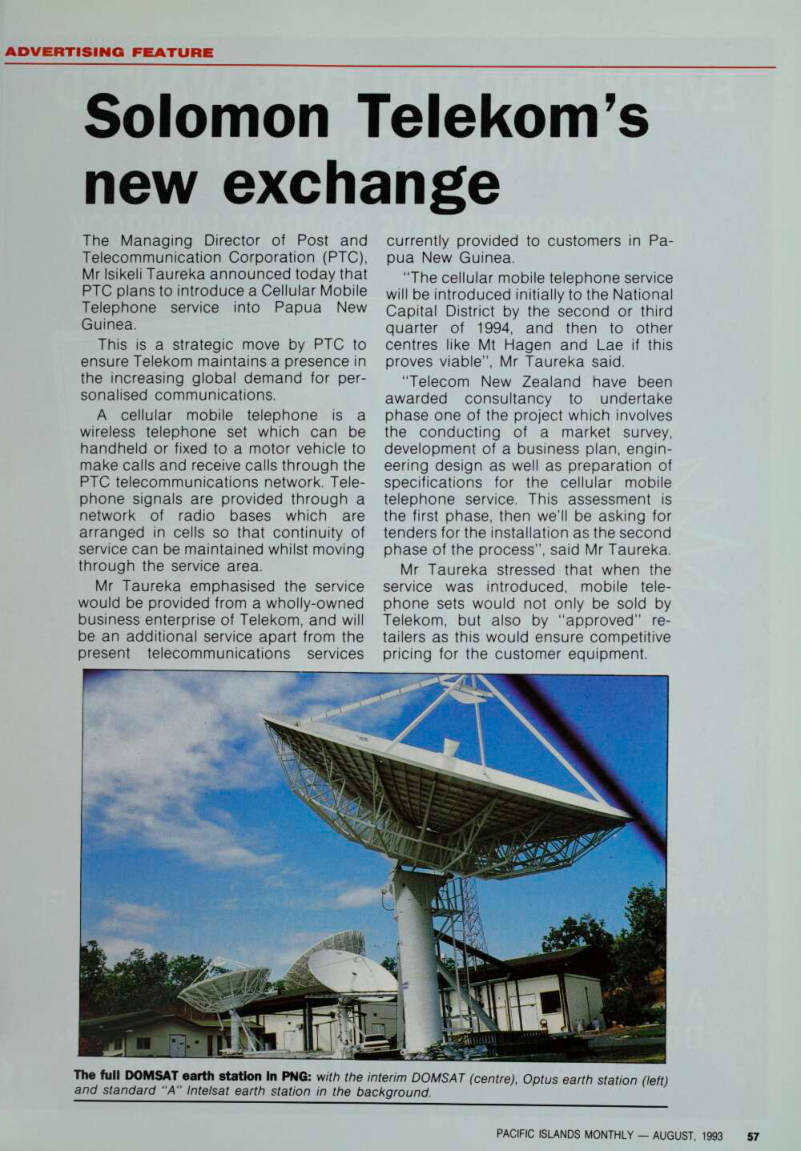
Advertising Feature
Solomon Telekom’s new exchange
The Managing Director of Post and Telecommunication Corporation (PTC), Mr Isikeli Taureka announced today that PTC plans to introduce a Cellular Mobile Telephone service into Papua New Guinea.
This is a strategic move by PTC to ensure Telekom maintains a presence in the increasing global demand for per sonalised communications.
A cellular mobile telephone is a wireless telephone set which can be handheld or fixed to a motor vehicle to make calls and receive calls through the PTC telecommunications network. Tele phone signals are provided through a network of radio bases which are arranged in cells so that continuity of service can be maintained whilst moving through the service area.
Mr Taureka emphasised the service would be provided from a wholly-owned business enterprise of Telekom, and will be an additional service apart from the present telecommunications services
currently provided to customers in Pa pua New Guinea.
“The cellular mobile telephone service will be introduced initially to the National Capital District by the second or third quarter of 1994, and then to other centres like Mt Hagen and Lae if this proves viable”, Mr Taureka said.
“Telecom New Zealand have been awarded consultancy to undertake phase one of the project which involves the conducting of a market survey, development of a business plan, engin eering design as well as preparation of specifications for the cellular mobile telephone service. This assessment is the first phase, then we’ll be asking for tenders for the installation as the second phase of the process”, said Mr Taureka.
Mr Taureka stressed that when the service was introduced, mobile tele phone sets would not only be sold by Telekom, but also by “approved” re tailers as this would ensure competitive pricing for the customer equipment.
The full DOMSAT earth station in PNG: with the interim DOMSAT (centre), Optus earth station (left) and standard “A” Intelsat earth station in the background.
Advertisements & other items, p. 58 (1 item)
Everything You Ever Wanted
TO KNOW ABOUT F1J1...
... IN A COMPREHENSIVE COMPACT HANDBOOK
SiPID
‘ NEW
edition
OUT
. NOW
>j.
An ideal guide for the business person or travellers, at your fingertips
AVAILABLE AT LEADING NEWS AGENTS
BOOKSTORES AND FIJI TIMES OFFICES,
SUVA, NADI, LAUTOKA, LABASA
to digital
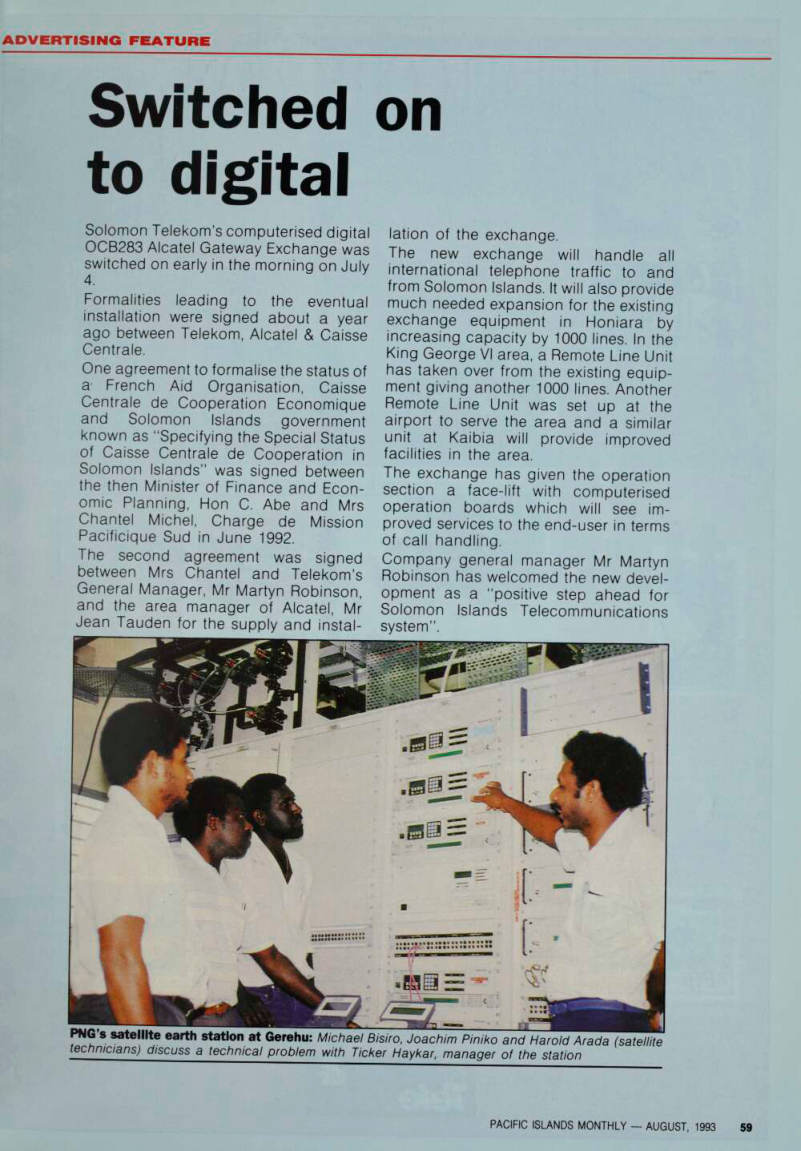
Switched on to digital
Solomon Telekom’s computerised digital 0C8283 Alcatel Gateway Exchange was switched on early in the morning on July 4.
Formalities leading to the eventual installation were signed about a year ago between Telekom, Alcatel & Caisse Centrale.
One agreement to formalise the status of a- French Aid Organisation, Caisse Centrale de Cooperation Economique and Solomon Islands government known as “Specifying the Special Status of Caisse Centrale de Cooperation in Solomon Islands” was signed between the then Minister of Finance and Econ omic Planning, Hon C. Abe and Mrs Chantel Michel, Charge de Mission Pacificique Sud in June 1992.
The second agreement was signed between Mrs Chantel and Telekom’s General Manager, Mr Martyn Robinson, and the area manager of Alcatel, Mr Jean Tauden for the supply and instal
lation of the exchange.
The new exchange will handle all international telephone traffic to and from Solomon Islands. It will also provide much needed expansion for the existing exchange equipment in Honiara by increasing capacity by 1000 lines. In the King George VI area, a Remote Line Unit has taken over from the existing equip ment giving another 1000 lines. Another Remote Line Unit was set up at the airport to serve the area and a similar unit at Kaibia will provide improved facilities in the area.
The exchange has given the operation section a face-lift with computerised operation boards which will see im proved services to the end-user in terms of call handling.
Company general manager Mr Martyn Robinson has welcomed the new devel opment as a “positive step ahead for Solomon Islands Telecommunications system”.
PNG's satellite earth station at Gerehu: Michael Bisiro, Joachim Piniko and Harold Arada (satellite technicians) discuss a technical problem with Ticker Haykar, manager of the station
Advertisements & other items, p. 60 (1 item)
been artistically recaptured on
Learn more about Fiji - collect Fiji
stamps. Fiji's unique features have
stamps. It is anyone's delight and
a collector's must.
FIJI
72 ' 42 c Fill
NUDIBRaNCHS
CSBjTSLUGS}
VS*
FLU
FIJI
7) Mil m hc*obroi*<m> i We offer you the best of our Fiji stamps. For more information write to: Postmaster, Philatelic Bureau, P 0 Box 100, Suva, Fiji.
Medal assault
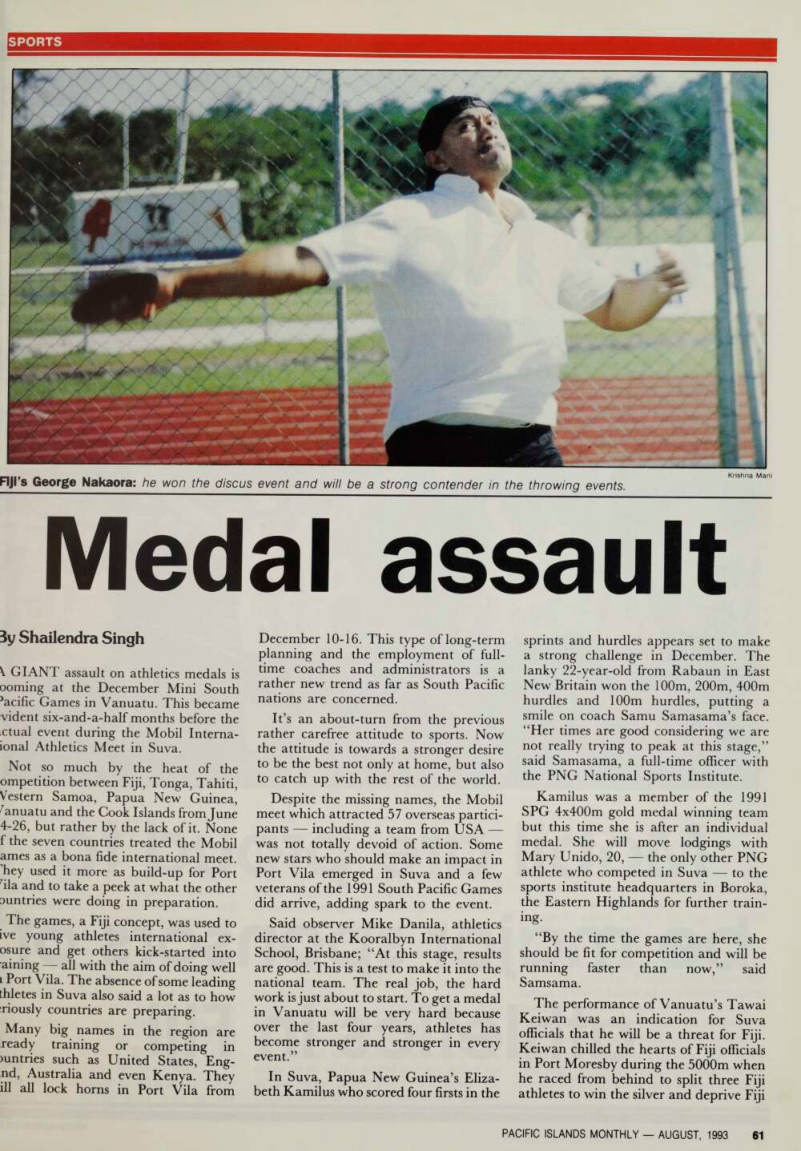
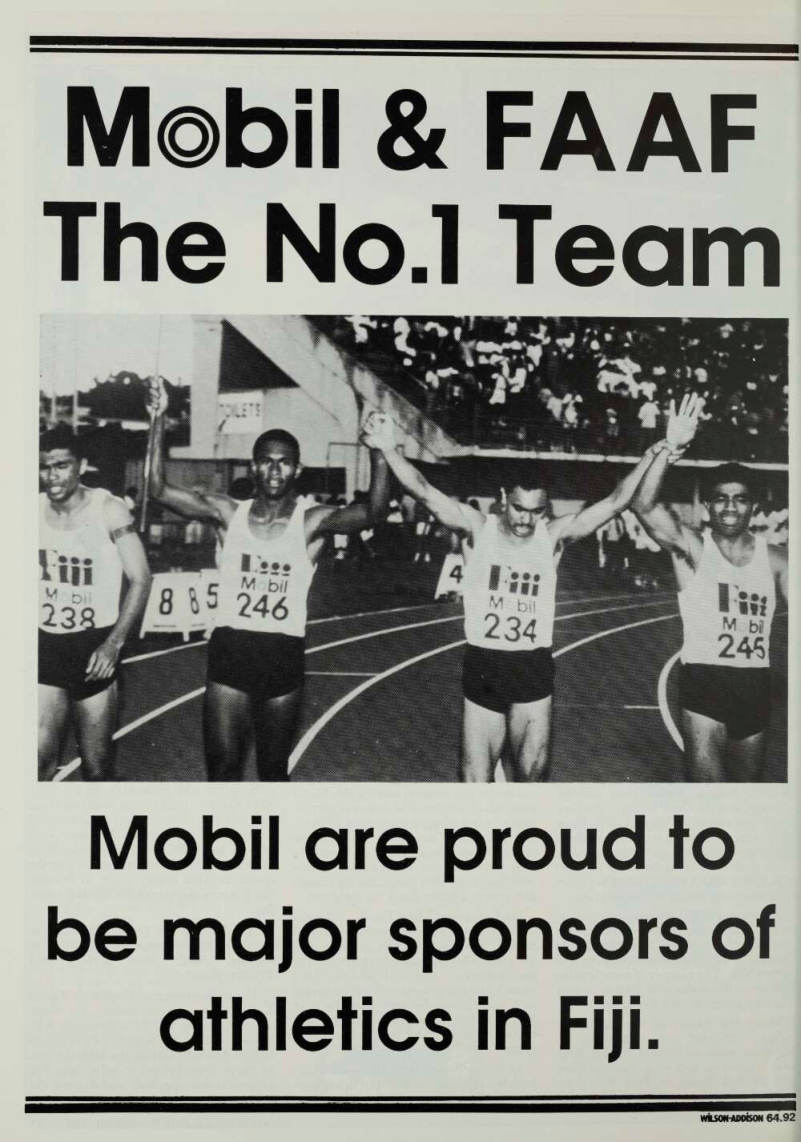
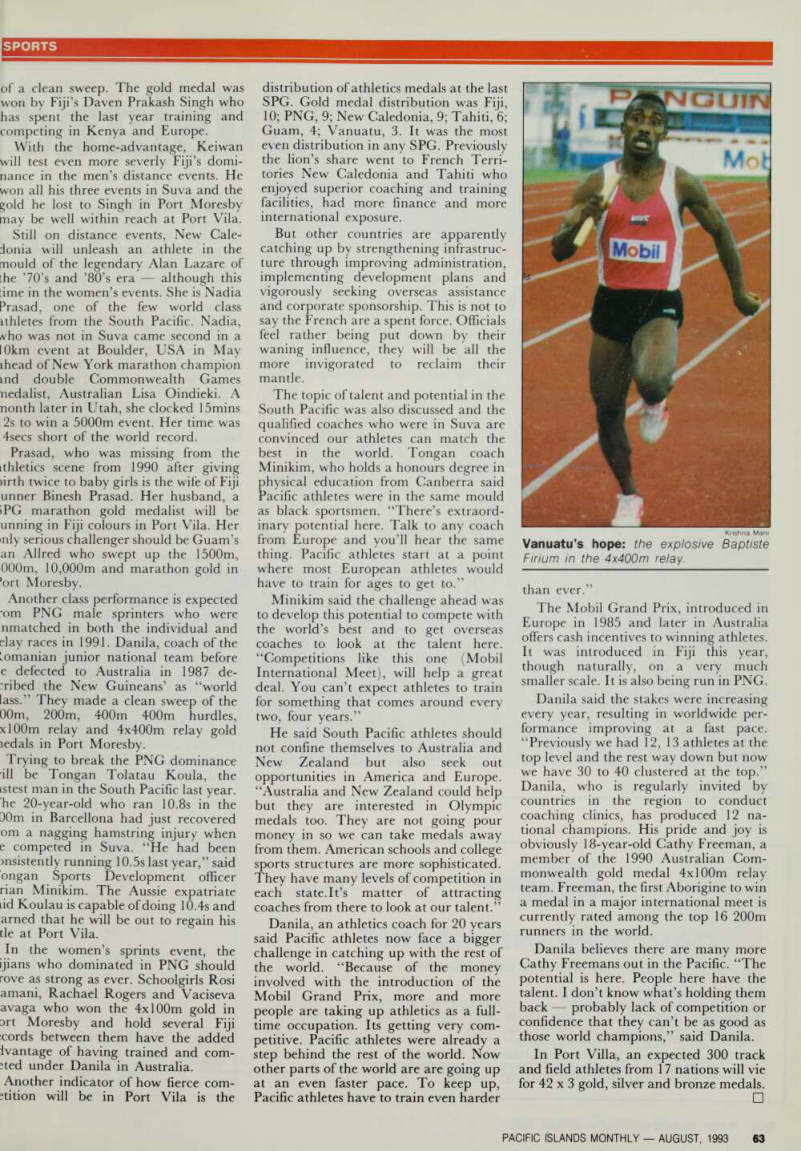
Sports
By Shailendra Singh
V GIANT assault on athletics medals is ooming at the December Mini South ’acific Games in Vanuatu. This became vident six-and-a-half months before the ctual event during the Mobil Interna ional Athletics Meet in Suva.
Not so much bv the heat of the
ompetition TaffiJ
Vestern Samoa, Papua New Guinea, Vanuatu and the Cook Islands from June 4-26, but rather by the lack of it. None f the seven countries treated the Mobil ames as a bona fide international meet. bey used it more as build-up for Port ila and to take a peek at what the other Duntries were doing in preparation.
The games, a Fiji concept, was used to ive young athletes international ex osure and get others kick-started into aimng all with the aim of doing well i Port Vila. The absence of some leading thletes in Suva also said a lot as to how nously countnes are preparing.
Many big names in the region are ready training or competing in >U J| ltl A eS SU< ? aS n^ted States, Eng nd, Australia and even Kenya. They ill all lock horns in Port Vila from
December 10-16. This type oflong-term planning and the employment of fulltime coaches and administrators is a new trend as far as South Pacific nations are concerned.
It’s an about-turn from the previous rather carefree attitude to sports. Now the attitude is towards a stronger desire to best not only at home, but also catch up with the'rest of the world.
Despite the missing names, the Mobil meet which attracted 57 overseas participants including a team from USA was not totally devoid of action. Some new stars who should make an impact in Port Vila emerged in Suva and a few veterans of the 1991 South Pacific Games did arrive, adding spark to the event.
Said observer Mike Danila, athletics director at the Kooralbyn International School, Brisbane; “At this stage, results are good. This is a test to make it into the national team. The real job, the hard work is just about to start. To get a medal in Vanuatu will be very hard because ° ver the last four V ears . athletes has become stronger and stronger in every
even •
In Suva, Papua New Guinea’s Elizabeth Kamilus who scored four firsts in the
sprints and hurdles appears set to make a strong challenge in December. The lanky 22-year-old from Rabaun in East New Britain won the 100 m, 200 m, 400 m hurdles and 100 m hurdles, putting a smile on coach Samu Samasama s face, “ Her times ai ; e g ood considering we are really trying to peak at this stage, sa * d Samasama, a full-time officer with the PNG National Sports Institute.
Kamilus was a member of the 1991 SPG 4x400m gold medal winning team but this time she is after an individual medal. She will move lodgings with Mary Unido, 20, the only other PNG athlete who competed in Suva to the sports institute headquarters in Boroka, the Eastern Highlands for further train m^‘ “By the time the games are here, she should be fit for competition and will be running faster than now,” said Samsama.
The performance of Vanuatu’s Tawai officials that he will be a threat for F;ji Keiwan chilled the hearts of Fiji officials in Port Moresby during the 5000 m when he raced from behind to split three Fiji athletes to win the silver and deprive Fiji
Krishna Mani
FIJI’s George Nakaora: he won the discus event and will be a strong contender in the throwing events.
of a clean sweep. The gold medal was won by Fiji’s Daven Prakash Singh who has spent the last year training and competing in Kenya and Europe.
With the home-advantage, Keiwan will test even more severly Fiji’s domi nance in the men’s distance events. He won all his three events in Suva and the gold he lost to Singh in Port Moresby may be well within reach at Port Vila.
Still on distance events, New Cale donia will unleash an athlete in the mould of the legendary Alan Lazare of the ’7o’s and ’Bo’s era although this time in the women’s events. She is Nadia Prasad, one of the few world class ithletes from the South Pacific. Nadia, vho was not in Suva came second in a 10km event at Boulder, USA in May ihead of New York marathon champion md double Commonwealth Games nedalist, Australian Lisa Oindieki. A nonth later in Utah, she clocked 15mins 2s to win a 5000 m event. Her time was 4secs short of the world record.
Prasad, who was missing from the ithletics scene from 1990 after giving >irth twice to baby girls is the wife of Fiji unner Binesh Prasad. Her husband, a >PG marathon gold medalist will be unning in Fiji colours in Port Vila. Her nly serious challenger should be Guam’s an Allred who swept up the 1500 m, 000 m, 10,000 m and marathon gold in brt Moresby.
Another class performance is expected om PNG male sprinters who were nmatched in both the individual and elay races in 1991. Danila, coach of the Lomanian junior national team before e defected to Australia in 1987 de :ribed the New Guineans’ as “world lass.” They made a clean sweep of the 00m, 200 m, 400 m 400 m hurdles,
xlOOm relay and 4x400m relay gold
ledals in Port Moresby.
Trying to break the PNG dominance ill be Tongan Tolatau Koula, the istest man in the South Pacific last year, he 20-year-old who ran 10.8 s in the 30m in Barcellona had just recovered
om a nagging hamstring injury when
e competed in Suva. “He had been insistently running 10.5 s last year,” said
bngan Sports Development officer
rian Minikim. The Aussie expatriate iid Koulau is capable of doing 10.4 s and arned that he will be out to regain his tie at Port Vila.
In the women’s sprints event, the ijians who dominated in PNG should rove as strong as ever. Schoolgirls Rosi amani, Rachael Rogers and Vaciseva avaga who won the 4xloom gold in
art Moresby and hold several Fiji
cords between them have the added Ivantage of having trained and com bed under Danila in Australia.
Another indicator of how fierce cont rition will be in Port Vila is the
distribution of athletics medals at the last SPG. Gold medal distribution was Fiji, 10; PNG, 9; New Caledonia, 9; Tahiti, 6; Guam, 4; Vanuatu, 3. It was the most even distribution in any SPG. Previously the lion’s share went to French Terri tories New Caledonia and Tahiti who enjoyed superior coaching and training facilities, had more finance and more international exposure.
But other countries are apparently catching up by strengthening infrastruc ture through improving administration, implementing development plans and vigorously seeking overseas assistance and corporate sponsorship. This is not to say the French are a spent force. Officials feel rather being put down by their waning influence, they will be all the more invigorated to reclaim their mantle.
The topic of talent and potential in the South Pacific was also discussed and the qualified coaches who were in Suva are convinced our athletes can match the best in the world. Tongan coach Minikim, who holds a honours degree in physical education from Canberra said Pacific athletes were in the same mould as black sportsmen, “There’s extraord inary potential here. Talk to any coach from Europe and you’ll hear the same thing. Pacific athletes start at a point where most European athletes would have to train for ages to get to.”
Minikim said the challenge ahead was to develop this potential to compete with the world’s best and to get overseas coaches to look at the talent here.
“Competitions like this one (Mobil International Meet), will help a great deal. You can’t expect athletes to train for something that comes around every two, four years.”
He said South Pacific athletes should not confine themselves to Australia and New Zealand but also seek out opportunities in America and Europe.
“Australia and New Zealand could help but they are interested in Olympic medals too. They are not going pour money in so we can take medals away from them. American schools and college sports structures are more sophisticated.
They have many levels of competition in each state.lt’s matter of attracting coaches from there to look at our talent.”
Danila, an athletics coach for 20 years said Pacific athletes now face a bigger challenge in catching up with the rest of the world. “Because of the money involved with the introduction of the Mobil Grand Prix, more and more people are taking up athletics as a full time occupation. Its getting very com petitive. Pacific athletes were already a step behind the rest of the world. Now other parts of the world are are going up at an even faster pace. To keep up, Pacific athletes have to train even harder
than ever.”
The Mobil Grand Prix, introduced in Europe in 1985 and later in Australia offers cash incentives to winning athletes.
It was introduced in Fiji this year, though naturally, on a very much smaller scale. It is also being run in PNG.
Danila said the stakes were increasing every year, resulting in worldwide per formance improving at a fast pace.
“Previously we had 12, 13 athletes at the top level and the rest way down but now we have 30 to 40 clustered at the top.”
Danila, who is regularly invited by countries in the region to conduct coaching clinics, has produced 12 na tional champions. His pride and joy is obviously 18-year-old Cathy Freeman, a member of the 1990 Australian Com monwealth gold medal 4x100m relay team. Freeman, the first Aborigine to win a medal in a major international meet is currently rated among the top 16 200m runners in the world.
Danila believes there are many more Cathy Freemans out in the Pacific. “The potential is here. People here have the talent. I don’t know what’s holding them back — probably lack of competition or confidence that they can’t be as good as those world champions,” said Danila.
In Port Villa, an expected 300 track and field athletes from 17 nations will vie for 42 x 3 gold, silver and bronze medals. □
Krishna Mani Vanuatu’s hope: the explosive Baptiste Firium in the 4x400m relay.
Advertisements & other items, p. 62 (1 item)
The No.l Team
Mobil & FAAF
93 m f r, 'A % r I * viii Bis 54x • VV| M bil 234 M 23 bi 245 ■
Mobil are proud to
be major sponsors of
athletics in Fiji.
WiLSON ADDtSON 64.92
Island Cruising
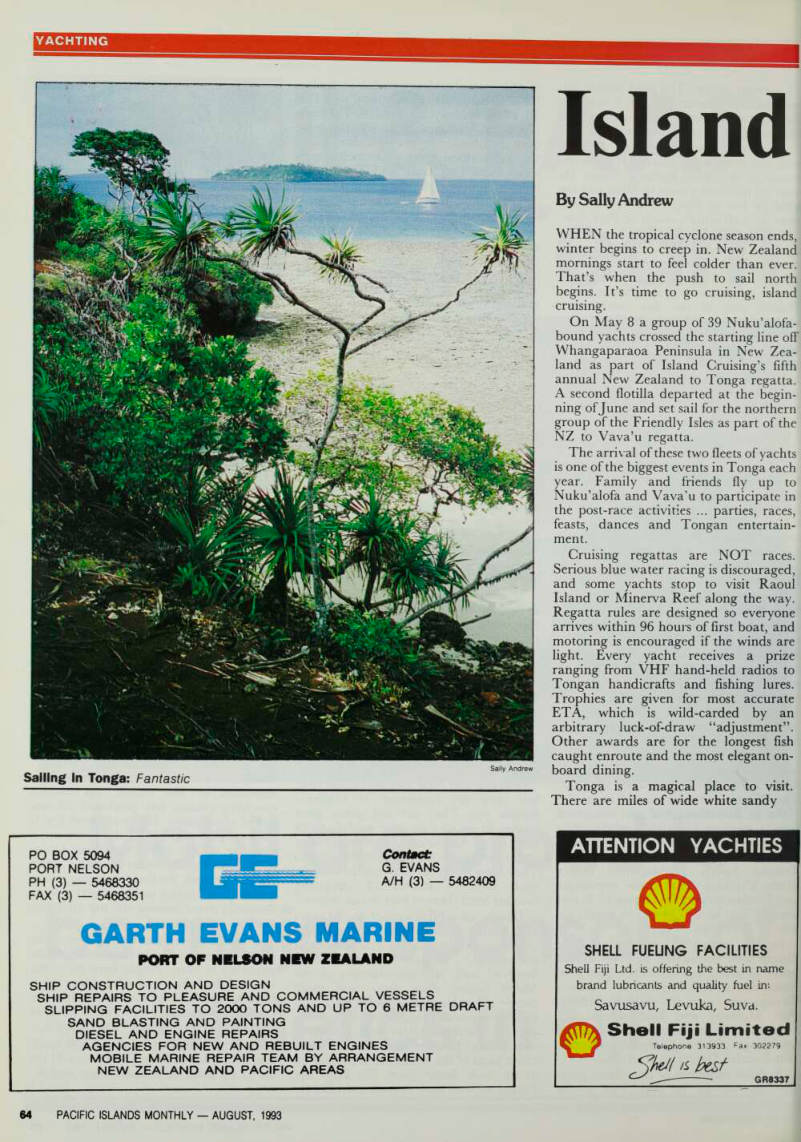
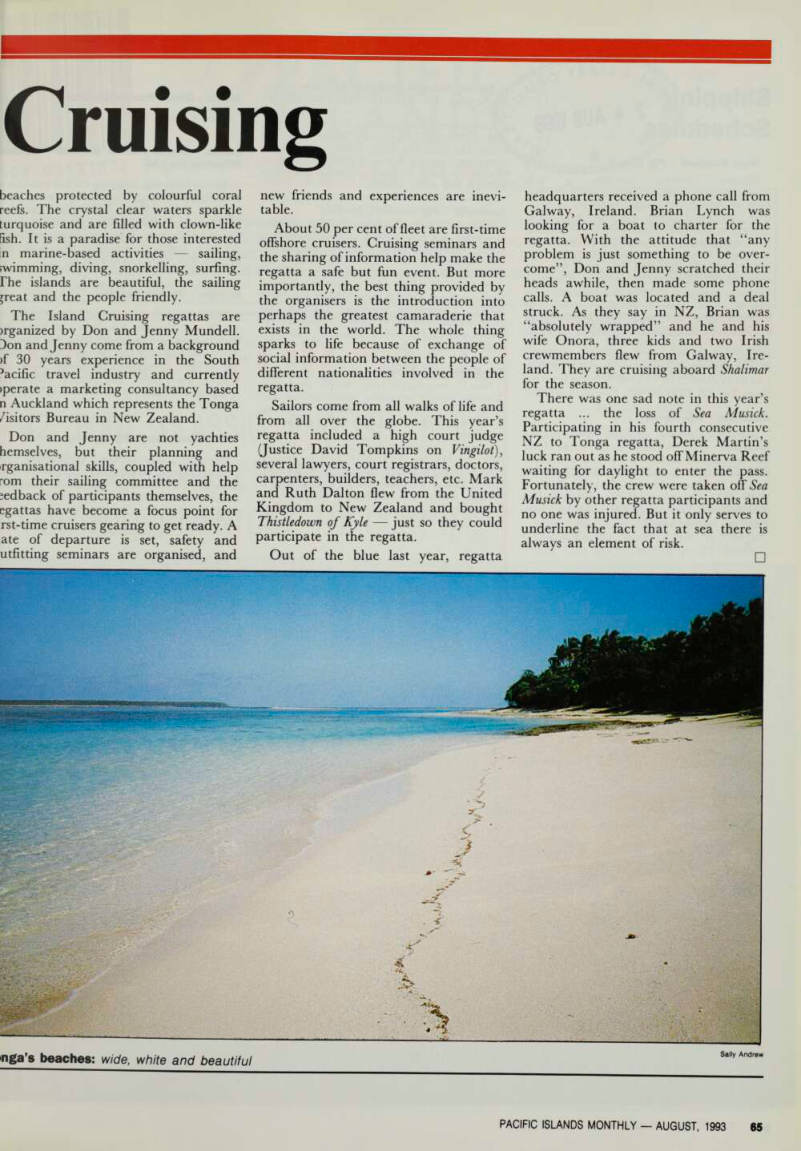
Yachting
By Sally Andrew
WHEN the tropical cyclone season ends, winter begins to creep in. New Zealand mornings start to feel colder than ever.
That’s when the push to sail north begins. It’s time to go cruising, island
cruising.
On May 8 a group of 39 Nukualofa bound yachts crossed the starting line off Whangaparaoa Peninsula in New Zea land as part of Island Cruising’s fifth annual New Zealand to Tonga regatta.
A second flotilla departed at the begin ning of June and set sail for the northern group of the Friendly Isles as part of the NZ to Vava’u regatta.
The arrival of these two fleets of yachts is one of the biggest events in Tonga each year. Family and friends fly up to Nuku’alofa and Vava’u to participate in the post-race activities ... parties, races, feasts, dances and Tongan entertain ment.
Cruising regattas are NOT races.
Serious blue water racing is discouraged, and some yachts stop to visit Raoul Island or Minerva Reef along the way.
Regatta rules are designed so everyone arrives within 96 hours of first boat, and motoring is encouraged if the winds are light. Every yacht receives a prize ranging from VHF hand-held radios to Tongan handicrafts and fishing lures.
Trophies are given for most accurate ETA, which is wild-carded by an arbitrary luck-of-draw “adjustment”.
Other awards are for the longest fish caught enroute and the most elegant on
board dining.
Tonga is a magical place to visit.
There are miles of wide white sandy
Sally Andrew
Sailing In Tonga: Fantastic
beaches protected by colourful coral reefs. The crystal clear waters sparkle turquoise and are filled with clown-like fish. It is a paradise for those interested n marine-based activities sailing, iwimmmg, diving, snorkelling, surfing.
Fhe islands are beautiful, the sailing rreat and the people friendly.
The Island Cruising regattas are irganized by Don and Jenny Mundell.
Don and Jenny come from a background )f 30 years experience in the South veille travel industry and currently >perate a marketing consultancy based n Auckland which represents the Tonga /isitors Bureau in New Zealand. „ , T , Don and Jenny are not yachties hemselves, but their planning and rgamsational skills, coupled with help rom their sailing committee and the ;edback of participants themselves, the egattas have become a focus point for rst-time cruisers gearing to get ready. A ate of departure is set, safety and utfitting seminars are organised, and
new friends and experiences are inevitable.
About 50 per cent of fleet are first-time offshore cruisers. Cruising seminars and the sharing of information help make the regatta a safe but fun event. But more importantly, the best thing provided by the organisers is the introduction into perhaps the greatest camaraderie that exists in the world. The whole thing sparks to life because of exchange of social information between the people of different nationalities involved in the regatta.
Sailors come from all walks of life and from all over the globe This year’s ‘ . j K ‘ . Y j 5 regatta included a high court judge
(Justice David Tompkins on
several lawyers court registrars, doctors, carpenters, builders, teachers, etc. Mark and Ruth Dalton flew from the United kingdom to New Zealand and bought Thistledown of Kyle just so they could participate m the regatta.
Out of the blue last year, regatta
headquarters received a phone call from Galway, Ireland. Brian Lynch was looking for a boat to charter for the regatta. With the attitude that “any problem is just something to be over come”, Don and Jenny scratched their heads awhile, then made some phone calls. A boat was located and a deal struck. As they say in NZ, Brian was “absolutely wrapped” and he and his wife Onora, three kids and two Irish crewmembers flew from Galway, Ire land. They are cruising aboard Sholimar for the season.
There was one sad note in this year’s regatta ... the loss of Sea Musick.
Participating in his fourth consecutive NZ to Tonga regatta, Derek Martin’s luck ran out as he stood off Minerva Reef waiting for daylight to enter the pass.
Fortunately, the crew were taken off Sea Musick by other regatta participants and no one was injured. But it only serves to underline the fact that at sea there is always an element of risk.
Sally Andrew
[?]nga’s beaches: wide, white and beautiful
Advertisements & other items, pp. 64-65 (2 items)
Garth Evans Marine
ATTENTION YACHTIES
SHELL FUEUNG FACILITIES
Shell Fiji Ltd. is offering the best in name brand lubricants and quality fuel in; Savusavu, Levuka, Suva. © Shell Fiji Limited Telephone 313933 Fa* 302279
& best
GRB337
PO BOX 5094
PORT NELSON
PH (3) 5468330
FAX (3) 5468351
EC Contact
G. EVANS
A/H (3) 5482409
GARTH EVANS MARINE
PORT OF NELSON NEW ZEALAND
SHIP CONSTRUCTION AND DESIGN
SHIP REPAIRS TO PLEASURE AND COMMERCIAL VESSELS SLIPPING FACILITIES TO 2000 TONS AND UP TO 6 METRE DRAFT
SAND BLASTING AND PAINTING
DIESEL AND ENGINE REPAIRS
AGENCIES FOR NEW AND REBUILT ENGINES
MOBILE MARINE REPAIR TEAM BY ARRANGEMENT
NEW ZEALAND AND PACIFIC AREAS
Cruising
Shipping
Schedules
New Zealand - Fiji direct Sofrana Unilines operates a fully containerised/breakbulk service every 21 days from Auckland, Tauranga, Lyttleton to Suva and Lautoka. Loading every 21 days, ro/ro service, containers - reefer. Contact Sofrana Unilines, Sofrana House, 101 Customs Street, Auckland, PC Box 3614, Fax (09) 393874, Ph (09) 773279, Tlx NZ 2313. Direct toll free line 0800 659-922, Contact Alan Foote. Compass Shipping Agencies, PC Box 921 Wellington, Tel (04) 382 8206, Fax (04) 3828239, Tlx NZ 4769 Contact Steve Brannigan. Sofrana Unilines Agencies, PO Box 22046 Christchurch, Tel (03) 366 7180. Fax (03) 366 8868, TLX NZ4769, Contact Tony Newell, Carpenters Shipping, Private Mail Bag, Suva, Fiji. Tel (679) 312244, Fax (679) 301572, Tlx FJ 2199. Sofrana Unilines, Suva, Fiji, Tel (679) 315645, Fax (679) 300057.
Australia - Fiji direct Sofrana Unilines operates a container breakbulk service every three weeks from Melbourne, and Sydney to Lautoka and Suva.
Contact Sofrana Unilines (Aust) Pty Ltd, PO Box Q 136, Queen Victoria Building, Sydney, NSW 2000, Australia. Tel (02) 2648944, Fax (02) 2676547, Tlx (71) A 170090, Contact Sam
Attaway/ George Lopez.
V Delams Australia Pty Ltd. 474 Flinders Street, Tel (03) 614 1344, Fax (03) 629 gJlCarpenters Shipping, Suva, Tel (679) 312244, JBax (679) 301572. Sofrana Unilines Suva, Tel Shipping, Lautoka, Tel (679) 663988, Fax (679) 664896. Sofrana Unilines, Lautoka Tel (679) 662921, Fax (679) 664896.
Australia - Fiji monthly service Sofrana Unilines (Australia) Pty Ltd operates a regular monthly service with MV Capitaine Wallis. Contact Sofrana Unilines, Sydney, Tel (02) 2648944, Tlx AA170090, Fax (02) 267-6547. Carpenters Shipping, Suva, Fiji, Tel (679) 312244, Fax (679) 301572, Sofrana Unilines, Suva, Fiji Tel (679) 315645, Fax (679) 300057. Carpenters Shipping, Lautoka, Tel (679) 63988, Fax (679) 664896. Sofrana Uni lines, Lautoka, Fiji, Tel (679) 662921, Fax (679) 664896.
Far-East - Fiji Service New Guinea Pacific Line (NGPL) operates a monthly service accepting containerised and break-bulk cargoes from Manila, Keelung, Kaoshiung, Hong Kong, Lae to Suva, Lautoka (via Suva).
Contact Carpenters Shipping Suva, Fiji, tel (679) 312244, fax (679) 301572. New Zealand Unit Express, Maritime Building, 2-10 Customs House Quay, PO Box 890, Wellington. Tel 727865, Cables Enzue Man, Wellington, Tlx NZ31340 Nedlnz or Nedlloyd Swire Pty Ltd, Sydney, Tel 20522.
Japan - South Pacific Service Same as Burns Philp Japan - South Pacific Service - Kyowa Shipping Co Ltd Kyowa Shipping, Shipping Co Ltd provides a monthly service from Hong Kong to main ports
ofjapan, Saipan, Guam, Island ports, Lautoka,
Suva via Nukualofa to Pago Pago and Apia.
Contact Carpenters Shipping, Neptune House,
3/4 floor, Tofuaa Street, Walu Bay, Suva. Tel 312244, Fax 301572, Tlx FJ2199.
Europe - Pacific Service Nedlloyd offers cargo services from Continen tal Ports to Papeete, Fiji, New Caledonia and Doniambo on slot basis with Bank line. Contact Nedlloyd (Aust) Pty Ltd, Spring Street, Sydney, Tel 273801. Carpenters Shipping, Suva, tel 312244, Tlx FJ2199, Fax 301572. Carpenters Shipping, Lautoka, Tel 663988, Tlx FJ5215, Fax 664896.
South East Asia - Fiji Service Nedlloyd Lines Service (Wellington, New Zealand) operates regular fast cargo service from
Jakarta, Pt Keelang, Singapore, Bangkok,
Surubaya via Auckland to Suva and Lautoka. □
Advertisements & other items, pp. 66-68 (1 item)
The Bank Line
YOUR EXPERTS IN THE SOUTH PACIFIC
'ICE OF ANDREW WEIR SHIPPING
-Sefvesihe SoufeßacttKrto- ahdAom mf/M -fc - ■ .-Europe wtfSJE ;■ ■ J. *
p*^pp
mmmSii
508 00153272 5
;f fXant
ISLANDS
\\ I MON T H L Y~\ j j
_MfIRK€T PLRCg/
For the benefit of our readers who would like to place a small classified advertisement in our magazine, Market Place will assist you in selling personal items, accommodation, real estate boating or a service ... in fact anything you would like to sell to our over 50,000 readers.
Market Place Advertising Rates are structured to allow you to place as many advertisements as you wish, economically.
COLLECTORS MODEL CARS
Diecast model cars: CORGI, BRUMM, PROGETTO K, BEST, RAE and others. Please write or fax for lists:
MESSAGE MODELS,
P.O. Box 239,
NORTHBRIDGE, N.S.W., 2063,
AUSTRALIA.
Fax. +6l-2-967 2216 Telephone +6l-2-958 2315 For Michael Heas’ recent The Pacific Way: Regional Cooperation in the South Pacific, send US$45 to Praeger, P.O. Box 5007, Westport, CT 06881.
Credit cards accepted.
YACHT FOR SALE
42 FOOT CLASSIC ENGLISH BUILT
OCEAN GOING CRUISING YACHT,
VERY FULL INVENTORY, FIJI CUSTOMS
DUTY PAID
FOR FURTHER INFORMATION
PHONE: (679) 361883
OR FAX (679) 361599
BOX 3205, LAMI, FIJI.
FOR SALE
M.V. NIVAGA 1
. ' I
THE ABOVE VESSEL IS FOR SALE
G.R.T. 353 TONS
N.R.T 163 TONS
CARGO CAPACITY 250 TONS
LENGTH 41.48 METRES
PASSENGER RATING MAXIMUM 150
PERSONS. FULL SURVEY CERTIFICATE
VALID UNTIL JANUARY 1994
FITTED WITH TWIN SCREW GARDNER
ENGINES.
FOR FURTHER PARTICULARS AND
INSPECTION
PLEASE CONTACT:-
THE GENERAL MANAGER
INTER PORTS SHIPPING CORP LTD
PO BOX 152, SUVA
TELEPHONE: 313266
FAX NO: 303389
SERVING: SUVA SAVUSAVU LABASA
TAVEUNI ROTUMA
SHIPPING RECEIVING FORWARDING
CARTAGE INSURANCE
GOLD BULLION
ACQUIRE GOLD BULLION FOR 17.5 c IN THE
DOLLAR (OR LESS).
oin a NEW UNIQUE bullion coin marketing >rogram.
Vorldwide application. Unlimited earnings poential for motivated individuals. Contact )RPAC INVESTMENTS, P.O. Box 71, Espiritu >anto, Vanuatu. Fax; +678-36190.
SCRAP METAL
all ingots operate from Brisbane, Australia md make frequent visits to the Pacific Islands /hich they have done for twenty-five years. We ire buyers of Copper, Brass, Aluminium, Lead, lable etc. Inspection no problems. Telephone il 7 8922033. Fax 61 78922077.
VACANCY
New Zealand licensed Hotel Manager (service orientated) seeks management position in resort/hotel South Pacific. Well experienced Including Sheraton and Hilton. Please write Peter Williams P.O. Box 14517 Wellington N.Z. or Tel. 64-4-3862443.
COMMERCIAL POINTING
Top quality four colour printing, brochures, posters, packaging, product labels, fabric labels, billboards, books, magazines, stickers, books. Export quality. Contact Fiji’s most experienced Commercial Printers. FIJI TIMES COMMER- CIAL PRINTING, PC. Box 1167, Suva. Fiji.
Phone: 304111 Fax. 301521.
MITSUBISHI
Introducing the All New Mitsubishi Galant — Beautifully Engineered for the Way You Drive Although the new Galant is probably the most handsome new cir on the road, its true beauty lies in its sheer driveability. It’s probably the first car ever that gives you the freedom to drive exactly how you choose. With a sporty, dynamic personality, it has the energy to set your adrenaline flowing when you want to drive for fun. Yet for an effortless drive home at the end of a long day, it has the smoothness and comfort you’d expect in a quality saloon. Quite how you drive the new Galant is entirely up to you.
The key to the new Galant’s versatile performance is All Wheel Control, a unique approach to car design that puts your needs first. It works on the principle that every move a car makes, from accelerating to cornering, depends on how well your aims get passed to the road —and that hinges on all four wheels working as effectively as they can, to direct, manipulate and control. With true communication between you and the road, the new Galant guarantees total control with quicker, safer and more responsive performance than ever before imaginable.
The All Wheel Control vision is brought to reality in the new Galant by some of the most advanced automotive technology ever developed. From the first ever four wheel multi-link suspension system on a front engine, front wheel drive car to some of the world’s most intelligent computer control systems, the Galant boasts breakthroughs that ensure a smooth, responsive drive in any conditions. And with a range of newly developed 1.8-litre SOHC to 2,0-litre V 6 DOHC multi-valve engines, you can count on the power for the freedom to drive as you choose.
Discover the meaning of driving freedom with the new Mitsubishi Galant —and feel how All Wheel Control sets you apart from the crowd.
Mitsubishi Motors and drivers who care —creating together.
The Ail New
MITSUBISHI GRLfINT
A AMERICAN SAMOA: PACIFIC MARKETING INC. PO Box 698, Pago Pago, Tel 699 9140 1 AUSTRALIA: MITSUBISHI MOTORS AUSTRALIA LTD. 1284 South Road, Clovelly Park, South Australia, Tel (08) 2757297 1 FIJI: NIVIS MOTOR & MACHINERY CO. LTD G.RO Box 150, Suva, Tel 383411 1 GUAM: TRIPPLE J ENTERPRISES INC. RO. Box 6066, Tamuning, Tel, 6469126 1 NEW CALEDONIA: SOCIETE D’IMPOFETATION D’AUTO DU PACIFIQUE SUD S.A. PO. Box 2548, Noumea, Tel. 274144 /NEW ZEALAND: MITSUBISHI MOTORS NEW ZEALAND LTD. Private Bag. Porirua, Tel. 2370109 /NORFOLK ISLAND: BORRY'S PTY LTD. RO. Box 169, Tel 2114 /PAPUA NEW GUINEA: TOBA PTY LTD. RO. Box 503, Port Moresby, Tel. 217874/ SAIPAN: AUTO MOTION INC. RO. Box 569, SKV Dist. 4, Tel 234 3332/ SOLOMON ISLANDS: HARVEST PACIFIC LTD. G.RO. Box 823, Honiara, tel. 30407 /TAHITI (FRENCH POLYNESIA): SOPADEP S.A. RO. Box 1617, Papeete, Tel 427393 1 TONGA: SITANI MAFI CO, LTD. RO. Box 83, Nukualofa, Tel 24044 /VANUATU: SOCOMETRA VANUATU LTD. BR 06, Route de Lagon, Port Vila, Tel 2314 /WESTERN SAMOA: MOTOR DISTRIBUTORS (SAMOA) LTD. RO. Box 576, Apia. Tel. 20957
MITSUBISHI
MOTORS
CREATING TOGETHE