Pacific
Islands
Monthly
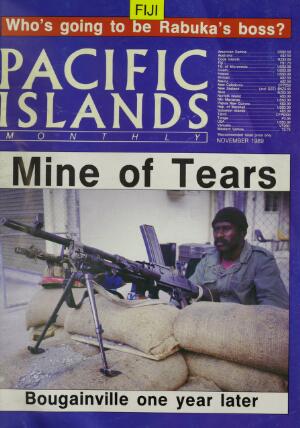
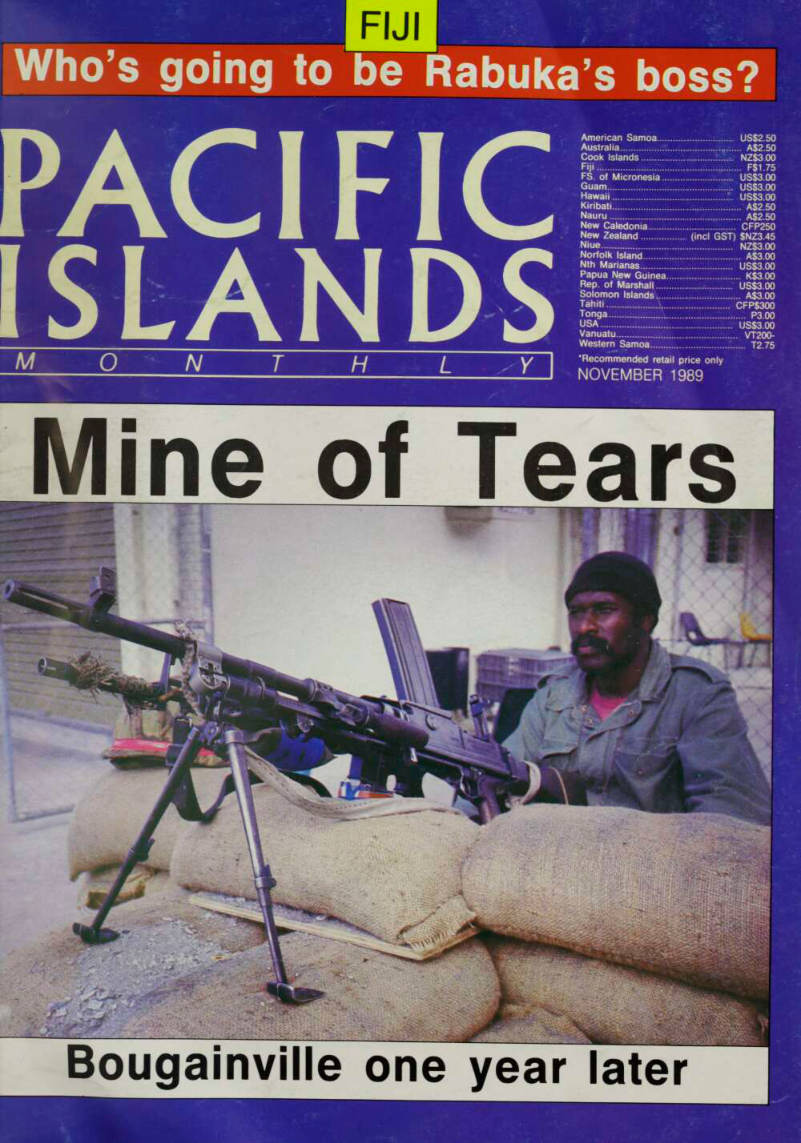
Fiji
Who’s going to be Rabuka’s boss?
American Samoa US$2.5O Australia T A 52.50 Cook Islands NZ$3 00 Fiji .. r F 51.75 FS. of Micronesia US$3.OO Guam US$3.OO Hawaii .* US$3.OO Kiribati A 52.50 Nauru A 52.50 New Caledonia CFP2SO New Zealand (incl GST) $NZ3.45 Niue NZ$3.OO Norfolk Island A 53.00 Nth Marianas US$3.OO Papua New Guinea K 53.00 Rep. of Marshall... US$3.OO Solomon Islands... A 53.00 Tahiti CFPS3OO Tonga P 3.00
Usa Us$3.Oo
Vanuatu VT2OO - Samoa T 2.75 ‘Recommended retail price only
November 1989
Mine of Tears
Bougainville one year later
Advertisements & other items, pp. 2-4 (1 item)
The new 3235.
Not just
two of a kind.
A pair of true individuals.
hile most manufacturers offer different engine sizes and options, their new models usually look as similar as peas in a pod.
But here’s a set of twins you'll have no trouble tell-
ing apart.
The new Mazda 3235.
Not just variations on a theme. Two totally different cars.
I he 323 5-door Hatchback combines rugged versatility and sporty performance in an unexpectedly graceful silhouette. The sleek, agile profile turns heads as easily as the Hatchback turns corners. Precise handling and enthusiastic response make every drive a sheer delight.
The 323 4-door Sedan is the quintessence of affordable style. Seductive contours and exuberant performance belie this car’s functional beauty. The well-appointed cabin fits a family in comfort. And, the spacious trunk fits all their luggage, too.
Take a look at the new Mazda 3235. Drive one.
Then the other. Break away from the humourless, homogenized moulds of automotive design.
These are the shapes of things to come.
mazDß
© Mazda Motor Corporation
■ I f s * ■ SS.
II / ►M 1 ►
MADE IN JAPAN
■ as lijiil
HV-GSCB DIGITAL
The AIWA HV-E505 Digital delivers beautiful video images in a wide range of operating conditions. With long experience in digital technology, AIWA has created a digital auto tracking system that ensures greater tracking accuracy. This accuracy is assured, even in areas with unstable power supply, thanks to Auto Voltage circuitry. The result is a clean, crisp picture you can depend on. Plus, line recording, fully automatic functioning, and remote control make the HV-E505 Digital an excellent choice in a recording video deck.
AUTO VOLTAGE
Worldwide power supply compatibility assures a stable picture, especially in areas where electric power is not always stable.
T ■■ No auto voltage AIWA Auto Voltage
DIGITAL AUTO TRACKING
AlWA’s advanced digital technology assures optimum tracking accuracy for a sharper, clearer picture.
HV-GSD DIGITAL
Video Cassette Recorder
HV-G3CB DIGITAL
Video Cassette Player AIWA Digital Auto Tracking Conventional Tracking Digital Audios. Video
AIWA
Mobex Pty., Ltd. Unit 1, 70 Gibbes Street Chatswood N.S.W. 2067 AUSTRALIA PHONE: 001-61-2-4066277/Oceania Indent Agency (P.N.G.) Pty., Ltd. Ago St., Gordon Box 5518, Boroko, Port Moresby, Papua New Guinea PHONE: 256411/The Sound Centre Ltd. RO. Box 434 Port Vila, Vanuatu PHONE: 2035/P. Hargovind Bros. 190 Renwick Road P.O. Box 409 Suva Fiji Group Ltd. 33 Constellation Drive Mairangi Bay, Auckland 10 NEW ZEALAND PHONE: 001-64-9-479-1272/Hifivox 19 av. Foch B.P. 1458 NOUMEA Nouvelle-Caledome PHONE: 001-687-27.24.66/Harvest Pacific Limited P.O. Box 517, Honiara, Solomon Islands PHONE: 131/Fare-Hi-Fi Stereo Rue de Marechal Foch P.O. Box 269, Papeete Tahiti R.C. 6604 A TAHITI PHONE: 2A8.14/Micropac Audio, Inc.
P.O. Box 3478 Agana, Guam 96910 PHONE; 472-8091, 472-8297/Rarotonga Duty Free Shop Private Bag P.O. Box 92, Rarotonga, Cook Island/Nauru Co-Operative Society Republic of Nauru
Pacific
Islands
Monthly
Departments
Vol 59 No. 22
Voice Of The Pacific
November 1989
Cover
The Battle for Bougainville erupted a year ago this month. The rebellion, centred in the jungles of Panguna, have shaken the Papua New Guinean economy like never before and put the country through its most devastating crisis since independence 14 years ago. Pacific Islands Monthly sent David Robie to Bougainville for the special report beginning on Page 10.
Cover photo: Soldier on guard in Bougainville, by David Robie.
The Region
Fiji
Major General
Sitiveni Rabuka has opted to return to barracks. What people are asking is: Who will head the Ministry re sponsible for the army? Page 18.
Federated States
Of Micronesia
While there is a desire to break away from the American image inherited dur ing the colonial days, the leadership is approaching any change cautiously. Page
Nternational Relations
The United States has decided who vill represent its interest in the region. >ome of the people named, however, mow little of the region they will work n. Page 43.
Business
Tourism
Guam is going through its biggest
tourism growth, a boom that is being propped up by the big Japanese inves tors. But while the economy is enjoying unprecedented success, the locals are suf
fering through the subsequent price
hike. Page 25.
Shipping
American Samoa is having difficulties with three aging ships given by the Un ited States. At the same time the terri tory’s representative in Washington, Hunkin Faleomavaega, is trying to orga nise the supply of another. Page 35.
Letters 7
Stamps G
Opinion 9
Books 50
Pacific People 51
Islands Press 54
Editor Jale Moala Editorial Adviser John Carter Contributors Al Prince. Belinda Meares, Carrie Loranger, David North, David Robie, Diana McManus, Dykes Angiki, Ed Rampell, Frank Senge, Jope Balawanilotu, Karen Man gnall, Nicholas Rothwell. Paul Moon, Richard Dinnen.
Business Report Robin Bromby
Publisher Geoffrey Hussey
Advertising Manager
Lionel Heffernan
Business Manager
Charlotte Thomas
(subscriptions/enquiries)
Advertising Sales • Fiji: Peter Prasad, Tel (679) 314111 • Sydney & Melbourne: Fergus Maclagan, Tel (02) 4123918 • Brisbane: Robert Walker, Tel (07) 3710533 • Adelaide: Hastwell Williamson Representations.
Tel (08) 799522 Our editorial office is now located at 20 Gordon Street, Suva, Fiji. (PO Box 1167 Suva). All edito rial material and correspondence should be sent there and not to our old Sydney address.
Cover prices are recommended retail only Registered by Australia Post, publication No NBP 1210. Copyright. Fiji Times Limited, Suva, Fiji,
Advertisements & other items, pp. 5-7 (2 items)
5
PACIFIC ISLANDS MONTHLY NOVEMBER 1989
A Fiji Times Limited Production.
Founded 1930 (USPS 952480). 20 Gordon Street, Suva, Fiji. Telex FJ2124, Tel (679) 314111, Fax (679) 302011.
Pacific Islands Monthly (APPS No.
NBP 1210) is published monthly by Fiji Times Limited, a division of Nationwide News, 2 Holt St, Surry Hills, NSW 2010. Second class post age paid to Honolulu, Hawaii, POST
MASTER.
Send address changes to: Pacific Islands Monthly, PO Box 2250, Hon olulu, Hawaii 96822. Typeset and Printed by Fiji Times Limited, 20 Gor don Street, Suva, Fiji.
Kenwood
m K 8 % A
liiiiiiii
i.w Ktmy ■> saw W n *«? * i / i -t
WmSM
m S'- I l an m m „ p y L m 360 m M-233CD Midi Compact Audio System RX-23 Cassette-receiver with P.M.P.O. of 360 W *3OW x 2 RMS • CD/Video sound inputs • Motorized volume control • Built-in 5-band graphic equalizer • Matrix surround • Quartz PLL synthesizer digital tuner • Random FM/AM preset memory with scan *Auto/manual tuning • Double cassette deck with single auto-reverse • Dolby B NR* •High speed dubbing *Mic. mixing • Infra-red remote control for input selection, volume, muting, CD player operation DP-320 Programmable random access CD player with double oversampling digital filter P-42 Belt-drive automatic turntable with DC servomotor »Auto lead-in and return S-233 90W max. 3-V\/ay speaker system CM-5 Optional 40 W max. full range rear surround speaker •Dolby is a trademark of Dolby Laboratories Licensing Corporation
KENWOOD CORPORATION
Shionogi Shibuya Building, 17-5, 2-chome Shibuya, Shibuya-ku, Tokyo 150, Japan FIJI FERE’S DUTY FREE CENTRE LTD. Tel 25496/25497 SOLOMON ISLANDS TECHNIQUE RADIOS CENTRE LTD. Honiara Tel. 416 NEW CALEDONIA HI-FI VOX Noumea Tel. 27-2466. 28-2931 VANUATU FUNG CHOI LUEN Port-Vila Tel. 2556
TAHITI MAISON AURORE Papeete Tel. 29703
MARIANA ISLANDS J.C TENORIO ENTERPRISES Saipan Tel. 6445
For your friends love
the Pact
May we sugges
Christmas presen
ideal
year.
A 12 mon
subscript!
with 3 fr
us
issu
A 12-month Gift Subscription to PIM costs so little yet means so much to your friends who wish to be kept informed and up-todate on what’s happening in the Pacific.
And when you take up a 12month Gift Subscription in PIM for your friend, we will send a special Christmas Card with a personal message from you with his/her subscription voucher.
Orders must reach PIM by 15th December, 1989.
PLUS
3 FREE BONUS
ISSUES OF PIM
PACIFIC
ISLANDS
PACIFIC ISLANDS MONTHLY U,. r „/ / ( ) YES, I want you to send a Gift Subscription to my friend: 7/7 Your Friend's Name His/Her Address State Zip 11 .PACIFIC ISLANDS MONTHLY \U „/ ,L ( ) Payment enclosed. (For Appropriate Subscription Rates Refer Page 9).
PACIFIC ISLANDS MONTHLY is published monthly in Fiji. Please allow one week for delivery of first issue. All subscriptions must be paid by cheque or money order. Please make out cheque to PACIFIC ISLANDS MONTHLY and mailed to G.P.O. Box 1167, Suva My Name Address City State VOICE OF THE PACIFIC I Please send the following personal message in my spebikt PIM Christmas Card which accompanies the PIM subscription voucher.
proposals
Tropicalities
Letters
Garbage proposals
I AM concerned that some people in the United States want to dump waste and garbage, which every US state re fuses on its soil (with good reason), in the Pacific Islands in exchange for much-needed cash.
I sincerely hope that the Pacific Is land states have learnt the lessons that most first-world countries learnt the hard way at unbelievable cost, both monetary and health wise. No amount of money is enough to squander the Pacific’s greatest asset as the last place on earth where nature largely is as it should be (apart from France’s sicken ing nuclear politics in the Tuamotus and Americas policy of destruction of part of the Marshall Islands).
If the people of the island states have any insight in the gargantuan environ mental problems now facing all Euro pean countries and America, there will be no question of ever accepting the status of being a garbage-can at any
price.
Having travelled through most coun
tries I found Fiji probably together
with most Pacific island states the only place left in the world where na ture still is as it should be: unpolluted.
Pollution and environmental issues now rank as top priorities for the next elec tions on the lists of all Dutch political
parties.
We in Europe have let things get so much out of hand that finally our politicians have started to listen to long ignored outcries of environmentalists.
To give but one of the long list of chill ing examples: Holland has, like Fiji, a
large fishing industry. Fishermen here
often have to throw away half their catch because the fish is disease-stricken
and tumor-ridden. Imagine something
like that happening in Fiji, which is not an imaginary risk if the United States gets what it wants.
The very fact that the US wants to ship its waste so far away and is willing to pay such enormous amounts for its disposal anywhere except on their own soil, should be reason enough to reject their proposals out of hand and to even protests for the sake of other island states less informed than you might be.
My wife and I recently spent one year on the uninhabited island of Be kana off the coast of Udu Point in the north-east of Vanua Levu. The object was to see if paradise, somewhere in this world, really still exists. It hap
pened in cooperation with Isimeli Bainimara, of the Fiji Visitors Bureau.
Paradise still exists. You are living right in the middle of the last paradise on earth. I cannot begin to tell you how beautiful an experience it has been for us and I have just finished writing a book about it, which will appear next spring. One of the conclusions of the book is that we in Europe are already so much used to pollution and disease by-pollution, that we have no idea what a healthy and unpolluted country looks like, just as a whole generation in Leba non does not know what peace means.
We were staggered by the unspoiled
and virgin beauty of Fiji; and equally amazed by the fact that many Fijians are not aware that their country is uni que and very, very special; understand able of course, for those Fijians who are not aware of it, have not been abroad to be able to compare. They take something for granted which has become more rare and precious than platinum or emeralds.
Fiji may not be a rich man, but he is physically healthy, beautiful, strong and
amazingly happy.
Bob Snojjink
Netherlands.
Islander travels
I AM doing dissertation research in Pacific Islands history at the University of Hawaii, for which I also teach. I spent six weeks in Majuro, Marshall Is lands, last July and August as a World Civilisation instructor in a special ses sion for Marshallese teachers and used my spare time to collect oral traditions from elderly people about islander
travels on foreign snips.
The variety and chronological range of these recollections give a flavour of the cross-cultural adventures which many Pacific Islanders embarked upon once European shipping created new networks across their ocean. Indeed, the significant out-migration from Paci fic Islands today might be considered a culmination of the same process. The cultural beach was, and still is, a two way door.
I am currently at the East-West Cen tre in Honolulu and would welcome accounts of other islander travellers, particularly in the old whaling days, in order to attempt a comprehensive eva luation of their experiences.
David A. Chappell
1777 East-West Road Box 1607 Honolulu , HI 96 848 USA. • see Beyond the beach, p 46
AIDS report
IN February you ran a story on Tonga’s AIDS campaign. Some information which appeared in this article were high
ly exaggerated and lacked credibility.
But leaving the question of inaccuracies and lack of focusing in finer details aside, I thought the author of the article failed to find out the sources of spon
sorship for Tonga’s most vigorous cam
paign against AIDS to date.
The South Pacific Alliance for Family Health (SPAFH), which has its regional
headquarters in Nuku’alofa, provided
the bulk of the money (US$10,000) for the AIDS campaign project in Tonga.
Skme of this money was used to pay for the campaign material such as the bill boards, posters, brochures, leaflets, radio spot announcement and activities on World AIDS Day last December.
SPAFH is happy to be a partner with the government of Tonga in the promo tion of education and awareness in the community against the dreadful disease
Aids.
Joseph Sukwianomb
Executive Secretary
Spafh.
Happy visitor
AS a frequent visitor to Fiji, I have chosen the lovely islands as my favourite vacation retreat.
Since I have also been to the Cook Islands and French Polynesia, I have be come interested in the political, econo mic, social and military events of the South Pacific. Thus, my subscription to Pacific Islands Monthly has not been dis
appointing.
I hope to be in Fiji again during the Christmas/New Year holidays.
Raymond Dahlin
San Francisco
Penpals
Angin Wape, 17. She wants English
speaking penpals from anywhere in the
Pacific. Address: Gordon High School, PO Box 9182, Hohola, N.C.D., Papua New Guinea.
Leo S Manasseh Jnr, 19. Looking for penpals from anywhere. Hobbies: writ
ing letters, reading, listening to music,
swimming. Occupation: student teacher.
Address: PO Box 1551, Lae, Morobe Province, Papua New Guinea.
Josh Berman. He is studying internation al relations and wishes “to correspond with residents of the island states to get their feedback on US-South Pacific rela tions”. Address: Box 135, Brooklyn,
N.Y. 11219, Usa.
discovery
Stamps
Balboa’s discovery
THE first European incursion into the Pacific probably came in 1513 when the Portuguese, Balboa, waded into the water and took posses sion of all “the seas, lands and islands therein until the final day of Judge ment”. It never occurred to him that they might have belonged to anybody else! The continuation of such attitudes is evidented by a quote from Sir Joseph Banks over 200 years later . . . “The scene was the truest picture of an Arca dia of which we were going to be
Kings”.
The demise of traditional island ways of life was, in a way, inevitable. Spanish, Dutch, British and French explorers brought with them influences that undermined and overwhelmed Polyne sian, Melanesian and Micronesian alike.
The Spaniard Pedro Fernandez de Quiros is a case in example. With the best and most grandiose of intentions, anxious to build the ‘New Jerusalem’, he nevertheless managed to leave dead and wounded behind him, wherever he went.
Even the French, who seem to have been amongst the most tolerant, with their talk of ‘the noble savage’, efficiently spread European diseases. One writer has described the meeting of Polynesian and European as similar to children approaching a travelling circus consisting of evil-smelling rapacious villains in an advanced state of physical decay.
The exploiters who followed in the ex plorers’ footsteps were even more so men of action. Privateers, whalers, then missionaries and in more recent times, tourists, all played their part in the dis solution of a lifestyle now gone forever.
The islands of Kiribati, formerly the Gilbert Islands, are classic atolls, impre gnable coral rings where very little grows
except coconut, pandanus, breadfruit and taro. They have been described as “the very core and soul of the Pacific”.
It is possible that the Spaniards Grijal va and Alvarado visited some of the Gil bert Group in 1537. Further discovery came with the British ships Scarborough and Charlotte in 1788 and Nautilus in 1799. Between 1830 and 1840 sperm whalers began to frequent the waters in the neighbourhood of the islands and there was some communication between sailors and locals. Regular trade began to grow. The first European trader to settle in the islands did so in 1837. The first missionaries came in 1857.
During the greater part of the 19th century the islands were without external control. They were ruled by local leaders with runway sailors, traders and mis sionaries wielding considerable influence.
Faced by growing German interest in the region, the Gilbert and Ellice islands were annexed as a Crown Colony in 1915, by the express wish of their
people.
Today the population has recovered from the dip it took at the turn of the century and is now over 63,000. Internal self-government was introduced in the islands on January 1, 1977. At a consti tutional conference in London in late 1978 it was agreed that the Gilbert Is lands should become fully independent as a republic on July 12, 1979.
Two stamps were released, celebrating the 10th anniversary of independence.
Printed in lithography by Carter, the stamps show 10c The House of Assembly, 15tf The Constitution.
New idea SOME agencies have found a new twist to selling more stamps. This is in a clev er design technique for stamp issues.
Australia Post, for example, is issuing a series called the Colonial Collection.
Whilst each stamp has a separate design the five stamps have a strip of landscape added above the design which runs over the top of the design on each stamp.
Thus a collector will have to collect a whole strip of stamps.
The Solomon Islands, on May 16, issued two se-tennant pairs of stamps.
Both se-tennant have a simple design over two stamps each.
Next year is sure to see most Pacific countries joining in celebrating the 150th anniversary of the penny black.
New issues Tuvalu: July 31 Living Reef Part 3: 40c Pennant Coral Fish, 50c Anemone Fish, 60c Batfish, 90c Threadfin Coral Fish, Miniature Sheet.
Pitcairn Islands: October 23 Islands Profiles: 15c Ducie Island, 90c Hender son Island, $1.05 Oeno Island, $1.30 Pit cairn Island. Next issue January 15.
Bicentennial Souvenir Sheetlet number 3.
New Caledonia: August 24 Regional
Landscape: 64F Hienghene Bay, 180 F
Ouaieme River.
Fiji: August 21 Corals: 45c Daedalea, 60c Furcate, 75c Echinate, 90c Humilis.
Australia: August 23 Painters: 4 x 4lc Featuring Conder, Roberts, McCub bin, Streeton. The standard rate for let ters rose to 41c on September 1. Septem ber 13 Youth Hostels: 1 x 41c Gar dens, $2 Nooroo, $5 Mawarra.
New Zealand: September 13 Christ mas Issue: 35c Child’s Bedroom, 65c Shepherd, 80c Boat Harbour, $1 Globe.
October 11 Heritage: The Sea; November 8 Commonwealth Games.
Vanuatu: July 20 Moon Landing (20th Anniversary): 45vt, 55vt, 65vt, 120vt, lOOvt Featuring photographs of the moon mission.
Norfolk Island: September 21 Red Cross: $1 Red cross logo. October 9 Christmas: 36c Gethsemane, 60c In the Sweet Bye and Bye, 75c Let the Lower Lights Be Burning, 80c The Beautiful Stream. November 21 Radio Australi a; 41c Radio announcer, 65c Map, $l.lO Kookaburra.
Papua New Guinea: September 9 Dance Structures: 20t Motu Motu, 35t Baining, 60t Vailala River, 70t Tim bunke. November 8 Christmas. The proposed Frama Stamp which was to have been issued on September 9 has now been delayed until March 1990. □
Advertisements & other items, p. 10 (1 item)
Tropicalities
Land of
Pacific
Islands
Monthly
Opinion
Land of my Father
THE demise of the colonial empires and the birth of small, dependent states in the Pacific Islands in the past two decades created new values that are now being challenged in the region. A new wind of independence is blowing sought by the indigenous races wishing to re assert their authority in the land they call their fathers’.
In Fiji, as in Papua New Guinea, New Zealand, Australia, French Polynesia, New Caledonia, Solomons and Vanuatu the very foundation of western democracy is being shaken by renewed desire to change the law to accommodate indige nous land rights, fisheries and cultural values which in the past 20 years or so were threatened by the new political system introduced by the colonial masters.
For 3000 years they’ve owned their land from the sky to the bottom of the earth including anything on it, above it, in it and below it. But political and administrative changes in the past 200 years changed that ownership. In the cases of Bougainville and Fiji, for example, indigenous landowners no longer owned what their forefathers had. Now land own ership is confined only to the first metre of top-soil. The riches that lie beneath now belong to someone else.
For the indigenous peoples of the Pacific Islands, land is God. Its sanctity is based on its ability to provide life. With out land there is no life, and no people. It is this value that has escaped the foreigner brought up in a western value system who sees no religious value in land but merely appreciates its economic worth.
The struggle for land and fisheries rights has become the biggest threat to peace in the region. It triggered a success ful military coup in Fiji and was the cause of an attempted coup in Vanuatu. Land is the centre of the rebellion in Bougainville, and the Maoris and Aborigines of New Zea land and Australia are using it as an effective ammunition in
their struggle for political recognition.
Land struggle in the region is going through a chain reaction: as one battle is won, another is started. □
Advertisements & other items, p. 11 (1 item)
FIJI: Distribution, subscriptions and advertising: Fiji
Times Limited, GPO Box 1167, Suva, Fiji Phone 31 -4111 telex FJ2124 FRENCH POLYNESIA: Distribution: Hachette Pacifique 10 Ave Bruat, Papeete Phone 25-610 HAWAII: UNITED STATES: Distribution: PIM Hawaii, PO Box 22250, Honolulu, Hawaii, 96822 Advertising: Brian C Asgill, Apt 1308, 1676 Ala Moana Blvd , Honolulu, Hawaii, 96815 Phone (808) 955-9718.
JAPAN: Advertising and subscriptions: Universal Media Corporation, GPO Box 46, Tokyo Phone 666-3036, cable UNIMEDIA Tokyo, telex 2524665 MALAYSIA: Advertising and subscriptions: Worldwide Media Services, 57-B Komplex Damai, Jin Dato Haji Eusoff, Kuala Lumpur Phone 63-9340, cables WORLDMEDIA Kuala Lumpur, telex 31533 VANUATU: Distribution: The Vanuatu Stationery and Book Centre, PO Box 557 Port Vila Advertising: Nor man Bros Bookshop Port Vila Phone 2232 NEW CALEDONIA: Distribution: Depot Centre de Presse Michel Pentecost CBP2, Noumea Phone 27 2434, 27-4729 NEW ZEALAND: Distribution: Gordon & Gotch, PO Box 584 , 2 Carr Road, Mt Roskill, Auckland 4 Advertising: McKay International Media Reps Ltd, C/- Albany, PO Box 8, Auckland 10, New Zealand. Phone 419-0561, Fax 419-2243.
WELLINGTON: Ross Quaid Media 1 Scholes Lane Petone (04) 68-7593. PO Box 38699, Petone PAPUA NEW GUINEA: Distribution: Gordon & Gotch PO Box 3395, Port Moresby Phone 25-4551 25-4855 Advertising: Robert Walker, PO Box 600, Indooroopilly Old Australia 4068 Phone (07) 371-0533 SOLOMON ISLANDS: Distribution and Advertising: The Bookshop, (Norman Bros ) PO Box 503, Honiara PHILIPPINES: Advertising: The GF Group, 12 San Ignacio St, Uroaneta Village, Makati, Metro Manila Phone 817 7299, telex 45950 and 4233 UNITED KINGDOM F A Smyth and Associates, 23A Aylmer Parade, London N2OPO, England Phone (01)340 5088, fax (01)341 9602 UNITED STATES MAINLAND: Advertising: Joshua B Powers Jr , Powers International Inc , Suite 708 271 Madison Ave , New York, NY 10016 Phone 867-9580, Subscriptions PIM, Hawaii, PO Box 22250, Honolulu Hawaii, 96822
SUBSCRIPTIONS
American Samoa US$45 Australia AUSS3O Canada US$45 Cook Islands AUSS46 Fiji Fs24 French Polynesia US$45 Guam US$45 Hawaii US$45 Japan US$3B Kiribati AUSS46 Micronesia US$35 Nauru AUSS42 New Caledonia US$32 New Zealand AUSS42 Solomon Islands AUSS46 Tonga AUSS46 Tuvalu AUSS46 United Kingdom Stg£2B US (Mainland) US$45 Vanuatu UASS42 Western Samoa AUSS6O Elsewhere US$63 Payments to Pacific Islands Monthly: Subscriptions Dept, GPO Box 1167, Suva, Fiji.
Subscriptions rates includes the cost of airspeeding to all destinations set out above. Direct airmail rates on application.
Bougainville
Cover
Bougainville One year later
For a year, former surveyor Francis Ona and the tiny Bougainville Revolution ary Army have been holding an Australian mining company and the Papua New Guinea government to ransom. Port Moresby faces radical land and mineral policy reforms of risks disintegration.
By David Robie
PAPUA New Guinea has entered its 15th year of independence facing its most critical crossroads. The Bougainville crisis, which is a year old this month, cast a pall over the inde pendence celebrations in September and if it remains unresolved then national unity could slide into economic and poli
tical collapse.
The problems of Bougainville cannot be divorced from the rest of the country, or even from the rest of the Pacific. At stake are the crucial issues of a conflict between western concepts of land own ership and indigenous land values, the equity between the national government, provincial administration and the tradi tional landowners, and a choice between genuine sovereignty over resource de
velopment projects or dependence on
foreign control.
Bougainville’s key issues have parallels with New Zealand where the Maori peo ple are struggling for full recognition of the Treaty of Waitangi and partnership over the nation’s land, forests and fisher ies resources. They are also echoed in Australia where the Aboriginals are fighting for mineral and development rights. The same is now the demand by indigenous Fijians in post-coup Fiji.
Militants of the self-styled Bougainville
Revolutionary Army are holding one of the world’s biggest open-cut copper mines, a major Australian mining com pany, 2000 security forces and the national government to ransom. Rebel landowner leader Francis Ona and seven of his key lieutenants now have a 200,000 kina (US$200,000) “dead or alive” price tag on their heads.
But while the national government and foreign mining interests portray
David Robie
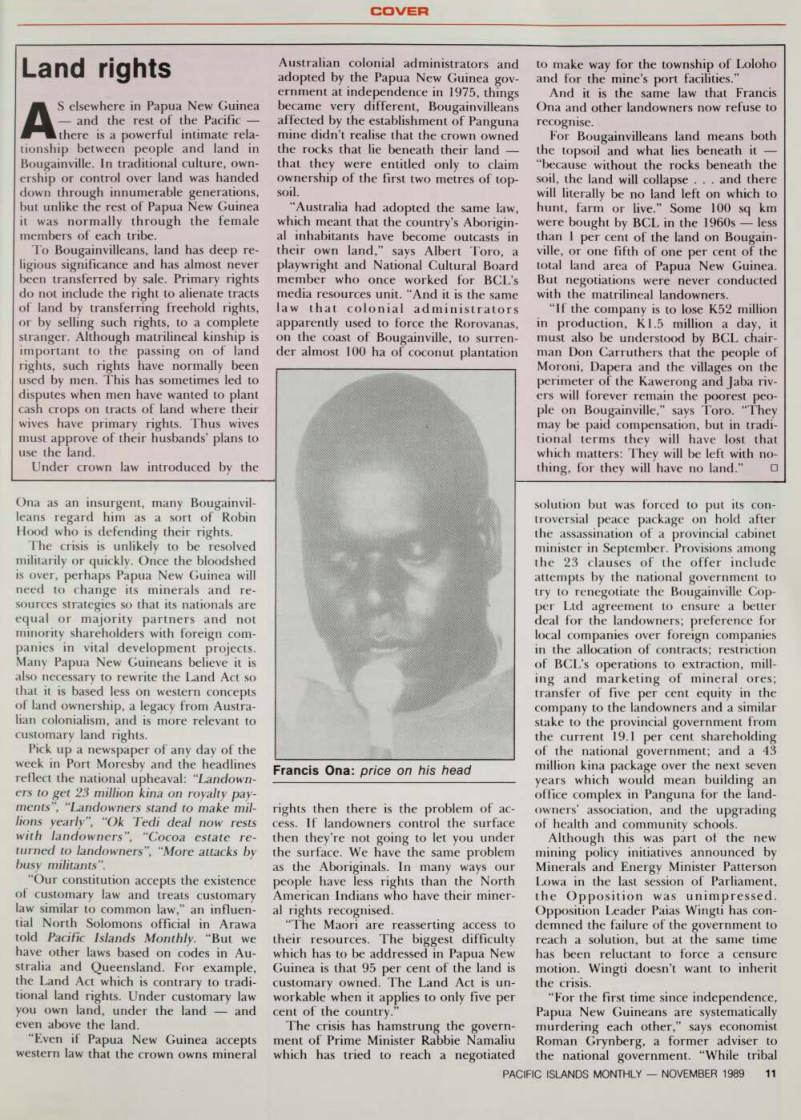
Valley of tears: Panguna copper mine, Bougainville
Ona as an insurgent, many Bougainvil leans regard him as a sort of Robin Hood who is defending their rights.
The crisis is unlikely to be resolved militarily or quickly. Once the bloodshed is over, perhaps Papua New Guinea will need to change its minerals and re sources strategies so that its nationals are equal or majority partners and not minority shareholders with foreign com
panies in vital development projects.
Many Papua New Guineans believe it is also necessary to rewrite the Land Act so that it is based less on western concepts of land ownership, a legacy from Austra lian colonialism, and is more relevant to customary land rights.
Pick up a newspaper of any day of the week in Port Moresby and the headlines reflect the national upheaval: “Landown ers to get 23 million kina on royalty pay ments”, “Landowners stand to make mil lions yearly ”, “Ok Tedi deal now rests with landowners ”, “Cocoa estate re turned to landowners ”, “More attacks by busy militants ”.
“Our constitution accepts the existence of customary law and treats customary law similar to common law,” an influen tial North Solomons official in Arawa told Pacific Islands Monthly. “But we have other laws based on codes in Au stralia and Queensland. For example, the Land Act which is contrary to tradi tional land rights. Under customary law you own land, under the land and even above the land.
“Even if Papua New Guinea accepts western law that the crown owns mineral
rights then there is the problem of ac cess. If landowners control the surface then they’re not going to let you under the surface. We have the same problem as the Aboriginals. In many ways our people have less rights than the North American Indians who have their miner
al rights recognised.
“The Maori are reasserting access to their resources. The biggest difficulty which has to be addressed in Papua New Guinea is that 95 per cent of the land is customary owned. The Land Act is un workable when it applies to only five per cent of the country.”
The crisis has hamstrung the govern ment of Prime Minister Rabbie Namaliu which has tried to reach a negotiated
solution but was forced to put its con troversial peace package on hold after the assassination of a provincial cabinet minister in September. Provisions among the 23 clauses of the offer include attempts by the national government to
try to renegotiate the Bougainville Cop
per Ltd agreement to ensure a better deal for the landowners; preference for
local companies over foreign companies
in the allocation of contracts; restriction of BCL’s operations to extraction, mill ing and marketing of mineral ores; transfer of five per cent equity in the company to the landowners and a similar stake to the provincial government from the current 19.1 per cent shareholding of the national government; and a 43 million kina package over the next seven years which would mean building an office complex in Panguna for the land owners’ association, and the upgrading of health and community schools.
Although this was part of the new
mining policy initiatives announced by
Minerals and Energy Minister Patterson Lowa in the last session of Parliament,
the Opposition was unimpressed.
Opposition Leader Paias Wingti has con demned the failure of the government to reach a solution, but at the same time has been reluctant to force a censure motion. Wingti doesn’t want to inherit the crisis.
“For the first time since independence, Papua New Guineans are systematically murdering each other,” says economist Roman Grynberg, a former adviser to the national government. “While tribal
warfare has gone on from time im memorial, what is new about this conflict is that it is about gold and copper
something quite foreign to traditional
Papua New Guinea society.
“For the first time, Papua New Guinea is writing its history in blood.”
In spite of the revolt which has left more than 40 people dead and triggered a minor New Zealand exodus in October big foreign investors such as Conzinc Riotinto Australia Ltd (CRA) and the American oil corporation, Chevron, are persevering with other projects. Howev er, such ventures as Chevron’s drilling in the Northern Highlands and the Hidden Valley gold mine were already well com mitted.
But will this confidence continue if CRA’s Bougainville Copper Ltd, the mainstay of the national economy, is put into “mothballs” for a year, as company executives threaten, or is shut down.
Since May 15 the mine has opened only once and then closed down eight hours later when militants ambushed a bus carrying workers.
Already belt-tightening is under way in Papua New Guinea. The first target is to restructure the huge, cumbersome
and expensive bureaucracy bequeathed
to the country by the Australian colonial administrators. Some government de partments may be axed in the govern ment’s new contingency plans aimed at coping with the huge financial losses from the crisis.
Namaliu may be also forced to drop some ministers and absorb their duties into other ministries at a cost-cutting de vice. An official announcement about the abolition of departments is expected to be made before the start of this month’s
parliamentary session.
Drastic cuts will be suggested by a “hatchet committee” chaired by Minister of State Ted Diro. His colleagues are Trade and Industry Minister John Gihe no, Police Minister Mathias Ijape, Justice Minister Bernard Narokobi and Admi nistrative Services Minister Theodore
Tuya.
Some optimistic observers believe that the hardship caused by a full closure of the Panguna mine on Bougainville could be a blessing in disguise it might force the country into reducing its dependence on mining and into developing its neg lected agriculture sector. Another sug gestion is that a new major gold mine at Porgera, in Enga province, and in creased production at the Ok Tedi mine in the Star Mountains could soften the loss from Bougainville in a not too dis tant future.
Apart from the environmental de vastation caused by Panguna mine and the disappearance of the ancestral land belonging to tribes like the Nasioi, a cru cial factor in the upheaval is the dispar
ity between tne 58 per cent of profit going to the national government which owns 19 per cent of BCL through dividends and taxation, com pared with 5 per cent for the provincial government and a mere 1 per cent in royalties and compensation for the land owners.
Under the agreement worked out be fore independence in 1975, the other shareholders mainly foreign with the biggest being Conzinc Riotinto Australia Ltd (CRA) with 53.6 per cent share the remaining 36 per cent of total earn
ings.
Since 1972, Panguna mine has pro vided 17 per cent of the national govern ment’s revenues and 45 per cent of its exports. Before it closed, the mine was pumping 1 million kina a day into the national government’s coffers and profits of 1.5 million kina a week to BCL.
When the crisis began, 3550 workers were employed at the mine including 610 expatriates, mostly Australian but also many New Zealanders. Of the 2950 Papua New Guinea citizens, two-thirds of them were from the rest of the country.
Now, following retrenchments, suspen sions and resignations, there are 2350 on the payroll with more retrenchments said to be imminent. In the last full year of operations the mine produced re venue of 480 million kina and after tax profits of 108.6 million kina.
The outside labour creates another
problem. The jet-black Bougainvilleans
consider themselves apart from the rest of the country’s ethnic groups whom they refer to disdainfully as “redskins”.
They resent the jobs |that have, gone to mainlanders and they resent the high salaries paid to expatriates along with the distortion of the local economy caused by the high proportion of fore igners living on the island, mainly Au stralians and New Zealanders.
The colonial experience on Bougain ville is rather different from on the mainland. Colonial powers arrived late, encountering an island which is moun tainous, covered in dense jungle, and criss-crossed by rivers and ravines. Dur ing the 1880 s, German traders and mis sionaries came to Bougainville and the north-east coast of the mainland.
Bougainville is geographically and cul turally part of the Solomon Islands. The island, swapped by Britain last century for German Samoa, was absorbed into Papua New Guinea during the First World War when Australia captured the German-ruled territories.
These factors help explain why the
idea of secession has found fertile ground on the island.
According to British author Richard West in his 1972 book, River of Tears; The Rise of the Rio Tinto-Zinc Mining Corporation, initial contact between the
company and the Nasioi villages in the area which is now the mine site was con fused by company and administration re liance on a single outspoken Nasioi who “had no right to commit the community to cooperation with CRA”. In fact, the women who were the traditional land owners under the matrilineal system were not negotiated with at all.
Opposition to the mine was overruled,
quite legally by the colonial administra
tion under Australian law, but it has led to growing feelings of intimidation and betrayal among the landowners since their original opposition in 1962. The arrival of the company fuelled secession ist sentiments in 1969 with the founding of Napidakoe Navitu which had its sights
on Bougainville independence.
Responding to an appeal by Prime Minister Namaliu for the establishment of dialogue to end the crisis, Ona’s right hand man, army deserter Lieutenant Sam Kaona, told Arawa Bulletin repor ter Moresi Tua in an exclusive interview (see box p!6) that any committee or indi vidual seeking negotiation must: • view the Bougainville crisis from the point of view of Francis Ona and his supporters • truly represent the wishes of the 140,000 people of Bougainville to the Prime Minister and cabinet and other countries. • have no interest in protecting any foreign company or business.
• be prepared to fight on behalf of Ona “and the Bougainvillieans” for a re ferendum and independence, or to can vas views on secession for Bougainville. • be ready to suffer even if it means death and many years of struggle When the smouldering resentment among customarylandowners which stretches back to the 19605, long before independence burst into open revolt last November with a raid on the Pangu na mine’s explosives magazine, the mili tants had very clear demands. They wanted a massive 10 billion kina com pensation for use of the land and the environmental devastation, closure of the mine and secession from Papua New Guinea. The latter demand was a revival
of a desire at independence which has continued to enjoy popular support among many Bougainvilleans.
Ironically, a catalyst in the struggle was an environmental and social impact report prepared by a PNG government appointed New Zealand company, Auck land-based Applied Geology Associates Ltd (AGA), which was regarded as any thing but independent by many of the landowners. Describing the report as being perceived as a “whitewash” by landowners, North Solomons Premier Joseph Kubui (See Pacific People, Page 51, for interview) told Pacific Islands Monthly it was a trigger for militant ac tion. “It wasn’t the right sort of report,” he says. “It was okay as far as the legal
framework was concerned. But the general feeling was that it didn’t ade
quately address environmental pollution.
“The people of Bougainville agree that it is necessary to take a more radical approach to avoid the catastrophe we have gone through now. This experience has opened the eyes of our politicans.
We believe the report was a failure. The investigating team didn’t have time to get to the bottom of questions. Three months was too short that’s what the owners wanted.”
Actually the report, completed earlier this year, does describe extensive en vironmental damage, and provincial gov ernment officials who have closely stu died it regard it as far more critical of BCL and the national government than the landowners realise.
Landowners regard logic and science as “white man’s trickery” an accusa tion they threw at the environmental re port. Notions of nationhood, investor confidence and BCL’s share price in Au stralia are irrelevant to them. And re gardless of what the report said, the landowners are convinced that the mine has driven away the island’s fruit bats, ruined banana crops and caused girls to begin menstruation earlier than they used to.
The report’s chief author, envrion mental consultant Martin Ward, says Panguna Landowners Association secret ary Francis Ona tried to intimidate him at a meeting in the Panguna chapel in September 1989. Ona was so wound up that he walked up to Ward thust his face menacingly in front of the consultant and pointed to the altar crucifix.
“Em ‘big fella ’ kilim i dai, Mipela nogat likem report bilong yu, yu kilim,” hissed Ona in Pidgin, and he drew his finger across his throat.
Two months later, discussing the pre liminary findings of the report in a meeting at the provincial government offices, the landowners became angry when they realised it wouldn’t be as damning as they wanted. When one con sultant said it couldn’t be proven scien tifically that fish were dying from the pollution of the Jaba River, a landowner sneered: “Have you drunk from it?”
Eventually Ona angrily stormed out declaring, “the only way is for us to shut the mine”. A former surveyor and truck driver at the mine, Ona and his suppor ters took to the jungle and launched a long war of attrition and sabotage against the mine.
The mine company, whose 1988 annual report has a misleading “environ mentally sound” cover depicting lush rainforest, was satisfied with the AGA report. “It showed there was no blame on us,” says commercial general manager Ken Perry. “The problem is that double the size of the population is now compet
ing for the same resources. What I said to the landowners was, ‘You have asked the wrong questions, You asked them (AGA consultants) to prove BCL did it.
You should have asked why is it happen
ing that’s why you’re unhappy’.”
The report describes • a mine pit occupying 400 hectares
and proposed pit extensions totalling
1210 hectares; 300 hectares of waste rock dumps, which could extend to 550 hectares if the mine is extended 15 years; 3000 hectares of mine tailings de vasting the Kawerong and Jaba river val leys and a 900 hectare delta of dis charged tailings in Princess Augusta Bay.
According to economist Grynberg, 90 per cent of the land loss at Panguna is a result of the manner in which BCL has disposed of its tailings. “BCL has opted for the environmentally sound method only when it is the least expensive solu tion”, he says. In its initial proposal, the company had argued that dumping the tailings into the river would cause broad-scale land loss. But later, because it was cheaper, it decided to dump the trailings in the Kawerong and Jaba rivers after all.
Among the AGA report’s recom mendations were that:
• the company and national government urgently needed to establish a quick and clear communications link with the landowners and the provincial government • lease documents, land ownership records and other information needed to be brought up to date and made freely available • information about the mine should
be provided in the Pidgin language;
senior mine management should learn
Pidjin.
• the present system of compensation payments needed urgent overhauling • improved housing needed to be provided for mine workers • a comprehensive health programme was needed, including the control of malaria; and • the company needs to undertake serious planning for mine closure covering rehabilitation of all mine-ravaged areas
and revegetation.
Landowner spokesman Lawrence
Daveona, secretary of the Panguna Road Mining Tailings Leases Trust Ltd., claims 39 Bougainvilleans have been kil led so far in the struggle. Although pro vincial government officials say this fi gure is too high, it is widely reported that at least 40 people overall have died, Also, human rights observers are trou bled by persistent but unconfirmed rumours that many Bougainvillean villa gers have been killed and their bodies left in free fire zones that are closed to journalists. More than 3000 villagers have been evacuated, or “relocated” under the official auphemism, to makeshift camps around Arawa. Any body left behind is regarded as a rebel.
“Everyone except the militants is fed up with the bloodshed and wants the crisis solved as soon as possible,” says
Catholic Bishop Gregory Singkai, who
trekked into the jungle in July for a four-hour talk with Ona the last direct contact by mediators with the mili tant leader.
Moresi Tua: contact with the rebels
“Even though 10 billion kina was an unimaginable figure for me when I first heard it, when one thinks of the damage that has been caused to the environment even that much money can never put things back the way they were,” he told Pacific Islands Monthly. “That’s why in general 1 would support the original grievances of the landowners against the government and BCL in the early part of the crisis. But now they are bitter men — they will fight until death if they don’t get what they want.”
The crisis has deteriorated sharply, be ginning with the murder of 39-year-old North Solomons Commerce Minister John Bika in front of his family on September 11. Seven masked militants went to his home soon after midnight and shot him twice in the stomach and head as his wife clung to his leg plead ing for his life. In his briefcase was the Bika Report, an enlightened document advocating statehood or more autonomy for the North Solomons province — still far short of the secession the militants demand.
Namaliu said the “senseless killing” would cause revulsion in the community.
“Such savagery has no place in our na tion,” he added, “and I appeal to the people of the North Solomons to put
aside their differences and unite to find a peaceful and lasting solution to their
problems”.
Minister of State Ted Diro responded to the murder with a reward offer for the capture or killing of Francis Ona and seven named deputies, including Kaona, cargo cultist Damien Damen and another
renegade soldier, Sergeant Andrew
Piamo. Diro, the former Defence Force commander, also empowered the secur ity forces commander on Bougainville, Colonel Lima Dotaona, to use tougher
military measures including electri
fication of the vital electricity grid pylons to the mine, booby traps and landmines.
Within four days, a soldier blew him self up while planting a booby trap at the foot of one of the 67 pylons. An
18-year-old Bougainvillean youth was
severely wounded when he accidentally set off another landmine. Since then the troops have been putting up barbed wire barriers to cordon off the boobytrap areas. However, another soldier was kil led early last month while setting a booby trap in the Kongara, a rugged limestone area south of Panguna. Late in September a soldier was wounded in an ambush near Panguna mine and mili tants shot and knifed to death two secur ity guards who were suspected of being
informers for the military at Kerei vil lage, near Arawa.
Coinciding with the increase in vio lence, several incidents have upset many of the estimated 200 New Zealanders liv ing on Bougainville. More than a dozen New Zealanders fled the strife late in September and early last month. Fore nco Ltd, a Rotorua-based forestry com pany, evacuated its New Zealand workers from the south of the island after one had a brush with death near the Laluai River.
Brendan Ward, a 32-year-old former cricketer for Northern Districts, was ambushed while driving a pickup truck and his windscreen was shattered by a shot which narrowly missed him. The shooting, the day after Minister Bika was murdered, left him unhurt but badly shaken. He never saw who fired the shot but the attacker was believed to be a militant: “If I had been going just a little faster, the shot would have come straight through the driver’s window and I wouldn’t have had a hope.”
A protest was filed with Colonel Dotaona over a separate incident during weekend celebrations marking the 14th anniversary of independence. A group of off-duty soldiers harassed and threatened another forestry worker, Paul Mowers, of Wellington, in the remote Cape Mabiri area. The soldiers, who had been drinking, accused him of helping the militants. They thrust Ml6s at him and one threatened to “blow his head off’.
In another incident, a New Zealander was said to have been fired at by a drunken soldier. The New Zealand High Commission in Port Moresby sent a con sular official to Kieta to check on the safety of New Zealanders. (A procedure the Australians had been following for several months).
Many Bougainvilleans are convinced that Australia, if not New Zealand, is supporting the PNG Defence Force sol diers whom they regard as killing their people to defend a foreign mining com pany which has ruined the environment and deprived them of their land. When Australia handed over four Iroquois helicopters to Papua New Guinea in
July, Canberra pledged they would not
be used as gunships. And, strictly speak
ing, they are not.
However, the choppers being flown by contract Australian and New Zealand pilots regarded by the locals as “merce naries” are frequently fired from while in the air. It is said that machineguns mounted with ropes inside the choppers are used to strafe villages.
The difference between a gunship with mounted armaments and free firing from a helicopter is meaningless to villa gers. As far as they are concerned, Au
stralia has broken its promise.
Rumours persist that if a political solu tion to the crisis isn’t reached soon than senior military officers would be keen to seize power in a coup. But the seven colonels are reportedly fighting among themselves, and although a third of the
military are on Bougainville they are
having so many problems that it is un likely they could control the whole coun try under martial law.
Panguna’s huge size, its mountainous position in the middle of dense jungle and the isolation of the 35 km powerline running from Loloho on the coast makes the mine virtually indefensible from
saboteurs with explosives knowledge.
Diro accused some of the military of leaking his undated letter offering the “wanted” reward for Ona.
According to the diocesan priests of Bougainville, the crisis must be blamed on the imposition of Western concepts of land ownership, values and compensa tion on a Melanesian social structure.
They believe that laws must be enacted to recognise the Melanesian concepts of ownership, value and compensation for land; • The Melanesian concept of land ownership includes the ownership of all resources both on and beneath the land.
Note that Melanesian ownership also in
cludes ownership of fishing rights.
• In Melanesian society, outsiders are not allowed to enter the clan territory without permission from the clan lead ers. Prospecting authorities must be
changed to recognise the sovereignty of
Melanesian society.
• Land is the livelihood and “social security” of the Melanesian clan. Future generations of Melanesians will depend on each hectare of land for their liveli hoods as their population increases.
“The people of Bougainville morally
support Francis Ona he has fought for the land rights of the whole pro vince,” said a Nasioi chief, Naona Yaniung. “We believe he has challenged the government to make a real mining policy that is closer to our ancestral
rights.”
Yaniung, a member of the Ovotung (chiefs) for Peace Committee which tried to initiate dialogue with the militants, played a tape recording said to be the voice of Francis Ona: “/ don’t like to see this happening in our province. The national government should consult our people. They are treating us today as the administration did before BCL came in 1964. They are doing the same things as they did in the colonial days they are sending in the security forces. But they cannot stop us because we are fighting for our land.
We’re fighting for future generations of our children. I am fighting for the whole
province.” D
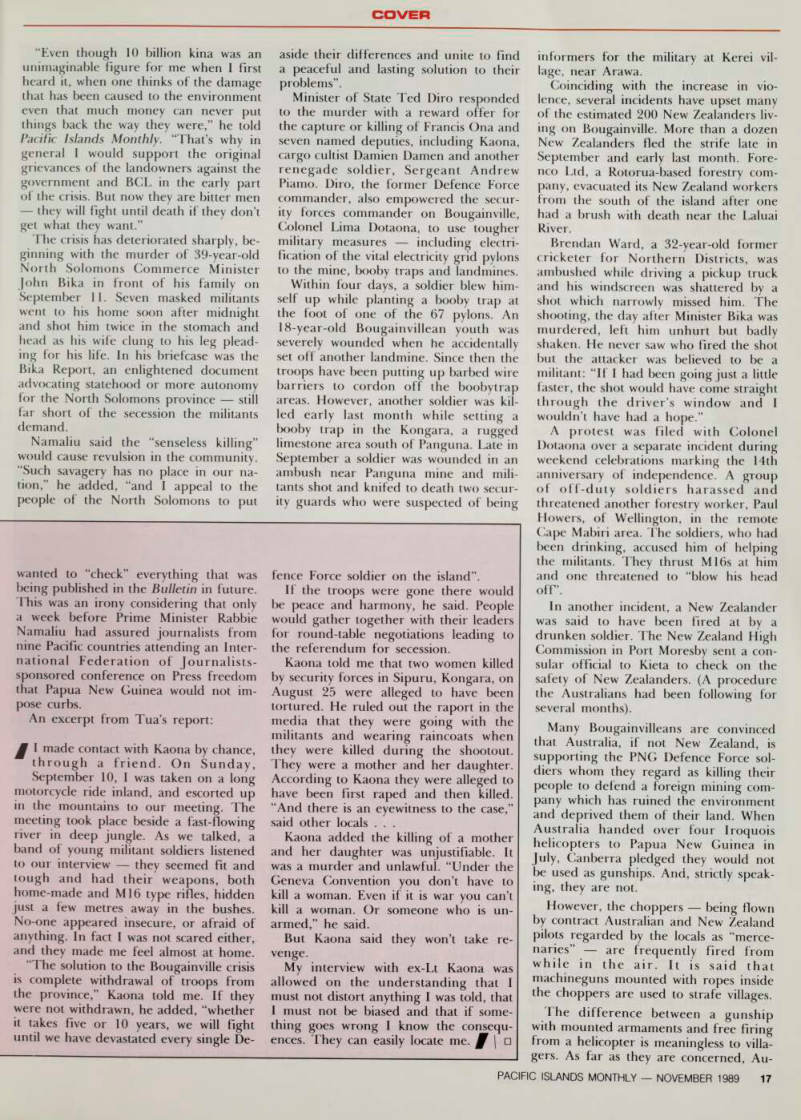
Rabuka: shadow over government.
Advertisements & other items, p. 12 (1 item)
Quote
Panguna copper mine is the “jewel in our crown”.
Sir Val Duncan, chairman of Rio Tinto-Zinc, in 1969.
THE excavation, refining and shipping of this ore to the smelters of Japan could bring great profit over the next 20 years to the shareholders of Rio Tinto-Zinc at the cost of damage to the physical, social and spiritual well-being of Bougainville, which, until the mine came, was a peaceful and prosperous island. Moreyer there is a danger that arguments over the ownership of the mine could cause political strife, even civil war, in this part of the South Pacific.
Richard West in'River of Tears, 1972
Land rights
AS elsewhere in Papua New Guinea and the rest of the Pacific there is a powerful intimate rela tionship between people and land in Bougainville. In traditional culture, own ership or control over land was handed
down through innumerable generations,
but unlike the rest of Papua New Guinea it was normally through the female members of each tribe.
To Bougainvilleans, land has deep re ligious significance and has almost never
been transferred by sale. Primary rights
do not include the right to alienate tracts
of land by transferring freehold rights,
or by selling such rights, to a complete stranger. Although matrilineal kinship is important to the passing on of land
rights, such rights have normally been
used by men. This has sometimes led to disputes when men have wanted to plant cash crops on tracts of land where their wives have primary rights. Thus wives must approve of their husbands’ plans to use the land.
Under crown law introduced by the
Australian colonial administrators and adopted by the Papua New Guinea gov eminent at independence in 1975, things became very different, Bougainvilleans affected by the establishment of Panguna mine didn’t realise that the crown owned the rocks that lie beneath their land that they were entitled only to claim ownership of the first two metres of top soil.
“Australia had adopted the same law, which meant that the country’s Aborigin al inhabitants have become outcasts in their own land,” says Albert Toro, a playwright and National Cultural Board member who once worked for BCL’s media resources unit. “And it is the same law that colonial administrators apparently used to force the Rorovanas, on the coast of Bougainville, to surren der almost 100 ha of coconut plantation
to make way for the township of Loloho and for the mine’s port facilities.”
And it is the same law that Francis Ona and other landowners now refuse to recognise.
For Bougainvilleans land means both the topsoil and what lies beneath it “because without the rocks beneath the soil, the land will collapse . . . and there will literally be no land left on which to hunt, farm or live.” Some 100 sq km were bought by BCL in the 1960 s less than 1 per cent of the land on Bougain ville, or one fifth of one per cent of the total land area of Papua New Guinea.
But negotiations were never conducted with the matrilineal landowners.
“If the company is to lose K 52 million in production, K 1.5 million a day, it must also be understood by BCL chair man Don Carruthers that the people of Moroni, Dapera and the villages on the perimeter of the Kawerong and Jaba riv ers will forever remain the poorest peo
ple on Bougainville,” says Toro. “They
may be paid compensation, but in tradi tional terms they will have lost that which matters: They will be left with no thing, for they will have no land.” □
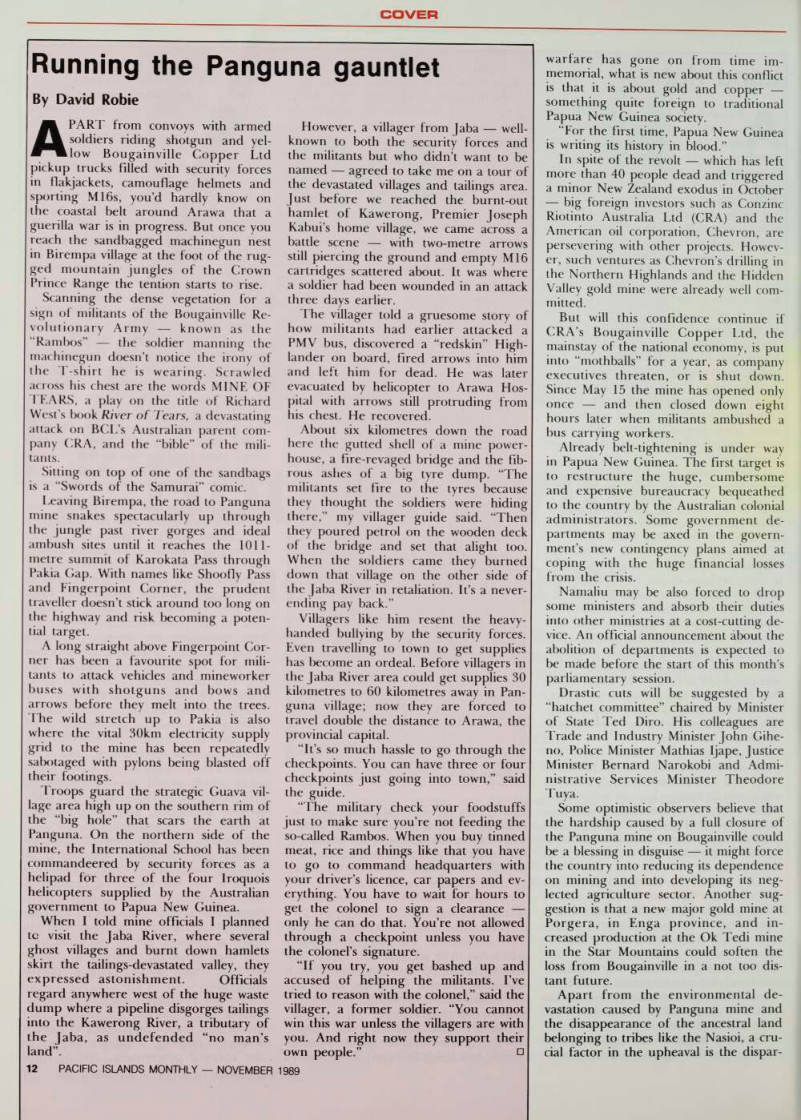
Francis Ona: price on his head
Running the Panguna gauntlet
By David Robie
APART from convoys with armed soldiers riding shotgun and yel low Bougainville Copper Ltd pickup trucks filled with security forces in flakjackets, camouflage helmets and sporting Ml6s, you’d hardly know on the coastal belt around Arawa that a guerilla war is in progress. But once you reach the sandbagged machinegun nest in Birempa village at the foot of the rug ged mountain jungles of the Crown Prince Range the tendon starts to rise.
Scanning the dense vegetation for a sign of militants of the Bougainville Re volutionary Army known as the “Rambos” the soldier manning the machinegun doesn’t notice the irony of the T-shirt he is wearing. Scrawled across his chest are the words MINE OF TEARS, a play on the title of Richard West’s book River of Tears, a devastating attack on BCL’s Australian parent com pany CRA, and the “bible” of the mili tants.
Sitting on top of one of the sandbags is a “Swords of the Samurai” comic.
Leaving Birempa, the road to Panguna mine snakes spectacularly up through the jungle past river gorges and ideal ambush sites until it reaches the 1011metre summit of Karokata Pass through Pakia Gap. With names like Shoofly Pass and Fingerpoint Corner, the prudent traveller doesn’t stick around too long on the highway and risk becoming a poten tial target.
A long straight above Fingerpoint Cor ner has been a favourite spot for mili tants to attack vehicles and mineworker buses with shotguns and bows and arrows before they melt into the trees.
The wild stretch up to Pakia is also where the vital 30km electricity supply grid to the mine has been repeatedly sabotaged with pylons being blasted off
their footings.
Troops guard the strategic Guava vil lage area high up on the southern rim of the “big hole” that scars the earth at Panguna. On the northern side of the mine, the International School has been commandeered by security forces as a helipad for three of the four Iroquois helicopters supplied by the Australian government to Papua New Guinea.
When I told mine officials I planned tc visit the Jaba River, where several ghost villages and burnt down hamlets skirt the tailings-devastated valley, they expressed astonishment. Officials regard anywhere west of the huge waste
dump where a pipeline disgorges tailings
into the Kawerong River, a tributary of the Jaba, as undefended “no man’s land”.
However, a villager from Jaba well known to both the security forces and the militants but who didn’t want to be named agreed to take me on a tour of the devastated villages and tailings area.
Just before we reached the burnt-out hamlet of Kawerong, Premier Joseph Kabui’s home village, we came across a battle scene with two-metre arrows still piercing the ground and empty Ml 6 cartridges scattered about. It was where a soldier had been wounded in an attack three days earlier.
The villager told a gruesome story of how militants had earlier attacked a PMV bus, discovered a “redskin” High lander on board, fired arrows into him and left him for dead. He was later evacuated by helicopter to Arawa Hos pital with arrows still protruding from his chest. He recovered.
About six kilometres down the road here the gutted shell of a mine power house, a fire-revaged bridge and the fib rous ashes of a big tyre dump. “The militants set fire to the tyres because
they thought the soldiers were hiding
there,” my villager guide said. “Then they poured petrol on the wooden deck of the bridge and set that alight too.
When the soldiers came they burned down that village on the other side of the Jaba River in retaliation. It’s a never ending pay back.”
Villagers like him resent the heavy
handed bullying by the security forces.
Even travelling to town to get supplies has become an ordeal. Before villagers in the Jaba River area could get supplies 30 kilometres to 60 kilometres away in Pan guna village; now they are forced to travel double the distance to Arawa, the
provincial capital.
“It’s so much hassle to go through the checkpoints. You can have three or four
checkpoints just going into town,” said
the guide.
“The military check your foodstuffs just to make sure you’re not feeding the so-called Rambos. When you buy tinned meat, rice and things like that you have to go to command headquarters with your driver’s licence, car papers and ev erything. You have to wait for hours to get the colonel to sign a clearance only he can do that. You’re not allowed through a checkpoint unless you have the colonel’s signature.
“If you try, you get bashed up and accused of helping the militants. I’ve tried to reason with the colonel,” said the villager, a former soldier. “You cannot win this war unless the villagers are with you. And right now they support their own people.” □
Advertisements & other items, p. 15 (1 item)
throughout the Pacific?
Koror Saipin
GUAM
NORTHERN
MARIANA ISLANDS
MARSHALL
ISLANDS
BELAU
(PALAU)
FEDERATED STATES OF MICRONESIA
Kolonia Yap State Tatk Ponape State State Kosrae State
PAPUA NEW GUINEA
11/
NAURU
Majuro Tarawa Gilberts Group
SOLOMON
ISLANDS
Honiara\li
VANUATU
TUVALU
11/
TOKELAU
HAW
All Honolulu Kiritimati (Christmas) Is. 11/
KIRIBATI
Phoenix Group line Group
AMERICAN
WESTERN SAMOA
SAMOA
11/ Apia PagoPago
FRENCH
CALEDONIA Port Wa
FIJI
11/ Suva Noumea
AUSTRALIA
TONGA
Nuku'aloft 11/
COOK
ISLANDS
NIUE
Aiofi \|/
Papeete 11/ 1 Rarotonga h 11/
NEW ZEALAND
0° 140° 150 c 30 '2O 10 10
POLYNESIA
20 30 160° 170° 180° 170° 160° 150° 140°
Who can you bank on
throughout the Pacific?
At Westpac, our aim is to maintain a
reputation that people and businesses throughout
the Pacific can bank on.
Apart from offering a service based on the
latest banking systems, backed by sophisticated
communications, we see our role as being closely
involved in the Pacific’s development.
And that role covers not only multi-national companies and major operators, it also extends to the small local business people and entrepreneurs.
The range of services and products in our
branches, subsidiaries and affiliate offices
throughout this wide expanse of ocean reflects our commitment.
It’s a commitment you can bank on.
So if you have business in the Pacific, bank on Westpac to give you the kind of service you expect
and deserve.
You can bank on Westpac
Branches Subsidiary Affiliates Bahrain* Beijing* Chicago* Columbus* Frankfurt* Hong Kong ■ Honiara* Houston* Jakarta* Jersey* Kuala Lumpur* London ■ Los Angeles ■ New York ■ Niue ■ Port Moresby ■ Rarotonga ■ San Francisco ■ Seoul ■ Singapore ■ Suva ■ Sydney ■ Taipei ■ Tokyo ■ Port Vila* Wellington Kiribati (Bank of Kiribati Ltd, Tarawa) Tonga (Bank of Tonga, Nukualofa) ■ Tuvalu (National Bank of Tuvalu, Funafuti) ■ Western Samoa (Pacific Commercial Bank Ltd, Apia).
Diary of a rebellion
1988 22 November: Three masked men steal 228 pieces of dynamite, grenades and detonators from Panguna mine explo sives magazine; Bougainville Copper Ltd offers a K 10,000 reward for informa tion; phone threats to blow up mine in stallations. 29 November: Police reinforcements guard Panguna mine; CRA threatens to pull out of Papua New Guinea because of “acts of terrorism”, 2 December: Arsonists destroy a donga (single workers accommodation block) at the company’s Camp 6 at Loloho; more explosives stolen from the Maneti quarry magazine. 4 December: Power pylon blown up at Policeman’s Corner on Panguna mine road. 6 December: Mine shuts down after saboteurs blow up second pylon at Waterfall Corner. Prime Minister Rabbie Namaliu warns over “Rambo-style ter rorism”. 7 December: Police Commissioner Paul Tohian gives “shoot to kill” order against saboteurs. 9 December: Deputy Prime Minister Akoka Doi and government trouble shooters hold talks with militant leader Francis Ona and 35 others at Guava vil lage; landowners agree to end sabotage; mine reopens. 1989 24 January: Ona sends a “no surren der” message along with four sticks of dynamite to Premier Joe Kabui. 7 February: Justice Minister Bernard Narokobi rules out amnesty for Ona. 20 March: More than 1000 non-
Bougainvilleans rampage through Toni
va, near Kieta, as “payback” for the mur der of two West Highlanders and
wounding of three others in Aropa Plantation. 22 March: Aropa Airport terminal and an aircraft burnt out; police and rebels exchange gunfire, killing one Bougain villean; PNG Defence Force troops ar rive to help police restore law and order and to defend mine installations. 28 March: National governments bans diplomats and journalists from North Solomons province. 27 April: Two PNG Defence Force sol diers and rebel landowners killed in gun battle at Orami. 1 May: “Please stay firm because I will surrender only in a coffin,” says Ona in a hand-written letter sent to Perpetua Serero, chairperson of the Panguna Landowners Associaton. 15 May: Panguna mine shut down again after a series of attacks by militants on company employees and properties two employees shot with arrows. 23 May: Kabui reveals death threats have been made againt him and several other prominent Bougainville leaders; eight BCL employees wounded; another
pylon sabotaged.
25 May: National government guaran tees Ona and rebels immunity from pro secution in an attempt to put an end to the crisis. 1 June: Mediator Bishop Gregory Sing kai meets Ona in a jungle hideout and talks for four hours then flies to Port Moresby to meet Namaliu. 20 June: Australian John Price, an
agricultural adviser suspected of helping
the Panguna militants, is beaten up by Defence Force soldiers. His boss, Bob Bolton, is threatened with a gun. 22 June: Namaliu announces State of Emergency; joint security forces beefed up from 600 to 2000. 27 June: Security forces raid and burn down entire village of Siderons, believed to be a militant stronghold, and arrest 50 villagers. 3 July: Premier Joe Kabui and provin
cial Primary Industry Minister Michael Laimo beaten up by riot squad police; Laimo loses an eye after being jabbed in the face by gun barrels. 7 July: Troops capture strategic ford- Tied ridge near Guava village; discover a military-style trench and bunker system stretching from the village to the ridge. 18 July: Ambrose Leo, a younger brother of Francis Ona, shot dead by security forces between Guava and
Kupei villages.
7 September: Mine reopens again after being closed for 16 weeks; militants ambush two BCL buses carrying workers; mine shuts again after being open
only eight hours.
12 September; Provincial Commerce Minister John Bika shot dead by masked rebel gunmen at his Toboroi village home. 14 September: Minister of State Ted Diro offers a K 200,000 “dead or alive” reward for Ona; authorises security forces to plant booby traps around
pylons.
18 September: Soldier blows himself up
while planting a landmine; an 18-year old villager is wounded by another land mine. 22 September: A special Royal Austra- Han Air Force Cl3o aircraft flies in 16 tonnes of emergency tents for villages evacuated during the Bougainville crisis, 3 October: Two more New Zealanders leave, taking the total of evacuees to 13 in two weeks following incidents of har rassment and death threat by both mili tants and soldiers; one New Zealander fired at by a drunken soldier protest lodged with the military; a second sol dier is killed while setting a booby trap, this time in Kongara, rugged limestone country south of the mine. 4 October: Militants shoot dead four mainland squatters in an attack on a bushcamp near Arawa; in a “payback” other squatters raid the nearby home of
a Bougainville family, killing an elderly
woman and a 12-year-old girl, 5 October: Namaliu makes an emotion al radio plea for peace, saying the mili tants do not represent the majority of
Bougainvilleans. □
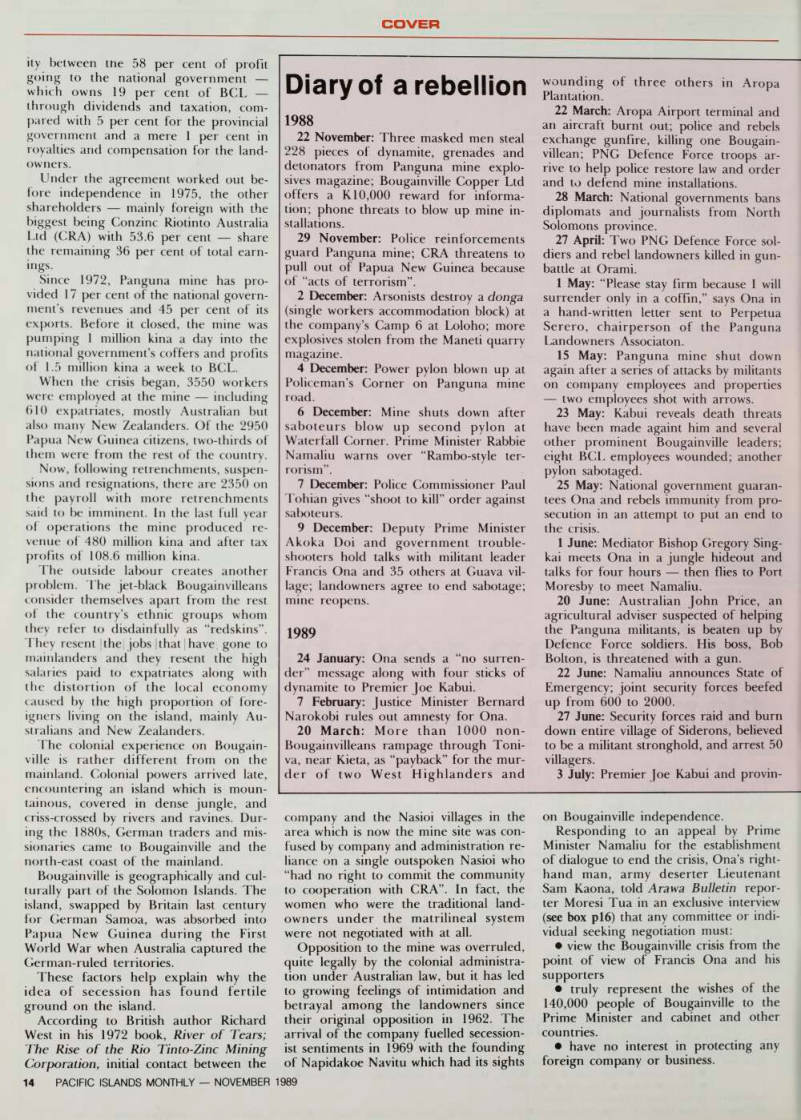
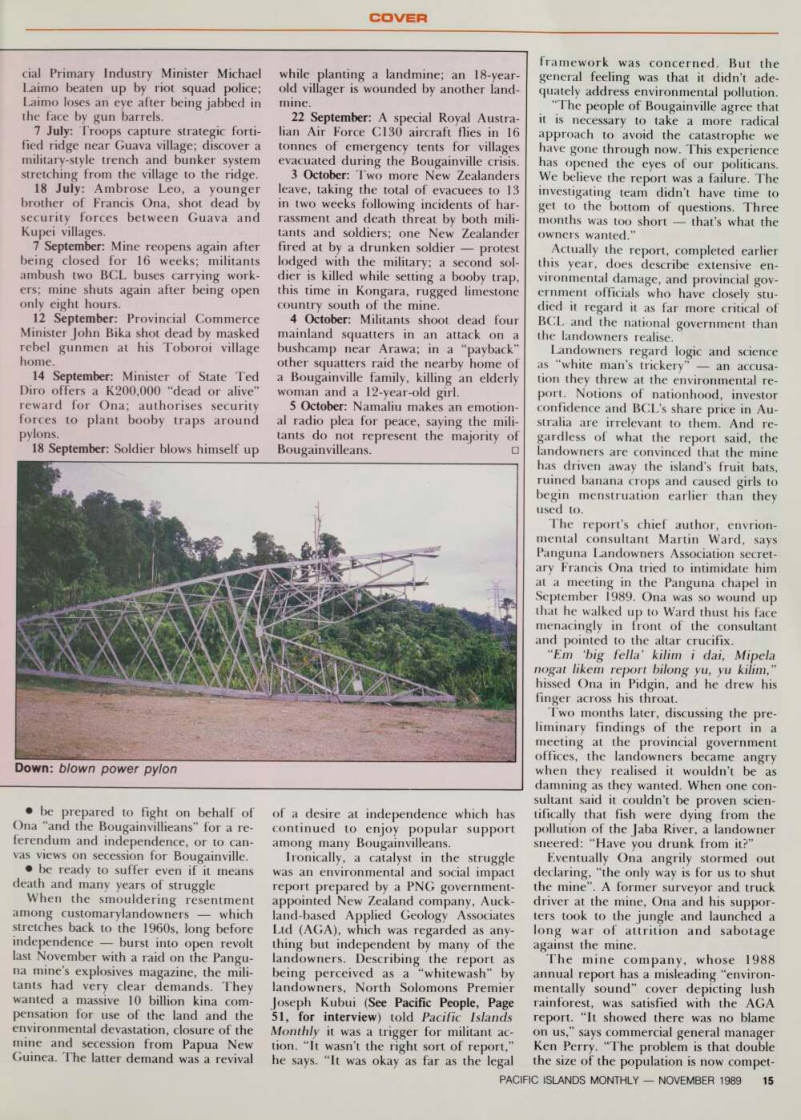
Down: blown power pylon
the jungle
A scoop in the jungle
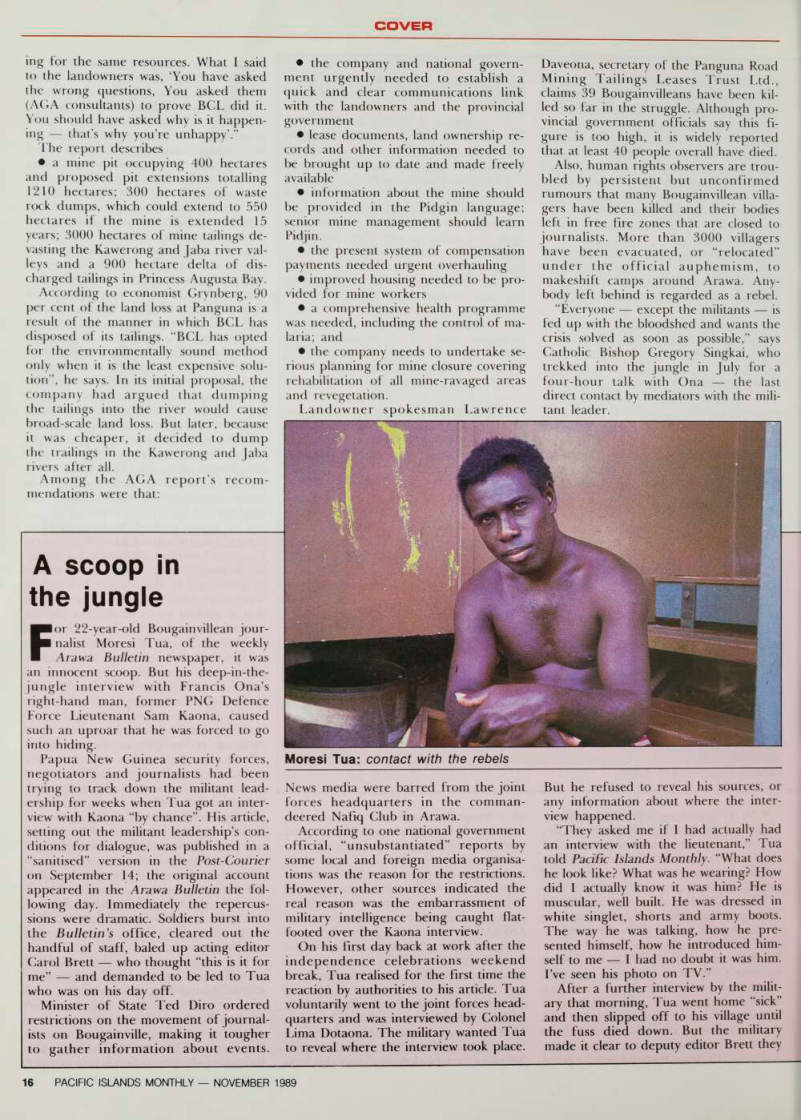
For 22-year-old Bougainvillean jour
nalist Moresi Tua, of the weekly Arawa Bulletin newspaper, it was an innocent scoop. But his deep-in-the jungle interview with Francis Ona’s right-hand man, former PNG Defence Force Lieutenant Sam Kaona, caused such an uproar that he was forced to go
into hiding.
Papua New Guinea security forces, negotiators and journalists had been trying to track down the militant lead ership for weeks when Tua got an inter view with Kaona “by chance”. His article, setting out the militant leadership’s con ditions for dialogue, was published in a “sanitised” version in the Post-Courier on September 14; the original account appeared in the Arawa Bulletin the fol
lowing day. Immediately the repercus
sions were dramatic. Soldiers burst into the Bulletin’s office, cleared out the handful of staff, baled up acting editor Carol Brett who thought “this is it for me” and demanded to be led to Tua who was on his day off.
Minister of State Ted Diro ordered restrictions on the movement of journal
ists on Bougainville, making it tougher
to gather information about events.
News media were barred from the joint forces headquarters in the commandeered Nafiq Club in Arawa.
According to one national government official, “unsubstantiated” reports by some local and foreign media organisations was the reason for the restrictions.
However, other sources indicated the real reason was the embarrassment of
military intelligence being caught flat-
footed over the Kaona interview.
On his first day back at work after the independence celebrations weekend break, Tua realised for the first time the reaction by authorities to his article. Tua voluntarily went to the joint forces headquarters and was interviewed by Colonel Lima Dotaona. The military wanted Tua to reveal where the interview took place.
But he refused to reveal his sources, or any information about where the inter
view happened.
“They asked me if I had actually had an interview with the lieutenant,” Tua told Pacific Islands Monthly. “What does he look like? What was he wearing? How did I actually know it was him? He is muscular, well built. He was dressed in white singlet, shorts and army boots.
The way he was talking, how he pre sented himself, how he introduced him self to me I had no doubt it was him.
I’ve seen his photo on TV.”
After a further interview by the milit ary that morning, Tua went home “sick” and then slipped off to his village until the fuss died down. But the military made it clear to deputy editor Brett they
wanted to “check” everything that was being published in the Bulletin in future.
This was an irony considering that only a week before Prime Minister Rabbie Namaliu had assured journalists from nine Pacific countries attending an Inter national Federation of Journalists sponsored conference on Press freedom that Papua New Guinea would not im pose curbs.
An excerpt from Tua’s report: £ I made contact with Kaona by chance, through a friend. On Sunday, September 10, I was taken on a long motorcycle ride inland, and escorted up in the mountains to our meeting. The meeting took place beside a fast-flowing river in deep jungle. As we talked, a band of young militant soldiers listened to our interview they seemed fit and tough and had their weapons, both home-made and Ml 6 type rifles, hidden just a few metres away in the bushes.
No-one appeared insecure, or afraid of anything. In fact I was not scared either, and they made me feel almost at home.
“The solution to the Bougainville crisis is complete withdrawal of troops from the province,” Kaona told me. If they were not withdrawn, he added, “whether it takes five or 10 years, we will fight until we have devastated every single De
fence Force soldier on the island”.
If the troops were gone there would be peace and harmony, he said. People would gather together with their leaders for round-table negotiations leading to the referendum for secession.
Kaona told me that two women killed by security forces in Sipuru, Kongara, on August 25 were alleged to have been tortured. He ruled out the raport in the media that they were going with the militants and wearing raincoats when they were killed during the shootout.
They were a mother and her daughter.
According to Kaona they were alleged to have been first raped and then killed.
“And there is an eyewitness to the case,” said other locals . . .
Kaona added the killing of a mother and her daughter was unjustifiable. It was a murder and unlawful. “Under the Geneva Convention you don’t have to kill a woman. Even if it is war you can’t kill a woman. Or someone who is un armed,” he said.
But Kaona said they won’t take re venge.
My interview with ex-Lt Kaona was allowed on the understanding that I must not distort anything I was told, that I must not be biased and that if some thing goes wrong I know the consequ ences. They can easily locate me. J \ □
Finding a boss for Rabuka
Fiji Finding a boss for Rabuka
By Jale Moala
ON a hill looking out over Suva Harbour bulldozers have cleared the ground for Fiji’s new Parliament House. Next door, to the west, the former official residence of the Prime Minister stays vacant waiting to be altered for parliamentary offices.
Next door, to the east, soldiers still occupy an old World War II bunker overlooking the official residence of army chief Major General Sitiveni Rabu ka. From a vantage point at the bunker one can see how ironic events in Fiji have turned in the past two-and-a-half years: Parliament House has been moved right next door to Rabuka, Fiji’s two time coup leader.
Rabuka’s presence, symbolic as it may seem to the indigenous Fijians, is one that worries the so-called moderates ea ger to see the full restoration of civilian rule in Fiji. Even though he has agreed to return to barracks and surrender all political power Rabuka will continue to shadow government as the man who did
it before and can do it again. But his absence from government (to become a fulltime civil servant) has given interim Prime Minister Ratu Sir Kamisese Mara a free hand to resign his present admi nistration on December 5 and im mediately instal a full civilian govern ment. What many are asking now is who in the new Cabinet will head the Minis try of Home Affairs which is responsible for the army. That man will be Rabuka’s new boss.
Mara agrees he’s got a winning team in Cabinet. But come December 5 he will announce a reshuffle that will also take care of the army. How the non-Fijians see the next government can depend on who takes charge of Home Affairs, cur
rently under Rabuka. “Only two people
can control Rabuka. That’s Ratu Mara and (the President) Ratu Penaia,’’ said one keen political observer in Suva. “You can’t give Home Affairs to Ratu Penaia, he’s the President.” Some see another possibility in Lands and Mineral Re sources Minister Ratu William Toga nivalu taking over Home Affairs. He is
of noble birth, a former soldier, and a former Minister for Home Affairs.
But Mara is the man who can keep the rein on Rabuka. He is undoubtedly the logical choice for Home Affairs. But this could mean giving away Foreign Affairs responsibilities to someone else. So perhaps the best alternative is for Mara to retain the Foreign Affairs portfolio
and bring Defence under the Prime Minister’s Office while Home Affairs
(police, prisons, immigration and
meteorological services) go to someone else. This will give Mara direct control of the army and it will elevate Rabuka to a position where he will be responsible only to the Prime Minister.
What of the rest of Cabinet? Rabuka’s
three colonels in Cabinet Youth and Sports Minister Ilaisa Kacisolomone, Fi jian Affairs Minister Vatiliai Navunisar avi and Rural Development and Rural
Housing Minister Apolosi Biuvakaloloma
must go if the new government is to be seen as being free of military influ ences. Without Rabuka and his three col onels, Cabinet strength will be down to 17, close to the pre-coup strength of 14 ministers and two ministers of state in Mara’s last government before losing the general elections in April 1987. Youth and Sports can be easily reunited with Education. Fijian Affairs is likely to go to Toganivalu whose Lands and Mineral Resources portfolio can go to Primary Industries Minister Viliame Gonelevu.
Primary Industries can be reunited with Forests.
Other reshuffles could see Informa tion Minister Ratu Inoke Kubuabola being moved to a position where his ex perience with the Bible Society of the South Pacific could be used for youth development. After the controversies surrounding the signing of a 12-year ex clusive television contract with Kerry Packer in 1986, Mara will be looking for a tougher negotiator to deal with Fiji’s new television interests. One of the two Indian members, businessman Ishwari
Bajpai (the Minister for Co-operatives) could be dropped. Some question his role in the ministry which will now need to step up its development programmes to match the new government policy of
promoting indigenous Fijians in com
merce.
With a salary package of F 530,000plus for each Cabinet Minister, Mara can go for fewer ministers as an indication of government intention to save money.
However, should he decide on the likely choice of maintaining emphasis on eco nomic recovery and development then Mara will replace the army colonels with a view of achieving a better distribution of duties. This could mean bringing in another Indian, although Mara will be cautious not to be seen by Fijians as en couraging the participation of Indians in decision-making. Two names have been mentioned as likely new candidates for
Cabinet: Fiji Development Bank general
manager Laisenia Qarase and trade un ionist Jim Smith. Qarase’s name is being linked to the Ministry of Finance, where he once worked as permanent secretary.
Some say he could take over from Kami kamica who could move to Lands. He is the general manager of Native Lands Trust Board.
Smith’s name is being linked with the
Ministry of Communications, Works and
Transport, currently being run by Apisai
Tora. Smith was a National Federation Party parliamentarian. But in recent months he has aligned himself close to Mara’s administration through pro government union initiatives. His role in Cabinet could be to quicken the comple tion of the new Marine Board Regula tions, a work overdue in Tora’s terms of office. fora, who has often been exhausted by the work involved in his large minis try, could move to Information where he could oversee the introduction of televi sion.
The reshuffle will help the introduc tion of a new constitution. While Fiji continues to attract vicious criticism for its biased draft constitution, New Zea land’s Foreign Affairs Minister Russell Marshall admits it “is probably the best we are going to get.” He was reported as saying that Fiji’s proposed new constitu tion was not as good as it should be, but the Commonwealth had to think whether it would ever get a better one.
Marshall, who was reported in the New Zealand Herald , was speaking in Kuala Lumpur after Papua New Guinea Prime Minister Rabbie Namaliu told journalists at the Heads of Commonwealth Meeting
there that the Commonwealth should consider Fiji’s re-admission “.at the appropriate time when she feels that she should re-apply.” The proposed new
constitution, published in September,
gives only 27 of the 69 seats in Parlia ment to the Indian community.
India’s External Affairs Minister, Nat
war Singh, overnight in Wellington in
early October to lobby New Zealand opposition to Fiji at the Commonwealth meeting. He met with Prime Minister Geoffrey Palmer and condemned Fiji’s draft constitution as a recipe for apar theid that would solve nothing. The In dian Ocean state of Mauritius, which attacked post-coup Fiji at the United Na tions, argued in Kuala Lumpur against re-admitting Fiji to the Commonwealth.
But Mauritius President Sir Anerood Jugnauth lost impact when he made the mistake of telling Commonwealth leaders Fiji had no indigenous people. “So I had a little conversation with them to give them a little information about the poli tical realities of Fiji,” Marshall told New Zealand Herald. On the other hand Fiji won sympathy from Papua New Guinea, the rest of the Melanesian countries and Malaysia for efforts to protect the aspira tions and rights of the indigenous peo
ple. n
Fire, fire, fire
EARLY on Sunday morning, October 15, arsonists set fire to three temples and a mosque at Lautoka in Western Viti Levu. The burning threatened to set in flames Fiji’s political and economic recovery prog rammes and drew the country close to another major crisis. Two days later, in a reprisal attack, a Methodist Church in Lautoka was firebombed but no major damage was done.
Hit in the Sunday morning attack were two Hindu temples, a Sikh temple and a Muslim mosque. The attacks were linked to Methodist fundamentalists opposed to the presence of other faiths in the country. But it attracted so much vicious criticism from all races and faiths
in Fiji that the attackers were quickly isolated, even by factions of the Method ist Church.
Eighteen people, members of the Methodist Youth Fellowship group, were arrested and charged. Many indigenous
Fijians reacted strongly against the attack
on the temples and mosque, and said it was an embarrassing example of Christ ians who misinterpreted the teachings of Jesus Christ. Government sent Cabinet Ministers to Lautoka and the Fiji Council of Churches, a grouping of major Christian churches, called the burning of the temples and mosque “an instance of gross desecration and sacrilege involving sacred places, sacred books and sacred objects. The apparent religious motives only adds to the insult and sacrilege and calls for a deep sense of sorrow and shame on the part of all Christians.” □
Advertisements & other items, p. 21 (1 item)
Suddenly, New Zealand is a whole lot closer.
And so too is a potential market of 3.2 million New Zealanders.
As a Forum Island nation, exploration and development of new markets can be a difficult and frustrating exercise.
Now, through the establishment in New Zealand of the South Pacific Trade Office, you have direct access to a variety of services that are specifically geared to assist you in the export and promotion of South Pacific products into New Zealand.
Services include market research, marketing plans, identification of potential customers, office facilities, product displays, participation in trade fairs, and secondments.
For further details contact...
SOUTH PACIFIC
TRADE OFFICE
Jetset Centre, 44 Emily Place, P.O. Box 774, Auckland 1, New Zealand.
Phone (09) 302-0465, Fax (09) 776-642, Telex SPTO NZ63328 Madison 3589
Silence over Indonesian crude
SILENCE has fallen over the Fiji
government’s proposed monopoly
importation of Indonesian crude oil even though the October 6 deadline for worldwide refining tenders has long
passed. In September, Fiji’s Energy
Minister David Pickering and Trade Minister Berenado Vunibobo met their Indonesian counterparts in Jakarta to discuss buying 15,000 barrels a day of Indonesian crude oil.
The crude would be bought by a yetto-be-created monopoly company which would be 75 per cent Fijian-owned. In-
ternational petroleum companies could
tender to refine the crude and trans-ship
and retail the resulting petrol products
in Fiji and six other Pacific client nalions. At stake is a minimum of Fs2oo million a year in petroleum exports from Australia, New Zealand and Singapore through local subsidiaries of Shell, BP and Mobil.
In Jakarta, Pickering also said Fiji wanted to build a refinery of its own, possibly starting next year. Since those heady statements, there’s been no information from the Fiji Government despite strenuous enquiries up to the time of writing. Fiji government sources say no firm proposal has been tabled before Cabinet and there seems to be no idenlifiable official position on the Indonesian deal. This may hearten the deal’s
many critics. Pacific Island officials at the recent Forum Secretariat petroleum management committee meeting in Suva
privately expressed strong reservations
about the security of their future fuel
supplies under the monopoly regime.
The Indonesian crude which would be supplied to Fiji is of such a low-grade that it can be handled by only a couple of refineries, at most, on the Pacific Rim.
This leaves the supply vulnerable to re finery breakdowns, strikes and shipping delays. But the Indonesia deal is coming under most fire from island nations, oil industry experts and the Big Three petroleum multinationals over the Fiji Government’s claim that it will cut costs to the consumer.
The director of energy programmes at Hawaii’s East-West Centre, Fereidun Fesharaki, estimates the Indonesian deal will add at least 10 cents a litre to the retail price of petrol in Fiji alone. “If Fiji pays more then so will other countries in the region,” he said. Fesharaki doubts whether the Fiji Government can actual ly deliver on its pledge that the Indone sian contract will protect other Island clients from any price hikes resulting from the change in supplier.
Indonesia is expected to supply 15,000 barrels a day of crude: Fiji would use about 6000 barrels and other Pacific clients about 3000; leaving another 6000
barrels for sale in the open market. But Fesharaki says the 15,000 barrels a day are split equally between the worst grade of crude and an equally dubious conde nsate.
“This crude,” he says, “is so difficult to handle it’s not being refined anywhere in the Pacific Rim, it gives 70 per cent heavy fuel oil which has no use in Fiji and at the moment all of that crude is being burnt for electricity generation in Japan because the quality’s so poor.”
Fesharaki says the Indonesian crude will
require very sophisticated refining into
usable light petroleum products. “Pre
sumably they’ve got some refinery to
handle it, but the costs will be high and it’s not something you can take to just any refinery,” he said.
Retail petrol in Fiji is among the cheapest in the region with prices lower than those in New Zealand, Hawaii and Cali fornia. “The oil companies have been giving a very good price to their con sumers in Fiji, especially in the past three years, essentially because they’ve been able to use the trans-shipping facili ties,” says Fesharaki. “It will be hard to beat that especially with the unusual
crude supplied by Indonesia.”
Fesharaki says that despite Fiji’s
guarantee of price stability, it’s holding
neighbouring Pacific clients hostage to
the pattern of regional petroleum supply
and demand which depends on trans
shipment through Fiji. □
beautiful
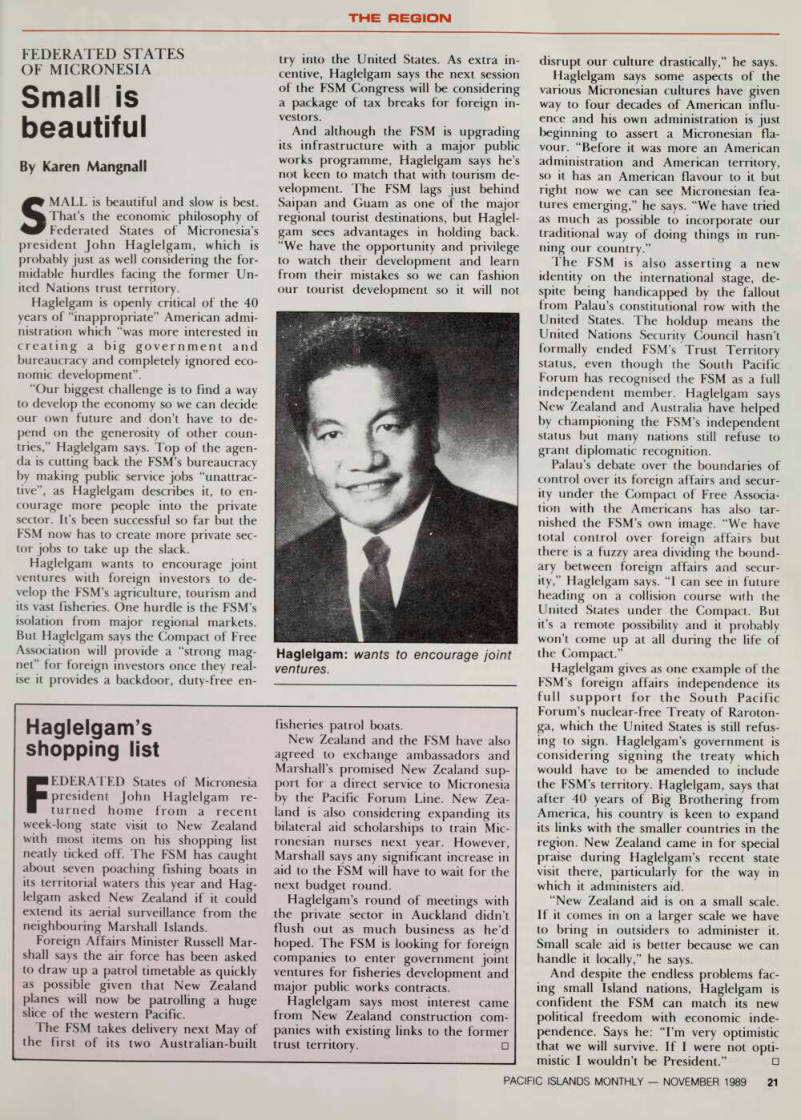
Federated States
Of Micronesia
Small is beautiful
By Karen Mangnall
SMALL is beautiful and slow is best.
That’s the economic philosophy of Federated States of Micronesia’s
president John Haglelgam, which is
probably just as well considering the for midable hurdles facing the former Un ited Nations trust territory.
Haglelgam is openly critical of the 40 years of “inappropriate” American admi nistration which “was more interested in creating a big government and
bureaucracy and completely ignored eco
nomic development”.
“Our biggest challenge is to find a way to develop the economy so we can decide our own future and don’t have to de pend on the generosity of other coun tries,” Haglelgam says. Top of the agen da is cutting back the FSM’s bureaucracy
by making public service jobs “unattrac
tive”, as Haglelgam describes it, to en courage more people into the private sector. It’s been successful so far but the FSM now has to create more private sec tor jobs to take up the slack.
Haglelgam wants to encourage joint ventures with foreign investors to de velop the FSM’s agriculture, tourism and its vast fisheries. One hurdle is the FSM’s isolation from major regional markets.
But Haglelgam says the Compact of Free Association will provide a “strong mag net” for foreign investors once they real ise it provides a backdoor, duty-free en
try into the United States. As extra in centive, Haglelgam says the next session of the FSM Congress will be considering a package of tax breaks for foreign in vestors.
And although the FSM is upgrading its infrastructure with a major public works programme, Haglelgam says he’s not keen to match that with tourism de
velopment. The FSM lags just behind
Saipan and Guam as one of the major regional tourist destinations, but Haglel gam sees advantages in holding back.
“We have the opportunity and privilege to watch their development and learn from their mistakes so we can fashion our tourist development so it will not
disrupt our culture drastically,” he says.
Haglelgam says some aspects of the various Micronesian cultures have given way to four decades of American influ ence and his own administration is just beginning to assert a Micronesian fla vour. “Before it was more an American administration and American territory, so it has an American flavour to it but right now we can see Micronesian fea tures emerging,” he says. “We have tried as much as possible to incorporate our traditional way of doing things in run ning our country.”
The FSM is also asserting a new identity on the international stage, de
spite being handicapped by the fallout
from Palau’s constitutional row with the United States. The holdup means the United Nations Security Council hasn’t formally ended FSM’s Trust Territory status, even though the South Pacific Forum has recognised the FSM as a full
independent member. Haglelgam says
New Zealand and Australia have helped
by championing the FSM’s independent
status but many nations still refuse to
grant diplomatic recognition.
Palau’s debate over the boundaries of control over its foreign affairs and secur ity under the Compact of Free Associa tion with the Americans has also tar nished the FSM’s own image. “We have total control over foreign affairs but there is a fuzzy area dividing the bound ary between foreign affairs and secur ity,” Haglelgam says. “I can see in future heading on a collision course with the United States under the Compact. But it’s a remote possibility and it probably won’t come up at all during the life of
the Compact.”
Haglelgam gives as one example of the FSM’s foreign affairs independence its full support for the South Pacific Forum’s nuclear-free Treaty of Raroton ga, which the United States is still refus
ing to sign. Haglelgam’s government is
considering signing the treaty which would have to be amended to include the FSM’s territory. Haglelgam, says that after 40 years of Big Brothering from America, his country is keen to expand its links with the smaller countries in the region. New Zealand came in for special
praise during Haglelgam’s recent state
visit there, particularly for the way in which it administers aid.
“New Zealand aid is on a small scale.
If it comes in on a larger scale we have to bring in outsiders to administer it.
Small scale aid is better because we can handle it locally,” he says.
And despite the endless problems fac ing small Island nations, Haglelgam is confident the FSM can match its new political freedom with economic inde pendence. Says he; “I’m very optimistic that we will survive. If 1 were not opti mistic I wouldn’t be President.” □
Haglelgam: wants to encourage joint ventures.
Haglelgam’s
shopping list
FEDERATED States of Micronesia president John Haglelgam re turned home from a recent week-long state visit to New Zealand with most items on his shopping list neatly ticked off. The FSM has caught about seven poaching fishing boats in its territorial waters this year and Hag lelgam asked New Zealand if it could extend its aerial surveillance from the neighbouring Marshall Islands.
Foreign Affairs Minister Russell Mar shall says the air force has been asked to draw up a patrol timetable as quickly as possible given that New Zealand planes will now be patrolling a huge slice of the western Pacific.
The FSM takes delivery next May of the first of its two Australian-built
fisheries patrol boats.
New Zealand and the FSM have also agreed to exchange ambassadors and Marshall’s promised New Zealand sup port for a direct service to Micronesia by the Pacific Forum Line. New Zea land is also considering expanding its bilateral aid scholarships to train Mic ronesian nurses next year. However, Marshall says any significant increase in aid to the FSM will have to wait for the next budget round.
Haglelgam’s round of meetings with the private sector in Auckland didn’t flush out as much business as he’d hoped. The FSM is looking for foreign companies to enter government joint ventures for fisheries development and
major public works contracts.
Haglelgam says most interest came from New Zealand construction com panies with existing links to the former trust territory. □
Coming
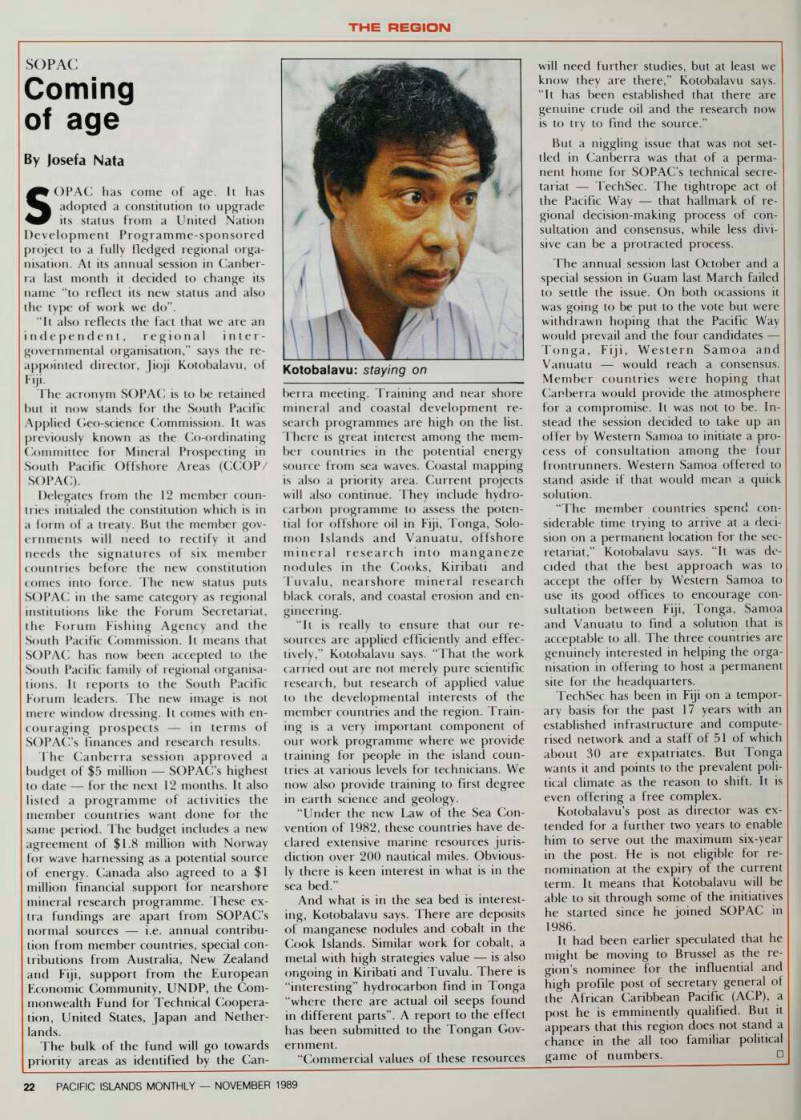
Sopac
Coming of age
By Josefa Nata
SOPAC has come of age. It has adopted a constitution to upgrade its status from a United Nation
Development Programme-sponsored
project to a fully fledged regional orga nisation. At its annual session in Canber ra last month it decided to change its name “to reflect its new status and also the type of work we do”.
“It also reflects the fact that we are an
independent, regional inter
governmental organisation,” says the re appointed director, Jioji Kotobalavu, of
Fiji.
The acronym SOPAC is to be retained but it now stands for the South Pacific Applied Ceo-science Commission. It was previously known as the Co-ordinating Committee for Mineral Prospecting in South Pacific Offshore Areas (CCOP/
Sopac).
Delegates from the 12 member coun tries initialed the constitution which is in a form of a treaty. But the member gov ernments will need to rectify it and needs the signatures of six member countries before the new constitution comes into force. The new status puts SOPAC in the same category as regional institutions like the Forum Secretariat, the Forum Fishing Agency and the South Pacific Commission. It means that SOPAC has now been accepted to the
South Pacific family of regional organisa
tions. It reports to the South Pacific Forum leaders. The new image is not mere window dressing. It comes with en couraging prospects in terms of SOPAC’s finances and research results.
The Canberra session approved a budget of $5 million SOPAC’s highest to date for the next 12 months. It also listed a programme of activities the member countries want done for the same period. The budget includes a new agreement of $l.B million with Norway for wave harnessing as a potential source of energy. Canada also agreed to a $1 million financial support for nearshore mineral research programme. These ex tra fundings are apart from SOPAC’s normal sources i.e. annual contribu tion from member countries, special con tributions from Australia, New Zealand and Fiji, support from the European Economic Community, UNDP, the Com monwealth Fund for Technical Coopera tion, United States, Japan and Nether lands.
The bulk of the fund will go towards priority areas as identified by the Can-
berra meeting. Training and near shore mineral and coastal development re search programmes are high on the list.
There is great interest among the mem ber countries in the potential energy source from sea waves. Coastal mapping is also a priority area. Current projects will also continue. They include hydro carbon programme to assess the poten tial for offshore oil in Fiji, Tonga, Solo mon Islands and Vanuatu, offshore mineral research into manganeze nodules in the Cooks, Kiribati and Tuvalu, nearshore mineral research black corals, and coastal erosion and en
gineering.
“It is really to ensure that our re sources are applied efficiently and effec tively,” Kotobalavu says. “That the work carried out are not merely pure scientific research, but research of applied value to the developmental interests of the member countries and the region. Train ing is a very important component of our work programme where we provide training for people in the island coun tries at various levels for technicians. We now also provide training to first degree in earth science and geology.
“Under the new Law of the Sea Con vention of 1982, these countries have de clared extensive marine resources juris diction over 200 nautical miles. Obvious ly there is keen interest in what is in the sea bed.”
And what is in the sea bed is interest ing, Kotobalavu says. There are deposits of manganese nodules and cobalt in the Cook Islands. Similar work for cobalt, a metal with high strategies value is also ongoing in Kiribati and Tuvalu. There is
“interesting” hydrocarbon find in Tonga
“where there are actual oil seeps found in different parts”. A report to the effect has been submitted to the Tongan Gov ernment.
“Commercial values of these resources
will need further studies, but at least we know they are there,” Kotobalavu says.
“It has been established that there are genuine crude oil and the research now is to try to find the source.”
But a niggling issue that was not set tled in Canberra was that of a perma nent home for SOPAC’s technical secre tariat Tech Sec. The tightrope act of the Pacific Way that hallmark of re gional decision-making process of con sultation and consensus, while less divi sive can be a protracted process.
The annual session last October and a special session in Guam last March failed to settle the issue. On both ocassions it was going to be put to the vote but were withdrawn hoping that the Pacific Way would prevail and the four candidates Tonga, Fiji, Western Samoa and Vanuatu would reach a consensus.
Member countries were hoping that Canberra would provide the atmosphere for a compromise. It was not to be. In stead the session decided to take up an offer by Western Samoa to initiate a pro cess of consultation among the four frontrunners. Western Samoa offered to stand aside if that would mean a quick solution.
“The member countries spend con siderable time trying to arrive at a deci sion on a permanent location for the sec retariat,” Kotobalavu says. “It was de cided that the best approach was to accept the offer by Western Samoa to use its good offices to encourage con sultation between Fiji, Tonga, Samoa and Vanuatu to find a solution that is acceptable to all. The three countries are genuinely interested in helping the orga nisation in offering to host a permanent site for the headquarters.
Tech Sec has been in Fiji on a tempor ary basis for the past 17 years with an established infrastructure and compute rised network and a staff of 51 of which about 30 are expatriates. But Tonga wants it and points to the prevalent poli tical climate as the reason to shift. It is even offering a free complex.
Kotobalavu’s post as director was ex tended for a further two years to enable him to serve out the maximum six-year in the post. He is not eligible for re nomination at the expiry of the current term. It means that Kotobalavu will be able to sit through some of the initiatives he started since he joined SOPAC in 1986.
It had been earlier speculated that he might be moving to Brussel as the re gion’s nominee for the influential and high profile post of secretary general of the African Caribbean Pacific (AGP), a post he is emminently qualified. But it appears that this region does not stand a chance in the all too familiar political game of numbers. □
Kotobalavu: staying on
Advertisements & other items, p. 25 (1 item)
Traffic
CiD PIONEER
The future of sound and vision.
v IK K 0^ 10“
TRAFFIC
TAMERS
KEH-7050QR & CDX-3
Pure Sound, Pure Power...
Relax! Let Pioneer’s Traffic Tamers drown out the din.
Our CD Players do it with pure sound, while our Stereo Cassette/Tuners do it with pure power.
Pioneer-original high-tech laser-optics make CD sound even better in the stylish, new CDX-3 at an affordable price.
A great match for it is the new KEH-7050QR with a 7-band graphic equalizer -15 W into four or 25W into the standard two channels. That’s high power plus!
If you think this all sounds great in the middle of a traffic jam, wait till you hit the open road and turn up the volume!
KEH-7050QR has switchable Dual Illumination (green or amber).
Anti-theft Quick-Release System.
For further information, please contact: Australia: Pioneer Eiectronics Australia Pty. Ltd (Incorporated in Victoria), P.O. Box 295, Mordialloc, Victoria. 3195 Tel: 580-9911 Fiji Islands: Brijlal & Company. G.P.O. Box No. 362, Suva, Fiji Islands Tel: 22258 New Zealand: Monaco Corporation Ltd, 41 Poland Road, Glenfield, Auckland, New Zealand Tel: (09) 444-9144 Norfolk Island: Burnt Pine Traders Ltd. PC, Box 21, Norfolk Island Vanuatu; Burns Philp (Vanuatu) Ltd., Vila, Vanuatu Nauru Island; Jacob Enterprises, P.O. Box N 0.4, Republic of Nauru Tahiti: Tahiti Hi-Fi, P.O. Box 848, Papeete, Tahiti New Caledonia: Menard Pacifique Sari, B P 3899, Noumea. New Caledonia Tel: 27.62-23 American Samoa; Transpac Corporation, P.O. Box 1477, Pago Pago, American Samoa 96799 Tel: 633-5224 Rarotonga: South Seas International Ltd., P.O. Box 49, Rarotonga, Cook Islands Tel: 2327
Diana Mcmanus
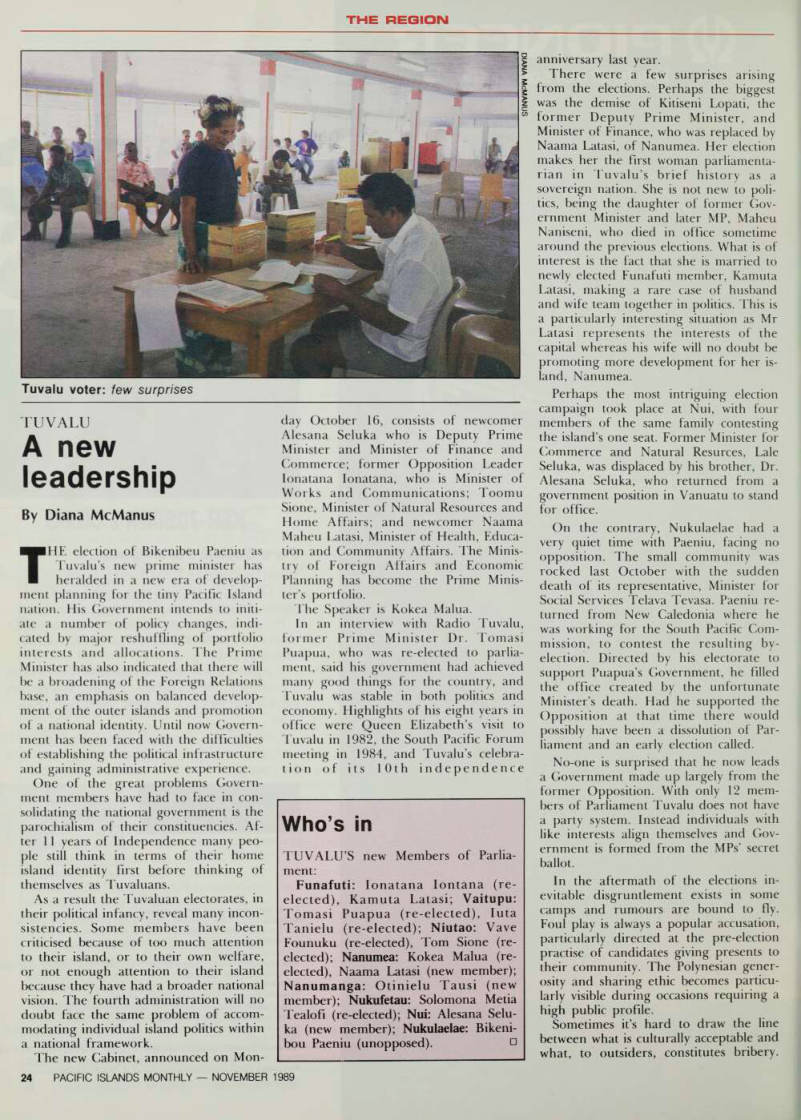
Tuvalu
A new leadership
By Diana McManus
THE election of Bikenibeu Paeniu as Tuvalu’s new prime minister has heralded in a new era of develop ment planning for the tiny Pacific Island nation. His Government intends to initi ate a number of policy changes, indi
cated by major reshuffling of portfolio
interests and allocations. The Prime Minister has also indicated that there will be a broadening of the Foreign Relations base, an emphasis on balanced develop ment of the outer islands and promotion of a national identity. Until now Govern ment has been faced with the difficulties of establishing the political infrastructure
and gaining administrative experience.
One of the great problems Govern ment members have had to face in con solidating the national government is the parochialism of their constituencies. Af ter 11 years of Independence many peo ple still think in terms of their home island identity first before thinking of themselves as Tuvaluans.
As a result the Tuvaluan electorates, in their political infancy, reveal many incon sistencies. Some members have been criticised because of too much attention to their island, or to their own welfare, or not enough attention to their island because they have had a broader national vision. The fourth administration will no doubt face the same problem of accom modating individual island politics within a national framework.
The new Cabinet, announced on Mon
day October 16, consists of newcomer Alesana Seluka who is Deputy Prime Minister and Minister of Finance and Commerce; former Opposition Leader lonatana lonatana, who is Minister of Works and Communications; Toomu Sione, Minister of Natural Resources and Home Affairs; and newcomer Naama Maheu Latasi, Minister of Health, Educa tion and Community Affairs. The Minis try of Foreign Affairs and Economic Planning has become the Prime Minis
ter’s portfolio.
The Speaker is Kokea Malua.
In an interview with Radio Tuvalu, former Prime Minister Dr. Tomasi Puapua, who was re-elected to parlia ment, said his government had achieved many good things for the country, and Tuvalu was stable in both politics and economy. Highlights of his eight years in office were Queen Elizabeth’s visit to Tuvalu in 1982, the South Pacific Forum meeting in 1984, and Tuvalu’s celebra tion of its 10th independence
anniversary last year.
There were a few surprises arising from the elections. Perhaps the biggest was the demise of Kitiseni Lopati, the former Deputy Prime Minister, and Minister of Finance, who was replaced by Naama Latasi, of Nanumea. Her election makes her the first woman parliamenta rian in Tuvalu’s brief history as a sovereign nation. She is not new to poli tics, being the daughter of former Gov ernment Minister and later MP, Maheu Naniseni, who died in office sometime around the previous elections. What is of interest is the fact that she is married to newly elected Funafuti member, Kamuta Latasi, making a rare case of husband and wife team together in politics. This is a particularly interesting situation as Mr Latasi represents the interests of the capital whereas his wife will no doubt be promoting more development for her is land, Nanumea.
Perhaps the most intriguing election campaign took place at Nui, with four members of the same family contesting the island’s one seat. Former Minister for Commerce and Natural Resurces, Lale Seluka, was displaced by his brother, Dr.
Alesana Seluka, who returned from a government position in Vanuatu to stand for office.
On the contrary, Nukulaelae had a very quiet time with Paeniu, facing no opposition. The small community was rocked last October with the sudden death of its representative, Minister for Social Services Telava Tevasa. Paeniu re turned from New Caledonia where he was working for the South Pacific Com mission, to contest the resulting by election. Directed by his electorate to support Puapua’s Government, he filled the office created by the unfortunate Minister’s death. Had he supported the Opposition at that time there would possibly have been a dissolution of Par liament and an early election called.
No-one is surprised that he now leads a Government made up largely from the former Opposition. With only 12 mem bers of Parliament Tuvalu does not have a party system. Instead individuals with like interests align themselves and Gov ernment is formed from the MPs’ secret ballot.
In the aftermath of the elections in evitable disgruntlement exists in some camps and rumours are bound to fly.
Foul play is always a popular accusation, particularly directed at the pre-election practise of candidates giving presents to their community. The Polynesian gener
osity and sharing ethic becomes particu
larly visible during occasions requiring a
high public profile.
Sometimes it’s hard to draw the line between what is culturally acceptable and what, to outsiders, constitutes bribery.
Tuvalu voter: few surprises
Diana Mcmanus
Who’s in
TUVALU’S new Members of Parlia ment: Funafuti: lonatana lontana (re elected), Kamuta Latasi; Vaitupu: Tomasi Puapua (re-elected), luta Tanielu (re-elected); Niutao: Vave Founuku (re-elected), Tom Sione (re elected); Nanumea: Kokea Malua (re elected), Naama Latasi (new member); Nanumanga: Otinielu Tausi (new member); Nukufetau: Solomona Metia Tealofi (re-elected); Nui: Alesana Selu ka (new member); Nukulaelae: Bikeni bou Paeniu (unopposed). □
Pacific
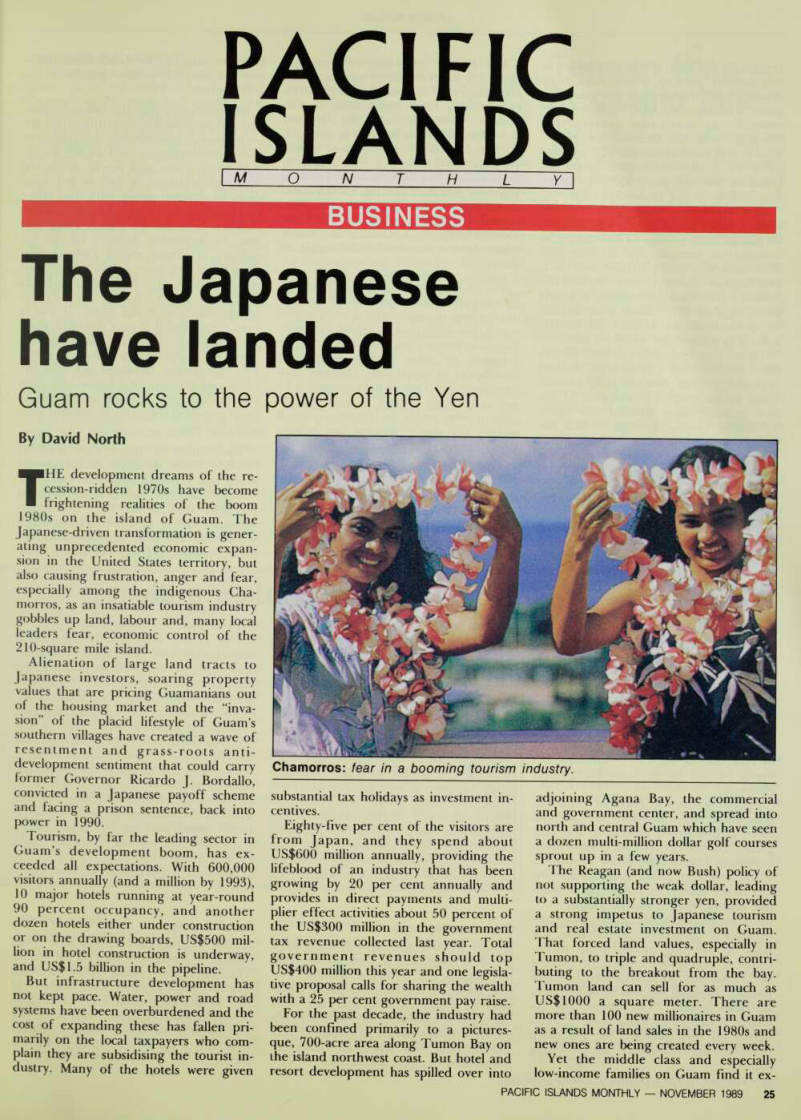
Islands
Monthly
Business
The Japanese have landed Guam rocks to the power of the Yen
By David North
THE development dreams of the re cession-ridden 1970 s have become frightening realities of the boom 1980 s on the island of Guam. The Japanese-driven transformation is gener ating unprecedented economic expan sion in the United States territory, but also causing frustration, anger and fear, especially among the indigenous Cha morros, as an insatiable tourism industry gobbles up land, labour and, many local leaders fear, economic control of the 210-square mile island.
Alienation of large land tracts to Japanese investors, soaring property values that are pricing Guamanians out of the housing market and the “inva sion” of the placid lifestyle of Guam’s southern villages have created a wave of resentment and grass-roots anti development sentiment that could carry former Governor Ricardo J. Bordallo, convicted in a Japanese payoff scheme and facing a prison sentence, back into power in 1990.
Tourism, by far the leading sector in Guam’s development boom, has ex ceeded all expectations. With 600,000 visitors annually (and a million by 1993), 10 major hotels running at year-round 90 percent occupancy, and another dozen hotels either under construction or on the drawing boards, US$5OO mil lion in hotel construction is underway, and US$l.5 billion in the pipeline.
But infrastructure development has not kept pace. Water, power and road systems have been overburdened and the cost of expanding these has fallen pri marily on the local taxpayers who com plain they are subsidising the tourist in dustry. Many of the hotels were given
substantial tax holidays as investment incentives.
Eighty-five per cent of the visitors are from Japan, and they spend about US$6OO million annually, providing the lifeblood of an industry that has been growing by 20 per cent annually and provides in direct payments and multiplier effect activities about 50 percent of the US$3OO million in the government tax revenue collected last year. Total government revenues should top US$4OO million this year and one legislalive proposal calls for sharing the wealth with a 25 per cent government pay raise.
For the past decade, the industry had been confined primarily to a picturesque, 700-acre area along Turnon Bay on the island northwest coast. But hotel and resort development has spilled over into
adjoining Agana Bay, the commercial and government center, and spread into north and central Guam which have seen a dozen multi-million dollar golf courses sprout up in a few years, The Reagan (and now Bush) policy of not supporting the weak dollar, leading to a substantially stronger yen, provided a strong impetus to Japanese tourism and real estate investment on Guam, That forced land values, especially in Turnon, to triple and quadruple, contri buting to the breakout from the bay.
Turnon land can sell for as much as US$lOOO a square meter. There are more than 100 new millionaires in Guam as a result of land sales in the 1980 s and new ones are being created every week, Yet the middle class and especially low-income families on Guam find it ex
Chamorros: fear in a booming tourism industry.
ceptionally difficult, if not impossible, to buy land or housing, whose value have doubled and tripled over the past five years. Building costs have increased dra
matically as residential development
competes with the demand for hotels, resorts and condominiums. The average price of a three-bedroom home on Guam in 1980 was about $55,000. Today that average is just under $lOO,OOO.
The smaller but steady growth in the island’s other major industry defense pumps in an average of $3O million in construction annually and an estimated $lOO million in local purchases and sales.
Washington also provides about $lOO million to the local government in grants while another $7O million goes directly to individuals in welfare payments, federal pensions, and social security.
These yen and dollar-driven pistons have cranked up phenomenal overall
economic growth. Analysts place Guam’s
Gross Island Product at well over $1 bil lion annually and estimate the Gross Territorial Income as high as $2.5 bil lion. Gross Business Receipts topped $l.l billion in 1988, up dramatically from the $600,000 level of 1981. Real growth rate figures are unavailable, but some economists say last year’s inflation adjusted growth was about 19 per cent.
The white-hot economy has lowered unemployment to 3.8 per cent which business leaders believe means the local labour force is virtually tapped out, leav ing the island with what they regard as a severe labour crunch. Tourism growth alone will need 6700 additional workers in the next five years, creating a demand for more foreign labour which further worries Chamorro leaders who fear mas sive importation of alien workers will further dilute their political control. The Chamorros are already outnumbered de mographically (about 42 per cent of the 130,000 population), but have been able to maintain control of the government
by exceptionally high voter turnouts, be
tween 70 and 80 per cent for general elections.
Former Governor Bordallo, who has announced his candidacy for a third term, is positioning himself in the van guard of the grass-roots movement
coalescing against full-throttle growth. In
village meetings, public speeches and let
ters to the editor, he warns that a “mas sive uncontrolled economic monster . . . has invaded our island”, and accuses the incumbent governor, Republican Joe Ada, of “allowing foreign firms to cir cumvent regulations (which is) turning our island into an unorganised concrete jungle”. Tapping the vein of resentment, Bordallo laments “our people can no longer afford to purchase land or build homes for their families. We are losing our pride and tranquility. We are losing control.”
The former governor, who recently lost a US Supreme Court appeal on his
jury tampering and obstruction of justice
convictions, faces sentencing in the Federal Court on Guam in the next several months. But he vows to run and, if elected, to serve, even if sent to jail.
He was convicted by a Guam jury in connection with a payoff from a Japanese company seeking special treat ment. Eight of the 10 counts were over turned when an appeals court ruled the Federal bribery and extortion laws under which he was convicted didn’t apply to Guam.
The Ada administration, sensing the volatility of the situation and the political implications of apprehensive or resentful voters, has attempted to defuse the issue.
New investment incentive rules require Japanese or other foreign hoteLresort developers to enter joint ventures with local residents. Only if the company is 51 per cent locally owned meaning US citizens who reside on Guam can it qualify for the substantial tax holiday programmes.
Ada has also urged Chamorros not to sell their land outright, but to negotiate leases, long-term if necessary. But be cause the Governor had already sold his villa overlooking Pago Bay to Japanese buyers, his admonition rang hollow to many landowners faced with million dol-
Clam farming hope GOOD survival and growth rates have resulted from trials with giant clam farming in the Solomon Islands. The tests are being conducted to find the best ways in which rural people can farm
baby giant clams. They are initially
grown in cages placed in sheltered reef waters; after two years the clams are transferred to open sea farms.
lar offers not just for beach-front prop erty but also for interior grasslands for
golf courses.
In conjunction with the Guam Legisla ture, Ada launched an infrastructure
cost-sharing programme that requires
major developers to fund all the associ ated road, water and power needs for their developments as well as requiring them to develop public park and other recreational facilities. Ada has taken another tack on the highly emotional issue by increasing pressure on the US military to release excess Federal land for schools and other public uses, includ ing a request to consolidate the Naval Air Station with the Air Force (Andersen) base in the north. If that is ever done, and it is very doubtful given the Philippine base negotiations and the need for a fallback position, it would free up several thousand acres in the congested north-central Guam and allow the international airport to expand to meet expected increases in tourism avia tion activities.
The return of about 3500 acres of military lands declared excess several years ago remains stalled in Congress.
Other Chamorro leaders have proposed buy-back land banks, with individuals donating money to a corporation which would buy land from Japanese or others and develop it in trust. The Guam Com-
Rats hit crops SAIPAN farmers are having their crops ruined by a plague of rats on the island.
The rodents are eating beans, peanuts, watermelons and other food crops as well as attacking small livestock such as newly-hatched chickens. Estimates are that farmers are losing about a quarter to a half of their crops through the rat plague.
monwealth Bill, which seeks greater poli tical autonomy from the US government, also calls for a Chamorro Land Trust to be made up of unspecified excess Feder al lands. The US government holds ab out 30 per cent of Guam’s land, the local government about 20 per cent while 50 per cent is privately owned.
The short-term impact of the develop ment backlash has already halted a Japanese proposal to construct a $1 bil lion Taotao Resort on the southeast coast of the island not far from the village of Inarajan, a small, old lifestyle enclave quite different from the bustling, crowded urbanised northern part of the 30-mile long island. Several other major resort and condominium projects in cen tral and southern Guam have also been
stalled by mounting public opinion.
The 982-acre Taotao project en visioned four hotels, 4200 condomi niums, three golf courses, six shopping districts, a marine, and a major league baseball stadium (Japanese baseball teams come to Guam for ‘spring train ing’). The development would need 9000 employees, use more water and power than all three southern villages, and dou ble the road traffic.
At public hearings on the developers’ request for rezoning, several hundred
residents vehemently protested against
the development. Bordallo warned that “the billion-dollar development in south-
Timber royalties LANDOWNERS in West New Britain province will receive K 23 million in royalties over 25 years from the Japanes owned Stettin Bay Lumber Company which has received a permit to go ahead with the giant Ania-Fullerborn timber project. About 116,000 hectares will be logged. The company will also spend K2O million on a reafforestation.
ern Guam would swallow two villages”.
Saying his administration’s “economic rearmament programme of 1983 called for infrastructure first, development second,” the would-be governor charged “the current administration has lost all control . . . and fallen into the hands of big business”. A former Bordallo cabinet officer, now a professor at the University of Guam, has chosen as the theme for the 10th Annual Island Conference, Is land Development and the Future of Guam: How much is too much? Bordal lo, as well as Ada, are expected to speak at the November 16 conference.
Ada responded to the challenge by freezing all action on the resort and asking the FBI to investigate the Japanese president of the development company, Kizo Matsumoto, who Ada said was stripped of his US visa in Hawaii for failure to report a 30-year old criminal record in Japan.
Observers expect no action on Taotao or the other projects until after next year’s election. Even then, Japanese driven development will remain a viscer al issue as the outnumbered Chamorros, awash in a sea of visitors’ yen and de fense dollars (as well as wartime memor ies of Japan’s brutal occupation), attempt to chart a course that can assure them not only of economic security, but also political autonomy and control of their
destiny. □
Fiji’s imports up FIJI’S imports rose 48.2 per cent in the first six months of 1989, compared with the same period last year. The largest increase was recorded for the import of road vehicles which went up 471.1 per cent from F 55.2 million to $29.7 million.
The visible trade deficit stood at F 5217.4 million, up 104 per cent on the 1988
figure.
Debt danger for the islands THE former Governor of Fiji’s central bank, Savenaca Siwatibau, has warned that Pacific Island nations are in danger of falling into the debt trap which has engulfed many Third World countries.
Speaking in Honiara, he said similar trends to those seen in Africa and Latin America were beginning to emerge in the region.
Norfolk tourism takes a dive
NORFOLK Island’s tourist industry
has been brought to the edge of ruin by the strike of Australian domestic pilots, which has grounded
the eight weekly East-West Airline flights
from the eastern seaboard of Australia, About 95 per cent of the island’s economy is directly or indirectly reliant on visitor traffic. Traffic from the Australian mainland by the end of September totalled 130 people a week. Small aircraft kept up a skeleton service, com-
pleted by three Royal Australian Air
Force Hercules flights, although the Government in Canberra had promised that by the end of October assuming the pilots were still on strike the systern would be managing two East-West
and one Hercules flight a week.- Two of the four hotels have closed, and throughout the island cuts have been made to cope with the estimated 60 per cent drop in revenue. Staff have been retrenched, placed on short hours, or encouraged to take leave without pay.
What has angered the islanders is that the Australian Government will not take what they see as the obvious course of action, which is to allow Air New Zea land to operate its Boeing 737 fleet on an Auckland-Norfolk-Sydney service.
These aircraft already fly from Auckland to the island, and the 737 is the largest jet which can use the Norfolk Island
landing strip.
But such a solution while it would
solve the island’s tourist industry’s prob lems would mean the Australians de claring the Norfolk-Australia sector as an international route. Or so the Hawke government has argued. But the reluct ance to take such an obvious step seems strange when the extraordinary lengths taken by the Australian authorities are considered.
It is likely the Australians do not want to give Air New Zealand a foot in the door. Air New Zealand has been lob bying to be allowed to fly internally in Australia, on the grounds that Ansett has been permitted to operate domesti cally in New Zealand.
A further dimension to the issue is that the Norfolk sector is already seen as semi-international by the Australians.
They require people arriving from the
island to have passports, a move taken Efforts to charter an airliner that has the sufficient range and can land on Norfolk have been unsuccessful.
In a bitter twist to the story, Norfolk Island Airlines cannot get Australian civil aviation certification for a Dash 8 aircraft it has bought. Australian rules require that two-engine passenger air craft, propellor driven and carrying more than 19 people, be no further than 60 minutes from a suitable aerodrome at any time. The rule means that the Dash 8, which carries 36 passengers, cannot fly between the Australian mainland and Norfolk. The aircraft failed by 12 mi nutes to come within the rule yet only four months ago the Australian author ities permitted such aircraft to be up to 90 minutes from an airfield.
Tongan King
in casino talk
A CASINO is one of several de velopment proposals which Chinese American industrialist Dr S L Wong has recently discussed with Tonga’s King Taufa’ahau Tupou IV.
The King has issued further details of the Wong plan, which indicates it is re ceiving favourable treatment by the Ton gan Government.
Apart from the casino, the discussions covered a five-star hotel, catering service for outbound flights, several factories, golf course, air links direct to Asia and an internal helicopter service. The King’s subsequent statement said the hotel is to be built at Kai’avale, near Nakolo; the golf course will be built at Mahina Hope, ’Eua, and will have a clubhouse with overnight accommodation; The casino would need enabling legislation and the government paid up to Tss million in compensation, and that the helicopter service would run to ’Eua and other out er islands.
Wong, whose business interests include factories in 12 countries and a brewery, said many Chinese multi-millionaires were searching for secure places to in vest, with peace and stability. “1 find this to be just the kind of place for invest ment,” he said in a local interview. “It is a development treasure because it is a valuable place for tourism in the South Pacific.”
He said his discussions with the King included the possibility of attracting other investors to Tonga, and plans to bring Asian tourists to the kingdom.
Only foreign passport holders would be able to use the casino, a move that is aimed at avoiding jeopardising local cultural standards.
Wong is sending a study team to Ton ga in November. The plan includes a joint-venture arrangement with the Royal Family. Included in the factory proposals is seafood processing, with Wong financing a fleet of fishing boats.
Chinese contractors will be used to build the hotel and golf course, with the hotel to be at least partly open within 18 months. □
Advertisements & other items, pp. 30-31 (1 item)
Toyota
K The Toyota Hilux is the world’s most popular pick-up.
And the Hilux 4X4 is the best-selling Hilux of them all. Which stands to reason. People around the world respect Toyota’s attention to style. Hilux’s car-like comfort. Rugged reliability. And as you might expect from Toyota, power. This, of course, is the most important asset for a truck. And happily, the Hilux 4X4 offers a choice of four powerful engines: 2.8 and 2.4-litre diesel engines. Plus 2.2 and 1.8-litre petrol engines. When it comes to power and good looks, nobody can beat Toyota. Nobody.
.^1
\ V V i mi'
The cheap
way out
PAPUA New Guinea’s government has taken the painful decision not to require Ok Tedi Mining Ltd to build a tailings dam to prevent pollution from mine waste into the Fly River. While this had led to political pro tests that the mud and copper residues will destroy fish life in the river and so hit local people, the government took the view that the dam (which would have cost K3BO million) would have meant the closure of the mine. With the Bougain ville copper mine still closed, the Papua New Guinea leaders decided their inter national reputation could not afford the forced shut-down of the Ok Tedi gold and copper mine. That company has KBOO million in accumulated losses and debt, and was last year hit by labour disputes and riots.
Ok Tedi will be permitted to dispose mine waste directly into the river, thus saving 4000 jobs. “It was the best deci sion any responsible government could take under the circumstances, said En vironment and Conservation Minister Jim Yer Waim. “We risked our environ ment in favour of the people,” he said.
Compensation will be given to those people who can establish they are au thentic residents on the banks of the Fly, and government estimates show this could be as many as 29,600 individuals.
The staple food is sago and fish.
The cabinet considered four options.
The first, which was accepted, was to dispose of all waste from the mine into the Fly River, with possibly serious dam age to the river eco-system, and flow-on effects to the Gulf of Papua (into which the Fly debouches) and the Torres Strait.
Option 2 (which was the second most likely choice) was to require the company to spend K3BO million to build a small tailings dam, with Option 3 a large dam for both tailings and rock at the cost of K 1.2 billion either of which would have placed impossible financial strains on the company. Option 4 was for the government to order the mine’s closure.
The government is maintaining the position that there is no proof that any pollution of the Fly River has occurred.
It is hoping the announced K 25 million in development grants which have been announced will head off local opposition.
Half the money will go directly to the local people in cash, while the other half will be held in a fund and put towards
farming projects.
But the decision has provided a ready made political issue, with so much of the
compensation claims against mining
being for the quite substantial despolia tion which is caused just as it had at
Bougainville when the mine was developed before the current high level of environmental concern.
Lands Minister Kala Swokin broke ranks with the government and apolopsed to the people of his electorate in the Western Province, claiming there had been inadequate compensation with e peop e ° t e y.
The most serious threat comes from South Fly MP Parry Zetp, who has threatened to mobilise the people to block the river to barges carrying ore from the mine. Then students in Port
Moresby demonstrated, demanding the
government change its mind on the taildam or they would block the river.
The governments position, as set out m a recent press statement, is that the predictions of ecological damage are only that. Scientists had not yet come up with any real evidence that marine life was being damaged by the discharge from the Ok Tedi mine. Muddy water did not equal poisonous water, and that most fish would be able to tolerate the muddier water. Fish, the press release said, were more sensitive than humans to high levels of copper and other metals, and would begin to die long before humans felt any sickness so if the fish was alive, it was safe to eat.
However, the government has promised to monitor fish on a regular basis, and check on sediment build-up.
The assurances on pollution are probably more wishful thinking than reality, but the administration has a stronger case on the question of whether a dam could actually be built. The Ok Tedi area is subject to frequent landslides, where the high rainfall occurs in a mountainous landscape. The first tailings dam was swept away by a landslide, and just recently a mine worker was killed by
a similar event. The government says that it would be a major catastrophe if a tailings dam were built, then it and all the volume of tailings were swept down river. , n realit the government of Prime Minister Rabble N * maliu were , aced in an impossib|e They know that the country has received dreadful public ; over the Bougainville closure a^d the far unsuccess f u battle against the re- M s led by Francis Ona. The riots in and the tribal warfare in the High ,ands cannot helping the nation . s f m . xhe forci G f Ok Tedi Mining Ltd to into anot g e r K3BO million debt or close down would quite sibl )ed to night of cap it a l from Papua New Guinea Meanwhile, the company has announced it is to make Townsville, in Australian state of Queensland, its P nma 'y supply port outside Papua New Guinea.
In another mining development in Papua New Guinea, CRA Ltd has reached agreement with landholders in the Enga province to mine their rich alluvial deposits, scene of last year’s gold rush. CRA will share the gold proceeds on a 51-49 per cent ratio with landhol ders. The Mt Rare mine could be in production by the middle of next year ahead of Porgera and produce about K2OO million worth of gold over three years. The agreement is generous to the local people, but CRA believes that as much as KlOO million worth of gold has been carried off by prospectors, many of them not locals. The national govern ment has decided not to take a share in the venture on the grounds it would pre fer the landholders to get their full 49 per cent of the gold proceeds. □
Finding a sheep for the islands
A SHEEP breeding venture, which have economic benefits throughout the Pacific Islands, has been hailed as a success. While the sheep have been bred for Fiji, agricultural experts consider they will easily adapt to many islands in the region.
The Fiji Ministry of Primary Indus-
tries has announced that 10 years of experiments have proved a success. In 1979 Black-bellied Barbados sheep were imported from the United States and bred with Australian sheep. The Fiji experiment involved Wiltshire Horn crossbreeds and the programme has been
jointly funded by Fiji and Australia.
The idea behind the scheme was to
develop a tropical-haired sheep, bred for
Fiji’s climate and capable of supplying
good quality mutton the emphasis was
on lean meat with good flavour. The mob, which originally was to have its
quarantine lifted next year but this may be extended, promises to produce an ideal sheep for small-holders since it will mix well with goats and coconut trees, and does not eat taro leaves, Mutton will have a ready market among the Muslims in Fiji, as well as with Hindus and ethnic Fijians. Already there has been a great deal of interest shown by other Pacific nations. The sheep, by their very size, are far better suited for island life than cattle, Fiji has 3850 of the new sheep breed at its three government stations. The animals are being reared in different areas of Fiji to evaluate their adaptability to various climates. Two of the stations, Nawaicoba and Wainigata, offered a good contrast: the former is a dry-zone research facility near Nadi while the lat ter is in the wet zone on the second largest island of Vanua Levu. □
Downhill
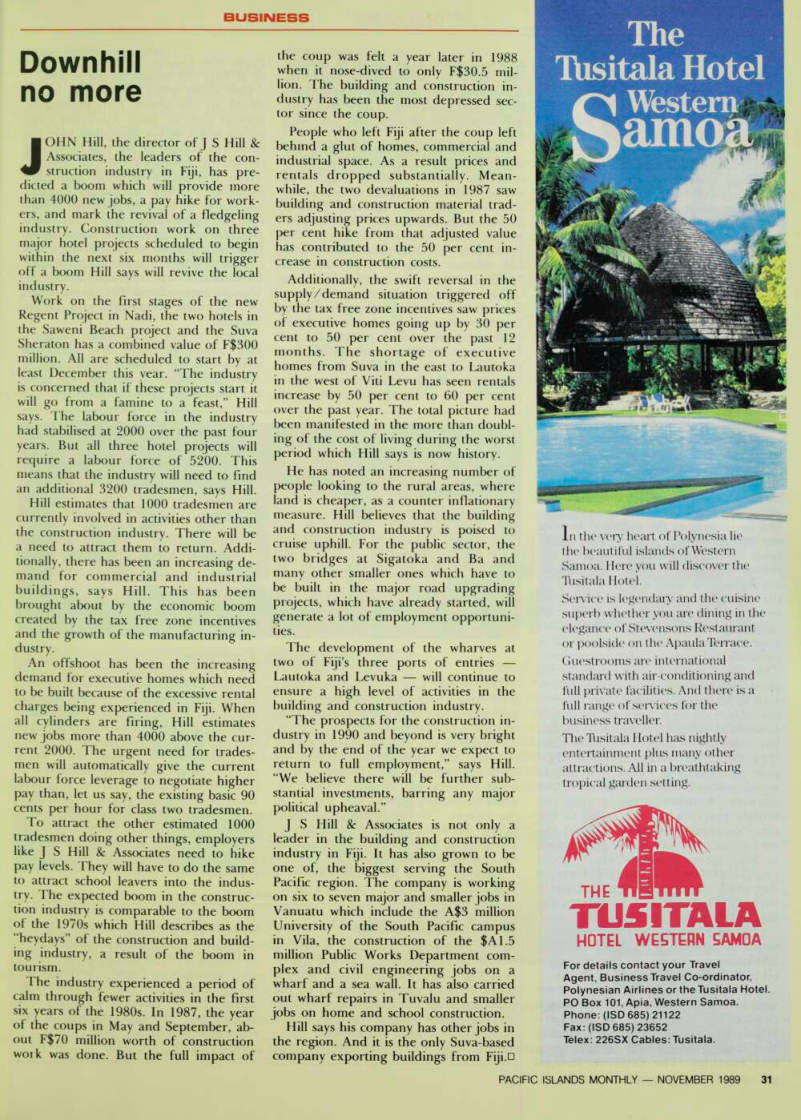
no more
JOHN Hill, the director of J S Hill Sc Associates, the leaders of the con struction industry in Fiji, has pre dicted a boom which will provide more than 4000 new jobs, a pay hike for work ers, and mark the revival of a fledgeling industry. Construction work on three
major hotel projects scheduled to begin
within the next six months will trigger off a boom Hill says will revive the local
industry.
Work on the first stages of the new Regent Project in Nadi, the two hotels in the Saweni Beach project and the Suva Sheraton has a combined value of Fs3oo million. All are scheduled to start by at least December this year. “The industry is concerned that if these projects start it will go from a famine to a feast,” Hill says. The labour force in the industry had stabilised at 2000 over the past four years. But all three hotel projects will require a labour force of 5200. This means that the industry will need to find an additional 3200 tradesmen, says Hill.
Hill estimates that 1000 tradesmen are currently involved in activities other than the construction industry. There will be a need to attract them to return. Addi tionally, there has been an increasing de mand for commercial and industrial buildings, says Hill. This has been brought about by the economic boom created by the tax free zone incentives and the growth of the manufacturing in
dustry.
An offshoot has been the increasing demand for executive homes which need to be built because of the excessive rental
charges being experienced in Fiji. When
all cylinders are firing, Hill estimates new jobs more than 4000 above the cur rent 2000. The urgent need for trades men will automatically give the current
labour force leverage to negotiate higher
pay than, let us say, the existing basic 90 cents per hour for class two tradesmen.
To attract the other estimated 1000
tradesmen doing other things, employers
like J S Hill Sc Associates need to hike pay levels. They will have to do the same to attract school leavers into the indus try. The expected boom in the construc tion industry is comparable to the boom of the 1970 s which Hill describes as the “heydays” of the construction and build ing industry, a result of the boom in tourism.
The industry experienced a period of
calm through fewer activities in the first six years of the 1980 s. In 1987, the year of the coups in May and September, ab out Fs7o million worth of construction work was done. But the full impact of
the coup was felt a year later in 1988 when it nose-dived to only F 530.5 mil lion. The building and construction in dustry has been the most depressed sec tor since the coup.
People who left Fiji after the coup left behind a glut of homes, commercial and industrial space. As a result prices and
rentals dropped substantially. Mean
while, the two devaluations in 1987 saw building and construction material trad ers adjusting prices upwards. But the 50 per cent hike from that adjusted value has contributed to the 50 per cent in crease in construction costs.
Additionally, the swift reversal in the supply/ demand situation triggered off by the tax free zone incentives saw prices of executive homes going up by 30 per cent to 50 per cent over the past 12 months. The shortage of executive homes from Suva in the east to Lautoka in the west of Viti Levu has seen rentals increase by 50 per cent to 60 per cent over the past year. The total picture had been manifested in the more than doubl ing of the cost of living during the worst period which Hill says is now history.
He has noted an increasing number of people looking to the rural areas, where land is cheaper, as a counter inflationary measure. Hill believes that the building and construction industry is poised to cruise uphill. For the public sector, the two bridges at Sigatoka and Ba and many other smaller ones which have to be built in the major road upgrading projects, which have already started, will generate a lot of employment opportuni ties.
The development of the wharves at two of Fiji’s three ports of entries Lautoka and Levuka will continue to ensure a high level of activities in the
building and construction industry.
“The prospects for the construction in dustry in 1990 and beyond is very bright and by the end of the year we expect to return to full employment,” says Hill.
“We believe there will be further sub stantial investments, barring any major
political upheaval.”
J S Hill Sc Associates is not only a leader in the building and construction industry in Fiji. It has also grown to be one of, the biggest serving the South Pacific region. The company is working on six to seven major and smaller jobs in Vanuatu which include the As 3 million University of the South Pacific campus in Vila, the construction of the SAI.S million Public Works Department com plex and civil engineering jobs on a wharf and a sea wall. It has also carried out wharf repairs in Tuvalu and smaller jobs on home and school construction.
Hill says his company has other jobs in the region. And it is the only Suva-based
company exporting buildings from Fiji.n
Advertisements & other items, p. 33 (1 item)
Tusitala
In the very heart of Polynesia lie the beautiful islands of Western Samoa. Here you will discover the Thsitala Hotel.
Service is legendary and the cuisine superb whether you are dining in the elegance of Stevensons Restaurant or poolside on the Apaula Tbrrace.
Guestrooms are international standard with air-conditioning and full private facilities. And there is a full range of services for the business traveller.
The Thsitala Hotel has nightly entertainment plus many other attractions. All in a breathtaking tropical garden setting.
THE
TUSITALA
HOTEL WESTERN SAMOA
For details contact your Travel Agent, Business Travel Co-ordinator, Polynesian Airlines or the Tusitala Hotel.
PO Box 101, Apia, Western Samoa.
Phone: (ISO 685) 21122 Fax: (ISO 685) 23652 Telex: 2265 X Cables: Tusitala.
Oil’s still
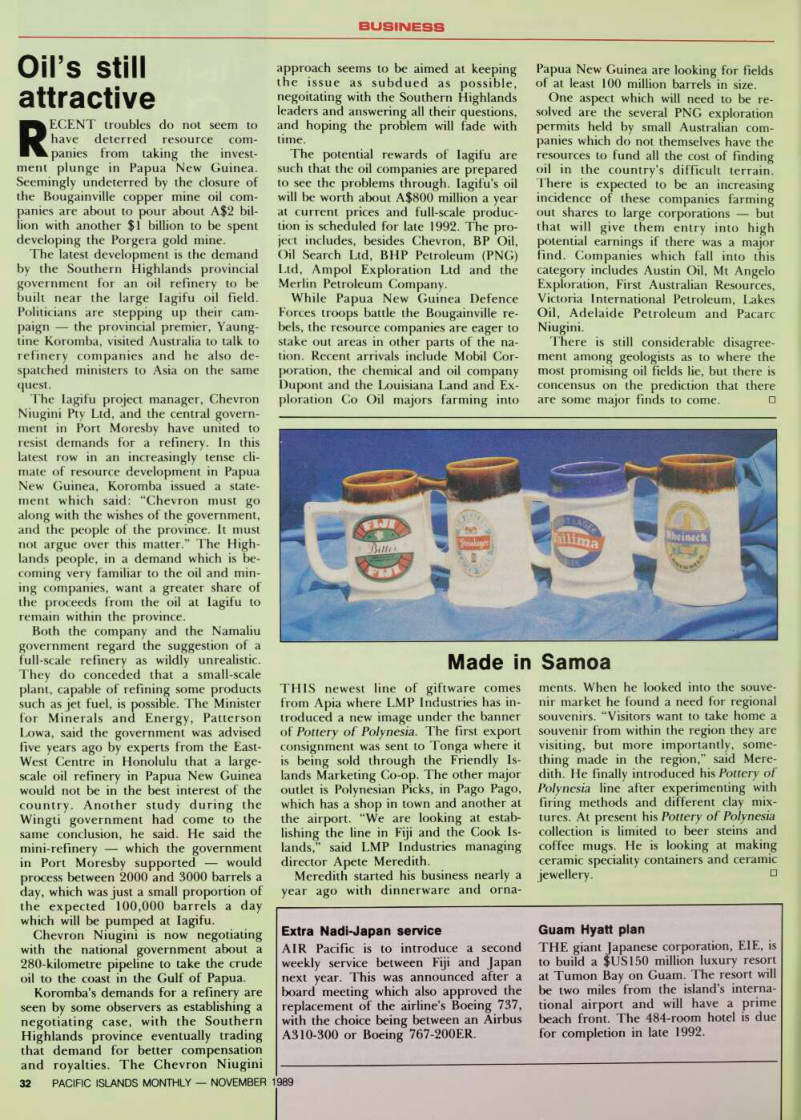
attractive
RECENT troubles do not seem to have deterred resource com panies from taking the invest ment plunge in Papua New Guinea.
Seemingly undeterred by the closure of the Bougainville copper mine oil com panies are about to pour about As 2 bil lion with another $1 billion to be spent developing the Porgera gold mine.
The latest development is the demand
by the Southern Highlands provincial
government for an oil refinery to be built near the large lagifu oil field.
Politicians are stepping up their cam paign the provincial premier, Yaung tine Koromba, visited Australia to talk to refinery companies and he also de spatched ministers to Asia on the same quest.
The lagifu project manager, Chevron Niugini Pty Ltd, and the central govern ment in Port Moresby have united to resist demands for a refinery. In this latest row in an increasingly tense cli mate of resource development in Papua New Guinea, Koromba issued a state ment which said: “Chevron must go along with the wishes of the government, and the people of the province. It must not argue over this matter.” The High lands people, in a demand which is be coming very familiar to the oil and min ing companies, want a greater share of the proceeds from the oil at lagifu to remain within the province.
Both the company and the Namaliu government regard the suggestion of a full-scale refinery as wildly unrealistic.
They do conceded that a small-scale plant, capable of refining some products such as jet fuel, is possible. The Minister for Minerals and Energy, Patterson Lowa, said the government was advised five years ago by experts from the East- West Centre in Honolulu that a large scale oil refinery in Papua New Guinea would not be in the best interest of the country. Another study during the Wingti government had come to the same conclusion, he said. He said the mini-refinery which the government in Port Moresby supported would process between 2000 and 3000 barrels a day, which was just a small proportion of the expected 100,000 barrels a day which will be pumped at lagifu.
Chevron Niugini is now negotiating with the national government about a 280-kilometre pipeline to take the crude oil to the coast in the Gulf of Papua.
Koromba’s demands for a refinery are seen by some observers as establishing a negotiating case, with the Southern
Highlands province eventually trading
that demand for better compensation and royalties. The Chevron Niugini
approach seems to be aimed at keeping the issue as subdued as possible, negoitating with the Southern Highlands leaders and answering all their questions, and hoping the problem will fade with time.
The potential rewards of lagifu are such that the oil companies are prepared to see the problems through. lagifu’s oil will be worth about AsBoo million a year at current prices and full-scale produc tion is scheduled for late 1992. The pro ject includes, besides Chevron, BP Oil, Oil Search Ltd, BHP Petroleum (PNG) Ltd, Ampol Exploration Ltd and the Merlin Petroleum Company.
While Papua New Guinea Defence Forces troops battle the Bougainville re bels, the resource companies are eager to stake out areas in other parts of the na tion. Recent arrivals include Mobil Cor poration, the chemical and oil company Dupont and the Louisiana Land and Ex
ploration Co Oil majors farming into
Papua New Guinea are looking for fields of at least 100 million barrels in size.
One aspect which will need to be re solved are the several PNG exploration permits held by small Australian com panies which do not themselves have the resources to fund all the cost of finding oil in the country’s difficult terrain.
There is expected to be an increasing incidence of these companies farming out shares to large corporations but that will give them entry into high potential earnings if there was a major find. Companies which fall into this category includes Austin Oil, Mt Angelo Exploration, First Australian Resources, Victoria International Petroleum, Lakes Oil, Adelaide Petroleum and Pacarc
Niugini.
There is still considerable disagree ment among geologists as to where the most promising oil fields lie, but there is concensus on the prediction that there are some major finds to come. □
Made in Samoa
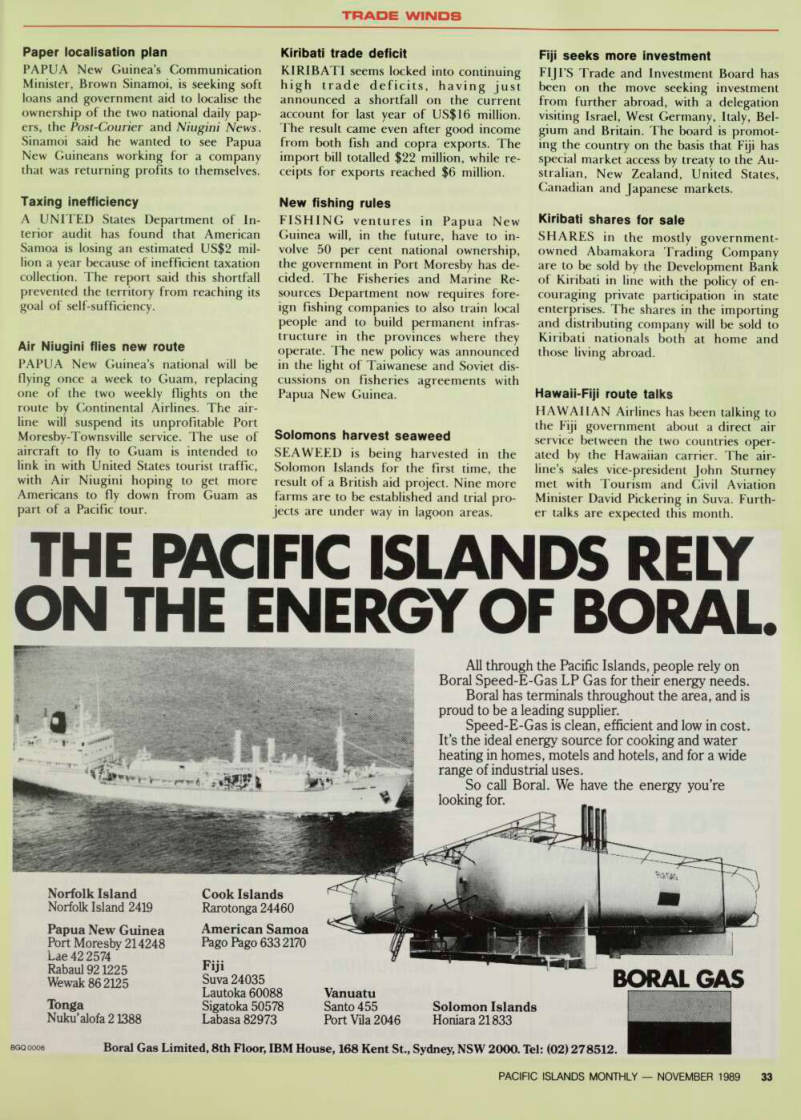
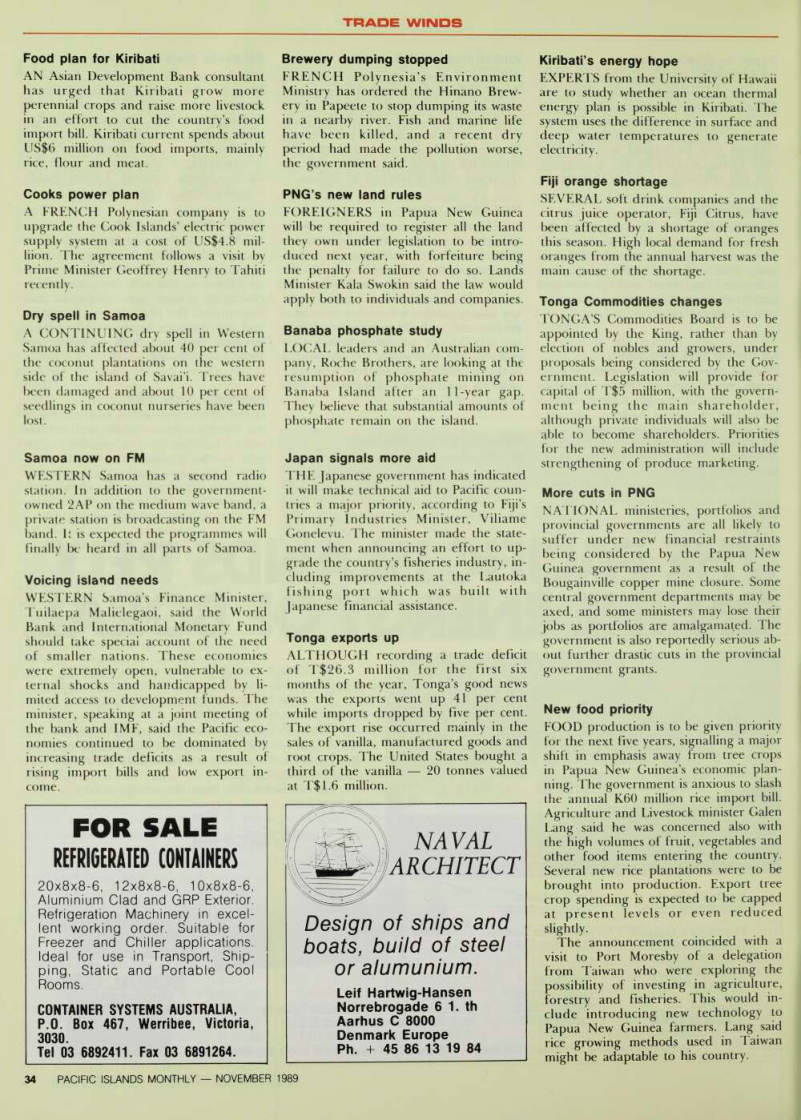
THIS newest line of giftware comes from Apia where LMP Industries has introduced a new image under the banner of Pottery of Polynesia. The first export consignment was sent to Tonga where it is being sold through the Friendly Is-
lands Marketing Co-op. The other major
outlet is Polynesian Picks, in Pago Pago, which has a shop in town and another at the airport. “We are looking at establishing the line in Fiji and the Cook Islands,” said LMP Industries managing director Apete Meredith.
Meredith started his business nearly a year ago with dinnerware and orna-
Extra Nadi-Japan service AIR Pacific is to introduce a second weekly service between Fiji and Japan next year. This was announced after a board meeting which also approved the replacement of the airline’s Boeing 737, with the choice being between an Airbus A3lO-300 or Boeing 767-200 ER.
ments. When he looked into the souve nir market he found a need for regional souvenirs. “Visitors want to take home a souvenir from within the region they are visiting, but more importantly, some thing made in the region,” said Mere dith. He finally introduced his Pottery of Polynesia line after experimenting with firing methods and different clay mix tures. At present his Pottery of Polynesia collection is limited to beer steins and coffee mugs. He is looking at making ceramic speciality containers and ceramic
jewellery. D
Guam Hyatt plan
THE giant Japanese corporation, EIE, is
to build a SUSISO million luxury resort at Tumon Bay on Guam. The resort will be two miles from the island’s interna tional airport and will have a prime beach front. The 484-room hotel is due for completion in late 1992.
Paper localisation plan PAPUA New Guinea’s Communication Minister, Brown Sinamoi, is seeking soft loans and government aid to localise the ownership of the two national daily papers, the Post-Courier and Niugini News .
Sinamoi said he wanted to see Papua New Guineans working for a company that was returning profits to themselves.
Taxing inefficiency A UNITED States Department of Interior audit has found that American Samoa is losing an estimated US$2 million a year because of inefficient taxation collection. The report said this shortfall prevented the territory from reaching its goal of self-sufficiency. ... . . ...
Air Niugini flies new route PAPUA New Guinea’s national will be flying once a week to Guam, replacing one of the two weekly flights on the route by Continental Airlines. The airline will suspend its unprofitable Port Moresby-Townsville service. The use of aircraft to fly to Guam is intended to link in with United States tourist traffic, with Air Niugini hoping to get more Americans to fly down from Guam as part of a Pacific tour.
Kiribati trade deficit KIRIBATI seems locked into continuing
high trade deficits, having just
announced a shortfall on the current account for last year of US$l6 million.
The result came even after good income from both fish and copra exports. The import bill totalled $22 million, while receipts for exports reached $6 million.
New fishing rules FISHING ventures in Papua New Guinea will, in the future, have to involve 50 per cent national ownership, the government in Port Moresby has decided. The Fisheries and Marine Resources Department now requires foreign fishing companies to also train local people and to build permanent infrastructure in the provinces where they operate. The new policy was announced in the light of Taiwanese and Soviet dis cussions on fisheries agreements with Papua New Guinea.
Solomons harvest seaweed SEAWEED is being harvested in the Solomon Islands for the first time, the result of a British aid project. Nine more farms are to be established and trial projects are under way in lagoon areas.
Fiji seeks more investment FIJI’S Trade and Investment Board has been on the move seeking investment from further abroad, with a delegation visiting Israel, West Germany, Italy, Bel gium and Britain. The board is promot ing the country on the basis that Fiji has special market access by treaty to the Au stralian, New Zealand, United States, Canadian and Japanese markets.
Kiribati shares for sale SHARES in the mostly government owned Abamakora Trading Company are to be sold by the Development Bank of Kiribati in line with the policy of en couraging private participation in state enterprises. The shares in the importing and distributing company will be sold to Kiribati nationals both at home and those living abroad.
Hawaii-Fiji route talks HAWAIIAN Airlines has been talking to the Fiji government about a direct air service between the two countries oper ated by the Hawaiian carrier. The air line’s sales vice-president John Sturney met with Tourism and Civil Aviation Minister David Pickering in Suva. Furth er talks are expected this month.
Food plan for Kiribati AN Asian Development Bank consultant has urged that Kiribati grow more perennial crops and raise more livestock in an effort to cut the country’s food import bill. Kiribati current spends about US$6 million on food imports, mainly rice, flour and meat.
Cooks power plan A FRENCH Polynesian company is to upgrade the Cook Islands’ electric power supply system at a cost of US$4.B mil liion. The agreement follows a visit by Prime Minister Geoffrey Henry to Tahiti
recently.
Dry spell in Samoa A CONTINUING dry spell in Western Samoa has affected about 40 per cent of the coconut plantations on the western side of the island of Savai’i. Trees have been damaged and about 10 per cent of seedlings in coconut nurseries have been lost.
Samoa now on FM WESTERN Samoa has a second radio station. In addition to the government owned 2AP on the medium wave band, a private station is broadcasting on the FM band. It is expected the programmes will finally be heard in all parts of Samoa.
Voicing island needs WESTERN Samoa’s Finance Minister, Tuilaepa Malielegaoi, said the World Bank and International Monetary Fund should take special account of the need of smaller nations. These economies were extremely open, vulnerable to ex ternal shocks and handicapped by li mited access to development funds. The minister, speaking at a joint meeting of the bank and IMF, said the Pacific eco nomies continued to be dominated by increasing trade deficits as a result of rising import bills and low export in come.
Brewery dumping stopped FRENCH Polynesia’s Environment Ministry has ordered the Hinano Brew ery in Papeete to stop dumping its waste in a nearby river. Fish and marine life have been killed, and a recent dry period had made the pollution worse, the government said.
PNG’s new land rules FOREIGNERS in Papua New Guinea will be required to register all the land they own under legislation to be intro duced next year, with forfeiture being the penalty for failure to do so. Lands Minister Kala Swokin said the law would apply both to individuals and companies.
Banaba phosphate study LOCAL leaders and an Australian com pany, Roche Brothers, are looking at the
resumption of phosphate mining on
Banaba Island after an 11-year gap.
They believe that substantial amounts of phosphate remain on the island.
Japan signals more aid THE Japanese government has indicated it will make technical aid to Pacific coun tries a major priority, according to Fiji’s Primary Industries Minister, Viliame Gonelevu. The minister made the state ment when announcing an effort to up grade the country’s fisheries industry, in cluding improvements at the Lautoka fishing port which was built with Japanese financial assistance.
Tonga exports up ALTHOUGH recording a trade deficit of T 526.3 million for the first six months of the year, Tonga’s good news was the exports went up 41 per cent while imports dropped by five per cent.
The export rise occurred mainly in the sales of vanilla, manufactured goods and root crops. The United States bought a third of the vanilla 20 tonnes valued at Tsl.6 million.
Kiribati’s energy hope EXPERTS from the University of Hawaii are to study whether an ocean thermal energy plan is possible in Kiribati. The system uses the difference in surface and deep water temperatures to generate
electricity.
Fiji orange shortage SEVERAL soft drink companies and the citrus Juice operator, Fiji Citrus, have been affected by a shortage of oranges this season. High local demand for fresh oranges from the annual harvest was the main cause of the shortage.
Tonga Commodities changes TONGA’S Commodities Board is to be appointed by the King, rather than by election of nobles and growers, under
proposals being considered by the Gov
ernment. Legislation will provide for capital of Tss million, with the govern ment being the main shareholder, although private individuals will also be able to become shareholders. Priorities for the new administration will include
strengthening of produce marketing.
More cuts in PNG NATIONAL ministeries, portfolios and provincial governments are all likely to suffer under new financial restraints being considered by the Papua New Guinea government as a result of the Bougainville copper mine closure. Some central government departments may be axed, and some ministers may lose their
jobs as portfolios are amalgamated. The
government is also reportedly serious ab out further drastic cuts in the provincial government grants.
New food priority FOOD production is to be given priority for the next five years, signalling a major shift in emphasis away from tree crops in Papua New Guinea’s economic plan ning. The government is anxious to slash the annual K6O million rice import bill.
Agriculture and Livestock minister Galen Lang said he was concerned also with the high volumes of fruit, vegetables and other food items entering the country.
Several new rice plantations were to be brought into production. Export tree crop spending is expected to be capped at present levels or even reduced
slightly.
The announcement coincided with a visit to Port Moresby of a delegation from Taiwan who were exploring the
possibility of investing in agriculture,
forestry and fisheries. This would in clude introducing new technology to Papua New Guinea farmers. Lang said rice growing methods used in Taiwan might be adaptable to his country.
Advertisements & other items, pp. 35-36 (1 item)
On The Energy Of Boral
THE PACIFIC ISLANDS RELY
3 I » % I :t> : Cook Islands Rarotonga 24460 All through the Pacific Islands, people rely on Boral Speed-E-Gas LP Gas for their energy needs.
Boral has terminals throughout the area, and is proud to be a leading supplier.
Speed-E-Gas is clean, efficient and low in cost.
It’s the ideal energy source for cooking and water heating in homes, motels and hotels, and for a wide range of industrial uses.
So call Boral. We have the energy you’re looking for.
Norfolk Island Norfolk Island 2419 Papua New Guinea Port Moresby 214248 Lae 422574 Rabaul 921225 Wewak 86 2125 Tonga Nukualofa 21388 American Samoa Pago Pago 633 2170 Fiji Suva 24035 Lautoka 60088 Sigatoka 50578 Labasa 82973 Vanuatu Santo 455 Port Vila 2046
BORAL GAS
Solomon Islands Honiara 21833 Boral Gas Limited, Bth Floor, IBM House, 168 Kent St., Sydney, NSW 2000. Tel: (02) 278512.
NAVAL
ARCHITECT
Design of ships and boats, build of steel or alumunium.
Leif Hartwig-Hansen Norrebrogade 6 1. th Aarhus C 8000 Denmark Europe Ph. + 45 86 13 19 84
FOR SALE
REFRIGERATED CONTAINERS
20x8x8-6, 12x8x8-6, 10x8x8-6, Aluminium Clad and GRP Exterior.
Refrigeration Machinery in excellent working order. Suitable for Freezer and Chiller applications.
Ideal for use in Transport, Shipping, Static and Portable Cool Rooms.
CONTAINER SYSTEMS AUSTRALIA,
P.O. Box 467, Werribee, Victoria, 3030.
Tel 03 6892411. Fax 03 6891264.
Steamships
profits up
THE Papua New Guinea-based Steamships Trading Co Ltd has reported an increase in pre-tax operating profit of 26.4 per cent for the year ended June 30, 1989. This brought pre-tax profit for the freight and con struction company to KlO.l million, compared with K 8 million the previous year.
Sales for the year K 166.9 million were considerably down on last year’s total of K 195.1 million due to a change in the method of accounting for the tur nover of the Papua New Guinea Ship
ping Corporation joint service between
Australia and PNG, and the transfer of the group’s Papua New Guinea mer chandising operations to an associated joint venture company. The tax provi sion was K 2.3 million, which was a con siderable increase on the previous K 758,000. The company paid K 2.52 mil lion in interest and allowed K 8.06 mil lion for depreciation.
The directors said they were particu larly pleased with the operations of the building products and services division, with the results vindicating the com pany’s decision to stay in these fields de spite unsatisfactory returns in the past.
They said the present high level of con struction activity in Papua New Guinea should ensure good earnings in the cur rent year.
The company said the upgrading of hotels which began at the Melanesian Hotel in Lae would be continued, with contracts recently having been let for up grades and extensions to the Gateway Hotel in Port Moresby and Highlander Hotel in Mount Hagen.
Strong competition, in Port Moresby
particularly, had led to lower margins for the group’s retail operations. But the Windward apartment complex on Ela Beach was fully let and providing a satis
factory return.
During the year, Steamships received a second new ship for carrying copper concentrate from Kiunga to the mouth of the Fly River. In other parts of the
company’s shipping operations, the
directors noted that severe competition on the Australian-Papua New Guinea trade had caused freight rates to be de pressed to an uneconomic level. The re port said two companies had been forced into receivership as a result.
The continued expansion of Colgate Palmolive (PNG) Pty Ltd and the in creased use of locally-produced palm oil had enabled Steamships to substantially lift output, and during the year the com
pany began exporting glycerine.
Since the end of the financial year, the company has signed a deal whereby its steel division will be managed by Trans field Corporation, a move the directors say will enable Steamships to increase its
participation in development of major
resource projects. But they warned that company profits could be affected if the Bougainville crisis continued as that situation would be bound to affect gov ernment revenue and internal spending.
Directors have agreed to pay a final dividend of 8.25 toea per share, making a total dividend for the year of 13.5 toea. □
Sinking feeling
WHILE American Samoa is trying to get rid of two of the three ships it acquired in 1987 as Federal surplus from the Un ited States, its congressman in Washing ton, Faleomavaega Eni Hunkin, is trying to get another one. Of the three ships brought to Pagopago in 1987, one has been given to the local chapter of the navy league while the procurement office is hoping to sell the other two.
The vessels a 50-foot landing craft, a whaler and a ski boat were given free by the General Administration Office. The Government of American Samoa had to pay U 5534,000 to have them shipped to Pagopago in 1987.
They were to have been used for port operations but American Samoa’s chief procurement officer, Paul Felise, said the ships were “wrecks”.
Meanwhile Hunkin’s efforts to bring in another surplus ship is not being ack nowledged in Pagopago. Hunkin said the ship is needed to service Manua Is land 1,200 km east of Pagopago. Reid, who is also Port Director, said his office knew nothing of Hunkin’s efforts. He said Manua is serviced twice a week by the ship Talimana’o without any delay.
Strike spoiled Niue party
NIUE’S transport woes continued last month when the long-running port strike in New Zealand took some of the fizz out of the island’s 15th birthday celebrations. Niue’s merchants had ordered about 450 tonnes of extra food and drink to cater for the 2000 partygoers celebrating the anniversary of
Niue achieving self-government. But
loading delays caused by the strike
meant the party fare was still stuck on the wharves at Auckland. And the tiny island was also running out of some basic supplies because the monthly Cook
Islands National Line (CINL) service was late.
CINL director Don Pratt said the nor mal 28-day round-trip had been stretch ed out to at least 40 days by the strike, brought on when unions and employers failed to agree on a national award to cover the restructuring of port manage ment. Pratt spent several weeks fielding frantic telephone calls from Niue while trying to calm about 200 angry Niueans living in Auckland whose incoming taro consignments had rotted on the wharves during the strike. □
Advertisements & other items, p. 37 (1 item)
Fiji Custom Craft Limited
non
ALUMINIUM BOAT BUILDERS
WAILADA, LAMI,
P.O. Box 1277, SUVA, FIJI.
PHONE 361977, 361786.
TLX. FJ 2315. FAX 302814
FISHING BOATS, HYDROCATS, WATER TAXIS, CORAL VIEWERS, BARGES, SPECIALISED VESSELS
CUSTOMISED TO YOUR SPECIFICATIONS
Schedules
Australia New Caledonia
Fiji Hawaii North
America
Pace Line (ACTA Shipping) operates a fully containerised service every 17 days from Melbourne, Sydney and Brisbane to Noumea, Suva and Lautoka. The vessels continue on to the North coast of America, calling at Hawaii at frequent intervals.
Contact: ACTA Pty Ltd. Sydney (266 0633); Tlx AA121369; Fax 267 1148; Burns Philp (SS) Co Ltd, Rodwell Road, Suva (311 777); Tlx FJ2168; Fax 301 127; Burns Philp (SS) Co Ltd, Lautoka (60 777); Sato SA, Avenue James Cook BPC 2, Noumea, Cedex (281 122); Tlx 3163 NM GATO. Fax 276 532.
Sofrana Unilines operated a Roßo/container service every three weeks from Melbourne, Sydney and Brisbane to Noumea, Suva and Lautoka. Vessels continue (as PAD Line) to the US West coast. Contact; Sofrana-Unilines (Aust) Pty Ltd., Sydney. Tel. 264 8944; Telex AA170090; Fax 267 6547. Sofrana Unilines, Noumea Tel 275191; Telex NM3048; Fax 272611. Wiltrans Agency, Melbourne Tel (03) 6144788; Telex AA30163; Fax (03) 6145909. Wiltrans Agency, Melbourne Tel (03) 6144788 Telex AA30163 Fax (03) 6145909. Wiltrans Agency, Brisbane Tel
(07) 8541855 Telex AA40712 Fax (07) 2524953. Carpenters Shipping, Suva.
Tel 25141 Telex FJ2IBB Fax 301572.
Australia Samoas Tonga
Warner Pacific Lines operates a regular container service from Sydney, Brisbane and Melbourne to Nukualofa, Pago Pago, Apia and Vava’u with transhipment to Rarotonga. Contact: Hetherington Westfarmers Shipping Agency, 37-49 Pitt St, Sydney (223 1600).
Australia New Caledonia
Fiji Samoas Tonga
Pacific Forum Line operates a fully containerised service (general, reefer and ro-ro) from Sydney to Noumea, Lautoka, Suva, Apia, Pago Pago, Nukualofa, Sydney. Cargo centralised from Adelaide, Melbourne, Brisbane. Contact: Pacific Forum Line, PO Box 796, Auckland: Union Bulkships, 333 George St, Sydney, Brisbane and Melbourne: Union Co, Lautoka; Pacific Forum Line, Suva, Nuku’alofa; Pacific Forum Line, Apia; Polynesia Shipping, Pago Pago.
Sofrana Unilines operated a Roßo/container service every three weeks from Melbourne, Sydney and Brisbane to Noumea, Suva and Lautoka with transhipment to the Samoas and Tonga.
For details see above.
Australia Norfolk Island Lord Howe Island Sofrana-Unilines (Australia) Pty Ltd operates a regular monthly service with MV Capitaine Wallis. Contact: Sofrana-Unilines, Sydney (02) 2648944; Telex AA170090 Fax 2676547.
Australia New Caledonia Vanuatu Campagnie Generale Maritime operates a monthly service from Sydney, Melbourne and Brisbane to Noumea, Port Vila and Santo, for containerised and break-bulk cargo. Contact: Compagnie Generale Maritime 12 Castlereagh St, Sydney (231 3700).
Australia Nauru Nauru Pacific Line operates a regular cargo service from Melbourne to Nauru, passenger service to Nauru only. Contact: Nauru Pacific Line (Aust) Pty Ltd, Nauru House, 80 Collins St, Melbourne (653 5709), Nedlloyd Swire, 8 Spring St, Sydney, (20 522).
Australia Solomon Islands Vanuatu NGAL/PNGL joint service operates a monthly service. Contact: Nedlloyd Swire Pty Ltd, 6 Spring St, Sydney (20 522).
Australia New Zealand The Australian National Lines oper ates the Tranztas container service be tween Australia and New Zealand, offering access to five vessels, These vessels call at Melbourne, Sydney, Bris bane (Tasmania, Adelaide and Freman tle via feeder services) in Australia and Auckland, Wellington, Lyttelton, Port Chalmers, Nelson, Tauranga (Napier via feeder service) in New Zealand. Each vessel operates on an approximate three-weekly round voyage schedule.
Australia NZ Fiji Vanuatu New Caledonia Solomons New Guinea Sitmar Cruises operates a year-round cruise programme from Sydney to include the better-known ports in the above countries plus a number of unspoilt, and largely unknown, island paradises. Contact: Sitmar Cruises, 39 Martin Place, Sydney (239 9000) for NSW; reservations and inquiries (008 42 2277); rest of Australia, reservations and enquiries (088 22 2277).
Australia NZ Fiji Tonga
Vanuatu New Caledonia Solomons Samoas Tahiti P&O Liners call at Auckland, Bay of Islands, Honiara, Lautoka, Noumea, Nukualofa, Pago Pago, Papeete, Port Moresby, Santo, Savusavu, Suva, Vava’u
and Vila on cruises from Australia.
Contact: P&O Booking Centre, Thomas Cook Pty Ltd, 33 Bligh St, Sydney (237 0333).
Australia PNG Solomons Vanuatu A consortium of NGAL/PNG and CONPAC has four vessels operating a joint service from east coast Australian ports to Port Moresby, Lae, Alotau, Madang, Wewak, Rabaul, Kavieng-Kimbe, Kieta, Honiara, Vila, Santo. Contact: Burns Philp & Co Ltd, PO Box R 124, Royal Exchange, Sydney (20 547); Nedlloyd Swire, 8 Spring St, Sydney (20 522); New Guinea Express Lines, 37 Pitt St, Sydney (241 3991); Vila Agents, PO Box 27, Port Vila (2456), Tlx
Nhioii.
Australia Kiribati CCS operates a 6 weekly service from Melbourne, Sydney and Brisbane to Kiribati (Tarawa). Contact: Chief Container Service, 8 Spring Street, Sydney (251-2699) Fax 251-2271.
Australia Tuvalu CCS operates a direct service every second voyage to Tuvalu (Funafuti).
Contact: Chief Container Service, 8 Spring Street, Sydney (251-2699) Fax 251-2271.
Australia New Caledonia
Vanuatu CCS operates a monthly service from Melbourne, Sydney and Brisbane to Noumea, Vila and Santo. Contact: Chief Container Service, 8 Spring Street, Sydney (251-2699) Fax 251-2271.
Australia Solomons
Vanuatu
CCS operates a monthly service from Melbourne, Sydney and Brisbane to Honiara, Vila and Santo. Contact: Chief Container Service, 8 Spring Street, Sydney (251-2699) Fax 251-2271.
Europe Tahiti New
Caledonia Vanuatu
The Bank Line and Columbus Line operate a regular joint cargo service from Hamburg, Bramen, Antwerp, Rotterdam and Le Havre to Papeete, Noumea, Port Vila and Santo. Contact: The Bank Line (A’asia) Pty Ltd, 53 Martin Place, Sydney (223 6255), Tlx AA24063; Columbus Line, Lae (423 466), Tlx NE44171; Ets A M. Fare UTE, Papeete; Ets Ballande, Noumea and other local agents.
Sofrana Europe Australia Line “Sofeal” operates a regular three-weekly service from North European ports including Felixstowe to Papeete from Noumea.
Contact: from McArthur Shipping Agency Co Pty Ltd., Tel (02) 5502222 Telex AA24045 Fax 5191382.
Europe PNG Solomons
The Bank Line & Columbus Line operate a regular joint cargo service from Hamburg, Bramen, Antwerp, Rotterdam and Le Havre to Port Moresby, Lae, Madang, Kimbe, Rabaul, Kieta and Honiara and on inducement to Yandina. Contact: The Bank Line {A’asia) Pty Ltd, 51 Pitt St, Sydney (251 6688). Tlx; AA24066, Columbus Line, Lae (423466) Tlx; NE44171; or lines’ local agents.
Rarotonga Line operates regular services to Tonga and the Samoas from New Zealand. Contact Sofrana Unilines (NZ) Ltd Tel (09) 773279 Telex NZ2313 Fax (09) 393874.
Europe W. Samoa Tonga
- Fiji
The Bank Line & Columbus Line operate a regular joint cargo service from Hamburg, Breman, Antwerp, Rotterdam and Le Havre to Apia, Nukualofa, Suva and Lautoka. Contact: The Bank Line (A’asia) Pty Ltd, 53 Martin Place, Sydney (223 6255), Tlx AA24063; Columbus Line, Lae (423 466), Tlx NE44171; or lines’ local agents.
Singapore Hong Kong Fiji
Islands ports
Kyowa Shipping Co Ltd operates a monthly containerised and break-bulk cargo service from Hong Kong to Lautoka, Suva and then to island ports. Contact: Carpenters Shipping, Private Mail Bag, GPO Suva, Fiji (31 2244); Fax: (679) 301 572. Tlx FJ2199.
Far East Fiji New Zealand New Zealand Unit Express (NZUE) operates a monthly service accepting containerised and break-bulk cargo from Manila, Keelung, Kaohsiung and Hong Kong to Lautoka, Suva and thence to New Zealand ports. Contact: Carpenters Shipping, Private Mail Bag, GPO Suva, Fiji (312 2244), Fax; (679) 311 572; Tlx FJ2199; Burns Philp, Suva (311 777); New Zealand Unit Express, Maritime Building, 2-10 Customhouse Quay, PO Box 890, Wellington (727 865), Cables ENZUEMAN
Wellington, Tlx Nz31340, Nedlnz, Or
Nedlloyd Swire Pty Ltd, Sydney (20 522).
Far East Mid South Pacific China Navigation’s New Guinea Pacific Line operates a regular container and Break Bulk-Heavy Lift service from Hong Kong, Taiwan, Manila, Singapore, Malaysia, Thailand to Port Moresby, Lae, Rabaul, Kieta and Honiara with 18 days frequency.
Wewak and Madang will receive four direct calls a year or more on inducement. A T/service via Lae to these and other PNG ports connecting with monthly sailings is available at cost. Cargo from the same Eastern ports to the South Pacific ports of
Noumea, Santo, Vila, Papeete, Pago Pago, Apia, Nukualofa, Rarotonga and Tarawa will be shipped via Japan or Busan on the monthly Bali Hai service. Contact Steamships Shipping, PO Box 634, Port Moresby (220 283 or 220 289).
Kyowa Shipping Ltd operates monthly services from Japan to Guam, Saipan, Solomons, New Caledonia, Fiji, Western and American Samoa, Tahiti, Cook Islands, Tonga and Vanuatu. Contact: Hetherington Wesfarmers Shipping Agency, 37-49 Pitt St, Sydney (223 1600); Carpenters Shipping, Suva (312 244), Tlx FJ2199.
Guam Northern Marianas Saipan Shipping Co operates a weekly service via barge carrying containers and conventional cargo between Guam and Saipan and Tinian. Contact: Saipan Shipping Co. Inc, PO Box 8, Saipan CM 96950 (322 9706 or 322 9707). Tlx 783619; Fax (670) 322 3183; Guam agents Maritime Agencies of the Pacific Ltd.
Hawaii Samoas Tonga Cook Islands Hawaii-Pacific Line operates a monthly container service between Honolulu, Pago Pago, Apia, Nukualofa and Avatiu (Rarotonga). Contact; Hawaii-Pacific Maritime, Inc., PO Box 3264, Honolulu HI (9680)-32641 (808 531 4841) Morris Hedstrom Samoa Ltd, PO Box 189, Apia, Western Samoa (21 355, 22 722) Tlx 224 MORISHED SX), Fax 24 279; Union Citco Travel Ltd, Rarotonga, Cook Islands (682)21 780); Tlx 62024 (UTRAV G); Fax (682) 20 859; Kneubuhl Maritime Services, PO Box 39, Pago Pago, American Samoa 96799, (684 633 5121); Tlx 782505; Fax (684) 633 5100; Union Maritime Services Ltd, PO Box 4 Nukualofa, Tonga (21 644/5); Tlx 6627, Fax (676) 21 645.
Japan Fiji Island Ports
Kyowa Shipping Coperates a monthly containerised service from main ports of Japan to Suva, Lautoka, thence to island ports. Contact: Carpenters Shipping, Neptune House, 3/4 Floor, Tofua St, Walu Bay, Suva (31 2244); Fax (679) 301 572 Tlx FJ2199.
Japan Micronesia
The NYK Shipping Line operates a monthly cargo service from Japan to Micronesia, calling at Yoko, Nagoya, Kobe, Guam, Saipan, Truk, Ponape and Majuro, returning via Yoko, Nagoya and Kobe.
Contact: Burns Philp & Co Ltd, 51 Pitt St Sydney (259 1000).
Saipan Shipping Co operates a monthly service from Japan to Saipan, Guam, Truk, Ponape, Majuro (Kosrae and Ebeye on inducement). Contact; Saipan Shipping Co, PO Box 8, Saipan, CM 96960 (322 9706 or 322 9707). Tlx 783619, Fax (670) 322 3183.
Japan agents; Kyowa Shipping Company Ltd; Guam Agents: Maritime Agencies of the Pacific Ltd.
Japan Korea PNG Paradise Service Mitsui OSK Lines in joint service with NYK Lines operates a monthly service from main ports in Japan and Busan in Korea to PNG ports of Wewak, Rabaul, Kieta, Lae, Port Moresby, Kavieng, Kimbe, Madang and Oro Bay. Contact: Robert Laurie Company Pty Ltd, PO Box 1032, Lae (direct: 423 642 or a switch: 423 811).
Contact W O Hackenberg, Group Shipping Manager & Marketing; Tlx NE 42508 Fax 423 801.
Japan Korea Fiji Island
Ports Bali Hai Service operates a monthly and general cargo and vehicle service from main Japanes ports and Korea to Suva, Lautoka, Apia, Pago Pago, Papeete, Nukualofa, Noumea, Vila, Santo and Honiara. Contact: John Swire and Sons (Japan) Ltd, 14 Ichibancho, Chiyoda-ku, Tokyo (03) 230 9220; Tlx J 22248, Fax (03) 230 9288.
PNG Inter-Mainport
Papua New Guinea Lines offers scheduled 10-20 day coastal liner services linking all PNG major ports with containerisation, reefer, heavy lift and trans-shipment facilities. Contact; PNG Line, Box 543, Port Moresby (211 174), Tlx 22269.
PNG Taiwan Hong Kong
Singapore Indonesia
The Bank Line & Columbus Line operates a regular joint cargo service from PNG Ports to Kaohsiung. Hong Kong, Singapore, Jakarta & Surabaya. Contact: The Bank Line (A’asia) Pty Ltd, 51 Pitt St, Sydney (251 6688); Tlx AA24063; Columbus Line, Lae (423 466); Tlx NE44171; or lines’ local agents.
PNG UK/Continent The Bank Line and Columbus Line operate a regular joint service from Port Moresby, Oro Bay, Kieta, Rabaul, Kimbe, Madang and Lae to Hull, Hamburg, Rotterdam, Antwerp and Le Havre. Contact The Bank Line (A’asia) Pty Ltd, 53 Martin Place, Sydney (223 6255), Tlx AA24063; Columbus Line, Lae (423 466), Tlx NE44171; or lines’ local agents.
Solomons UK/Continent The Bank Line and Columbus Line operate a regular joint cargo service from Honiara to Hull, Hamburg, Rotterdam, Antwerp and Le Havre. Contact: The Bank Line (A’asia) Pty Ltd, 53 Martin Place, Sydney (223 6255), Tlx AA24063; Columbus Line, Lae (423 466), Tlx NE44171; or lines’ local agents.
Hyundai Merchant Marine Co operates a
regular three-weekly service from PNG ports to Northern European ports, including Felixtowe. Contact: McArthur Shipping Agency Co. Pty Ltd; Tel. Sydney (02) 5502222 Telex AA24045 Fax (02) 519 1382 or from local PNG agents.
New Zealand Australia PNG Solomon Islands Pacific Forum Line operates a containerised and ro-ro service from Lyttleton, Napier and Auckland to Brisbane, Port Moresby, Lae, Honiara, Brisbane then to New Zealand. Contact; Pacific Forum, Auckland, Christchurch; Union Bulkships, Brisbane; Steamships Shipping, Port Moresby and Lae Sullivan Ltd, Honiara; Seabridge, Wellington.
New Zealand Cook Islands Tahiti New Zealand Line operates cargo services based on pallets and similar units from Auckland to Cook Islands and Tahiti.
Contact; NZ Shipping Agencies International Ltd, PO Box 3420, Auckland (392 650), Waterfront Commission, PO Box 61, Rarotonga, Cook Islands; Shipping Office, Govt of Niue, PO Box 107, Niue Island; Compagnie Maritime Polynesienne, PO Box 36, Papeete, Tahiti.
New Zealand Fiji Pacific Line with one ship operates a three-weekly ro-ro cargo service New Zealand, Lautoka, Suva. No passengers.
Contact: Sofrana Unilines, (773 279); PO Box 3614, Tlx NZ2313, Carpenters Shipping, Neptune House, Tofua St, Walu Bay, Suva (25 141), Tlx FJ2199.
New Zealand Fiji North
America (WC)
Blue Star Line Ltd Pacific Coast container services: only direct service to and from New Zealand. Blue Star vessels call at Suva and Honolulu on NZ-US West Coast voyages. Contact: Blueport ACT (NZ) Ltd, PO Box 192, Wellington (739 029); Burns Philp (SS) Co Ltd, GPO Box 355, Suva (311 777), Tlx FJ2168 Burnship.
Pacific Forum Line operates a containerised and ro-ro 21 day service from Auckland to Lautoka, Suva, Apia, Pago Pago and Nukualofa. Contact: Pacific Forum Line, Auckland, Christchurch, Suva and Apia, Union Maritime, Lautoka, and Nukualofa, Polynesian Shipping, Pago Pago.
New Zealand Tonga Samoas Warner Pacific Line Services from Auckland to Nukualofa, Vava’u, Apia, Pago Pago monthly carrying general and freezer cargoes and FCL Dry Freezer. Contact: McKay Shipping Ltd, 2nd Floor, Ferry Bldg, Quay St., Auckland PO Box 3 (390 229).
Cables MACSHIP, Tlx NZ25541; Warner Pacific Line, Box 93, Nukualofa, Tonga; Mealelel (Western Samoa Ltd), Private Bag, Apia, Western Samoa; Burns Philp (SS) Co Ltd, PO Box 129, Pago Pago, American Samoa (633 2709), Burnsouth SB.
Rarotonga Line operates regular services to Tonga and the Samoas from New Zealand. Contact: Sofrana Unilines (NZ) Ltd. Tel (09) 773279 Telex NZ2313 Fax (09) 393874.
NZ Cook Islands Aitutaki Niue Cook Islands Line services Auckland, Rarotonga, Aitutaki, Niue monthly carrying general and freezer cargoes. Contact: McKay Shipping Ltd, 2nd Floor, Ferry Bldg, Quay St, Auckland/PO Box 3, Auckland (390 229). Cables: MACSHIP, Tlx NZ2554; Fax 32 931.
Rarotonga Line operates regular services to Tonga and the Samoas from New Zealand. Contact: Sofrana Unilines (NZ) Ltd, Tel. (09) 773279 Telex NZ2313 Fax (09) 393874.
Southeast Asia Fiji Nedlloyd Lines (NZEAS) Service operates regular fast cargo service from Surabaya, Jakarta, Port Kelang, Bangkok and Singapore via New Zealand to Suva and Lautoka. Contact; Carpenters Shipping, Neptune House, 3/4 Floor, Tofua St., Walu Bay, Suva (312 244). Fax; (679) 301 572.
Tlx; FJ2199.
Tahiti New Caledonia Vanuatu Solomon Islands New Zealand PNG
Singapore Europe
Polish Ocean Lines operates semi-container type vessels to the following ports; from Papeete, Noumea, Santo, Vila, Yandina, Honiara, Auckland, Singapore, Port Kielang, Penang then to Mediterranean ports and Europe via the Suez canal (other New Zealand ports subject to inducement). Contact; Universal Shipping Agencies Ltd, 7th Floor, 14 Emily PI, Auckland 1 (390 931, 390 727, 32 104), Tlx 21 517.
Europe Tahiti W Samoa Fiji New Caledonia Compagnie Generale Maritime operates services from Europe and Mediterranean ports to Papeete and Noumea using three ro-ro and multi-purpose vessels thus ensuring a bi-monthly sailing to and from.
Contact: Compagnie Generale Maritime, 12 Castlereagh St, Sydney (231 3700).
Sofrana Europe Australia Line operates a three-weekly cargo service from Continental ports, including Felixtowe, to Papeete and Noumea. Contact McArthur Shipping Agency Co Pty Ltd Sydney. Tel (02) 5502222 Telex AA24045 Fax (02) 5191382.
Advertisements & other items, pp. 38-41 (1 item)
Co., Ltd.
KYOWA
KYOWA
SHIPPING
CO., LTD.
Liner Service to Paciffic Islands
FROM OJAPAN
OKOREA
©TAIWAN
©THAILAND
TO ©SAIPAN
©FEDERATED STATES
OF MICRONESIA
©MARSHAL ISLANDS
©AMERICAN SAMOA
©NEW CALEDONIA
©FIJI
©HONG KONG
©SINGAPORE
©PHILIPPINES
©MALAYSIA
©INDONESIA
©GUAM
©YAP
©PALAU
©WESTERN SAMOA
©SOLOMON ISLANDS
©VANUATU
©PAPUA NEW GUINEA
HEAD OFFICE:
6th Floor., Kikushima Bldg . 2-3, Hamamatsucho 2-chome, Mmato-ku, Tokyo 105, Japan Phone: 03(437)2885 (Rep ) Cables: "MARIQUEEN 1 ' Tokyo Telex: 242-4651 Kyowa J
OSAKA OFFICE:
Dai San Fuji Bldg., 3-13, Itachibori 1-chome, Osaka 550.
Phone: 06(533)5821 (Rep.) Cables: "MARIQUEEN" Osaka Telex: 525-6271 Ssiosa J.
BANK LINE and
COLUMBUS LINE
24 day service to
Europe.
Need we say more...
G The Joint Service Partners offer facilities for shipment of: Containers (FCL/LCL) and Break-bulk Cargo plus reefer space and deeptanks for carriage of vegetable oils and other liquid bulk cargo.
Carriers also accept heavy lifts, overlength and cumbersome parcels.
Ports of Service: Loading: Papeete, Apia, Suva, Lautoka, Noumea, Port Vila, Santo, Honiara, Port Moresby, Lae, Madang, Kimbe, Rabaul, Kieta, Darwin. For: Rotterdam, Antwerp, Hamburg, Hull, Dunkirk, Le Havre.
Additional ports on enquiry.
Please contact our regional offices for further information: The Bank Line (Australasia) Pty Ltd Columbus Line Reederei GmbH Suite 701, 51 Pitt St, P.O. Box 1667, Lae/Papua New Guinea.
Sydney, NSW, Australia 2000 Phone: 423466/423487/AH. 422481 Phone 251 6688 Telex 24063 Telex: Colline N E 441 71 The South Pacific Specialists for over 75 years
called Hope
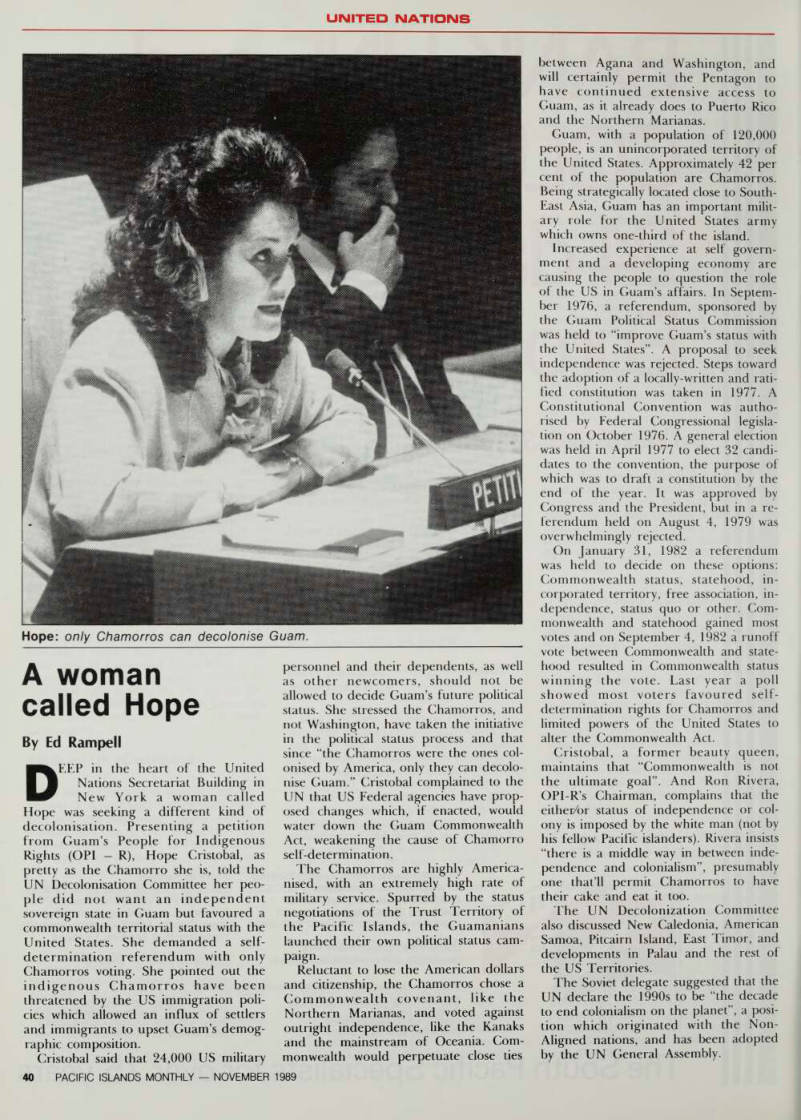
United Nations
A woman called Hope
By Ed Ram pell
DEEP in the heart of the United Nations Secretariat Building in New York a woman called Hope was seeking a different kind of
decolonisation. Presenting a petition
from Guam’s People for Indigenous Rights (OPI — R), Hope Cristobal, as pretty as the Chamorro she is, told the UN Decolonisation Committee her peo ple did not want an independent sovereign state in Guam but favoured a commonwealth territorial status with the United States. She demanded a self determination referendum with only Chamorros voting. She pointed out the indigenous Chamorros have been threatened by the US immigration poli cies which allowed an influx of settlers and immigrants to upset Guam’s demog
raphic composition.
Cristobal said that 24,000 US military
personnel and their dependents, as well as other newcomers, should not be allowed to decide Guam’s future political status. She stressed the Chamorros, and not Washington, have taken the initiative in the political status process and that since “the Chamorros were the ones col onised by America, only they can decolo nise Guam.” Cristobal complained to the UN that US Federal agencies have prop osed changes which, if enacted, would water down the Guam Commonwealth Act, weakening the cause of Chamorro self-determination.
The Chamorros are highly America nised, with an extremely high rate of
military service. Spurred by the status
negotiations of the Trust Territory of the Pacific Islands, the Guamanians launched their own political status cam
paign.
Reluctant to lose the American dollars and citizenship, the Chamorros chose a Commonwealth covenant, like the Northern Marianas, and voted against outright independence, like the Kanaks and the mainstream of Oceania. Com monwealth would perpetuate close ties
between Agana and Washington, and will certainly permit the Pentagon to have continued extensive access to Guam, as it already does to Puerto Rico and the Northern Marianas.
Guam, with a population of 120,000
people, is an unincorporated territory of
the United States. Approximately 42 per cent of the population are Chamorros.
Being strategically located close to South- East Asia, Guam has an important milit ary role for the United States army which owns one-third of the island.
Increased experience at self govern ment and a developing economy are causing the people to question the role of the US in Guam’s affairs. In Septem ber 1976, a referendum, sponsored by the Guam Political Status Commission was held to “improve Guam’s status with the United States”. A proposal to seek
independence was rejected. Steps toward
the adoption of a locally-written and rati fied constitution was taken in 1977. A Constitutional Convention was autho
rised by Federal Congressional legisla
tion on October 1976. A general election was held in April 1977 to elect 32 candi dates to the convention, the purpose of which was to draft a constitution by the end of the year. It was approved by Congress and the President, but in a re ferendum held on August 4, 1979 was
overwhelmingly rejected.
On January 31, 1982 a referendum was held to decide on these options: Commonwealth status, statehood, in corporated territory, free association, in dependence, status quo or other. Com monwealth and statehood gained most votes and on September 4, 1982 a runoff vote between Commonwealth and state hood resulted in Commonwealth status winning the vote. Last year a poll showed most voters favoured self determination rights for Chamorros and limited powers of the United States to alter the Commonwealth Act.
Cristobal, a former beauty queen, maintains that “Commonwealth is not the ultimate goal”. And Ron Rivera, OPI-R’s Chairman, complains that the eithei/or status of independence or col ony is imposed by the white man (not by his fellow Pacific islanders). Rivera insists “there is a middle way in between inde
pendence and colonialism”, presumably
one that’ll permit Chamorros to have their cake and eat it too.
The UN Decolonization Committee also discussed New Caledonia, American Samoa, Pitcairn Island, East Timor, and developments in Palau and the rest of the US Territories.
The Soviet delegate suggested that the UN declare the 1990 s to be “the decade to end colonialism on the planet”, a posi tion which originated with the Non- Aligned nations, and has been adopted by the UN General Assembly.
Hope: only Chamorros can deco lonise Guam.
under seige
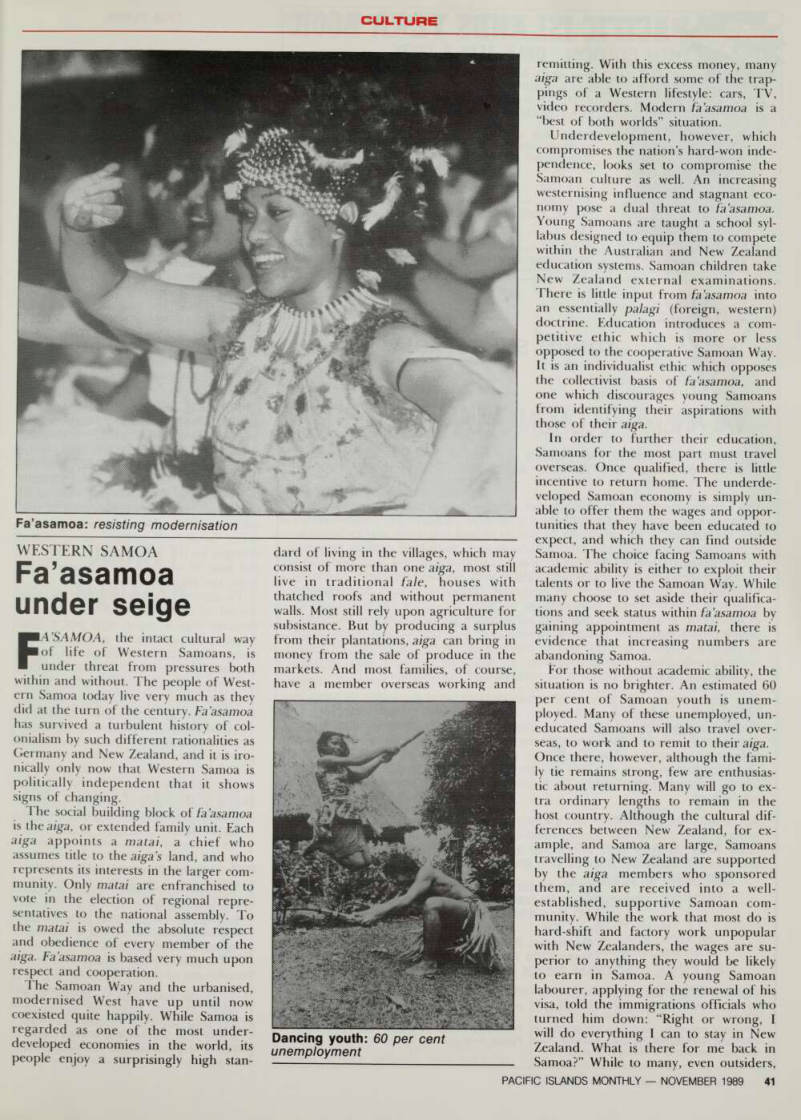
Culture
Western Samoa
Fa’asamoa under seige
FA’SAMOA, the intact cultural way of life of Western Samoans, is under threat from pressures both within and without. The people of West ern Samoa today live very much as they did at the turn of the century. Fa’asamoa has survived a turbulent history of col onialism by such different rationalities as Germany and New Zealand, and it is iro nically only now that Western Samoa is politically independent that it shows signs of changing.
The social building block of fa’asamoa is the aiga, or extended family unit. Each aiga appoints a matai, a chief who assumes title to the aiga’s land, and who represents its interests in the larger com munity. Only matai are enfranchised to vote in the election of regional repre sentatives to the national assembly. To the matai is owed the absolute respect and obedience of every member of the aiga. Fa’asamoa is based very much upon respect and cooperation.
The Samoan Way and the urbanised, modernised West have up until now coexisted quite happily. While Samoa is regarded as one of the most under developed economies in the world, its
people enjoy a surprisingly high stan
dard of living in the villages, which may consist of more than one aiga, most still live in traditional fale, houses with thatched roofs and without permanent walls. Most still rely upon agriculture for
subsistance. But by producing a surplus
from their plantations, aiga can bring in money from the sale of produce in the markets. And most families, of course, have a member overseas working and
remitting. With this excess money, many aiga are able to afford some of the trap pings of a Western lifestyle: cars, TV, video recorders. Modern fa’asamoa is a “best of both worlds” situation.
Underdevelopment, however, which compromises the nation’s hard-won inde pendence, looks set to compromise the Samoan culture as well. An increasing westernising influence and stagnant eco nomy pose a dual threat to fa’asamoa.
Young Samoans are taught a school syl labus designed to equip them to compete within the Australian and New Zealand education systems. Samoan children take New Zealand external examinations.
There is little input from fa’asamoa into
an essentially palagi (foreign, western)
doctrine. Education introduces a com petitive ethic which is more or less opposed to the cooperative Samoan Way.
It is an individualist ethic which opposes the collectivist basis of fa’asamoa, and one which discourages young Samoans from identifying their aspirations with those of their aiga.
In order to further their education, Samoans for the most part must travel overseas. Once qualified, there is little incentive to return home. The underde veloped Samoan economy is simply un able to offer them the wages and oppor tunities that they have been educated to expect, and which they can find outside Samoa. The choice facing Samoans with academic ability is either to exploit their talents or to live the Samoan Way. While many choose to set aside their qualifica tions and seek status within fa’asamoa by gaining appointment as matai, there is evidence that increasing numbers are
abandoning Samoa.
For those without academic ability, the situation is no brighter. An estimated 60 per cent of Samoan youth is unem
ployed. Many of these unemployed, un
educated Samoans will also travel over seas, to work and to remit to their aiga.
Once there, however, although the fami ly tie remains strong, few are enthusias tic about returning. Many will go to ex tra ordinary lengths to remain in the host country. Although the cultural dif ferences between New Zealand, for ex ample, and Samoa are large, Samoans travelling to New Zealand are supported
by the aiga members who sponsored
them, and are received into a well established, supportive Samoan com munity. While the work that most do is hard-shift and factory work unpopular with New Zealanders, the wages are su perior to anything they would be likely to earn in Samoa. A young Samoan labourer, applying for the renewal of his visa, told the immigrations officials who turned him down: “Right or wrong, I will do everything I can to stay in New Zealand. What is there for me back in Samoa?” While to many, even outsiders,
Fa’asamoa: resisting modernisation
Dancing youth: 60 per cent unemployment
the Samoan Way is attractive, it is doubt ful whether it will remain sufficiently attractive to draw back the young people who are emigrating.
Fa ’asamoa itself to some extent resists modernisation. Aiga which have tradi
tionally produced goods solely for their
own consumption do not appreciate the need to produce for an export market.
The combination of agricultural plenty and remittance money insulates most Sa moans from the dire economic position of the nation. Any attempt to gear Sa moan agriculture toward export produc tion will require modification of the tra ditional Samoan farmer’s goals, and this may prove difficult. Similarly, most Sa moans regard without enthusiasm the administration’s drive toward promoting tourism. It is difficult to infect such a contented people with a sense of the urgency of the need for such things.
Yet modernise Samoa must, to develop its economy in order to provide the opportunities which the young are cur rently seeking abroad. Fa’asamoa will otherwise lose much of the generation which must inherit it. This, then, is the dilemma which faces the Western Sa moan people. If they do not undertake to modernise the economy, then their young people will have to travel to find
opportunities. Development, on the
other hand, will require some radical changes to the Samoan way of life, not the least of which is an increased input from the Western culture.
To survive, fa’asamoa must be pre sented to Samoan youth as a cultural heritage that is more than just- a com fortable way of life in a stagnant eco nomy. They must be taught to regard education as the tool by which fa’asamoa can be brought up to date rather than as an alternative to it. Talented Samoans must be encouraged to use their gifts in the process of modernisation. The vital ity of the economy must be restored to provide opportunities, without which re maining in Samoa is unattractive to young Samoans. Only if they are con vinced of the value of fa’asamoa will the young, its future, work towards ensuring its survival. D
UTA stresses Noumea service UTA French Airlines has reaffirmed it intends to continue a twice-weekly ser vice between Sydney and New Caledo nia. The airline has issued a statement stressing its commitment to the route, and that public misconception had arisen because one of the twice-weekly flights is operated by a leased Air Caledonie In ternational 737. UTA considers that political stability has now been re established in the French territory and is
planning a promotional campaign early
next year.
Advertisements & other items, p. 44 (1 item)
Acific Islands Year Book
rs
'I6TH EDITION ONLY As4s A COPY
Buy your hard cover plastic jacketed copy today, by filling this coupon and enclosing|your bank draft or money order to; PACIFIC ISLANDS
YEAR BOOK, P.O. BOX 1167, ISUVA.
Please send me . . . copy(ies) of the 16th Edition of the Pacific Islands Year Book. I enclose herewith my cheque made payable to PACIFIC ISLANDS MONTHLY of A$ or debit $ to my □ Bankcard □ visa □ Mastercard (Card No:) Expiry Date:
MY NAME:
POSTAL ADDRESS: -
CITY:
COUNTRY:
TELEPHONE NUMBER:
f:
FORUM SECRETARIAT
VACANCY - ECONOMIC PLANNING OFFICER
Applications are invited from suitably qualified and experienced persons, who must be citizens of a ‘member country of the South Pacific Forum, for the above position.
The Forum has sought to give greater emphasis to economic analysis and planning capacity. It has established an Economic Services Division which has responsibility for providing to Forum Island countries comprehensive economic analysis and planning advice as well as to seek greater regional coordination of aid to the South Pacific. The appointee will undertake economic analysis and planning together with detailed research on issues identified by the Committee on Regional Economic Issues and provide advice to Forum member governments accordingly, assist FIC governments in economic analysis and planning activities to support national economic development and more effective utilization of aid: preparation/formulation of regional project profiles and in the evaluation of completed projects: undertake analysis and assessment of regional projects and provide appropriate reports to donor governments and organisations.
This appointment will carry an attractive remuneration package, payable in Fiji dollars. For non-Fiji citizens this is tax free and includes housing or housing allowance, education and child allowances. Other benefits for all employees include superannuation payments and medical, life and travel insurance coverage. The appointee will be based at the Secretariat’s Headquarters in Suva, Fiji, but will be required to undertake periodic duty travel. Appointment would be for three years initially, renewable by mutual agreement.
Applicants should provide full information on education and career background and should list names, addresses and telephone numbers of at least three referees with whom the applicant has been associated in a professional capacity. Applications should be addressed to: The Secretary General Forum Secretariat GPO Box 856 Suva, Fiji Telephone: 312600 Telex: 2229 FJ Fax: 302204 Applications close on 30 Novemer, 1989 and all enquiries should be made to Mr R Wilson, Director of Services on 312600 Ext 202. *Member countries: Australia, Cook Islands, Federated States of Micronesia, Fiji, Kiribati, Marshall Islands, Nauru, New Zealand, Niue, Papua New Guinea, Solomon Islands, Tonga, Tuvalu, Vanuatu and Western Samoa.
Picking the
International Relations
Picking the loyalists
UNITED STATES embassies throughout the South Pacific are in a state of flux, as new appoin tees come on the scene, and as the US lifts the level of its diplomatic relations with the former Trust Territories.
Washington has been chuckling at the Bush Administration’s numerous minor blunders as it sweeps aside the Reagan
Administration’s Republican appointees,
and replaces them with Bush Republi cans. (Firing political ambassadors from the other party is an old American cus tom, but the practice of bouncing one set of party loyalists for another, with closer ties to the current White House, is a new wrinkle in American patronage).
The new Ambassadors to Australia and New Zealand were both criticised by Senate Democrats; neither had disting uished careers in public service, nor had they previously shown any interest in the nations involved, but both had been very helpful in raising money for the Bush campaign. Melvin Sembler, a rich Flori dian, slated to be envoy to both Australia and Nauru, had contributed US$lOO,OOO
to the Bush campaign. He made some clumsy public remarks about drugs and Australia, but his troubles were minor compared to those of Della Newman of
Seattle, Washington.
Newman, who will be US ambassador to New Zealand and Western Samoa, admitted to a newspaper reporter that she did not know the name of the then New Zealand prime minister (despite the fact that David Lange is probably the New Zealand politician with more public recognition than any in history.) Despite strenuous objections of some of the Democrats on the Senate Relations Com mittee, both Sembler and Newman were confirmed by the Senate recently, and will be on their way to their new posts soon.
Meanwhile, the next United States ambassador to Fiji, Tonga, Tuvalu, and Kiribati is going through a gentler con firmation process. Evelyn Tegen has, in the eyes of the Senate Committee, better credentials than the other two, in that she ran a business, was an elected officer of the Republican Party, and had been a state-level lobbyist for seat-belt laws in Minnesota. She also did her homework on the islands before talking about them.
The State Department’s ability to shoot itself in the foot, however, continued to show itself regarding Tegen’s appoint ment. The Department is required to send a note on each appointee to the US Senate, a body controlled by the Demo crats.
In justification for the appointment, State wrote that her “inherent Republi
can loyalty, lofty principals, and experi
enced leadership make her an excellent candidate for Ambassador (sic) to Fiji . . . .” This document emerged after Sena tor Paul Sarbanes (D. Maryland) had taken great delight in reading State De partment appointment justifications in which nearly identical language was used, supposedly by the ambassadorial candidates themselves, to support the proposed appointments of Bushies to posts in Australia and Spain.
The US has kept four ambassadors in the South Pacific, and the fourth mem ber of the set is a Reagan Administration holdover, Everett E. Bierman, the ambassador to Papua New Guinea; alone among the four he has both Republican ties and knowledge of the business, hav ing worked for the Senate Foreign Rela tions Committee prior to his posting to Port Moresby. He is also the US repre sentative to the Solomons and Vanuatu.
Meanwhile, to enhance the diplomatic positions of the former Trust Territor ies, Washington has decided to elevate the titles of its diplomats in the Marshalls and in Federated States of Micronesia (FSM). Previously Samuel B. Thomsen and Michael G. Wygant, both career foreign service officers, had been, Te
spectively, US Representative in the Mar shalls and FSM. Now that their offices have become embassies their titles are those of charge d’affaires. The State De partment has not yet decided who will fill these ambassadorships, but the chances are that these assignments will go to career people.
The US also has charge d’affaires at work in the Solomons, and in the newly opened mission in Western Samoa; they are William Warren and William Francis co 111.
Meanwhile, Jesse Manehalau, the FSM representative in Washington, and Wil fred Kendall, who plays the same role for the Marshalls are on their way to ambassador status. (Their staffs already use the term in reference to their bosses.) Both of these Associated States have extended their diplomatic networks, with ambassadors from Japan in place in Kolonia, and with FSM now having di plomatic relations with those nations as well as with the US, the Marshalls, Au stralia, Mainland China, New Zealand and PNG. The Marshalls have not quite made up their mind about reltions with the People’s Republic of China, but they have expanded their network as well. □
Advertisements & other items, p. 45 (1 item)
meat
PROJECT
MANAGER
The Foundation for the Peoples of the South Pacific (FSP) is seeking an innovative individual with a solid background in maternal and child health care and/or nursing as Project Manager for a Maternal and Child Health Extension Program in Vanuatu. The Manager will coordinate health extension activities at village, district and inter-departmental levels, administer project funds, assist with design and supervision of training activities and monitor/evaluate progress. Duties also include liaisoning with donors and government officials and collaborating with NGOs in project areas. Ideal candidates will possess a master’s degree in public health of related field, a minimum of 2 years experience in a rural health project in a developing country, strong writing and communitions skills and willingness to live and work in rural area and take on periodic relocation as the project advances from one island to the next. Knowledge of the South Pacific/Vanuatu a plus although not required.
Send resume /cv with salary history/requirements to: Patricia Monahan, Executive Vice-President, FSP, 200 West 57th Street, Suite 410, New York, N.Y. 10019,
For the finest in
SICHUAN CUISINE
dine at m
meat
Oh w
Cnr. Bau St/Laucala Bay Rd, Flagstaff, Suva.
LUNCH • DINNER
Phone: 301285
NOW ALSO AT:
404, Khyber Pass Rd, Newmarket, Auckland.
Phone: 5221752
• Friendly and unpretentious oriental style service. • Fully licensed bar and a splendid wine list. • All major credit cards accepted.
Straining the
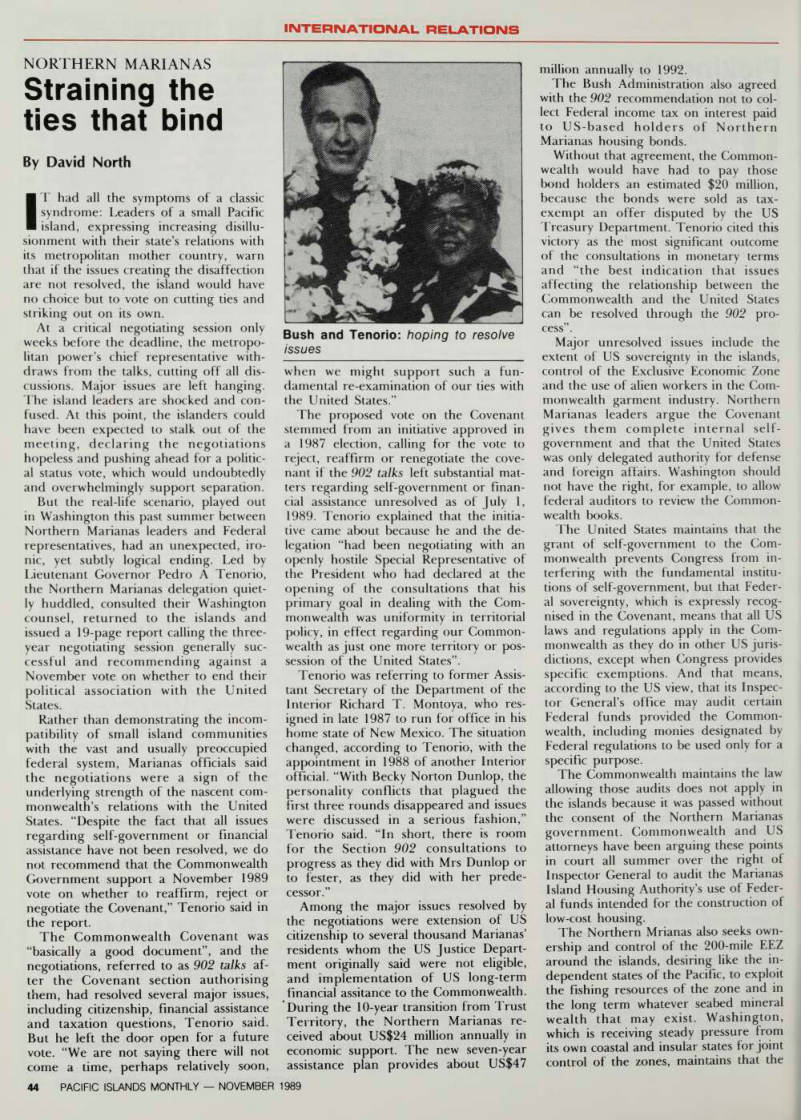
Northern Marianas
ties that bind
By David North
IT had all the symptoms of a classic syndrome: Leaders of a small Pacific island, expressing increasing disillu sionment with their state’s relations with its metropolitan mother country, warn that if the issues creating the disaffection are not resolved, the island would have no choice but to vote on cutting ties and striking out on its own.
At a critical negotiating session only weeks before the deadline, the metropo litan power’s chief representative with draws from the talks, cutting off all dis cussions. Major issues are left hanging.
The island leaders are shocked and con fused. At this point, the islanders could have been expected to stalk out of the
meeting, declaring the negotiations
hopeless and pushing ahead for a politic al status vote, which would undoubtedly and overwhelmingly support separation.
But the real-life scenario, played out in Washington this past summer between Northern Marianas leaders and Federal representatives, had an unexpected, iro nic, yet subtly logical ending. Led by Lieutenant Governor Pedro A Tenorio, the Northern Marianas delegation quiet ly huddled, consulted their Washington counsel, returned to the islands and issued a 19-page report calling the three year negotiating session generally suc cessful and recommending against a November vote on whether to end their political association with the United States.
Rather than demonstrating the incom patibility of small island communities with the vast and usually preoccupied federal system, Marianas officials said the negotiations were a sign of the underlying strength of the nascent com monwealth’s relations with the United States. “Despite the fact that all issues
regarding self-government or financial
assistance have not been resolved, we do not recommend that the Commonwealth Government support a November 1989 vote on whether to reaffirm, reject or negotiate the Covenant,” Tenorio said in the report.
The Commonwealth Covenant was “basically a good document”, and the negotiations, referred to as 902 talks af ter the Covenant section authorising them, had resolved several major issues, including citizenship, financial assistance and taxation questions, Tenorio said.
But he left the door open for a future vote. “We are not saying there will not come a time, perhaps relatively soon,
when we might support such a fun damental re-examination of our ties with the United States.”
The proposed vote on the Covenant stemmed from an initiative approved in a 1987 election, calling for the vote to reject, reaffirm or renegotiate the cove nant if the 902 talks left substantial mat ters regarding self-government or finan cial assistance unresolved as of July 1, 1989. Tenorio explained that the initia tive came about because he and the de legation “had been negotiating with an
openly hostile Special Representative of
the President who had declared at the opening of the consultations that his primary goal in dealing with the Com monwealth was uniformity in territorial policy, in effect regarding our Common wealth as just one more territory or pos session of the United States”.
Tenorio was referring to former Assis tant Secretary of the Department of the Interior Richard T. Montoya, who res igned in late 1987 to run for office in his home state of New Mexico. The situation changed, according to Tenorio, with the appointment in 1988 of another Interior official. “With Becky Norton Dunlop, the personality conflicts that plagued the first three rounds disappeared and issues were discussed in a serious fashion,”
Tenorio said. “In short, there is room for the Section 902 consultations to progress as they did with Mrs Dunlop or to fester, as they did with her prede cessor.”
Among the major issues resolved by the negotiations were extension of US citizenship to several thousand Marianas’ residents whom the US Justice Depart ment originally said were not eligible, and implementation of US long-term financial assitance to the Commonwealth.
During the 10-year transition from Trust Territory, the Northern Marianas re ceived about US$24 million annually in economic support. The new seven-year assistance plan provides about US$47
million annually to 1992.
The Bush Administration also agreed with the 902 recommendation not to col lect Federal income tax on interest paid to US-based holders of Northern Marianas housing bonds.
Without that agreement, the Common wealth would have had to pay those bond holders an estimated S2O million, because the bonds were sold as tax exempt an offer disputed by the US Treasury Department. Tenorio cited this victory as the most significant outcome of the consultations in monetary terms and “the best indication that issues affecting the relationship between the Commonwealth and the United States can be resolved through the 902 pro cess”.
Major unresolved issues include the extent of US sovereignty in the islands, control of the Exclusive Economic Zone and the use of alien workers in the Com monwealth garment industry. Northern Marianas leaders argue the Covenant gives them complete internal self government and that the United States
was only delegated authority for defense
and foreign affairs. Washington should not have the right, for example, to allow federal auditors to review the Common wealth books.
The United States maintains that the grant of self-government to the Com monwealth prevents Congress from in terfering with the fundamental institu tions of self-government, but that Feder al sovereignty, which is expressly recog nised in the Covenant, means that all US laws and regulations apply in the Com monwealth as they do in other US juris dictions, except when Congress provides specific exemptions. And that means, according to the US view, that its Inspec tor General’s office may audit certain Federal funds provided the Common
wealth, including monies designated by
Federal regulations to be used only for a
specific purpose.
The Commonwealth maintains the law allowing those audits does not apply in the islands because it was passed without the consent of the Northern Marianas government. Commonwealth and US attorneys have been arguing these points in court all summer over the right of Inspector General to audit the Marianas Island Housing Authority’s use of Feder al funds intended for the construction of
low-cost housing.
The Northern Mrianas also seeks own ership and control of the 200-mile EEZ around the islands, desiring like the in dependent states of the Pacific, to exploit the fishing resources of the zone and in the long term whatever seabed mineral wealth that may exist. Washington, which is receiving steady pressure from its own coastal and insular states for joint control of the zones, maintains that the
Bush and Tenorio: hoping to resolve issues
EEZ’s are under US sovereignty, giving management, control, and the revenue generated in them exclusively to the Federal government. To grant the Northern Marianas control would set a dangerous precedent that would be seized upon by other insular areas as well as Hawaii, Alaska and the west coast states.
The alien labour controversy involves the Commonwealth’s importation over the past 10 years of 14,000 alien workers mostly Filipino and Thais to produce shirts, sweaters and other garments that are exported to the United States
duty free under a special Customs prog ramme which is aimed at creating jobs for local US citizens and permanent resi dents in the islands. The alien labour
population almot equals the population
of permanent residents, which is about 16,000.
Montoya, when he was US representa tive at the 902 talks, argued that the Commonwealth was circumventing the intent of the provision, by not providing that the two dozen foreign-controlled and operated garment factories in the islands employ a majority of local work ers. The Commonwealth, which won the
right to control its own immigration under the Covenant, maintains this is an entirely internal matter, not subject to Federal oversight.
Montoya countered that the factories were of little economic benefit to the Northern Marianas if they did not generate jobs for the local population, and warned island leaders that US Con gressional leaders whose constituents are losing jobs to foreign textile imports might not agree with the Common wealth’s view of the situation. Since the US Congress has plenary authority for the US commonwealths and territories, there could be a backlash someday, sev erely restricting textile imports from the Northern Marianas, Montoya argued.
Dunlop did not press the issue during her tenure as US negotiator.
The booming Northern Marianas eco nomy, which generates a US$l75 million annual Gross Island Product, is feeling the pressure on its social and physical infrastructure because of the presence of so many alien workers. Water, power, housing, education and health services
particularly are suffering. The capital is
land of Saipan, where virtually all of the factories are located, has declared a moratorium on new garment plants, and regulations are being worked up that would provide stricter guidelines for the garment manufacturers, including zon ing restrictions and local employment re quirements.
The Commonwealth’s leaders tactical decision not to press for a vote on the Covenant at this time may also have been influenced by the islands’ coming gubernatorial election. Tenorio, who was seeking the Republican candidacy for the governorship, may have feared that his 902 flank was exposed to his Democratic opponent, Froilan Tenorio (no relation), who as the Northern Marianas Washing ton representative, has been an out spoken critic of the 902 negotiations.
When a Bush appointee to the 902 talks is named, the representative will face new pressures on the sovereignty, applicability of federal law and FEZ issues because other US insular areas Puerto Rico, Guam and the Virgin Is lands are now negotiating changes in their political status. They also seek many of the same prerogatives, controls, exemptions and exclusions as the North ern Marianas. As a united front on federal-territorial relations, these island commonwealths and territories may be able to rewrite the parameters of insular autonomy in the US federal system. And the experience of the Northern Marianas 902 talks over the past three years would be a valuable object lesson in how to motivate Uncle Sam to focus of three areas’ unique problems and rela
tionships. □
Advertisements & other items, p. 47 (1 item)
Director
FORUM FISHERIES AGENCY
Applications are invited for the position of Director, South Pacific Forum Fisheries Agency (FFA) from nationals of the following FFA Member Countries; Australia, Cook Islands, Federated States of Micronesia, Fiji, Kiribati, Marshall Islands, Nauru, New Zealand, Niue, Palau, Papua New Guinea, Solomon Islands, Tonga, Tuvalu, Vanuatu and Western Samoa. The position will become vacant in
January 1991.
The FFA was established to co-ordinate regional fisheries policies and to promote the development of fisheries resources to ensure that maximum benefits are achieved by the peoples of the region from their fisheries resources.
The Director will be responsible to the Forum Fisheries Committee for the direction, control and efficient operation of the Agency.
Applicants should have proven managerial ability; experience in multidisciplinary team effort; understanding of the social, economic and political aspirations of the Pacific Islands peoples and ability to liaise with member and supporting governments and organisations. An academic qualification and experience in a fisheries related discipline is desirable.
The appointee will be based in Honiara, Solomon Islands but will be require to travel mainly within the South Pacific Region. A tax free salary at a regional level will apply, with attractive provisions for transportation, housing, child and educational allowances, recreational leave and superannuation.
Further information can be obtained from the address below.
Applications should include the names of three referees. The closing date for application is 31 January 1990.
Applications should be addressed to; The Chairman Forum Fisheries Committee C/o Forum Fisheries Agency PO Box 629 Honiara Solomon Islands.
Beyond the beach
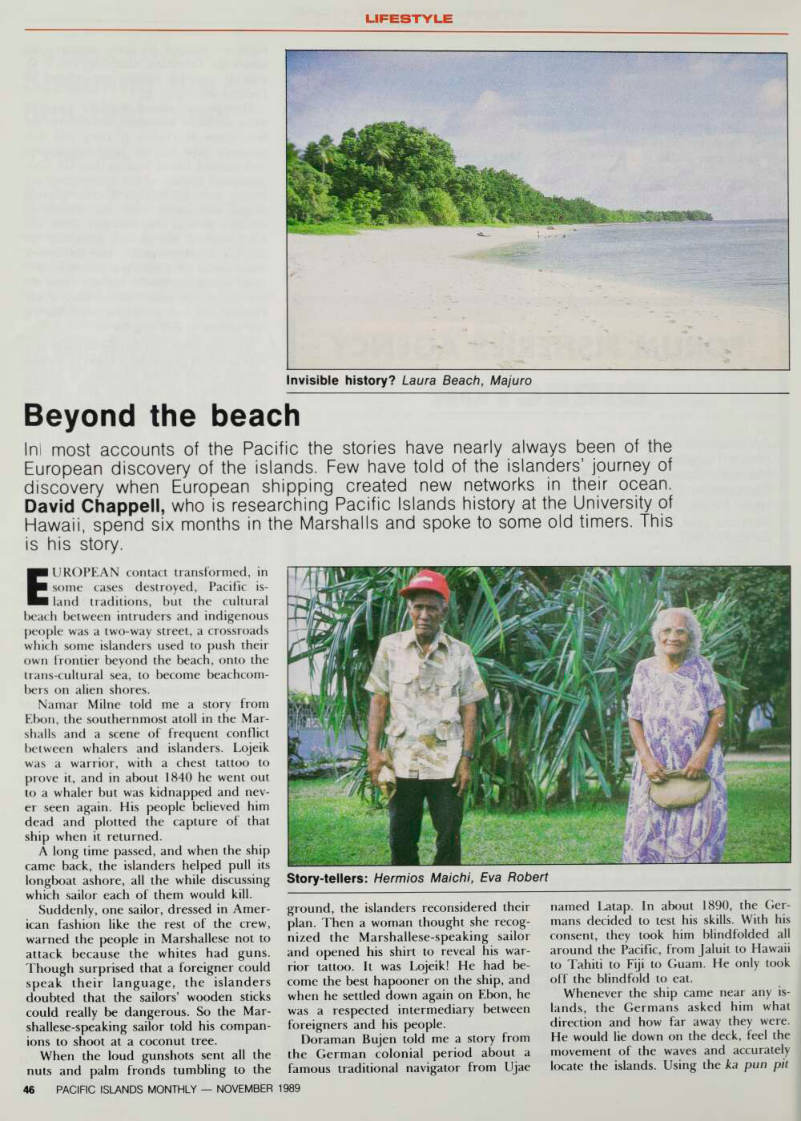
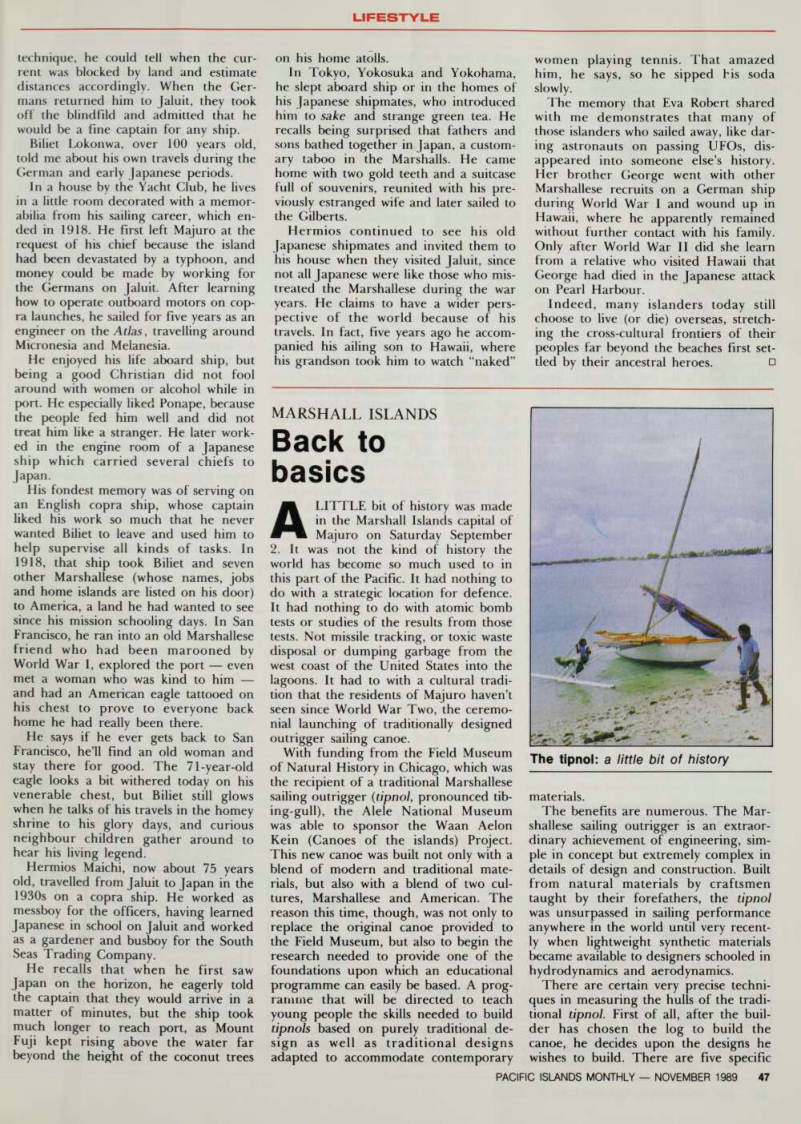
Lifestyle
Inl most accounts of the Pacific the stories have nearly always been of the European discovery of the islands. Few have told of the islanders’ journey of discovery when European shipping created new networks in their ocean.
David Chappell, who is researching Pacific Islands history at the University of Hawaii, spend six months in the Marshalls and spoke to some old timers. This is his story.
EUROPEAN contact transformed, in some cases destroyed, Pacific is land traditions, but the cultural beach between intruders and indigenous people was a two-way street, a crossroads which some islanders used to push their own frontier beyond the beach, onto the trans-cultural sea, to become beachcom bers on alien shores.
Namar Milne told me a story from Ebon, the southernmost atoll in the Mar shalls and a scene of frequent conflict between whalers and islanders. Lojeik was a warrior, with a chest tattoo to prove it, and in about 1840 he went out to a whaler but was kidnapped and nev er seen again. His people believed him dead and plotted the capture of that ship when it returned.
A long time passed, and when the ship came back, the islanders helped pull its longboat ashore, all the while discussing which sailor each of them would kill.
Suddenly, one sailor, dressed in Amer ican fashion like the rest of the crew, warned the people in Marshallese not to attack because the whites had guns.
Though surprised that a foreigner could
speak their language, the islanders doubted that the sailors’ wooden sticks could really be dangerous. So the Mar shallese-speaking sailor told his compan ions to shoot at a coconut tree.
When the loud gunshots sent all the nuts and palm fronds tumbling to the
ground, the islanders reconsidered their plan. Then a woman thought she recog nized the Marshallese-speaking sailor and opened his shirt to reveal his war rior tattoo. It was Lojeik! He had be come the best hapooner on the ship, and when he settled down again on Ebon, he was a respected intermediary between foreigners and his people.
Doraman Bujen told me a story from the German colonial period about a famous traditional navigator from Ujae
named Latap. In about 1890, the Ger mans decided to test his skills. With his consent, they took him blindfolded all around the Pacific, from Jaluit to Hawaii to Tahiti to Fiji to Guam. He only took off the blindfold to eat.
Whenever the ship came near any is lands, the Germans asked him what direction and how far away they were.
He would lie down on the deck, feel the movement of the waves and accurately locate the islands. Using the ka pun pit
Invisible history? Laura Beach, Majuro
Story-tellers: Hermios Maichi, Eva Robert
technique, he could tell when the cur rent was blocked by land and estimate distances accordingly. When the Ger mans returned him to Jaluit, they took off the blindfild and admitted that he would be a fine captain for any ship.
Biliet Lokonwa, over 100 years old, told me about his own travels during the German and early Japanese periods.
In a house by the Yacht Club, he lives in a little room decorated with a memor abilia from his sailing career, which en ded in 1918. He first left Majuro at the request of his chief because the island had been devastated by a typhoon, and money could be made by working for the Germans on Jaluit. After learning how to operate outboard motors on cop ra launches, he sailed for five years as an engineer on the Atlas, travelling around Micronesia and Melanesia.
He enjoyed his life aboard ship, but being a good Christian did not fool around with women or alcohol while in port. He especially liked Ponape, because the people fed him well and did not treat him like a stranger. He later work ed in the engine room of a Japanese ship which carried several chiefs to Japan.
His fondest memory was of serving on an English copra ship, whose captain liked his work so much that he never wanted Biliet to leave and used him to help supervise all kinds of tasks. In 1918, that ship took Biliet and seven other Marshallese (whose names, jobs and home islands are listed on his door) to America, a land he had wanted to see since his mission schooling days. In San Francisco, he ran into an old Marshallese friend who had been marooned by World War I, explored the port even met a woman who was kind to him and had an American eagle tattooed on his chest to prove to everyone back home he had really been there.
He says if he ever gets back to San Francisco, he’ll find an old woman and stay there for good. The 71-year-old eagle looks a bit withered today on his venerable chest, but Biliet still glows when he talks of his travels in the homey shrine to his glory days, and curious neighbour children gather around to
hear his living legend.
Hermios Maichi, now about 75 years old, travelled from Jaluit to Japan in the 1930 s on a copra ship. He worked as messboy for the officers, having learned Japanese in school on Jaluit and worked as a gardener and busboy for the South
Seas Trading Company.
He recalls that when he first saw Japan on the horizon, he eagerly told the captain that they would arrive in a matter of minutes, but the ship took much longer to reach port, as Mount Fuji kept rising above the water far beyond the height of the coconut trees
on his home atolls.
In Tokyo, Yokosuka and Yokohama, he slept aboard ship or in the homes of his Japanese shipmates, who introduced him to sake and strange green tea. He recalls being surprised that fathers and sons bathed together in Japan, a customary taboo in the Marshalls. He came home with two gold teeth and a suitcase full of souvenirs, reunited with his previously estranged wife and later sailed to the Gilberts.
Hermios continued to see his old Japanese shipmates and invited them to his house when they visited Jaluit, since not all Japanese were like those who mistreated the Marshallese during the war years. He claims to have a wider perspective of the world because of his travels. In fact, five years ago he accompanied his ailing son to Hawaii, where his grandson took him to watch “naked”
women playing tennis. That amazed him, he says, so he sipped his soda
slowly.
The memory that Eva Robert shared with me demonstrates that many of those islanders who sailed away, like dar ing astronauts on passing UFOs, dis appeared into someone else’s history, Her brother George went with other Marshallese recruits on a German ship during World War I and wound up in Hawaii, where he apparently remained without further contact with his family.
Only after World War II did she learn from a relative who visited Hawaii that George had died in the Japanese attack on Pearl Harbour.
Indeed, many islanders today still choose to live (or die) overseas, stretch ing the cross-cultural frontiers of their peoples far beyond the beaches first set tied by their ancestral heroes. □
Back to
Marshall Islands
Back to basics
A LITTLE bit of history was made in the Marshall Islands capital of
Majuro on Saturday September
2. It was not the kind of history the world has become so much used to in this part of the Pacific. It had nothing to do with a strategic location for defence.
It had nothing to do with atomic bomb tests or studies of the results from those tests. Not missile tracking, or toxic waste
disposal or dumping garbage from the
west coast of the United States into the lagoons. It had to with a cultural tradi tion that the residents of Majuro haven’t seen since World War Two, the ceremo
nial launching of traditionally designed
outrigger sailing canoe.
With funding from the Field Museum of Natural History in Chicago, which was the recipient of a traditional Marshallese sailing outrigger ( tipnol , pronounced tib ing-gull), the Alele National Museum was able to sponsor the Waan Aelon Kein (Canoes of the islands) Project.
This new canoe was built not only with a blend of modern and traditional mate rials, but also with a blend of two cul tures, Marshallese and American. The reason this time, though, was not only to
replace the original canoe provided to
the Field Museum, but also to begin the research needed to provide one of the foundations upon which an educational programme can easily be based. A prog ramme that will be directed to teach young people the skills needed to build tipnols based on purely traditional de sign as well as traditional designs adapted to accommodate contemporary
materials.
The benefits are numerous. The Mar shallese sailing outrigger is an extraor dinary achievement of engineering, sim pie in concept but extremely complex in details of design and construction. Built from natural materials by craftsmen taught by their forefathers, the tipnol
was unsurpassed in sailing performance
anywhere in the world until very recent ly when lightweight synthetic materials became available to designers schooled in hydrodynamics and aerodynamics, There are certain very precise techni ques in measuring the hulls of the tradi tional tipnol. First of all, after the buil der has chosen the log to build the canoe, he decides upon the designs he wishes to build. There are five specific
The tipnol: a little bit of history
designs of the Marshallese tipnol. They
are the mwijitbok, taburbur, malmel, to jeik and jekad. The malmel was decided upon because of its design capabilities for inter-atoll cargo and transpportation, but it also has the ability to go out into the open ocean. In order to keep the accuracy of design, the technique of measuring the hull directly on the bread fruit log was transferred to a scale draw ings on paper. Once the drawings were complete to the master canoe-builders’ liking, a scale model was produced to enable more fine tuning of the tradition
al design.
The knowledge of building canoes is generally passed down from father to son. There have been exceptions to these rules, but the master builder is generally careful to pass this knowledge to some one who will use and respect it as a very
precious gift. Traditionally, this know
ledge is held in the utmost secrecy. Since the proliferation of western values these traditional arts and skills are rapidly vanishing. Luckily the Marshallese peo ple have the foresight to preserve their rich and vibrant heritage, and are even working on reviving many of these skills that have not yet been totally lost.
Jinnade Leon, a canoe builder from Jaluit Atoll, was closely involved in build ing the replacement canoe for that sent to Chicago. Jinnade can’t remember when he first sailed with his father. He just knows that he always could sail.
When little, he used to watch his father build canoes. He apprenticed with his father from the age of 12 until he was 24, when he built his first canoe by him self.
During World War Two when Japanese troops occupied Jaluit Atoll, Jinnade was one of many men forced to fish with dynamite in order to feed the troops. A common accident happening throughout the Pacific was for dynamite to explode in the hands of the fisherman because the outside of the fuse was wet while the inside stayed relatively dry; it
used to fool the fisherman and explode in their hands. Jinnade was one of these victims. This didn’t stop him from build ing canoes. As soon as the war was over he started again. The girls wouldn’t like him because of his hand, “that was never the case, since I have 17 children.” Jin nade is 72 years old and still going strong. That is until he was hit by one of the local taxis while riding a bicycle, two weeks before the canoe was scheduled to be finished for an annual cultural festiv al that the Alele Museum hosts every year. It slowed him down. But not for
long.
It took three days to lash the canoe together using traditional coconut sennit made into line. The canoe is a blend of both modern and contemporary mate rials. The way that the tipnol is mea sured for a hull built from a breadfruit log had to be transferred somehow to
accommodate plywood.
Traditionally, when the log is down and cleaned it is determined how much of the length will be used for the actual hull. The builder then, with the help of a pandanus leaf or a coconut leaf, begins dividing the length of the hull in half, then half again, until there are eight evenly spaced sections on the log.
Then, the technique that the Jaluit buil der uses, and at this time there are only two builders alive that still use this method, is to find the center line or sta tion. Through intricate and very precise
measuring depending on which design
the builder wishes to build, he is able to determine the particular hull shape that he desires.
From these preliminary measure ments, he lays out his marks and begins chopping the log. The direction that Jin nade took was that he decided what length to build the canoe. Through his measuring techniques, an architect pro duced to scale on paper a grid in which he divided the proposed length into eight equal parts. In this case 18 feet.
The next step was determining the
length of the keel ( bejam ). So for this Jinnade brought in a pandanus leaf and, to scale he showed the architect how he measured for the design he was build ing. This was the Jaluit Malmel design.
The architect then transferred this in formation to scale onto the paper. The process was slow but after four days of drawing and redrawing he was able to accumulate enough information to com plete architecture drawings that were accurate to a traditional mamel design.
At this point a master builder from another atoll was asked to take a look at the drawings. He and Jinnade got together and discussed the differences in techniques. It was a very interesting meeting because it was discovered that the techniques are different from these two atolls which resulted in the length of the bejam line being different. From this
point the building began. The architect
took the measurements from his scale drawings and put them into full size. He first built a backbone and set it up level so it would accept the shape of the eight even parts of the boat that traditionally was measured. He made these parts out of plywood and set them up on the back bone. After fairing these “stations and
trying them all together, the plywood
was ready to go. The more they worked the more that the traditional shape took
place. Attaching the outriggers and out
rigger float, mast and sails were done
totally traditionally using traditional
materials and woods with the exception of the mast and part of the boom. The sail was made out of nylon which was traditionally built from pandanus. There was wire used to hold the mast up as opposed to the senet. All else was of Marshalles materials.
It felt so good to know that the skill to create all of these things hasn’t been lost.
And many Marshallese have a strong de sire to preserve this skill. Throughout the building most of the details of con struction was videotaped to be on hand at the museum for future teaching. □
Advertisements & other items, p. 50 (1 item)
Martin Fabrics
FIJI’S ONLY HOUSE OF FASHION WEAR
a FLORAL DRESS PRINTS * HABUTAE SILK a 100% COTTON PRINTS * FANCY FABRICS a TAPA PRINTS a MENS SUITING &
a ISLAND PRINTS SHIRTING MATERIAL
LARGEST SELECTION IN FIJI OF
a CURTAIN FABRIC FROM SWEDEN
AVAILABLE AT ALL
MARTIN FABRICS RETAIL OUTLET
SUVA NADI TOWN
281 VICTORIA PRO. OPP. NAMOTOMOTO VILLAGE
BA TOWN LAUTOKA
MAIN STREET BILA STREET
MARTINS CORNER
4 MILES NABUA
HOW ON EARTH AM I GOING TO TAKE
ALL THIS HOME ?
DHL IT!
DHL has years of experience carefully and ship- , kf lr ping Fiji’s outstanding works of art directly to your home doorstep.
Our reputation has been built on caring for your valuables. Don’t take chances, phone us we’re here to help.
Just call DHL we ll do the rest worldwide express
BAGOT
BELLFOUNDRIES
Supplying tuned
bronze bells in Australia and Pacific Islands since 1977 Postal Address: Box 421, North Adelaide, SA 5006, Australia Telephone: (08) 267 1306 Office: 147 Ward St, North Adelaide, SA Workshop: 346 Carrington St, Adelaide, SA
The new
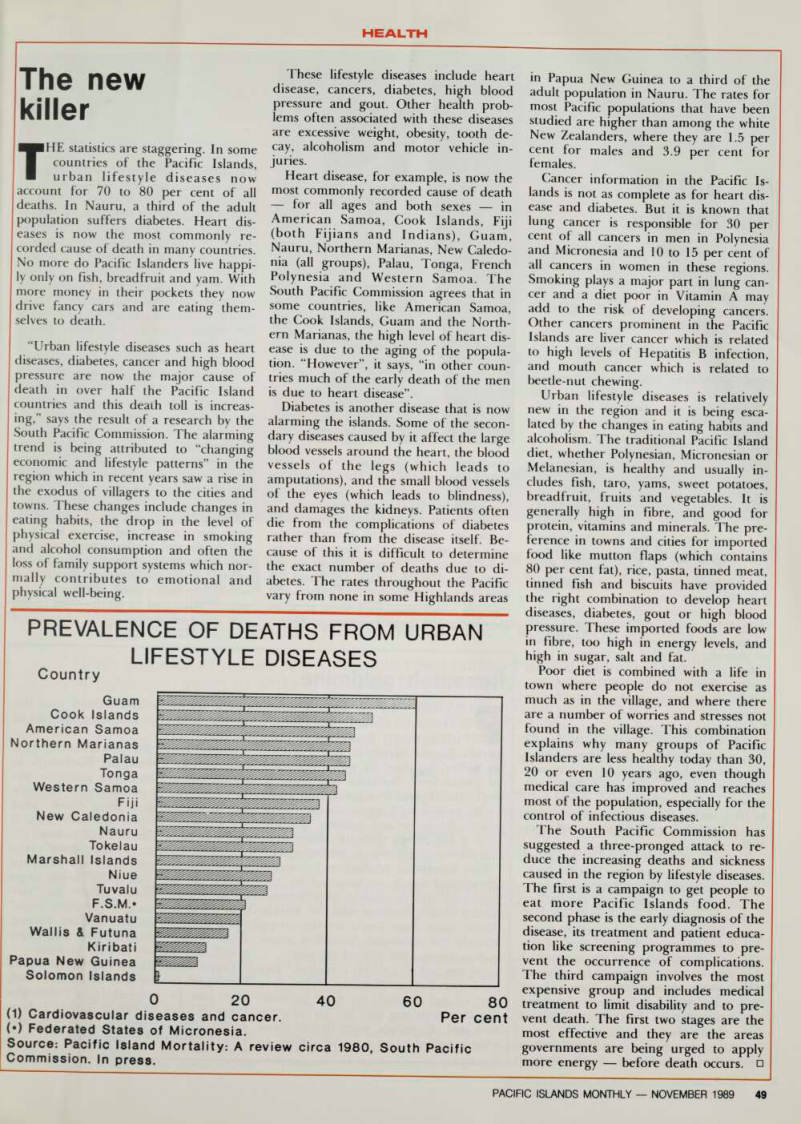
killer
THE statistics are staggering. In some countries of the Pacific Islands, urban lifestyle diseases now account for 70 to 80 per cent of all deaths. In Nauru, a third of the adult population suffers diabetes. Heart dis eases is now the most commonly re corded cause of death in many countries.
No more do Pacific Islanders live happi ly only on fish, breadfruit and yam. With more money in their pockets they now drive fancy cars and are eating them selves to death.
“Urban lifestyle diseases such as heart diseases, diabetes, cancer and high blood pressure are now the major cause of death in over half the Pacific Island countries and this death toll is increas ing,” says the result of a research by the South Pacific Commission. The alarming trend is being attributed to “changing economic and lifestyle patterns” in the region which in recent years saw a rise in the exodus of villagers to the cities and towns. These changes include changes in eating habits, the drop in the level of physical exercise, increase in smoking and alcohol consumption and often the loss of family support systems which nor mally contributes to emotional and
physical well-being.
These lifestyle diseases include heart disease, cancers, diabetes, high blood pressure and gout. Other health prob lems often associated with these diseases are excessive weight, obesity, tooth de cay, alcoholism and motor vehicle in juries.
Heart disease, for example, is now the most commonly recorded cause of death for all ages and both sexes in American Samoa, Cook Islands, Fiji (both Fijians and Indians), Guam, Nauru, Northern Marianas, New Caledo nia (all groups), Palau, Tonga, French Polynesia and Western Samoa. The South Pacific Commission agrees that in some countries, like American Samoa, the Cook Islands, Guam and the North ern Marianas, the high level of heart dis ease is due to the aging of the popula tion. “However”, it says, “in other coun tries much of the early death of the men is due to heart disease”.
Diabetes is another disease that is now alarming the islands. Some of the secon dary diseases caused by it affect the large blood vessels around the heart, the blood vessels of the legs (which leads to amputations), and the small blood vessels of the eyes (which leads to blindness), and damages the kidneys. Patients often die from the complications of diabetes rather than from the disease itself. Be cause of this it is difficult to determine the exact number of deaths due to di abetes. The rates throughout the Pacific vary from none in some Highlands areas
in Papua New Guinea to a third of the adult population in Nauru. The rates for most Pacific populations that have been studied are higher than among the white New Zealanders, where they are 1.5 per cent for males and 3.9 per cent for females.
Cancer information in the Pacific Is lands is not as complete as for heart dis ease and diabetes. But it is known that lung cancer is responsible for 30 per cent of all cancers in men in Polynesia and Micronesia and 10 to 15 per cent of all cancers in women in these regions.
Smoking plays a major part in lung can cer and a diet poor in Vitamin A may add to the risk of developing cancers.
Other cancers prominent in the Pacific Islands are liver cancer which is related to high levels of Hepatitis B infection, and mouth cancer which is related to
beetle-nut chewing.
Urban lifestyle diseases is relatively new in the region and it is being esca lated by the changes in eating habits and alcoholism. The traditional Pacific Island diet, whether Polynesian, Micronesian or Melanesian, is healthy and usually in cludes fish, taro, yams, sweet potatoes, breadfruit, fruits and vegetables. It is generally high in fibre, and good for protein, vitamins and minerals. The pre ference in towns and cities for imported food like mutton flaps (which contains 80 per cent fat), rice, pasta, tinned meat, tinned fish and biscuits have provided the right combination to develop heart diseases, diabetes, gout or high blood pressure. These imported foods are low in fibre, too high in energy levels, and high in sugar, salt and fat.
Poor diet is combined with a life in town where people do not exercise as much as in the village, and where there are a number of worries and stresses not found in the village. This combination explains why many groups of Pacific Islanders are less healthy today than 30, 20 or even 10 years ago, even though medical care has improved and reaches most of the population, especially for the control of infectious diseases.
The South Pacific Commission has suggested a three-pronged attack to re duce the increasing deaths and sickness caused in the region by lifestyle diseases.
The first is a campaign to get people to eat more Pacific Islands food. The second phase is the early diagnosis of the disease, its treatment and patient educa tion like screening programmes to pre vent the occurrence of complications.
The third campaign involves the most expensive group and includes medical treatment to limit disability and to pre vent death. The first two stages are the most effective and they are the areas
governments are being urged to apply
more energy before death occurs. □
Advertisements & other items, p. 51 (1 item)
Prevalence Of Deaths From Urban
LIFESTYLE DISEASES
An aid to teachers
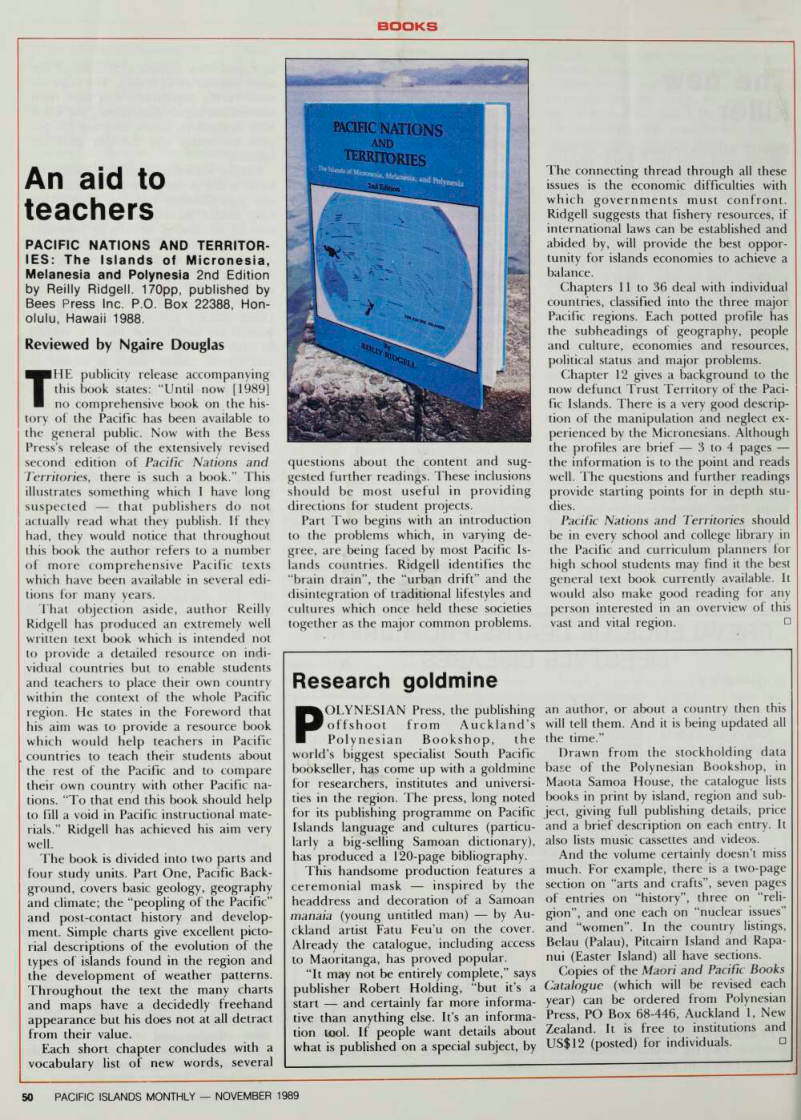
teachers
Pacific Nations And Territor
IES: The Islands of Micronesia, Melanesia and Polynesia 2nd Edition by Reilly Ridgell. 170 pp, published by Bees Press Inc. P.O. Box 22388, Hon olulu, Hawaii 1988.
Reviewed by Ngaire Douglas
THE publicity release accompanying
this book states; “Until now [1989] no comprehensive book on the his tory of the Pacific has been available to the general public. Now with the Bess Press’s release of the extensively revised second edition of Pacific Nations and Territories, there is such a book.” This illustrates something which I have long suspected that publishers do not actually read what they publish. If they had, they would notice that throughout this book the author refers to a number of more comprehensive Pacific texts which have been available in several edi tions for many years.
That objection aside, author Reilly
Ridgell has produced an extremely well
written text book which is intended not to provide a detailed resource on indi vidual countries but to enable students and teachers to place their own country within the context of the whole Pacific region. He states in the Foreword that his aim was to provide a resource book which would help teachers in Pacific countries to teach their students about the rest of the Pacific and to compare their own country with other Pacific na tions. “To that end this book should help to fill a void in Pacific instructional mate rials.” Ridgell has achieved his aim very well.
The book is divided into two parts and four study units. Part One, Pacific Back
ground, covers basic geology, geography
and climate; the “peopling of the Pacific” and post-contact history and develop
ment. Simple charts give excellent picto
rial descriptions of the evolution of the types of islands found in the region and the development of weather patterns.
Throughout the text the many charts and maps have a decidedly freehand appearance but his does not at all detract from their value.
Each short chapter concludes with a vocabulary list of new words, several
questions about the content and sug gested further readings. These inclusions should be most useful in providing directions for student projects.
Part Two begins with an introduction to the problems which, in varying de gree, are being faced by most Pacific Is lands countries. Ridgell identifies the “brain drain”, the “urban drift” and the disintegration of traditional lifestyles and cultures which once held these societies
together as the major common problems.
The connecting thread through all these issues is the economic difficulties with which governments must confront.
Ridgell suggests that fishery resources, if international laws can be established and abided by, will provide the best oppor tunity for islands economies to achieve a balance.
Chapters 11 to 36 deal with individual countries, classified into the three major
Pacific regions. Each potted profile has
the subheadings of geography, people
and culture, economies and resources,
political status and major problems.
Chapter 12 gives a background to the now defunct Trust Territory of the Paci fic Islands. There is a very good descrip tion of the manipulation and neglect ex
perienced by the Micronesians. Although
the profiles are brief 3to 4 pages the information is to the point and reads well. The questions and further readings provide starting points for in depth stu dies.
Pacific Nations and Territories should be in every school and college library in the Pacific and curriculum planners for high school students may find it the best general text book currently available. It would also make good reading for any person interested in an overview of this vast and vital region. □
Research goldmine
POLYNESIAN Press, the publishing
offshoot from Auckland’s Polynesian Bookshop, the world’s biggest specialist South Pacific bookseller, has come up with a goldmine for researchers, institutes and universi ties in the region. The press, long noted for its publishing programme on Pacific Islands language and cultures (particu larly a big-selling Samoan dictionary), has produced a 120-page bibliography.
This handsome production features a ceremonial mask inspired by the headdress and decoration of a Samoan manaia (young untitled man) by Au ckland artist Fatu Feu’u on the cover.
Already the catalogue, including access to Maoritanga, has proved popular.
“It may not be entirely complete,” says publisher Robert Holding, “but it’s a start and certainly far more informa tive than anything else. It’s an informa tion tool. If people want details about what is published on a special subject, by
an author, or about a country then this will tell them. And it is being updated all the time.”
Drawn from the stockholding data base of the Polynesian Bookshop, in Maota Samoa House, the catalogue lists books in print by island, region and sub
ject, giving full publishing details, price
and a brief description on each entry. It also lists music cassettes and videos.
And the volume certainly doesn’t miss much. For example, there is a two-page section on “arts and crafts”, seven pages of entries on “history”, three on “reli gion”, and one each on “nuclear issues” and “women”. In the country listings, Belau (Palau), Pitcairn Island and Rapa nui (Easter Island) all have sections.
Copies of the Maori and Pacific Books Catalogue (which will be revised each year) can be ordered from Polynesian Press, PO Box 68-446, Auckland 1, New Zealand. It is free to institutions and US$l2 (posted) for individuals. □
Caught in a crossfire
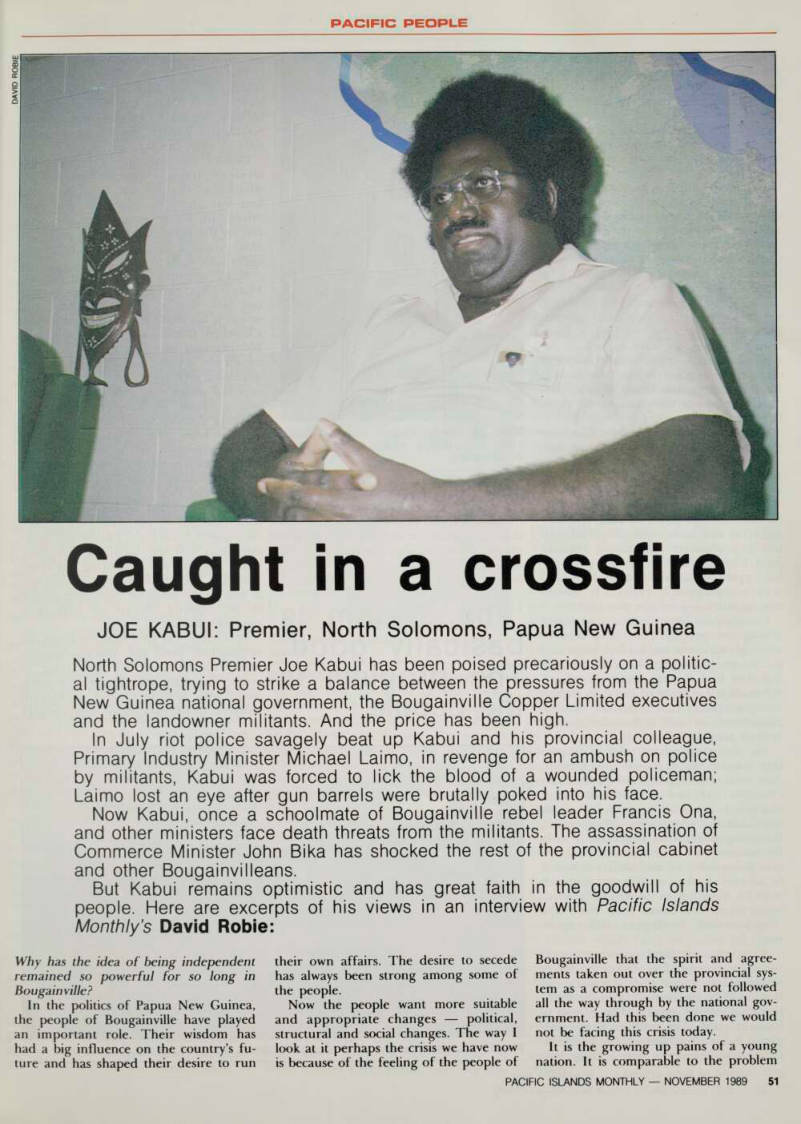
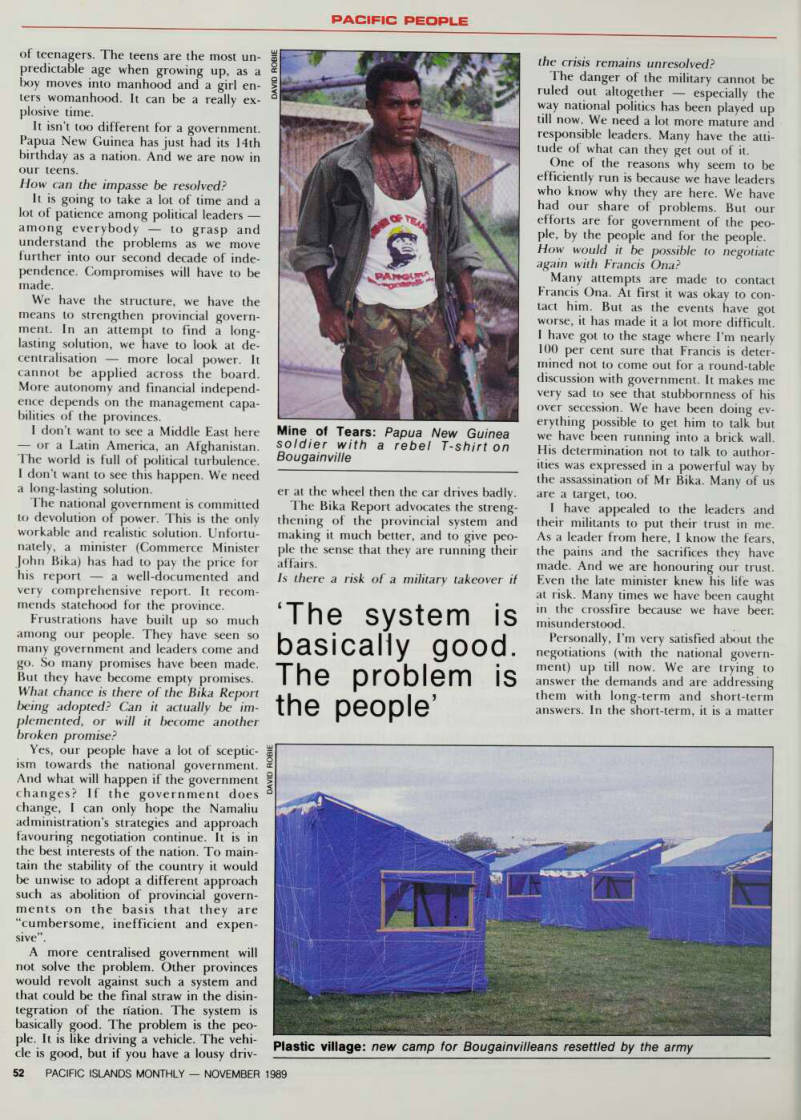
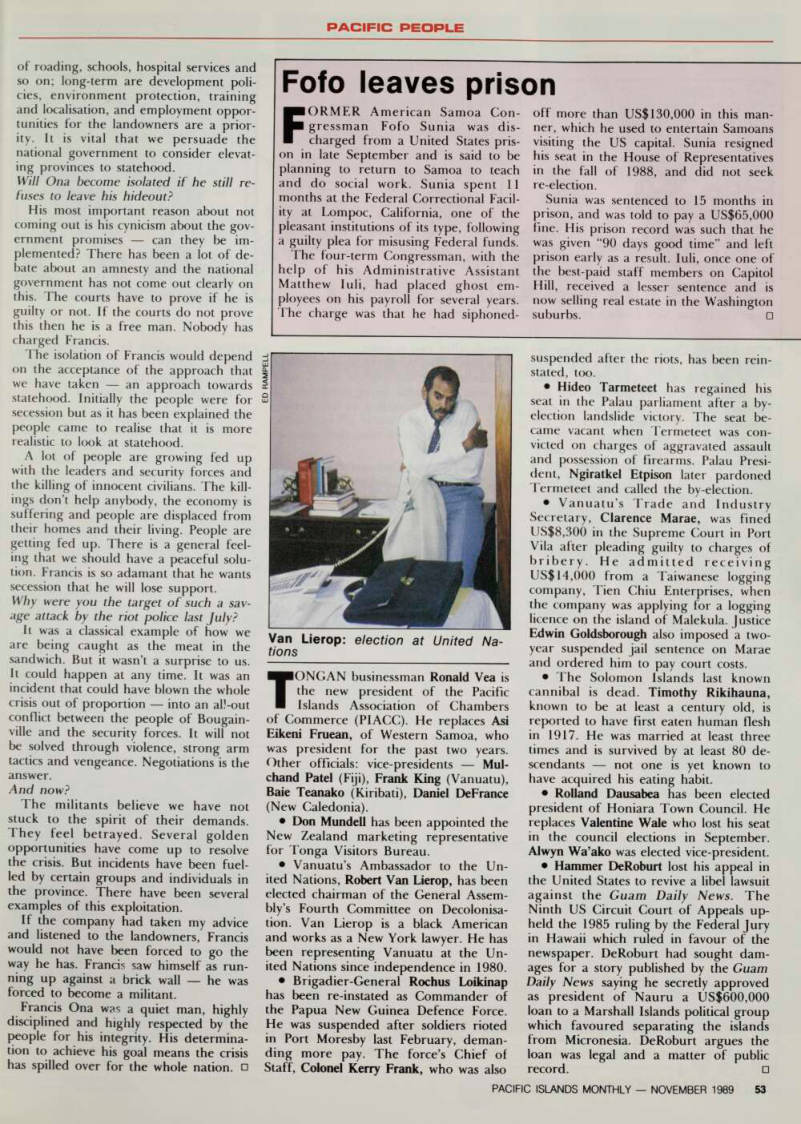
Pacific People
JOE KABUI: Premier, North Solomons, Papua New Guinea North Solomons Premier Joe Kabui has been poised precariously on a politic al tightrope, trying to strike a balance between the pressures from the Papua New Guinea national government, the Bougainville Copper Limited executives and the landowner militants. And the price has been high.
In July riot police savagely beat up Kabui and his provincial colleague, Primary Industry Minister Michael Laimo, in revenge for an ambush on police by militants, Kabui was forced to lick the blood of a wounded policeman; Laimo lost an eye after gun barrels were brutally poked into his face.
Now Kabui, once a schoolmate of Bougainville rebel leader Francis Ona, and other ministers face death threats from the militants. The assassination of Commerce Minister John Bika has shocked the rest of the provincial cabinet and other Bougainvilleans.
But Kabui remains optimistic and has great faith in the goodwill of his people. Here are excerpts of his views in an interview with Pacific Islands Monthly’s David Robie:
Why has the idea of being independent remained so powerful for so long in
Bougainville?
In the politics of Papua New Guinea,
the people of Bougainville have played
an important role. Their wisdom has had a big influence on the country’s future and has shaped their desire to run
their own affairs. The desire to secede has always been strong among some of
the people.
Now the people want more suitable
and appropriate changes political,
structural and social changes. The way I look at it perhaps the crisis we have now is because of the feeling of the people of
Bougainville that the spirit and agree ments taken out over the provincial sys tern as a compromise were not followed all the way through by the national gov ernment. Had this been done we would not be facing this crisis today, It is the growing up pains of a young nation. It is comparable to the problem
of teenagers. The teens are the most un predictable age when growing up, as a boy moves into manhood and a girl en ters womanhood. It can be a really ex
plosive time.
It isn’t too different for a government.
Papua New Guinea has just had its 14th birthday as a nation. And we are now in our teens.
How can the impasse be resolved?
It is going to take a lot of time and a lot of patience among political leaders among everybody to grasp and understand the problems as we move further into our second decade of inde pendence. Compromises will have to be made.
We have the structure, we have the means to strengthen provincial govern ment. In an attempt to find a long lasting solution, we have to look at de centralisation more local power. It cannot be applied across the board.
More autonomy and financial independ ence depends on the management capa bilities of the provinces.
I don’t want to see a Middle East here or a Latin America, an Afghanistan.
The world is full of political turbulence.
I don’t want to see this happen. We need a long-lasting solution.
The national government is committed to devolution of power. This is the only workable and realistic solution. Unfortu nately, a minister (Commerce Minister John Bika) has had to pay the price for his report a well-documented and very comprehensive report. It recom mends statehood for the province.
Frustrations have built up so much among our people. They have seen so many government and leaders come and go. So many promises have been made.
But they have become empty promises.
What chance is there of the Bika Report being adopted? Can it actually be im plemented, or will it become another broken promise?
Yes, our people have a lot of sceptic ism towards the national government.
And what will happen if the government changes? If the government does change, I can only hope the Namaliu
administration’s strategies and approach
favouring negotiation continue. It is in the best interests of the nation. To main tain the stability of the country it would be unwise to adopt a different approach such as abolition of provincial govern ments on the basis that they are “cumbersome, inefficient and expen sive”.
A more centralised government will not solve the problem. Other provinces would revolt against such a system and that could be the final straw in the disin tegration of the nation. The system is basically good. The problem is the peo ple. It is like driving a vehicle. The vehi cle is good, but if you have a lousy driv-
er at the wheel then the car drives badly.
The Bika Report advocates the streng thening of the provincial system and making it much better, and to give peo ple the sense that they are running their affairs.
Is there a risk of a military takeover if
‘The system is basically good.
The problem is the people’
the crisis remains unresolved?
The danger of the military cannot be ruled out altogether especially the way national politics has been played up till now. We need a lot more mature and responsible leaders. Many have the atti tude of what can they get out of it.
One of the reasons why seem to be efficiently run is because we have leaders who know why they are here. We have had our share of problems. But our efforts are for government of the peo ple, by the people and for the people.
How would it be possible to negotiate again with Francis Ona?
Many attempts are made to contact Francis Ona. At first it was okay to con tact him. But as the events have got worse, it has made it a lot more difficult.
I have got to the stage where I’m nearly 100 per cent sure that Francis is deter mined not to come out for a round-table discussion with government. It makes me very sad to see that stubbornness of his over secession. We have been doing ev erything possible to get him to talk but we have been running into a brick wall.
His determination not to talk to author ities was expressed in a powerful way by the assassination of Mr Bika. Many of us are a target, too.
I have appealed to the leaders and their militants to put their trust in me.
As a leader from here, I know the fears, the pains and the sacrifices they have made. And we are honouring our trust.
Even the late minister knew his life was at risk. Many times we have been caught in the crossfire because we have been misunderstood.
Personally, I’m very satisfied about the negotiations (with the national govern ment) up till now. We are trying to answer the demands and are addressing them with long-term and short-term answers. In the short-term, it is a matter
David Robie
Plastic village: new camp for Bougainvilleans resettled by the army
Mine of Tears: Papua New Guinea soldier with a rebel T-shirt on Bougainville
of reading, schools, hospital services and so on; long-term are development poli cies, environment protection, training and localisation, and employment oppor tunities for the landowners are a prior ity. It is vital that we persuade the national government to consider elevat ing provinces to statehood.
Will Ona become isolated if he still re fuses to leave his hideout?
His most important reason about not coming out is his cynicism about the gov ernment promises can they be im plemented? There has been a lot of de bate about an amnesty and the national government has not come out clearly on this. The courts have to prove if he is guilty or not. If the courts do not prove this then he is a free man. Nobody has
charged Francis.
The isolation of Francis would depend on the acceptance of the approach that we have taken an approach towards statehood. Initially the people were for secession but as it has been explained the people came to realise that it is more realistic to look at statehood.
A lot of people are growing fed up with the leaders and security forces and the killing of innocent civilians. The kill ings don’t help anybody, the economy is suffering and people are displaced from their homes and their living. People are getting fed up. There is a general feel ing that we should have a peaceful solu tion. Francis is so adamant that he wants secession that he will lose support.
Why were you the target of such a sav age attack by the riot police last July?
It was a classical example of how we are being caught as the meat in the sandwich. But it wasn’t a surprise to us.
It could happen at any time. It was an incident that could have blown the whole crisis out of proportion into an al!-out conflict between the people of Bougain ville and the security forces. It will not be solved through violence, strong arm tactics and vengeance. Negotiations is the answer.
And now?
The militants believe we have not stuck to the spirit of their demands.
They feel betrayed. Several golden opportunities have come up to resolve the crisis. But incidents have been fuel led by certain groups and individuals in the province. There have been several
examples of this exploitation.
If the company had taken my advice and listened to the landowners, Francis would not have been forced to go the way he has. Francis saw himself as run ning up against a brick wall he was forced to become a militant.
Francis Ona was a quiet man, highly
disciplined and highly respected by the
people for his integrity. His determina tion to achieve his goal means the crisis has spilled over for the whole nation. □
TONGAN businessman Ronald Vea is the new president of the Pacific Islands Association of Chambers of Commerce (PIACC). He replaces Asi Eikeni Fruean, of Western Samoa, who was president for the past two years.
Other officials: vice-presidents Mul chand Patel (Fiji), Frank King (Vanuatu), Baie Teanako (Kiribati), Daniel DeFrance (New Caledonia). • Don Mundell has been appointed the New Zealand marketing representative for Tonga Visitors Bureau. • Vanuatu’s Ambassador to the Un ited Nations, Robert Van Lierop, has been elected chairman of the General Assem bly’s Fourth Committee on Decolonisa tion. Van Lierop is a black American and works as a New York lawyer. He has been representing Vanuatu at the Un ited Nations since independence in 1980. • Brigadier-General Rochus Loikinap has been re-instated as Commander of the Papua New Guinea Defence Force.
He was suspended after soldiers rioted in Port Moresby last February, deman ding more pay. The force’s Chief of Staff, Colonel Kerry Frank, who was also
suspended after the riots, has been rein stated, too. • Hideo Tarmeteet has regained his seat in the Palau parliament after a by election landslide victory. The seat be came vacant when Termeteet was con victed on charges of aggravated assault and possession of firearms. Palau Presi dent, Ngiratkel Etpison later pardoned Termeteet and called the by-election. • Vanuatu’s Trade and Industry Secretary, Clarence Marae, was fined US$B,3OO in the Supreme Court in Port Vila after pleading guilty to charges of
bribery. He admitted receiving
US$l4,OOO from a Taiwanese logging company, Tien Chiu Enterprises, when the company was applying for a logging licence on the island of Malekula. Justice Edwin Goldsborough also imposed a two year suspended jail sentence on Marae and ordered him to pay court costs. • The Solomon Islands last known cannibal is dead. Timothy Rikihauna, known to be at least a century old, is reported to have first eaten human flesh in 1917. He was married at least three times and is survived by at least 80 de scendants not one is yet known to have acquired his eating habit. • Rolland Dausabea has been elected president of Honiara Town Council. He replaces Valentine Wale who lost his seat in the council elections in September.
Alwyn Wa’ako was elected vice-president. • Hammer Deßoburt lost his appeal in the United States to revive a libel lawsuit against the Guam Daily News. The Ninth US Circuit Court of Appeals up held the 1985 ruling by the Federal Jury in Hawaii which ruled in favour of the newspaper. Deßoburt had sought dam ages for a story published by the Guam
Daily News saying he secretly approved
as president of Nauru a US$6OO,OOO loan to a Marshall Islands political group which favoured separating the islands from Micronesia. Deßoburt argues the loan was legal and a matter of public record. □
Van Lierop: election at United Na tions
Ed Rampell
Fofo leaves prison
FORMER American Samoa Con gressman Fofo Sunia was dis charged from a United States pris on in late September and is said to be planning to return to Samoa to teach and do social work. Sunia spent 1 1 months at the Federal Correctional Facil ity at Lompoc, California, one of the pleasant institutions of its type, following a guilty plea for misusing Federal funds.
The four-term Congressman, with the help of his Administrative Assistant Matthew luli, had placed ghost em ployees on his payroll for several years.
The charge was that he had siphoned
off more than US$l3O,OOO in this man ner, which he used to entertain Samoans
visiting the US capital. Sunia resigned
his seat in the House of Representatives in the fall of 1988, and did not seek re-election.
Sunia was sentenced to 15 months in prison, and was told to pay a U 5565,000 fine. His prison record was such that he was given “90 days good time” and left prison early as a result. luli, once one of the best-paid staff members on Capitol Hill, received a lesser sentence and is now selling real estate in the Washington suburbs. □
Reports from the papers. Compiled by John Carter
Island Press
PITCAIRN’S Co-op Store has been re
vamped.
For the first two weeks during April, the store came under the saw and the hammer as first much of its existing con struction was flattened. Replacing the old was a major undertaking, totally de pendent on the skills of the community.
With an increased floor area and a totally different interior, the new look, bright clean shop with its twin checkout counters and stock displayed can best be described as a mini supermarket. The
only things missing being the trolleys,
wire baskets and uniforms for the check out operators.
Opening day saw the cash drawers pass the $lOOO mark and everyone agrees the end result of this public work and undertaking has benefitted all on Pitcairn. With the arrival of the ACT 4 supply ship, it won’t be long before the shelves are restocked and the co-op be
comes a central gathering place during
opening hours.
From The Pitcairn Miscellany, Pitcairn Island A LAE magistrate told police to use “commonsense” in making arrests during the curfew.
District Course magistrate George
Kiak said some of the people brought before the court had actually been arrested on their own premises.
One couple, he said, was standing out side their house.
But within their home boundary and
greeted police with: “Hello.” They were
both arrested and charged with violating the curfew order.
From the Papua New Guinea Post-Courier, Port Moresby ON a flight from Auckland to Tongata pu, I happened to be sitting by a couple who were returning home from a holi day leave in Australia and New Zealand.
They were intending to be away for three months, but decided they had had
enough after two months.
In describing their time away, they mentioned that the biggest shock they had was the terrible living conditions of their relatives. According to this couple, their relatives were worse off in Austra lia and New Zealand than they were in Tonga.
From Editorial Comment in The Times of Tonga, Nukualofa A BUSINESS executive says employers are concerned about new recruits who are poor readers, mathematicians and communicators.
The Motibhai Group’s administration manager, Mr Ram Lakhan Prasad, said business people were concerned about the lack of education of their new re cruits.
He said it was difficult to find able and skilled workers.
From The Fiji Times, Suva
A SECURITY guard apparently slept
while thieves broke into the premises he was guarding and made off with a safe containing almost K 16,000 in cash,
police said.
Central Province police commander Daniel Lingonge said that while the guard slept at his post, someone raided the premises of Aniwari Enterprises at Kwikila.
From the Papua New Guinea Post-Courier, Port Moresby FORMER senior Public Servant, Sir Paulius Matane, has predicted a trouble some future for Papua New Guinea.
“Greed, hatred, hunger for power and corruption throughout this nation seem to be the goal in life for thousands of people,” he said.
“We are spending directly along the road to destruction, to total chaos as has been experienced in many developing countries.”
Sir Paulius was speaking at the Balob Teachers College 25th anniversary
celebration at which he was the guest of honour.
From the Papua New Guinea Post-Courier, Port Moresby MRS KAMACHI Chandar, 52, of Nasi nu shows the coconut tree her family has come to revere because of its unique na ture and the family’s belief that their luck changed since acquiring the tree.
The dry coconut was an offering from a devotee at a special prayer function at the Chandar’s home temple. The coco nut developed a shoot five days after the ceremony and eight days later, bore tiny fruits without the plant ever flowering.
Scores of people have flocked to the Chandar’s home to marvel at the un usual tree. Some have taken fruits home.
Mrs Chandar said they planted the shoot next to the temple and were astounded to see four other shoots emerging from the single seedling. New shoots sprung and every three months and this week Mrs Chandar counted 10 plants.
From a picture caption in The Fiji Times, Suva IN last week’s edition of the paper, we reported on the departure of the Nor folk Island team for the South Pacific Mini Games which are being held in the Kingdom of Tonga.
At the same time, we recorded the fact that the team was taking up 200 pine trees as a presentation to the people of Tonga, from the Lions Club of Norfolk Island.
We would add here, that the Lions Club have sent three previous shipments of pine trees to Tonga but these have all been ear-marked by His Majesty the
King presumably for planting in and
around the Palace at Nuku’alofa.
Imagine our surprise when we re ceived the first fax from Brian Bates which said, “The King was thrilled with his Pine trees”!!!
From The Norfolk Islander, Norfolk Island
From the Papua New Guinea Post Courier, Port Moresby
Advertisements & other items, pp. 57-58 (1 item)
Feel all the excitement of live action at home
N 4885 N9073A N534E The comfort of your own home.. .good food quickly cooked just the way you like it, all the live action of sports on TV, and the choice to record your favorite programs for video replays whenever you want.
NEC is dedicated to giving you TVs, VCRs and microwave ovens that add excitement to the comforts of home. Clever use of electronic technology provides the degree of sophistication that suits all lifestyles.
There’s only one substitute to capture the excitement of being there yourself
NEC home electronics.
Feel all the excitement of live action at home ■ k % 4 9 W .1 w r * 4 For further Information NEC Home Electronics Australia Pty. Ltd. 244 Beecroft Road, Eppmg, NS W. 2121, Australia TEL: (02) 868-1811 FAX (02) 869-1112 NEC Corporation (Sumitomo Mita Building) 37-8, Shiba 5-chome, Minato-ku, Tokyo 108, Japan
TEL: (03) 456-3111 FAX: (03) 798-6966
SEC
Official Sponsors to the 1990 Commonwealth Games.
Winning a Thousand Lakes.
■ m -J Mi' MM o ★The Mitsubishi Galant takes overall honours at the Rally of 1,000 On winding gravel trails in the forests of Finland, one of the fastest rallies of the World Rally Championship provides the ultimate test of man and machine. To all its entrants, it is an extremely challenging event.
For Mitsubishi Motors, the 1989 Rally of 1,000 Lakes was exhilarating from start to finish, and immensely satisfying. They not only won this high-flying round of the World Rally Championship outright, but also proved the remarkable capabilities of the Mitsubishi Galant. Just what they set out to do.
Mitsubishi regards motor sports events as the ideal testing ground for the advanced technology they pioneer. Under the extreme rigours of competition, they are able to scrutinize and refine their innovative concepts , . A A .o IJD .NUV 12.. ' tor use in everyday driving.'l heir Organic / Performance is one such cohcept. The vehicle ' -s. is regarded as a single organism in which normally separate systems operate together to provide the motorist with a safer, yet more dynamic ride. In fact, every detail down to the smallest dial is designed to enhance the vehicle’s response to the driver’s command.
By attaining this level of communication between driver and vehicle, the dream of high-speed, high-safety driving comes closer to reality. And Organic Performance forges a conceptual link between the forests of Finland and the highways of the future.
TheOrgarilC Performance.
Nature, Technology, and Human Emotion.
A
MITSUBISHI
MOTORS
AMERICAN SAMOA: MORRIS SCANLAN SERVICE INC. PO Box 367, Pago Pago, Tel 633-5520/AUSTRALIA: MITSUBISHI MOTORS AUSTRALIA LTD. Box 1284, South Road, Clovelly Park, South Australia 5042, Tel (08) 275-7223/FIJI: NIVIS MOTOR & MACHINERY CO., LTD. G.P.O Box 150, Suva. Tel. 383411 /FRENCH POLYNESIA (TAHITI): ETS-BREDIN FRERES ET FILS PO. Box 21, Papeete, Tahiti, Tel 4-202-58/NEW CALEDONIA: SOCIETE DIMPORTATION D AUTO DU PACIFIQUE SUD SA B P 438 Rond Pointdu Pacifique, Noumea, Tel 274144/NEW ZEALAND: MITSUBISHI MOTORS NEW ZEALAND LTD. Todd Park, Heriot Drive, Private Bag, Porirua, Tel 370-109/ NORFOLK ISLAND: BORRYS LTD. P O Box 169, Norfolk Island, Tel. 2114/PAPUA NEW GUINEA: TOBA PTY, LTD. P O Box 503, Port Moresby. Tel. 21-7874/SOLOMON ISLANDS; HARVEST PACIFIC LTD. G.P.O Box 88, Honiara.
Guadalcanal, Tel 30128/TONGA: SITANI MAPI CO., LTD. P.O Box 83, Nuku ALOFA, Tel. 21-044/VANUATU: SOCOMETRA B P 06 Route de Lagon, Port-Vila, Tel. 2314/WESTERN SAMOA: A M. MACDONALD HOLDINGS LTD PO Box 576, Apia, Tel 22022/SAIPAN/POHNPEI/MAJURO/KOSRAE/TRUK/YAP/BELAU; MICRONESIAN MOTORS, INC. 997 South Manne Drive, Tamuning, Guam 96911, Tel. 646-6827