Pacific
Advertisements & other items, pp. 2-3 (2 items)
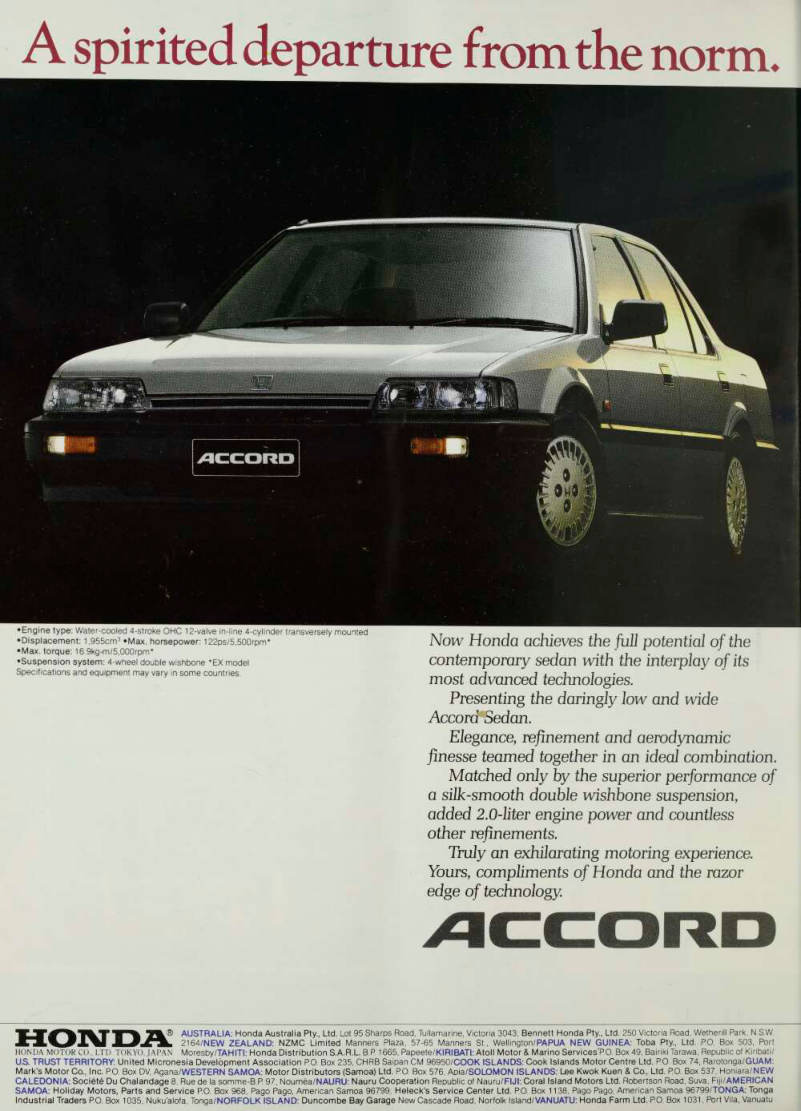
A spirited departure from the norm.
m •Engine type: Water-cooled 4-stroke OHC 12-valve in-line 4-cylinder transversely mounted •Displacement: 1,955 cm 3 »Max. horsepower; I22ps/s,soorpm* •Max. torque: 16.9kg-m/s,ooorpm* •Suspension system: 4-wheel double wishbone *EX model Specifications and equipment may vary in some countries.
Now Honda achieves the fall potential of the contemporary sedan with the interplay of its most advanced technologies.
Presenting the daringly low and wide Accord Sedan.
Elegance, refinement and aerodynamic finesse teamed together in an ideal combination.
Matched only by the superior performance of a silk-smooth double wishbone suspension, added 2.0-liter engine power and countless other refinements.
Truly on exhilarating motoring experience.
Yours, compliments of Hondo and the razor edge of technology.
AUSTRALIA; Honda Australia Pty., Ltd. Lot 95 Sharps Road, Tullamarine, Victoria 3043; Bennett Honda Pty., Ltd. 250 Victoria Road, Wetherill Park, N SW. nv/11l 2164/NEW ZEALAND: NZMC Limited Manners Plaza, 57-65 Manners St., Wellington/PAPUA NEW GUINEA: Toba Pty., Ltd. PO. Box 503, Port HONDA MOTOR CO., LTD. TOKYO, JAPAN Moresby/TAHITI: Honda Distribution S.A.R.L. B.P 1665, Papeete/KIRIBATI: Atoll Motor & Marino Services'PO. Box 49. Bairiki Tarawa, Republic of Kiribati/ U.S. TRUST TERRITORY: United Micronesia Development Association PO Box 235, CHRB Saipan CM 96950/COOK ISLANDS: Cook Islands Motor Centre Ltd. PO Box 74, Rarotonga/GUAM; Mark’s Motor Co., Inc. PO. Box DV, Agana/WESTERN SAMOA: Motor Distributors (Samoa) Ltd. PO. Box 576, Apia/SOLOMON ISLANDS; Lee Kwok Kuen & Co., Ltd. PO. Box 537, Honiara/NEW CALEDONIA; Soci6t6 Du Chalandage 8, Rue de la somme-B.P 97, Noumea/NAURU: Nauru Cooperation Republic of Nauru/FIJI: Coral Island Motors Ltd. Robertson Road, Suva, Fiji/AMERICAN SAMOA: Holiday Motors, Parts and Service PO. Box 968, Pago Pago, American Samoa 96799; Heleck’s Service Center Ltd. PO. Box 1138, Pago Pago, American Samoa 96799/TONGA: Tonga Industrial Traders PO. Box 1035, Nukualofa, Tonga/NORFOLK ISLAND: Duncombe Bay Garage New Cascade Road, Norfolk Island/VANUATU; Honda Farm Ltd. PO. Box 1031, Port Vila, Vanuatu
Islands
PACIFIC
MONTHLY
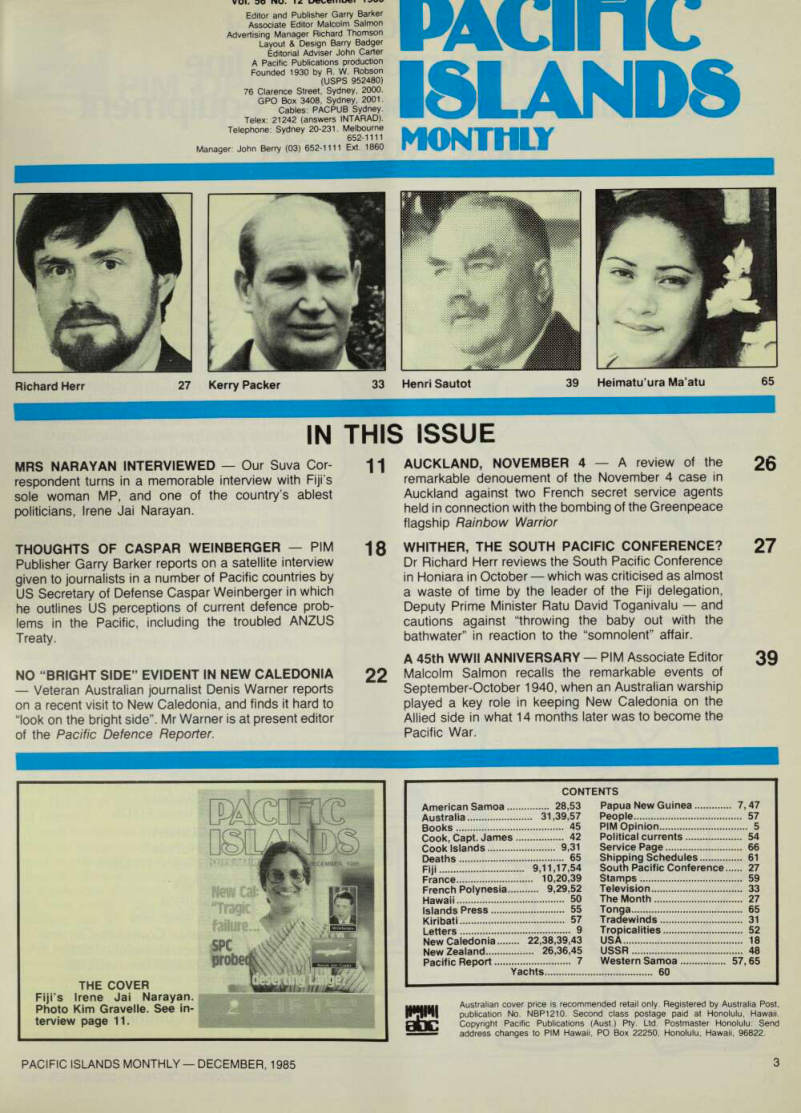
Richard Herr 27
Kerry Packer 33
Henri Sautot 39
Heimatu’ura Ma’atu 65
In This Issue
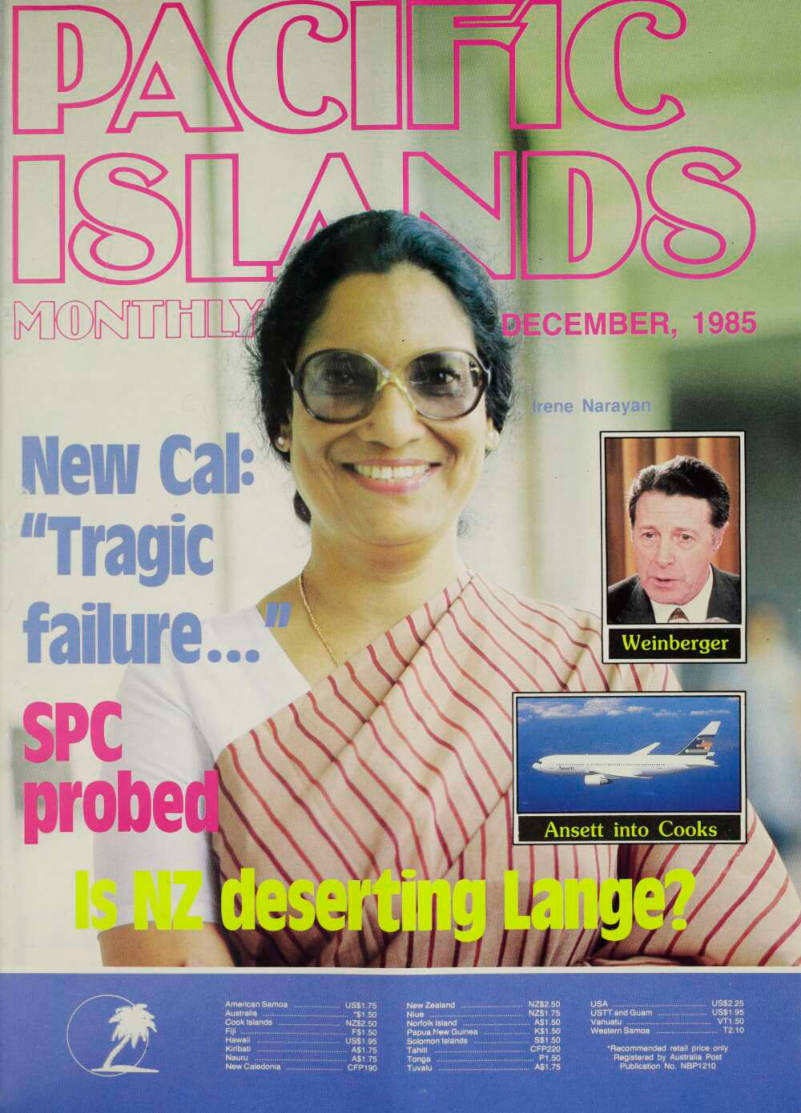
MRS NARAYAN INTERVIEWED Our Suva Cor- -| -| respondent turns in a memorable interview with Fiji’s sole woman MP, and one of the country’s ablest politicians, Irene Jai Narayan.
THOUGHTS OF CASPAR WEINBERGER PIM “| Q Publisher Garry Barker reports on a satellite interview given to journalists in a number of Pacific countries by US Secretary of Defense Caspar Weinberger in which he outlines US perceptions of current defence prob lems in the Pacific, including the troubled ANZUS Treaty.
NO “BRIGHT SIDE” EVIDENT IN NEW CALEDONIA 22 Veteran Australian journalist Denis Warner reports on a recent visit to New Caledonia, and finds it hard to “look on the bright side”. Mr Warner is at present editor of the Pacific Defence Reporter.
AUCKLAND, NOVEMBER 4 A review of the 26 remarkable denouement of the November 4 case in Auckland against two French secret service agents held in connection with the bombing of the Greenpeace flagship Rainbow Warrior
Whither, The South Pacific Conference? 27
Dr Richard Herr reviews the South Pacific Conference in Honiara in October which was criticised as almost a waste of time by the leader of the Fiji delegation, Deputy Prime Minister Ratu David Toganivalu and cautions against “throwing the baby out with the bathwater” in reaction to the “somnolent” affair.
A 45th WWII ANNIVERSARY PIM Associate Editor 30 Malcolm Salmon recalls the remarkable events of September-October 1940, when an Australian warship played a key role in keeping New Caledonia on the Allied side in what 14 months later was to become the Pacific War.
Contents
American Samoa 28,53 Australia 31,39,57 Books 45 Cook, Capt. James 42 Cook Islands 9,31 Deaths 65 Fiji 9,11,17,54 France 10,20,39 French Polynesia 9,29,52 Hawaii 50 Islands Press 55 Kiribati 57 Letters 9 New Caledonia 22,38,39,43 New Zealand 26,36,45 Pacific Report 7
Papua New Guinea 7,47 People 57 PIM Opinion 5 Political currents 54 Service Page 66 Shipping Schedules 61 South Pacific Conference 27 Stamps 59 Television 33 The Month 27 Tonga 65 Tradewinds 31 Tropicalities 52
Usa 18
Ussr 48
Western Samoa 57,65
Yachts 60
Australian cover price is recommended retail only. Registered by Australia Post, publication No. NBPI2IO. Second class postage paid at Honolulu, Hawaii.
Copyright Pacific Publications (Aust.) Pty. Ltd. Postmaster Honolulu: Send address changes to PIM Hawaii, PO Box 22250, Honolulu, Hawaii. 96822.
Advertisements & other items, pp. 3-4 (2 items)
3
PACIFIC ISLANDS MONTHLY DECEMBER, 1985
VUI. ju nu. i .www Editor and Publisher Garry Barker Associate Editor Malcolm Salmon Advertising Manager Richard Thomson Layout & Design Barry Badger Editorial Adviser John Carter A Pacific Publications production Founded 1930 by R. W. Robson
(USPS 952480)
76 Clarence Street, Sydney, 2000.
GPO Box 3408, Sydney, 2001 Cables; PACPUB Sydney.
Telex: 21242 (answers INTARAD).
Telephone: Sydney 20-231. Melbourne 652-1111 Manager: John Berry (03) 652-1111 Ext. 1860
Australian food processing equipment
From fast food outlet
to factory production line
makes you profit
z> ON m • •
OFF
Australia is one of the world's largest food-producing countries. So it is logical that Australian engineers have developed a wide range of advanced equipment for the food-processing industry. Equipment of almost any type, concept and application. Fora multitude of functions such as cooking, baking, heating, boiling, refrigerating, mechanical handling, bottling, canning, packaging. Forthe processing of a variety of foods such as dairy products, meat, cereals, edible oils, confectionery and beverages.
Australian food-processing equipment has proved efficient, reliable and competitive in many countries throughout the world.
Find out how Australia can satisfy your particular requirements.
Ask the expert who knows Australia.
For details of suppliers phone or telex the Australian Trade Commissioner at: FIJI, P.O. Box 1252, Suva Phone: 31 2844 Telex: FJ2126
PAPUA NEW GUINEA
P.O. Box 9129, Hohola Phone: 25 9333 Telex: NE22109
NEW CALEDONIA
P.0.80x 22, Noumea Phone: 27 2414 Telex: 087 HAWAII, Australian Consulate-General 1000 Bishop Street, Honolulu, 96813, USA Phone: (808) 524 5050 Telex: 633128 Ask the Australian Trade Commissioner
Pim Opinion
Dense fog on Wall St.
For all of this year, and particularly in the last three or four months, the Pacific has been the focus of considerable international political attention. Events there managed on the one hand to disrupt one of the West’s oldest, and seemingly most secure, defence alliances and, on the other, to cause a major upset to the French government, even, perhaps to advancing its expected downfall early next year.
While the ANZUS predicament is not, at first sight, a matter in which the French are involved, some blame for the continuing impasse over New Zealand’s ban on nuclear ships should be laid at their door. New Zealanders were having second thoughts about the loss of their ANZUS membership, were beginning to see that in today’s world no-one can play ostrich and be safe, were realising the wider implications of their government’s policy.
And then not only did French government saboteurs blow up the Greenpeace ship, Rainbow Warrior as she lay in Auckland harbor, but they followed it by having President Mitterrand perform an imperial strut on Moruroa which, as New Zealanders and many others in the region saw it, was lifting an arrogant two fingers to some genuine anxieties and some very sincere objections.
As our commentators report in this issue, the Greenpeace incident, and the curled presidential lip, outraged New Zealanders of every political slant even those who had regarded anti-nuclear activists as “pinko pawns” in the heady game of international power politics.
Then the US refused to condemn France for the attack, and former US ambassador to the United Nations, Jeane Kirkpatrick, made some widely-reported gratuitous comments which, in sensitive New Zealand ears, sounded as if they were being told to shut up, and never mind the radio-active fallout because it was only in their backyard and not in any place which mattered to the major powers.
All of that quite rapidly slammed the lid down on careful efforts being made to moderate the New Zealand position on nuclear ship visits. Nobody is more stubborn than a New Zealander affronted and outraged.
French motives can be well enough understood, but why did the Americans play so rough or, at least give the appearance of utter unconcern for small nation Pacific interests? In their case it is, if not unknown, uncharacteristic to so ignore image, courtesy and at least the appearance of concern. We do not pretend to know, but we may have found a clue in the editorial columns of no less an institution than the Wall Street Journal.
There, on September 20, four days before the notable Pacific policy speech in Washington to the Asia Society by Australian Ambassador Rawdon Dalrymple (see PIM, Nov), the Wall Street Journal betrayed that, in their circles at least, Americans had very faulty knowledge of the facts and the issues involved.
Given the Journal’s pretensions to expertise, the editorial is remarkable for its profusion of errors. And, given that, there is then nothing to be surprised about the errors of its conclusions.
They advance the extraordinary theory, illustrated by a map more suitable for Le Canard , that by wishing the French and their nuclear weapons gone from the Pacific, New Zealand is seeking to extend its exclusive economic zone to a radius of 3000 miles.
The editorial writer suggested the French were nobler colonists than the British, whom he seemed to think were still in control of New Zealand.
“...a patriotic Frenchman will tell you that the French have been in Tahiti as long as the British have been in New Zealand,” he said, swerving violently away from the real point. “New Zealand’s moral point, we take it, is that instead of granting French citizenship to the Polynesians, the French should have done to the islanders what New Zealand’s settlers did to the Maoris.”
Where is George Washington? What was the War of Independ ence all about?
They attributed responsibility for the South Pacific Nuclear-Free Zone Treaty to Mr Lange. We wonder what Bob Hawke, whose initiative it was at the last Forum, would think about that. They also showed they completely misunderstood the thrust of the Treaty for they saw it as an attempt to remove not only the French, but also the US Navy. In fact, the Treaty specifically permits nations to approve of and accept such as the US Navy.
Indeed, the Journal seemed even to blame New Zealand for the Greenpeace bombing; “However stupid an event may be uncovered, France has not been moved to similar desperation in the harbors of more supportive nations,” the editorial said.
“Our view could not be stronger that both the French nuclear tests and the French presence in the Pacific make the world safer, not more dangerous,” the editorial continued.
The writer went on to record, with reasonable accuracy this time, the strength of the Soviet Union’s base at Cam Ranh Bay, and its fishing agreement with Kiribati.
“If the French left the Pacific,” he wrote, “the Soviets would have more chances to infiltrate and meddle.”
Of course one may see France’s interests being primarily with the Western alliance. But letting them do what they like in other people’s territory is no way to ensure that sovereign nations, however small and under-developed, will not take umbrage and, as Kiribati did, sign deals with the enemy.
The French as a powerful and helpful presence in the Pacific is one thing. But, as a nuclear-testing nation, or as a colonial power in New Caledonia, they invite reactions which will do nobody any good.
France is trying to do something constructive about New Caledonia, and deserves support in that developing quagmire. But that will not be achieved by the sort of thinking displayed by the Wall Street Journal.
With that sort of ivory-craniumed ignorance about the place is there any wonder that the Reagan administration cannot see that its own policy, if such it may be called, of choosing the French over anyone in the Pacific, is, in fact, damaging its own interests and those of the West in an area of increasingly vital importance?
Advertisements & other items, p. 6 (1 item)
Weight-Lessness
Portable CD sound fits in your hand.
At last—true portability combined with
true high-fidelity performance! Introducing
Technics’ SL-XP7, our lightest and most compact CD player ever.
Smaller than one CD jacket and lighter than five of them (520 g), the SL-XP7 still delivers out-of-this-world sound: a dynamic range of more than 90dB, THD of less than 0.006%, and wow and flutter nonexistent.
What’s more, it’s tough enough for real portable use. It contains a Technics FFI miniature laser pickup that improves upon previous one-beam systems with original Digital Accu- Servo tracking and a host of crosstalk-
defeating digital circuits. Microcomputer
attitudinal servo circuitry compensates automatically for changes in position, while a fourwire suspension system creates a free-floating focal lens. So when you’re on the go, the SL-XP7 keeps going, no matter how you hold it.
It plays equally well based at home, connecting easily to hi-fi systems and boasting such full-size features as 15-step random-access programmability, skip function, program recall, and LCD display. Equipped with AC adaptor/ recharger and connector cable. Carrying case
with built-in rechargeable battery optional.
The SL-XP7. Now the CD sound experience goes with you. With ease. fr nt
Technics
National, Panasonic and Technics are the brandnames of Matsushita Electric.
_R COMPACT
iSoiis
Pacific Report
Png Conned’,
Inquiry Told
Evidence could justify a finding that Papua New Guinea’s Prime Minister, Michael Somare, had acted in an “un-statesman like manner” in personally attending a drug search of an Australian commercial aircraft, the Peldale Commission of Inquiry; was told in Port Moresby on November 5.
The commission was also told PNG had been “conned” in buying Israeli Arava rpilitary aircraft for SAI4 million. The remarks were made by counsel assisting the inquiry, Tony Mullumby. But, Mr Mullumby said, in his view there was insufficient evidence to prove that there had been irregular commissions in purch ase of the Aravas and the sale of a luxurious government jet. The inquiry, headed by Justice Theodore Bredmeyer, was appointed by the government to investigate allegations about the aircraft deals and Mr Somare’s role in the drugs search at Port Moresby airport on March 6 of an aircraft operated by the Sydney based company Peldale. Mr Mullumby, in his final address said a common thread in all the terms of reference was the involve ment of Peldale representatives, John Johnson and John Lawrence Aston, as well as the Melbourne-based Arava regio nal sub-agent Sonnie Lipshut. Mr Mullum by said that the PNG Government could have saved Kina 900,000 (about SAI.3 million) by dealing directly with the Israeli Government to buy the Arava, rather than going through agents.
French Warrior’
Inquiry Sunk
A French parliamentary investigation into the sinking of the Greenpeace ship Rain bow Warrior in Auckland on July 10 has been abandoned. Officials in Paris said that the National Asembly’s Laws Committee, which must endorse any parliamentary investigation, had rejected formal demands from the Socialists and Communists for a commission of inquiry. The committee said an inquiry would be useless after the two main Opposition parties, the RPR and the UDF, had refused to take part. Prime Minister Laurent Fabius announced the investigation in September, after admitting that French secret agents had been re sponsible for blowing up the Rainbow Warrior shortly before it was to leave Auckland to demonstrate against French nuclear testing at Moruroa, French Polynesia. Among reasons for shelving the inquiry was no doubt the fact that the Rainbow Warrior issue had practically disappeared from the French public arena by early November, when the “no probe” announcement was made. Recalling a remark by Voltaire that “it was impossible to get the French to be interested in anything for more than 10 days”, political commentator Jean-Marie Benoist wrote: “First, Greenpeace was killed by (the October visit to France by Soviet leader Mikhail) Gorbachev. Then Gorbachev was killed by the hijacking of the Achille Lauro,
and nobody particularly remembers Greenpeace any more.” Benoist noted that the extent to which Greenpeace had lost the attention of the public was reflected in the absence of any reaction to the dramatic claim by the new head of the French intelligence agency, General Rene Imbot, that he had uncovered a plot to “destroy” the intelligence agency. This announcement, made simultaneously by the general on all three of France’s television networks, had been followed by almost absolute silence, and there had been no public demand for further in formation. Writing in the London-based weekly, The Spectator, on October 5, another commentator, John Ralston Saul, a close student of the role of the French military in the country’s political life, didn’t even oother to argue the point that the army was the moving force behind the Rainbow Warrior sinking. Saul wrote: “The idea to sink the ship can only have originated at the officer level. Whether it was approved by the minister hardly matters; either way he was treated like a pushover. As for the stupidity of the secret services, it should surprise no one . . .
Secret services are filled with second-rate people of limited imagination. Having failed, it is not surprising that they should attempt to tar the government with their own incompetence.” Saul calculates that since 1830, French military officers have on average brought down, or have sought to bring down, the ruling government on average once every 13 years.
U.S. Diplomatic
Ties Soon Lini
Vanuatu’s Prime Minister Fr Walter Lini has predicted that his country will soon establish diplomatic links with the United States. He said in late October his visit to the United States for the 40th anniversary sessions of the United Nations had enabled him to have discussions with American officials in New York, and that these talks had improved the atmosphere between the two countries. Asked whether the decision would also mean the establish ment of ties with the Soviet Union, Fr Lini said the possibility was there, but that relations with America would come first.
President Deroburt
In ‘Moral’ Victory
Nauru’s President Hammer Deßoburt on October 31 “won” a seven-year-long, SUS2O million defamation suit in a Hon olulu court. But he is unlikely to pick up a cent in damages. President Deßoburt took the action over a 1978 report in the Guam-based Pacific Daily News alleging that he had lined up a secret loan from Nauru to a group in the Southern Marshall Islands who wanted to form a breakaway government. Defendants were the owners of Pacific Daily News, the giant U.S.
Gannett Corporation. The court heard that the loan had in fact been made, but that it was not secret, and that, most important, Deßoburt himself was not in office at the time. Deßoburt won the case in the sense
that the court found that the report was “false” and “damaging” to him. But it did not find, as U.S. laws require it to do before a public figure such as Deßoburt can be awarded damages, that the article was written with “actual malice”. Among character witnesses called by Deßoburt was the former New Zealand prime minis ter Sir Robert Muldoon. Observers in Honolulu estimate President Deßoburt’s costs in the long-drawn saga at between SUS 3 and $4 million. It is understood they are being met by the Republic of Nauru.
From a Special Correspondent in Hon olulu.
Kenilorea Lashes
France At U N.
Sir Peter Kenilorea, prime minister of Solomon Islands, told the United Nations General Assembly in October that France was pursuing “imperialistic” policies in the South Pacific, His outspoken attack on French policies on both New Caledonia and on nuclear testing was the high point of his trip through the United States, the Bahamas and London. His UN speech was covered carefully by the New York Times and other publications. The prime minister criticised France’s continuing claim to sovereignty over New Caledonia, and said that his country “condemns and deplores” a French military buildup in the territory.
He called the French claims to the island “colonialistic in all aspects”. Regarding the nuclear question, Sir Peter said that the heavy reliance of the South Pacific nations on marine resources was one of the main reasons for their concern about nuclear testing. If nuclear tests are as safe as France says they are, he asked “Why can’t the French Government carry out its tests in France?” Sir Peter said that “certain technicalities” had caused a delay in the signing of the South Pacific Nuclear-Free Zone Treaty by Solomon Islands. Despite these delays he said that his nation’s policy was “not to allow any vessels and aircraft which are nuclear-powered, or are capable of carrying nuclear weapons, into its waters, airspace and ports”. During a week in New York he did not come to Washington Sir Peter conferred with the Secretary-General of the UN, Peru’s Javier Perez de Cuellar, and with the President of the 40th General Assembly, Jaime de Pinies, the Spanish Permanent Repre sentative to the UN. After the visit to New York, Sir Peter and several other Pacific island leaders repaired to another island capital, resort-studded Nassau in the Baha mas, for a meeting of the Commonwealth Heads of Government. Among others present were Michael Somare of Papua New Guinea, Ratu Sir Kamisese Mara of Fiji, and Father Walter Lini of Vanuatu.
While the heads of government were conferring in Nassau, their UN delegations were voting in a contested election for a non-permanent seat on the UN Security Council. The opposing candidates were Liberia and Ghana, two English-speaking, West African nations ruled by fairly new military dictatorships; Liberia, backed by the US and the Organisation of African
States, eventually lost to Ghana, a Com monwealth member supported by the Soviet Union, among others. In the odd tradition of the United Nations, the four votes were done secretly, and neither sources in the US State Department nor the Pacific Island UN missions would speculate on whether the island nations supported the American candidate or the Commonwealth member. The five Pacific nation members of the UN are Fiji, PNG, Solomon Islands, Vanuatu and Western Samoa. From David North in Washington.
Oil Riches Around
Corner For Png?
Papua New Guinea is poised to become a major oil producer by world standards if a series of huge structures being tested in the Southern Highlands measure up to seismic indications. Attention has centred on the Juha and Mananda structures, which are just two of at least 15 geological formations regarded as ideal petroleum-bearing chambers. Advances in petroleum search technology have been spectacular since the first well was drilled in PNG just after World War I, but during that period no major strike has ever been made. Now all that is changing with immense potential significance for PNG. “What we know is that there is a major hydrocarbon province up there,” says Jock Cluff, principal oil analyst at Brisbane stockbroker, Wilson & Co. Wilsons, who take a specialist interest in oil stocks, have been monitoring oil exploration in PNG. Cluff believes that the two current wells, Juha No. 3 and Man anda No. 3, which have reached target depth and are testing in oil strata, could show commercial values larger than any existing Australian field. For instance, the Mananda structure is over 40 km long.
Cluff anticipates that if Mananda is as large as early indications suggest despite drawing water in the first two of five levels being tested in Mananda No. 3 the Australian-American drilling consortium could see a pre-tax profit of SUSI.S billion in the first full year of production in 1991.
Of this PNG’s treasury would draw off SUS77S million in super taxes and income tax. This boost to the economy would not only be enough to wipe out the Australian aid component of the national budget which accounts depending on analysis for between 25 per cent and 30 per cent, but would leave sufficient for an annual trade surplus of up to SUSSOO million. An indication of how rich this would make PNG is that this first-year budget surplus would pay for the construc tion of a highway linking Port Moresby with the northern side of the island.
Walter Birchett.
New Party For
Solomons
Solomon Islands has a new political party.
Formed in October, it is called the Solo mon Islands Nationalist Front for Progress (NFP), and has been set up by a leading Opposition MP, Andrew Nori, who repre sents West Are Are. According to Mr Nori, it will provide an open forum for people who wish to seek solutions to land disputes. The NFP would abolish the
existing system ot provincial government, and establish a direct link between central government and area councils. Mr Nori, a lawyer, said the NFP would hold a national convention at the end of November.
Satan’ Accused In
Church Row
Church politics can often be at the centre of community issues in the Pacific a fact which the Anglican Archbishop of the Church of Melanesia, Norman Palmer, has recently discovered. Palmer lost his provin cial secretary, Ambrose Bugotu, in an unseemly upheaval which saw demonstra tors march through the streets of Honiara in mid-September demanding the archbishop’s resignation as well. The con flict centred on the relocation of Honiara’s All Saints church, whose congregation had been collecting for a new chapel only to discover that the archbishop, advised by Bugotu, wanted to develop the land for commercial purposes. Palmer and Bugotu, who are both of Melanesian descent, were accused of being overwhelmed by the advice of their white financial advisers.
Confronted by the 2000 demonstrators who had paraded through Honiara’s streets before assailing him on the steps of his church, Archbishop Palmer claimed: “There are traitors and Satan has been let loose to try to fight against the church of God.” He defended his secretary as a dedicated individual, prepared to work “48 hours without stopping”. “I see nothing wrong within the Church of Melanesia,” he said in answer to critics. Palmer, according to a close adviser, “could have handled it differently,” but in the end, his secretary fell victim to the angry parishioners and was removed by the church synod.
Walter Birchett.
Booker Prize
To Keri Hulme
New Zealand author Keri Hulme has won Britain’s best known and most valuable literary award, the Booker Prize. The aw'ard was made for Ms Hulme’s novel, The Bone People. The work, which is said to have been in the writing for 12 years, is a long prose poem about Maori mytns and personal relationships. The Booker Prize is worth about $A21,000.
Islander Women Get
The Papeete Chop
People are still talking in Tahiti about the strange events of mid-September in which two Islands women one a Maori, the other Fijian were served with expulsion orders within hours of each other, and escorted to departing aircraft by immigra tion police. The first was Tuaiwa Kereopa, better known in New Zealand as Eva Rickard. She arrived with a group of five others, including Father Bernard Denehy, a Catholic priest, and four trade unionists, one of them a Tokelauan. They were on their way back to New Zealand after visiting Nicaragua. Before they left the airport each was presented with a docu ment to sign pledging that under no circumstances would he or she take part in any demonstration, or make any public statement, during their short stay. No one
agreed to sign. Later the same day they took part in a candlelight procession in support of Greenpeace organised by the Mayor of Faaa, Oscar Temaru. Eva Rick ard and Mr Temaru each addressed the meeting, at which several hundred people were present, and the quiet affair ended with a minute’s silence in honor of the slain Rainbow Warrior photographer, Fernando Pereira, and a prayer spoken by a deacon of the Evangelical Church of French Polynesia. The next morning, as her group was at the airport ready to leave, an expulsion order from the high commission er was served on Eva Rickard, forbidding her from visiting French Polynesia at any time in the future. Her companions were not served with similar orders, although they too had taken part in the march and subsequent meeting. But the most curious thing was that the next day, September 17, another Pacific Island woman, Tinai Nakita Anna Sovaia, from Fiji, who had been seen and photographed in the front ranks of the Faaa procession, left the territory escorted to the aircraft by immigration police armed with an expulsion order. It was only to be expected that a journalist who had been present at both the procession and the expulsion of Tania Nakita Anna Sovaia should make a connection between the two events. As a footnote to the journalist’s article, which appeared in a local news paper, the high commissioner explained that the second expulsion was for purely administrative reasons, the Fiji woman’s visa having run out some time before, and not having been renewed. In view of her unwillingness to leave, and after several warnings, the high commissioner ex plained, he had no option but to issue an expulsion order against her. Despite these explanations, many in Tahiti see a link between these two identical actions which followed so quickly upon each other after the demonstration. Marie-Therese Danielsson in Papeete.
The Weevil That
Saved The Sepik
A tiny black weevil was the star of a documentary film produced by Australia’s Commonwealth Scientific and Industrial Research Organisation (CSIRO) and screened by the Australian Broadcasting Corporation on October 29. For this insect saved Papua New Guinea’s mighty Sepik River from strangulation by a water weed called Saluinia molesta, which originated in Brazil and has now spread to Asia and the Pacific. The Sepik is the lifeblood of an extensive area of PNG, but by 1980, the weed covered 500 square kilometres of the river, choking access to villages and de stroying vital fishing. Nothing seemed capable of killing it. Then, in 1981, a CSIRO research team discovered a weevil which attacked the weed and kept it in check. After extensve tests in Australia, particularly at a lake near Mount Isa also threatened by the weed, the weevil was introduced into the Sepik. Within 18 months, the weevil was triumphant with the weed retreating to the river bank. The CSIRO team was awarded the UNESCO Science Prize of $15,000 for its work, the first time the award had been given to Australia.
Who paid the air fares?
letters
The Arts Festival In Papeete
I am among the happy few in Tahiti who can read English. I can tell you I am very often annoyed and offended because everything reported in your magazine on French Polynesia is seen through an outsider’s distorting eyes. I am hinting at Bengt Danielsson who apparently can’t help warping facts and events.
For instance, in his article entitled Flosse’s French Festival (PIM Sept.), he belittled the effort made by the local govern ment by asserting that the French Government supported all foreign delegations, which was absolutely false because the Council of Pacific Arts held in Papeete last February de cided to create a fund, man aged by the South Pacific Com mission, to help small countries meet the extra cost of air transport due to the change of venue.
Financial contributions amounting to SUSI3O,OOO were made by France, Chile, New Zealand, Australia, USA and UNESCO. This was of course little when compared to the tremendous budget of the festival, which was justified by the extraordinary circumst ances. Danielsson mentioned it, but it was necessary to add: without France’s help.
In spite of some obvious defects, the festival was a real success and therefore I pay tribute to Victor Carrell for recognising it as such in another PIM article. Which country could have staged such a festi val in four months and made available so much money on its own?
Mr Danielsson takes any opportunity to vent his anti- French feelings. He can’t bear the idea that the people of French Polynesia democratical ly choose to maintain their relationships with France. As a foreigner enjoying our prosper-
ity, he should not interfere and give a false image of our coun try. In some countries of the Pacific, newspaper correspon dents have been ousted for less than that.
It is not fair of him when he asserts wrongly that five Pacific countries refused to participate in the festival out of solidarity with the FLNKS, and that there was no murmur of protest in Tahiti when an anti-independ ence delegation came from New Caledonia. On the con trary, at the opening ceremony, the New Caledonian delegation received a big hand from the crowd because it was com posed of 90 per cent of Melane sians who meant to demons trate in front of all the Pacific people that they don’t share the separatist views of the FLNKS.
I have decided to respond whenever Bengt Danielsson writes falsehoods in future.
J. Taumihau
Papeete, Tahiti
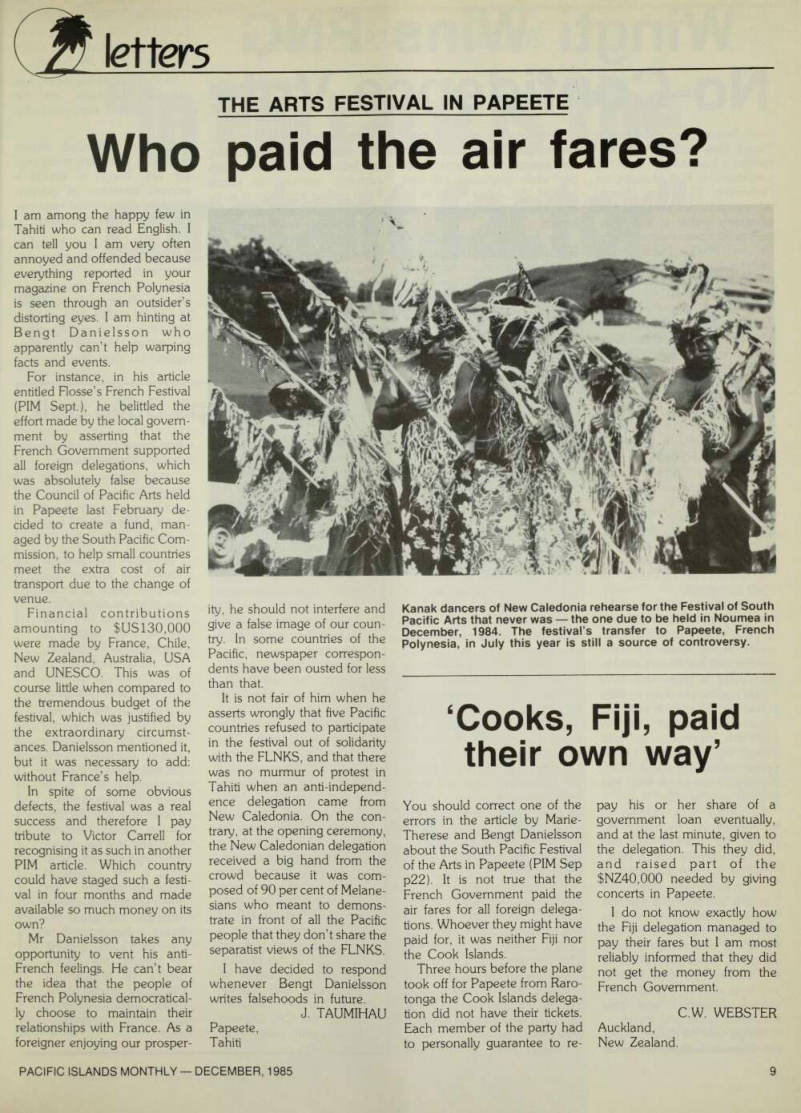
Kanak dancers of New Caledonia rehearse for the Festival of South Pacific Arts that never was - the one due to be held in Noumea in December, 1984. The festival’s transfer to Papeete, French Polynesia, in July this year is still a source of controversy.
‘Cooks, Fiji, paid
their own way’
You should correct one of the errors in the article by Marie- Therese and Bengt Danielsson about the South Pacific Festival of the Arts in Papeete (PIM Sep p 22). It is not true that the French Government paid the air fares for all foreign delega tions. Whoever they might have paid for, it was neither Fiji nor the Cook Islands.
Three hours before the plane took off for Papeete from Raro tonga the Cook Islands delega tion did not have their tickets.
Each member of the party had to personally guarantee to re
pay his or her share of a government loan eventually, and at the last minute, given to the delegation. This they did, and raised part of the SNZ4O,OOO needed by giving concerts in Papeete. 1 do not know exactly how the Fiji delegation managed to pay their fares but I am most reliably informed that they did not get the money from the French Government.
C.W. Webster
Auckland, New Zealand.
No-Confidence Vote
Wingti Wins PNG No-Confidence Vote
The Somare Government in Papua New Guinea was top pled in a leadership vote in the parliament in Port Moresby on November 21. Paias Wingti, 34, a Highlander who has been extremely visible in the coun try’s politics over recent months became PNG’s fourth prime minister after winning a vote of no-confidence in Mr Somare by 58 to 51.
Mr Wingti was for a time deputy to Mr Somare but broke with him last March and since that time had been steadily building his numbers in the parliament, while making no secret of his plans to bring on a no-confidence vote.
Somare, who has been PNG’s dominant politician since the late 19605, is now Leader of the Opposition, and has vowed to win the next general election in 1987. An hour or two being a very long time in PNG politics, and the country’s politicians being of fickle nature, he is given a very fair chance of repeating his 1982 comeback.
Political observers said Mr Somare’s defeat was no real surprise, given that he had been under strong attack for some months and had been forced to give away a great deal to a fragile coalition in order to keep power. In the end his erstwhile supporters deserted him in sufficient numbers to give Wingti, and his deputy, former prime minister Sir Julius Chan, the victory for which they had worked so shrewdly.
Sir Julius is a veteran of no-confidence motions. He ousted Mr Somare for two years on a similar vote in 1980.
Mr Wingti opened office as prime minister with a series of vigorous edicts, and a promise to spend more wisely than his predecessors had done. He said he would abolish up to three ministries, make severe cuts in the bureaucracy (the size of which is one of PNG’s most serious problems), and limit ministerial perks and travel.
Wingti said he would reject the Somare budget, tabled in
parliament only about a week before the no-confidence vote and operate on temporary sup ply while preparing his own budget (Sir Julius Chan is his finance minister) by next March.
He has also given notice of rescinding the Somare govern ment’s approval of broadcast television in PNG, and has amended the inconvenient legislation banning imported advertising material from PNG publication.
Wingti, an ebullient if occa sionally erratic, man was con gratulated on his victory by the Australian prime minister, Bob Hawke who wished the new leader good fortune ”in the very testing times you will face ahead.”
Obviously Australia has an interest in the new leader, and wishes him well, for a stable, hopefully progressive, PNG is important to them. But a Papua New Guinea without Michael Somare at the helm may strike some foreigners as a shade uncomfortable. Wingti has Sir Julius Chan at his right hand, which should calm some in ternational worries about the changeover, but the general view externally is that he is to some degree on notice.
Wingti is the youngest man to have become prime minister, and the only one to have had a university education (although he dropped out in 1977 to enter politics). His rise to power has been spectacular and, while some of his success must be attributed to the support of the experienced Sir Julius Chan, he is seen as capable of uniting the very diverse regional groups within PNG.
But the economic, social and political problems which contri buted to the Somare downfall have not disappeared because of the change of helmsman.
The economy remains shaky, law and order continues to be a problem, there are still 10,000 Irianese refugees living in PNG, causing a very delicate problem with Indonesia.
Foreign debt is mounting
rapidly, revenue from minerals, and even mining production are falling, and Australian aid currently running at nearly $350 million annually, is to be ed by 3 per cent per annum over the next five years.
Wingti, a Highlander, also faces the perennial problem of PNG prime ministers, that of maintaining the numbers in a parliament now famous for its floor-crossers and factions. He leads a coalition of five parties, which in many respects seem to have little in common, plus
some highly individualistic inde pendents. It is, in fact, a more diverse group than that which fell apart under Mr Somare.
In short, while the jockey has changed, the horse, and the course, remain very much the same.
Somare conceded defeat gracefully, promising to cooper ate with Wingti to ensure a smooth transition of govern ment, and to provide responsi ble, constructive opposition. ”1 have been very proud to have held the head office pre independence, at independ ence, and after independence,” he said. ”But I have also served as Leader of the Opposition. It is not new to me, and I am only too happy to play that role
again.”
Staff Writer.
Labor sweeps Suva poll
The Fiji Labor Party, formed only four months ago, delivered a stinging blow to the leader of the National Federation Party, Mr Siddiq Koya, and his faction by taking eight seats in the Suva City Council election in November. No official NFP candidates won seats. Adding to the ignominy was the elec tion of five former NFP members who stood as independents, unoffi cially, but obviously, supporters of Mrs Irene whom Mr Koya had earlier sacked as NFP deputy leader. The remaining seven seats were won by candidates fielded by the Alliance, the party ruling the na tional government of prime minister, Ratu Sir Kamisese Mara. While the Labor Party was ex pected to make some inroads into the NFP’s traditional support, no one forecast the extent of its victory, nor that it would also find support, as it did, in the traditio nal Alliance seats of Maunikau and Tama vua. The NFP had con trolled the City Council for several years and
had never been without major representation.
The Alliance and the Labor Party had fielded a full slate of 20 mem bers, while the NFP had only 15 candidates.
Political commenta tors in Fiji suggest that the electorate is show ing signs of disaffection from both the NFP and the Alliance, leading to theories that the traditio nal, racial, alignment of the country’s politics may be subtly changing.
However, Suva is not Fiji, and the city council is not the parliament and no revolution is ex pected, even in the two by-elections due to be held in December.
These are for the Ba- Tavua Indian National seat and the Lau-Rotu ma Fijian Communal seat in the House of Representatives. The Fijian seat is blue-ribbon Alliance, but great in terest is being taken in the Ba-Tavua contest for among the candi dates is Mahendra Chaudary, leader of the Labor Party. From Our Suva Correspon dent.
constant factor”
Irene Narayan Interview
"in Fiji race is the constant factor”
The Iron Lady of Fiji.. the “Mrs Indira Gandhi of Fiji”., the ’’only real man among the 52 members of Fiji’s House of
Representatives...”
These and other terms have been used to describe the sari clad, 53-year old, Mrs Irene Jai Narayan, who has been con stantly returned to parliament with huge majorities for the past 19 years in an Indian commu nal seat for the capital city, Suva.
Mrs Narayan came to Fiji from India, her birthplace, in 1955, at the age of 23 when she married a Fiji citizen, Mr Jai Narayan. Both had met at Benares University. She was born, and had her early educa tion at Lucknow, the youngest of nine children, of whom only three survive, a brother and a sister.
While she has emerged as a very powerful, fearless, and outspoken politician in Fiji, poli tics does not run in her blood.
Her father and brother both had Army careers.
At college she dabbled a little in student affairs, but she was not fond of politics. When she came to Fiji and joined the teaching service as a higher school teacher there was still no thought in her mind of a politi cal career.
Then the late A. D. Patel, founder of the National Federa tion Party and the first Leader of the Opposition in the parlia ment, approached her to con-
Politics make a heady brew in Fiji. Cabinet shuffles ... speculation about new prime ministers ... yet new splits in the National Federation Party .. the formation of the Fiji Labor Party, seeking to cut across the traditional, racially-arranged, voting sys tem. All these and much else fill the minds of the gossips.
Through it all the name of Irene Jai Narayan, former deputy leader of the NFP, the only woman in the parliament, constantly is heard, especially now in the wake of her virtual sacking by the party leader.
What will she do? Will she join the Labor Party? Will she soldier on against the autocratic leader, Siddiq Koya?
Our Suva Correspondent interviews this lady of strong personality and great determination; admired by many, particularly among the nation’s intel ligentsia, and avoided by others who accuse her of nagging too much. But, as our correspondent reports, not a soul can ignore her.
test a communal seat against the well-known lawyer, the late A.l.M.Deoki.
Mr Patel had heard Mrs Narayan speak at some rallies and was convinced she had the makings of a fine politician.
While she felt unsure of herself, Patel and others urged her on and she went to the hustings, defeating Mr Deoki in resound ing fashion. Ever since then she has been returned with a thum ping majority on the NFP ticket.
But 19 years later things are quite different. Mrs Narayan is now highly unlikely to contest the next election as an NFP candidate.
Now the situation is quite different. Mr Patel is long dead.
The former leader of the opposition, Jai Ram Reddy is no longer in office. The leader of the party is now S.M.Koya whom she once challenged for the leadership and lost by one vote.
Mrs Narayan and Mr Koya have never seen eye to eye politically, and the animosity goes back to the great NFP leadership crisis in the wake of the April, 1977 general election which the NFP won, but after which they could not form a government. Mr Koya was party leader at the time, having taken over from A. D. Patel.
From the political shambles Koya was turned out and the party leadership was given to Jai Ram Reddy, a Lautoka lawyer. Mrs Narayan was large ly responsible for the second general election that year, and the campaign which led to the ousting of Mr Koya.
While Mrs Narayan still main-
Continued on page 14
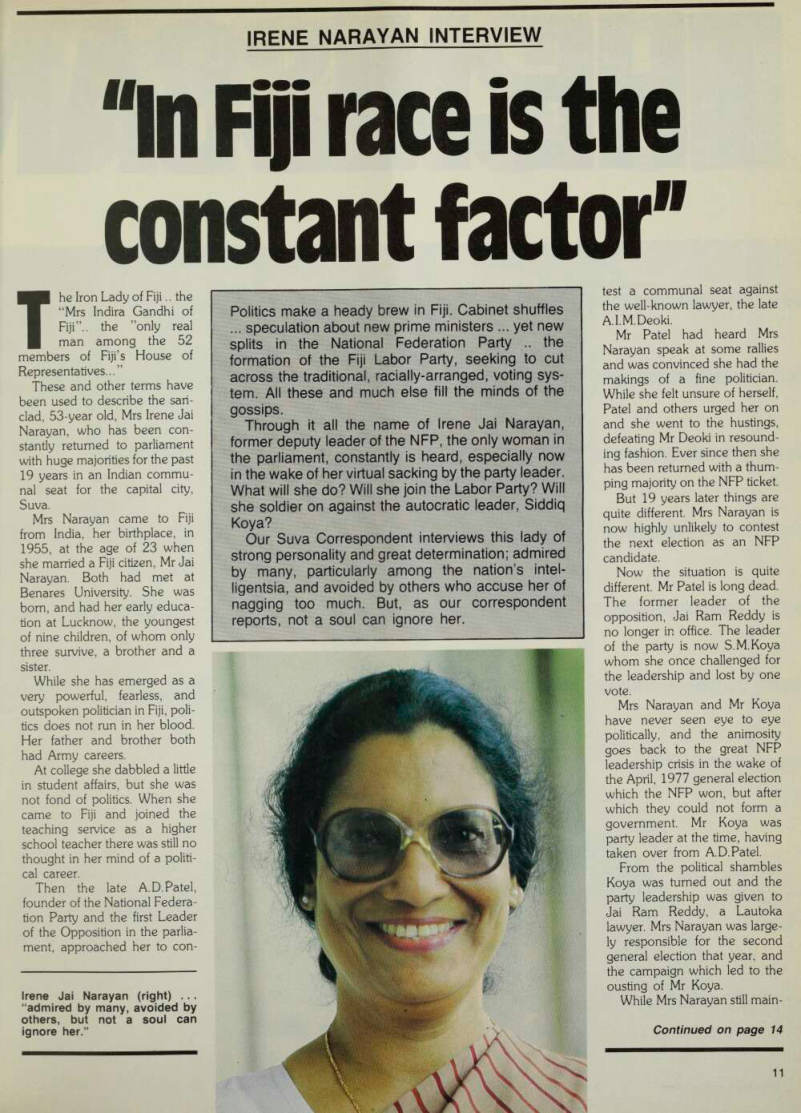
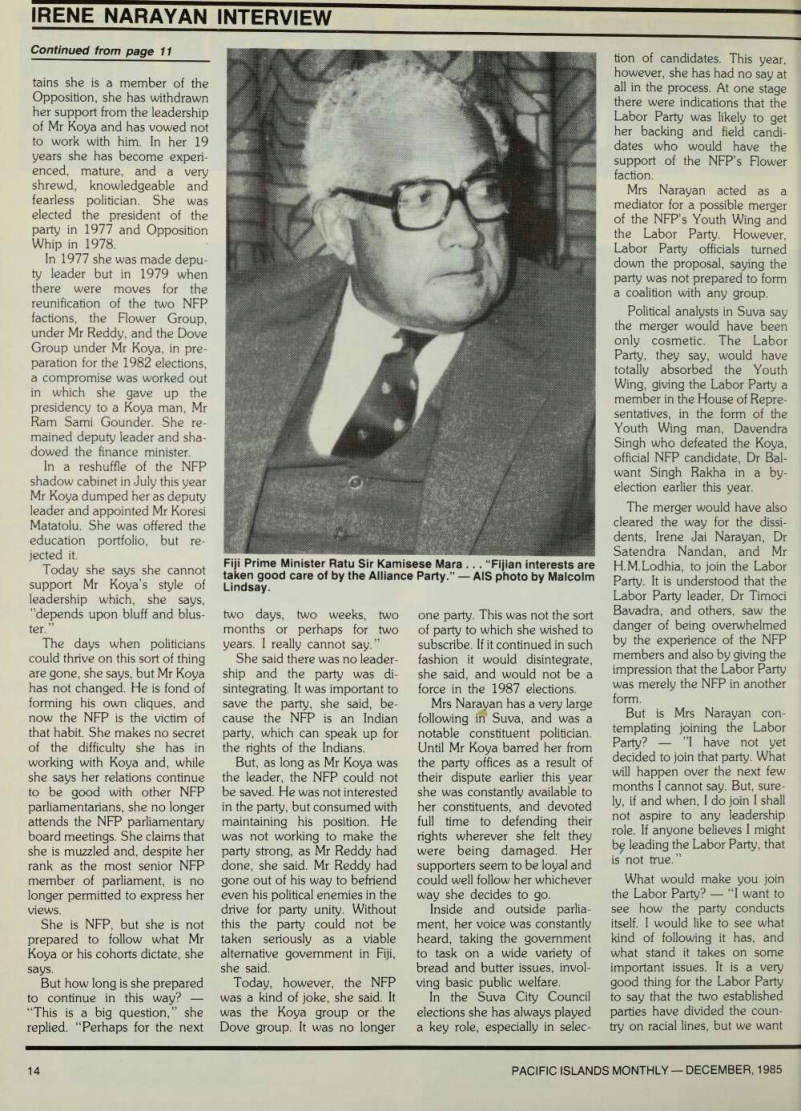
Irene Jai Narayan (right) . . .
“admired by many, avoided by others, but not a soul can ignore her.”
tains she is a member of the Opposition, she has withdrawn her support from the leadership of Mr Koya and has vowed not to work with him. In her 19 years she has become experi enced, mature, and a very shrewd, knowledgeable and fearless politician. She was elected the president of the party in 1977 and Opposition Whip in 1978.
In 1977 she was made depu ty leader but in 1979 when there were moves for the reunification of the two NFP factions, the Flower Group, under Mr Reddy, and the Dove Group under Mr Koya, in pre paration for the 1982 elections, a compromise was worked out in which she gave up the presidency to a Koya man, Mr Ram Sami Gounder. She re mained deputy leader and sha dowed the finance minister.
In a reshuffle of the NFP shadow cabinet in July this year Mr Koya dumped her as deputy leader and appointed Mr Koresi Matatolu. She was offered the education portfolio, but re jected it.
Today she says she cannot support Mr Koya’s style of leadership which, she says, ’’depends upon bluff and blus ter.”
The days when politicians could thrive on this sort of thing are gone, she says, but Mr Koya has not changed. He is fond of forming his own cliques, and now the NFP is the victim of that habit. She makes no secret of the difficulty she has in working with Koya and, while she says her relations continue to be good with other NFP parliamentarians, she no longer attends the NFP parliamentary board meetings. She claims that she is muzzled and, despite her rank as the most senior NFP member of parliament, is no longer permitted to express her views.
She is NFP, but she is not prepared to follow what Mr Koya or his cohorts dictate, she says.
But how long is she prepared to continue in this way?
“This is a big question,” she replied. “Perhaps for the next
two days, two weeks, two months or perhaps for two years. I really cannot say.”
She said there was no leader ship and the party was di sintegrating. It was important to save the party, she said, be cause the NFP is an Indian party, which can speak up for the rights of the Indians.
But, as long as Mr Koya was the leader, the NFP could not be saved. He was not interested in the party, but consumed with maintaining his position. He was not working to make the party strong, as Mr Reddy had done, she said. Mr Reddy had gone out of his way to befriend even his political enemies in the drive for party unity. Without this the party could not be taken seriously as a viable alternative government in Fiji, she said.
Today, however, the NFP was a kind of joke, she said. It was the Koya group or the Dove group. It was no longer
one party. This was not the sort of party to which she wished to subscribe. If it continued in such fashion it would disintegrate, she said, and would not be a force in the 1987 elections.
Mrs Narayan has a very large following in Suva, and was a notable constituent politician.
Until Mr Koya barred her from the party offices as a result of their dispute earlier this year she was constantly available to her constituents, and devoted full time to defending their rights wherever she felt they were being damaged. Her supporters seem to be loyal and could well follow her whichever way she decides to go.
Inside and outside parlia ment, her voice was constantly heard, taking the government to task on a wide variety of bread and butter issues, invol ving basic public welfare.
In the Suva City Council elections she has always played a key role, especially in selec
tion of candidates. This year, however, she has had no say at all in the process. At one stage there were indications that the Labor Party was likely to get her backing and field candi dates who would have the support of the NFP’s Flower faction.
Mrs Narayan acted as a mediator for a possible merger of the NFP’s Youth Wing and the Labor Party. However, Labor Party officials turned down the proposal, saying the party was not prepared to form a coalition with any group.
Political analysts in Suva say the merger would have been only cosmetic. The Labor Party, they say, would have totally absorbed the Youth Wing, giving the Labor Party a member in the House of Repre sentatives, in the form of the Youth Wing man, Davendra Singh who defeated the Koya, official NFP candidate, Dr Bal want Singh Rakha in a by election earlier this year.
The merger would have also cleared the way for the dissi dents, Irene Jai Narayan, Dr Satendra Nandan, and Mr H.M.Lodhia, to join the Labor Party. It is understood that the Labor Party leader, Dr Timoci Bavadra, and others, saw the danger of being overwhelmed by the experience of the NFP members and also by giving the impression that the Labor Party was merely the NFP in another form.
But is Mrs Narayan con templating joining the Labor Party? ”1 have not yet decided to join that party. What will happen over the next few months I cannot say. But, sure ly, if and when, I do join I shall not aspire to any leadership role. If anyone believes I might bf leading the Labor Party, that is not true.”
What would make you join the Labor Party? “I want to see how the party conducts itself. I would like to see what kind of following it has, and what stand it takes on some important issues. It is a very good thing for the Labor Party to say that the two established parties have divided the coun try on racial lines, but we want
Fiji Prime Minister Ratu Sir Kamisese Mara ... “Fijian interests are taken good care of by the Alliance Party.” - AIS photo by Malcolm Lindsay.
to bring the races together.
“It is very nice of them to say they want a common name and a common identity for all people. Those are very nice, idealistic things to say. But in Fiji race is very important. The Alliance Party, which is predominantly Fijian, takes every care to protect the rights of the Fijian people. The National Federation Party is predominantly an Indian party and it is one which could speak up for the rights of the Indian people.
“The Labor Party is hopeful of drawing support from both Fijians and Indians and would not be prepared to speak for any particular race. But from my experience 1 know that in this country in the final analysis everything boils down to race.
So what will be the position of the Indians in the Labor Party?
It is unknown.
“If there is an issue affecting the welfare of the Indians in this country, will the Labor Party be
prepared to speak on behalf of them?
“By the same token, if there is an issue affecting the Fijians, will the Labor Party stand up and speak for them?
“In fact, let me be frank, I will not be very worried what the Labor Party chooses to say or not to say regarding the Fijian people, because I think the Fijian interests are taken good care of by the Alliance Party, But as far as Indian interests are concerned, these days the Federation Party does not seem to be worried about what is the future of the Indians in this country or what is affecting the Indians or their welfare here even at the present time, “As a communal Indian member I have always thought in terms of my community, and let me be very frank; I will not be apologetic for being commu nal in my approach, because we have a constitution which is very communal. It is a racial
constitution. The electoral sys tem is racial and the prime minister of the country has often enough said that race is a fact of life. I accept that.
“So far we have been fortun ate enough that so many years after independence the two ma jor races have been living side by side in peace.
“In fact we have been very fortunate that there has been no racial strife, or religious or communal intolerance. On the whole we are living very happi ly in the country.
“But the racial factor is very much there and the different races, particularly the two major races, must be satisfied. They must have confidence in their leaders that they will take care of them, and will always do things which are in the best interest.
“The Fijian community is very fortunate that they have good leaders, but today if you asked the same question about
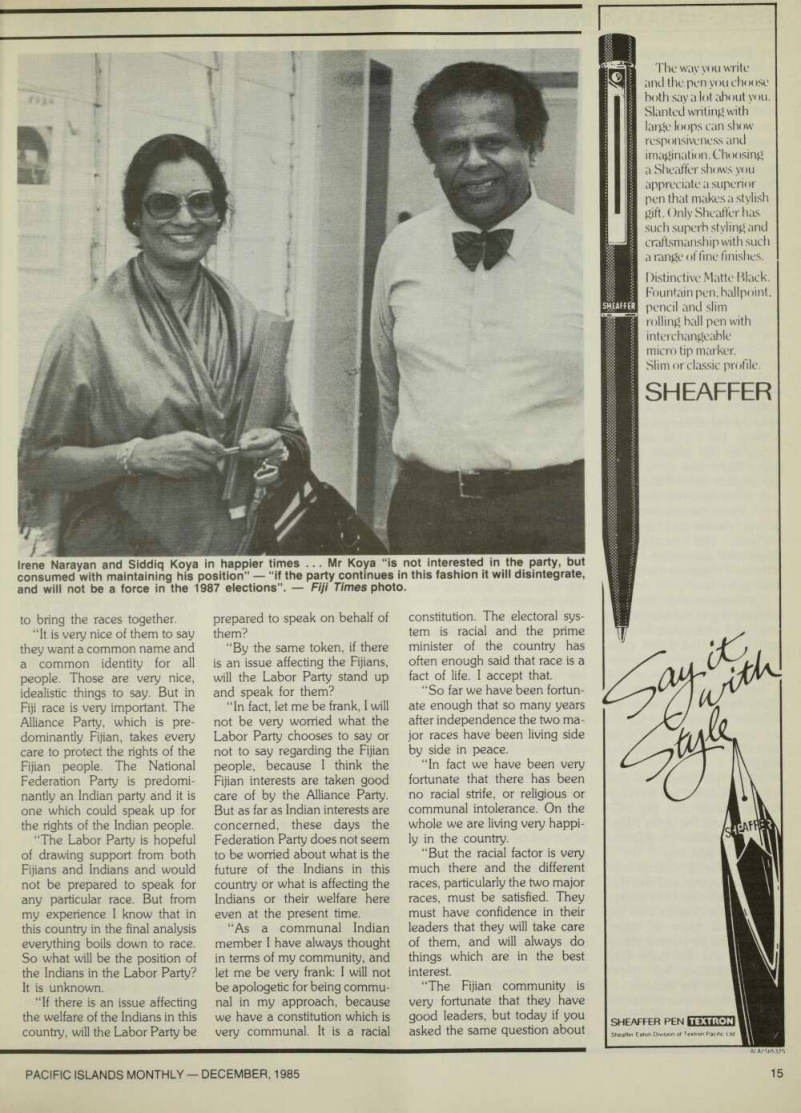
Irene Narayan and Siddiq Koya in happier times ... Mr Koya “is not interested in the party, but consumed with maintaining his position” - “if the party continues in this fashion it will disintegrate, and will not be a force in the 1987 elections”. - Fiji Times photo.
the Indians you would get a different answer.
“It really saddens me to say that the Indians do not have leaders who are really dedi cated and committed to the cause. ”
Q: Will the Labor Party fill this gap? “These are the things I want to see before I make a decision. I am in no great hurry.”
Q; So you don’t see Fiji politics moving away from ra cial divisions? - ”No. Anyone who thinks we can push the racial divisions into the back ground and talk about our people, their fears, worries and needs, and have politics on bread and butter issues no, it is not going to be that way.”
Q: What effect do you see the Labor Party having on Fiji politics? - ”It is too early to say what the Labor Party is likely to achieve, but I must say I do welcome the advent of the party. Right now there is one big question about it and that is how many Fijians will they have in it? From the reports I am getting I can see that it is mostly Indians, and mostly the disgruntled supporters of the National Federation Party who have gone over.
“Dr Bavadra and others are campaigning in the villages, but what kind of support they are getting from the Fijian com munity cannot really be accur ately assessed at this stage. That is one question. And if the Labor Party is not able to get sufficient support from the Fi jian community I don’t think they will be able to achieve very much.
“What will happen is that only the Indians will be frag mented, some with the NFP and some with the Labor Party.
In such a situation the Alliance will have a field day.
“If the Alliance holds on to its traditional support and also that of the Indians who have always supported the Alliance then the Alliance will have a bigger majority. The by-election about to occur, and the Suva City Council elections will throw some light on the situation.
“There is one area of the city where the majority of Fijians live and have previously block-
voted for the Alliance Party. If the Labor Party can make inroads here, or even in one of the five seats, that will show their strength and support.
“In the by-election for the Ba-Lautoka Indian National Communal seat there has been no active campaigning. It is a big constituency with about 30,000 voters, of whom 8000 or so are Fijians. In 1982 the Indian Alliance was wiped out there. But now we have reports that whole villages are changing to Labor.
“Even if the National Federa tion Party got 6000 to 7000 traditional votes, I have my guess that the Labor Party, which will be supported by the young and educated crowd, is likely to win. The Labor Party is definitely a force to reckon with. ”
In the last session of parlia ment both the prime minister, Ratu Sir Kamisese Mara, and the Leader of the Opposition, Mr Koya, defended the House business committee’s decision to limit debate on the governor general’s speech to 15 minutes per member. Mrs Narayan
complained that the move was designed to gag her, and ran into strong criticism from the two leaders.
Mrs Narayan said their tone and words were uncalled for.
Mr Koya was widely seen as referring to Mrs Narayan when he said that people who wished to “use democracy to prop ound their views both in news papers the House are without discipline. The day is coming very soon for those people to know that if they have love for this country - and I have because I was born here - they would not behave in this fashion for the last 12 years.”
Mr Koya said the committee decided on the time limit for good reasons which were known to the public.
In also defending the limit, the prime minister referred to a statement by Mrs Narayan that those who negotiated for Fiji should become a little more demanding and aggressive in getting a quota. He said he was surprised Mrs Narayan had taken him to task on the ques tion of negotiating for Fiji under
Sparteca.
He said Mrs Narayan had condemned him for not doing what he should have been doing. On the other hand Aus tralian and New Zealand media had accused him of twisting the arms of their prime ministers.
His credibility was at stake, he said.
The prime minister went on to describe Mrs Narayan as ’’beautiful, moves nicely and dresses well, and has all the attributes of a beautiful lady.”
“It is only when she speaks that all these attributes fall away and we see vicious vindictive ness, and all the attributes we do not usually associate with a beautiful lady. I hope she real ises her talents and exploits them to the full,” the prime minister said.
Mrs Narayan said she was hurt by the comments. “All I can say is that parliament is the place where we argue out the issues. But when someone runs short of argument they can resort to abuse. So if I have been abused in the House I would say that the honorable gentlemen had run short of ideas. ”
She said it was a pity that the prime minister had chosen to attack her in this fashion.
“Would he have attacked me in the same fashion if I had been a Fijian lady of chiefly class?”
On the reference to her In dian birth Mrs Narayan said the slur was very hurtful. Other MPs were born in India, but they were not reminded of it.
She had served Fiji unstintingly for 30 years, and to be con stantly reminded of her Indian birth was “a sad thing,” she said.
Mrs Narayan, 53, is married to a Fiji-born school teacher, Jai Narayan, who is a member of the Boundaries Commission and the Electoral Commission.
She was a school teacher, but entered politics in 1966 and is a full-time politician. They have four children, three boys and a girl. The eldest son is a doctor, married with one child and lives in New Delhi. The second son is studying in Canberra. The daughter is studying in India and the youngest son is in Suva at the University of the South Pacific.
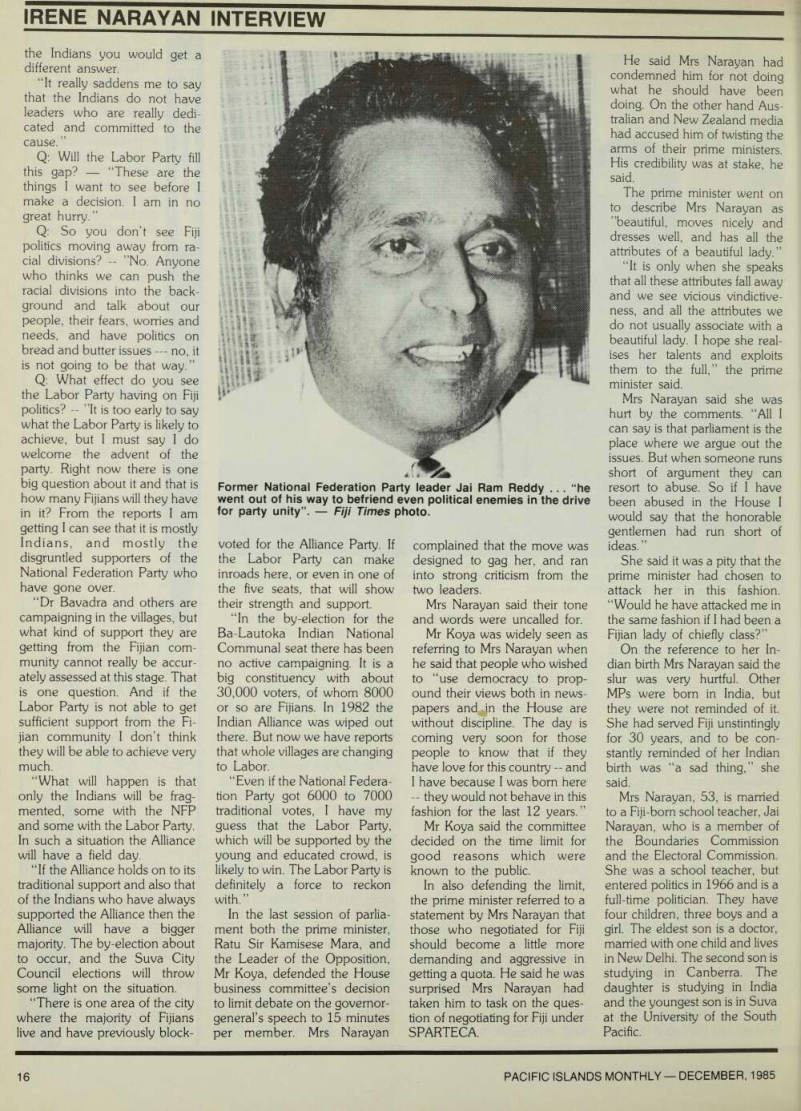
Former National Federation Party leader Jai Ram Reddy ... “he went out of his way to befriend even political enemies in the drive for party unity”. - Fiji Times photo.
Advertisements & other items, pp. 12-15 (2 items)
Themssju
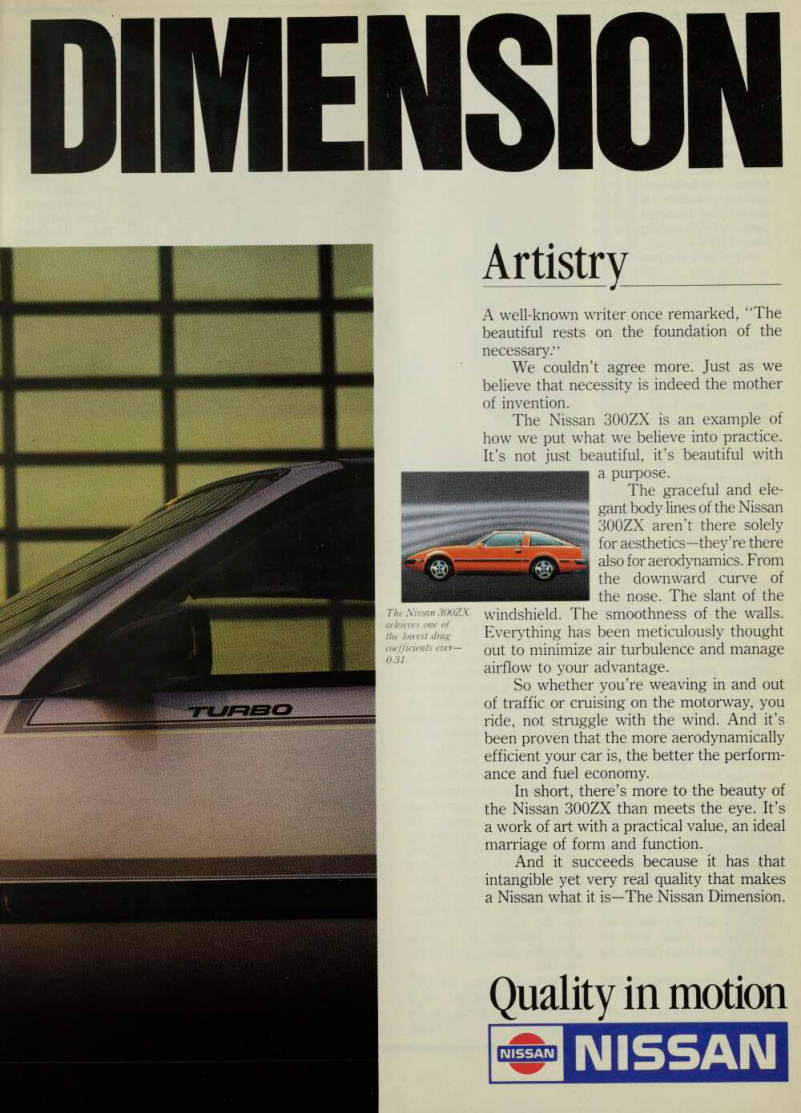
Artistry
A well-known writer once remarked, “The beautiful rests on the foundation of the necessary.”
We couldn’t agree more. Just as we believe that necessity is indeed the mother of invention.
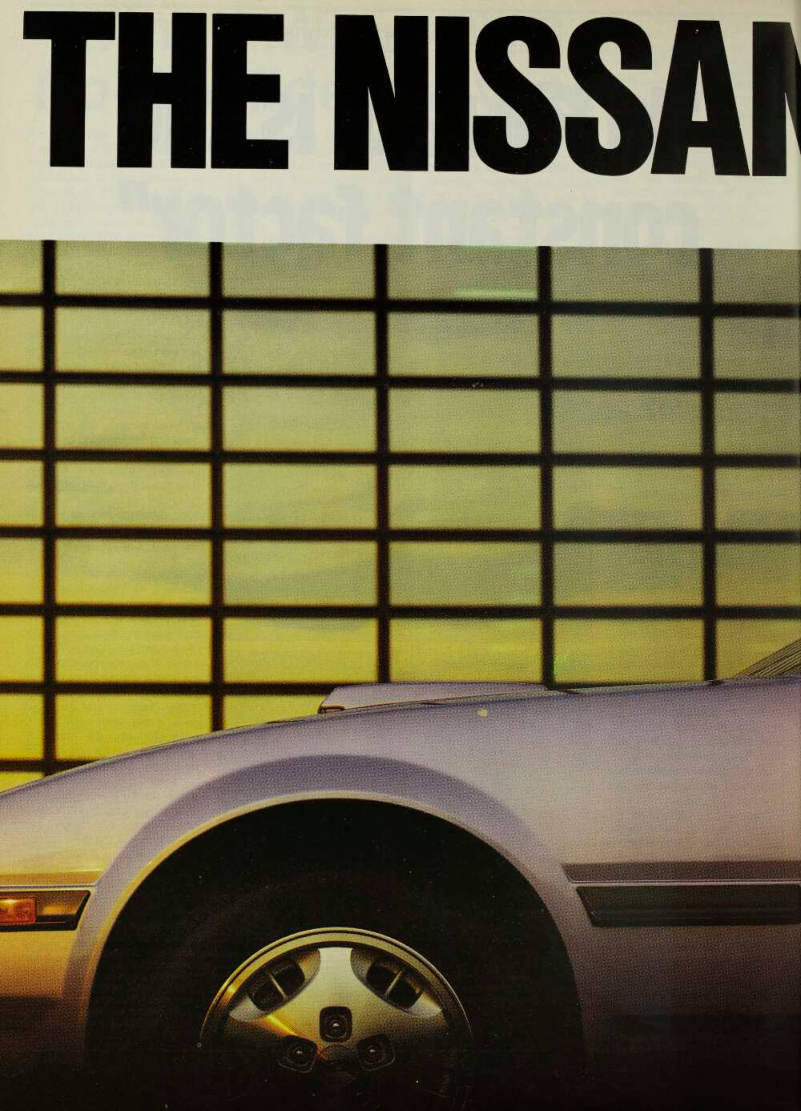
The Nissan 300ZX is an example of how we put what we believe into practice.
It’s not just beautiful, it’s beautiful with a purpose.
The graceful and elegant body lines of the Nissan 300ZX aren’t there solely for aesthetics—they’re there also for aerodynamics. From the downward curve of the nose. The slant of the The Nissan 3oozx windshield. The smoothness of the walls. 7heZeeTdmg Everything has been meticulously thought coefficients ever- ou t to minimize air turbulence and manage airflow to your advantage.
So whether you’re weaving in and out of traffic or cruising on the motorway, you ride, not struggle with the wind. And it’s been proven that the more aerodynamically efficient your car is, the better the performance and fuel economy.
In short, there’s more to the beauty of the Nissan 300ZX than meets the eye. It’s a work of art with a practical value, an ideal marriage of form and function.
And it succeeds because it has that intangible yet very real quality that makes a Nissan what it is—The Nissan Dimension.
Quality in motion
The way you write and tlie pen you choose h< >th say a 1< )t iih< mt yr m.
Slanted writing with large loops can show responsiveness and imagination. Choosing a Sheaffer shows you appreciate a superior pen that makes a stylish gift. ()nly Sheaffer has such superb styling and craftsmanship with such a range of fine finishes.
Distinctive Matte Black.
Fountain pen. ballpoint, pencil and slim rolling ball pen with interchangeable micro tip marker.
Slim or classic profile.
SHEAFFER
SHEAFFER PEN
Sheaffer Ealon Division of Textron Pacific Lid
Irene Narayan Interview
14
PACIFIC ISLANDS MONTHLY DECEMBER, 1985
Continued from page 11
IRENE NARAYAN INTERVIEW
Fiji Labor Party
"Win or bust” bid by Fiji Labor Party
Whichever party wins the two by-elections held in Fiji in Novem ber, the results will be of immense political consequ ence to the country. They pose a test on which either the two established racially-aligned par ties, or the newly-formed, and professedly multi-racial, Labor Party could falter, or even founder.
One by-election is for a Fijian communal seat, and the other is for a national Indian seat, which means that voters of other races, Fijian and the general electors (non-Indians or Fijians) will also cast their votes.
The trade union-supported Labor Party which came on the political scene in Fiji only in July of this year is contesting both seats. The Indian-dominated National Federation Party, which forms the Opposition in parliament, is not fielding a candidate in the Lau-Rotuma Fijian seat.
The by-elections came about because of the death earlier this year of the member for Lau- Rotuma, Mr Jonati Mavoa, at the time the minister of foreign affairs, and the resignation from the House of Sir Vijay R.Singh, formerly member for the Indian national seat of Lautoka. Sir Vijay was appointed chief ex ecutive of the newly-formed Sugar Cane Growers’ Council earlier this year.
Lau-Rotuma is a blue-ribbon seat of the Alliance party. In the 1982 general election, the only occasion on which Mr Mavoa was opposed, there were 7345 registered voters, of whom 83.34 per cent, or 6330 cast votes, 6121 in favor of Mr Mavoa. The only other candi date, Mr Desmond Faigaitu, of the National Federation Party, polled 209.
The Alliance has chosen as its candidate Mr Felipe Bole, 49, an experienced civil servant,
who has served as a depart mental permanent secretary and as a diplomat (Fiji’s perma nent representative to the Un ited Nations in New York). Mr Bole’s last job was at the East-West Center in Honolulu as director of the Pacific Islands Development Program. He comes from a chiefly clan and graduated with a master’s de gree from Victoria University in New Zealand.
Mr Bole was challenged by one of the Fiji Labor Party’s vice-presidents, Mrs Jokabeci Koroi, 54, a former nursing sister who has been a unionist for 14 years. Mother of six children, she is the national secretary of the Fiji Nurses’
Association.
The Lau-Rotuma seat is a straight two-Way contest be tween the time-tested Alliance Party, and the brand-new Labor Party, unknown and un tried.
In the contest for the north central Indian national seat pre viously held by Sir Vijay Singh, it is a three-cornered fight be tween two brothers and one of the founders and guiding lights of the Labor Party, Mr Mahen dra Chaudry.
When the Labor Party was launched in July its leaders said they were not planning to make a big impact in the 1987 gen eral elections. They said they were charting a 10-year course and aimed to ’’form the govern ment in 1991.” However, initial support and enthusiasm from the public, and the two by election chances have tempted them to try themselves at the hustings.
Mr Chaudry, 43, was bom and raised in the Ba-Tavua area and is one of the best-known, and most ambitious, of Fiji’s labor leaders. Since 1960, when he joined the Auditor- General’s office, until his res ignation in 1975 to become the
general secretary of the 7000strong Public Service Associa tion, Mr Chaudry has lived in Suva. He has built up a reputa tion as a firm union organiser but in recent years has made little secret of his political ambi tions both within and outside the union movement.
Chaudry has considerable following among public ser vants who see him as their champion. He is an aggressive negotiator and has given the government some bad times.
Mr Charles Walker, then the finance minister, resigned from the Cabinet about two years ago in protest after the govern ment bowed to public service pressure for a pay rise regarded as damaging to the national economy.
Chaudry also formed a far mers’ organisation in Vanua Levu and although his power base is the public service, he can except some support from this sector of the community, which may give pause to the National Federation Party which has its power base among the sugar farmers of the Western Division.
Chaudry has put his future, and possibly that of Labor, on the line by taking part in the by-election. A defeat could be political suicide for them both.
He and his officials went into the vote confident that they were offering the electorate the best choice, and hoped to capitalise on the open split between the two factions of the
Nfp.
Given this split, and the poor support the Alliance has in this electorate, Chaudry probably has a good chance of victory.
The Alliance has fielded Mr Uday Singh, 45, younger brother of the National Federa tion’s candidate, Mr James Shankar Singh, 61, a former president of the Indian Alliance and once a member of Ratu
Mara’s Cabinet.
Mr Uday Singh was bom in Ba, a member of one of the richest cane-farming families in the area. He has been a staunch supporter of the Alliance, despite his brother’s upset and eventual defection to the NFP.
Uday Singh unsuccessfuly contested the same seat in 1977 and in the last election, 1982, he lost by five and a half votes against Sir Vijay.
James Shankar Singh, the NFP candidate, is one of Fiji’s most experienced politicians.
He was for many years presi dent of the Indian Alliance, one of the three constituent parties of the Grand Alliance, more commonly called the Alliance Party, which has formed Fiji’s government since indepe dence.
Previously James Singh was running mate with Ratu Mara, but had differences with him and resigned from cabinet. He resigned from the Indian Alliance in 1981 and had since kept a low profile until his election earlier this year as the NFP’s organising secretary.
Voter apathy is generally pro nounced in by-elections in Fiji and a low poll was expected.
The Labor party appeared to be the most vigorous on the hustings and with good reason.
Their votes depended upon a change of mind in the public.
The Alliance was depending upon the split in the NFP to bring Indian voters over to their side to add to their traditional block support from Fijians and such as the Gujerati merchants who normally support the establishment.
The NFP rates its chances as good. It concedes it may lose some of its traditional support to the new party, but says this drift will not be enough to bother its chances of success.
Like the Alliance the NFP di misses the Labor Party as sim ply an aberration of nuisance value only.
But inside its committees, the NFP does seem to be afraid of their own factionalism. The Koya group, supporting James Shankar Singh, is clearly at odds with the former NFP lead er, Jai Ram Reddy, and his supporters. They appeared to be working for James Singh and for the Labor Party’s Mahendra Chaudry.
Seen on television with the clarity which mod ern satellite communica tions provides even to the furthest corners of the globe, Caspar Weinberger comes across as a steady, mod erate, clean-shaven, collegiate sort of man. He is soberly suited, calm of voice, measured of tone, determined, and obviously aware of the awe some power he wields as mas ter of one of the world’s great est military machines.
And yet he also gives the impression of being thoughtful and patient; ready to listen to those who differ with his coun try’s view.
Whether he is prepared to do more than listen might also be doubted, at least if you happen to be David Lange, prime minister of New Zealand with whom Weinberger, and the rest of the American administration, are at odds over whether or not an ally should sink his own principles (and political liabili ties), in order to honor a long standing fraternal agreement.
The question is of immense importance to the Pacific, not only because of the effect it has had upon the credibility of the ANZUS agreement, but also because of the pressure it has put upon the other countries of the region.
Australia is particularly and vitally involved. The Americans have given some the appear ance of demanding that Austra lia choose between their close family friendship with New Zea land and their need of the power of the United States.
And that presents Canberra with a terrible dilemma, for it is a fair guess that if such a choice had to be made, particularly with Australia under a Labor government, the nod would not go towards Washington, de spite the obvious and powerful need of the trans-Pacific con nection with the superpower.
That may be too coarse a way of expressing a most com plicated problem. But, the fact that the situation is now in its current fragile state may also be a sign that the Americans do not quite appreciate the delica cy of the matter, nor the depth of the life-long relationship be tween the ANZAC countries.
All of this was the major topic
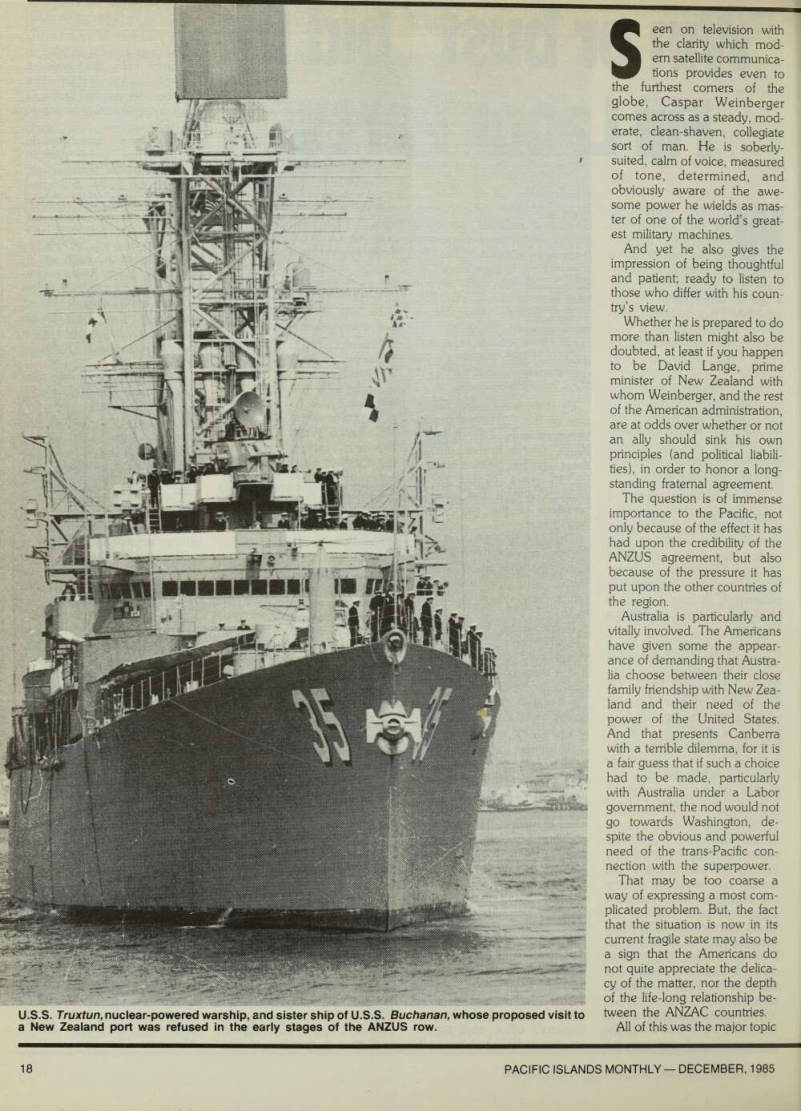
U.S.S. Truxtun, nuclear-powered warship, and sister ship of U.S.S. Buchanan, whose proposed visit to a New Zealand port was refused in the early stages of the ANZUS row.
Of all the vexatious topics currently disturbing the political waters of the Pacific, few rival the argument between the United States and New Zealand over the harboring of nuclear ships and weapons. The stubborn postures of both countries have eaten out the roots of ANZUS, one of the oldest and most important mutual defence agreements in the region.
There are signs, as we report elsewhere in this issue, that New Zealand’s David Lange no longer has the fullest support of his countrymen, but, borne along also by the huge international furore over the Greenpeace bombing, he is maintaining his stand.
Against him, equally adamant, Lange faces a U.S.
Secretary of State, George Shultz, not known for his patience with those who confront him, and the milder-mannered, but equally firm, US Secretary of Defence, Caspar Weinberger.
Weinberger recently was the subject of an international, satellite-linked interview with senior journalists in Australia, New Zealand, and Asia.
Pacific Islands Monthly’s publisher, GARRY BAR KER, was there.
Weinberger’S Anzus Doctrine
"we would welcome NTs return, anytime...”
in an international press confer ence conducted recently with Weinberger, using the Intelsat satellite and ground facilities in Australia, New Zealand, Japan, Korea, the Philippines and Singapore.
Following is a transcript of some of the questions and answers relating to that, and other Pacific matters: Q: Various U.S. spokesmen have said you want to review your involvement in ANZUS if New Zealand passes nuclear
free legislation. What do you want to review? What are your options?
A; If New Zealand takes a final legislative stand that would prevent our being able to carry out our responsibilities under the ANZUS Treaty and also prevent New Zealand from carrying out theirs. Obviously we would have to think about establishing security arrange ments for the area that divided the burdens as best we could without, apparently, the par ticipation of New Zealand.
This would be a source of great regret to us, not only because of our long personal friendships and historic associa tions and alliances that we have had over many years, but be cause of the very bad effect that it would have on the security of the whole region.
So we very much hope that we won’t have to reach this point. We would very much hope that presently New Zea land will understand how vital it is for their interests, for ours, for Australia, that we continue to work together, as we have for so many years.
Q: That would seem to fore shadow a total pullout by the U.S. from ANZUS, and perhaps development of an arrangement with Australia. Is this so?
A: We never like to deal in hypothetical types of questions.
We just hope that it will be realised that the arrangement we had where the three of us work together, share burdens, share benefits and maintain the security of the whole region, could be continued.
It should be recognised, how ever, that if New Zealand de cides that they simply don’t want to do that, or that they have a policy which they feel precludes their doing that, then we would have to look at what methods we have of protecting our own interests in Australia and other nations in the region; how that could best be carried out.
Q; What action do you want New Zealand to take that would mean you did not reach that point where you had to negoti ate separate agreements?
A; We do not understand why we cannot simply continue as we have been for so many years, until about a year to a year and a half ago. We have never fully understood, and do not understand to this day, what benefits New Zealand thinks can come to itself or to the region by this kind of action.
It is an attempt to force us to change a world-wide policy, a world-wide commitment, that we have to fulfil with our Navy in ports in all the continents, and that we simply cannot change. That is the policy of neither confirming nor denying the presence of nuclear
weapons.
It would give a great deal of valuable information and aid and comfort to the enemy if we would be forced to disclose that. So we cannot do that. And a country that tries to force us to change that policy - simply, that can’t happen.
So that is why we would have to think about major changes, should that become the permanent policy of New Zealand. We very much hope it won’t.
Q: But do you accept, though, that in the proposals that were presented to you recently by New Zealand's de puty prime minister, Mr Geof frey Palmer, New Zealand accepts that the United States will not confirm nor deny whe ther the weapons are on board the vessel?
A; Yes, but that policy was basically, I’m sorry to say, total ly unworkable. It was a propo sal that we would allow, as we understood it, some official in New Zealand to decide whether there were or were not nuclear weapons on board. If he let a ship in, why then, presumably, there would be the announce ment to the world that that ship did not have nuclear weapons.
He was, presumably, going to make some sort of inspection offshore and make a unilateral decision as to whether an American ship could come in and help fulfil its joint security mission with New Zealand.
It was patently unworkable and I think that is the very kindest way to phrase it.
We were sorry. We were hoping it would be something useful, but clearly it was not.
Q; Well, to get to the bottom line, then, are you saying New Zealand either accepts, without questioning them, all United States naval vessels into its ports, or they lose ANZUS?
A; No, what we are saying is that we should have a continua tion of the policy that we have had for all of the years since the ANZUS Treaty was signed that has worked so very well, and that is, that when American ships are proposed for port visits to New Zealand, which, in the past, have always been not only very popular, but very vital for our naval exercises, that those visits be accepted, provid
ing other conditions are right at the time.
We have never said that an American ship or any ship had to be accepted by New Zealand at any time or at any place, but we did have to insist and we do have to insist that we can never confirm or deny the presence of nuclear weapons on any ship.
Q: From your own know ledge of New Zealand politics, do you think it is realistic to ask Prime Minister Lange to over turn this quite fundamental policy that his government and his party have endorsed time and time again, which is to bar nuclear weapons from New Zealand?
A: It has been a fundamental policy for only a few months and I would not dream of advising New Zealand what they should do about their own policy. That is eminently the business of New Zealand. But, on the other hand, it is proper for me, since you have in quired, and since we have done so many times, to point out the consequences of this very dras tic change in the fundamental policy of New Zealand.
Q: Will America pull out of ANZUS if the New Zealanders go ahead with their decision to pass that denial of ship visits into law?
A; To a very considerable extent, New Zealand has pulled out of the alliance by the action that it has taken thus far. That is why we say that we hope very much that they will rethink that position and agree to the value of the continuation of the alliance and recognise the benefits and the burdens that we all share and we all bear in helping to keep the peace in this major and vital region of the world.
Q: But will America pull out of the ANZUS alliance if this happens?
A; You keep asking that as if it is some sort of unilateral decision that we would take.
We are not able to perform the duties and the responsibilities that we have under the ANZUS alliance if one of the partners simply says, “you can’t come in under any circumstances unless you break your world-wide policy.”
It isn’t a question of our pulling out. We have responsi bilities and the only way they can be fulfilled is by an active presence of the fleet and of various other security assets in the region. Australia recognises that. Every other country in the region recognises that.
Q: So if ANZUS does be come inoperative, would America seek a new bilateral arrangement with Australia? A: I think we have a bilateral arrangement with Australia that is working extremely well, and I think the Australian govern ment has recognised the vital nature of continuing that kind of relationship and that, in effect, and in essence, we have already established a very good bilateral relationship and hope very much to continue that.
Q: Would you keep the framework of ANZUS open and welcome New Zealand back at any time?
A: Oh, yes, there’s no desire to punish anybody or anything of that kind. The conditions that gave rise to the ANZUS Treaty are still there. Nothing has changed. The only thing that has changed is the policy of New Zealand, which I hope is temporary, and which, in effect, prevents our carrying out our obligations and prevents the ANZUS organisation from doing the very vital task that it has performed so very well of keeping the peace in that whole region.
There’s some theory that if you don’t have nuclear weapons you somehow are no longer a target and are there fore perfectly safe. And, very sadly, Belgium and a number of other countries are around to testify that that just isn’t so. You get trampled on, and smashed, just as quickly whether you have weapons or whether you have a treaty, if you happen to be in the way of an aggressor.
The way you keep the peace is to be strong enough through mutual action to deter war.
Q: Could you see any form of new arrangement being set up in the Pacific to include Japan?
A: We have a very good, close, working rleationship with Japan and I think it is vital that
we do. It is vital that we recognise that conditions have totally changed, and reversed themselves in the past 40 years, and it is vital to have the help of Japan in helping us all preserve peace.
There’s a growing threat from the Soviets in that whole region. They are increasing their naval and their air assets very rapidly. They are making vey major use of Cam Ranh Bay in Vietnam and other areas, so it is important to have the help of everyone.
Japan is a very strong coun try, and we think can contri bute, and is contributing, in a major way, to the security and safety of all of us in that very important part of the world.
Q: That Soviet threat on Cam Ranh Bay is now serious ly threatening our sea lanes of communication in the Western Pacific, certainly for America to respond to any situation in the Middle East. How do you see this in relation to the problems of the Philippines and the con tinued existence of the Amer ican bases at Clark and Subic Bay?
A: We think the security arrangements that are in place are vital, are necessary, and should continue. We think that it is essential that we maintain this kind of capability of dealing with what is clearly a growing Soviet threat. If it is not there, if we are not able to do that, you add not only credibility to the threat, but ym encourage it. It is only when you have the ability to make a strong and immediate response that a country like the Soviet Union will understand that an attack by them will gain them nothing.
If you encourage them, if you tempt tyrants, so to speak, then you are in a situation in which you are apt to have aggression start.
Q; How do you see New Zealand’s new plan for taking a wider, but lesser, military role within the Southern Pacific?
A; I really have not seen sufficient detail of what additio nal burdens would be carried as a result of that. We don’t really have any clear idea, any good idea, of what is intended. But nothing can be substituted for
the arrangements that we have had in effect and urgently need in the future. Certainly nothing that New Zealand could do, if they are not going to reverse their present policy, would re store for them the kind of security they had during the period when the ANZUS Treaty was fully in effect.
The hour-long conference then diverted to discussion of Asian defence questions, in cluding the continuing build-up of military strength in North Korea, and the still developing Soviet involvement with it.
Mr Weinberger was also questioned about the Strategic Defence Initiative (5.D.1.) or “Star Wars” program, and asked if he thought it would jeopardise the Geneva talks (“I don’t think so.”) or whether President Reagan was likely to modify his position on it.
“The S.D.I. does not jeopar dise anybody or anything,” he said. “It offers a very much greater hope to the world that nuclear weapons will be re ndered obsolete and impotent.
The president is fully deter mined to continue with the research necessary to see if we can deploy such a system...it offers too much hope to the world to give up.”
The conversation continued through US-China relations on which Mr Weinberger said: “...what we are talking about are ways to modernise and strengthen the defensive nature of China’s military capabilities. I think most people agree that that’s a good and necessary thing to do, particularly in view of the size and strength of the Soviet threat on their borders. ”
He conceded that the US public and the Congress now sought reforms in the Philip pines, but fended off hypotheti cal questions about what the US might do if their bases in that country came under attack as part of a break-down of the current regime.
However, he said, “we re gard the bases as important to us, the Philippines and the region. We have contingency plans to do what is necessary to
preserve and protect those bases and enable them to be used, to continue to maintain the freedom of the Philippine islands and the Pacific region.”
He was asked whether secur ity conditions .had changed in the Pacific, especially since Soviet naval strength in the ocean had grown considerably.
“Without any question,” he said. “When I said the condi tions which led to ANZUS were unchanged I meant that the need to band together to deter attacks by the Soviets had not changed. But the actual strength of the Soviet Union has increased, and is increasing on a very alarmingly rapid basis, and so the threat has increased, but the factors which led us to associate have not changed. ”
Did he see any role for the ASEAN countries taking a greater share of the defence burden in the Pacific - perhaps through some kind of regional grouping?
“It is not important whether strength is maintained through an organisation,” he replied.
“What is vital is that the job be done.”
Again he was asked what would happen when, or if, New Zealand passed its nuclear-free legislation.
“We would hope,” he said, “that further, calmer, con sideration of the whole problem and its consequences would lead to some change of thinking and some recognition of the fact that we cannot change the no-confirm-or-deny policy, be cause of our world-wide com mitments and our responsibility to preserve and protect our ships and their ability, in turn, to preserve and protect freedom in the region.
“We hope that this re-ex amination will lead to the con clusion that the conditions that we have had in the past have worked extraordinarily well for all three countries.
“There is not only no reason to change and to weaken those.
There is every reason in the world, in view of the growing Soviet threat, not to do so.”
The giant nuclear-powered aircraft carrier, U.S.S. Enterprise ...
“the U.S. cannot and will not change its neither-confirm-nor-deny policy on nuclear propulsion or nuclear arms.”
Advertisements & other items, pp. 20-21 (2 items)
20
WEINBERGER’S ANZUS DOCTRINE
21
WEINBERGER’S ANZUS DOCTRINE
"Tragic failure” forecast for French efforts
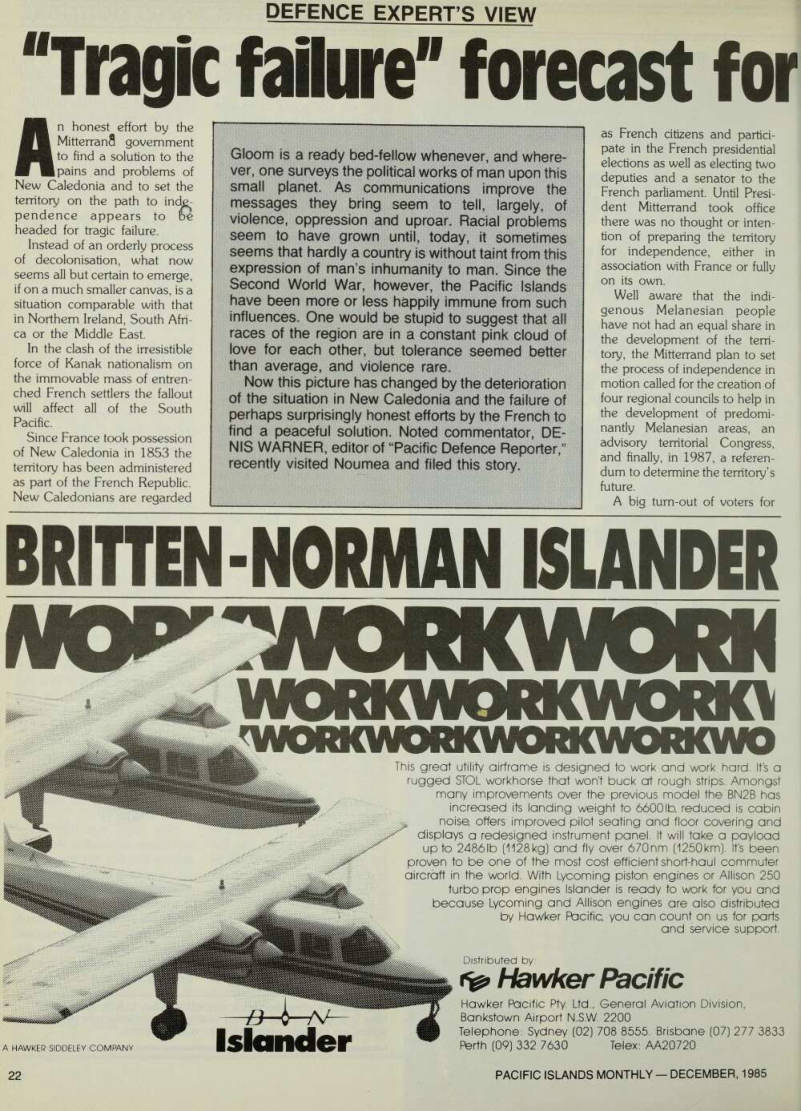
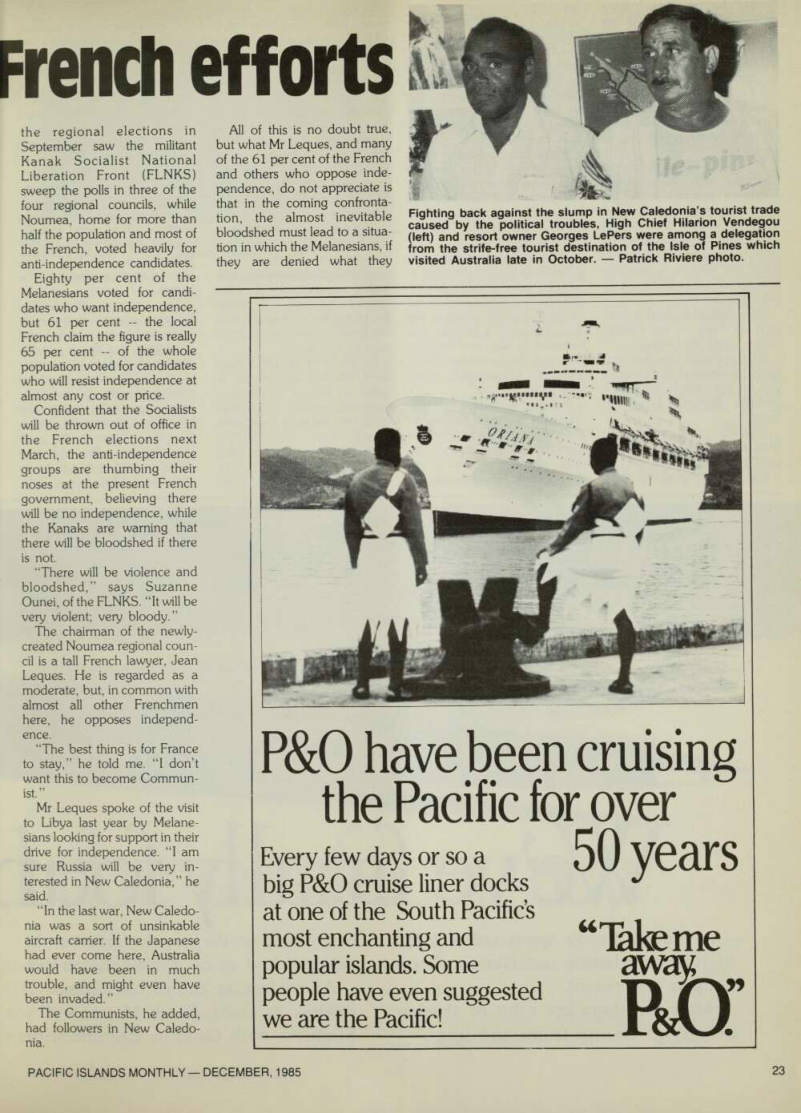
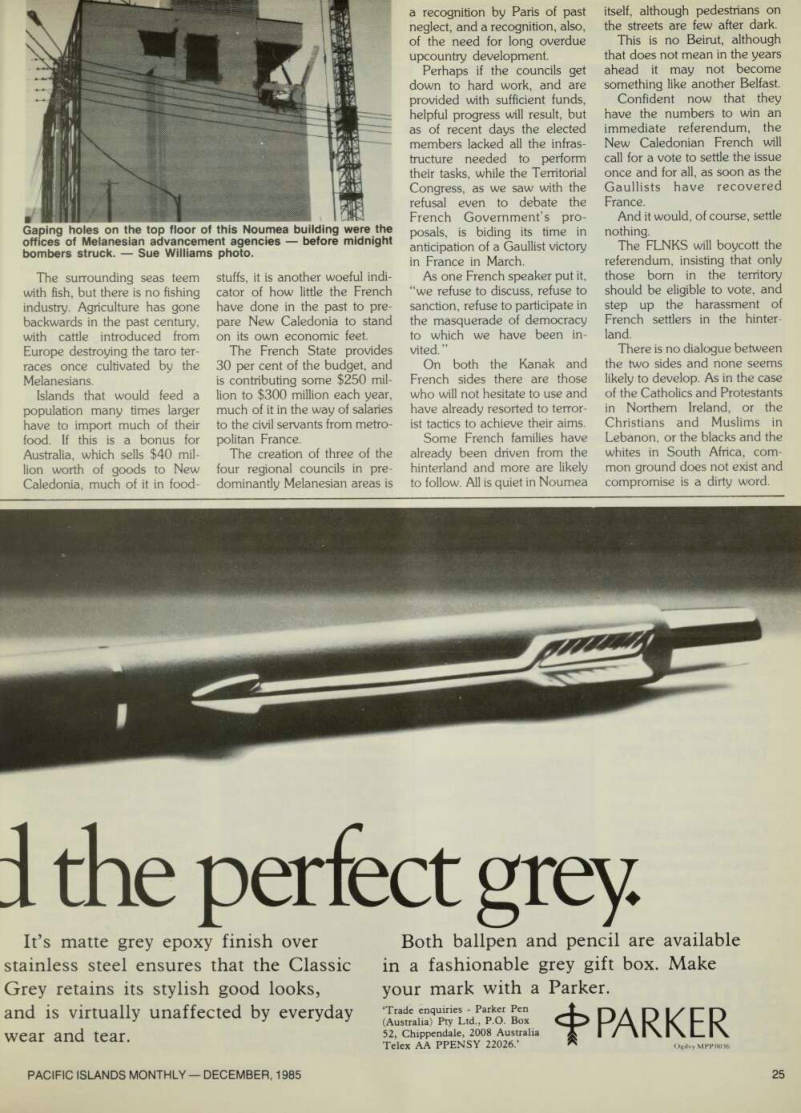
Defence Expert’S View
An honest effort by the Mitterrand government to find a solution to the pains and problems of New Caledonia and to set the territory on the path to inde pendence appears to oe headed for tragic failure.
Instead of an orderly process of decolonisation, what now seems all but certain to emerge, if on a much smaller canvas, is a situation comparable with that in Northern Ireland, South Afri ca or the Middle East.
In the clash of the irresistible force of Kanak nationalism on the immovable mass of entren ched French settlers the fallout will affect all of the South Pacific.
Since France took possession of New Caledonia in 1853 the territory has been administered as part of the French Republic.
New Caledonians are regarded
Gloom is a ready bed-fellow whenever, and where ver, one surveys the political works of man upon this small planet. As communications improve the messages they bring seem to tell, largely, of violence, oppression and uproar. Racial problems seem to have grown until, today, it sometimes seems that hardly a country is without taint from this expression of man’s inhumanity to man. Since the Second World War, however, the Pacific Islands have been more or less happily immune from such influences. One would be stupid to suggest that all races of the region are in a constant pink cloud of love for each other, but tolerance seemed better than average, and violence rare.
Now this picture has changed by the deterioration of the situation in New Caledonia and the failure of perhaps surprisingly honest efforts by the French to find a peaceful solution. Noted commentator, DE NIS WARNER, editor of “Pacific Defence Reporter," recently visited Noumea and filed this story.
as French citizens and partici pate in the French presidential elections as well as electing two deputies and a senator to the French parliament. Until Presi dent Mitterrand took office there was no thought or inten tion of preparing the territory for independence, either in association with France or fully on its own.
Well aware that the indi genous Melanesian people have not had an equal share in the development of the terri tory, the Mitterrand plan to set the process of independence in motion called for the creation of four regional councils to help in the development of predomi nantly Melanesian areas, an advisory territorial Congress, and finally, in 1987, a referen dum to determine the territory’s future.
A big turn-out of voters for
the regional elections in September saw the militant Kanak Socialist National Liberation Front (FLNKS) sweep the polls in three of the four regional councils, while Noumea, home for more than half the population and most of the French, voted heavily for anti-independence candidates.
Eighty per cent of the Melanesians voted for candi dates who want independence, but 61 per cent - the local French claim the figure is really 65 per cent of the whole population voted for candidates who will resist independence at almost any cost or price.
Confident that the Socialists will be thrown out of office in the French elections next March, the anti-independence groups are thumbing their noses at the present French government, believing there will be no independence, while the Kanaks are warning that there will be bloodshed if there is not.
“There will be violence and bloodshed,” says Suzanne Ounei, of the FLNKS. “It will be very violent; very bloody.”
The chairman of the newly created Noumea regional coun cil is a tall French lawyer, Jean Leques. He is regarded as a moderate, but, in common with almost all other Frenchmen here, he opposes independ ence.
“The best thing is for France to stay,” he told me. “I don’t want this to become Commun ist.”
Mr Leques spoke of the visit to Libya last year by Melane sians looking for support in their drive for independence. “I am sure Russia will be very in terested in New Caledonia,” he said.
“In the last war, New Caledo nia was a sort of unsinkable aircraft carrier. If the Japanese had ever come here, Australia would have been in much trouble, and might even have been invaded.”
The Communists, he added, had followers in New Caledo nia.
All of this is no doubt true, but what Mr Leques, and many of the 61 per cent of the French and others who oppose inde pendence, do not appreciate is that in the coming confronta tion, the almost inevitable bloodshed must lead to a situa tion in which the Melanesians, if they are denied what they
Fighting back against the slump in New Caledonia’s tourist trade caused by the political troubles, High Chief Hilarion Vendegou (left) and resort owner Georges LePers were among a delegation from the strife-free tourist destination of the Isle of Pines which visited Australia late in October. - Patrick Riviere photo.
believe to be their natural rights, will turn to almost any quarter for support.
Instead of helping to preserve the stability of the South Pacific by their continued presence, the French in New Caledonia may well help to create the conditions which outside pow ers may see the opportunity to exploit.
In October the newly-elected Congress with its anti-inde pendence majority threw the hat into the ring when it refused even to debate the various ordinances under which the French Government hopes to pave the way to a peaceful transfer of sovereignty, or to offer any advice.
“We wanted to send a mes sage to Paris no indepe dence,” said Mr Leques.
If the message was clear and easily understood in France, it was no less clear to the Kanak Socialist National Liberation Front.
Noumea is as pleasant a town as one might hope to find anywhere. Its homes wander across the scattered hill tops,
the better to view the blue waters of the Pacific. The weather is balmy and the beaches are ready made for the tourist trade. The shops and boutiques are filled with exotica from France. The marinas have so many elegant yachts that surely almost everybody in the town must own one.
Many French families have been living here for three or four generations. They claim, with justification, that they have every right to regard New Cale donia as their home. They are there to stay, they say.
The comparison is unfair, but it is difficult to resist the tempta tion to recall similar French attitudes in Indo-China some 35 years ago. The French had been there for a century and intended to stay, and besides, they said, if they abdicated their tasks, the Communists would take over.
In those far-off days, I used to commute between Singapore and Saigon. In Singapore, the customs and immigration offi cials, and the porters at the airport, were Singaporeans.
In Saigon, even the porters were French. For Saigon read Noumea. A Frenchman stamps your passport. Another French man examines your bags and a third Frenchman loads them, for the 40-minute drive to Noumea, into a bus also driven by a Frenchman. Even the dazzling flame trees outside the terminal bulding are reminders of the Indo-China connection, as, sadly, is the heavily sand bagged guard post at the end of the runway.
The last census appears on the surface to be a dry as dust set of figures. They are, how ever, immensely revealing, indi cating as they do the fine balance between the various peoples,and the disproportion ate shares of what New Caledo nia has to offer.
At the end of 1983 there were 145,468 inhabitants. Of these, 61,780, or 42 per cent, were Melanesians, and 53,974, or 37 per cent were Europeans.
There were also 18,956 Polynesians and other islan ders,with a sprinkling of In donesians, Chinese, Indo-
Chinese and others.
The Melanesians are concen trated on the outer islands and along the east coast of the main island. Noumea, where about half the population lives, is a predominantly French town.
Some 7500 Melanesians earn their living by farming, compared with only 245 Euro peans. Only four Melanesians are heads of enterprises em ploying 10 or more workers, compared with 156 French.
And so it goes, 589 French public servants to 59 Melane sians, 977 French police to 167 Melanesians, with little or no attempt made to develop local talents.
The seeming affluence of Noumea suggests that it must be backed by a well-developed hinterland, but this is not the case at all. Thanks to contracts written in US dollars, the nickel smelter continues to make reasonable profits despite the low world commodity prices, but after Noumea the next biggest town is Bourail, which has a population said to be no more than 1300.
The surrounding seas teem with fish, but there is no fishing industry. Agriculture has gone backwards in the past century, with cattle introduced from Europe destroying the taro ter races once cultivated by the Melanesians.
Islands that would feed a population many times larger have to import much of their food. If this is a bonus for Australia, which sells $4O mil lion worth of goods to New Caledonia, much of it in food
stuffs, it is another woeful indi cator of how little the French have done in the past to pre pare New Caledonia to stand on its own economic feet.
The French State provides 30 per cent of the budget, and is contributing some $250 mil lion to $3OO million each year, much of it in the way of salaries to the civil servants from metro politan France.
The creation of three of the four regional councils in pre dominantly Melanesian areas is
a recognition by Paris of past neglect, and a recognition, also, of the need for long overdue upcountry development.
Perhaps if the councils get down to hard work, and are provided with sufficient funds, helpful progress will result, but as of recent days the elected members lacked all the infras tructure needed to perform their tasks, while the Territorial Congress, as we saw with the refusal even to debate the French Government’s pro posals, is biding its time in anticipation of a Gaullist victory in France in March.
As one French speaker put it, “we refuse to discuss, refuse to sanction, refuse to participate in the masquerade of democracy to which we have been in vited. ”
On both the Kanak and French sides there are those who will not hesitate to use and have already resorted to terror ist tactics to achieve their aims.
Some French families have already been driven from the hinterland and more are likely to follow. All is quiet in Noumea
itself, although pedestrians on the streets are few after dark.
This is no Beirut, although that does not mean in the years ahead it may not become something like another Belfast.
Confident now that they have the numbers to win an immediate referendum, the New Caledonian French will call for a vote to settle the issue once and for all, as soon as the Gaullists have recovered France.
And it would, of course, settle nothing.
The FLNKS will boycott the referendum, insisting that only those born in the territory should be eligible to vote, and step up the harassment of French settlers in the hinter land.
There is no dialogue between the two sides and none seems likely to develop. As in the case of the Catholics and Protestants in Northern Ireland, or the Christians and Muslims in Lebanon, or the blacks and the whites in South Africa, com mon ground does not exist and compromise is a dirty word.
Gaping holes on the top floor of this Noumea building were the offices of Melanesian advancement agencies - before midnight bombers struck. - Sue Williams photo.
Advertisements & other items, pp. 22-26 (1 item)
Mop R 'Workworm
BRITTEN-NORMAN ISLANDER
WORKWORKWORKV
L 'WOfIKWOSJKWORK WORKWOI
B ■N—
A HAWKER SIDDELEY COMPANY
Islander
This great utility airframe is designed to work and work hard. It's a rugged STOL workhorse that won't buck at rough strips. Amongst many improvements over the previous model the BN2B has increased its landing weight to 66001 b, reduced is cabin noise offers improved pilot seating and floor covering and displays a redesigned instrument panel. It will take a payload up to 24861 b (1128 kg) and fly over 670 nm (1250 km). It's been proven to be one of the most cost efficient short-haul commuter aircraft in the world. With Lycoming piston engines or Allison 250 turbo prop engines Islander is ready to work for you and because Lycoming and Allison engines are also distributed by Hawker Pacific, you can count on us for parts and service support.
Distributed by:
Hawker Pacific
Hawker Pacific Pty. Ltd., General Aviation Division, Bankstown Airport N.S.W. 2200 Telephone: Sydney (02) 708 8555. Brisbane (07) 277 3833 Perth (09) 332 7630 Telex: AA20720
• •• . n r
P&O have been cruising
the Pacific for over
50 years
Every few days or so a big P&O cruise liner docks at one of the South Pacific’s most enchanting and popular islands. Some people have even suggested we are the Pacific!
“Take me
away
ROT
1
eve
finally four
At Parker, we’ve spent rather a lot of time developing our Classic Grey ballpen and pencil.
After all, there are a lot of shades of grey to choose from; and like everything at Parker, the one we selected had to be absolutely perfect.
As perfect as any of our Classic models in Gold, Black Matte, and Stainless with Gold or Chrome trim.
i the perfect grey.
It’s matte grey epoxy finish over stainless steel ensures that the Classic Grey retains its stylish good looks, and is virtually unaffected by everyday wear and tear.
Both ballpen and pencil are available in a fashionable grey gift box. Make your mark with a Parker. ‘Trade enquiries - Parker Pen (Australia) Pty Ltd., P.O. Box 52, Chippendale, 2008 Australia Telex AA PPENSY 22026.’
4> PARKER
Ogilvy MPPOO36
FOR CHARTER
24 PASSENGER STEEL
CATAMARAN WORK BOAT
Id Loa 25 metre, Draft 1.5 m, Bit 1981. Lloyds 100 Al.
Cabins 24 x 2 berth pass. 4 x single crew. Ix 6 crew, fully air cond. Worldwide radio tel/telex facility.
Ideal for exploration/survey work.
Avail, for Bare Boat or T/C early 1985.
Full details:
MARTIME INTERNATIONAL PTY. LTD.
P.O. Box 248, BRISBANE, 4001
Tel (07) 221-1582, Telex: AA 44521
H 1 K.
LOCAL AGENTS AND
REPRESENTATION
428 George St., Sydney.
Cables: Henco Sydney.
G.P.O. Box 3949.
Telephone: 232 5377.
For specialised and
personalised buying
service throughout
the Pacific Islands and the East.
Resident Agents in other Pacific Territories.
PAPUA NEW GUINEA
RABAUL: M. & C. Seeto, P.O. Box 131, Rabaul.
Telephone 92 2919.
MADANG: W. Double, P.O. Box 22, Madang.
Telephone 82 2696.
FIJI
K. Witherington Ltd., P.O. Box 293, Suva.
Telephone 22 356.
VANUATU
John Lum & Associates, P.O. Box 65, Santo.
Telephone 329.
SOLOMON ISLANDS
Mr. Tom Lo, P.O. Box 327, Honiara.
Telephone 399
xpwtWs
All the players,
Greenpeace Case
All the players, but no drama
Those who expected extended high theatre from the trial, in Auckland, of the two French secret service agents charged with bombing the Greenpeace vessel, Rainbow Warrior were deeply disappointed last month. The spies pleaded guilty not to murder, of which they had been originally charged, but to a reduced charge of manslaughter and were sent back to jail to await sentencing at the end of the month.
As the cohorts of the in ternational media glumly folded their tents and prepared to depart, allegations arose that New Zealand’s government had done a deal with the French.
Mr Lange strenuously denied there had been any trade-off.
However, the French defence minister, Mr Quiles, said in Paris that there had been “discreet contacts” with the N.Z. govern ment over the case, although he did not go into detail.
This was sharply rejected by the N.Z. Attorney General and deputy prime minister, Mr Geoffrey Palmer, who said it was “preposterous” to suggest that a political deal had been struck with France to reduce the charge of murder to one of manslaughter.
The French external affairs minister, Mr Dumas, also claimed that negotiations had occurred over the court case, and said they were continuing over the release of the two accused agents, Major Alain Mafart and Captaine Domini que Prieur.
For a third time Mr Lange denied there had been nego tiator, let alone a deal, on a government-to-government level.
The plea of guilty was accepted by Judge Ronald Gil bert in the District Court in Auckland, which meant that no detailed evidence about the attack upon the Rainbow War ror would be heard. And that would avoid considerable embarrassment for the French,
in particular their spy depart ment, the D.G.S.E.
The lesser charge of man slaughter was brought by the N.Z. Solicitor-General, Paul Neazor, who appeared per sonally. He told the court the prosecution accepted that Mafart and Prieur were not personally responsible for plac ing the explosives on the ship and had no intention of killing anyone.
“The Crown also accepts that the guilty plea means a signifi cant acceptance of the con sequences of the act of sabot age,” Mr Neazor told the court.
Murder warrants remain in place for three other French agents whose whereabouts, presumably in France, are un known. The French govern ment has refused efforts by the NZ police to obtain their ex tradition.
The two accused stood side by side in the dock and were charged in their real names: Alain Michel Yves Mafart, 35, major of the French army, and Dominique Angeles Francoise Prieur, 36, captain of the French.
Both answered with the Eng lish word “guilty” when asked to say how they pleaded to charges of wilful damage to the ship and that they “caused the death of Fernando Pereira ...”
In New Zealand manslaugh ter carries a penalty ranging from a reprimand to life impris onment. (Murder carries a man datory life sentence with a minimum non-parole period of seven years).
Speaking outside the court Greenpeace chief, David McTaggart, said: “President Mitterrand, Hemu and Lacosle should have been in the dock. ”
Hernu was the French defence minister at the time of the attack on July 10, and General Lacoste the chief of D.G.S.E.
McTaggart said the reduction of the charges made no differ ence to Greenpeace’s de termination to pursue com pensation for Pereira and the loss of the Rainbow Warrior.
Pacific Conference?
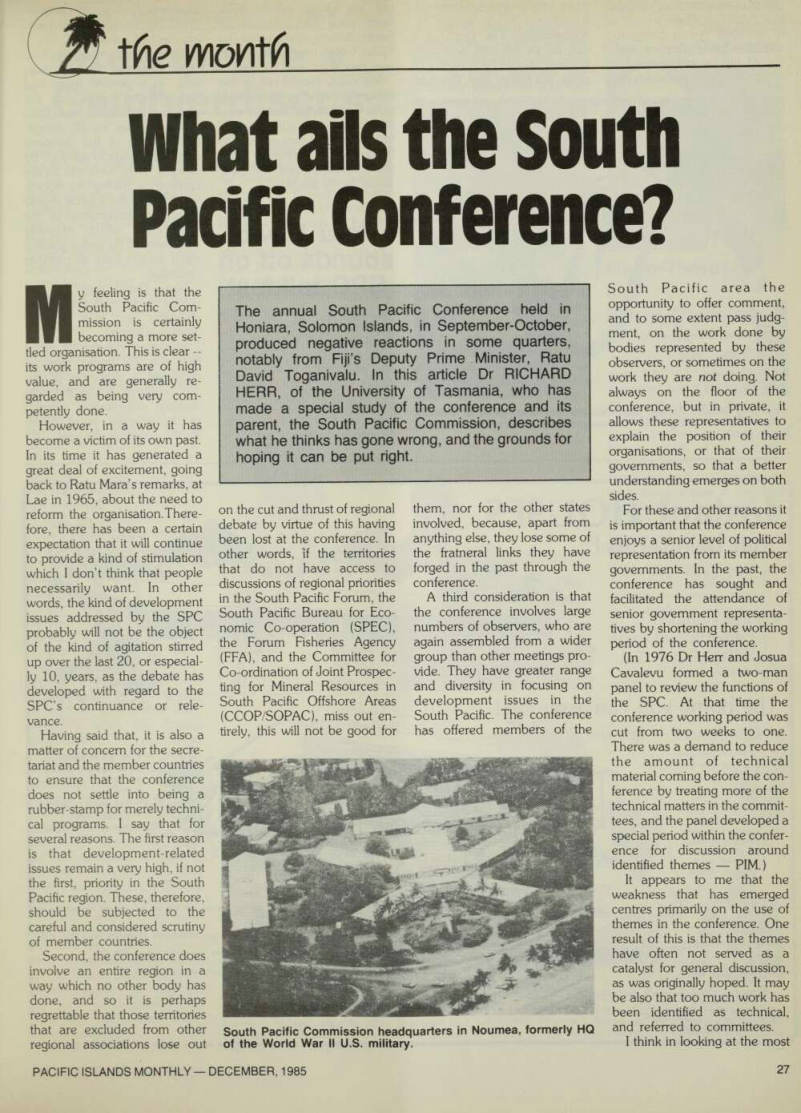
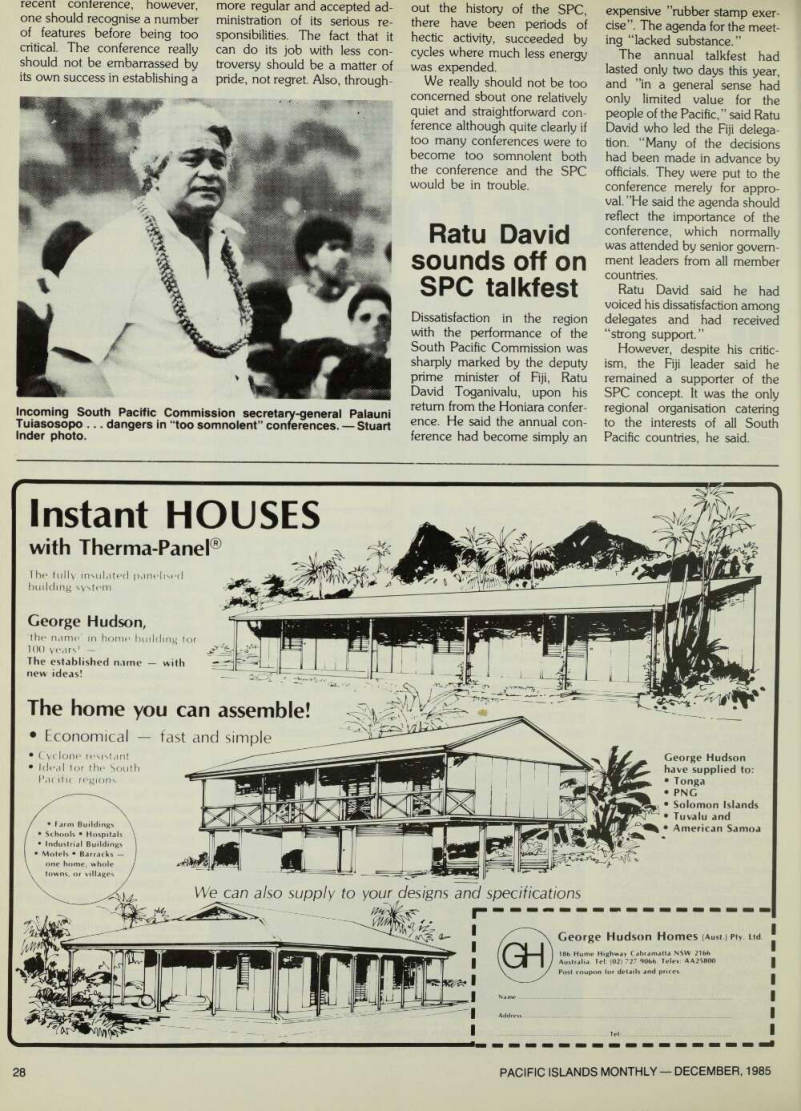
the month
What ails the South Pacific Conference?
My feeling is that the South Pacific Com mission is certainly becoming a more set tled organisation. This is clear its work programs are of high value, and are generally re garded as being very com petently done.
However, in a way it has become a victim of its own past.
In its time it has generated a great deal of excitement, going back to Ratu Mara’s remarks, at Lae in 1965, about the need to reform the organisation.There fore, there has been a certain expectation that it will continue to provide a kind of stimulation which I don’t think that people necessarily want. In other words, the kind of development issues addressed by the SPC probably will not be the object of the kind of agitation stirred up over the last 20, or especial ly 10, years, as the debate has developed with regard to the SPC’s continuance or rele vance.
Having said that, it is also a matter of concern for the secre tariat and the member countries to ensure that the conference does not settle into being a rubber-stamp for merely techni cal programs. I say that for several reasons. The first reason is that development-related issues remain a very high, if not the first, priority in the South Pacific region. These, therefore, should be subjected to the careful and considered scrutiny of member countries.
Second, the conference does involve an entire region in a way which no other body has done, and so it is perhaps regrettable that those territories that are excluded from other regional associations lose out
The annual South Pacific Conference held in Honiara, Solomon Islands, in September-October, produced negative reactions in some quarters, notably from Fiji’s Deputy Prime Minister, Ratu David Toganivalu. In this article Dr RICHARD HERR, of the University of Tasmania, who has made a special study of the conference and its parent, the South Pacific Commission, describes what he thinks has gone wrong, and the grounds for hoping it can be put right.
on the cut and thrust of regional debate by virtue of this having been lost at the conference. In other words, If the territories that do not have access to discussions of regional priorities in the South Pacific Forum, the South Pacific Bureau for Eco nomic Co-operation (SPEC), the Forum Fisheries Agency (FFA), and the Committee for Co-ordination of Joint Prospec ting for Mineral Resources in South Pacific Offshore Areas (CCOP/SOPAC), miss out en tirely, this will not be good for
them, nor for the other states involved, because, apart from anything else, they lose some of the fratneral links they have forged in the past through the conference.
A third consideration is that the conference involves large numbers of observers, who are again assembled from a wider group than other meetings pro vide. They have greater range and diversity in focusing on development issues in the South Pacific. The conference has offered members of the
South Pacific area the opportunity to offer comment, and to some extent pass judg ment, on the work done by bodies represented by these observers, or sometimes on the work they are not doing. Not always on the floor of the conference, but in private, it allows these representatives to explain the position of their organisations, or that of their governments, so that a better understanding emerges on both sides.
For these and other reasons it is important that the conference enjoys a senior level of political representation from its member governments. In the past, the conference has sought and facilitated the attendance of senior government representa tives by shortening the working period of the conference. (In 1976 Dr Herr and Josua Cavalevu formed a two-man panel to review the functions of the SPC. At that time the conference working period was cut from two weeks to one.
There was a demand to reduce the amount of technical material coming before the con ference by treating more of the technical matters in the commit tees, and the panel developed a special period within the confer ence for discussion around identified themes PIM.) It appears to me that the weakness that has emerged centres primarily on the use of themes in the conference. One result of this is that the themes have often not served as a catalyst for general discussion, as was originally hoped. It may be also that too much work has been identified as technical, and referred to committees.
I think in looking at the most
South Pacific Commission headquarters in Noumea, formerly HQ of the World War II U.S. military.
recent conference, however, one should recognise a number of features before being too critical. The conference really should not be embarrassed by its own success in establishing a
more regular and accepted ad ministration of its serious re sponsibilities. The fact that it can do its job with less con troversy should be a matter of pride, not regret. Also, through-
out the history of the SPC, there have been periods of hectic activity, succeeded by cycles where much less energy was expended.
We really should not be too concerned sbout one relatively quiet and straightforward con ference although quite clearly if too many conferences were to become too somnolent both the conference and the SPC would be in trouble.
Ratu David
sounds off on
SPC talkfest
Dissatisfaction in the region with the performance of the South Pacific Commission was sharply marked by the deputy prime minister of Fiji, Ratu David Toganivalu, upon his return from the Honiara confer ence. He said the annual con ference had become simply an
expensive ’’rubber stamp exer cise”. The agenda for the meet ing “lacked substance.”
The annual talkfest had lasted only two days this year, and ”in a general sense had only limited value for the people of the Pacific,” said Ratu David who led the Fiji delega tion. “Many of the decisions had been made in advance by officials. They were put to the conference merely for appro val. ”He said the agenda should reflect the importance of the conference, which normally was attended by senior govern ment leaders from all member countries.
Ratu David said he had voiced his dissatisfaction among delegates and had received “strong support.”
However, despite his critic ism, the Fiji leader said he remained a supporter of the SPC concept. It was the only regional organisation catering to the interests of all South Pacific countries, he said.
Incoming South Pacific Commission secretary-general Palauni Tuiasosopo ... dangers in “too somnolent” conferences. - Stuart Inder photo.
Advertisements & other items, p. 28 (1 item)
Instant HOUSES
with Therma-Panel®
The fully insulated panelised building system
George Hudson,
the name' in home building for 100 years' - The established name with new ideas!
The home you can assemble!
• Economical fast and simple
Cyclone resistant Ideal for the South Pacific regions Farm Buildings • Schools • (Hospitals • Industrial Buildings • Motels • Barracks one home, whole towns, or villages George Hudson have supplied to: • Tonga
• PNG
• Solomon Islands • Tuvalu and • American Samoa We can also supply to your designs and specifications Air George Hudson Homes (Aust.) Rty. Ltd. 18b Hume Highway Cabramatla NSW 2166 Australia Tel: (02) 727 9066 Telex: AA25800 Post coupon for details and prices.
Greenpeace v.
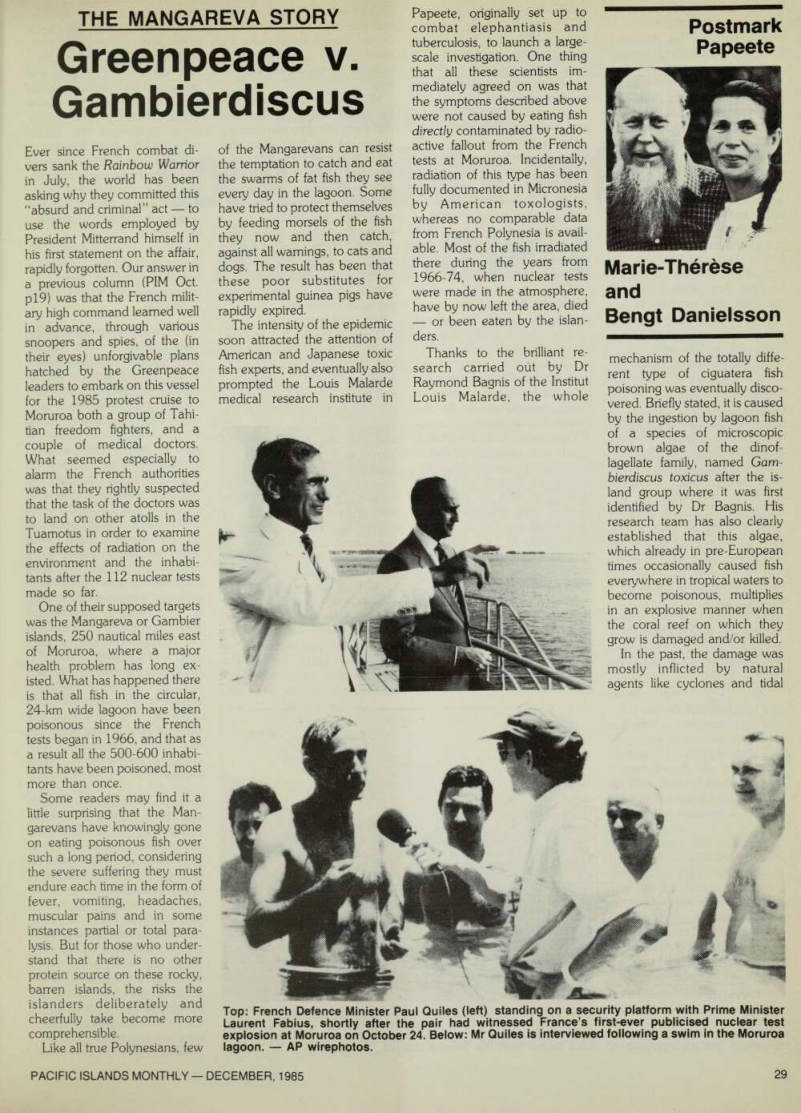
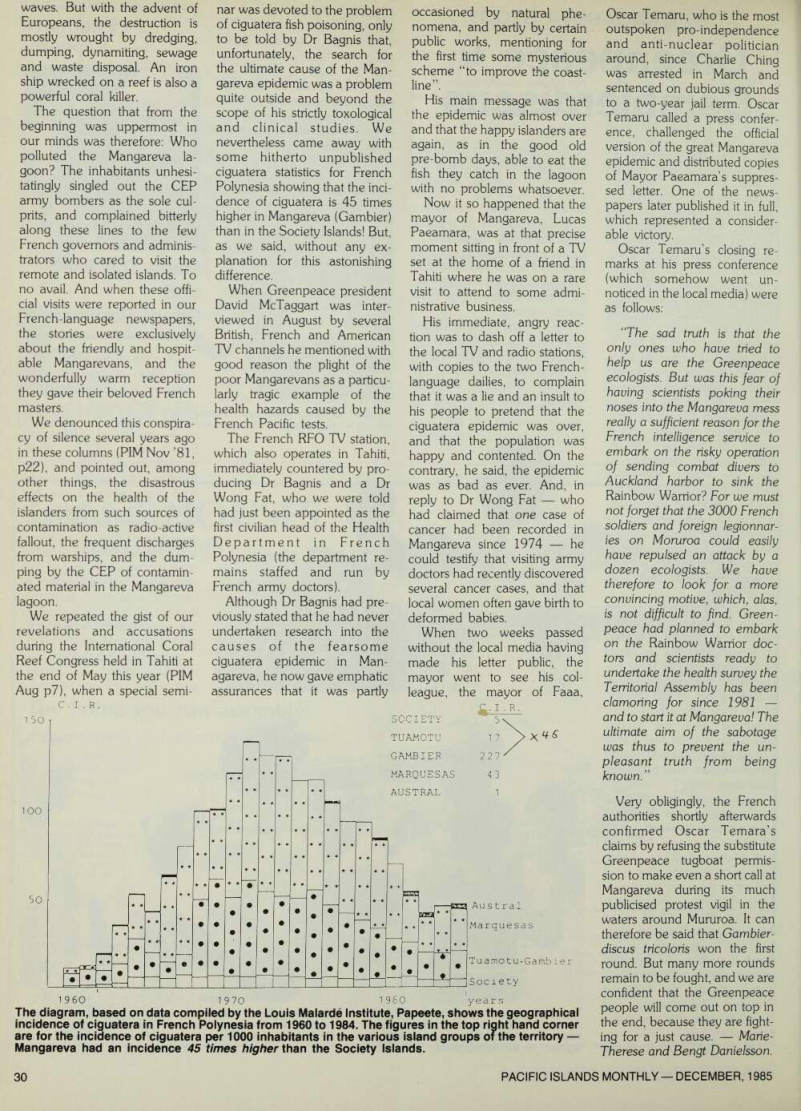
The Mangareva Story
Gambierdiscus
Ever since French combat di vers sank the Rainbow Warrior in July, the world has been asking why they committed this “absurd and criminal” act to use the words employed by President Mitterrand himself in his first statement on the affair, rapidly forgotten. Our answer in a previous column (PIM Oct. pl 9) was that the French milit ary high command learned well in advance, through various snoopers and spies, of the (in their eyes) unforgivable plans hatched by the Greenpeace leaders to embark on this vessel for the 1985 protest cruise to Moruroa both a group of Tahi tian freedom fighters, and a couple of medical doctors.
What seemed especially to alarm the French authorities was that they rightly suspected that the task of the doctors was to land on other atolls in the Tuamotus in order to examine the effects of radiation on the environment and the inhabi tants after the 112 nuclear tests made so far.
One of their supposed targets was the Mangareva or Gambier islands, 250 nautical miles east of Moruroa, where a major health problem has long ex isted. What has happened there is that all fish in the circular, 24-km wide lagoon have been poisonous since the French tests began in 1966, and that as a result all the 500-600 inhabi tants have been poisoned, most more than once.
Some readers may find it a little surprising that the Man garevans have knowingly gone on eating poisonous fish over such a long period, considering the severe suffering they must endure each time in the form of fever, vomiting, headaches, muscular pains and in some instances partial or total para lysis. But for those who under stand that there is no other protein source on these rocky, barren islands, the risks the islanders deliberately and cheerfully take become more comprehensible.
Like all true Polynesians, few
of the Mangarevans can resist the temptation to catch and eat the swarms of fat fish they see every day in the lagoon. Some have tried to protect themselves by feeding morsels of the fish they now and then catch, against all warnings, to cats and dogs. The result has been that these poor substitutes for experimental guinea pigs have rapidly expired.
The intensity of the epidemic soon attracted the attention of American and Japanese toxic fish experts, and eventually also prompted the Louis Malarde medical research institute in
Papeete, originally set up to combat elephantiasis and tuberculosis, to launch a large scale investigation. One thing that all these scientists im mediately agreed on was that the symptoms described above were not caused by eating fish directly contaminated by radio active fallout from the French tests at Moruroa. Incidentally, radiation of this type has been fully documented in Micronesia by American toxologists, whereas no comparable data from French Polynesia is avail able. Most of the fish irradiated there during the years from 1966-74, when nuclear tests were made in the atmosphere, have by now left the area, died or been eaten by the islan ders.
Thanks to the brilliant re search carried out by Dr Raymond Bagnis of the Institut Louis Malarde, the whole
Postmark Papeete
mechanism of the totally diffe rent type of ciguatera fish poisoning was eventually disco vered. Briefly stated, it is caused by the ingestion by lagoon fish of a species of microscopic brown algae of the dinof lagellate family, named Gam bierdiscus toxicus after the is land group where it was first identified by Dr Bagnis. His research team has also clearly established that this algae, which already in pre-European times occasionally caused fish everywhere in tropical waters to become poisonous, multiplies in an explosive manner when the coral reef on which they grow is damaged and/or killed.
In the past, the damage was mostly inflicted by natural agents like cyclones and tidal
Marie-Thérèse and Bengt Danielsson
Top: French Defence Minister Paul Quiles (left) standing on a security platform with Prime Minister Laurent Fabius, shortly after the pair had witnessed France’s first-ever publicised nuclear test explosion at Moruroa on October 24. Below: Mr Quiles is interviewed following a swim in the Moruroa lagoon. - AP wirephotos.
waves. But with the advent of Europeans, the destruction is mostly wrought by dredging, dumping, dynamiting, sewage and waste disposal. An iron ship wrecked on a reef is also a powerful coral killer.
The question that from the beginning was uppermost in our minds was therefore: Who polluted the Mangareva la goon? The inhabitants unhesi tatingly singled out the CEP army bombers as the sole cul prits, and complained bitterly along these lines to the few French governors and adminis trators who cared to visit the remote and isolated islands. To no avail. And when these offi cial visits were reported in our French-language newspapers, the stories were exclusively about the friendly and hospit able Mangarevans, and the wonderfully warm reception they gave their beloved French masters.
We denounced this conspira cy of silence several years ago in these columns (PIM Nov ’Bl, p 22), and pointed out, among other things, the disastrous effects on the health of the islanders from such sources of contamination as radio-active fallout, the frequent discharges from warships, and the dum ping by the CEP of contamin ated material in the Mangareva lagoon.
We repeated the gist of our revelations and accusations during the International Coral Reef Congress held in Tahiti at the end of May this year (PIM Aug p 7), when a special semi
nar was devoted to the problem of ciguatera fish poisoning, only to be told by Dr Bagnis that, unfortunately, the search for the ultimate cause of the Man gareva epidemic was a problem quite outside and beyond the scope of his strictly toxological and clinical studies. We nevertheless came away with some hitherto unpublished ciguatera statistics for French Polynesia showing that the inci dence of ciguatera is 45 times higher in Mangareva (Gambier) than in the Society Islands! But, as we said, without any ex planation for this astonishing difference.
When Greenpeace president David McTaggart was inter viewed in August by several British, French and American TV channels he mentioned with good reason the plight of the poor Mangarevans as a particu larly tragic example of the health hazards caused by the French Pacific tests.
The French RFO TV station, which also operates in Tahiti, immediately countered by pro ducing Dr Bagnis and a Dr Wong Fat, who we were told had just been appointed as the first civilian head of the Health Department in French Polynesia (the department re mains staffed and run by French army doctors).
Although Dr Bagnis had pre viously stated that he had never undertaken research into the causes of the fearsome ciguatera epidemic in Man agareva, he now gave emphatic assurances that it was partly
occasioned by natural phe nomena, and partly by certain public works, mentioning for the first time some mysterious scheme “to improve the coast line”.
His main message was that the epidemic was almost over and that the happy islanders are again, as in the good old pre-bomb days, able to eat the fish they catch in the lagoon with no problems whatsoever.
Now it so happened that the mayor of Mangareva, Lucas Paeamara, was at that precise moment sitting in front of a TV set at the home of a friend in Tahiti where he was on a rare visit to attend to some admi nistrative business.
His immediate, angry reac tion was to dash off a letter to the local TV and radio stations, with copies to the two French language dailies, to complain that it was a lie and an insult to his people to pretend that the ciguatera epidemic was over, and that the population was happy and contented. On the contrary, he said, the epidemic was as bad as ever. And, in reply to Dr Wong Fat who had claimed that one case of cancer had been recorded in Mangareva since 1974 he could testify that visiting army doctors had recently discovered several cancer cases, and that local women often gave birth to deformed babies.
When two weeks passed without the local media having made his letter public, the mayor went to see his col league, the mayor of Faaa,
Oscar Temaru, who is the most outspoken pro-independence and anti-nuclear politician around, since Charlie Ching was arrested in March and sentenced on dubious grounds to a two-year jail term. Oscar Temaru called a press confer ence, challenged the official version of the great Mangareva epidemic and distributed copies of Mayor Paeamara’s suppres sed letter. One of the news papers later published it in full, which represented a consider able victory.
Oscar Temaru’s closing re marks at his press conference (which somehow went un noticed in the local media) were as follows: ‘The sad truth is that the on/y ones who have tried to help us are the Greenpeace ecologists. But was this fear of having scientists poking their noses into the Mangareva mess really a sufficient reason for the French intelligence service to embark on the risky operation of sending combat divers to Auckland harbor to sink the Rainbow Warrior? For we must not forget that the 3000 French soldiers and foreign legionnar ies on Moruroa could easily hove repulsed an attack by a dozen ecologists. I Me have therefore to look for a more convincing motive, which, alas, is not difficult to find. Green peace had planned to embark on the Rainbow Warrior doc tors and scientists ready to undertake the health survey the Territorial Assembly has been clamoring for since 1981 and to start it at Mangareva! The ultimate aim of the sabotage was thus to prevent the un pleasant truth from being known.”
Very obligingly, the French authorities shortly afterwards confirmed Oscar Temara’s claims by refusing the substitute Greenpeace tugboat permis sion to make even a short call at Mangareva during its much publicised protest vigil in the waters around Mururoa. It can therefore be said that Gambier discus tricoloris won the first round. But many more rounds remain to be fought, and we are confident that the Greenpeace people will come out on top in the end, because they are fight ing for a just cause. Marie- Therese and Bengt Danielsson.
The diagram, based on data compiled by the Louis Malardé Institute, Papeete, shows the geographical incidence of ciguatera in French Polynesia from 1960 to 1984. The figures in the top right hand corner are for the incidence of ciguatera per 1000 inhabitants in the various island groups of the territory- Mangareva had an incidence 45 times higher than the Society Islands.
Aust's Ansett
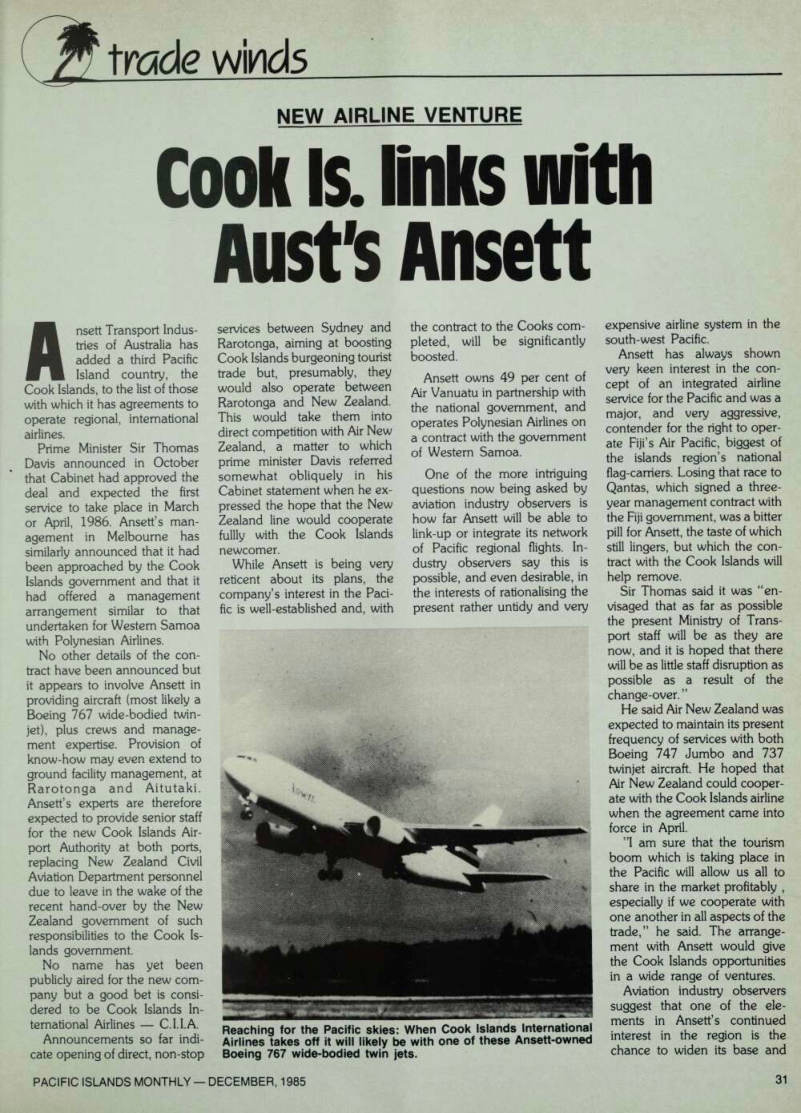

trade winds
New Airline Venture
Cook Is. links with Aust's Ansett
Ansett Transport Indus tries of Australia has added a third Pacific Island country, the Cook Islands, to the list of those with which it has agreements to operate regional, international airlines.
Prime Minister Sir Thomas Davis announced in October that Cabinet had approved the deal and expected the first service to take place in March or April, 1986. Ansett’s man agement in Melbourne has similarly announced that it had been approached by the Cook Islands government and that it had offered a management arrangement similar to that undertaken for Western Samoa with Polynesian Airlines.
No other details of the con tract have been announced but it appears to involve Ansett in providing aircraft (most likely a Boeing 767 wide-bodied twin jet), plus crews and manage ment expertise. Provision of know-how may even extend to ground facility management, at Rarotonga and Aitutaki.
Ansett’s experts are therefore expected to provide senior staff for the new Cook Islands Air port Authority at both ports, replacing New Zealand Civil Aviation Department personnel due to leave in the wake of the recent hand-over by the New Zealand government of such responsibilities to the Cook Is lands government.
No name has yet been publicly aired for the new com pany but a good bet is consi dered to be Cook Islands In ternational Airlines C.1.1.A.
Announcements so far indi cate opening of direct, non-stop
services between Sydney and Rarotonga, aiming at boosting Cook Islands burgeoning tourist trade but, presumably, they would also operate between Rarotonga and New Zealand.
This would take them into direct competition with Air New Zealand, a matter to which prime minister Davis referred somewhat obliquely in his Cabinet statement when he ex pressed the hope that the New Zealand line would cooperate fullly with the Cook Islands newcomer.
While Ansett is being very reticent about its plans, the company’s interest in the Paci fic is well-established and, with
the contract to the Cooks com pleted, will be significantly boosted.
Ansett owns 49 per cent of Air Vanuatu in partnership with the national government, and operates Polynesian Airlines on a contract with the government of Western Samoa.
One of the more intriguing questions now being asked by aviation industry observers is how far Ansett will be able to link-up or integrate its network of Pacific regional flights. In dustry observers say this is possible, and even desirable, in the interests of rationalising the present rather untidy and very
expensive airline system in the south-west Pacific.
Ansett has always shown very keen interest in the con cept of an integrated airline service for the Pacific and was a major, and very aggressive, contender for the right to oper ate Fiji’s Air Pacific, biggest of the islands region’s national flag-carriers. Losing that race to Qantas, which signed a three year management contract with the Fiji government, was a bitter pill for Ansett, the taste of which still lingers, but which the con tract with the Cook Islands will help remove.
Sir Thomas said it was “en visaged that as far as possible the present Ministry of Trans port staff will be as they are now, and it is hoped that there will be as little staff disruption as possible as a result of the change-over.”
He said Air New Zealand was expected to maintain its present frequency of services with both Boeing 747 Jumbo and 737 twinjet aircraft. He hoped that Air New Zealand could cooper ate with the Cook Islands airline when the agreement came into force in April. ”1 am sure that the tourism boom which is taking place in the Pacific will allow us all to share in the market profitably , especially if we cooperate with one another in all aspects of the trade,” he said. The arrange ment with Ansett would give the Cook Islands opportunities in a wide range of ventures.
Aviation industry observers suggest that one of the ele ments in Ansett’s continued interest in the region is the chance to widen its base and
Reaching for the Pacific skies: When Cook Islands International Airlines takes off it will likely be with one of these Ansett-owned Boeing 767 wide-bodied twin jets.
use more economically its fleet of Boeing 767 wide-bodied twinjets. Crucial to this is the extension and strengthening of Faleolo Airport, in Western Samoa, which has already seen an Ansett 767 on a check flight.
Similar upgrading of Port-Vila’s airport would round out what is seen as very badly needed development of the region’s aviation facilities.
The Boeing 737 type which Ansett currently runs to Apia and Port-Vila is a good deal smaller and, although both Polynesian and Air Vanuatu are reported to be providing profits to their shareholders, the Boeing 767 is regarded as a more economical and efficient aircraft on the route distances of the Pacific.
Cook Islands International expects to have the use of an Ansett Boeing 767 for at least some services, presumably on a pick-a-back arrangement such as Air Pacific has with Qantas in which a Qantas 747 wears Air Pacific colors, but, remains a Qantas service on which Air Pacific buys wholesale seats.
How Ansett and the Cook Islands government handles the aircraft livery problem will be particularly intriguing. If Sir Thomas Davis’s outlook is any guide, the Cook Islands will seek to have its national flag very thoroughly waved in Paci fic tourist circles which prob ably means a smart new color scheme for one of Ansett’s Boeings, plus uniforms for cabin staff and crew, and in ternational class meal service on board.
Ansett already operates a very high standard of cabin service on board its Boeing 7675, particularly on the long leg services from Melbourne and Sydney to Perth.
Beyond these areas for speculation there is the much wider, and vastly more complex matter of how ambitious the Cook Islands (and their contract airline operator) intend to be in competing internationally.
Polynesian Airlines already runs through from Apia to Rarotonga and on to Papeete in Tahiti. With judicious time-table work, or integration of aircraft useage, a more or less direct, one-stop service from Sydney to Tahiti could be laid on.
Similar service might also be provided from Auckland.
Advertisements & other items, p. 32 (1 item)
Kenwood
It L i Highlights of Spectrum 94W8 shown: I I til ■ CD, video, 2 tape inputs ■ 125W/channel r yl / V 1 Vl ill RMS (8 ohms, 20Hz-20klHz) 0.05% THD iseries P Direct access synthesizer tuning M ■ 10-station random preset memory ■ Double auto-reverse cassette deck ■ Double-speed idubbing ■ Continuous tape relay play ■ Programmable linear tracking turntable ■ Recording from turntable ■ Graphic equalizer (option) ■ CD player with Bch memory (option) ■ Audio timer (option) ■ 130 W bass reflex speaker system For the true colors of music —
Kenwood Spectrum stereo systems.
When you look at what Kenwood Spectrum stereo systems offer,
you’ll wonder why you delayed.
They have computerized and electronic functions to make operation easy for you. And they’re highly versatile, too.
But in these days of electronic wizardry, it’s easy to forget what hi-fi stereo is really all about: music reproduction, pure and simple.
You’ll find that Kenwood Spectrum systems, designed by some of the world’s most uncompromising audio specialists, are performers
of outstanding ability.
And, since each Spectrum system has its own special character, you can find the one that exactly meets your needs and budget.
TRIO-KENWOOD CORPORATION
Shionogi Shibuya Building, 17-5, 2-chome Shibuya, Shibuya-ku, Tokyo 150, Japan TRIO-KENWOOD (AUSTRALIA) PTY. LTD. (incorporated in nsw) 4E Woodcock Place, Lane Cove, N S W. 2066, Australia NEW ZEALAND JOHN GILBERT & CO., LTD. Auckland Tel. 0011-64-9-30839 FUJI PEPE’S DUTY FREE CENTRE LTD. Tel. 25496, 25497 PAPUA NEW GUINEA SO. SVENSSON (N.G.) LTD. Port Moresby Tel. 212158, 212111 SOLOMON ISLANDS TECHNIQUE RADIOS CENTRE LTD. Honiara Tel. 416 NEW CALEDONIA HI-FI VOX Noumea Tel. 27-2466, 28-2931 VANUATU FUNG CHOI LUEN. Pbrt-Vila Tel. 2556
TAHITI MAISON AURORE Papeete Tel. 29703
AMERICAN SAMOA ISLAND PACIFIC AGENCIES, INC. Pago Pago Tel. 633-4687
REPUBLIC OF NAURU NAURU CO-OPERATIVE SOCIETY
MARIANA ISLANDS JC TENORIO ENTERPRISES Saipan Tel. 6445
plans hiccough?
Packer’s Fiji T.V. plans hiccough?
Fiji is to have broadcast television by June, 1987, or even earlier, according to some re ports, but just who is to provide it has suddenly become the biggest question around Suva.
Kerry Packer’s Channel Nine group from Sydney, Australia, was given the government’s approval to set up a Fiji national system, providing some local programming and a good deal of material derived from Pack er’s flow of international material through the Intelsat satellite. Now, however, there is wide-spread speculation that the government may be about to change its mind.
The managing director of Publishing and Broadcasting Ltd., which owns and runs Channel Nine, Mr Linton Taylor, accompanied by their legal adviser, and Mr Warwick Cooper, formerly information secretary at the Australian High Commission in Fiji, arrived in Suva in mid-October for de tailed discussions with govern ment officials.
Initially the Channel Nine officials, and more so Mr Coop er, who described himself as a consultant to P.8.L., sounded very optimistic about getting the service up and running within nine months.
A news conference was arranged for the morning of Thursday, October 17, the day they were due to depart at the conclusion of their talks. On Tuesday evening a reception was held at one of Suva’s top restaurants and a very impress ive video presentation was made of the Channel Nine proposals.
Late on Wednesday evening, however, efforts were made by Mr Cooper to inform the media that the news conference had been called off. No reason was given.
Those who could not be contacted arrived at the Suva Travelodge at 8.30 a.m. and were told by Mr Cooper that Mr Taylor had decided to cancel the news conference. Again no reason was given.
Lack of information on the point, particularly in a town like Suva, which is renowned as one of the gossip capitals of the Pacific, inevitably led to speculation that the Channel Nine group was disappointed by the response it got from the Fiji government’s negotiating team, led by the Director of Information, Ratu Isoa Gavidi.
Observers say the Channel Nine group came to Fiji on the understanding that they had blanket approval from the gov ernment to establish the televi sion service and could, thus, demand and get whatever faci lities they required. But, these reports say, when they sat across the table to hammer out the agreement they found the going tough -t and a lot of questions raised by the govern ment men.
Besides Ratu Gavidi the Fiji negotiators included the Director of Lands, Mr Brij Lai, the Deputy Secretary of Fin ance, Mr Pandaram, the Director of Telecommunicatins, Mr Ben Whiting, a senior tele communications engineer, Mr Prapart Singh, and the Division Surveyor, Central, Mr Verma Nand.
Reports in Suva say that while the Fiji government, in accepting the Channel Nine proposal, had specifically said its decision was ”to accept in principle” this qualification was somehow not conveyed to P.B.L. officials in Sydney.
The Fiji government has agreed that its shareholding in the local television company will be 20 per cent the equity
being given in the provision of land for the station and the transmitting site.
During the talks in Suva the prime minister, Ratu Sir Kamisese Mara, was overseas attending CHOGM in the Bahamas and also on a side-trip to the United Nations in New York and to Washington to open Fiji’s new embassy there.
Mr Linton Taylor went back to Sydney without, apparently, accomplishing very much.
Word then was that he would return to Suva mid-November to continue negotiations.
The Fiji-based company, Television, South Pacific which was the only other or ganisation to have its proposal considered by the Fiji govern ment - plus Australia’s Chan nel Ten (currently controlled by the Rupert Murdoch media in terests), and NBN-3, the Newcastle, NSW, station which has been granted the licence to establish television in Papua New Guinea, are believed to be intently watching events in Fiji and, according to Suva speculation, if P.B.L.’s approval develops a hiccough they will be ready with their own offers to set up Fiji’s television in dustry. FOOTNOTE: Gossip was further fuelled in Suva by the appearance of what looked like a “shiner” on Mr Cooper’s right eye. This, he explained, was not a product of any difference of opinion with any one, but the result of acci dentally striking an open win dow in a corridor of the Gov ernment Buildings.
In Sydney Mr Taylor of P.B.L. firmly dismissed the report that his company’s arrangement with Fiji was under review or likely to be amended or rescinded.
“That is quite unfounded and without any substance,” he said.
“Our negotiations to date have been cordial and I expect to confirm our arrangements on my next visit to Fiji in the week commencing November 17.”
Mr Taylor would not comment beyond that and also declined to say anything about reports of a difference of opinion within the group which had been in Fiji. Mr Cooper remained consultant to P.B.L. on the Fiji project, he said.
Advertisements & other items, pp. 34-35 (1 item)
Toyota
QUALITY SERVICE
AMERICAN SAMOA: BURNS PHILP (SOUTH SEA) CO., LTD., P.O. Box 129, Pago Pago.
COOK ISLANDS: COOK ISLANDS TRADING
CORPORATION LTD., Private Bag, Rarotonga.
FIJI: AUTOMOTIVE SUPPLIES COMPANY, A Division of Burns Philp (South Sea) Co., Ltd., G.P.O. Box 355, Suva.
GUAM & MICRONESIA: ATKINS KROLL, INC., 443 South Marine Drive, Tamuning.
KIRIBATI: TARAWA MOTORS, P.O. Box 36, Bairiki, Tarawa.
NAURU: NAURU COOPERATIVE SOCIETY, Central
Pacific.
NEW CALEDONIA: SERVICE IMPORTATION
AUTOMOBILE DU PACIFIQjJE, Rond-Point du Pacifiq (Station Total) B.P. 438, Noumea.
NORFOLK ISLAND: BORRYS LIMITED, P.O. Box 11 PAPUA NEW GUINEA: ELA MOTORS, A Division Burns Philp (PNG) Ltd., P.O. Box 75, Port Moresby.
SAIPAN: MICROL CORPORATION, P.O. Box 267, Saipi
/■i aK e The tradition of power and ruggedness goes on.
Toyota’s new Land Cruiser has been entirely edesigned from the road up. But it still etains the traditional toughness icquired from over thirty years >f road experience.
But no matter how rough it gets a roomy new cabin with improved occupant comforts, easy instrumentation and an optional 4-speed automatic transmission add up to passenger car comfort with Land Cruiser ruggedness.
Pickup
More power in hand and fuel efficiency have been gained with a new brawny 4.0-litre gasoline engine.
And to control all that power a new rigid chassis assures stable driving performance and mobility over the roughest terrain. & And you can choose from a wide variety of models and an array of heavy-duty features.
Take the wheel and feel Toyota quality in Land Cruiser’s styling, power and comfort. A quality that stays with you on or off the road.
Step into a new generation of toughness today.
SOLOMON: SOLOMON ISLANDS INVESTMENTS LTD.,
3.P.0. Box 174, Honiara.
FAHITI: NIPPON AUTOMOTO, B.P. 342, Papeete
PONCA: BURNS PHILP (SOUTH SEA) CO., LTD., P.O.
Sox 55, Nukualofa. /AN'JATU: VANUATU MOTORS, A Division of Burns s hilp (Vanuatu) Ltd., P.O. Box 18, Port Vila.
WESTERN SAMOA: BURNS PHILP (SOUTH SEA) CO., -TD., P.O. Box 188, Apia.
TOYOTA
ANZUS hopes

Nz Stand Firms
French testing fouls ANZUS hopes
If there was a chance of the New Zealand govern ment rethinking its ANZUS policy, and the matter of allowing American nuclear warships to enter NZ ports, the French smashed it to the ground.
Last June, there was deve loping through the country a feeling that perhaps the Labor government had gone too far with its ships ban. Demands began to be heard that Mr Lange do more than just claim he had a mandate to implement a policy which Labor left-wing groups had held for years with out overwhelming public sup port.
And then came that appal lingly stupid, and also arrogant,
There is a tragic irony in current Pacific affairs that the Americans have refused to criticise the French over their nuclear testing program at Moruroa, despite the clear fact that it is they who have been the cause of New Zealand steeling itself to carry through its ban on nuclear warships.
As our correspondent ROY VAUGHAN, suggests here, Mr Lange’s policy was on the brink of a rethink when French saboteurs bombed the Greenpeace anti-nuclear ship Rainbow Warrior and blew up any chance of reaching an accommodation with Washington and Canberra, at least in the near future.
The NZ policy has driven a shaft through the ANZUS alliance, upset Pacific security arrange ments, given comfort to the Soviet Union, embarras sed Australia, and upset the Americans. About the only nation not discomforted is France.
French attack upon the Green peace ship Rainbow Warrior.
From the ANZUS viewpoint nothing could have been worse timed or more calculated to bring New Zealanders of what ever political hue firmly to gether, outraged by what they saw as assaults upon their na tional identity and independ ence.
Any serious chance mod erates in the Lange government might have had of amending the ship ban, on grounds of the the seriousness of the consequ ences to ANZUS, and New Zealand security, died in that explosion.
The Rainbow Warrior inci dent was manna from heaven for New Zealand’s anti-nuclear
lobby and it certainly helped launch prime minister David Lange more firmly on the world stage with his messages of anti-nuclearism.
Suspicion that the ban on nuclear ship entry was the first step in a plan to quit ANZUS was confirmed by a remit put forward at the Labor Party’s annual conference.
Last month delegates at that conference voted for a com plete withdrawal from ANZUS and ignored recommendations from the Minister of Defence, Mr O’Flynn, and instead voted to support a policy of non alignment.
While both Mr O’Flynn and Mr Lange said afterwards they were not going to be embarras sed by the remit, the Labor Party sentiments gave no cause for optimism over healing the ANZUS wound.
Euphoria was evident in the country, among the public as well as among politicians, over New Zealand’s sudden promin ence in world affairs. First was the nuclear warship ban, then the moral indignation over Rainbow Warrior, followed by Lange’s UN appearance.
The French government just ly deserved the wrath it incur red by the Greenpeace attack and probably a majority of New Zealanders felt the United States was being a bit arrogant in the first place about its defence demands.
Against that background it was relatively easy to make good domestic capital out of these issues. But in the world of international affairs people nev er quite feel the same in foreign countries as do the folks back home, closer to the point.
Mention the creation of a nuclear-free zone in the Pacific to the Japanese, as I did recent ly, and a good many have never heard of it. Yet it was headline stuff in the South Pacific a couple of months ago.
The mass-circulation Asahi Evening News even carried a story close to the anniversary of Hiroshima Day, complaining that too many journalists visit the city each year to dig up stories on nuclear horrors from people who were in fact suffer ing only from natural ailments.
It is probably an even bet whether New Zealand will re main nuclear-free indefinitely, but it certainly seems that those
who are concerned about ANZUS and the rundown of New Zealand’s armed forces are going to have a tough job raising any public awareness.
A New Zealand trade mission to the US which was organised by the Auckland regional Chamber of Commerce did get in one big lunge on that issue.
The chairman of the Chamber, Sir Alan Hellaby, told New Zealanders mission members were highly concerned that the ban on nuclear warships would affect relationships with the US.
A few weeks earlier a group of former NZ defence chiefs issued a statement raising their concerns, but they were dismis sed as ”a bunch of geriatric generals” by Mr Lange in a political lapse reminiscent of the Muldoon style of concentrating on attacking the man rather than the issue.
It is possible in this beautiful little country of lush green grass, and mountain grandeur, poised in splendid isolation, to take a very academic view of the rest of the world and im agine that one can get by without all of the nastiness which goes on elsewhere.
That somewhat ivory-tower view has been both a blessing and a curse for New Zealand in the past. Geographic isolation sometimes makes it difficult for the ordinary person to know just how impractical some of the idealists’ ideas are.
About the time the nuclear warship ban was being im plemented the NZ government made big noises about beefing up the armed forces. Some pundits pointed out the millions of dollars it would take to create conventional go-it-alone forces like those of Switzerland, a neutral European country which many believe Mr Lange seeks to emulate in the South Pacific.
The fact is that extra funds have not been forthcoming for the NZ armed forces and neith er has any military cooperation from the US.
If the world abandons nuc lear weaponry we all know that those with the numerically big gest armies would have an advantage. The Falklands inci dent showed that even the merest rock, no matter how remote, cannot be considered safe from armed aggression.
As for political opposition to Labor policies within New Zea land: the conservatives of the National Party have lately spent much more time ripping out their own organisational heart than in attending to important affairs of state. Such is the state of their public image that the Labor government, whose im age had been sagging, moved ahead last month on public opinion poll barometers.
With clearly over-stated geographical isolation, not too much criticism at home, and a predilection for head-in-the grass attitudes among some sectors of the public, it is not easy for New Zealanders to get their perspectives right.
There is no question about it, many New Zealanders strongly and honestly believe their country is leading the world in the anti-nuclear issue.
A few years ago, assisted by the ego of Sir Robert Muldoon, a different group of New Zealanders strongly believed their country was leading the world on monetary reform. It is worth wondering whether one is any more accurate an observation of history than the other.
At the end of the day the
New Zealand voter at the next general elections will be left to ponder whether the nuclear ship ban has made New Zea land any more secure or free from war or a nuclear holocaust or the attentions of an aggres sor.
He may also have to consider the material effects upon his pocket and the living standards of his family if friends decide that New Zealand will have to pay the price of going it alone if it does not ease the nuclear ships ban and opts to stay outside traditional defence and economic alliances.
During the height of the colonial era it was often said that Christian missionaries di sarmed and pacified the natives so that colonial developers could walk in and take their land without a fight.
That was probably the last thing the missionaries wished to do, just as the last thing Mr Lange wants to do is to hand New Zealand over to anyone.
But it is now clear that those who do oppose Mr Lange’s policies share similar concerns to those natives who did not have quite so much confidence in human nature.
Advertisements & other items, pp. 36-37 (1 item)
Longlife Products
11'
umi
AND FRESH DAIRY FOODS,
QUALITY YOU CAN TRUST
QUF Industries Ltd. offers an export award winning range of Longlife products as well as a complete range of quality fresh dairy foods.
With 16 years’ experience in export markets, QUF has the product knowledge and expertise to provide you with outstanding service in the 1980’s. • Pauls Longlife UHT Milk is natural liquid cow's milk with no preservatives or additives and is available in the 250m1, 500 ml, 1 litre and 3xl litre Milk Jugs sizes. • Shake Longlife flavoured milk is offered in delicious Chocolate Malted, Caramel and Strawberry flavours. • Pauls Longlife Thickened Cream is ideal for whipping or pouring. • Popper 100% Fruit Juice is available in seven flavours in a wide range of Longlife pack sizes. • Pauls fresh Dairy Products including Milk, Cream, Yoghurt and Cottage Cheese are available in an extensive range of flavours and sizes.
TRADE ENQUIRIES:
QUF Industries Ltd., P.O. Box 12, South Brisbane, Queensland, 4101 Australia Telephone: (07) 44-0151 Telex; AA 40614
jpl
00% JUICE
mu
100°o JIJICt
U u tomato apples.
mil h
JUICE
cabbot
JUICE
INFCKLINE
THE AUSTRALIAN FINANCIAL REVIEW
INFORMATION SERVICE
Agents for U.S. information and reports from • National Technical Information
Service (USA)
• World Bank
• USGPO
• IMF & OECD
Contact: Warwick Grundy, INFO-LINE, Overseas Document Delivery, GRO Box 506, Sydney, 2001, Australia.
Tel, (02) 282 1614. Tx. AA 20117
INFOvLINE
A DIVISION OF JOHN FAIRFAX & SONS LIMITED.
White militants close
ranks in New Cal.
“Loyalist, but not an accom plice.” With these words the R.P.C.R. majority in the New Caledonian Congress rejected outright the nine ordinances drawn up by the French gov ernment for the new adminis tration of the territory.
The F.L.N.K.S. members of the congress, to save them selves from a defeat, abstained from the vote.
Three days had been set aside by the congress for de bate on the proposed regula tions. However, the action of the R.C.P.R. shortened the ses sion to a mere two and a half hours.
Despite the party’s refusal to acknowledge the ordinances by taking part in the debate, the nine documents had been carefully studied by all mem bers of the congress before hand. R.P.C.R. members to whom I spoke claimed the
proposals were quite unrealistic for the territory and yet another move by the French govern ment to force people to leave.
Some of these sentiments appear to have been shared by the high commissioner, Mr Fer nand Wibaux, who left for Paris just before the scheduled de bate to discuss the documents with the French minister for New Caledonia, Mr Pisani, and Prime Minister Laurent Fabius.
Certainly the land rights document is one of the most controversial of the nine, along with taxation and compensa tion.
Under the proposed land ordinance the Kanak people, or rather the tribes, since they are considered the owners rather than individuals, could claim any land which does not belong to the state, is ruled as an urban zone, is being used for military purposes, or which has been
designated for public works during the next five years. Land which is used for nickel mining could be claimed, but the min ing rights could not. The com panies involved would instead pay a leasing fee to the owner tribe and/or royalties.
The land claims would be handled by a special office set up to make valuations, finance the Kanak reclamations and settle disputes.
Under the French constitu tion a land owner cannot be forced to sell his holding unless it is in the national interest - for projects such as expressways and the like. Just how the French government will get around this point has not been made clear.
Similarly wide-sweeping is the proposed taxation ordi nance. Under the old system very few people in New Cale donia paid any tax. For exam ple the average wage-earner, on about Austslooo to $l2OO a month, has paid virtually nothing. Under the new propo sal, all those earning more than the equivalent of Austs7oo a month would pay.
The amount of tax proposed is scaled according to income, ranging from 5 per cent through to about 60 per cent, the same as in France, with a discount built in to cover the cost of living. There would also be a levy on the Kanak land used for agriculture which has previous ly been left untaxed. Taxes would also be increased for companies, although some fair ly generous concessions are offered to promote deve lopment.
All the income tax collected would go to the territorial budget while land tax and licen sing fees for businesses would go to the regional councils.
As for compensation, those people who have lost property during the violence of the last 12 months will not automatical ly get 100 per cent of the property’s worth back. Any thing up to Austs2o,ooo equivalent would be fully com pensated, but after that the
rates fall dramatically so that compensation for the average house worth between $60,000 and $lOO,OOO would be only 60 per cent. For property worth more than about $400,000 the compensation proposed is only 10 per cent.
Despite the opposition to the ordinances from the right there is not much they can do, even using their majority in the con gress, to change the situation.
The congress can only advise the French government on the document and make recom mendations.
However, given the strength of feeling against the ordi nances, and the unrest starting to appear in Noumea, it is almost certain there will have to be changes made if any admin istration in New Caledonia is to succeed.
Already there has been an upsurge in the tension through out the territory with activists on the right showing their de termination to fight the Mitter rand government’s plan.
An example of this was given on the night of Friday, October 25, when more than 200 loyal ists raided the nightclubs and bars frequented by the Kanaks in Noumea. Police intervened before any real violence began, keeping the two groups apart, and escorting the Kanaks back to their stronghold in the sub urb of Mont Ravel.
The angry Kanaks then set up barricades along the main road and began hurling rocks at passing cars. The result was about 20 people injured and more than 20 others arrested.
A few days later an arson attempt was made on the F.L.N.K.S. headquarters in Noumea. A group of 15 men attacked the two-story house with Molotov cocktails, burning the front of the building, and smashing windows and doors.
No one was hurt.
The raids by the loyalists were well-planned and were “just the start,” according to one organiser.
“We have shown the F.L.N.K.S. that we mean busi ness, that they cannot get away with their campaign of fear and aggression. We can do some thing as well. We are constantly pressured by the French gov ernment and the F.L.N.K.S.
We have had enough. ” Sue Williams in Noumea.
Advertisements & other items, p. 38 (1 item)
Produce Markets Limited
PROMARK
NEW APPOINTMENT
Auckland fruit and produce auctioneers, PRODUCE MARKET LIMITED are pleased to announce the appointment of Mr Malcolm Laxton-Blinkhorn as their representative for the Cook Islands.
Malcolm is well known to many growers. He will be based at Rarotonga and operate from the premises of Air Freight International where a full range of carton stock will be available at all times.
This new operation will greatly improve PROMARK’S service to growers and will enable the Company to provide improved marketing to its retail customers.
Produce Markets Ltd is poised to rapidly increase its share of Cook Islands produce since coming under the ownership of Wrightson NMA Ltd.
Mr Lou Lane from Auckland will continue his role as Promark’s Cook Islands’ Manager.
Produce Markets has many buyers seeking high quality exotic produce and looks forward to a closer involvement with its Cook Islands suppliers.
PRODUCE MARKETS LIMITED
C.P.O. BOX 1513 AUCKLAND 1. NEW ZEALAND.
TELEPHONE (09) 796-620 TELEX 'PROMARK' N.Z. 2935
Australian guns
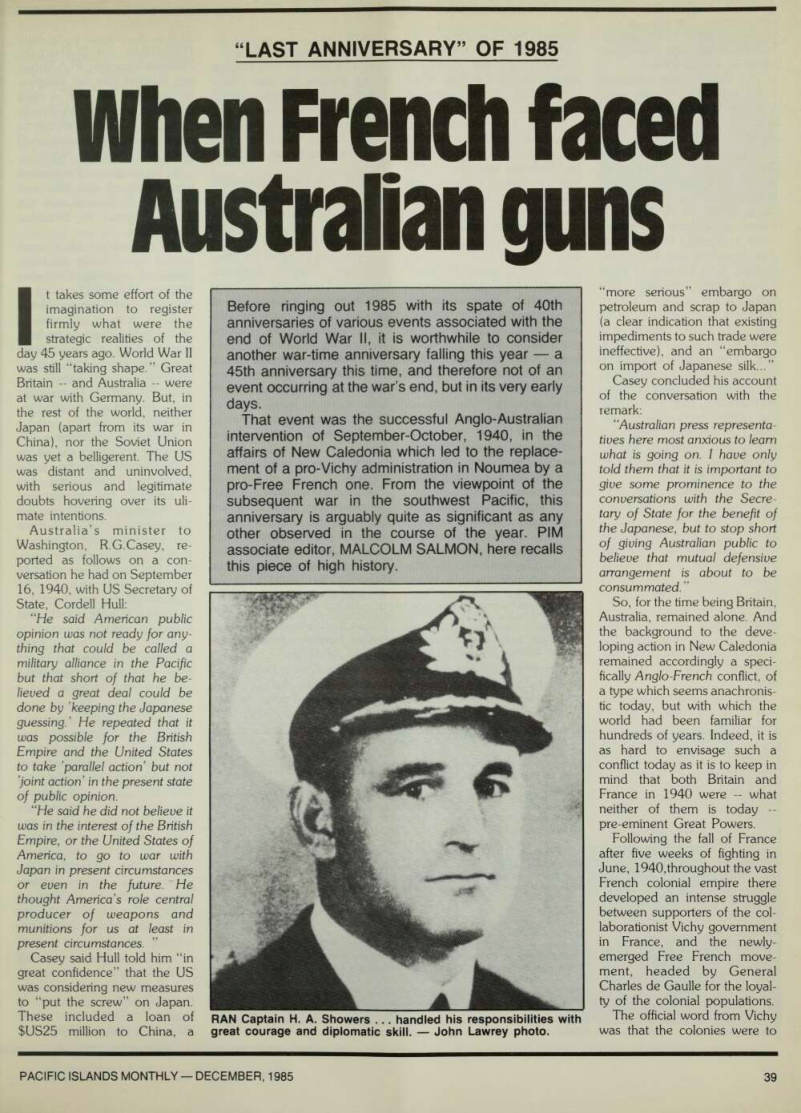
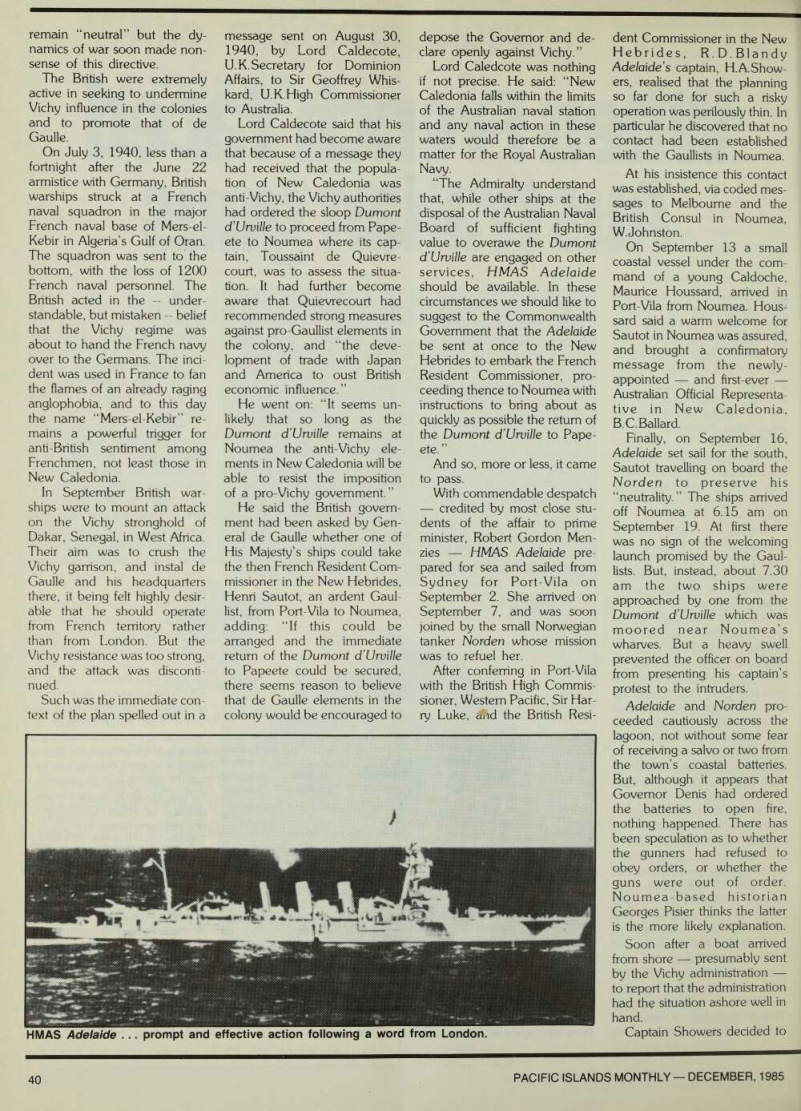
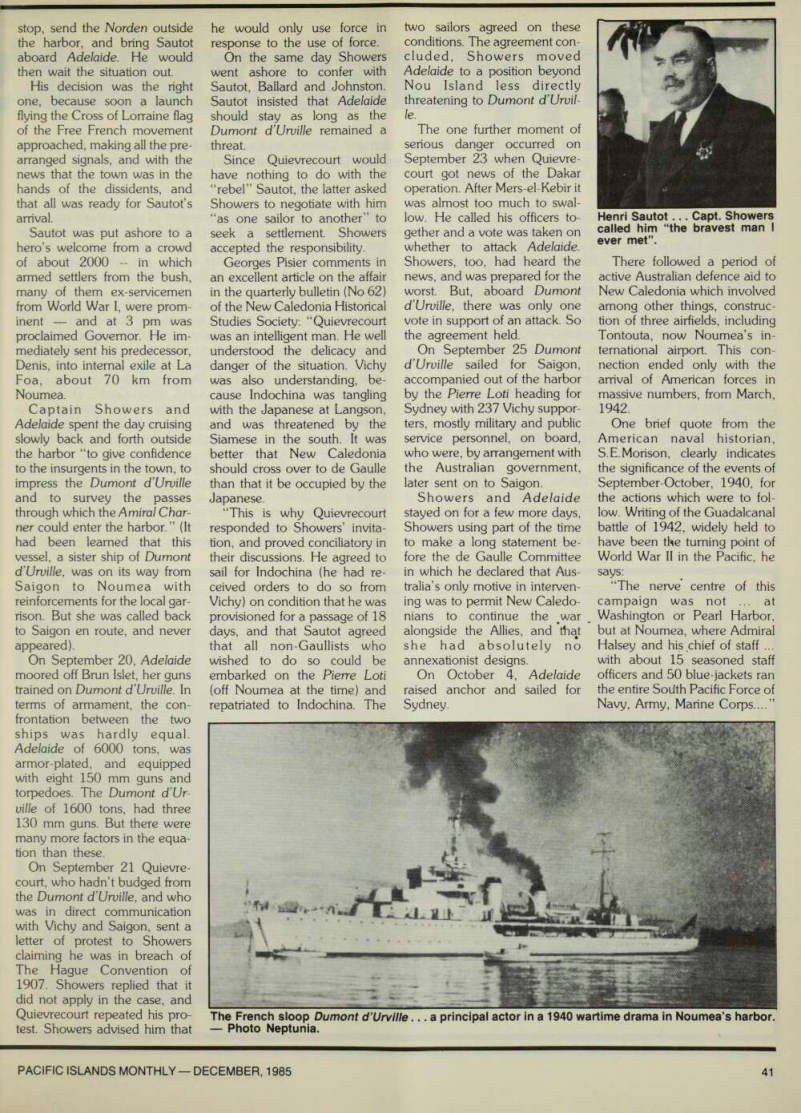
“Last Anniversary” Of 1985
when French faced Australian guns
It takes some effort of the imagination to register firmly what were the strategic realities of the day 45 years ago. World War II was still “taking shape.” Great Britain and Australia were at war with Germany. But, in the rest of the world, neither Japan (apart from its war in China), nor the Soviet Union was yet a belligerent. The US was distant and uninvolved, with serious and legitimate doubts hovering over its uli mate intentions.
Australia’s minister to Washington, R.G.Casey, re ported as follows on a con versation he had on September 16, 1940, with US Secretary of State, Cordell Hull: “He said American public opinion was not ready for any thing that could be called a military alliance in the Pacific but that short of that he be lieved a great deal could be done by ’keeping the Japanese guessing.’ He repeated that it was possible for the British Empire and the United States to take ’parallel action’ but not ’joint action’ in the present state of public opinion.
“He said he did not believe it was in the interest of the British Empire, or the United States of America, to go to war with Japan in present circumstances or even in the future. He thought America’s role central producer of weapons and munitions for us at least in present circumstances.
Casey said Hull told him “in great confidence” that the US was considering new measures to “put the screw” on Japan.
These included a loan of SUS2S million to China, a
Before ringing out 1985 with its spate of 40th anniversaries of various events associated with the end of World War 11, it is worthwhile to consider another war-time anniversary falling this year a 45th anniversary this time, and therefore not of an event occurring at the war’s end, but in its very early days.
That event was the successful Anglo-Australian intervention of September-October, 1940, in the affairs of New Caledonia which led to the replace ment of a pro-Vichy administration in Noumea by a pro-Free French one. From the viewpoint of the subsequent war in the southwest Pacific, this anniversary is arguably quite as significant as any other observed in the course of the year. PIM associate editor, MALCOLM SALMON, here recalls this piece of high history.
“more serious” embargo on petroleum and scrap to Japan (a clear indication that existing impediments to such trade were ineffective), and an “embargo on import of Japanese silk...”
Casey concluded his account of the conversation with the remark: “Australian press representa tives here most anxious to learn what is going on. I have on/y told them that it is important to give some prominence to the conversations with the Secre tary of State for the benefit of the Japanese, but to stop short of giving Australian public to believe that mutual defensive arrangement is about to be consummated.”
So, for the time being Britain, Australia, remained alone. And the background to the deve loping action in New Caledonia remained accordingly a speci fically Anglo-French conflict, of a type which seems anachronis tic today, but with which the world had been familiar for hundreds of years. Indeed, it is as hard to envisage such a conflict today as it is to keep in mind that both Britain and France in 1940 were what neither of them is today pre-eminent Great Powers.
Following the fall of France after five weeks of fighting in June, 1940,throughout the vast French colonial empire there developed an intense struggle between supporters of the col laborationist Vichy government in France, and the newly emerged Free French move ment, headed by General Charles de Gaulle for the loyal ty of the colonial populations.
The official word from Vichy was that the colonies were to
RAN Captain H. A. Showers ... handled his responsibilities with great courage and diplomatic skill. - John Lawrey photo.
remain “neutral” but the dy namics of war soon made non sense of this directive.
The British were extremely active in seeking to undermine Vichy influence in the colonies and to promote that of de Gaulle.
On July 3, 1940, less than a fortnight after the June 22 armistice with Germany, British warships struck at a French naval squadron in the major French naval base of Mers-el- Kebir in Algeria’s Gulf of Oran.
The squadron was sent to the bottom, with the loss of 1200 French naval personnel. The British acted in the - under standable, but mistaken - belief that the Vichy regime was about to hand the French navy over to the Germans. The inci dent was used in France to fan the flames of an already raging anglophobia, and to this day the name “Mers-el-Kebir” re mains a powerful trigger for anti-British sentiment among Frenchmen, not least those in New Caledonia.
In September British war ships were to mount an attack on the Vichy stronghold of Dakar, Senegal, in West Africa.
Their aim was to crush the Vichy garrison, and instal de Gaulle and his headquarters there, it being felt highly desir able that he should operate from French territory rather than from London. But the Vichy resistance was too strong, and the attack was disconti nued.
Such was the immediate con text of the plan spelled out in a
message sent on August 30, 1940, by Lord Caldecote, U.K.Secretary for Dominion Affairs, to Sir Geoffrey Whis kard, U.K.High Commissioner to Australia.
Lord Caldecote said that his government had become aware that because of a message they had received that the popula tion of New Caledonia was anti-Vichy, the Vichy authorities had ordered the sloop Dumont d’Uwille to proceed from Pape ete to Noumea where its cap tain, Toussaint de Quievre court, was to assess the situa tion. It had further become aware that Quievrecourt had recommended strong measures against pro-Gaullist elements in the colony, and “the deve lopment of trade with Japan and America to oust British economic influence.”
He went on; “It seems un likely that so long as the Dumont d’Uwille remains at Noumea the anti-Vichy ele ments in New Caledonia will be able to resist the imposition of a pro-Vichy government.”
He said the British govern ment had been asked by Gen eral de Gaulle whether one of His Majesty’s ships could take the then French Resident Com missioner in the New Hebrides, Henri Sautot, an ardent Gaul list, from Port-Vila to Noumea, adding; “If this could be arranged and the immediate return of the Dumont d’Uwille to Papeete could be secured, there seems reason to believe that de Gaulle elements in the colony would be encouraged to
depose the Governor and de clare openly against Vichy.”
Lord Caledcote was nothing if not precise. He said; “New Caledonia falls within the limits of the Australian naval station and any naval action in these waters would therefore be a matter for the Royal Australian Navy.
“The Admiralty understand that, while other ships at the disposal of the Australian Naval Board of sufficient fighting value to overawe the Dumont d’Uwille are engaged on other services, HMAS Adelaide should be available. In these circumstances we should like to suggest to the Commonwealth Government that the Adelaide be sent at once to the New Hebrides to embark the French Resident Commissioner, pro ceeding thence to Noumea with instructions to bring about as quickly as possible the return of the Dumont d’Uwille to Pape ete. ”
And so, more or less, it came to pass.
With commendable despatch credited by most close stu dents of the affair to prime minister, Robert Gordon Men zies HMAS Adelaide pre pared for sea and sailed from Sydney for Port-Vila on September 2. She arrived on September 7, and was soon joined by the small Norwegian tanker Norden whose mission was to refuel her.
After conferring in Port-Vila with the British High Commis sioner, Western Pacific, Sir Har ry Luke, afid the British Resi-
dent Commissioner in the New
Hebrides, R.D.Blandy
Adelaide’s captain, H.A.Show ers, realised that the planning so far done for such a risky operation was perilously thin. In particular he discovered that no contact had been established with the Gaullists in Noumea.
At his insistence this contact was established, via coded mes sages to Melbourne and the British Consul in Noumea, W.Johnston.
On September 13 a small coastal vessel under the com mand of a young Caldoche, Maurice Houssard, arrived in Port-Vila from Noumea. Hous sard said a warm welcome for Sautot in Noumea was assured, and brought a confirmatory message from the newly appointed and first-ever Australian Official Representa tive in New Caledonia, B.C. Ballard.
Finally, on September 16, Adelaide set sail for the south, Sautot travelling on board the Norden to preserve his “neutrality.” The ships arrived off Noumea at 6.15 am on September 19. At first there was no sign of the welcoming launch promised by the Gaul lists. But, instead, about 7.30 am the two ships were approached by one from the Dumont d’Uwille which was moored near Noumea’s wharves. But a heavy swell prevented the officer on board from presenting his captain’s protest to the intruders.
Adelaide and Norden pro ceeded cautiously across the lagoon, not without some fear of receiving a salvo or two from the town’s coastal batteries.
But, although it appears that Governor Denis had ordered the batteries to open fire, nothing happened. There has been speculation as to whether the gunners had refused to obey orders, or whether the guns were out of order.
Noumea-based historian Georges Pisier thinks the latter is the more likely explanation.
Soon after a boat arrived from shore presumably sent by the Vichy administration to report that the administration had the situation ashore well in hand.
Captain Showers decided to
HMAS Adelaide ... prompt and effective action following a word from London.
stop, send the Norden outside the harbor, and bring Sautot aboard Adelaide. He would then wait the situation out.
His decision was the right one, because soon a launch flying the Cross of Lorraine flag of the Free French movement approached, making all the pre arranged signals, and with the news that the town was in the hands of the dissidents, and that all was ready for Sautot’s arrival.
Sautot was put ashore to a hero’s welcome from a crowd of about 2000 in which armed settlers from the bush, many of them ex-servicemen from World War I, were prom inent and at 3 pm was proclaimed Governor. He im mediately sent his predecessor, Denis, into internal exile at La Foa, about 70 km from Noumea.
Captain Showers and Adelaide spent the day cruising slowly back and forth outside the harbor “to give confidence to the insurgents in the town, to impress the Dumont d’Urville and to survey the passes through which the Amiral Char ner could enter the harbor.” (It had been learned that this vessel, a sister ship of Dumont d’Urville, was on its way from Saigon to Noumea with reinforcements for the local gar rison. But she was called back to Saigon en route, and never appeared).
On September 20, Adelaide moored off Brun Islet, her guns trained on Dumont d’Urville. In terms of armament, the con frontation between the two ships was hardly equal.
Adelaide of 6000 tons, was armor-plated, and equipped with eight 150 mm guns and torpedoes. The Dumont d’Ur ville of 1600 tons, had three 130 mm guns. But there were many more factors in the equa tion than these.
On September 21 Quievre court, who hadn’t budged from the Dumont d’Urville, and who was in direct communication with Vichy and Saigon, sent a letter of protest to Showers claiming he was in breach of The Hague Convention of 1907. Showers replied that it did not apply in the case, and Quievrecourt repeated his pro test. Showers advised him that
he would only use force in response to the use of force.
On the same day Showers went ashore to confer with Sautot, Ballard and Johnston.
Sautot insisted that Adelaide should stay as long as the Dumont d’Urville remained a threat.
Since Quievrecourt would have nothing to do with the “rebel” Sautot, the latter asked Showers to negotiate with him “as one sailor to another” to seek a settlement. Showers accepted the responsibility.
Georges Pisier comments in an excellent article on the affair in the quarterly bulletin (No 62) of the New Caledonia Historical Studies Society: “Quievrecourt was an intelligent man. He well understood the delicacy and danger of the situation. Vichy was also understanding, be cause Indochina was tangling with the Japanese at Langson, and was threatened by the Siamese in the south. It was better that New Caledonia should cross over to de Gaulle than that it be occupied by the Japanese.
“This is why Quievrecourt responded to Showers’ invita tion, and proved conciliatory in their discussions. He agreed to sail for Indochina (he had re ceived orders to do so from Vichy) on condition that he was provisioned for a passage of 18 days, and that Sautot agreed that all non-Gaullists who wished to do so could be embarked on the Pierre Loti (off Noumea at the time) and repatriated to Indochina. The
two sailors agreed on these conditions. The agreement con cluded, Showers moved Adelaide to a position beyond Nou Island less directly threatening to Dumont d'Urvil le.
The one further moment of serious danger occurred on September 23 when Quievre court got news of the Dakar operation. After Mers-el-Kebir it was almost too much to swal low. He called his officers to gether and a vote was taken on whether to attack Adelaide.
Showers, too, had heard the news, and was prepared for the worst. But, aboard Dumont d’Urville, there was only one vote in support of an attack. So the agreement held.
On September 25 Dumont d’Urville sailed for Saigon, accompanied out of the harbor by the Pierre Loti heading for Sydney with 237 Vichy suppor ters, mostly military and public service personnel, on board, who were, by arrangement with the Australian government, later sent on to Saigon.
Showers and Adelaide stayed on for a few more days, Showers using part of the time to make a long statement be fore the de Gaulle Committee in which he declared that Aus tralia’s only motive in interven ing was to permit New Caledo nians to continue the % war alongside the Allies, and tha t she had absolutely no annexationist designs.
On October 4, Adelaide raised anchor and sailed for Sydney.
There followed a period of active Australian defence aid to New Caledonia which involved among other things, construc tion of three airfields, including Tontouta, now Noumea’s in ternational airport. This con nection ended only with the arrival of American forces in massive numbers, from March, 1942.
One brief quote from the American naval historian, S.E.Morison, clearly indicates the significance of the events of September-October, 1940, for the actions which were to fol low. Writing of the Guadalcanal battle of 1942, widely held to have been the turning point of World War II in the Pacific, he says: “The nerve centre of this campaign was not ... at Washington or Pearl Harbor, but at Noumea, where Admiral Halsey and his chief of staff ... with about 15 seasoned staff officers and 50 blue-jackets ran the entire Sou’th Pacific Force of Navy, Army, Marine Corps...”
Henri Sautot... Capt. Showers called him “the bravest man I ever met”.
The French sloop Dumont d’Urville ... a principal actor in a 1940 wartime drama in Noumea’s harbor.
Photo Neptunia.
History painting: Cook's artists at full stretch
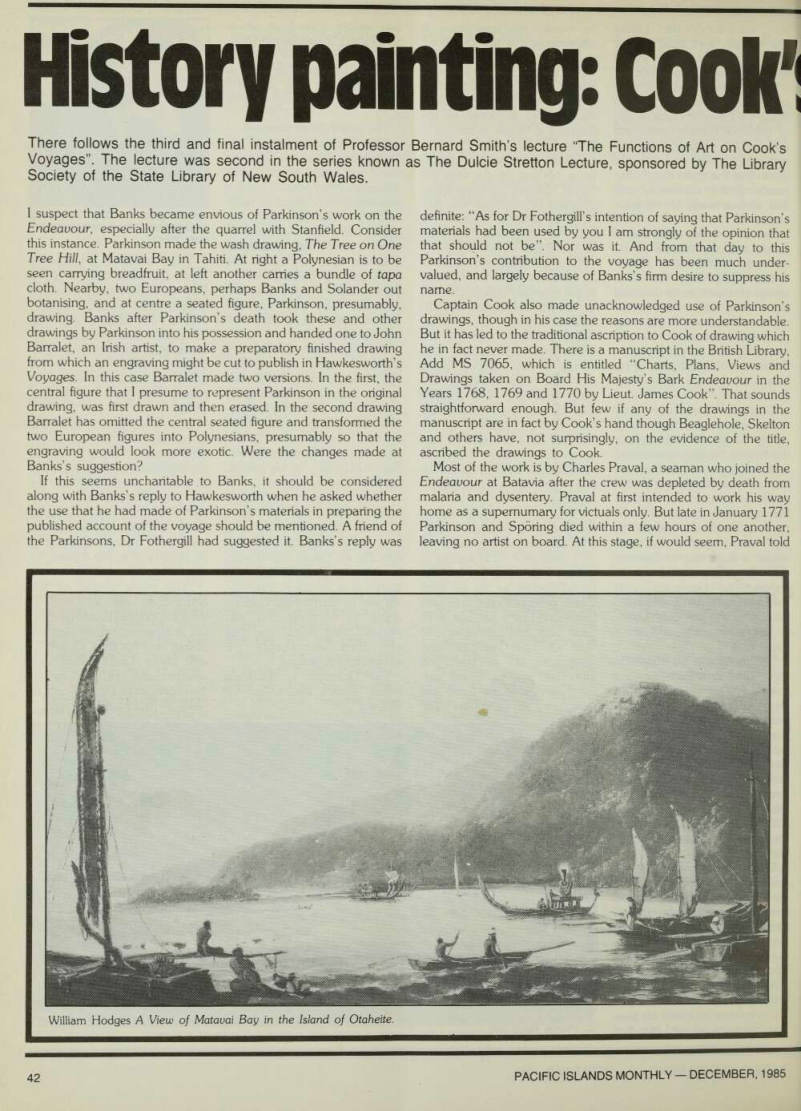
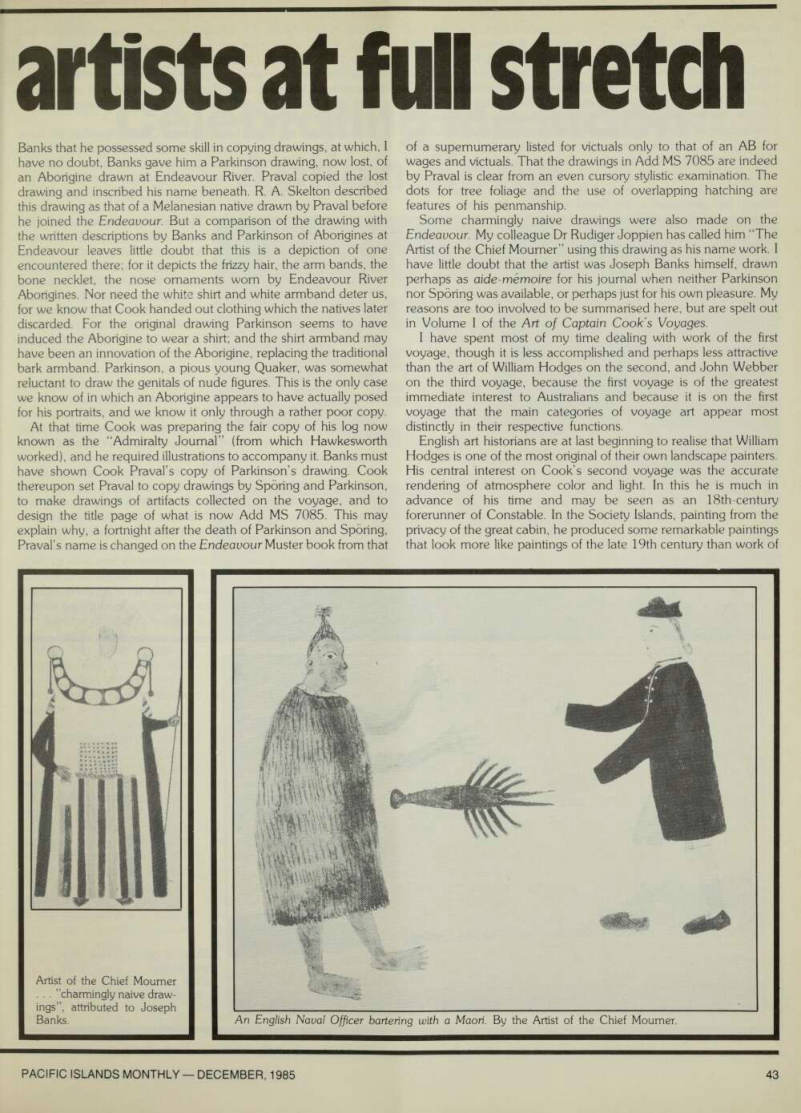
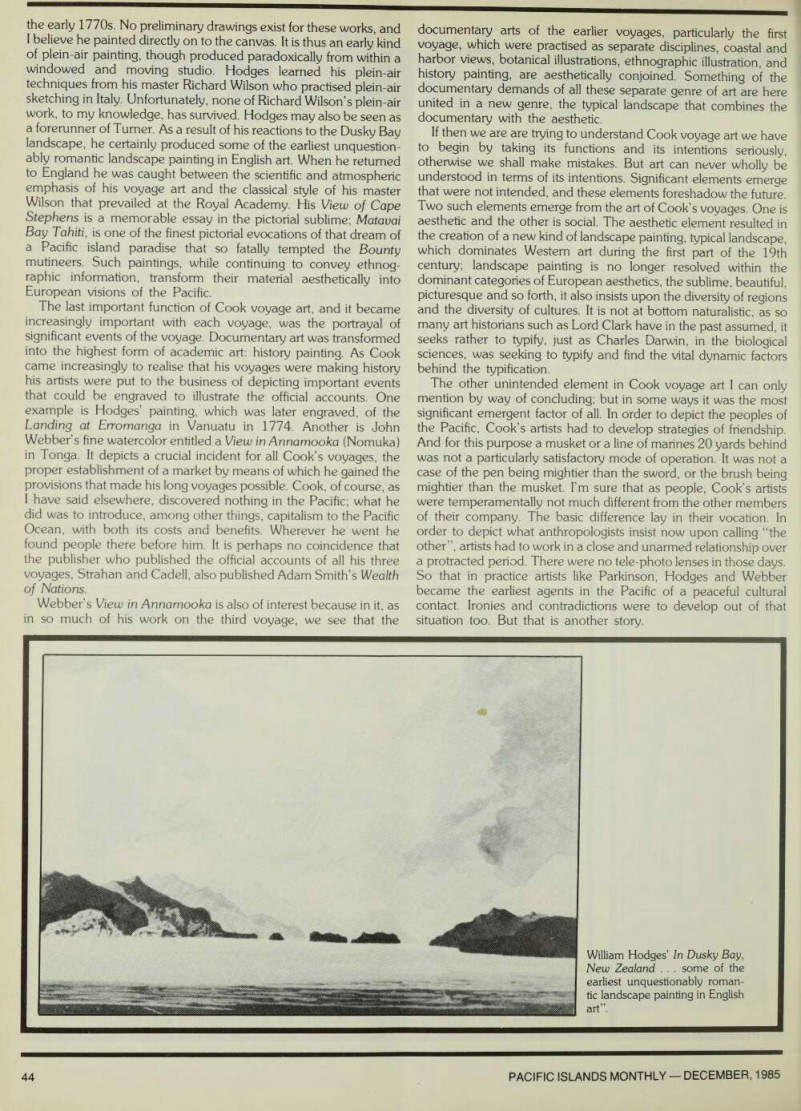
There follows the third and final instalment of Professor Bernard Smith’s lecture “The Functions of Art on Cook’s Voyages”. The lecture was second in the series known as The Dulcie Stretton Lecture, sponsored by The Library Society of the State Library of New South Wales.
I suspect that Banks became envious of Parkinson’s work on the Endeavour, especially after the quarrel with Stanfield. Consider this instance. Parkinson made the wash drawing, The Tree on One Tree Hill, at Matavai Bay in Tahiti. At right a Polynesian is to be seen carrying breadfruit, at left another carries a bundle of tapa cloth. Nearby, two Europeans, perhaps Banks and Solander out botanising, and at centre a seated figure, Parkinson, presumably, drawing. Banks after Parkinson’s death took these and other drawings by Parkinson into his possession and handed one to John Barralet, an Irish artist, to make a preparatory finished drawing from which an engraving might be cut to publish in Hawkesworth’s Voyages. In this case Barralet made two versions. In the first, the central figure that I presume to represent Parkinson in the original drawing, was first drawn and then erased. In the second drawing Barralet has omitted the central seated figure and transformed the two European figures into Polynesians, presumably so that the engraving would look more exotic. Were the changes made at Banks’s suggestion?
If this seems uncharitable to Banks, it should be considered along with Banks’s reply to Hawkesworth when he asked whether the use that he had made of Parkinson’s materials in preparing the published account of the voyage should be mentioned. A friend of the Parkinsons, Dr Fothergill had suggested it. Banks’s reply was
definite: “As for Dr Fothergill’s intention of saying that Parkinson’s materials had been used by you I am strongly of the opinion that that should not be”. Nor was it. And from that day to this Parkinson’s contribution to the voyage has been much under valued, and largely because of Banks’s firm desire to suppress his name.
Captain Cook also made unacknowledged use of Parkinson’s drawings, though in his case the reasons are more understandable.
But it has led to the traditional ascription to Cook of drawing which he in fact never made. There is a manuscript in the British Library, Add MS 7065, which is entitled “Charts, Plans, Views and Drawings taken on Board His Majesty’s Bark Endeavour in the Years 1768, 1769 and 1770 by Lieut. James Cook”. That sounds straightforward enough. But few if any of the drawings in the manuscript are in fact by Cook’s hand though Beaglehole, Skelton and others have, not surprisingly, on the evidence of the title, ascribed the drawings to Cook.
Most of the work is by Charles Praval, a seaman who joined the Endeavour at Batavia after the crew was depleted by death from malaria and dysentery. Praval at first intended to work his way home as a supemumary for victuals only. But late in January 1771 Parkinson and Sporing died within a few hours of one another, leaving no artist on board. At this stage, if would seem, Praval told
William Hodges A View of Matauai Bay in the Island of Otaheite.
Banks that he possessed some skill in copying drawings, at which, I have no doubt, Banks gave him a Parkinson drawing, now lost, of an Aborigine drawn at Endeavour River. Praval copied the lost drawing and inscribed his name beneath. R. A. Skelton described this drawing as that of a Melanesian native drawn by Praval before he joined the Endeavour. But a comparison of the drawing with the written descriptions by Banks and Parkinson of Aborigines at Endeavour leaves little doubt that this is a depiction of one encountered there; for it depicts the frizzy hair, the arm bands, the bone necklet, the nose ornaments worn by Endeavour River Aborigines. Nor need the white shirt and white armband deter us, for we know that Cook handed out clothing which the natives later discarded. For the original drawing Parkinson seems to have induced the Aborigine to wear a shirt; and the shirt armband may have been an innovation of the Aborigine, replacing the traditional bark armband. Parkinson, a pious young Quaker, was somewhat reluctant to draw the genitals of nude figures. This is the only case we know of in which an Aborigine appears to have actually posed for his portraits, and we know it only through a rather poor copy.
At that time Cook was preparing the fair copy of his log now known as the “Admiralty Journal” (from which Hawkesworth worked), and he required illustrations to accompany it. Banks must have shown Cook Praval’s copy of Parkinson’s drawing. Cook thereupon set Praval to copy drawings by Sporing and Parkinson, to make drawings of artifacts collected on the voyage, and to design the title page of what is now Add MS 7085. This may explain why, a fortnight after the death of Parkinson and Sporing, Praval’s name is changed on the Endeavour Muster book from that
of a supernumerary listed for victuals only to that of an AB for wages and victuals. That the drawings in Add MS 7085 are indeed by Praval is clear from an even cursory stylistic examination. The dots for tree foliage and the use of overlapping hatching are features of his penmanship.
Some charmingly naive drawings were also made on the Endeavour. My colleague Dr Rudiger Joppien has called him “The Artist of the Chief Mourner” using this drawing as his name work. I have little doubt that the artist was Joseph Banks himself, drawn perhaps as aide-memoire for his journal when neither Parkinson nor Sporing was available, or perhaps just for his own pleasure. My reasons are too involved to be summarised here, but are spelt out in Volume I of the Art of Captain Cook’s Voyages.
I have spent most of my time dealing with work of the first voyage, though it is less accomplished and perhaps less attractive than the art of William Hodges on the second, and John Webber on the third voyage, because the first voyage is of the greatest immediate interest to Australians and because it is on the first voyage that the main categories of voyage art appear most distinctly in their respective functions.
English art historians are at last beginning to realise that William Hodges is one of the most original of their own landscape painters.
His central interest on Cook’s second voyage was the accurate rendering of atmosphere color and light. In this he is much in advance of his time and may be seen as an 18th-century forerunner of Constable. In the Society Islands, painting from the privacy of the great cabin, he produced some remarkable paintings that look more like paintings of the late 19th century than work of
Artist of the Chief Mourner . . . "charmingly naive draw ings”, attributed to Joseph Banks.
An English Naval Officer bartering with a Maori. By the Artist of the Chief Mourner.
the early 17705. No preliminary drawings exist for these works, and I believe he painted directly on to the canvas. It is thus an early kind of plein-air painting, though produced paradoxically from within a windowed and moving studio. Hodges learned his plein-air techniques from his master Richard Wilson who practised plein-air sketching in Italy. Unfortunately, none of Richard Wilson’s plein-air work, to my knowledge, has survived. Hodges may also be seen as a forerunner of Turner. As a result of his reactions to the Dusky Bay landscape, he certainly produced some of the earliest unquestion ably romantic landscape painting in English art. When he returned to England he was caught between the scientific and atmospheric emphasis of his voyage art and the classical style of his master Wilson that prevailed at the Royal Academy. His View of Cape Stephens is a memorable essay in the pictorial sublime; Matauai Bay Tahiti , is one of the finest pictorial evocations of that dream of a Pacific island paradise that so fatally tempted the Bounty mutineers. Such paintings, while continuing to convey ethnog raphic information, transform their material aesthetically into European visions of the Pacific.
The last important function of Cook voyage art, and it became increasingly important with each voyage, was the portrayal of significant events of the voyage. Documentary art was transformed into the highest form of academic art: history painting. As Cook came increasingly to realise that his voyages were making history his artists were put to the business of depicting important events that could be engraved to illustrate the official accounts. One example is Hodges’ painting, which was later engraved, of the Landing at Erromanga in Vanuatu in 1774. Another is John Webber’s fine watercolor entitled a View in Annamooka (Nomuka) in Tonga. It depicts a crucial incident for all Cook’s voyages, the proper establishment of a market by means of which he gained the provisions that made his long voyages possible. Cook, of course, as I have said elsewhere, discovered nothing in the Pacific; what he did was to introduce, among other things, capitalism to the Pacific Ocean, with both its costs and benefits. Wherever he went he found people there before him. It is perhaps no coincidence that the publisher who published the official accounts of all his three voyages, Strahan and Cadell, also published Adam Smith’s Wealth of Nations.
Webber’s View in Annamooka is also of interest because in it, as in so much of his work on the third voyage, we see that the
documentary arts of the earlier voyages, particularly the first voyage, which were practised as separate disciplines, coastal and harbor views, botanical illustrations, ethnographic illustration, and history painting, are aesthetically conjoined. Something of the documentary demands of all these separate genre of art are here united in a new genre, the typical landscape that combines the documentary with the aesthetic.
If then we are are trying to understand Cook voyage art we have to begin by taking its functions and its intentions seriously, otherwise we shall make mistakes. But art can never wholly be understood in terms of its intentions. Significant elements emerge that were not intended, and these elements foreshadow the future.
Two such elements emerge from the art of Cook’s voyages. One is aesthetic and the other is social. The aesthetic element resulted in the creation of a new kind of landscape painting, typical landscape, which dominates Western art during the first part of the 19th century; landscape painting is no longer resolved within the dominant categories of European aesthetics, the sublime, beautiful, picturesque and so forth, it also insists upon the diversity of regions and the diversity of cultures. It is not at bottom naturalistic, as so many art historians such as Lord Clark have in the past assumed, it seeks rather to typify, just as Charles Darwin, in the biological sciences, was seeking to typify and find the vital dynamic factors behind the typification.
The other unintended element in Cook voyage art I can only mention by way of concluding; but in some ways it was the most significant emergent factor of all. In order to depict the peoples of the Pacific, Cook’s artists had to develop strategies of friendship.
And for this purpose a musket or a line of marines 20 yards behind was not a particularly satisfactory mode of operation. It was not a case of the pen being mightier than the sword, or the brush being mightier than the musket. I’m sure that as people, Cook’s artists were temperamentally not much different from the other members of their company. The basic difference lay in their vocation. In order to depict what anthropologists insist now upon calling “the other”, artists had to work in a close and unarmed relationship over a protracted period. There were no tele-photo lenses in those days.
So that in practice artists like Parkinson, Hodges and Webber became the earliest agents in the Pacific of a peaceful cultural contact. Ironies and contradictions were to develop out of that situation too. But that is another story.
William Hodges’ In Dusky Bay, New Zealand . . . some of the earliest unquestionably roman tic landscape painting in English art”.
Action Song
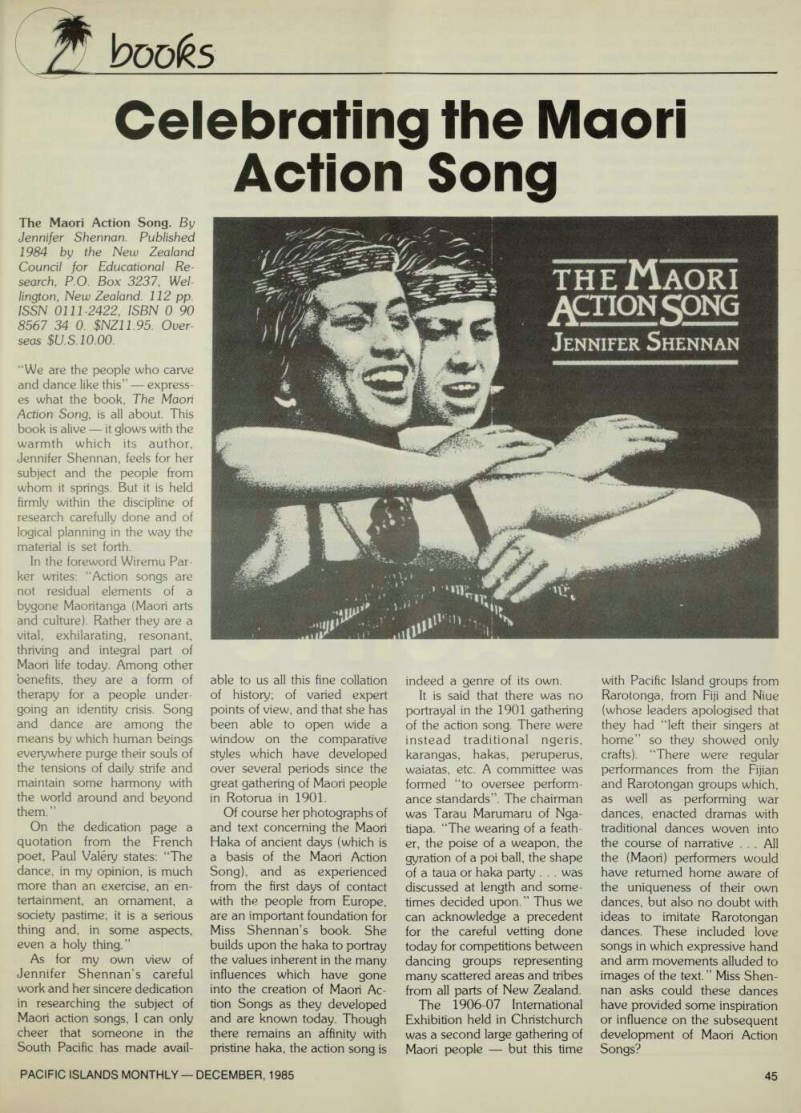

books
Celebrating the Maori Action Song
The Maori Action Song. By Jennifer Shennan. Published 1984 by the blew Zealand Council for Educational Re search, P.O. Box 3231, Wel lington, New Zealand. 112 pp.
Issn 0111-2422, Isbn 0 90
8567 34 0. $NZ11.95. Over seas $U.5.10.00.
“We are the people who carve and dance like this” express es what the book, The Maori Action Song, is all about. This book is alive it glows with the warmth which its author, Jennifer Shennan, feels for her subject and the people from whom it springs. But it is held firmly within the discipline of research carefully done and of logical planning in the way the material is set forth.
In the foreword Wiremu Par ker writes; “Action songs are not residual elements of a bygone Maoritanga (Maori arts and culture). Rather they are a vital, exhilarating, resonant, thriving and integral part of Maori life today. Among other benefits, they are a form of therapy for a people under going an identity crisis. Song and dance are among the means by which human beings everywhere purge their souls of the tensions of daily strife and maintain some harmony with the world around and beyond them.”
On the dedication page a quotation from the French poet, Paul Valery states: “The dance, in my opinion, is much more than an exercise, an en tertainment, an ornament, a society pastime; it is a serious thing and, in some aspects, even a holy thing.”
As for my own view of Jennifer Shennan’s careful work and her sincere dedication in researching the subject of Maori action songs, I can only cheer that someone in the South Pacific has made avail-
able to us all this fine collation of history; of varied expert points of view, and that she has been able to open wide a window on the comparative styles which have developed over several periods since the great gathering of Maori people in Rotorua in 1901.
Of course her photographs of and text concerning the Maori Haka of ancient days (which is a basis of the Maori Action Song), and as experienced from the first days of contact with the people from Europe, are an important foundation for Miss Shennan’s book. She builds upon the haka to portray the values inherent in the many influences which have gone into the creation of Maori Ac tion Songs as they developed and are known today. Though there remains an affinity with pristine haka, the action song is
indeed a genre of its own.
It is said that there was no portrayal in the 1901 gathering of the action song. There were instead traditional ngeris, karangas, hakas, peruperus, waiatas, etc. A committee was formed “to oversee perform ance standards”. The chairman was Tarau Marumaru of Nga tiapa. “The wearing of a feath er, the poise of a weapon, the gyration of a poi ball, the shape of a taua or haka party . . . was discussed at length and some times decided upon.” Thus we can acknowledge a precedent for the careful vetting done today for competitions between dancing groups representing many scattered areas and tribes from all parts of New Zealand.
The 1906-07 International Exhibition held in Christchurch was a second large gathering of Maori people - but this time
with Pacific Island groups from Rarotonga, from Fiji and Niue (whose leaders apologised that they had “left their singers at home” so they showed only crafts). “There were regular performances from the Fijian and Rarotongan groups which, as well as performing war dances, enacted dramas with traditional dances woven into the course of narrative ... All the (Maori) performers would have returned home aware of the uniqueness of their own dances, but also no doubt with ideas to imitate Rarotongan dances. These included love songs in which expressive hand and arm movements alluded to images of the text. ” Miss Shen nan asks could these dances have provided some inspiration or influence on the subsequent development of Maori Action Songs?
Another early Pacific Island link, this time with the Waikato people of the Hamilton area, was joined when a Cook Island group visited Princess Te Puea and her people. She later or ganised “a touring concert party whose repertoire included action songs, yet it is quite clear that the Maori dance style was not overtly modelled on other Polynesian dances, even if some of the formal features may have given early inspira tion”.
Once the leaders in Maori communities accepted the Ac tion Song it quickly became popular until it is now “effec tively the national dance of New Zealand”. Miss Shennan gives many examples of how the Maori leaders composed action songs for their people.
Two great Maori men of the early 20th century, Sir Apirana Ngata and Hone Heke, “amused themselves by in terpreting the popular songs of the day into Maori and singing them over together”. But a prominent composer, the Rev.
Kingi Ihaka, outlines his approach as: “First the theme is decided this is directed to
wards the occasion. The music is composed, the text is then worked out”. Tuini Ngawai, leader of a culture group at Tokomaru Bay in the 1930 s and ’4os, said that “words come to her in a dream”. The song Arohaina Mai which she regards as her best “took only a few minutes to compose”. But in Rotorua with the strong tourist intake it was different with “the need to welcome visitors”. The farewells to de parting soldiers during the two world wars, then the welcome parties when the men returned, also had a strong effect in disseminating new composi tions. Again some used popular tunes of the day, while other composers created not only the words and the stylised move ments but also the music.
No matter what the catalyst for the rebirth of action songs, these are often set to beautiful poetic texts which are express ed by the flowing arms and hands. The feet keep the beat and in New Zealand different from the dance of other Pacific island peoples the body sways from side to side. In the Maori culture the right foot
keeps the rhythm. The foot is set down on the beat and then is raised again in continuous accent and non-accent as the weight is transferred once again on to the left foot. This swaying to the right and left makes the tubes of dried flax in the piu piu skirts (phormium tenax, or in the Maori language “harakeke”) softly swish from side to side like the ocean tides or if the body moves a little forward or back the skirt opens like a flower and closes with a swishing clicking sound that is a kind of gentle tympany.
This Maori action song book contains a wealth of know ledge. Not only is the Action- Song-dance traced via the haka (according to early researchers Johannes Anderson and Elsdon Best the word haka is best translated as posture dance), and via the Cook Island visits and on through the great Maori composers of the renaissance about 1918 to 1940 or 1950 (as the book sets the time when action songs came into their own) but there are also delightful chapters on “Images of Dance in Wood-carving” and “Dance in Legend and Mythol
ogy”, and, although “Maori dancing is recognised as a group activity” there are some lovely lines about a daughter of a chief, Te Puhihuia, who danced solo for some distin guished visitors. It is quoted from the legend of Te Ponga and Puhihuia, translated by Margaret Orbell; “When she came out in front of the ranks of the haka, her body bent in one direction and another! Yes, when they saw what a high-born girl can do!
They kept gazing at her eyes; anana, they were like a waxing moon rising over the horizon!
And so the visitors were com pletely overcome with the beauty and grace of this woman, and when Te Ponga, the chief of the travelling party, saw her beauty, his heart was driven wild.”
Altogether a splendid book complete with an excellent glos sary and index. It is well illus trated with black and white photographs.
The Maori Action Song is a fine addition to the all too sparse collection of books on
Pacific arts.
Beth Dean.
Advertisements & other items, p. 46 (1 item)
\&Cific
WCIFIC
CONSTRUCTION EQUIPMENT CO
introducing the Dynamic Hew
i Uibrating & Pneumatic Tyred
THE RANGE
• Pacific Self-Propelled Vibrating Rollers • Single and Double Drum Types • 1.5 tonne to 16 tonne • Pacific Self-Propelled Pneumatic Type Compactors • 3 Models 16. 21. 38 tonne Ballast Weights • Pacific Landfili and Sanitary Landfill Compactors • Pacific Pneumatic Earth Borers • Pacific Road Brooms • Pacific Railway Maintenance Vehicles
DISTRIBUTORS REQUIRED
THROUGHOUT THE PACIFIC
SAL
\&CIFIC
I Construction Equipment Co.
24 Salisbury Road, Hornsby NSW 2077, Australia. Phone (02) 476 2666
For Paua Sup, first
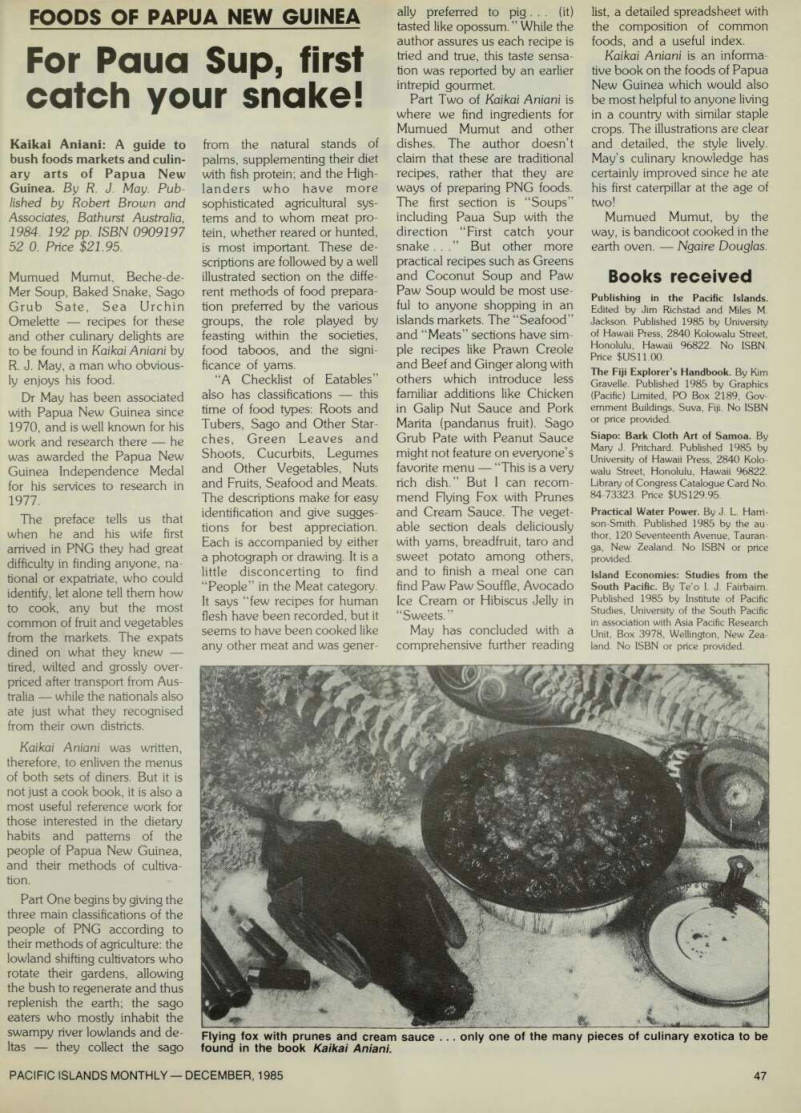
Foods Of Papua New Guinea
For Paua Sup, first catch your snake!
Kaikai Aniani: A guide to bush foods markets and culin ary arts of Papua New Guinea. By R. J. May. Pub lished by Robert Brown and Associates, Bathurst Australia, 1984. 192 pp. ISBN 0909197 52 0. Price $21.95.
Mumued Mumut, Beche-de- Mer Soup, Baked Snake, Sago Grub Sate, Sea Urchin Omelette recipes for these and other culinary delights are to be found in Kaikai Aniani by R. J. May, a man who obvious ly enjoys his food.
Dr May has been associated with Papua New Guinea since 1970, and is well known for his work and research there he was awarded the Papua New Guinea Independence Medal for his services to research in 1977.
The preface tells us that when he and his wife first arrived in PNG they had great difficulty in finding anyone, na tional or expatriate, who could identify, let alone tell them how to cook, any but the most common of fruit and vegetables from the markets. The expats dined on what they knew tired, wilted and grossly over priced after transport from Aus tralia while the nationals also ate just what they recognised from their own districts.
Kaikai Aniani was written, therefore, to enliven the menus of both sets of diners. But it is not just a cook book, it is also a most useful reference work for those interested in the dietary habits and patterns of the people of Papua New Guinea, and their methods of cultiva tion.
Part One begins by giving the three main classifications of the people of PNG according to their methods of agriculture: the lowland shifting cultivators who rotate their gardens, allowing the bush to regenerate and thus replenish the earth; the sago eaters who mostly inhabit the swampy river lowlands and de ltas they collect the sago
from the natural stands of palms, supplementing their diet with fish protein; and the High landers who have more sophisticated agricultural sys tems and to whom meat pro tein, whether reared or hunted, is most important. These de scriptions are followed by a well illustrated section on the diffe rent methods of food prepara tion preferred by the various groups, the role played by feasting within the societies, food taboos, and the signi ficance of yams.
“A Checklist of Eatables” also has classifications this time of food types: Roots and Tubers, Sago and Other Star ches, Green Leaves and Shoots, Cucurbits, Legumes and Other Vegetables, Nuts and Fruits, Seafood and Meats.
The descriptions make for easy identification and give sugges tions for best appreciation.
Each is accompanied by either a photograph or drawing. It is a little disconcerting to find “People” in the Meat category.
It says “few recipes for human flesh have been recorded, but it seems to have been cooked like any other meat and was gener
ally preferred to pig. . . (it) tasted like opossum. ” While the author assures us each recipe is tried and true, this taste sensa tion was reported by an earlier intrepid gourmet.
Part Two of Kaikai Aniani is where we find ingredients for Mumued Mumut and other dishes. The author doesn’t claim that these are traditional recipes, rather that they are ways of preparing PNG foods.
The first section is “Soups” including Paua Sup with the direction “First catch your snake...” But other more practical recipes such as Greens and Coconut Soup and Paw Paw Soup would be most use ful to anyone shopping in an islands markets. The “Seafood” and “Meats” sections have sim ple recipes like Prawn Creole and Beef and Ginger along with others which introduce less familiar additions like Chicken in Galip Nut Sauce and Pork Marita (pandanus fruit). Sago Grub Pate with Peanut Sauce might not feature on everyone’s favorite menu “This is a very rich dish.” But I can recom mend Flying Fox with Prunes and Cream Sauce. The veget able section deals deliciously with yams, breadfruit, taro and sweet potato among others, and to finish a meal one can find Paw Paw Souffle, Avocado Ice Cream or Hibiscus Jelly in “Sweets. ”
May has concluded with a comprehensive further reading
list, a detailed spreadsheet with the composition of common foods, and a useful index.
Kaikai Aniani is an informa tive book on the foods of Papua New Guinea which would also be most helpful to anyone living in a country with similar staple crops. The illustrations are clear
and detailed, the style lively.
May’s culinary knowledge has
certainly improved since he ate his first caterpillar at the age of two!
Mumued Mumut, by the
way, is bandicoot cooked in the
earth oven. Ngaire Douglas.
Books received
Publishing in the Pacific Islands.
Edited by Jim Richstad and Miles M.
Jackson. Published 1985 by University of Hawaii Press, 2840 Kolowalu Street, Honolulu, Hawaii 96822. No ISBN.
Price SUS 11.00.
The Fiji Explorer’s Handbook. By Kim Gravelle. Published 1985 by Graphics (Pacific) Limited, PO Box 2189, Gov ernment Buildings, Suva, Fiji. No ISBN or price provided.
Siapo: Bark Cloth Art of Samoa. By Mary J. Pritchard. Published 1985 by University of Hawaii Press, 2840 Kolo walu Street, Honolulu, Hawaii 96822.
Library of Congress Catalogue Card No. 84-73323. Price 5U5129.95.
Practiced Water Power. By J. L. Harri son-Smith. Published 1985 by the au thor, 120 Seventeenth Avenue, Tauran ga, New Zealand. No ISBN or price provided.
Island Economies: Studies from the South Pacific. By Te’o I. J. Fairbaim.
Published 1985 by Institute of Pacific Studies, University of the South Pacific in association with Asia Pacific Research Unit, Box 3978, Wellington, New Zea land. No ISBN or price provided.
Flying fox with prunes and cream sauce ... only one of the many pieces of culinary exotica to be found in the book Kaikai Aniani.
"When elephants fight, the
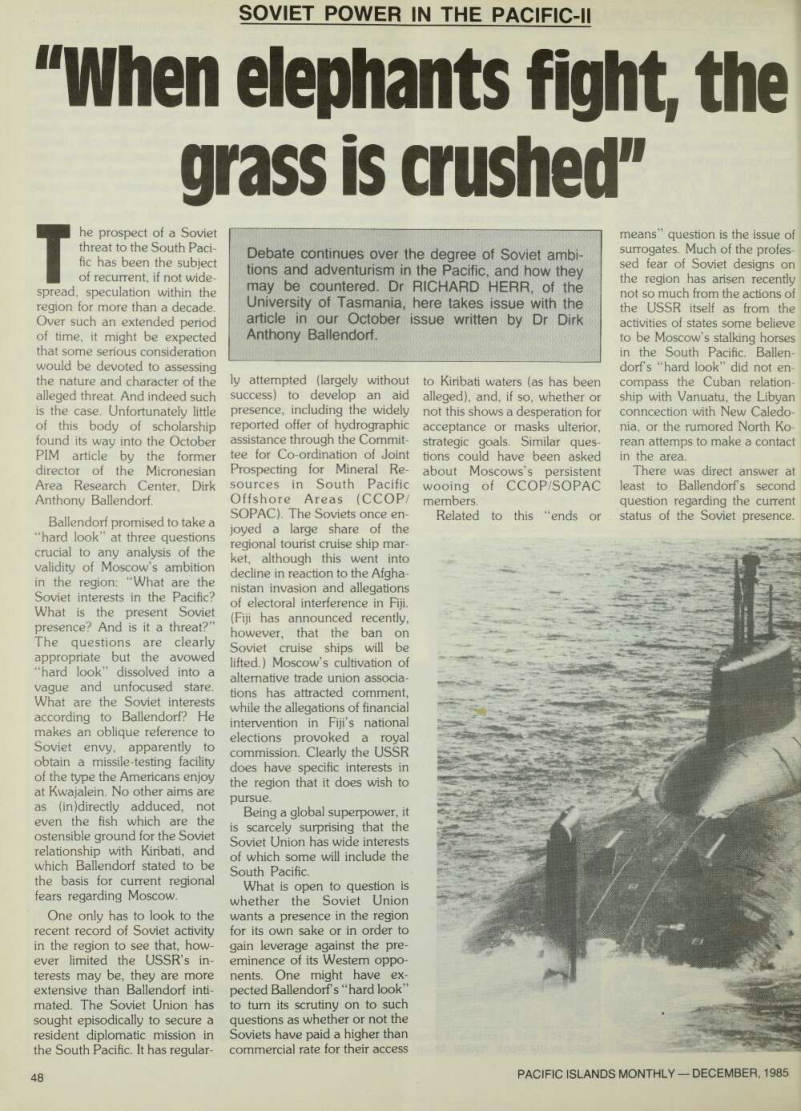
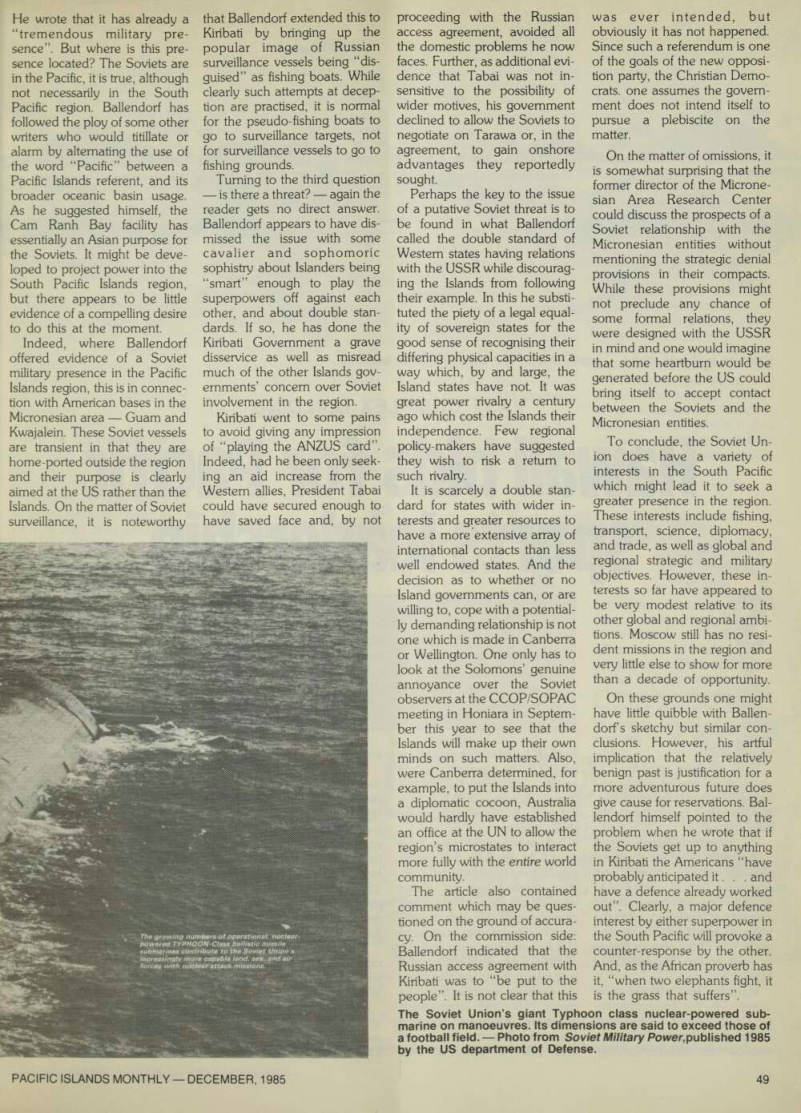
Soviet Power In The Pacific-Ii
"When elephants fight, the grass is crushed”
The prospect of a Soviet threat to the South Paci fic has been the subject of recurrent, if not wide spread, speculation within the region for more than a decade.
Over such an extended period of time, it might be expected that some serious consideration would be devoted to assessing the nature and character of the alleged threat. And indeed such is the case. Unfortunately little of this body of scholarship found its way into the October PIM article by the former director of the Micronesian Area Research Center, Dirk Anthony Ballendorf.
Ballendorf promised to take a “hard look” at three questions crucial to any analysis of the validity of Moscow’s ambition in the region; “What are the Soviet interests in the Pacific?
What is the present Soviet presence? And is it a threat?”
The questions are clearly appropriate but the avowed “hard look” dissolved into a vague and unfocused stare.
What are the Soviet interests according to Ballendorf? He makes an oblique reference to Soviet envy, apparently to obtain a missile-testing facility of the type the Americans enjoy at Kwajalein. No other aims are as (in)directly adduced, not even the fish which are the ostensible ground for the Soviet relationship with Kiribati, and which Ballendorf stated to be the basis for current regional fears regarding Moscow.
One only has to look to the recent record of Soviet activity in the region to see that, how ever limited the USSR’s in terests may be, they are more extensive than Ballendorf inti mated. The Soviet Union has sought episodically to secure a resident diplomatic mission in the South Pacific. It has regular-
Debate continues over the degree of Soviet ambi tions and adventurism in the Pacific, and how they may be countered. Dr RICHARD HERR, of the University of Tasmania, here takes issue with the article in our October issue written by Dr Dirk Anthony Ballendorf.
ly attempted (largely without success) to develop an aid presence, including the widely reported offer of hydrographic assistance through the Commit tee for Co-ordination of Joint Prospecting for Mineral Re sources in South Pacific Offshore Areas (CCOP/ SOPAC). The Soviets once en joyed a large share of the regional tourist cruise ship mar ket, although this went into decline in reaction to the Afgha nistan invasion and allegations of electoral interference in Fiji. (Fiji has announced recently, however, that the ban on Soviet cruise ships will be lifted.) Moscow’s cultivation of alternative trade union associa tions has attracted comment, while the allegations of financial intervention in Fiji’s national elections provoked a royal commission. Clearly the USSR does have specific interests in the region that it does wish to pursue.
Being a global superpower, it is scarcely surprising that the Soviet Union has wide interests of which some will include the South Pacific.
What is open to question is whether the Soviet Union wants a presence in the region for its own sake or in order to gain leverage against the pre eminence of its Western oppo nents. One might have ex pected Ballendorf s “hard look” to turn its scrutiny on to such questions as whether or not the Soviets have paid a higher than commercial rate for their access
to Kiribati waters (as has been alleged), and, if so, whether or not this shows a desperation for acceptance or masks ulterior, strategic goals. Similar ques tions could have been asked about Moscows’s persistent wooing of CCOP/SOPAC members.
Related to this “ends or
means” question is the issue of surrogates. Much of the profes sed fear of Soviet designs on the region has arisen recently not so much from the actions of the USSR itself as from the activities of states some believe to be Moscow’s stalking horses in the South Pacific. Ballen dorf s “hard look” did not en compass the Cuban relation ship with Vanuatu, the Libyan conncection with New Caledo nia, or the rumored North Ko rean attemps to make a contact in the area.
There was direct answer at least to Ballendorf s second question regarding the current status of the Soviet presence.
He wrote that it has already a “tremendous military pre sence”. But where is this pre sence located? The Soviets are in the Pacific, it is true, although not necessarily in the South Pacific region. Ballendorf has followed the ploy of some other writers who would titillate or alarm by alternating the use of the word “Pacific” between a Pacific Islands referent, and its broader oceanic basin usage.
As he suggested himself, the Cam Ranh Bay facility has essentially an Asian purpose for the Soviets. It might be deve loped to project power into the South Pacific Islands region, but there appears to be little evidence of a compelling desire to do this at the moment.
Indeed, where Ballendorf offered evidence of a Soviet military presence in the Pacific Islands region, this is in connec tion with American bases in the Micronesian area Guam and Kwajalein. These Soviet vessels are transient in that they are home-ported outside the region and their purpose is clearly aimed at the US rather than the Islands. On the matter of Soviet surveillance, it is noteworthy
that Ballendorf extended this to Kiribati by bringing up the popular image of Russian surveillance vessels being “dis guised” as fishing boats. While clearly such attempts at decep tion are practised, it is normal for the pseudo-fishing boats to go to surveillance targets, not for surveillance vessels to go to fishing grounds.
Turning to the third question is there a threat? again the reader gets no direct answer.
Ballendorf appears to have dis missed the issue with some cavalier and sophomoric sophistry about Islanders being “smart” enough to play the superpowers off against each other, and about double stan dards. If so, he has done the Kiribati Government a grave disservice as well as misread much of the other Islands gov ernments’ concern over Soviet involvement in the region.
Kiribati went to some pains to avoid giving any impression of “playing the ANZUS card”.
Indeed, had he been only seek ing an aid increase from the Western allies, President Tabai could have secured enough to have saved face and, by not
proceeding with the Russian access agreement, avoided all the domestic problems he now faces. Further, as additional evi dence that Tabai was not in sensitive to the possibility of wider motives, his government declined to allow the Soviets to negotiate on Tarawa or, in the agreement, to gain onshore advantages they reportedly sought.
Perhaps the key to the issue of a putative Soviet threat is to be found in what Ballendorf called the double standard of Western states having relations with the USSR while discourag ing the Islands from following their example. In this he substi tuted the piety of a legal equal ity of sovereign states for the good sense of recognising their differing physical capacities in a way which, by and large, the Island states have not. It was great power rivalry a century ago which cost the Islands their independence. Few regional policy-makers have suggested they wish to risk a return to such rivalry.
It is scarcely a double stan dard for states with wider in terests and greater resources to have a more extensive array of international contacts than less well endowed states. And the decision as to whether or no Island governments can, or are willing to, cope with a potential ly demanding relationship is not one which is made in Canberra or Wellington. One only has to look at the Solomons’ genuine annoyance over the Soviet observers at the CCOP/SOPAC meeting in Honiara in Septem ber this year to see that the Islands will make up their own minds on such matters. Also, were Canberra determined, for example, to put the Islands into a diplomatic cocoon, Australia would hardly have established an office at the UN to allow the region’s microstates to interact more fully with the entire world community.
The article also contained comment which may be ques tioned on the ground of accura cy. On the commission side: Ballendorf indicated that the Russian access agreement with Kiribati was to “be put to the people”. It is not clear that this
was ever intended, but obviously it has not happened.
Since such a referendum is one of the goals of the new opposi tion party, the Christian Demo crats. one assumes the govern ment does not intend itself to pursue a plebiscite on the matter.
On the matter of omissions, it is somewhat surprising that the former director of the Microne sian Area Research Center could discuss the prospects of a Soviet relationship with the Micronesian entities without mentioning the strategic denial provisions in their compacts.
While these provisions might not preclude any chance of some formal relations, they were designed with the USSR in mind and one would imagine that some heartburn would be generated before the US could bring itself to accept contact between the Soviets and the Micronesian entities.
To conclude, the Soviet Un ion does have a variety of interests in the South Pacific which might lead it to seek a greater presence in the region.
These interests include fishing, transport, science, diplomacy, and trade, as well as global and regional strategic and military objectives. However, these in terests so far have appeared to be very modest relative to its other global and regional ambi tions. Moscow still has no resi dent missions in the region and very little else to show for more than a decade of opportunity.
On these grounds one might have little quibble with Ballen dorfs sketchy but similar con clusions. However, his artful implication that the relatively benign past is justification for a more adventurous future does give cause for reservations. Bal lendorf himself pointed to the problem when he wrote that if the Soviets get up to anything in Kiribati the Americans “have probably anticipated it. . . and have a defence already worked out”. Clearly, a major defence interest by either superpower in the South Pacific will provoke a counter-response by the other.
And, as the African proverb has it, “when two elephants fight, it is the grass that suffers”.
The Soviet Union’s giant Typhoon class nuclear-powered sub marine on manoeuvres. Its dimensions are said to exceed those of a football field. Photo from Soviet Military Power, published 1985 by the US department of Defense.
The growing numbers of operational, nuclear powered TYPHOON-Class ballistic missile submarines contribute to the Soviet Union's increasingly more capable land, see, end air forces with nuclear attack misstons.
sports leadership
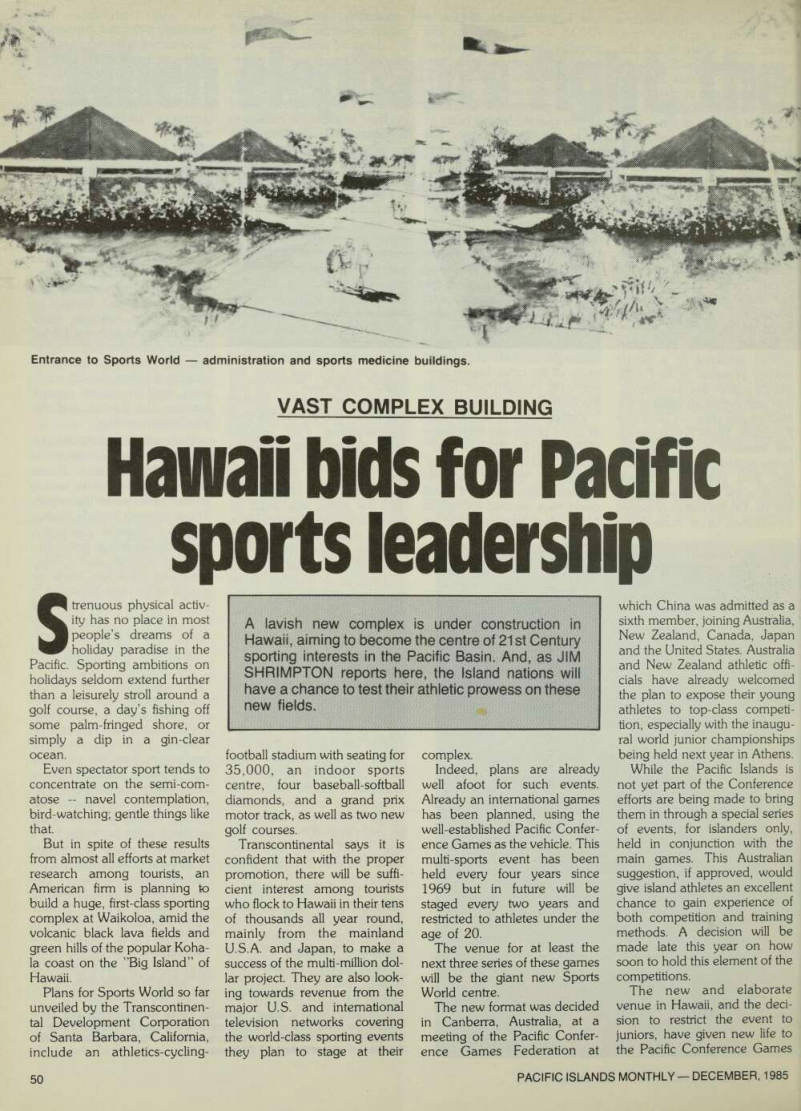
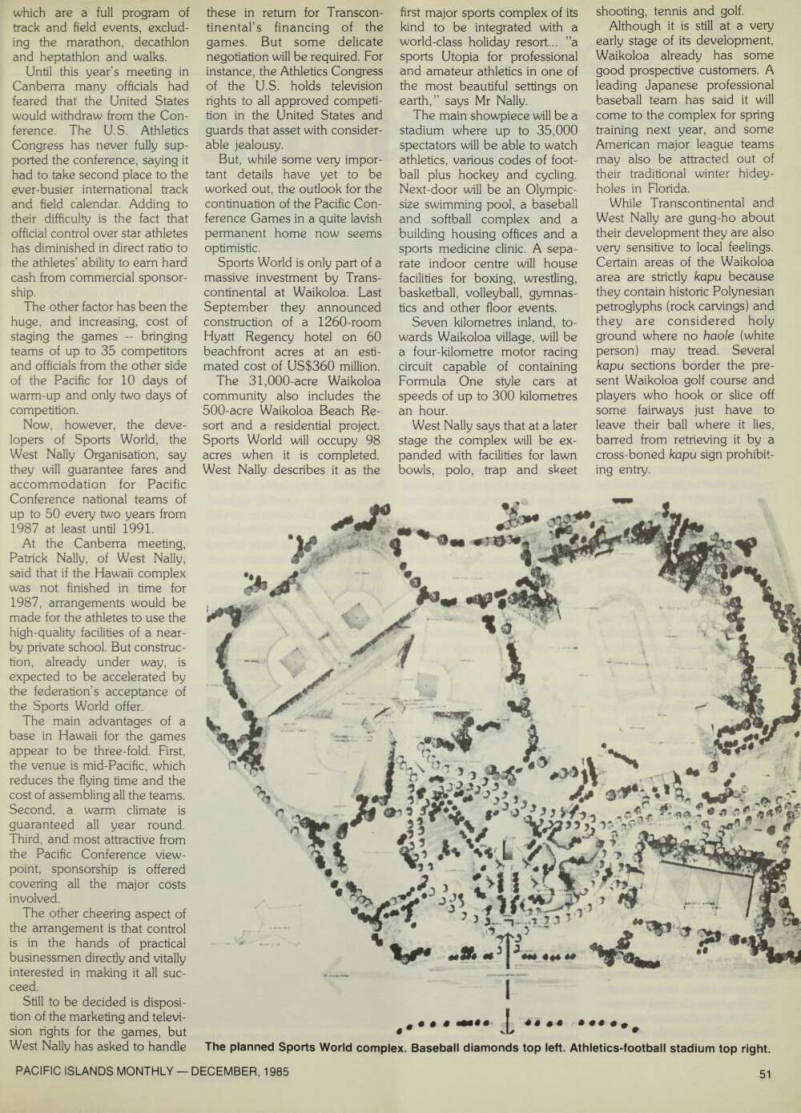
Vast Complex Building
Hawaii bids for Pacific sports leadership
Strenuous physical activ ity has no place in most people’s dreams of a holiday paradise in the Pacific. Sporting ambitions on holidays seldom extend further than a leisurely stroll around a golf course, a day’s fishing off some palm-fringed shore, or simply a dip in a gin-clear ocean.
Even spectator sport tends to concentrate on the semi-com atose - navel contemplation, bird-watching; gentle things like that.
But in spite of these results from almost all efforts at market research among tourists, an American firm is planning to build a huge, first-class sporting complex at Waikoloa, amid the volcanic black lava fields and green hills of the popular Koha la coast on the ’’Big Island” of Hawaii.
Plans for Sports World so far unveiled by the Transcontinen tal Development Corporation of Santa Barbara, California, include an athletics-cycling-
A lavish new complex is under construction in Hawaii, aiming to become the centre of 21st Century sporting interests in the Pacific Basin. And, as JIM SHRIMPTON reports here, the Island nations will have a chance to test their athletic prowess on these new fields.
football stadium with seating for 35,000, an indoor sports centre, four baseball-softball diamonds, and a grand prix motor track, as well as two new golf courses.
Transcontinental says it is confident that with the proper promotion, there will be suffi cient interest among tourists who flock to Hawaii in their tens of thousands all year round, mainly from the mainland U.S.A. and Japan, to make a success of the multi-million dol lar project. They are also look ing towards revenue from the major U.S. and international television networks covering the world-class sporting events they plan to stage at their
complex.
Indeed, plans are already well afoot for such events.
Already an international games has been planned, using the well-established Pacific Confer ence Games as the vehicle. This multi-sports event has been held every four years since 1969 but in future will be staged every two years and restricted to athletes under the age of 20.
The venue for at least the next three series of these games will be the giant new Sports World centre.
The new format was decided in Canberra, Australia, at a meeting of the Pacific Confer ence Games Federation at
which China was admitted as a sixth member, joining Australia, New Zealand, Canada, Japan and the United States. Australia and New Zealand athletic offi cials have already welcomed the plan to expose their young athletes to top-class competi tion, especially with the inaugu ral world junior championships being held next year in Athens.
While the Pacific Islands is not yet part of the Conference efforts are being made to bring them in through a special series of events, for islanders only, held in conjunction with the main games. This Australian suggestion, if approved, would give island athletes an excellent chance to gain experience of both competition and training methods. A decision will be made late this year on how soon to hold this element of the competitions.
The new and elaborate venue in Hawaii, and the deci sion to restrict the event to juniors, have given new life to the Pacific Conference Games
Entrance to Sports World - administration and sports medicine buildings.
which are a full program of track and field events, exclud ing the marathon, decathlon and heptathlon and walks.
Until this year’s meeting in Canberra many officials had feared that the United States would withdraw from the Con ference. The U.S. Athletics Congress has never fully sup ported the conference, saying it had to take second place to the ever-busier international track and field calendar. Adding to their difficulty is the fact that official control over star athletes has diminished in direct ratio to the athletes’ ability to earn hard cash from commercial sponsor ship.
The other factor has been the huge, and increasing, cost of staging the games - bringing teams of up to 35 competitors and officials from the other side of the Pacific for 10 days of warm-up and only two days of competition.
Now, however, the deve lopers of Sports World, the West Nally Organisation, say they will guarantee fares and accommodation for Pacific Conference national teams of up to 50 every two years from 1987 at least until 1991.
At the Canberra meeting, Patrick Nally, of West Nally, said that if the Hawaii complex was not finished in time for 1987, arrangements would be made for the athletes to use the high-quality facilities of a near by private school. But construc tion, already under way, is expected to be accelerated by the federation’s acceptance of the Sports World offer.
The main advantages of a base in Hawaii for the games appear to be three-fold. First, the venue is mid-Pacific, which reduces the flying time and the cost of assembling all the teams.
Second, a warm climate is guaranteed all year round.
Third, and most attractive from the Pacific Conference view point, sponsorship is offered covering all the major costs involved.
The other cheering aspect of the arrangement is that control is in the hands of practical businessmen directly and vitally interested in making it all suc ceed.
Still to be decided is disposi tion of the marketing and televi sion rights for the games, but West Nally has asked to handle
these in return for Transcon tinental’s financing of the games. But some delicate negotiation will be required. For instance, the Athletics Congress of the U.S. holds television rights to all approved competi tion in the United States and guards that asset with consider able jealousy.
But, while some very impor tant details have yet to be worked out, the outlook for the continuation of the Pacific Con ference Games in a quite lavish permanent home now seems optimistic.
Sports World is only part of a massive investment by Trans continental at Waikoloa. Last September they announced construction of a 1260-room Hyatt Regency hotel on 60 beachfront acres at an esti mated cost of US$36O million.
The 31,000-acre Waikoloa community also includes the 500-acre Waikoloa Beach Re sort and a residential project.
Sports World will occupy 98 acres when it is completed.
West Nally describes it as the
first major sports complex of its kind to be integrated with a world-class holiday resort... ”a sports Utopia for professional and amateur athletics in one of the most beautiful settings on earth,” says Mr Nally.
The main showpiece will be a stadium where up to 35,000 spectators will be able to watch athletics, various codes of foot ball plus hockey and cycling.
Next-door will be an Olympic size swimming pool, a baseball and softball complex and a building housing offices and a sports medicine clinic. A sepa rate indoor centre will house facilities for boxing, wrestling, basketball, volleyball, gymnas tics and other floor events.
Seven kilometres inland, to wards Waikoloa village, will be a four-kilometre motor racing circuit capable of containing Formula One style cars at speeds of up to 300 kilometres an hour.
West Nally says that at a later stage the complex will be ex panded with facilities for lawn bowls, polo, trap and skeet
shooting, tennis and golf.
Although it is still at a very early stage of its development, Waikoloa already has some good prospective customers. A leading Japanese professional baseball team has said it will come to the complex for spring training next year, and some American major league teams may also be attracted out of their traditional winter hidey holes in Florida.
While Transcontinental and West Nally are gung-ho about their development they are also very sensitive to local feelings.
Certain areas of the Waikoloa area are strictly kapu because they contain historic Polynesian petroglyphs (rock carvings) and they are considered holy ground where no haole (white person) may tread. Several kapu sections border the pre sent Waikoloa golf course and players who hook or slice off some fairways just have to leave their ball where it lies, barred from retrieving it by a cross-boned kapu sign prohibit ing entry.
The planned Sports World complex. Baseball diamonds top left. Athletics-football stadium top right.
oldest relics
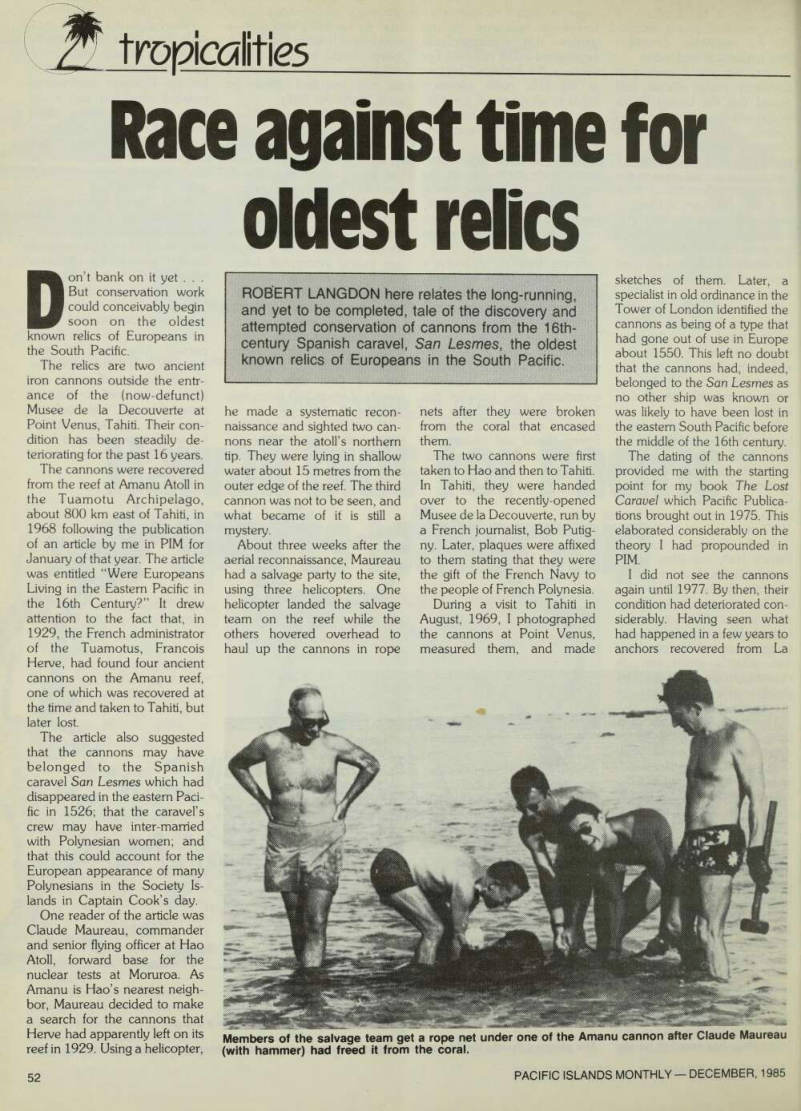
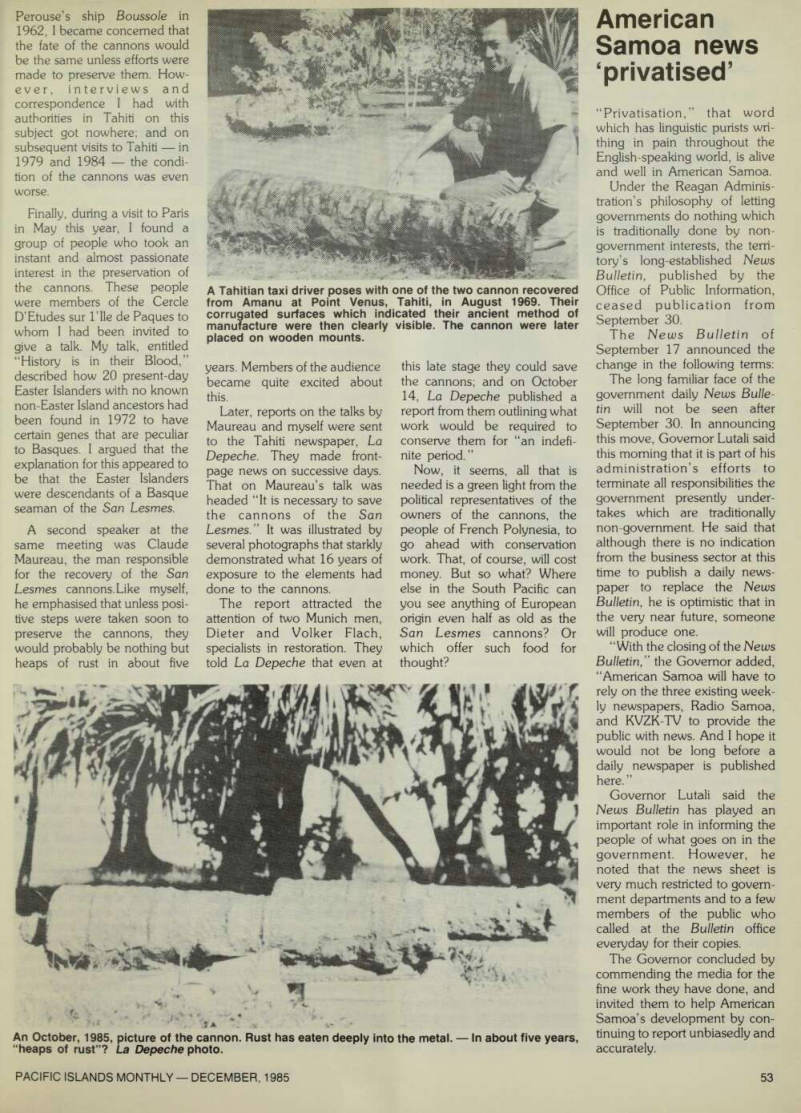
tropicalities
Race against time for oldest relics
Don’t bank on it yet . . .
But conservation work could conceivably begin soon on the oldest known relics of Europeans in the South Pacific.
The relics are two ancient iron cannons outside the entr ance of the (now-defunct) Musee de la Decouverte at Point Venus, Tahiti. Their con dition has been steadily de teriorating for the past 16 years.
The cannons were recovered from the reef at Amanu Atoll in the Tuamotu Archipelago, about 800 km east of Tahiti, in 1968 following the publication of an article by me in PIM for January of that year. The article was entitled “Were Europeans Living in the Eastern Pacific in the 16th Century?” It drew attention to the fact that, in 1929, the French administrator of the Tuamotus, Francois Herve, had found four ancient cannons on the Amanu reef, one of which was recovered at the time and taken to Tahiti, but later lost.
The article also suggested that the cannons may have belonged to the Spanish caravel San Lesmes which had disappeared in the eastern Paci fic in 1526; that the caravel’s crew may have inter-married with Polynesian women; and that this could account for the European appearance of many Polynesians in the Society Is lands in Captain Cook’s day.
One reader of the article was Claude Maureau, commander and senior flying officer at Hao Atoll, forward base for the nuclear tests at Moruroa. As Amanu is Hao’s nearest neigh bor, Maureau decided to make a search for the cannons that Herve had apparently left on its reef in 1929. Using a helicopter,
ROBERT LANGDON here relates the long-running, and yet to be completed, tale of the discovery and attempted conservation of cannons from the 16th century Spanish caravel, San Lesmes, the oldest known relics of Europeans in the South Pacific.
he made a systematic recon naissance and sighted two can nons near the atoll’s northern tip. They were lying in shallow water about 15 metres from the outer edge of the reef. The third cannon was not to be seen, and what became of it is still a mystery.
About three weeks after the aerial reconnaissance, Maureau had a salvage party to the site, using three helicopters. One helicopter landed the salvage team on the reef while the others hovered overhead to haul up the cannons in rope
nets after they were broken from the coral that encased them.
The two cannons were first taken to Hao and then to Tahiti.
In Tahiti, they were handed over to the recently-opened Musee de la Decouverte, run by a French journalist, Bob Putig ny. Later, plaques were affixed to them stating that they were the gift of the French Navy to the people of French Polynesia.
During a visit to Tahiti in August, 1969, I photographed the cannons at Point Venus, measured them, and made
sketches of them. Later, a specialist in old ordinance in the Tower of London identified the cannons as being of a type that had gone out of use in Europe about 1550. This left no doubt that the cannons had, indeed, belonged to the San Lesmes as no other ship was known or was likely to have been lost in the eastern South Pacific before the middle of the 16th century.
The dating of the cannons provided me with the starting point for my book The Lost Caravel which Pacific Publica tions brought out in 1975. This elaborated considerably on the theory I had propounded in
Pim.
I did not see the cannons again until 1977. By then, their condition had deteriorated con siderably. Having seen what had happened in a few years to anchors recovered from La
Members of the salvage team get a rope net under one of the Amanu cannon after Claude Maureau (with hammer) had freed it from the coral.
Perouse’s ship Boussole in 1962, I became concerned that the fate of the cannons would be the same unless efforts were made to preserve them. How ever, interviews and correspondence I had with authorities in Tahiti on this subject got nowhere; and on subsequent visits to Tahiti in 1979 and 1984 the condi tion of the cannons was even worse.
Finally, during a visit to Paris in May this year, I found a group of people who took an instant and almost passionate interest in the preservation of the cannons. These people were members of the Cercle D’Etudes sur ITle de Paques to whom I had been invited to give a talk. My talk, entitled “History is in their Blood,” described how 20 present-day Easter Islanders with no known non-Easter Island ancestors had been found in 1972 to have certain genes that are peculiar to Basques. I argued that the explanation for this appeared to be that the Easter Islanders were descendants of a Basque seaman of the San Lesmes.
A second speaker at the same meeting was Claude Maureau, the man responsible for the recovery of the San Lesmes cannons. Like myself, he emphasised that unless posi tive steps were taken soon to preserve the cannons, they would probably be nothing but heaps of rust in about five
years. Members of the audience became quite excited about this.
Later, reports on the talks by Maureau and myself were sent to the Tahiti newspaper, La Depeche. They made front page news on successive days.
That on Maureau’s talk was headed “It is necessary to save the cannons of the San Lesmes.” It was illustrated by several photographs that starkly demonstrated what 16 years of exposure to the elements had done to the cannons.
The report attracted the attention of two Munich men, Dieter and Volker Flach, specialists in restoration. They told La Depeche that even at
this late stage they could save the cannons; and on October 14, La Depeche published a report from them outlining what work would be required to conserve them for “an indefi nite period.”
Now, it seems, all that is needed is a green light from the political representatives of the owners of the cannons, the people of French Polynesia, to go ahead with conservation work. That, of course, will cost money. But so what? Where else in the South Pacific can you see anything of European origin even half as old as the San Lesmes cannons? Or which offer such food for thought?
An October, 1985, picture of the cannon. Rust has eaten deeply into the metal. - In about five years, “heaps of rust”? La Depeche photo.
A Tahitian taxi driver poses with one of the two cannon recovered from Amanu at Point Venus, Tahiti, in August 1969. Their corrugated surfaces which indicated their ancient method of manufacture were then clearly visible. The cannon were later placed on wooden mounts.
‘privatised’
American Samoa news ‘privatised’
“Privatisation,” that word which has linguistic purists wri thing in pain throughout the English-speaking world, is alive and well in American Samoa.
Under the Reagan Adminis tration’s philosophy of letting governments do nothing which is traditionally done by non government interests, the terri tory’s long-established News Bulletin, published by the Office of Public Information, ceased publication from September 30.
The News Bulletin of September 17 announced the change in the following terms: The long familiar face of the government daily News Bulle tin will not be seen after September 30. In announcing this move, Governor Lutali said this morning that it is part of his administration’s efforts to terminate all responsibilities the government presently under takes which are traditionally non-government. He said that although there is no indication from the business sector at this time to publish a daily news paper to replace the News Bulletin, he is optimistic that in the very near future, someone will produce one.
“With the closing of the News Bulletin,” the Governor added, “American Samoa will have to rely on the three existing week ly newspapers, Radio Samoa, and KVZK-TV to provide the public with news. And I hope it would not be long before a daily newspaper is published here.”
Governor Lutali said the News Bulletin has played an important role in informing the people of what goes on in the government. However, he noted that the news sheet is very much restricted to govern ment departments and to a few members of the public who called at the Bulletin office everyday for their copies.
The Governor concluded by commending the media for the fine work they have done, and invited them to help American Samoa’s development by con tinuing to report unbiasedly and accurately.
Fiji's Cabinet reshuffles:
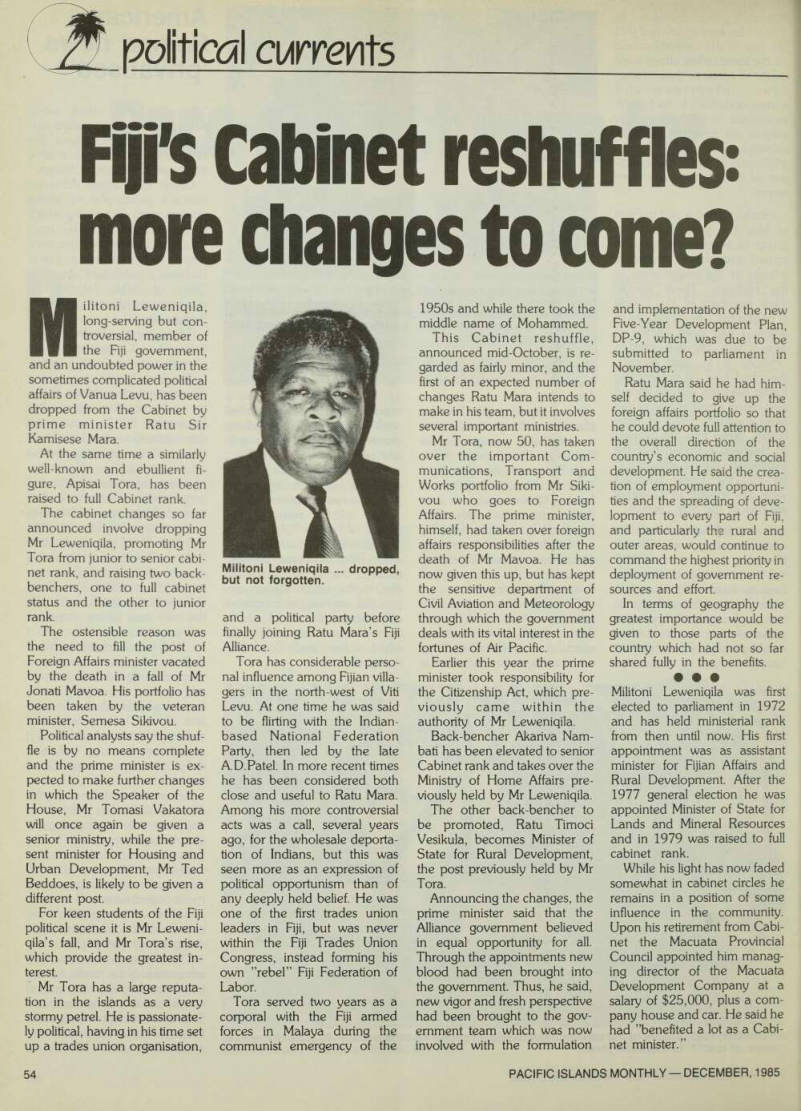
political currents
Fiji's Cabinet reshuffles: more changes to come?
Militoni Leweniqila,
long-serving but con troversial, member of the Fiji government, and an undoubted power in the sometimes complicated political affairs of Vanua Levu, has been dropped from the Cabinet by prime minister Ratu Sir Kamisese Mara.
At the same time a similarly well-known and ebullient fi gure, Apisai Tora, has been raised to full Cabinet rank.
The cabinet changes so far announced involve dropping Mr Leweniqila, promoting Mr Tora from junior to senior cabi net rank, and raising two back benchers, one to full cabinet status and the other to junior rank.
The ostensible reason was the need to fill the post of Foreign Affairs minister vacated by the death in a fall of Mr Jonati Mavoa. His portfolio has been taken by the veteran minister, Semesa Sikivou.
Political analysts say the shuf fle is by no means complete and the prime minister is ex pected to make further changes in which the Speaker of the House, Mr Tomasi Vakatora will once again be given a senior ministry, while the pre sent minister for Housing and Urban Development, Mr Ted Beddoes, is likely to be given a different post.
For keen students of the Fiji political scene it is Mr Leweni qila’s fall, and Mr Tora’s rise, which provide the greatest in terest.
Mr Tora has a large reputa tion in the islands as a very stormy petrel. He is passionate ly political, having in his time set up a trades union organisation,
and a political party before finally joining Ratu Mara’s Fiji Alliance.
Tora has considerable perso nal influence among Fijian villa gers in the north-west of Viti Levu. At one time he was said to be flirting with the Indian based National Federation Party, then led by the late A. D. Patel. In more recent times he has been considered both close and useful to Ratu Mara.
Among his more controversial acts was a call, several years ago, for the wholesale deporta tion of Indians, but this was seen more as an expression of political opportunism than of any deeply held belief. He was one of the first trades union leaders in Fiji, but was never within the Fiji Trades Union Congress, instead forming his own ’’rebel” Fiji Federation of Labor.
Tora served two years as a corporal with the Fiji armed forces in Malaya during the communist emergency of the
1950 s and while there took the middle name of Mohammed.
This Cabinet reshuffle, announced mid-October, is re garded as fairly minor, and the first of an expected number of changes Ratu Mara intends to make in his team, but it involves several important ministries.
Mr Tora, now 50, has taken over the important Com munications, Transport and Works portfolio from Mr Siki vou who goes to Foreign Affairs. The prime minister, himself, had taken over foreign affairs responsibilities after the death of Mr Mavoa. He has now given this up, but has kept the sensitive department of Civil Aviation and Meteorology through which the government deals with its vital interest in the fortunes of Air Pacific.
Earlier this year the prime minister took responsibility for the Citizenship Act, which pre viously came within the authority of Mr Leweniqila.
Back-bencher Akariva Nam bati has been elevated to senior Cabinet rank and takes over the Ministry of Home Affairs pre viously held by Mr Leweniqila.
The other back-bencher to be promoted, Ratu Timoci Vesikula, becomes Minister of State for Rural Development, the post previously held by Mr Tora.
Announcing the changes, the prime minister said that the Alliance government believed in equal opportunity for all.
Through the appointments new blood had been brought into the government. Thus, he said, new vigor and fresh perspective had been brought to the gov ernment team which was now involved with the formulation
and implementation of the new Five-Year Development Plan, DP-9, which was due to be submitted to parliament in November.
Ratu Mara said he had him self decided to give up the foreign affairs portfolio so that he could devote full attention to the overall direction of the country’s economic and social development. He said the crea tion of employment opportuni ties and the spreading of deve lopment to every part of Fiji, and particularly the rural and outer areas, would continue to command the highest priority in deployment of government re sources and effort.
In terms of geography the greatest importance would be given to those parts of the country which had not so far shared fully in the benefits. • • • Militoni Leweniqila was first elected to parliament in 1972 and has held ministerial rank from then until now. His first appointment was as assistant minister for Fijian Affairs and Rural Development. After the 1977 general election he was appointed Minister of State for Lands and Mineral Resources and in 1979 was raised to full cabinet rank.
While his light has now faded somewhat in cabinet circles he remains in a position of some influence in the community.
Upon his retirement from Cabi net the Macuata Provincial Council appointed him manag ing director of the Macuata Development Company at a salary of $25,000, plus a com pany house and car. He said he had ’’benefited a lot as a Cabi net minister.”
Militoni Leweniqila ... dropped, but not forgotten.
from the islands press
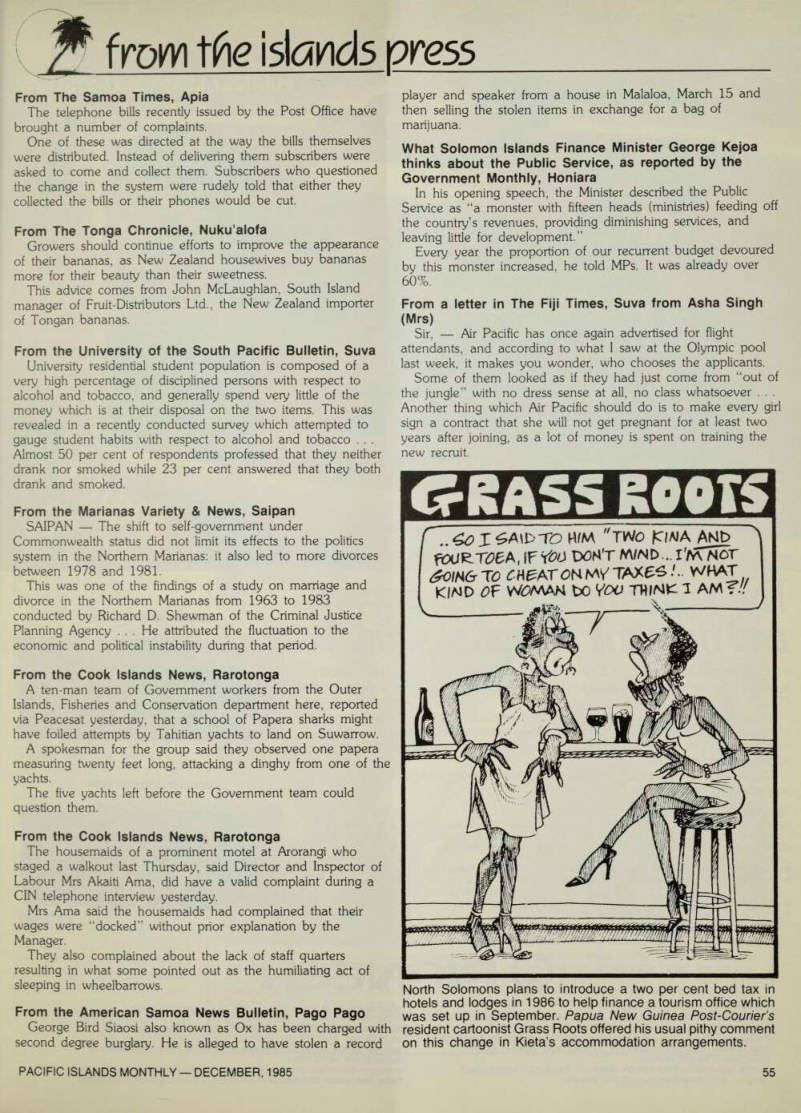
From The Samoa Times, Apia The telephone bills recently issued by the Post Office have brought a number of complaints.
One of these was directed at the way the bills themselves were distributed. Instead of delivering them subscribers were asked to come and collect them. Subscribers who questioned the change in the system were rudely told that either they collected the bills or their phones would be cut.
From The Tonga Chronicle, Nukualofa Growers should continue efforts to improve the appearance of their bananas, as New Zealand housewives buy bananas more for their beauty than their sweetness.
This advice comes from John McLaughlan, South Island manager of Fruit-Distributors Ltd., the New Zealand importer of Tongan bananas.
From the University of the South Pacific Bulletin, Suva University residential student population is composed of a very high percentage of disciplined persons with respect to alcohol and tobacco, and generally spend very little of the money which is at their disposal on the two items. This was revealed in a recently conducted survey which attempted to gauge student habits with respect to alcohol and tobacco . . .
Almost 50 per cent of respondents professed that they neither drank nor smoked while 23 per cent answered that they both drank and smoked.
From the Marianas Variety & News, Saipan SAIPAN The shift to self-government under Commonwealth status did not limit its effects to the politics system in the Northern Marianas: it also led to more divorces between 1978 and 1981.
This was one of the findings of a study on marriage and divorce in the Northern Marianas from 1963 to 1983 conducted by Richard D. Shewman of the Criminal Justice Planning Agency ... He attributed the fluctuation to the economic and political instability during that period.
From the Cook Islands News, Rarotonga A ten-man team of Government workers from the Outer Islands, Fisheries and Conservation department here, reported via Peacesat yesterday, that a school of Papera sharks might have foiled attempts by Tahitian yachts to land on Suwarrow.
A spokesman for the group said they observed one papera measuring twenty feet long, attacking a dinghy from one of the yachts.
The five yachts left before the Government team could question them.
From the Cook Islands News, Rarotonga The housemaids of a prominent motel at Arorangi who staged a walkout last Thursday, said Director and Inspector of Labour Mrs Akaiti Ama, did have a valid complaint during a CIN telephone interview yesterday.
Mrs Ama said the housemaids had complained that their wages were “docked” without prior explanation by the Manager.
They also complained about the lack of staff quarters resulting in what some pointed out as the humiliating act of sleeping in wheelbarrows.
From the American Samoa News Bulletin, Pago Pago George Bird Siaosi also known as Ox has been charged with second degree burglary. He is alleged to have stolen a record
player and speaker from a house in Malaloa, March 15 and then selling the stolen items in exchange for a bag of marijuana.
What Solomon Islands Finance Minister George Kejoa thinks about the Public Service, as reported by the Government Monthly, Honiara In his opening speech, the Minister described the Public Service as “a monster with fifteen heads (ministries) feeding off the country’s revenues, providing diminishing services, and leaving little for development.”
Every year the proportion of our recurrent budget devoured by this monster increased, he told MPs. It was already over 60%.
From a letter in The Fiji Times, Suva from Asha Singh (Mrs) Sir, Air Pacific has once again advertised for flight attendants, and according to what I saw at the Olympic pool last week, it makes you wonder, who chooses the applicants.
Some of them looked as if they had just come from “out of the jungle” with no dress sense at all, no class whatsoever . . .
Another thing which Air Pacific should do is to make every girl sign a contract that she will not get pregnant for at least two years after joining, as a lot of money is spent on training the new recruit.
Grass Roots
North Solomons plans to introduce a two per cent bed tax in hotels and lodges in 1986 to help finance a tourism office which was set up in September. Papua New Guinea Post-Courier’s resident cartoonist Grass Roots offered his usual pithy comment on this change in Kieta’s accommodation arrangements.
Advertisements & other items, p. 56 (1 item)
Cio Pioneer
The excitement of high-power
and the thrill of digital sound!
It’s here, thanks to Pioneer—a 200 W Peak Music Power Output portable sound system! A system so sophisticated you can team it up with Pioneer’s detachable
PD-C 7 Compact Disc player.
Yes, you can enter the Digital Age with the revolutionary “CD” Carry Com, while broadening your hi-fi horizons with Stereo Wide expanded acoustic ambience. Then feast your ears on the beauty of Dynamic Expander: outstanding definition, natural
vocals, full-bodied sound.
So check out the portable that checks you into the Digital Age: “CD” Carry Com,
only from Pioneer.
CK-W7OO, CK-R 500:
■ Detachable PD-C 7 Compact Disc
player (optional)
■ Dynamic Expander and Stereo Wide circuits ■ Mic-mixing for Karaoke “Sing-Along" ■ 4-Band Tuner (FM stereo/MW/SWi/ SW2) ■ 4-Band Graphic Equalizer ■ Dolby* B NR, Music Search, REC Mute and auto metal/normal tape selector * 'Dolby’ and the double-D symbol are tradema
CK-W7OO CK-R5OO
■ 200 W Peak Music Power Output B7OW Peak Music ■ Full-logic Double Auto-Reverse Power Output cassette deck (for playback and ■ Full-logic Autorecord/playback) Reverse cassette ■ High-speed dubbing for sides A and B deck ■ Relay playback from deck Ito deck 2 ■ Detachable full- ■ Detachable 2-way speaker system range speaker with square cone woofer system with square cone jrks of Dolby Laboratories Licensing Corporation.
CK-W7OO
CK-R5OO
CiO PIONEER
For further information, please contact: Australia: Pioneer Electronics Australia Pty. Ltd. (Incorporated in Victoria), P.O. Box 295, Mordialloc, Victoria, 3195 Tel: 580-9911 Fiji Islands: Brijlal & Company, G.P.O. Box No. 362, Suva, Fiji Islands Tel: 22258 New Zealand: Monaco Distributors Ltd., 2 Poland Road, Glenfield, Auckland, New Zealand Tel; (09) 444-9144 Norfolk Island: Burns Philp (Norfolk Island) Ltd., P.O. Box 21, Norfolk Island Vanuatu; Burns Philp (Vanuatu) Ltd., Vila, Vanuatu Nauru Island: Jacob Enterprises, P.O. Box N 0.4,.4, Republic of Nauru Tahiti: Tahiti Hi-Fi, P.O. Box 848, Papeete, Tahiti New Caledonia: Menard Pacifique Sari, B.P. 3899, Noumea, New Caledonia Tel: 27.62*23 American Samoa: Transpac Corporation, P.O. Box 1477, Pago Pago, American Samoa 96799 Tel: 633-5224 Rarotonga: South Seas International Ltd., P.O. Box 49, Rarotonga, Cook Islands Tel: 2327 Papua New Guinea: Bali Merchants Pty. Ltd., P.O. Box 6103, Boroko Tel: 254887
people
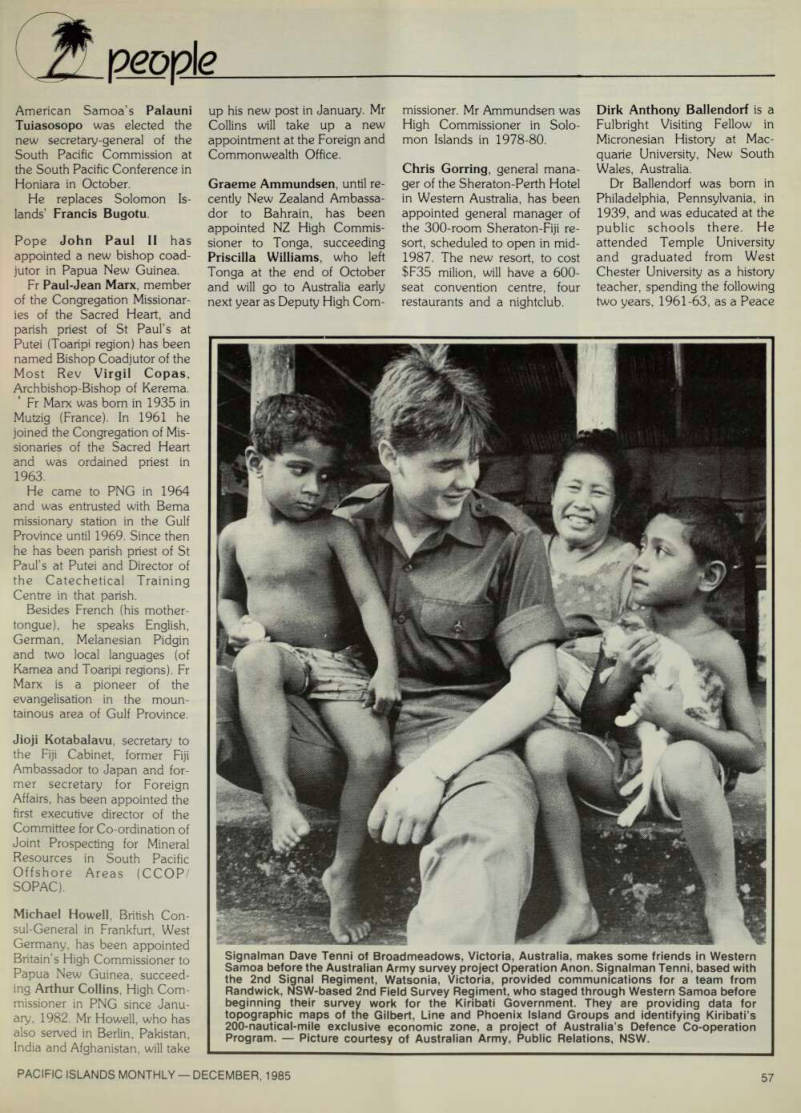
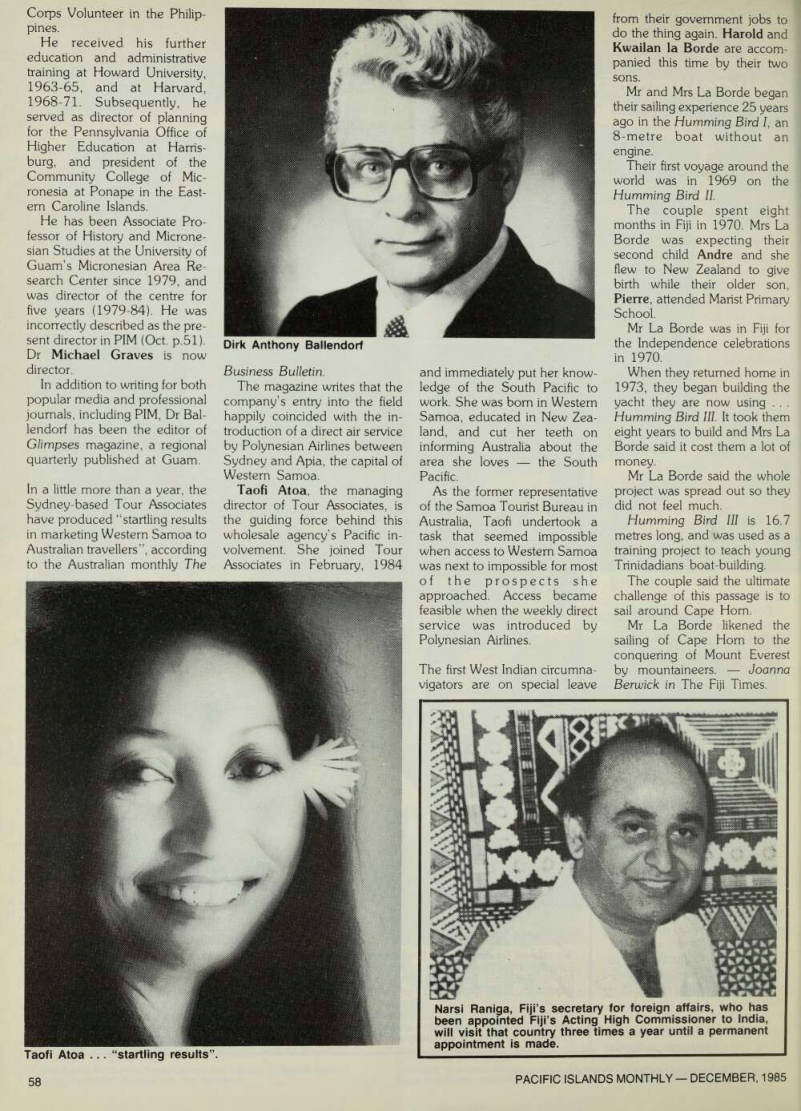
American Samoa’s Palauni Tuiasosopo was elected the new secretary-general of the South Pacific Commission at the South Pacific Conference in Honiara in October.
He replaces Solomon Is lands’ Francis Bugotu.
Pope John Paul II has appointed a new bishop coad jutor in Papua New Guinea.
Fr Paul-Jean Marx, member of the Congregation Missionar ies of the Sacred Heart, and parish priest of St Paul’s at Putei (Toaripi region) has been named Bishop Coadjutor of the Most Rev Virgil Copas, Archbishop-Bishop of Kerema.
Fr Marx was born in 1935 in Mutzig (France). In 1961 he joined the Congregation of Mis sionaries of the Sacred Heart and was ordained priest in 1963.
He came to PNG in 1964 and was entrusted with Bema missionary station in the Gulf Province until 1969. Since then he has been parish priest of St Paul’s at Putei and Director of the Catechetical Training Centre in that parish.
Besides French (his mother tongue), he speaks English, German, Melanesian Pidgin and two local languages (of Kamea and Toaripi regions). Fr Marx is a pioneer of the evangelisation in the moun tainous area of Gulf Province.
Jioji Kotabalavu, secretary to the Fiji Cabinet, former Fiji Ambassador to Japan and for mer secretary for Foreign Affairs, has been appointed the first executive director of the Committee for Co-ordination of Joint Prospecting for Mineral Resources in South Pacific Offshore Areas (CCOP/
Sopac).
Michael Howell. British Con sul-General in Frankfurt, West Germany, has been appointed Britain’s High Commissioner to Papua New Guinea, succeed ing Arthur Collins. High Com missioner in PNG since Janu ary, 1982. Mr Howell, who has also served in Berlin, Pakistan, India and Afghanistan, will take
up his new post in January. Mr Collins will take up a new appointment at the Foreign and Commonwealth Office.
Graeme Ammundsen, until re cently New Zealand Ambassa dor to Bahrain, has been appointed NZ High Commis sioner to Tonga, succeeding Priscilla Williams, who left Tonga at the end of October and will go to Australia early next year as Deputy High Com
missioner. Mr Ammundsen was High Commissioner in Solomon Islands in 1978-80.
Chris Gorring, general manager of the Sheraton-Perth Hotel in Western Australia, has been appointed general manager of the 300-room Sheraton-Fiji resort, scheduled to open in mid- 1987. The new resort, to cost SF3S milion, will have a 600seat convention centre, four restaurants and a nightclub.
Dirk Anthony Ballendorf is a Fulbright Visiting Fellow in Micronesian History at Mac quarie University, New South Wales, Australia, Dr Ballendorf was bom in Philadelphia, Pennsylvania, in 1939, and was educated at the public schools there. He attended Temple University and graduated from West Chester University as a history teacher, spending the following two years, 1961-63, as a Peace
Signalman Dave Tenni of Broadmeadows, Victoria, Australia, makes some friends in Western Samoa before the Australian Army survey project Operation Anon. Signalman Tenni, based with the 2nd Signal Regiment, Watsonia, Victoria, provided communications for a team from Randwick, NSW-based 2nd Field Survey Regiment, who staged through Western Samoa before beginning their survey work for the Kiribati Government. They are providing data for topographic maps of the Gilbert, Line and Phoenix Island Groups and identifying Kiribati’s 200-nautical-mile exclusive economic zone, a project of Australia’s Defence Co-operation Program. - Picture courtesy of Australian Army, Public Relations, NSW.
Corps Volunteer in the Philip pines.
He received his further education and administrative training at Howard University, 1963-65, and at Harvard, 1968-71. Subsequently, he served as director of planning for the Pennsylvania Office of Higher Education at Harris burg, and president of the Community College of Mic ronesia at Ponape in the East ern Caroline Islands.
He has been Associate Pro fessor of History and Microne sian Studies at the University of Guam’s Micronesian Area Re search Center since 1979, and was director of the centre for five years (1979-84). He was incorrectly described as the pre sent director in PIM (Oct. p. 51).
Dr Michael Graves is now director.
In addition to writing for both popular media and professional journals, including PIM, Dr Bal lendorf has been the editor of Glimpses magazine, a regional quarterly published at Guam.
In a little more than a year, the Sydney-based Tour Associates have produced “startling results in marketing Western Samoa to Australian travellers”, according to the Australian monthly The
Business Bulletin.
The magazine writes that the company’s entry into the field happily coincided with the in troduction of a direct air service by Polynesian Airlines between Sydney and Apia, the capital of Western Samoa.
Taofi Atoa, the managing director of Tour Associates, is the guiding force behind this wholesale agency’s Pacific in volvement. She joined Tour Associates in February, 1984
and immediately put her know ledge of the South Pacific to work. She was born in Western Samoa, educated in New Zea land, and cut her teeth on informing Australia about the area she loves the South Pacific.
As the former representative of the Samoa Tourist Bureau in Australia, Taofi undertook a task that seemed impossible when access to Western Samoa was next to impossible for most of the prospects she approached. Access became feasible when the weekly direct service was introduced by Polynesian Airlines.
The first West Indian circumna vigators are on special leave
from their government jobs to do the thing again. Harold and Kwailan la Borde are accom panied this time by their two sons.
Mr and Mrs La Borde began their sailing experience 25 years ago in the Humming Bird I, an 8-metre boat without an engine.
Their first voyage around the world was in 1969 on the Humming Bird 11.
The couple spent eight months in Fiji in 1970. Mrs La Borde was expecting their second child Andre and she flew to New Zealand to give birth while their older son, Pierre, attended Marist Primary School.
Mr La Borde was in Fiji for the Independence celebrations in 1970.
When they returned home in 1973, they began building the yacht they are now using . . .
Humming Bird 111. It took them eight years to build and Mrs La Borde said it cost them a lot of money.
Mr La Borde said the whole project was spread out so they did not feel much.
Humming Bird 111 is 16.7 metres long, and was used as a training project to teach young Trinidadians boat-building.
The couple said the ultimate challenge of this passage is to sail around Cape Horn.
Mr La Borde likened the sailing of Cape Horn to the conquering of Mount Everest by mountaineers. Joanna Berwick in The Fiji Times.
Taofi Atoa ... “startling results”.
Dirk Anthony Ballendorf
Narsi Raniga, Fiji’s secretary for foreign affairs, who has been appointed Fiji’s Acting High Commissioner to India, will visit that country three times a year until a permanent appointment is made.
Pacific stamp box
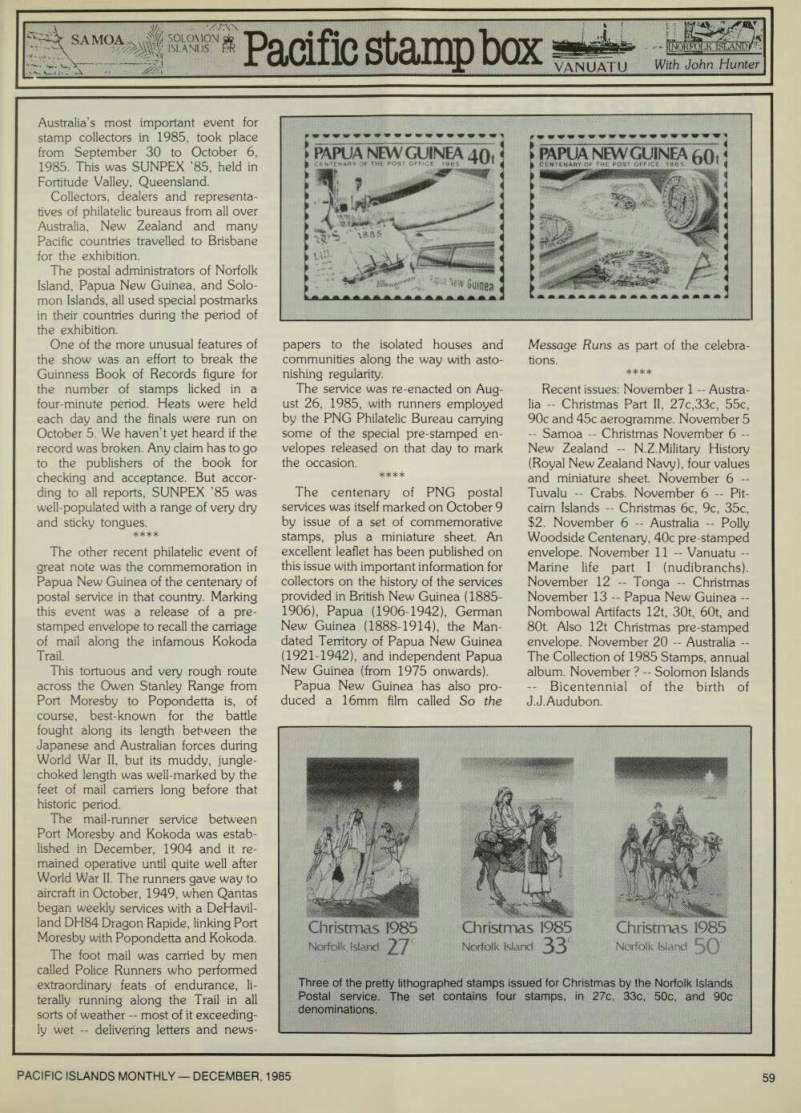
Australia’s most important event for stamp collectors in 1985, took place from September 30 to October 6, 1985. This was SUNPEX ’B5, held in Fortitude Valley, Queensland.
Collectors, dealers and representa tives of philatelic bureaus from all over Australia, New Zealand and many Pacific countries travelled to Brisbane for the exhibition.
The postal administrators of Norfolk Island, Papua New Guinea, and Solo mon Islands, all used special postmarks in their countries during the period of the exhibition.
One of the more unusual features of the show was an effort to break the Guinness Book of Records figure for the number of stamps licked in a four-minute period. Heats were held each day and the finals were run on October 5. We haven’t yet heard if the record was broken. Any claim has to go to the publishers of the book for checking and acceptance. But accor ding to all reports, SUNPEX ’B5 was well-populated with a range of very dry and sticky tongues. *** The other recent philatelic event of great note was the commemoration in Papua New Guinea of the centenary of postal service in that country. Marking this event was a release of a pre stamped envelope to recall the carriage of mail along the infamous Kokoda Trail.
This tortuous and very rough route across the Owen Stanley Range from Port Moresby to Popondetta is, of course, best-known for the battle fought along its length between the Japanese and Australian forces during World War 11, but its muddy, jungle choked length was well-marked by the feet of mail carriers long before that historic period.
The mail-runner service between Port Moresby and Kokoda was estab lished in December, 1904 and it re mained operative until quite well after World War 11. The runners gave way to aircraft in October, 1949, when Qantas began weekly services with a DeHavil land DHB4 Dragon Rapide, linking Port Moresby with Popondetta and Kokoda.
The foot mail was carried by men called Police Runners who performed extraordinary feats of endurance, li terally running along the Trail in all sorts of weather - most of it exceeding ly wet - delivering letters and news-
papers to the isolated houses and communities along the way with asto nishing regularity.
The service was re-enacted on Aug ust 26, 1985, with runners employed by the PNG Philatelic Bureau carrying some of the special pre-stamped en velopes released on that day to mark the occasion. *♦*♦ The centenary of PNG postal services was itself marked on October 9 by issue of a set of commemorative stamps, plus a miniature sheet. An excellent leaflet has been published on this issue with important information for collectors on the history of the services provided in British New Guinea (1885- 1906), Papua (1906-1942), German New Guinea (1888-1914), the Man dated Territory of Papua New Guinea (1921-1942), and independent Papua New Guinea (from 1975 onwards).
Papua New Guinea has also pro duced a 16mm film called So the
Message Runs as part of the celebra tions. ♦*** Recent issues: November 1 Austra lia Christmas Part 11, 27c,33c, 55c, 90c and 45c aerogramme. November 5 Samoa Christmas November 6 New Zealand - N.Z. Military History (Royal New Zealand Navy), four values and miniature sheet. November 6 Tuvalu - Crabs. November 6 Pit cairn Islands Christmas 6c, 9c, 35c, $2. November 6 - Australia Polly Woodside Centenary, 40c pre-stamped envelope. November 11 Vanuatu Marine life part I (nudibranchs).
November 12 Tonga - Christmas November 13 - Papua New Guinea Nombowal Artifacts 12t, 30t, 60t, and 80t. Also 12t Christmas pre-stamped envelope. November 20 - Australia The Collection of 1985 Stamps, annual album. November ? Solomon Islands -- Bicentennial of the birth of J.J.Audubon.
Three of the pretty lithographed stamps issued for Christmas by the Norfolk Islands Postal service. The set contains four stamps, in 27c, 33c, 50c, and 90c denominations.
Yachts
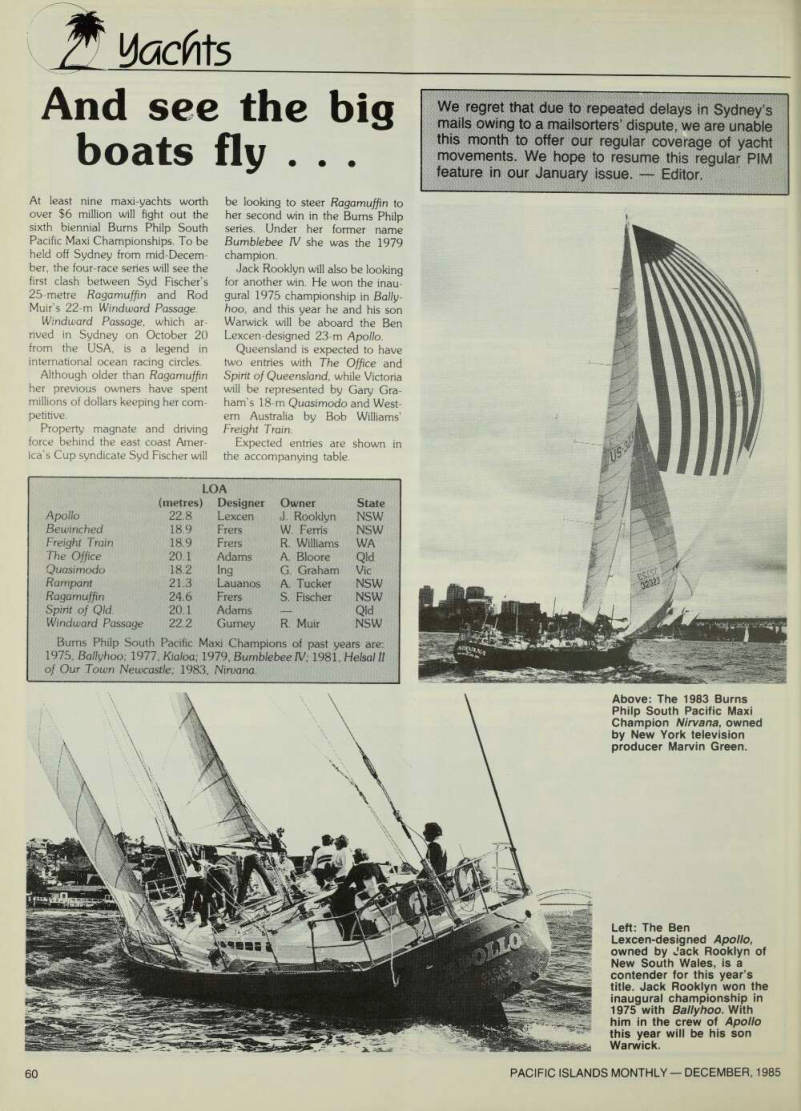
And see the big boats fly . . .
At least nine maxi-yachts worth over $6 million will fight out the sixth biennial Burns Philp South Pacific Maxi Championships. To be held off Sydney from mid-Decem ber, the four-race series will see the first clash between Syd Fischer’s 25-metre Ragamuffin and Rod Muir’s 22-m Windward Passage.
Windward Passage, which ar rived in Sydney on October 20 from the USA, is a legend in international ocean racing circles.
Although older than Ragamuffin her previous owners have spent millions of dollars keeping her com petitive.
Property magnate and driving force behind the east coast Amer ica’s Cup syndicate Syd Fischer will
be looking to steer Ragamuffin to her second win in the Bums Philp series. Under her former name Bumblebee IV she was the 1979 champion.
Jack Rooklyn will also be looking for another win. He won the inau gural 1975 championship in Bally hoo, and this year he and his son Warwick will be aboard the Ben Lexcen-designed 23-m Apollo.
Queensland is expected to have two entries with The Office and Spirit of Queensland, while Victoria will be represented by Gary Gra ham’s 18-m Quasimodo and West ern Australia by Bob Williams’
Freight Train.
Expected entries are shown in the accompanying table.
Burns Philp South Pacific Maxi Champions of past years are: 1975, Ballyhoo; 1977, Kialoa; 1979, Bumblebee IV; 1981, Helsal II of Our Town Newcastle; 1983, Nirvana.
We regret that due to repeated delays in Sydney’s mails owing to a mailsorters’ dispute, we are unable this month to offer our regular coverage of yacht movements. We hope to resume this regular PIM feature in our January issue. Editor.
Above: The 1983 Burns Philp South Pacific Maxi Champion Nirvana, owned by New York television producer Marvin Green.
Left: The Ben Lexcen-designed Apollo, owned by Jack Rooklyn of New South Wales, is a contender for this year’s title. Jack Rooklyn won the inaugural championship in 1975 with Ballyhoo. With him in the crew of Apollo this year will be his son Warwick.
Loa
(metres) Designer Owner State Apollo 22.8 Lexcen J. Rooklyn
Nsw
Bewinched 18.9 Frers W. Ferris
Nsw
Freight Train 18.9 Frers R. Williams WA The Office 20.1 Adams A. Bloore Qld Quasimodo 18.2 Ing G. Graham Vic Rampant 21.3 Lauanos A. Tucker
Nsw
Ragamuffin 24.6 Frers S. Fischer
Nsw
Spirit of Qld. 20.1 Adams — Qld Windward Passage 22.2 Gumey R. Muir
Nsw
shipping schedules
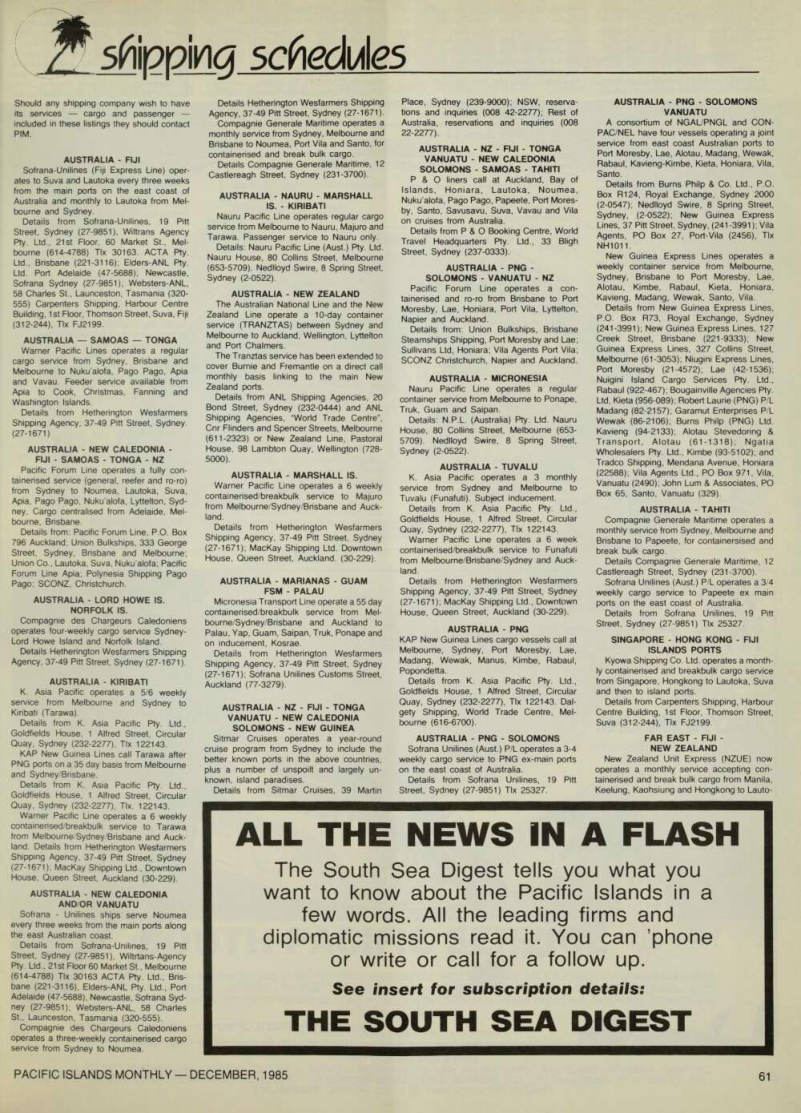
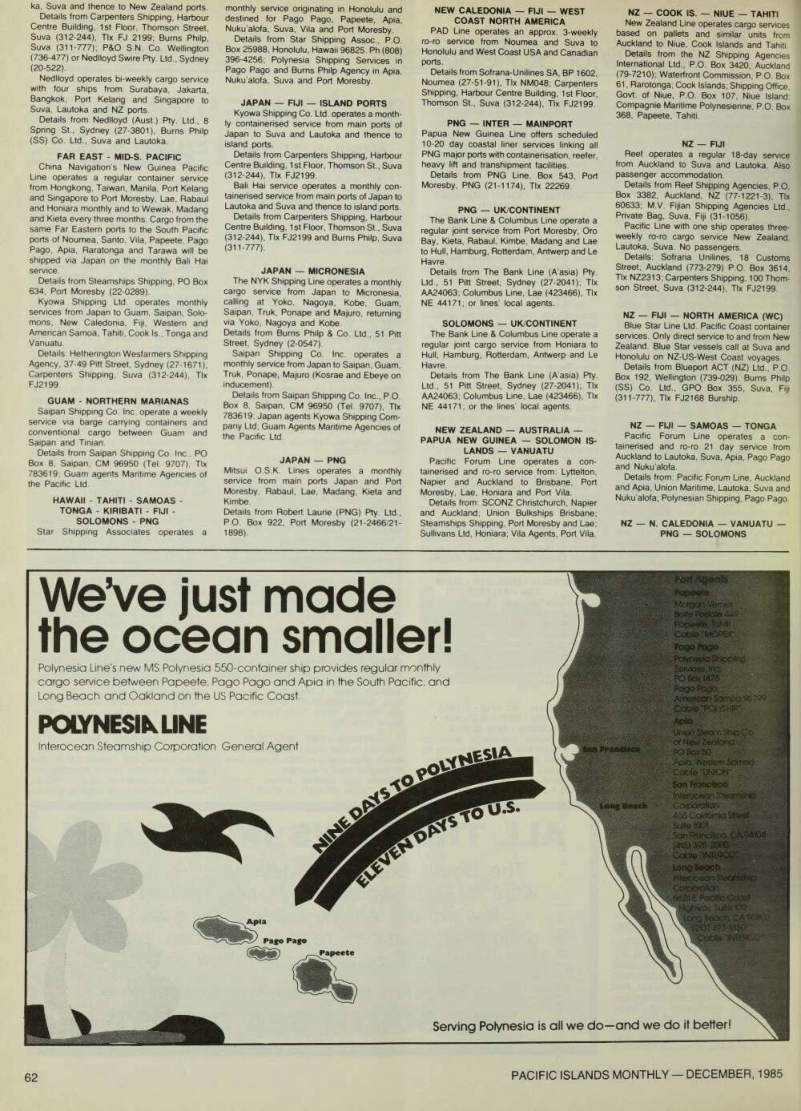
Should any shipping company wish to have its services cargo and passenger included in these listings they should contact
Pim.
Australia - Fiji
Sofrana-Unilines (Fiji Express Line) oper ates to Suva and Lautoka every three weeks from the main ports on the east coast of Australia and monthly to Lautoka from Mel bourne and Sydney.
Details from Sofrana-Unilines, 19 Pitt Street, Sydney (27-9851), Wiltrans Agency Pty. Ltd., 21st Floor. 60 Market St., Mel bourne (614-4788) Tlx 30163. ACTA Pty.
Ltd., Brisbane (221-3116); Elders-ANL Pty.
Ltd. Port Adelaide (47-5688); Newcastle, Sofrana Sydney (27-9851); Websters-ANL. 58 Charles St., Launceston, Tasmania (320- 555) Carpenters Shipping, Harbour Centre Building, Ist Floor, Thomson Street, Suva, Fiji (312-244), Tlx FJ2199.
Australia Samoas Tonga
Warner Pacific Lines operates a regular cargo service from Sydney, Brisbane and Melbourne to Nukualofa, Pago Pago, Apia and Vavau. Feeder service available from Apia to Cook, Christmas, Fanning and Washington Islands.
Details from Hetherington Wesfarmers Shipping Agency, 37-49 Pitt Street, Sydney. (27-1671)
Australia - New Caledonia -
FIJI - SAMOAS - TONGA - NZ Pacific Forum Line operates a fully con tainerised service (general, reefer and ro-ro) from Sydney to Noumea, Lautoka, Suva, Apia, Pago Pago, Nukualofa, Lyttelton. Syd ney, Cargo centralised from Adelaide, Mel bourne, Brisbane.
Details from: Pacific Forum Line, P.O. Box 796 Auckland; Union Bulkships, 333 George Street, Sydney, Brisbane and Melbourne; Union Co., Lautoka, Suva. Nukualofa; Pacific Forum Line Apia; Polynesia Shipping Pago Pago; SCONZ. Christchurch.
Australia - Lord Howe Is.
Norfolk Is.
Compagnie des Chargeurs Caledoniens operates four-weekly cargo service Sydney- Lord Howe Island and Norfolk Island.
Details Hetherington Wesfarmers Shipping Agency, 37-49 Pitt Street, Sydney (27-1671).
Australia - Kiribati
K. Asia Pacific operates a 5/6 weekly service from Melbourne and Sydney to Kiribati (Tarawa).
Details from K. Asia Pacific Pty. Ltd., Goldfields House, 1 Alfred Street, Circular Quay, Sydney (232-2277), Tlx 122143.
KAP New Guinea Lines call Tarawa after PNG ports on a 35 day basis from Melbourne and Sydney/Brisbane.
Details from K. Asia Pacific Pty. Ltd., Goldfields House, 1 Alfred Street, Circular Quay, Sydney (232-2277), Tlx. 122143.
Warner Pacific Line operates a 6 weekly containerised/breakbulk service to Tarawa from Melbourne/Sydney/Brisbane and Auck land. Details from Hetherington Wesfarmers Shipping Agency, 37-49 Pitt Street, Sydney (27-1671); Mac Kay Shipping Ltd., Downtown House. Queen Street, Auckland (30-229).
Australia - New Caledonia
And/Or Vanuatu
Sofrana - Unilines ships serve Noumea every three weeks from the main ports along the east Australian coast.
Details from Sofrana-Unilines, 19 Pitt Street, Sydney (27-9851), Wiltrtans-Agency Pty. Ltd., 21st Floor 60 Market St., Melbourne (614-4788) Tlx 30163 ACTA Pty. Ltd., Bris bane (221-3116), Elders-ANL Pty. Ltd., Port Adelaide (47-5688), Newcastle, Sofrana Syd ney (27-9851); Websters-ANL, 58 Charles St.. Launceston, Tasmania (320-555).
Compagnie des Chargeurs Caledoniens operates a three-weekly containerised cargo service from Sydney to Noumea.
Details Hetherington Wesfarmers Shipping Agency, 37-49 Pitt Street, Sydney (27-1671).
Compagnie Generate Maritime operates a monthly service from Sydney, Melbourne and Brisbane to Noumea. Port Vila and Santo, for containerised and break bulk cargo.
Details Compagnie Generate Maritime, 12 Castlereagh Street, Sydney (231-3700).
Australia - Nauru - Marshall
Is. - Kiribati
Nauru Pacific Line operates regular cargo service from Melbourne to Nauru, Majuro and Tarawa. Passenger service to Nauru only.
Details: Nauru Pacific Line (Aust.) Pty. Ltd.
Nauru House, 80 Collins Street, Melbourne (653-5709). Nedlloyd Swire, 8 Spring Street, Sydney (2-0522).
Australia - New Zealand
The Australian National Line and the New Zealand Line operate a 10-day container service (TRANZTAS) between Sydney and Melbourne to Auckland, Wellington, Lyttelton and Port Chalmers.
The Tranztas service has been extended to cover Burnie and Fremantle on a direct call monthly basis linking to the main New Zealand ports.
Details from ANL Shipping Agencies, 20 Bond Street, Sydney (232-0444) and ANL Shipping Agencies, “World Trade Centre", Cnr Flinders and Spencer Streets, Melbourne (611-2323) or New Zealand Line, Pastoral House, 98 Lambton Quay, Wellington (728- 5000).
Australia - Marshall Is.
Warner Pacific Line operates a 6 weekly containerised/breakbulk service to Majuro from Melbourne/Sydney/Brisbane and Auck land.
Details from Hetherington Wesfarmers Shipping Agency, 37-49 Pitt Street, Sydney (27-1671); Mac Kay Shipping Ltd. Downtown House, Queen Street, Auckland. (30-229).
Australia - Marianas - Guam
Fsm - Palau
Micronesia Transport Line operate a 55 day containerised/breakbulk service from Mel bourne/Sydney/Brisbane and Auckland to Palau, Yap, Guam, Saipan. Truk, Ponape and on inducement, Kosrae.
Details from Hetherington Wesfarmers Shipping Agency, 37-49 Pitt Street, Sydney (27-1671); Sofrana Unilines Customs Street, Auckland (77-3279).
AUSTRALIA - NZ - FIJI - TONGA
Vanuatu - New Caledonia
Solomons - New Guinea
Sitmar Cruises operates a year-round cruise program from Sydney to include the better known ports in the above countries, plus a number of unspoilt and largely un known, island paradises.
Details from Sitmar Cruises, 39 Martin
Place, Sydney (239-9000); NSW, reserva tions and inquiries (008 42-2277); Rest of Australia, reservations and inquiries (008 22-2277).
AUSTRALIA - NZ - FIJI - TONGA
Vanuatu - New Caledonia
Solomons - Samoas - Tahiti
P & O liners call at Auckland, Bay of Islands, Honiara, Lautoka, Noumea, Nukualofa, Pago Pago, Papeete, Port Mores by, Santo, Savusavu. Suva, Vavau and Vila on cruises from Australia.
Details from P & O Booking Centre, World Travel Headquarters Pty. Ltd., 33 Bligh Street. Sydney (237-0333).
Australia - Png -
Solomons - Vanuatu - Nz
Pacific Forum Line operates a con tainerised and ro-ro from Brisbane to Port Moresby. Lae, Honiara, Port Vila, Lyttelton, Napier and Auckland.
Details from: Union Bulkships, Brisbane Steamships Shipping. Port Moresby and Lae; Sullivans Ltd, Honiara; Vila Agents Port Vila; SCONZ Christchurch, Napier and Auckland.
Australia - Micronesia
Nauru Pacific Line operates a regular container service from Melbourne to Ponape, Truk, Guam and Saipan.
Details: N.P.L. (Australia) Pty. Ltd. Nauru House. 80 Collins Street, Melbourne (653- 5709). Nedlloyd Swire, 8 Spring Street, Sydney (2-0522).
Australia - Tuvalu
K. Asia Pacific operates a 3 monthly service from Sydney and Melbourne to Tuvalu (Funafuti). Subject inducement.
Details from K. Asia Pacific Pty. Ltd., Goldfields House, 1 Alfred Street, Circular Quay. Sydney (232-2277), Tlx 122143.
Warner Pacific Line operates a 6 week containerised/breakbulk service to Funafuti from Melbourne/Brisbane/Sydney and Auck land.
Details from Hetherington Wesfarmers Shipping Agency. 37-49 Pitt Street, Sydney (27-1671); Mac Kay Shipping Ltd., Downtown House, Queen Street, Auckland (30-229).
Australia - Png
KAP New Guinea Lines cargo vessels call at Melbourne, Sydney, Port Moresby. Lae, Madang, Wewak, Manus, Kimbe, Rabaul, Popondetta.
Details from K. Asia Pacific Pty. Ltd., Goldfields House. 1 Alfred Street, Circular Quay, Sydney (232-2277), Tlx 122143. Dal gety Shipping. World Trade Centre. Mel bourne (616-6700).
Australia - Png - Solomons
Sofrana Unilines (Aust.) P/L operates a 3-4 weekly cargo service to PNG ex-main ports on the east coast of Australia.
Details from Sofrana Unilines, 19 Pitt Street. Sydney (27-9851) Tlx 25327.
Australia - Png - Solomons
Vanuatu
A consortium of NGAUPNGL and CON PAC/NEL have four vessels operating a joint service from east coast Australian ports to Port Moresby, Lae, Alotau, Madang, Wewak, Rabaul, Kavieng-Kimbe, Kieta, Honiara, Vila, Santo.
Details from Burns Philp & Co. Ltd., P.O.
Box R 124, Royal Exchange, Sydney 2000 (2-0547); Nedlloyd Swire, 8 Spring Street, Sydney, (2-0522); New Guinea Express Lines, 37 Pitt Street, Sydney, (241 -3991); Vila Agents. PO Box 27, Port-Vila (2456), Tlx
Nhioii.
New Guinea Express Lines operates a weekly container service from Melbourne, Sydney, Brisbane to Port Moresby, Lae, Alotau, Kimbe, Rabaul, Kieta, Honiara, Kavieng, Madang, Wewak, Santo, Vila.
Details from New Guinea Express Lines, P.O. Box R 73, Royal Exchange, Sydney (241-3991); New Guinea Express Lines, 127 Creek Street, Brisbane (221-9333); New Guinea Express Lines, 327 Collins Street, Melbourne (61-3053); Niugini Express Lines, Pori Moresby (21-4572); Lae (42-1536); Nuigini Island Cargo Services Pty. Ltd., Rabaul (922-467); Bougainville Agencies Pty.
Ltd, Kieta (956-089); Robert Laurie (PNG) P/L Madang (82-2157); Garamut Enterprises P/L Wewak (86-2106); Burns Philp (PNG) Ltd.
Kavieng (94-2133); Alotau Stevedoring & Transport, Alotau (61-1318); Ngatia Wholesalers Pty. Ltd., Kimbe (93-5102); and Tradco Shipping. Mendana Avenue, Honiara (22588); Vila Agents Ltd., PO Box 971, Vila.
Vanuatu (2490); John Lum & Associates, PO Box 65, Santo, Vanuatu (329).
Australia - Tahiti
Compagnie Generate Maritime operates a monthly service from Sydney, Melbourne and Brisbane to Papeete, for containersised and break bulk cargo.
Details Compagnie Generate Maritime. 12 Castlereagh Street, Sydney (231-3700).
Sofrana Unilines (Aust.) P/L operates a 3/4 weekly cargo service to Papeete ex main ports on the east coast of Australia.
Details from Sofrana Unilines, 19 Pitt Street. Sydney (27-9851) Tlx 25327.
Singapore - Hong Kong - Fiji
Islands Ports
Kyowa Shipping Co. Ltd. operates a month ly containerised and breakbulk cargo service from Singapore. Hongkong to Lautoka, Suva and then to island ports.
Details from Carpenters Shipping, Harbour Centre Building, Ist Floor, Thomson Street.
Suva (312-244), Tlx FJ2199.
Far East - Fiji -
New Zealand
New Zealand Unit Express (NZUE) now operates a monthly service accepting con tainerised and break bulk cargo from Manila, Keelung, Kaohsiung and Hongkong to Lauto
ka, Suva and thence to New Zealand ports.
Details from Carpenters Shipping, Harbour Centre Building, Ist Floor, Thomson Street, Suva (312-244), Tlx FJ 2199; Burns Philp, Suva (311-777); P&O S.N. Co. Wellington (736-477) or Nedlloyd Swire Pty. Ltd., Sydney (20-522).
Nedlloyd operates bi-weekly cargo service with four ships from Surabaya, Jakarta, Bangkok, Port Kelang and Singapore to Suva, Lautoka and NZ ports.
Details from Nedlloyd (Aust.) Pty. Ltd., 8 Spring St., Sydney (27-3801), Burns Philp (SS) Co. Ltd., Suva and Lautoka.
Far East - Mid-S. Pacific
China Navigation's New Guinea Pacific Line operates a regular container service from Hongkong, Taiwan. Manila, Port Kelang and Singapore to Port Moresby, Lae, Rabaul and Honiara monthly and to Wewak, Madang and Kieta every three months. Cargo from the same Far Eastern ports to the South Pacific ports of Noumea, Santo, Vila, Papeete, Pago Pago, Apia, Raratonga and Tarawa will be shipped via Japan on the monthly Bali Hai service.
Details from Steamships Shipping, PO Box 634, Port Moresby (22-0289).
Kyowa Shipping Ltd. operates monthly services from Japan to Guam. Saipan, Solo mons, New Caledonia, Fiji, Western and American Samoa, Tahiti, Cook Is., Tonga and Vanuatu.
Details: Hetherington Wesfarmers Shipping Agency, 37-49 Pitt Street. Sydney (27-1671); Carpenters Shipping, Suva (312-244), Tlx FJ2199.
Guam - Northern Marianas
Saipan Shipping Co. Inc. operate a weekly service via barge carrying containers and conventional cargo between Guam and Saipan and Tinian.
Details from Saipan Shipping Co. Inc., PO Box 8, Saipan, CM 96950 (Tel. 9707), Tlx 783619; Guam agents Maritime Agencies of the Pacific Ltd.
Hawaii - Tahiti - Samoas -
Tonga - Kiribati - Fiji -
Solomons - Png
Star Shipping Associates operates a
monthly service originating in Honolulu and destined for Pago Pago, Papeete, Apia, Nukualofa, Suva, Vila and Port Moresby.
Details from Star Shipping Assoc., P.O.
Box 25988, Honolulu, Hawaii 96825. Ph (808) 396-4256; Polynesia Shipping Services in Pago Pago and Burns Philp Agency in Apia, Nukualofa, Suva and Port Moresby.
Japan Fiji Island Ports
Kyowa Shipping Co. Ltd. operates a month ly containerised service from main ports of Japan to Suva and Lautoka and thence to island ports.
Details from Carpenters Shipping, Harbour Centre Building, Ist Floor, Thomson St., Suva (312-244), Tlx FJ2199.
Bali Hai service operates a monthly con tainerised service from main ports of Japan to Lautoka and Suva and thence to island ports.
Details from Carpenters Shipping, Harbour Centre Building, Ist Floor, Thomson St., Suva (312-244), Tlx FJ2199 and Burns Philp, Suva (311-777).
Japan Micronesia
The NYK Shipping Line operates a monthly cargo service from Japan to Micronesia, calling at Yoko, Nagoya, Kobe. Guam, Saipan, Truk, Ponape and Majuro, returning via Yoko, Nagoya and Kobe.
Details from Burns Philp & Co. Ltd., 51 Pitt Street, Sydney (2-0547).
Saipan Shipping Co. Inc. operates a monthly service from Japan to Saipan, Guam.
Truk, Ponape, Majuro (Kosrae and Ebeye on inducement).
Details from Saipan Shipping Co. Inc., P.O.
Box 8, Saipan, CM 96950 (Tel. 9707), Tlx 783619; Japan agents Kyowa Shipping Com pany Ltd; Guam Agents Maritime Agencies of the Pacific Ltd.
Japan Png
Mitsui O.S.K. Lines operates a monthly service from main ports Japan and Port Moresby, Rabaul. Lae, Madang, Kieta and Kimbe.
Details from Robert Laurie (PNG) Pty. Ltd., P.O. Box 922, Port Moresby (21-2466/21- 1898).
New Caledonia Fiji West
Coast North America
PAD Line operates an approx. 3-weekly ro-ro service from Noumea and Suva to Honolulu and West Coast USA and Canadian ports.
Details from Sofrana-Unilines SA, BP 1602, Noumea (27-51-91), Tlx NMO4B; Carpenters Shipping, Harbour Centre Building, Ist Floor, Thomson St., Suva (312-244), Tlx FJ2199.
Png Inter Mainport
Papua New Guinea Line offers scheduled 10-20 day coastal liner services linking all PNG major ports with containerisation, reefer, heavy lift and transhipment facilities.
Details from PNG Line, Box 543, Port Moresby, PNG (21-1174), Tlx 22269.
Png Uk/Continent
The Bank Line & Columbus Line operate a regular joint service from Port Moresby, Oro Bay, Kieta, Rabaul, Kimbe, Madang and Lae to Hull, Hamburg, Rotterdam, Antwerp and Le Havre.
Details from The Bank Line (A’asia) Pty.
Ltd., 51 Pitt Street, Sydney (27-2041); Tlx AA24063; Columbus Line, Lae (423466), Tlx NE 44171; or lines’ local agents.
Solomons Uk/Continent
The Bank Line & Columbus Line operate a regular joint cargo service from Honiara to Hull, Hamburg, Rotterdam, Antwerp and Le Havre.
Details from The Bank Line (A’asia) Pty.
Ltd., 51 Pitt Street, Sydney (27-2041); Tlx AA24063; Columbus Line, Lae (423466), Tlx NE 44171; or the lines’ local agents.
New Zealand Australia
Papua New Guinea Solomon Is
Lands Vanuatu
Pacific Forum Line operates a con tainerised and ro-ro service from: Lyttelton, Napier and Auckland to Brisbane, Port Moresby, Lae, Honiara and Port Vila.
Details from: SCONZ Christchurch, Napier and Auckland; Union Bulkships Brisbane; Steamships Shipping. Port Moresby and Lae; Sullivans Ltd, Honiara; Vila Agents, Port Vila.
Nz Cook Is. Niue Tahiti
New Zealand Line operates cargo services based on pallets and similar units from Auckland to Niue, Cook Islands and Tahiti.
Details from the NZ Shipping Agencies International Ltd., P.O. Box 3420, Auckland (79-7210); Waterfront Commission, P.O. Box 61, Rarotonga; Cook Islands; Shipping Office, Govt, of Niue, P.O. Box 107, Niue Island: Compagnie Maritime Polynesienne, P.O. Box 368, Papeete, Tahiti.
Nz Fiji
Reef operates a regular 18-day service from Auckland to Suva and Lautoka. Also passenger accommodation.
Details from Reef Shipping Agencies, P.O.
Box 3382, Auckland. NZ (77-1221-3), Tlx 60633; M.V. Fijian Shipping Agencies Ltd., Private Bag. Suva, Fiji (31-1056).
Pacific Line with one ship operates three weekly ro-ro cargo service New Zealand.
Lautoka, Suva. No passengers.
Details: Sofrana Unilines, 18 Customs Street, Auckland (773-279) P.O. Box 3614, Tlx NZ2313; Carpenters Shipping, 100 Thom son Street, Suva (312-244), Tlx FJ2199.
Nz Fiji North America (Wc)
Blue Star Line Ltd. Pacific Coast container services. Only direct service to and from New Zealand. Blue Star vessels call at Suva and Honolulu on NZ-US-West Coast voyages.
Details from Blueport ACT (NZ) Ltd., P.O.
Box 192, Wellington (739-029). Burns Philp (SS) Co. Ltd., GPO Box 355, Suva, Fiji (311-777), Tlx FJ2168 Burship.
Nz Fiji Samoas Tonga
Pacific Forum Line operates a con tainerised and ro-ro 21 day service from Auckland to Lautoka, Suva, Apia, Pago Pago and Nukualofa.
Details from: Pacific Forum Line, Auckland and Apia, Union Maritime, Lautoka, Suva and Nukualofa; Polynesian Shipping, Pago Pago.
Nz N. Caledonia Vanuatu
Png Solomons
Sofrana Unilines with three ships operate to Vila and Santo, to Honiara and Papua New Guinea and to Norfolk Island and Noumea (No passengers).
Details from Sofrana Unilines, 18 Customs Street, Auckland (773-279), P.O. Box 3614 Tlx NZ2313.
Nz Tahiti
Compagnie Tahitienne Maritime SA (as CTM-Tahiti Line) operates one ship, MV Bounty 111, monthly Papeete New Zea land. (No passengers).
Details from Sofrana Unilines, P.O. Box 3614, 18 Customs St., Auckland, Tlx NZ2313; CTM-Tahiti Line, P.O. Box 9012, Papeete (39042), Tlx Tahitlin 322 FP Tahiti.
Nz Tonga Samoas
Warner Pacific Line services Auckland, Nukualofa, Vavau, Apia, Pago Pago fort nightly carrying general and freezer cargoes.
Details from McKay Shipping Ltd., Down town House, 21 Queen St.. Auckland, P.O Box 1372 (30-299). Cables MACSHIP, Telex NZ2554, Warner Pacific Line, Box 93, Nukualofa, Tonga; Mealelei (Western Samoa,) Ltd. Private Bag, Apia, Western Samoa, Pacific Maritime Services, P.O. Box 2617, Pago Pago, American Samoa (633- 2728) cables: Pacmar SX2OS.
Tahiti New Caledonia Vanuatu
Solomon Is. New Zealand
Png Singapore Europe
Polish Ocean Lines operate in a semi container type vessel to the following ports, from Papeete, Noumea, Santo. Vila, Yandina, Honiara, Auckland, Rabaul, Lae, Singapore, Port Kelang, Penang then to Mediterranean ports and Europe via the Suez Canal. (Other New Zealand ports subject to inducement).
Details from Universal Shipping Agencies Ltd., 6th Floor, 38 Fort Street, Auckland 1, New Zealand (30931), Tlx 21517.
Europe Tahiti
New Caledonia
Compagnie Generate Maritime operates services from Europe and Mediterranean ports to Papeete and Noumea using three ro-ro and multi-purpose vessels thus ensuring a bi-monthly sailing to and from.
Details Compagnie Generate Maritime, 12 Castlereagh Street, Sydney (231-3700).
Europe Tahiti
New Caledonia New Zealand
Vanuatu Solomons Png
Europe
Polish Ocean Lines offers regular monthly sailings for containerised and break bulk cargo, also conventional reefer space and reefer containers, from Hamburg, Rotterdam, Dunkirk, Rouen to Papeete, Noumea, Auck land. Santo, Honiara, Rabaul, Lae, Singa pore, returning to Europe via Suez, other ports in South Pacific can be served directly with inducement or otherwise via tranship ment.
Details from Sotama, BP 9170, Papeete, Tel 427805 Tlx 373 PF / SATO; BP C 2, Noumea Cedex Tel 272094 Tlx 163 NM / Universal Shipping Agencies P.O. Box 2282 Auckland Tel 30930 Tlx 21517 / Vanua Navigation P.O. Box 44 Vila Tel 2027 Tlx 1033 / Melan Chine Shipping Co. P.O.
Box 71 Honiara Tel 21678 Tlx 66335 / Steamships Trading Co. Ltd P.O. Box 89 Rabaul Tel 922952 Tlx 92929 / Steamships Trading Co. Ltd P.O. Box 85 Lae Tel 424666 Tlx 42423 / Union Steam ship Co. of NZ Ltd P.O. Box 50 Apia Tel 21781 Tlx 225 / Warner Pacific Line P.O.
Box 93 Nukualofa Tel 22088 Tlx 66219 / Fiji Agents T.B.A.
Europe Tahiti W. Samoa
Fiji N. Caledonia
Nedlloyd offers regular cargo services from Continental ports to Papeete, Apia, Fiji and New Caledonia.
Details Nedlloyd (Aust.) Pty. Ltd., 8 Spring Street, Sydney (27-3801); Carpenters Ship ping, Ist Floor, Harbour Centre Bldg., 100 Thomson St., Suva (312-244), Tlx 2199 FJ and Vetari Street, Lautoka (63988), Tlx 5215FJ.
Uk N. Continent W. Samoa
Tonga, Fiji
The Bank Line & Columbus Line operate a
regular joint cargo service from Hull, Ham burg, Bremen, Antwerp, Rotterdam and Le Havre to Apia, Nukualofa. Suva and Lautoka.
Details from The Bank Line (A’asia) Pty.
Ltd., 51 Pitt Street. Sydney (27-2041), Tlx AA 24063; Columbus Line, Lae (423-466), Tlx NE 44171; or lines’ local agents.
Uk N. Continent Png
Solomons
The Bank Line & Columbus Line operate a regular joint cargo service from Hull, Ham burg, Bremen, Antwerp, Rotterdam and Le Havre to Port Moresby, Lae, Madang, Kimbe, Rabaul, Kieta and Honiara and on induce ment to Yandina.
Details from The Bank Line (A’asia) Pty.
Ltd., 51 Pitt Street, Sydney (27-2041), Tlx AA 24063; Columbus Line, Lae (42-3466), Tlx NE 44171; or lines’ local agents.
Uk/N. Continent Tahiti
N. Caledonia Vanuatu
The Bank Line & Columbus Line operate a regular joint cargo service from Hull. Ham burg, Bremen, Antwerp, Rotterdam and Le Havre to Papeete. Noumea, Port-Vila and Santo.
Details from The Bank Line (A’asia) Pty.
Ltd., 51 Pitt Street, Sydney (27-2041), Tlx AA 24063; Columbus Line, Lae (42-3466), Tlx NE 44171; Ets. AM. Fare UTE, Papeete; Ets.
Ballande, Noumea and other local agents.
Us Hawaii Micronesia
E. Malaysia Brunei Papua New
Guinea Philippines
PM&O Lines operates three fully self-sus tained container vessels on a sailing frequen cy of every 28 days from the San Francisco Bay area. Los Angeles, and Honolulu to Majuro, Ebeye, Kosrae, Ponape, Truk, Saipan, Yap, Koror, Kota Kinabalu, Brunei, Lae, Kieta and Rabaul.
Service is also offered utilising the same vessels on the same 28-day frequency from the Philippine ports of Manila, Cebu, and Davao and General Santos and the Papua New Guinea ports of Rabaul, Lae and Kieta to Hawaii, San Francisco and Los Angeles.
Finally service is available from Davao, Cebu, Manila, Hong Kong, Keelung and Kaohsiung to Saipan, Guam, Honolulu, Lae, Rabaul and Kieta.
Details from PM&O Lines, 181 Fremont Street, San Francisco, California, 94105, U.S.A. (415) 543-7430, Tlx 278016; Cable PMONAV SFO; PM&O Owner’s representa tive. P.O. Box 803, Saipan, N.M.I. 96950.
Cable Commontime Saipan, Tlx
783605; Anscor Transport and Terminals Inc., P.O. Box 7023-5, Metro Manila, Philip pines (521-8074) Tlx 65021 ATTI PN.
Us Hawaii Samoas
Kiribati Nauru
Nauru Pacific Line operates regular con ventional and container services from San Francisco and Honolulu to Christmas Island, Pago Pago, Apia, Tarawa and Nauru.
Details from N.P.L. (Australia) Pty. Ltd., Nauru House, 80 Collins Street, Melbourne (653-5709); Nauru Air and Shipping Agency, Suite 2803, 185 Berry Street, San Francisco.
California 94107 (415-543-4517); Nauru Air and Shipping Agency, Suite 506, 841 Bishop St., Honolulu, HI 96813 (808-523-0441).
Us. Noumea Fiji
PAD Line operates an approx. 3-weekly ro-ro service from west coast USA and Canada to Noumea, Suva and Lautoka.
Details from Sofrana Unilines BP 1602, Noumea (27-51-91), Tlx NMO4B; Carpenters Shipping, Harbour Centre Building, Ist Floor, 100 Thomson Street, Suva (312-244), Tlx FJ2199; Trans-Austral Shipping Pty. Ltd., P.O. Box R 232, Royal Exchange, 2000 (231-8411), Tlx AA21204.
Us Tahiti Samoa
Pacific Islands Transport operates a five weekly cargo service from North America west coast ports to Papeete, Pago Pago, Apia.
Details from Polynesia Shipping Services Inc. P.O. Box 1478, Pago Pago 96799.
Polynesia Line operates container and general cargo service from US west coast ports to Papeete and Pago Pago.
Details from Polynesia Shipping Services Inc., P.O. Box 1478, Pago Pago 96799.
Advertisements & other items, pp. 61-64 (1 item)
All The News In A Flash
The South Sea Digest tells you what you want to know about the Pacific Islands in a few words. All the leading firms and diplomatic missions read it. You can ’phone or write or call for a follow up.
See insert for subscription details:
THE SOUTH SEA DIGEST
WeVe just made
the ocean smaller!
Polynesia Line's new MS Polynesia 550-container ship provides regular monthly cargo service between Papeete, Pago Pago and Apia in the South Pacific, and Long Beach and Oakland on the US Pacific Coast.
POLYNESIA LINE
Interocean Steamship Corporation General Agent
'•MORSC
SUsppir.g inc.
Samoa 96799 SWpCo m Cable SteamsNf) u a.
TO 3* aS 3 398-2000 5* Long fnteiOcean Ccsporatior) 662* E Pacific
KSO
Cable Pago Pago , Serving Polynesia is all we do—and we do it better!
PULISn UlilAN LINED
General Management, 10 Lutego 24,81-364 GDYNIA, POLAND, Phone: 20-19-01, Cables: POLOCEAN Telex: 054-231 © © iV.. ■ * Ur-.
L bet I £ •>n*V 1 T
'iff
m TT r.: r ■r>»• 's'-*' *•> s'. % • r.'v? kv. m
SOUTH PACIFIC SERVICE
We offer monthly service to and from: GDYNIA, HAMBURG, ROTTERDAM, MIDDLESBOROUGH/IMMINGHAM, ANTWERP, DUNKIRK, ROUEN, PAPEETE (via PANAMA), NOUMEA, AUCKLAND, HONIARA, RABAUL, LAE, SINGAPORE, by our multipurpose vessels carrying dry and reefer containers, reefer chambers, heavy lifts, breakbulk or
palletized, bulk liquids.
POLISH OCEAN LINES Representatives AUCKLAND Mr. A. Sieradzki. Telex 21517 NZ “UNISHIP”. SYDNEY Mr. Walenciak. Telex 20428 AA “SLEIGH"
POLISH OCEAN LINES Agents
TAHITI SOTAMA Telex 296 FP “COUTIMEX”. NEW CALEDONIA SATO Telex 163 NM “SATO”. AUCKLAND UNIVERSAL SHIPPING AGENCIES LTD., Telex 21517 NZ “UNISHIP”. SOLOMONS MELAN CHINE SHIPPING CO., LTD Telex 66335 HO “SYMECO”. PNG STEAMSHIPS TRADING CO., LTD Telex 42423 NE “STEAM”.
YOU’LL FIND IT.
WHERE THE SKY MEETS
THE SEA.
NEW CALEDONIA
SOLOMON ISLAND
TAH I T I
TONGA
- ▼ A
JOINTLY OPERATED BY
v CNy The China Navigation Co., Ltd.
MilsciQSK Lines. Ltd.
NIPPON YUSEN KAISHA
deaths
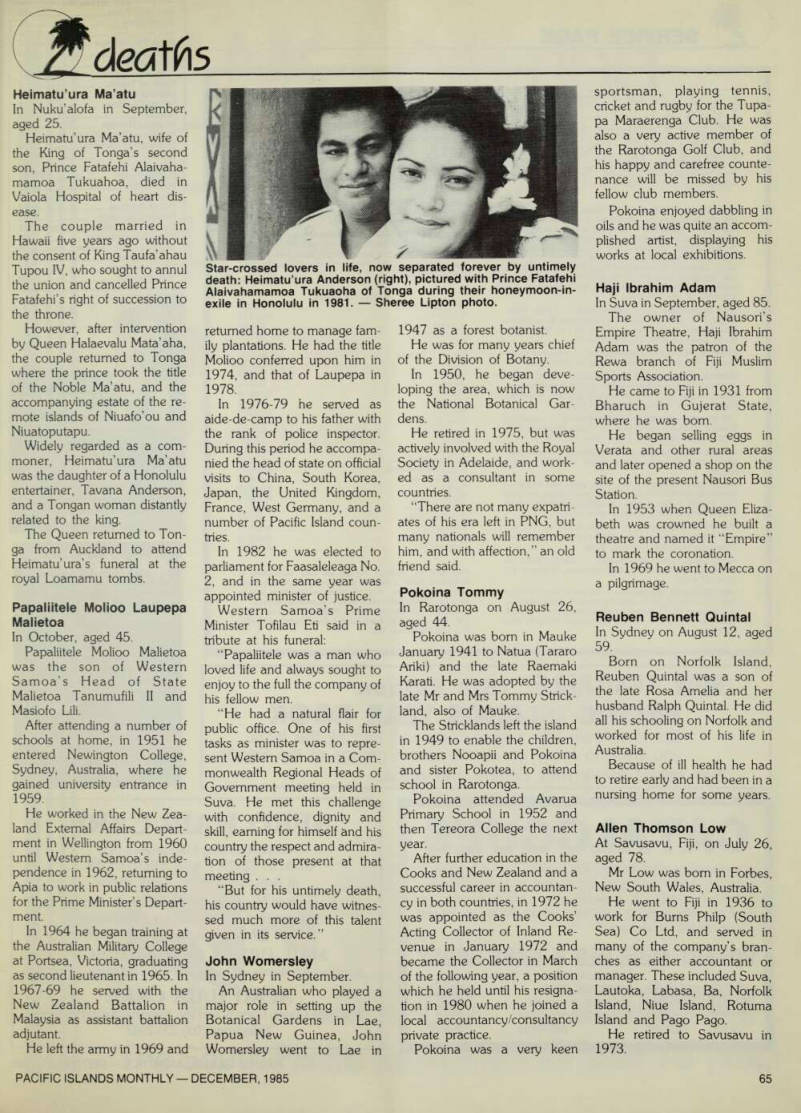
Heimatu’ura Ma’atu In Nuku’alofa in September, aged 25.
Heimatu’ura Ma’atu, wife of the King of Tonga’s second son, Prince Fatafehi Alaivaha mamoa Tukuahoa, died in Vaiola Hospital of heart dis ease.
The couple married in Hawaii five years ago without the consent of King Taufa’ahau Tupou IV, who sought to annul the union and cancelled Prince Fatafehi’s right of succession to the throne.
However, after intervention by Queen Halaevalu Mata’aha, the couple returned to Tonga where the prince took the title of the Noble Ma’atu, and the accompanying estate of the re mote islands of Niuafo’ou and Niuatoputapu.
Widely regarded as a com moner, Heimatu’ura Ma’atu was the daughter of a Honolulu entertainer, Tavana Anderson, and a Tongan woman distantly related to the king.
The Queen returned to Ton ga from Auckland to attend Heimatu’ura’s funeral at the royal Loamamu tombs.
Papaliitele Molioo Laupepa Malietoa In October, aged 45.
Papaliitele Molioo Malietoa was the son of Western Samoa’s Head of State Malietoa Tanumufili II and Masiofo Lili.
After attending a number of schools at home, in 1951 he entered Newington College, Sydney, Australia, where he gained university entrance in 1959.
He worked in the New Zea land External Affairs Depart ment in Wellington from 1960 until Western Samoa’s inde pendence in 1962, returning to Apia to work in public relations for the Prime Minister’s Depart ment.
In 1964 he began training at the Australian Military College at Portsea, Victoria, graduating as second lieutenant in 1965. In 1967-69 he served with the New Zealand Battalion in Malaysia as assistant battalion adjutant.
He left the army in 1969 and
returned home to manage fam ily plantations. He had the title Molioo conferred upon him in 1974, and that of Laupepa in 1978.
In 1976-79 he served as aide-de-camp to his father with the rank of police inspector.
During this period he accompa nied the head of state on official visits to China, South Korea, Japan, the United Kingdom, France, West Germany, and a number of Pacific Island coun tries.
In 1982 he was elected to parliament for Faasaleleaga No. 2, and in the same year was appointed minister of justice.
Western Samoa’s Prime Minister Tofilau Eti said in a tribute at his funeral: “Papaliitele was a man who loved life and always sought to enjoy to the full the company of his fellow men.
“He had a natural flair for public office. One of his first tasks as minister was to repre sent Western Samoa in a Com monwealth Regional Heads of Government meeting held in Suva. He met this challenge with confidence, dignity and skill, earning for himself and his country the respect and admira tion of those present at that meeting . . .
“But for his untimely death, his country would have witnes sed much more of this talent given in its service.”
John Womersley In Sydney in September.
An Australian who played a major role in setting up the Botanical Gardens in Lae, Papua New Guinea, John Womersley went to Lae in
1947 as a forest botanist.
He was for many years chief of the Division of Botany.
In 1950, he began deve loping the area, which is now the National Botanical Gar dens.
He retired in 1975, but was actively involved with the Royal Society in Adelaide, and work ed as a consultant in some countries.
“There are not many expatri ates of his era left in PNG, but many nationals will remember him, and with affection,” an old friend said.
Pokoina Tommy In Rarotonga on August 26, aged 44.
Pokoina was bom in Mauke January 1941 to Natua (Tararo Ariki) and the late Raemaki Karati. He was adopted by the late Mr and Mrs Tommy Strick land, also of Mauke.
The Stricklands left the island in 1949 to enable the children, brothers Nooapii and Pokoina and sister Pokotea, to attend school in Rarotonga.
Pokoina attended Avarua Primary School in 1952 and then Tereora College the next year.
After further education in the Cooks and New Zealand and a successful career in accountan cy in both countries, in 1972 he was appointed as the Cooks’
Acting Collector of Inland Re venue in January 1972 and became the Collector in March of the following year, a position which he held until his resigna tion in 1980 when he joined a
local accountancy/consultancy
private practice.
Pokoina was a very keen
sportsman, playing tennis, cricket and rugby for the Tupa pa Maraerenga Club. He was also a very active member of the Rarotonga Golf Club, and his happy and carefree counte nance will be missed by his fellow club members.
Pokoina enjoyed dabbling in oils and he was quite an accom plished artist, displaying his works at local exhibitions.
Haji Ibrahim Adam In Suva in September, aged 85.
The owner of Nausori’s Empire Theatre, Haji Ibrahim Adam was the patron of the Rewa branch of Fiji Muslim Sports Association.
He came to Fiji in 1931 from Bharuch in Gujerat State, where he was bom.
He began selling eggs in Verata and other rural areas and later opened a shop on the site of the present Nausori Bus Station.
In 1953 when Queen Eliza beth was crowned he built a theatre and named it “Empire” to mark the coronation.
In 1969 he went to Mecca on a pilgrimage.
Reuben Bennett Quintal In Sydney on August 12, aged 59.
Born on Norfolk Island, Reuben Quintal was a son of the late Rosa Amelia and her husband Ralph Quintal. He did all his schooling on Norfolk and worked for most of his life in Australia.
Because of ill health he had to retire early and had been in a nursing home for some years.
Allen Thomson Low At Savusavu, Fiji, on July 26, aged 78.
Mr Low was bom in Forbes, New South Wales, Australia.
He went to Fiji in 1936 to work for Burns Philp (South Sea) Co Ltd, and served in many of the company’s bran ches as either accountant or manager. These included Suva, Lautoka, Labasa, Ba, Norfolk Island, Niue Island, Rotuma Island and Pago Pago.
He retired to Savusavu in 1973.
Star-crossed lovers in life, now separated forever by untimely death: Heimatu’ura Anderson (right), pictured with Prince Fatafehi Alaivahamamoa Tukuaoha of Tonga during their honeymoon-in exile in Honolulu in 1981. - Sheree Lipton photo.
Advertisements & other items, pp. 66-68 (1 item)
[Motto
SERVICE PAGE
ADVERTISING
AH rooms aircondltloned v • Restaurant • Bars • Banquet halt
H. E. BERGHUSER
General Manager
Phone 21 2622 Cable: PAPTEL Telex: NE22353 PAPTEL Stay at Aggie Grey’s . . . the South Pacific’s
legendary hotel.
Situated right in the heart of Western Samoa. Enjoy Polynesian style friendliness and service, in cool surroundings, superb entertainment and food.
Magnificent white sand beaches only a short drive away. Airconditioned rooms, swimming pool and full bar facilities.
Bookings through Union Steamship Company of NZ, Pan Am, Air New Zealand or direct to Aggie Grey’s, Apia, Western Samoa. Cables: AGGIES’ Apia.
[MOTTO
AW AUSTRALIA: Distribution: The Herald and Weekly Times Ltd,, 44-74 Flinders St., Melbourne, Vic., 3000. Advertising Reps — Brisbane — D Wood, Anday Agency, CCA Centre, Oayboro Road, Closebum 4520; Box 1918, GPO Brisbane, 4001, telephone (07) 289-4120. Adelaide — Hash*ell Williamson Rouse Pty Ltd., PO Box 419 Norwood, SA, 5067; 59 Kensington Road, Norwood; telephone (08) 332-3322, telex 87113; Perth — Allen & Associates.
Suite 2. 284 Stirling St., Perth, WA, 6000, telephone (09) 328-9693 or (09) 328-9363 FVJI: Distribution and subscriptions — Desai Bookshops, P O Box 160, Suva, Fiji, telephone Suva 23036 Advertising — Fiji Times & Herald Ltd., 20 Gordon St,.
Suva, telephone 31-4111, telex FJ2124.
FRENCH POLYNESIA: Distribution — Hachette Pacifique, 10 Ave Bruat, Papeete, telephone 25610.
HAWAII. UNITED STATES: Distribution — PIM, Hawaii.
PO Box 22250, Honolulu, Hawaii, 96822 Advertising — Bnan C Asgill, Apt. 1308, 1676 Ala Moana Blvd . Honolulu, Hawaii, 96815, telephone (808) 955-9718 JAPAN: Advertising and subscriptions — Universal Media Corporation, GPO Box 46, Tokyo, telephone 666- 3036, cables UNIMEDIA Tokyo, telex 2524665 KOREA: Advertising and subscriptions — World Marketing, Inc, Box 4010, Seoul; phone 776-5291-3, telex K23232.
MALAYSIA: Advertising and subscriptions — Worldwide Media Services, 57-B Komplex Damai. Jin Dato Haji Eusoff, Kuala Lumpur, telephone 63-9340, cables WORLDMEDIA Kuala Lumpur, telex 31533 VANUATU: Distribution — Maropa Bookshop, HQ Box 210, Port Vila Advertising — Bill Penthand, Norman Bros Bookshop. Port Vila, telephone 2232 NEW CALEDONIA: Distribution — Depot Centre de Presse Michel Pentecost, CBP2, Noumea, telephone 27- 2434, 27-4729.
NEW ZEALAND: Distribution — Gordon & Gotch, PO Bex 584, 2 Carr Road, Mt Roskill, Auckland 4 Advertising — International Media Representatives Ltd., PO Box 10259, Balmoral. Auckland 4, telephone 605-909, 792-370, telex NZ21404
PAPUA NEW GUINEA: Distribution — Gordon & Gotch, PO Box 3396, Port Moresby, telephone 25-4551, 25-4855 Advertising — Ken Head, PNG Post-Courier, PO Box 85, Pori Moresby, telephone 21-2577, telex 22120 SOLOMON ISLANDS: Distribution and Advertising — The Bookshop, (Norman Bros.) PO Box 503, Honiara.
PHILIPPINES: Advertising — The GF Group, 12 San Ignacio St., Uroaneta Village. Makati, Metro Manila, telephone 817-7299, telex 45950 and 4233 UNITED KINGDOM: The Herald & Weekly Times Ltd., No 1 Martravers Street,London WC2R 3D2, England, telephone 01 836 5162, telex London 21989 UNITED STATES MAINLAND: Advertising — Joshua B Powers Jr, Powers International Inc., 551 Fifth Ave., New York, New York 10 017, telephone 867-9580, telex 236514.
Subscriptions — PIM, Hawaii, PO Box 22250, Honolulu, Hawaii. 96822
SUBSCRIPTIONS
American Samoa Australia Canada Cook Islands Fiji French Polynesia Guam Hawaii Japan Kiribati Micronesia Nauru New Caledonia New Zealand Niue Norfolk Island Northern Marianas Papua New Guinea Solomon Islands Tonga Tuvalu United Kingdom U. S. Mainland Vanuatu Western Samoa Elsewhere Payments by personal cheque are only acceptable in Australian (from a branch in Australia), U S. and New Zealand currency. For all other remittances please send an international bank draft in Australian dollars.
Published monthly by Pacific Publications (Aust.) Pty Ltd. and pnnted in Australia by Quadricolor Industries Pty. Ltd., Mulgrave, Vic. .. $US21 Aust$18 .. $US27 .. NZ$30 Aust$19
.. SUS22
.. SUS23
.. $US23 .. $US22 Aust$19
SUS23
Aust$21 . $US22 .. NZ$30 .. NZ$30 Aust$18 . $US23 Aust$23 Aust$19 Aust$19 Aust$19
. Stg$15
. $US27 Aust$19 Aust$19 Aust$25
NOW AVAILABLE! 15th Edition
PACIFIC ISLANDS YEAR BOOK
Contains over 550 pages crammed with all the facts you want to know on all the island groups of the Pacific.
See insert for further details and price.
AFRO HAIR CARE
Importers and Distributors of
BLACK HAIR CARE PRODUCTS
in Australia and the South Pacific Specialised products for all Afro-type hair • Shampoos • Conditioners • Hairdressings • Curl Products (including Curl Kits)
MAIL ORDER CONVENIENCE
Retail or wholesale contact us for price list and brochures
AFRO HAIR CARE
3 Wedge Court, Glen Waverley, Victoria, Australia 3150 Telephone (03) 2332642
CATALOGUES
We specialise in mail order. Catalogues available on most subjects, e.g., Ethnology, Art, Literature, Natural History, Ephemera. We run a world-wide search service for specific second-hand and rare books. Write or phone giving details of interest.
ROBERT MUIR OLD & RARE BOOKS
P.O. Box 364 Nedlands, 6009 Western Australia Phone (09) 386-5842, 386-6103.
BANK LINE and
COLUMBUS LINE
24 day service to
Europe.
Need we say more...
D G The Joint Service Partners offer facilities for shipment of: Containers (FCL/LCL) and Break-bulk Cargo plus reefer space and deeptanks for carriage of vegetable oils and other liquid bulk cargo.
Carriers also accept heavy lifts, overlength and cumbersome parcels.
Ports of Service: Loading: Papeete, Apia, Suva, Lautoka, Noumea, Port Vila, Santo, Honiara, Port Moresby, Lae, Madang, Kimbe, Rabaul, Kieta, Darwin. For: Rotterdam, Antwerp, Hamburg, Hull, Dunkirk, Le Havre.
Additional ports on enquiry.
Please contact our regional offices for further information: The Bank Line (Australasia) Pty Ltd Columbus Line Reederei GmbH Suite 801, 51 Pitt St, P.O. Box 1667, Lae/Papua New Guinea.
Sydney. NSW, Australia 2000 Phone: 423466/423287/A.H. 422481 Phone 27 2041 Telex 24063 Telex; Colline NE 44171 The South Pacific Specialists for over 75 years
11 Every system in AlWA’s S.P.A.N. lineup delivers the dynamic impact and delicate sound expression of digital audio.
That’s because every system is equipped with AlWA’s DX-770 digital audio Compact Disc player. From the top-of-the-line V-1200 series to simple systems that please budgetminded music lovers.
And, synchro-recording from the CD player or any other source, wireless remote control, auto function selection, double speed dubbing from tape to tape, and programmable record, tape, and CD playback are just a few of the many features available in AlWA’s S.P.A.N. lineup. So why wait for the future in audio? Enjoy it today with AIWA.
DIGITAL AUDIO
m i High-performance S.P.A.N. component system
V-120MX
AIWA
AIWA Australia Pty., Ltd 14 Gertrude St., Arncliffe. N.S.W. Australia 2205 AUSTRALIA PHONE: (597) 2388/Oceania Indent Agency (P.N.G.) Pty., Ltd Ago St., Gordon Box 5518, Boroko. Papua New Guinea PHONE: 256411/The Sound Centre Ltd P.O. Box 434 Port Vila, Vanuatu PHONE; 2035/P. Hargovlnd Bros 190 Renwick Road PO. Box 490 Suva Fiji PHONE: 24350/Makanjee & Sons Limited P.O. box 91 Sigatoka Fiji PHONE; 50158/Milaw Trading Co., Ltd 224-236 Hobson Street, P.O. Box 5919, Auckland, New Zealand Phone; (09) 399-175/hifivox 79, rue de Sebastopol, Noumea, New Caledonia PHONE; 27.24.66/Harvest Pacific Limited P.O. Box 517. Honiara. Solomon Islands PHONE; 131/Fare Hi-Fi Stereo Rue du Marechal Foch—P.O. Box 269, Papeete, Tahiti Phone; 2-4814/Micropac Audio, Inc. P.O. Box 3478 Agana, Guam 96910 PHONE; 472-8091,472-8297/Rarotonga Duty Free Shop Private Bag P.O. Box 92. Rarotonga. Cook Island/Nauru Co-Operative Society Republic of Nauru