Islands

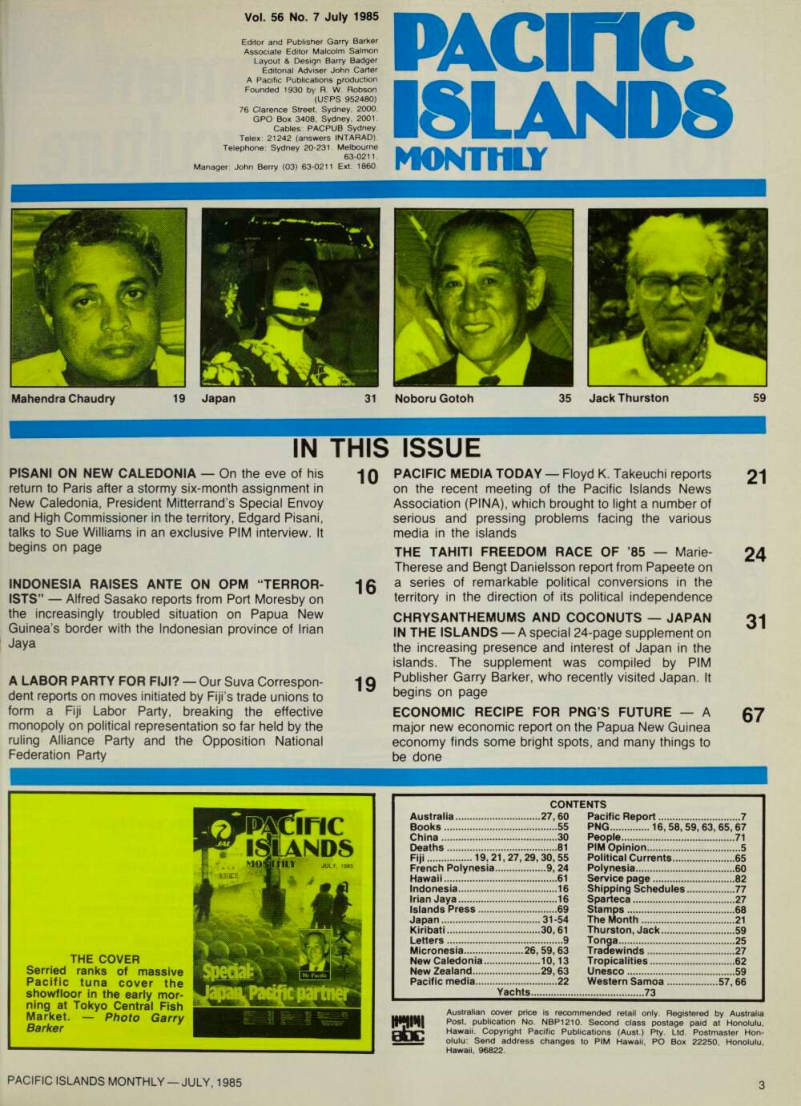
Pacific
Monthly
July,1985
and* .
Japaa Pacific partner
American Samoa US$l.75 Australia "A 51.50 Cook Islands NZ$l.5O F 'i' Psl 50 Hawaii -. US$l.95 - Kiribati , Asl 75 - Nauru A 51.75 5 New Caledonia... CFPI9O
New Zealand - NZ$2.5O Niue NZ$l.75 Norfolk Island A 51.50 Papua New Guinea KSt-50 Solomon Islands 551.50 Tahiti CFP22O Tonga Pi .50 Tuvalu - A 51.75
Usa U 552.25
USTT and Guam .. US$l.95 Vanuatu VT1.50 Western Samoa T 2.10 ■Recommended retail price only Registered by Australia Post Publication No. NBPI2IO
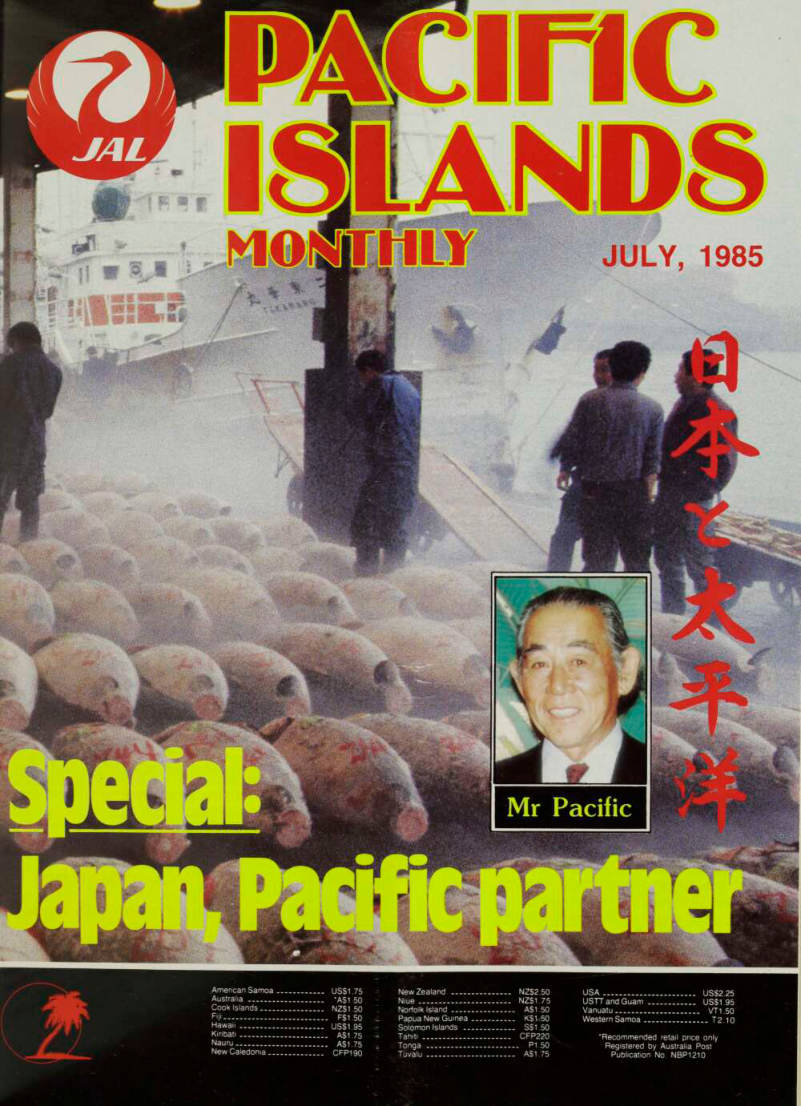
Mr Pacific
The Cover
Serried ranks of massive Pacific tuna cover the showfloor in the early mor ning at Tokyo Central Fish Market. Photo Garry Barker
Advertisements & other items, pp. 2-3 (2 items)
0 Hitachi
& V .
VHS
VMS
VT-640E
Simply the most advanced in home entertainmen Hitachi’s VT-640E VTR. Its simpleto-operate slim design conceals some of today’s most advanced features.
Such as Hitachi’s exclusive “keyboard” innovation. It not only gives you larger, easier-to-use control buttons, but puts them at a more convenient angle: under your fingers instead of in front of them. • 13-function wireless remote control • 2-system compatibility
(B/G-PAL/MESECAJVp
• Instant Recording Timer • Freeze frame
CMT2OB3
When it comes to total home entertainment the Cineramic AV 20"
TV, CMT2OB3 combines the very best in sight and sound technology. • 8-system compatibility • 23-function remote control • VTR/video disc ready Hitachi’s VT-640E and Cineramic
AV 20" TV, CMT2OB3.
Simply wonderful.
0 HITACHI
• AUSTRALIA: Hitachi Sales Australia Pty., Ltd., 153 Keys Road. Moorabbin, Victoria 3189; Phone: (555) 8722 • NEW ZEALAND: AWA New Zealand Limited, Wi-neera Drive PO. Box 50-248, Porirua; Phone: PRO 75-069 • PAPUA NEW GUINEA: S O. Svensson (N.G.) Ltd., P.O. Box 705, Port Moresby; Phone: 21-2111 • FIJI ISLANDS: AWA New Zealand Limited, 47 Foster Road (P.O. Box 858), Suva, Fiji; Phone: 312070 • NEW CALEDONIA: Caldis, B P. Ml, 26. 23. 50 • TAHITI: Ets Chene Alain. P.O. Box 272, Papeete; Phone: 2. 88. 68 • SOLOMON ISLANDS: Technique Radios Centre Ltd.
P.O. Box 465, Honiara; Phone: 416
Islands
PACIFIC
MONTHLY
Vol. 56 No. 7 July 1985
Mahendra Chaudry 19
Japan 31
Noboru Gotoh 35
Jack Thurston 59
In This Issue
PISANI ON NEW CALEDONIA On the eve of his -| Q return to Paris after a stormy six-month assignment in New Caledonia, President Mitterrand’s Special Envoy and High Commissioner in the territory, Edgard Pisani, talks to Sue Williams in an exclusive PIM interview. It begins on page INDONESIA RAISES ANTE ON OPM “TERROR- -| g ISTS” Alfred Sasako reports from Port Moresby on the increasingly troubled situation on Papua New Guinea’s border with the Indonesian province of Irian Jaya A LABOR PARTY FOR FIJI? Our Suva Correspon- -| 9 dent reports on moves initiated by Fiji’s trade unions to form a Fiji Labor Party, breaking the effective monopoly on political representation so far held by the ruling Alliance Party and the Opposition National Federation Party
PACIFIC MEDIA TODAY Floyd K. Takeuchi reports 21 on the recent meeting of the Pacific Islands News Association (PINA), which brought to light a number of serious and pressing problems facing the various media in the islands THE TAHITI FREEDOM RACE OF 85 Marie- 24 Therese and Bengt Danielsson report from Papeete on a series of remarkable political conversions in the territory in the direction of its political independence
Chrysanthemums And Coconuts Japan G-|
IN THE ISLANDS A special 24-page supplement on the increasing presence and interest of Japan in the islands. The supplement was compiled by PIM Publisher Garry Barker, who recently visited Japan. It begins on page ECONOMIC RECIPE FOR PNG’S FUTURE A 57 major new economic report on the Papua New Guinea economy finds some bright spots, and many things to be done
Contents
Australia 27,60 Books 55 China 30 Deaths 81 Fiji 19,21,27, 29,30, 55 French Polynesia 9, 24 Hawaii 61 Indonesia 16 Irian Jaya 16 Islands Press 69 Japan 31-54 Kiribati 30,61 Letters 9 Micronesia 26, 59,63 New Caledonia 10,13 New Zealand 29, 63 Pacific media 22
Pacific Report 7
Png 16, 58,59, 63,65,67
People 71 PIM Opinion 5 Political Currents 65 Polynesia 60 Service page 82 Shipping Schedules 77 Sparteca 27 Stamps 68 The Month 21 Thurston, Jack 59 Tonga 25 Tradewinds 27 Tropicalities 62 Unesco 59 Western Samoa 57,66
Yachts 73
Australian cover price is recommended retail only. Registered by Australia Post, publication No. NBP1210. Second class postage paid at Honolulu, Hawaii. Copyright Pacific Publications (Aust.) Pty. Ltd. Postmaster Hon olulu: Send address changes to PIM Hawaii, PO Box 22250, Honolulu, Hawaii, 96822.
Advertisements & other items, pp. 3-4 (2 items)
Pacific Islands Monthly —July, 1985
3
Editor and Publisher Garry Barker Associate Editor Malcolm Salmon Layout & Design Barry Badger Editorial Adviser John Carter A Pacific Publications production Founded 1930 by R, W Robson
(USPS 952480)
76 Clarence Street, Sydney, 2000, GPO Box 3408, Sydney, 2001.
Cables: PACPUB Sydney Telex: 21242 (answers INTARAD) Telephone: Sydney 20-231 Melbourne 63-0211 Manager: John Berry (03) 63-0211 Ext. 1860
Australian equipment
for industry or agriculture
lifts production, lifts profits
you aoQ e s ee e^ \ o d^ to*# V.a° 50N» a JT ii » i High performance Australian industrial equipment is available for a wide range of manufacturing, processing and servicing needs. Australia also makes innovative agricultural equipment that has helped her become one of the world’s major food producing countries.
Australian equipment is also operating efficiently and reliably in many other countries.
Australia can supply equipment ideal for most industrial and farming purposes in the Pacific Islands. Welding equipment.
Generating sets. Lathes and woodworking equipment. Sawmilling equipment. Refrigeration. Air conditioning. Mining equipment.
Safety equipment. Pumps including solar pumps. Ploughs. Cultivators.
Slashers. TVactors.
Irrigation equipment. Lubricators.
Planters. Gates and fencing. Cattle handling equipment. Agricultural seed and chemicals.
You can also obtain advice and expertise from experienced Australian consultants. But in the first instance contact the Australian TYade Commissioner about your particular requirements.
Ask the expert who knows Australia For details of suppliers phone or telex the Australian TYade Commissioner at: Fiji P.O. Box 1252 Phone 31 2844 Telex FJ 2126 New Caledonia P.O. Box 22 Noumea Phone 27 2414 Telex 087 Papua New Guinea P.O Box 9129 Hohola Phone 25 9333 Telex NE 22109 Hawaii Australian Consulate 1000 Bishop Street Honolulu 96813 Phone (808) 524 5050 Telex 63 3128 Ask the Australian TYade Commissioner
Grim measures in PNG
Pim Opinion
Assailed on all sides by cries of rage and fear, Mr Michael Somare has acted firmly against Port Moresby’s horren dous law and order problem by declaring a state of emergency and slapping a war-time-style curfew on the city, enforced by troops. His action followed yet another vicious pack rape in which a gang of “rascals,” as PNG calls its murderous villains, cut through a security fence and attacked a woman and her daughter in their own home. More or less concurrently several other girls were pack-raped at knife point in suburbs of the sprawling capital of 160,000 people.
In addition to the 10 pm to 5 am curfew the government has given the police much wider powers of search and arrest and has put the national capital district under a special controller with most of the powers of a military governor.
Violent crime “presents a real threat to the survival of our young country,” Mr Somare said in parliament as he announced his measures. “Public order has deteriorated to the point where the lives and safety of all law-abiding citizens is at risk.
“The threat these criminals represent has spread rapidly,” he said. “The police can no longer control it using their normal powers. Robbery, murder and rape have become almost commonplace events. The crime wave ... attacks the security of all.”
Earlier Mr Somare startled the world by saying he would seek to introduce castration and public floggings and hangings for violent rapists and murderers. Even as he spoke nobody believed he was likely to push such measures through, although in various demonstrations large numbers of people of all races have demanded such punishments. The last hanging in PNG occurred in 1958, and it was not public. Capital punishment was struck off the books in 1971.
But if, in sober thought, a majority of PNG’s honest citizens would likely recoil from the knife and the rope as weapons of the judiciary in what is, to a very great degree, a life and death struggle for the young country, most will welcome the state of emergency, but as a temporary measure while a real solution is found.
The problem now is to make it work without turning the night-time streets of Port Moresby into shooting galleries, like something out of the movies, “Mad Max” or “The Last Days of the World.”
The seriousness of the law and order problem in PNG cannot be over-estimated. It threatens to unravel the fabric of the society, it impedes investment and it drives away exactly the kind of skilled people whom the country needs if it is to enjoy the prosperity promised by its huge mineral and other natural wealth.
The state of emergency and the curfew are only way-stations on the road to victory over the marauders.
Mr Somare said he would set up an inter-party parliamentary committee to monitor the situation. One hopes that it will be more effective than other efforts by the politicians. Certainly little seemed to be done to implement the “49 steps” to combat crime proposed by Cabinet nine months ago. The streets of Port Moresby are now safer; there are still areas of the city, like Three-Mile Hill, where even armed police hate to go.
In such a situation it is very easy to offer advice, but it would
appear that despite what looks like a good, even masterful, beginning, the FM has yet to set about finding a real solution.
For example, he needs to discover what causes these violent and anti-social crimes among a people in whom the ethic of family and community is traditionally strong.
The general response is to say that criminality comes out of unemployment, and in his speech to parliament he proposed shipping back to their villages men without visible means of support. But a study of the “rascals” indicates that some of the worst of them have jobs, and that many see their violent crimes as thrilling diversion from the humdrum day, as a means of getting extra money, as an expression of their manhood, or as normal activity against ancient tribal enemies. Unemployment may be an element of the agony, but it is far from all.
The lawlessness and viciousness seem to be the result of what is a kind of time-warp in which the many, and very varied people of PNG are involved; the violent reaction of stone age with space age.
In this process the ancient rules of the tribes, through which society was controlled, by which vigorous and proudly independent peoples conducted their affairs, have crashed headlong into the bright lights, temptations and considerable pressures of the late 20th Century western, materialist world to which,by reason of its development and its ambitions PNG seeks to belong.
There are, in effect, two laws in the land. Those of the government, which are derived from the colonial administration of Australia, and those historic, unwritten, but just as powerful laws of tribal custom. It is these latter which are being eroded, and in many cases corrupted, by the new values and rules.
Tribal warfare is still endemic in the remote country areas of PNG. The battles run into hundreds each year, with lists of dead and wounded running into thousands. Property damage is enormous; development is set back. These disputes among the million or so remote tribesmen who met their first European only 40 years ago,and who, with the departure of the colonial haps, have returned full pace to their ancient arrangements, are essentially beyond the present powers of the police to control.
Again it is the clash of time, the conflict of loyalties a man might hold towards his tribal wantoks and his government which are at the root of it.
And yet the police are all the government has to handle not only the tribal wars, but also the much more pressing urban crime waves. Appealing to the better nature of the rascals is a waste of time. Many apparently vie to see if their excesses can get them on the front pages of the newspapers. Political speeches about castration and hanging bring cheers from the desperate, but no real progress. They do not address the problem at the grass roots, for that is where it is, not only in the community, but in the police. In fact they simply give Mr Somare’s political rivals further opportunity for speeches about a problem they probably couldn’t solve, either.
But what might start the clean-up, which undoubtedly will be painful and long drawn-out, is a top-to-toe restructuring of the PNG police to turn them into a proud, elite force, beyond the reach of tribal temptations, and above involvement in politics or anything other than sorting out what is one of the worst social problems in the Pacific.
Advertisements & other items, p. 6 (1 item)
Command
RX-GOu
* ■ < I
Performance
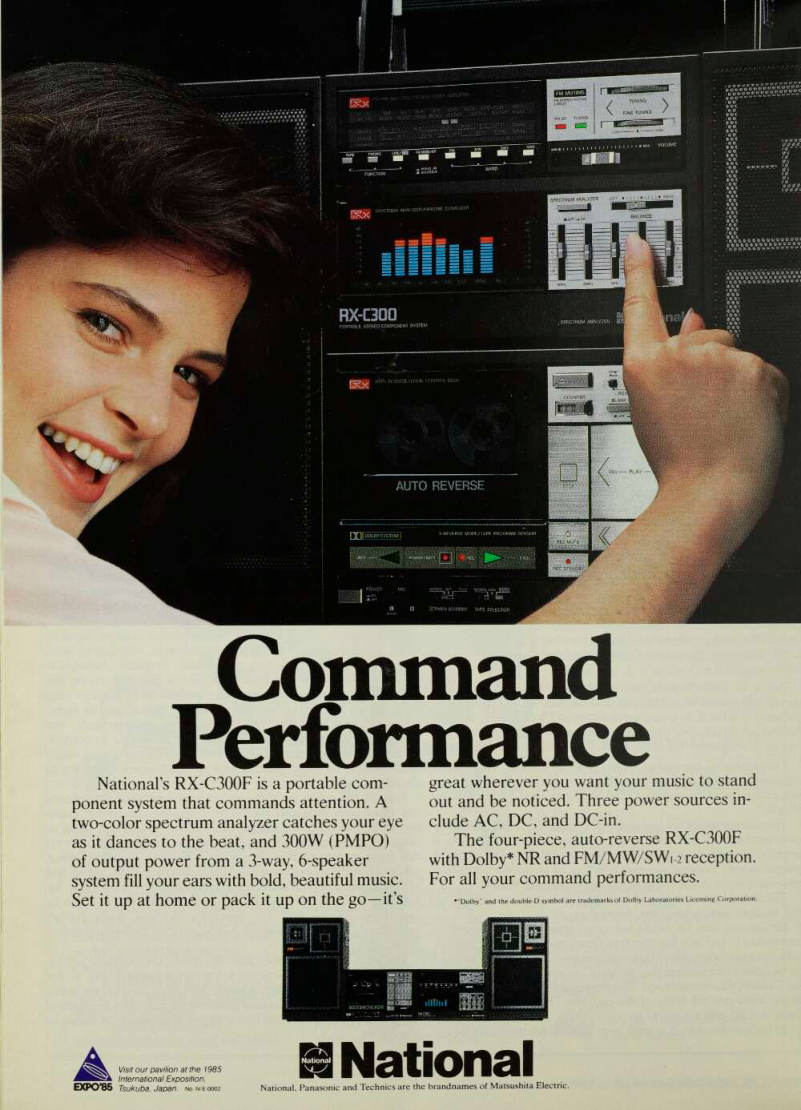
National’s RX-C3OOF is a portable component system that commands attention. A two-color spectrum analyzer catches your eye as it dances to the beat, and 300 W (PMPO) of output power from a 3-way, 6-speaker system fill your ears with bold, beautiful music.
Set it up at home or pack it up on the go—it’s great wherever you want your music to stand out and be noticed. Three power sources include AC, DC, and DC-in.
The four-piece, auto-reverse RX-C3OOF with Dolby* NR and FM/MW/SWi 2 reception.
For all your command performances. •"Dolby" and the double-D symbol are trademarks of Dolby Laboratories Licensing Corporation.
Visit our pavilion at the 1985 International Exposition, EXPOBS Tsukuba, Japan, no iv E-0002
National
National, Panasonic and Technics are the brandnames of Matsushita Electric.
Pacific Rport
Foreign Ministers Critical On Caledonia
The foreign ministers of Papua New Guinea, Solomon Islands, and Vanuatu, meeting in Port-Vila at the beginning of June, strongly criticised French methods in the attempt to bring independence to New Caledonia, and stated their intention to have New Caledonia returned to the United Nations list of non-self-governing territories.
They also said there was no need for the referendum which France planned to hold on the question of independence. Their statement was issued after two days of talks with representatives of the pro-independence Kanak party, FLNKS. The ministers said they wanted to see the matter of New Caledonia given greater prominence and debate than in the past at this year’s meeting of the South Pacific Forum in Rarotonga, Cook Islands, in August.
They said they would be meeting again to discuss the issue before the Forum meeting.
French N-Tests: B/G, Then Small, Bang
France was reported to have exploded a small nuclear device at its underground test site at Moruroa, French Polynesia, on June 3.
Monitoring the test in the Cook Islands, New Zealand Government seismologists estimated its strength at 10 kilotonnes. The test was the 70th France had carried out since it began underground testing 10 years ago on June 5, 1975. The June 3 test followed a May 9 blast of 150 kilotonnes, the biggest explosion yet detected at Moruroa.
Kiribati-Ussr Talks In Singapore
A Kiribati Government delegation returned from Singapore in late May after a second round of talks with the Soviet Union on a fishing agreement. A Radio Australia correspondent in Tarawa reported that details of the talks had not been released, but that it was certain that no final deal had yet been struck. The delegation was led by Minister for Natural Resources Development Babera Kirata, who said that the Singapore meeting had given the government an insight into Russian proposals, but that the whole fishing deal would be discussed with the Kiribati people. During an earlier meeting of the Kiribati Parliament, concern was expressed about the fishing deal proposal. A compromise was reached so that Mr Kirata could go ahead with the talks, but it was agreed that the Kiribati people would have the final say on any agreement reached between their government and the Soviets.
HERNU’S THUMBS-UP ON NOUMEA BASE . . .
On a lightning visit to New Caledonia in May, French Defence Minister Charles Hernu was flown from Noumea by helicopter to join the nuclear submarine Rubis, which an hour or so later became the first French submarine ever to visit the territory. After inspecting Noumea harbor’s Point Denouel, which is to be the site of a large naval dock under France’s plan to set up a military base in New Caledonia, Mr Hemu said construction of the base could take about three years and cost up to CFP4OO million (about $A3.5 million). New Caledonian firms would be given most of the work. On the presence of the Rubis in Noumea, Mr Hernu said it would stay for about eight to 10 weeks, and that its visit would be followed by visits by other submarines. . . . BUT TAHITI’S GASTON SAYS “NO”
To the dismay of most other political leaders in the territory, French Polynesia’s Premier Gaston Flosse, from the very beginning of “the troubles” in New Caledonia, has supported the French settlers and their Melanesian stooges even to the point of signing a treaty of mutual assistance with his colleague Dick Ukeiwe. (Incidentally this treaty, supposedly laying the foundation for a grande alliance of all French Pacific territories, was recently annulled by a French court because, under the colonial constitution still in force in the territories, foreign relations are the exclusive domain of the government in Paris.) It was therefore somewhat surprising to hear, when Gaston Flosse emerged from an audience with French President Mitterrand at the Elysee Palace on May 7, that he was against French plans to establish a military base in Noumea as a sop to the French settler population. In an interview with Le Figaro Flosse provided readily understandable and cogent reasons for his
stand. He told the conservative Paris daily: “To me the project simply doesn’t make sense. I’m at a loss to figure out the basic reasoning behind it. France has no enemies in this part of the world, and there is no war danger to justify establishing such a base. It will in fact only make our lives more difficult. We already have to contend with opposition from the Pacific nations to the nuclear testing at Moruroa, which I approve of, because I am in favor of France having a nuclear deterrent. If in addition to Moruroa, Noumea is also to become a military base, the other Pacific countries will say: ‘France’s only interest in the Pacific is strategic.’ This will create difficulties for us in French Polynesia. We have already begun to establish friendly relations with several other Pacific governments, but what do we see now? They’re not going to want to have anything more to do with us because they will disapprove of this new military base. ” Marie-Therese and Bengt Danielsson.
Montoya , Zeder, Clash On Ipseco
U.S. Assistant Secretary of the Interior Richard Montoya and President Reagan’s personal representative to the Micronesian Status Negotiation Fred M. Zeder have clashed over the role of the London-based engineering firm IPSECO in the Trust Territory.
Montoya told a U.S. House of Representatives sub-committee: “Another Trust Territory government, Palau, must now deal with heavy indebtedness. Like the Marshall Islands with its $24 million IPSECO power plant complex, Palau contracted with IPSECO for a $32-million plant. According to a report in Pacific magazine, quoted by the Koror paper Rengel Belau, Mr Zeder dismissed criticism of Palau’s IPSECO plant as “so much carping by petty bureaucrats who have very little grasp of what the business world is all about, particularly the international business world. ” Zeder said that the 16 mW IPSECO plant, far from being too large, as critics had claimed, could well be obsolete within 10 years unless Palau remains pristine and undeveloped which will not be the case since “the Japanese won’t allow it.” He foresaw that Palau would become “Tokyo’s Miami Beach. ” On Palau’s default in its IPSECO loan payments, Mr Zeder acknowledged that there were some “problems,” but said that something was being done to make the British banks more “comfortable.” But he emphasised that the U.S. was not about to bail Palau out of its IPSECO debt.
Png Invited To Join Asean Committees
The Association of South-east Asian Nations (ASEAN) has invited Papua New Guinea to join three of its committees, those on food, agriculture and forestry, social development and social technology.
Hitherto, PNG has only had observer status but the change does not mean that PNG would become a full member of ASEAN. In the past, various PNG personalities have stressed that, although they are interested in ASEAN, they did not attach the same importance to membership of the organisation as they did to their active membership of the South Pacific Forum and the South Pacific Commission.
New Caledonia: Enter M. Wibaux
France’s new High Commissioner in New Caledonia, Fernand Wibaux, has arrived in Noumea. He replaces Edgard Pisani who has returned to Paris to take up the newly created Cabinet post of minister responsible for New Caledonia. Mr Wibaux was previously France’s ambassador in Lebanon. In an early statement, he made it clear he did not like curfews, thus raising hopes that he may lift the order which has been clearing the streets of Noumea at 11 p.m. each night.
Western Samoa’S 23Rd Anniversary
Western Samoa, the first Pacific Island nation to achieve independence (in 1962), held its traditional three-day Independ ence holiday at the beginning of June. On June 3 thousands of people turned out in the streets of Apia to celebrate their 23rd anniversary of independence. The day began with a town parade followed by the raising of the flag and a 21-gun salute fired by the Australian frigate Canberra, which was in Apia to take part in the
celebrations. In his speech at the flag-raising ceremony, Head of State Malietoa Tanumafili referred to the difficulties faced by Samoa, a small country in the age of technology. He called on the people of Samoa to prepare themselves well for change ahead, and to be ready to play their roles in the future of the country. Later in the day celebrations continued with horse races, a reception given by Prime Minister Tofilau Eti for visiting diplomats, and the inaugural Samoa Games, featuring international boxing events between Australia and Western Samoa, rugby matches between teams from Tonga, Fiji and Western Samoa, and weightlifting with competitors from Australia, New Zealand, India, and Western Samoa.
Fui Sugar To Europe On Time
Fiji’s first shipment of sugar to Europe this season is expected to arrive on time, despite a two-weeks delay caused by farmers at first refusing to harvest cane in protest at low prices. The Chief Executive of the Fiji Sugar Marketing Company, John May, said the freighter chartered to carry the first shipment of 18,000 tonnes would be loading at Labasa and Lautoka starting in the first week of June.
Greenpeace Resettles Rongelapians
The Greenpeace organisation in late May completed evacuation of 250 inhabitants of Rongelap Atoll in the Marshall Islands to Mejato Island on the western rim of Kwajalein Lagoon. Four separate contingents of Rongelapians made the 150 km voyage in the Greenpeace yacht, the Rainbow Warrior. They believed they were continually endangered by radiation from the US nuclear test when they were exposed to fall-out from the first hydrogen bomb exploded over Enewetak Atoll on March 1, 1954. A group of islanders has remained behind on Rongelap to draw up an inventory of plantations, coconut crabs and fish for lawyers who are preparing a claim for compensation of the Rongelapians against the United States.
Tahiti Firm In Cooks Power Project
The Tahiti-based engineering firm SEDER is to provide Rarotonga with a wood-fuelled electric power station which it is claimed will provide 87 per cent of the island’s power needs, and save the Cook Islands Government SNZI.B3 million a year in fuel imports.
The power station is but one aspect of a plan drawn up by SEDER for Cook Islands independence in the field of energy. Other aspects of the plan call for the building of two small hydro-electric power stations on Rarotonga, and use of solar energy throughout the 14 other islands of the Cooks. Key to the wood-fuel plan is the tree, leucaena Leucocephala, a giant, fast-growing relative of the so-called false acacia, which is present in abundance on Rarotonga. Stockpiling of its wood has already begun with the target of having enough on hand by September, 1986, when the Turama Nui station is due to start operation, to keep it going for 18 months to two years. The I.7mW-capacity plant will bum between 16,400 and 22,400 tonnes a year, depending on the dampness of the wood. It will take 2 kg of wood to produce 1 kW/hour of power.
Long-term supplies of the wood will be assured, according to SEDER planners, by plantations of leucaena Leucocephala totalling 600 ha, with 10,000 to 20,000 trees per ha, and a cutting every three or four years. The public will be involved, and landowners are said to be enthusiastic about the plan. The wood will be purchased by the power station at a rate of SNZ2O a tonne.
Plantations will be on both government and private land, with about 50 families likely to be direct beneficiaries. SEDER’s director M. Auroy gave the measure of his company’s seriousness about the Ratotonga project when he said; “We cannot afford to make a mistake. We’re out to build power stations elsewhere in the Pacific.”
Olewale Is Paid In Tv Shares
Sir Ebia Olewale, a former Papua New Guinea Minister for Foreign Affairs, who has been out of politics since his defeat in the 1982 general election, has been given 10 per cent of the shares in Niugini Television Network, the subsidiary of N.B.N. Ltd. of Newcastle (Australia), which was recently licensed by the government to operate television in PNG. Parry Corporation of Australia will control 66 per cent and the balance of 23.3 per cent will be issued at par value, 50 toea (cents) a share to Papua New Guineans. Sir Ebia has been given the shares in consideration of his work to establish the company. According to Stewart Naunton,
of Coopers and Lybrand, the international firm of accountants and auditors, Sir Ebia’s shares, worth K 220,000 ($A275,000) were granted totally in consideration of his developmental efforts for the project, with no cash to be paid over, and Parry will receive shares valued at K 1,466,667 ($A8,833,267)) for cash payment of K 575,667 ($719,560), the remainder being Parry’s in view of its developmental efforts and expenses. Sir Ebia, who has worked on the project for nearly two years, said: ““All the time I have worked for this project, I have not got a toea from it. ” Mr Naunton said the basis for evaluating the efforts of Parry Corporation and Sir Ebia had been placed before the State negotiators and there had been no quarrel or questioning of the formula.
Barclays Pull Out Of Fui, Tuvalu
Barclays Bank, of Britain, is withdrawing from Fiji and Tuvalu. It will hand over its three branches in Fiji to Australia and New Zealand Banking Group Ltd. Its withdrawal has been described by Mr L. Robinson of the bank’s Australian branch as part of a new managerial strategy. Barclays has been manager for the last five years of the National Bank of Tuvalu in which it has a 25% shareholding, and its withdrawal comes with the expiry of the agreement with the Tuvalu Government in May. Westpac Banking Corporation will take over as manager of the National Bank of Tuvalu.
Tinian: Girl Takes On U.S. Military
A lawsuit challenging the legality of American military operations on Tinian Island in the Northern Marianas has been filed in a Federal court in Honolulu on behalf of a 17-year-old student who owns land on the island. Jovita Nabors claims the military operations on the island violate Federal environmental protection regulations. She is asking for a permanent injunction to halt the activity.
National Marine Sanctuary In A. Samoa
Fagatale Bay, 12 km southwest of Pago Pago, has been designated as a national marine sanctuary. The bay, formed when the seaward wall of a volcanic crater collapsed, is the habitat of a large variety of plants and animals including the green sea turtle and the hawksbill turtle, which will be protected in the sanctuary under a 1972 law.
Six other American national marine sanctuaries are on the east and west coasts of the U.S. mainland.
Pitcairn's On The Telephone
Pitcairn Island has a new, high frequency radio telephone enabling vocal communication with the outside world through the New Zealand international toll network. It replaces an old Morse transmitter.
Castration, Hanging, For Png Rapists?
Papua New Guinea’s Cabinet on June 4 endorsed a Bill providing for castration of rapists, and hanging for pack rape or rape where there was murder involved. If the Bill is passed by Parliament, Cabinet would be able to direct that a convicted person be hanged in public. The Bill was submitted to Cabinet by Prime Minister Michael Somare, who has been under intense pressure over law and order in recent months. He told Parliament he was “declaring war on hooligans and thugs.” The Bill also provides for the death penalty where a judge believes it is warranted, or where the victim was a child. Because the Bill does not require any change to the constitution, a simple majority of Parliament would be required to pass it. There could be opposition from some government members, including the Melanesian Alliance which recently went into coalition with Mr Somare’s Pangu Pati. But the legislation could also draw some Opposition support. Mr Somare told Parliament that the present minimum 10-year penalty for rape had provided insufficient deterrent. He said it was time for the government to “meet force with force”. The prime minister referred to recent complaints from business in PNG, potential investors, as well as women’s and other community groups. He said PNG had become “a sick society”, and the government was no longer willing to see peaceful people held to ransom. He hinted that other tough measures might be needed to combat the law-breakers. The prime minister had been under increased pressure on law and order because of a recent statement that measures to fight crime meant it was now “safer to walk the streets”. From AAP Correspondent Craig Skehan in Port Moresby.
letters
Moruroa report: Critics reaffirm demand for medical survey
The bland, reassuring report by the team of two New Zealand radiation experts, a geologist and an environmental scientist from Australia, and a marine biologist from Papua New Guinea, who made a flying visit to Moruroa in October 1983, which was eventually released eight months later, did not convince many people that 106 atomic bomb explosions can do no harm whatsoever. Least of all did it impress those for whom it was intended: the heads of the 13 South Pacific Forum nations, who have con tinued to oppose the French nuclear tests with the same, or even greater vigor.
In our column in PIM, Octo ber, 1984, we analysed in detail the numerous shortcomings of this Atkinson report, so named after the leader of the inspec tion team, who was at the time director of the New Zealand Radiation Laboratory. The best way to sum up our criticism is to say that it was, in our consi dered opinion, the wrong sort of investigation, undertaken at the wrong place by the wrong kind of scientists.
Our reasons for this rather harsh conclusion were those advanced by all other critics: the number one problem today is not to determine with preci sion the extent of the consider able pollution which has taken place at Moruroa, but to find out how many people living in the other 99 islands of French Polynesia have contracted can cer as a result of having absorbed into their bodies radioactive substances emitted mainly by the 41 bombs deton ated in the atmosphere be tween 1966 and 1974. This is why the Territorial Assembly in French Polynesia has repeated ly, but always in vain, deman ded that a medical survey be made.
In a belated face-saving effort, Mr Atkinson’s successor as director of the New Zealand National Radiation Laboratory, Mr A C. McEwan has written to PIM (April issue) complaining that our criticism is unfair on the following three counts, upon which we shall immediately comment: a) We have “overlooked or missed the whole significance of the conclusions of the report. A fundamental consideration is that if there is no significant radiation exposure, there can be no radiation-induced can cers. ”
As anyone who cares to reread our October 1984 col umn can ascertain, far from overlooking the significance of the strange method used by the Atkinson-McEwan team to de termine the prevalence of can cer in French Polynesia, we actually criticised it in the strongest terms. For what these radiation and environmental experts have done, unable as they were to make any inde pendent medical observations, is simply to speculate on the possible ill-effects suffered by the inhabitants of French Polynesia, basing their esti mates solely on the yields of past explosions, as estimated by the French bombers them selves. How fallacious such a purely deductive method of determining the number of can cer victims is has been amply proven by the recent revela tions of various British and American commissions that, contrary to the assurances of all radiation experts and govern ment officials back in the 1950 s and 19605, a great number of people who lived in or near the test sites in Australia, Mic ronesia and Nevada, have in deed been contaminated. b) We harbor “the miscon ception that leakage would
occur at the time of the tests. In fact leakage of radio-activity would occur as a slow process over a period of time.”
Whether slow or rapid, leak age of radioactivity into the ocean is a serious source of contamination of marine life.
And does Mr McEwan really believe that the leakage was slow also on the numerous well-documented occasions when holes were blasted in the flank of the atoll by bomb accidents, as for instance the one that occurred on July 25 1979? The French Government Commissioner for Natural Dis asters, Professor Haroun Tazieff, who has visited Morur oa twice, estimates that one million tonnes of rock and coral were tom out on this occasion, obviously creating an enor mous escape route for radioac tive substances. c) We “continue to raise the bogy of radioactive waste dis persed in storms some years ago”.
It is a well-known fact, con firmed by French Minister for Defence Charles Hemu himself in parliamentary speech, that through criminal neglect of a succession of Moruroa military base commanders, nuclear waste material, including 10-20 kg of plutonium, was allowed to accumulate in the 1960 s and 1970 s on the reef on the north side of Moruroa. As certified by the French CEA-CEP techni cians, much of this was waste dispersed by two cyclones which hit Moruroa. The team to which Mr McEwan belonged could therefore have performed a useful service by visiting this nuclear waste dumping area, but was refused permission by the French base commander to do so. It seems therefore perfectly justified to press for more precise information about what has happened to all this
lethal material.
Marie-Therese And
Bengt Danielsson
Papehue Tahiti French Polynesia
If only our
bodies could
choose...
The letter of A C. McEwan (PIM April) tells us: “The aver age contribution of fallout radionuclides in soil to human exposure at Moruroa is . . . much lower than those of naturally-occurring radioactive materials. ”
His assurance would be more meaningful if our bodies could choose between natural back ground radiations and man made ones.
In reality our bodies are exposed to the former ones plus the latter ones.
And even the proponents of nuclear power don’t deny the increase in public health risk according to the amount of this additional exposure. They tell us to accept the risk for some benefit from the “peaceful atoms”.
But for what benefit should Polynesians accept this additio nal health risk?
Another Hiroshima or Naga saki won’t bring us the end of a war but will be the beginning of another world war and possibly the end of the earth.
The study of the deve lopment of more effective bombs at Moruroa, I think, provides no benefit to anybody.
That is the reason why we are so sensitive of these man-made radiations.
Fuciwaki Koichi
4-3-1-108 Masago Chiba 260 Japan
"The solution
Pisani On New Caledonia
"The solution must come from inside
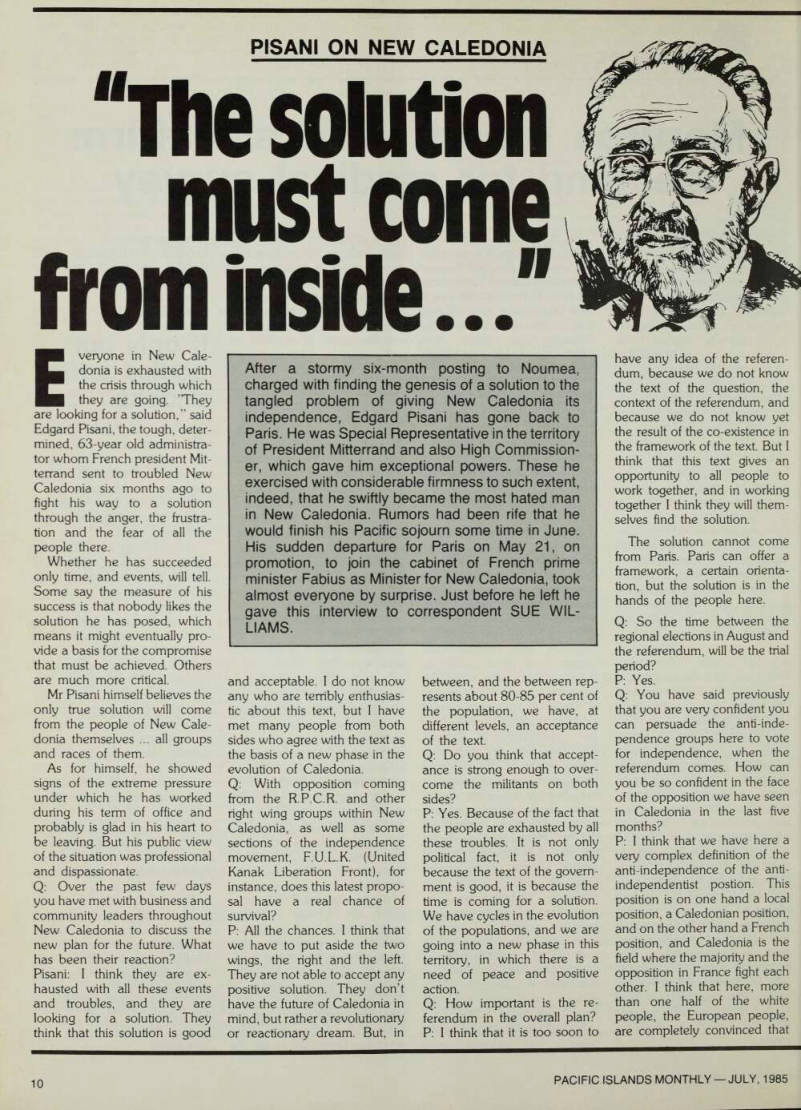
Everyone in New Cale donia is exhausted with the crisis through which they are going. ’They are looking for a solution,” said Edgard Pisani, the tough, deter mined, 63-year old administra tor whom French president Mit terrand sent to troubled New Caledonia six months ago to fight his way to a solution through the anger, the frustra tion and the fear of all the people there.
Whether he has succeeded only time, and events, will tell.
Some say the measure of his success is that nobody likes the solution he has posed, which means it might eventually pro vide a basis for the compromise that must be achieved. Others arc much more critical.
Mr Pisani himself believes the only true solution will come from the people of New Cale donia themselves ... all groups and races of them.
As for himself, he showed signs of the extreme pressure under which he has worked during his term of office and probably is glad in his heart to be leaving. But his public view of the situation was professional and dispassionate.
Q: Over the past few days you have met with business and community leaders throughout New Caledonia to discuss the new plan for the future. What has been their reaction?
Pisani: I think they are ex hausted with all these events and troubles, and they are looking for a solution. They think that this solution is good
After a stormy six-month posting to Noumea, charged with finding the genesis of a solution to the tangled problem of giving New Caledonia its independence, Edgard Pisani has gone back to Paris. He was Special Representative in the territory of President Mitterrand and also High Commission er, which gave him exceptional powers. These he exercised with considerable firmness to such extent, indeed, that he swiftly became the most hated man in New Caledonia. Rumors had been rife that he would finish his Pacific sojourn some time in June.
His sudden departure for Paris on May 21, on promotion, to join the cabinet of French prime minister Fabius as Minister for New Caledonia, took almost everyone by surprise. Just before he left he gave this interview to correspondent SUE WIL
Liams.
and acceptable. I do not know any who are terribly enthusias tic about this text, but I have met many people from both sides who agree with the text as the basis of a new phase in the evolution of Caledonia.
Q: With opposition coming from the R.P.C.R. and other right wing groups within New Caledonia, as well as some sections of the independence movement, F.U.L.K. (United Kanak Liberation Front), for instance, does this latest propo sal have a real chance of survival?
P; All the chances. I think that we have to put aside the two wings, the right and the left.
They are not able to accept any positive solution. They don’t have the future of Caledonia in mind, but rather a revolutionary or reactionary dream. But, in
between, and the between rep resents about 80-85 per cent of the population, we have, at different levels, an acceptance of the text.
Q; Do you think that accept ance is strong enough to over come the militants on both sides?
P: Yes. Because of the fact that the people are exhausted by all these troubles. It is not only political fact, it is not only because the text of the govern ment is good, it is because the time is coming for a solution.
We have cycles in the evolution of the populations, and we are going into a new phase in this territory, in which there is a need of peace and positive action.
Q: How important is the re ferendum in the overall plan?
P: I think that it is too soon to
have any idea of the referen dum, because we do not know the text of the question, the context of the referendum, and because we do not know yet the result of the co-existence in the framework of the text. But I think that this text gives an opportunity to all people to work together, and in working together I think they will them selves find the solution.
The solution cannot come from Paris. Paris can offer a framework, a certain orienta tion, but the solution is in the hands of the people here.
Q: So the time between the regional elections in August and the referendum, will be the trial period?
P: Yes.
Q: You have said previously that you are very confident you can persuade the anti-inde pendence groups here to vote for independence, when the referendum comes. How can you be so confident in the face of the opposition we have seen in Caledonia in the last five months?
P: I think that we have here a very complex definition of the anti-independence of the anti independentist postion. This position is on one hand a local position, a Caledonian position, and on the other hand a French position, and Caledonia is the field where the majority and the opposition in France fight each other. I think that here, more than one half of the white people, the European people, are completely convinced that
independence is on the way in any case, and we have to demonstrate to them that the sooner it comes, the better.
Because, I think, that if we hide the problem over five years, it will spring up again very much worse than it is now. I think the timing of this proposal is the best we could have hoped for.
Q: Are you disappointed that your calendar for independ ence next year was not adopted by your government?
P: I am never disappointed.
When a man has to face such a problem, he has to be adamant, without any disappointment, without any personal feeling.
Q: And you can be like that?
P: It’s not so easy .. it’s very difficult to be such, but I have to be such, and I am not at all disappointed by the choice made by the French Govern ment. Because, I suggested two ways the other which was the referendum in September, and this way, and the government chose this way with a two and a half year trial period to renew the relationship between the communities.
It is a very good solution. For me it is the best one, because it has been chosen by the govern ment. You see, when two solu tions are in balance, different but equally good, the best one is that which is chosen by those responsible in power. Now I have completely forgotten the other solution.
Q: So in your job now, to
devise a plan for the economic and social restructure of New Caledonia, what are your main goals?
P; Education and training the experience of responsibility for the Melanesian people in the towns and regions, agricultural development, solution of the land tenure problem, and perhaps, mainly, the opportun ity for the two communities to work together.
Q: Do you think the people of Noumea will accept such changes as will come about after the regionalisation of New Caledonia, with Noumea then being by-passed as the main hub of economic and social activity?
P: Caledonia without Noumea is nothing; Noumea without Caledonia is nothing. They have to work together. The wealth of Noumea is reaching its ceiling, because of the rela tive poverty of the territory, and without Noumea, the machine, Caledonia has no chance of development. Regionalisation is an attempt to spread out the wealth of Noumea in the terri tory, and to give Noumea a new impetus in the economic field. But this is not the main problem. The main problem is for the European people to accept to share the power, to accept to share the wealth.
Q: Do you understand though, their feeling of fear that they may lose everything -everything they have fought
for, built and invested in this country?
P: To take the problem by another way, imagine this status remaining. There would be no peace, no chance of deve lopment. In this political ba lance, this position, Caledonia will not, could not, know any peace, any development, be cause the Melanesian people do not accept this present situa tion.
We are trying to set up a more balanced system, where European people, Melanesian people, and other communities, will have a fair place in power and in the economy.
Q: But what about the very vocal viewpoint that you parti cularly, and your government, have allowed the F.L.N.K.S. to operate freely as criminals in this country, murdering, bur ning, robbing...?
P: How many murders? And you have no murders on the other side? We have to take into account the fact that when a political need, a political de mand, is made and remains strong and loud, no-one can stop the violence.
I think, we think, that the Melanesian demand is largely legitimate, normal.
We have to redefine the system of managing this coun try to take this demand into account, and nowhere in the world can anyone stop this kind of evolution. The United King dom knows perfectly well this problem, France knows perfect ly well this problem. Can we
repeat our mistakes? A French philosopher wrote in the 19th century “When you cannot stop a revolution, please do it by yourself.”
Q: How many countries have you helped prepare for inde pendence?
F: This is the first. But I used to work with newly-independent countries, many of them 90.
I have visited perhaps 60 new ly-independent countries and negotiated with them their own development so I know the difficulties of independence.
In my dream we are trying to succeed, building up an inde pendence. It is a very ambitious job and to succeed here we have to face three problems.
The Kanak demand, the rights of the other communities, and the necessity for France to remain present in this region of the world. I think we can succeed.
Q: You sound very positive.
P: I think we are on the way, and I think we are in a country where cyclones are frequent, so we have to avoid, if it is possible, cyclones, and we have to proceed quietly, without any trouble.
Q: Surely, that is one of the difficulties with New Caledonia.
Is it not like a pressure cooker, and you cannot predict when it will explode? A few weeks ago things appeared to be calming down, and yet look at the events we have just experi enced?
P: Yes. Let us look back to the events of May 8. All the ingredients were there for an
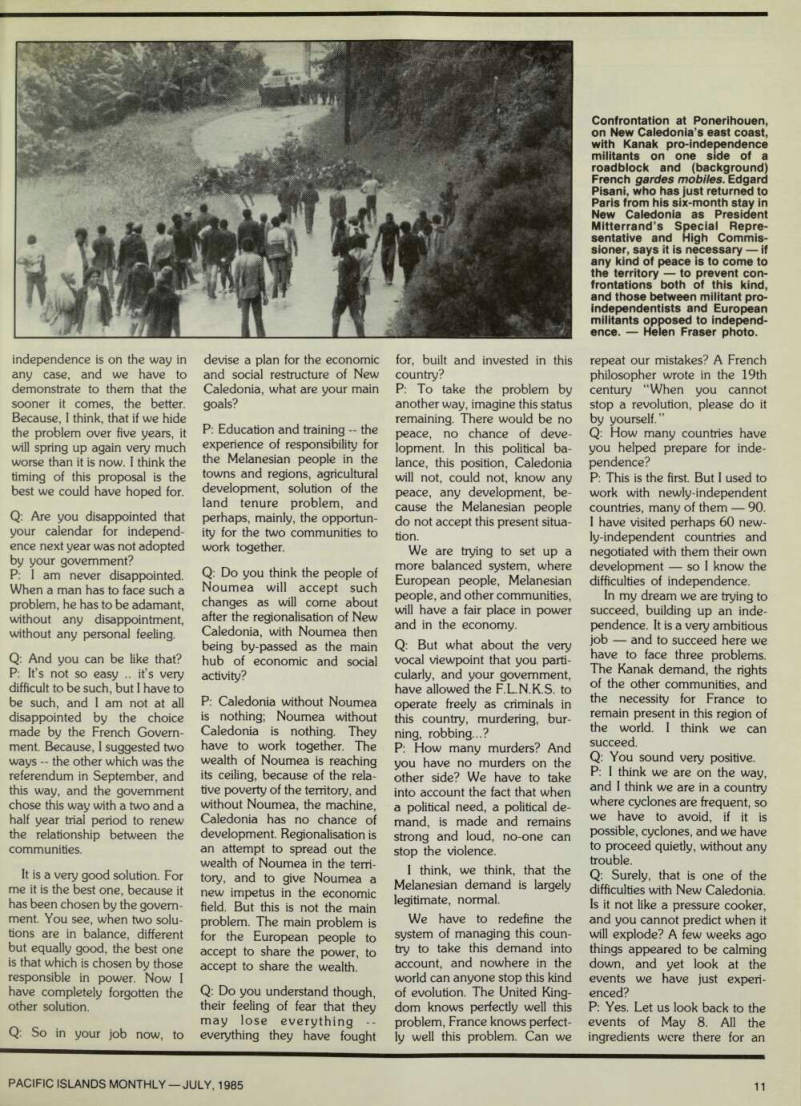
Confrontation at Ponerihouen, on New Caledonia’s east coast, with Kanak pro-independence militants on one side of a roadblock and (background) French gardes mobiles. Edgard Pisani, who has just returned to Paris from his six-month stay in New Caledonia as President Mitterrand’s Special Repre sentative and High Commis sioner, says it is necessary - if any kind of peace is to come to the territory - to prevent con frontations both of this kind, and those between militant pro independentists and European militants opposed to independ ence. - Helen Fraser photo.
explosion - but no explosion occurred. We were on the brink for several hours. But, how many people were on the streets? Fifteen hundred? Cer tainly no more. Six months ago there were 20,000 people. The situation is not the same as it was. I am not saying that we are
succeeding. I am not saying that I am sure to succeed. But I am saying that we are on the way and that people here are aware of the dangers confronting them.
Q; What is your biggest frustra tion in this job? You said earlier you had to maintain a fairly
inhuman front, but the job has obviously taken its toll.
P: I have no frustration. You see, democracy for me is a system where one who cannot convince others does not ac cuse others, but accuses him self, and I have the feeling that we are on the way to convin cing a large majority that the only way is to work together again in the framework of a totally new definition of the relationship between France and Caledonia.
Q: What has been your greatest satisfaction?
P: 0h...1 have a lot of them, the main satisfaction is clearly, alas, the meeting of young scholars, the young people, on May 9, when they called to us to be responsible, telling us the future is in our hands. This fact has been paid for by the death of a young Melanesian (in the riot of May 8), but the reaction has been a white guy and a black girl asking us to face our re sponsibilities and to build Cale donia. Yes ... and it is because of that, in spite of all, I am confident. And not even confi dent, I am adamant.
Q; And if you return to Paris, will you continue your work on New Caledonia?
P: Ask President Mitterrand. I don’t know. But I will never forget Caledonia. Caledonia will be present in my mind in any case, because I reached
here the extreme point of my capability.
Q; Do you think true democra cy is possible here? I mean, is a Kanak socialist government a democracy?
P: I think the majority of F.L.N.K.S. and L.K.S. are strongly democratic, but I know that some people among the independentists are more re volutionary, so we will have problems. And I know that independence is very difficult with a democratic system such as ours. But I think that the men I know are truly democrats respectful of men, respectful of differences between the com munities, and able to imagine forms of democracy at the village level, and town level, that we do not know. Less formal, more based on solidar ity, biological solidarity. I think that it’s not impossible to have here a true democracy with some original aspects.
Q: That leaves the question wide open, doesn’t it? Such a democracy could mean many things. P: The problem is not only in the hands of the inde pendentists, it is at the same time in the hands of the anti independentists. If these ones accept to go in this way, the future is open. If independence has to be conquered achieved the hard way then democracy could become more difficult.
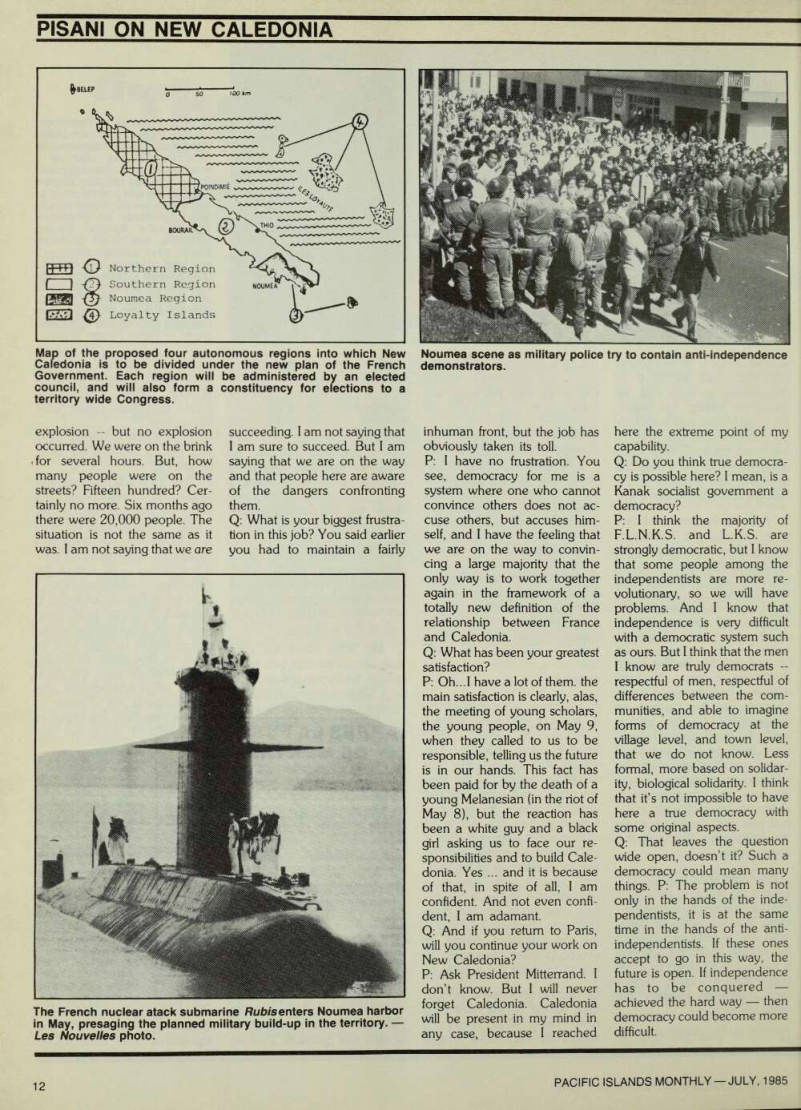
Map of the proposed four autonomous regions into which New Caledonia is to be divided under the new plan of the French Government. Each region will be administered by an elected council, and will also form a constituency for elections to a
territory wide Congress.
The French nuclear atack submarine Rubise nters Noumea harbor in May, presaging the planned military build-up in the territory.- Les Nouvelles photo.
Noumea scene as military police try to contain anti-independence demonstrators.
Kanaks coolit
Sue Williams’ Update
Kanaks coolit on election
Despite previous threats of a new boycott and doubts about the feasibility of the French government’s latest plan for the future of New Caledonia, the Kanak Socialist National Liberation Front (F.L.N.K.S.), has agreed to take part in the territorial regional election in August.
The decision came at the third congress of the Front at Hienghene, in the far north of New Caledonia, during the weekend of May 25 and 26.
Although they have reluctantly accepted the plan the Front made it clear it was against the proposal in principle, because it was not an F.L.N.K.S. plan and smacked of neo-colonialism.
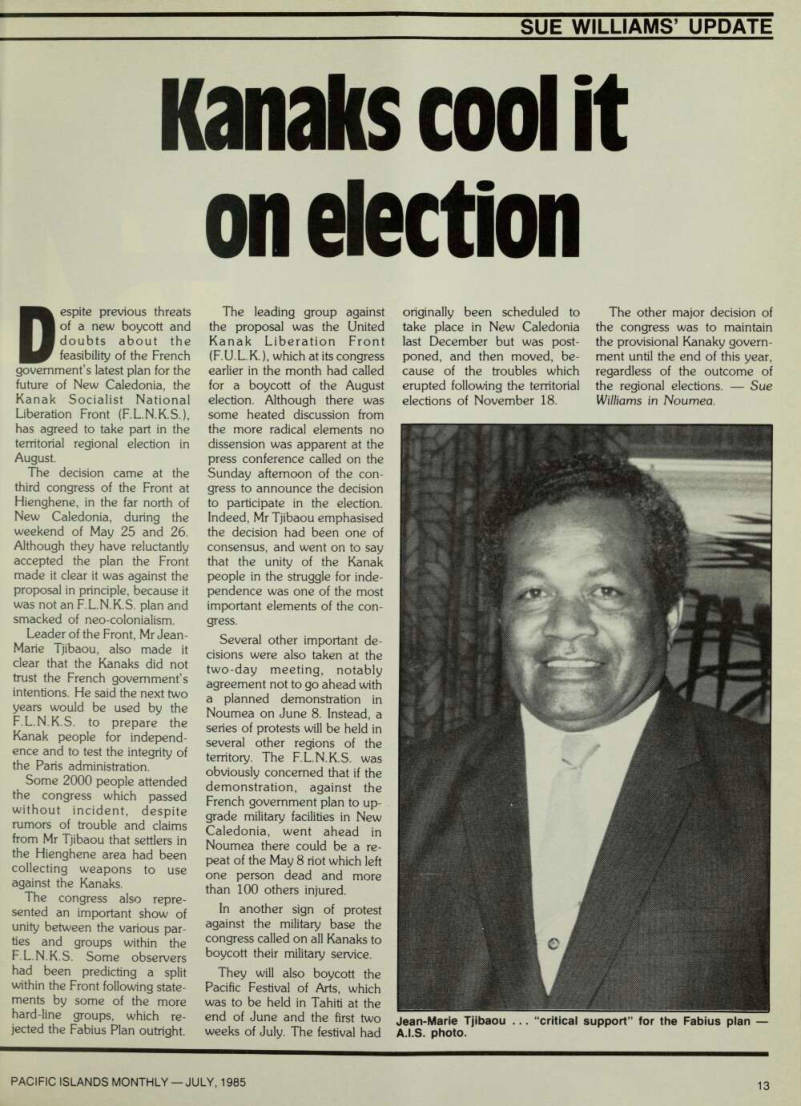
Leader of the Front, Mr Jean- Marie Tjibaou, also made it clear that the Kanaks did not trust the French government’s intentions. He said the next two years would be used by the F.L.N.K.S. to prepare the Kanak people for independ ence and to test the integrity of the Paris administration.
Some 2000 people attended the congress which passed without incident, despite rumors of trouble and claims from Mr Tjibaou that settlers in the Hienghene area had been collecting weapons to use against the Kanaks.
The congress also repre sented an important show of unity between the various par ties and groups within the F.L.N.K.S. Some observers had been predicting a split within the Front following state ments by some of the more hard-line groups, which re jected the Fabius Plan outright.
The leading group against the proposal was the United Kanak Liberation Front (F.U.L.K.), which at its congress earlier in the month had called for a boycott of the August election. Although there was some heated discussion from the more radical elements no dissension was apparent at the press conference called on the Sunday afternoon of the con gress to announce the decision to participate in the election.
Indeed, Mr Tjibaou emphasised the decision had been one of consensus, and went on to say that the unity of the Kanak people in the struggle for inde pendence was one of the most important elements of the con gress.
Several other important de cisions were also taken at the two-day meeting, notably agreement not to go ahead with a planned demonstration in Noumea on June 8. Instead, a series of protests will be held in several other regions of the territory. The F.L.N.K.S. was obviously concerned that if the demonstration, against the French government plan to up grade military facilities in New Caledonia, went ahead in Noumea there could be a re peat of the May 8 riot which left one person dead and more than 100 others injured.
In another sign of protest against the military base the congress called on all Kanaks to boycott their military service.
They will also boycott the Pacific Festival of Arts, which was to be held in Tahiti at the end of June and the first two weeks of July. The festival had
originally been scheduled to take place in New Caledonia last December but was post poned, and then moved, be cause of the troubles which erupted following the territorial elections of November 18.
The other major decision of the congress was to maintain the provisional Kanaky govern ment until the end of this year, regardless of the outcome of the regional elections. Sue Williams in Noumea.
Jean-Marie Tjibaou..."critical support" for the Fabius plan- A.I.S. photo.
Advertisements & other items, pp. 14-15 (1 item)
Nissa
BBS
, m vJ J 3 ■1 % - ' m Wmm w|f I I n
Li m S^i§SgSS^V r -- •V ■" ;> r Aife r ■ . . • . 7 A- - ■ n ■ ' A^-:' ; .v* ; -** Mi •7. A m ■-.■■■' a«
HfewA
. ■ in ■ mm Pi £flS , » -- V ... •. / -: HR 7.A: ■3^ - ■Jvv ; * 7 ■m m ■r A:-7 7 * j HE >"7 7 - .A
x : ■ " v „' 1 j^- ; .. -\ i vM.v I *^ ss .»*9*!M»iSf < <Pß-.-.. - -JJSI * •;. &t>*- , fV?* J 5: - .. > ■V^ *.■*><* ■ ’■■- .-■- ;#*-. ... “C# ■ ,
' '■■ ■4*#s£sk
-•* : ’ W _*f. „ - . hr w&**
Indonesia raises ante
Png Border Worries
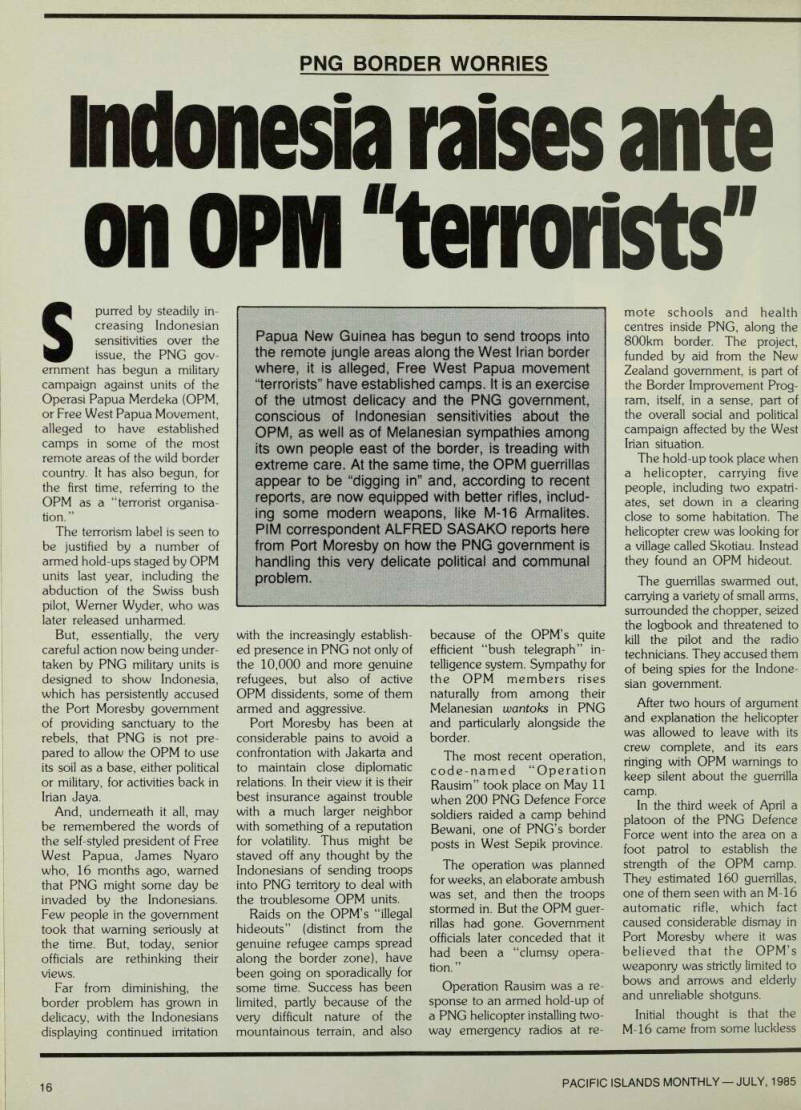
Indonesia raises ante on OPM "terrorists"
Spurred by steadily in creasing Indonesian sensitivities over the issue, the PNG gov ernment has begun a military campaign against units of the Operasi Papua Merdeka (OPM, or Free West Papua Movement, alleged to have established camps in some of the most remote areas of the wild border country. It has also begun, for the first time, referring to the OPM as a “terrorist organisa tion.”
The terrorism label is seen to be justified by a number of armed hold-ups staged by OPM units last year, including the abduction of the Swiss bush pilot, Wemer Wyder, who was later released unharmed.
But, essentially, the very careful action now being under taken by PNG military units is designed to show Indonesia, which has persistently accused the Port Moresby government of providing sanctuary to the rebels, that PNG is not pre pared to allow the OPM to use its soil as a base, either political or military, for activities back in Irian Jaya.
And, underneath it all, may be remembered the words of the self-styled president of Free West Papua, James Nyaro who, 16 months ago, warned that PNG might some day be invaded by the Indonesians.
Few people in the government took that warning seriously at the time. But, today, senior officials are rethinking their views.
Far from diminishing, the border problem has grown in delicacy, with the Indonesians displaying continued irritation
Papua New Guinea has begun to send troops into the remote jungle areas along the West Irian border where, it is alleged, Free West Papua movement “terrorists” have established camps. It is an exercise of the utmost delicacy and the PNG government, conscious of Indonesian sensitivities about the OPM, as well as of Melanesian sympathies among its own people east of the border, is treading with extreme care. At the same time, the OPM guerrillas appear to be “digging in” and, according to recent reports, are now equipped with better rifles, includ ing some modern weapons, like M-16 Armalites.
PIM correspondent ALFRED SASAKO reports here from Port Moresby on how the PNG government is handling this very delicate political and communal problem.
with the increasingly establish ed presence in PNG not only of the 10,000 and more genuine refugees, but also of active OPM dissidents, some of them armed and aggressive.
Port Moresby has been at considerable pains to avoid a confrontation with Jakarta and to maintain close diplomatic relations. In their view it is their best insurance against trouble with a much larger neighbor with something of a reputation for volatility. Thus might be staved off any thought by the Indonesians of sending troops into PNG territory to deal with the troublesome OPM units.
Raids on the OPM’s “illegal hideouts” (distinct from the genuine refugee camps spread along the border zone), have been going on sporadically for some time. Success has been limited, partly because of the very difficult nature of the mountainous terrain, and also
because of the OPM’s quite efficient “bush telegraph” in telligence system. Sympathy for the OPM members rises naturally from among their Melanesian wantoks in PNG and particularly alongside the border.
The most recent operation, code-named “Operation Rausim” took place on May 11 when 200 PNG Defence Force soldiers raided a camp behind Bewani, one of PNG’s border posts in West Sepik province.
The operation was planned for weeks, an elaborate ambush was set, and then the troops stormed in. But the OPM guer rillas had gone. Government officials later conceded that it had been a “clumsy opera tion.”
Operation Rausim was a re sponse to an armed hold-up of a PNG helicopter installing two way emergency radios at re
mote schools and health centres inside PNG, along the 800 km border. The project, funded by aid from the New Zealand government, is part of the Border Improvement Prog ram, itself, in a sense, part of the overall social and political campaign affected by the West Irian situation.
The hold-up took place when a helicopter, carrying five people, including two expatri ates, set down in a clearing close to some habitation. The helicopter crew was looking for a village called Skotiau. Instead they found an OPM hideout.
The guerrillas swarmed out, carrying a variety of small arms, surrounded the chopper, seized the logbook and threatened to kill the pilot and the radio technicians. They accused them of being spies for the Indone sian government.
After two hours of argument and explanation the helicopter was allowed to leave with its crew complete, and its ears ringing with OPM warnings to keep silent about the guerrilla camp.
In the third week of April a platoon of the PNG Defence Force went into the area on a foot patrol to establish the strength of the OPM camp.
They estimated 160 guerrillas, one of them seen with an M-16 automatic rifle, which fact caused considerable dismay in Port Moresby where it was believed that the OPM’s weaponry was strictly limited to bows and arrows and elderly and unreliable shotguns.
Initial thought is that the M-16 came from some luckless
Indonesian soldier knocked down by an OPM ambush on the west side of the border.
How many other such weapons might now be in the hands of the OPM is not known; the Indonesians are not disclosing how many weapons they have been losing in encounters with the OPM, nor even how many skirmishes they have been fighting. But, given Jakarta’s continued pressure on PNG, it seems clear the Indonesians find the OPM a boil on their geographical east-side.
Having established the strength of the rebel camp the PNG Defence Force then set about moving an estimated 16 tonnes of equipment, including munitions, into the Bewani area for the May 11 operation. In the event not a single rebel was captured, but the camp was thoroughly destroyed; it had probably been abandoned in favor of another site before the PNG troops arrived.
So far only one PNG De fence Force raid has caught the OPM napping. In that action, staged last year, 59 rebels were captured. However, while they were being taken back to the nearest PNG government bor der station all but one of them escaped. The lone prisoner left in the bag was found to have an ulcer on his foot, which afflic tion apparently prevented his joining the general exodus.
Senior government officials in Port Moresby say privately that the aim of their military operations against the OPM is to drive the rebels back into West Irian. “It is the Indone sians’ problem, not ours,” said one government man. “It is better not to jump after a drowning man into a pond full of crocodiles.”
From that it may be assumed that the government considers the OPM to have little real future and to face ultimate and inevitable “drowning.” They also seem to think the Indone sians might be as deadly as a crocodile-infested pond.
Anxiety that the Indonesians themselves might mount some kind of cross-border, allegedly “hot-pursuit,” military action against the OPM rebels in PNG seems to have been com
pounded by the on-off repatria tion of some of the more than 10,000 West Irian refugees now camped in PNG.
What started in February, 1984, as a trickle of refugees developed into a deluge which, in the end, has proved enor mously difficult to pump back across the border. Meeting after meeting has been held but, so far, the two sides have been unable to agree on suitable safeguards and other questions involved in the peaceful re patriation of so many people who, without any question, fear reprisals by their Indonesian masters.
For the Port Moresby gov ernment the question now is not when to send the refugees home, but how to go about it.
At the same time supplying and administering the camps is providing a severe problem.
Staff is short, money is being spent which could better be used elsewhere, and there is the constant political worry with Indonesia. Whether it is officially acknowledged by either Jakarta or Port Moresby, the fact seems now to be that the refugees have become established in PNG and, to a greater or lesser extent, offer a kind of support structure to the active OPM
guerrillas. That the rebels can wander in and out of the refugee camps, picking up food and other supplies, and gather ing information, is a source of considerable concern to the PNG government which is an xious to avoid giving the In donesians any excuse to charge it with lending a helping hand to the OPM.
“We want to avoid that at all costs,” said one government official. “But what can we do?”
At the Blackwater camp out side Vanimo town, for instance, one male refugee was recently caught trying to carry off some food to give to the rebels. It was part of a consignment given to the refugees under the UN High Commission for Refugees relief program. At another, smaller, camp, refugees chased off an unarmed PNG policeman trying to arrest several OPM men wandering into the camp in search of food. While the policeman and a government health official watched, powerlessly, the rebels were given food and left.
PNG’s worries about Indone sians reacting in more practical and belligerent ways are shared by a number of keen observers of the delicate situation. Former
U.S. Attorney-General, Ram sey Clark said recently: “It’s what you might call a sleeper - a situation that people have not yet seen is as seriously menacing as it is. It is past the time for this problem to be seriously addressed.”
Mr Clark said he felt the border tension was a very real potential threat to regional peace. “The U.S. should not ignore the problem,” he said.
“It should address it, and the policy of the government in Jakarta. Geo-political interests don’t really care about the little people, and Indonesia is the key to the geo-politics of this section of the Pacific.
“What we are really doing is backing the bully in the neighborhood,” he said.
And, as long-time observers of the Pacific scene might re mind Mr Clark, that, in fact, is what happened 20 years ago when, with U.S., and other western support, the United Nations ignored the plaintive pleas of the Dutch, the West Papuans and a few others with what might have been a clearer view of history to come, and handed the territory to Presi dent Sukarno. —Alfred Sasako and Staff Writers.
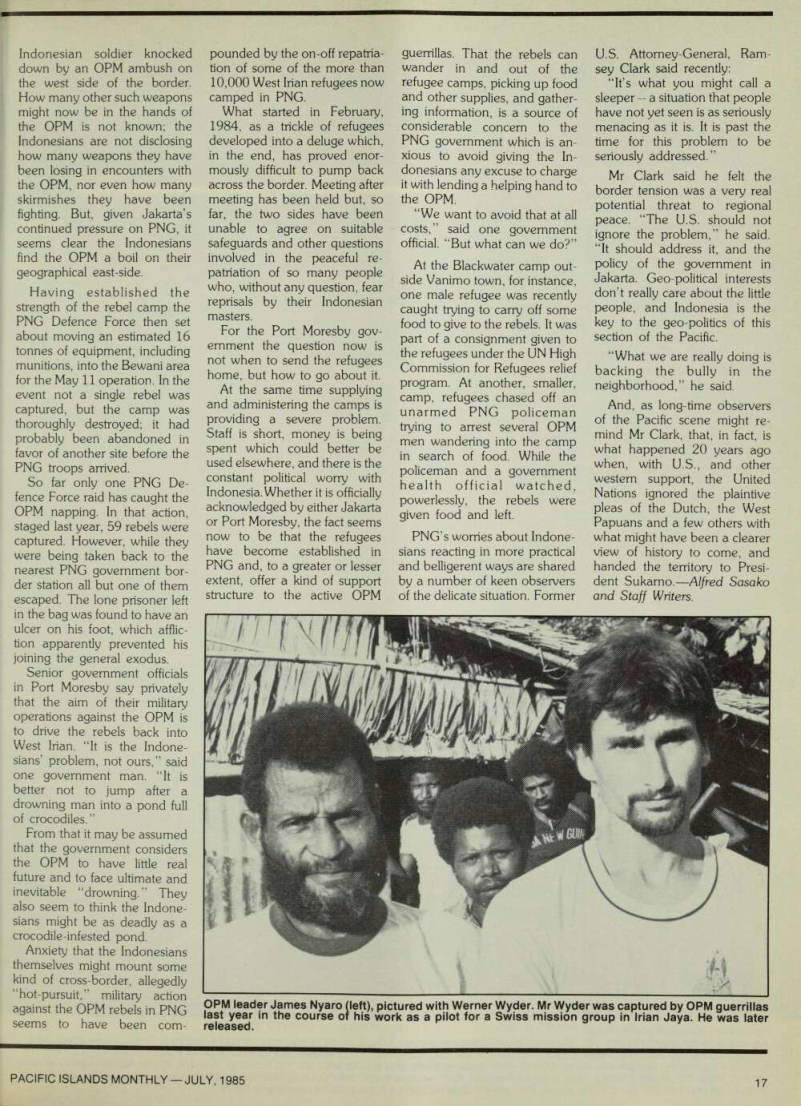
OPM leader James Nyaro (left), pictured with Werner Wyder. Mr Wyder was captured by OPM guerrillas last year in the course of his work as a pilot for a Swiss mission group in Irian Jaya. He was later released.
Advertisements & other items, p. 18 (1 item)
Sansui Intelligent Super Compo
Out of this world convenience.
with the Remote Compu-Equalizer.
Adjust each of 7 frequency baTids to taste. Recall any of five equalizations (three preset, two created by you) or ""flat" response. Select and pjay any input. Choose any AM or FM preset station*. Adjust the volume. All from anywhere'in the room by means of an invisible infrared beam.
And.tbat's only the beginning.
New Sansui-lntelligent Super Compo
now offers a double auto-reverse cassette deck, an "auto-reverse" turntable that plays both sides of a record, a spectrum analyzer, and a host of other great
components and features*
See Sansui's new Intelligent Super
Compo systems featuring the amazing
Remote Compu-Equalizer today. And
experience out of this world convenience.
SUP€R GQMPO
SYSTEM IS-1100F
A-1100P Integrated D Servo Amplii Music Power
(IHF): 180 W
RG-900R
Remote Con trol Compu- Equalizer T-900 Quartz-PLL Synthesizer
FM/AM Tun*
D-95WR
Double Aut( Reverse Cassette Deck
P-L9SR
Linear-Tracki "Auto-Rever Turntable AT-700 Audio Progr Timer (optio GX-1000 Audio Cabin s..\ '<> V / Also available in silver finish
S OTLsruh
CO., LTD. 14-1, Izumi 2-chome, Suginami-ku, Tokyo 168,
SANSUI ELECTRIC
an
CB-K7A
Cassette Cas (optional) For further information please contact: •Australia: VAN FI (Aust.) PTY. LTD. 297, City Road, South Melbourne, Victoria 3205, Australia Phone: 690-6200/283 Alfred Place, North Sydney, N.S.W. 2060, Australia Phone: 929-0293 *Fiji: PRABHU BROTHERS LTD. P.O. Box 183, Nadi Phone: 71122 *Papua New Guinea: OCEANIA INDENT AGENCY (P.N.G.) PTY. LTD.
P.O. Box 5518, Boroko, Port Moresby Phone: 256411 «New Zealand: DAVID REID ELECTRONICS LTD. P.O. Box 2630, Auckland, Phone: 488-049 «New Caledoma: HI-FI VICTOIRE, ETS. M. MERGER B.P. 1123, Noumea Phone: 27.59.11 Pacific: NAURU CO-OPERATIVE SOCIETY Republic of Nauru • Vanuatu: THE SOUND CENTRAL LTD. P.O. Box 434, Vila Phone: 2035 *Tahiti: DIMECO SIMEL B.P. Box 3338, Papeete Phone: 26979
Wage freeze spurs

Fiji Unions Sire New Party
Wage freeze spurs union action
Fiji is to have a new political party, drawing its power base from the trades unions. It will be known as the Fiji Labor Party and will be officially launched later this year.
The birth of the party has come about because of the labor movement’s dissatisfac tion with the Alliance Party which, under Ratu Sir Kamisese Mara, has ruled Fiji since inde pendence. The unions have been unhappy and their leaders have complained that they were badly let-down by the government when it unilaterally imposed the wage freeze in last year’s budget.
Union leaders say that while the country has had the Tri partite Forum to deal with such issues, by discussion among the government, the unions and the employers, to hammer out an annual agreement, the wage freeze was brought down with out any such consultation.
They also accuse the govern ment of adopting a non-com promising attitude on the issue.
Since the wage freeze, they say, their approaches to gov ernment, and the representa tions made by the Fiji Trades Union Congress (F.T.U.C.), have been largely ignored.
In May the union leaders met in Suva at a workshop organ ised by the F.T.U.C. to which most Fiji unions are affiliated. In a paper entitled “Fiji Trades Unions and Party Politics” Mr James Raman, the F.T.U.C. national secretary, explained how the congress had remained politically neutral in the past and why recent events had made it necessary for that to change.
He said there was “a real threat” that political power would be used in “a brutal and unmitigated mannner” to sup press the trade unions.
Mr Raman said the move ment had to find a means to cushion itself from this “on slaught” if it was to save itself from the “mounting attacks” which could lead to eventual destruction of everything that the trades unions had built through several years of sacri fice.
To avoid being “victims of the arrogant use of political power,” he said, the move ment’s involvement in the mainstream of politics seemed the only avenue open to them.
Simione Durutalo, a lecturer in sociology at the University of the South Pacific, in his paper presented to the workshop, re viewed the involvement of labor movements in politics in Britain, Australia, and New Zea land. He said the labor move ment, with trade unions at the
centre, was “the only force” which could provide momen tum and drive and give them a forceful political voice.
The delegates generally agreed that the interests of the common people were not being served by the existing political structure and said they believed the new Labor Party would “promote the principles of democratic socialism” in Fiji.
They agreed that the F.T.U.C. and the Fiji Labor Party should operate auto monously. However, it was agreed that there would be “inevitable overlap” in action membership.
The Labor Party will be open to all sections of society, and not just to trade unionists. Dele gates agreed that special efforts should be made to bring into the fold the entire working group, urban and rural.
The new Labor Party sees itself as appealing to all races. It hopes to cut across the traditio
nal support enjoyed by the two major parties, the Alliance and the opposition National Federa tion Party. The Alliance is pre dominantly backed by the na tive Fijians while the N.F.P. has its base in the Indian commun ity of Fiji. Indeed, Fiji politics are entirely bound up in the racial and communal differences which are such a feature of the country, and the appearance of a multi-racial organisation, while probably inevitable as an effect of the passage of time and social and economic change, is bound to have very far-reaching consequences.
Political pundits in Fiji see the new party’s arrival not only as an expression of dissatisfaction with the existing system, but also as a criticism of the N.F.P. which, in many more politically aware eyes is now seen, under the leadership of Suva lawyer Siddiq Koya, to have failed to remain united and effective.
Since Mr Koya resumed the N.F.P. leadership after the res-
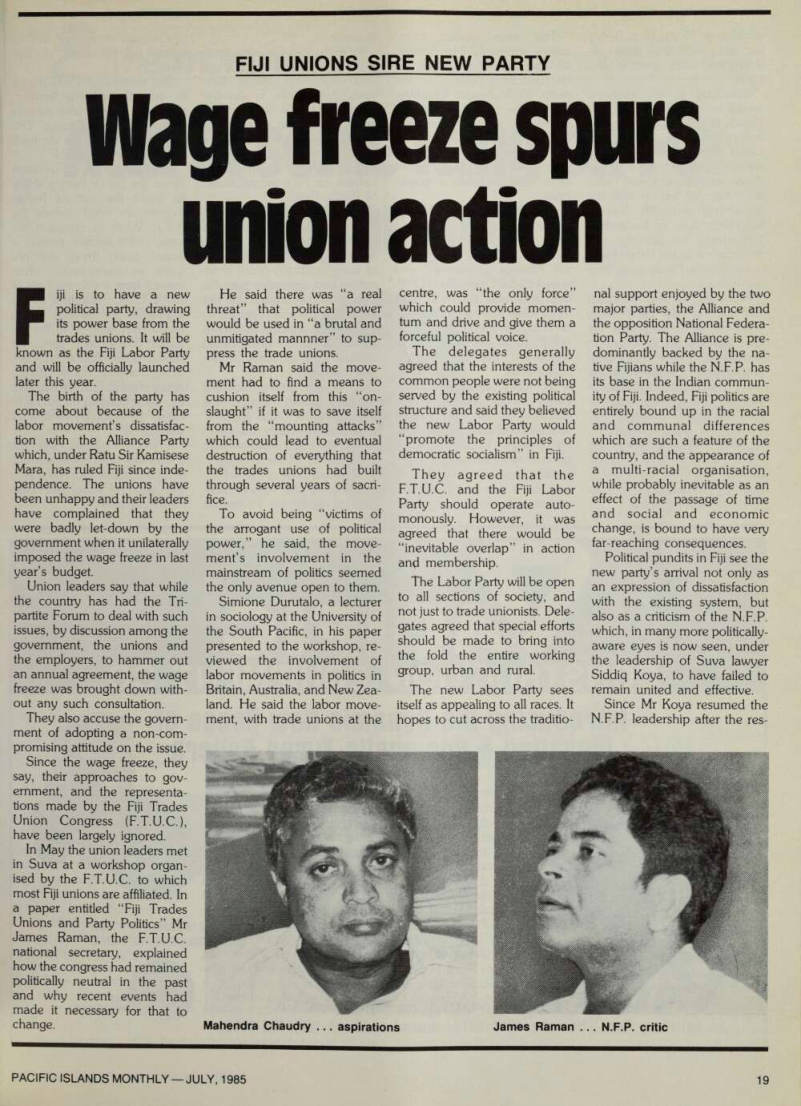
Mahendra Chaudry ... aspirations
James Raman ... N.F.P. critic
ignation of Mr Jai Ram Reddy the party has once again di sintegrated into warring fac tions.
Speaking in an interview broadcast by Radio Fiji, Dr David Routledge, lecturer in history at the USP. said the new Labor Party would definitely make inroads on the N.F.P. and draw away supporters who have become fed-up with the in-fighting and Mr Koya’s autocratic style of leadership.
Conversely, he said, he saw little chance of the Labor Party wooing many Fijians away from the Alliance.
However, he said, he could not see the new party being ready to fight every seat the next election, due to be held in two years ... at least not with any chance of supplanting the N.F.P., and indeed might not even win a single seat at its first time out on the hustings.
However, what it would do, he said, was water down the N.F.P. support and give the Alliance Party an even bigger majority, especially in the marginal national seats.
The union leaders them selves, especially Mr Raman, and the man who is said to be the main force behind the new party, Mr Mahendra Chaudry, head of the powerful Fiji public service union, say they have their eyes on the election of 1997 for their big chance. Up to then, they said, they would work to consolidate a power base.
Already in the last par liamentary session veterans such as Sir Vijay R.Singh, formerly Attorney-General in the Alliance government and now with the Opposition N.F.P. after a notable row with Ratu Mara some years ago, speaking on a motion introduced by the N.F.P. to lift the wage freeze, welcomed the new party’s appearance.
Sir Vijay said the Labor Party, which had economic concepts as its base, would remove racial components from Fiji politics. Initially, political parties were formed to serve certain factional interests, he said, but it was time now there was a shift away from racial
divisions.
Mr Mahendra Chaudry, who is the general secretary of the 7000-strong Fiji Public Ser vants’ Association, is also the assistant national secretary of the F.T.U.C. and secretary of the National Farmers’ Union, a cane-growers’ association which has its stronghold in Labasa, on Fiji’s second island of Vanua Levu.
Mr Chaudry is regarded as one of the most interesting figures in Fiji politics. He is aggressive, ambitious, and seen as being politically much more radical and aggressive than the current crop of leaders. He has been for some time regarded by many as the principal rival to Mr James Raman, for union-based political and industrial power and influence.
Sir Vijay Singh is president of the Fiji Kisan Sangh, the second-largest cane-growers’ organisation, which has mem bers in the sugar areas on both main islands of the country.
Mr Koya, boss of the N.F.P., is leader of the largest cane growers’ body, the Federation
of Cane-growers. (See further report on Fiji sugar in this issue).
The new Labor Party hopes to work through the farmers’ organisations to make inroads in the rural electorates. The cane farmers are the die-hard supporters of the N.F.P.
But there is also a question about the Labor Party’s ability to avoid the sort of Indian factionalism which infests the N.F.P. While to outsiders the trade union leaders present a united front, things are not quite so harmonious when viewed from inside the halls of the F.T.U.C. Rumbles of an argument are already being heard over who is to be the leader of the new party. Mr Raman is the national secretary of the Congress, but Mr Chaud ry is a powerful personality who has been building his influence within the union movement for some time.
F.T.U.C. officials say the leader will not be named until after the official launching later this year. From our Suva Correspondent.
Advertisements & other items, p. 20 (1 item)
Vsicific
WCIFIC
CONSTRUCTION EQUIPMENT CO
Introducing the Dynamic New Range of
Vibrating 8 Pneumatic Tyred Rollers
VSICIFIC
THE RANGE
• Pacific Self-Propelled Vibrating Rollers • Single and Double Drum Types • 1.5 tonne to 16 tonne • Pacific Self-Propelled Pneumatic Type Compactors • 3 Models 16. 21. 38 tonne Ballast Weights • Pacific Landfill and Sanitary Landfill Compactors • Pacific Pneumatic Earth Borers • Pacific Road Brooms • Pacific Railway Maintenance Vehicles Construction Equipment Co. .
DISTRIBUTORS REQUIRED
THROUGHOUT THE PACIFIC
SAL
HPLiTSSE
24 Salisbury Road, Hornsby NSW 2077, Australia. Phone (02) 476 2666
sugar pot
the month
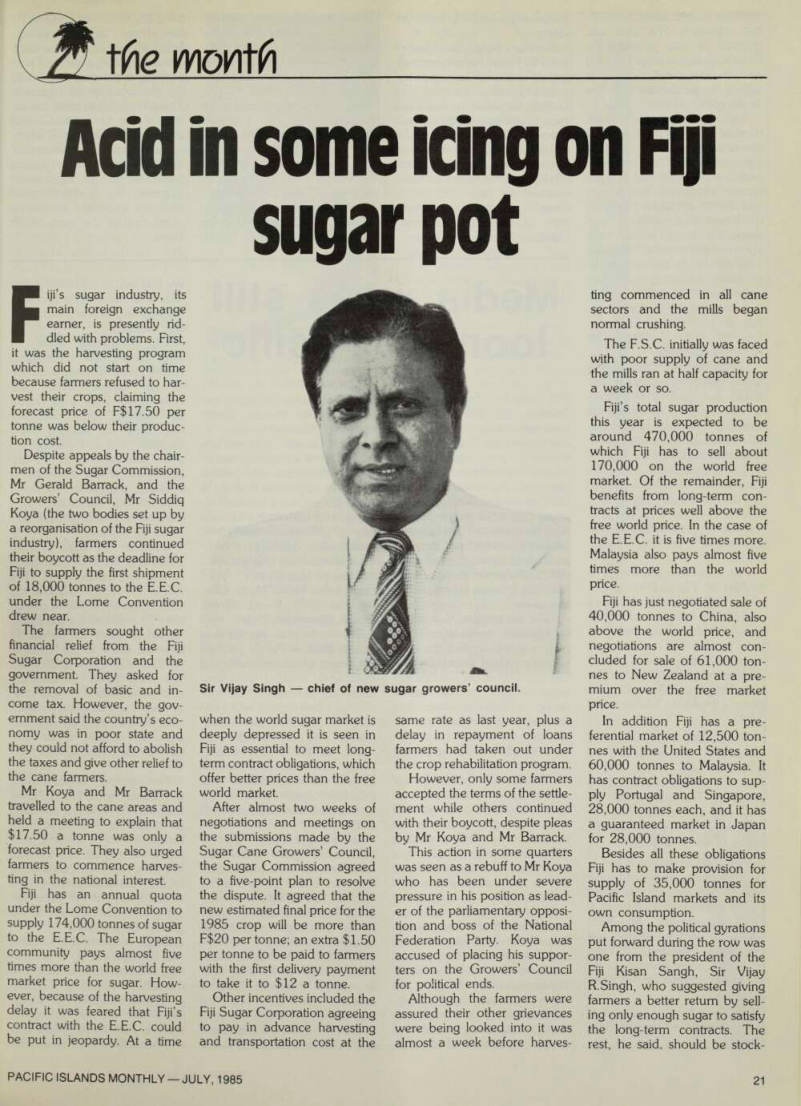
Acid in some icing on Fiji sugar pot
Fiji’s sugar industry, its main foreign exchange earner, is presently rid dled with problems. First, it was the harvesting program which did not start on time because farmers refused to har vest their crops, claiming the forecast price of F 517.50 per tonne was below their produc tion cost.
Despite appeals by the chair men of the Sugar Commission, Mr Gerald Barrack, and the Growers’ Council, Mr Siddiq Koya (the two bodies set up by a reorganisation of the Fiji sugar industry), farmers continued their boycott as the deadline for Fiji to supply the first shipment of 18,000 tonnes to the E.E.C. under the Lome Convention drew near.
The farmers sought other financial relief from the Fiji Sugar Corporation and the government. They asked for the removal of basic and in come tax. However, the gov ernment said the country’s eco nomy was in poor state and they could not afford to abolish the taxes and give other relief to the cane farmers.
Mr Koya and Mr Barrack travelled to the cane areas and held a meeting to explain that $17.50 a tonne was only a forecast price. They also urged farmers to commence harves ting in the national interest.
Fiji has an annual quota under the Lome Convention to supply 174,000 tonnes of sugar to the E.E.C. The European community pays almost five times more than the world free market price for sugar. How ever, because of the harvesting delay it was feared that Fiji’s contract with the E.E.C. could be put in jeopardy. At a time
when the world sugar market is deeply depressed it is seen in Fiji as essential to meet long term contract obligations, which offer better prices than the free world market.
After almost two weeks of negotiations and meetings on the submissions made by the Sugar Cane Growers’ Council, the Sugar Commission agreed to a five-point plan to resolve the dispute. It agreed that the new estimated final price for the 1985 crop will be more than Fs2o per tonne; an extra $1.50 per tonne to be paid to farmers with the first delivery payment to take it to $l2 a tonne.
Other incentives included the Fiji Sugar Corporation agreeing to pay in advance harvesting and transportation cost at the
same rate as last year, plus a delay in repayment of loans farmers had taken out under the crop rehabilitation program.
However, only some farmers accepted the terms of the settle ment while others continued with their boycott, despite pleas by Mr Koya and Mr Barrack.
This action in some quarters was seen as a rebuff to Mr Koya who has been under severe pressure in his position as lead er of the parliamentary opposi tion and boss of the National Federation Party. Koya was accused of placing his suppor ters on the Growers’ Council for political ends.
Although the farmers were assured their other grievances were being looked into it was almost a week before harves
ting commenced in all cane sectors and the mills began normal crushing.
The F.S.C. initially was faced with poor supply of cane and the mills ran at half capacity for a week or so.
Fiji’s total sugar production this year is expected to be around 470,000 tonnes of which Fiji has to sell about 170.000 on the world free market. Of the remainder, Fiji benefits from long-term con tracts at prices well above the free world price. In the case of the E.E.C. it is five times more.
Malaysia also pays almost five times more than the world price.
Fiji has just negotiated sale of 40.000 tonnes to China, also above the world price, and negotiations are almost con cluded for sale of 61,000 ton nes to New Zealand at a pre mium over the free market price.
In addition Fiji has a pre ferential market of 12,500 ton nes with the United States and 60.000 tonnes to Malaysia. It has contract obligations to sup ply Portugal and Singapore, 28.000 tonnes each, and it has a guaranteed market in Japan for 28,000 tonnes.
Besides all these obligations Fiji has to make provision for supply of 35,000 tonnes for Pacific Island markets and its own consumption.
Among the political gyrations put forward during the row was one from the president of the Fiji Kisan Sangh, Sir Vijay R.Singh, who suggested giving farmers a better return by sell ing only enough sugar to satisfy the long-term contracts. The rest, he said, should be stock
Sir Vijay Singh chief of new sugar growers’ council.
piled for release when the mar ket improved. The idea was rejected on two grounds: Fiji lacks sufficient storage capacity and, in any event, nobody is willing to guarantee that the world price will rise.
With Fiji committed to sell most of its 1985 production at above world prices the farmers are now assured of receiving well over the estimated $2O per tonne. However, no sooner had all the apparent problems of harvesting, milling and marketing been settled than another controversy erupted.
This was much more domestic an issue, but heady stuff when measured in Fiji political terms.
It concerned the budget of the Fiji Sugar Cane Growers’
Council and, in effect, Mr Koya’s leadership.
Under the restructuring of the sugar industry, provision was made to give the farmers greater say in the running of the industry. The mills have oper ated through a single admi nistrative organisation, the Fiji Sugar Corporation. Now the farmers are to have a parallel set-up through the Sugar Growers’ Council. It has 111 members, commonly referred to as the ’’Farmers’ Parlia ment.”
The council approved a budget of F 5535,000 dollars, along with salaries for Mr Koya of $12,000 a year, and for the two vice-chairmen, $6OOO a year each. The other eight directors were given annual salaries of $4BOO each. The remaining councillors each were given a travelling allowance of $6OO.
The council is to have a chief executive, on a salary of $35,000, plus a car and a housing allowance of $B4OO per year. The budget also in cluded an allocation of $182,000 for setting up the office of the council.
The chief executive is yet to be appointed. At one time Sir Vijay Singh himself was being tipped for the post. But, lately, a Suva accountant, Mr Ram Vilash, is said to be the top contender. However, Sir Vijay is seen in some quarters to be still in the running for this plum post.
The cane farmers will shoul der the burden of financing this operation with a levy of be
tween eight and 11 cents per tonne.
Sir Vijay Singh, president of the Fiji Kisan Sangh, second largest of the Fiji cane-growers’ organisations, criticised the budget for what he said was excess, and questioned the pro vision of $12,000 in salary for Mr Koya. Sir Vijay had earlier formed a joint committee with Mr Koya’s Federation of Cane Growers to field joint candi dates in the election of mem bers of the Cane Grower’s Council.
As the political row warmed up Sir Vijay said he was still the vice-president of the joint com mittee, together with the secre tary of the National Farmers’
Union, Mr Mahendra Chaudry, but neither of them had been consulted on the council’s budget before it was approved.
Sir Vijay said it was prepared by the Opposition parliamentarian, Mr Sharda Nand, in his capacity as an economic consultant.
The Fiji crisis was suddenly stilled in June when Mr Koya announced he would forego
the $12,000 stipend saying he had always “worked tirelessly, and without fee” for the cane growers and he would not now change his practice, and would do the job without payment.
The plum post of chief execu tive of the Growers’ Council was taken by Sir Vijay R.Singh, at the advertised remuneration, and his parliamentary seat looks set to go to Senator Mumtaz Ali, a development which is expected to take a good deal of the heat off Mr Koya.
loom in Pacific
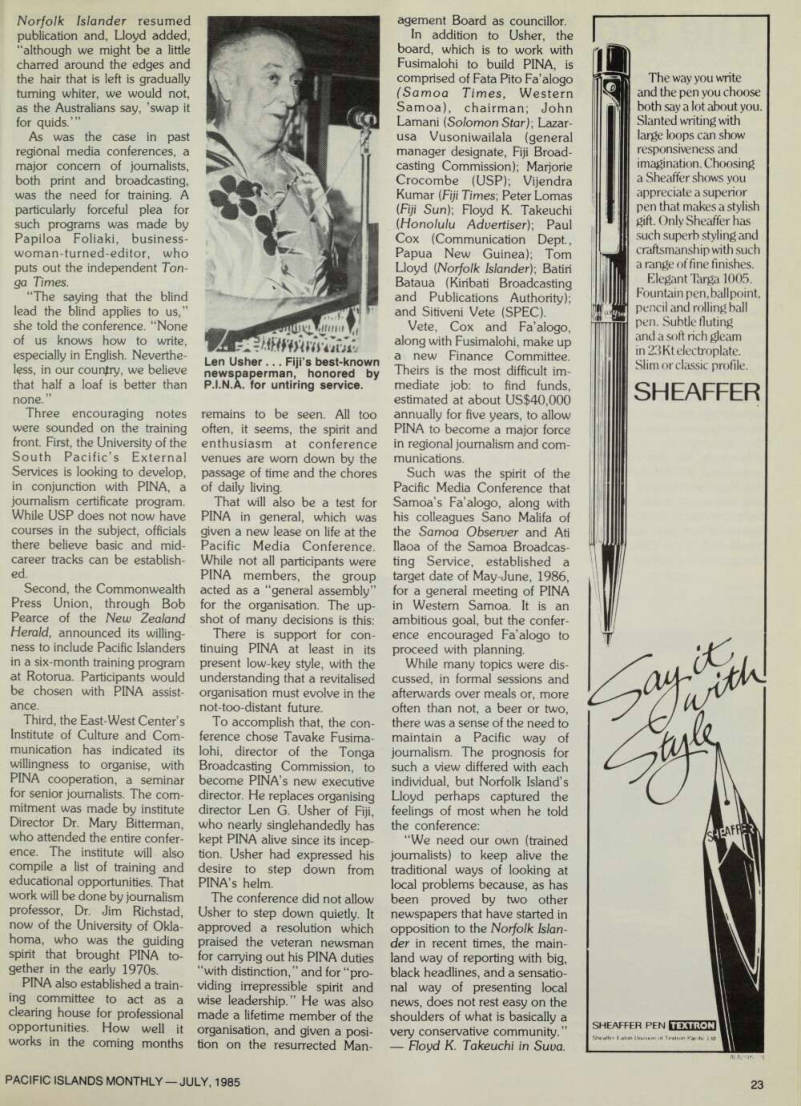
Media woes still loom in Pacific
This may be the Age of the Satellite, but John Lamani’s communications concerns are down-to-earth. The quiet but intense Solomon Islander is the founder and editor of the three year-old Solomon Star, a 3000-circulation weekly news paper that is the only indepen dent press voice in that country.
Lamani’s worries are “simple”: paper, ink, training for his small staff, and a government he says has little interest in an active, free press.
“The banning of the (U.S.) 60-Minutes television team (that wanted) to film the cap tured American tuna boat, the Jeanette Diana; the deportation order issued to Australian Associated Press and Australian Broadcasting Corporation rep resentatives; restrictions on lo cal journalists covering impor tant visitors; and a circular from the Office of the Prime Minister requesting ministers, perma nent secretaries and govern ment subordinates not to re lease directly any information to the private media will give you some idea what the situation is like in the Solomon Islands,”
Lamani says.
A former government in formation officer, Lamani be lieves better trained journalists are the key to ensuring freedom of the press in the Solomons.
“Unless drastic changes are made in the training of journal ists to pressure government to alter its attitude toward the media, the country will slide
backward instead of going for ward in its media deve lopment,” Lamani warns.
Editor Lamani, who also acts as the Star’s advertising mana ger, administrator and janitor, made his comments recently to men and women who share his hopes and frustrations. He was one of 55 island journalists, broadcasters, information offic ers and observers who gathered in Suva on May 14 to 17. They met for the Pacific Media Con ference 1985 at the Town House Apartment Hotel.
The conference agenda was two-fold: allow Pacific journal ists, most of whom carry out their work isolated from pro fessional colleagues, to ex change observations and con cerns in a supportive atmos phere; and to consider the future of the Pacific Islands News Association (PINA), the 11-year-old organisation that still holds great promise for professional development and a free press.
Underwritten by a U 5519,775 grant from The Asia Foundation, a private San Francisco-based group that has become increasingly interested in the Pacific Islands, the Pacific Media Conference was by all accounts a success.
Tom Lloyd, the colorful co editor (along with his wife, Tim) of the 20-year-old Norfolk Islander, put it best when he said mid-way through the con ference: “I think it is important that we have a chance to meet.
We find out, at conferences like this, what each other is doing.
It’s very helpful and it recharges our batteries.”
The conference acted, in some ways, like a religious revival meeting. It was a chance to hear “horror stories,” hear how others cope with hostile governments, poor shipping, high duty on newsprint and supplies, and still manage to print newspapers. In an en vironment where adversity is stressed, journalists recommit themselves to the ideals of their profession. Recharge their bat teries, as it were.
Consider the case of Tom Lloyd and his 1250-circulation weekly on Norfolk Island. “The role of the Norfolk Islander has been to act as the island consci ence,” Lloyd told the gathering, “a safety valve for people to blow off steam in the letters to the editor columns and, when the need arises, to take the commonwealth and local gov ernments to task when we learn of actions they are contemplat ing which are not, in our opin ion, for the betterment of Nor folk.”
That approach is not without its hazards. Noted Lloyd: “Over the years the role has not been an easy one. We have been threatened to be thrown, prin ting press and all, into the sea.
We have had swastikas painted on the walls of the printery. And to cap it all, just five years ago our premises were burnt to the ground by arsonists.”
Lloyd suspects the torching was brought on by a particu larly hot exchange of letters to the editor concerning “a certain government official. No culprits were ever brought to justice, but the community pitched in and rebuilt the print shop. The
Norfolk Islander resumed publication and, Lloyd added, “although we might be a little charred around the edges and the hair that is left is gradually turning whiter, we would not, as the Australians say, ’swap it for quids.’”
As was the case in past regional media conferences, a major concern of journalists, both print and broadcasting, was the need for training. A particularly forceful plea for such programs was made by Papiloa Foliaki, business woman-turned-editor, who puts out the independent Ton ga Times.
“The saying that the blind lead the blind applies to us,” she told the conference. “None of us knows how to write, especially in English. Neverthe less, in our country, we believe that half a loaf is better than none.”
Three encouraging notes were sounded on the training front. First, the University of the South Pacific’s External Services is looking to develop, in conjunction with PINA, a journalism certificate program.
While USP does not now have courses in the subject, officials there believe basic and mid career tracks can be establish ed.
Second, the Commonwealth Press Union, through Bob Pearce of the New Zealand Herald, announced its willing ness to include Pacific Islanders in a six-month training program at Rotorua. Participants would be chosen with PINA assist ance.
Third, the East-West Center’s Institute of Culture and Com munication has indicated its willingness to organise, with PINA cooperation, a seminar for senior journalists. The com mitment was made by institute Director Dr. Mary Bitterman, who attended the entire confer ence. The institute will also compile a list of training and educational opportunities. That work will be done by journalism professor, Dr. Jim Richstad, now of the University of Okla homa, who was the guiding spirit that brought PINA to gether in the early 19705.
PINA also established a train ing committee to act as a clearing house for professional opportunities. How well it works in the coming months
remains to be seen. All too often, it seems, the spirit and enthusiasm at conference venues are worn down by the passage of time and the chores of daily living.
That will also be a test for PINA in general, which was given a new lease on life at the Pacific Media Conference.
While not all participants were PINA members, the group acted as a “general assembly” for the organisation. The up shot of many decisions is this: There is support for con tinuing PINA at least in its present low-key style, with the understanding that a revitalised organisation must evolve in the not-too-distant future.
To accomplish that, the con ference chose Tavake Fusima lohi, director of the Tonga Broadcasting Commission, to become PINA’s new executive director. He replaces organising director Len G. Usher of Fiji, who nearly singlehandedly has kept PINA alive since its incep tion. Usher had expressed his desire to step down from PINA’s helm.
The conference did not allow Usher to step down quietly. It approved a resolution which praised the veteran newsman for carrying out his PINA duties “with distinction,” and for “pro viding irrepressible spirit and wise leadership.” He was also made a lifetime member of the organisation, and given a posi tion on the resurrected Man
agement Board as councillor.
In addition to Usher, the board, which is to work with Fusimalohi to build PINA, is comprised of Fata Pito Fa’alogo (Samoa Times, Western Samoa), chairman; John Lamani ( Solomon Star), Lazar usa Vusoniwailala (general manager designate, Fiji Broad casting Commission); Marjorie Crocombe (USP); Vijendra Kumar ( Fiji Times ; Peter Lomas (Fiji Sun); Floyd K. Takeuchi (Honolulu Advertiser); Paul Cox (Communication Dept., Papua New Guinea); Tom Lloyd (Norfolk Islander); Batiri Bataua (Kiribati Broadcasting and Publications Authority); and Sitiveni Vete (SPEC).
Vete, Cox and Fa’alogo, along with Fusimalohi, make up a new Finance Committee.
Theirs is the most difficult im mediate job: to find funds, estimated at about US$4O,OOO annually for five years, to allow PINA to become a major force in regional journalism and com munications.
Such was the spirit of the Pacific Media Conference that Samoa’s Fa’alogo, along with his colleagues Sano Malifa of the Samoa Observer and Ati Ilaoa of the Samoa Broadcas ting Service, established a target date of May-June, 1986, for a general meeting of PINA in Western Samoa. It is an ambitious goal, but the confer ence encouraged Fa’alogo to proceed with planning.
While many topics were dis cussed, in formal sessions and afterwards over meals or, more often than not, a beer or two, there was a sense of the need to maintain a Pacific way of journalism. The prognosis for such a view differed with each individual, but Norfolk Island’s Lloyd perhaps captured the feelings of most when he told the conference: “We need our own (trained journalists) to keep alive the traditional ways of looking at local problems because, as has been proved by two other newspapers that have started in opposition to the Norfolk Islan der in recent times, the main land way of reporting with big, black headlines, and a sensatio nal way of presenting local news, does not rest easy on the shoulders of what is basically a very conservative community. ”
Hoyd K. Takeuchi in Suva.
Len Usher... Fiji’s best-known newspaperman, honored by P.I.N.A. for untiring service.
Advertisements & other items, p. 23 (1 item)
Sheaffer
The way you write and the pen you choose both say a lot about you.
Slanted writing with large loops can show responsiveness and imagination. Choosing a Sheaffer shows you appreciate a superior pen that makes a stylish gift. Only Sheaffer has such superb styling and craftsmanship with such a range of fine finishes.
Elegant lOO5.
Fountain pen, ballpoint, pencil and rolling ball pen. Subtle fluting and a soft rich gleam in 23 Kt electroplate.
Slim or classic profile.
SHEAFFER
w
SHEAFFER PEN
The big freedom
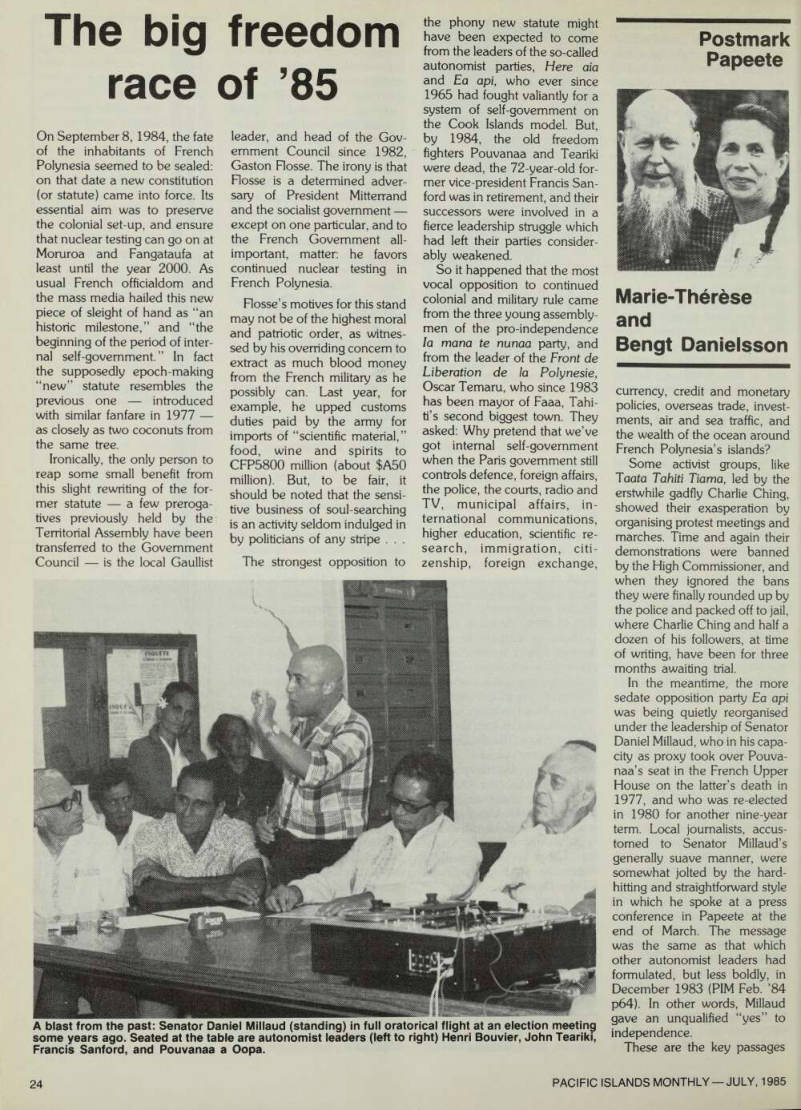
race of ’85
On September 8, 1984, the fate of the inhabitants of French Polynesia seemed to be sealed: on that date a new constitution (or statute) came into force. Its essential aim was to preserve the colonial set-up, and ensure that nuclear testing can go on at Moruroa and Fangataufa at least until the year 2000. As usual French officialdom and the mass media hailed this new piece of sleight of hand as an histone milestone, and the beginning of the penod of internal self-government. In fact the supposedly epoch-making new statute resembles the previous one - introduced with similar fanfare in 1977 as closely as two coconuts from the same tree.
Ironically, the only person to reap some small benefit from this slight rewnbng of the former statute - a few prerogabyes previously held by the Temtonal Assembly have been transferred to the Government Council is the local Gaullist
leader, and head of the Gov ernment Council since 1982, Gaston Flosse. The irony is that Flosse is a determined adver sary of President Mitterrand and the socialist government except on one particular, and to the French Government all important, matter; he favors continued nuclear testing in French Polynesia, Flosse , s moUves for thjs stand not be of the hi hest mora| and Wotic ord as sed b his overridi concem to extract as much bl(X)d m from the French mi)ita as he ibl can Last for exam le he d customs duties id b the for jmports of material; . food, wjne and s irits to CFPSBO o million (about SASO milljon) But to be fair it shou , d be noted that , he sensi , Hve business o( sou |. searching is an activity seldom indulged in b poi mdans of any stripe , , The strongest opposition to
the phony new statute might have been expected to come from the leaders of the so-called autonomist parties, Here aia and Ea api, who ever since 1965 had fought valiantly for a system of self-government on the Cook Islands model. But, by 1984, the old freedom fighters Pouvanaa and Teariki were dead, the 72-year-old for mer vice-president Francis San ford was in retirement, and their successors were involved in a fierce leadership struggle which had left their parties consider ably weakened.
So it happened that the most vocal opposition to continued colonial and military rule came from the three young assembly men of the pro-independence la mana te nunaa party, and from the leader of the Front de Liberation de la Polynesia, Oscar Temaru, who since 1983 has been mayor of Faaa, Tahi ti’s second biggest town. They asked: Why pretend that we’ve got internal self-government when the Paris government still controls defence, foreign affairs, the police, the courts, radio and TV, municipal affairs, in ternational communications, higher education, scientific re search, immigration, citi zenship, foreign exchange,
Postmark Papeete
currency, credit and monetary policies, overseas trade, invest ments, air and sea traffic, and the wealth of the ocean around French Polynesia’s islands?
Some activist groups, like Taata Tahiti Tiama, led by the erstwhile gadfly Charlie Ching, showed their exasperation by organising protest meetings and marches. Time and again their demonstrations were banned by the High Commissioner, and when they ignored the bans they were finally rounded up by the police and packed off to jail, where Charlie Ching and half a dozen of his followers, at time of writing, have been for three months awaiting trial.
In the meantime, the more sedate opposition party Ea api was being quietly reorganised under the leadership of Senator Daniel Millaud, who in his capa city as proxy took over Pouva naa’s seat in the French Upper House on the latter’s death in 1977, and who was re-elected in 1980 for another nine-year term. Local journalists, accus tomed to Senator Millaud’s generally suave manner, were somewhat jolted by the hard hitting and straightforward style in which he spoke at a press conference in Papeete at the end of March. The message was the same as that which other autonomist leaders had formulated, but less boldly, in December 1983 (PIM Feb. ’B4 p 64). In other words, Millaud gave an unqualified “yes” to independence.
These are the key passages
A blast from the past: Senator Daniel Millaud (standing) in oratorical flight at an election meeting some years ago. Seated at the table are autonomist leaders (left to right) Henri Bouvier, John Teariki, Francis Sanford, and Pouvanaa a Oopa.
Marie-Therese and Bengt Danielsson
from Senator Millaud’s state ment, which he had taken the trouble to put into writing, so that journalists would not miss any part of it: “The French Government is forever trying to scare us people in the overseas territories with talk about the disasters that independence would bring down upon our heads.
Although it concedes that the 1958 constitution allows us to determine our own fate, at the same time it warns us that if we use this right to achieve inde pendence, there will be no more French aid.
“It is simply despicable for a country like France to adopt this attitude, particularly if we bear in mind the fact that the preambles to both the 1946 and 1958 national constitutions lay upon France the duty and historic responsibility of leading the peoples of her overseas territories to independence.
“As the Ea api party and I myself understand these texts, we do not even have to ask or to vote for independence, as France has this constitutional and historical obligation to guide us towards independence by creating in the economic, social and cultural spheres the conditions necessary for a smooth transition.
“This is why Ea api and I have decided to propose, already at this stage, a formula of association between the two sovereign states, Polynesia and France, to be defined by con ventions and treaties specifying the types of association, co operation and mutual ex changes they desire.”
Chatting with journalists afterwards, Senator Millaud fur ther scandalised a number of them by praising Britain for the exemplary manner in which it had prepared its Pacific col onies for independence, and mentioning the Common wealth as the sort of post colonial association he had in mind.
Senator Millaud’s public de claration that he will henceforth fight might and main for inde pendence will have its most important repercussions and greatest effect in France. For while all other pro-independ ence leaders are firmly tied to their Polynesian constituencies, the senator spends most of his
time in Paris, where he serves as a sort of ambassador for French Polynesia as a whole.
What we next witnessed was a replay of the political drama which unfolded back in 1980, when the then minority leader Gaston Flosse, who had always staunchly defended French rule, suddenly came out in favor of autonomie interne (in ternal self-government), an event which we described at the time as “a political U-tum” (PIM May ’BO p 27). Senator Millaud mocked him then for his slow-wittedness, while House Speaker Teariki accused him of stealing the main plank in the autonomists’ platform as well as their voters!
This accusation arose again in the debate which has deve loped now, more than four years later, when Flosse, in a new surprise move, not only voiced his deep dissatisfaction with the present statute, but also called for another form of government altogether, which would make Polynesia virtually independent. What made his radical stand even more news worthy was the fact that he expressed his views during an audience with President Mitter rand in the Elysee Palace on May 7. As Flosse readily told
the press afterwards, Mitterrand had replied with a faint smile; But wasn’t it a bare eight months ago that Polynesia was given this new statute which you now want to change?
Yes, Mr President, con ceded Flosse, but I hope that you will start examining my request soon. The ideal statute, in my opinion, is the one they have in the Cook Islands.
Mitterrand, who probably hadn’t done much homework on the Cooks constitution, chose to give a non-committal reply: It is still a little early to modify the new statute.
Bearing in mind the gradual extension since 1965 of the already very wide powers granted the Cook Islands by New Zealand the Rarotonga Government, for instance, now also handles foreign affairs, de fence and immigration, even when the applicants are New Zealanders French Polynesia, by adopting a similar statute, would in practice be come an independent state.
And it would still receive gen erous economic and technical assistance.
Why has Flosse burnt the gods he still worshipped so short a time ago? The answer is in all likelihood quite simply
that during the past eight months he has discovered how utterly impossible it is to govern the territory on the basis of the present hybrid statute, and with the grudging help of a French type administration, dominated by expatriates.
The only major political lead er who has declared himself perfectly happy with the ex isting statute is “Sheriff” Ver naudon, whose Aia api party polled 11 per cent of the votes in the last territorial election in May 1982. Even if we assume that he can still command the same number of votes, which is far from certain, it can safely be said that the overwhelming majority of Polynesian voters are today backing one or other of the athletes taking part in the great 1985 freedom race. What their preferences are will not be known exactly until June 1986, when the next general election is to be held. Everything seems to indicate, however, that the spectators cheering the front runners, with the single word INDEPENDENCE emblazoned across their striped red and white T-shirts, are now just as numerous as those of the fast sprinting Gaston Flosse, still clad in his French tricolor track suit. Marie-Therese and Bengt Danielsson.
Tonga trade
Tale of woe in Tonga trade
Foreigners seeking to do busi ness in the Pacific Islands have been warned, in an article in the influential Australian commer cial magazine Rydges, of the region’s sometimes curious rules and its several pitfalls.
Some islanders, they say, have become adept at a kind of reverse carpet-bagging and look upon would-be investors as suckers for the taking.
That Pacific governments are conscious of the problem is shown by the fulsome publication in the May 17 issue of the Tonga Chronicle of the tale of woe told by a Mr Ray Brooks, a Sydney-based man agement consultant who had a less than happy experience in the balmy tropic isles.
Mr Brooks took his story to Rydges which used it as the basis for a review of unhappy investment experiences in the islands.
Obviously aware of the damaging effects of such publicity the Tongan ministry of Labour, Commerce and Indus tries issued a statement saying it hoped to “expose the miscon duct of those involved in deal ing with foreign entrepreneurs and build up an awareness amongst those who might be interested in investing within the Kingdom.” Baron Vaea of Houma, who is the minister of the department, said his staff would be very happy to guide potential investors and to ease any problems they might have.
In fact, the baron has been exceedingly active in recent months, pushing for foreign investment in Tonga in the United States and elsewhere. In general the conditions for in vestment are very good, with quite generous terms, low-in terest loans and tax holidays available. Yet the level of in vestment in Tonga remains quite small, which is possibly why so much attention is being paid to stories such as that told by Mr Brooks of Sydney.
His saga began in 1983 when he called at Vava’u while cruis ing the South Pacific on his ketch. Much taken by the beau ty of the harbor and its surroun dings he was receptive when approached by a local involved in tourism with the offer of a partnership.
“My contribution,” Brooks said later, “was to be my expertise, my boat and goods for the venture,” which was to be a sort of casual “club” for cruising yachts.
The Tongan partner had a private beach where yachts could be moored, a coral jetty there could be extended quite easily, and showers, laundry, bar and other facilities built without enormous outlay of capital.
Mr Brooks said he was told that under Tongan law he could use his earning power in Aus tralia as equity against a deve lopment loan from the Bank of Tonga. This, together with his ketch and some capital he could raise, was to give him a substantial share in the venture.
The Tongan partner said he had good family connections with those in power in Tonga and that a development licence would present no problems.
Back in Australia Mr Brooks checked his information and found that under the licence goods for the business indeed could be imported to Tonga duty free, that the loan would carry only five per cent interest and that both he and the business would pay no tax for five years.
Thus encouraged, Mr Brooks returned to the kingdom with such items as toughened glass for glass-bottomed boats, kit chen equipment and other items for the enterprise, includ ing 1000 specially-printed T shirts.
Back in Vava’u he found the frame of the projected re staurant had been erected, but very little else on the schedule had been done. Nor had a development licence been obtained. His partner pleaded sickness in the family. He pro ceeded with the building, but would arrange a meeting and found progress difficult and quality of work poor. “I was
assured it was the ’Tongan Way,’ ” he said. “I became very very tired of that phrase.”
He had a row with his partner over accounting methods at the restaurant, including the dispo sal of “unsold” beer through the partner’s own home and the mark-up on supplies of food bought locally.
“There was still no business agreement and whenever I tried to discuss some remuneration for the goods I had bought he then failed to turn up,” said Mr Brooks.
When, finally, Mr Brooks lost patience the partner assured him that he had the police and customs officers “in his pocket” and if Mr Brooks tried to cause any trouble it would be Mr Brooks who would end in prison.
That, in fact, was what hap pened in the end, after a long series of difficulties, among them accusations by the partner that Mr Brooks had trafficked in marijuana and had stolen money.
Both Mr Brooks and his partner were jailed, but the partner was released. Mr Brooks was charged in the Magistrate’s Court for importing goods without a proper licence.
His goods were confiscated and he was fined SIOO.
“Tongan law is based on the British system, but is interpreted in a totally Tongan way. I have since had several offers of hon est partnership, but after my experience with Tongan law I would never go back,” he said.
The Tonga Chronicle writer commented; “An article such as the one in Rydges magazine can easily undo all the work done by Baron Vaea and his ministry in promoting overseas investment. Such case histories are, unfortunately, fairly typical.
“There are businessmen making a success here and elsewhere in the South Pacific, but even they have consider able frustrations in terms of labor relations, Customs delays and legal problems,” said the writer.
Excuses for inactivity were legion ... “My brother’s wife was sick, so I had to take time off” ... my family has been feuding with his family for 20 generations, so we won’t work on the same site ... “the minis
ter has to sign the permit, and he is in London for three weeks” ...
Rydges ended its article, which detailed quite a number of tropic idyll scams, with sage advice: Anyone who sought to get involved in the South Paci fic should do his homework and get proper government advice.
Then the region could be a good place to set up a business.
The Tongan government has echoed the advice and said it is more than willing to guide investors and smooth the way for them, so that they do not become involved with those guilty of “misconduct in dealing with foreign entrepreneurs.”
Tonga needed to build up awareness amongst those who might be interested in investing in the kingdom, the ministry said.
China builds
at U.S. base
Tempers are reported to be high in the U.S. construction industry because the U.S. Navy has awarded a contract for construction work in Guam to a mainland China firm. The con tract, for SUS6BO,OOO is for building work at Apra Harbor Naval Station. This is said to be the first time a communist owned organisation has won a Pentagon construction contract.
The Chinese were apparently the low bidders for the work and, under Washington’s cur rent cost-paring rules, were awarded the contract.
Yet the U.S. construction in dustry, already hard-pressed to compete with Japanese and Korean companies for Depart ment of Defence jobs in the Pacific, is not likely to take it lying down and have begun efforts to amend the American Preference Act (Public Law 98- 396) to give greater protection to U.S. constructors.
The Guam contract is not sensitive in a security sense. It is for power pole hardening. But American construction men say they fear it is the thin edge of the wedge of a mainland Chinese drive to compete very strongly for such contracts.
Agency report.
Advertisements & other items, p. 26 (1 item)
Business Opportunity
NON-RESIDENT
AMERICAN
UNIVERSITY
DEGREES
It is possible - it is honestly possible - to earn good, usable Bachelor's, Master's, Doctorates, even Law Degrees from recognized American universities, without ever going to America. The time involved can be quite short, and the cost surprisingly low. May I air mail you free information, without obligation? Dr. John Bear, 9301 N. Highway 1, Suite 842 Mendocino, CA 95460, U.S.A.
PACIFIC ISLANDS
BUSINESS OPPORTUNITY
A medium sized retail business located in a stable and tax free country in the Pacific region is for sale.
This long established operation offers an owner manager good returns, the opportunity of acquiring exclusive agencies and potential in a pleasant social environment.
Owner will negotiate at A 5750,000 for stock and plant.
Confidential enquiries from principals only may be made to the owner at: P.O. Box 372, Paddington, NSW 2021, AUSTRALIA
BUSINESS FOR SALE
MOTOR VEHICLE DEALERSHIP IN
SOUTH PACIFIC ISLAND PARADISE
This vehicle dealership in Port Vila, Vanuatu has two franchises (Japanese) and is situated on a good main road location.
Good Parts/Sales/Workshop figures. Ideal husband/wife size company or could be expanded. Has good local staff and guaranteed sales/service turnover as it contracts to a major fleet owner.
If you want to get out of the "Rat Race" think of the joy of the no company tax and no personal tax situation that exists there. Audited figures available.
For further information contact: The Managing Director, New Car World, P.O. Box 71, Port Vila, VANUATU. Telex No. NH 1064.
Fiji traders “biting
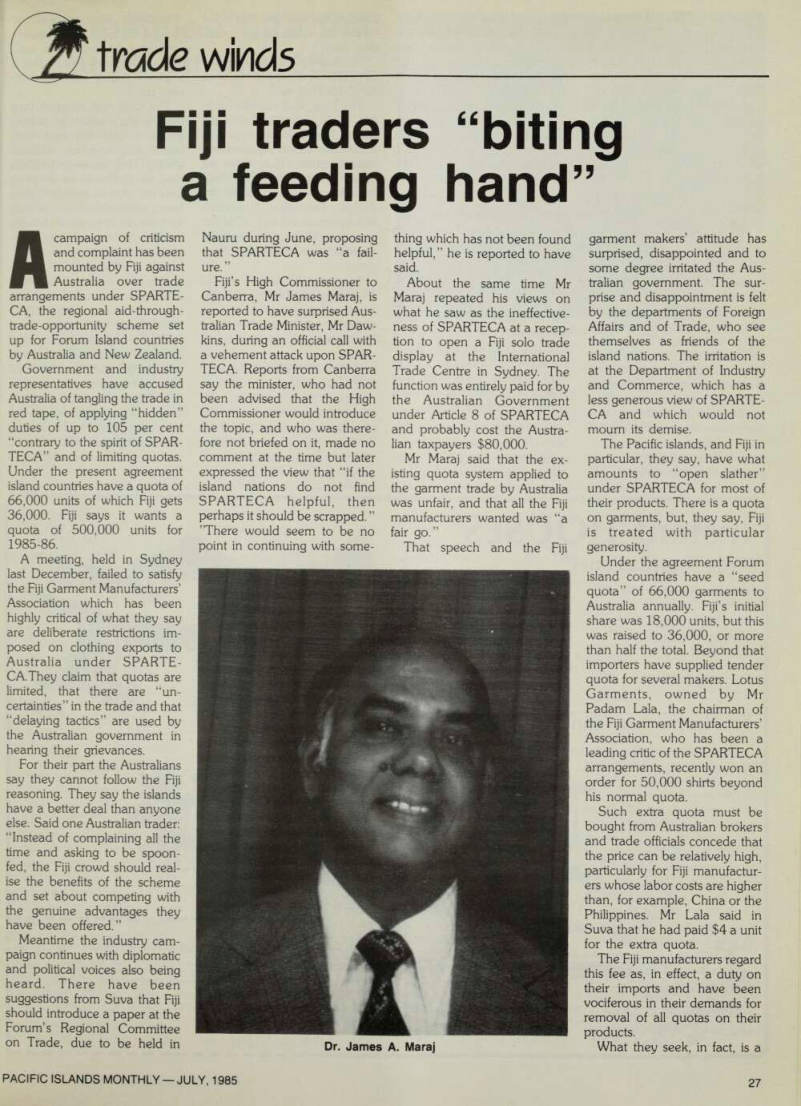
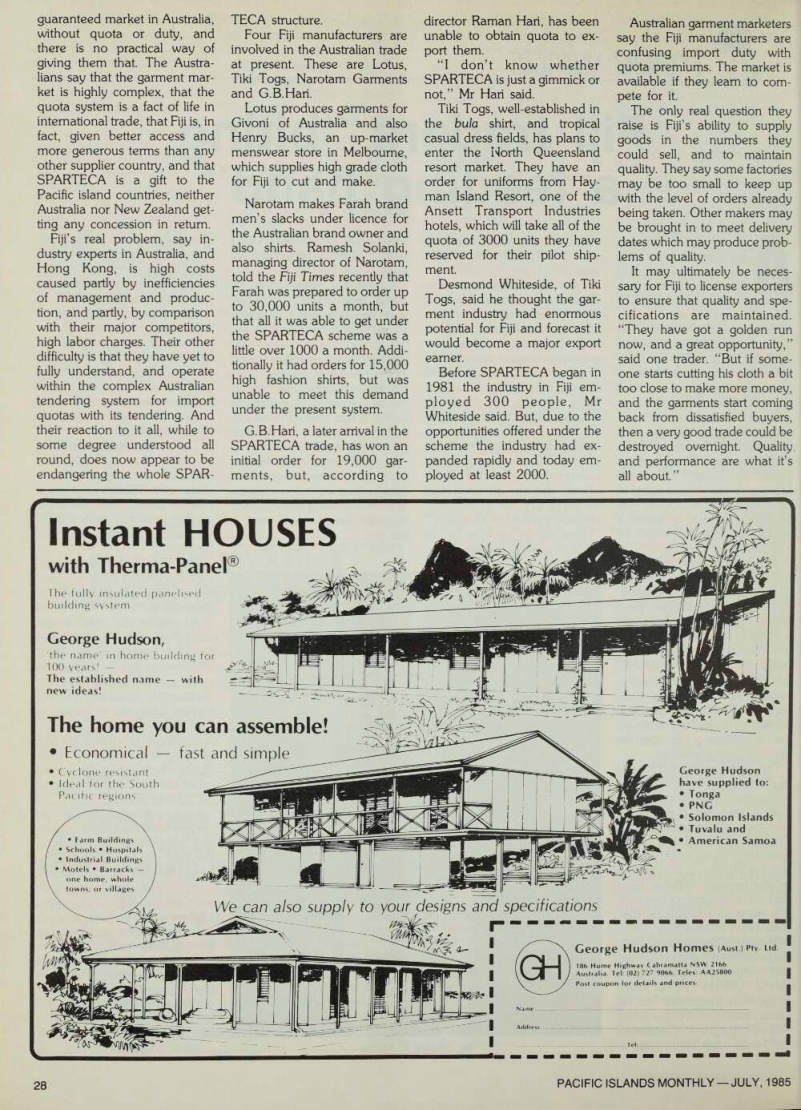
trade winds
Fiji traders “biting a feeding hand”
A campaign of criticism and complaint has been mounted by Fiji against Australia over trade arrangements under SPARTE CA, the regional aid-through trade-opportunity scheme set up for Forum Island countries by Australia and New Zealand.
Government and industry representatives have accused Australia of tangling the trade in red tape, of applying “hidden” duties of up to 105 per cent “contrary to the spirit of SPAR TECA” and of limiting quotas.
Under the present agreement island countries have a quota of 66,000 units of which Fiji gets 36,000. Fiji says it wants a quota of 500,000 units for 1985-86.
A meeting, held in Sydney last December, failed to satisfy the Fiji Garment Manufacturers’
Association which has been highly critical of what they say are deliberate restrictions im posed on clothing exports to Australia under SPARTE CA. They claim that quotas are limited, that there are “un certainties” in the trade and that “delaying tactics” are used by the Australian government in hearing their grievances.
For their part the Australians say they cannot follow the Fiji reasoning. They say the islands have a better deal than anyone else. Said one Australian trader: “Instead of complaining all the time and asking to be spoon fed, the Fiji crowd should real ise the benefits of the scheme and set about competing with the genuine advantages they have been offered.”
Meantime the industry cam paign continues with diplomatic and political voices also being heard. There have been suggestions from Suva that Fiji should introduce a paper at the Forum’s Regional Committee on Trade, due to be held in
Nauru during June, proposing that SPARTECA was “a fail ure. ”
Fiji’s High Commissioner to Canberra, Mr James Maraj, is reported to have surprised Aus tralian Trade Minister, Mr Daw kins, during an official call with a vehement attack upon SPAR TECA. Reports from Canberra say the minister, who had not been advised that the High Commissioner would introduce the topic, and who was there fore not briefed on it, made no comment at the time but later expressed the view that “if the island nations do not find SPARTECA helpful, then perhaps it should be scrapped. ” ’’There would seem to be no point in continuing with some
thing which has not been found helpful,” he is reported to have said.
About the same time Mr Maraj repeated his views on what he saw as the ineffective ness of SPARTECA at a recep tion to open a Fiji solo trade display at the International Trade Centre in Sydney. The function was entirely paid for by the Australian Government under Article 8 of SPARTECA and probably cost the Austra lian taxpayers $BO,OOO.
Mr Maraj said that the ex isting quota system applied to the garment trade by Australia was unfair, and that all the Fiji manufacturers wanted was “a fair go.”
That speech and the Fiji
garment makers’ attitude has surprised, disappointed and to some degree irritated the Aus tralian government. The sur prise and disappointment is felt by the departments of Foreign Affairs and of Trade, who see themselves as friends of the island nations. The irritation is at the Department of Industry and Commerce, which has a less generous view of SPARTE CA and which would not mourn its demise.
The Pacific islands, and Fiji in particular, they say, have what amounts to “open slather” under SPARTECA for most of their products. There is a quota on garments, but, they say, Fiji is treated with particular generosity.
Under the agreement Forum island countries have a “seed quota” of 66,000 garments to Australia annually. Fiji’s initial share was 18,000 units, but this was raised to 36,000, or more than half the total. Beyond that importers have supplied tender quota for several makers. Lotus Garments, owned by Mr Padam Lala, the chairman of the Fiji Garment Manufacturers’
Association, who has been a leading critic of the SPARTECA arrangements, recently won an order for 50,000 shirts beyond his normal quota.
Such extra quota must be bought from Australian brokers and trade officials concede that the price can be relatively high, particularly for Fiji manufactur ers whose labor costs are higher than, for example, China or the Philippines. Mr Lala said in Suva that he had paid $4 a unit for the extra quota.
The Fiji manufacturers regard this fee as, in effect, a duty on their imports and have been vociferous in their demands for removal of all quotas on their products.
What they seek, in fact, is a
Dr. James A. Maraj
guaranteed market in Australia, without quota or duty, and there is no practical way of giving them that. The Austra lians say that the garment mar ket is highly complex, that the quota system is a fact of life in international trade, that Fiji is, in fact, given better access and more generous terms than any other supplier country, and that SPARTECA is a gift to the Pacific island countries, neither Australia nor New Zealand get ting any concession in return.
Fiji’s real problem, say in dustry experts in Australia, and Hong Kong, is high costs caused partly by inefficiencies of management and produc tion, and partly, by comparison with their major competitors, high labor charges. Their other difficulty is that they have yet to fully understand, and operate within the complex Australian tendering system for import quotas with its tendering. And their reaction to it all, while to some degree understood all round, does now appear to be endangering the whole SPAR
TECA structure.
Four Fiji manufacturers are involved in the Australian trade at present. These are Lotus, Tiki Togs, Narotam Garments and G.B.Hari.
Lotus produces garments for Givoni of Australia and also Henry Bucks, an up-market menswear store in Melbourne, which supplies high grade cloth for Fiji to cut and make.
Narotam makes Farah brand men’s slacks under licence for the Australian brand owner and also shirts. Ramesh Solanki, managing director of Narotam, told the Fiji Times recently that Farah was prepared to order up to 30,000 units a month, but that all it was able to get under the SPARTECA scheme was a little over 1000 a month. Addi tionally it had orders for 15,000 high fashion shirts, but was unable to meet this demand under the present system.
G.B.Hari, a later arrival in the SPARTECA trade, has won an initial order for 19,000 gar ments, but, according to
director Raman Hari, has been unable to obtain quota to ex port them.
“I don’t know whether SPARTECA is just a gimmick or not,” Mr Hari said.
Tiki Togs, well-established in the bula shirt, and tropical casual dress fields, has plans to enter the North Queensland resort market. They have an order for uniforms from Hay man Island Resort, one of the Ansett Transport Industries hotels, which will take all of the quota of 3000 units they have reserved for their pilot ship ment.
Desmond Whiteside, of Tiki Togs, said he thought the gar ment industry had enormous potential for Fiji and forecast it would become a major export earner.
Before SPARTECA began in 1981 the industry in Fiji em ployed 300 people, Mr Whiteside said. But, due to the opportunities offered under the scheme the industry had ex panded rapidly and today em ployed at least 2000.
Australian garment marketers say the Fiji manufacturers are confusing import duty with quota premiums. The market is available if they learn to com pete for it.
The only real question they raise is Fiji’s ability to supply goods in the numbers they could sell, and to maintain quality. They say some factories may be too small to keep up with the level of orders already being taken. Other makers may be brought in to meet delivery dates which may produce prob lems of quality.
It may ultimately be neces sary for Fiji to license exporters to ensure that quality and spe cifications are maintained.
“They have got a golden run now, and a great opportunity,” said one trader. “But if some one starts cutting his cloth a bit too close to make more money, and the garments start coming back from dissatisfied buyers, then a very good trade could be destroyed overnight. Quality, and performance are what it’s all about.”
Advertisements & other items, p. 28 (1 item)
Instant HOUSES
with Therma-Panel®
The fully insulated panelisecl building system
George Hudson,
the name' in home building for 100 years!
The established name with new ideas!
The home you can assemble!
• Economical fast and simple
• Cyclone resistant • Ideal for the South Pacific regions 4 George Hudson have supplied to: • Tonga
• PNG
, • Solomon Islands • Tuvalu and • American Samoa We can also supply to your designs and specifications George Hudson Homes (Aust.) Rty Ltd 41 - GH CF
Competition hits the Suva air waves
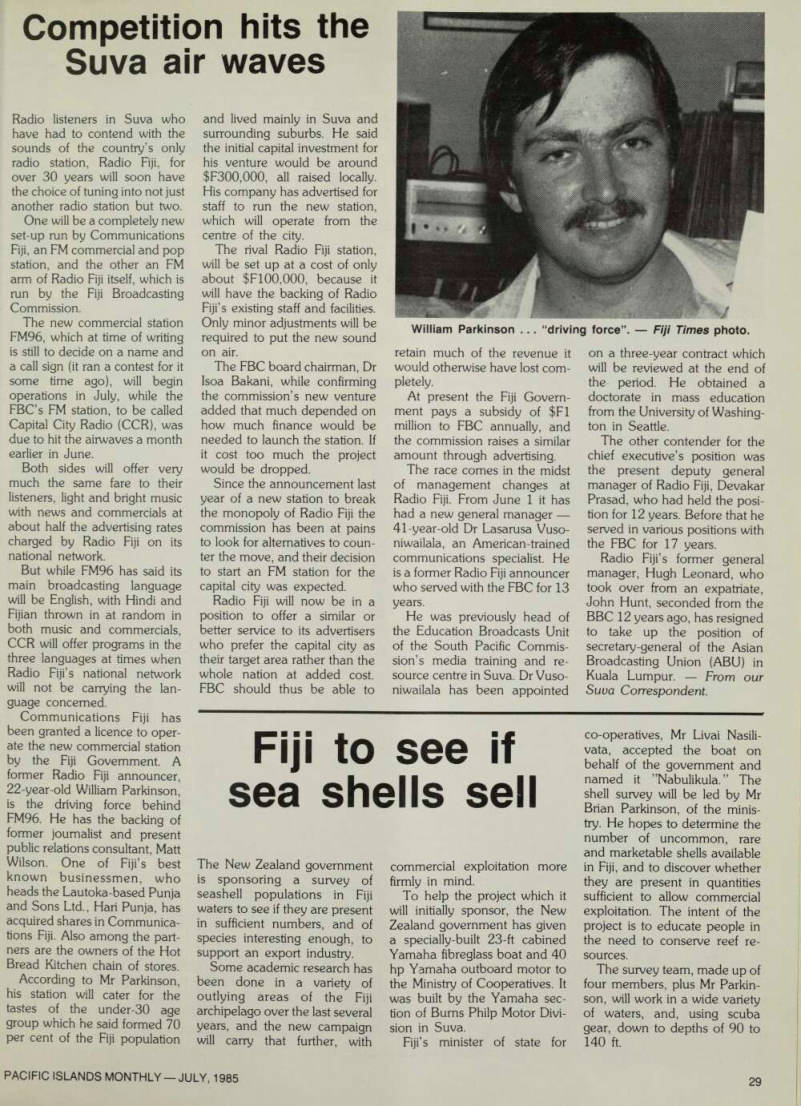
Suva air waves
Radio listeners in Suva who have had to contend with the sounds of the country’s only radio station, Radio Fiji, for over 30 years will soon have the choice of tuning into not just another radio station but two.
One will be a completely new set-up run by Communications Fiji, an FM commercial and pop station, and the other an FM arm of Radio Fiji itself, which is run by the Fiji Broadcasting Commission.
The new commercial station FM96, which at time of writing is still to decide on a name and a call sign (it ran a contest for it some time ago), will begin operations in July, while the FBC’s FM station, to be called Capital City Radio (CCR), was due to hit the airwaves a month earlier in June.
Both sides will offer very much the same fare to their listeners, light and bright music with news and commercials at about half the advertising rates charged by Radio Fiji on its national network.
But while FM96 has said its main broadcasting language will be English, with Hindi and Fijian thrown in at random in both music and commercials, CCR will offer programs in the three languages at times when Radio Fiji’s national network will not be carrying the lan guage concerned.
Communications Fiji has been granted a licence to oper ate the new commercial station by the Fiji Government. A former Radio Fiji announcer, 22-year-old William Parkinson, is the driving force behind FM96. He has the backing of former journalist and present public relations consultant, Matt Wilson. One of Fiji’s best known businessmen, who heads the Lautoka-based Punja and Sons Ltd., Hari Punja, has acquired shares in Communica tions Fiji. Also among the part ners are the owners of the Hot Bread Kitchen chain of stores.
According to Mr Parkinson, his station will cater for the tastes of the under-30 age group which he said formed 70 per cent of the Fiji population
and lived mainly in Suva and surrounding suburbs. He said the initial capital investment for his venture would be around $F300,000, all raised locally.
His company has advertised for staff to run the new station, which will operate from the centre of the city.
The rival Radio Fiji station, will be set up at a cost of only about SFIOO,OOO, because it will have the backing of Radio Fiji’s existing staff and facilities.
Only minor adjustments will be required to put the new sound on air.
The FBC board chairman, Dr Isoa Bakani, while confirming the commission’s new venture added that much depended on how much finance would be needed to launch the station. If it cost too much the project would be dropped.
Since the announcement last year of a new station to break the monopoly of Radio Fiji the commission has been at pains to look for alternatives to coun ter the move, and their decision to start an FM station for the capital city was expected.
Radio Fiji will now be in a position to offer a similar or better service to its advertisers who prefer the capital city as their target area rather than the whole nation at added cost.
FBC should thus be able to
retain much of the revenue it would otherwise have lost com pletely.
At present the Fiji Govern ment pays a subsidy of SFI million to FBC annually, and the commission raises a similar amount through advertising.
The race comes in the midst of management changes at Radio Fiji. From June 1 it has had a new general manager 41-year-old Dr Lasarusa Vuso niwailala, an American-trained communications specialist. He is a former Radio Fiji announcer who served with the FBC for 13 years.
He was previously head of the Education Broadcasts Unit of the South Pacific Commis sion’s media training and re source centre in Suva. Dr Vuso niwailala has been appointed
on a three-year contract which will be reviewed at the end of the period. He obtained a doctorate in mass education from the University of Washing ton in Seattle.
The other contender for the chief executive’s position was the present deputy general manager of Radio Fiji, Devakar Prasad, who had held the posi tion for 12 years. Before that he served in various positions with the FBC for 17 years.
Radio Fiji’s former general manager, Hugh Leonard, who took over from an expatriate, John Hunt, seconded from the BBC 12 years ago, has resigned to take up the position of secretary-general of the Asian Broadcasting Union (ABU) in Kuala Lumpur. From our Suva Correspondent.
William Parkinson ... “driving force”. Fiji Times photo.
sea shells sell
Fiji to see if sea shells sell
The New Zealand government is sponsoring a survey of seashell populations in Fiji waters to see if they are present in sufficient numbers, and of species interesting enough, to support an export industry.
Some academic research has been done in a variety of outlying areas of the Fiji archipelago over the last several years, and the new campaign will carry that further, with
commercial exploitation more firmly in mind.
To help the project which it will initially sponsor, the New Zealand government has given a specially-built 23-ft cabined Yamaha fibreglass boat and 40 hp Yamaha outboard motor to the Ministry of Cooperatives. It was built by the Yamaha sec tion of Burns Philp Motor Divi sion in Suva.
Fiji’s minister of state for
co-operatives, Mr Livai Nasili vata, accepted the boat on behalf of the government and named it ’’Nabulikula. ” The shell survey will be led by Mr Brian Parkinson, of the minis try. He hopes to determine the number of uncommon, rare and marketable shells available in Fiji, and to discover whether they are present in quantities sufficient to allow commercial exploitation. The intent of the project is to educate people in the need to conserve reef re sources.
The survey team, made up of four members, plus Mr Parkin son, will work in a wide variety of waters, and, using scuba gear, down to depths of 90 to 140 ft.
Kiribati cools on Soviet fish deal
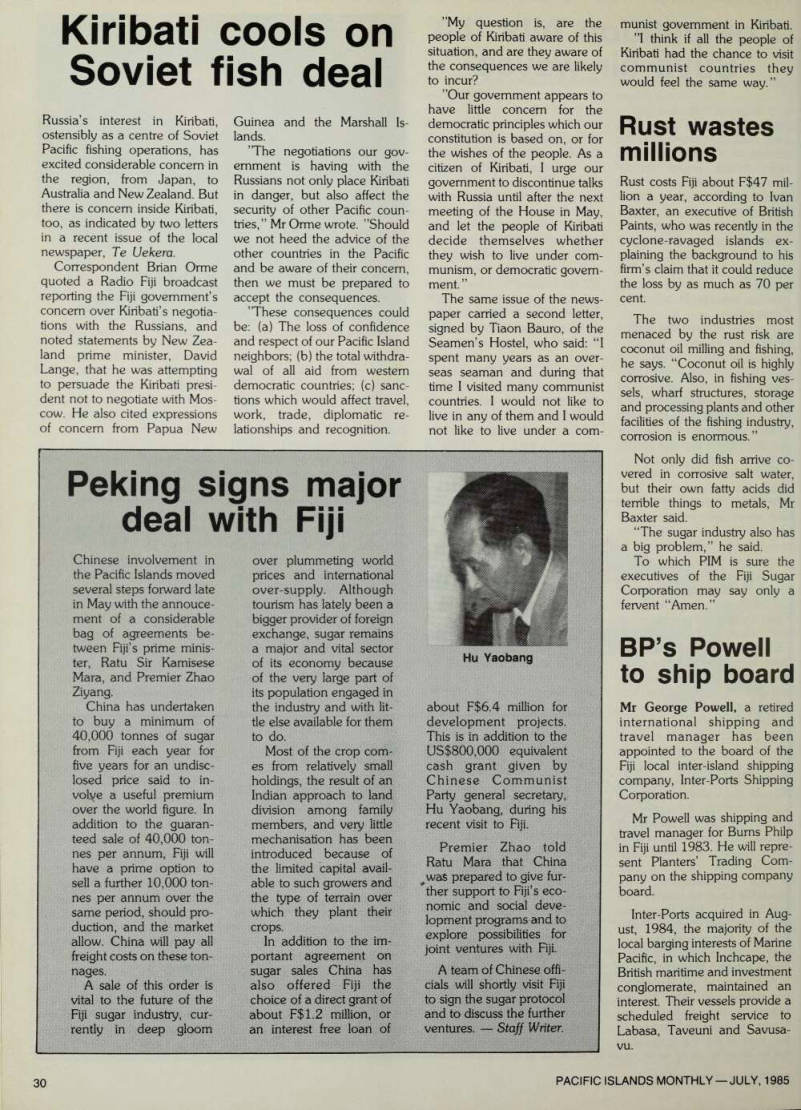
Soviet fish deal
Russia’s interest in Kiribati, ostensibly as a centre of Soviet Pacific fishing operations, has excited considerable concern in the region, from Japan, to Australia and New Zealand. But there is concern inside Kiribati, too, as indicated by two letters in a recent issue of the local newspaper, Te Uekera.
Correspondent Brian Orme quoted a Radio Fiji broadcast reporting the Fiji government’s concern over Kiribati’s negotia tions with the Russians, and noted statements by New Zea land prime minister, David Lange, that he was attempting to persuade the Kiribati presi dent not to negotiate with Mos cow. He also cited expressions of concern from Papua New
Guinea and the Marshall Is lands. ’The negotiations our gov ernment is having with the Russians not only place Kiribati in danger, but also affect the security of other Pacific coun tries,” Mr Orme wrote. ’’Should we not heed the advice of the other countries in the Pacific and be aware of their concern, then we must be prepared to accept the consequences. ’These consequences could be: (a) The loss of confidence and respect of our Pacific Island neighbors; (b) the total withdra wal of all aid from western democratic countries; (c) sanc tions which would affect travel, work, trade, diplomatic re lationships and recognition.
”My question is, are the people of Kiribati aware of this situation, and are they aware of the consequences we are likely to incur? ”Our government appears to have little concern for the democratic principles which our constitution is based on, or for the wishes of the people. As a citizen of Kiribati, I urge our government to discontinue talks with Russia until after the next meeting of the House in May, and let the people of Kiribati decide themselves whether they wish to live under com munism, or democratic govern ment. ”
The same issue of the news paper carried a second letter, signed by Tiaon Bauro, of the Seamen’s Hostel, who said; “I spent many years as an over seas seaman and during that time I visited many communist countries. I would not like to live in any of them and I would not like to live under a com
munist government in Kiribati. ”1 think if all the people of Kiribati had the chance to visit communist countries they would feel the same way.”
Rust wastes
millions
Rust costs Fiji about Fs47 mil lion a year, according to Ivan Baxter, an executive of British Paints, who was recently in the cyclone-ravaged islands ex plaining the background to his firm’s claim that it could reduce the loss by as much as 70 per cent.
The two industries most menaced by the rust risk are coconut oil milling and fishing, he says. “Coconut oil is highly corrosive. Also, in fishing ves sels, wharf structures, storage and processing plants and other facilities of the fishing industry, corrosion is enormous.”
Not only did fish arrive co vered in corrosive salt water, but their own fatty acids did terrible things to metals, Mr Baxter said.
“The sugar industry also has a big problem,” he said.
To which PIM is sure the executives of the Fiji Sugar Corporation may say only a fervent “Amen.”
BP’s Powell
to ship board
Mr George Powell, a retired international shipping and travel manager has been appointed to the board of the Fiji local inter-island shipping company, Inter-Ports Shipping Corporation.
Mr Powell was shipping and travel manager for Bums Philp in Fiji until 1983. He will repre sent Planters’ Trading Com pany on the shipping company board.
Inter-Ports acquired in Aug ust, 1984, the majority of the local barging interests of Marine Pacific, in which Inchcape, the British maritime and investment conglomerate, maintained an interest. Their vessels provide a scheduled freight service to Labasa, Taveuni and Savusa vu.
Peking signs major
deal with Fiji
Chinese involvement in the Pacific Islands moved several steps forward late in May with the annouce ment of a considerable bag of agreements be tween Fiji’s prime minis ter, Ratu Sir Kamisese Mara, and Premier Zhao Ziyang.
China has undertaken to buy a minimum of 40,000 tonnes of sugar from Fiji each year for five years for an undisc losed price said to in volve a useful premium over the world figure. In addition to the guaran teed sale of 40,000 ton nes per annum, Fiji will have a prime option to sell a further 10,000 ton nes per annum over the same period, should pro duction, and the market allow. China will pay all freight costs on these ton nages.
A sale of this order is vital to the future of the Fiji sugar industry, cur rently in deep gloom
over plummeting world prices and international over-supply. Although tourism has lately been a bigger provider of foreign exchange, sugar remains a major and vital sector of its economy because of the very large part of its population engaged in the industry and with lit tle else available for them to do.
Most of the crop com es from relatively small holdings, the result of an Indian approach to land division among family members, and very little mechanisation has been introduced because of the limited capital avail able to such growers and the type of terrain over which they plant their crops.
In addition to the im portant agreement on sugar sales China has also offered Fiji the choice of a direct grant of about Fsl.2 million, or an interest free loan of
about F 56.4 million for development projects.
This is in addition to the US$BOO,OOO equivalent cash grant given by Chinese Communist Party general secretary, Hu Yaobang, during his recent visit to Fiji.
Premier Zhao told Ratu Mara that China prepared to give fur ther support to Fiji’s eco nomic and social deve lopment programs and to explore possibilities for joint ventures with Fiji.
A team of Chinese offi cials will shortly visit Fiji to sign the sugar protocol and to discuss the further ventures. Staff Writer.
Hu Yaobang
Coconuts and Cheysanthemums
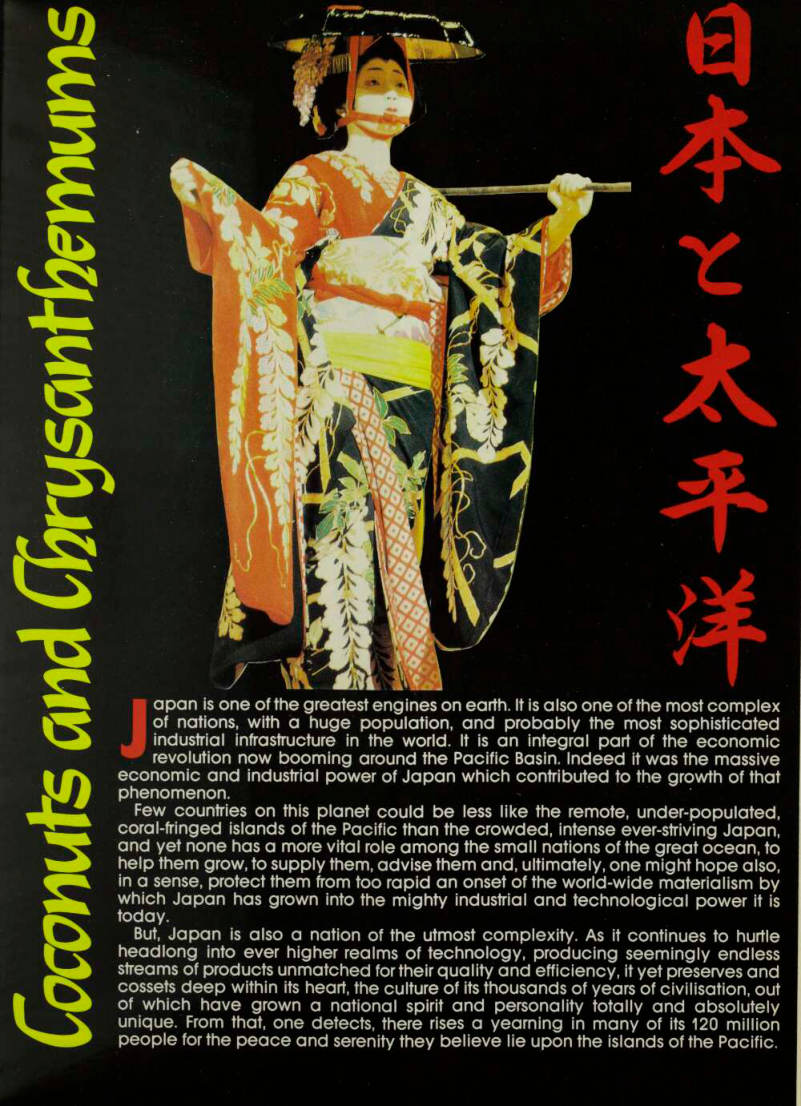
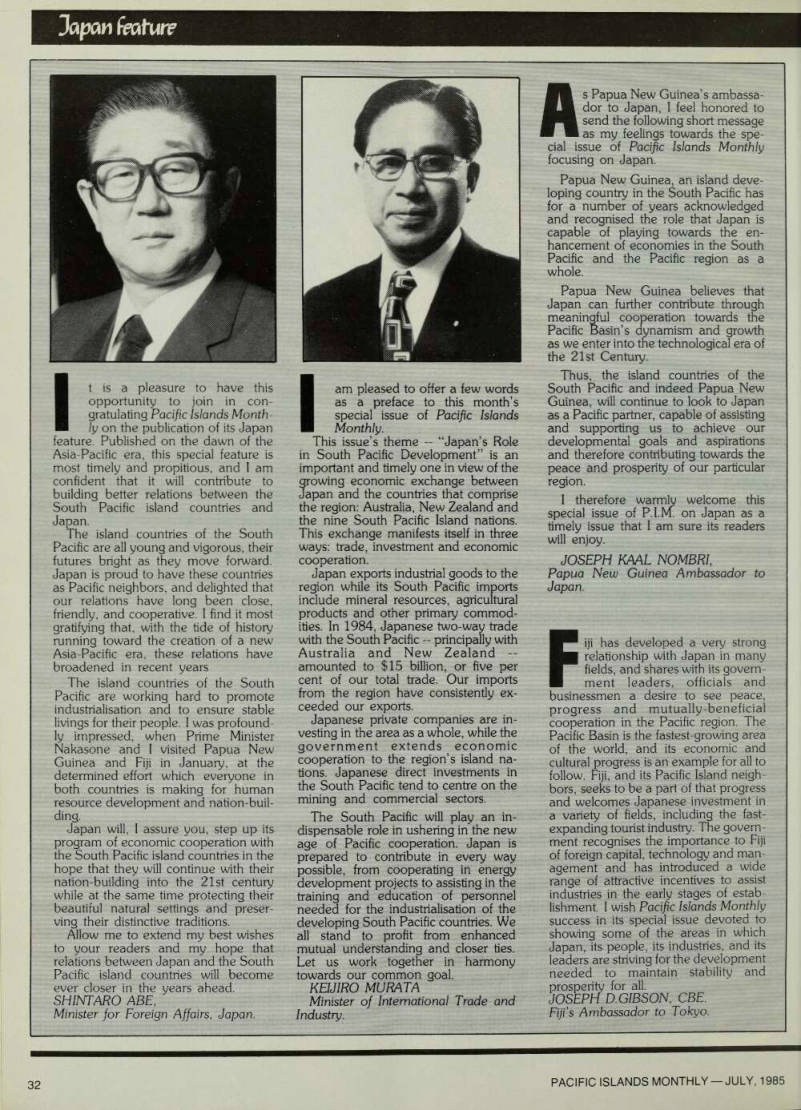
tez
Japan is one of the greatest engines on earth. It is also one of the most complex of nations, with a huge population, and probably the most sophisticated industrial infrastructure in the world. It is an integral part of the economic revolution now booming around the Pacific Basin. Indeed it was the massive economic and industrial power of Japan which contributed to the growth of that phenomenon.
Few countries on this planet could be less like the remote, under-populated, coral-fringed islands of the Pacific than the crowded, intense ever-striving Japan, and yet none has a more vital role among the small nations of the great ocean, to help them grow, to supply them, advise them and, ultimately, one might hope also, in a sense, protect them from too rapid an onset of the world-wide materialism by which Japan has grown into the mighty industrial and technological power it is today.
But, Japan is also a nation of the utmost complexity. As it continues to hurtle headlong into ever higher realms of technology, producing seemingly endless streams of products unmatched for their quality and efficiency, it yet preserves and cossets deep within its heart, the culture of its thousands of years of civilisation, out of which have grown a national spirit and personality totally and absolutely unique. From that, one detects, there rises a yearning in many of its 120 million people for the peace and serenity they believe lie upon the islands of the Pacific.
It is a pleasure to have this opportunity to join in con gratulating Pacific Islands Month ly on the publication of its Japan feature. Published on the dawn of the Asia-Pacific era, this special feature is most timely and propitious, and 1 am confident that it will contribute to building better relations between the South Pacific island countries and Japan.
The island countries of the South Pacific are all young and vigorous, their futures bright as they move forward.
Japan is proud to have these countries as Pacific neighbors, and delighted that our relations have long been close, friendly, and cooperative. I find it most gratifying that, with the tide of history running toward the creation of a new Asia-Pacific era, these relations have broadened in recent years The island countries of the South Pacific are working hard to promote industrialisation and to ensure stable livings for their people. I was profound ly impressed, when Prime Minister Nakasone and I visited Papua New Guinea and Fiji in January, at the determined effort which everyone in both countries is making for human resource development and nation-buil ding.
Japan will, I assure you, step up its program of economic cooperation with the South Pacific island countries in the hope that they will continue with their nation-building into the 21st century while at the same time protecting their beautiful natural settings and preser ving their distinctive traditions.
Allow me to extend my best wishes to your readers and my hope that relations between Japan and the South Pacific island countries will become ever closer in the years ahead.
Shintaro Abe .
Minister for Foreign Affairs, Japan.
I am pleased to offer a few words as a preface to this month’s special issue of Pacific Islands Monthly.
This issue’s theme - “Japan’s Role in South Pacific Development” is an important and timely one in view of the growing economic exchange between Japan and the countries that comprise the region: Australia, New Zealand and the nine South Pacific Island nations.
This exchange manifests itself in three ways: trade, investment and economic cooperation.
Japan exports industrial goods to the region while its South Pacific imports include mineral resources, agricultural products and other primary commod ities. In 1984, Japanese two-way trade with the South Pacific - principally with Australia and New Zealand -amounted to $l5 billion, or five per cent of our total trade. Our imports from the region have consistently ex ceeded our exports.
Japanese private companies are in vesting in the area as a whole, while the government extends economic cooperation to the region’s island na tions. Japanese direct investments in the South Pacific tend to centre on the mining and commercial sectors.
The South Pacific will play an in dispensable role in ushering in the new age of Pacific cooperation. Japan is prepared to contribute in every way possible, from cooperating in energy development projects to assisting in the training and education of personnel needed for the industrialisation of the developing South Pacific countries. We all stand to profit from enhanced mutual understanding and closer ties.
Let us work together in harmony towards our common goal.
Keijiro Murata
Minister of International Trade and Industry.
As Papua New Guinea’s ambassa dor to Japan, I feel honored to send the following short message as my feelings towards the spe cial issue of Pacific Islands Monthly focusing on Japan.
Papua New Guinea, an island deve loping country in the South Pacific has for a number of years acknowledged and recognised the role that Japan is capable of playing towards the en hancement of economies in the South Pacific and the Pacific region as a whole.
Papua New Guinea believes that Japan can further contribute through meaningful cooperation towards the Pacific Basin’s dynamism and growth as we enter into the technological era of the 21st Century.
Thus, the island countries of the South Pacific and indeed Papua New Guinea, will continue to look to Japan as a Pacific partner, capable of assisting and supporting us to achieve our developmental goals and aspirations and therefore contributing towards the peace and prosperity of our particular region.
I therefore warmly welcome this special issue of P.I.M. on Japan as a timely issue that I am sure its readers will enjoy.
Joseph Kaal Nombri,
Papua New Guinea Ambassador to Japan.
Fiji has developed a very strong relationship with Japan in many fields, and shares with its govern ment leaders, officials and businessmen a desire to see peace, progress and mutually-beneficial cooperation in the Pacific region. The Pacific Basin is the fastest-growing area of the world, and its economic and cultural progress is an example for all to follow. Fiji, and its Pacific Island neigh bors, seeks to be a part of that progress and welcomes Japanese investment in a variety of fields, including the fast expanding tourist industry. The govern ment recognises the importance to Fiji of foreign capital, technology and man agement and has introduced a wide range of attractive incentives to assist industries in the early stages of estab lishment. I wish Pacific Islands Monthly success in its special issue devoted to showing some of the areas in which Japan, its people, its industries, and its leaders are striving for the development needed to maintain stability and prosperity for all.
Joseph D. Gibson, Cbe
Fiji’s Ambassador to Tokyo.
“last paradise"
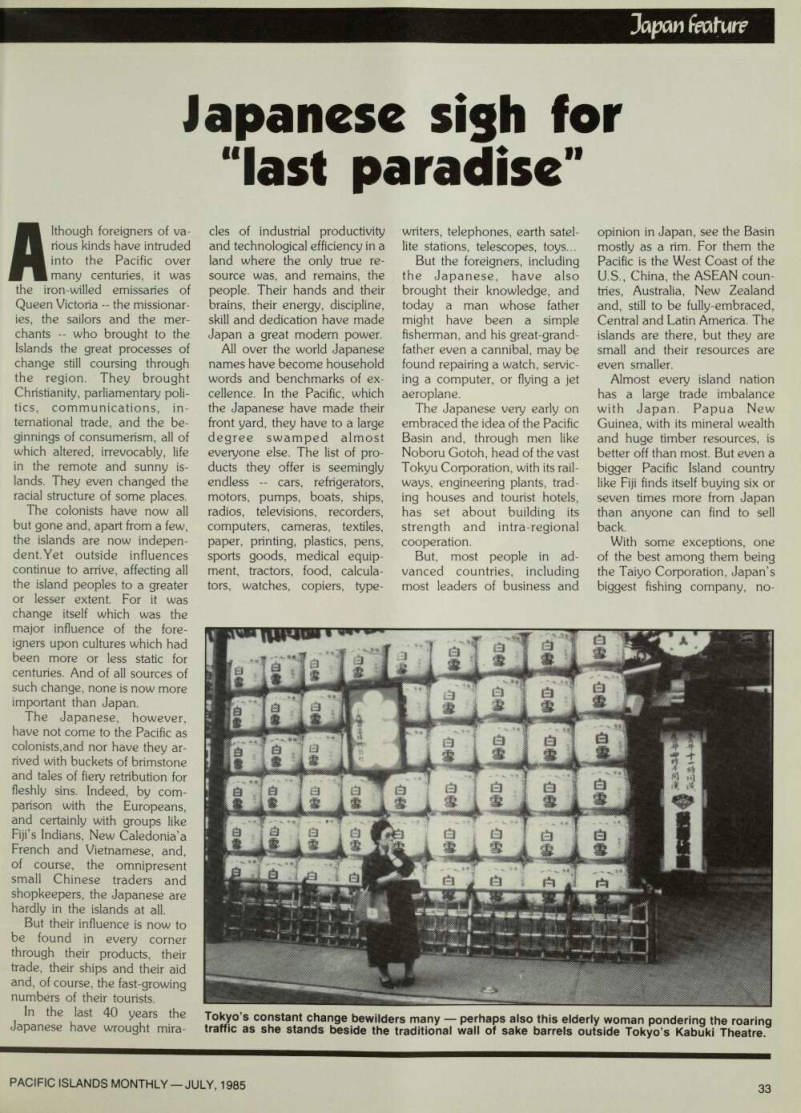
Japanese sigh for “last paradise"
Although foreigners of va rious kinds have intruded into the Pacific over many centuries, it was the iron-willed emissaries of Queen Victoria the missionar ies, the sailors and the mer chants who brought to the Islands the great processes of change still coursing through the region. They brought Christianity, parliamentary poli tics, communications, in ternational trade, and the be ginnings of consumerism, all of which altered, irrevocably, life in the remote and sunny is lands. They even changed the racial structure of some places.
The colonists have now all but gone and, apart from a few, the islands are now indepen dent. Yet outside influences continue to arrive, affecting all the island peoples to a greater or lesser extent. For it was change itself which was the major influence of the fore igners upon cultures which had been more or less static for centuries. And of all sources of such change, none is now more important than Japan.
The Japanese, however, have not come to the Pacific as colonists,and nor have they ar rived with buckets of brimstone and tales of fiery retribution for fleshly sins. Indeed, by com parison with the Europeans, and certainly with groups like Fiji’s Indians, New Caledonia’a French and Vietnamese, and, of course, the omnipresent small Chinese traders and shopkeepers, the Japanese are hardly in the islands at all.
But their influence is now to be found in every corner through their products, their trade, their ships and their aid and, of course, the fast-growing numbers of their tourists.
In the last 40 years the Japanese have wrought mira
cles of industrial productivity and technological efficiency in a land where the only true re source was, and remains, the people. Their hands and their brains, their energy, discipline, skill and dedication have made Japan a great modern power.
All over the world Japanese names have become household words and benchmarks of ex cellence. In the Pacific, which the Japanese have made their front yard, they have to a large degree swamped almost everyone else. The list of pro ducts they offer is seemingly endless - cars, refrigerators, motors, pumps, boats, ships, radios, televisions, recorders, computers, cameras, textiles, paper, printing, plastics, pens, sports goods, medical equip ment, tractors, food, calcula tors, watches, copiers, type
writers, telephones, earth satel lite stations, telescopes, toys...
But the foreigners, including the Japanese, have also brought their knowledge, and today a man whose father might have been a simple fisherman, and his great-grand father even a cannibal, may be found repairing a watch, servic ing a computer, or flying a jet aeroplane.
The Japanese very early on embraced the idea of the Pacific Basin and, through men like Noboru Gotoh, head of the vast Tokyu Corporation, with its rail ways, engineering plants, trad ing houses and tourist hotels, has set about building its strength and intra-regional cooperation.
But, most people in ad vanced countries, including most leaders of business and
opinion in Japan, see the Basin mostly as a rim. For them the Pacific is the West Coast of the U.S., China, the ASEAN coun tries, Australia, New Zealand and, still to be fully-embraced, Central and Latin America. The islands are there, but they are small and their resources are even smaller.
Almost every island nation has a large trade imbalance with Japan. Papua New Guinea, with its mineral wealth and huge timber resources, is better off than most. But even a bigger Pacific Island country like Fiji finds itself buying six or seven times more from Japan than anyone can find to sell back.
With some exceptions, one of the best among them being the Taiyo Corporation, Japan’s biggest fishing company, no-
Tokyo’s constant change bewilders many - perhaps also this elderly woman pondering the roaring traffic as she stands beside the traditional wall of sake barrels outside Tokyo’s Kabuki Theatre.
body does very much about this imbalance, taking it to be among the facts of a tough life.
The islands rack their brains about trade, and push for in vestment, but success on any large scale continues to elude them.
Taiyo has a joint venture in fishing and fish processing with the Solomon Islands. Until re cently, when they withdrew for lack of profit, C.Itoh, the huge Tokyo-based international trad ing conglomerate, shared the fish cannery at Levuka in Fiji.
This was a brave and manful effort by Itoh which might have succeeded but for the high cost of operating in Ovalau.
Economic pundits see oppor tunities for agricultural and hor ticultural joint ventures, but enormous work will be needed to get them up and running.
Japan offers a huge, and rich, market for fruit, vegetables and fish. In Japanese supermarkets tropical fruits sell at prices an islander would think astronomi cal; 10 or 20 times higher than in Pacific places where they assist their growers by con veniently hurling themselves off the trees.
But, if the Japanese pay high prices for their produce, they also demand standards of qua lity which countries much more sophisticated and technically advanced than a Pacific island nation have trouble meeting.
Japan’s preoccupation with product quality , and with high performance in such matters as the meeting of delivery dates, is total and uncompromising.
Even the most optimistic of Pacific enthusiasts cannot but concede that, with some excep tions like wood chips and lum ber, it may be some time yet before large quantities of island products sell regularly in Japan.
Yet there are opportunities, albeit still fairly small, for joint ventures with Japanese com panies seeking to develop is land industries able to find markets perhaps not in Japan, but elsewhere around the Paci fic. This was the basis of Taiyo’s enterprise, which produced fish for sale in the United States.
Brightest hope of all, how ever, is tourism. Tokyu Corporation, through its sub
sidiary, Pan-Pacific Hotels, already has several resorts in the Pacific, including Le Lagon, one of the two first-class hotels in Port-Vila, and has quite elaborate plans for major ex pansion in a number of islands over the next 10 years or so.
Other Japanese investors are looking at hotel sites in Fiji, Micronesia and elsewhere.
Indeed, when all is done, it is tourism which continues to offer the best hope of attracting major Japanese investment in, and involvement with, the Paci fic islands.
A great many Japanese have a very romantic view of the Pacific islands. To some degree that is a disadvantage for the islands for it leads to the view among business leaders, bank ers and such, that the islands ought to be kept as the last earthly outpost of Paradise, un tarnished by crass commerce and industry.
Indeed, Tokyo is thick with
billboards, brochures, travel agencies and guidebooks telling the jam-packed, frantically competitive, hustled and bus tled Japanese that, ”Yes, Miss Yamomoto, there is peace and privacy on earth, and it comes wrapped in warm, crystal-clear water, with bouquets of gently waving coconut palms and be vies of simple, gentle, island folk, who may not bring your bus on time, but they will smile nicely about it...”
If the Pacific Islands, gener ally, have a task ahead of them it may be to persuade the Japanese that they seek more out of life than bit parts as brown angels in a Tokyo salary man’s vision of Holiday Heaven. Probably tourism will always be the mainstay of the island economies; leisure and the pursuit of it, particularly by the denizens of the high-tech world, being one of the new miracle industries. Nor should
they ignore it, for the rewards of top-line performance can be considerable, and much could flow from it in terms of subsidi ary supply and service enter prises once acceptable stan dards had been achieved.
Yet, in the eyes and minds of the islanders themselves, that is not enough. They, too, are involved in processes of change which, in their terms, are just as enormous as those working anywhere else. The islanders have to choose, so far as the pressure of events, and external forces, allow them a choice, between their traditional way, with all its many human and also perhaps even economic advantages, and the tech nological world.
Japan is already helping them make that choice while at the same time itself growing as a nation with legitimate interests not only around the Pacific, but right across it.
Advertisements & other items, p. 34 (1 item)
Care.
' ?\ < V ' V V 'X,?/ mm '
OFFICIAL AIRLINE FOR
TSUKUBA EXPO’BS
SI Si -V ■- : * % & M
Care.
It’s always a pleasure.
At Japan Air Lines we care. We care about everything. So whether it’s a coffee cup that needs refilling or a child that needs attention, we’ll be there. We’ll be there giving you something even more than good service. Good feelings. ■
JAPAN
"Mr Pacific" surveys his


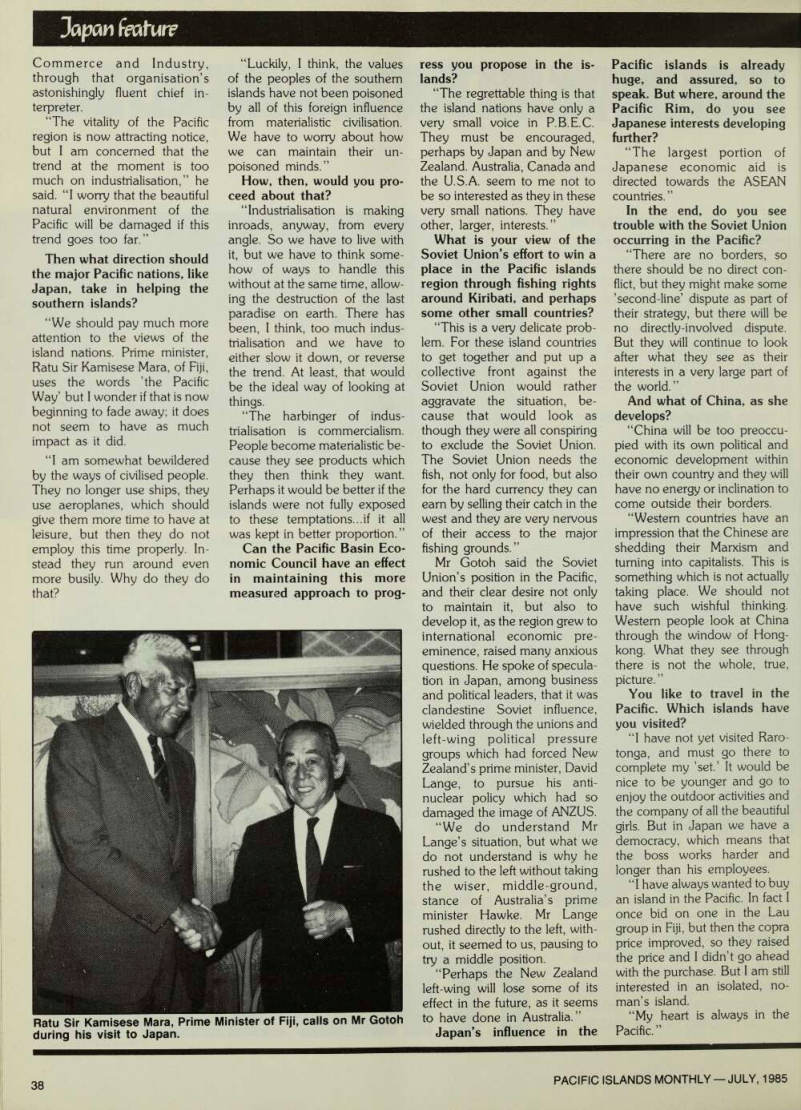
favorite ocean
Noboru Gotoh is one of the top ten major tycoons of Japanese trade and industry. At the age of 69 he still works 12 hours a day and heads the enormous Tokyu Corporation, a conglomerate of railways, supermarkets, depart ment stores, real estate com panies, engineering plants and hotels scattered across Japan, on the West Coast of the U.S.A. and around the Pacific.
He is also known as Japan’s “Mr Pacific,” for it was he who was the force behind creation of the Pacific Basin Economic Council and the Pacific Society of Japan.
P.B.E.C. is an information exchange among major businessmen all around the Pacific, but primarily America, Australia, New Zealand, and, of course, Japan. The Pacific So ciety is of more academic bent and provides a forum for study of all manner of Pacific in
terests, from education, history and culture, to the protection of the environment and the health of the people.
Mr Gotoh’s list of chairman ships and seats on boards of directors is considerable and ranges from the leadership of his own group of companies, through the presidency of what is, in effect, his corporation’s own university, to a seat as counsellor to the Bank of Japan, membership of the program consultation commit tee for the Japanese broadcas ting corporation, NHK, and presidency of both the Tokyo Chamber of Commerce and Industry and the national Japan Chamber of Commerce and Industry. He is a member of the Economic Council of Japan and chairman of the Postal Services Council.
He is also a confidant of the Japanese prime minister, Mr Yasuhiro Nakasone, who
attended the same school as Mr Gotoh, a matter of major note in Japanese society.
He is, in short, an immensely powerful figure in Japanese affairs, a multi-millionaire and a member of the inner councils of one of the major industrial nations on earth.
He is also very much in love with the Pacific. He, and his corporation, are deeply in volved with developments in the region, although his own view of the islands themselves tends to be perhaps a shade more rose-tinted and idealistic than some of the Pacific’s an xious seekers after progress would prefer. Yet he under stands very well their needs and aspirations and is to be counted one of the region’s best friends in high places.
I spoke with him, in Tokyo, at his large, but surprisingly sim ple, even spartan, presidential office at the Japan Chamber of
Commerce and Industry, through that organisation’s astonishingly fluent chief in terpreter.
“The vitality of the Pacific region is now attracting notice, but I am concerned that the trend at the moment is too much on industrialisation,” he said. “I worry that the beautiful natural environment of the Pacific will be damaged if this trend goes too far.”
Then what direction should the major Pacific nations, like Japan, take in helping the southern islands?
“We should pay much more attention to the views of the island nations. Prime minister, Ratu Sir Kamisese Mara, of Fiji, uses the words ’the Pacific Way’ but I wonder if that is now beginning to fade away; it does not seem to have as much impact as it did.
“I am somewhat bewildered by the ways of civilised people.
They no longer use ships, they use aeroplanes, which should give them more time to have at leisure, but then they do not employ this time properly. In stead they run around even more busily. Why do they do that?
“Luckily, I think, the values of the peoples of the southern islands have not been poisoned by all of this foreign influence from materialistic civilisation.
We have to worry about how we can maintain their un poisoned minds.”
How, then, would you pro ceed about that?
“Industrialisation is making inroads, anyway, from every angle. So we have to live with it, but we have to think some how of ways to handle this without at the same time, allow ing the destruction of the last paradise on earth. There has been, I think, too much indus trialisation and we have to either slow it down, or reverse the trend. At least, that would be the ideal way of looking at things.
“The harbinger of indus trialisation is commercialism.
People become materialistic be cause they see products which they then think they want.
Perhaps it would be better if the islands were not fully exposed to these temptations...if it all was kept in better proportion. ”
Can the Pacific Basin Eco nomic Council have an effect in maintaining this more measured approach to prog-
ress you propose in the is lands?
“The regrettable thing is that the island nations have only a very small voice in P.B.E.C.
They must be encouraged, perhaps by Japan and by New Zealand. Australia, Canada and the U.S.A. seem to me not to be so interested as they in these very small nations. They have other, larger, interests.”
What is your view of the Soviet Union’s effort to win a place in the Pacific islands region through fishing rights around Kiribati, and perhaps some other small countries?
“This is a very delicate prob lem. For these island countries to get together and put up a collective front against the Soviet Union would rather aggravate the situation, be cause that would look as though they were all conspiring to exclude the Soviet Union.
The Soviet Union needs the fish, not only for food, but also for the hard currency they can earn by selling their catch in the west and they are very nervous of their access to the major fishing grounds.”
Mr Gotoh said the Soviet Union’s position in the Pacific, and their clear desire not only to maintain it, but also to develop it, as the region grew to international economic pre eminence, raised many anxious questions. He spoke of specula tion in Japan, among business and political leaders, that it was clandestine Soviet influence, wielded through the unions and left-wing political pressure groups which had forced New Zealand’s prime minister, David Lange, to pursue his anti nuclear policy which had so damaged the image of ANZUS.
“We do understand Mr Lange’s situation, but what we do not understand is why he rushed to the left without taking the wiser, middle-ground, stance of Australia’s prime minister Hawke. Mr Lange rushed directly to the left, with out, it seemed to us, pausing to try a middle position.
“Perhaps the New Zealand left-wing will lose some of its effect in the future, as it seems to have done in Australia.”
Japan’s influence in the
Pacific islands is already huge, and assured, so to speak. But where, around the Pacific Rim, do you see Japanese interests developing further?
“The largest portion of Japanese economic aid is directed towards the ASEAN countries. ”
In the end, do you see trouble with the Soviet Union occurring in the Pacific?
“There are no borders, so there should be no direct con flict, but they might make some ’second-line’ dispute as part of their strategy, but there will be no directly-involved dispute.
But they will continue to look after what they see as their interests in a very large part of the world.”
And what of China, as she develops?
“China will be too preoccu pied with its own political and economic development within their own country and they will have no energy or inclination to come outside their borders.
“Western countries have an impression that the Chinese are shedding their Marxism and turning into capitalists. This is something which is not actually taking place. We should not have such wishful thinking.
Western people look at China through the window of Hong kong. What they see through there is not the whole, true, picture. ”
You like to travel in the Pacific. Which islands have you visited?
“I have not yet visited Raro tonga, and must go there to complete my ’set.’ It would be nice to be younger and go to enjoy the outdoor activities and the company of all the beautiful girls. But in Japan we have a democracy, which means that the boss works harder and longer than his employees.
“I have always wanted to buy an island in the Pacific. In fact I once bid on one in the Lau group in Fiji, but then the copra price improved, so they raised the price and I didn’t go ahead with the purchase. But I am still interested in an isolated, no man’s island.
“My heart is always in the Pacific. ”
Ratu Sir Kamisese Mara, Prime Minister of Fiji, calls on Mr Gotoh during his visit to Japan.
Advertisements & other items, pp. 36-37 (1 item)
Ihetrue Beauty Of Amazda El That
With the pace of events moving so quickly, we can only stay up with them by keeping our eyes on the future.
Finding a better way For too long, comfort and handling have taken a back seat in the design of the dependable pickup. Ruggedness, strength and reliability have been its sole virtues. But times are changing.
Restless drivers are demanding more, so Mazda embarked on a programme to give them more, much more. The result is the new Mazda B Series, a new concept in pickup design. A concept that reflects Mazda’s bumper-tobumper commitment to improving performance and comfort throughout.
Comfort gets top priority Conventionally, the cabin is bolted directly to the rigid load-bearing chassis. But for the new B series, Mazda’s engineers designed shear type cab mounts instead. Noise, twisting, vibrations and other irritations are, therefore, radically reduced.
The driver now enjoys smoother riding in a far more comfortable and quiet environment.
Technological refinements
Since the cabin has been isolated with shear type mounts, the suspension could be freely designed for maximum strength and performance, making our new concept realizable.
The front suspension has been completely redesigned with ti 'J m « mzmmm Specifications and equipment V may vary according to market area. Please check with 1 your Mazda dealer. an l-shaped lower arm that incorporates a tension rod. This arm together with a grooved tension rod bushing increases longitudinal compliance to soak up bumps from poor roads. The lower arm bushing and threaded bushing type upper arm spindle increase lateral rigidity. And
ITS AIMS (OTTER THAN ITHAS TOR
changes in spring rate improve balance for a smoother ride.
The rear suspension also features improvements such as bias-mounted dampers that overcome ‘spring wind-up’ during sudden starts and stops.
These also prevent wheel ‘hop’ when running light.
And just the right reduction in spring rate improves riding comfort while retaining load carrying toughness.
The moment you try the *-v wheel, you’ll feel the difference fcm with Mazda’s new variable ratio 1 ball and nut design. A double hold effort is reduced and steering precision is increased.
The total result is an ideal balance increases All-New Mazda B Series ing type sector shaft steering rigidity so, together with the new variable ratio, steering of handling ease and riding comfort in a rugged, strong and high payload pickup!
The perfect engineering blend Mazda has always viewed design challenges from a broad perspective. So Mazda is the first to mount the cabin on a 1 ton pickup with such sophisticated techniques. The resulting comfort is harmonious with the totally new suspension and steering system. That’s why this is the pickup that feels and handles more like a passenger car.
Ultimately, of course, the integrated whole takes precedence over any single aspect. This balanced approach, the perfect resolution of design conflicts, is the true beauty of every Mazda car or truck. And it’s why a Mazda is always better than it has to be.
Enter the “Mazda Family Photo Contest ’B6. ’’ Total cash prizes: US$6O,OOO. For further information, please contact your nearest Mazda dealer. Contest closes on July 31, 1985. (''a ©Mazda Motor Corporation
Motor industry drives
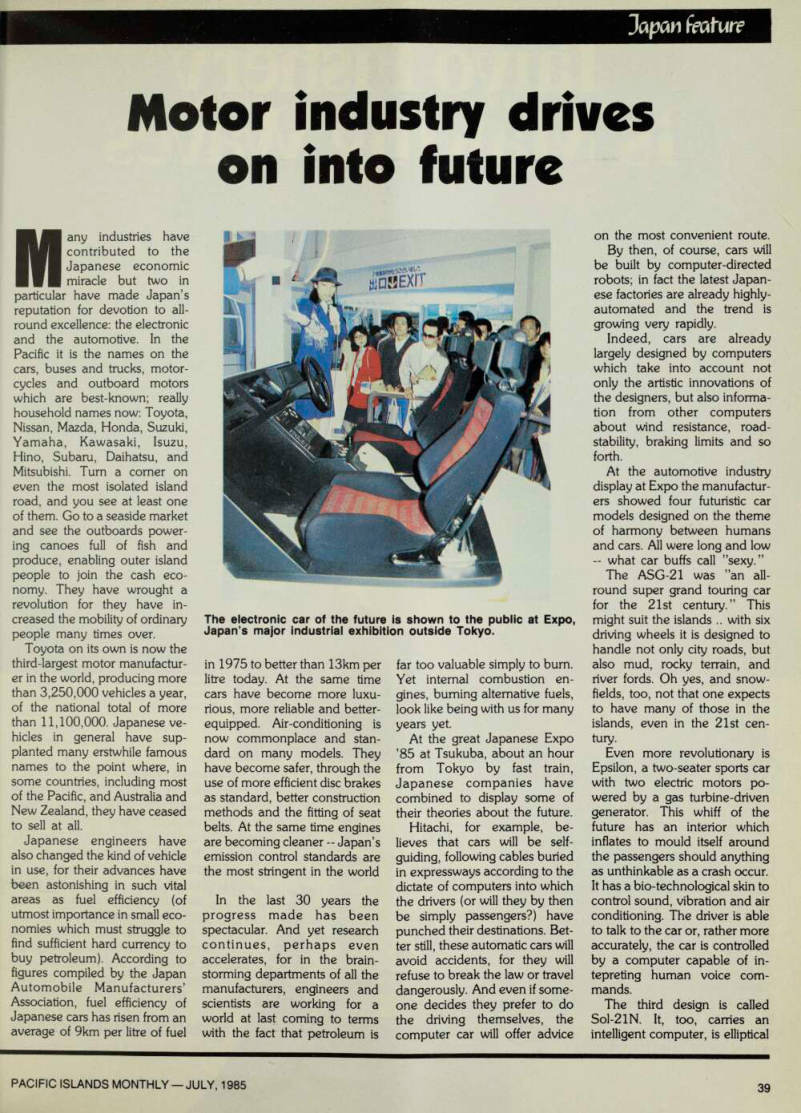
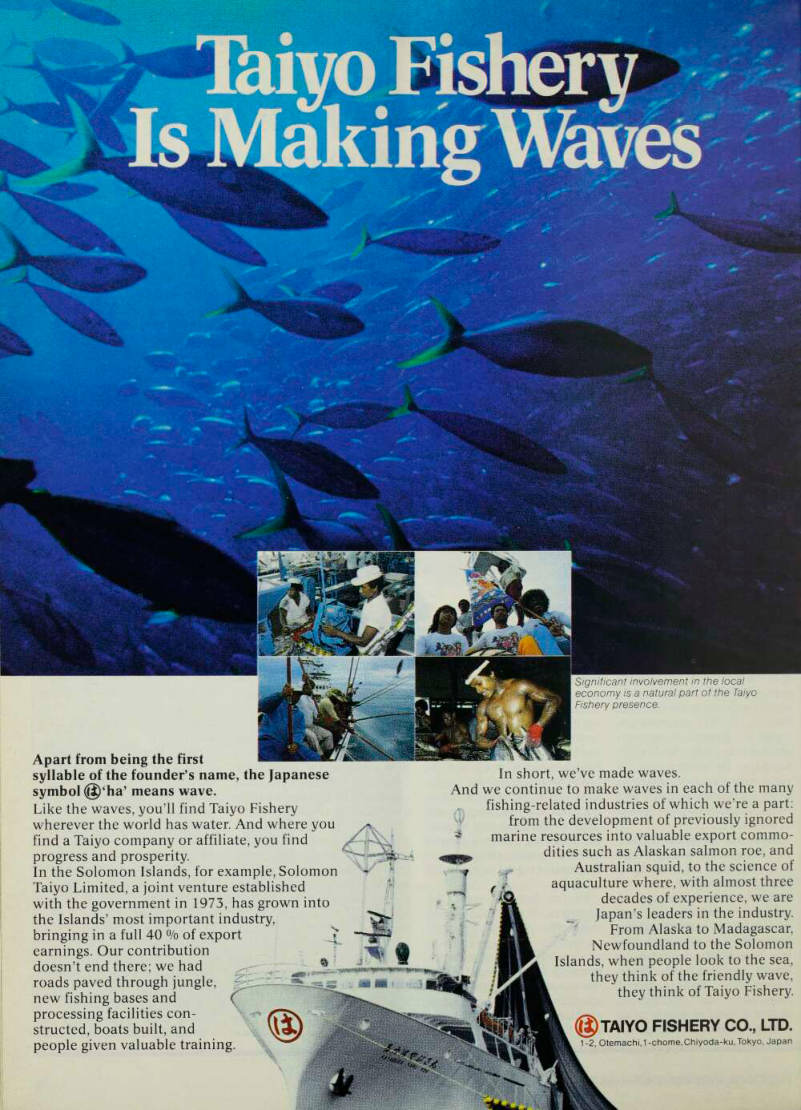
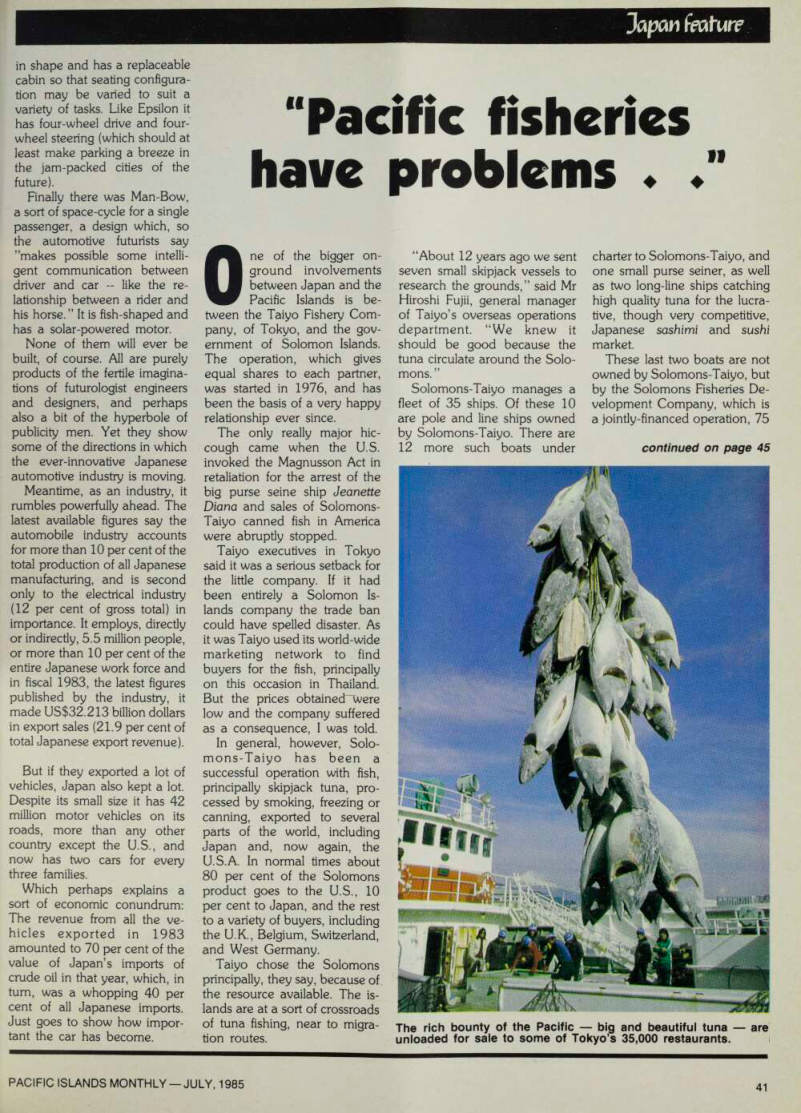
on into future
Many industries have contributed to the Japanese economic miracle but two in particular have made Japan’s reputation for devotion to all round excellence: the electronic and the automotive. In the Pacific it is the names on the cars, buses and trucks, motor cycles and outboard motors which are best-known; really household names now: Toyota, Nissan, Mazda, Honda, Suzuki, Yamaha, Kawasaki, Isuzu, Hino, Subaru, Daihatsu, and Mitsubishi. Turn a comer on even the most isolated island road, and you see at least one of them. Go to a seaside market and see the outboards power ing canoes full of fish and produce, enabling outer island people to join the cash eco nomy. They have wrought a revolution for they have in creased the mobility of ordinary people many times over.
Toyota on its own is now the third-largest motor manufactur er in the world, producing more than 3,250,000 vehicles a year, of the national total of more than 11,100,000. Japanese ve hicles in general have sup planted many erstwhile famous names to the point where, in some countries, including most of the Pacific, and Australia and New Zealand, they have ceased to sell at all.
Japanese engineers have also changed the kind of vehicle in use, for their advances have been astonishing in such vital areas as fuel efficiency (of utmost importance in small eco nomies which must struggle to find sufficient hard currency to buy petroleum). According to figures compiled by the Japan Automobile Manufacturers’
Association, fuel efficiency of Japanese cars has risen from an average of 9km per litre of fuel
in 1975 to better than 13km per litre today. At the same time cars have become more luxu rious, more reliable and better equipped. Air-conditioning is now commonplace and stan dard on many models. They have become safer, through the use of more efficient disc brakes as standard, better construction methods and the fitting of seat belts. At the same time engines are becoming cleaner - Japan’s emission control standards are the most stringent in the world In the last 30 years the progress made has been spectacular. And yet research continues, perhaps even accelerates, for in the brain storming departments of all the manufacturers, engineers and scientists are working for a world at last coming to terms with the fact that petroleum is
far too valuable simply to burn.
Yet internal combustion en gines, burning alternative fuels, look like being with us for many years yet.
At the great Japanese Expo ’B5 at Tsukuba, about an hour from Tokyo by fast train, Japanese companies have combined to display some of their theories about the future.
Hitachi, for example, be lieves that cars will be self guiding, following cables buried in expressways according to the dictate of computers into which the drivers (or will they by then be simply passengers?) have punched their destinations. Bet ter still, these automatic cars will avoid accidents, for they will refuse to break the law or travel dangerously. And even if some one decides they prefer to do the driving themselves, the computer car will offer advice
on the most convenient route.
By then, of course, cars will be built by computer-directed robots; in fact the latest Japan ese factories are already highly automated and the trend is growing very rapidly.
Indeed, cars are already largely designed by computers which take into account not only the artistic innovations of the designers, but also informa tion from other computers about wind resistance, road stability, braking limits and so forth.
At the automotive industry display at Expo the manufactur ers showed four futuristic car models designed on the theme of harmony between humans and cars. All were long and low - what car buffs call ’’sexy.”
The ASG-21 was ”an all round super grand touring car for the 21st century.” This might suit the islands .. with six driving wheels it is designed to handle not only city roads, but also mud, rocky terrain, and river fords. Oh yes, and snow fields, too, not that one expects to have many of those in the islands, even in the 21st cen tury.
Even more revolutionary is Epsilon, a two-seater sports car with two electric motors po wered by a gas turbine-driven generator. This whiff of the future has an interior which inflates to mould itself around the passengers should anything as unthinkable as a crash occur.
It has a bio-technological skin to control sound, vibration and air conditioning. The driver is able to talk to the car or, rather more accurately, the car is controlled by a computer capable of in tepreting human voice com mands.
The third design is called Sol-2 IN. It, too, carries an intelligent computer, is elliptical
The electronic car of the future is shown to the public at Expo, Japan’s major industrial exhibition outside Tokyo.
in shape and has a replaceable cabin so that seating configura tion may be varied to suit a variety of tasks. Like Epsilon it has four-wheel drive and four wheel steering (which should at least make parking a breeze in the jam-packed cities of the future).
Finally there was Man-Bow, a sort of space-cycle for a single passenger, a design which, so the automotive futurists say ’’makes possible some intelli gent communication between driver and car like the re lationship between a rider and his horse. ” It is fish-shaped and has a solar-powered motor.
None of them will ever be built, of course. All are purely products of the fertile imagina tions of futurologist engineers and designers, and perhaps also a bit of the hyperbole of publicity men. Yet they show some of the directions in which the ever-innovative Japanese automotive industry is moving.
Meantime, as an industry, it rumbles powerfully ahead. The latest available figures say the automobile industry accounts for more than 10 per cent of the total production of all Japanese manufacturing, and is second only to the electrical industry (12 per cent of gross total) in importance. It employs, directly or indirectly, 5.5 million people, or more than 10 per cent of the entire Japanese work force and in fiscal 1983, the latest figures published by the industry, it made U 5532,213 billion dollars in export sales (21.9 per cent of total Japanese export revenue).
But if they exported a lot of vehicles, Japan also kept a lot.
Despite its small size it has 42 million motor vehicles on its roads, more than any other country except the U.S., and now has two cars for every three families.
Which perhaps explains a sort of economic conundrum: The revenue from all the ve hicles exported in 1983 amounted to 70 per cent of the value of Japan’s imports of crude oil in that year, which, in turn, was a whopping 40 per cent of all Japanese imports.
Just goes to show how impor tant the car has become.
Advertisements & other items, pp. 39-40 (2 items)
Japan feature
Taiyo Fishery
Is Making Waves
Apart from being the first syllable of the founder’s name, the Japanese
symbol @‘ha’ means wave.
Like the waves, you’ll find Taiyo Fishery wherever the world has water. And where you find a Taiyo company or affiliate, you find progress and prosperity.
In the Solomon Islands, for example, Solomon Taiyo Limited, a joint venture established with the government in 1973, has grown into the Islands’ most important industry, bringing in a full 40 % of export earnings. Our contribution doesn’t end there; we had roads paved through jungle, new fishing bases and processing facilities constructed, boats built, and people given valuable training.
V* t M In short, we’ve made waves.
And we continue to make waves in each of the many fishing-related industries of which we’re a part: from the development of previously ignored 3 marine resources into valuable export commodities such as Alaskan salmon roe, and Australian squid, to the science of aquaculture where, with almost three decades of experience, we are Japan’s leaders in the industry.
From Alaska to Madagascar, Newfoundland to the Solomon Islands, when people look to the sea, they think of the friendly wave, they think of Taiyo Fishery.
(g) TAIYO FISHERY CO., LTD.
1 -2, Otemachi, 1 -chome, Chiyoda-ku, Tokyo, Japan
have problems"


“Pacific fisheries have problems"
One of the bigger on ground involvements between Japan and the Pacific Islands is be tween the Taiyo Fishery Com pany, of Tokyo, and the gov ernment of Solomon Islands.
The operation, which gives equal shares to each partner, was started in 1976, and has been the basis of a very happy relationship ever since.
The only really major hic cough came when the U.S. invoked the Magnusson Act in retaliation for the arrest of the big purse seine ship Jeanette Diana and sales of Solomons- Taiyo canned fish in America were abruptly stopped.
Taiyo executives in Tokyo said it was a serious setback for the little company. If it had been entirely a Solomon Is lands company the trade ban could have spelled disaster. As it was Taiyo used its world-wide marketing network to find buyers for the fish, principally on this occasion in Thailand.
But the prices obtained~were low and the company suffered as a consequence, I was told.
In general, however, Solo mons-Taiyo has been a successful operation with fish, principally skipjack tuna, pro cessed by smoking, freezing or canning, exported to several parts of the world, including Japan and, now again, the U.S.A. In normal times about 80 per cent of the Solomons product goes to the U.S., 10 per cent to Japan, and the rest to a variety of buyers, including the U.K., Belgium, Switzerland, and West Germany.
Taiyo chose the Solomons principally, they say, because of the resource available. The is lands are at a sort of crossroads of tuna fishing, near to migra tion routes.
“About 12 years ago we sent seven small skipjack vessels to research the grounds,” said Mr Hiroshi Fujii, general manager of Taiyo’s overseas operations department. “We knew it should be good because the tuna circulate around the Solo mons. ”
Solomons-Taiyo manages a fleet of 35 ships. Of these 10 are pole and line ships owned by Solomons-Taiyo. There are 12 more such boats under
charter to Solomons-Taiyo, and one small purse seiner, as well as two long-line ships catching high quality tuna for the lucra tive, though very competitive, Japanese sashimi and sushi market.
These last two boats are not owned by Solomons-Taiyo, but by the Solomons Fisheries De velopment Company, which is a jointly-financed operation, 75
continued on page 45
The rich bounty of the Pacific big and beautiful tuna - are unloaded for sale to some of Tokyo’s 35,000 restaurants.
per cent owned by the Solo mons government and 25 per cent by the Solomons-Taiyo company. This company also operates 10 pole and line boats.
Taiyo handles the catch and markets it in Japan.
“This fleet handles an annual catch of around 38,000 tonnes of fish,” Mr Fujii said.
“We have had many prob lems in our 12 years there.
There always seem to be prob lems, but we are persisting with it. Market fluctuations are our biggest problem.
“The price is dependent upon what the Americans are catching, and on the rate of their consumpion of tuna. It is a world market, governed by the level of catches in every ocean.
This year we have good prices, because the world catch is very poor. But, ironically and unfor tunately, we also have a poor catch in the Solomons, so we have trouble taking advantage of the better prices.”
Is the world taking too much fish? How do companies like Taiyo monitor their catches?
Should there be better control?
“It all depends upon the American purse seiners,” Mr Fujii said. “The Americans con sume about 600,000 tonnes of fish a year. The price goes up and down according to how successful those big ships are.
“We are very unhappy about the manner in which these huge ships fish. Japan has some of these big seiners Taiyo has five of them of 500 gross tonnes and there are 35 of them based in Japan,” Mr Fujii said. But they are small compared with the 1500 gross tonnes of a ship like the Jeanette Diana which also employs a helicopter to spot the schools of tuna.
The Japanese are not opti mistic about the chances of controlling this sort of fishing until it is possibly too late until real damage is done to the industry and to the stocks of fish. Running fishing boats is very expensive. There are eco nomies of scale, certainly in
terms of wages and other costs, in the very big boats. With fish prices as they are now, fishery companies are looking to save every dollar or yen they can so that they can survive in an extremely competitive and de manding industry.
Mr Fujii considers that changes in the huge American market have caused many of the problems. “In the old days the fish packing companies owned their own vessels, or guaranteed a price to charter boats. But the price became very volatile and so even the big packers, like Seakist and Van Camp, no longer continue to operate their own boats.
“The big companies are out, but the boat owners still in the business are also having prob lems of very high fuel costs and other charges.
“The Americans are also changing their strategy. They are expanding their offshore base facilities, for example in American Samoa. Pago Pago is their main base in the Pacific. In
the Atlantic it is Puerto Rico.
“A total of 140 purse seiners are now operating in the South Pacific. That is too many. They are currently mostly in the eastern part of the ocean, but if the fish stocks become depleted there, we are afraid they will move into our western side,” he said.
Do you think high costs might eventually drive the big purse seiners out of business?
“I hope so,” Mr Fujii said smartly, “but nobody is saying yet.”
There is very great need to keep order in Pacific fisheries, and indeed, all over the world, he said. “The American policy about following migratory fish, regardless of exclusive econo mic zones, causes problems. It has led to disorder.
“I cannot understand Amer ican policy, allowing U.S. own ers to intrude into another nation’s waters, even to landing helicopters on islands without permission,” he said.
“The island nations have to
defend themselves, so incidents happen such as when the Solo mons hired a fast gunboat from Australia and arrested the Jeanette Diana. That cost the Americans $680,000.
“It is a situation which is somewhat unstable.”
Is there anything Japan can do towards bringing a better order into the Pacific fishing industry?
“The Japanese Tuna Boat Association does not have a strong lobby, ” said Mr Fujii with a laugh, obviously referring to the great political strength gen erally attributed to the Amer ican Tuna Boat Association.
But, he said, the lack of order in the industry was damaging to Japanese fishing companies, not only the purse seiners, but also the long-line boats with their selective method of catch ing high grade tuna.
It is, in fact, they say, en dangering the whole future of the industry, and yet, so far, no-one can see a way out of the impasse.
Advertisements & other items, pp. 42-44 (1 item)
Toyota
* *1 jb ) il ¥ m © s*%« - - #V -
lib
QUALITY SERVICE
AMERICAN SAMOA: BURNS PHILP (SOUTH SEA) CO., LTD., P.O. Box 129, Pago Pago.
COOK ISLANDS: COOK ISLANDS TRADING
CORPORATION LTD., Private Bag, Rarotonga.
FIJI: AUTOMOTIVE SUPPLIES COMPANY, A Division of Burns Philp (South Sea) Co., Ltd., G.P.O. Box 355, Suva.
GUAM & MICRONESIA: ATKINS KROLL, INC., 443 South Marine Drive, Tamuning.
KIRIBATI: TARAWA MOTORS, P.O. Box 36, Bairiki, Tarawa.
NAURU: NAURU COOPERATIVE SOCIETY, Centra
Pacific.
NEW CALEDONIA: SERVICE IMPORTATION
AUTOMOBILE DU PACIFIQUE, Rond-Point du Pacif (Station Total) B.P. 438, Noumea.
NORFOLK ISLAND: SORRY’S LIMITED, P.O. Box
PAPUA NEW GUINEA: ELA MOTORS, A Divisio Burns Philp (PNG) Ltd., P.O. Box 75, Port Moresby SAIPAN: MICROL CORPORATION, P.O. Box 267, Sai
*•* ■ * m
rhe tradition of power and ruggedness
Toyota’s new Land Cruiser has been entirely from the road up. But it still stains the traditional toughness squired from over thirty years F road experience. n But no matter how rough it gets a roomy new cabin with improved occupant comforts, easy instrumentation and an optional 4-speed automatic transmission add up to passenger car comfort with Land Cruiser ruggedness. on.
Pickup
More power in hand and fuel efficiency have been gained with a new brawny 4.0-litre gasoline engine.
And to control all that power a new rigid chassis assures stable driving performance and mobility over the roughest terrain.
And you can choose from a wide variety of models and an array of heavy-duty features.
Take the wheel and feel Toyota quality in Land Cruiser’s styling, power and comfort. A quality that stays with you on or off the road.
Step into a new generation of toughness today.
OLOMON: SOLOMON ISLANDS INVESTMENTS LTD.,
P.O. Box 174, Honiara.
\H\TI: NIPPON AUTOMOTO, B.P. 342, Papeete.
ONGA: BURNS PHILP (SOUTH SEA) CO., LTD., P.O. ax 55, Nukualofa.
MIUATU: VANUATU MOTORS, A Division of Burns hilp (Vanuatu) Ltd., P.O. Box 18, Port Vila.
ESTERN SAMOA: BURNS PHILP (SOUTH SEA) CO., FD, P.O. Box 188, Apia.
■ I 4 * •
BRAND
o
PACKED BY:
NIPPON SUISAN KAISHA, LTD.
EXPORTED BY;
UNITRADE COMPANY, LIMITED
8-1, 2-CHOME, HATCHOBORI CHUOKU, TDKYO(IO4)
TELEPHONE NO. 03-553 9520 TELEX NO. 252-4665 KANDK J GPAPnnn mnw fSHVissiTT
Small is also
beautiful
Most people studying the enormous econo mic power-house that is modern-day Japan do not get past the huge zaibut su the massive conglomer ates, based on and around a bank, and spread out into trad ing, manufacturing and many other enterprises.
But Japan is also a country of smaller, specialised, business houses which bring to com merce a very personal sort of service which fits very well into the ’’Pacific way” that the island countries find comfortable.
One such is the Unitrade Company, Ltd., founded and still owned by Mr Koji Kikkawa, who was stationed in Fiji from 1960 to 1964 as the director and general manager of Banno
Oceania trading company. He has spent most of his life in volved with the South Pacific islands and, while Fiji business men particularly still recall his name, products handled by his company have become house hold names there. His Master A 1 brand of canned fish is to be found in almost every trade store in the islands.
Unitrade was registered in Fiji in 1977 as a trading company to develop sale of products like Master A 1 brand but has since branched out into local enter prise, establishing the Aquacul ture Company (Fiji) Ltd., to develop a prawn farming pro ject now under feasibility study with the approval of the Fiji government.
Unitrade is also a major ele
merit in trade from the southern islands into Japan, handling a wide range of products, from Fiji: pine logs, sawn timber, trochus shell, and green snail shells. Their return trade from Japan to the islands includes steel products, hardware, buil ding materials, chemical pro ducts and foodstuffs.
Mr Kikkawa is not only an expert trader with the Pacific but has considerable experi ence in shipping, having been with Daiwa Navigation Com pany in Japan from 1964 to 1977. Daiwa was at that time the only firm operating freight liners into the area. Mr Kikkawa was managing director of Daiwa when he resigned in 1977 to set up his own com pany and maintain his links with the South Pacific.
Advertisements & other items, pp. 45-46 (2 items)
Japan feature
45
PACIFIC ISLANDS MONTHLY —JULY, 1985
Pacific fisheries continued from page 41
(D Pioneer*
* I $ X-900
n COMPACT
(IDS®
DIGITAL AUDIO
Serious about sound? Get Personna
Speaking personally, don’t you prefer good sound over garble, clean design over clutter, easy control over confusion? If so, you’re the sort of person who takes sound (and sound systems) seriously—a PERSONNA sort of person.
Pioneer PERSONNA systems are crafted to suit your personal way of living. Sound quality is rich and clean so you won’t miss a single note or nuance. The compact size is ideal for your personal living space. And because they are designed by people who enjoy music as much as you do, program selection and control are as simple as can be.
At the top of the line is the handsome PERSONNA X-900—a real “black beauty” with a powerful musical output of 85 watts per channel. That’s more than enough to fill your largest listening room.
The X-900’s one-touch Auto Function and other simple controls give you immediate access to the turntable, tuner, the auto-reverse cassette deck and so on. With the wireless REMOTE CONTROLLER in hand, you can control just about every function the X-900 offers —including those of the optional, matching P-DX7OO Compact Disc Player, pictured above.
If the X-900 is a little too much “music machine” for you, give serious consideration to its “sister systems”—the X-700, X-500, X-300/300S, or X-100/100S. All have the high technology, sophisticated styling and professional craftsmanship that make Pioneer PERSONNA the personal choice of anyone really serious about sound.
(D PIONEER*
For further information, please contact: Australia: Pioneer Electronics Australia Pty. Ltd. (Incorporated in Victoria), P.O. Box 295, Mordialloc, Victoria, 3195 Tel: 580-9911 Fiji Islands: Brijlal & Company, G.P.O. Box No. 362, Suva, Fiji Islands Tel: 22258 New Zealand; Monaco Distributors Ltd., 2 Poland Road, Glenfield, Auckland, New Zealand Tel; (09) 444-9144 Norfolk Island: Burns Philp (Norfolk Island) Ltd., P.O. Box 21, Norfolk Island Vanuatu: Burns Philp (Vanuatu) Ltd., Vila, Vanuatu Nauru Island: Jacob Enterprises, P.O. Box No. 4, Republic of Nauru Tahiti; Tahiti Hi-Fi, P.O. Box 848, Papeete, Tahiti New Caledonia. Menard Pacifique Sari, B.P. 3899, Noumea, New Caledonia Tel: 27-62.23 American Samoa: Transpac Corporation, P.O. Box 1477, Pago Pago, American Samoa 96799 Tel: 633-5224 „ . _. ooo Rarotonga: South Seas International Ltd., P.O. Box 49, Rarotonga, Cook Islands Tel. 2327 Papua New Guinea: Bali Merchants Pty. Ltd., P.O. Box 6103, Boroko Tel: 254887
Tokyo market
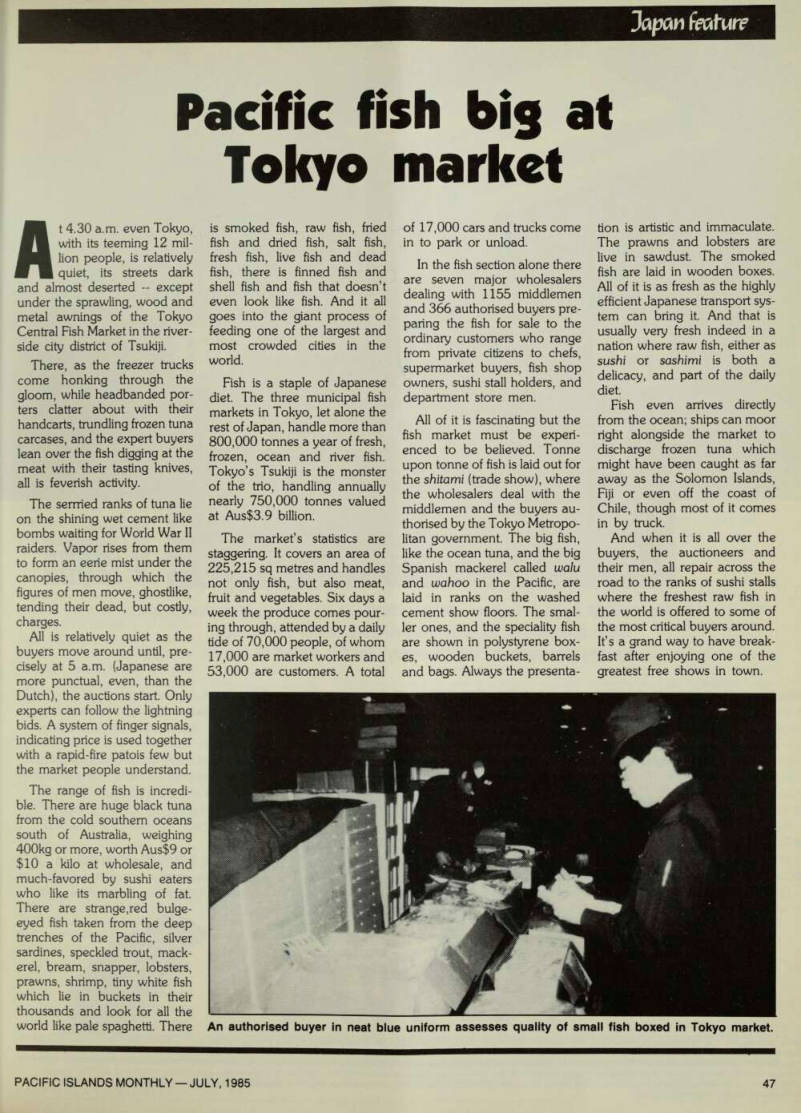
Pacific fish bis at Tokyo market
At 4.30 a.m. even Tokyo, with its teeming 12 mil lion people, is relatively quiet, its streets dark and almost deserted - except under the sprawling, wood and metal awnings of the Tokyo Central Fish Market in the river side city district of Tsukiji.
There, as the freezer trucks come honking through the gloom, while headbanded por ters clatter about with their handcarts, trundling frozen tuna carcases, and the expert buyers lean over the fish digging at the meat with their tasting knives, all is feverish activity.
The serrried ranks of tuna lie on the shining wet cement like bombs waiting for World War II raiders. Vapor rises from them to form an eerie mist under the canopies, through which the figures of men move, ghostlike, tending their dead, but costly, charges.
All is relatively quiet as the buyers move around until, pre cisely at 5 a.m. (Japanese are more punctual, even, than the Dutch), the auctions start. Only experts can follow the lightning bids. A system of finger signals, indicating price is used together with a rapid-fire patois few but the market people understand.
The range of fish is incredi ble. There are huge black tuna from the cold southern oceans south of Australia, weighing 400 kg or more, worth Auss9 or $lO a kilo at wholesale, and much-favored by sushi eaters who like its marbling of fat.
There are strange,red bulge eyed fish taken from the deep trenches of the Pacific, silver sardines, speckled trout, mack erel, bream, snapper, lobsters, prawns, shrimp, tiny white fish which lie in buckets in their thousands and look for all the world like pale spaghetti. There
is smoked fish, raw fish, fried fish and dried fish, salt fish, fresh fish, live fish and dead fish, there is finned fish and shell fish and fish that doesn’t even look like fish. And it all goes into the giant process of feeding one of the largest and most crowded cities in the world.
Fish is a staple of Japanese diet. The three municipal fish markets in Tokyo, let alone the rest of Japan, handle more than 800.000 tonnes a year of fresh, frozen, ocean and river fish.
Tokyo’s Tsukiji is the monster of the trio, handling annually nearly 750,000 tonnes valued at Auss3.9 billion.
The market’s statistics are staggering. It covers an area of 225,215 sq metres and handles not only fish, but also meat, fruit and vegetables. Six days a week the produce comes pour ing through, attended by a daily tide of 70,000 people, of whom 17.000 are market workers and 53.000 are customers. A total
of 17,000 cars and trucks come in to park or unload.
In the fish section alone there are seven major wholesalers dealing with 1155 middlemen and 366 authorised buyers pre paring the fish for sale to the ordinary customers who range from private citizens to chefs, supermarket buyers, fish shop owners, sushi stall holders, and department store men.
All of it is fascinating but the fish market must be experi enced to be believed. Tonne upon tonne of fish is laid out for the shitami (trade show), where the wholesalers deal with the middlemen and the buyers au thorised by the Tokyo Metropo litan government. The big fish, like the ocean tuna, and the big Spanish mackerel called walu and wahoo in the Pacific, are laid in ranks on the washed cement show floors. The smal ler ones, and the speciality fish are shown in polystyrene box es, wooden buckets, barrels and bags. Always the presenta
tion is artistic and immaculate.
The prawns and lobsters are live in sawdust. The smoked fish are laid in wooden boxes.
All of it is as fresh as the highly efficient Japanese transport sys tem can bring it. And that is usually very fresh indeed in a nation where raw fish, either as sushi or sashimi is both a delicacy, and part of the daily diet.
Fish even arrives directly from the ocean; ships can moor right alongside the market to discharge frozen tuna which might have been caught as far away as the Solomon Islands, Fiji or even off the coast of Chile, though most of it comes in by truck.
And when it is all over the buyers, the auctioneers and their men, all repair across the road to the ranks of sushi stalls where the freshest raw fish in the world is offered to some of the most critical buyers around.
It’s a grand way to have break fast after enjoying one of the greatest free shows in town.
An authorised buyer in neat blue uniform assesses quality of small fish boxed in Tokyo market.
Advertisements & other items, p. 48 (1 item)
Aiwa
VERSATILE!
M V V-1200A High-performance S.RA.N. component systems AlWA’s V-1200A System boasts 100 W +IOOW (at IkHz) sound performance.
Each component incorporates AlWA’s latest technology,
making this system “digital ready” for the sound of today!
AIWA’S AUTO SORTING SYSTEM is
a totally new concept in cassette versatility. Deck I holds up to 5 cassettes for random programmed playback.
Deck II is for quick reverse recording and playback.
Auto Sorting enables: ■Automatic programmed edit dubbing at normal or double speed. ■ Random programmed playback of up to 15 selections or entire tape sides. ■ Sequential playback of 5 tapes for up to 22 continuous hours of music when C-90 tapes are used.
AIWA’S AFBS SPEAKER DESIGN makes
smaller speakers perform like much larger speakers. AFBS—Acoustic Feedback System—speakers feature:
AFBS BLOCK DIAGRAM
AIWA
■ Small microphones mounted in front of each twin woofer pick up acoustic “energy” and send it back to the amplifier. ■ Deep, rich bass reproduction down to 25Hzfrom previous 80~ 100 Hz limits. ■ Flat and square aluminum honeycomb diaphragms for the precise reproduction of even digital sound sources.
WIRELESS REMOTE CONTROL of
nearly every system function—including power ON/OFF and volume—is in your hand.
AIWA Australia Pty., Ltd 14 Gertrude St., Arncliffe. N.S.W. Australia 2205 AUSTRALIA PHONE: (597) 2388/Oceania Indent Agency (P.N.G.) Pty., Ltd Ago St., Gordon Box 5518, Boroko. Papua New Guinea PHONE: 256411/The Sound Centre Ltd P.O. Box 434 Port Vila, Vanuatu PHONE; 2035/P. Hargovind Bros 190 Renwick Road P.O. Box 490 Suva Fiji PHONE: 24350/Makanjee & Sons Limited P.O. box 91 Sigatoka Fiji PHONE; 50158/Milaw Trading Co., Ltd 224-236 Hobson Street, P.0.80x 5919, Auckland, New Zealand Phone; (09) 399-175/hifi vox 79, rue de Sebastopol, Noumea, New Caledonia PHONE; 27.24.66/Harvest Pacific Limited P.O. Box 517. Honiara. Solomon Islands PHONE; 131/Fare Hi-Fi Stereo Rue du Marechal Foch—P.O. Box 269, Papeete, Tahiti Phone; 2-4814/Micropac Audio, Inc. P.O. Box 3478 Agana, Guam 96910 PHONE; 472-8091,472-8297/Rarotonga Duty Free Shop Private Bag P.O. Box 92. Rarotonga. Cook Island/Nauru Co-Operative Society Republic of Nauru
wizard of Japan
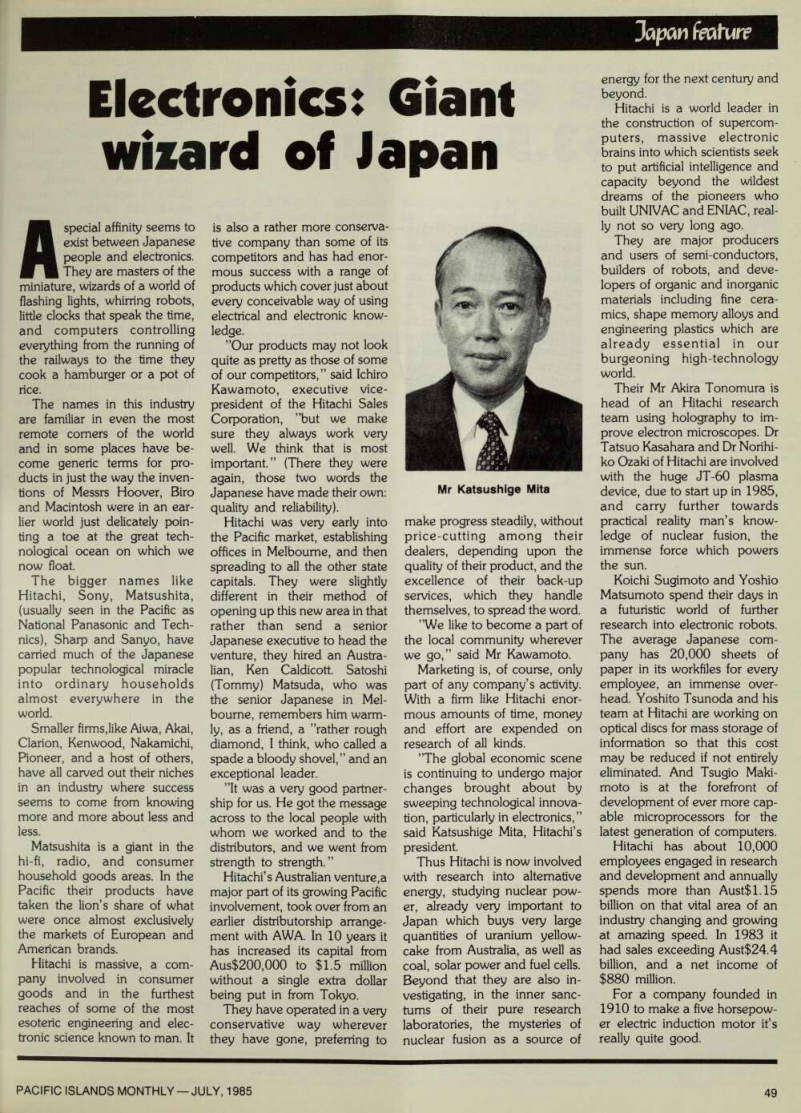
Electronics: Giant wizard of Japan
A special affinity seems to exist between Japanese people and electronics.
They are masters of the miniature, wizards of a world of flashing lights, whirring robots, little clocks that speak the time, and computers controlling everything from the running of the railways to the time they cook a hamburger or a pot of rice.
The names in this industry are familiar in even the most remote comers of the world and in some places have be come generic terms for pro ducts in just the way the inven tions of Messrs Hoover, Biro and Macintosh were in an ear lier world just delicately poin ting a toe at the great tech nological ocean on which we now float.
The bigger names like Hitachi, Sony, Matsushita, (usually seen in the Pacific as National Panasonic and Tech nics), Sharp and Sanyo, have carried much of the Japanese popular technological miracle into ordinary households almost everywhere in the world.
Smaller firms,like Aiwa, Akai, Clarion, Kenwood, Nakamichi, Pioneer, and a host of others, have all carved out their niches in an industry where success seems to come from knowing more and more about less and less.
Matsushita is a giant in the hi-fi, radio, and consumer household goods areas. In the Pacific their products have taken the lion’s share of what were once almost exclusively the markets of European and American brands.
Hitachi is massive, a com pany involved in consumer goods and in the furthest reaches of some of the most esoteric engineering and elec tronic science known to man. It
is also a rather more conserva tive company than some of its competitors and has had enor mous success with a range of products which cover just about every conceivable way of using electrical and electronic know ledge. ”Our products may not look quite as pretty as those of some of our competitors,” said Ichiro Kawamoto, executive vice president of the Hitachi Sales Corporation, ’’but we make sure they always work very well. We think that is most important.” (There they were again, those two words the Japanese have made their own: quality and reliability).
Hitachi was very early into the Pacific market, establishing offices in Melbourne, and then spreading to all the other state capitals. They were slightly different in their method of opening up this new area in that rather than send a senior Japanese executive to head the venture, they hired an Austra lian, Ken Caldicott. Satoshi (Tommy) Matsuda, who was the senior Japanese in Mel bourne, remembers him warm ly, as a friend, a ’’rather rough diamond, I think, who called a spade a bloody shovel,” and an exceptional leader. ”It was a very good partner ship for us. He got the message across to the local people with whom we worked and to the distributors, and we went from strength to strength.”
Hitachi’s Australian venture,a major part of its growing Pacific involvement, took over from an earlier distributorship arrange ment with AWA. In 10 years it has increased its capital from Auss2oo,ooo to $1.5 million without a single extra dollar being put in from Tokyo.
They have operated in a very conservative way wherever they have gone, preferring to
make progress steadily, without price-cutting among their dealers, depending upon the quality of their product, and the excellence of their back-up services, which they handle themselves, to spread the word. ”We like to become a part of the local community wherever we go,” said Mr Kawamoto.
Marketing is, of course, only part of any company’s activity.
With a firm like Hitachi enor mous amounts of time, money and effort are expended on research of all kinds. ’The global economic scene is continuing to undergo major changes brought about by sweeping technological innova tion, particularly in electronics,” said Katsushige Mita, Hitachi’s president.
Thus Hitachi is now involved with research into alternative energy, studying nuclear pow er, already very important to Japan which buys very large quantities of uranium yellow cake from Australia, as well as coal, solar power and fuel cells.
Beyond that they are also in vestigating, in the inner sanc tums of their pure research laboratories, the mysteries of nuclear fusion as a source of
energy for the next century and beyond.
Hitachi is a world leader in the construction of supercom puters, massive electronic brains into which scientists seek to put artificial intelligence and capacity beyond the wildest dreams of the pioneers who built UNIVAC and ENIAC, real ly not so very long ago.
They are major producers and users of semi-conductors, builders of robots, and deve lopers of organic and inorganic materials including fine cera mics, shape memory alloys and engineering plastics which are already essential in our burgeoning high-technology world.
Their Mr Akira Tonomura is head of an Hitachi research team using holography to im prove electron microscopes. Dr Tatsuo Kasahara and Dr Norihi ko Ozaki of Hitachi are involved with the huge JT-60 plasma device, due to start up in 1985, and carry further towards practical reality man’s know ledge of nuclear fusion, the immense force which powers the sun.
Koichi Sugimoto and Yoshio Matsumoto spend their days in a futuristic world of further research into electronic robots.
The average Japanese com pany has 20,000 sheets of paper in its workfiles for every employee, an immense over head. Yoshito Tsunoda and his team at Hitachi are working on optical discs for mass storage of information so that this cost may be reduced if not entirely eliminated. And Tsugio Maki moto is at the forefront of development of ever more cap able microprocessors for the latest generation of computers.
Hitachi has about 10,000 employees engaged in research and development and annually spends more than Austsl.ls billion on that vital area of an industry changing and growing at amazing speed. In 1983 it had sales exceeding Austs24.4 billion, and a net income of $BBO million.
For a company founded in 1910 to make a five horsepow er electric induction motor it’s really quite good.
Mr Katsushige Mita
Coffee everywhere
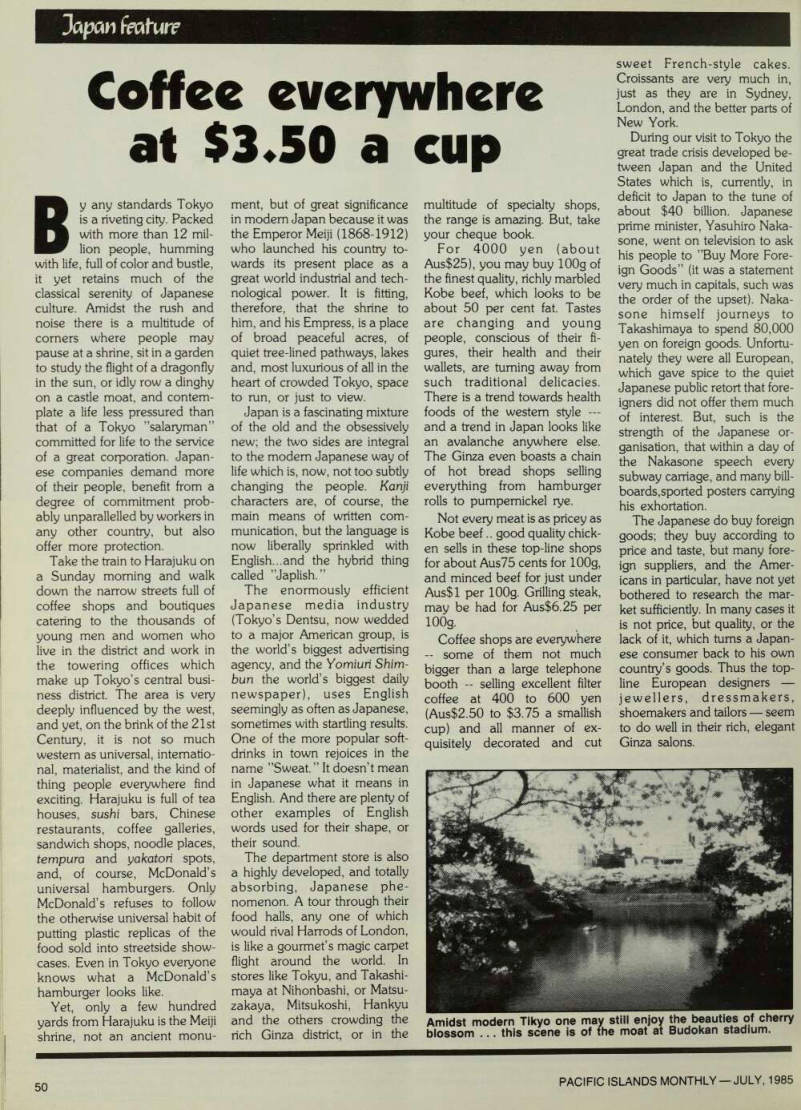
at $3.50 a cup
By any standards Tokyo is a riveting city. Packed with more than 12 mil lion people, humming with life, full of color and bustle, it yet retains much of the classical serenity of Japanese culture. Amidst the rush and noise there is a multitude of corners where people may pause at a shrine, sit in a garden to study the flight of a dragonfly in the sun, or idly row a dinghy on a castle moat, and contem plate a life less pressured than that of a Tokyo ’’salaryman” committed for life to the service of a great corporation. Japan ese companies demand more of their people, benefit from a degree of commitment prob ably unparallelled by workers in any other country, but also offer more protection.
Take the train to Harajuku on a Sunday morning and walk down the narrow streets full of coffee shops and boutiques catering to the thousands of young men and women who live in the district and work in the towering offices which make up Tokyo’s central busi ness district. The area is very deeply influenced by the west, and yet, on the brink of the 21st Century, it is not so much western as universal, internatio nal, materialist, and the kind of thing people everywhere find exciting. Harajuku is full of tea houses, sushi bars, Chinese restaurants, coffee galleries, sandwich shops, noodle places, tempura and yakatori spots, and, of course, McDonald’s universal hamburgers. Only McDonald’s refuses to follow the otherwise universal habit of putting plastic replicas of the food sold into streetside show cases. Even in Tokyo everyone knows what a McDonald’s hamburger looks like.
Yet, only a few hundred yards from Harajuku is the Meiji shrine, not an ancient monu
ment, but of great significance in modem Japan because it was the Emperor Meiji (1868-1912) who launched his country to wards its present place as a great world industrial and tech nological power. It is fitting, therefore, that the shrine to him, and his Empress, is a place of broad peaceful acres, of quiet tree-lined pathways, lakes and, most luxurious of all in the heart of crowded Tokyo, space to run, or just to view.
Japan is a fascinating mixture of the old and the obsessively new; the two sides are integral to the modem Japanese way of life which is, now, not too subtly changing the people. Kanji characters are, of course, the main means of written com munication, but the language is now liberally sprinkled with English...and the hybrid thing called ’’Japlish.”
The enormously efficient Japanese media industry (Tokyo’s Dentsu, now wedded to a major American group, is the world’s biggest advertising agency, and the Yomiuri Shim bun the world’s biggest daily newspaper), uses English seemingly as often as Japanese, sometimes with startling results.
One of the more popular soft drinks in town rejoices in the name ’’Sweat. ” It doesn’t mean in Japanese what it means in English. And there are plenty of other examples of English words used for their shape, or their sound.
The department store is also a highly developed, and totally absorbing, Japanese phe nomenon. A tour through their food halls, any one of which would rival Harrods of London, is like a gourmet’s magic carpet flight around the world. In stores like Tokyu, and Takashi maya at Nihonbashi, or Matsu zakaya, Mitsukoshi, Hankyu and the others crowding the rich Ginza district, or in the
multitude of specialty shops, the range is amazing. But, take your cheque book.
For 4000 yen (about Auss2s), you may buy IOOg of the finest quality, richly marbled Kobe beef, which looks to be about 50 per cent fat. Tastes are changing and young people, conscious of their fi gures, their health and their wallets, are turning away from such traditional delicacies.
There is a trend towards health foods of the western style and a trend in Japan looks like an avalanche anywhere else.
The Ginza even boasts a chain of hot bread shops selling everything from hamburger rolls to pumpernickel rye.
Not every meat is as pricey as Kobe beef.. good quality chick en sells in these top-line shops for about Aus7s cents for IOOg, and minced beef for just under Aussl per IOOg. Grilling steak, may be had for Auss6.2s per 100 g.
Coffee shops are everywhere some of them not much bigger than a large telephone booth selling excellent filter coffee at 400 to 600 yen (Auss2.so to $3.75 a smallish cup) and all manner of ex quisitely decorated and cut
sweet French-style cakes.
Croissants are very much in, just as they are in Sydney, London, and the better parts of New York.
During our visit to Tokyo the great trade crisis developed be tween Japan and the United States which is, currently, in deficit to Japan to the tune of about $4O billion. Japanese prime minister, Yasuhiro Naka sone, went on television to ask his people to ’’Buy More Fore ign Goods” (it was a statement very much in capitals, such was the order of the upset). Naka sone himself journeys to Takashimaya to spend 80,000 yen on foreign goods. Unfortu nately they were all European, which gave spice to the quiet Japanese public retort that fore igners did not offer them much of interest. But, such is the strength of the Japanese or ganisation, that within a day of the Nakasone speech every subway carriage, and many bill boards, sported posters carrying his exhortation.
The Japanese do buy foreign goods; they buy according to price and taste, but many fore ign suppliers, and the Amer icans in particular, have not yet bothered to research the mar ket sufficiently. In many cases it is not price, but quality, or the lack of it, which turns a Japan ese consumer back to his own country’s goods. Thus the top line European designers jewellers, dressmakers, shoemakers and tailors seem to do well in their rich, elegant Ginza salons.
Amidst modern Tikyo one may still enjoy the beauties of cherry blossom ... this scene is of the moat at Budokan stadium.
Advertisements & other items, pp. 51-52 (1 item)
The Treasure At The End Of The Rainbow
It's not the luck of a leprechaun but the craft of Clarion that will lead you to uncompromising stereo sound quality. Even in the compromising environment of a moving automobile. Clarion's advanced electronics makes possible a wide spectrum of convenient, easy-to-use features The Clarion choice of models is positively dazzling. And our reliability is IO r j no fairy tale. Come, listen to a Clarion Car Stereo. And drive happily ever after. I Ivr I I THE TREASURE AT THE END OF THE RAINBOW
□N/VOL
♦ FADER
puli BAL O Clarion ►►
model 900 E
inn n
iu I.J
□D MIL
LD APC Q
awi i fiw
ST CLK
< > For further information Australia: Amalgamated Wireless (Australasia) Ltd. 554 Parramatta Road, Ashfield, N S W., 2131 / New Zealand: AWA New Zealand Limited, P.O. Box 50-248, Ponrua / Fiji Islands; Bnjlal & Co, Ltd, GPO Box 362, Suva Tahiti: HI FI. VAIRAATOA Avenue Chef Vairaatoa BP. 1128, Papeete / New Caledonia; Caldis, 8.P.M1, Noumea Cedex / Guam: Micropac Audio Inc., P.O Box 3478, Agana, Guam 96910, U S A Tel: 472-8091, Cable Code: HIFI AUDIO AGANA / Vanuatu: The Sound Centre, P.O. Box 434, Vila / Cook Islands: South Seas International Ltd, P.O. Box 49, Rarotonga / Papua New Guinea: Hagemeyer (P N G.) Pty. Ltd, P 0 Box 1428, Boroko, Port Moresby
C. ITOH, THE WORLDWIDE NETWORK
THAT WORKS ...
With 177 offices in 88 countries, and operations spanning almost every industry, C. Itoh has immediate access to the kind of information that creates opportunity. From development of trade in natural resources such as wool, coal and iron ore to more sophisticated manufactured goods including computer-related products, C. Itoh has the resources and experience to turn plans into action. And action into success.
Whether it's establishing joint business ventures, financing new projects or gathering and analysing data, a link-up with C. Itoh gives you access to a formidable global network, unmatched organisational and financial expertise and the full backing of a company that gets information fast. And first. m&mi f '■ \ m m aS** mm.
I SC** sssmm
C. ITOH & CO. (AUST.) LTD.
SYDNEY HEAD OFFICE: GOLD FIELDS HOUSE,
1 Alfred Street, SYDNEY, N S W 2000 Phone (02) 239 1500. Telex: AA20205 CITOH MELBOURNE; Phone (03) 67 8633 (8 lines) BRISBANE; Phone (07) 221 9738, 221 9929 PERTH: Phone (09) 321 2968 (4 lines) FREMANTLE: Phone (09) 335 3048, 335 1888 PORT MORESBY: Phone 21 1668, 21 4409 DIVISIONS: Wool, Textile, Machinery, Metals, Produce Provisions and General Merchandise, Energy and Chemical, Finance Accounting and General Affairs.
C. ITOH & CO.,LTD. WORLDWIDE NETWORK:
JAPAN : Tokyo, Osaka, Nagoya, Fukuoka and 31 other Offices.
NORTH AMERICA: New York, Washington, Chicago, Los Angeles, Montreal, Toronto, Mexico City, Havana and 12 other Offices.
CENTRAL and SOUTH AMERICA: Sao Paulo, Rio de Janeiro, Buenos Aires, Caracas and 12 other Offices.
EUROPE and AFRICA: London, Dusseldorf, Zurich, Paris, Milano, Athens, Moscow, Lagos and 34 other Offices.
MIDDLE and NEAR EAST: Cairo, Riyadh, Kuwait, Bahrain and 19 other Offices.
OCEANIA: Auckland, Wellington (other than Australia and Papua New Guinea).
ASIA; Hong Kong, Taipei, Manila, Singapore, Kuala Lumpur, Seoul, Jakarta, New Delhi, Colombo, Beijing and 22 other Offices.
Cl> 177 OFFICES WORLDWIDE
go round
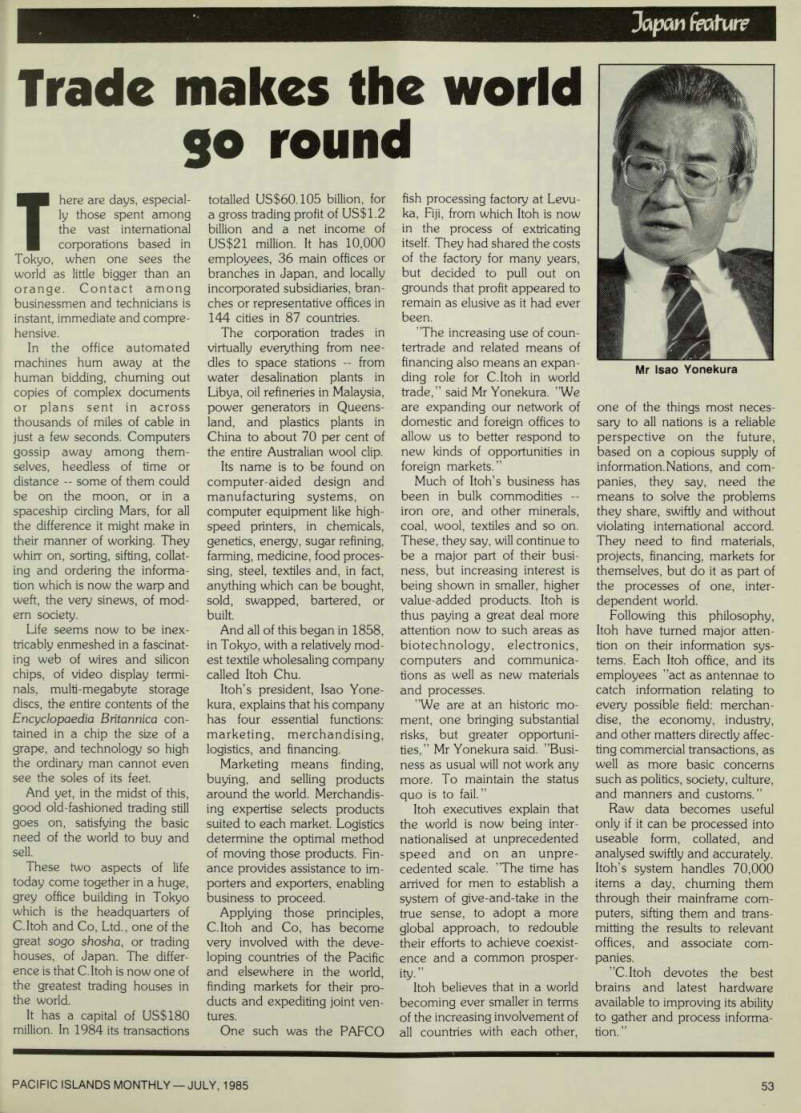
Trade makes the world go round
There are days, especial ly those spent among the vast international corporations based in Tokyo, when one sees the world as little bigger than an orange. Contact among businessmen and technicians is instant, immediate and compre hensive.
In the office automated machines hum away at the human bidding, churning out copies of complex documents or plans sent in across thousands of miles of cable in just a few seconds. Computers gossip away among them selves, heedless of time or distance - some of them could be on the moon, or in a spaceship circling Mars, for all the difference it might make in their manner of working. They whirr on, sorting, sifting, collat ing and ordering the informa tion which is now the warp and weft, the very sinews, of mod ern society.
Life seems now to be inex tricably enmeshed in a fascinat ing web of wires and silicon chips, of video display termi nals, multi-megabyte storage discs, the entire contents of the Encyclopaedia Britannica con tained in a chip the size of a grape, and technology so high the ordinary man cannot even see the soles of its feet.
And yet, in the midst of this, good old-fashioned trading still goes on, satisfying the basic need of the world to buy and sell.
These two aspects of life today come together in a huge, grey office building in Tokyo which is the headquarters of C.ltoh and Co, Ltd., one of the great sogo shosha, or trading houses, of Japan. The differ ence is that C.ltoh is now one of the greatest trading houses in the world.
It has a capital of US$lBO million. In 1984 its transactions
totalled U 5560,105 billion, for a gross trading profit of US$l.2 billion and a net income of US$2l million. It has 10,000 employees, 36 main offices or branches in Japan, and locally incorporated subsidiaries, bran ches or representative offices in 144 cities in 87 countries.
The corporation trades in virtually everything from nee dles to space stations - from water desalination plants in Libya, oil refineries in Malaysia, power generators in Queens land, and plastics plants in China to about 70 per cent of the entire Australian wool clip.
Its name is to be found on computer-aided design and manufacturing systems, on computer equipment like high speed printers, in chemicals, genetics, energy, sugar refining, farming, medicine, food proces sing, steel, textiles and, in fact, anything which can be bought, sold, swapped, bartered, or built.
And all of this began in 1858, in Tokyo, with a relatively mod est textile wholesaling company called Itoh Chu.
Itoh’s president, Isao Yone kura, explains that his company has four essential functions: marketing, merchandising, logistics, and financing.
Marketing means finding, buying, and selling products around the world. Merchandis ing expertise selects products suited to each market. Logistics determine the optimal method of moving those products. Fin ance provides assistance to im porters and exporters, enabling business to proceed.
Applying those principles, C.ltoh and Co, has become very involved with the deve loping countries of the Pacific and elsewhere in the world, finding markets for their pro ducts and expediting joint ven tures.
One such was the PAFCO
fish processing factory at Levu ka, Fiji, from which Itoh is now in the process of extricating itself. They had shared the costs of the factory for many years, but decided to pull out on grounds that profit appeared to remain as elusive as it had ever been. ’’The increasing use of coun tertrade and related means of financing also means an expan ding role for C.ltoh in world trade,” said Mr Yonekura. ”We are expanding our network of domestic and foreign offices to allow us to better respond to new kinds of opportunities in foreign markets.”
Much of Itoh’s business has been in bulk commodities iron ore, and other minerals, coal, wool, textiles and so on.
These, they say, will continue to be a major part of their busi ness, but increasing interest is being shown in smaller, higher value-added products. Itoh is thus paying a great deal more attention now to such areas as biotechnology, electronics, computers and communica tions as well as new materials and processes. ”We are at an historic mo ment, one bringing substantial risks, but greater opportuni ties,” Mr Yonekura said. ’’Busi ness as usual will not work any more. To maintain the status quo is to fail.”
Itoh executives explain that the world is now being inter nationalised at unprecedented speed and on an unpre cedented scale. ’’The time has arrived for men to establish a system of give-and-take in the true sense, to adopt a more global approach, to redouble their efforts to achieve coexist ence and a common prosper • i_ n ity.
Itoh believes that in a world becoming ever smaller in terms of the increasing involvement of all countries with each other,
one of the things most neces sary to all nations is a reliable perspective on the future, based on a copious supply of information. Nations, and com panies, they say, need the means to solve the problems they share, swiftly and without violating international accord.
They need to find materials, projects, financing, markets for themselves, but do it as part of the processes of one, inter dependent world.
Following this philosophy, Itoh have turned major atten tion on their information sys tems. Each Itoh office, and its employees ’’act as antennae to catch information relating to every possible field; merchan dise, the economy, industry, and other matters directly affec ting commercial transactions, as well as more basic concerns such as politics, society, culture, and manners and customs.”
Raw data becomes useful only if it can be processed into useable form, collated, and analysed swiftly and accurately.
Itoh’s system handles 70,000 items a day, churning them through their mainframe com puters, sifting them and trans mitting the results to relevant offices, and associate com panies. ’’C.ltoh devotes the best brains and latest hardware available to improving its ability to gather and process informa tion.”
Mr Isao Yonekura
potter's skill
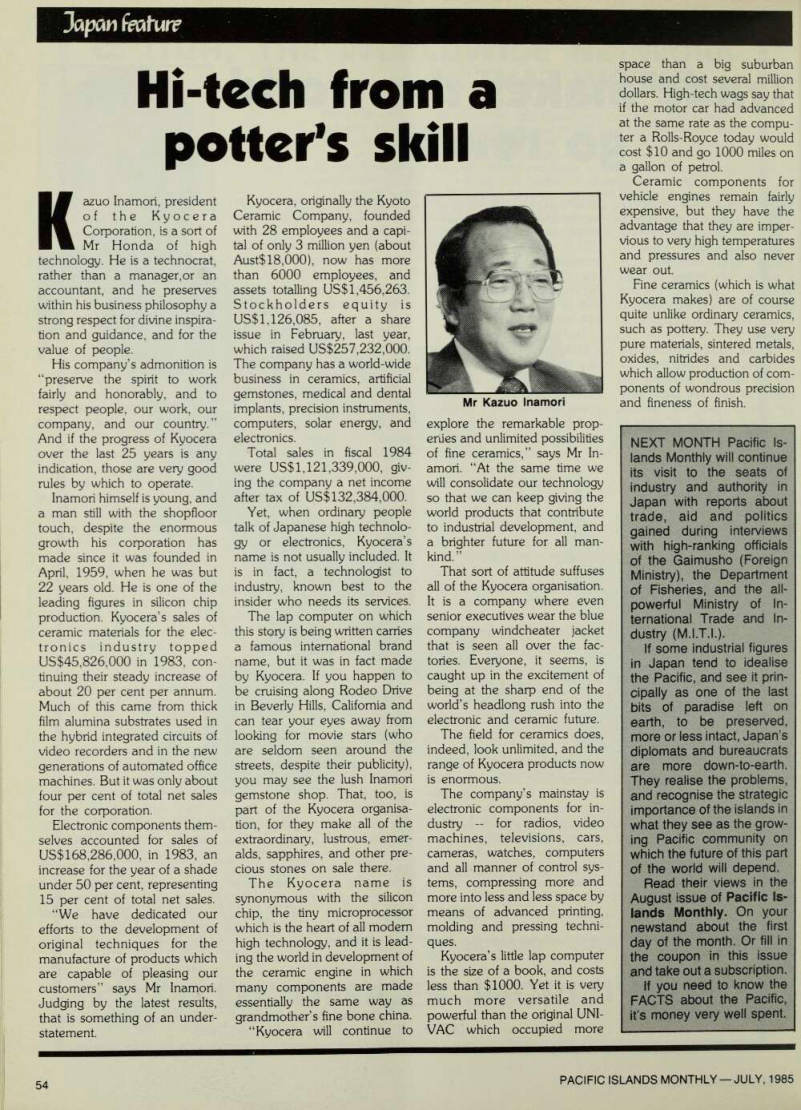
Hi-tech from a potter's skill
Kazuo Inamori, president of the Kyocera Corporation, is a sort of Mr Honda of high technology. He is a technocrat, rather than a manager,or an accountant, and he preserves within his business philosophy a strong respect for divine inspira tion and guidance, and for the value of people.
His company’s admonition is “preserve the spirit to work fairly and honorably, and to respect people, our work, our company, and our country.”
And if the progress of Kyocera over the last 25 years is any indication, those are very good rules by which to operate.
Inamori himself is young, and a man still with the shopfloor touch, despite the enormous growth his corporation has made since it was founded in April, 1959, when he was but 22 years old. He is one of the leading figures in silicon chip production. Kyocera’s sales of ceramic materials for the elec tronics industry topped U 5545,826,000 in 1983, con tinuing their steady increase of about 20 per cent per annum.
Much of this came from thick film alumina substrates used in the hybrid integrated circuits of video recorders and in the new generations of automated office machines. But it was only about four per cent of total net sales for the corporation.
Electronic components them selves accounted for sales of U 55168,286,000, in 1983, an increase for the year of a shade under 50 per cent, representing 15 per cent of total net sales.
“We have dedicated our efforts to the development of original techniques for the manufacture of products which are capable of pleasing our customers” says Mr Inamori.
Judging by the latest results, that is something of an under statement.
Kyocera, originally the Kyoto Ceramic Company, founded with 28 employees and a capi tal of only 3 million yen (about Austs 18,000), now has more than 6000 employees, and assets totalling U 551,456,263.
Stockholders equity is U 551,126,085, after a share issue in February, last year, which raised U 55257,232,000.
The company has a world-wide business in ceramics, artificial gemstones, medical and dental implants, precision instruments, computers, solar energy, and electronics.
Total sales in fiscal 1984 were U 551,121,339,000, giv ing the company a net income after tax of U 55132,384,000.
Yet, when ordinary people talk of Japanese high technolo gy or electronics, Kyocera’s name is not usually included. It is in fact, a technologist to industry, known best to the insider who needs its services.
The lap computer on which this story is being written carries a famous international brand name, but it was in fact made by Kyocera. If you happen to be cruising along Rodeo Drive in Beverly Hills, California and can tear your eyes away from looking for movie stars (who are seldom seen around the streets, despite their publicity), you may see the lush Inamori gemstone shop. That, too, is part of the Kyocera organisa tion, for they make all of the extraordinary, lustrous, emer alds, sapphires, and other pre cious stones on sale there.
The Kyocera name is synonymous with the silicon chip, the tiny microprocessor which is the heart of all modem high technology, and it is lead ing the world in development of the ceramic engine in which many components are made essentially the same way as grandmother’s fine bone china.
“Kyocera will continue to
explore the remarkable prop enies and unlimited possibilities of fine ceramics,” says Mr In amori. “At the same time we will consolidate our technology so that we can keep giving the world products that contribute to industrial development, and a brighter future for all man kind.”
That sort of attitude suffuses all of the Kyocera organisation.
It is a company where even senior executives wear the blue company windcheater jacket that is seen all over the fac tories. Everyone, it seems, is caught up in the excitement of being at the sharp end of the world’s headlong rush into the electronic and ceramic future.
The field for ceramics does, indeed, look unlimited, and the range of Kyocera products now is enormous.
The company’s mainstay is electronic components for in dustry for radios, video machines, televisions, cars, cameras, watches, computers and all manner of control sys tems, compressing more and more into less and less space by means of advanced printing, molding and pressing techni ques.
Kyocera’s little lap computer is the size of a book, and costs less than $lOOO. Yet it is very much more versatile and powerful than the original UNI VAC which occupied more
space than a big suburban house and cost several million dollars. High-tech wags say that if the motor car had advanced at the same rate as the compu ter a Rolls-Royce today would cost $lO and go 1000 miles on a gallon of petrol.
Ceramic components for vehicle engines remain fairly expensive, but they have the advantage that they are imper vious to very high temperatures and pressures and also never wear out.
Fine ceramics (which is what Kyocera makes) are of course quite unlike ordinary ceramics, such as pottery. They use very pure materials, sintered metals, oxides, nitrides and carbides which allow production of com ponents of wondrous precision and fineness of finish.
NEXT MONTH Pacific Is lands Monthly will continue its visit to the seats of industry and authority in Japan with reports about trade, aid and politics gained during interviews with high-ranking officials of the Gaimusho (Foreign Ministry), the Department of Fisheries, and the all powerful Ministry of In ternational Trade and In dustry (M.1.T.1.).
If some industrial figures in Japan tend to idealise the Pacific, and see it prin cipally as one of the last bits of paradise left on earth, to be preserved, more or less intact, Japan’s diplomats and bureaucrats are more down-to-earth.
They realise the problems, and recognise the strategic importance of the islands in what they see as the grow ing Pacific community on which the future of this part of the world will depend.
Read their views in the August issue of Pacific Is lands Monthly. On your newstand about the first day of the month. Or fill in the coupon in this issue and take out a subscription.
If you need to know the FACTS about the Pacific, it’s money very well spent.
Mr Kazuo Inamori
overview of Fiji’s history
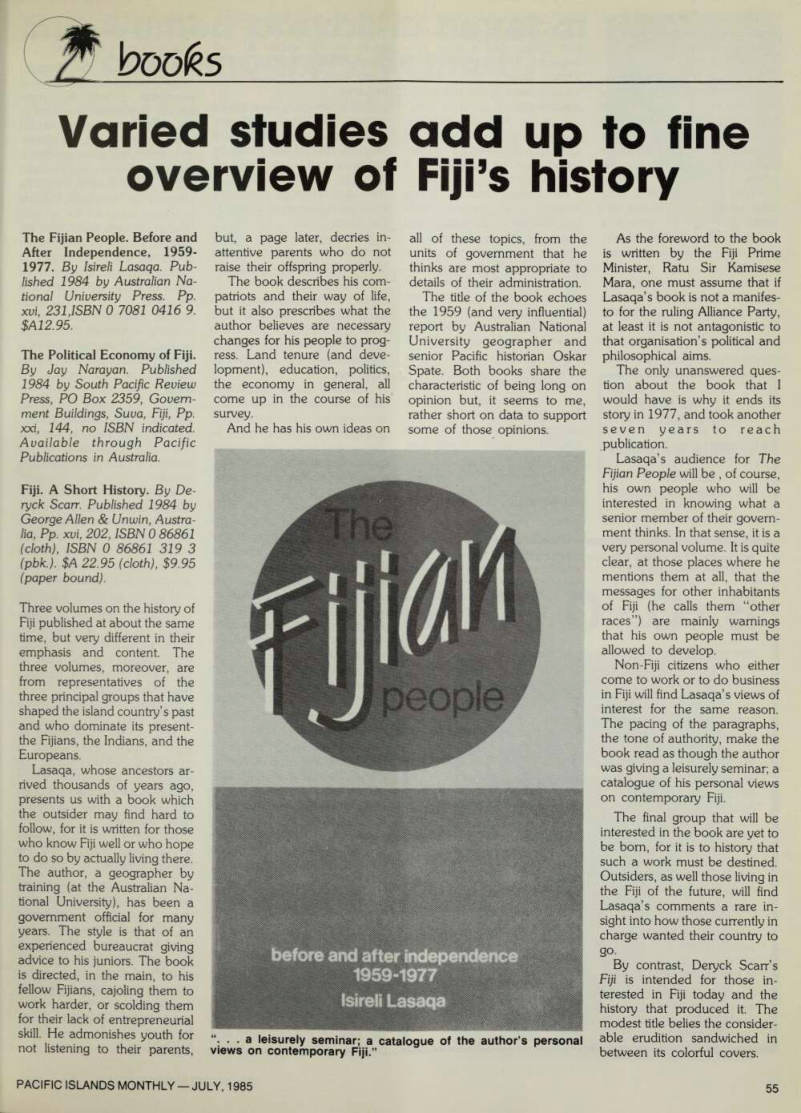
books
Varied studies add up to fine overview of Fiji’s history
The Fijian People. Before and After Independence, 1959- 1977. By Isireli Lasaqa. Pub lished 1984 by Australian Na tional University Press. Pp. xvi, 231,158 N 0 7081 0416 9. $A12.95.
The Political Economy of Fiji.
By Jay Narayan. Published 1984 by South Pacific Review Press, PO Box 2359, Govern ment Buildings, Suva, Fiji, Pp. xxi, 144, no ISBN indicated.
Available through Pacific Publications in Australia.
Fiji. A Short History- By De ryck Scan. Published 1984 by George Allen & Unwin, Austra lia, Pp. xvi, 202, ISBN 0 86861 (cloth), ISBN 0 86861 319 3 (pbk.). $A 22.95 (cloth), $9.95 (paper bound).
Three volumes on the history of Fiji published at about the same time, but very different in their emphasis and content. The three volumes, moreover, are from representatives of the three principal groups that have shaped the island country’s past and who dominate its present the Fijians, the Indians, and the Europeans.
Lasaqa, whose ancestors ar rived thousands of years ago, presents us with a book which the outsider may find hard to follow, for it is written for those who know Fiji well or who hope to do so by actually living there.
The author, a geographer by training (at the Australian Na tional University), has been a government official for many years. The style is that of an experienced bureaucrat giving advice to his juniors. The book is directed, in the main, to his fellow Fijians, cajoling them to work harder, or scolding them for their lack of entrepreneurial skill. He admonishes youth for not listening to their parents,
but, a page later, decries in attentive parents who do not raise their offspring properly.
The book describes his com patriots and their way of life, but it also prescribes what the author believes are necessary changes for his people to prog ress. Land tenure (and deve lopment), education, politics, the economy in general, all come up in the course of his survey.
And he has his own ideas on
all of these topics, from the units of government that he thinks are most appropriate to details of their administration.
The title of the book echoes the 1959 (and very influential) report by Australian National University geographer and senior Pacific historian Oskar Spate. Both books share the characteristic of being long on opinion but, it seems to me, rather short on data to support some of those opinions.
As the foreword to the book is written by the Fiji Prime Minister, Ratu Sir Kamisese Mara, one must assume that if Lasaqa’s book is not a manifes to for the ruling Alliance Party, at least it is not antagonistic to that organisation’s political and philosophical aims.
The only unanswered ques tion about the book that I would have is why it ends its story in 1977, and took another seven years to reach publication.
Lasaqa’s audience for The Fijian People will be , of course, his own people who will be interested in knowing what a senior member of their govern ment thinks. In that sense, it is a very personal volume. It is quite clear, at those places where he mentions them at all, that the messages for other inhabitants of Fiji (he calls them “other races”) are mainly warnings that his own people must be allowed to develop.
Non-Fiji citizens who either come to work or to do business in Fiji will find Lasaqa’s views of interest for the same reason.
The pacing of the paragraphs, the tone of authority, make the book read as though the author was giving a leisurely seminar; a catalogue of his personal views on contemporary Fiji.
The final group that will be interested in the book are yet to be bom, for it is to history that such a work must be destined.
Outsiders, as well those living in the Fiji of the future, will find Lasaqa’s comments a rare in sight into how those currently in charge wanted their country to go- By contrast, Deryck Scarr’s Fiji is intended for those in terested in Fiji today and the history that produced it. The modest title belies the consider able erudition sandwiched in between its colorful covers.
“... a leisurely seminar; a catalogue of the author’s personal views on contemporary Fiji.”
With a kind of literary zoom lens, Scarr moves easily from colonial macro, to close up personal diaries.
People in Fiji, of whatever background, will be looking up their ancestors’ names in the index, discovering the scandals of the past, as well as the frank observations that the people of those days made of one an other.
Four mega-chapters, each with several subdivisions, are easily laid out; the style is a delight to read, in marked con trast to some of Scarr’s past volumes.
The book is produced for a popular market, but that does not mean that it is shallow.
References, for those in terested, are discreetly at the
rear of the work; there is a helpful glossary and pronuncia tion guide, and a short bib liography. The work, though, is written largely from primary sources, making this more than a summary.
It is, in fact, a substantial contribution to the history of Fiji itself, as well as being a first rate introduction for people with a general interest in the topic.
As Lasaqa had a Prime Minister do his forword, Scarr has Minister for Education and Youth, Dr. Ahmed Ali, write his.
It is rare that one comes across a book on the Pacific that is both scholarly and well written; even more rarely are such works both substantial contributions to the literature, as well as being accessible to the lay reader.
The Scarr book is suitable not only for the Pacific scholar, but also the casual traveller.
The clarity of the expression suggests that it could be also a suitable upper secondary school text.
While Lasaqa’s text is a high ly personal statement, Scarr is almost excluded as a personal
ity in the text. It is evident, though, that he loves Fiji and revels in the details of that place’s history, to which he has made such a substantial con tribution.
There are no government officials associated with Jay Narayan’s The Political Eco nomy of Fiji and one would be surprised had there been. If sociology has been long in coming to academia in general, it has been even more distant in the Pacific.
Sociologists don’t mind studying the poor; it is their bread and butter, along with various classes of deviants.
But, sociologists have been very reluctant to leave their cities and civilised comforts. It has been to the anthropologist that studies in the Third World have fallen.
Narayan is a sociologist, trained in Britain and Canada; he is also an Indo-Fijian, son of a migrant worker, brought to Fiji at an earlier time, when people’s work contracts, rather than their bodies, were bought and sold.
It probably had to be a Fiji Indian who would become the country’s first sociologist. Just as Fiji’s first anthropologist, the late Sydney University-trained R.R. Nayacakalou, had char acteristically written on leader ship, so Narayan turns his analytical attention to a political and economic history of his country.
For it is in the arena of politics and in the sphere of the eco nomy that most Indo-Fijians find themselves located, for bet ter or for worse.
The stereotypic Indian in Fiji is the duty-free shop owner; he is the one that the tourist sees and remembers. Visitors to Fiji rarely see the poor Indian cane farmer and his family; they do not know that emigration by Indians, to North America, and also Australia, is several times that of Fijians.
The Indian in Fiji is excluded from the national definition, as is clear in the Lasaqa and Scarr volumes. After over a century, the Indian in Fiji is seen as the guest, with the Fijians as the host.
It is no wonder, then, that the first proper sociological study of Fiji, looks at the economic and political history of the place,
trying to comprehend the why behind the taken for granted facade of calm life in Fiji.
The focus of the Narayan essay is on Fiji as a political and economic colony of larger forces. The author is avowedly Marxist in his orientation, which produces the occasional syntac tic difficulty for those not famil iar with the concepts, and rather technical terminology he chooses to employ. Political economy is not for the popular market, though the reader in terested in a very different view of history will be rewarded by having a view of Fiji that has not been given to us before. It is sensitive to social (Narayan should add also cultural) in equality; to uneven distribution of resources; to the logic of a system which pits both Fijian and Indian one against the other.
We are quite used to associating race, even ethnicity, with Fiji; with Narayan we now have the beginnings of an analysis of the class structure there.
The author is openly pes simistic and feels that his coun try will continue to be under the thumb of external interests; to operate with imported systems that constrain rather than help people to live productive lives.
If one were to contrive an association for these three books, Scarr’s is downtown Suva, a bustling exotic society, while Lasaqa’s is the quiet of the Fijian village, of muffled, respectful voices.
Narayan’s is the slums, which few outsiders see.
You can tell these books by their covers: Fiji sports a museum watercolour of traditional life, while Fijian People is a sober diagram of an orange sun in a blue sky, over a deep aqua sea.
Narayan’s is bright red, with a blue inset map of the Fiji islands, encircled in chains.
As a final note, it is perhaps worthwhile pointing out that given the usual price of books on the Pacific, these three are remarkably good value. As a trio (with Narayan making it a troika?) of tomes on a similar subject, they make a good set and provide the reader with a comprehensive view of those familiar islands. Grant McCall.
Advertisements & other items, p. 56 (1 item)
Books
ALL THE NEWS
IN A FLASH
THE SOUTH SEA DIGEST
See insert for Subscription details
National centre for Development Studies Australian National University Canberra
BOOKS
The Economy of Papua New Guinea; an Independent review by Raymond Goodman, Charles Lepani and David Morawetz. 272 + xiii. $A15.00. ISBN 0 86784 609 7.
This overview of the Papua New Guinea economy's achievements and prospects is the first since Independence. It identifies a range of problems and issues that must be tackled if the economy is to grow and develop at a rate consistent with rising social expectations. women in Development in the South Pacific: barriers and opportunities Papers presented at a conference held in Vanuatu 1984. 226 + X. SAB.OO. ISBN 0 86784 561 9.
Rapid population growth and slow economic growth in Pacific countries make particular problems for women.
These papers deal with Pacific island women and the law, education, business, politics and, chiefly, the rural economy.
Managing the Tropical Forest K.R. Shepherd and H.V. Richter editors. 542 + x. $A12.00.
ISBN 0 86784 557 6.
Papers from a workshop held in Cympie, Queensland deal with rural land use planning and policy, including problems of productivity assessment.
Available from Bibliotech, CPO Box 4, Canberra, ACT, Australia, 2601. Packaging and postage is OS $ A 5.10 and Aust $ A 2.50. Information on other publications by the Centre is available on request.
contemporary Samoa
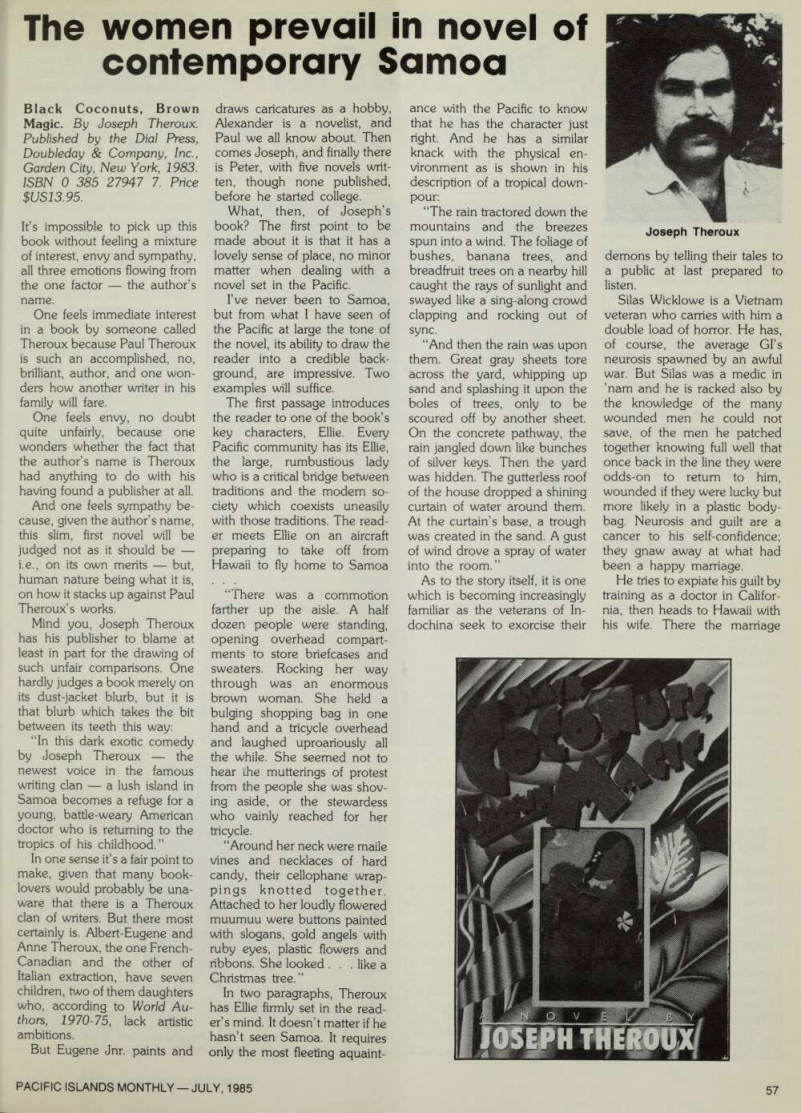
The women prevail in novel of contemporary Samoa
Black Coconuts, Brown Magic. By Joseph Theroux.
Published by the Dial Press, Doubleday & Company, Inc., Garden City, New York, 1983.
ISBN 0 385 27947 7. Price $U513.95.
It’s impossible to pick up this book without feeling a mixture of interest, envy and sympathy, all three emotions flowing from the one factor the author’s name.
One feels immediate interest in a book by someone called Theroux because Paul Theroux is such an accomplished, no, brilliant, author, and one won ders how another writer in his family will fare.
One feels envy, no doubt quite unfairly, because one wonders whether the fact that the author’s name is Theroux had anything to do with his having found a publisher at all.
And one feels sympathy be cause, given the author’s name, this slim, first novel will be judged not as it should be i.e., on its own merits but, human nature being what it is, on how it stacks up against Paul Theroux’s works.
Mind you, Joseph Theroux has his publisher to blame at least in part for the drawing of such unfair comparisons. One hardly judges a book merely on its dust-jacket blurb, but it is that blurb which takes the bit between its teeth this way: “In this dark exotic comedy by Joseph Theroux the newest voice in the famous writing clan a lush island in Samoa becomes a refuge for a young, battle-weary American doctor who is returning to the tropics of his childhood.”
In one sense it’s a fair point to make, given that many book lovers would probably be una ware that there is a Theroux clan of writers. But there most certainly is. Albert-Eugene and Anne Theroux, the one French- Canadian and the other of Italian extraction, have seven children, two of them daughters who, according to World Au thors, 1970-75, lack artistic ambitions.
But Eugene Jnr. paints and
draws caricatures as a hobby, Alexander is a novelist, and Paul we all know about. Then comes Joseph, and finally there is Peter, with five novels writ ten, though none published, before he started college.
What, then, of Joseph’s book? The first point to be made about it is that it has a lovely sense of place, no minor matter when dealing with a novel set in the Pacific.
I’ve never been to Samoa, but from what I have seen of the Pacific at large the tone of the novel, its ability to draw the reader into a credible back ground, are impressive. Two examples will suffice.
The first passage introduces the reader to one of the book’s key characters, Ellie. Every Pacific community has its Ellie, the large, rumbustious lady who is a critical bridge between traditions and the modem so ciety which coexists uneasily with those traditions. The read er meets Ellie on an aircraft preparing to take off from Hawaii to fly home to Samoa “There was a commotion farther up the aisle. A half dozen people were standing, opening overhead compart ments to store briefcases and sweaters. Rocking her way through was an enormous brown woman. She held a bulging shopping bag in one hand and a tricycle overhead and laughed uproariously all the while. She seemed not to hear the mutterings of protest from the people she was shov ing aside, or the stewardess who vainly reached for her tricycle.
“Around her neck were maile vines and necklaces of hard candy, their cellophane wrap pings knotted together.
Attached to her loudly flowered muumuu were buttons painted with slogans, gold angels with ruby eyes, plastic flowers and ribbons. She looked . . . like a Christmas tree.”
In two paragraphs, Theroux has Ellie firmly set in the read er’s mind. It doesn’t matter if he hasn’t seen Samoa. It requires only the most fleeting aquaint
ance with the Pacific to know that he has the character just right. And he has a similar knack with the physical en vironment as is shown in his description of a tropical down pour: “The rain tractored down the mountains and the breezes spun into a wind. The foliage of bushes, banana trees, and breadfruit trees on a nearby hill caught the rays of sunlight and swayed like a sing-along crowd clapping and rocking out of sync.
“And then the rain was upon them. Great gray sheets tore across the yard, whipping up sand and splashing it upon the boles of trees, only to be scoured off by another sheet.
On the concrete pathway, the rain jangled down like bunches of silver keys. Then the yard was hidden. The gutterless roof of the house dropped a shining curtain of water around them.
At the curtain’s base, a trough was created in the sand. A gust of wind drove a spray of water into the room.”
As to the story itself, it is one which is becoming increasingly familiar as the veterans of In dochina seek to exorcise their
demons by telling their tales to a public at last prepared to listen.
Silas Wicklowe is a Vietnam veteran who carries with him a double load of horror. He has, of course, the average Gl’s neurosis spawned by an awful war. But Silas was a medic in ’nam and he is racked also by the knowledge of the many wounded men he could not save, of the men he patched together knowing full well that once back in the line they were odds-on to return to him, wounded if they were lucky but more likely in a plastic body bag. Neurosis and guilt are a cancer to his self-confidence; they gnaw away at what had been a happy marriage.
He tries to expiate his guilt by training as a doctor in Califor nia, then heads to Hawaii with his wife. There the marriage
Joseph Theroux
fails totally and he goes home to Samoa drawn by another, deeper, and darker phantom.
This is the murder, brutal and grotesque, of his mother by his father.
It would be unfair to author and reader alike to tell more of the story except to say that by the end of the book Silas Wicklowe is well down the track to regaining full membership of the human race.
The curious thing about it all is that Silas never became, on first reading, a fully-fleshed character; there was something one-dimensional about him, a fact that had me tricked until I read the book a second time. I realised then that the problem was relative.
It’s not so much that Silas lacks definition but that he is overwhelmed by the women of the story, Ellie in particular, but by all of the women as a group.
There is Vai whose convo luted pidgin stops a whisker short of parody, the comely Roketi whose experience proves to Silas that not all medicine can be found in text books, and the troubled, pa tient Betty who stands by Silas, her husband, until both come to reasonable acceptance that what once they had no longer exists.
Finally, there is Angela, a richly-drawn islands character whose lusty liveliness attracted this reader quite as much as it did Silas.
I warrant most readers will turn the last page of the book wishing it were just a little longer, wondering what its characters might have gone on to do, musing on what Joseph Theroux might produce next.
Can any author ask better than that? lan Hicks.
for “Sepik Diary”
A second incarnation for “Sepik Diary”
Stuart Inder, reviewing the ori ginal edition of Frank Hodgkin son’s Sepik Diary in the Octo ber, 1983, issue of PIM, wrote: “It’s no coffee-table book — although it will sit there prettily — it’s a book which adds to our knowledge, with many unex pected insights.”
The new version has re ceived the plaudits of many respected reviewers from many parts of the world. Bishop Sir David Hand said: “Reid Books have not allowed any con siderations to compromise pro duction standards. Here is a thing of beauty that should be valued according to its intrinsic merits. Frank Hodgkinson’s deep interest in, understanding of and affection for my country are clearly writ on every page. ”
William Graves, senior editor of National Geographic wrote of the book, “an extraordinary chronicle in words and watercolors, sketches and im ages of the great river, its people and their cultures.”
On April 18 the new edition of Sepik Diary was launched in Sydney at the Australian Museum under the auspices of Sir Alkan Tololo, Papua New Guinea High Commissioner in Australia. Sir Alkan, while ack nowledging his Tolai connec tion, stated that for friends who know Papua New Guinea, and who have worked in New Guinea, Sepik Diary “colorfully reflects the culture and life-style of the peoples of the mighty Sepik River.” He went on to say that the book enables the reader to experience the life styles of the peoples along the river, and that, there is “no need for a camera to capture a job well done.” Sir Alkan also made mention of the museum which it is proposed to establish as a living account of the cultures of the Sepik area.
Dr James Specht, divisional head of anthropology, Austra lian Museum, elaborated on various points made by Sir Alkan. He emphasised that the 1000 spoken languages of Papua New Guinea repre sented about a fifth of all the spoken languages of the world,
and that typically the language groups of the Sepik have pro duced a variety of life-styles forming segments of a cultural continuum from the lower reaches of the river to its moun tainous beginnings. Dr Specht also emphasised that, despite the impact of white colonisa tion, the Sepik peoples have maintained their life-styles and that there is “a retention of traditional forms, and not a stepping-back in time.” He went on to illustrate that the environment of the Sepik, with its “mud, water and mos quitoes” had served as the force behind the cultural diffu sion. There has been a minimal level of archaeological work in the area, but it is obvious that the area has produced the “most creative and richest cultural forms in Papua New Guinea.”
James Specht also took up the theme of the importance of the proposed museum at Angoram. He referred to the earlier attempt to establish a museum at Wewak and stated that it failed as it had incorpo rated “no sense of belonging, of being part of a living culture.”
“The museum must comment not on the past, but on the future and possibly the pre sent,” he said. Those present
were informed of the PNG Government’s efforts in protec ting and preserving the cultural inheritance, such as the work of the river patrol on the Sepik, and the inclusion of a House Tambaram on the world herit age listing.
Dr Specht concluded by arguing that many people speak of artifacts from areas such as the Sepik as being “primitive art,” principally be cause they are unaware of the identity of the creators of the works. He sees the Sepik as having limited potential in terms of economic development, and, turning back to the thesis of Sepik Diary, said that much of the future development of the region will be in the “hands and manual skills of the people.”
Sepik Diary has undergone a production transformation since its first appearance in 1983. Its Hong Kong printers have done Reid Books proud. The quality of paper, the reproduction of the text, and the translucent quality given to the artwork, have now made it a work which meets the highest demands of book production techniques. In its earlier version the book was bound in crash canvas and there was a leather-bound limited edition of 100 copies, with a full print run of 1500 copies. Now the publishers have announced that 150 copies of the collector’s edition at $495 and 1000 copies of the deluxe edition at $75 make up the “Australian allocation.”
Bill Coppell
“On his chosen branch the Raggiana hops back and forth stropping his beak and calling loudly to attract a female . . ."
Advertisements & other items, p. 58 (1 item)
Wanted
Deakin University Library is seeking a complete set of Pacific Islands Monthly in good condition for the period 1968-1978 only.
$2OO ONO.
Inquiries to: Acquisitions Librarian Deakin University Library Deakin University, Vic. 3217 Ph. (052) 47-1347
Jack Thurston, 60 years
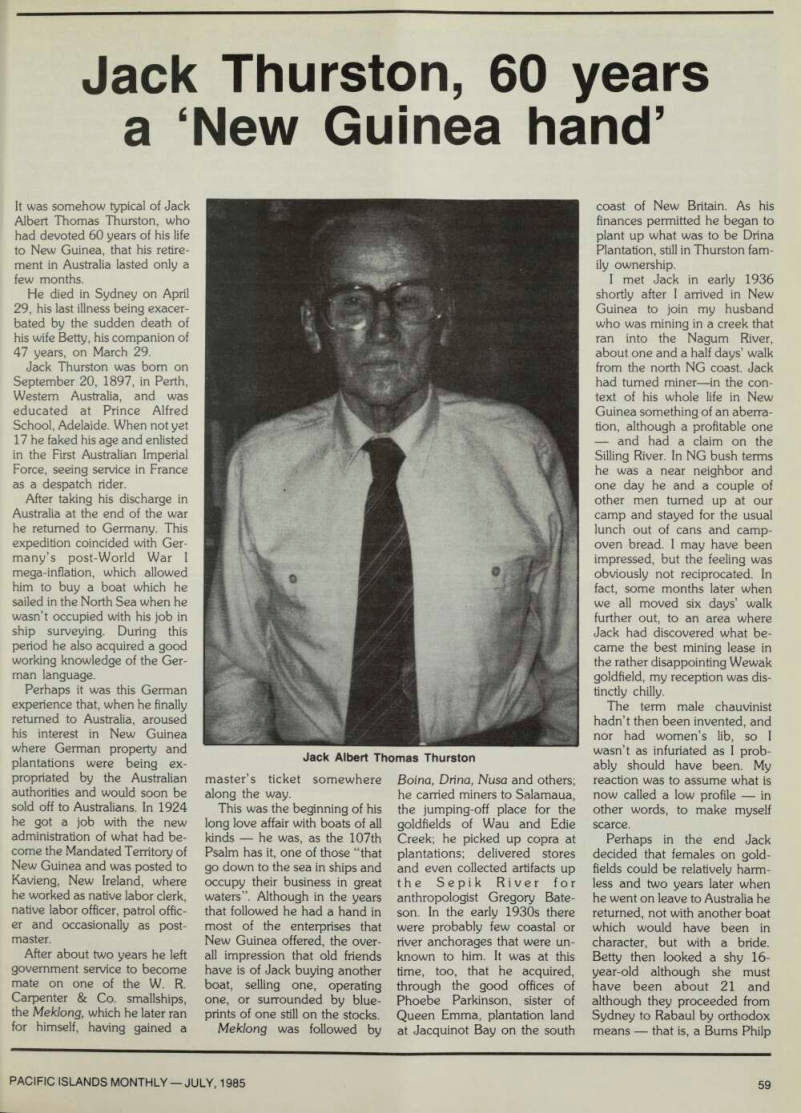
a ‘New Guinea hand’
It was somehow typical of Jack Albert Thomas Thurston, who had devoted 60 years of his life to New Guinea, that his retire ment in Australia lasted only a few months.
He died in Sydney on April 29, his last illness being exacer bated by the sudden death of his wife Betty, his companion of 47 years, on March 29.
Jack Thurston was bom on September 20, 1897, in Perth, Western Australia, and was educated at Prince Alfred School, Adelaide. When not yet 17 he faked his age and enlisted in the First Australian Imperial Force, seeing service in France as a despatch rider.
After taking his discharge in Australia at the end of the war he returned to Germany. This expedition coincided with Ger many’s post-World War I mega-inflation, which allowed him to buy a boat which he sailed in the North Sea when he wasn’t occupied with his job in ship surveying. During this period he also acquired a good working knowledge of the Ger man language.
Perhaps it was this German experience that, when he finally returned to Australia, aroused his interest in New Guinea where German property and plantations were being ex propriated by the Australian authorities and would soon be sold off to Australians. In 1924 he got a job with the new administration of what had be come the Mandated Territory of New Guinea and was posted to Kavieng, New Ireland, where he worked as native labor clerk, native labor officer, patrol offic er and occasionally as post master.
After about two years he left government service to become mate on one of the W. R.
Carpenter & Co. smallships, the Meklong, which he later ran for himself, having gained a
master’s ticket somewhere along the way.
This was the beginning of his long love affair with boats of all kinds he was, as the 107th Psalm has it, one of those “that go down to the sea in ships and occupy their business in great waters”. Although in the years that followed he had a hand in most of the enterprises that New Guinea offered, the over all impression that old friends have is of Jack buying another boat, selling one, operating one, or surrounded by blue prints of one still on the stocks.
Meklong was followed by
Boina, Drina, Nusa and others; he carried miners to Salamaua, the jumping-off place for the goldfields of Wau and Edie Creek; he picked up copra at plantations; delivered stores and even collected artifacts up the Sepik River for anthropologist Gregory Bate son. In the early 1930 s there were probably few coastal or river anchorages that were un known to him. It was at this time, too, that he acquired, through the good offices of Phoebe Parkinson, sister of Queen Emma, plantation land at Jacquinot Bay on the south
coast of New Britain. As his finances permitted he began to plant up what was to be Drina Plantation, still in Thurston fam ily ownership.
I met Jack in early 1936 shortly after I arrived in New Guinea to join my husband who was mining in a creek that ran into the Nagum River, about one and a half days’ walk from the north NG coast. Jack had turned miner—in the con text of his whole life in New Guinea something of an aberra tion, although a profitable one and had a claim on the Silling River. In NG bush terms he was a near neighbor and one day he and a couple of other men turned up at our camp and stayed for the usual lunch out of cans and camp oven bread. I may have been impressed, but the feeling was obviously not reciprocated. In fact, some months later when we all moved six days’ walk further out, to an area where Jack had discovered what be came the best mining lease in the rather disappointing Wewak goldfield, my reception was dis
tinctly chilly.
The term male chauvinist hadn’t then been invented, and nor had women’s lib, so I wasn’t as infuriated as I prob ably should have been. My reaction was to assume what is now called a low profile in other words, to make myself scarce.
Perhaps in the end Jack decided that females on gold fields could be relatively harm less and two years later when he went on leave to Australia he returned, not with another boat which would have been in character, but with a bride.
Betty then looked a shy 16year-old although she must have been about 21 and although they proceeded from Sydney to Rabaul by orthodox means that is, a Bums Philp
Jack Albert Thomas Thurston
ship there Jack bought a small boat called the Destiny and in this they finished the not inconsiderable voyage to Wewak.
Naturally Jack and his bride were subjects of great interest among the scattered miners of the Wewak district and the business of the Destiny brought forth the general comment that at least he was seeing that the girl was being broken in the hard way.
By this time Ray Parer had carved out a rough airstrip at Maprik on the edge of the Sepik plain, and when a plane was available it was possible to fly there from the coast. Jack’s lease was then no more than a day’s walk away.
In the Christmas-New Year period of 1941, European women were evacuated from Papua and New Guinea, but in 1942 after the Japanese inva sion, European men of the Sepik district were more or less abandoned to their fate. There were various plans, or rumors of plans, to evacuate them and parties gathered at several points on the Sepik River.
When nothing happened, indi viduals then made their own plans for escape, Jack leading a party of half a dozen to the headwaters of the river, across the backbone of unknown PNG, and down the Fly River to the Papuan coast which they reached six months after they had left Angoram on the Sepik.
Thirteen years previously, two men of Sir Hubert Murray’s Papuan service, Ivan Cham pion and Charles Karius, had made a patrol in the reverse direction that is, up the Fly and down the Sepik. A book written by Champion covering this heroic effort was published in the early 19305, but whether any of the assorted 1942 party had read the book or realised what they were letting them selves in for is unknown. This journey was one of many ex traordinary efforts put up by ordinary civilians in 1942-45, but left unrecorded in the larger story of a whole country suddenly overcome by war.
Jack Thurston was later com missioned into the Royal Aus tralian Air Force but much of the rest of his Pacific war was on intelligence duties with the
American forces. The end of hostilities found him tied to a government job as director of shipping at a time when the Australian Labor government was determined to introduce nationalised shipping into Papua and New Guinea. The so-called Administration “K” ships were brought into service at this time.
After he returned to civilian life, Jack found that Drina no longer existed as a plantation, and that coconut planting had to begin again from scratch. As well as suffering the usual war time problems that descended on all plantations, it had be come something of a gathering place for remnants of the 2/22 Battalion AIF which had been overwhelmed by the Japanese invasion of Rabaul and had tried to escape along the south coast of New Britain. Many of these men got no further, Drina becoming their last resting place.
In the years that followed Jack acquired other plantations Manguna near Drina; Legenda and Volupai at Talasea. Mostly these enter prises were masterminded from H.Q. in Rabaul, but a bungalow
was built on Volupai with the intention of living in it. It has now become something of a family joke that the manager of the plantation occupied a single room in the bungalow on a temporary basis for 15 years in the unfulfilled expectation that the Thurstons would eventually arrive to set up house. This plantation was sold to a com pany in the 19705, although Jack remained company chair man until his death.
From plantations his interests extended to sawmilling and tim ber, finance and real estate, sometimes on his own, some times in partnerships with others. Where he made profits he ploughed them back into something else and, of course, there always were boats. At a rough count, 13 passed through his hands in the postwar period, including Carla Manus I, II and 111.
If Jack Thurston can be cal led a man for his time in New Guinea, it was a time that spanned 60 years and a couple of generations, saw enormous changes and required extreme adaptability not a virtue usually attributed to early pioneers.
In his prime he literally never walked if he could run; knew exactly where he was going and headed straight for his target.
He was introduced to New Guinea when it was a beaten, backward ex-German colony, saw it survive three years of war that wiped out industry and reduced towns to bare earth, and had his interests still there in 1975 when, joined perma nently to the old Australian territory of Papua, it became the independent Pacific nation of Papua New Guinea.
The records he has set in the length of his devotion to the country, the diversity of his interests, are not likely to be beaten; he was, indeed, one of the last of the survivors ot an era already past.
Betty and Jack are mourned by their two sons, Jack and Michael; their two daughters, Carla (Mrs Lloyd Illet), Paula (Mrs Bjom Guldberg), and a healthy brood of grandchildren.
Many old ex-New Guinea friends joined the family at services of thanksgiving for these fruitful lives held at St.
Peter’s Church, Watson’s Bay, Sydney, on April 2 and May 3.
Judy Tudor.
Artefacts to go home
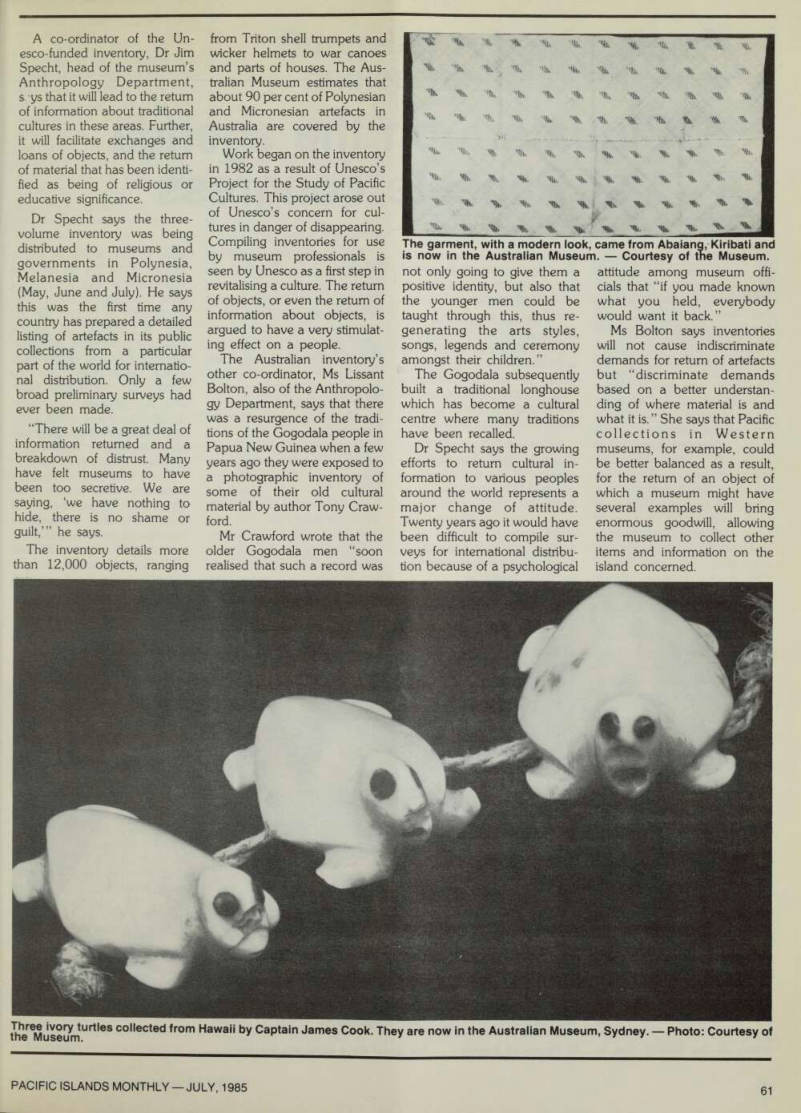
A major advance in the protection of the cultural heritage of Micronesia and Polynesia has been taken by Unesco and the Australian Museum in Sydney. At the end of April the museum completed a Unesco-funded inventory of virtually all the artefacts from these islands held in Australia.
The inventory, which is being distributed primarily in the Pacific (May, June and July), is believed to be the first of its kind in the world. Andrew Symon looks at its significance.
One legacy of the age of im perialism for Pacific Islanders is that they are often more likely to find examples of weapons, clothing and carvings made by their ancestors in Western museums than on their own islands.
Anthropologists at the Aus tralian Museum in Sydney say that Western contact led to the disintegration of traditional ways of life as new technologies and values were introduced.
This means the end of the manufacture of many items.
Steel replaced stone and wood.
Masks and images used in ceremonies disappeared as rituals to native gods were replaced by Christian worship, Meanwhile, existing objects were shipped to museums from St Petersburg to Hobart as curiosities from remote exotic islands.
Today there are many Pacific islands which lack examples of objects which once were made locally. The anthropologists say that as a result Pacific peoples do not have information about
their past which such artefacts can provide. Without a sense of the past there can be no strong sense of cultural identity, which is much needed to cope with a rapidly changing world.
To help revitalise the cultural identity of the peoples of Polynesia, and Micronesia, the United Nations Education, Sci entific and Cultural Organisa tion and the Australian Museum have taken the major step of compiling a detailed inventory of artefacts from these islands in Australian public collections.
A co-ordinator of the Un esco-funded inventory, Dr Jim Specht, head of the museum’s Anthropology Department, s. ys that it will lead to the return of information about traditional cultures in these areas. Further, it will facilitate exchanges and loans of objects, and the return of material that has been identi fied as being of religious or educative significance.
Dr Specht says the three volume inventory was being distributed to museums and governments in Polynesia, Melanesia and Micronesia (May, June and July). He says this was the first time any country has prepared a detailed listing of artefacts in its public collections from a particular part of the world for internatio nal distribution. Only a few broad preliminary surveys had ever been made.
“There will be a great deal of information returned and a breakdown of distrust. Many have felt museums to have been too secretive. We are saying, ‘we have nothing to hide, there is no shame or guilt,”’ he says.
The inventory details more than 12,000 objects, ranging
from Triton shell trumpets and wicker helmets to war canoes and parts of houses. The Aus tralian Museum estimates that about 90 per cent of Polynesian and Micronesian artefacts in Australia are covered by the inventory.
Work began on the inventory in 1982 as a result of Unesco’s Project for the Study of Pacific Cultures. This project arose out of Unesco’s concern for cul tures in danger of disappearing.
Compiling inventories for use by museum professionals is seen by Unesco as a first step in revitalising a culture. The return of objects, or even the return of information about objects, is argued to have a very stimulat ing effect on a people.
The Australian inventory’s other co-ordinator, Ms Lissant Bolton, also of the Anthropolo gy Department, says that there was a resurgence of the tradi tions of the Gogodala people in Papua New Guinea when a few years ago they were exposed to a photographic inventory of some of their old cultural material by author Tony Craw ford.
Mr Crawford wrote that the older Gogodala men “soon realised that such a record was
not only going to give them a positive identity, but also that the younger men could be taught through this, thus re generating the arts styles, songs, legends and ceremony amongst their children.”
The Gogodala subsequently built a traditional longhouse which has become a cultural centre where many traditions have been recalled.
Dr Specht says the growing efforts to return cultural in formation to various peoples around the world represents a major change of attitude.
Twenty years ago it would have been difficult to compile sur veys for international distribu tion because of a psychological
attitude among museum offi cials that “if you made known what you held, everybody would want it back.”
Ms Bolton says inventories will not cause indiscriminate demands for return of artefacts but “discriminate demands based on a better understan ding of where material is and what it is. ” She says that Pacific collections in Western museums, for example, could be better balanced as a result, for the return of an object of which a museum might have several examples will bring enormous goodwill, allowing the museum to collect other items and information on the island concerned.
The garment, with a modern look, came from Abaiang, Kiribati and is now in the Australian Museum. Courtesy of the Museum.
Three ivory turties collected from Hawaii by Captain James Cook. They are now in the Australian Museum. Sydney.-Phpto: Courtesy of the Museum
Ciguatera on the agenda
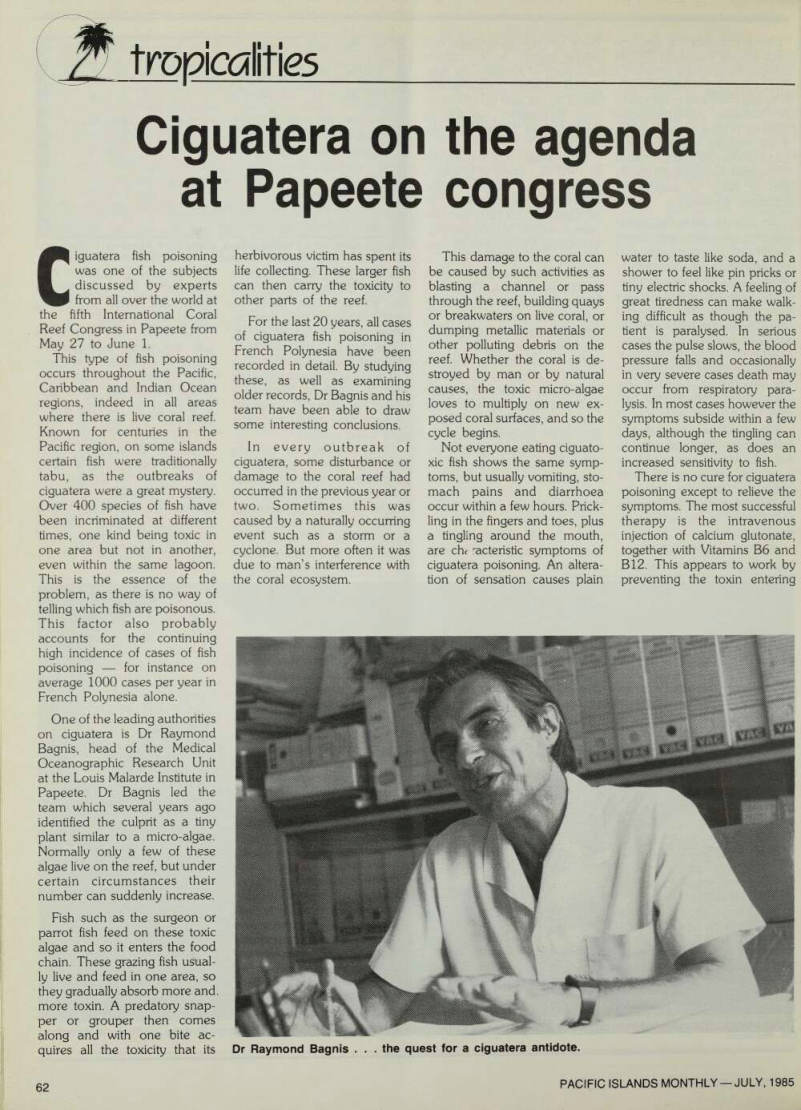
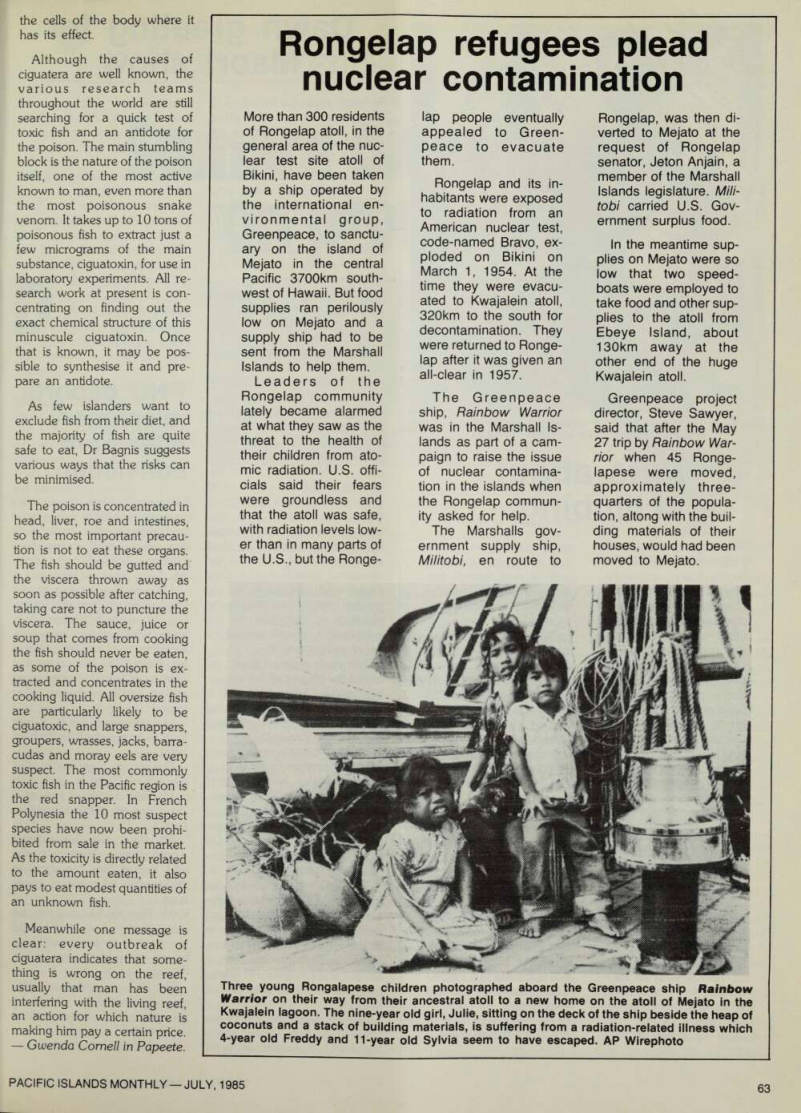
tropicalities
Ciguatera on the agenda at Papeete congress
Ciguatera fish poisoning was one of the subjects discussed by experts from all over the world at the fifth International Coral Reef Congress in Papeete from May 27 to June 1.
This type of fish poisoning occurs throughout the Pacific, Caribbean and Indian Ocean regions, indeed in all areas where there is live coral reef.
Known for centuries in the Pacific region, on some islands certain fish were traditionally tabu, as the outbreaks of ciguatera were a great mystery.
Over 400 species of fish have been incriminated at different times, one kind being toxic in one area but not in another, even within the same lagoon.
This is the essence of the problem, as there is no way of telling which fish are poisonous.
This factor also probably accounts for the continuing high incidence of cases of fish poisoning for instance on average 1000 cases per year in French Polynesia alone.
One of the leading authorities on ciguatera is Dr Raymond Bagnis, head of the Medical Oceanographic Research Unit at the Louis Malarde Institute in Papeete. Dr Bagnis led the team which several years ago identified the culprit as a tiny plant similar to a micro-algae.
Normally only a few of these algae live on the reef, but under certain circumstances their number can suddenly increase.
Fish such as the surgeon or parrot fish feed on these toxic algae and so it enters the food chain. These grazing fish usual ly live and feed in one area, so they gradually absorb more and. more toxin. A predatory snap per or grouper then comes along and with one bite ac quires all the toxicity that its
herbivorous victim has spent its life collecting. These larger fish can then carry the toxicity to other parts of the reef.
For the last 20 years, all cases of ciguatera fish poisoning in French Polynesia have been recorded in detail. By studying these, as well as examining older records, Dr Bagnis and his team have been able to draw some interesting conclusions.
In every outbreak of ciguatera, some disturbance or damage to the coral reef had occurred in the previous year or two. Sometimes this was caused by a naturally occurring event such as a storm or a cyclone. But more often it was due to man’s interference with the coral ecosystem.
This damage to the coral can be caused by such activities as blasting a channel or pass through the reef, building quays or breakwaters on live coral, or dumping metallic materials or other polluting debris on the reef. Whether the coral is de stroyed by man or by natural causes, the toxic micro-algae loves to multiply on new ex posed coral surfaces, and so the cycle begins.
Not everyone eating ciguato xic fish shows the same symp toms, but usually vomiting, sto mach pains and diarrhoea occur within a few hours. Prick ling in the fingers and toes, plus a tingling around the mouth, are ch«- 'acteristic symptoms of ciguatera poisoning. An altera tion of sensation causes plain
water to taste like soda, and a shower to feel like pin pricks or tiny electric shocks. A feeling of great tiredness can make walk ing difficult as though the pa tient is paralysed. In serious cases the pulse slows, the blood pressure falls and occasionally in very severe cases death may occur from respiratory para lysis. In most cases however the symptoms subside within a few days, although the tingling can continue longer, as does an increased sensitivity to fish.
There is no cure for ciguatera poisoning except to relieve the symptoms. The most successful therapy is the intravenous injection of calcium glutonate, together with Vitamins B 6 and 812. This appears to work by preventing the toxin entering
Dr Raymond Bagnis . . . the quest for a ciguatera antidote.
the cells of the body where it has its effect.
Although the causes of ciguatera are well known, the various research teams throughout the world are still searching for a quick test of toxic fish and an antidote for the poison. The main stumbling block is the nature of the poison itself, one of the most active known to man, even more than the most poisonous snake venom. It takes up to 10 tons of poisonous fish to extract just a few micrograms of the main substance, ciguatoxin, for use in laboratory experiments. All re search work at present is con centrating on finding out the exact chemical structure of this minuscule ciguatoxin. Once that is known, it may be pos sible to synthesise it and pre pare an antidote.
As few islanders want to exclude fish from their diet, and the majority of fish are quite safe to eat, Dr Bagnis suggests various ways that the risks can be minimised.
The poison is concentrated in head, liver, roe and intestines, so the most important precau tion is not to eat these organs.
The fish should be gutted and the viscera thrown away as soon as possible after catching, taking care not to puncture the viscera. The sauce, juice or soup that comes from cooking the fish should never be eaten, as some of the poison is ex tracted and concentrates in the cooking liquid. All oversize fish are particularly likely to be ciguatoxic, and large snappers, groupers, wrasses, jacks, barra cudas and moray eels are very suspect. The most commonly toxic fish in the Pacific region is the red snapper. In French Polynesia the 10 most suspect species have now been prohi bited from sale in the market.
As the toxicity is directly related to the amount eaten, it also pays to eat modest quantities of an unknown fish.
Meanwhile one message is clear: every outbreak of ciguatera indicates that some thing is wrong on the reef, usually that man has been interfering with the living reef, an action for which nature is making him pay a certain price.
Gwenda Cornell in Papeete.
Rongelap refugees plead
nuclear contamination
More than 300 residents of Rongelap atoll, in the general area of the nuc lear test site atoll of Bikini, have been taken by a ship operated by the international en vironmental group, Greenpeace, to sanctu ary on the island of Mejato in the central Pacific 3700 km south west of Hawaii. But food supplies ran perilously low on Mejato and a supply ship had to be sent from the Marshall Islands to help them.
Leaders of the Rongelap community lately became alarmed at what they saw as the threat to the health of their children from ato mic radiation. U.S. offi cials said their fears were groundless and that the atoll was safe, with radiation levels low er than in many parts of the U.S., but the Ronge
lap people eventually appealed to Green peace to evacuate them.
Rongelap and its in habitants were exposed to radiation from an American nuclear test, code-named Bravo, ex ploded on Bikini on March 1, 1954. At the time they were evacu ated to Kwajalein atoll, 320 km to the south for decontamination. They were returned to Ronge lap after it was given an all-clear in 1957.
The Greenpeace ship, Rainbow Warrior was in the Marshall Is lands as part of a cam paign to raise the issue of nuclear contamina tion in the islands when the Rongelap commun ity asked for help.
The Marshalls gov ernment supply ship, Militobi, en route to
Rongelap, was then di verted to Mejato at the request of Rongelap senator, Jeton Anjain, a member of the Marshall Islands legislature. Mili tobi carried U.S. Gov ernment surplus food.
In the meantime sup plies on Mejato were so low that two speed boats were employed to take food and other sup plies to the atoll from Ebeye Island, about 130 km away at the other end of the huge Kwajalein atoll.
Greenpeace project director, Steve Sawyer, said that after the May 27 trip by Rainbow War rior when 45 Ronge lapese were moved, approximately three quarters of the popula tion, altong with the buil ding materials of their houses, would had been moved to Mejato.
Three young Rongalapese children photographed aboard the Greenpeace ship Rainbow Warrior on their way from their ancestral atoll to a new home on the atoll of Mejato in the Kwajalein lagoon. The nine-year old girl, Julie, sitting on the deck of the ship beside the heap of coconuts and a stack of building materials, is suffering from a radiation-related illness which 4-year old Freddy and 11-year old Sylvia seem to have escaped. AP Wirephoto
climbing
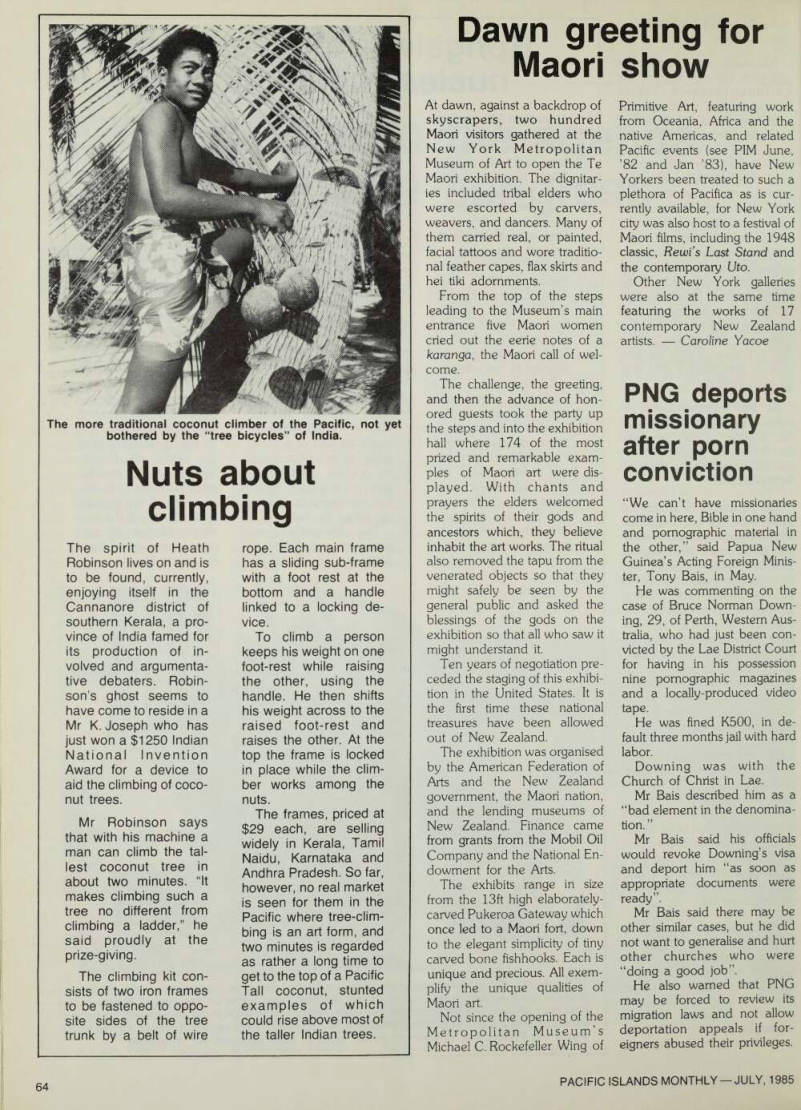
Nuts about climbing
The spirit of Heath Robinson lives on and is to be found, currently, enjoying itself in the Cannanore district of southern Kerala, a pro vince of India famed for its production of in volved and argumenta tive debaters. Robin son’s ghost seems to have come to reside in a Mr K. Joseph who has just won a $1250 Indian National Invention Award for a device to aid the climbing of coco nut trees.
Mr Robinson says that with his machine a man can climb the tal lest coconut tree in about two minutes. “It makes climbing such a tree no different from climbing a ladder,” he said proudly at the prize-giving.
The climbing kit con sists of two iron frames to be fastened to oppo site sides of the tree trunk by a belt of wire
rope. Each main frame has a sliding sub-frame with a foot rest at the bottom and a handle linked to a locking de vice.
To climb a person keeps his weight on one foot-rest while raising the other, using the handle. He then shifts his weight across to the raised foot-rest and raises the other. At the top the frame is locked in place while the clim ber works among the nuts.
The frames, priced at $29 each, are selling widely in Kerala, Tamil Naidu, Karnataka and Andhra Pradesh. So far, however, no real market is seen for them in the Pacific where tree-clim bing is an art form, and two minutes is regarded as rather a long time to get to the top of a Pacific Tall coconut, stunted examples of which could rise above most of the taller Indian trees.
The more traditional coconut climber of the Pacific, not yet bothered by the “tree bicycles” of India.
Maori show
Dawn greeting for Maori show
At dawn, against a backdrop of skyscrapers, two hundred Maori visitors gathered at the New York Metropolitan Museum of Art to open the Te Maori exhibition. The dignitar ies included tribal elders who were escorted by carvers, weavers, and dancers. Many of them carried real, or painted, facial tattoos and wore traditio nal feather capes, flax skirts and hei tiki adornments.
From the top of the steps leading to the Museum’s main entrance five Maori women cried out the eerie notes of a karanga, the Maori call of wel come.
The challenge, the greeting, and then the advance of hon ored guests took the party up the steps and into the exhibition hall where 174 of the most prized and remarkable exam ples of Maori art were dis played. With chants and prayers the elders welcomed the spirits of their gods and ancestors which, they believe inhabit the art works. The ritual also removed the tapu from the venerated objects so that they might safely be seen by the general public and asked the blessings of the gods on the exhibition so that all who saw it might understand it.
Ten years of negotiation pre ceded the staging of this exhibi tion in the United States. It is the first time these national treasures have been allowed out of New Zealand.
The exhibition was organised by the American Federation of Arts and the New Zealand government, the Maori nation, and the lending museums of New Zealand. Finance came from grants from the Mobil Oil Company and the National En dowment for the Arts.
The exhibits range in size from the 13ft high elaborately carved Pukeroa Gateway which once led to a Maori fort, down to the elegant simplicity of tiny carved bone fishhooks. Each is unique and precious. All exem plify the unique qualities of Maori art.
Not since the opening of the Metropolitan Museum’s Michael C. Rockefeller Wing of
Primitive Art, featuring work from Oceania, Africa and the native Americas, and related Pacific events (see PIM June, ’B2 and Jan ’B3), have New Yorkers been treated to such a plethora of Pacifica as is cur rently available, for New York city was also host to a festival of Maori films, including the 1948 classic, Rewi’s Last Stand and the contemporary Uto.
Other New York galleries were also at the same time featuring the works of 17 contemporary New Zealand artists. Caroline Yacoe
PNG deports
missionary
after porn
conviction
“We can’t have missionaries come in here, Bible in one hand and pornographic material in the other,” said Papua New Guinea’s Acting Foreign Minis ter, Tony Bais, in May.
He was commenting on the case of Bruce Norman Down ing, 29, of Perth, Western Aus tralia, who had just been con victed by the Lae District Court for having in his possession nine pornographic magazines and a locally-produced video tape.
He was fined K5OO, in de fault three months jail with hard labor.
Downing was with the Church of Christ in Lae.
Mr Bais described him as a “bad element in the denomina tion.”
Mr Bais said his officials would revoke Downing’s visa and deport him “as soon as appropriate documents were ready”.
Mr Bais said there may be other similar cases, but he did not want to generalise and hurt other churches who were “doing a good job”.
He also warned that PNG may be forced to review its migration laws and not allow deportation appeals if for eigners abused their privileges.
on provinces
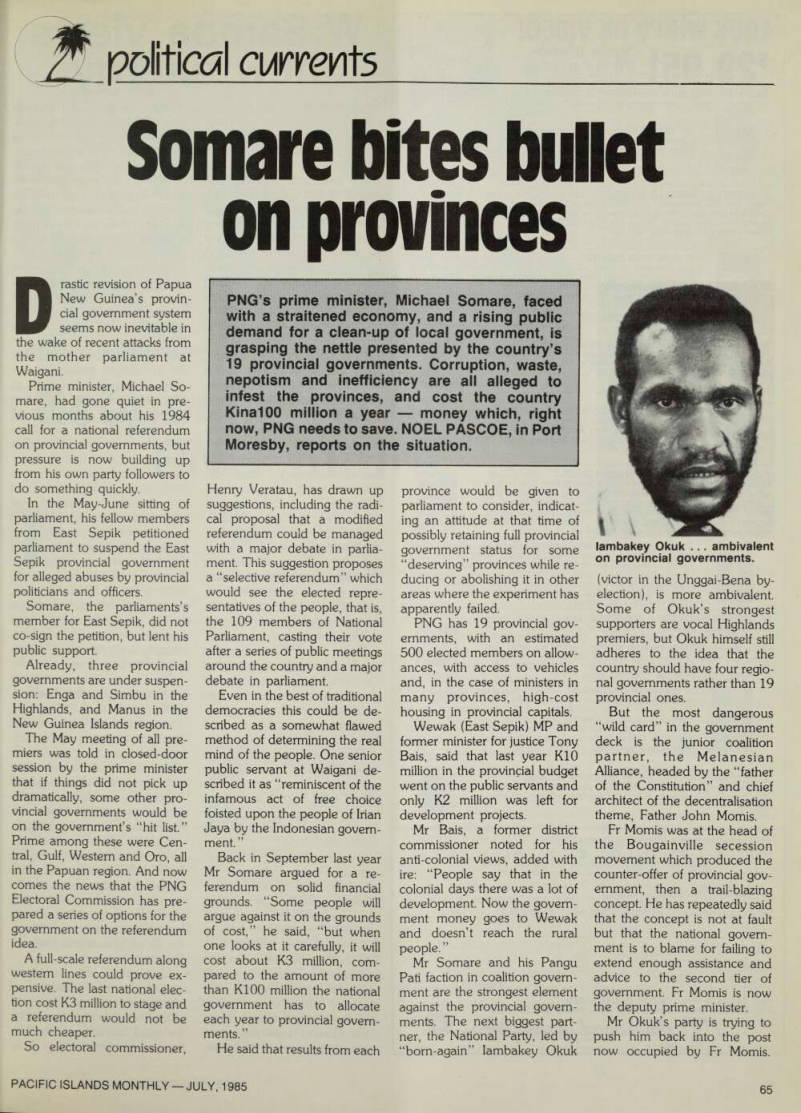
political currents
Somare bites bullet on provinces
Drastic revision of Papua New Guinea’s provin cial government system seems now inevitable in the wake of recent attacks from the mother parliament at Waigani.
Prime minister, Michael So mare, had gone quiet in pre vious months about his 1984 call for a national referendum on provincial governments, but pressure is now building up from his own party followers to do something quickly.
In the May-June sitting of parliament, his fellow members from East Sepik petitioned parliament to suspend the East Sepik provincial government for alleged abuses by provincial politicians and officers.
Somare, the parliaments’s member for East Sepik, did not co-sign the petition, but lent his public support.
Already, three provincial governments are under suspen sion: Enga and Simbu in the Highlands, and Manus in the New Guinea Islands region.
The May meeting of all pre miers was told in closed-door session by the prime minister that if things did not pick up dramatically, some other pro vincial governments would be on the government’s “hit list.”
Prime among these were Cen tral, Gulf, Western and Oro, all in the Papuan region. And now comes the news that the PNG Electoral Commission has pre pared a series of options for the government on the referendum idea.
A full-scale referendum along western lines could prove ex pensive. The last national elec tion cost K 3 million to stage and a referendum would not be much cheaper.
So electoral commissioner,
PNG’s prime minister, Michael Somare, faced with a straitened economy, and a rising public demand for a clean-up of local government, is grasping the nettle presented by the country’s 19 provincial governments. Corruption, waste, nepotism and inefficiency are all alleged to infest the provinces, and cost the country KinalOO million a year money which, right now, PNG needs to save. NOEL PASCOE, in Port Moresby, reports on the situation.
Henry Veratau, has drawn up suggestions, including the radi cal proposal that a modified referendum could be managed with a major debate in parlia ment. This suggestion proposes a “selective referendum” which would see the elected repre sentatives of the people, that is, the 109 members of National Parliament, casting their vote after a series of public meetings around the country and a major debate in parliament.
Even in the best of traditional democracies this could be de scribed as a somewhat flawed method of determining the real mind of the people. One senior public servant at Waigani de scribed it as “reminiscent of the infamous act of free choice foisted upon the people of Irian Jaya by the Indonesian govern ment.”
Back in September last year Mr Somare argued for a re ferendum on solid financial grounds. “Some people will argue against it on the grounds of cost,” he said, “but when one looks at it carefully, it will cost about K 3 million, com pared to the amount of more than KlOO million the national government has to allocate each year to provincial govern ments. ”
He said that results from each
province would be given to parliament to consider, indicat ing an attitude at that time of possibly retaining full provincial government status for some “deserving” provinces while re ducing or abolishing it in other areas where the experiment has apparently failed.
PNG has 19 provincial gov ernments, with an estimated 500 elected members on allow ances, with access to vehicles and, in the case of ministers in many provinces, high-cost housing in provincial capitals.
Wewak (East Sepik) MP and former minister for justice Tony Bais, said that last year KlO million in the provincial budget went on the public servants and only K 2 million was left for development projects.
Mr Bais, a former district commissioner noted for his anti-colonial views, added with ire: “People say that in the colonial days there was a lot of development. Now the govern ment money goes to Wewak and doesn’t reach the rural people. ”
Mr Somare and his Pangu Pati faction in coalition govern ment are the strongest element against the provincial govern ments. The next biggest part ner, the National Party, led by “born-again” lambakey Okuk
(victor in the Unggai-Bena by election), is more ambivalent.
Some of Okuk’s strongest supporters are vocal Highlands premiers, but Okuk himself still adheres to the idea that the country should have four regio nal governments rather than 19 provincial ones.
But the most dangerous “wild card” in the government deck is the junior coalition partner, the Melanesian Alliance, headed by the “father of the Constitution” and chief architect of the decentralisation theme, Father John Momis.
Fr Momis was at the head of the Bougainville secession movement which produced the counter-offer of provincial gov ernment, then a trail-blazing concept. He has repeatedly said that the concept is not at fault but that the national govern ment is to blame for failing to extend enough assistance and advice to the second tier of government. Fr Momis is now the deputy prime minister.
Mr Okuk’s party is trying to push him back into the post now occupied by Fr Momis.
lambakey Okuk ... ambivalent on provincial governments.
W.Samoa views
new energy
Alternative energy sources, and energy conservation methods appropriate to the South Pacific have been the focus of techni cal discussion in the area for some time under the joint au spices of SPEC and the SPC.
Now, however, the importance of the study has been raised by what is seen as quite urgent need among many of the island nations to conserve their fore ign exchange by finding alternatives to expensive pet roleum.
The latest meeting aimed at finding viable alternatives was held in Apia, Western Samoa, early in May, following on the South Pacific Commission con ference in Papeete in 1982, and the review of the Pacific energy program held last year in Raro tonga.
A total of 19 countries and territories attended the Apia conference as well as repre sentatives from 10 organisa tions including UNDP, CHOGRM, and ESCAP. Seve ral companies in the energy field were also on site showing their latest products in the solar, wave-motion, wind-powered, and other fields, including the use of vegetable oils as pet roleum substitutes.
Since the 1982 conference the Pacific energy program has focused on three broad strategies: better terms from petroleum supplies, better man agement of energy use, and better use of local resources.
Four systems, growing in favor around the world were discussed. These were, bio mass, solar, wind and wave energy sources. Some of the Pacific countries already use such installations.
Western Samoa, American Samoa, French Polynesia, Fiji and Vanuatu, all are experi menting with the use of solar photo-voltaic cells as sources of power for installations such as radio-telephones. All said they had had good results in the applications so far tried. Recent research has improved the electrical output of such units and also, in effect, reduced their cost. Modem units can store enough power in batteries,
charged by the solar units, to provide power for communica tions and other systems for as long as five days without sun.
Maintenance is low and the life of modem unit is gauged to be about 20 years. Larger units are used for pumping water and for essential power in, for example, hospitals. Their outlook in the Pacific is seen as good.
Bio-mass energy also seems to be finding favor and prom ises to be the cheapest source for island countries. Bio-Energy (Australia), Ltd., one of the exhibitors at the conference, has won world-wide attention for its catalytic process of tur ning vegetable oils, such as coconut and palm oil, into clean, efficient, diesel fuel. All manner of oil seeds, and pulses have been shown as suitable sources of oil to feed the pro cess. Bio-Energy’s equipment is fairly small, and portable, and priced within the reach of most island communities. Meal left over from the oil-crushing pro cess also makes a useful feed for cattle, poultry or pigs. Bio- Energy units are estimated to have a life of 10 to 15 years, with a pay-back period of four to five years, depending upon the cost of petroleum oil re placed, and the price of the vegetable oil-source.
Bio-Energy Ltd., has outlets in China, Fiji, New Zealand, PNG, and the Philippines.
These are joint ventures with local companies in each coun try. Interest has also been shown in France, Africa and the U.S. and the shares gained widespread interest when the company recently floated on the Sydney Stock Exchange.
Suitable sites for wave ener gy power stations have been found in Western Samoa at the Blowhole sites in Savaii. So far no equipment has been set up in the Pacific, but installations have been planned for Tonga, the Cook Islands and Western Samoa.
Delegates at the conference agreed that the examples of alternative energy discussed offered very good prospects for the small countries of the Paci fic. Lee Anderson in Apia.
Advertisements & other items, p. 66 (1 item)
Look Who’S On Video!
p- ■ Movie Doubles
(JR V World Favorites!
ftiViVlll (Gift Boxed)
Years Of Joy, with Never-On-TV Bonus . . .
A. “COMEDY DOUBLE” Two full-feature movies: Laurel and Hardy in “The Flying Deuces", plus Abbott and Costello in “Africa Screams”. 150 mins. $29.95!
B. ABBOTT & COSTELLO DOUBLE” Movie, plus live show!
“Jack And The Beanstalk", their best-loved movie (in colur), plus complete live show, which includes the longest version of their baseball comedy routine; “Who’s On First?” a guaranteed ribtickler every time! 120 mins. $29.95! 1 C. “CARTOON GREATS” All-time world greats together! Featuring complete cartoons of: Casper, The Friendly Ghost; Woody Woodpecker; Donald Duck; Popeye, Heckle & Jeckle those fasttalking naughty magpies; Little Lulu; Inki Boy; Farmer Alfalfa; Betty Boop. Plus bonus: “Moviestar Cartoons" See Bogart, Monroe, Groucho, Cagney, etc. in swinging hot-jazz animation it’s Hollywood’s greatest cartoon! Technicolor. 90 mins. $29.95!
D. “FAMILY DOUBLE” —Two movies: Shirley Temple in “The Little Princess" a cute-as-can-be orphan girl meets the Queen of England! Plus “The Red Balloon” Academy Award winning family classic! Both in color. 150 mins. $29.95!
mP I
E. “ELVIS, THE 1968 COMEBACK SPECIAL” Presley's greatest comeback event, made during the King's peak! Complete concert, plus bonus: “Oops, Elvis Bloopers!" behind the scene rehearsals and goofs naughty, wild and very funny! Plus Elvis interview.
Color. 109 mins. $29.95!
F. "ACADEMY CANNES AWARD SCI-FI DOUBLE”. "AN OCCUR- RENCE” The Academy Award winning episode from “The Twilight Zone" series. Hauntmgly beautiful film, exploring the thoughts of a condemned man about to be executed. Plus “Fantastic Planet"
Grand Prix and Cannes film award winner! Rene Laloux' full-feature animated epic of the Draag' Planet . . . where man is not the superior being! Dazzling color and special effects. $39.95!
G. “COPPOLA ROMERO HORROR DOUBLE" two horror classics to make you curl in your armchair! “Night Of The Living Dead" regarded one of the scariest films ever made, the version they wouldn't dare show on TV! Plus: Ford (“Godfather", “Apocalypse Now") Coppola's cinematic shocker: “Dementia 13” with the now famous axe murder! Caution: Both movies unedited, rated R’. 177 mins. $39.95!
H. “REEFER MADNESS” THE MARIJUANA CLASSIC! Based on true stories, exploring the dangers of the evil weed! Full of exaggerated cliches (“one moment of bliss, a lifetime of regret”, etc.), family melodrama, uncontrollable laughter, frenzied accidents, and now regarded an unintentionally hilarious cult classic. Full-feature, plus bonus: “Sinister Harvest!" rare film showing illegal dope smuggling from the Middle-East! 100 mins. $29.95!
I. “NAUGHTY NOSTALGIA” The earliest known 100% genuine adult classic, made in the 20s! Complete with original title-cards, organ music, vintage automobiles, and black stockings and hats of the day! Plus bonus; Genuine Adult Cartoon made in 1922, but far ahead of its time will leave you howling with laughter! (Caution: Issued as an historical curiosity, these films are pornographic even with today’s standards). 50 mins. $29.95! nsjcmsTasKnu' J. “ROY ROGERS/GENE AUTRY WESTERN DOUBLE” Two movies: Roy Rogers in “Song Of Texas”, plus Gene Autry in “Guns N’ Guitars". Top country tunes and western action! 120 mins. $29.95!
YES, please rush following items. (Please Tick) VHS □ BETA □ ITEMS: AD B □ CD D □ ED F □ G □ HD I □ J □ SAVE $30.00! Buy any 10 programmes, get 1 free! (Free programme our choice) I enclose (add $7.00 insured and post)s Ch/MO □ BANKDRAFT (PLEASE REMIT AUST. CURRENCY)
DATE
NAME
ADDRESS
POSTCODE
Post Orders to HOLLYWOOD HOUSE VIDEO P.O. Box 235, Bondi Beach, NSW 2026. Phone (02) 389-5500
■PSI fJrJlumnnd I Jon
\ I M M f SftCIAUS*C *f f I " a * CO*
29 NEWLAND ST. BONDI JUNCTION
Economic recipe for PNG future
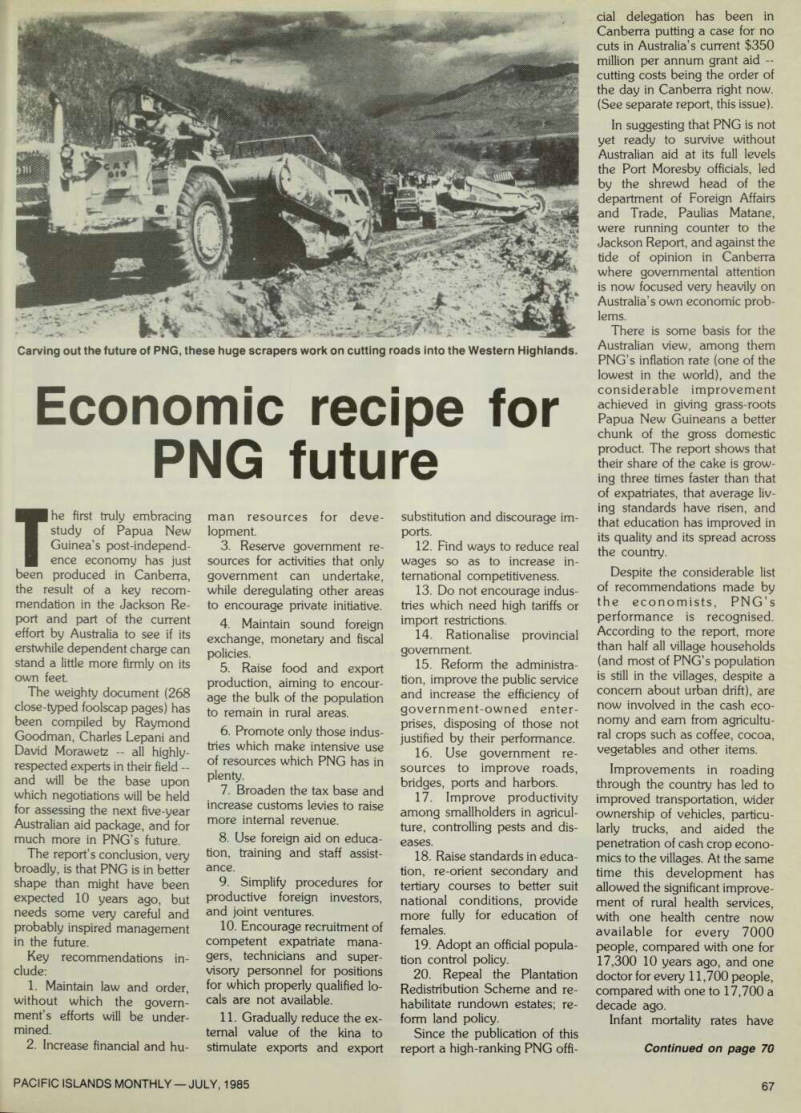
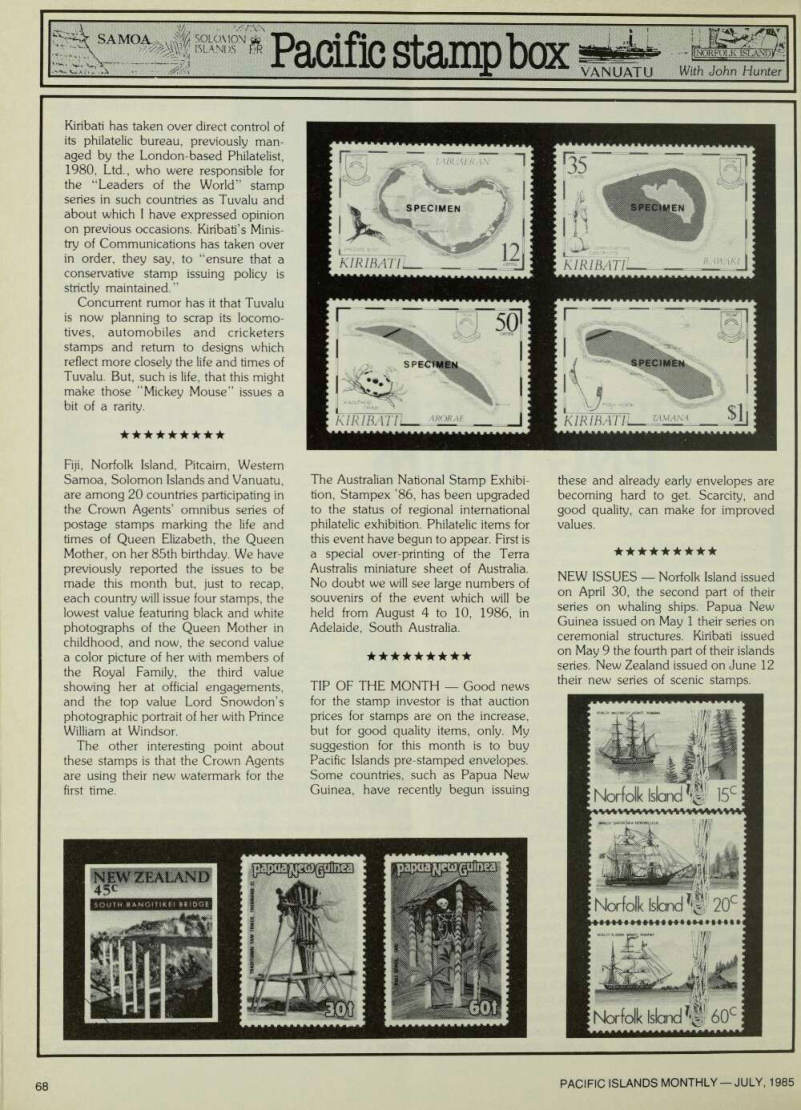
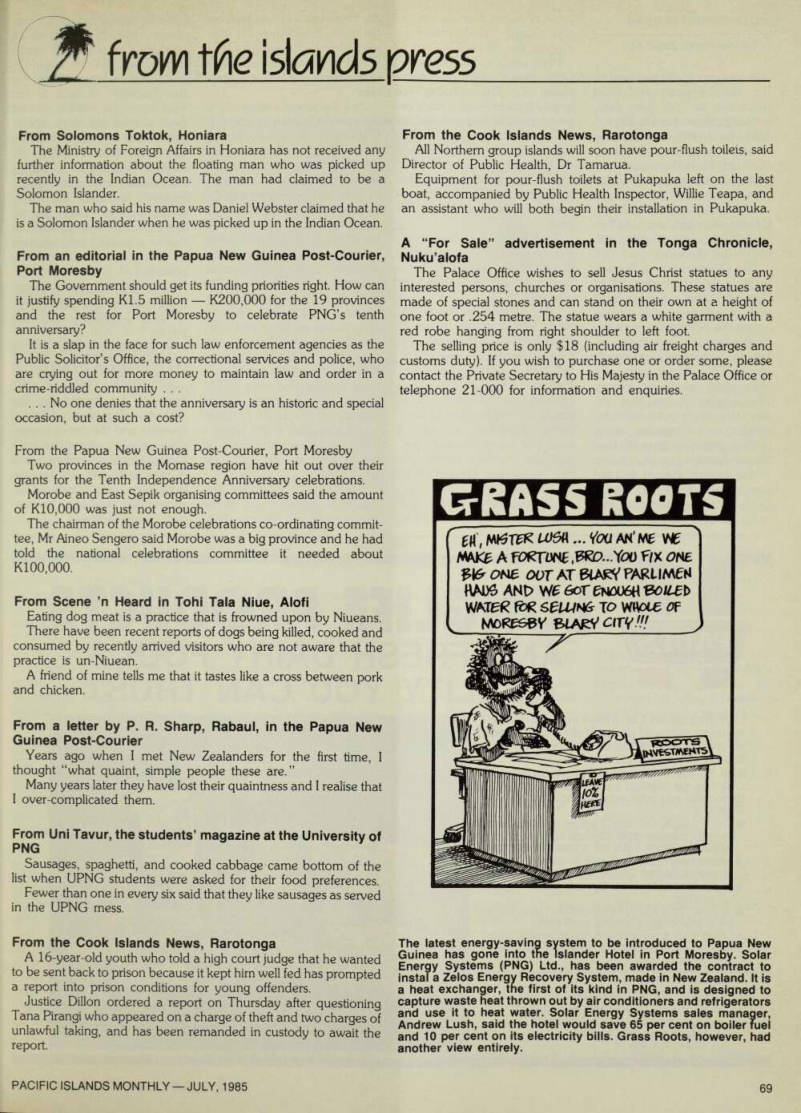

PNG future
The first truly embracing study of Papua New Guinea’s post-independ ence economy has just been produced in Canberra, the result of a key recom mendation in the Jackson Re port and part of the current effort by Australia to see if its erstwhile dependent charge can stand a little more firmly on its own feet.
The weighty document (268 close-typed foolscap pages) has been compiled by Raymond Goodman, Charles Lepani and David Morawetz - all highly respected experts in their field and will be the base upon which negotiations will be held for assessing the next five-year Australian aid package, and for much more in PNG’s future.
The report’s conclusion, very broadly, is that PNG is in better shape than might have been expected 10 years ago, but needs some very careful and probably inspired management in the future.
Key recommendations in clude: 1. Maintain law and order, without which the govern ment’s efforts will be under mined. 2. Increase financial and hu
man resources for deve lopment. 3. Reserve government re sources for activities that only government can undertake, while deregulating other areas to encourage private initiative. 4. Maintain sound foreign exchange, monetary and fiscal policies. 5. Raise food and export production, aiming to encour age the bulk of the population to remain in rural areas. 6. Promote only those indus tries which make intensive use of resources which PNG has in plenty. 7. Broaden the tax base and increase customs levies to raise more internal revenue. 8. Use foreign aid on educa tion, training and staff assist ance. 9. Simplify procedures for productive foreign investors, and joint ventures. 10. Encourage recruitment of competent expatriate mana gers, technicians and super visory personnel for positions for which properly qualified lo cals are not available. 11. Gradually reduce the ex ternal value of the kina to stimulate exports and export
substitution and discourage im ports. 12. Find ways to reduce real wages so as to increase in ternational competitiveness. 13. Do not encourage indus tries which need high tariffs or import restrictions. 14. Rationalise provincial government. 15. Reform the administra tion, improve the public service and increase the efficiency of government-owned enter prises, disposing of those not justified by their performance. 16. Use government re sources to improve roads, bridges, ports and harbors. 17. Improve productivity among smallholders in agricul ture, controlling pests and dis eases. 18. Raise standards in educa tion, re-orient secondary and tertiary courses to better suit national conditions, provide more fully for education of females. 19. Adopt an official popula tion control policy. 20. Repeal the Plantation Redistribution Scheme and re habilitate rundown estates; re form land policy.
Since the publication of this report a high-ranking PNG offi
dal delegation has been in Canberra putting a case for no cuts in Australia’s current $350 million per annum grant aid cutting costs being the order of the day in Canberra right now. (See separate report, this issue).
In suggesting that PNG is not yet ready to survive without Australian aid at its full levels the Port Moresby officials, led by the shrewd head of the department of Foreign Affairs and Trade, Paulias Matane, were running counter to the Jackson Report, and against the tide of opinion in Canberra where governmental attention is now focused very heavily on Australia’s own economic prob lems.
There is some basis for the Australian view, among them PNG’s inflation rate (one of the lowest in the world), and the considerable improvement achieved in giving grass-roots Papua New Guineans a better chunk of the gross domestic product. The report shows that their share of the cake is grow ing three times faster than that of expatriates, that average liv ing standards have risen, and that education has improved in its quality and its spread across the country.
Despite the considerable list of recommendations made by the economists, PNG’s performance is recognised.
According to the report, more than half all village households (and most of PNG’s population is still in the villages, despite a concern about urban drift), are now involved in the cash eco nomy and earn from agricultu ral crops such as coffee, cocoa, vegetables and other items.
Improvements in reading through the country has led to improved transportation, wider ownership of vehicles, particu larly trucks, and aided the penetration of cash crop econo mics to the villages. At the same time this development has allowed the significant improve ment of rural health services, with one health centre now available for every 7000 people, compared with one for 17,300 10 years ago, and one doctor for every 11,700 people, compared with one to 17,700 a decade ago.
Infant mortality rates have
Continued on page 70
Carving out the future of PNG, these huge scrapers work on cutting roads into the Western Highlands.
dropped nearly 50 per cent in the last 14 years and child mortality by 56 per cent, although these remain far too high, the report says. Average life expectancy is now 50 years, up from 40 in the decade.
Simultaneously, the report says, more trade stores have opened, widening diet choice, turning attention even further towards the use of cash, and improving life styles. ”In a country which in most respects is just beginning to develop, small improvements such as these spread widely across the population mark the beginnings of sustained, re latively equitable, economic growth,” the report said.
In short, says the report, PNG’s progress has been re markable in its years of inde pendence, an opinion which justifies prime minister Michael Somare’s outrage over criticism in the Jackson Report that aid was being wasted and should be subject to supervision, and more closely tied to specific
projects rather than being, as now, simply handed over to support the national budget.
PNG came to independence with considerable problems ahead of it. The economy was largely foreign-owned, the new government lacked essential in struments for national policy making, capital had fled in a massive way because of fore igners’ worry about the new leadership, and the world, gen erally, was reeling from the oil crisis.
Against such odds the leader ship had performed remarkably in maintaining political and eco nomic stability and democratic government. ’Yet serious problems re main which, if not resolved, threaten to abort these achieve ments,” the report says. ’’Skil led and trained people and financial resources for deve lopment are in short supply; wages are higher than in com peting countries; not enougj jobs are being created; pro tectionist pressures are increas ing; lawlessness appears to be on the rise.”
Protectionism remains evi dent. For example, last month
the government announced that from September no fore ign-sourced advertising material would be acceptable; all had to come from PNG-based agen cies.
And the report’s reference to lawlessness is seen by many in PNG as far too delicate. During June prime minister Somare put before parliament a bill aimed at curbing the battalions of ’’rascals” now plaguing the major towns and included in the proposed penalties, public hangings, floggings and other measures designed, hopefully, to make outlaws more careful.
The report examines the PNG economy in detail, study ing the rural sector, industry and mining, minerals and ener gy, government authorities and foreign investments. Social services, transport, communica tions, foreign aid, the public service (a somewhat vexed matter), the role of women (much debased, in the report’s view), and the environment, all come under the experts’ scru tiny.
The report concludes that ’’the changing emphasis of the government of Papua New
Guinea towards economic growth and the creation of productive employment oppor tunities will not be easier to achieve in the future than in the past because, at least in the near term, the conditions that have constrained their attain ment seem unlikely to become more favorable.”
“The population of Papua New Guinea is growing rapidly, creating demands for food, employment and public services that have to be met before a general improvement in living standards can be achieved.
“The skills needed to imple ment development plans quick ly and effectively are still limited.
“The price prospects for most of PNG’s exports are not bright.
“Budgetary resources con tinue to be limited by the difficulty of raising additional revenue and the desire to con tinue moving along the path towards fiscal self-reliance, that is, making do with less external budgetary support without re sorting to excessive borrow ing.” Staff Writer.
Pacific stamp box
Kiribati has taken over direct control of its philatelic bureau, previously man aged by the London-based Philatelist, 1980, Ltd., who were responsible for the “Leaders of the World” stamp series in such countries as Tuvalu and about which I have expressed opinion on previous occasions. Kiribati’s Minis try of Communications has taken over in order, they say, to “ensure that a conservative stamp issuing policy is strictly maintained.”
Concurrent rumor has it that Tuvalu is now planning to scrap its locomo tives, automobiles and cricketers stamps and return to designs which reflect more closely the life and times of Tuvalu. But, such is life, that this might make those “Mickey Mouse” issues a bit of a rarity. ★★★ Fiji, Norfolk Island, Pitcairn, Western Samoa, Solomon Islands and Vanuatu, are among 20 countries participating in the Crown Agents’ omnibus series of postage stamps marking the life and times of Queen Elizabeth, the Queen Mother, on her 85th birthday. We have previously reported the issues to be made this month but, just to recap, each country will issue four stamps, the lowest value featuring black and white photographs of the Queen Mother in childhood, and now, the second value a color picture of her with members of the Royal Family, the third value showing her at official engagements, and the top value Lord Snowdon’s photographic portrait of her with Prince William at Windsor.
The other interesting point about these stamps is that the Crown Agents are using their new watermark for the first time.
The Australian National Stamp Exhibi tion, Stampex ’B6, has been upgraded to the status of regional international philatelic exhibition. Philatelic items for this event have begun to appear. First is a special over-printing of the Terra Australis miniature sheet of Australia.
No doubt we will see large numbers of souvenirs of the event which will be held from August 4 to 10, 1986, in Adelaide, South Australia. ★★★ TIP OF THE MONTH Good news for the stamp investor is that auction prices for stamps are on the increase, but for good quality items, only. My suggestion for this month is to buy Pacific Islands pre-stamped envelopes.
Some countries, such as Papua New Guinea, have recently begun issuing
these and already early envelopes are becoming hard to get. Scarcity, and good quality, can make for improved values. ★★★ NEW ISSUES Norfolk Island issued on April 30, the second part of their series on whaling ships. Papua New Guinea issued on May 1 their series on ceremonial structures. Kiribati issued on May 9 the fourth part of their islands series. New Zealand issued on June 12 their new series of scenic stamps.
from the islands press
From Solomons Toktok, Honiara The Ministry of Foreign Affairs in Honiara has not received any further information about the floating man who was picked up recently in the Indian Ocean. The man had claimed to be a Solomon Islander.
The man who said his name was Daniel Webster claimed that he is a Solomon Islander when he was picked up in the Indian Ocean.
From an editorial in the Papua New Guinea Post-Courier, Port Moresby The Government should get its funding priorities right. How can it justify spending K 1.5 million K 200,000 for the 19 provinces and the rest for Port Moresby to celebrate PNG’s tenth anniversary?
It is a slap in the face for such law enforcement agencies as the Public Solicitor’s Office, the correctional services and police, who are crying out for more money to maintain law and order in a crime-riddled community . . . ... No one denies that the anniversary is an historic and special occasion, but at such a cost?
From the Papua New Guinea Post-Courier, Port Moresby Two provinces in the Momase region have hit out over their grants for the Tenth Independence Anniversary celebrations.
Morobe and East Sepik organising committees said the amount of KlO,OOO was just not enough.
The chairman of the Morobe celebrations co-ordinating commit tee, Mr Aineo Sengero said Morobe was a big province and he had told the national celebrations committee it needed about
Kloo,Ooo.
From Scene ’n Heard in Tohi Tala Niue, Alofi Eating dog meat is a practice that is frowned upon by Niueans.
There have been recent reports of dogs being killed, cooked and consumed by recently arrived visitors who are not aware that the practice is un-Niuean.
A friend of mine tells me that it tastes like a cross between pork and chicken.
From a letter by P. R. Sharp, Rabaul, in the Papua New Guinea Post-Courier Years ago when I met New Zealanders for the first time, I thought “what quaint, simple people these are.”
Many years later they have lost their quaintness and I realise that I over-complicated them.
From Uni Tavur, the students’ magazine at the University of
Png
Sausages, spaghetti, and cooked cabbage came bottom of the list when UPNG students were asked for their food preferences.
Fewer than one in every six said that they like sausages as served in the UPNG mess.
From the Cook Islands News, Rarotonga A 16-year-old youth who told a high court judge that he wanted to be sent back to prison because it kept him well fed has prompted a report into prison conditions for young offenders.
Justice Dillon ordered a report on Thursday after questioning Tana Pirangi who appeared on a charge of theft and two charges of unlawful taking, and has been remanded in custody to await the report.
From the Cook Islands News, Rarotonga All Northern group islands will soon have pour-flush toilets, said Director of Public Health, Dr Tamarua.
Equipment for pour-flush toilets at Pukapuka left on the last boat, accompanied by Public Health Inspector, Willie Teapa, and an assistant who will both begin their installation in Pukapuka.
A “For Sale” advertisement in the Tonga Chronicle, Nukualofa The Palace Office wishes to sell Jesus Christ statues to any interested persons, churches or organisations. These statues are made of special stones and can stand on their own at a height of one foot or .254 metre. The statue wears a white garment with a red robe hanging from right shoulder to left foot.
The selling price is only $lB (including air freight charges and customs duty). If you wish to purchase one or order some, please contact the Private Secretary to His Majesty in the Palace Office or telephone 21-000 for information and enquiries.
The latest energy-savinq system to be introduced to Papua New Guinea has gone into the islander Hotel in Port Moresby. Solar Energy Systems (PNG) Ltd., has been awarded the contract to instal a Zelos Energy Recovery System, made in New Zealand. It is a heat exchanger, the first of its kind in PNG, and is designed to capture waste heat thrown out by air conditioners and refrigerators and use it to heat water. Solar Energy Systems sales manager, Andrew Lush, said the hotel would save 65 per cent on boiler fuel and 10 per cent on its electricity bills. Grass Roots, however, had another view entirely.
Advertisements & other items, p. 70 (2 items)
Economic recipe
70
PACIFIC ISLANDS MONTHLY —JULY, 1985
Economic recipe Continued from page 67
Longlife Products
i r
AND FRESH DAIRY FOODS,
QUALITY YOU CAN TRUST
QUF Industries Ltd. offers an export award winning range of Longlife products as well as a complete range of quality fresh dairy foods.
With 16 years’ experience in export markets, QUF has the product knowledge and expertise to provide you with outstanding service in the 1980’s. • Pauls Longlife UHT Milk is natural liquid cow's milk with no preservatives or additives and is available in the 250m1, 500 ml, 1 litre and 3xl litre Milk Jugs sizes. • Shake Longlife flavoured milk is offered in delicious Chocolate Malted, Caramel and Strawberry flavours. • Pauls Longlife Thickened Cream is ideal for whipping or pouring. • Popper 100% Fruit Juice is available in seven flavours in a wide range of Longlife pack sizes. • Pauls fresh Dairy Products including Milk, Cream, Yoghurt and Cottage Cheese are available in an extensive range of flavours and sizes.
TRADE ENQUIRIES:
QUF Industries Ltd., P.O. Box 12, South Brisbane, Queensland, 4101 Australia Telephone: (07) 44-0151 Telex: AA 40614
•SSSSI
natural
bSI!
!! m
00% JUICE
100 H tomato
miiK
jucc
WAKES
people
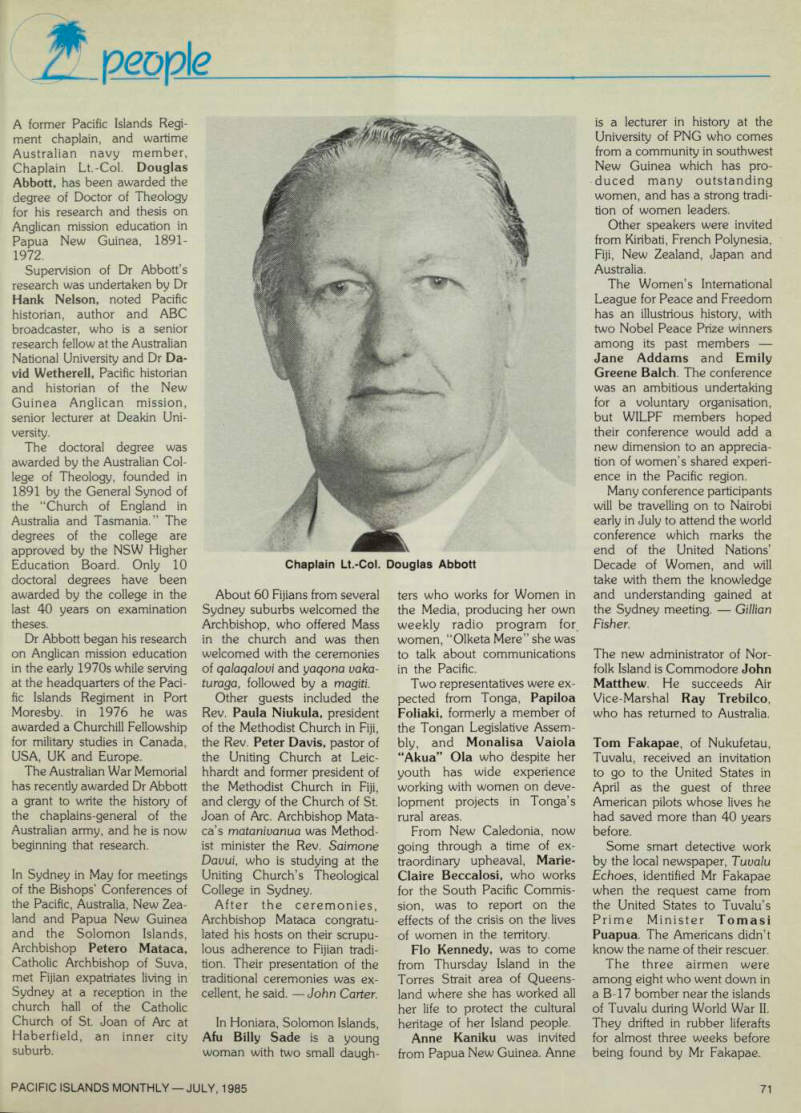
A former Pacific Islands Regi ment chaplain, and wartime Australian navy member, Chaplain Lt.-Col. Douglas Abbott, has been awarded the degree of Doctor of Theology for his research and thesis on Anglican mission education in Papua New Guinea, 1891- 1972.
Supervision of Dr Abbott’s research was undertaken by Dr Hank Nelson, noted Pacific historian, author and ABC broadcaster, who is a senior research fellow at the Australian National University and Dr Da vid Wetherell, Pacific historian and historian of the New Guinea Anglican mission, senior lecturer at Deakin Uni versity.
The doctoral degree was awarded by the Australian Col lege of Theology, founded in 1891 by the General Synod of the “Church of England in Australia and Tasmania.” The degrees of the college are approved by the NSW Higher Education Board. Only 10 doctoral degrees have been awarded by the college in the last 40 years on examination theses.
Dr Abbott began his research on Anglican mission education in the early 1970 s while serving at the headquarters of the Paci fic Islands Regiment in Port Moresby, in 1976 he was awarded a Churchill Fellowship for military studies in Canada, USA, UK and Europe.
The Australian War Memorial has recently awarded Dr Abbott a grant to write the history of the chaplains-general of the Australian army, and he is now beginning that research.
In Sydney in May for meetings of the Bishops’ Conferences of the Pacific, Australia, New Zea land and Papua New Guinea and the Solomon Islands, Archbishop Petero Mataca, Catholic Archbishop of Suva, met Fijian expatriates living in Sydney at a reception in the church hall of the Catholic Church of St. Joan of Arc at Haberfield, an inner city suburb.
About 60 Fijians from several Sydney suburbs welcomed the Archbishop, who offered Mass in the church and was then welcomed with the ceremonies of qalaqaloui and yaqona uaka turaga, followed by a magiti.
Other guests included the Rev. Paula Niukula, president of the Methodist Church in Fiji, the Rev. Peter Davis, pastor of the Uniting Church at Leic hhardt and former president of the Methodist Church in Fiji, and clergy of the Church of St.
Joan of Arc. Archbishop Mata ca’s matanivanua was Method ist minister the Rev. Saimone Dauui, who is studying at the Uniting Church’s Theological College in Sydney.
After the ceremonies, Archbishop Mataca congratu lated his hosts on their scrupu lous adherence to Fijian tradi tion. Their presentation of the traditional ceremonies was ex cellent, he said. —John Carter.
In Honiara, Solomon Islands, Afu Billy Sade is a young woman with two small daugh
ters who works for Women in the Media, producing her own weekly radio program for women, “Olketa Mere” she was to talk about communications in the Pacific.
Two representatives were ex pected from Tonga, Papiloa Foliaki, formerly a member of the Tongan Legislative Assem bly, and Monalisa Vaiola “Akua” Ola who despite her youth has wide experience working with women on deve lopment projects in Tonga’s rural areas.
From New Caledonia, now going through a time of ex traordinary upheaval, Marie- Claire Beccalosi, who works for the South Pacific Commis sion, was to report on the effects of the crisis on the lives of women in the territory.
Flo Kennedy, was to come from Thursday Island in the Torres Strait area of Queens land where she has worked all her life to protect the cultural heritage of her Island people.
Anne Kaniku was invited from Papua New Guinea. Anne
is a lecturer in history at the University of PNG who comes from a community in southwest New Guinea which has pro duced many outstanding women, and has a strong tradi tion of women leaders.
Other speakers were invited from Kiribati, French Polynesia, Fiji, New Zealand, Japan and Australia.
The Women’s International League for Peace and Freedom has an illustrious history, with two Nobel Peace Prize winners among its past members Jane Addams and Emily Greene Balch. The conference was an ambitious undertaking for a voluntary organisation, but WILPF members hoped their conference would add a new dimension to an apprecia tion of women’s shared experi ence in the Pacific region.
Many conference participants will be travelling on to Nairobi early in July to attend the world conference which marks the end of the United Nations’
Decade of Women, and will take with them the knowledge and understanding gained at the Sydney meeting. Gillian Fisher.
The new administrator of Nor folk Island is Commodore John Matthew. He succeeds Air Vice-Marshal Ray Trebilco, who has returned to Australia.
Tom Fakapae, of Nukufetau, Tuvalu, received an invitation to go to the United States in April as the guest of three American pilots whose lives he had saved more than 40 years before.
Some smart detective work by the local newspaper, Tuvalu Echoes, identified Mr Fakapae when the request came from the United States to Tuvalu’s Prime Minister Tomasi Fuapua. The Americans didn’t know the name of their rescuer.
The three airmen were among eight who went down in a B-17 bomber near the islands of Tuvalu during World War 11.
They drifted in rubber liferafts for almost three weeks before being found by Mr Fakapae.
Chaplain Lt.-Col. Douglas Abbott
Unfortunately, Mr Fakapae’s health was not good enough for him to make the trip. But he sent a heartfelt message of thanks and regrets to the men he had helped so many years ago.
Professor Garry Trompf of the University of Papua New Guinea’s History Department is writing a biography of the late Sir Percy Chatterton, the for mer missionary and politician who died last November at the age of 86.
Professor Trompf said he had many reasons for writing the book one of them was that he was a personal friend of Sir Percy.
“We did many things to gether and one of them was sitting down with him to talk about his life,” Professor Trompf said.
But Sir Percy had never mentioned a box which con tained his personal papers, me dals and certificates.
The contents of the box would greatly help Professor Trompf.
The book is to be called “Spirit of Independence" and it
would take four years to com plete, Professor Trompf said.
He said a careful selection of photographs would help high light the various stages of Sir Percy’s life.
Sir Percy was bom on Octo ber 8, 1898, in England.
He spent 60 years in PNG.
Olof Hedlund, a Swedish Un ited Nations volunteer who has worked for several years in Vanuatu, was voted the most popular man in Lolowai, east ern Ambae, when he left in April at the end of his contract.
Olof, an instructor in carpen try, surprised the editors of Vanuatu Weekly with his fluen cy in Bislama when he dropped to their Port-Vila office to say a word of farewell.
The paper described his time in Vanuatu as “years of hard work, popularity and fun.”
Papua New Guinea’s Chief Collector of Taxes John Lohberger is a determined man.
Marooned on a wrecked tri maran for 11 days off the coast of North Queensland in 1967, he was wrecked again on April
28 this year when his K 45,000 (about $A56,000) yacht Altair struck what was believed to be a log and sank within 10 mi nutes.
But, he says: “I’d like to keep up with yachting, but next time I’ll make sure I have a yacht that has a steel hull.”
The Altair was wrecked while making passage from Port Moresby to Cairns, Queens land.
On this occasion Mr Lohber ger and his companions were picked up within 11 hours rather than 11 days.
Two planes from the Austra lian Coastal Surveillance Centre found the yachtsmen, and one guided the Dutch merchantmen Nedlloyd-Bang kok, which was about 70 miles northeast of where the yacht sank, to their liferaft.
The Nedlloyd-Bangkok is owned by Nedlloyd Lines of Rotterdam which also owns the Amstelhock , which rescued Mr Lohberger, his brother Ernest, and five others on the wrecked trimaran in 1967.
The former Anglican Archbishop of PNG, David Hand, “sneaked back” into the country in May.
Bishop Hand, 66, now lives in Norfolk, England, but he was back to complete an unfinished task.
A small group of people, including his successor, Bishop Isaac Gadebo, were at Port Moresby’s Jackson’s Airport to welcome him.
Bishop Hand retired from active service in 1983 after working in PNG for 37 years.
He is living in Port Moresby “for the time being” and work ing on a particular segment of the church’s history from docu ments held in the New Guinea Collection of the University of PNG Library.
It concerns the resurrection of mission work in West New Britain, and the expansion of the church into the Highlands.
These were the two briefs given to “Father David” on his consecration as bishop in 1950 at St. Paul’s Cathedral, Dogura.
Now, in retirement, he has finally got the time to work on this part of the Anglican Church’s history in PNG.
Former Australian Broadcasting Corporation correspondent in
Port Moresby, Sean Dorney, has resigned from the ABC.
Mr Domey, who had been living in Brisbane, moved to Darwin in May to work for the Chief Minister of the Northern Territory, lan Tuxworth, as press secretary and media co ordinator.
Mr Domey worked with the ABC for 14 years eight ol those in Papua New Guinea.
Three of those were spent on secondment to the National Broadcasting Commission.
His wife, Pauline, comes from Manus Province. Thev, have two young children, Xavier and Jervina.
Mr Domey was expelled from Papua New Guinea by the government last Septembei after the ABC television prog ram Four Corners screened ar interview with OPM leadei James Nyaro, which Waigan bureaurcrats claimed was filmed on the PNG side of the border with Irian Jaya.
The Foundation for the Peoples of the South Pacific has announced that Dr Barnard P Hosie, the foundation’s Pacific regional director of progranr planning, has been appointee to succeed Mrs Tina Ralston as country director in Fiji.
Starting as the supervisor oi an FSP Cyclone Oscar re habilitation program in 1982, Mrs Ralston went on tc administer two USAID-funded programs, one for rural deve lopment programs in Fiji and a second for regional training.
The regional training program has already sent 50 Pacific leaders from nine countries to the United States for various specialised training courses.
Dr Hosie joined the FSP after a distinguished career in educa tion in Australia. He was Princi pal of Marist College, Bur nie,Tasmania, from 1967 tc 1972. During this period he was elected secretary of the State ol Tasmania School Principals’
Association.
He joined FSP in 1974 and spent a year in the New York office. He opened the founda tion’s California office in 1976 in Los Angeles. In 1978 he became the Foundation’s Paci fic regional representative.
Dr Hosie was accompanied to Fiji by his wife, Joan Blan chard Hosie.
Advertisements & other items, p. 72 (1 item)
lIiniSMECIEBS
j warn
LOCAL AGENTS AND
REPRESENTATION
428 George St., Sydney.
Cables: Henco Sydney.
G.P.O. Box 3949.
Telephone: 232 5377.
For specialised and
personalised buying
service throughout
the Pacific Islands
and the East.
Resident Agents in other Pacific Territories.
PAPUA NEW GUINEA
RABAUL; M. & C. Seeto, P.O. Box 131, Rabaul.
Telephone 92 2919.
MADANG: W. Double, P.O. Box 22, Madang.
Telephone 82 2696.
FIJI
K. Witherington Ltd., P.O. Box 293, Suva.
Telephone 22 356.
VANUATU
John Lum & Associates, P.O. Box 65, Santo.
Telephone 329.
SOLOMON ISLANDS
Mr. Tom Lo, P.O. Box 327, Honiara.
Telephone 399 »1 e
yachts
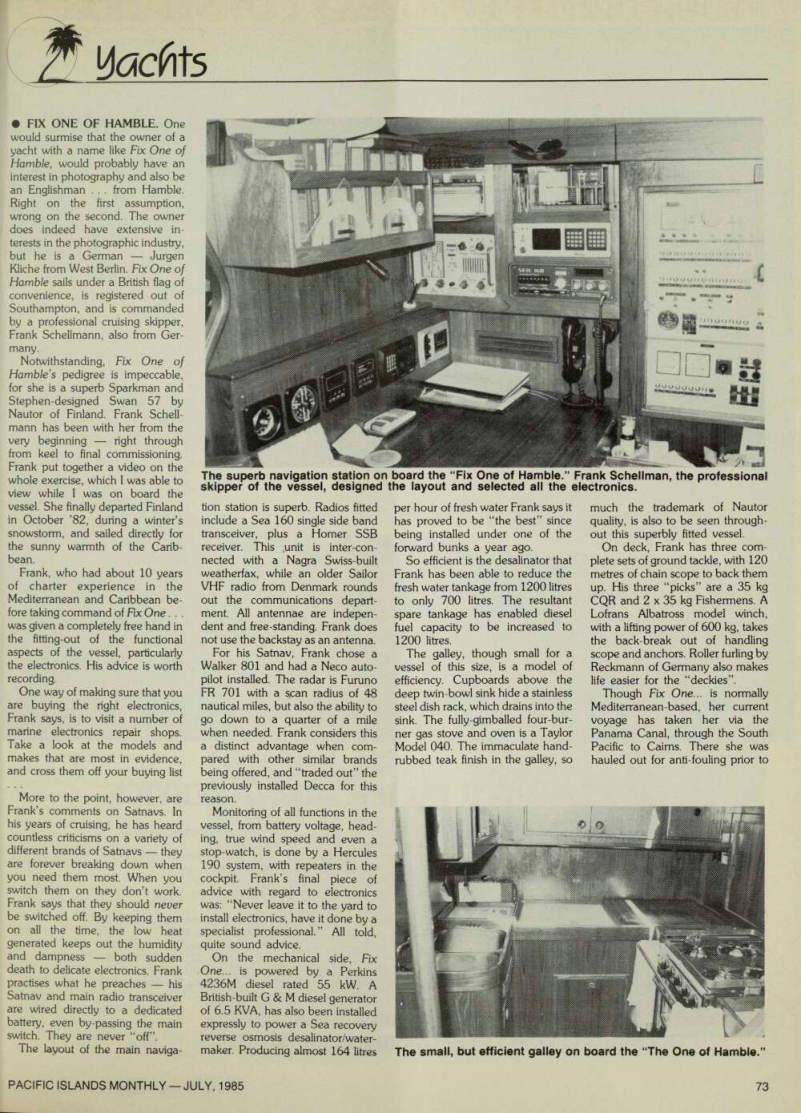
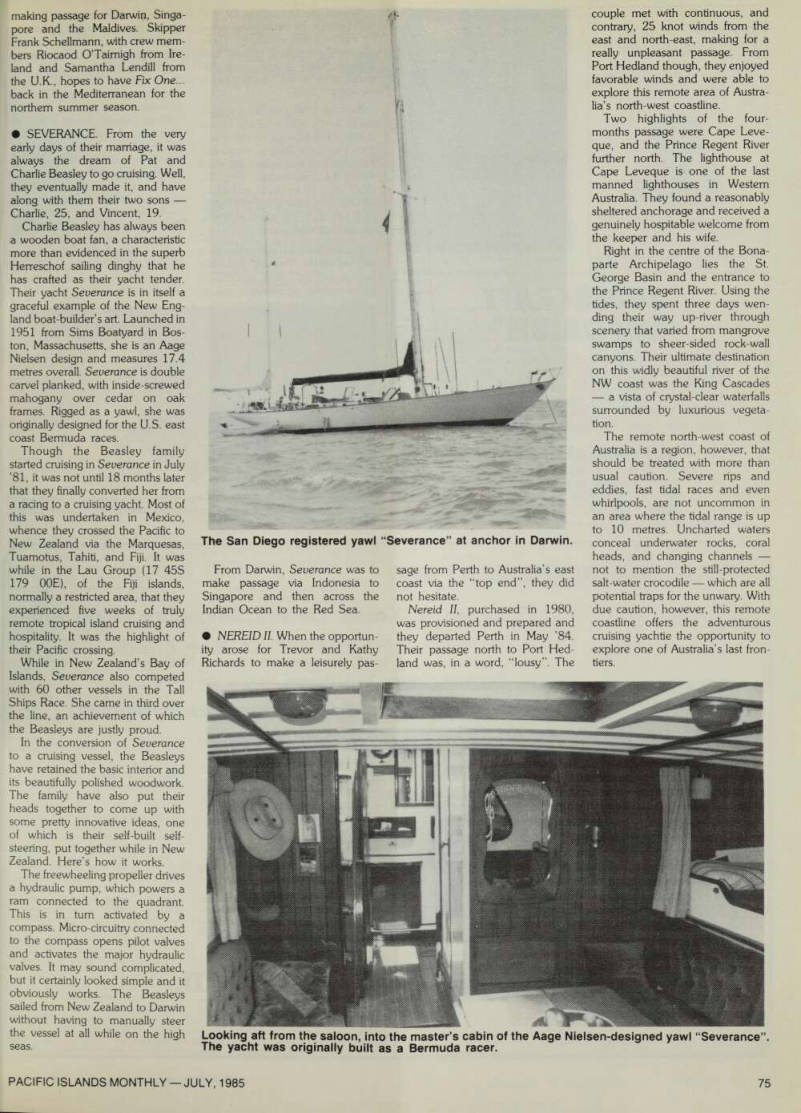
• Fix One Of Hamble. One
would surmise that the owner of a yacht with a name like Fix One of Flamble, would probably have an interest in photography and also be an Englishman . . . from Hamble.
Right on the first assumption, wrong on the second. The owner does indeed have extensive in terests in the photographic industry, but he is a German Jurgen Kliche from West Berlin. Fix One of Hamble sails under a British flag of convenience, is registered out of Southampton, and is commanded by a professional cruising skipper, Frank Schellmann, also from Ger many.
Notwithstanding, Fix One of Hamble’s pedigree is impeccable, for she is a superb Sparkman and Stephen-designed Swan 57 by Nautor of Finland. Frank Schell mann has been with her from the very beginning right through from keel to final commissioning.
Frank put together a video on the whole exercise, which I was able to view while I was on board the vessel. She finally departed Finland in October ’B2, during a winter’s snowstorm, and sailed directly for the sunny warmth of the Carib bean.
Frank, who had about 10 years of charter experience in the Mediterranean and Caribbean be fore taking command of Fix One. . . was given a completely free hand in the fitting-out of the functional aspects of the vessel, particularly the electronics. His advice is worth recording.
One way of making sure that you are buying the right electronics, Frank says, is to visit a number of marine electronics repair shops.
Take a look at the models and makes that are most in evidence, and cross them off your buying list More to the point, however, are Frank’s comments on Satnavs. In his years of cruising, he has heard countless criticisms on a variety of different brands of Satnavs they are forever breaking down when you need them most. When you switch them on they don’t work.
Frank says that they should never be switched off. By keeping them on all the time, the low heat generated keeps out the humidity and dampness both sudden death to delicate electronics. Frank practises what he preaches his Satnav and main radio transceiver are wired directly to a dedicated battery, even by-passing the main switch. They are never “off”.
The layout of the main naviga-
tion station is superb. Radios fitted include a Sea 160 single side band transceiver, plus a Homer SSB receiver. This .unit is inter-con nected with a Nagra Swiss-built weatherfax, while an older Sailor VHF radio from Denmark rounds out the communications depart ment. All antennae are indepen dent and free-standing. Frank does not use the backstay as an antenna.
For his Satnav, Frank chose a Walker 801 and had a Neco auto pilot installed. The radar is Furuno FR 701 with a sican radius of 48 nautical miles, but also the ability to go down to a quarter of a mile when needed. Frank considers this a distinct advantage when com pared with other similar brands being offered, and “traded out” the previously installed Decca for this reason.
Monitoring of all functions in the vessel, from battery voltage, head ing, true wind speed and even a stop-watch, is done by a Hercules 190 system, with repeaters in the cockpit. Frank’s final piece of advice with regard to electronics was: “Never leave it to the yard to install electronics, have it done by a specialist professional. ” All told, quite sound advice.
On the mechanical side, Fix One... is powered by a Perkins 4236 M diesel rated 55 kW. A British-built G & M diesel generator of 6.5 KVA, has also been installed expressly to power a Sea recovery reverse osmosis desalinator/water maker. Producing almost 164 litres
per hour of fresh water Frank says it has proved to be “the best” since being installed under one of the forward bunks a year ago.
So efficient is the desalinator that Frank has been able to reduce the fresh water tankage from 1200 litres to only 700 litres. The resultant spare tankage has enabled diesel fuel capacity to be increased to 1200 litres.
The galley, though small for a vessel of this size, is a model of efficiency. Cupboards above the deep twin-bowl sink hide a stainless steel dish rack, which drains into the sink. The fully-gimballed four-bur ner gas stove and oven is a Taylor Model 040. The immaculate hand rubbed teak finish in the galley, so
much the trademark of Nautor quality, is also to be seen through out this superbly fitted vessel.
On deck, Frank has three com plete sets of ground tackle, with 120 metres of chain scope to back them up. His three “picks” arc a 35 kg CQR and 2 x 35 kg Fishermens. A Lofrans Albatross model winch, with a lifting power of 600 kg, takes the back-break out of handling scope and anchors. Roller furling by Reckmann of Germany also makes life easier for the “deckies”.
Though Fix One... is normally Mediterranean-based, her current voyage has taken her via the Panama Canal, through the South Pacific to Caims. There she was hauled out for anti-fouling prior to
The superb navigation station on board the “Fix One of Hamble.” Frank Schellman, the professional skipper of the vessel, designed the layout and selected all the electronics.
The small, but efficient galley on board the “The One of Hamble.”
making passage for Darwin, Singa pore and the Maldives. Skipper Frank Schellmann, with crew mem bers Riocaod O’Taimigh from Ire land and Samantha Lendill from the U.K., hopes to have Fix One... back in the Mediterranean for the northern summer season. • SEVERANCE. From the very early days of their marriage, it was always the dream of Pat and Charlie Beasley to go cruising. Well, they eventually made it, and have along with them their two sons Charlie, 25, and Vincent, 19.
Charlie Beasley has always been a wooden boat fan, a characteristic more than evidenced in the superb Herreschof sailing dinghy that he has crafted as their yacht tender.
Their yacht Severance is in itself a graceful example of the New Eng land boat-builder’s art. Launched in 1951 from Sims Boatyard in Bos ton, Massachusetts, she is an Aage Nielsen design and measures 17.4 metres overall. Severance is double carvel planked, with inside-screwed mahogany over cedar on oak frames. Rigged as a yawl, she was originally designed for the U.S. east coast Bermuda races.
Though the Beasley family started cruising in Severance in July ’Bl, it was not until 18 months later that they finally converted her from a racing to a cruising yacht. Most of this was undertaken in Mexico, whence they crossed the Pacific to New Zealand via the Marquesas, Tuamotus, Tahiti, and Fiji. It was while in the Lau Group (17 45S 179 00E), of the Fiji islands, normally a restricted area, that they experienced five weeks of truly remote tropical island cruising and hospitality. It was the highlight of their Pacific crossing.
While in New Zealand’s Bay of Islands, Severance also competed with 60 other vessels in the Tall Ships Race. She came in third over the line, an achievement of which the Beasleys are justly proud.
In the conversion of Severance to a cruising vessel, the Beasleys have retained the basic interior and its beautifully polished woodwork.
The family have also put their heads together to come up with some pretty innovative ideas, one of which is their self-built self steering, put together while in New Zealand. Here’s how it works.
The freewheeling propeller drives a hydraulic pump, which powers a ram connected to the quadrant.
This is in turn activated by a compass. Micro-circuitry connected to the compass opens pilot valves and activates the major hydraulic valves. It may sound complicated, but it certainly looked simple and it obviously works. The Beasleys sailed from New Zealand to Darwin without having to manually steer the vessel at all while on the high seas.
From Darwin, Severance was to make passage via Indonesia to Singapore and then across the Indian Ocean to the Red Sea. • NEREID 11. When the opportun ity arose for Trevor and Kathy Richards to make a leisurely pas
sage from Perth to Australia’s east coast via the “top end”, they did not hesitate.
Nereid 11, purchased in 1980, was provisioned and prepared and they departed Perth in May ’B4.
Their passage north to Port Hed land was, in a word, “lousy”. The
couple met with continuous, and contrary, 25 knot winds from the east and north-east, making for a really unpleasant passage. From Port Hedland though, they enjoyed favorable winds and were able to explore this remote area of Austra lia’s north-west coastline.
Two highlights of the four months passage were Cape Leve que, and the Prince Regent River further north. The lighthouse at Cape Leveque is one of the last manned lighthouses in Western Australia. They found a reasonably sheltered anchorage and received a genuinely hospitable welcome from the keeper and his wife.
Right in the centre of the Bona parte Archipelago lies the St.
George Basin and the entrance to the Prince Regent River. Using the tides, they spent three days wen ding their way up-river through scenery that varied from mangrove swamps to sheer-sided rock-wall canyons. Their ultimate destination on this widly beautiful river of the NW coast was the King Cascades a vista of crystal-clear waterfalls surrounded by luxurious vegeta tion.
The remote north-west coast of Australia is a region, however, that should be treated with more than usual caution. Severe rips and eddies, fast tidal races and even whirlpools, are not uncommon in an area where the tidal range is up to 10 metres. Uncharted waters conceal underwater rocks, coral heads, and changing channels not to mention the still-protected salt-water crocodile which are all potential traps for the unwary. With due caution, however, this remote coastline offers the adventurous cruising yachtie the opportunity to explore one of Australia’s last fron tiers.
Looking aft from the saloon, into the master’s cabin of the Aage Nielsen-designed yawl “Severance”.
The yacht was originally built as a Bermuda racer.
The San Diego registered yawl “Severance” at anchor in Darwin.
Nereid II is a Duncanson 29, and she proved to be an excellent vessel for coastal passage-making. There are literally hundreds of the Dun canson breed sailing Australian waters, both privately owned and in the charter trade.
Built of GRP and sloop-rigged, the Richards have fitted out Nereid II with some thought for the condi tions they were likely to encounter.
Knowing that tidal waters and coral would be encountered, they de cided on a 10 kg Bruce and an 11 kg Danforth, each with 36.5 metres of 8 mm short link chain as scope, for their ground tackle.
The electronics is comprehensive and yet simple. The VHF radio is a Kestrel, with a 27 Meg. by GME. A depth-sounder by Seafarer and an
Autohelm 2000 complete the set up. A sextant, a Walker trailing log and mini hand-bearing compass was all that was needed for naviga tion. Nereid II is powered by a Volvo diesel of 5.5 kW and carries 136 litres of dieseline and 159 litres of water.
From Darwin, Nereid II and the Richards sailed east through Torres Strait and then south to Mooloola ba on the Sunshine Coast in south ern Queensland. Time had run ou for Trevor and Cathy, so Nereid I was trucked back to Perth by roac in itself a daunting task. Though they were unable to complete theii circumnavigation, the Richards wil long remember their passagt around Australia’s “top end”, anc the unique scenery and experience: it has to offer.
Cathy and Trevor Richards, of Perth, Western Australia, owners ol[?] the Duncanson 29 “Mereid II,” photographed at the Darwin Sailing Club.
Advertisements & other items, pp. 74-76 (1 item)
Iuuk Direct Eukureajn Cojnneciiojn
an **mrnW
EUROPE-SOUTH PACIFIC JOINT SERVICE
The South Pacific Specialists offer facilities for shipment of: Containers (FCL/LCL) and Breakbulk Cargo plus reefer space and deeptanks for carriage of vegetable oils and other liquid bulk cargo.
Carriers also accept heavy lifts, ■jfc-- overlength and cumbersome parcels.
Ports of Service: Loading: Papeete, Apia, Suva, Lautoka, Noumea, Port Vila, Santo, Honiara, Port Moresby, Lae,Madang, Kimbe, Rabaul, Kieta, Darwin.
For: Rotterdam, Antwerp, Hamburg, Hull, Dunkirk, Le Havre.
- ROUND THE WORLD SERVICE
Additional ports on enquiry.
Please contact our regional offices for further information: The Bank Line (Australasia) Pty. Ltd.
Suite 801,51 Pitt Street Sydney N.S.W. 2000 Phone: 27 2041 Telex; 24063 Columbus Line Reederei GmbH P.O. Box 1667 Lae/Papua New Guinea Phone: 42 3466/42 3287.5 A.H. 42 2481 Telex: Colline NE 44 171
THE BANK LINE LTD LONDON
COLUMBUS LINE REEDEREI GMBH HAMBURG
Stay at Aggie Grey’s . . . the South Pacific’s
legendary hotel.
Situated right in the heart of Western Samoa. Enjoy Polynesian style friendliness and service, in cool surroundings, superb entertainment and food.
Magnificent white sand beaches only a short drive away. Airconditioned rooms, swimming |jool and full bar facilities.
Bookings through Union Steamship Company of NZ. Pan Am, Air New Zealand or direct to Aggie Grey’s. Apia, Western Samoa. Cables: AGGIES’ Apia.
BAGOT
BELLFOUNDRIES
Box 421, North Adelaide S.A. 5006. Australia Tel: +6l 8 267 1306 Beautiful tuned bells for churches and missions
'SUPERCRAFT
EMPORIUM"
One of the largest business houses in the world, specialising in IMITATION JEWELLERY, HAIR OR-
NAMENTS, LADIES BELTS AND HANDBAGS, ETC.
We import from all over the world, and EXPORT TO SMALL COUNTRIES IN THE PACIFIC. No minimum order, low prices. For details, contact;
SUPERCRAFTS EMPORIUM
P.O. Box 6154, Hay Street East Perth, Western Australia 6000 Ph. (09) 325-2654 Telex: “AA93888" JULRAY
YOUR BUSINESS PARTNER
Japan S. Korea Taiwan Singapore Hong Kong To: Solomon Is., New Caledonia, Fiji, W. Samoa, A. Samoa, Tahiti, Cook Is., Tonga, Vanuatu, Tuvalu. Nauru To: Guam, Saipan, Truk, Ponape, Majuro, Yap, Koror * r* .. -r* .. * -
Taiwan Hong Kong Singapore Philippines
To: Papua New Guinea, Pacific Islands. £
KYOWA SHIPPING CO.. LTD.
HEAD OFFICE; OSAKA OFFICE:
sth FI., Suzumaru Bldg. 39-8, 2-chome, Nishi-Shinbashi, Mmato-ku, Tokyo, Japan. Okajima Bldg., 7th Floor, 2-14, Nishihonmachi 1-chome, Nishi-ku, Osaka, Japan Phone: 03(437)2885 (Rep ) Cables: "MARIQUEEN" Tokyo. Telex : 242-4651 Kyowa J. Phone; 06(533)5821 (Rep.) Cables: “MARIQUEEN" Osaka Telex : 525-6271 Ssiosa J
shipping schedules
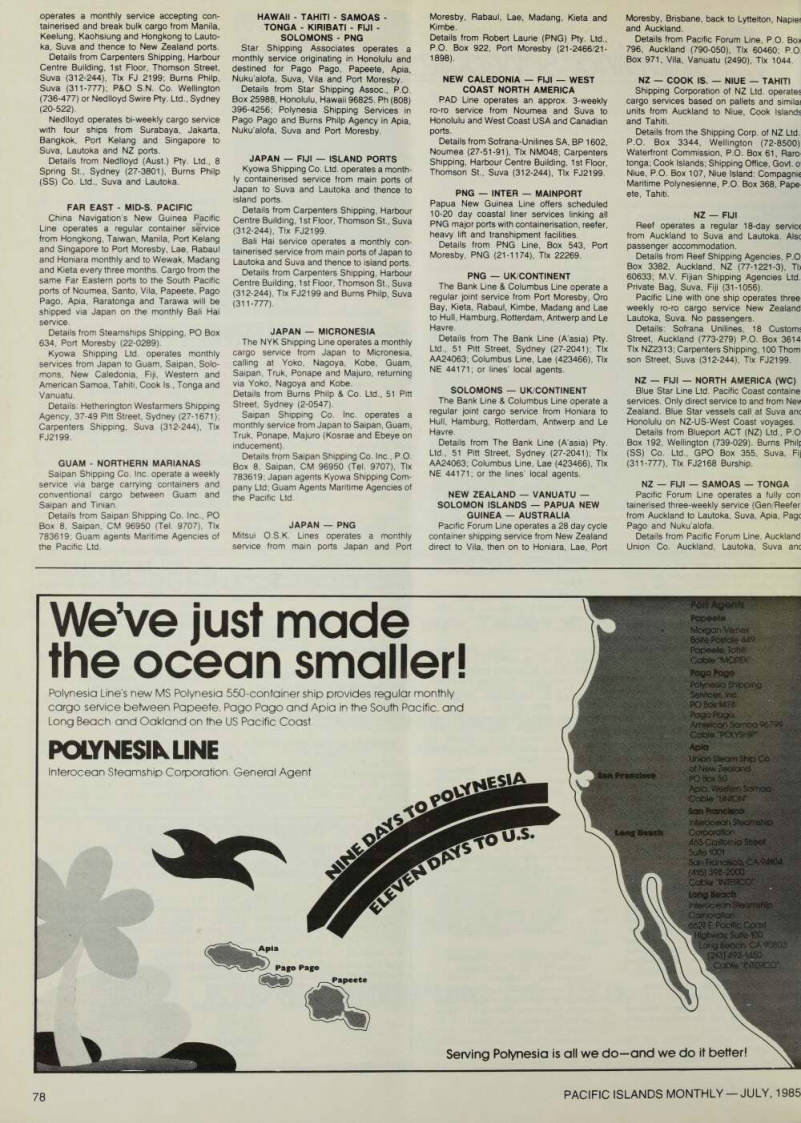
Should any shipping company wish to have its services cargo and passenger included in these listings they should contact
Pim.
Australia - Fiji
Sofrana-Unilines (Fiji Express Line) oper ates to Suva and Lautoka every three weeks from the main ports on the east coast of Australia and monthly to Lautoka from Mel bourne and Sydney.
Details from Sofrana-Unilines, 19 Pitt Street, Sydney (27-9851), Wiltrans Agency Pty. Ltd., 21 si Floor, 60 Market St., Mel bourne (614-4788) Tlx 30163. ACTA Pty.
Ltd., Brisbane (221-3116); Elders-ANL Pty.
Ltd. Port Adelaide (47-5688); Newcastle, Sofrana Sydney (27-9851); Websters-ANL, 58 Charles St., Launceston, Tasmania (320- 555) Carpenters Shipping, Harbour Centre Building, Ist Floor, Thomson Street, Suva, Fiji (312-244), Tlx FJ2199.
Australia Samoas Tonga
Warner Pacific Lines operates a regular cargo service from Sydney, Brisbane and Melbourne to Nuku’alofa, Pago Pago, Apia and Vavau. Feeder service available from Apia to Cook, Christmas, Fanning and Washington Islands.
Details from Hetherington Wesfarmers Shipping Agency, 37-49 Pitt Street, Sydney. (27-1671)
Australia - New Caledonia
Fiji - Samoas - Tonga
Pacific Forum Line operates a fully con tainerised service (general, reefer and ro-ro) from Sydney to Noumea, Lautoka, Suva, Apia, Pago Pago, Nuku’alofa, Lyttelton, Syd ney, Cargo centralised from Adelaide, Mel bourne, Brisbane.
Details from: Pacific Forum Line, P.O. Box 796 Auckland; Union Bulkships, 333 George Street, Sydney, Brisbane and Melbourne; Union Co., Lautoka, Suva, Nukualofa; Pacific Forum Line Apia; Polynesia Shipping Pago Pago; SCONZ, Christchurch.
Australia - Lord Howe Is.
Norfolk Is.
Compagnie des Chargeurs Caledoniens operates four-weekly cargo service Sydney- Lord Howe Island and Norfolk Island.
Details Hetherington Wesfarmers Shipping Agency, 37-49 Pitt Street, Sydney (27-1671).
Australia - Kiribati
K. Asia Pacific operates a 5/6 weekly service from Melbourne and Sydney to Kiribati (Tarawa).
Details from K. Asia Pacific Pty. Ltd., Goldfields House, 1 Alfred Street, Circular Quay, Sydney (232-2277), Tlx 122143.
KAP New Guinea Lines call Tarawa after PNG ports on a 35 day basis from Melbourne and Sydney/Brisbane.
Details from K. Asia Pacific Pty. Ltd., Goldfields House, 1 Alfred Street, Circular Quay, Sydney (232-2277), Tlx. 122143.
Warner Pacific Line operates a 6 weekly containerised/breakbulk service to Tarawa from Melbourne/Sydney/Brisbane and Auck land. Details from Hetherington Wesfarmers Shipping Agency, 37-49 Pitt Street, Sydney (27-1671); Mac Kay Shipping Ltd., Downtown House, Queen Street, Auckland (30-229).
Australia - New Caledonia
And/Or Vanuatu
Sofrana - Unilines ships serve Noumea every three weeks from the main ports along the east Australian coast.
Details from Sofrana-Unilines, 19 Pitt Street, Sydney (27-9851), Wiltrtans-Agency Pty. Ltd., 21st Floor 60 Market St., Melbourne
(614-4788) Tlx 30163 ACTA Pty. Ltd., Bris bane (221-3116), Elders-ANL Pty. Ltd., Port Adelaide (47-5688), Newcastle, Sofrana Syd ney (27-9851); Websters-ANL, 58 Charles St., Launceston, Tasmania (320-555).
Compagnie des Chargeurs Caledonians operates a three-weekly containerised cargo service from Sydney to Noumea.
Details Hetherington Wesfarmers Shipping Agency, 37-49 Pitt Street, Sydney (27-1671).
Compagnie Generate Maritime operates a monthly service from Sydney, Melbourne and Brisbane to Noumea, Port Vila and Santo, for containerised and break bulk cargo.
Details Compagnie Generate Maritime, 12 Castlereagh Street, Sydney (231-3700).
Australia - Nauru - Marshall
Is. - Kiribati
Nauru Pacific Line operates regular cargo service from Melbourne to Nauru, Majuro and Tarawa. Passenger service to Nauru only.
Details: Nauru Pacific Line (Aust.) Pty. Ltd.
Nauru House, 80 Collins Street, Melbourne (653-5709). Nedlloyd Swire, 8 Spring Street, Sydney (2-0522).
Australia - New Zealand
The Australian National Line (ANL) and the Shipping Corporation of New Zealand oper ate a 10-day container service between Sydney and Melbourne to Auckland, Welling ton, Lyttelton and Port Chalmers.
Details from ANL, 20 Bond Street, Sydney (232-0444) or P.O. Box 2238 T G.P.O. Mel bourne 3001 (62-0681) or Shipping Corpora tion of New Zealand, P.O. Box 3344 Welling ton (72-8500).
Australia - Marshall Is.
Warner Pacific Line operates a 6 weekly containerised/breakbulk service to Majuro from Melbourne/Sydney/Brisbane and Auck land.
Details from Hetherington Wesfarmers Shipping Agency, 37-49 Pitt Street, Sydney (27-1671); Mac Kay Shipping Ltd. Downtown House, Queen Street, Auckland. (30-229).
Australia - Marianas - Guam
Fsm - Palau
Micronesia Transport Line operate a 55 day containerised/breakbulk service from Mel bourne/Sydney/Brisbane and Auckland to Palau, Yap, Guam, Saipan, Truk, Ponape and on inducement, Kosrae.
Details from Hetherington Wesfarmers Shipping Agency, 37-49 Pitt Street, Sydney (27-1671); Sofrana Unilines Customs Street, Auckland (77-3279).
AUSTRALIA - NZ - FIJI - TONGA
Vanuatu - New Caledonia
Solomons - New Guinea
Sitmar Cruises operates a year-round cruise program from Sydney to include the better known ports in the above countries, plus a number of unspoilt and largely un known, island paradises.
Details from Sitmar Cruises, 39 Martin Place, Sydney (239-9000); NSW, reserva tions and inquiries (008 42-2277); Rest of Australia, reservations and inquiries (008 22-2277).
AUSTRALIA - NZ - FIJI - TONGA
Vanuatu - New Caledonia
Solomons - Samoas - Tahiti
P & O liners call at Auckland, Bay of Islands, Honiara, Lautoka, Noumea, Nuku’alofa, Pago Pago, Papeete, Port Mores by, Santo, Savusavu, Suva, Vavau and Vila on cruises from Australia.
Details from P & O Booking Centre, World Travel Headquarters Pty. Ltd., 33 Bligh Street, Sydney (237-0333).
Australia - Nz -
Solomons - Png
Pacific Forum Line operates containerised and general cargo service from Lyttleton, Napier and Auckland to Honiara, Lae, Port Moresby, Brisbane.
Details from: Pacific Forum Line, Auckland; Steamships Shipping, Port Moresby and Lae; Sullivans Ltd., Honiara; Union Bulkships, Brisbane.
Australia - Micronesia
Nauru Pacific Line operates a regular container service from Melbourne to Ponape, Truk, Guam and Saipan.
Details: N.P.L. (Australia) Pty. Ltd. Nauru House, 80 Collins Street, Melbourne (653- 5709). Nedlloyd Swire, 8 Spring Street, Sydney (2-0522).
Australia - Tuvalu
K. Asia Pacific operates a 3 monthly service from Sydney and Melbourne to Tuvalu (Funafuti). Subject inducement.
Details from K. Asia Pacific Pty. Ltd., Goldfields House. 1 Alfred Street, Circular Quay, Sydney (232-2277), Tlx 122143.
Warner Pacific Line operates a 6 week containersised/breakbulk service to Funafuti from Melbourne/Brisbane/Sydney and Auck land.
Details from Hetherington Wesfarmers Shipping Agency, 37-49 Pitt Street, Sydney (27-1671); Mac Kay Shipping Ltd., Downtown House, Queen Street, Auckland (30-229).
Australia - Png
KAP New Guinea Lines cargo vessels call at Melbourne, Sydney. Port Moresby, Lae, Madang, Wewak, Manus, Kimbe, Rabaul, Popondetta.
Details from K. Asia Pacific Pty. Ltd., Goldfields House. 1 Alfred Street, Circular Quay, Sydney (232-2277), Tlx 122143. Dal gety Shipping, World Trade Centre, Mel bourne (616-6700).
Australia - Png - Solomons
Sofrana Unilines (Aust.) P/L operates a 3-4 weekly cargo service to PNG ex-main ports on the east coast of Australia.
Details from Sofrana Unilines, 19 Pitt Street, Sydney (27-9851) Tlx 25327.
Australia - Png - Solomons
Vanuatu
A consortium of NGAL/PNGL and CON PAC/NEL have four vessels operating a joint service from east coast Australian ports to Pori Moresby, Lae, Alotau, Madang, Wewak,
Rabaul, Kavieng-Kimbe, Kieta, Honiara, Vila, Santo.
Details from Burns Philp & Co. Ltd., P.O.
Box R 124, Royal Exchange, Sydney 2000 (2-0547); Nedlloyd Swire, 8 Spring Street, Sydney, (2-0522); New Guinea Express Lines, 37 Pitt Street, Sydney, (241 -3991); Vila Agents, PO Box 27, Port-Vila (2456), Tlx
Nhioii.
New Guinea Express Lines operates a weekly container service from Melbourne, Sydney, Brisbane to Port Moresby, Lae, Alotau, Kimbe, Rabaul, Kieta, Honiara, Kavieng, Madang, Wewak, Santo, Vila.
Details from New Guinea Express Lines, P.O. Box R 73, Royal Exchange, Sydney (241-3991); New Guinea Express Lines, 127 Creek Street, Brisbane (221-9333); New Guinea Express Lines, 327 Collins Street, Melbourne (61-3053); Niugini Express Lines, Port Moresby (21-4572); Lae (42-1536); Nuigini Island Cargo Services Pty. Ltd., Rabaul (922-467); Bougainville Agencies Pty.
Ltd, Kieta (956-089); Robert Laurie (PNG) P/L Madang (82-2157); Garamut Enterprises P/L Wewak (86-2106); Burns Philp (PNG) Ltd.
Karieng (94-2133); Alotau Stevedoring & Transport, Alotau (61-1318); Ngatia Wholesalers Pty. Ltd., Kimbe (93-5102); and Tradco Shipping, Mendana Avenue, Honiara (22588); Vila Agents Ltd., PO Box 971, Vila, Vanuatu (2490); John Lum & Associates, PO Box 65, Santo, Vanuatu (329).
Australia - Tahiti
Compagnie Generate Maritime operates a monthly service from Sydney, Melbourne and Brisbane to Papeete, for containersised and break bulk cargo.
Details Compagnie Generate Maritime, 12 Castlereagh Street, Sydney (231-3700).
Sofrana Unilines (Aust.) P/L operates a 3/4 weekly cargo service to Papeete ex main ports on the east coast of Australia.
Details from Sofrana Unilines, 19 Pitt Street. Sydney (27-9851) Tlx 25327.
Singapore - Hong Kong - Fiji
Islands Ports
Kyowa Shipping Co. Ltd. operates a month ly containerised and breakbulk cargo service from Singapore, Hongkong to Lautoka, Suva and then to island ports.
Details from Carpenters Shipping, Harbour Centre Building, Ist Floor, Thomson Street, Suva (312-244), Tlx FJ2199.
Far East - Fiji -
New Zealand
New Zealand Unit Express (NZUE) now
operates a monthly service accepting con tainerised and break bulk cargo from Manila, Keelung, Kaohsiung and Hongkong to Lauto ka, Suva and thence to New Zealand ports.
Details from Carpenters Shipping, Harbour Centre Building, Ist Floor, Thomson Street, Suva (312-244), Tlx FJ 2199; Burns Philp, Suva (311-777); P&O S.N. Co. Wellington (736-477) or Nedlloyd Swire Pty. Ltd., Sydney (20-522).
Nedlloyd operates bi-weekly cargo service with four ships from Surabaya, Jakarta, Bangkok, Port Kelang and Singapore to Suva, Lautoka and NZ ports.
Details from Nedlloyd (Aust.) Pty. Ltd., 8 Spring St., Sydney (27-3801), Burns Philp (SS) Co. Ltd., Suva and Lautoka.
Far East - Mid-S. Pacific
China Navigation's New Guinea Pacific Line operates a regular container service from Hongkong, Taiwan, Manila, Port Kelang and Singapore to Port Moresby. Lae, Rabaul and Honiara monthly and to Wewak, Madang and Kieta every three months. Cargo from the same Far Eastern ports to the South Pacific ports of Noumea, Santo, Vila, Papeete, Pago Pago, Apia, Raratonga and Tarawa will be shipped via Japan on the monthly Bali Hai service.
Details from Steamships Shipping, PO Box 634, Port Moresby (22-0289).
Kyowa Shipping Ltd. operates monthly services from Japan to Guam, Saipan, Solo mons, New Caledonia, Fiji, Western and American Samoa, Tahiti, Cook Is., Tonga and Vanuatu.
Details: Hetherington Wesfarmers Shipping Agency, 37-49 Pitt Street, Sydney (27-1671); Carpenters Shipping, Suva (312-244), Tlx FJ2199.
Guam - Northern Marianas
Saipan Shipping Co. Inc. operate a weekly service via barge carrying containers and conventional cargo between Guam and Saipan and Tinian.
Details from Saipan Shipping Co. Inc., PO Box 8, Saipan, CM 96950 (Tel. 9707), Tlx 783619; Guam agents Maritime Agencies of the Pacific Ltd.
Hawaii - Tahiti - Samoas -
Tonga - Kiribati - Fiji -
Solomons - Png
Star Shipping Associates operates a monthly service originating in Honolulu and destined for Pago Pago, Papeete, Apia, Nuku’alofa, Suva, Vila and Port Moresby.
Details from Star Shipping Assoc., P.O.
Box 25988, Honolulu, Hawaii 96825. Ph (808) 396-4256; Polynesia Shipping Services in Pago Pago and Burns Philp Agency in Apia, Nuku’alofa, Suva and Port Moresby.
Japan Fiji Island Ports
Kyowa Shipping Co. Ltd. operates a month ly containerised service from main ports of Japan to Suva and Lautoka and thence to island ports.
Details from Carpenters Shipping, Harbour Centre Building, Ist Floor, Thomson St., Suva (312-244), Tlx FJ2199.
Bali Hai service operates a monthly con tainerised service from main ports of Japan to Lautoka and Suva and thence to island ports.
Details from Carpenters Shipping, Harbour Centre Building, Ist Floor, Thomson St., Suva (312-244), Tlx FJ2199 and Burns Philp, Suva (311-777).
Japan Micronesia
The NYK Shipping Line operates a monthly cargo service from Japan to Micronesia, calling at Yoko, Nagoya, Kobe, Guam, Saipan, Truk. Ponape and Majuro, returning via Yoko, Nagoya and Kobe.
Details from Burns Philp & Co. Ltd., 51 Pitt Street, Sydney (2-0547).
Saipan Shipping Co. Inc. operates a monthly service from Japan to Saipan, Guam, Truk, Ponape, Majuro (Kosrae and Ebeye on inducement).
Details from Saipan Shipping Co. Inc., P.O.
Box 8, Saipan. CM 96950 (Tel. 9707), Tlx 783619; Japan agents Kyowa Shipping Com pany Ltd; Guam Agents Maritime Agencies of the Pacific Ltd.
Japan Png
Mitsui O.S.K. Lines operates a monthly service from main ports Japan and Port
Moresby, Rabaul, Lae, Madang, Kieta and Kimbe.
Details from Robert Laurie (PNG) Pty. Ltd., P.O. Box 922, Port Moresby (21-2466/21- 1898).
New Caledonia Fiji West
Coast North America
PAD Line operates an approx. 3-weekly ro-ro service from Noumea and Suva to Honolulu and West Coast USA and Canadian ports.
Details from Sofrana-Unilines SA, BP 1602, Noumea (27-51-91), Tlx NMO4B; Carpenters Shipping, Harbour Centre Building, Ist Floor, Thomson St., Suva (312-244), Tlx FJ2199.
Png Inter Mainport
Papua New Guinea Line offers scheduled 10-20 day coastal liner services linking all PNG major ports with containerisation, reefer, heavy lift and transhipment facilities.
Details from PNG Line, Box 543, Port Moresby, PNG (21-1174), Tlx 22269.
Png Uk/Continent
The Bank Line & Columbus Line operate a regular joint service from Port Moresby, Oro Bay, Kieta, Rabaul, Kimbe, Madang and Lae to Hull, Hamburg, Rotterdam, Antwerp and Le Havre.
Details from The Bank Line (A'asia) Pty.
Ltd., 51 Pitt Street, Sydney (27-2041); Tlx AA24063; Columbus Line, Lae (423466), Tlx NE 44171; or lines’ local agents.
Solomons Uk/Continent
The Bank Line & Columbus Line operate a regular joint cargo service from Honiara to Hull, Hamburg, Rotterdam, Antwerp and Le Havre.
Details from The Bank Line (A’asia) Pty.
Ltd., 51 Pitt Street, Sydney (27-2041); Tlx AA24063; Columbus Line, Lae (423466), Tlx NE 44171; or the lines' local agents.
New Zealand Vanuatu
Solomon Islands Papua New
Guinea Australia
Pacific Forum Line operates a 28 day cycle container shipping service from New Zealand direct to Vila, then on to Honiara, Lae, Port
Moresby, Brisbane, back to Lyttelton. Napier and Auckland.
Details from Pacific Forum Line, P.O. Box 796, Auckland (790-050), Tlx 60460; P.O.
Box 971, Vila, Vanuatu (2490), Tlx 1044.
Nz Cook Is. Niue Tahiti
Shipping Corporation of NZ Ltd. operates cargo services based on pallets and similar units from Auckland to Niue, Cook Islands and Tahiti.
Details from the Shipping Corp. of NZ Ltd., P.O. Box 3344, Wellington (72-8500) Waterfront Commission, P.O. Box 61, Raro tonga; Cook Islands; Shipping Office, Govt, ol Niue, P.O. Box 107, Niue Island; Compagnie Maritime Polynesienne, P.O. Box 368, Pape ete, Tahiti.
Nz Fiji
Reef operates a regular 18-day service from Auckland to Suva and Lautoka. Alsc passenger accommodation.
Details from Reef Shipping Agencies, P.O Box 3382, Auckland. NZ (77-1221-3), Tl> 60633; M.V. Fijian Shipping Agencies Ltd.
Private Bag, Suva, Fiji (31-1056).
Pacific Line with one ship operates three weekly ro-ro cargo service New Zealand Lautoka, Suva. No passengers.
Details: Sofrana Unilines, 18 Customs Street, Auckland (773-279) P.O. Box 3614 Tlx NZ2313; Carpenters Shipping, 100 Thom son Street, Suva (312-244), Tlx FJ2199.
Nz Fiji North America (Wc)
Blue Star Line Ltd. Pacific Coast containei services. Only direct service to and from New Zealand. Blue Star vessels call at Suva anc Honolulu on NZ-US-West Coast voyages.
Details from Blueport ACT (NZ) Ltd., P.O Box 192, Wellington (739-029). Burns Philp (SS) Co. Ltd., GPO Box 355, Suva, Fij (311-777), Tlx FJ2168 Burship.
Nz Fiji Samoas Tonga
Pacific Forum Line operates a fully con tainerised three-weekly service (Gen/Reefer; from Auckland to Lautoka, Suva, Apia, Page Pago and Nukualofa.
Details from Pacific Forum Line, Auckland Union Co. Auckland, Lautoka, Suva anc
Nukualofa; Pacific Forum Line, Apia; Polyne sian Shipping, Pago Pago.
Nz N. Caledonia Vanuatu
Png Solomons
Sofrana Unilines with three ships operate to Vila and Santo, to Honiara and Papua New Guinea and to Norfolk Island and Noumea (No passengers).
Details from Sofrana Unilines, 18 Customs Street, Auckland (773-279), P.O. Box 3614, Tlx NZ2313.
Nz Tahiti
Compagnie Tahitienne Maritime SA (as CTM-Tahiti Line) operates one ship, MV Bounty 111, monthly Papeete New Zea land. (No passengers).
Details from Sofrana Unilines, P.O. Box 3614, 18 Customs St., Auckland, Tlx NZ2313: Agence Maritime Cowan, P.O. Box 9012, Papeete (39042), Tlx Tahitlin 322 FP Tahiti.
Nz Tonga Samoas
Warner Pacific Line services Auckland, Nukualofa, Vavau, Apia, Pago Pago fort nightly carrying general and freezer cargoes.
Details from McKay Shipping Ltd., Down town House. 21 Queen St., Auckland, P.O Box 1372 (30-299). Cables MACSHIP, Telex NZ2554, Warner Pacific Line, Box 93, Nuku’alofa, Tonga; Mealelei (Western Samoa,) Ltd. Private Bag. Apia, Western Samoa, Kneubuhl Maritime Service, Box 39, Pago Pago, American Samoa, 96799.
Tahiti New Caledonia Vanuatu
Solomon Is.
New Zealand Png Singapore
Europe
Polish Ocean Lines operate in a semi container type vessel to the following ports, from Papeete, Noumea, Santo, Vila, Yandina, Honiara, Auckland, Rabaul, Lae, Singapore, Port Kelang, Penang then to Mediterranean ports and Europe via the Suez Canal. (Other New Zealand ports subject to inducement).
Details from Universal Shipping Agencies Ltd., 6th Floor, 38 Fort Street, Auckland 1, New Zealand (30931), Tlx 21517.
Europe Tahiti
New Caledonia
Compagnie Generale Maritime operates services from Europe and Mediterranean ports to Papeete and Noumea using three ro-ro and multi-purpose vessels thus ensuring a bi-monthly sailing to and from.
Details Compagnie Generale Maritime, 12 Castlereagh Street, Sydney (231-3700).
Europe Tahiti
New Caledonia New Zealand
Solomons Png Europe
Polish Ocean Lines offers regular monthly sailings for containerised and break bulk cargo and reefer space, conventional and in reefer containers, from Noumea to Vanuatu (SantoA/ila), Solomon Islands (Honiara), New Zealand (always Auckland, other ports sub ject to inducement), Lae, Rabaul, Singapore, Port Kelang, Penang then Mediterranean to Europe. Other ports in the South Pacific can be served with inducement.
Details from Sotama, BP 9170, Papeete (27805), Tlx 296 SATO; BP C 2, Noumea (272094), Tlx 163 NM SATO; Union Steam ship Co. of NZ, P.O Box 50, Apia, Tlx 25; Williams and Gosling, P.O Box 79, Suva (312633), Tlx 2163; Warner Pacific Line. P.O.
Box 93 Nuku’alofa (21089), Tlx 66219; Uni versal Shipping Agencies, 6th Floor, 38 Fort Street, Auckland 1, New Zealand (30930), Tlx 21517.
Europe Tahiti W. Samoa
Fiji N. Caledonia
Nedlloyd offers regular cargo services from Continental ports to Papeete, Apia, Fiji and New Caledonia.
Details Nedlloyd (Aust.) Pty. Ltd., 8 Spring Street, Sydney (27-3801); Carpenters Ship ping, Ist Floor, Harbour Centre Bldg., 100 Thomson St„ Suva (312-244). Tlx 2199 FJ and Vetari Street, Lautoka (63988), Tlx 5215FJ.
Uk N. Continent W. Samoa
Tonga, Fiji
The Bank Line & Columbus Line operate a regular joint cargo service from Hull, Ham burg, Bremen, Antwerp, Rotterdam and Le
Havre to Apia, Nukualofa, Suva and Lautoka.
Details from The Bank Line (A’asia) Pty.
Ltd., 51 Pitt Street, Sydney (27-2041), Tlx AA 24063; Columbus Line, Lae (423-466), Tlx NE 44171; or lines’ local agents.
Uk N. Continent Png
Solomons
The Bank Line & Columbus Line operate a regular joint cargo service from Hull, Ham burg, Bremen, Antwerp, Rotterdam and Le Havre to Port Moresby, Lae, Madang, Kimbe, Rabaul, Kieta and Honiara and on induce ment to Yandina.
Details from The Bank Line (A’asia) Pty.
Ltd., 51 Pitt Street, Sydney (27-2041), Tlx AA 24063; Columbus Line, Lae (42-3466). Tlx NE 44171; or lines' local agents.
Uk/N. Continent Tahiti
N. Caledonia Vanuatu
The Bank Line & Columbus Line operate a regular joint cargo service from Hull, Ham burg, Bremen, Antwerp, Rotterdam and Le Havre to Papeete, Noumea, Port-Vila and Santo.
Details from The Bank Line (A’asia) Pty.
Ltd., 51 Pitt Street, Sydney (27-2041), Tlx AA 24063; Columbus Line, Lae (42-3466), Tlx NE 44171; Ets. AM. Fare UTE, Papeete; Ets.
Ballande, Noumea and other local agents.
Us Hawaii Micronesia
E. Malaysia Brunei Papua New
Guinea Philippines
PM&O Lines operates three fully self-sus tained container vessels on a sailing frequen cy of every 28 days from the San Francisco Bay area, Los Angeles, and Honolulu to Majuro, Ebeye, Kosrae, Ponape, Truk, Saipan, Yap, Koror, Kota Kinabalu, Brunei, Lae, Kieta and Rabaul.
Service is also offered utilising the same vessels on the same 28-day frequency from the Philippine ports of Manila, Cebu, and Davao and General Santos and the Papua New Guinea ports of Rabaul, Lae and Kieta to Hawaii, San Francisco and Los Angeles.
Finally service is available from Davao, Cebu, Manila, Hong Kong, Keelung and Kaohsiung to Saipan, Guam, Honolulu, Lae, Rabaul and Kieta.
Details from PM&O Lines, 181 Fremont Street, San Francisco, California, 94105, U.S.A. (415) 543-7430, Tlx 278016; Cable PMONAV SFO; PM&O Owner's representa tive, P.O. Box 803, Saipan, N.M.I. 96950.
Cable Commontime Saipan, Tlx
783605; Anscor Transport and Terminals Inc., P.O. Box 7023-5, Metro Manila, Philip pines (521-8074) Tlx 65021 ATTI PN.
Us Hawaii Nauru
Micronesia
Nauru Pacific Line operates regular con ventional and container services from San Francisco and Honolulu to Majuro, Ponape, Truk and Saipan. Cargo is accepted for Nauru and Kosrae with transhipment at Majuro and Ponape.
Details from N.P.O. (Australia) Pty. Ltd., Nauru House, 80 Collins Street, Melbourne (653-5709); Nauru Air and Shipping Agency, Suite 2803, 185 Berry Street, San Francisco, California 94107 (415-543-1737); Nauru Air and Shipping Agency, Suite 506, 841 Bishop St., Honolulu. HI 96813 (808-523-0441).
Us. Noumea Fiji
PAD Line operates an approx. 3-weekly ro-ro service from west coast USA and Canada to Noumea, Suva and Lautoka.
Details from Sofrana Unilines BP 1602, Noumea (27-51-91), Tlx NMO4B; Carpenters Shipping, Harbour Centre Building, Ist Floor, 100 Thomson Street, Suva (312-244), Tlx FJ2199; Trans-Austral Shipping Pty. Ltd., P.O. Box R 232, Royal Exchange, 2000 (231-8411), Tlx AA21204.
Us Tahiti Samoa
Pacific Islands Transport operates a five weekly cargo service from North America west coast ports to Papeete, Pago Pago, Apia.
Details from Polynesia Shipping Services Inc. P.O. Box 1478, Pago Pago 96799.
Polynesia Line operates container and general cargo service from US west coast ports to Papeete and Pago Pago.
Details from Polynesia Shipping Services Inc., P.O. Box 1478, Pago Pago 96799.
Advertisements & other items, pp. 77-80 (1 item)
Business For Sale
CAR RENTAL COMPANY IN THE SOUTH PACIFIC The Shareholders of Pacific Car Rentals Limited Franchise to and trading as Budget Rent A Car offers for sale 75% of the shares in the company (The Remaining 25% is being held for Local Citizens Participation).
This rental company is situated on a main road location in Port Vila capital of Vanuatu currently running a fleet of 32 vehicles, turnover and cash flow are excellent and even though currently No. 1 rental car company in Vanuatu there is lots of room for expansion.
Vanuatu is an Idyllic Paradise and tax haven.
The Business will suit ideally a husband/wife team or maybe as an Investment with management available.
Audited figures available.
For full details contact: MR DUNCAN P.O. Box 71.
Port Vila,
VANUATU.
Telex No. NH 1064
We’ve just made
the ocean smaller!
Polynesia Line's new MS Polynesia 550-container ship provides regular monthly cargo service between Papeete, Pago Pago and Apia in the South Pacific, and Long Beach and Oakland on the US Pacific Coast.
POLYNESIMINE
Interocean Steamship Corporation General Agent Apia oOk & 550 5* a 5^ * v Pago Pago Serving Polynesia is all
POLISH OCEAN UNIS
General Management, 10 Lutego 24,81-364 GDYNIA, POLAND, Phone; 20-19-01, Cables: POLOCEAN Telex: 054-231 <P © zk & 5W $ Jk . i H ••V
SOUTH PACIFIC SERVICE
We offer monthly service to and from: GDYNIA, HAMBURG, ROTTERDAM, MIDDLESBOROUGH/IMMINGHAM, ANTWERP, DUNKIRK, ROUEN, PAPEETE (via PANAMA), NOUMEA, AUCKLAND, HONIARA, RABAUL, LAE, SINGAPORE, by our multipurpose vessels carrying dry and reefer containers, reefer chambers, heavy lifts, breakbulk or palletized, bulk liquids.
A 1 POLISH OCEAN LINES Representatives AUCKLAND Mr. A. Sieradzki. Telex 21517 NZ “UNISHIP”. SYDNEY Mr. Walenciak. Telex 20428 AA “SLEIGH”
TAUITI POLISH OCEAN LINES Agents
™Hm SOTAMA Telex 296 FP “COUTIMEX”. NEW CALEDONIA SATO Telex 163 NM “SATO”. AUCKLAND UNIVERSAL SHIPPING AGENCIES LTD., Telex 21517 NZ “UNISHIP”. SOLOMONS MELAN CHINE SHIPPING CO., LTD Telex 66335 HO "SYMECO”. PNG STEAMSHIPS TRADING CO., LTD Telex 42423 NE “STEAM”.
YOU’LL FIND IT.
WHERE THE SKY MEETS
THE SEA.
NEW CALEDONIA
SOLOMON ISLAND
KIRI B
VANUATU
W. S A M O A
A. S A M O A
TAHITI
tonga - ▼ a
JOINTLY OPERATED BY
) The China Navigation Co., Ltd.
Mitsui Q&K. LlnesXtd.
tea NIPPON YUSEN KAISHA
deaths
Tago Ativalo In Pago Pago on May 3, aged 62.
Former Senator Tago had served in the Legislature of American Samoa for 12 years, from the 13th to the 18th Legislature. He served as Chairman of the Senate Sa moan Affairs Committee and member of the Public Works, Public Safety, Transportation and Agriculture Committees.
Tago was Vice Chairman of the Senate Rules Committee.
Prior to his being elected to the Fono, Senator Tago served in the U.S. First Marine Re serve, in the local Police Force, and the Department of Public Works. He was also a member of the Veterans’ Association.
Tago served as a deacon of the Congregational Christian Church in Nuuuli for many years and was selected to the elder deaconship this year in the Central District of Fagaloa and Ituau.
Fulivai At Nukualofa, Tonga, on May 12, aged 60 The Hon. Fulivai, was a noble and estate holder of Hunga, Vava‘u.
He collapsed and died after delivering a speech at the even ing session of the conference of the Free Wesleyan Church at Centenary Church, Nukualofa.
A nobles’ representative to the Legislative Assembly for more than 10 years, the late Hon. Fulivai was acting Speaker of the House on seve ral occasions.
He was a lay preacher and member of the Free Wesleyan Board of Trustees for the Vava‘u District.
He vas buried at Fungama nono Cemetery in Talau, Neiafu.
The late Hon. Fulivai is sur vived by 13 children. Two wives had preceded him in death.
Semisi Hamani ’longi On May 8, aged 91.
Mr ’longi was one of Tonga’s most noted composers and poets.
A former member of the Tongan Traditions Committee, the late Mr ’longi was well known for his composition of biua kakala (love songs) and traditional music. He was also a teacher at the former Free Church of Tonga School.
He is survived by several adopted children.
Matakeu Raitia In the Cook Islands on May 14, aged 58.
Matakeu Raitia was the widow of the late Papa Tepuretu Raitia. ‘Mama Matakeu was bom in Atiu and is survived by two children.
She was desended from the Ngati Tibokura of Atiu and was also a descendant of Rongoma tane, Ngamaru Aitutaki.
Her funeral service was held in the Tupapa meeting house before burial at the family home at Nukutaaratea Tupapa.
The Ui Mataiapo of Tupapa and the Ui AriTd of Atiu express ed their sorrow at the passing of one of their daughters.
Elisha Kou On Los Negros Island, Manus Province, Papua New Guinea, in April, aged 50.
A village court magistrate, Mr Kou was hearing a land dispute when, it is alleged, one of the litigants rushed towards him, grabbed him by the throat and strangled him.
Kou was taken to hospital where doctors confirmed he has died of strangulation and loss of blood.
Allen Pavitt In Apia on April 20, aged 83.
Mr Pavitt was an outspoken elder citizen of Apia.
A keen writer of letters to the editor. Mr Pavitt’s views on the economy and numerous other subjects are recorded in past issues of The Samoa Times and other publications. Mr Pavitt worked in various fields, but retired as the representative of New Zealand’s Fruit Distribu tors and lived his last years at his home at Vaoala.
Edouard Magnin In Noumea in April, aged 83 Dr Edouard Magnin was one of New Caledonia’s most emi nent citizens, the doyen of New Caledonian medical men.
Obviously early in life he fol lowed the maxim “Physician heal thyself,” because at his passing he was climbing to wards the 90s.
Bom on May 25, 1901, after early education in Noumea he went to France just after World War I to study medicine. He particularly distinguished him self in surgical studies, being awarded the coveted Medaille des Epidemics in 1927. He later won diplomas from the colonial health and hygiene services, and the merchant marine.
In 1931 Dr Magnin returned to Noumea to open a practice, the first locally bom doctor to do so. At that time most doctors were military men.
In 1938 he bought the Chateau Ulm, a remarkable residence set in beautiful park land on the outskirts of the town. He opened a maternity clinic there, with nursing services provided by sisters of the Society of Mary, a Catholic order. Six beds were reserved for private doctors wishing to hospitalise their patients.
This was a great milestone in the medical history of Noumea.
Under the auspices of the clinic a blood bank was formed, with more than 150 contributing members.
In 1952 the clinic was ex panded to a capacity of 36 beds, and two extra doctors were added to the staff. Further extensions in 1970 saw the clinic grow to become a com plex of modem three-storey buildings, with a capacity of 70 beds. A further advance was made with the installation of a cobalt therapy unit in the base ment of the clinic, with the first cobalt isotopes coming from Canada.
The qualities and services of Dr Magnin were recognised when the French Government made him a Chevalier de la Legion d’Honneur.
A man of great energy, the
doctor had many other interests which he attended to closely.
He initiated the project for the tourist hotel Chateau Royal at Anse Vata, in which he was financially involved. Chateau Royal was ultimately taken over by Club Med.
A few years before his death he introduced on the family cattle property at Karenga, about 40 kilometres from Noumea, the nucleus of a herd of a pure-bred Limousin strain of cattle. The herd has since grown to 400 head.
New Caledonia has lost a man of great drive and initia tive, who will be sorely missed.
M. Aliboron.
Stewart Middlemiss In Sydney in March, aged 72.
Captain Stewart Middlemiss would be remembered by many Islands people for his years of flying-boat operations from both Brisbane and Syd ney to the South Pacific.
He was the original pilot in 1936 at a flying school oper ated by the late Sir Reginald Ansett at Hamilton, Victoria.
He served for six and a half years with the Royal Australian Air Force, mainly on flying boats, and after World War II started Barrier Reef Airways, operating Catalina flying boats out of the Brisbane River.
In 1953 Captain Middlemiss flew Sir Reginald on a survey of the South Pacific to Tahiti, and this led in the mid-1950s to an Ansett Sandringham flying boat operation to Noumea-Suva- Tonga-Aitutaki-Tahiti, and re turn via Apia. These Sandring ham services also linked Lord Howe Island and Rose Bay, Sydney, for many years.
Captain Middlemiss was gen eral manager of Ansett Airlines of NSW for many years, and later was based in Port Moresby heading the Ansett operation to Papua New Guinea.
He was awarded an OBE for his services to aviation.
He is survived by his widow, Hope, daughter Carol, and sons Stewart and Stephen, both Ansett pilots.
Advertisements & other items, pp. 82-84 (1 item)
NOW AVAILABLE! tsth Edition
SERVICE PAGE
ADVERTISEMENTS
mm Am
>■; zmm
AUSTRALIA: Distribution: The Herald and Weekly Times Ltd., 44-74 Flinders St., Melbourne, Vic., 3000. Advertising Reps Brisbane D. Wood, Anday Agency, CCA Centre, Dayboro Road. Closebum 4520; Box 1918, GPO Brisbane, 4001; telephone (07) 289-4128 Adelaide Hastwell Williamson Rouse Pty Ltd., PO Box 419 Norwood, SA. 5067; 59 Kensington Road. Norwood: telephone (08) 332-3322, telex 87113; Perth Allen & Associates, Suite 2, 284 Stirling St., Perth. WA. 6000, telephone (09) 328-9593 or (09) 328-9363 FUI; Distribution and subscriptions Desai Bookshops. P O Box 160, Suva, Fiji, telephone Suva 23036 Advertising Fiji Times & Herald Ltd , 20 Gordon St., Suva, telephone 31-4111, telex FJ2124 FRENCH POLYNESIA: Distribution Hachette Pacitique, 10 Ave Baiat, Papeete, telephone 25610.
HAWAII. UNITED STATES: Distribution PIM, Hawaii, PO Box 22250, Honolulu, Hawaii, 96822 Advertising Brian C Asgill, Apt. 1308, 1676 Ala Moana Blvd , Honolulu.
Hawaii, 96815, telephone (808) 955-9718.
JAPAN: Advertising and subscriptions Universal Media Corporation, GPO Box 46, Tokyo, telephone 666- 3036, cables UNIMEDIA Tokyo, telex 2524665 KOREA; Advertising and subscriptions World Mar keting, Inc, Box 4010, Seoul; phone 776-5291-3, telex K 23232 MALAYSIA: Advertising and subscriptions Worldwide Media Services, 57-B Komplex Damai, Jin Dato Haji Eusoff, Kuala Lumpur, telephone 63-9340, cables WORLDMEDIA Kuala Lumpur, telex 31533.
VANUATU; Distribution Maropa Bookshop, HQ Box 210. Port Vila Advertising Bill Penthand, Norman Bros Bookshop, Port Vila, telephone 2232 NEW CALEDONIA; Distribution Depot Centre de Presse Michel Pentecost, CBP2, Noumea, telephone 27- 2434. 27-4729.
NEW ZEALAND: Distribution Gordon & Gotch, PO Box 584, 2 Carr Road, Mt Roskill, Auckland 4 Advertising International Media Representatives Ltd., PO Box 10259, Balmoral, Auckland 4, telephone 605-909, 792-370, telex NZ21404
PAPUA NEW GUINEA: Distribution Gordon & Goteh, PO Box 3396, Port Moresby, telephone 25-4551, 25-4855 Advertising Ken Head, PNG Post-Courier, PO Box 85, Port Moresby, telephone 21-2577, telex 22120.
SOLOMON ISLANDS: Distribution and Advertising The Bookshop, (Norman Bros.) PO Box 503, Honiara PHILIPPINES: Advertising The GF Group. 12 San Ignacio St.. Uroaneta Village, Makati. Metro Manila, telephone 817-7299, telex 45950 and 4233.
UNITED KINGDOM; The Herald & Weekly Times Ltd., No 1 Mattravers Street,London WC2R 3D2, England, telephone 01 836 5162, telex London 21989 UNITED STATES MAINLAND; Advertising Joshua B Powers Jr. Powers International Inc., 551 Fifth Ave., New York, New York 10 017, telephone 867-9580, telex 236514.
Subscriptions PIM, Hawaii, PO Box 22250, Honolulu, Hawaii. 96822.
SUBSCRIPTIONS
American Samoa Australia Canada Cook Islands Fiji French Polynesia Guam Hawaii Japan Kiribati Micronesia Nauru New Caledonia New Zealand Niue Norfolk Island Northern Marianas Papua New Guinea Solomon Islands
Tonga
Tuvalu United Kingdom U. S. Mainland Vanuatu Western Samoa Elsewhere Payments by personal cheque are only acceptable in Australian (from a branch in Australia). U.S. and New Zealand currency. For all other remittances please send an international bank draft in Australian dollars.
Published monthly by Pacific Publications (Aust.) Pty.
Ltd. and printed in Australia by Quadricolor Industries Pty. Ltd., Muigrave, Vic.
. SUS2I
AustslB
. SUS 27
. NZ$3O
Austsl9
. SUS 22
. SUS 23
. SUS 23
. SUS 22
Austsl9
. SUS 23
Austs2l
. SUS 22
. NZ$3O
. NZ$3O
AustslB
. SUS 23
Austs23 Austsl9 Austsl9 Austsl9
. Stgsls
, SUS 27
Austsl9 Austsl9 Austs2s
RARE COMPACT
SOLOMON IS. GEODATA
FROM EXPLORATION
COSTING s2m
Geological/geophysical/
geochemical infm.
35x48 mm archival microfilm mounted on aperture cards 188x83 mm numbered and described, reenlargeable, or viewable lens or viewer. In embossed booklike crafted boxfile 27x23x10.5 cm.
Includes 1948-9 maps Gold Ridge, 5 Geological volumes 1950-73 and UN/BSIP Aerogeophysical and Ground Follow-up data costing $1.7 million. Will save geologists manmonths searching in govt, departments in Honiara.
Send $lO for list of infm. and terms to Johnline Research Pty. Ltd.
GPO Box 1675, Sydney,
NSW 2001
NOW AVAILABLE! tsth Edition
PACIFIC ISLANDS YEAR BOOK
Contains over 550 pages crammed with all the facts you want to know on all the island groups of the Pacific.
See insert for further details and price.
YOU LIVE IN THE
NUCLEAR AGE!
Read “THE STRUGGLE FOR
POWER”
by John C. Grover What the brainwashers won't tell you about the safer, cleaner, cheaper uranium way of boiling water to generate electricity. Truth beats untruths, Astonishing revelations. In everyday language. Fear due to ignorance removed by knowledge. Sir Ernest Titterton: "A timely book". Ron Casey, 2KY: ”1 implore you to buy this book". Land: "Should be compulsory reading". 464 p., 90 illustrations, 650 gm, rrp $9.95 plus $3.50 postage/packing for Oceania.
Booksellers or Johnline Research Pty. Ltd., GPO Box 1675, Sydney, NSW 2001
TROUBLESHOOTER
AVAILABLE
Qualified Accountant/ Administrator/ Management Consultant with many yrs. Island experience seeks long and short term assignments.
Please reply Box 437, Townsville 4810, Australia
business centr ion lor comfort
ii|6 food
rooms alrconrfitioned • Restaurant • Bars ♦ Banquet ball
H. E. BERGHUSER
General Manager Phone 21 2622 Cable: PAPTEL Telex: NE22353 PAPTEI ' ' ■
FOR SALE
5 SOLA BASIC POWER
CONDITIONERS
Model 63-24-26 6KVA 6HZ Input volts 180-220 Output volts 220 AUD22I3 per unit F. 0.8.
Sydney Contact Mike Ayres
SITA
4th Floor, 491 Kent Street,
SYDNEY 2000, AUSTRALIA
Telephone (02) 267-6522 Telex 26009
KENWOOD
i I Highlights of Spectrum 94WB shown: P CD, video, 2 tape inputs ■ 125W/channel PMS (8 ohms, 20Hz—20kHz) 0.05% THD ■ Direct access synthesizer tuning ■ 10-station random preset memory ■ Double auto-reverse cassette deck ■ Double-speed dubbing ■ Continuous tape relay play ■ Programmable linear tracking turntable ■ Recording from turntable ■ Graphic equalizer (option) ■ CD player with 8ch memory (option) ■ Audio timer (option) ■ 130W bass reflex speaker system 1 X.
For the true colors of music —
Kenwood Spectrum stereo systems.
When you look at what Kenwood Spectrum stereo systems offer,
you’ll wonder why you delayed.
They have computerized and electronic functions to make operation easy for you. And they’re highly versatile, too.
But in these days of electronic wizardry, it’s easy to forget what hi-fi stereo is really all about: music reproduction, pure and simple.
You’ll find that Kenwood Spectrum systems, designed by some of the world’s most uncompromising audio specialists, are performers
of outstanding ability.
And, since each Spectrum system has its own special character, you can find the one that exactly meets your needs and budget.
TRIO-KENWOOD CORPORATION
Shionogi Shibuya Building, 17-5, 2-chome Shibuya, Shibuya-ku, Tokyo 150, Japan TRIO-KENWOOD (AUSTRALIA) PTY. LTD. (incorporated in n.sw.) 4E Woodcock Place, Lane Cove, N S W. 2066, Australia NEW ZEALAND JOHN GILBERT & CO., LTD. Auckland Tel. 0011-64-9-30839 FUJI PEPE'S DUTY FREE CENTRE LTD. Tel. 25496, 25497 PAPUA NEW GUINEA SO. SVENSSON (NG.) LTD. Port Moresby Tel. 212158, 212111 SOLOMON ISLANDS TECHNIQUE RADIOS CENTRE LTD. Honiara Tel. 416 NEW CALEDONIA HI-FI VOX Noumea Tel. 27-2466, 28-2931 VANUATU FUNG CHOI LUEN. PDrt-Vila Tel. 2556
TAHITI MAISON AURORE Papeete Tel. 29703
AMERICAN SAMOA ISLAND PACIFIC AGENCIES, INC. Pago Pago Tel. 633-4687
REPUBLIC OF NAURU NAURU CO-OPERATIVE SOCIETY
MARIANA ISLANDS J.C. TENORIO ENTERPRISES Saipan Tel. 6445
r > » "o^- 20 r/..
Benson md Hedges
WARNING - SMOKING IS A HEALTH HAZARD ' « ♦