Pacific

Islands
Monthly
November, 1983
/Anerican Samoa US$l.75 Australia ‘A$l 50 Cook Islands NZ$l.5O Fiji F 51.50 Hawaii . US$l.95 Kiribati A 51.75 Nauru ’ A 51.75 New Caledonia CFPI9O New Zealand NZ$2.OO Niue NZ$l 50 Norfolk Island ... A 51.50 Papua New Guinea K 1.50 Solomon Islands 551.50 Tahiti CFPI9O Tonga PI 50 Tuvalu 1—A51.75
Usa U 552.25
USTT and Guam US$l 95 Vanuatu ———VTl.5O Western Samoa T 1 95 'Recommended retail price Registered by Australia Post. * Publication No NBPI2IO
m mmm% v ’
BWGiaO/Mip'- . “
PBISDita JmSKi
HrMffiOT® : 1 mm pmmm cam s*Ul
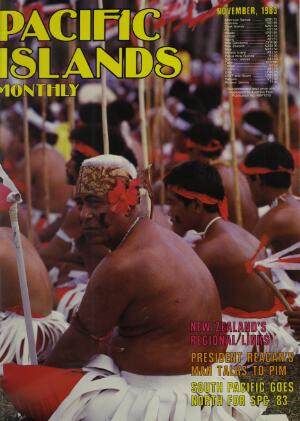
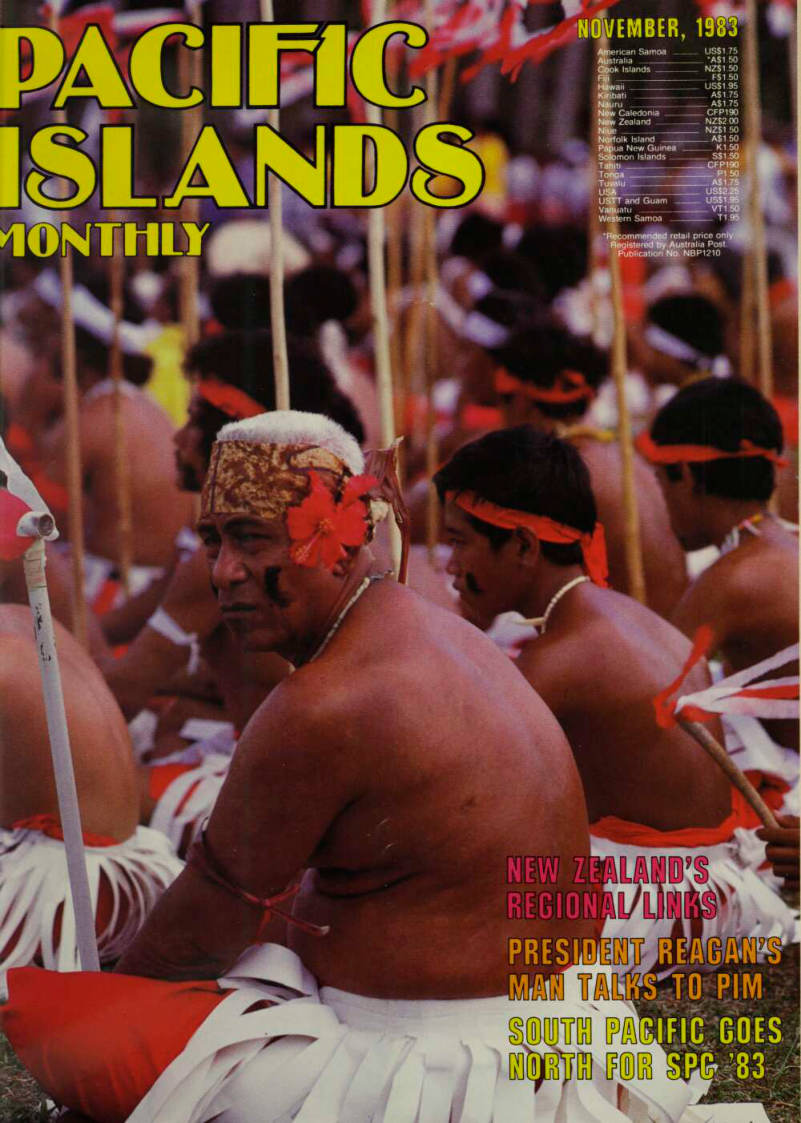
Cover: Celebrations of the 21st anniversary of the independence of Western Samoa coincided this year with the 7th South Pacific Games in Apia. Picture of anniversary ceremony by Richard Eastwood.
Advertisements & other items, p. 2 (1 item)
0 Hitachi
1 net m
COMPACT
i
DIGITAL
AUDI
DA 800 Flawless concert reproduction is now within reach.
If you are still wondering what all the cheering is about concerning digital audio, you probably haven’t heard the DA-1000 or DA-800. Two compact disc digital audio players from a recognized leader in the field Hitachi.
Compact disc digital audio players utilize an ultra-thin laser beam to “read” digitally encoded compact discs (CDs). This allows performance levels that surpass even the finest analogue turntable. And with results that are nothing short of spectacular.
They produce crisp, pure sound, preserving every ounce of the original performance’s spine-tingling realism.
The wonders of the DA-1000 and DA-800 do not end with flawless sound reproduction. They also include amazing playback versatility.
With fingertip simplicity you can execute an entire series of playback options, such as a programming feature that allows you to play up to 15 selections, in any sequence, automatically.
Words cannot accurately describe this remarkable experience.
You’re simply going to have to listen and judge for yourself.
Do it soon. But hold your applause until the end. You won’t want to miss a single note.
DA-1000 • Compact audio component size (W XHX D: 320 X 145 X 234 mm) • Vertical front-loading system • Multiple programming options; Repeat, Random Memory Programming, SPSS, Manual Search, Memory Stop • Location Indicator DA-800 • Standard component size (WXHX D; 435 X 110 X 264 mm) • Horizontal frontloading system • Multiple programming options; 4-way Repeat, Random Memory Programming, Auto DRPS, SPSS, Index Search, Manual Search
Hitachi
Compact Disc
Digital Audio Players
mwm
mmm
0 HITACHI
A World Leader in Technology • AUSTRALIA: Hitachi Sales Australia Pty, Ltd., 153 Keys Road, Moorabbin, Victoria 3189 Phone: (555) 8722 • PAPUA NEW GUINEA: S.O. Svensson (N.G.) Ltd., P.O. Box 705, Port Moresby \ Phone: 21-2111 • FIJI ISLANDS; Burns Philp(South Sea)Company Ltd., G.P.O Box 355, Suva Phone: 311777 • NEW CALEDONIA: Caldis, B.P Ml, Noumea Phone: 26. 23. 50 •TAHITI: Ets a Chene Alain, P.O. Box 272, Papeete Phone: 2. 88. 68. • SOLOMON ISLANDS : Technique Radios Centre Ltd., P.O. Box 465, Honiara Phone: 416
Pacific Islands Monthly
01. 54 No. 11 November 1983 (LISPS 952 480)
USTRALIA: Distribution: The Herald and Weekly Times td 44-74 Flinders St., Melbourne, Vic., 3000. Advertis ig Reps Brisbane D. Wood, Anday Agency, Box 918, GPO Brisbane, 4001, telephone 44-3485, 44-1546; delaide Hastwell Williamson Rouse Pty. Ltd., PO Box 19 Norwood, SA, 5067; 59 Kensington Road, Norwood; slephone (08) 332-3322, telex 87113; Perth Allen & ssociates, Suite 2, 284 Stirling St., Perth, WA, 6000, Hephone (09) 328-9593 or (09) 328-9363. |j|: Distribution and subscriptions Desai Book -iops P.O. Box 160, Suva, Fiji, telephone Suva 23036. dvertising Fiji Times & Herald Ltd., 20 Gordon St., uva, telephone 31-2111, telex FJ2124.
RENCH POLYNESIA: Distribution Hachette Pacifi ue, 10 Ave Bruat, Papeete, telephone 25610.
AWAII, UNITED STATES: Distribution PIM, Hawaii, O Box 22250, Honolulu, Hawaii, 96822. Advertising rian C. Asgill, Apt, 1308,1676 Ala Moana Blvd., Honolulu, lawaii, 96815, telephone (808) 955-9718.
APAN: Advertising and subscriptions Universal ledia Corporation, GPO Box 46, Tokyo, telephone 666- 036, cables UNIMEDIA Tokyo, telex 2524665.
OREA: Advertising and subscriptions World Mar eting, Inc, Box 4010, Seoul; phone 776-5291-3, telex 23232. lALAYSIA: Advertising and subscriptions i/orldwide Media Services, 57-B Komplex Damai, Jin Dato laji Eusoff, Kuala Lumpur, telephone 63-9340, cables (/ORLDMEDIA Kuala Lumpur, telex 31533. lEW CALEDONIA: Distribution Depot Centre de ’resse Michel Pentecost, CBP2, Noumea, telephone 27- 434, 27-4729. lEW ZEALAND: Distribution Gordon & Gotch, PO Box 84, 2 Carr Road, Mt. Roskill, Auckland 4 Advertising iternational Media Representatives Ltd., PO Box 2313, Auckland, telephone 79-5487; 49-3389, cables Intereps, Auckland. Subscriptions Ross Haines & Son Ltd., PO lox 1289, Auckland, telephone 76-9042. •APUA NEW GUINEA; Distribution Gordon & Gotch, 'O Box 3395, Port Moresby, telephone 25-4551, 25-4855.
Advertising PNG Post-Courier, PO Box 85, Port Mores y, telephone 21-2577, telex 22120. •HILIPPINES: Advertising The GF Group, 12 San gnacio St., Uroaneta Village, Makati, Metre Manila, tele ihone 817-7299, telex 45950 and 4233.
JNITED KINGDOM: The Herald & Weekly Times Ltd., No 1 /laltravers Street,London WC2R 3DZ, England, telephone II 836 5162, telex London 21989.
JNITED STATES MAINLAND: Advertising Joshua B. s owers Jr., Powers International Inc., 551 Fifth Ave., New fork, New York 10 017, telephone 867-9580, telex 236514.
Subscriptions PIM, Hawaii, PO Box 22250, Honolulu, Hawaii, 96822.
Subscriptions
Payments by personal cheque are only acceptable in Australian (from a branch in Australia), U.S. and New Zealand currency. For all other remittances please send an international bank draft in Australian dollars.
Published monthly by Pacific Publications (Aust.) Pty.
Ltd. and printed in Australia by Walter Alteri Printing (Australia) Pty. Ltd., Dingley, Vic.
Australian cover price is recommended retail only.
Registered by Australia Post, publication No. NBPI2IO.
Second class postage paid at Honolulu, Hawaii. Copy right Pacific Publications (Aust.) Pty. Ltd.
Postmaster Honolulu: Send address changes to PIM Hawaii, PO Box 22250, Honolulu, Hawaii, 96822.
Local Aust.
Xmerican Samoa $US21 $18 Xustralia $A18 $18 Canada $US27 $25 Dook Islands $19 : iji $18 r rench Polynesia $22 3uam $US23 $20 Hawaii $US23 $20 Japan $20 Kiribati $19 Micronesia $US23 $20 Nauru $21 Mew Caledonia $22 Mew Zealand $NZ24 $18 Miue $19 Norfolk Island $15 Northern Marianas $US23 $20 Papua New Guinea $23 Solomon Islands $19 Tonga $19 Tuvalu $19 United Kingdom Stg 15 $25 U.S. Mainland $US27 $25 Vanuatu $19 Western Samoa $18 Elsewhere $A25
Inside
• BOUNTY LURKS IN A SWEDISH FOREST Marie-Therese and Bengt Danielsson have discovered a giant model of Bligh’s Bounty in a forest in southern Sweden • 13 • FRED M. ZEDER TALKS TO RIM On behalf of RIM, Floyd K. Takeuchi in Honolulu talks to Fred M. Zeder, President Reagan’s personal representative to the Micronesian political status negotiations. Mr Zeder tells how he sees future relations between the U.S. and the new political entities emerging from the Trust Territory 19 • FROM ASOPA TO ITI Keith Jackson, who trained at Australia’s former School of Pacific Administration (ASOPA), and now has charge of a course in mass media at ASOPA’s successor body, the International Training Institute (ITI), writes of the dramatic change in institutional direction wrought by the years 25 • ASIAN DEVELOPMENT BANK AND THE ISLANDS The ADB faces some very special problems in offering its help to the smaller Pacific Island countries. An article in the Hong Kong-based weekly Far Eastern Economic Review offers some insights into these problems 29 • MALAITA Dr Stephen Weinstein completes a two-part series on his travels in Solomon Islands with an account of a visit to Malaita, second largest island in the group 47 • NEW ZEALAND’S REGIONAL LINKS New Zealand’s Prime Minister Muldoon recently blasted Australian officials as “Pacific-ignorant”. In a number of articles devoted to New Zealand and its Islands links, PIM looks at just what kind of justification exists for the PM’s lofty scorn 55
Asian Development Bank 29 Australia in the Pacific 25 Books 43 Cook Islands 33 Deaths 73 Fiji 31, 35, 40 Hawaii 33 Islands Press 53 Japan in the Pacific 29 Letters 7 Micronesia 19, 37 Month, The 13 New Caledonia 15, 41 New Zealand in the Pacific 55 Notes from the North 19 Noumea Notebook 15
Pacific Report 5 Papua New Guinea 33, 35, 37, 43, 45, 52 People 37 Political Currents 25 Postmark Papeete 13 Samoa Report 14 Shipping 71 Solomon Islands 7, 47 South Pacific Conference 11 Tradewinds 51 Travel 47 Tropicalities 31 Vanuatu 17, 51 View from Honolulu 22 Western Samoa 7 Yachts 7, 65
Advertisements & other items, pp. 3-4 (2 items)
3
PACIFIC ISLANDS MONTHLY —NOVEMBER, 1983
Founded 1930 by R. W. Robson ditor Angus Smales ssociate Editor Malcolm Salmon dvertising Manager Stephen Brandon ditorial Adviser John Carter A Pacific Publications production 76 Clarence Street, Sydney, 2000, GPO Box 3408, Sydney, 2001 Cables: PACPUB Sydney.
Telex: 21242 (answers INTARAD).
Telephone: Sydney 20-231. Melbourne 63-0211.
Manager: John Berry (03) 63-0211 Ext. 1860.
Expert
Insurance Service
throughout the islands
■ m
Queensland Insurance (Fiji) Limited
Head Office: Queensland Insurance Centre, Victoria Parade SUVA. General Manager: R. Jackson.
Assistant Manager: Vijay Lai. Phone 23 851.
LAUTOKA OFFICE: Burns Philp Bldg., Naviti St. District Manager: R. Sharma. Phone 60 642 LABASA OFFICE: Burns Philp Bldg, Phone: 8 2139
Queensland Insurance (PNG) Limited
PAPUA NEW GUINEA
Head Office. B.N.G. Building, Musgrave St.PORT MORESBY. General Manager: T. H. Sarti Phone: 21 2144.
LAE. 4th St. & Coronation Drive. District Manager: C. D. Hillier Phone: 423873, MOUNT HAGEN Hagen Drive District Manager: G. Hayes Phone: 521002.
ARAWA: Chebu St., District Manager; B. Bowers Phone: 95 1555 MADANG: Kasagten St., District Manager: J. Longbut Phone; 82 2020 RABAUL: Wirraway St. District ManagerP. McManus Phone: 921014
QBE Insurance (International) Limited
VANUATU, PORT VILA: Rue de Paris, Suite 19, Oceania Bldg. Manager: I R. Martin.
Phone: 2299.
SANTO: Burns Philp ( Vanuatu) Ltd. Phone: 230.
PACIFIC AGENCIES
NEW CALEDONIA: Ste. W. A. Johnston, S.A.R.L. 5 Rue Anatole France, NOUMEA Phone: 272083.
TAHITI: Arthur Chung, Immeuble 8.1.5., Front de Mer, PAPEETE Phone. 2.86.19 NIUE Burns Philp (South Sea) Company Ltd, NORFOLK ISLAND: Burns Philp ('N I) Company Ltd. Phone: 2191 SAMOA: APIA, Burns Philp (South Sea) Company Ltd. Phone: 22611 TONGA Burns Philp (South Sea) Company Ltd. NUKUALOFA. Phone 21500 HAAPAI. VAVAU x
MEMBERS OF THE
QBE INSURANCE GROUP LIMITED
Pacific Report
END OF AN ERA AS U.S. SIGNS TREATIES In September-October ceremonies, official US representatives in the Pacific signed documents ratifying treaties of friendship between the US and Kiribati, Cook Islands, Tuvalu and Tokelau.
Main significance of the treaties is that they represent formal abandonment by the US of 19th-century-based claims to islands within the four groups. The signings followed ratification of the treaties by the US Senate on June 21, after two years in which it could not make up its mind (PIM Aug p 5). After the signing of the US-Kiribati treaty in Suva, US Ambassador Fred J. Eckert said that the treaty calls on the US and Kiribati “to work together for the social, economic and peaceful betterment of the South Pacific”. Replying, Kiribati Ambassador Atanraoi Baiteke said: “Our countries abide by the principles of democracy which I believe will form the foundation to fulfilling our commitment under the treaty of friendship.”
E.E.C. To Rescue Of Forum Line?
Speaking in Apia in October, deputy director of the European Development Fund, Maurice Foley, said that the European Economic Community was prepared to give more aid to the Pacific Forum Line. His statement followed Australia’s refusal to contribute further funds to the line at the last meeting of the South Pacific Forum in Canberra (PIM Oct pl 5). Mr Foley said the EEC believed the shipping line was important to the development of the South Pacific. But, he went on, the Pacific countries had to show their determination to make the line viable. Mr Foley planned talks on the line with the governments of Western Samoa, Fiji, Solomon Islands and Papua New Guinea.
Fiji: Reddy Warns On Job Discrimination
Indian Opposition leaders in the Fiji parliament have warned that the country’s peace and harmony could be endangered be cause of racial discrimination in senior government jobs. Nation al Federation Party leader Jai Ram Reddy said in October it was alarming that almost all senior government posts were held by Fijians and only a few by Indians. Speaking at the party’s annual convention, Mr Reddy said the ruling Alliance Party was giving the public service an active role in party politics and race relations were being strained as a result. Former party leader S.
M. Koya said it was sad the other races were not being given equal opportunities with the Fijians although the government had a policy of multi-racialism. Indians form half Fiji’s population.
It was estimated that, at the end of 1981, Indians numbered 326,000 (50 per cent) and Fijians 290,000 (45 per cent).
Somare To Visit Indonesia
Papua New Guinea Prime Minister, Michael Somare, will make a State visit to Indonesia for border talks with President Suharto later this year. The dates for the trip are yet to be confirmed with Jakarta but the visit is expected to follow the Commonwealth Heads of Government meeting in New Delhi scheduled for the last week in November. Mr Somare is expected to deal with embarrassment caused to the government in September when the former Defence Minister, Epel Tito, predicted in Australia that Indonesia would invade PNG within 10 to 20 years. (PIM Oct p 6).
Palauans To Vote Yet Again
Yet another plebiscite on the Compact of Free Association with the US is planned in Palau before the end of the year. This was announced in October by Palau President Haruo I. Remeliik.
Supporters of the compact hope that the new plebiscite will complete the process of its ratification by Palauan voters. The compact was approved at a February plebiscite, but voters rejected an associated amendment to their constitution which would override the ban on the entry into Palau of nuclear materials. Judge Robert A. Hefner later ruled in the Palau Supreme Court that failure to approve the amendment meant rejection of the compact as a whole (PIM Oct p2O).
Noumea Wins, And Vanuatu Accuses Fiji
New Caledonia won the right to host the 1987 Bth South Pacific Games in the Games Council vote in Apia by 18 votes, to 14 for runner-up Vanuatu. But the win has been soured by charges by Vanuatu’s Minister for Education, Youth and Sports, Onnyn
Tahi, that New Caledonia’s success was due at least in part to lobbying against Vanuatu by Fiji delegates. Interviewed by the Vanuatu Government newspaper Tam-Tam, Tahi said that one Fiji delegate had tried to convince delegates of other countries to vote against Vanuatu by saying that any host country should first of all host the Mini-Games, and that the Games should be hosted by Solomon Islands (another contender) because it was a bigger country than Vanuatu. He also said that Vanuatu does not have stable relationships with some South Pacific countries “as a result of its airline policies.” Mr Tahi said that what Fiji had done was just the tip of the iceberg, and that it was “actually concerned with Vanuatu’s position on the Matthew and Hunter Islands issue, its banning of US warships from Port-Vila, and other political stands in international forums”. “The Games spirit is dead,” Mr Tahi said. “It is politically influenced and participat ing countries are using it to achieve their political aims.”
Mamaloni Pleads For Un Rules Change
Prime Minister Solomon Mamaloni of Solomon Islands has asked the United Nations to change its rules requiring poor nations to have diplomatic offices at the UN headquarters in New York. Mr Mamaloni was addressing the General Assembly in October, after his country had opened its first overseas diplomatic office at the UN. Mr Mamaloni said Solomon Islands was admitted as a member following its accession to independ ence in 1978. But it could not send a representative because under UN rules it had to have a permanent diplomatic office in New York. The prime minister said the opening of the new office was a great achievement in foreign relations. He said he was grateful that Australia was providing about SUSSOO,OOO a year for the upkeep of the office, which will be shared by the Maldives, the Solomons, Western Samoa, and other small Pacific Island countries.
NEW MOVE IN LONG-RUNNING NAURU LIBEL CASE President Hammer Deßoburt of Nauru in October asked a United States Federal Appeals Court in Honolulu to overturn the dismissal of a SUS4O million libel suit he had filed against the Guam newspaper Pacific Daily News. The case stems from an article in the newspaper in 1978 linking President Deßoburt to a loan to a separatist group in the Marshall Islands. The case against the paper and its owners, the Gannett company, was dismissed in 1982 by a US district court judge, sitting in Honolulu. Announcing the appeal, President Deßoburt’s lawyer said the paper falsely reported that the loan had been approved after Mr Deßoburt took office in May 1978, when in fact it had been made by Nauru’s outgoing administration. Counsel for the paper maintained that Mr Deßoburt had approved the loan. At press time, the three-judge panel had withheld ruling on the case.
Flood Havoc At Lae, Png
Widespread flooding at Lae in Papua New Guinea in Septem ber-October killed 28 people, caused millions of dollars damage, destroyed villages with hundreds of homes and prevented 1250 tonnes of coffee being shipped before the international coffee year ended on September 30. The coffee, bound for export, was in trucks held up by the floods on the Highlands Highway. PNG, according to a PNG Coffee Industry Board spokesman, needed to export about 820 tonnes of coffee by September 30 to fill its quota. Ships were waiting at Lae to load the coffee for Australia, Britain and Europe. The board will ask the International Coffee Organisation to allow it to carry forward the balance of the unfilled quota to the next coffee year.
Sanjuan Out, Enter Montoya
Richard Montoya, formerly second-in-command of the US Department of the Interior’s Office of Territorial and International Affairs, which is responsible for US relations with its Pacific Island and other territories, has taken over from his boss, Pedro Sanjuan, who has gone to a post with the US delegation to the United Nations. According to The Washington Pacific Report, Sanjuan had conspicuously failed to win the support of the constituencies he needed to succeed in the job, not least that of the leaders in the U.S. Pacific territories. The Report writes: “Official hopes in the Interior are that Montoya will have a much
better track record than his predecessor, and WPR believes he will not disappoint his supporters on this count. From all accounts, he is a fine administrator and is determined to work hard to develop an improved relationship between his office and island governments.” It adds: “Montoya, 35, a former aide to ex- Texas Governor William P. Clements, was sent over to Interior in February by White House Chief of Staff Jim Baker to be a settling influence and attempt to build the bridges that Sanjuan had burned ... As a known quantity, it is unlikely that announce ment of his appointment will cause the firestorm of protest that his predecessor’s did. Nevertheless, islanders are likely to reserve judgment until they see if Montoya’s policies are as palatable as his style.”
Paratrooper-Editor Gets Jail Term
Before the courts more than 100 times on charges of defamation and incitement to crime, subjected to repeated fines on the charges, Noumea journalist Gerard Lacourrege was finally sentenced to 15 days jail on October 7 on yet another defamation charge. Mr Lacourrege, a former paratrooper in France’s Algerian war, edits the far-Right weekly political journal Corail, which is published in Noumea. Speaking after the sentence, Mr Lacourrege said he was considering an appeal.
He said it was the first time in 30 years that a French journalist had been jailed for an article. He added that the saw the sentence as “part of a well established plan by the French socialist government to close down my magazine”.
A.C.I. ALL SET TO FLY, AND . . .
Air Caledonie International (PIM Oct p3O) will launch its first Australian service a weekly direct link between Melbourne and Noumea on December 2. It will introduce its weekly flights between Brisbane and Noumea on January 6. A.C.I. will also be sole carrier between Noumea and Vanuatu from January 1, operating four flights a week in each direction, increasing to five next April. The airline’s initial network will also feature a weekly service to Fiji and Wallis Island on Wednes days, with return leg to Noumea on Thursdays. All Australian services from Melbourne and Brisbane will have A.C.I. link flights to Vanuatu. A.C.I. becomes the third French international airline and the second to operate out of Australia, along with UTA French Airlines, which is its general sales agent in Australia. It is owned two-thirds by private and institutional interests in New Caledonia and one-third by the Territory of New Caledonia through the domestic airline, Air Caledonie. The new services from Melbourne and Brisbane to Noumea follow an agreement signed by the French and Australian Governments in June this year (PIM Aug p 6). The airline will operate its Melbourne-Noumea service under an arrangement with Qantas, with an allotment of 117 seats on a Qantas 747 jet with weekly departures from Melbourne on Fridays. The return flight on Saturdays will depart Noumea at 1 p.m. for the three-and-a-half hour flight to Melbourne. For its Brisbane service, A.C.I. will wet lease an Air Nauru Boeing 737. There will be a weekly flight from Noumea on Friday mornings. After a two-hour turnround the 737 will depart Brisbane for Noumea.
AIR MIKE’S 0.K., DESPITE BIG DADDY’S ILLS Air Micronesia services will be unaffected by the bankruptcy action taken in the US by parent company Continental Airlines, according to statements from Guam and Houston. Continental, which reportedly has had losses of SUS47O million since January, 1979, in September filed a voluntary reorganisation plan in the US Bankruptcy Court. The plan included reducing domestic US services from 78 to 25 points, and hiring back as needed employees who had been furloughed. “We will continue to operate our normal schedule,” Air Micronesia President George A. Warde said in Guam. “We made a commitment 15 years ago to serve Micronesia and Guam, and more recently Japan and the Philippines,” Mr Warde said, adding: “That is exactly what we intend to do.” Frank Lorenzo, Continental board chairman and chief executive, said at company headquarters in Houston that the airline had created new subsidiary companies for its international services which would continue operations, leasing aircraft and crews and other personnel from the parent company. Mr Lorenzo said that Air Mike and the South Pacific services would operate all routes, and continue expansion.
Burns Philp Back In Blue Water
From 1896-1970, the so-called Main Line Fleet of the Australian company Burns Philp continuously served Pacific Island and Southeast Asian ports. Since 1970, however, the company’s maritime activities had been limited to coastal shipping in various Island countries. Now, since mid-year 1983, the com pany has been back in the blue water trade with its new Southwest Pacific Container Line (SPCL), serving an east-west range of countries from American Samoa to Papua New Guinea. The line’s two 2250-tonne Norwegian-built vessels, MVs Induna and Matunga named after old BP ships are steaming 7500 nautical miles in each round voyage. Ports served are Apia, Honiara, Lae, Lautoka, Noumea, Nukualofa, Pago Pago, Port Moresby, Santo, Suva and Vila. They are working to a regular 44-day round-trip schedule to provide a 23day frequency. Hugh Reynolds, general manager of Burns Philp’s Pacific operations, said SPCL is owned by Burns Philp (Vanuatu) Ltd., and the public companies Burns Philp (South Sea) Co. Ltd. (based in Fiji), and Burns Philp (PNG) Ltd.
Introduction of the line follows a feasibility study conducted by BP over several years.
John Teariki Dead
John Teariki, one of French Polynesia’s outstanding political leaders, died on October 5 following injuries received in a tractor accident on his farm. (Obituary tribute, PIM December).
Vanuatu’S Cocoa Project Set To Go
The biggest single project in Vanuatu’s five-year development plan a cocoa planting and processing scheme was set to begin in mid-October. Representatives of the newly formed Metenesel Estates Company were set to sign a longterm lease with the customary owners at Litzlitz on the island of Malekula.
The company’s shareholders are the Vanuatu Government, the Commonwealth Development Corporation, and the landowners.
The project is being supported by aid from Britain, France and Australia. The plan is for 1700 hectares to be planted with cocoa over the next five years. The plan includes a cocoa fermentary and a processing factory with a production capacity of 38 tonnes a day. It is hoped that the industry will provide Vanuatu with a new source of foreign exchange, create 530 new jobs, and ease the country’s dependence on copra exports.
PNG: ESCAPED OZ KILLER GIVES HIMSELF UP In Papua New Guinea in October, an escaped Australian murderer gave himself up after four days in hiding. Eric Gordon Berry, who in 1976 shot a man dead in Port Moresby, walked into the office of the Niugini Nius newspaper and told the paper’s editor that he had escaped to draw attention to the government’s failure to act on a parole bill introduced in parliament in 1981. He is now back in Bomana jail.
PNG: REPORTS OF BIRD OF PARADISE KILLINGS Papua New Guinea’s Minister for the Environment Halulu Mai has held talks with the Premier of the country’s Western Highlands Province Nambuga Mara over reports that local people are killing birds of paradise in the province’s Baiyer River Sanctuary. The sanctuary is the only one of its kind in PNG where nearly all 35 species of the bird are found. The sanctuary is an important tourist attraction and revenue earner for PNG.
Papua New Guineans are allowed to capture the birds for the purposes of ceremonial body decoration for which its feathers and claws are much valued. But the birds must be taken in the wild, in the home locality of the people concerned, and by traditional means use of modern weapons is illegal. Apart from this, the birds are strictly protected. There is the possibility, which is of great concern to the authorities, that the birds are being killed for trading purposes.
BRING BACK THE ROPE’ CALL IN YAP A five-member Commission on Crime appointed by the Yap State Legislature has recommended amendment of a section of the constitution of the Federated States of Micronesia (FSM) which prohibits capital punishment in the FSM. Amendment would allow the Yap State to enact its own law to permit re introduction of capital punishment which some delegates called for at the Yap State Constitutional Conference in 1982. The state constitution has to be consistent with the FSM national constitution.
A burning
Letters
of books
for Honiara?
Is there to be a book burning in Honiara? Is Solomon Islands his tory to be politically censored?
The book that is causing the fuss is my account, with Peter Corns, of the 1927 massacre of District Officer Bell and others on Malai ta, Lightning Meets the West Wind.
Why all the fuss? There was not one massacre in 1927, but two. The first, the killing of Bell, his cadet Lillies, and 13 Islanders by Basiana and his Kwaio war riors, caused a sensation at the time and has a prominent place in colonial histories. The second massacre was the killing of some 70 Kwaio, mainly unarmed pris oners but including women and children, by the subsequent puni tive expedition; not the “Breath less Army” of planter volunteers or the malaria-ridden Australians from H.M.A.S. Adelaide, but North Malaita police and ex police intent on avenging their slain relatives tenfold. This mas sacre was hidden and whitewash ed by the British Solomon Is lands Protectorate administra tion, and has been mainly ig nored by colonial historians. Our book tells the true story, naming names and places, as it had to do to be accurate and credible, giv ing long quotes from protagon ists on both sides.
The old skeletons are out of the closet.
Malaita Premier Stephen To nafalea wants these skeletons back in the closet again by banning the book in the Sol
omons, burning copies already
there if he can. The reasons are not too obscure. It is Tonafalea’s To’abaita relatives and wantoks who directed the carnage, or dered the shooting of prisoners, the desecration of shrines, the burning and looting of settle ments. Tonafalea and his North Malaita supporters and Provin
cial Assembly colleagues would
like the evidence of history suppressed.
They are not the first ones to try to keep the skeletons hidden.
For 10 years I was denied access
to the Bell files, even after the access rule was changed to 30 years and other Pacific historians were given access to the files. It was not until I confronted the Chief Secretary of the Western Pacific in 1970, and told him that the book would be written with or without access to the files (with an apology for factual er rors, and an explanation that it had been written without the co operation of H. M. Government) that I was grudgingly allowed to see most of the Bell files.
The paranoia about the second massacre goes far back in time.
Usuli Tefu’i, survivor of the first massacre and enthusiastic par ticipant in the second, refused at first to talk to me because he had 50 years earlier been sworn to secrecy by the resident commis sioner and commandant of police.
But the truth is out docu mented by many hours of taped interviews, many directly
“Those who did the killing were proud of their deeds, not ashamed”
quoted. And why not? Those who did the killing 55 years ago were proud of their deeds, not ashamed. They had avenged their dead in culturally approved style. Usuli, in his 80s and now in Honiara, speaks dispassionate ly of how he and his patrol shot most of the prisoners they took, how the jungle stank with rotting corpses: exactly what the mis sionaries had warned at the time, trying to halt the carnage; “If they were taken to the coast they were tied up. But anyone we found in the bush we killed all of them. If you went in the bush you couldn’t stand the smell, there were bodies everywhere along the sides of the path . . .
“The British officers had said, ‘lt’s up to you. Because you lost 13 men, with the two govern ment officers. If you want to take someone alive, the he lives. If you think “You’re to die in the bush,’’ that’s up to you be cause that’s the way of your anger. We’re not in charge of you. It’s your business and it’s a war’.”
All this has been known on Malaita for years, from men who
bragged of their exploits. Why, then, does Tonafalea now want the truth suppressed? Does he really think the book is stirring up old conflicts and enmities?
Certainly not among the pagan Kwaio of the interior. Thanks to half a century of government neglect none of them can read though they still remember.
Some Kwaio leaders would like to claim compensation for the damage and desecration by the punitive expedition. But this idea, fomented by coastal Chris tians like Lee Silamo and M. P.
Daniel Fa’asifoaba’e, emerged three years before the book was published. In this ill-conceived quest, the book is incidental.
The real reason why Tonafalea wants the book banned seems to be that he is locked in a power struggle with Kwaio Fadanga, the council of pagan leaders, over the issues of taxation and cultural autonomy issues that date back 60 years. Portrayal of
the Kwaio side of the Bell mas sacre, as well as the other, erodes the stereotypes of the Kwaio as dark savages that have been used to justify decades of government
neglect.
Reflective Solomon Islanders, including P. M. Mamaloni, real ise that the issues of freedom of the press and the truths of history go beyond local political inter ests and family secrets. But others, whatever their motives, would welcome an opportunity for expatriate-bashing in new guise. The book may yet be banned, even burned. In the meantime, sales in Honiara are
booming.
Roger M. Keesing
(Professor of Anthropology) Australian National University, Canberra. ACT.
Australia.
Matters of dress
and undress
Rather to my astonishment I notice, when sailing through Pacific ports, whether they are attached to big bustling cities, or are in more remote, untouched
regions, that a number of visiting yacht people seem very inclined to discard their clothing to vary ing degrees. This habit, although no doubt fitting on the beaches of the French Riviera, California, or New South Wales, may not be quite so in Tonga, Papua New Guinea, or Palau. Otherwise
apparently responsible people
seem totally oblivious of local dress codes, and therefore offend and generally create a poor im age of visiting boatmen. It is not difficult to establish the accepted dress code by following local example, and the age-old advice “When in Rome, do as the Ro mans do” and shed no more.
This is not a call for prudish ness, but for propriety. Along with the privilege of cruising these beautiful areas comes the responsibility of representing your own country and leaving in your wake an image of pride and
friendship.
I hope the peoples of the Pacif ic who have had contact with these insensitive individuals real ise that among us there are also those who enter their countries with great respect for and interest in their cultures.
Diana White
Yacht Zenie P. II Cebu
Philippines
What happened at
Apia’s hospital?
From my reading of a report in the Papua New Guinea Post- Courier, PNG’s national paper, it seems that one of PNG’s in jured Rugby Union players at the recent Seventh South Pacific Games was refused treatment at the hospital in Apia and had to be sent home to Port Moresby for treatment. If this is so, it is sad and disappointing. It was just lucky he didn’t die on the way home. Matters of this nature are important, and whichever coun try hosts the Games should have a sense of responsibility towards those injured in the course of the various events.
If such an attitude is to con tinue, there would seem to be no point in keeping the Games go ing. They should be abolished, and we’ll play our own little independent Games back home.
As a concerned citizen of PNG I have pride in my country’s sportsmen and women, and would be most disheartened to learn of behavior of this kind at any time in the future.
We’ll see how New Caledonia as the next host will treat us in 1987.
Philip Anda
Mt Hagen Papua New Guinea
Tattoos a call
for help
As I have been granted special leave to study traditional body tattoo, I require specific informa tion as to places islands, and places therein where such body decoration is practised or can still be found, or people who are tattooed and would be willing to talk to me and have their tattoos documented.
Without such information the precious time at my disposal could be quickly lost. Should anyone have any information that would assist me in my search for traditional body tattoo, I would be more than grateful to receive it at the earliest possible moment.
I am appealing for assistance from people of the South Pacific!
Lindsay Gordon
(Lecturer in Art) Kuring-gai College of Advanced Education P.O. Box 222 Lindfield NSW, Australia, 2070
Of Mead, Coombe,
Stevens, and others
After good old Margaret Mead has closed her eyes and can’t defend herself any more, the heroes who knew everything and nothing creep up and raise their ugly heads and voices.
Margaret Mead was never anything else but what the people made of her and it was Papua New Guineans and Samoans in particular who glorified her wherever she went. But those in the know never accepted her im aginative litanies for fact.
The same seems to go for Christine Coombe. So long as she was there in Vanuatu, no one dared open his mouth, or take up
the poison pen. Now she has gone all hell breaks loose over her in the same heroic fashion.
The amazing fact remains, however, that those who put Jim my Stevens in jail and condemn ed the backers of the “revolu tion” are today exactly the same people who are asking for money from those same neo-colonial or ganisations that backed the “re volution”. But poor old Jimmy Stevens remains in jail, despite the fact that he was never any thing but the greedy, obedient lackey of one or the other capital ist interest just like most of the other Big Leaders of today.
As long as we continue to suck on the World Bank and neo colonialist development aid bot tle, and as long as those ex colonial kiaps and neo colonialist businessmen are in charge of affairs, there is little sense in fouling the beautiful Pacific air with wild racist paranoia especially as after so
many years of “independence” we still can’t stand on our own very wobbly legs.
Vitaliz Paingame
Caims Qld Australia
A Rotuman
Mamasa
Mamasa is a beautiful Rotuman ceremony. It is performed to welcome someone who has re cently returned from overseas.
The period of absence need not have been long.
I attended a Mamasa (the world means “dry” or “to dry”) at Delainavesi a month ago. It was performed to welcome a young married couple who had been to Australia for a five weeks vacation.
A large “koau” is prepared, early in the morning, to roast the pig, chickens and ground food.
The size of the “koau” depends on the size of the pig and the number of guests expected to attend.
Mats are folded and a low dais is made, roughly two metres by one. Usually an “apei” (white mat) is spread on top of this.
The new arrival is requested to
sit on the dais. A “tefui” (lei) is placed around his neck. A “tefui” is made of about 10 different scented blooms. You can im agine the scent.
Next, perfumed oil is poured lavishly on the head, a “umefe” (low table) is put in front of the honored one. The “Koau” is opened. Girls and young women appear. They spread banana leaves on the table and sit down ready to prepare the food. Some fan the guest. (Oh, yes, he or she gets the VIP treatment on the
day).
The pig, chicken, “fekei” (a dessert), and other foods are brought in, also coconut to drink and fruit in season.
A man well versed in Rotuman custom comes and sits near the roast pig. He starts to describe in a loud singsong voice all the food that is there. It may include a carton of corned beef or tinned fish. The pig’s head is cut off and placed on the table, facing the person sitting on the dais. The girls peel taro, yam and choice pieces of pork, and spread them on the table. None of the guests eat until the favored person has finished his meal. Water, soap and towel are brought for him to wash his hands.
Then all the food is taken away to the lawn where coconut fronds and banana leaves are spread. Guests are called and, after a short prayer, all eat.
Oney A. Foster
Suva, Fiji.
Find of a Cape
York beachcomber
From old notes of a day’s beach combing on Cape York Peninsula: Sunday December 14: Captain Billy Creek. A Drambuie bottle with about a teaspoon left in it.
Nice!
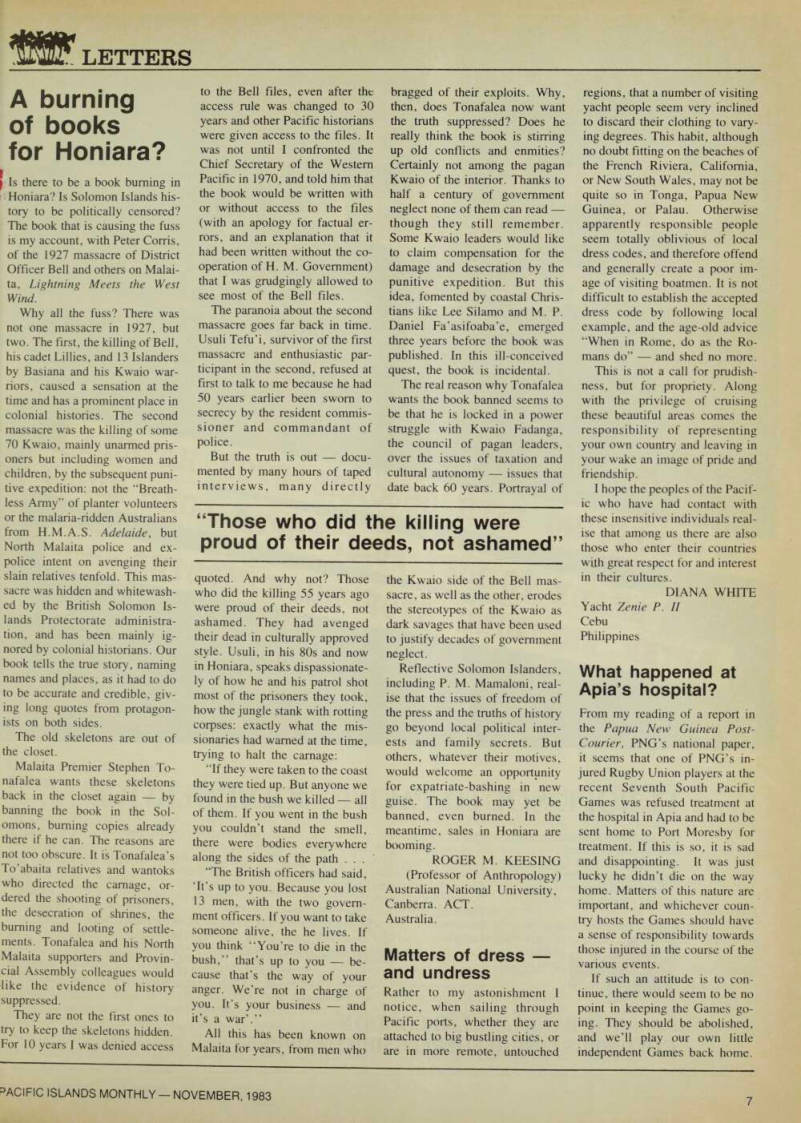
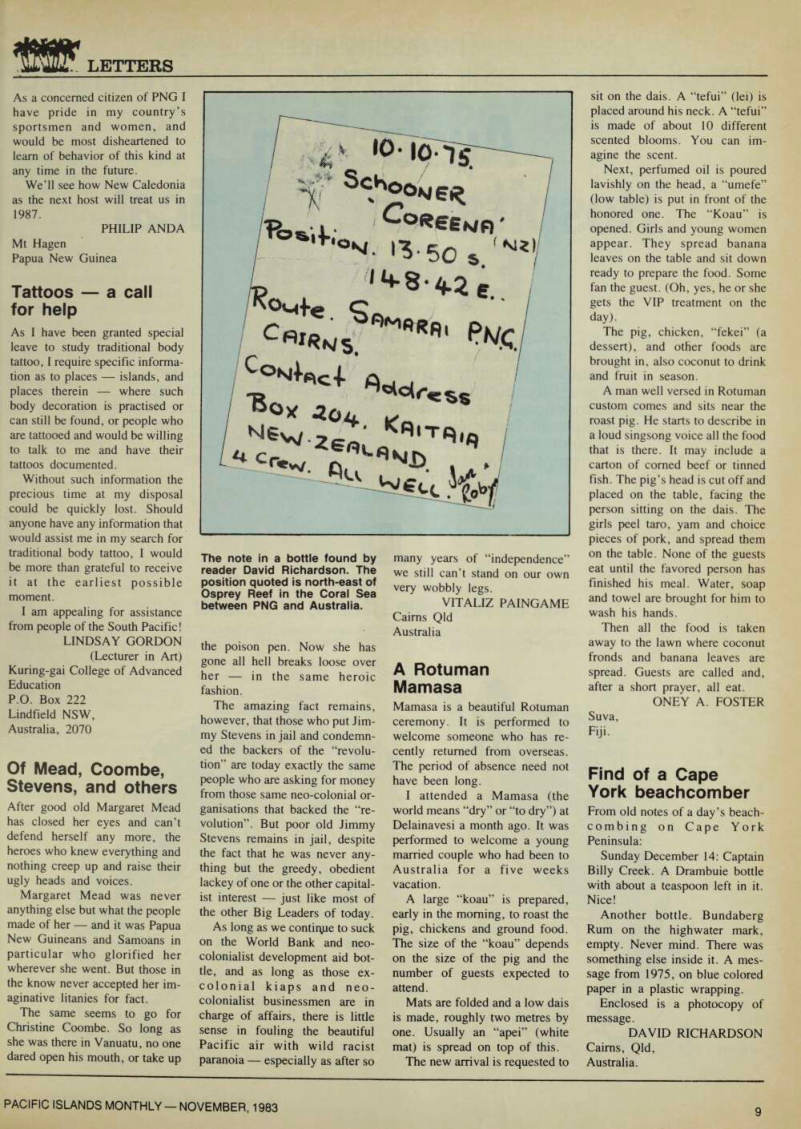
Another bottle. Bundaberg Rum on the high water mark, empty. Never mind. There was something else inside it. A mes sage from 1975, on blue colored paper in a plastic wrapping.
Enclosed is a photocopy of message.
David Richardson
Cairns, Qld, Australia.
The note in a bottle found by reader David Richardson. The position quoted is north-east of Osprey Reef in the Coral Sea between PNG and Australia.
Advertisements & other items, pp. 7-10 (2 items)
7
ACIFIC ISLANDS MONTHLY NOVEMBER, 1983
Su^ii■
lE.- -': ■>l -".mm Wi
Sto
«biv«J2
+++i*
Su^ii■
ATIBr
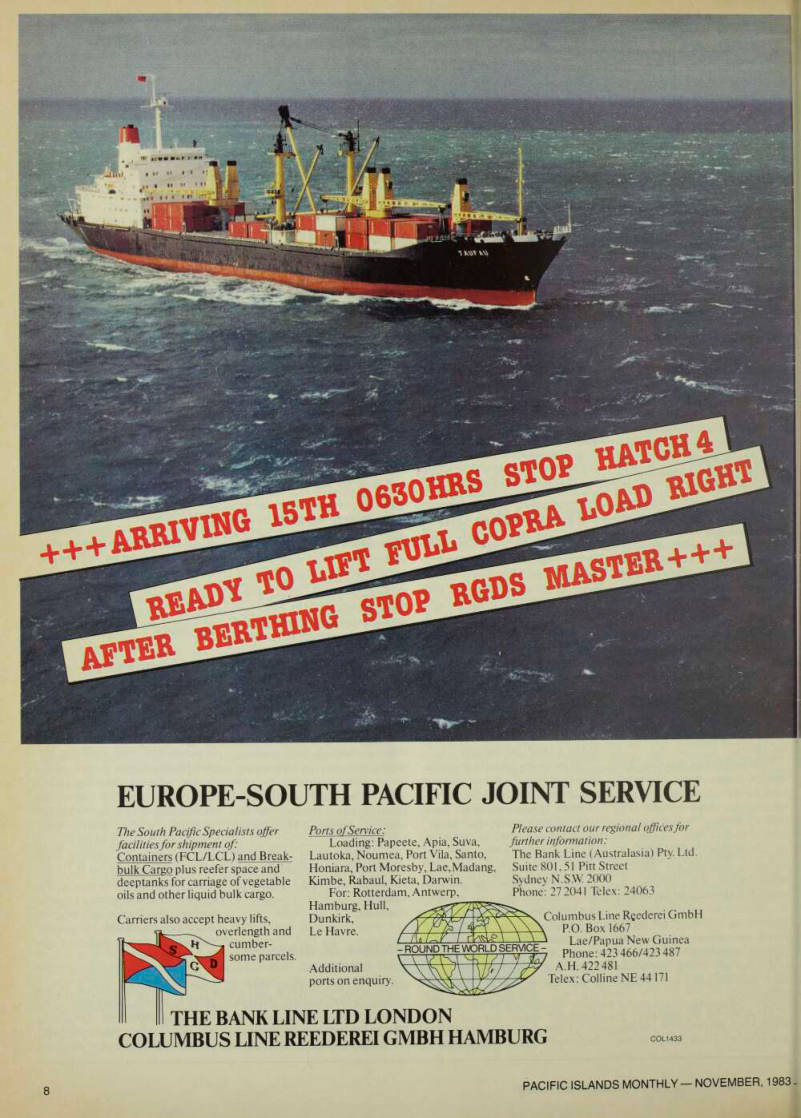
EUROPE-SOUTH PACIFIC JOINT SERVICE
The South Pacific Specialists offer facilities for shipment of: Containers (FCL/LCL) and Breakbulk Cargo plus reefer space and deeptanks for carriage of vegetable oils and other liquid bulk cargo.
Carriers also accept heavy lifts, overlength and cumbersome parcels.
GT«‘ Ports of Service: Loading: Papeete, Apia, Suva, Lautoka, Noumea, Port Vila, Santo, Honiara, Port Moresby, Lae,Madang, Kimbe, Rabaul, Kieta, Darwin.
For: Rotterdam, Antwerp, Hamburg, Hull, Dunkirk, Le Havre.
Please contact our regional offices for further information: The Bank Line (Australasia) Pty. Ltd.
Suite 801,51 Pitt Street Sydney N.S.W. 2000 Phone: 272041 Telex: 24063
Additional \\
ports on enquiry.
P.O. Box 1667 Lae/Papua New Guinea ROUND THE WORLD phone; 423 455/423 487 A.H. 422481 Telex: Colline NE 44171
THE BANK LINE LTD LONDON
COLUMBUS LINE REEDEREI GMBH HAMBURG
The quality and
efficiency you need
Australian
Hospital and Medical
Equipment
Australian hospital and medical equipment has gained a world wide reputation for its high standards of quality and operating efficiency. It is exported to over fifty countries. Typical of the equipment available are cardiac monitors, hospital beds and trolleys, surgical instruments and equipment, invalid aids, centrifuges, spirometers, sterilizers, automatic autoclaves and disposable plasticware. The range is a wide one, so check what Australia has to offer. And remember, Australia being so close also means quick delivery. ly%J For more information
Ask the Australian Trade Commissioner
Port Moresby: Phone 25 9333 Telex NE22109. Suva; Phone 31 2844 Telex FJ2126.
Honolulu: Phone (808) 524 5050 Telex 633128. Noumea; Phone 27 £414 Telex 087. *r ..r S fH •V ..a: ■ V X r \ r
Unanimous vote sounds death knell
Saipan: 23Rd South Pacific Conference
Unanimous vote sounds death knell of the old ‘CRPG’ club
The 23rd South Pacific Confer ence in Saipan in October will certainly occupy a place of note in the history of these confer ences, and of the South Pacific Commission itself.
The unanimous decision to ex tend full voting rights to all 27 member countries and territories at one stroke swept away a num ber of irksome old structures and practices, and “freed up” the conference atmosphere.
It was a decision clearly in line with the exhortation of Secret ary-General of the South Pacific Commission, Francis Bugotu, who in his opening remarks to the conference said that the com mission’s structure and future operations “must reflect the winds of change in the region and the world at large”, to bring to the islands of Micronesia, and to the region as a whole, new dimensions of hope in
development.
Previously, full voting rights
had only been enjoyed by the 13 member countries of the “CRPG” the Committee of
Representatives of Participating
Governments. These were: Aust ralia, Cook Islands, Fiji, France, Nauru, New Zealand, Niue, Papua New Guinea, Solomon Is lands, Tuvalu, United Kingdom, United States and Western Samoa.
These were the “in” countries, “the club” as some people at the Saipan conference were putting it.
Now, in its place, there is a “CRPG”, a Committee of Re presentatives of Participating Governments and Administra tions, in which all 27 states and territories (including Pitcairn Is lands, which never sends a repre sentative anyway), are on an
equal footing.
The 27 now become the Com mittee of the Whole, each mem ber with one vote, and also supersedes the old Planning and Evaluation Committee. The Committee of the Whole will meet at least four months before the annual conference as the sup
reme decision-making body of
the SPC, with the right also to
nominate the SPC’s principal officers.
The 27 members of the new Committee of the Whole are: American Samoa, Australia, Cook Islands, Federated States of Micronesia, Fiji, France, French Polynesia, Guam, Kiribati, Marshall Islands, Nauru, New Caledonia, New Zealand, Niue, Northern Maria na Islands, Palau, Papua New Guinea, Pitcairn Islands, Sol omon Islands, Tokelau, Tonga, Tuvalu, United Kingdom, Un ited States, Vanuatu, Wallis/- Futuna and Western Samoa.
The move to extend voting rights was first made in 1965, but was blocked by opposition from some of the 13 who did not want to give the vote to territories administered by the U.S. and France.
The 1983 change - embodied in a resolution submitted to the Saipan conference by Australia was welcomed as “a landmark decision” by Lieutenant- Governor Pedro A. Tenorio of
the host country, the Common wealth of the Northern Marianas.
Earlier, the lieutenant-governor had spoken of the “colonial men tality” reflected by the old CRPG, “which excluded more than one third of the countries concerned.” He said that “full and equal participation was needed to make the SPC the strongest and most effective or ganisation in the region.”
On the vexed question of amalgamation of the SPC and the South Pacific Forum, Papua New Guinea’s representative Paulias Matane called on conference par ticipants to “have the courage” to move towards a single regional organisation.
Mr Matane reaffirmed the de cision of the South Pacific Forum meeting in Canberra in August to consider a single regional organ isation for the Pacific.
He said the Forum decision provided for the first time a mechanism for genuine consulta tions among all Pacific nations and territories, as well as with the United States, Britain and France.
The conference secretariat urged that the next conference be held in Noumea, site of SPC headquarters, because of budget ary constraints.
The secretariat also urged adherence to the decision of the 12th South Pacific Conference that the conference be held at SPC headquarters in alternate years. The conference endorsed the view of the secretariat, but, at Western Samoa’s urging, agreed that some flexibility might be needed in implementing the rul ing of the 12th conference.
The representative of New Caledonia indicated the willing ness and desire of his administra tion to be associated with the preparations for the 24th conference.
The secretariat pointed out that financial responsibility for con ferences held at SPC HQ rests with the SPC, whereas the host country must bear additional costs whenever the South Pacific Conference is held elsewhere.
The conference adopted the
1984 work program, and the budget of almost $U52,800,000.
It also adopted proposals for a Community Education Training curriculum revision, and indi cated support for an extra budgetary project on dengue fev er and other insect-bome dis eases. This project was given strong support by representatives of Vanuatu and Tuvalu.
Other matters discussed in cluded rural employment promo tion, conservation of the tuna resources of the western and central tropical Pacific, and the South Pacific Regional Environ mental Program.
The nominations of Tamarii Pierre of the Cook Islands as director of programs, and of Vitolio Lui of Western Samoa as deputy director of programs, were ratified by the conference.
Speaking on behalf of the con ference, Paulias Matane of PNG thanked the outgoing director of programs William T. Brown of Australia for his contribution and dedication to the SPC and the region.
He also expressed his satisfac tion to see the top three SPC positions occupied by Pacific Islanders.
The report of the 1983 meeting of the Council of Pacific Arts was adopted, with the exception of the proposal to establish a post of cultural activities officer with in the secretariat. The representa tive of Australia expressed his government’s interest in hosting the 1988 Festival of Pacific Arts, which would coincide with his
country’s bicentennial
celebrations.
Funding arrangements for the SPC were discussed at the con ference. The metropolitan pow ers the U.S., U.K., France, Australia and New Zealand agreed to continue meeting 92.266 per cent of SPC financial requirements.
The remainder would be paid by Island member countries, pro bably on the basis of a per capita income calculation. The new funding arrangements would come into effect from January 1, 1985.
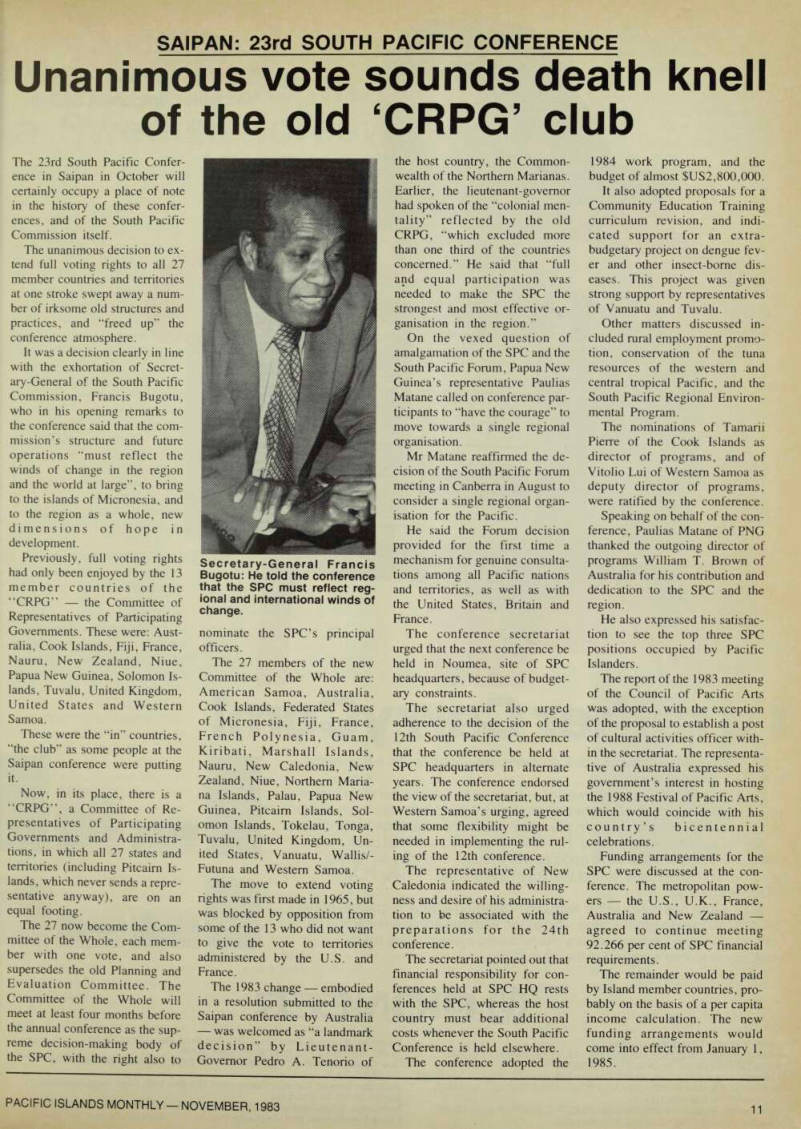
Secretary-General Francis
Bugotu: He told the conference that the SPC must reflect reg ional and international winds of change.
Advertisements & other items, p. 12 (1 item)
I’d rather Carry Com!
B
CK-7T
Omm*
Portable Component System
I’d rather Carry Com!
Why? Because it packs like a portable, yet unpacks like a true home hi-fi component system.
So I have the best of both worlds—a home hi-fi and a portable hi-fi, and the sound is great no matter where I play it. And because each of the components is separable, I can place the speakers where they sound best.
Carry Com is also powerful. The CK-11T has 220 watts of peak music power. All three models have good power though, and they all have a beautiful and deep bass sound thanks to the unique Pioneer FLAT WOOFER design.
Carry Com has many other features, including a 5-band graphic equalizer, that add up to great sound, and along with the convenience of it all, I really don’t see the need for any other stereo system. Now that’s sensible. And that’s why I’d rather Carry Com.
H rllllll :illlli
||ffl
CK-11T
CK-5F
Cfi PIONEER*
For further information, please contact: Australia: Pioneer Electronics Australia Pty. Ltd. (Incorporated in Victoria), P.O. Box 295, Mordialloc, Victoria, 3195 Tel: 580-9911 Fiji Islands: Brijlal & Company, G.P.O. Box No. 362, Suva, Fiji Islands Tel: 22258 New Zealand: Monaco Distributors Ltd., 2 Poland Road, Glenfield, Auckland, New Zealand Tel: (09) 444-9144 Norfolk Island: Burns Philp (Norfolk Island) Ltd., P.O. Box 21, Norfolk Island Vanuatu: Burns Philp (Vanuatu) Ltd., Vila, Vanuatu Nauru Island: Jacob Enterprises, P.O. Box No. 4, Republic of Nauru Tahiti: Tahiti Hi-Fi, P.O. Box 848, Papeete, Tahiti New Caledonia: Menard Pacifique Sari, B.P. 3899, Noumea, New Caledonia Tel: 27.62*23 American Samoa: Transpac Corporation, P.O. Box 1477, Pago Pago, American Samoa 96799 Tel: 633-5224 T Rarotonga: South Seas International Ltd., P.O. Box 49, Rarotonga, Cook Islands Tel: 232 Papua New Guinea: Bali Merchants Pty. Ltd., P.O. Box 6103, Boroko Tel: 254887
a Swedish forest
The Month
Bounty lurks in a Swedish forest
Smoland province in southern Sweden, from which we have just returned after a much-needed two-month holiday, is a rugged sort of place, covered with dense pine and fir forests, and in habited by elks, trolls and giants.
The soil is poor and strewn with stones and rocks, which genera tions of farmers have toiled to clear evidence of their labors is to be seen all around in the cairns and stone walls around the scattered fields.
All this helps to explain why, in the 19th century, when Ameri ca and Australia shone as pro mised lands for the poor and downtrodden of Europe, Smo landers contributed heavily to the Swedish component of European emigration. Except along the Baltic coast, Smoland is also among the most unpromising places for any kind of maritime activity.
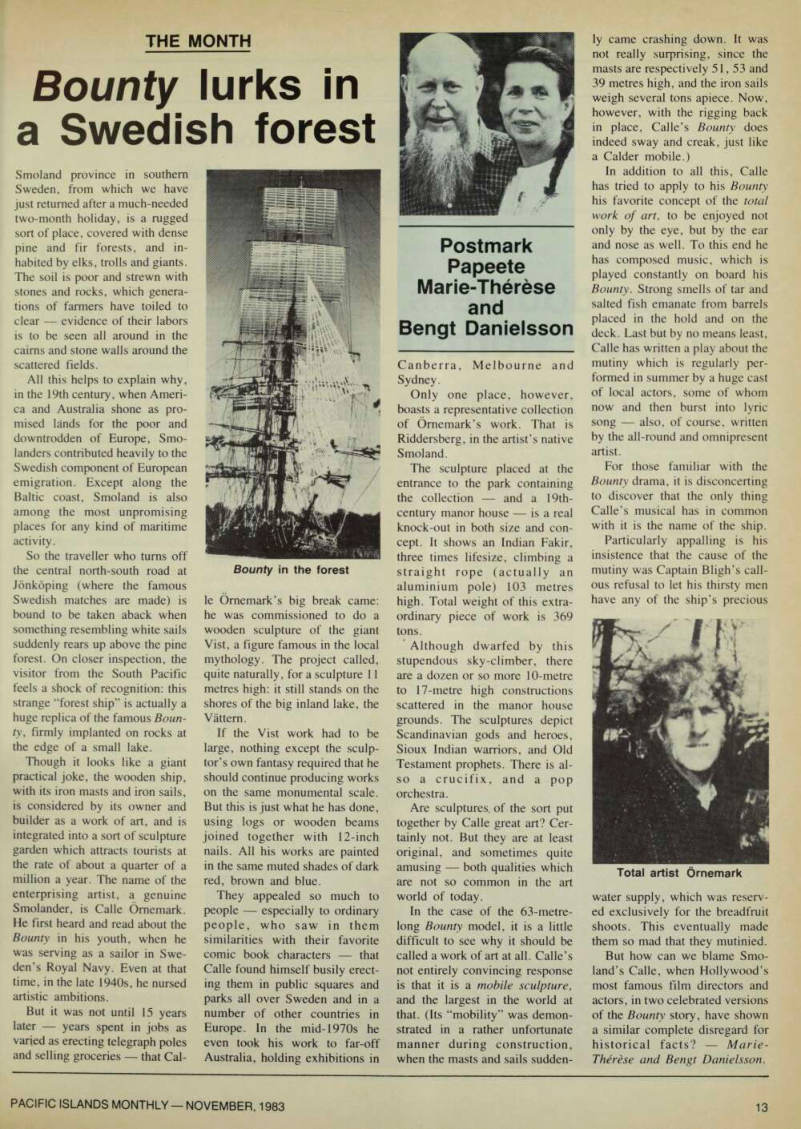
So the traveller who turns off the central north-south road at Jonkoping (where the famous Swedish matches are made) is bound to be taken aback when something resembling white sails suddenly rears up above the pine forest. On closer inspection, the visitor from the South Pacific feels a shock of recognition; this strange “forest ship” is actually a huge replica of the famous Boun ty, firmly implanted on rocks at the edge of a small lake.
Though it looks like a giant practical joke, the wooden ship, with its iron masts and iron sails, is considered by its owner and builder as a work of art, and is integrated into a sort of sculpture garden which attracts tourists at the rate of about a quarter of a million a year. The name of the enterprising artist, a genuine Smolander, is Calle Omemark.
He first heard and read about the Bounty in his youth, when he was serving as a sailor in Swe den’s Royal Navy. Even at that time, in the late 19405, he nursed artistic ambitions.
But it was not until 15 years later years spent in jobs as varied as erecting telegraph poles and selling groceries that Cal-
le Omemark’s big break came: he was commissioned to do a wooden sculpture of the giant Vist, a figure famous in the local mythology. The project called, quite naturally, for a sculpture 11 metres high: it still stands on the shores of the big inland lake, the Vattem.
If the Vist work had to be large, nothing except the sculp tor’s own fantasy required that he should continue producing works on the same monumental scale.
But this is just what he has done, using logs or wooden beams joined together with 12-inch nails. All his works are painted in the same muted shades of dark red, brown and blue.
They appealed so much to people especially to ordinary people, who saw in them similarities with their favorite comic book characters that Calle found himself busily erect ing them in public squares and parks all over Sweden and in a number of other countries in Europe. In the mid-1970s he even took his work to far-off Australia, holding exhibitions in
Canberra, Melbourne and Sydney.
Only one place, however, boasts a representative collection of Omemark’s work. That is Riddersberg, in the artist’s native Smoland.
The sculpture placed at the entrance to the park containing the collection and a 19th century manor house is a real knock-out in both size and con cept. It shows an Indian Fakir, three times lifesize, climbing a straight rope (actually an aluminium pole) 103 metres high. Total weight of this extra ordinary piece of work is 369 tons.
Although dwarfed by this
stupendous sky-climber, there are a dozen or so more 10-metre to 17-metre high constructions scattered in the manor house grounds. The sculptures depict Scandinavian gods and heroes, Sioux Indian warriors, and Old Testament prophets. There is al so a crucifix, and a pop orchestra.
Are sculptures, of the sort put together by Calle great art? Cer tainly not. But they are at least original, and sometimes quite amusing both qualities which are not so common in the art world of today.
In the case of the 63-metre long Bounty model, it is a little difficult to see why it should be called a work of art at all. Calle’s not entirely convincing response is that it is a mobile sculpture, and the largest in the world at that. (Its “mobility” was demon strated in a rather unfortunate manner during construction, when the masts and sails sudden
ly came crashing down. It was not really surprising, since the masts are respectively 51, 53 and 39 metres high, and the iron sails weigh several tons apiece. Now, however, with the rigging back in place, Calle’s Bounty does indeed sway and creak, just like a Calder mobile.) In addition to all this, Calle has tried to apply to his Bounty his favorite concept of the total work of art, to be enjoyed not only by the eye, but by the ear and nose as well. To this end he has composed music, which is played constantly on board his Bounty. Strong smells of tar and salted fish emanate from barrels placed in the hold and on the deck. Last but by no means least, Calle has written a play about the mutiny which is regularly per formed in summer by a huge cast of local actors, some of whom now and then burst into lyric song also, of course, written by the all-round and omnipresent artist.
For those familiar with the Bounty drama, it is disconcerting to discover that the only thing Calle’s musical has in common with it is the name of the ship.
Particularly appalling is his
insistence that the cause of the mutiny was Captain Bligh’s call ous refusal to let his thirsty men have any of the ship’s precious
water supply, which was reserv ed exclusively for the breadfruit shoots. This eventually made them so mad that they mutinied.
But how can we blame Smo land’s Calle, when Hollywood’s most famous film directors and actors, in two celebrated versions of the Bounty story, have shown a similar complete disregard for historical facts? Marie- Therese and Bengt Danielsson.
Bounty in the forest
Postmark Papeete Marie-Therese and Bengt Danielsson
Total artist Ornemark
Games doubters
The Month
Games doubters eat their words
country’s spirited pride which inevitably at that time was hav ing nothing better to do. No country more nationalistic and proud of it. How can anyone explain why all the stones along both sides of the road from Faleolo Airport to Apia had all of a sudden been painted white? No order had been given for this to be done_ And the volunteer workers who day and night make the guests not wanting. A catalyst
called devotion-to-country kept
them on their feet. But scattered devotions are unorganised and would have achieved little.
The games’ organising com mittee under Seiuli Paul Wall work did its job well. The effort behind all this must have been threatening to crumble.
There were also those who negotiated outside assistance which made the host of the games possible. The government of Tofilau Eti played its part well.
And the former government of Tupuola Efi did its bit too. It
So, it’s all over. And what an event. Two weeks of such pro found rapture and agony. It was Western Samoa’s moment to re member. A remarkable experi ence firmly imprinted in the country’s memory.
Western Samoa had not seen so many different people at any one time. Hundreds of them with different cultural backgrounds and modes of thinking came to gether in a friendly gathering to do honor to an interest they all share: sports.
Over the last two weeks, they engaged in fierce competition.
Yesterday afternoon, the winner
and the loser hugged and em braced. This is what the South Pacific Games is all about.
From its beginning to its end ing yesterday in an emotional ceremony at the Apia Park Stadium, the 7th South Pacific Games has been a huge celebra tion of Western Samoa. It was the final eradication of bother some doubts that it could host the games.
Those doubts have been quiet ly withdrawn. But perhaps the biggest doubter, departing Presi dent of the South Pacific Games Council, Commander Stan Brown, has had to publicly regret his.
At the games’ closing cere mony, he had nothing but praises to tell.
But the hosting of the games was largely the making of the
PlM’s Western Samoa cor respondent SANO MALI FA has been ill, and was unable to contribute our promised review of the 7th South Pacific Games held in Apia in September (PIM, Oct. pH).
For the next best thing we have decided to print in full the editorial in Mr Malifa’s newspaper The Samoa Ob server, of September 17, the day after the Games closing ceremony.
Mr Malifa brought out a special daily issue of The Observer for the duration of the Games. The paper is usually a weekly. All the daily issues are now avail able in bound form. They constitute a remarkable souvenir of the event. In quiries to the paper at P.O.
Box 1572, Apia.
initiated the negotiations for the biggest outside assistance from the People’s Republic of China which the present administration followed up on.
Canada, New Zealand, Aust ralia and the United States made contributions. Local companies, organisations and clubs made theirs. Individuals gave of their time.
Others gave the best in monet ary donations they could. And all so that the games could be held in Apia. The games have been held and how well they went!
But all the preparations would have achieved no purpose had not the countries of the region felt strongly of sport as the force binding the region together in good fellowship. We hope that the officials, athletes and guests had enjoyed their stay in Western Samoa and trust they would return.
Samoa Report
Sano Malifa on Western Samoa
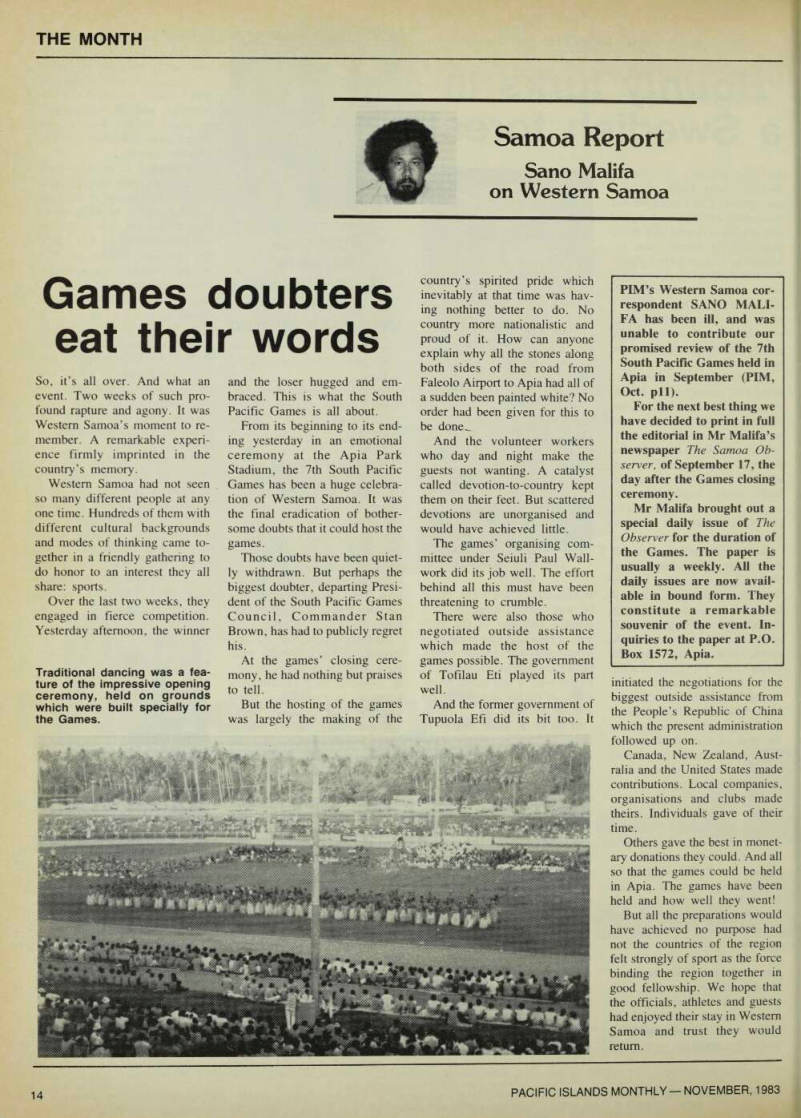
Traditional dancing was a fea ture of the impressive opening ceremony, held on grounds which were built specially for the Games.
splits IF parties

Senate election splits IF parties
The RPCR (Republican) party’s Dick Ukeiwe won New Caledonia’s September 25 Se nate election on the first round of a three-cornered race. Under an electoral college voting system, Mr Ukeiwe gained 173 votes, with outgoing Senator Lionel Cherrier (FNSC, and supported by three of the Independence Front (IF) parties, Union Caledonienne, FULK and PSC) getting 114, and Kapea Nepamoindou, candidate of two of the IF parties, LKS and UPM, scoring 32. There were three abstentions and two invalid votes.
New Caledonia has two de puties and one senator in the French Parliament, and Mr Ukeiwe’s win gives the anti independence RPCR two of these posts.
Speaking to the press before the election, Mr Ukeiwe said his candidature marked the RPCR’s desire to participate in French institutions, and their primary objective of remaining within the framework of the French Republ ic. Staying with France, Mr Ukeiwe said, “one stays with the liberty, security and peace of the Republic, which permits the peaceful coexistence of all races in New Caledonia.”
There would be no progress and benefit for New Caledonia without the French presence, he added.
On the question of the auton omy statute proposed by France, and due to be brought to the territory in November by Minis ter for Overseas Territories Georges Lemoine, Mr Ukeiwe said the RPCR position was “yes” to decentralisation, but a
firm “no” to any statute which could be a transition to independ ence. “Political autonomy is the antechamber to independence,” he said. “We note that all of France’s former territories who were given statutes of internal autonomy then went on to inde pendence to leave the French Republic. We want to be the window of French culture in this part of the South Pacific,” he added.
Problems within the IF deepened with their split over strategy for the Senate election.
Secretary-general of the UC, Eloi Machoro, said that the IF felt that the election was of only
relative importance, and they
preferred to concentrate on work
ing towards independence. Hop
ing to block a win by the RPCR, he called on the IF parties to support Lionel Cherrier. (Mr Cherrier of the FNSC took over the Senate post following the death of his then coalition partner Henri Lafleur not long after the 1974 Senate election).
Mr Machoro said that support for Cherrier did not put in doubt the objective of Kanak socialist independence, and would de monstrate that the IF was not racist.
However, at the eleventh hour, the IF parties LKS and UPM put up former priest Kapea Nepamoindou, saying it was “unthinkable” that the Front should not be contesting the elec tion. LKS leader Nidoish Nais seline said that by supporting the Centre party, the FNSC, the IF was playing into the hands of the French Government, which hoped to achieve a consensus for autonomy, and to isolate both the
hardline “departmentalists” of the RPCR, and the radicals of the IF. With Ukeiwe, one of the moderates from the RPCR, and Cherrier, a pro-autonomist, con testing the Senate seat, IF voters would be forced to abstain, Mr Naisseline explained. Moreover, he said, for the IF not to present a candidate would be to destroy its credibility, and to deny its claim for Kanak socialist
independence.
Shortly after his election vic tory, Mr Ukeiwe left to take up his Senate seat. Before leaving he clarified his party’s views on the statute of autonomy. He said that the RPCR was very clear in rejecting any statute which per mits the separation of New Caledonia from France. “Like all French people we want a maximum of decentralisation and deconcentration this is jus tified by our distance and isola tion from France. We are not against managerial autonomy, but we are opposed to any statute of transition, any step towards
independence.”
However, one of the results of the Paris round table discussions in July, which were attended by all groups, was the statement from France that the forthcoming statute would be “specific,
evolutionary, and transitory.”
The RPCR did not sign the state ment, and Mr Ukeiwe told PIM that they would prefer to see details of the statute before giv ing a clear “no” to it.
Recriminations between the two IF factions continued after the election, with Mr Machoro accusing Naisseline’s LKS of “treason,” and trying to usurp the UC’s position as the major party in the Front. Mr Naisseline maintained that the Front’s prob lems were more a question of ideology, and that as an umbrella group the Front had never come to grips with the deeper ques tions. (The LKS and the UMP
are against the plans of UC, FULK and PSC for independ ence in 1984, saying that the Front and the country are not adequately prepared for it).
Mr Naisseline claimed that the FNSC had on several occasions “blackmailed” the Front in the course of their 17-month partner ship, and that Mr Nepamoindou had been the original choice as candidate of the IF.
The UC’s steering committee, which met in early October, de cided that the question of a cen sure motion against the LKS and UPM should be left until the UC’s annual conference, which was due to be held on Ouvea Island in late October. What they did decide, Mr Machoro said, was that they would carry on with their own plans towards independence, and that those parties of the Front which were prepared to work with them could do so. As far as the Front was concerned, the UC, FULK and PSC would continue to exist as the IF, but the other two parties were not excluded, and would be welcome at weekly
meetings.
Mr Machoro explained that the UC conference would work on a precise calendar for independ ence, with 1984 to be the year of transition. The membership and future of the Front would be reviewed at this conference, Mr Machoro added. (The five parties came together as the IF in 1979, with a loose common platform aiming at Kanak socialist
independence).
LKS spokesmen told PIM that they had no plans to resign from the government council, and they were “always ready for a frank and deep ideological debate with the other parties, and would con tinue with their emphasis on the economic development of the country”.
Problems within the Front were once again touched upon by
Noumea Notebook Helen Fraser
Mr Machoro in his speech at the graveside of murdered UC sec retary-general Pierre Declercq on the occasion of the second an niversary of his death. Mr De clercq was murdered at his sub urban Noumea home on Septem ber 19, 1981.
In summing up the last year’s political activities, Mr Machoro said the IF suffered from a lack of co-ordination, a lack of self confidence, and also a lack of political maturity.
Over 500 people attended the memorial service at the tribal
area of La Conception where Mr Declercq is buried. A religious service was followed by a silent march to the graveside, where speeches recalling Mr Declercq’s life and political activity were given by Roch Pidjot, IF deputy to the French Parliament, Chris
tian Burck, president of the De clercq Memorial Committee, and Eloi Machoro.
Although two men were ar
rested following Mr Declercq’s
murder, both have been released on bail, and no date has yet been
set for a trial.
Helen Fraser.
Advertisements & other items, p. 16 (1 item)
“I hate National!’
r I’m so doggone mad.
And lonely. Ever since the family bought National’s new Cinema Vision TC- 4000A 102 cm [Type 40} color projection TV my life has been miserable. Oh they still feed me of course and walk me twice a day, but I just don’t get all the love and affection I used to before the TC-4000A.
Every night the whole family gathers around that huge TV and watches a movie.
The picture’s so sharp and bright, and big and wide [6O degree visibility from either side of center screen}. And the sound’s so rich and realistic through its powerful 2-way, 4-speaker system. They all say the TC-4000A is like having a private cinema at home. Mom even makes fresh popcorn.
Audio and video in/out terminals let Dad connect the TC-4000A directly to the video cassette recorder, video disc player and the hi-fiso the family never runs out of great things to watch.
And no one even gets up to change the channel—a 32 key wireless dual [TV and National VCR} remote control unit does almost everything from anywhere in the room.
On weekends, Dad watches sports, sports, sports. He says it’s like being right on the playing field. And the kids watch those wildlife shows. I hate them the most. The animals look so big and real, I get scared half to death.
National —why did you have to invent the
TC-4000A?
Simulated picture
S National
National, Panasonic and Technics are the brandnames of Matsushita Electric.
way up ..
‘Santo is on the way up ..
The Vanuatu Military Force band played; church leaders read from the Bible and preached on the duties of leaders and citizens; custom dancers invited all who felt like it to join in with them; a public barbecue and feast was open to all comers on the water front: a limited local govern ment, covering the islands of Santo and Malo, was being opened at Luganville.
Luganville, the main town on the northern island of Santo, and often itself called just “Santo,” or Santo Town, or simply Canal, on September 21 was full of visitors from all over the island and dignitaries from other islands to take part in the opening. Usually it is a quiet town, though of great charm, with many rewards for the enterprising traveller. Not too enterprising, though; at the time of the opening of Local Govern ment Council, some unlucky (and unthinking) yachties loosed off a few rounds of ammunition in the north of the island, and found themselves in Luganville’s court, charged with killing a valued pig. The week after the opening, the charge was dismis sed for lack of evidence, and the celebrating yacht beat a swift retreat, doubtless reflecting on the folly of shooting uninvited on unknown property. Other
visitors, meanwhile, were enjoy ing more obvious attractions the beautiful surrounding beaches, including exquisite Champagne Beach, the relics of World War 11, and the restaur ants few, but well worth seeking out.
But Luganville is not primarily a tourist town. It is a hard working port, a business town and, now more than ever, a political centre. It was the scene of much turmoil in the 1980 secession attempt, and only slightly to the north, at Fanafo, is the home of the Nagriamel polit ical movement. The island and the town have strong representa tion in both the governing Vanuaaku Pati (VP) and the op position Union of Moderate Par ties (UMP), and Luganville is home to the newest sizeable political party in the country, the Vanuatu Independent Alliance Party (VIAP).
This party, formed last year by disaffected VP parliamentary members, is campaigning vigor ously around Santo villages, but is not envisaging itself as becom ing a governing party after the November elections. Its newly published platform reflects this, referring to an “Alliance-backed government”, which suggests they look to forming a coalition
with the UMP. Their platforms are similar, though with some significant differences both, for example, want to reintroduce freehold title to land, but the UMP would restrict this to citi zens, and the VIAP to indigen ous ni-Vanuatu.
The party’s electoral perform ance in Santo will be an interest ing indicator of how far VP ranks have been split, now that the major goal of independence has been achieved, and of how far UMP voters will be lured away by a party that is based a little closer to home.
The new Local Government Council is made up of members of all major political parties, and some smaller ones, such as the Fren Melanesia party. Its presi dent, Dr Titus Path, is a member of the VP, and in his speech he welcomed this return of power to local people, referring to the years of colonialism, of con dominium rule and of post independence centralised rule that had intervened since Santo people last were in control of their own advancement. The 11 LGCs that have been set up cover the entire country, and devolve many administrative and some legislative powers, in accordance with the constitution and the De centralisation Act of 1980. The process of decentralisation was begun two years ago in the south, and was completed on October 7, when Efate Local Government Council was opened. The LGCs are responsible for the prepara tion and implementation of reg ional development plans, for the
collection and spending of head tax and licensing taxes, for the location and construction of schools, clinics, bridges and other infrastructure, and for legislation for the local area to carry out their duties.
These powers will bring the council much closer to the daily business life of Luganville than is the national government. The business community will be looking to the council to back up efforts made by the municipality and the newly formed Chamber of Commerce to foster economic development in the town and the region. This should not be hard; Luganville has great infrastruc tural and natural advantages a
developed network of shipping
and telecommunications, for in stance, and abundant land and manpower. However, the town is
only just recovering after three
almost static years, after the de structive looting and resultant loss of cash during the secession attempt. The last few months have seen an improvement in turnover, and there is a concerted attempt by the municipality and business community to encour age it.
The municipality has estab lished an industrial estate, not just as part of its town planning, but also as an aid to overseas investors who might feel hesitant about negotiating their own leasehold with custom owners.
Blocks already taken up on the estate accommodate companies as diverse as a soft drink bottling plant and a specialty timber mill.
Town Clark William Edgell,
Report from Vanuatu Julie-Ann Ellis
who is also president of the Chamber of Commerce, says: "I feel confident that within my two years here we’ll have it all work ed out.”
There is also great interest in developing tourism in Santo. At present, most of Santo’s tourists are divers, interested in diving the largest accessible wreck in the world, the President Coolidge, as well as other histor ical relics. However, the Cham ber of Commerce feels there are
possibilities for much greater tourist use. Tour guides have been trained, village leaders have been consulted about extending tourism beyond town limits, and extension of facilities, such as a new 100-bed hotel (the town has two hotels already), has been written into the regional develop ment plan.
But the real wealth of Lugan ville rests on its agricultural hin terland the island of Santo is indisputably the richest in
Vanuatu. Indeed, it is so rich that its development is a matter of national, and not just regional, importance. Thus, the national government, and probably over seas aid, will be involved in the longer-term development plans the replanting of old planta tions and establishment of new ones, the rebuilding of an oil mill and the upgrading of wharves and port facilities, among others.
Luganville’s real financial po tential is only just emerging. The
people who live there still feel some of the impact of the 1980 troubles. Nevertheless, with the return of business confidence and with the formation of the Local Government Council, there is a feeling of optimism about the future, expressed with character istic diffidence. When I asked people how they felt about Santo now, almost everyone gave the same answer: “Santo i kam antap smol.” (“Santo is on the way
up.”)
Julie-Ann Ellis
Advertisements & other items, p. 18 (1 item)
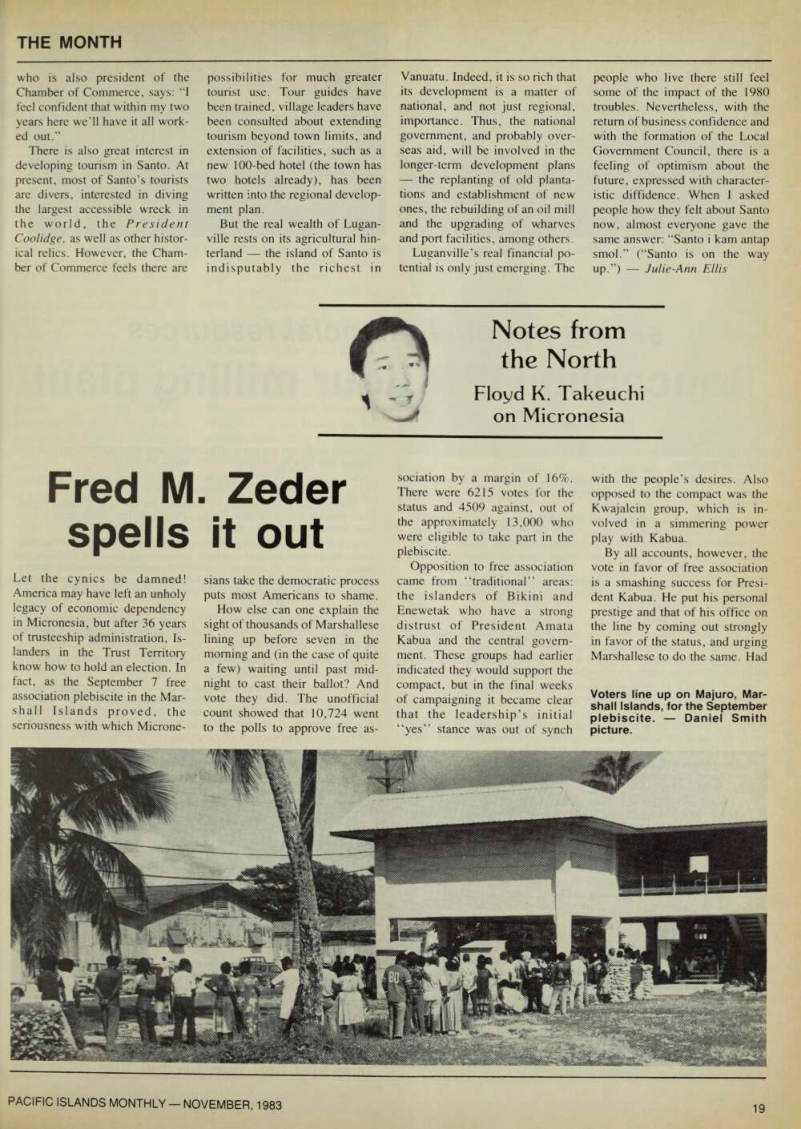
L Services Reach Out
THOUSANDS OF MlLjg| IN OUR PACIFIC
IT’S WHERE WE WOR
I Hawaii WGuam / Ponape Kiribati W Nauru \W r <' Christmas I v.
Solomon Islands Tuvalu Western y Samoa '"r Rotuma Q American * Samoa mm . 'i T m
P^^IMEL
INDUSTRIAL AND MARINE ENGINEERING LTD
P.O. Box 172, Suva, Fiji. Telex: FJ2195, Fiji.
Phone: 311288 Suva.
Wherever there's engineering work happening in the South Pacific, whether its repairing a boiler in Ponape, constructing steel storage tanks in Tahiti, or replacing a refrigerator system in Papua New Guinea, chances are there's an IMEL team doing the job.
For not only is IMEL the largest shipyard in the region, but it also provides one of the widest selection of engineering services in the South Pacific.
And since we are located in Suva, the capital of Fiji, we can provide immediate service at very competitive prices, and this includes heavy engineering, foundry work, precision machining, air conditioning and refrigeratioi services, sheetmetal work, electrical, joinery, and an extensive selection of steel supplies as well as ships chandlery and marine hardware. If you want a ship built or repaired , or have a heavy engineering problem t( be solved, turn to the workshop of the South Pacif turn to IMEL.
"The Complete Engineerinc and Shipbuilding Company of the South Pacific."
spells it out

Fred M. Zeder spells it out
Let the cynics be damned!
America may have left an unholy
legacy of economic dependency
in Micronesia, but after 36 years of trusteeship administration, Islanders in the Trust Territory know how to hold an election. In fact, as the September 7 free association plebiscite in the Marshall Islands proved, the seriousness with which Microne-
sians take the democratic process puts most Americans to shame, How else can one explain the sight of thousands of Marshallese lining up before seven in the morning and (in the case of quite a few) waiting until past mid night to cast their ballot? And vote they did. The unofficial count showed that 10,724 went to the polls to approve free as
sociation by a margin of 16%.
There were 6215 votes for the status and 4509 against, out of the approximately 13,000 who were eligible to take part in the plebiscite.
Opposition to free association came from “traditional” areas: the islanders of Bikini and Enewetak who have a strong distrust of President Amata Kabua and the central govern ment. These groups had earlier indicated they would support the compact, but in the final weeks of campaigning it became clear that the leadership’s initial “yes” stance was out of synch
with the people’s desires. Also opposed to the compact was the Kwajalein group, which is in volved in a simmering power play with Kabua.
By all accounts, however, the vote in favor of free association is a smashing success for Presi dent Kabua. He put his personal prestige and that of his office on the line by coming out strongly in favor of the status, and urging Marshallese to do the same. Had
Notes from the North Floyd K. Takeuchi on Micronesia
Voters line up on Majuro, Mar shall Islands, for the September plebiscite. - Daniel Smith picture.
the vote gone the other way, it would have signalled a remark able loss of power and influence for the leader.
But with his victory under his belt, Kabua goes into this month’s Nitijela (parliament) elections with considerable momentum. Indeed, it is difficult to see how the opposition has any real chance of boosting its al ready limited influence. And un less something happens to Kabua a serious illness, for example he now appears to be in a good position to dominate Mar shallese politics perhaps to the end of the century.
With the “firm” political situ ation in the Marshalls, with the solid yes vote for free association in the Federated States of Mic ronesia, and with the Northern Marianas becoming increasingly impatient to become an Ameri can commonwealth, the Reagan administration is going ahead and seeking separate termination of the trusteeship.
That will leave only Palau, which continues to muddle along with its internecine political problems. Palau’s situation is so uncertain one hesitates even to hazard a guess as to what might happen. Yet given the Palauan penchant for not wanting to be last, it would not be surprising to see the squabbling in those is lands end as the other four Mic ronesian entities near their termi nation deadlines.
That’s so not only from the standpoint of national pride something which the Palauans have in abundance but also from the fact that free association will mean that the fiscal flood gates are going to be opened up as never before. The sight of the rest of their Micronesian brethren enjoying the benefits of relative ly unrestricted American funds may be just the tonic to cure the current Palauan political malady.
What is Washington’s view at this critical juncture? U.S. Am bassador Fred M. Zeder 11, Presi dent Reagan’s special representa tive to the Micronesian political status negotiations, recently spent an hour with Pacific Is lands Monthly discussing current issues. Zeder’s style is straight fward; “Everything is on re cord.” That comes from his background as a very successful
businessman; he made his mill ions in Texas oil and his latest venture (which someone else is running while Zeder’s in office) is a pleasure boat service catering to Hawaii’s tourists. Zeder’s self-confidence is such that when he’s with his diplomatic corps aides, they’re usually on edge wondering what “the old man” will say next.
Zeder was alone when he spoke with PIM. Some quotes from the conversation: On a timetable for getting the free association agreements through the U.S. Congress: “What we’re trying to do is get the Senate to take action prior to the Christmas recess . . . We have good support in the Senate and we’re not anticipating any real problem there. The same thing, too, in the House (of Re presentatives). It is going to be very difficult for representatives ... to vote against the will of the people of Micronesia. They have in properly conducted plebiscites expressed their desire to enter into this relationship of free association and I can’t anti cipate any congressman or senator saying, ‘No, we prefer to deny them that right’.”
On the American desire to seek separate termination of the trusteeship: “It’s just really not fair (to wait until the Palauan situation is settled) to the vast majority of people in Micronesia . . . We’re just going to have to move ahead.”
On the Palauan stalemate: “There’s just really a handful of people holding this up in Palau . . . What I’ve told them this time is that I wanted them to convene their House of Dele gates and their Senate and seek a solution that they agree . . .
Wrap this thing up. Get a pack age. Get everyone on board and say, yes, this is what we want to do, and then bring it to us.”
On the fate of the July com promise which was thought to be a way around Palau’s constitu tional prohibitions against nuc lear material, but which was defeated by the Palauan Senate: “We haven’t heard from the House of Delegates on that. We heard from their Senate . . .But it was a solution . . . They have discussed going back and having
another vote, a referendum. We don’t believe, and we continue to hold fast to our position, that another plebiscite is not neces sary . . . But if a referendum was required, it’s an internal prob lem, if that’s the solution they are going to have to find it. But again, the United States is not going to tell them what to do. We didn’t write their constitution for them, and we’re not going to be put in a position where we’re falsely accused of trying to dic tate to them, and we don’t.”
On Palau’s leadership: ‘‘l wouldn’t characterise the Palauan’s relationship with the United States as duplistic. I think they are acting very Palauan.
This is the way they do business, and they always have. I don’t think there is anything immoral
or indecent.lt’s annoying . . .
it’s certainly a little frustrating.
But that’s the way they operate. I don’t believe you can apply the way we do business in the United States with the way things are done all through Micronesia. It’s the style.”
On the ability of Palau’s lead ership to deliver on promises made to the United States: “They haven’t demonstrated their ability so far.”
On the prospects for develop ing a strong economic base in Micronesia during the free as sociation period: “I happen to be very optimistic about the possi
bility of a viable economy being established in Micronesia ... I think it can be done, I think it can be done out here. If you’re given 40 per cent of $2.5 to $3 billion to start a business (what free association will provide during the life of the agreements), say this is seed money, here’s some equity to start a business, you know I think you can start a business any place in the world for 125,000 people with that kind of seed money. And I don’t think you have to be very smart to do it. I know seven or eight deals right now that could cut it for them. Sea mining is a big deal for them, and there’s a hell of a lot of cobalt out there. There are people who are interested in go ing after it. There are a number of business opportunities that ex ist today in Micronesia if they get their act together that they can take advantage of. One of the things that disturbs me about what’s happening in Palau right now is that you don’t want to put major investment in an unstable area. If they get a reputation for having an unstable government where they’re burning up each other’s houses and throwing bombs at each other industry
Aet, yes; jab, no - and the acts have it. Tallying island votes on Majuro during the September plebiscite. - Daniel Smith picture.
isn’t interested in going in there.”
On the annual rent the U.S. pays to the Kwajalein landow ners: ‘‘When I negotiated that lease for Kwajalein in 1976 (when Zeder was with the Ford administration) ... I thought I did a lousy job because we al ready had it for $650,000 (a year) for 99 years. We came back and agreed to give them $72,000 a year to lease Kwaja lein. During the Carter administ ration, somehow or other, that got up to $9 million a year and there’s no accounting for a nickel of that money. I have asked time and time again for the Kwajalein landowners to give an accounting on what they spent it for, what they do. They’ve never spent any real money on cleaning up Ebeye, and the money is there.
All they do is complain that it is a cesspool ... I hope that (Mar shalls President Amata) Kabua will not demand that the Kwaja lein landowners account for this Defense Department funding . . . They promised me they
would give it to me. they said, ‘Oh, you want an accounting of what we do with the money.’
Three times they’ve told me that ‘Well, we’ll send it next week, you know.’ They never have; Kabua has never had an account ing. I notice they (the Kwajalein leadership) fly first-class all over and they buy condominiums here in Honolulu, but they are not doing very much for their peo ple, and that’s wrong.”
On U.S. reaction to the possi bility of the Bikinians buying beachfront land on the Hawaiian island of Maui to resettle: ‘‘l think we’d have to think a long time before we’d continue any additional support. The (free as sociation) agreement right now, as far as the Bikinians are con cerned, is a good agreement for them. You’ve got only 1000 of them, and they’ve got $lOO mill ion plus, so they get $lOO,OOO a piece. They’ve got 10 members of each family, so they’ve got $1 million for each family. They ought to be able to get by on
that.”
Floyd K. Takeuchi.
Roncaglia OPR flour milling plant
saving national financial resources
manufactured in Modena. Italy
MILLING HAS made great advances in the last thirty years in the area of in creased productivity.
Systems have come and gone, changed and been remodelled. But all the systems have been remodelled on the same basis and principle, that is the tra ditional system.
However, the House of Roncaglia have broken away from this tradition and have advanced milling technology by the use of pneumatics for sieving.
This advanced technological advancement has enabled the House of Ronca glia to perfect a milling system the net result of which is the magical, modular RONCAGLIA OPR Flour Mill.
Using air in the sieving system whereby the product to be sieved is air-lifted and passed through durable nylon mesh has completely eliminated the use of elevators and traditional plan-sifters.
As a direct result of this marvellous invention the size of the mill building has been reduced from the 6 storey building necessary for the traditional mills to a single block only 5 metres high. This on its own has reduced building capi tal requirement in monetary value by at least 70 per cent, unlike in the traditio nal system where the bigger the capacity, the higher the building.
The RONCAGLIA OPR needs only a single block 5 metres high, regar dlees of the capacity, be it 10 or 1,000 tons.
By virtue of the fact that only a block is required to house the plant, the RONCAGLIA OPR Flour Mill can be sited anywhere regardless of the preva lent or geological and seismic conditions. Such is the versatility of the RON CAGLIA OPR that it can be sited anywhere, where it will give the miller opti mum convenience and hence drastic savings in bringing in of raw materials (such as wheat, maize, oat, barley, rice, rye, sorghum, millet, etc) and brin ging out of finished products.
As a result of the entire plant being sited in one floor, it is possible to ope rate and run the RONCAGLIA OPR efficiently with a minimum labour for ce. This has afforded the miller considerable savings in labour overheads.
Hygiene
The pneumatic technique of the RONCAGLIA OPR assures a very hygie nic product that is second to none.
As over 97 per cent of the moving and lifting process is conducted by the air currents the possiblity of flour contamination with residual worms, insects and cobwebs is non-existent.
The flour quality of the RONCAGLIA OPR has been acclaimed as among the very best.
The flour proteins do not suffer from any damage as the heat produced in the grinding process is constantly cooled by the ever present air currents. It therefore goes without saying that the ash content in the flour is very low and the product vastly improved from the homogeneity and quality point of view.
Manufacture
The RONCAGLIA OPR Mill is manufactured from the finest quality ma terial. It consists entirely of precast blocks. The high quality steel used in the manufacture of the RONCAGLIA OPR is machined to precision automati cally in RONCAGLIA’s fully-equipped factories.
Every single part put out is subjected to a very strict quality control before making part of a RONCAGLIA OPR MILL SYSTEM.
No wonder the House of Roncaglia gives a 10 years’ guarantee as compa red to 6 to 12 months by its traditional competitors.
The modular RONCAGLIA OPR has for the first time in milling history made possible re-location and re-siting of the plant from one location to ano ther, without losing even a single bolt.
Each mill is manufactured first taking into account the customer’s require ments. Customer’s exact requirement is the starting point for beginning the design of the plant. A systematic analysis of customer’s requirement together with RONCAGLIA’s extensive knowledge and resources in pneumatic milling enable the House of Roncaglia to supply a uniquely modern and dependable plant.
Process know-how coupled with Roncaglia milling experience and manu facturing capability as well as Roncaglia installation expertise form the basis of Roncaglia Service to Roncaglia clients.
Only a versatile modular RONCAGLIA OPR can ensure complete sati sfaction in customer’s mind.
No matter what the capacity, from 10 tons up to an infinite capacity, the House of Roncaglia is able to supply modular OPR Plants in which height ne ver exceeds 4 metres. For flour production the width is only 2.5 metres and when production of semolina, grits etc, is required, the width is 4 metres.
The modular RONCAGLIA OPR plant can be designed to be installed as a series, each line independent from the other. This enables continued produc tion when some machines are undergoing maintenance.
The erection time of the modular RONCAGLIA OPR is only 10 to 30 days as compared to 6 to 9 months in the traditional system. Reduction of in stallation downtime results in increased profits.
Supplied with the plant are instruction booklets, a spare part catalogue, technical operational advice and service manuals. Technical training is also gi ven to client’s personnel both in Italy and abroad. So the RONCAGLIA OPR is supplied on a turn key basis.
As buyers’ complete satisfaction is Roncaglia’s utmost concern, Roncaglia commitment does not end with the supply of the plant.
The House of Roncaglia guarantees the best after-sale service both techni cal and spare parts wise.
Roncaglia’s large clientele who span the world over, from Europe to Ame rica, from Asia to Africa and from Central America to Oceania is testimony of its successful advanced technology.
The House of Roncaglia is able to supply plants and prepare full layout plans for the complete satisfaction of its clients at very short notice. This fast service enables governments and their associated departments to fulfil their agroindustry commitments without any further delay.
Get in touch with the House of Roncaglia at the following address: CO o o Officine Roncaglia S.p.A. - Engineering Works 41100 Modena, Italy - Viale Reiter 51/2 Box 519 Tel. (59) 241052 - 218551 - 218899 - Telex 213384 - 216089 - 510169 Roncal I
Building capable of housing a Roncaglia OPR milling plant of any capacity.
Roncaglia OPR, capacity 300 tons of wheat per 24 hours.
The fine print
of the compacts
After Marshallese voters turned out 60 per cent in favor of the Compact of Free Association in early September, one of the syn dicated news services in America reported that the Marshalls would soon be “completely inde pendent” of the United States except in matters of defence.
It is true that even before the compact has gone through its entire ratification process (ap proval by the island legislatures, the U.S. Congress, etc.), Palau, the Federated States of Mic ronesia, and the Marshalls have formed their own governments and have assumed control over
many of their own affairs. It is, however, erroneous to claim that free association as it has been negotiated in the U.S. Trust Ter ritory equals anything that ap proximates independence. (The fact that the issue of free associa tion is now in doubt for Palau is irrelevant for the issue discussed here.) The Compact of Free Associa tion is a quite complex document of over 50 pages. In addition, there are subsidiary agreements with each island state. The com pact is divided into four titles: Governmental Relations, Economic Relations, Security
A View from Honolulu Robert C. Kiste
and Defence Relations, and General Provisions. Titles are divided into a total of 24 articles.
The latter are divided into 110 sections, and, of course, there are sub-sections within sections.
While the compact cannot be examined in detail here, several items are mentioned because they are the most relevant with
regard to questions of
sovereignty.
Essentially, the compact defines an arrangement whereby
tions with those governments, to be incompatible with its authori ty and responsibility for security and defence matters”. The Un ited States also has the right to “invite members of the armed forces of other countries to use military areas and facilities”, There is a lengthy statement which essentially indicates that American activities in the islands shall be in compliance with legis lation which protects the envi ronment in the United States it
“The United States clearly receives great latitude in defence and foreign affairs mat ters in Micronesia. And arrangements for services and subsidies guarantee even further American influence.”
the island states are granting the United States a number of pre rogatives in exchange for finan cial subsidies, the provision of certain services, and free access to the United States. With regard to the latter, citizens of the island states will have the status of “habitual resident” which will allow them to freely enter and find employment in the United States.
The prerogatives of the United States in the islands are carefully spelled out. With regard to de fence, the United States has “full
authority and responsibility for
security and defence matters in or relating to” the island states.
This includes; (1) the obligation to defend the islands, (2) “the option to foreclose access to or use” of the islands “by military personnel or for the military pur poses of any third country”, and (3) “the option to establish and use military areas and facilities in” the islands subject to the terms contained in the subsidiary agreements. Further, the United States “may conduct within the lands, waters and airspace of’ the islands “the activities and operations necessary for the ex ercise of its authority under” the title defining defence relations.
The United States ultimately decides what constitutes a de fence matter. It is stipulated that the island states “shall refrain from actions which the Govern ment of the United States deter mines after appropriate consulta
self. However, this is immediate ly followed by the proviso that the president of the United States may declare exceptions if he “de termines it to be in the paramount interest of the United States to do so, consistent with” the title de fining defence relations.
As for other prerogatives, the island states “shall permit the Government of the United States to operate telecommunications” in the area, and the United States “shall provide and maintain fixed and floating aids to navigation”.
With regard to foreign rela tions, the island states “shall con sult, in the conduct of their foreign affairs,” with the United States. In turn, the United States in the conduct of its own foreign affairs shall consult with the is land states only on matters that it decides are relevant to their interests.
Such provisions clearly give
the United States great latitude with regard to its activities in and future relations with the Mic ronesian states. An examination of the services and subsidies to be rendered by the United States also reveals that they guarantee even further American influence in the islands.
With regard to services, it is specified that the United States shall make available the services and related programs of the U.S.
Weather Service, the U.S. Fed eral Emergency Management Agency, the U.S. Post Reorgan isation Act, the U.S. Federal
Aviation Administration, and the U.S. Civil Aeronautics Board.
The latter three have regulatory as well as service functions, and their continued operation in Mic ronesia will guarantee the United States considerable control over international mail and air trans port services. Maintenence of the weather service has obvious ad vantages for the United States.
Under the Emergency Manage ment Agency, each of the island states will be the equivalent of one of the 50 states of the union and will be eligible for disaster relief upon presidential decree.
In addition to the above, ser vices or grants for services from the United States will be avail able in five other areas: (1) on going energy development pro jects, (2) consultant services in economic development, (3) technical assistance from federal agencies, (4) continued financial support for students enrolled at tertiary institutions as of the ef fective date of the compact, and (5) education and health care grants. However, all services must be contracted from United States federal agencies, and those agencies will be relatively free from the control of the island governments. Further, American personnel engaged in rendering such services will be exempt from customs, visa, and passport
regulations.
With regard to financial sub sidies, an average of no less than 40 per cent of the annual grants
the island governments, the Un ited States can audit the use of American funds.
The financial package is con siderable. If Palau eventually does join the Marshalls and the Federated States of Micronesia and enters into a relationship of free association with the United States, the total of all subsidies for the three island states will be in the neighborhood of SU.S.I billion for the first 15 years of the agreement.
When the history of the United States Trust Territory of the Pacific Islands (USTTPI) is con sidered, the nature of the com pact comes as no surprise. The primary interest of the United States in the USTTPI has always been defence, and this was evi dent from the beginning when it became the only “strategic” trus teeship of the 11 that were created by the United Nations after World War 11. Defence in terests remain paramount, and there continues to be strong sen timent in Congress that the Un ited States must retain military control over the islands. In fact, it is certain that Congress would reject any termination of the trust that did not provide such a guarantee.
It also appears that the nature and the free association arrange ment is acceptable to Australia and New Zealand. A continued American presence in Mic ronesia maintains the status quo in that no new security concerns
“The free association arrangement gives the United States the potential to intervene substantially in the affairs of Micronesia.
But to what extent will this potential be exercised?”
to the Marshalls and Palau are to be committed to capital improve ment and “shall be in accordance with official overall economic plans provided by those govern ments and concurred in by the Government of the United States”. The island states will be required to report annually to the president and United States Con gress on their implementation of plans and use of funds. During the first five years of free associ ation, and in consultation with
are raised about the northern Pacific.
There is no doubt that the free association arrangement gives the United States the potential means to intervene substantially in the affairs of the island states for years to come. The extent to which that potential will be utilised, however, is as yet un certain, and thus the degree to which the Micronesian states will indeed be self-governing remains to be seen. Robert C. Kiste.
Advertisements & other items, pp. 22-24 (2 items)
Mstant
LAND
WANTED
1 to 20 acres within the tropics, beachfront or seaview location, long lease or freehold, within 1 to 1 1 /2 hours of international airport (car or light aircraft), provision for fresh water, future prospect for small guest house.
Please contact Steve Middlemiss, 30 Fern Street, Swanbourne, W. Australia, 6010.
PACIFIC ISLANDS
LANGUAGES
At last; Two-monthly news sheet begins March 1984.
Purpose: To promote a knowledge and appreciation of all Pacific Islands languages.
Lists are being prepared of persons (a) to receive advance drafts of newsletters to suggest improvements, (b) to be on the editorial panel.
Write to Pacific Islands Languages Infosheet, GPO Box C 79, Sydney, Australia, 2001 and ask to be put on list a or b.
SUPPLY: LEAD • SHEET PIPE
• EXTRUSIONS • WOOL
TYPE METALS • BEARING METALS
SOLDERS • FUSIBLE ALLOYS
BUY:
SCRAP • DROSS • RESIDUES
BERJAK
AND PARTNERS
492 St. Kilda Road, Melbourne, 3004, Australia Phone: (03) 261756 Telex: 30334 Cable: METJAK
MSTANT
HOUSES’
and Commercial Buildings with Therma-Panelf the
fully insulated inter-locking
Building System
Cyclone rated George Hudson Homes (Ausi.) pty. Ltd 186 Hume Highway Cabramatta NSW 2166 Australia. Tel: (02) 727 9066. Telex; AA25800 Post coupon for details and prices.
Tel:
Fuel Saving Installations
ALTERNATIVE ENERGY &
WIND TURBINES
1-1000 KW Grid connected Independent operation AC 50/60 Hz and DC
STEAM POWER STATIONS
100-10000 KW Burning Plantation Waste
HYDRO POWER
10-15000 KW Heads of 1-1000 m tv 55 KW Wind Turbine Feasibility Studies Turn Key Projects Maintenance Contracts Leasing Contracts \ L r r r qcr * Eight cylinder steam motor set 2000 k VA
HEAT RECOVERY
Hot Water Process Steam Fresh Water
SOLAR WATER HEATERS
Domestic Industrial
PHOTOVOLTAIC PANELS
Lighting Solar Pumps Ltd.
P.O. Box 271, MILSONS POINT 2061
Australia Phone: 909 2199 Telex: 24432
development institute
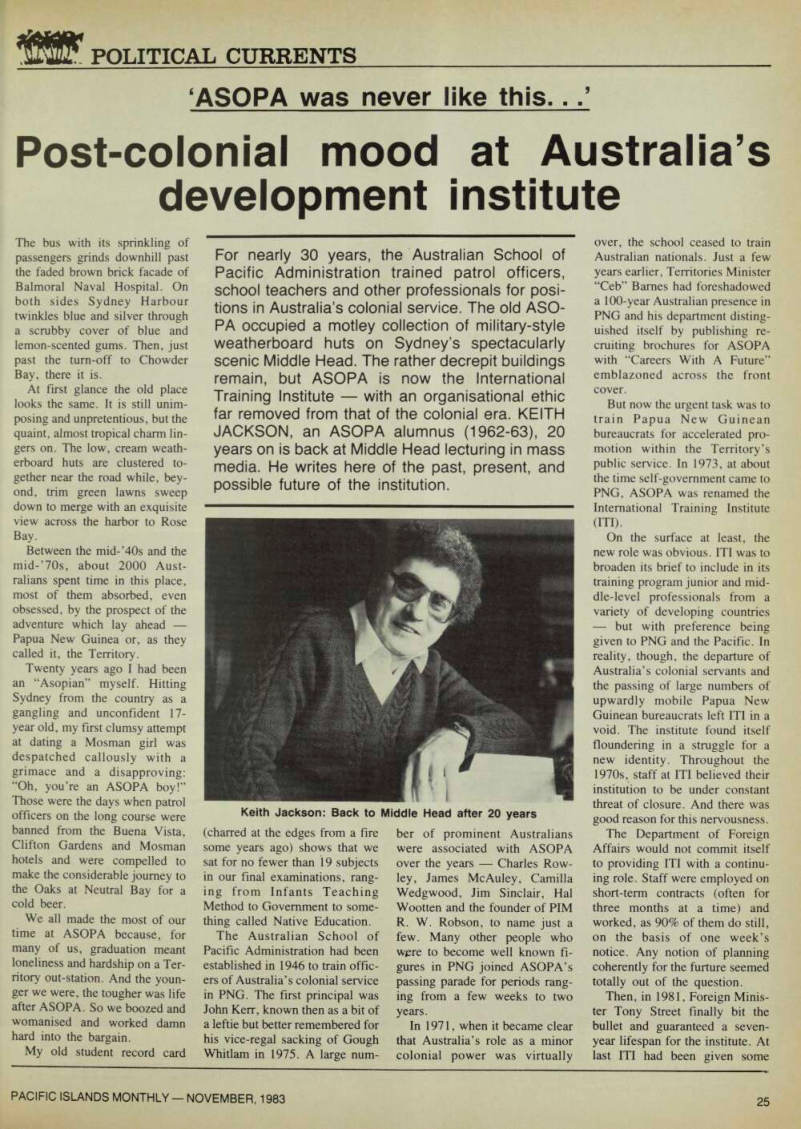

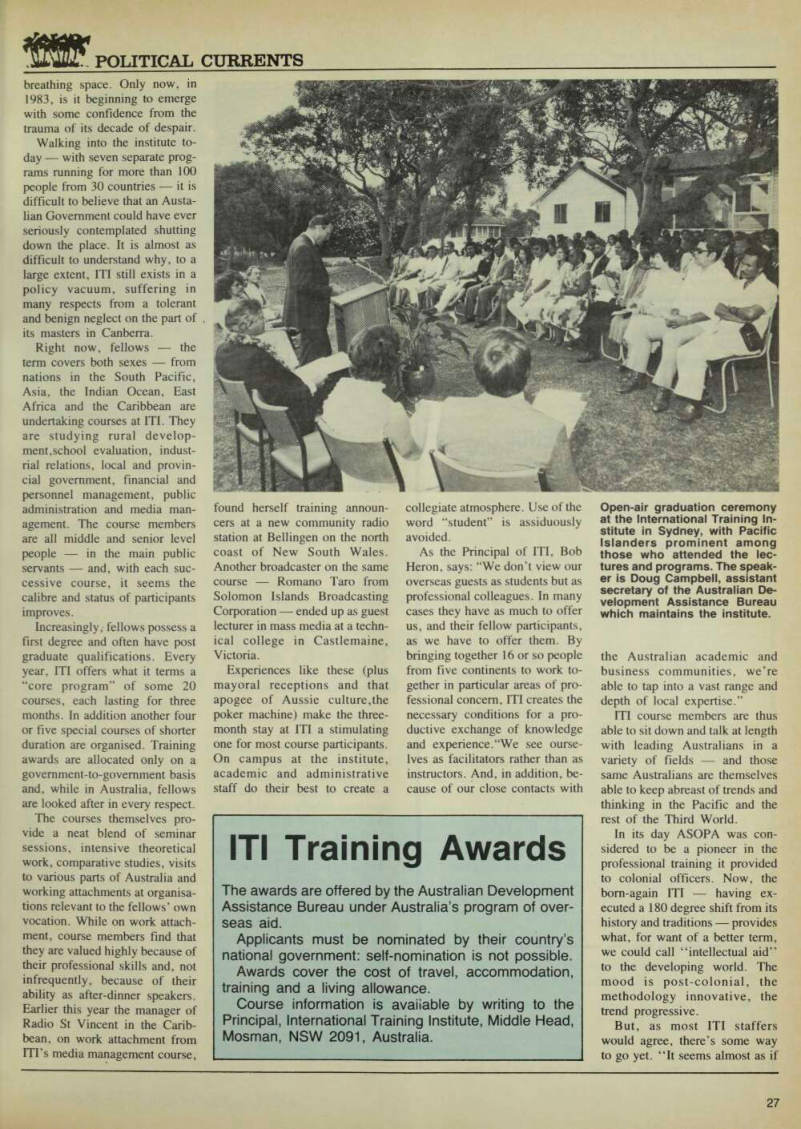
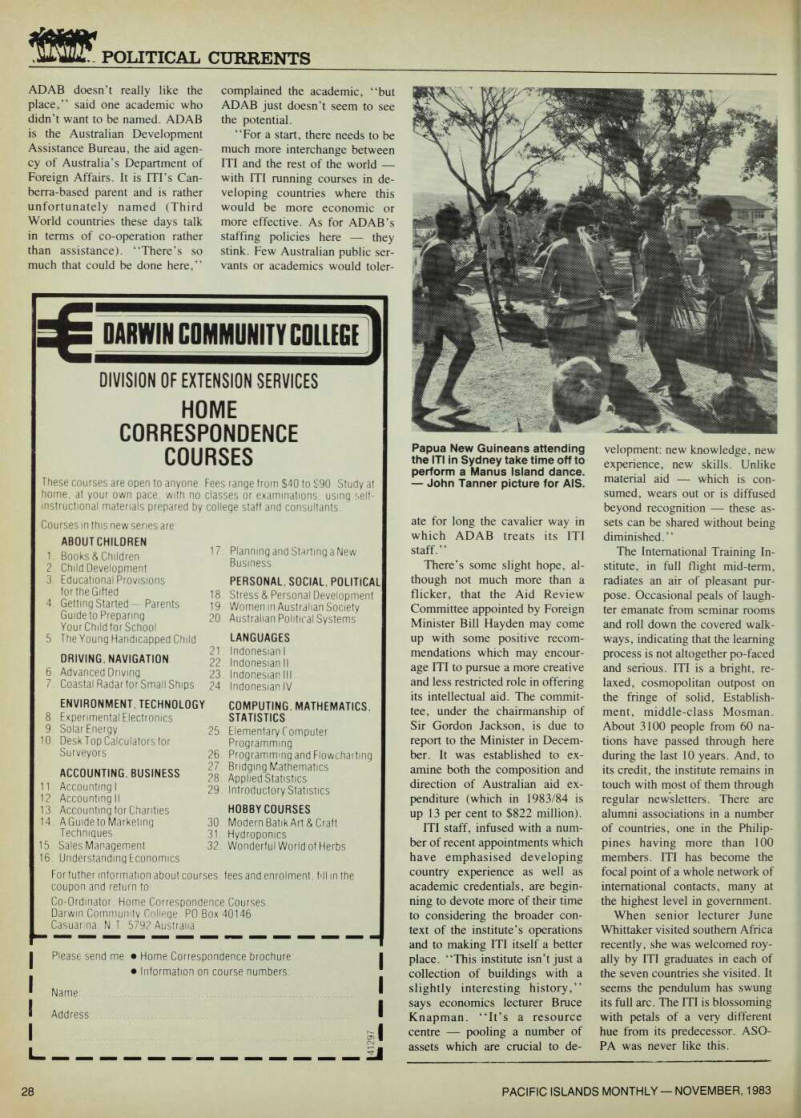
Political Currents
‘ASOPA was never like this..
Post-colonial mood at Australia’s development institute
The bus with its sprinkling of passengers grinds downhill past the faded brown brick facade of Balmoral Naval Hospital. On both sides Sydney Harbour twinkles blue and silver through a scrubby cover of blue and lemon-scented gums. Then, just past the turn-off to Chowder Bay, there it is.
At first glance the old place looks the same. It is still unim posing and unpretentious, but the quaint, almost tropical charm lin gers on. The low, cream weath erboard huts are clustered to gether near the road while, bey ond, trim green lawns sweep down to merge with an exquisite view across the harbor to Rose
Bay.
Between the mid-’4os and the mid-’7os, about 2000 Aust ralians spent time in this place, most of them absorbed, even obsessed, by the prospect of the adventure which lay ahead Papua New Guinea or, as they called it, the Territory.
Twenty years ago I had been
an “Asopian” myself. Hitting
Sydney from the country as a gangling and unconfident 17year old, my first clumsy attempt at dating a Mosman girl was
despatched callously with a
grimace and a disapproving: “Oh, you’re an ASOPA boy!”
Those were the days when patrol officers on the long course were banned from the Buena Vista, Clifton Gardens and Mosman hotels and were compelled to make the considerable journey to the Oaks at Neutral Bay for a cold beer.
We all made the most of our time at ASOPA because, for many of us, graduation meant loneliness and hardship on a Ter ritory out-station. And the youn ger we were, the tougher was life after ASOPA. So we boozed and womanised and worked damn hard into the bargain.
My old student record card
For nearly 30 years, the Australian School of Pacific Administration trained patrol officers, school teachers and other professionals for posi tions in Australia’s colonial service. The old ASO PA occupied a motley collection of military-style weatherboard huts on Sydney’s spectacularly scenic Middle Head. The rather decrepit buildings remain, but ASOPA is now the International Training Institute with an organisational ethic far removed from that of the colonial era. KEITH JACKSON, an ASOPA alumnus (1962-63), 20 years on is back at Middle Head lecturing in mass media. He writes here of the past, present, and possible future of the institution.
(charred at the edges from a fire some years ago) shows that we sat for no fewer than 19 subjects in our final examinations, rang
ing from Infants Teaching
Method to Government to some thing called Native Education.
The Australian School of Pacific Administration had been established in 1946 to train offic ers of Australia’s colonial service in PNG. The first principal was John Kerr, known then as a bit of a leftie but better remembered for his vice-regal sacking of Gough Whitlam in 1975. A large num
ber of prominent Australians were associated with ASOPA over the years Charles Row
ley, James McAuley, Camilla
Wedgwood, Jim Sinclair, Hal Wootten and the founder of PIM R. W. Robson, to name just a few. Many other people who were to become well known fi gures in PNG joined ASOPA’s passing parade for periods rang ing from a few weeks to two years.
In 1971, when it became clear that Australia’s role as a minor colonial power was virtually
over, the school ceased to train Australian nationals. Just a few years earlier, Territories Minister “Ceb” Barnes had foreshadowed a 100-year Australian presence in PNG and his department disting uished itself by publishing re cruiting brochures for ASOPA with “Careers With A Future” emblazoned across the front cover.
But now the urgent task was to train Papua New Guinean bureaucrats for accelerated pro motion within the Territory’s public service. In 1973, at about the time self-government came to PNG, ASOPA was renamed the International Training Institute
(Iti).
On the surface at least, the new role was obvious. ITI was to broaden its brief to include in its training program junior and mid dle-level professionals from a variety of developing countries but with preference being given to PNG and the Pacific. In reality, though, the departure of Australia’s colonial servants and the passing of large numbers of upwardly mobile Papua New Guinean bureaucrats left ITI in a void. The institute found itself floundering in a struggle for a
new identity. Throughout the
19705, staff at ITI believed their institution to be under constant threat of closure. And there was good reason for this nervousness.
The Department of Foreign
Affairs would not commit itself to providing ITI with a continu ing role. Staff were employed on short-term contracts (often for three months at a time) and worked, as 90% of them do still, on the basis of one week’s notice. Any notion of planning coherently for the furture seemed totally out of the question.
Then, in 1981, Foreign Minis ter Tony Street finally bit the bullet and guaranteed a seven year lifespan for the institute. At last ITI had been given some
Keith Jackson: Back to Middle Head after 20 years
breathing space. Only now, in 1983, is it beginning to emerge with some confidence from the trauma of its decade of despair.
Walking into the institute to day with seven separate prog rams running for more than 100 people from 30 countries it is difficult to believe that an Austa lian Government could have ever seriously contemplated shutting down the place. It is almost as difficult to understand why, to a large extent, ITI still exists in a policy vacuum, suffering in many respects from a tolerant and benign neglect on the part of its masters in Canberra.
Right now, fellows the term covers both sexes from nations in the South Pacific, Asia, the Indian Ocean, East Africa and the Caribbean are undertaking courses at ITI. They are studying rural develop ment, school evaluation, indust rial relations, local and provin cial government, financial and personnel management, public administration and media man agement. The course members are all middle and senior level people in the main public servants and, with each suc cessive course, it seems the calibre and status of participants improves.
Increasingly, fellows possess a first degree and often have post graduate qualifications. Every year, ITI offers what it terms a “core program” of some 20 courses, each lasting for three months. In addition another four or five special courses of shorter duration are organised. Training awards are allocated only on a govemment-to-govemment basis and, while in Australia, fellows are looked after in every respect.
The courses themselves pro vide a neat blend of seminar sessions, intensive theoretical work, comparative studies, visits to various parts of Australia and working attachments at organisa tions relevant to the fellows’ own vocation. While on work attach ment, course members find that they are valued highly because of their professional skills and, not infrequently, because of their ability as after-dinner speakers.
Earlier this year the manager of Radio St Vincent in the Carib bean, on work attachment from FITs media management course,
found herself training announ cers at a new community radio station at Bellingeh on the north coast of New South Wales.
Another broadcaster on the same course Romano Taro from Solomon Islands Broadcasting Corporation ended up as guest lecturer in mass media at a techn ical college in Castlemaine, Victoria.
Experiences like these (plus mayoral receptions and that apogee of Aussie culture,the poker machine) make the three month stay at ITI a stimulating one for most course participants.
On campus at the institute, academic and administrative staff do their best to create a
collegiate atmosphere. Use of the word “student” is assiduously avoided.
As the Principal of ITI, Bob Heron, says: “We don’t view our overseas guests as students but as professional colleagues. In many cases they have as much to offer us, and their fellow participants, as we have to offer them. By bringing together 16 or so people from five continents to work to gether in particular areas of pro fessional concern, ITI creates the necessary conditions for a pro ductive exchange of knowledge and experience.“We see ourse lves as facilitators rather than as instructors. And, in addition, be cause of our close contacts with
the Australian academic and business communities, we’re able to tap into a vast range and
depth of local expertise.”
ITI course members are thus able to sit down and talk at length with leading Australians in a variety of fields and those same Australians are themselves able to keep abreast of trends and thinking in the Pacific and the rest of the Third World.
In its day ASOPA was con sidered to be a pioneer in the
professional training it provided
to colonial officers. Now, the born-again ITI having ex ecuted a 180 degree shift from its
history and traditions provides
what, for want of a better term, we could call “intellectual aid” to the developing world. The mood is post-colonial, the methodology innovative, the trend progressive.
But, as most ITI staffers would agree, there’s some way to go yet. “It seems almost as if
Open-air graduation ceremony at the International Training In stitute in Sydney, with Pacific Islanders prominent among those who attended the lec tures and programs. The speak er is Doug Campbell, assistant secretary of the Australian De velopment Assistance Bureau which maintains the institute.
ADAB doesn’t really like the place,” said one academic who didn’t want to be named. ADAB is the Australian Development Assistance Bureau, the aid agency of Australia’s Department of Foreign Affairs. It is ITl’s Canberra-based parent and is rather unfortunately named (Third World countries these days talk in terms of co-operation rather than assistance). “There’s so much that could be done here,”
complained the academic, “but ADAB just doesn’t seem to see the potential, “For a start, there needs to be much more interchange between ITI and the rest of the world with ITI running courses in de veloping countries where this would be more economic or more effective. As for ADAB’s
staffing policies here they
stink. Few Australian public ser vants or academics would toler-
ate for long the cavalier way in which ADAB treats its ITI staff. ’ ’
There’s some slight hope, al though not much more than a flicker, that the Aid Review Committee appointed by Foreign Minister Bill Hayden may come up with some positive recom mendations which may encour age ITI to pursue a more creative and less restricted role in offering its intellectual aid. The commit tee, under the chairmanship of Sir Gordon Jackson, is due to report to the Minister in Decem ber. It was established to ex amine both the composition and direction of Australian aid ex penditure (which in 1983/84 is up 13 per cent to $822 million).
ITI staff, infused with a num ber of recent appointments which
have emphasised developing
country experience as well as academic credentials, are begin ning to devote more of their time to considering the broader con text of the institute’s operations and to making ITI itself a better place. “This institute isn’t just a collection of buildings with a slightly interesting history,” says economics lecturer Bruce Knapman. “It’s a resource centre pooling a number of assets which are crucial to de
velopment: new knowledge, new
experience, new skills. Unlike material aid which is con sumed, wears out or is diffused beyond recognition these as sets can be shared without being diminished.”
The International Training In stitute, in full flight mid-term, radiates an air of pleasant pur pose. Occasional peals of laugh ter emanate from seminar rooms and roll down the covered walk ways, indicating that the learning process is not altogether po-faced and serious. ITI is a bright, re laxed, cosmopolitan outpost on the fringe of solid, Establish ment, middle-class Mosman.
About 3100 people from 60 na tions have passed through here during the last 10 years. And, to its credit, the institute remains in touch with most of them through regular newsletters. There are alumni associations in a number of countries, one in the Philip pines having more than 100 members. ITI has become the focal point of a whole network of international contacts, many at the highest level in government.
When senior lecturer June Whittaker visited southern Africa recently, she was welcomed roy ally by ITI graduates in each of the seven countries she visited. It seems the pendulum has swung its full arc. The ITI is blossoming with petals of a very different hue from its predecessor. ASO PA was never like this.
Papua New Guineans attending the ITI in Sydney take time off to perform a Manus Island dance. - John Tanner picture for AIS.
Advertisements & other items, p. 26 (1 item)
Sansui Integrate
Convenience
If you're looking for a component system that sounds great, operates with fingertip ease, yet doesn't cost a bundle, then take a look at Sansui's compact new Integrated Component Systems.
System M 77, for instance, gives you a programmable linear-tracking turntable. Compu Edit, for automatic recording. The Compu-Selector System for one-touch operation. And even an optional graphic equalizer with a built-in spectrum analyzer so your music sounds just the way you like it best.
See and hear the newest idea in sound today at your nearest Sansui dealer. ... ,
tips:
.I Systems
fit M tj if ■ For further information please contact: • Australia VANFI (Aust.) PTY. LTD. 297, City Road, South Melbourne, Victoria 3205, Australia Phone: 690-6200/283 Alfred Place, North Sydney, N.S.W. 2060, Australia Phone: 929-0293 • Fiji PRABHU BROTHERS LTD. PO. Box 183, Nadi Phone: 71122 • Papua New Guinea OCEANIA INDENT AGENCY (P.N.G.) PTY. LTD.PO Box 5518, Boroko, Port Moresby Phone: 256411 • New Zealand DAVID REID ELECTRONICS LTD. PO. Box 2630, Auckland, Phone: 488-049 • New Caledonia HI-FI VICTOIRE, ETS. M. MERCIER B.P. 1123, Noumea Phone: 27.59.11 • Central Pacific NAURU CO-OPERATIVE SOCIETY Republic of Nauru • Vanuatu THE SOUND CENTRE LTD. PO. Box 434, Vila Phone: 2035 • Tahiti DIMECO SIMEL B.P Box 3333 Papeete Phone: 26979
ITI Training Awards
The awards are offered by the Australian Development Assistance Bureau under Australia’s program of over seas aid.
Applicants must be nominated by their country’s national government: self-nomination is not possible.
Awards cover the cost of travel, accommodation, training and a living allowance.
Course information is available by writing to the Principal, International Training Institute, Middle Head, Mosman, NSW 2091, Australia.
Advertisements & other items, pp. 27-28 (2 items)
27
POLITICAL CURRENTS
Darwin Community Coutei
DIVISION OF EXTENSION SERVICES
HOME
CORRESPONDENCE
COURSES
These courses are open to anyone Fees range from $4O to $9O Study at home, at your own pace, with no classes or examinations, using selfmstructional materials prepared by college staff and consultants Courses in this new series are
ABOUTCHILDREN
1 Books & Children 2 Child Development 3. Educational Provisions for the Gifted 4 Getting Started Parents Guide to Preparing Your Child for School 5 The Young Handicapped Child
DRIVING, NAVIGATION
6. Advanced Driving 7 Coastal RadarforSmallShips 17. Planning and Starting a New Business
PERSONAL. SOCIAL. POLITICAL
18 Stress & Personal Development 19 Women in Australian Society 20 Australian Political Systems
LANGUAGES
21 Indonesian I 22 Indonesian II 23. Indonesian 111 24 Indonesian IV
ENVIRONMENT. TECHNOLOGY
8 Experimental Electronics
COMPUTING, MATHEMATICS.
STATISTICS
Elementary Computer Programming Programming and Flowcharting Bridging Mathematics Applied Statistics Introductory Statistics
HOBBYCOURSES
Modern Batik Art & Craft Hydroponics Wonderful World of Herbs Forfuther information about courses, fees and enrolment, fill in the coupon and return to Co-Ordmator. Home Correspondence Courses.
Darwin Community College PO Box 40146 Casuanna. N T. 5792 Australia I I I I Please send me • Home Correspondence brochure: • Information on course numbers: Name: Address I I I si C\J
Japan plans big undergound
Faced With Ocean-Dumping Protests
Japan plans big undergound N-waste storehouse
While the Japanese Government considers how opposition from Pacific Island countries to its plans for ocean-dumping of low level nuclear waste may best be overcome, environmental au thorities have given the go-ahead for plans to build a giant land based underground storage depot for the waste.
Japan had planned to dump the waste in an ocean trench to the south of its home islands. But opposition from Pacific Island countries, notably the new Mic ronesian entities who would be closest to the ocean dumping site, has so far stayed its hand.
The proposed underground storage site is at Tsuruga, on the Japan Sea coast, where the Japan Atomic Power Co. has a reactor.
In August the company managed to win approval from environmental authorities for construction of a six-storey, rein forced concrete storehouse which will cost SAI4 million.
According to one press report, a 1.4 hectare area of forest slope will be cleared and the storehouse built into the moun tainside. It will then be surfaced and trees planted on top, leaving only a road, a 3.4 metre tunnel entrance, and a ventilator, on the surface.
But by March this year, Japan had 460,000 drums of the waste piled up at nuclear plants around the country. By 1990, the piles will have grown to 1.1 million drums, unless some method is found of disposing of them.
Japanese sources warn that the decision to build the land storehouse at Tsuruga should not be taken to mean thay they have abandoned the idea of dumping the waste at sea. One company spokesman said: “It’s only a tem porary store at Tsuruga . . . We are keeping the waste on our own site until the government decides what to do with it.”
Another spokesman, repre senting the Nuclear Power Envi
ronment Protection Centre, a nuclear power industry body, said: “Obviously, dumping at sea costs less than land dumping.
The only cost is the sea transport, but on land you need the storage facility and security
arrangements.”
But some Japanese sources are saying that the government should abandon the ocean
dumping option altogether and
build a series of land storages, with security depending on the radio-active half-life of the mate rials involved.
The Yomiuri Shimbun, Japan’s
biggest daily newspaper, report
ed in July that advisers to the nation’s Science and Technology Agency favored this course of action.
What is called “low level” nuclear waste comes from the clothing, cleaning rags and gloves used by workers in nuc
lear power stations. These items are burnt, mixed with concrete, and sealed into steel drums, each containing 200 litres.
Japan was one of six nations voting against a two-year moratorium on radio-active waste dumping which was car ried by the seventh consultative meeting of the London Dumping Convention in February. Others were the U.S., the UK, the Netherlands, Switzerland and South Africa.
Among the 19 nations in favor were Nauru, Kiribati, Papua New Guinea, the Philippines and New Zealand.
The successful move for a moratorium was made by Spain in the form of an amendment to a motion for a complete ban on dumping which was initiated by Nauru and Kiribati.
LDC decisions are not legally binding on member countries.
The ADB takes a close
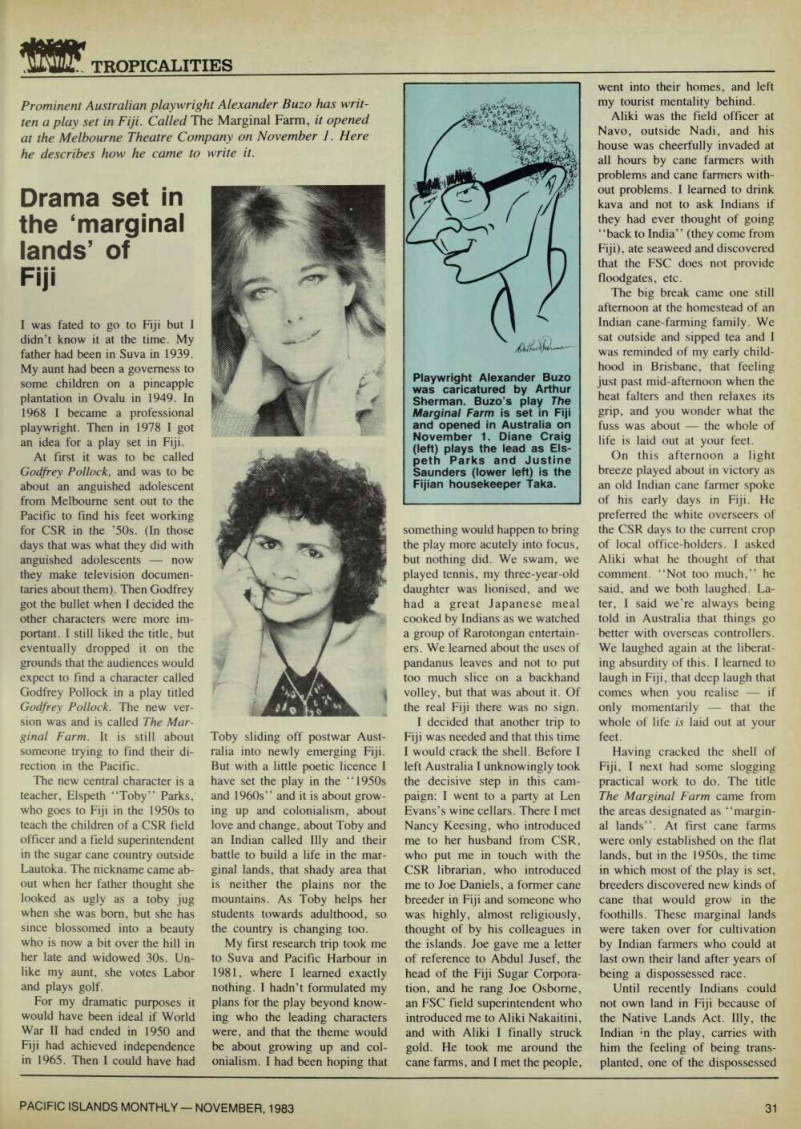
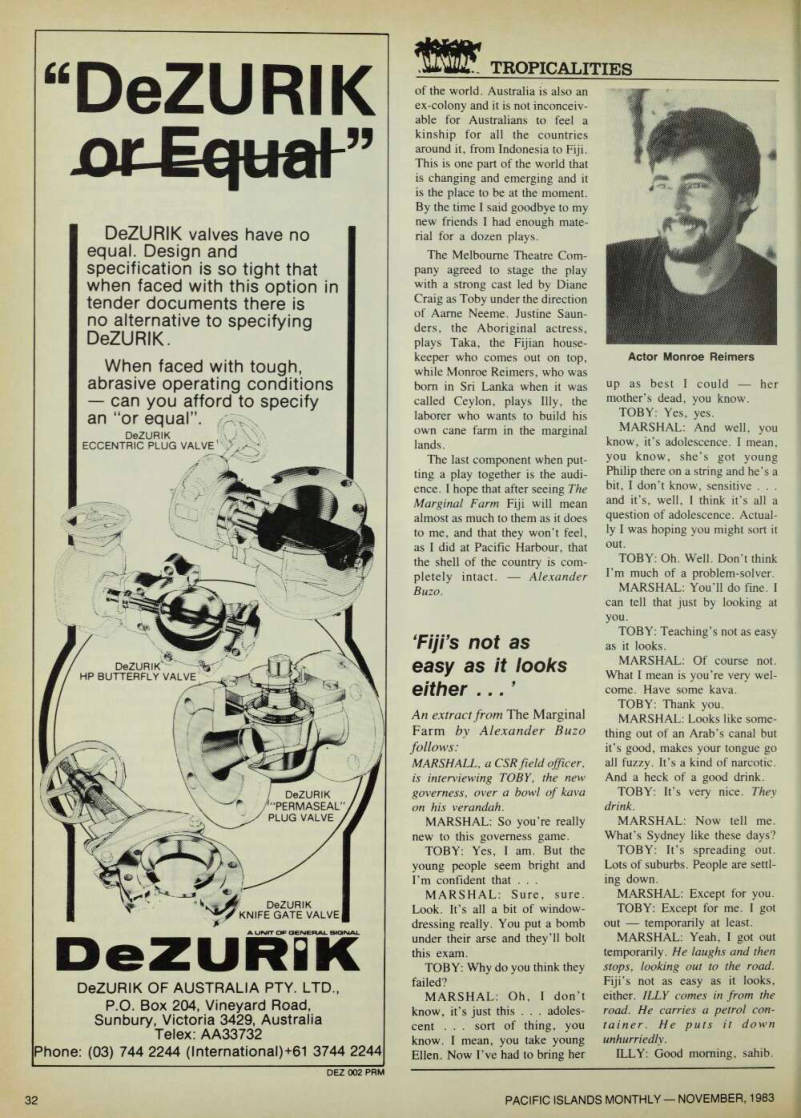
look at its SPDMCs
A number of special difficulties faced by the Asian Development Bank in dealings with South Pacific Developing Member Countries (SPDMCs) are can vassed by journalist Guy Sacer doti in a recent issue of the Hong Kong-based Far Eastern Economic Review.
Pacific Island nations which are ADB members are Papua New Guinea, the Cook Islands, Fiji, Kiribati, Solomon Islands Vanuatu and Western Samoa.
The eight represent slightly more than a quarter of the ADB’s 31 regional members. But while the bank’s operations service a com bined population of 700 million, the SPDMCs, excluding PNG, have a population of a mere 1.3 million, or about 0.19 per cent of that.
Sacerdoti effectively excludes PNG from discussion on grounds both of the size of its populaiton (more than three million), and the size of the ADB loans to which it is entitled (a range from SUS4.S million to $13.5 million compared with $330,000 to $4 million for the others).
As seen from ADB headquar ters in Manila, relations with the seven Pacific Island states pre sent difficulties on a number of counts.
Administration: “The admin strative costs for the ADB in setting up and monitoring these smaller loans are higher in abso lute terms (given greater dis tances from Manila), let alone in proportional terms to the bor rowed amounts, than those of its
programs elsewhere . . . The
sheer cost of travel for ADB personnel and consultants has been prohibitive, taking up a full 15 per cent of the entire ADB travel budget for lending equal to 2.2 per cent (including Papua New Guinea) of the bank total.”
Communications: “A number of borrowers, as well as the ADB itself, have complained of the time lag involved in getting let ters and other important docu ments back and forth between the island countries and the ADB head office in Manila; a regional office should shorten the time
span significantly.”
Absorptive capacity: “One nagging problem likely to be taken up (though just how is uncertain) is the limited absorp tive capacity many countries have for ADB lending . . .
Technical assistance loans will continue to be stressed, primarily owing to local manpower con straints . . . But while that will continue, the main problem with ADB lending to the region the intense lack of human resources will probably be the most significant addition to the ADB repertoire. The ADB has found that even when compared to countries such as Bangladesh and Nepal, where the lack of exper tise and training in developemt is at least recognised, the level of education and opportunities for higher education among the SPDMCs is dismal.
“While the problem is less acute in the Polynesian islands of Western Samoa and Tonga, where non-govemmental organ isations such as the Christian churches have been active in education, there is far more of a
brain-drain problem (primarily to
the United States and New Zea land) than in the Melanesian states of Papua New Guinea, Vanuatu and Solomon Islands (where the educated return, but usually to the private sector). But
Continued on Page 74
the human-resource base for de velopment purposes is scant in deed. In Vanuatu, for example, the chief of development plan ning is South Korean, the central bank governor is British and the deputy governor French.
“Here, the ADB is likely to pursue some type of scholar ship/training program over the long term, utilising the Universi ty of the South Pacific and prob ably institutions in East and Southeast Asia to begin the long process towards building the hu man resources necessary to help these South Pacific island
economies grow.”
On May 31 this year the ADB announced a detailed study to define an overall approach to the SPDMCs, with some action ex pected to be taken before the end of the year. A key part of the study relates to the establishment of an ADB office in the region.
Sacerdoti notes: “A battle among the SPDMCs is inevitable over the seat of the regional office, with five of the eight countries vying for the privilege.
While Port Moresby may want to maintain its image as leader of the grouping, Fiji may make more sense logistically, as Suva already has a European Econom ic Community office and a Un ited Nations Development Prog ram office, as well as the reg ion’s best seat for higher educa tion, the University of the South Pacific”.
Advertisements & other items, p. 30 (1 item)
Citizen
introduce the
worlds thinnest analog alarm
with a remarkable new
alarm system
iC U
TIME
Pull the crown out two notches and set as you would any watch
ALARM
Pull the crown out one notch Hands automatically move to the last alarm setting, and a Chime tells you that the alarm is ready to be reset
m cr
Pushing the crown back in automatically returns the hands to the correct time with another beep to tell you that ordinary operation has resumed ON/OFF alarm button Pull to set, push to stop.
The Citizen Quartz Analog Alarm Watch, the World’s slimmest and
smallest Analog Alarm.
Its alarm is music. A soft harmonious melody that perfectly matches the slim and tasteful design of this timepiece.
There is no alarm-setting pointer. The hour and minute hands are used for alarm setting. Citizen Quartz technology makes the Analog Alarm
accurate to within seconds per month.
CITIZEN QUARTZ Ifl
lIANALOG-ALARMiI
CITIZEN
AHEAD OF THEIR TIME
Citizen Watches Australia Pty Ltd. 122 Old Pittwater Rd, Brookvale, NSW 2100. Telephone: 9397077. Cable: Citizen Sydney. Telex: AA26633
the ‘marginal
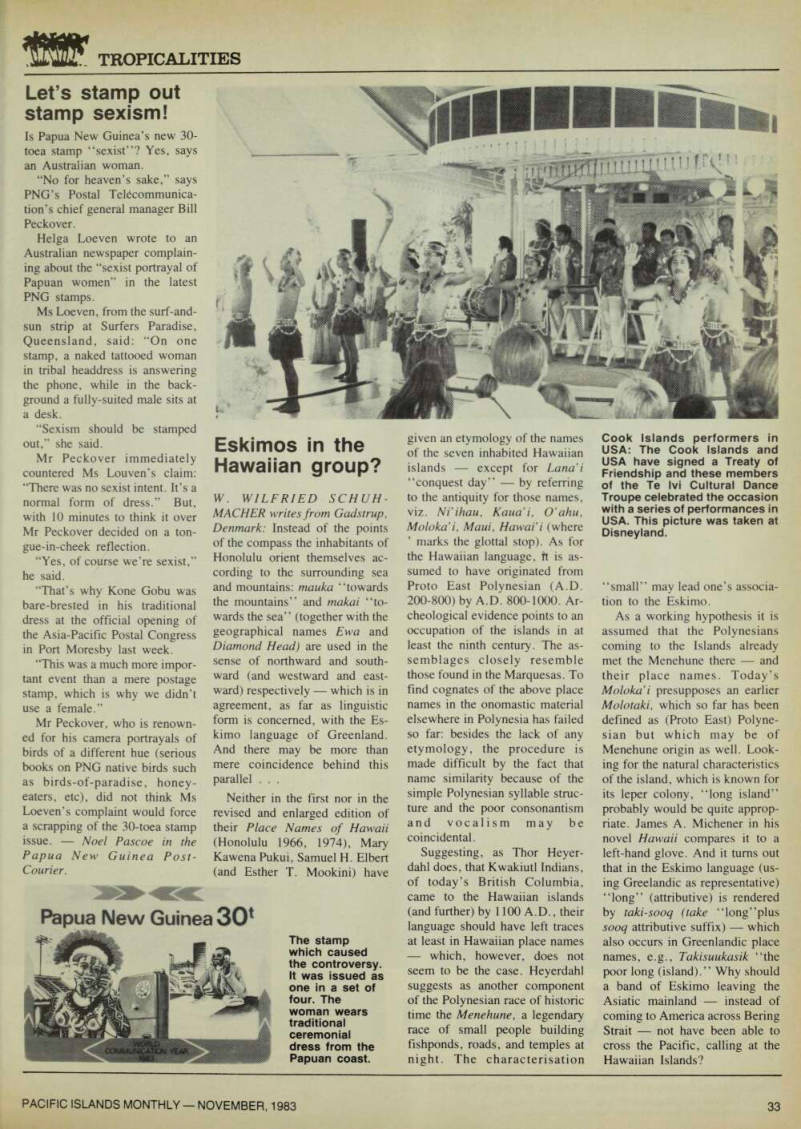

Tropicalites
Prominent Australian playwright Alexander Buzo has writ ten a play set in Fiji. Called The Marginal Farm, it opened at the Melbourne Theatre Company on November 1. Here he describes how he came to write it.
Drama set in
the ‘marginal
lands’ of
Fiji
I was fated to go to Fiji but I didn’t know it at the time. My father had been in Suva in 1939.
My aunt had been a governess to some children on a pineapple plantation in Ovalu in 1949. In 1968 I became a professional playwright. Then in 1978 I got an idea for a play set in Fiji.
At first it was to be called Godfrey Pollock, and was to be about an anguished adolescent from Melbourne sent out to the Pacific to find his feet working for CSR in the ’sos. (In those days that was what they did with anguished adolescents now they make television documen taries about them). Then Godfrey got the bullet when I decided the other characters were more im portant. I still liked the title, but eventually dropped it on the grounds that the audiences would expect to find a character called Godfrey Pollock in a play titled Godfrey Pollock. The new ver sion was and is called The Mar ginal Farm. It is still about someone trying to find their di rection in the Pacific.
The new central character is a teacher, Elspeth “Toby” Parks, who goes to Fiji in the 1950 s to teach the children of a CSR field officer and a field superintendent in the sugar cane country outside Lautoka. The nickname came ab out when her father thought she looked as ugly as a toby jug when she was bom, but she has since blossomed into a beauty who is now a bit over the hill in her late and widowed 30s. Un like my aunt, she votes Labor
and plays golf.
For my dramatic purposes it would have been ideal if World War II had ended in 1950 and Fiji had achieved independence in 1965. Then I could have had
Toby sliding off postwar Aust
ralia into newly emerging Fiji.
But with a little poetic licence I have set the play in the “1950 s and 19605” and it is about grow ing up and colonialism, about love and change, about Toby and an Indian called Illy and their battle to build a life in the mar ginal lands, that shady area that is neither the plains nor the mountains. As Toby helps her students towards adulthood, so the country is changing too.
My first research trip took me to Suva and Pacific Harbour in 1981, where I learned exactly nothing. I hadn’t formulated my plans for the play beyond know ing who the leading characters were, and that the theme would be about growing up and col onialism. I had been hoping that
something would happen to bring the play more acutely into focus, but nothing did. We swam, we played tennis, my three-year-old daughter was lionised, and we had a great Japanese meal cooked by Indians as we watched a group of Rarotongan entertain ers. We learned about the uses of pandanus leaves and not to put too much slice on a backhand volley, but that was about it. Of the real Fiji there was no sign.
I decided that another trip to Fiji was needed and that this time I would crack the shell. Before I left Australia I unknowingly took the decisive step in this cam paign: I went to a party at Len Evans’s wine cellars. There I met Nancy Keesing, who introduced me to her husband from CSR, who put me in touch with the CSR librarian, who introduced me to Joe Daniels, a former cane breeder in Fiji and someone who was highly, almost religiously, thought of by his colleagues in the islands. Joe gave me a letter of reference to Abdul Jusef, the head of the Fiji Sugar Corpora tion, and he rang Joe Osborne, an FSC field superintendent who introduced me to Aliki Nakaitini, and with Aliki I finally struck gold. He took me around the cane farms, and I met the people.
went into their homes, and left my tourist mentality behind.
Aliki was the field officer at Navo, outside Nadi, and his house was cheerfully invaded at all hours by cane farmers with problems and cane farmers with out problems. I learned to drink kava and not to ask Indians if they had ever thought of going “back to India” (they come from Fiji), ate seaweed and discovered that the FSC does not provide floodgates, etc.
The big break came one still afternoon at the homestead of an Indian cane-farming family. We sat outside and sipped tea and I was reminded of my early child hood in Brisbane, that feeling just past mid-aftemoon when the heat falters and then relaxes its grip, and you wonder what the fuss was about the whole of life is laid out at your feet.
On this afternoon a light breeze played about in victory as an old Indian cane farmer spoke of his early days in Fiji. He preferred the white overseers of the CSR days to the current crop of local office-holders. I asked Aliki what he thought of that comment. “Not too much,” he said, and we both laughed. La ter, I said we’re always being told in Australia that things go better with overseas controllers.
We laughed again at the liberat ing absurdity of this. I learned to laugh in Fiji, that deep laugh that comes when you realise if only momentarily that the whole of life is laid out at your feet.
Having cracked the shell of Fiji, I next had some slogging practical work to do. The title The Marginal Farm came from the areas designated as “margin al lands”. At first cane farms were only established on the flat lands, but in the 19505, the time in which most of the play is set, breeders discovered new kinds of cane that would grow in the foothills. These marginal lands were taken over for cultivation by Indian farmers who could at last own their land after years of being a dispossessed race.
Until recently Indians could not own land in Fiji because of the Native Lands Act. Illy, the Indian m the play, carries with him the feeling of being trans planted, one of the dispossessed
Playwright Alexander Buzo was caricatured by Arthur Sherman. Buzo’s play The Marginal Farm is set in Fiji and opened in Australia on November 1. Diane Craig (left) plays the lead as Els peth Parks and Justine Saunders (lower left) is the Fijian housekeeper Taka.
of the world. Australia is also an ex-colony and it is not inconceiv able for Australians to feel a kinship for all the countries around it, from Indonesia to Fiji.
This is one part of the world that is changing and emerging and it is the place to be at the moment.
By the time I said goodbye to my new friends I had enough mate rial for a dozen plays.
The Melbourne Theatre Com pany agreed to stage the play with a strong cast led by Diane Craig as Toby under the direction of Aame Neeme. Justine Saun ders, the Aboriginal actress, plays Taka, the Fijian house keeper who comes out on top, while Monroe Reimers, who was bom in Sri Lanka when it was called Ceylon, plays Illy, the laborer who wants to build his own cane farm in the marginal lands.
The last component when put ting a play together is the audi ence. I hope that after seeing The Marginal Farm Fiji will mean almost as much to them as it does to me, and that they won’t feel, as I did at Pacific Harbour, that the shell of the country is com-
pletely intact.
Alexander
Buzo.
‘Fiji’s not as
easy as it looks
either ... ’
An extract from The Marginal Farm by Alexander Buzo
follows:
MARSHALL, a CSR field officer, is interviewing TOBY, the new governess, over a bowl of kava on his verandah.
MARSHAL: So you’re really new to this governess game.
TOBY: Yes, I am. But the young people seem bright and I’m confident that . . .
MARSHAL: Sure, sure.
Look. It’s all a bit of window dressing really. You put a bomb under their arse and they’ll bolt this exam.
TOBY: Why do you think they failed?
MARSHAL: Oh, I don’t know, it’s just this . . . adoles cent . . . sort of thing, you know. I mean, you take young Ellen. Now I’ve had to bring her
up as best I could her mother’s dead, you know.
TOBY: Yes, yes.
MARSHAL: And well, you know, it’s adolescence. I mean, you know, she’s got young Philip there on a string and he’s a bit, I don’t know, sensitive . . . and it’s, well, I think it’s all a question of adolescence. Actual ly I was hoping you might sort it out.
TOBY: Oh. Well. Don’t think I’m much of a problem-solver.
MARSHAL: You’ll do fine. I can tell that just by looking at you.
TOBY; Teaching’s not as easy as it looks.
MARSHAL; Of course not.
What I mean is you’re very wel come. Have some kava.
TOBY; Thank you.
MARSHAL: Looks like some thing out of an Arab’s canal but it’s good, makes your tongue go all fuzzy. It’s a kind of narcotic.
And a heck of a good drink.
TOBY: It’s very nice. They drink.
MARSHAL: Now tell me.
What’s Sydney like these days?
TOBY: It’s spreading out.
Lots of suburbs. People are settl
ing down.
MARSHAL: Except for you.
TOBY: Except for me. I got out temporarily at least.
MARSHAL; Yeah, I got out temporarily. He laughs and then stops, looking out to the road.
Fiji’s not as easy as it looks, either. ILLY comes in from the road. He carries a petrol con tainer. He puts it down unhurriedly.
ILLY: Good morning, sahib.
Actor Monroe Reimers
Let’s stamp out
stamp sexism!
Is Papua New Guinea’s new 30toea stamp “sexist”? Yes, says an Australian woman.
“No for heaven’s sake,” says PNG’s Postal Telecommunica tion’s chief general manager Bill Peckover.
Helga Loeven wrote to an Australian newspaper complain ing about the “sexist portrayal of Papuan women” in the latest PNG stamps.
Ms Loeven, from the surf-and sun strip at Surfers Paradise, Queensland, said: “On one stamp, a naked tattooed woman in tribal headdress is answering the phone, while in the back ground a fully-suited male sits at a desk.
“Sexism should be stamped out,” she said.
Mr Peckover immediately countered Ms Louven’s claim: “There was no sexist intent. It’s a normal form of dress.” But, with 10 minutes to think it over Mr Peckover decided on a ton gue-in-cheek reflection.
“Yes, of course we’re sexist,” he said.
“That’s why Kone Gobu was bare-brested in his traditional dress at the official opening of the Asia-Pacific Postal Congress in Port Moresby last week.
“This was a much more impor tant event than a mere postage stamp, which is why we didn’t use a female.”
Mr Peckover, who is renown ed for his camera portrayals of birds of a different hue (serious books on PNG native birds such
as birds-of-paradise, honey
eaters, etc), did not think Ms Loeven’s complaint would force a scrapping of the 30-toea stamp issue. Noel Pascoe in the Papua New Guinea Post- Courier.
Eskimos in the
Hawaiian group?
W. Wilf Rl Edschuh
MACHER writes from Gadstrup,
Denmark: Instead of the points of the compass the inhabitants of Honolulu orient themselves ac cording to the surrounding sea and mountains: mauka “towards the mountains” and makai “to wards the sea” (together with the geographical names Ewa and Diamond Head) are used in the sense of northward and south ward (and westward and east ward) respectively which is in agreement, as far as linguistic form is concerned, with the Es kimo language of Greenland.
And there may be more than mere coincidence behind this parallel . . .
Neither in the first nor in the revised and enlarged edition of their Place Names of Hawaii (Honolulu 1966, 1974), Mary Kawena Pukui, Samuel H. Elbert (and Esther T. Mookini) have
given an etymology of the names of the seven inhabited Hawaiian islands except for Lana’i
“conquest day” by referring
to the antiquity for those names, viz. Ni’ihau, Kaua’i, O’ahu, Moloka’i, Maui, Hawaii (where ’ marks the glottal stop). As for the Hawaiian language, it is as sumed to have originated from Proto East Polynesian (A.D. 200-800) by A.D. 800-1000. Ar cheological evidence points to an occupation of the islands in at least the ninth century. The as
semblages closely resemble
those found in the Marquesas. To find cognates of the above place names in the onomastic material elsewhere in Polynesia has failed so far: besides the lack of any etymology, the procedure is made difficult by the fact that name similarity because of the simple Polynesian syllable struc ture and the poor consonantism and vocalism may be coincidental.
Suggesting, as Thor Heyer dahl does, that Kwakiutl Indians, of today’s British Columbia, came to the Hawaiian islands (and further) by 1100 A.D., their language should have left traces at least in Hawaiian place names which, however, does not seem to be the case. Heyerdahl suggests as another component of the Polynesian race of historic time the Menehune, a legendary race of small people building fishponds, roads, and temples at night. The characterisation
“small” may lead one’s associa tion to the Eskimo.
As a working hypothesis it is assumed that the Polynesians coming to the Islands already met the Menehune there and their place names. Today’s Molokai presupposes an earlier Molotaki, which so far has been defined as (Proto East) Polyne sian but which may be of Menehune origin as well. Look ing for the natural characteristics of the island, which is known for
its leper colony, “long island”
probably would be quite approp riate. James A. Michener in his novel Hawaii compares it to a left-hand glove. And it turns out that in the Eskimo language (us ing Greelandic as representative) “long” (attributive) is rendered by taki-sooq (take “long’’plus sooq attributive suffix) which also occurs in Greenlandic place names, e.g., Takisuukasik “the poor long (island).” Why should a band of Eskimo leaving the Asiatic mainland instead of coming to America across Bering Strait not have been able to cross the Pacific, calling at the Hawaiian Islands?
The stamp which caused the controversy.
It was issued as one in a set of four. The woman wears traditional ceremonial dress from the Papuan coast.
Cook Islands performers in USA: The Cook Islands and USA have signed a Treaty of Friendship and these members of the Te Ivi Cultural Dance Troupe celebrated the occasion with a series of performances in USA. This picture was taken at
Disneyland.
Great new PNG
film find
An early Australian silent film which has been described as “probably the most valuable pic torial icord of New Guinea” has been found in a warehouse in Melbourne.
The National Film Archive said the finding of In New
Guinea Wilds provided potential
for much research into what life was like in the area.
The two-hour documentary of life in the coastal regions and offshore islands of what was the Australian mandated territory was filmed by William Jackson in 1926.
It shows an active volcano, giant starfish, the graves of World War I servicemen at Samarai, structures near Rabaul believed to have been built dur ing the German annexation of New Guinea, missionary estab lishments, Rabaul’s Chinatown and many aspects of sea and
village life.
The film was never screened publicly because Mr Jackson was unable to find a distributor.
When it passed into the hands of one of his creditors, Mr Jackson became a photographer on the staff of a Sydney daily newspaper.
Members of the creditor’s family recently found the 61 cans of film in four crates in a family warehouse in Melbourne and gave them to the Museum of Victoria.
The museum passed the film to the National Library in Can berra to have it copied on to a safety-based film for preserva tion in both the museum and the library’s National Film Archive.
Australian Information Service. 0 Peter Kili, writing in the Un iversity of Papua New Guinea’s student paper, Uni Tavur, reports: The UPNG library is planning to get a copy of an old film about Papua New Guinea, recently dis covered in Melbourne, Australia.
The university librarian, Alan Butler, said he was interested in buying a copy of the film so that the people of PNG can see it. He said, however, it would cost a lot
of money to reprocess the old film and make copies.
MP for North Fly, Warren Dutton, has urged Finance Minister Philip Bouraga to sign a cheque to buy the film from Australia and “save it for Papua New Guinea”.
The film. In New Guinea Wilds, was made by Australian film maker, William Jackson in the coastal and offshore island regions in 1926.
Mr Butler said if the govern ment buys the film “it would be nice, but better still if we let the Australians reprocess it and then either the PNG National Library or the UPNG library would buy a
copy”.
“If the National Library can not buy a copy, then we will try and get one, but we will have to ask for donations again from the public,” said Mr Butler.
Anastasis in
Apia for Games
On August 30, 1983, the MV Anastasis a mobile training and aid ship for disaster relief made its first-ever Western Samoa call. It was to be in Apia for three weeks.
Anastasis is an 11,695-ton long-distance passenger vessel operated by Youth With A Mis sion (YWAM), a worldwide Christian mission organisation.
The ship’s crew of more than 200 volunteers represent 24 nations.
The mobile training and disaster relief facility has a threefold em phasis of Mercy Ministry, in cluding disaster relief, Training
and Evangelism.
YWAM operates in more than 40 countries with a significant outreach in the Pacific since the mid-sixties. The MV Anastasis will also take part in a major Christian outreach sponsored by Youth With A Mission during the South Pacific Games.
YWAM is an inter denominational organisation.
The word Anastasis is Greek for “Resurrection.”
Book launching
held in Suva
Fiji gets special mention in a newly-published book written by husband-and-wife team Victor Carell and Beth Dean. The book, Twin Journey, tells the writers’
own stories of their association with cultural events in the Pacific Islands, Australia and USA over a period of more then 40 years.
Beth Dean, a former ballerina, is widely known for her encour agement and promotion of folk loric dancing. Victor Carell or ganised the first South Pacific Festival of Arts, which was in Suva in 1972. The two of them have been closely associated with the restoration of the old Fiji capital of Levuka, described as a “heritage of Fiji’s past”.
The production of the book is one of the most ambitious book printing and binding ventures undertaken in Fiji. Pacific Publi cations publishers of PIM published the book but the entire production was undertaken by The Fiji Times in Suva. At the launching ceremony in Suva the book was called a milestone in the history of Fiji print
production.
Beth Dean said in Sydney later that the book stemmed from an intense interest in and admiration of the culture of the Pacific coun tries. She hoped it would prompt people to reassess the value of their traditions. There was out standing beauty in the arts of the Pacific, she said.
The launching of Twin Journey in Suva: At left are husband and-wife authors Victor Carell and Beth Dean, with Colin and Julie McDonald. Mr McDonald is Australian High Commission
er in Fiji. - BALRAM picture.
Anastasis: Volunteer crew
Advertisements & other items, pp. 32-42 (2 items)
orJEqoaP
“DeZURIK
DeZURIK valves have no
equal. Design and
specification is so tight that when faced with this option in tender documents there is no alternative to specifying
DeZURIK.
When faced with tough, abrasive operating conditions can you afford to specify an “or equal”.
DeZURIK % J
ECCENTRIC PLUG VALVE'
€‘ 4 V » K
DeZURIK %T
HP BUTTERFLY VALVE
M 3
1 DeZURIK
'"PERMASEAL"
PLUG VALVE >
DeZURIK
KNIFE GATE VALVE
ZURBK
A UfslfT OF GENERAL SIQMAi.
DeZURIK OF AUSTRALIA PTY. LTD.,
P.O. Box 204, Vineyard Road, Sunbury, Victoria 3429, Australia Telex: AA33732 Phone: (03) 744 2244 (lnternational)+6l 3744 2244
DEZ 002 PRM
Kenwood
New Kenwood stereo component systems
Your “window" to the world's
infinite store of music.
* IM ■> * =:
tgsigDed-oy-worici-leading audio
specialists, Kenwood stereo systems
desigi
fexibility and easy
.pffer youjhezbestpdss lble Ih audio
ioldgyTAnd ioqnd that’s as
as the world arouni
Syst -71 Stereo Integrated AmpHllt •KT-51 Quartz
•KX-71R
and DPSS Quartz PLL DirechQrlve Full-Auto Turntable" •SRQ-51W Audio System Racf ‘TM Dolby Labgia&icjSf't.icensing Corp.
KENWOOD
★ New corporate symbol
TRIO-KENWOOD CORPORATION
Shionogi Shibuya Building, 17-5, 2-chome, Shibuya, Shibuya-ku, Tokyo 150, Japan TRIO-KENWOOD (AUSTRALIA) PTY LTD (incorporated in nswi 4E Woodcock Place, Lane Cove, N.S.W. 2066, Australia. Tel; 428-1455 NEW ZEALAND JOHN GILBERT & CO., LTD. Auckland Tel.ooll-64-9-30839 FIJI PEPE’S DUTY FREE CENTRE LTD. Tel. 25496, 25497 PAPUA NEW GUINEA S.O. SVENSSON (N.G.) LTD. Port Moresby Tel. 212158, 212111 SOLOMON ISLANDS TECHNIQUE RADIOS CENTRE LTD. Honiara Tel. 416 NEW CALEDONIA HI-FI VOX Noumea Tel. 27-2466, 28-2931 VANUATU FUNG CHOI LUEN. Port-Vila Tel. 2556
TAHITI MAISON AURORE Papeete Tel. 29703
AMERICAN SAMOA ISLAND PACIFIC AGENCIES, INC. Pago Pago Tel. 633-4687
REPUBLIC OF NAURU NAURU CO-OPERATIVE SOCIETY
MARIANA ISLANDS J.C. TENORIO ENTERPRISES Saipan Tel. 6445
Starting & Staying
¥ER m m w H 3r f,
AMP
POWER
f/
X COHTINUOVSUSe
71 f DBEPCy&JE BATTERY
-mr* tuwi w - *»>*■ ■ can?
Power Boats Need Different Batteries
There is a big difference between a car battery and a marine battery.
A car battery, for example, is never really discharged, as it is only used for a few seconds each day and promptly re-charged. Not so your cruiser or sportsfisherman.
Starting the engine is only the beginning. During the day, weekend or cruise, how often will you run the live bait tank, the depth sounder, the nav. lights or maintain a listening watch on your radio transceiver?
As well as cranking power, boats need staying power. Boats need Besco's Marine Batteries, deep cycle, heavy duty marine batteries. ’
If your boat is getting a little flat in the electrics department, write or phone BESCO today and ask for more information, more facts about
BESCO MARINE BATTERIES .
BESCO
Batteries Division Of Sims Products Pty. Ltd.
A Peko Wallsend Group Member Papua New Guinea: Lae, Automarine Industries, P.O. Box 785, Ph. 42-1125; Rabaul, Automarine Industries, P.O. Box 248, Ph. 92-2574; Port Moresby, Par Sales, P.O. Box 1680, Boroko, Ph. 25-6266. Fiji; Suva, Fiji Bandag, 23 Sinoma Street, Walu Bay, Ph. 31-1200. New Caledonia: Noumea, Andre Thuilier, BP 889, Ph. 27-4906. Solomon Islands: Honiara, Guadalcanal Electrics Ltd., P.O. Box 521. Hongkong: Kowloon, T. L. Knight & Co., P.O. Box 95585 TST, Ph. 366-5341. New Zealand: Auckland, Battery Services (Ind.) Ltd., P.O. Box 27- 375, Ph. 69-4111; Wellington, Gould Batteries, 58 Hautana Street, Lower Hurt, TLX NZ3714.
Australia: Sydney, Besco Batteries, P.O. Box 1, Villawood, Ph. 632-0251, TLX 21886; Jarwil International Pty. Ltd., 410 Kent Street, Sydney, Ph. 264-3477, TLX 72102.
LEADERS IN BATTERY TECHNOLOGY
c
TOYOTA
*s
LAND
CRUISER
. f ’ -r- -Jf,. i -...G'---C
LAND GRUI
STATION WA
•lS >
"J^lp
TOYOTA
QUALITY SERVICE
AMERICAN SAMOA; BURNS PHILP (SOUTH SEA)
CO., LTD., P.O. Box 129, Pago Pago.
COOK ISLANDS: COOK ISLANDS TRADING
CORPORATION LTD., P.O. Box 92, Rarotonga.
FIJI: AUTOMOTIVE SUPPLIES COMPANY, G.P.O.
Box 355, Suva.
GUAM & MICRONESIA: ATKINS, KROLL (GUAM) LTD., 443 South Marine Drive.Tamuning.
KIRIBATI: TARAWA MOTORS, P.O. Box 36.
Bairiki, Tarawa, Kiribati.
NAURU: NAURU COOPERATIVE SOCIETY.
NEW CALEDONIA: SERVICE IMPORTATION
AUTOMOBILE DU PACIFIQUE, Rond-Point
■tu Pacifique (Station Total) B.P. 438, Noumea.
NORFOLK ISLAND: BORRY’S LIMITED, P.O. Box 169.
PAPUA NEW GUINEA: ELA MOTORS,
Scratchley Rd.. Badili, P.O. Box 75, Port Moresby.
SAIPAN: MICROL CORPORATION, P.O. Box 267,
Saipan.
SOLOMON: MENDANA ENTERPRISES (5.1.) LTD.,
G.P.O. Box 174, Honiara.
TAHITI: NIPPON AUTOMOTO, P.O. Box 342, Papeete.
TONGA: BURNS PHILP (SOUTH SEA) CO.. LTD.
P.O. Box 55, Nukualofa.
VANUATU: VANUATU MOTORS. P.O. Box 18,
Port Vila.
WESTERN SAMOA; BURNS PHILP (SOUTH SEA)
CO.. LTD., P.O. Box 188, Apia.
* ■ -I s.
D D No matter how tough the work, how rough the road, Toyota commercial vehicles ride easy. That’s because every one, from the sleek Land Cruiser to our heavy duty trucks, is built to be rugged, reliable and comfortable. And there’s a Toyota to tackle any job, from offthe-road recreation to heavy-duty hauling. While your Toyota is doing the heavy work, you can ride easy, too.
That’s because you know every Toyota is backed up by our fast, reliable worldwide service system. Let Toyota make it easy for you.
The Toyota range Includes: COROLLA, STARLET CORONA, CRESSIDA. HI-LUX, STOUT,
HI ACE, DYNA, COASTER and LANDCRUISER
HI-LUX DOUBLE CAB
LANDCRUISER PICK UP
HEAVY DUTYTRUCK
TOYOTA
SOUTHWEST PAC/F/C
ANNOUNCING
A SPECIALIZED INTER-REGIONAL
SHIPPING SERVICE
From July there will be a new shipping service in the Southwest Pacific.
LAE . A , , TAI/ . APIA
HONIARA LAUTOKA
SUVA
SANTO PAGO PAGO
PORT MORESBY "* yILA
NOUMEA
NUKUALOFA
SPCL Southwest Pacific Container Line will operate two cellular container vessels, the MS Induna and Matunga.
The vessels will also handle break bulk cargo and will provide a sailing every 23 days.
CREATING OPPORTUNITIES FOR INCREASED REGIONAL TRADE
and
GREATER ACCESS TO WORLD WIDE MARKETS
Our agents will be pleased to provide you with further information on request.
BURNS, PHILP & CO. LTD.
Managing Agent 7th Floor, 51 Pitt Street, Sydney, Australia. Phone: (02) 20547
Announcing Appropriate Solar
Technologies for the Pacific Islands
Inter Island Solar Supply is the largest distributor of solar thermal and solar electric products to the Pacific Basin since 1975.
PT-40 > • Self-Contained 40 gallon Solar Water Heater Stainless Steel Progressive Tube Design • Triple Glazed for Heat Retention W • Simple Installation. No Pumps, h * No Controls, No Maintenance • 20 Year Warranty j • Lowest Price Solar Edwards Thermosyphon Systems (passive) Choice of 48, 80, 116 or 160 Gallon Systems • Highly Insulated Stainless Steel W Storage Cylinder ' • Efficient Absorbers with Fiberglass Insulation and Double Sealed Glazing 1 Operates by Natural Water Convection and has no Moving Parts ■ • Best System Buy Solec Solar Electric Panels • Superior Silicone Cell Quality and Expert Module Construction • Higher Electric Output than any Solar Cells Available Inter Island also carries appropriate Solar Electric Appliances including 12 Volt Refrigerators, Lighting Systems, and Pumps.Mj
Dealers, government agencies and
individuals, write us for complete
technical and pricing information.
Contact our Sales Representative,
John Grandinetti at:
INTER ISLAND SOLAR SUPPLY
345 A Nimitz Highway
Honolulu, Hawaii 96817
Ph. (808) 523-0711
People
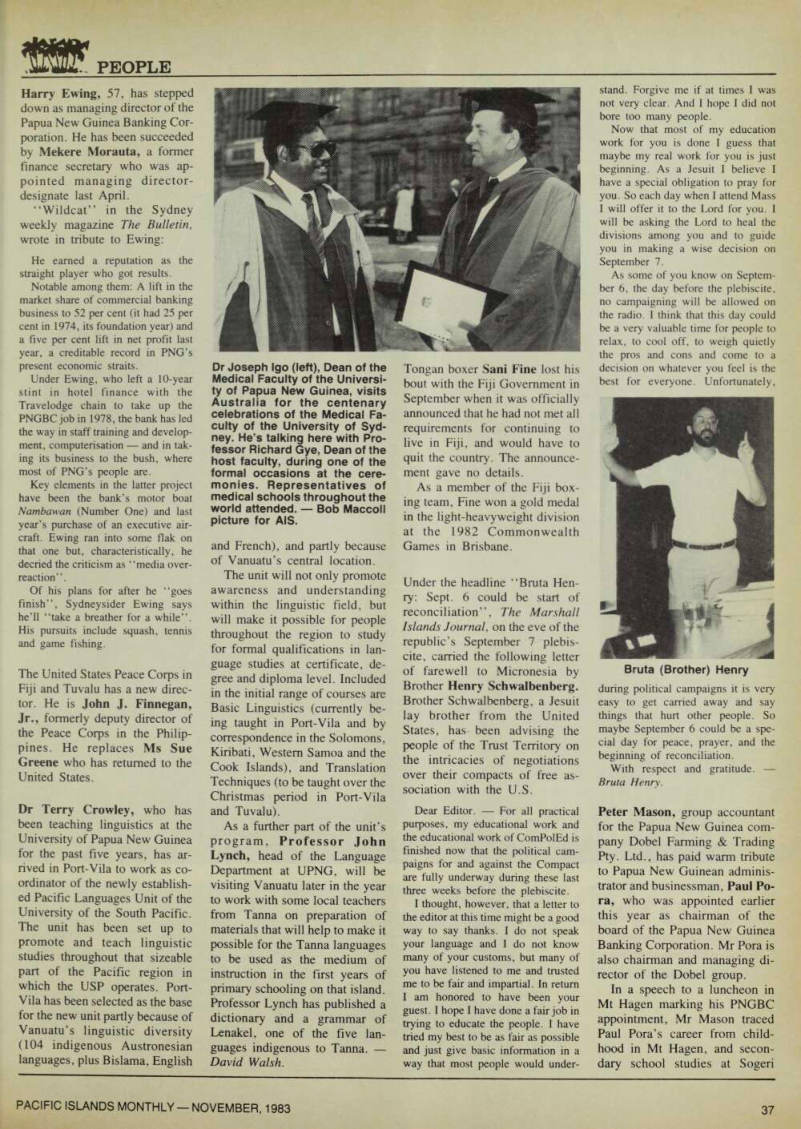
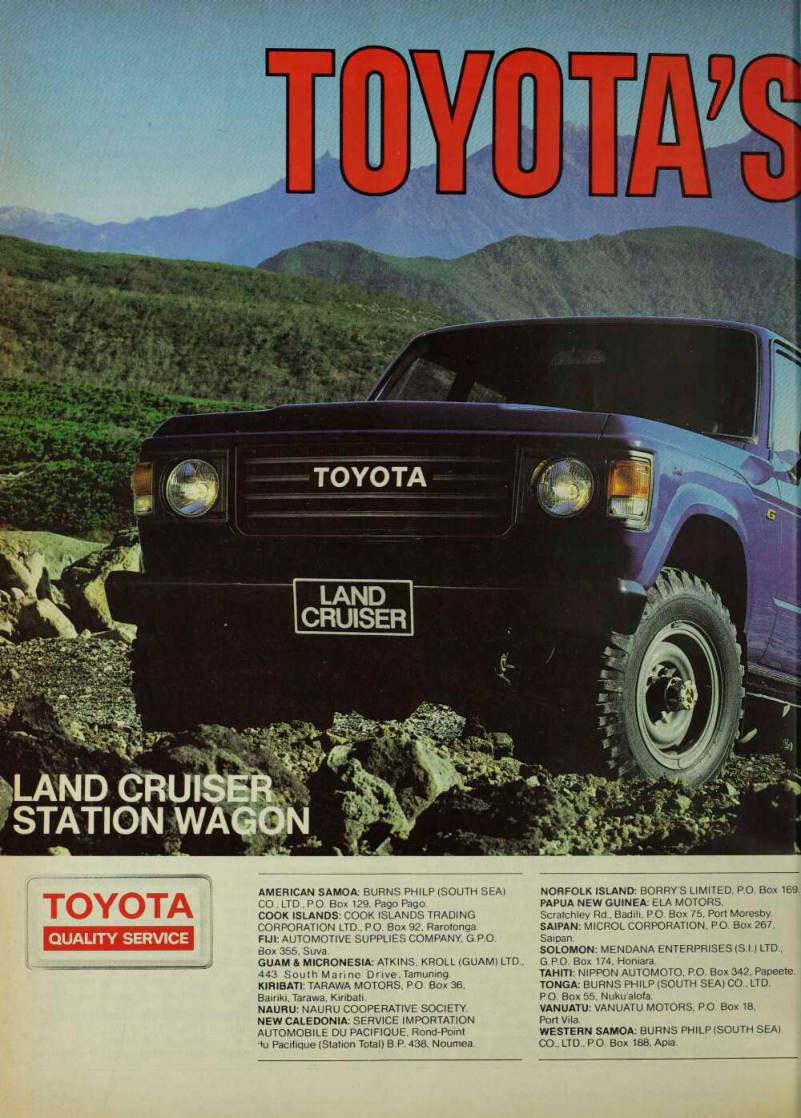

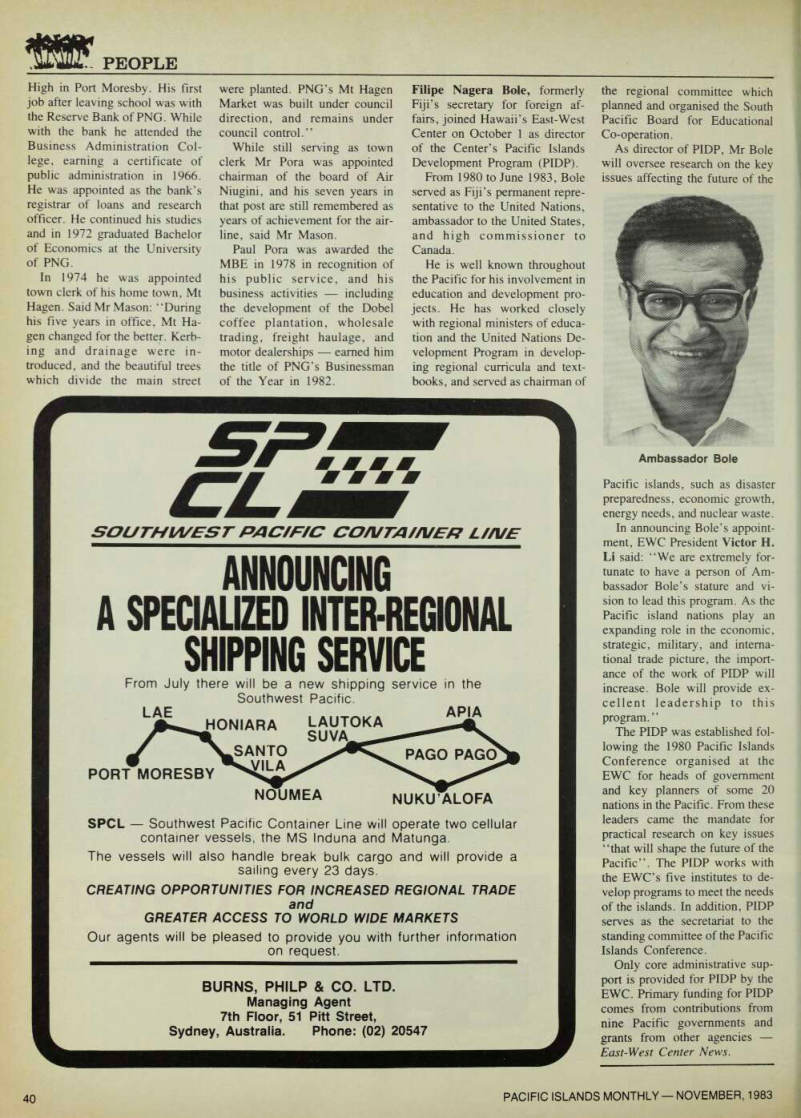
Harry Ewing, 57, has stepped down as managing director of the Papua New Guinea Banking Cor poration. He has been succeeded by Mekere Morauta, a former finance secretary who was ap pointed managing director designate last April.
“Wildcat” in the Sydney weekly magazine The Bulletin, wrote in tribute to Ewing: He earned a reputation as the straight player who got results.
Notable among them: A lift in the market share of commercial banking business to 52 per cent (it had 25 per cent in 1974, its foundation year) and a five per cent lift in net profit last year, a creditable record in PNG’s present economic straits.
Under Ewing, who left a 10-year stint in hotel finance with the Travelodge chain to take up the PNGBC job in 1978, the bank has led the way in staff training and develop ment, computerisation and in tak ing its business to the bush, where most of PNG’s people are.
Key elements in the latter project have been the bank’s motor boat Nambawan (Number One) and last year’s purchase of an executive air craft. Ewing ran into some flak on that one but, characteristically, he decried the criticism as “media over reaction”.
Of his plans for after he “goes finish”, Sydneysider Ewing says he’ll “take a breather for a while”.
His pursuits include squash, tennis and game fishing.
The United States Peace Corps in Fiji and Tuvalu has a new direc tor. He is John J. Finnegan, Jr., formerly deputy director of the Peace Corps in the Philip pines. He replaces Ms Sue Greene who has returned to the United States.
Dr Terry Crowley, who has been teaching linguistics at the University of Papua New Guinea for the past five years, has ar rived in Port-Vila to work as co ordinator of the newly establish ed Pacific Languages Unit of the University of the South Pacific.
The unit has been set up to promote and teach linguistic studies throughout that sizeable part of the Pacific region in which the USP operates. Port- Vila has been selected as the base for the new unit partly because of
Vanuatu’s linguistic diversity
(104 indigenous Austronesian
languages, plus Bislama, English
and French), and partly because of Vanuatu’s central location.
The unit will not only promote awareness and understanding within the linguistic field, but will make it possible for people throughout the region to study for formal qualifications in lan guage studies at certificate, de gree and diploma level. Included in the initial range of courses are
Basic Linguistics (currently be
ing taught in Port-Vila and by correspondence in the Solomons, Kiribati, Western Samoa and the Cook Islands), and Translation Techniques (to be taught over the Christmas period in Port-Vila and Tuvalu).
As a further part of the unit’s program, Professor John Lynch, head of the Language Department at UPNG, will be visiting Vanuatu later in the year to work with some local teachers from Tanna on preparation of materials that will help to make it possible for the Tanna languages to be used as the medium of instruction in the first years of primary schooling on that island.
Professor Lynch has published a dictionary and a grammar of Lenakel, one of the five lan guages indigenous to Tanna.
David Walsh.
Tongan boxer Sani Fine lost his bout with the Fiji Government in September when it was officially announced that he had not met all
requirements for continuing to
live in Fiji, and would have to quit the country. The announce ment gave no details.
As a member of the Fiji box ing team, Fine won a gold medal in the light-heavyweight division at the 1982 Commonwealth Games in Brisbane.
Under the headline “Bruta Hen ry: Sept. 6 could be start of reconciliation”, The Marshall Islands Journal, on the eve of the
republic’s September 7 plebis
cite, carried the following letter of farewell to Micronesia by
Brother Henry Schwalbenberg.
Brother Schwalbenberg, a Jesuit lay brother from the United States, has been advising the people of the Trust Territory on the intricacies of negotiations over their compacts of free as sociation with the U.S.
Dear Editor. For all practical purposes, my educational work and the educational work of ComPolEd is finished now that the political cam paigns for and against the Compact are fully underway during these last three weeks before the plebiscite.
I thought, however, that a letter to the editor at this time might be a good way to say thanks. I do not speak your language and I do not know many of your customs, but many of you have listened to me and trusted me to be fair and impartial. In return I am honored to have been your guest. I hope I have done a fair job in trying to educate the people. I have tried my best to be as fair as possible and just give basic information in a way that most people would under
stand. Forgive me if at times I was not very clear. And I hope I did not bore too many people.
Now that most of my education work for you is done I guess that maybe my real work for you is just beginning. As a Jesuit I believe I have a special obligation to pray for you. So each day when I attend Mass I will offer it to the Lord for you. I will be asking the Lord to heal the divisions among you and to guide you in making a wise decision on
September 7.
As some of you know on Septem ber 6, the day before the plebiscite, no campaigning will be allowed on the radio. I think that this day could be a very valuable time for people to relax, to cool off, to weigh quietly the pros and cons and come to a decision on whatever you feel is the best for everyone. Unfortunately,
during political campaigns it is very easy to get carried away and say things that hurt other people. So maybe September 6 could be a spe cial day for peace, prayer, and the beginning of reconciliation.
With respect and gratitude.
Bruta Henry.
Peter Mason, group accountant for the Papua New Guinea com pany Dobel Farming & Trading Pty. Ltd., has paid warm tribute to Papua New Guinean adminis trator and businessman, Paul Po ra, who was appointed earlier this year as chairman of the board of the Papua New Guinea Banking Corporation. Mr Pora is also chairman and managing di rector of the Dobel group.
In a speech to a luncheon in Mt Hagen marking his PNGBC appointment, Mr Mason traced Paul Pora’s career from child hood in Mt Hagen, and secon dary school studies at Sogeri
Dr Joseph Igo (left), Dean of the Medical Faculty of the Universi ty of Papua New Guinea, visits Australia for the centenary celebrations of the Medical Fa culty of the University of Syd ney. He’s talking here with Pro fessor Richard Gye, Dean of the host faculty, during one of the formal occasions at the cere monies. Representatives of medical schools throughout the world attended. - Bob Maccoll picture for AIS.
Bruta (Brother) Henry
High in Port Moresby. His first job after leaving school was with the Reserve Bank of PNG. While with the bank he attended the Business Administration Col lege, earning a certificate of public administration in 1966.
He was appointed as the bank’s registrar of loans and research officer. He continued his studies and in 1972 graduated Bachelor of Economics at the University of PNG.
In 1974 he was appointed town clerk of his home town, Mt Hagen. Said Mr Mason: “During his five years in office, Mt Ha gen changed for the better. Kerb ing and drainage were in troduced, and the beautiful trees which divide the main street
were planted. PNG’s Mt Hagen Market was built under council direction, and remains under council control.’’
While still serving as town clerk Mr Pora was appointed chairman of the board of Air Niugini, and his seven years in that post are still remembered as years of achievement for the air line, said Mr Mason.
Paul Pora was awarded the MBE in 1978 in recognition of his public service, and his business activities including the development of the Dobel coffee plantation, wholesale
trading, freight haulage, and
motor dealerships earned him the title of PNG’s Businessman of the Year in 1982.
Filipe Nagera Bole, formerly Fiji’s secretary for foreign af fairs, joined Hawaii’s East-West Center on October 1 as director of the Center’s Pacific Islands Development Program (PIDP).
From 1980 to June 1983, Bole served as Fiji’s permanent repre sentative to the United Nations, ambassador to the United States, and high commissioner to Canada.
He is well known throughout the Pacific for his involvement in education and development pro jects. He has worked closely with regional ministers of educa tion and the United Nations De velopment Program in develop ing regional curricula and text books, and served as chairman of
the regional committee which planned and organised the South Pacific Board for Educational
Co-operation.
As director of PIDP, Mr Bole will oversee research on the key issues affecting the future of the
Pacific islands, such as disaster preparedness, economic growth, energy needs, and nuclear waste.
In announcing Bole’s appoint ment, EWC President Victor H.
Li said; “We are extremely for tunate to have a person of Am bassador Bole’s stature and vi sion to lead this program. As the Pacific island nations play an expanding role in the economic, strategic, military, and interna tional trade picture, the import ance of the work of PIDP will increase. Bole will provide ex cellent leadership to this
program.’’
The PIDP was established fol lowing the 1980 Pacific Islands Conference organised at the EWC for heads of government and key planners of some 20 nations in the Pacific. From these leaders came the mandate for practical research on key issues “that will shape the future of the Pacific’’. The PIDP works with the EWC’s five institutes to de velop programs to meet the needs of the islands. In addition, PIDP serves as the secretariat to the standing committee of the Pacific Islands Conference.
Only core administrative sup port is provided for PIDP by the EWC. Primary funding for PIDP comes from contributions from nine Pacific governments and grants from other agencies
East-West Center News.
Ambassador Bole
Tourist establishments set up outside Noumea in Melanesian areas of New Caledonia have had their share of problems, the latest and most dramatic being the de struction by fire of the resort hotel on the island of Ouvea in the Loyalty group (PIM Oct. p 5).
But one man who seems to have the answer to all the prob lems is Henry Fairbank, prop rietor of the Relais de Koulnoue, near Hienghene on the northeast coast of the big island.
When Kevin Voltz, travel editor of the Sydney Sunday pap er The Sun-Herald, visited Koul noue earlier this year he found that he couldn’t lock the door of
his Melanesian-style bungalow.
“No need to,” said Mr Fair bank. “We’ve never had any trouble with thieving here. The natives are good people.”
Voltz commented: “Certainly, easy smiling Melanesians in the area do seem a friendly lot, and there’s no sign of the spraycan political graffiti that decorate the walls and fences in Poindimie, the east coast administration headquarters 62 kilometres to the southeast.
“Maybe it’s because Koul noue is a very laid-back sort of place. Crops thrive in the local villages. Henry seems to have no shortage of lobsters, crabs and other seafood to serve, and there’s nothing much to do ex cept eat, drink and laze or play tennis ...”
Whatever the reasons, good luck to Henry Fairbank, and to the friendly locals of Koulnoue.
Papua New Guinea’s new am bassador to Indonesia is Brian Amini, who will quit the post of
high commissioner in New Zea land to go to Jakarta. Mr Amini succeeds Benson Gegeyo, whose term in the key Jakarta post ends in December.
New Zealand’s Maoris may not yet have won the right to take part in the South Pacific Games for which they are striving, but they certainly won some hearts with their September presenta tion of a fully equipped ambu lance to the organisers of the 7th South Pacific Games in Apia.
The vehicle, manned by two am bulance men from New Zealand whose services also came free, was used throughout the Games.
At the presentation ceremony in Apia were the chairman of the New Zealand Maori Sports Fed eration, Dr Heanare Brough ton, the executive director of the Games, Seiulu Paul Wallwork, chairman of the organising com mittee, Peter Paul, secretary John Macdonald, and treasurer Tilafono Joe Hunter.
A former captain of Western Samoa’s national team, the Rev.
Faitala Talapusi, conducted a brief dedication ceremony of the vehicle, which bore the words Te rau Aroha tuarua. According to The Samoa Times, they mean “The Leaf of Love Number Two’’ in memory of the famous second Maori Battalion of the New Zealand Army.
With Dr Broughton at the ceremony were vice-chairman of the New Zealand Maori Sports Federation Frankie Dennis, and secretary Joy Martin.
Mr Dennis would not reveal the cost of the vehicle. “There is no price, because it comes from here,’’ he said, placing his hand on his heart.
Pacific Islanders resident in Syd ney were well to the fore in the 1983 Spring Fair held by the city’s Wesley Central Mission.
Miss Pacific Islands Mar garet Auva’a from Western Samoa came third in the fund raising contest staged to help the mission. Her tally was $A 14,000. (Miss International, representing Asian countries such as China and Indonesia, came first with $lB,OOO, and Miss Class of Senior Citizens elderly Australians second with $16,000). Total sum raised by all participants was a record $128,000.
The Spring Fair is one of many projects supported every year by Fijians, Rotumans, Samoans, Tongans and Australians through the Sydney-based Pacific Islan ders’ Council.
Chairman of the council is Margaret Auva’s’s father, the Rev. Fa’atoese Auva’a, who is associate minister at Wesley Central Mission with special re sponsibility for 12 Pacific Islands congregations around Sydney.
Members of the Pacific Islands Council, in association with the municipal councils of the Sydney suburbs of Ryde and Leichhardt, offered entertainments and Poly nesian-style feasts as part of Gar ni vale ’B3, a multi-cultural fes tival sponsored in September each year by the government of New South Wales.
The Organising Committee of the 7th South Pacific Games has presented a Games gold medal to Western Samoa’s Head of State Malietoa Tanumafili 11.
A spokesman for the commit tee said the presentation was to show the committee’s apprecia tion to the Western Samoan lead er for his contribution to the success of the event, especially for his opening and closing of the Games.
Henry Fairbank and one of the huts at the Relais de Koulnouè: “You don’t need locks here.”
Right: Margaret Auva’a wears her Miss Pacific islands sash.
‘getting organised' in PNG
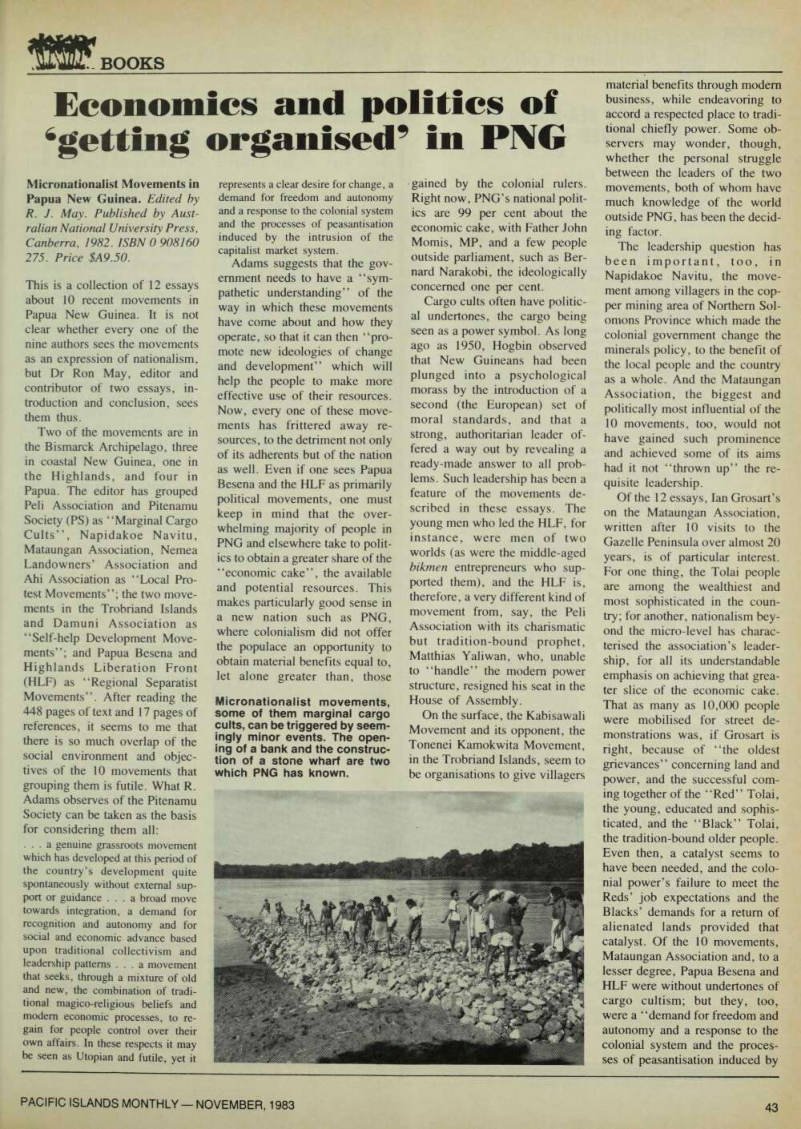
Books
Economics and politics of ‘getting organised' in PNG
Micronationalist Movements in Papua New Guinea. Edited by R. J. May. Published by Aust ralian National University Press, Canberra, 1982. ISBN 0 908160 275. Price $A9.50.
This is a collection of 12 essays about 10 recent movements in Papua New Guinea. It is not clear whether every one of the nine authors sees the movements as an expression of nationalism, but Dr Ron May, editor and contributor of two essays, in troduction and conclusion, sees them thus.
Two of the movements are in the Bismarck Archipelago, three in coastal New Guinea, one in the Highlands, and four in Papua. The editor has grouped Peli Association and Pitenamu Society (PS) as “Marginal Cargo Cults”, Napidakoe Navitu, Mataungan Association, Nemea Landowners’ Association and Ahi Association as “Local Pro test Movements”; the two move ments in the Trobriand Islands and Damuni Association as
“Self-help Development Move
ments”; and Papua Besena and Highlands Liberation Front (HLF) as “Regional Separatist Movements”. After reading the 448 pages of text and 17 pages of references, it seems to me that there is so much overlap of the social environment and objec tives of the 10 movements that grouping them is futile. What R.
Adams observes of the Pitenamu Society can be taken as the basis for considering them all: ... a genuine grassroots movement which has developed at this period of the country’s development quite spontaneously without external sup port or guidance ... a broad move towards integration, a demand for recognition and autonomy and for social and economic advance based upon traditional collectivism and leadership patterns ... a movement that seeks, through a mixture of old and new, the combination of tradi tional magico-religious beliefs and modem economic processes, to re gain for people control over their own affairs. In these respects it may be seen as Utopian and futile, yet it
represents a clear desire for change, a demand for freedom and autonomy and a response to the colonial system and the processes of peasantisation induced by the intrusion of the capitalist market system.
Adams suggests that the gov ernment needs to have a “sym pathetic understanding” of the way in which these movements have come about and how they operate, so that it can then “pro mote new ideologies of change and development” which will help the people to make more effective use of their resources.
Now, every one of these move ments has frittered away re sources, to the detriment not only of its adherents but of the nation as well. Even if one sees Papua Besena and the HLF as primarily political movements, one must keep in mind that the over whelming majority of people in PNG and elsewhere take to polit ics to obtain a greater share of the “economic cake”, the available and potential resources. This makes particularly good sense in a new nation such as PNG, where colonialism did not offer the populace an opportunity to obtain material benefits equal to, let alone greater than, those
gained by the colonial rulers.
Right now, PNG’s national polit ics are 99 per cent about the economic cake, with Father John Momis, MP, and a few people outside parliament, such as Ber nard Narakobi, the ideologically concerned one per cent.
Cargo cults often have politic al undertones, the cargo being seen as a power symbol. As long ago as 1950, Hogbin observed that New Guineans had been plunged into a psychological morass by the introduction of a second (the European) set of moral standards, and that a strong, authoritarian leader of fered a way out by revealing a ready-made answer to all prob lems. Such leadership has been a feature of the movements de scribed in these essays. The young men who led the HLF, for instance, were men of two worlds (as were the middle-aged bikmen entrepreneurs who sup ported them), and the HLF is, therefore, a very different kind of movement from, say, the Peli Association with its charismatic but tradition-bound prophet, Matthias Yaliwan, who, unable to “handle” the modem power structure, resigned his seat in the House of Assembly.
On the surface, the Kabisawali Movement and its opponent, the Tonenei Kamokwita Movement, in the Trobriand Islands, seem to be organisations to give villagers
material benefits through modem business, while endeavoring to accord a respected place to tradi tional chiefly power. Some ob servers may wonder, though, whether the personal struggle between the leaders of the two movements, both of whom have much knowledge of the world outside PNG, has been the decid
ing factor.
The leadership question has been important, too, in Napidakoe Navitu, the move ment among villagers in the cop per mining area of Northern Sol omons Province which made the colonial government change the minerals policy, to the benefit of the local people and the country as a whole. And the Mataungan Association, the biggest and politically most influential of the 10 movements, too, would not have gained such prominence and achieved some of its aims had it not “thrown up” the re
quisite leadership.
Of the 12 essays, lan Grosart’s on the Mataungan Association, written after 10 visits to the Gazelle Peninsula over almost 20 years, is of particular interest.
For one thing, the Tolai people are among the wealthiest and most sophisticated in the coun try; for another, nationalism bey ond the micro-level has charac terised the association’s leader ship, for all its understandable emphasis on achieving that grea ter slice of the economic cake.
That as many as 10,000 people were mobilised for street de monstrations was, if Grosart is right, because of “the oldest grievances’’ concerning land and power, and the successful com ing together of the “Red” Tolai, the young, educated and sophis ticated, and the “Black” Tolai, the tradition-bound older people.
Even then, a catalyst seems to have been needed, and the colo nial power’s failure to meet the Reds’ job expectations and the Blacks’ demands for a return of alienated lands provided that catalyst. Of the 10 movements, Mataungan Association and, to a lesser degree, Papua Besena and HLF were without undertones of cargo cultism; but they, too, were a “demand for freedom and autonomy and a response to the colonial system and the proces ses of peasantisation induced by
Micronationalist movements, some of them marginal cargo cults, can be triggered by seem ingly minor events. The open ing of a bank and the construc tion of a stone wharf are two which PNG has known.
the intrusion of the capitalist sys tem.” People want their bellies filled before they concern them selves with ideological politics.
Nationalism has, therefore, not been high on the villagers’ agenda.
Each essay is well worth read ing and deserves a mention here.
For brevity’s sake, this review must end with a comment on Adams’s essay on the Pitenamu Society because the PS is a very good example of the amalgam of cargo cult, consistent busines s/investment orientation, emerg ence of bikmen bilong bisnis and fringe politics which, I believe, is found in many development corporations, co-operatives and other business group ventures outside urban areas. The PS operated in the Pindiu area, Finschhafen district, Morobe province, between 1971 and 1974. From the 1950 s on, two enterprises with shareholders throughout the Finschhafen dis trict, namely Finschhafen Mar keting & Development Society, a co-operative under the aegis of the colonial government, and Native Marketing & Supply
Company, sponsored by the
Lutheran Mission, had marketed villagers’ primary produce and operated village stores and coas tal shipping. Their shareholders became dissatisfied with the re turns from their produce and the cost of goods; inland villagers, in
particular, were disappointed as
the logistics disadvantaged them.
The area had had cargo cults from as long ago as the 19305, and the failure of a company formed by a European entre preneur in the late 1960 s and financed by the villagers was the last straw.
In retrospect, it seems that the promoters of the PS could rightly and, no doubt, did point out to the people that every ven ture with European help had not met their expectations and that the cults had been abortive, too.
The promoters used the local cult technique, with its planting of tanket (a red-leafed shrub) and the thinking behind it, but they gave priority to economic objec tives in the modem sense and went about organising the PS in a businesslike manner. Dividing the area into spheres of influence led by a traditional bikman or, at
least, having him up front, and encompassing Pindiu people settled at Lae and elsewhere, the PS’s leaders succeeded in raising funds to operate passenger motor vehicles on the Lae-Wau road, and to conduct village stores.
There was, moreover, an attempt to link up with the emerging Pangu Pati, the political party which, in 1975, provided the nation’s frst prime minister.
That the PS went broke was not because of a lack of grassroots support or objectives but because of the inadequacy of managerial skill at all levels and the failure to understand modem business among all but a small number of the shareholders. That small number, one must assume, were the individuals who came out of the PS debacle as successful en trepreneurs on their own account.
Many of the wealthy local businessmen in PNG today have cut their business teeth as em ployees or directors of co operatives, development corpo rations or other group business ventures. If capitalism continues on its seemingly inexorable way, its ethic replacing traditional values, these businessmen and like-minded politicians and publ ic servants may deal with move ments like those described in these essays much more harshly than the colonial government dealt with them. In any case, continuing modernisation of al most every aspect of life is re moving the conditions for the emergence and survival of such movements.
As so often happens with the publication by academic presses of collections of essays, this col lection has been so long in the making that most of the essays do not deal with the current situation. Then, too, only one of the essays is by a Papua New Guinean. Even so, one would be hard put to find better value for $9.50 and, most important, it is precisely the kind of information offered by Dr Ron May and his collaborators which Papua New Guinea’s political decision makers need and must consider if national development is to be achieved at the least possible cost to the freedom and dignity of
every citizen.
Harry H.
Jackman.
Advertisements & other items, p. 44 (1 item)
Maritime College
Australian
COURSES FOR SEA GOING AND
SHORE RASED CAREERS
The Australian Maritime College is Australia’s only national, higher education institution offering certificate to degree and post graduate level courses exclusively for the shipping, fishing, port, off-shore and allied industries.
Certificate of Competency courses are offered for Master Class 1 and 2.
A wide variety of short courses are expressly designed to meet industry needs as they arise. Course topics include tanker safety, fire prevention and control, compass adjusting, radar and diesel engine simulator training, fisheries technology and survival training.
The College operates several training vessels including the 35 m purpose-built fisheries vessel “Bluefin", and the 64 m seamanship training vessel “Wyuna”.
Otherfacilities include a radarsimulator, adiesel engine simulator, a survival training centre, a ship model towing tank and a flume tank. A shiphandling simulator will be installed in 1984.
Accommodation is available on campus in comfortable, single study-bedrooms.
There are no tuition fees for students attending full-time courses. Allcoursesareeitherapproved undertheTEAS Scheme or are aw&iting approval.
Course in 1984 Duration Career Diploma of Applied 4 years’ Navigation Officer Science (Nautical Science) □ Diploma of Engineering 4 years* Marine Engineer (Marine) □ Associate Diploma in 2 years Radio Officer Marine Radiocommunication □ Associate Diploma in 2 years Electronics Maritime Electronics □ Technical Officer Certificate of Technology 3 years* Fisherman/Skipper in Fisheries Operations □ Diploma of Applied Science (Fisheries Technology) □ Postgraduate Diploma in 1 Hydrographic Surveying □ 4 years* Fleet Skipper/ Fisheries Manager/ positions in marketing year Hydrographic Surveyor Entry requirements: For all courses, except the Certificate of Technology in Fisheries Operations, satisfactory completionof Yearl 2 isrequired in maths, Englishanda branch of science, preferably physics. The Fisheries Certificate requires satisfactory completion of Year 10. * These courses include substantial industrial/sea experience.
Further Information Please tick appropriate boxes, and cut out and send this advertisement to the address below.
Please print Name Address Postcode Send to The Admissions Office, Australian Maritime College, P.O. Box 986, Launceston, Tasmania. 7250 Telephone (003) 26 0731. o K CM O)
pots of Papua New Guinea
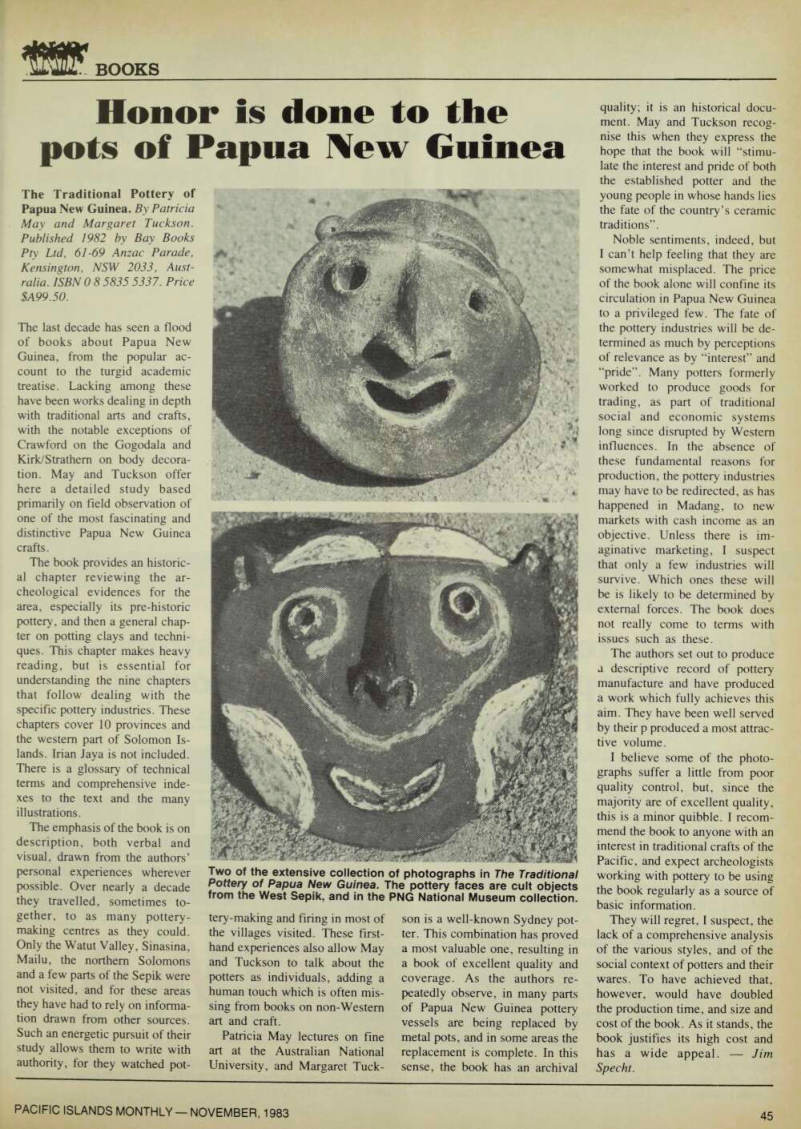
Honor is done to the pots of Papua New Guinea
The Traditional Pottery of Papua New Guinea. By Patricia May and Margaret Tuckson.
Published 1982 by Bay Books Pty Ltd, 61-69 Anzac Parade, Kensington, NSW 2033, Aust ralia. ISBN 0 8 5835 5337. Price $A99.50.
The last decade has seen a flood of books about Papua New Guinea, from the popular ac count to the turgid academic treatise. Lacking among these have been works dealing in depth with traditional arts and crafts, with the notable exceptions of Crawford on the Gogodala and Kirk/Strathem on body decora tion. May and Tuckson offer here a detailed study based primarily on field observation of one of the most fascinating and distinctive Papua New Guinea crafts.
The book provides an historic al chapter reviewing the ar cheological evidences for the area, especially its pre-historic pottery, and then a general chap ter on potting clays and techni ques. This chapter makes heavy reading, but is essential for
understanding the nine chapters
that follow dealing with the specific pottery industries. These chapters cover 10 provinces and the western part of Solomon Is lands. Irian Jaya is not included.
There is a glossary of technical terms and comprehensive inde xes to the text and the many illustrations.
The emphasis of the book is on description, both verbal and visual, drawn from the authors’ personal experiences wherever possible. Over nearly a decade they travelled, sometimes to gether, to as many pottery making centres as they could.
Only the Watut Valley, Sinasina, Mailu, the northern Solomons and a few parts of the Sepik were not visited, and for these areas they have had to rely on informa tion drawn from other sources.
Such an energetic pursuit of their study allows them to write with authority, for they watched pot-
tery-making and firing in most of the villages visited. These first hand experiences also allow May and Tuckson to talk about the potters as individuals, adding a human touch which is often mis sing from books on non-Westem art and craft.
Patricia May lectures on fine art at the Australian National University, and Margaret Tuck
son is a well-known Sydney pot ter. This combination has proved a most valuable one, resulting in a book of excellent quality and coverage. As the authors re peatedly observe, in many parts of Papua New Guinea pottery vessels are being replaced by metal pots, and in some areas the replacement is complete. In this sense, the book has an archival
quality; it is an historical docu ment. May and Tuckson recog nise this when they express the hope that the book will “stimu late the interest and pride of both the established potter and the young people in whose hands lies the fate of the country’s ceramic traditions”.
Noble sentiments, indeed, but I can’t help feeling that they are somewhat misplaced. The price of the book alone will confine its circulation in Papua New Guinea to a privileged few. The fate of the pottery industries will be de termined as much by perceptions of relevance as by “interest” and “pride”. Many potters formerly worked to produce goods for trading, as part of traditional social and economic systems long since disrupted by Western influences. In the absence of these fundamental reasons for production, the pottery industries may have to be redirected, as has happened in Madang, to new markets with cash income as an objective. Unless there is im aginative marketing, I suspect that only a few industries will survive. Which ones these will be is likely to be determined by external forces. The book does not really come to terms with issues such as these.
The authors set out to produce a descriptive record of pottery manufacture and have produced a work which fully achieves this aim. They have been well served by their p produced a most attrac tive volume.
I believe some of the photo graphs suffer a little from poor quality control, but, since the majority are of excellent quality, this is a minor quibble. I recom mend the book to anyone with an interest in traditional crafts of the Pacific, and expect archeologists working with pottery to be using the book regularly as a source of basic information.
They will regret, I suspect, the lack of a comprehensive analysis of the various styles, and of the social context of potters and their wares. To have achieved that, however, would have doubled the production time, and size and cost of the book. As it stands, the book justifies its high cost and has a wide appeal. Jim Specht.
Two of the extensive collection of photographs in The Traditional Pottery of Papua New Guinea. The pottery faces are cult objects from the West Sepik, and in the PNG National Museum collection.
Advertisements & other items, p. 46 (1 item)
Aiwa 8
Five minutes after reading the instructions,
Betty produced the best recording
she ever made in her life.
She did it because AlWA’s V-700 system is simply the “smartest,” most automated highperformance component ensemble ever created.
Not only does it dub automatically from disc to cassette at the touch of a single “Synchro Recording” control; its fully programmable turntable and exclusive “Auto Editing” facility will record up to seven tracks on the disc in any desired order, automatically.
An optional “plug-in” rack even lets Betty install this versatile 45 Watt per channel system without the bother of struggling with complicated wiring connections.
The V-700 system from AIWA: no faster, easier way to make great, “original label” recordings!
AIWA 8
AIWA Co., Ltd. 11-9, Ueno 1-chome, Taito-ku, Tokyo, Japan.
Distributors: Australia AIWA Australia Pty., Ltd./Cook Islands Island Merchants Ltd./Fiji P. Hargovind & Co., D. Ranchhod & Co./Guam Micropac Audio, Inc./New Caledonia hifivox/New Zealand Milaw Trading Co., Ltd./P.N.G. Oceania Indent Agency (P.N.G.) Pty, Ltd./Solomon Islands Harvest Pacific Ltd./Tahiti Fare Hi-Fi Stereo/Vanuatu (New Hebrides)The Sound Centre Ltd.
Discovering Malaita, and Kwai,
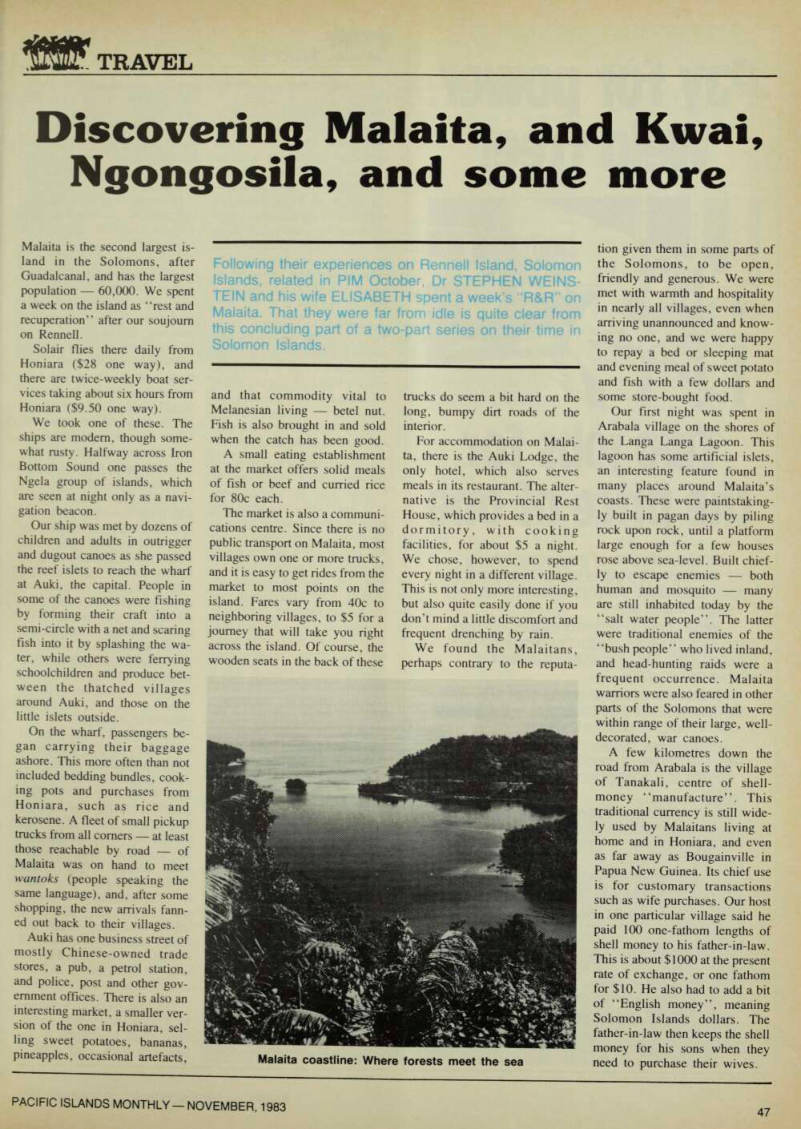

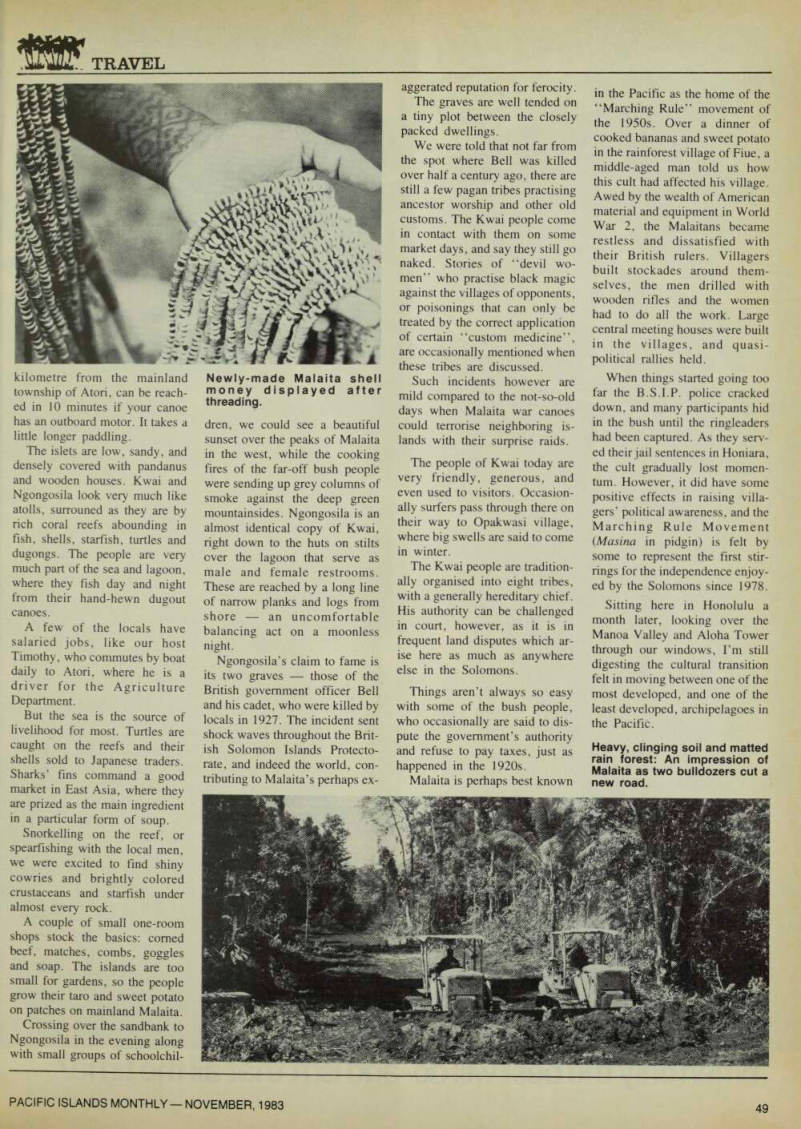
Travel
Discovering Malaita, and Kwai, Ngongosila, and some more
Following their experiences on Rennell Island, Solomon Islands, related in RIM October, Dr STEPHEN WEINS TEIN and his wife ELISABETH spent a week’s “R&R” on Malaita. That they were far from idle is quite clear from this concluding part of a two-part series on their time in Solomon Islands.
Malaita is the second largest is land in the Solomons, after Guadalcanal, and has the largest population 60,000. We spent a week on the island as “rest and recuperation” after our soujoum on Rennell.
Solair flies there daily from Honiara ($2B one way), and there are twice-weekly boat ser vices taking about six hours from Honiara ($9.50 one way).
We took one of these. The ships are modem, though some what rusty. Halfway across Iron Bottom Sound one passes the Ngela group of islands, which are seen at night only as a navi gation beacon.
Our ship was met by dozens of children and adults in outrigger and dugout canoes as she passed the reef islets to reach the wharf at Auki, the capital. People in some of the canoes were fishing by forming their craft into a semi-circle with a net and scaring fish into it by splashing the wa ter, while others were ferrying schoolchildren and produce bet ween the thatched villages around Auki, and those on the little islets outside.
On the wharf, passengers be
gan carrying their baggage
ashore. This more often than not included bedding bundles, cook ing pots and purchases from Honiara, such as rice and kerosene. A fleet of small pickup trucks from all comers at least those reachable by road of Malaita was on hand to meet wantoks (people speaking the same language), and, after some shopping, the new arrivals fann ed out back to their villages.
Auki has one business street of mostly Chinese-owned trade stores, a pub, a petrol station, and police, post and other gov ernment offices. There is also an interesting market, a smaller ver sion of the one in Honiara, sel ling sweet potatoes, bananas, pineapples, occasional artefacts,
and that commodity vital to Melanesian living betel nut.
Fish is also brought in and sold when the catch has been good.
A small eating establishment at the market offers solid meals of fish or beef and curried rice for 80c each.
The market is also a communi cations centre. Since there is no public transport on Malaita, most villages own one or more trucks, and it is easy to get rides from the market to most points on the island. Fares vary from 40c to neighboring villages, to $5 for a journey that will take you right across the island. Of course, the wooden seats in the back of these
trucks do seem a bit hard on the long, bumpy dirt roads of the interior.
For accommodation on Malai ta, there is the Auki Lodge, the only hotel, which also serves meals in its restaurant. The alter native is the Provincial Rest House, which provides a bed in a dormitory, with cooking facilities, for about $5 a night.
We chose, however, to spend every night in a different village.
This is not only more interesting, but also quite easily done if you don’t mind a little discomfort and frequent drenching by rain.
We found the Malaitans, perhaps contrary to the reputa-
tion given them in some parts of the Solomons, to be open, friendly and generous. We were met with warmth and hospitality in nearly all villages, even when arriving unannounced and know ing no one, and we were happy to repay a bed or sleeping mat and evening meal of sweet potato and fish with a few dollars and some store-bought food.
Our first night was spent in Arabala village on the shores of
the Langa Langa Lagoon. This
lagoon has some artificial islets, an interesting feature found in many places around Malaita’s coasts. These were paintstaking ly built in pagan days by piling rock upon rock, until a platform large enough for a few houses rose above sea-level. Built chief ly to escape enemies both human and mosquito many are still inhabited today by the “salt water people’’. The latter were traditional enemies of the “bush people” who lived inland, and head-hunting raids were a frequent occurrence. Malaita warriors were also feared in other parts of the Solomons that were within range of their large, well decorated, war canoes.
A few kilometres down the road from Arabala is the village of Tanakali, centre of shell money “manufacture”. This traditional currency is still wide ly used by Malaitans living at home and in Honiara, and even as far away as Bougainville in Papua New Guinea. Its chief use is for customary transactions such as wife purchases. Our host in one particular village said he paid 100 one-fathom lengths of shell money to his father-in-law.
This is about $ 1000 at the present rate of exchange, or one fathom for $lO. He also had to add a bit
of “English money”, meaning
Solomon Islands dollars. The father-in-law then keeps the shell money for his sons when they need to purchase their wives.
Malaita coastline: Where forests meet the sea
The shell-money is made by chipping certain shells and dril ling holes in them. These chips are then threaded into fathom strings and filed into smooth even discs by rubbing them on grooved stones. Ten fathoms are tied together to make an elabo rate belt worth $lOO. The value also depends on the colors, with red being the most prized since the shell is heat-treated to bring out the red color, hence more work is involved. Then come orange and white, with black the least appreciated.
Across the lagoon from Tanakali is the artificial island named Laulasi, the home of the shark-callers. This is one of the many villages on Malaita where the inhabitants still practise tradi tional ancestor worship, although some of them belong to the vari ous mission denominations.
Laulasi is one of the few partly commercialised attractions of Malaita, with tours going there from Auki Lodge. We visited the place by hiring a dugout canoe to take us across from Tanakali, but still had to pay a landing fee to go ashore at Laulasi. There my wife and I had to separate ac cording to the local custom, go ing to visit the male and female “custom houses” respectively, since these are taboo to the oppo site sexes. There were three male custom houses, each of which contained the skulls of the tribes’ founding chiefs or “big men”.
Those of lesser rank lay on the ground, while those of greater importance were wrapped in reed bundles and hung from the roof or placed on a shelf. The animist priest, or “custom man”, spoke to the skulls asking their permis sion for me to photograph them.
Outside the shrine lay more skulls from people whose identi ty was no longer known. When a chief of this particular village dies, even if in Honiara, his body is taken to decompose at a secret locality in the bush, and the skull later is brought back to its right ful resting place in the custom house.
The female part consisted of a small thatched house fenced in by a 60 cm stone wall. There were no windows, only a door way. Behind this structure
another thatched house, used during childbirth, once existed.
Now only a stone platform re mains to mark its location. It would appear that childbirth at least has become less taboo, and most women go to hospitals to have their babies.
However, as in many oceanic cultures, the monthlies are as sociated with their own set of restrictions. During menstruation the women stay in the thatched houses and are isolated from all contact with the rest of the vil lage. They must get their own food from the gardens on the mainland, and no one is allowed to give them anything or take anything from them. While I was there several women were oc cupying the house. In the dis tance I could see a boatshed with a large decorated war canoe, but I was not permitted to have a closer look or to take a picture.
Across the path from the cus tom houses (for living space is very cramped on an artificial island) are two stone enclosures where the sacrificial offerings for the sharks are kept prior to the ritual. These victims used to be human, but now pigs have taken their place. The ceremony is rarely performed and very com plicated, but we were shown the passage between the islets where the six-metre monsters swim in when summoned by the chants of the priest. A recent tour by film crews to film this ritual has in flated the price for staging the event to about $6OO.
Inland Malaita, the home of the “bush people”, is a land of rugged mountains, covered in dense rainforest, with tiny vil lages of thatched huts in small clearings. The gardens where the people grow sweet potato, the most important subsistence crop, are located on steep hillsides, often covered in fog or low cloud. It takes about three hours to cross Malaita from east to west, over cool mountain streams and sharp ridges. The bumpy ride was well worth it, because we were headed for the island of Kwai, one of the most idyllic places in the Solomons.
The twin islets of Kwai and Ngongosila are joined by a sand bank which is exposed at low tide. The islets, only about a
kilometre from the mainland township of Atori, can be reach ed in 10 minutes if your canoe has an outboard motor. It takes a
little longer paddling.
The islets are low, sandy, and densely covered with pandanus and wooden houses. Kwai and Ngongosila look very much like atolls, surrouned as they are by rich coral reefs abounding in fish, shells, starfish, turtles and dugongs. The people are very much part of the sea and lagoon, where they fish day and night from their hand-hewn dugout canoes.
A few of the locals have salaried jobs, like our host Timothy, who commutes by boat daily to Atori, where he is a driver for the Agriculture
Department.
But the sea is the source of livelihood for most. Turtles are caught on the reefs and their shells sold to Japanese traders.
Sharks’ fins command a good market in East Asia, where they are prized as the main ingredient in a particular form of soup.
Snorkelling on the reef, or spearfishing with the local men, we were excited to find shiny cowries and brightly colored crustaceans and starfish under almost every rock.
A couple of small one-room shops stock the basics: corned beef, matches, combs, goggles and soap. The islands are too small for gardens, so the people grow their taro and sweet potato on patches on mainland Malaita.
Crossing over the sandbank to
Ngongosila in the evening along
with small groups of schoolchil
aggerated reputation for ferocity.
The graves are well tended on a tiny plot between the closely packed dwellings.
We were told that not far from the spot where Bell was killed over half a century ago, there are still a few pagan tribes practising ancestor worship and other old customs. The Kwai people come in contact with them on some market days, and say they still go naked. Stories of “devil wo men’’ who practise black magic against the villages of opponents, or poisonings that can only be treated by the correct application of certain “custom medicine”, are occasionally mentioned when these tribes are discussed.
Such incidents however are mild compared to the not-so-old days when Malaita war canoes could terrorise neighboring is lands with their surprise raids.
The people of Kwai today are very friendly, generous, and even used to visitors. Occasion ally surfers pass through there on their way to Opakwasi village, where big swells are said to come in winter.
The Kwai people are tradition ally organised into eight tribes, with a generally hereditary chief.
His authority can be challenged in court, however, as it is in frequent land disputes which ar ise here as much as anywhere else in the Solomons.
Things aren’t always so easy with some of the bush people, who occasionally are said to dis pute the government’s authority and refuse to pay taxes, just as happened in the 19205.
Malaita is perhaps best known
dren, we could see a beautiful sunset over the peaks of Malaita in the west, while the cooking fires of the far-off bush people were sending up grey columns of smoke against the deep green mountainsides. Ngongosila is an almost identical copy of Kwai, right down to the huts on stilts over the lagoon that serve as male and female restrooms.
These are reached by a long line of narrow planks and logs from shore an uncomfortable balancing act on a moonless
night.
Ngongosila’s claim to fame is its two graves those of the British government officer Bell and his cadet, who were killed by locals in 1927. The incident sent shock waves throughout the Brit ish Solomon Islands Protecto rate, and indeed the world, con tributing to Malaita’s perhaps ex
in the Pacific as the home of the “Marching Rule” movement of the 19505. Over a dinner of cooked bananas and sweet potato in the rainforest village of Fine, a middle-aged man told us how this cult had affected his village.
Awed by the wealth of American material and equipment in World War 2, the Malaitans became restless and dissatisfied with their British rulers. Villagers built stockades around them selves, the men drilled with wooden rifles and the women had to do all the work. Large central meeting houses were built in the villages, and quasi political rallies held.
When things started going too far the 8.5.1. P. police cracked down, and many participants hid in the bush until the ringleaders had been captured. As they serv ed their jail sentences in Honiara, the cult gradually lost momen tum. However, it did have some positive effects in raising villa gers’ political awareness, and the Marching Rule Movement (Masina in pidgin) is felt by some to represent the first stir
rings for the independence enjoy
ed by the Solomons since 1978.
Sitting here in Honolulu a month later, looking over the Manoa Valley and Aloha Tower through our windows, I’m still digesting the cultural transition felt in moving between one of the most developed, and one of the
least developed, archipelagoes in
the Pacific.
Heavy, clinging soil and matted rain forest: An impression of Malaita as two bulldozers cut a new road.
Newly-made Malaita shell money displayed after threading.
Advertisements & other items, pp. 48-50 (1 item)
Pay for power.
Weld free!
Two jobs for
the price of one
For about the price of most generator-only units, Weldanpower provides up to 175 amp arc welding and 240 volt power at the same time, in a single compact unit. weldanpower 175 P (petrol engine) and 175 D (diesel engine). Complete with carry frame for easy transportation. And easier still with optional wheeled undercarriage.
Or choose the optional electric-start 175 D with undercarriage as standard equipment - the ultimate in compact portable power and welding.
Weldanpower. It's a proven, highly successful design. Constructed to Lincoln s exacting standards, For long life, low maintenance. And outstanding reliability.
Wise up to Weldanpower. where you get two functions for the price of one. It's at your Lincoln dealer now.
EH3EJ-,
ARC WELDING
The Lincoln Electric Company (Aust.) Pty. Ltd.
A subsidiary of the Lincoln Electric Co., U S A., and with plants in Australia, Canada and France 35 Bryant Street, Padstow, Sydney, N.S.W. 2211.
Phone: (02) 772 7222. Telex: 22792.
Trade inquiries welcome
LEI 35.25/9. SAP
When only the best will do-and isn't that all the time?
W 651
In Vanuatu, CUSO fisheries
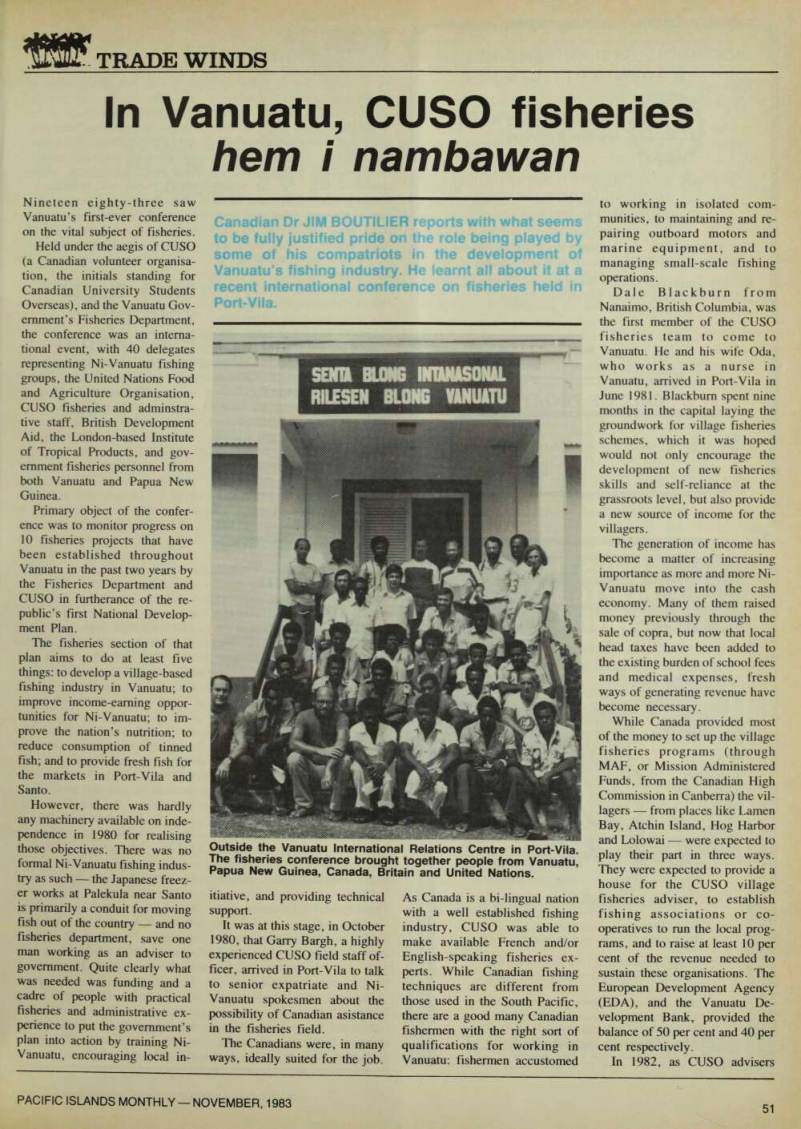
hem i nambawan
some of his compatriots in the development of
Nineteen eighty-three saw Vanuatu’s first-ever conference on the vital subject of fisheries.
Held under the aegis of CUSO (a Canadian volunteer organisa tion, the initials standing for Canadian University Students Overseas), and the Vanuatu Gov ernment’s Fisheries Department, the conference was an interna tional event, with 40 delegates
representing Ni-Vanuatu fishing
groups, the United Nations Food and Agriculture Organisation, CUSO fisheries and adminstra tive staff, British Development Aid, the London-based Institute of Tropical Products, and gov ernment fisheries personnel from both Vanuatu and Papua New Guinea.
Primary object of the confer ence was to monitor progress on 10 fisheries projects that have been established throughout Vanuatu in the past two years by the Fisheries Department and CUSO in furtherance of the re public’s first National Develop ment Plan.
The fisheries section of that plan aims to do at least five
things: to develop a village-based
fishing industry in Vanuatu; to
improve income-earning oppor
tunities for Ni-Vanuatu; to im prove the nation’s nutrition; to reduce consumption of tinned fish; and to provide fresh fish for the markets in Port-Vila and Santo.
However, there was hardly any machinery available on inde pendence in 1980 for realising those objectives. There was no formal Ni-Vanuatu fishing indus try as such the Japanese freez er works at Palekula near Santo is primarily a conduit for moving fish out of the country and no fisheries department, save one man working as an adviser to government. Quite clearly what was needed was funding and a cadre of people with practical fisheries and administrative ex perience to put the government’s plan into action by training Ni- Vanuatu, encouraging local in-
itiative, and providing technical support.
It was at this stage, in October 1980, that Garry Bargh, a highly experienced CUSO field staff of ficer, arrived in Port-Vila to talk to senior expatriate and Ni- Vanuatu spokesmen about the possibility of Canadian asistance in the fisheries field.
The Canadians were, in many ways, ideally suited for the job.
As Canada is a bi-lingual nation with a well established fishing industry, CUSO was able to make available French and/or English-speaking fisheries ex perts. While Canadian fishing techniques are different from those used in the South Pacific, there are a good many Canadian fishermen with the right sort of qualifications for working in Vanuatu; fishermen accustomed
to working in isolated com munities, to maintaining and re pairing outboard motors and marine equipment, and to
managing small-scale fishing
operations.
Dale Blackburn from Nanaimo, British Columbia, was the first member of the CUSO fisheries team to come to Vanuatu. He and his wife Oda, who works as a nurse in Vanuatu, arrived in Port-Vila in June 1981. Blackburn spent nine months in the capital laying the groundwork for village fisheries schemes, which it was hoped would not only encourage the development of new fisheries skills and self-reliance at the grassroots level, but also provide a new source of income for the
villagers.
The generation of income has become a matter of increasing importance as more and more Ni- Vanuatu move into the cash economy. Many of them raised
money previously through the
sale of copra, but now that local head taxes have been added to the existing burden of school fees and medical expenses, fresh ways of generating revenue have become necessary.
While Canada provided most of the money to set up the village fisheries programs (through MAP, or Mission Administered Funds, from the Canadian High Commission in Canberra) the vil lagers from places like Lamen Bay, Atchin Island, Hog Harbor and Lolowai were expected to play their part in three ways.
They were expected to provide a house for the CUSO village fisheries adviser, to establish fishing associations or co operatives to run the local prog rams, and to raise at least 10 per cent of the revenue needed to sustain these organisations. The
European Development Agency
(EDA), and the Vanuatu De
velopment Bank, provided the
balance of 50 per cent and 40 per
cent respectively.
In 1982, as CUSO advisers
Outside the Vanuatu International Relations Centre in Port-Vila.
The fisheries conference brought together people from Vanuatu, Papua New Guinea, Canada, Britain and United Nations.
were being phased into their ap pointments throughout Vanautu, Dale Blackburn moved to the Northern Regional Office in San to to supervise another key ele ment in the fisheries scheme, boat-building. A number of catamaran and 5.5-metre mono hull, Hartley-design, craft have been built and fitted out with hand reels developed by the South Pacific Commission for bottom fishing at depths up to 300 metres.
Villages usually try to make two or three four-man crews av ailable so that these fishing ves sels enjoy maximum usage. Red snapper is the principal catch, and CUSO advisers, in addition to providing practical fisheries advice, maintain records of daily catches. These records are essen tial if a profile of fish populations is to be developed, and fishing quotas established for various
regions.
Catching fish is one thing.
Preserving and marketing the catch is quite another, particular ly for Ni-Vanuatu in remote areas without electricity. Some fisheries associations have ac
quired ice-making machines with
the aid of EDA funds, while others employ coolers until they can move their catches to the two main towns. Air transport is ex pensive: it costs 29 vatu (US3Oc) per kilo to send fish by air from Lanem Bay to Port-Vila.
CUSO is exploring the possi bility of the Lobri Fishing Com pany on Atchin Island using a small inter-island refrigerated vessel to collect catches from the village fisheries in central Vanuatu and deliver them to the
capital.
While CUSO has provided volunteers the number now is over 30 to work in health, education, forestry, handicrafts and a number of other fields, its major contribution to Vanuatu has been in the area of fisheries.
The August 1983 fisheries con ference, with its workshops, field trips, and lectures on the latest fisheries techniques, sug gests that this contribution has been a very valuable one.
The conference, conducted in Bislama, gave Ni-Vanuatu fishermen the opportunity to compare problems and accom plishments, and to realise that
they were part of a national ef fort. The feeling that emerged from our discussion, Garry Bargh observed, was “very posi tive”. Frequently, he added, Canadian aid programs seem to have been, if anything, under keyed. In this case, however, the Vanuatu village fisheries prog ram, with its emphasis on simple technology and local initiative, seems to have been clearly nam
bawan.
Jim Boutilier.
First sugar
sold by
PNG Ramu
Papua New Guinea’s newest in dustry, the production of sugar, made its first export consignment in October at a price which in dustry leaders and the govern ment regarded as “very satisfac tory”. But there were warnings at the same time that the new industry would have to watch its costs closely to remain competitive.
The October shipment was nearly 7000 tonnes of sugar, sold to Sri Lanka in a deal worth just over $1 million. Ramu Sugar, the company behind the new industry, is backed by govern ment, commercial and small holder interests. It was establish ed in the Ramu valley of main land PNG and its exports are being made through the port of Lae.
The major guideline for the PNG sugar industry was to re duce local dependence on the Australian sugar export market and to become internally self sufficient in sugar. In three years the industry has seen production develop rapidly, but there has been criticism of the price. There has been widespread public be lief that local production would cause a marked drop in the price, but this did not happen.
The General Manager of Ramu Sugar, Mr Brian Awford, described the sale to Sri Lanka as a major breakthrough which should lead to other orders. He said the company had confidence in the standard of the PNG pro duction and in reliability to meet export orders. The Sri Lanka sale was negotiated in England by agents who also handle Aust ralian sugar production.
Advertisements & other items, p. 52 (1 item)
Forestmil
NORTH QUEENSLAND ENGINEERS
& AGENTS PTY. LTD.
We have full facilities for repair or refitting The shipbuilding division can construct a vessel to your design, or design one to suit your needs.
Barges, Tugs, Workboats, Catamarans, Landing Craft and Patrol Boats are all within our scope.
CALL US TODAY
N.Q.E.A.
36 Buchan Street, Cairns 4870 P.O. Box 1105, Cairns Telephone (070) 51 6600. Telex 48087
CONTRACTORS TO THE ROYAL AUSTRALIAN NAVY
NnrAl S h 'P build ' n 9 and Repair JIiLEJAf are our Business SLIPPING to 750 tonne DOCKING to 200 feet
FORESTMIL
PORTABLE
SAWMILL
A Mini Self Contained Sawmill
complete with Diesel Engine or Electric Motor m Forestmil produces any size accurate timber ready to use up to 12" x 9” x 24'.
Purchase price and operating cost of Forestmil is less than other sawing equipment with similar production capacity.
Forestmil reduces timber waste and also reduces log transport cost. Timber is sawn direct from the log in the forest.
Forestmil can be moved to a new location in one hour.
Forestmil will saw hardwood or softwood from logs of any diameter.
Over 1000 Forestmilsare sawing timber in 23 countries.
Forestmil has been manufactured for 18 years.
For literature and prices please contact the manufacturers.
MacQuarrie Industries Pty.Ltd.
P.O, Box 20, Coburg 3058, Victoria, Australia.
Phone: 350-3411, Telex: 33729. Cables: Macbound, Melbourne.
Islands
From the
Press
The Samoa Observer, Apia, Western Samoa, reporting
proceedings of parliament
The Speaker rounded off the debate with a vicious attack on newspapers. Newspapers and their publishers, he said, were “nothing more than little birds of the bush” which keep chirping away until they die. They were like stones rolling in the gutter and picking up muck as they went along, he said. The Speaker used a number of other insulting terms which lose meaning in translation.
Some observations on society from a reader’s letter pub lished in the Papua New Guinea Post-Courier, Port Moresby My sisters, it is about time you learnt how to help your parents to do the housework, and it is your responsibility to look after your family, too, when you get married. You will not be single all your life. One day you will choose a boy from any province as your future husband.
To make your husband happy, you must know your role that is looking after the house. If you don’t do the job properly, you will get black eyes all the time.
Part of a letter in The Fiji Times, Suva, in which Matt Wilson of Suva criticises driving standards on Fiji roads It is quite obvious that there are hundreds, if not thousands, of drivers who are simply not qualified to sit behind the wheel of a vehicle.
Through ignorance, bad manners or sheer bloody-mindedness they have turned Fiji’s roads into death traps. How on earth do they manage to get driving licences? What kind of standards do the examiners apply. What kind of qualifications do they have? When WILL something be done to make the roads safer?
Part of an editorial in The Times of Papua New Guinea, Port Moresby, on the eighth anniversary of PNG Independence Now we are eight. Time to look around and see how we’re making out in thw world . . . How about business? What does it bring? Late nights, trouble with staff, a stream of relatives doing their best to cut off the cash flow . . . How tempting to settle for that 35 hours a week public service routine . . . But if we want to make our own way in the world we have chosen, we will depend during the next eight years more and more on our business brains.
Joe Murphy, representing the publishers of the Marshall Islands Journal, Majuro, writes an editorial in the Journal about the resignation of the editor This is a kind of obit not quite an editorial. It’s about Dan Smith, the up-to-this-issue editor of the Journal. He is a man of principle and substance. Given this mettle, Dan was confronted with the very difficult choice this week of bending his will to the decision of this writer, or of ignoring this decision and doing what he thought best.
Dan did what he thought best and tendered his resignation, an admirable forthright action that on its own merits deserves commen dation. There are no personal hard feelings harbored here in this writer, and hopefully none in Dan. The resignation was accepted.
Comments by Bernhard Marjen in The Times of Papua New Guinea, Port Moresby, published during the South Pacific Games held in Western Samoa in September Whatever has happened to the best contingent ever sent out by Papua New Guinea? . . . Many an official and certain competitors have voiced concern about the early arrival of the PNG contingent in Western Samoa. But it can also be said that the early arrival has had a reverse effect. Too many late nights in the night clubs in Apia, too many drinks, junk food and Samoan women and generally the good
(but expensive) life of Samoa have taken their toll. Some of our athletes are wishing that they had never over-indulged.
Part of an editorial in the Papua New Guinea Post- Courier, Port Moresby, on whether aid from Australia should be general budget support (the present system) or “tied” to specified projects Whether Australian aid should be tied to specified projects has long been a subject of debate and the topic is assured of a further airing by a suggestion from the Oppostion Leader, Mr Okuk, that Australia should change tack. Mr Okuk, who was welcoming a 10 per cent lift in Australian aid said he believed that project aid rather than untied aid would ensure that the money went to the people who needed it those in the villages PNG will need continued budget support until its tax base is much wider. But a reasonable compromise might be to reduce the “untied” portion of aid to an agreed amount and spend the rest, properly auditied, on projects.
A lament by an anonymous author, as published in Sol omons Toktok, Honiara, Solomon Islands Guadalcanal fought its way to history; The country got back into history; Now the new tides that flowed across the beautiful country are polluted by a few political frogs who jump to eat the dirty prey of bribery; Oh! Solomons what a beauty you are; Oh! Solomons I pity thy future; Because thy crafty politicians sell thy country for a few favors; And a few cases of beer.
The Papua New Guinea Post-Courier, Port Moresby Mermaids at the southern end of New Ireland are catching the eye of overseas researchers. Erik Beckjord, a wild life photographer and self-styled “monster-hunter” from USA has spent a week in New Ireland watching at high tide for mermaids or “pis meri” as they are called in pidgin. Equipped with night vision gear and photo gear he hoped to catch sight of the creatures, but failed. However he claimed to have documented six accounts of sightings. He said the New Irelanders insisted the sightings were not dugongs. He said they described the creature as definitely “half woman, half fish”.
Part of a report in The Samoa Observer, Apia, about the banning from the parliament building of long-established journalist, Fata Faaloto Pito Fata told the Samoa Observer that the Speaker told him that a number of Members had complained because Fata shook and nodded his head while a report of the Privileges Committee was being discussed. This nodding and shaking of the head, Fata said, was apparently distracting to some of the Members. Fata said he thanked God he was not guilty of something worse.
Part of a letter in The Fiji Times, Suva Today the percentage of taxation in the country is so heavy that it has become the main burden on the common working class of people.
Normal wages which we earn in five days are heavily taxed. Life is becoming hard. A lot of us sacrifice our public holidays, Saturdays, Sundays and afternoons to work overtime. Although our employers pay higher rates,, a lot of our income again goes away in taxes. I feel that the Government should at least exempt us from taxes on overtime.
From the Papua New Guinea Post-Courier, Port Moresby, quoting part of a reader s letter criticising a political group You are an infinitesimal group, your integrity is pellucid . . . You wade aberationally instead of wafting like successful leaders . . . The significance of unity is shrewd.
From the news bulletin of the Australian High Commision in Port Moresby, Papua New Guinea The International Union for the Conservation of Nature is concerned about the future of coral reefs and fishing in the South Pacific. It believes that the major potential problems are pollution, tourism, over-fishing and mining. Associate Professor Michael Pichon, of the Department of Marine Biology at the James Cook University in Townsville, North Queensland, and chairman of the union’s coral reef working group, said the coral reefs of the world were coming under increasing pressure from human activities. “This is a relatively new situation,” he said, adding that until recently human activities had little effect on the world’s reefs.
Advertisements & other items, p. 54 (1 item)
Of Things To Come...
THE SHAPE
8 i
TE2D/83
HAS COME.
for further information contact: Thorn Lighting, 399 Rosebank Road, P.O. Box 15-150, Avondale, Auckland, New Zealand. Phone 887-155. Telex NZ 2648.
a THORN EMI
Lighting (MZ.) Ltd A world authority on light
a Pacific role
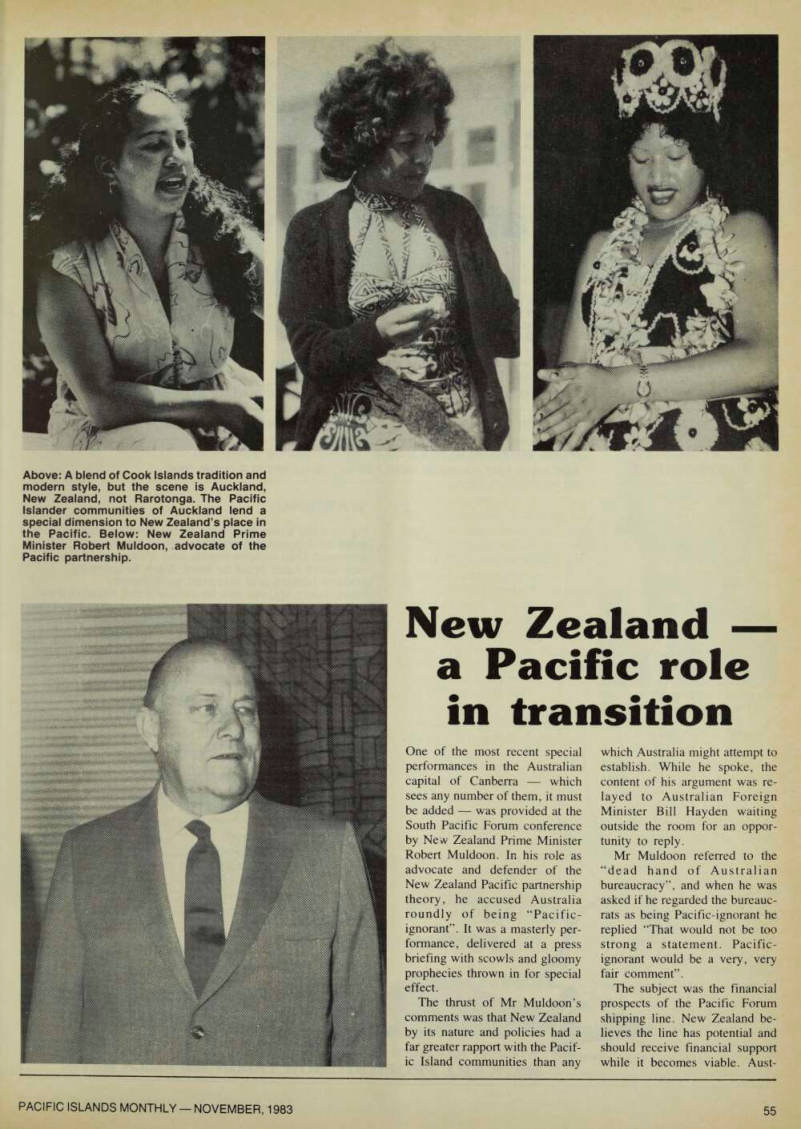

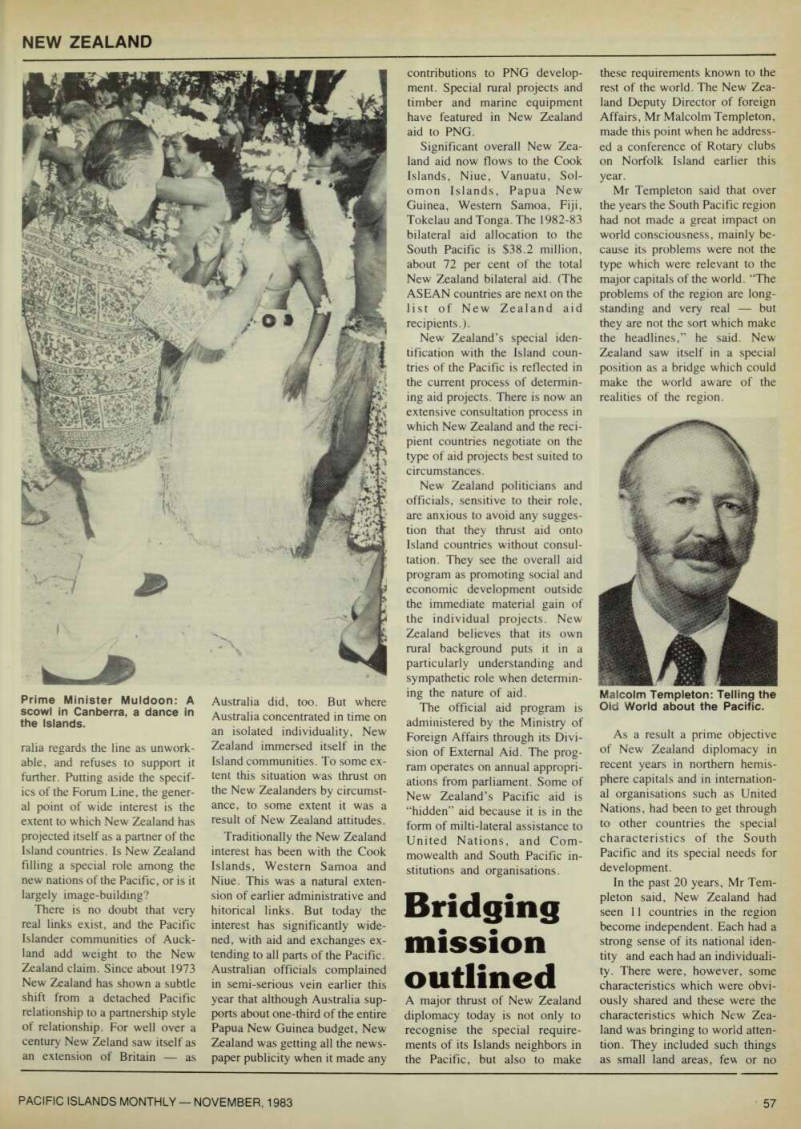
New Zealand a Pacific role in transition
One of the most recent special performances in the Australian capital of Canberra which sees any number of them, it must be added was provided at the South Pacific Forum conference by New Zealand Prime Minister Robert Muldoon. In his role as advocate and defender of the New Zealand Pacific partnership theory, he accused Australia
roundly of being “Pacific
ignorant”. It was a masterly per formance, delivered at a press briefing with scowls and gloomy prophecies thrown in for special effect.
The thrust of Mr Muldoon’s comments was that New Zealand by its nature and policies had a far greater rapport with the Pacif ic Island communities than any
which Australia might attempt to establish. While he spoke, the content of his argument was re layed to Australian Foreign Minister Bill Hayden waiting outside the room for an oppor tunity to reply.
Mr Muldoon referred to the “dead hand of Australian bureaucracy”, and when he was asked if he regarded the bureauc rats as being Pacific-ignorant he replied “That would not be too strong a statement. Pacific ignorant would be a very, very fair comment”.
The subject was the financial prospects of the Pacific Forum shipping line. New Zealand be lieves the line has potential and should receive financial support while it becomes viable. Aust-
Above: A blend of Cook Islands tradition and modern style, but the scene is Auckland, New Zealand, not Rarotonga. The Pacific Islander communities of Auckland lend a special dimension to New Zealand’s place in the Pacific. Below; New Zealand Prime Minister Robert Muldoon, advocate of the Pacific partnership.
New Zealand
ralia regards the line as unwork able, and refuses to support it further. Putting aside the specif ics of the Forum Line, the gener al point of wide interest is the extent to which New Zealand has projected itself as a partner of the Island countries. Is New Zealand filling a special role among the new nations of the Pacific, or is it
largely image-building?
There is no doubt that very real links exist, and the Pacific Islander communities of Auck land add weight to the New Zealand claim. Since about 1973 New Zealand has shown a subtle shift from a detached Pacific relationship to a partnership style of relationship. For well over a century New Zeland saw itself as an extension of Britain as
Australia did, too. But where Australia concentrated in time on an isolated individuality, New Zealand immersed itself in the Island communities. To some ex tent this situation was thrust on the New Zealanders by circumst ance, to some extent it was a result of New Zealand attitudes.
Traditionally the New Zealand interest has been with the Cook Islands, Western Samoa and Niue. This was a natural exten sion of earlier administrative and hitorical links. But today the interest has significantly wide ned, with aid and exchanges ex tending to all parts of the Pacific.
Australian officials complained in semi-serious vein earlier this year that although Australia sup ports about one-third of the entire Papua New Guinea budget, New Zealand was getting all the news paper publicity when it made any
contributions to PNG develop ment. Special rural projects and timber and marine equipment have featured in New Zealand aid to PNG.
Significant overall New Zea land aid now flows to the Cook Islands, Niue, Vanuatu, Sol omon Islands, Papua New Guinea, Western Samoa, Fiji, Tokelau and Tonga. The 1982-83 bilateral aid allocation to the South Pacific is $38.2 million, about 72 per cent of the total New Zealand bilateral aid. (The ASEAN countries are next on the list of New Zealand aid recipients.).
New Zealand’s special iden tification with the Island coun tries of the Pacific is reflected in the current process of determin ing aid projects. There is now an extensive consultation process in which New Zealand and the reci pient countries negotiate on the type of aid projects best suited to circumstances.
New Zealand politicians and officials, sensitive to their role, are anxious to avoid any sugges tion that they thrust aid onto Island countries without consul tation. They see the overall aid program as promoting social and economic development outside the immediate material gain of the individual projects. New Zealand believes that its own rural background puts it in a particularly understanding and sympathetic role when determin ing the nature of aid.
The official aid program is administered by the Ministry of Foreign Affairs through its Divi sion of External Aid. The prog ram operates on annual appropri ations from parliament. Some of New Zealand’s Pacific aid is “hidden” aid because it is in the form of milti-lateral assistance to United Nations, and Com mowealth and South Pacific in stitutions and organisations.
Bridging
mission
outlined
A major thrust of New Zealand diplomacy today is not only to
recognise the special require
ments of its Islands neighbors in the Pacific, but also to make
these requirements known to the rest of the world. The New Zea land Deputy Director of foreign Affairs, Mr Malcolm Templeton, made this point when he address ed a conference of Rotary clubs on Norfolk Island earlier this year.
Mr Templeton said that over the years the South Pacific region had not made a great impact on world consciousness, mainly be cause its problems were not the type which were relevant to the major capitals of the world. “The problems of the region are long standing and very real but they are not the sort which make the headlines,” he said. New Zealand saw itself in a special position as a bridge which could make the world aware of the realities of the region.
As a result a prime objective of New Zealand diplomacy in recent years in northern hemis phere capitals and in internation al organisations such as United Nations, had been to get through to other countries the special characteristics of the South Pacific and its special needs for
development.
In the past 20 years, Mr Tem pleton said, New Zealand had seen 11 countries in the region become independent. Each had a strong sense of its national iden tity and each had an individuali ty. There were, however, some characteristics which were obvi ously shared and these were the characteristics which New Zea land was bringing to world atten tion. They included such things as small land areas, few or no
Prime Minister Muldoon: A scowl in Canberra, a dance in the Islands.
Malcolm Templeton: Telling the Old World about the Pacific.
natural resources, rapidly grow ing populations, limited pros pects for economic development, reliance for export income on a very few number of products, susceptibility to natural disasters and remoteness from world mar kets and world concepts.
Mr Templeton said that in some regions of the world where small developing countries were in close association with bigger countries there had been a ten dency to meddle in the internal affairs of the smaller countries.
This had not happened on a large scale in the South Pacific “al though not altogether for want of trying” he said. It was a tribute to the governments of the small Pacific countries that their tradi tions, freedoms and cultures had
been largely preserved.
Mr Templeton continued: “But they are well aware that they cannot go it alone, they know that they need continuing help in their efforts to overcome the problems of smallness, isolation and scarcity of natural resources.
“New Zealand accepts the re
sponsibility imposed by geog
raphy and kinship in relation to these countries, the development of New Zealand aid and dip lomatic links with the island countries bilaterally and through such regional institutions as the South Pacific Forum is therefore one of the principal concerns of New Zealand foreign policy. Our interests coincide with those of our Island neigh bors. they do not want to be obliged to seek outside aid at the price of political interference.
And we do not want that to
happen.”
Mr Templeton said that one of the best illustrations of New Zea land’s increasing involvement in the Pacific community was in trade. The European market re mained critical for New Zealand
traditional primary products, but
the import-export flow of Pacific trade was assuming greater
weight.
Discussing New Zealand aid policies Mr Templeton said that the Island countries received top priority in the allocation of funds and programs. Since 1973 the region had become the main priority for bilateral aid, and suc cessive New Zealand govern ments had reinforced this con-
cept. In the 1982/83 financial year the allocation for the Pacific in bilateral and regional prog rams had been about $4l million, this amounted to 61 per cent of New Zealand’s total aid for the year.
Water
supply
schemes
One of the biggest single con tributions which New Zealand has made in funds and expertise over a prolonged period has been the development of Pacific Island water resources. The coral-based soil of many of the smaller coun tries together with the absence of catchment areas of any signifi cance have created long-standing water supply problems.
New Zealand water resources assistance has been given to 11 countries in the region during the past 20 years. Several major pro jects were carried out in the
19705, including water supply
schemes for Apia in Western Samoa and for water reticulation systems in Fiji.
However the aid for which New Zealand is probably best known is the provision of a wide variety of small-scale village level water supply systems, with
emphasis placed on self-help.
These projects consist of tanks, pipelines, pumps and wells re presenting low-cost and low maintenance systems suitable for small rural communities. The
money, expertise and some materials are contributed by New Zealand aid, and the labor and maintenance is provided by the communities involved in the schemes.
Countries which have par ticipated in the small-scale water supply schemes include Vanuatu, Papua New Guinea, Niue, Kiribati, Tonga and Fiji.
Sales aid
from
Sparteca
Sparteca is probably the most important economic agreement ever concluded by New Zealand with its Pacific neighbors. It pro vides duty-free unrestricted ac cess for most products exported by South Pacific Forum island countries, and it is encouraging New Zealand firms to set up joint ventures with Islands interests.
Sparteca is the South Pacific Regional Trade and Economic Co-operation Agreement. It was signed three years ago with Aust ralia as well as New Zealand offering duty free access to their markets from Pacific Island countries. There was some early criticism of the scheme on the grounds that some important pro ducts were exempted, but in gen eral the agreement is now seen to be working well.
New Zealand ministers and
officials believe that the access given under Sparteca to the New Zealand market is very generous.
Most products have unrestricted access. The only exception to free access of products to New Zealand is where it is necessary to protect Cook Islands, Niue and Western Samoan interests and, in one or two cases, New Zealand industries.
The genesis of Sparteca was in 1978 through a report compiled by the Commonwealth Sec retariat and the South Pacific Bureau for Economic Develop ment. The report summarised the scope for the development of
manufacturing and processing
activities in the South Pacific. It also investigated the New Zea land and Australian markets, and the trade policies of the two in assisting such development. The report suggested the greatest con tribution to development would be to create a more certain framework for the future and that a renewed approach to trade ex pansion would be an important step forward. After lengthy dis cussions amongst the countries concerned Australia, New Zealand, the Cook Islands, Kiribati, Niue, Solomon Islands, Tonga, Tuvalu, Western Samoa, Fiji, Nauru and Papua New Guinea draft texts were drawn up.
It took two more meetings before texts were approved. This was no mean feat. Not only were there problems concerning vari ous domestic industries, but New Zealand also had to take into account its special trading rela tionships with the Cook Islands, Niue and Western Samoa. These relations had to exist in line with
Sparteca. Luckily, the three
countries were prepared to make concessions in the interests of the Forum as a whole.
After talks with the Govern ments of the Cook Islands, Niue and Western Samoa it was de cided some protection would be offered to these countries on fro zen passionfruit, copra, coconut oil, canned pineapple, pineapple juice, lime juice, grapefruit
juice, orange juice, passionfruit
juice and coconut cream. But other Forum countries, under Sparteca, still receive improved concessions on access for most of these products.
An industry for Niue sponsored by New Zealand government aid: Pulping passionfruit.
Ministry
defines
attitudes
Some of the more controversial matters involving New Zealand relationships in the Pacific have included Western Samoan citi
zenship, independence for New
Caledonia and the practical im plications of administration in Tokelau. Official attitudes as outlined by the Ministry of Foreign Affairs are: The South Pacific region in general: In every respect New Zealand is a part of the region, and its interests are bound up with the welfare of the Island states. Its links with the countries of the region are ethnic, historic al and cultural in their origins.
These links are an important as pect of New Zealand’s domestic life and they are a dynamic ele ment in its external relations.
Because New Zealand does not see itself as separate from the region, its progress and future are linked to regional stability.
New Zealand believes that its continued bilateral relations in the region and its active partici pation in regional undertakings have fostered regional economic development and have enhanced
regional stability.
Tokelau: A special arrange ment exists between Tokelau and New Zealand regarding To kelau’s administration. The Sub committee on Small Territories of the United Nations Special Committee on Decolonisation notes that New Zealand is com mitted to assisting Tokelau to wards a greater degree of self government at a pace determined by the wishes of the people of Tokelau.
There has been an important consolidation of the political pro cess in Tokelau with the general
legislature there becoming the
principal decision-maker re sponsible for Tokelau’s future.
The relation between the Tokelau leaders and the New Zealand authorities is now, more than ever, one of partnership.
Western Samoan citizen ship; Last year the Privy Council in Britain ruled that all Western
Samoans bom in Western Samoa between 1924 and 1948, and certain of their descendants, were New Zealand citizens by virtue of the political administra tive link which had existed bet ween New Zealand and Western Samoa during that period.
The implications of this, which would have included unre stricted entry to New Zealand by a significant proportion of the Western Samoan population, led to a series of discussions between the two governments. Satisfac tory arrangements were finally reached between the two coun tries which led to a less-sweeping situation, but in return New Zea land undertook to look to its
immigration policies, particular
ly where Western Samoans were making temporary entry to New Zealand. Since April this year, new arrangements have applied as a result of the review.
French Pacific territories: New Zealand supports a South Pacific Forum resolution which welcomes the French Govern ment’ c , stated program of reforms in New Caledonia, and New Zea land expresses the hope that con tinued endeavors will be made for an ultimate peaceful transi tion to independence.
New Zealand aid: Funds help building projects at the Univer sity of the South Pacific, Fiji.
Advertisements & other items, pp. 56-60 (1 item)
Tdon wb
Deals the
winning
hand in rat
control!
talon wb Is a world breakthrough in killing rats and mice. Developed by ICI Tasman in New Zealand talon wb is a sure way to Increase profits by eliminating RAT damage to CROPS!
SOLID BLOCKS Can be wired or nailed out of reach of children & animals. Easily handled - won t blow away. & $ ft K/n a- Q c o O S *°oo WATERPROOF Safe year round use - will not dissolve, resists mould for extended periods.
DEADLY
Kills even the toughest rats - Including those resistant to warfarin based poisons.
EFFECTIVE
POWERFUL
Highly attractive to rats & mice - no pre-baiting Is required.
Kills more rats - a lethal dose can be consumed In a single feed.
Do not lay baits In places accessible to children, pets and domestic animals. Wash hands and exposed skin before meals and after work. Do not store near food or feed. Burn or bury all rodent bodies and uneaten bait. Empty containers should not be re-used but disposed of safely.
monwß
A Product of CSSr ICI Tasman Limited / P.O. Box 900, / Auckland, New Zealand
WARNING
: i, Whatever your crops COCOA COCONUTS SUGARCANE.
RATS KILL PROFITS! NOW TALON WB KILLS RATS!
‘teiU
4 * t >r n?
SHIPPING TO THE PACIFIC
FROM NEW ZEALAND
TO P.N.G. HONIARA, NEW CALEDONIA, VANUATU
FROM AUSTRALIA
TO P.N.G. HONIARA, NEW CALEDONIA, FIJI.
AGENTS FOR
PACIFIC LINE LTD
FORTNIGHTLY RORO SERVICE TO LAUTOKA
AND SUVA.
AGENTS FOR
COMPAGNIE TAHITIENNE
MARITIME
REGULAR MONTHLY DIRECT SERVICE
* \ ... Vi 9* 7 m ; 17 * t
> / / : air ntw zeaLana
Fly the easy way
New Zealand with
to us.
Making it easy for you to enjoy your flight to New Zealand is easy for us, because we’re your kind of people; and also because we offer you our extra-friendly “Frangipani Service” from many Pacific Islands.
Ask your travel agent how you can make substantial savings within New Zealand with an “Air Pass” which gives you 14 or 21 days unlimited air travel. And you can also enjoy savings on our exclusive Hotpac hotel rates that put you into fine accommodation at especially favourable rates.
So, tell your travel agent: “I’d rather fly Number One!”
air ne ll/
The Pacific’s Number One
m
G0LD0647
TVNZ plans big
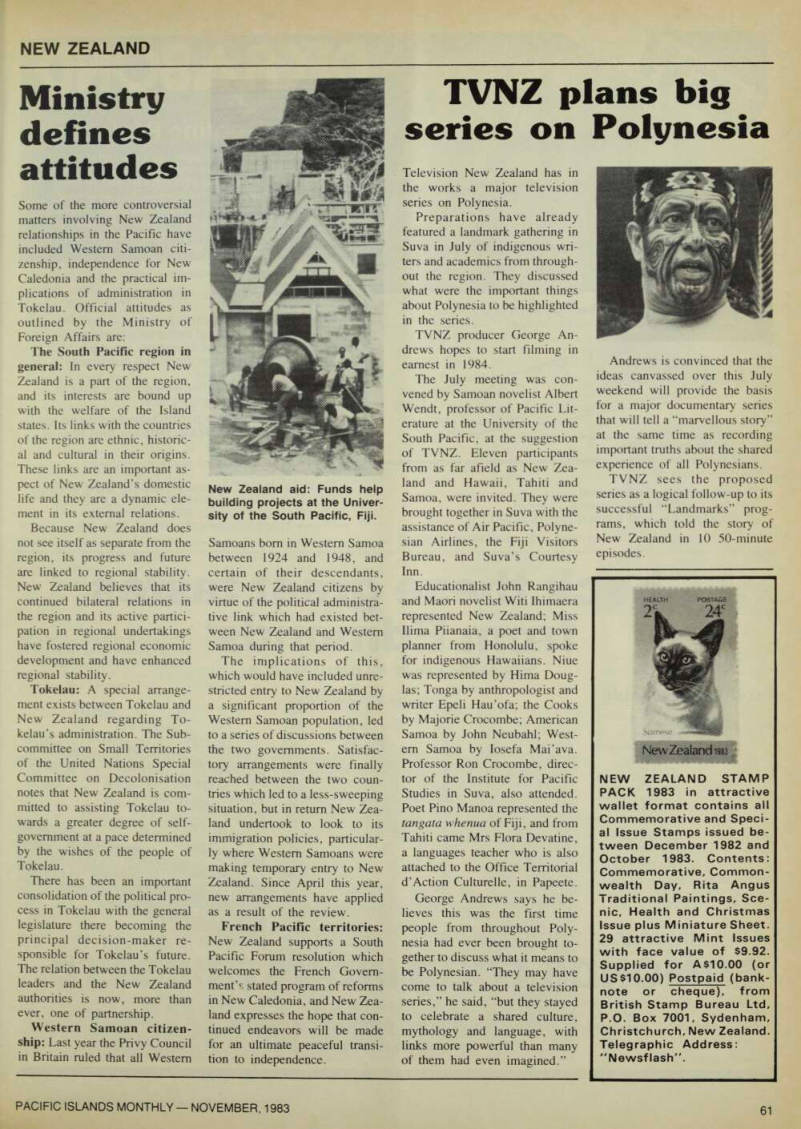
series on Polynesia
Television New Zealand has in the works a major television series on Polynesia.
Preparations have already featured a landmark gathering in Suva in July of indigenous wri ters and academics from through out the region. They discussed what were the important things about Polynesia to be highlighted in the series.
TVNZ producer George An drews hopes to start filming in earnest in 1984.
The July meeting was con vened by Samoan novelist Albert Wendt, professor of Pacific Lit erature at the University of the South Pacific, at the suggestion of TVNZ. Eleven participants from as far afield as New Zea land and Hawaii, Tahiti and Samoa, were invited. They were brought together in Suva with the assistance of Air Pacific, Polyne sian Airlines, the Fiji Visitors Bureau, and Suva’s Courtesy Inn.
Educationalist John Rangihau and Maori novelist Witi Ihimaera represented New Zealand; Miss Ilima Piianaia, a poet and town planner from Honolulu, spoke for indigenous Hawaiians. Niue was represented by Hima Doug las; Tonga by anthropologist and writer Epeli Hau’ofa; the Cooks
by Majorie Crocombe; American
Samoa by John Neubahl; West ern Samoa by losefa Mai’ava.
Professor Ron Crocombe, direc tor of the Institute for Pacific Studies in Suva, also attended.
Poet Pino Manoa represented the tangata whenua of Fiji, and from Tahiti came Mrs Flora Devatine, a languages teacher who is also attached to the Office Territorial d’Action Culturelle, in Papeete.
George Andrews says he be lieves this was the first time people from throughout Poly nesia had ever been brought to gether to discuss what it means to be Polynesian. “They may have come to talk about a television series,” he said, “but they stayed to celebrate a shared culture,
mythology and language, with
links more powerful than many of them had even imagined.”
Andrews is convinced that the ideas canvassed over this July weekend will provide the basis for a major documentary series that will tell a “marvellous story” at the same time as recording important truths about the shared
experience of all Polynesians.
TVNZ sees the proposed series as a logical follow-up to its successful “Landmarks” prog rams, which told the story of New Zealand in 10 50-minute episodes.
Advertisements & other items, pp. 61-62 (1 item)
New Zealand Stamp
PACK 1983 in attractive wallet format contains ail Commemorative and Special Issue Stamps issued between December 1982 and October 1983. Contents: Commemorative, Commonwealth Day, Rita Angus Traditional Paintings, Scenic, Health and Christmas Issue plus Miniature Sheet. 29 attractive Mint Issues with face value of $9.92.
Supplied for Aslo.oo (or US$10.00) Postpaid (banknote or cheque), from British Stamp Bureau Ltd, P.O. Box 7001, Sydenham, Christchurch, New Zealand.
Telegraphic Address; "Newsflash".
Only New DECRABOND has eight layers of protection.
Acrylic Overglaze Stone Chips Acrylic Base Coat Zinc Coaling Zinc Coaling Seal Coal Epoxy Primer Steel Base Epoxy Primer All coatings applied under strict factory conditions for guaranteed high quality.
Manufactured by AHI Roofing International P.O. Box 2077, Auckland, New Zealand.
Phone (649) 588-109 Telex NZ21615 AHIROOF. ‘When installed according to manufacturer’s cyclone resistant specifications.
Ultimate Roofing Protection
New DECRABOND. The biggest selling metal roofing tile in the world, now offers unequalled protection for your home. Not only does DECRABOND roofina have proven hurricane resistance, but now new* DECRABOND features an unequalled eight layers of protection on its strong steel core. This means beautiful roofing for your home for the years ahead.
Consider the advantages— • Now double protected on top and underneath • Beautiful distinctive profile • Long life, natural stone chip surface • Light weight yet incredibly strong • Easily resists cyclones and hurricanes* • low maintenance • Ideal for re-roofing straight over shakes, steel and corrugated steel Demand the extra protection and good looks of New DECRABOND roofing tiles.
For further information contact: New Zealand Overseas Trading Corporation P.O. Box 2236, Lae. PAPUA NEW GUINEA Manager—Mr Stephen Dyer Phone 423090 Telex 42494 TRADCOR NE
Check these great tastes
from Edmonds*
Serving the Pacific for over 100 years Our Famous Brands
.^ougfot"
F "'' •-»
ledo^
VN/eSte isVa nd s
N eW ca
Proudly manufactured in New Zealand by
EDMONDS FOOD INDUSTRIES LTD.
P.O. Box 27-249 Mt Roskill
AUCKLAND NZ
Telephone 698-167 Cable Address Sunshine Telex Address 21690 Brochure Factory 83
*Ask for our
Illustrated product catalogue
and export price list.
Bankers National Bank Year Established 1881 Export Manager Tony Babbage incl W F Tucker & Company Limited
back from the brink
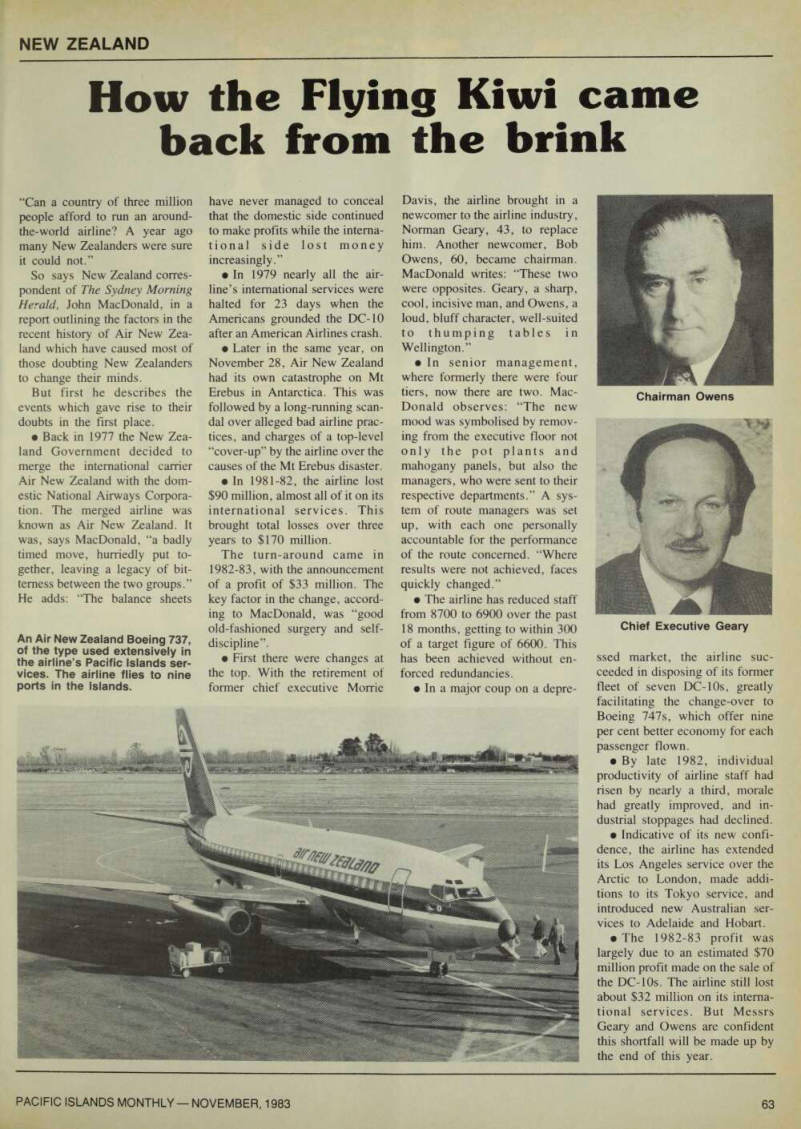
How the Flying Kiwi came back from the brink
“Can a country of three million people afford to run an around the-world airline? A year ago many New Zealanders were sure it could not.”
So says New Zealand corres pondent of The Sydney Morning Herald, John MacDonald, in a report outlining the factors in the recent history of Air New Zea land which have caused most of those doubting New Zealanders to change their minds.
But first he describes the events which gave rise to their doubts in the first place. • Back in 1977 the New Zea land Government decided to merge the international carrier Air New Zealand with the dom
estic National Airways Corpora
tion. The merged airline was known as Air New Zealand. It was, says MacDonald, “a badly timed move, hurriedly put to gether, leaving a legacy of bit terness between the two groups.”
He adds: “The balance sheets
have never managed to conceal that the domestic side continued to make profits while the intema tional side lost money
increasingly.”
• In 1979 nearly all the air line’s international services were halted for 23 days when the Americans grounded the DC-10 after an American Airlines crash. • Later in the same year, on November 28, Air New Zealand had its own catastrophe on Mt Erebus in Antarctica. This was followed by a long-running scan dal over alleged bad airline prac tices, and charges of a top-level “cover-up” by the airline over the causes of the Mt Erebus disaster. • In 1981-82, the airline lost $9O million, almost all of it on its international services. This brought total losses over three years to $l7O million.
The turn-around came in 1982-83, with the announcement of a profit of $33 million. The key factor in the change, accord ing to MacDonald, was “good old-fashioned surgery and self
discipline”.
• First there were changes at the top. With the retirement of former chief executive Morrie
Davis, the airline brought in a newcomer to the airline industry, Norman Geary, 43, to replace him. Another newcomer, Bob Owens, 60, became chairman.
MacDonald writes: “These two were opposites. Geary, a sharp, cool, incisive man, and Owens, a loud, bluff character, well-suited to thumping tables in
Wellington.”
• In senior management, where formerly there were four tiers, now there are two. Mac- Donald observes: “The new mood was symbolised by remov ing from the executive floor not only the pot plants and mahogany panels, but also the managers, who were sent to their respective departments.” A sys tem of route managers was set up, with each one personally accountable for the performance of the route concerned. “Where results were not achieved, faces
quickly changed.”
• The airline has reduced staff from 8700 to 6900 over the past 18 months, getting to within 300 of a target figure of 6600. This has been achieved without en forced redundancies. • In a major coup on a depre-
ssed market, the airline suc ceeded in disposing of its former fleet of seven DC-10s, greatly facilitating the change-over to Boeing 7475, which offer nine per cent better economy for each passenger flown. • By late 1982, individual productivity of airline staff had risen by nearly a third, morale had greatly improved, and in dustrial stoppages had declined. • Indicative of its new confi dence, the airline has extended its Los Angeles service over the Arctic to London, made addi tions to its Tokyo service, and introduced new Australian ser vices to Adelaide and Hobart. • The 1982-83 profit was largely due to an estimated $7O million profit made on the sale of the DC-10s. The airline still lost about $32 million on its interna tional services. But Messrs Geary and Owens are confident this shortfall will be made up by the end of this year.
An Air New Zealand Boeing 737, of the type used extensively in the airline’s Pacific Islands ser vices. The airline flies to nine ports in the Islands.
Chairman Owens
Chief Executive Geary
Advertisements & other items, p. 64 (1 item)
Anchor - premium quality dairy produce, packed with
non-fat dried
ANCHOR
0 U!
FUU CREAM ,
i'AMIN ENRICHED «£
ill
KIM MILK
POWDER,
ilk
POWD
Ancho
SKIM MILK
POWDER
AN CHOI?
ANCHOR
Mmgi
I Air: £ ■ ■I /; Anchor - premium quality dairy produce, packed with all the goodness of the finest pasture in the world.
Fresh to you from the world’s number one dairy
producer, New Zealand Dairy Board.
NEW
ZEALAND
DAIRY
BOARD
Enquiries to: PO Box 417 Wellington, New Zealand
Telex: NZ3348 DAPMARK
Telephone: 724-399
Busy yachting
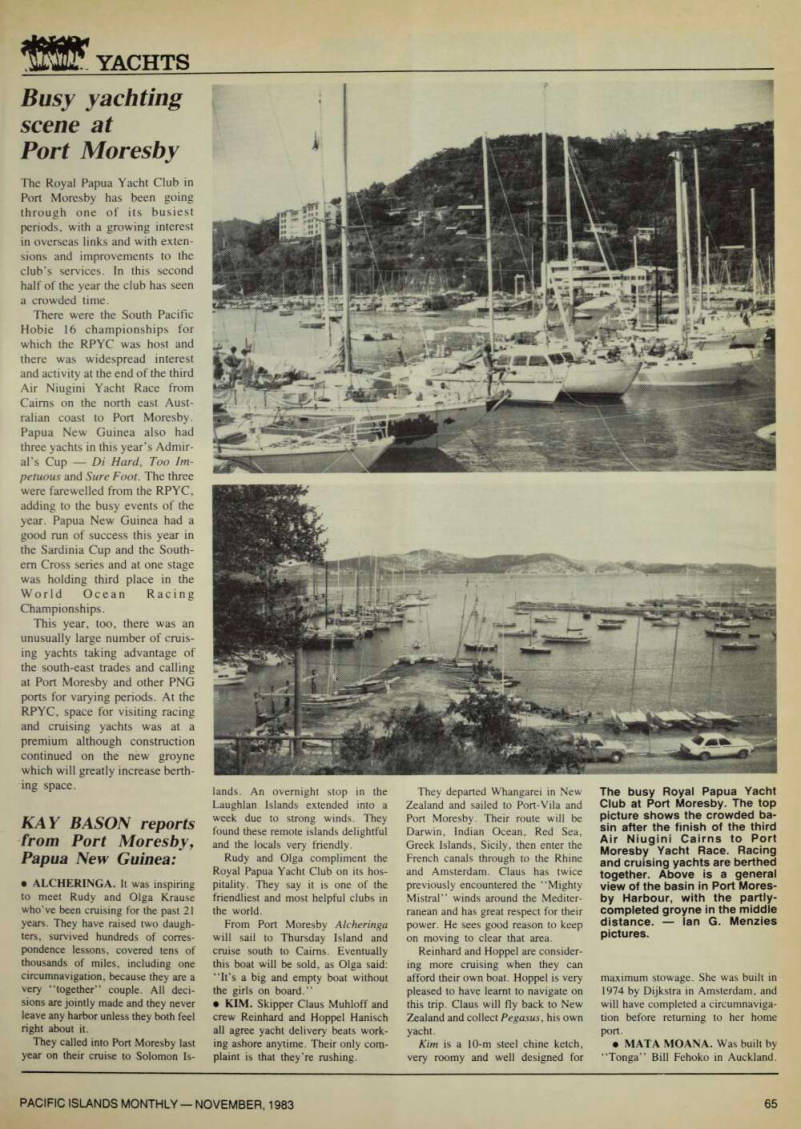
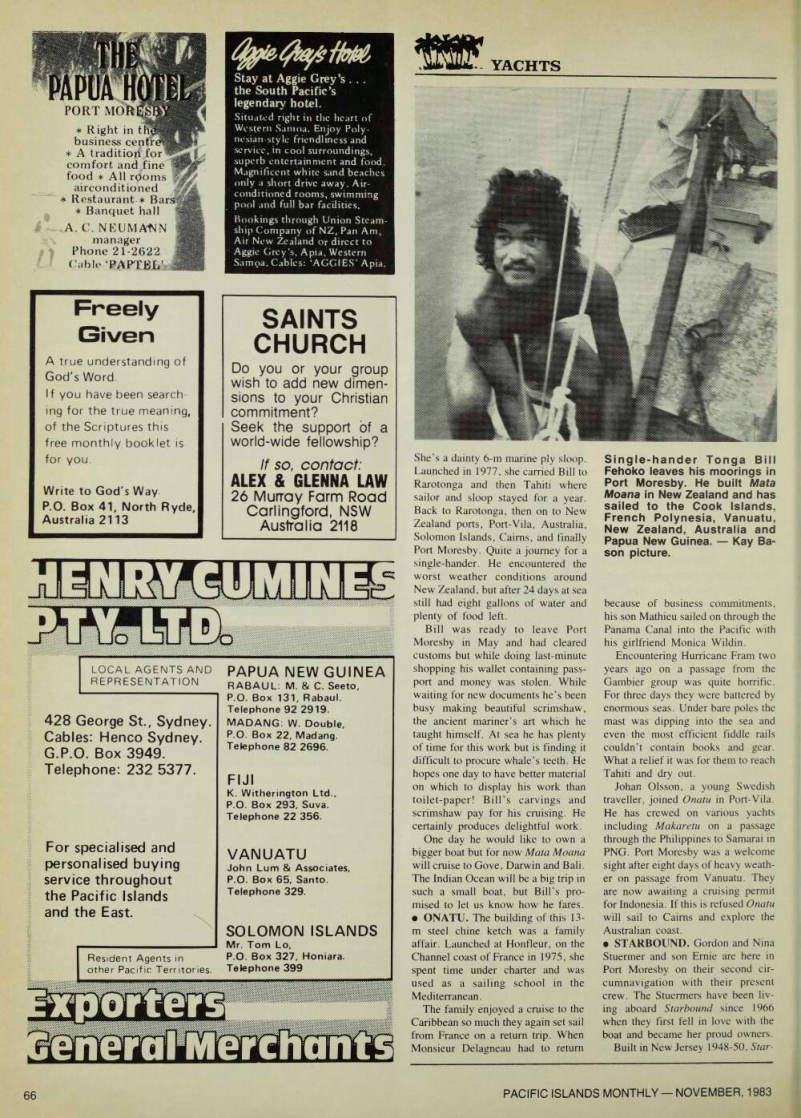
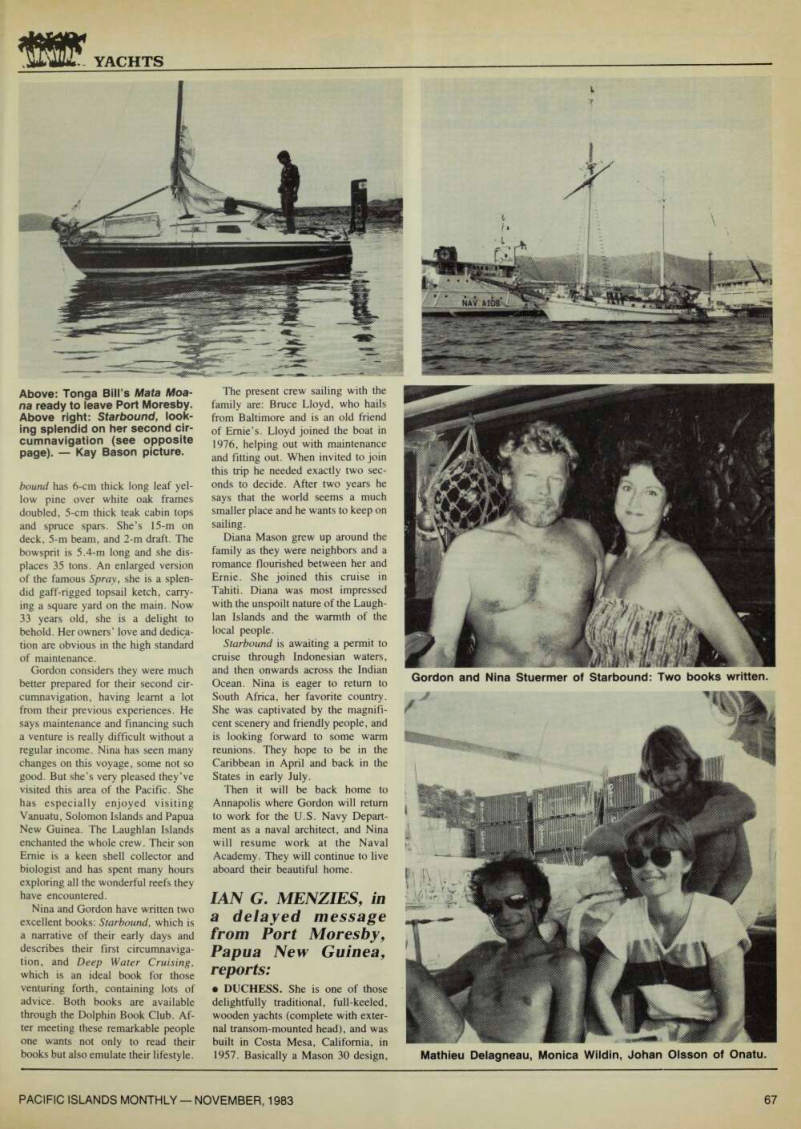
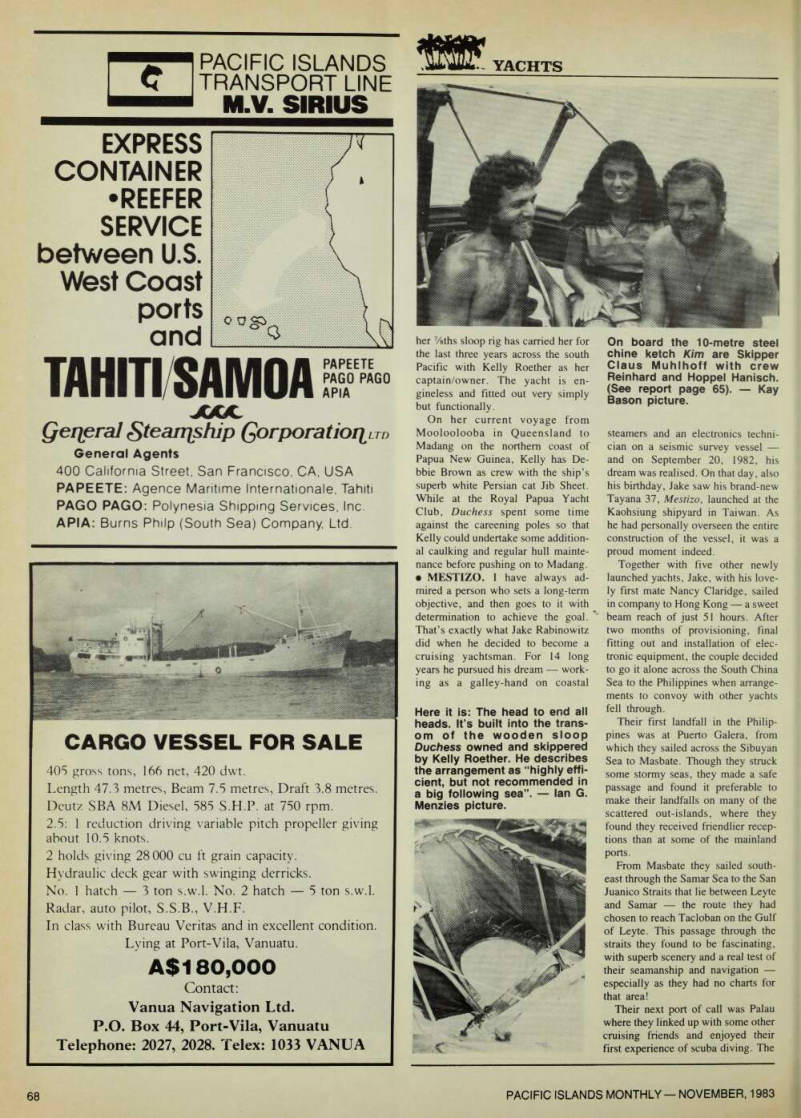
Yachts
scene at
Port Moresby
The Royal Papua Yacht Club in Port Moresby has been going through one of its busiest periods, with a growing interest in overseas links and with exten sions and improvements to the club’s services. In this second half of the year the club has seen a crowded time.
There were the South Pacific Hobie 16 championships for which the RPYC was host and there was widespread interest and activity at the end of the third Air Niugini Yacht Race from Caims on the north east Aust ralian coast to Port Moresby.
Papua New Guinea also had three yachts in this year’s Admir al’s Cup Di Hard, Too Im petuous and Sure Foot. The three were farewelled from the RPYC, adding to the busy events of the year. Papua New Guinea had a good run of success this year in the Sardinia Cup and the South ern Cross series and at one stage was holding third place in the World Ocean Racing
Championships.
This year, too, there was an unusually large number of cruis ing yachts taking advantage of the south-east trades and calling at Port Moresby and other PNG ports for varying periods. At the RPYC, space for visiting racing and cruising yachts was at a premium although construction continued on the new groyne which will greatly increase berth
ing space.
KAY BASON reports
from Port Moresby,
Papua New Guinea:
• ALCHERINGA. It was inspiring to meet Rudy and Olga Krause who’ve been cruising for the past 21 years. They have raised two daugh ters, survived hundreds of corres pondence lessons, covered tens of thousands of miles, including one circumnavigation, because they are a very “together” couple. All deci sions are jointly made and they never leave any harbor unless they both feel right about it.
They called into Port Moresby last year on their cruise to Solomon Is-
lands. An overnight stop in the Laughlan Islands extended into a week due to strong winds. They found these remote islands delightful and the locals very friendly.
Rudy and Olga compliment the
Royal Papua Yacht Club on its hos pitality. They say it is one of the friendliest and most helpful clubs in the world.
From Port Moresby Alcheringa
will sail to Thursday Island and cruise south to Caims. Eventually this boat will be sold, as Olga said: “It’s a big and empty boat without the girls on board.” • KIM. Skipper Claus Muhloff and crew Reinhard and Hoppel Hanisch all agree yacht delivery beats work ing ashore anytime. Their only com plaint is that they’re rushing.
They departed Whangarei in New Zealand and sailed to Port-Vila and Port Moresby. Their route will be Darwin, Indian Ocean, Red Sea, Greek Islands, Sicily, then enter the French canals through to the Rhine and Amsterdam. Claus has twice previously encountered the “Mighty Mistral” winds around the Mediter ranean and has great respect for their power. He sees good reason to keep on moving to clear that area.
Reinhard and Hoppel are consider ing more cruising when they can afford their own boat. Hoppel is very pleased to have learnt to navigate on this trip. Claus will fly back to New Zealand and collect Pegasus , his own yacht.
Kim is a 10-m steel chine ketch, very roomy and well designed for
maximum stowage. She was built in 1974 by Dijkstra in Amsterdam, and will have completed a circumnaviga tion before returning to her home port. • MATA MOANA. Was built by “Tonga” Bill Fehoko in Auckland.
The busy Royal Papua Yacht Club at Port Moresby. The top picture shows the crowded ba sin after the finish of the third Air Niugini Cairns to Port Moresby Yacht Race. Racing and cruising yachts are berthed together. Above is a general view of the basin in Port Mores by Harbour, with the partly completed groyne in the middle distance. - lan G. Menzies pictures.
She’s a dainty 6-m marine ply sloop.
Launched in 1977, she carried Bill to Rarotonga and then Tahiti where sailor and sloop stayed for a year.
Back to Rarotonga, then on to New Zealand ports, Port-Vila, Australia, Solomon Islands, Caims, and finally Port Moresby. Quite a journey for a single-hander. He encountered the worst weather conditions around New Zealand, but after 24 days at sea still had eight gallons of water and plenty of food left.
Bill was ready to leave Port Moresby in May and had cleared customs but while doing last-minute shopping his wallet containing pass port and money was stolen. While waiting for new documents he’s been busy making beautiful scrimshaw, the ancient mariner’s art which he taught himself. At sea he has plenty of time for this work but is finding it difficult to procure whale’s teeth. He hopes one day to have better material on which to display his work than toilet-paper! Bill’s carvings and scrimshaw pay for his cruising. He certainly produces delightful work.
One day he would like to own a bigger boat but for now Mata Moana will cruise to Gove, Darwin and Bali.
The Indian Ocean will be a big trip in such a small boat, but Bill’s pro mised to let us know how he fares. • ONATU. The building of this 13m steel chine ketch was a family affair. Launched at Honfleur, on the Channel coast of France in 1975, she spent time under charter and was used as a sailing school in the Mediterranean.
The family enjoyed a cruise to the Caribbean so much they again set sail from France on a return trip. When Monsieur Delagneau had to return
because of business commitments, his son Mathieu sailed on through the Panama Canal into the Pacific with his girlfriend Monica Wildin.
Encountering Hurricane Fram two years ago on a passage from the Gambier group was quite horrific.
For three days they were battered by enormous seas. Under bare poles the mast was dipping into the sea and even the most efficient fiddle rails couldn’t contain books and gear.
What a relief it was for them to reach Tahiti and dry out.
Johan Olsson, a young Swedish traveller, joined Onatu in Port-Vila.
He has crewed on various yachts including Makaretu on a passage through the Philippines to Samarai in PNG. Port Moresby was a welcome sight after eight days of heavy weath er on passage from Vanuatu. They
are now awaiting a cruising permit
for Indonesia. If this is refused Onatu will sail to Caims and explore the Australian coast. • STARBOUND. Gordon and Nina Stuermer and son Ernie are here in Port Moresby on their second cir cumnavigation with their present crew. The Stuermers have been liv ing aboard Starbound since 1966 when they first fell in love with the boat and became her proud owners.
Built in New Jersey 1948-50, Star-
Single-hander Tonga Bill
Fehoko leaves his moorings in Port Moresby. He built Mata Moana in New Zealand and has sailed to the Cook Islands, French Polynesia, Vanuatu, New Zealand, Australia and
Papua New Guinea. - Kay Ba
son picture.
bound has 6-cm thick long leaf yel low pine over white oak frames doubled, 5-cm thick teak cabin tops and spruce spars. She’s 15-m on deck, 5-m beam, and 2-m draft. The bowsprit is 5.4-m long and she dis places 35 tons. An enlarged version of the famous Spray, she is a splen did gaff-rigged topsail ketch, carry ing a square yard on the main. Now 33 years old, she is a delight to behold. Her owners’ love and dedica tion are obvious in the high standard of maintenance.
Gordon considers they were much better prepared for their second cir cumnavigation, having learnt a lot from their previous experiences. He says maintenance and financing such a venture is really difficult without a regular income. Nina has seen many changes on this voyage, some not so
good. But she’s very pleased they’ve
visited this area of the Pacific. She
has especially enjoyed visiting
Vanuatu, Solomon Islands and Papua New Guinea. The Laughlan Islands enchanted the whole crew. Their son Ernie is a keen shell collector and biologist and has spent many hours exploring all the wonderful reefs they have encountered.
Nina and Gordon have written two excellent books: Starbound, which is a narrative of their early days and describes their first circumnaviga tion, and Deep Water Cruising, which is an ideal book for those venturing forth, containing lots of advice. Both books are available through the Dolphin Book Club. Af ter meeting these remarkable people one wants not only to read their books but also emulate their lifestyle.
The present crew sailing with the family are: Bruce Lloyd, who hails from Baltimore and is an old friend of Ernie’s. Lloyd joined the boat in 1976, helping out with maintenance and fitting out. When invited to join this trip he needed exactly two sec onds to decide. After two years he says that the world seems a much smaller place and he wants to keep on sailing.
Diana Mason grew up around the family as they were neighbors and a romance flourished between her and Ernie. She joined this cruise in Tahiti. Diana was most impressed with the unspoilt nature of the Laugh lan Islands and the warmth of the local people.
Starbound is awaiting a permit to cruise through Indonesian waters, and then onwards across the Indian Ocean. Nina is eager to return to South Africa, her favorite country.
She was captivated by the magnifi cent scenery and friendly people, and is looking forward to some warm reunions. They hope to be in the Caribbean in April and back in the States in early July.
Then it will be back home to Annapolis where Gordon will return to work for the U.S. Navy Depart ment as a naval architect, and Nina will resume work at the Naval Academy. They will continue to live aboard their beautiful home.
Lan G. Menzies, In
a delayed message
from Port Moresby,
Papua New Guinea,
reports:
• DUCHESS. She is one of those delightfully traditional, full-keeled, wooden yachts (complete with exter nal transom-mounted head), and was built in Costa Mesa, California, in 1957. Basically a Mason 30 design,
Above: Tonga Bill’s Mata Moa na ready to leave Port Moresby.
Above right: Starbound, look ing splendid on her second cir cumnavigation (see opposite page). - Kay Bason picture.
Gordon and Nina Stuermer of Starbound: Two books written.
Mathieu Delagneau, Monica Wildin, Johan Olsson of Onatu.
her 7 /Bths sloop rig has carried her for the last three years across the south Pacific with Kelly Roether as her captain/owner. The yacht is en gineless and fitted out very simply
but functionally.
On her current voyage from Mooloolooba in Queensland to Madang on the northern coast of Papua New Guinea, Kelly has De bbie Brown as crew with the ship’s superb white Persian cat Jib Sheet.
While at the Royal Papua Yacht Club, Duchess spent some time against the careening poles so that Kelly could undertake some addition al caulking and regular hull mainte nance before pushing on to Madang. • MESTIZO. I have always ad mired a person who sets a long-term objective, and then goes to it with determination to achieve the goal.
That’s exactly what Jake Rabinowitz did when he decided to become a cruising yachtsman. For 14 long years he pursued his dream work ing as a galley-hand on coastal
steamers and an electronics techni cian on a seismic survey vessel and on September 20, 1982, his dream was realised. On that day, also his birthday, Jake saw his brand-new Tayana 37, Mestizo, launched at the Kaohsiung shipyard in Taiwan. As he had personally overseen the entire construction of the vessel, it was a proud moment indeed.
Together with five other newly launched yachts, Jake, with his love
ly first mate Nancy Claridge, sailed
in company to Hong Kong a sweet beam reach of just 51 hours. After two months of provisioning, final fitting out and installation of elec tronic equipment, the couple decided to go it alone across the South China Sea to the Philippines when arrange ments to convoy with other yachts
fell through.
Their first landfall in the Philip pines was at Puerto Galera, from which they sailed across the Sibuyan Sea to Masbate. Though they struck some stormy seas, they made a safe passage and found it preferable to make their landfalls on many of the scattered out-islands, where they found they received friendlier recep tions than at some of the mainland ports.
From Masbate they sailed south east through the Samar Sea to the San Juanico Straits that lie between Leyte and Samar the route they had chosen to reach Tacloban on the Gulf of Leyte. This passage through the straits they found to be fascinating, with superb scenery and a real test of their seamanship and navigation especially as they had no charts for that area!
Their next port of call was Palau where they linked up with some other cruising friends and enjoyed their first experience of scuba diving. The
On board the 10-metre steel chine ketch Kim are Skipper Claus Muhlhoff with crew Reinhard and Hoppel Hanisch. (See report page 65). Kay Bason picture.
Here it is: The head to end all heads. It’s built into the trans om of the wooden sloop Duchess owned and skippered by Kelly Roether. He describes the arrangement as “highly effi cient, but not recommended in a big following sea”. - lan G.
Menzies picture.
beautiful Hermit Islands, with its wild deer and ruined German castle (that’s a story in itself), was their next stop-over. Jake and Nancy were fascinated by the sheer artistry in the construction of the bamboo and palm-leafed homes of the villagers on the island, who still maintain a small copra plantation established in the early days of German colonisation.
Mestizo’s port of entry into PNG was Madang, where the couple de cided to pursue their new interest in diving, and completed a full certifi cation course at the local Melanesian Dive Centre. From Madang they beat up the west coast of New Britain to Rabaul, where they were forced to extend their stay when Jake badly gashed his foot while climbing The Mother, one of the mountains that overlook the town.
The couple then decided to head for Caims via Rossel Island in the Louisiade Archipelago, but severe weather conditions in the Coral Sea forced them to heave-to for three days. As there appeared to be no likelihood of any early improvement in the weather they decided to run before the strong southeast trades into Port Moresby.
From Port Moresby, Jake and Nancy were to make passage for Thursday Island and Darwin, where the couple hope to stop for a while and replenish their cruising funds. • WANDERER IV. Known to liter
ally thousands of cruising enthusiasts world-wide through the wanderings and writings of Susan and Eric His cock. Wanderer IV is now under the proud ownership of Pam and Stuart Clay of Taurange, New Zealand. The 15 m steel ketch was acquired by the Clays in June ’Bl when the Hiscocks decided to design and build a smaller vessel.
Pam and Stuart Clay have them selves been cruising for more than 10 years in their 11 m sloop Gambol.
After completing a circumnavigation between 1973-79, they decided to “go ashore”, but it did no last long and they started to refit Gambol for yet another extended cruise. It was then they heard that Wanderer IV was on the market, and as they really wanted a vessel in which they could undertake charters, and which would meet survey requirements. Wanderer IV seemed the ideal solution.
The Clays have made very few changes to the vessel a couple of extra bunks up forward, and the
original kerosene refrigerator has
been replaced with an electric fridge and deep freeze. Stuart has also installed a Honeywell 240 volt inver ter (AC), which has proved a real boon as it allows him to use both his normal domestic and commerical tools and appliances. All in all. Wan derer IV still retains the charm and dignity of her classic design, and the immaculate condition in which she is
The sloop Duchess on the careening poles at Port Moresby before sailing to Madang on the PNG north coast.
maintained is a credit to Pam and Stuart.
From New Zealand, Pam and Stuart sailed to Port Moresby via Vanuatu. The couple said that the vessel proved to be extremely sea kindly and they were able to average 180 miles per day with just mainsail and a poled-out staysail. A few close encounters with schools of migratory whales made them extremely grateful that their vessel is made of steel.
Next time they say they will heave-to and let the whales have right of way.
From Port Moresby, Wanderer IV was to head across the Indian Ocean via Darwin, and round the Cape of Good Hope to be based next year in the Caribbean for both crewed and bareboat charters. • CARINA. Now in their tenth year of living aboard, including three years in the West Indies, the cruising
life-style obviously agrees with
Stephen Crow and Sara Ackley of Carina. They began this particular cruise in their new 14 m GRP Cal 2- 46 from Fort Lauderdale, Florida, in October ’BO with their cat April and poodle Noel.
Their leisurely passage across the Pacific included 12 months in French Polynesian waters in fact, Stephen’s log contains such detailed information and superb diagrams of their various anchorages, that it would be an invaluable cruising guide to other yachties.
Carina entered PNG waters via the Laughlan Islands an unspoilt and remote group which one hopes will always remain that way. With favor able winds they sailed to Port Mores by via Samarai and secured a protect ed mooring at the RPYC. The couple then flew to Mt Hagen in the New Guinea Highlands to view the color ful two-yearly cultural show a cool and pleasant change from ship board life.
As Stephen has now owned or built seven cruising yachts, he had some interesting comments to make on designing and fitting out vessels for long-distance cruising. He felt that a first priority was to standardise on-board equipment as much as poss ible. For example, all pressure and bilge pumps should be of the same brand with 3 /4-inch couplings and fittings to allow complete inter changeability. On water pressurisa tion, he had found that the demand for salt water for rinsing and wash ing-down, both in the galley and on deck, was of higher priority than that for fresh water. Simple header tanks and foot pumps could quite easily deliver fresh water to the galley and shower.
For years Stephen has been trying to overcome the problem of propeller drag, which can be quite consider able on larger yachts. He now recom mends the installation of a cockpit controlled variable pitch propeller
preferably two-bladed so that it can be aligned with the deadwood. This system does away with the need for a transmission in itself quite often the source of breakdowns.
With a considerable amount of sophisticated electronic and radio equipment on board, Stephen finds that he spends much time on mainte nance, but as he has a technical background it becomes more of a hobby than a chore. As a keen ham radio operator (WA2 CPX) he also broadcasts a daily weather net on 14.327 and provides weatherfax if desired.
Sara and Stephen intended to spend only a short period in Port Moresby and then head for Darwin on their continued cirumnavigation, but unfortunately Stephen contracted dengue fever so their stay at the RPYC was somewhat prolonged. • KARANA. A 14 m Formosan sloop owned by Shirlie and Hugh Richardson, Karana has “gone fin ish” from the RPYC to the Darwin Yacht club. Both Shirlie and Hugh, who had been in PNG for over 23 years, will be sadly missed from the local scene Hugh as the licensee of the RPYC and a former commo dore, and Shirlie for her involvement in the social activities of the club and her work as club secretary for the last two years.
Karana was always a hot favorite in the local “A” class races, and also
competed successfully in several of the Air Niugini Caims-Port Moresby yacht races. Whenever the family was able to get together over the school holidays, the Richardsons would be off and cruising around the PNG coastline.
We wish the Richardson family and Karana all the best in their new home Darwin Yacht Club is fortu nate indeed to have gained a family of such dedicated yachting enthusiasts.
The Tayana 37 Mestizo leaves Madang In Papua New Guinea.
Advertisements & other items, pp. 66-70 (1 item)
azngraiEiEßß
PORT MOU
for * Right in business cen * A tradition, comfort and fine food ♦ All rdoms airconditioned * Restaurant * Ba * Banquet hall
A. C. NEUMANN
manager Phone 21-2622 cable 'mnmk
Stay at Aggie Grey’s . . . the South Pacific’s
legendary hotel.
Situated right in the heart of Western Samoa. Enjoy Polynesian-style friendliness and service, in cool surroundings, superb entertainment and food.
Magnificent white sand beaches only a short drive away. Airconditioned rooms, swimming pool and full bar facilities.
Bookings through Union Steamship Company of NZ, Pan Am, Air New Zealand or direct to Aggie Grey’s, Apia, Western Samoa. Cables: ‘AGGIES’ Apia.
Freely
Given
A true understanding of God's Word.
If you have been search ing for the true meaning, of the Scriptures this free monthly booklet is for you.
Write to God's Way P.O. Box 41, North Ryde, Australia 2113
SAINTS
CHURCH
Do you or your group wish to add new dimensions to your Christian commitment?
Seek the support of a world-wide fellowship?
If so, contact:
ALEX & GLENNA LAW
26 Murray Farm Road
Carlingford, NSW
Australia 2118
azngraiEiEßß
LOCAL AGENTS AND
REPRESENTATION
428 George St., Sydney.
Cables: Henco Sydney.
G.P.O. Box 3949.
Telephone: 232 5377.
For specialised and
personalised buying
service throughout
the Pacific Islands and the East.
Resident Agents in other Pacific Territories.
PAPUA NEW GUINEA
RABAUL: M. & C. Seeto, P.O. Box 131, Rabaul.
Telephone 92 2919.
MADANG: W. Double, P.O. Box 22, Madang.
Telephone 82 2696.
FIJI
K. Witherington Ltd., P.O. Box 293, Suva.
Telephone 22 356.
VANUATU
John Lum & Associates, P.O. Box 65, Santo.
Telephone 329.
SOLOMON ISLANDS
Mr. Tom Lo, P.O. Box 327, Honiara.
Telephone 399 ob
PACIFIC ISLANDS
C [TRANSPORT LINE
"" M.V. SIRIUS
and I VCI
TAHITI SAMOA s~
XU.
QeqeraJ Steamship General Agents 400 California Street, San Francisco, CA, USA PAPEETE: Agence Maritime Internationale, Tahiti PAGO PAGO: Polynesia Shipping Services. Inc.
APIA: Burns Philp (South Sea) Company, Ltd.
li /I n o -in
CARGO VESSEL FOR SALE
405 gross tons, 166 net, 420 dwt.
Length 47.3 metres, Beam 7.5 metres, Draft 3.8 metres.
Dcutz SBA 8M Diesel, 585 S.H.P. at 750 rpm. 2.5: 1 reduction driving variable pitch propeller giving about 10.5 knots. 2 holds giving 28 000 cu ft grain capacity.
Hydraulic deck gear with swinging derricks.
No. 1 hatch 3 ton s.w.l. No. 2 hatch 5 ton s.w.l.
Radar, auto pilot, 5.5.8., V.H.F.
In class with Bureau Veritas and in excellent condition.
Lying at Port-Vila, Vanuatu.
AslBo,ooo
Contact: Vanua Navigation Ltd.
P.O. Box 44, Port-Vila, Vanuatu Telephone: 2027, 2028. Telex: 1033 VANUA
THE FACTS
WITHOUT
FRILLS
The trends in a few words. The significant news.
Mailed direct to you every second Friday.
The South Seas Digest is designed for busy people who have to know what's happening in the Pacific Islands, but in a hurry.
FOR SUBSCRIPTION DETAILS SEE INSERT.
f The South Sea Digest
Digest
""UU THE NEWSLETTER ON ISLANDS AFFAIRS* EVERY OTHER FRIDAY
WeVe just made
the ocean smaller!
Polynesia Line's new MS Polynesia 550-container ship provides regular monthly cargo service between Papeete, Pago Pago and Apia in the South Pacific, and Long Beach and Oakland on the US Pacific Coast.
POLYNESIA LINE
Interocean Steamship Corporation General Agent
...aESIA.
\2 & Kk
Jfe
* 5* V Apia Pago Pago Papeete Wk : Agents —' 449 Toni Polynesja Shipping Services. tee POBox 1478 PogoPPgo.
Americon Somoo 96799 Cable 'POLYSHr Union Steam Ship Co. or IM6W PO Boxso ■ Apia, western Samoa Cable "UNION''
VJHI
* 1 taterocean Steamship Corporation 465 California Street suiteiom San Francisco, CA.94104 Cable l.nterbcean Steamship 31 g. Pacific Coast Suite 100 Beach CA9C3O3 1 ■ Serving Polynesia is all we do—and we do it better!
Shipping Schedules
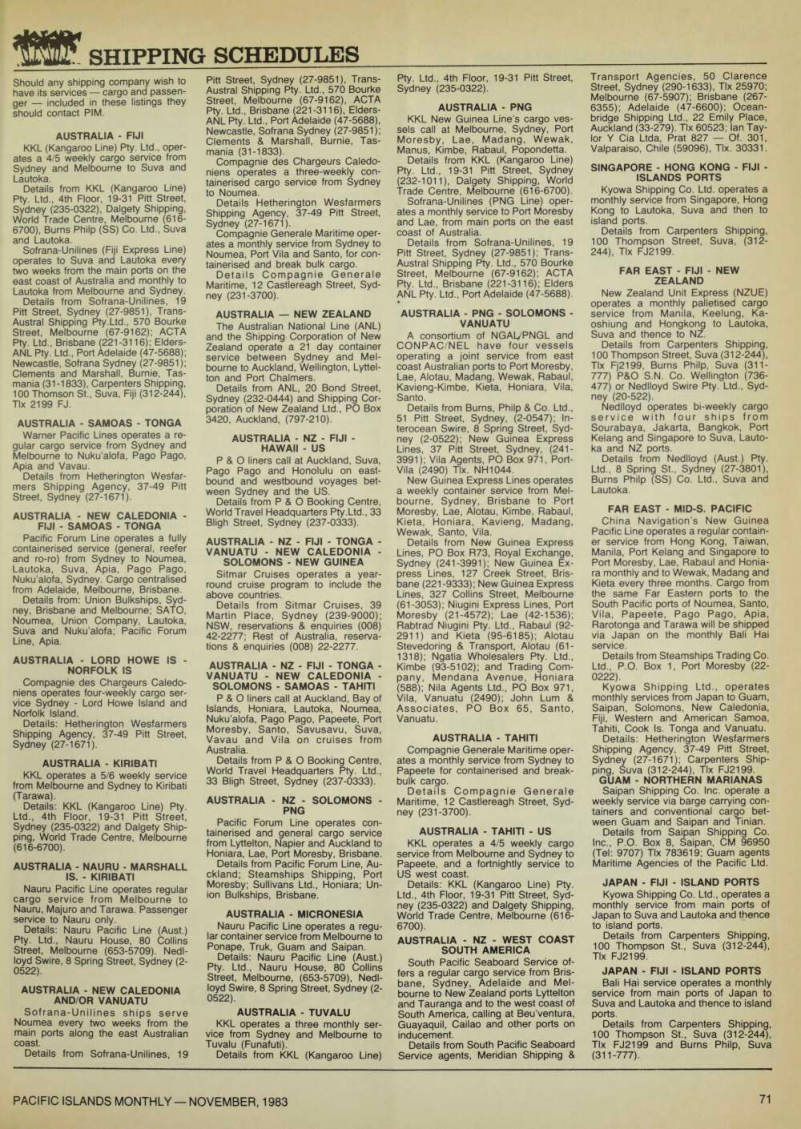
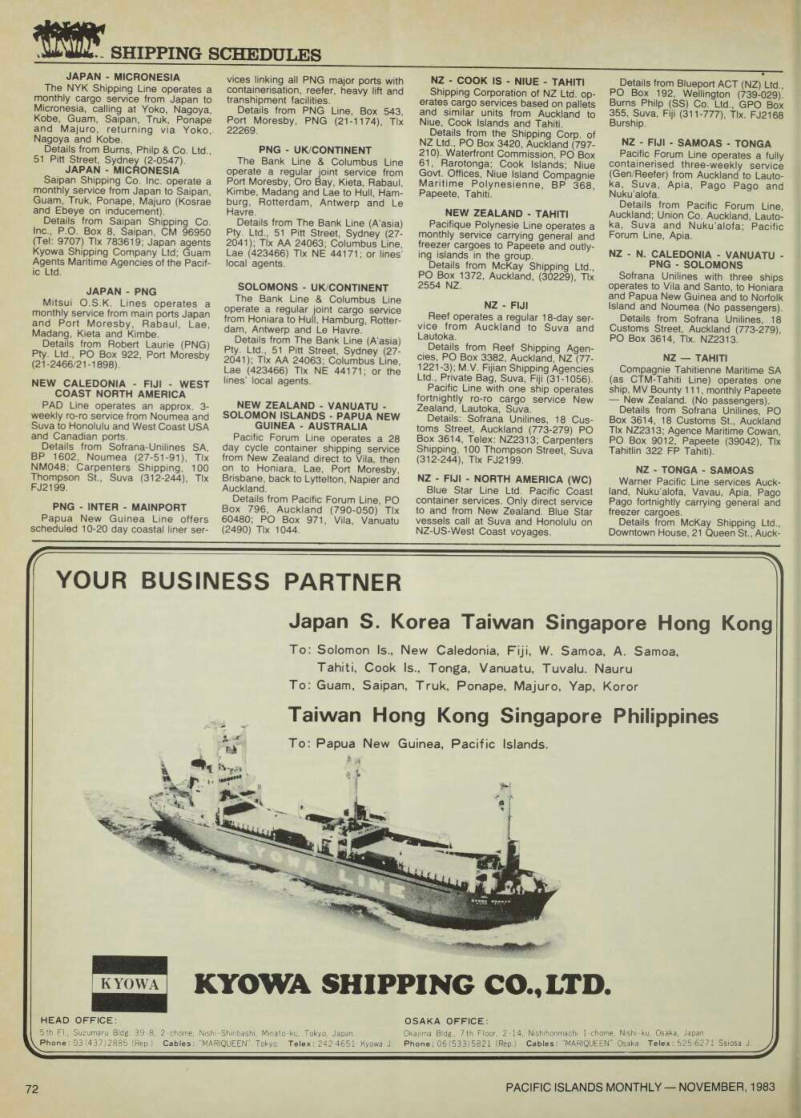
Should any shipping company wish to have its services cargo and passen ger included in these listings they should contact PIM.
Australia - Fiji
KKL (Kangaroo Line) Pty. Ltd., oper ates a 4/5 weekly cargo service from Sydney and Melbourne to Suva and Lautoka.
Details from KKL (Kangaroo Line) Pty. Ltd., 4th Floor, 19-31 Pitt Street, Sydney (235-0322), Dalgety Shipping, World Trade Centre, Melbourne (616- 6700), Burns Philp (SS) Co. Ltd., Suva and Lautoka.
Sofrana-Unilines (Fiji Express Line) operates to Suva and Lautoka every two weeks from the main ports on the east coast of Australia and monthly to Lautoka from Melbourne and Sydney.
Details from Sofrana-Unilines, 19 Pitt Street, Sydney (27-9851), Trans- Austral Shipping Pty.Ltd., 570 Bourke Street, Melbourne (67-9162); ACTA Pty. Ltd., Brisbane (221-3116); Elders- ANL Pty. Ltd., Port Adelaide (47-5688); Newcastle, Sofrana Sydney (27-9851); Clements and Marshall, Burnie, Tas mania (31-1833), Carpenters Shipping, 100 Thomson St., Suva, Fiji (312-244), Tlx 2199 FJ.
Australia - Samoas - Tonga
Warner Pacific Lines operates a re gular cargo service from Sydney and Melbourne to Nukualofa, Pago Pago, Apia and Vavau.
Details from Hetherington Wesfar mers Shipping Agency, 37-49 Pitt Street, Sydney (27-1671).
Australia - New Caledonia -
Fiji - Samoas - Tonga
Pacific Forum Line operates a fully containerised service (general, reefer and ro-ro) from Sydney to Noumea, Lautoka, Suva, Apia, Pago Pago, Nukualofa, Sydney. Cargo centralised from Adelaide, Melbourne, Brisbane.
Details from: Union Bulkships, Syd ney, Brisbane and Melbourne: SATO, Noumea, Union Company, Lautoka, Suva and Nukualofa; Pacific Forum Line, Apia.
Australia - Lord Howe Is -
Norfolk Is
Compagnie des Chargeurs Caledo niens operates four-weekly cargo ser vice Sydney - Lord Howe Island and Norfolk Island.
Details: Hetherington Wesfarmers Shipping Agency, 37-49 Pitt Street,
Sydney (27-1671).
Australia - Kiribati
KKL operates a 5/6 weekly service from Melbourne and Sydney to Kiribati (Tarawa).
Details: KKL (Kangaroo Line) Pty.
Ltd., 4th Floor, 19-31 Pitt Street, Sydney (235-0322) and Dalgety Ship ping, World Trade Centre, Melbourne (616-6700).
Australia - Nauru - Marshall
Is. - Kiribati
Nauru Pacific Line operates regular cargo service from Melbourne to Nauru, Majuro and Tarawa. Passenger service to Nauru only.
Details: Nauru Pacific Line (Aust.) Pty. Ltd., Nauru House, 80 Collins Street, Melbourne (653-5709). Nedl loyd Swire, 8 Spring Street, Sydney (2- 0522).
Australia - New Caledonia
And/Or Vanuatu
Sofrana-Unilines ships serve Noumea every two weeks from the main ports along the east Australian coast.
Details from Sofrana-Unilines, 19
Pitt Street, Sydney (27-9851), Trans- Austral Shipping Pty. Ltd., 570 Bourke Street, Melbourne (67-9162), ACTA Pty. Ltd., Brisbane (221-3116), Elders- ANL Pty. Ltd., Port Adelaide (47-5688), Newcastle, Sofrana Sydney (27-9851); Clements & Marshall, Burnie, Tas mania (31-1833).
Compagnie des Chargeurs Caledo nians operates a three-weekly con tainerised cargo service from Sydney to Noumea.
Details Hetherington Wesfarmers Shipping Agency, 37-49 Pitt Street, Sydney (27-1671).
Compagnie Generale Maritime oper ates a monthly service from Sydney to Noumea, Port Vila and Santo, for con tainerised and break bulk cargo.
Details Compagnie Generale Maritime, 12 Castlereagh Street, Syd ney (231-3700).
Australia New Zealand
The Australian National Line (ANL) and the Shipping Corporation of New Zealand operate a 21 day container service between Sydney and Mel bourne to Auckland, Wellington, Lyttel ton and Port Chalmers.
Details from ANL, 20 Bond Street, Sydney (232-0444) and Shipping Cor poration of New Zealand Ltd., PO Box 3420, Auckland, (797-210).
Australia - Nz - Fiji -
Hawaii - Us
P&O liners call at Auckland, Suva, Pago Pago and Honolulu on east bound and westbound voyages bet ween Sydney and the US.
Details from P&O Booking Centre, World Travel Headquarters Pty.Ltd., 33 Bligh Street, Sydney (237-0333).
AUSTRALIA - NZ - FIJI - TONGA -
Vanuatu - New Caledonia -
Solomons - New Guinea
Sitmar Cruises operates a year round cruise program to include the above countries.
Details from Sitmar Cruises, 39 Martin Place, Sydney (239-9000); NSW, reservations & enquiries (008) 42-2277; Rest of Australia, reserva tions & enquiries (008) 22-2277.
AUSTRALIA - NZ - FIJI - TONGA -
Vanuatu - New Caledonia -
Solomons - Samoas - Tahiti
P&O liners call at Auckland, Bay of Islands, Honiara, Lautoka, Noumea, Nukualofa, Pago Pago, Papeete, Port Moresby, Santo, Savusavu, Suva, Vavau and Vila on cruises from Australia.
Details from P&O Booking Centre, World Travel Headquarters Pty. Ltd., 33 Bligh Street, Sydney (237-0333).
Australia - Nz - Solomons -
Png
Pacific Forum Line operates con tainerised and general cargo service from Lyttelton, Napier and Auckland to Honiara, Lae, Port Moresby, Brisbane.
Details from Pacific Forum Line, Au ckland; Steamships Shipping, Port Moresby: Sullivans Ltd., Honiara; Un ion Bulkships, Brisbane.
Australia - Micronesia
Nauru Pacific Line operates a regu lar container service from Melbourne to Ponape, Truk, Guam and Saipan.
Details: Nauru Pacific Line (Aust.) Pty. Ltd., Nauru House, 80 Collins Street, Melbourne, (653-5709), Nedl loyd Swire, 8 Spring Street, Sydney (2- 0522).
Australia - Tuvalu
KKL operates a three monthly ser vice from Sydney and Melbourne to Tuvalu (Funafuti).
Details from KKL (Kangaroo Line)
Pty. Ltd., 4th Floor, 19-31 Pitt Street, Sydney (235-0322).
Australia - Png
KKL New Guinea Line’s cargo ves sels call at Melbourne, Sydney, Port Moresby, Lae, Madang, Wewak, Manus, Kimbe, Rabaul, Popondetta.
Details from KKL (Kangaroo Line) Pty. Ltd., 19-31 Pitt Street, Sydney (232-1011), Dalgety Shipping, World Trade Centre, Melbourne (616-6700).
Sofrana-Unilines (PNG Line) oper ates a monthly service to Port Moresby and Lae, from main ports on the east coast of Australia.
Details from Sofrana-Unilines, 19 Pitt Street, Sydney (27-9851); Trans- Austral Shipping Pty. Ltd., 570 Bourke Street, Melbourne (67-9162); ACTA Pty. Ltd., Brisbane (221-3116); Elders ANL Pty. Ltd., Port Adelaide (47-5688).
Australia - Png - Solomons -
Vanuatu
A consortium of NGAL/PNGL and CONPAC/NEL have four vessels operating a joint service from east coast Australian ports to Port Moresby, Lae, Alotau, Madang, Wewak, Rabaul, Kavieng-Kimbe, Kieta, Honiara, Vila, Santo.
Details from Burns, Philp & Co. Ltd., 51 Pitt Street, Sydney, (2-0547); In terocean Swire, 8 Spring Street, Syd ney (2-0522); New Guinea Express Lines, 37 Pitt Street, Sydney, (241- 3991); Vila Agents, PO Box 971, Port- Vila (2490) Tlx. NH1044.
New Guinea Express Lines operates a weekly container service from Mel bourne, Sydney, Brisbane to Port Moresby, Lae, Alotau, Kimbe, Rabaul, Kieta, Honiara, Kavieng, Madang, Wewak, Santo, Vila.
Details from New Guinea Express Lines, PO Box R 73, Royal Exchange, Sydney (241-3991); New Guinea Ex press Lines, 127 Creek Street, Bris bane (221-9333); New Guinea Express Lines, 327 Collins Street, Melbourne (61-3053); Niugini Express Lines, Port Moresby (21-4572); Lae (42-1536); Rabtrad Niugini Pty. Ltd., Rabaul (92- 2911) and Kieta (95-6185); Alotau Stevedoring & Transport, Alotau (61- 1318); Ngatia Wholesalers Pty. Ltd., Kimbe (93-5102); and Trading Com pany, Mendana Avenue, Honiara (588); Nila Agents Ltd., PO Box 971, Vila, Vanuatu (2490); John Lum & Associates, PO Box 65, Santo, Vanuatu.
Australia - Tahiti
Compagnie Generate Maritime oper ates a monthly service from Sydney to Papeete for containerised and break bulk cargo.
Details Compagnie Generale Maritime, 12 Castlereagh Street, Syd ney (231-3700).
Australia - Tahiti - Us
KKL operates a 4/5 weekly cargo service from Melbourne and Sydney to Papeete, and a fortnightly service to US west coast.
Details: KKL (Kangaroo Line) Pty.
Ltd., 4th Floor, 19-31 Pitt Street, Syd ney (235-0322) and Dalgety Shipping, World Trade Centre, Melbourne (616- 6700).
Australia - Nz - West Coast
South America
South Pacific Seaboard Service of fers a regular cargo service from Bris bane, Sydney, Adelaide and Mel bourne to New Zealand ports Lyttelton and Tauranga and to the west coast of South America, calling at Beu’ventura, Guayaquil, Cailao and other ports on inducement.
Details from South Pacific Seaboard Service agents, Meridian Shipping &
Transport Agencies, 50 Clarence Street, Sydney (290-1633), Tlx 25970; Melbourne (67-5907); Brisbane (267- 6355); Adelaide (47-6600); Ocean bridge Shipping Ltd., 22 Emily Place, Auckland (33-279). Tlx 60523; lan Tay lor Y Cia Ltda, Prat 827 Of. 301, Valparaiso, Chile (59096), Tlx. 30331.
SINGAPORE - HONG KONG - FIJI -
Islands Ports
Kyowa Shipping Co. Ltd. operates a monthly service from Singapore, Hong Kong to Lautoka, Suva and then to island ports.
Details from Carpenters Shipping, 100 Thompson Street, Suva, (312- 244), Tlx FJ2199.
Far East - Fiji - New
Zealand
New Zealand Unit Express (NZUE) operates a monthly palletised cargo service from Manila, Keelung, Ka oshiung and Hongkong to Lautoka, Suva and thence to NZ.
Details from Carpenters Shipping, 100 Thompson Street, Suva (312-244), Tlx Fj2199, Burns Philp, Suva (311- 777) P&O S.N. Co. Wellington (736- 477) or Nedlloyd Swire Pty. Ltd., Syd ney (20-522).
Nedlloyd operates bi-weekly cargo service with four ships from Sourabaya, Jakarta, Bangkok, Port Kelang and Singapore to Suva, Lauto ka and NZ ports.
Details from Nedlloyd (Aust.) Pty.
Ltd., 8 Spring St., Sydney (27-3801), Burns Philp (SS) Co. Ltd., Suva and Lautoka.
Far East - Mid-S. Pacific
China Navigation's New Guinea Pacific Line operates a regular contain er service from Hong Kong, Taiwan, Manila, Port Kelang and Singapore to Port Moresby, Lae, Rabaul and Honia ra monthly and to Wewak, Madang and Kieta every three months. Cargo from the same Far Eastern ports to the South Pacific ports of Noumea, Santo, Vila, Papeete, Pago Pago, Apia, Rarotonga and Tarawa will be shipped via Japan on the monthly Bali Hai service.
Details from Steamships Trading Co.
Ltd., P.O. Box 1, Port Moresby (22- 0222).
Kyowa Shipping Ltd., operates monthly services from Japan to Guam, Saipan, Solomons, New Caledonia, Fiji, Western and American Samoa, Tahiti, Cook Is. Tonga and Vanuatu.
Details: Hetherington Wesfarmers Shipping Agency, 37-49 Pitt Street, Sydney (27-1671); Carpenters Ship ping, Suva (312-244), Tlx FJ2199.
Guam - Northern Marianas
Saipan Shipping Co. Inc. operate a weekly service via barge carrying con tainers and conventional cargo bet ween Guam and Saipan and Tinian.
Details from Saipan Shipping Co.
Inc., P.O. Box 8, Saipan, CM 96950 (Tel: 9707) Tlx 783619; Guam agents Maritime Agencies of the Pacific Ltd.
Japan - Fiji - Island Ports
Kyowa Shipping Co. Ltd., operates a monthly service from main ports of Japan to Suva and Lautoka and thence to island ports.
Details from Carpenters Shipping, 100 Thompson St., Suva (312-244), Tlx FJ2199.
Japan - Fiji - Island Ports
Bali Hai service operates a monthly service from main ports of Japan to Suva and Lautoka and thence to island ports.
Details from Carpenters Shipping, 100 Thompson St., Suva (312-244), Tlx FJ2199 and Burns Philp, Suva (311-777).
Japan - Micronesia
The NYK Shipping Line operates a monthly cargo service from Japan to Micronesia, calling at Yoko, Nagoya, Kobe, Guam, Saipan, Truk, Ponape and Majuro, returning via Yoko, Nagoya and Kobe.
Details from Burns, Philp & Co. Ltd., 51 Pitt Street, Sydney (2-0547).
Japan - Micronesia
Saipan Shipping Co. Inc. operate a monthly service from Japan to Saipan, Guam, Truk, Ponape, Majuro (Kosrae and Ebeye on inducement).
Details from Saipan Shipping Co.
Inc., P.O. Box 8, Saipan, CM 96950 (Tel: 9707) Tlx 783619; Japan agents Kyowa Shipping Company Ltd; Guam Agents Maritime Agencies of the Pacif ic Ltd.
Japan - Png
Mitsui O.S.K. Lines operates a monthly service from main ports Japan and Port Moresby, Rabaul, Lae, Madang, Kieta and Kimbe.
Details from Robert Laurie (PNG) Pty. Ltd., PO Box 922, Port Moresby (21-2466/21-1898).
New Caledonia - Fiji - West
Coast North America
PAD Line operates an approx. 3weekly ro-ro service from Noumea and Suva to Honolulu and West Coast USA and Canadian ports.
Details from Sofrana-Unilines SA, BP 1602, Noumea (27-51-91), Tlx NMO4B; Carpenters Shipping, 100 Thompson St., Suva (312-244), Tlx FJ2199.
Png - Inter - Mainport
Papua New Guinea Line offers scheduled 10-20 day coastal liner ser
vices linking all PNG major ports with containerisation, reefer, heavy lift and transhipment facilities.
Details from PNG Line, Box 543, Port Moresby, PNG (21-1174), Tlx 22269.
Png - Uk/Continent
The Bank Line & Columbus Line operate a regular joint service from Port Moresby, Oro Bay, Kieta, Rabaul, Kimbe, Madang and Lae to Hull, Ham burg, Rotterdam, Antwerp and Le Havre.
Details from The Bank Line (A’asia) Pty. Ltd., 51 Pitt Street, Sydney (27- 2041); Tlx AA 24063; Columbus Line, Lae (423466) Tlx NE 44171; or lines’ local agents.
Solomons - Uk/Continent
The Bank Line & Columbus Line operate a regular joint cargo service from Honiara to Hull, Hamburg, Rotter dam, Antwerp and Le Havre.
Details from The Bank Line (A’asia) Pty. Ltd., 51 Pitt Street, Sydney (27- 2041); Tlx AA 24063; Columbus Line, Lae (423466) Tlx NE 44171; or the lines' local agents.
New Zealand - Vanuatu -
Solomon Islands - Papua New
Guinea - Australia
Pacific Forum Line operates a 28 day cycle container shipping service from New Zealand direct to Vila, then on to Honiara, Lae, Port Moresby, Brisbane, back to Lyttelton, Napier and Auckland.
Details from Pacific Forum Line, PO Box 796, Auckland (790-050) Tlx 60480; PO Box 971, Vila, Vanuatu (2490) Tlx 1044.
NZ - COOK IS - NIUE - TAHITI Shipping Corporation of NZ Ltd. operates cargo services based on pallets and similar units from Auckland to Niue, Cook Islands and Tahiti.
Details from the Shipping Corp. of NZ Ltd., PO Box 3420, Auckland (797- 210). Waterfront Commission, PO Box 61, Rarotonga; Cook Islands; Niue Govt. Offices, Niue Island Compagnie Maritime Polynesienne, BP 368, Papeete, Tahiti. ,_ AI
New Zealand - Tahiti
Pacifique Polynesie Line operates a monthly service carrying general and freezer cargoes to Papeete and outly ing islands in the group.
Details from McKay Shipping Ltd., PO Box 1372, Auckland, (30229), Tlx 2554 NZ.
Nz - Fiji
Reef operates a regular 18-day service from Auckland to Suva and Lautoka.
Details from Reef Shipping Agen cies, PO Box 3382, Auckland, NZ (77- 1221-3); M.V. Fijian Shipping Agencies Ltd., Private Bag, Suva, Fiji (31-1056).
Pacific Line with one ship operates fortnightly ro-ro cargo service New Zealand, Lautoka, Suva.
Details: Sofrana Unilines, 18 Customs Street, Auckland (773-279) PO Box 3614, Telex: NZ2313; Carpenters Shipping, 100 Thompson Street, Suva (312-244), Tlx FJ2199. a NZ - FIJI - NORTH AMERICA (WC) Blue Star Line Ltd. Pacific Coast container services. Only direct service to and from New Zealand. Blue Star vessels call at Suva and Honolulu on NZ-US-West Coast voyages.
Details from Blueport ACT (NZ) Ltd PO Box 192, Wellington (739-029)’
Burns Philp (SS) Co. Ltd., GPO Box 355, Suva, Fiji (311-777), Tlx. FJ2168 Burship.
NZ - FIJI - SAMOAS - TONGA Pacific Forum Line operates a fully containerised three-weekly service (Gen/Reefer) from Auckland to Lauto ka, Suva, Apia, Pago Pago and Nukualofa.
Details from Pacific Forum Line, Auckland; Union Co. Auckland, Lauto ka, Suva and Nuku’alofa; Pacific Forum Line, Apia, NZ - N. CALEDONIA - VANUATU -
Png * Solomons
Sofrana Unilines with three ships operates to Vila and Santo, to Honiara and Papua New Guinea and to Norfolk Island and Noumea (No passengers).
Details from Sofrana Unilines, 18 Customs Street, Auckland (773-279) rq Box 3614, Tlx. NZ2313.
Nz Tahiti
Compagnie Tahitienne Maritime SA (as CTM-Tahiti Line) operates one ship, MV Bounty 111, monthly Papeete New Zealand. (No passengers).
Details from Sofrana Unilines, PO Box 3614, 18 Customs St., Auckland Tlx NZ2313; Agence Maritime Cowan, PO Box 9012, Papeete (39042) Tlx Tahitlin 322 FP Tahiti).
Nz- Tonga - Samoas
Warner Pacific Line services Auck land, Nuku’alofa, Vavau, Apia, Pago Pago fortnightly carrying general and freezer cargoes, Details from McKay Shipping Ltd., Downtown House, 21 Queen St., Auck-
DEATHS of Islands People
land, PO Box 1372 (30-299). Cables MACSHIP, Telex NZ2554, Warner Pacific Line, Box 93, Nukualofa, Ton ga; Mealelei (Western Samoa) Ltd.
Box 4171, Apia, Western Samoa, Kneubuhl Maritime Services, Box 39, Pago Pago, American Samoa, 96799.
Nz - New Caledonia
CP Line operates a monthly cargo service from Auckland, Lyttelton, Napier and Mt. Maunganui to Noumea.
Details from McKay Shipping Ltd., PO Box 1372, Auckland (9-30229); Tlx 2554 NZ.
Europe - Tahiti -
New Caledonia
Compagnie Generale Maritime oper ates services from Europe and Mediterranean ports to Papeete and Noumea using three ro-ro and multi purpose vessels thus ensuring a bi monthly sailing to and from.
Details Compagnie Generale Maritime, 12 Castlereagh Street, Syd ney (231-3700).
Europe - Tahiti - New
Caledonia - New Zealand -
Solomons - Png - Europe
Polish Ocean Lines offers regular monthly sailings for containerised and breakbulk cargo and reefer space, con ventional and in reefer containers, from Hamburg, Antwerp, Dunkirk and Rouen to Papeete, Noumea, New Zea land, Honiara, Lae, Manila and Singa pore, returning to Europe via Suez.
Other ports in the South Pacific can be served with inducement.
Details from Sotama, BP 9170, Papeete (27805), Tlx. 296; SATO, BP C 2, Noumea (272094), Tlx. 163 NM SATO: Union Steamship Co of NZ, PO Box 50, Apia, Tlx. 25; Williams and Gosling, PO Box 79, Suva (312633).
EUROPE - TAHITI - W. SAMOA -
Fiji - N. Caledonia
Nedlloyd offers regular cargo ser vices from Northern Europe and U.K. to Papeete, Apia, Fiji and New Caledonia.
Details Nedlloyd (Aust.) Pty. Ltd., 8 Spring Street, Sydney (27-3801); Car penters Shipping, 100 Thomson St., Suva (312-244), Tlx. 2199 FJ and Vetari Street, Lautoka (63988), Tlx. 5215FJ.
UK - N. CONTINENT - W. SAMOA -
Tonga - Fiji
The Bank Line & Columbus Line operate a regular joint cargo service from Hull, Hamburg, Bremen, Antwerp, Rotterdam and Le Havre to Apia, Nukualofa, Suva and Lautoka.
Details from The Bank Line (A'asia) Pty. Ltd., 51 Pitt Street, Sydney (27- 2041); Tlx AA 24063; Columbus Line, Lae (423466) Tlx NE 44171; or lines’ local agents.
UK - N. CONTINENT - PNG -
Solomons
The Bank Line & Columbus Line operate a regular joint cargo service from Hull, Hamburg, Bremen, Antwerp, Rotterdam and Le Havre to Port Moresby, Lae, Madang, Kimbe, Rabaul, Kieta and Honiara and on inducement to Yandina.
Details from The Bank Line (A’sia) Pty. Ltd., 51 Pitt Street, Sydney (27- 2041); Tlx AA 24063; Columbus Line, Lae (423466) Tlx NE 44171; or lines’ local agents.
Uk/N. Continent - Tahiti -
N. Caledonia - Vanuatu
The Bank Line & Columbus Line operate a regular joint cargo service from Hull, Hamburg, Bremen, Antwerp, Rotterdam and Le Havre to Papeete, Noumea, Port-Vila and Santo.
Details from The Bank Line (A’asia) Pty. Ltd., 51 Pitt Street, Sydney (27- 2041); Tlx AA 24063; Columbus Line, Lae (42-3466) Tlx NE 44171; Ets AM.
Fare DTE, Papeete; Ets. Ballande, Noumea and other local agents.
US - FIJI - TAHITI - NZ -
Australia
The Bank Savill Line Ltd. operates regular cargo services from U.S. Gulf ports to Australia and N.Z. Calls at Suva, Lautoka and Papeete on demand.
Details from The Bank and Savill Line Ltd., 51 Pitt Street, Sydney (27- 2041) or Orient Shipping Services, 32 Bridge Street, Sydney (241-2753).
US - HAWAII - MICRONESIA - E.
Malaysia - Brunei
PM & O Lines operates two fully self sustained container vessels monthly from San Francisco, Los Angeles and Honolulu (via transshipment at Majuro) to Ebeye, Kosrae, Ponape, Truk, Saipan, Yap, Koror, Kota Kinabalu, Labuan and Brunei. Note: service to Majuro from Hawaii is not offered.
Details: PM & O Lines, 181 Fremont Street, San Francisco, California 94- 105, USA. (415) 543-7430, Tlx
278016, Cable Pmonav. Pm & O
Owner’s Rep. P.O. Box 803, Saipan,
N.M.I. 96950, Cable Commontime
Saipan. Tlx 783605.
Us - Hawaii - Nauru -
Micronesia
Nauru Pacific Line operates regular conventional container and passenger service from San Francisco and Hon olulu to Majuro, Ponape, Truk and Saipan. Cargo is accepted for Nauru and Kosrae with transhipment at Maj uro and Ponape.
Details from Nauru Pacific Line (Aust.) Pty. Ltd., Nauru House, 80 Collins Street, Melbourne (653-5709); Nauru Air and Shipping Agency, Suite 2803, 185 Berry Street, San Francisco, California 94107 (415-543-1737); Nauru Air and Shipping Agency, Suite 506, 841 Bishop St., Honolulu, HI 96813 (808-523-0441).
Hawaii - Tahiti - Samoas
Marshall Islands Maritime Co oper ates a service every 32 days between Honolulu, Papeete, Pago Pago and Apia.
Details from the Maritime Co. of the Pacific, 567 South King Street, Suite 310, Honolulu, Hawaii, Morris Hed strom, Box 189, Apia, Western Samoa and the Marshall Islands Maritime Co., Box 679, Majuro, Marshall Islands.
Us - Noumea - Fiji
PAD Line operates an approx. 3weekly ro-ro service from West coast USA and Canada to Noumea, Suva and Lautoka.
Details from Sofrana-Unilines SA, BP 1602, Noumea (27-51-91), Tlx.
NMO4B; Carpenters Shipping, Harbour Centre, Thompson Street, Suva (31- 2244), Tlx. FJ2199; Trans-Austral Shipping Pty. Ltd., PO Box R 232, Roy al Exchange, 2000 (231-8411), Tlx.
AA21204.
Us - Tahiti - Samoa
Pacific Islands Transport operates a five weekly cargo service from North America west coast ports to Papeete, Pago Pago, Apia.
Details from Polynesia Shipping Ser vices Inc. PO Box 1478, Pago Pago 96799.
Polynesia Line operates container and general cargo service from US west coast ports to Papeete and Pago Pago.
Details from Polynesia Shipping Ser vices Inc., PO Box 1478, Pago Pago 96799.
Adi Losalini Raravuya Dovi In Suva on September 21, aged 53.
Adi Losalini was the first Fi jian woman to be elected to Parliament and to hold ministe rial office.
She was the wife of the late Dr Ratu Jone Dovi, youngest brother of the late Ratu Sir Lala Sukuna.
Adi Losalini first entered the old Legislative Council as a nominee of the Great Council of Chiefs in 1966 and was elected to the House of Representatives
during Fiji’s first post-
Independence elections in 1972.
She went to the Methodist Mission School in Suva and joined the Fijian Affairs Board after final examinations.
As a clerk-in-training with the board, she became the first Fijian woman to attain a speed of 150 words a minute in shorthand.
This was to serve her well during the 10 years she worked as pri vate secretary to Ratu Sir Lala Sukuna.
Adi Losalini also served as private secretary to Sir Malcolm Trustram Eve at the sugar indus try inquiry. On his return as Lord Silsoe to conduct an inquiry into the coconut industry, Adi Losa lini was again appointed as his secretary.
In 1966, Adi Losalini was approached by the Great Council of Chiefs to stand as a candidate for the Legislative Council and was nominated with the former Governor-General, Ratu Sir
George Cakobau.
She was elected in 1972 as Fijian Member for the South- Eastern National Constituency and was appointed Government Whip. She was appointed Assis tant Minister for Urban Develop ment and Social Welfare in 1975.
Adi Losalini failed to get the Alliance Party nomination in the 1977 general elections.
She served in various wo
men’s organisations, including a
stint as president of the Fiji Na tional Council of Women.
May Graham
In Christchurch, New Zealand, in May, aged 93.
Miss Graham first went to Fiji in 1910 as a school teacher, appointed to work at the Dilkus ha centre for Indian women and
girls. She continued to work in Fiji until about five years ago, though she retired many times.
Each time she thought of leav ing the country she was called back by the claims of her “fami ly” which was in effect the whole Christian Indian community. For she not only taught girls in school, but took an active inter est in their families and their lives at home and in the com munity. As the years passed, and the girls she had once taught grew up and married, they called on “Nannie” Graham to come to them in moments of crisis. She moved into their homes in times of sickness and need, caring for and supporting them.
Her influence in the Indian community was widespread, and her passing is mourned by many people. George G. Carter.
Daniel Sioni At Kwato, Papua New Guinea, on August 12.
With the death of Daniel Sioni, a direct link with Papua’s pre-colonial past is broken. His father, Sioni Saisebo of Logea (“Johnny Logea”), a convert of the earliest Loyalty Islands mis sionaries who arrived in China Strait near Milne Bay in 1877, was among the first three Milne Bay students educated at the
London Missionary Society’s
station in Port Moresby in the 1880 s by Dr W. G. Lawes, Papua’s first European resident.
In 1912, by his own reckon ing, Daniel followed his father to Kwato island off Logea, where he became head printer of the Kwato mission under Charles W.
Abel.
Daniel Sioni was a fine evangelist and pastor and was, incidentally, one of the best cricketers in the mission. His wife Ainauia, whom he married in 1926 and who predeceased him, was an assistant teacher at Duabo station in Milne Bay.
His funeral took place at Kwato. D. W.
Roy Quintal
In Sydney, Australia, on Sep tember 25, aged 69.
Bom on Norfolk Island, Roy Quintal during World War II became known as “Norfolk’s one-man army” because he was the very first resident to enlist in the Australian army. He saw service in New Guinea.
After the war he served as a special constable with the Nor folk administration.
Describing him as a “quiet refined Norfolker with a lovely singing voice“, The Norfolk Is lander reports that his hobby was carving in pine and tortoiseshell.
Thierry Kouathe
On the Isle of Pines, New Caledonia, in September, aged 23.
Thierry Kouathe had his left leg almost severed in a shark attack while underwater fishing for lobster near the islet of Moro, southwest of the Isle of Pines.
His fellow divers Emmanuel Kouatche and Maurice Leme got him to the dispensary at Vao as quickly as possible, but he bled to death before a helicopter sum moned from the mainland could reach him.
The young men supplied lobs
ter to the Melanesian-style tourist resort, Chez Christine.
Roland Selwyn Buffett On Norfolk Island on September 21, aged 72.
“Dear Sellie” as he was known was bom and educated on Nor folk, and saw service in World War II with Australian forces in the Middle East and New Guinea.
He lived in Sydney for about 20 years after the war, but return ed to Norfolk to work with the road gang of the Norfolk ad ministration, and in the
lighterage.
He took a very active interest in the Returned Servicemen’s League, and was its Norfolk branch secretary for a time.
Advertisements & other items, pp. 72-74 (1 item)
Kyowa Shipping Co.. Ltd.
YOUR BUSINESS PARTNER
Japan S. Korea Taiwan Singapore Hong Kong To: Solomon Is., New Caledonia, Fiji, W. Samoa, A. Samoa, Tahiti, Cook Is., Tonga, Vanuatu, Tuvalu. Nauru To: Guam, Saipan, Truk, Ponape, Majuro, Yap, Koror
Taiwan Hong Kong Singapore Philippines
To: Papua New Guinea, Pacific Islands. •sf-'
KYOWA
KYOWA SHIPPING CO.. LTD.
HEAD OFFICE: OSAKA OFFICE;
sth FI., Suzumaru Bldg. 39-8, 2-chome, Nishi-Shinbashi, Minato-ku, Tokyo, Japan. Okajima Bldg., 7th Floor, 2-14, Nishihonmachi 1-chome, Nishi-ku, Osaka, Japan Phone: 03(437)2885 (Rep.) Cables: MARIQUEEN” Tokyo. Telex : 242-4651 Kyowa J. Phone ; 06(533)5821 (Rep.) Cables: “MARIQUEEN” Osaka Telex: 525-6271 Ssiosa J. J
Orient
Pacific
Holidays
Knowthe South Pacific, it s Islands and Airlines.
For current rate information contact Australia’s specialist Travel Agent at; 37 Albert Road, Melbourne Victoria, 3004. Australia.
Telex: AA 135055 Ph: (03) 267 5585
iWlUlHil;
PACIFECON SURVEY
Reports every third Monday on new construction projects in 25 markets from N.Z. to Hawaii & P.N.G. to Pitcairn. Interested? For details contact: Peter O’Hara Pacific Economics Pty Ltd PO Box A 771, Sydney South
NSW 2000
Tel: (02) 231 6570 otherwise 233 7243 Telex: AA70537 TWENTY Cables "MARKSTAT”
ATLANTIC TRADING CO.
Swiss Watches Cannon & Rotary Brands Divers, Dress, Fashion, etc.
Agents wanted Office: sth Floor, ANZ Bank Building 411 Kent Street, Sydney 2000, Australia
Phone 293777 Telex INTSY AAIOIOI BIRMINCO
FOR SALE in Honiara, Solomon Islands.
Two fully furnished, self-contained three bedrm flats in two storey configuration. Top wood, lower flat brick. Beautiful views, 5 mins walk to beach. Magnificent circular pool with island and full filtration plant. House has large verandah, hot water services, gas stoves, electric fridges, piano, pool table with all accessories, 4-car garage, private tar road. Situated on over two acres hillside Block with concrete block constructed servants quarters consisting of 3 bedrms, shower, toilet and kitchen.
PRICE: $90,000
Genuine inquiries contact: K. H. Schwiemann, C/O Burrum Heads P.O.
Burrum Heads, QLD.
FOR SALE in Honiara, Solomon Islands.
“Auluta” 38’ lona, 11’ beam planing hull, sound double diagonal planking. No superstructure but partly redone deck. Twin Ford Thornycroft supercharged diesels, props, shafts and rudders. Many accessories large new steel trailer. Engines need new rings but gearboxes and prop shafts in A 1 condition.
PRICE: $4OOO
Genuine inquiries contact: K. H. Schwiemann, C/O Burrum Heads P.O.
Burrum Heads, QLD.
Advertising
Index
Aggie Grey’s 66 Air New Zealand 60 Aiwa 46 Amatil 50 Antelope 24 Atlantic Trading Co 74 Aust. Maritime Board 44 Aust. Trade Commissioner. 10 Bank Line 8 Berjak 22 Besco Jarwil 36 British Stamps 61 Citizen Watches 30 Columbus Line 8 Darwin College 28 Decrabond 62 Oezurik 32 Edmonds 62 God’s Word 66 Henry Cumines 66 Hitachi 2 Hudson Homes 22
Ici 56
Imel 18
Inter Island Solar 42 Komatsu 75 Kyowa Shipping 72 Lincoln Electric 48 MacQuarrie Industries 52 Matsushita 16 Middlemiss 22 New Zealand Dairy 64
Nqea 52
Orient Pacific 74 Pacific Economics 74 Pacific Islands Language... 22 Papua Hotel 66 Pioneer 12 P.I.T. Line 68 Polynesia Line 70 QBE Insurance 4 Roncaglia 20 Saints Church 66 Sansui 26 Schwiemann 74 Sofrana Lines 58 SPC Line 40 Thorn Electric 54 Toyota 38 Toyota Forklift 76 Trio Kenwood 34 Vanua Navigation 68
Advertisements & other items, pp. 74-76 (2 items)
74
ADB IN THE PACIFIC
(From Page 29)
PACIFIC ISLANDS MONTHLY NOVEMBER, 1993
DEATHS
The Total Approach
The Komatsu approach
A \ AW an u in i M mm m % ?5s i m SS I SO i ss=s /* * «CsV Wf Our primary concern at Komatsu is to keep the customer satisfied. For us, its a company-wide endeavor—from management to rank and file. And it's ultimately what enables us to approach problems from all angles.
To assure total quality control, we’ve adopted The Total Approach’: we actively engage in research and development activities, we manufacture, we distribute. This is why we can create products that meet the needs of the market head on, and why we can control the quality of everything we make— from bulldozers, dump trucks and hydraulic excavators to diesel engines, diesel generator sets, presses, machine tools, even industrial robots. All available in a wide range to suit every conceivable application. And all backed by Komatsu's worldwide service network.
And part of our total approach is keeping an eagle eye on the future. Our pioneering work in the exciting new field of "mechatronics’’ enables us to respond to the needs of today and anticipate those of tomorrow...
Looking for The Total Approach? Look to Komatsu.
•HKOMATSU
r 3 ft m
SDK6
The Toyota Skid Steer Loader means productivity on wheels. That's because it gets in and does the job where other vehicles
won't fast, ; efficiently and reliably
Manoeuvring Power Manoeuvring power
means total control over speed, direction and turns in even the roughest terrains. Toyota make it possible with a unique sldd steer system combined with 4-wheel drive, hydrostatic transmission and a hefty power plant. The result is a compact unit that fits into the tight spots the 2SDK4 is only 900 mm wide and turns on an outside radius of just 1300 mm. Yet it has the power to tackle the heaviest loads and steepest grades the 2.5-litre diesel engine on the SDKS packs an impressive 50ps/2500rpm.
Engineering Toyota engineering doesn't stop at the engine. This Sldd Steer Loader features Sell Leveling, which reduces spillage by keeping the bucket level at all times automatically. And Sharp Dumping, for fast and easy unloading of the stickiest materials. It's thoughtful touches like these that make Toyota the leader in its field Versatility To match its performance and power, the Toyota Skid Steer Loader offers astounding versatility. Use it as a forklift. Or a backhoe. For grading. For agricultural work In construction. There's an easy attachment for almost any job.
And, of course, Toyota reliability is built in. Push your productivity ahead with the Toyota Skid Steer Loader.
Take the lead with
TOYOTA
■ AMERICAN SAMOA: BURNS PHILP (S.S.) CO., LTD. TEL: 633-4281 ■ AUSTRALIA: THIESS TOYOTA PTY, LTD. TEL: 526-0333
■ FIJI: AUTOMOTIVE SUPPLIES CO.,
A DIVISION OF BURNS PHILP (S.S.) CO., LTD. TEL: 383444 ■ GUAM: ATKINS, KROLL (GUAM) LTD. TEL: 646-1876 ■ NEW CALEDONIA: SERVICE IMPORTATION AUTOMOBILE DU PACIFIQUE
TEL: 27-41-44
■ PAPUA NEW GUINEA: ELA MOTORS,
A DIVISION OF BURNS PHILP (P.N.G.), LTD. TEL: 217036 ■ VANUATU: VANUATU MOTORS, A DIVISION OF BURNS PHILP (VANUATU) LTD.
TEL: VILA 2341
■ WESTERN SAMOA: BURNS PHILP (S.S.) CO., LTD. TEL: 22611 And distributors around the world.