Pacific

Islands
Monthly
April, 1983
American Samoa US$l.75 Australia *A$l.5O Cook Islands NZ$l.5O Fiji F 51.50 Hawaii US$l.95 Kiribati , A 51.75 Nauru A 51.75 New Caledonia CFPI9O New Zealand . NZS2.OO
Niue Nzsi.So
Norfolk Island A 51.50 Papua New Guinea K 1.50 Solomon Islands 551.50 Tahiti CFPI9O Tonga P 1.50 Tuvalu A 51.75
Usa U 552.25
USTT and Guam USSI.9S Vanuatu . ... VT1.50 Western Samoa T 1.95 * Recommended retail price only.
Registered by Australia Poet Publication No MBPI2IO
"Pediw
J a IfSxT HaMlfllffh A R RT ilWpMrablflliTiJ
Advertisements & other items, p. 2 (1 item)
Thump
Making The World An Exciting Place
S; pA < XL. The world’s best selling 4-stroke trail bikes.
The brute force that sets the pace. XL. From those who build perfection. To those who demand it.
WORLD’S LARGEST MOTORCYCLE MANUFACTURER !
HONDA
HONDA MOTOR CO., LTD. TOKYO, JAPAN I » it
XLSOOP
XLIBSS
XLI2SS
Pacific Islands Monthly
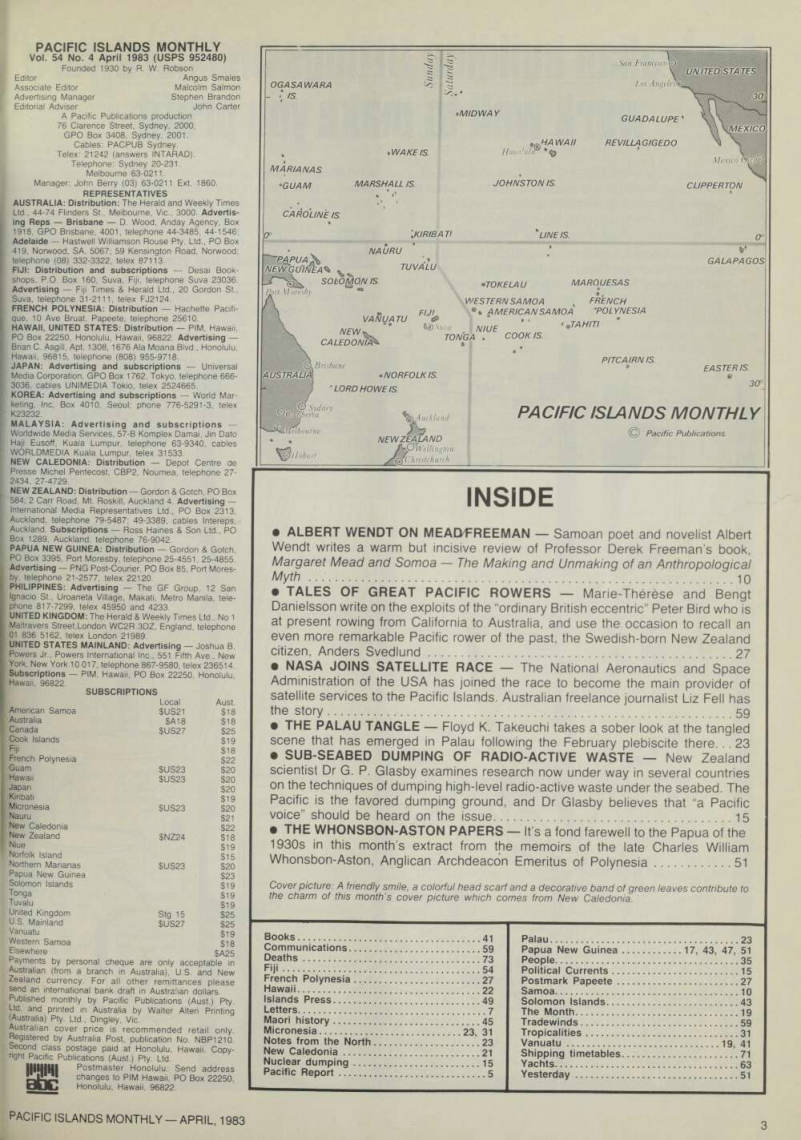
Vol. 54 No. 4 April 1983 (USPS 952480)
Representatives
AUSTRALIA: Distribution: The Herald and Weekly Times Ltd., 44-74 Flinders St., Melbourne, Vic., 3000. Advertis ing Reps Brisbane D. Wood, Anday Agency, Box 1918, GPO Brisbane, 4001, telephone 44-3485, 44-1546: Adelaide Hastwell Williamson Rouse Pty. Ltd., PO Box 419, Nonwood, SA, 5067; 59 Kensington Road, Norwood: telephone (08) 332-3322, telex 87113.
FIJI: Distribution and subscriptions Desai Book shops, P.O. Box 160, Suva, Fiji, telephone Suva 23036.
Advertising Fiji Times & Herald Ltd., 20 Gordon St., Suva, telephone 31-2111, telex FJ2124.
FRENCH POLYNESIA: Distribution Hachette Pacifi que, 10 Ave Bruat, Papeete, telephone 25610.
HAWAII, UNITED STATES: Distribution PIM, Hawaii, PO Box 22250, Honolulu, Hawaii, 96822. Advertising Brian C. Asgill, Apt. 1308,1676 Ala Moana Blvd., Honolulu, Hawaii, 96815, telephone (808) 955-9718.
JAPAN: Advertising and subscriptions Universal Media Corporation, GPO Box 1762, Tokyo, telephone 666- 3036, cables UNIMEDIA Tokio, telex 2524665.
KOREA: Advertising and subscriptions World Mar keting, Inc, Box 4010, Seoul; phone 776-5291-3, telex K 23232.
MALAYSIA: Advertising and subscriptions Worldwide Media Services, 57-B Komplex Damai, Jin Dato Haji Eusoff, Kuala Lumpur, telephone 63-9340, cables WORLDMEDIA Kuala Lumpur, telex 31533.
NEW CALEDONIA; Distribution Depot Centre de Presse Michel Pentecost, CBP2, Noumea, telephone 27- 2434, 27-4729.
NEW ZEALAND: Distribution Gordon & Gotch, PO Box 584, 2 Carr Road, Mt. Roskill, Auckland 4. Advertising International Media Representatives Ltd., PO Box 2313, Auckland, telephone 79-5487; 49-3389, cables Intereps, Auckland. Subscriptions Ross Haines & Son Ltd.. PO Box 1289, Auckland, telephone 76-9042.
PAPUA NEW GUINEA: Distribution Gordon & Gotch, PO Box 3395, Port Moresby, telephone 25-4551,25-4855.
Advertising PNG Post-Courier, PO Box 85, Port Mores by, telephone 21-2577, telex 22120.
PHILIPPINES: Advertising The GF Group, 12 San Ignacio St., Uroaneta Village, Makati, Metro Manila, tele phone 817-7299, telex 45950 and 4233.
UNITED KINGDOM: The Herald & Weekly Times Ltd., No 1 Maltravers Street,London WC2R 3DZ, England, telephone 01 836 5162, telex London 21989.
UNITED STATES MAINLAND: Advertising Joshua B Powers Jr., Powers International Inc., 551 Fifth Ave., New York, New York 10 017, telephone 867-9580, telex 236514 Subscriptions PIM, Hawaii, PO Box 22250, Honolulu Hawaii, 96822.
Payments by personal cheque are only acceptable in Australian (from a branch in Australia), U.S. and New Zealand currency. For all other remittances please send an international bank draft in Australian dollars.
Published monthly by Pacific Publications (Aust.) Pty.
Ltd. and printed in Australia by Walter Alteri Printing (Australia) Pty. Ltd., Dingley, Vic.
Australian cover price is recommended retail only.
Registered by Australia Post, publication No. NBPI2IO.
Second class postage paid at Honolulu, Hawaii. Copy right Pacific Publications (Aust.) Pty. Ltd.
Postmaster Honolulu: Send address changes to PIM Hawaii, PO Box 22250, Honolulu, Hawaii, 96822.
Subscriptions
Local Aust.
American Samoa $US21 $18 Australia $A18 $18 Canada
Sus27
$25 Cook Islands Fiji $19 ri)i French Polynesia $18 $22 Guam
Sus23
$20 Hawaii
Sus23
$20 Japan $20 Kiribati $19 Micronesia
Sus23
$20 Nauru $21 New Caledonia $22 New Zealand $NZ24 $18 Niue $19 Norfolk Island $15 Northern Marianas
Sus23
$20 Papua New Guinea $23 Solomon Islands $19 Tonga $19 Tuvalu $19 United Kingdom Stg 15 $25 U.S. Mainland $US27 $25 Vanuatu $19 Western Samoa $18 Elsewhere $A25
Inside
• ALBERT WENDT ON MEACkFREEMAN Samoan poet and novelist Albert Wendt writes a warm but incisive review of Professor Derek Freeman’s book, Margaret Mead and Somoa The Making and Unmaking of an Anthropological Myth 10 • TALES OF GREAT PACIFIC ROWERS Marie-Therese and Bengt Danielsson write on the exploits of the “ordinary British eccentric” Peter Bird who is at present rowing from California to Australia, and use the occasion to recall an even more remarkable Pacific rower of the past, the Swedish-born New Zealand citizen, Anders Svedlund 27 • NASA JOINS SATELLITE RACE The National Aeronautics and Space Administration of the USA has joined the race to become the main provider of satellite services to the Pacific Islands. Australian freelance journalist Liz Fell has the story 59 • THE PALAU TANGLE Floyd K. Takeuchi takes a sober look at the tangled scene that has emerged in Palau following the February plebiscite there... 23 • SUB-SEABED DUMPING OF RADIO-ACTIVE WASTE New Zealand scientist Dr G. P. Glasby examines research now under way in several countries on the techniques of dumping high-level radio-active waste under the seabed. The Pacific is the favored dumping ground, and Dr Glasby believes that “a Pacific voice” should be heard on the issue 15 • THE WHONSBON-ASTON PAPERS It’s a fond farewell to the Papua of the 1930 s in this month’s extract from the memoirs of the late Charles William Whonsbon-Aston, Anglican Archdeacon Emeritus of Polynesia 51 Cover picture: A friendly smile, a colorful head scarf and a decorative band of green leaves contribute to the charm of this month's cover picture which comes from New Caledonia.
Books 4i Communications 59 Deaths 73 Fiji 54 French Polynesia 27 Hawaii 22 Islands Press 49 Letters 7 Maori history 45 Micronesia 23, 31 Notes from the North 23 New Caledonia 21 Nuclear dumping 15 Pacific Report 5
Palau 23 Papua New Guinea 17, 43, 47, 51 People 35 Political Currents 15 Postmark Papeete 27 Samoa 10 Solomon Islands 43 The Month 19 Tradewinds 59 Tropicalities 31 Vanuatu 19, 41 Shipping timetables 71 Yachts 63 Yesterday 51
Advertisements & other items, pp. 3-4 (2 items)
Pacific Islands Monthly —April, 1983
3
Founded 1930 by R. W. Robson Editor Angus Smales Associate Editor Malcolm Salmon Advertising Manager Stephen Brandon Editorial Adviser John Carter A Pacific Publications production 76 Clarence Street, Sydney, 2000, GPO Box 3408, Sydney, 2001.
Cables: PACPUB Sydney.
Telex: 21242 (answers INTARAD).
Telephone: Sydney 20-231.
Melbourne 63-0211.
Manager: John Berry (03) 63-0211 Ext. 1860.
Australian building fittings and hardware
wnrk well tn make ynu profit
Australia has the biggest building industry of countries nearest the Pacific Islands. It uses a great variety of Australian made building materials that give high standards of performance in all conditions. Products such as solar hot water systems, insulation materials, window and door fittings, floor tiles, bathroom and laundry fittings, hardware, adhesives and sealants, light fittings, electrical and security equipment.
And there are many more. You get quick delivery and service from Australia. Check out Australian suppliers for your requirements. |?SI For information CeJ Ask the Australian Trade Commissioner Port Moresby: Phone 25 9333. Suva; Phone 31 2844.
Noumea: Phone 27 2414, 27 2426.
Honolulu: Phone (808) 524 5050.
CO ft 0 D 52a * -2 o r>J m Q S)
Pacific Report
Marshalls To Ditch Compact?
The Republic of the Marshall Islands’ Ministry of Foreign Affairs is “seriously considering abandonment of the draft Compact (of Free Association) which is deemed too technical and com plicated for the people to understand,” says a March news release from the ministry. The ministry has drafted a new proposal to be presented to the U.S. for consideration after review and approval by the Marshall Islands Cabinet. The new proposal, says the release, is a shorter, cleaner document, devoid of the numerous details and technicalities of the original compact. It will assure the sovereignty of the republic and establish its relationship with the United States under a treaty arrangement. The new draft agreement calls for U.S. recogni tion of complete independence for the Marshalls with military rights in the Marshalls for the U.S and the right of the U.S. to deny military use or access to all other nations. It includes a provision banning the testing or disposal of nuclear weapons and chemical or biological weapons in the Marshall Islands and, except in certain emergency situations, it bans the storage of such weapons in the Marshalls. It also provides for continued U.S. military use of Marshallese territory, such as Kwajalein Atoll, subject to the terms of a separate agreement. The release adds that the negotiations between the Marshall Islands and the United States became deadlocked over an issue unique to the republic, the settlement of Marshallese claims for injuries and damages inflicted upon them in the U.S. nuclear-testing prog ram in the Marshall Islands during the 1940 s and 19505. The Marshallese leaders no longer believe that this issue can be settled by negotiation, and their new proposal would leave the problem for judicial review in the U.S. Federal Courts.
Fsm Plebiscite In June
The Federated States of Micronesia and the United States as administrators of the Trust Territory of the Pacific Islands have agreed that the plebiscite on the Compact of Free Association shall be held on June 21. The people of the four partners in the federation, Truk, Ponape, Kosrae and Yap, will vote on their future relationship with the United States. If the compact, which will govern the relationship between self-governing FSM in free association with the U.S., is rejected, voters will have the choice of independence or some form of continuing relationship with the U.S.
Png To Become Republic?
The final report of the Papua New Guinea General Constitution al Commission, tabled in Parliament in March, recommends that PNG should become a republic with a president. The Queen would no longer be Head of State but the country would remain a member of the Commonwealth. The report said the proposal to cut ties with the British Crown was based on submissions from the public. The president would have powers to dissolve Parliament and future national governments should be removed from office if they did not follow the national goals and directive principles set out in the constitution.
Leremia Tabai Back As Kiribati President
President of Kiribati until the government resigned on a “no confidence” vote in December, leremia Tabai has been re elected on a national vote for a third and final term of four years. President Tabai received 49.6 per cent of the votes, 21.9 per cent more than his nearest rival, medical practitioner and new MP Dr Harry Tong. The new government is almost sure to be little changed from the last one. Teato Teannaki is again the Vice-President; Matita Taniera has been re-elected Speaker and seven of the ministers in the last Cabinet retained their seats in the general elections in January.
“Peace Winds” Slam Moruroa
France's nuclear testing site of Moruroa Atoll was hit by Cyclone Drama on February 27. It was the second time in a month that the atoll had been struck by a cyclone (PIM Mar p3l). On February 26, 500 Polynesians had gathered in Papeete for what wes called a Bikini Day rally, commemorating the disaster of March 1, 1954, in which a radio-active cloud from a 15-megaton H-bomb test staged by the U.S. spread to inhabited Micronesian islands. The Papeete rally was organised by the Puhi Hau peace committee. Puhi Hau can be translated as “Peace Wind”
and to many deeply religious Polynesians the cyclones that have twice devastated Moruroa in recent weeks were divine “peace winds”. Resolutions adopted at the rally were addressed to French President Mitterrand and the Vice-President of French Polynesia’s Government Council, Gaston Flosse. They called on President Mitterrand to: work for disarmament and the abolition of nuclear weapons, respect the desire expressed repeatedly by French Polynesia’s Territorial Assembly for an end to nuclear testing in the territory, make public the full facts about the Moruroa tests, and publish all the studies that armed forces doctors claim to have made since 1966 on the medical consequences of nuclear testing. The resolution also asked the president when the nuclear wastes were to be cleared off Moruroa Atoll, when the poisoned Mangareva lagoon was to be cleaned up, and when the scientific team promised several months before by the government emissary Haroun Tazieff was going to arrive to make its “detailed study” of the Moruroa Atoll.
Of Gaston Flosse the rally demanded that he act on his own resolution of December 21, 1981, for the setting up of an impartial committee of inquiry into nuclear testing, and the establishment of a permananent territorial radio-biological laboratory. Marie-Therese and Bengt Danielsson.
France Denies Vanuatu Claim On Islands
French Defence Minister Charles Hernu in March denied that a party from Vanuatu had landed on the uninhabited islands of Matthew and Hunter which are in dispute between France and Vanuatu. Earlier, Port-Vila reports had claimed that a group of people from Vanuatu had raised the Vanuatu flag on the islands.
Mr Hernu said that the French patrol vessel La Dunkerquoise had noticed a Vanuatu yacht in the vicinity of the islands. But, he said, the yacht had departed without “entering New Caledonian waters”.
Vanuatu Orders Journalist Out
The Vanuatu Government in March ordered the deportation of English-born journalist Christine Coombe who runs the weekly Voice of Vanuatu, the country’s only non-government newspap er. Ms Coombe, who also writes for PIM, was given 14 days to leave the country in a letter from Home Affairs Minister Sela Molisa. The letter declared her an “undesirable person”, but gave no reasons. Ms Coombe is reported by Radio Australia as saying that the reason for her deportation is that her paper has carried a number of reports that could have embarrassed Prime Minister Walter Lini. The paper has reported an impending legal action against the prime minister and the government in relation to an international loan he is said to have negotiated for Vanuatu.
NZ, PNG, FIJI, REACT TO SOZ DEVALUATION A March devaluation of the Australian dollar by 10 per cent prompted New Zealand, Papua New Guinea and Fiji also to devalue their currencies. Under the new exchange rate, the Australian dollar was worth UScB5.5. Australia’s new Prime Minister, Mr Hawke, said the devaluation was necessary be cause of a recent huge capital outflow from Australia. He said the move would enable local industries to compete more effectively against imports, and encourage export industries to make maximum use of any world economic recovery. The Australian devaluation was the first big adjustment to Australia’s exchange rate since November 1976. New Zealand devalued its dollar by six per cent, which the Prime Minister, Mr Muldoon, described as “a confounded nuisance”. Australia is New Zea land’s biggest trading partner. PNG announced that its basic currency unit, the kina, would be devalued by five and a half per cent against a range of currencies. About 30 per cent of Papua New Guinea’s total budget is made up of Australian aid, and the devaluation of the kina has avoided a huge gap in the budget.
Fiji devalued its dollar by two-and-three-quarters per cent.
Government finance officials in Vanuatu and Solomon Islands were reported to be still considering how their countries would be affected by the Australian devaluation. Before the devalua tion, the exchange rate for Vanuatu’s money was 90 vatu to the Australian dollar. The rate later became 81 vatu. The Solomon Islands dollar had been falling in value, and was worth about the same as the devalued Australian dollar.
Solomons Minister Freed Amid Protests
In Solomon Islands the release in March of a government minister from prison after serving only a month of a three-month sentence has caused a storm of protest. The Minister for Telecommunications, John Ngina, was jailed in February after being found guilty of causing another man bodily harm, and was released in February after appealing to the Committee of Mercy.
All the committee said publicly was that Mr Ngina was freed on welfare grounds. But the parliamentary opposition attacked the decision as an irresponsible act of favoritism. The opposition said that unless the reasons for the release were better explained, the public could only decide that Mr Ngina was freed because he was a minister. Other prisoners at the central jail in Honiara went on strike in protest. They refused to do any work, and a prison spokesman said they will be charged with not obeying lawful orders.
Png Public Service Union Leaders Sacked
Most of the executive members of Papua New Guinea’s Public Employees Association have lost their jobs with the government because of a February strike by several hundred public ser vants. The executive had called the strike in protest at the government’s two-wage structure under which foreign contract workers are paid more than local servants. Before the strike began, the government warned that it was illegal and that anybody who failed to work would be sacked. Most public servants ignored the strike, but the government compiled a list of several hundred who failed to report for work. Their jobs were to be advertised. Among these were the jobs held by members of the executive of the Public Employees Association.
FIJI TO CHECK SHIPS FOR AFRICAN SNAIL Fiji quarantine authorities in future will check all container ships passing through areas infested with the giant African snail, which causes widespread environmental damage. In an effort to protect Fiji from the pest, all container ships calling at New Caledonia, Vanuatu, Solomon Islands, Western Samoa and American Samoa will be checked on arrival in Fiji. The checks which are to continue indefinitely, follow the discovery of 22 of the snails in Fiji in February. Fiji authorities believe the snails were brought into the country on a ship which called at Vanuatu.
Chemical Dump For Johnston Atoll
The US Army plans to build a multi-million dollar chemical disposal facility on Johnston Atoll, an isolated strategic military base 717 nautical miles south-west of Honolulu.
Nauru Seeks “Home” In Philippines
Nauru began a search in March in the Philippines for a home island ” The Nauruans have been told by their President, Chief Hammer Deßoburt, that an approach was made to Philippines President Marcos for an “island in the Philippines which could be utilised as a home island along with Nauru. President Deßoburt said Nauru had been told that four islands, any one of which would be suitable for their needs, were available Nauru is about 4500 km from the southernmost islands of the Philippines.
Presumably, Nauru’s president is looking for a holiday island tor NOW e pALAU GETS BRITISH POWER PLANT Negotiations have been completed for the building in Palau of a new power station by Ipesco International Power Systems, or London. A complex financial package, negotiated over nearly 12 months, will provide funds for the new power plant and also tne first international loan contracted by Palau in its own right.
Guarantors of the loan package are the British Government and five international banks, the Morgan Grenfell, the Morgan Guarantee Trust of New York, the Bank of Tokyo the Royal Bank of Canada and the Bank of Scotland. The funds are being provided by the Westminster Bank, of London. The amount ot the loan has not been divulged. The new power station will eventually satisfy all Palau’s power requirements including he whole Babeldaob (Babelthuap) area where the new Palau capital will be sited and will also include a fuel storage facility which, through the resale of fuel, will provide funds for servicing the loans and operating the plant. Ipseco and the republic will jointly manage the power station for 10 years with pseco supplying the senior management team. Construction will begin
in two months. The new power station will be similar to one by Ipseco in the Marshal Islands.
Sp Breweries Swallows San Mig
Papua New Guinea’s South Pacific Breweries, a subsidiary of the big European firm Heineken, has taken over its rival, San Miguel, subsidiary of San Miguel of the Philippines, paying $A1.37 million for more than 90 per cent of the shares. Both companies lost money in a beer price war last year which cut the price in Port Moresby by nearly a third. San Miguel never made a profit in PNG.
Call For Islands Commonwealth Centre
Fiji’s Minister for Education, Dr Ahmed Ali, has called for the establishment of a Commonwealth-sponsored centre catering specifically for Island states in the South Pacific. Dr Ali said an Asia-Pacific centre already operated in the Malaysian capital, Kuala Lumpur. But the needs of Island states differed consider ably from those of the large metropolitan countries and the region should have its own facilities. Dr Ali made his call in Suva in March when opening a course for youth workers from Pacific Island countries. The course, organised by the Commonwealth Youth Program, aims at developing the skills of youth workers and was attended by representatives from Papua New Guinea, Western Samoa, Kiribati, Tuvalu, Vanuatu, Solomon Islands, Nauru and Fiji.
New Home For New Caledonia’S Unions
Union organisations in New Caledonia in February moved into their new headquarters building in Noumea. The building called Union House was built with funds provided by the territorial government.
Png Says Farewell To Kumul I
The Papua New Guinea Government’s controversial VIP jet, Kumul I, left the country for the last time in March. The jet was bought by the former Prime Minister, Sir Julius Chan, in early 1981 for about $7 million. The new PM, Michael Somare, made the jet an issue in last year’s election campaign, and promised to < sell it if elected. Kumul I left Port Moresby for Denmark, where it: will be sold.
Leadership Code In Action In Png
The chairman of the Papua New Guinea section of the!
Australian company Burns Philp has resigned after being told to( do so by the PNG Ombudsman. Mekere Morauta joined Burns?
Philp late last year, after leaving the PNG’s Governments? finance department. Mr Morauta was secretary for finance fon about eight years, and one of the first Papua New Guineans toe head a government department. Under the country s stnett leadership code, heads of government departments may nott become directors of private companies for at least three yearss after leaving government service. Mr Morauta asked the Uhietr Ombudsman, Ignatius Kilage, not to enforce the ban in his case,.; but the Ombudsman stood firm. Mr Kilage praised Mr Morautas for following the rule and resigning.
Islanders Talk Of Volunteers Scheme
A conference on regional co-operation ini the Pacificheldl in Western Samoa has discussed the possibility of establishing o volunteer organisation for the region. Under the scheme, Pacific Islanders would volunteer their services to help people ano governments in other Pacific countries. The conference waj sponsored by the Hawaii-based Pacific Islands Developmenr Program and the University of the South Pacific, Suva.
“Fighting Zone’’ In Bougainville?
The Premier of Papua New Guinea’s North Solomons Province: Leo Hannett, warned in March that the Bum area of south Bougainville might be declared a fighting zone. Fighting zone are regularly declared in the troubted highlands < pf I PNG but noo in any of the country’s five island provinces. Thedeclaration< gave police extra powers to curb lawlessness. Mr Hannett. warning followed the ransacking of the Bum provinciall hig«£ school and other trouble in the area. A I Radio Australia coires oondent in Rabaul said the unrest m Bum began m Fobruari when people demonstrated against the national government nomination of a Bougainvillian public servant, Leo Morgan, to open a building at Buin, instead of the MP for North Solomonsi Father John Momis.
of Eita’s
Letters
Sad fate of Eita’s M'aneaba
The M’aneaba in Eita Village, South Tarawa, where Her Majes ty the Queen and Prince Philip were officially received as guests of Kiribati in October 1982, col lapsed under its own weight on Sunday February 13, three months and 19 days after the illustrious Royal occasion.
Eita is the place where disting uished visitors to Tarawa are traditionally received. The Queen and her husband, the Duke, were by far the most dis tinguished visitors yet to come to Kiribati so the old M’aneaba was not considered a fitting abode for them. Even for half an hour. A new M’aneaba had to be built.
Coconut and pandanus trees were felled and sennit string roll ed by all the able-bodied men and women of Eita. A new, bigger, wider, longer, taller M’aneaba sprung up with the speed of light. An old man from the village told me they were going to put in some boutabu (centre pillars) but never got round to it after the Royal visit.
He said the freshly cut wood, shrinking as it dried, may have loosened the lashings and the heavy rains on the previous Saturday, the first downpour in the New Year, may have put extra strain on the already weakened structure. At one o’clock on Sunday morning the village was awakened by the thunderous sounds of cracking timber and snapping sennit twine.
The M’aneaba in Kiribati trad ition is the centre of community life. It is the free hotel for travel lers, the sanctuary in tribal wars, the court room, the meeting house and the place for execu tions in the days of old. No one was injured.
Billy Schultz
Tarawa Kiribati Sorry, you two
Tonys
Your article (PIM Jan p!7) on the “new wave” of interest in the Pacific region in New York City, written by Caroline Yacoe, was
quite interesting and informative.
The new Michael Rockefeller wing of the Metropolitan Museum of Art and the Pacific collections and film festivals of the nearby American Museum of Natural History have transform ed NY’s Central Park into the only marae in the Western Hemisphere (winter blizzards notwithstanding!).
However, I must point out one unfortunate error in the text of the article. The Australian an thropologist who assisted the Gogodala of Papua New Guinea in their “cultural revival” is named Tony Crawford, not Tony Curtis. Mr Curtis, an American, has played a number of roles in his film career, but never to my knowledge an anthropologist!
James A. Baldwin
Indiana University Indianapolis
Usa
The error, we believe, was that of a film-struck type-setter
Pim.
Samoa’s divided
families
From 1850 until 1899, the Sa moan islands, an ethnic unit, were entangled and divided arbit rarily and without Samoan repre sentation by Western nations (England, Germany and the Un ited States).
As a result, in 1899, our is lands were divided into two un natural political entities. Eastern Samoa, now called American Samoa, was acquired as a pos session by the United States.
Western Samoa was adminis tered by the Germans until it became a mandated territory of New Zealand in World War I, and an independent nation in 1962.
The notion of possible reunion was unsuccessfully dealt with by our Samoan governments just be fore Western Samoa became in dependent. However, I personal ly believe that, without US con cern, if any, American Samoa would continue to refrain from unification. American Samoa is now solely and economically de pendent upon federal funds from the US. They assume that a merger with Western Samoa could mean a loss of this economic support; however, this
is unlikey, because of the import ance of this strategic location for the United States. In view of this, uniting the Samoas is to a great extent dependent upon the US Government.
Moreover, because of colonial influence, our islands have not only been divided in two politic ally, but unnatural relations have arisen between them as well. For instance, shortly after Western Samoa became independent, it became law that Western Sa moans had to be residents in American Samoa at least five years before they could obtain employment. In response, West ern Samoans have been creating and tightening up their immigra tion rules and regulations aimed at American Samoans. It may be hoped that the humanitarian American Government would take action to alleviate this im portant problem for our people.
Since Western Samoa became independent, our governments’ lack of amicable relationship has primarily affected our families.
For instance, in my own family, my father moved to American Samoa in 1959 for contractual employment. For a while, he lived with his aunt who was married to an American Samoan chief, namely, Ifopo, in the vil lage of Fagatogo. In 1961, my mother, with some of my young brothers and sisters, moved to American Samoa. Some are still in Western Samoa, but most are now living in American Samoa.
In all, there are 14 brothers and sisters, seven of whom were born in American Samoa and seven in Western Samoa.
Those born in American Samoa have the advantage of free medical and dental care, free access to the continental United States, free education, and free dom from legal entanglement, whereas those bom in Western Samoa are considered aliens and, therefore, have to pay for medic al and dental care. They are without free access to the US; they cannot attend the communi ty college which was established in American Samoa in 1971, since the school is federally funded. They are sporadically threatened with deportation and have to be residents in American Samoa five years before obtain ing employment, among other
inequities. Since there is no legal mechanism existent in American Samoa to change this status from aliens to US nationals or citizens, they continue to feel humiliated within their own family.
A people with a common heritage, whom the US divided, ought to be united and assisted
together again not only by
the Samoan Governments but by the American Government as well.
Falani A. Peters
Seattle Washington
Usa
Kiribati report
criticised
Your comment in the January issue of PIM (Political Currents: Kiribati Government Ousted) is tendentious and misleading. I shall be obliged if you will print this letter in your next issue. It sets out the facts and refrains from comment.
The 1982 Kiribati Budget, which was passed by Parliament, contained, in its Introduction, the following statement: the Budget “allows for a 5 per cent salary increase across the board for the Public Service”. The Budget in cludes salary provision for cer tain statutory office-holders whose salaries are contained in the Schedule to the Statutory Offices Salaries Act. Unfortu nately at the time the 1982 Budget was passed the necessity to amend the Schedule to that Act was overlooked: never theless the money had been voted.
A Bill to amend the Act was introduced at the 1983 Budget Meeting. It was this Bill which was defeated in Parliament. Its purpose was to give effect to the decision already taken in 1982 for a 5 per cent across the board salary increase so far as statutory office holders were concerned and in future to empower the President in Cabinet to amend the Schedule to the Act by Order whenever, and in the same pro portion as, a salary increase was approved for the Public Service.
The provision of additional funds was not involved.
J.A. Jones
Former Parliamentary Office Management Adviser Tarawa Kiribati
Advertisements & other items, pp. 8-9 (1 item)
An opportunity for you
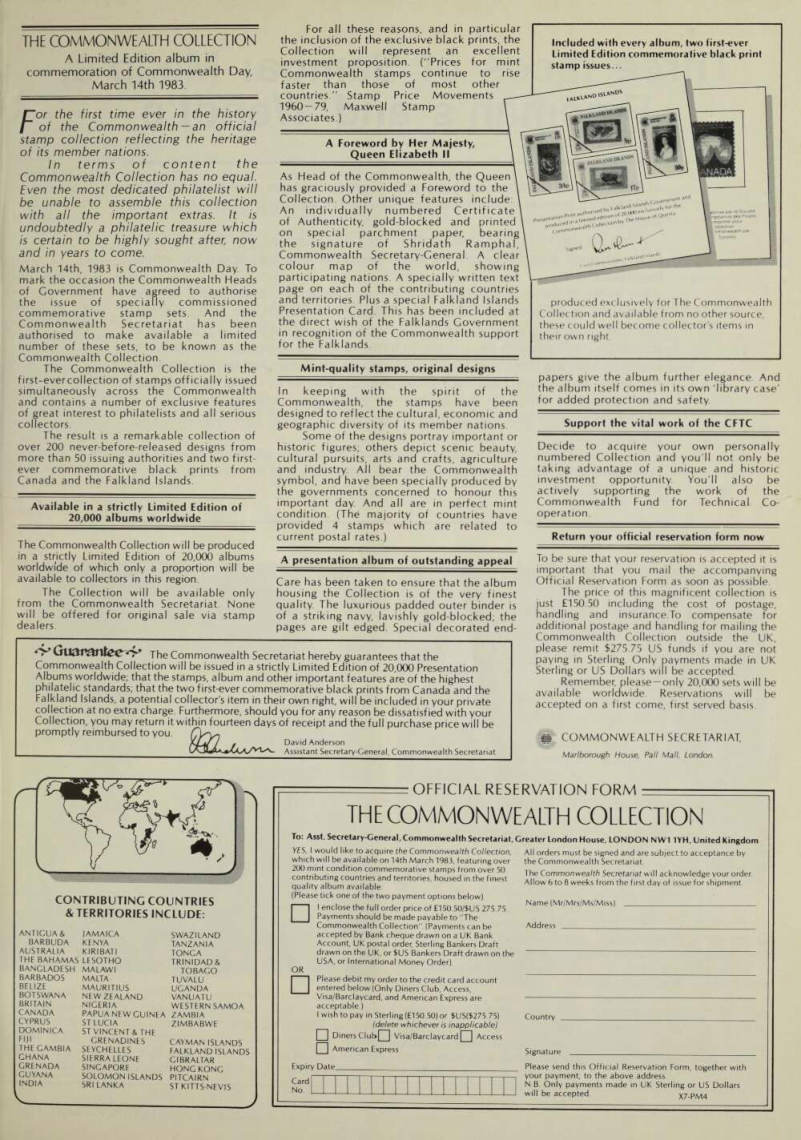
THE COMMONWEALTH COLLECTION
to acquire an unprecedented and
historic Limited Edition album.
m j i m t; m .
Edition strictly limited to 20,000 albums worldwide fete*. • Over 200 new stamps, in perfect mint condition from more than 50 countries. m m • Exclusive commemorative black prints from Canada and the Falkland Islands, a
2 CANADA
• Foreword by Her Majesty, Queen Elizabeth II
THE COMMONWEALTH COLLECTION
A Limited Edition album in commemoration of Commonwealth Day, March 14th 1983.
For the first time ever in the history of the Commonwealth —an official stamp collection reflecting the heritage of its member nations.
In terms of content the Commonwealth Collection has no equal.
Even the most dedicated philatelist will be unable to assemble this collection with all the important extras. It is undoubtedly a philatelic treasure which is certain to be highly sought after, now and in years to come.
March 14th, 1983 is Commonwealth Day To mark the occasion the Commonwealth Heads of Government have agreed to authorise the issue of specially commissioned commemorative stamp sets. And the Commonwealth Secretariat has been authorised to make available a limited number of these sets, to be known as the Commonwealth Collection The Commonwealth Collection is the first-evercollection of stamps officially issued simultaneously across the Commonwealth and contains a number of exclusive features of great interest to philatelists and all serious collectors.
The result is a remarkable collection of over 200 never-before-released designs from more than 50 issuing authorities and two firstever commemorative black prints from Canada and the Falkland Islands Available in a strictly Limited Edition of 20,000 albums worldwide The Commonwealth Collection will be produced in a strictly Limited Edition of 20,000 albums worldwide of which only a proportion will be available to collectors in this region The Collection will be available only from the Commonwealth Secretariat. None will be offered for original sale via stamp dealers.
For all these reasons, and in particular the inclusion of the exclusive black prints, the Collection will represent an excellent investment proposition ("Prices for mint Commonwealth stamps continue to rise faster than those of most other countries." Stamp Price Movements 1960 79, Maxwell Stamp Associates.) A Foreword by Her Majesty, Queen Elizabeth II As Head of the Commonwealth, the Queen has graciously provided a Foreword to the Collection Other unique features include An individually numbered Certificate of Authenticity, gold-blocked and printed on special parchment paper, bearing the signature of Shridath Ramphal, Commonwealth Secretary-General A clear colour map of the world, showing participating nations. A specially written text page on each of the contributing countries and territories. Plus a special Falkland Islands Presentation Card This has been included at the direct wish of the Falklands Government in recognition of the Commonwealth support for the Falklands.
Included with every album, two first-ever Limited Edition commemorative black print stamp issues... produced exclusively for The Commonwealth Collection and available from no other source, these could well become collector's items in their own right
Mint-quality stamps, original designs In keeping with the spirit of the Commonwealth, the stamps have been designed to reflect the cultural, economic and geographic diversity of its member nations Some of the designs portray important or historic figures; others depict scenic beauty, cultural pursuits, arts and crafts, agriculture and industry All bear the Commonwealth symbol, and have been specially produced by the governments concerned to honour this important day. And all are in perfect mint condition (The majority of countries have provided 4 stamps which are related to current postal rates.) A presentation album of outstanding appeal Care has been taken to ensure that the album housing the Collection is of the very finest quality The luxurious padded outer binder is of a striking navy, lavishly gold-blocked; the pages are gilt edged. Special decorated end-
papers give the album further elegance And the album itself comes in its own 'library case' for added protection and safety Support the vital work of the CFTC Decide to acquire your own personally numbered Collection and you'll not only be taking advantage of a unique and historic investment opportunity You'll also be actively supporting the work of the Commonwealth Fund fdr Technical Cooperation Return your official reservation form now To be sure that your reservation is accepted it is important that you mail the accompanying Official Reservation Form as soon as possible The price of this magnificent collection is just £150.50 including the cost of postage, handling and insurance.To compensate for additional postage and handling for mailing the Commonwealth Collection outside the UK, please remit $275.75 US funds if you are not paying in Sterling Only payments made in UK Sterling or US Dollars will be accepted.
Remember, please-only 20,000 sets will be available worldwide Reservations will be accepted on a first come, first served basis
m COMMONWEALTH SECRETARIAT,
Marlborough House, Pall Mall, London.
* The Commonwealth Secretariat hereby guarantees that the Commonwealth Collection will be issued in a strictly Limited Edition of 20,000 Presentation Albums worldwide; that the stamps, album and other important features are of the highest philatelic standards; that the two first-ever commemorative black prints from Canada and the Falkland Islands, a potential collector's item in their own right, will be included in your private collection at no extra charge. Furthermore, should you for any reason be dissatisfied with your Collection, you may return it within fourteen days of receipt and the full purchase price will be promptly reimbursed to you David Anderson Assistant Secretary-General, Commonwealth Secretariat
3s
CONTRIBUTING COUNTRIES
& TERRITORIES INCLUDE:
SWAZILAND
TANZANIA
TONGA
TRINIDAD &
TOBAGO
TUVALU
UGANDA
VANUATU
WESTERN SAMOA
ZAMBIA
ZIMBABWE
CAYMAN ISLANDS
FALKLAND ISLANDS
GIBRALTAR
HONG KONG
PITCAIRN
ST KITTS-NEVIS
J
=■ OFFICIAL RESERVATION FORM ■■
THE COMMONWEALTH COLLECTION
To: Asst. Secretary-General. Commonwealth Secretariat. Greater London House, LONDON NWIIYH, United Kingdom YES, I would like to acquire the Commonwealth Collection, which will be available on 14th March 1983, featuring over 200 mint condition commemorative stamps from over 50 contributing countries and territories, housed in the finest quality album available (Please tick one of the two payment options below). □ I enclose the full order price of £l5O 50/SUS 275.75 Payments should be made payable to "The Commonwealth Collection" (Payments can be accepted by Bank cheque drawn on a UK Bank Account, UK postal order. Sterling Bankers Draft drawn on the UK, or SUS Bankers Draft drawn on the USA, or International Money Order).
OR □ Please debit my order to the credit card account entered below (Only Diners Club, Access, Visa/Barclaycard, and American Express are acceptable) I wish to pay in Sterling (£150.50)0r SUS(S27S 75) (delete whichever is inapplicable) I I Diners Club) Visa/Barclaycard |~M Access
I I American Express
Expiry Date Card No.IIIIII I I I I I I All orders must be signed and are subject to acceptance by the Commonwealth Secretariat The Commonwealth Secretariat will acknowledge your order Allow 6 to 8 weeks from the first day of issue for shipment.
Name (Mr/Mrs/Ms/Miss) Address Country Signature Please send this Official Reservation Form, together with your payment, to the above address N.B, Only payments made in UK Sterling or US Dollars will be accepted X7-PM4
Three faces of Samoa: Mead’s,
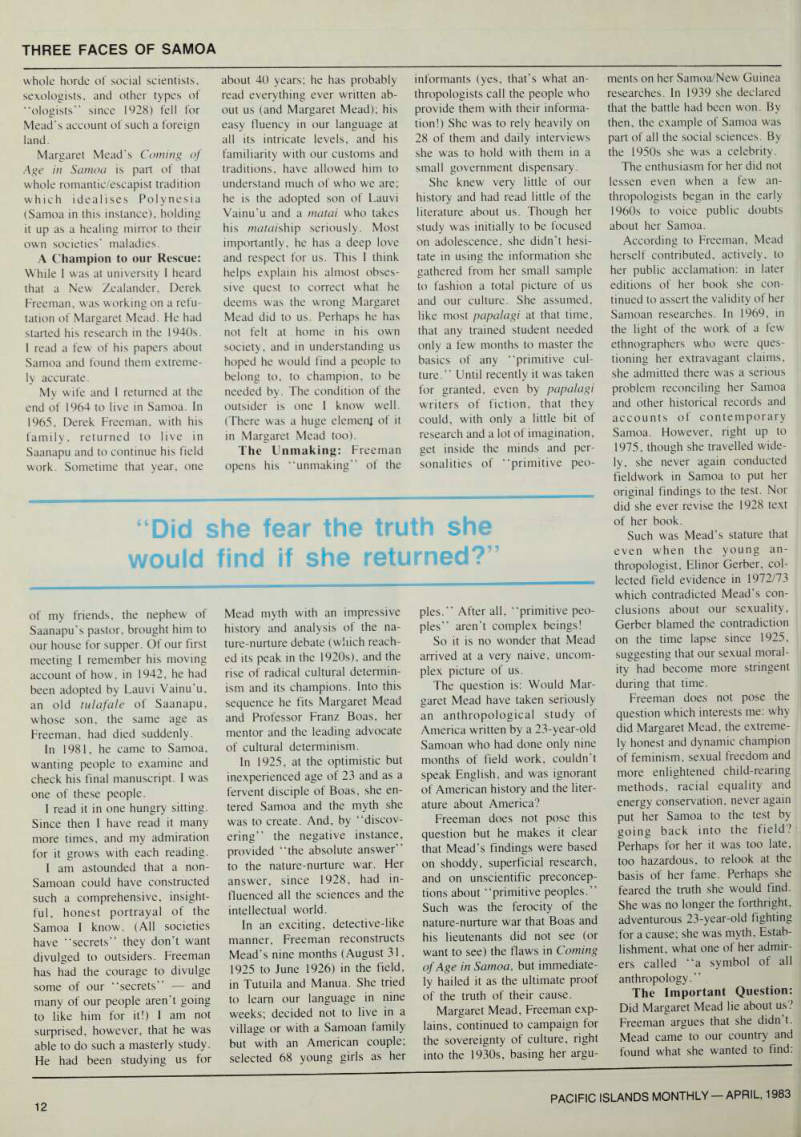

Freeman’s and Wendt’s
ALBERT WENDT, Samoan poet and novelist, reviews Professor DEREK FREEMAN’S book Margaret Mead and Samoa: The Making and Unmaking of an
Anthropological Myth *
Along the way he provides many insights into how Samoans, the “objects” of the study of such anthropologists as Mead and Freeman, feel about the whole business.
He writes of the media debate on Freeman’s work: . . once again, we, the ‘informants and objects’ of Mead’s and Freeman’s research, are being ignored.
The inferences in ignoring us are that: we don’t know enough about ourselves to contribute intelligently to the debate; in terms of selling newspapers the news is Freeman slogging it out with Mead, an American institution, not us, the ‘objects.’
And when we read and hear the learned pronouncements by foreign anthropolog ists, ‘specialists’ on us, in this debate, we are doubly convinced that they are continuing to earn their comfortable livings and enhancing their reputations by using us . .
But none of this prevents Albert Wendt from warmly welcoming Professor Freeman’s book, which he calls “the most important study of us made this century by a non-Samoan.”
Derek Freeman’s Margaret Mead and Samoa: The Making and Unmaking of an An thropological Myth * is, in my view, the most important study of us made this century by a non- Samoan. It is a devastating refu tation of the most influential
study of our society Coming of
Age in Samoa by Margaret Mead, which was first published in 1928 and, appearing in 16 languages, became the best
selling of all anthropological
works.
To review Freeman’s book is really to examine two contrasting visions of Samoa held by two non-Samoans who claim to know the truth about us. Because I am Samoan and a writer who, in fiction, has built up his own Samoa, I do feel strange (that’s
the word, I think) commenting on the Samoas of Mead and Freeman.
Margaret Mead Every where: My first encounter with Margaret Mead’s Samoa was in 1958 when, as a student at Ard more Teachers’ College, in New Zealand, I had to study Coming of Age in Samoa, in one of my education courses.
Self-love is a feature of all peoples. Even for a Samoan, the tendency to see one’s country
through technicolor glasses is
strong. And Mead’s alluring idy llic depiction of my country
(especially her enticing account
of free love) appealed to me more than greatly because I had just lived through five strict years of boarding school, and I wasn’t having much free love in the puritanical New Zealand of the 19505. (I'm positive that the in stant worldwide popularity of Mead’s Samoa was due largely to her delectable portrayal of free love without guilt under the
hugely swaying palms!)
To me (and millions of other readers, particularly those living in cold climates) Mead’s Samoa offered other delicacies. Her Samoa was a place with little
conflict, no disturbing passionate commitment to causes and other people, no fights to the death, no poverty or great disasters, no wrathful gods or cannibalism.
Life was unhurried, multiple
parenting (a phrase used by my lecturer in Child Development) ensured that every child found parental love; the gifted were held back until their less gifted brethren caught up with them;
Mead and Samoa: The Making and Unmaking of an Anthropological Myth. By Derek Freeman. Published 1983 jointly by Australian National University Press, P.O. Box 4, Canberra, ACT 2600 and Har vard University Press, Cam bridge, Mass., USA. price
$A25.00. Isbn O 7081 1271 4.
caring was slight, love and hate and jealousy and revenge and sorrow lasted only briefly; and because of the harmonious social environment adolescents did not undergo the painful turmoil as sociated with adolescence else where. Our culture assured “the greatest degree of mental health in its members,” Margaret Mead persuaded me.
I too wanted to believe and wanted my unfortunate Kiwi friends to believe it too that I was from Mead’s paradise and was returning to it, promptly, gratefully, after I had survived the innumerable perils and dis eases of papalagi society. So when my lecturer asked me, in class, what I thought of Mead’s views, and especially her conclu sions about Samoan adolescence, I confessed that Mead’s Samoa was the genuine article. (I had no “solid anthropological evi dence” to base my agreement on; I had spent my adolescent years in New Zealand and had suffered, with New Zealand ado lescent boys, the often bewilder ing pain and stress that come
with pubic hair and descending testicles!) Later, even before I left train ing college, when I started writ ing seriously about Samoa, I realised the Samoa I was creating out of my childhood storehouse of images and memories was one contrary to Mead’s attractive but superficial stereotyped paradise.
It is a Samoa with all the emo tions, problems, hopes, and so on, common to all humanity. For over 20 years now, that is the Samoa I have been exploring, discovering, creating. And if I need non-Samoans to confirm the validity, the “truth”, of much of that Samoa then I can now turn to Derek Freeman and the younger anthropologists of the late 1970 s and ’Bos.
In my travels around the world I keep running into the formid able Margaret Mead everywhere.
To most non-Samoans, my coun try is Mead’s Samoa. Even when I point out to them the enormous errors in her book, most of them want to go on believing her.
Why?
A Yearning: People every-
where look to other cultures for cures for their own ills: the grass is greener elsewhere. We im agine others to be happier than us, that the inhabitants of sunny, exotic lands have fewer hangups, and enjoy emotionally healthier lives. This yearning for utopia/paradise seems more pro nounced in industrialised societies (or in pre-industrial times, in the so-called “civilised world”). I’m sure there’s also much of this in why people want to be anthropologists studying “exotic” cultures.
Throughout history, the papalagi has searched for El Dorado and the Noble Savage.
And Polynesia has suffered more than its fair share of being stereotyped as a permanently sun-tanned heaven of ease, free love, comfort, nubile maidens and noble warriors. The tourist industry today continues to ped dle the same myth and it con tinues to strike a powerful and lucrative chord in people around our sad globe. Many Polynesians themselves want to believe the myth.
However, we expect the well trained anthropologist to break through the stereotype and see “the native” (the so-called ob ject of his research) in all his dimensions, colors, meanings, depths and pretensions as he would try to understand his fel low countrymen. But, alas, even Maragaret Mead, who later be came the grand matriarch of an thropology a superstar, as it were couldn't rise above the stereotype, her own ideology, and the arrogant preconceptions about “primitive societies” of her time. As Freeman points out, no critic, in the otherwise hectic and questioning intellectual cli mate of the 1920 s questioned her extravagant claims.
Freeman recalls what David Hume wrote in 1748, that if ever we hear a traveller’s tales of foreign lands inhabited by people who are free of avarice, ambi tion, or revenge, and who are magnificently generous and public-spirited, we should im mediately suspect that traveller’s tales. But even the perpetually sceptical Bertrand Russell (and a
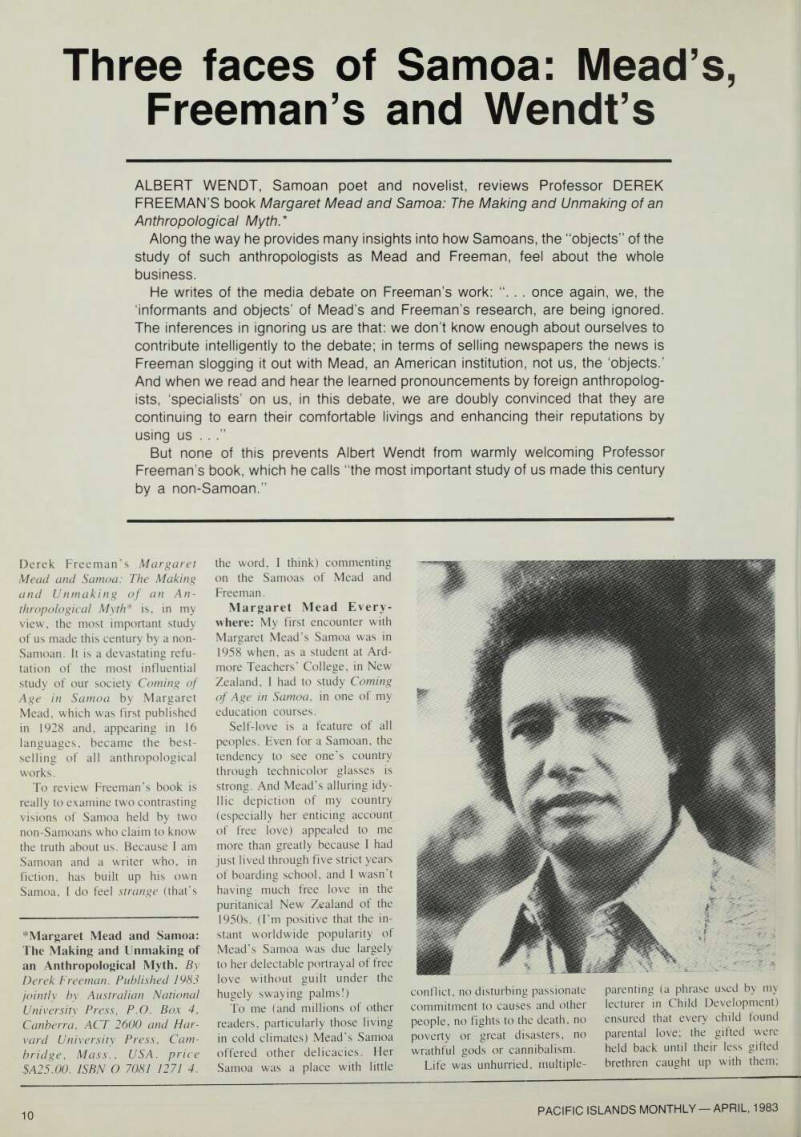
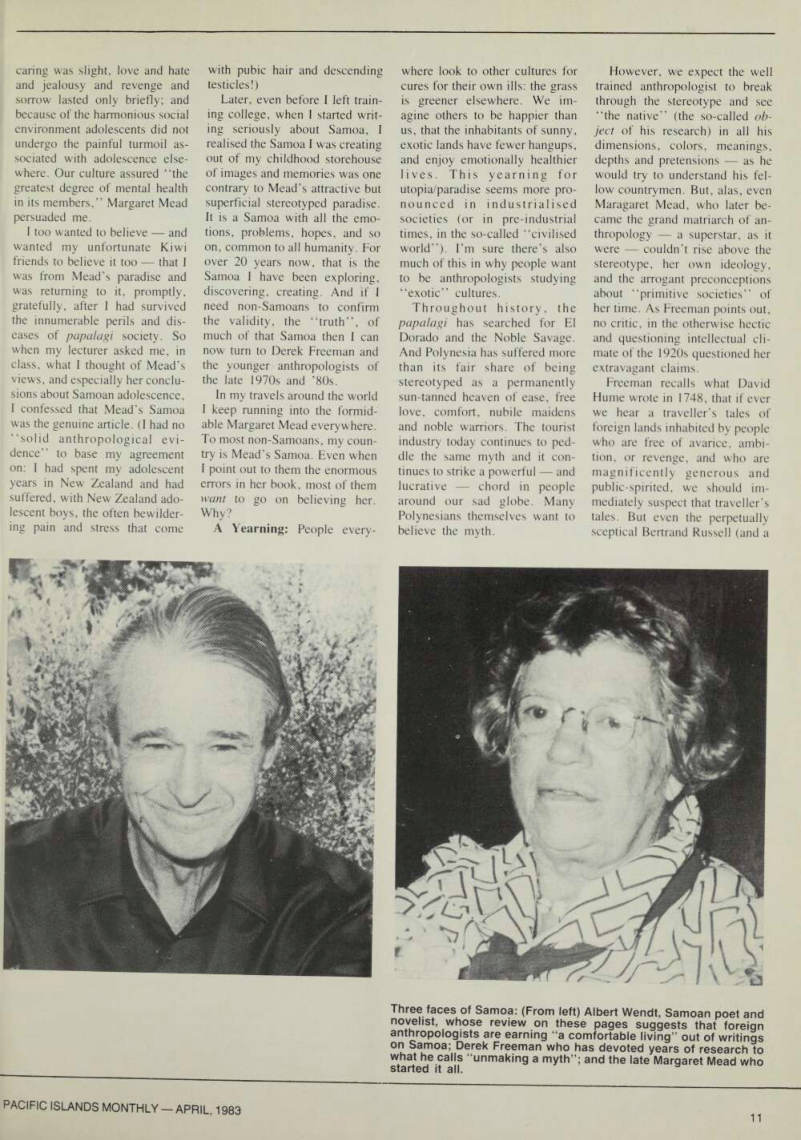
Three faces of Samoa: (From left) Albert Wendt, Samoan poet and novelist, whose review on these pages suggests that foreign anthropologists are earning “a comfortable living” out of writings on Samoa; Derek Freeman who has devoted years of research to what he calls “unmaking a myth”; and the late Margaret Mead who started it all.
whole horde of social scientists, sexologists, and other types of “ologists” since 1928) fell for Mead’s account of such a foreign land.
Margaret Mead’s Coming of Age in Samoa is part of that whole romantic/escapist tradition which idealises Polynesia (Samoa in this instance), holding it up as a healing mirror to their own societies’ maladies.
A Champion to our Rescue: While 1 was at university I heard that a New Zealander, Derek Freeman, was working on a refu tation of Margaret Mead. He had started his research in the 19405.
I read a few of his papers about Samoa and found them extreme ly accurate.
My wife and I returned at the end of 1964 to live in Samoa. In 1965, Derek Freeman, with his family, returned to live in Saanapu and to continue his field work. Sometime that year, one
“Did she fear the truth she would find if she returned?”
of my friends, the nephew of Saanapu's pastor, brought him to our house for supper. Of our first meeting I remember his moving account of how, in 1942, he had been adopted by Lauvi Vainu’u, an old tulafale of Saanapu, whose son, the same age as Freeman, had died suddenly.
In 1981, he came to Samoa, wanting people to examine and check his final manuscript. I was one of these people.
I read it in one hungry sitting.
Since then I have read it many more times, and my admiration for it grows with each reading.
I am astounded that a non- Samoan could have constructed
such a comprehensive, insight
ful, honest portrayal of the Samoa I know. (All societies have “secrets” they don’t want divulged to outsiders. Freeman has had the courage to divulge some of our “secrets” and many of our people aren’t going to like him for it!) I am not surprised, however, that he was able to do such a masterly study.
He had been studying us for
about 40 years; he has probably read everything ever written ab out us (and Margaret Mead); his easy fluency in our language at all its intricate levels, and his familiarity with our customs and traditions, have allowed him to understand much of who we are; he is the adopted son of Lauvi Vainu’u and a matai who takes his mataiship seriously. Most importantly, he has a deep love and respect for us. This I think helps explain his almost obses sive quest to correct what he deems was the wrong Margaret Mead did to us. Perhaps he has not felt at home in his own society, and in understanding us hoped he would find a people to belong to, to champion, to be needed by. The condition of the outsider is one I know well. (There was a huge elemenj of it in Margaret Mead too).
The Unmaking: Freeman opens his “unmaking” of the
Mead myth with an impressive history and analysis of the na ture-nurture debate (which reach ed its peak in the 19205), and the rise of radical cultural determin ism and its champions. Into this sequence he fits Margaret Mead and Professor Franz Boas, her mentor and the leading advocate of cultural determinism, In 1925, at the optimistic but inexperienced age of 23 and as a fervent disciple of Boas, she en tered Samoa and the myth she was to create. And, by “discov
ering” the negative instance,
provided “the absolute answer to the nature-nurture war. Her answer, since 1928, had in fluenced all the sciences and the intellectual world.
In an exciting, detective-like manner. Freeman reconstructs Mead’s nine months (August 31, 1925 to June 1926) in the field, in Tutuila and Manua. She tried to learn our language in nine weeks; decided not to live in a village or with a Samoan family but with an American couple. selected 68 young girls as her
informants (yes, that’s what an thropologists call the people who provide them with their informa tion!) She was to rely heavily on 28 of them and daily interviews she was to hold with them in a small government dispensary.
She knew very little of our history and had read little of the literature about us. Though her study was initially to be focused on adolescence, she didn’t hesi tate in using the information she gathered from her small sample to fashion a total picture of us and our culture. She assumed, like most papalagi at that time, that any trained student needed only a few months to master the basics of any “primitive cul ture.” Until recently it was taken for granted, even by papalagi writers of fiction, that they could, with only a little bit of research and a lot of imagination, get inside the minds and per sonalities of “primitive peo
pies.” After all, “primitive peo ples” aren’t complex beings!
So it is no wonder that Mead arrived at a very naive, uncom plex picture of us.
The question is: Would Mar garet Mead have taken seriously an anthropological study of America written by a 23-year-old Samoan who had done only nine months of field work, couldn’t speak English, and was ignorant of American history and the liter ature about America?
Freeman does not pose this question but he makes it clear that Mead’s findings were based on shoddy, superficial research, and on unscientific preconcep tions about “primitive peoples.”
Such was the ferocity of the nature-nurture war that Boas and his lieutenants did not see (or want to see) the flaws in Coming of Age in Samoa, but immediate ly hailed it as the ultimate proof of the truth of their cause.
Margaret Mead, Freeman exp lains, continued to campaign for the sovereignty of culture, right into the 19305, basing her argu
merits on her Samoa/New Guinea researches. In 1939 she declared that the battle had been won. By then, the example of Samoa was part of all the social sciences. By the 1950 s she was a celebrity.
The enthusiasm for her did not lessen even when a few an thropologists began in the early
1960 s to voice public doubts
about her Samoa.
According to Freeman, Mead herself contributed, actively, to her public acclamation: in later editions of her book she con tinued to assert the validity of her Samoan researches. In 1969, in the light of the work of a few ethnographers who were ques tioning her extravagant claims, she admitted there was a serious
problem reconciling her Samoa
and other historical records and accounts of contemporary Samoa. However, right up to 1975, though she travelled wide ly, she never again conducted fieldwork in Samoa to put her original findings to the test. Nor did she ever revise the 1928 text of her book.
Such was Mead’s stature that even when the young an thropologist, Elinor Gerber, col lected field evidence in 1972/73 which contradicted Mead’s con clusions about our sexuality, Gerber blamed the contradiction on the time lapse since 1925, suggesting that our sexual moral ity had become more stringent during that time.
Freeman does not pose the question which interests me: why did Margaret Mead, the extreme ly honest and dynamic champion of feminism, sexual freedom and more enlightened child-rearing methods, racial equality and energy conservation, never again put her Samoa to the test by going back into the field?
Perhaps for her it was too late, too hazardous, to relook at the basis of her fame. Perhaps she feared the truth she would find.
She was no longer the forthright,
adventurous 23-year-old fighting
for a cause; she was myth, Estab lishment, what one of her admir ers called “a symbol of all
anthropology.”
The Important Question: Did Margaret Mead lie about us?
Freeman argues that she didn’t.
Mead came to our country and found what she wanted to find:
the negative instance, final proof that culture and environment were the determinants of human personality. In this, she was aided by obliging young infor mants who. Freeman claims,
duped her.
In our culture it has always been taboo to discuss sexual mat ters publicly or freely or in mixed company. The Church’s strict Victorianism merely reinforced this. Yet here was an adult (and a papalagi woman at that) trying to get young girls (children in our terms) to divulge everything ab out their sex lives and the sex lives of their community. So Mead deservedly got the answers her informants sensed she want ed to hear.
The bulk of Freeman’s book goes on to deal with each of Mead’s conclusions about Samoa. He demolishes each one
convincingly, using very impres
sive evidence, documentation, observation and argument. He concludes that Mead’s assertions “are fundamentally in error and some of them are preposterously false.”
If the two works are compared in terms of scholarship, breadth and depth of research and vision,
reading, knowledge and interpre
tation of data, Margaret Mead’s Samoa has to be viewed as the creation of a naive 23-year-old
anthropologist-to-be.
Anthropology was still anew field, its methodology not yet highly developed, so Mead can be excused some of her errors.
But her refusal to relook at her findings cannot be excused. She died leaving the harm she had done to us unhealed.
Freeman claims that when Margaret Mead visited his un iversity in November 1964, he gave her a full explanation of the basis of his disagreement with her Samoa. They corresponded after that. In August 1978 he offered to send her a draft of his refutation. He received no reply from her. She died in November of that year.
One can only speculate as to how she must have felt knowing that, sooner or later, she would have to squarely and publicly face Freeman’s attack.
Freeman’s Samoa: Freeman’s Samoa is similar to the Samoa I know and have
depicted in my fiction. But a caution must be made: a novelist creates his own truths, an an thropologist strives to “discov er” the truths he believes exist already in a people’s way of life.
In short, a novelist does not write
anthropological studies.
Our public face is nearly al ways placid, obedient, courtly,
orderly, generous, hospitable,
considerate, impassive. Freeman knows this face well; it is the tu faatamalii, the way of the true aristocrat, the ideal on which all human behavior must be modell ed; it is a very severe and de manding way which is enforced by our elders and our churches on everyone, including our chil dren. That was as true in the
1920 s as it is today.
There is also the opposite way, the way of the tu-fanua, he who transgresses, who does not be have like a tamalii, and brings
“Freeman restores to us the virtue of being truly human”
shame to his aiga, village, coun try. Extreme anti -faatamalii be havior is described as tu faamanu, the ways of the beast.
Freeman tries to understand and describe all these opposites.
To counteract Mead’s idealised Samoa, he delves, in great depth and at length, into what he calls “the darker side” of Samoa.
This is the side of his book which has been sensationalised by the media. Some people will use his findings about rape, suicide and violence to justify their racist stereotypes of us. Freeman’s ob servations will also disturb some of our people and make them dismiss his work. Both reactions have happened to my work.
An honest reading of Freeman’s book will reveal that though he delves unflinchingly into our dark side, he does so with great concern and alofa. He says: “In refuting the conclu sions reached by Mead in the 1920 s I have necessarily had to discuss in some detail the darker side of Samoan life, which, in
constructing her negative inst
ance, she so ignored as to turn
the complexly human Samoans into characterless nonentities.
The Samoans ... do indeed have a dark side to their lives, but this, I would emphasise, is something they share with all human societies. And, as with all human societies, they also have their shining virtues.”
Here is a brief summary of Freeman’s main conclusions ab out our “darker side.” We are
highly competitive and, though
we preach group co-operation
and solidarity, there is much in tense rivalry within aiga, bet ween aiga and villages. This sometimes breaks out in vio lence, for, once we are committ ed, we will fight to the bitter end.
We suffer high rates of as sault, manslaughter, and rape.
Because we live in a highly authoritarian system where our elders rate obedience from the young as an unquestioned virtue
we suffer from many psycholog ical disturbances ranging from compulsive behavior to suicide.
The incidence of ulcers, strokes, diabetes, and other stress-related illnesses is very high.
We are very prone to jealousy, and not given to sexual promis cuity, and have one of the stric test virginity cults in the world.
So what’s new? you may ask.
It’s like any other society. That, precisely, is Freeman’s point: he is restoring to us those other dimensions of being truly hu man, dimensions denied to us by Mead.
Some Flaws: The easily dis cernible flaws in Freeman’s book stem mainly from its polemical form. To prove Mead wrong, some of his claims tend towards exaggeration and idealisation. (This idealisation is also perhaps the result of his profound trust in us).
For instance, he is correct in stating that we place a great priority on female virginity, we institutionalise it in the taupou, we forbid pre-marital and extra marital sex and promiscuity. But
it does not mean that a lot of all these various types of sex do not go on. As in other societies, what we preach publicly to be our standard of morality does not necessarily reflect how we actu ally behave. There are a great deal of double-standards in all societies. In this instance, Freeman accepts too readily the evidence of our elders, the guar dians of our public morality, who, if they are really human, often break, clandestinely, the very standards they set up.
It may be true that our high incidence of rape is due to too strict a ban on sex, but Freeman forgets that in Samoa we have always treated our women as second-class citizens to be used and dominated. Machismo has always been a supreme virtue, so, though it is correct that the tradition of moetolo is in stitutionalised rape, it is also
institutionalised bravado and machismo.
In sexual matters. Mead erred far too much on the side of free love and promiscuity, while Freeman errs on the side of sexu al purity, strictness, and absti nence. “Ask the sailors”
Freeman says rhetorically.
Meaning: sailors know that Samoa is (and was) far from being a promiscuous port. But I know that sailors know that with the right approach and persua sion the right dollar value all ports (including Samoa) will open up. Admittedly some ports are easier than others.
Even in the 1920 s Samoa wasn’t anywhere near “all vir ginity,” as it were.
An Irony: Mead’s Coming of Age in Samoa and her lifelong campaign for more sexual free dom helped bring about the so called “new morality” in the West. One can say that there is much more free love in America today than there ever was in Samoa! Many of the enforcers of our very strict public standards of
Continued on Page 69.
sexual morality journey forth from Samoa to immerse them selves, furtively but deliciously, in America’s dens of “free love.” However, when they re turn to us they continue to forbid the practice of free love. Alas!
The Controversy: Expected ly, the Mead-Freeman controver sy is raging internationally in the media. The size of the media attention and the controversy is a tribute to Margaret Mead’s sta ture and reputation. An attack on her is big news.
But once again we, the “infor mants and objects” of Mead’s and Freeman’s research, are be ing ignored. The inferences in ignoring us are that; we don’t know enough about ourselves to be able to contribute intelligently to the debate; in terms of selling newspapers the news is Freeman slogging it out with Mead, an American institution, not us, the “objects.” And when we read and hear the learned pronounce ments by foreign anthropolog ists, “specialists” on us, in this debate, we are doubly convinced
that they are continuing to earn their comfortable livings and enhancing their reputations by using us.
Some of them are saying that Freeman is being unfair to Mead by not having published his book before she died. That’s like saying that if I had wanted to disagree with someone who has died I should have done so before he attained that permanent state, These critics should also read Freeman’s magnificent study and then consider whether Mead would have been able to survive the truth and power of Freeman’s polemic.
Other critics are trying to discredit Freeman’s book by attacking him as a person. Very unscholarly behavior!
The more blase claim that Mead wasn t really an important anthropologist and her work on Samoa isn’t worth refuting. This ignores the damage her book has done to us. Her influence is present even today. In New Zealand, we find a recent book called Growing Up in Polynesia by two reputable anthropologists.
Despite the well known differences between the various present-day Polynesian cultures,
this study lumps us all together and makes huge Mead-like generalisations about our child rearing practices, and so forth.
There is little worth defending in Mead’s Coming of Age in Samoa, but Mead’s supporters will defend it.
Perhaps she should have pub lished her book as a work of fiction and her prose style is one of the most lucid I've ever read depicting the utopia she wanted the world to be. But to claim that her Samoa actually existed and was founded on an thropological truths which can be observed and measured was, ulti mately, to invite attack for giving “fanciful” information, Conclusion: The polemical nature of Freeman’s book makes it exciting reading. For me, how ever, the polemic is of secondary importance. What is of the ut most worth is Freeman’s very solid and complex vision of Samoa, a Samoa constructed painstakingly over nearly the whole of his academic life. The study, at times, attains quite poetic heights. It is apt justifica tion for his life, his mission, his
search to belong. To us.
Al-
bert Wendt.
Advertisements & other items, pp. 12-13 (2 items)
Three Faces Of Samoa
There's
Why
gamble
on the
unknownP
So-called “new-technology” twin turboprops in the 40/50seat category may look tempting on paper but there is a large and risky element of the unknown in any aircraft unproven in operation. Super 748 costs can be substantiated in detail by nearly 4 million hours of operation in some 50 countries with earlier 748 versions with the same basic airframe/engine combination - and buying the Super 748 today will unquestionably ensure lower seat-mile costs than any comparable new-technology competitor coming into service in the mid-1980s.
So, with the escalation in first costs inevitable during the development of any new aircraft, what advantage could purchasers expect by waiting years for one of these unproven turboprops? Wasted time is wasted money when you could be profiting from Super 748’s proven operating and maintenance costs. When Super 748 has flight-deck technology comparable to that of any “new-technology” turboprop, plus proven passenger appeal. And when Super 748 is backed by worldwide support facilities which have proven their excellence over 20 years of operation.
Why gamble on the unknown when there is a known winner?
Super 748 the known facts
There's
■ cost per seat-nautical mile, 10.65 cents. ■ maintenance requirements of less than 1 man-hour per flying hour. ■ environmental noise levels already well below all existing and proposed international noise standards. ■ outstanding airfield performance. ■ pressurised and air-conditioned cabin with reclining seats, ample leg room, overhead luggage bins, full cabinservice amenities and 6.6 cu ft of baggage space per passenger. ■ ability to operate multi-stop sectors without refuelling.
a known
i y . unoooo/toO in its of oonosooco ono&nommoo British Aerospace PLC, Klngston-upon-Thames, England /i
SFE
radio-active waste disposal

Political Currents
Pacific is favored for sub-seabed radio-active waste disposal
It is now just over 40 years since the first self-sustaining chain reaction was initiated at the Un iversity of Chicago. Since that time, we have seen the develop ment of nuclear weapons such that each of the superpowers now has a massive arsenal of these weapons. We have also seen the development of civilian nuclear reactor programs.
Nuclear reactors for power generation were first built in Bri tain in the 1950 s but are now
appearing in increasing numbers
throughout the industrial world and in some Third World coun tries. The reasons for this are not hard to find.
In a world where fossil fuels represent a finite resource, nuc lear power is seen as a cheap means of supplying energy which can bridge the gap until a
more sophisticated technology
(such as the fusion reactor) can be developed. We are therefore entering a nuclear era in which an increasing amount of energy will be produced by nuclear means and which will supersede the coal era and the petroleum era which have so far fuelled the industrial revolution. Ultimately, the world is likely to develop a “plutonium economy”. Dr Wal ter Marshall, chairman of the UK Atomic Energy Agency, has sug gested a possible “plateau scenario” of about 3000 nuclear reactors worldwide in the year 2020.
One of the by-products of nuc lear power generation is radio active waste. This falls into two categories.
High-level wastes are the re sult of the re-processing of spent nuclear fuel elements and repre sent 99 per cent of the total radio active wastes to be disposed of.
These wastes consist of longlived radio-isotopes of which plutonium is probably the most
important.
Low-level waste, on the other hand, represents the normal dis charge from a nuclear reactor
Dr G.P. GLASBY* writes on plans for the sub-seabed disposal of high-level radio-active wastes. The north central Pacific is regarded as the most promising area for the practice, and, says Dr Glasby, there is need for “a Pacific voice” to be heard on the issue.
during operation, as well as from radio-chemical experiments.
It is now apparent that the long-term disposal of high-level radio-active waste is one of the major strategic problems con fronting the nuclear industry.
Two principal methods of radio active waste disposal can be em ployed, either localisation (or storage) of the waste so that it does not contaminate the envi ronment or dilution (usually in seawater) to a level below which it ceases to be a significant en vironmental contaminant.
For high-level waste, the only viable option is storage. At pre sent, high-level waste is stored on a temporary basis and the search is going on in many indus trialised nations for suitable, long-term, storage sites. Because of the long-lived nature of the radio-isotopes involved, storage on a time scale of 100,000 to 1,000,000 years is required. This is much longer than the timescale of human institutions.
Much debate has centred on what to do with these wastes and a number of suggestions were made in the early days. These included: (i) transmutation of the elements; (ii) removal from the earth by rocket into outer space; (iii) disposal in a terrestrial environment. ’ Careful examination has eliminated many of the options originally discussed (such as the polar ice-caps) which might have appeared attractive at first glance. The search is now on for stable areas of the earth’s crust where long-term storage might be possible. One of the options being studied, particularly in the US and UK, is that of sub-seabed
disposal of the waste. This has been the subject of an article in Science (1981, v. 213, p. 1321- 6). It must be emphasised that, in each country, land-based prog rams are also being evaluated and a final decision on dumping is still a number of years away.
For the sub-seabed disposal option, the area selected must (i) be geologically stable over a long time period (of the order of a million years); (ii) be geograph ically isolated; (iii) have no re source potential; (iv) permanent disposal must be possible.
Present investigations are cen tred on the so-called mid plate/mid-gyre regions, as in the central north Pacific. These are red clay regions far from land in deep water (5000 m). These reg ions are known to be geological ly very stable with no known earthquake or volcanic risks, and the over-lying ocean water has low biological productivity. A considerable amount of effort in the US is being directed towards evaluating the geology of this area as a first step in establishing the viability of the sub-seabed disposal option. Correlation of the sediment history of the red clays taken in ultra-long piston cores over small areas are an important part of this program.
The idea behind sub-seabed disposal of nuclear waste is the “multiple-barrier principle”. In this, the waste is incorporated as a glass or ceramic into a canister.
The canister would then be in troduced, probably by free fall, into the marine sediment.
The waste would be contained by three discrete barriers: the glass in which it is contained; the canister walls; and the sediment
in which it is incorporated. Each of the barriers would be expected to retain the radio-isotopes for a period of time until breached.
The idea is that an effective isolation lime of 100,000- 1,000,000 years would be re quired before the radio-isotopes would escape to the overlying seawater. By this time, the radio activity would have decayed to a negligible proportion of the ori ginal. Much work is being car ried out in the US and UK to assess the viability of this method. Searches are being made to find the best canister materials and sophisticated mathematical models developed to assess the response of each barrier.
I have a number of objections to this method of disposal.
Firstly, the method appears to contravene the 1972 London Dumping Convention which cov ers dumping of wastes at sea.
This convention specifically pro hibits the dumping of high-level radio-active wastes at sea. Furth er, “dumping” is defined as any “deliberate disposal at sea of wastes or other matter from ves sels . . .”.
Since the proposal to dump high-level waste beneath the sea bed would take place from ves sels, it is clearly prohibited under the terms of the convention.
The preamble to the conven tion also takes into account the
principles governing the seabed
and ocean floor and the subsoil thereof which is where the dump ing could take place. This method of dumping therefore ap pears to be prohibited under the
*Dr Glasby is a scientist at the New Zealand Oceanographic In stitute of the New Zealand De partment of Scientific and Indust rial Research. The views expre ssed in this article are not neces sarily those of the DSIR, or of the NZ Government.
terms of the London Convention (i.e. present international treaty).
It has been argued (in the Science article, for example) that this method is not “dumping”
but “precisely engineered emp
qacement within a suitable geological formation beneath the seabed”. Yet, as I have shown, the convention (written by skill ed international lawyers) chooses not to make this distinction and refers specifically to the “subsoil thereof’ ’.
I have also heard it said that it was not the intention of the con vention to consider this method of disposal and that, if one looks at the legislative history of the convention, a different interpre tation could apply. However, no where does the convention make such a disclaimer. It would seem to me (as a non-lawyer) that this method of dumping is specifical ly prohibited under the conven tion until such time as the con vention is re-negotiated.
It must be emphasised that this dumping will take place in the seabed under international waters (outside 200-mile limits and bey ond national limits of the conti nental shelf). In my view if such dumping should ever take place, it should be carried out under strict international controls. A possible body to administer this would seem to me to be the proposed International Seabed
Authority.
Secondly, no estimate of the likely scale of dumping is ever given. Assuming that a canister would contain about one cubic metre of glass or ceramic, the total amount of high-level waste per canister might be about 0.25- 0.33 cubic metres. By the year 2000, approximately 72,000
canisters might need dumping
worldwide (if this was the only method chosen) and on the time scale of the nuclear era (to the middle of the next century) about a million to 10 million canisters.
Whilst I have no objection to the idea of limited dumping of these canisters, I feel that the scale of the proposed operation could be so huge that serious attention should be given to this aspect.
Thirdly, the multiple-barrier
model depends on maintaining the integrity of three principal barriers vitrified or “syn rock” waste, the canisters, and
the sediment in which the canis ter is buried for a long period before each of the barriers is breached. The canister itself would have only a limited lifetime. A period of about 1000 years has been suggested for a canister with a 1 cm thick wall.
However, for a canister contain ing 1.5 kilowatts of high-level waste, the surface temperature of the exterior canister walls would reach 250 deg C and 150 deg C after one and 10 years respective ly. These elevated temperatures would last for tens or hundreds of years. Under such conditions, the canister would become en crusted in salt from seawater and the sediment would become acid ic. These conditions are extreme ly corrosive.
If the canister was to be breached early due to stress cor rosion at these extreme condi tions, then the glass waste would also leach rapidly. Early breaching of the canister would invalidate the entire principle on which this method is based.
Canadian workers have em phasised the importance of main taining low salt levels around the canisters, and have stated that “once in the repository, the canister plays a negligible role in preventing the dispersal of its contents. In some instances for example in salt beds rapid deterioration of the canister would be expected. However, the inherent characteristics of the geological formation will contain the waste”. These views cast grave doubts on the “multiple barrier principle”.
Fourthly, because of the likely scale of operations, the only vi able method of dumping will be the free-fall penetrometer
method. Because of the drift of the canister during descent to the seafloor, it will be impossible to determine the exact position of the canisters and burial will be essentially irreversible. It will, of course, be possible to determine the position of test canisters ex actly and recover these.
Nonetheless, my view is that, because of the extremely long time scale of the dumping, a period of at least 50 years would be required to test the method fully under the proposed condi tions. A 50-year moratorium on full-scale dumping should there fore be declared whilst the method is fully tested under in situ conditions. This is already the situation in the UK.
In my view, the approach of
sub-seabed dumping of high
level radio-active waste is an attempt to internationalise the problem of high-level waste by dumping in the last area not under national jurisdiction. I would prefer to see the problems solved by countries storing the wastes within their own territories.
In the US in particular, this is quite feasible, and extensive underground nuclear testing is already carried out in Nevada.
Nuclear waste disposal would pose less environmental damage than this.
Nonetheless, internal political pressure might prevent the choice of optimum areas for dis posal from a geological stand point. This is well illustrated by the Reagan administration’s de cision to prepare permanent dis posal sites at the nation’s tempor ary storage facilities a deci sion made without proper geological evaluation. It would seem to me that final decisions should be made only after a critical assessment of the total national and international energy budgets and that, if sub-seabed disposal is to be carried out, it should be done only after full consultation with the internation al community and not simply after agreement between the in dustrialised nations.
A Pacific voice should be heard on this issue.
George Chan, Northern Marianas planning officer, has become one of the region’s strongest campaigners against any form of nuclear waste dumping in the Pacific.
Advertisements & other items, pp. 16-18 (1 item)
Say good-bye to
the video jitters.
Nearly all video cassette recorders suffer from a bad case of the jitters-noise interference and blur-when performj ing in still, still-advance and slow motion modes, why? Because i they use conventional two-head cylinder motors.
National’s new front-loading NV-777 lets you say good-bye to the video jitters. The secret is : a three-head cylinder motor—the third head designed specifically for perfectly clear playback in our Super Still, Super Still Advance and Variable Super-Fine Slow Motion modes.
Adding an extra head may sound simple. But it’s not. It demands that two heads be placed extremely close to each i other—a most exacting task achieved only with precision mechanisms tooled to micron tolerances.
But the NV-777’s innovative technology doesn’t stop there. National recently developed the FIG [Fine FHybrid 1C) module, a flexible print base, with ICs and other components which is folded over i and mounted vertically on the main printed circuit board, creating much more space-efficient circuitry.
By using FIG modules in the NV-777, the area of the main printed circuit board has been radically reduced, enabling us to put every imaginable video function into a slim, compact, front-loading unit designed to fit into a standard audio components rack. A 31-mode wireless infrared remote control unit, that does everything but insert the cassette, is standard equipment.
The NV-777 by National. Probably the most techno- , , . logically advanced home video cassette recorder ever built.
VMS
9 National
National, Panasonic and Technics are the brandnames of Matsushita Electric.
EJECT
REW
V'/- « ■ .
C
CAMERA
C C awt
AUDIO DUB l STU.AOV
VTR/TV
REV PLAY SLOW
Mmummuiiiß c
PORTABLE
SAWMILLS
v
TRACTOR POWERED "VILLAGE" SAWMILL
★ LOW MAINTENANCE AND RELIABLE
MACHINES PROVEN THROUGHOUT THE
PACIFIC.
★ WE MANUFACTURE COCONUT WOOD
SAWMILLS AND SAWMILLS FOR ALL
REQUIREMENTS BIG OR SMALL
★ ENQUIRE ABOUT OUR PROFESSIONAL
SAWMILLS WITH HIGH PRODUCTION.
TRACTOR POWERED OR DIESEL ENGINE
ALL MACHINES FULLY PORTABLE ON WHEELS AND COMPLY WITH
OVERSEAS SAFETY STANDARDS
NT. GATMAN LTD.
BOX 18, SILVERDALE, NEW ZEALAND
PHONE STAN GRIFFITHS AUCKLAND 732-181 OR HIBISCUS COAST 65-612
GO 35% FARTHER
WITH A SUPER 83!
AUSTRALIA
SUPER RANGE. SUPER ENGINES:
Sydney to Perth. Pratt & Whitney Engines.
Northern Europe to 5% more power, 2% better North Africa. fuel efficiency. Super quiet.
SUPER PASSENGER
APPEAL. Four out of five seats, either window or aisle.
Wide seats for comfort. & ...
MCPO/VA/CLLO
DOUGLAS
cooler politics

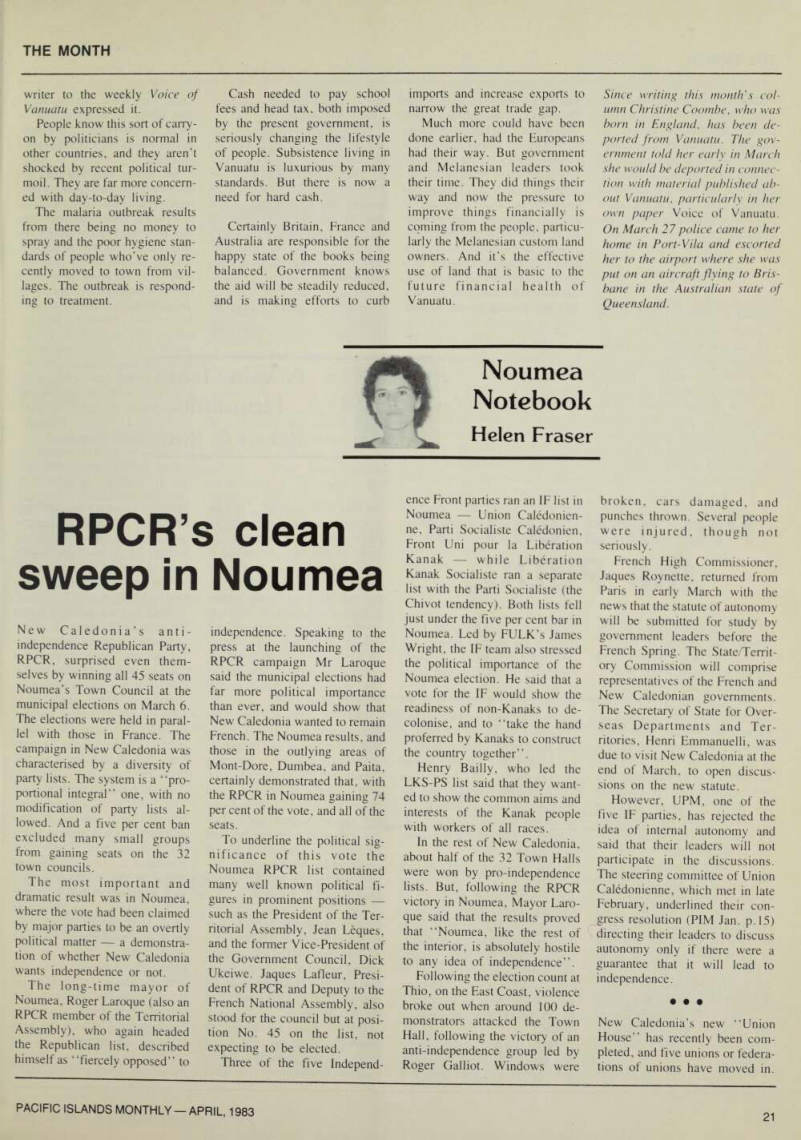
The Month
Balanced books, cooler politics
Balanced books that’s what Vanuatu can be proud of.
As the young nation heads to its first general election since independence, July 1980, it has paid all it owes.
What would many other na tions give to be in such a position?
However, this happy state very nearly didn’t come about.
Prime Minister of the island republic, Walter Lini, is said to have signed a loan agreement to borrow SUS3SO million. Now commission agents are to sue Walter Lini and the republic for their two per cent commission and expenses.
They want their money, even though the agreement was called off.
It seems there were only vague plans to raise the loan. And the country would have found itself financially crippled for genera tions if the loan, signed for by the prime minister, without cabinet consultations, had gone through.
Through the back door, cabinet learnt of the agreement, and it became part of a list of points raised last year in a motion to depose the prime minister.
But Parliament failed to agree.
The matter came to public notice again recently following the sac king of Deputy Prime Minister and Minister of Home Affairs, Fred Timakata, by the prime minister, and the resignations of two other ministers in support of Timakata.
These ministers, like Mr Timakata, were founder mem bers of the Vanuaaku Party,
headed by Walter Lini. They are former Transport and Public Works Minister, John Naupa, and Education Minister, Donald Kalpokas.
Embarrassment caused to the nation by the disqualification of five candidates, all civil servants and Vanuaaku Party supporters, on the eve of the Santo Town Council elections was given by the prime minister as his reason for sacking his deputy.
This reason falls flat. The de cision to disqualify the candi dates who weren’t eligible to stand because they had not re signed from their civil service in time was a cabinet decision.
The minister of home affairs is accused by the prime minister of not doing his job well, not or ganising the Santo elections, and not organising by-elections ear lier this year.
The turnout of voters in the
municipal elections was poor.
But as the former home minister says, the people have the right to vote in Vanuatu or not to vote, as they see fit.
Santo is a controversial island, the seat of the rebellion at inde pendence to secede from the re public. It seems definite that a splinter group on the island is putting pressure on the prime minister for representation in Parliament.
Santo and the eastern region off Santo, Ambae-Maewo, now have parliamentary representa tion. Newly appointed Home Minister is Sela Molisa, a Santo MP. He is the man who was government’s special agent on the island at the time of the rebellion. Newly appointed Edu-
cation Minister is Onneyn Tahi, MP, Ambae-Maewo.
The transport ministry slot took some filling, but at the end of February, Albert Sandy, MP Vila-Urban, was sworn in as minister.
This was a 50 per cent change in the Lini government.
“Resign, Lini,” was the cry from the opposition Vanuatu In dependent Alliance Party. Op position Leader and leader of the Union of Moderate Parties, Vin cent Boulekone, asked people to stay calm in the wake of the political crisis.
He needn’t have worried. The most significant fact emerging from the political crisis is that people are far more worried at the moment about the malaria outbreak, particularly in Port- Vila, paying fees for the start of the new school year, and the head tax they will be up for if they register as voters in the coming general election.
National radio has made fre quent appeals lately for people over the age of 18 to register as voters.
Prior to independence, and in the two years following, a polit ical crisis of this magnitude would have rocked the people.
They would have taken sides, and given the issue all their attention.
Politics dominated the think ing of people in the early days not surprisingly, with the at tempted secession on Santo a reality on independence day, and a high risk of the same happening in the south, particularly on the island of Tanna. Joint rule by Britain and France prior to inde pendence sowed the seeds of division and side-taking.
But Vanuatu is maturing and is able to look at this present crisis as a “scenario,” as a letter
Report from Vanuatu Christine Coombe
Vanuaaku Pati: It went Into power at independence calling itself the party of the real peo ple of Vanuatu, blanketing the pre-independence New Heb rides with placards and slogans and showing a high degree of internal unity. Now there are splits within the party and signs of public cynicism towards politics.
writer to the weekly Voice of Vanuatu expressed it.
People know this sort of carry on by politicians is normal in other countries, and they aren't shocked by recent political tur moil. They are far more concern ed with day-to-day living.
The malaria outbreak results from there being no money to spray and the poor hygiene stan dards of people who’ve only re cently moved to town from vil lages. The outbreak is respond ing to treatment.
Cash needed to pay school fees and head tax, both imposed by the present government, is
seriously changing the lifestyle
of people. Subsistence living in Vanuatu is luxurious by many standards. But there is now a need for hard cash.
Certainly Britain, France and Australia are responsible for the happy state of the books being balanced. Government knows the aid will be steadily reduced, and is making efforts to curb
imports and increase exports to narrow the great trade gap.
Much more could have been done earlier, had the Europeans had their way. But government and Melanesian leaders took their time. They did things their way and now the pressure to
improve things financially is
coming from the people, particu
larly the Melanesian custom land owners. And it’s the effective use of land that is basic to the future financial health of Vanuatu.
Since writing this month's col umn Christine Coombe, who was born in England, has been de ported from Vanuatu. The gov ernment told her early in March she would be deported in connec tion with material published ab out Vanuatu, particularly in her own paper Voice of Vanuatu.
On March 27 police came to her home in Port-Vila and escorted her to the airport where she was put on an aircraft flying to Bris bane in the Australian state of Queensland.
Advertisements & other items, p. 20 (1 item)
f lies to London.
* * i WWipb.,. air new zeatano 10
Air New Zealand
LONDON
SAMOA
VANUATU /
NEW
CALEDONIA
AUCKLAND
PAPEETE
Now Air New Zealand can fly you all the way to London! Board our 747 flight from Nadi to Los Angeles any Wednesday or Saturday. Then join our non-stop 747 “London Express” service. It’s the fast comfortable way, all the way to Britain. And of course if you’re going on to Europe, our “London Express” gives you
superb connections.
This service is brand new, but the in-cabin care and attention you’ll enjoy is traditional: we’ll do everything we can to make every moment you fly with us f . r#
relaxed, interesting and air new zeatana
entertaining, with good food, fine wines, and the latest movies. At Air New Zealand we’ll be very proud to count you among the first to fly our new “London Express”, so see your travel agent soon.
The Pacific’s Number One
RPCR’s clean
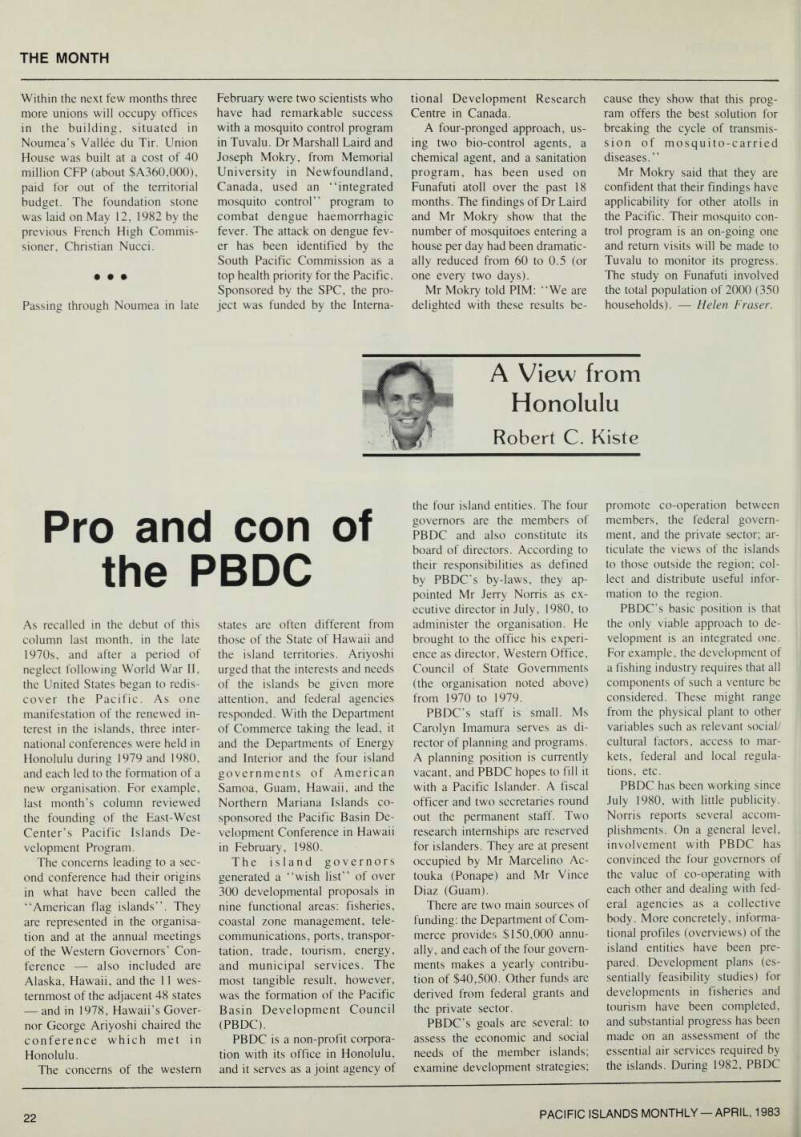
sweep in Noumea
New Caledonia’s anti independence Republican Party, RPCR, surprised even them selves by winning all 45 seats on Noumea’s Town Council at the municipal elections on March 6.
The elections were held in paral lel with those in France. The campaign in New Caledonia was characterised by a diversity of party lists. The system is a “pro portional integral” one, with no modification of party lists al lowed. And a five per cent ban excluded many small groups from gaining seats on the 32 town councils.
The most important and dramatic result was in Noumea, where the vote had been claimed by major parties to be an overtly political matter a demonstra tion of whether New Caledonia wants independence or not.
The long-time mayor of Noumea, Roger Laroque (also an RPCR member of the Territorial Assembly), who again headed the Republican list, described himself as “fiercely opposed” to
independence. Speaking to the press at the launching of the RPCR campaign Mr Laroque said the municipal elections had far more political importance than ever, and would show that New Caledonia wanted to remain French. The Noumea results, and those in the outlying areas of Mont-Dore, Dumbea, and Paita, certainly demonstrated that, with the RPCR in Noumea gaining 74 per cent of the vote, and all of the seats.
To underline the political sig nificance of this vote the Noumea RPCR list contained many well known political fi gures in prominent positions such as the President of the Ter ritorial Assembly, Jean Leques, and the former Vice-President of the Government Council, Dick Ukeiwe. Jaques Lafleur, Presi dent of RPCR and Deputy to the French National Assembly, also stood for the council but at posi tion No. 45 on the list, not expecting to be elected, Three of the five Independ
ence Front parties ran an IF list in Noumea Union Caledonien ne, Parti Socialiste Caledonien, Front Uni pour la Liberation Kanak while Liberation Kanak Socialiste ran a separate list with the Parti Socialiste (the Chivot tendency). Both lists fell just under the five per cent bar in Noumea. Led by FULK’s James Wright, the IF team also stressed the political importance of the Noumea election. He said that a vote for the IF would show the readiness of non-Kanaks to de colonise, and to “take the hand preferred by Kanaks to construct the country together”.
Henry Bailly, who led the LKS-PS list said that they want ed to show the common aims and interests of the Kanak people with workers of all races.
In the rest of New Caledonia, about half of the 32 Town Halls
were won by pro-independence
lists. But, following the RPCR victory in Noumea, Mayor Laro que said that the results proved that “Noumea, like the rest of the interior, is absolutely hostile to any idea of independence”.
Following the election count at Thio, on the East Coast, violence broke out when around 100 de monstrators attacked the Town Hall, following the victory of an
anti-independence group led by
Roger Galliot. Windows were
broken, cars damaged, and punches thrown. Several people were injured, though not seriously.
French High Commissioner, Jaques Roynette, returned from Paris in early March with the news that the statute of autonomy will be submitted for study by government leaders before the French Spring. The State/Territ ory Commission will comprise representatives of the French and New Caledonian governments.
The Secretary of State for Over seas Departments and Ter ritories, Henri Emmanuelli, was due to visit New Caledonia at the end of March, to open discus sions on the new statute.
However, UPM, one of the five IF parties, has rejected the idea of internal autonomy and said that their leaders will not participate in the discussions.
The steering committee of Union Caledonienne, which met in late February, underlined their con gress resolution (PIM Jan. p. 15) directing their leaders to discuss autonomy only if there were a guarantee that it will lead to independence. • • • New Caledonia’s new “Union House” has recently been com pleted, and five unions or federa tions of unions have moved in.
Noumea Notebook Helen Fraser
Within the next few months three more unions will occupy offices in the building, situated in Noumea’s Vallee du Tir. Union House was built at a cost of 40 million CFP (about $A360,000), paid for out of the territorial budget. The foundation stone was laid on May 12, 1982 by the previous French High Commis sioner, Christian Nucci. • • • Passing through Noumea in late
February were two scientists who have had remarkable success with a mosquito control program in Tuvalu. Dr Marshall Laird and Joseph Mokry, from Memorial University in Newfoundland, Canada, used an “integrated mosquito control” program to combat dengue haemorrhagic fever. The attack on dengue fev er has been identified by the South Pacific Commission as a top health priority for the Pacific.
Sponsored by the SPC, the pro ject was funded by the Intema
tional Development Research Centre in Canada.
A four-pronged approach, us
ing two bio-control agents, a chemical agent, and a sanitation program, has been used on Funafuti atoll over the past 18 months. The findings of Dr Laird and Mr Mokry show that the number of mosquitoes entering a house per day had been dramatic ally reduced from 60 to 0.5 (or one every two days).
Mr Mokry told PIM: “We are delighted with these results be
cause they show that this prog ram offers the best solution for breaking the cycle of transmis sion of mosquito-carried diseases.”
Mr Mokry said that they are confident that their findings have applicability for other atolls in the Pacific. Their mosquito con trol program is an on-going one and return visits will be made to Tuvalu to monitor its progress.
The study on Funafuti involved the total population of 2000 (350
households).
Helen Fraser.
Pro and con of
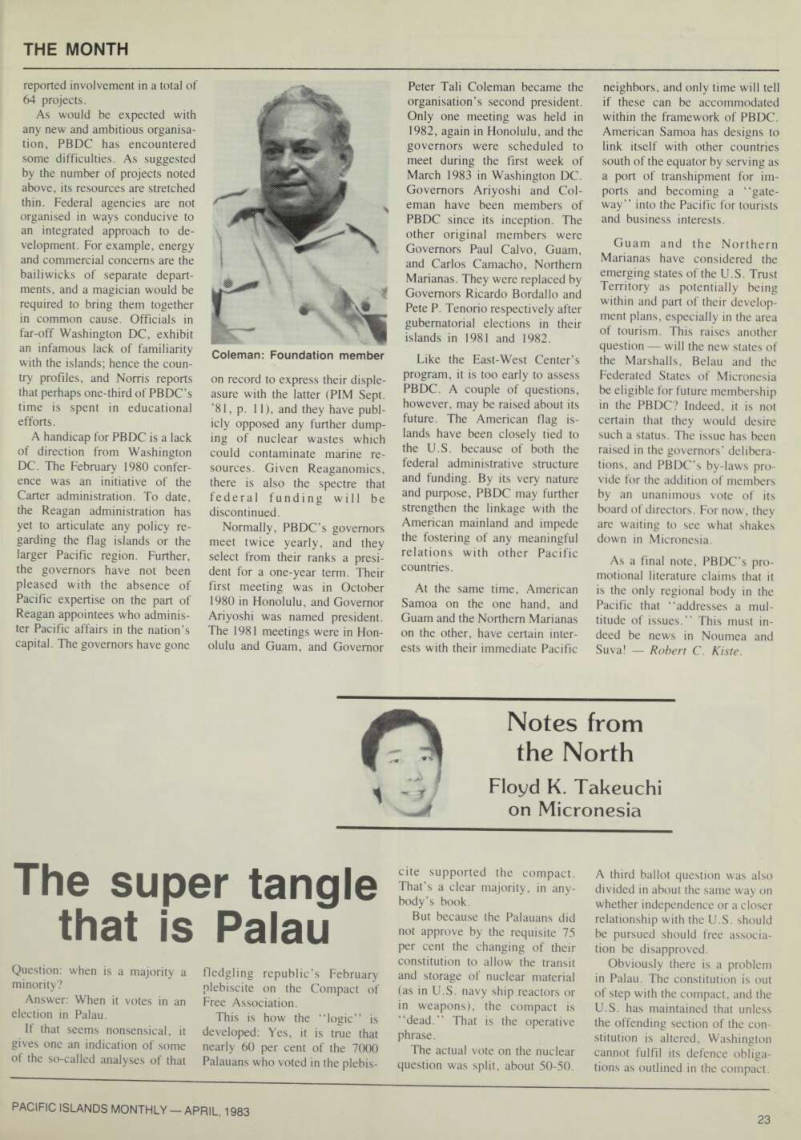
the PBDC
As recalled in the debut of this column last month, in the late 19705, and after a period of neglect following World War 11, the United States began to redis cover the Pacific. As one manifestation of the renewed in terest in the islands, three inter national conferences were held in Honolulu during 1979 and 1980, and each led to the formation of a
new organisation. For example,
last month’s column reviewed the founding of the East-West Center’s Pacific Islands De
velopment Program.
The concerns leading to a sec ond conference had their origins in what have been called the
“American flag islands”. They
are represented in the organisa tion and at the annual meetings of the Western Governors’ Con ference also included are Alaska, Hawaii, and the 11 wes ternmost of the adjacent 48 states and in 1978, Hawaii’s Gover nor George Ariyoshi chaired the conference which met in Honolulu.
The concerns of the western
states are often different from those of the State of Hawaii and the island territories. Ariyoshi urged that the interests and needs of the islands be given more attention, and federal agencies responded. With the Department of Commerce taking the lead, it and the Departments of Energy and Interior and the four island governments of American Samoa, Guam, Hawaii, and the Northern Mariana Islands co sponsored the Pacific Basin De velopment Conference in Hawaii in February, 1980.
The island governors generated a “wish list” of over 300 developmental proposals in nine functional areas; fisheries, coastal zone management, tele communications, ports, transpor tation, trade, tourism, energy, and municipal services. The most tangible result, however, was the formation of the Pacific Basin Development Council
(Pbdc).
PBDC is a non-profit corpora tion with its office in Honolulu, and it serves as a joint agency of
the four island entities. The four governors are the members of PBDC and also constitute its board of directors. According to their responsibilities as defined by PBDC’s by-laws, they ap pointed Mr Jerry Norris as ex ecutive director in July, 1980, to administer the organisation. He brought to the office his experi ence as director, Western Office, Council of State Governments (the organisation noted above) from 1970 to 1979.
PBDC’s staff is small. Ms Carolyn Imamura serves as di rector of planning and programs.
A planning position is currently
vacant, and PBDC hopes to fill it with a Pacific Islander. A fiscal officer and two secretaries round out the permanent staff. Two research internships are reserved for islanders. They are at present occupied by Mr Marcelino Ac touka (Ponape) and Mr Vince Diaz (Guam).
There are two main sources of funding: the Department of Com merce provides $150,000 annu ally, and each of the four govern ments makes a yearly contribu tion of $40,500. Other funds are derived from federal grants and the private sector.
PBDC’s goals are several: to assess the economic and social needs of the member islands; examine development strategies;
promote co-operation between members, the federal govern ment, and the private sector; ar ticulate the views of the islands to those outside the region; col lect and distribute useful infor mation to the region.
PBDC’s basic position is that the only viable approach to de velopment is an integrated one.
For example, the development of
a fishing industry requires that all
components of such a venture be considered. These might range from the physical plant to other variables such as relevant social/ cultural factors, access to mar kets, federal and local regula tions, etc.
PBDC has been working since July 1980, with little publicity.
Norris reports several accom plishments. On a general level, involvement with PBDC has convinced the four governors of the value of co-operating with each other and dealing with fed eral agencies as a collective body. More concretely, informa tional profiles (overviews) of the island entities have been pre
pared. Development plans (es
sentially feasibility studies) for developments in fisheries and tourism have been completed, and substantial progress has been made on an assessment of the essential air services required by the islands. During 1982, PBDC
A View from Honolulu Robert C. Kiste
reported involvement in a total of 64 projects.
As would be expected with any new and ambitious organisa tion, PBDC has encountered some difficulties. As suggested by the number of projects noted above, its resources are stretched thin. Federal agencies are not organised in ways conducive to an integrated approach to de velopment. For example, energy and commercial concerns are the bailiwicks of separate depart ments, and a magician would be required to bring them together in common cause. Officials in far-off Washington DC, exhibit an infamous lack of familiarity with the islands; hence the coun try profiles, and Norris reports that perhaps one-third of PBDC’s time is spent in educational efforts.
A handicap for PBDC is a lack of direction from Washington DC. The February 1980 confer ence was an initiative of the Carter administration. To date, the Reagan administration has yet to articulate any policy re garding the flag islands or the larger Pacific region. Further, the governors have not been pleased with the absence of Pacific expertise on the part of Reagan appointees who adminis ter Pacific affairs in the nation’s capital. The governors have gone
on record to express their disple asure with the latter (PIM Sept. ’Bl, p. 11), and they have publ icly opposed any further dump ing of nuclear wastes which could contaminate marine re sources. Given Reaganomics, there is also the spectre that federal funding will be discontinued.
Normally, PBDC’s governors meet twice yearly, and they select from their ranks a presi dent for a one-year term. Their first meeting was in October 1980 in Honolulu, and Governor Ariyoshi was named president.
The 1981 meetings were in Hon olulu and Guam, and Governor
Peter Tali Coleman became the organisation’s second president.
Only one meeting was held in 1982, again in Honolulu, and the governors were scheduled to meet during the first week of March 1983 in Washington DC.
Governors Ariyoshi and Col eman have been members of PBDC since its inception. The other original members were Governors Paul Calvo, Guam, and Carlos Camacho, Northern Marianas. They were replaced by Governors Ricardo Bordallo and Pete P. Tenorio respectively after gubernatorial elections in their islands in 1981 and 1982.
Like the East-West Center’s program, it is too early to assess PBDC. A couple of questions, however, may be raised about its future. The American flag is lands have been closely tied to the U.S. because of both the federal administrative structure and funding. By its very nature and purpose, PBDC may further strengthen the linkage with the American mainland and impede the fostering of any meaningful relations with other Pacific countries.
At the same time, American Samoa on the one hand, and Guam and the Northern Marianas on the other, have certain inter ests with their immediate Pacific
neighbors, and only time will tell if these can be accommodated within the framework of PBDC.
American Samoa has designs to link itself with other countries south of the equator by serving as a port of transhipment for im ports and becoming a “gate way” into the Pacific for tourists and business interests.
Guam and the Northern Marianas have considered the emerging states of the U.S. Trust Territory as potentially being within and part of their develop ment plans, especially in the area of tourism. This raises another question will the new states of the Marshalls, Belau and the Federated States of Micronesia be eligible for future membership in the PBDC? Indeed, it is not certain that they would desire such a status. The issue has been raised in the governors’ delibera tions, and PBDC’s by-laws pro vide for the addition of members by an unanimous vote of its board of directors. For now, they are waiting to see what shakes down in Micronesia.
As a final note, PBDC’s pro motional literature claims that it is the only regional body in the Pacific that “addresses a mul titude of issues.” This must in deed be news in Noumea and
Suva!
Robert C. Kiste.
Coleman: Foundation member
The super tangle

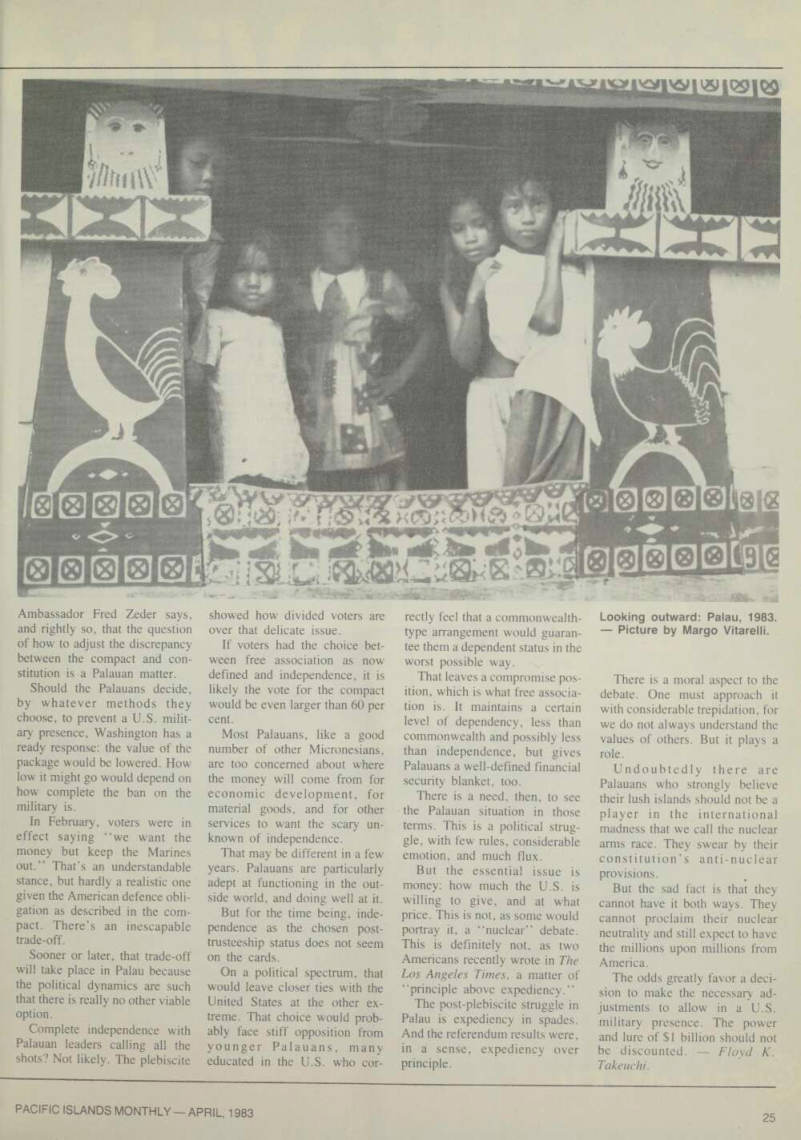
that is Palau
Question: when is a majority a
minority?
Answer: When it votes in an election in Palau.
If that seems nonsensical, it gives one an indication of some of the so-called analyses of that
fledgling republic’s February
plebiscite on the Compact of Free Association.
This is how the “logic” is developed: Yes, it is true that nearly 60 per cent of the 7000 Palauans who voted in the plebis
cite supported the compact.
That’s a clear majority, in any body’s book.
But because the Palauans did not approve by the requisite 75 per cent the changing of their constitution to allow the transit and storage of nuclear material (as in U.S. navy ship reactors or in weapons), the compact is “dead.” That is the operative phrase.
The actual vote on the nuclear question was split, about 50-50.
A third ballot question was also divided in about the same way on whether independence or a closer relationship with the U.S. should be pursued should free associa tion be disapproved.
Obviously there is a problem in Palau. The constitution is out of step with the compact, and the U.S. has maintained that unless the offending section of the con stitution is altered, Washington cannot fulfil its defence obliga tions as outlined in the compact.
Notes from the North Floyd K. Takeuchi on Micronesia
Now the strict constructionists would maintain that the constitu tion takes precedence. Hence, a
new political relationship must
be negotiated. (It should be add ed here that there are a number of interested Americans who have followed the “progress” in Palau with considerable fascina tion. They tend to see or perhaps hope that Palau will become a truly nuclear-free Is land state, and often view all issues from that standpoint).
But anyone who has followed Micronesian politics, and the peculiar brand that is practised in the Palau Islands, should know that there is no such thing as a strict constructionist approach.
Politics in those islands is dy namic in the extreme. There are no real ground rules. And in the case of the free association com pact, where each step establishes
new precedent, anything goes.
What that means in Palau’s case is that there is considerable latitude in considering options to this apparent stalemate. It also means that the compact is very much alive, and should not be counted out of the picture.
It remains a significant factor
because of that 60 per cent vote.
Palau’s politicians have a well deserved reputation in Mic
ronesia for being especially wily,
and being good pols, they know
a majority when they see one.
That 60 per cent is essentially a resounding yes for the $1 bill ion the U.S. has agreed to pour into Palau over the next 50 years.
A lot of Palauans have their dreams tied up in that sum.
So for a local leader now to claim that the compact is dead, and with it the $1 billion, would be tantamount to political suicide. The people may be am bivalent about the possibility of U.S. Marines using part of Babelthuap as a training base, but they clearly want the big
bucks promised by Washington.
That is why the compact of free association remains the cent ral option. That is why U.S.
Palau: A country of tiny islands and atolls in a wide area of sea, where local involvement is in
creasingly emphasised. Ship
wrights are part of the skilled workforce, and these are shown at work on Koror Island.
Ambassador Fred Zeder says, and rightly so, that the question of how to adjust the discrepancy between the compact and con stitution is a Palauan matter.
Should the Palauans decide, by whatever methods they choose, to prevent a U.S. milit ary presence, Washington has a ready response; the value of the package would be lowered. How low it might go would depend on how complete the ban on the military is.
In February, voters were in effect saying “we want the money but keep the Marines out.” That’s an understandable stance, but hardly a realistic one given the American defence obli gation as described in the com pact. There’s an inescapable trade-off.
Sooner or later, that trade-off will take place in Palau because the political dynamics are such that there is really no other viable option.
Complete independence with Palauan leaders calling all the shots? Not likely. The plebiscite
showed how divided voters are over that delicate issue, If voters had the choice bet ween free association as now defined and independence, it is likely the vote for the compact would be even larger than 60 per cent.
Most Palauans, like a good number of other Micronesians, are too concerned about where the money will come from for economic development, for material goods, and for other services to want the scary un known of independence, That may be different in a few years. Palauans are particularly adept at functioning in the out side world, and doing well at it.
But for the time being, inde pendence as the chosen post trusteeship status does not seem on the cards, On a political spectrum, that would leave closer ties with the United States at the other ex treme. That choice would prob ably face stiff opposition from younger Palauans, many educated in the U.S. who cor
rectly feel that a commonwealth type arrangement would guaran tee them a dependent status in the worst possible way.
That leaves a compromise pos ition, which is what free associa tion is. It maintains a certain level of dependency, less than commonwealth and possibly less than independence, but gives Palauans a well-defined financial security blanket, too.
There is a need, then, to see the Palauan situation in those terms. This is a political strug gle, with few rules, considerable emotion, and much flux.
But the essential issue is money; how much the U.S. is willing to give, and at what price. This is not, as some would portray it, a “nuclear” debate.
This is definitely not, as two Americans recently wrote in The Los Angeles Times, a matter of “principle above expediency.”
The post-plebiscite struggle in Palau is expediency in spades.
And the referendum results were, in a sense, expediency over principle.
There is a moral aspect to the debate. One must approach it with considerable trepidation, for we do not always understand the values of others. But it plays a role.
Undoubtedly there are Palauans who strongly believe their lush islands should not be a player in the international madness that we call the nuclear arms race. They swear by their constitution’s anti-nuclear provisions.
But the sad fact is that they cannot have it both ways. They cannot proclaim their nuclear neutrality and still expect to have the millions upon millions from America.
The odds greatly favor a deci sion to make the necessary ad justments to allow in a U.S. military presence. The power and lure of $1 billion should not
be discounted.
Floyd K.
Takeuchi.
Looking outward: Palau, 1983. - Picture by Margo Vitarelli.
Advertisements & other items, pp. 24-26 (1 item)
Machinery
Rock Processing
For Sale or Rent Crushing Plants TO* Screening Plants fl Ml Conveyors **■ jp** Rock Systems, Inc 1600 Kapiolani Blvd. Suite 1300 Honolulu, HI 96814 Phone (808) 944-5562 Telex# 7431987
to Video
The VT-11E is video at its easiest. Easy operation: Play, Record, Fast Forward, Rewind and Visual Search during playback via a four-corner access switch.
From Hitachi, the gateway to greater video entertainment. »
VT-11E
Features • 1-Program/10*Day Preset Recording • 240-min. Recording/Playback with E-240 Tape • Visual Search • Freeze Action • Wired Remote Control ♦ rAI mmz I.
VHS
xIWS
MM i
HITACHI
AUSTRALIA: Hitachi Sales Australia Pty., Ltd., 153 Keys Road, Moorabbin, Victoria 3189 Phone: (555) 8722 NEW ZEALAND: AWA New Zealand Limited, Wi-neera Drive, P.O. Box 50-248, Porirua Phone: PRO 75-069 PAPUA NEW GUINEA: S.O. Svensson (N.G.) Ltd., P.O.
Box 705, Port Moresby.Phone: 21-2111 FIJI ISLANDS: AWA New Zealand Limited, 47 Foster Road (P.O. Box 858) Suva Fiji;Phone: 312070 NEW CALEDONIA: Caldis, B.P. Ml, Noumea Phone: 26.23.50 TAHITI: Ets Chene Alain, P.O. Box 272, Papeete Phone: 2.88.68 SOLOMON ISLANDS: Technique Radios Centre Lt P.O. Box 465, Honiara;Phone; 416
Tales of great
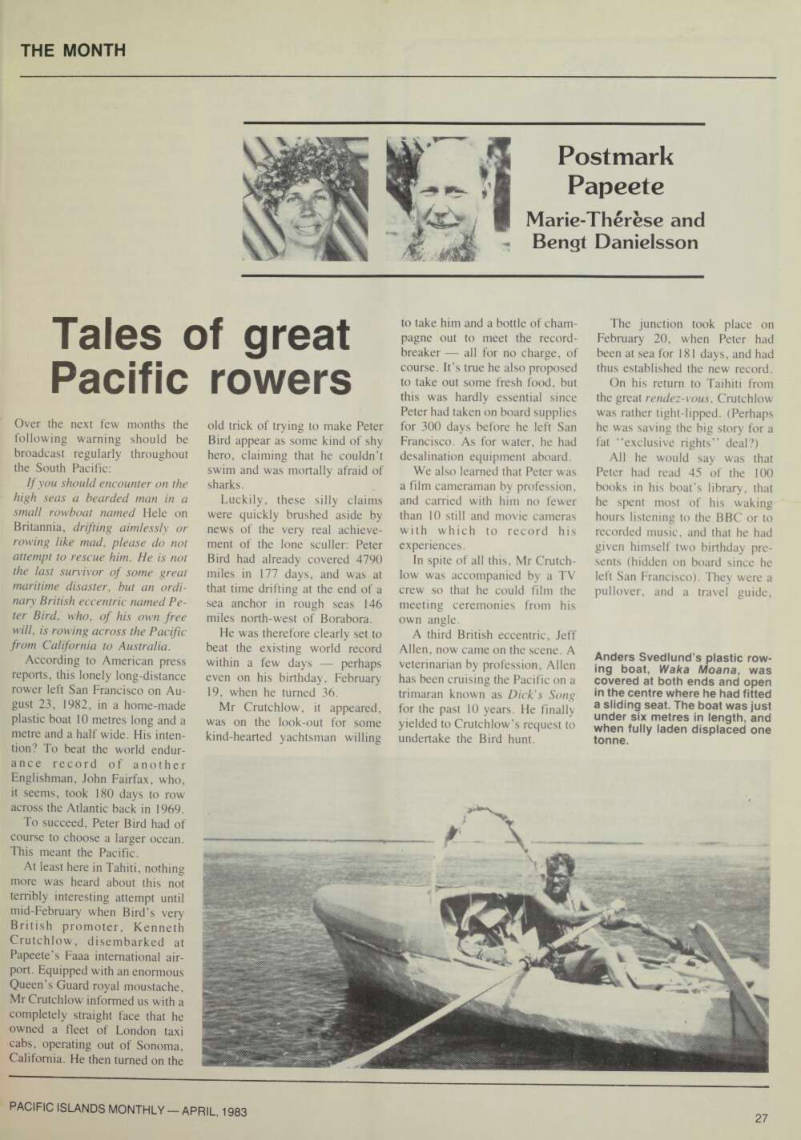
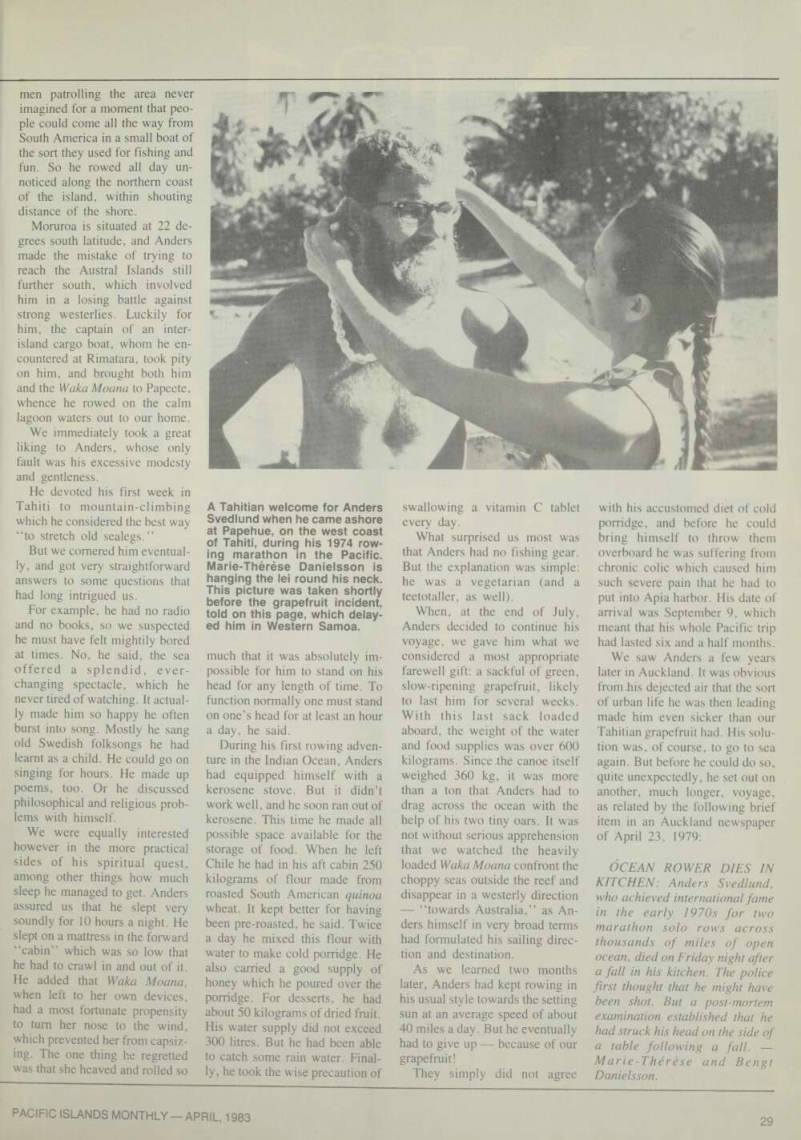
Pacific rowers
Over the next few months the following warning should be broadcast regularly throughout the South Pacific: If you should encounter on the high seas a bearded man in a small rowboat named Hele on Britannia, drifting aimlessly or rowing like mad, please do not attempt to rescue him. He is not the last survivor of some great maritime disaster, but an ordi nary British eccentric named Pe ter Bird, who, of his own free will, is rowing across the Pacific from California to Australia.
According to American press reports, this lonely long-distance rower left San Francisco on Au gust 23, 1982, in a home-made plastic boat 10 metres long and a metre and a half wide. His inten tion? To beat the world endur ance record of another Englishman, John Fairfax, who, it seems, took 180 days to row across the Atlantic back in 1969.
To succeed, Peter Bird had of course to choose a larger ocean.
This meant the Pacific.
At least here in Tahiti, nothing more was heard about this not terribly interesting attempt until mid-February when Bird’s very British promoter, Kenneth Crutchlow, disembarked at Papeete’s Faaa international air port. Equipped with an enormous Queen’s Guard royal moustache, Mr Crutchlow informed us with a completely straight face that he owned a fleet of London taxi cabs, operating out of Sonoma, California. He then turned on the
old trick of trying to make Peter Bird appear as some kind of shy hero, claiming that he couldn’t swim and was mortally afraid of sharks.
Luckily, these silly claims
were quickly brushed aside by news of the very real achieve ment of the lone sculler: Peter Bird had already covered 4790 miles in 177 days, and was at that time drifting at the end of a sea anchor in rough seas 146 miles north-west of Borabora.
He was therefore clearly set to beat the existing world record within a few days perhaps even on his birthday, February 19, when he turned 36.
Mr Crutchlow, it appeared, was on the look-out for some
kind-hearted yachtsman willing
to take him and a bottle of cham pagne out to meet the record breaker all for no charge, of course. It’s true he also proposed to take out some fresh food, but this was hardly essential since Peter had taken on board supplies for 300 days before he left San Francisco. As for water, he had desalination equipment aboard.
We also learned that Peter was a film cameraman by profession, and carried with him no fewer than 10 still and movie cameras with which to record his experiences.
In spite of all this, Mr Crutch low was accompanied by a TV crew so that he could film the meeting ceremonies from his own angle.
A third British eccentric, Jeff Allen, now came on the scene. A veterinarian by profession, Allen has been cruising the Pacific on a trimaran known as Dick’s Song for the past 10 years. He finally yielded to Crutchlow’s request to undertake the Bird hunt.
The junction took place on February 20, when Peter had been at sea for 181 days, and had thus established the new record.
On his return to Taihiti from the great rendez-vous, Crutchlow was rather tight-lipped. (Perhaps he was saving the big story for a fat “exclusive rights” deal?) All he would say was that Peter had read 45 of the 100 books in his boat’s library, that he spent most of his waking hours listening to the BBC or to recorded music, and that he had given himself two birthday pre sents (hidden on board since he left San Francisco). They were a pullover, and a travel guide,
Postmark Papeete Marie-Thérèse and Bengt Danielsson
Anders Svedlund’s plastic row ing boat, Waka Moana, was covered at both ends and open in the centre where he had fitted a sliding seat. The boat was just under six metres in length, and when fully laden displaced one tonne.
Australia on $2O a Day. (Since at the earliest he will reach Aust ralia in August or September, will he really need the pullover?
And in view of Australia’s cur rent inflation rate, won’t his book be a bit out of date by then?) While congratulating Peter Bird on his remarkable perform ance, and wishing him bon voy age all the way to Australia, we cannot help feeling that the title “Great Pacific Rower’’ still be longs to the Swedish-born, naturalised New Zealander, An ders Svedlund.
We first met him in July 1974, when he quietly stepped ashore from his plastic five-and-a-half metre boat right in front of our home here at Papehue, on the west coast of Tahiti, during a
truly epic trip across the Pacific.
The sole reason why Anders repeatedly escaped to the sea was his love of nature, and the peace of mind he experienced when lost in the solitary contemplation of it.
Unlike Peter Bird, he cared very little for records, shunned all publicity, and never kept a log or wrote down the story of his
many exploits.
For instance, in 1971, after
accomplishing the amazing feat
of rowing across the Indian Ocean from Fremantle to Madagascar in 64 days, he went straight back to Auckland, and,
without telling a soul where he had been, resumed his old trade as a house painter.
After three years the time it took him to save enough money he set out again on what was to become an even greater adventure.
The point of departure was Huasco in Chile, which he left on February 27, 1974, at the oars of the same old plastic boat he had used for his Indian Ocean trip, but now renamed Waka Moana.
His only aim was to follow the sun for as long as he could. He rowed with such determination, however, that he sighted his first Polynesian island after only two months. Since he had no naviga tional instruments, and it was uninhabited, he never found out its name.
But he didn’t at all mind being alone on land for a change, and managed to pick and open a few green coconuts.
The next island he came across seemed on the contrary to be
definitely over-populated, and
was full of weird concrete build ings. It was the top-secret Moruroa nuclear testing base.
But the French pilots and navy
“The next island he came ac ross . . . was full of weird con crete buildings.” Moruroa, the nuclear testing island which Svedlund skirted without incident.
men patrolling the area never imagined for a moment that peo ple could come all the way from South America in a small boat of the sort they used for fishing and fun. So he rowed all day un noticed along the northern coast of the island, within shouting distance of the shore.
Moruroa is situated at 22 de grees south latitude, and Anders made the mistake of trying to reach the Austral Islands still further south, which involved him in a losing battle against strong westerlies. Luckily for him, the captain of an inter island cargo boat, whom he en countered at Rimatara, took pity on him, and brought both him and the Waka Moana to Papeete, whence he rowed on the calm lagoon waters out to our home.
We immediately took a great liking to Anders, whose only fault was his excessive modesty
and gentleness.
He devoted his first week in Tahiti to mountain-climbing which he considered the best way “to stretch old sealegs.”
But we cornered him eventual ly, and got very straightforward answers to some questions that
had long intrigued us.
For example, he had no radio and no books, so we suspected he must have felt mightily bored at times. No, he said, the sea offered a splendid, ever changing spectacle, which he never tired of watching. It actual ly made him so happy he often burst into song. Mostly he sang old Swedish folksongs he had learnt as a child. He could go on singing for hours. He made up poems, too. Or he discussed
philosophical and religious prob
lems with himself.
We were equally interested however in the more practical sides of his spiritual quest, among other things how much sleep he managed to get. Anders assured us that he slept very soundly for 10 hours a night. He slept on a mattress in the forward “cabin” which was so low that he had to crawl in and out of it.
He added that Waka Moana, when left to her own devices, had a most fortunate propensity to turn her nose to the wind, which prevented her from capsiz ing. The one thing he regretted was that she heaved and rolled so
much that it was absolutely im possible for him to stand on his head for any length of time. To function normally one must stand on one’s head for at least an hour a day, he said.
During his first rowing adven ture in the Indian Ocean, Anders had equipped himself with a kerosene stove. But it didn’t work well, and he soon ran out of kerosene. This time he made all possible space available for the storage of food. When he left Chile he had in his aft cabin 250 kilograms of flour made from roasted South American quinoa wheat. It kept better for having been pre-roasted, he said. Twice a day he mixed this flour with water to make cold porridge. He also carried a good supply of honey which he poured over the porridge. For desserts, he had about 50 kilograms of dried fruit.
His water supply did not exceed 300 litres. But he had been able to catch some rain water. Final ly, he took the wise precaution of
swallowing a vitamin C tablet every day.
What surprised us most was that Anders had no fishing gear.
But the explanation was simple: he was a vegetarian (and a teetotaller, as well).
When, at the end of July, Anders decided to continue his voyage, we gave him what we considered a most appropriate farewell gift: a sackful of green, slow-ripening grapefruit, likely to last him for several weeks.
With this last sack loaded aboard, the weight of the water and food supplies was over 600 kilograms. Since the canoe itself weighed 360 kg, it was more than a ton that Anders had to drag across the ocean with the help of his two tiny oars. It was not without serious apprehension that we watched the heavily loaded Waka Moana confront the choppy seas outside the reef and disappear in a westerly direction “towards Australia,” as An ders himself in very broad terms had formulated his sailing direc tion and destination.
As we learned two months later, Anders had kept rowing in his usual style towards the setting sun at an average speed of about 40 miles a day. But he eventually had to give up because of our grapefruit!
They simply did not agree
with his accustomed diet of cold porridge, and before he could bring himself to throw them overboard he was suffering from chronic colic which caused him such severe pain that he had to put into Apia harbor. His date of arrival was September 9, which meant that his whole Pacific trip had lasted six and a half months.
We saw Anders a few years later in Auckland. It was obvious from-his dejected air that the sort of urban life he was then leading made him even sicker than our Tahitian grapefruit had. His solu tion was, of course, to go to sea again. But before he could do so, quite unexpectedly, he set out on another, much longer, voyage, as related by the following brief item in an Auckland newspaper of April 23, 1979:
Ocean Rower Dies In
KITCHEN: Anders Svedlund, who achieved international fame in the early 1970 s for two marathon solo rows across thousands of miles of open ocean, died on Friday night after a fall in his kitchen. The police first thought that he might have been shot. But a post-mortem examination established that he had struck his head on the side of a table following a fall.
Marie-Thérèse and Bengt Danielsson.
A Tahitian welcome for Anders Svedlund when he came ashore at Papehue, on the west coast of Tahiti, during his 1974 row ing marathon in the Pacific.
Marie-Thérèse Danielsson is hanging the lei round his neck.
This picture was taken shortly before the grapefruit incident, told on this page, which delay ed him in Western Samoa.
Advertisements & other items, pp. 28-30 (1 item)
Pty. Ltd.
% m
WATER WHEEL EXPORTS
53 Market Street, South Melbourne 3205 Australia Telex; AA 32165 Telephone: 699 1722
THE WATER WHEEL GROUP OF COMPANIES
Winners of Australia's Top Export Award and Flour Millers for over 100 years.
BEST AUSTRALIAN
WHEATEN FLOUR
(High Protein. Bakers. Stone ground Wholemeal. Donut).
C00LR00MS REFRIGERATED
CABINETS ETC.
INCLUDING SALT WATER
ICE MAKERS
STOCK & POULTRY FEEDS
(Pellets or Mash form)
YELLOW SPLIT PEAS &
WHOLE PEAS
(Machine-Dressed)
COMPLETE RANGE OF FROZEN
AND GENERAL FOOD ITEMS
QUALITY AUSTRALIAN
WINES
WOOD FUEL STOVES
AND WATER HEATERS
FOR FURTHER INFORMATION
Return this coupon to:
WATER WHEEL EXPORTS PTY. LTD.
Please forward me: Name Address.
Phone: More information on your above products/ product Export Manager Water Wheel Exports Pty. Ltd. 53 Market Street, (P.O. Box 38) South Melbourne 3205 Australia Telex: AA 32165 Telephone: 699 1722
non-fat M dried mup m iliitttt! % mk
■..jWKBKP
I
FULL CREAM .:
jTAMIN ENRICHED fgV ™
JM!
KIM MU
k «ow
POWDER,
I
SKIM MILK
POWDER
Jt MMmm a «CHor
ANCHOR
>»» t 3 mkr. ; * mjm iTh n
uAm
§iiil
mi mMaSm -ap ■ : sssmm Anchor - premium quality dairy produce, packed with all the goodness of the finest pasture in the world.
Fresh to you from the world’s number one dairy
producer, New Zealand Dairy Board.
NEW
ZEALAND
DAIRY
BOARD
Enquiries to: PO Box 417 Wellington, New Zealand
Telex: NZ3348 DAPMARK
Telephone: 724-399
in Yap
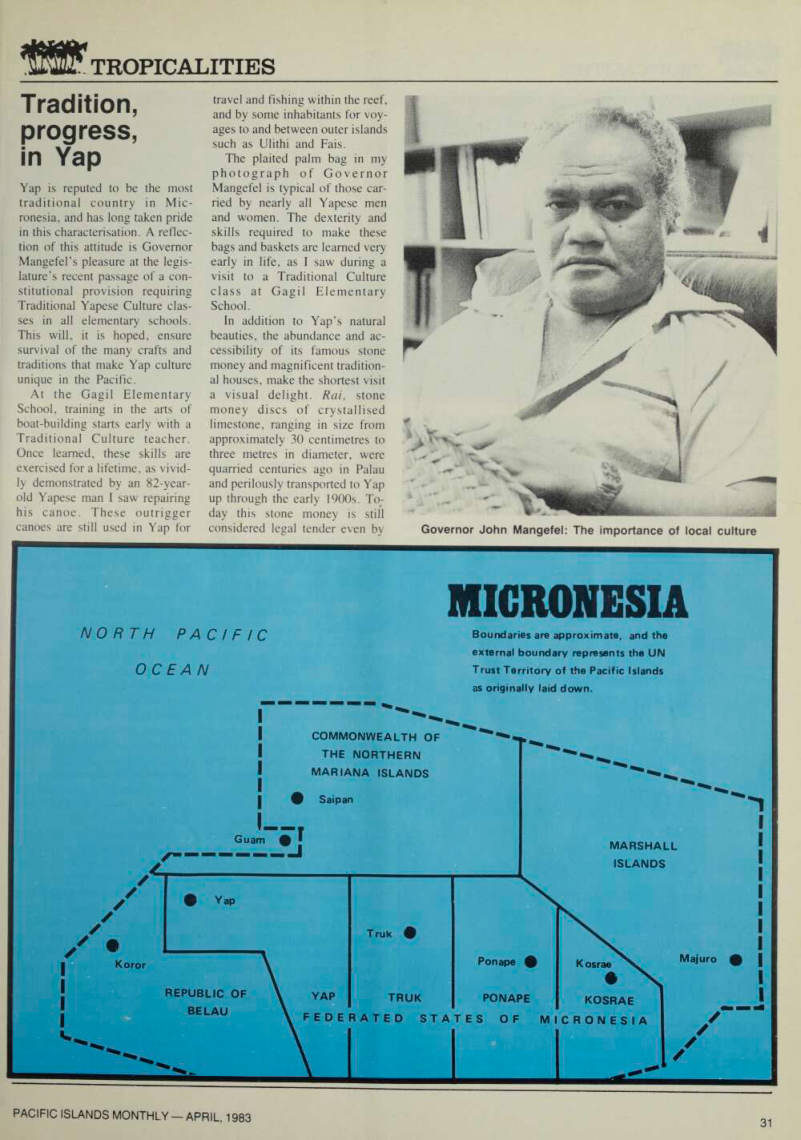
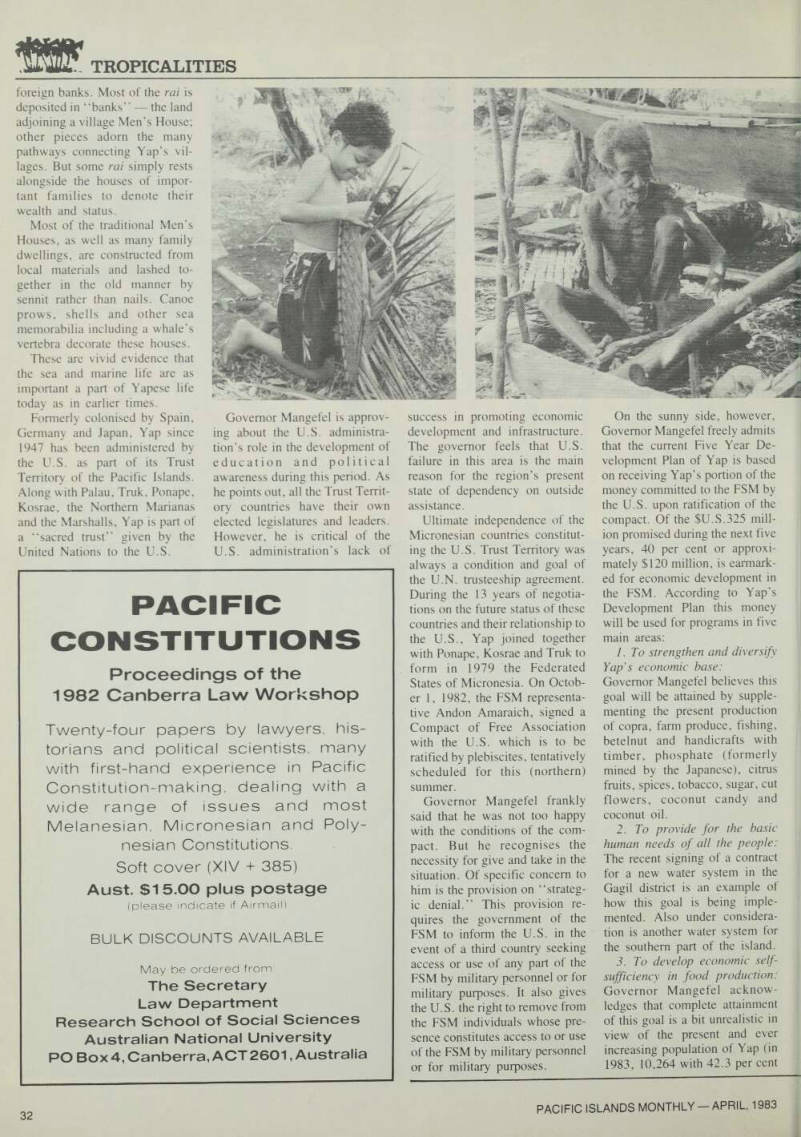
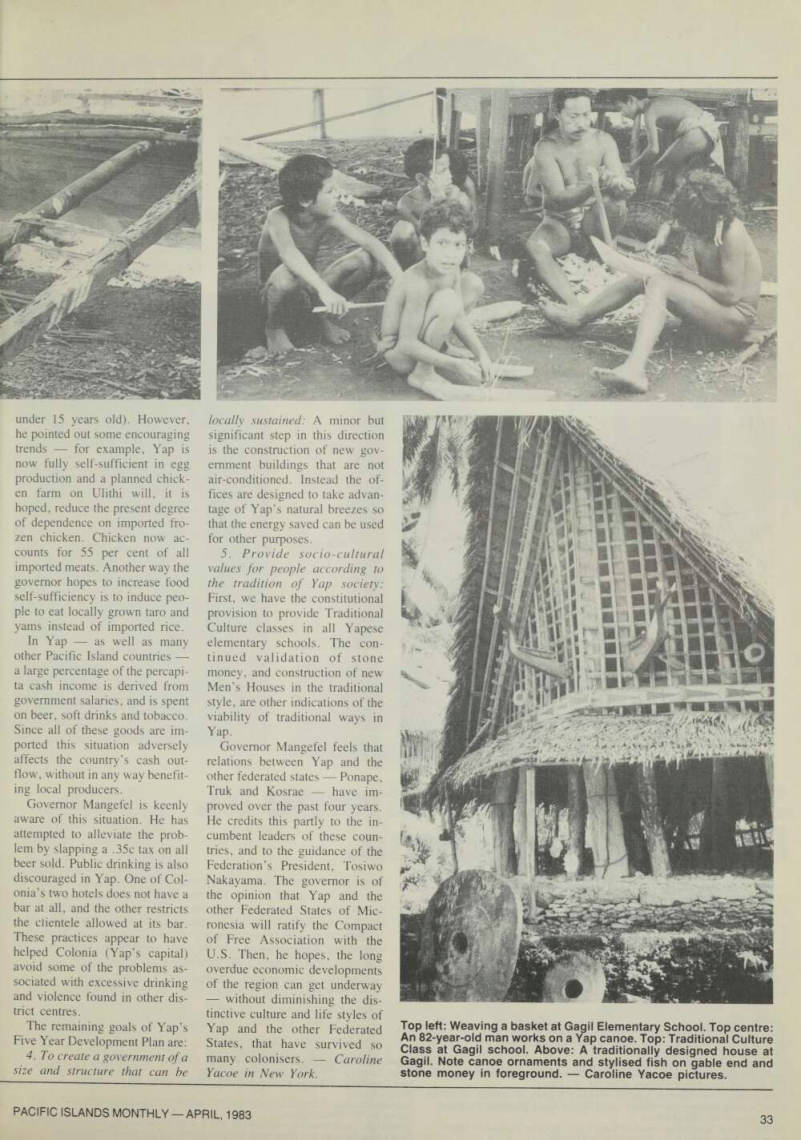
Tropicalities
Tradition, progress, in Yap
travel and fishing within the reef, and by some inhabitants for voy ages to and between outer islands such as Ulithi and Fais.
The plaited palm bag in my photograph of Governor Mangefel is typical of those car
ried by nearly all Yapese men
and women. The dexterity and skills required to make these bags and baskets are learned very early in life, as I saw during a visit to a Traditional Culture
class at Gagil Elementary
School.
In addition to Yap’s natural beauties, the abundance and ac cessibility of its famous stone money and magnificent tradition al houses, make the shortest visit a visual delight. Rai, stone money discs of crystallised limestone, ranging in size from approximately 30 centimetres to three metres in diameter, were quarried centuries ago in Palau
and perilously transported to Yap
up through the early 1900 s. To day this stone money is still considered legal tender even by
Yap is reputed to be the most traditional country in Mic ronesia, and has long taken pride in this characterisation. A reflec tion of this attitude is Governor
Mangefel’s pleasure at the legis
lature’s recent passage of a con
stitutional provision requiring
Traditional Yapese Culture clas ses in all elementary schools.
This will, it is hoped, ensure survival of the many crafts and traditions that make Yap culture unique in the Pacific.
At the Gagil Elementary
School, training in the arts of boat-building starts early with a Traditional Culture teacher.
Once learned, these skills are exercised for a lifetime, as vivid
ly demonstrated by an 82-year
old Yapese man I saw repairing his canoe. These outrigger canoes are still used in Yap for
Governor John Mangefel: The importance of local culture
foreign banks. Most of the rai is deposited in “banks’’ the land adjoining a village Men’s House; other pieces adorn the many pathways connecting Yap’s vil lages. But some rai simply rests alongside the houses of impor tant families to denote their wealth and status.
Most of the traditional Men’s Houses, as well as many family dwellings, are constructed from local materials and lashed to gether in the old manner by sennit rather than nails. Canoe prows, shells and other sea memorabilia including a whale’s vertebra decorate these houses.
These are vivid evidence that the sea and marine life are as important a part of Yapese life today as in earlier times.
Formerly colonised by Spain, Germany and Japan, Yap since 1947 has been administered by the U.S. as part of its Trust Territory of the Pacific Islands.
Along with Palau. Truk, Ponape, Kosrae, the Northern Marianas and the Marshalls, Yap is part of a “sacred trust’’ given by the United Nations to the U.S.
Governor Mangefel is approv ing about the U.S. administra tion’s role in the development of education and political awareness during this period. As he points out, all the Trust Territ ory countries have their own elected legislatures and leaders.
However, he is critical of the U.S. administration’s lack of
success in promoting economic development and infrastructure.
The governor feels that U.S. failure in this area is the main reason for the region’s present state of dependency on outside assistance.
Ultimate independence of the Micronesian countries constitut ing the U.S. Trust Territory was always a condition and goal of the U.N. trusteeship agreement.
During the 13 years of negotia tions on the future status of these countries and their relationship to the U.S., Yap joined together with Ponape, Kosrae and Truk to form in 1979 the Federated States of Micronesia. On Octob er 1, 1982, the FSM representa tive Andon Amaraich, signed a Compact of Free Association with the U.S. which is to be ratified by plebiscites, tentatively scheduled for this (northern) summer.
Governor Mangefel frankly said that he was not too happy with the conditions of the com pact. But he recognises the necessity for give and take in the situation. Of specific concern to him is the provision on “strateg ic denial.’’ This provision re quires the government of the FSM to inform the U.S. in the event of a third country seeking access or use of any part of the FSM by military personnel or for military purposes. It also gives the U.S. the right to remove from the FSM individuals whose pre sence constitutes access to or use of the FSM by military personnel or for military purposes.
On the sunny side, however.
Governor Mangefel freely admits that the current Five Year De velopment Plan of Yap is based on receiving Yap’s portion of the money committed to the FSM by the U.S. upon ratification of the compact. Of the $U.5.325 mill ion promised during the next five years, 40 per cent or approxi mately $l2O million, is earmark ed for economic development in the FSM. According to Yap’s Development Plan this money will be used for programs in five main areas: 1. To strengthen and diversify Yap’s economic base: Governor Mangefel believes this goal will be attained by supple menting the present production of copra, farm produce, fishing, betelnut and handicrafts with timber, phosphate (formerly mined by the Japanese), citrus fruits, spices, tobacco, sugar, cut flowers, coconut candy and coconut oil. 2. To provide for the basic human needs of all the people: The recent signing of a contract for a new water system in the Gagil district is an example of how this goal is being imple mented. Also under considera tion is another water system for the southern part of the island. 3. To develop economic self sufficiency in food production: Governor Mangefel acknow ledges that complete attainment of this goal is a bit unrealistic in view of the present and ever increasing population of Yap (in 1983, 10,264 with 42.3 per cent
under 15 years old). However, he pointed out some encouraging trends for example, Yap is now fully self-sufficient in egg production and a planned chick en farm on Ulithi will, it is hoped, reduce the present degree of dependence on imported fro zen chicken. Chicken now ac counts for 55 per cent of all imported meats. Another way the governor hopes to increase food self-sufficiency is to induce peo ple to eat locally grown taro and yams instead of imported rice.
In Yap as well as many other Pacific Island countries a large percentage of the percapi ta cash income is derived from government salaries, and is spent on beer, soft drinks and tobacco.
Since all of these goods are im ported this situation adversely affects the country’s cash out flow, without in any way benefit
ing local producers.
Governor Mangefel is keenly
aware of this situation. He has attempted to alleviate the prob lem by slapping a ,35c tax on all beer sold. Public drinking is also discouraged in Yap. One of Col onia’s two hotels does not have a bar at all, and the other restricts the clientele allowed at its bar.
These practices appear to have
helped Colonia (Yap’s capital)
avoid some of the problems as sociated with excessive drinking and violence found in other dis trict centres.
The remaining goals of Yap’s Five Year Development Plan are; 4. To create a government of a size and structure that can be
locally sustained: A minor but significant step in this direction is the construction of new gov ernment buildings that are not air-conditioned. Instead the of fices are designed to take advan tage of Yap’s natural breezes so that the energy saved can be used for other purposes. 5. Provide socio-cultural values for people according to the tradition of Yap society: First, we have the constitutional provision to provide Traditional Culture classes in all Yapese elementary schools. The con tinued validation of stone money, and construction of new Men’s Houses in the traditional style, are other indications of the viability of traditional ways in Yap.
Governor Mangefel feels that relations between Yap and the other federated states Ponape, Truk and Kosrae have im proved over the past four years.
He credits this partly to the in cumbent leaders of these coun tries, and to the guidance of the Federation’s President, Tosiwo Nakayama. The governor is of the opinion that Yap and the other Federated States of Mic ronesia will ratify the Compact of Free Association with the U.S. Then, he hopes, the long overdue economic developments of the region can get underway without diminishing the dis tinctive culture and life styles of Yap and the other Federated States, that have survived so
many colonisers.
Caroline
Yacoe in New York.
Top left: Weaving a basket at Gagil Elementary School. Top centre: An 82-year-old man works on a Yap canoe. Top: Traditional Culture Class at Gagil school. Above: A traditionally designed house at Gagil. Note canoe ornaments and stylised fish on gable end and stone money in foreground. - Caroline Yacoe pictures.
Advertisements & other items, pp. 31-34 (1 item)
Micronesia
NORTH PACIFIC
OCEAN
Boundaries are approximate, and the external boundary represents the UN T rust Territory of the Pacific islands as originally laid down.
COMMONWEALTH OF
THE NORTHERN
MARIANA ISLANDS
Saipan Guam
MARSHALL
ISLANDS
-I Yap T ruk Majuro Ponape Kosrae Koror *
REPUBLIC OF
BELAU
YAP
TRUK
PONAPE
KOSRAE
FEDERATED STATES OF MICRONESIA
PACIFIC
CONSTITUTIONS
Proceedings of the 1982 Canberra Law Workshop Twenty-four papers by lawyers, historians and political scientists, many with first-hand experience in Pacific Constitution-making, dealing with a wide range of issues and most Melanesian. Micronesian and Polynesian Constitutions.
Soft cover (XIV + 385) Aust. $15.00 plus postage (please indicate if Airmail)
BULK DISCOUNTS AVAILABLE
May be ordered from: The Secretary Law Department Research School of Social Sciences Australian National University PO Box 4, Canberra, ACT26OI, Australia
fecsoma
m m w 7: ssa O O O O \ S-99
So nice to come home to.
Pioneer Personna.
If home is where your music is, here’s the system for you.
Pioneer’s Personna S-99 is the personal-sized system—only 32 centimeters wide and 21 centimeters deep. But unlike so many other smallsize systems, this one has true hi-fi specs and sound. The separate components include an Integrated Stereo Amp (65W/Ch), a Quartz- PLL FM/AM Synthesizer Tuner, a programmable front-loading Full-Auto Turntable packed with extras, and an Auto-Reverse (REC/PLAY) Cassette Deck with Dolby* B/C noise reduction and lots more. Each of these works through Auto-Function for one-touch operation, and
CtD piomeer
each has an array of conveniences (many of them computerized) to make life a lot easier for you. The three-way speaker systems have special Ribbon Supertweeters for tingling highs. And available at option is the matching Sound Processor CA-X 7 with a 7-band graphic equalizer, echo unit, mixing panpots and lots more. Come home to the system that delivers sound you can really live with. The Personna shelf component system S-99, from Pioneer. * ‘Dolby’ and the double-D symbol are trademarks of Dolby Laboratories Licensing Corporation.
For further information, please contact: Australia: Pioneer Marketing Services Pty. Ltd. (Incorporated in Victoria), P.O. Box 295, Mordialloc, Victoria, 3195 Tel: 580-9911 Fiji Islands: Brijlal & Company,G.P.O. Box No. 362, Suva, Fiji Islands Tel: 22258 New Zealand: Monaco Distributors Ltd., 2 Poland Road, Glenfield, Auckland, New Zealand Tel: (09) 444-9144 Norfolk Island: Burns Philp (Norfolk Island) Ltd., P.O. Box 21, Norfolk Island Vanuatu: Burns Philp (Vanuatu) Ltd., Vila, Vanuatu Nauru Island: Jacob Enterprises, P.O. Box No. 4, Republic of Nauru Tahiti: Tahiti Hi-Fi, P.O. Box 848, Papeete, Tahiti New Caledonia: Menard Pacifique Sari, B.P. 3899, Noumea, New Caledonia Tel: 27*62.23 American Samoa: Transpac Corporation, P.O. Box 1477, Pago Pago, American Samoa 96799 Tel: 633-5224 Rarotonga: South Seas International Ltd, P.O. Box 49, Rarotonga, Cook Islands Tel: 2327 Papua New Guinea: Bali Merchants Pty. Ltd, P.O. Box 6103, Boroko Tel: 254887
People
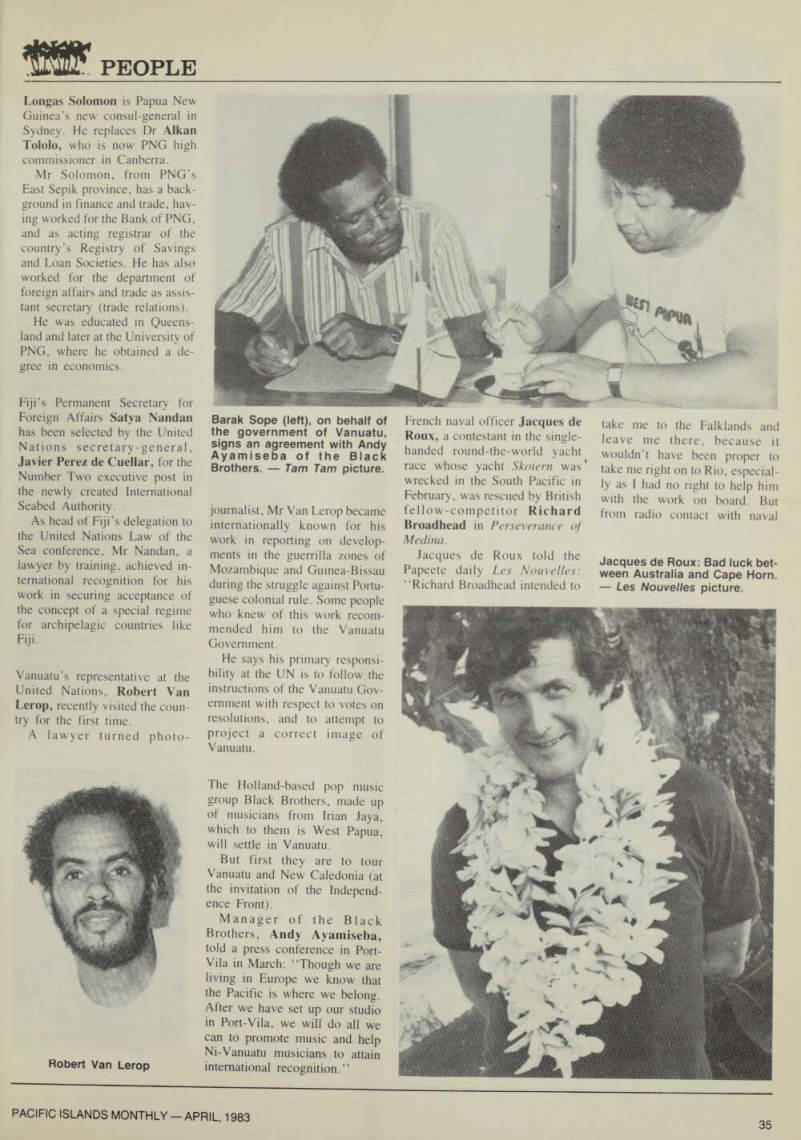
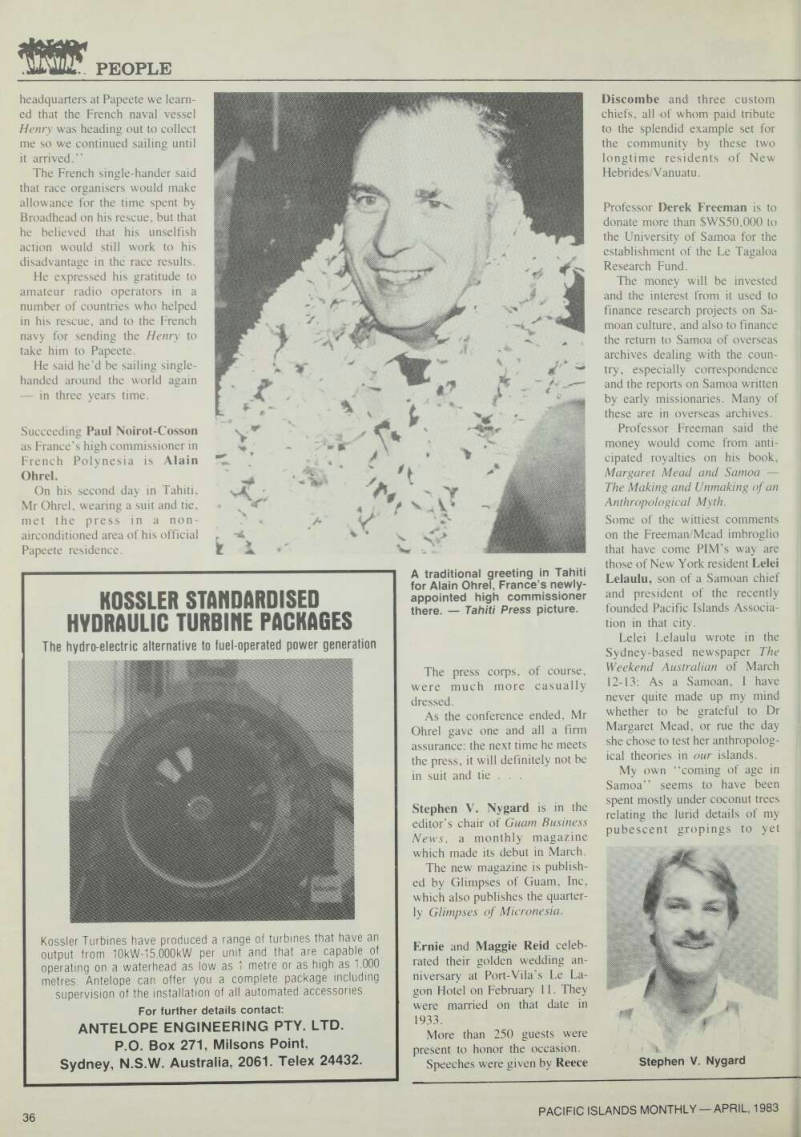
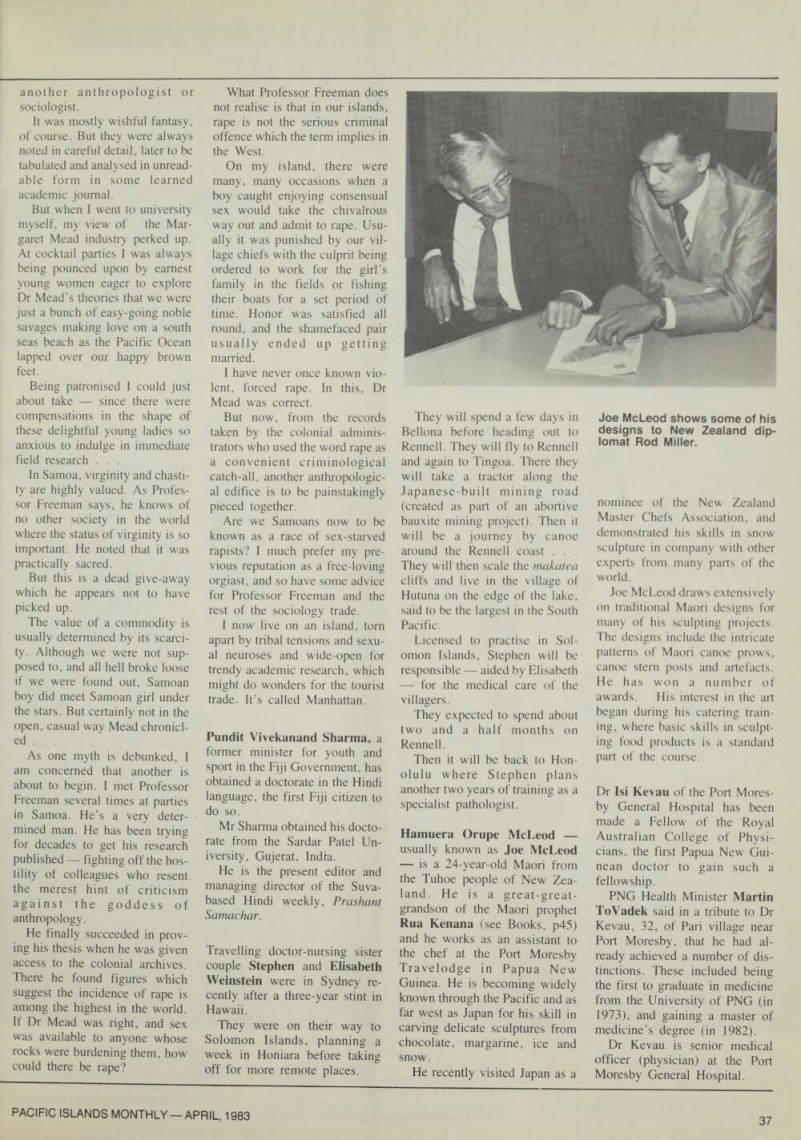
Longas Solomon is Papua New Guinea’s new consul-general in Sydney. He replaces Dr Alkan Tololo, who is now PNG high commissioner in Canberra.
Mr Solomon, from PNG’s East Sepik province, has a back ground in finance and trade, hav ing worked for the Bank of PNG, and as acting registrar of the country’s Registry of Savings and Loan Societies. He has also worked for the department of foreign affairs and trade as assis tant secretary (trade relations).
He was educated in Queens land and later at the University of PNG, where he obtained a de gree in economics.
Fiji’s Permanent Secretary for Foreign Affairs Satya Nandan has been selected by the United Nations secretary-general, Javier Perez de Cuellar, for the Number Two executive post in the newly created International Seabed Authority.
As head of Fiji’s delegation to the United Nations Law of the Sea conference, Mr Nandan, a lawyer by training, achieved in ternational recognition for his work in securing acceptance of the concept of a special regime for archipelagic countries like Fiji.
Vanuatu’s representative at the United Nations, Robert Van Lerop, recently visited the coun try for the first time.
A lawyer turned photo-
journalist, Mr Van Lerop became internationally known for his work in reporting on develop ments in the guerrilla zones of Mozambique and Guinea-Bissau during the struggle against Portu guese colonial rule. Some people who knew of this work recom mended him to the Vanuatu Government.
He says his primary responsi bility at the UN is to follow the instructions of the Vanuatu Gov ernment with respect to votes on resolutions, and to attempt to project a correct image of Vanuatu.
The Holland-based pop music group Black Brothers, made up of musicians from Irian Jaya, which to them is West Papua, will settle in Vanuatu.
But first they are to tour Vanuatu and New Caledonia (at the invitation of the Independ ence Front).
Manager of the Black Brothers, Andy Ayamiseba, told a press conference in Port- Vila in March: “Though we are living in Europe we know that the Pacific is where we belong.
After we have set up our studio in Port-Vila, we will do all we can to promote music and help Ni-Vanuatu musicians to attain international recognition. ’ ’
French naval officer Jacques de Roux, a contestant in the single handed round-the-world yacht race whose yacht Skoiern was * wrecked in the South Pacific in February, was rescued by British
fellow-competitor Richard
Broadhead in Perseverance of Medina.
Jacques de Roux told the Papeete daily Les Nouvelles: “Richard Broadhead intended to
take me to the Falklands and leave me there, because it wouldn’t have been proper to take me right on to Rio, especial ly as I had no right to help him with the work on board. But from radio contact with naval
Robert Van Lerop
Barak Sope (left), on behalf of the government of Vanuatu, signs an agreement with Andy Ayamiseba of the Black Brothers. - Tam Tam picture.
Jacques de Roux: Bad luck bet ween Australia and Cape Horn. - Les Nouvelles picture.
headquarters at Papeete we learn ed that the French naval vessel Henry was heading out to collect me so we continued sailing until it arrived.”
The French single-hander said that race organisers would make allowance for the time spent by Broadhead on his rescue, but that he believed that his unselfish action would still work to his disadvantage in the race results.
He expressed his gratitude to amateur radio operators in a number of countries who helped in his rescue, and to the French navy for sending the Henry to take him to Papeete.
He said he’d be sailing single handed around the world again in three years time.
Succeeding Paul Noirot-Cosson as France’s high commissioner in French Polynesia is Alain Ohrel.
On his second day in Tahiti, Mr Ohrel, wearing a suit and tie, met the press in a non airconditioned area of his official Papeete residence.
The press corps, of course, were much more casually dressed.
As the conference ended, Mr Ohrel gave one and all a firm assurance: the next time he meets the press, it will definitely not be in suit and tie . . .
Stephen V. Nygard is in the editor’s chair of Guam Business News, a monthly magazine which made its debut in March.
The new magazine is publish ed by Glimpses of Guam, Inc, which also publishes the quarter
ly Glimpses of Micronesia.
Ernie and Maggie Reid celeb rated their golden wedding an niversary at Port-Vila’s Le La gon Hotel on February 11. They were married on that date in 1933.
More than 250 guests were present to honor the occasion.
Speeches were given by Reece
Discombe and three custom chiefs, all of whom paid tribute to the splendid example set for the community by these two longtime residents of New Hebrides/V anuatu.
Professor Derek Freeman is to donate more than SWSSO,OOO to the University of Samoa for the establishment of the Le Tagaloa Research Fund.
The money will be invested and the interest from it used to finance research projects on Sa moan culture, and also to finance the return to Samoa of overseas archives dealing with the coun try, especially correspondence and the reports on Samoa written by early missionaries. Many of these are in overseas archives.
Professor Freeman said the money would come from anti cipated royalties on his book, Margaret Mead and Samoa The Making and Unmaking of an
Anthropological Myth.
Some of the wittiest comments on the Freeman/Mead imbroglio that have come PlM’s way are those of New York resident Lelei Lelaulu, son of a Samoan chief and president of the recently founded Pacific Islands Associa tion in that city.
Lelei Lelaulu wrote in the Sydney-based newspaper The Weekend Australian of March 12-13: As a Samoan, I have never quite made up my mind whether to be grateful to Dr Margaret Mead, or rue the day she chose to test her anthropolog ical theories in our islands.
My own “coming of age in Samoa’’ seems to have been spent mostly under coconut trees relating the lurid details of my
pubescent gropings to yet
A traditional greeting in Tahiti for Alain Ohrel, France’s newly appointed high commissioner there. - Tahiti Press picture.
Stephen V. Nygard
another anthropologist or
sociologist.
It was mostly wishful fantasy, of course. But they were always noted in careful detail, later to be tabulated and analysed in unread able form in some learned
academic journal.
But when I went to university myself, my view of the Mar garet Mead industry perked up.
At cocktail parties I was always being pounced upon by earnest young women eager to explore Dr Mead’s theories that we were just a bunch of easy-going noble savages making love on a south seas beach as the Pacific Ocean lapped over our happy brown feet.
Being patronised I could just
about take since there were compensations in the shape of these delightful young ladies so anxious to indulge in immediate field research . . .
In Samoa, virginity and chasti ty are highly valued. As Profes sor Freeman says, he knows of no other society in the world where the status of virginity is so important. He noted that it was
practically sacred.
But this is a dead give-away which he appears not to have picked up.
The value of a commodity is usually determined by its scarci ty. Although we were not sup posed to, and all hell broke loose if we were found out, Samoan boy did meet Samoan girl under the stars. But certainly not in the open, casual way Mead chronicl ed .. .
As one myth is debunked, I am concerned that another is about to begin. I met Professor Freeman several times at parties in Samoa. He’s a very deter mined man. He has been trying for decades to get his research published fighting off the hos tility of colleagues who resent the merest hint of criticism against the goddess of
anthropology.
He finally succeeded in prov ing his thesis when he was given access to the colonial archives.
There he found figures which suggest the incidence of rape is among the highest in the world.
If Dr Mead was right, and sex was available to anyone whose rocks were burdening them, how could there be rape?
What Professor Freeman does not realise is that in our islands, rape is not the serious criminal offence which the term implies in the West.
On my island, there were many, many occasions when a boy caught enjoying consensual sex would take the chivalrous way out and admit to rape. Usu ally it was punished by our vil lage chiefs with the culprit being ordered to work for the girl’s family in the fields or fishing their boats for a set period of time. Honor was satisfied all round, and the shamefaced pair usually ended up getting married.
I have never once known vio lent, forced rape. In this, Dr Mead was correct.
But now, from the records taken by the colonial adminis trators who used the word rape as a convenient criminological catch-all, another anthropologic al edifice is to be painstakingly pieced together.
Are we Samoans now to be known as a race of sex-starved rapists? I much prefer my pre vious reputation as a free-loving orgiast, and so have some advice for Professor Freeman and the rest of the sociology trade.
I now live on an island, torn apart by tribal tensions and sexu al neuroses and wide-open for trendy academic research, which might do wonders for the tourist trade. It’s called Manhattan.
Pundit Vivekanand Sharma, a former minister for youth and sport in the Fiji Government, has obtained a doctorate in the Hindi language, the first Fiji citizen to do so.
Mr Sharma obtained his docto rate from the Sardar Patel Un iversity, Gujerat, India.
He is the present editor and managing director of the Suva based Hindi weekly, Prashant Samachar.
Travelling doctor-nursing sister couple Stephen and Elisabeth Weinstein were in Sydney re cently after a three-year stint in Hawaii.
They were on their way to Solomon Islands, planning a week in Honiara before taking off for more remote places.
They will spend a few days in Bellona before heading out to Rennell. They will fly to Rennell and again to Tingoa. There they will take a tractor along the Japanese-built mining road (created as part of an abortive bauxite mining project). Then it will be a journey by canoe around the Rennell coast . . .
They will then scale the makatea cliffs and live in the village of Hutuna on the edge of the lake, said to be the largest in the South Pacific.
Licensed to practise in Sol omon Islands, Stephen will be responsible aided by Elisabeth for the medical care of the villagers.
They expected to spend about two and a half months on Rennell.
Then it will be back to Hon olulu where Stephen plans another two years of training as a specialist pathologist.
Hamuera Orupe McLeod usually known as Joe McLeod is a 24-year-old Maori from the Tuhoe people of New Zea land. He is a great-great grandson of the Maori prophet Rua Kenana (see Books, p 45) and he works as an assistant to the chef at the Port Moresby Travelodge in Papua New Guinea. He is becoming widely known through the Pacific and as far west as Japan for his skill in carving delicate sculptures from chocolate, margarine, ice and snow.
He recently visited Japan as a
nominee of the New Zealand Master Chefs Association, and demonstrated his skills in snow sculpture in company with other experts from many parts of the world.
Joe McLeod draws extensively on traditional Maori designs for many of his sculpting projects.
The designs include the intricate patterns of Maori canoe prows, canoe stern posts and artefacts.
He has won a number of awards. His interest in the art began during his catering train ing, where basic skills in sculpt ing food products is a standard part of the course.
Dr Isi Kevau of the Port Mores by General Hospital has been made a Fellow of the Royal Australian College of Physi cians, the first Papua New Gui nean doctor to gain such a
fellowship.
PNG Health Minister Martin ToVadek said in a tribute to Dr Kevau, 32, of Pari village near Port Moresby, that he had al ready achieved a number of dis tinctions. These included being the first to graduate in medicine from the University of PNG (in 1973), and gaining a master of medicine’s degree (in 1982).
Dr Kevau is senior medical officer (physician) at the Port Moresby General Hospital.
Joe McLeod shows some of his designs to New Zealand dip lomat Rod Miller.
Advertisements & other items, pp. 36-40 (1 item)
Kossler Standardised
HYDRAULIC TURBINE PACKAGES
The hydro-electric alternative to fuel-operated power generation Kossler Turbines have produced a range of turbines that have an output from 10kW-15,000kW per unit and that are capable of operating on a waterhead as low as 1 metre or as high as 1,000 metres. Antelope can offer you a complete package including supervision of the installation of all automated accessories.
For further details contact;
ANTELOPE ENGINEERING PTY. LTD.
P.O. Box 271, Milsons Point, Sydney, N.S.W. Australia, 2061. Telex 24432.
THE TOYOTA ROADMASTERS
READY TO TAKE
ON THE TOUGHEST OOBS.
Meet Toyota’s hard working commercial vehicles. Tough. Durable. Ready to meet the challenge of the worst roads and climates. Ready to do the job called for with ease. Rugged veterans, each one specifically designed to meet the different demands of the world’s businesses. One of them is just right for you. There are no vehicles more reliable. And if you need it, Toyota is ready with fast
backup service. Toyota’s roadmasters,
they’re a winning team.
HI-LUX 4WD
TOYOTA
QUALITY SERVICE
AMERICAN SAMOA: BURNS PHILP (SOUTH SEA)
CO., LTD., P.O. Box 129, Pago Pago.
COOK ISLANDS: COOK ISLANDS TRADING
CORPORATION LTD., P.O. Box 92, Rarotonga.
FIJI: AUTOMOTIVE SUPPLIES COMPANY, G.P.O.
Box 355, Suva.
GUAM & MICRONESIA: ATKINS, KROLL (GUAM) LTD., P.O. Box 6428, Tamuning.
KIRIBATI: TARAWA MOTORS, P.O. Box 36,
Bairiki, Tarawa, Kiribati.
NAURU: NAURU COOPERATIVE SOCIETY.
NEW CALEDONIA: SERVICE IMPORTATION
AUTOMOBILE DU PACIFIQUE, Rond-Point
du Pacifique (Station Total) B.P. 438, Noumeac
LAND CRUISER
STATION WAGON
a ■
ftHS
HI-LUX
DOUBLE CAB
. — iwro/.v —
HEAVY DUTY
TRUCK
■fc )RFOLK ISLAND: BORRY’S LIMITED, P.0 Box 169
PUA NEW GUINEA: ELA MOTORS,
ratchley Rd„ Badili, P.O. Box 675. Port Moresby
IRAN: MICROL CORPORATION, P.O. Box 267,
ipan.
ILOMON: MENDANA ENTERPRISES (S.l.) LTD.,
3 .0. Box 174, Honiara.
TAHITI: NIPPON AUTOMOTO, P.O. Box 342, Papeete.
TONGA: BURNS PHILP (SOUTH SEA) CO., LTD., P.O. Box 55, Nuku’alofa.
VANUATU: VANUATU MOTORS, P.O. Box 18
Port Vila.
WESTERN SAMOA: BURNS PHILP (SOUTH SEA)
CO., LTD., P.O. Box 188, Apia.
TOYOTA
The Toyota range includes:
COROLLA, STARLET, CORONA, CRESSIDA, HI-LUX,
STOUT, HI ACE, DYNA, COASTER and LAND CRUISEI
Starting & Staying
HMMR
■ w V
AMP
v. 31 Egg 7 * fM * w r-^5: ®iy 4IW /’TSS&su
LJH&
Power Boats Need Different Batteries
There is a big difference between a car battery and a marine battery.
A car battery, for example, is never really discharged, as it is only used for a few seconds each day and promptly re-charged. Not so your cruiser or sportsfisherman.
Starting the engine is only the beginning. During the day, weekend or cruise, how often will you run the live bait tank, the depth sounder, the nav. lights or maintain a listening watch on your radio transceiver?
As well as cranking power, boats need staying power. Boats need Besco's Marine Batteries, deep cycle, heavy duty marine batteries. ' If your boat is getting a little flat in the electrics department, write or phone BESCO today - and asK for more information, more facts about
BESCO MARINE BATTERIES.
BESCO
Batteries Division Of Sims Products Pty Ltd.
A Peko Wall send Group Member Papua New Guinea: Lae/Rabaul Auto Marine Industries, PO Box 785, Lae. - 42-1125. Port W Moresby: Par Sales Pty. Ltd., Boroko. 25-6266. Fiji: Bar Motor Parts Ltd PO Box 51, Bar, f 74-070 New Caledonia: Lotissement Industrie!, BP 889, Noumea. 27-4906. Hong Kong. Tl. 7 Knight & Co., PO Box 5585, T.S.T. Kowloon, 3-66 5341. N.Z.: Battery Services (Industrial) Ltd PO 27-375 Auckland 4, 694-111. Gould Batteries, 58 Hautana St., Lower Butt, Wellington.
Telex: CHACO N.Z. 3714. Other Areas: Jarwil International Pty. I Lt 9 d^Q l fi32 025i ydn ® y ’ 2000 (02) 264-3477. Telex: AA 72102. Besco Batteries, Villawood, 2163. (02) 632-0251.
LEADERS IN BATTERY TEC —
sour ‘epilogue'
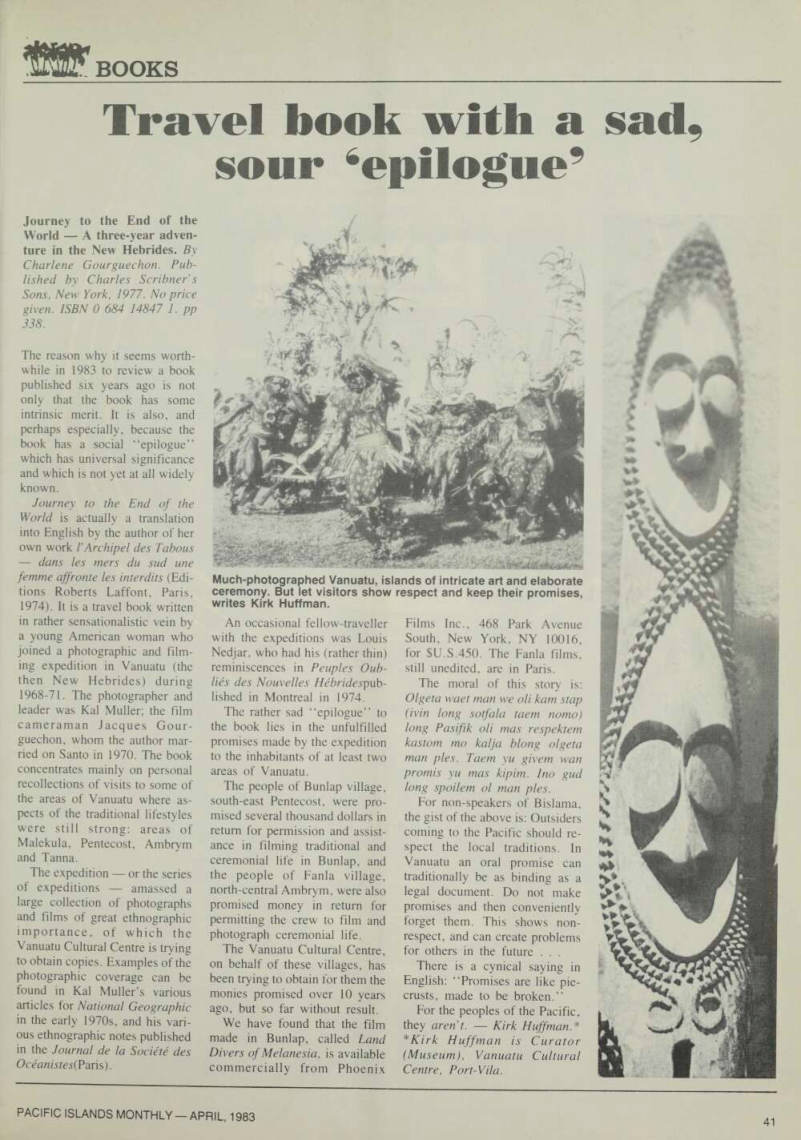
Books
Travel book with a sad, sour ‘epilogue'
Journey to the End of the World A three-year adven ture in the New Hebrides. By Charlene Gourguechon. Pub lished by Charles Scribner’s Sons, New York, 1977. No price given. ISBN 0 684 14847 1. pp 338.
The reason why it seems worth while in 1983 to review a book published six years ago is not only that the book has some intrinsic merit. It is also, and perhaps especially, because the book has a social “epilogue” which has universal significance and which is not yet at all widely known.
Journey to the End of the World is actually a translation into English by the author of her own work I’Archipel des Tabous dans les mers du sud une femme affronte les interdits (Edi tions Roberts Laffont, Paris, 1974). It is a travel book written in rather sensationalistic vein by a young American woman who joined a photographic and film ing expedition in Vanuatu (the then New Hebrides) during 1968-71. The photographer and leader was Kal Muller; the film cameraman Jacques Gour guechon, whom the author mar ried on Santo in 1970. The book concentrates mainly on personal recollections of visits to some of the areas of Vanuatu where as pects of the traditional lifestyles were still strong: areas of Malekula, Pentecost, Ambrym and Tanna.
The expedition or the series of expeditions amassed a large collection of photographs and films of great ethnographic importance, of which the Vanuatu Cultural Centre is trying to obtain copies. Examples of the photographic coverage can be found in Kal Muller’s various articles for National Geographic in the early 19705, and his vari ous ethnographic notes published in the Journal de la Societe des Oceanistesi Paris).
An occasional fellow-traveller with the expeditions was Louis Nedjar, who had his (rather thin) reminiscences in Peuples Oub lies des Nouvelles Hebridespuh lished in Montreal in 1974.
The rather sad “epilogue” to the book lies in the unfulfilled promises made by the expedition to the inhabitants of at least two areas of Vanuatu.
The people of Bunlap village, south-east Pentecost, were pro mised several thousand dollars in return for permission and assist ance in filming traditional and ceremonial life in Bunlap, and the people of Fanla village, north-central Ambrym, were also promised money in return for permitting the crew to film and photograph ceremonial life.
The Vanuatu Cultural Centre, on behalf of these villages, has been trying to obtain for them the monies promised over 10 years ago, but so far without result.
We have found that the film made in Bunlap, called Land Divers of Melanesia, is available commercially from Phoenix
Films Inc., 468 Park Avenue South, New York, NY 10016, for $U.5.450. The Fanla films, still unedited, are in Paris.
The moral of this story is: Olgeta waet man we oli kam stap (ivin long sotfala taem nomo) long Pasifik oli mas respektem kastom mo kalja blong olgeta man pies. Taem yu givem wan promts yu mas kipim. Ino gud long spoilem ol man pies.
For non-speakers of Bislama, the gist of the above is: Outsiders coming to the Pacific should re spect the local traditions. In Vanuatu an oral promise can traditionally be as binding as a legal document. Do not make promises and then conveniently forget them. This shows non respect, and can create problems for others in the future . . .
There is a cynical saying in English: “Promises are like pie crusts, made to be broken.”
For the peoples of the Pacific,
they aren’t.
Kirk Huffman .
*Kirk Huffman is Curator (Museum), Vanuatu Cultural Centre, Port-Vila.
Much-photographed Vanuatu, islands of intricate art and elaborate ceremony. But let visitors show respect and keep their promises, writes Kirk Huffman.
Advertisements & other items, p. 42 (1 item)
In All-Mew World of Sonic Clarity
Introducing the Hew PRIbM Component Systems, cjined reproduction performance and enhanced appearance make the flew PRISM systems an extremely musical, elegant addition to any listening/living environment.
Another taste of advanced technology from TEAC.
Hite
COMPONENT SYSTEMS
. 1
cbb
c 8®
B r o o
— iff T-- 111 \ 2 ± * * L: ‘ ~r ¥ \ »
TEAC
Where Art and Technology Meet
a®! ii
time Solomons,
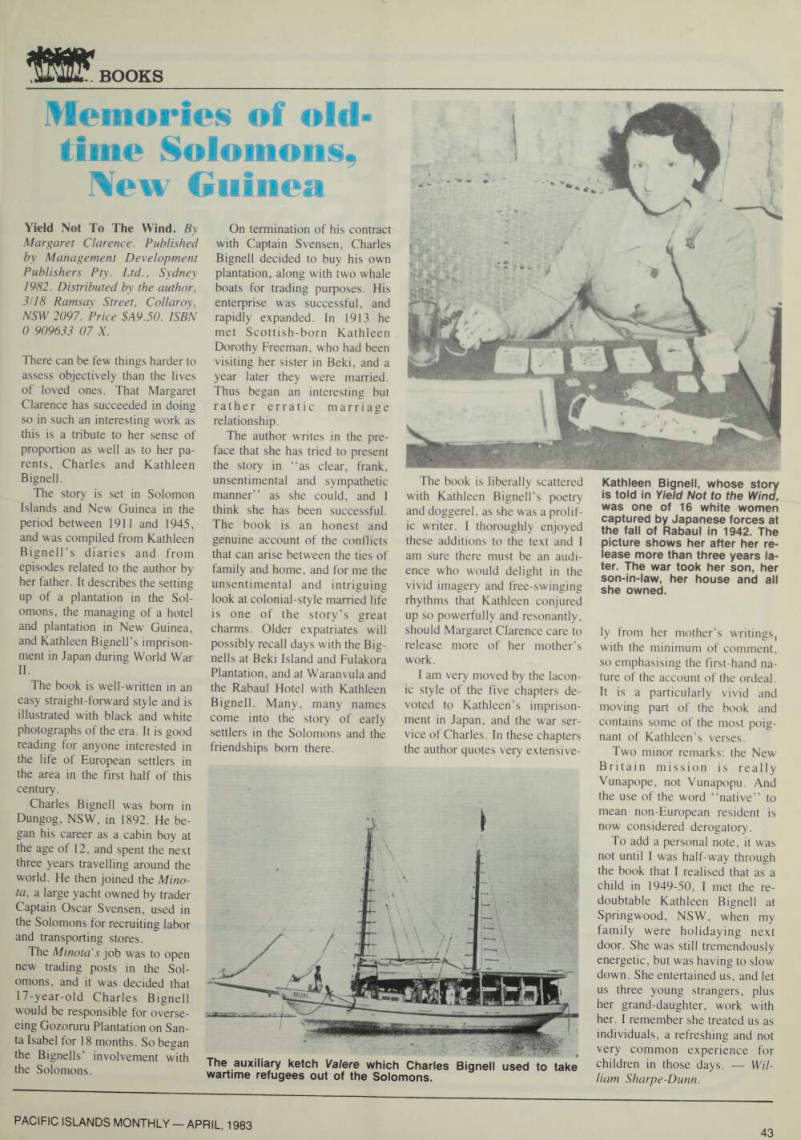
Memories of old time Solomons, New Guinea
Yield Not To The Wind. By Margaret Clarence. Published by Management Development Publishers Pty. Ltd., Sydney 1982. Distributed by the author, 3/18 Ramsay Street, Collaroy, NSW 2097. Price $A9.50. ISBN 0 909633 07 X.
There can be few things harder to assess objectively than the lives of loved ones. That Margaret Clarence has succeeded in doing so in such an interesting work as this is a tribute to her sense of proportion as well as to her pa rents, Charles and Kathleen Bignell.
The story is set in Solomon Islands and New Guinea in the period between 1911 and 1945, and was compiled from Kathleen Bignell’s diaries and from episodes related to the author by her father. It describes the setting up of a plantation in the Sol omons, the managing of a hotel and plantation in New Guinea, and Kathleen Bignell’s imprison ment in Japan during World War 11.
The book is well-written in an easy straight-forward style and is illustrated with black and white photographs of the era. It is good reading for anyone interested in the life of European settlers in the area in the first half of this century.
Charles Bignell was bom in Dungog, NSW, in 1892. He be gan his career as a cabin boy at the age of 12, and spent the next three years travelling around the world. He then joined the Mino ta, a large yacht owned by trader Captain Oscar Svensen, used in the Solomons for recruiting labor and transporting stores.
The Minota’s job was to open new trading posts in the Sol omons, and it was decided that 17-year-old Charles Bignell would be responsible for overse eing Gozoruru Plantation on San ta Isabel for 18 months. So began the Bignells’ involvement with the Solomons.
On termination of his contract with Captain Svensen, Charles Bignell decided to buy his own plantation, along with two whale boats for trading purposes. His enterprise was successful, and rapidly expanded. In 1913 he met Scottish-born Kathleen Dorothy Freeman, who had been visiting her sister in Beki, and a year later they were married.
Thus began an interesting but rather erratic marriage relationship.
The author writes in the pre face that she has tried to present the story in “as clear, frank, unsentimental and sympathetic manner” as she could, and I think she has been successful.
The book is an honest and genuine account of the conflicts that can arise between the ties of family and home, and for me the unsentimental and intriguing look at colonial-style married life is one of the story’s great charms. Older expatriates will possibly recall days with the Big nells at Beki Island and Fulakora Plantation, and at Waranvula and the Rabaul Hotel with Kathleen Bignell. Many, many names come into the story of early settlers in the Solomons and the friendships bom there.
The book is liberally scattered with Kathleen Bignell’s poetry and doggerel, as she was a prolif ic writer. I thoroughly enjoyed these additions to the text and I am sure there must be an audi ence who would delight in the
vivid imagery and free-swinging
rhythms that Kathleen conjured
up so powerfully and resonantly, should Margaret Clarence care to release more of her mother’s work.
I am very moved by the lacon ic style of the five chapters de voted to Kathleen’s imprison ment in Japan, and the war ser vice of Charles. In these chapters the author quotes very extensive
ly from her mother’s writings, with the minimum of comment, so emphasising the first-hand na ture of the account of the ordeal.
It is a particularly vivid and moving part of the book and contains some of the most poig nant of Kathleen’s verses.
Two minor remarks: the New Britain mission is really Vunapope, not Vunapopu. And the use of the word “native” to mean non-European resident is now considered derogatory.
To add a personal note, it was not until I was half-way through the book that I realised that as a child in 1949-50, I met the re doubtable Kathleen Bignell at Springwood, NSW, when my family were holidaying next door. She was still tremendously energetic, but was having to slow down. She entertained us, and let us three young strangers, plus her grand-daughter, work with her. I remember she treated us as individuals, a refreshing and not very common experience for
children in those days.
Wil-
Ham Sharpe-Dunn.
The auxiliary ketch Valere which Charles Bignell used to take wartime refugees out of the Solomons.
Kathleen Bignell, whose story is told in Yield Not to the Wind, was one of 16 white women captured by Japanese forces at the fall of Rabaul in 1942. The picture shows her after her re lease more than three years la ter. The war took her son, her son-in-law, her house and all she owned.
Advertisements & other items, p. 44 (1 item)
Expert
Insurance Service
throughout the islands
Queensland Insurance (Fiji) Limited
Head Office, 34 Usher St.. SUVA . General Manager; L, G. Liddell A.A.1.1. Assistant Managers : R. Jackson. Vijay Lai. Phone: 23851.
LAUTOKA OFFICE: Burns Philp Bldg , Naviti St District Manager; J, Dalton, Phone. 60642.
LABASA OFFICE: Burns Philp Bldg District Manager: R. Sharma Phone: 8 2139
Queensland Insurance (PNG) Limited
PAPUA NEW GUINEA
Head Office BNG Building, Musgrave St,.PORT MORESBY, General Manager: T. Sarti Phone: 212144.
LAE. 4th St. & Coronation Drive District Manager: C. D Hiflier Phone: 423873.
MOUNT HAGEN: Hagen Drive District Manager: G. Hayes Phone: 521002.
ARAWA: Chebu St. District Manager: J. Longbut. Phone: 951555.
MADANG: Kasagten St District Manager; N. D. Ramage. Phone: 82 2020.
RABAUL; Wirraway St District Manager R. McManus Phone: 921014
QBE Insurance (International) Limited
VANUATU , PORT VILA: Rue de Pans, Suite 19, Oceania Bldg. Manager: I R. Martin.
Phone: 2299.
SANTO: Burns Philp ( Vanuatu) Ltd. Phone: 230.
PACIFIC AGENCIES
NEW CALEDONIA: Ste. W. A. Johnston, S.A.R.L. 5 Rue Anatole France, NOUMEA Phone: 272083.
TAHITI Arthur Chung, Immeuble BIS.. Front de Mer, PAPEETE Phone. 2.86 19 NIUE Burns Philp (South Sea) Company Ltd.
NORFOLK ISLAND: Burns Philp ('N I ) Company Ltd. Phone: 2191 SAMOA APIA Burns Philp (South Sea) Company Ltd. Phone: 2261 T TONGA Burns Philp (South Sea) Company Ltd NUKUALOFA Phone 21500 HAAPAI, VAVAU
MEMBERS OF THE
® QBE INSURANCE GROUP UMITED
prophet Rua
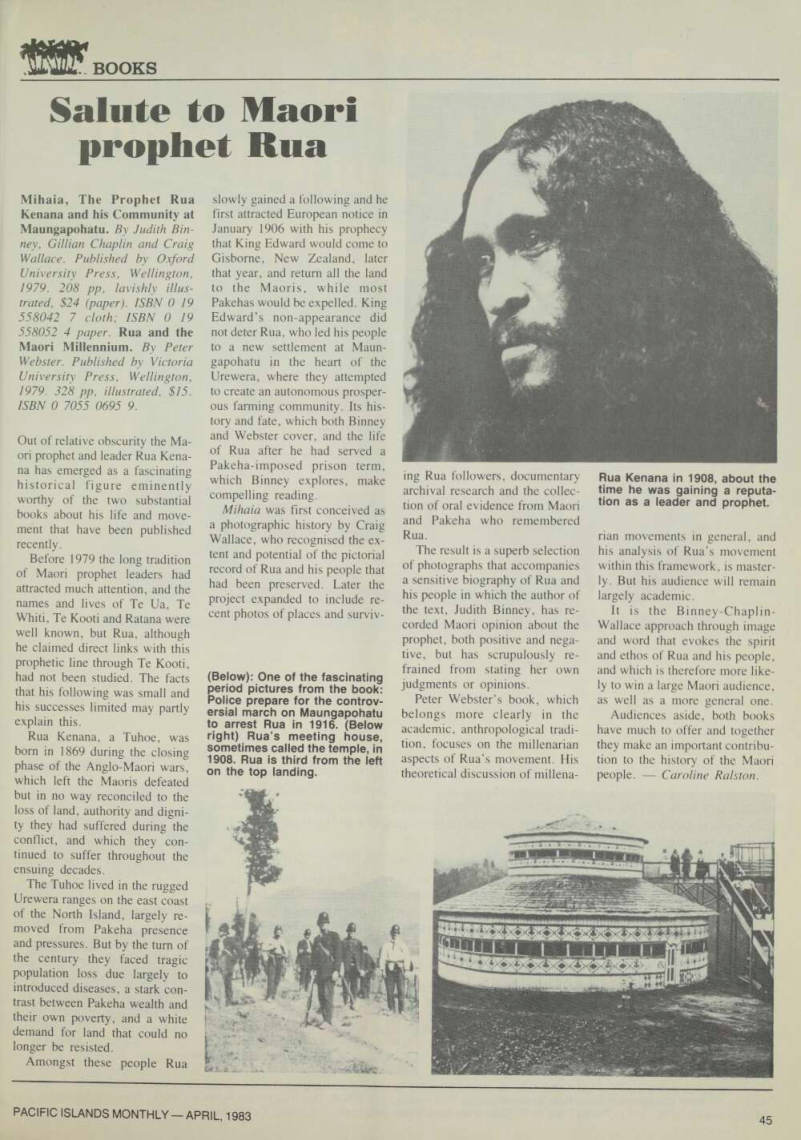
Salute to Maori prophet Rua
Mihaia, The Prophet Rua Kenana and his Community at Maungapohatu. By Judith Bin ney, Gillian Chaplin and Craig Wallace. Published by Oxford University Press, Wellington, 1979. 208 pp, lavishly illus trated, $24 (paper). ISBN 0 19 558042 7 cloth; ISBN 0 19 558052 4 paper. Rua and the Maori Millennium. By Peter Webster. Published by Victoria University Press, Wellington, 1979. 328 pp, illustrated, $l5.
Isbn 0 7055 0695 9.
Out of relative obscurity the Ma ori prophet and leader Rua Kena na has emerged as a fascinating historical figure eminently worthy of the two substantial books about his life and move ment that have been published recently.
Before 1979 the long tradition of Maori prophet leaders had attracted much attention, and the names and lives of Te Ua, Te Whiti, Te Kooti and Ratana were well known, but Rua, although he claimed direct links with this prophetic line through Te Kooti, had not been studied. The facts that his following was small and his successes limited may partly explain this.
Rua Kenana, a Tuhoe, was bom in 1869 during the closing phase of the Anglo-Maori wars, which left the Maoris defeated but in no way reconciled to the loss of land, authority and digni ty they had suffered during the conflict, and which they con tinued to suffer throughout the ensuing decades.
The Tuhoe lived in the rugged Urewera ranges on the east coast of the North Island, largely re moved from Pakeha presence and pressures. But by the turn of the century they faced tragic population loss due largely to introduced diseases, a stark con trast between Pakeha wealth and their own poverty, and a white demand for land that could no longer be resisted.
Amongst these people Rua
slowly gained a following and he
first attracted European notice in January 1906 with his prophecy that King Edward would come to Gisborne, New Zealand, later that year, and return all the land to the Maoris, while most Pakehas would be expelled. King Edward’s non-appearance did not deter Rua, who led his people to a new settlement at Maun gapohatu in the heart of the
Urewera, where they attempted
to create an autonomous prosper ous farming community. Its his tory and fate, which both Binney and Webster cover, and the life of Rua after he had served a
Pakeha-imposed prison term,
which Binney explores, make
compelling reading.
Mihaia was first conceived as
a photographic history by Craig
Wallace, who recognised the ex tent and potential of the pictorial record of Rua and his people that had been preserved. Later the project expanded to include re cent photos of places and surviv-
ing Rua followers, documentary archival research and the collec tion of oral evidence from Maori and Pakeha who remembered Rua.
The result is a superb selection of photographs that accompanies a sensitive biography of Rua and his people in which the author of the text, Judith Binney, has re corded Maori opinion about the prophet, both positive and nega tive, but has scrupulously re frained from stating her own judgments or opinions.
Peter Webster’s book, which belongs more clearly in the academic, anthropological tradi tion, focuses on the millenarian aspects of Rua’s movement. His theoretical discussion of millena
rian movements in general, and his analysis of Rua’s movement within this framework, is master ly. But his audience will remain largely academic.
It is the Binney-Chaplin- Wallace approach through image and word that evokes the spirit and ethos of Rua and his people, and which is therefore more like ly to win a large Maori audience, as well as a more general one.
Audiences aside, both books have much to offer and together they make an important contribu tion to the history of the Maori
people
Caroline Ralston.
(Below): One of the fascinating period pictures from the book: Police prepare for the controv ersial march on Maungapohatu to arrest Rua in 1916. (Below right) Rua’s meeting house, sometimes called the temple, in 1908. Rua is third from the left on the top landing.
Rua Kenana in 1908, about the time he was gaining a reputa tion as a leader and prophet.
Advertisements & other items, p. 46 (1 item)
Aiwa
g-cs
3-iw
=3
m \ a o nrj
11
CA-WlO
Here’s a formula for real listening fun: with the AIWA CA-WlO, you can play two cassettes in sequence (for uninterrupted listening) or dub from one to the other (with time-saving double-speed recording).
Speakers are fully detachable too, so you can move them high or low for the best sound arrangement.
Built with such top features as AlWA’s exclusive “Dynamic Super Loudness” and Dolby* noise reduction, the CA-WlO is a real audio system that works off AC house current, self-contained batteries or DC power from your car or boat. And its hi-fi amplifier puts out a mighty 40 Watts of power for great sounds from radio, cassettes or even an external stereo turntable.
Best of all, it’s a member of the world’s most innovative family of home and portable cassette products: AIWA, aiwa for craftsmanship Japan’s first in 1964, leaders ever since.
AIWA
CS-300 i CS-200 *Dolby and the double-D symbol are trademarks of Dolby Laboratories Licensing Corporation.
AIWA CO., LTD. 11-9, Ueno 1-chome, Taito-ku, Tokyo, Japan.
Distributors: Australia AIWA Australia Pty., Ltd./Cook Islands Island Merchants Ltd./Fiji P. Hargovind & Co., D. Ranchhod & Co./Guam Micropac Audio, Inc./New Caledonia hifivox/New Zealand Milaw Trading Co., Ltd./P.N.G. Oceania Indent Agency (P.N.G.) Pty., Ltd./Solomon Islands Harvest Pacific Ltd./Tahiti Fare Hi-Fi Stereo/Vanuatu (New Hebrides) The Sound Centre Ltd.
Stone Age patterns of
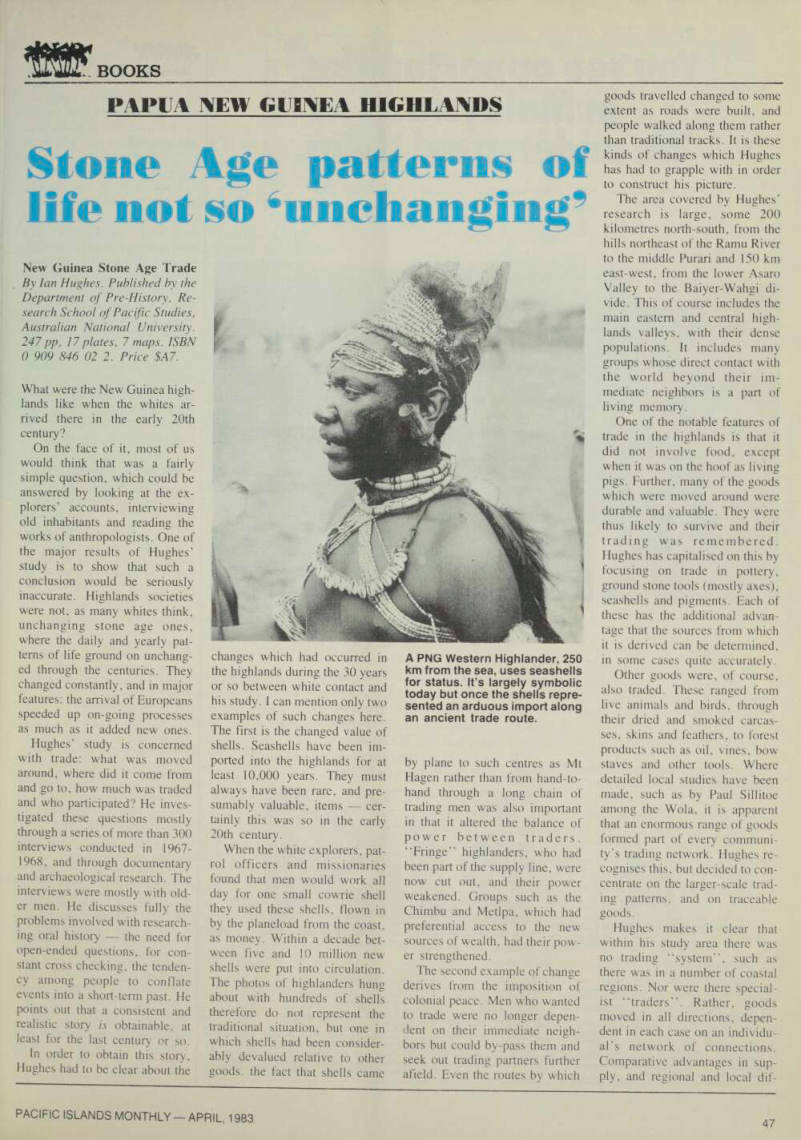
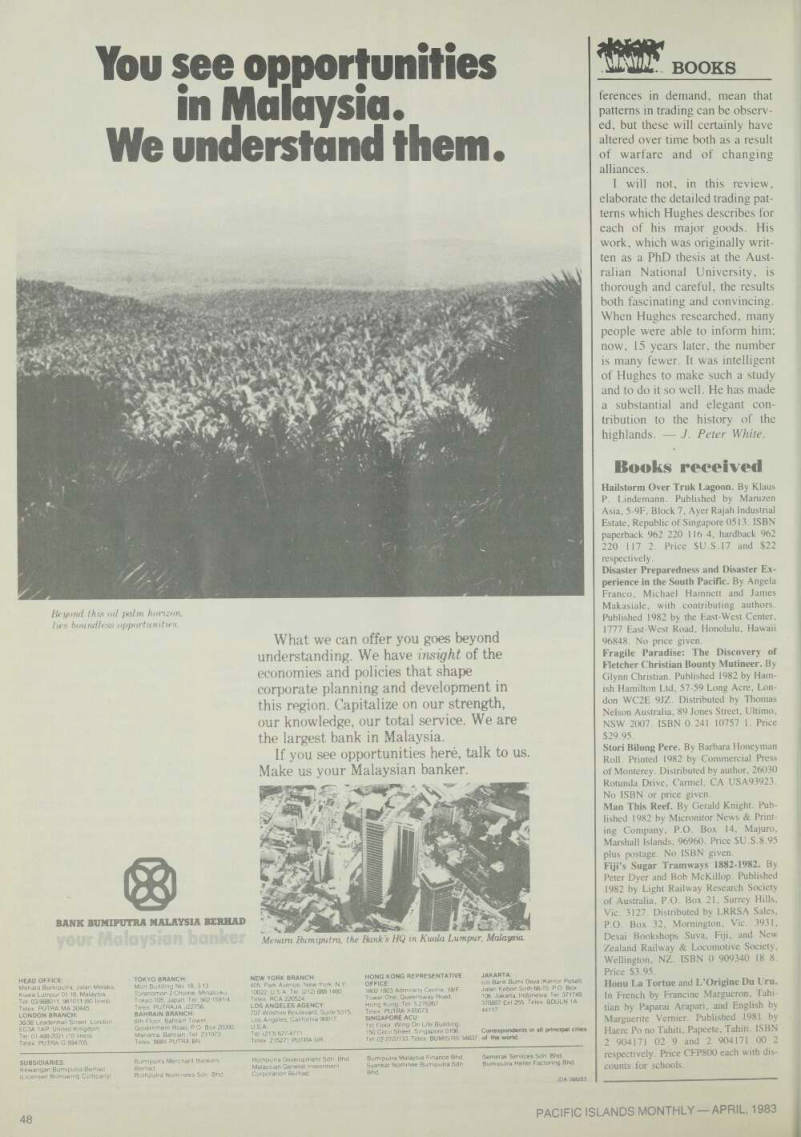
Papua New Guinea Highlands
Stone Age patterns of life not so ‘unchanging '
New Guinea Stone Age Trade By lan Hughes. Published by the Department of Pre-History, Re search School of Pacific Studies, Australian National University. 247 pp, 17 plates, 7 maps. ISBN 0 909 846 02 2. Price SA7.
What were the New Guinea high lands like when the whites ar rived there in the early 20th century?
On the face of it, most of us would think that was a fairly simple question, which could be answered by looking at the ex plorers’ accounts, interviewing old inhabitants and reading the works of anthropologists. One of the major results of Hughes’ study is to show that such a conclusion would be seriously inaccurate. Highlands societies were not, as many whites think, unchanging stone age ones, where the daily and yearly pat terns of life ground on unchang ed through the centuries. They changed constantly, and in major features: the arrival of Europeans speeded up on-going processes as much as it added new ones.
Hughes’ study is concerned with trade: what was moved around, where did it come from and go to, how much was traded and who participated? He inves tigated these questions mostly through a series of more than 300 interviews conducted in 1967- 1968, and through documentary and archaeological research. The interviews were mostly with old er men. He discusses fully the problems involved with research ing oral history the need for open-ended questions, for con stant cross checking, the tenden cy among people to conflate events into a short-term past. He points out that a consistent and realistic story is obtainable, at least for the last century or so.
In order to obtain this story, Hughes had to be clear about the
changes which had occurred in the highlands during the 30 years or so between white contact and his study. I can mention only two examples of such changes here.
The first is the changed value of shells. Seashells have been im ported into the highlands for at least 10,000 years. They must always have been rare, and pre sumably valuable, items cer tainly this was so in the early 20th century.
When the white explorers, pat rol officers and missionaries found that men would work all day for one small cowrie shell they used these shells, flown in by the planeload from the coast, as money. Within a decade bet ween five and 10 million new shells were put into circulation.
The photos of highlanders hung about with hundreds of shells therefore do not represent the traditional situation, but one in which shells had been consider ably devalued relative to other goods, the fact that shells came
by plane to such centres as Mt Hagen rather than from hand-to hand through a long chain of trading men was also important in that it altered the balance of power between traders.
“Fringe” highlanders, who had
been part of the supply line, were now cut out, and their power weakened. Groups such as the Chimbu and Metlpa, which had preferential access to the new sources of wealth, had their pow er strengthened.
The second example of change derives from the imposition of colonial peace. Men who wanted to trade were no longer depen dent on their immediate neigh bors but could by-pass them and seek out trading partners further afield. Even the routes by which
goods travelled changed to some extent as roads were built, and people walked along them rather than traditional tracks. It is these kinds of changes which Hughes has had to grapple with in order to construct his picture.
The area covered by Hughes’ research is large, some 200 kilometres north-south, from the hills northeast of the Ramu River to the middle Purari and 150 km east-west, from the lower Asaro Valley to the Baiyer-Wahgi di vide. This of course includes the main eastern and central high lands valleys, with their dense populations. It includes many groups whose direct contact with the world beyond their im mediate neighbors is a part of living memory.
One of the notable features of trade in the highlands is that it did not involve food, except when it was on the hoof as living pigs. Further, many of the goods which were moved around were durable and valuable. They were thus likely to survive and their trading was remembered.
Hughes has capitalised on this by focusing on trade in pottery, ground stone tools (mostly axes), seashells and pigments. Each of these has the additional advan tage that the sources from which it is derived can be determined, in some cases quite accurately.
Other goods were, of course, also traded. These ranged from live animals and birds, through their dried and smoked carcas ses, skins and feathers, to forest products such as oil, vines, bow staves and other tools. Where detailed local studies have been made, such as by Paul Sillitoe among the Wola, it is apparent that an enormous range of goods formed part of every communi ty’s trading network. Hughes re cognises this, but decided to con centrate on the larger-scale trad ing patterns, and on traceable goods.
Hughes makes it clear that within his study area there was no trading “system”, such as there was in a number of coastal regions. Nor were there special ist “traders”. Rather, goods moved in all directions, depen dent in each case on an individu al’s network of connections.
Comparative advantages in sup ply, and regional and local dif
A PNG Western Highlander, 250 km from the sea, uses seashells for status. It’s largely symbolic today but once the shells repre sented an arduous import along an ancient trade route.
ferences in demand, mean that patterns in trading can be observ ed, but these will certainly have altered over time both as a result of warfare and of changing alliances.
I will not, in this review, elaborate the detailed trading pat terns which Hughes describes for each of his major goods. His work, which was originally writ ten as a PhD thesis at the Aust ralian National University, is thorough and careful, the results both fascinating and convincing.
When Hughes researched, many people were able to inform him; now, 15 years later, the number is many fewer. It was intelligent of Hughes to make such a study and to do it so well. He has made a substantial and elegant con tribution to the history of the
highlands.
J. Peter White.
Books received
Hailstorm Over Truk Lagoon. By Klaus P. Lindemann. Published by Maruzen Asia, 5-9 F, Block 7, Ayer Rajah Industrial Estate, Republic of Singapore 0513. ISBN paperback 962 220 116 4, hardback 962 220 117 2. Price SU.S.I7 and $22 respectively.
Disaster Preparedness and Disaster Ex perience in the South Pacific. By Angela Franco, Michael Hamnett and James Makasiale, with contributing authors.
Published 1982 by the East-West Center, 1777 East-West Road, Honolulu, Hawaii 96848. No price given.
Fragile Paradise: The Discovery of Fletcher Christian Bounty Mutineer. By Glynn Christian. Published 1982 by Ham ish Hamilton Ltd, 57-59 Long Acre, Lon don WC2E 9JZ. Distributed by Thomas Nelson Australia, 89 Jones Street, Ultimo, NSW 2007. ISBN 0 241 10757 1. Price $29.95.
Stori Bilong Pere. By Barbara Honeyman Roll. Printed 1982 by Commercial Press of Monterey. Distributed by author, 26030 Rotunda Drive, Carmel, CA U5A93923.
No ISBN or price given.
Man This Reef. By Gerald Knight. Pub lished 1982 by Micronitor News & Print ing Company, P.O. Box 14, Majuro, Marshall Islands, 96960. Price $U.5.8.95 plus postage. No ISBN given.
Fiji’s Sugar Tramways 1882-1982. By Peter Dyer and Bob McKillop. Published 1982 by Light Railway Research Society of Australia, P.O. Box 21, Surrey Hills, Vic. 3127. Distributed by LRRSA Sales, P.O. Box 32, Momington, Vic. 3931, Desai Bookshops Suva, Fiji, and New Zealand Railway & Locomotive Society, Wellington, NZ. ISBN 0 909340 18 8.
Price $3.95.
Honu La Tortue and L’Origine Du Uru.
In French by Francine Margueron, Tahi tian by Paparai Arapari, and English by Marguerite Vernier. Published 1981 by Haere Po no Tahiti, Papeete, Tahiti. ISBN 2 904171 02 9 and 2 904171 00 2 respectively. Price CFPBOO each with dis counts for schools.
Advertisements & other items, p. 48 (1 item)
in Malaysia.
You see opportunities
We understand them.
9 N
Beyond this oil palm horizon,
lies boundless opportunities.
BANK BUMIPUTRA MALAYSIA BERHAD
ftur tantet
What we can offer you goes beyond
understanding. We have insight of the
economies and policies that shape
corporate planning and development in
this region. Capitalize on our strength,
our knowledge, our total service. We are
the largest bank in Malaysia.
If you see opportunities here, talk to us.
Make us your Malaysian banker.
%smSs£t
r' 11 3 Menara Bumijmtra, the Bank’s HQ in Kuala Lumpur, Malaysia.
HONG KONG REPRESENTATIVE
OFFICE:
1802-1803 Admiralty Centre, 18/F, Tower One, Queensway Road, Hong Kong. Tel: 5-276267.
Telex: PUTRA X 65073.
SINGAPORE ACU:
Ist Floor, Wing On Life Building, 150 Cecil Street. Singapore 0106.
Tel: 02-2222133. Telex: BUMIS RS 34837
JAKARTA:
do Bank Bumi Daya (Kantor Pusat), Jalan Kebon Sirih 66-70, P.O Box 106 Jakarta, Indonesia Tel: 371749, 370807 Ext 255. Telex: BDULN 1A 44117 Correspondents in all principal cities of the world.
HEAD OFFICE:
Menara Bumiputra Jalan Melaka, Kuala Lumpur 01-18, Malaysia.
Tel: 03-988011, 981011 (60 lines).
Telex: PUTRA MA 30445.
LONDON BRANCH:
36/38 Leadenhall Street, London EC3A IAP, United Kingdom Tel: 01-488-2021 (10 lines).
Telex: PUTRA G 894705.
SUBSIDIARIES:
Kewangan Bumiputra Berhad (Licensed Borrowing Company).
TOKYO BRANCH:
Mori Building No. 18, 3-13 Toranomon 2-Chome, Minato-ku, Tokyo 105, Japan Tel: 502-1591-4 Telex; PUTRAJA J 22756.
BAHRAIN BRANCH;
Bth Floor, Bahrain Tower, Government Road, P.O. Box 20392, Manama, Bahrain. Tel; 231073.
Telex; 8884 PUTRA BN Bumiputra Merchant Bankers Berhad.
Rothputra Nominees Sdn. Bhd,
NEW YORK BRANCH:
405, Park Avenue, New York, N.Y. 10022, U S A. Tel: (212) 888-1460 Telex; RCA 220524.
LOS ANGELES AGENCY:
707 Wilshire Boulevard, Suite 5315, Los Angeles, California 90017,
USA.
Tel: (213)627-4711 Telex: 215271 PUTRA UR. ' Rothputra Development Sdn. Bhd.
Malaysian General Investment Corporation Berhad Bumiputra Malaysia Finance Bhd.
Syarikat Nominee Bumiputra Sdn.
Bhd Semerak Services Sdn. Bhd.
Bumiputra Heller Factoring Bhd.
JDA 066/83
Islands
From the
Press
From an Editorial in The Samoa Times, Apia, commenting on the new controversy surrounding the old
writings of anthropologist Margaret Mead
The current debate involving Dr Derek Freeman and his critique of Margaret Mead’s, until recently, masterpiece “Coming of Age in Samoa”, highlights once again the need for more Western Samoans to be trained in the social sciences such as anthropology, psychology and sociology ... Dr Freeman has made an exhaustive study of Samoan culture and we should be grateful to him for bringing many aspects of our true culture to the world, especially for correcting many of the false assumptions that Margaret Mead has made about our culture in her famous, or infamous, book “Coming of Age in Samoa”.
While Dr Freeman is not the first to hit at Mead’s ridiculous claims, at the same time he has made what has amounted to a complete refutation of Mead’s romantic and idealised notions about Samoa.
From The Times of Papua New Guinea The “Queen Elizabeth 2” was Queen of Port Moresby for a day when she paid a rare, stately visit on Monday. Her 1,700 guests became the guests of Papua New Guinea, travelling to the cool Sogeri plateau and seeing other sights of the national capital.
About 50 VIPs from Papua New Guinea were invited on board.
All, it is understood, later returned reluctantly ashore. ... and from an article in the Cook Islands News, Rarotonga, on the visit there of the Queen Elizabeth II There are two sets of cabins on board, costing $270,000 for the cruise which lasts 90 days. There are many cabins costing $lOO,OOO, and for poor people there are cabins that cost only $20,000.
From a letter in Voice of Vanuatu headed Lost Bins I wanted to take this privilege to thank the municipality workers especially those working on the garbage truck for their great help in taking out the rubbish (household wastes). I also would like to put out some comments on their work. I think their boss or whoever is in charge of their work didn’t really do his work well in explaining whether they should throw out the dust bins as well. I put it this way, because their work is only to throw out the rubbish rather than the rubbish bins, but to my surprise at the area in which I lived women are seriously complaining about their rubbish bins being thrown into the garbage truck as well. I think, their boss or whatever they call him, should look into this matter because the municipality didn’t help to pay for our dust bins.
From Voice of Vanuatu Port-Vila Beaujolais Nouveau parties rage in France at this time. And a Beaujolais Nouveau party was given in the capital on Monday by the restaurant, Sur le Toit. Members of the diplomatic corps and invited guests tasted the first wine of the new year. Three casks boarded a ship bound for Port Vila when the wine was just six weeks old. It fermented in the wood for the four weeks of its journey. It was still fermenting while it was being drunk, restaurateur Karl-Heinz Okon said.
From “The Times Opinion” on “Keep military out of Remembrance Day”, in The Times of Papua New Guinea . . . Who knew, really, who or what they were fighting for?
How many Papua New Guineans were personally concerned whether it was the Japanese or the Americans and Australians who won? There must be no focus on the “winning” of the war. Papua New Guinea was in the hands of foreigners before, during and after the war, fought on its soil without its permission for the sole benefit of foreigners. We suggest the focus of future Remembrance Days must be on the ending of wars, on sorrow and repentance for the wars and violence with which we have been or are associated. How can we glory in “triumphant dead”?
From an interview with Cook Islands singer Apiti Nicholas on her visit to Tahiti, as reported in the Cook Islands News “The Tahitians think they are better than us at singing, but there are many top singers in Rarotonga. Compared with the Tahitians, we’re all the same,” said Apiti.
From a letter by Jerry Akove, “Embarrassed Melanesian”, in the Papua New Guinea Post-Courier Our ladies are becoming extraordinarily westernised with gold and silver painted toes, fingernails, red lips and painted eyelids.
Please my counterpart madame, did your grandmother or your motherlive that way? I just feel like swearing at PNG women whose hips go up and down, like a New Guinea cassowary, when she walks in her high-heeled shoes. I want to see a prompt stop to this collapse of Melanesian identify held by women.
From Letters to the Editor in the Samoa Times, Apia, from a Melbourne correspondent Last year you inserted a call for penfriends column. I did receive some answers, but unfortunately they did not seem interested in friendly correspondence as it turned out. One lady wanted me to send her money, as she said she was poor, and the other two wanted me to sponsor them to Australia.
From a letter by S. Ranck (University of Papua New Guinea) in The Times of Papua New Guinea, Port Moresby Your banner headline. “Our sick economy is going to get worse” reflects the exceedingly one-eyed view of a particular special interest group. In fact, the Papua New Guinea economy is not sick. A small part of it, the so-called modem sector, is indeed suffering because it depends on a workd economy engulfed in depression and eroded by inflation. The majority of Papua New Guineans share but marginally in that sector. They are still able to feed and house themselves in a self-reliant fashion and they all have some claims to property. It is precisely as a result of their healthy economy that they are not suffering the starvation, degradation and slave wages so common in the Third World and an integral part of poverty in the developed world.
From the Cook Islands News, Rarotonga, reporting on comments on Samoans by Titikaveka College students after visiting Samoa Most of the students found the Samoan way of life of “Fa’a Samoa” very different from that of the Cook Islands. “Boys do the cooking” commented student Piritau Nge. Another added that they never saw a lawn-mower in Samoa and they cut their grass with a big knife. One girl commented “They don’t tie their pigs up . . .” When asked about the people all agreed “They’re very friendly, kind or very generous.”
From a USP Information Bulletin article on David Fanshawe who is recording and researching traditional music in the Pacific Islands On Rapa Mr Fanshawe recorded some of the most interesting examples of music of his travels. They were religious hymns which were performed to sound like a tape recorder with flat batteries, out of tune by Western standards. He said this unique music thoroughly justified the journey. The only music he had ever heard which sounded anything like it were the hippo hunting songs of the El Molo tribe of Lake Rudolph, North Kenya.
Advertisements & other items, p. 50 (1 item)
@ Clarion
Smartest tuner on the road.
Clarion PE-9001 is one of a kind.
It’s a new breed of car stereo that lets you select your favorite music source at the push of a button. No more annoying knobs to twiddle with while you’re trying to concentrate on driving.
Thanks to an electronic tuner, station location is pushbutton simple. And you have a choice of tuning modes: 10-station (SFM, SAM) memory preset, auto-scan, and manual. Frequency and time are displayed digitally, and advanced circuitry includes auto DX/FO FM signal monitoring, SASC (signal-activated FM stereo control) and CZI noise elimination. The cassette section has auto reverse and metal tape selector. A power amplifier is built in.
Concentrated in this one smart unit is everything you need to enjoy living room quality stereo right in your car.
This car-filling sound is delivered with superb stereo realism through a pair of well-matched, high-power SK-317G, 2-way, 2-speaker systems housed in bass reflex enclosures.
So why not get smart and go pushbutton with new generation digital car electronics from Clarion. The people who make the smartest tuners on the road. Plus a whole range of quality engineered car stereo components to grade up your in-car entertainment system to living room standards.
@ Clarion
CLARION CO., LTD.
Tokyo, Japan Australia: Amalgamated Wireless (Australasia) Ltd., 554 Parramatta Road, Ashfield, N.S.W., 2131 / New Zealand: AWA New Zealand Limited, PO. Box 50-248, Ponrua / Fiji Islands: Brijlal & Co., Ltd., G.P.O. Box 362, Suva Tahiti: HI-FI Shangrila, B.P. 200, Papeete / New Caledonia: Caldis, 8.P.M1, Noumea Cedex / Guam: Micropac Audio Inc., PO. Box 3478, Agana, Guam 96910, U.S.A. Tel: 472-8091, Cable Code; HIFI AUDIO AGANA / Vanuatu: The Sound Centre P.O. Box 434, Vila / Cook Islands: South Seas International Ltd . P.O. Box 49, Rarotonga Papua New Guinea: Hagemeyer (P.N.G.) Pty. Ltd., P.O. Box 1428, Boroko, Port Moresby.
The ‘sin’ of Bishop Strong, and
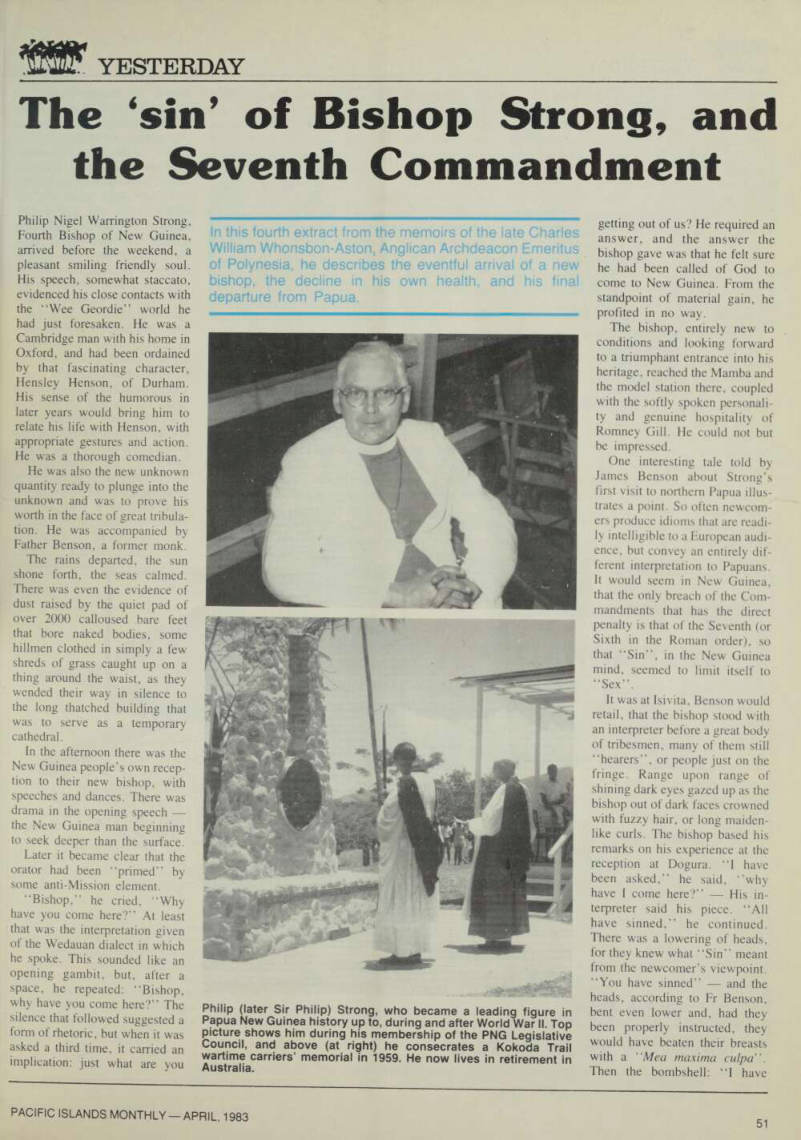
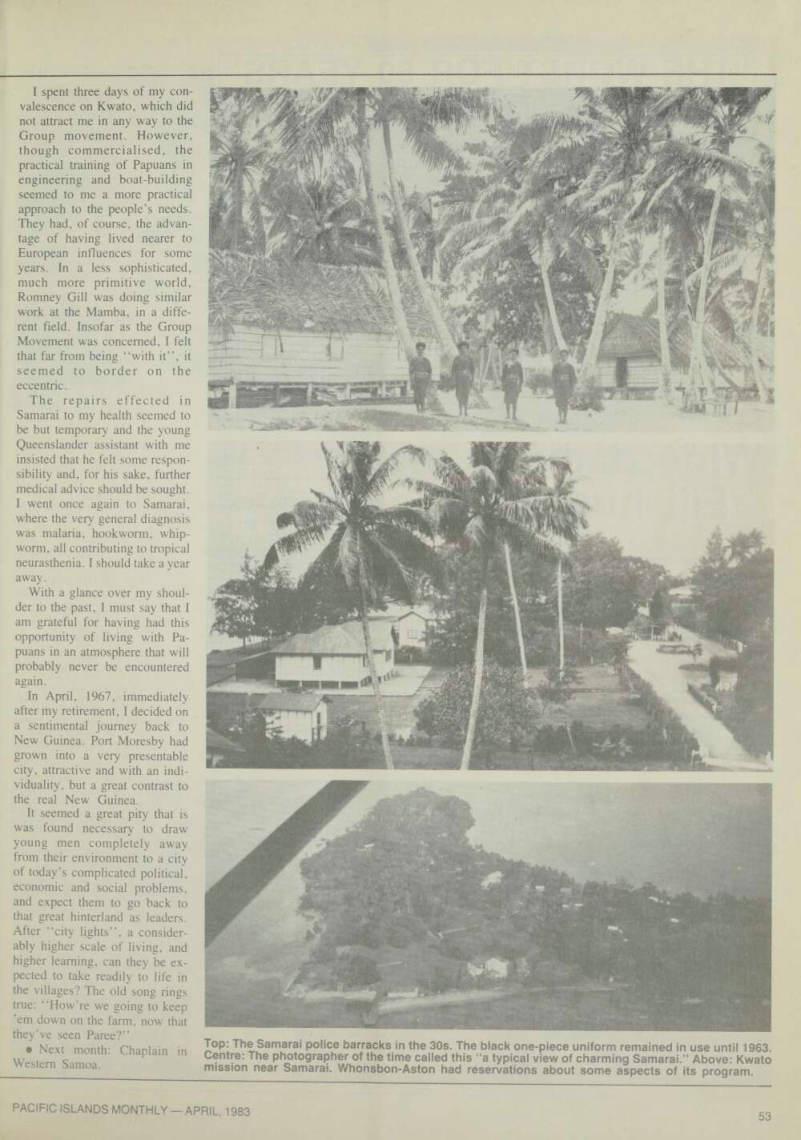
Yesterday
The ‘sin’ of Bishop Strong, and the Seventh Commandment
Philip Nigel Warrington Strong, Fourth Bishop of New Guinea, arrived before the weekend, a pleasant smiling friendly soul.
His speech, somewhat staccato, evidenced his close contacts with the “Wee Geordie” world he had just foresaken. He was a Cambridge man with his home in Oxford, and had been ordained by that fascinating character, Hensley Henson, of Durham.
His sense of the humorous in later years would bring him to relate his life with Henson, with appropriate gestures and action.
He was a thorough comedian.
He was also the new unknown quantity ready to plunge into the unknown and was to prove his worth in the face of great tribula tion. He was accompanied by Father Benson, a former monk.
The rains departed, the sun shone forth, the seas calmed.
There was even the evidence of dust raised by the quiet pad of over 2000 calloused bare feet that bore naked bodies, some hillmen clothed in simply a few shreds of grass caught up on a thing around the waist, as they wended their way in silence to the long thatched building that was to serve as a temporary cathedral.
In the afternoon there was the New Guinea people’s own recep tion to their new bishop, with speeches and dances. There was drama in the opening speech the New Guinea man beginning to seek deeper than the surface.
Later it became clear that the orator had been “primed” by some anti-Mission element.
“Bishop,” he cried, “Why have you come here?” At least that was the interpretation given of the Wedauan dialect in which he spoke. This sounded like an opening gambit, but, after a space, he repeated: “Bishop, why have you come here?” The silence that followed suggested a form of rhetoric, but when it was asked a third time, it carried an implication; just what are you
In this fourth extract from the memoirs of the late Charles William Whonsbon-Aston, Anglican Archdeacon Emeritus of Polynesia, he describes the eventful arrival of a new bishop, the decline in his own health, and his final departure from Papua.
getting out of us? He required an answer, and the answer the bishop gave was that he felt sure he had been called of God to come to New Guinea. From the standpoint of material gain, he profited in no way.
The bishop, entirely new to conditions and looking forward to a triumphant entrance into his heritage, reached the Mamba and the model station there, coupled with the softly spoken personali ty and genuine hospitality of Romney Gill. He could not but
be impressed.
One interesting tale told by James Benson about Strong’s first visit to northern Papua illus trates a point. So often newcom ers produce idioms that are readi ly intelligible to a European audi ence, but convey an entirely dif ferent interpretation to Papuans.
It would seem in New Guinea, that the only breach of the Com mandments that has the direct penalty is that of the Seventh (or Sixth in the Roman order), so that “Sin”, in the New Guinea mind, seemed to limit itself to “Sex”.
It was at Isivita, Benson would retail, that the bishop stood with an interpreter before a great body of tribesmen, many of them still “hearers”, or people just on the fringe. Range upon range of shining dark eyes gazed up as the bishop out of dark faces crowned with fuzzy hair, or long maiden like curls. The bishop based his remarks on his experience at the reception at Dogura. “I have been asked,” he said, “why have I come here?” His in terpreter said his piece. “All have sinned,” he continued.
There was a lowering of heads, for they knew what “Sin” meant from the newcomer’s viewpoint.
“You have sinned” and the heads, according to Fr Benson, bent even lower and, had they been properly instructed, they would have beaten their breasts with a “Mea maxima culpa”.
Then the bombshell: “I have
Philip (later Sir Philip) Strong, who became a leading figure in Papua New Guinea history up to, during and after World War II. Top picture shows him during his membership of the PNG Legislative Council, and above (at right) he consecrates a Kokoda Trail wartime carriers’ memorial in 1959. He now lives in retirement in Australia.
sinned” and every eye shot up at this frank declaration. Then they seemed to shuffle and lose interest . . .
During a visit to Melbourne I was approached by a canon of the cathedral, who as a member of the Australian Board of Mis sions Committee opened with the remarks: “I understand that you need more priests for New Guinea. I know a man who would probably just suit. The only thing that is wrong with him is ...” I stopped him there, asking: “Why do you think that we want people with something wrong with them? Are we sup posed to be a party of misfits or
escapists ‘with something wrong
with us’?”
The same point was raised by Hobart Spiller, the planter at Mukawa. He sat with me on the edge of the government rest house near the beach for a mi nute’s talk. Soliloquising, he re marked: “Do you know I am certain all we outsiders here in New Guinea are mad. I am sure I must be mad. I left a perfectly
good job, with a big future, in Auckland, New Zealand, where today I would have been ‘sitting pretty’. Here I am. Today I’m pushing for some sort of returns with copra at its lowest point (it was selling at about six pounds per ton), the cost of bags is almost more than I get from the products, and I’ve got to get about in a small ship over those rough waters just to get by. lam certain I must be ‘nuts’.” He turned to me with: “As for you missionaries, I am certain you are all mad. Look at yourself.
You could probably hold down a good living wherever you came from, yet you people live on a pittance in sub-standard houses, traipsing miles in mud and slush just for these people, who just are not that appreciative.” Then, with a roguish look, he added: “They tell me you single mis sionaries are provided with plen ty of lime juice to help you to restrain your passions. Isn’t that so?”
I replied: “If you are personal ly in need of plenty of lime juice,
I am afraid I could not supply it.
It has never been on my list.”
Our stores and mail landed, he left us and I could see the little ship tossing up and over the tumbled seas.
My personal diary at this time has many blanks and, looking through the station logbook 30 years later, there are evidences of pages that have been tom out for amendment, records made under stress, and altered later. I had been very unwell: I had been living alone, in terms of the company of fellow Europeans, under circumstances that could give rise to strains. In spite of precautions I was having bouts of malaria, became anaemic and my weight fell to 6 stone 7 lbs (41 kilograms). An attack of gastric malaria prompted me to send a note to my friend the ARM (asis tant resident magistrate) to see if the Una could take me to the Samarai. Next evening, on Palm Sunday, a sea-going launch took me off to Samarai and to the new Samarai Hospital, where I claim the record of being the first pa
tient in the obstetric ward.
The English doctor from Kwato Island Extension Mission was acting as medico in the absence of the government med ical officer. Kwato, founded years earlier by the Rev C. W.
Abel, of cricket fame, on or thodox lines, was now in the hands of his family, Cecil and Russell, and their sister. They were running the place, for the time, on Buchmanist lines, in accordance with the ideas of the Oxford Group Movement, later known as Moral Re-Armament.
They had held cottage meetings in Samarai among the small com
munity, mainly government and
business expatriates, who were getting quite a vicarious thrill out of the “revelations”. The doctor felt that my state was just splen did for a little indoctrination. He
produced an eight-page
brochure, the whole centre spread being taken up by a large group photo of a Group Confer ence held in a posh London hotel. Prominent in the picture was Cecil Abel.
I spent three days of my con valescence on Kwato, which did not attract me in any way to the Group movement. However, though commercialised, the practical training of Papuans in engineering and boat-building seemed to me a more practical approach to the people’s needs.
They had, of course, the advan tage of having lived nearer to European influences for some years. In a less sophisticated, much more primitive world, Romney Gill was doing similar work at the Mamba, in a diffe rent field. Insofar as the Group Movement was concerned, I felt that far from being “with it”, it seemed to border on the eccentric.
The repairs effected in Samarai to my health seemed to be but temporary and the young Queenslander assistant with me insisted that he felt some respon sibility and, for his sake, further medical advice should be sought.
I went once again to Samarai, where the very general diagnosis was malaria, hookworm, whip worm, all contributing to tropical neurasthenia. I should take a year away.
With a glance over my shoul der to the past, I must say that I am grateful for having had this opportunity of living with Pa puans in an atmosphere that will probably never be encountered again.
In April, 1967, immediately after my retirement, I decided on a sentimental journey back to New Guinea. Port Moresby had grown into a very presentable city, attractive and with an indi viduality, but a great contrast to the real New Guinea.
It seemed a great pity that is was found necessary to draw young men completely away from their environment to a city of today’s complicated political, economic and social problems, and expect them to go back to that great hinterland as leaders.
After “city lights”, a consider ably higher scale of living, and higher learning, can they be ex pected to take readily to life in the villages? The old song rings true; “How’re we going to keep ’em down on the farm, now that they’ve seen Paree?” • Next month; Chaplain in Western Samoa.
Top: The Samarai police barracks in the 30s. The black one-piece uniform remained in use until 1963.
Centre: The photographer of the time called this “a typical view of charming Samarai.” Above: Kwato mission near Samarai. Whonsbon-Aston had reservations about some aspects of its program.
Advertisements & other items, p. 52 (1 item)
hunt&baird
1
HERMOWALL
An Insulated Structural Building System that can be
ERECTED ANYWHERE.
The Thermowall system is ideal for • Cold Storage • Mobile Homes • Food Processing • Truck Bodies • Freezer Rooms • Schools • Abattoirs • Dairies • Supermarkets • Hotels • Site Accommodation Please send more free information about your Thermowall.
NAME ———
ADDRESS I :
sh Siorage Sorting K Proc cssing Room Olympic Hunt & Baird provided a Design and Construct “turn key” contract for the Nauru Local Government Council on the island of Nauru, Central Pacific, as illustrated. The whole installation has been fabricated under controlled factory conditions and assembled on site by specialists ensuring minimum erection time.
Olympic Hunt & Baird are winners of the Australian Export Award for outstanding export achievement.
hunt&baird
260 Musgrave Road, Coopers Plains, Queensland 4108 Phone 277 4044 Telex 41214
Fiji hurricane
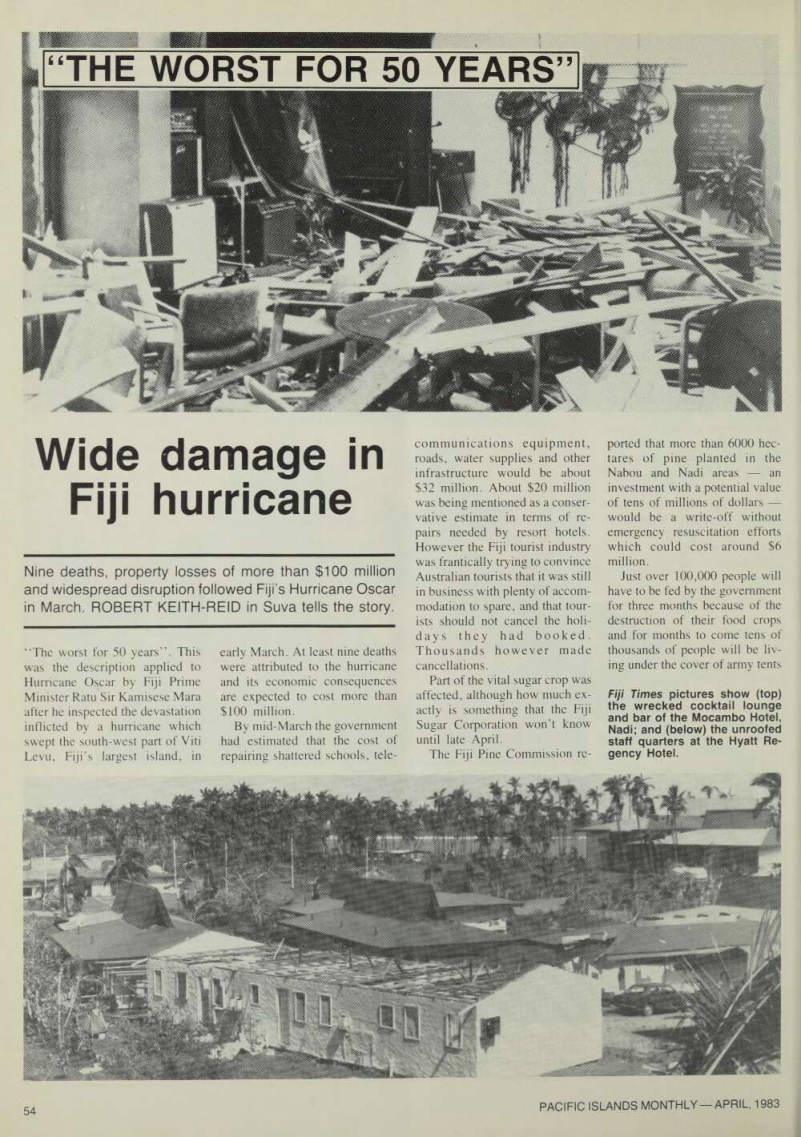
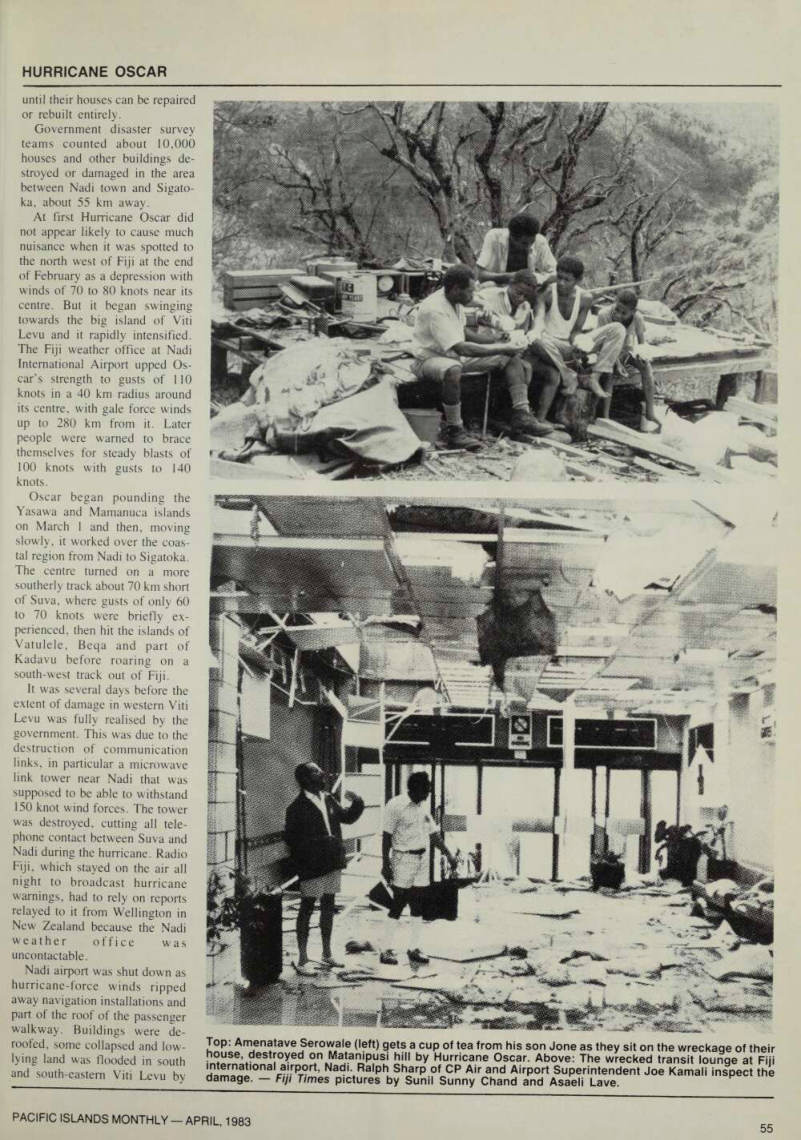
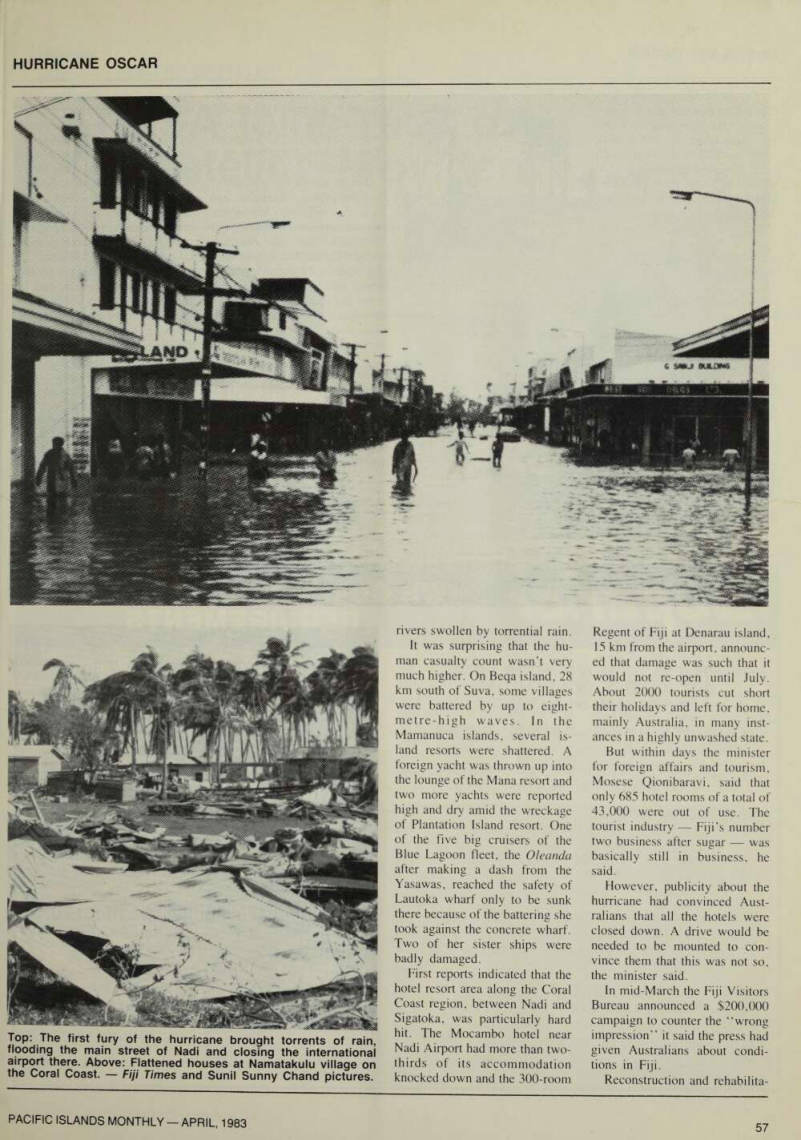
“The Worst For 50 Years”
Wide damage in Fiji hurricane
Nine deaths, property losses of more than $lOO million and widespread disruption followed Fiji’s Hurricane Oscar in March. ROBERT KEITH-REID in Suva tells the story.
“The worst for 50 years”. This was the description applied to Hurricane Oscar by Fiji Prime Minister Ratu Sir Kamisese Mara after he inspected the devastation inflicted by a hurricane which swept the south-west part of Viti Levu, Fiji’s largest island, in
early March. At least nine deaths were attributed to the hurricane and its economic consequences are expected to cost more than $lOO million.
By mid-March the government had estimated that the cost of repairing shattered schools, tele
communications equipment, roads, water supplies and other infrastructure would be about $32 million. About $2O million was being mentioned as a conser vative estimate in terms of re pairs needed by resort hotels.
However the Fiji tourist industry was frantically trying to convince Australian tourists that it was still in business with plenty of accom modation to spare, and that tour ists should not cancel the holi days they had booked.
Thousands however made cancellations.
Part of the vital sugar crop was affected, although how much ex actly is something that the Fiji
Sugar Corporation won’t know
until late April.
The Fiji Pine Commission re
ported that more than 6000 hec tares of pine planted in the Nabou and Nadi areas an investment with a potential value of tens of millions of dollars would be a write-off without emergency resuscitation efforts which could cost around $6 million.
Just over 100,000 people will have to be fed by the government for three months because of the destruction of their food crops and for months to come tens of thousands of people will be liv ing under the cover of army tents
Fiji Times pictures show (top) the wrecked cocktail lounge and bar of the Mocambo Hotel, Nadi; and (below) the unroofed staff quarters at the Hyatt Re gency Hotel.
until their houses can be repaired or rebuilt entirely.
Government disaster survey teams counted about 10,000 houses and other buildings de stroyed or damaged in the area between Nadi town and Sigato ka, about 55 km away.
At first Hurricane Oscar did not appear likely to cause much nuisance when it was spotted to the north west of Fiji at the end of February as a depression with winds of 70 to 80 knots near its centre. But it began swinging towards the big island of Viti Levu and it rapidly intensified.
The Fiji weather office at Nadi International Airport upped Os car’s strength to gusts of 110 knots in a 40 km radius around its centre, with gale force winds up to 280 km from it. Later people were warned to brace themselves for steady blasts of 100 knots with gusts to 140 knots.
Oscar began pounding the Yasawa and Mamanuca islands on March 1 and then, moving slowly, it worked over the coas tal region from Nadi to Sigatoka.
The centre turned on a more southerly track about 70 km short of Suva, where gusts of only 60 to 70 knots were briefly ex perienced, then hit the islands of Vatulele, Beqa and part of Kadavu before roaring on a south-west track out of Fiji.
It was several days before the extent of damage in western Viti Levu was fully realised by the government. This was due to the destruction of communication links, in particular a microwave link tower near Nadi that was supposed to be able to withstand 150 knot wind forces. The tower was destroyed, cutting all tele phone contact between Suva and Nadi during the hurricane. Radio Fiji, which stayed on the air all night to broadcast hurricane warnings, had to rely on reports relayed to it from Wellington in New Zealand because the Nadi weather office was uncontactable.
Nadi airport was shut down as hurricane-force winds ripped away navigation installations and part of the roof of the passenger walkway. Buildings were de roofed, some collapsed and low lying land was flooded in south and south-eastern Viti Levu by
Top: Amenatave Serowale (left) gets a cup of tea from his son Jone as they sit on the wreckage of their house, destroyed on Matanipusi hill by Hurricane Oscar. Above: The wrecked transit lounge at Fiji international airport, Nadi. Ralph Sharp of CP Air and Airport Superintendent Joe Kamali inspect the damage. - Fiji Times pictures by Sunil Sunny Chand and Asaeli Lave.
rivers swollen by torrential rain.
It was surprising that the hu man casualty count wasn’t very much higher. On Beqa island, 28 km south of Suva, some villages were battered by up to eight metre-high waves. In the Mamanuca islands, several is land resorts were shattered. A foreign yacht was thrown up into the lounge of the Mana resort and two more yachts were reported high and dry amid the wreckage of Plantation Island resort. One of the five big cruisers of the Blue Lagoon fleet, the Oleanda after making a dash from the Yasawas, reached the safety of Lautoka wharf only to be sunk there because of the battering she took against the concrete wharf.
Two of her sister ships were badly damaged.
First reports indicated that the hotel resort area along the Coral Coast region, between Nadi and Sigatoka, was particularly hard hit. The Mocambo hotel near Nadi Airport had more than two thirds of its accommodation knocked down and the 300-room
Regent of Fiji at Denarau island, 15 km from the airport, announc ed that damage was such that it would not re-open until July.
About 2000 tourists cut short their holidays and left for home, mainly Australia, in many inst ances in a highly unwashed state.
But within days the minister for foreign affairs and tourism, Mosese Qionibaravi, said that only 685 hotel rooms of a total of 43,000 were out of use. The tourist industry Fiji’s number two business after sugar was basically still in business, he said.
Flowever, publicity about the hurricane had convinced Aust ralians that all the hotels were closed down. A drive would be needed to be mounted to con vince them that this was not so, the minister said.
In mid-March the Fiji Visitors Bureau announced a $200,000 campaign to counter the “wrong impression” it said the press had given Australians about condi tions in Fiji.
Reconstruction and rehabilita-
Top: The first fury of the hurricane brought torrents of rain, flooding the main street of Nadi and closing the international airport there. Above: Flattened houses at Namatakulu village on the Coral Coast. - Fiji Times and Sunil Sunny Chand pictures.
tion will be a major industry until the end of the year. This activity would at least temporarily relieve
unemployment, announced
Prime Minister Ratu Mara in a radio interview.
Outside aid for Fiji was quick
ly forthcoming. Australia and
New Zealand sent helicopters and aircraft to assess damage and
ferry relief supplies. Australia
and the United States, sent tents and water containers for areas where normal supplies of fresh water had been disrupted. A Un ited States military communica tions team flew in to set up temporary communications links and various other countries and international organisations sent money, food and relief supplies.
Hurricane Oscar had one bene ficial effect. It dumped rain in sugar cane areas where drought was beginning to seriously affect the 1983/84 cane harvest and the
Fiji Sugar Corporation hopes that
this will offset the losses expect ed in the Lautoka-Nadi cane areas, which could amount to about ten per cent. Oscar’s rain fall also filled up two lakes form ed behind dams built at Mono savu, in the middle of Viti Levu, and at Vaturu, near Nadi, a month before they had been ex pected to be full following their completion earlier this year.
Engineers said that but for the dams the Monosavu dam is for hydro-electricity and the Vat uru dam is to catch water for the
western districty supply -
flooding might have been much more serious than it was.
Having done its worst, Oscar then brought out the best of Fiji.
Despite their losses, a resilient people, directed by a government disaster reconstruction organisa tion that, with a dozen hurricanes in less than a dozen years on its record sheets is a highly expert one, were quickly getting down to the business of rebuilding their lives again in many cases from scratch.
Hurricane Oscar in Fiji: Waves smash over the Lautoka Wharf road while winds whip the
palms. - Fiji Times picture.
Advertisements & other items, pp. 56-58 (2 items)
neither time nor place...
f r « -V .
v w I * * ■% ■*
*sSSS?®
SMOOTH, MILD CIGARS
/ Corona • Commodore Panatella • Lancers • Tipped Lancers • Panatella W 754
Sup
enar
WE COVER YOUR SLASHING
REQUIREMENTS
SUPPLIERS TO: GOVT. DEPTS, LOCAL
AUTHORITIES, CONTRACTORS
and the MAN on the LAND
QUALITY RIGHT - PRICE RIGHT
EXTRA BOTTOM SEAL PROTECTION IN EVERY MODEL CHECK OUR RANGE OF MACHINES FOR THE
ONE TO SUIT YOUR NEEDS
SLASHER MOWERS
□ 9m L 36 T.P.L. □ 1.06 m L 42 □ 1.22 m L4B ECONOMY SLASHERS 75 h.p Box 55mm Shaft □ 1.22 m LL4 □ 1.14 m LL4.5 □ 1.52 m LLS □ 1.83 m LL6
MULTI PURPOSE SLASHERS
□ 3.05 m LXIO □ 3.05 m TXIO □ 3.66 m x TXI2 □ 6.01 m TX2O □ TX2O □ 7.3 m TX24
HEAVY DUTY SLASHERS SlOO Gear Box
□ 1.52 m LXS □ 1.83 m LX6 □ 2.13 m LX7 □ 4.57 m Trail TXIS ALL UNITS SOLD WITH FULL FACTORY WARRANTY SUPERIOR'S EXTRA SEAL PROTECTION ON EVERY SLASHER.
FROM 36" to 24' (,9m to 7.3 m) r ■ i Tick 0 the machine you are interested in and send this advert for Free brochure to;—
SUPERIOR FARM EQUIPMENT PTY. LTD.
782 Fairfield Road, Yeerongpilly Brisbane. Q. 4105.
Phone (07) 48 5554
NAME
ADDRESS
POSTCODE
Hurricane Oscar
NASA joins race of
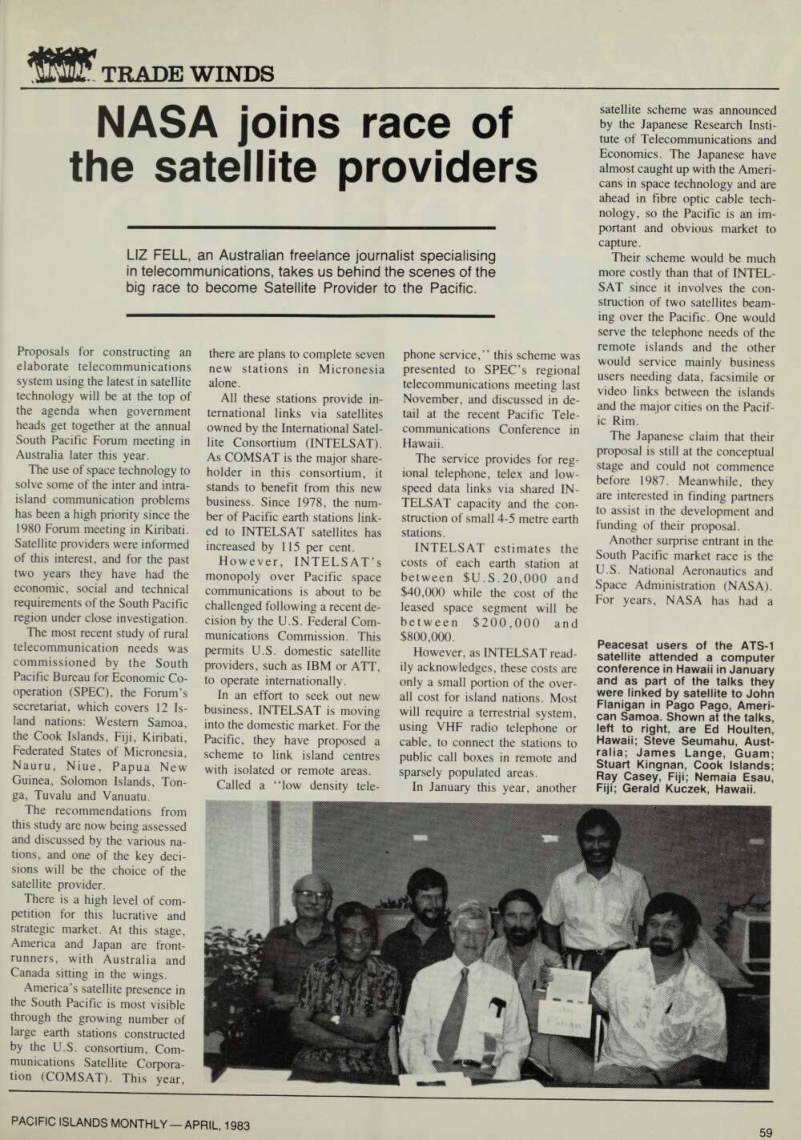
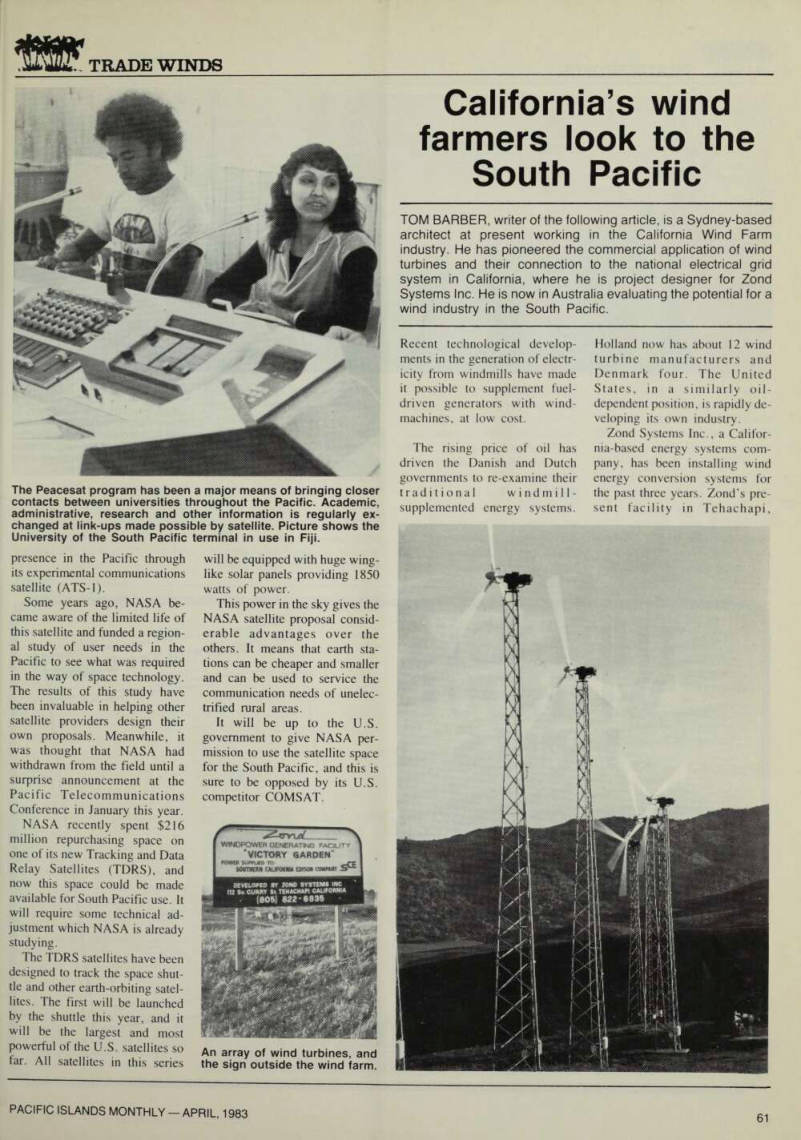
Trade Winds
NASA joins race of the satellite providers
LIZ FELL, an Australian freelance journalist specialising in telecommunications, takes us behind the scenes of the big race to become Satellite Provider to the Pacific.
Proposals for constructing an elaborate telecommunications system using the latest in satellite technology will be at the top of the agenda when government heads get together at the annual South Pacific Forum meeting in Australia later this year.
The use of space technology to solve some of the inter and intra island communication problems has been a high priority since the 1980 Forum meeting in Kiribati.
Satellite providers were informed of this interest, and for the past two years they have had the economic, social and technical requirements of the South Pacific region under close investigation.
The most recent study of rural telecommunication needs was commissioned by the South Pacific Bureau for Economic Co operation (SPEC), the Forum’s secretariat, which covers 12 Is land nations; Western Samoa, the Cook Islands, Fiji, Kiribati, Federated States of Micronesia, Nauru, Niue, Papua New Guinea, Solomon Islands, Ton ga, Tuvalu and Vanuatu.
The recommendations from this study are now being assessed and discussed by the various na tions, and one of the key deci sions will be the choice of the satellite provider.
There is a high level of com petition for this lucrative and strategic market. At this stage, America and Japan are front runners, with Australia and Canada sitting in the wings.
America’s satellite presence in the South Pacific is most visible through the growing number of large earth stations constructed by the U.S. consortium, Com munications Satellite Corpora tion (COMSAT). This year,
there are plans to complete seven new stations in Micronesia alone.
All these stations provide in ternational links via satellites owned by the International Satel lite Consortium (INTELSAT).
As COMSAT is the major share holder in this consortium, it stands to benefit from this new business. Since 1978, the num ber of Pacific earth stations link ed to INTELSAT satellites has increased by 115 per cent.
However, INTELSAT’s monopoly over Pacific space communications is about to be challenged following a recent de cision by the U.S. Federal Com munications Commission. This permits U.S. domestic satellite providers, such as IBM or ATT, to operate internationally.
In an effort to seek out new business, INTELSAT is moving into the domestic market. For the Pacific, they have proposed a scheme to link island centres with isolated or remote areas.
Called a ‘‘low density tele
phone service,” this scheme was presented to SPEC’s regional telecommunications meeting last November, and discussed in de tail at the recent Pacific Tele communications Conference in Hawaii.
The service provides for reg ional telephone, telex and low speed data links via shared IN TELSAT capacity and the con struction of small 4-5 metre earth stations.
INTELSAT estimates the costs of each earth station at between $U.5.20,000 and $40,000 while the cost of the leased space segment will be between $200,000 and
$Boo,Ooo.
However, as INTELSAT read ily acknowledges, these costs are only a small portion of the over all cost for island nations. Most will require a terrestrial system, using VHP radio telephone or cable, to connect the stations to public call boxes in remote and sparsely populated areas.
In January this year, another
satellite scheme was announced by the Japanese Research Insti tute of Telecommunications and Economics. The Japanese have almost caught up with the Ameri cans in space technology and are ahead in fibre optic cable tech nology, so the Pacific is an im portant and obvious market to capture.
Their scheme would be much more costly than that of INTEL SAT since it involves the con struction of two satellites beam ing over the Pacific. One would serve the telephone needs of the remote islands and the other would service mainly business users needing data, facsimile or video links between the islands and the major cities on the Pacif ic Rim.
The Japanese claim that their proposal is still at the conceptual stage and could not commence before 1987. Meanwhile, they are interested in finding partners to assist in the development and funding of their proposal.
Another surprise entrant in the South Pacific market race is the U.S. National Aeronautics and Space Administration (NASA).
For years, NASA has had a
Peacesat users of the ATS-1 satellite attended a computer conference in Hawaii in January and as part of the talks they were linked by satellite to John Flanigan in Pago Pago, Ameri can Samoa. Shown at the talks, left to right, are Ed Houlten, Hawaii; Steve Seumahu, Aust ralia; James Lange, Guam; Stuart Kingnan, Cook Islands; Ray Casey, Fiji; Nemaia Esau, Fiji; Gerald Kuczek, Hawaii.
presence in the Pacific through its experimental communications satellite (ATS-1).
Some years ago, NASA be came aware of the limited life of this satellite and funded a region al study of user needs in the Pacific to see what was required in the way of space technology.
The results of this study have been invaluable in helping other satellite providers design their own proposals. Meanwhile, it was thought that NASA had withdrawn from the field until a surprise announcement at the Pacific Telecommunications Conference in January this year.
NASA recently spent $216 million repurchasing space on one of its new Tracking and Data Relay Satellites (TDRS), and now this space could be made available for South Pacific use. It will require some technical ad justment which NASA is already
studying.
The TDRS satellites have been designed to track the space shut tle and other earth-orbiting satel lites. The first will be launched by the shuttle this year, and it will be the largest and most powerful of the U.S. satellites so far. All satellites in this series
will be equipped with huge wing like solar panels providing 1850 watts of power.
This power in the sky gives the NASA satellite proposal consid erable advantages over the others. It means that earth sta tions can be cheaper and smaller and can be used to service the communication needs of unelec trifled rural areas.
It will be up to the U.S. government to give NASA per mission to use the satellite space for the South Pacific, and this is sure to be opposed by its U.S. competitor COMSAT.
The Peacesat program has been a major means of bringing closer contacts between universities throughout the Pacific. Academic, administrative, research and other information is regularly ex changed at link-ups made possible by satellite. Picture shows the University of the South Pacific terminal in use in Fiji.
An array of wind turbines, and the sign outside the wind farm.
Advertisements & other items, p. 60 (1 item)
We’ve got it all
%% I 0 A The complete freight handling service requires an organization encompassing a daunting assembly of expertise. Stevedoring, through cargo handling, ancillary shipping and packaging services, road haulage, specialised freight handling equipment, complete container facilities, cold storage, full vessel agency are but some of the essential services required.
The Robert Laurie-Carpenters Group of Companies covers all these and more. In fact so comprehensive is the service offered that you are invited to send for the RLC information folio which describes in detail this complete freight handling service. Whether it s sea, land or airfreight RLC have it all wrapped up Robert Laurie-Carpenters Pty. Ltd PO Box 922 Port Moresby Papua New Guinea Telephone; 217324, Telex; NE22107 Branches throughout Papua New Guinea
California’s wind
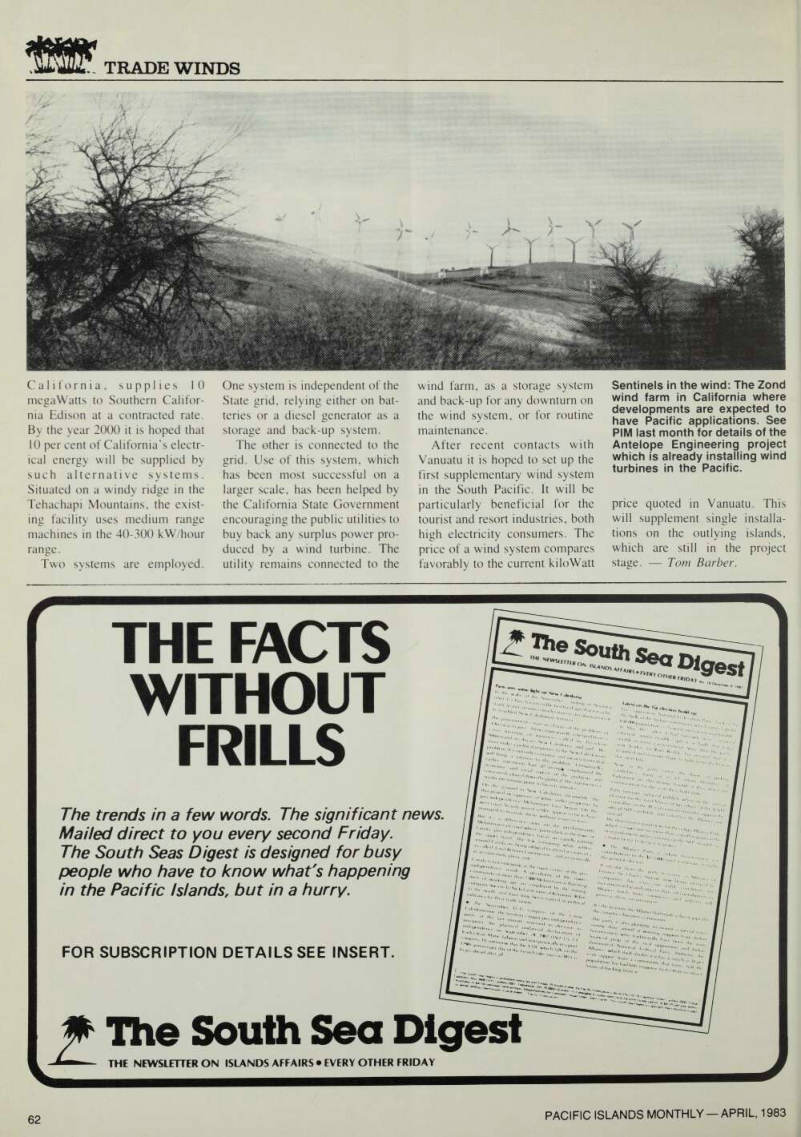
farmers look to the South Pacific
TOM BARBER, writer of the following article, is a Sydney-based architect at present working in the California Wind Farm industry. He has pioneered the commercial application of wind turbines and their connection to the national electrical grid system in California, where he is project designer for Zond Systems Inc. He is now in Australia evaluating the potential for a wind industry in the South Pacific.
Recent technological develop
ments in the generation of electr icity from windmills have made it possible to supplement fuel driven generators with wind machines, at low cost.
The rising price of oil has driven the Danish and Dutch governments to re-examine their traditional windmill supplemented energy systems.
Holland now has about 12 wind turbine manufacturers and Denmark four. The United States, in a similarly oil dependent position, is rapidly de veloping its own industry.
Zond Systems Inc., a Califor nia-based energy systems com pany, has been installing wind energy conversion systems for the past three years. Zond’s pre sent facility in Tehachapi,
California, supplies 10 mega Watts to Southern Califor nia Edison at a contracted rate.
By the year 2000 it is hoped that 10 per cent of California’s electr ical energy will be supplied by such alternative systems.
Situated on a windy ridge in the Tehachapi Mountains, the exist ing facility uses medium range machines in the 40-300 kW/hour range.
Two systems are employed.
One system is independent of the State grid, relying either on bat teries or a diesel generator as a storage and back-up system.
The other is connected to the grid. Use of this system, which has been most successful on a
larger scale, has been helped by
the California State Government encouraging the public utilities to buy back any surplus power pro duced by a wind turbine. The utility remains connected to the
wind farm, as a storage system and back-up for any downturn on the wind system, or for routine maintenance.
After recent contacts with Vanuatu it is hoped to set up the first supplementary wind system in the South Pacific. It will be particularly beneficial for the tourist and resort industries, both high electricity consumers. The price of a wind system compares favorably to the current kilo Watt
price quoted in Vanuatu. This will supplement single installa tions on the outlying islands, which are still in the project
stage.
Tom Barber.
Sentinels in the wind: The Zond wind farm in California where developments are expected to have Pacific applications. See PIM last month for details of the
Antelope Engineering project
which is already installing wind turbines in the Pacific.
Advertisements & other items, p. 62 (1 item)
The Facts
WITHOUT
FRILLS
The trends in a few words. The significant news.
Mailed direct to you every second Friday.
The South Seas Digest is designed for busy people who have to know what's happening in the Pacific Islands, but in a hurry.
FOR SUBSCRIPTION DETAILS SEE INSERT.
The South Sea Digest
THE NEWSLETTER ON ISLANDS AFFAIRS • EVERY OTHER FRIDAY
Yachts
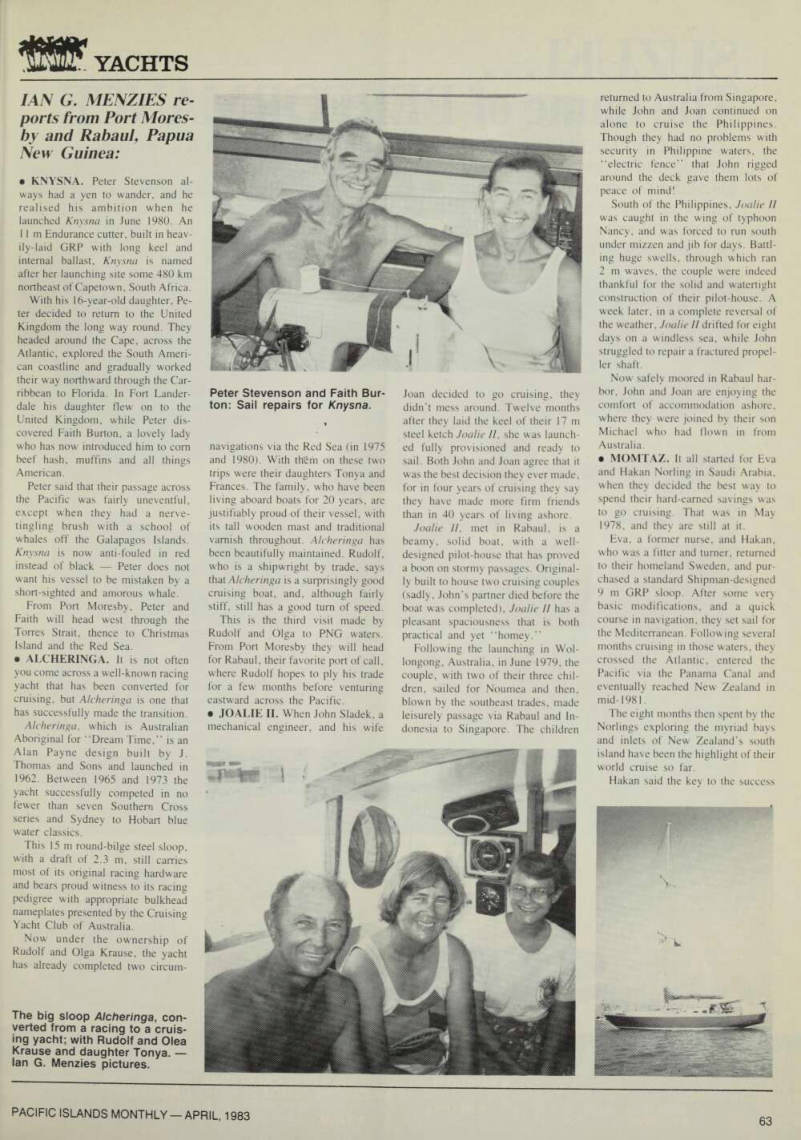
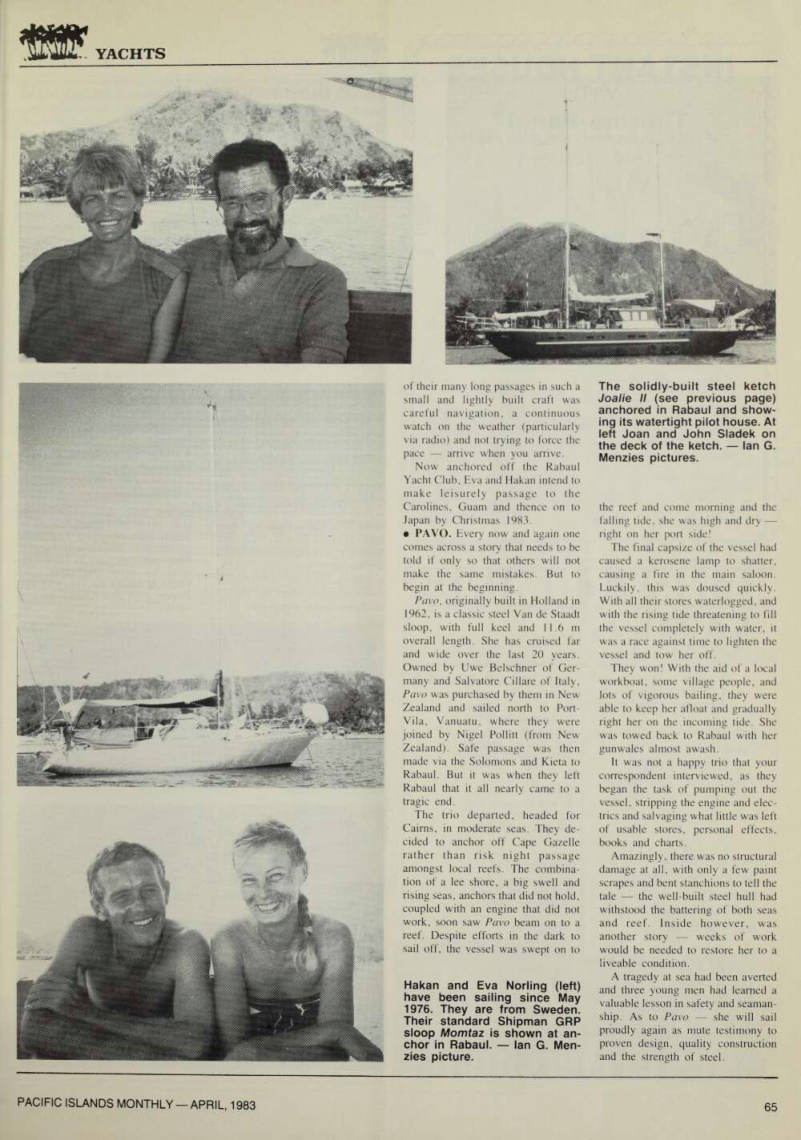
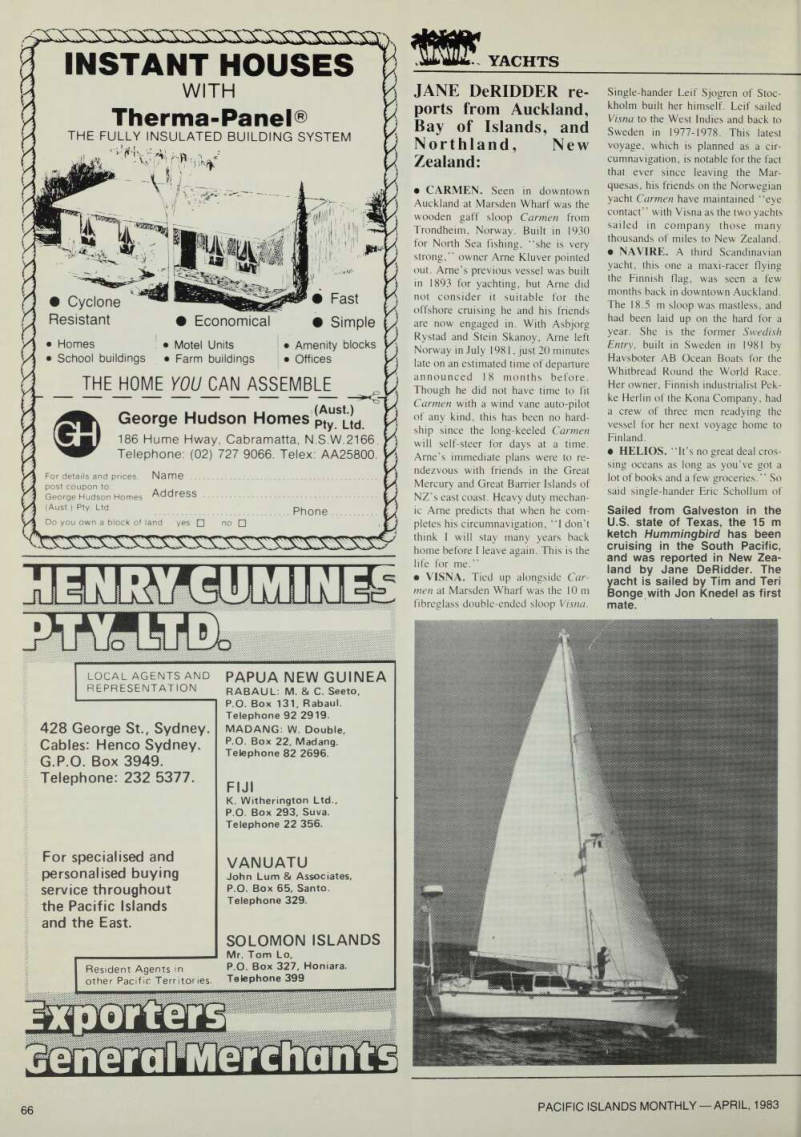
Lan G. Menzies Re
ports from Port Mores
by and Rabaul , Papua
New Guinea:
• KNYSNA. Peter Stevenson al ways had a yen to wander, and he realised his ambition when he launched Knysna in June 1980. An 11 m Endurance cutter, built in heav ily-laid GRP with long keel and internal ballast, Knysna is named after her launching site some 480 km northeast of Capetown, South Africa.
With his 16-year-old daughter, Pe ter decided to return to the United Kingdom the long way round. They headed around the Cape, across the Atlantic, explored the South Ameri can coastline and gradually worked their way northward through the Car ribbean to Florida. In Fort Lander dale his daughter flew on to the United Kingdom, while Peter dis covered Faith Burton, a lovely lady who has now introduced him to com beef hash, muffins and all things American.
Peter said that their passage across the Pacific was fairly uneventful, except when they had a nerve tingling brush with a school of whales off the Galapagos Islands.
Knysna is now anti-fouled in red instead of black Peter does not want his vessel to be mistaken by a short-sighted and amorous whale.
From Port Moresby, Peter and Faith will head west through the Torres Strait, thence to Christmas Island and the Red Sea. • ALCHERINGA. It is not often you come across a well-known racing yacht that has been converted for cruising, but Alcheringa is one that has successfully made the transition.
Alcheringa, which is Australian Aboriginal for “Dream Time,” is an Alan Payne design built by J.
Thomas and Sons and launched in 1962. Between 1965 and 1973 the yacht successfully competed in no fewer than seven Southern Cross series and Sydney to Hobart blue water classics.
This 15 m round-bilge steel sloop, with a draft of 2.3 m, still carries most of its original racing hardware and bears proud witness to its racing pedigree with appropriate bulkhead nameplates presented by the Cruising Yacht Club of Australia.
Now under the ownership of Rudolf and Olga Krause, the yacht has already completed two circum-
navigations via the Red Sea (in 1975 and 1980). With th‘em on these two trips were their daughters Tonya and Frances. The family, who have been living aboard boats for 20 years, are justifiably proud of their vessel, with its tall wooden mast and traditional
varnish throughout. Alcheringa has
been beautifully maintained. Rudolf, who is a shipwright by trade, says
that Alcheringa is a surprisingly good
cruising boat, and, although fairly
stiff, still has a good turn of speed.
This is the third visit made by Rudolf and Olga to PNG waters.
From Port Moresby they will head for Rabaul, their favorite port of call, where Rudolf hopes to ply his trade for a few months before venturing eastward across the Pacific. • JOALIE 11. When John Sladek, a mechanical engineer, and his wife
Joan decided to go cruising, they didn't mess around. Twelve months after they laid the keel of their 17 m steel ketch Joalie 11, she was launch ed fully provisioned and ready to sail. Both John and Joan agree that it was the best decision they ever made, for in four years of cruising they say they have made more firm friends than in 40 years of living ashore.
Joalie 11, met in Rabaul. is a beamy, solid boat, with a well
designed pilot-house that has proved
a boon on stormy passages. Original ly built to house two cruising couples (sadly, John’s partner died before the boat was completed), Joalie II has a pleasant spaciousness that is both
practical and yet “homey.”
Following the launching in Wol longong, Australia, in June 1979, the couple, with two of their three chil dren, sailed for Noumea and then, blown by the southeast trades, made leisurely passage via Rabaul and In donesia to Singapore. The children
returned to Australia from Singapore, while John and Joan continued on alone to cruise the Philippines.
Though they had no problems with
security in Philippine waters, the “electric fence’’ that John rigged around the deck gave them lots of peace of mind!
South of the Philippines, Joalie II was caught in the wing of typhoon Nancy, and was forced to run south under mizzen and jib for days. Battl
ing huge swells, through which ran
2 m waves, the couple were indeed thankful for the solid and watertight construction of their pilot-house. A week later, in a complete reversal of the weather, Joalie II drifted for eight days on a windless sea, while John
struggled to repair a fractured propel
ler shaft.
Now safely moored in Rabaul har bor, John and Joan are enjoying the comfort of accommodation ashore, where they were joined by their son Michael who had flown in from Australia. • MOMTAZ. It all started for Eva and Hakan Norling in Saudi Arabia, when they decided the best way to spend their hard-earned savings was to go cruising. That was in May 1978, and they are still at it.
Eva, a former nurse, and Hakan, who was a fitter and turner, returned to their homeland Sweden, and pur chased a standard Shipman-designed 9 m GRP sloop. After some very basic modifications, and a quick course in navigation, they set sail for the Mediterranean. Following several months cruising in those waters, they crossed the Atlantic, entered the Pacific via the Panama Canal and eventually reached New Zealand in mid-1981.
The eight months then spent by the
Norlings exploring the myriad bays
and inlets of New Zealand’s south island have been the highlight of their world cruise so far.
Hakan said the key to the success
The big sloop Alcheringa, con verted from a racing to a cruis ing yacht; with Rudolf and Olea Krause and daughter Tonya. - Ian G. Menzies pictures.
Peter Stevenson and Faith Bur ton: Sail repairs for Knysna.
of their many long passages in such a small and lightly built craft was careful navigation, a continuous watch on the weather (particularly via radio) and not trying to force the pace arrive when you arrive.
Now anchored off the Rabaul Yacht Club. Eva and Hakan intend to make leisurely passage to the Carolines, Guam and thence on to
Japan by Christmas 1983.
• PAVO. Every now and again one comes across a story that needs to be told if only so that others will not make the same mistakes. But to begin at the beginning.
Pavo, originally built in Holland in 1962, is a classic steel Van de Staadt sloop, with full keel and 11.6 m overall length. She has cruised far and wide over the last 20 years.
Owned by Uwe Belschner of Ger many and Salvatore Cillare of Italy, Pavo was purchased by them in New Zealand and sailed north to Port- Vila, Vanuatu, where they were joined by Nigel Pollitt (from New Zealand). Safe passage was then made via the Solomons and Kieta to Rabaul. But it was when they left Rabaul that it all nearly came to a tragic end.
The trio departed, headed for Cairns, in moderate seas. They de cided to anchor off Cape Gazelle rather than risk night passage amongst local reefs. The combina tion of a lee shore, a big swell and rising seas, anchors that did not hold, coupled with an engine that did not work, soon saw Pavo beam on to a reef. Despite efforts in the dark to sail off, the vessel was swept on to
the reef and come morning and the falling tide, she was high and dry right on her port side!
The final capsize of the vessel had caused a kerosene lamp to shatter, causing a fire in the main saloon.
Luckily, this was doused quickly.
With all their stores waterlogged, and with the rising tide threatening to fill the vessel completely with water, it was a race against time to lighten the vessel and tow her off.
They won! With the aid of a local workboat, some village people, and lots of vigorous bailing, they were able to keep her afloat and gradually right her on the incoming tide. She was towed back to Rabaul with her gunwales almost awash.
It was not a happy trio that your correspondent interviewed, as they began the task of pumping out the vessel, stripping the engine and elec trics and salvaging what little was left of usable stores, personal effects, books and charts.
Amazingly, there was no structural damage at all, with only a few paint scrapes and bent stanchions to tell the tale the well-built steel hull had withstood the battering of both seas and reef. Inside however, was another story weeks of work would be needed to restore her to a liveable condition.
A tragedy at sea had been averted and three young men had learned a valuable lesson in safety and seaman ship. As to Pavo she will sail proudly again as mute testimony to
proven design, quality construction
and the strength of steel.
Hakan and Eva Norling (left) have been sailing since May 1976. They are from Sweden.
Their standard Shipman GRP sloop Momtaz is shown at an chor in Rabaul. - Ian G. Men zies picture.
The solidly-built steel ketch Joalie II (see previous page) anchored in Rabaul and show ing its watertight pilot house. At left Joan and John Sladek on the deck of the ketch. - Ian G.
Menzies pictures.
Jane Deridder Re
ports from Auckland,
Bay of Islands, and
Northland, New
Zealand:
• CARMEN. Seen in downtown Auckland at Marsden Wharf was the wooden gaff sloop Carmen from Trondheim, Norway. Built in 1930 for North Sea fishing, “she is very strong,” owner Ame Kluver pointed out. Ame’s previous vessel was built in 1893 for yachting, but Ame did not consider it suitable for the offshore cruising he and his friends are now engaged in. With Asbjorg Rystad and Stein Skanoy, Ame left Norway in July 1981, just 20 minutes late on an estimated time of departure announced 18 months before.
Though he did not have time to fit Carmen with a wind vane auto-pilot of any kind, this has been no hard ship since the long-keeled Carmen will self-steer for days at a time.
Ame’s immediate plans were to re ndezvous with friends in the Great Mercury and Great Barrier Islands of NZ’s east coast. Heavy duty mechan ic Ame predicts that when he com pletes his circumnavigation, “I don’t think I will stay many years back home before I leave again. This is the life for me.” • VISNA. Tied up alongside Car men at Marsden Wharf was the 10 m fibreglass double-ended sloop Visna.
Single-hander Leif Sjogren of Stoc kholm built her himself. Leif sailed Visna to the West Indies and back to Sweden in 1977-1978. This latest voyage, which is planned as a cir cumnavigation, is notable for the fact that ever since leaving the Mar quesas, his friends on the Norwegian yacht Carmen have maintained “eye contact” with Visna as the two yachts sailed in company those many thousands of miles to New Zealand. • NAVIRE. A third Scandinavian yacht, this one a maxi-racer flying the Finnish flag, was seen a few months back in downtown Auckland.
The 18.5 m sloop was mastless, and had been laid up on the hard for a year. She is the former Swedish Entry, built in Sweden in 1981 by Havsboter AB Ocean Boats for the Whitbread Round the World Race.
Her owner, Finnish industrialist Pek ke Herlin of the Kona Company, had a crew of three men readying the vessel for her next voyage home to Finland. • HELIOS. “It’s no great deal cros sing oceans as long as you’ve got a lot of books and a few groceries. ’ ’ So said single-hander Eric Scholium of
Sailed from Galveston in the U.S. state of Texas, the 15 m ketch Hummingbird has been cruising in the South Pacific, and was reported in New Zea land by Jane DeRidder. The yacht is sailed by Tim and Teri Bonge with Jon Knedel as first mate.
Waiheke Island, New Zealand, after a virtually non-stop 71-day voyage home from San Diego. (He paused for two hours in Borabora to take on water.) Eric arrived in Auckland on Helios, his 16-year-old 10.6 m Piver Lodestar trimaran, having sailed 31,000 miles in 19 months. He had interrupted his scheduled circum navigation when he learned his mother was dying, arriving home in time to spend Christmas, 1982 with her and with his children. When visiting Sausalito in the San Francis co Bay, area Helios was vandalised.
It took Eric three days to clean up the mess. But, worst of all, all his cam era gear was stolen, a tragedy for one whose potential major source of in come comes from photo-joumalism.
Eric hopes to get away again before too long, westward bound this time.
“I can’t go ashore again for any length of time,” he explained. “I’ve only slept ashore once in four or five years . . . and never slept of course • REVELLER. After less than a week in New Zealand, the UK Nicholson 32 Reveller of Ramsgate was due to leave Auckland for the Falklands Islands, an estimated eight weeks voyage of some 6500 miles, in an attempt to round the Horn before the season is too far advanced. The owner/skipper Charles Crawshaw is a Lancashire sheep and cattle farmer.
Crewing with him are Tony Lawson, mechanical engineer, and Devon inn keeper Angela Herbert. Angela, co proprietor with her husband of the Norway Inn in Falmouth, wrote a booklet telling of Reveller’s proposed circumnavigation. The booklet is be ing sold in conjunction with a car raffle, the proceeds of which are being donated to cancer research.
People all over the UK follow with interest the adventures of Reveller.
She is scheduled to arrive back home in Falmouth in October ’B3 after a two years cruise. • OCEAN GIRL. When the Van couver Maple Leaf 48 Ocean Girl arrived in Suva two years ago, Don Tiflin, marine geophysicist with the
Canadian Geological Survey, was
offered a post with CCOP/SOPAC a branch of the UN technical sec retariat engaged in offshore evalua tion of the South Pacific’s sea floor mineral potential. Don accepted a two-year contract and Ocean Girl, a comfortable 14.6 m Huntingford designed yacht, family-built to per fectionist standards, made the Tradewinds in Suva its base. Caro lyn, Don's wife and first mate, was hired to teach Home Economics and English at the University of the South Pacific in Suva. Daughter Gwendo lyn rejoined the Ocean Girl last December in Auckland having com pleted her sixth form at a school in
Masterton, New Zealand. Fourteen year-old Kathleen just finished her fourth form year in Suva, while Gillian, eldest of the Tiflin daugh ters, is back in Vancouver. After a family Christmas and a refit in Auck land, the balsa core vessel which the Tiflins spent eight years building together Don calls it “A one-off backyard job” will sail back to Suva. Don plans on one more year with SOPAC before Ocean Girl’s cruise of the South Pacific continues.
Meanwhile, he enjoys the opportuni ty of exploring the Pacific Islands which his job provides. • DELIVERANCE. A former Roy al Yacht of Monaco, the gaff schoon er Deliverance was a splendid sight as she tied up at Opua Wharf to clear New Zealand customs, a long red pennant streaming from her masth ead. Built in 1956 as a yacht by Quincy Adams Shipyard near Bos ton, she is a copy of a grand Banks schooner. The hull is African mahogany on double-sawn oak frames. Instead of cargo holds, there are staterooms. David and Lonny Higgins of Boston, the ship’s fifth owners, bought Deliverance in 1979 with an extended circumnavigation in mind. The Higgins cruise with no
fixed itinerary, accompanied by their
two children, David, nine, and Jessi ca, five. They like to stay long enough to learn the history of each area visited and to make friends wherever they go. They read a great deal about each port of call. The children do their schooling by Cal vert correspondence lessons. David and Lonny take turns supervising their children’s studies. David, Bos ton attorney, one-time instructor in legal writing and former nagivation officer aboard a U.S. naval frigate, has a novel underway. Lonny, MD, specialist in obstetrics and gynaecol ogy, accepted a position in the New Zealand National Women’s Hospital during Deliverance’s stay in Auckland.
A vessel of Deliverance’s type and size she’s 25 m on deck, 29 m overall requires a sizeable crew in order to keep abreast of maintenance, and of course for sail handling. De liverance is self-sufficient; she car ries a chief mate, ship's carpenter, engineer, bo’s’n, cook, and steward or stewardess, all highly qualified.
(Right) Breeze shows her paces in the Russell Tall Ships Race.
The brigantine is sailing out of New Zealand ports. (Above right). The former Monaco royal yacht Deliverance, a gaff schooner, was “a splendid sight" on her arrival in New Zealand, reports Jane DeRidder.
highly motivated, young people. The crew take a pride in such traditional arts as scrimshaw, carving, knotwork and woodwork. Though Deliverance
is primarily a family cruising vessel,
she does occasional educational/ad venture charters. Future cruising plans include a visit to the People’s
Republic of China tentatively
scheduled for December 1983. • BREEZE. The Russell Tall Ships Race in the Bay of Islands on January 9 was a treat for those who love clouds of canvas. Tall ships taking part with other, less lofty but faster yachts in the light wind which pla gued the race were the training ship Spirit Of Adventure, the gaff schoon er Deliverance, Austrian artist Frederick Hundertwasser’s striped sailed Regentag, and the 16.5 m brigantine Breeze. Breeze a copy of a 19th-century New Zealand coaster, designed, built and sailed by the Sewell family of the Coromandel, is now making regular trips from Auck land and the Bay of Islands accom panied by members of the Breeze Sailing Club, a charitable trust. Club members are entitled to sail on the traditional square-rigged vessel for a small charge to cover cost of the trip plus maintenance. Captain Jim Cot tier is serving as master of Breeze, with young Peter Sewell, first mate, and his sister Janet, cook. Visitors to Northland. NZ. may direct inquiries to the Secretary of the Devenport Steam Ferry Company of Auckland’s North Shore (P.O. Box 1346, Auck land) for information regarding club membership and scheduled adventure
sailings.
• Cloud Nine. A U K.-Built,
Minneapolis-registered Bowman 57 ketch. Cloud Nine arrived in Opua in January seven days out from Suva with six persons aboard. Her owner, Minnesota com/soy bean/hog/cattle farmer, Roger Swanson, who sails with sons Steven and Philip and friends, attributes the salt water in his blood to a stint in the navy. The Swansons left Miami in July, 1981.
From N.Z. they plan on visiting Australia, then Japan before continu
ing a circumnavigation.
• SKOIERN 111. Capsized and dis masted west of Cape Horn in 55 to 60 knot winds and enormous seas, Skoiern /// was one of the particip ants in a single-handers’ round-the world race. Jacques de Roux began to cut the rigging free, but while still partly attached, the mast holed the boat. Though Jacques tried to plug the hole, water continued to flood in, and he had to hand pump for two hours out of every three. Never theless, he jury-rigged the vessel in an effort to get underway again.
Another single-handed race particip
ant, British entry Perseverance of Medina, made a rendezvous with the
sinking yacht near 55 degrees south,
126 degrees west, took Jacques aboard and continued on course at eight knots. The French navy sent a 20-knot vessel to intercept Persever ance, fetch Jacques and take him to Papeete. The encounters at sea were
made possible by Argos navigation
systems pinpointing the yachts’ posi
tions, and by amateur radio operators serving as relay stations. Those ham radio operators involved in arranging the “lift-off” on 14.347 mHz were Finn ZL4HI, with fellow South Island operators ZL4MK and ZL4JO; also FOBGM in Papeete; and FKBED mm Alain Martel on yacht Tropic Bird in New Caledonia. • TROPIC BIRD. Well known to their fellow cruising yachtsmen be cause of their frequent help on vari ous South Pacific maritime mobile nets, Alain and Gisele Martel (FKBED/mm) have been sailing ab out the Pacific on their Nicholson 38 Tropic Bird for several years now.
Frequent visitors to New Zealand and New Caledonia, the French couple plan to return to French Polynesia in a few months time, an area they cruised first in the early 1970 s in their previous yacht, Paihere of
Toulon, a Nicholson 32. Like amateur radio operator John Ander son on Norfolk Island (VK9JA) Alain transforms morse-coded weather reports into weather charts, a skill which has earned him the sobri quet, “the walking weatherfax.” • GANESH. This 16.7 m schooner with masts of equal height tied up briefly in the Kerikeri Stone Store Basin in January after an Auckland haulout and refit. Built and registered in Venice, Italy, in 1981, Ganesh is a CCYD 55 owned by Giorgio Villa, a dealer in precious metals, who man ages to fly in to join the vessel for about four weeks each year. Villa’s parents were aboard in New Zealand.
Ganesh is sailed by skipper Gavin Prescott and Sarah Fenwick, crew.
They are to leave for Tonga in April.
It was Ganesh and her crew who were instrumental in salvaging the
Bermuda-registered Tyler 42 Titanic
when she was holed and stranded on
Beveridge Reef last year. They pick
ed up the owner in Niue, returned to Beveridge Reef, patched and re floated Titanic after which she was sailed to Niue for further repairs. • SIROCCO. “A family adven ture” is how Ed and Patti Nichols describe cruising on their customised hardtop CT 54 which they had spe
dally built in Taiwan. Ed supervised the construction with several flying visits to the Taiwan yard. Sirocco is now homeward bound at an average speed of 1600 km a week after a year and a half in the South Pacific. The
Nichols left Opua in early February,
harnessing fresh westerlies to sail via the Australs to Papeete. Accompany ing their parents are Liz, 20. and Matt, 18, a football player who keeps fit with weight-lifting while cruising.
Capper, 22, was left in Fiji to return
to college studies. The family keeps
in touch with him by means of amateur radio phone patches. (Ed’s call sign is WB3FGA). Sirocco is due back in the U.S. in June. It’s back to work for Ed, a political consultant in Washington, D.C., for the Republican party. Ed was among the pioneers who introduced the com
puter into politics. Though they plan
on selling Sirocco after their arrival in the U.S.. Patti, who describes herself as “a suburban Maryland housewife”, says she hopes it won’t
be long before they are cruising
again: “Once you’ve been cruising it’s hard to give it up,” she says. The
couple previously cruised the
Bahamas, Central America, and the Galapagos on Faith Jones, their 14.6 m North Sea ketch.
Advertisements & other items, pp. 64-70 (2 items)
Suzuki
The name of PERFORMANCE
SUZUKI OUTBOARDS are truly ALL ROUND PERFORMER... reliable, durable and economical under any situation.
SUZUKI prepared outboards line up exclusively for the usage of professionals, and of course, also for the pleasure. Each has different construction respectively, so that you can choose your engine that is best suited to your boat and usage.
Get the fruitful life through SUZUKI OUTBOARDS. ! m St * rrn r i * «* I’ 1 \ "r 16 types from 2ps to 140ps
SUZUKI
SUZUKI *
SUZUKI MOTOR CO., LTD. Hamamatsu, Japan SUZUKI GENERATOR 2500 A • NEW ZEALAND SOUTH PACIFIC SUZUKI DISTRIBUTORS LTOWONE, 58-599> •PAPUA NEW ' HI SPKD aKEL SERVICE PTY.LTD. PHONE:42-2679 *FIJI NIRANJANS AUTOPORT LTD.PHONE: 38; 555 AUTOMOTO PHON • SOLOMON SOLOMON ISLAND PHONE: 565 •VANUATU HENRI LEROUX •NEW CALEDONIA STE SULCAL PHONE 27206? ► AMBRIAN SAMOA PACIFIC PRODUCTS, INC; PHONE: 639-9140 • WESTERN SAMOA VATCO LT_a *®UAM [ISLAND CYCLERY.IN, 3 HONE: 565-2298 «NIUE BURNS PHILP CO., LTD. • NAURU EQUIPAC MOTORS PHONE: 4019 •TONGA TONGA EQUIPMENT ► YAP AMBROSE «KOROR BECHESRRAK T. COMPANY PHONE: 338 *TRUK KIOMASA STORE PHONE: 470
INSTANT HOUSES R
WITH
Therma-Panel®
THE FULLY INSULATED BUILDING SYSTEM
n t. u n A ** > • Cyclone Resistant ''Vn’, K-ft . •» ' » ?;"•* \h 1 |s • Homes • Economical Motel Units t Amenity blocks Offices School buildings • Farm buildings
THE HOME YOU CAN ASSEMBLE
George Hudson Homes s {j d . 186 Hume Hway, Cabramatta, N.5.W.2166 Telephone: (02) 727 9066. Telex: AA25800.
Phone
LOCAL AGENTS AND PAPUA NEWGU I N E A
REPRESENTATION RABAUL: M. & C. Seeto,
P.O. Box 131, Rabaul.
Telephone 92 2919.
MADANG: W. Double, P.O. Box 22, Madang.
Telephone 82 2696.
FIJI
K. Witherington Ltd., P.O. Box 293, Suva.
Telephone 22 356.
428 George St., Sydney.
Cables: Henco Sydney.
G.P.O. Box 3949.
Telephone: 232 5377.
For specialised and
personalised buying
service throughout
the Pacific Islands and the East.
VANUATU
John Lum & Associates, P.O. Box 65, Santo.
Telephone 329.
SOLOMON ISLANDS
Mr. Tom Lo, Resident Agents in P-O- Box 327, Honiara. other Pacific Territories. Telephone 399 1 1 e
Komatsu Makes a Difference
m
ItJfiir
I i ■ m > ns r-* \ 'S a In critical areas like reliability and performance, Komatsu products and systems are making a significant difference at mining and construction sites around the world.
In the USA, for example, Komatsu’s largest and most powerful work machine the D455A bulldozer is establishing a superior record of reliability and productivity at mining sites that virtually no other machine in its class can match.
And in another critical area, technology, Komatsu is also making a difference in responding to market demands for improved product quality, and for new and original product innovations.
Consider our new computerized seabed robot system: Operating on the ocean floor, it can relay TV pictures of the seabed to a mother ship, or perform man-like boring, drilling and piling operations down to planned depths of 500 meters* Discover the Komatsu difference above sea level, or down to depths of 500 meters. Komatsu a name you can build on.
•H KOMATSU LTD.
Tokyo, Japan Komatsu offices: Tokyo, Sydney, Singapore, Jakarta, Manila, Bangkok, Bangalore, Karachi, Beijing, Istanbul, Cairo, Alger, Dubai, Tehran, Baghdad, Jeddah, Riyadh, Damman, Nairobi, Abidjan, Lagos, Johannesburg, Moscow, Warsaw, Brussels, Paris, Madrid, Frankfurt, Stuttgart, London, Habana, Buenos Aires, Panama, Caracas, Sao Paulo, Bogota, Mexico City, San Francisco, Oakland, Philadelphia, Detroit, Dallas, Atlanta, Chicago, Toronto, Vancouver, and distributors in over 100 countries around the world. % -
In Technology
i f m ■: ■ * ♦ The Komatsu seabed robot system is currently operating in the Japan Inland Sea at depths down to a max.mumTf 70 meters, ,n a government-sponsored bridge works program
4 B
GLOBAL SERVICE FOR SHIPPERS
1
THE
LINE
28 Day Service
United Kingdom and Continent to:
PAPEETE • NOUMEA
PAPUA NEW GUINEA and SOLOMON ISLANDS
PORT VILA & SANTO BY TRANSHIPMENT
* United Kingdom and Continent to: SUVA AND LAUTOKA (FCL LCL & UNITISED ONLY) * Papua New Guinea and Solomon Islands to:
UNITED KINGDOM and CONTINENT
For particulars apply:
THE BANK LINE (AUSTRALASIA) PTY. LTD.
Suite 801, 51 Pitt Street Sydney 2000. Australia. Tel: 272041. Tlx: 24063.
69
THE THREE FACES
(From Page 14)
PACIFIC ISLANDS MONTHLY —APRIL, 1983
YACHTS
Shipping Schedules
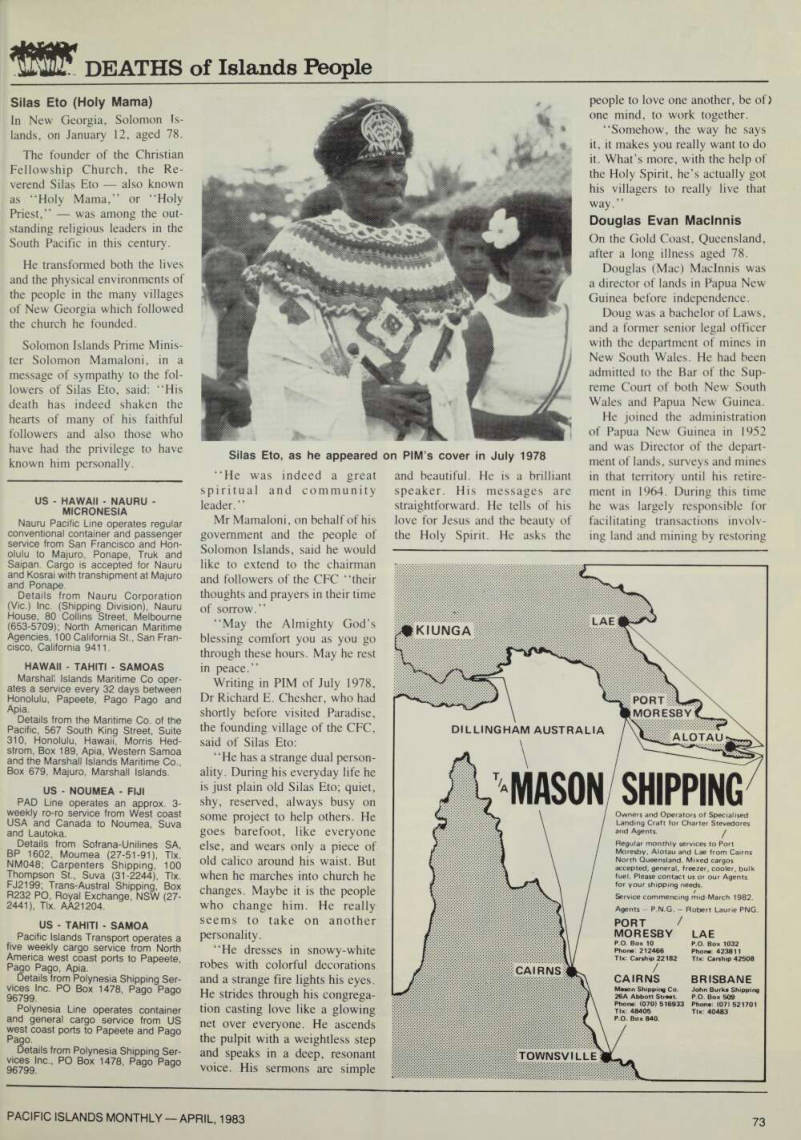
Shipping
Should any shipping company wish to have its services cargo and passen ger included in these listings they should contact PIM.
Australia - Fiji
Karlander (Aust) Pty. Ltd. operates monthly cargo services from Sydney to Suva and Lautoka.
Details from Karlander (Aust) Pty.
Ltd., 19-31 Pitt Street, Sydney (232- 1011), Dalgety Shipping, 460 Bourke Street, Melbourne (616-6700). Burns Philp (SS) Co. Ltd., Suva and Lautoka.
Sofrana-Unilines (Fiji Express Line) operates to Suva and Lautoka every two weeks from the main ports on the east coast of Australia and monthly to Lautoka from Melbourne and Sydney.
Details from Sofrana-Unilines, 19 Pitt Street, Sydney (27-9851), Trans- Austral Shipping Pty.Ltd., 570 Bourke Street, Melbourne (67-9162); ACTA Pty. Ltd., Brisbane (221-3116); Elders- ANL Pty. Ltd., Port Adelaide (47-5688); ANL Newcastle (049-24364); Cle ments and Marshall, Burnie, Tasmania (31-1833), Carpenters Shipping, 100 Thomson St., Suva, Fiji (312-244), Tlx 2199 FJ.
Australia - Samoas - Tonga
Warner Pacific Lines operates a re gular cargo service from Sydney to Nukualofa, Pago Pago, Apia and Vavau.
Details from Hetherington Wesfar mers Shipping Agency, 37-49 Pitt Street, Sydney (27-1671).
Australia - New Caledonia -
Fiji - Samoas - Tonga
Pacific Forum Line operates a fully containerised service (general, reefer and ro-ro) from Sydney to Noumea, Lautoka, Suva, Apia, Pago Pago, Nukualofa, Sydney. Cargo centralised from Adelaide, Melbourne, Brisbane.
Details from Pacific Forum Line, Sydney: Union Bulkships, Sydney, Brisbane and Melbourne; SATO, Noumea, Union Company, Lautoka, Suva and Nukualofa; Pacific Forum Line, Apia.
Australia - Lord Howe Is -
Norfolk Is
Compagnie des Chargeurs Caledo
niens operates four-weekly cargo ser vice Sydney - Lord Howe Island and Norfolk Island.
Details: Hetherington Wesfarmers Shipping Agency, 37-49 Pitt Street,
Sydney (27-1671).
Australia - Kiribati
Karlander operates a 5/6 weekly ser vice from Melbourne and Sydney to Kiribati (Tarawa).
Details: Karlander (Aust) Pty. Ltd., 19-31 Pitt Street, Sydney (232-1011).
Australia - Nauru - Kiribati
Nauru Pacific Line operates regular cargo/passenger service from Mel bourne to Nauru and Tarawa.
Details: Nauru Corporation (Vic.) Inc. (Shipping Division), Nauru House, 80 Collins Street. Melbourne (653-5709).
Nedlloyd Swire, 8 Spring Street, Syd ney (2-0522).
Australia - New Caledonia
(And Or) Vanuatu
Sofrana-Unilines ships serve Noumea every two weeks from the main ports along the east Australian coast.
Details from Sofrana-Unilines, 19 Pitt Street, Sydney (27-9851), Trans- Austral Shipping Pty. Ltd., 570 Bourke Street, Melbourne (67-9162), ACTA
Pty. Ltd., Brisbane (221-3116), Elders- ANL Pty. Ltd., Port Adelaide (47-5688), ANL, Newcastle (049-24364), Cle ments & Marshall, Burnie, Tasmania (31-1833).
Compagnie des Chargeurs Caledo niens operates a three-weekly con tainerised cargo service from Sydney to Noumea.
Details Hetherington Wesfarmers Shipping Agency, 37-49 Pitt Street, Sydney (27-1671).
Compagnie Generale Maritime oper ates a monthly service from Sydney to Noumea, Port Vila and Santo, for con tainerised and break bulk cargo.
Details Compagnie Generale Maritime, 12 Castlereagh Street, Syd ney (231-3700).
Australia - Nz - Fiji -
Hawaii - Us
P&O liners call at Auckland, Suva, Pago Pago and Honolulu on east bound and westbound voyages bet ween Sydney and the US.
Details from P&O Booking Centre, World Travel Headquarters Pty.Ltd., 33 Bligh Street, Sydney (237-0333).
AUSTRALIA - NZ - FIJI - TONGA -
Vanuatu - New Caledonia -
Solomons - Samoas - New
Guinea
Sitmar Cruises operates a year round cruise program to include most of the above countries.
Details from Sitmar Cruises, 47 Elizabeth Street, Sydney (232-7511).
AUSTRALIA - NZ - FIJI - TONGA -
Vanuatu - New Caledonia -
Solomons - Samoas - Tahiti
P&O liners call at Auckland, Bay of Islands, Honiara, Lautoka, Noumea, Nukualofa, Pago Pago, Papeete, Port Moresby, Santo, Savusavu, Suva, Vavau and Vila on cruises from Australia.
Details from P&O Booking Centre, World Travel Headquarters Pty. Ltd., 33 Bligh Street, Sydney (237-0333).
Australia - Nz - Solomons -
Png
Pacific Forum Line operates con tainerised and general cargo service from Lyttleton, Napier and Auckland to Honiara, Lae, Port Moresby, Brisbane.
Details from Pacific Forum Line, Au
ckland: Steamships Shipping, Port
Moresby: Sullivans Ltd., Honiara.
Australia - New Zealand -
Pacific Islands - South East
Asia - China
Minghua Cruises operates cruise services from Sydney to Hawaii, Tahiti and most Pacific ports, with several cruises to South East Asia, including Japan, the Philippines, Singapore, Hongkong and China.
Details Minghua Cruises, 7 Bridge Street, Sydney, NSW, 2000 (2-0547), Burns Philp Travel offices in Melbourne (62-0151), Brisbane (31-0391), Darwin (81-2871), Auckland NZ (31-544); Na tional Bank Travel in Adelaide (212- 7347) and Perth (320-9365).
Australia - Micronesia
Nauru Pacific Line operates a regu lar container service from Melbourne to Majuro, Kosrae, Ponape, Truk, Guam and Saipan.
Details Nauru Corporation (Vic.) Inc. (Shipping Division), Nauru House, 80 Collins Street, Melbourne, (653-5709), Nedlloyd Swire, 8 Spring Street, Syd ney (2-0522).
Australia - Tuvalu
Karlander operates a three monthly service from Sydney and Melbourne to Tuvalu (Funafuti).
Details from Karlander (Aust.) Pty.
Ltd., 19-31 Pitt Street, Sydney (232- 1011).
Australia - Png
Karlander New Guinea Line’s cargo vessels call at Melbourne, Sydney, Port Moresby, Lae, Madang, Wewak, Manus, Kimbe, Rabaul, Popondetta.
Details from Karlander (Aust.) Pty.
Ltd., 19-31 Pitt Street, Sydney (232- 1011), Dalgety Shipping, 460 Bourke Street, Melbourne (616-6700).
Australia - Png - Solomons
A consortium of Conpac, NGAL/PNGL have three container ves sels operating on a 28 day turn-around from Melbourne, Sydney and Brisbane to Port Moresby, Lae, Rabaul, Kavieng, Wewak, Madang, Kieta and Honiara.
Details from Burns, Philp & Co. Ltd., 51 Pitt Street, Sydney (2-0547) and Interocean Swire, 8 Spring Street, Syd ney (2-0522).
New Guinea Express Lines operates a fortnightly container service from Melbourne, Sydney, Brisbane to Port Moresby, Lae, Alotau, Kimbe, Rabaul, Kiuta, Honiara.
Details from New Guinea Express Lines, PO Box R 73, Royal Exchange, Sydney (241-3991); New Guinea Ex press Lines, 127 Creek Street, Bris bane (221-9333); New Guinea Express Lines, 327 Collins Street, Melbourne (61-3053); Niugini Express Lines, Port Moresby (21-4572); Lae (42-1536); Rabtrad Niugini Pty. Ltd., Rabaul (92- 2911) and Kieta (95-6185); Alotau Stevedoring & Transport, Alotau (61- 1318); Ngatia Wholesalers Pty, Ltd., Kimbe (93-5102); and Trading Com pany, Mendana Avenue, Honiara (588).
Sofrana-Unilines (PNG Line) oper ates a monthly service to Port Moresby and Lae, from main ports on the east coast of Australia.
Details from Sofrana-Unilines, 19 Pitt Street, Sydney (27-9851); Trans- Austral Shipping Pty. Ltd., 570 Bourke Street, Melbourne (67-9162); ACTA Pty. Ltd., Brisbane (221-3116); Elders ANL Pty. Ltd., Port Adelaide (47-5688).
Australia - Tahiti
Compagnie Generale Maritime oper ates a monthly service from Sydney to Papeete for containerised and break bulk cargo.
Details Compagnie Generale Maritime, 12 Castlereagh Street, Syd ney (231-3700).
Australia - Tahiti - Us
Karlander operates a monthly cargo service from Melbourne and Sydney to Papeete, US west coast.
Details: Karlander (Aust.) Pty. Ltd. 19-31 Pitt Street, Sydney (232-1011).
Australia - Nz - West Coast
South America
South Pacific Seaboard Service of fers a regular cargo service from Bris bane, Sydney, Adelaide and Mel bourne to New Zealand ports Lyttleton and Tauranga and to the west coast of South America, calling at Beu’ventura, Guayaquil, Cailao and other ports on inducement.
Details from South Pacific Seaboard Service agents, Meridian Shipping & Transport Agencies, 50 Clarence Street, Sydney (290-1633), Tlx 25970; Melbourne (67-5907); Brisbane (267- 6355); Adelaide (47-6600); Ocean bridge Shipping Ltd., 22 Emily Place, Auckland (33-279). Tlx 60523; lan Tay lor Y Cia Ltd a, Prat 827 Of. 301, Valparaiso, Chile (59096), Tlx. 30331.
SINGAPORE - HONG KONG - FIJI -
Islands Ports
Kyowa Shipping Co. Ltd. operates a monthly service from Singapore, Hon g Kong to Lautoka, Suva and then to island ports.
Details from Carpenters Shipping, 100 Thompson Street, Suva, (312- 244), Tlx FJ2199.
Far East - Fiji - New
Zealand
New Zealand Unit Express (NZUE) operates a monthly palletised cargo service from Manila, Keelung, Ka oshiung and Hongkong to Lautoka, Suva and thence to NZ.
Details from Carpenters Shipping, 100 Thompson Street, Suva (312-244), Tlx Fj2199, Burns Philp, Suva (311- 777) P&O S.N. Co. Wellington (736- 477) or Nedlloyd Swire Pty. Ltd., Syd ney (20-522).
Nedlloyd operates bi-weekly cargo service with four ships from Sourabaya, Jakarta, Bangkok, Port Kelang and Singapore to Suva, Lauto ka and NZ ports.
Details from Nedlloyd (Aust.) Pty.
Ltd., 8 Spring St., Sydney (27-3801), Burns Philp (SS) Co. Ltd., Suva and Lautoka.
Far East - Mid-S. Pacific
China Navigation's New Guinea Pacific Line operates a regular contain er service from Hongkong, Taiwan, Manila, Port Kelang and Singapore to Port Moresby, Lae, Rabaul and Honia ra monthly and to Wewak, Madang and Kieta every three months. Cargo from the same Far Eastern ports to the South Pacific ports of Noumea, Santo, Vila, Papeete, Pago Pago, Apia, Rarotonga and Tarawa will be shipped via Japan on the monthly Bali Hai service.
Details from Steamships Trading Co.
Ltd., P.O. Box 1, Port Moresby (22- 0222).
Kyowa Shipping Ltd., operates monthly services from Japan to Guam, Saipan, Solomons, New Caledonia, Fi ji, Western and American Samoa, Tahiti, Cook Is. Tonga and Vanuatu.
Details: Hetherington Wesfarmers Shipping Agency, 37-49 Pitt Street, Sydney (27-1671); Carpenters Ship ping, Suva (312-244), Tlx FJ2199.
Japan - Fiji - Island Ports
Kyowa Shipping Co. Ltd., operates a monthly service from main ports of Japan to Suva and Lautoka and thence to island ports.
Details from Carpenters Shipping, 100 Thompson St., Suva (312-244), Tlx FJ2199.
Japan - Fiji - Island Ports
Bali Hai service operates a monthly service from main ports of Japan to Suva and Lautoka and thence to island ports.
Details from Carpenters Shipping, 100 Thompson St., Suva (312-244), Tlx FJ2199 and Burns Philp, Suva (311-777).
Japan - Micronesia
The NYK Shipping Line operates a monthly cargo service from Japan to Micronesia, calling at Yoko, Nagoya, Kobe, Guam, Saipan, Truk, Ponape and Majuro, returning via Yoko, Nagoya and Kobe.
Details from Burns, Philp & Co. Ltd., 51 Pitt Street, Sydney (2-0547).
Japan - Png
Mitsui O.S.K. Lines operates a monthly service from main ports Japan and Port Moresby, Rabaul, Lae, Madang, Kieta and Kimbe.
Details from Robert Laurie (PNG)
Pty. Ltd., PO Box 922, Port Moresby (21-2466/21-1898).
New Caledonia - Fiji - West
Coast North America
PAD Line operates an approx. 3weekly ro-ro service with Noumea and Suva to Honolulu and West Coast USA and Canadian ports.
Details from Sofrana-Unilines SA, BP 1602, Noumea (27-51-91), Tlx NMO4B; Carpenters Shipping, 100 Thompson St., Suva (312-244), Tlx FJ2199.
Png - Inter - Mainport
Papua New Guinea Line offers scheduled 10/20 day coastal liner ser vices linking all PNG major ports with containerisation, reefer, heavy lift and transhipment facilities.
Details from PNG Line, Box 543, Port Moresby, PNG (21-1174), Tlx 22269.
Png- Uk/Continent
The Bank Line operates regular car go service from Port Moresby, Oro Bay, Kieta, Rabaul, Kimbe, \Madang and Lae to Hull, Hamburg, Rotterdam, Antwerp and Le Havre.
Details from The Bank Line (A’asia) Pty. Ltd., 51 Pitt Street, Sydney (27- 2041); Burns Philp (PNG) Ltd. PNG ports.
Solomons - Uk/Continent
The Bank Line operates regular car go service from Honiara to Hull, Ham burg, Rotterdam, Antwerp and Le Havre.
Details from The Bank Line (A’asia) Pty. Ltd., 51 Pitt Street, Sydney (27- 2041); Tradco Shipping (588).
NZ - COOK IS - NIUE - TAHITI Shipping Corporation of NZ Ltd. op erates cargo services based on pallets and similar units from Auckland to Niue, Cook Islands and Tahiti.
Details from the Shipping Corp. of NZ Ltd., PO Box 3420, Auckland (797- 210). Waterfront Commission, PO Box 61, Raratonga; Cook Islands; Niue Govt. Offices, Niue Island Compagnie Maritime Polynesienne, BP 368, Papeete, Tahiti.
New Zealand - Tahiti
Pacifique Polynesie Line operates a monthly service carrying general and freezer cargoes to Papeete and outly ing islands in the group.
Details from McKay Shipping Ltd., PO Box 1372, Auckland, (30229), Tlx 2554 NZ.
Nz - Fiji
Reef operates a regular 18-day ser vice from Auckland to Suva and Lautoka.
Details from Reef Shipping Agen cies, PO Box 3382, Auckland, NZ (77- 1221-3); M.V. Fijian Shipping Agencies Ltd., Private Bag, Suva, Fiji (31-1056).
Pacific Line with one ship operates fortnightly ro-ro cargo service New Zealand, Lautoka, Suva.
Details; Sofrana Unilines, 18 Cus toms Street, Auckland (773-279) PO Box 3614, Telex: NZ2313; Carpenters Shipping, 100 Thompson Street, Suva (312-244), Tlx FJ2199.
NZ - FIJI - NORTH AMERICA (WC) Blue Star Line Ltd. Pacific Coast container services. Only direct service to and from New Zealand. Blue Star
vessels call at Suva and Honolulu on NZ-US-West Coast voyages.
Details from Blueport ACT (NZ) Ltd., PO Box 192, Wellington (739-029).
Burns Philp (SS) Co. Ltd., GPO Box 355, Suva, Fiji (311-777), Tlx. FJ2168 Burship.
NZ - FIJI - SAMOAS - TONGA Pacific Forum Line operates a fully containerised three-weekly service (Gen/Reefer) from Auckland to Lauto ka, Suva, Apia, Pago Pago and Nuku’alofa.
Details from Pacific Forum Line, Au ckland: Union Co. Auckland, Lautoka, Suva and Nuku’alofa: Pacific Forum Line, Apia.
NZ - N. CALEDONIA - VANUATU -
Png - Solomons
Sofrana Unilines with three ships operates to Vila and Santo, to Honiara and Papua New Guinea and to Norfolk Island and Noumea.
Details from Sofrana Unilines, 18 Customs Street, Auckland (773-279), PO Box 3614, Tlx. NZ2313.
Nz Tahiti
Compagnie Tahitienne Maritime SA (as CTM-Tahiti Line) operates one ship, MV Bounty 111, monthly Papeete New Zealand.
Details from Sofrana Unilines, PO Box 3614, 18 Customs St., Auckland Tlx NZ2313; Agence Maritime Cowan, PO Box 9012, Papeete (39042), Tlx Tahitlin 322 FP Tahiti).
Nz - Tonga - Samoas
Warner Pacific Line services Auck land, Nuku’alofa, Vavau, Apia, Pago Pago fortnightly carrying general and freezer cargoes.
Details from McKay Shipping Ltd., Downtown House, 21 Queen St., Auck land, PO Box 1372 (30-299). Cables MACSHIP, Telex NZ2554, Warner Pacific Line, Box 93, Nuku’alofa, Ton ga; Mealelei (Western Samoa) Ltd.
Box 4171, Apia, Western Samoa, Kneubuhl Maritime Services, Box 39, Pago Pago, American Samoa, 96799.
Nz - New Caledonia
CP Line operates a monthly cargo service from Auckland, Lyttelton, Napier and Mt. Maunganui to Noumea.
Details from McKay Shipping Ltd., PO Box 1372, Auckland (9-30229); Tlx 2554 NZ.
Europe - Tahiti -
New Caledonia
Compagnie Generale Maritime oper ates services from Europe and Mediterranean ports to Papeete and Noumea using three ro-ro and multi purpose vessels thus ensuring a bi monthly sailing to and from.
Details Compagnie Generale Maritime, 12 Castlereagh Street, Syd ney (231-3700).
Europe - Tahiti - New
Caledonia - New Zealand -
Solomons - Png - Europe
Polish Ocean Lines offers regular monthly sailings for containerised and breakbulk cargo and reefer space, con ventional and in reefer containers, from Hamburg, Antwerp, Dunkirk and Rouen to Papeete, Noumea, New Zea land, Honiara, Lae, returning to Europe via Suez. Other ports in the South Pacific can be served with inducement.
Details from Sotama, BP 9170, Papeete (27805), Tlx. 296; SATO, BP C 2, Noumea (272094), Tlx. 163 NM SATO: Union Steamship Co of NZ, PO Box 50, Apia, Tlx. 25; Williams and Gosling, PO Box 79, Suva (312633), Tlx. 2163; Warner Pacific Line, PO Box 93, Nuku’alofa (21089), Tlx. 66219;
Universal Shipping Agencies, PO Box 2282, Auckland (30930), Tlx. 21517.
EUROPE - TAHITI - W. SAMOA -
Fiji - N. Caledonia
Nedlloyd offers regular cargo ser vices from Northern Europe and U K. to Papeete, Apia, Fiji and New Caledonia.
Details Nedlloyd (Aust.) Pty. Ltd., 8 Spring Street, Sydney (27-3801); Car penters Shipping, 100 Thomson St., Suva (312-244), Tlx. 2199 FJ and Vetari Street, Lautoka (63988), Tlx. 5215FJ.
EUROPE - TAHITI - W. SAMOA - TONGA - FIJI - SOLOMONS - PNG -
Vanuatu
Columbus Line Reederei GMBH op erates regular services from Hamburg, Hull, Rotterdam, Antwerp, Dunkirk, Le Havre, to Papeete, Apia, Suva, Lauto ka, Noumea, Port Moresby, Lae, Hon iara, Kieta, Rabaul, Lae, and return to Europe.
Details from Columbus Overseas Services Pty. Ltd., 333 George Street, Sydney (290-2966). Columbus Maritime Service, 17 Albert Street, Au ckland (77-3460); Carpenters Ship ping, 100 Thompson St., Suva (312- 224), Tlx. 2199 FJ.
Uk - N. Continent - Fiji
The Bank Line operates a regular cargo service from Hull, Hamburg, Bre men, Antwerp, Rotterdam and Le Havre to Suva and Lautoka.
Details from The Bank Line (A'asia) Pty. Ltd., 51 Pitt Street, Sydney (27- 2041); Burns Philp (South Sea) Co.
Ltd., Suva and Lautoka.
UK - N. CONTINENT - PNG -
Solomons
The Bank Line operates a regular cargo service from Hull, Hamburg, Bre men, Antwerp, Rotterdam and Le Havre to Port Moresby, Lae, Madang, Kimbe, Rabaul, Kieta and Honiara and on inducement to Yandina.
Details from The Bank Line (A’sia) Pty. Ltd., 51 Pitt Street, Sydney (27- 2041); Burns Philp (PNG) Ltd. PNG ports; Tradco Shipping (588).
Uk/N. Continent - Tahiti -
N. Caledonia
The Bank Line operates a regular cargo service from Hull, Hamburg, Bre men, Antwerp, Rotterdam and Le Havre to Papeete and Noumea.
Details from The Bank Line (A'asia) Pty. Ltd., 51 Pitt Street, Sydney (27- 2041); Ets A M. Fare UTE, Papeete; Ets. Ballande, Noumea.
US - FIJI - TAHITI - NZ -
Australia
The Bank Savill Line Ltd. operates regular cargo services from U.S. Gulf ports to Australia and N.Z. Calls at Suva, Lautoka and Papeete on demand.
Details from The Bank and Savill Line Ltd., 51 Pitt Street, Sydney (27- 2041) or Orient Shipping Services, 32 Bridge Street, Sydney (241-2753).
U.S. - Hawaii - Kiribati -
Micronesia
Philippines, Micronesia & Orient Navigation Co. (PM&O Lines) operates regular container service on selfsus tained ship with ro-ro capabilities from Oakland, Portland and Honolulu to Tarawa, Ebeye, Majuro, Kosrae, Ponape, Truk, Saipan, Yap and Koror.
Details for Micronesia can be ob tained from Larry Guerrero, PM&O Owners Rep. PO Box 803, Saipan, Ml 96950, Cable COMMONTIME, Tlx 783605; PM&O: PM&O Lines, 181 Fremont St., San Francisco, California 94-105, Cable PMONAV,
Us - Hawaii - Nauru -
Micronesia
Nauru Pacific Line operates regular conventional container and passenger service from San Francisco and Hon olulu to Majuro, Ponape, Truk and Saipan. Cargo is accepted for Nauru and Kosrai with transhipment at Majuro and Ponape.
Details from Nauru Corporation (Vic.) Inc. (Shipping Division), Nauru House, 80 Collins Street, Melbourne (653-5709); North American Maritime Agencies, 100 California St., San Fran cisco, California 9411.
Hawaii - Tahiti - Samoas
Marshall Islands Maritime Co oper ates a service every 32 days between Honolulu, Papeete, Pago Pago and Apia.
Details from the Maritime Co. of the Pacific, 567 South King Street, Suite 310, Honolulu, Hawaii, Morris Hed strom, Box 189, Apia, Western Samoa and the Marshall Islands Maritime Co., Box 679, Majuro, Marshall Islands.
Us - Noumea - Fiji
PAD Line operates an approx. 3weekly ro-ro service from West coast USA and Canada to Noumea, Suva and Lautoka.
Details from Sofrana-Unilines SA, BP 1602, Moumea (27-51-91), Tlx.
NMO4B; Carpenters Shipping, 100 Thompson St., Suva (31-2244), Tlx.
FJ2199; Trans-Austral Shipping, Box R 232 PO, Royal Exchange, NSW (27- 2441), Tlx. AA21204.
Us - Tahiti - Samoa
Pacific Islands Transport operates a five weekly cargo service from North America west coast ports to Papeete, Pago Pago, Apia.
Details from Polynesia Shipping Ser vices Inc. PO Box 1478, Pago Pago 96799.
Polynesia Line operates container and general cargo service from US west coast ports to Papeete and Pago
Pago.
Details from Polynesia Shipping Ser vices Inc., PO Box 1478, Pago Pago 96799.
Advertisements & other items, p. 72 (1 item)
Tahiti Samoa
PACIFIC ISLANDS
TRANSPORT LINE
M.V. SIRIUS
EXPRESS
CONTAINER
•REEFER
SERVICE
between U.S.
West Coast ports and
TAHITI SAMOA
JUUL
Qeqeral Steeuriship (Corpora tiori /n> General Agents 400 California Street, San Francisco, CA, USA PAPEETE: Agence Maritime Internationale, Tahiti PAGO PAGO; Polynesia Shipping Services, Inc.
APIA: Burns Phi Ip (South Sea) Company, Ltd.
DEATHS of Islands People
Silas Eto (Holy Mama)
In New Georgia, Solomon Is lands, on January 12, aged 78.
The founder of the Christian Fellowship Church, the Re verend Silas Eto also known as “Holy Mama,” or “Holy Priest,” was among the out standing religious leaders in the South Pacific in this century.
He transformed both the lives and the physical environments of the people in the many villages of New Georgia which followed the church he founded.
Solomon Islands Prime Minis ter Solomon Mamaloni, in a message of sympathy to the fol lowers of Silas Eto, said; “His death has indeed shaken the hearts of many of his faithful followers and also those who have had the privilege to have known him personally.
“He was indeed a great spiritual and community leader.’’
Mr Mamaloni, on behalf of his government and the people of Solomon Islands, said he would like to extend to the chairman and followers of the CFC “their thoughts and prayers in their time of sorrow.”
“May the Almighty God’s blessing comfort you as you go through these hours. May he rest in peace.”
Writing in PIM of July 1978, Dr Richard E. Chesher, who had shortly before visited Paradise, the founding village of the CFC, said of Silas Eto: “He has a strange dual person ality. During his everyday life he is just plain old Silas Eto; quiet, shy, reserved, always busy on some project to help others. He goes barefoot, like everyone else, and wears only a piece of old calico around his waist. But when he marches into church he changes. Maybe it is the people who change him. He really seems to take on another personality.
“He dresses in snowy-white robes with colorful decorations and a strange fire lights his eyes.
He strides through his congrega tion casting love like a glowing net over everyone. He ascends the pulpit with a weightless step and speaks in a deep, resonant voice. His sermons are simple
and beautiful. He is a brilliant speaker. His messages are straightforward. He tells of his love for Jesus and the beauty of the Holy Spirit. He asks the
people to love one another, be of > one mind, to work together.
“Somehow, the way he says it, it makes you really want to do it. What’s more, with the help of
the Holy Spirit, he’s actually got
his villagers to really live that
way.”
Douglas Evan Maclnnis On the Gold Coast, Queensland, after a long illness aged 78.
Douglas (Mac) Maclnnis was a director of lands in Papua New Guinea before independence.
Doug was a bachelor of Laws, and a former senior legal officer with the department of mines in New South Wales. He had been admitted to the Bar of the Sup reme Court of both New South Wales and Papua New Guinea.
He joined the administration of Papua New Guinea in 1952 and was Director of the depart ment of lands, surveys and mines in that territory until his retire ment in 1964. During this time he was largely responsible for facilitating transactions involv
ing land and mining by restoring
Silas Eto, as he appeared on PIM’s cover in July 1978
a registry which had suffered as a result of the Pacific War.
As chairman of the Land, Pet
roleum Advisory and Mining
Advisory Boards he played no small part in ensuring that per mits were controlled and granted only to those genuinely searching for oil or minerals, and his work in this regard would have been of inestimable value to the now
independent nation.
Mr Maclnnis, who was a for mer member of the Legislative and Executive Councils of both the Northern Territory and the Territory of Papua New Guinea, served with the A.I.F. from 1940-46, attaining the rank of Lt.-col. as C.O. of the 2/4 Pioneer Bn.
In 1960 he was honored by Her Majesty the Queen when he was awarded the 0.8. E. W.
W. Watkins.
Lance-Corporal Leone Natubecule In Lautoka, Fiji, on February 19 aged 42.
L/Cpl. Natubecule joined the territorial battalion in 1963. He was in one of the first contin gents to serve in the peace keeping force in Lebanon in 1978. Apart from his part-time military career, L/Cpl.
Natubecule was a shipping offic er at Union Maritime Ltd, where he’d worked for 17 years.
Ratu Josua Ketonivere In Labasa, Fiji, on February 21
from a heart attack, aged 74.
The Tui Tui Macuata, Ratu Josua Ketonivere was a direct descendant of one of the 13 high chiefs of Fiji who signed the Deed of Cession to Great Britain in Levuka in 1874.
Sister Mary Patrick In New Zealand on February 6 from cancer, aged 77.
Sister Patrick first went to Samoa as a teacher in 1936. She worked for Lepua/St Francis School, American Samoa, for 22 years, then for 18 years in West ern Samoa at primary and secon dary schools. In September 1982, Sister Patrick went to New Zealand for a health check-up and it was discovered that she had cancer.
Advertisements & other items, p. 73 (1 item)
Mason Shipping
LAE
KIUNGA
PORT A**
MORESBY
DILLINGHAM AUSTRALIA
ALOTAU
MASON SHIPPING
Service commencing mid-March 1982.
Agents - P.N.G. - Robert Laurie PNG
PORT /
MORESBY
P.O. Box 10 Phone: 212466 Tlx: Carship 22182
LAE
P.O. Bo* 1032
Phone: 423811 Tlx: Carship 42508 /
CAIRNS
CAIRNS
BRISBANE
Mason Shipping Co. 26A Abbott Street.
Phone: (070) 516933 Tlx: 48405 John Burke Shipping P.O. Box 509 Phone; (07) 521701 Tlx: 40483 P.O, Box 840
TOWNSVILLE
Advertising
Index
Aggie Grey’s 74 Air New Zealand 20 Aiwa 46 Amatil 56 Antelope Engineering 36 Aust. National University ... 32 Aust. Trade Commissioner... 4 Bank Line 70 Besco Jarwil 40 British Aerospace 13 Bumiputra Bank 48 Citizen Watches 76 Clarion Shoji 50 Commonwealth Secretariat... 8 God's Way 74 Hawaii Rock Systems 24 Henry Cumines 66 Hitachi 26 Honda 2 Hudson Homes 58 Komatsu 68 Mason Shipping 66 Matsushita National 16 McDonnell Douglas 18 New Zealand Dairy Board... 30 Olympic Hunt and Baird 52 Pacific Pump Co 74 Papua Hotel 74 Peter Fisher Trading 74 Pioneer 34 P.I.T. Line 72 QBE Insurance 44 R. Lawrie-Carpenters 60 Superior Farm 62 Suva Sails 74 Suzuki Marine 64 Suzuki Motor 75
Teac 42
Toyota 38 Water Wheel Exports 28
Advertisements & other items, pp. 74-76 (1 item)
At Last!
PETER FISHER TRADING PTY. Ltd.
381 PITT STREET, SYDNEY, 2000, AUSTRALIA
Telephone: 264 5395 CABLES: “FISHERION”, SYDNEY
TELEX: AUSTAS AA20149 ATT. PETER FISHER
EXPORTERS TO THE PACIFIC ISLANDS
Stay at Aggie Grey’s . . . the South Pacific’s
legendary hotel.
Situated right in the heart of Western Samoa. Enjoy Polynesian-stylc friendliness and service, in cool surroundings, superb entertainment and food.
Magnificent white sand beaches only a short drive away. Airconditioned rooms, swimming pool and full bar facilities.
Bookings through Union Steamship Company of NZ, Pan Am, , Air New Zealand or direct to Aggie Grey’s, Apia, Western Sampa. Cables: ‘AGGIES’Apia.
p
PORT MOR
for ♦ Right in business ce|i * A traditioii comfort and fine food * All airconditioned * Restaurant * Ba * Banquet hall
A. C. NEUMANN
manager Phone 21-2622 Cable ‘MAFXEys
NEW ALL-PURPOSE HAND PUMP
Pacific Multi-Pump
Capable of handling a wide variety of liquids, including petroleum-based products, a wide variety of chemicals, and salt water.
Double-acting lever action capable of pumping one litre per cycle.
Complete with Bft of PVC discharge hose, nozzle, twopiece suction tube and bung adaptor for operation with 44-gallon drums. t Pacific Pump Co., 2 South Street, Rydalmere, NSW, Australia, 2116.
Tel: (02) 638-5600.
Telex: AA24319.
Freely
Given
A true understanding of God's Word.
If you have been search ing for the true meaning, of the Scriptures this free monthly booklet is for you.
Write to God's Way P.O. Box 41, North Ryde, Australia 2113
AT LAST!
A sailmaker in Fiji.
PLUS the largest range of quality marine fittings in the South Pacific.
New sails & repairs
David Hughes
SUVA SAILS
36 Stewart Street, Suva Phone: 312 331 Telex: FJ2279 Nuclear-Free Pacific
V 4 * 4 4 A HOTO: Canadian version The Progressive Automobile Manufacturer for The
SUZUKI MOTOR CO, LTD
SOOTakatsuka, Hamamatsu. Japan
SUZUKI
SUZUKI
A * P
SSBOF
•nr; / o wm SUZUKI Vehicles are shipped to approximately 100 countries throughout the world and are well received by users in those countries. Behind the high-quality of SUZUKI 4wheelers is the in-depth research carried out from all aspects, rigorous tests and an extensive after-sales service net-work. Vehicles that are ready when you need them and which you can trust when driving. SUZUKI Vehicles.
SU/UKI the name of performance.
SOLOMON ISLANDS SOLOMON ISLAND SERVICE STATION LTD. NEW CALEDONIA STE. SUPERCAL PAPUA NEW GUINEA VANUATU HENRI LEROUX NIUE ISLAND BURNS PHILP (SOUTH SEA)CO., LTD. PONAPE LEO ETSCHEIT TAHITI NIPPON. AUTOMOTO GUAM & SAIPAN ISLAND CYCLERY, INC. NORFOLK MARTIN’S AGENCIES LTD. SAMOA PACIFIC PRODUCTS, INC. TONGA PACIFIC PRODUCTS. INC. NAURU EQUAPAC MOTORS FUJI NIRANJANS AUTOPORT LTD.
KIRIBATI : KIRIBATI CO-OPERATIVE WHOLESALE SOCIETY LIMITED RAROTONGA: AUTO HOLDINGS LTD
5!
j ■ y ■ irv-4
A\.‘ v?ws
. m.. m c .T ma*> ‘ 'V .££d ■■ (111 ■
CITIZEN INTRODUCE
THE WORLDS THINNEST
100 METRE WATER RESISTANT
QUARTZ WATCH
Now you don’t have to choose between a fashion watch and a sports watch. Citizen have combined the styling of a dress watch with the durability and water resistance of a sports watch.
Citizen has used its renowned quartz technology to produce the world’s thinnest 100 metre water resistant watch. A case that can sit at the bottom of a swimming pool for a month without losing or gaining rqore than five seconds. a Tl
SUM WATER
CITIZEN
Citizen Watches Australia Pty Ltd, 122 Old Pittwater Rd, Brookvale, NSW 2100. Australia Telephone; 9397077. Cable: Citizen Sydney. Telex: AA26633.