Islands

Pacific
Monthly
(■adit TI4 1 1 >l4 1 iIl/B MlHlHii 'l'74
Americah USlti Australia 9HB- *ASII Cook rfiandsßHßßH_N2S4^9tr^ I'M f1i.50 Kiribati^ — A&1.75
' >• fMmfMff — 4sl-75
New Cfpi9O
New ZjeatandMWßg-Nts2.ofl__ Niue l-g "1, - M T™ NorfoW«rfßT__ 451.50 Papua pew Guinea 1K1.50 Solomfif Islands ftsl.so TahitfH OFPI9O TongJti 1 P 1.50 TuvaJL —— w&m
Usa Je_ I Uhs
USTTflid Guam U£sl.9t
Vanuatu MWK
Western Samoa I W|
* Re JammeeuffiCl lltßti prije 6rtiy/
R ediste red ia f||H| Publication NMBPIfIO
Vanuatu Land.-
Expert Resigns
Ibiimmribiedpjaiiirtniji
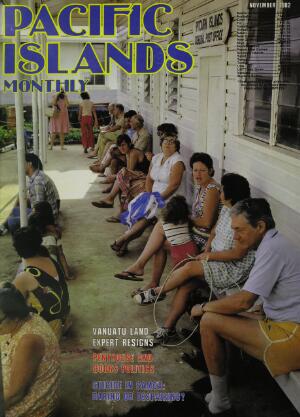
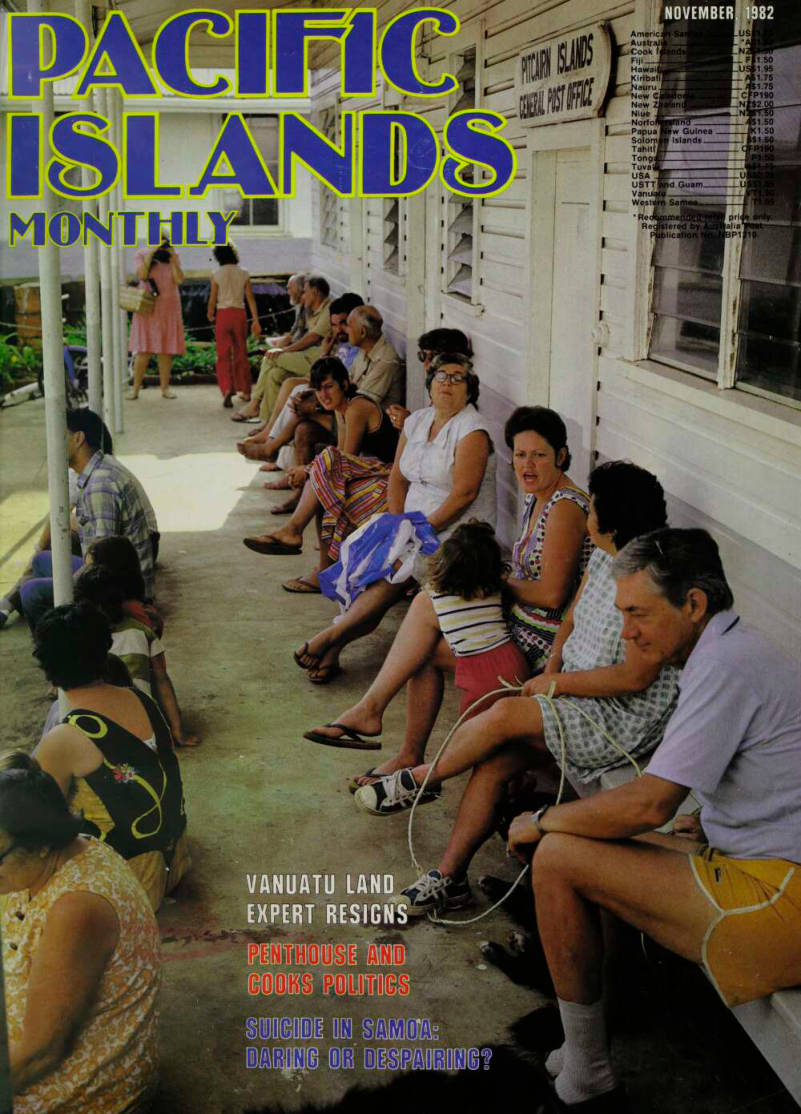
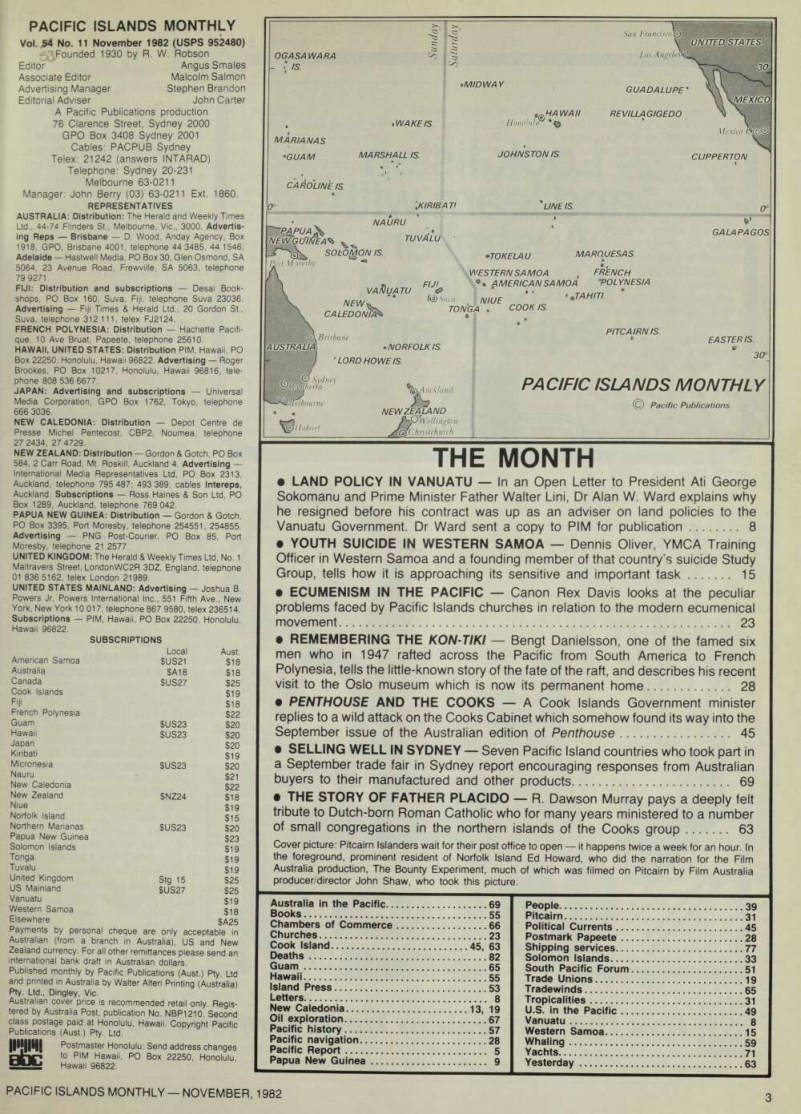
Cover picture: Pitcairn Islanders wait for their post office to open it happens twice a week for an hour. In the foreground, prominent resident of Norfolk Island Ed Howard, who did the narration for the Film Australia production, The Bounty Experiment, much of which was filmed on Pitcairn by Film Australia producer/director John Shaw, who took this picture.
Advertisements & other items, p. 2 (1 item)
rfI [fCOCE
HITACHI
ip "T "T -T *T' -T -r -r
OGP
3 pß o^ ys
VMS
*!»#?* 00^ wot M**®" tW*> VT-9500E (All) Wireless Remote Control VTR ' n
w.miAL SEARCH—
rfI [fCOCE
Li i-** t EJECT u T -9300«
3> HITACHI
• AUSTRALIA: Hitachi Sales Australia Pty., Ltd., 153 Keys Road, Moorabbin. Victoria 3189 Phone: (555) 8722 • NEW ZEALAND: AWA New Zealand Limited, Wi-neera Drive. P.O. Box 50-248, Porirua Phone: PRO 75-069 • PAPUA NEW GUINEA: S.O. Svensson (N.G.) Ltd.. P.O. Box 705.
Port Moresby Phone: 21-2111 • FIJI ISLANDS: AWA New Zealand Limited 47 Foster Road (P.O. Box 858) Suva Fiji. Phone: 312070 • NEW CALEDONIA; Caldis, B.P. Ml. Noumea Phone: 26.23.50 •TAHITI: Ets Chene Alain. P.O. Box 272. Papeete Phone: 2.88.68 • SOLOMON ISLANDS: Technique Radios Centre Ltd.. P.O. Box 465, Honiara Phone: 416 VT-9300E (AU) Visual Search VTR •Convenient 1-programme/10-day timer recording • Visual Search at 9 times normal speed in forward/reverse •8-mode wired remote control unit • Electronic digital display clock/timer/tape counter with memory function • Feather-touch controls and channel lock during
recording
• Oil-damped soft-eject cassette mechanism • Auto-stpp/auto-rewind at tape’s end, plus automatic shut off
Pacific Islands Monthly
Vol. 54 No. 11 November 1982 (USPS 952480)
Representatives
AUSTRALIA: Distribution: The Herald and Weekly Times Ltd., 44-74 Flinders St., Melbourne, Vic., 3000. Advertis ing Reps Brisbane D. Wood, Anday Agency, Box 1918, GPO, Brisbane 4001, telephone 44 3485, 44 1546: Adelaide Hastwell Media, PO Box 30, Glen Osmond, SA 5064, 23 Avenue Road, Frewville, SA 5063, telephone 79 9271.
FIJI: Distribution and subscriptions Desai Book shops, PO Box 160, Suva, Fiji, telephone Suva 23036.
Advertising Fiji Times & Herald Ltd., 20 Gordon St., Suva, telephone 312 111, telex FJ2124.
FRENCH POLYNESIA: Distribution Hachette Pacifi que, 10 Ave Bruat, Papeete, telephone 25610.
HAWAII, UNITED STATES: Distribution PIM, Hawaii, PO Box 22250, Honolulu, Hawaii 96822. Advertising Roger Brookes, PO Box 10217, Honolulu, Hawaii 96816, tele phone 808 536 6677.
JAPAN: Advertising and subscriptions Universal Media Corporation, GPO Box 1762, Tokyo, telephone 666 3036.
NEW CALEDONIA: Distribution Depot Centre de Presse Michel Pentecost, CBP2, Noumea, telephone 27 2434, 27 4729.
NEW ZEALAND; Distribution Gordon & Gotch, PO Box 584, 2 Carr Road, Mt, Roskill, Auckland 4 Advertising International Media Representatives Ltd, PO Box 2313, Auckland, telephone 795 487; 493 389, cables Intereps, Auckland. Subscriptions Ross Haines & Son Ltd, PO Box 1289, Auckland, telephone 769 042.
PAPUA NEW GUINEA: Distribution Gordon & Gotch, PO Box 3395, Port Moresby, telephone 254551, 254855.
Advertising PNG Post-Courier, PO Box 85, Port Moresby, telephone 21 2577.
UNITED KINGDOM: The Herald & Weekly Times Ltd, No. 1 Maltravers Street, LondonWC2R 3DZ, England, telephone 01 836 5162, telex London 21989.
UNITED STATES MAINLAND: Advertising Joshua B.
Powers Jr, Powers International Inc., 551 Fifth Ave., New York, New York 10 017, telephone 867 9580, telex 236514, Subscriptions PIM, Hawaii, PO Box 22250, Honolulu, Hawaii 96822.
Payments by personal cheque are only acceptable in Australian (from a branch in Australia), US and New Zealand currency. For all other remittances please send an international bank draft in Australian dollars.
Published monthly by Pacific Publications (Aust.) Pty. Ltd and printed in Australia by Walter Alteri Printing (Australia) Pty. Ltd., Dingley, Vic.
Australian cover price is recommended retail only, Regis tered by Australia Post, publication No. NBPI2IO. Second class postage paid at Honolulu, Hawaii. Copyright Pacific Publications (Aust.) Pty. Ltd.
Postmaster Honolulu: Send address changes to PIM Hawaii, PO Box 22250, Honolulu, Hawaii 96822.
Subscriptions
Local Aust.
American Samoa
Sus21
$18 Australia $A18 $18 Canada $US27 $25 Cook Islands $19 Fiji $18 French Polynesia $22 Guam $US23 $20 Hawaii $US23 $20 Japan $20 Kiribati $19 Micronesia
Sus23
$20 Nauru • $21 New Caledonia $22 New Zealand
Snz24
$18 Niue $19 Norfolk Island $15 Northern Marianas $US23 $20 Papua New Guinea $23 Solomon Islands $19 Tonga $19 Tuvalu $19 United Kingdom Stg 15 $25 US Mainland $US27 $25 Vanuatu $19 Western Samoa $18 Elsewhere $A25
The Month
• LAND POLICY IN VANUATU — In an Open Letter to President Ati George Sokomanu and Prime Minister Father Walter Uni, Dr Alan W. Ward explains why he resigned before his contract was up as an adviser on land policies to the Vanuatu Government. Dr Ward sent a copy to PIM for publication 8 • YOUTH SUICIDE IN WESTERN SAMOA — Dennis Oliver, YMCA Training Officer in Western Samoa and a founding member of that country’s suicide Study Group, tells how it is approaching its sensitive and important task 15 • ECUMENISM IN THE PACIFIC — Canon Rex Davis looks at the peculiar problems faced by Pacific Islands churches in relation to the modern ecumenical movement 23 • REMEMBERING THE KON-TIKI — Bengt Danielsson, one of the famed six men who in 1947 rafted across the Pacific from South America to French Polynesia, tells the little-known story of the fate of the raft, and describes his recent visit to the Oslo museum which is now its permanent home 28 • PENTHOUSE AND THE COOKS — A Cook Islands Government minister replies to a wild attack on the Cooks Cabinet which somehow found its way into the September issue of the Australian edition of Penthouse 45 • SELLING WELL IN SYDNEY — Seven Pacific Island countries who took part in a September trade fair in Sydney report encouraging responses from Australian buyers to their manufactured and other products 69 • THE STORY OF FATHER PLACIDO — R. Dawson Murray pays a deeply felt tribute to Dutch-born Roman Catholic who for many years ministered to a number of small congregations in the northern islands of the Cooks group 63
Australia in the Pacific 69 Books 55 Chambers of Commerce 66 Churches 23 Cook Island 45, 63 Deaths 82 Guam 65 Hawaii 55 Island Press 53 Letters 8 New Caledonia 13, 19 Oil exploration 67 Pacific history 57 Pacific navigation 28 Pacific Report 5 Papua New Guinea 9
People 39 Pitcairn 31 Political Currents 45 Postmark Papeete 28 Shipping services 77 Solomon Islands 33 South Pacific Forum 51 Trade Unions 19 Tradewinds 65 Tropicalities 31 U.S. in the Pacific 49 Vanuatu 8 Western Samoa 15 Whaling 59 Yachts 71
Yesterday 63
Advertisements & other items, pp. 3-4 (2 items)
- Founded 1930 by R. W. Robson
EditoT Angus Smales Associate Editor Malcolm Salmon Advertising Manager Stephen Brandon Editorial Adviser John Carter A Pacific Publications production 76 Clarence Street, Sydney 2000 GPO Box 3408 Sydney 2001 Cables: PACPUB Sydney Telex: 21242 (answers INTARAD) Telephone: Sydney 20-231 Melbourne 63-0211 Manager: John Berry (03) 63-0211 Ext. 1860.
equipment
Look, listen
and learn with
Australian
educational
equipment
r u ' *1 I l* Australia has great experience and technical skill in most forms of audio visual and general educational equipment. So it has a great deal to offer in the field of teaching and in providing information. Film strips, projectors, books, charts, stationery products, teaching aids and equipment, prerecorded cassettes, slides, scientific equipment and anatomical models are typical of the large number of Australian educational items available. With strong emphasis being placed on advancing the educational system, there will be considerable demand for educational equipment of this high standard. Australian suppliers can help, their proximity will speed delivery too. Check what they have to offer.
Ask the expert who knows Australia The Australian Trade Commissioner can give you details of suppliers and also advise you on ways to research or develop markets in Australia. You can contact an Australian Trade Commissioner at these addresses:
FIJI
P O. Box 1252, Suva.
Ph0ne:312844
PAPUA NEW GUINEA
P C. Box 9129, Hohola.
Phone: 25 9333
NEW CALEDONIA
P.O. Box 22, Noumea.
Phone: 27 2414
HAWAII
Australian Consulate, 1000 Bishop Street, Hawaii, 96813 Phone: (808) 524 5050 F 3
ITLI
Ask the Australian Trade Commissioner
Pacific Report

Fiji’S “Foreign Interference” Probe
Sir John White, a retired New Zealand High Court judge, will preside over an inquiry into allegations of Russian, Australian and other foreign interference in Fiji’s July general elections.
The inquiry was promised by Prime Minister Ratu Sir Kamisese Mara immediately after his reappointment as PM following the elections. Sir John’s appointment was announced by Fiji Gover nor-General Ratu Sir George Cakobau. Accompanying the announcement was a government statement saying that the inquiry would be assisted by a “fair, neutral and competent counsel” to be obtained from New Zealand or Australia.
Png To “Reconsider” Soviet Links
In his first major speech on foreign policy delivered to Papua New Guinea’s National Parliament at the end of September, new PNG Foreign Minister Rabbie Namaliu said his country would reconsider its relations with the Soviet Union. He told parliament PNG was studying a request from the Soviet Union to make relations between the two countries more effective. Mr Namaliu said he was conscious of the advantages which might come PNG’s way from increasing direct contact with one of the most powerful governments in the world. He also said he was conscious of the issues such as the Soviet Union’s interven tion in Afghanistan which divided PNG and the USSR. China established an embassy in Port Moresby two years ago, but until now PNG has resisted Moscow’s suggestions that it be allowed to do likewise.
Kwajalein Sit-In Over For Now
Landowners who have been squatting on Kwajalein Atoll in the Marshall Islands (PIM Oct. p 5) started moving off in mid-October following word from their leaders Senator Ataji Bales and Imada Kabua that Washington talks on the contentious issues were “going very well.” The two men are taking part in the talks. The landowners are demanding higher rental payments for US use of the atoll as a missile-testing range, and other changes in the terms of the agreement on the future of the atoll.
Fsm, Usa, Sign Compact
The Federated States of Micronesia and the United States signed a Compact of Free Association in Honolulu on October 1.
Following the earlier signature of compacts with the Marshall Islands and Palau, this completes the first stage of the 13-years long process of winding up the US trusteeship over the area.
Under the compacts the new states will be independent in relation to foreign and domestic affairs, with the US retaining responsibility for defence. The FSM compact calls for US grants of about SUSIOOO million over a 15-year-period. Keith Guthrie, director of the State Department’s Pacific Islands Affairs desk, said he expects the pacts to be submitted to Congress early next year, but added that, since the compacts had to be approved by plebiscites in the territories themselves, there could be further delays because communication among the scattered islands is difficult. After the pacts are approved by the Islanders and the Congress, the State Department will “take up termina tion of the trusteeship at the United Nations,” Mr Guthrie said.
Once the trusteeship is terminated, the people of the Common wealth of the Northern Marianas, who voted in 1975 to become a commonwealth of the USA, will become US citizens.
Kaleidoscope Of Coalitions In Tahiti
Cobbled together in haste following French Polynesia’s May 23 Territorial Assembly elections, the territory’s new ruling coalition (PIM Jul. p 22) flew apart in September. The coalition, between Gaston Flosse’s Tahoeraa party (13 seats), and Emile Ver naudon’s Ai’a Api (three) had the narrowest of majorities in the 30-member legislature. But the cause of the rupture appears to have been the erratic and unpredictable behavior of the junior partners in the coalition, especially Vernaudon’s decision to stand against Tutaha Salmon, candidate of Flosse’s party in an August 29 poll to elect a new Deputy for the territory to the National Assembly in Paris (PIM Oct. p 7). Salmon won easily, but resentments of Vernaudon’s move remained strong on the Tahoeraa side. Hardly had news of the break become public, however, than efforts to form a new coalition were under way, this time between Tahoeraa and the Here Ai’a party of John
Teariki, which holds six seats in the assembly. Teariki’s party had long been the loyal ally of Francis Sanford’s E’a Api party in the ruling coalition which went down in defeat on May 23. In a joint statement on the new arrangement Messrs Flosse and Teariki said in September that it was designed to ensure “the political stability which alone can guarantee serious and effec tive solutions to the institutional, economic, social and cultural problems of the territory.” But after three weeks of negotiations the long-standing differences between the two sides proved insurmountable, and at a mid-October press conference Mr Flosse announced yet another new majority between his Tahoeraa party and five independent members of the assembly.
W. Samoa: Hrpp Men Refuse Portfolios
The Human Rights Protection Party in Western Samoa unanim ously elected Tofilau Eti as its new leader following the ousting from parliament of former Prime Minister Va’ai Kolone (PIM Oct. p 5). A minister in the first post-independence government in 1962, Tofilau is not only a highly experienced politician but also chairman of the annual conference of the Congregational Church of Samoa, to which 60 percent of Western Samoa’s population belongs. Tofilau was appointed finance minister in the new government of Prime Minister Tupuola Efi, but refused to take part in the swearing-in ceremony held at the end of September on the grounds that the Supreme Court decision ousting Va’ai Kolone and replacing him as PM with Tupuola was unconstitutional. He was joined in the boycott of the ceremony by HRPP colleague Lemamea Ropati, who had been offered a portfolio covering agriculture, the Public Service Commission, and vouth, sport and cultural affairs.
“Deport Nfp Leaders” Call In Fiji
Fiji Senator Inoke Tabua, a nominee of the Great Council of Chiefs, which has a traditional role in Fiji government, has called in the Senate for the deportation of the leaders of the mainly Indian Opposition National Federation Party. During his speech, in which he alleged that the Opposition had insulted the Fijian chiefs and people in their election campaign, the four Opposition senators walked out. Earlier, Senator Ratu Tevita Vakalalabure, another nominee of the Great Council of Chiefs, had told officials of the Indian High Commission in Fiji to “pack up and go.” In a related development, Fiji Prime Minister Ratu Sir Kamisese Mara is suing The Fiji Times and the writer of a letter in that newspaper, claiming that the letter, which attacked Senator Tabua over his “deport” call, made him (Ratu Mara) appear “dishonest”.
AMATA KABUA AND JAPAN S N-WASTE PLAN The Japanese Government is being accused of using aid to various Micronesian states as a weapon to persuade them to accept its plan to dump low-level nuclear waste in the Pacific.
Writing in the Australian weekly magazine The Bulletin of October 19, journalist Peter McGill claims that Marshall Islands President Amata Kabua is “a key figure” in the moves, and has become “Japan’s main Pacific ally in promoting the highly unpopular plan.” McGill writes: “Claiming that independence was ‘imminent,’ Japan last year gave grants (totalling) SUS 2.2 million to the Federated States of Micronesia and the Marshalls, plus another $1.6 million to the two states this year and $1.2 million to Palau a total of $5 million.” McGill claims that President Kabua paid “a secretive visit” to Tokyo in September, staying in Tokyo’s Imperial Hotel under an assumed name. He adds that the president, during a meeting with Ichiro Nakagawa, director of the Science and Technology Agency, said that opposition to the sea dumping plan had “softened” recently, and undertook to propose negotiations with Japan on the issue at the next summit of Pacific nations. (At last year’s summit, held on Guam, President Kabua caused consternation by suggesting that Japan dump its waste on Bikini Atoll in the Marshalls, contaminated previously by US nuclear tests). McGill recalls the fact that Micronesia used to be Japanese trust territory under the League of Nations, and that “many senior officials of the islands have blood ties with Japan and friends in the Japanese Government.” But whatever the outcome of President Kabua’s dealings with Japan, McGill predicts that “stiff opposition” to the
dumping plan will still come from Guam and the Commonwealth of the Northern Marianas, “the two territories closest to the proposed site” for dumping.
New Call For Spc-Spec Merger
Papua New Guinea and Solomon Islands have agreed to keep trying to have the South Pacific Commission (SPC) merge with the South Pacific Bureau of Economic Co-operation (SPEC). After an October meeting in Honiara the foreign ministers of the two countries said having the two organisations inevitably led to duplication and waste. PNG Foreign Minister Rabbie Namaliu had stated earlier that his country might think about leaving the South Pacific Commission unless progress was made on combining the two bodies.
Png Minister For Marshalls Plebiscite
The US State Department has asked Papua New Guinea’s Foreign Minister Rabbie Namaliu to observe the plebiscite at which the Marshallese people will vote on their future political status. The Marshall Islands Government had planned to hold the plebiscite in August but the US administration postponed it because, it claimed, there hadn’t been enough time for a political education program to be carried out, or to organise a United Nations observer team (PIM Sep. p 5). The Marshall’s Foreign Secretary Tony de Brum claimed at the time that the US had called the vote off because the ballot paper offered independ ence as an alternative to the proposed compact of free association with the US. Soon after, the Marshalls parliament voted to hold a plebiscite offering independence as an option before December 1 this year, with or without US approval.
Queen Elizabeth In Island Visits
Queen Elizabeth II was given an enthusiastic reception when she arrived in Papua New Guinea on October 13. Six thousand people welcomed her at Port Moresby airport, and thousands more lined the route to the Sir Hubert Murray Stadium. In the weeks before her visit newspapers and the radio had carried reports of a recommendation by a constitutional review commis sion that the Queen should cease to be PNG’s Head of State and be replaced by a Papua New Guinean president. However, Prime Minister Michael Somare appeared to throw cold water on this line of speculation when he used the occasion of her visit to invite the Queen to return in 1984 to conduct the formal opening of the country’s new parliament house, which is expected to be ready by then. The Queen was in PNG on her way to the Commonwealth Heads of Government Regional Meeting in Suva. She was later to visit Solomon Islands, Nauru, Kiribati and Tuvalu.
Solomons Want Para-Military Force
The Solomon Islands Government has asked Australia for help in setting up a para-military force. The request is believed to have been made at talks in Honiara in October on how Australian defence co-operation funds were to be spent. It has also been reported that a similar request was made to the government of the Republic of China (Taiwan).
UNHCR ASKED TO FIND HOME FOR RUMKOREM Papua New Guinea has asked the United Nations High Com missioner for Refugees to find a country ready to take the Irian Jayan rebel leader Seth Rumkorem, who fled from Indonesia in September and was arrested by PNG authorities at Rabaul, together with nine of his followers (PIM Oct. p 5). The group had been trying to reach Vanuatu by motorised canoe. PNG’s Acting Minister for Foreign Affairs Tony Siaguru said in October that he expected the group would stay in Rabaul until a reply had been received from the UNHCR.
VANUATU: OLD MONEY FOR NEW . . .
Vanuatu’s change-over to its new currency, the vatu, has turned up Australian silver coins from early this century, English coins from the 1850 s, and American quarters and half-dollars. Curren cy exchange officials have spent five months visiting every inhabited island in the archipelago. According to a Radio Australia report, the leader of the team, Tony Airs, said on his return to Port-Vila that some villagers had produced rice bags full of coins to exchange for the new vatu notes. But, he said, the team had to reject the old coins because the vatu could only be exchanged for the currencies it was replacing the New
Hebridean franc and the Australian dollar. (PIM wonders whether professional numismatists will adopt the same attitude as the news gets around . . . We recognise, of course, that the currency exchange team had no option but to stick to its brief this first time round).
Tahiti Looks To Tourism Records
French Polynesia is expecting a record number of tourists this year, with the number of visitors for the first eight months up 30 per cent on the same period in 1981. July registered an all-time monthly record, with 11,500 tourists visiting the territory. Tahiti’s Tourist Development Board says that Australia has become the territory’s second biggest source of visitors, after the USA.
France held this position until last year when the Australian airline Qantas resumed flights to Tahiti. Qantas flights now touch down in Tahiti six times a week, three from Sydney and three from Los Angeles.
Greenpeace 111 In Action Again
The anti-nuclear protest yacht Greenpeace 111 sailed from Papeete in October on a new voyage against French nuclear testing at Moruroa Atoll. The yacht, crewed by Tahitians, Australians, and a Briton, planned to sail to the 12 nautical-mile limit outside the atoll.
Fiji: Oz Firm Sacks Executives
In Fiji, Hornibrook-Thiess-Leighton, Australian building contrac tors on the big Nadi-Lautoka regional water scheme, sacked three of its senior executives in October. It is believed the sackings followed the discovery of a major racket involving hundreds of thousands of dollars acquired from the unau thorised sale of used equipment.
Kiribati Unions Form Congress
The five trade unions in Kiribati have formed themselves into a trade union congress, pledged to foster good relations with the government, employers and the general public. A congress statement said this would be “for the benefit of all the people of Kiribati”. The statement said the congress would establish links with counterpart bodies overseas, and estimated the cost of the first year of operation of the congress at $9500.
Fiji: 12Th Anniversary Appeals On Food
In messages to mark the 12th anniversary of Fiji’s independ ence in October the Governor-General Ratu Sir George Cakobau, and Prime Minister Ratu Sir Kamisese Mara, both appealed for greater efforts by the population to develop the country’s agriculture. Ratu Sir George Cakobau called for greater efforts to achieve food self-sufficiency, and for the diversification of crops. Saying that Fiji’s agriculture-based economy was subject to world price fluctuations, Ratu Mara said that this fact highlighted the need for a realistic level of self sufficiency in order to reduce outlays on imported foodstuffs. On unemployment in the country. Ratu Mara said it was a very serious matter, but added that because of its traditional social structures Fiji was able to escape many of the worst aspects of this social problem.
U.S. Workers’ Strike Threat To Qantas
Australia’s airline Qantas in October faced threats of industrial action by U.S. unionists protesting at its plans to dismiss 250 of its American employees in San Francisco and Honolulu. Their work (as ticketing clerks, mechanics, ramp attendants, and baggage loaders) would be taken over by sub-contracted workers. Ron Yates, deputy chief executive of the airline, said the move would save SAS million a year for the company, and was “essential for the survival of Qantas and the protection of Australian jobs.” He said sackings in Australia would become inevitable if the airline was unable to contain its costs. Mr Yates added that the two U.S. airports were the only overseas airports used by Qantas where the airline did not already sub-contract.
Eight Million Islanders By 2000?
The Third Asia-Pacific Population Conference, held in the Sri Lankan capital, Colombo, in September was told that population growth in 13 Pacific Island countries under study was the highest in the Asia-Pacific region. A spokesman for the United Nations Fund for Population Activities, which sponsored the conference, said particular attention was being paid to these Island countries “because of past neglect.”
Advertisements & other items, p. 6 (1 item)
0 Pioneer’
Only Pioneer’s tremendous range of audio expertise could give you so great a combination of advanced technology and stylish design. The new Personna Music Systems...the truly personal approach to fit any corner of your life.
The RX-70 Personna Cassette Receiver Sharp styling plus solid audio engineering. Full-logic cassette deck, digital FM/AM tuner and powerful stereo amp—all very easy to use and easier still to enjoy.
RX-70
0 PIONEER’
For further information, please contact: Australia: Pioneer Marketing Services Pty. Ltd., P.O. Box 317, Mordialloc, Victoria, 3195 Tel: 90-9011 Fiji Islands; Brijlal & Company, G.P.O. Box No. 362, Suva, Fiji Islands Tel: 22258 New Zealand: Monaco Distributors Ltd., 2 Poland Road, Glenfield, Auckland, New Zealand Tel: (09) 444-9144 Norfolk Island: Burns Philp (Norfolk Island) Ltd., P.O. Box 21, Norfolk Island, P * * The MX-80 Personna Cassette Disc Receiver Total stereo system capability is at your fingertips with Auto Function Switching. Turntable, cassette deck, FM/AM tuner and stereo amp—all in a single high-tech unit.
The S-9 Personna Shelf Components Sleek matching units with an individual outlook and Auto Function Switching. Includes separate digital synthesized FM/AM tuner with programmable timer, a full-logic cassette deck, a fully automatic turntable and a stereo amp.
Personna from Pioneer. Now, stereo systems as personal as your music.
Nauru Island: Jacob Enterprises, P.O. Box No. 4, Republic of Nauru Tahiti; Tahiti Hi-Fi, P.O. Box 848, Papeete, Tahiti New Caledonia: Menard Pacifique Sari, B.P. 3899, Noumea, New Caledonia Tel: 48-24.36 American Samoa: Transpac Corporation, P.O. Box 1477, Pago Pago, American Samoa 96799 Tel: 633-5224 , , , Rarotonga: South Seas International Ltd., P.O. Box 49, Rarotonga, Cook Islands Tel. 2327 >• n„i: k D+w I t>-l on Rnv Rim Rornkn Tpl■ ?P)4887
Questioning
Letters
Questioning Vanuatu’s land policies
An Australian academic, Dr Alan W. Ward, has retired from his post as Director of Rural Lands in Vanuatu before his con tract was up. He has explained his reasons in an Open Letter to President Ati George Sokomanu and Prime Minister Father Wal ter Lini, a copy of which he has forwarded to PIM for publica tion. The letter follows: Your Excellency/Mr Prime Minister, As you know I have concluded my contract as Director of Rural Lands some months before its full term and returned to Aust ralia. The reasons are partly to do with my family circumstances but more to do with trends in land policy which made it in creasingly difficult for me to serve as principal executor of rural land administration in Vanuatu. Out of regard for the courtesy, kindness and eminent reasonableness of yourselves and many hundreds of village people whom I met in the course of duty, I should like to make it clear why, despite many regrets, I felt it best to step down.
The reason basically is that I believe that Vanuatu is putting at risk its economy, its relations with non-Melanesians domestic ally and its reputation interna
tionally, by a trend of policy
which is punitive towards the “alienators” the holders of former freehold titles who pre sently reside on and use about five per cent of Vanuatu’s land (the developed parts of alienated titles), who were either non
political or openly supportive of
the independence movement in 1979-81, and who hope to be come lessees under the new land tenure system. Furthermore, that the competition among custom claimants for control of the de veloped land is setting Melane sian against Melanesian and dis tracting the energies of the peo ple and the state away from genuine development and tends to favor the greedy, the selfish and the opportunistic; that these kinds of attitudes are being pan-
dered to by certain politicians who are pursuing political power through vote-catching programs which abandon national respon sibility and pander to greed and racial prejudice; that these trends threaten to overwhelm the essen tially reasonable objectives of the present Minister of Lands; and that a conscious effort of state craft and will by more thoughtful leaders is necessary to avert seri ous damage both to Vanuatu and to the southwest Pacific region.
The problem centres largely on the question of payment to the alienators for their improvements to the land when they are not granted a lease. At Independence the right of alienators to remain
on the land until either they were granted a lease or received pay ment for improvements on the land was a central aspect of the legal-political settlement. It was embodied in the 1979 Constitu tion and the Land Reform Regu lation, 1980. It was a fair under
taking which greatly helped in
attracting to the Vanuatu Gov ernment the respect and support of the region. It was an undertak ing that convinced many settlers in 1980 that they could expect fair treatment from an indepen dent Melanesian government, despite the doubts about who among the custom claimants would turn out to be their land lords, or the terms of the lease,
or value of payment for improve ments. It was enough to prevent many of them from joining the rebellion in 1980. Yet these are the people who now are under threat of eviction with little or no payment for improvements.
What has become of the undertaking to pay for improve ments? In the Vanuaaku Party Congress of July 1981 certain radical leaders, including the then Minister for Lands, Mr Seru, secured the passage of a resolution to the effect that no payment for improvements would be made. In April 1982, Mr Seru, no longer Minister, introduced into Parliament a pri vate member’s bill to the same effect. Government Ministers ab stained on the vote and the bill was defeated by the Opposition and government backbenchers.
In preparing and presenting the Government’s own law on the subject, the Alienated Land Act, 1982, the Minister for Lands, Mr Regenvanu, courageously held to the principle of payment for im provements when no lease was granted but had to concede that payment would be made over 10 years with no interest on the outstanding balance. The alienators are unanimous in ex pecting that they will never re ceive more than the first payment from custom claimants unless there is a government fund and guarantee for the payment. In effect they face expropriation in all but name. But even that is not enough for some politicians. In the campaign for the recent by
elections Mr Sope’s campaign
speeches referred to plans to seek amendments to the law to do away with payment for improve ments altogether, and this was being talked about in the villages at the time I left.
One consequence is a stated reluctance by custom claimants to conclude lease agreements, even very favorable ones, be cause of the possibility that they might yet be able to put the alienator off and take over the property for no payment at all.
Not all villagers wish this. Many of the older people would be happy to grant a lease and some of the thoughtful younger ones realise they could do better to use rental income to pay the interest on loans and make new develop-
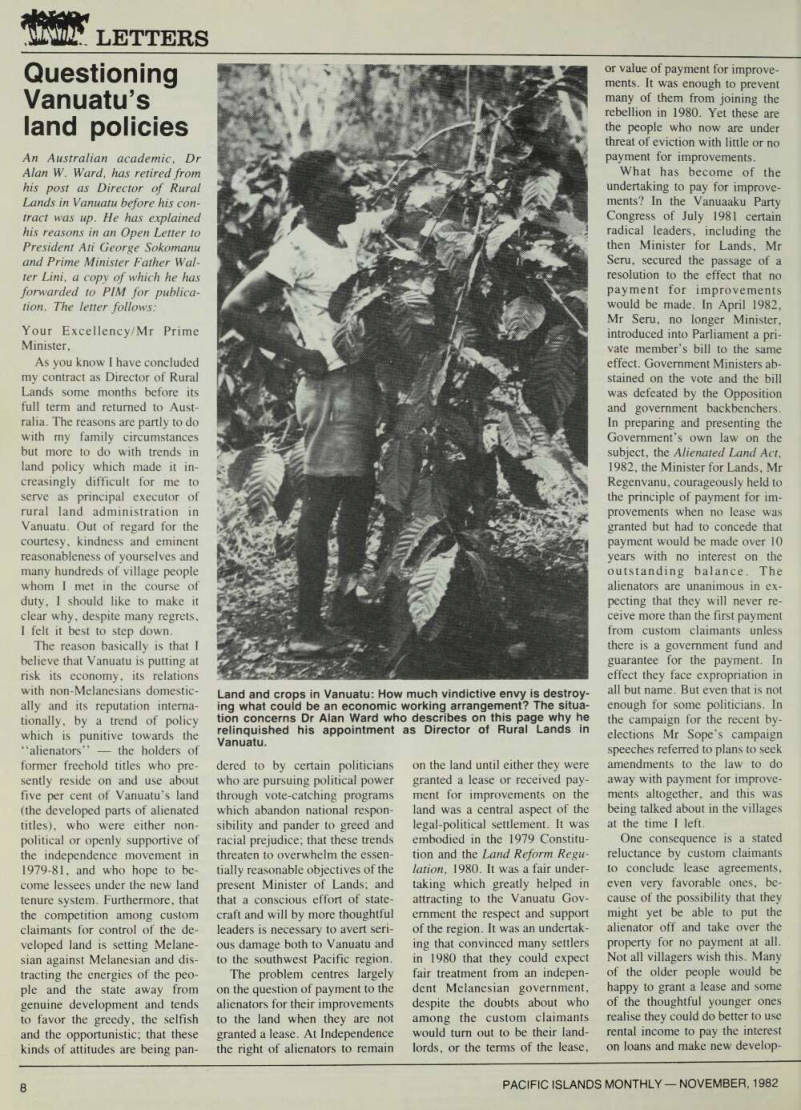
Land and crops in Vanuatu: How much vindictive envy is destroy ing what could be an economic working arrangement? The situa tion concerns Dr Alan Ward who describes on this page why he relinquished his appointment as Director of Rural Lands in Vanuatu.
ments on un-alienated land. The motivations for taking the land back are not always clear but they certainly include vindictive envy. Those who demand the land often have neither skills nor organisation nor capital to run a plantation or redevelop it. The government’s objectives of get ting ni-Vanuatu farmers into commercial agriculture, and maintaining and increasing pro duction, would be better attained by a combination of leasing and joint-venture arrangements with existing settlers, many of whom have acquired appropriate farm ing skills which they could pass on over the term of a lease. The present Minister knows this well but other members of the Vanuaaku Party are pandering only to emotional desires to take back the remaining five per cent of alienated land quickly. If they get their way the consequences will be harmful both to the Vanuatu economy and the image of Vanuatu as a country where just terms can be expected.
The consequences are even more serious for New Caledonia.
Already it is being said there, as a result of the tendency towards non-payment for improvements in Vanuatu (either to present re
tiring alienators, or to future les sees at the end of a lease) that the settlers’ worst fears of how they will be treated by an independent Melanesian government are be ing realised. Worst of all, it is being said that the rebels of 1980 are being proved right all along that the only course is to resist reform and prepare to fight. The results of that attitude are horr ible to imagine but it is precisely that attitude that the activities of Mr Seru and Mr Sope are encouraging.
The issue about payment for improvements can be defused. It is unlikely that aid donors will provide the money to pay for them but Vanuatu has its own resources some 55 million vatu of 1981 budget savings which could be spent on provid ing soft loans to custom claim ants who have real projects to buy back improvements and make new development rather than on a barracks for the Vanuatu Mobile Force in Luganville.
You will perhaps appreciate why, in a situation where, large ly because the confusion of claims and aspirations among custom rightholders prevented prompt agreement on leases and
encouraged thoughtless take overs of land, I felt I was assist ing in the demise of what is left of the rural economy and the hope of good relations between Melanesians and non- Melanesians on the land. Yet it is evident that there are leaders of sensibility and goodwill in the government, and among the peo ple in the villages. In your speech on the second anniversary of independence, Mr Prime Minister, you spoke of Christian principles, acceptance of moral resonsibilities and the building of a society of honest. God-fearing people in which there are neither exploiters or exploited. I am sure that all social democrats in our region would share your aspira tions. With regard to the settle ment of the land issue on just terms, conducive to good de velopment in Vanuatu, I indeed hope that your reasonableness and breadth of view, well known and respected by many, will be brought to bear and prevail over the wishes of the short-sighted, the greedy and the apostles of racial hate.
(Dr.) Alan W. Ward
La Trobe University, Melbourne, Vic., Australia.
The “warrior”
that wasn’t
I am sorry to react so slowly to a matter concerning PIM. As a matter of fact, my point concerns the photograph on the cover of your May issue. But I hope my
long friendship with the
magazine, coupled with the fact that what I have to say relates to personal experiences of mine, will help you to forgive me.
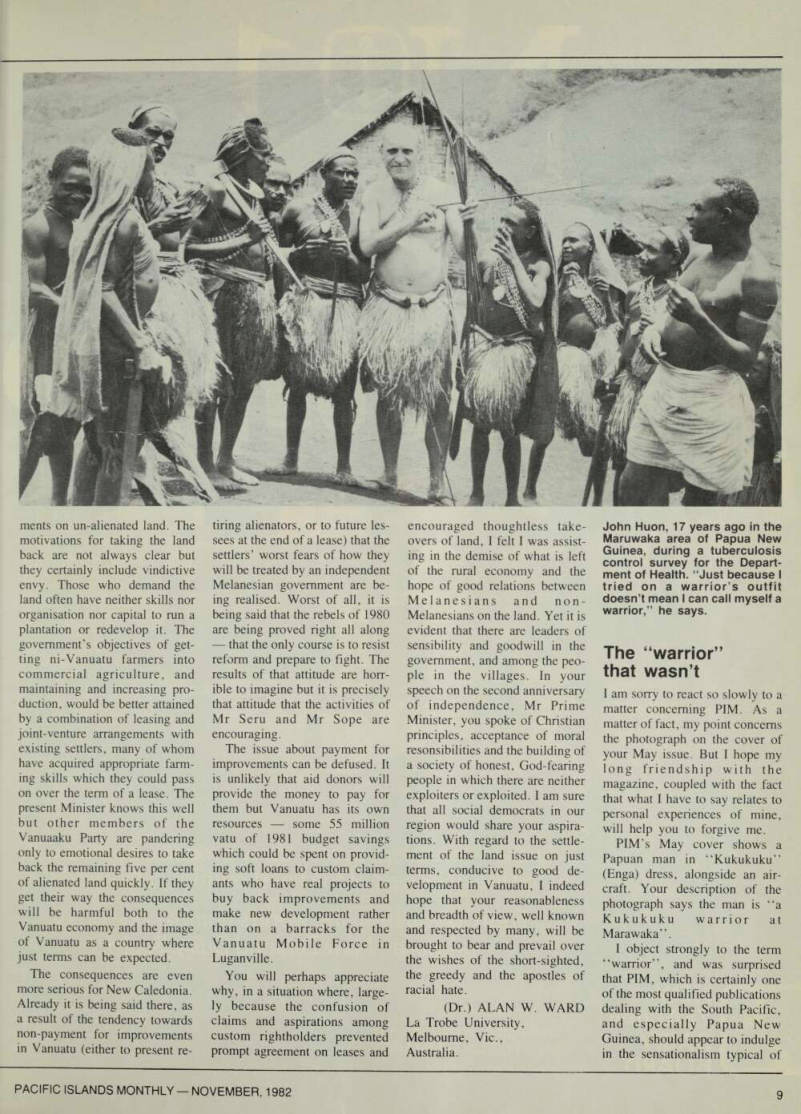
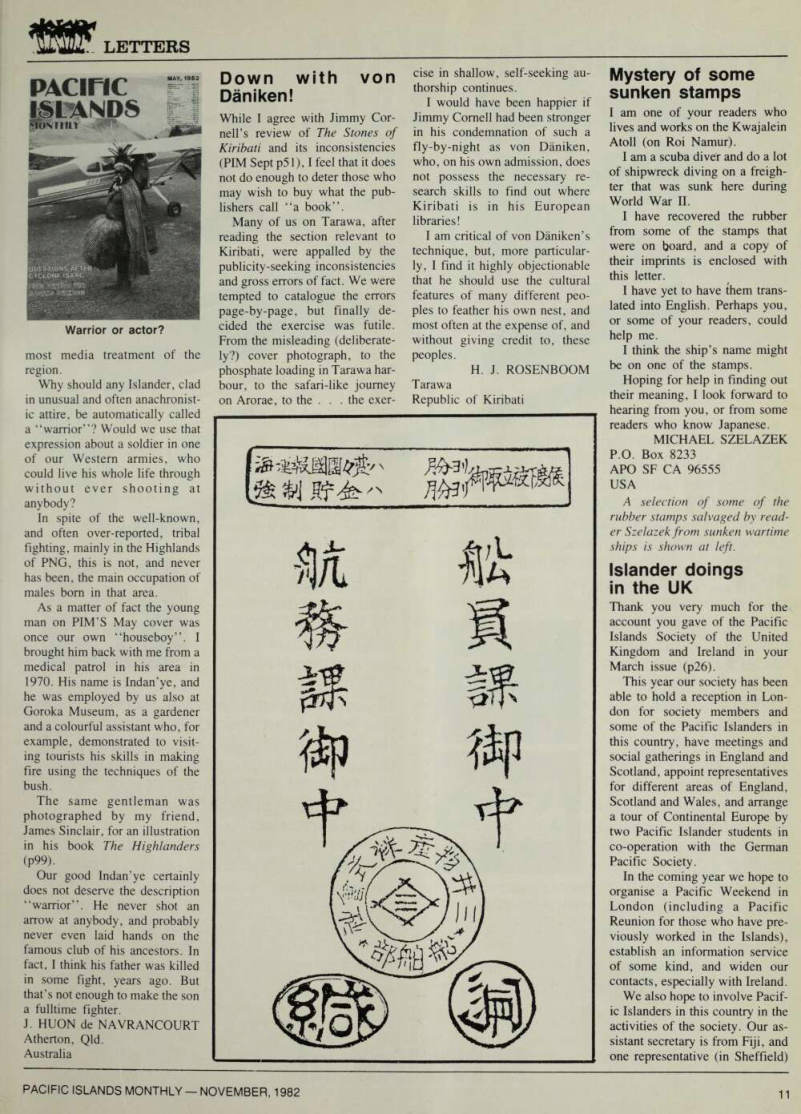
PlM’s May cover shows a Papuan man in “Kukukuku” (Enga) dress, alongside an air craft. Your description of the photograph says the man is “a Kukukuku warrior at Marawaka”.
I object strongly to the term “warrior”, and was surprised that PIM, which is certainly one of the most qualified publications dealing with the South Pacific,
and especially Papua New
Guinea, should appear to indulge in the sensationalism typical of
John Huon, 17 years ago in the Maruwaka area of Papua New Guinea, during a tuberculosis control survey for the Depart ment of Health. “Just because I tried on a warrior’s outfit doesn’t mean I can call myself a warrior,” he says.
most media treatment of the region.
Why should any Islander, clad in unusual and often anachronist ic attire, be automatically called a “warrior”? Would we use that expression about a soldier in one of our Western armies, who could live his whole life through without ever shooting at
anybody?
In spite of the well-known, and often over-reported, tribal
fighting, mainly in the Highlands
of PNG, this is not, and never has been, the main occupation of males bom in that area.
As a matter of fact the young man on PIM’S May cover was once our own “houseboy”. I brought him back with me from a medical patrol in his area in 1970. His name is Indan’ye, and he was employed by us also at Goroka Museum, as a gardener and a colourful assistant who, for example, demonstrated to visit ing tourists his skills in making fire using the techniques of the bush.
The same gentleman was
photographed by my friend,
James Sinclair, for an illustration in his book The Highlanders (p 99).
Our good Indan’ye certainly
does not deserve the description “warrior”. He never shot an arrow at anybody, and probably never even laid hands on the famous club of his ancestors. In fact, I think his father was killed in some fight, years ago. But that’s not enough to make the son a fulltime fighter.
J. Huon De Navrancourt
Atherton, Qld.
Australia
Down with von
Daniken!
While I agree with Jimmy Cor nell’s review of The Stones of Kiribati and its inconsistencies (PIM Sept p5l), I feel that it does not do enough to deter those who may wish to buy what the pub lishers call “a book”.
Many of us on Tarawa, after reading the section relevant to Kiribati, were appalled by the publicity-seeking inconsistencies and gross errors of fact. We were tempted to catalogue the errors page-by-page, but finally de cided the exercise was futile.
From the misleading (deliberate ly?) cover photograph, to the phosphate loading in Tarawa har bour, to the safari-like journey on Arorae, to the . . . the exer
cise in shallow, self-seeking au thorship continues.
I would have been happier if Jimmy Cornell had been stronger in his condemnation of such a fly-by-night as von Daniken, who, on his own admission, does not possess the necessary re search skills to find out where Kiribati is in his European libraries!
I am critical of von Daniken’s technique, but, more particular ly, I find it highly objectionable that he should use the cultural features of many different peo ples to feather his own nest, and most often at the expense of, and without giving credit to, these peoples.
H. J. Rosenboom
Tarawa Republic of Kiribati
Mystery of some
sunken stamps
I am one of your readers who lives and works on the Kwajalein Atoll (on Roi Namur).
I am a scuba diver and do a lot of shipwreck diving on a freigh ter that was sunk here during World War 11.
I have recovered the rubber from some of the stamps that were on board, and a copy of their imprints is enclosed with this letter.
I have yet to have them trans lated into English. Perhaps you, or some of your readers, could help me.
I think the ship’s name might be on one of the stamps.
Hoping for help in finding out their meaning, I look forward to hearing from you, or from some readers who know Japanese.
Michael Szelazek
P.O. Box 8233
Apo Sf Ca 96555
Usa
A selection of some of the rubber stamps salvaged by read er Szelazekfrom sunken wartime ships is shown at left.
Islander doings
in the UK
Thank you very much for the account you gave of the Pacific Islands Society of the United Kingdom and Ireland in your March issue (p 26).
This year our society has been able to hold a reception in Lon don for society members and some of the Pacific Islanders in this country, have meetings and social gatherings in England and Scotland, appoint representatives for different areas of England, Scotland and Wales, and arrange a tour of Continental Europe by two Pacific Islander students in co-operation with the German Pacific Society.
In the coming year we hope to organise a Pacific Weekend in London (including a Pacific Reunion for those who have pre viously worked in the Islands), establish an information service of some kind, and widen our contacts, especially with Ireland.
We also hope to involve Pacif ic Islanders in this country in the activities of the society. Our as sistant secretary is from Fiji, and one representative (in Sheffield)
Warrior or actor?
is from Tonga, and both ladies are married to men who served for many years in the Pacific.
We have as our first aim the care of Pacific Islanders in this country (in co-operation with other bodies), but we also seek to encourage interest in the Pacific Islands, provide information, bring together those concerned with Pacific Studies, and keep those who have previously work ed in the Islands in touch with developments there and with Is landers visiting here. We would be glad to know of any persons returning to the UK or Ireland after visiting or working in the Islands. Islanders who are visit ing, studying or settling in the UK or Ireland, or Islanders who would be willing to speak to members of our society, or de monstrate their particular art.
Information about the society can be obtained on request from the Assistant Secretary, Mrs Pamela Nielsen, 26A Waldemar Road, Wimbledon, London, SWI9 7LJ, or from the Secret ary, the Rev B.J. Macdonald- Milne, Queen’s College, Somer set Road, Edgbaston, Birming ham, 815 2QH, England.
I would be glad to receive information about Islanders in this country (UK) or Ireland, or those expected to come, so that they can be put in touch with local representatives of our soci ety in the areas to which they will be going. Names of those inter ested in the society could also be sent to me or to the assistant secretary.
We shall be glad to establish or strengthen links with similar societies elsewhere.
(Rev) Brian Macdonald
Milne
Birmingham England United Kingdom
“Francophobic” PIM
again
I am a reader of both 30 Jours and Pacific Islands Monthly , the two main magazines dealing with the Pacific Islands. However, my enjoyment of PIM is soured by the unflagging Francophobia evi dent in your pages. In every issue those villainous French are thoroughly taken to task. The pens of the stalwart Danielsson
pair of Tahiti positively ooze with venom.
What does PIM have to say about Indonesia’s annexation and continued occupation of western New Guinea, when did you last write about the American pre sence in Samoa and other is lands and what about a few articles on the past and present plight of the Aborigines? Are the French perhaps cramping the sty le of Australian neo-imperialists in the South Pacific?
If the journalism of PIM as pires to attain the level of that of 30 Jours one day, I suggest a more balanced view regarding things French and less plain pre judice to begin with.
J. Robinson
Port-Vila Vanuatu Writing of “Francophobia”, we take it reader Robinson is referring to the series of articles (PIM Jul Aug Sep) on the confi dential reports of French Resi dent Commissioners in Port-Vila inadvertently left behind by de parting French officials on Van itu’s ndependence in 1980. We can ffer reader Robinson our full assurance that if France's condominium part ner, Britain, had itself iade such a wonderful contribution to the cause of informative jo irnal ism PIM would have treated the windfall in exactly the same way.
We cannot acce that because Marie-Therese and Bengt Danielsson are sympathetic to such causes as the eventual inde pendence of French Pacific ter ritories, and an end to nuclear testing, they are “Fran cophobes”. Rather, it seems to us that they are writers who identify themselves with causes which have much support among Island peoples throughout the Pacific region. (Incidentally, we are sure reader Robinson will be suitably repelled by the “Fran cophobic venom” of Bengt Danielsson’s contribution in the pages of the present issue of PIM As for the journalism of PIM 1 ‘aspiring to attain the level of 30 Jours”, we would have thought the letter appearing in our July issue (p 7) would have helped to clear up this point.
It seems unfortunate that read-
er Robinson's copy of PIM invar iably appears to have its pages stuck together when the magazine carries — as it often does — articles on such subjects as U.S. policies ; n the Mic ronesia negotiations, or the at titude of the Reagan administra tion to such matters as the Law of the Sea Convention. — Editor.
Unity needed in
New Caledonia
September 24 was New Caledonia Day in Noumea and the warning went out to the visit ing tourists: Stay away from the festivities because there could be violence. But the day was the exact opposite of what had been predicted. The only trouble the ever-present police had to deal with was when a few people here and there made pests of them selves through drinking.
Despite warnings I went to the celebration area and mingled with the hundreds of Melane sians who had come from as far away as Lifou, Ouvea, Hien ghene and Koumac. The amaz ing thing was that there were only about 10 white people, in cluding myself, attending the celebrations and inspecting the stalls. Where were all the white Caledoniens? At home hiding, that’s where. Yet the day should be for all the people of New Caledonia, whether their skin be black, white or yellow. It’s our
national day. Yet I noticed the shops had their windows covered with wire mesh or steel shutters and the tourists were being ad vised to stay away.
Yet I walked freely around the area and talked to many of the people attending the celebrations or operating the political stalls.
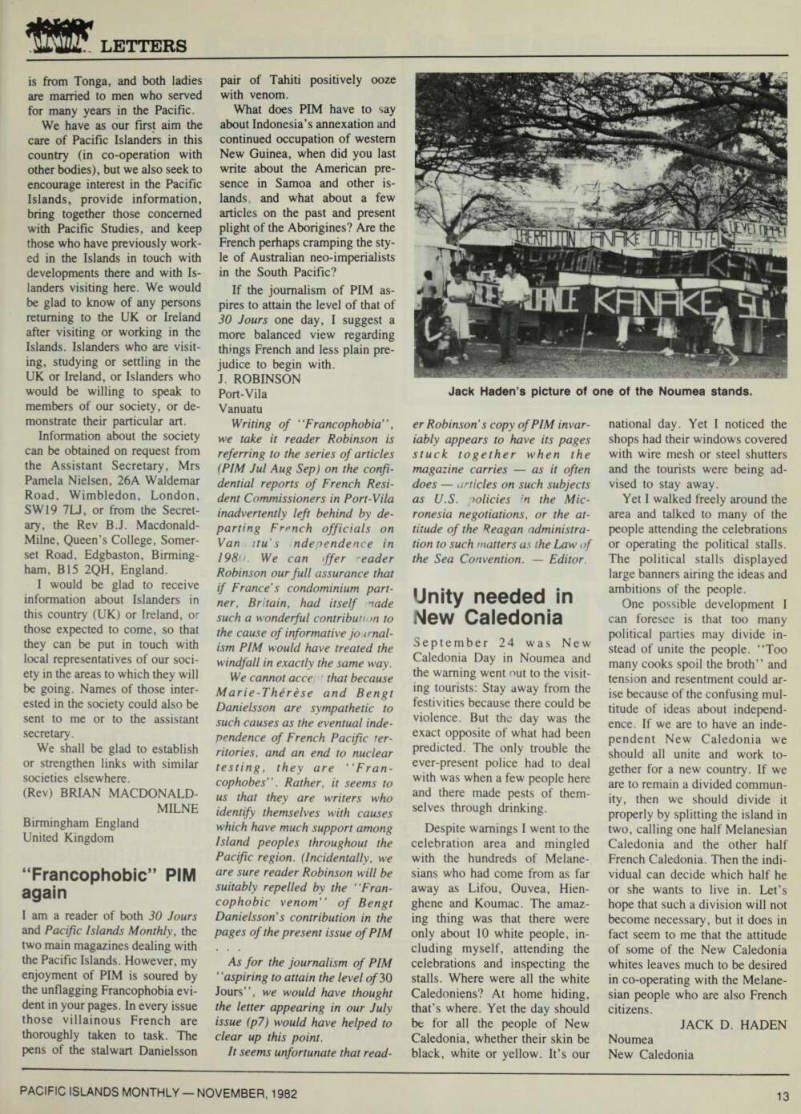
The political stalls displayed large banners airing the ideas and ambitions of the people.
One possible development I can foresee is that too many political parties may divide in stead of unite the people. “Too many cooks spoil the broth” and tension and resentment could ar ise because of the confusing mul titude of ideas about independ ence. If we are to have an inde pendent New Caledonia we should all unite and work to gether for anew country. If we are to remain a divided commun ity, then we should divide it properly by splitting the island in two, calling one half Melanesian Caledonia and the other half French Caledonia. Then the indi vidual can decide which half he or she wants to live in. Let’s hope that such a division will not become necessary, but it does in fact seem to me that the attitude of some of the New Caledonia whites leaves much to be desired in co-operating with the Melane sian people who are also French citizens.
Jack D. Haden
Noumea New Caledonia
Jack Haden’s picture of one of the Noumea stands.
Advertisements & other items, pp. 10-14 (1 item)
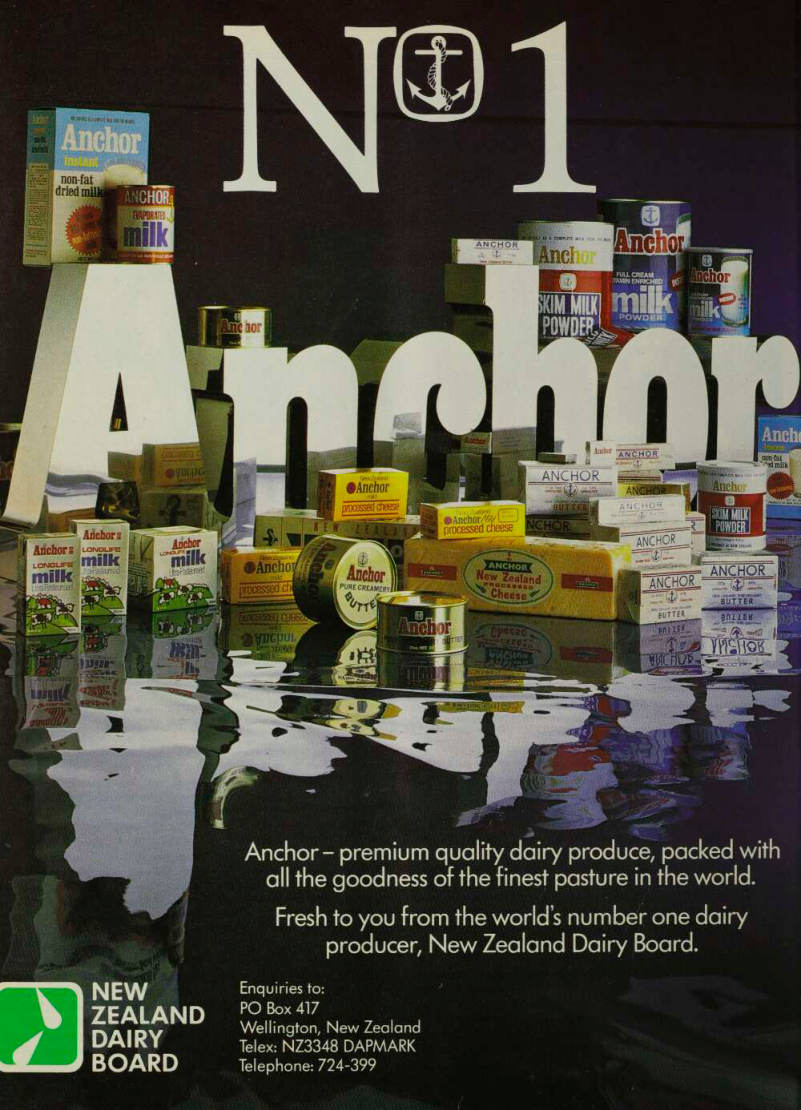
Anchor - premium quality dairy produce, packed with
m mm LiMli!
"f*
M FUaCREAM . ;t?U| r,
m TAMIN ENRICH® .S 56 ulli*
mm milk &
ilk powojbi
POWDER.
Anoto I
SKIM MILK
% anchor
ANCHOR
£3 111®!. iflffß \tr:
SMUT
NEW
ZEALAND
DAIRY
BOARD
Anchor - premium quality dairy produce, packed with all the goodness of the finest pasture in the world.
Fresh to you from the world’s number one dairy
producer, New Zealand Dairy Board.
Enquiries to: PO Box 417 Wellington, New Zealand
Telex: NZ3348 DAPMARK
Telephone: 724-399
Presenting the NV-100.
The world’s only 3.8 kg
portable.
NV-VlO
WVP
50 Na ».o N ati Making a video cassette recorder that weighs a mere 3.Bkg battery pack included—without compromising quality—wasn't easy. Even for Japan’s biggest consumer electronics company.
We started by developing 13 new hybrid ICs in flexible modules that achieve a new level of efficiency for circuitry configuration.
This new technology enabled us to reduce the number of electronic parts, thereby saving a lot of space and weight.
And, equally important, this added reliance on IC circuitry increased the NV-100's overall quality and reliability.
Abandoning our rugged one-piece aluminum die-cast chassis in favor of a plastic one would have been a very easy way to save weight. But we didn't do it. Instead, we worked exhaustively until we succeeded in die-casting the molten aluminum to conform to the NV-100's seemingly impossible specifications.
Motor miniaturization posed yet another stiff challenge. But we did it without sacrificing >* NV-100 our quartzlocked, direct drive system that delivers nearperfect rotational accuracy.
But when it came to features, we made the NV-100 strictly a heavyweight. Combine it with the matching NV-VlO tuner/timer and you've got programmable 14-day/4-program unattended recording; One-Touch Timer Recording; Cue & Review at five times normal speed; variable fine slow playback by remote control, from 1/3 to 1/25 normal speed. And for further convenience, you can add an optional 31-function wireless remote control unit.
Add one of our lightweight video cameras and make your own shows starring family and friends. And no matter where your production takes you, the NV-lOO’s battery pack gives you up to two full hours of recording.
The NV-100. Everything you could ask for in a video recorder—except a lot of excess weight.
National
National. Panasonic and Technics are the brandnames of Matsushita Electric.
VMS
5 ?
LEYLAND
GENUINE
SHARE nuns
IMPORT NOW&SAVE!
AT SPECIAL
EXPORT PRICES
for • Moke • Land Rover • Range Rover • Leyland Truck • Leylandßus • Albion • Morris • Mini • Jaguar • Rover • Triumph • Hino Bus also available • Kawasaki - Stationary Engines & Generators • Tohatsu - Outboard Motors • Thornycroft - Marine Engines • Leypower - Brushcutters & Engines Contact - Len Stephens our Export Sales Manager to call on you during his November/December Tour.
Leyland Australia
Parts Division Cnr. Heathcote and Church Roads, Moorebank 2170 N.S.W. Australia. Ph: (02) 600 0022. Telex AA25375.
Coming to grips

with the problem of youth suicide in W. Samoa
Suicide in any community poses difficulties not often presented by other problems. One cannot make laws to punish offenders, nor order inoculations, change the diet, increase or decrease taxes against it, or any of the other means usually available to government or those in authority at national or village level. The causes of the problem do not lend themselves to easy diagnoses or treatment, as they lie deep within the fabric of society, in the inter action of human relationships.
The causes have to do with such
“difficult-to-get-at” feelings as
self-esteem, respect and trust.
They feed on an over-emphasis of punishment, of extreme social distance, on frustration and
aggression.
To compound the difficulties of analysis and treatment, gather ing evidence of is ex tremely difficult. In the first place the prime witness is dead and buried, and the secondary witnesses invent arguments to demonstrate that in no way did their behavior contribute to the terrible event. Parents who have thrashed their child regularly, scolded him and ridiculed him in front of his peers, stand up at the Coroner’s inquest and say that they have no idea why their son took his life. And they have some justification if they have treated their other children to the same conditioning process and none of them had committed suicide. In the second place, the community at large doesn’t want to know about the problem of suicide because it reflects as a broad indicator on the state of mental health of a community.
Politicians duck the issue, and
civil servants conveniently point
out that suicide is not a responsi
bility of any particular depart
ment. Like many of life’s impor tant issues it lies across several departmental boundaries and finishes up falling down through the cracks between departments.
This article seeks to relate how
A spokesman for Western
Samoa’s Suicide Study Group
(PIM July p2B) said in August that the number of suicides had decreased noticeably since the group launched its anti-suicide campaign in May. He said it was impos sible to claim that the cam
paign was solely responsible
for the decrease, but the fact alone was reassuring. He said that one young person had
already voluntarily sought as
sistance from the group and
was sufficiently helped “to
avoid what could have be come a tragic outcome”. In the accompanying article, DENNIS OLIVER, Training Officer with the YMCA in Western Samoa and a found ing member of the group, tells how it was formed and how it is approaching its im portant task.
the people and organisations of Western Samoa are attempting to address the problem of suicide in their country. It is too early yet to report success as the plan of action is still being acted out.
In June 1981, on the initiative of the Young Men’s Christian Association (YMCA), a meeting was called of top representatives from the Health Department, the Justice Department, the Fellow ship of Christian Churches, and the YMCA. Copies of corres pondence between a previous Coroner and a Professor Murphy of McGill University, Montreal, Canada, were circulated to mem bers. A portion of one letter stated that “the international statistics on suicides during the 1970 s do not show any other country to have a suicide rate in males aged 15 to 24 which is as high as the Western Samoa one.”
The meeting resolved that al though firm facts were not readi ly available the problem was serious enough to warrant action.
Responsibilities were al located as follows: YMCA; in itiators, co-ordination, adminis tration; Justice Department; searching the records of Coron er’s inquests, presentation of the facts; Health Department: psychiatric advice, health educa tion, support research from re cords; Fellowship of Churches: data collection from the field, researching traditional conflict
resolution, community
discussions.
It was further agreed that the group was not responsible to any Minister or Board it was a
community group tackling a
community problem. It came to call itself “The Suicide Study Group”. Its objectives were to reduce the incidence of suicide in Western Samoa.
It was not until September 1981, when the group held its second meeting, that final ap proval was obtained to search the records of the Coroner’s Court.
Records back to 1970 were in reasonable condition, but records for the 1960 s were heaped up in a pile and were wet, mouldy and rat-eaten. No records at all were available prior to 1960. A clerk and two laborers were put to work to sort out the records for the 19605, and a probation offic er set to work collating the data for suicides for the period 1970 to 1981. The psychiatrist at the National Hospital had prepared a structured questionnaire with which to interview patients who were admitted as suspected of intention to commit suicide.
In April 1982 the major task of data collection was completed
and the Study Group met again.
The figures from the Justice De partment were lower than the
figures provided by the Health
Department so some back checking was required. The out come was an increase in the Justice Department figures to biing into the total data stored in Savaii and not transferred to head office in Apia. Even after this
adjustment the Justice Depart ment figures were 20 per cent lower than the Health Depart ment figures. The Justice Depart ment figures, however, were firm. Beside each number could be placed a name, a date of death and evidence to establish the circumstances.
Now that firm data was to hand, a decision had to be made as to what to do with it. The Study Group felt that a national Awareness Campaign was neces sary because: a) there was a high level of ignorance of the facts; b) many of those who had enough facts to suspect the worst were avoiding the problem by pretending it wasn’t there; c) it was believed by the Study Group that no significant reme dial action would be taken by the people of the community until they first came to the point of recognising and “owning” the problem. When they were wil ling to say “We have a prob lem” they may be ready to move on to the position of saying “What causes it and what can we do about it?”
The National Awareness Cam paign was planned to use five national radio programs and three press conferences over a two-week period.
There were several touchy areas to be skirted around. The group wanted to present the facts without attempting to put up theories on possible explanations of causes. The reason for this strategy was that in the first place there was no single obvious theory that fitted all the facts, and secondly if the Study Group attempted to “explain” the prob lem to the community, the com munity might then expect the Group to “cure” the problem. If the community was going to work on its own “cure” (and who else could do it?) then it should be involved in wrestling with trying to understand the causes for the problem. The
Study Group also wanted max imum coverage in the media without appearing to be alarmist, sordid, or sadistic. It realised there was a risk that the publicity might produce a wave of mild hysteria which could trigger off a rash of suicides. It was also sensitive to the fact that several details could not be exposed without fear of them adding to the suicide rate. For example if the exact lethal dose of paraquat was released, it may appeal to the gambling instinct in some potential suicide candidates to try a dose just a little less than fatal.
The painful aspect of death by paraquat was underplayed for fear that it might appeal to the cultural value placed on the abili ty to withstand pain as a mark of manliness. (The full body tattoo is one indication of the value that Samoan culture places on the ability to withstand pain.) A full description of the terrible agony of a person dying from paraquat poison was deliberately withheld for fear it would appeal to the masochistic nature in some.
The National Awareness Cam paign organised eight radio prog rams in both Samoan and English, eight newspaper articles and one editorial in four news papers to a total of 182 column inches, and a public meeting which over 60 people attended.
The program strategy at first
moved through three phases; 1.
Organising the Study Group. 2.
Conducting research by studying the data from Coroner’s inquests, and writing up the facts. 3. Dis seminating the facts through the National Awareness Campaign.
The fourth phase, set down for June-August 1982, involved at tempts to move discussion to the village level. Questions to which answers were being sought in villages with high suicide rates, along with encouragement of fered to the village people to strive to resolve the problem, included: What are the suicide facts in our village? What causes suicides in our village? What can we do to stop suicides in the future?
One factor that has been dis covered since the distribution of the Fact Sheet has been the changing ratio of matai (chiefs) to commoners. The national ratio of matai to commoners in 1961 was one matai to 24 commoners.
In 1981 the national ratio was one matai to 12 commoners.
The average ratio of matai to commoners in the four villages with the highest suicide rates is one matai to 1.6 other adults (over 15 years). Does this infor mation support the proposition that “too many cooks spoil the broth’’? Maybe, but when the matai/others ratio is calculated for all the villages in Western
Samoa it is clear that there is no such simple explanation. Some villages with a high matai/others ratio have a low suicide rate, and other villages with the same matai/others ratio have a high suicide rate. Certainly, the suicide rate is influenced not only by the number of power holders but also with how that power is exercised.
The reason for the rapid in crease in the number of matai is that voting in political elections is restricted to matai. In the months preceding each election several hundred new matai are created so that one village’s can didate can outvote another’s.
Consideration is seldom given to the traditional selection proce dures which sought carefully to select the best prospective matai for the job. Quantity has gone up, quality has probably come down.
Other factors warranting study are the communication patterns between parents and young adults; the heavy and frequent use of punishment at the family and village level as virtually the only means of controlling be havior; the level of trust within each family and within society; the apparently increasing fre quency of acts of violence per formed by Samoans on rugby and cricket fields, the village malae, and the streets of Apia;
the increased consumption of al coholic liquor and its contribu tion to family disputes.
As stated above, it is still too early to claim success for the work of Western Samoa’s Suicide Study Group. This is not surprising, given the magnitude of the problem.
World Health Organisation statistics on the 1980 rate of suicide per 100,000 of young men between the ages of 15 and 24 showed Switzerland with 32.6 as the worst afflicted country.
The comparable figure for Western Samoa (not included in the statistics) due allowance being made for the fact that according to the 1976 census there were 16,855 persons in this category in the country was 94.8, almost three times the Swiss figure.
Suicide Study
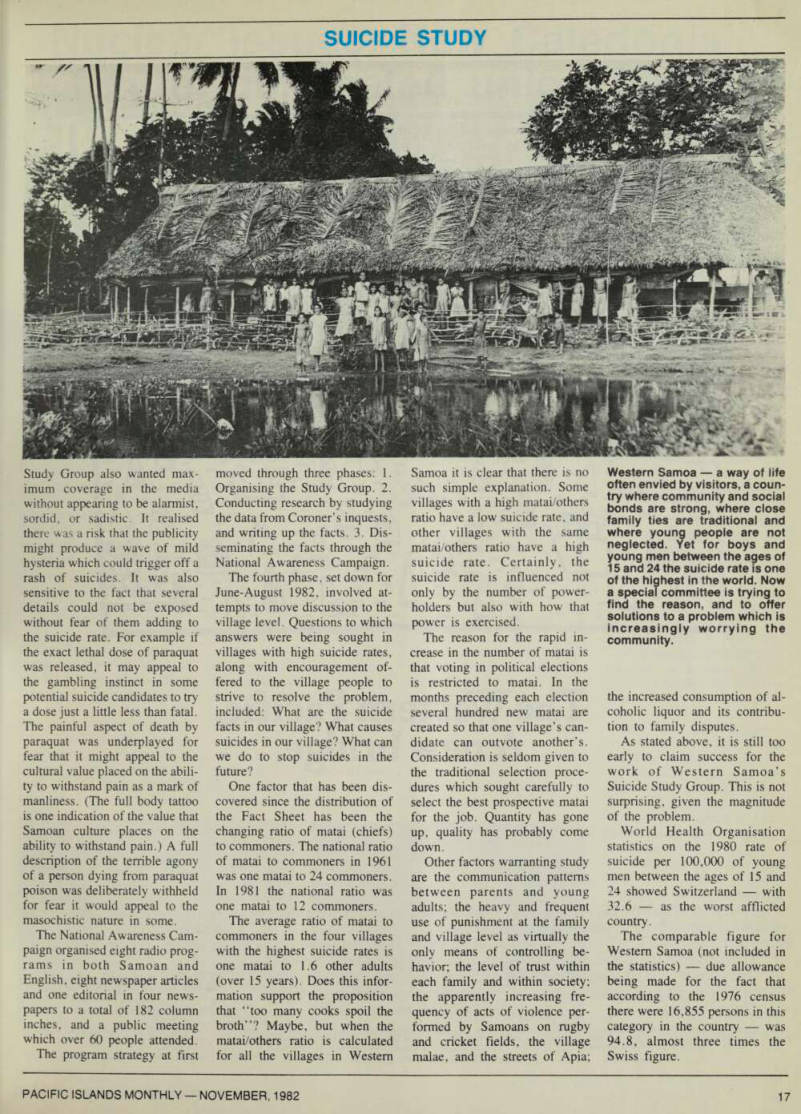
Western Samoa - a way of life often envied by visitors, a coun try where community and social bonds are strong, where close family ties are traditional and where young people are not neglected. Yet for boys and young men between the ages of 15 and 24 the suicide rate is one of the highest in the world. Now a special committee is trying to find the reason, and to offer solutions to a problem which is increasingly worrying the
community.
Advertisements & other items, pp. 16-18 (1 item)
Nissan.
SSSW*“' sr ’
who else but
* * ,cpri hiah-t • • •
NISSAN.
Nissan recognizes the ■ n ctppi to further We also used while still mam-
ji s &:r
is possible. ac jvanced E-type engine W e created our au whee drive. ’specially '° r Sun n y s effident co mbustion t’s minimal friction nd savings no X)wer, too.
SSSSSSSW-"
not more same kind of innovative fnto every car we buW-
SpeCicalWsanCeQ^^v
to market.
IMISSAN/DATSUN ONE AND THE SAME
NISSAN
ii.nMimi
SYDNEY, AUSTRALIA
/» no |M| :$ : - :'A:i -AT ** a-UL/ : A---Z)-A -> *£ :x- - ** « /Cj2m Ijout
The Western Pacific.
A new bridge.
If you want to span the gap between you, Australia and the Western Pacific, bridge the gap with a new bank.
Westpac Banking Corporation.
With assets of over US$24 billion* and 34,000 employees, we are Australia’s largest private enterprise bank.
And the new force throughout the Western Pacific.
We have over 2,000 offices in 16 countries; so were the bank that means business in any part of the world.
Project financing, money market
transactions, trade and investment enquiries and any other banking business.
Span the world in banking with
Westpac Banking Corporation.
Westpac
Banking Corporation First Bank in Australia HEAD OFFICE International Division, 60 Martin Place, Sydney, N.S.W. 2000. Telephone 233 0500. Telex 22891. FIJI 1 Thomson Street, Suva, Fiji. Telephone 311666. Telex 7012133. KIRIBATI Bairiki, Tarawa, P.O. Box 66, Tarawa. Telephone Bairiki 241. Cables W Bank Tarawa. CHIEF NEW ZEALAND OFFICE 318 Lambton Quay, Wellington, N.Z. Telephone 73 8008. Telex 3365. PAPUA NEW GUINEA Westpac Bank - PNG - Limited, sth Floor, Moguru Moto Building, Champion Parade, Port Moresby, PNG. Telephone 214255. Telex 22130. VANUATU Rue Higginson, Vila Vanuatu. Telephone Vila 2 084. Telex 7711018. 'As at 10/9/82 exchange rate.
WBCOIO4
Nuclear issues, New Caledonia’s
future, dominated union forum
HELEN FRASER reports from Noumea on the second meeting of the Pacific Trade Union Forum held there at the end of September.
September 26-28 saw more than 100 delegates from 13 Pacific countries in attend ance at the second Pacific Trade Union Forum in Noumea. The three themes of the conference and the chief objectives of the PTUF were a nuclear-free Pacif ic, regional solidarity, and independence for French territories.
The conference was opened by the Vice-President of New Caledonia’s Govern ment Council, Jean-Marie Tjibaou, who poetically de scribed the Pacific environ ment and the threats posed to this paradise by nuclearisa tion, militarisation and indus trialisation. French High Commissioner to New Caledonia, Christian Nucci, also gave an opening address, cautioning that free and frank discussion of the Forum’s controversial themes should not be allowed to undermine normal courtesies.
The ‘‘controversial themes’’ were quickly in troduced when Australian un ion leader, Bill Richardson, launched a stinging attack on the French Government for their continuation of nuclear tests. Mr Richardson, assis tant secretary of the Aust ralian Council of Trade Un ions, said that the story of nuclear testing in French
Polynesia was one of govern mental intrigue and decep tion, with France seeking military prestige and political power at the expense of the health of Pacific peoples. De spite pre-election promises, Mr Richardson claimed that the Mitterrand government has promoted an escalation of nuclear testing.
Mr Richardson urged the conference to increase pressure on the French Gov ernment to achieve an end to their nuclear tests. However, during the final session a de cision was postponed on a resolution to impose bans on French shipping and aircraft.
The proposed resolution also urged that “similar action should be considered to influ ence those governments who carry out nuclear testing, dump nuclear waste in the Pacific and who continue to mine uranium.’’
This was described as “lacking credibility’’ by New Caledonian unions, who ask ed that Australia, Japan, the U.S. and USSR be included in the boycotts because of their nuclear policies. After Australian unionist Pat Clancy replied that this would deprive Australian workers of jobs, the conference de generated into a series of mo tions and counter-motions.
Eventually it was decided
that the PTUF co-ordinating committee would meet as ear ly as possible to resolve the question of boycotts over the nuclear issue. But Australian union leaders made it clear that they were still free to take action at their own level against France.
New Caledonia Independ ence Front spokesman, Yann Celene Uregei, addressed the conference and called for un ion help in getting New Caledonia on the list of the United Nations’ Decolonisa tion Committee. Mr Uregei said he was disappointed with the recent South Pacific Forum held in New Zealand.
Australia, New Zealand and Fiji had opted to give France time to implement their prog ram of economic, social and judicial reforms for New Caledonia, rather than pressuring France at the UN level. However, Vanuatu’s Prime Minister, Father Walter Lini, said he will push for the inclusion of New Caledonia on the UN list. Mr Uregei accused Australia, New Zealand and Fiji of be ing more concerned with their economic ties with France than with solidarity among Pacific people.
A resolution supporting the IF demands was unanimously passed by the conference to strong applause. The confer-
ence also voted that IF spokesmen should visit each Pacific country to develop support, that union journals give publicity to the IF, that PTUF members gain support from their national govern ments, and that France be asked to negotiate a timetable for independence with the IF.
The Noumea conference saw the first participation of New Caledonia’s second trade union USTKE (Union of Exploited and Kanak Workers). Its general secret ary, Louis Kotra Uregei (nephew of Yann Uregei), told the conference that Kanak culture and society were being destroyed by col onialism. He said that non- Kanak workers should realise that their interest lay in the same struggle.
The conference, for which the Noumea venue was reluc tantly granted by the French administration, was held in the French Scientific Re search Centre (ORSTOM).
The French administration showed its interest in the Forum’s themes by the con tinual presence of a note taker.
The local printed press, having already made a fuss about the presence of a Prav da journalist, was quick to seize upon the charges of hy pocrisy and imperialism which were levelled at Aust ralian unionists over the nuc lear issue.
Conference convenor. Bill Richardson, issued a press statement on his departure, describing the conference as a success despite the attempts at disruption. He denied the claims of a Noumea daily that there had been intimidation or manipulation, and expressed regret that the conference or ganisers had not been given the right of reply to these charges through the local press.
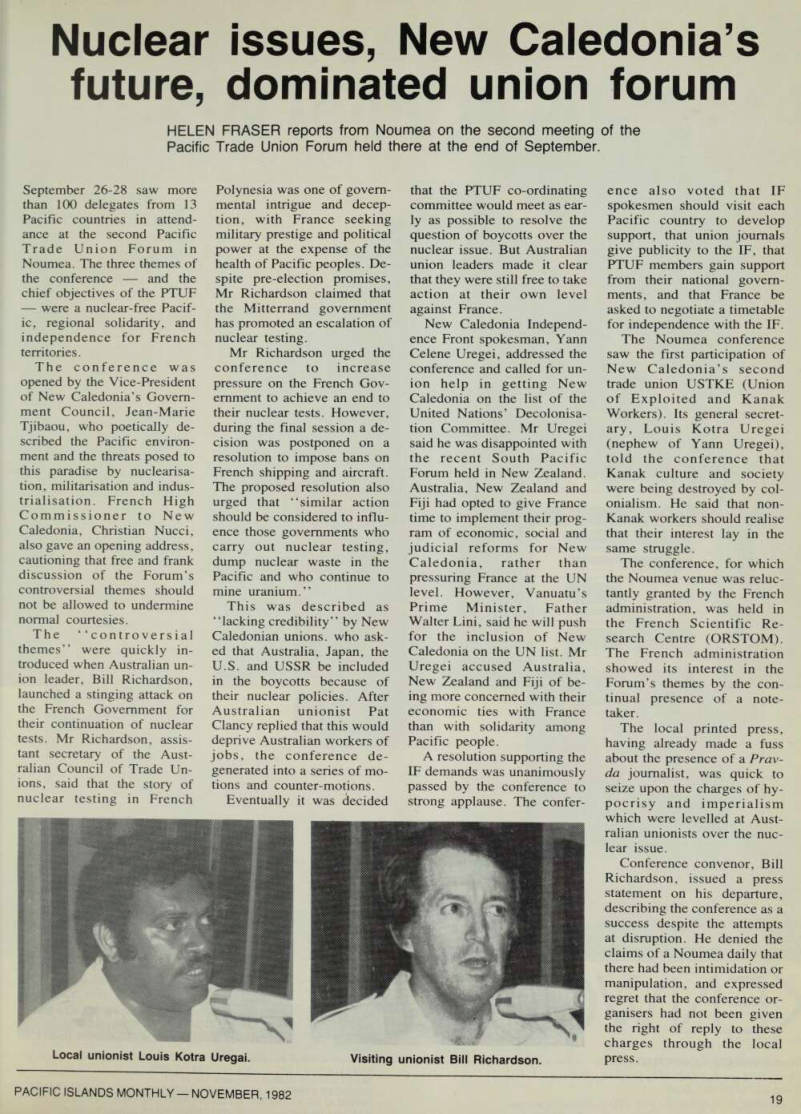
Local unionist Louis Kotra Uregai.
Visiting unionist Bill Richardson.
Advertisements & other items, p. 20 (1 item)
<Enwood
Hi □ □ □ Spectrum senes mmm ■ i-77 DC Stereo Integrated Amplifier with Peak Power Meter KT-55 Quartz Synthesizer AM/FM Tuner with Preset KX-55 Logic Cassette Deck with DPSS Music-Search d Dolby* Noise Reduction KD-44RQuartz-PLL Direct-Drive Auto Return Turntable JL-t , - L , u >tional models; GE-90 Stereo Graphic Equalizer KH-7 Lightweight Dynamic Stereo Headphones. *TM bolby Laboratories Licensing Corp.
ew corporate symbol
CORPORATION
lionogi Shibuya Building, 17-5, 2-chome, Shibuya,
tibuya-ku, Tokyo 150, Japan
lIOKENWOOD (AUSTRALIA) PTY. LTD. (incorporated in nswi NEW ZEALAND JOHN GILBERT & CO., LTD. Auckland Tel. ooll-64-9-30839 FIJI PEPE’S DUTY FREE CENTRE LTD. Tel. 26187, 25191 PAPUA NEW GUINEA S.O. SVENSSON (N.G ) LTD. Port Moresby Tel. 42-4467 SOLOMON ISLANDS TECHNIQUE RADIOS CENTRE LTD. Honiara Tel. 416 NEW CALEDONIA HI-FI VOX Noumea Tel 27-2466 VANUATU FUNG CHOI LUEN. Port-Vila Tel. 2556
TAHITI MAISON AURORE Papeete Tel. 29703
AMERICAN SAMOA ISLAND PACIFIC AGENCIES, INC Pago Pago Tel. 633-4687
REPUBLIC OF NAURU NAURU CO-OPERATIVE SOCIETY
iiadiama ici AKinc i r TCMnpin PMTPRPRIRFS Seinen Tel 6445
Independence Front
New Caledonia
Independence Front changes tack after September 5 poll
Following what they termed “The massive anti-Kanak vote” for Rightwing Deputy Jacques Lafleur in the September 5 by election (PIM Oct pi 5), New Caledonia’s Independence Front has carried out a searching re view of its political strategy, and decided to take a tougher line with the French Government.
The IF held a major confer ence in mid-September. It pro duced a statement warning that the front will henceforth use its representation in the Government Council and the Territorial As sembly to move towards its goal of Kanak socialist independence.
But, the statement went on, if the front sees there is no possibility of achieving this objective, it will consider withdrawing from both bodies. (The IF has a major ity in both, in coalition with the Centre party FNSC.) The last half of September saw a number of other politically charged events in the territory.
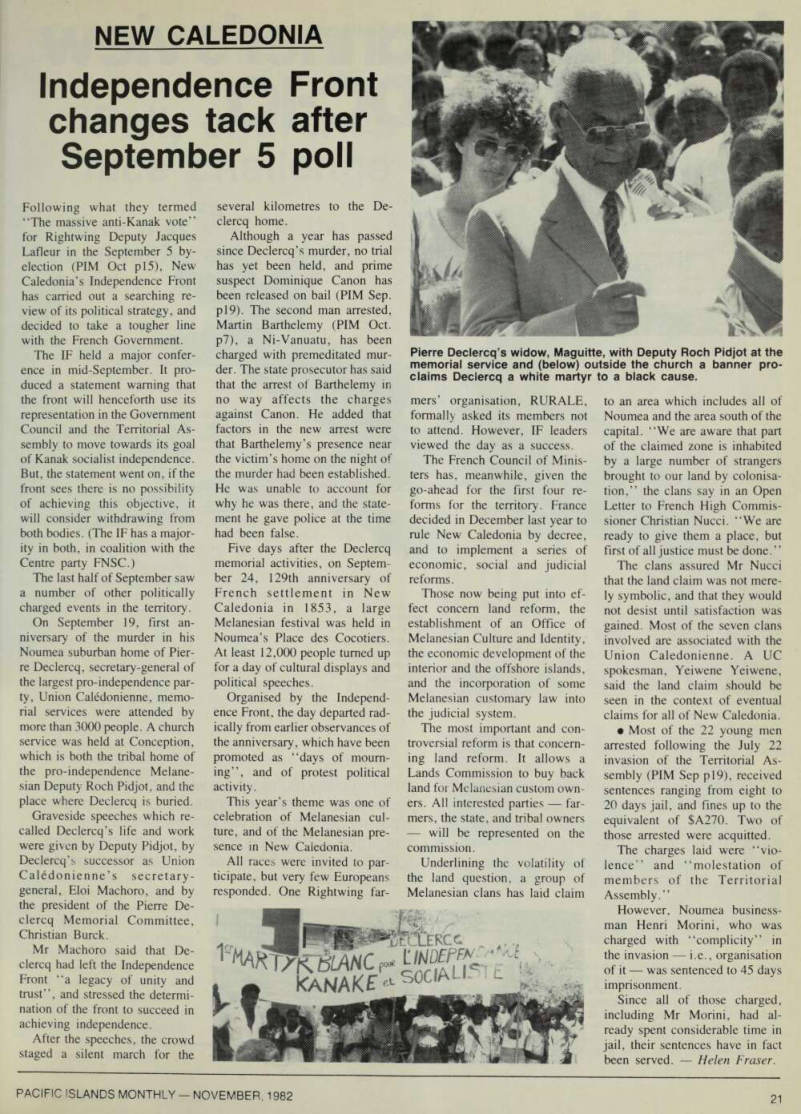
On September 19, first an niversary of the murder in his Noumea suburban home of Pier re Declercq, secretary-general of
the largest pro-independence par
ty, Union Caledonienne, memo rial services were attended by more than 3000 people. A church service was held at Conception, which is both the tribal home of the pro-independence Melane sian Deputy Roch Pidjot, and the place where Declercq is buried.
Graveside speeches which re called Declercq’s life and work
were given by Deputy Pidjot, by
Declercq’s successor as Union Caledonienne’s secretary general, Eloi Machoro, and by the president of the Pierre De clercq Memorial Committee, Christian Burck.
Mr Machoro said that De clercq had left the Independence Front “a legacy of unity and trust”, and stressed the determi nation of the front to succeed in
achieving independence.
After the speeches, the crowd staged a silent march for the
several kilometres to the De clercq home.
Although a year has passed since Declercq’s murder, no trial has yet been held, and prime suspect Dominique Canon has been released on bail (PIM Sep. pi 9). The second man arrested, Martin Barthelemy (PIM Oct. p 7), a Ni-Vanuatu, has been charged with premeditated mur der. The state prosecutor has said that the arrest of Barthelemy in no way affects the charges against Canon. He added that factors in the new arrest were that Barthelemy’s presence near the victim’s home on the night of the murder had been established.
He was unable to account for why he was there, and the state ment he gave police at the time had been false.
Five days after the Declercq memorial activities, on Septem ber 24, 129th anniversary of French settlement in New Caledonia in 1853, a large Melanesian festival was held in Noumea’s Place des Cocotiers.
At least 12,000 people turned up for a day of cultural displays and political speeches.
Organised by the Independ ence Front, the day departed rad ically from earlier observances of the anniversary, which have been promoted as “days of mourn ing”, and of protest political activity.
This year’s theme was one of celebration of Melanesian cul ture, and of the Melanesian pre sence in New Caledonia.
All races were invited to par ticipate, but very few Europeans responded. One Right wing far-
to an area which includes all of Noumea and the area south of the capital. “We are aware that part of the claimed zone is inhabited by a large number of strangers brought to our land by colonisa tion,” the clans say in an Open Letter to French High Commis sioner Christian Nucci. “We are ready to give them a place, but first of all justice must be done. ’ ’
The clans assured Mr Nucci that the land claim was not mere ly symbolic, and that they would not desist until satisfaction was gained. Most of the seven clans involved are associated with the Union Caledonienne. A UC spokesman, Yeiwene Yeiwene, said the land claim should be seen in the context of eventual claims for all of New Caledonia. • Most of the 22 young men arrested following the July 22 invasion of the Territorial As sembly (PIM Sep pi 9), received sentences ranging from eight to 20 days jail, and fines up to the equivalent of SA27O. Two of those arrested were acquitted.
The charges laid were “vio lence” and “molestation of members of the Territorial Assembly.”
However, Noumea business man Henri Morini, who was charged with “complicity” in the invasion i.e., organisation of it was sentenced to 45 days imprisonment.
Since all of those charged, including Mr Morini, had al ready spent considerable time in jail, their sentences have in fact
mers’ organisation, RURALE, formally asked its members not to attend. However, IF leaders viewed the day as a success.
The French Council of Minis ters has, meanwhile, given the go-ahead for the first four re forms for the territory. France decided in December last year to rule New Caledonia by decree, and to implement a series of economic, social and judicial reforms.
Those now being put into ef fect concern land reform, the establishment of an Office of Melanesian Culture and Identity, the economic development of the interior and the offshore islands, and the incorporation of some Melanesian customary law into the judicial system.
The most important and con troversial reform is that concern ing land reform. It allows a Lands Commission to buy back land for Melanesian custom own ers. All interested parties far mers, the state, and tribal owners will be represented on the commission.
Underlining the volatility of the land question, a group of Melanesian clans has laid claim
been served.
Helen Fraser.
Pierre Declercq’s widow, Maguitte, with Deputy Roch Pidjot at the memorial service and (below) outside the church a banner pro claims Declercq a white martyr to a black cause.
Advertisements & other items, p. 22 (1 item)
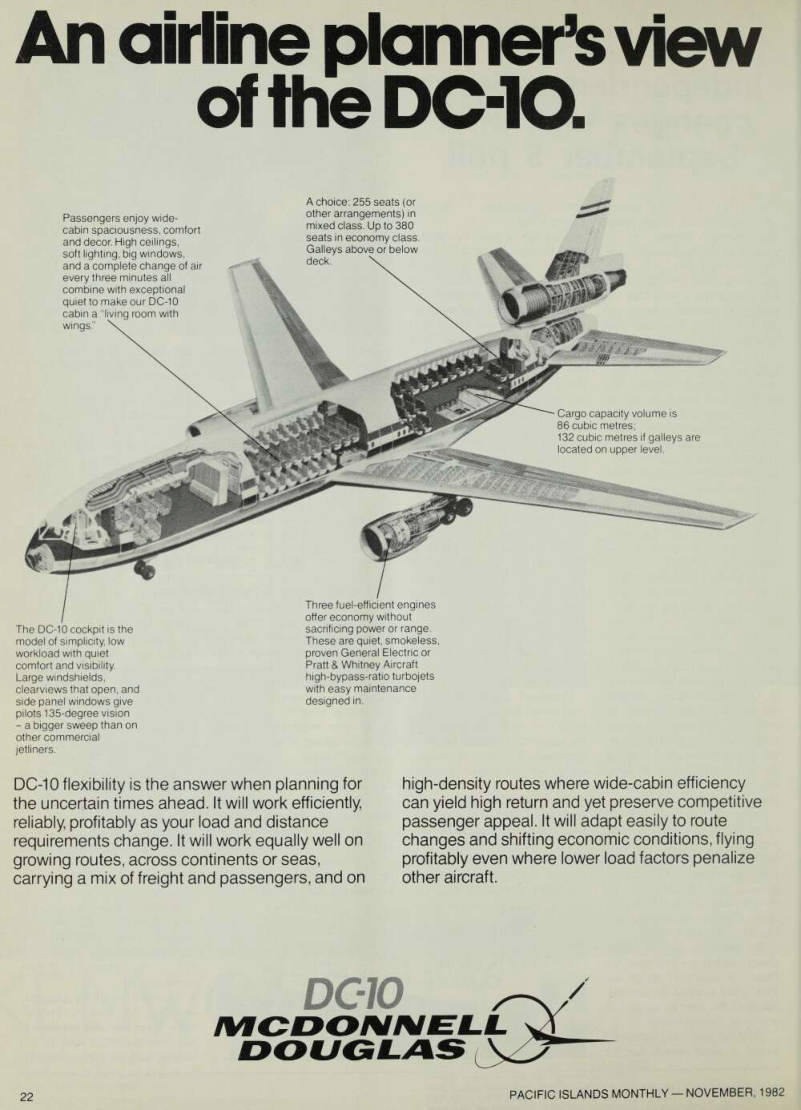
An ciirine planner’s view
of the DC-TO.
Passengers enjoy widecabin spaciousness, comfort and decor. High ceilings, soft lighting, big windows, and a complete change of air every three minutes all combine with exceptional quiet to make our DC-10 cabin a “living room with wings A choice: 255 seats (or other arrangements) in mixed class. Up to 380 seats in economy class.
Galleys above or below deck. % Efl % The DC-10 cockpit is the model of simplicity, low workload with quiet comfort and visibility.
Large windshields, clearviews that open, and side panel windows give pilots 135-degree vision - a bigger sweep than on other commercial jetliners.
Three fuel-efficient engines offer economy without sacrificing power or range.
These are quiet, smokeless, proven General Electric or Pratt & Whitney Aircraft high-bypass-ratio turbojets with easy maintenance designed in.
DC-10 flexibility is the answer when planning for the uncertain times ahead. It will work efficiently, reliably, profitably as your load and distance requirements change. It will work equally well on growing routes, across continents or seas, carrying a mix of freight and passengers, and on high-density routes where wide-cabin efficiency can yield high return and yet preserve competitive passenger appeal. It will adapt easily to route
changes and shifting economic conditions, flying
profitably even where lower load factors penalize other aircraft.
DOTO
MCDOIMIMELL
face challenge of ecumenism
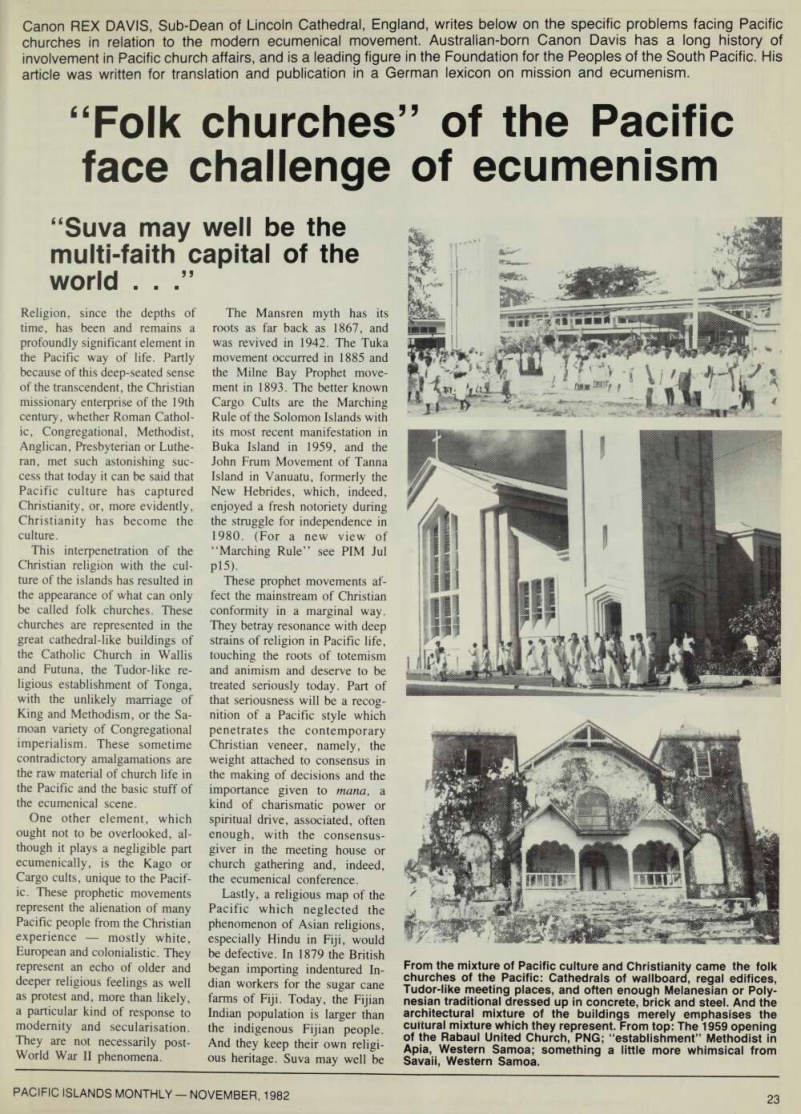

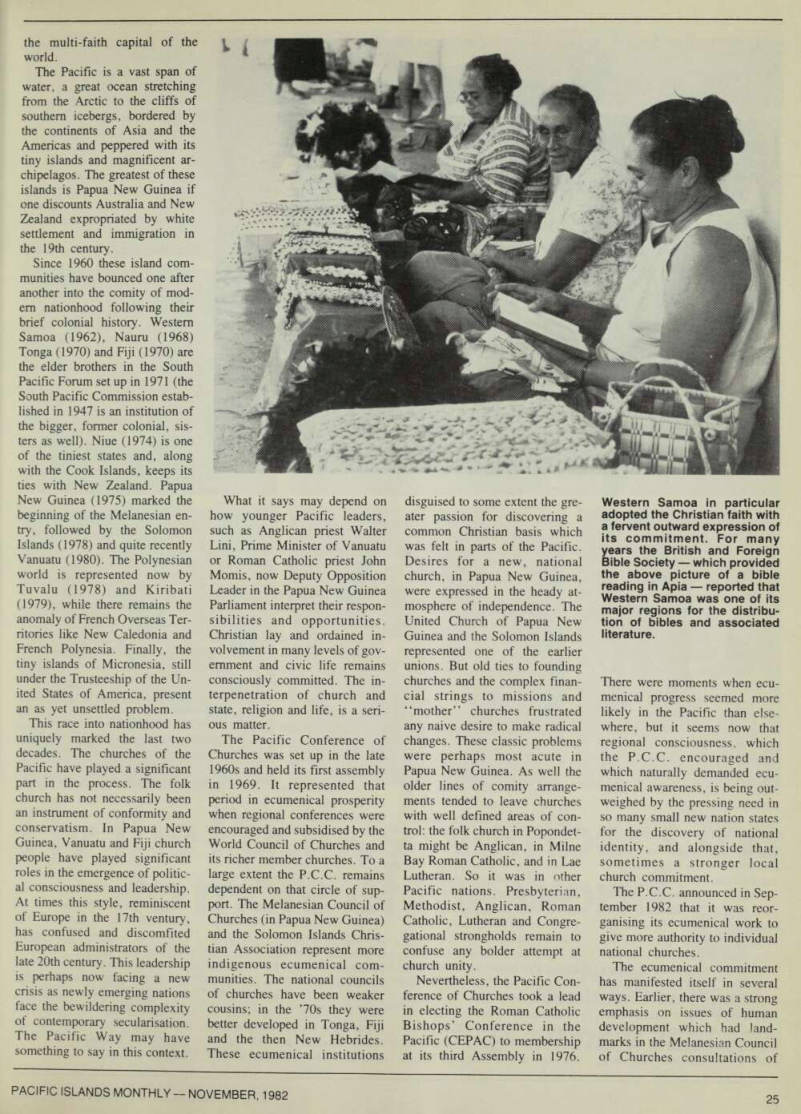
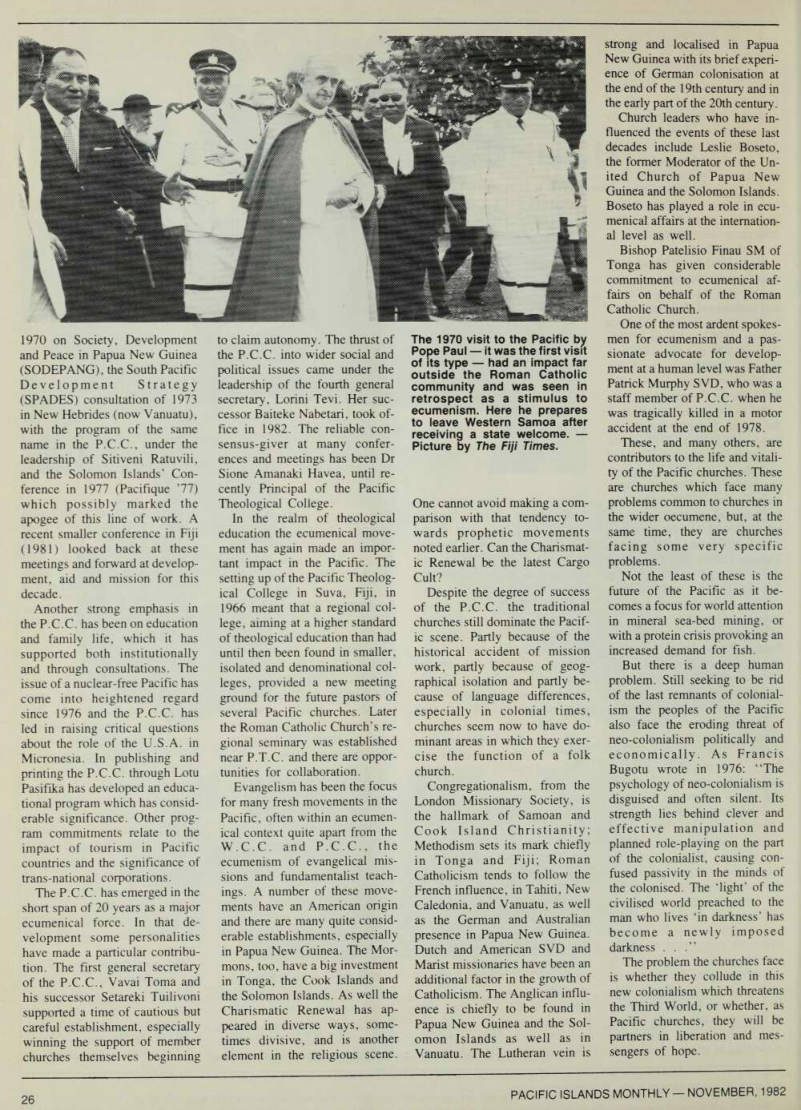
“Folk churches” of the Pacific face challenge of ecumenism
“Suva may well be the multi-faith capital of the world ..."
Canon REX DAVIS, Sub-Dean of Lincoln Cathedral, England, writes below on the specific problems facing Pacific churches in relation to the modern ecumenical movement. Australian-born Canon Davis has a long history of involvement in Pacific church affairs, and is a leading figure in the Foundation for the Peoples of the South Pacific. His article was written for translation and publication in a German lexicon on mission and ecumenism.
Religion, since the depths of time, has been and remains a profoundly significant element in the Pacific way of life. Partly because of this deep-seated sense of the transcendent, the Christian missionary enterprise of the 19th century, whether Roman Cathol ic, Congregational, Methodist, Anglican, Presbyterian or Luthe ran, met such astonishing suc cess that today it can be said that Pacific culture has captured Christianity, or, more evidently, Christianity has become the culture.
This interpenetration of the Christian religion with the cul ture of the islands has resulted in the appearance of what can only be called folk churches. These churches are represented in the great cathedral-like buildings of the Catholic Church in Wallis and Futuna, the Tudor-like re ligious establishment of Tonga, with the unlikely marriage of King and Methodism, or the Sa moan variety of Congregational imperialism. These sometime contradictory amalgamations are the raw material of church life in the Pacific and the basic stuff of the ecumenical scene.
One other element, which ought not to be overlooked, al though it plays a negligible part ecumenically, is the Kago or Cargo cults, unique to the Pacif ic. These prophetic movements represent the alienation of many Pacific people from the Christian experience mostly white, European and colonialistic. They represent an echo of older and deeper religious feelings as well as protest and, more than likely, a particular kind of response to modernity and secularisation.
They are not necessarily post- World War II phenomena.
The Mansren myth has its roots as far back as 1867, and was revived in 1942. The Tuka movement occurred in 1885 and the Milne Bay Prophet move ment in 1893. The better known Cargo Cults are the Marching Rule of the Solomon Islands with its most recent manifestation in Buka Island in 1959, and the John Frum Movement of Tanna Island in Vanuatu, formerly the New Hebrides, which, indeed, enjoyed a fresh notoriety during the struggle for independence in 1980. (For a new view of “Marching Rule” see PIM Jul Pl 5).
These prophet movements af fect the mainstream of Christian conformity in a marginal way.
They betray resonance with deep strains of religion in Pacific life, touching the roots of totemism and animism and deserve to be treated seriously today. Part of that seriousness will be a recog nition of a Pacific style which penetrates the contemporary Christian veneer, namely, the weight attached to consensus in the making of decisions and the importance given to mana, a kind of charismatic power or spiritual drive, associated, often enough, with the consensus giver in the meeting house or church gathering and, indeed, the ecumenical conference.
Lastly, a religious map of the Pacific which neglected the phenomenon of Asian religions, especially Hindu in Fiji, would be defective. In 1879 the British began importing indentured In dian workers for the sugar cane farms of Fiji. Today, the Fijian Indian population is larger than the indigenous Fijian people.
And they keep their own religi ous heritage. Suva may well be
From the mixture of Pacific culture and Christianity came the folk churches of the Pacific: Cathedrals of wallboard, regal edifices, Tudor-like meeting places, and often enough Melanesian or Poly nesian traditional dressed up in concrete, brick and steel. And the architectural mixture of the buildings merely emphasises the cultural mixture which they represent. From top: The 1959 opening of the Rabaul United Church, PNG; “establishment” Methodist in Apia, Western Samoa; something a little more whimsical from Savaii, Western Samoa.
the multi-faith capital of the world.
The Pacific is a vast span of water, a great ocean stretching from the Arctic to the cliffs of southern icebergs, bordered by the continents of Asia and the Americas and peppered with its tiny islands and magnificent ar chipelagos. The greatest of these islands is Papua New Guinea if one discounts Australia and New Zealand expropriated by white settlement and immigration in the 19th century.
Since 1960 these island com munities have bounced one after another into the comity of mod em nationhood following their brief colonial history. Western Samoa (1962), Nauru (1968) Tonga (1970) and Fiji (1970) are the elder brothers in the South Pacific Forum set up in 1971 (the South Pacific Commission estab lished in 1947 is an institution of the bigger, former colonial, sis ters as well). Niue (1974) is one of the tiniest states and, along with the Cook Islands, keeps its ties with New Zealand. Papua New Guinea (1975) marked the beginning of the Melanesian en try, followed by the Solomon Islands (1978) and quite recently Vanuatu (1980). The Polynesian world is represented now by Tuvalu (1978) and Kiribati (1979), while there remains the anomaly of French Overseas Ter ritories like New Caledonia and French Polynesia. Finally, the tiny islands of Micronesia, still under the Trusteeship of the Un ited States of America, present an as yet unsettled problem.
This race into nationhood has uniquely marked the last two decades. The churches of the Pacific have played a significant part in the process. The folk church has not necessarily been an instrument of conformity and conservatism. In Papua New Guinea, Vanuatu and Fiji church people have played significant roles in the emergence of politic al consciousness and leadership.
At times this style, reminiscent of Europe in the 17th ventury, has confused and discomfited European administrators of the late 20th century. This leadership is perhaps now facing a new crisis as newly emerging nations face the bewildering complexity of contemporary secularisation.
The Pacific Way may have something to say in this context.
What it says may depend on how younger Pacific leaders, such as Anglican priest Walter Lini, Prime Minister of Vanuatu or Roman Catholic priest John Momis, now Deputy Opposition Leader in the Papua New Guinea Parliament interpret their respon sibilities and opportunities.
Christian lay and ordained in volvement in many levels of gov ernment and civic life remains consciously committed. The in terpenetration of church and state, religion and life, is a seri ous matter.
The Pacific Conference of Churches was set up in the late 1960 s and held its first assembly in 1969. It represented that period in ecumenical prosperity when regional conferences were encouraged and subsidised by the World Council of Churches and its richer member churches. To a large extent the P.C.C. remains dependent on that circle of sup port. The Melanesian Council of Churches (in Papua New Guinea) and the Solomon Islands Chris tian Association represent more indigenous ecumenical com munities. The national councils of churches have been weaker cousins; in the ’7os they were better developed in Tonga, Fiji and the then New Hebrides.
These ecumenical institutions
disguised to some extent the gre ater passion for discovering a common Christian basis which was felt in parts of the Pacific.
Desires for a new, national church, in Papua New Guinea, were expressed in the heady at mosphere of independence. The United Church of Papua New Guinea and the Solomon Islands represented one of the earlier unions. But old ties to founding churches and the complex finan cial strings to missions and “mother” churches frustrated any naive desire to make radical changes. These classic problems were perhaps most acute in Papua New Guinea. As well the older lines of comity arrange ments tended to leave churches with well defined areas of con trol: the folk church in Popondet ta might be Anglican, in Milne Bay Roman Catholic, and in Lae Lutheran. So it was in other Pacific nations. Presbyterian, Methodist, Anglican, Roman Catholic, Lutheran and Congre gational strongholds remain to confuse any bolder attempt at church unity.
Nevertheless, the Pacific Con ference of Churches took a lead in electing the Roman Catholic Bishops’ Conference in the Pacific (CEPAC) to membership at its third Assembly in 1976.
There were moments when ecu menical progress seemed more likely in the Pacific than else where, but it seems now that regional consciousness, which the P.C.C. encouraged and which naturally demanded ecu menical awareness, is being out weighed by the pressing need in so many small new nation states for the discovery of national identity, and alongside that, sometimes a stronger local church commitment.
The P.C.C. announced in Sep tember 1982 that it was reor ganising its ecumenical work to give more authority to individual national churches.
The ecumenical commitment has manifested itself in several ways. Earlier, there was a strong emphasis on issues of human development which had land marks in the Melanesian Council of Churches consultations of
Western Samoa in particular adopted the Christian faith with a fervent outward expression of its commitment. For many years the British and Foreign
Bible Society - which provided
the above picture of a bible
reading in Apia - reported that
Western Samoa was one of its major regions for the distribu tion of bibles and associated literature.
1970 on Society, Development and Peace in Papua New Guinea (SODEPANG), the South Pacific Development Strategy (SPADES) consultation of 1973 in New Hebrides (now Vanuatu), with the program of the same name in the P.C.C., under the leadership of Sitiveni Ratuvili, and the Solomon Islands’ Con ference in 1977 (Pacifique ’77) which possibly marked the apogee of this line of work. A recent smaller conference in Fiji (1981) looked back at these meetings and forward at develop ment, aid and mission for this decade.
Another strong emphasis in the P.C.C. has been on education and family life, which it has supported both institutionally and through consultations. The issue of a nuclear-free Pacific has come into heightened regard since 1976 and the P.C.C. has led in raising critical questions about the role of the U.S.A. in Micronesia. In publishing and printing the P.C.C. through Lotu Pasifika has developed an educa tional program which has consid erable significance. Other prog ram commitments relate to the impact of tourism in Pacific countries and the significance of trans-national corporations.
The P.C.C. has emerged in the short span of 20 years as a major ecumenical force. In that de velopment some personalities have made a particular contribu tion. The first general secretary of the P.C.C., Vavai Toma and his successor Setareki Tuilivoni supported a time of cautious but careful establishment, especially winning the support of member churches themselves beginning
to claim autonomy. The thrust of the P.C.C. into wider social and political issues came under the leadership of the fourth general secretary, Lorini Tevi. Her suc cessor Baiteke Nabetari, took of fice in 1982. The reliable con sensus-giver at many confer ences and meetings has been Dr Sione Amanaki Havea, until re cently Principal of the Pacific Theological College.
In the realm of theological education the ecumenical move ment has again made an impor tant impact in the Pacific. The setting up of the Pacific Theolog ical College in Suva, Fiji, in 1966 meant that a regional col lege, aiming at a higher standard of theological education than had until then been found in smaller, isolated and denominational col leges, provided a new meeting ground for the future pastors of several Pacific churches. Later the Roman Catholic Church’s re gional seminary was established near P.T.C. and there are oppor tunities for collaboration.
Evangelism has been the focus for many fresh movements in the Pacific, often within an ecumen ical context quite apart from the W.C.C. and P.C.C., the ecumenism of evangelical mis sions and fundamentalist teach ings. A number of these move ments have an American origin and there are many quite consid erable establishments, especially in Papua New Guinea. The Mor mons, too, have a big investment in Tonga, the Cook Islands and the Solomon Islands. As well the Charismatic Renewal has ap peared in diverse ways, some times divisive, and is another element in the religious scene.
One cannot avoid making a com parison with that tendency to wards prophetic movements noted earlier. Can the Charismat ic Renewal be the latest Cargo Cult?
Despite the degree of success of the P.C.C. the traditional churches still dominate the Pacif ic scene. Partly because of the historical accident of mission work, partly because of geog raphical isolation and partly be cause of language differences, especially in colonial times, churches seem now to have do minant areas in which they exer cise the function of a folk church.
Congregationalism, from the London Missionary Society, is the hallmark of Samoan and Cook Island Christianity; Methodism sets its mark chiefly in Tonga and Fiji; Roman Catholicism tends to follow the French influence, in Tahiti, New Caledonia, and Vanuatu, as well as the German and Australian presence in Papua New Guinea.
Dutch and American SVD and Marist missionaries have been an additional factor in the growth of Catholicism. The Anglican influ ence is chiefly to be found in Papua New Guinea and the Sol omon Islands as well as in Vanuatu. The Lutheran vein is
strong and localised in Papua New Guinea with its brief experi ence of German colonisation at the end of the 19th century and in the early part of the 20th century.
Church leaders who have in fluenced the events of these last decades include Leslie Boseto, the former Moderator of the Un ited Church of Papua New Guinea and the Solomon Islands.
Boseto has played a role in ecu menical affairs at the internation al level as well.
Bishop Patelisio Finau SM of Tonga has given considerable commitment to ecumenical af fairs on behalf of the Roman Catholic Church.
One of the most ardent spokes men for ecumenism and a pas sionate advocate for develop ment at a human level was Father Patrick Murphy SVD, who was a staff member of P.C.C. when he was tragically killed in a motor accident at the end of 1978.
These, and many others, are contributors to the life and vitali ty of the Pacific churches. These are churches which face many problems common to churches in the wider oecumene, but, at the same time, they are churches facing some very specific problems.
Not the least of these is the future of the Pacific as it be comes a focus for world attention in mineral sea-bed mining, or with a protein crisis provoking an increased demand for fish.
But there is a deep human problem. Still seeking to be rid of the last remnants of colonial ism the peoples of the Pacific also face the eroding threat of neo-colonialism politically and economically. As Francis Bugotu wrote in 1976: “The psychology of neo-colonialism is disguised and often silent. Its strength lies behind clever and effective manipulation and planned role-playing on the part of the colonialist, causing con fused passivity in the minds of the colonised. The ‘light’ of the civilised world preached to the man who lives ‘in darkness’ has become a newly imposed darkness . . .’’
The problem the churches face is whether they collude in this new colonialism which threatens the Third World, or whether, as Pacific churches, they will be partners in liberation and mes sengers of hope.
The 1970 visit to the Pacific by Pope Paul - it was the first visit of its type - had an impact far outside the Roman Catholic community and was seen in retrospect as a stimulus to ecumenism. Here he prepares to leave Western Samoa after receiving a state welcome. - Picture by The Fiji Times.
Advertisements & other items, pp. 24-27 (1 item)
Solarex
5 BELLONA AVE., REGENTS PARK 2143 AUSTRALIA TELEPHONE (02) 644 5055 TELEX AA 21975
ELECTRICITY FROM SUNLIGHT
Oil-short, ruralised developing nations are great beneficiaries of the advances being made in
SOLAR ELECTRIC GENERATORS
Village house, solar powered to provide lighting, refrigeration etc.
I* ♦ 1 i m Low energy consumption refrigerator for solar power 130 watt pole-mounted solar generator for communications Solar/battery shallow well water pumping system t 1* (' Direct solar powered bore water pumping system.
Photovoltaic generators are chosen over the more traditional liquid fuelled systems because they are the most cost effective option when the following is considered; • Virtual unlimited operational life • Fuel free • Minimal maintenance to be carried out by non-skilled personnel • Foreign exchange savings resulting from a lower liquid fuel bill.
Solar powered generators are often the most economic alternative for: Remote homes and villages • Remote communication sites • Water pumping • Telemetry outstations etc.
If you would like to know more about the most abundant free energy source, contact Solarex.
ti < s I r.
Q W ■■■ ' ■■Hr ** '' K; V \m ©Walt I)i sne.v Hirxluctions
Fly the Pacific’s Number One
to more of the world.
You can fly Air New Zealand to more and more of the great destinations of the world, like Tokyo, Honolulu and Los Angeles, Singapore and Hong Kong, Sydney, Melbourne, Brisbane and Perth as well as throughout New Zealand. And now, you can catch our “London Express”, the fast comfortable way to London from Auckland, Nadi, Papeete or Honolulu.
On every flight you’ll enjoy the careful attentive service that made Air New Zealand, the pioneer airline of the Pacific routes, so famous; a reputation we’re proud to maintain today wherever we fly you to.
See your travel agent or Air New Zealand.
The Pacific's
Number One
air 17511/ zEaiano
V/ ANZ 82/13
The Kon-Tiki
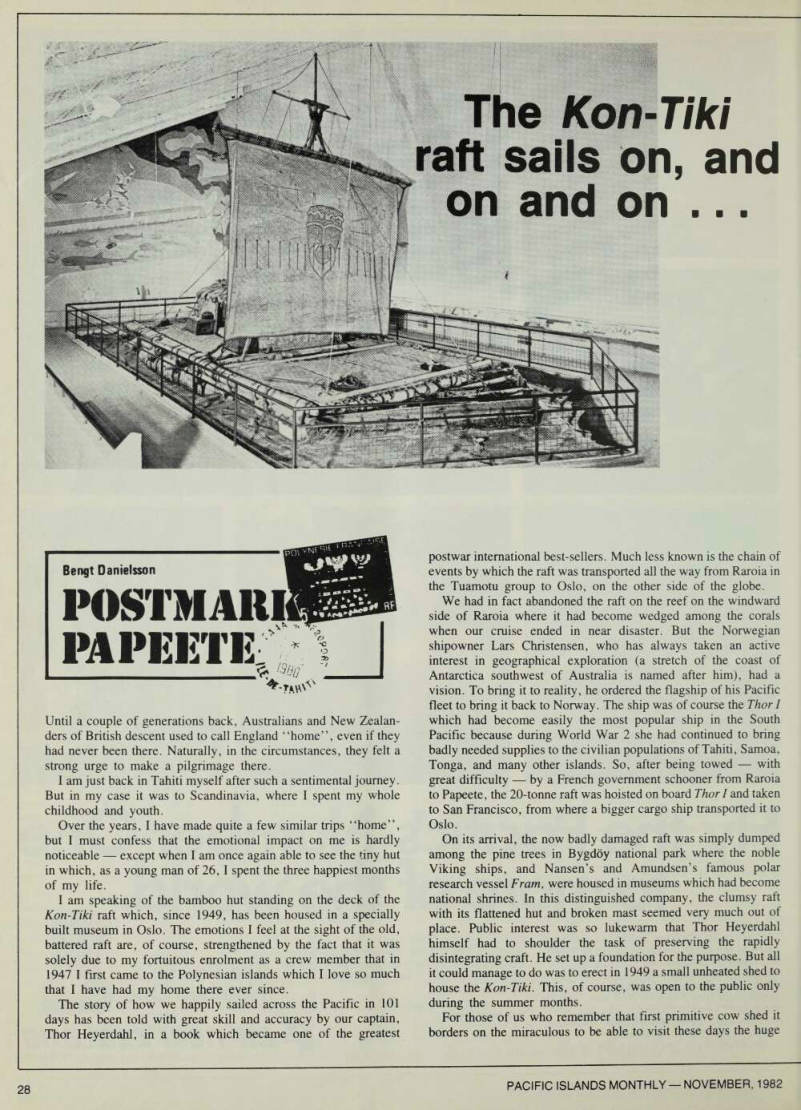
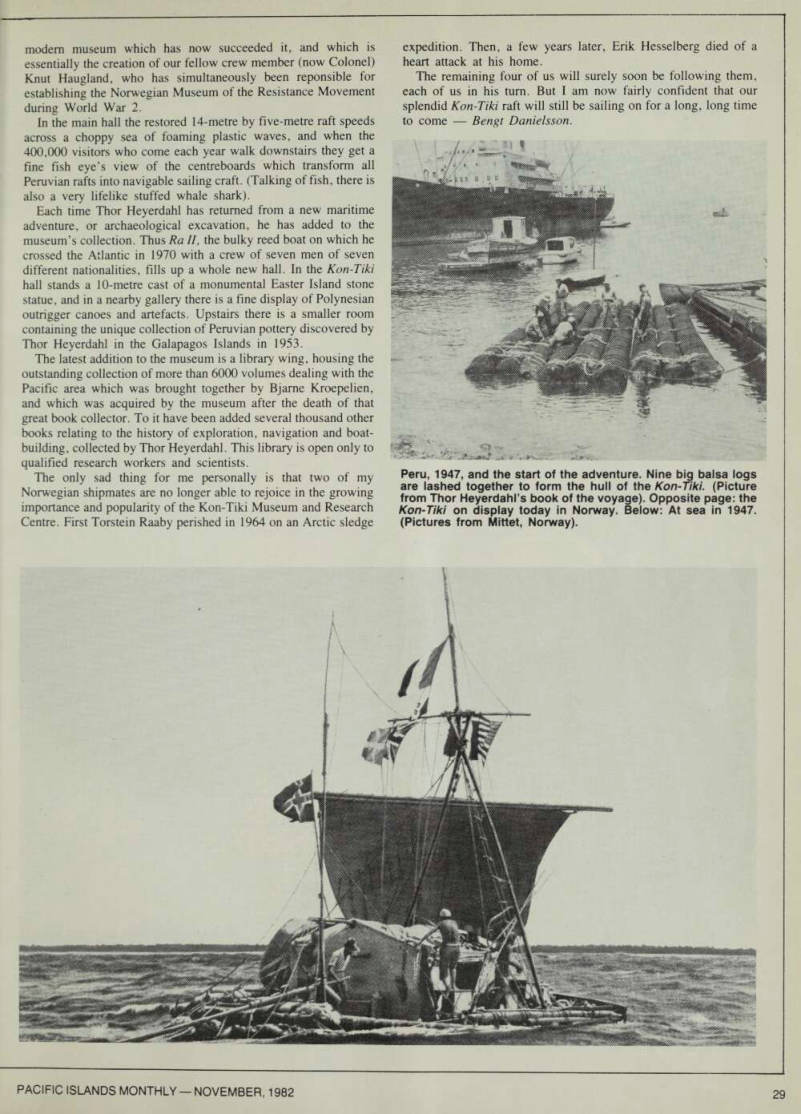
raft sails on, and on and on ...
Until a couple of generations back, Australians and New Zealan ders of British descent used to call England “home”, even if they had never been there. Naturally, in the circumstances, they felt a strong urge to make a pilgrimage there.
I am just back in Tahiti myself after such a sentimental journey.
But in my case it was to Scandinavia, where I spent my whole childhood and youth.
Over the years, I have made quite a few similar trips “home”, but I must confess that the emotional impact on me is hardly noticeable except when I am once again able to see the tiny hut in which, as a young man of 26,1 spent the three happiest months of my life.
I am speaking of the bamboo hut standing on the deck of the Kon-Tiki raft which, since 1949, has been housed in a specially built museum in Oslo. The emotions I feel at the sight of the old, battered raft are, of course, strengthened by the fact that it was solely due to my fortuitous enrolment as a crew member that in 1947 I first came to the Polynesian islands which I love so much that I have had my home there ever since.
The story of how we happily sailed across the Pacific in 101 days has been told with great skill and accuracy by our captain, Thor Heyerdahl, in a book which became one of the greatest
postwar international best-sellers. Much less known is the chain of events by which the raft was transported all the way from Raroia in the Tuamotu group to Oslo, on the other side of the globe.
We had in fact abandoned the raft on the reef on the windward side of Raroia where it had become wedged among the corals when our cruise ended in near disaster. But the Norwegian shipowner Lars Christensen, who has always taken an active interest in geographical exploration (a stretch of the coast of Antarctica southwest of Australia is named after him), had a vision. To bring it to reality, he ordered the flagship of his Pacific fleet to bring it back to Norway. The ship was of course the Thor I which had become easily the most popular ship in the South Pacific because during World War 2 she had continued to bring badly needed supplies to the civilian populations of Tahiti, Samoa, Tonga, and many other islands. So, after being towed with great difficulty by a French government schooner from Raroia to Papeete, the 20-tonne raft was hoisted on board Thor I and taken to San Francisco, from where a bigger cargo ship transported it to Oslo.
On its arrival, the now badly damaged raft was simply dumped among the pine trees in Bygdoy national park where the noble Viking ships, and Nansen’s and Amundsen’s famous polar research vessel From, were housed in museums which had become national shrines. In this distinguished company, the clumsy raft with its flattened hut and broken mast seemed very much out of place. Public interest was so lukewarm that Thor Heyerdahl himself had to shoulder the task of preserving the rapidly disintegrating craft. He set up a foundation for the purpose. But all it could manage to do was to erect in 1949 a small unheated shed to house the Kon-Tiki. This, of course, was open to the public only during the summer months.
For those of us who remember that first primitive cow shed it borders on the miraculous to be able to visit these days the huge
modem museum which has now succeeded it, and which is essentially the creation of our fellow crew member (now Colonel) Knut Haugland, who has simultaneously been reponsible for establishing the Norwegian Museum of the Resistance Movement during World War 2.
In the main hall the restored 14-metre by five-metre raft speeds across a choppy sea of foaming plastic waves, and when the 400,000 visitors who come each year walk downstairs they get a fine fish eye’s view of the centreboards which transform all Peruvian rafts into navigable sailing craft. (Talking of fish, there is also a very lifelike stuffed whale shark).
Each time Thor Heyerdahl has returned from a new maritime adventure, or archaeological excavation, he has added to the museum’s collection. Thus Ra 11, the bulky reed boat on which he crossed the Atlantic in 1970 with a crew of seven men of seven different nationalities, fills up a whole new hall. In the Kon-Tiki hall stands a 10-metre cast of a monumental Easter Island stone statue, and in a nearby gallery there is a fine display of Polynesian outrigger canoes and artefacts. Upstairs there is a smaller room containing the unique collection of Peruvian pottery discovered by Thor Heyerdahl in the Galapagos Islands in 1953.
The latest addition to the museum is a library wing, housing the outstanding collection of more than 6000 volumes dealing with the Pacific area which was brought together by Bjame Kroepelien, and which was acquired by the museum after the death of that great book collector. To it have been added several thousand other books relating to the history of exploration, navigation and boat building, collected by Thor Heyerdahl. This library is open only to qualified research workers and scientists.
The only sad thing for me personally is that two of my Norwegian shipmates are no longer able to rejoice in the growing importance and popularity of the Kon-Tiki Museum and Research Centre. First Torstein Raaby perished in 1964 on an Arctic sledge
expedition. Then, a few years later, Erik Hesselberg died of a heart attack at his home.
The remaining four of us will surely soon be following them, each of us in his turn. But I am now fairly confident that our splendid Kon-Tiki raft will still be sailing on for a long, long time to come Bengt Daniels son.
Peru, 1947, and the start of the adventure. Nine big balsa logs are lashed together to form the hull of the Kon-Tiki. (Picture from Thor Heyerdahl’s book of the voyage). Opposite page: the Kon-Tiki on display today in Norway. Below: At sea in 1947. (Pictures from Mittet, Norway).
Advertisements & other items, p. 30 (1 item)
Citizen Introduce
THE WORLD’S THINNEST
100 METRE WATER RESISTANT
QUARTZ WATCH
Now you don’t have to choose between a fashion watch and a sports watch. Citizen have combined the styling of a dress watch with the durability and water resistance of a sports watch.
Citizen has used its renowned quartz technology to produce the world’s thinnest 100 metre water resistant watch. A case that can sit at the bottom of a swimming pool for a month without losing or gaining more than five seconds,
SUM WATER RESIST 100 CITIZEN
Citizen Watches Australia Pty Ltd. 122 Old Pittwater Rd. Brook vale, NSW 2100, Australia.
Telephone: 9397077 Cable: Citizen Sydney Telex AA26633
Has Smiley
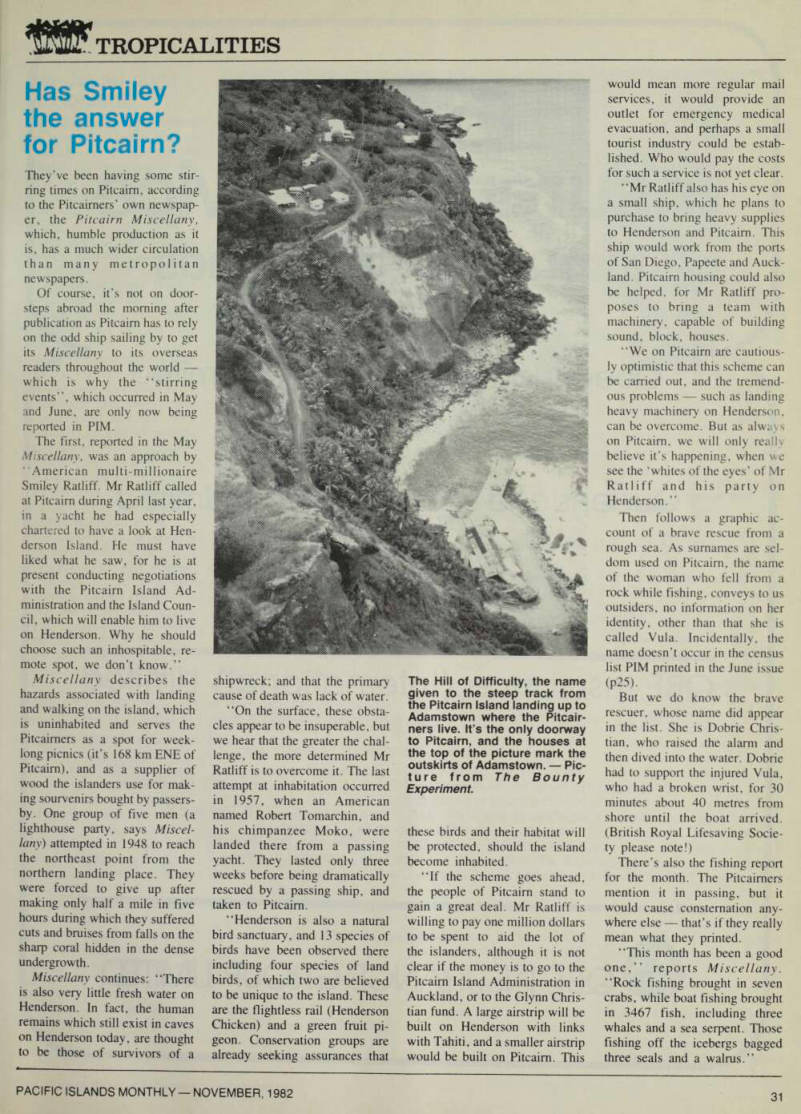
Tropicalities
Has Smiley the answer for Pitcairn?
They’ve been having some stir ring times on Pitcairn, according to the Pitcairners’ own newspap er, the Pitcairn Miscellany, which, humble production as it is, has a much wider circulation than many metropolitan newspapers.
Of course, it’s not on door steps abroad the morning after publication as Pitcairn has to rely on the odd ship sailing by to get its Miscellany to its overseas readers throughout the world which is why the “stirring events”, which occurred in May and June, are only now being reported in PIM.
The first, reported in the May Miscellany, was an approach by American multi-millionaire Smiley Ratliff. Mr Ratliff called at Pitcairn during April last year, in a yacht he had especially chartered to have a look at Hen derson Island. He must have liked what he saw, for he is at present conducting negotiations with the Pitcairn Island Ad ministration and the Island Coun cil, which will enable him to live on Henderson. Why he should choose such an inhospitable, re mote spot, we don’t know.”
Miscellany describes the hazards associated with landing and walking on the island, which is uninhabited and serves the Pitcairners as a spot for week long picnics (it’s 168 km ENE of Pitcairn), and as a supplier of wood the islanders use for mak ing sourvenirs bought by passers by. One group of five men (a lighthouse party, says Miscel lany) attempted in 1948 to reach the northeast point from the northern landing place. They were forced to give up after making only half a mile in five hours during which they suffered cuts and bruises from falls on the sharp coral hidden in the dense undergrowth.
Miscellany continues: “There is also very little fresh water on Henderson. In fact, the human remains which still exist in caves on Henderson today, are thought to be those of survivors of a
shipwreck; and that the primary cause of death was lack of water.
“On the surface, these obsta cles appear to be insuperable, but we hear that the greater the chal lenge, the more determined Mr Ratliff is to overcome it. The last attempt at inhabitation occurred in 1957, when an American named Robert Tomarchin, and his chimpanzee Moko, were landed there from a passing yacht. They lasted only three weeks before being dramatically rescued by a passing ship, and taken to Pitcairn.
“Henderson is also a natural bird sanctuary, and 13 species of birds have been observed there including four species of land birds, of which two are believed to be unique to the island. These are the flightless rail (Henderson Chicken) and a green fruit pi geon. Conservation groups are already seeking assurances that
these birds and their habitat will be protected, should the island become inhabited.
“If the scheme goes ahead, the people of Pitcairn stand to gain a great deal. Mr Ratliff is willing to pay one million dollars to be spent to aid the lot of the islanders, although it is not clear if the money is to go to the Pitcairn Island Administration in Auckland, or to the Glynn Chris tian fund. A large airstrip will be built on Henderson with links with Tahiti, and a smaller airstrip would be built on Pitcairn. This
would mean more regular mail services, it would provide an outlet for emergency medical evacuation, and perhaps a small tourist industry could be estab lished. Who would pay the costs for such a service is not yet clear.
“Mr Ratliff also has his eye on a small ship, which he plans to
purchase to bring heavy supplies
to Henderson and Pitcairn. This ship would work from the ports of San Diego, Papeete and Auck land. Pitcairn housing could also be helped, for Mr Ratliff pro poses to bring a team with
machinery, capable of building
sound, block, houses.
“We on Pitcairn are cautious ly optimistic that this scheme can be carried out, and the tremend ous problems such as landing
heavy machinery on Henderson,
can be overcome. But as always on Pitcairn, we will only really believe it’s happening, when we see the ‘whites of the eyes’ of Mr Ratliff and his party on Henderson.”
Then follows a graphic ac count of a brave rescue from a rough sea. As surnames are sel dom used on Pitcairn, the name of the woman who fell from a rock while fishing, conveys to us outsiders, no information on her identity, other than that she is called Vula. Incidentally, the name doesn’t occur in the census list PIM printed in the June issue (p 25).
But we do know the brave rescuer, whose name did appear in the list. She is Dobrie Chris tian, who raised the alarm and then dived into the water. Dobrie had to support the injured Vula, who had a broken wrist, for 30 minutes about 40 metres from shore until the boat arrived.
(British Royal Lifesaving Socie
ty please note!) There’s also the fishing report for the month. The Pitcairners mention it in passing, but it would cause consternation any where else that’s if they really
mean what they printed.
“This month has been a good one,” reports Miscellany.
“Rock fishing brought in seven crabs, while boat fishing brought in 3467 fish, including three whales and a sea serpent. Those
fishing off the icebergs bagged
three seals and a walrus.”
The Hill of Difficulty, the name given to the steep track from the Pitcairn Island landing up to Adamstown where the Pitcair ners live. It’s the only doorway to Pitcairn, and the houses at the top of the picture mark the outskirts of Adamstown. - Pic ture from The Bounty Experiment.
Advertisements & other items, p. 32 (1 item)
Expert
Insurance Service
throughout the islands
Queensland Insurance (Fiji) Limited
Head Office, 34 Usher St., SUVA , General Manager: L. G. Liddell A.A.1.1. Assistant Managers : R. Jackson, Vijay Lai. Phone: 23851 LAUTOKA OFFICE: Burns Philp Bldg.. Naviti St District Manager: J. Dalton. Phone: 60642.
LABASA OFFICE: Burns Philp Bldg. District Manager: R. SHARMA. Phone: 8 2139
Queensland Insurance (PNG) Limited
PAPUA NEW GUINEA
Head Office, B.N.G. Building, Musgrave St.PORT MORESBY. General Manager: J. M. Dawe.
Phone: 212144.
LAE: 4th St, & Coronation Drive. District Manager: C. D. Hillier Phone: 423873.
MOUNT HAGEN: Hagen Drive. District Manager: G. W. Jack Phone: 521002, ARAWA: Chebu St. District Manager: J, Longbut. Phone: 951555.
MADANG: Kasagten St. District Manager: N. D. Ramage, Phone: 822020.
RABAUL: Wirraway St. District Manager: W. E Tinker. Phone: 921014.
QBE Insurance (International) Limited
VANUATU, PORT VILA: Rue de Pans, Suite 19, Oceania Bldg, Manager: I. R. Martin.
Phone: 2299, SANTO: Burns Philp (Vanuatu) Ltd. Phone: 230.
PACIFIC AGENCIES
NEW CALEDONIA- Ste. W, A. Johnston, S.A.R.L. 5 Rue Anatole France, NOUMEA.
Phone: 272083.
TAHITI Arthur Chung. Immeuble 8.1.5., Front de Mer, PAPEETE Phone: 2.86.19.
NIUE: Burns Philp (South Sea) Company Ltd.
NORFOLK ISLAND: Burns Philp ('N I') Company Ltd. Phone; 2191.
SAMOA; APIA, Burns Philp (South Sea) Company Ltd. Phone: 22611 TONGA Burns Philp (South Sea) Company Ltd. NUKUALOFA. Phone 21500 HAAPAI, VAVAU. &
MEMBERS OF THE:
QBE INSURANCE GROUP LIMITED
Eat Japan-style
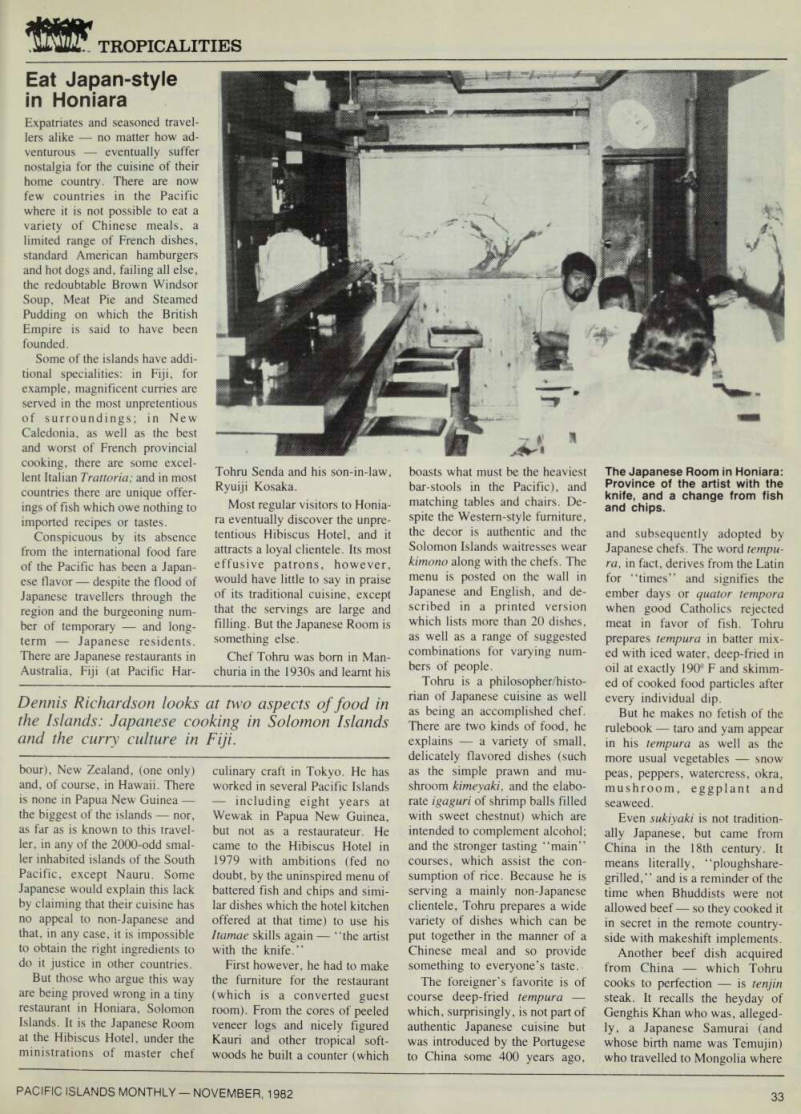
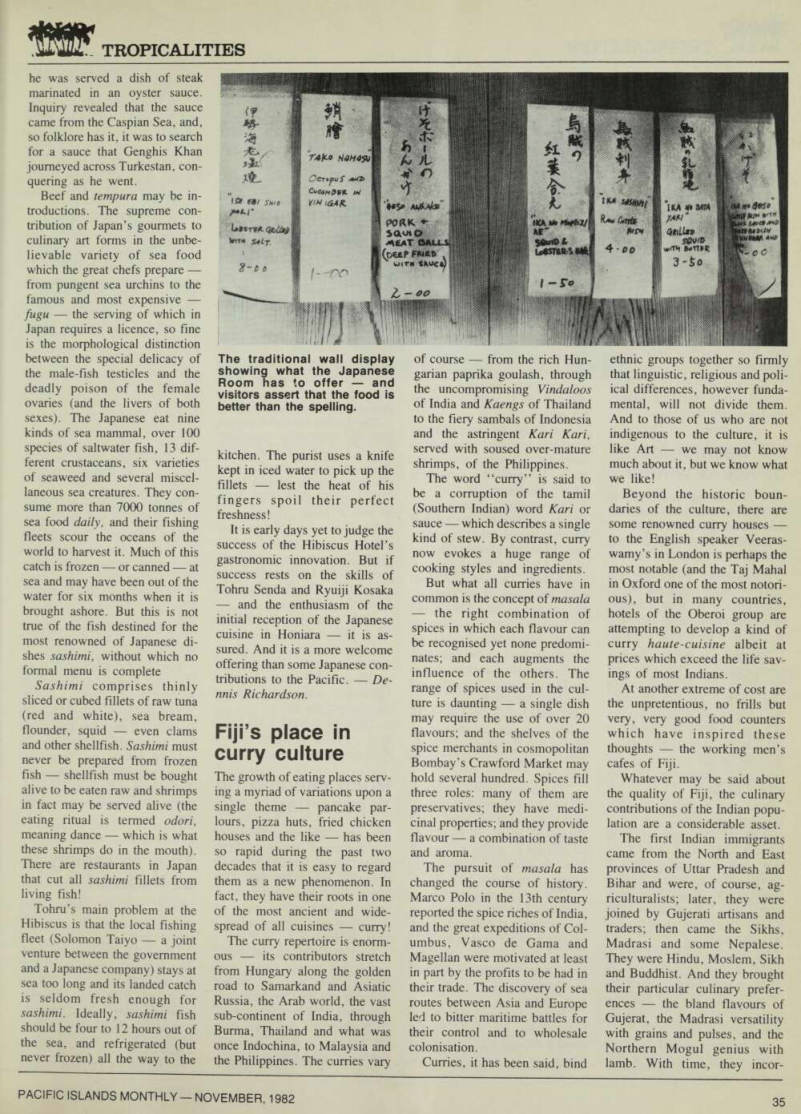
Tropicalities
Eat Japan-style in Honiara
Expatriates and seasoned travel lers alike no matter how ad venturous eventually suffer nostalgia for the cuisine of their home country. There are now few countries in the Pacific where it is not possible to eat a variety of Chinese meals, a limited range of French dishes, standard American hamburgers and hot dogs and, failing all else, the redoubtable Brown Windsor Soup, Meat Pie and Steamed Pudding on which the British Empire is said to have been founded.
Some of the islands have addi tional specialities: in Fiji, for
example, magnificent curries are
served in the most unpretentious of surroundings; in New Caledonia, as well as the best and worst of French provincial cooking, there are some excel lent Italian Trattoria; and in most countries there are unique offer ings of fish which owe nothing to
imported recipes or tastes.
Conspicuous by its absence
from the international food fare of the Pacific has been a Japan ese flavor despite the flood of Japanese travellers through the region and the burgeoning num ber of temporary and long term Japanese residents.
There are Japanese restaurants in Australia, Fiji (at Pacific Har-
Dennis Richardson looks at two aspects of food in the Islands: Japanese cooking in Solomon Islands and the curry culture in Fiji.
hour), New Zealand, (one only) and, of course, in Hawaii. There is none in Papua New Guinea the biggest of the islands nor, as far as is known to this travel ler, in any of the 2000-odd smal ler inhabited islands of the South Pacific, except Nauru. Some Japanese would explain this lack by claiming that their cuisine has no appeal to non-Japanese and that, in any case, it is impossible to obtain the right ingredients to do it justice in other countries.
But those who argue this way are being proved wrong in a tiny restaurant in Honiara, Solomon Islands. It is the Japanese Room at the Hibiscus Hotel, under the ministrations of master chef
Tohru Senda and his son-in-law, Ryuiji Kosaka.
Most regular visitors to Honia ra eventually discover the unpre tentious Hibiscus Hotel, and it attracts a loyal clientele. Its most effusive patrons, however, would have little to say in praise of its traditional cuisine, except that the servings are large and filling. But the Japanese Room is something else.
Chef Tohru was bom in Man churia in the 1930 s and learnt his
culinary craft in Tokyo. He has worked in several Pacific Islands including eight years at Wewak in Papua New Guinea, but not as a restaurateur. He came to the Hibiscus Hotel in 1979 with ambitions (fed no doubt, by the uninspired menu of battered fish and chips and simi lar dishes which the hotel kitchen offered at that time) to use his Itamae skills again “the artist with the knife.”
First however, he had to make the furniture for the restaurant (which is a converted guest room). From the cores of peeled veneer logs and nicely figured Kauri and other tropical soft woods he built a counter (which
boasts what must be the heaviest bar-stools in the Pacific), and matching tables and chairs. De spite the Western-style furniture, the decor is authentic and the Solomon Islands waitresses wear kimono along with the chefs. The menu is posted on the wall in Japanese and English, and de scribed in a printed version which lists more than 20 dishes, as well as a range of suggested combinations for varying num bers of people.
Tohru is a philosopher/histo rian of Japanese cuisine as well as being an accomplished chef.
There are two kinds of food, he explains a variety of small, delicately flavored dishes (such as the simple prawn and mu shroom kimeyaki, and the elabo rate igaguri of shrimp balls filled with sweet chestnut) which are intended to complement alcohol; and the stronger tasting “main” courses, which assist the con sumption of rice. Because he is serving a mainly non-Japanese clientele, Tohru prepares a wide variety of dishes which can be put together in the manner of a Chinese meal and so provide something to everyone’s taste.
The foreigner’s favorite is of course deep-fried tempura which, surprisingly, is not part of authentic Japanese cuisine but was introduced by the Portugese to China some 400 years ago,
and subsequently adopted by Japanese chefs. The word tempu ra, in fact, derives from the Latin for “times” and signifies the ember days or quator tempora when good Catholics rejected meat in favor of fish. Tohru prepares tempura in batter mix ed with iced water, deep-fried in oil at exactly 190° F and skimm ed of cooked food particles after every individual dip.
But he makes no fetish of the rulebook taro and yam appear in his tempura as well as the more usual vegetables snow peas, peppers, watercress, okra, mushroom, eggplant and seaweed.
Even sukiyaki is not tradition ally Japanese, but came from China in the 18th century. It means literally, “ploughshare grilled,” and is a reminder of the time when Bhuddists were not allowed beef so they cooked it in secret in the remote country side with makeshift implements.
Another beef dish acquired from China which Tohru cooks to perfection is tenjin steak. It recalls the heyday of Genghis Khan who was, alleged ly, a Japanese Samurai (and whose birth name was Temujin) who travelled to Mongolia where
The Japanese Room in Honiara: Province of the artist with the knife, and a change from fish
and chips.
he was served a dish of steak marinated in an oyster sauce.
Inquiry revealed that the sauce came from the Caspian Sea, and, so folklore has it, it was to search for a sauce that Genghis Khan journeyed across Turkestan, con quering as he went.
Beef and tempura may be in troductions. The supreme con tribution of Japan’s gourmets to culinary art forms in the unbe lievable variety of sea food which the great chefs prepare from pungent sea urchins to the famous and most expensive fugu the serving of which in Japan requires a licence, so fine is the morphological distinction between the special delicacy of the male-fish testicles and the deadly poison of the female ovaries (and the livers of both sexes). The Japanese eat nine kinds of sea mammal, over 100 species of saltwater fish, 13 dif ferent crustaceans, six varieties of seaweed and several miscel laneous sea creatures. They con sume more than 7000 tonnes of sea food daily, and their fishing fleets scour the oceans of the world to harvest it. Much of this catch is frozen or canned at sea and may have been out of the water for six months when it is brought ashore. But this is not true of the fish destined for the most renowned of Japanese di shes sashimi, without which no formal menu is complete Sashimi comprises thinly sliced or cubed fillets of raw tuna (red and white), sea bream, flounder, squid even clams and other shellfish. Sashimi must never be prepared from frozen fish shellfish must be bought alive to be eaten raw and shrimps in fact may be served alive (the eating ritual is termed odori, meaning dance which is what these shrimps do in the mouth).
There are restaurants in Japan that cut all sashimi fillets from living fish!
Tohru’s main problem at the Hibiscus is that the local fishing fleet (Solomon Taiyo a joint venture between the government and a Japanese company) stays at sea too long and its landed catch is seldom fresh enough for sashimi. Ideally, sashimi fish should be four to 12 hours out of the sea, and refrigerated (but never frozen) all the way to the
kitchen. The purist uses a knife kept in iced water to pick up the fillets lest the heat of his fingers spoil their perfect freshness!
It is early days yet to judge the success of the Hibiscus Hotel’s gastronomic innovation. But if success rests on the skills of Tohru Senda and Ryuiji Kosaka and the enthusiasm of the initial reception of the Japanese cuisine in Honiara it is as sured. And it is a more welcome offering than some Japanese con tributions to the Pacific. De nnis Richardson.
Fiji’s place in
curry culture
The growth of eating places serv ing a myriad of variations upon a single theme pancake par lours, pizza huts, fried chicken houses and the like has been so rapid during the past two decades that it is easy to regard them as a new phenomenon. In fact, they have their roots in one of the most ancient and wide spread of all cuisines curry!
The curry repertoire is enorm ous its contributors stretch from Hungary along the golden road to Samarkand and Asiatic Russia, the Arab world, the vast sub-continent of India, through Burma, Thailand and what was once Indochina, to Malaysia and the Philippines. The curries vary
of course from the rich Hun garian paprika goulash, through the uncompromising Vindaloos of India and Kaengs of Thailand to the fiery sambals of Indonesia and the astringent Kari Kari, served with soused over-mature shrimps, of the Philippines.
The word “curry” is said to be a corruption of the tamil (Southern Indian) word Kari or sauce which describes a single kind of stew. By contrast, curry now evokes a huge range of cooking styles and ingredients.
But what all curries have in common is the concept of masala the right combination of spices in which each flavour can be recognised yet none predomi nates; and each augments the influence of the others. The range of spices used in the cul ture is daunting a single dish may require the use of over 20 flavours; and the shelves of the spice merchants in cosmopolitan Bombay’s Crawford Market may hold several hundred. Spices fill three roles; many of them are preservatives; they have medi cinal properties; and they provide flavour a combination of taste and aroma.
The pursuit of masala has changed the course of history.
Marco Polo in the 13th century reported the spice riches of India, and the great expeditions of Col umbus, Vasco de Gama and Magellan were motivated at least in part by the profits to be had in their trade. The discovery of sea routes between Asia and Europe led to bitter maritime battles for their control and to wholesale colonisation.
Curries, it has been said, bind
ethnic groups together so firmly that linguistic, religious and poli ical differences, however funda mental, will not divide them.
And to those of us who are not indigenous to the culture, it is like Art we may not know much about it, but we know what we like!
Beyond the historic boun daries of the culture, there are some renowned curry houses to the English speaker Veeras wamy’s in London is perhaps the most notable (and the Taj Mahal in Oxford one of the most notori ous), but in many countries, hotels of the Oberoi group are attempting to develop a kind of curry haute-cuisine albeit at prices which exceed the life sav ings of most Indians.
At another extreme of cost are the unpretentious, no frills but very, very good food counters which have inspired these thoughts the working men’s cafes of Fiji.
Whatever may be said about the quality of Fiji, the culinary contributions of the Indian popu lation are a considerable asset.
The first Indian immigrants came from the North and East provinces of Uttar Pradesh and Bihar and were, of course, ag riculturalists; later, they were joined by Gujerati artisans and traders; then came the Sikhs, Madrasi and some Nepalese.
They were Hindu, Moslem, Sikh and Buddhist. And they brought their particular culinary prefer ences the bland flavours of Gujerat, the Madrasi versatility with grains and pulses, and the Northern Mogul genius with lamb. With time, they incor-
The traditional wall display showing what the Japanese Room has to offer - and visitors assert that the food is better than the spelling.
porated local ingredients, includ ing taro and breadfruit, while the chutneys and salads have a uni quely Pacific character.
Fiji’s curry culture is not among the most sophisticated in the world; there is no restaurant equivalent to that of Bombay’s Centaur or Singapore’s Omar Khayyam or even Moti Mahal.
But in terms of variety and value for money the curry houses are second to none. They are not fancy; they do not advertise; of ten there is not even a sign
indicating an eating place.
But the devotee of the garam masala only has to ask an Indian taxi-driver and for little more than a dollar can experience the variety and delights of a cuisine which spans half the world.
Dennis Richardson.
NZ haemoglobin
device a winner
New Zealand ingenuity has pro duced a portable meter that mea sures haemoglobin in the blood.
It should save lives in developing countries all round the world.
Haemoglobin is the oxygen carrying molecule in the blood.
Measurement of it is a funda mental requirement in the basic diagnosis of the person’s health.
Measuring is usually done in urban centres in a laboratory us ing a piece of equipment costing between $20,000 and $40,000.
But what do you do in the jungles of Latin America and Southeast Asia, in the snow-tipped moun tains of Nepal or among the isolated communities in the Pacific Islands?
You use a Delphi portable haemoglobin meter.
It weighs 650 grams, is 12 cm long, 9.5 cm wide, and 9.5 cm high, and costs under SSOO. It operates in temperatures ranging from 0 to 50 degrees centigrade with a nine volt transistor radio battery that can give up to 100,000 readings.
Its running costs are 21c a measurement compared with $1.70 or more from similar types of equipment, and you can drop it, kick it, or throw it across the room and not harm it.
Its accuracy, based on three years of field trials using a con
trolled group of 500 patients, produced a variance of 0.025 per cent when compared with expen sive laboratory instruments.
All that adds up to a highly reliable, accurate, robust piece of New Zealand technology that is quick and easy to operate and
cheap enough for developing
countries to buy.
There are more than 100 units operating in New Zealand and Australia already which, indi vidually, do up to 600 to 1000
readings a day.
Their use has now spread to Nepal, Papua New Guinea, In donesia, Tanzania and Tuvalu.
You can find them in blood transfusion centres, pre-natal and post-natal clinics, radiation clin
ics, hospital casualty depart
ments, and military field
hospitals.
Now Delphi Industries Ltd. of Auckland is poised to launch an international marketing cam paign to publicise this little known instrument.
The company’s general mana
ger, Ray Crutcher, is the catalyst for this project which includes people like the Medical Director of the Auckland Blood Transfu sion Centre, Dr Graeme Wood field, who sparked off develop ment of the meter while operat ing in Southeast Asian jungles; Walter Wilson who carried out laboratory work at the Auckland centre plus initial work by staff at the Department of Scientific and Industrial Research.
“I’m taking the front end tech nology resource and then trans ferring that information to com mercial application,” said Crutcher.
“The beauty of the device is the way it was developed initially so that we could use it for blood transfusion centres. It takes only 60 seconds to screen a potential donor so you know immediately whether you should take blood.
“The cost savings are dramat ic and the fact that you can have an accurate, stable and quick reliable measurement in the field and that you can adjust the meter to an international standard in 10 seconds or so is very,
very important.
“People knowledgeable about
haemoglobin get pretty excited about it because it doesn’t matter where you are, your standardisa
tion technique can be carried out on the spot.
“That means you are not wor ried about temperature perform ance or all the other problems you face in the field,” he said.
William Gas son in Wellington.
Penpal gamble
comes off
It’s a long way from Puerto Rico, in the Caribbean, to Papua New Guinea especially if you are trying to contact someone you know only by face.
But that didn’t stop a letter from a school-girl in San Juan finding its way half-way round the world to the chairman of the Public Services Commission, Mr Renagi Lohia, in September.
The picture is cut from the National Geographic magazine, and the letter is addressed simply Port Moresby, Papua New Guinea, with the request: “Post Office, please deliver this letter to man in photo. Thanks.”
The Posts and Telecommuni cations Corporation took it from there. The letter was hand de livered to Mr Lohia yesterday by PTC public relations officer Mrs Carlene Lohberger.
Mr Lohia said he was delight ed to have a penpal.
The schoolgirl, whom he de clined to name, had read an article about PNG in the National Geographic and wanted to know more about the place.
“Request granted,” Mr Lohia
said.
Papua New Guinea
Post-Courier.
Much yapping on
Yapese flag
Yap, one of the member states of the Federated States of Mic ronesia, is having second thoughts about its new flag which bears the design of a canoe, a star and a piece of traditional stone money, all on a field of blue.
Well, that’s what it’s supposed to be, but people aren’t sure, which is why there are second thoughts and why the Yap Con stitutional Convention unanim ously adopted a resolution from the Mayor of Rull, Fernando Falewaath, asking the state legis
lature to call for a contest for a
new design.
“The state should have a flag that the public would recognise what it represents,’’ said the
Mayor of Rull, Yap’s biggest
municipality. State Information Officer Willy Gorongfel told it this way to the FSM Information Service: There are certain different in dividual opinions and impres sions on the design and represen tation of the present flag of the state, with those who think of it as the best thing after betel nuts, and those who choose to retain the opinion of abstract expre ssionism . . .
Those who had seen the Yap
state flag waving and chopping
the thin air so proudly only walk ed away with nothing but a bit of mixed feeling as to why Yap, among all Pacific neighbors, and also known for its cultural herit age and conservatism, chose a flag which represents a chicken leg in a frying pan.
Others have interpreted the de sign as that of a broken, two bladed propeller. Then there is the bizarre, mental imagination of those gorgeous provocative cheer leaders of the Super Bowl Dallas Cowboys and how far sky
high they may leap in cheers
since they may think that the flag of this state is also representing the helmet of their football team.
But, most difficult of all is the idea to determine which side of the flag is to be flying upward.
Perhaps these could be the reasons that the state flag never has been allowed to take its position beside the Stars and Stripes, the FSM flag and the UN flag in front of the state administ ration office and elsewhere in the state.
They’re racing
at Nadzab!
“Bang! went the starter’s gun and Bang! went the starter’s
motor cycle.”
Under this headline the Syd ney Sunday newspaper Sun- Herald of October 10, carried a report of a September horse racing meeting held at Nadzab, near Lae in Papua New Guinea, by the New Guinea Amateur Turf Club.
Describing an event known as the Stockmen’s Race, the news paper’s racing reporter Bert Lil lye wrote: “There was high dra ma even before the race began.
The starter, who went to the barrier on a motor bike, sent the runners away by firing a gun.
“Unfortunately he put the gun behind his back before he pulled the trigger. The bullet blew a hole in the motor bike behind him and the petrol tank exploded Praising the initiative of the Nadzab racing enthusiasts, Lillye writes: “For instance, when it was discovered that someone had forgotten to provide saddlecloth numbers . . . This problem was solved when Mrs Clift, the club president’s wife, hurried home and brought back eight pillow slips from her linen supply.
“These were split down the centre and the numbers put on with special crayons.’’
Two Australian racing experts were impressed by the excellence of Nadzab’s 1600-metre grass track, and with its heavy duty barrier stalls, built by local volunteers.
Another Australian visitor who broadcast the races was non plussed when a helicopter landed on the racecourse and he found himself shouldered aside from the microphone by one of the volunteer local committeemen, who grabbed the mike and yelled into it: “You fellows at the gate, get over to that helicopter and get their money. Those blokes never pay their fare in.’’
Hawksbill turtle
on S.l. stamp
To follow Sanford’s Eagle and cater for a new heavy weight air parcel post service the Solomon Islands have hatched a high value Hawksbill Turtle ($10) stamp for the current definitive series.
Ousting the Estuarine Crocodile from its place as the previous top value ($5), the Hawksbill has been portrayed by the same artist, Leslie Curtis, and is printed by Enschede en Zonen of Holland.
The Hawksbill is related to the Green Turtle and the Common Loggerhead, averaging about 33
brewery is running short of bot tles and no wonder: the beer is becoming one of Western Samoa’s most liquid overseas as sets. It’s selling and being drunk all over the South Pacific.
Vailima’s resident agent, Gary Cooper (see picture this page) wants all his bottles back so he’s been running a two-week Find the Vailima Bottle contest, with four main prizes of $lO each, to the top boy and girl collectors on the north side of the island and the top boy and girl on the south side, plus five cents for each bottle collected by all competitors.
Canoe plan holed
by lack of funds
A canoe voyage to retrace the migration route of the Maori peo ple to New Zealand may now never take place.
The epic voyage, hailed last year as perhaps the last great voyage of the 20th century, has gone aground in Tahiti because there is not enough money for the return trip.
Early last year, Matahi Whakataka Brightwell, a Master ton-bom carver, had the twin canoe hulls - which were carv ed out of totara logs shipped to Tahiti.
In Tahiti the hulls were to be linked and sails woven for the voyage to New Zealand, using the ancient sea route from Raiatea, in the Society Islands, to the Cook Islands.
The voyagers intended to use
inches in length. It is positively minute compared with an At lantic Leatherback, which would weigh in at about a ton, and in turn completely outstrips the very smallest members of the family which are less than six inches long!
The Hawksbill must be one of the few creatures to really ap preciate the invention of plastic, now that it has largely replaced the use of the Hawksbill’s shell in the tortoise-shell industry.
Turtle shells are incrdibly strong.
If nature had thought fit to pro vide a man with one, in propor tion to his size, he would be able to suport the weight of two elephants at least... at a pinch!
The release date for the stamp was September 20, 1982.
From Stangib, New York.
Niue’s Vailima
bottle hunt
Youngsters on Niue spent much of their September school holi days combing the island for bot tles not just any sort of bottle but those that had contained Western Samoa’s pride and joy, Vailima beer. Apparently, the
the Polynesian art of navigation.
The voyage should have been completed last February.
But Mr Brightwell and his canoe are still in Tahiti. And prospects do not look good.
Mr Brightwell said in Tahiti that he could not make the voy age to New Zealand because he could not get financial help from either his own country or Tahiti.
“The Maori Affairs Depart ment did not want to finance our project,” he said. “They even said that they would seize the canoe in New Zealand.”
A spokesman for the Depart ment of Maori Affairs, Neville Baker, said his department had been asked for about $lOO,OOO and the department did not have “that sort of money”.
As to the suggestion of seizing the canoe, Mr Baker said: “lam not sure what the department would do with the canoe if it did seize it.”
But a Wellington group hopes to raise $50,000 in donations to finance continuation of the voyage.
A spokesman for the Friends of the Hawaiki Nui group, David Paterson, said that the voyage had been “financially disastr ous” from the start.
But the group of about 15 Wellington people believed it could still be revived.
He believed the necessary fi nance could be found because the group had had some success with a similar appeal last year, boost ing a $30,000 government contribution.
Gary Cooper (right), managing
director of Niue Products, who organised the bottle drive re ported on this page. He was recently in Sydney selling Niue
produce - including coconut
cream and honey in the comb - to Australian importers. He talks here with Geoff Upton, one of the importers who showed interest.
Advertisements & other items, pp. 34-38 (1 item)
Nelson & Robertson
In our 87th Year Selling ‘Service’ to the Pacific Islands
Pty. Ltd.
(Established 1895)
Plantation House, •RABAUL 197 Clarence Street, Sydney.
Cables: ‘IVAN’, Sydney, Brisbane.
Telex: AA22381, Sydney.
Phone: 29 2871
pBE/?/
o to 9SS a V. c.
MADANG
• \‘M
LAE
KIETA
BRISBANE
SYDNEY
t ••• ••• r p.o •• • • • • ••• &>**»*;**•*.* • • v*
LAUTOKA
= ;^!PiiIiP!iP SUVA
For Indents
from Australia,
New Zealand and Overseas
Foodstuffs
Softgoods
Hardware
Machinery
Travel
Insurance
Canned Fish
Jute Goods
Real Estate
v.V *.•*,**• •*•***•*
BRANCH OFFICES:
Nelson & Robertson Pty. Ltd., P.O. Box 575, Brisbane, Qld., Australia. 2216966 P.O. Box 2092, Govt. Bldg., Suva, Fiji. 22430 P.O. Box 258, Lautoka, Fiji. 62101 P.O. Box 2420, CPO Auckland 1, New Zealand. 774141 •• UC ND
•:;'::PAPUA NEW GUINEA REPRESENTATIVES:
hi Pty. Ltd, Rabaul, P.N.G. 922911 Box 1406, Lae, P.N.G. 422366 Box 711, Madang, P.N.G, 822066 P.O. Box 253, Kieta, P.N.G. 956185
m k m is* ■ o J* m m V/ ■ fe ;|^;‘ ■ i T * :V>- mm V -
iiiiii®s
When only the best will do-and isn't that all the time?
People
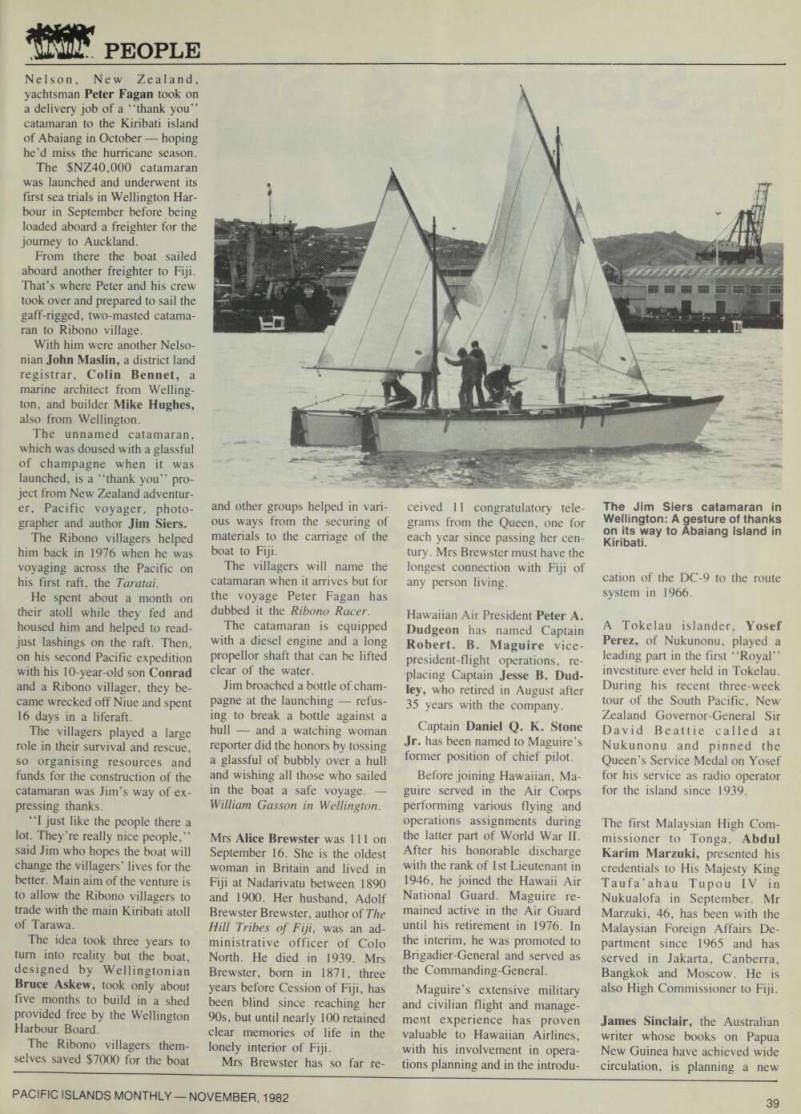
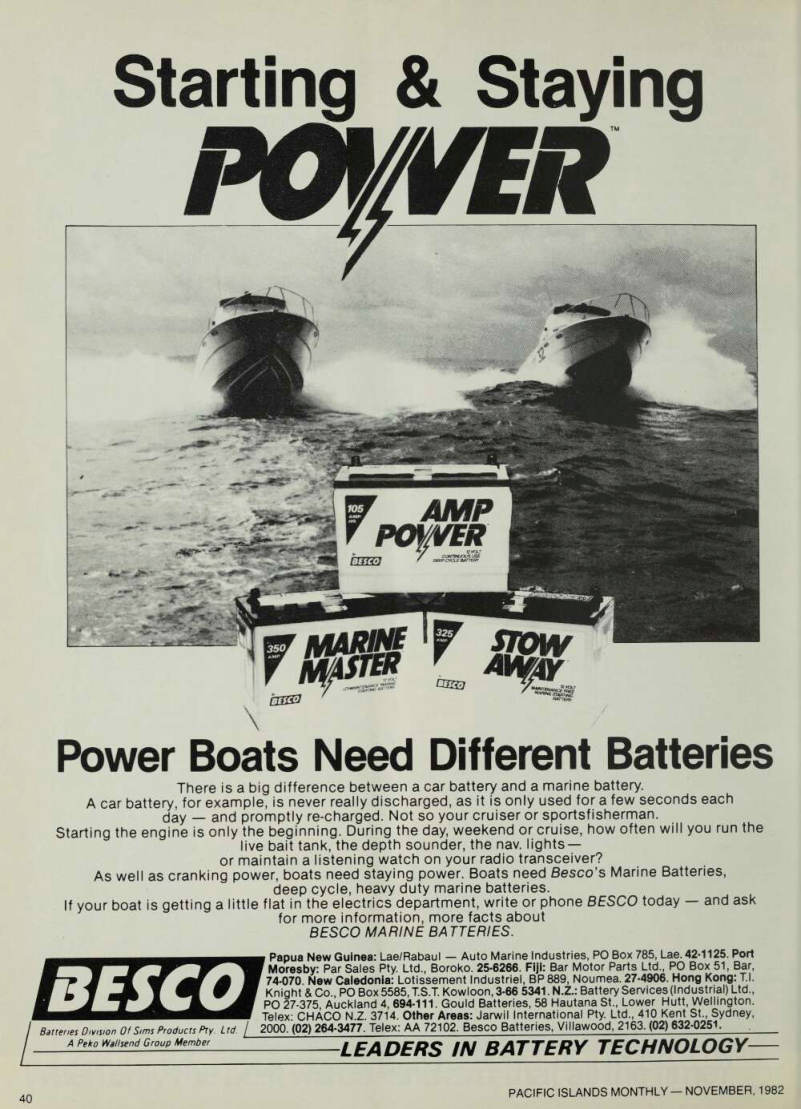
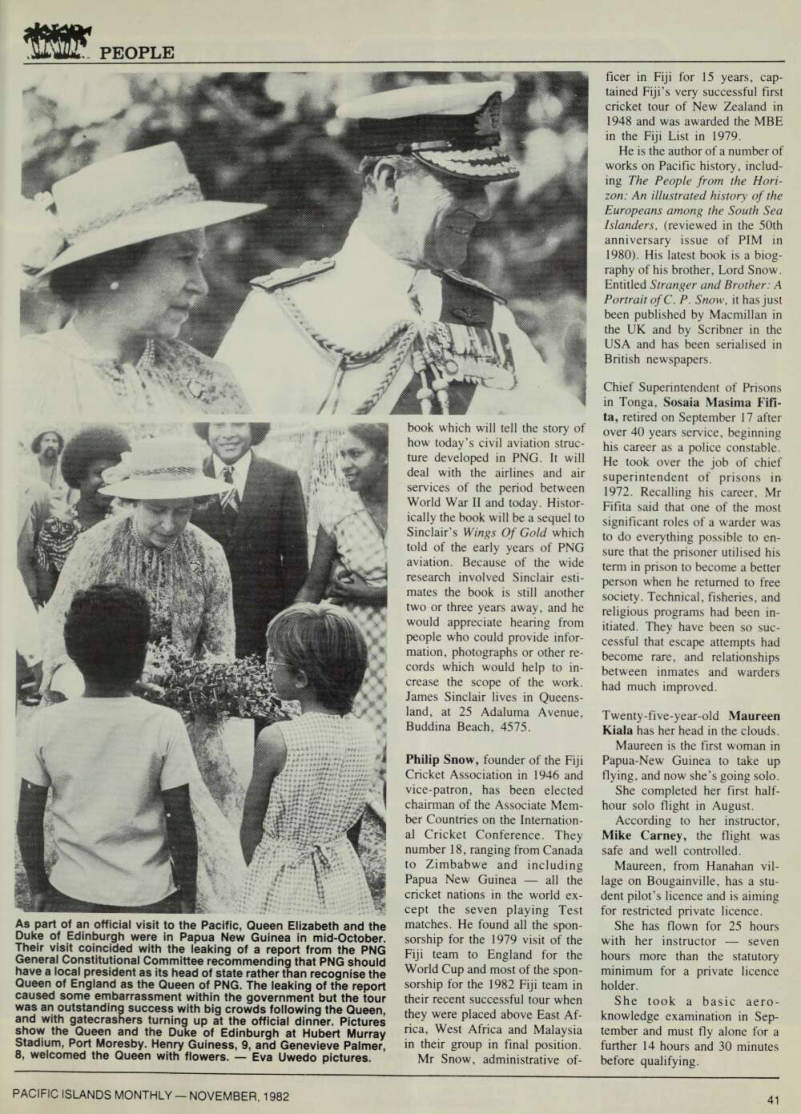

Nelson, New Zealand, yachtsman Peter Fagan took on a delivery job of a “thank you” catamaran to the Kiribati island of Abaiang in October hoping he’d miss the hurricane season.
The SNZ4O,OOO catamaran was launched and underwent its first sea trials in Wellington Har bour in September before being loaded aboard a freighter for the journey to Auckland.
From there the boat sailed aboard another freighter to Fiji.
That’s where Peter and his crew took over and prepared to sail the gaff-rigged, two-masted catama ran to Ribono village.
With him were another Nelso nian John Maslin, a district land registrar, Colin Bennet, a marine architect from Welling ton, and builder Mike Hughes, also from Wellington.
The unnamed catamaran, which was doused with a glassful of champagne when it was launched, is a “thank you” pro ject from New Zealand adventur er, Pacific voyager, photo grapher and author Jim Siers.
The Ribono villagers helped him back in 1976 when he was voyaging across the Pacific on his first raft, the Taratai.
He spent about a month on their atoll while they fed and housed him and helped to read just lashings on the raft. Then, on his second Pacific expedition with his 10-year-old son Conrad and a Ribono villager, they be came wrecked off Niue and spent 16 days in a liferaft.
The villagers played a large role in their survival and rescue, so organising resources and funds for the construction of the catamaran was Jim’s way of ex pressing thanks.
“I just like the people there a lot. They’re really nice people,” said Jim who hopes the boat will change the villagers’ lives for the better. Main aim of the venture is to allow the Ribono villagers to trade with the main Kiribati atoll of Tarawa.
The idea took three years to turn into reality but the boat, designed by Wellingtonian Bruce Askew, took only about five months to build in a shed provided free by the Wellington Harbour Board.
The Ribono villagers them selves saved $7OOO for the boat
and other groups helped in vari ous ways from the securing of materials to the carriage of the boat to Fiji.
The villagers will name the catamaran when it arrives but for the voyage Peter Fagan has dubbed it the Ribono Racer.
The catamaran is equipped with a diesel engine and a long propeller shaft that can be lifted clear of the water.
Jim broached a bottle of cham pagne at the launching refus ing to break a bottle against a hull and a watching woman reporter did the honors by tossing a glassful of bubbly over a hull and wishing all those who sailed in the boat a safe voyage.
William Gasson in Wellington.
Mrs Alice Brewster was 111 on September 16. She is the oldest woman in Britain and lived in Fiji at Nadarivatu between 1890 and 1900. Her husband, Adolf Brewster Brewster, author of The Hill Tribes of Fiji, was an ad ministrative officer of Colo North. He died in 1939. Mrs Brewster, bom in 1871, three years before Cession of Fiji, has been blind since reaching her 90s, but until nearly 100 retained clear memories of life in the lonely interior of Fiji.
Mrs Brewster has so far re
ceived 11 congratulatory tele grams from the Queen, one for each year since passing her cen tury. Mrs Brewster must have the longest connection with Fiji of any person living.
Hawaiian Air President Peter A.
Dudgeon has named Captain Robert. B. Maguire vice president-flight operations, re placing Captain Jesse B. Dud ley, who retired in August after 35 years with the company.
Captain Daniel Q. K. Stone Jr. has been named to Maguire’s former position of chief pilot.
Before joining Hawaiian, Ma guire served in the Air Corps performing various flying and operations assignments during the latter part of World War 11.
After his honorable discharge with the rank of Ist Lieutenant in 1946, he joined the Hawaii Air National Guard. Maguire re mained active in the Air Guard until his retirement in 1976. In the interim, he was promoted to Brigadier-General and served as the Commanding-General.
Maguire’s extensive military and civilian flight and manage ment experience has proven valuable to Hawaiian Airlines, with his involvement in opera tions planning and in the introdu
cation of the DC-9 to the route system in 1966.
A Tokelau islander, Yosef Perez, of Nukunonu, played a leading part in the first “Royal” investiture ever held in Tokelau.
During his recent three-week tour of the South Pacific, New Zealand Governor-General Sir David Beattie called at Nukunonu and pinned the Queen’s Service Medal on Yosef for his service as radio operator for the island since 1939.
The first Malaysian High Com missioner to Tonga, Abdul Karim Marzuki, presented his credentials to His Majesty King Taufa’ahau Tupou IV in Nukualofa in September. Mr Marzuki, 46, has been with the Malaysian Foreign Affairs De partment since 1965 and has served in Jakarta, Canberra, Bangkok and Moscow. He is also High Commissioner to Fiji.
James Sinclair, the Australian writer whose books on Papua New Guinea have achieved wide circulation, is planning a new
The Jim Siers catamaran in Wellington: A gesture of thanks on its way to Abaiang Island in Kiribati.
book which will tell the story of how today’s civil aviation struc ture developed in PNG. It will deal with the airlines and air services of the period between World War II and today. Histor ically the book will be a sequel to Sinclair’s Wings Of Gold which told of the early years of PNG aviation. Because of the wide research involved Sinclair esti mates the book is still another two or three years away, and he would appreciate hearing from people who could provide infor mation, photographs or other re cords which would help to in crease the scope of the work.
James Sinclair lives in Queens land, at 25 Adaluma Avenue, Buddina Beach, 4575.
Philip Snow, founder of the Fiji Cricket Association in 1946 and vice-patron, has been elected chairman of the Associate Mem ber Countries on the Internation al Cricket Conference. They number 18, ranging from Canada to Zimbabwe and including Papua New Guinea all the cricket nations in the world ex cept the seven playing Test matches. He found all the spon sorship for the 1979 visit of the Fiji team to England for the World Cup and most of the spon sorship for the 1982 Fiji team in their recent successful tour when they were placed above East Af rica, West Africa and Malaysia in their group in final position.
Mr Snow, administrative of
ficer in Fiji for 15 years, cap tained Fiji’s very successful first cricket tour of New Zealand in 1948 and was awarded the MBE in the Fiji List in 1979.
He is the author of a number of works on Pacific history, includ ing The People from the Hori zon: An illustrated history of the Europeans among the South Sea Islanders, (reviewed in the 50th anniversary issue of PIM in 1980). His latest book is a biog raphy of his brother, Lord Snow.
Entitled Stranger and Brother: A Portrait of C. P. Snow, it has just been published by Macmillan in the UK and by Scribner in the USA and has been serialised in British newspapers.
Chief Superintendent of Prisons in Tonga, Sosaia Masima Fifi ta, retired on September 17 after over 40 years service, beginning his career as a police constable.
He took over the job of chief superintendent of prisons in 1972. Recalling his career, Mr Fifita said that one of the most significant roles of a warder was to do everything possible to en sure that the prisoner utilised his term in prison to become a better person when he returned to free society. Technical, fisheries, and religious programs had been in itiated. They have been so suc cessful that escape attempts had become rare, and relationships between inmates and warders had much improved.
Twenty-five-year-old Maureen Kiala has her head in the clouds.
Maureen is the first woman in Papua-New Guinea to take up flying, and now she’s going solo.
She completed her first half hour solo flight in August.
According to her instructor, Mike Carney, the flight was safe and well controlled.
Maureen, from Hanahan vil lage on Bougainville, has a stu dent pilot’s licence and is aiming for restricted private licence.
She has flown for 25 hours with her instructor seven hours more than the statutory minimum for a private licence holder.
She took a basic aero knowledge examination in Sep tember and must fly alone for a further 14 hours and 30 minutes before qualifying.
As part of an official visit to the Pacific, Queen Elizabeth and the Duke of Edinburgh were in Papua New Guinea in mid-October.
Their visit coincided with the leaking of a report from the PNG General Constitutional Committee recommending that PNG should have a local president as its head of state rather than recognise the Queen of England as the Queen of PNG. The leaking of the report caused some embarrassment within the government but the tour was an outstanding success with big crowds following the Queen, and with gatecrashers turning up at the official dinner. Pictures show the Queen and the Duke of Edinburgh at Hubert Murray Stadium, Port Moresby. Henry Guiness, 9, and Genevieve Palmer, 8, welcomed the Queen with flowers. - Eva Uwedo pictures.
And then the sky’s the limit, and what now is a pastime, says Maureen, may well become a career.
Maureen has worked as a Civil Airline Agency clerk for three years.
A recent project of the South Pacific Peoples Foundation of Canada was the bringing to Brit ish Columbia and Alberta of a painter and weaver from Tonga.
Sinisia Taumoepeau, who paints on tapa cloth and weaves with pandanus leaves, was to be exhibiting her work, giving de monstrations, and holding work shops in which Canadians could participate. Sinisia was to start the tour in B. C. on September 16, and visit Victoria, Duncan, Nanaimo, Courtenay, Port Alb nemi, Ahouset, and Vancouver.
She was due to start her tour of Alberta on October 4, visiting Edmonton, Calgary, and Banff, finishing on October 15.
The Pitcairn Miscellany in June reported what was almost a royal visit. Well, the visitor represents the Queen anyway.
It was a week-long call by the French yacht Kebir of the gover nor of Pitcairn, Sir Richard Stratton, only he didn’t know he was Sir Richard until after he had landed on Pitcairn. He was Mr Stratton when he left New Zea land, where he’s also British
high commissioner. After going
ashore, he was handed a tele gram, which told him the Queen had given him a KCMG in the Birthday Honours List.
Said Miscellany: “Sir Richard must be the first person to re ceive news of a knighthood whilst on Pitcairn.”
Well, they dined him and gave him a carved vase, and he gave them a large replica of the Royal Coat of Arms to be hung above the magistrate’s bench in the Court House. (A few of them have been distributed around the Commonwealth countries, in
cluding Fiji, only recently.)
Another gift from Sir Richard was a pair of 10-power binocu lars, extremely useful on Pitcairn for spotting ships and, when luck holds, getting the ships to pay a call.
The Pitcairners had several public discussions with their governor, and made several re quests. They were concerned with declining numbers on the island and asked if more regular shipping contacts could be made.
They felt that might persuade more people to live there.
They also asked if payment could be made to those building a new longboat, and approved plans for a new aluminium boat to be made in New Zealand.
If anyone employed by a building society is reading this, the islanders’ next request might produce a reaction. As they have no avenues for borrowing funds for housing finance, the Pitcair ners suggested to Sir Richard that their housing could be dramatic ally improved if the government provided low-cost finance for house-building and improve ments. They also asked for the services of a registered surveyor to re-establish official boun daries, and a replacement for their D 4 bulldozer, which is rapidly losing its dozing powers.
A new one would cost about SNZB6,OOO, they thought, an amount which could, perhaps, come from the British Government.
And, believe it or not, infla tion has hit Pitcairn. They told Sir Richard they thought that, because of inflation, the
minimum wage rate for public work should be a dollar an hour.
On the question of imports, some of the islanders asked that dogs should be imported as there’s only one such animal on the island. The governor thought this was up to the individual as
the machinery for importing dogs
already existed.
Some councillors felt that one dog on the island was one dog too many! Before leaving, the governor gave the Pitcairners this formal message: “I have spent a very happy week amongst you on Pitcairn. I have enjoyed meeting you all and being able to put faces at last to names I had read of in Miscel lany for nearly two years. I had the added bonus of seeing a supply ship come in. I now understand very well why you are keen to maintain your com munity on this beautiful island.
During the remainder of my tour as governor I shall do my best to ensure that together we achieve this aim. I am sure we shall. I shall hope to come back to see you again before I leave the Pacific in about two years’ time.”
Miscellany also reported that they had been reading about the
presentation by Professor Harry
Maude and wife Honor of the Pitcairn Ring to Norfolk Island, reported in the August PIM (p.
55). The Maudes were on Pit cairn in 1940-41 and the ring, used for marriages of early set tlers on Pitcairn, which had been lost for about 100 years, was found by Honor Maude on the site of John Adams’ house.
The Miscellany’s last words on the subject were: “Local peo ple on Pitcairn agree that it is pleasing that the ring has found a final resting place in an island which has links with Pitcairn.
However, they think there is one even better place for the ring and that’s back here on Pitcairn, with the Bounty Bible.”
When Kirk and Leone Dillon recently called on John Milne at the Australian Embassy in Taiwan, Bangkok, the occasion became an unexpected reunion of seven people with Pacific Island backgrounds. The seven, left to right, are John Milne (for merly of Apia Observatory), Leone Dillon (daughter of Bob and Sophia Rankin of Apia), Kirk Dillon (a former U.S. Peace Corps worker in Apia), Rina Crainean (formerly Rina Wong of Suva), Joe Crainean (a for mer PNG teacher), Bruce Lock ie (a former Australian High Commission officer in Solomon Islands), and Paul Smith (a for mer PNG teacher). Leone Dillon trained as a doctor in New Zea land under an award granted by the World Health Organisation.
She and her husband, who has worked as a teacher and as a fisheries research officer in Apia, are now in USA.
Advertisements & other items, pp. 40-43 (1 item)
Power
Starting & Staying
u ~2 4 am ry V i
AMP
POWER
V 17 VOLT
/ copmMjous <jse 7l f DmcvCU-aATVBW ■ iTTf&I
marine
SOW
Amy
/‘‘iSSS^ssu cmj \ can?
Power Boats Need Different Batteries
There is a big difference between a car battery and a marine battery.
A car battery, for example, is never really discharged, as it is only used for a few seconds each day and promptly re-charged. Not so your cruiser or sportsfisherman.
Starting the engine is only the beginning. During the day, weekend or cruise, how often will you run the live bait tank, the depth sounder, the nav. lights or maintain a listening watch on your radio transceiver?
As well as cranking power, boats need staying power. Boats need Besco's Marine Batteries, deep cycle, heavy duty marine batteries.
If your boat is getting a little flat in the electrics department, write or phone BESCO today and ask for more information, more facts about
BESCO MARINE BATTERIES.
BESCO
Batteries Division Of Sims Products Pty. Ltd.
A Peko Wall send Group Member m Papua New Guinea: Lae/Rabaul Auto Marine Industries, PO Box 785, Lae. 42-1125. Port V Moresby: Par Sales Pty. Ltd., Boroko. 25-6266. Fiji: Bar Motor Parts Ltd., PO Box 51, Bar, f 74-070. New Caledonia: Lotissement Industrie!, BP 889, Noumea. 27-4906. Hong Kong: T.l.
Knight & Co., PO Box 5585, T.S.T. Kowloon, 3-66 5341. N.Z.: Battery Services (Industrial) Ltd., PO 27-375, Auckland 4, 694-111 . Gould Batteries, 58 HautanaSt., Lower Hutt, Wellington.
Telex: CHACO N.Z. 3714. Other Areas: Jarwil International Pty. Ltd., 410 Kent St., Sydney, 2000. (02) 264-3477. Telex: AA 72102. Besco Batteries, Villawood, 2163. (02) 632-0251.
LEADERS IN BATTERY TECHNOLOGY —
LAND CRUISER
PICK UP
■ t
HI ACE
n a
TOYOTA
SERVICE
PAPUA NEW GUINEA: ELA MOTORS,
Scratchley Rd., Badili, P.O. Box 675, Port Moresby.
NORTHERN MARIANAS & U.S.T.T.:
MICROL CORPORATION, P.O. Box 267, Saipan.
FIJI: AUTOMOTIVE SUPPLIES COMPANY. G.P.O.
Box 355, Suva.
AMERICAN SAMOA: BURNS PHILP
(SOUTHSEA) CO., LTD., P.O. Box 129, Pago Pago.
WESTERN SAMOA: BURNS PHILP (SOUTHSEA)
CO., LTD., P.O. Box 188, Apia.
TONGA: BURNS PHILP (SOUTHSEA) CO., LTD.,
P.O. Box 55, Nuku’alofa.
GUAM: ATKINS, KROLL (GUAM) LTD., P.O. Box 6428 Tamuning.
DYNA
HI-LUX
DOUBLE CAB
l€* Its
TRUCK
HEAVY DUTY
jT\
THE TOYOTA ROADMASTERS:
READY TO TAKE
ON THE TOUGHEST JOBS
Meet Toyota’s hard working commercial vehicles.
Tough. Durable. Ready to meet the challenge of the worst roads and climates. Ready to do the job called for with ease.
Rugged veterans, each one specifically designed to meet the different demands of the world’s businesses.
One of them is just right for you.
There are no vehicles more reliable. And if you need it, Toyota is ready with fast backup servu Toyota’s roadmasters, they’re a \NUATU; VANUATU MOTORS, P.O. Box 18. Port Vila. KIRIBATI: TARAWA MOTORS. Box 36, Bairiki, SLOMON: MENDANA ENTERPRISES (5.1.) LTD., Tarawa, Kiribati.
P.O. Box 174, Honiara. NORFOLK ISLAND: BORRY’S RENTAL CARS, tHITI: NIPPON AUTOMOTO, B. P. 342, Papeete. MOUNT PITT (ENTERPRISES) LTD., P.O. Box 169.
DOK ISLANDS: COOK ISLANDS TRADING NEW CALEDONIA: SERVICE IMPORTATION DRPORATION LTD., P.O. Box 92, Rarotonga. AUTOMOBILE DU PACIFIQUE, Rond-Point \URU: NAURU COOPERATIVE SOCIETY. du Pacifique (Station Total) B.P. 438, Noumea.
TOYOTA
The Toyota range includes:
COROLLA, STARLET, CORONA, CRESSIDA, HI-LUX,
STOUT HI ACE. DYNA. COASTER and I AND CRIIIRFR
A broadside from Penthouse - and
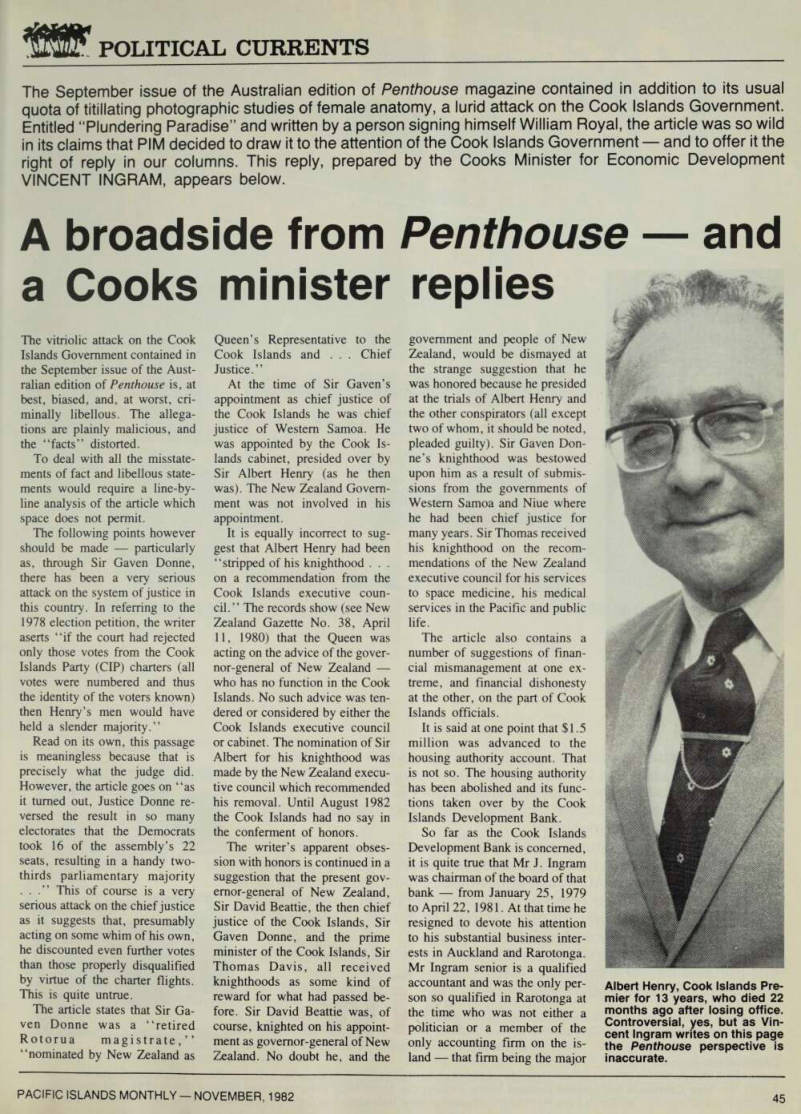
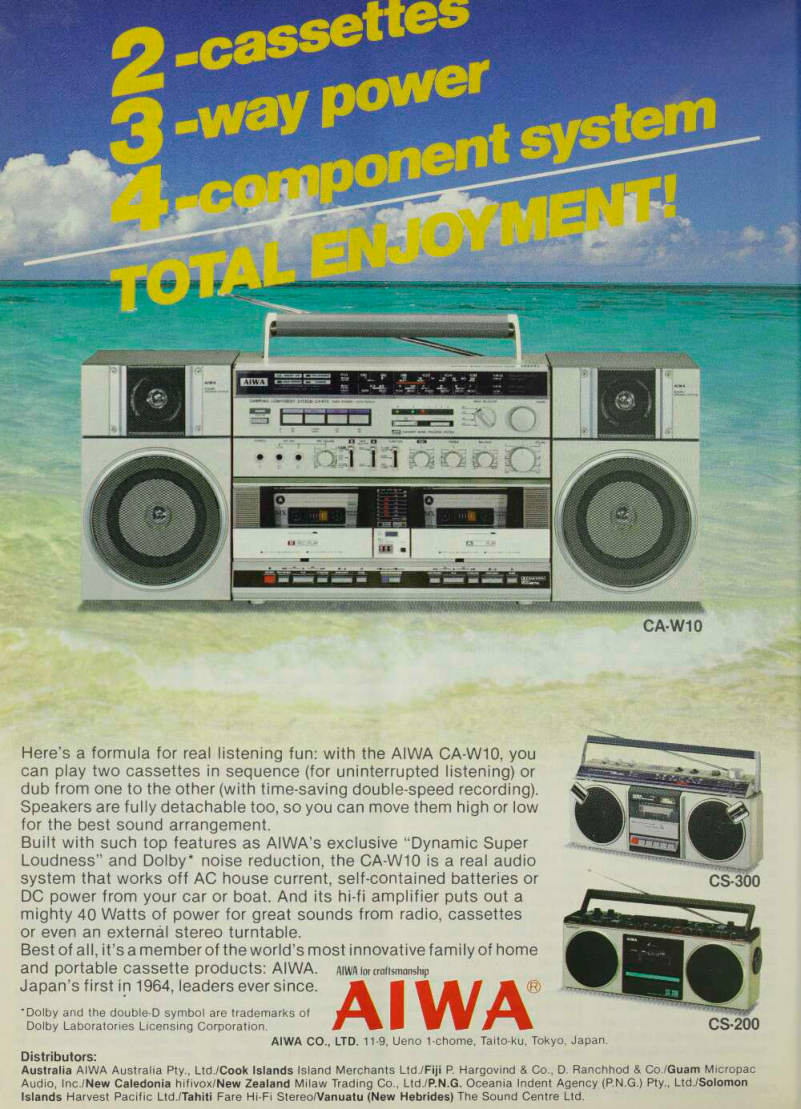

Political Currents
a Cooks minister replies
The September issue of the Australian edition of Penthouse magazine contained in addition to its usual quota of titillating photographic studies of female anatomy, a lurid attack on the Cook Islands Government.
Entitled “Plundering Paradise” and written by a person signing himself William Royal, the article was so wild in its claims that PIM decided to draw it to the attention of the Cook Islands Government and to offer it the right of reply in our columns. This reply, prepared by the Cooks Minister for Economic Development VINCENT INGRAM, appears below.
The vitriolic attack on the Cook Islands Government contained in the September issue of the Aust ralian edition of Penthouse is, at best, biased, and, at worst, cri minally libellous. The allega tions are plainly malicious, and the ‘‘facts” distorted.
To deal with all the misstate ments of fact and libellous state ments would require a line-by line analysis of the article which space does not permit.
The following points however should be made particularly as, through Sir Gaven Donne, there has been a very serious attack on the system of justice in this country. In referring to the 1978 election petition, the writer aserts ‘‘if the court had rejected only those votes from the Cook Islands Party (CIP) charters (all votes were numbered and thus the identity of the voters known) then Henry’s men would have held a slender majority.”
Read on its own, this passage is meaningless because that is precisely what the judge did.
However, the article goes on ‘‘as it turned out, Justice Donne re versed the result in so many electorates that the Democrats took 16 of the assembly’s 22 seats, resulting in a handy two thirds parliamentary majority . . .” This of course is a very serious attack on the chief justice as it suggests that, presumably acting on some whim of his own, he discounted even further votes than those properly disqualified by virtue of the charter flights.
This is quite untrue.
The article states that Sir Ga ven Donne was a “retired Rotorua magistrate,’’ ‘‘nominated by New Zealand as
Queen’s Representative to the Cook Islands and . . . Chief Justice.”
At the time of Sir Gaven’s appointment as chief justice of the Cook Islands he was chief justice of Western Samoa. He was appointed by the Cook Is lands cabinet, presided over by Sir Albert Henry (as he then was). The New Zealand Govern ment was not involved in his appointment.
It is equally incorrect to sug gest that Albert Henry had been ‘‘stripped of his knighthood . . . on a recommendation from the Cook Islands executive coun cil.” The records show (see New Zealand Gazette No. 38, April 11, 1980) that the Queen was acting on the advice of the gover nor-general of New Zealand who has no function in the Cook Islands. No such advice was ten dered or considered by either the Cook Islands executive council or cabinet. The nomination of Sir Albert for his knighthood was made by the New Zealand execu tive council which recommended his removal. Until August 1982 the Cook Islands had no say in the conferment of honors.
The writer’s apparent obses sion with honors is continued in a suggestion that the present gov ernor-general of New Zealand, Sir David Beattie, the then chief justice of the Cook Islands, Sir Gaven Donne, and the prime minister of the Cook Islands, Sir Thomas Davis, all received knighthoods as some kind of reward for what had passed be fore. Sir David Beattie was, of course, knighted on his appoint ment as governor-general of New Zealand. No doubt he, and the
government and people of New Zealand, would be dismayed at the strange suggestion that he was honored because he presided at the trials of Albert Henry and the other conspirators (all except two of whom, it should be noted, pleaded guilty). Sir Gaven Don ne’s knighthood was bestowed upon him as a result of submis sions from the governments of Western Samoa and Niue where he had been chief justice for many years. Sir Thomas received his knighthood on the recom mendations of the New Zealand executive council for his services to space medicine, his medical services in the Pacific and public life.
The article also contains a number of suggestions of finan cial mismanagement at one ex treme, and financial dishonesty at the other, on the part of Cook Islands officials.
It is said at one point that $1.5 million was advanced to the housing authority account. That is not so. The housing authority has been abolished and its func tions taken over by the Cook Islands Development Bank.
So far as the Cook Islands Development Bank is concerned, it is quite true that Mr J. Ingram was chairman of the board of that bank from January 25, 1979 to April 22, 1981. At that time he resigned to devote his attention to his substantial business inter ests in Auckland and Rarotonga.
Mr Ingram senior is a qualified accountant and was the only per son so qualified in Rarotonga at the time who was not either a politician or a member of the only accounting firm on the is land that firm being the major
Albert Henry, Cook Islands Pre mier for 13 years, who died 22 months ago after losing office.
Controversial, yes, but as Vin cent Ingram writes on this page the Penthouse perspective is inaccurate.
source of the very applications that the board would have to consider.
Mr Ingram received a fee of $25 for every meeting of the board which he attended. The record shows that he attended 25 of the 35 meetings held during the time he was chairman. He received no other remuneration.
It is equally true that the Cook Islands Government has arranged a “credit-line” of $1.5 million from the Asian Development Bank to be disbursed for ap
proved enterprises through the
Cook Islands Development Bank. In order for the govern ment to on-lend the funds to the Cook Islands Development Bank, an act was required to be passed in parliament. That act was duly assented to and became law on September 7, 1982 some weeks following the publi cation of the article. None of those funds have yet been drawn upon and any project must be approved by the board of the Cook Islands Development Bank, and by the Asian Develop ment Bank.
The description of the events surrounding Mr Richard McDonald’s prosecution for
drunken driving causing injury
suggests that there was political interference in the police depart ment, or that the police them selves “framed” Mr McDonald.
The description of the events is quite at odds with the police evidence. It is noteworthy that
McDonald pleaded guilty. He
was represented by a solicitor.
The fact that such a lengthy explanation is made in the Penth ouse article relating to Mr
McDonald’s accident confirms suspicions in the Cook Islands that he was very likely respons ible for the article.
It is worth noting that he was not “tossed out of the Cooks” as the article claims. He had a resi dence permit which had expired and was not renewed. Upon the expiry of his residence permit he became an illegal resident and as such was served with a “removal order.” He complied with the order and left the country of his own accord.
The same Mr Richard McDonald in 1981 wrote to the United Nations secretary-general alleging misuse of United Na tions funds in the Cook Islands.
This received considerable publ icity, and as a result the Cook Islands requested that the United Nations despatch a suitable per son to investigate this outrageous claim. Mr Dennis Halliday of the United Nations office in Apia duly arrived in the Cook Islands and investigated the matter, in the course of which he inter viewed Mr McDonald. He found the allegations to be utterly groundless and reported to the Cook Islands Government that Mr McDonald had, following the conversation, withdrawn his alle gation. The attendant publicity however could not have been to the Cook Islands’ advantage.
Much is made in the article of two insignificant events firstly a quip in parliament by one of the Mangaia members regarding the cultivation of cannabis a re mark that was greeted with laughter from both sides of the house and occupied no more than half a minute of the house’s time.
One of the government’s biggest prob lems has been in spending the vast travelling allowance they have granted themselves. This has become such an onerous task that, as discovered by Op position Leader Geoffrey Henry, official Treasury cheques have begun popping up in ministers’ private accounts. When the unsporting Mr Henry saw fit to raise the matter in parliament, laveta Short was reported to have turned to him, eyes ablaze, and responded: “You’re just jealous.”
Penthouse on travelling allowances
Having gained office in mid-1978, after a sequence of politically expedient manoeuvres which would have made Machiavelli shudder in disgust, Prime Minister Davis’ first statement was the electorally pleasing announcement that parliamentary salaries would be cut by $lOOO a year. What Davis overlooked in the announcement was the simultaneous counter-move to increase ministers’ tax free allowances by $2OOO a year. There was a subtlety here although it would seldom later be evident in the Democrat ic powerhouse because after his years in the wilderness, Davis had learnt to reward his friends. He set about creating ministers and associate ministers, like Father Christmas at a children’s party.
Penthouse on Prime Minister Tom Davis
Then there is the matter of the use of a grader on the island of Manuae.
The facts of that matter are that the grader was sent to Manu ae for the purpose of assisting in the construction of an airstrip.
There is no permanent popula tion on the island. The lease is held by the Manuae Holding Company which comprises the landowners of the island, who in turn comprise a large number of people from Aitutaki an island that is a stronghold of supporters of the present opposition.
Although it is true to say that the grader was originally sup plied for the construction of air strips in the northern group, de lays in launching the airstrip program in the northern group islands meant that the grader was available for the construction of a strip on Manuae.
The grader was lost overboard in rough seas while being return ed to Rarotonga. It has since been recovered and is now back at Rarotonga. The Australian Government were advised of the mishap and the Australian high commissioner in New Zealand, who was in Rarotonga recently, has inspected it. It will be re paired and put back into use. It is not “now lying in 10 fathoms of water,” as the article claims.
The notion of a “Seychelles style mercenary raid”, master minded by the Democratic Party, is so incredible as to defy any sensible rejoinder. Cook Islan ders are a peace-loving people.
The Islands are devoid of serious crime. It is inconceivable that such a scheme could be hatched by any of the political factions contesting the election concerned.
Travelling and accommoda tion allowances for ministers and public servants in the Cook Is lands are calculated in accord ance with a schedule prepared by the treasury based on hotel tariffs from time to time prevailing in the appropriate destination. Such allowances are paid by govern ment cheque to the minister or public servant concerned. The recipient must make his own arrangements concerning the purchase of travellers cheques or overseas currency with the only bank in Rarotonga the Nation al Bank of New Zealand. It is a necessary routine for such a che que to be paid into the recipient’s private account if the person travelling is visiting New Zea land (NZ currency being the leg al tender in the Cook Islands), or for the purpose of arranging pay ment from his account for the purchase of the required overseas funds.
It is difficult to follow the drift of the allegations contained in the final few paragraphs of the article. A treaty was concluded with the United States in 1980 by which the limits of the exclusive economic zone as between the Cook Islands and American Samoa were fixed and by which America abandoned its previous ly held, although not pursued,
claims to the islands of Penrhyn, Rakahanga, Manihiki and Pukapuka. That concluded any discussions with America or any other country involving Penrhyn, and the ominous “Space Age” aspects that are hinted at in the article are puzzling. The final paragraph is completely mystifying.
The Cook Islands government has been gravely disturbed, not so much by the scurrilous nature of the article, but rather by the fact that the publishers of Penth ouse have advertised in reputable newspapers throughout Australia the fact that the article appears in their September issue presum ably as an incentive for persons who would not otherwise purch ase the magazine to do so. It is alarming, but perhaps not sur prising, that Penthouse did not bother to check any of the infor mation or so-called “facts” nor did they give any opportunity to the Cook Islands Government to comment. Mr Len Staples reported in the article as being “ashen-faced” has supplied the government with a copy of a letter he has written to the pub lishers of Penthouse requesting a retraction and apology for the remarks attributed to him.
The maxim that “Any publici ty is good publicity” is of little comfort, considering the ex travagant and erroneous claims that have been made in the arti cle. The mischief of it is that it is designed to undermine the confi dence placed by other govern ments in the economic develop ment of the Cook Islands.
Not all the allegations in the article have been dealt with in this reply. To do so would re quire an article of similar length to that appearing in Penthouse.
The fact that not every allegation has been countered does not mean that the government of the Cook Islands accepts the truth of the remainder. The more damag ing suggestions have been dealt with in this reply the govern ment is confident that readers of the article will give the others the attention they deserve.
The Cook Islands Government is grateful to the publishers of Pacific Islands Monthly for this opportunity to set the record straight.
Advertisements & other items, pp. 46-48 (1 item)
Aiwa
m it &■ " 888 U <3
:1 1 j; i o
n ———- • • • 11
CA-WlO
Here’s a formula for real listening fun: with the AIWA CA-WlO, you can play two cassettes in sequence (for uninterrupted listening) or dub from one to the other (with time-saving double-speed recording).
Speakers are fully detachable too, so you can move them high or low for the best sound arrangement.
Built with such top features as AlWA’s exclusive “Dynamic Super Loudness” and Dolby* noise reduction, the CA-WlO is a real audio system that works off AC house current, self-contained batteries or DC power from your car or boat. And its hi-fi amplifier puts out a mighty 40 Watts of power for great sounds from radio, cassettes or even an external stereo turntable.
Best of all, it’s a member of the world’s most innovative family of home and portable cassette products: AIWA, aiwa for craftsmanship Japan’s first in 1964, leaders ever since. ‘Dolby and the double-D symbol are trademarks of Dolby Laboratories Licensing Corporation.
AIWA CO., LTD. 11-9, Ueno 1-chome, Taito-ku, Tokyo
AIWA
CS-300 i CS-200 Japan.
Distributors: Australia AIWA Australia Pty., Ltd./Cook Islands Island Merchants Ltd./Fiji P. Hargovind & Co., D. Ranchhod & Co./Guam Micropac Audio, Inc./New Caledonia hifivox/New Zealand Milaw Trading Co., Ltd./P.N.G. Oceania Indent Agency (P.N.G.) Pty., Ltd./Solomon Islands Harvest Pacific Ltd./Tahiti Fare Hi-Fi Stereo/Vanuatu (New Hebrides) The Sound Centre Ltd.
Goodyear Wrangler:
The All Terrain, All Season Radial
* m mm > A I o
\tssSX
¥ rv %
rjifci
Combining the best features of mud and rib tires, the Wrangler Radial range is a resilient 4-ply polyester cord tire for light trucks and recreational vehicles. You can’t find a tougher, more dependable tire. Its big tire-print features open, self-cleaning tread lugs and husky shoulder bars. Everything about this tire is geared for strong and effective service, long wear, smooth
ride and good grip.
Available in light and medium truck sizes, the Wrangler Radial provides excellent traction in all weather and ground conditions. No wonder it’s the first choice among all terrain, all season
drivers.
GOODYEAR
See the complete line of high performance tires by Goodyear.
GOODYEAR INTERNATIONAL CORPORATION
BOOM 1603, WING ON CENTER. 111 CONNAUGHT ROAD CENTRAL, HONG KONG TEL: 5 433320, 5-433331 TELEX 75606 GODYR HX GOODYEAR DISTRIBUTORS IN S.E. ASIA AND PACIFIC BASIN Richard Pieris & Co., Ltd.
Colombo, Sri Lanka Nepal Motor Company (PI Ltd.
Biratnagar, Nepal Navana Ltd.
Dacca. Bangladesh Diethelm & Co., Ltd.
Bangkok, Thailand Landis Brothers & Co., Ltd.
Hong Kong Guam Tire & Supply Co.
Agana. Guam Midway Motors Saipan, Mariana Is.
Microl Corporation Saipan, Mariana Is.
Truk Trading Co.
Truk E. Caroline Is.
Ponape Coop Ponape Eastern Caroline Is.
Island Transport Service Co.
Majuro Marshall Is.
Yap Cooperative Ass.
Yap. W. Carolone Is.
Cook Islands Motor Centre Ltd.
Rarotonga, Cook Is.
Ngiratkel Etpison Co., Ltd.
Koror, Palau Boroko Motors Ltd.
Port Moresby, Papua New Guinea Solomon Motors Ltd.
Honiara, Solomon Is.
Santo Engineers Santo, New Hebrides Socometra Vila, New Hebrides
S.G.A.
Noumea, New Caledonia Duncombe Bay Garage Norfolk Is.
Carpenters Motors Suva, Fiji Morris Hedstrom Tonga Ltd.
Nukualofa, Tonga Morris Hedstrom Samoa Ltd.
Apia, Western Samoa Western Samoa Transport Cooperative Society Ltd.
Apia, Western Samoa Service Mobil Papeete, Tahiti In Shun Company Ltd.
Taipei, Taiwan Bernards Enterprises Ponape, Eastern Caroline Is.
GOODYEAR manufacturing locations in Asia: Philippines, Taiwan, Malaysia. Indonesia, Australia. India, Thailand.
Continuity, change in U.S.
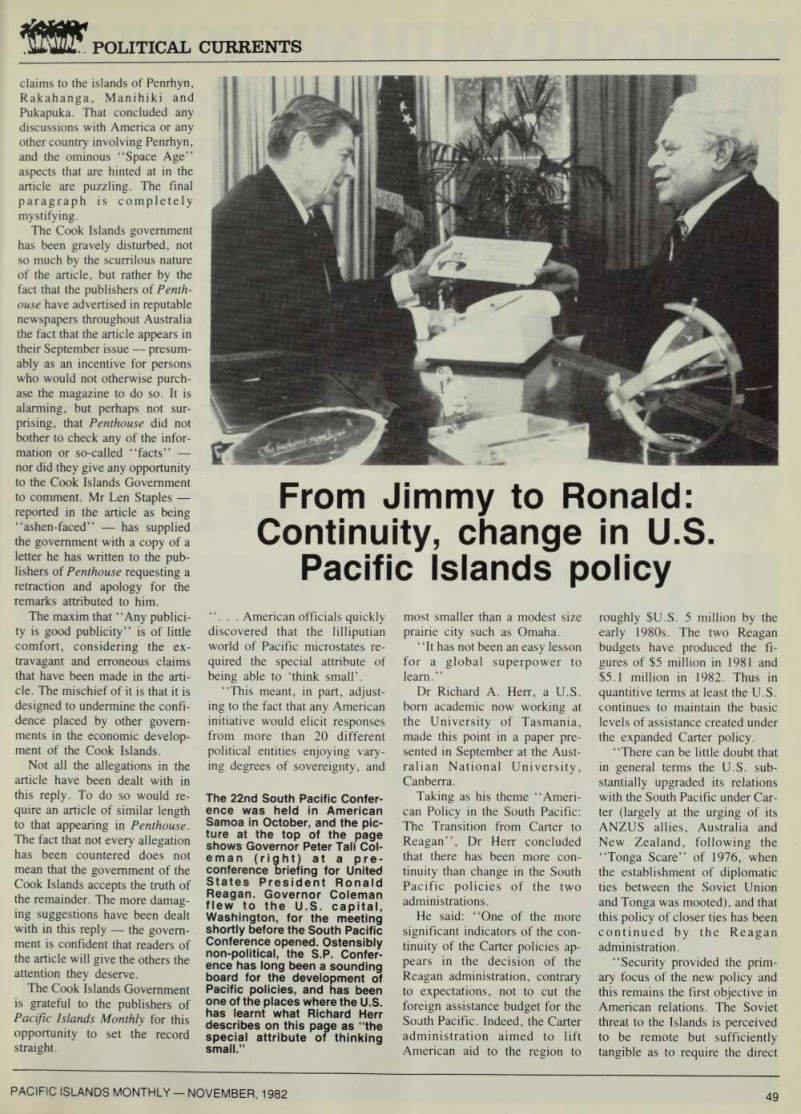
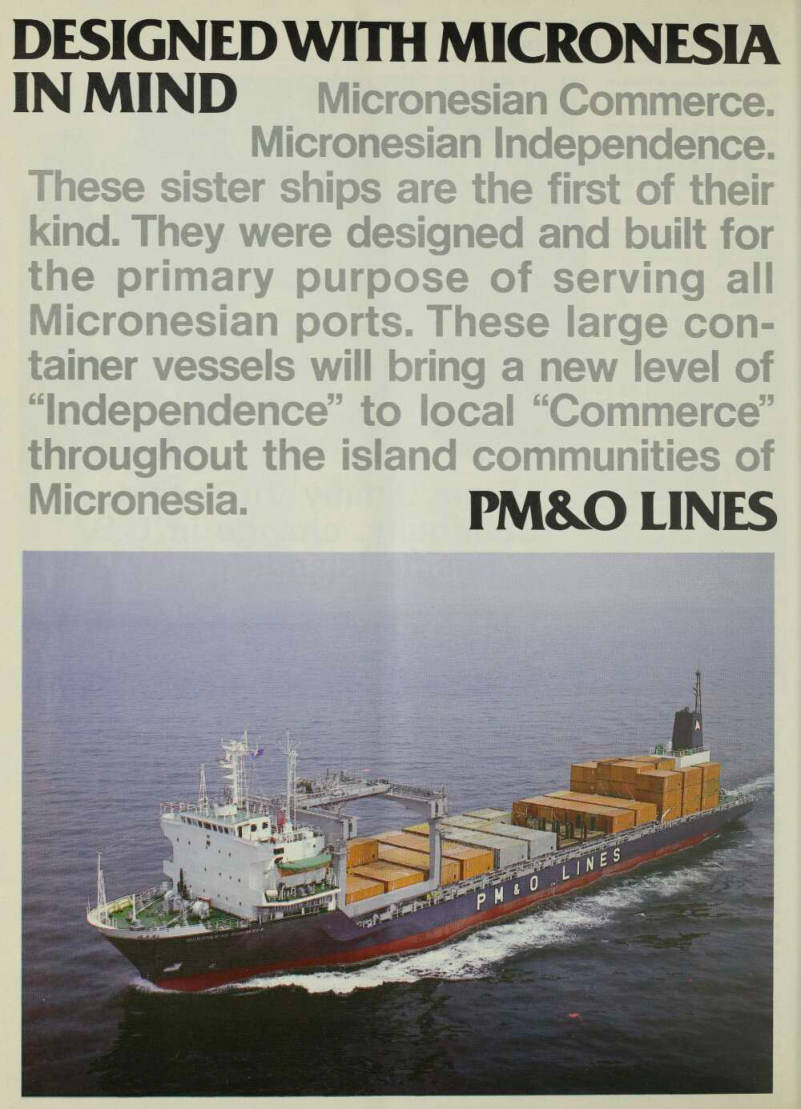
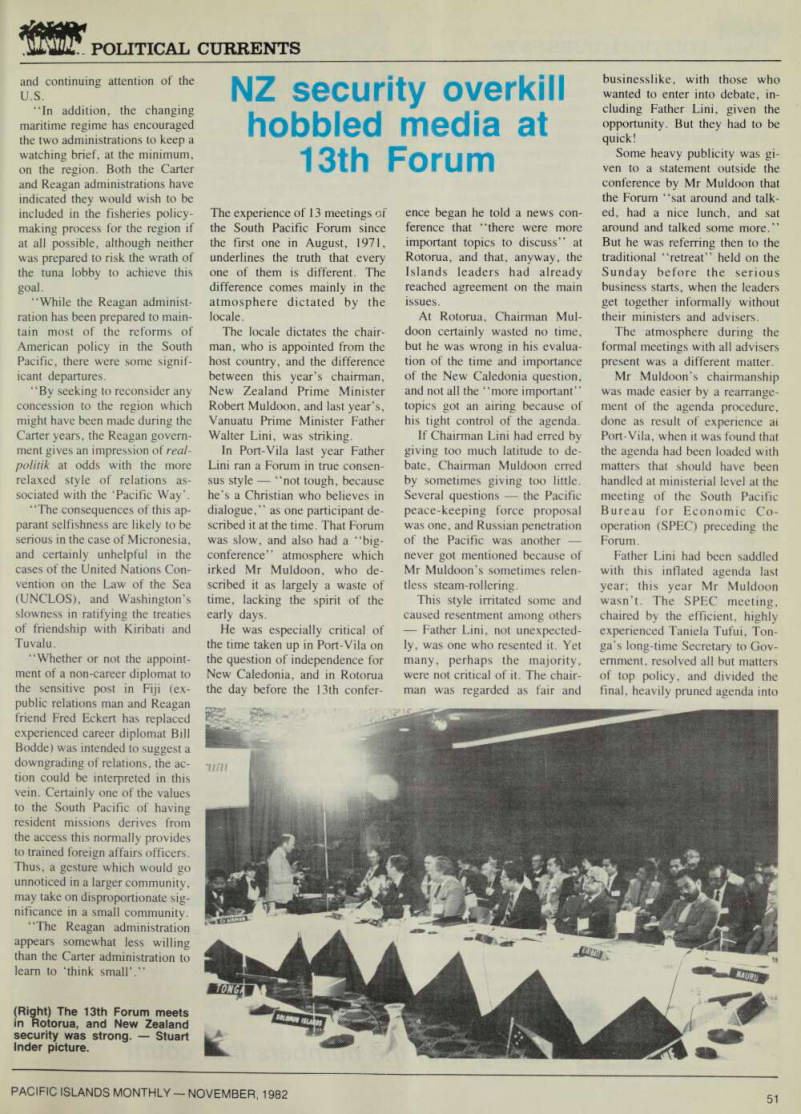
From Jimmy to Ronald: Continuity, change in U.S.
Pacific Islands policy
“. . . American officials quickly discovered that the lilliputian world of Pacific microstates re quired the special attribute of being able to ‘think small’.
“This meant, in part, adjust ing to the fact that any American initiative would elicit responses from more than 20 different political entities enjoying vary ing degrees of sovereignty, and
most smaller than a modest size prairie city such as Omaha.
“It has not been an easy lesson for a global superpower to learn.”
Dr Richard A. Herr, a U.S. bom academic now working at the University of Tasmania, made this point in a paper pre sented in September at the Aust ralian National University, Canberra.
Taking as his theme “Ameri can Policy in the South Pacific: The Transition from Carter to Reagan”, Dr Herr concluded that there has been more con tinuity than change in the South Pacific policies of the two administrations.
He said; “One of the more significant indicators of the con tinuity of the Carter policies ap pears in the decision of the Reagan administration, contrary to expectations, not to cut the foreign assistance budget for the South Pacific. Indeed, the Carter administration aimed to lift American aid to the region to
roughly SU.S. 5 million by the early 1980 s. The two Reagan budgets have produced the fi gures of $5 million in 1981 and $5.1 million in 1982. Thus in quantitive terms at least the U.S. continues to maintain the basic levels of assistance created under the expanded Carter policy.
“There can be little doubt that in general terms the U.S. sub stantially upgraded its relations with the South Pacific under Car ter (largely at the urging of its ANZUS allies, Australia and New Zealand, following the “Tonga Scare” of 1976, when the establishment of diplomatic ties between the Soviet Union and Tonga was mooted), and that this policy of closer ties has been continued by the Reagan administration.
“Security provided the prim ary focus of the new policy and this remains the first objective in American relations. The Soviet threat to the Islands is perceived to be remote but sufficiently tangible as to require the direct
The 22nd South Pacific Confer ence was held in American Samoa in October, and the pic ture at the top of the page shows Governor Peter Tali Col eman (right) at a pre conference briefing for United States President Ronald Reagan. Governor Coleman flew to the U.S. capital,
Washington, for the meeting
shortly before the South Pacific Conference opened. Ostensibly non-political, the S.P. Confer ence has long been a sounding board for the development of Pacific policies, and has been one of the places where the U.S. has learnt what Richard Herr describes on this page as “the special attribute of thinking small.”
and continuing attention of the U.S.
“In addition, the changing
maritime regime has encouraged
the two administrations to keep a watching brief, at the minimum, on the region. Both the Carter and Reagan administrations have indicated they would wish to be included in the fisheries policy making process for the region if at all possible, although neither was prepared to risk the wrath of the tuna lobby to achieve this
goal.
“While the Reagan administ ration has been prepared to main tain most of the reforms of American policy in the South Pacific, there were some signif icant departures.
“By seeking to reconsider any concession to the region which might have been made during the Carter years, the Reagan govern ment gives an impression of real politik at odds with the more relaxed style of relations as sociated with the ‘Pacific Way’.
“The consequences of this ap parant selfishness are likely to be serious in the case of Micronesia, and certainly unhelpful in the cases of the United Nations Con vention on the Law of the Sea (UNCLOS), and Washington’s slowness in ratifying the treaties of friendship with Kiribati and Tuvalu.
“Whether or not the appoint ment of a non-career diplomat to the sensitive post in Fiji (ex public relations man and Reagan friend Fred Eckert has replaced experienced career diplomat Bill Bodde) was intended to suggest a downgrading of relations, the ac tion could be interpreted in this vein. Certainly one of the values to the South Pacific of having resident missions derives from the access this normally provides to trained foreign affairs officers.
Thus, a gesture which would go unnoticed in a larger community, may take on disproportionate sig nificance in a small community.
“The Reagan administration appears somewhat less willing than the Carter administration to leam to ‘think small’.”
Advertisements & other items, p. 50 (1 item)
Designed With Micronesia
IN MIND Micronesian Commerce.
Micronesian Independence.
These sister ships are the first of their kind. They were designed and built for the primary purpose of serving all Micronesian ports. These large container vessels will bring a new level of “Independence” to local “Commerce” throughout the island communities of
PM&O LINES
rJ
NZ security overkill
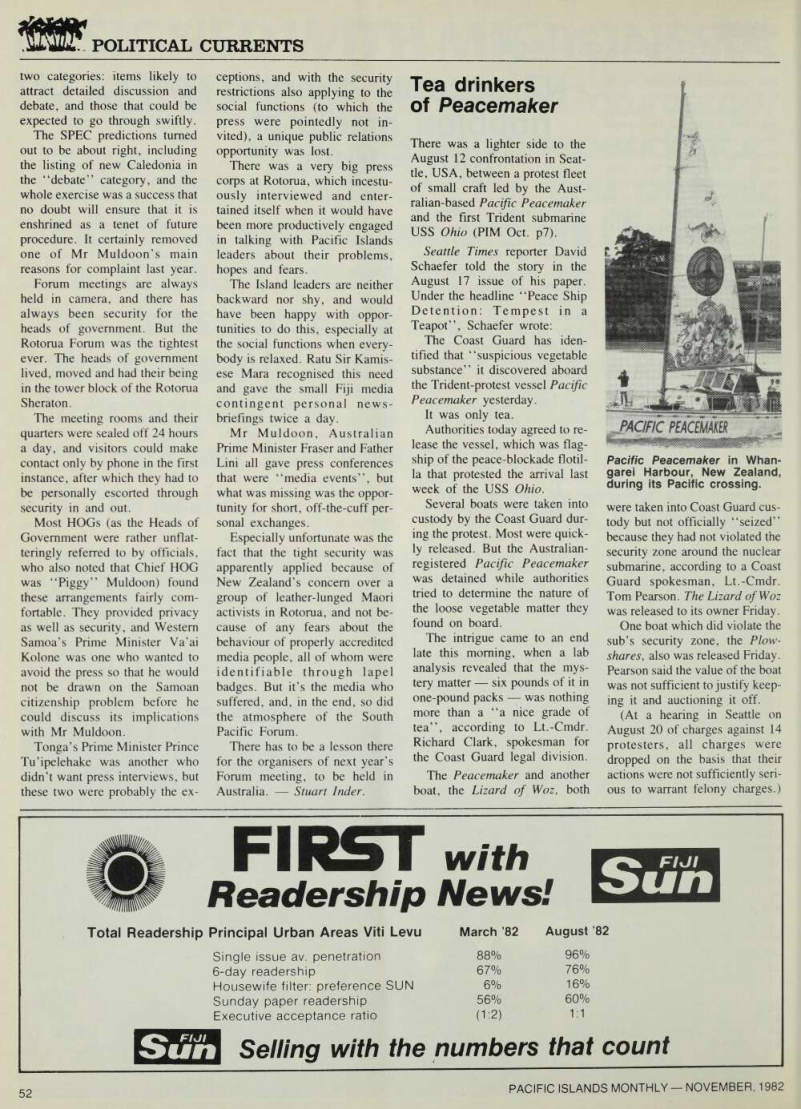
hobbled media at 13th Forum
The experience of 13 meetings of the South Pacific Forum since the first one in August, 1971, underlines the truth that every one of them is different. The difference comes mainly in the atmosphere dictated by the locale.
The locale dictates the chair man, who is appointed from the host country, and the difference between this year’s chairman, New Zealand Prime Minister Robert Muldoon, and last year’s, Vanuatu Prime Minister Father Walter Lini, was striking.
In Port-Vila last year Father Lini ran a Forum in true consen sus style “not tough, because he’s a Christian who believes in dialogue,” as one participant de scribed it at the time. That Forum was slow, and also had a “big conference” atmosphere which irked Mr Muldoon, who de scribed it as largely a waste of time, lacking the spirit of the
early days.
He was especially critical of the time taken up in Port-Vila on the question of independence for New Caledonia, and in Rotorua the day before the 13th confer
ence began he told a news con ference that “there were more important topics to discuss” at Rotorua, and that, anyway, the Islands leaders had already reached agreement on the main issues.
At Rotorua, Chairman Mul doon certainly wasted no time, but he was wrong in his evalua tion of the time and importance of the New Caledonia question, and not all the “more important” topics got an airing because of his tight control of the agenda.
If Chairman Lini had erred by giving too much latitude to de bate, Chairman Muldoon erred by sometimes giving too little.
Several questions the Pacific peace-keeping force proposal was one, and Russian penetration of the Pacific was another never got mentioned because of Mr Muldoon’s sometimes relen
tless steam-rollering.
This style irritated some and caused resentment among others Father Lini, not unexpected ly, was one who resented it. Yet
many, perhaps the majority,
were not critical of it. The chair man was regarded as fair and
businesslike, with those who wanted to enter into debate, in cluding Father Lini, given the opportunity. But they had to be quick!
Some heavy publicity was gi ven to a statement outside the conference by Mr Muldoon that the Forum “sat around and talk ed, had a nice lunch, and sat around and talked some more.”
But he was referring then to the traditional “retreat” held on the Sunday before the serious business starts, when the leaders
get together informally without
their ministers and advisers.
The atmosphere during the formal meetings with all advisers present was a different matter.
Mr Muldoon’s chairmanship was made easier by a rearrange ment of the agenda procedure, done as result of experience at Port-Vila, when it was found that the agenda had been loaded with matters that should have been handled at ministerial level at the meeting of the South Pacific Bureau for Economic Co operation (SPEC) preceding the Forum.
Father Lini had been saddled with this inflated agenda last year; this year Mr Muldoon wasn’t. The SPEC meeting, chaired by the efficient, highly experienced Taniela Tufui, Ton
ga’s long-time Secretary to Gov
ernment, resolved all but matters of top policy, and divided the final, heavily pruned agenda into
(Right) The 13th Forum meets in Rotorua, and New Zealand security was strong. - Stuart Inder picture.
two categories: items likely to attract detailed discussion and debate, and those that could be expected to go through swiftly.
The SPEC predictions turned out to be about right, including the listing of new Caledonia in the “debate” category, and the whole exercise was a success that no doubt will ensure that it is enshrined as a tenet of future procedure. It certainly removed one of Mr Muldoon’s main reasons for complaint last year.
Forum meetings are always held in camera, and there has always been security for the heads of government. But the Rotorua Forum was the tightest ever. The heads of government lived, moved and had their being in the tower block of the Rotorua Sheraton.
The meeting rooms and their quarters were sealed off 24 hours a day, and visitors could make contact only by phone in the first instance, after which they had to be personally escorted through security in and out.
Most HOGs (as the Heads of Government were rather unflat teringly referred to by officials, who also noted that Chief HOG was “Piggy” Muldoon) found these arrangements fairly com fortable. They provided privacy as well as security, and Western Samoa’s Prime Minister Va’ai Kolone was one who wanted to avoid the press so that he would not be drawn on the Samoan citizenship problem before he could discuss its implications with Mr Muldoon.
Tonga’s Prime Minister Prince Tu’ipelehake was another who didn’t want press interviews, but these two were probably the ex
ceptions, and with the security restrictions also applying to the social functions (to which the press were pointedly not in vited), a unique public relations opportunity was lost.
There was a very big press corps at Rotorua, which incestu ously interviewed and enter tained itself when it would have
been more productively engaged
in talking with Pacific Islands leaders about their problems, hopes and fears.
The Island leaders are neither backward nor shy, and would have been happy with oppor tunities to do this, especially at the social functions when every body is relaxed. Ratu Sir Kamis ese Mara recognised this need and gave the small Fiji media contingent personal news
briefings twice a day.
Mr Muldoon, Australian Prime Minister Fraser and Father Lini all gave press conferences that were “media events”, but what was missing was the oppor tunity for short, off-the-cuff per
sonal exchanges.
Especially unfortunate was the fact that the tight security was
apparently applied because of
New Zealand’s concern over a group of leather-lunged Maori activists in Rotorua, and not be cause of any fears about the behaviour of properly accredited media people, all of whom were
identifiable through lapel
badges. But it’s the media who suffered, and, in the end, so did the atmosphere of the South Pacific Forum.
There has to be a lesson there for the organisers of next year’s Forum meeting, to be held in Australia. Stuart Inder.
Tea drinkers
of Peacemaker
There was a lighter side to the August 12 confrontation in Seat tle, USA, between a protest fleet of small craft led by the Aust ralian-based Pacific Peacemaker and the first Trident submarine USS Ohio (PIM Oct. p7).
Seattle Times reporter David Schaefer told the story in the August 17 issue of his paper.
Under the headline “Peace Ship Detention: Tempest in a Teapot”, Schaefer wrote: The Coast Guard has iden tified that “suspicious vegetable substance” it discovered aboard the Trident-protest vessel Pacific Peacemaker yesterday.
It was only tea.
Authorities today agreed to re lease the vessel, which was flag ship of the peace-blockade flotil la that protested the arrival last week of the USS Ohio.
Several boats were taken into custody by the Coast Guard dur ing the protest. Most were quick ly released. But the Australian registered Pacific Peacemaker was detained while authorities tried to determine the nature of the loose vegetable matter they found on board.
The intrigue came to an end late this morning, when a lab analysis revealed that the mys tery matter — six pounds of it in one-pound packs — was nothing more than a “a nice grade of tea”, according to Lt.-Cmdr.
Richard Clark, spokesman for the Coast Guard legal division.
The Peacemaker and another boat, the Lizard of Woz, both
were taken into Coast Guard cus tody but not officially “seized” because they had not violated the security zone around the nuclear submarine, according to a Coast Guard spokesman, Lt.-Cmdr.
Tom Pearson. The Lizard ofWoz was released to its owner Friday.
One boat which did violate the sub’s security zone, the Plow shares, also was released Friday.
Pearson said the value of the boat was not sufficient to justify keep ing it and auctioning it off. (At a hearing in Seattle on August 20 of charges against 14 protesters, all charges were dropped on the basis that their actions were not sufficiently seri ous to warrant felony charges.)
Pacific Peacemaker in Whan garei Harbour, New Zealand, during its Pacific crossing.
Advertisements & other items, p. 52 (1 item)
First
Readership News!
FIJI
Total Readership Principal Urban Areas Viti Levu March 82 August ’B2 Single issue av. penetration 88% 6-day readership 67% Housewife filter: preference SUN 6% Sunday paper readership 56% Executive acceptance ratio (1:2) 96% 76% 16% 60% 1:1 Si sa
Selling with the numbers that count
Islands
From the
Press
An announcement in Tohi Tala Niue, Niue Island A lot of layers are now available for sale at the Livestock section of the Agriculture Department at $4.00 per bird. Actually these birds cost $5.00 but since they are now at their maximum laying capacity their costs have been reduced.
From the Voice of Vanuatu, Port-Vila lananen Village, Tanna, prides itself on being a village which adheres to custom. No church has made its mark on lananen village life. Their God is HRH Prince Philip, the Duke of Edinburgh. And they are awaiting his visit. British High Commissioner Mr Richard Dorman recently visited lananen . . .
Children from the school gave the British High Commissioner a letter. They had written it to the Duke. It asked the Duke to let the village know when he would be coming to visit. The letter has been forwarded to Buckingham Palace.
From the Papua New Guinea Post-Courier, Port Moresby It seems some young expectant mothers in East New Britain are out for blood in more ways than one. Some young men of the province, faced with the prospect of unwanted parenthood, have found a way to refuse that responsibility. The fellows who are alleged to have contributed to a pregnancy are appearing in court and requesting a blood test on the unborn baby to prove their involvement. The test, according to provincial health official Mr Pondola Pohai, is complicated and requires highly skilled men “This sort of excuse sounds very scientific and I don’t think we have the right people in East New Britain to carry out any of these scientific tests,” he said. And, according to village court officials, many cases are left unsettled because the alleged expectant father insists on the blood test.
From the Papua New Guinea Post-Courier, Port Moresby A union leader wants the publication of horse racing guides stopped. The Wau-Bulolo Workers Union President, Mr Uncle Thom, has called on Media Minister Mr Sali to halt the publication of the guides. Mr Thom said many public servants and other workers were spending too much time betting on horse races.
From The Fiji Times, Suva Former Alliance backbencher Shree Ramlu is upset about the state of Labasa’s roads. And he says there are craters in the town so big that, in one place, fish are swimming in them.
From the Pacific Way Lecture by Francis Bugotu, new Secretary-General of the South Pacific Commission, at the University of the South Pacific and reported in the USP Information Bulletin, Suva.
People who think their country owes them something are the result of false tuition. We owe our countries everything. There is evidence in the region today that many young diplomates and graduates returning home who, because they have degrees and diplomas, think their countries owe them top jobs.
The sense of service seems to be lost. The graduate from the acquisitive school is early frustrated by life, and thinks the easiest route is through politics. The much-talked about ideal of the Pacific Way was once attainable when life was for living, but is now unattainable because we all want to become big names. We who call ourselves leaders have been bought over by
politics and money. Some politicians would pass as clowns in our old societies which understand the Pacific Way, and the foreign observer laughs at our mimicry . . . People are so keen on titles and voting themselves fat salaries they forget what they are supposed to be doing serving others. The situation shows a definite wrong direction in government and politics which needs looking at.
From comments by acting Chief Justice J. M. Callander in the Western Samoa Supreme Court in a judgment on election petitions reported in the Samoa Times, Apia.
It disturbed me to see people solemnly lay their hands on the Bible and give false testimony. This court will ruthlessly deal with those who perjure themselves. Without the truth the rule of law disintegrates, the fine mat of purity and truth falls apart, and things sacred become meaningless. There are three great rocks upon which modem Samoa is based: the rock of the Fa’a Samoa with its ancient and wise codes of belief and behaviour; the rock of Christianity, with its tenets of godly, truthful and proper human beliefs and behaviour based upon the Ten Commandments given to Moses for all men; and the rock of Law, whether that of the statutes or of the judges, insisting that conduct conform to correct and accepted principles of human behaviour, known and recognised in the community as vital to the preservation of peace and good government.
From the Cook Islands News, Rarotonga Miss Carmena Blake of Ruatonga last Friday night was crowned as the most beautiful girl in the Cook Islands. Carmena will be twenty years old next month. Carmena was chosen Miss Cook Islands out of 11 contestants and she was sponsored by Dickerson Robinson Group Company. While mother, Mrs Rosie Blake “bawled her eyes out” after the announcement, her father Roger Blake told her to go home and get changed and get back to selling hamburgers at the Boy Blue Takeaways.
An advertisement in The Observer, Western Samoa A box with the contents of a black purse with $5O in it and 100 forms belonging to the WSLAC (Western Samoa Life Assurance Corporation) was removed from a red car at the Reclaimed Area on Monday 30/8/82. Would you PLEASE RETURN the forms to the above company as they are very important WSLAC, Carruthers Building, Beach Road.
From Radio Vanuatu, Port-Vila A Maewo man suspected of practising witchcraft to poison people has had his house burnt down and garden crops destroyed, allegedly by relatives of a young girl who died last Friday. Our report said that for sometime this old man from Baitora village threatened with poisoning members of this family.
It went further, that last Friday, when the young girl died, her relatives took it that she was poisoned by . Their anger resulted in the burning down of his house and destruction of his crops. This old man is alleged to have caused other deaths in the past.
From the Cook Islands News, Rarotonga Two vehicle importing firms have found parts missing from Japanese cars which have been transhipped via Tahiti. Motor Centre’s general manager, Don Dorrell, said so far they have found four batteries missing out of the 11 cars they unloaded from the Tiare Moana yesterday. One of the directors of Pacific Motors, Snow Mulhane, said all of the radio aerials on the 6 cars they imported were missing. Don Dorrell said it was only on very rare circumstances that parts were missing from vehicles arriving direct from Japan in containers.
From the Bulletin of the Republic of Nauru Members of the public are reminded that under the Public Health Ordinance 1967, it is a criminal offence to deposit or cause to be deposited any empty tin, bottle or other receptacle, or any refuse in any street, road or other public place or on any other person’s property. If convicted, one is liable to be fined up to $2O and/or sent to prison for one month.
Advertisements & other items, p. 54 (1 item)
Crescendo road.
In-car acoustics may be less than ideal. But bat's no reason why you shouldn't be able to mjoy home-quality hi-fi on the road. Thanks :o Clarion technology there's now a stereo system designed exclusively for the road that rivals the one in your living room.
Imagine! 20W + 20W of car-filling stereo to soothe away those long lonesome hours behind he wheel. That's precisely what the Clarion PE-868 and PE-875 deliver.
Take the new silver-faced PE-868. This autoreverse model is metal-tape compatible. It will mtomatically play your favorite tape side after side until you choose to eject it. And with separate volume/balance, tone, loudness and Dolby* NR controls, personal sound tailoring acilities are right at hand.
The champagne-gold PE-875 offers you 8selection automatic program control (APC) with digital program display, auto engine shut-off eject and power level indication.
For watts of awe-inspiring sound, these two Clarion beauties can be matched up with a pair of high-power (SOW max.) GS-528 2-way, 2-speaker systems. These feature 12cm cone woofers and scm cone tweeters housed in resonance-killing solid, lightweight compound plastic cabinets with acoustic lenses for excellent sound dispersion.
If you're searching for a new driving experience travel crescendo road with Clarion. Any one of these exciting cassette stereo players will keep you fully entertained in fine hi-fi style. Ask your local Clarion dealers for a test drive.
H I B
I U_3 dJ dJ □D “ ‘Dolby and the double-D symbol are trademarks of Dolby Laboratories Licensing Corporation.
©Clarion
CLARION CO., LTD.
Tnkx/n .\anan Australia: Amalgamated Wireless (Australasia) Ltd., 554 Parramatta Road, Ashfield, N.S.W., 2131/New Zealand:AWA New Zealand Limited, P.O. Box 50-248, Porirua/Fiji Islands: Brijlal & Co., Ltd., G.P.O. Box 362, Suva/Tahiti: HI-FI Shangrila, B.P. 200, Papeete/New Caledonia: Caldis,B.P.Ml, Noumea Cedex/Guam: Micropac Audio Inc, P.O. Box 3478, Agana, Guam 96910/Vanuatu: The Sound Centre, P.O. Box 434, Vila/Cook Islands; South Seas International Ltd, P.O. Box 49, Rarotonga/Papua New Guinea: Hagemeyer (P.N.G.) Pty. Ltd., P.O. Box 1428, Boroko, Port Moresby.
The marketing of “aloha”:
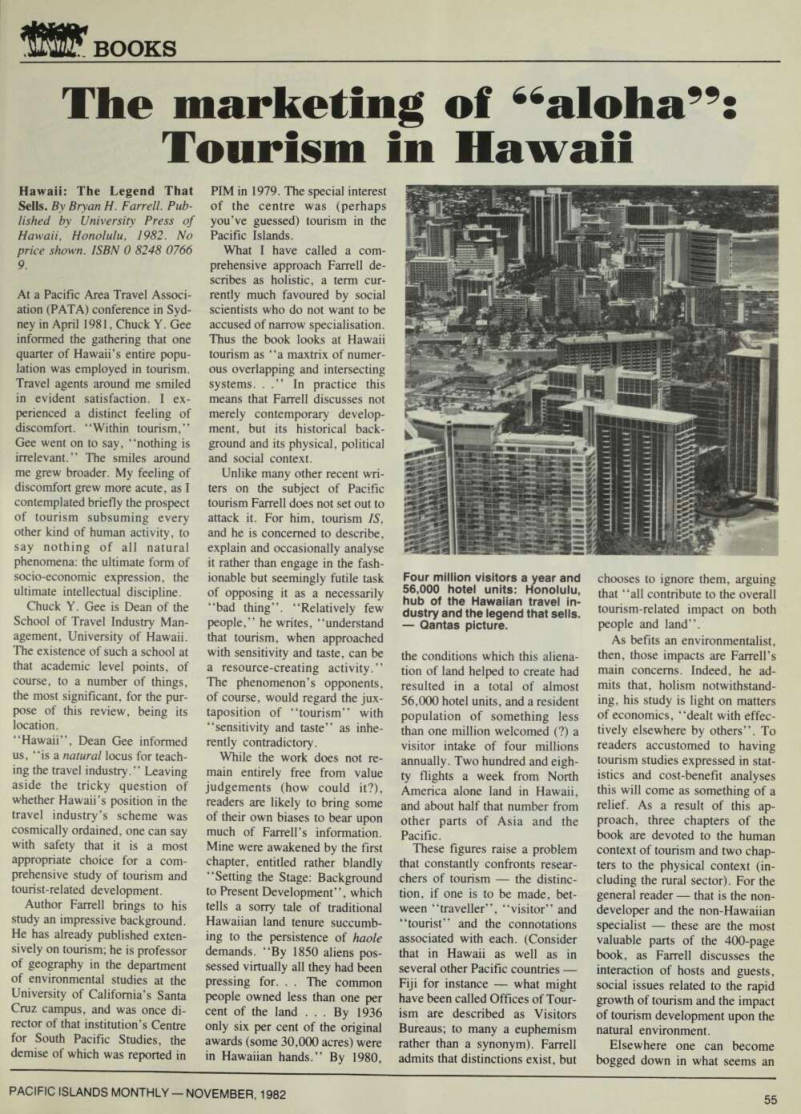

Books
The marketing of “aloha”: Tourism in Hawaii
Hawaii: The Legend That Sells. By Bryan H. Farrell. Pub lished by University Press of Hawaii, Honolulu, 1982. No price shown. ISBN 0 8248 0766 9.
At a Pacific Area Travel Associ ation (PATA) conference in Syd ney in April 1981, Chuck Y. Gee informed the gathering that one quarter of Hawaii’s entire popu lation was employed in tourism.
Travel agents around me smiled in evident satisfaction. I ex perienced a distinct feeling of discomfort. “Within tourism,”
Gee went on to say, “nothing is irrelevant.” The smiles around me grew broader. My feeling of discomfort grew more acute, as I contemplated briefly the prospect of tourism subsuming every other kind of human activity, to say nothing of all natural phenomena; the ultimate form of socio-economic expression, the ultimate intellectual discipline.
Chuck Y. Gee is Dean of the School of Travel Industry Man agement, University of Hawaii.
The existence of such a school at that academic level points, of course, to a number of things, the most significant, for the pur pose of this review, being its location.
“Hawaii”, Dean Gee informed us, “is a natural locus for teach ing the travel industry.” Leaving aside the tricky question of whether Hawaii’s position in the travel industry’s scheme was cosmically ordained, one can say with safety that it is a most appropriate choice for a com prehensive study of tourism and tourist-related development.
Author Farrell brings to his study an impressive background.
He has already published exten sively on tourism; he is professor of geography in the department of environmental studies at the University of California’s Santa Cruz campus, and was once di rector of that institution’s Centre for South Pacific Studies, the demise of which was reported in
PIM in 1979. The special interest of the centre was (perhaps you’ve guessed) tourism in the Pacific Islands.
What I have called a com prehensive approach Farrell de scribes as holistic, a term cur rently much favoured by social scientists who do not want to be accused of narrow specialisation.
Thus the book looks at Hawaii tourism as “a maxtrix of numer ous overlapping and intersecting systems. . .” In practice this means that Farrell discusses not merely contemporary develop ment, but its historical back ground and its physical, political and social context.
Unlike many other recent wri ters on the subject of Pacific tourism Farrell does not set out to attack it. For him, tourism IS, and he is concerned to describe, explain and occasionally analyse it rather than engage in the fash ionable but seemingly futile task of opposing it as a necessarily “bad thing”. “Relatively few people,” he writes, “understand that tourism, when approached with sensitivity and taste, can be a resource-creating activity.”
The phenomenon’s opponents, of course, would regard the jux taposition of “tourism” with “sensitivity and taste” as inhe rently contradictory.
While the work does not re main entirely free from value judgements (how could it?), readers are likely to bring some of their own biases to bear upon much of Farrell’s information.
Mine were awakened by the first chapter, entitled rather blandly “Setting the Stage: Background to Present Development”, which tells a sorry tale of traditional Hawaiian land tenure succumb ing to the persistence of haole demands. “By 1850 aliens pos sessed virtually all they had been pressing for. . . The common people owned less than one per cent of the land ... By 1936 only six per cent of the original awards (some 30,000 acres) were in Hawaiian hands.” By 1980,
the conditions which this aliena tion of land helped to create had resulted in a total of almost 56,000 hotel units, and a resident population of something less than one million welcomed (?) a visitor intake of four millions annually. Two hundred and eigh ty flights a week from North America alone land in Hawaii, and about half that number from other parts of Asia and the Pacific.
These figures raise a problem that constantly confronts resear chers of tourism the distinc tion, if one is to be made, bet ween “traveller’’, “visitor’’ and “tourist’’ and the connotations associated with each. (Consider that in Hawaii as well as in several other Pacific countries Fiji for instance what might have been called Offices of Tour ism are described as Visitors Bureaus; to many a euphemism rather than a synonym). Farrell admits that distinctions exist, but
chooses to ignore them, arguing that “all contribute to the overall tourism-related impact on both people and land’’.
As befits an environmentalist, then, those impacts are Farrell’s main concerns. Indeed, he ad mits that, holism notwithstand ing, his study is light on matters of economics, “dealt with effec tively elsewhere by others’’. To readers accustomed to having tourism studies expressed in stat istics and cost-benefit analyses this will come as something of a relief. As a result of this ap proach, three chapters of the book are devoted to the human context of tourism and two chap ters to the physical context (in cluding the rural sector). For the general reader that is the non developer and the non-Hawaiian specialist these are the most valuable parts of the 400-page book, as Farrell discusses the interaction of hosts and guests, social issues related to the rapid growth of tourism and the impact of tourism development upon the natural environment.
Elsewhere one can become bogged down in what seems an
Four million visitors a year and 56,000 hotel units: Honolulu, hub of the Hawaiian travel in dustry and the legend that sells.
- Qantas picture.
endless listing of hotel rooms, tennis courts and golf courses (should they be on the Arnold Palmer or Robert Trent Jones plan?), how many retail stores and restaurants are needed to service a resort, and what part condominiums should play in such plans. (Question; Can a time-sharing condominium be termed a much-used condom?) Occasionally, therefore, the wood is obscured by the trees, and one begins to lose sight of that important human element which, to his credit, the author wants to maintain.
Part of this problem is due to the organisation of the book and what I consider to be an imba lance of emphasis. Maui, an is land in which Farrell obviously has a profound interest, is given 56 pages to itself, including case studies from the Kaanapali, Kapalua and Wailea resort areas, and while the justification for this intensity is that “. . . Maui is representative of Hawaii as a whole”, that quality of associa tion between whole and part does not satisfactorily emerge.
Moreover, we are introduced to this detail as early as chapter three, some considerable time before the essential aspects of physical landscape (chapter eight) and Hawaii’s population (chapter nine) are discussed at any length. Compared to the space devoted to Maui (fascinat ing to developers, I suspect), tourist and resident interaction receives shortish shrift (12 pages). A revealing breakdown of changes in the Maui labor force (while the population from 1964 to 1980 barely doubled, employment in hotels increased sixfold) is rendered less mean ingful by the fact that no compar able figures are provided for Hawaii as a whole.
A chapter on Tourism and Agriculture begins early with the proposition that “Agriculture is an important prop to tourism”.
There follows a 15-page run down on the problems of Hawaii’s agriculture, but little attempt is made to show any relationship except to restate the proposition, at greater length, that successful tourism depends on a viable agriculture (really? compare New Caledonia, Fiji,
Norfolk Island). By this time, however, we have already been informed that both plantation ag riculture and cattle ranching were evidently far from viable since a number of old ranches and plan tations have been turned to resort development.
Many aspects of tourism indisputably a major force in the Pacific for social, environmental and economic change are dy namic, many of them observable and of considerable visual im pact. Farrell’s work, however, is poorly served in this regard. The diagrams of resort development are skilfully drawn, but the photographs are drab, black and white reproductions which large ly fail to convey anything of the dynamics of tourism. Most of them are derived from the Visitors Bureau, hotels or de velopers.
As if in tacit recognition of their poor quality and their feeble impact, there is no index of
photographs though tables and figures are listed.
In his last chapter Farrell of fers some well reasoned “scenarios” for future develop ment which reveal his insights into tourism’s problems and his concern with its possible exces ses. He also offers a brief analy sis of the “aloha spirit” which, whether cynically or sincerely, infuses most tourist-related activ ity in Hawaii. But it is the in troduction to this chapter which I find both fascinating and dis quieting. “Hawaii,” writes Far rell, “has a remarkable array of resources (my emphasis) for tourism; climate, beaches, clear water, magnificent coastal scen ery, fascinating mountain vistas, open spaces, attractive rural in dustries, tourism facilities of a high quality, a high level of industry expertise, and a friend ly, hospitable, interesting multi ethnic population.” Clearly, then, to tourism in Hawaii (and
by implication the rest of the Pacific?) nothing is irrelevant; everything a resource, suscept ible of preservation, conserva tion and presumably exploita tion. I feel that acute discomfort returning.
Hawaii; the Legend that Sells is a sometimes inconsistent though frequently valuable con tribution to the increasing amount of serious literature on the subject of Pacific tourism. I find, however, a certain tautolo gy not only in the author’s style but also in the central concept.
The title is obvious enough and most of the book is devoted to describing the selling of that legend. Yet in the final sentences Farrell writes: “That attractive image the legend is still there, but it can so easily tarnish and disappear. Certainly it sells but is it for sale?” At this point the question is no longer rhetorical, merely redundant.
Norman Douglas.
Advertisements & other items, p. 56 (1 item)
thirst quencher
/o\ E
QUALITY AUSTRALIAN
The great
thirst quencher
with more
real fruit
flavour.
roimiTE
Hi i litre
ASSTD. FLAVOURS
GOLD
m
CREST
GOLD
CREST
>o Hj c v&l \c® Summertime is cool drink weather and Fulfrute Fruit Juice Cordial really quenches the thirst.
Fulfrute is economical in the 2 litre Flagon, so Mums love it as much as the kids. * % S 3*
R. M. GOW & CO. LTD.
30 Gow Street, Moorooka Queensland, 4105. Australia.
P.0.80x 111, Cables: Fidelity Moorooka Telex: GOWCO AA42839 Queensland, 4105 Australia
Writing Pacific history:
The state of the art
Four years after publication, Pe ter Bellwood’s Man s Conquest of the Pacific: The Prehistory of Southeast Asia and Oceania has become a much used classic text among Pacific scholars from sev eral disciplines. Published in 1978 it was, and remains, the first and only substantial general account of the prehistory of the region. The author’s bold de fence of this work has been fully vindicated. In the introduction Bellwood wrote: “To those who would see this book as prema ture, I would only say that I am certainly not going to wait another 20 years in the hope that all will suddenly be made clear.
This is defeatism. Furthermore, my experience in teaching under graduate courses . . . indicates to me the need for this book, which has no comparable prede cessor.” (p 23). None of the re views I have read of Man’s Con quest has accused Bellwood of prematurity, while several have welcomed its appearance as a long-awaited teaching tool. Con-
Dr Caroline Ral
STON, lecturer in Pacific history at Macquarie Universi ty, Sydney, Australia, deals here not only with one work on Pacific history but with several, and in the process presents a picture of the present state of Pacific his toriography, and of directions in which it might develop in future.
versations with Pacific prehisto rians and historians have made it even clearer to me how widely appreciated and used Mans Con quest has become.
Inevitably it is already out of date. Seven years have elapsed since the manuscript was finish ed in 1975, and new findings have been frequently reported since then. But this does not
detract from the excellence and continuing usefulness of the book. In his final chapter, “Some Problems for the Fu ture”, Bellwood himself outlines a number of major areas still requiring extensive research ef fort, and throughout the book he makes it clear that his hypotheses are open to other interpretations, and that some may be totally reversed by future research.
Man’s Conquest is not in this sense a definitive text it was never intended to be but it is an outstanding work of scholar ship that no specialist interested in Pacific origins, movements and cultures can afford to ignore.
A brief description and outline of the contents of the book will reveal its encyclopaedic nature.
With 462 pages and 277 illustra tions (including maps, diagrams, line drawings and plates in black and white, and some repeated in color), it is a lavishly and magni ficently produced book, which is a pleasure to handle. The 14 chapters include human popula-
tions (past and present), cultural foundations, linguistic history, subsistence patterns, the neolith ic and early metal age cultures of mainland and island Southeast Asia, which are then followed by the prehistories of Melanesia, Micronesia and Polynesia, with a particular emphasis on New Zea land. Despite the time depth and geographical spread, Man’s Con quest is not intimidating. It is lucidly written and each chapter is clearly developed.
Within the enormous compass of this work, Bellwood’s greatest achievement is tracing the move ment of humanity to the birth place of Polynesia (Tonga and Samoa), through Southeast Asia and Melanesia, where ar chaeological sites are few and scattered, and knowledge is very preliminary. The makers and bearers of Lapita pottery are held responsible for the initial settle ments in Samoa and Tonga, where Polynesian culture evolv ed. This hypothesis poses few problems for prehistorians and archaeologists but the origins and
movement of Lapita potters from Southeast Asia through Melanesia is more problematic, and Bellwood’s solution of dis crete rapid migrations of Mon goloid groups has been challeng ed by some experts. In several places throughout Man’s Con quest Bellwood has put to rest misinterpretations that have be devilled Pacific prehistory, but over the Lapita potters perhaps he is perpetrating another “Vik ings-of-the-Sunrise’’-type mythology? Fiji, where exten sive archaeological fieldwork still needs to be done, may pro vide the key to this problem. In the meantime specialists wishing to challenge Bellwood have as little “hard” evidence to build on as he had.
Pacific archaeology has been accused of being still very much in the realm of migrations, influ ences and scenarios rather than explicit models, but the latter do not attract a general audience nor can they be used to introduce students of the Pacific to the area. Man s Conquest does both
these things admirably and will continue to do so probably for several decades to come. It will be an adventurous and dedicated scholar who decides that Bell wood’s work must be supplanted.
The publication of Man's Con quest highlights the anomalous position of Pacific history in the 1980 s. Several general histories of the Pacific have been written since Europeans first entered the ocean, but the one currently most used, Douglas Oliver, The Pacif ic Islands, is a single-volume text which was first published in 1951, revised in 1961, and which predates a large proportion of the “new” Pacific history, much of which has emanated from the Department of Pacific History established at the Australian Na tional University. The repeated republishing of The Pacific Is lands since 1961, most recently in 1975, is evidence of this major gap in Pacific historiography that publishers have opportunistically filled with an increasingly out dated and inadequate text. One
single-volume history has recent ly been written by Glen Barclay, A History of the Pacific from the Stone Age to the Present Day (London, 1978). But in the 231 pages of text, history before European contact is covered in 22 pages, and while Polynesia receives sufficient attention, Melanesia and Micronesia are not adequately covered at all.
Despite the current concern for Islands-oriented history, Barclay concentrates on foreign ac tivities: imperial, economic and military. Unfortunately his book is too brief and his focus too one sided to stand as a companion to Bellwood’s prehistory.
Portents of a multi-volume history of the Pacific appeared with volume one, The Spanish Lake, of Oskar Spate’s planned history of the Pacific. The Span ish Lake, which is ocean rather than Islands-oriented, ends in 1600; the rest is still to come.
Rumour has it that not one but two new general histories are being planned and/or written at this very moment in Canberra
and Palmerston North, New Zea land.
Clearly recent Pacific histo rians have show a certain reluct ance to synthesise and general ise. Archaeologists might accuse them of shirking a significantly easier task than that of writing the prehistory of the region. But in terms of published research monographs and articles, more historical than archaeological material has appeared, so there would be more to encompass in a general history than a general prehistory. But to balance that there would probably be less need to hypothesize. In terms of the amount of information avail able for Melanesia, Micronesia and Polynesia, Pacific history is in a similar position to that of archaeology. In both disciplines Polynesia is best served, presum ably because it has always at tracted European interest, and because its past is less complex than that of Melanesia or Mic ronesia. But it fits the pattern of my present argument that two prehistories of Polynesia have been published recently while there is no historical counterpart.
Peter Bellwood, The Polyne sians: Prehistory of an Island People, and Jesse Jennings, editor, The Prehistory of Poly nesia, appeared in 1978 and 1979 respectively. The Jennings compilation of essays, although uneven in interest and style, is more substantial than Bellwood’s account which is number 92 in the Thames and Hudson series, Ancient Peoples and Places.
Concise as it is (164 pp), The Polynesians is an attractive and adequate introduction to Polyne sian prehistory, amply illustrated with black and white plates, maps and line drawings, and written in Bellwood’s lucid prose.
For the rest of the Pacific, knowledge of the past is less systematic. There is now great interest being shown in Melanesia’s past by historians, archaeologists and prehistorians, but there are still very few gener al histories for particular island groups and no general historical or archaeological texts for the area as a whole. For Micronesia the record is even briefer.
Here the similarity in the state
of historical and archaeological research and publication ends.
Despite the gaps in knowledge and the problem areas, where little bits of knowledge have gi ven rise to conflicting theories, Bellwood took the plunge, wrote a general prehistory for the reg ion, and in the process set an example and standard that histo rians will do well to emulate.
Further, Bellwood has provided teachers of Pacific history with an invaluable aid. No history of the Islands can legitimately start with the first European “dis coverers’’ to go ashore. If a student wishes to study continui
ty and change in the Island world, the precontact era of that world must be clearly delineated.
Before Bellwood the historian had to wade through a vast range of assorted books and articles.
Now, with Man’s Conquest, there is a firm foundation from which to work, and with the wealth of historical knowledge generated since 1949 it is hoped that a new general history of the Pacific (single or multi-volume) will soon appear that will do justice to the work that precedes it, and compare favorably with Bellwood’s achievement in
prehistory.
Advertisements & other items, p. 58 (1 item)
Hunt&Baird
NP o & o
AUSSIE-PANELS
for all insulated building needs, quick to erect, easy to use, clean, cool and structural too.
Ideal for;
Cold Storage
Food Processing
Dairies Abbatoirs Please send more your Aussie-Panels
NAME
ADDRESS
free information about r Sorting Prcx essing Room _l Olympic Hunt & Baird provided a Design and Construct "turn key” contract for the Nauru Local Government Council on the island of Nauru, Central Pacific, as illustrated. The whole installation has been fabricated under controlled factory conditions and assembled on site by specialists ensuring minimum erection time Olympic Hunt & Baird are winners of the Australian Export Award for outstanding export achievement.
HUNT&BAIRD
260 Musgrave Road, Coopers Plains. Queensland 4108 Phone 277 4044 Telex 41214
whaler’s life
Miseries of the whaler’s life
The Adventures of Jack or a Life on the Wave. By Charles L.
Newhall. Edited by Kenneth R.
Martin. Published by Galleon Press, Fairfield, Washington, DC, USA, 1981. 92 pp. SUS 6.
Here is another new edition pre pared by Ken Martin, who, in recent years, has given us three others of the 19th-century whaling times in the Pacific. The Adventures of Jack tells the story of Charles Newhall, a young New Englander, who went off to sea aboard a whaler-fisherman at the age of 25. Seeking adven ture, he found the life harsh and had immediate second thoughts.
“I was sea-sick nearly three months, and oftentimes thought of home but this was only a commencement of my troubles’’ (pio).
A lot of young men went off aboard the whaleships in those days. They sought adventure, but more often found misery and disappointment. Most of them retired early after one or two voyages. Labor conditions dipp ed to perhaps their lowest ebb in the history of American labor aboard whalers. Fortunately, quite a few of the young men who sought these adventures were remarkably literate and pre tty well educated, (maybe that is why many of them dropped out!). They have given us ample, accurate, readable and exciting
literature which comes down as
important today in understanding
the period.
Dr Martin does us all a service
by rebringing them to light after
all these years. They are espe
cially good for assignments in
Pacific history classes in the Pacific. I should think that teachers and professors at Suva,
Port Moresby, Guam, Ponape,
Pago Pago, and elsewhere will welcome this volume. Since it is short, students can read it within a reasonable time. Being excit ing, it will keep their interest.
There are some vivid descrip tions of catching whales; We lowered three boats . . . after two hours hard rowing in the boats we succeeded in driving two har poons into him about two feet before he began to feel it much, and then he started off at full speed, first going down to about 200 fathoms and then rising again. At last he formed a perfect circle around the ship; and he went round three times, roaring like a lion, and spouting water, reddened with his blood, to the height of twenty feet in the air, sometimes drenching us with it. We expected every moment to be smashed to atoms by his tremendous tail. When he came up to blow we would pull him up and give him four or five feet of iron in his side, which would tickle him up good; and at last the lance was driven into the right spot, which caused him to turn “fin out”, (pi 2).
It is remarkable how interested present-day Island students are in
such descriptions. They are cer tainly exciting. But they also recall a past which leaves abso lutely no evidence in today’s Pacific. People don’t hunt whales here any more.
Professional historians and an thropologists will find useful da ta as well. In old Hawaii Newhall describes his visit to a native house: There was only one room in the house and neither cellar nor attic. In the center of the room was a fire kindled upon the ground, for there was no floor, and I laid myself down upon a mat beside the fire and dried my clothes. We all retired together on a mat made of coarse grass. I slept as soundly as I ever did on the softest feather-bed. (p 27).
Later on he tells of his witnes sing a poi- making session; They make a hole in the ground, put stones in it, then make a large fire upon the stones, and continue it until the stones are well-heated through.
Then the fire is taken off and those roots or taro are placed upon the stones, and covered with grass and leaves, where they remain two or three hours, when they are taken out, skinned and place on a board, and by means of a large heavy stick of wood they are kneaded, and moistened at the same time, so that it becomes a sort of paste similar to dough. After it is kneaded, it is put into a shell which is some (sic) like a gourd shell, and a little more water is added, where it remains until the next morning when it is fit for use. (pp3s-36).
Charles Newhall first publish ed this book in 1859, and at that time he figured that he was fin ished with his “life on the wave’’, and settled down as a printer in Massachusetts. How ever, when the American Civil War started he enlisted and serv ed aboard the USS Minnesota in the eventful blockade at Hamp ton Roads. He saw combat against the Confederate ironclad Merrimac, and also aboard his ship sustained a torpedo attack by another vessel.
We can be grateful to both Newhall for making his record ings in the 1850 s, and to Kenneth Martin for editing them in 1981.
There is a useful bibliography, careful notations, and an ade quate index which teachers will
especially appreciate. The book
has a rich maroon binding cover, and would make an excellent
gift.
Dirk Anthony
Ballendorf.
Advertisements & other items, p. 60 (1 item)
gSsggSSa*»~,
SUZUKI...
scrthat you can
'ULU'J f 1
boat and usage.
mch has m^“
gSsggSSa*»~,
-mJlgtAl - *• ''urn. ■’
V gK*S-i- W*K \1
■MBiliilliii '■l
t»s S .!<' r • f s
SUZUKI $
SUZUKI MOTOR CO, LTD Hamamatsu, Japan 3. »■
SUZUKI SEIBOO
> NEW ZEALAND SOUTH PACIFIC SUZUKI DISTRIBUTORS LTD. PHONfE: 58-599 • PAPUA NEW GUINEA HI SPEED DIESEL SERVICE PTY. LTD. PHONE: 42-2679 • FIJI NIRANJANS AUTOPORT LTD. PHONE: 381555 • TAHITI NIPPON AUT °MOTO PHONE 2-98-19 > SOLOMON SOLOMON ISLAND PHONE; 565 • VANUATU HENRI LEROUX • NEW CALENDONIA STE. SUPERCAL PHONE; 272068 > AMERIAN SAMOA PACIFIC PRODUCTS, INC. PHONE: 639-9140 • WESTERN SAMOA VATCO LTD. • GUAM ISLAND CYCLERY, INC.
HONE: 565-2298 • NIUE BURNS PHILP CO.,LTD. • NAURU EQUIPAC MOTORS PHONE: 4019 •TONGA TONGA EQUIPMENT »YAP AMBROSE • KOROR BECHESRRAK T. COMPANY PHONE: 338 • TRUK KIOMASA STORE PHONE: 470
persuasively
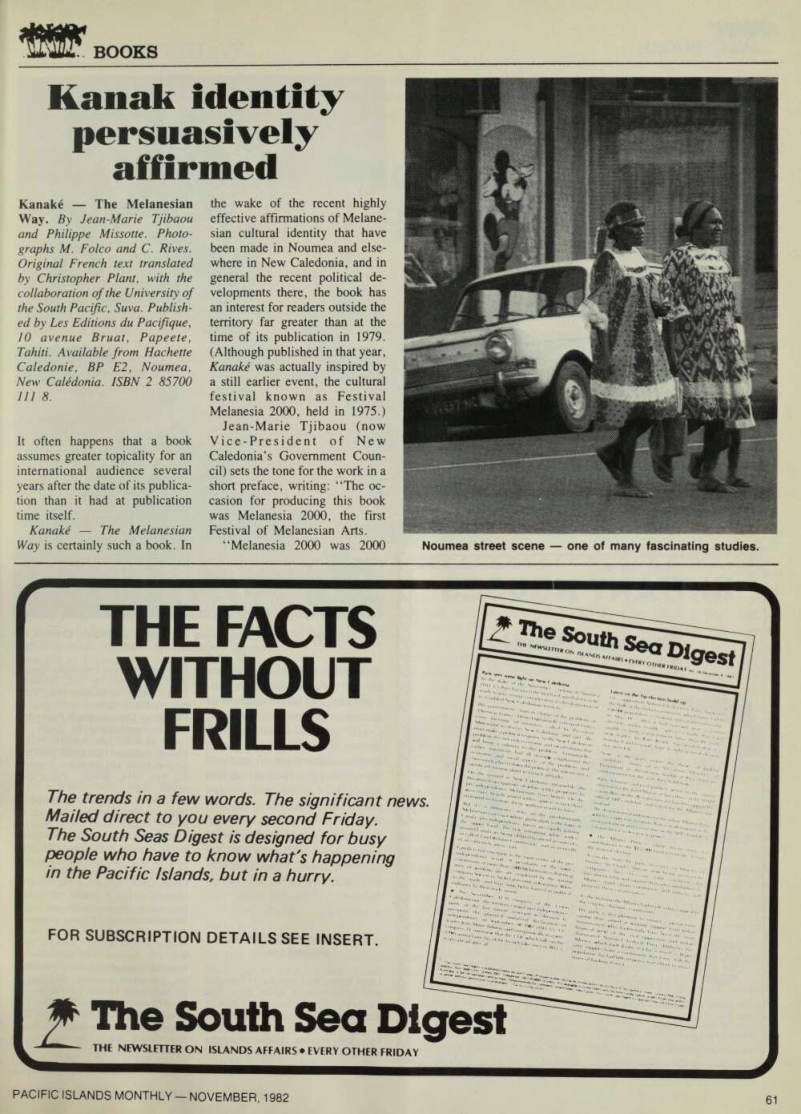
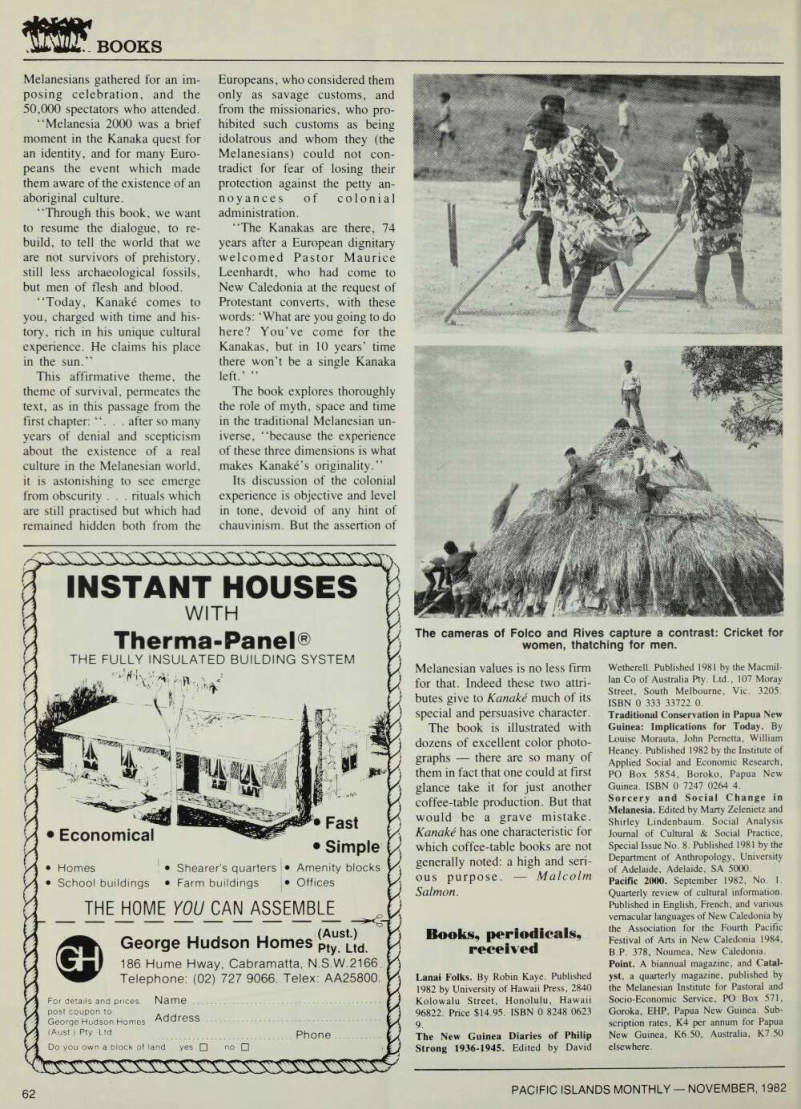
Kanak identity persuasively affirmed
Kanake The Melanesian Way. By Jean-Marie Tjibaou and Philippe Missotte. Photo graphs M. Folco and C. Rives.
Original French text translated by Christopher Plant, with the collaboration of the University of the South Pacific, Suva. Publish ed by Les Editions du Pacifique, 10 avenue Bruat, Papeete, Tahiti. Available from Hachette Caledonie, BP E 2, Noumea, New Caledonia. ISBN 2 85700 111 8.
It often happens that a book assumes greater topicality for an international audience several years after the date of its publica tion than it had at publication time itself.
Kanake The Melanesian Way is certainly such a book. In
the wake of the recent highly effective affirmations of Melane sian cultural identity that have been made in Noumea and else where in New Caledonia, and in general the recent political de velopments there, the book has an interest for readers outside the territory far greater than at the time of its publication in 1979. (Although published in that year, Kanake was actually inspired by a still earlier event, the cultural festival known as Festival Melanesia 2000, held in 1975.) Jean-Marie Tjibaou (now Vice-President of New Caledonia’s Government Coun cil) sets the tone for the work in a short preface, writing: “The oc casion for producing this book was Melanesia 2000, the first Festival of Melanesian Arts.
“Melanesia 2000 was 2000
Noumea street scene - one of many fascinating studies.
Melanesians gathered for an im posing celebration, and the 50,000 spectators who attended.
“Melanesia 2000 was a brief moment in the Kanaka quest for an identity, and for many Euro peans the event which made them aware of the existence of an
aboriginal culture.
“Through this book, we want to resume the dialogue, to re build, to tell the world that we are not survivors of prehistory, still less archaeological fossils, but men of flesh and blood.
“Today, Kanake comes to you, charged with time and his tory, rich in his unique cultural experience. He claims his place in the sun.’’
This affirmative theme, the theme of survival, permeates the text, as in this passage from the first chapter: “. . . after so many years of denial and scepticism about the existence of a real culture in the Melanesian world, it is astonishing to see emerge from obscurity . . . rituals which are still practised but which had remained hidden both from the
Europeans, who considered them only as savage customs, and from the missionaries, who pro hibited such customs as being idolatrous and whom they (the Melanesians) could not con tradict for fear of losing their protection against the petty an noyances of colonial administration.
“The Kanakas are there, 74 years after a European dignitary welcomed Pastor Maurice Leenhardt, who had come to New Caledonia at the request of Protestant converts, with these words; ‘What are you going to do here? You’ve come for the Kanakas, but in 10 years’ time there won’t be a single Kanaka left.’ ’’
The book explores thoroughly
the role of myth, space and time in the traditional Melanesian un iverse, “because the experience of these three dimensions is what makes Kanake’s originality.’’
Its discussion of the colonial experience is objective and level in tone, devoid of any hint of chauvinism. But the assertion of
Melanesian values is no less firm for that. Indeed these two attri butes give to Kanake much of its
special and persuasive character.
The book is illustrated with dozens of excellent color photo graphs there are so many of them in fact that one could at first glance take it for just another coffee-table production. But that would be a grave mistake.
Kanake has one characteristic for which coffee-table books are not generally noted: a high and seri
ous purpose.
Malcolm
Salmon.
Books, periodicals,
received
Lanai Folks. By Robin Kaye. Published 1982 by University of Hawaii Press, 2840 Kolowalu Street, Honolulu, Hawaii 96822. Price $14.95. ISBN 0 8248 0623 9.
The New Guinea Diaries of Philip Strong 1936-1945. Edited by David
Wetherell. Published 1981 by the Macmil lan Co of Australia Pty. Ltd., 107 Moray Street, South Melbourne, Vic. 3205.
Isbn 0 333 33722 0.
Traditional Conservation in Papua New Guinea: Implications for Today. By Louise Morauta, John Pemetta, William Heaney. Published 1982 by the Institute of Applied Social and Economic Research, PO Box 5854, Boroko, Papua New Guinea. ISBN 0 7247 0264 4.
Sorcery and Social Change in Melanesia. Edited by Marty Zelenietz and Shirley Lindenbaum. Social Analysis Journal of Cultural & Social Practice, Special Issue No. 8. Published 1981 by the Department of Anthropology, University of Adelaide, Adelaide, SA 5000.
Pacific 2000. September 1982, No. 1.
Quarterly review of cultural information.
Published in English, French, and various vernacular languages of New Caledonia by the Association for the Fourth Pacific Festival of Arts in New Caledonia 1984, B.P. 378, Noumea, New Caledonia.
Point. A biannual magazine, and Catal yst, a quarterly magazine, published by the Melanesian Institute for Pastoral and Socio-Economic Service, PO Box 571, Goroka, EHP, Papua New Guinea. Sub scription rates, K 4 per annum for Papua New Guinea, K 6.50, Australia, K 7.50 elsewhere.
The cameras of Folco and Rives capture a contrast: Cricket for women, thatching for men.
Advertisements & other items, pp. 61-62 (1 item)
The Facts
WITHOUT
FRILLS
The trends in a few words. The significant news Mailed direct to you every second Friday.
The South Seas Digest is designed for busy people who have to know what's happening in the Pacific Islands, but in a hurry.
FOR SUBSCRIPTION DETAILS SEE INSERT.
P The South Sea Digest
D *gest
'Win THE NEWSLETTER ON ISLANDS AFFAIRS • EVERY OTHER FRIDAY
INSTANT HOUSES
WITH
Therma-Panel®
THE FULLY INSULATED BUILDING SYSTEM
„ ' Vv >' / T
au.- 4 M 1 * *0 • Economical Homes School buildings Shearer’s quarters Farm buildings • Fast
• Simple
Amenity blocks Offices
THE HOME YOU CAN ASSEMBLE
(01 George Hudson Homes {£“ B {j d- -186 Hume Hway, Cabramatta, N.5.W.2166.
Telephone: (02) 727 9066. Telex: AA25800.
Name l For details and prices. , post coupon to: .
I George Hudson Homes Address I (Aust.) Pty. Ltd. ( Do you own a block of land yes □ no □ Phone
priest of Rakahanga
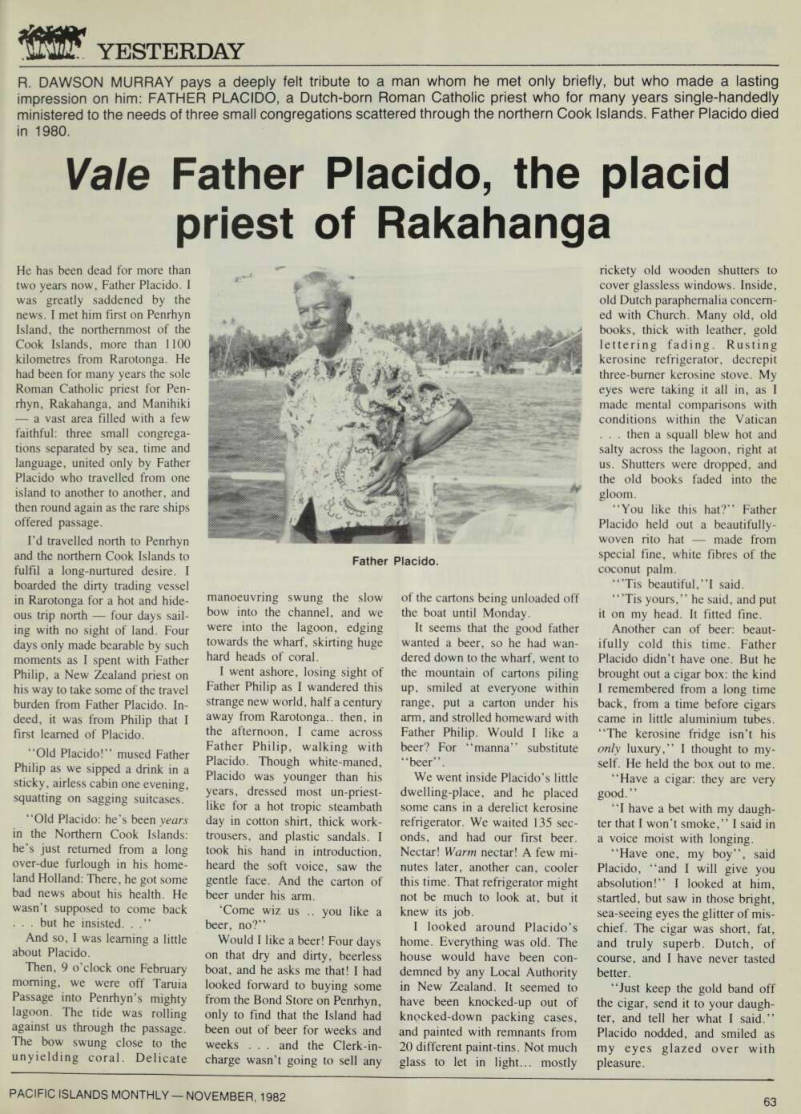
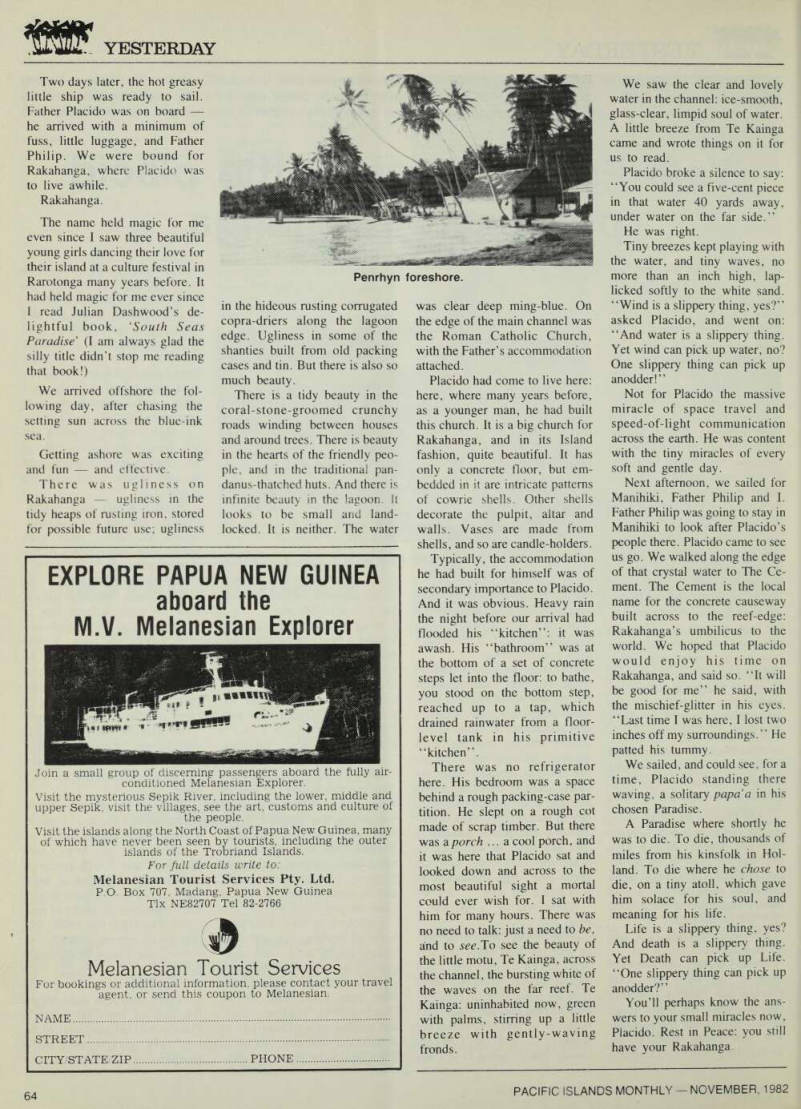
Yesterday
Vale Father Placido, the placid priest of Rakahanga
R. DAWSON MURRAY pays a deeply felt tribute to a man whom he met only briefly, but who made a lasting impression on him; FATHER PLACIDO, a Dutch-born Roman Catholic priest who for many years single-handedly ministered to the needs of three small congregations scattered through the northern Cook Islands. Father Placido died in 1980.
He has been dead for more than two years now, Father Placido. I was greatly saddened by the news. I met him first on Penrhyn Island, the northernmost of the Cook Islands, more than 1100 kilometres from Rarotonga. He had been for many years the sole Roman Catholic priest for Pen rhyn, Rakahanga, and Manihiki a vast area filled with a few faithful: three small congrega tions separated by sea, time and language, united only by Father Placido who travelled from one island to another to another, and then round again as the rare ships offered passage.
I’d travelled north to Penrhyn and the northern Cook Islands to fulfil a long-nurtured desire. I boarded the dirty trading vessel in Rarotonga for a hot and hide ous trip north four days sail ing with no sight of land. Four days only made bearable by such moments as I spent with Father Philip, a New Zealand priest on his way to take some of the travel burden from Father Placido. In deed, it was from Philip that I first learned of Placido.
“Old Placido!” mused Father Philip as we sipped a drink in a sticky, airless cabin one evening, squatting on sagging suitcases.
“Old Placido: he’s been years in the Northern Cook Islands: he’s just returned from a long over-due furlough in his home land Holland: There, he got some bad news about his health. He wasn’t supposed to come back . . . but he insisted. . .”
And so, I was learning a little about Placido.
Then, 9 o’clock one February morning, we were off Taruia Passage into Penrhyn’s mighty lagoon. The tide was rolling against us through the passage.
The bow swung close to the unyielding coral. Delicate
manoeuvring swung the slow bow into the channel, and we were into the lagoon, edging towards the wharf, skirting huge hard heads of coral.
I went ashore, losing sight of Father Philip as I wandered this strange new world, half a century away from Rarotonga., then, in the afternoon, I came across Father Philip, walking with Placido. Though white-maned, Placido was younger than his years, dressed most un-priest like for a hot tropic steambath day in cotton shirt, thick work trousers, and plastic sandals. I took his hand in introduction, heard the soft voice, saw the gentle face. And the carton of beer under his arm. ‘Come wiz us .. you like a beer, no?”
Would I like a beer! Four days on that dry and dirty, beerless boat, and he asks me that! I had looked forward to buying some from the Bond Store on Penrhyn, only to find that the Island had been out of beer for weeks and weeks . . . and the Clerk-in charge wasn’t going to sell any
of the cartons being unloaded off the boat until Monday.
It seems that the good father wanted a beer, so he had wan dered down to the wharf, went to the mountain of cartons piling up, smiled at everyone within range, put a carton under his arm, and strolled homeward with Father Philip. Would I like a beer? For “manna” substitute “beer”.
We went inside Placido’s little
dwelling-place, and he placed
some cans in a derelict kerosine refrigerator. We waited 135 sec onds, and had our first beer.
Nectar! Warm nectar! A few mi nutes later, another can, cooler this time. That refrigerator might not be much to look at, but it knew its job.
I looked around Placido’s home. Everything was old. The house would have been con demned by any Local Authority in New Zealand. It seemed to have been knocked-up out of knocked-down packing cases, and painted with remnants from 20 different paint-tins. Not much
glass to let in light... mostly
rickety old wooden shutters to cover glassless windows. Inside, old Dutch paraphernalia concern ed with Church. Many old, old books, thick with leather, gold lettering fading. Rusting kerosine refrigerator, decrepit three-burner kerosine stove. My eyes were taking it all in, as I made mental comparisons with conditions within the Vatican . . . then a squall blew hot and salty across the lagoon, right at us. Shutters were dropped, and the old books faded into the gloom.
“You like this hat?” Father Placido held out a beautifully woven rito hat made from special fine, white fibres of the coconut palm.
“Tis beautiful,”! said.
“Tis yours,” he said, and put it on my head. It fitted fine.
Another can of beer: beaut ifully cold this time. Father Placido didn’t have one. But he brought out a cigar box: the kind I remembered from a long time back, from a time before cigars came in little aluminium tubes.
“The kerosine fridge isn’t his only luxury,” I thought to my self. He held the box out to me.
“Have a cigar: they are very good.”
“I have a bet with my daugh ter that I won’t smoke,” I said in a voice moist with longing.
“Have one, my boy”, said Placido, “and I will give you absolution!” I looked at him, startled, but saw in those bright, sea-seeing eyes the glitter of mis chief. The cigar was short, fat, and truly superb. Dutch, of course, and I have never tasted better.
“Just keep the gold band off the cigar, send it to your daugh ter, and tell her what I said.”
Placido nodded, and smiled as my eyes glazed over with pleasure.
Father Placido.
Two days later, the hot greasy little ship was ready to sail.
Father Placido was on board he arrived with a minimum of fuss, little luggage, and Father Philip. We were bound for Rakahanga, where Placido was to live awhile.
Rakahanga.
The name held magic for me even since I saw three beautiful young girls dancing their love for their island at a culture festival in Rarotonga many years before. It had held magic for me ever since I read Julian Dashwood’s de
lightful book, ‘South Seas
Paradise’ (I am always glad the silly title didn’t stop me reading that book!) We arrived offshore the fol lowing day, after chasing the setting sun across the blue-ink sea.
Getting ashore was exciting
and fun and effective.
There was ugliness on
Rakahanga ugliness in the
tidy heaps of rusting iron, stored for possible future use; ugliness
in the hideous rusting corrugated
copra-driers along the lagoon
edge. Ugliness in some of the shanties built from old packing cases and tin. But there is also so
much beauty.
There is a tidy beauty in the
coral-stone-groomed crunchy
roads winding between houses and around trees. There is beauty in the hearts of the friendly peo ple, and in the traditional pan danus-thatched huts. And there is infinite beauty in the lagoon. It looks to be small and land locked. It is neither. The water
was clear deep ming-blue. On the edge of the main channel was the Roman Catholic Church, with the Father’s accommodation attached.
Placido had come to live here: here, where many years before, as a younger man, he had built this church. It is a big church for Rakahanga, and in its Island fashion, quite beautiful. It has only a concrete floor, but em bedded in it are intricate patterns of cowrie shells. Other shells decorate the pulpit, altar and walls. Vases are made from shells, and so are candle-holders.
Typically, the accommodation he had built for himself was of
secondary importance to Placido.
And it was obvious. Heavy rain the night before our arrival had flooded his “kitchen”: it was awash. His “bathroom” was at the bottom of a set of concrete steps let into the floor; to bathe, you stood on the bottom step, reached up to a tap, which drained rainwater from a floor level tank in his primitive “kitchen”.
There was no refrigerator here. His bedroom was a space behind a rough packing-case par tition. He slept on a rough cot made of scrap timber. But there was a porch ... a cool porch, and it was here that Placido sat and looked down and across to the most beautiful sight a mortal could ever wish for. I sat with him for many hours. There was no need to talk; just a need to be, and to see.lo see the beauty of the little motu, Te Kainga, across the channel, the bursting white of the waves on the far reef. Te Kainga: uninhabited now, green with palms, stirring up a little breeze with gently-waving fronds.
We saw the clear and lovely water in the channel: ice-smooth, glass-clear, limpid soul of water.
A little breeze from Te Kainga came and wrote things on it for us to read.
Placido broke a silence to say; “You could see a five-cent piece in that water 40 yards away, under water on the far side.”
He was right.
Tiny breezes kept playing with the water, and tiny waves, no more than an inch high, lap licked softly to the white sand.
“Wind is a slippery thing, yes?”
asked Placido, and went on; “And water is a slippery thing.
Yet wind can pick up water, no?
One slippery thing can pick up anodder!”
Not for Placido the massive miracle of space travel and
speed-of-light communication
across the earth. He was content with the tiny miracles of every
soft and gentle day.
Next afternoon, we sailed for Manihiki, Father Philip and I.
Father Philip was going to stay in Manihiki to look after Placido’s people there. Placido came to see us go. We walked along the edge of that crystal water to The Ce ment. The Cement is the local name for the concrete causeway built across to the reef-edge: Rakahanga’s umbilicus to the world. We hoped that Placido would enjoy his time on Rakahanga, and said so. “It will be good for me” he said, with the mischief-glitter in his eyes.
“Last time I was here, I lost two inches off my surroundings.” He patted his tummy.
We sailed, and could see, for a time, Placido standing there waving, a solitary papa a in his chosen Paradise.
A Paradise where shortly he was to die. To die, thousands of miles from his kinsfolk in Hol land. To die where he chose to die, on a tiny atoll, which gave him solace for his soul, and meaning for his life.
Life is a slippery thing, yes?
And death is a slippery thing.
Yet Death can pick up Life.
“One slippery thing can pick up anodder?”
You’ll perhaps know the ans wers to your small miracles now, Placido. Rest in Peace: you still have your Rakahanga.
Penrhyn foreshore.
Advertisements & other items, p. 64 (1 item)
Explore Papua New Guinea
aboard the
M.V. Melanesian Explorer
•m««t «»*n Join a small group of discerning passengers aboard the fully airconditioned Melanesian Explorer.
Visit the mysterious Sepik River, including the lower, middle and upper Sepik. visit the villages, see the art, customs and culture of the people.
Visit the islands along the North Coast of Papua New Guinea, many of which have never been seen by tourists, including the outer islands of the Trobriand Islands.
For full details write to: Melanesian Tourist Services Pty. Ltd.
P O. Box 707, Madang, Papua New Guinea Tlx NE82707 Tel 82-2766
Melanesian Tourist Services
For bookings or additional information, please contact your travel agent, or send this coupon to Melanesian.
NAME
STREET
CITY-STATE ZIP
PHONE
Trade Winds
By voting overwhelmingly for commonwealth status in association with the United States (RIM Oct p 5), the people of Guam have cleared up all doubts about their immediate political future. But economically and socially, the picture is far less clear. Writing from Guam, MARK L. BERG discusses two ways the island’s future development might go.
tourists, or pilgrims?
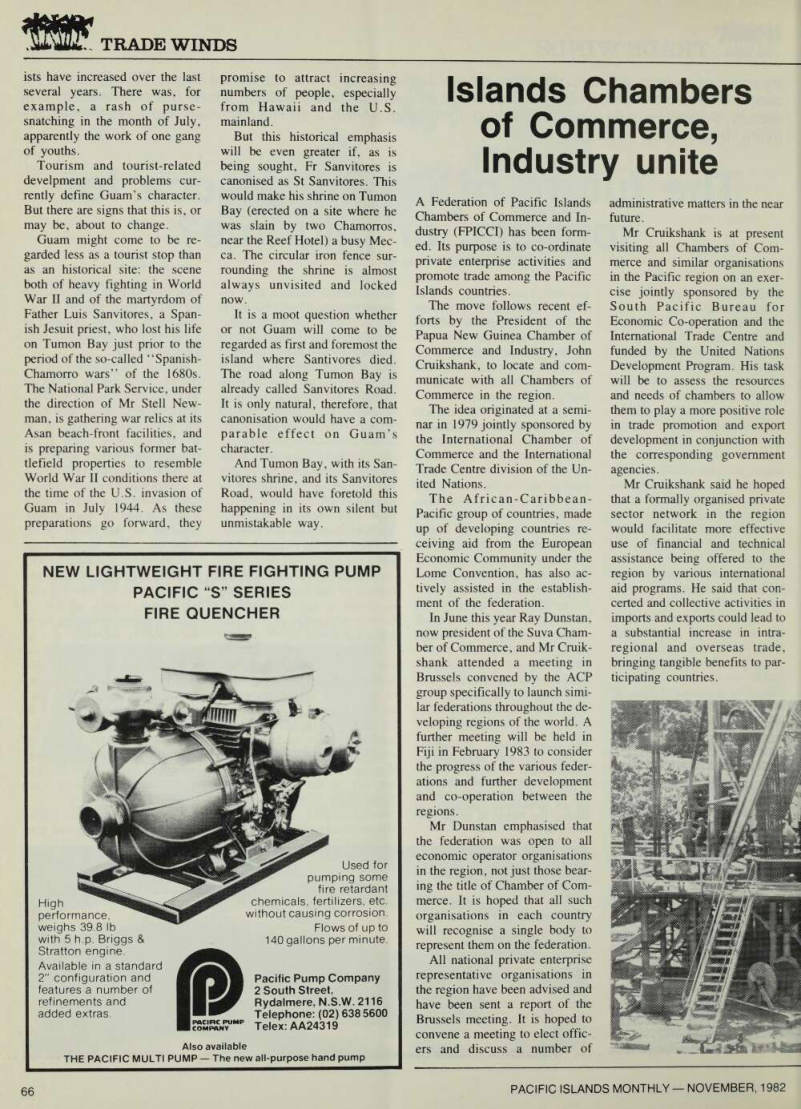
The future of Guam: Mecca for tourists, or pilgrims?
Turnon Bay is Guam’s most visited recreation area and big gest tourist attraction. It has sev eral of Guam’s best beaches, including the most popular one, Ypao Beach. Because Guam is a volcanic island, it offers little of that beauty found in greater abundance on other Micronesian islands. Nevertheless Turnon Bay does offer some of “the grace of trees overleaning the water, the rare sensitiveness of pencilled line and shadow, the matchless transparencies of at mosphere’’ that Grimble found on the islands of the eastern extremity of Micronesia, in Kiribati.
These qualities are exploited
by the nine hotels that have gone up on Turnon Bay’s wide curving arc: from the Okura in the north, to the Hilton in the south. The Okura almost exclu sively caters to Japanese tourists and is, along with seven others,
owned by Japanese companies.
Only the Hilton is American owned.
Apart from its beauty. Turnon Bay highlights the changes that have taken place on Guam over the last decade; it also foreshadows the changes that might alter the character of theis land in the years to come. Before the early 19705. the era of hotel building in Guam, mostly along Turnon Bay, the area was largely a recreation centre for island resi dents. Early photographs show it as a beach lapped by calm lagoon waters and roofed by ocean leaning coconut palms. It was sparsely populated and did not attract busloads of tourists.
Today, the character of the bay has changed from that of a recreation centre to Guam’s foremost tourist attraction Be sides the nine hotels, there is
popular Ypao Beach, located between the Hilton hotel and the two-year-old Pacific Islands Club. The beach has been used for international beauty contests,
as a large playground for visiting
Japanese schoolchildren, and the site for international body building contests, which are held in the Ypao Beach amphitheatre.
The only reminder of an Island lifestyle here are the poles set in the coral heads to mark safe passage out of the reef in the same manner poles are used else where in Micronesia to safely guide fishermen on their way to shore after a long fishing trip as the tide begins to fall. (I saw my first ones in Belau during Peace Corps service there.) The boom in tourism the numbers of Japanese tourists visiting annually has increased steadily for the last few years has prompted noticeable de
velopment along the bay. The
Hilton has committed itself to building a 100-room addition to their present accommodation.
Moped rental services have re cently increased from one opera tion to four. A police sub-station was established in one half of a wooden modular home, the other half of which serves as a tourist information centre for Japanese tourists. Seven new Japanese
businesses have recently opened
between the Okura and Fujita hotels; these would advertise ex clusively in Japanese were it not for a recently enacted law requir ing businesses to advertise in English or Chamorro, as well as their usual business language.
The oddest addition is a Kentuc ky Fried Chicken restaurant with a life-sized plastic model of Col onel Sanders, founder (now de ceased) of this franchise, which is moved in and out with the weather a sort of five-foot white barometer.
Landscaping, bulldozing and construction continue apace. The northern edge of the drive down to the bay is up for lease and newly bulldozed; the same is true for the road up the hill east of and just across from the police sub station. A new condiminium.
Bayshore Condominium, is be ing built on the beach near the Fujita hotel. Another is being planned on land in front of the Hilton. But people living in Tu
mon Heights immediately above the Hilton have already voiced complaints about the prospect of a tall building obstructing their view of the bay.
But high-rise buildings are just
one of the problems connected with development. New build ings require increased demand on the fresh water stored in the underground lens. Such a de mand might interfere with water supplies for island residents.
Pornography has also become more readily available as more tourists arrive. It was recently reported in the Pacific Daily News that, since Japanese tour ists cannot view X-rated movies (showing explicit sex) in Japan, the possibility of viewing such on Guam serves as one of Guam's strongest drawing cards; the same is probably true of
sexually explicit printed mate
rials Although the Guam legisla ture has just enacted an anti pornography law (after much publicity on the bill aroused by the activities of Citizens for a Decent Community), this has not resulted in the removal of sexual ly explicit materials, or the clos ing of theatres showing such movies.
Finally, to match an island wide trend, crimes against tour-
The Guam Hilton, overlooking Turnon Bay, was described by some critics at its opening in 1974 as “commercially too am bitious". But now, with tourism as an economic mainstay for Guam, the Hilton is to get 100 new rooms.
ists have increased over the last several years. There was, for example, a rash of purse snatching in the month of July, apparently the work of one gang of youths.
Tourism and tourist-related
develpment and problems cur
rently define Guam’s character.
But there are signs that this is, or may be, about to change.
Guam might come to be re garded less as a tourist stop than as an historical site: the scene both of heavy fighting in World War II and of the martyrdom of Father Luis Sanvitores, a Span ish Jesuit priest, who lost his life on Turnon Bay just prior to the period of the so-called “Spanish- Chamorro wars” of the 1680 s.
The National Park Service, under the direction of Mr Stell New man, is gathering war relics at its Asan beach-front facilities, and is preparing various former bat tlefield properties to resemble World War II conditions there at the time of the U.S. invasion of Guam in July 1944. As these
preparations go forward, they
promise to attract increasing numbers of people, especially from Hawaii and the U.S. mainland.
But this historical emphasis will be even greater if, as is being sought, Fr Sanvitores is canonised as St Sanvitores. This would make his shrine on Turnon Bay (erected on a site where he was slain by two Chamorros, near the Reef Hotel) a busy Mec ca. The circular iron fence sur rounding the shrine is almost always unvisited and locked now.
It is a moot question whether or not Guam will come to be regarded as first and foremost the island where Santivores died.
The road along Turnon Bay is already called Sanvitores Road.
It is only natural, therefore, that canonisation would have a com parable effect on Guam’s character.
And Turnon Bay, with its San vitores shrine, and its Sanvitores Road, would have foretold this happening in its own silent but unmistakable way.
Industry unite
Islands Chambers of Commerce, Industry unite
A Federation of Pacific Islands Chambers of Commerce and In dustry (FPICCI) has been form ed. Its purpose is to co-ordinate private enterprise activities and promote trade among the Pacific Islands countries.
The move follows recent ef forts by the President of the Papua New Guinea Chamber of Commerce and Industry, John Cruikshank, to locate and com municate with all Chambers of Commerce in the region.
The idea originated at a semi nar in 1979 jointly sponsored by the International Chamber of Commerce and the International Trade Centre division of the Un ited Nations.
The African-Caribbean- Pacific group of countries, made up of developing countries re ceiving aid from the European Economic Community under the Lome Convention, has also ac tively assisted in the establish ment of the federation.
In June this year Ray Dunstan, now president of the Suva Cham ber of Commerce, and Mr Cruik shank attended a meeting in Brussels convened by the ACP group specifically to launch simi lar federations throughout the de veloping regions of the world. A further meeting will be held in Fiji in February 1983 to consider the progress of the various feder ations and further development and co-operation between the
regions.
Mr Dunstan emphasised that the federation was open to all economic operator organisations in the region, not just those bear ing the title of Chamber of Com merce. It is hoped that all such organisations in each country will recognise a single body to represent them on the federation.
All national private enterprise
representative organisations in
the region have been advised and have been sent a report of the Brussels meeting. It is hoped to convene a meeting to elect offic ers and discuss a number of
administrative matters in the near future.
Mr Cruikshank is at present visiting all Chambers of Com merce and similar organisations in the Pacific region on an exer cise jointly sponsored by the South Pacific Bureau for Economic Co-operation and the International Trade Centre and funded by the United Nations Development Program. His task will be to assess the resources and needs of chambers to allow them to play a more positive role in trade promotion and export development in conjunction with the corresponding government agencies.
Mr Cruikshank said he hoped that a formally organised private sector network in the region would facilitate more effective use of financial and technical assistance being offered to the region by various international aid programs. He said that con certed and collective activities in imports and exports could lead to a substantial increase in intra regional and overseas trade, bringing tangible benefits to par ticipating countries.
Advertisements & other items, pp. 66-68 (3 items)
Page 66
Scientists upbeat on Pacific oil prospects
MICHAEL F. LEIDEMANN reports from Honolulu on the recent Circum-Pacific Energy and Mineral Resources Conference held there. The assembled group of scientists were almost uniformly optimistic about the prospects for the discovery of oil in the exclusive economic zones of a number of Island nations, following the most recent research into the problem.
Scientists think they have dis covered evidence pointing to a major new find of recoverable oil in the Pacific.
Unveiled at the Circum- Pacific Energy and Mineral Re sources Conference in Honolulu in late August, the discovery could mean a major new source of revenue for several island na tions, including Fiji, Vanuatu, Tonga and the Solomons, ac cording to the scientists.
H. Gary Greene, a U.S.
Geological Survey marine geologist who headed a nine month probe of the ocean floor from Hawaii to Rabaul, stopped just short of saying the oil was there. But he did say that sound ings of the ocean floor indicate that it is similar to those areas
where major oil basins have been found in the past.
“Initial results,” Greene told the more than 1000 scientists from 32 nations attending the conference, “indicate excellent data for the first time, ’ ’ and point to the need for further study, especially near the islands of Espiritu Santo and Malakula in Vanuatu, and through the Solomons.
Perhaps the most promising finds were in Tonga, where test ing for oil which began in the early 1970 s has been all but abandoned. The oil companies converged on the area after re ports of crude oil seepage, only to say later that they could not isolate the source of the oil. A small company, Samuel Gari Oil
Producers Inc, remains active in the search for Tongan oil, and Greene believes that this persist ence will pay off with the help of the new data.
Greene said the evidence seems to indicate the oil could be found at levels comparatively easy for recovery 2.4 to 4.8 kilometres below the surface of the earth, where the ocean depths average about 850 metres.
“All we can say is that the basins are similar in structure to oil-bearing regions elsewhere in the world,” Greene said.
The announcement came after a $1.5 million research cruise of the Geological Survey’s vessel, S. P. Lee. Australia and New Zealand also contributed funds to keep the journey afloat.
A spokesman for the Circum- Pacific Council, which spon sored the conference, said that if and when the finds are confirm ed, it will be up to the individual nations involved to negotiate drilling rights with private oil companies. At least one speaker at the conference, however, sug gested that the nations involved will have to rely for a long time on foreign firms and investors.
“The necessary professional and technical expertise will still have to come from outside the region,” said A. Macfarlane, who heads Vanuatu’s Depart ment of Geology, as well as the Committee for Co-ordination of Joint Prospecting For Mineral Resources in the South Pacific Area, a 10-year-old regional co operative with members in the Cook Islands, Fiji, Kiribati, New Zealand, Papua New Guinea, the Solomons, Tonga, Vanuatu and Western Samoa.
The group worked jointly with the U.S. Geological Survey in the cruise of the Lee, and Mac
farlane sees that as the type of regional co-operation needed if Island nations are ever to benefit from the minerals beneath their ocean. Several of the islands involved, he said, lack even a national geological survey or similar body, and “there is an obvious important and continu ing need for a regional body to implement programs of mineral resource assessment and to co ordinate and direct geo-scientific research by outside organisations”.
The new research was a direct outgrowth of what the Circum- Pacific Council sees as its most important contribution to the Pacific basin its Circum- Pacific Map Project, a 10-year scheme to chart all of the Pacif ic’s mineral resources.
For the first time, the maps provide a clear picture of the ocean bed’s fault lines, seismic zones and underlying features that could go a long way towards minimising damage from earth quakes, tsunamis and other natural disasters, Peck said.
This kind of research could end up paying off for the nations who find ways to tap the rich mineral deposits found on the ocean floor and beneath it, the scientists agreed.
Citing the recent signing of a new co-operative agreement bet ween the U.S. and China to hunt for and extract new resources in the South China Sea, the scien tists pointed to other areas where major international companies may be taking closer looks and bidding for mineral rights once the intitial data has been com piled for them.
Once that happens, the Pacific “could be one of the leading economic growth regions in the world over the next 20 years”, according to William Kies chnick, the head of the giant Atlantic Richfield Company, who was on hand to observe the project’s progress.
“On the basis of price alone, at least for energy, I am convinc ed that the translation of the incentives of the ‘7os into the operations of the ’Bos and ’9os could produce unprecedented de velopment in the Pacific reg ion,” Kieschnick told the scientists.
Extensive oil searches on the Papua side of Papua New Guinea have come tantalisingly close to a major discovery. Below is one of the Australasian Petroleum Company’s rigs which operated in the 1950s. More recently there have been two other major explorations, one including the Gulf of Papua seabed.
New Lightweight Fire Fighting Pump
PACIFIC “S” SERIES
FIRE QUENCHER
M * I JR High performance weighs 39.8 lb with 5 h.p. Briggs & Stratton engine.
Available in a standard 2" configuration and features a number of refinements and added extras.
Used for pumping some fire retardant chemicals, fertilizers, etc. without causing corrosion.
Flows of up to 140 gallons per minute.
Pacific Pump Company 2 South Street, Rydalmere, N.S.W. 2116 Telephone: (02)638 5600 Telex: AA24319 Also available THE PACIFIC MULTI PUMP The new all-purpose hand pump
Tdon wb
Deals the
winning
hand in rat
control!
talon WB is a world breakthrough In killing rats and mice. Developed by ICI Tasman in New Zealand TALON WB is a sure way to increase profits by eliminating RAT DAMAGE TO CROPS!
SOLID BLOCKS Can be wired or nailed out of reach of children & animals. Easily handled - won’t blow away.
K/n Sr
i*AT:
S 3 §l^ Sr Q) Q S a < o CD 'Op £ WATERPROOF Safe year round use - will not dissolve, resists mould for extended periods.
DEADLY
Kills even the toughest rats - Including those resistant to warfarin based poisons.
EFFECTIVE
POWERFUL
Highly attractive to rats & mice - no pre-baiting Is required.
Kills more rats - a lethal dose can be consumed In a single feed.
Do not lay baits in places accessible to children, pets and domestic animals. Wash hands and exposed skin before meals and after work, do not store near food or feed. Burn or bury all rodent bodies and uneaten bait. Empty containers should not be re-used but disposed of
Tdonwß
1C 1a A Product of ICI Tasman Limited P.O. Box 900, Auckland, New Zealand
WARNING
\ safely
Whatever your crops COCOA COCONUTS SUGARCANE.
RATS KILL PROFITS! WOW TALON WB KILLS RATS!
Islands display in Australia
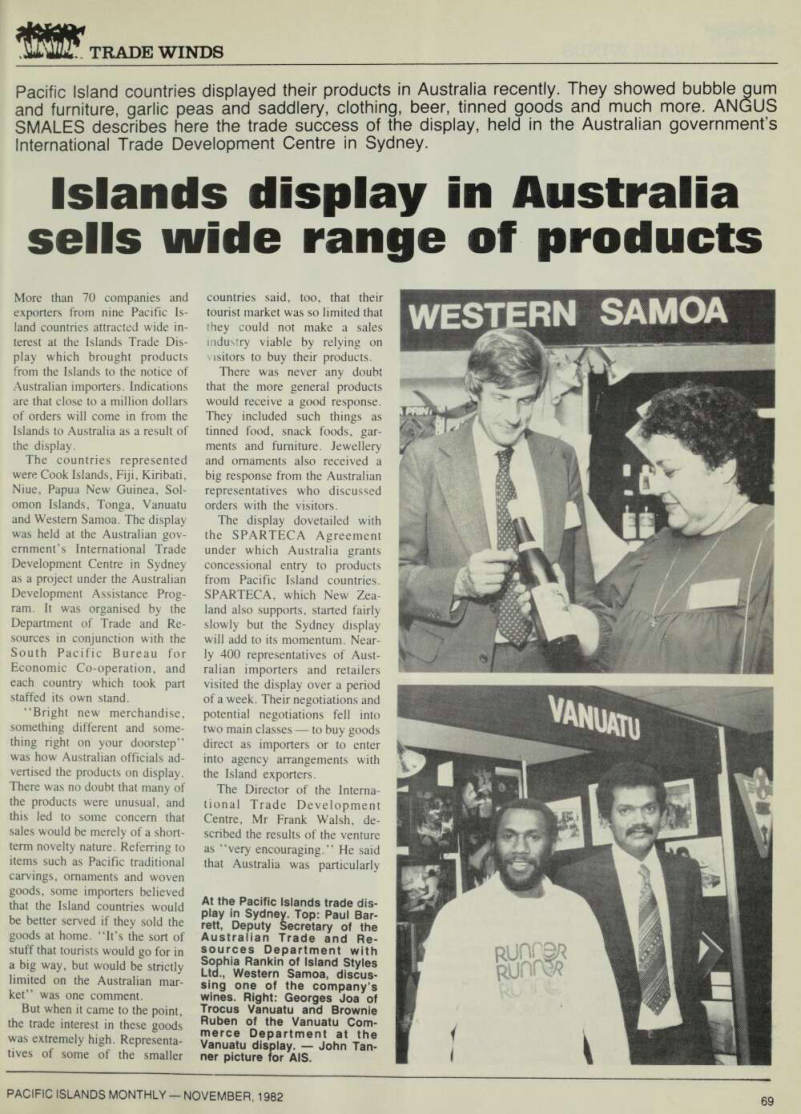
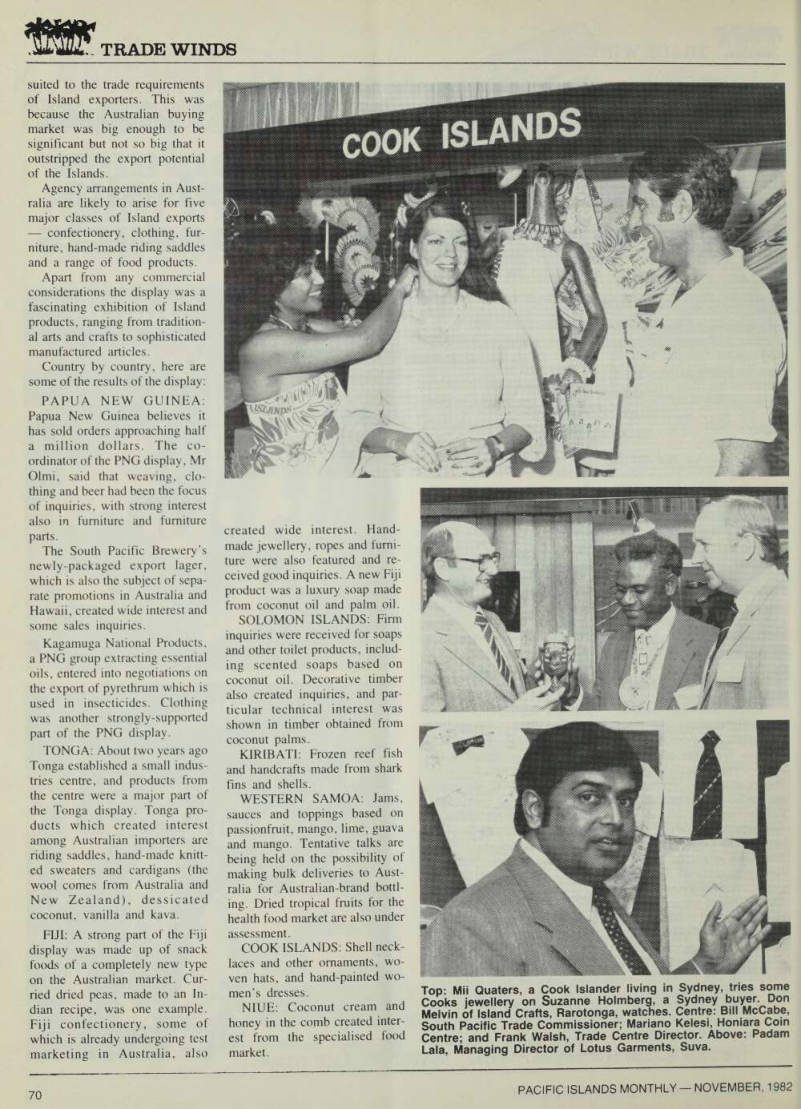
sells wide range of products
Pacific Island countries displayed their products in Australia recently. They showed bubble gum and furniture, garlic peas and saddlery, clothing, beer, tinned goods and much more. ANGUS SMALES describes here the trade success of the display, held in the Australian government’s International Trade Development Centre in Sydney.
More than 70 companies and exporters from nine Pacific Is land countries attracted wide in terest at the Islands Trade Dis play which brought products from the Islands to the notice of Australian importers. Indications are that close to a million dollars of orders will come in from the Islands to Australia as a result of the display.
The countries represented were Cook Islands, Fiji, Kiribati, Niue, Papua New Guinea, Sol omon Islands, Tonga, Vanuatu and Western Samoa. The display was held at the Australian gov ernment’s International Trade Development Centre in Sydney as a project under the Australian Development Assistance Prog ram. It was organised by the Department of Trade and Re sources in conjunction with the South Pacific Bureau for Economic Co-operation, and each country which took part staffed its own stand.
“Bright new merchandise, something different and some thing right on your doorstep” was how Australian officials ad vertised the products on display.
There was no doubt that many of the products were unusual, and this led to some concern that sales would be merely of a short term novelty nature. Referring to items such as Pacific traditional carvings, ornaments and woven goods, some importers believed that the Island countries would be better served if they sold the goods at home. “It’s the sort of stuff that tourists would go for in a big way, but would be strictly limited on the Australian mar ket” was one comment.
But when it came to the point, the trade interest in these goods was extremely high. Representa tives of some of the smaller
countries said, too, that their tourist market was so limited that they could not make a sales industry viable by relying on visitors to buy their products.
There was never any doubt that the more general products would receive a good response.
They included such things as tinned food, snack foods, gar ments and furniture. Jewellery and ornaments also received a big response from the Australian representatives who discussed orders with the visitors.
The display dovetailed with the SPARTECA Agreement under which Australia grants concessional entry to products from Pacific Island countries.
SPARTECA, which New Zea land also supports, started fairly slowly but the Sydney display will add to its momentum. Near ly 400 representatives of Aust ralian importers and retailers visited the display over a period of a week. Their negotiations and potential negotiations fell into two main classes to buy goods direct as importers or to enter into agency arrangements with the Island exporters.
The Director of the Interna tional Trade Development Centre, Mr Frank Walsh, de scribed the results of the venture as “very encouraging.” He said that Australia was particularly
At the Pacific Islands trade dis play in Sydney. Top: Paul Bar rett, Deputy Secretary of the Australian Trade and Re sources Department with Sophia Rankin of Island Styles Ltd., Western Samoa, discus sing one of the company’s wines. Right: Georges Joa of Trocus Vanuatu and Brownie Ruben of the Vanuatu Com merce Department at the
Vanuatu display. - John Tan
ner picture for AIS.
suited to the trade requirements of Island exporters. This was because the Australian buying market was big enough to be significant but not so big that it outstripped the export potential of the Islands.
Agency arrangements in Aust ralia are likely to arise for five major classes of Island exports
confectionery, clothing, fur
niture, hand-made riding saddles and a range of food products.
Apart from any commercial considerations the display was a fascinating exhibition of Island
products, ranging from tradition
al arts and crafts to sophisticated manufactured articles.
Country by country, here are some of the results of the display;
Papua New Guinea:
Papua New Guinea believes it has sold orders approaching half a million dollars. The co ordinator of the PNG display, Mr Olmi, said that weaving, clo thing and beer had been the focus of inquiries, with strong interest also in furniture and furniture parts.
The South Pacific Brewery’s newly-packaged export lager, which is also the subject of sepa rate promotions in Australia and Hawaii, created wide interest and some sales inquiries.
Kagamuga National Products, a PNG group extracting essential oils, entered into negotiations on the export of pyrethrum which is used in insecticides. Clothing was another strongly-supported part of the PNG display.
TONGA; About two years ago Tonga established a small indus tries centre, and products from the centre were a major part of the Tonga display. Tonga pro ducts which created interest among Australian importers are riding saddles, hand-made knitt ed sweaters and cardigans (the wool comes from Australia and New Zealand), dessicated coconut, vanilla and kava.
FIJI: A strong part of the Fiji display was made up of snack foods of a completely new type on the Australian market. Cur ried dried peas, made to an In dian recipe, was one example.
Fiji confectionery, some of
which is already undergoing test marketing in Australia, also
created wide interest. Hand made jewellery, ropes and furni ture were also featured and re
ceived good inquiries. A new Fiji
product was a luxury soap made from coconut oil and palm oil.
Solomon Islands: Firm
inquiries were received for soaps and other toilet products, includ ing scented soaps based on coconut oil. Decorative timber also created inquiries, and par ticular technical interest was shown in timber obtained from
coconut palms.
KIRIBATI; Frozen reef fish and handcrafts made from shark fins and shells.
Western Samoa: Jams,
sauces and toppings based on passionfruit, mango, lime, guava and mango. Tentative talks are being held on the possibility of making bulk deliveries to Aust ralia for Australian-brand bottl ing. Dried tropical fruits for the health food market are also under assessment.
COOK ISLANDS: Shell neck laces and other ornaments, wo ven hats, and hand-painted wo men’s dresses.
NIUE: Coconut cream and honey in the comb created inter est from the specialised food market.
Top: Mii Quaters, a Cook Islander living in Sydney, tries some Cooks jewellery on Suzanne Holmberg, a Sydney buyer. Don Melvin of Island Crafts, Rarotonga, watches. Centre: Bill McCabe, South Pacific Trade Commissioner; Mariano Kelesi, Honiara Com Centre; and Frank Walsh, Trade Centre Director. Above: Padam Lala, Managing Director of Lotus Garments, Suva.
Yachts
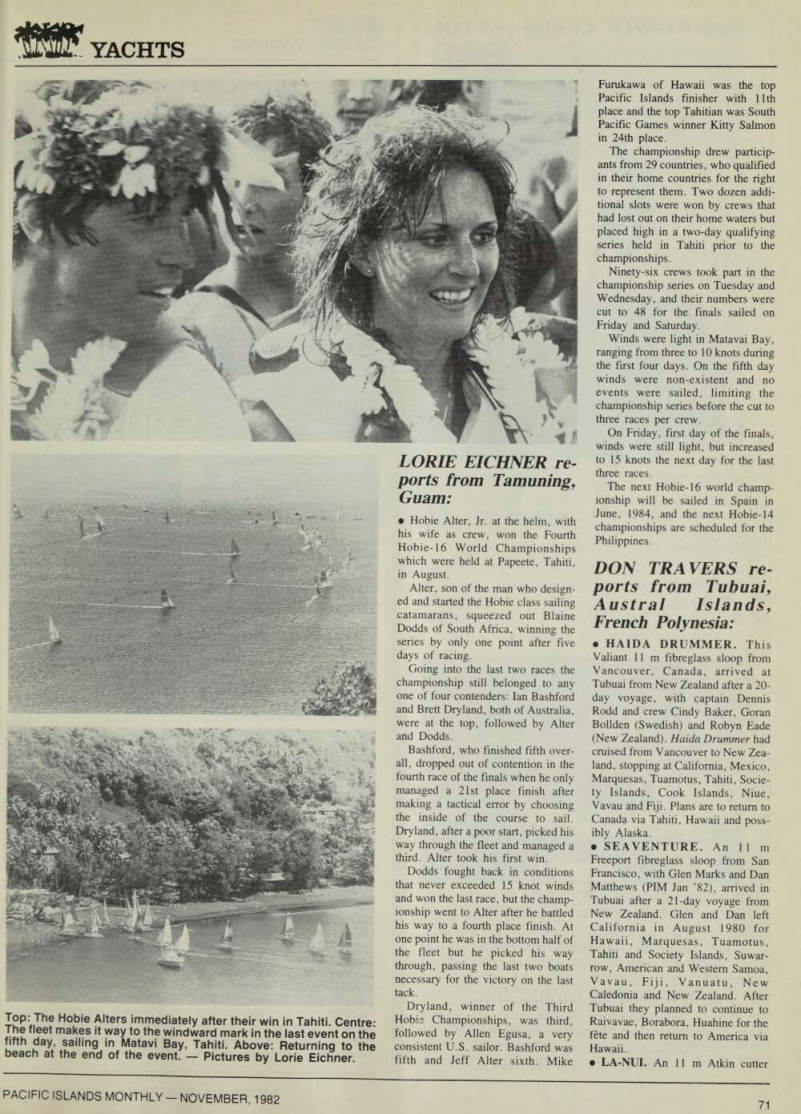
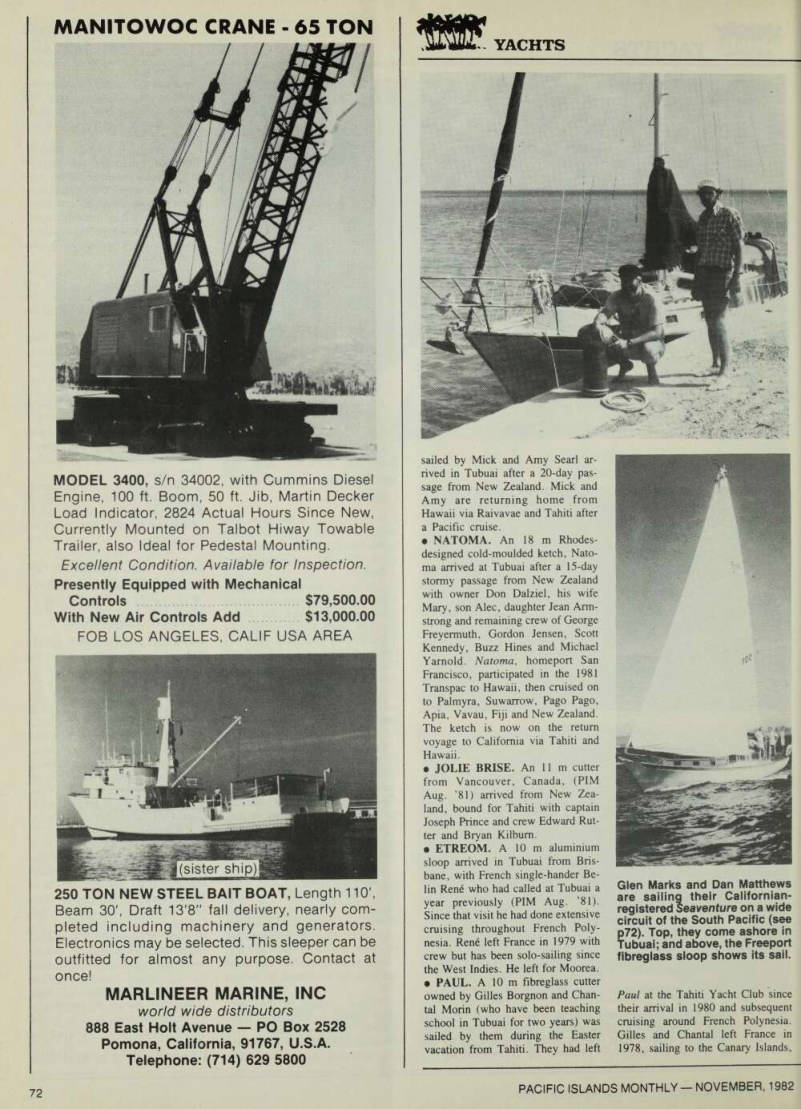
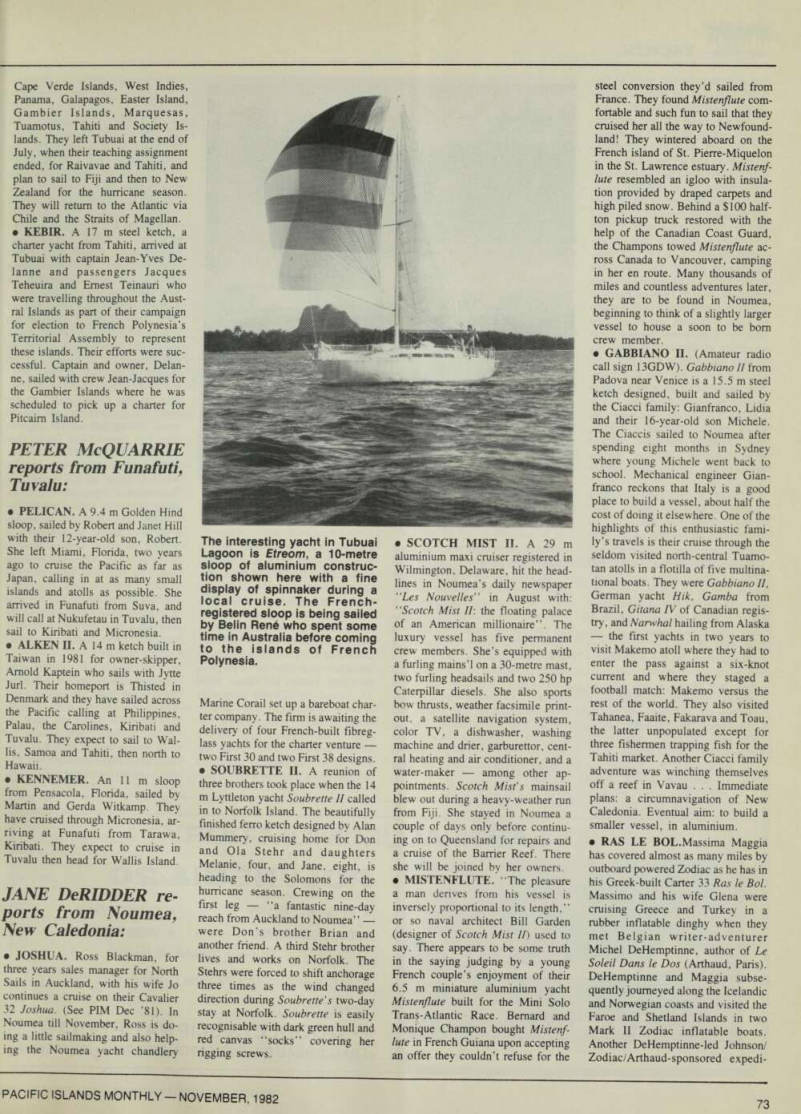
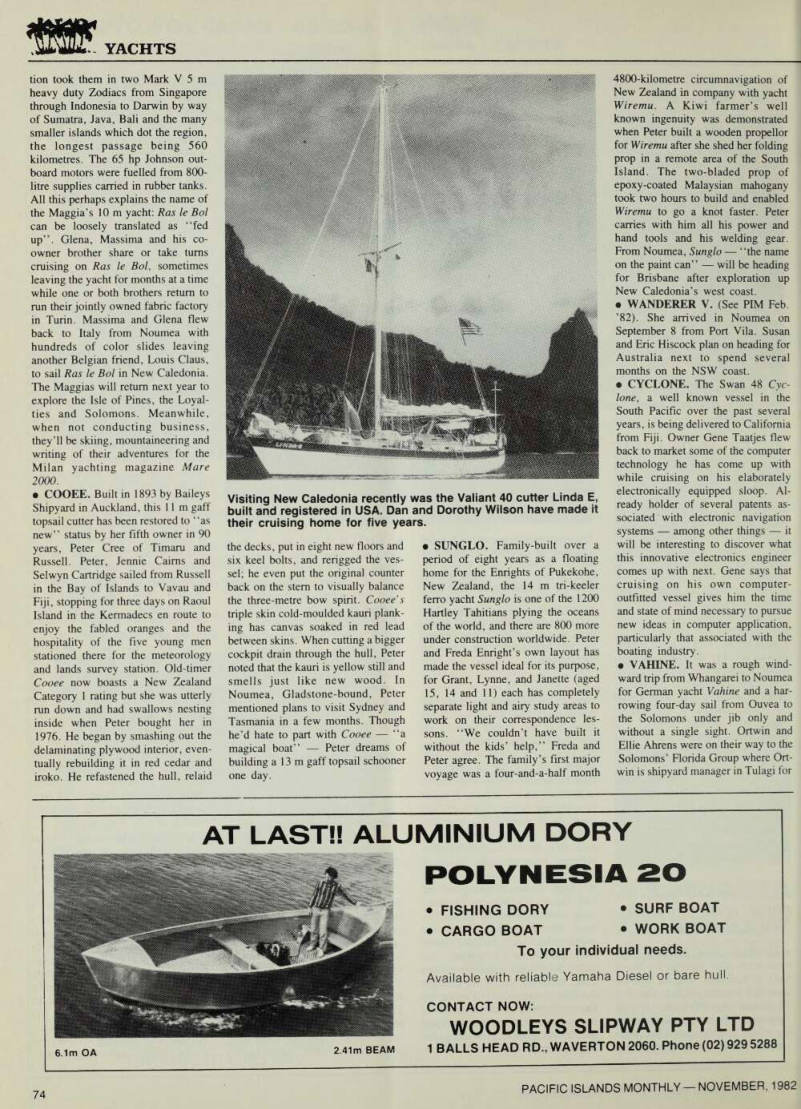
Lorie Eichner Re
ports from Tamuning,
Guam:
• Hobie Alter, Jr. at the helm, with his wife as crew, won the Fourth Hobie-16 World Championships which were held at Papeete, Tahiti,
in August.
Alter, son of the man who design ed and started the Hobie class sailing catamarans, squeezed out Blaine Dodds of South Africa, winning the series by only one point after five
days of racing.
Going into the last two races the championship still belonged to any one of four contenders; lan Bashford and Brett Dryland, both of Australia, were at the top, followed by Alter and Dodds.
Bashford, who finished fifth over all, dropped out of contention in the fourth race of the finals when he only managed a 21st place finish after
making a tactical error by choosing
the inside of the course to sail.
Dryland, after a poor start, picked his way through the fleet and managed a third. Alter took his first win.
Dodds fought back in conditions that never exceeded 15 knot winds and won the last race, but the champ ionship went to Alter after he battled his way to a fourth place finish. At one point he was in the bottom half of the fleet but he picked his way through, passing the last two boats necessary for the victory on the last tack.
Dryland, winner of the Third Hobie Championships, was third, followed by Allen Egusa, a very consistent U.S. sailor. Bashford was fifth and Jeff Alter sixth. Mike
Furukawa of Hawaii was the top Pacific Islands finisher with 11th place and the top Tahitian was South Pacific Games winner Kitty Salmon in 24th place.
The championship drew particip ants from 29 countries, who qualified in their home countries for the right to represent them. Two dozen addi tional slots were won by crews that had lost out on their home waters but
placed high in a two-day qualifying
series held in Tahiti prior to the
championships.
Ninety-six crews took part in the championship series on Tuesday and Wednesday, and their numbers were cut to 48 for the finals sailed on
Friday and Saturday.
Winds were light in Matavai Bay, ranging from three to 10 knots during the first four days. On the fifth day winds were non-existent and no events were sailed, limiting the championship series before the cut to three races per crew.
On Friday, first day of the finals, winds were still light, but increased to 15 knots the next day for the last three races.
The next Hobie-16 world champ ionship will be sailed in Spain in June, 1984, and the next Hobie-14 championships are scheduled for the
Philippines.
Don Travers Re
ports from Tubuai,
Austral Islands,
French Polynesia:
• Haida Drummer. This
Valiant 11 m fibreglass sloop from Vancouver, Canada, arrived at Tubuai from New Zealand after a 20day voyage, with captain Dennis Rodd and crew Cindy Baker, Goran Bollden (Swedish) and Robyn Fade (New Zealand). Haida Drummer had cruised from Vancouver to New Zea land, stopping at California, Mexico, Marquesas, Tuamotus, Tahiti, Socie ty Islands, Cook Islands, Niue, Vavau and Fiji. Plans are to return to Canada via Tahiti, Hawaii and poss
ibly Alaska.
• Seaventure. An 11 M
Freeport fibreglass sloop from San
Francisco, with Glen Marks and Dan Matthews (PIM Jan ’B2), arrived in Tubuai after a 21-day voyage from New Zealand. Glen and Dan left California in August 1980 for Hawaii, Marquesas, Tuamotus, Tahiti and Society Islands, Suwar row, American and Western Samoa, Vavau, Fiji, Vanuatu, New Caledonia and New Zealand. After Tubuai they planned to continue to Raivavae, Borabora, Huahine for the fete and then return to America via Hawaii. • LA-NUI. An 11 m Atkin cutter
Top: The Hobie Alters immediately after their win in Tahiti. Centre: The fleet makes it way to the windward mark in the last event on the fifth day, sailing in Matavi Bay, Tahiti. Above: Returning to the beach at the end of the event. - Pictures by Lorie Eichner.
sailed by Mick and Amy Searl ar rived in Tubuai after a 20-day pas sage from New Zealand. Mick and Amy are returning home from Hawaii via Raivavae and Tahiti after a Pacific cruise. • N ATOM A. An 18 m Rhodes designed cold-moulded ketch, Nato ma arrived at Tubuai after a 15-day stormy passage from New Zealand with owner Don Dalziel, his wife Mary, son Alec, daughter Jean Arm strong and remaining crew of George Freyermuth, Gordon Jensen, Scott Kennedy, Buzz Hines and Michael Yarnold. Natoma, homeport San Francisco, participated in the 1981 Transpac to Hawaii, then cruised on to Palmyra, Suwarrow, Pago Pago, Apia, Vavau, Fiji and New Zealand.
The ketch is now on the return voyage to California via Tahiti and Hawaii. • JOLIE BRISK. An 11 m cutter from Vancouver, Canada, (PIM Aug. ’81) arrived from New Zea land, bound for Tahiti with captain Joseph Prince and crew Edward Rut ter and Bryan Kilbum. • ETREOM. A 10 m aluminium sloop arrived in Tubuai from Bris bane, with French single-hander Be lin Rene who had called at Tubuai a year previously (PIM Aug. ’81).
Since that visit he had done extensive
cruising throughout French Poly
nesia. Ren6 left France in 1979 with crew but has been solo-sailing since the West Indies. He left for Moorea. • PAUL. A 10 m fibreglass cutter owned by Gilles Borgnon and Chan tal Morin (who have been teaching school in Tubuai for two years) was sailed by them during the Easter vacation from Tahiti. They had left
Paul at the Tahiti Yacht Club since their arrival in 1980 and subsequent cruising around French Polynesia.
Gilles and Chantal left France in 1978, sailing to the Canary Islands,
Glen Marks and Dan Matthews are sailing their Californian registered Seaventure on a wide circuit of the South Pacific (see p72). Top, they come ashore in Tubuai; and above, the Freeport fibreglass sloop shows its sail.
Cape Verde Islands, West Indies, Panama, Galapagos, Easter Island, Gambier Islands, Marquesas, Tuamotus, Tahiti and Society Is lands. They left Tubuai at the end of July, when their teaching assignment ended, for Raivavae and Tahiti, and plan to sail to Fiji and then to New Zealand for the hurricane season.
They will return to the Atlantic via Chile and the Straits of Magellan. • KEBIR. A 17 m steel ketch, a charter yacht from Tahiti, arrived at Tubuai with captain Jean-Yves De lanne and passengers Jacques Teheuira and Ernest Teinauri who were travelling throughout the Aust ral Islands as part of their campaign for election to French Polynesia’s Territorial Assembly to represent these islands. Their efforts were suc cessful. Captain and owner, Delan ne, sailed with crew Jean-Jacques for the Gambier Islands where he was scheduled to pick up a charter for Pitcairn Island.
Peter Mcquarrie
reports from Funafuti,
Tuvalu:
• PELICAN. A 9.4 m Golden Hind sloop, sailed by Robert and Janet Hill with their 12-year-old son, Robert.
She left Miami, Florida, two years ago to cruise the Pacific as far as Japan, calling in at as many small islands and atolls as possible. She arrived in Funafuti from Suva, and will call at Nukufetau in Tuvalu, then sail to Kiribati and Micronesia. • ALKEN 11. A 14 m ketch built in Taiwan in 1981 for owner-skipper, Arnold Kaptein who sails with Jytte Jurl. Their homeport is Thisted in Denmark and they have sailed across the Pacific calling at Philippines, Palau, the Carolines, Kiribati and Tuvalu. They expect to sail to Wal lis, Samoa and Tahiti, then north to Hawaii. • KENNEMER. An 11 m sloop from Pensacola, Florida, sailed by Martin and Gerda Witkamp. They have cruised through Micronesia, ar riving at Funafuti from Tarawa, Kiribati. They expect to cruise in Tuvalu then head for Wallis Island.
Jane Deridder Re
ports from Noumea,
New Caledonia:
• JOSHUA. Ross Blackman, for three years sales manager for North Sails in Auckland, with his wife Jo continues a cruise on their Cavalier 32 Joshua. (See PIM Dec ’81). In Noumea till November, Ross is do ing a little sailmaking and also help ing the Noumea yacht chandlery
Marine Corail set up a bareboat char ter company. The firm is awaiting the delivery of four French-built fibreg lass yachts for the charter venture two First 30 and two First 38 designs. • SOUBRETTE 11. A reunion of three brothers took place when the 14 m Lyttleton yacht Soubrette II called in to Norfolk Island. The beautifully finished ferro ketch designed by Alan Mummery, cruising home for Don and Ola Stehr and daughters Melanie, four, and Jane, eight, is heading to the Solomons for the hurricane season. Crewing on the first leg “a fantastic nine-day reach from Auckland to Noumea” were Don’s brother Brian and another friend. A third Stehr brother lives and works on Norfolk. The Stehrs were forced to shift anchorage three times as the wind changed
direction during Soubrette’s two-day
stay at Norfolk. Soubrette is easily recognisable with dark green hull and red canvas “socks” covering her
rigging screws.
• SCOTCH MIST 11. A 29 m aluminium maxi cruiser registered in Wilmington, Delaware, hit the head lines in Noumea’s daily newspaper “Les Nouvelles” in August with: “Scotch Mist II: the floating palace of an American millionaire”. The luxury vessel has five permanent crew members. She’s equipped with a furling mains’l on a 30-metre mast, two furling headsails and two 250 hp Caterpillar diesels. She also sports bow thrusts, weather facsimile print out, a satellite navigation system, color TV, a dishwasher, washing machine and drier, garburettor, cent ral heating and air conditioner, and a water-maker among other ap pointments. Scotch Mist's mainsail blew out during a heavy-weather run from Fiji. She stayed in Noumea a couple of days only before continu ing on to Queensland for repairs and a cruise of the Barrier Reef. There she will be joined by her owners. • MISTENFLUTE.'“The pleasure a man derives from his vessel is inversely proportional to its length,” or so naval architect Bill Garden (designer of Scotch Mist If) used to say. There appears to be some truth in the saying judging by a young French couple’s enjoyment of their 6.5 m miniature aluminium yacht Mistenflute built for the Mini Solo Trans-Atlantic Race. Bernard and
Monique Champon bought Mistenf
lute in French Guiana upon accepting an offer they couldn’t refuse for the
steel conversion they’d sailed from France. They found Mistenflute com fortable and such fun to sail that they cruised her all the way to Newfound land! They wintered aboard on the French island of St. Pierre-Miquelon in the St. Lawrence estuary. Mistenf lute resembled an igloo with insula tion provided by draped carpets and high piled snow. Behind a $lOO half ton pickup truck restored with the help of the Canadian Coast Guard, the Champons towed Mistenflute ac ross Canada to Vancouver, camping in her en route. Many thousands of miles and countless adventures later, they are to be found in Noumea, beginning to think of a slightly larger vessel to house a soon to be bom crew member. • GABBIANO 11. (Amateur radio call sign 13GDW). Gabbiano II from Padova near Venice is a 15.5 m steel ketch designed, built and sailed by the Ciacci family; Gianfranco, Lidia and their 16-year-old son Michele.
The Ciaccis sailed to Noumea after spending eight months in Sydney where young Michele went back to school. Mechanical engineer Gian franco reckons that Italy is a good place to build a vessel, about half the cost of doing it elsewhere. One of the highlights of this enthusiastic fami ly’s travels is their cruise through the seldom visited north-central Tuamo tan atolls in a flotilla of five multina tional boats. They were Gabbiano 11, German yacht Hik, Gamba from Brazil, Gitana IV of Canadian regis try, and Narwhal hailing from Alaska the first yachts in two years to visit Makemo atoll where they had to enter the pass against a six-knot current and where they staged a football match: Makemo versus the rest of the world. They also visited Tahanea, Faaite, Fakarava and Toau, the latter unpopulated except for three fishermen trapping fish for the Tahiti market. Another Ciacci family adventure was winching themselves off a reef in Vavau . . . Immediate plans: a circumnavigation of New Caledonia. Eventual aim: to build a smaller vessel, in aluminium. • RAS LE BOL.Massima Maggia has covered almost as many miles by outboard powered Zodiac as he has in his Greek-built Carter 33 Ras le 801.
Massimo and his wife Glena were cruising Greece and Turkey in a rubber inflatable dinghy when they met Belgian writer-adventurer Michel DeHemptinne, author of Le Soleil Dans le Dos (Arthaud, Paris).
DeHemptinne and Maggia subse quently journeyed along the Icelandic and Norwegian coasts and visited the Faroe and Shetland Islands in two Mark II Zodiac inflatable boats.
Another DeHemptinne-led Johnson/
Zodiac/Arthaud-sponsored expedi-
The interesting yacht in Tubuai Lagoon is Etreom, a 10-metre sloop of aluminium construc tion shown here with a fine display of spinnaker during a local cruise. The French registered sloop is being sailed by Belin René who spent some time in Australia before coming to the islands of French Polynesia.
tion took them in two Mark V 5 m heavy duty Zodiacs from Singapore through Indonesia to Darwin by way of Sumatra, Java, Bali and the many smaller islands which dot the region, the longest passage being 560 kilometres. The 65 hp Johnson out board motors were fuelled from 800litre supplies carried in rubber tanks.
All this perhaps explains the name of the Maggia’s 10 m yacht: Ras le 80l can be loosely translated as “fed up”. Glena, Massima and his co owner brother share or take turns cruising on Ras le 801, sometimes leaving the yacht for months at a time while one or both brothers return to run their jointly owned fabric factory in Turin. Massima and Glena flew back to Italy from Noumea with hundreds of color slides leaving another Belgian friend, Louis Claus, to sail Ras le 80l in New Caledonia.
The Maggias will return next year to explore the Isle of Pines, the Loyal ties and Solomons. Meanwhile, when not conducting business, they’ll be skiing, mountaineering and writing of their adventures for the
Milan yachting magazine Mare
2000. • COOEE. Built in 1893 by Baileys Shipyard in Auckland, this 11 m gaff topsail cutter has been restored to “as new” status by her fifth owner in 90 years, Peter Cree of Timaru and Russell. Peter, Jennie Caims and Selwyn Cartridge sailed from Russell in the Bay of Islands to Vavau and Fiji, stopping for three days on Raoul Island in the Kermadecs en route to enjoy the fabled oranges and the hospitality of the five young men stationed there for the meteorology and lands survey station. Old-timer Cooee now boasts a New Zealand Category 1 rating but she was utterly run down and had swallows nesting inside when Peter bought her in 1976. He began by smashing out the delaminating plywood interior, even tually rebuilding it in red cedar and iroko. He refastened the hull, relaid
the decks, put in eight new floors and six keel bolts, and rerigged the ves sel; he even put the original counter back on the stem to visually balance the three-metre bow spirit. Cooee’s triple skin cold-moulded kauri plank ing has canvas soaked in red lead between skins. When cutting a bigger cockpit drain through the hull, Peter noted that the kauri is yellow still and smells just like new wood. In Noumea, Gladstone-bound, Peter mentioned plans to visit Sydney and Tasmania in a few months. Though he’d hate to part with Cooee “a magical boat” Peter dreams of building a 13 m gaff topsail schooner one day.
• SUNGLO. Family-built over a period of eight years as a floating home for the Enrights of Pukekohe, New Zealand, the 14 m tri-keeler ferro yacht Sunglo is one of the 1200 Hartley Tahitians plying the oceans of the world, and there are 800 more under construction worldwide. Peter and Freda Enright’s own layout has made the vessel ideal for its purpose, for Grant, Lynne, and Janette (aged 15, 14 and 11) each has completely separate light and airy study areas to work on their correspondence les sons. “We couldn’t have built it without the kids’ help,” Freda and Peter agree. The family’s first major voyage was a four-and-a-half month
4800-kilometre circumnavigation of New Zealand in company with yacht Wiremu. A Kiwi farmer’s well known ingenuity was demonstrated when Peter built a wooden propeller for Wiremu after she shed her folding prop in a remote area of the South Island. The two-bladed prop of
epoxy-coated Malaysian mahogany
took two hours to build and enabled Wiremu to go a knot faster. Peter carries with him all his power and hand tools and his welding gear.
From Noumea, Sunglo “the name on the paint can’’ will be heading for Brisbane after exploration up New Caledonia’s west coast.
• Wanderer V. (See Pim Feb.
’B2). She arrived in Noumea on September 8 from Port Vila. Susan and Eric Hiscock plan on heading for Australia next to spend several months on the NSW coast. • CYCLONE. The Swan 48 Cyc lone, a well known vessel in the South Pacific over the past several years, is being delivered to California from Fiji. Owner Gene Taatjes flew back to market some of the computer technology he has come up with while cruising on his elaborately
electronically equipped sloop. Al
ready holder of several patents as sociated with electronic navigation systems among other things it will be interesting to discover what this innovative electronics engineer comes up with next. Gene says that cruising on his own computer outfitted vessel gives him the time and state of mind necessary to pursue new ideas in computer application, particularly that associated with the
boating industry.
• VAHINE. It was a rough wind ward trip from Whangarei to Noumea for German yacht Vahine and a har rowing four-day sail from Ouvea to the Solomons under jib only and without a single sight. Ortwin and Ellie Ahrens were on their way to the Solomons’ Florida Group where Ort win is shipyard manager in Tulagi for
Visiting New Caledonia recently was the Valiant 40 cutter Linda E, built and registered in USA. Dan and Dorothy Wilson have made it their cruising home for five years.
the National Fisheries Development.
The shipyard is building a series of 25 m ferro fishing boats. Ortwin left a position as project manager for
Whangarei Engineering Company
(WECO) to take on the work in Tulagi. The 11 m aluminium sloop Vahine is the Ahrens’ own design and largely their own handiwork.
Ortwin and Ellie sailed from Ham burg to Whangarei eight years ago on an 8 m sloop, also called Vahine. • POUR SOI. “On schedule, on budget,” is the way Bruce and Lynn Kennedy from Edmonton, Canada, describe the cruise from Honolulu to Noumea in the Columbia 26 they bought in Hawaii for the voyage and sold in Noumea a few days after their arrival. Their “break” was planned as a one-way downwind tropical in terlude. “It’s been a good experience but a lot of work not what people expect. We’ve kept up a fairly stiff pace, rushing around trying to cram in a few more islands. In some ways going back to work will be a rest.”
Petroleum engineer Bruce will look for a rotating assignment on an oil rig while urban planner Lynn plans on doing graduate studies at the Univer sity of Victoria in British Columbia.
She may write a children’s book based on their Pacific experiences.
About cruising on an eight-metre vessel Bruce says: “I’ve seen many people with much more money tied up in their boat with far more
problems!”
• HOLOKIKI. Lost overboard from the Honolulu Holokiki was longtime ocean voyager Kamue la Roy who, with her husband Jim, was making the passage from the Phoenix Islands to Fiji on one of the first legs of a long-planned circum
navigation which had for months
been plagued by setbacks. On July
20, Kamuela had written from Hon olulu to a friend: “Only an hour from leaving. All systems seem to be go so we are going before something else
happens.” She disappeared during
her night watch some time after midnight about 1100 km north of Fiji. Friends all over the Pacific mourn the disappearance of a valued friend and fellow voyager and extend their deepest sympathy to Jim in his tragic loss. An experienced seafarer herself (onetime California fish boat skipper and captain on Honolulu tourist boats) Kamuela has described Jim as “the best small boat sailor I’ve ever encountered”. • LEEWAY, For a day and a half it had blown a steady 45 knots gusting considerably higher when at 2 a.m. on September 3 San Francisco yacht Leeway was knocked down “spread ers on the water” by enormous seas, the day before their New Caledonian landfall. Skipper Peter Earl’s first thought was of his 21-year-old son Robert alone at the helm of the Cascade 36 sloop. Moonlight re vealed lines floating in an otherwise empty cockpit and young Robert ab out 10 metres behind “swimming like mad” towards the wallowing vessel. (The clew had tom off the storm jib when the sail filled with water in the knockdown). Peter grabbed the helm, brought the boat around and made for his son. A third crew member, Dan Lannan (called Shyloh) tossed out the life-saving paraphernalia only to have it foul on the windvane steering gear. Robert was just able to grab the end of the
man-overboard-pole. Peter brought
Leeway up into the wind and Shyloh
hauled Robert aboard. The entire life-saving manoeuvre took approxi mately two minutes. Apparently a lucky ship. Leeway was one of the survivors when Hurricane Isaac struck Neiafu in Tonga’s Vavau Group. (See PIM May, June ’B2). • LIEMBA. “The South Pacific beats the West Indies hands down with French Polynesia a highlight,” say Nick and Sally Davies, three years out of Southampton on their Nicholson 35 Liemba. After the transit of the Panama Canal, Liemba headed north hugging the central American and Baja California coasts.
They report that accidentally hitting a whale off Magdalena Bay felt like “hitting a sandbank or a mudbank”.
Nick and Sally paused for two years in San Diego to fill the cruising kitty;
anaesthesiologist Nick was engaged
in lung research with UCSD (Univer sity of California in San Diego) while
Sally, a gynaecologist/obstetrician,
made a switch into pathology. Liem ba arrived in Noumea after a blustery all-windward trip from Fiji. When they explored the Tongan island groups not long after Hurricane Isaac struck, they were interested to see how many Haapai families are happi ly living in tents sent from Australia and New Zealand. • DERWENT. A boatload of bird
watchers 10 of them were sighted on a 12 m yellow-hulled sloop at the CNC overseas visitors’ quay in Noumea in early September about to leave on schedule on a southerly migration back to New Zealand by way of the Isle of Pines.
Zoologist/omithologist Tim Loveg rove is owner of the flush-decked ferro Sayers sloop and leader of a
four-month joint Ornithological Soci
ety of New Zealand and Auckland
University Zoology Department ex
pedition which left Whangarei in mid-May. The expedition’s main ob jectives are bird surveys including search for petrel colonies, location of tem and noddy breeding-roosting areas, sound recordings of en dangered forest species, and observa tion and photography of seabirds at sea. The Derwent scientists were also making rodent and crown of thorns
surveys, observing humpback whales
in Tonga, collecting Drosophila and
Mosquito species and studying coral
reef fish behavior. Lovegrove sug gest that small-boat voyagers keeping observations of seabirds at sea are urged to send their records to the Australasian Seabird Mapping Scheme. (Write to C. J. R. Robert son, Wildlife Service, Department of Internal Affairs, Wellington for pro cedure and forms). The Derwent will
Helmut and Anne Petrak, from Canada, have been cruising bet ween New Caledonia and Hawaii in their Big Bear H, a schooner rigged Down Easter 45.
probably make an expedition to Vanuatu next year under Tim’s lead ership using the same system which has worked so well for him to date that is, relying on a nucleus of six permanent expedition members and having others join the vessel for shorter portions of the voyage. Pas sages between island groups are made with a crew of eight at the most for Derwent has eight sea-going bunks. A family project, Derwent was completed in 15 months on the
Lovegrove farm in Waipu, just south
of Whangarei, by Tim, his father and two of his brothers starting with a Sayers-built ferro hull. A previous voyage was the ’7B Whangarei- Noumea Race. • COQUETTE. Yachts entering New Caledonia’s lagoon from the west via Boulari Passage now sail by yet another prominent wreck. It’s the yacht Coquette from Innisfail, Aust ralia. The 16 m ferro schooner fetch ed up on Recif Tabou after entering Boulari Pass at night. Tabou Reef is inside the lagoon on the northern flank of the passage and is marked by a light. Successive efforts to patch and refloat the nine-year-old New Guinea-built vessel have been unsuc cessful to date. Coquette’s wooden spars are still standing four months after the grounding. • TANGARORA. (The name means “Reef God’’). Only a week
before the wreck of the Coquette, the American Dreadnought 32 cutter Tangarora went up on a reef just south of Boulari Passage after a late afternoon landfall and a mistaken compass bearing. (Note that the ap proach course to Amedee light as marked on the charts is a true bear
ing, not a magnetic bearing). Skipper
Fred Landman attributes his naviga tional error to extreme fatigue after a rough 12-day passage from New Zea land, and to failing light. Tangarora floating off on a high springtide five days after grounding, the day before Coquette went up on nearby Recif Tabou. Surprisingly little damage was sustained by the strongly built balsa sandwich hull just superfi cial abrasions. Tangarora was hauled out by the CNC Travelift. After making repairs, Fred, with a crew member, left New Caledonia, Sol omon Islands-bound. • WHISPER. White-hulled Whis per of Sonoma to differentiate it from the Hal Roth’s black-hulled Whisper of Sausalito - was bought by Tim Murphy and Sue Stilson completely outfitted for cruising, right down to binoculars and bed ding, cutlery, radar and name. Flying beneath the spreaders of the Alberg 35 in Noumea’s Baie de L’Orphelinat is a green shamrock rampant on a white trailing houseflag, a not al together successful attempt to charm
away the effects of Murphy’s Law. (If anything can possibly go wrong it will . . . ) “Like the engine packing up just when we’re backing into a dock,’’ Sue explained. Sue and Tim
reckon that here in Noumea they’re tasting the best wine since they left
Sonoma, California. They’re heading
for Australia next to sample what the Aussie vineyards have to offer.
The 89-year-old gaff topsail cutter Cooee (see p74) is shown here in the Kermadec Islands this year after outpacing Joie de Vivre in the inaugural Black Heart Raoul Island Race. The fully-restored yacht is creating wide interest in Pacific ports. - Jennie Cairns picture.
Advertisements & other items, pp. 72-76 (1 item)
Manitowoc Crane - 65 Ton
MODEL 3400, s/n 34002, with Cummins Diesel Engine, 100 ft. Boom, 50 ft. Jib, Martin Decker Load Indicator, 2824 Actual Hours Since New, Currently Mounted on Talbot Hiway Towable Trailer, also Ideal for Pedestal Mounting.
Excellent Condition. Available for Inspection.
Presently Equipped with Mechanical Controls $79,500.00 With New Air Controls Add $13,000.00
FOB LOS ANGELES, CALIF USA AREA
i i - (sister ship) 250 TON NEW STEEL BAIT BOAT, Length 110', Beam 30', Draft 13'8" fall delivery, nearly completed including machinery and generators.
Electronics may be selected. This sleeper can be outfitted for almost any purpose. Contact at once!
MARLINEER MARINE, INC
world wide distributors 888 East Holt Avenue PO Box 2528 Pomona, California, 91767, U.S.A.
Telephone: (714) 629 5800
AT LAST!! ALUMINIUM DORY
s ■ m m mL 6.1 m OA
2.41 m BEAM
POLYNESIA 20
• FISHING DORY • SURF BOAT
• CARGO BOAT • WORK BOAT
To your individual needs.
Available with reliable Yamaha Diesel or bare hull.
CONTACT NOW:
WOODLEYS SLIPWAY PTY LTD
1 BALLS HEAD RD„ WAVERTON 2060. Phone (02) 929 5288
Rugged Reliable Economical
DIESEL ENGINES
GENERATING SETS
from 3KW (4HP) to 300 KW (400 HP) Heat-exchanger Cooled Radiator Cooled Air Cooled r r t t i ■ 11 v ■ Division of MacQuarrie Industries Pty. Ltd.
P.O. Box 20, COBURG. Victoria 3058.
Phone: (03) 350 3411 Telex: AA33729.
WeVe just made
the ocean smaller!
Polynesia Line's new MS Polynesia 550-container ship provides regular monthly cargo service between Papeete, Pago Pago and Apia in the South Pacific, and Long Beach and Oakland on the US Pacific Coast.
POLYNESIA LINE
Interocean Steamship Corporation General Agent tJfcSjA o £ v <2 & fc u T® 3* 3 5* * v 663E.POCfc Apia Pago Pago Serving Polynesia is all we do-and we do it better!
Shipping Schedules
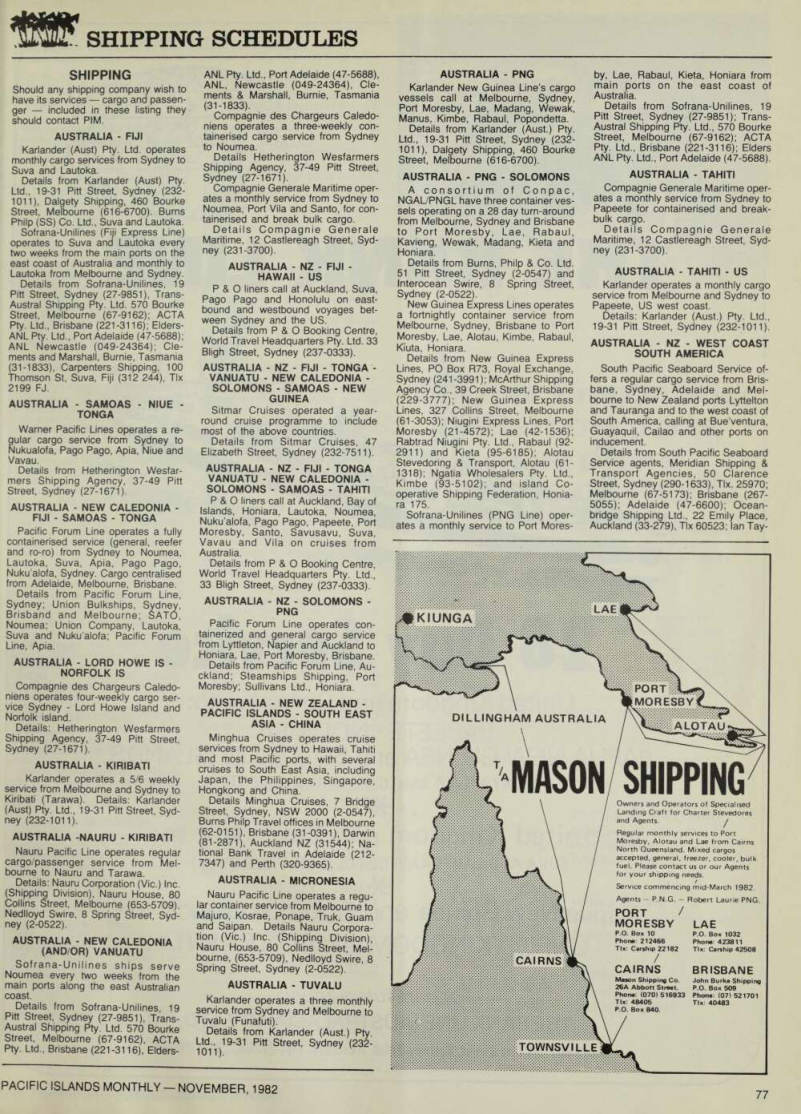
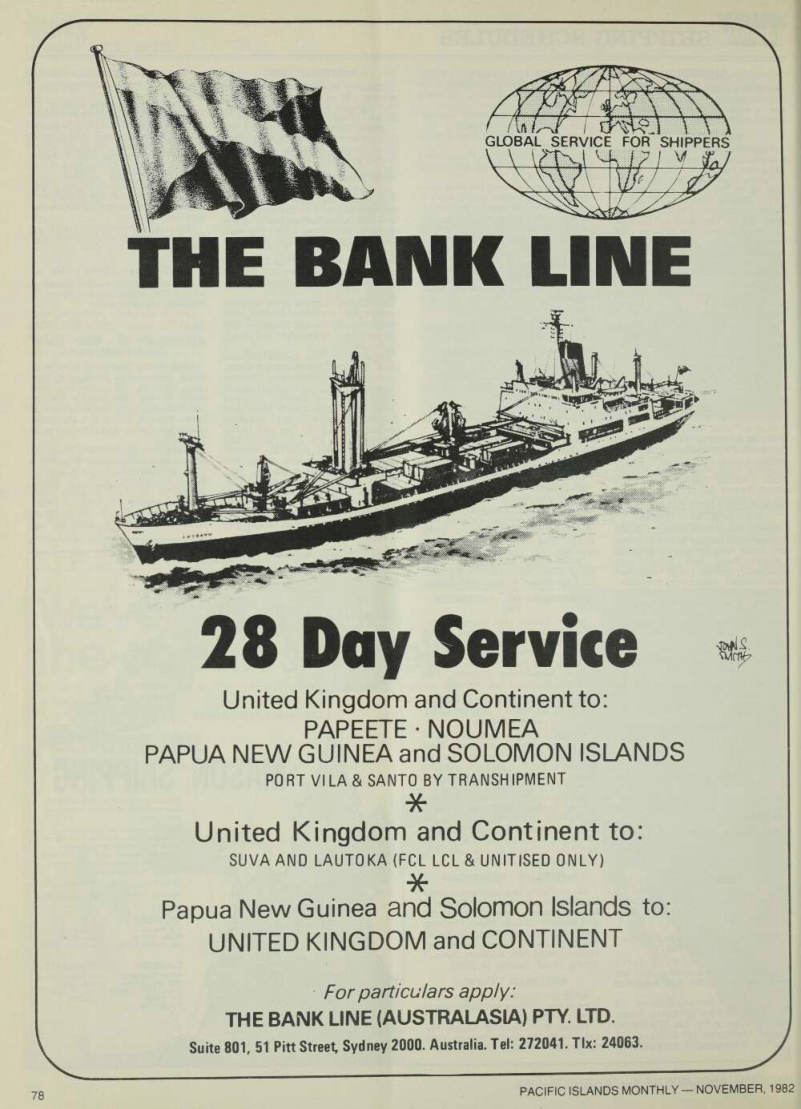
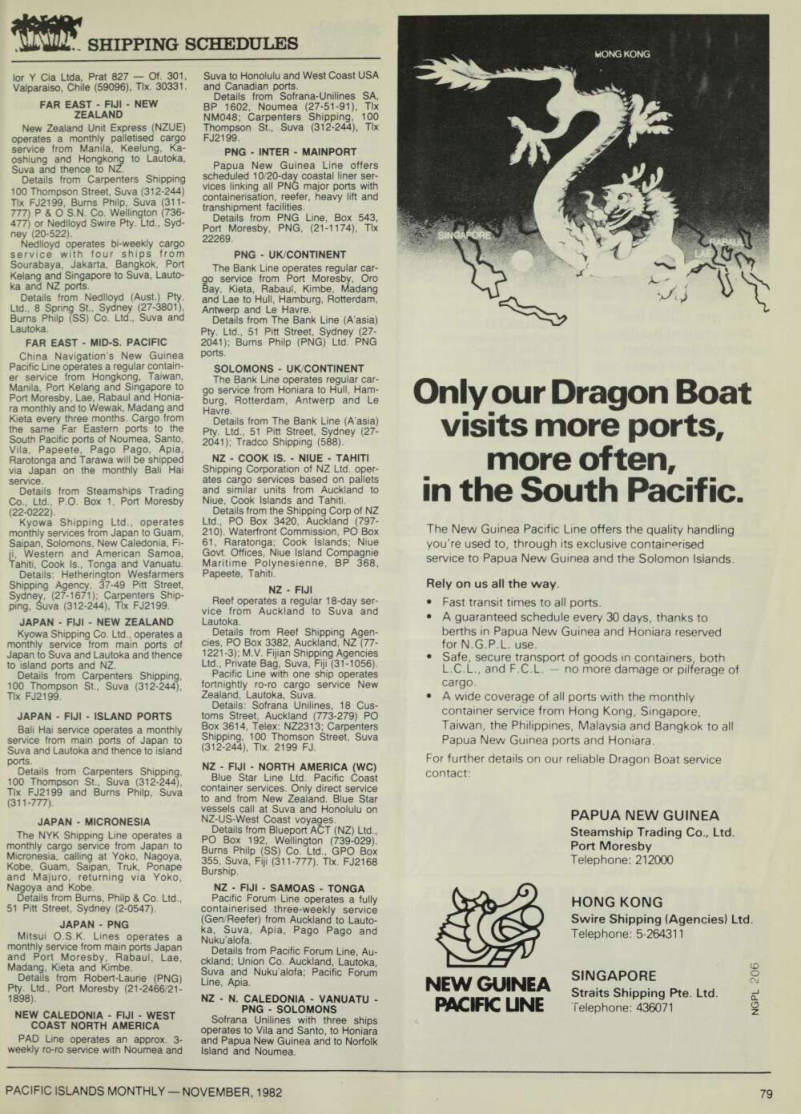
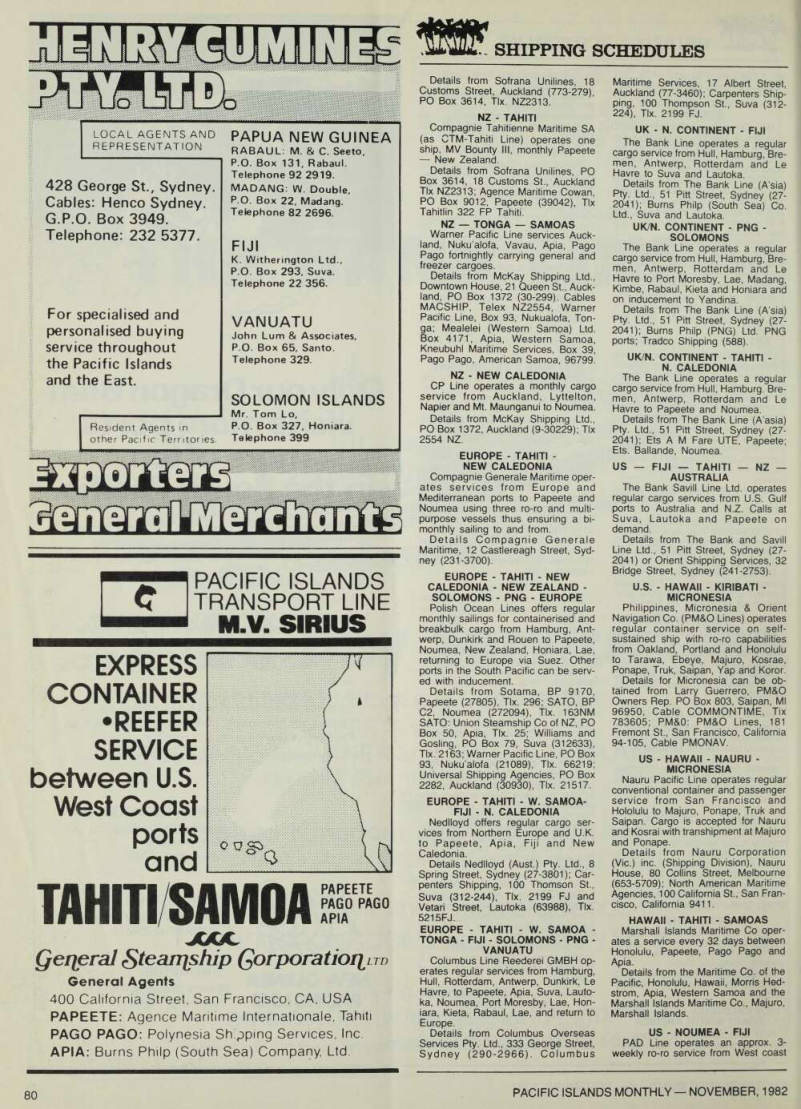
Shipping
Should any shipping company wish to have its services cargo and passen ger included in these listing they should contact PIM.
Australia - Fiji
Karlander (Aust) Pty. Ltd. operates monthly cargo services from Sydney to Suva and Lautoka.
Details from Karlander (Aust) Pty.
Ltd., 19-31 Pitt Street, Sydney (232- 1011), Dalgety Shipping, 460 Bourke Street, Melbourne (616-6700). Burns Philp (SS) Co. Ltd., Suva and Lautoka.
Sofrana-Unilines (Fiji Express Line) operates to Suva and Lautoka every two weeks from the main ports on the east coast of Australia and monthly to Lautoka from Melbourne and Sydney.
Details from Sofrana-Unilines, 19 Pitt Street, Sydney (27-9851), Trans- Austral Shipping Pty. Ltd. 570 Bourke Street, Melbourne (67-9162); ACTA Pty. Ltd., Brisbane (221-3116); Elders- ANL Pty. Ltd., Port Adelaide (47-5688); ANL Newcastle (049-24364); Cle ments and Marshall, Burnie, Tasmania (31-1833), Carpenters Shipping, 100 Thomson St, Suva, Fiji (312 244), Tlx 2199 FJ.
Australia - Samoas - Niue -
Tonga
Warner Pacific Lines operates a re gular cargo service from Sydney to Nukualofa, Pago Pago, Apia, Niue and Vavau.
Details from Hetherington Wesfar mers Shipping Agency, 37-49 Pitt Street, Sydney (27-1671).
Australia - New Caledonia -
Fiji - Samoas - Tonga
Pacific Forum Line operates a fully containerised service (general, reefer and ro-ro) from Sydney to Noumea, Lautoka, Suva, Apia, Pago Pago, Nukualofa, Sydney. Cargo centralised from Adelaide, Melbourne, Brisbane.
Details from Pacific Forum Line, Sydney; Union Bulkships, Sydney, Brisband and Melbourne: SATO, Noumea; Union Company, Lautoka, Suva and Nuku’alofa; Pacific Forum Line, Apia.
Australia - Lord Howe Is -
Norfolk Is
Compagnie des Chargeurs Caledo niens operates four-weekly cargo ser vice Sydney - Lord Howe Island and Norfolk island.
Details: Hetherington Wesfarmers Shipping Agency, 37-49 Pitt Street, Sydney (27-1671).
Australia - Kiribati
Karlander operates a 5/6 weekly service from Melbourne and Sydney to Kiribati (Tarawa). Details: Karlander (Aust) Pty. Ltd., 19-31 Pitt Street, Syd ney (232-1011).
Australia -Nauru - Kiribati
Nauru Pacific Line operates regular cargo/passenger service from Mel bourne to Nauru and Tarawa.
Details: Nauru Corporation (Vic.) Inc. (Shipping Division), Nauru House, 80 Collins Street, Melbourne (653-5709).
Nedlloyd Swire, 8 Spring Street, Syd ney (2-0522).
Australia - New Caledonia
(And/Or) Vanuatu
Sofrana-Unilines ships serve Noumea every two weeks from the main ports along the east Australian coast.
Details from Sofrana-Unilines, 19 Pitt Street, Sydney (27-9851), Trans- Austral Shipping Pty. Ltd. 570 Bourke Street, Melbourne (67-9162), ACTA Pty. Ltd., Brisbane (221-3116), Elders-
ANL Pty. Ltd., Port Adelaide (47-5688), ANL, Newcastle (049-24364), Cle ments & Marshall, Burnie, Tasmania (31-1833).
Compagnie des Chargeurs Caledo niens operates a three-weekly con tainerised cargo service from Sydney to Noumea.
Details Hetherington Wesfarmers Shipping Agency, 37-49 Pitt Street, Sydney (27-1671).
Compagnie Generale Maritime oper ates a monthly service from Sydney to Noumea, Port Vila and Santo, for con tainerised and break bulk cargo.
Details Compagnie Generale Maritime, 12 Castlereagh Street, Syd ney (231-3700).
Australia - Nz - Fiji -
Hawaii - Us
P & O liners call at Auckland, Suva, Pago Pago and Honolulu on east bound and westbound voyages bet ween Sydney and the US.
Details from P & O Booking Centre, World Travel Headquarters Pty. Ltd. 33 Bligh Street, Sydney (237-0333).
AUSTRALIA - NZ - FIJI - TONGA -
Vanuatu - New Caledonia -
Solomons - Samoas - New
Guinea
Sitmar Cruises operated a year round cruise programme to include most of the above countries.
Details from Sitmar Cruises, 47 Elizabeth Street, Sydney (232-7511).
AUSTRALIA - NZ - FIJI - TONGA
Vanuatu - New Caledonia -
Solomons - Samoas - Tahiti
P & O liners call at Auckland, Bay of Islands, Honiara, Lautoka, Noumea, Nukualofa, Pago Pago, Papeete, Port Moresby, Santo, Savusavu, Suva, Vavau and Vila on cruises from Australia.
Details from P & O Booking Centre, World Travel Headquarters Pty. Ltd., 33 Bligh Street, Sydney (237-0333).
Australia - Nz - Solomons -
Png
Pacific Forum Line operates con tainerized and general cargo service from Lyttleton, Napier and Auckland to Honiara, Lae, Port Moresby, Brisbane.
Details from Pacific Forum Line, Au ckland; Steamships Shipping, Port Moresby: Sullivans Ltd., Honiara.
Australia - New Zealand -
Pacific Islands - South East
Asia - China
Minghua Cruises operates cruise services from Sydney to Hawaii, Tahiti and most Pacific ports, with several cruises to South East Asia, including Japan, the Philippines, Singapore, Hongkong and China.
Details Minghua Cruises, 7 Bridge Street, Sydney, NSW 2000 (2-0547), Burns Philp Travel offices in Melbourne (62-0151), Brisbane (31-0391), Darwin (81-2871), Auckland NZ (31544); Na tional Bank Travel in Adelaide (212- 7347) and Perth (320-9365).
Australia - Micronesia
Nauru Pacific Line operates a regu lar container service from Melbourne to Majuro, Kosrae, Ponape, Truk, Guam and Saipan. Details Nauru Corpora tion (Vic.) Inc. (Shipping Division), Nauru House, 80 Collins Street, Mel bourne, (653-5709), Nedlloyd Swire, 8 Spring Street, Sydney (2-0522).
Australia - Tuvalu
Karlander operates a three monthly service from Sydney and Melbourne to
Tuvalu (Funafuti).
Details from Karlander (Aust.) Pty.
Ltd., 19-31 Pitt Street, Sydney (232- 1011).
Australia - Png
Karlander New Guinea Line’s cargo vessels call at Melbourne, Sydney, Port Moresby, Lae, Madang, Wewak, Manus, Kimbe, Rabaul, Popondetta.
Details from Karlander (Aust.) Pty.
Ltd., 19-31 Pitt Street, Sydney (232- 1011), Dalgety Shipping, 460 Bourke Street, Melbourne (616-6700).
Australia - Png - Solomons
A consortium of Conpac, NGAL/PNGL have three container ves sels operating on a 28 day turn-around from Melbourne, Sydney and Brisbane to Port Moresby, Lae, Rabaul, Kavieng, Wewak, Madang, Kieta and Honiara.
Details from Burns, Philp & Co. Ltd. 51 Pitt Street, Sydney (2-0547) and Interocean Swire, 8 Spring Street, Sydney (2-0522).
New Guinea Express Lines operates a fortnightly container service from Melbourne, Sydney, Brisbane to Port Moresby, Lae, Alotau, Kimbe, Rabaul, Kiuta, Honiara.
Details from New Guinea Express Lines, PO Box R 73, Royal Exchange, Sydney (241 -3991); McArthur Shipping Agency Co., 39 Creek Street, Brisbane (229-3777); New Guinea Express Lines, 327 Collins Street, Melbourne (61-3053); Niugini Express Lines, Port Moresby (21-4572); Lae (42-1536); Rabtrad Niugini Pty. Ltd., Rabaul (92- 2911) and Kieta (95-6185); Alotau Stevedoring & Transport, Alotau (61- 1318); Ngatia Wholesalers Pty. Ltd., Kimbe (93-5102); and island Co operative Shipping Federation, Honia ra 175.
Sofrana-Unilines (PNG Line) oper ates a monthly service to Port Mores
by, Lae, Rabaul, Kieta, Honiara from main ports on the east coast of Australia.
Details from Sofrana-Unilines, 19 Pitt Street, Sydney (27-9851); Trans- Austral Shipping Pty. Ltd., 570 Bourke Street, Melbourne (67-9162); ACTA Pty. Ltd., Brisbane (221-3116); Elders ANL Pty. Ltd., Port Adelaide (47-5688).
Australia - Tahiti
Compagnie Generale Maritime oper ates a monthly service from Sydney to Papeete for containerised and break bulk cargo.
Details Compagnie Generale Maritime, 12 Castlereagh Street, Syd ney (231-3700).
Australia - Tahiti - Us
Karlander operates a monthly cargo service from Melbourne and Sydney to Papeete, US west coast.
Details: Karlander (Aust.) Pty. Ltd., 19-31 Pitt Street, Sydney (232-1011).
Australia - Nz - West Coast
South America
South Pacific Seaboard Service of fers a regular cargo service from Bris bane, Sydney, Adelaide and Mel bourne to New Zealand ports Lyttelton and Tauranga and to the west coast of South America, calling at Bue’ventura, Guayaquil, Cailao and other ports on inducement.
Details from South Pacific Seaboard Service agents, Meridian Shipping & Transport Agencies, 50 Clarence Street, Sydney (290-1633), Tlx. 25970; Melbourne (67-5173); Brisbane (267- 5055); Adelaide (47-6600); Ocean bridge Shipping Ltd., 22 Emily Place, Auckland (33-279), Tlx 60523; lan Tay-
lor Y Cia Ltda, Prat 827 Of. 301, Valparaiso, Chile (59096), Tlx. 30331.
Far East - Fiji - New
Zealand
New Zealand Unit Express (NZUE) operates a monthly palletised cargo service from Manila, Keelung, Ka oshiung and Hongkong to Lautoka, Suva and thence to NZ Details from Carpenters Shipping 100 Thompson Street, Suva (312-244) Tlx FJ2199, Burns Philp, Suva (311- 777) P & O S.N. Co. Wellington (736- 477) or Nedlloyd Swire Pty. Ltd., Syd ney (20-522).
Nedlloyd operates bi-weekly cargo service with four ships from Sourabaya, Jakarta, Bangkok, Port Kelang and Singapore to Suva, Lauto ka and NZ ports.
Details from Nedlloyd (Aust.) Pty.
Ltd., 8 Spring St., Sydney (27-3801), Burns Philp (SS) Co. Ltd., Suva and Lautoka.
Far East - Mid-S. Pacific
China Navigation's New Guinea Pacific Line operates a regular contain er service from Hongkong, Taiwan, Manila, Port Kelang and Singapore to Port Moresby, Lae, Rabaul and Honia ra monthly and to Wewak, Madang and Kieta every three months. Cargo from the same Far Eastern ports to the South Pacific ports of Noumea, Santo, Vila, Papeete, Pago Pago, Apia, Rarotonga and Tarawa will be shipped via Japan on the monthly Bali Hai service.
Details from Steamships Trading Co., Ltd., P.O. Box 1, Port Moresby (22-0222).
Kyowa Shipping Ltd., operates monthly services from Japan to Guam, Saipan, Solomons, New Caledonia, Fi ji, Western and American Samoa, Tahiti, Cook Is., Tonga and Vanuatu.
Details: Hetherington Wesfarmers Shipping Agency, 37-49 Pitt Street, Sydney, (27-1671); Carpenters Ship ping, Suva (312-244), Tlx FJ2199.
Japan - Fiji - New Zealand
Kyowa Shipping Co. Ltd., operates a monthly service from main ports of Japan to Suva and Lautoka and thence to island ports and NZ.
Details from Carpenters Shipping, 100 Thompson St., Suva (312-244), Tlx FJ2199.
Japan - Fiji - Island Ports
Bali Hai service operates a monthly service from main ports of Japan to Suva and Lautoka and thence to island ports.
Details from Carpenters Shipping, 100 Thompson St., Suva (312-244), Tlx FJ2199 and Burns Philp, Suva (311-777).
Japan - Micronesia
The NYK Shipping Line operates a monthly cargo service from Japan to Micronesia, calling at Yoko, Nagoya, Kobe, Guam, Saipan, Truk, Ponape and Majuro, returning via Yoko, Nagoya and Kobe.
Details from Burns, Philp & Co. Ltd., 51 Pitt Street, Sydney (2-0547).
Japan - Png
Mitsui O.S.K. Lines operates a monthly service from main ports Japan and Port Moresby, Rabaul, Lae, Madang, Kieta and Kimbe.
Details from Robert-Laurie (PNG) Pty. Ltd., Port Moresby (21-2466/21- 1898).
New Caledonia - Fiji - West
Coast North America
PAD Line operates an approx. 3weekly ro-ro service with Noumea and
Suva to Honolulu and West Coast USA and Canadian ports.
Details from Sofrana-Unilines SA, BP 1602, Noumea (27-51-91), Tlx NMO4B; Carpenters Shipping, 100 Thompson St., Suva (312-244), Tlx FJ2199.
Png - Inter - Mainport
Papua New Guinea Line offers scheduled 10/20-day coastal liner ser vices linking all PNG major ports with containerisation, reefer, heavy lift and transhipment facilities.
Details from PNG Line, Box 543, Port Moresby, PNG, (21-1174), Tlx 22269.
Png - Uk/Continent
The Bank Line operates regular car go service from Port Moresby, Oro Bay, Kieta, Rabaul, Kimbe, Madang and Lae to Hull, Hamburg, Rotterdam, Antwerp and Le Havre.
Details from The Bank Line (A'asia) Pty. Ltd., 51 Pitt Street, Sydney (27- 2041); Burns Philp (PNG) Ltd. PNG ports.
Solomons - Uk/Continent
The Bank Line operates regular car go service from Honiara to Hull, Ham burg, Rotterdam, Antwerp and Le Havre.
Details from The Bank Line (A’asia) Pty. Ltd., 51 Pitt Street, Sydney (27- 2041); Tradco Shipping (588).
NZ - COOK IS. - NIUE - TAHITI Shipping Corporation of NZ Ltd. oper ates cargo services based on pallets and similar units from Auckland to Niue, Cook Islands and Tahiti.
Details from the Shipping Corp of NZ Ltd., PO Box 3420, Auckland (797- 210). Waterfront Commission, PO Box 61, Raratonga; Cook Islands; Niue Govt. Offices, Niue Island Compagnie Maritime Polynesienne, BP 368, Papeete, Tahiti.
Nz - Fiji
Reef operates a regular 18-day ser vice from Auckland to Suva and Lautoka.
Details from Reef Shipping Agen cies, PO Box 3382, Auckland, NZ (77- 1221-3); M.V. Fijian Shipping Agencies Ltd., Private Bag, Suva, Fiji (31-1056).
Pacific Line with one ship operates fortnightly ro-ro cargo service New Zealand, Lautoka, Suva.
Details: Sofrana Unilines, 18 Cus toms Street, Auckland (773-279) PO Box 3614, Telex: NZ2313; Carpenters Shipping, 100 Thomson Street, Suva (312-244), Tlx. 2199 FJ.
NZ - FIJI - NORTH AMERICA (WC) Blue Star Line Ltd. Pacific Coast container services. Only direct service to and from New Zealand. Blue Star vessels call at Suva and Honolulu on NZ-US-West Coast voyages.
Details from Blueport ACT (NZ) Ltd., PO Box 192, Wellington (739-029).
Burns Philp (SS) Co. Ltd., GPO Box 355, Suva, Fiji (311-777). Tlx. FJ2168 Burship.
NZ - FIJI - SAMOAS - TONGA Pacific Forum Line operates a fully containerised three-weekly service (Gen/Reefer) from Auckland to Lauto ka, Suva, Apia, Pago Pago and Nukualofa.
Details from Pacific Forum Line, Au ckland; Union Co. Auckland, Lautoka, Suva and Nukualofa; Pacific Forum Line, Apia.
NZ - N. CALEDONIA - VANUATU -
Png - Solomons
Sofrana Unilines with three ships operates to Vila and Santo, to Honiara and Papua New Guinea and to Norfolk Island and Noumea.
Details from Sofrana Unilines, 18 Customs Street, Auckland (773-279), PO Box 3614, Tlx. NZ2313.
Nz - Tahiti
Compagnie Tahitienne Maritime SA (as CTM-Tahiti Line) operates one ship, MV Bounty 111, monthly Papeete New Zealand.
Details from Sofrana Unilines, PO Box 3614, 18 Customs St., Auckland Tlx NZ2313; Agence Maritime Cowan, PO Box 9012, Papeete (39042), Tlx Tahitlin 322 FP Tahiti.
Nz Tonga Samoas
Warner Pacific Line services Auck land, Nukualofa, Vavau, Apia, Pago Pago fortnightly carrying general and freezer cargoes.
Details from McKay Shipping Ltd., Downtown House, 21 Queen St., Auck land, PO Box 1372 (30-299). Cables MACSHIP, Telex NZ2554, Warner Pacific Line, Box 93, Nukualofa, Ton ga; Mealelei (Western Samoa) Ltd.
Box 4171, Apia, Western Samoa, Kneubuhl Maritime Services, Box 39, Pago Pago, American Samoa, 96799.
Nz - New Caledonia
CP Line operates a monthly cargo service from Auckland, Lyttelton, Napier and Mt. Maunganui to Noumea.
Details from McKay Shipping Ltd., PO Box 1372, Auckland (9-30229); Tlx 2554 NZ.
Europe - Tahiti -
New Caledonia
Compagnie Generale Maritime oper ates services from Europe and Mediterranean ports to Papeete and Noumea using three ro-ro and multi purpose vessels thus ensuring a bi monthly sailing to and from.
Details Compagnie Generale Maritime, 12 Castlereagh Street, Syd ney (231-3700).
Europe - Tahiti - New
Caledonia - New Zealand -
Solomons - Png - Europe
Polish Ocean Lines offers regular monthly sailings for containerised and breakbulk cargo from Hamburg, Ant werp, Dunkirk and Rouen to Papeete, Noumea, New Zealand, Honiara, Lae, returning to Europe via Suez. Other ports in the South Pacific can be serv ed with inducement.
Details from Sotama, BP 9170, Papeete (27805), Tlx. 296; SATO, BP C 2, Noumea (272094), Tlx. 163 NM SATO: Union Steamship Co of NZ, PO Box 50, Apia, Tlx. 25; Williams and Gosling, PO Box 79, Suva (312633), Tlx. 2163; Warner Pacific Line, PO Box 93, Nukualofa (21089), Tlx. 66219; Universal Shipping Agencies, PO Box 2282, Auckland (30930), Tlx. 21517.
Europe - Tahiti - W. Samoa
Fiji - N. Caledonia
Nedlloyd offers regular cargo ser vices from Northern Europe and U.K. to Papeete, Apia, Fiji and New Caledonia.
Details Nedlloyd (Aust.) Pty. Ltd., 8 Spring Street, Sydney (27-3801); Car penters Shipping, 100 Thomson St., Suva (312-244), Tlx. 2199 FJ and Vetari Street, Lautoka (63988), Tlx. 5215FJ.
EUROPE - TAHITI - W. SAMOA - TONGA - FIJI - SOLOMONS - PNG -
Vanuatu
Columbus Line Reederei GMBH op erates regular services from Hamburg, Hull, Rotterdam, Antwerp, Dunkirk, Le Havre, to Papeete, Apia, Suva, Lauto ka, Noumea, Port Moresby, Lae, Hon iara, Kieta, Rabaul, Lae, and return to Europe.
Details from Columbus Overseas Services Pty. Ltd., 333 George Street, Sydney (290-2966). Columbus
Maritime Services, 17 Albert Street, Auckland (77-3460); Carpenters Ship ping, 100 Thompson St., Suva (312- 224), Tlx. 2199 FJ.
Uk - N. Continent - Fiji
The Bank Line operates a regular cargo service from Hull, Hamburg, Bre men, Antwerp, Rotterdam and Le Havre to Suva and Lautoka.
Details from The Bank Line (A’sia) Pty. Ltd., 51 Pitt Street, Sydney (27- 2041); Burns Philp (South Sea) Co.
Ltd., Suva and Lautoka.
Uk/N. Continent - Png -
Solomons
The Bank Line operates a regular cargo service from Hull, Hamburg, Bre men, Antwerp, Rotterdam and Le Havre to Port Moresby, Lae, Madang, Kimbe, Rabaul, Kieta and Honiara and on inducement to Yandina.
Details from The Bank Line (A’sia) Pty. Ltd., 51 Pitt Street, Sydney (27- 2041); Burns Philp (PNG) Ltd. PNG ports; Tradco Shipping (588).
Uk/N. Continent - Tahiti -
N. Caledonia
The Bank Line operates a regular cargo service from Hull, Hamburg. Bre men, Antwerp, Rotterdam and Le Havre to Papeete and Noumea.
Details from The Bank Line (A’asia) Pty. Ltd., 51 Pitt Street, Sydney (27- 2041); Ets A M Fare UTE, Papeete; Ets. Ballande, Noumea.
Us Fiji Tahiti Nz
Australia
The Bank Savill Line Ltd. operates regular cargo services from U.S. Gulf ports to Australia and N.Z. Calls at Suva, Lautoka and Papeete on demand.
Details from The Bank and Savill Line Ltd., 51 Pitt Street, Sydney (27- 2041) or Orient Shipping Services, 32 Bridge Street, Sydney (241-2753).
U.S. - Hawaii - Kiribati -
Micronesia
Philippines, Micronesia & Orient Navigation Co. (PM&O Lines) operates regular container service on self sustained ship with ro-ro capabilities from Oakland, Portland and Honolulu to Tarawa, Ebeye, Majuro, Kosrae, Ponape, Truk, Saipan, Yap and Koror.
Details for Micronesia can be ob tained from Larry Guerrero, PM&O Owners Rep. PO Box 803, Saipan, Ml 96950, Cable COMMONTIME, Tix 783605; PM&O: PM&O Lines, 181 Fremont St., San Francisco, California 94-105, Cable PMONAV.
Us - Hawaii • Nauru -
Micronesia
Nauru Pacific Line operates regular conventional container and passenger service from San Francisco and Hololulu to Majuro, Ponape, Truk and Saipan. Cargo is accepted for Nauru and Kosrai with transhipment at Majuro and Ponape.
Details from Nauru Corporation (Vic.) inc. (Shipping Division), Nauru House, 80 Collins Street, Melbourne (653-5709); North American Maritime Agencies, 100 California St., San Fran cisco, California 9411.
Hawaii - Tahiti - Samoas
Marshall Islands Maritime Co oper ates a service every 32 days between Honolulu, Papeete, Pago Pago and Apia.
Details from the Maritime Co. of the Pacific, Honolulu, Hawaii, Morris Hed strom, Apia, Western Samoa and the Marshall Islands Maritime Co., Majuro, Marshall Islands.
Us - Noumea - Fiji
PAD Line operates an approx. 3weekly ro-ro service from West coast
USA and Canada to Noumea and Suva.
Details from Sofrana-Unilines SA, BP 1602, Moumea (27-51-91), Tlx NMO4B; Carpenters Shipping, 100 Thompson St., Suva (31-2244), Tlx FJ2199; Trans-Austral Shipping, Box R 232 PO, Royal Exchange, NSW (27- 2441), Tlx AA21204.
Us - Tahiti - Samoa
Pacific Islands Transport operates a five weekly cargo service from North America west coast ports to Papeete, Pago, Pago, Apia.
Details from Polynesia Shipping Ser vices Inc. PO Box 1478, Pago Pago 96799.
Polynesia Line operates container and general cargo service from US west coast ports to Papeete and Pago Pago.
Details from Polynesia Shipping Ser vices Inc., PO Box 1478, Pago Pago 96799.
Advertisements & other items, pp. 77-80 (1 item)
Mason Shipping
LAE
KIUNGA
PORT K*
MORESBY
DILLINGHAM AUSTRALIA
. ALOTAU
MASON SHIPPING
PORT /
MORESBY
P.O. Box 10 Phono: 212466 Tlx: Carship 22182 /
CAIRNS
Mason Shipping Co. 26A Abbott Straat.
Phona: (070) 516933 Tlx; 48405 P.O. Box 840.
LAE
P.O. Box 1032 Phona: 423811 Tlx: Carahip 42508
CAIRNS
BRISBANE
John Burka Shipping P.O. Box 509 Phona: (07) 521701 Tlx: 40483
TOWNSVILLE
m 3 5 GIjOBAL service for shippers V
THE BANK LINE
28 Day Service
United Kingdom and Continent to:
PAPEETE • NOUMEA
PAPUA NEW GUINEA and SOLOMON ISLANDS
PORT VILA & SANTO BY TRANSHIPMENT
United Kingdom and Continent to: SUVA AND LAUTOKA (FCL LCL & UNITISED ONLY) * Papua New Guinea and Solomon Islands to;
UNITED KINGDOM and CONTINENT
For particulars
THE BANK LINE (AUSTRALASIA) PTY. LTD.
Suite 801, 51 Pitt Street Sydney 2000. Australia. Tel: 272041. Tlx: 24063.
Only our Dragon Boat
visits more ports,
more often,
in the South Pacific.
The New Guinea Pacific Line offers the quality handling you're used to, through its exclusive containerised service to Papua New Guinea and the Solomon Islands.
Rely on us all the way. • Fast transit times to all ports. • A guaranteed schedule every 30 days, thanks to berths in Papua New Guinea and Honiara reserved for N.G.P.L. use. • Safe, secure transport of goods in containers, both L.C.L., and F.C.L. no more damage or pilferage of cargo. • A wide coverage of all ports with the monthly container service from Hong Kong, Singapore, Taiwan, the Philippines, Malaysia and Bangkok to all Papua New Guinea ports and Honiara.
For further details on our reliable Dragon Boat service contact;
PAPUA NEW GUINEA
Steamship Trading Co., Ltd.
Port Moresby Telephone: 212000
HONG KONG
Swire Shipping (Agencies) Ltd.
Telephone: 5-264311 CD O CM
NEW GUINEA
PACIFIC UNE
SINGAPORE
Straits Shipping Pte. Ltd.
Telephone: 436071 CL o Z
LOCAL AGENTS AND
REPRESENTATION
428 George St., Sydney.
Cables: Henco Sydney.
G.P.O. Box 3949.
Telephone: 232 5377.
For specialised and personalised buying service throughout the Pacific Islands and the East.
Resident Agents in other Pacific Territories.
PAPUA NEW GUINEA
RABAUL: M. & C. Seeto, P.O. Box 131, Rabaul.
Telephone 92 2919.
MADANG: W. Double, P.O. Box 22, Madang.
Telephone 82 2696.
FIJI
K. Witherington Ltd., P.O. Box 293, Suva.
Telephone 22 356.
VANUATU
John Lum & Associates, P.O. Box 65, Santo.
Telephone 329.
SOLOMON ISLANDS
Mr. Tom Lo, P.O. Box 327, Honiara.
Telephone 399
PACIFIC ISLANDS
TRANSPORT LINE
M.V. SIRIUS
and I vq
TAHITI SAMOA =~
xoc
Qeqeral Stearqship (Corpora tiori
General Agents 400 California Street, San Francisco, CA, USA PAPEETE: Agence Maritime Internationale, Tahiti PAGO PAGO: Polynesia Shipping Services, Inc.
APIA: Burns Philp (South Sea) Company, Ltd.
DEATHS of Islands People
Dr leremia Sale In Apia on September 21,
aged 68.
Dr leremia was a former act ing director of health and chief of public health. He was one of the first Samoan students to attend medical school in Fiji in 1936, and on his return to Samoa spent many years working in district hospitals. Dr leremia was instru mental in founding district hos pitals at Fagamalo and Safotu.
He retired in 1978 but con tinued to work as a consulting doctor.
Dr William Mackintosh In Scotland on September 20, aged 61.
A highly popular former med ical officer in Fiji, Dr Mackin tosh planned to come back to Fiji for a holiday in October. He joined the medical service in Fiji in 1955 and was based mainly at Savusavu. He was also stationed at Lautoka, and towards the end of his time in Fiji, was patholog ist at the Colonial War Memorial Hospital in Suva.
He was an active member of Suva Bowling Club and presi dent of the Defence Club for two years.
Edna Bailey
On Norfolk Island, aged 87,
in July.
Born in Auckland, Edna Bailey did secretarial work and was one of New Zealand’s top racing car drivers before she met her husband Tom Bailey in the early 1920 s and went to live in Fiji for four years. She and her husband came to live on Norfolk
in 1930. During her years on the island she was an indefatigable worker for tourism, along with her daughter, Marie. Mrs Bailey was also a keen gardener and a member of the old Dramatic Society.
Clarence M. Dass In Lautoka, Fiji, on Septem ber 4, aged 79.
Born in Madras, Mr Dass came to Fiji as a child, returning to India from 1920 to 1923 to take up a scholarship in agricul ture. He then taught for some years before joining the Colonial Sugar Refining Company, then the Agricultural Department until 1949. Mr Dass is remembered for his plant breeding and re search work, particularly in rice, cotton and passionfruit.
He set up the first Young Farmers Club, and was a central figure in setting up the Sigatoka Agricultural Research Station.
Mr Dass also played an impor tant part in Fiji education, and was a vice-president of the Fiji Teachers Union for many years.
He was awarded an MBE in 1950.
Alphonse Seiri Kapone In Goroka’s Bihute Jail in July, of unknown causes.
Sentenced to 11 months for forging a bank slip, Kapone his name can also be read as A 1 Capone, the infamous Chicago gangster of the 1920 s had been in prison barely two days when he collapsed and died.
Finding no evidence of a phys ical cause of death, examining doctors said they were quite pre pared to believe, “from what his relatives and others have said, that he died from a belief in the effects of sorcery.”
Mrs Dorothy Adam On Norfolk Island, in Au gust, aged 94.
Born in Brisbane, Mrs Adam spent many years in the New Hebrides (now Vanuatu) with her husband, Charles Adam, who became administrator of Maleku la and other islands in the group.
During World War 2, Mrs Adam became a coastwatcher for the New Hebrides Defence Force.
She and her husband retired to Norfolk Island in 1946.
Advertisements & other items, p. 81 (1 item)
Kyowa Shipping Co., Ltd.
Japan
S. Korea
T aiwan
Hong Kong
Singapore
To: Solomon Is., New Caledonia, Fiji, W. Samoa. A. Samoa. Tahiti, Cook Is., Tonga, Vanuatu. Tuvalu, Nauru To: Guam. Saipan, Truk. Ponape. Majuro, Yap, Koror
T aiwan
Hong Kong
Singapore
Philippines
To: Papua New Guinea. Pacific Islands.
HEAD OFFICE:
KYOWA SHIPPING CO., LTD.
OSAKA OFFICE
sth FI.. Suzumaru Bldg. 39-8. 2-chome. Nishi-Shinbashi. Minato-ku. Tokyo. Japan. Okajima Bldg., 7th Floor, 2-14. Mishihonmachi 1-chome. \ishi-ku, Osaka. Japan Phone: 03 (437) 2885 (Rep.) Cables; "MARIQUEEN" Tokyo. Telex: 242 4651 Kyowa J. Phone 06(533)5821 (Rep. > Cables MARIQUEEN" Osaka Telex: 525-6271 Ssjosa J.
YOUR BUSINESS PARTNER
KYOWA
S. Korea: Dong Sue Shipping Co.. Ltd.. Seoul Taiwan: Royal Steamship Corp,. Ltd., Taipei Hong Kong; Dahzun Enterprises Ltd Singapore: Ocean Shipping & Enterprises Pte.. Ltd.
Philippines: Sky International Inc.. Manila Guam; Maritime Agencies of the Pacific Ltd.. Guam Saipan; Saipan Shipping Company Inc.. Saipan Truk: Truk Shipping Co.. Truk Ponape: United Micronesia Development Association, Ponape Yap: Waab Transportation Co.. Inc.. Yap Koror: United Micronesia Development Association. Koror Solomon Is; Solomon Taiyo Ltd.. Honiara Vanuatu: Pentecost Pacific S.A., Port Vila New Caledonia; Agence Maritime Du Rond Point Du Pacific. Noumea Fiji: Carpenter Shipping. Suva & Lautoka A. Samoa; Polynesia Shipping Services. Inc.. Pago Pago W. Samoa: Morris Hedstrom Ltd.. Apia Tahiti: Compagme Tahitienne Maritime S.A.. Papeete Cooks: Eastern Associates Ltd.. Rarotonga Tonga: EM. Jones Ltd.. Nukualofa Rabaul: Carpenters Shipping Ltd.. Rabaul Port Moresby; J.C. Waller Pty. Ltd.. Port Moresby LaV Robert Laurie (New Gu4nea ) Pty. Ltd.. Lae Indonesia: P.T. Porbdisa Raya Shipping Lines. Jakarta Australia; Hethenngton Kingsbury Pty. Ltd.. Sydney. NSW.
New Zealand: Mckay Shipping Limited. Auckland Nauru; Nauru Coop.erative Societv.. Nauru
Advertising Index
Aggie Grey’s 82 Air New Zealand 27 Aiwa 46 Aust. Trade Commissioner 4 Bank Line 78 Benson and Hedges 38 Besco Jarwil 40 China Navigation 72 Citizen Watches 30 Clarion 54 Fiji Sun 52 Goodyear 48 Groves 82 Henry Cumines 80 Hitachi 2 ICI Tasman 68 Kyowa Line 81 Leyland 14 MacQuarrie Industries 75 Marlineer Marine 72 Mason Shipping 77 Matsushita 12 McDonnell Douglas 22 Nissan 16 Papua Hotel 82 Peter Fisher Trading 82 Pioneer 6 P.I.T. Line 80 PM and O Shipping 50 Nelson and Robertson 34 New Zealand Dairy 10 Olympic Hunt 58 QBE Insurance 32 R. M. Gow 56 Sansui 84 Solarex 24 Sonar Ships 82 Suva Sails 82 Suzuki Marine 60 Suzuki Motor 83
Toyota 42
Trio-Kenwood 20 Westpac 18 Woodley’s Slipway 74
DEATHS of Islands People
Gilbert (Metta) Quintal In Sydney in August, aged 74.
An active church member, Metta Quintal will be remem bered for his fine singing voice at services in the Uniting Church.
He worked for some time for the Pacific Cable and Wireless Board on Norfolk Island, deliv ering cables by horseback. He was a keen sportsman and gar dener, despite war injuries in curred in World War 2 during which he spent three years in Changi Jail.
Narayan Nair Panikar In Suva on September 26 aged 57.
A former senior superinten dent and head of the Special Branch of the police force, Mr Panikar had retired from the
force in July after 36 years ser vice. He had served in all branches of the force and was awarded the Queen’s Police Medal, Colonial Police Medal, and Colonial Police Long Ser vice Medal.
Gilbert Lorenzo Quintal In Sydney in August while under medical treatment,
aged 75.
A World War 2 veteran and prisoner of war, Mr Quintal known to all on Norfolk Island as Metta was also a long-time employee of the Pacific Cable and Wireless Board on Norfolk, delivering cables around the is land on horseback.
Particularly noted for his sing ing of the special Pitcairn hymns, Metta possessed a “big, boom ing voice”, and used it to his
very great enjoyment. The Nor folk Islander said in an obituary tribute, “he was away in a world of his own while he sang.”
Sekonaia Tu’akoi In Tonga on October 3, aged 70.
A former Police Magistrate, Sekonaia was educated at Tupou College and later at Tonga Col lege. He joined the civil service in July 1933 as a police const able. He served at the Police Services until he became Sergeant Major in 1947, then he left to become a lawyer.
In 1951, Sekonaia was the Tongatapu Number 1 Represen tative to the Legislative Assem bly. For seven continuous terms, he represented the people.
Cabinet appointed him as Police Magistrate in 1971.
Advertisements & other items, pp. 82-84 (2 items)
At Last!
Stay at Aggie Grey’s , . . the South Pacific’s
legendary hotel.
Situated right in the heart of Western Samoa. Enjoy Polynesian-style friendliness and service, in cool surroundings, superb entertainment and food.
Magnificent white sand beaches only a short drive away. Airconditioned rooms, swimming pool and full bar facilities.
Bookings through Union Steamship Company of NZ, Pan Am, Air New Zealand or direct to Aggie Grey’s, Apia, Western Samoa. Cables; ‘AGGIES’ Apia.
134' steel refrigerated vessel. Equipped with snap freeze for export processing. Commonwealth survey current. Sumioshi main engine 1000 H P. @ 450 RPM. 2 Cummins to 200 KVA plant. Fitted with trawl equipment. Fully equipped electronics. 6 refrigerated holds total capacity 344 cubic metres.
Fuel capacity 4 tanks total 139 cubic metres.
Complete valuation and lay outs available. 120' steel refrigerated vessel. Equipped with snap freeze for export processing. Old survey current.
Twin Cummins NT72OM main engines. Cummins and Ford aux to 2 - 167 KVA plant. Full electronics. 6 refrigerated holds total capacity 75,000 lb. Fuel capacity bunkers 4,000 gallons. Cargo fuel 50 tons.
Water 6.2 tons. Survey reports and lay outs available.
AT LAST!
A sailmaker in Fiji.
PLUS the largest range of quality marine fittings in the South Pacific.
New sails & repairs
David Hughes
SUVA SAILS
36 Stewart Street, Suva Phone: 312 331 Telex: FJ2279 Nuclear-Free Pacific
Sonar Ships Brokerage,
Telex CANVAS 48281. Phone (070) 51 1212.
P.O. Box 1811, Cairns 4870 Old. Australia.
BROKERS FOR CHARTER & PURCHASE
FOR ALL TYPES OF SHIPS.
PETER FISHER TRADING Pty. Ltd.
301 PITT STREET. SYDNEY, 2000, AUSTRALIA
Telephone: 264 5395 CABLES: “FISHERION”, SYDNEY
TELEX: AUSTAS AA20149 ATT. PETER FISHER
EXPORTERS TO THE PACIFIC ISLANDS
SUZUKI MOTOR CO, LTD
SUZUKI
3? ▼ 4 A -
OIIWO PERFOBME
'4^r * A HOTO: Canadian version
SSBOF
Vv; $ wfSj s b f * SUZUKI Vehicles are shipped to approximately 100 countries throughout the world and are well received by users in those countries. Behind the high-quality of SUZUKI 4wheelers is the in-depth research carried out from all aspects, rigorous tests and an extensive after-sales service net-work. Vehicles that are ready when you need them and which you can trust when driving. SUZUKI Vehicles.
SUIUKI the name olperfomance.
SOLOMON ISLANDS SOLOMON ISLAND SERVICE STATION LTD, NEW CALEDONIA STE. SUPERCAL PAPUA NEW GUINEA PACIFIC AMI VANUATU HENRI LEROUX NIUE ISLAND BURNS PHILP (SOUTH SEA) CO., LTD. PONAPE LEO ETSCHEIT TAHITI NIPPON AUTOMOTO GUAM & SAIPAN ISLAND CYCLERY INC NORFOLK MARTIN S AGENCIES LTD, SAMOA PACIFIC PRODUCTS, INC. TONGA PACIFIC PRODUCTS, INC. NAURU EQUAPAC MOTORS FUJI NIRANJANS AUTOPORT LTD.
TP v V \ II
Convenient Com
w hen Sansui mates computers with high performance component systems you get convenience. Like "Compu Edit.,'' a feature that allows automatic edit recording of songs from disc to tape in any programmed order. And the "Compu-Selector System" for one-touch synchronized play. And memory station selection.
Intelligent Super Compo the smartest hi-fi systems ever designed. - N
Sajtsui
For further information please contact: SANSUI ELECTRIC CO., LTD. 14-1 Izumi 2-chome, Suginami-ku, Tokyo 168, Japan. • Australia VANFI (Aust.) Pty. Ltd. 297, City Road, South Melbourne, Victoria 3205, Australia Phone: 690-6200/283 Alfred Place, North Sydney, N.S.W. 2060, Australia Phone: 929-0293 • Fiji Prabhu Brothers Ltd. PO. Box 183, Nadi Phone: 71122 • Papua New Guinea Oceania Indent Agency (P.N.G.) Pty. Ltd. Box 5518, Boroko, Port Moresby Phone: PM 256411 • New Zealand David Reid Electronics Ltd. PO. Box 2630, Auckland, Phone: 488-049 • New Caledonia M.M. Mercier Michel B.P 1123, Noumea Phone: 27.59.11 • Central Pacific Nauru Co-operative Society Republic of Nauru • Vanuatu The Sound Centre PO. Box 434, Villa Phone: 2035 • Tahiti SIMEL PO. Box 3338 Papeete Phone. 2-49-68
For Sale
th
PORT MOH
♦ Right in business cep * A traditiojf Jx>r comfort food * All rdoms airconditioned * Restaurant * Ba * Banquet hall
Ji. C. NEUMANN
manager Phone 21-2622 Cable gAFPEM
FOR SALE
AMERICAN SAMOA
Freehold land. Further information, write: Mrs M V Groves 3/902 Clive Street Hastings New Zealand