Pacific

Islands
Monthly
Ojsjobik. I%B|L
American Samoa .uHws
Australia rifl
Cook Islands NZ$l.5O Fiji F 51.50 Hawaii USSI9S Kiribati ...t ~..A5175 Nauru ...A51.75
BKSafc=rS2»
Niue ZJSL. NZ$l J|
Norfolkjsland
Solomon Islands Ssl.ss Tahiti...**.
Tonga P 1.50 Tuvalu S. Mm.-K
Usa Z3* U®.25
USTT and Guam ... Us|l.9s Vanuatu 1.5 Q
Western SamoajL. TIJS
'Recommended retail price qJly Registered by Australia Pop Publication No NSPiaiOT
Frances Ashfanw
TOB PAfelf LC FpRtJM
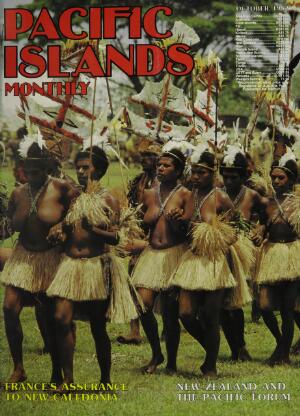
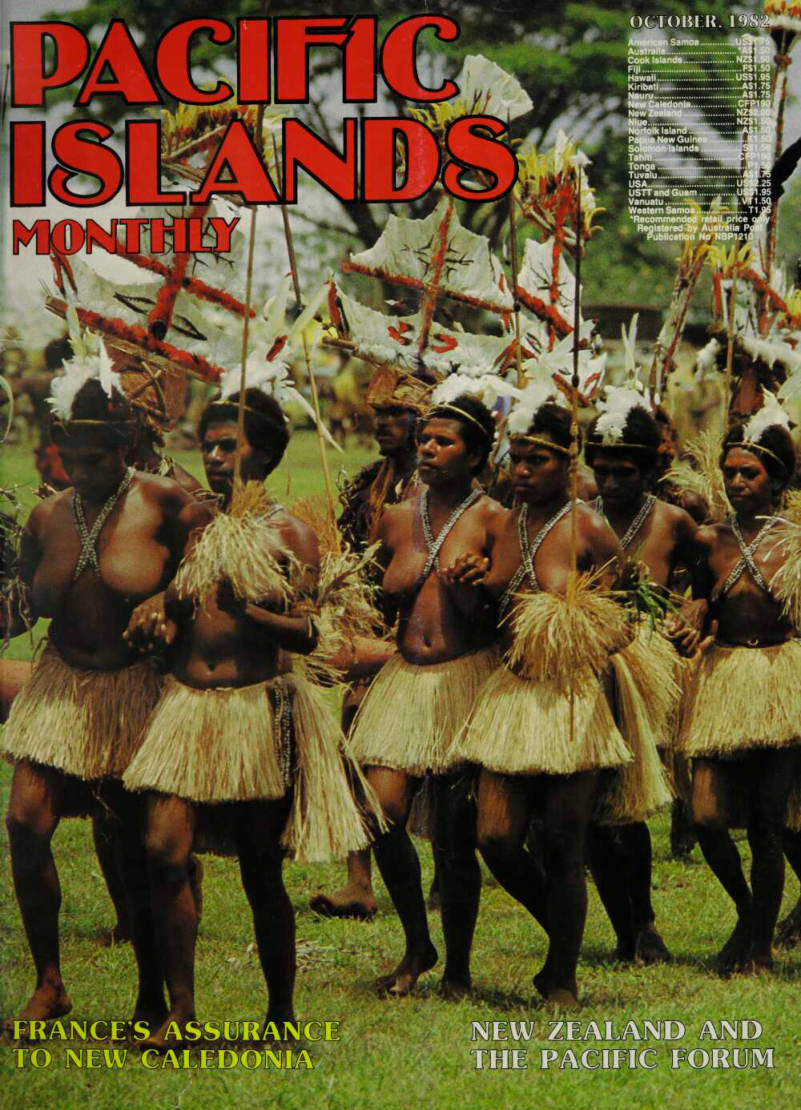
Cover picture: Feathers, bark, leaves and flowers were used to make the tribal symbols carried by these New Guinean coastal women. The photograph was taken by Roger Merchant at the Morobe Show in Lae on the north coast of the Papua New Guinea mainland.
Advertisements & other items, p. 2 (1 item)
Thump!
Making The World An Exciting Place
XL. The world’s best selling 4-stroke trail bikes.
The brute force that sets the pace. XL. From those who build perfection. To those who demand it.
WORLD’S LARGEST MOTORCYCLE MANUFACTURER
HONDA MOTOR CO., LTD. TOKYO, JAPAN
XLSOOR
XLIBSS
XLI2SS
XLIOOS
PAPUA NEW GUINEA: Steamships Trading Company Ltd. P.O. Box 1, Port Moresby/TAHITI: Honda Distribution S.A.R.L. B.P. 1665, Papeete/FIJI ISLANDS: Carpenters Motors Private Mail Bag Suva, Fiji/ KIRIBATI: Atoll Motor & Marine Services PC. Box 49 Bairiki Tarawa/U.S. TRUST TERRITORY: United Micronesia Development Association P.O. Box 238.^ajpan^ananajs^ COOK ISLANDS: Cook Islands Motor Centre Ltd. P.O. Box 74, Rarotonga/AMERICAN SAMOA: Holiday Motors, Parts and Service P.O. Box 968 Pago Pago, American Samoa 96799/Halecks Service Certre Ltd. P.O. Box 1138, Pago Pago, American Samoa 96799/GUAM: Mark’s Motor Co., Inc. P.O. Box DV, AganaA/VESTERN SAMOA: Motor Distributors (Samoa) Ltd. P.O. Box 576. Apia/SOLOMON ISLANDS: Guadalcanal Garage Limited P.O. Box 537 Honiara/NEW CALEDONIA: Establissements Ballande Boite Postale No. C 4 Noumea Cedex/NIUE ISLAND: Niue Island United Enterprises P.O f—, . . . ... ... . . /•> ._. i—. . I- x .: -r..._ I. . A . D Dnv 1 DOC Mi ILi I’olnfo Tnnna
Pacific Islands Monthly
Vol,54
No. 10
October 1982
(Usps 952480)
Representatives
AUSTRALIA: Distribution: The Herald and Weekly Times Ltd., 44-74 Flinders St., Melbourne, Vic., 3000. Advertis ing Reps Brisbane D. Wood, Anday Agency, Box 1918, GPO, Brisbane 4001, telephone 44 3485, 44 1546; Adelaide Hastwell Media, PO Box 30, Glen Osmond, SA 5064, 23 Avenue Road, Frewville, SA 5063, telephone 79 9271.
FIJI: Distribution and subscriptions Desai Book shops, PO Box 160, Suva, Fiji, telephone Suva 23036.
Advertising Fiji Times & Herald Ltd., 20 Gordon St., Suva, telephone 312 111, telex FJ2124.
FRENCH POLYNESIA: Distribution Hachette Pacifi que, 10 Ave Bruat, Papeete, telephone 25610.
HAWAII, UNITED STATES: Distribution PIM, Hawaii, PO Box 22250, Honolulu, Hawaii 96822. Advertising Roger Brookes, PO Box 10217, Honolulu, Hawaii 96816, tele phone 808 536 6677.
JAPAN: Advertising and subscriptions Universal Media Corporation, GPO Box 1762, Tokyo, telephone 666 3036.
NEW CALEDONIA: Distribution Depot Centre de Presse Michel Pentecost, CBP2, Noumea, telephone 27 2434, 27 4729.
NEW ZEALAND: Distribution Gordon & Gotch, PO Box 584, 2 Carr Road, Mt. Roskill, Auckland 4. Advertising International Media Representatives Ltd, PO Box 2313, Auckland, telephone 795 487; 493 389, cables Intereps, Auckland. Subscriptions Ross Haines & Son Ltd, PO Box 1289, Auckland, telephone 769 042.
PAPUA NEW GUINEA: Distribution Gordon & Gotch, PO Box 3395, Port Moresby, telephone 254551, 254855.
Advertising PNG Post-Courier, PO Box 85, Port Moresby, telephone 21 2577.
UNITED KINGDOM: The Herald & Weekly Times Ltd, No. 1 Maltravers Street, London WC2R 3DZ, England, telephone 01 836 5162, telex London 21989.
UNITED STATES MAINLAND: Advertising Joshua B.
Powers Jr, Powers International Inc., 551 Fifth Ave., New York, New York 10 017, telephone 867 9580, telex 236514.
Subscriptions PIM, Hawaii, PO Box 22250, Honolulu, Hawaii 96822.
Subscriptions
Payments by personal cheque are only acceptable in Australian (from a branch in Australia), US and New Zealand currency. For all other remittances please send an international bank draft in Australian dollars.
Published monthly by Pacific Publications (Aust.) Pty. Ltd and printed in Australia by Walter Alteri Printing (Australia) Pty. Ltd., Oingley, Vic.
Australian cover price is recommended retail only. Regis tered by Australia Post, publication No. NBPI2IO. Second class postage paid at Honolulu, Hawaii. Copyright Pacific Publications (Aust.) Pty. Ltd.
Postmaster Honolulu: Send address changes to PIM Hawaii, PO Box 22250, Honolulu, Hawaii 96822.
Local Aust.
American Samoa $US21 $18 Australia $A18 $18 Canada $US27 $25 Cook Islands $19 Fiji $18 French Polynesia $22 Guam $US23 $20 Hawaii
Sus23
$20 Japan $20 Kiribati $19 Micronesia $US23 $20 Nauru $21 New Caledonia $22 New Zealand $NZ24 $18 Niue $19 Norfolk Island $15 Northern Marianas $US23 $20 Papua New Guinea $23 Solomon Islands $19 Tonga $19 Tuvalu $19 United Kingdom Stg 15 $25 US Mainland $US27 $25 Vanuatu $19 Western Samoa $18 Elsewhere $A25
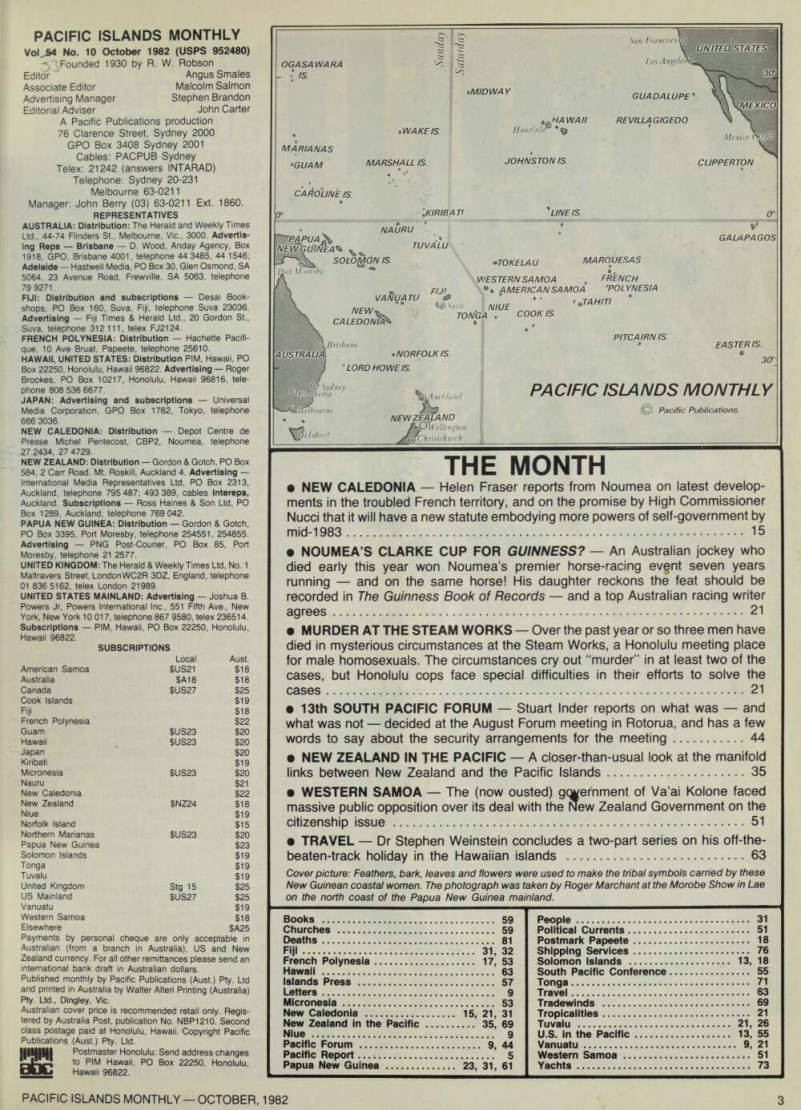
The Month
• NEW CALEDONIA — Helen Fraser reports from Noumea on latest develop ments in the troubled French territory, and on the promise by High Commissioner Nucci that it will have a new statute embodying more powers of self-government by mid-1983 15 • NOUMEA’S CLARKE CUP FOR GUINNESS? — An Australian jockey who died early this year won Noumea’s premier horse-racing evpnt seven years running — and on the same horse! His daughter reckons the feat should be recorded in The Guinness Book of Records — and a top Australian racing writer agrees 21 • MURDER AT THE STEAM WORKS — Over the past year or so three men have died in mysterious circumstances at the Steam Works, a Honolulu meeting place for male homosexuals. The circumstances cry out “murder” in at least two of the cases, but Honolulu cops face special difficulties in their efforts to solve the cases 21 • 13th SOUTH PACIFIC FORUM — Stuart Inder reports on what was — and what was not — decided at the August Forum meeting in Rotorua, and has a few words to say about the security arrangements for the meeting 44 • NEW ZEALAND IN THE PACIFIC — A closer-than-usual look at the manifold links between New Zealand and the Pacific Islands 35 • WESTERN SAMOA — The (now ousted) of Va’ai Kolone faced massive public opposition over its deal with the New Zealand Government on the citizenship issue 51 • TRAVEL — Dr Stephen Weinstein concludes a two-part series on his off-the beaten-track holiday in the Hawaiian islands 63
Books 59 Churches 59 Deaths 81 Fiji 31, 32 French Polynesia 17, 53 Hawaii 63 Islands Press 57 Letters 9 Micronesia 53 New Caledonia 15, 21, 31 New Zealand in the Pacific 35, 69 Niue 9 Pacific Forum 9, 44 Pacific Report ...; 5 Papua New Guinea 23, 31, 61
People 31 Political Currents 51 Postmark Papeete 18 Shipping Services 76 Solomon Islands 13, 18 South Pacific Conference 55 Tonga 71 Travel 63 Tradewinds 69 Tropicalities 21 Tuvalu 21, 26 U.S. in the Pacific 13, 55 Vanuatu 9, 21 Western Samoa 51 Yachts 73
Advertisements & other items, pp. 3-4 (2 items)
* Founded 1930 by R. W. Robson
Editor Angus Smales Associate Editor Malcolm Salmon Advertising Manager Stephen Brandon Editorial Adviser John Carter A Pacific Publications production 76 Clarence Street, Sydney 2000 GPO Box 3408 Sydney 2001 Cables: PACPUB Sydney Telex: 21242 (answers INTARAD) Telephone: Sydney 20-231 Melbourne 63-0211 Manager: John Berry (03) 63-0211 Ext. 1860.
jfi's
Spm
w/h s 7/ SB I m s : i s m £& N * /s -55 % % % % % c 5? r <£ % % % o -Q V % 4s CK ifi <fc Qs >5) « % f -i 3* A % t. 9- 4: % a % % S> <5 « <S! 4 % 9? *»> * a- ®/ o <2 <?/ % =% % <r V
WITH
AUSTRALIAN
BUILDING
MATERIALS
Buyers, agents, builders-they can all profit from Australian building materials. They can profit from their high standard of quality. A quality proven on the job in Australia’s widely varying climatic conditions.
They can profit from the great range available, extending from basic tools, hardware and equipment to specialised products and decorative fittings. Products such as fasteners, scaffolding, welding equipment, hand tools, sealants and adhesives, door and window fittings, bathroom accessories, tiles and cladding, plumbing and electrical fittings, roofing and cabinet ware. Australian manufacturers can supply most building products.
Find out what they have for you.
Ask the expert who knows Australia The Australian Trade Commissioner can give you details of suppliers.
Contact an Australian Trade Commissioner at:
FIJI
P.O. Box 1252, Suva Phone: 31 2844
PAPUA NEW GUINEA
P.O. Box 9129, Hohola Phone: 259333
NEW CALEDONIA
P.O. Box 22, Noumea Phone: 27 2414
HAWAII
Australian Consulate 1000 Bishop Street, Hawaii, 96813 Phone: (808)5245050 Ask the Australian LXJ Trade Commissioner
Pacific Report

Png Arrest Of Free Papua Leader
Seth Rumkorem, leader of one of the anti-Indonesian groups calling for the independence in Irian Jaya, was arrested in Papua New Guinea in mid-September with nine of his suppor ters. They had travelled more than 1000 km by sea and had gone ashore at Rabaul where they were detected. There were indications they were making for Solomon Islands or Vanuatu to seek asylum. They were held in custody in Rabaul to face charges of being illegal immigrants, but a magistrate freed them on grounds that investigators had “invited” them ashore.
Prime Minister Dismissed In W. Samoa
Va’ai Kolone, the recently-elected prime minister of Western Samoa, has lost his seat in parliament following a Supreme Court decision which found evidence of irregularities in his election campaigning. However allegations that he had been involved in treating and bribery were not proved.
Tough U.S. Stand In Marshalls Talks
The United States has toughened up its attitude to the Marshall Islands Republic over the negotiations on the proposed Com pact of Free Association, which broke down two months ago over the terms of the plebiscite the Marshalls planned to hold in August (PIM Sep. p 5). It was hoped that the talks would restart soon, but the Americans told Marshalls President Amata Kabua in Honolulu in late August that they would not negotiate under duress. About 800 owners of land on the U.S. missile testing base on Kwajalein have been occupying strategic islets on the atoll for many weeks in protest against the terms of the financial settlement offered by the U.S. for use of the atoll. President Kabua was told that the landowners must leave before the negotiations can continue. The Marshallese, in the face of the U.S. veto of the plebiscite which offers them free association with the U.S. or independence, have also hardened their attitude, Foreign Secretary Tony deßrum announcing that the plebiscite will go ahead with independence still an option. The independence option has been rejected as unacceptable by U.S. negotiators.
South Pacific Conference For Pago
The 22nd annual South Pacific Conference will be held at Pago Pago in October. The commissioners of the South Pacific Commission will meet in private on October 20-22, with the official opening on October 23 and the conference proper from October 25-29. (See Paul Addison report, Political Currents.)
Like Oliver, Somare Asks For More
The newly returned Prime Minister in Papua New Guinea, Mr Somare, was unsuccessful late in August in his immediate attempts to extract a higher level of budget aid from Australia.
The best he could do was to gain an undertaking from the Australian Prime Minister, Mr Fraser, that the next aid negotia tions would be held in January instead of about 11 months later.
The two countries are in the second year of a five-year agreement under which Australian provides an annual untied grant which makes up nearly 30 percent of the PNG budget. The agreement allows for inflation by increasing the annual figure, but at the same time it reduces the real value of the aid by five percent annually. Because of the tight economic situation in PNG, Mr Somare asked for the waiving of the five percent reduction for at least the next two years. However, Australia has adhered to the formula which fixes the 1982-83 grant at $A254 million. Despite the adamant nature of Mr Fraser’s attitude, there is some belief that the new January talks could bring a measure of relief to PNG if only at the expense of aid to some other countries.
U.S., Palau Sign Compact
The United States and the Republic of Palau on August 26 signed a Compact of Free Association to govern their relations for a period of 50 years. The signing took place in Washington, with Ambassador Fred Zeder signing for the U.S. and Lazarus Salii for Palau. The compact represents the conclusion of 13 years of negotiations. Through it, and its nine subsidiary agreements, Palau will, over the 50-year period, receive approx imately SUSI billion, with about 40 per cent of the money
earmarked for economic development. The balance will be used for the completion and maintenance of Palau’s public works infrastructure and for the operation of government programs designed to improve health, education and welfare of the islanders. Tax and trade advantages are incorporated in the compact to stimulate American investment and private sector growth. Following approval of the compact by the people of Palau in plebiscite under United Nations observation, and by both Houses of the U.S. Congress, the Palauans will gain control of their defence for which the U.S. will retain responsibili ty under mutual security arrangements terminable only by mutual consent. The U.S. will have contingency rights to use a designated area in Palau for military training exercises on an intermittent and non-exclusive basis, and to make joint use of two airfields and a harbor. U.S. Information Agency.
Commonwealth Status For Guam
The people of Guam, an unincorporated territory of the United States, have voted, by three to one, to become a commonwealth in association with the United States rather than ask for statehood, which they would not be able to afford. The decision awaits ratification through a Territorial Federal Relations Act on the ballot papers for the general election in November. About 62 percent of the Guam people are Chamorros, as are 75 percent of the people of the Commonwealth of the Northern Marianas.
References have been made in the past about possible union, which could result when the two territories have identical status and when the U.S. trusteeship of Micronesia is terminated. A referendum held in January attracted only 37.2 percent of the voters with commonwealth status getting 48.5 percent of those votes against 25.7 percent for statehood, but because of the low poll it was decided to hold a second referendum.
VANUAAKU PARTY TAKES THREE OUT OF FOUR Vanuatu’s governing party, the Vanuaaku Party led by Prime Minister Walter Uni, has won three of four by-elections held to fill seats which have been vacant for more than two years (PIM Sep. p 6). Two seats were taken from the opposition Union of Moderate Parties, Port-Vila Town and Luganville, and the party retained the Efate Rural seat. The Union of Moderate Parties retained the Tanna seat, formerly occupied by Alexis lolu, who was shot dead during an attack on the jail on Tanna in June, 1980. The election results show a strengthening of the Vanuaaku Party’s position, which some observers believed had been weakened by recent internal strife (PIM Aug. p 5).
Fisheries Accord: Noumea’S Windfall
Late August saw the signing of a new Franco-Japanese fisheries agreement. As far as New Caledonia is concerned, the agreement provides that the Japanese may take 5550 tonnes of fish out of the waters of the territory’s exclusive economic zone for a cash return equivalent to about $A230,000 which will go to the Territory’s budget. The Noumea daily Les Nouvelles quoted Henri Emmanuelli, secretary of state for overseas departments and territories, as saying: “The overall provisions of the agree ment are in the interests of France, and more particularly of the French overseas territories that are affected: it entails a reaffir mation of the recognition by a foreign state of the economic zones around the overseas territories, improved knowledge of the fisheries potential of the economic zones, royalties to the profit of the overseas territorial budgets, strengthening of maritime economic co-operation with Japan, and strengthening of control over the activities of foreign vessels.”
N.F.P. Man Breaks Ranks In Fiji
Vijay Parmanandam, a National Federation Party member of Fiji’s Parliament, defied party orders in August and accepted an offer by the ruling Alliance Party of the post of Deputy Speaker in the Parliament. Mr Parmanandam said his decision to accept the office was meant as an apology to the Fijian people and their leaders for what he said were the insults heaped upon them during the July general election. He was later expelled from the party, but immediately vowed he would fight the expulsion.
Parliamentarians Agree To Disagree
Delegates at the 32nd Asian-Pacific Parliamentarians’ Union
(APPU) at Kolonia, Ponape, failed to agree on a resolution opposing the dumping of nuclear waste in the Pacific. The Japanese delegation indicated that it would refuse to sign the meeting memorandum if the resolution formed part of the record. In a compromise, the APPU approved a memorandum which said consideration of the anti-dumping resolution was deferred to the 33rd council meeting and the 18th APPU general assembly meeting on Guam in January. Earlier, the meeting was told that the Association of Pacific Islands Legislatures (APIL), which includes Guam, the Northern Marianas, Belau, the Marshall Islands and the Federated States of Micronesia, had adopted a resolution, at its late August meeting on Guam, to create a nuclear-free zone in the Pacific. APPU Council Chairman Daisuke Akita, chief of the Japanese delegation, said Japan had no intention of dumping its nuclear wastes without the consent of the Pacific Islands nations.
Fraser Faces Party Rumblings On Aid
Australian Prime Minister Fraser’s announcement at the South Pacific Forum of increased Australian aid for the South Pacific (up by 50 per cent to SA3OO million over the next five years) has caused rumblings in his own Liberal Party. The Liberal Premier of the State of Western Australia, Mr O’Connor, went on record as saying: “The harsh judgment has to be made that priorities are wrong in a Commonwealth Government which puts over seas aid ahead of the interests at home of the unemployed and the disadvantaged. Overseas aid is a moral obligation, but its allocation, and increases in it, are definitely not of greater priority than the needs of the people of Australia at a time of profound economic uncertainty.” And a newspaper commentator noted: “. . . Mr O’Connor was saying publicly what many Liberals felt privately about Mr Fraser’s sudden burst of overseas largesse.”
Such critics seem blissfully unaware that even “a time of profound economic uncertainty” in Australia would seem to the inhabitants of most island countries a time of unprecendented economic prosperity.
Anti-Nuclear Protester Back Home
Navigator of the Australian anti-nuclear protest yacht Pacific Peacemaker, Lorraine Ethell, 33, returned to Australia with her four children on August 29. The yacht was arrested by the US Coast Guard at Seattle when, with other protest craft, it was seeking to impede the passage of the giant new US Trident nuclear submarine. A bulletin issued by the Pacific Peacemaker support organisation claimed that the coast guardsmen hand cuffed the crew, and stood over them with shotguns and sub machine guns. Lorraine Ethell told a press conference in Sydney that several members of the crew were mistreated, as they were dragged around the deck in their handcuffs, and had their fingers bent back over a metal bar.
Soviets At Rocket Practice
The, Soviet Union announced at the end of August it would be firing rockets into the central Pacific from September 1-10. Co ordinates provided showed that the target area was near Midway Island. Ships and aircraft were warned to stay outside the area each day between 14 and 18 hours local time.
Japanese Fishermen Oppose Dumping
Japan’s National Federation of Fisheries Co-operative Associa tions has expressed its opposition to the Japanese Govern ment’s plan to dump 10,000 drums of nuclear waste in the Pacific Ocean. The federation is expected to make an official declaration of its policy towards the dumping of nuclear waste, a policy which has been supported by Guam, the Northern Marianas, the Federated States of Micronesia, and the Marshall Islands. The four territories have sent letters to the federation, the President of the FSM, Tosiwo Nakayama, writing: “It is the stated policy of my government that low or high level nuclear waste (dumping) by any country is prohibited in all marine areas under the jurisdiction of the Federated States of Micronesia.
This country has also joined other Pacific nations in opposing all nuclear waste dumping by any country in and throughout the
I 3Citic.
Flosse’S Man Romps Home In Tahiti
A by-election in French Polynesia on August 29 to fill a vacant position of Deputy to the National Assembly in Paris was won
handsomely in the first round by Tutaha Salmon, candidate of the Tahoeraa Huiraatira party. The vacancy was created when the former Deputy, Gaston Flosse, became Vice-President of French Polynesia’s Government Council following the May elections in the Territory. He cannot hold both this position and that of Deputy. Flosse is the leader of Salmon’s party, and the two are very close political associates. Two features of the election should be noted. First, only 57 percent of eligible voters bothered to go to the polls. It was the fifth election in a year, and, with the result a foregone conclusion, most people preferred to enjoy a beautiful sunny day. Second, the election was a major setback for the Here ai’a party of John Teariki, coalition partner of Francis Sanford’s E’a api party in the former Government Council: its candidate, the relatively unknown Jean Faatau, managed to attract only 897 votes, 5.71 per cent of the total. The candidate of the la mana te nunaa party, Jacqui Drollet, scored 2030 votes, 12.93 per cent of the total. Mr Salmon pulled in 8350 votes, 53.17 per cent of the total. His nearest rival, Emile Vernaudon, new President of the local Territorial Assembly, standing for his own Ai’a api party, got 3993 votes, or 25.43 per cent. Marie-Therese Danielsson. (For a report on New Caledonia’s September 5 by-election which also chose a Deputy see Helen Fraser’s report in this issue.)
Noumea: New Arrest In Declercq Case
Authorities in Noumea have arrested a second man in connec tion with the murder in September 1981 of Independence Front leader Pierre Declercq. He is Barthelemy Martin, a barman, who has been charged with premeditated murder. A statement by the prosecutor said Martin had been arrested because his presence had been established near the victim’s home at the time of the murder, and he could not justify being there. The testimony he had given immediately after the crime had also now been proven false. The prosecutor said Martin’s arrest would not affect the trial of the first man charged with the murder, Dominique Canon, who was released on bail in July.
Solomons’ Teke Glum On Forum
Solomon Islands Deputy Prime Minister Kamilo Teke says New Zealand and Fiji played too great a part in the 13th South Pacific Forum meeting at Rotorua, New Zealand. Mr Teke, who led his country’s delegation to the meeting, said on his return to Honiara that he was disappointed with the way New Zealand Prime Minister Muldoon had run the Forum. He claimed that Fiji had also tried to dominate the meeting. Mr Teke said he was particularly disappointed with the selection of the new director of the South Pacific Bureau for Economic Co-operation, Mahe Tupouniua, of Tonga. He said Mr Tupouniua had served as director for many years, and Papua New Guinea, Vanuatu and Solomon Islands all felt that someone from another country should have a turn in the job. Mr Teke added that the applicant from Kiribati had all the necessary qualifications. (See reports on Forum meeting elsewhere in this issue.)
Jimmy Stevens’ Brief Taste Of Freedom
Jimmy Stevens, leader of the failed secessionist revolt on Santo, Vanuatu, in 1980, escaped from prison in Port-Vila on September 12, but was recaptured within a few hours. Stevens is serving a 14 1 /2-year sentence for his part in the revolt.
Stevens escaped with at least five other prisoners, including an Australian, Ken Cassel, who had been sentenced in August to three and a half years imprisonment for theft of the freighter Glenelg from Port-Vila harbor in December last year (PIM Feb. p 6). Under cover of darkness, the escaped prisoners boarded a launch owned by a skin-diving company, threatened the sea men who had charge of it, and took the craft out of the harbor.
The launch was spotted by a light aircraft off the coast of Efate early on September 13, and a government patrol boat put to sea and quickly retrieved the launch and its passengers.
Cannabis Means Calaboose In Cooks
A 37-year-old American, Dalbert Guisenger, husband of a Cook Islander and resident in the Cook Islands for 18 months, has been fined $lOOO and ordered to perform community service for 12 months by Chief Justice Graham Speight in Avarua High Court for importing 2.4 grams of cannabis.
Advertisements & other items, pp. 6-8 (1 item)
Introducing the 315 Series.
SUMS
NT-3150 J
rrr
11 —i iiii j * j j
TnTIEzfTnT;
r: SL-5 ST-5 SU-5
SH-E 5
RS-5
Just Jacket Size!
Introducing the 315 Series.
Three years ago we introduced the LP-jacket size [3lsmm x3lsmm] SL-10 turntable. It became an instant classic. Our new 315 Series is a full line of super performance.yet compact components based on the strikingly sleek design, state-ofthe-art technology and effortless operation of the SL-10.
The turntable is the SL-5, a superb linear tracking, direct drive machine in the Technics tradition. The ST-5 quartz synthesizer FM/AM tuner offers drift-free tuning and 16-station Random Access Preset Memory. The SU-5 integrated amplifier, with a clean 30 watts per channel, features our unique Super Bass control that automatically boosts weak spots in the low range response. The SH-E 5 12-band graphic equalizer lets you fine tune frequency response for listening and/or recording. With automatic bias and EQ selection for metal, 002 and normal tape, plus peak-hold FL meters for easy recording level setting, the RS-5 is a first-rate cassette deck.
The SB-F 5 two-way linear phase speaker system assures accurate, musical sound reproduction. 315 Series—new audio design destined to become a classic.
DIRECT CONNECTORS:
Flip-up plugs provide fast, easy, direct connections when components are stacked. OurSH-721 audio rack ensures secure and attractive stacking.
Conventional wire connections for non-stacking arrangements.
Technics
V ■ Jl * * 5 i
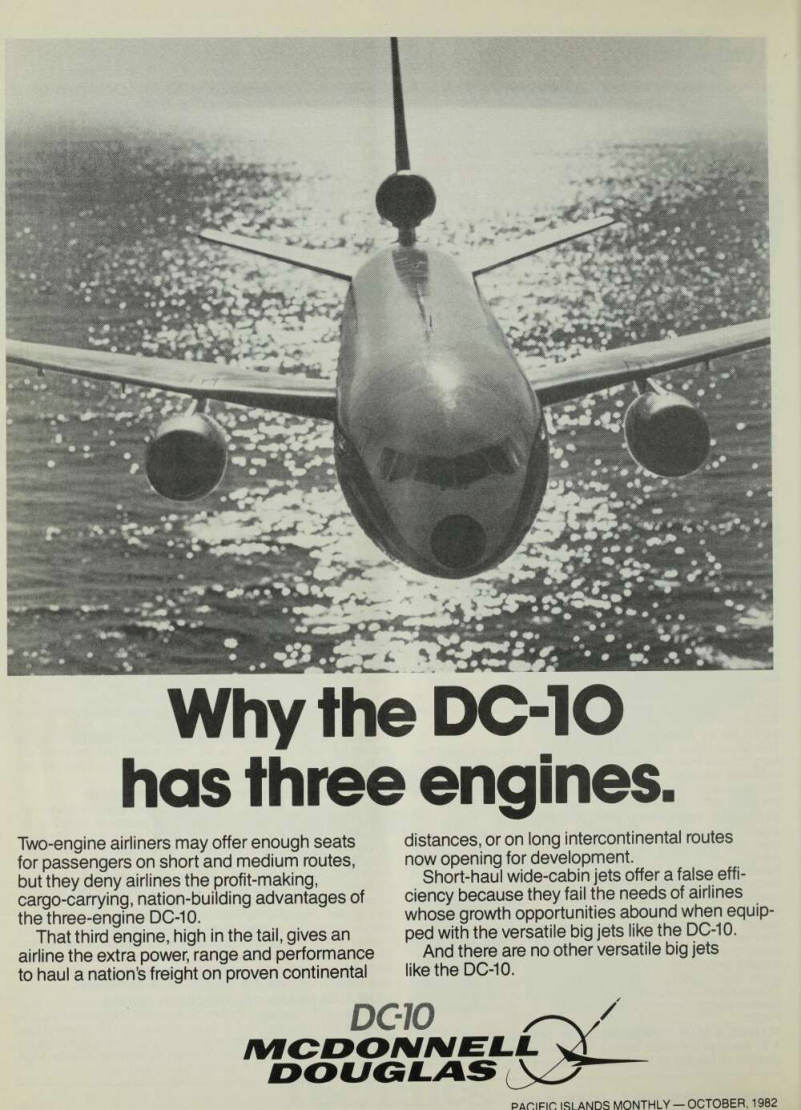
Why the DC-IO
has three engines.
Two-engine airliners may offer enough seats for passengers on short and medium routes, but they deny airlines the profit-making, cargo-carrying, nation-building advantages of the three-engine DC-10.
That third engine, high in the tail, gives an airline the extra power, range and performance to haul a nation’s freight on proven continental distances, or on long intercontinental routes now opening for development.
Short-haul wide-cabin jets offer a false efficiency because they fail the needs of airlines whose growth opportunities abound when equipped with the versatile big jets like the DC-10.
And there are no other versatile big jets like the DC-10.
DC-10
/VfODO/V/V
A response



Letters
A response to FAF from Niue
I was very interested in the arti cle in which Daniel Tardieu has written of the French-made vehi cle, the Citroen FAF (PIM Jun. p. 49). It relates very closely to what is happening in all the Islands.
It is no different on Niue, one of the smallest island nations in the world. Our island is sur rounded by Tonga, Fiji, Samoa, Tahiti, the Cook Islands, New Zealand and Australia.
From Niue Island (population 3300), people have been drifting to New Zealand and Australia.
There are 12,000 of our people in those countries in 1982.
Our national budget for 1982- 83 is more than SNZ6 million from New Zealand and Aust ralian aid, etc. We are develop ing slowly, but we are developing.
The vehicles we are buying here are Japanese, Suzuki pick ups mainly, and the sale price for such a vehicle new here is $7500. We often buy old pickups from New Zealand that may last three or four years if you’re lucky. Australia’s Holdens eat petrol, which is more than $3 a gallon now.
Our island is supposed to be the biggest uplifted coral island in the world, roughly 29,000 hectares, and about 80 metres above sea level.
Our wharf is now to be de veloped by Australian aid.
Ships call from New Zealand and other islands.
There’s lots of room for de velopment in Niue. Land is cheap. There are good schools and a good hospital, good access roads, and good rainfall.
I would like to discuss this further with Mr Tardieu because I think Niue could be an ideal place for the development of a FAF assembly industry such as he talks of. I was employed by Ford Motors in Auckland for two years working on ignition and chassis parts for Australia.
Much of our recent develop ment, especially in agriculture, has been helped by French aid,
with French experts coming here every now and then.
So if someone could approach our government, or a private company, on the question of starting up this kind of FAF assembly operation in Niue I’d be the first one to make land for
the plant.
I certainly am serious in want ing to know more about this, and look forward to hearing from Mr Tardieu about ways to get it moving.
L. K. Tuhega
P.O. Box 132 Alofi Niue Island
Defending Hilda
Lini (1)
I am surprised that PIM (July p. 10) is stooping to be the vehi cle for character assassination.
the character of the Republic of Vanuatu, and the character of Miss H. Lini, a Vanuatu citizen.
It would be helpful to address an identity in replying to Hilda Lini’s anonymous detractor, but in Vanuatu’s experience such people are often nameless, faceless, gutless little wonders that only come out in the open in mobs.
Hilda has not spoken to the press since joining the South Pacific Commission, most defi nitely not to the New Caledonian press. The truth of the matter is that the New Caledonian press (the Rightwing elements that fanned the Vanuatu rebellion) are going out of their way to make
Hilda’s stay in New Caledonia
unpleasant.
The people who fled Vanuatu in the wake of the Vanuatu re bellion did so on their own voli tion to save their own skins and salve their guilty consciences.
It is sad to note that these people haven’t learnt from that experience. If they want a place to settle at, unjustified attacks on the Republic of Vanuatu are not going to endear them to Vanuatu and printing lies about Hilda in New Caledonia and PIM is the best way to attract Kanaks to her, serving to strengthen the bond between New Caledonian Kanaks and Ni-Vanuatu. In which case if our nameless writer doesn’t hurry up and wake up to the realities of Melanesian polit ics (particularly in New Caledonia) he or she may be hurriedly packing bags and scur rying after a one-way-ticket one more time!
Unfortunately some people just never learn.
Hilda was with the Vanuaaku Pati long enough for Vanuatu to
gain independence, something
her present detractors never dreamed would ever be possible!
Hilda has developed as a per son and progressed in her life.
What has our nameless letter writer done?
I offer Miss Lini my heartiest
congratulations for stumbling on
to the perfect place to work.
Where else would she get instant
recognition and free publicity
promotions while the New Caledonian political climate
heats up?
Mata Moligogona
Luganville Santo Vanuatu
Defending Hilda
Lini (2)
Women have always played an unrecognised role in the develop ment of their countries, so it is not surprising to hear abusive and anonymous comments from Noumea about Miss Hilda Lini.
As an organisation which en couraged and endorsed her appli cation to the South Pacific Com mission, it seems unfortunate to us that persons in Noumea are unable to recognise the important
job Miss Lini has pursued for years in her own country and in the Pacific . . . that of the de velopment of justice and peace for people of the Pacific. She is amply suited for the SPC job with well-proven talents in com munication, a wide knowledge of the Pacific, and great respect from Pacific Island women and women from around the world.
The position of Anglophone
Co-ordinator of the Pacific Wo men’s Resource Bureau moves her round the Pacific where she shares her organisational abilities and gives focus and support to the often forgotten 50 per cent of the population. Clearly, this more important work leaves Miss Lini with little time to campaign against insecure French whose colonial policies have left prob lems which her own country is struggling still to untangle.
Diane Goodwillie
Ofis Blong Ol Meri World YWCA South Pacific Office Nadi Fiji
Pita Fanene knew
James Bond
The death of Pita Fanene Maivia (PIM Aug. p. 73) reminds me that this well-known Samoan sportsman was also in a film that was immensely popular in his own country.
You Only Live Twice, based on lan Fleming’s thriller, featured not only 007, but also Pita Fanene. He played the part of the chauffeur who turned attacker.
Incidentally, this film was on TV in Sydney on the night that the Samoan papers brought news of his death to us here.
Bill Sharpe-Dunn
Westgate NSW Australia
Forum rapped on
New Caledonia
I wish to express my deep con cern over the South Pacific Forum’s stand, resolution and attitude towards the New Caledo nian issue during their last meet ing in Rotorua, New Zealand.
It was both an unbelievable and incomprehensible attitude which showed a total lack of
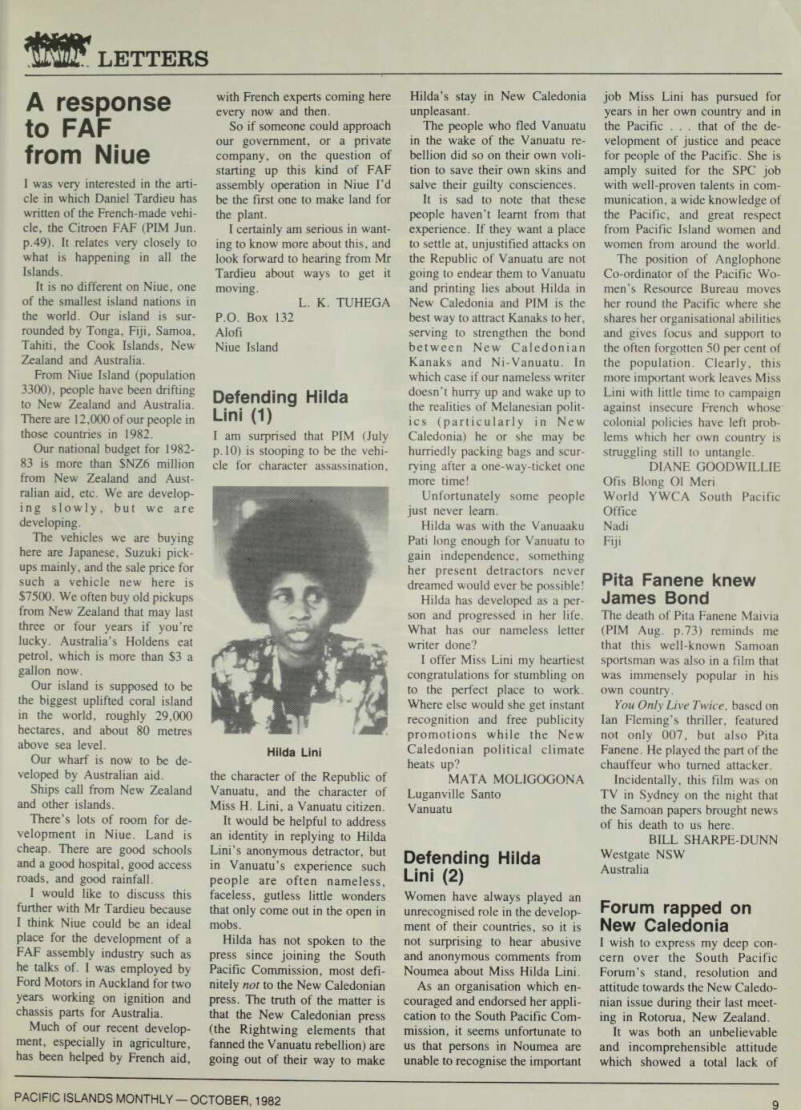
Hilda Lini
understanding of the general
policies of French colonialism, and of the New Caledonian situation.
The attitude taken by the Prime Minister of New Zealand only substantiated his govern ment’s record of a lack of ap preciation of human rights. It was only a year ago that his government approved of a racist South African Rugby team’s visit to New Zealand, which almost caused chaos throughout the country. At the Forum he brand ed New Caledonia’s Kanak Lib eration Front as in the same category as the Palestine Libera tion Organisation (PLO). The Kanak people were never terror ists, and it is attitudes like that of Mr Muldoon that could one day turn them to terrorism if human rights are not respected.
The Forum’s resolution ack nowledging the French Govern ment’s so-called “reforms” is totally contrary to the wishes of the Kanak people. If anyone cares to study the recent history of the Republic of Vanuatu they will find facts and figures reflect ing a policy on the same lines implemented in the former New Hebrides by the French Govern ment. This is particularly so with regard to land. In the late 1960 s and early 1970 s the French ad ministration in the then New Hebrides bought back a lot of land from its nationals to return it to the New Hebrideans (Ni- Vanuatu). The whole policy of land reform as it was then in the New Hebrides, and will be this year in New Caledonia, is de signed to defuse the call for independence. In actual fact the reforms aim to enable the French to strengthen their grip on New Caledonia.
It is a pity that Forum leaders are more than willing to accom modate the French Government’s point of view, but are less willing to listen to the small voice of the Kanak people, the true owners of New Caledonia. The Kanaks are
the only people who can speak
truthfully about the injustices of the French Government committ ed on their lands and their country.
The Forum leaders should have followed the line advocated by Vanuatu Prime Minister
Father Walter Lini and agreed to take the issue before the United Nations Special Committee of 24 on decolonisation, and should also have proposed that France set a deadline for New Caledonia’s independence to be declared no later than December, 1984.
Some of our leaders in the Pacific appear more concerned about sending their soldiers to
the Middle East to take part in so-called peace-keeping forces, which are in actual fact suppres sing the rights of the Palesti nians, than assisting their sup pressed brothers in nearby Pacif ic countries who may one day be of more use to them than all the Arabs and Israelis.
Let’s hope that next time we deal with the French more cauti ously. Vanuatu should be a les son to learn from. French are French and the fact that the pre sent government is Socialist doesn’t make the slightest differ ence. The French colonial policy is always the same, and will remain so in the future.
Clarence Marae
University of Papua New Guinea Port Moresby
Png
The underside of
yachting
Congratulations to Jane deßidder for her succinct story on the “keel” side of yachting (PIM May p 59).
Does PIM have any stories it might print about on-board con ditions of earlier sailing in the Pacific?
Bruce S. Hopping
Laguna Beach, California,
Usa
We’re fossicking. Editor.
PM Muldoon at the Forum
Tourism and
Gizo
Permit me some comments on your welcome article about Gizo and the Panakera couple (PIM, June, p. 37). My stay in Gizo last year on an academic sabbatical in Oceania was unexpectedly pro longed, and I lived for over a month there with two Peace Corps volunteers. I saw what the private initiative of a dynamic and charming couple, the Panakeras, can accomplish for a sleepy community like Gizo. In deed they are a credit to Solomon Islands.
A matter of some interest to me during the Oceania trip was the issue of open, vs. controlled, vs. closely restricted, tourism.
We are aware, due to our worldwide travels and residences and a permanent home in Flori da, of the positive and negative results of tourism. I think Sol omon Islands, and Gizo Island is a good example, should not be targeted for accelerated tourism.
There are better possibilities for economic stability and progress.
Take the case of the fine beach, mentioned in the PIM article as a tourist attraction
planned by the enterprising cou
ple. It is a beautiful spot, over 16 kilometres from Gizo town. It is next to a local village which has a small primary school on the beach a short walk from the structure earmarked for tourist beach visitors. It is a traditional village. The school which we visited, conversing with teachers and pupils, appeared to us primi tive but with dedicated teachers and students producing admir able results. The impact of an everyday presence of tourists on the village and school cannot be advantageous. Local casual visitors to the islands and resi dents of Gizo town will always, as in the past, visit the beach.
But this will be mainly on weekends or holidays, taking ad vantage of the occasional local transport.
Finally, I somewhat disagree
with your reporter characterizing Gizo town as “not very attrac tive”. We have seen many unat tractive towns all over the world, but Gizo is not one of them. I find Gizo’s waterfront and main
street somewhat untidy, but with a certain charm and a welcome change from the plasticity and
unimaginative global conformity
of most of today’s urban loca tions. Gizo’s modest residential section on the ridge above the centre is most pleasant and has splendid views over the ocean and adjacent islands, including
impressive Kolombangara (and
not forgetting the small atoll where President Kennedy was shipwrecked with his PT boat during World War II).
Charles W. Arnade
Professor of International Studies, University of South Florida, Tampa,
Usa.
“Imperialist”
Usa?
The review by one Dan Boylan of the book Empire Can Wait, the story of the annexation of Hawaii (PIM, June, p. 40) is, indeed, an interesting exercise in wishful thinking, to say the least.
Admittedly, the take-over of Hawaii by our Government had some ethically questionable as pects. However, when Mr Boy lan gets into the general aspect of ‘lmperialism’ his nose appears to be out of joint. Particularly is this true when he discusses Vietnam.
Our government’s intervention in South Vietnam was at the request of that nation’s function ing government, following the invasion by the forces of North Vietnam. This was an action which, incidentally, should have been undertaken by the United Nations, if that pseudo organisation had acted in accord with its own charter.
Had our government intended to take over South Vietnam (and, presumably, the North as well) the war would certainly have been waged in accord with such intentions. Instead, our forces were handicapped by continuous intervention on the part of our political leaders, which resulted in the troops becoming bogged down in half-measures, and frus trating make-believe war actions, which not only doomed their efforts to win victory, but result ed in betraying a friendly people who had trusted our promises.
The thousands of boat-people
who are still fruitlessly looking for a secure sanctuary from the aggression of the “victorious” forces from the North present ample evidence that our initial aims had humanist merit, had they been permitted to succeed.
The 5,000,000 people of South east Asia murdered since the “liberation” of South Vietnam would doubtless wish, if they had the opportunity, that the Un ited States had been a bit more
imperialistic.
I have no idea of the who, what, or where of Dan Boylan, but his general tone of criticism evidences a woeful lack of know ledge of history over the past 40 years. If we (the United States) had had imperialist designs most of the South Pacific might well be living under our government’s
supervision today. During the
early ’4os we had troops in (to name a few of the more promi nent areas) Fiji, Guadalcanal (I was among them), New Georgia (I was among them), New Caledonia (I was among them).
New Guinea, Manus (I was among them), Luzon (I was among them) and others too numerous to detail. Following hostilities we not only left the islands, but left behind enough material and supplies to enable many a local entrepreneur to light out on his own, as a small businessman. I had the opportun ity, during the ’6os, to re-visit many of these localities, and saw this for myself.
Had we harbored ulterior de signs at the time, who would have said us nay? There were no opposing forces to argue with us.
This may be imperialist in Mr Boylan’s vision, but I doubt that he would be able to recruit many followers. As to the Philippines,
your reviewer apparently forgot
(or never learned) that they were given their independence back in 1946. Since that time they have been regulating (for better or worse) their own affairs.
Urban D. Kapler
Phoenix Arizona
Usa
Advertisements & other items, pp. 10-14 (1 item)
In AlI Ncw World of Sonic Clarity
Introducing the Hew PRISM Component Systems.
Refined reproduction performance and enhanced appearance make the Mew PRISM systems an extremely musical, elegant addition to any listening /living environment.
Another taste of advanced technology from TEAC. m ™
COMPONENT SYSTEMS
EH i E o llr I \ ” -5* * N -»
TEAC
Where Art and Technology Meet
BEHIND THE NAME
For over a century RENOLD has been in
the forefront of power transmission
Linked with RENOLD are these
great names.
RENOLD really makes
things move
ELECTRONICALLY—
HYDRAULICALLY—
MECHANICALLY-
a.
CARTER
■\o'*
QUALITY
TRANSMISSION PRODUCTS.
GEAR MOTORS
WORM AND
HELICAL REDUCER
VARIABLE
UNITS
FLEXIBLE
COUPLINGS
VIBRATING
SHAKER
DRIVES
SPROCKETS
AND GEARS
TRANSMISSION
AND CONVEYOR
CHAINS
SPRAG AND
HYDRAULIC
COUPLINGS
VARIABLE
AC/DC
CONTROLLERS
SHAFT
MOUNTED
HELICAL UNITS
RENOLD AUSTRALIA PTY LTD.
• MELBOURNE (03) 560 6666
• BRISBANE (07) 275 2155
• ADELAIDE (08) 46 9077
• PERTH (09) 381 2533
• SYDNEY (02) 80 0261 £
• TOWNSVILLE (077)79 5922 £
• NEWCASTLE (049) 61 5681 u
• WOLLONGONG (042) 71 1011 Q
m . * an mm 'I t PP» w vr * 9 •- :§s# j. $ •i t- V v "
60 g &
START WORLD COMMUniCATIOHS YEAR
in Hawaii !
FIFTH ANNUAL CONFERENCE OF THE
PACIFIC TELECOMMUNICATIONS COUNCIL
January 16-19, 1983, Honolulu, Hawaii Major Speakers * Secretary General, International Telecommunication Union (ITU), Geneva * Sarath Amunugama, Secretary General, Asian Mass Communication Research and Information Centre, Singapore * Lewis M. Branscomb, Vice President & Chief Scientist, IBM Corp , New York * Edward W. Ploman, Vice Rector, UN University, Tokyo Special Presentations * The Digital World - Bell-Canada * Pacific Satellites - INTELSAT * Satellite Facilities - Japan * Satellite Planning Roundtable * Workshops Papers * Panels * Roundtables * Exhibits For more information contact: Pacific Telecommunications Council 1110 University Avenue, Suite 303 Honolulu, Hawaii 96826 USA Phone: (808) 949-5752/941-3789 Telex; 7430550PTC
k i 4 ▼ 0 ■ ■' —: ' Wk ■ •> ■; ■: 5-^rnhwi* <0 |||pps W Wk The complete freight handling service requires an organization encompassing a daunting assembly of expertise. Stevedoring, through cargo handling, ancillary shipping and packaging services, road haulage, specialised freight handling equipment, complete container facilities, cold storage, full vessel agency are but some of the essential
services required.
The Robert Laurie-Carpenters Group of Companies covers all these and more. In fact so comprehensive is the service offered that you are invited to send for the RLC information folio which describes in detail this complete freight handling service. Whether it’s sea, land or Robert Laurie-Carpenters Pty. Ltd.
PO Box 922 Port Moresby Papua New Guinea Branches throughout Papua New Guinea.
Telephone: 217324, Telex: NE22107
New Caledonia: Nucci promises

new, freer regime by June ’83
HELEN FRASER reports from Noumea on the French Government’s latest plans for the future development of New Caledonia, and on the September 5 by-election made necessary by the resignation and immediate re-nomination for election of Right-wing Deputy to the National Assembly in Paris, Jacques Lafleur.
The French Government has pro mised that there will be a new statute constitution for New Caledonia, probably by June, 1983, and that it will give in creased internal autonomy (self government) to the Territory.
The undertakings were given at a September 9 press confer ence in Noumea, by French High Commissioner Christian Nucci, who had just returned from Paris and talks with President Mitterrand.
Outlining the government’s formula for advance in New Caledonia, Mr Nucci said that the first step had been to estab lish economic, social and judicial reforms designed to “remove in equalities and injustices”. The
first four concerning land, Melanesian culture, economic development and the judicial sys tem will shortly become realities in New Caledonia, fol lowing their approval by the French Cabinet.
A further two reforms con cerning mining and energy would be presented to New Caledonia’s Territorial Assembly before the end of September for advice, Mr Nucci said.
With these reforms in place, the Mitterrand government plans to change the statute for the Territory.
Mr Nucci told the press con ference that President Mitterrand had confirmed during their talks in August “that there would be no solution imposed by France, and that the solution would be the result of a democratic debate and a vote”.
“It will be up to the people of
New Caledonia to say what they want,” Mr Nucci said. He would not enlarge on whether the “de mocratic process” would mean a referendum on independence.
But, with Melanesians forming a minority (43 per cent) in their own land, the question of elec toral reform becomes important.
Mr Roch Pidjot of Union Caledonienne, the largest party in the Independence Front, who is a Deputy to the National As sembly in Paris, has put forward a private member’s bill in the assembly which would limit vot ing rights in New Caledonia to those with 20 or more years residence.
For Jean-Marie Tjibaou, Vice- President of the Government Council, the results of his August talks with President Mitterrand in Paris were unsatisfactory.
He said: “It would be in the interests of all if the government
would say clearly what its calen dar is. Whether their objective is autonomy or independence, it must be in the framework of the economic development of the country.”
When the leader of the anti independence RCPR party, Jac ques Lafleur, resigned his seat as Deputy in June, he said his mo tive was “to let Caledonians have a say about the future”.
The result of the September 5 by-election made necessary by Mr Lafleur’s resignation was 91 per cent of all votes cast for Lafleur, and eight per cent for Noumea lawyer, Michel Jaquet, who is also opposed to independence.
Mr Lafleur, who was assisted in his campaign by Gaullist lead er Jacques Chirac, who came especially from France for the occasion, campaigned strongly against the Mitterrand govern ment’s reforms, and against the rise to power of the Independ ence Front in the Government Council. Mr Lafleur claimed that the coalition between the Front and the FNSC party does not represent the will of the people.
The Independence Front cam
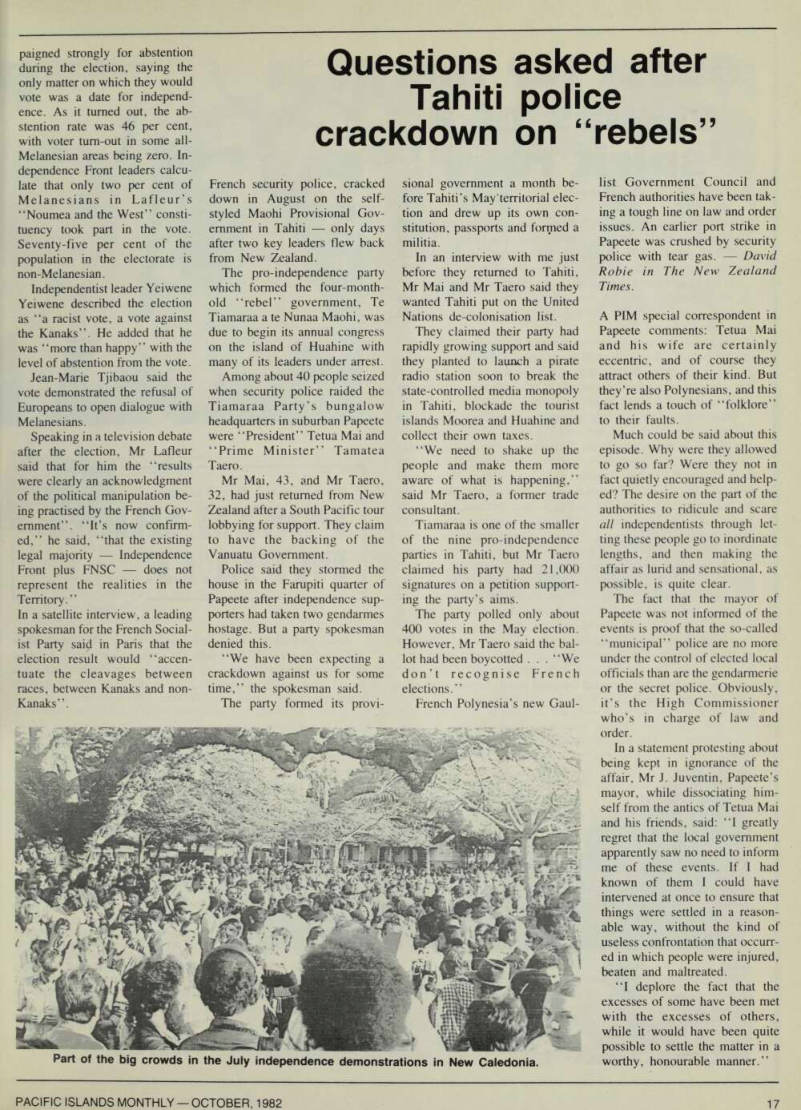
Slogans calling for “uncondi
tional return of our land” have become part of the New
Caledonia independence
pressures.
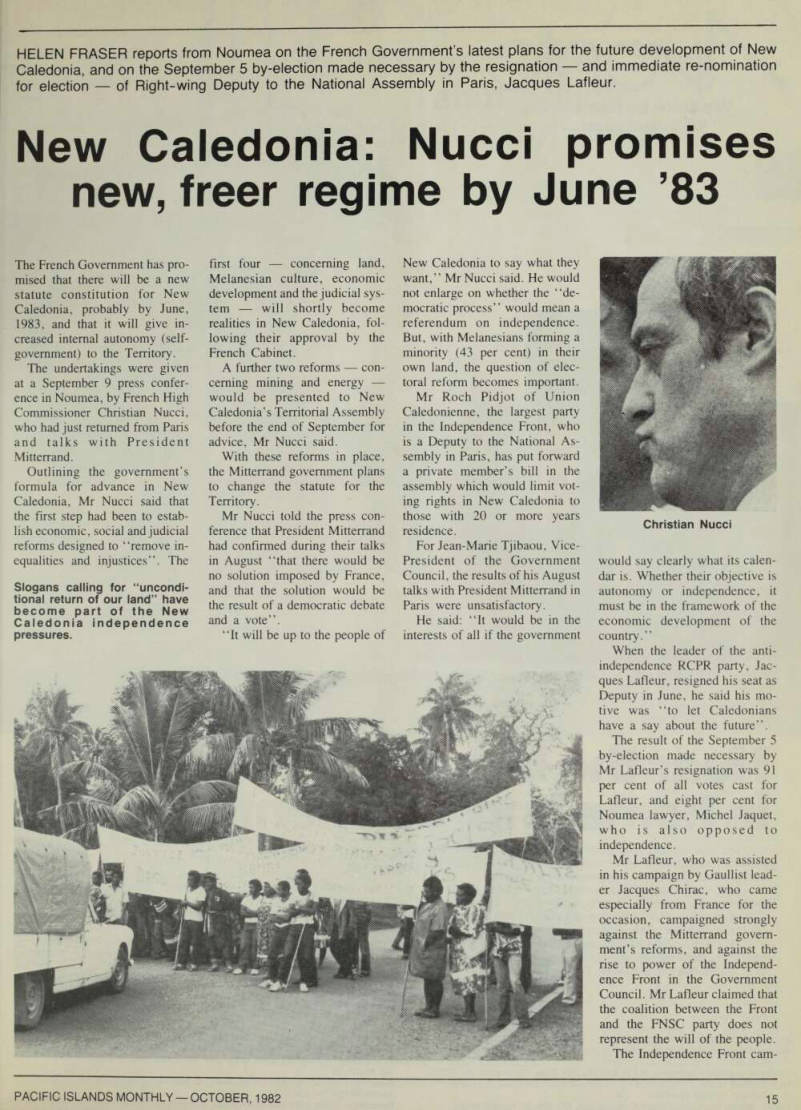
Christian Nucci
paigned strongly for abstention during the election, saying the only matter on which they would vote was a date for independ ence. As it turned out, the ab stention rate was 46 per cent, with voter tum-out in some all- Melanesian areas being zero. In dependence Front leaders calcu late that only two per cent of Melanesians in Lafleur’s “Noumea and the West’’ consti tuency took part in the vote.
Seventy-five per cent of the population in the electorate is non-Melanesian.
Independentist leader Yeiwene Yeiwene described the election as “a racist vote, a vote against the Kanaks”. He added that he was “more than happy’’ with the level of abstention from the vote.
Jean-Marie Tjibaou said the vote demonstrated the refusal of Europeans to open dialogue with Melanesians.
Speaking in a television debate after the election, Mr Lafleur said that for him the “results were clearly an acknowledgment of the political manipulation be ing practised by the French Gov ernment’’. “It’s now confirm ed,” he said, “that the existing legal majority Independence Front plus FNSC does not represent the realities in the Territory.”
In a satellite interview, a leading spokesman for the French Social ist Party said in Paris that the election result would “accen tuate the cleavages between races, between Kanaks and non- Kanaks”.
Part of the big crowds in the July independence demonstrations in New Caledonia.
Advertisements & other items, p. 16 (1 item)
/Vorte
We take better care
of your music.
4/Qnt(zG9
Hear the latest
in home improvements.
The new Avante Systems from Pioneer. Now, you can really beautify your home life with acoustically matched hi-fi components, perfectly integrated for balanced performance.
And, now more than ever, Avante Systems bring you even greater ease of operation. Drawing upon nearly a half-century of audio experience, Pioneer has taken the worry and bother out and put true auto-function convenience in.
On the top-of-the-line Avante G 9 System, to play a tape, you merely touch the amp’s TAPE button, the same for the FM/AM tuner and phono-play functions. The digital synthesizer FM/AM tuner features Memory Preset and Auto-Scan. The Quartz PLL full-auto turntable gives you superb accuracy.
The 3-direct-drive-motor auto-reverse cassette deck, perfect tape handling and the 3-way speaker systems, dynamic clarity. What could be better than that?
But, Pioneer doesn’t stop with great sound and good looks.
In every Avante System (Avante G7/G5/G3/G1), we build in confidence. By taking more care in creating Avante Systems, you get more care-free musical enjoyment. And that’s always a nice way to brighten your home and your life.
(U) PIONEER*
For further information, please contact: Nauru Island: Jacob Enterprises, P.O. Box No. 4, Republic of Nauru Australia: Pioneer Marketing Services Pty. Ltd., P.O. Box 317, Mordialloc, Victoria, 3195 Tahiti: Tahiti Hi-Fi, P.O. Box 848, Papeete, Tahiti Tel: 90-9011 New Caledonia: Menard Pacifique Sari, B.P. 3899, Noumea, New Caledonia Fiji Islands: Brijlal & Company, G.P.O. Box No. 362, Suva, Fiji Islands Tel: 22258 Tel: 48*24*36 .
New Zealand: Monaco Distributors Ltd., 2 Poland Road, Glenfield, Auckland, American Samoa: Transpac Corporation, P.O. Box 1477, Pago Pago, American New Zealand Tel: (09) 444-9144 Samoa 96799 Tel: 633-5224 Norfolk Island: Burns Philo (Norfolk Island) Ltd.. P.O. Box 21. Norfolk Island. Rarotonga: South Seas International Ltd., P.O. Box 49, Rarotonga, Cook Islands_iei. zjz/
Tahiti police
Questions asked after Tahiti police crackdown on “rebels”
French security police, cracked down in August on the self styled Maohi Provisional Gov ernment in Tahiti only days after two key leaders flew back from New Zealand.
The pro-independence party which formed the four-month old “rebel” government, Te Tiamaraa a te Nunaa Maohi, was due to begin its annual congress on the island of Huahine with many of its leaders under arrest.
Among about 40 people seized when security police raided the Tiamaraa Party’s bungalow headquarters in suburban Papeete were “President” Tetua Mai and “Prime Minister” Tamatea Taero.
Mr Mai, 43, and Mr Taero, 32, had just returned from New Zealand after a South Pacific tour lobbying for support. They claim to have the backing of the Vanuatu Government.
Police said they stormed the house in the Farupiti quarter of Papeete after independence sup porters had taken two gendarmes hostage. But a party spokesman denied this.
“We have been expecting a crackdown against us for some time,” the spokesman said.
The party formed its provi
sional government a month be fore Tahiti’s May’territorial elec tion and drew up its own con stitution, passports and formed a militia.
In an interview with me just before they returned to Tahiti, Mr Mai and Mr Taero said they wanted Tahiti put on the United Nations de-colonisation list.
They claimed their party had rapidly growing support and said they planted to launch a pirate radio station soon to break the state-controlled media monopoly in Tahiti, blockade the tourist islands Moorea and Huahine and collect their own taxes.
“We need to shake up the people and make them more aware of what is happening,” said Mr Taero, a former trade consultant.
Tiamaraa is one of the smaller of the nine pro-independence parties in Tahiti, but Mr Taero claimed his party had 21,000 signatures on a petition support
ing the party’s aims.
The party polled only about 400 votes in the May election.
However, Mr Taero said the bal lot had been boycotted . . . “We don’t recognise French elections.”
French Polynesia’s new Gaul
list Government Council and French authorities have been tak ing a tough line on law and order issues. An earlier port strike in Papeete was crushed by security police with tear gas. David Robie in The New Zealand Times.
A PIM special correspondent in Papeete comments: Tetua Mai and his wife are certainly eccentric, and of course they attract others of their kind. But they’re also Polynesians, and this fact lends a touch of “folklore” to their faults.
Much could be said about this episode. Why were they allowed to go so far? Were they not in fact quietly encouraged and help ed? The desire on the part of the authorities to ridicule and scare
all independentists through let
ting these people go to inordinate lengths, and then making the affair as lurid and sensational, as
possible, is quite clear.
The fact that the mayor of Papeete was not informed of the events is proof that the so-called “municipal” police are no more under the control of elected local officials than are the gendarmerie or the secret police. Obviously, it’s the High Commissioner who’s in charge of law and order.
In a statement protesting about
being kept in ignorance of the
affair, Mr J. Juventin, Papeete’s mayor, while dissociating him self from the antics of Tetua Mai and his friends, said; “I greatly regret that the local government apparently saw no need to inform me of these events. If I had known of them I could have intervened at once to ensure that things were settled in a reason able way, without the kind of useless confrontation that occurr ed in which people were injured, beaten and maltreated.
“I deplore the fact that the excesses of some have been met with the excesses of others, while it would have been quite possible to settle the matter in a worthy, honourable manner.”
“spirit road”
Quest for the origins of a “spirit road”
In our “Postmark” article of April we described the small island of Tikopia in the Santa Cruz Group, Solomon Islands, as “the very last paradise” in the Pacific. We hope we managed to communicate to readers a little of our enthusiasm for the place.
At the same time as the Tikopians are the most “conservative” of all Polynesian peoples, they are also the most thoroughly studied and practically all the fieldwork has been done by one man, Sir Raymond Firth!
Since we returned home we have gone through all Firth’s studies (which fill a whole shelf in our library) in order to see what he has to say about the paved road skirting the crater lake which we saluted as “a splendid example of the collective engineering achievement of a small Stone Age tribe”.
Quite surprisingly, the only reference we have been able to find is contained in Firth’s History and Traditions of Tikopia, where (pp 40-41) he mentions that the Tikopians ascribe all stone works in the islands to a group of mythical spirit beings called Fiti-kai kere whom the author identifies with earth-eating Melanesians (FitUVituFiji). “They did this work not by using their hands, but by supernatural powers. According to one account, that of Pa Porima, they said to the stones, ‘You move, and turn your smooth face upwards’. Thereupon the stones moved accordingly, they were not lifted, they crawled of themselves. The result was a series of stone walls, low, long heaps of undressed stone which may well stand as witness to the energies of a former population of Tikopia.
The most impressive of these stone accumulations, that of Te Karoa on the lake shore, resembles a quayside of primitive type. It presents a fairly smooth face of rock, in large slabs, looking as if they might have been put together by human hands, and forming a platform upwards of thirty yards long, a few feet above the water’s edge. If they are indeed of human construction, these stone mounds may have been erected for some ritual purpose analagous to the use of stone marae.”
Although Firth mentions Te Karoa as the site where these walls and mounds are located, he fails, for some strange reason, to point out the existence of the very impressive, definitely hand-made paved road which is more than a metre wide and about two kilometres long.
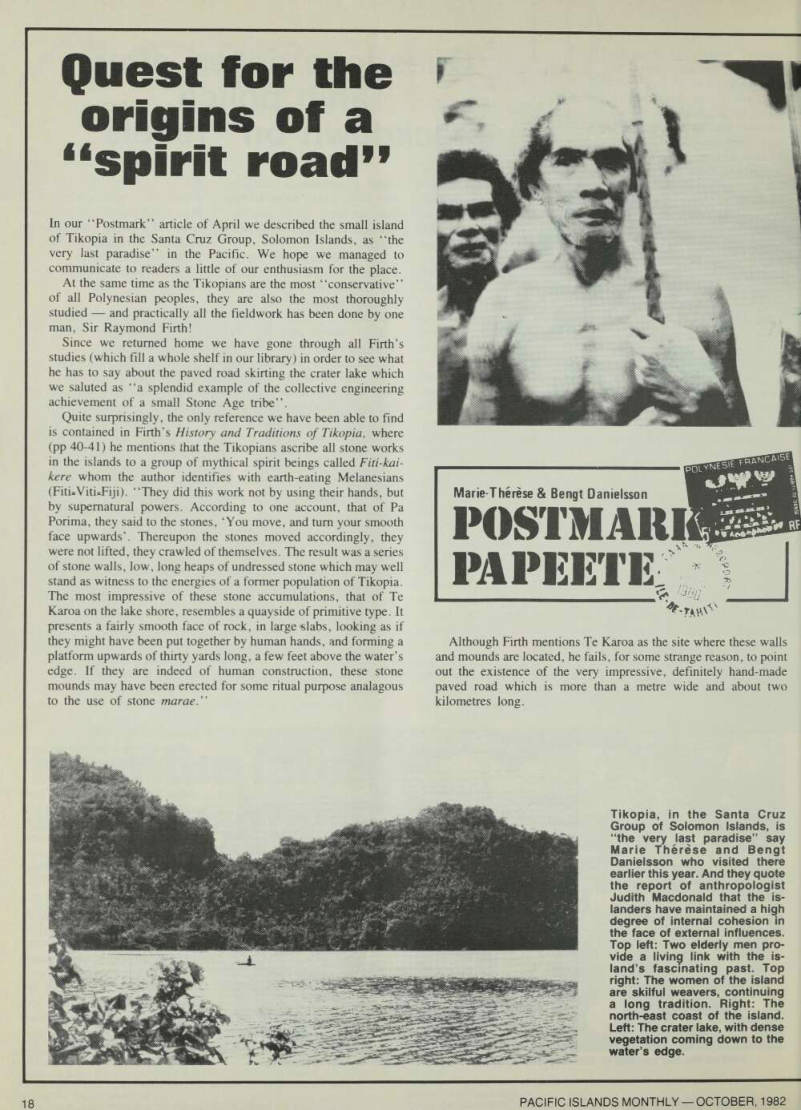
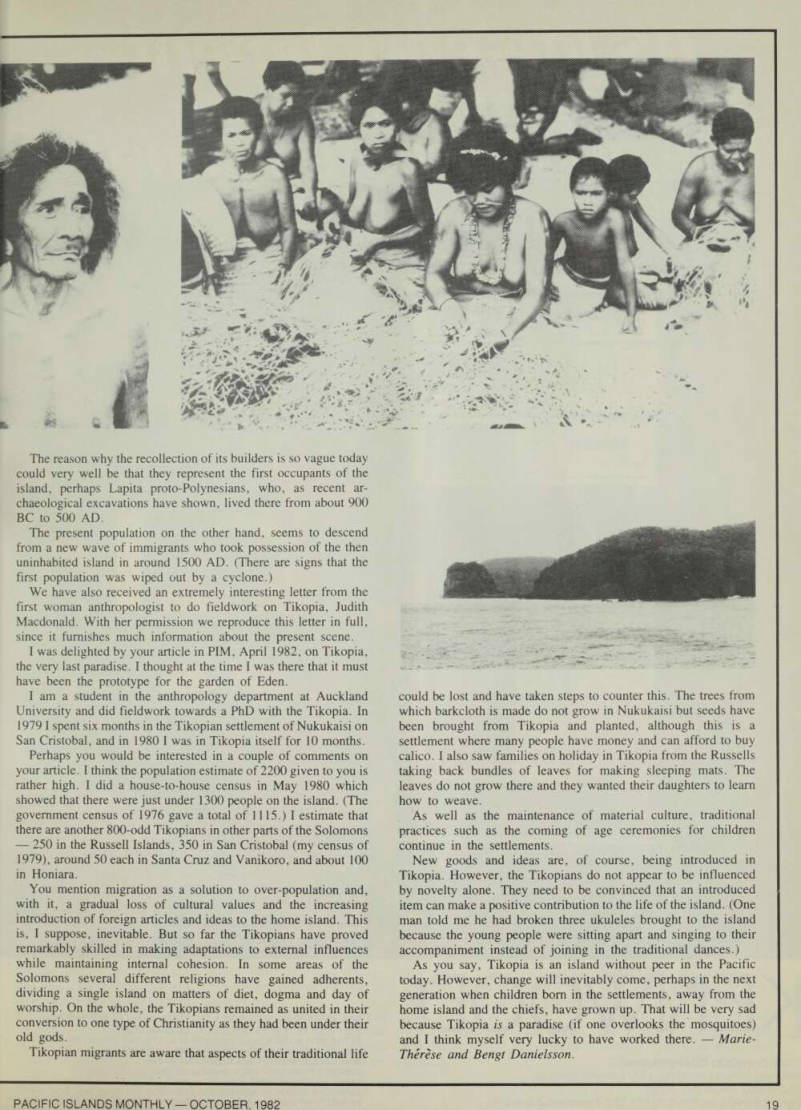
Tikopia, in the Santa Cruz Group of Solomon Islands, is “the very last paradise’’ say Marie Therese and Bengt Danielsson who visited there earlier this year. And they quote the report of anthropologist Judith Macdonald that the is landers have maintained a high degree of internal cohesion in the face of external influences.
Top left: Two elderly men pro vide a living link with the is land’s fascinating past. Top right: The women of the island are skilful weavers, continuing a long tradition. Right: The north-east coast of the island.
Left: The crater lake, with dense vegetation coming down to the water’s edge.
The reason why the recollection of its builders is so vague today could very well be that they represent the first occupants of the island, perhaps Lapita proto-Polynesians, who, as recent ar chaeological excavations have shown, lived there from about 900 BC to 500 AD.
The present population on the other hand, seems to descend from a new wave of immigrants who took possession of the then uninhabited island in around 1500 AD. (There are signs that the first population was wiped out by a cyclone.) We have also received an extremely interesting letter from the first woman anthropologist to do fieldwork on Tikopia, Judith Macdonald. With her permission we reproduce this letter in full, since it furnishes much information about the present scene.
I was delighted by your article in PIM, April 1982, on Tikopia, the very last paradise. I thought at the time I was there that it must have been the prototype for the garden of Eden.
I am a student in the anthropology department at Auckland University and did fieldwork towards a PhD with the Tikopia. In 19791 spent six months in the Tikopian settlement of Nukukaisi on San Cristobal, and in 1980 I was in Tikopia itself for 10 months.
Perhaps you would be interested in a couple of comments on your article. I think the population estimate of 2200 given to you is rather high. I did a house-to-house census in May 1980 which showed that there were just under 1300 people on the island. (The government census of 1976 gave a total of 1115.) I estimate that there are another 800-odd Tikopians in other parts of the Solomons 250 in the Russell Islands, 350 in San Cristobal (my census of 1979), around 50 each in Santa Cruz and Vanikoro, and about 100 in Honiara.
You mention migration as a solution to over-population and, with it, a gradual loss of cultural values and the increasing introduction of foreign articles and ideas to the home island. This is, I suppose, inevitable. But so far the Tikopians have proved remarkably skilled in making adaptations to external influences while maintaining internal cohesion. In some areas of the Solomons several different religions have gained adherents, dividing a single island on matters of diet, dogma and day of worship. On the whole, the Tikopians remained as united in their conversion to one type of Christianity as they had been under their old gods.
Tikopian migrants are aware that aspects of their traditional life
could be lost and have taken steps to counter this. The trees from which barkcloth is made do not grow in Nukukaisi but seeds have been brought from Tikopia and planted, although this is a settlement where many people have money and can afford to buy calico. I also saw families on holiday in Tikopia from the Russells taking back bundles of leaves for making sleeping mats. The leaves do not grow there and they wanted their daughters to learn how to weave.
As well as the maintenance of material culture, traditional practices such as the coming of age ceremonies for children continue in the settlements.
New goods and ideas are, of course, being introduced in Tikopia. However, the Tikopians do not appear to be influenced by novelty alone. They need to be convinced that an introduced item can make a positive contribution to the life of the island. (One man told me he had broken three ukuleles brought to the island because the young people were sitting apart and singing to their accompaniment instead of joining in the traditional dances.) As you say, Tikopia is an island without peer in the Pacific today. However, change will inevitably come, perhaps in the next generation when children bom in the settlements, away from the home island and the chiefs, have grown up. That will be very sad because Tikopia is a paradise (if one overlooks the mosquitoes) and I think myself very lucky to have worked there. Marie- Therese and Bengt Daniels son.
Advertisements & other items, p. 20 (1 item)
Kenwood
IPs life-enrichment.
From Kenwood.
The studio professionals.
The computer-controlled Compact Component Series. It’s not much wider than an LP (350 mm).
But it sounds like king-size stereo. mm i mm *• ♦t* *•* r wm
COMPACT COMPONENT SERIES
Senes-9 A-9 Stereo Integrated Amplifier with Built-in Graphic Equalizer T-9 Quartz Synthesizer AM/FM Tuner with Built-in Program Timer X-9 Computer Cassette Deck with DPSS Direct Program Search System P-9 Vertical Front Loading Computerized Automatic Turntable with Linear Tracking Arm SRM-9 Personality Audio Rack
KENWOOD
★ New corporate symbol
TRIO KENWOOD CORPORATION
Shionogi Shibuya Building, 17-5, 2-chome, Shibuya, Shibuya-ku, Tokyo 150, Japan TRIO-KENWOOD (AUSTRALIA) PTY. LTD. (Incorporated in N.S.W.) NEW ZEALAND JOHN GILBERT & CO., LTD. Auckland Tel. 0011-64-9-30839 FIJI FERE’S DUTY FREE CENTRE LTD. Tel. 26187, 25191 PAPUA NEW GUINEA S.O. SVENSSON (N.G.) LTD. Port Moresby Tel. 42-4467 SOLOMON ISLANDS TECHNIQUE RADIOS CENTRE LTD. Honiara Tel. 416 NEW CALEDONIA HI-FI VOX Noumea Tel. 27-2466 VANUATU FUNG CHOI LUEN. Port-Vila Tel. 2556
TAHITI MAISON AURORE Papeete Tel. 29703
AMERICAN SAMOA ISLAND PACIFIC AGENCIES, INC. Pago Pago Tel. 633-4687
REPUBLIC OF NAURU NAURU CO-OPERATIVE SOCIETY
Guinness?


Tropicalities
Noumea horserace for Guinness?
An event in New Caledonia’s horse racing calendar will figure in The Guinness Book of Records if the publishers accept an appli cation now being prepared by an Australian woman.
Pat Baker, of Long Jetty, New South Wales, is making the ap plication on behalf of her father, jockey Jack Hillier, who died in February at the age of 64.
Jack Hillier first went to New Caledonia in 1947, and he kept returning there, to ride under retainer, until 1977.
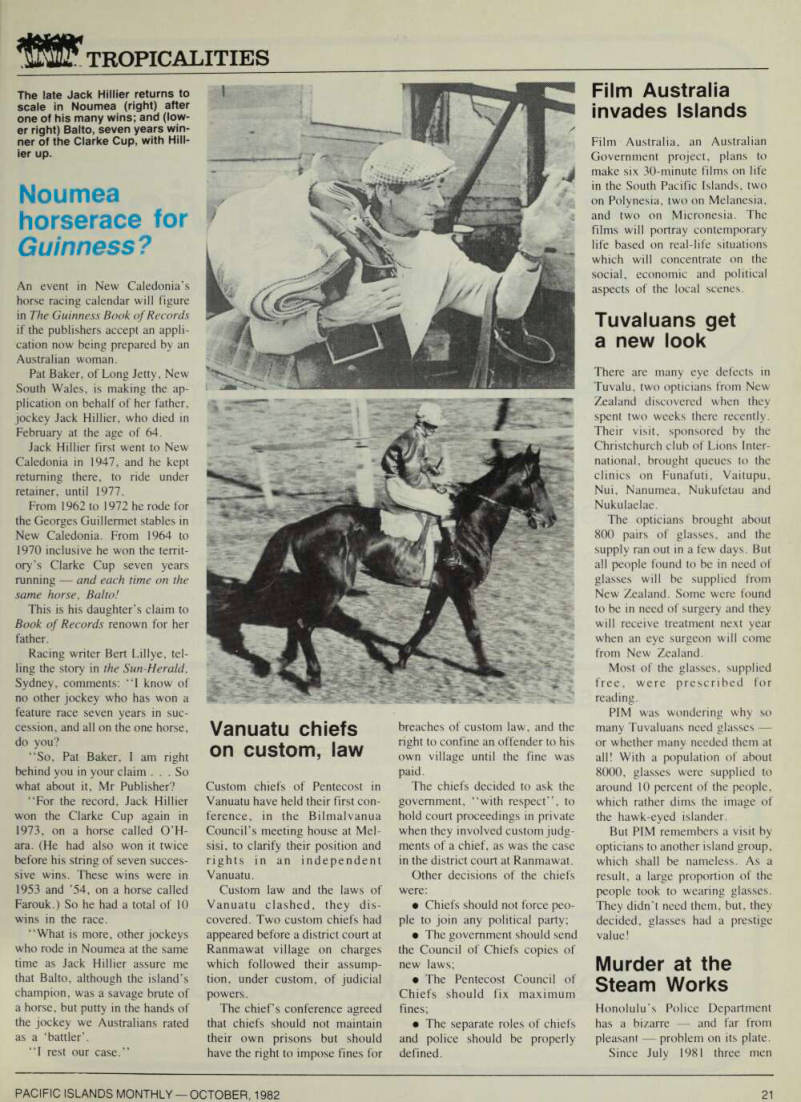
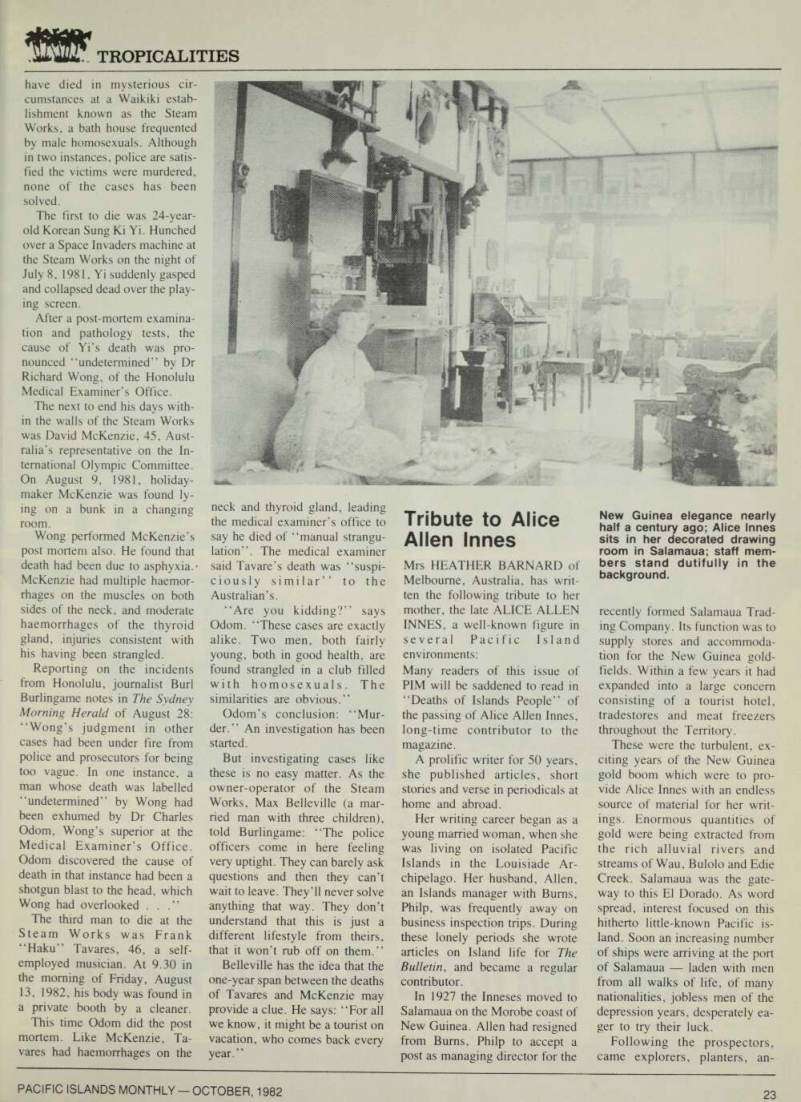
From 1962 to 1972 he rode for the Georges Guillermet stables in New Caledonia. From 1964 to 1970 inclusive he won the territ ory’s Clarke Cup seven years running — and each time on the same horse, Balto!
This is his daughter’s claim to Book of Records renown for her father.
Racing writer Bert Lillye, tel ling the story in the Sun-Herald, Sydney, comments; “I know of no other jockey who has won a feature race seven years in suc cession, and all on the one horse,
do you?
“So, Pat Baker, I am right behind you in your claim ... So what about it, Mr Publisher?
“For the record. Jack Hillier won the Clarke Cup again in 1973, on a horse called O’H ara. (He had also won it twice before his string of seven succes sive wins. These wins were in 1953 and ’54, on a horse called Farouk.) So he had a total of 10 wins in the race.
“What is more, other jockeys who rode in Noumea at the same time as Jack Hillier assure me that Balto, although the island’s champion, was a savage brute of a horse, but putty in the hands of the jockey we Australians rated as a ‘battler’.
“I rest our case.’’
Vanuatu chiefs
on custom, law
Custom chiefs of Pentecost in Vanuatu have held their first con ference, in the Bilmalvanua Council’s meeting house at Mel sisi, to clarify their position and rights in an independent Vanuatu.
Custom law and the laws of Vanuatu clashed, they dis covered. Two custom chiefs had appeared before a district court at Ranmawat village on charges which followed their assump tion, under custom, of judicial powers.
The chief’s conference agreed that chiefs should not maintain their own prisons but should have the right to impose fines for
breaches of custom law, and the right to confine an offender to his own village until the fine was
paid.
The chiefs decided to ask the government, “with respect’’, to hold court proceedings in private when they involved custom judg ments of a chief, as was the case in the district court at Ranmawat.
Other decisions of the chiefs were; • Chiefs should not force peo ple to join any political party; • The government should send the Council of Chiefs copies of new laws; • The Pentecost Council of Chiefs should fix maximum fines; • The separate roles of chiefs and police should be properly defined.
Film Australia
invades Islands
Film Australia, an Australian Government project, plans to make six 30-minute films on life in the South Pacific Islands, two on Polynesia, two on Melanesia, and two on Micronesia. The films will portray contemporary life based on real-life situations which will concentrate on the social, economic and political aspects of the local scenes.
Tuvaluans get
a new look There are many eye defects in Tuvalu, two opticians from New Zealand discovered when they spent two weeks there recently.
Their visit, sponsored by the Christchurch club of Lions Inter national, brought queues to the clinics on Funafuti, Vaitupu, Nui, Nanumea, Nukufetau and Nukulaelae.
The opticians brought about 800 pairs of glasses, and the supply ran out in a few days. But all people found to be in need of glasses will be supplied from New Zealand. Some were found to be in need of surgery and they will receive treatment next year when an eye surgeon will come from New Zealand.
Most of the glasses, supplied free, were prescribed for
reading.
PIM was wondering why so many Tuvaluans need glasses or whether many needed them at all! With a population of about 8000, glasses were supplied to around 10 percent of the people, which rather dims the image of the hawk-eyed islander.
But PIM remembers a visit by opticians to another island group, which shall be nameless. As a result, a large proportion of the people took to wearing glasses.
They didn’t need them, but, they decided, glasses had a prestige value!
Murder at the
Steam Works
Honolulu’s Police Department has a bizarre and far from pleasant problem on its plate.
Since July 1981 three men
The late Jack Hillier returns to scale in Noumea (right) after one of his many wins; and (low er right) Balto, seven years win ner of the Clarke Cup, with Hill ier up.
have died in mysterious cir cumstances at a Waikiki estab lishment known as the Steam Works, a bath house frequented by male homosexuals. Although in two instances, police are satis fied the victims were murdered, none of the cases has been solved.
The first to die was 24-year old Korean Sung Ki Yi. Hunched over a Space Invaders machine at the Steam Works on the night of July 8, 1981, Yi suddenly gasped and collapsed dead over the play ing screen.
After a post-mortem examina tion and pathology tests, the cause of Yi’s death was pro nounced “undetermined” by Dr Richard Wong, of the Honolulu Medical Examiner’s Office.
The next to end his days with in the walls of the Steam Works was David McKenzie, 45, Aust ralia’s representative on the In ternational Olympic Committee.
On August 9, 1981, holiday maker McKenzie was found ly ing on a bunk in a changing room.
Wong performed McKenzie’s post mortem also. He found that death had been due to asphyxia.’
McKenzie had multiple haemor rhages on the muscles on both sides of the neck, and moderate haemorrhages of the thyroid gland, injuries consistent with his having been strangled.
Reporting on the incidents from Honolulu, journalist Burl Burlingame notes in The Sydney Morning Herald of August 28: “Wong’s judgment in other cases had been under fire from police and prosecutors for being too vague. In one instance, a man whose death was labelled “undetermined” by Wong had been exhumed by Dr Charles Odom, Wong’s superior at the Medical Examiner’s Office.
Odom discovered the cause of death in that instance had been a shotgun blast to the head, which Wong had overlooked . . .”
The third man to die at the Steam Works was Frank “Haku” Tavares, 46, a self employed musician. At 9.30 in the morning of Friday, August 13, 1982, his body was found in a private booth by a cleaner.
This time Odom did the post mortem. Like McKenzie, Ta vares had haemorrhages on the
neck and thyroid gland, leading
the medical examiner’s office to say he died of “manual strangu lation”. The medical examiner said Tavare’s death was “suspi ciously similar’’ to the Australian’s.
“Are you kidding?” says Odom. “These cases are exactly alike. Two men, both fairly young, both in good health, are found strangled in a club filled with homosexuals. The similarities are obvious.”
Odom’s conclusion: “Mur der.” An investigation has been started.
But investigating cases like these is no easy matter. As the owner-operator of the Steam Works, Max Belleville (a mar ried man with three children),
told Burlingame; “The police
officers come in here feeling
very uptight. They can barely ask
questions and then they can’t wait to leave. They’ll never solve anything that way. They don’t understand that this is just a different lifestyle from theirs, that it won’t mb off on them.”
Belleville has the idea that the one-year span between the deaths of Tavares and McKenzie may provide a clue. He says: “For all we know, it might be a tourist on vacation, who comes back every year.”
Tribute to Alice
Allen Innes
Mrs Heather Barnard Of
Melbourne, Australia, has writ ten the following tribute to her mother, the late ALICE ALLEN INNES, a well-known figure in several Pacific Island environments: Many readers of this issue of PIM will be saddened to read in “Deaths of Islands People” of the passing of Alice Allen Innes, long-time contributor to the magazine.
A prolific writer for 50 years, she published articles, short stories and verse in periodicals at home and abroad.
Her writing career began as a young married woman, when she was living on isolated Pacific Islands in the Louisiade Ar chipelago. Her husband, Allen, an Islands manager with Bums, Philp, was frequently away on business inspection trips. During these lonely periods she wrote articles on Island life for The Bulletin , and became a regular contributor.
In 1927 the Inneses moved to Salamaua on the Morobe coast of New Guinea. Allen had resigned from Bums, Philp to accept a post as managing director for the
recently formed Salamaua Trad ing Company. Its function was to supply stores and accommoda tion for the New Guinea gold fields. Within a few years it had expanded into a large concern consisting of a tourist hotel, tradestores and meat freezers throughout the Territory.
These were the turbulent, ex citing years of the New Guinea gold boom which were to pro vide Alice Innes with an endless source of material for her writ ings. Enormous quantities of gold were being extracted from the rich alluvial rivers and streams of Wau, Bulolo and Edie Creek. Salamaua was the gate way to this El Dorado. As word spread, interest focused on this hitherto little-known Pacific is land. Soon an increasing number of ships were arriving at the port of Salamaua laden with men from all walks of life, of many nationalities, jobless men of the depression years, desperately ea ger to try their luck.
Following the prospectors, came explorers, planters, an-
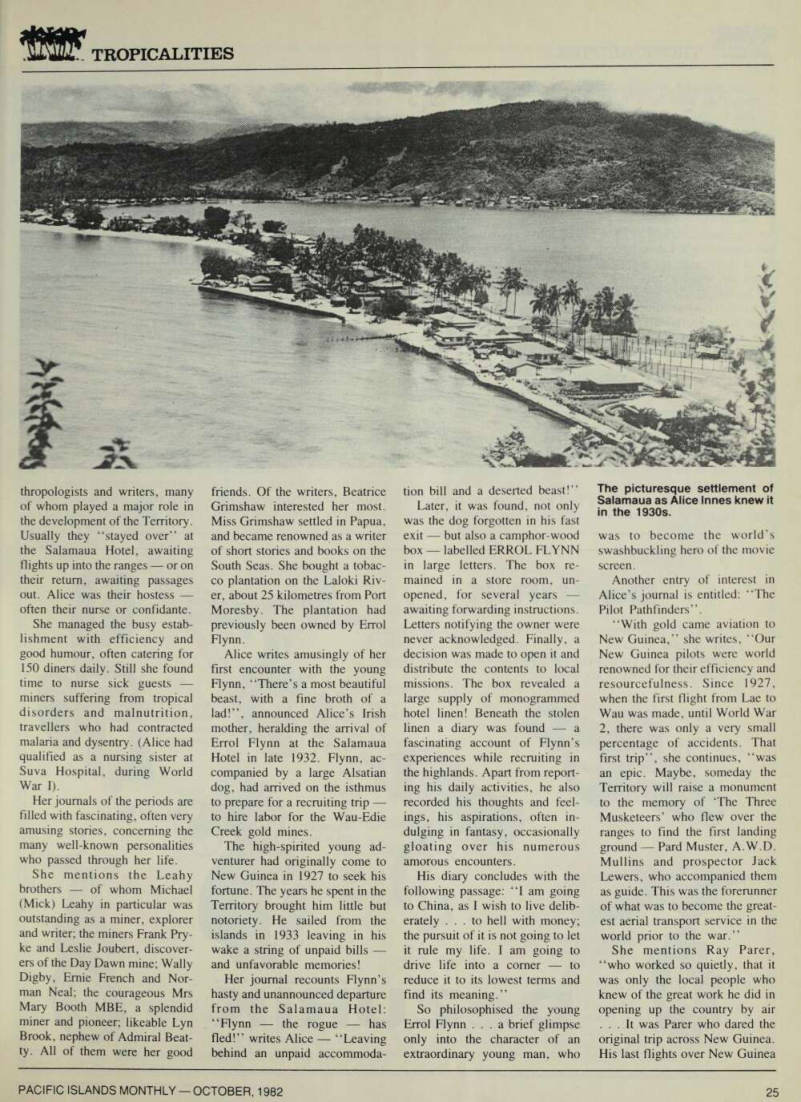
New Guinea elegance nearly
half a century ago; Alice Innes sits in her decorated drawing room in Salamaua; staff mem bers stand dutifully in the background.
thropologists and writers, many of whom played a major role in the development of the Territory.
Usually they “stayed over” at the Salamaua Hotel, awaiting flights up into the ranges or on their return, awaiting passages out. Alice was their hostess often their nurse or confidante.
She managed the busy estab lishment with efficiency and good humour, often catering for 150 diners daily. Still she found time to nurse sick guests miners suffering from tropical disorders and malnutrition, travellers who had contracted malaria and dysentry. (Alice had qualified as a nursing sister at Suva Hospital, during World War I).
Her journals of the periods are filled with fascinating, often very amusing stories, concerning the many well-known personalities who passed through her life.
She mentions the Leahy brothers of whom Michael (Mick) Leahy in particular was outstanding as a miner, explorer and writer; the miners Frank Pry ke and Leslie Joubert, discover ers of the Day Dawn mine; Wally Digby, Ernie French and Nor man Neal; the courageous Mrs Mary Booth MBE, a splendid miner and pioneer; likeable Lyn Brook, nephew of Admiral Beat ty. All of them were her good
friends. Of the writers, Beatrice Grimshaw interested her most.
Miss Grimshaw settled in Papua, and became renowned as a writer of short stories and books on the South Seas. She bought a tobac co plantation on the Laloki Riv er, about 25 kilometres from Port Moresby. The plantation had previously been owned by Errol Flynn.
Alice writes amusingly of her first encounter with the young Flynn, “There’s a most beautiful beast, with a fine broth of a lad!”, announced Alice’s Irish mother, heralding the arrival of Errol Flynn at the Salamaua Hotel in late 1932. Flynn, ac companied by a large Alsatian dog, had arrived on the isthmus to prepare for a recruiting trip to hire labor for the Wau-Edie Creek gold mines.
The high-spirited young ad venturer had originally come to New Guinea in 1927 to seek his fortune. The years he spent in the Territory brought him little but notoriety. He sailed from the islands in 1933 leaving in his wake a string of unpaid bills and unfavorable memories!
Her journal recounts Flynn’s
hasty and unannounced departure
from the Salamaua Hotel: “Flynn the rogue has fled!” writes Alice “Leaving behind an unpaid accommoda
tion bill and a deserted beast!”
Later, it was found, not only was the dog forgotten in his fast exit but also a camphor-wood box labelled ERROL FLYNN in large letters. The box re mained in a store room, un opened, for several years awaiting forwarding instructions.
Letters notifying the owner were never acknowledged. Finally, a decision was made to open it and distribute the contents to local missions. The box revealed a large supply of monogrammed hotel linen! Beneath the stolen linen a diary was found a fascinating account of Flynn’s experiences while recruiting in the highlands. Apart from report ing his daily activities, he also recorded his thoughts and feel ings, his aspirations, often in dulging in fantasy, occasionally gloating over his numerous amorous encounters.
His diary concludes with the following passage: “I am going to China, as I wish to live delib erately ... to hell with money; the pursuit of it is not going to let it rule my life. I am going to drive life into a comer to reduce it to its lowest terms and find its meaning.”
So philosophised the young Errol Flynn ... a brief glimpse only into the character of an extraordinary young man, who
was to become the world’s swashbuckling hero of the movie screen.
Another entry of interest in Alice’s journal is entitled: “The Pilot Pathfinders”.
“With gold came aviation to New Guinea,” she writes, “Our New Guinea pilots were world renowned for their efficiency and resourcefulness. Since 1927, when the first flight from Lae to Wau was made, until World War 2, there was only a very small percentage of accidents. That first trip”, she continues, “was an epic. Maybe, someday the Territory will raise a monument to the memory of The Three Musketeers’ who flew over the ranges to find the first landing ground Pard Muster, A.W.D.
Mullins and prospector Jack Lewers, who accompanied them as guide. This was the forerunner of what was to become the great est aerial transport service in the world prior to the war.”
She mentions Ray Parer, “who worked so quietly, that it was only the local people who knew of the great work he did in opening up the country by air ... It was Parer who dared the original trip across New Guinea.
His last flights over New Guinea
The picturesque settlement of Salamaua as Alice Innes knew it in the 19305.
were to evacuate women and children from areas likely to be invaded by the Japanese.”
Mention is made of other in
trepid Morobe pilots she greatly
admired; ”Les Holden, Bertie Heath, Dickie Mant, J. Sutcliffe and Johnny Jules, who once flew with a six-foot snake wrapp ed around the ‘joystick’ ”...
She explains: ‘‘Johnny’s plane had loaded rice at Lae to take to Ramu. Soon after his arrival at Ramu the weather ‘closed in’, and he was forced to stay over
night . . . After unloading,
traces of rice remained, scattered over the floor of the plane attracting the rats who attract ed the snakes!
“Next morning, Johnny, una
ware of his passengers, flew out from Ramu ... As he was ap proaching the steep Missim peaks, he was suddenly startled to see a large snake crawl out on to the wing of the plane and drop off the edge. No sooner had he recovered than, glancing down, he saw to his horror its
mate gliding towards his feet!
Wrapping itself around his leg, it slowly worked its way up gliding over his hands and on to the ‘joystick’. He daren’t move.
The snake, curling itself around the ‘stick’, began waving its vi cious fangs to and fro, in front of the pilot’s face . . . What a hor
rific experience, poor Johnny.”
The entry concludes: “With grit and control Johnny managed to bring the plane down safely on to the Lae ’drome and promptly fainted!”
Nineteen thirty-seven brought
another aviator briefly into the writer’s life Amelia Earhart.
Earhart was the first woman to cross the Atlantic by air and the first woman to fly it alone. She was then attempting her epic
round-the-world flight.
Tragically, the courageous Amelia Earhart crashed into the Pacific after leaving Lae.
This year marked the final chapter of Island life for Alice.
She was retiring to Sydney to establish a home for her children.
A decade had passed since her arrival, with her husband Allen, on the picturesque isthmus of Salamaua, and 23 years since she sailed from Australia to Fiji, to start a nursing career at what is now the Colonial War Memorial Hospital, Suva an eager young woman of boundless ener gy and inexhaustible curiosity.
These qualities, together with a bubbling sense of fun and a deep interest in people, were to remain with her all her long life, reward ing her with many rich experi ences and personal encounters.
Tuvalu’s seamen
“tops” Swire
Five Tuvaluan seamen serving in the Pacific Cutlass, a freighter which sank off Singapore earlier this year without loss of life,
have been praised by the ship’s
master for “their courage, skill and, generally, excellent be haviour.” Swire Pacific Offshore Ship Management Ltd. has told the Tuvalu Government
that the company has three new vessels coming into service and wants to crew them with Tuva luans. Both Tuvalu and Kiribati, former partners in the British colony of the Gilbert and Ellice Islands, have maritime schools whose graduates are sought after
by many shipping companies.
Big men, chiefs,
and mariners
The large, three-storey lava-rock
building has crowned this small hill for almost a century. Making our way around construction that will soon add a new pavilion, we enter the handsome lobby, pass up a broad flight of polished wooden stairs, and into a quiet, air-conditioned, two-tiered gal lery featuring artefacts from the Pacific Islands.
Here lurk Fijian war clubs which were given names and greatly feared after killing a man, mysterious Easter Island carv
ings often representing human
faces and bodies, and strange
masks and doll-like figures from Melanesia.
For over 90 years, Honolulu’s Bishop Museum has been a trea sure trove of objects from the Pacific. Now, in addition to its fine display of Hawaiian and Pacific objects in the main hall, the museum has added a perma nent show, Big Men, Chiefs and Mariners, which represents trad itional cultures of Melanesia, Polynesia, and Micronesia. It is well worth seeing.
Masks and costumes from Melanesia, decorated with feath ers and shells, and painted in vivid colors, seem to be waiting expectantly for someone to put them on. A film of their ceremo nial use would make these ob jects come alive. The imagina tion goes back to old Tarzan movies where costumed voodoo figures jumped out of deep jung le growth to chant strange spells and encourage warriors shooting poison darts (usually at Wester ners in pith helmets and tropical garb). But this is the Pacific, not darkest Africa.
One full-length garment from New Caledonia has a body cov ering of dark feathers and a wooden mask covered with hu man hair and beard. Handed down through successive genera tions, the costume was believed to embody the female forces of the universe, and was used in ceremonies to bring rain and abundance on land and sea.
Many of the Melanesian ob jects were thought to incorporate life forces, such as the masks that represented spirits or reincar nated dead ancestors. Made of rattan and covered with painted bark, they were used in dances, or in boys’ initiation ceremonies.
Are the spirits still there, lurk ing behind the museum’s glass cases? The answer depends on belief systems. Some Melanesian societies did think that spirits should be transferred from older deteriorating masks to new ones where they were believed to be happier. The older masks would be left out to rot, or perhaps given to museum expeditions.
One imagines it is 200 years ago in Polynesia.
It is a dark night and the surf pounds in the distance. Religious leaders in fluttering garments ap-
pear on a temple laboriously made of stones from distant mountains. In the midst of strict ceremonies a wooden image is raised to the heavens. Chants ask one of a pantheon of gods to enter the carving.
Today, only the stone temples remain; widespread belief in an cient religions did not long sur vive Western contact and missio nary efforts in Polynesia. But museums hold much that was collected by earlier visitors. Here are three Society Island god fi gures, each about 40 centimetres high. Two of the figures are club-shaped and made of braided coconut fibre; they represented important state gods and were once covered with the red feath ers which in Tahiti, the Mar quesas, and Hawaii were con sidered symbols of power.
The Tahitian mourner’s cos tume collected on Cook’s second voyage must have been used in religious ceremonies. It is amaz ingly intricate: a mask made of large pieces of mother-of-pearl shell is surrounded by long bird feathers, a rare feather cloak cov ers the back, and the chest is hidden behind hundreds of pieces of pearl shell below which hang coconut shell discs over a bark cloth apron. Surely an approp
riate costume for anyone who wanted to look like a spirit.
From the Marquesas there are carved, two-metre, wooden god figures that would have been used on a temple. There is a surprisingly large number of pieces from these islands, an area little heard of since the Mar quesan population was de cimated by Western diseases and blackbirding in the 19th century.
Many of the objects are for per sonal adornment indicating that the Marquesan chiefly classes moved about well ornamented.
Widely dispersed over the northern latitudes of the Pacific are the small islands of Mic ronesia. Not as romantic as fabl ed Polynesia, they are often poorly represented in museum exhibits. Happily that isn’t the case here.
A doll-like figure, made partly of stingray spines and clothed in coconut leaf, represents a type of Micronesian religious life. It is said to have been used as a magical means of dispelling storms at Lamotrek in the Yap Islands.
Stone money from Yap has become famous throughout the world. There pieces of stone were quarried on a distant island and came to be used as money;
even today large pieces can be seen leaning against a coconut tree or house, their ownership known to everyone. The exhibit also includes small pieces of this money, as well as a turtle shell dish used as money in Belau.
From the Carolines there is a man’s belt decorated with shell money.
Throughout the Pacific, shells were also used for personal adornment, and the museum has an arresting example of an ear ring from the Carolines made of nearly 100 interconnected circles of coconut shell, conus shell, turtle shell, and a few trade beads. Hung from a pierced ear, it would have reached the shoul der of the highly decorated wearer.
The famous grass skirt as seen in old movies is still worn in parts of Micronesia, although it is not exhibited here. But skirts made from the dried fibre of the banana stalk and the inner bark of the hibiscus have continued to be woven on looms and used in Truk and the Carolines, several examples testify to the beauty of the weaving which allows for varied patterns and different colors.
Leaving the exhibit and its world of traditional Pacific life and beliefs, one pauses in the bright sunshine as cars whiz by on a nearby highway, jet aircraft cross the sky, and high-rise buildings crowd in the distance.
Western contact has certainly changed Hawaii. One has to wonder about the future of other Pacific Island states, and give thanks that here in the Bishop Museum some of the past at least
is being preserved.
Robert
Graham
in Honolulu.
Marianas name
their bird
The Legislature of the Common wealth of the Northern Marianas has passed a bill naming the Paluman Tottut, the Marianas Fruit Dove, as the common wealth’s national bird. A move to declare the bird an “en dangered species’’ was defeated.
The Paluman Tottut is described as the only bird in Micronesia with the colors of the Bird of Paradise.
The 93-year-old lava-rock building of the Bernice P. Bishop Museum, Honolulu. It’s getting a new pavilion and has already opened a new Pacific display, writes Robert Graham.
Advertisements & other items, pp. 22-30 (1 item)
Expert
Insurance Service
throughout the islands
1 I
Queensland Insurance (Fiji) Limited
Head Office. 34 Usher St.. SUVA . General Manager; L. G. Liddell A.A.1.1. Assistant Managers : R. Jackson. Vijay Lai Phone: 23851 LAUTOKA OFFICE; Burns Philp Bldg., Naviti St. District Manager; J. Dalton. Phone: 60642.
LABASA OFFICE: Burns Philp Bldg. District Manager; R. SHARMA. Phone; 8 2139
Queensland Insurance (PNG) Limited
PAPUA NEW GUINEA
Head Office. B.N.G. Building, Musgrave St..PORT MORESBY. General Manager: J. M. Dawe Phone: 212144.
LAE: 4th St & Coronation Drive. District Manager: C D. Hillier Phone: 423873 MOUNT HAGEN: Hagen Drive District Manager: G. W. Jack Phone: 521002.
ARAWA: Chebu St. District Manager: J. Longbut. Phone: 951555 MADANG: Kasagten St. District Manager: N. D. Ramage. Phone: 822020.
RABAUL: Wirraway St. District Manager; W. F Tinker. Phone: 921014.
QBE Insurance (International) Limited
VANUATU, PORT VILA: Rue de Paris, Suite 19, Oceania Bldg. Manager: I. R. Martin.
Phone; 2299.
SANTO: Burns Philp (Vanuatu) Ltd. Phone: 230.
PACIFIC AGENCIES
NEW CALEDONIA, Ste. W. A. Johnston, S.A.R.L. 5 Rue Anatole France, NOUMEA Phone: 272083.
TAHITI: Arthur Chung. Immeuble 8.1.5., Front de Mer, PAPEETE . Phone: 2.86.19 NIUE: Burns Philp (South Sea) Company Ltd.
NORFOLK ISLAND: Burns Philp (*N I ) Company Ltd. Phone: 2191 SAMOA APIA, Burns Philp (South Sea) Company Ltd. Phone: 22611 TONGA: Burns Philp (South Sea) Company Ltd. NUKUALOFA Phone 21500 HAAPAI, VAVAU &
MEMBERS OF THE
QBE INSURANCE GROUP LIMITED
The Progressive Automobile Manufacturer for The 80’s.
SUZUKI MOTOR CO , LTD
SOOTakatsuka, Hamamatsu. Japan suzuki 4 ft Hl ft 4
OUND PERFORMER
ft A HOTO: Canadian version Vv* \
SSBOF
f- s/w 'V»\. o SUZUKI Vehicles are shipped to approximately 100 countries throughout the world and are well received by users in those countries. Behind the high-quality of SUZUKI 4wheelers is the in-depth research carried out from all aspects, rigorous tests and an extensive after-sales service net-work. Vehicles that are ready when you need them and which you can trust when driving. SUZUKI Vehicles.
SUIOKI the name mlamm.
SOLOMON ISLANDS SOLOMON ISLAND SERVICE STATION LTD. NEW CALEDONIA STE. SUPERCAL PAPUA NEW GUINEA PACIFIC AMI VANUATU HENRI LEROUX NIUE ISLAND BURNS PHILP (SOUTH SEA) CO., LTD. PONAPE LEO ETSCHEIT TAHITI NIPPON AUTOMOTO GUAM & SAIPAN ISLAND CYCLERY. INC. NORFOLK MARTIN'S AGENCIES LTD. SAMOA
DeZURBK
A complete valve range in a multitude of material and specification options in sizes %” - 72” with manual, pneumatic, hydraulic or electric actuators. Proven worldwide in municipal, industrial and process applications.
Electric Control Valves Resilient Seated Butterfly Valves V-port Ball Valves Paper Stock Consistency Transmitters Eccentric Plug Valves Ip i w I Knife Gate Valves V. a ursjrr of general signal High Pressure Butterfly Valves
DeZURIK
DeZURIK OF AUSTRALIA PTY. LTD., P.O. Box 204, Vineyard Road, Sunbury, Victoria 3429, Australia. Telephone: 03-744-2244, Telex: AA33732. dz - AUS. 020 - A
In our 87th Year Selling ‘Service’ to the Pacific Islands
Nelson & Robertson
Pty. Ltd.
(Established 1895)
* O <Vr m O.
RABAUL
MADANG
LAE
m.
KIETA
* • ••• •• •v ... . • / ..V.-.V; •*.v. •• • • 'h
BRISBANE
SYDNEY
. •*• •• tv / ••• Plantation House, 197 Clarence Street, Sydney.
Cables: ‘IVAN’, Sydney, Brisbane.
Telex: AA22381, Sydney.
Phone: 29 2871 •v.:
LAI TOKA
For Indents
from Australia,
New Zealand and Overseas
Foodstuffs
Softgoods
Hardware
Machinery
Travel
Insurance
Canned Fish
Jute Goods
Real Estate
SUVA
BRANCH OFFICES:
Nelson & Robertson Pty. Ltd., P.O. Box 575, Brisbane, Qld., Australia. 2216966 P.O. Box 2092, Govt. Bldg., Suva, Fiji. 22430 P.O. Box 258, Lautoka, Fiji. 62101 P.O. Box 2420, CPO Auckland 1, New Zealand. 774141 c ND
."•:::PAPUA NEW GUINEA REPRESENTATIVES:
Hi Pty. Ltd., Rabaul, P.N.G. 922911 . Box 1406, Lae, P.N.G. 422366 0. Box 711, Madang, P.N.G. 822066 • P.O. Box 253, Kieta, P.N.G. 956185 P.O Bo
!□□□ or
AIR PACiriC
ANNOUNCES
1 w A
fares
nnnnnnnnnnnnnnc
Island hopping in the Pacific is now so much cheaper with Air
Pacific's new PACIFIC ISLAND EXCURSION FARES.
Just name the Pacific Island Country you want to travel to in our route network and we will give you a fare that is hard to resist. *Group Travel Minimum 6.
Individual Excursion Fare also available.
For details and bookings travel agent or Air Pacific. contact your
p&cific
Your Island in the sky
0 9
uimS' ;
* i 8 w ‘&& mMC**
p r *
#*. m *jf H
Jr *• g* f r * r i < * .♦ ■ <ri 4L ■*% s •4/ 1 / I « * r n a m ** c % . »•>'< ‘ .v-
Let Your Imagination Run Wild
Imagine the dynamic sound of a quality stereo system. And imagine how nice it would be if you could take this sound along with you wherever you go. A fairy tale? Not at Sansui.
We let our imagination run wild and devel oped Portable Component Systems, the newest Sansui Hi-Tech Compo sound idea.
The creative folks at Sansui borrowed many advanced features from full-size home components. Next, we packed mini-component-sized packages. And as a final touch, we snapped them together and attached a convenient carrying handle.
The result? Dynamic sounding portables that disassemble to form full-feature mini component systems.
Sansui. Imagine what we'll do next. iat we ll do xt. *** them a into tiny fr n n» c o<> * c o «o o Sfl/I S 111 SANSUI ELECTRIC CO., LTD. 14-1 Izumi 2-chome, Sugmami-ku, Tokyo 168, Japan. • Australia VANFI (Aust.) Pty. Ltd. 297, City Road, South Melbourne, Victoria 3205, Australia Phone: 690-6200/283 Alfred Street, North Sydney, N.S.W. 2060, Australia Phone: 929-0293 Tiji Prabhu Brothers Ltd. RO. Box 183, Nadi Phone: 71122 • Papua New Guinea Oceania Indent Agency (P.N.G.) Pty. Ltd. Box 5518, Boroko, Port Moresby Phone:
People
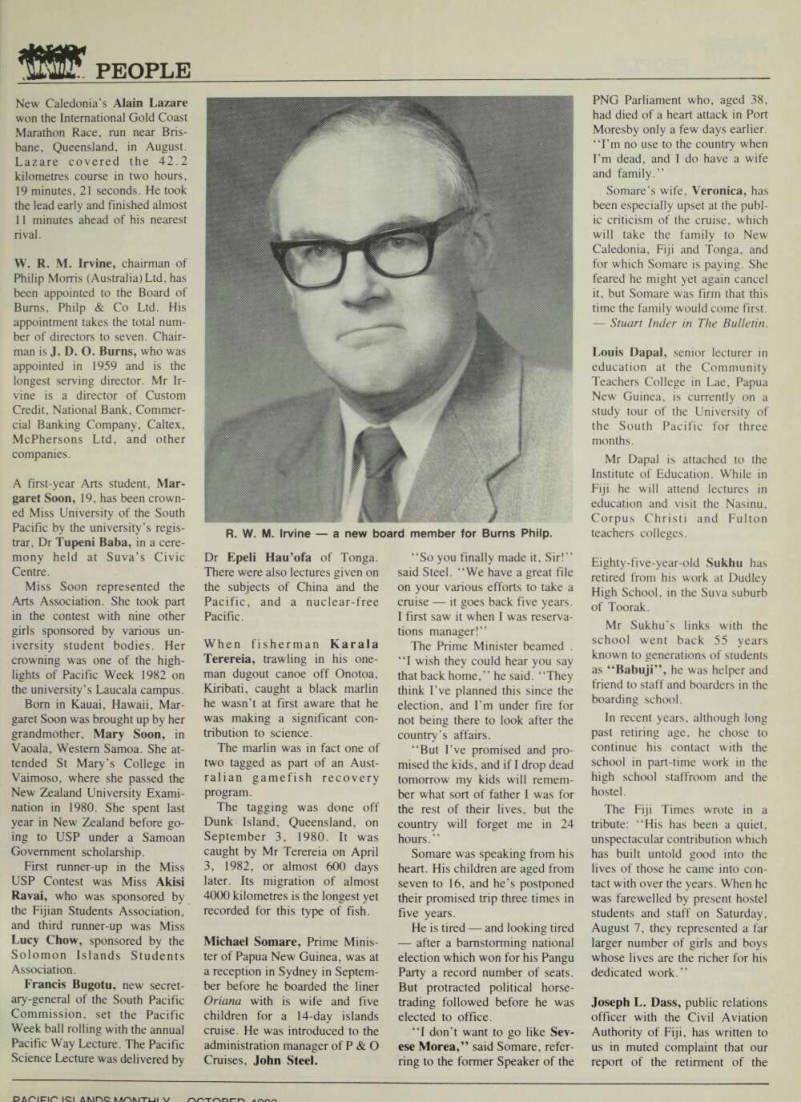
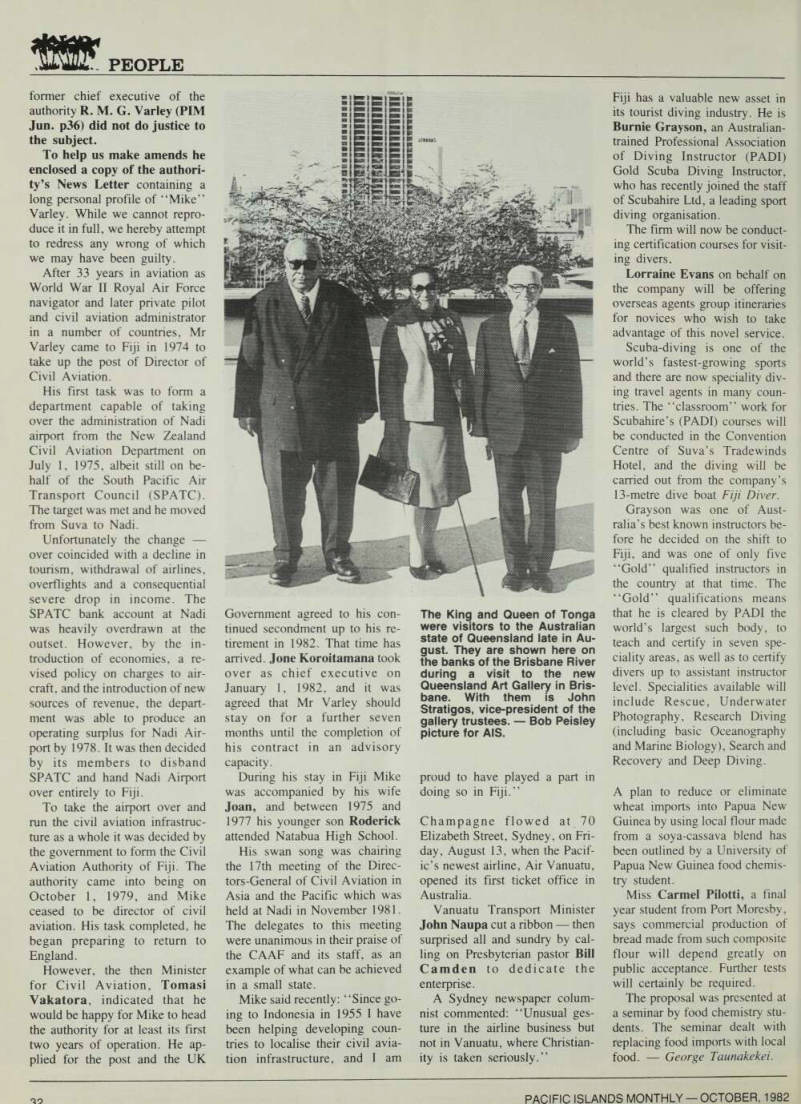
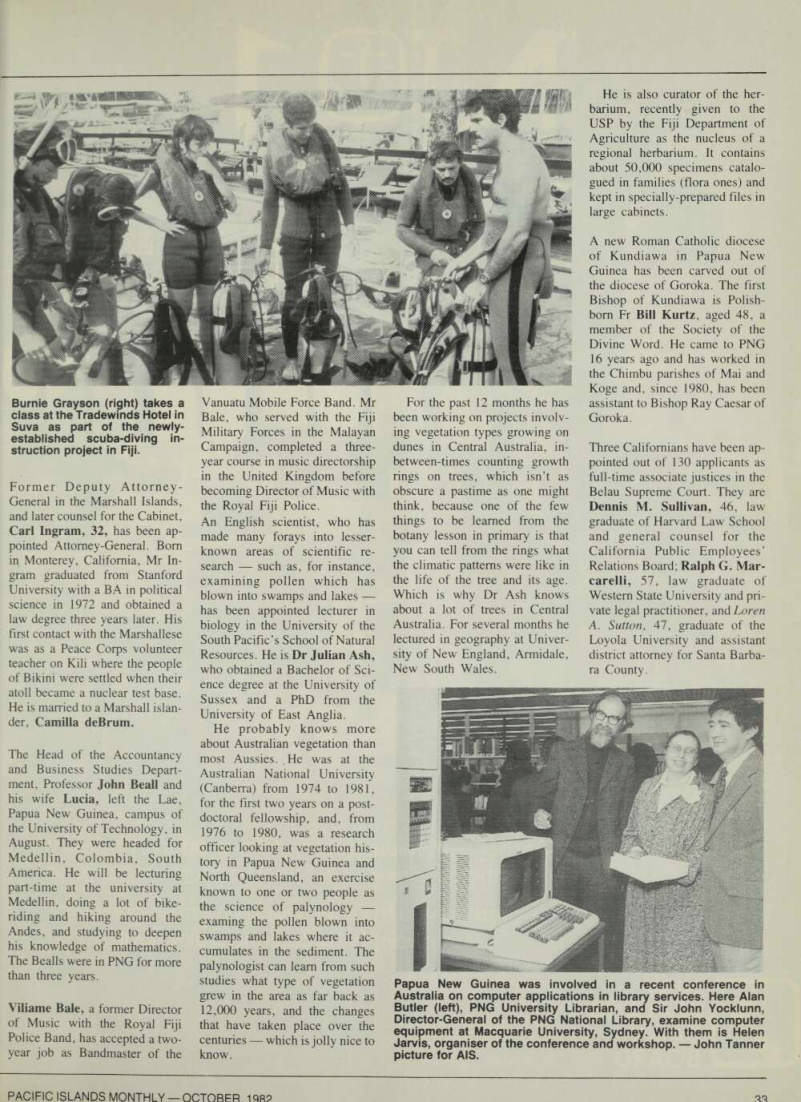
New Caledonia’s Alain Lazare won the International Gold Coast Marathon Race, run near Bris bane, Queensland, in August.
Lazare covered the 42.2 kilometres course in two hours, 19 minutes, 21 seconds. He took the lead early and finished almost 11 minutes ahead of his nearest rival.
W. R. M. Irvine, chairman of Philip Morris (Australia) Ltd, has been appointed to the Board of Bums, Philp & Co Ltd. His appointment takes the total num ber of directors to seven. Chair man is J. D. O. Burns, who was appointed in 1959 and is the longest serving director. Mr Ir vine is a director of Custom Credit, National Bank, Commer
cial Banking Company, Caltex,
McPhersons Ltd, and other
companies.
A first-year Arts student, Mar garet Soon, 19, has been crown ed Miss University of the South Pacific by the university’s regis trar, Dr Tupeni Baba, in a cere mony held at Suva’s Civic Centre.
Miss Soon represented the Arts Association. She took part in the contest with nine other
girls sponsored by various un
iversity student bodies. Her crowning was one of the high lights of Pacific Week 1982 on the university’s Laucala campus.
Bom in Kauai, Hawaii, Mar garet Soon was brought up by her grandmother, Mary Soon, in Vaoala, Western Samoa. She at tended St Mary’s College in Vaimoso, where she passed the New Zealand University Exami nation in 1980. She spent last year in New Zealand before go ing to USP under a Samoan
Government scholarship.
First runner-up in the Miss USP Contest was Miss Akisi Ravai, who was sponsored by the Fijian Students Association, and third runner-up was Miss Lucy Chow, sponsored by the Solomon Islands Students Association.
Francis Bugotu, new secret ary-general of the South Pacific Commission, set the Pacific Week ball rolling with the annual Pacific Way Lecture. The Pacific Science Lecture was delivered by
Dr Epeli Hau’ofa of Tonga.
There were also lectures given on the subjects of China and the Pacific, and a nuclear-free Pacific.
When fisherman Karala Terereia, trawling in his one man dugout canoe off Onotoa, Kiribati, caught a black marlin he wasn’t at first aware that he was making a significant con tribution to science.
The marlin was in fact one of two tagged as part of an Aust ralian gamefish recovery program.
The tagging was done off Dunk Island, Queensland, on September 3, 1980. It was caught by Mr Terereia on April 3, 1982, or almost 600 days later. Its migration of almost 4000 kilometres is the longest yet recorded for this type of fish.
Michael Somare, Prime Minis ter of Papua New Guinea, was at a reception in Sydney in Septem ber before he boarded the liner Oriana with is wife and five children for a 14-day islands cruise. He was introduced to the administration manager of P & O Cruises, John Steel.
‘‘So you finally made it. Sir!” said Steel. ‘‘We have a great file on your various efforts to take a cruise it goes back five years.
I first saw it when I was reserva tions manager!”
The Prime Minister beamed .
“I wish they could hear you say that back home,” he said. ‘They think I’ve planned this since the election, and I’m under fire for not being there to look after the country’s affairs. ‘‘But I’ve promised and pro mised the kids, and if I drop dead tomorrow my kids will remem ber what sort of father I was for the rest of their lives, but the country will forget me in 24 hours.”
Somare was speaking from his heart. His children are aged from seven to 16, and he’s postponed their promised trip three times in five years.
He is tired and looking tired after a barnstorming national election which won for his Pangu Party a record number of seats.
But protracted political horse
trading followed before he was elected to office.
“I don’t want to go like Sev esc Morea,” said Somare, refer ring to the former Speaker of the
PNG Parliament who, aged 38, had died of a heart attack in Port Moresby only a few days earlier.
“I’m no use to the country when I’m dead, and I do have a wife
and family.”
Somare’s wife, Veronica, has been especially upset at the publ ic criticism of the cruise, which will take the family to New Caledonia, Fiji and Tonga, and for which Somare is paying. She feared he might yet again cancel it, but Somare was firm that this time the family would come first.
Stuart Inder in The Bulletin.
Louis Dapal, senior lecturer in education at the Community Teachers College in Lae, Papua New Guinea, is currently on a study tour of the University of the South Pacific for three months.
Mr Dapal is attached to the Institute of Education. While in Fiji he will attend lectures in education and visit the Nasinu, Corpus Christi and Fulton
teachers colleges.
Eighty-five-year-old Sukhu has retired from his work at Dudley High School, in the Suva suburb of Toorak.
Mr Sukhu’s links with the school went back 55 years known to generations of students as “Babuji”, he was helper and friend to staff and boarders in the
boarding school.
In recent years, although long past retiring age, he chose to continue his contact with the school in part-time work in the high school staffroom and the hostel.
The Fiji Times wrote in a tribute; ”His has been a quiet, unspectacular contribution which has built untold good into the lives of those he came into con tact with over the years. When he was farewelled by present hostel students and staff on Saturday, August 7, they represented a far
larger number of girls and boys
whose lives are the richer for his dedicated work.”
Joseph L. Dass, public relations officer with the Civil Aviation Authority of Fiji, has written to us in muted complaint that our report of the retirment of the
R. W. M. Irvine a new board member for Burns Philp.
former chief executive of the authority R. M. G. Varley (PIM Jun. p 36) did not do justice to the subject.
To help us make amends he enclosed a copy of the authori ty’s News Letter containing a long personal profile of “Mike”
Varley. While we cannot repro duce it in full, we hereby attempt to redress any wrong of which we may have been guilty.
After 33 years in aviation as World War II Royal Air Force navigator and later private pilot and civil aviation administrator in a number of countries, Mr Varley came to Fiji in 1974 to take up the post of Director of Civil Aviation.
His first task was to form a department capable of taking over the administration of Nadi airport from the New Zealand Civil Aviation Department on July 1, 1975, albeit still on be half of the South Pacific Air Transport Council (SPATC).
The target was met and he moved from Suva to Nadi.
Unfortunately the change over coincided with a decline in tourism, withdrawal of airlines, overflights and a consequential severe drop in income. The SPATC bank account at Nadi was heavily overdrawn at the outset. However, by the in troduction of economies, a re vised policy on charges to air craft, and the introduction of new sources of revenue, the depart ment was able to produce an operating surplus for Nadi Air port by 1978. It was then decided by its members to disband SPATC and hand Nadi Airport over entirely to Fiji.
To take the airport over and run the civil aviation infrastruc ture as a whole it was decided by the government to form the Civil Aviation Authority of Fiji. The authority came into being on October 1, 1979, and Mike ceased to be director of civil aviation. His task completed, he began preparing to return to England.
However, the then Minister for Civil Aviation, Tomasi Vakatora, indicated that he would be happy for Mike to head the authority for at least its first two years of operation. He ap plied for the post and the UK
Government agreed to his con tinued secondment up to his re tirement in 1982. That time has arrived. Jone Koroitamana took over as chief executive on January 1, 1982, and it was agreed that Mr Varley should stay on for a further seven months until the completion of his contract in an advisory
capacity.
During his stay in Fiji Mike was accompanied by his wife Joan, and between 1975 and 1977 his younger son Roderick attended Natabua High School.
His swan song was chairing the 17th meeting of the Direc tors-General of Civil Aviation in Asia and the Pacific which was held at Nadi in November 1981.
The delegates to this meeting were unanimous in their praise of the CAAF and its staff, as an example of what can be achieved in a small state.
Mike said recently: “Since go ing to Indonesia in 1955 I have
been helping developing coun
tries to localise their civil avia tion infrastructure, and I am
proud to have played a part in doing so in Fiji.”
Champagne flowed at 70 Elizabeth Street, Sydney, on Fri day, August 13, when the Pacif ic’s newest airline, Air Vanuatu, opened its first ticket office in Australia.
Vanuatu Transport Minister John Naupa cut a ribbon then surprised all and sundry by cal ling on Presbyterian pastor Bill Camden to dedicate the enterprise.
A Sydney newspaper colum nist commented: “Unusual ges ture in the airline business but not in Vanuatu, where Christian ity is taken seriously.”
Fiji has a valuable new asset in its tourist diving industry. He is Burnie Grayson, an Australian trained Professional Association of Diving Instructor (PADI) Gold Scuba Diving Instructor, who has recently joined the staff of Scubahire Ltd, a leading sport
diving organisation.
The firm will now be conduct ing certification courses for visit
ing divers.
Lorraine Evans on behalf on the company will be offering overseas agents group itineraries for novices who wish to take advantage of this novel service.
Scuba-diving is one of the world’s fastest-growing sports and there are now speciality div ing travel agents in many coun tries. The “classroom” work for Scubahire’s (PADI) courses will be conducted in the Convention Centre of Suva’s Trade winds Hotel, and the diving will be carried out from the company’s 13-metre dive boat Fiji Diver.
Grayson was one of Aust ralia’s best known instructors be fore he decided on the shift to Fiji, and was one of only five “Gold” qualified instructors in the country at that time. The “Gold” qualifications means that he is cleared by PADI the world’s largest such body, to teach and certify in seven spe ciality areas, as well as to certify divers up to assistant instructor level. Specialities available will include Rescue, Underwater
Photography, Research Diving
(including basic Oceanography and Marine Biology), Search and
Recovery and Deep Diving.
A plan to reduce or eliminate wheat imports into Papua New Guinea by using local flour made from a soya-cassava blend has been outlined by a University of Papua New Guinea food chemis try student.
Miss Carmel Pilotti, a final year student from Port Moresby, says commercial production of bread made from such composite flour will depend greatly on public acceptance. Further tests
will certainly be required.
The proposal was presented at a seminar by food chemistry stu dents. The seminar dealt with replacing food imports with local
food.
George Taunakekei.
The King and Queen of Tonga were visitors to the Australian state of Queensland late in Au gust. They are shown here on the banks of the Brisbane River during a visit to the new Queensland Art Gallery in Bris bane. With them is John Stratigos, vice-president of the gallery trustees. - Bob Peisley picture for AIS.
Former Deputy Attorney- General in the Marshall Islands, and later counsel for the Cabinet, Carl Ingram, 32, has been ap
pointed Attorney-General. Bom
in Monterey, California, Mr In gram graduated from Stanford University with a BA in political science in 1972 and obtained a law degree three years later. His first contact with the Marshallese was as a Peace Corps volunteer teacher on Kili where the people of Bikini were settled when their atoll became a nuclear test base.
He is married to a Marshall islan der, Camilla deßrum.
The Head of the Accountancy and Business Studies Depart ment, Professor John Beall and his wife Lucia, left the Lae, Papua New Guinea, campus of the University of Technology, in August. They were headed for Medellin, Colombia, South America. He will be lecturing part-time at the university at Medellin, doing a lot of bike riding and hiking around the Andes, and studying to deepen his knowledge of mathematics.
The Bealls were in PNG for more than three years.
Viliame Bale, a former Director of Music with the Royal Fiji Police Band, has accepted a two year job as Bandmaster of the
Vanuatu Mobile Force Band. Mr Bale, who served with the Fiji Military Forces in the Malayan
Campaign, completed a three
year course in music directorship in the United Kingdom before becoming Director of Music with
the Royal Fiji Police.
An English scientist, who has made many forays into lesser known areas of scientific re search such as, for instance,
examining pollen which has
blown into swamps and lakes has been appointed lecturer in biology in the University of the South Pacific’s School of Natural Resources. He is Dr Julian Ash, who obtained a Bachelor of Sci ence degree at the University of Sussex and a PhD from the
University of East Anglia.
He probably knows more about Australian vegetation than most Aussies. He was at the Australian National University (Canberra) from 1974 to 1981, for the first two years on a post doctoral fellowship, and, from 1976 to 1980, was a research officer looking at vegetation his tory in Papua New Guinea and North Queensland, an exercise known to one or two people as the science of palynology examing the pollen blown into swamps and lakes where it ac cumulates in the sediment. The palynologist can learn from such studies what type of vegetation grew in the area as far back as 12,000 years, and the changes that have taken place over the centuries which is jolly nice to know.
For the past 12 months he has been working on projects involv ing vegetation types growing on dunes in Central Australia, in between-times counting growth rings on trees, which isn’t as obscure a pastime as one might think, because one of the few things to be learned from the botany lesson in primary is that you can tell from the rings what the climatic patterns were like in the life of the tree and its age.
Which is why Dr Ash knows about a lot of trees in Central Australia. For several months he lectured in geography at Univer sity of New England, Armidale, New South Wales.
He is also curator of the her barium, recently given to the
USP by the Fiji Department of
Agriculture as the nucleus of a regional herbarium. It contains about 50,000 specimens catalo gued in families (flora ones) and kept in specially-prepared files in
large cabinets.
A new Roman Catholic diocese of Kundiawa in Papua New Guinea has been carved out of the diocese of Goroka. The first Bishop of Kundiawa is Polish bom Fr Bill Kurtz, aged 48, a member of the Society of the Divine Word. He came to PNG 16 years ago and has worked in the Chimbu parishes of Mai and Koge and, since 1980, has been assistant to Bishop Ray Caesar of Goroka.
Three Californians have been ap pointed out of 130 applicants as full-time associate justices in the Belau Supreme Court. They are Dennis M. Sullivan, 46, law graduate of Harvard Law School and general counsel for the California Public Employees’
Relations Board; Ralph G. Mar carelli, 57, law graduate of Western State University and pri vate legal practitioner, and Loren A. Sutton, 47, graduate of the
Loyola University and assistant
district attorney for Santa Barba
ra County.
Burnie Grayson (right) takes a class at the Tradewinds Hotel in Suva as part of the newly established scuba-diving in struction project in Fiji.
Papua New Guinea was involved in a recent conference in Australia on computer applications in library services. Here Alan Butler (left), PNG University Librarian, and Sir John Yocklunn, Director-General of the PNG National Library, examine computer equipment at Macquarie University, Sydney. With them is Helen Jarvis, organiser of the conference and workshop. John Tanner picture for AIS.
Advertisements & other items, pp. 34-39 (1 item)
powder!
ANCHB
111
mm rUU, CHLAM
tamin enriched \
n milk
powder!
k m r mss t 3 ■ £ f Anchor - premium quality dairy produce, packed with all the goodness of the finest pasture in the world.
Fresh to you from the world’s number one dairy
producer, New Zealand Dairy Board.
NEW
ZEALAND
DAIRY
BOARD
Enquiries to: PO Box 417 Wellington, New Zealand
Telex: NZ3348 DAPMARK
Telephone: 724-399
OL 4 * i *■ n?
SHIPPING TO THE PACIFIC
FROM NEW ZEALAND
TO P.N.G. HONIARA, NEW CALEDONIA, VANUATU
FROM AUSTRALIA
TO P.N.G. HONIARA, NEW CALEDONIA, FIJI.
AGENTS FOR
PACIFIC LINE LTD
FORTNIGHTLY RORO SERVICE TO LAUTOKA
AND SUVA.
AGENTS FOR
COMPAGNIE TAHITIENNE
MARITIME
REGULAR MONTHLY DIRECT SERVICE
• \ 7 's' 7 N 1/
s 7 * SS 5&73 <o §r S c *o& o£ 0) *0 p s **oo.
Talon wb
Deals the
winning
hand In rat
control!
TALON WB Is a world breakthrough in killing rats and mice. Developed by ICI Tasman In New Zealand talon WB is a sure way to increase profits by eliminating RAT DAMAGE TO CROPS!
SOLID BLOCKS Can be wired or nailed out of reach of children & animals. Easily handled - won t blow away.
WATERPROOF Safe Year round use - will not dissolve, resists mould for extended periods.
DEADLY
Kills even the toughest rats - including those resistant to warfarin based poisons.
EFFECTIVE
POWERFUL
Highly attractive to rats & mice - no pre-baiting Is required.
Kills more rats - a lethal dose can be consumed In a single feed.
Do not lay baits In places accessible to children, pets and domestic animals. Wash hands and exposed skin before meals and after work, do not store near food or feed. Burn or bury all rodent bodies and uneaten bait. Empty containers should not be re-used but disposed of / safely.
Tklon wb
ICf\ A Product of ICI Tasman Limited P.O. Box 900, Auckland, New Zealand
WARNING
Whatever your crops COCOA COCONUTS SUGARCANE.
RATS KILL PROFITS I NOW TALON WB KILLS RATS!
WIDE SELECTION OF
FOOD PRODUCTS FROM
NEW ZEALAND AND FIJI
The Sunshine name has proven popularity in New Zealand and throughout the Pacific. A fine variety of foods suitable for every Pacific market.
PEANUT BUTTER, SANDWICH SPREADS, RICE
RISOTTO, MUSHROOMS, QUICKSNACKS,
CURRY POWDER, SOYA OIL, PASTAS,
GLUCOSE, CORDIALS, HONEY
CORN FLOUR, RICE ' N ' THINGS, FLOUR,
ICING SUGAR, PASTRY, RICE,
COCONUT, BREADCRUMBS.
'Beta
CVocfec/L
World famous Betty Crocker cake mixes made under license to General Mills (U.S.A.)
FLEMINGS ROLLED OATS, CREAMOATA,
BRAN FLAKES, SEMOLINA,
FLEMINGS ROLLED OATS, CREAMOATA,
BRAN FLAKES, SEMOLINA,
OATMEAI, vita crunch,
FLAKED RICE.
st. CLEmcms
Quality packs of
CUT PEEL, GINGER, GLACE
CHERRIES, COCKTAIL CHERRIES,
MIXED FRUIT.
mmm
Convenient liquid bars, ready for freezing and eating.
Special quality Pacific packs from Fiji:-
TROPICAL JAMS, JELLY EXTRACTS
CUSTARD POWDER, SELF RAISING FLOUR,
CORNFLOUR, BAKING POWDER,
BAKING POWDER,
ROLLED OATS, SALTED PEANUTS.
W F. TUCKER (j CO. LTD.
P.O. Box 14-449, Auckland, New Zealand.
Telephone 576-024, Telex Tucker NZ21690 Cables: Sunshine
NZ and the Islands:
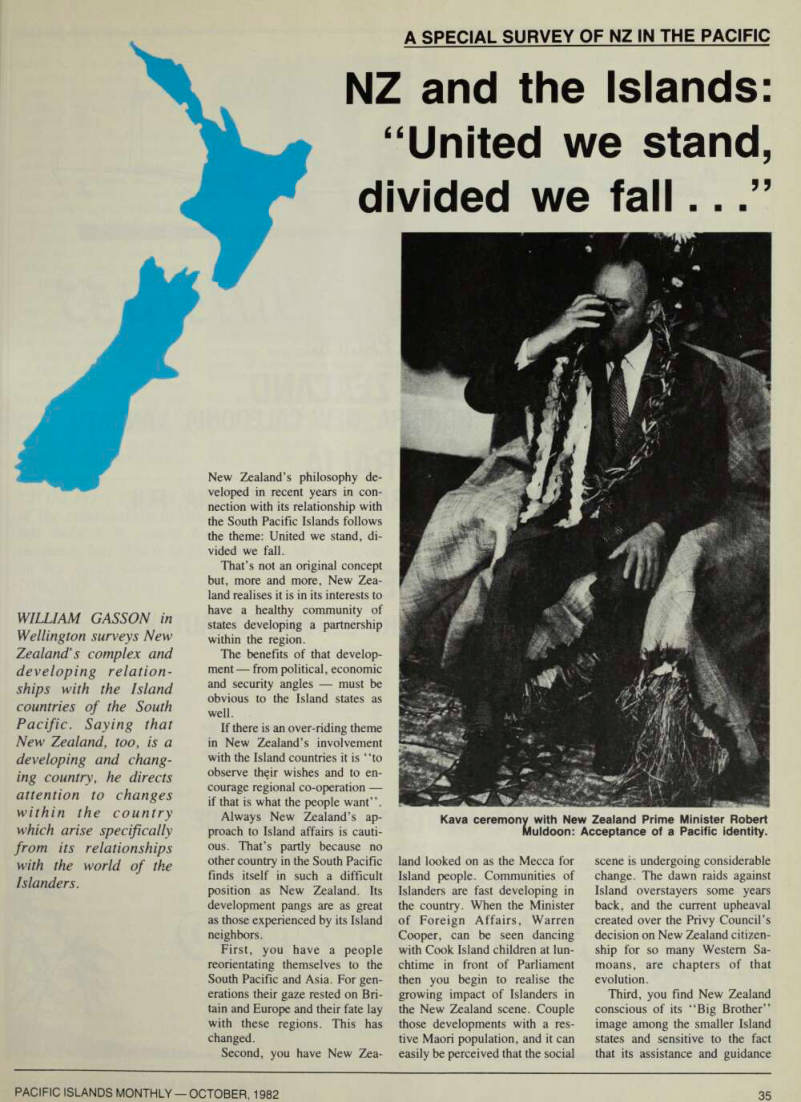
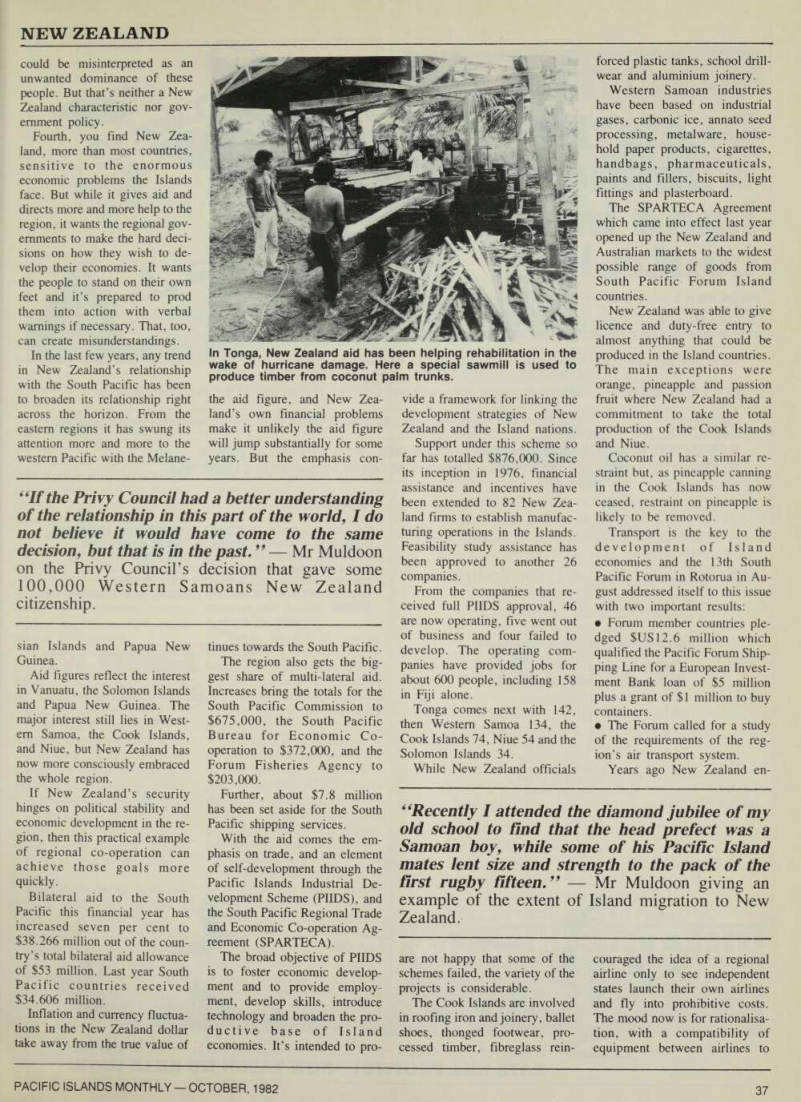
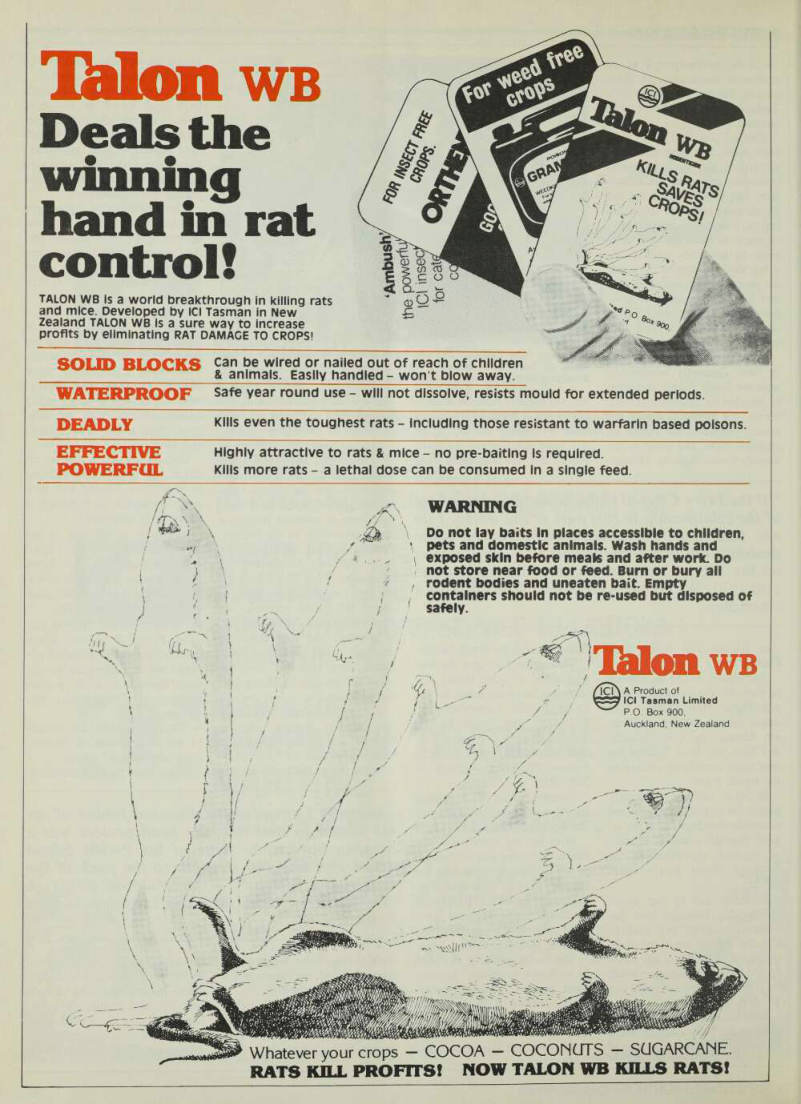
A SPECIAL SURVEY OF NZ IN THE PACIFIC NZ and the Islands: “United we stand, divided we fall..
New Zealand’s philosophy de veloped in recent years in con nection with its relationship with the South Pacific Islands follows the theme: United we stand, di vided we fall.
That’s not an original concept but, more and more, New Zea land realises it is in its interests to have a healthy community of states developing a partnership within the region.
The benefits of that develop ment from political, economic and security angles must be obvious to the Island states as well.
If there is an over-riding theme in New Zealand’s involvement with the Island countries it is “to observe their wishes and to en courage regional co-operation if that is what the people want’’.
Always New Zealand’s ap proach to Island affairs is cauti ous. That’s partly because no other country in the South Pacific finds itself in such a difficult position as New Zealand. Its development pangs are as great as those experienced by its Island neighbors.
First, you have a people reorientating themselves to the South Pacific and Asia. For gen erations their gaze rested on Bri tain and Europe and their fate lay with these regions. This has changed.
Second, you have New Zea-
land looked on as the Mecca for Island people. Communities of Islanders are fast developing in the country. When the Minister of Foreign Affairs, Warren Cooper, can be seen dancing with Cook Island children at lun chtime in front of Parliament then you begin to realise the growing impact of Islanders in the New Zealand scene. Couple those developments with a res tive Maori population, and it can easily be perceived that the social
scene is undergoing considerable change. The dawn raids against Island overstayers some years back, and the current upheaval created over the Privy Council’s decision on New Zealand citizen ship for so many Western Sa moans, are chapters of that evolution.
Third, you find New Zealand conscious of its “Big Brother” image among the smaller Island states and sensitive to the fact that its assistance and guidance
William Gasson In
Wellington surveys New Zealand’s complex and developing relation ships with the Island countries of the South Pacific. Saying that New Zealand, too, is a developing and chang ing country, he directs attention to changes within the country which arise specifically from its relationships with the world of the Islanders.
Kava ceremony with New Zealand Prime Minister Robert Muldoon: Acceptance of a Pacific identity.
could be misinterpreted as an unwanted dominance of these people. But that’s neither a New Zealand characteristic nor gov ernment policy.
Fourth, you find New Zea land, more than most countries, sensitive to the enormous economic problems the Islands face. But while it gives aid and directs more and more help to the region, it wants the regional gov ernments to make the hard deci sions on how they wish to de velop their economies. It wants the people to stand on their own feet and it’s prepared to prod them into action with verbal warnings if necessary. That, too, can create misunderstandings.
In the last few years, any trend in New Zealand’s relationship with the South Pacific has been to broaden its relationship right across the horizon. From the eastern regions it has swung its attention more and more to the western Pacific with the Melane
“If the Privy Council had a better understanding of the relationship in this part of the world, I do not believe it would have come to the same decision, but that is in the past . 99 Mr Muldoon on the Privy Council’s decision that gave some 100,000 Western Samoans New Zealand
citizenship.
sian Islands and Papua New Guinea.
Aid figures reflect the interest in Vanuatu, the Solomon Islands and Papua New Guinea. The major interest still lies in West ern Samoa, the Cook Islands, and Niue, but New Zealand has now more consciously embraced the whole region.
If New Zealand’s security hinges on political stability and economic development in the re gion, then this practical example of regional co-operation can achieve those goals more quickly.
Bilateral aid to the South Pacific this financial year has increased seven per cent to $38,266 million out of the coun try’s total bilateral aid allowance of $53 million. Last year South Pacific countries received $34,606 million.
Inflation and currency fluctua tions in the New Zealand dollar take away from the true value of
the aid figure, and New Zea land’s own financial problems make it unlikely the aid figure will jump substantially for some years. But the emphasis con
tinues towards the South Pacific.
The region also gets the big gest share of multi-lateral aid.
Increases bring the totals for the South Pacific Commission to $675,000, the South Pacific Bureau for Economic Co operation to $372,000, and the Forum Fisheries Agency to $203,000.
Further, about $7.8 million has been set aside for the South Pacific shipping services.
With the aid comes the em phasis on trade, and an element of self-development through the Pacific Islands Industrial De velopment Scheme (PUDS), and the South Pacific Regional Trade and Economic Co-operation Ag reement (SPARTECA).
The broad objective of PUDS is to foster economic develop ment and to provide employ ment, develop skills, introduce technology and broaden the pro ductive base of Island economies. It’s intended to pro
vide a framework for linking the development strategies of New Zealand and the Island nations.
Support under this scheme so far has totalled $876,000. Since its inception in 1976, financial assistance and incentives have been extended to 82 New Zea land firms to establish manufac turing operations in the Islands.
Feasibility study assistance has been approved to another 26 companies.
From the companies that re ceived full PUDS approval, 46 are now operating, five went out of business and four failed to develop. The operating com panies have provided jobs for about 600 people, including 158 in Fiji alone.
Tonga comes next with 142, then Western Samoa 134, the Cook Islands 74, Niue 54 and the Solomon Islands 34.
While New Zealand officials
“Recently I attended the diamond jubilee of my old school to find that the head prefect was a Samoan boy, while some of his Pacific Island mates lent size and strength to the pack of the first rugby fifteen — Mr Muldoon giving an example of the extent of Island migration to New Zealand.
are not happy that some of the schemes failed, the variety of the projects is considerable.
The Cook Islands are involved in roofing iron and joinery, ballet shoes, thonged footwear, pro cessed timber, fibreglass rein
forced plastic tanks, school drill wear and aluminium joinery.
Western Samoan industries have been based on industrial gases, carbonic ice, annato seed processing, metalware, house hold paper products, cigarettes, handbags, pharmaceuticals, paints and fillers, biscuits, light fittings and plasterboard.
The SPARTECA Agreement which came into effect last year opened up the New Zealand and Australian markets to the widest possible range of goods from South Pacific Forum Island countries.
New Zealand was able to give licence and duty-free entry to almost anything that could be produced in the Island countries.
The main exceptions were orange, pineapple and passion fruit where New Zealand had a commitment to take the total production of the Cook Islands and Niue.
Coconut oil has a similar re straint but, as pineapple canning in the Cook Islands has now ceased, restraint on pineapple is likely to be removed.
Transport is the key to the development of Island economies and the 13th South Pacific Forum in Rotorua in Au gust addressed itself to this issue with two important results: • Forum member countries ple dged SUSI 2.6 million which qualified the Pacific Forum Ship ping Line for a European Invest ment Bank loan of $5 million plus a grant of $1 million to buy containers. • The Forum called for a study of the requirements of the reg ion’s air transport system.
Years ago New Zealand en
couraged the idea of a regional airline only to see independent states launch their own airlines and fly into prohibitive costs.
The mood now is for rationalisa tion, with a compatibility of equipment between airlines to
In Tonga, New Zealand aid has been helping rehabilitation in the wake of hurricane damage. Here a special sawmill is used to produce timber from coconut palm trunks.
minimise costs. The study is due to be reviewed at the next Forum meeting in Australia.
Both the Forum Line and the study on air transport represent
regional co-operation in its
widest sense and measure the commitment of the Island part ners in this principle.
The collapse of the Forum Line would sound the death knell of regional co-operation in the South Pacific. Its success and success in a regional air service strengthens the co-operative effect New Zealand strives to encourage.
It produces a flow-on effect to other Island communities outside the Forum group such as Ameri can Samoa, Guam and the Mic ronesian territories, and
strengthens the development of
relations with these com munities. These links help still dependent territories to develop a personality of their own.
As each year passes New Zea land is drawn more and more into the community of South Pacific nations. Each month heralds some new link. It might be the news that Cook Islanders in Au ckland plan to build their own $3 million five-storey community and commercial centre that will include shops, a gymnasium, a ballroom, conference rooms, professional office suites and a
student library-study.
It might be the hosting of the first South Pacific Congress in
Medical Laboratory Technology
in Christchurch where New Zealanders were told: “We have a responsibility to work and help in the whole South Pacific area, in less developed countries with less technological expertise than our own and it is a responsibility we neglect.”
At the same time not a single Pacific Island representative en rolled for the congress, despite efforts to encourage them to come.
Or it might be the news that Maoris would like to play a wider role in Pacific affairs.
It’s probably true to say that no South Pacific figure projects the region into the international arena more effectively than New Zealand’s Prime Minister Robert Muldoon.
Not everyone might like his personality, but few would doubt
his grasp of the region’s prob lems, his decision-making abili ty, his intense interest in the region and his determination to side with his Island neighbors on regional issues that clash with some of the greater advanced nations whether it’s the Un ited States over tuna fishing or France over nuclear tests.
When he travels abroad Mul doon speaks as much as the leader of a South Pacific nation with that region’s interests at heart as he does as leader of a
country populated predominantly
by people of European descent.
Recently the question of how to approach a Pacific economic community has concerned him.
He does not see such a concept coming to fruition inside at least the next two decades but already he is publicly trying to focus attention on the problem of fit ting the fragile economies of Island states into a Pacific
economic community.
His recent messages have at tempted to spell this out to other Pacific nations: “They will all be dependent to a very considerable extent on external aid for as far ahead as one can see,” he said.
“Their export potential is limited and the problems of transport both internal and inter national are immense.
“Some, but not all, can or indeed have developed a tourist industry. Some have potential or existing markets in New Zealand and Australia for their produce.
“For others the future is bleak.”
Knowledge of New Zealand in the international scene is limited at best and often inaccurate.
Knowledge of the Pacific Islands around the world is even more limited in detail and, one sus
pects, generalised via Hollywood
productions as wealth-laden trop
ical paradises.
Muldoon’s current batch of speeches on the Pacific has at
tempted to dispel the myths and
acquaint neighboring countries
of the problems the Islands face.
It’s the kind of role New Zea land feels it can play as a de veloped country on behalf of the developing territories in the South Pacific. What it can’t guarantee is that the greater pow ers will absorb the message.
Withstands205MPH Cyclone

Low Cost House Withstands205MPH Cyclone
There has never been such a wind in the Pacific, but, should there be, this tough little timber house will still be standing.
Dubbed the “Hurricane House” the 16' x 16' prototype underwent destruction tests devised to simulate the worst possible extremes of wind and earthquake forces.
This test specifically on wall struc tures, which is the latest in a com prehensive evaluation programme designed by consulting engineer Brian Marino, was conducted and supervised by the New Zealand government’s Department of Scientific and In dustrial Research (DSIR) in consulta tion with BRANZ (Building Research Association of New Zealand).
Cyclone “DSIR” simulates 205 mph (335 kph) Using a 23 ton bulldozer, a hydraulic jack and steel bars reaching right through the structure to a massive laminated beam, DSIR scien tists and engineers subjected the house to repeated and prolonged loading in creasing by the ton until the'pull ex ceeded nine tons.
At this stage, when the theoretical cyclone was blowing 205 miles an hour, the concrete floor and founda tion (which is an integral part of the design) began to lift . . . and with it, the building itself, all intact.
Remarkably there was no damage or outward sign of stress.
It’s interesting to note that where 9
tons equals 205 mph of wind velocity . . . 2 tons equals the biggest recorded earthquake.
Simple design ... no special materials or fastenings The concept for the “Hurricane House” was developed during investigations into ways of building cheaper homes and there are many interesting side benefits. For a start the radiata pine plywood and timbers are all standard grades and the fastenings are ordinary galvanised nails. Nothing
will also prove a major benefit for an unskilled labour force in remote areas to which the “Hurricane House” package can be easily transported.
The “Hurricane House”, designed simply to withstand high winds and earthquakes, is the breakthrough that brings permanent, cyclone-proof dwellings within the reach of many more communities.
special and no excessive bracing. In fact it’s a house with a lot less timber than usual. Its ability to withstand high loads relies on even distribution through a lot of little fixings rather than a few big ones.
Pre-assembled . . . IVi hours to erect.
A practised team of four will put up our house in an hour and a half which means immense savings in labour costs. But the simplicity of the design and the pre-assembled panels
Hydraulic Pump
Advertisements & other items, p. 40 (1 item)
Woodyard
The Woodyard
For further information, contact: David Jonkers, The Woodyard, P.O.
Box 81-033, Whenuapai, Auckland, New Zealand. Phone 416-8142.
Foreign affairs chief on NZ
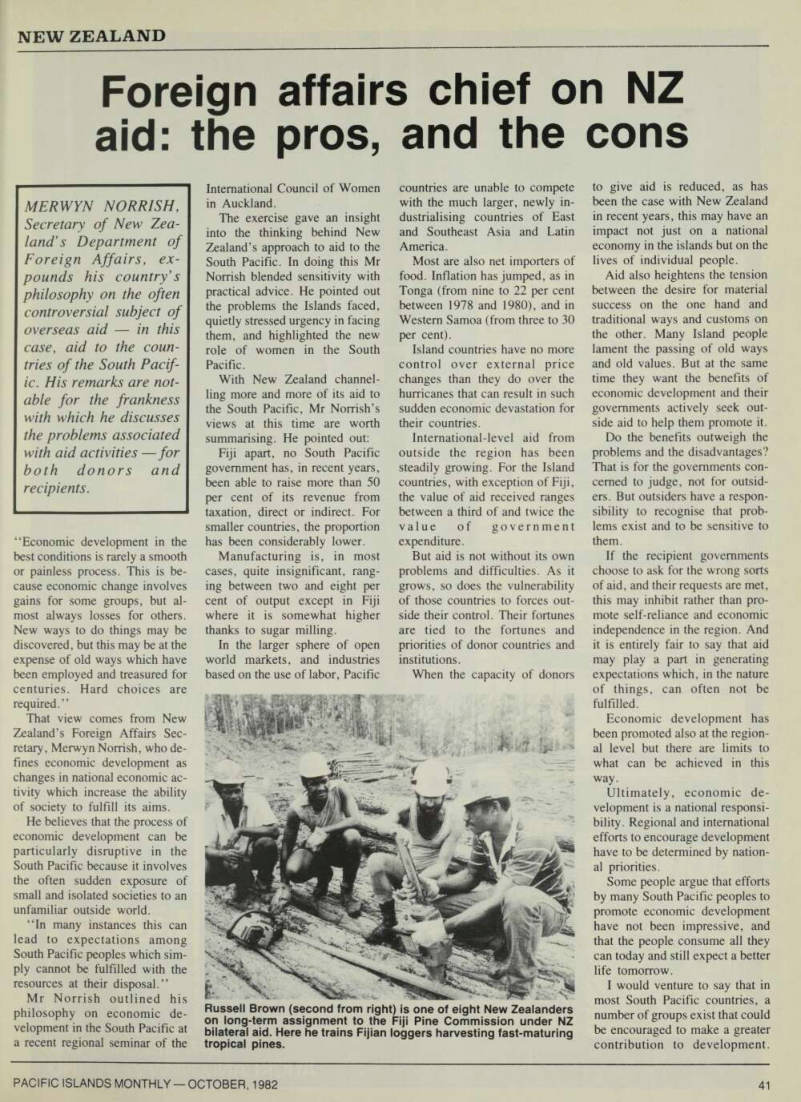
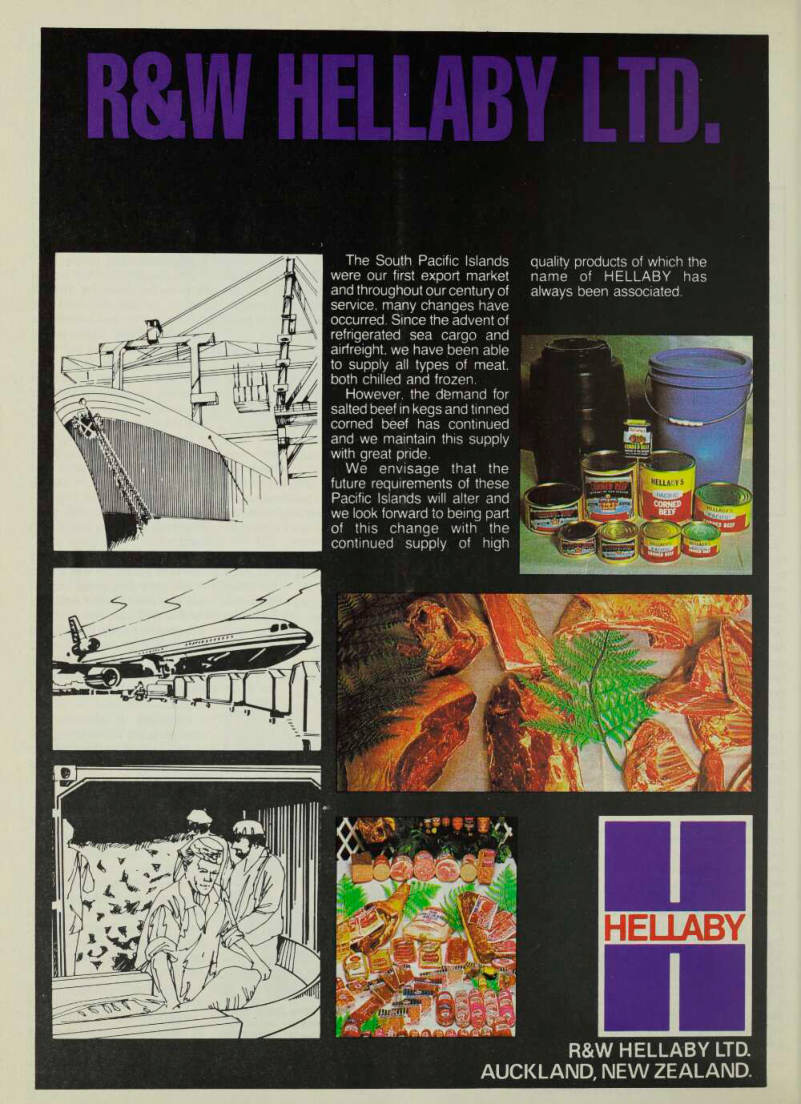
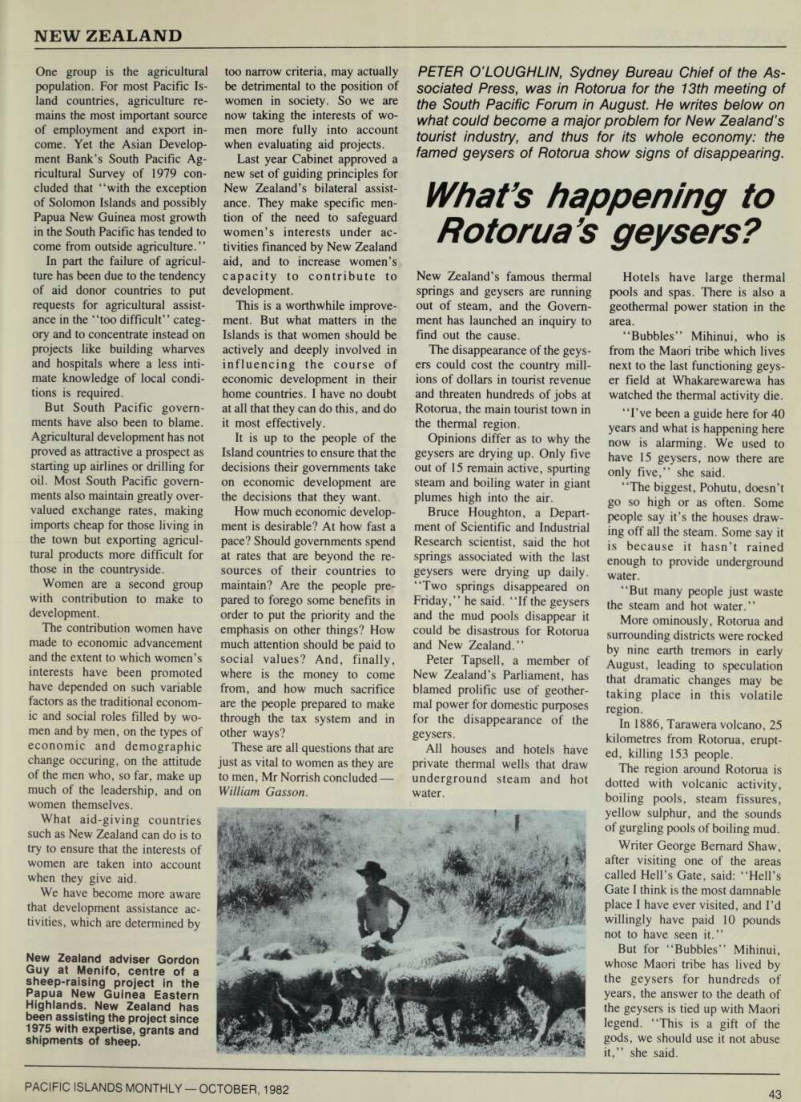
aid: the pros, and the cons
Merwyn Norrish,
Secretary of New Zea land’s Department of Foreign Affairs, ex pounds his country’s philosophy on the often controversial subject of overseas aid in this case, aid to the coun tries of the South Pacif ic. His remarks are not able for the frankness with which he discusses the problems associated with aid activities —for both donors and recipients.
“Economic development in the best conditions is rarely a smooth or painless process. This is be cause economic change involves gains for some groups, but al most always losses for others.
New ways to do things may be discovered, but this may be at the expense of old ways which have been employed and treasured for centuries. Hard choices are required.”
That view comes from New Zealand’s Foreign Affairs Sec retary, Merwyn Norrish, who de fines economic development as changes in national economic ac tivity which increase the ability of society to fulfill its aims.
He believes that the process of economic development can be particularly disruptive in the South Pacific because it involves the often sudden exposure of small and isolated societies to an unfamiliar outside world.
“In many instances this can lead to expectations among South Pacific peoples which sim ply cannot be fulfilled with the resources at their disposal.”
Mr Norrish outlined his philosophy on economic de velopment in the South Pacific at a recent regional seminar of the
International Council of Women in Auckland.
The exercise gave an insight into the thinking behind New Zealand’s approach to aid to the South Pacific. In doing this Mr Norrish blended sensitivity with practical advice. He pointed out the problems the Islands faced, quietly stressed urgency in facing them, and highlighted the new role of women in the South Pacific.
With New Zealand channel ling more and more of its aid to the South Pacific, Mr Norrish’s views at this time are worth summarising. He pointed out: Fiji apart, no South Pacific government has, in recent years, been able to raise more than 50 per cent of its revenue from taxation, direct or indirect. For smaller countries, the proportion has been considerably lower.
Manufacturing is, in most cases, quite insignificant, rang ing between two and eight per cent of output except in Fiji where it is somewhat higher thanks to sugar milling.
In the larger sphere of open world markets, and industries based on the use of labor, Pacific
countries are unable to compete with the much larger, newly in dustrialising countries of East and Southeast Asia and Latin America.
Most are also net importers of food. Inflation has jumped, as in Tonga (from nine to 22 per cent between 1978 and 1980), and in Western Samoa (from three to 30 per cent).
Island countries have no more control over external price changes than they do over the hurricanes that can result in such sudden economic devastation for their countries.
International-level aid from outside the region has been steadily growing. For the Island countries, with exception of Fiji, the value of aid received ranges between a third of and twice the value of government expenditure.
But aid is not without its own problems and difficulties. As it grows, so does the vulnerability of those countries to forces out side their control. Their fortunes are tied to the fortunes and priorities of donor countries and institutions.
When the capacity of donors
to give aid is reduced, as has been the case with New Zealand in recent years, this may have an impact not just on a national economy in the islands but on the lives of individual people.
Aid also heightens the tension between the desire for material success on the one hand and traditional ways and customs on the other. Many Island people lament the passing of old ways and old values. But at the same time they want the benefits of economic development and their governments actively seek out side aid to help them promote it.
Do the benefits outweigh the
problems and the disadvantages?
That is for the governments con cerned to judge, not for outsid ers. But outsiders have a respon
sibility to recognise that prob
lems exist and to be sensitive to them.
If the recipient governments choose to ask for the wrong sorts of aid, and their requests are met, this may inhibit rather than pro mote self-reliance and economic independence in the region. And it is entirely fair to say that aid may play a part in generating expectations which, in the nature of things, can often not be fulfilled.
Economic development has been promoted also at the region al level but there are limits to what can be achieved in this way.
Ultimately, economic de velopment is a national responsi
bility. Regional and international
efforts to encourage development have to be determined by nation
al priorities.
Some people argue that efforts by many South Pacific peoples to promote economic development have not been impressive, and that the people consume all they can today and still expect a better life tomorrow.
I would venture to say that in most South Pacific countries, a number of groups exist that could be encouraged to make a greater contribution to development.
Russell Brown (second from right) is one of eight New Zealanders on long-term assignment to the Fiji Pine Commission under NZ bilateral aid. Here he trains Fijian loggers harvesting fast-maturing tropical pines.
One group is the agricultural population. For most Pacific Is land countries, agriculture re mains the most important source of employment and export in come. Yet the Asian Develop ment Bank’s South Pacific Ag ricultural Survey of 1979 con cluded that “with the exception of Solomon Islands and possibly Papua New Guinea most growth in the South Pacific has tended to come from outside agriculture.’’
In part the failure of agricul ture has been due to the tendency of aid donor countries to put requests for agricultural assist ance in the “too difficult’’ categ ory and to concentrate instead on projects like building wharves and hospitals where a less inti mate knowledge of local condi tions is required.
But South Pacific govern ments have also been to blame.
Agricultural development has not proved as attractive a prospect as starting up airlines or drilling for oil. Most South Pacific govern ments also maintain greatly over valued exchange rates, making imports cheap for those living in the town but exporting agricul tural products more difficult for those in the countryside.
Women are a second group with contribution to make to development.
The contribution women have made to economic advancement and the extent to which women’s interests have been promoted have depended on such variable factors as the traditional econom ic and social roles filled by wo men and by men, on the types of economic and demographic change occuring, on the attitude of the men who, so far, make up much of the leadership, and on women themselves.
What aid-giving countries such as New Zealand can do is to try to ensure that the interests of women are taken into account when they give aid.
We have become more aware that development assistance ac tivities, which are determined by
too narrow criteria, may actually be detrimental to the position of women in society. So we are now taking the interests of wo men more fully into account
when evaluating aid projects.
Last year Cabinet approved a new set of guiding principles for New Zealand’s bilateral assist ance. They make specific men tion of the need to safeguard women’s interests under ac tivities financed by New Zealand aid, and to increase women’s capacity to contribute to
development.
This is a worthwhile improve ment. But what matters in the Islands is that women should be actively and deeply involved in influencing the course of economic development in their home countries. I have no doubt at all that they can do this, and do it most effectively.
It is up to the people of the Island countries to ensure that the decisions their governments take on economic development are the decisions that they want.
How much economic develop ment is desirable? At how fast a
pace? Should governments spend
at rates that are beyond the re sources of their countries to maintain? Are the people pre pared to forego some benefits in order to put the priority and the emphasis on other things? How much attention should be paid to social values? And, finally, where is the money to come from, and how much sacrifice are the people prepared to make through the tax system and in
other ways?
These are all questions that are just as vital to women as they are to men, Mr Norrish concluded
William Gasson.
New Zealand adviser Gordon Guy at Menifo, centre of a sheep-raising project in the Papua New Guinea Eastern Highlands. New Zealand has been assisting the project since 1975 with expertise, grants and shipments of sheep.
Advertisements & other items, p. 42 (1 item)
Hellaby
The South Pacific Islands were our first export market and throughout our century of service, many changes have occurred. Since the advent of refrigerated sea cargo and airfreight, we have been able to supply all types of meat, both chilled and frozen.
However, the d'emand for salted beef in kegs and tinned corned beef has continued and we maintain this supply with great pride.
We envisage that the future requirements of these Pacific Islands will alter and we look forward to being part of this change with the continued supply of high quality products of which the name of HELLABY has always been associated. mzt
CORNED
BEEF
■ ta
m mm*
m • Y : H M V; ;■< wm Hi :'f/< -c A / 'film i f r m \ £
HELLABY
I
R&W HELLABY LTD.
AUCKLAND, NEW ZEALAND.
Rotorua’s geysers?
What’s happening to Rotorua’s geysers?
PETER O’LOUGHLIN, Sydney Bureau Chief of the As sociated Press, was in Rotorua for the 13th meeting of the South Pacific Forum in August. He writes below on what could become a major problem for New Zealand’s tourist industry, and thus for its whole economy: the famed geysers of Rotorua show signs of disappearing.
New Zealand’s famous thermal springs and geysers are running out of steam, and the Govern ment has launched an inquiry to find out the cause.
The disappearance of the geys ers could cost the country mill ions of dollars in tourist revenue and threaten hundreds of jobs at Rotorua, the main tourist town in the thermal region.
Opinions differ as to why the geysers are drying up. Only five out of 15 remain active, spurting steam and boiling water in giant plumes high into the air.
Bruce Houghton, a Depart ment of Scientific and Industrial Research scientist, said the hot springs associated with the last geysers were drying up daily.
“Two springs disappeared on Friday,” he said. “If the geysers and the mud pools disappear it could be disastrous for Rotorua and New Zealand.”
Peter Tapsell, a member of New Zealand’s Parliament, has blamed prolific use of geother mal power for domestic purposes for the disappearance of the geysers.
All houses and hotels have private thermal wells that draw underground steam and hot water.
Hotels have large thermal pools and spas. There is also a geothermal power station in the area.
“Bubbles” Mihinui, who is from the Maori tribe which lives next to the last functioning geys er field at Whakarewarewa has watched the thermal activity die.
“I’ve been a guide here for 40 years and what is happening here now is alarming. We used to have 15 geysers, now there are only five,” she said.
“The biggest, Pohutu, doesn’t go so high or as often. Some people say it’s the houses draw ing off all the steam. Some say it is because it hasn’t rained enough to provide underground water.
“But many people just waste the steam and hot water.”
More ominously, Rotorua and surrounding districts were rocked by nine earth tremors in early August, leading to speculation that dramatic changes may be taking place in this volatile region.
In 1886, Tarawera volcano, 25 kilometres from Rotorua, erupt ed, killing 153 people.
The region around Rotorua is dotted with volcanic activity, boiling pools, steam fissures, yellow sulphur, and the sounds of gurgling pools of boiling mud.
Writer George Bernard Shaw, after visiting one of the areas called Hell’s Gate, said; “Hell’s Gate I think is the most damnable place I have ever visited, and I’d willingly have paid 10 pounds not to have seen it.”
But for “Bubbles” Mihinui, whose Maori tribe has lived by the geysers for hundreds of years, the answer to the death of the geysers is tied up with Maori legend. “This is a gift of the gods, we should use it not abuse it,” she said.
13th South Pacific Forum meeting:
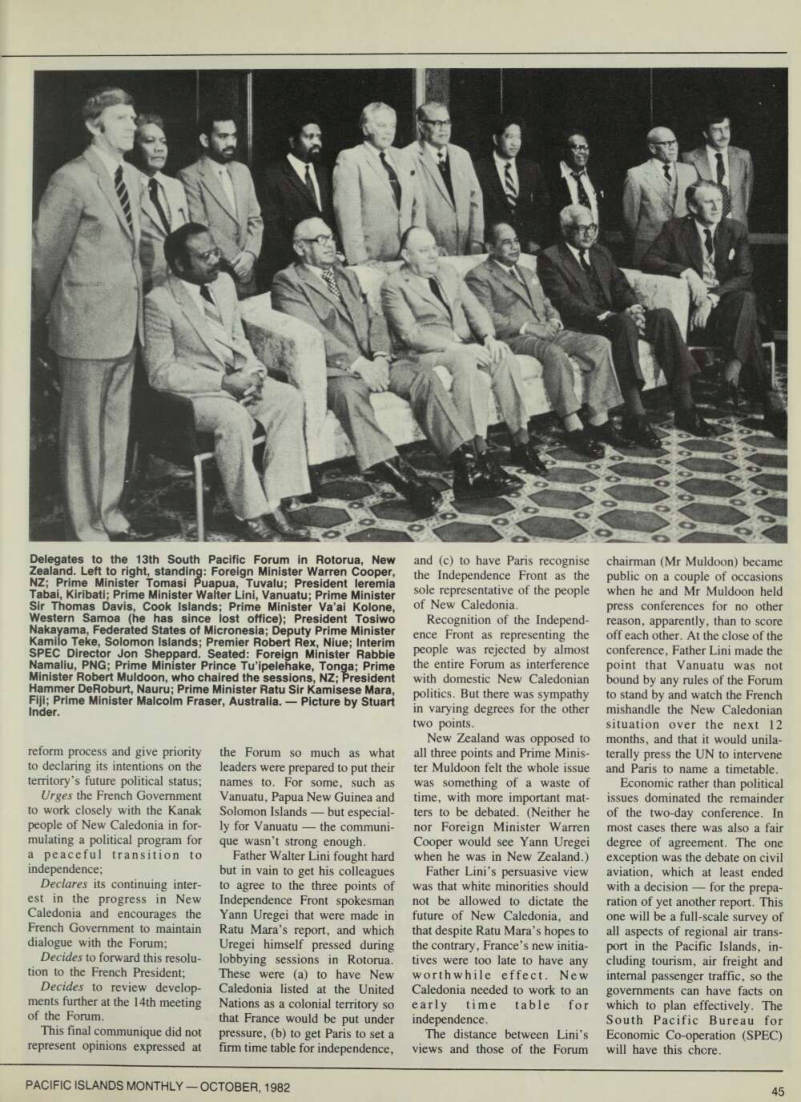

What they did in Rotorua
STUART INDER reports below on the work of the 13th South Pacific Forum meeting in Rotorua, New Zealand, in August.
Thirteen Pacific Island leaders at the 13th South Pacific Forum in Rotorua in August surveyed French plans for decolonising New Caledonia and refrained
from publicly criticising them.
In effect the 13 independent or self-governing states of the Pacific Islands told France: “You seem to be doing an honest job. We support it. We’ll take another look 12 months from now to see how it’s going.”
Nobody would have believed 12 months ago at the 12th Forum in Port-Vila that such a com munique would have been issued from Rotorua, but as Prime Minister Ratu Sir Kamisese Mara told his colleagues: “I feel
reasonably satisfied that impor
tant changes are taking place in
New Caledonia far beyond what any one of us envisaged when we were at Vila last year. These changes are designed to meet the aspirations of the Kanak people.
“What is most important is
that the changes are taking place
under the full responsibility of the French Government. We should continue to encourage the process in a most constructive way in order to achieve the ob jectives of decolonisation with the least possible bloodshed and disturbance.”
France has Ratu Mara to thank for the final satisfactory (to France) consensus communique from the Forum. It was Ratu Mara who led the delegation
from the Forum countries to Paris earlier this year, and it was Ratu Mara’s report, and the man ner in which he introduced it and
shepherded it through the
Rotorua meeting that has resulted in France being given room in which to move.
The views expressed by Ratu Mara in his report were in the end the views expressed in the Forum’s final communique, which said that the Forum: Reaffirms its belief that the principles of self-determination and independence apply to non
self-go veming Pacific countries;
Acknowledges and accepts the report of the Forum mission to France and expresses its appreci ation to the President of the
French Republic for having re ceived the delegation under the leadership of the Prime Minister of Fiji; Takes note of recent develop ments within New Caledonia, including the Independence Front’s participation in the Coun cil of Government, and expresses concern at the violent acts of groups opposed to reforms in the territory; Acknowledges the efforts of the Kanak people towards the attainment of self-determination and independence of New Caledonia by peaceful means; Welcomes the French Govern ment’s program of reforms in New Caledonia, and expresses the hope that it will continue the
reform process and give priority to declaring its intentions on the territory’s future political status; Urges the French Government to work closely with the Kanak people of New Caledonia in for mulating a political program for a peaceful transition to independence; Declares its continuing inter est in the progress in New Caledonia and encourages the French Government to maintain dialogue with the Forum; Decides to forward this resolu tion to the French President; Decides to review develop ments further at the 14th meeting of the Forum.
This final communique did not represent opinions expressed at
the Forum so much as what leaders were prepared to put their names to. For some, such as Vanuatu, Papua New Guinea and Solomon Islands but especial ly for Vanuatu the communi que wasn’t strong enough.
Father Walter Lini fought hard but in vain to get his colleagues to agree to the three points of Independence Front spokesman Yann Uregei that were made in Ratu Mara’s report, and which Uregei himself pressed during lobbying sessions in Rotorua.
These were (a) to have New Caledonia listed at the United Nations as a colonial territory so that France would be put under pressure, (b) to get Paris to set a firm time table for independence,
and (c) to have Paris recognise the Independence Front as the sole representative of the people of New Caledonia.
Recognition of the Independ ence Front as representing the people was rejected by almost the entire Forum as interference with domestic New Caledonian politics. But there was sympathy in varying degrees for the other two points.
New Zealand was opposed to all three points and Prime Minis ter Muldoon felt the whole issue was something of a waste of time, with more important mat ters to be debated. (Neither he nor Foreign Minister Warren Cooper would see Yann Uregei when he was in New Zealand.) Father Lini’s persuasive view was that white minorities should not be allowed to dictate the future of New Caledonia, and that despite Ratu Mara’s hopes to the contrary, France’s new initia tives were too late to have any worthwhile effect. New Caledonia needed to work to an early time table for independence.
The distance between Lini’s views and those of the Forum
chairman (Mr Muldoon) became public on a couple of occasions when he and Mr Muldoon held press conferences for no other reason, apparently, than to score off each other. At the close of the conference, Father Lini made the point that Vanuatu was not bound by any rules of the Forum to stand by and watch the French mishandle the New Caledonian situation over the next 12 months, and that it would unila terally press the UN to intervene and Paris to name a timetable.
Economic rather than political issues dominated the remainder of the two-day conference. In most cases there was also a fair degree of agreement. The one exception was the debate on civil aviation, which at least ended with a decision for the prepa ration of yet another report. This one will be a full-scale survey of all aspects of regional air trans port in the Pacific Islands, in cluding tourism, air freight and internal passenger traffic, so the governments can have facts on which to plan effectively. The South Pacific Bureau for Economic Co-operation (SPEC) will have this chore.
Delegates to the 13th South Pacific Forum in Rotorua, New Zealand. Left to right, standing: Foreign Minister Warren Cooper, NZ; Prime Minister Tomasi Puapua, Tuvalu; President leremia Tabai, Kiribati; Prime Minister Walter Lini, Vanuatu; Prime Minister Sir Thomas Davis, Cook Islands; Prime Minister Va’ai Kolone, Western Samoa (he has since lost office); President Tosiwo Nakayama, Federated States of Micronesia; Deputy Prime Minister Kamilo Teke, Solomon Islands; Premier Robert Rex, Niue; Interim SPEC Director Jon Sheppard. Seated: Foreign Minister Rabbie Namaliu, PNG; Prime Minister Prince Tu’ipelehake, Tonga; Prime Minister Robert Muldoon, who chaired the sessions, NZ; President Hammer DeRoburt, Nauru; Prime Minister Ratu Sir Kamisese Mara, Fiji; Prime Minister Malcolm Fraser, Australia. Picture by Stuart Inder.
On one aspect of aviation’s future in the region there was general agreement nobody wants a Flying Forum Line. But there have to be ways in which the regional airlines can co operate in aircraft use, spare parts, services, bookings, fuel, schedules, etc. and the survey is aimed at providing a basis on which sensible decisions can be made.
Mr Muldoon made it clear that New Zealand wanted nothing to do with the Australian airline Ansett, which New Zealand is convinced is attempting to force its way into the lucrative Tasman services. Other critics, including Nauru, had things to say about Ansett’s widening interests in airlines in the region, which Nauru naturally enough sees as competition with Air Nauru. The debate finally developed at cross purposes. Some delegations, in cluding New Zealand’s, were in terested in the regional overview, with others taking a bilateral ap proach. On bilateral matters, there were useful negotiations done outside the conference in hotel rooms.
There was no problem at all about achieving Forum unity when it came to criticising the United States for its refusal to sign the Law of the Sea Conven tion later this year, or condemn ing the U.S. for its failure to recognise the sovereign rights of Pacific countries over all fish, including highly migratory species, found within their fish ing zones.
The Forum stressed “the vital importance of fisheries compris ing highly migratory species” to the Forum countries, and “af firmed the commitment of the Forum members and observer countries to develop their fisheries resources to the benefit of their people. ’ ’ In short, it gave a strong warning to the U.S. that it was required to change its policy because the Island states had no intention of changing theirs.
The “observer countries” are Palau, the Marshall Islands, and the Federated States of Mic ronesia, all administered by the U.S. But the Federated States are now full members of the Forum Fisheries Agency as a result of the Rotorua meeting.
Without naming them, the Forum also hit out at the Japan ese, when it resolved that “dis tant water fishing nations should not link aid to fisheries access agreements,” and “deplored the recent tendency” of nations to make such a link. Kiribati has been the most vocal on this issue, having last year refused to re negotiate a fishing agreement with Japan when it found that its aid package from Japan depend ed on the extent of its fishing concession.
It regarded this as standover tactics, and said so, in the direct way that the smaller Pacific na tions have.
The fisheries decisions were an example of true regionalism in action. In the long term they could well turn out to be the most important and far-ranging deci sions yet made by the Forum.
They were drawn up by the Forum Fisheries Agency, and the finer points thrashed out earlier at ministerial level, thus allowing the leaders to endorse the ap proach with the minimum of debate.
Strangely, one of the older Forum nations, Fiji, later expre ssed misgivings on this ap proach, arguing that the Forum should avoid being used as a rubber stamp on decisions made elsewhere.
Some of the younger Forum members see this as commend able so long as the preparation gets done, and the big complaint last year was that not enough of the decisions had been taken at ministerial level, thus wasting the time of the leaders around the kava bowl. That problem was largely overcome this year, but it is likely that the right mix of efficient informality is not going to be easy to achieve. There is probably no likelihood of the South Pacific Forum ever return ing to the atmosphere of that first meeting in Wellington, 1971.
The debate, such as it was, on whether the Pacific is ready for a single regional organisation (SRO) to replace the South Pacif ic Commission (SPC) and the Forum’s technical secretariat, SPEC, did show the value of preparation.
This is a dialogue that both the Forum and the SPC have been having for years, with no result.
Finally last year the Forum called for a report on just what an SRO meant, and hundreds of man hours have since gone into find ing out.
PNG came up with a set of answers, SPEC with another, and a committee earlier this year put it all together so the Forum could make a final decision at Rotorua.
What it boiled down to was, could you make SPC and SPEC into one body, make the Forum superior to it, find a headquarters, site satisfactory to everybody, organise the funds to run it, and find a place in it for the U.S., France and the United Kingdom, who are not members of the Forum?
From the administrative point of view the committee con sidered that an SRO would be more cost-effective, and would function more effectively, bring ing about better use of available regional resources, and that therefore there could be “advan tages” in establishing it.
But when it looked at the political implications it virtually
threw up its hands in horror. It could make no recommendation on that score other than to say that the “political implications would need to be carefully weighed”.
Here was the political minefield as the committee saw it: “The committee considered that the authority of the Forum must remain paramount. The problem is that any explicit as sertion of Forum authority over a single regional organisation would raise serious doubts about the continued participation of France, the United States and the United Kingdom . . .
“It also recognised that, while a centralised secretariat would be more efficient and economic to operate, the French attitude to a decision to locate all elements of a single regional organisation away from the present SPC head quarters at Noumea would re quire further exploration.
“The committee foresaw the need to explore further the legal and constitutional implications which would be involved should
a single regional organisation be brought into being, and that in certain countries constitutional factors could be linked to finan cial considerations.
“The committee recognised that a political decision to pro ceed with the formation of a single regional organisation in volved the risk that France, the United States and the United Kingdom could cease to be in volved as partners in a regional organisation.”
The Forum never has really been enthusiastic about this ques tion of an SRO, and the thorough
investigation into the implica
tions of a change finally gave members the opportunity to put it away in the too-hard basket.
There are those who feel that Australia and New Zealand, through the purse strings, exert too great an influence on the Pacific through the SPC, and would like to see the SPC cur tailed. But others feel that getting rid of SPC would create more problems than it solved, and that
eventually the thing might well
resolve itself.
It is unlikely that the SRO will appear on next year’s agenda. It didn’t even rate a mention in this year’s final communique.
On other business: • The SPARTECA trade ag reement was not an issue at Rotorua. The meeting did little more than acknowledge that with Nauru’s accession to the agree ment on August 8, all Forum Island countries were now mem bers of the agreement. • There was an easy passage for an inquiry by the U.S. Gov ernment as to whether the Forum countries would be interested, in principle, in having a piece of a communications satellite it was planning to put over the Pacific in 1983. It would cost $U.5.650,000 for South Pacific use but another $5 million if it was to be equipped to cover the Pacific as far north as the North ern Marianas plus, in all cases, the cost of ground sta tions. As the U.S. was interested at this stage only in finding out whether there were likely to be any takers, and the Forum had nothing to lose by saying yes and
awaiting detailed costings, it said yes. • The question of establishing a Pacific Islands Fund for loans to Island nations was put aside for a further report next year.
The smaller islands, who would probably make best use of it, were concerned about cost con trols, and sought more information. • Mahe Tupouniua was ap pointed new director of SPEC in place of Dr Gabriel Gris, of PNG, who died in office in March. There was no debate; the Forum rubber-stamped a deci sion made at the informal meet ing of leaders on the Sunday, and thus set off some rumblings that are likely to be heard for some time.
Mahe is the competent found ing director of SPEC, who went back to his post as Finance Minister of Tonga in 1980 after seven years as director. Recently he resigned as Finance Minister, but he had not made application for the SPEC post, nor had Ton ga officially put his name for ward (it felt it wouldn’t be right
to do so, since he had already had a long term as director).
But, as Ratu Mara said later, his name “popped up”, and Ratu Mara certainly was one who pressed for his appointment, on the ground that he was efficient and had the required stature to enable him to deal with governments.
In all other circumstances that might well have been the end of it a timely and satisfactory choice. But there was in fact a formal applicant, and formally sponsored by Kiribati Babera Kirata, Kiribati’s Minister for Natural Resources.
Kirata’s last-minute by passing left a nasty taste in some mouths, notably of those who felt that Melanesia and Polynesia had had an unbroken record in winning top posts in the SPC and SPEC, and that when the oppor tunity had come, at last, for a competent Micronesian to take his turn, he had been rejected.
Here was a case when more conference formality and less ka va-bowl politics might have pro duced a more acceptable result.
Advertisements & other items, pp. 44-50 (1 item)
Main Dealers Required In Pacific Islands
NEW GENERATION
TOHATSU
OUTBOARDS
Prop Rated:
3.5 hp 15.0 hp
s.ohp
B.ohp
9.Bhp
12.0 hp 18.0 hp 25.0 hp
33 .Ohp
55.0 hp
2 year
warranty
years of Product ivelopment and years experience with immercial Operations
CELTIC 7 metre COMMERCIAL
(Fibreglass Hulls Available)
ALL SPARES
AND PRODUCTS
AVAILABLE EX
AUCKLAND, N.Z
Tohatsu Kerosene 18hp & 30hp outboards also available.
Hull & Decks of Completed Units Length: 7 metres Beam; 2.49 Draught: 7 Drop Keel or Fixed Keel Powered by 10hp or 20hp Diesel
FURTHER INQUIRIES CONTACT:
AOTEA MARKETING (NZ) LTD,
P.O. BOX 17105, GREENLANE, AUCKLAND,
NEW ZEALAND. PHONE: 503244
I ! ■ ?vi
JMaj
er ft & gpiflßSSu f •• The
International Beer
From New Zealand
The Export Division of New Zealand Breweries Limited P.O. Box 23, Auckland, New Zealand Cables "Breweries" Auckland. Telex NZ 2980. Telephone 778-840.
• • w Mm. 1
IBA Cl
General & Refrigerated
Cargo Service to
Cook Islands,
Niue, and Tahiti.
CONTACT YOUR LOCAL AREA AGENT FOR FULL DETAILS Niue: Government Shipping office, Alofi.
Cook Islands: Waterfront Commission, PO Box 61, Rarotonga.
Telex: Shipping RG 2002 Tahiti: Compagnie Maritime Polynesienne, PO Box 368 Papeete. Telex: Taporo FP2SB
The Shipping Corporation
of New Zealand Limited
Sea Carrier to the Nation
AUCKLAND: PO Box 3420, Phone 797-210 Telex: NZ2822
mm
THE HEALING PACIFIC
THE FIRST BICYCLE DESIGNED AND BUILT FOR THE PACIFIC.
The new Healing “Pacific” js now available.
It’s the first bicycle designed expressly for the special conditions of the islands of the Pacific. Produced in New Zealand, in one of the world’s most modern cycle factories, the Healing Pacific has been built strong, to last long.
All tubing, rims and other components are heavy-duty specification, engineered to handle all conditions. A special feature is the extra-strong double-bar design.
Tyres are heavy duty balloon style, suitable for sealed and unsealed roads. The full sized wheels (26 x 2 x 1 1 /4) keep going, whether the going’s hard or soft. They handle bumpy roads with ease, and the heavy duty spokes stand up to the demands of heavy duty service.
Standard features on the Healing Pacific include rear coaster brake, full length mudguards, safety reflector pedals, two red rear reflectors and warning bell.
The saddle is the broad, well-sprung, comfortable roadster style.
The Healing Pacific has been built to deliver maximum quality and value for money. The high gloss black paintwork is a special formulation, developed by Healing technology, to withstand the wide range of Pacific climatic conditions.
Invest in a Healing Pacific, and you’ll have low cost, economical, long-life transport. The first bicycle designed and built for the Pacific. °ao
HEALING
CYCLES
PRODUCTS OF HEALING TECHNOLOGY
TRADE ENQUIRIES TO:
HEALING INDUSTRIES LTD.
PRIVATE BAG, ROSEBANK. AUCKLAND 7, N.Z.
m 9 r f
FOR THAT PERSONALISED SERVICE AND RELIABILITY
SEESOFRANA UNILINES
*%■> ft"
AUSTRALIA/FIJI SERVICE
• Capitaine Wallis, monthly turn around from Melbourne Sydney • Fiji Express Line & PAD Line joint venture PAD vessels. • Lillooet, Paralla. Dilkara and Allunga link Melbourne, Adelaide, New Castle, Sydney and Brisbane with Suva Port.
NEW ZEALAND/FIJI SERVICE
• Tui Cakau II fortnightly service turn around from Auckland and Tauranga with alternate voyage to Gisborne.
rrf SOFRANA UNILINES
TRUSTED NAME IN SHIPPING
Contact Our Owners Representative Office in Fiji Harbour Centre Building Scott Street, Suva, Fiji Is.
Phones: 25141, 26320 After Hours: 22193, 312151, 25020
LOCAL AGENT
Carpenters Shipping Private Mail Bag.G P O Suva Fiji Phone Suva 312244 and LauloKa 63981
Consult the leading lights FREE.
Thorn EMI Lighting offer a free advisory service.
We provide lighting for all applications so you can benefit from our expertise and experience no matter what your specific requirements are.
Thorn have a system that meets your needs and your budget.
We even supply photographic.vehicle and domestic lamps.
We’ll throw some light on your question . . . absolutely free.
If it’s got anything to do with lights or lighting give us a call. We are in your hands. .
HI 'HORN EMI
Lighting (N.Z.) Ltd
P.O. Box 15150 New Lynn, Auckland, New Zealand.
Telephone 887-155 Auckland. Telex NZ 2648. % Fluorescent lubes and fittings for domestic, industrial and special purpose applications. Incandescent lamps and fittings, emergency lighting, floodlighting (including lamps, poles and columns), Marine lighting, airfield lighting, lighting for the food processing industry. Vehicle , miniature or photographic lamps.
W. Samoans see sell-out of rights
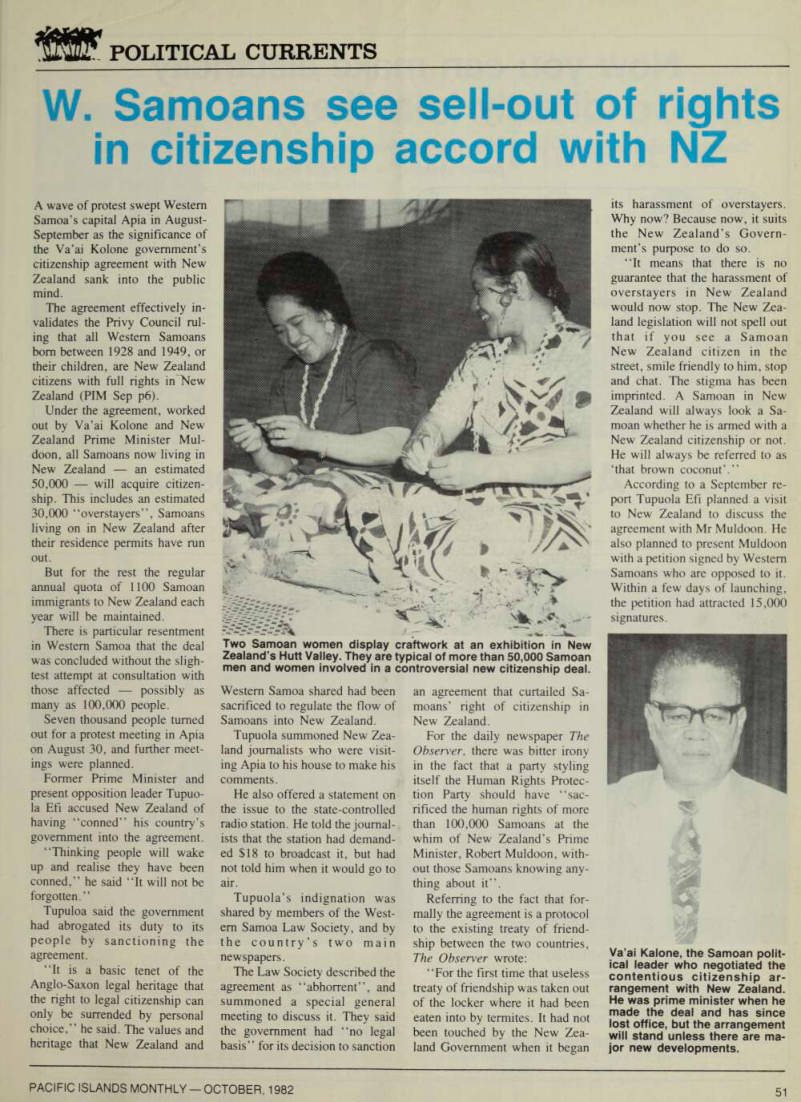
Political Currents
W. Samoans see sell-out of rights in citizenship accord with NZ
A wave of protest swept Western Samoa’s capital Apia in August- September as the significance of the Va’ai Kolone government’s citizenship agreement with New Zealand sank into the public mind.
The agreement effectively in validates the Privy Council rul ing that all Western Samoans bom between 1928 and 1949, or their children, are New Zealand citizens with full rights Zealand (PIM Sep p 6).
Under the agreement, worked out by Va’ai Kolone and New Zealand Prime Minister Mul doon, all Samoans now living in New Zealand an estimated 50.000 will acquire citizen ship. This includes an estimated 30.000 “overstayers”, Samoans living on in New Zealand after their residence permits have run out.
But for the rest the regular annual quota of 1100 Samoan immigrants to New Zealand each year will be maintained.
There is particular resentment in Western Samoa that the deal was concluded without the sligh test attempt at consultation with those affected possibly as many as 100,000 people.
Seven thousand people turned out for a protest meeting in Apia on August 30, and further meet ings were planned.
Former Prime Minister and present opposition leader Tupuo la Efi accused New Zealand of having “conned” his country’s government into the agreement.
“Thinking people will wake up and realise they have been conned,” he said “It will not be forgotten. ’ ’
Tupuloa said the government had abrogated its duty to its people by sanctioning the agreement.
“It is a basic tenet of the Anglo-Saxon legal heritage that the right to legal citizenship can only be surrended by personal choice,” he said. The values and heritage that New Zealand and
Western Samoa shared had been sacrificed to regulate the flow of Samoans into New Zealand.
Tupuola summoned New Zea land journalists who were visit ing Apia to his house to make his comments.
He also offered a statement on the issue to the state-controlled radio station. He told the journal ists that the station had demand ed $lB to broadcast it, but had not told him when it would go to air.
Tupuola’s indignation was shared by members of the West ern Samoa Law Society, and by the country’s two main newspapers.
The Law Society described the agreement as “abhorrent”, and summoned a special general meeting to discuss it. They said the government had “no legal basis” for its decision to sanction
an agreement that curtailed Sa moans’ right of citizenship in New Zealand.
For the daily newspaper The Observer, there was bitter irony in the fact that a party styling itself the Human Rights Protec tion Party should have “sac rificed the human rights of more than 100,000 Samoans at the whim of New Zealand’s Prime Minister, Robert Muldoon, with out those Samoans knowing any thing about it”.
Referring to the fact that for mally the agreement is a protocol to the existing treaty of friend ship between the two countries, The Observer wrote; “For the first time that useless treaty of friendship was taken out of the locker where it had been eaten into by termites. It had not been touched by the New Zea land Government when it began
its harassment of overstayers.
Why now? Because now, it suits the New Zealand’s Govern ment’s purpose to do so.
“It means that there is no guarantee that the harassment of overstayers in New Zealand would now stop. The New Zea land legislation will not spell out that if you see a Samoan New Zealand citizen in the street, smile friendly to him, stop and chat. The stigma has been imprinted. A Samoan in New Zealand will always look a Sa moan whether he is armed with a New Zealand citizenship or not.
He will always be referred to as ‘that brown coconut’.”
According to a September re port Tupuola Efi planned a visit to New Zealand to discuss the agreement with Mr Muldoon. He also planned to present Muldoon
with a petition signed by Western
Samoans who are opposed to it.
Within a few days of launching, the petition had attracted 15,000 signatures.
Two Samoan women display craftwork at an exhibition in New Zealand’s Hutt Valley. They are typical of more than 50,000 Samoan men and women involved in a controversial new citizenship deal.
Va’ai Kalone, the Samoan polit ical leader who negotiated the contentious citizenship ar rangement with New Zealand.
He was prime minister when he made the deal and has since lost office, but the arrangement will stand unless there are ma jor new developments.
Advertisements & other items, p. 52 (2 items)
52
PACIFIC ISI ANDSS MONTHLY OCTOBER. 1982
AWA Communications
Now you can make electricity
directly from the sun.
Consider the advantages of generating your own electricity with an ARCO Solar photovoltaic
power system:
& You have power in any remote location to operate tools, pump water for livestock and run lights.
The fuel’s free.
It’s non-polluting.
It’s completely quiet.
It’s operational anywhere in the world.
With battery storage, it’s a stand-alone system, that makes electricity available day or night.
And, often it’s more economical than other sources of remote power.
ARCO Solar has a power system that can make you energyindependent.
Photovoltaic modules directly convert sunlight to electricity, freeing you of dependence on utility companies. Modules are easy to install and once in place, are virtually maintenance free.
We can show you a system that will completely meet your energy needs.
ARCO Solar O Photovoltaic Products For more information contact the experts:
AWA Communications
A DIVISION OF AWA NEW ZEALAND LIMITED.
TELEPHONE: 312 744 GPO BOX 858, SUVA, FIJI
POWER SYSTEMS
CESSNA 206 AMPHIBIOUS FLOATPLANE.
This aircraft can be genuinely described as being in near new condition. It has been cared for by its owner and flown only by its owner from the day he bought it. It has only 100 hours of water operation and has been washed and hangared after every flight. It is on the private category register of Fiji.
IMPORTANT SPECIFICATIONS AND FEATURES.
Model: 1980 C-206*Reg No: DQ-FDJ* White-blue-tan exterior« Total hours: Airframe 226, engine 226, propeller 226.
Avionics: Fully equipped with the latest digital King navigational and communications systems.
Autopilot# Long range fuel tanks •Short take-off and landing conversion •Additional equipment and accessories.
Price $A117,000 as is, where is. The aircraft can be inspected at Tarawa, Kiribati.
ALL ENQUIRIES.
Soren Lunoe, Suite 16, 40 Yeo Street, Neutral Bay Sydney. NSW. Australia Tel: Sydney 909 3669. Telex THOMCO AA70689.
J
A new Micronesia booklet
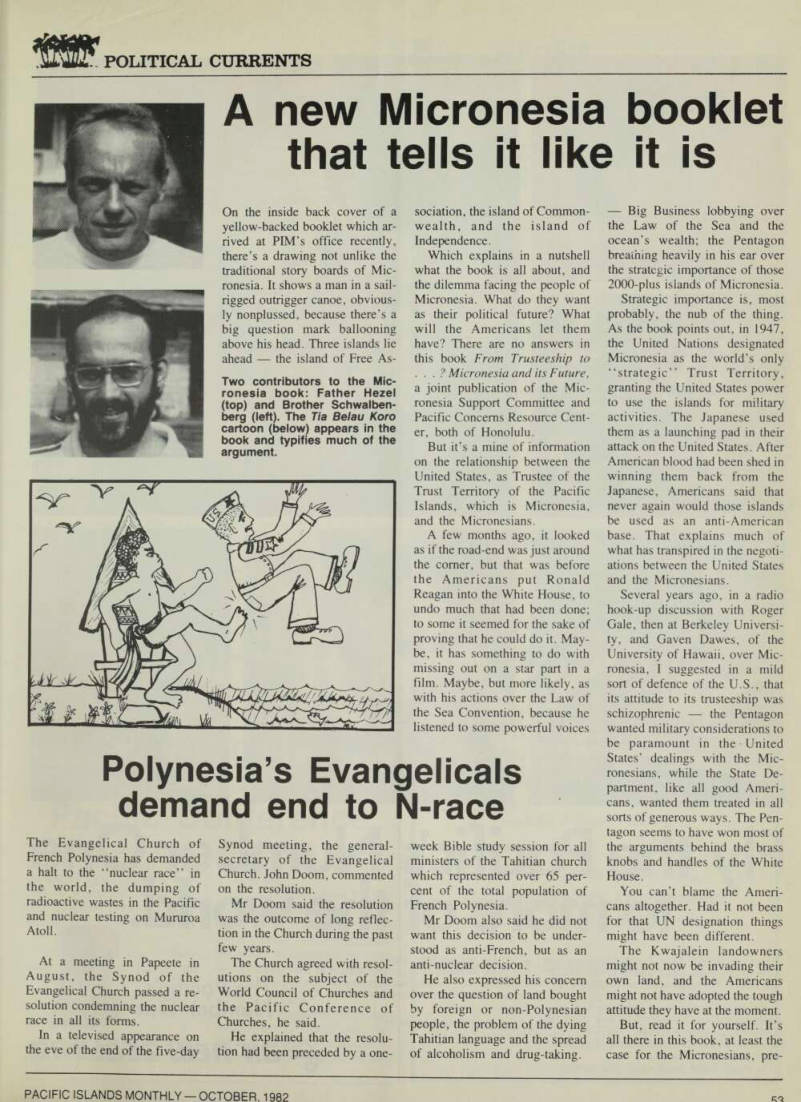
that tells it like it is
On the inside back cover of a yellow-backed booklet which ar rived at PlM’s office recently, there’s a drawing not unlike the traditional story boards of Mic ronesia. It shows a man in a sail
rigged outrigger canoe, obvious
ly nonplussed, because there’s a
big question mark ballooning
above his head. Three islands lie ahead the island of Free As-
sociation, the island of Common wealth, and the island of
Independence.
Which explains in a nutshell what the book is all about, and the dilemma facing the people of Micronesia. What do they want as their political future? What will the Americans let them have? There are no answers in this book From Trusteeship to . . . ? Micronesia and its Future, a joint publication of the Mic ronesia Support Committee and Pacific Concerns Resource Cent er, both of Honolulu.
But it’s a mine of information on the relationship between the United States, as Trustee of the Trust Territory of the Pacific Islands, which is Micronesia, and the Micronesians.
A few months ago, it looked as if the road-end was just around the comer, but that was before the Americans put Ronald Reagan into the White House, to undo much that had been done; to some it seemed for the sake of proving that he could do it. May be, it has something to do with missing out on a star part in a film. Maybe, but more likely, as with his actions over the Law of the Sea Convention, because he listened to some powerful voices
Big Business lobbying over the Law of the Sea and the ocean’s wealth; the Pentagon breathing heavily in his ear over the strategic importance of those 2000-plus islands of Micronesia.
Strategic importance is, most probably, the nub of the thing.
As the book points out, in 1947, the United Nations designated Micronesia as the world’s only “strategic” Trust Territory, granting the United States power to use the islands for military activities. The Japanese used them as a launching pad in their attack on the United States. After American blood had been shed in winning them back from the Japanese, Americans said that never again would those islands be used as an anti-American base. That explains much of what has transpired in the negoti ations between the United States and the Micronesians.
Several years ago, in a radio hook-up discussion with Roger Gale, then at Berkeley Universi ty, and Gaven Dawes, of the University of Hawaii, over Mic ronesia, I suggested in a mild sort of defence of the U.S., that its attitude to its trusteeship was schizophrenic the Pentagon wanted military considerations to be paramount in the United States’ dealings with the Mic ronesians, while the State De partment, like all good Ameri cans, wanted them treated in all sorts of generous ways. The Pen tagon seems to have won most of the arguments behind the brass knobs and handles of the White House.
You can’t blame the Ameri cans altogether. Had it not been for that UN designation things might have been different.
The Kwajalein landowners might not now be invading their own land, and the Americans might not have adopted the tough attitude they have at the moment.
But, read it for yourself. It’s all there in this book, at least the case for the Micronesians, pre-
Two contributors to the Mic ronesia book: Father Hezel (top) and Brother Schwalben berg (left). The Tia Belau Koro cartoon (below) appears in the book and typifies much of the argument.
pared and presented by some of the leading authorities on the future status negotiations, all genuinely seeking justice for the Micronesians and not making political capital Professor Ro ger Clark, Dean Alegado, John Reaves, Dilmei Oikeriil, Francis Hezel SJ, Henry Schwalbenberg SJ, Cal and Laurie Yonamine, Marion and John Kelly, and many more, many of them Americans. The selected bibliog raphy, too, is far from having been chosen haphazardly.
The introduction sets the stage, with history, with extracts from statements by US officials which explain much of what is happening now. Part II is a political status chronology 1947- 1982. Part 111 underlines the im portant sections of the Compact of Free Association, including the anomalies and legal twists which the Jesuit-directed Mic ronesian Seminar in Truk has brought to the light of day in a series of memoranda dealt with in the May issue of PIM. Then follow sections on the financial provisions, radiation compensa tion, military provisions, land use and operating rights, nuclear weapons and waste, and the pro visions in the compact for settl ing disputes.
The book’s value lies not just in explaining the why and the wherefore, but uses clauses in the compact to reveal the pitfalls lurking in the compact to the
detriment of the Micronesians.
Nowhere is there condemna tion of the United States. No where is the United States attack ed. But is there any need to condemn, or to attack, when there are made available in the book the words of U.S. officials, statements like this one from a U.S. Army War College paper: “The only feasible fallback posi tion (from Asia) is unquestion ably located in Micronesia where island bases, unlike those in Southeast Asia, would be under permanent U.S. control . . .
Palau has excellent anchorages, Ponape and Babelthuap have land areas in excess of 100 square miles and are suitable for nuclear weapons storage and training areas.’’
Another quote: “The widely scattered islands in Micronesia provide the needed dispersion in the nuclear age. By using islands to support a complex of military bases instead of concentrating on a single island such as Guam, an enemy would find it difficult to destroy U.S. defenses with a single co-ordinated nuclear attack.”
That appears to put the Ameri cans’ case or that of the Pentagon.
From Trusteeship to . . . ? can be had gratis from the Mic ronesia Support Committee at 1212 University Avenue, Hon
olulu, Hawaii 96826.
John
Carter.
Polynesia’s Evangelicals
demand end to N-race
The Evangelical Church of French Polynesia has demanded a halt to the “nuclear race” in the world, the dumping of radioactive wastes in the Pacific and nuclear testing on Mururoa Atoll.
At a meeting in Papeete in August, the Synod of the Evangelical Church passed a re solution condemning the nuclear race in all its forms.
In a televised appearance on the eve of the end of the five-day
Synod meeting, the general secretary of the Evangelical Church. John Doom, commented on the resolution.
Mr Doom said the resolution was the outcome of long reflec tion in the Church during the past few years.
The Church agreed with resol utions on the subject of the World Council of Churches and the Pacific Conference of Churches, he said.
He explained that the resolu tion had been preceded by a one
week Bible study session for all ministers of the Tahitian church which represented over 65 per cent of the total population of French Polynesia.
Mr Doom also said he did not want this decision to be under stood as anti-French, but as an anti-nuclear decision.
He also expressed his concern over the question of land bought by foreign or non-Polynesian people, the problem of the dying Tahitian language and the spread of alcoholism and drug-taking.
Advertisements & other items, p. 54 (1 item)
Fly the Pacific’s Number One
r El -■ ■ 5 f m r. * If \ ©Walt Disney Productions
to more of the world.
You can fly Air New Zealand to more and attentive service that made more of the great destinations of the world, like Tokyo, Honolulu and Los Angeles, Singapore and Hong Kong, Sydney, Melbourne, Brisbane and Perth as well as throughout New Zealand. And now, you can catch our “London Express”, the fast comfortable way to London from Auckland, Nadi, Papeete or Honolulu.
On every flight you’ll enjoy the careful Air New Zealand, the pioneer airline of the Pacific routes, so famous; a reputation we’re XL Pnrlflr'c proud to maintain today wherever we fly I I It? r UUIIL O
y° uto Number One
See your travel agent or Air New Zealand.
air new zeaiano
ANZ 82/13
US corporations

sponsor South Pacific Conference
This month’s 22nd South Pacific Conference in American Samoa has special significance for more than 20 American corporations, each of which is sponsoring the meeting to the tune of SUSSOOO.
Worried about Soviet intru sions in the South Pacific, the corporations see their sponsor ships as cementing a partnership with the conference’s 21 Pacific Island members.
That partnership theme has been actively promoted on the
U.S. Mainland and in Hawaii by American Samoa Governor Peter T. Coleman.
By mid-August, about 25 U.S. corporations had signed up to sponsor the conference, includ ing a number based in Hawaii.
To attract 50 corporate sponsors a $250,000 infusion of American capital in to the con ference’s coffers.
For their donations, the corpo rations are promised such be nefits as attendance at all confer ence sessions, participation in a
South Pacific Trade Exhibit, at tendance at a state dinner, and a golf tournament with Pacific Is land government leaders. To see each leader separately would cost at least $6870 in airfares alone and would take at least four weeks travel, according to pro motional literature presented to potential corporate sponsors who attended an August meeting in Honolulu.
To further stimulate their par ticipation at the Pago Pago meet ings on October 23-29, confer ence promoters are tempting the corporations by appealing to their American patriotic heritage.
“Vital U.S. foreign policy ob jectives are at stake in seeing that favorable foundations are con structed, in the Pacific for an atmosphere of partnership to evolve,” says one promotional leaflet given to executives. “Pro perly approached, and with a reciprocal attitude of partnership, American business can benefit, and especially so during this period of foundation-building.”
The promotional literature also invokes the Soviet threat to the Pacific, hinting that Pacific Is lands security is at stake and that American corporate influence can help deflate the Soviet menace.
“This year, 1982, represents a pivotal crossroads for the South Pacific, the East-West, capital ist-socialist implications in near term decision making are crucial.
“The Soviets are making strong, serious overtures to Pacific Island leaders, offering various forms of economic as sistance which is vitally needed. The Soviet objective, of course, is to extend its sphere of influence. So far, the Soviets have been effectively “rebuffed”.
“Essentially, the Pacific Is land nations are receptive to an increased presence by American, other Western, and Japanese companies which can provide needed goods ad services. This approach is far preferable to a government grant of foreign aid, which is the only alternative to Soviet economic and political penetration of the region. The time is right for the business sector to enhance its involvement in the Pacific Islands.”
American corporations with Pacific Island interests apparent ly agree. Pacific Resources, Inc., a Honolulu-based oil company which has a refinery in the Hawaiian Islands, was one of the first multinationals to chip in its cash. The Bank of Hawaii, which has branches on Guam, in American Samoa, in the Mic ronesian islands, and representa tive offices on other Pacific Is lands, was also quick to offer sponsorship as were Docummun Metals Co, and Grand Pacific Life Insurance Co.
Conference promoters said if business can show its willingness and capacity to develop construc tive programs that will help
neighbors help themselves, it
will “help establish an American policy based on mutual economic strength and co-operation in an area so tragically proven in war to be of monumental strategic importance to the U.S.”
American Samoan govern ment officials added that spon sorship would show that Ameri can corporations were committed to President Ronald Reagan’s philosophy of voluntarism.
The conference will also serve to introduce the corporations to American Samoa, itself looking to attract investment capital. Al though a “Samoa for Samoan” policy exists, the territory en courages outside investment. At present, the islands’ major foreign investments are the Van Camp and Star Kist tuna-canning
operations.
Business leaders will be able to express their thoughts about
the partnership’s potential and
problems at a special symposium
called Pacific 2000. Other topics scheduled for discussion are energy independence, education and health, tourism and transpor tation, and economic
development.
The conference is the annual forum of the South Pacific Com
mission, a regional co-operative
development institution founded in 1947, and based in New Caledonia. It has 21 Pacific Is land government members and five metropolitan members the United States, United King dom, France, New Zealand, and
Australia.
Paul Addison in
Honolulu.
Advertisements & other items, pp. 55-56 (1 item)
Land Consultants
fcj
Australian
Maritime College
CERTIFICATE OF COMPETENCY COURSES 1983
Certificate
• MASTER CLASS 1
• MASTER CLASS 2
• SECOND MATE 1
• SECOND MATE 2
Commencing Date 7/2/83 14/3/83 7/3/83 23/5/83 Courses: operate on a modular basis consisting of multiple subjects examined separately, allowing the student maximum flexibility in planning his or her study. Students could attend the college for about three or four weeks and complete a couple of subjects, or stay nine months and finish a certificate. Wherever possible the college will seek exemptions from equivalent Department of Transport and Construction exams for successful students.
OOTC prerequisite short courses: are also offered including; Radar Observer, Radar Simulator, Firefighting, Survival and Radio Telephone (restricted).
Other Courses: are also available for lower grade certificates.
Courses for marine engineering certificates of competency may also be available in 1983.
Accommodation and meals: are available on campus at reasonable cost.
The College is situated on a picturesque site overlooking the Tamar River, 7 km from the city of Launceston, and close to major tourist attractions. College facilities include some of the most sophisticated equipment in Australia.
Applications to; The Admissions Office, Australian Mahtime College, P.O. Box 986,
LAUNCESTON. Tas. 7250.
Phone: (003) 260 732 Forturther information: contact Mr B. Lewarn or Mr P. McGovern (003) 260 711.
GEMMELL PRING
& ASSOCIATES
VALUATION AND
LAND CONSULTANTS
Australia & South Pacific Area 35 Vaggelas Crescent, Biggera Waters, Queensland, Australia 4216.
Phone: J. T. Gemmell, F.A.I.V. (075) 371092 A. C. Pring, F.A.I.V. (076) 38 2777
WATER WHEEL EXPORTS
Pty. Ltd.
493 Bourke Street, Melbourne, 3000, Australia Cables: Watermlll-Melbourne, Telex: AA 32165 Telephone: 602 1433
THE WATER WHEEL GROUP OF COMPANIES
Winners of Australia's Top Export Award and Flour Millers for over TOO years.
BEST AUSTRALIAN
WHEATEN FLOUR
(High Protein, Bakers, Stone ground Wholemeal, Donut)
COOLROOMS REFRIGERATED
CABINETS ETC.
INCLUDING SALT WATER
ICE MAKERS
STOCK & POULTRY FEEDS
(Pellets or Mash form)
YELLOW SPLIT PEAS &
WHOLE PEAS
(Machine-Dressed)
COMPLETE RANGE OF FROZEN
AND GENERAL FOOD ITEMS
QUALITY AUSTRALIAN
WINES
WOOD FUEL STOVES
AND WATER HEATERS
FOR FURTHER INFORMATION
Return this coupon to:
WATER WHEEL EXPORTS PTY. LTD.
Please forward me: Name Address Phone; More information on your above products/ product Export Manager Water Wheel Exports Pty. Ltd. 53 Market Street, (P-O. Box 38) South Melbourne 3205 Australia Telex: AA 32165 (same) Telephone: 699 1722 OS
Islands
From the
Press
From a letter signed ‘Watch Out’, Wellington, NZ, in The
Observer, Apia
I commend you on your great editorial (see attached clipping) but as usual only words, the crafty Samoan windbag rhetoric again! Low profile is not necessary, you could not sink any lower! Any banana republic has a national identity, but you people sell it for 30 pieces of silver any day. Every New Zealander knows that the only reason you want our citizenship is not because you like the country or us, but for what you can get out of us. As for me, I pay enough taxes, and I am fed up with you bludgers! . . .
From the Papua New Guinea Post-Courier, Port Moresby A day-old baby was recovered alive from its grave seven hours after it had been buried in East New Britain Province on Wednesday. Kokopo police found the baby’s six-foot deep grave at Karavi village, Kokopo. They had rushed to the village following reports that the baby’s mother had buried it alive.
From a letter in the Cook Islands News, Rarotonga from a New Zealand woman visitor married to a Cook Islander On arrival at the airport I was told I would have to have a visitor’s permit to stay although my husband and children didn’t because they were of Cook Islands blood ... I would like to know why a Cook Islander is issued with a NZ passport and can leave for NZ as they wish with NO restrictions and using all the facilities NZ has to offer, with no questions asked, but when a New Zealander arrives in the Cook Islands they have to get a permit.
From the Marshall Islands Journal, Majuro If you didn’t know, you should know. It is illegal to drink alcohol in the outer islands of the Marshalls. Of course, penalty is varied from atoll to atoll. On some atolls, for example, they’ll fine you $25 and give you maybe a month in jail. But since all the outer islands don’t have jails of their own, they usually send in their prisoners to Majuro. Today, Helsar Maijon, 22, and Allison Kaiko, 30, both of Utirik Atoll, were flown in from Utirik Atoll for drinking and doing something else besides disturbing the peace of peaceful Utirik Atoll. And for doing that naughty thing, they will be locked up in the Majuro jail (which is something else again) not for the rest of their natural life but just two months.
From Uni Tavur, newsletter of the students of the University of Papua New Guinea The Ondobondo poetry recital this week was organised by Sampson Ngwele and Russell Soaba. The purpose of these monthly recitals is to create an awareness of the value of reading and writing poetry and prose. One of the poems on campus this week advertising the event was by Ngwele, a Vanuatuan poet. It was called Confession of a Student. “Last week’s assignment, overdue. This week’s readings, incomplete.
This morning’s lecture, bloody boring. Four solid years of this, what a bore! Too much studies on this campus, said he. There should be more, more sex in studies and more studies in sex.”
From Cook Islands News, Rarotonga Don’t knock ceremonies is a message that Minister of Internal Affairs laveta Short would like to take hold amongst the community ... He said there are some who are actually
knocking these ceremonies (opening of parliament) and saying “It is a waste of time and anachronism and a hangover from the old colonial days.’’ “If we maintain this attitude this country will find in the future that it has lost its own traditional culture and also its modem history,” he said.
From The Norfolk Islander After many years of effort and hard work, the island this week received a new set of up-to-date road traffic laws which should come into operation within the next few weeks . . . One of the groups who will no doubt feel a bit put out by the new laws will be the senior pupils of the school who were looking forward to their 15th birthday when, in the past, they could get a licence to drive a certain size motorcycle. Unfortunately for them, this privilege has now been revoked and they will have to twiddle their thumbs and ride pushbikes or go in the bus for another 12 months.
From The Times of Papua New Guinea, Port Moresby Within hours of Michael Somare winning back the Prime Ministership of Papua New Guinea, clouds began forming over parched Port Moresby, in the middle of a dry season, and poured down welcome rain until the weekend. For this, more than one citizen proclaimed, hail “The Chief”.
From Te Uekeraa, Tarawa, Kiribati There will be a state luncheon on 23 October, 1982, on the occasion of the visit to Kiribati of HM Queen Elizabeth II and her husband Prince Philip. Importers of fresh food are invited to tender for the provision of the following foods which are required fresh on Friday 22 October 1982; 50 Head of Lettuce, 50 lbs of Tomatoes, 40 lbs of Onions, 50 lbs of Cabbage, 25 bunches of Celery, 40 lbs of Carrots, 10 lbs of Apples, 2 lbs of Garlic, 62 litres of Ice-Cream, 20 lbs of Butter.
From the Tongan Chronicle, Nukualofa The new electronic Seiko clocks installed at the tower of the Centenary Church in Nukualofa began functions at 5 p.m. on Wednesday. The SUS2O,OOO clocks were a generous gift of Mr Koo Cheng Kang, of the Sino Farm Store, Nukualofa. It was presented to His Majesty by Mr Clement Tsien, the Republic of China’s Ambassador to Tonga . . . His Majesty said the clocks with their musical chimes in Taiwan would normally remind the people to consult their own wrist-watches for the exact time.
However, in Tonga, His Majesty said, it would be necessary to install a special addition to the mechanisms enabling the clocks to chime out each hour for the benefit of the Tongan people, very few of whom own wrist-watches.
From The Fiji Times, Suva Police have warned people to expect instances of computer crime following wide introduction of computers in financial and business activity in Fiji . . . The latest issue of the Royal Fiji Police magazine “On Call” says Fiji is fast entering the stage where large sums of money are stored in computers and represented only by binary patterns or “A Pattern of Bits” . . .
“The computer has come to stay,” the editorial says. “It is up to us to try and understand, before it is too late, that the computer stores large sums of money represented on it as nothing more than a pattern of bits.” With a cashless society around the bend and transactions which used to involve payments by cheque or cash to now revolve around the magnetic imprint on a small plastic disc, it would be a “very tempting target” to the computer criminal.
From Radio Vanuatu’s news bulletin, Port-Vila There was only about 86 percent of the normal sunshine during the first six months of the year . . . The lack of sunshine has had an effect on local produce. Vegetables like cabbages and tomatoes have been much more subject to rotting in the ground, along with peppers and carrots. The lack of sunshine has meant tnat the ground is more than usually waterlogged. And we have learnt, too, that it’s been a bad season for strawberries. The normally excellent Port-Vila strawberry has been affected by the rotting, and fruits have not been ripening as they should, and have also been deformed.
Advertisements & other items, p. 58 (1 item)
Chloride
THROUGHOUT THE PACIFIC
MORE PEOPLE RELY ON
PACKAGED PO
With four manufacturing plants in Australia, Chloride Batteries Australia Limited have the experience to offer advice, and service on all your Battery Power requirements. Chloride can supply more than just auto motive batteries ... if its a question of power. . . battery power, Chloride has the answer. • Automotive Batteries for cars and trucks including the high performance Torquestarter the first totally sealed maintenancefree automotive battery. • Standby Lead-Acid and Alcad Nickel-Cadmium Batteries suitable for solar, telecommunications and other Standby applications. • Single Point Emergency Lighting Units. • Standby Battery Charger Systems. • Motive Power Batteries for Forklift trucks and Diesel starting applications.
£ (fefeO'i'
* *bn.fortab.
Chloride Batteries Australia Limited
P O. Box 141. Bankstown, N.S.W. 2200 Australia. Telephone: (02) 77 0177. Telex; AA21262
Islands churches: Problems,
Books
Islands churches: Problems, hopes for the '80s
Tides of Change Pacific Christians Review Their Prob lems and Hopes. Published by the Commission for World Mis sion of the Uniting Church in Australia, in co-operation with the Joint Board of Christian Edu cation of Australia and New Zea land, Melbourne, 1981. Edited by Vaughan Hinton. 127 pp.
Price SAS. ISBN 0 85819 326 4.
This is a book that was crying out to be written. It’s a first-class work in every way. Sub-titled ‘‘Pacific Christians Review Their Problems and Hopes”, Tides of Change offers 30 topical essays on issues affecting the younger churches of the South Pacific Island nations. Ten poems and commentaries, inters persed throughout among the es says, reflect another side of the developing literature on the gen eral subject. Three pages of stat istics give details of 14 Island states in a compact form. A reading list, notes on con tributors, and Francis Bugotu’s “This Man” complete the book.
Not all Christian denomina tions in the Pacific are represent ed, nor are all the writers indi genous. But these are not much more than nitpicker’s points in relation to a publication so long overdue and so much needed.
Culture, tradition, power, “new theology”, and ecumen ism are given full treatment.
The compiler, Vaughan Hin
ton, has divided the contributions into six sections; “The Way Things Were”, “Culture and Identity”, “Powers in Parad ise”, ‘‘New Theology and Friendships”, “Stresses and
Struggles”, and “Searching for
New Relationships”.
It’s obvious that the issues
considered important by the
Oceanian churches will differ from those perceived as impor tant in Australia, and even in other developing nations.
Back in 1970 I ventured the expression “Fourth World” to describe the South Pacific coun
tries, with their vast ocean dis tances, small populations, and their total dependence on agricul ture and the sea.
In 1982 I see no reason to abandon the term, because the South Pacific is a unique area, with problems and strengths all its own. The essays reflect this different world, this unique part of the globe.
The essay “Islanders Have Long Been Missionaries” by Dr David Wetherell will surprise many: “. . . most village peo ple in the South Pacific first heard the Gospel stories as they reclined on mats or squatted on the sand with other Pacific Islan ders.” Over 1100 names of such Islander missionaries are on the roll of honor of the Pacific Theological College, and the list is not complete.
Other essays tell, for the first time in English apparently, of lesser known aspects of Oceanic Christian life. “French-Speaking Christians Say Bonjour ”, and “Breakthrough from Isolation in French Polynesia” remind us
that French-language people
don’t have to be either Catholics or atheists. Apart from Wallis- Futuna, the majority of French speaking Pacificans are Protes tant Christians.
“Do Indian People Fit Into
Fiji?” by Fiji-bom Daniel Mas
tapha made me sit up, by noting that Fiji Indians are the largest single group of people in the South Pacific. In view of recent reports on the political scene in Fiji, the author, though very in formative, is possibly over optimistic about future relation ships between the country’s two main races.
Though I found the whole book a delight, for me some of the contributions stood out; “Tonga Feudal Anachronism or Christian Community?”, “The Role of Prayer in Nation building”, “Towards a Melane sian Style of Christian Life”, “ A Missionary in Politics”, “The Christian Presence Plus and
Minus”, “The Growing Wo men’s Movement”, “Australia’s Economic Presence in the Pacif ic”, “Tourism Yes Please, No Thank You”, and “New Caledonians Seek Their Inde pendence.” Not all of these, of course, will appeal equally to all readers.
In a book for dipping into (as this one certainly is), subject matter is often more important than mere authorship. Yet Mr Hinton has done the Commission for World Mission proud with a wide selection of contributing writers. The locals include the Rev Dr Sione Latukefu (Tonga), Bishop Gasika Gasika (Papua New Guinea), Amelia Rokotuivuna (Fiji), Bishop Les lie Boseto (Solomon Islands), Lorine Tevi (Fiji), the Rev Wal ter Lini (Vanuatu), the Rev S.
Amanaki Havea (Tonga/Fiji), Bernard Mulla Narakobi (PNG), the Rt Rev Harry Tevi (Vanuatu), and the Rev B.
Nabitari (Kiribati).
Of the non-essays, I found Francis Bugotu’s dramatic poem “This Man” extremely moving.
Tang Wai-lin’s offbeat “The English and Their Cup of Tea” had me puzzled, unless it’s a tribute to early English mis sionaries and their intrepid ways.
As a “handbook for people seeking to understand the changes sweeping the Pacific and as a reference on Australian- Pacific relations” it is invalu able. It should be in the library of anyone interested in this Pacific “Fourth World” and not only those engaged in religious ac tivities either.
If there’s a sequel to this book and it’s to be hoped sequels come in a steady stream may I suggest that the following topics should also be covered: “Form ing of Conscience”, “Urban Apostolate”, “Hindu and Chris tian Relationships”, “The Gay Communities of Polynesia and Christian Witness”, “The Melanesian Brotherhood and Other Religions” and “Grace Builds on Nature in Polynesian/Melanesian/Micro
nesian Customs”.
Bill
Sharpe-Dunn.
With the impetus of the missionary-settlers the Pacific people adopted a new religion and built new churches. But how are the churches faring today?
Advertisements & other items, p. 60 (1 item)
Aiwa
J
CA-WlO
Here’s a formula for real listening fun: with the AIWA CA-WlO, you can play two cassettes in sequence (for uninterrupted listening) or dub from one to the other (with time-saving double-speed recording).
Speakers are fully detachable too, so you can move them high or low for the best sound arrangement.
Built with such top features as AlWA’s exclusive “Dynamic Super Loudness” and Dolby* noise reduction, the CA-WlO is a real audio system that works off AC house current, self-contained batteries or DC power from your car or boat. And its hi-fi amplifier puts out a mighty 40 Watts of power for great sounds from radio, cassettes or even an external stereo turntable.
Best of all, it’s a member of the world’s most innovative family of home and portable cassette products: AIWA.
Japan’s first in 1964, leaders ever since.
AIWA for craftsmanship
AIWA
cs ( CS-200 ‘Dolby and the double-D symbol are trademarks of Dolby Laboratories Licensing Corporation.
AIWA CO., LTD. 11-9, Ueno 1-chome, Taito-ku, Tokyo, Japan.
Distributors: Australia AIWA Australia Pty., Ltd./Cook Islands Island Merchants Ltd./Fiji P. Hargovind & Co., D. Ranchhod & Co./Guam Micropac Audio, Inc./New Caledonia hifivox/New Zealand Milaw Trading Co., Ltd./P.N.G. Oceania Indent Agency (P.N.G.) Pty., Ltd./Solomon Islands Harvest Pacific Ltd./Tahiti Fare Hi-Fi Stereo/Vanuatu (New Hebrides) The Sound Centre Ltd.
the rainbow's end?
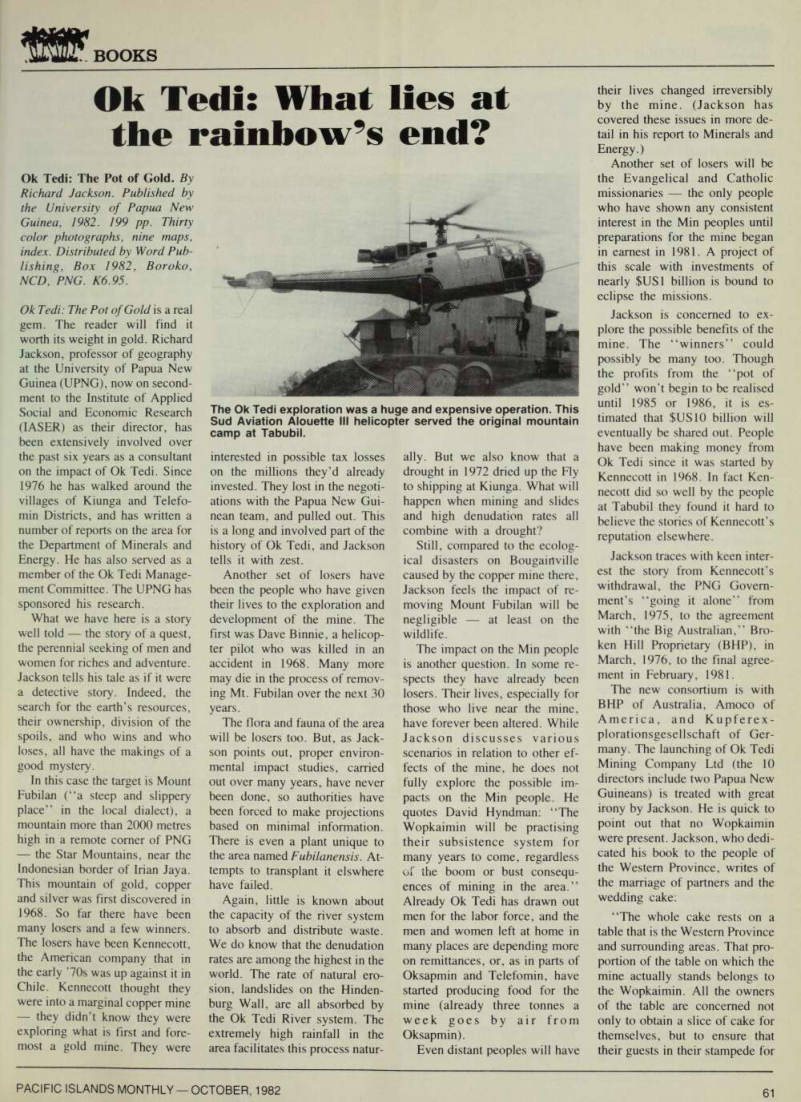
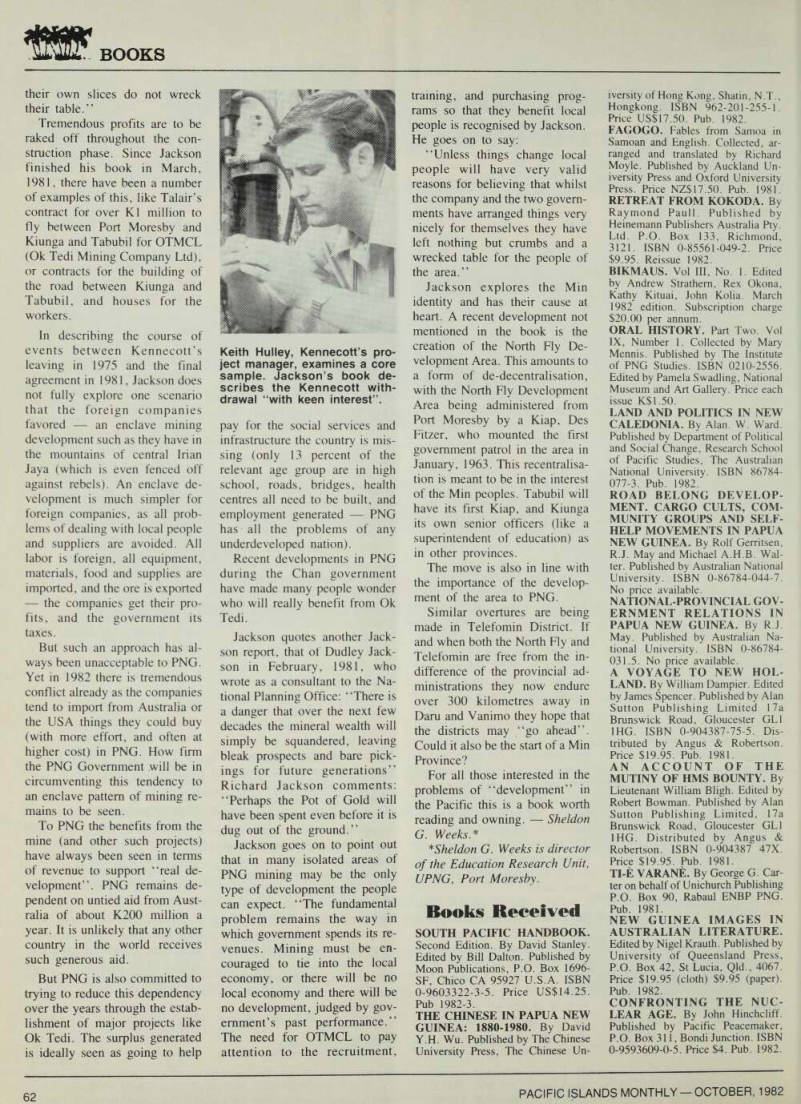
Books
Ok Tedi: What lies at the rainbow's end?
Ok Tedi: The Pot of Gold. By Richard Jackson. Published by the University of Papua New Guinea, 1982. 199 pp. Thirty color photographs, nine maps, index. Distributed by Word Pub lishing, Box 1982, Boroko,
Ncd, Png. K 6.95.
Ok Tedi: The Pot of Gold is a real gem. The reader will find it worth its weight in gold. Richard Jackson, professor of geography at the University of Papua New Guinea (UPNG), now on second ment to the Institute of Applied Social and Economic Research (lASER) as their director, has been extensively involved over the past six years as a consultant on the impact of Ok Tedi. Since 1976 he has walked around the villages of Kiunga and Telefo min Districts, and has written a number of reports on the area for the Department of Minerals and Energy. He has also served as a member of the Ok Tedi Manage ment Committee. The UPNG has sponsored his research.
What we have here is a story well told the story of a quest, the perennial seeking of men and women for riches and adventure.
Jackson tells his tale as if it were a detective story. Indeed, the search for the earth’s resources, their ownership, division of the spoils, and who wins and who loses, all have the makings of a good mystery.
In this case the target is Mount Fubilan (“a steep and slippery place” in the local dialect), a mountain more than 2000 metres high in a remote comer of PNG the Star Mountains, near the Indonesian border of Irian Jaya.
This mountain of gold, copper and silver was first discovered in 1968. So far there have been many losers and a few winners.
The losers have been Kennecott, the American company that in the early ’7os was up against it in
Chile. Kennecott thought they
were into a marginal copper mine they didn’t know they were exploring what is first and fore most a gold mine. They were
interested in possible tax losses on the millions they’d already invested. They lost in the negoti ations with the Papua New Gui nean team, and pulled out. This is a long and involved part of the history of Ok Tedi, and Jackson tells it with zest.
Another set of losers have been the people who have given their lives to the exploration and development of the mine. The first was Dave Binnie, a helicop ter pilot who was killed in an accident in 1968. Many more may die in the process of remov ing Mt. Fubilan over the next 30 years.
The flora and fauna of the area will be losers too. But, as Jack son points out, proper environ mental impact studies, carried out over many years, have never been done, so authorities have been forced to make projections based on minimal information.
There is even a plant unique to the area named Fubilanensis. At tempts to transplant it elswhere have failed.
Again, little is known about the capacity of the river system to absorb and distribute waste.
We do know that the denudation rates are among the highest in the world. The rate of natural ero sion, landslides on the Hinden burg Wall, are all absorbed by the Ok Tedi River system. The extremely high rainfall in the area facilitates this process natur
ally. But we also know that a drought in 1972 dried up the Fly to shipping at Kiunga. What will happen when mining and slides and high denudation rates all combine with a drought?
Still, compared to the ecolog ical disasters on Bougainville caused by the copper mine there, Jackson feels the impact of re moving Mount Fubilan will be negligible at least on the wildlife.
The impact on the Min people is another question. In some re spects they have already been losers. Their lives, especially for those who live near the mine, have forever been altered. While Jackson discusses various scenarios in relation to other ef fects of the mine, he does not
fully explore the possible im
pacts on the Min people. He quotes David Hyndman: “The
Wopkaimin will be practising
their subsistence system for many years to come, regardless of the boom or bust consequ ences of mining in the area.”
Already Ok Tedi has drawn out men for the labor force, and the men and women left at home in many places are depending more on remittances, or, as in parts of Oksapmin and Telefomin, have started producing food for the mine (already three tonnes a week goes by air from
Oksapmin).
Even distant peoples will have
their lives changed irreversibly by the mine. (Jackson has covered these issues in more de tail in his report to Minerals and
Energy.)
Another set of losers will be the Evangelical and Catholic missionaries the only people who have shown any consistent interest in the Min peoples until preparations for the mine began in earnest in 1981. A project of this scale with investments of nearly SUSI billion is bound to eclipse the missions.
Jackson is concerned to ex plore the possible benefits of the mine. The “winners” could possibly be many too. Though the profits from the “pot of gold” won’t begin to be realised until 1985 or 1986, it is es timated that SUSIO billion will eventually be shared out. People have been making money from Ok Tedi since it was started by Kennecott in 1968. In fact Ken necott did so well by the people at Tabubil they found it hard to believe the stories of Kennecott’s
reputation elsewhere.
Jackson traces with keen inter est the story from Kennecott’s withdrawal, the PNG Govern ment’s “going it alone” from March, 1975, to the agreement with “the Big Australian,” Bro ken Hill Proprietary (BHP), in March, 1976, to the final agree ment in February, 1981.
The new consortium is with BHP of Australia, Amoco of America, and Kupferex plorationsgesellschaft of Ger many. The launching of Ok Tedi Mining Company Ltd (the 10 directors include two Papua New Guineans) is treated with great irony by Jackson. He is quick to point out that no Wopkaimin were present. Jackson, who dedi cated his book to the people of the Western Province, writes of the marriage of partners and the
wedding cake;
“The whole cake rests on a table that is the Western Province and surrounding areas. That pro portion of the table on which the mine actually stands belongs to the Wopkaimin. All the owners of the table are concerned not only to obtain a slice of cake for themselves, but to ensure that their guests in their stampede for
The Ok Tedi exploration was a huge and expensive operation. This Sud Aviation Alouette III helicopter served the original mountain camp at Tabubil.
their own slices do not wreck their table.”
Tremendous profits are to be raked off throughout the con struction phase. Since Jackson finished his book in March, 1981, there have been a number of examples of this, like Talair’s contract for over K 1 million to fly between Port Moresby and Kiunga and Tabubil for OTMCL (Ok Tedi Mining Company Ltd), or contracts for the building of the road between Kiunga and Tabubil, and houses for the workers.
In describing the course of events between Kennecott’s leaving in 1975 and the final agreement in 1981, Jackson does not fully explore one scenario that the foreign companies favored an enclave mining development such as they have in the mountains of central Irian Jaya (which is even fenced off against rebels). An enclave de velopment is much simpler for foreign companies, as all prob lems of dealing with local people and suppliers are avoided. All labor is foreign, all equipment, materials, food and supplies are imported, and the ore is exported the companies get their pro fits, and the government its taxes.
But such an approach has al ways been unacceptable to PNG.
Yet in 1982 there is tremendous conflict already as the companies tend to import from Australia or the USA things they could buy (with more effort, and often at higher cost) in PNG. How firm the PNG Government will be in circumventing this tendency to an enclave pattern of mining re mains to be seen.
To PNG the benefits from the mine (and other such projects) have always been seen in terms of revenue to support “real de velopment”. PNG remains de pendent on untied aid from Aust ralia of about K2OO million a year. It is unlikely that any other country in the world receives such generous aid.
But PNG is also committed to trying to reduce this dependency over the years through the estab lishment of major projects like Ok Tedi. The surplus generated is ideally seen as going to help
pay for the social services and infrastructure the country is mis sing (only 13 percent of the relevant age group are in high school, roads, bridges, health centres all need to be built, and
employment generated PNG
has all the problems of any
underdeveloped nation).
Recent developments in PNG during the Chan government have made many people wonder who will really benefit from Ok Tedi.
Jackson quotes another Jack son report, that of Dudley Jack son in February, 1981, who wrote as a consultant to the Na tional Planning Office: “There is a danger that over the next few decades the mineral wealth will
simply be squandered, leaving
bleak prospects and bare pick
ings for future generations”
Richard Jackson comments; “Perhaps the Pot of Gold will have been spent even before it is dug out of the ground.”
Jackson goes on to point out that in many isolated areas of PNG mining may be the only type of development the people can expect. “The fundamental problem remains the way in which government spends its re venues. Mining must be en couraged to tie into the local economy, or there will be no local economy and there will be no development, judged by gov ernment’s past performance.”
The need for OTMCL to pay attention to the recruitment,
training, and purchasing prog
rams so that they benefit local people is recognised by Jackson.
He goes on to say;
“Unless things change local
people will have very valid reasons for believing that whilst the company and the two govern ments have arranged things very nicely for themselves they have left nothing but crumbs and a wrecked table for the people of the area.”
Jackson explores the Min identity and has their cause at heart. A recent development not mentioned in the book is the creation of the North Fly De velopment Area. This amounts to a form of de-decentralisation, with the North Fly Development Area being administered from Port Moresby by a Kiap, Des Fitzer, who mounted the first government patrol in the area in January, 1963. This recentralisa tion is meant to be in the interest of the Min peoples. Tabubil will have its first Kiap, and Kiunga its own senior officers (like a superintendent of education) as in other provinces.
The move is also in line with the importance of the develop ment of the area to PNG.
Similar overtures are being made in Telefomin District. If and when both the North Fly and Telefomin are free from the in difference of the provincial ad ministrations they now endure over 300 kilometres away in Dam and Vanimo they hope that the districts may “go ahead”.
Could it also be the start of a Min Province?
For all those interested in the
problems of “development” in
the Pacific this is a book worth
reading and owning.
Sheldon
G. Weeks.
* Sheldon G. Weeks is director of the Education Research Unit, UPNG, Port Moresby.
Books Received
South Pacific Handbook.
Second Edition. By David Stanley.
Edited by Bill Dalton. Published by Moon Publications, P.O. Box 1696-
Sf, Chico Ca 95927 U.S.A. Isbn
0-9603322-3-5. Price U 5514.25.
Pub 1982-3.
The Chinese In Papua New
GUINEA: 1880-1980. By David Y.H. Wu. Published by The Chinese University Press, The Chinese Un
iversity of Hong Kong, Shatin, N.T., Hongkong. ISBN 962-201-255-1.
Price U 5517.50. Pub. 1982.
FAGOGO. Fables from Samoa in Samoan and English. Collected, ar ranged and translated by Richard Moyle. Published by Auckland Un iversity Press and Oxford University Press. Price NZ517.50. Pub. 1981.
Retreat From Kokoda. By
Raymond Pauli. Published by Heinemann Publishers Australia Pty.
Ltd. P.O. Box 133, Richmond, 3121. ISBN 0-85561-049-2. Price $9.95. Reissue 1982.
BIKMAUS. Vol 111, No. 1. Edited by Andrew Strathem, Rex Okona, Kathy Kituai, John Kolia. March
1982 edition. Subscription charge
$20.00 per annum.
ORAL HISTORY. Part Two. Vol IX, Number 1. Collected by Mary Mennis. Published by The Institute of PNG Studies. ISBN 0210-2556.
Edited by Pamela Swadling, National Museum and Art Gallery. Price each issue K 51.50.
Land And Politics In New
CALEDONIA. By Alan. W. Ward.
Published by Department of Political and Social Change, Research School of Pacific Studies, The Australian National University. ISBN 86784- 077-3. Pub. 1982.
Road Belong Develop
Ment. Cargo Cults, Com
Munity Groups And Self
Help Movements In Papua
NEW GUINEA. By Rolf Gerritsen, R.J. May and Michael A.H.B. Wal ter. Published by Australian National University. ISBN 0-86784-044-7.
No price available.
National-Provincial Gov
Ernment Relations In
Papua New Guinea. By R.J.
May. Published by Australian Na tional University. ISBN 0-86784- 031.5. No price available.
A Voyage To New Hol
LAND. By William Dampier. Edited by James Spencer. Published by Alan Sutton Publishing Limited 17a Brunswick Road, Gloucester GLI
Ihg. Isbn 0-904387-75-5. Dis
tributed by Angus & Robertson.
Price $19.95. Pub. 1981.
An Account Of The
Mutiny Of Hms Bounty. By
Lieutenant William Bligh. Edited by Robert Bowman. Published by Alan Sutton Publishing Limited, 17a Brunswick Road, Gloucester GLI IHG. Distributed by Angus & Robertson. ISBN 0-904387 47X.
Price $19.95. Pub. 1981.
TI-E VARANE. By George G. Car ter on behalf of Unichurch Publishing P.O. Box 90, Rabaul ENBP PNG.
Pub. 1981.
New Guinea Images In
Australian Literature.
Edited by Nigel Krauth. Published by University of Queensland Press, P.O. Box 42, St Lucia, Qld., 4067.
Price $19.95 (cloth) $9.95 (paper).
Pub. 1982.
Confronting The Nuc
LEAR AGE. By John Hinchcliff.
Published by Pacific Peacemaker, P.O. Box 311, Bondi Junction. ISBN 0-9593609-0-5. Price $4. Pub. 1982.
Keith Hulley, Kennecott’s pro ject manager, examines a core sample. Jackson’s book de scribes the Kennecott with drawal “with keen interest".
Travel
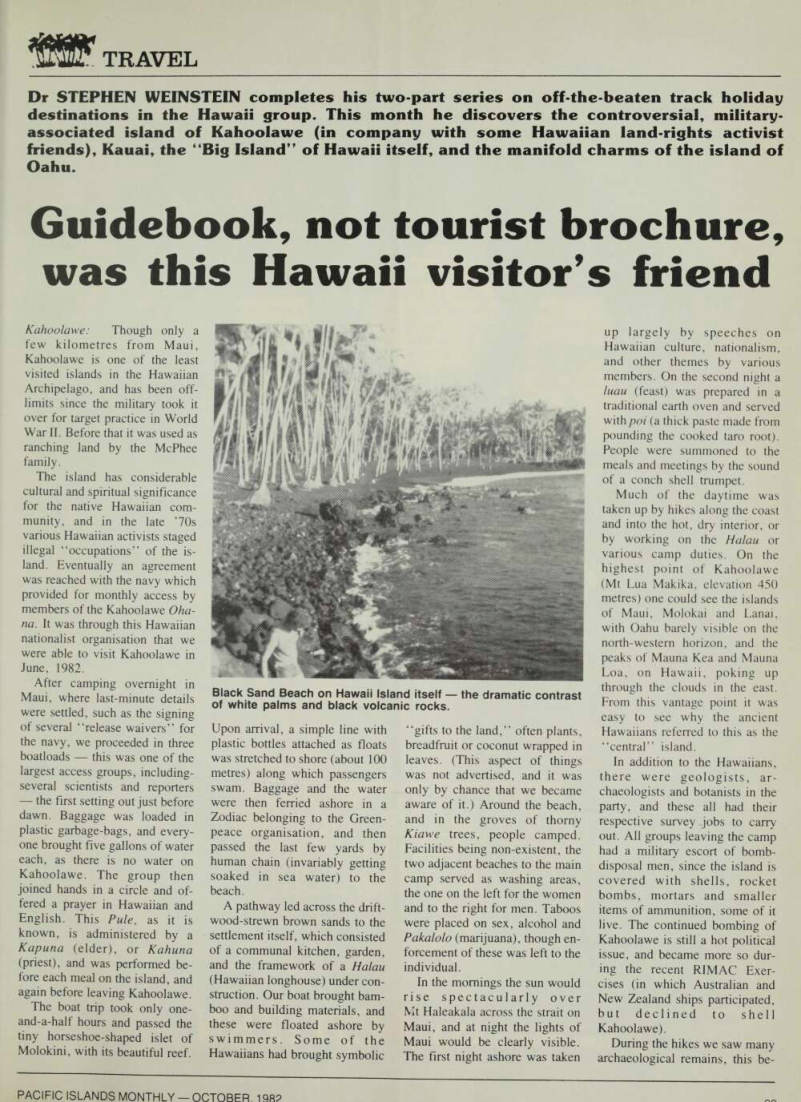
Dr STEPHEN WEINSTEIN completes his two-part series on off-the-beaten track holiday destinations in the Hawaii group. This month he discovers the controversial, military associated island of Kahoolawe (in company with some Hawaiian land-rights activist friends), Kauai, the “Big Island” of Hawaii itself, and the manifold charms of the island of Oahu.
Guidebook, not tourist brochure,
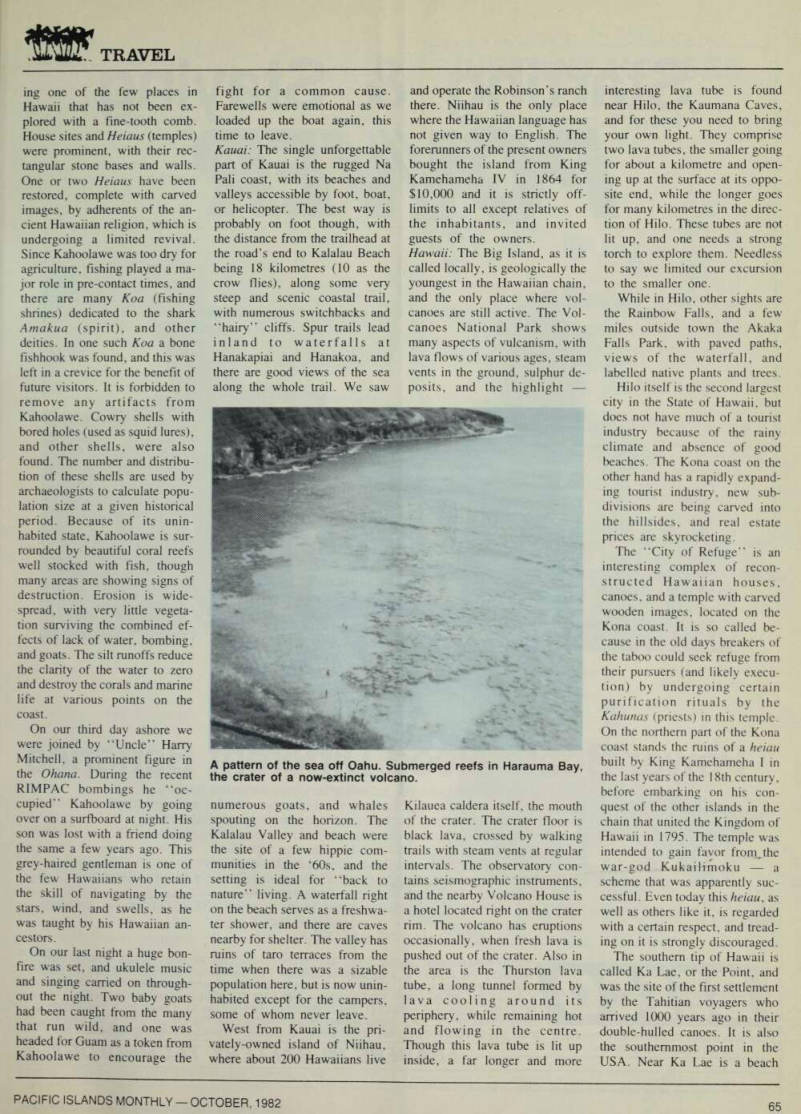
was this Hawaii visitor’s friend
Kahoolawe: Though only a few kilometres from Maui, Kahoolawe is one of the least visited islands in the Hawaiian Archipelago, and has been off limits since the military took it over for target practice in World War 11. Before that it was used as ranching land by the McPhee family.
The island has considerable cultural and spiritual significance for the native Hawaiian com munity, and in the late ’7os various Hawaiian activists staged illegal “occupations” of the is land. Eventually an agreement was reached with the navy which provided for monthly access by members of the Kahoolawe Gha na. It was through this Hawaiian nationalist organisation that we were able to visit Kahoolawe in June, 1982.
After camping overnight in Maui, where last-minute details were settled, such as the signing of several “release waivers” for the navy, we proceeded in three boatloads this was one of the largest access groups, including several scientists and reporters the first setting out just before dawn. Baggage was loaded in plastic garbage-bags, and every one brought five gallons of water each, as there is no water on Kahoolawe. The group then joined hands in a circle and of fered a prayer in Hawaiian and English. This Pule, as it is known, is administered by a Kapuna (elder), or Kahuna (priest), and was performed be fore each meal on the island, and again before leaving Kahoolawe.
The boat trip took only one and-a-half hours and passed the tiny horseshoe-shaped islet of Molokini, with its beautiful reef.
Upon arrival, a simple line with plastic bottles attached as floats was stretched to shore (about 100 metres) along which passengers swam. Baggage and the water were then ferried ashore in a Zodiac belonging to the Green peace organisation, and then passed the last few yards by human chain (invariably getting soaked in sea water) to the beach.
A pathway led across the drift wood-strewn brown sands to the settlement itself, which consisted of a communal kitchen, garden, and the framework of a Halau (Hawaiian longhouse) under con struction. Our boat brought bam boo and building materials, and these were floated ashore by swimmers. Some of the Hawaiians had brought symbolic
“gifts to the land,” often plants, breadfruit or coconut wrapped in leaves. (This aspect of things was not advertised, and it was only by chance that we became aware of it.) Around the beach, and in the groves of thorny Kiawe trees, people camped.
Facilities being non-existent, the two adjacent beaches to the main camp served as washing areas, the one on the left for the women and to the right for men. Taboos were placed on sex, alcohol and Pakalolo (marijuana), though en forcement of these was left to the individual.
In the mornings the sun would rise spectacularly over Mt Haleakala across the strait on Maui, and at night the lights of Maui would be clearly visible.
The first night ashore was taken
up largely by speeches on Hawaiian culture, nationalism, and other themes by various members. On the second night a luau (feast) was prepared in a traditional earth oven and served with poi (a thick paste made from pounding the cooked taro root).
People were summoned to the meals and meetings by the sound of a conch shell trumpet.
Much of the daytime was taken up by hikes along the coast and into the hot, dry interior, or by working on the Halau or various camp duties. On the highest point of Kahoolawe (Mt Lua Makika, elevation 450 metres) one could see the islands of Maui, Molokai and Lanai, with Oahu barely visible on the north-western horizon, and the peaks of Mauna Kea and Mauna Loa, on Hawaii, poking up through the clouds in the east.
From this vantage point it was easy to see why the ancient Hawaiians referred to this as the “central” island.
In addition to the Hawaiians, there were geologists, ar chaeologists and botanists in the party, and these all had their respective survey jobs to carry out. All groups leaving the camp had a military escort of bomb disposal men, since the island is covered with shells, rocket bombs, mortars and smaller items of ammunition, some of it live. The continued bombing of Kahoolawe is still a hot political issue, and became more so dur ing the recent RIMAC Exer cises (in which Australian and New Zealand ships participated, but declined to shell Kahoolawe).
During the hikes we saw many archaeological remains, this be-
Black Sand Beach on Hawaii Island itself the dramatic contrast of white palms and black volcanic rocks.
ing one of the few places in Hawaii that has not been ex plored with a fine-tooth comb.
House sites and Heiaus (temples) were prominent, with their rec tangular stone bases and walls.
One or two Heiaus have been restored, complete with carved images, by adherents of the an cient Hawaiian religion, which is undergoing a limited revival.
Since Kahoolawe was too dry for agriculture, fishing played a ma jor role in pre-contact times, and there are many Koa (fishing shrines) dedicated to the shark Amakua (spirit), and other deities. In one such Koa a bone fishhook was found, and this was left in a crevice for the benefit of future visitors. It is forbidden to remove any artifacts from Kahoolawe. Cowry shells with bored holes (used as squid lures), and other shells, were also found. The number and distribu tion of these shells are used by archaeologists to calculate popu lation size at a given historical period. Because of its unin habited state, Kahoolawe is sur rounded by beautiful coral reefs well stocked with fish, though many areas are showing signs of destruction. Erosion is wide spread, with very little vegeta tion surviving the combined ef fects of lack of water, bombing, and goats. The silt runoffs reduce the clarity of the water to zero and destroy the corals and marine life at various points on the coast.
On our third day ashore we were joined by “Uncle” Harry Mitchell, a prominent figure in the Ghana. During the recent RIMPAC bombings he “oc
cupied” Kahoolawe by going
over on a surfboard at night. His son was lost with a friend doing the same a few years ago. This grey-haired gentleman is one of the few Hawaiians who retain the skill of navigating by the stars, wind, and swells, as he was taught by his Hawaiian an cestors.
On our last night a huge bon fire was set, and ukulele music and singing carried on through out the night. Two baby goats had been caught from the many that run wild, and one was headed for Guam as a token from Kahoolawe to encourage the
fight for a common cause.
Farewells were emotional as we loaded up the boat again, this time to leave.
Kauai: The single unforgettable part of Kauai is the rugged Na Pali coast, with its beaches and valleys accessible by foot, boat, or helicopter. The best way is probably on foot though, with the distance from the trailhead at the road’s end to Kalalau Beach being 18 kilometres (10 as the crow flies), along some very steep and scenic coastal trail, with numerous switchbacks and “hairy” cliffs. Spur trails lead inland to waterfalls at Hanakapiai and Hanakoa, and there are good views of the sea along the whole trail. We saw
and operate the Robinson’s ranch there. Niihau is the only place where the Hawaiian language has not given way to English. The forerunners of the present owners bought the island from King Kamehameha IV in 1864 for $lO,OOO and it is strictly off limits to all except relatives of the inhabitants, and invited guests of the owners.
Hawaii: The Big Island, as it is called locally, is geologically the youngest in the Hawaiian chain, and the only place where vol canoes are still active. The Vol canoes National Park shows many aspects of vulcanism, with lava flows of various ages, steam vents in the ground, sulphur de
posits, and the highlight
numerous goats, and whales spouting on the horizon. The Kalalau Valley and beach were the site of a few hippie com munities in the ‘6os, and the setting is ideal for “back to nature” living. A waterfall right on the beach serves as a freshwa ter shower, and there are caves nearby for shelter. The valley has ruins of taro terraces from the time when there was a sizable population here, but is now unin habited except for the campers, some of whom never leave.
West from Kauai is the pri vately-owned island of Niihau, where about 200 Hawaiians live
Kilauea caldera itself, the mouth of the crater. The crater floor is black lava, crossed by walking trails with steam vents at regular intervals. The observatory con tains seismographic instruments, and the nearby Volcano House is a hotel located right on the crater rim. The volcano has eruptions occasionally, when fresh lava is pushed out of the crater. Also in the area is the Thurston lava tube, a long tunnel formed by lava cooling around its periphery, while remaining hot and flowing in the centre.
Though this lava tube is lit up inside, a far longer and more
interesting lava tube is found near Hilo, the Kaumana Caves, and for these you need to bring
your own light. They comprise
two lava tubes, the smaller going for about a kilometre and open ing up at the surface at its oppo site end, while the longer goes for many kilometres in the direc tion of Hilo. These tubes are not lit up, and one needs a strong torch to explore them. Needless to say we limited our excursion to the smaller one.
While in Hilo, other sights are the Rainbow Falls, and a few miles outside town the Akaka Falls Park, with paved paths, views of the waterfall, and labelled native plants and trees.
Hilo itself is the second largest city in the State of Hawaii, but does not have much of a tourist industry because of the rainy climate and absence of good beaches. The Kona coast on the other hand has a rapidly expand ing tourist industry, new sub divisions are being carved into the hillsides, and real estate
prices are skyrocketing.
The “City of Refuge” is an interesting complex of recon structed Hawaiian houses, canoes, and a temple with carved wooden images, located on the Kona coast. It is so called be cause in the old days breakers of the taboo could seek refuge from their pursuers (and likely execu
tion) by undergoing certain
purification rituals by the Kahunas (priests) in this temple.
On the northern part of the Kona coast stands the ruins of a heiau built by King Kamehameha I in the last years of the 18th century, before embarking on his con quest of the other islands in the chain that united the Kingdom of Hawaii in 1795. The temple was intended to gain favor war-god Kukailimoku a scheme that was apparently suc cessful. Even today this heiau , as well as others like it, is regarded with a certain respect, and tread
ing on it is strongly discouraged.
The southern tip of Hawaii is called Ka Lae, or the Point, and was the site of the first settlement by the Tahitian voyagers who arrived 1000 years ago in their double-hulled canoes. It is also the southernmost point in the USA. Near Ka Lae is a beach
A pattern of the sea off Oahu. Submerged reefs in Harauma Bay, the crater of a now-extinct volcano.
with green sand. The famous Black Sands Beach is also located on the Big Island, the sand being pulverised black lava.
That beach, however, is in the process of being eroded by the sea, and is much narrower today than on photographs of a few years ago. A short drive from Ka Lae brings one to Milolii, said to be the last functioning fishing village in Hawaii.
A last place worth mentioning is the lush Waipio Valley in the northwest, once the site of a flourishing population of 5000. It was the second settlement found ed by the Tahitian voyagers, and it was ruled by the semi legendary King Umi, ancestor of Kamehameha I, who grew up in this valley. Now fewer than 50 people live there, growing taro.
The valley can be reached by four-wheel-drive cars, and an
eight-room, kerosene-lighted
hotel has recently been opened down there. A path following an old Hawaiian foot-trail leads on to the next valley, Waimanu, which is uninhabited, but has an attractive enough setting with beach at one end, waterfall at the other, and a forest full of wild fruits in between.
Oahu: It would be pointless to try to list all the attractions of Oahu in a few sentences, espe cially since this has been done in a myriad of guidebooks already.
However, in summary, what we find most worthwhile, in addi tion to the hiking trails men tioned later, is as follows; For
snorkelling and diving Hana
ma Bay; surfing beaches Sun set, Makaha, Yokohama, and Makapuu (the latter for body surfing); ethnic flavor Chinatown on Maunakea Street; atmosphere of old Hawaii and
the Monarchy period Bishop
Museum, lolani Palace, and the Queen Emma Summer Palace.
The extinct craters of Diamond Head and Punchbowl offer fine panoramas of the city, in addi tion to being famous landmarks in themselves.
There are many beautiful na ture trails that enable one to be entirely alone even on such a crowded place as Oahu. Some worth mentioning are those near Laie, location of the Polynesian Cultural Center and Mormon Temple, which lead into the
Koolau Range and either stop at pools and waterfalls, or eventual ly join the ridge trail that follows the spine of the Koolau Range right down to and past Honolulu.
The Maakua Gulch trail follows
an extremely narrow, winding
gulch with steep, almost perpen dicular walls, until it reaches three little pools and falls, the highest of which can be reached by climbing a rope from the middle one.
The pools are just big enough for a couple of swim strokes.
Sacred Falls is another ter minus of a trail frequented by far more people, but even so there are numerous wild fruits such as mountain apples to be found along this trail in the right sea sons. From the suburbs of Hon olulu begins the Manoa Falls trail, which passes through a bamboo grove. Another interest ing walk, or rather climb, is to follow the 3000 or so steps up the steep windward side of the Koolaus to an old wartime com munications station. The stairs were built by the army after the Pearl Harbor attack, as access to a part of a worldwide Allied radio network. This is one of the lesser known trails, as it is not featured in any hiking books.
Also interesting are the Keai wa heiau and medicinal herb garden where offerings of poi, breadfruit and stones wrapped in ti-leaves can be found. Moanalua
Valley displays petrolyphs on a
solitary huge rock a short walk from the road.
In recent years there have been some rather nasty accidents in which lives were lost when hik ers, intentionally or otherwise, stumbled on guarded or booby trapped pakalolo patches (local Hawaiian word for marijuana) in “off-trail” areas of the moun
tains. Consequently, camping in
or hiking to remote areas is no longer as safe as it used to be.
The little island of Mokolii, or Chinamans Hat, a conical top in Kaneohe Bay, can be reached by wading over at low tide, or paddling over on a surfboard.
The island has a tiny sand beach, a stone monolith said to represent an ancient fishing god, and a few coconut palms. Another island off Oahu that can be reached by a short swim is Mokuauia, a bird refuge opposite Laie.
Advertisements & other items, pp. 64-68 (1 item)
Citizen
-L :: 3F ' 4n
cws
w '5, - *o-
CITIZEN INTRODUCE
THE WORLD’S THINNEST
100 METRE WATER RESISTANT
QUARTZ WATCH
Now you don’t have to choose between a fashion watch and a sports watch. Citizen have combined the styling of a dress watch with the durability and water resistance of a sports watch.
Citizen has used its renowned quartz technology to produce the world’s thinnest 100 metre water resistant watch. A case that can sit at the bottom of a swimming pool for a month without losing or gaining more than five seconds.
CITIZEN QUARTZWN
SUM WATER RESIST IW
CITIZEN
Citizen Watches Australia Pty Ltd, 122 Old Pittwater Rd. Brookvale. NSW 2100. Australia.
Telephone: 9397077. Cable: Citizen Sydney. Telex. AA26633
Starting & Staying
pcmsf
mm .•«—i
AMP
m m U 333 *
now
CS23 \ Z 3557
Power Boats Need Different Batteries
There is a big difference between a car battery and a marine battery.
A car battery, for example, is never really discharged, as it is only used for a few seconds each day and promptly re-charged. Not so your cruiser or sportsfishemnan.
Starting the engine is only the beginning. During the day, weekend or cruise, how often will you run the live bait tank, the depth sounder, the nav. lights or maintain a listening watch on your radio transceiver?
As well as cranking power, boats need staying power. Boats need Besco's Marine Batteries, deep cycle, heavy duty marine batteries.
If your boat is getting a little flat in the electrics department, write or phone BESCO today and ask for more information, more facts about
BESCO MARINE BATTERIES.
BESCO
I , Papua New Guinea: Lae/Rabaul Auto Marine Industries, PO Box 785, Lae. 42-1125. Port Moresby: Par Sales Pty. Ltd., Boroko. 25-6266. Fiji: Bar Motor Parts Ltd., PO Box 51, Bar, 74-070 New Caledonia: Lotissement Industrie!, BP 889, Noumea. 27-4906. Hong Kong: T.l.
Knight & Co., PO Box 5585, T.S.T. Kowloon, 3-66 5341. N.Z.: Battery Services (Industrial) Ltd., PO 27-375, Auckland 4, 694-111. Gould Batteries, 58 HautanaSt., Lower Hutt, Wellington.
Telex- CHACO N.Z. 3714. Other Areas: Jarwil International Pty. Ltd., 410 Kent St Sydney, Batteries Division 0! Sims Products Ply. Ltd / 2000. (02) 264-3477. Telex: AA 72102. Besco Batteries, Villawood, 2163. (02) 632-0251.
A Peko Wat I send Group Member LEADERS IN BATTERY TECHNOLOGY —
INSTANT HOUSES
WITH
6.
K Y. :.r*
Therma-Panel®
THE FULLY INSULATED BUILDING SYSTEM
v • Economical i'f'i I* Homes School buildings • Shearer's quarters • Farm buildings • Fast
• Simple
Amenity blocks Offices
THE HOME YOU CAN ASSEMBLE )
(0) George Hudson Homes p}£ s |j d 186 Hume Hway, Cabramatta, N S W. 2166 Telephone: (02) 727 9066. Telex: AA25800.
Name Phone For details and prices post coupon to: George Hudson Homes Address (Aust.) Pty Ltd
"AMAZING"
INCREDIBLE"
"FANTASTIC . .
Just some of the words used to describe the Argo at demonstrations.
Replace your trail bike, utility and some tractor jobs with this one versatile unit that can also swim. 6 or 8 wheel model available Please send me brochure □ Advise my nearest dealer □ Ring me to arrange demoD For further information tick appropriate square and mail coupon to; ARGO ALL TERRAIN VEHICLES, 1830 SANDGATE ROAD,
VIRGINIA Q, AUSTRALIA 4014. Telephone (07)265-2265.
Name Address
r •i: - A & -lass m m K - •« ■ a . -S^i
fli
a H . ■■*s& Pfcm m ' ! % f m r* €<l \ /
Come uptokool
The cool refreshing taste of menthol.
na Ainr* i o i AMRO MrtMTUI V nCTORFR 19ft?
Trade Winds
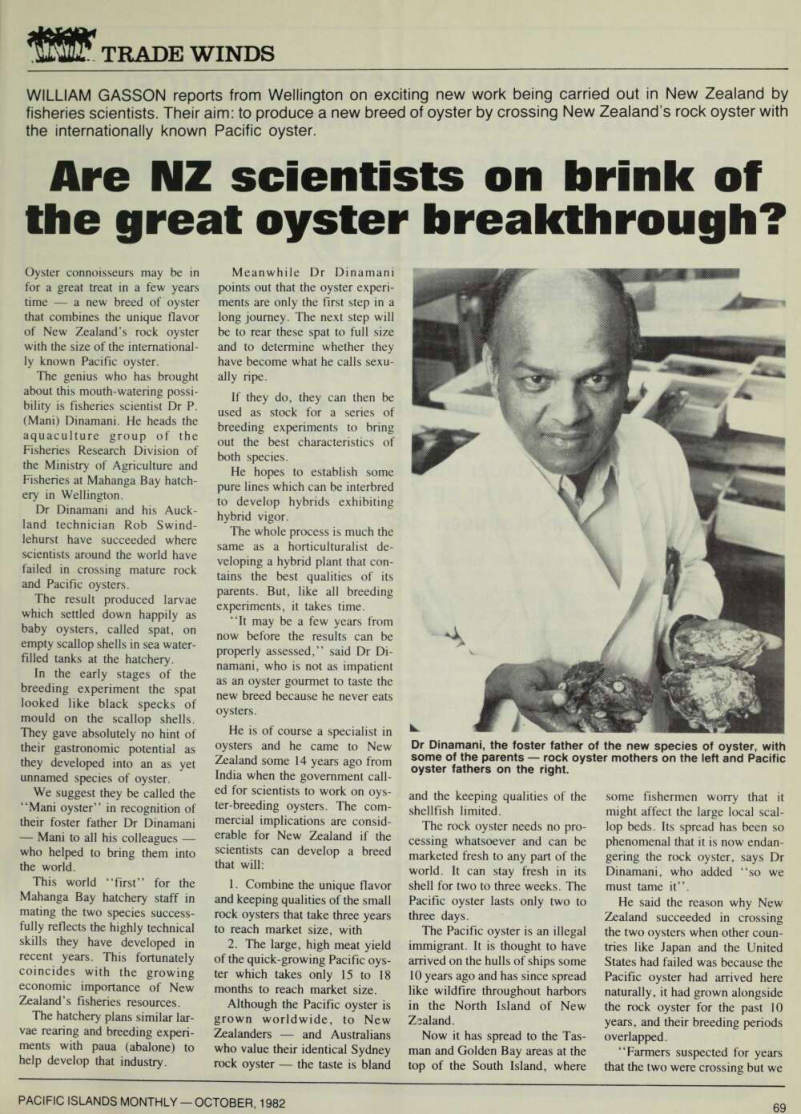
WILLIAM GASSON reports from Wellington on exciting new work being carried out in New Zealand by fisheries scientists. Their aim: to produce a new breed of oyster by crossing New Zealand’s rock oyster with the internationally known Pacific oyster.
the great oyster breakthrough?

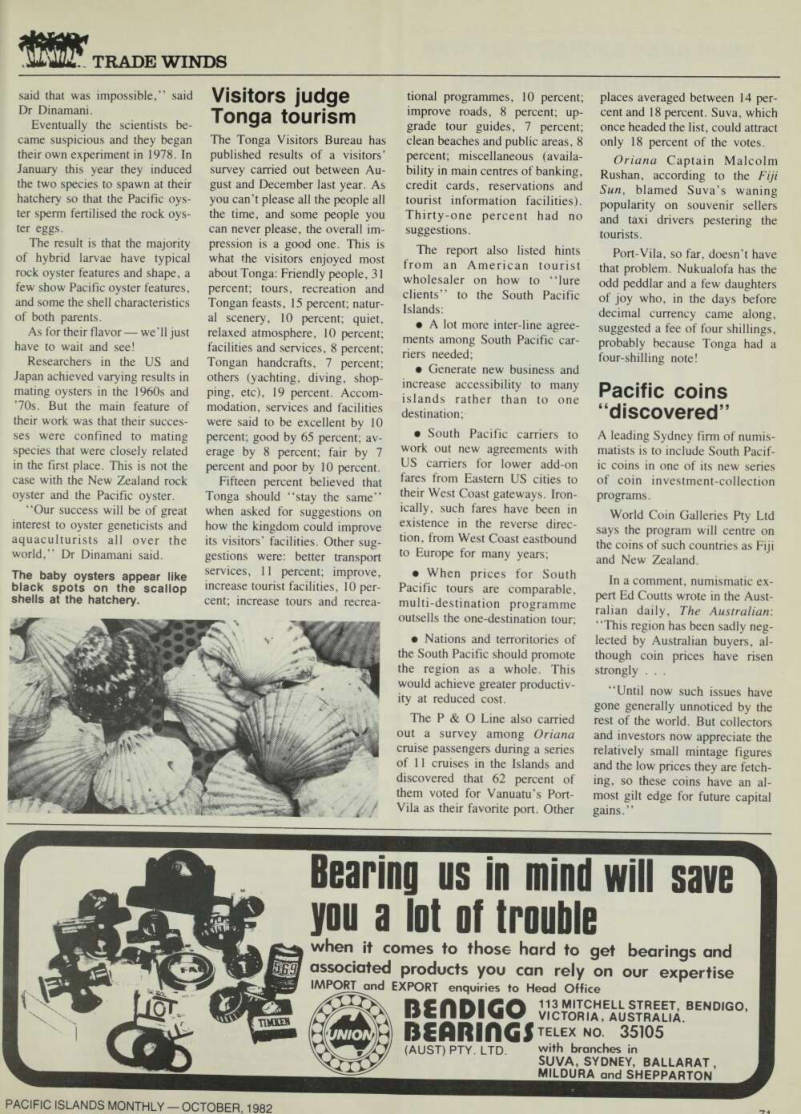
Are NZ scientists on brink of the great oyster breakthrough?
Oyster connoisseurs may be in for a great treat in a few years time a new breed of oyster that combines the unique flavor of New Zealand’s rock oyster with the size of the international ly known Pacific oyster.
The genius who has brought about this mouth-watering possi bility is fisheries scientist Dr P. (Mani) Dinamani. He heads the aquaculture group of the Fisheries Research Division of the Ministry of Agriculture and Fisheries at Mahanga Bay hatch ery in Wellington.
Dr Dinamani and his Auck land technician Rob Swind lehurst have succeeded where scientists around the world have failed in crossing mature rock and Pacific oysters.
The result produced larvae which settled down happily as baby oysters, called spat, on empty scallop shells in sea water filled tanks at the hatchery.
In the early stages of the breeding experiment the spat looked like black specks of mould on the scallop shells.
They gave absolutely no hint of their gastronomic potential as they developed into an as yet unnamed species of oyster.
We suggest they be called the “Mani oyster” in recognition of their foster father Dr Dinamani Mani to all his colleagues who helped to bring them into the world.
This world “first” for the Mahanga Bay hatchery staff in mating the two species success fully reflects the highly technical skills they have developed in recent years. This fortunately coincides with the growing economic importance of New Zealand’s fisheries resources.
The hatchery plans similar lar vae rearing and breeding experi ments with paua (abalone) to help develop that industry.
Meanwhile Dr Dinamani points out that the oyster experi ments are only the first step in a long journey. The next step will be to rear these spat to full size and to determine whether they have become what he calls sexu ally ripe.
If they do, they can then be used as stock for a series of breeding experiments to bring out the best characteristics of both species.
He hopes to establish some pure lines which can be interbred to develop hybrids exhibiting hybrid vigor.
The whole process is much the same as a horticulturalist de veloping a hybrid plant that con tains the best qualities of its parents. But, like all breeding experiments, it takes time.
“It may be a few years from now before the results can be properly assessed,” said Dr Di namani, who is not as impatient as an oyster gourmet to taste the new breed because he never eats oysters.
He is of course a specialist in oysters and he came to New Zealand some 14 years ago from India when the government call ed for scientists to work on oys ter-breeding oysters. The com mercial implications are consid erable for New Zealand if the scientists can develop a breed that will: 1. Combine the unique flavor and keeping qualities of the small rock oysters that take three years to reach market size, with 2. The large, high meat yield of the quick-growing Pacific oys ter which takes only 15 to 18 months to reach market size.
Although the Pacific oyster is grown worldwide, to New Zealanders and Australians who value their identical Sydney rock oyster the taste is bland
and the keeping qualities of the shellfish limited.
The rock oyster needs no pro cessing whatsoever and can be marketed fresh to any part of the world. It can stay fresh in its shell for two to three weeks. The Pacific oyster lasts only two to three days.
The Pacific oyster is an illegal immigrant. It is thought to have arrived on the hulls of ships some 10 years ago and has since spread like wildfire throughout harbors in the North Island of New Zealand.
Now it has spread to the Tas man and Golden Bay areas at the top of the South Island, where
some fishermen worry that it might affect the large local scal lop beds. Its spread has been so phenomenal that it is now endan gering the rock oyster, says Dr Dinamani, who added “so we must tame it”.
He said the reason why New Zealand succeeded in crossing the two oysters when other coun tries like Japan and the United States had failed was because the Pacific oyster had arrived here naturally, it had grown alongside the rock oyster for the past 10 years, and their breeding periods overlapped.
“Farmers suspected for years that the two were crossing but we
Dr Dinamani, the foster father of the new species of oyster, with some of the parents - rock oyster mothers on the left and Pacific oyster fathers on the right.
said that was impossible,” said Dr Dinamani.
Eventually the scientists be came suspicious and they began their own experiment in 1978. In January this year they induced the two species to spawn at their hatchery so that the Pacific oys ter sperm fertilised the rock oys ter eggs.
The result is that the majority of hybrid larvae have typical rock oyster features and shape, a few show Pacific oyster features, and some the shell characteristics of both parents.
As for their flavor we’ll just have to wait and see!
Researchers in the US and Japan achieved varying results in mating oysters in the 1960 s and ’7os. But the main feature of their work was that their succes ses were confined to mating species that were closely related in the first place. This is not the case with the New Zealand rock oyster and the Pacific oyster.
“Our success will be of great interest to oyster geneticists and aquaculturists all over the world,” Dr Dinamani said.
Visitors judge
Tonga tourism
The Tonga Visitors Bureau has published results of a visitors’ survey carried out between Au gust and December last year. As you can’t please all the people all the time, and some people you can never please, the overall im pression is a good one. This is what the visitors enjoyed most about Tonga: Friendly people, 31 percent; tours, recreation and Tongan feasts, 15 percent; natur al scenery, 10 percent; quiet, relaxed atmosphere, 10 percent; facilities and services, 8 percent; Tongan handcrafts, 7 percent; others (yachting, diving, shop ping, etc), 19 percent. Accom modation, services and facilities were said to be excellent by 10 percent; good by 65 percent; av erage by 8 percent; fair by 7 percent and poor by 10 percent.
Fifteen percent believed that Tonga should “stay the same” when asked for suggestions on how the kingdom could improve its visitors’ facilities. Other sug gestions were; better transport services, 11 percent; improve, increase tourist facilities, 10 per cent; increase tours and recrea-
tional programmes, 10 percent; improve roads, 8 percent; up grade tour guides, 7 percent; clean beaches and public areas, 8 percent; miscellaneous (availa bility in main centres of banking, credit cards, reservations and tourist information facilities).
Thirty-one percent had no suggestions.
The report also listed hints from an American tourist wholesaler on how to “lure clients” to the South Pacific Islands: • A lot more inter-line agree ments among South Pacific car riers needed; • Generate new business and increase accessibility to many islands rather than to one destination; • South Pacific carriers to work out new agreements with US carriers for lower add-on fares from Eastern US cities to their West Coast gateways. Iron ically, such fares have been in existence in the reverse direc tion, from West Coast eastbound to Europe for many years; • When prices for South Pacific tours are comparable, multi-destination programme outsells the one-destination tour; • Nations and terroritories of the South Pacific should promote the region as a whole. This would achieve greater productiv ity at reduced cost.
The P & O Line also carried out a survey among Oriana cruise passengers during a series of 11 cruises in the Islands and discovered that 62 percent of them voted for Vanuatu’s Port- Vila as their favorite port. Other
places averaged between 14 per cent and 18 percent. Suva, which once headed the list, could attract only 18 percent of the votes.
Oriana Captain Malcolm Rushan, according to the Fiji Sun, blamed Suva’s waning popularity on souvenir sellers and taxi drivers pestering the tourists.
Port-Vila, so far, doesn’t have that problem. Nukualofa has the odd peddlar and a few daughters of joy who, in the days before decimal currency came along, suggested a fee of four shillings, probably because Tonga had a
four-shilling note!
Pacific coins
“discovered”
A leading Sydney firm of numis matists is to include South Pacif ic coins in one of its new series of coin investment-collection programs.
World Coin Galleries Pty Ltd says the program will centre on the coins of such countries as Fiji and New Zealand.
In a comment, numismatic ex pert Ed Coutts wrote in the Aust ralian daily. The Australian : “This region has been sadly neg lected by Australian buyers, al though coin prices have risen strongly . . .
“Until now such issues have gone generally unnoticed by the rest of the world. But collectors and investors now appreciate the relatively small mintage figures and the low prices they are fetch ing, so these coins have an al most gilt edge for future capital gains.’’
The baby oysters appear like black spots on the scallop shells at the hatchery.
Advertisements & other items, pp. 70-72 (1 item)
Mary Kathleen Uranium Mine
PRELIMINARY AUCTION NOTICE!
AUSTRALIA’S LARGEST MINING AUCTION
I
mKu
MINING AND PROCESSING PLANT AND SUPPORT FACILITIES
TOTAL 12 AUCTION SALES TOTAL
CLEARANCE
THROUGH 6 DAYS
CLEARANCE
By Public Auction on Site,
11, 12, 13, 15, 16 & 17 APRIL, 1983
Under Instructions From
MARY KATHLEEN URANIUM LIMITED
Mary Kathleen, 4827, Old, Australia
Hardrock crushing plant (450-660 tonnes/hr approx.) Screening + ore sorting incl. 2 RTZ model Ml 7 and 5 model M 6 radiometric sorters 2800 tonnes/day milling, grinding, wet separation, tanks, pumps and ancillaries Sulphuric acid plant (175 tonnes/day @ 98.5%) 7 megawatt power house 9 diesels + 1 steam turbine Heavy earthmoving, dump trucks and drilling plant Vehicle fleet incl. over 60 trucks, buses, 4 wd Support facilities in engineering, fabrication, sheet metal, mechanical maintenance, carpentry, electrical and instrument engineering Office, project engineering, geology, surveying and laboratory equipment Bolted portal framed industrial buildings, transportable office + accommodation buildings Peripheral equipment incl. substations (incl. 10 MVA. 66 KV -11 KV, + 250 KVA to 3 MVA), cross country powerlines, transformers, pipelines + pumps, airlines and receivers, bulk fuel tanks and refuelling equip., outbuildings fences, two-way radio systems, etc. utilities and sedans, etc.
VHS VIDEO FILM: Now available for auction buyers Specially produced film showing Mine and Plant in full operation.
Phone or write now for further details, brochure and/or video film (nominal charge $30.00)
Fbvvles Overett Group.
Auctioneers to Mining and Industry throughout Australasia.
Members: FOWLES PURDY PTY. LTD. ALEX OVERETT PTY. LTD.
21-29 BAY STREET 99 LEICHHARDT STREET
PORT MELBOURNE, 3207 VIC., AUSTRALIA BRISBANE, 4000 OLD., AUSTRALIA Tel.: (03) 643951 Postal: P.O. BOX 287, SPRING HILL, 4000 OLD., AUSTRALIA Tel.: (07) 221 3577
TOOSS
Bearing us in mind will save
you a Int nf trnuble
when it comes to those hard to get bearings and associated products you can rely on our expertise IMPORT EXPORT enquiries to Head Office
Rf ABIfiA 113 MITCHELL STREET, BENDIGO,
»CIII/I\IW VICTORIA, AUSTRALIA.
DCARinGI TELEX N 0 35105
(AUST) PTY. LTD. '
with branches in
SUVA, SYDNEY, BALLARAT,
MILDURA and SHEPPARTON
o u
PUTYOUR
FOOT DOWN
DEMAND
TIMKEN
BEARINGS!
TIMKEN
REGISTERED IRAQI
If you’re hard headed about the bearings you use . . . put your foot down!
Demand Timken" tapered roller bearings, and you’ll get the brand with proven quality, durability and performance.
The brand that’s given you a long run for your money, wherever it’s used.
On top of all this, you’ll benefit from our consistent supply, delivery, and sales and service engineering assistance available from Australian Timken and Authorized Timken" Bearing Distributors throughout the Pacific.
Another way of looking at it is that you’re not going to put your foot in it when you put your foot down and demand Timken bearings.
TIMKEN
REGISTERED TRADEMARK
TAPERED ROLLER BEARINGS
Authorised Timken" Bearing Distributors in the Pacific are: OF Nelson and Co. Ltd,. APIA; Kidd Garrett Ltd., AUCKLAND; Motor Specialties Ltd. .AUCKLAND. ec ' s ' o "^|® n ngs Ud., AUCKLAND; United Enterprises Ltd,, HONIARA; Sunbeam Transport Ltd., LAUTOK,A;, Nelie C® B *™*’
Distributions, PAPEETE; PN G. Bearing Service, PORT MORESBY; Socametra, PORT VILLA; Burns Philp (South Sea) Company
SUVA. HOLT 0922ATX
Yachts
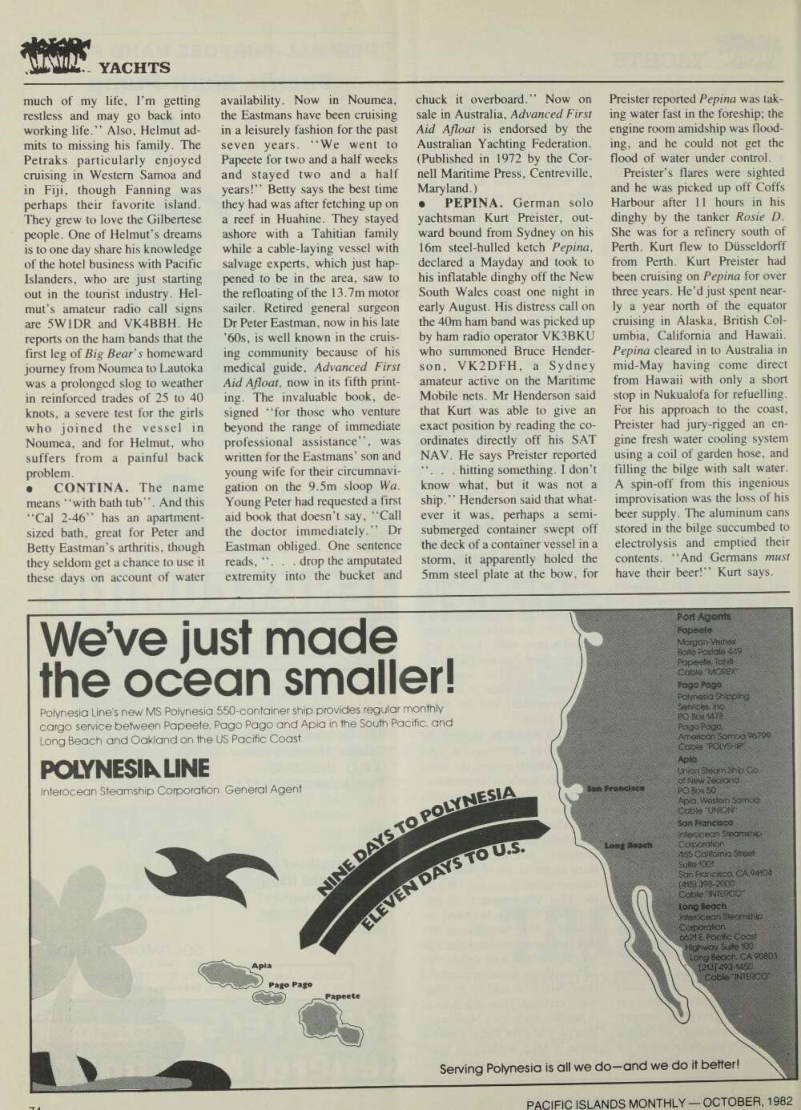
Jane Deridder Re
ports from Noumea , New Caledonia: • PATINA. Bob White, retired department manager for Union Oil, is fulfilling a promise to his journalist daughter Kathleen by cruising with her in the family Cal 36 Patina. Ten months out of Costa Mesa, California, Patina was at the Cercle Nautique Caledonien (CNC) in Noumea in August. Here Marie White flew in to join the family. “My wife is not a sailor,” Bob explained, “but she meets us along the way.” Their son Bob Junior ar rived in Noumea seven years ago on the Cal 28 Passage bringing with him his own wind-surfer the first in New Caledonia. The wind-surfer created such interest he began importing them. Bob Jr met Martha Rossi, married her, started a family and a business, “Wind-Surfing Caledonien”.
Bob Sr sums up Patina s voyage to date; “We’ve moved a little too fast. We should have taken more time in the Marquesas, for instance, where we only stay ed 12 days.” Though the Cal 36 was designed by Bill Lapworth for racing, she has proved a fine cruising yacht. Bob added a tank in the keel to give an extra 46 gallons of water plus a little more stability. He had a sailing bimini made to shelter the roomy cock pit from rain and sun. “My best investment yet,” Bob said.
Patina’s longtime crew member, Brian Ettlin, joins the Montreal registered 13m schooner Belle Poule in Noumea to sail to Bris bane. There Eddie Siefred will be seeking crew for his wooden gaff schooner to continue a west ward circumnavigation. • LINDA E. A “Valiant 40” cutter Bob Perry-designed, she was built in Bellingham, Washington. Linda E of New Orleans, has been a cruising home to Dan and Dorothy Wil son for the past five years. Thirty years in diving, Dan began his working life as an abalone diver, eventually operating a small fleet of abalone boats out of Santa Barbara, California. He then got involved in providing support diving to exploratory oil drilling rigs worldwide. Wilson sold his company “Sub-Sea Intemation
al” to BP to go blue-water cruis ing with his wife Dorothy. Linda E carries a special diving ladder, a compressor, 60m of diving hose with underwater voice com munication capability. She is al so equipped with an NCS US built SAT NAV and a ham radio.
Dorothy is the licensed radio operator with the Louisiana call sign NSCTJ. When underway the Wilsons tow a propeller water generator which provides 8 amps at 7 knots.
• Count Phelax. This
yacht, from Waiheke Island, is named for Count Phelax of Luck ner, German seafarer, prisoner of war interned on Motohi in the Hauraki Gulf during World War I. She’s a “Hartley 26“ plywood vessel of Auckland registry tak ing lan Reid, his son Bruce aged nine, and a friend Ron Harding, on a Pacific cruise “to get away from the New Zealand winter.”
They are cruising in company with the New Zealand yacht Mainstay sailed by Larry and Fleur Rayner. Larry and lan went to school together. Count Phelax and Mainstay left Whangamumu together and arrived in Noumea within six hours of each other, having been on the wind all the way. Though they sighted each other only one night, they main tained a radio sked twice a day.
The two New Zealand yachts left Noumea in mid-July bound for Gladstone with plans of cruising the Barrier Reef and the Whit sunday group. • BIG BEAR H. Helmut and Anne Petrak of Vancouver have sailed 3400 km around the north and south Pacific in their schoon er-rigged “Down Easter 45”, Big Bear H, with Malaysian born Canadian, Tony Wong, as permanent member of the ship’s company, and with occasional hitch-hikers as crew. Tony cir cumnavigated in the late ’sos on the 19m US schooner Utopia.
Big Bear H was launched on Helmut’s 45th birthday. In the hotel/restaurant business since he was 13, Helmut built up his own $25-million hotel-restaurant chain which he sold to go blue water cruising. Now Big Bear H is heading back from Noumea to Hawaii where the Petraks have a home. “After working 16 hours a day seven days a week for so
much of my life, I’m getting restless and may go back into working life.” Also, Helmut admils to missing his family. The Petraks particularly enjoyed cruising in Western Samoa and in Fiji, though Fanning was perhaps their favorite island.
They grew to love the Gilbertese people. One of Helmut’s dreams is to one day share his knowledge of the hotel business with Pacific Islanders, who are just starting out in the tourist industry. Helmut’s amateur radio call signs are SWIDR and VK4BBH. He reports on the ham bands that the first leg of Big Bear's homeward journey from Noumea to Lautoka was a prolonged slog to weather in reinforced trades of 25 to 40 knots, a severe test for the girls who joined the vessel in Noumea, and for Helmut, who suffers from a painful back problem. • CONTINA. The name means “with bath tub”. And this “Cal 2-46” has an apartmentsized bath, great for Peter and Betty Eastman’s arthritis, though they seldom get a chance to use it these days on account of water
availability. Now in Noumea, the Eastmans have been cruising in a leisurely fashion for the past seven years. “We went to Papeete for two and a half weeks and stayed two and a half years!” Betty says the best time they had was after fetching up on a reef in Huahine. They stayed ashore with a Tahitian family while a cable-laying vessel with salvage experts, which just hap pened to be in the area, saw to the refloating of the 13.7 m motor sailer. Retired general surgeon Dr Peter Eastman, now in his late ’6os, is well known in the cruis ing community because of his medical guide, Advanced First Aid Afloat, now in its fifth print ing. The invaluable book, de signed “for those who venture beyond the range of immediate professional assistance”, was written for the Eastmans’son and young wife for their circumnavi gation on the 9.5 m sloop Wa.
Young Peter had requested a first aid book that doesn’t say, “Call the doctor immediately.” Dr Eastman obliged. One sentence reads, “. . . drop the amputated extremity into the bucket and
chuck it overboard.’’ Now on sale in Australia, Advanced First Aid Afloat is endorsed by the Australian Yachting Federation. (Published in 1972 by the Cor nell Maritime Press, Centreville,
Maryland.)
• PEPINA. German solo yachtsman Kurt Preister, out ward bound from Sydney on his 16m steel-hulled ketch Pepina, declared a Mayday and took to his inflatable dinghy off the New South Wales coast one night in early August. His distress call on the 40m ham band was picked up by ham radio operator VK3BKU who summoned Bruce Hender son, VK2DFH, a Sydney amateur active on the Maritime Mobile nets. Mr Henderson said that Kurt was able to give an exact position by reading the co ordinates directly off his SAT NAY. He says Preister reported “. . . hitting something. I don’t know what, but it was not a ship.’’ Henderson said that what ever it was, perhaps a semi submerged container swept off the deck of a container vessel in a storm, it apparently holed the smm steel plate at the bow, for
Preister reported Pepina was tak ing water fast in the foreship; the engine room amidship was flood ing, and he could not get the flood of water under control.
Preister’s flares were sighted and he was picked up off Coffs Harbour after 11 hours in his dinghy by the tanker Rosie D.
She was for a refinery south of Perth. Kurt flew to Diisseldorff from Perth. Kurt Preister had been cruising on Pepina for over three years. He’d just spent near ly a year north of the equator cruising in Alaska, British Col umbia, California and Hawaii.
Pepina cleared in to Australia in mid-May having come direct from Hawaii with only a short stop in Nukualofa for refuelling.
For his approach to the coast, Preister had jury-rigged an en gine fresh water cooling system using a coil of garden hose, and filling the bilge with salt water.
A spin-off from this ingenious improvisation was the loss of his beer supply. The aluminum cans stored in the bilge succumbed to
electrolysis and emptied their
contents. “And Germans must have their beer!’’ Kurt says.
Advertisements & other items, pp. 73-75 (1 item)
xpwters
NEW ALL-PURPOSE HAND PUMP
Pacific Multi-Pump
Capable of handling a wide variety of liquids, including petroleum-based products, a wide variety of chemicals, and salt water.
Double-acting lever action capable of pumping one litre per cycle.
Complete with Bft of PVC discharge hose, nozzle, twopiece suction tube and bung adaptor for operation with 44-gallon drums.
■ PfICIRC PUMP
■ company Pacific Pump Co 2 South Street, Rydalmere,
NSW 2116
Tel: (02) 638 5600 Telex; AA24319
LOCAL AGENTS AND
REPRESENTATION
428 George St., Sydney.
Cables: Henco Sydney.
G.P.O. Box 3949.
Telephone: 232 5377.
For specialised and
personalised buying
service throughout
the Pacific Islands and the East.
Resident Agents in other Pacific Territories.
PAPUA NEW GUINEA
RABAUL M. & C. Seeto, P.O. Box 131, Rabaul.
Telephone 92 2919.
MADANG: W. Double, P.O. Box 22, Madang.
Telephone 82 2696.
FIJI
K. Witherington Ltd., P.O. Box 293, Suva.
Telephone 22 356.
VANUATU
John Lum & Associates, P.O. Box 65, Santo.
Telephone 329.
SOLOMON ISLANDS
Mr. Tom Lo, P.O. Box 327, Honiara.
Telephone 399
xpwters
WeVe just made
the ocean smaller!
Polynesia Line's new MS Polynesia 550-container ship provides regular monthly cargo service between Papeete, Pago Pago and Apia in the South Pacific, and Long Beach and Oakland on the US Pacific Coast.
POLYNESIA. LINE
Interocean Steamship Corporation General Agent Apia Pago Pago 80* vi Hi =t© 3* £ K V Papeete * Serving Polynesia is all we do-and we do it better!
DESIGNED WITH MICRONESIA
IN MIND Micronesian Commerce.
Micronesian Independence.
These sister ships are the first of their kind. They were designed and built for the primary purpose of serving all Micronesian ports. These large container vessels will bring a new level of “Independence” to local “Commerce” throughout the island communities of Micronesia. PM&O LINES - ’I s 5*
Shipping Schedules
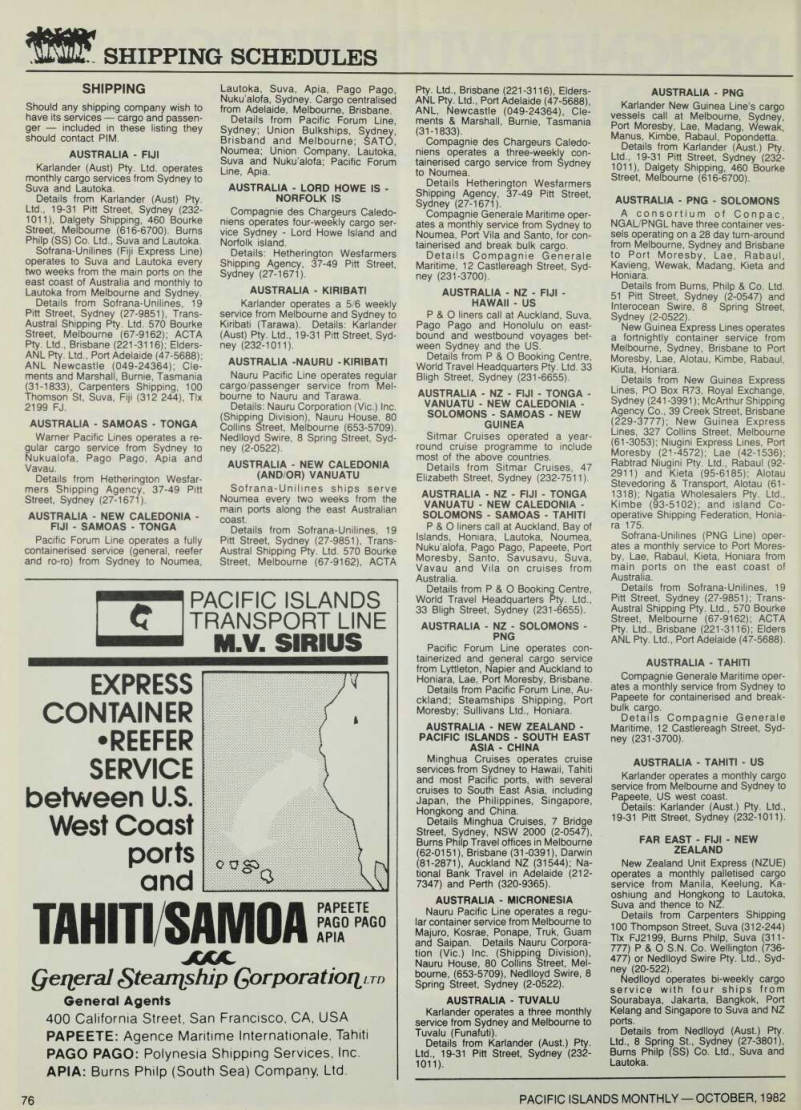
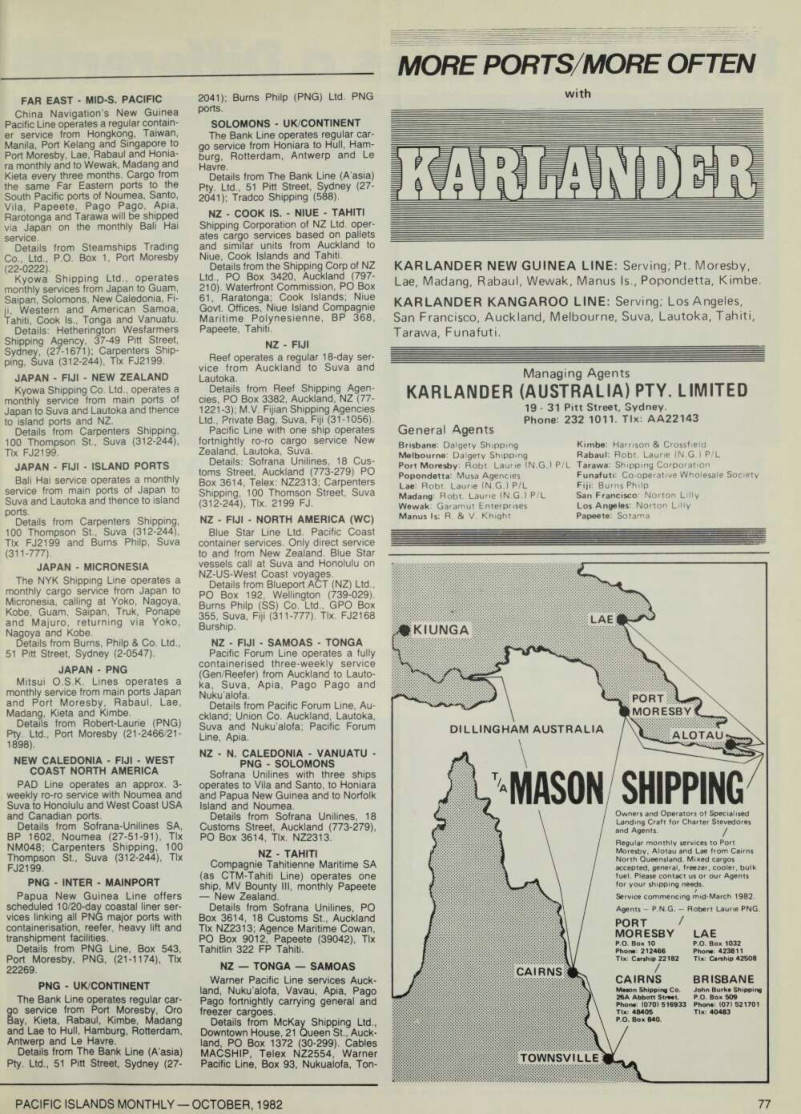
Shipping
Should any shipping company wish to have its services cargo and passen ger included in these listing they should contact PIM.
Australia - Fiji
Karlander (Aust) Pty. Ltd. operates monthly cargo services from Sydney to Suva and Lautoka.
Details from Karlander (Aust) Pty.
Ltd., 19-31 Pitt Street, Sydney (232- 1011), Dalgety Shipping, 460 Bourke Street, Melbourne (616-6700). Burns Philp (SS) Co. Ltd., Suva and Lautoka.
Sofrana-Unilines (Fiji Express Line) operates to Suva and Lautoka every two weeks from the main ports on the east coast of Australia and monthly to Lautoka from Melbourne and Sydney.
Details from Sofrana-Unilines, 19 Pitt Street, Sydney (27-9851), Trans- Austral Shipping Pty. Ltd. 570 Bourke Street, Melbourne (67-9162); ACTA Pty. Ltd., Brisbane (221-3116); Elders- ANL Pty. Ltd., Port Adelaide (47-5688): ANL Newcastle (049-24364); Cle ments and Marshall, Burnie, Tasmania (31-1833), Carpenters Shipping, 100 Thomson St, Suva, Fiji (312 244), Tlx 2199 FJ.
Australia - Samoas - Tonga
Warner Pacific Lines operates a re gular cargo service from Sydney to Nukualofa, Pago Pago, Apia and Vavau.
Details from Hetherington Wesfar mers Shipping Agency, 37-49 Pitt Street, Sydney (27-1671).
Australia - New Caledonia -
Fiji - Samoas - Tonga
Pacific Forum Line operates a fully containerised service (general, reefer and ro-ro) from Sydney to Noumea,
Lautoka, Suva, Apia, Pago Pago, Nukualofa, Sydney. Cargo centralised from Adelaide, Melbourne, Brisbane.
Details from Pacific Forum Line,
Sydney: Union Bulkships, Sydney,
Brisband and Melbourne; SATO, Noumea: Union Company, Lautoka, Suva and Nukualofa; Pacific Forum Line, Apia.
Australia - Lord Howe Is ■
Norfolk Is
Compagnie des Chargeurs Caledo niens operates four-weekly cargo ser vice Sydney - Lord Howe Island and Norfolk island.
Details: Hetherington Wesfarmers Shipping Agency, 37-49 Pitt Street, Sydney (27-1671).
Australia - Kiribati
Karlander operates a 5/6 weekly service from Melbourne and Sydney to Kiribati (Tarawa). Details: Karlander (Aust) Pty. Ltd., 19-31 Pitt Street, Syd ney (232-1011).
Australia -Nauru - Kiribati
Nauru Pacific Line operates regular cargo/passenger service from Mel bourne to Nauru and Tarawa.
Details: Nauru Corporation (Vic.) Inc. (Shipping Division), Nauru House, 80 Collins Street, Melbourne (653-5709).
Nedlloyd Swire, 8 Spring Street, Syd ney (2-0522).
Australia - New Caledonia
(And/Or) Vanuatu
Sofrana-Unilines ships serve Noumea every two weeks from the main ports along the east Australian coast.
Details from Sofrana-Unilines, 19 Pitt Street, Sydney (27-9851), Trans- Austral Shipping Pty. Ltd. 570 Bourke Street, Melbourne (67-9162), ACTA
Pty. Ltd., Brisbane (221-3116), Elders- ANL Pty. Ltd., Port Adelaide (47-5688), ANL, Newcastle (049-24364), Cle ments & Marshall, Burnie, Tasmania (31-1833).
Compagnie des Chargeurs Caledo
niens operates a three-weekly con tainerised cargo service from Sydney to Noumea.
Details Hetherington Wesfarmers Shipping Agency, 37-49 Pitt Street, Sydney (27-1671).
Compagnie Generale Maritime oper ates a monthly service from Sydney to Noumea, Port Vila and Santo, for con tainerised and break bulk cargo.
Details Compagnie Generale Maritime, 12 Castlereagh Street, Syd ney (231-3700).
Australia - Nz - Fiji -
Hawaii - Us
P & O liners call at Auckland, Suva, Pago Pago and Honolulu on east bound and westbound voyages bet ween Sydney and the US.
Details from P & O Booking Centre, World Travel Headquarters Pty. Ltd. 33 Bligh Street, Sydney (231-6655).
AUSTRALIA - NZ - FIJI - TONGA -
Vanuatu - New Caledonia -
Solomons - Samoas - New
Guinea
Sitmar Cruises operated a year round cruise programme to include most of the above countries.
Details from Sitmar Cruises, 47 Elizabeth Street, Sydney (232-7511).
AUSTRALIA - NZ - FIJI - TONGA
Vanuatu ■ New Caledonia -
Solomons - Samoas - Tahiti
P & O liners call at Auckland, Bay of Islands, Honiara, Lautoka, Noumea, Nukualofa, Pago Pago, Papeete, Port Moresby, Santo, Savusavu, Suva, Vavau and Vila on cruises from Australia.
Details from P & O Booking Centre, World Travel Headquarters Pty. Ltd., 33 Bligh Street, Sydney (231-6655).
Australia - Nz - Solomons -
Png
Pacific Forum Line operates con tainerized and general cargo service from Lyttleton, Napier and Auckland to Honiara, Lae, Port Moresby, Brisbane.
Details from Pacific Forum Line, Au ckland: Steamships Shipping, Port Moresby; Sullivans Ltd., Honiara.
Australia - New Zealand -
Pacific Islands - South East
Asia - China
Minghua Cruises operates cruise services from Sydney to Hawaii, Tahiti and most Pacific ports, with several cruises to South East Asia, including Japan, the Philippines, Singapore, Hongkong and China.
Details Minghua Cruises, 7 Bridge Street, Sydney, NSW 2000 (2-0547), Burns Philp Travel offices in Melbourne (62-0151), Brisbane (31-0391), Darwin (81-2871), Auckland NZ (31544); Na tional Bank Travel in Adelaide (212- 7347) and Perth (320-9365).
Australia - Micronesia
Nauru Pacific Line operates a regu lar container service from Melbourne to Majuro, Kosrae, Ponape, Truk, Guam and Saipan. Details Nauru Corpora tion (Vic.) Inc. (Shipping Division), Nauru House, 80 Collins Street, Mel bourne, (653-5709), Nedlloyd Swire, 8
Spring Street, Sydney (2-0522).
Australia ■ Tuvalu
Karlander operates a three monthly service from Sydney and Melbourne to Tuvalu (Funafuti).
Details from Karlander (Aust.) Pty.
Ltd., 19-31 Pitt Street, Sydney (232- 1011).
Australia - Png
Karlander New Guinea Line’s cargo vessels call at Melbourne, Sydney, Port Moresby, Lae, Madang, Wewak, Manus, Kimbe, Rabaul, Popondetta.
Details from Karlander (Aust.) Pty.
Ltd., 19-31 Pitt Street, Sydney (232- 1011), Dalgety Shipping, 460 Bourke Street, Melbourne (616-6700).
Australia - Png - Solomons
A consortium of Conpac, NGAL/PNGL have three container ves sels operating on a 28 day turn-around from Melbourne, Sydney and Brisbane to Port Moresby, Lae, Rabaul, Kavieng, Wewak, Madang, Kieta and Honiara.
Details from Burns, Philp & Co. Ltd. 51 Pitt Street, Sydney (2-0547) and Interocean Swire, 8 Spring Street, Sydney (2-0522).
New Guinea Express Lines operates a fortnightly container service from Melbourne, Sydney, Brisbane to Port Moresby, Lae, Alotau, Kimbe, Rabaul, Kiuta, Honiara.
Details from New Guinea Express Lines, PO Box R 73, Royal Exchange, Sydney (241 -3991); McArthur Shipping Agency Co., 39 Creek Street, Brisbane (229-3777); New Guinea Express Lines, 327 Collins Street, Melbourne (61-3053); Niugini Express Lines, Port Moresby (21-4572); Lae (42-1536); Rabtrad Niugini Pty. Ltd., Rabaul (92- 2911) and Kieta (95-6185); Alotau Stevedoring & Transport, Alotau (61- 1318); Ngatia Wholesalers Pty. Ltd., Kimbe (93-5102); and island Co operative Shipping Federation, Honia ra 175.
Sofrana-Unilines (PNG Line) oper ates a monthly service to Port Mores by, Lae, Rabaul, Kieta, Honiara from main ports on the east coast of Australia.
Details from Sofrana-Unilines, 19 Pitt Street, Sydney (27-9851); Trans- Austral Shipping Pty. Ltd., 570 Bourke Street, Melbourne (67-9162); ACTA Pty. Ltd., Brisbane (221-3116); Elders ANL Pty. Ltd., Port Adelaide (47-5688).
Australia - Tahiti
Compagnie Generate Maritime oper ates a monthly service from Sydney to Papeete for containerised and break bulk cargo.
Details Compagnie Generale Maritime, 12 Castlereagh Street, Syd ney (231-3700).
Australia - Tahiti - Us
Karlander operates a monthly cargo service from Melbourne and Sydney to Papeete, US west coast.
Details: Karlander (Aust.) Pty. Ltd., 19-31 Pitt Street, Sydney (232-1011).
Far East - Fiji - New
Zealand
New Zealand Unit Express (NZUE) operates a monthly palletised cargo service from Manila, Keelung, Ka oshiung and Hongkong to Lautoka, Suva and thence to NZ.
Details from Carpenters Shipping 100 Thompson Street, Suva (312-244) Tlx FJ2199, Burns Philp, Suva (311- 777) P & O S.N. Co. Wellington (736- 477) or Nedlloyd Swire Pty. Ltd., Syd ney (20-522).
Nedlloyd operates bi-weekly cargo service with four ships from Sourabaya, Jakarta, Bangkok, Port Kelang and Singapore to Suva and NZ ports.
Details from Nedlloyd (Aust.) Pty.
Ltd., 8 Spring St., Sydney (27-3801), Burns Philp (SS) Co. Ltd., Suva and Lautoka.
Far East - Mid-S. Pacific
China Navigation’s New Guinea Pacific Line operates a regular contain er service from Hongkong, Taiwan, Manila, Port Kelang and Singapore to Port Moresby, Lae, Rabaul and Honia ra monthly and to Wewak, Madang and Kieta every three months. Cargo from the same Far Eastern ports to the South Pacific ports of Noumea, Santo, Vila, Papeete, Pago Pago, Apia, Rarotonga and Tarawa will be shipped via Japan on the monthly Bali Hai service.
Details from Steamships Trading Co., Ltd., P.O. Box 1, Port Moresby (22-0222).
Kyowa Shipping Ltd., operates monthly services from Japan to Guam, Saipan, Solomons, New Caledonia, Fi ji, Western and American Samoa, Tahiti, Cook Is., Tonga and Vanuatu.
Details: Hetherington Wesfarmers Shipping Agency, 37-49 Pitt Street, Sydney, (27-1671); Carpenters Ship ping, Suva (312-244), Tlx FJ2199.
Japan - Fiji - New Zealand
Kyowa Shipping Co. Ltd., operates a monthly service from main ports of Japan to Suva and Lautoka and thence to island ports and NZ.
Details from Carpenters Shipping, 100 Thompson St., Suva (312-244), Tlx FJ2199.
Japan - Fiji - Island Ports
Bali Hai service operates a monthly service from main ports of Japan to Suva and Lautoka and thence to island ports.
Details from Carpenters Shipping, 100 Thompson St., Suva (312-244), Tlx FJ2199 and Burns Philp, Suva (311-777).
Japan - Micronesia
The NYK Shipping Line operates a monthly cargo service from Japan to Micronesia, calling at Yoko, Nagoya, Kobe, Guam, Saipan, Truk, Ponape and Majuro, returning via Yoko, Nagoya and Kobe.
Details from Burns, Philp & Co. Ltd., 51 Pitt Street, Sydney (2-0547).
Japan - Png
Mitsui O.S.K. Lines operates a monthly service from main ports Japan and Port Moresby, Rabaul, Lae, Madang, Kieta and Kimbe.
Details from Robert-Laurie (PNG) Pty. Ltd., Port Moresby (21-2466/21- 1898).
New Caledonia - Fiji - West
Coast North America
PAD Line operates an approx. 3weekly ro-ro service with Noumea and Suva to Honolulu and West Coast USA and Canadian ports.
Details from Sofrana-Unilines SA, BP 1602, Noumea (27-51-91), Tlx NMO4B; Carpenters Shipping, 100 Thompson St., Suva (312-244), Tlx FJ2199.
Png - Inter - Mainport
Papua New Guinea Line offers scheduled 10/20-day coastal liner ser vices linking all PNG major ports with containerisation, reefer, heavy lift and transhipment facilities.
Details from PNG Line, Box 543, Port Moresby, PNG, (21-1174), Tlx 22269.
Png - Uk/Continent
The Bank Line operates regular car go service from Port Moresby, Oro Bay, Kieta, Rabaul, Kimbe, Madang and Lae to Hull, Hamburg, Rotterdam, Antwerp and Le Havre.
Details from The Bank Line (A’asia) Pty. Ltd., 51 Pitt Street, Sydney (27-
2041); Burns Philp (PNG) Ltd. PNG ports.
Solomons - Uk/Continent
The Bank Line operates regular car go service from Honiara to Hull, Ham burg, Rotterdam, Antwerp and Le Havre.
Details from The Bank Line (A’asia) Pty. Ltd., 51 Pitt Street, Sydney (27- 2041); Tradco Shipping (588).
NZ - COOK IS. - NIUE - TAHITI Shipping Corporation of NZ Ltd. oper ates cargo services based on pallets and similar units from Auckland to Niue, Cook Islands and Tahiti.
Details from the Shipping Corp of NZ Ltd., PO Box 3420, Auckland (797- 210). Waterfront Commission, PO Box 61, Raratonga; Cook Islands; Niue Govt. Offices, Niue Island Compagnie Maritime Polynesienne, BP 368, Papeete, Tahiti.
Nz - Fiji
Reef operates a regular 18-day ser vice from Auckland to Suva and Lautoka.
Details from Reef Shipping Agen cies, PO Box 3382, Auckland, NZ (77- 1221-3); M.V. Fijian Shipping Agencies Ltd., Private Bag, Suva, Fiji (31-1056).
Pacific Line with one ship operates fortnightly ro-ro cargo service New Zealand, Lautoka, Suva.
Details: Sofrana Unilines, 18 Cus toms Street, Auckland (773-279) PO Box 3614, Telex: NZ2313; Carpenters Shipping, 100 Thomson Street, Suva (312-244), Tlx. 2199 FJ.
NZ - FIJI - NORTH AMERICA (WC) Blue Star Line Ltd. Pacific Coast container services. Only direct service to and from New Zealand. Blue Star vessels call at Suva and Honolulu on NZ-US-West Coast voyages.
Details from Blueport ACT (NZ) Ltd., PO Box 192, Wellington (739-029).
Burns Philp (SS) Co. Ltd., GPO Box 355, Suva, Fiji (311-777). Tlx. FJ2168 Burship.
NZ - FIJI - SAMOAS - TONGA Pacific Forum Line operates a fully containerised three-weekly service (Gen/Reefer) from Auckland to Lauto ka, Suva, Apia, Pago Pago and Nukualofa.
Details from Pacific Forum Line, Au ckland: Union Co. Auckland, Lautoka, Suva and Nukualofa; Pacific Forum Line, Apia.
NZ - N. CALEDONIA - VANUATU -
Png - Solomons
Sofrana Unilines with three ships operates to Vila and Santo, to Honiara and Papua New Guinea and to Norfolk Island and Noumea.
Details from Sofrana Unilines, 18 Customs Street, Auckland (773-279), PO Box 3614, Tlx. NZ2313.
Nz - Tahiti
Compagnie Tahitienne Maritime SA (as CTM-Tahiti Line) operates one ship, MV Bounty 111, monthly Papeete New Zealand.
Details from Sofrana Unilines, PO Box 3614, 18 Customs St., Auckland Tlx NZ2313; Agence Maritime Cowan, PO Box 9012, Papeete (39042), Tlx Tahitlin 322 FP Tahiti.
Nz Tonga Samoas
Warner Pacific Line services Auck land, Nukualofa, Vavau, Apia, Pago Pago fortnightly carrying general and freezer cargoes.
Details from McKay Shipping Ltd., Downtown House, 21 Queen St., Auck land, PO Box 1372 (30-299). Cables MACSHIP, Telex NZ2554, Warner Pacific Line, Box 93, Nukualofa, Ton-
ga; Mealelei (Western Samoa) Ltd.
Box 4171, Apia, Western Samoa, Kneubuhl Maritime Services, Box 39, Pago Pago, American Samoa, 96799.
Nz - New Caledonia
Central Pacific Line operates a monthly cargo service from Auckland, Lyttleton, Napier and Mt Maunganui to Noumea.
Details from McKay Shipping Ltd., PO Box 1372, Auckland (9-30229); Tlx 2554 NZ.
Europe - Tahiti -
New Caledonia
Compagnie Generale Maritime oper ates services from Europe and Mediterranean ports to Papeete and Noumea using three ro-ro and multi purpose vessels thus ensuring a bi monthly sailing to and from.
Details Compagnie Generale Maritime, 12 Castlereagh Street, Syd ney (231-3700).
Europe - Tahiti - New
Caledonia - New Zealand -
Solomons - Png - Europe
Polish Ocean Lines offers regular, monthly sailings for containerised and breakbulk cargo from Hamburg, Ant werp, Dunkirk and Rouen to Papeete, Noumea, New Zealand, Honiara, Lae, returning to Europe via Suez. Other ports in the South Pacific can be serv ed with inducement.
Details from Sotama, BP 9170, Papeete (27805), Tlx. 296; SATO, BP C 2, Noumea (272094), Tlx. 163 NM SATO; Union Steamship Co of NZ, PO Box 50, Apia, Tlx. 25; Williams and Gosling, PO Box 79, Suva (312633), Tlx. 2163; Warner Pacific Line, PO Box 93, Nukualofa (21089), Tlx. 66219; Universal Shipping Agencies, PO Box 2282, Auckland (30930), Tlx. 21517.
Europe - Tahiti - W. Samoa
Fiji - N. Caledonia
Nedlloyd offers regular cargo ser vices from Northern Europe and U.K. to Papeete, Apia, Fiji and New Saledonia.
Details Nedlloyd (Aust.) Pty. Ltd., 8 Spring Street, Sydney (27-3801); Car- Denters Shipping, 100 Thomson St., Suva (312-244), Tlx. 2199 FJ.
EUROPE - TAHITI - W. SAMOA - FONGA - FIJI - SOLOMONS - PNG -
Vanuatu
Columbus Line Reederei GMBH op erates regular services from Hamburg, Hull, Rotterdam, Antwerp, Dunkirk, Le Havre, to Papeete, Apia, Suva, Lauto <a, Noumea, Port Moresby, Lae, Hon ara, Kieta, Rabaul, Lae, and return to
Europe.
Details from Columbus Overseas Services Pty. Ltd., 333 George Street, Sydney (290-2966). Columbus Maritime Services, 17 Albert Street, Vuckland (77-3460); Carpenters Ship )ing, 100 Thompson St., Suva (312- >24), Tlx. 2199 FJ.
Uk - N. Continent - Fiji
The Bank Line operates a regular :argo service from Hull, Hamburg, Bre nen, Antwerp, Rotterdam and Le Havre to Suva and Lautoka.
Details from The Bank Line (A’sia) *ty- Ltd., 51 Pitt Street, Sydney (27- >041); Burns Philp (South Sea) Co. .td., Suva and Lautoka.
Uk/N. Continent - Png -
Solomons
The Bank Line operates a regular :argo service from Hull, Hamburg, Bre nen, Antwerp, Rotterdam and Le Havre to Port Moresby, Lae, Madang, Cimbe, Rabaul, Kieta and Honiara and )n inducement to Yandina.
Details from The Bank Line (A’sia) > ty. Ltd., 51 Pitt Street, Sydney (27-
2041); Burns Philp (PNG) Ltd. PNG ports; Tradco Shipping (588).
Uk/N. Continent - Tahiti -
N. Caledonia
The Bank Line operates a regular cargo service from Hull, Hamburg. Bre men, Antwerp, Rotterdam and Le Havre to Papeete and Noumea.
Details from The Bank Line (A’asia) Pty. Ltd., 51 Pitt Street, Sydney (27- 2041); Ets A M Fare UTE, Papeete; Ets. Ballande, Noumea.
Us Fiji Tahiti Nz
Australia
The Bank Savill Line Ltd. operates regular cargo services from U.S. Gulf ports to Australia and N.Z. Calls at Suva, Lautoka and Papeete on demand.
Details from The Bank and Savill Line Ltd., 51 Pitt Street, Sydney (27- 2041) or Orient Shipping Services, 32 Bridge Street, Sydney (241-2753).
U.S. - Hawaii - Kiribati -
Micronesia
Philippines, Micronesia & Orient Navigation Co. (PM&O Lines) operates regular container service on self sustained ship with ro-ro capabilities from Oakland, Portland and Honolulu to Tarawa, Ebeye, Majuro, Kosrae.
Ponape, Truk, Saipan, Yap and Koror.
Details for Micronesia can be ob tained from Larry Guerrero, PM&O Owners Rep. PO Box 803, Saipan, Ml 96950, Cable COMMONTIME, Tix 783605; PM&O: PM&O Lines, 181 Fremont St., San Francisco, California 94-105, Cable PMONAV.
Us - Hawaii - Nauru -
Micronesia
Nauru Pacific Line operates regular conventional container and passenger service from San Francisco and Hololulu to Majuro, Ponape, Truk and Saipan. Cargo is accepted for Nauru and Kosrai with transhipment at Majuro and Ponape.
Details from Nauru Corporation (Vic.) inc. (Shipping Division), Nauru House, 80 Collins Street, Melbourne (653-5709); North American Maritime Agencies, 100 California St., San Fran cisco, California 9411.
Hawaii - Tahiti - Samoas
Marshall Islands Maritime Co oper ates a service every 32 days between Honolulu, Papeete, Pago Pago and Apia.
Details from the Maritime Co. of the Pacific, Honolulu, Hawaii, Morris Hed strom, Apia, Western Samoa and the Marshall Islands Maritime Co., Majuro, Marshall Islands.
Us - Noumea - Fiji
PAD Line operates an approx. 3weekly ro-ro service from West coast USA and Canada to Noumea and Suva.
Details from Sofrana-Unilines SA, BP 1602, Moumea (27-51-91), Tlx NMO4B; Carpenters Shipping, 100 Thompson St., Suva (31-2244), Tlx FJ2199; Trans-Austral Shipping, Box R 232 PO, Royal Exchange, NSW (27- 2441), Tlx AA21204.
Us - Tahiti - Samoa
Pacific Islands Transport operates a five weekly cargo service from North America west coast ports to Papeete, Pago, Pago, Apia.
Details from Polynesia Shipping Ser vices Inc. PO Box 1478, Pago Pago 96799.
Polynesia Line operates container and general cargo service from US west coast ports to Papeete and Pago
Pago.
Details from Polynesia Shipping Ser vices Inc., PO Box 1478, Pago Pago 96799.
Advertisements & other items, pp. 76-80 (2 items)
Tahitisamoa
PACIFIC ISLANDS
TRANSPORT LINE
M.V. SIRIUS
EXPRESS
CONTAINER
•REEFER
SERVICE
between U.S.
West Coast ports and
TAHITISAMOA
XOt Qeqeral Steamship General Agents 400 California Street, San Francisco, CA, USA PAPEETE: Agence Maritime Internationale, Tahiti PAGO PAGO: Polynesia Shipping Services. Inc.
APIA: Burns Philp (South Sea) Company, Ltd.
MORE PORTS/MORE OFTEN
with
KARLANDER NEW GUINEA LINE: Serving; Pt. Moresby, Lae, Madang, Rabaul, Wewak, Manus Is., Popondetta, Kimbe.
KARLANDER KANGAROO LINE: Serving; Los Angeles,
San Francisco, Auckland, Melbourne, Suva, Lautoka, Tahiti,
Tarawa, Funafuti.
Managing Agents
KARLANDER (AUSTRALIA) PTY. LIMITED
19 - 31 Pitt Street, Sydney.
Phone: 232 1011. Tlx: AA22143
General Agents
Brisbane: Dalgety Shipping Melbourne: Dalgety Shipping Port Moresby: Robt. Laune (N.G.) P/L Popondetta: Musa Agencies Lae: Robt. Laune (N.G.) P/L Madang: Robt. Laune (N.G.) P/L Wewak: Garamut Enterprises Manus Is: R & V. Khight Kimbe: Harrison & Crossfield Rabaul: Robt. Laune (N.G.) P/L Tarawa: Shipping Corporation Funafuti: Co-operative Wholesale Society Fiji; Burns Philp San Francisco: Norton Lilly Los Angeles: Norton Lilly Papeete; Sotama
LAE
KIUNGA
PORT
MORESBY
DILLINGHAM AUSTRALIA
iii** A LOT A U
MASON SHIPPING
Owners and Operators of Specialised Landing Craft for Charter Stevedores and Agents f Regular monthly services to Port Moresby, Alotau and Lae from Cairns North Queensland. Mixed cargos accepted, general, freezer, cooler, bulk fuel. Please contact us or our Agents for your shipping needs. / Service commencing mid-March 1982.
Agents - P.N.G.
PORT /
MORESBY
P.O. Box 10 Phone: 212466 Tlx: Carship 22182 /
CAIRNS
Maaon Shipping Co. 26A Abbott Straat.
Phona: (0701 516933 Tlx; 48405 P.O. Box 840 Robert Laurie PNG.
LAE
P.O. Box 1032 Phona: 423811 Tlx: Carship 42508
CAIRNS
BRISBANE
John Burka Shipping P.O. Box 509 Phona: (07) 521701 Tlx: 40483
TOWNSVILLE
Komatsu flakes a Difference
Sf..„ I St u m 1 ■SSfcs In critical areas like reliability and performance, Komatsu products and systems are making a significant difference at mining and construction sites around the world.
In the USA, for example, Komatsu’s largest and most powerful work machine the D455A bulldozer is establishing a superior record of reliability and productivity at mining sites that virtually no other machine in its class can match.
And in another critical area, technology, Komatsu is also making a difference in responding to market demands for improved product quality, and for new and original product innovations.
Consider our new computerized seabed robot system: Operating on the ocean floor, it can relay TV pictures of the seabed to a mother ship, or perform man-like boring, drilling and piling operations down to planned depths of 500 meters * Discover the Komatsu difference above sea level, or down to depths of 500 meters. Komatsu a name you can build on.
•H KOMATSU LTD.
Tokyo, Japan Komatsu offices: Tokyo, Sydney, Singapore, Jakarta, Manila, Bangkok, Bangalore, Karachi, Beijing, Istanbul, Cairo, Alger, Dubai, Tehran, Baghdad, Jeddah, Riyadh, Damman, Nairobi, Abidjan, Lagos, Johannesburg, Moscow, Warsaw, Brussels, Paris, Madrid, Frankfurt, Stuttgart, London, Habana, Buenos Aires, Panama, Caracas, Sao Paulo, Bogota, Mexico City, San Francisco, Oakland, Philadelphia, Detroit, Dallas, Atlanta, Chicago, Toronto, Vancouver, and distributors in over 100 countries around the world.
vJL -
t
>-A J
Only our Dragon Boat
visits more ports,
more often,
in the South Pacific.
The New Guinea Pacific Line offers the quality handling you're used to, through its exclusive containerised service to Papua New Guinea and the Solomon Islands.
Rely on us all the way. • Fast transit times to all ports. • A guaranteed schedule every 30 days, thanks to berths in Papua New Guinea and Honiara reserved for N.G.P.L. use. • Safe, secure transport of goods in containers, both L.C.L., and F.C.L. no more damage or pilferage of cargo. • A wide coverage of all ports with the monthly container service from Hong Kong, Singapore, Taiwan, the Philippines, Malaysia and Bangkok to all Papua New Guinea ports and Honiara.
For further details on our reliable Dragon Boat service contact:
PAPUA NEW GUINEA
Steamship Trading Co., Ltd.
Port Moresby Telephone: 212000
NEW GUINEA
PACIFIC UNE
HONG KONG
Swire Shipping (Agencies) Ltd.
Telephone: 5-264311
SINGAPORE o
Straits Shipping Pte. Ltd.
Telephone: 436071
GLOBAL SERVICE FOR SHIPPERS
y W
LINE
THE
28 Day Service
United Kingdom and Continent to:
PAPEETE • NOUMEA
PAPUA NEW GUINEA and SOLOMON ISLANDS
PORT VILA & SANTO BY TRANSHIPMENT
United Kingdom and Continent to: SUVA AND LAUTOKA (FCL LCL & UNITISED ONLY) ■X - Papua New Guinea and Solomon Islands to:
UNITED KINGDOM and CONTINENT
For particulars apply:
THE BANK LINE (AUSTRALASIA) PTY. LTD.
Suite 801, 51 Pitt Street, Sydney 2000. Australia. Tel: 272041. Tlx: 24063.
79
3 ACIFIC ISLANDS MONTHLY —OCTOBER 1982
SHIPPING SCHEDULES
DEATHS of Islands People
Sevese Morea At Vabukori, near Port Moresby, in August, of a heart attack, aged 38.
A former Speaker of Papua New Guinea’s National Parlia ment, Mr Morea lost his seat in the country’s June national elec tions. On the day before his death he had lodged a court appeal against his defeat.
Despite the high position he held in the protocol of his coun try and despite the public service which won him the award of Companion of St. Michael and St. George, Sevese Morea was perhaps best known to the people of PNG as a radio broadcaster.
He was one of the most success ful and widely known of the Papua New Guinean broadcas ters who were trained by the Australian Broadcasting Com mission in pre-independence
Png.
He trained in Port Moresby with the ABC and later in Aust ralia, returning to Port Moresby to a wide variety of on-air duties.
He was a quiz-master, a news reader, general announcer, inter viewer and breakfast session an chor man on successive occa
sions over a period of more than 10 years. He was also one of the first Papua New Guineans to conduct public affairs inter views. He took over a number of PNG broadcasting functions which previously had been car ried out only by Australians.
He later went into business in Port Moresby, but continued to do part-time broadcasting work.
He made two attempts before independence to enter parlia ment, but was narrowly defeated on each occasion. At one stage he was a United Party supporter when the party was the biggest single group in parliament, but it was not until 1977, in the first elections after independence, that he went into parliament on a Papua Besena ticket.
He was elected Speaker of Parliament early in 1980, and had given distinguished service to the position until he lost his seat in this year’s general election.
In a series of tributes to the part Sevese Morea played in PNG affairs, political leaders said he was one of the most able and important members of the post-independence parliament.
Sevese Morea was given a state funeral at Vabukori on the outskirts of Port Moresby on August 25. A PNG flag draped his coffin and PNG Defence Force buglers sounded the Last Post. Vabukori was his home area, and the entire village at tended the funeral. The total number of people at the funeral exceeded 5000.
Tarcissius Bobola, a PNG journalist who described the fun eral, said “The funeral was abundant in ritual, but its soul was in the hearts of the little people whose interests Sevese Morea always watched.”
The Prime Minister, Mr So mare, who was a mourner at the funeral, said PNG had suffered a great loss which was made the deeper because of the premature nature of Mr Morea’s death.
Alice Allen Innes At Castle Hill, Sydney, in April, aged 90.
Alice Innes was a woman of a great diversity of interests and experience. She never stayed within the mainstream, but con stantly wandered off to explore its tributaries.
Bom in Hobart, her adolescent years were spent in Townsville.
A keen student of drama and ballet, she won a gold medal in the North Queensland Eistedd fod. Another winner was a fel low pupil, and her long-time friend, the famous Australian singer Gladys Moncrieff.
On leaving school she went to Fiji, joining the staff of the Colo nial Hospital, Suva, in 1914.
Suva was the naval base of the Pacific during World War I.
Alice once nursed the famous German “Sea-Wolf”, Count Felix Von Luckner at the hospital.
Visiting Wakaya Island in 1917 she met Allen Innes. They were married in Sydney the fol lowing year. With the pneumon ic influenza epidemic raging at the time, Alice volunteered for nursing service, and was ap pointed matron-in-charge of the Emergency Hospital, Granville, covering Sydney’s western dis tricts. Teams of Boys Scouts were organised to collect the ill and dying from the outer areas, and transport them to the hospital on bicycle carts.
Alice returned to the islands
with her husband, a Bums Philp manager, in 1920, living on Ros sel Island, Misima Island, Samarai, Port Moresby and Rabaul finally settling in Salamaua until her retirement to Australia in 1937.
A widely travelled woman and a professional writer, Alice’s writing career spanned a period of 60 years. Heather Barnard.
Sogo Sebea
At Kila Kila, Port Moresby, in September, aged about 52.
A former Deputy Lord Mayor of Port Moresby, and Papua New Guinea Trade Commissioner in Sydney, Mr Sebea had been ill for about three months.
PNG’s Governor-General Sir Tore Lokoloko led more than 600 mourners who attended Mr Sebea’s funeral on September 10.
Dirk (Dick) M. Kamerling In Sydney of heart attack, aged 74.
A well-known Pacific trader for more than 30 years, Dick
Kamerling founded the Demka company which introduced brand-name products such as Kawasaki, Daihatsu, Makita and Willem II to many Pacific countries.
He will be remembered for his selling methods, travelling through the islands with his many suitcases and typewriter, as well as for his sincere ap proach to business dealings with importers throughout the region.
David L. Griffiths In London in August, after a brief illness.
A former colonial civil servant and District Officer, Mr Griffiths served in Fiji during the 1950 s and worked in various districts, including Navua, Vunidawa, Nausori and Suva.
He was also a magistrate and worked during his time in Fiji with the Prime Minister Ratu Sir Kamisese Mara, the Deputy Prime Minister Ratu Sir Penaia Ganilau, Sir Josua Rabukawaqa and Major Jesoni Takala, among others.
Advertisements & other items, pp. 81-82 (1 item)
The Facts
WITHOUT
FRILLS
The trends in a few words. The significant news.
Mailed direct to you every second Friday.
The South Seas Digest is designed for busy people who have to know what's happening in the Pacific Islands, but in a hurry.
FOR SUBSCRIPTION DETAILS SEE INSERT.
P The South Sea Digest
THE NEWSLETTER ON ISLANDS AFFAIRS • EVERY OTHER FRIDAY is
Stay at Aggie Grey’s . . . the South Pacific’s
legendary hotel.
Situated right in the heart of Western Samoa. Enjoy Polynesian-style friendliness and service, in cool surroundings, superb entertainment and food.
Magnificent white sand beaches only a short drive away. Airconditioned rooms, swimming pool and full bar facilities.
Bookings through Union Steamship Company ofNZ,Pan Am, Air New Zealand or direct to Aggie Grey’s, Apia, Western Samya. Cables: ‘AGGIES' Apia.
Jt- ♦ "1
PORT MOH
* Right in business cep, * A traditiorl for
comfort and/ine
food * All airconditioned * Restaurant * Ba * Banquet hall
<A. C. NEUMANN
manager Phone 21-2622 . Cab^mnMhh
Freely
Given
A true understanding of God's Word.
If you have been search ing for the true meaning, of the Scriptures this free monthly booklet is for you.
Write to God's Way P.O. Box 41, North Ryde, Australia 2113
REQUIRE
DRIED SHARK FINS
FOR PRICES AND
INFORMATION ETC.
PLEASE WRITE TO:
S. DADDOW,
ASIA TONGA TRADING,
7 KASAI ROAD,
REPUBLIC OF SINGAPORE
2880.
CABLE: "ASIATONGA"
EXPLORE PAPUA NEW GUINEA
aboard the
M.V. Melanesian Explorer
.loin a small group of discerning passengers aboard the fully air-conditioned Melanesian Explorer.
Visit the mysterious Sepik River, including the lower, middle and upper Sepik. visit the villages, see the art, customs and culture of the people.
Visit the islands along the North Coast of Papua New Guinea, many of which have never been seen by tourists, including the outer islands of the Trobriand Islands.
Melanesian Tourist Services Pty Ltd.
P.O. Box 707. Madang. Papua New Guinea Tlx NE82707 Tel 822766
Melanesian Tourist Services
For bookings or additional information, please contact your travel agent, or send this coupon to Melanesian.
NAME
For full details write to:
STREET
CITY STATE/ZIP
PHONE(
NATIVE ARTEFACT
AUCTION
Old and authentic Australian Aboriginal, Pacific Island, New Guinea, African, Asian and American pieces urgently required for
our SPECIAL ARTEFACTS AUCTION to be
held on November 28th 1982.
Catalogue closing date 30th October Enquiries: Olga Joura or Peter Groth
JAMES R. LAWSON PTY. LTD.
212-218 Cumberland St, The Rocks Sydney 2000. Ph: (02) 241 3411
FOR SALE
40' freezer carrier, 550 cub. ft. fibreglass/ foam sandwich freezer box holds at minus 30° C. Main propulsion fully recond. Gardner 6LW. A.P.U. 2 cyl.
Lister. Full P.N.G. Survey. Good condition throughout.
MUST SELL. A 555,000 ONO
Write to
SARIBA SLIPWAYS
P.O. Box 11, Samarai, M.B.P. Papua New Guinea
Advertising
Air Pacific 28 Air New Zealand 54 Aiwa 60 Aotea 44 Argo 67 Aust. Govt 4
Aw A Nz 52
Bank Line 80 Bendigo Bearings 71 Besco Jarwil 66 China Navigation 79 Chloride Batteries 58 Citizen Watches 64 DeZurik 26 Gemmell Pring 55 Goodyear 12 Halabys 42 Healing 48 Henry Cumines 73 Honda 2 Hudson 67 ICI Tasman 38 Karlander 77 Komatsu 78 Kool 68 Laurle-Carpenter 14 Maritime College 55 Matsushita 6 McDonnell Douglas 8 Pioneer 16 Nelson and Rob 27 NZ Breweries 46 NZ Dairy 34 NZ Ship Corp 47 Overett 70 Pacific Pump 73 P.I.T. Line 76 P.M. and O. Lines 75 Polynesia Line 74
Ptc 83 13
QBE Insurance 22 Renold 11 Sansui 30 Sofrana 36, 49 Soren Luno 52 S. Seas Digest 81 Suzuki 24, 83 Teac 10 Thorn 50 Timken 72 Toyota 84 Trio Kenwood 20 Tucker 39 Woodyard 40
Advertisements & other items, pp. 83-84 (1 item)
tfsss^ssss
SUZUKI— p rn fQR jyiANCE
The name of r f L , ROUN P .. **•*
SUZUKI prepared ZZpleasim. *»» boat and
tfsss^ssss
:c v .
VI V V
SUZUKI
pp« m; gk
§| |lp^
SUZUKI I
SUZUKI MOTOR CO, LTD Hamamatsu, Japan SUZUKI GENERATOR SEIBOQ ’^uT^£ A 9i F o9 7 S o UZI i KI DISTRIBUTORS LTD. PHONE: 58-599 • PAPUA NEW GUINEA HI SPEED DIESEL iloi aMn 6 D 7 u^ K I ? J ii J,RA t NvJANS AUTOPORT LTD. PHONE: 381555 • TAHITI NIPPON AUTOMOTO PHONE: 2-98-15 * ISLAND PHONE: 565 • VANUATU HENRI LEROUX • NEW CALENDONIA STE. SUPERCAL PHONE: 272068 )UOMC* uc iz ooQQ a Kill 1C nI Inkio ni s ll n ■ tp\ a'■ ■f— n R^ LTD. lsland cyclery 2 ?nc.
K 1 T ona is om u
side and on
y, comfort-p
beauty of o\
i durability and proven
motoring and remarkal
iat have earned Corolla
Two of the main reasoi
□rollas have been orodi
rnc.
V
TOYOTA
mi*
PAPUA NEW GUINEA:
ELA MOTORS,
Scratchley Rd., Badili, P.O. Box 675, Port Moresby.
NORTHERN MARIANAS
& U.S.T.T.: MICROL
CORPORATION,
P.O. Box 267, Saipan.
FIJI:
AUTOMOTIVE
SUPPLIES COMPANY,
G.P.O. Box 355, Suva.
AMERICAN SAMOA;
BURNS PHILP
(SOUTHSEA) CO., LTD.,
P.O. Box 129, Pago Pago,
WESTERN SAMOA:
BURNS PHILP
(SOUTHSEA) CO., LTD.,
P.O. Box 188, Apia.
TONGA: BURNS PHILP
(SOUTHSEA) CO., LTD.,
P.O. Box 55, Nukualofa.
GUAM; ATKINS, KROLL
(GUAM) LTD., P.O. Box
6428, Tamuning.
VANUATU.
VANUATU MOTORS,
P.O. Box 18, Port Vila.
SOLOMON:
MENDANA
ENTERPRISES (5.1.) LTD.,
G.P.O. Box 174, Honiara.
TAHITI: NIPPON
AUTOMOTO, B.P. 342,
Papeete.
COOK ISLANDS:
COOK ISLANDS
TRADING
CORPORATION LTD.,
P.O. Box 92, Rarotonga.
NAURU;
NAURU COOPERATIVE
SOCIETY.
KIRIBATI:
TARAWA MOTORS, Box 36,
Bairiki, Tarawa, Kiribati.
NORFOLK ISLAND:
BORRY’S RENTAL CARS,
MOUNT PITT
(ENTERPRISES) LTD.,
P.O. Box 169.
NEW CALEDONIA:
SERVICE IMPORTATION
AUTOMOBILE DU
PACIFIQUE, Rond-Pomt du Pacifique (Station Total) B.P. 438, Noumea. „
TOYOTA
SERVICE
TOYOTA
The Toyota range includes: COROLLA, STARLET, CORONA, CRESSIDA, HI-LUX, STOUT, HI ACE, DYNA. COASTER and LAND CRUISER