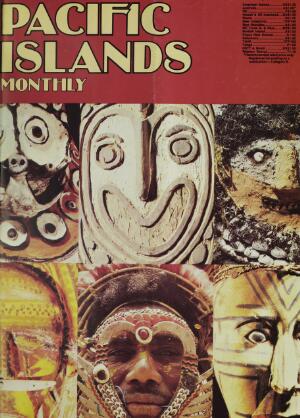
Islands
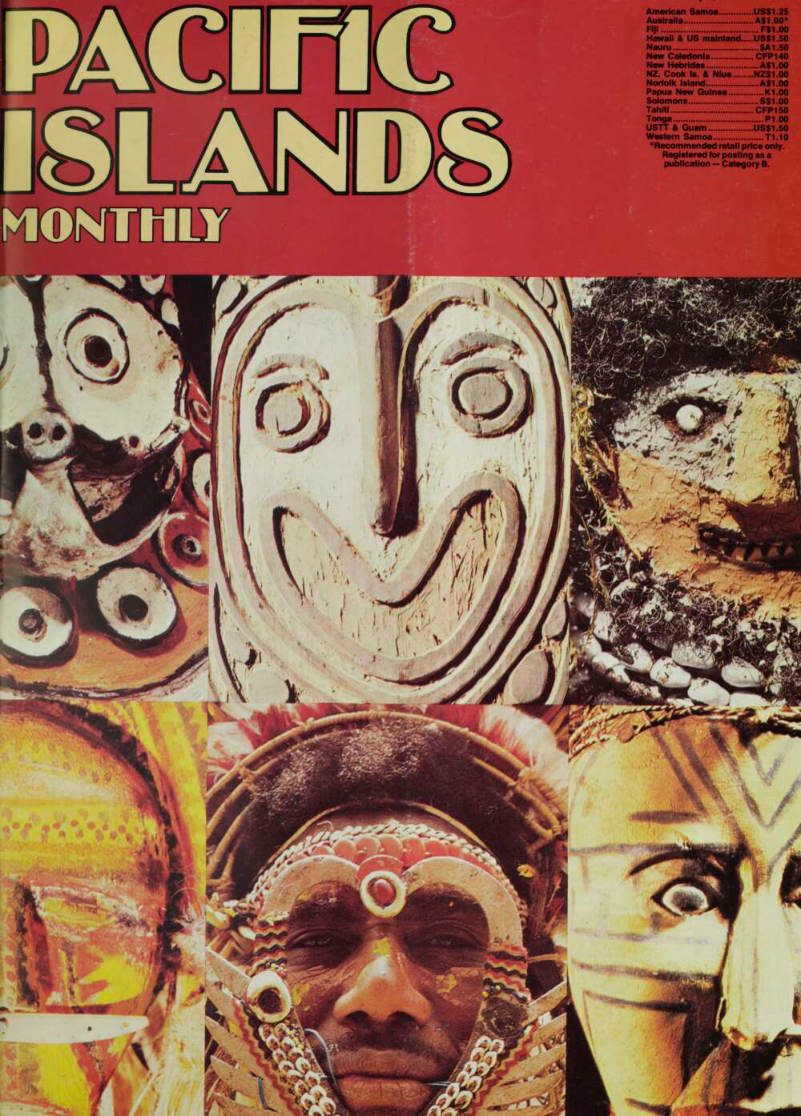
Pacific
Monthly
American Samoa US$l.25 Australia ASl.OO* FIJI Fsl.oo Hawaii & US mainland US$l.5O Nauru 5A1.50 New Caledonia CFPI4O New Hebrides Asl.oo NZ, Cook Is. & Niue NZ$l.OO Norfolk Island Asl.oo Papua New Guinea Kl.OO Solomons SSI.OO Tahiti CFPISO Tonga PI. 00 USTT & Guam US$l.5O Western Samoa Tl.lO ‘Recommended retail price only.
Registered for posting as a publication Category B.
Advertisements & other items, p. 2 (1 item)
Toyota
How to find a REAL economy car.
When you look at a car billed as an economy
model, ask yourself a few questions.
What sort of fuel consumption can be expected?
Low? Good.
What about other operating costs? Oil, lubrication, that kind of thing. Low again? Great.
How about maintenance? The car has a low-breakdown record? You are definitely on the right track.
What is the average life of the car? Is it better than the average in your area? Super. That’s important in an economy car.
Now. How is the after service? Buying a car is not all in the price you know. Plenty of service outlets?
One economy car coming up. All you have to do is check the price. Then you can tell if you are really getting an economy car.
You will probably find, after asking these questions about town, that REAL economy cars come down to Toyota, the world’s economy car builder.
See Toyota first. Then you won’t have to shop around.
IRE HAPPY ECONOMIZER
TOYOTA STARLET
The car that says economy in every way.
And you will be happy for it. Big inside.
Small outside. Miserly with petrol.
Without sacrificing comfort. A good buy in an economy car even for Toyota. i to s mm *
PAPUA NEW GUINEA:
ELA MOTORS,
Scratchley Rd., Badili, P.O. Box 675, Port Moresby.
U.S. TRUST
TERRITORY; MICROL
CORPORATION,
P.O. Box 267, Saipan.
FIJI ISLANDS:
AUTOMOTIVE
SUPPLIES COMPANY,
P.O. Box 5177, Raiwaqa, Suva
AMERICAN SAMOA:
BURNS PHILP
(SOUTHSEA) CO., LTD.,
P.O. Box 129, Pago Pago.
WESTERN SAMOA:
BURNS PHILP
(SOUTHSEA) CO., LTD.,
P.O. Box 188, Apia.
TONGA: BURNS PHILP
(SOUTHSEA) CO., LTD.,
P.O. Box 55, Nukualofa.
GUAM: ATKINS, KROLL
(GUAM) LTD., P.O. Box
6428, Tamuning.
NEW HEBRIDES:
NEW HEBRIDES
TOYOTA
SERVICE
TOYOTA
MOTORS,
P.O. Box 18, Vila.
SOLOMON ISLANDS:
MENDANA
ENTERPRISES (5.1.)
LTD., P.O. Box 174,
Honiara.
TAHITI: NIPPON
AUTOMOTO, B.P. 342,
Papeete.
COOK ISLANDS:
COOK ISLANDS
TRADING
CORPORATION LTD.,
P.O. Box 92, Rarotonga.
NAURU ISLAND:
NAURU COOPERATIVE
SOCIETY.
REPUBLIC OF KIRIBATI:
TARAWA MOTORS,
Box 36, Bairiki, Kiribati.
NORFOLK ISLAND:
MOUNT PITT
(ENTERPRISES) LTD.,
P.O. Box 169.
NEW CALEDONIA:
SOCIETE IMPORTATION
AUTOMOBILE DU
PACIFIQUE, Rond-Point du Pacific (Station total) B.P. 438, Noumea.
The Toyota range includes: Toyota 1000, Toyota Starlet, Toyota Corolla, Toyota Celica, Toyota Corona, Toyota Cressida, Toyota Crown
Pacific Islands Monthly
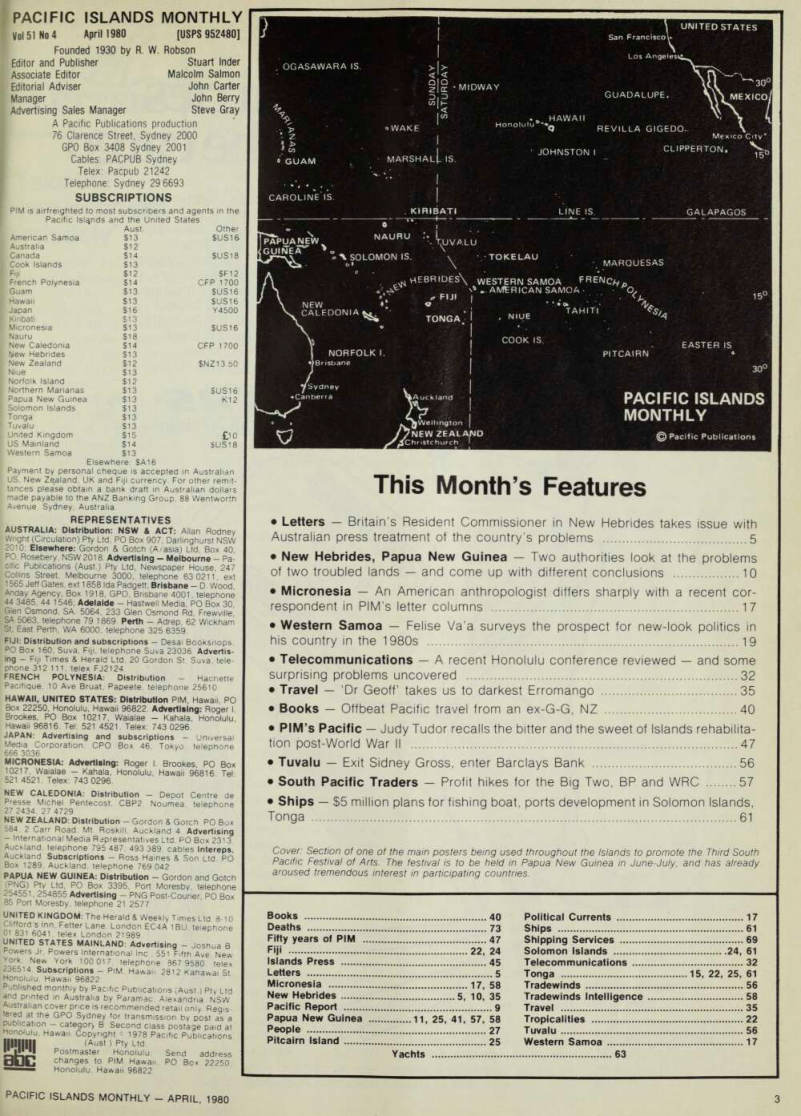
Vol 51 No 4
April 1980
[Usps 952480]
Subscriptions
[ PIM is airfreighted to most subscribers and agents in the Pacific Islands and the United States
Elsewhere: $A16 Payment by personal cheque is accepted In Australian US, New Zealand, UK and Fiji currency. For other remit tances please obtain a bank draft in Australian dollars made payable to the ANZ Banking Group, 88 Wentworth Avenue Sydney, Australia.
Representatives
AUSTRALIA: Distribution: NSW & ACT: Allan Rodney Wright (Circulation) Pty Ltd, PO Box 907, Darlinghurst NSW 2010; Elsewhere: Gordon & Gotch (A/asia) Ltd, Box 40, PO, Rosebery, NSW 2018 Advertising — Melbourne — Pa cific Publications (Aust.) Pty Ltd, Newspaper House, 247 Collins Street, Melbourne 3000, telephone 63 0211, ext 1565 Jeff Gates, ext 1858 Ida Padgett. Brisbane - D. Wood, Anday Agency, Box 1918, GPO, Brisbane 4001, telephone 44 3485, 44 1 546: Adelaide - Hastwell Media, PO Box 30, Glen Osmond, SA. 5064, 233 Glen Osmond Rd, Frewville, SA 5063, telephone 79 1869 Perth - Adrep, 62 Wickham St, East Perth, WA 6000, telephone 325 6359.
FIJI: Distribution and subscriptions — Desai Bookshops.
PO Box 160, Suva, Fiji, telephone Suva 23036 Advertis ing - Fiji Times & Herald Ltd, 20 Gordon St. Suva, tele phone 312 111, telex FJ2124 FRENCH POLYNESIA: Distribution - Hacnette Pacifique, 10 Ave Bruat. Papeete, telephone 25610 HAWAII, UNITED STATES: Distribution PIM, Hawaii, PO Box 22250, Honolulu, Hawaii 96822. Advertising: Roger I.
Brookes, PO Box 10217, Waialae - Kahala, Honolulu, Hawaii 96816. Tel: 521 4521. Telex: 743 0296.
JAPAN: Advertising and subscriptions - Universal Media Corporation, CPO Box 46. Tokyo, telephone 666 3036 MICRONESIA: Advertising: Roger I. Brookes, PO Box 10217, Waialae — Kahala, Honolulu, Hawaii 96816 Tel 521 4521. Telex: 743 0296.
NEW CALEDONIA; Distribution — Depot Centre de Presse Michel Pentecost, CBP2 Noumea telephone 27 2434, 27 4729 NEW ZEALAND: Distribution — Gordon & Gotch PO Box 584 2 Carr Road. Mt Roskili. Auckland 4 Advertising - International Media Representatives Ltd. PO Box 2313 Auckland, telephone 795 487. 493 389 cables Intereps, Auckland Subscriptions — Ross Haines & Son Ltd PO Box 1289, Auckland, telephone 769 042 PAPUA NEW GUINEA: Distribution — Gordon and Gotch (PNG) Pty Ltd, PO Box 3395, Port Moresby, telephone 254551, 254855 Advertising - PNG Post-Courier PO Box 85 Port Moresby, telephone 21 2577 UNITED KINGDOM: The Herald & Weekly Times Ltd 8-10 Clifford s Inn, Fetter Lane, London EC4A 1BU. telephone 01 831 6041, telex London 21989 UNITED STATES MAINLAND: Advertising — Joshua B Powers Jr Powers International Inc . 55i Fifth Ave New York New York 100 017, telephone 367 9580 telex 236514 Subscriptions - PiM Hawaii 2812 Kahawai St Honolulu Hawaii 96822 Published monthly by Pacific Publications (Aust.) Pty Ltd and printed in Australia by Paramac Alexandria NSW Australian cover price is recommended retail only Reqis tered at the GPO Sydney for transmission by post as a publication — category B Second class postage paid at HonoJulu, Hawaii Copyright c 1978 Pacific Publications
(Aust) Pty Ltd Postmaster Honolulu Send address changes to PIM Hawaii. PO Box 22250 Honolulu, Hawaii 96822
Ausf Other American Samoa $13 $US16 Australia $12 Canada $14 $USl8 Cook Islands $13 FlJ! $12 $F12 i French Polynesia $14
Cfp 1700
Guam $13 $US16 Hawaii $13 $US16 Japan $16 V4500 Kiribati $13 1 Micronesia $13 $US16 Nauru $18 New Caledonia $14
Cfp 1700
New Hebrides $13 New Zealand $12 $NZ1350 Niue $13 Norfolk Island $12 Northern Marianas $13 $US16 Papua New Guinea $13 K12 Solomon Islands $13 Tonga $13 Tuvalu $13 United Kingdom $15 £io US Mainland $14
Sus18
Western Samoa $13
This Month’s Features
• Letters Britain’s Resident Commissioner in New Hebrides takes issue with Australian press treatment of the country’s problems 5 • New Hebrides, Papua New Guinea Two authorities look at the problems of two troubled lands and come up with different conclusions 10 • Micronesia An American anthropologist differs sharply with a recent cor respondent in PlM’s letter columns 17 • Western Samoa Felise Va’a surveys the prospect for new-look politics in his country in the 1980 s 19 • Telecommunications A recent Honolulu conference reviewed and some surprising problems uncovered 32 • Travel ‘Dr Geoff takes us to darkest Erromango 35 • Books Offbeat Pacific travel from an ex-G-G, NZ 40 • PlM’s Pacific Judy Tudor recalls the bitter and the sweet of Islands rehabilita tion post-World War II 47 • Tuvalu Exit Sidney Gross, enter Barclays Bank 56 • South Pacific Traders Profit hikes for the Big Two, BP and WRC 57 • Ships $5 million plans for fishing boat, ports development in Solomon Islands, Tonga 61 Cover Section of one of the main posters being used throughout the Islands to promote the Third South Pacific Festival of Arts. The festival is to be held in Papua New Guinea in June-July, and has already aroused tremendous interest in participating countries.
Books 40 Deaths 73 Fifty years of PIM 47 Fiji 22, 24 Islands Press 45 Letters 5 Micronesia 17, 58 New Hebrides 5, 10, 35 Pacific Report 9 Papua New Guinea 11, 25, 41, 57, 58 People 27 Pitcairn Island 25
Political Currents 17 Ships 61 Shipping Services 69 Solomon Islands 24, 61 Telecommunications 32 Tonga 15, 22, 25, 61 Tradewinds 56 Tradewinds Intelligence 58 Travel 35 Tropicalities 22 Tuvalu 56 Western Samoa 17
Yachts 63
Advertisements & other items, pp. 3-4 (2 items)
3
PACIFIC ISLANDS MONTHLY APRIL, 1980
Founded 1930 by R. W. Robson i Editor and Publisher Stuart Inder Associate Editor Malcolm Salmon [ Editorial Adviser John Carter Manager John Berry [ Advertising Sales Manager Steve Gray A Pacific Publications production 76 Clarence Street, Sydney 2000 GPO Box 3408 Sydney 2001 Cables: PACPUB Sydney Telex: Pacpub 21242 Telephone: Sydney 29 6693
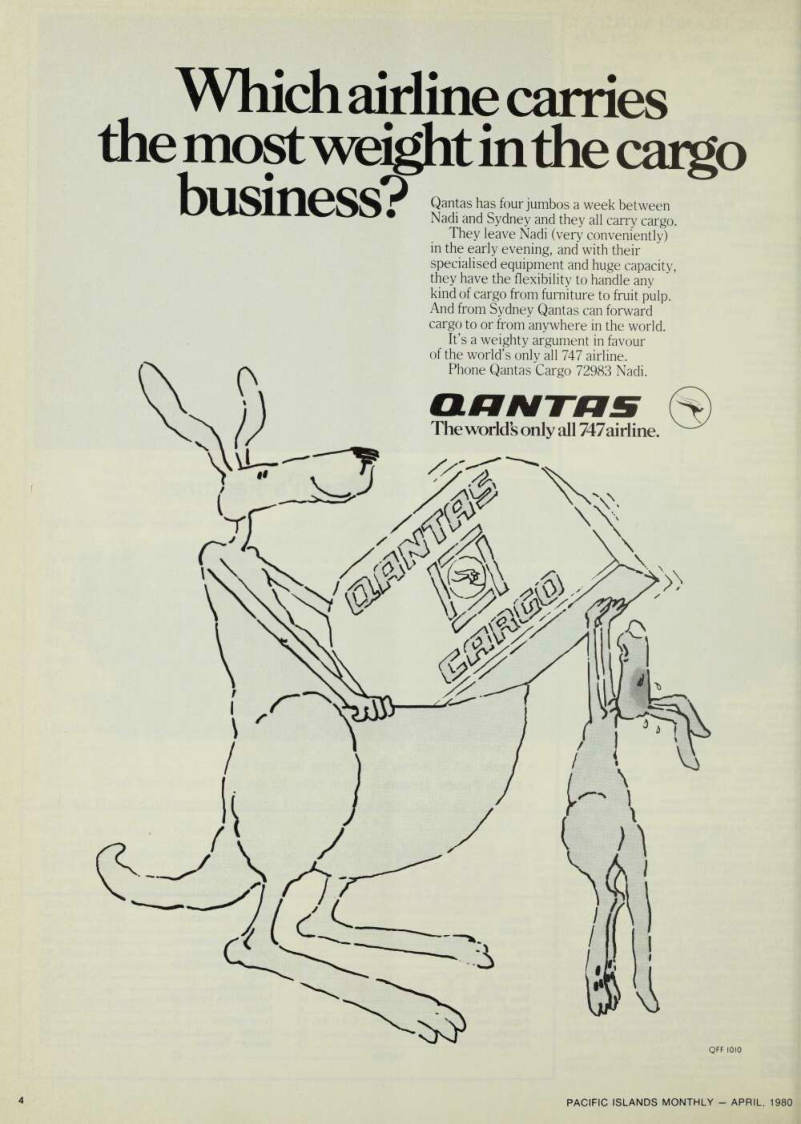
the most weight in the cargo
Which airline carries
business?
Qantas has four jumbos a week between Nadi and Sydney and they all carry cargo.
They leave Nadi (very conveniently) in the early evening, and with their specialised equipment and huge capacity, they have the flexibility to handle any kind of cargo from furniture to fruit pulp.
And from Sydney Qantas can forward cargo to or from anywhere in the world.
It’s a weighty argument in favour of the world’s only all 747 airline.
Phone Qantas Cargo 72983 Nadi.
The world’s only all 747 airline. a- N />■; \ T v> 6 » r\ r r ' !
VA n / L c z s .
QFF 1010
seriously’
Letters
Take the
New Hebrides
seriously’
I As you know, I don’t always [ agree with Nabanga. But like PIM, they do try to be a journal |of record, and, unlike PIM I (Feb p 11), I agree with them that the Australian press in general really ought to do bet ter in their reporting of the [ New Hebrides.
I don’t object, much, when Mark Baker calls me in his paper ‘one of the few able bodies left from the old Col onial Office’ by which I assume he means one of the few still on their feet. But surely it is time that the world press moved on from the picture of the British and French in the
New Hebrides doing nothing
except tootle their futile bugles and quarrel about the height of
their flagpoles.
As Nabanga rightly says, there are serious and compli cated problems in the New Hebrides in which Britain and France, with the New Hebrides Government, are seriously engaged (and with all possible respect too to Ken Hutton OBE [PIM, Feb plO] I don’t play cricket: my game is squash, as Ken knows very well).
Thank goodness, therefore, for serious and generally objec tive reports like your stories on the constitution (PIM Nov) and the elections (PIM Jan).
But even you seem to find it difficult to avoid digs at the ‘supine British’ (November), or ‘the British have concluded that the New Hebrides matters little to them’ (January).
The truth of the matter is that, as you said in your November article, the New Hebrideans themselves have achieved political miracles over the last year. If all goes well, the New Hebrides could not only be an economically successful and politically stable, multi-lingual society,
with friendship and help from both Britain and France. They could also be an interpreter and a bridge between the
anglophone and francophone
countries of the Pacific. As Stuart Inder, and I, saw at the South Pacific Conference in Tahiti last October, such bridges are badly needed. On the other hand, if things go badly, the New Hebrides could drop into a political and econ omic hole which would be a serious problem not only for the other nations of the Pacific, including Australia, but more importantly, for the leaders and people of the New Hebrides who have done so much to reach a consensus on their own future.
Both the Government of National Unity under Gerard
Leymang, and the Indepen
dence Government under Walter Lini, have been work ing towards this consensus. The job, and the interest, of the metropolitan powers is to help them, jointly. It is not easy. I have never met anything like the Condominium, and I would not seriously rec ommend the system to anyone planning new forms of govern ment. Nor, I am sure, would my French colleague. We may jointly be open to informed criticism, but I do sometimes wish the Australian press would lay off the snide re marks.
A. C. Stuart
British Resident Commissioner British Residency, Vila, New Hebrides • Since we are a journal of re cord it might be as well for us to say that we have not agreed with the way the majority of the Australian press have reported recent developments in the New Hebrides, and that we translated
and published Nabanga’s report
at length because we thought what they had to say about it was
re levant.
Editor.
As one whose backside is still smarting from the ‘French caning for the Australian press’ (PIM Feb p 11) I would like to reply to the reported remarks of that bellicose French PR man Jean Massias.
Mr Massias who has shown great dexterity in mix ing the demands of that osten
sibly independent journal,
Nabanga, with his role as a leading French government adviser accuses the Aus tralian press generally of being ill-informed and biased against the French in its reporting of developments in the New Hebrides.
He attacks me specifically over my reports last November in The Age (not The Sydney Morning Herald, which I have not reported in since last June) about the possibility of independent New Hebrides
hosting governments-in-exile
of South Pacific liberation groups.
As Mr Massias is well aware, sections of the Vanuaaku Party have long favoured giving such material support to kindred groups in New Caledonia and French Polynesia. Indeed, the
Vanuaaku policy platform
published in October last year states one of its foreign affairs
objectives as ‘to help
Melanesian and Polynesian brother nations not yet free from colonial tyranny to gain
their independence’.
I raised the question in an interview with the French resi dent commissioner, Inspector- General Robert, on November 15. Obviously aware of the possibility of governments-in exile, Mr Robert replied: ‘We would regard that as a hostile act. The French Government would have to reconsider the substance or totality of its aid.’
In my report of that inter view I wrote: ‘While the party has not made a firm decision, it may allow the Kanak Liber ation Movement of New Caledonia to establish a government-in-exile in Port Vila’.
At no stage, as PIM has reported, did I state that such a decision was ‘likely’. The word I used was ‘may’.
In an interview on November 17 Father Lini told me that while a decision would have to be influenced by what was the best strategy to help the liberation groups, a Vanuaaku government would still con sider hosting their de facto governments.
Father Lini went on to say: ‘We will continue to be very strong supporters of the move ments in New Caledonia and
Tahiti no matter what France threatens.’
While I cannot speak for other Australian journalists, I
personally reject Mr Massias’
claims that my writings have been ill-informed or unduly biased.
Last year I made two lengthy visits to the New Hebrides dur ing which I interviewed rep resentatives of all the various political persuasions includ ing Mr Massias and many other French officials and Francophone politicians. (Mr Massias claims to have found ‘not a single reference to Gerard Leymand’ in the Aus tralian reports. Father Leymang is quoted or men tioned in at least four articles that I have written.) It is true that much I have written contains criticism of French behaviour in the New Hebrides in recent years. But that criticism is based on a con sidered evaluation of the facts.
I neither regret nor retract a word of it.
Mr Massias and his associ ates should not single out the Australian press. Far worse things have been said about the French by the very people of the New Hebrides whose over whelming support for Vanuaaku in last year’s elec tion can hardly be interpreted as an accolade for Paris’ poli cies and performance in the South Pacific.
Mark Baker
Brisbane Bureau, The Age Storm in the
desert abates
Your February issue did carry my letter to you; this fact proves that yours is not a slan der magazine. Just not always well enough informed.
Therefore I hereby offer you my sincere apologies for calling you that. I am not publicity hungry, I just like to see things
straight. With sincere apologies
I remain,
A. Holgen
Collateral Investments Ltd Honolulu, USA.
Fifty years of
the RIB
I am a Fijian national and a long-term resident of the Marshall Islands, former em ployee of the Trust Territory government, and presently
working for the government of the Marshalls as a Master on one of its vessels.
During my long absence
from Fiji, your magazine has been a great source of inspi ration to me in terms of both entertainment and infor mation. However, since read ing your November 1979 issue I strongly feel you should change your name from PIM to PIB for Pacific Islands Bullshit.
In that issue (pi 2) there was an article ‘US Real Estate Agents Active in the Pacific’.
You pointed out that an American official had infor med PIM in Sydney that buy ing land in desert states like Texas was ‘folly’. How did you ever print such inaccuracies?
From August 6-18 1979 a group of Marshallese land buyers, of which I was one, went on a trip to Van Horn, Texas, to see our land. The tour
was arranged by Green Valley
Acres Inc through Marina Travel Agency Inc of Hawaii.
After looking over the land personally, I am more than sat isfied that it is beautiful and can be cultivated for farming, cattle-raising, and so on.
The sale of the land was
negotiated through Green
Valley Acres Inc, a registered organisation based in Califor nia. It deals mainly in selling real estate in the United States.
How can such transactions
through Green Valley Acres
Inc be called folly?
Could you tell me: What is the name of the US official who warned PIM in Sydney?
What department or agency of US Federal Government does he work for and in what ca pacity? Does he know anything about real estate or is he just an ordinary guy whose bark is bigger than his bite? Is this guy really from the United States or is he from Melbourne.?
Talking about desert land Mr Editor, did you ever con sider what a marvellous thing the early Mormon settlers did in Salt Lake City, which before their arrival was nothing but desert? Did you also forget that one of the most talked about miracles of modern times is the tremendous transformation brought about by the Israelis in
planting huge forests and or ange groves in what for hun dreds of years was desert and barren land?
Criticisms based on unfounded rumours is a com mon weakness of the negative person who always criticises the positive and creative thinker.
I humbly request that in future times you get all your
facts together before printing
articles of this kind. As Shakespeare says, ‘To thine own self be true’ .
M. Cama
Majuro, Marshall Islands
Arrested for muddy
number plate
I could not agree more with Percy Chatterton’s statements (PIM Oct 1979 p 66).
Over the past few years we have suffered physically in the
Papua New Guinea Highlands
because of crimes that are only
encouraged by lack of police
protection. The situation has forced the closing of stores, and will eventually close the schools as well. While students and teachers are endangered by attacks from lawless bands outside the school, we have only ourselves to depend upon for protection. Police have even acknowledged this on sev eral occasions. Yet our students
must suffer ‘payback’ injuries,
including beating with chains
and other weapons at
Kerowagi.
People get the impression
that the Simbu people are law less, but this kind of thing can
happen anywhere when there
is no authority and no respect for those who are supposed to enforce it. It is human nature to try and get away with as much as one can. Witness what happens in other countries when the police go on strike. In our place if the local police went on strike nobody would notice.
The ‘State of Emergency’ was a bad joke played on a lot of people who are normally law-abiding citizens. In their rush to make an impressive number of arrests a lot of inno cent people suffered at the hands of the police.
I myself was detained with the school driver for being in a truck with a muddy number
plate. Three valuable school days were therefore lost in gaol and in courtrooms.
Now members of our school staff have been arrested for criticising the police.
Name And Address Supplied
Port Moresby, Papua New Guinea
Spain’s new
Pacific ties
I have the pleasure to inform you that the Kingdoms of
Spain and Tonga have
established diplomatic re lations by way of issuing a joint
communique published simul
taneously in both countries on November 16, 1979. The diplo matic relations will be con
ducted by Spain through its
Ambassador in Canberra (Aus
tralia). Tonga’s High Com
missioner in London will act for his country.
Following the presentation of my Letters of Credence in Port Moresby on October 23 of last year as first Ambassador of Spain in Papua New Guinea I visited that country for 10 days, as well as Solomon Islands and New Hebrides. It was in the lat ter country that I travelled down to the island of Santo and on to Big Bay, where the
Spanish navigator Pedro Fer
nandez de Quiros founded the city of New Jerusalem and called the discovered and to be-discovered lands to the south of that point Austrialia del Espiritu Santo.
Carlos M. Fernandez-Shaw
(Ambassador of Spain) Canberra, ACT, Australia
Rape a ‘trifling’
matter?
I refer with shock and disgust to the reader’s letter reprinted from Les Nouvelles in Papeete
which recently appeared in
/our magazine (PIM Dec 1979 p4O). The letter contained the
following passage: *... the
people (of a country named) are fighting and killing each other like real savages over trifling matters the rape of a woman or the theft of a pig.’
I would like to think that the letter-writer penned those lines with tongue in cheek, or that you printed them in that spirit but I can’t quite convince myself that this was so. Who is the real savage, the cannibal who consumes human flesh, or
the one who kills a womar emotionally and consumes hei flesh in another way? There’s about one-quarter inch dif ference on the scale of civilis ation between the two.
Jean L. Sherman
Pasadena, Calif, USA
PIM covers: Away
with guilt, shame!
Being an ardent traveller and reader of travel magazines ] had to come across your publi cation. As our daily press
almost consciously ignores the
Pacific, you fill a gap. Youi snippets, titbits and of course the feature articles are very in formative.
I am pleased to see that yours is not a picture-postcard, ‘wish you-were-here’ type of pro duction. Your treatment ol
touchy issues subjects like
French Polynesia, for example
is commendable. Where else would one read about them?
One particular feature is most refreshing your covers Those delectable Pacific maidens are heartwarming How can any healthy and sound person object to them*' The Pacific has suffered
enough from weird religions
and man-made guilt.
Congratulations to a fine
magazine. Ignore the detrac
tors shame, guilt and con servatism do not seem to be one of your major features.
Keep it that way and keep those beauties coming! Be [ sides, it is now easy to track I down PIM at the newsagent.
J. Brandstatter
E Chatswood, NSW, Australia
State Department
‘giveaway’?
After the giving away of the Panama Canal in which the US even paid a tinhorn leftist f Panamanian dictator Omar
[ Torijos for the privilege, our
State Department was hard pressed for an encore. It has now turned its attention to redefining American interests [in the Pacific.
In 1980 the State Depart ment will push for Senate rati fication of two proposals which will turn over US sovereignty to 18 central Pacific islands and hundreds of thousands of square miles of rich fishing waters. The direct beneficiaries of this largesse are two left
leaning emerging nations, the
island republics of Tuvalu and Kiribati. The indirect benefici ary is the Soviet Union with increasing naval and economic clout in the strategic waters of Micronesia and Polynesia.
Our territorial claims being waived include islands in the Line, Phoenix and Ellice groups that have been American controlled since the 1800 s. Some like Christmas Island and Hull Island (named after the War of 1812 Com mander of the USS Consti tution) have rich histories. Nine of these strategic islands have warranted US military bases on them from World War II through the 19705.
Each of the islands in these widespread groups commands a radius of two hundred miles in territorial limits into rich
fishing waters. Unfriendly con
trol of these islands could spell sconomic disaster for the multi-million dollar tuna fish
ing and canning industry in
nearby American Samoa. The
republics of Kiribati (formerly
icnown as the Gilbert Islands)
and Tuvalu have already
ndicated that each plans to
charge a heavy ‘conservation
fee’ for the future privilege of US fishing interests using what are in reality American waters.
The island republics of Tuvalu and Kiribati, both under British control until the 19705, have combined popu lations of less than 60 000. Yet they clearly have more than enough clout to have the State Department buckle under to their demands. They are active member states in the anti- American third world con ference group called the South Pacific Forum. They have voted against US entry into that organisation and have made overtures in favour of the Red Chinese as well as Rus sians.
The treaty with Kiribati which cedes 14 of the 18 islands in question was signed on Sep tember 20, 1979. It is ironic that this unmeritorious action oc curred on the island of Tarawa in which over 3500 Americans gave up their lives in protect ing the interest of the United States in the Pacific in World War 11.
The State Department hopes
for Senate ratification of the treaty of friendship with Tuvalu in early 1980. The rati fication of this treaty will expedite the further pact with Kiribati.
These current giveaway pro posals give nothing in return for the US. In fact a power vac uum will be created which will engender further Soviet influ ence. Already, the Soviets were granted a fishing fleet base in the nearby island of Tonga.
With our worldwide naval de cline, the Pacific may never again be known as an American lake. The current giveaway in the South Pacific is only symptomatic of world
wide global retrenchment by
the US.
David Noland
Canyon Country California 91351 USA
Ebia Olewale and
his French friends
I have followed with interest the views of Ebia Olewale, for mer Papua New Guinean Foreign Minister, on indepen dence in the French Pacific. I have also followed some of the criticisms he has received in your pages, particularly from Tahitians.
I would like to comment on two letters of criticism: one from Ms de Montlue of Auckland (PIM Dec 1979 p 5), and one from a writer to Papeete’s Les Nouvelles (PIM Dec 1979 p4O).
First of all it is incorrect to say that Mr Olewale has no right to express views on independence in Tahiti, and that his pronouncements on
this subject are meaningless.
He is a Pacific citizen and has
a role to play by interesting
himself in the affairs of the re gion to which he belongs.
He belongs to a nation which has gained independence and can therefore speak with more authority on the subject than most people in French Polynesia. Independence is an issue in Tahiti, and Olewale can surely be excused for at least thinking about it, and, if
he does, one can only expect that he will speak about it too.
Ms de Montlue’s use of events in PNG as a criticism is rather unfair. The recent con stitutional crisis in that country indicates that the legal system there needs modification, not that the country is falling apart.
Irian Jaya was a problem long before PNG became a nation.
With PNG not being sovereign in the 19605, it is hardly fair to expect it to have made any pro tests.
The Bougainville-PNG re lationship is not analagous to the Tahiti-France relationship because (a) for the moment the PNG Government seems to have satisfied Bougainvilleans with limited independence in the form of provincial govern ment, therefore somewhat neu
tralising a strong independence
movement, and (b) Bougain ville is more closely connected
with PNG culturally, racially
and historically than Tahiti is to France (although French colonisation has to some extent
changed that).
Taking these points into con sideration, one could be excused for concluding that there is a stronger case for a
Bougainville-PNG unity than a
Tahiti-France unity, and there fore a weak case for Tahitians
meddling in Bougainville, as
Ms de Montlue suggests.
As for the writer in Les Nouvelles, a rather cynical assumption is made that independence means rape, kill ing and disorganisation in what he/she assumes is the PNG style. If the writer is afraid that independence in Tahiti will mean this, then the only con clusion is that Tahiti’s culture is no better than PNG’s, as it is misrepresented in the rather unsubtle innuendos contained in the letter.
They reveal more about the
writer’s abysmal ignorance of
other people’s cultures than they do about PNG.
Here’s hoping that one day French Polynesians will cease criticising others with advice, take some themselves, and see
that independence brings a
sense of self, where previously domination brought colour TV’s, radioactivity and a false consciousness.
Mark Schubert
Croydon, Vic, Australia
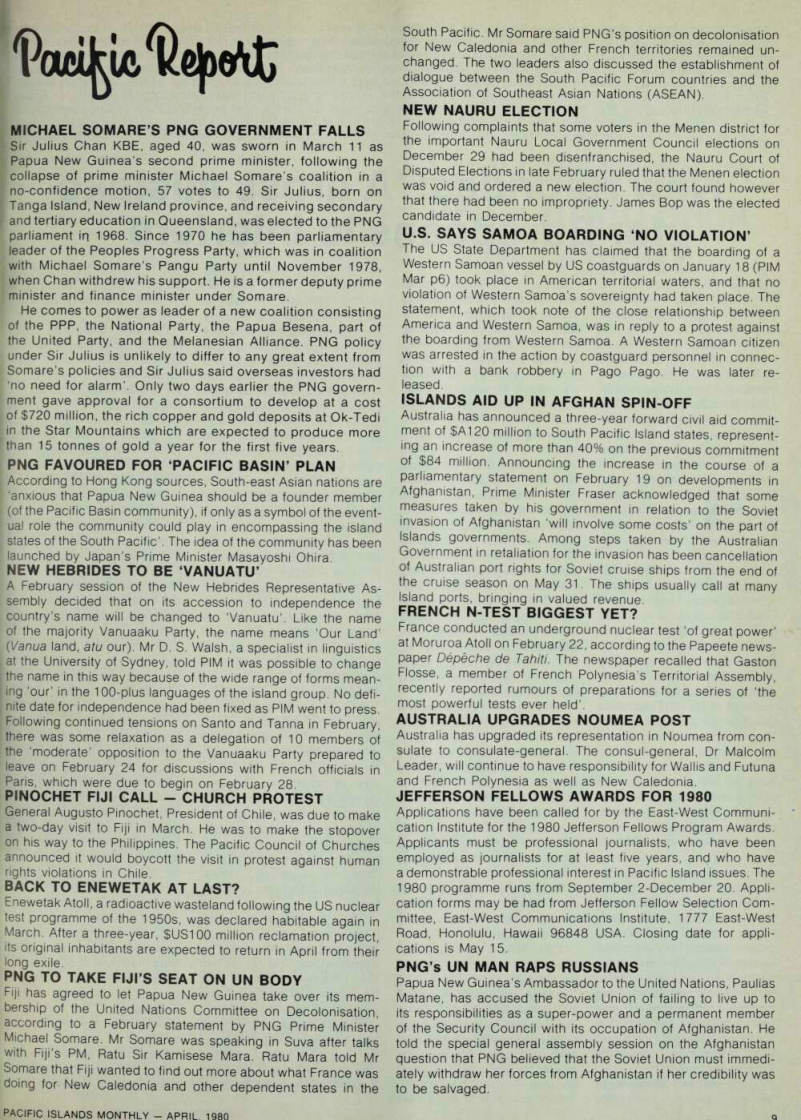
Busy scene at Canton Island just before the Pacific War when Pan American developed an airport and cleared the lagoon of coral heads.
42 years a PIM
subscriber
Philip Snow MBE, a Bri tish administrator for fourteen years in the Pa cific, has just published a book with Stefani Waine
called The People from
the Horizon: An Illus trated History of the Europeans Among the South Sea Islanders (Phaidon Press) which will shortly be reviewed
by PIM.
In a letter to PIM from Sussex, England, Mr Snow says: ‘My copies of PIM come by seamail and I have just renewed my subscription, now in its 42nd year. Are there many who have ex ceeded that stretch?’
In PlM’s 50th anniver sary year, it’s an interest
ing question, and we’d
like to hear from other subscribers of more than 40 years standing.
Advertisements & other items, pp. 7-8 (2 items)
Letters
■ ) ACIFIC ISLANDS mhmtui v anm i < aa/v
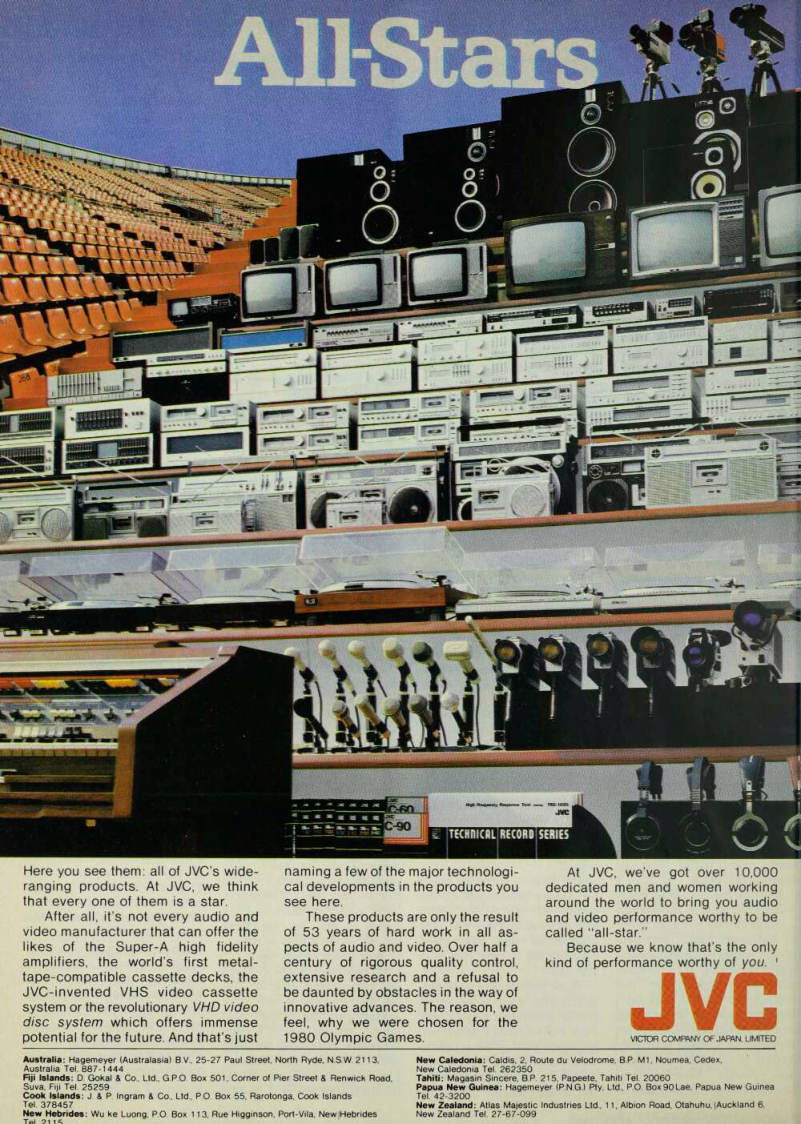
Here you see them: all of JVC’s wide-
Here you see them: all of JVC’s wideranging products. At JVC, we think that every one of them is a star.
After all, it’s not every audio and video manufacturer that can offer the likes of the Super-A high fidelity amplifiers, the world’s first metaltape-compatible cassette decks, the JVC-invented VHS video cassette system or the revolutionary VHD video disc system which offers immense potential for the future. And that’s just naming a few of the major technological developments in the products you see here.
These products are only the result of 53 years of hard work in all aspects of audio and video. Over half a century of rigorous quality control, extensive research and a refusal to be daunted by obstacles in the way of innovative advances. The reason, we feel, why we were chosen for the 1980 Olympic Games.
Australia: Hagemeyer (Australasia) 8.V., 25-27 Paul Street, North Ryde, NS W 2113, Australia Tel. 887-1444 Fiji Islands: D Gokal & Co., Ltd., G.P.O. Box 501, Corner of Pier Street & Renwick Road.
Suva. Fiji Tel. 25259 Cook Islands: J & P Ingram & Co., Ltd., P.O Box 55, Rarotonga, Cook Islands Tel. 378457 New Hebrides: Wu ke Luong, P.O. Box 113. Rue Higginson, Port-Vila, New (Hebrides Tol o 11C At JVC, we’ve got over 10,000 dedicated men and women working around the world to bring you audio and video performance worthy to be called “all-star.”
Because we know that’s the only kind of performance worthy of you. 1
JVC
VICTOR COMPANY OF JAPAN, LIMITED
New Caledonia: Caldis, 2, Route du Velodrome, B.P. Ml. Noumea, Cedex, New Caledonia Tel. 262350 Tahiti: Magasin Sincere, B.P. 215, Papeete, Tahiti Tel. 20060 Papua New Guinea: Hagemeyer (P N G.) Pty, Ltd., P.O. Box9oLae, Papua New Guinea Tel. 42-3200 New Zealand: Atlas Majestic Industries Ltd., 11, Albion Road, Otahuhu, (Auckland 6, New Zealand Tel. 27-67-099
Pacific Report
Michael Somare’S Png Government Falls
Sir Julius Chan KBE, aged 40, was sworn in March 11 as Papua New Guinea’s second prime minister, following the collapse of prime minister Michael Somare’s coalition in a no-confidence motion, 57 votes to 49. Sir Julius, born on 1 Tanga Island, New Ireland province, and receiving secondary and tertiary education in Queensland, was elected to the PNG parliament ip 1968. Since 1970 he has been parliamentary leader of the Peoples Progress Party, which was in coalition with Michael Somare’s Pangu Party until November 1978, when Chan withdrew his support. He is a former deputy prime minister and finance minister under Somare.
He comes to power as leader of a new coalition consisting of the PPP, the National Party, the Papua Besena, part of the United Party, and the Melanesian Alliance. PNG policy under Sir Julius is unlikely to differ to any great extent from Somare’s policies and Sir Julius said overseas investors had ‘no need for alarm’. Only two days earlier the PNG govern ment gave approval for a consortium to develop at a cost of $720 million, the rich copper and gold deposits at Ok-Tedi in the Star Mountains which are expected to produce more than 15 tonnes of gold a year for the first five years.
Png Favoured For Pacific Basin’ Plan
According to Hong Kong sources, South-east Asian nations are ‘anxious that Papua New Guinea should be a founder member (of the Pacific Basin community), if only as a symbol of the event ual role the community could play in encompassing the island states of the South Pacific’. The idea of the community has been launched by Japan’s Prime Minister Masayoshi Ohira,
New Hebrides To Be ‘Vanuatu’
A February session of the New Hebrides Representative As sembly decided that on its accession to independence the country’s name will be changed to ‘Vanuatu’. Like the name of the majority Vanuaaku Party, the name means ‘Our Land’ (Vanua land, atu our). Mr D. S. Walsh, a specialist in linguistics at the University of Sydney, told PIM it was possible to change the name in this way because of the wide range of forms mean ing ‘our’ in the 100-plus languages of the island group. No defi nite date for independence had been fixed as PIM went to press.
Following continued tensions on Santo and Tanna in February, there was some relaxation as a delegation of 10 members of the ‘moderate’ opposition to the Vanuaaku Party prepared to leave on February 24 for discussions with French officials in Paris, which were due to begin on February 28.
Pinochet Fiji Call - Church Protest
General Augusto Pinochet, President of Chile, was due to make a two-day visit to Fiji in March. He was to make the stopover on his way to the Philippines. The Pacific Council of Churches announced it would boycott the visit in protest against human rights violations in Chile.
Back To Enewetak At Last?
Enewetak Atoll, a radioactive wasteland following the US nuclear test programme of the 19505, was declared habitable again in March. After a three-year, SUSIOO million reclamation project, its original inhabitants are expected to return in April from their long exile.
PNG TO TAKE FIJI’S SEAT ON UN BODY Fiji has agreed to let Papua New Guinea take over its mem bership of the United Nations Committee on Decolonisation, according to a February statement by PNG Prime Minister Michael Somare. Mr Somare was speaking in Suva after talks with Fiji’s PM, Ratu Sir Kamisese Mara. Ratu Mara told Mr Somare that Fiji wanted to find out more about what France was doing for New Caledonia and other dependent states in the
South Pacific. Mr Somare said PNG’s position on decolonisation for New Caledonia and other French territories remained un changed. The two leaders also discussed the establishment of dialogue between the South Pacific Forum countries and the Association of Southeast Asian Nations (ASEAN).
New Nauru Election
Following complaints that some voters in the Menen district for the important Nauru Local Government Council elections on December 29 had been disenfranchised, the Nauru Court of Disputed Elections in late February ruled that the Menen election was void and ordered a new election. The court found however that there had been no impropriety. James Bop was the elected candidate in December.
U.S. Says Samoa Boarding ‘No Violation’
The US State Department has claimed that the boarding of a Western Samoan vessel by US coastguards on January 18 (PIM Mar p 6) took place in American territorial waters, and that no violation of Western Samoa’s sovereignty had taken place. The statement, which took note of the close relationship between America and Western Samoa, was in reply to a protest against the boarding from Western Samoa. A Western Samoan citizen was arrested in the action by coastguard personnel in connec tion with a bank robbery in Pago Pago. He was later re leased.
Islands Aid Up In Afghan Spin-Off
Australia has announced a three-year forward civil aid commit ment of SAI2O million to South Pacific Island states, represent ing an increase of more than 40% on the previous commitment of $B4 million. Announcing the increase in the course of a parliamentary statement on February 19 on developments in Afghanistan, Prime Minister Fraser acknowledged that some measures taken by his government in relation to the Soviet invasion of Afghanistan ’will involve some costs’ on the part of Islands governments. Among steps taken by the Australian Government in retaliation for the invasion has been cancellation of Australian port rights for Soviet cruise ships from the end of the cruise season on May 31. The ships usually call at many Island ports, bringing in valued revenue
French N-Test Biggest Yet?
France conducted an underground nuclear test ‘of great power’ at Moruroa Atoll on February 22, according to the Papeete news paper Depeche de Tahiti. The newspaper recalled that Gaston Flosse, a member of French Polynesia’s Territorial Assembly, recently reported rumours of preparations for a series of ‘the most powerful tests ever held’.
Australia Upgrades Noumea Post
Australia has upgraded its representation in Noumea from con sulate to consulate-general. The consul-general, Dr Malcolm Leader, will continue to have responsibility for Wallis and Futuna and French Polynesia as well as New Caledonia.
Jefferson Fellows Awards For 1980
Applications have been called for by the East-West Communi cation Institute for the 1980 Jefferson Fellows Program Awards.
Applicants must be professional journalists, who have been employed as journalists for at least five years, and who have a demonstrable professional interest in Pacific Island issues. The 1980 programme runs from September 2-December 20. Appli cation forms may be had from Jefferson Fellow Selection Com mittee, East-West Communications Institute, 1777 East-West Road, Honolulu, Hawaii 96848 USA. Closing date for appli cations is May 15.
Png’S Un Man Raps Russians
Papua New Guinea’s Ambassador to the United Nations, Paulias Matane, has accused the Soviet Union of failing to live up to its responsibilities as a super-power and a permanent member of the Security Council with its occupation of Afghanistan. He told the special general assembly session on the Afghanistan question that PNG believed that the Soviet Union must immedi ately withdraw her forces from Afghanistan if her credibility was to be salvaged.
New Hebrides: ‘A gross mistake
for Europeans to interfere’
Jhe following items present the viewpoints of two authorities in different aspects of Pacific Island affairs on the problems faced by two of the most important - currently volatile - countries in the region, New Hebrides and Papua New Guinea Well-known French anthropologist Jean Guiart argues strongly that the troubles on the New Hebridean islands of Santo and Tanna would be much less acute if outsiders stopped interfering in them. He was being interviewed by Jean Massias director of the French/Bislama weekly Nabanga. The second item is the text of the final report by the Australian lawyer Brian Egan, former Public Prosecutor of Papua New Guinea. Adopting a different viewpoint from Mr Guiart Mr Eoan comes close to saying that the reason for the severe law-and-order problems now besetting PNG is the absence of outside interference in the shape of the ‘kiaps’ of the past, who are presented by Mr Egan as having exercised a ‘benevolent dictatorship PIM records the documents at length because of their importance, and their interest to Islands readers.
Nabanga: Jean Guiart, how do you explain the movements we’re now witnessing in Tanna and Santo?
Jean Guiart: There have been problems in all Pacific countries during the period of transition to independence.
These have been more or less serious depending on the econ omic interests involved. For
example, on Bougainville there
was a relatively strong move ment due to the copper mine.
But it settled down when ar rangements were reached for a sharing of profits between the central and local govern ments.
It’s entirely normal that there should be problems in the New Hebrides, but what is much less normal is that these
problems are being exploited.
Take the case of Tanna: the
people there were squabbling
among themselves a hundred years ago along the same lines as they are today. There were the same people fighting each
other with, relatively speak
ing, very little loss of life. There were also the same people more or less banishing each other, sending each other off to the other side of the mountain, and then getting into nego tiations about the right to return.
It was a whole game that they played, and it’s never
really stopped. There were
concepts defining certain enti ties, or ‘things’. These had quite
precise names. They described
certain modes of behaviour, for example, or the exact paths to be followed in maintaining contacts between groups, pre cise routes to be used on other journeys, tracks which had their own names not to be
used by everybody.
These concepts form part of
rather symbolic entities which still exist and which, quite nat urally, as throughout the Pa cific, have with time taken on particular colorations; when someone wanted to avoid
being absorbed by a neighbour
who was a Protestant, he be came a Catholic. After that he would accept a French school in his area and not an English one.
Then today there are people who deal with one European rather than another. These
Europeans imagine they have
influence. In fact they are being made use of in this game of contestation and dispute which actually has the effect of maintaining some kind of bal ance between groups, and be
tween regions and sub-regions.
It is entirely wrong for Europeans to interfere. If no
one was interfering, things
would be a lot calmer, there’d be much less fuss.
But Tanna is Tanna, and it’ll stay that way for a long time.
Ways have not yet been found to transform Tanna, to trans form its inhabitants, to provide them with a new system of ideas, a new society. So, in their relations with one another,
they see no reason why they
shouldn’t just keep travelling
along their old traditional tracks.
N. Is it your impression that some people, let’s say they’re Whites, are manipulating events in Tanna?
J. G. There are in fact attempts at manipulation both by outside forces and by the Tanna people themselves who, whichever side they’re on in their local disputes, are trying to manipulate the Europeans in Tanna and use them as screens for their own interests.
There have been new el ements come into the scene in the last few years, and they are playing a not inconsiderable part in what’s now going on in Tanna. They are centred on a contest between two clans about the way profits from the possible development of tour ism on the island will be div ided up. Each side is trying to ensure that it will have sole rights to take tourists to the vol cano, and strives to exclude the other from any degree of con trol of Tanna’s potential tourist
industry.
N. In an interview on Radio New Hebrides you gave the im pression that you felt this ma nipulative game, from both the European and Melanesian sides, was going on just as much in Santo as Tanna. In what ways, in your opinion, can the Santo scene be compared with that on Tanna? And in what respects is it different?
J. G. In Santo and this is one of the differences from Tanna there was a drastic de population in the last century.
Two-thirds of the population died of smallpox. This was caused by Australian labour recruiters who littered the beaches with articles of cloth ing which had been worn by smallpox victims in order to close off a whole labour
recruiting area from competi
tors.
The population panicked.
They cleared out of the area and it remained deserted. This deeply affected people, as had the passing-through of the
Spaniards who destroyed and
pillaged an entire valley.
The Europeans came along
and-established themselves in the Segond Channel in these depopulated zones. There were no problems because the Santo
people regarded the area as pies blong waet man (‘the White
man’s place’).
Potential difficulties arose when colonists’ claims to land
beyond their coconut plan
tations were not accepted by the Melanesians, whereas the colonists believed in good faith that they had the right to push the limits of their holdings further out, even though they had been settled in one par ticular place for 30 years.
The birth of the Nagriamel was due mainly to a plan to set up a cattle project, outside the coconut plantation limits, on the plateau in the interior.
Chief Buluk’s group, which had evacuated these lands at the time of the epidemic, still had some residual rights in the
region.
The birth of Nagriamel was therefore a land-related re
sponse to Europeans moving
outside previously settled limits.
Nagriamel came on the scene at a time when there was a sort of vacuum. Just after the war, there had been a series of movements which aimed to organise a degree of economic and social independence from the Whites. Melanesians began to build their own roads, to set up health centres like the one at Ndui Ndui (Aoba), and schools, and to attempt a con centration of production for sale to a single buyer.
These were entirely reason able economic notions which were made use of by a Franco- British businessman at the time of the Malekula Native
Company. This enterprise
operated for a while but then
collapsed.
Nagriamel picked up the
pieces and installed itself out side Santo on the spot where
the defunct company had been established. Generally speak ing it was a place where people were seeking some kind of ‘hook’ to hang on to in order to ward off domination by a larger group of neighbours.
N. How do you see the pre sent situation on Santo?
J. G. Some people have pan icked. The big planter families have gone and the Americans have abandoned their projects.
I think the planters could have stayed. The problems stem ming from colonialism at the time of independence in the Pacific arise mainly in terms of demographic pressures. As Santo has lots of open space, apart from pockets like Hog Harbour and Port Olry, there are all sorts of arrangements that could be made to every
body’s satisfaction.
But the planters panicked
and they thought it was necess ary to use Nagriamel to protect themselves. There are also two or three people who believe that the Melanesians can be used as troops in the service of
European politicians. Which is
a gross mistake.
N. Do you really believe that there are Whites in Santo who are manipulating the Nagriamel? Don’t you think
you’re describing a situation
that existed some years back, rather than the present situ ation?
J. G. It’s the same thing as on Tanna: who’s manipulating whom?
There are two or three Europeans who harbour il lusions. They have no political training, and no grasp of the situation of the New Hebrides in the Pacific. No Pacific state, I don’t care which one it is, can accept a secession as a fait
accompli. They’ve all had prob
lems of this kind and they’ve settled them. They’ve got no wish to see these things start up again, and all of them want tranquillity in the region. One need only recall what hap pened in Nigeria with the Biafra affair: once these things start, there’s no controlling events.
That’s why these people who are pushing their own barrows in Santo will get no support.
N. Don’t you think that strong police repression in Santo would be likely to ignite the powder keg?
J. G. In any political situ ation there are more subtle means of pressure. The Nagriamel has lost its initial drive, it no longer has the same content, the same prestige or authority. It’s seeking a new image, but it’s altogether on the wrong track.
In this pre-independence situation, Jimmy Stevens could be appearing as the great founding father. Remember that it was in fact Stevens who initiated, about 15 years ago, the first approaches to the United Nations.
This situation is not an easy one for a government which still lacks all the experience re quired. But I’m convinced that if there weren’t Europeans around who are convinced they have a mission to interfere, things would not have gone so far as they have. Once again, it’s grossly mistaken for Europeans to meddle in a situ ation of this kind on the eve of a country’s independence.
They have neither the standing nor prestige to remain political leaders. Our function, our call ing, is to be educators, to train people, to work as experts in particular fields, to be businessmen if you like, but it is not to dabble in the day-to day affairs of a country that we have never really governed or
organised.
N. Don’t the problems in Santo and Tanna foreshadow difficulties after independence for a government which is sup posed to represent the whole population of a country which is, after all, an archipelago?
J. G. It shouldn’t be any more difficult than it has been in Solomon Islands. This state is a federation and the central government negotiates every
single day with representatives
of the islands. This isn’t written into the constitution, but that’s how it is and that’s how it will remain.
There is no way that Melanesians can be governed against their will, that’s the fundamental phenomenon of Melanesia as a whole: the strength of local autonomies.
Legislative texts will not
change a thing. The
Melanesians, among them selves, are very well aware of this.
the Kiaps?

Law and order in PNG: Bring back the Kiaps?
Former Papua New Guinea Public Prosecutor Brian Egan presents a deeply pessimistic view of the future of the rule of law in PNG. His final report, reproduced below, was due to be debated by the PNG National Parliament as PIM went to press. It is certain to arouse keen discussion in that country, and, since similar problems exist elsewhere in the Pacific, in other countries as well.
This is to be my last report as Public Prosecutor my term of
appointment expires COB
November 23, 1979, and I have already advised the Judicial and Legal Services Commis sion by letter dated October 19, that in accordance with my public statement to this effect, I shall not be seeking a reap pointment. I find myself in exactly the same position as the five Judges of the National/ Supreme Court who have already resigned as a matter of principle I believe I have no alternative.
It is one matter for the arro gant and impertinent to assert that the country will not suffer any loss with the going of the Judges, and of myself, and the other experienced members of my staff who have either gone or are going in the near future.
Reality, however, is otherwise.
In the four short years since Independence there has been a definite and perceptible break down, not only of law and order, but in many areas of administration within this country. Probably the only in stitution that has successfully withstood this trend to date has been the National/Supreme Court sitting in its various juris dictions. I have heard that we are to be blessed with, (and I quote) ... ‘a judicially and intellectually more talented Bench’, as a result of the resig nations. Such a statement
betrays not only gross ingrati
tude but a total ignorance of what this country requires by way of Judges. What is needed are men of experience, not only in professional terms but, more
importantly, experience in the
ways of the people of this country. The five departing Judges have nearly 40 years of experience in this country be
tween them, and with respect, the elevation of the intelligent sia can never replace this. Nor is the answer to elevate
National Lawyers before they
are professionally ready for it, and hope that their nationality will serve as a substitute.
Law and Order - an His torical Perspective: When I took up a position here as a Crown Prosecutor almost a decade ago, this country was
being successfully adminis
tered by a group of dedicated field officers, (the ‘kiaps’), who
were probably capable of
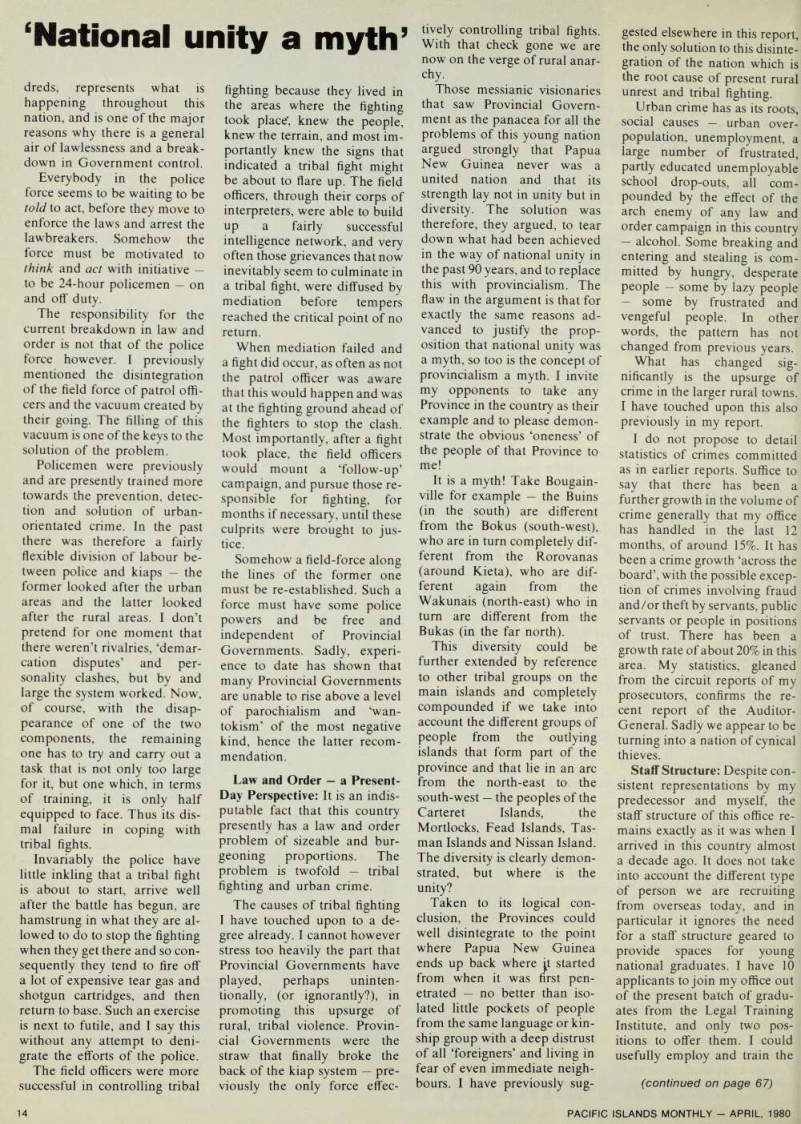
classification as a para-military body, and who ran this country along the lines of a benevolent
dictatorship. I emphasise the
word benevolent , for at all times these men administered with the best interest of the country and especially the people at heart. At times their methods may have been a little ‘rough and ready’, but they knew bet ter than anybody that that was the language that the people best understood.
All too easily these days we lose sight of the fact that the bulk of the population of this country is still at the stage of social development that my Anglo/Saxon forebears were some 10 to 15 centuries ago. I recently commenced re reading Professor Theodore Plucknett’s authoritative text
on English legal history, A
Concise History of the Common Law, and there are amazing parallels between the then atti tudes of the pre-Norman conquest inhabitants of what is now the United Kingdom and the present people of this country. Common to both races were/are a form of vil lage courts, the concept of payback, the ‘hue and cry’, the concept of compensation for
injury, regardless of whose
fault it may have been that the injury was sustained, and many others.
The ‘kiap’ administrators realised this fact and used methods that were appropriate to this degree of development, although they never even ap proached the horrific old
English practices of trial by
ordeal, nor did their concept of what was an appropriate sanc tion even approach some of the more spectacular forms of
punishment that belonged to
those earlier times.
When the Supreme Court went on circuit in my early days no matter how small the out station was that was visited, one always found the Govern ment’s flag flying. The officer in charge of the Station always met the Judge and court party on their arrival, and the police detachment would invariably be turned out ‘spic and span’ for an inspection.
Except for the major urban centres like Port Moresby, Lae, Rabaul and Mt Hagen, urban crime was practically an un known phenomenon in those days. Most of the crime that came before the court was rural crime murders or associated crimes of violence arising out of tribal fights or sorcery situ ations. The rural towns were virtually safe havens. One would go on circuit to Madang or Wabag, and the cases for trial would have originated in Saidor, Simbai, Usino, Bundi, Josephstahl, or Sirunki,
Laiagam, Lake Kopiago, Kan
dep or Porgera respectively.
The crimes would have been uncovered by the ‘kiaps’ on
patrol, and investigations,
arrests and committal proceed ings conducted on the spot. The presence and strength of the Government was seen and felt
throughout the length and
breadth of the land, and the perimeters of civilisation were
being successfully expanded
ever outward.
What is the situation today?
Without exaggerating I estimate that in the four years since Independence, 40 years of administrative achievement has been lost!
The Court no longer sits in outstations because, with a few notable exceptions, crime from the rural areas of the country
ls no longer being detected, prosecuted or punished. A complete process of reversion to pre-contact patterns of be haviour is, I fear, presently taking place in those areas where the Government’s flag once triumphantly flew.
Rather than being safe havens, rural towns are now more like isolated pockets of civilisation in a sea of unrest, distrust and violence. When one goes on circuit to Madang these days, the crimes coming before the court are the typical urban crimes of breaking and entering, or crimes of violence associated with alcohol. The scenes at which such crimes have taken place, rarely exceed the boundaries of the town ship. In Wabag, the situation is worse. A policeman was axed to death as a payback in the heart of town not 12 months ago. His murderers have never been brought to justice. One is unable to try cases in Wabag these days, because the wit nesses living 10 miles out of town are afraid to come to town and testify because of the tribal fight that is taking place only five miles out of town. The perimeters of civilisation are
shrinking!
What has happened? As a re sult of Government policy amj particularly as a result of impo sition of the system of Provin cial Governments the ‘kiaps’, those people that held this place together, have either
‘gone finish’ or been emascu lated to the point where they have given up. The result has been the creation of an enor mous vacuum.
This vacuum the loss of those men to whom the urban villagers could always turn to for guidance and assistance, those men that the urban vil lagers trusted as being com
pletely impartial, has caused
the urban population to dis trust ‘the Government’, and to ignore the ‘laws of the Govern ment’, and to revert to the only group that they know they can
any longer completely trust
the kinship group. This rever sion has resulted in the revival of old jealousies and the cre ation of new ones. Tribal fight
ing has consequently now
reached a level of frequency and ferocity unknown for 20 years.
The legacy of all this is all too readily apparent. In the last year we have witnessed at least six independent attacks on Court parties, prisoners in or outside of Courts, or prisoners in custody in police stations.
Just recently the Government has, of necessity, had to declare a state of emergency in the five Highlands Provinces, involv ing, inter alia , the suspension of constitutional rights and guarantees. The question is where will! in end?
Without being pessi
mistic, I predict that Unless a realistic reappraisal of the cur
rent situation is made, then a complete breakdown of law and order will take place within the next few years.
Far too frequently I am asked to attend yet another conference or committee meet ing to discuss the breakdown of law and order in the Highlands or elsewhere. The first thing some bright-eyed theorist or academic who has never set foot outside of Port Moresby or has never been in or near a tribal fight suggests is that we either change the existing laws or pass a new law to overcome the situation.
When will somebody learn that the present problem is not one of not having enough ad equate laws, but a failure to enforce the ones we presently have? If my memory serves me correctly, not one of the thou sands of prosecutions that ensued after the declaration of the State of Emergency in the Highlands was commenced under special regulations. All were for pre-emergency,
already existing offences. The
police force does its best, but its best is a long way short of what is needed.
One of the essential ingredi ents that is missing from the professional approach of the members of the police force in this country, and I deliberately make this statement for general application, is an amazing lack of individual initiative.
Policemen seem to forget that
they are policemen some
times.
On countless occasions I have personally witnessed
fights taking place, with
policemen standing by along
with the rest of the crowd as on lookers. Frequently one sees a car pulled up alongside the road with the occupants stand ing around consuming a carton of beer and the police car in front drives straight past them.
People drive into Goroko from Asaro on a coffee truck (that is illegally being used as a PMV).
The truck is full of drunks and bristling with bows and arrows, and it drives straight down the main street past the police station not one member of the force thinks to move to enforce the three different laws
that are simultaneously being
broken. And this sort of behav iour, multiplied by the hun
Pre-Independence kiap patrol (circa 1957). The men to whom the villagers could always turn for guidance and assistance?
‘National unity a myth’
dreds, represents what is
happening throughout this
nation, and is one of the major reasons why there is a general air of lawlessness and a break down in Government control.
Everybody in the police
force seems to be waiting to be told to act, before they move to enforce the laws and arrest the lawbreakers. Somehow the force must be motivated to think and act with initiative to be 24-hour policemen on and off duty.
The responsibility for the current breakdown in law and order is not that of the police force however. I previously mentioned the disintegration of the field force of patrol offi cers and the vacuum created by their going. The filling of this vacuum is one of the keys to the solution of the problem.
Policemen were previously and are presently trained more towards the prevention, detec tion and solution of urban orientated crime. In the past there was therefore a fairly flexible division of labour be tween police and kiaps the former looked after the urban areas and the latter looked after the rural areas. I don’t pretend for one moment that there weren’t rivalries, ‘demar cation disputes’ and per sonality clashes, but by and large the system worked. Now, of course, with the disap pearance of one of the two components, the remaining one has to try and carry out a task that is not only too large for it, but one which, in terms of training, it is only half equipped to face. Thus its dis mal failure in coping with
tribal fights.
Invariably the police have
little inkling that a tribal fight is about to start, arrive well after the battle has begun, are hamstrung in what they are al lowed to do to stop the fighting when they get there and so con sequently they tend to fire off a lot of expensive tear gas and
shotgun cartridges, and then
return to base. Such an exercise is next to futile, and I say this without any attempt to deni grate the efforts of the police.
The field officers were more successful in controlling tribal
fighting because they lived in the areas where the fighting took place', knew the people, knew the terrain, and most im portantly knew the signs that indicated a tribal fight might be about to flare up. The field officers, through their corps of interpreters, were able to build up a fairly successful intelligence network, and very often those grievances that now inevitably seem to culminate in a tribal fight, were diffused by mediation before tempers reached the critical point of no return.
When mediation failed and a fight did occur, as often as not the patrol officer was aware that this would happen and was at the fighting ground ahead of the fighters to stop the clash.
Most importantly, after a fight took place, the field officers would mount a ‘follow-up’ campaign, and pursue those re
sponsible for fighting, for
months if necessary, until these
culprits were brought to jus
tice.
Somehow a field-force along the lines of the former one must be re-established. Such a force must have some police powers and be free and independent of Provincial
Governments. Sadly, experi
ence to date has shown that many Provincial Governments are unable to rise above a level of parochialism and ‘wan tokism’ of the most negative kind, hence the latter recom mendation.
Law and Order a Present- Day Perspective: It is an indis putable fact that this country presently has a law and order problem of sizeable and bur
geoning proportions. The
problem is twofold tribal fighting and urban crime.
The causes of tribal fighting I have touched upon to a de gree already. I cannot however stress too heavily the part that Provincial Governments have
played, perhaps uninten
tionally, (or ignorantly?), in
promoting this upsurge of rural, tribal violence. Provin cial Governments were the straw that finally broke the back of the kiap system pre viously the only force effec
lively controlling tribal fights.
With that check gone we are now on the verge of rural anar
chy.
Those messianic visionaries that saw Provincial Govern ment as the panacea for all the problems of this young nation
argued strongly that Papua
New Guinea never was a united nation and that its strength lay not in unity but in diversity. The solution was therefore, they argued, to tear down what had been achieved in the way of national unity in the past 90 years, and to replace this with provincialism. The flaw in the argument is that for exactly the same reasons ad vanced to justify the prop osition that national unity was a myth, so too is the concept of provincialism a myth. I invite my opponents to take any Province in the country as their example and to please demon strate the obvious ‘oneness’ of the people of that Province to me!
It is a myth! Take Bougain ville for example the Buins (in the south) are different from the Bokus (south-west), who are in turn completely dif ferent from the Rorovanas (around Kieta), who are dif ferent again from the Wakunais (north-east) who in turn are different from the Bukas (in the far north).
This diversity could be further extended by reference to other tribal groups on the main islands and completely compounded if we take into account the different groups of
people from the outlying
islands that form part of the province and that lie in an arc from the north-east to the south-west the peoples of the Carteret Islands, the Mortlocks, Fead Islands, Tas man Islands and Nissan Island.
The diversity is clearly demon strated, but where is the
unity?
Taken to its logical con clusion, the Provinces could well disintegrate to the point where Papua New Guinea ends up back where started from when it was first pen etrated no better than iso lated little pockets of people from the same language or kin ship group with a deep distrust of all ‘foreigners’ and living in fear of even immediate neigh bours. I have previously sug
gested elsewhere in this report, the only solution to this disinte gration of the nation which is the root cause of present rural unrest and tribal fighting.
Urban crime has as its roots, social causes urban over
population, unemployment, a
large number of frustrated,
partly educated unemployable
school drop-outs, all com pounded by the effect of the arch enemy of any law and order campaign in this country alcohol. Some breaking and entering and stealing is com
mitted by hungry, desperate
people some by lazy people
- some by frustrated and
vengeful people. In other
words, the pattern has not
changed from previous years.
What has changed sig
nificantly is the upsurge of crime in the larger rural towns.
I have touched upon this also previously in my report.
I do not propose to detail statistics of crimes committed as in earlier reports. Suffice to say that there has been a further growth in the volume of crime generally that my office has handled in the last 12 months, of around 15%. It has been a crime growth ‘across the board’, with the possible excep tion of crimes involving fraud and/or theft by servants, public servants or people in positions of trust. There has been a growth rate of about 20% in this
area. My statistics, gleaned
from the circuit reports of my prosecutors, confirms the re cent report of the Auditor- General. Sadly we appear to be turning into a nation of cynical thieves.
Staff Structure: Despite con
sistent representations by my
predecessor and myself, the
staff structure of this office re mains exactly as it was when I arrived in this country almost a decade ago. It does not take into account the different type of person we are recruiting from overseas today, and in particular it ignores the need for a staff structure geared to provide spaces for young national graduates. I have 10 applicants to join my office out of the present batch of gradu ates from the Legal Training Institute, and only two pos itions to offer them. I could usefully employ and train the
(continued on page 67)
lot of them. I have recently re submitted my staffing pro posals to the Secretary for Justice for onforwarding to the Public Service Commission. I an not optimistic enough to be lieve they will be accepted perhaps they may be graced with somebody’s consider ation.
Ombudsman Commission: The Ombudsman Commission has referred a number of mat ters to me in the year of this re port. To date none of them has been actioned by me. I have explained to the Chief Ombudsman that I refuse to waste the precious few re sources that I have in prosecut ing national leaders for breaches of the ‘Leadership Code’ when the government demonstrates immediately the contempt it has for such
proceedings by immediately
reappointing such leaders,
disgraced by convictions, back
to positions of equal or greater prestige and power. I have in vited the Ombudsman Com mission instead to refer clear
instances of criminal activity
by leaders to either the police force or myself, as we both have (at least technical) consti tutional guarantees against putside interference.
The Committee of Mercy: If my one body in this country is xmtributing more than any Pther to the judicial process of
ientencing becoming a com
plete laughing stock, it is the committee that advises on the power of mercy.
It does not comprehend the proper notion of what ‘mercy’ neans in the judicial sense, it
>ver-reacts, it is amateurishly
laive, it assumes powers that it loes not have and all this in ;ood faith, for I do not suggest or one moment that it acts
rith anything but absolute
vna fides. I trust I am not »eing unfairly critical when I ay that only on two occasions tiat I can recall has my office •een asked to appear before he Committee or make de ified representations in sup ort of a sentence properly nposed.
To give an idea of what takes lace during the normal oper tion of the judicial process,
the prosecution calls all its evi dence, the accused is allowed to adduce whatever evidence he wishes to place before the court, and the Judge then de cides whether he is guilty or innocent. If found guilty, the accused is allowed to call evi dence on the question of sen tence, is always given the opportunity to say anything he wishes to say on his own behalf, and then his counsel is allowed to make submissions in miti gation of sentence. Only after all these safeguards have been observed, does the trial Judge impose what to him, on the facts, is a proper sentence. All possible factors are first care fully weighed and balanced.
However, the more astute prisoners these days, and es pecially the younger and more educated prisoners, immedi ately upon entering prison, are despatching letters to the Mercy Committee asking for clemency. The letters are in
variably heart-rending tales,
detailing all the ‘injustices’ that surrounded their convictions and sentences, and generally
speaking contain exactly the
same material that was placed before the sentencing Judge at trial and which was either re jected as untrue or given due
weight by the Judge in im
posing sentence.
The problem is that the
Mercy Committee, with buoy
ant enthusiasm, invariably adopts these piteous com
plaints as being gospel truth,
untested as they are by cross examination, unopposed as they are by the prosecutors be cause we know little or nothing about them, and so the prisoner has the benefit of having his side of the story taken into account twice on the question of sentence.
This process had led to some outstandingly stupid results.
Perhaps the most arrogant misconception as to their proper role and powers by the Mercy Committee to date re lates to the case of a very well educated young Papuan gentleman who pleaded guilty to two counts of dangerous driving causing death (that of his wife and eldest son) where the aggravating factors of alcohol, speed and recklessness were involved. A non-custodial sentence was imposed by the trial Judge. An appeal by my
office against leniency of sen tence was successful, and in a very strong and determined
judgment, the Supreme Court
unanimously imposed an 18
months gaol sentence. The young gentleman immediately wrote to the Mercy Committee, which, when it sat, had the tem
erity to unanimously rec
ommend to cabinet that the original sentence of the trial Judge, a sentence already pro nounced by the highest court in the land to be legally improper, be restored. Cabinet in its wis dom rejected this recommen dation. With greatest respect, I recommend that the present
composition of the Mercy
Committee be drastically changed so as to reflect a bal ance of interests, experience and professionalism. Other wise the mercy prerogative will be reduced in status to that of the mercy ritual.
Acting Appointments: There
was one acting appointment
made during the period of this report, that of Mr Gavara- Nanu for the period of one month that I was on leave be tween May 4-June 4 1979. This appointment was contrary to my recommendation and made upon the insistence of the for mer Minister for Justice, Mrs Nahau Rooney. On my return from leave I was surprised to find Mr Gavara-Nanu acting in my position. After making a quick check of the register of counsel held at the Supreme Court I confirmed my first im pression which was that Mr Gavara-Nanu had been im
properly appointed as Acting
Public Prosecutor, in that he failed by a period of three
months, to fulfil the barest minimum qualification fon appointment under the Organic Law that of three years experience post -full ad mission.
I wrote to the Judicial and Legal Services Commission pointing out their error. To date I have not received a reply in any form.
The ‘Rooney Affair’: This is not the place to dwell upon this matter, although it is the reason for the late submission of this report. I will say only this about the Rooney affair.
History will prove, I am sadly confident, that this ca lamity that has befallen the legal system of this country, will mark the watershed be tween the integrity of our ju dicial system and the upholding of the rule of law, and the slow downhill turn toward tyranny and anarchy.
The judicial system, its status, its independence and its impar tiality have been dealt a body blow from which it is unlikely to truly recover. There are many proverbs attributed toe the sixth century BC Chinese philosopher Confucius many are unprintable and in fact! emanated from Australiani schoolboys one that did noO reads as follows: ‘By three ways? we may leam wisdom: First by reflection which is the; noblest; Second by imitation which is the easiest; And third,, by experience which is the: bitterest.’
The ‘Rooney Affair’ has? placed the legal system of this? country squarely on the path ofl ‘bitter experience’ in its searcht for wisdom and justice.
Advertisements & other items, p. 12 (1 item)
radio taped.
n .1 rat The RX-5500F has 15 watts output power and 4 bands; (FM/ m w ‘ » « . «•••#• I:::;;;:::
UIUMIMMMM*
MMMKOMtMMM
***«««*«•«•*••• I:;:;:::;::: ::: M The RX-5300F has 12 watts output power and 4 bands; (FM/MW/SWI/SW2) B l .r...uia!S!sssi;iiS i ; • ii I bands: (FM/MW/SWi /SW 2 ) RX-5120F has 10 watts output power
We've got
the cassette
radio taped.
We've built more cassette radios than just about anybody. And, as you can see and hear, it shows.
Our sleek silvery portables pack powerful amplifiers. Multi-band tuner sections. Three-way meters for recording/playback, tuning and battery strength.
Many of them have a clever control to select your favorite tape selections automatically. And our classy RX-5500F has Dolby* (No hiss from the tape means no boos from the buyers).
Trust National's silvery sets to bring you sterling performance. At home and away. * Dolby and the double-D symbol are trademarks of Dolby Laboratories.
S National Panasonic
National and Panasonic are the brandnames of Matsushita Electric.
When Authoritarianism
Failed
Discontent within Tonga’s
government nursing service boiled over in January, after
simmering Tonga-style for
some nine years (PIM Mar p 6).
A mass resignation, on one month’s notice, of 168 nurses from Tongatapu and the other islands took effect at midnight on January 9. Five senior sis ters submitted resignations at the same time, but on the mandatory three months’ notice for their level. In a country where unions are il
legal and respectful submission
to authority is built into the cul ture, the nurses’ action posed
an unprecedented problem for
Cabinet and created flashpoint tension between partisan sup
porters throughout the King
dom.
The chronology of the crisis was: June ’79: The nurses submit ted a formal written request to the Prime Minister for a
thorough and impartial investi
gation of the whole nursing ser vice and for the removal of the chief nursing officer (Mrs ’Akosita Fineanganofo) whose
performance, they claimed,
had been adversely affecting
morale and efficiency since 1971 despite repeated com
plaints to authority.
August: The government appointed a committee of in quiry which sat for 26 days and prepared a 600-page report on the evidence presented.
Dec. 3: The nurses submitted a further letter with 173 signa tures asking for a definitive de cision on the report by December 10, including re moval of the CNO. Failing this their letter should be taken as formal notice of resignation to take effect on January 10, except where three months’
notice required.
Dec. 10: No reply received.
Jan. 9 ’80: a.m. The minister of health was reminded by the nurses that the resignations would take effect at midnight as previously notified. p.m. The prime minister met with the nurses’ representatives to request postponement but could give no guarantee of when Cabinet would review and act on the report.
Midnight: The nurses stopped work and radioed the outer islands in code to do the same.
From Penny Hodgkinson in Nukualofa
Jan. 11: Three theatre staff of Vaiola Hospital returned to assist with an emergency oper ation, then left again.
Jan. 13: The minister of health. Dr Tapa, in a denunci atory broadcast that shocked the Kingdom, declared the res ignations invalid and ordered the nurses back to work by 4 pm next day. Those who did not obey would, he said, be ‘driven out of the government
nursing service in disgrace’.
Jan. 14: Only three nurses obeyed the minister’s ulti matum.
Jan. 15: The ministry of
health began broadcasting
appeals for volunteers to assist skeleton hospital staffs.
Jan. 16: The nurses distri buted a brochure explaining their case to the public and presented a petition to His Majesty in Council.
Jan. 17: The Privy Council reviewed the crisis and referred it back to another Cabinet
meeting next day. A public pet
ition circulated overnight in support of the nurses and with over 6000 signatures was also sent to His Majesty. Catholic Bishop Patelisio Finau, in a personal letter to His Majesty, requested further review of the
nurses’ long standing griev
ances.
Jan. 18: Cabinet sat all day and late that night released an authorised national broadcast statement, summarising its ver sion of the history of the crisis, announcing its acceptance of a committee finding that all
complaints against the CNO
were ‘without foundation’,
and upholding her in her pos ition. It further announced that an expatriate expert in nursing administration would be quickly recruited to evaluate all facets of and current prac tices within the ministry of health nursing service, and gave a ‘second chance exten sion’ of the former dismissal deadline to 4 pm next day.
Jan. 19: Three nurses from Vaiola General Hospital and 12 from the various outer islands resumed duty. The re mainder stood firm, claiming: that the official January 18 broadcast had been denigratory in tone and incomplete in sub stance; that their resignations had not been declared invalid during the one month’s notice period; that the offer of a sec
ond independent investigation
underlined the meaningless and ‘face-saving’ nature of the earlier inquiry in which all three committee members and the secretary had been related by blood or marriage to the contentious CNO; that return ing to duty under that same
CNO, strengthened by official
Cabinet vindication, would create unbearable tensions and undermine what remained of
nursing efficiency.
Jan. 21: The ministry of health broadcast advertise ments, for Tongans or resident
expatriates with nursing ex
perience to fill vacancies in the Government service and rumours began to circulate that the government was also con sidering overseas recruit ments.
Jan. 23: Doctors at Vaiola Hospital sent an official letter to the Ministry of Health urg
ing a practical resolution of the crisis and advising that they would not be able to cope
much longer under existing
conditions.
At 9.30 pm on the night of January 24, the apparent dead lock was suddenly and dra
matically broken.
In a nationwide broadcast, the Prime Minister, HRH Prince Fatefehi Tu’ipelehake, revealed that the government had backed away from its for mer uncompromising authori tarianism, so that all concerned could work together in har mony and love for the good of the Kingdom. HM’s Govern ment had, he said, decided to transfer the CNO to another
ministry (foreign affairs), a
new CNO would be recruited from overseas, and a third ex gratia chance would be given to
all nurses resuming duty by
4pm on Saturday, January
26.
An official letter detailing the new offers was simul taneously delivered to the house where most of the nurses had been living together since the crisis began, and crowds of well-wishers began congregat ing outside to offer their con gratulations.
Amid tears of rejoicing and relief of tension, amid
emotional Tonga-style
speeches of gratitude to the government for its changed attitude and to the many sup porters who had supplied them with food and money, they voted unanimously to accept the Cabinet olive-branch and rejoin the service.
Thus Tonga’s first-ever major industrial crisis ended with valuable lessons for both sides. The nurses, and through them all Tongans, have learnt that unity, faith, strength of purpose and total belief in a cause can move mountains.
The government has learnt that a respect for human rights, and a realistic search for practical solutions, is far more effective than old-style hardline authori tarianism.
The prime minister resolved the 15-day crisis with a grace and dignity which obliterated earlier mistakes and won every Tongan heart. The nurses re sponded with a grace and dig nity to match, many returning to work as volunteers prior to
official resumption of duty.
Advertisements & other items, p. 16 (1 item)
Come uptokool
The cool refreshing taste of menthol.
Political
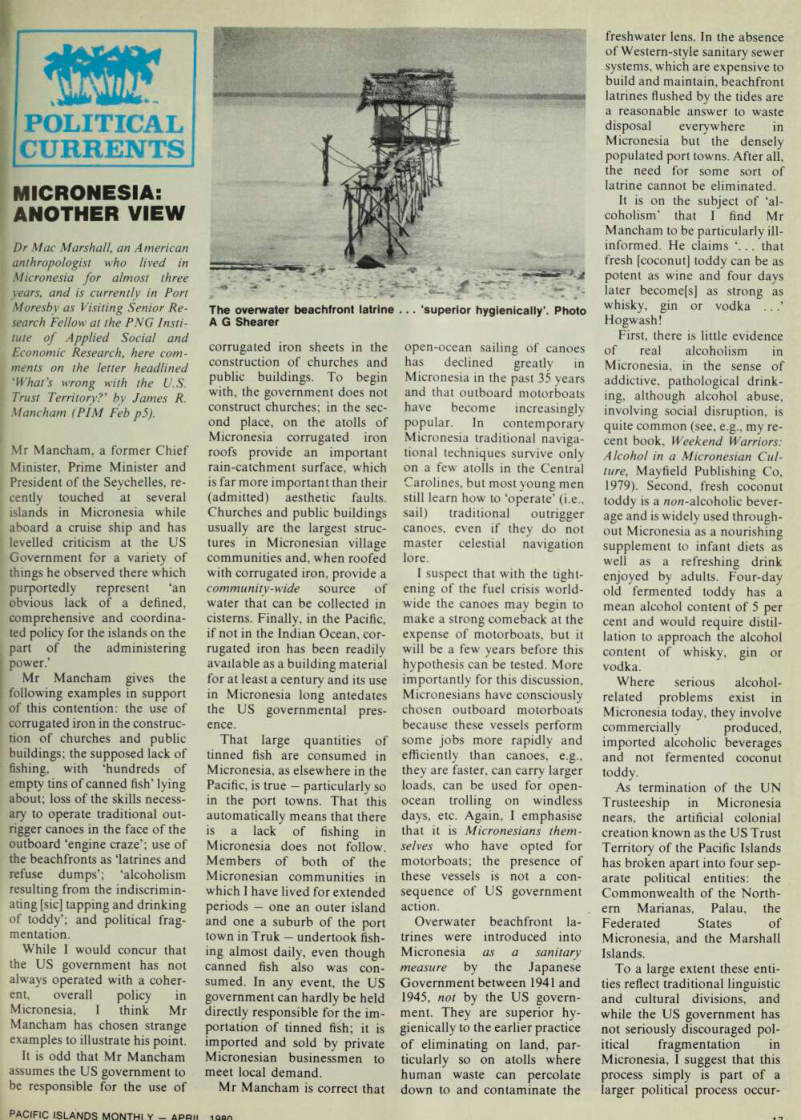
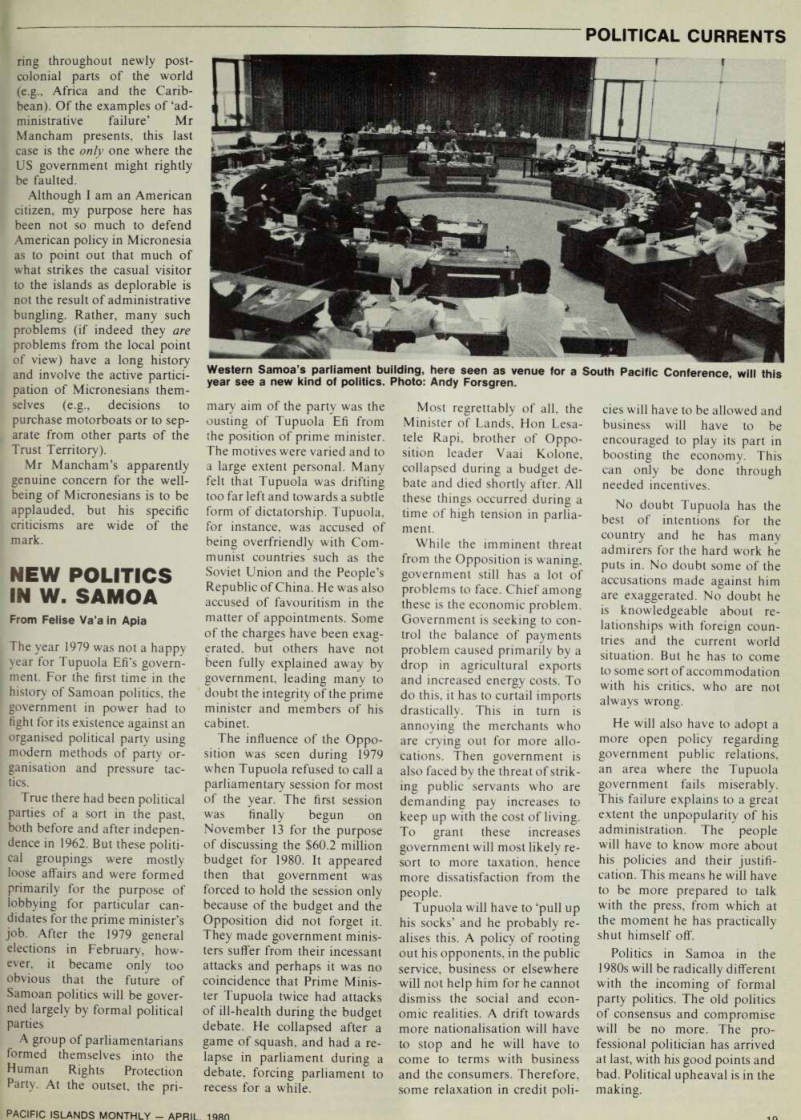
Currents
Micronesia:
Another View
Dr Mac Marshall, an American anthropologist who lived in Micronesia for almost three years, and is currently in Port Moresby as Visiting Senior Re search Fellow at the PNG Insti tute of Applied Social and Economic Research, here com ments on the letter headlined ‘ What's wrong with the U.S.
Trust Territory?’ by James R.
Mancham (PIM Feb p 5).
Mr Mancham, a former Chief Minister, Prime Minister and President of the Seychelles, re cently touched at several islands in Micronesia while aboard a cruise ship and has levelled criticism at the US Government for a variety of things he observed there which purportedly represent ‘an obvious lack of a defined, comprehensive and coordina ted policy for the islands on the part of the administering
power.’
Mr Mancham gives the
following examples in support
of this contention; the use of corrugated iron in the construc tion of churches and public buildings; the supposed lack of fishing, with ‘hundreds of empty tins of canned fish’ lying about; loss of the skills necess ary to operate traditional out rigger canoes in the face of the outboard ‘engine craze’; use of the beachfronts as ‘latrines and refuse dumps’; ‘alcoholism resulting from the indiscrimin
ating [sic] tapping and drinking
of toddy’; and political frag
mentation.
While I would concur that the US government has not always operated with a coher ent, overall policy in Micronesia, I think Mr Mancham has chosen strange examples to illustrate his point.
It is odd that Mr Mancham assumes the US government to be responsible for the use of
corrugated iron sheets in the construction of churches and
public buildings. To begin
with, the government does not construct churches; in the sec ond place, on the atolls of Micronesia corrugated iron
roofs provide an important
rain-catchment surface, which is far more important than their (admitted) aesthetic faults.
Churches and public buildings
usually are the largest struc tures in Micronesian village communities and, when roofed with corrugated iron, provide a community-wide source of water that can be collected in cisterns. Finally, in the Pacific, if not in the Indian Ocean, cor rugated iron has been readily available as a building material for at least a century and its use in Micronesia long antedates the US governmental pres ence.
That large quantities of
tinned fish are consumed in Micronesia, as elsewhere in the Pacific, is true particularly so in the port towns. That this automatically means that there is a lack of fishing in Micronesia does not follow.
Members of both of the Micronesian communities in which I have lived for extended periods one an outer island and one a suburb of the port town in Truk undertook fish
ing almost daily, even though
canned fish also was con sumed. In any event, the US government can hardly be held directly responsible for the im portation of tinned fish; it is imported and sold by private Micronesian businessmen to meet local demand.
Mr Mancham is correct that
open-ocean sailing of canoes has declined greatly in Micronesia in the past 35 years and that outboard motorboats have become increasingly popular. In contemporary Micronesia traditional naviga tional techniques survive only on a few atolls in the Central Carolines, but most young men still learn how to ‘operate’ (i.e., sail) traditional outrigger canoes, even if they do not master celestial navigation lore.
I suspect that with the tight ening of the fuel crisis world wide the canoes may begin to make a strong comeback at the expense of motorboats, but it will be a few years before this hypothesis can be tested. More importantly for this discussion, Micronesians have consciously chosen outboard motorboats because these vessels perform some jobs more rapidly and efficiently than canoes, e.g., they are faster, can carry larger loads, can be used for open ocean trolling on windless
days, etc. Again, I emphasise
that it is Micronesians them selves who have opted for motorboats; the presence of these vessels is not a con sequence of US government action.
Overwater beachfront la trines were introduced into Micronesia as a sanitary measure by the Japanese Government between 1941 and 1945, not by the US govern ment. They are superior hy gienically to the earlier practice of eliminating on land, par ticularly so on atolls where human waste can percolate down to and contaminate the
freshwater lens. In the absence
of Western-style sanitary sewer
systems, which are expensive to build and maintain, beachfront latrines flushed by the tides are a reasonable answer to waste
disposal everywhere in
Micronesia but the densely populated port towns. After all, the need for some sort of latrine cannot be eliminated.
It is on the subject of ‘al coholism’ that I find Mr Mancham to be particularly ill informed. He claims ‘... that fresh [coconut] toddy can be as potent as wine and four days later become[s] as strong as
whisky, gin or vodka ..
Hogwash!
First, there is little evidence of real alcoholism in Micronesia, in the sense of addictive, pathological drink
ing, although alcohol abuse,
involving social disruption, is
quite common (see, e.g., my re cent book. Weekend Warriors: Alcohol in a Micronesian Cul
ture, Mayfield Publishing Co,
1979). Second, fresh coconut toddy is a non-alcoholic bever age and is widely used through out Micronesia as a nourishing supplement to infant diets as well as a refreshing drink
enjoyed by adults. Four-day
old fermented toddy has a mean alcohol content of 5 per cent and would require distil lation to approach the alcohol content of whisky, gin or vodka.
Where serious alcohol related problems exist in
Micronesia today, they involve
commercially produced,
imported alcoholic beverages
and not fermented coconut
toddy.
As termination of the UN Trusteeship in Micronesia nears, the artificial colonial creation known as the US Trust Territory of the Pacific Islands has broken apart into four sep arate political entities: the Commonwealth of the North ern Marianas, Palau, the Federated States of Micronesia, and the Marshall Islands.
To a large extent these enti ties reflect traditional linguistic and cultural divisions, and while the US government has
not seriously discouraged pol
itical fragmentation in Micronesia, I suggest that this process simply is part of a
larger political process occur
The overwater beachfront latrine ... ‘superior hygienically’. Photo A G Shearer
ring throughout newly post colonial parts of the world (e.g., Africa and the Carib bean). Of the examples of ‘ad ministrative failure’ Mr Mancham presents, this last case is the only one where the
US government might rightly
be faulted.
Although I am an American citizen, my purpose here has been not so much to defend American policy in Micronesia as to point out that much of what strikes the casual visitor to the islands as deplorable is not the result of administrative bungling. Rather, many such problems (if indeed they are problems from the local point of view) have a long history and involve the active partici pation of Micronesians them selves (e.g., decisions to purchase motorboats or to sep arate from other parts of the
Trust Territory).
Mr Mancham’s apparently genuine concern for the well being of Micronesians is to be
applauded, but his specific
criticisms are wide of the mark.
Advertisements & other items, pp. 17-18 (3 items)
17
PACIFIC ISLANDS MONTH! Y aprii loan
18
PACIFIC IS I AMDS MDNTHI Y APRIL 1980
Pacific Island
Beehive Building 94 Elizabeth Street Melbourne, Victoria Australia 3000 G.P.O. Box 8 Melbourne, Victoria Australia 3 1 Telex: AA34552 Phone: 63 5094 * -• ■ V , ■
' //S S* '"// Y/S/" '
! i
New Politics
In W. Samoa
From Felise Va’a in Apia The year 1979 was not a happy year for Tupuola Efi’s govern ment. For the first time in the history of Samoan politics, the government in power had to fight for its existence against an organised political party using modern methods of party or ganisation and pressure tac tics.
True there had been political parties of a sort in the past, both before and after indepen dence in 1962. But these politi cal groupings were mostly loose affairs and were formed primarily for the purpose of lobbying for particular can didates for the prime minister’s job. After the 1979 general elections in February, how ever, it became only too obvious that the future of Samoan politics will be gover ned largely by formal political parties A group of parliamentarians formed themselves into the Human Rights Protection Party. At the outset, the pri-
mary aim of the party was the ousting of Tupuola Efi from the position of prime minister.
The motives were varied and to a large extent personal. Many felt that Tupuola was drifting too far left and towards a subtle
form of dictatorship. Tupuola,
for instance, was accused of
being overfriendly with Com
munist countries such as the Soviet Union and the People’s Republic of China. He was also accused of favouritism in the matter of appointments. Some of the charges have been exag erated, but others have not
been fully explained away by
government, leading many to doubt the integrity of the prime minister and members of his cabinet.
The influence of the Oppo sition was seen during 1979 when Tupuola refused to call a parliamentary session for most of the year. The first session
was finally begun on
November 13 for the purpose of discussing the $60.2 million budget for 1980. It appeared then that government was forced to hold the session only because of the budget and the Opposition did not forget it.
They made government minis ters suffer from their incessant attacks and perhaps it was no coincidence that Prime Minis ter Tupuola twice had attacks of ill-health during the budget debate. He collapsed after a game of squash, and had a re lapse in parliament during a
debate, forcing parliament to
recess for a while.
Most regrettably of all, the Minister of Lands, Hon Lesa tele Rapi, brother of Oppo sition leader Vaai Kolone,
collapsed during a budget de
bate and died shortly after. All these things occurred during a time of high tension in parlia ment.
While the imminent threat from the Opposition is waning, government still has a lot of problems to face. Chief among these is the economic problem.
Government is seeking to con trol the balance of payments
problem caused primarily by a
drop in agricultural exports
and increased energy costs. To do this, it has to curtail imports drastically. This in turn is annoying the merchants who are crying out for more allo cations. Then government is also faced by the threat of strik ing public servants who are demanding pay increases to keep up with the cost of living.
To grant these increases government will most likely re sort to more taxation, hence more dissatisfaction from the
people.
Tupuola will have to ‘pull up his socks’ and he probably re alises this. A policy of rooting out his opponents, in the public service, business or elsewhere will not help him for he cannot dismiss the social and econ omic realities. A drift towards more nationalisation will have to stop and he will have to come to terms with business and the consumers. Therefore, some relaxation in credit poli
cies will have to be allowed and business will have to be encouraged to play its part in boosting the economy. This can only be done through needed incentives.
No doubt Tupuola has the best of intentions for the country and he has many admirers for the hard work he puts in. No doubt some of the accusations made against him are exaggerated. No doubt he is knowledgeable about re
lationships with foreign coun
tries and the current world situation. But he has to come to some sort of accommodation with his critics, who are not
always wrong.
He will also have to adopt a
more open policy regarding
government public relations, an area where the Tupuola government fails miserably.
This failure explains to a great extent the unpopularity of his administration. The people will have to know more about his policies and their justifi cation. This means he will have to be more prepared to talk with the press, from which at the moment he has practically shut himself off.
Politics in Samoa in the
1980 s will be radically different
with the incoming of formal party politics. The old politics of consensus and compromise will be no more. The pro fessional politician has arrived at last, with his good points and bad. Political upheaval is in the
making.
Western Samoa’s parliament building, here seen as venue for a South Pacific Conference, will this year see a new kind of politics. Photo: Andy Forsgren.
Advertisements & other items, pp. 19-21 (2 items)
Political Currents
Pioneer’s Mi
So many to choose fi
Pioneer’s working hard to make it easy for you to really enjoy your favorite music. Sure, our Music Systems are technically advanced, but not so complicated that you need a license to turn them on. So, we're offering not only one or two, but ten great musical ideas to match your audio requirements and budget. In addition to our versatile 3-in-1 systems shown on these pages, we have equally wonderful
2-in-1 receiver/cassette deck combinations.
Easy operation plus big music power reproduces music so well, if you don’t believe your ears, you can check the LED information panel.
TC Music System 750 Music System 850
(M) PIONEER
For further information, please contact: Australia: Pioneer Marketing Service Pty. Ltd., P.O. Box 317, Mordialloc, Victoria. 3195 Tel: 90-9011 Fiji Islands: Brijlal & Company, G.P.O. Box No. 362, Suva, Fiji Islands Tel; 22258 New Zealand: Monaco Electronics Ltd., 5 Vernon Street, Auckland, New Zealand Tel: 33-883 Norfolk Island: Burns Philp (Norfolk Island) Ltd., Norfolk Island, South Pacific New Hebrides: Burns Philp (New Hebrides) Ltd., Vila, New Hebrides Nauru Island: Jacob Enterprises, P.O. Box No. 4. Republic of Nauru
sic Systems.
mi, so easy to enjoy.
Also featured is the well-known Multi Mode Deck™ with exclusive Pioneer Song Finder, one-touch recording, auto-repeat plus Dolby* for noise-free recording and playback. For record lovers, a full size belt-driven turntable with auto-return and cut. And on the output side, a pair of beautiful Pioneer speaker systems to make great music sound even greater.
Pioneer’s Music Systems. So many to choose from, so easy to use and enjoy, turning them off is the only hard thing about them. Stop by for a demonstration today. There’s a Music System that’s just right for you. * Dolby is a trademark of Dolby Labs.
Features vary with model and price. % Tahiti: Ets. PERFECT, B.P. 594, Papeete, Tahiti Tel: 20 407 New Caledonia: Menard Freres Ville, B.P. H 2 Cedex, Noumea, New Caledonia Tel; 27.52.22 American Samoa: Transpac Corporation, P.O. Box 1477, Pago Pago, American Samoa 96799 Tel: 633-5224 Rarotonga: South Seas International Ltd., P.O. Box 49, Rarotonga, Cook Islands Tel; 2327 Papua New Guinea: Bali Merchants Pty. Ltd., P.O. Box 6103, Boroko Tel: 254887
Buying a Fiji
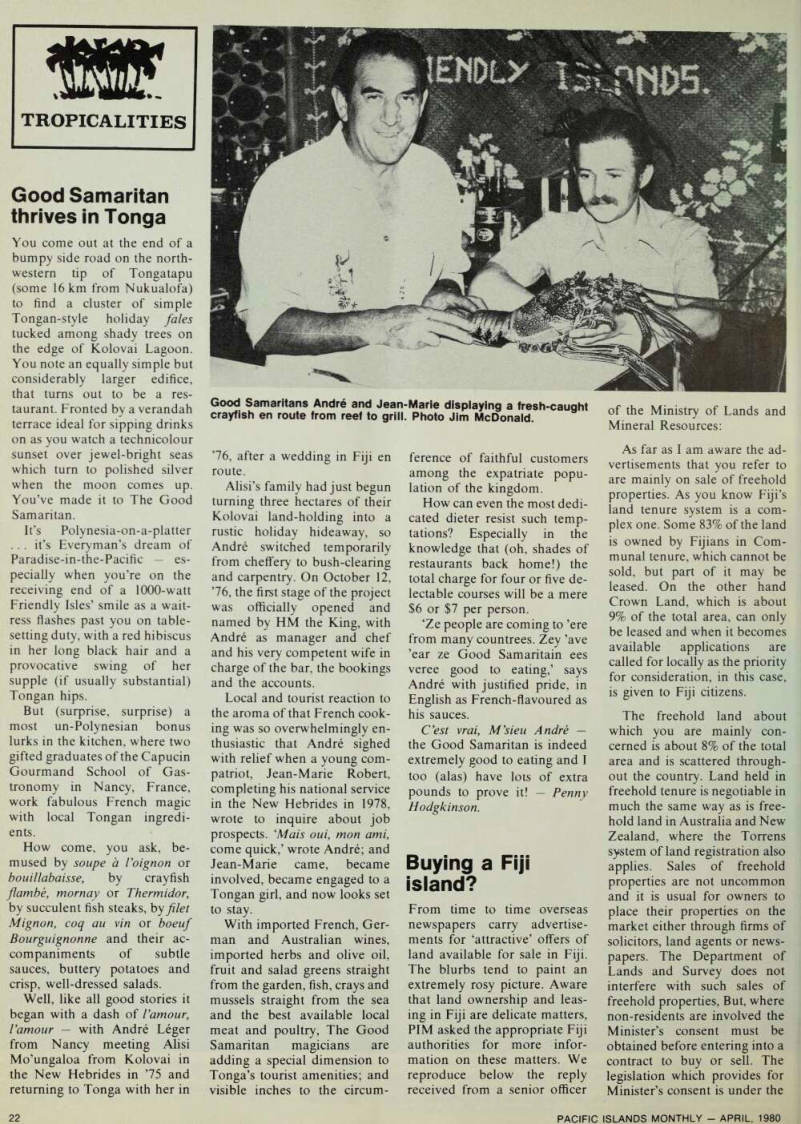

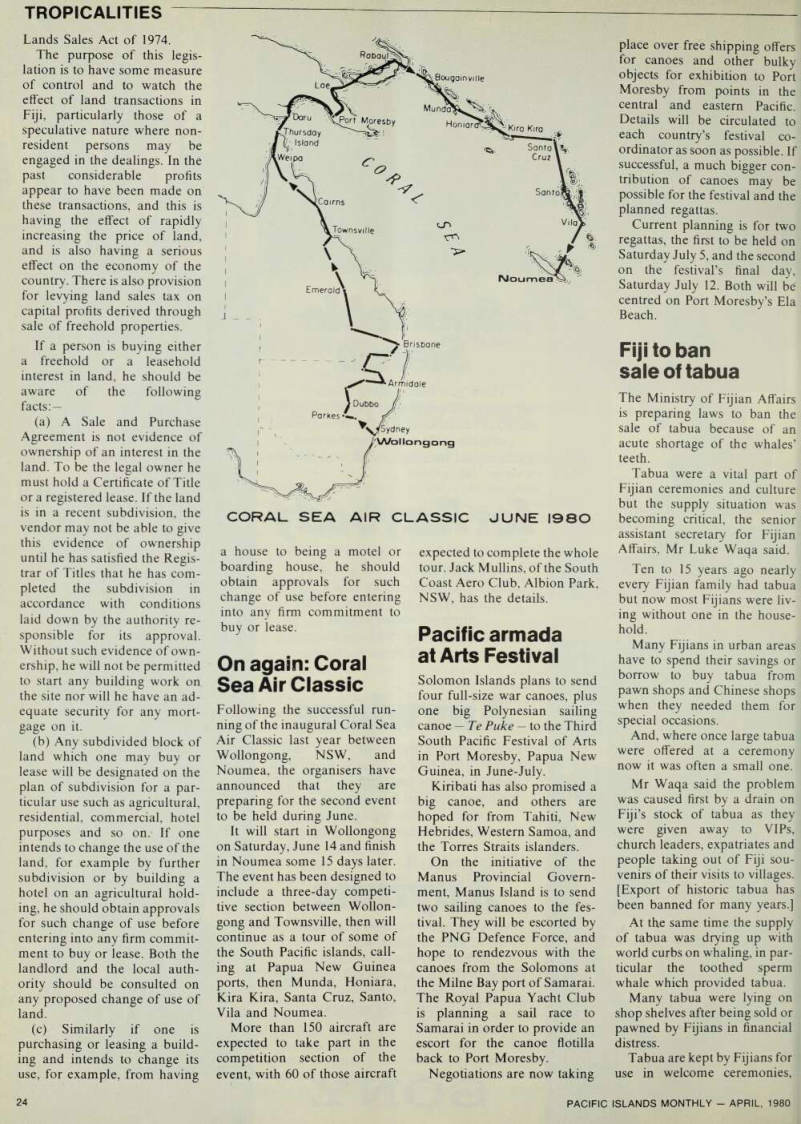
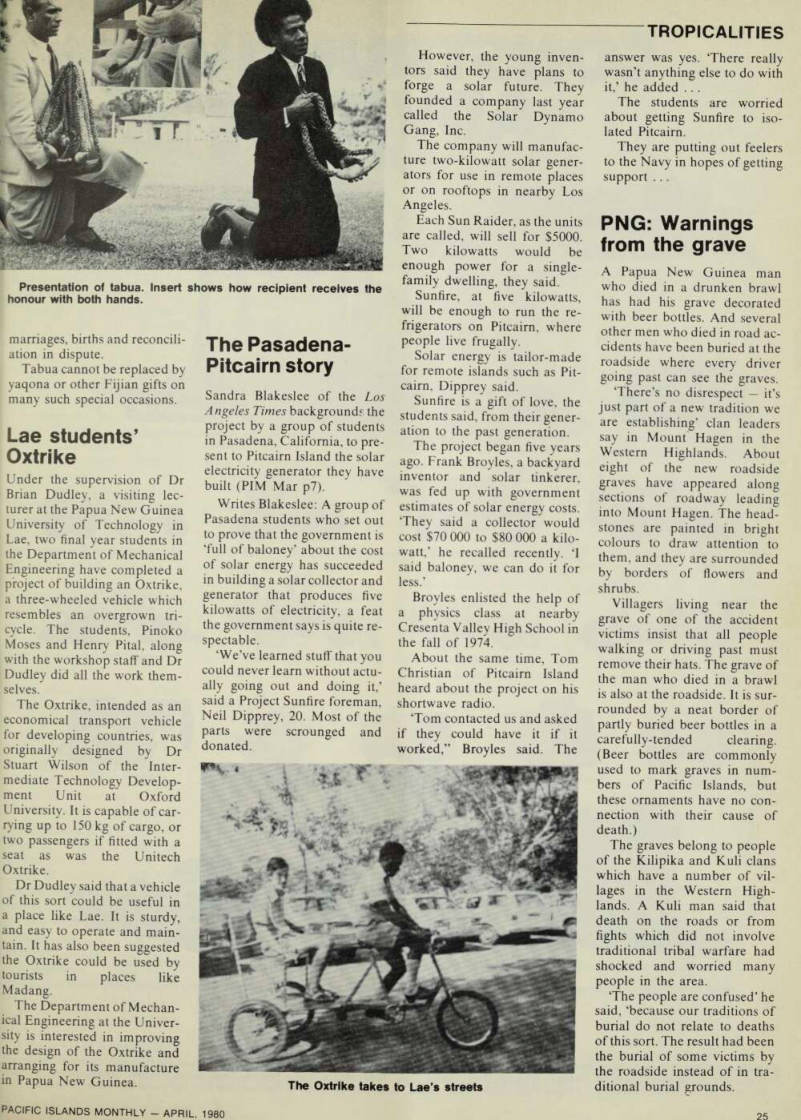
Tropicalities
Good Samaritan
thrives in Tonga
You come out at the end of a bumpy side road on the north
western tip of Tongatapu
(some 16 km from Nukualofa) to find a cluster of simple
Tongan-style holiday fales
tucked among shady trees on the edge of Kolovai Lagoon.
You note an equally simple but
considerably larger edifice,
that turns out to be a res taurant. Fronted by a verandah terrace ideal for sipping drinks on as you watch a technicolour sunset over jewel-bright seas which turn to polished silver when the moon comes up.
You’ve made it to The Good Samaritan.
It’s Polynesia-on-a-platter
... it’s Everyman’s dream of Paradise-in-the-Pacific es pecially when you’re on the receiving end of a 1000-watt Friendly Isles’ smile as a wait ress flashes past you on table setting duty, with a red hibiscus in her long black hair and a provocative swing of her
supple (if usually substantial)
Tongan hips.
But (surprise, surprise) a
most un-Polynesian bonus lurks in the kitchen, where two gifted graduates of the Capucin Gourmand School of Gas tronomy in Nancy, France, work fabulous French magic
with local Tongan ingredi
ents.
How come, you ask, be mused by soupe a Voignon or
bouillabaisse, by crayfish
fiambe, mornay or Thermidor,
by succulent fish steaks, by filet
Mignon, coq au vin or boeuf Bourguignonne and their ac companiments of subtle sauces, buttery potatoes and crisp, well-dressed salads.
Well, like all good stories it began with a dash of Vamour, Vamour with Andre Leger
from Nancy meeting Alisi
Mo’ungaloa from Kolovai in the New Hebrides in ’75 and returning to Tonga with her in
’76, after a wedding in Fiji en route.
Alisi’s family had just begun
turning three hectares of their Kolovai land-holding into a
rustic holiday hideaway, so
Andre switched temporarily
from cheffery to bush-clearing
and carpentry. On October 12, ’76, the first stage of the project
was officially opened and
named by HM the King, with Andre as manager and chef and his very competent wife in charge of the bar, the bookings and the accounts.
Local and tourist reaction to the aroma of that French cook ing was so overwhelmingly en thusiastic that Andre sighed with relief when a young com patriot, Jean-Marie Robert, completing his national service in the New Hebrides in 1978, wrote to inquire about job prospects. ‘Mais oui, mon ami, come quick,’ wrote Andre; and Jean-Marie came, became involved, became engaged to a Tongan girl, and now looks set to stay.
With imported French, Ger man and Australian wines, imported herbs and olive oil, fruit and salad greens straight from the garden, fish, crays and mussels straight from the sea and the best available local meat and poultry, The Good Samaritan magicians are adding a special dimension to Tonga’s tourist amenities; and visible inches to the circum
ference of faithful customers among the expatriate popu lation of the kingdom.
How can even the most dedi cated dieter resist such temp tations? Especially in the knowledge that (oh, shades of restaurants back home!) the total charge for four or five de lectable courses will be a mere $6 or $7 per person. ‘Ze people are coming to ’ere from many countrees. Zey ’ave ’ear ze Good Samaritain ees veree good to eating,’ says Andre with justified pride, in English as French-flavoured as his sauces.
C’est vrai, M’sieu Andre the Good Samaritan is indeed
extremely good to eating and I
too (alas) have lots of extra pounds to prove it! Penny
Hodgkinson.
Buying a Fiji
island?
From time to time overseas newspapers carry advertise ments for ‘attractive’ offers of land available for sale in Fiji.
The blurbs tend to paint an
extremely rosy picture. Aware
that land ownership and leas ing in Fiji are delicate matters, PIM asked the appropriate Fiji authorities for more infor mation on these matters. We
reproduce below the reply
received from a senior officer
of the Ministry of Lands and Mineral Resources: As far as I am aware the ad vertisements that you refer to are mainly on sale of freehold properties. As you know Fiji’s land tenure system is a com plex one. Some 83% of the land is owned by Fijians in Com munal tenure, which cannot be sold, but part of it may be leased. On the other hand Crown Land, which is about 9% of the total area, can only be leased and when it becomes available applications are called for locally as the priority for consideration, in this case, is given to Fiji citizens.
The freehold land about which you are mainly con cerned is about 8% of the total area and is scattered through out the country. Land held in freehold tenure is negotiable in much the same way as is free hold land in Australia and New Zealand, where the Torrens system of land registration also applies. Sales of freehold properties are not uncommon and it is usual for owners to place their properties on the market either through firms of solicitors, land agents or news papers. The Department of Lands and Survey does not interfere with such sales of freehold properties, But, where non-residents are involved the Minister’s consent must be obtained before entering into a contract to buy or sell. The
legislation which provides for
Minister’s consent is under the
Good Samaritans Andre and Jean-Marie displaying a fresh-caught crayfish en route from reef to grill. Photo Jim McDonald.
Lands Sales Act of 1974.
The purpose of this legis lation is to have some measure of control and to watch the effect of land transactions in Fiji, particularly those of a speculative nature where non resident persons may be engaged in the dealings. In the past considerable profits appear to have been made on these transactions, and this is having the effect of rapidly increasing the price of land, and is also having a serious effect on the economy of the country. There is also provision for levying land sales tax on
capital profits derived through
sale of freehold properties.
If a person is buying either a freehold or a leasehold interest in land, he should be aware of the following facts: (a) A Sale and Purchase Agreement is not evidence of ownership of an interest in the land. To be the legal owner he must hold a Certificate of Title or a registered lease. If the land is in a recent subdivision, the vendor may not be able to give this evidence of ownership until he has satisfied the Regis trar of Titles that he has com pleted the subdivision in accordance with conditions laid down by the authority re
sponsible for its approval.
Without such evidence of own ership, he will not be permitted to start any building work on the site nor will he have an ad equate security for any mort gage on it. (b) Any subdivided block of land which one may buy or lease will be designated on the plan of subdivision for a par ticular use such as agricultural, residential, commercial, hotel purposes and so on. If one intends to change the use of the land, for example by further subdivision or by building a hotel on an agricultural hold ing, he should obtain approvals for such change of use before entering into any firm commit ment to buy or lease. Both the landlord and the local auth ority should be consulted on any proposed change of use of land. (c) Similarly if one is purchasing or leasing a build ing and intends to change its use, for example, from having
a house to being a motel or boarding house, he should obtain approvals for such change of use before entering into any firm commitment to buy or lease.
On again: Coral
Sea Air Classic
Following the successful run ning of the inaugural Coral Sea Air Classic last year between Wollongong, NSW, and Noumea, the organisers have announced that they are preparing for the second event to be held during June.
It will start in Wollongong on Saturday, June 14 and finish in Noumea some 15 days later.
The event has been designed to
include a three-day competi
tive section between Wollon gong and Townsville, then will continue as a tour of some of the South Pacific islands, call ing at Papua New Guinea ports, then Munda, Honiara, Kira Kira, Santa Cruz, Santo, Vila and Noumea.
More than 150 aircraft are expected to take part in the competition section of the event, with 60 of those aircraft
expected to complete the whole tour. Jack Mullins, of the South Coast Aero Club, Albion Park, NSW, has the details.
Pacific armada
at Arts Festival
Solomon Islands plans to send four full-size war canoes, plus
one big Polynesian sailing
canoe Te Puke to the Third South Pacific Festival of Arts in Port Moresby, Papua New Guinea, in June-July.
Kiribati has also promised a big canoe, and others are hoped for from Tahiti, New Hebrides, Western Samoa, and the Torres Straits islanders.
On the initiative of the Manus Provincial Govern ment, Manus Island is to send two sailing canoes to the fes tival. They will be escorted by the PNG Defence Force, and hope to rendezvous with the canoes from the Solomons at the Milne Bay port of Samarai.
The Royal Papua Yacht Club is planning a sail race to Samarai in order to provide an escort for the canoe flotilla back to Port Moresby.
Negotiations are now taking
place over free shipping offers for canoes and other bulky objects for exhibition to Port Moresby from points in the central and eastern Pacific.
Details will be circulated to each country’s festival co ordinator as soon as possible. If successful, a much bigger con tribution of canoes may be possible for the festival and the
planned regattas.
Current planning is for two regattas, the first to be held on Saturday July 5, and the second on the festival’s final day, Saturday July 12. Both will be centred on Port Moresby’s Ela Beach.
Fiji to ban
sale of tabua
The Ministry of Fijian Affairs is preparing laws to ban the sale of tabua because of an acute shortage of the whales’ teeth.
Tabua were a vital part of Fijian ceremonies and culture but the supply situation was becoming critical, the senior assistant secretary for Fijian Affairs, Mr Luke Waqa said.
Ten to 15 years ago nearly every Fijian family had tabua but now most Fijians were liv ing without one in the house hold.
Many Fijians in urban areas have to spend their savings or borrow to buy tabua from pawn shops and Chinese shops when they needed them for
special occasions.
And, where once large tabua were offered at a ceremony now it was often a small one.
Mr Waqa said the problem was caused first by a drain on Fiji’s stock of tabua as they were given away to VIPs, church leaders, expatriates and
people taking out of Fiji sou
venirs of their visits to villages. [Export of historic tabua has been banned for many years.] At the same time the supply of tabua was drying up with world curbs on whaling, in par ticular the toothed sperm whale which provided tabua.
Many tabua were lying on shop shelves after being sold or
pawned by Fijians in financial
distress.
Tabua are kept by Fijians for
use in welcome ceremonies,
Coral Sea Air Classic June 1980
marriages, births and reconcili ation in dispute.
Tabua cannot be replaced by yaqona or other Fijian gifts on many such special occasions.
Lae students’
Oxtrike
Under the supervision of Dr Brian Dudley, a visiting lec turer at the Papua New Guinea
University of Technology in
Lae, two final year students in the Department of Mechanical
Engineering have completed a
project of building an Oxtrike, a three-wheeled vehicle which resembles an overgrown tri cycle. The students, Pinoko Moses and Henry Pital, along with the workshop staff and Dr Dudley did all the work them selves.
The Oxtrike, intended as an economical transport vehicle for developing countries, was
originally designed by Dr
Stuart Wilson of the Inter
mediate Technology Develop
ment Unit at Oxford University. It is capable of car rying up to 150 kg of cargo, or two passengers if fitted with a seat as was the Unitech Oxtrike.
Dr Dudley said that a vehicle of this sort could be useful in a place like Lae. It is sturdy, and easy to operate and main tain. It has also been suggested the Oxtrike could be used by tourists in places like
Madang.
The Department of Mechan ical Engineering at the Univer sity is interested in improving the design of the Oxtrike and arranging for its manufacture in Papua New Guinea.
The Pasadena-
Pitcairn story
Sandra Blakeslee of the Los Angeles Times backgrounds the project by a group of students in Pasadena, California, to pre sent to Pitcairn Island the solar electricity generator they have built (PIM Mar p 7).
Writes Blakeslee: A group of Pasadena students who set out to prove that the government is ‘full of baloney’ about the cost of solar energy has succeeded in building a solar collector and generator that produces five kilowatts of electricity, a feat the government says is quite re spectable. ‘We’ve learned stuff that you could never learn without actu ally going out and doing it,’ said a Project Sunfire foreman, Neil Dipprey, 20. Most of the parts were scrounged and donated.
However, the young inven tors said they have plans to forge a solar future. They founded a company last year called the Solar Dynamo
Gang, Inc.
The company will manufac ture two-kilowatt solar gener ators for use in remote places or on rooftops in nearby Los Angeles.
Each Sun Raider, as the units are called, will sell for $5OOO.
Two kilowatts would be enough power for a single
family dwelling, they said.
Sunfire, at five kilowatts, will be enough to run the re frigerators on Pitcairn, where
people live frugally.
Solar energy is tailor-made for remote islands such as Pit cairn, Dipprey said.
Sunfire is a gift of love, the students said, from their gener ation to the past generation.
The project began five years ago. Frank Broyles, a backyard inventor and solar tinkerer, was fed up with government estimates of solar energy costs. ‘They said a collector would cost $7O 000 to $BO 000 a kilo watt,’ he recalled recently. ‘I said baloney, we can do it for less.’
Broyles enlisted the help of a physics class at nearby Cresenta Valley High School in the fall of 1974.
About the same time, Tom Christian of Pitcairn Island heard about the project on his shortwave radio. ‘Tom contacted us and asked if they could have it if it worked,” Broyles said. The
answer was yes. ‘There really wasn’t anything else to do with it,’ he added .. .
The students are worried about getting Sunfire to iso lated Pitcairn.
They are putting out feelers to the Navy in hopes of getting support .. .
PNG: Warnings
from the grave
A Papua New Guinea man who died in a drunken brawl has had his grave decorated with beer bottles. And several other men who died in road ac cidents have been buried at the roadside where every driver going past can see the graves. ‘There’s no disrespect it’s just part of a new tradition we are establishing’ clan leaders say in Mount Hagen in the Western Highlands. About eight of the new roadside graves have appeared along
sections of roadway leading
into Mount Hagen. The head stones are painted in bright colours to draw attention to them, and they are surrounded by borders of flowers and shrubs.
Villagers living near the
grave of one of the accident victims insist that all people walking or driving past must remove their hats. The grave of the man who died in a brawl is also at the roadside. It is sur rounded by a neat border of partly buried beer bottles in a
carefully-tended clearing.
(Beer bottles are commonly used to mark graves in num bers of Pacific Islands, but these ornaments have no con nection with their cause of death.) The graves belong to people of the Kilipika and Kuli clans which have a number of vil lages in the Western High lands. A Kuli man said that death on the roads or from fights which did not involve traditional tribal warfare had shocked and worried many people in the area. ‘The people are confused’ he said, ‘because our traditions of burial do not relate to deaths of this sort. The result had been the burial of some victims by the roadside instead of in tra ditional burial grounds.
Presentation of tabua. Insert shows how recipient receives the honour with both hands.
The Oxtrike takes to Lae’s streets
Advertisements & other items, pp. 23-26 (1 item)
Anywhere
■ r -
Sportable
Stereo
S' Have you heard about Sony's sensational new stereo cassette player called Soundabout? It's the free-spirited portable with a big stereo sound that's styled for sport, work and leisure.
tor Anybody
Soundabout loves different life styles and guys and girls of any age.
Detachable, featherlight headphones surround you and a friend with stunning stereo sound.
And an exciting Hot Line button lets you talk to each other.
Anywhere
Soundabout is the stereo-to-go that straps to your belt or swings from your shoulder on its own carrying strap.
It's so stylish and lightweight you'll want to take it shopping, traveling, funning and sunning.
Anytime
Anytime you want to hear pure, intimate stereo sound, just turn on your Soundabout.
The sound is so sensational, you have to hear it to believe it.
The name is Soundabout. & A
TPS-L2
CONSTRUCTIVE
ADVICE.
r A w Komatsu makes 76-ton Bulldozers.
Small 2-ton Bulldozers.
Swamp Bulldozers as well as Swamp Dozer Shovels. Ij Dozer Shovels.
int
II m —i Radio-Controlled Bulldozers and Dozer Shovels.
Electric Powered A wide range of Pipelayers.
Dozer Shovels. d- Amphibious Bulldozers. sT\ .sr.
Wheel Loaders.
A wide selection of Off-Highway Slag Dump Trucks.
Dump Trucks.
And offer Motor Graders.
As well as Motor Scrapers. ■ >. .. - r Soil Compactors.
Trash Compactors Towing Tractors. r~ * * Is m & Portable Air Compressors.
A wide selectio-n of Diesel Engines.
Machine Tools.
M i > 9 * 9 Mechanical and Hydraulic Presses. A variety of Maypres Presses. OBS Power Presses. Tunnel-Boring Machines.
We're constructive in other ways. We offer castings, foundries, and important advice on construction and manufacturing projects.
•(•KOMATSU LTD
Tokyo, Japan Komatsu overseas offices: Sydney, Singapore, Jakarta, Manila, Seoul, Bangkok, Bangalore, Teheran, Dubai, Jeddah, Riyadh, Ad Dammam, Baghdad, Ankara, Moscow, London, Brussels, Dusseldorf, Stuttgart, Warszawa, Paris, Madrid, Cairo, Alger, Abidjan, Lagos, Nairobi, Johannesburg, Toronto, San Francisco, Fort Lee Arlington, Atlanta, Detroit, Mexico City, Habana, Panama, Sao Paulo, Caracas, Lima, Buenos Aires, and distributors in over 100 countries around the world.
People
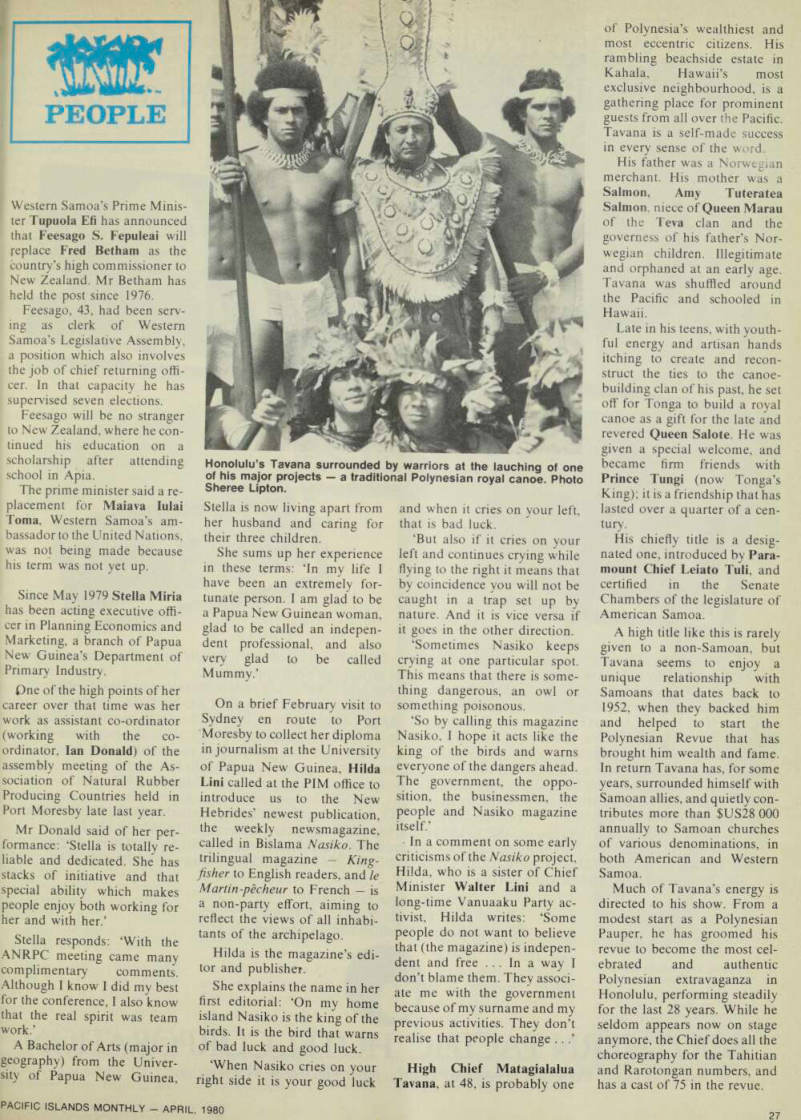
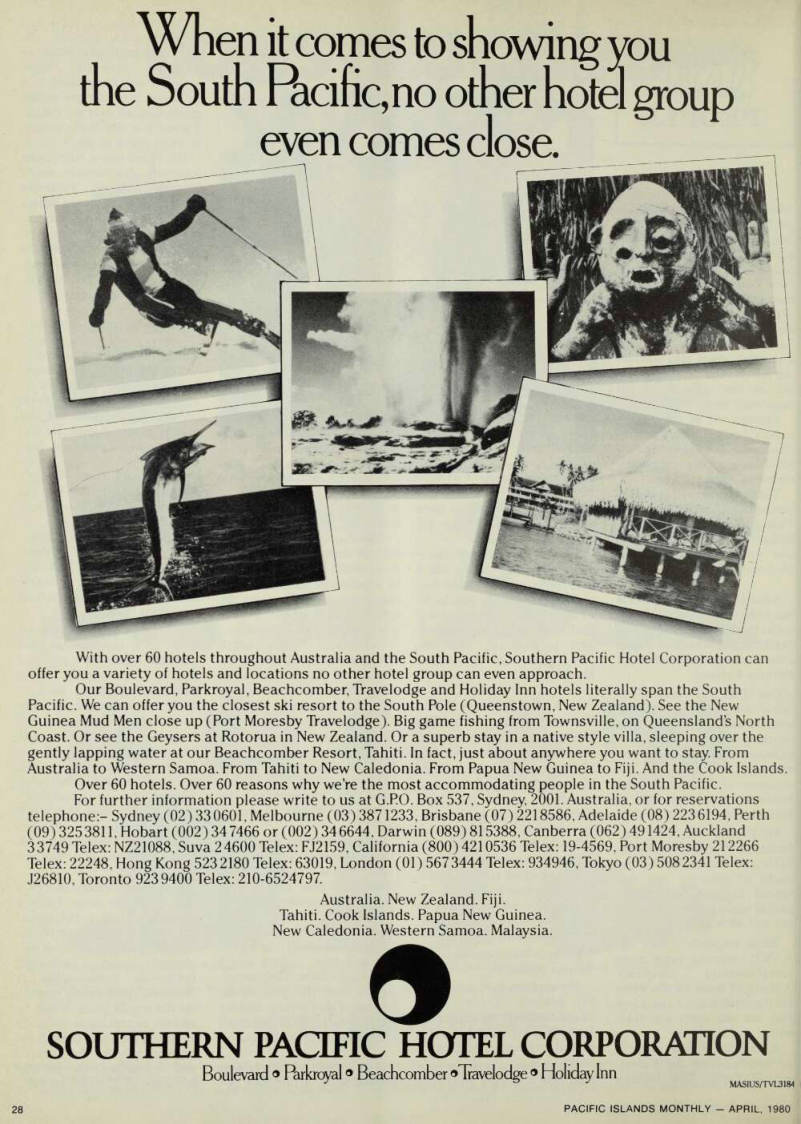
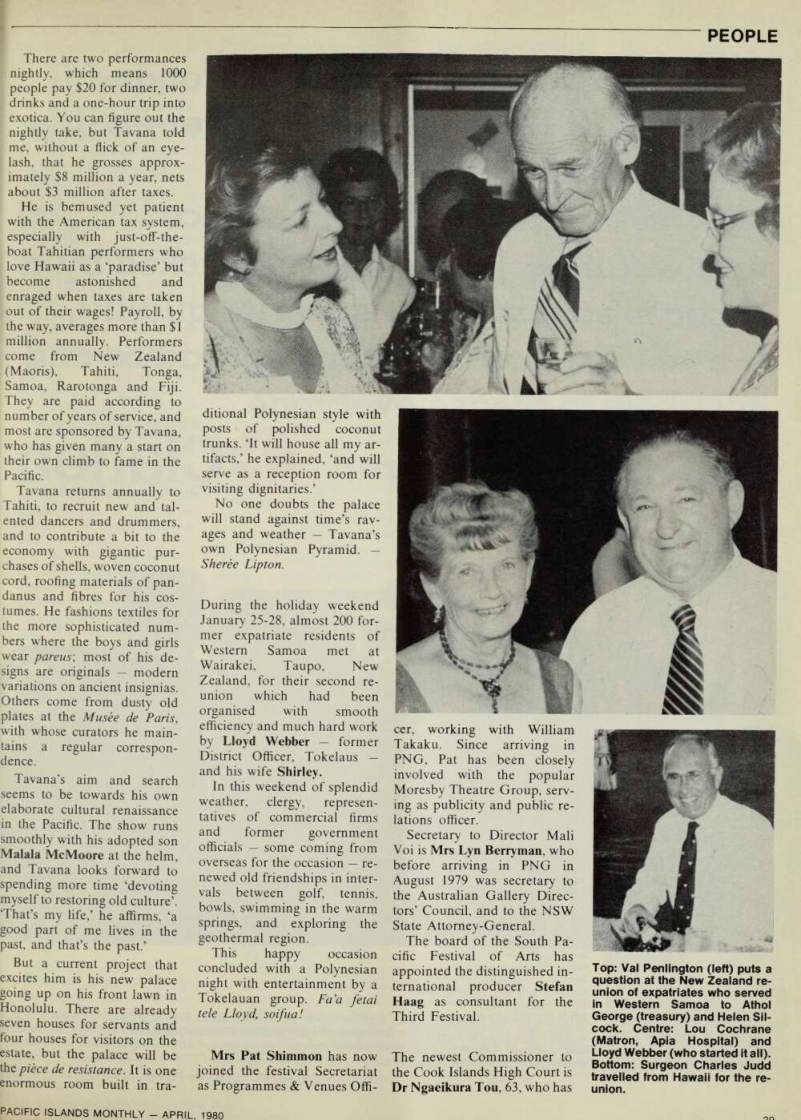

Western Samoa’s Prime Minis ter Tupuola Efi has announced that Feesago S. Fepuleai will replace Fred Betham as the
country’s high commissioner to
New Zealand. Mr Betham has held the post since 1976.
Feesago, 43, had been serv ing as clerk of Western
Samoa’s Legislative Assembly,
a position which also involves the job of chief returning offi cer. In that capacity he has supervised seven elections.
Feesago will be no stranger to New Zealand, where he con tinued his education on a
scholarship after attending
school in Apia.
The prime minister said a re placement for Maiava lulai Toma. Western Samoa’s am bassador to the United Nations, was not being made because his term was not yet up.
Since May 1979 Stella Miria has been acting executive offi cer in Planning Economics and Marketing, a branch of Papua New Guinea’s Department of
Primary Industry.
One of the high points of her career over that time was her work as assistant co-ordinator (working with the co ordinator, lan Donald) of the assembly meetjng of the As sociation of Natural Rubber Producing Countries held in Port Moresby late last year.
Mr Donald said of her per formance: ‘Stella is totally re liable and dedicated. She has stacks of initiative and that
special ability which makes
people enjoy both working for
her and with her.’
Stella responds: ‘With the ANRPC meeting came many
complimentary comments.
Although I know I did my best for the conference, I also know that the real spirit was team work.’
A Bachelor of Arts (major in geography) from the Univer sity of Papua New Guinea,
Stella is now living apart from her husband and caring for their three children.
She sums up her experience in these terms: ‘ln my life I have been an extremely for tunate person. I am glad to be a Papua New Guinean woman, glad to be called an indepen dent professional, and also very glad to be called
Mummy.’
On a brief February visit to Sydney en route to Port Moresby to collect her diploma in journalism at the University of Papua New Guinea, Hilda Lini called at the PIM office to introduce us to the New Hebrides’ newest publication,
the weekly newsmagazine,
called in Bislama Nasiko. The
trilingual magazine King
fisher to English readers, and le Martin-pecheur to French is a non-party effort, aiming to reflect the views of all inhabi tants of the archipelago.
Hilda is the magazine’s edi tor and publisher.
She explains the name in her first editorial: ‘On my home island Nasiko is the king of the birds. It is the bird that warns of bad luck and good luck. ‘When Nasiko cries on your right side it is your good luck
and when it cries on your left, that is bad luck. ‘But also if it cries on your left and continues crying while flying to the right it means that by coincidence you will not be caught in a trap set up by nature. And it is vice versa if it goes in the other direction. ‘Sometimes Nasiko keeps crying at one particular spot.
This means that there is some thing dangerous, an owl or
something poisonous.
‘So by calling this magazine
Nasiko, I hope it acts like the king of the birds and warns everyone of the dangers ahead.
The government, the oppo sition, the businessmen, the
people and Nasiko magazine
itself.’
In a comment on some early criticisms of the Nasiko project, Hilda, who is a sister of Chief Minister Walter Lini and a
long-time Vanuaaku Party ac
tivist, Hilda writes; ‘Some people do not want to believe that (the magazine) is indepen dent and free ... In a way I don’t blame them. They associ ate me with the government because of my surname and my
previous activities. They don’t
realise that people change .. .’
High Chief Matagialalua Tavana, at 48, is probably one
of Polynesia’s wealthiest and most eccentric citizens. His rambling beachside estate in Kahala, Hawaii’s most exclusive neighbourhood, is a
gathering place for prominent
guests from all over the Pacific.
Tavana is a self-made success in every sense of the word.
His father was a Norwegian merchant. His mother was a Salmon, Amy Tuteratea Salmon, niece of Queen Marau of the Teva clan and the governess of his father’s Nor
wegian children. Illegitimate
and orphaned at an early age.
Tavana was shuffled around the Pacific and schooled in Hawaii.
Late in his teens, with youth ful energy and artisan hands itching to create and recon struct the ties to the canoe building clan of his past, he set off for Tonga to build a royal canoe as a gift for the late and revered Queen Salote. He was given a special welcome, and became firm friends with Prince Tungi (now Tonga’s King); it is a friendship that has lasted over a quarter of a cen tury.
His chiefly title is a desig nated one, introduced by Para mount Chief Leiato Tuli, and certified in the Senate Chambers of the legislature of American Samoa.
A high title like this is rarely given to a non-Samoan, but Tavana seems to enjoy a
unique relationship with
Samoans that dates back to 1952, when they backed him and helped to start the Polynesian Revue that has brought him wealth and fame.
In return Tavana has, for some years, surrounded himself with Samoan allies, and quietly con tributes more than SUS2B 000 annually to Samoan churches of various denominations, in both American and Western Samoa.
Much of Tavana’s energy is directed to his show. From a modest start as a Polynesian Pauper, he has groomed his revue to become the most cel ebrated and authentic Polynesian extravaganza in
Honolulu, performing steadily
for the last 28 years. While he seldom appears now on stage anymore, the Chief does all the choreography for the Tahitian and Rarotongan numbers, and has a cast of 75 in the revue.
Honolulu’s Tavana surrounded by warriors at the lauchlng of one of his major projects a traditional Polynesian royal canoe. Photo Sheree Lipton.
There are two performances nightly, which means 1000 people pay $2O for dinner, two drinks and a one-hour trip into exotica. You can figure out the nightly take, but Tavana told me, without a flick of an eye lash, that he grosses approx imately $8 million a year, nets about $3 million after taxes.
He is bemused yet patient with the American tax system,
especially with just-off-the
boat Tahitian performers who love Hawaii as a ‘paradise’ but become astonished and enraged when taxes are taken
out of their wages! Payroll, by
the way, averages more than $ 1 million annually. Performers come from New Zealand (Maoris), Tahiti, Tonga,
Samoa, Rarotonga and Fiji.
They are paid according to
number of years of service, and most are sponsored by Tavana, who has given many a start on their own climb to fame in the Pacific.
Tavana returns annually to Tahiti, to recruit new and tal ented dancers and drummers, and to contribute a bit to the economy with gigantic pur chases of shells, woven coconut cord, roofing materials of pan danus and fibres for his cos tumes. He fashions textiles for the more sophisticated num bers where the boys and girls wear pareus\ most of his de
signs are originals modern
variations on ancient insignias.
Others come from dusty old plates at the Musee de Paris , with whose curators he main tains a regular correspon dence.
Tavana’s aim and search seems to be towards his own elaborate cultural renaissance in the Pacific. The show runs smoothly with his adopted son Malala McMoore at the helm, and Tavana looks forward to
spending more time ‘devoting
myself to restoring old culture’. ‘That’s my life,’ he affirms, ‘a good part of me lives in the past, and that’s the past.’
But a current project that excites him is his new palace going up on his front lawn in
Honolulu. There are already
seven houses for servants and four houses for visitors on the estate, but the palace will be the piece de resistance. It is one enormous room built in tra-
ditional Polynesian style with posts of polished coconut trunks. ‘lt will house all my ar tifacts,’ he explained, ‘and will serve as a reception room for
visiting dignitaries.’
No one doubts the palace will stand against time’s rav ages and weather Tavana’s own Polynesian Pyramid.
Sheree Lipton.
During the holiday weekend
January 25-28, almost 200 for mer expatriate residents of Western Samoa met at Wairakei, Taupo, New Zealand, for their second re union which had been organised with smooth efficiency and much hard work by Lloyd Webber former District Officer, Tokelaus and his wife Shirley.
In this weekend of splendid weather, clergy, represen tatives of commercial firms and former government officials some coming from overseas for the occasion re newed old friendships in inter vals between golf, tennis, bowls, swimming in the warm springs, and exploring the
geothermal region.
This happy occasion concluded with a Polynesian night with entertainment by a Tokelauan group. Fa’a fetai tele Lloyd, soifua!
Mrs Pat Shimmon has now joined the festival Secretariat as Programmes & Venues Offi
cer, working with William Takaku. Since arriving in PNG, Pat has been closely involved with the popular
Moresby Theatre Group, serv
ing as publicity and public re
lations officer.
Secretary to Director Mali Voi is Mrs Lyn Berryman, who before arriving in PNG in August 1979 was secretary to the Australian Gallery Direc tors’ Council, and to the NSW
State Attorney-General.
The board of the South Pa cific Festival of Arts has
appointed the distinguished in
ternational producer Stefan Haag as consultant for the Third Festival.
The newest Commissioner to the Cook Islands High Court is Dr Ngaeikura Tou, 63, who has
Top: Val Penlington (left) puts a question at the New Zealand re union of expatriates who served In Western Samoa to Athol George (treasury) and Helen Sil cock. Centre: Lou Cochrane (Matron, Apia Hospital) and Lloyd Webber (who started it all).
Bottom: Surgeon Charles Judd travelled from Hawaii for the re union.
been a medical practitioner in the Cooks for 37 years.
After education at a London Missionary Society School, Dr Tou became a teacher trainee and was one of the first Islands scholarshippers to attend Te Aute College in New Zealand’s Hawkes Bay. His medical training was in Fiji, with three months in a leper colony on Makogai in the Fiji group, fol lowed by stints in the outer Cook Islands and further train ing in surgery in New Zealand
and Fiji.
As Deputy Director and later Secretary of Health, Dr Ngaei, as he is known in the Cooks, represented the Cook Islands at many South Pacific Com mission and World Health Or ganisation seminars and conferences in the Pacific.
Although retired, he still helps out at the outpatient clinic on Rarotonga, and plans to write a book about his years of experience in tropical medi
cine, particularly during the
formative period of the present health system, in which the Premier, Dr Tom Davis, was also involved.
Dr Tou believes in the value of traditional Maori medicine, and says that China cannot claim all the praise for pioneer ing the ‘barefoot doctor’ sys tem. ‘The Cook Islands has always had its barefoot doctors who have worked among the people,’ he maintains.
T don’t know why they picked me,’ he says of his new appointment as Court Com missioner. ‘My training is in medicine, not in judging people ... still, I think what’s needed is just common sense.’
Karen Garner-Williams.
Aitasi Pausila. 19, is the first fe male motor mechanic to be
employed by Western Samoa’s
Public Works Department workshop at Vaitele. The PWD claims she is the first female graduate in motor mechanics from the Technical College at Vaivase.
Aitasi said she had com pleted two years at the college and, though she was now employed by the PWD, she intended to do advanced courses at the college for the next two years. ‘We’re very proud of her,’
says her workshop supervisor.
As the opening of the June- July Third South Pacific Fes tival of Arts draws closer, SPFA Director Mali Voi has announced a number of staff appointments and changes in function which will enable the festival secretariat to handle the increasing work load in volved in festival preparations during the next few months.
William Takaku has been
newly appointed Deputy
Director (Culture & Artistic), on secondment from PNG’s National Theatre Company.
William was a member of the Papua New Guinea cultural team at the 1972 SPFA in Fiji, and at the second festival in Rotorua in 1976. To take this appointment, he has had to defer a scholarship to the National Institute of Dramatic Art in Sydney. His musical drama Eberia, which will be a festival highlight, has just com pleted a successful dry run in Kieta, North Solomons Prov ince, William’s birthplace. Fes tival programming and artistic production will be his main re
sponsibilities.
Deputy Director (Finance & Administration) David Bam ford, who joined the secretariat in March 1979 on secondment from the PNG Office of Tour ism (he was then also a mem ber of the main festival committee), has now assumed
particular responsibility for
finance, administration, pub licity and marketing.
On media relations, pub licity and marketing is Ms Kerry Collins, who joined the SPFA in February 1979 as pub licity officer, following a career in PNG, the UK and Australia in advertising and public re lations.
Newly-appointed Adminis
tration Officer is John Atkins, who joins the SPFA from the personnel division of Steam ships Trading Co, and who also retires as a member of the fes tival board. His past involve ment with ceremonial includes working on Queen Elizabeth’s visit in 1977, and the Papua New Guinea Independence Celebrations in 1975. Working with David Bamford, he will be concerned with transport, ac commodation, catering, pro tocol and temporary staffing for the festival.
Father Georges Callet (right) is decorated with the rosette of France’s Legion of Honour by French Vice-Minister for Foreign Affairs Olivier Stirn during this January visit to Tonga. Fr Callet, who began his mission to Tonga 43 years ago, had a few days before been invested with the Papal decoration of the Holy Cross. The occasion was the dedication ceremony of the Basilica of St Anthony of Padua in Nukualofa.
Two new tourist industry ap pointments are those of Miss Joan Foster (right), who has joined the Fiji Mocambo Hotel as PRO/Sales Representative, han dling both local and overseas matters, and Sandy McDonald (right, top) who has been appointed Sydney representa tive of the New Caledonia Tour ist Office. Also taking on new responsibilities is lan Ingleby (centre) who has been appointed head of the newly formed export promotions/overseas invest ment advisory service of Eric White Associates, Sydney. The service is aimed primarily at the Southeast Asian and Pacific markets. On an earlier assign ment with the company Mr.
Ingleby worked for several years in Papua New Guinea.
Advertisements & other items, pp. 28-32 (1 item)
the South Pacific, no other hotel group
When it comes to showing you
even comes close.
I P a?. > m With over 60 hotels throughout Australia and the South Pacific, Southern Pacific Hotel Corporation can offer you a variety of hotels and locations no other hotel group can even approach.
Our Boulevard, Parkroyal, Beachcomber, Travelodge and Holiday Inn hotels literally span the South Pacific. We can offer you the closest ski resort to the South Pole (Queenstown, New Zealand). See the New Guinea Mud Men close up (Port Moresby Travelodge). Big game fishing from Townsville, on Queensland’s North Coast. Or see the Geysers at Rotorua in New Zealand. Or a superb stay in a native style villa, sleeping over the gently lapping water at our Beachcomber Resort, Tahiti. In fact, just about anywhere you want to stay. From Australia to Western Samoa. From Tahiti to New Caledonia. From Papua New Guinea to Fiji. And the Cook Islands.
Over 60 hotels. Over 60 reasons why we’re the most accommodating people in the South Pacific.
For further information please write to us at G.PO. Box 537, Sydney, 2001. Australia, or for reservations telephone:- Sydney (02) 330601, Melbourne (03) 3871233, Brisbane (07) 2218586, Adelaide (08) 2236194, Perth (09) 3253811, Hobart (002) 34 7466 or (002) 34 6644, Darwin (089) 815388, Canberra (062) 491424, Auckland 33749 Telex: NZ2IOBB, Suva 24600 Telex: FJ2159, California (800) 4210536 Telex: 19-4569, Port Moresby 212266 Telex: 22248, Hong Kong 5232180 Telex: 63019, London (01) 5673444 Telex: 934946, Tokyo (03) 5082341 Telex: J 26810, Toronto 9239400 Telex: 210-6524797.
Australia. New Zealand. Fiji.
Tahiti. Cook Islands. Papua New Guinea.
New Caledonia. Western Samoa. Malaysia. 1
SOUTHERN PACIFIC HOTEL CORPORATION
Boulevard ® Parkroyal ® Beachcomber 9 Holiday Inn
J n j MASIUS/TVL3IB4
Clarion welcomes you to the wonderful world of Hi-Fi car audio. A never-ending quest for better sound quality assures the ultimate performance.
Our wealth of experience is backed by a global reputation for superior quality.
We've car stereo systems, car radios and speakers to please everyone.
In Car Entertainment Company What is your pleasure? @ Clarion Clarion Co., Ltd. Tokyo, Japan W © Australia: Amalgamated Wireless (Australasia) Ltd. 554 Parramatta Road, Ashfield N.S.W., 2131/New Zealand: AWA New Zealand Limited P.O. Box 50-248 Porirua/ Fiji Islands: Brijlal & Co., Ltd. G.P.O. Box 362 Suva/Tahiti: HI-FI Shangrila B.P. 200 Papeete/New Caledonia: Caldis B.P. Ml Noumea Cedex/Guam: Guam Radio & TV Shop P.O. Box 1939 Agana, Guam 96910/New Hebrides: The Sound Centre P.O. Box 434,Vi1a/Cook Islands: South Seas International Ltd. P.O. Box 49 Rarotonga/Papua New Guinea: Hagemeyer (P.N.G.) Pty. Ltd. P.O. Box 1428, Boroko, Port Moresby. * Dolby and the double-D symbol are trademarks of Dolby Laboratories.
FORESTMIL
PORTABLE
SAWMILL
Recent release new models are heavier duty with additional features. Powered by diesel engine or electric motor.
A#** Forest msl Portdbte Sawmi?
Forestmil produces any size accurate timber ready to use up to 12" x 9" x 24'.
Purchase price and operating cost of Forestmil is less than other sawing equipment with similar production capacity.
Forestmil reduces timber waste and also reduces log transport cost. Timber is sawn direct from the log in the forest.
Forestmil can be moved to a new location in one hour.
Forestmil will saw hardwood or softwood from logs of any diameter.
Over 1000 Forestmils are sawing timber in 23 countries.
Forestmil has been manufactured for 18 years.
For literature and prices please contact the manufacturers.
Ist
MacQuarrie Industries Pty.Ltd.
P.O. Box 20, Coburg 3058, Victoria, Austrajia.
Phone: 350-3411, Telex; 33729. Cables: Macbound, Melbourne.
Of Satellites
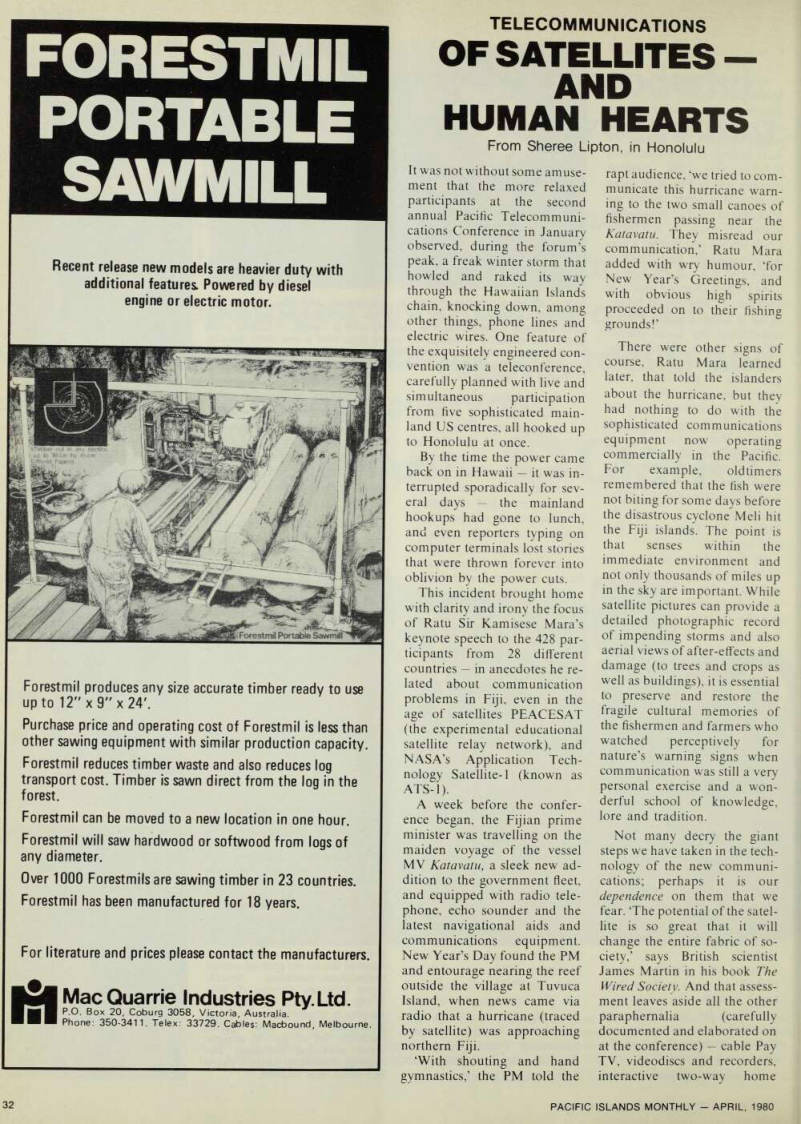
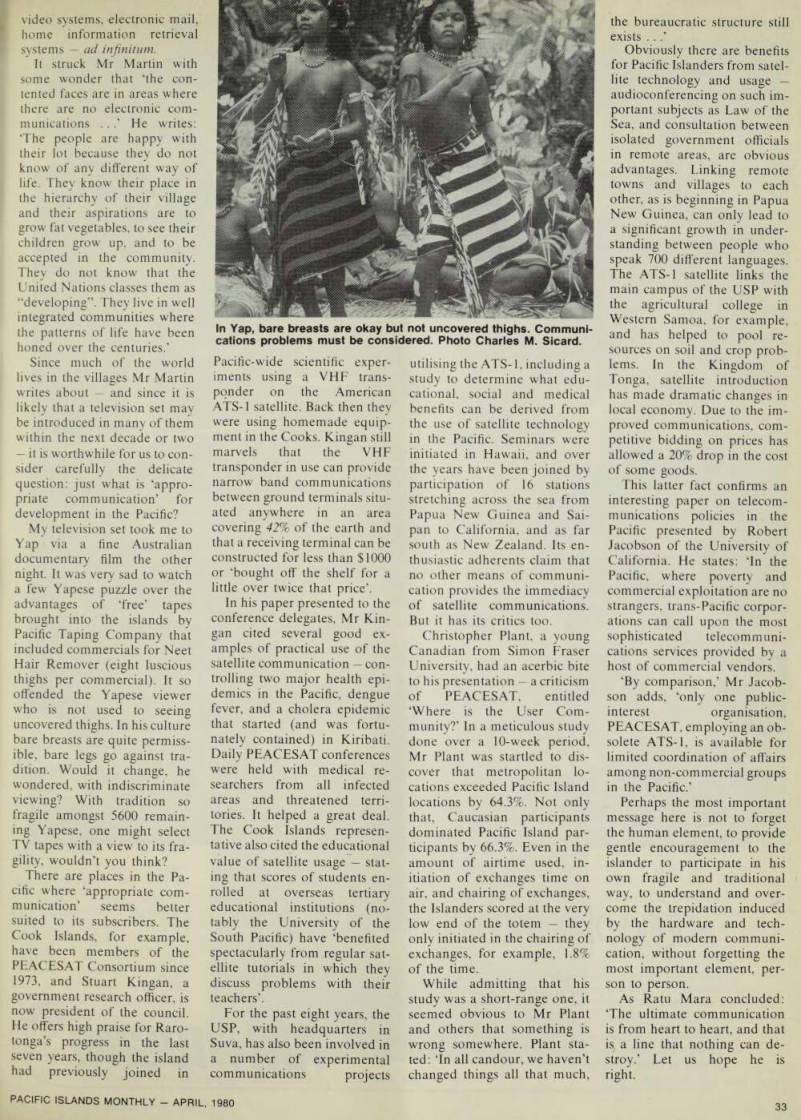
Telecommunications
And
Human Hearts
From Sheree Upton, in Honolulu
It was not without some amuse ment that the more relaxed participants at the second annual Pacific Telecommuni cations Conference in January observed, during the forum’s peak, a freak winter storm that howled and raked its way through the Flawaiian Islands chain, knocking down, among other things, phone lines and electric wires. One feature of
the exquisitely engineered con
vention was a teleconference, carefully planned with live and
simultaneous participation
from five sophisticated main land US centres, all hooked up to Honolulu at once.
By the time the power came back on in Hawaii it was in
terrupted sporadically for sev
eral days - the mainland hookups had gone to lunch, and even reporters typing on computer terminals lost stories that were thrown forever into oblivion by the power cuts.
This incident brought home with clarity and irony the focus of Ratu Sir Kamisese Mara’s keynote speech to the 428 par ticipants from 28 different countries in anecdotes he re lated about communication problems in Fiji, even in the age of satellites PEACESAT (the experimental educational satellite relay network), and NASA’s Application Tech nology Satellite-1 (known as
Ats-1).
A week before the confer
ence began, the Fijian prime
minister was travelling on the maiden voyage of the vessel MV Katavatu, a sleek new ad dition to the government fleet, and equipped with radio tele phone, echo sounder and the latest navigational aids and
communications equipment.
New Year’s Day found the PM and entourage nearing the reef outside the village at Tuvuca Island, when news came via radio that a hurricane (traced
by satellite) was approaching
northern Fiji.
‘With shouting and hand gymnastics,’ the PM told the
rapt audience, ‘we tried to com municate this hurricane warn ing to the two small canoes of fishermen passing near the Katavatu. They misread our communication,’ Ratu Mara added with wry humour, ‘for New Year’s Greetings, and with obvious high spirits proceeded on to their fishing grounds!’
There were other signs of course, Ratu Mara learned later, that told the islanders about the hurricane, but they had nothing to do with the
sophisticated communications
equipment now operating
commercially in the Pacific.
For example, oldtimers remembered that the fish were not biting for some days before the disastrous cyclone Meli hit the Fiji islands. The point is that senses within the immediate environment and not only thousands of miles up in the sky are important. While satellite pictures can provide a detailed photographic record of impending storms and also aerial views of after-effects and damage (to trees and crops as well as buildings), it is essential to preserve and restore the fragile cultural memories of the fishermen and farmers who watched perceptively for
nature’s warning signs when
communication was still a very personal exercise and a won derful school of knowledge, lore and tradition.
Not many decry the giant steps we have taken in the tech nology of the new communi cations; perhaps it is our dependence on them that we fear. ‘The potential of the satel lite is so great that it will change the entire fabric of so ciety,’ says British scientist James Martin in his book The Wired Society. And that assess ment leaves aside all the other
paraphernalia (carefully
documented and elaborated on at the conference) cable Pay TV, videodiscs and recorders, interactive two-way home
video systems, electronic mail, home information retrieval systems ad infinitum.
It struck Mr Martin with some wonder that ‘the con tented faces are in areas where there are no electronic com munications .. .’ He writes: ‘The people are happy with their lot because they do not know of any different way of life. They know their place in the hierarchy of their village and their aspirations are to grow fat vegetables, to see their children grow up, and to be
accepted in the community.
They do not know that the United Nations classes them as “developing”. They live in well integrated communities where the patterns of life have been honed over the centuries.’
Since much of the world lives in the villages Mr Martin writes about and since it is likely that a television set may be introduced in many of them within the next decade or two it is worthwhile for us to con sider carefully the delicate question: just what is ‘appro priate communication’ for development in the Pacific?
My television set took me to Yap via a fine Australian documentary film the other night. It was very sad to watch a few Yapese puzzle over the advantages of ‘free’ tapes brought into the islands by
Pacific Taping Company that
included commercials for Neet Hair Remover (eight luscious thighs per commercial). It so offended the Yapese viewer who is not used to seeing uncovered thighs. In his culture bare breasts are quite permiss ible, bare legs go against tra dition. Would it change, he wondered, with indiscriminate viewing? With tradition so fragile amongst 5600 remain
ing Yapese, one might select
TV tapes with a view to its fra gility, wouldn’t you think?
There are places in the Pa cific where ‘appropriate com munication’ seems better suited to its subscribers. The Cook Islands, for example, have been members of the PEACESAT Consortium since 1973, and Stuart Kingan, a government research officer, is now president of the council.
He offers high praise for Raro tonga’s progress in the last seven years, though the island had previously joined in
Pacific-wide scientific exper iments using a VHP trans ponder on the American ATS-1 satellite. Back then they were using homemade equip ment in the Cooks. Kingan still marvels that the VHF transponder in use can provide narrow band communications between ground terminals situ ated anywhere in an area covering 42% of the earth and that a receiving terminal can be constructed for less than $lOOO or ‘bought off the shelf for a little over twice that price’.
In his paper presented to the conference delegates, Mr Kin gan cited several good ex amples of practical use of the satellite communication con
trolling two major health epi
demics in the Pacific, dengue fever, and a cholera epidemic that started (and was fortu nately contained) in Kiribati.
Daily PEACESAT conferences were held with medical re searchers from all infected areas and threatened terri tories. It helped a great deal.
The Cook Islands represen tative also cited the educational value of satellite usage stat ing that scores of students en rolled at overseas tertiary educational institutions (no tably the University of the South Pacific) have ‘benefited
spectacularly from regular sat
ellite tutorials in which they discuss problems with their teachers’.
For the past eight years, the USP, with headquarters in Suva, has also been involved in a number of experimental
communications projects
utilising the ATS-1, including a study to determine what edu cational, social and medical benefits can be derived from the use of satellite technology in the Pacific. Seminars were initiated in Hawaii, and over the years have been joined by participation of 16 stations stretching across the sea from Papua New Guinea and Sai pan to California, and as far south as New Zealand. Its en thusiastic adherents claim that no other means of communi
cation provides the immediacy
of satellite communications.
But it has its critics too.
Christopher Plant, a young Canadian from Simon Fraser University, had an acerbic bite to his presentation a criticism of PEACESAT, entitled ‘Where is the User Com munity?’ In a meticulous study done over a 10-week period, Mr Plant was startled to dis cover that metropolitan lo cations exceeded Pacific Island locations by 64.3%. Not only that, Caucasian participants dominated Pacific Island par ticipants by 66.3%. Even in the amount of airtime used, in itiation of exchanges time on air, and chairing of exchanges, the Islanders scored at the very low end of the totem they only initiated in the chairing of exchanges, for example, 1.8% of the time.
While admitting that his study was a short-range one, it seemed obvious to Mr Plant and others that something is wrong somewhere. Plant sta ted: Tn all candour, we haven’t changed things all that much,
the bureaucratic structure still exists ..
Obviously there are benefits for Pacific Islanders from satel lite technology and usage audioconferencing on such im portant subjects as Law of the Sea, and consultation between isolated government officials in remote areas, are obvious
advantages. Linking remote
towns and villages to each other, as is beginning in Papua New Guinea, can only lead to a significant growth in under
standing between people who
speak 700 different languages.
The ATS-1 satellite links the main campus of the USP with
the agricultural college in
Western Samoa, for example, and has helped to pool re sources on soil and crop prob lems. In the Kingdom of Tonga, satellite introduction has made dramatic changes in local economy. Due to the im proved communications, com
petitive bidding on prices has
allowed a 20% drop in the cost of some goods.
This latter fact confirms an interesting paper on telecom munications policies in the Pacific presented by Robert Jacobson of the University of California. He states: Tn the Pacific, where poverty and commercial exploitation are no strangers, trans-Pacific corpor ations can call upon the most
sophisticated telecommuni
cations services provided by a host of commercial vendors.
‘By comparison,’ Mr Jacob
son adds, ‘only one public interest organisation, PEACESAT, employing an ob solete ATS-1, is available for limited coordination of affairs among non-commercial groups in the Pacific.’
Perhaps the most important
message here is not to forget the human element, to provide gentle encouragement to the islander to participate in his own fragile and traditional way, to understand and over come the trepidation induced by the hardware and tech nology of modern communi cation, without forgetting the most important element, per son to person.
As Ratu Mara concluded: ‘The ultimate communication is from heart to heart, and that is a line that nothing can de stroy.’ Let us hope he is
right.
In Yap, bare breasts are okay but not uncovered thighs. Communi cations problems must be considered. Photo Charles M. Sicard.
Advertisements & other items, p. 34 (1 item)
some ofourcfaejs
* : H V 1 * 1 'Mk m - V •/•••: \ S& •’-• ?* s ms. m i *4 »as
iifilfl'
ll '
some ofourcfaejs
In Papua New Guinea there are 717 different cultures, each represented by its own language and its own "chief". Few men know this country better than our chief pilot, Captain John Regan.
He's logged more than 16,000 hours flying, much of that in Papua New Guinea.
John Regan is one of ninety highly skilled Australian, New Zealand, British, and American pilots flying our aircraft to seventeen places in Papua New Guinea and eight destinations overseas.
mmueiNi
THE NA TIONAL AIRLINE OF PAPUA NEW GUINEA
S.P.S. 001
island of Erromango
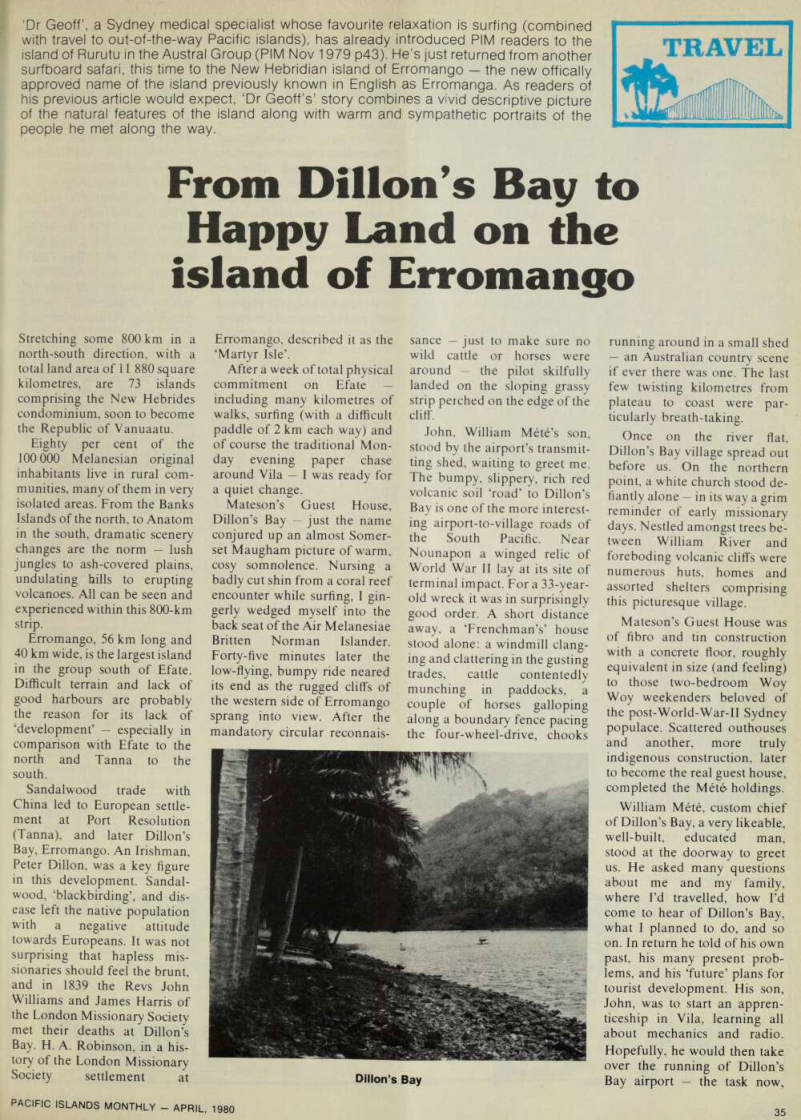
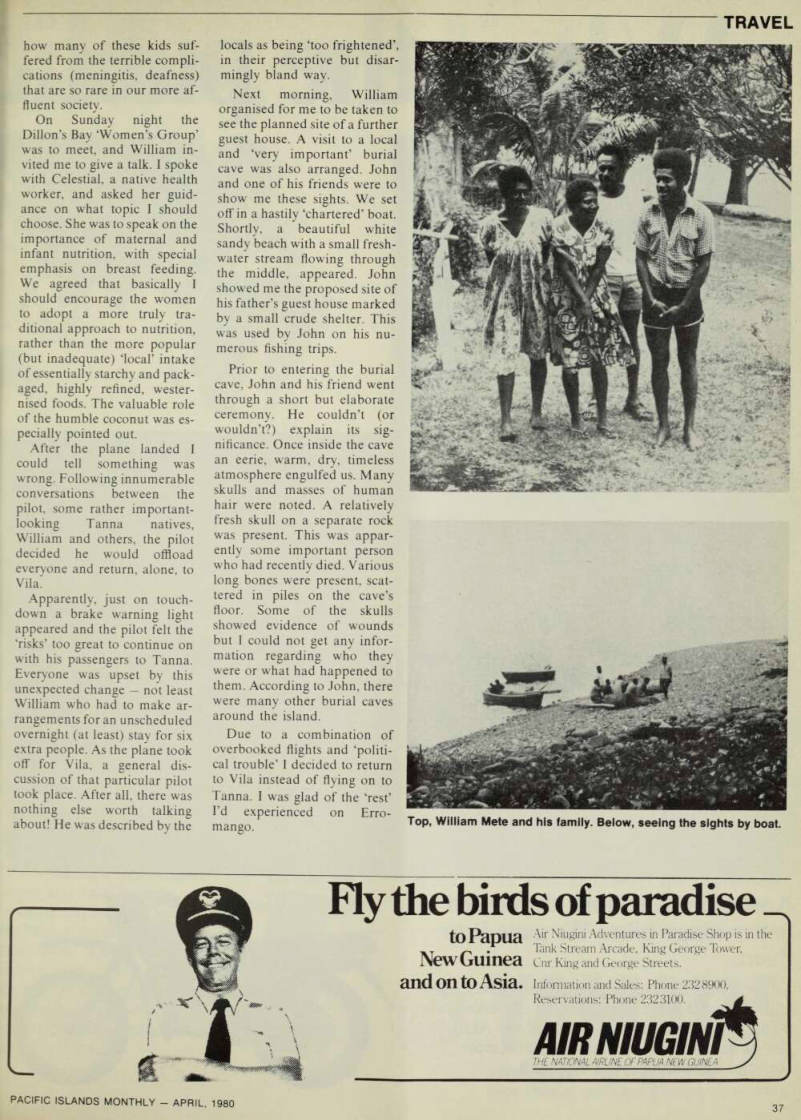
Travel
From Dillon’s Bay to Happy Land on the island of Erromango
‘Dr Geoff, a Sydney medical specialist whose favourite relaxation is surfing (combined with travel to out-of-the-way Pacific islands), has already introduced PIM readers to the island of Rurutu in the Austral Group (PIM Nov 1979 p 43). He’s just returned from another surfboard safari, this time to the New Hebridian island of Erromango the new offically approved name of the island previously known in English as Erromanga. As readers of his previous article would expect, ‘Dr Geoff’s’ story combines a vivid descriptive picture of the natural features of the island along with warm and sympathetic portraits of the people he met along the way.
Stretching some 800 km in a north-south direction, with a total land area of 11 880 square kilometres, are 73 islands comprising the New Hebrides condominium, soon to become the Republic of Vanuaatu.
Eighty per cent of the 100 000 Melanesian original inhabitants live in rural com munities, many of them in very isolated areas. From the Banks Islands of the north, to Anatom in the south, dramatic scenery changes are the norm lush
jungles to ash-covered plains,
undulating hills to erupting
volcanoes. All can be seen and experienced within this 800-km
strip.
Erromango, 56 km long and 40 km wide, is the largest island in the group south of Efate.
Difficult terrain and lack of
good harbours are probably
the reason for its lack of
‘development’ especially in
comparison with Efate to the north and Tanna to the south.
Sandalwood trade with China led to European settle ment at Port Resolution (Tanna), and later Dillon’s
Bay, Erromango. An Irishman,
Peter Dillon, was a key figure in this development. Sandal wood, ‘blackbirding’, and dis ease left the native population with a negative attitude towards Europeans. It was not
surprising that hapless mis
sionaries should feel the brunt, and in 1839 the Revs John Williams and James Harris of
the London Missionary Society
met their deaths at Dillon’s Bay. H. A. Robinson, in a his tory of the London Missionary Society settlement at
Erromango, described it as the
‘Martyr Isle’.
After a week of total physical commitment on Efate including many kilometres of walks, surfing (with a difficult paddle of 2 km each way) and of course the traditional Mon
day evening paper chase
around Vila I was ready for
a quiet change.
Mateson’s Guest House, Dillon’s Bay just the name conjured up an almost Somer set Maugham picture of warm, cosy somnolence. Nursing a badly cut shin from a coral reef encounter while surfing, I gin gerly wedged myself into the back seat of the Air Melanesiae Britten Norman Islander.
Forty-five minutes later the
low-flying, bumpy ride neared
its end as the rugged cliffs of the western side of Erromango sprang into view. After the mandatory circular reconnais
sance just to make sure no wild cattle or horses were
around the pilot skilfully
landed on the sloping grassy strip perched on the edge of the cliff.
John, William Mete’s son, stood by the airport’s transmit ting shed, waiting to greet me.
The bumpy, slippery, rich red volcanic soil ‘road’ to Dillon’s Bay is one of the more interest
ing airport-to-village roads of
the South Pacific. Near Nounapon a winged relic of World War II lay at its site of terminal impact. For a 33-year old wreck it was in surprisingly good order. A short distance away, a ‘Frenchman’s’ house stood alone: a windmill clang
ing and clattering in the gusting
trades, cattle contentedly
munching in paddocks, a
couple of horses galloping
along a boundary fence pacing
the four-wheel-drive, chooks
running around in a small shed an Australian country scene if ever there was one. The last few twisting kilometres from plateau to coast were par
ticularly breath-taking.
Once on the river flat, Dillon’s Bay village spread out before us. On the northern point, a white church stood de fiantly alone in its way a grim
reminder of early missionary
days. Nestled amongst trees be tween William River and foreboding volcanic cliffs were numerous huts, homes and assorted shelters comprising
this picturesque village.
Mateson’s Guest House was of fibro and tin construction with a concrete floor, roughly equivalent in size (and feeling) to those two-bedroom Woy Woy weekenders beloved of the post-World-War-II Sydney populace. Scattered outhouses and another, more truly indigenous construction, later to become the real guest house,
completed the Meto holdings.
William Mete, custom chief of Dillon’s Bay, a very likeable, well-built, educated man, stood at the doorway to greet us. He asked many questions about me and my family, where I’d travelled, how I’d come to hear of Dillon’s Bay, what I planned to do, and so on. In return he told of his own past, his many present prob lems, and his ‘future’ plans for tourist development. His son, John, was to start an appren ticeship in Vila, learning all about mechanics and radio.
Hopefully, he would then take over the running of Dillon’s Bay airport - the task now,
Dillon’s Bay
single-handedly, performed by
William.
After lunch I crossed the river and hiked some 5 km to the top of the southern escarp ment, near the base of Mt Wowis. Along the way, numer ous stops were made to take in the stunning views and sights.
We first passed local market gardens at the base of the escarpment, and later along the early part of the ridge. Dense patches of rain forest were fol lowed by acres of plateau grasslands. Then we saw the peaks of Mts Wowis, Melkoum
and Fedmogkoum, and finally
the ever inspiring vastness of the ageless Pacific.
During dinner, William told me of his forthcoming visit to Happy Land, a small village some 20 km southeast of
Dillon’s Bay. Apparently this
was an annual conference of the Custom Chiefs of Erromango, a conference of some significance to the people of the island. I was most honoured by his invitation to attend as an ‘observer’.
Later that evening he showed me one of his treasures, a book which had been presented to him by a relative of H. A. Robinson, the author none other than Erromanga: The Martyr Isle!
This fascinating book, with its numerous pictures, showed how little Dillon’s Bay has changed since the early part of the century. Interestingly, one photo showed William River to be much wider than it now is.
My host commented that he had never seen the river as wide as shown in the photo
graph, despite cyclones and
monsoonal rains over the years.
Just before dawn, six of us in
a 3 I A-m boat, ‘powered’ by a small Seagull engine, set off for Bounkil Bay, 15 km south.
From there, a 5 km trek would take us to Happy Land, perched 330 m on the plateau near the daunting cliffs of the west coast.
On the way, one of the party (a deaf-mute and relative of the custom chief of Potnarh
vin) caught a huge bonito using
a palm leaf and plastic lure. It
was a truly heartwarming sight
to see this obviously intelligent man so thrilled by the catch.
Everyone aboard shared in his excitement, fish being a rela tive delicacy at Happy Land due to a combination of dis tance and type of terrain
separating village from coast.
At Bounkil Bay aim swell was closing out across the bay.
We managed to swamp the boat completely while attempt ing to land. However, no dam age was done and eventually the boat was dragged onto the
‘beach’ (comprised of large,
round, volcanic river
pebbles).
Unfortunately, on the trek up the steep escarpment, I
slipped and reopened the deep
wound on my shin which had
just begun to heal. Not having
bothered to bring my medical kit from Dillon’s Bay I was somewhat concerned as the bone was exposed.
On arrival at Happy Land we were greeted by the vil lagers and various custom chiefs. They were amazed to see a white person, especially a doctor, in need of medical attention. In turn, I was amazed to see such a mag nificent village so well set out and with a relatively modern glass, wood and steel school.
The enormous amount of
work, skill and strength that must have gone into landing,
carrying and building this
structure reflected a remark able degree of dogged determi nation.
After some refreshing ‘tea’, the custom chief arranged for a ‘nurse’ to look after my wound. Kerosene was used to clean it and some type of balm was smeared around the edges,
presumably to reduce swelling.
A clean bandage completed the
dressing.
During the next two days I listened to various speeches, watched the villagers play soc cer, played in one of the volley ball teams, walked through beautiful lush market gardens and generally soaked up the friendly atmosphere of the vil lage and congress.
On the concluding night, a ‘feast’ (so far every meal had been a feast to me) was ar ranged. Taro, fish, pig, soups, fruit and tea comprised the menu. Obviously there were little ‘scenes’ all over the place.
Groups of older men were noted to be huddled in earnest conversation; custom chiefs appeared to be engaged in lob bying various individuals; cer tain younger men and women
‘disappeared’ for varying
lengths of time; others sat around fires singing songs and playing assorted musical instruments. A few men went off and proceeded (as judged by nocturnal screams, followed by sore heads and bleary eyes the next day) to get drunk.
Who said the people of Erromango weren’t ‘civilised’?
Next morning the whole vil lage lined up to shake hands with the visitors. I just don’t re member how many people I shook hands with and said tata
(goodbye) to. It seemed like 150 or more.
With low tide making it possible (as a result of very skil ful skippering) to use a large rock platform as a boarding ‘wharf, the return sea trip was a little more sophisticated aboard a hired launch.
Dark clouds started to well up from the north that evening as I sat on the pebble beach at Dillon’s Bay. With the setting sun, the church was bathed in a subtle grey-pink light. I asked William if heavy rain was to come, knowing that such rain quickly soaks the ground, preventing planes from land
ing.
Late that night I was wakened by the crash of tor rential rain on the tin roof. I couldn’t get back to sleep, thinking of an experience I once had in Australia’s North ern Territory where a flash flood gushed down a dry creek bed we’d unthinkingly chosen for a camp site. Remembering the photo in William’s book didn’t make my mind any
easier. However, nothing hap
pened and next morning
William laughed when I told him of these ‘fears’.
Joyce, the eldest daughter, had been plagued with ear infections for some time and appeared to be quite ill.
William asked if I could help.
On examining Joyce I found that she had a nasty attack of tonsillitis together with poss ible middle-ear infection. As no plane was due for some days, I gave her some powerful antibiotics which fortunately cleared up the infection. As an impression, ear infections seemed to be very common amongst the children of Dillon’s Bay and I wondered
how many of these kids suf fered from the terrible compli cations (meningitis, deafness) that are so rare in our more af
fluent society.
On Sunday night the
Dillon’s Bay ‘Women’s Group’ was to meet, and William in vited me to give a talk. I spoke with Celestial, a native health worker, and asked her guid ance on what topic I should choose. She was to speak on the importance of maternal and infant nutrition, with special
emphasis on breast feeding.
We agreed that basically I should encourage the women to adopt a more truly tra ditional approach to nutrition, rather than the more popular (but inadequate) ‘local’ intake of essentially starchy and pack
aged, highly refined, wester
nised foods. The valuable role of the humble coconut was es
pecially pointed out.
After the plane landed I could tell something was wrong. Following innumerable conversations between the
pilot, some rather important
looking Tanna natives, William and others, the pilot decided he would offload everyone and return, alone, to Vila.
Apparently, just on touch
down a brake warning light appeared and the pilot felt the ‘risks’ too great to continue on with his passengers to Tanna.
Everyone was upset by this unexpected change not least William who had to make ar rangements for an unscheduled overnight (at least) stay for six extra people. As the plane took off for Vila, a general dis cussion of that particular pilot took place. After all, there was
nothing else worth talking
about! He was described by the
locals as being ‘too frightened’, in their perceptive but disar mingly bland way.
Next morning, William organised for me to be taken to see the planned site of a further guest house. A visit to a local
and ‘very important’ burial
cave was also arranged. John and one of his friends were to show me these sights. We set off in a hastily ‘chartered’ boat.
Shortly, a beautiful white sandy beach with a small fresh
water stream flowing through
the middle, appeared. John showed me the proposed site of his father’s guest house marked by a small crude shelter. This was used by John on his nu
merous fishing trips.
Prior to entering the burial cave, John and his friend went through a short but elaborate ceremony. He couldn’t (or
wouldn’t?) explain its sig
nificance. Once inside the cave an eerie, warm, dry, timeless
atmosphere engulfed us. Many
skulls and masses of human hair were noted. A relatively fresh skull on a separate rock was present. This was appar
ently some important person
who had recently died. Various long bones were present, scat tered in piles on the cave’s floor. Some of the skulls showed evidence of wounds but I could not get any infor
mation regarding who they
were or what had happened to them. According to John, there were many other burial caves around the island.
Due to a combination of
overbooked flights and ‘politi
cal trouble’ I decided to return to Vila instead of flying on to Tanna. I was glad of the Test’
I’d experienced on Erro mango.
Top, William Mete and his family. Below, seeing the sights by boat.
Advertisements & other items, pp. 36-39 (1 item)
Fly the birds of paradise
to Papua
New Guinea
and on to Asia.
Air Niugini Adventures in Paradise Shop is in the Tank Stream Arcade, King George Tower, Cnr King and George Streets.
Information and Sales: Phone 2328900.
Reservations: Phone 2323100. £
AIRNIUGINr
THE NATIONAL AIRLINE OF PAPUA NEW GUINEA
Fly the birds of paradise
to Papua
New Guinea
and on to Asia.
Air Niugini Adventures in Paradise Shop is in the Tank Stream Arcade, King George Tower, Cnr King and George Streets.
Information and Sales: Phone 2328900.
Reservations: Phone 2323100. £
AIRNIUGINr
THE NATIONAL AIRLINE OF PAPUA NEW GUINEA
i fc * m r & «- WW^ S.- 'Vj & y»\ *?» .tv .. . - ■*' .. * ■ ■ - ■ ■■ ' . .' ' .: -~ ** 9 * ' -t. * #iff t, :s *« /I V:'r>
WKSI
Australian stockmen demanded a
better range bike. We gave it to
them.
To cope with the rugged conditions outback, the heat, dust and other demands that can take years off a bike’s life, Yamaha developed the AGIOO, one of the toughest, best handling and most powerful agricultural bikes ever built.
talks, we listen.
■pr* thwmmb i *
Southeast Asian boaters needed
cheaper operating costs. We gave
t to them. ty developing a lightweight, imple and long-lasting :erosene outboard, Yamaha las helped thousands of ommercial boaters cope viih rising fuel prices. These ngines are now exported worldwide, wherever low ost, dependable outboard •ower is needed. mm amoX People all over the world wanted quiet, portable power. We gave it to them.
Yamaha has applied its industry-leading small engine technology to portable generators, filling a growing need for lowcost, portable power generators. Five different models are now available, with 2-cycle and 4-cycle engines.
Yamaha listens to the world.
Yamaha’s worldwide service and information network keeps it ears open to changing public demands. That’s why we’re often the first to respond to user needs and always able to give you just what you want at the price you want to pay.
YAMAHA
YAMAHA MOTOR CO., LTD.
2500 SHINGAI IWATA-SHI SHIZUOKA-KEN JAPAN
Offbeat Pacific Travel
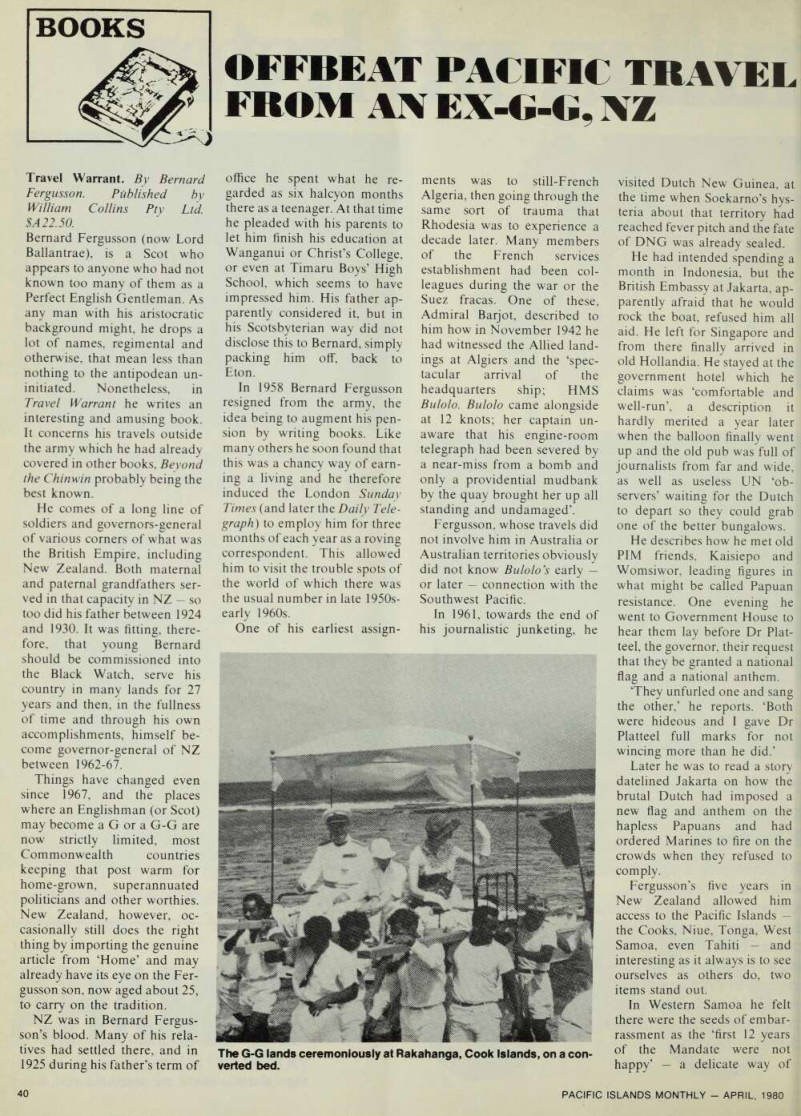
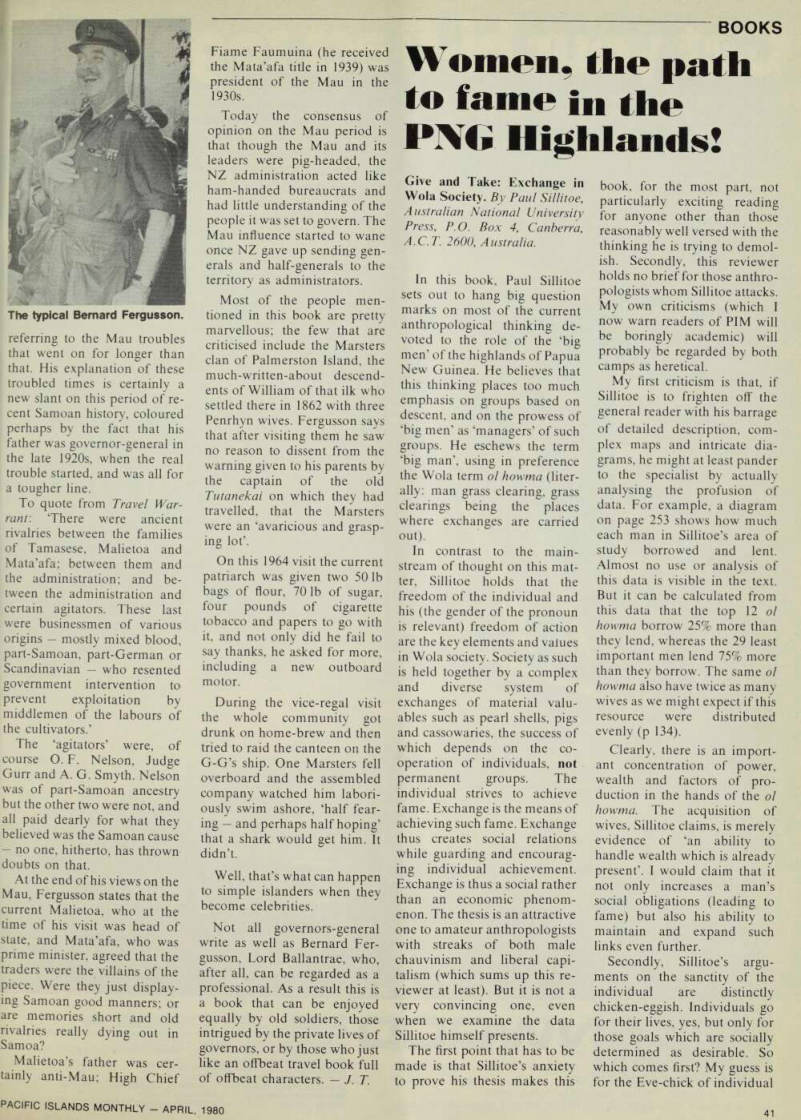
Books
From An Ex-G-G. Xz
Travel Warrant. By Bernard
Fergusson. Published by
William Collins Pty Ltd. $ A 22.50.
Bernard Fergusson (now Lord Ballantrae), is a Scot who appears to anyone who had not known too many of them as a Perfect English Gentleman. As any man with his aristocratic
background might, he drops a
lot of names, regimental and otherwise, that mean less than nothing to the antipodean un initiated. Nonetheless, in Travel Warrant he writes an
interesting and amusing book.
It concerns his travels outside the army which he had already covered in other books. Beyond the Chinwin probably being the best known.
He comes of a long line of soldiers and governors-general of various corners of what was
the British Empire, including
New Zealand. Both maternal
and paternal grandfathers ser
ved in that capacity in NZ so too did his father between 1924 and 1930. It was fitting, there fore, that young Bernard should be commissioned into the Black Watch, serve his country in many lands for 27 years and then, in the fullness of time and through his own accomplishments, himself be come governor-general of NZ between 1962-67.
Things have changed even
since 1967, and the places where an Englishman (or Scot) may become a G or a G-G are now strictly limited, most Commonwealth countries keeping that post warm for
home-grown, superannuated
politicians and other worthies.
New Zealand, however, oc casionally still does the right
thing by importing the genuine
article from ‘Home’ and may already have its eye on the Fer gusson son, now aged about 25, to carry on the tradition.
NZ was in Bernard Fergus son’s blood. Many of his rela tives had settled there, and in 1925 during his father’s term of
office he spent what he re garded as six halcyon months there as a teenager. At that time he pleaded with his parents to let him finish his education at
Wanganui or Christ’s College,
or even at Timaru Boys’ High School, which seems to have impressed him. His father ap parently considered it, but in his Scotsbyterian way did not disclose this to Bernard, simply packing him off, back to Eton.
In 1958 Bernard Fergusson resigned from the army, the idea being to augment his pen sion by writing books. Like many others he soon found that this was a chancy way of earn ing a living and he therefore induced the London Sunday Times (and later the Daily Tele graph) to employ him for three months of each year as a roving correspondent. This allowed him to visit the trouble spots of the world of which there was the usual number in late 1950s
early 19605.
One of his earliest assign
ments was to still-French
Algeria, then going through the
same sort of trauma that Rhodesia was to experience a decade later. Many members of the French services establishment had been col leagues during the war or the Suez fracas. One of these, Admiral Barjot, described to him how in November 1942 he had witnessed the Allied land
ings at Algiers and the ‘spec
tacular arrival of the
headquarters ship; HMS
Bulolo. Bulolo came alongside at 12 knots; her captain un aware that his engine-room telegraph had been severed by a near-miss from a bomb and
only a providential mudbank
by the quay brought her up all
standing and undamaged’.
Fergusson, whose travels did not involve him in Australia or Australian territories obviously did not know Bulolo's early or later connection with the Southwest Pacific.
In 1961, towards the end of
his journalistic junketing, he
visited Dutch New Guinea, at the time when Soekarno’s hys teria about that territory had reached fever pitch and the fate of DNG was already sealed.
He had intended spending a month in Indonesia, but the British Embassy at Jakarta, ap parently afraid that he would rock the boat, refused him all aid. He left for Singapore and from there finally arrived in old Hollandia. He stayed at the government hotel which he claims was ‘comfortable and well-run’, a description it hardly merited a year later when the balloon finally went up and the old pub was full of journalists from far and wide, as well as useless UN ‘ob servers’ waiting for the Dutch
to depart so they could grab
one of the better bungalows.
He describes how he met old PIM friends, Kaisiepo and
Womsiwor, leading figures in
what might be called Papuan resistance. One evening he went to Government House to hear them lay before Dr Plat ted, the governor, their request that they be granted a national flag and a national anthem. ‘They unfurled one and sang the other,’ he reports. ‘Both were hideous and I gave Dr Platted full marks for not wincing more than he did.’
Later he was to read a story datelined Jakarta on how the brutal Dutch had imposed a new flag and anthem on the
hapless Papuans and had
ordered Marines to fire on the crowds when they refused to
comply.
Fergusson’s five years in New Zealand allowed him access to the Pacific Islands the Cooks, Niue, Tonga, West Samoa, even Tahiti and interesting as it always is to see ourselves as others do, two items stand out.
In Western Samoa he felt there were the seeds of embar rassment as the ‘first 12 years of the Mandate were not happy’ a delicate way of
The G-G lands ceremoniously at Rakahanga, Cook Islands, on a con verted bed.
referring to the Mau troubles that went on for longer than that. His explanation of these troubled times is certainly a new slant on this period of re cent Samoan history, coloured perhaps by the fact that his father was governor-general in the late 19205, when the real trouble started, and was all for a tougher line.
To quote from Travel War rant: ‘There were ancient rivalries between the families of Tamasese, Malietoa and Mata’afa; between them and the administration; and be tween the administration and certain agitators. These last were businessmen of various
origins mostly mixed blood,
part-Samoan, part-German or Scandinavian who resented government intervention to
prevent exploitation by
middlemen of the labours of the cultivators.’
The ‘agitators’ were, of course O. F. Nelson, Judge Gurr and A. G. Smyth. Nelson was of part-Samoan ancestry but the other two were not, and
all paid dearly for what they
believed was the Samoan cause - no one, hitherto, has thrown doubts on that.
At the end of his views on the Mau, Fergusson states that the current Malietoa, who at the time of his visit was head of state, and Mata’afa, who was prime minister, agreed that the traders were the villains of the
piece. Were they just display
ing Samoan good manners; or are memories short and old rivalries really dying out in Samoa?
Malietoa’s father was cer tainly anti-Mau; High Chief
Fiame Faumuina (he received the Mata’afa title in 1939) was president of the Mau in the 19305.
Today the consensus of opinion on the Mau period is that though the Mau and its leaders were pig-headed, the NZ administration acted like ham-handed bureaucrats and had little understanding of the people it was set to govern. The Mau influence started to wane once NZ gave up sending gen erals and half-generals to the territory as administrators.
Most of the people men tioned in this book are pretty marvellous; the few that are criticised include the Marsters clan of Palmerston Island, the much-written-about descend ents of William of that ilk who settled there in 1862 with three Penrhyn wives. Fergusson says that after visiting them he saw no reason to dissent from the
warning given to his parents by
the captain of the old Tutanekai on which they had travelled, that the Marsters were an ‘avaricious and grasp
ing lot’.
On this 1964 visit the current patriarch was given two 50 lb bags of flour, 70 lb of sugar,
four pounds of cigarette
tobacco and papers to go with it, and not only did he fail to say thanks, he asked for more, including a new outboard motor.
During the vice-regal visit
the whole community got drunk on home-brew and then tried to raid the canteen on the G-G’s ship. One Marsters fell overboard and the assembled company watched him labori ously swim ashore, ‘half fear
ing and perhaps half hoping’
that a shark would get him. It didn’t.
Well, that’s what can happen to simple islanders when they become celebrities.
Not all governors-general write as well as Bernard Fer gusson, Lord Ballantrae, who, after all, can be regarded as a professional. As a result this is a book that can be enjoyed equally by old soldiers, those
intrigued by the private lives of
governors, or by those who just like an offbeat travel book full
of offbeat characters.
J. T.
The typical Bernard Fergusson.
PNG Highlands!

Women, the path to fame in the PNG Highlands!
Give and Take: Exchange in Wola Society. By Paul Sillitoe, Australian National University Press, P.O. Box 4, Canberra, A.C.T. 2600, Australia.
In this book, Paul Sillitoe
sets out to hang big question
marks on most of the current
anthropological thinking de
voted to the role of the ‘big men’ of the highlands of Papua New Guinea. He believes that this thinking places too much emphasis on groups based on descent, and on the prowess of ‘big men’ as ‘managers’ of such groups. He eschews the term
‘big man’, using in preference
the Wola term ol howma (liter ally: man grass clearing, grass
clearings being the places
where exchanges are carried out).
In contrast to the main stream of thought on this mat ter, Sillitoe holds that the freedom of the individual and his (the gender of the pronoun is relevant) freedom of action are the key elements and values in Wola society. Society as such is held together by a complex and diverse system of exchanges of material valu ables such as pearl shells, pigs and cassowaries, the success of which depends on the co operation of individuals, not permanent groups. The individual strives to achieve fame. Exchange is the means of
achieving such fame. Exchange
thus creates social relations while guarding and encourag ing individual achievement.
Exchange is thus a social rather than an economic phenom enon. The thesis is an attractive one to amateur anthropologists with streaks of both male chauvinism and liberal capi talism (which sums up this re viewer at least). But it is not a very convincing one, even when we examine the data Sillitoe himself presents.
The first point that has to be made is that Sillitoe’s anxiety to prove his thesis makes this
book, for the most part, not
particularly exciting reading
for anyone other than those reasonably well versed with the thinking he is trying to demol ish. Secondly, this reviewer holds no brief for those anthro pologists whom Sillitoe attacks.
My own criticisms (which I now warn readers of PIM will be boringly academic) will probably be regarded by both camps as heretical.
My first criticism is that, if Sillitoe is to frighten off the general reader with his barrage of detailed description, com plex maps and intricate dia grams, he might at least pander
to the specialist by actually
analysing the profusion of data. For example, a diagram on page 253 shows how much each man in Sillitoe’s area of study borrowed and lent.
Almost no use or analysis of this data is visible in the text.
But it can be calculated from this data that the top 12 ol howma borrow 25% more than they lend, whereas the 29 least important men lend 75% more than they borrow. The same ol howma also have twice as many wives as we might expect if this resource were distributed
evenly (p 134).
Clearly, there is an import ant concentration of power, wealth and factors of pro duction in the hands of the ol howma. The acquisition of wives, Sillitoe claims, is merely evidence of ‘an ability to handle wealth which is already present’. I would claim that it not only increases a man’s
social obligations (leading to
fame) but also his ability to maintain and expand such links even further.
Secondly, Sillitoe’s argu ments on the sanctity of the individual are distinctly chicken-eggish. Individuals go for their lives, yes, but only for those goals which are socially determined as desirable. So which comes first? My guess is for the Eve-chick of individual
i striving, with the egg of social control weighing more and more stickily and heavily as the economy is altered by environ mental, demographic and
externally-induced political
circumstances.
Thirdly, Sillitoe argues that I ol howma do not ‘manage’ the ordinary Wola, but admits they have a merely marginal influ ence on decisions. That sounds rather like the argument that the management of a casino only has a 2% advantage on the players of blackjack: every body wins, the bank winning slightly more. At its best, Silli toe’s argument is that the Wola are marginally more atomistic than other highland groups. I do not see the need for 300 pages of discussion on such a
point.
Basically, Sillitoe’s avoid ance of economic arguments prevents him from examining the dynamism of the exchange system. He mentions that loans bear a 100% interest rate. How on earth are such loans repaid?
How are valuables generated?
Let us examine the valu ables. Pearl shells are not much
good because they depreciate.
Pigs are rather better since they can reproduce (Sillitoe says nothing on this: do they rely on
feral boars, managed breeding
etc?), but they need feeding even when there is no surplus to be stored. Women create wealth, and they also create the links whereby the ol howma can invest such wealth.
Investment in women is both socially esteemed and econ omically sound. This is es pecially true in societies whose staple foods (root crops) are exceedingly difficult to store, and, therefore, to amass.
Indeed, it seems to me that the
fundamental reason why
exchange is so widely esteemed
by many peoples in Papua New
Guinea is a direct function of the lack of storage and alterna tive investment opportunities: oroduction determines social /alues. Women are the key ink. Women are the path to : ame. No wonder the ol howma tmass them. The groups of :ommon interest Sillitoe fails o find are there amongst the
Wola, but by ignoring women
sillitoe comes nowhere near
dentifying them.
Richard
lack son
Advertisements & other items, pp. 41-42 (2 items)
Books
Get your hi-fi act together.
If you’re aiming to set up the hi-fi system that will turn your pad into the original magic carpet, here’s how to do
it right first time.
After all, Kenwood’s engineers are gurus when it comes to getting the most out of reproduced music.
Take the system displayed here.
It’s built around the KA-405 fast-response amplifier, which is incredibly quiet during record playing sessions.
It’s built to live in harmony with the KT-413. A highly
accurate, auto-sequential tuner.
The KX-500 offers you the rich potential of recording withi metal tape. While the KD-1500 automatic cut turntable
provides easy operation and high performance.
The LS-60 speaker system makes sure the sound comes: naturally. And there’s an attractive audio rack to keep your pad neat and tidy.
The Kenwood system. It’s one of the simplest—and safest—ways to get into the real high-fidelity act.
KA-405 Fast response integrated amplifier 55W/ch.
KT-413 Auto-tunmg FM/AM stereo tuner. 60dB selectivity KD-1500 Automatic cut turntable
W/F 0.05% (WRMS)
KX-500 Stereo 2-head cassette deck with metaltape capability. W/F 0.05% (WRMS) LS-60 70W 3-way 3-speaker system,
SRC-95
Audio rack. i* o r* m r: t. % - •T- / s~ i
TRIO-KENWOOD CORPORATION
6-17, 3-chome, Aobadai, Meguroku, Tokyo, Japan.
AUSTRALIA TRIO-KENWOOD (AUSTRALIA) PTY LTD. Australia Tel. 439-4322 NEW ZEALAND JOHN GILBERT & CO . LTD. Auckland Tel. 30-839 FIJI THE DOMINION IMPORT & EXPORT PROMOTIONS Nadi Tel. 72-165 PAPUA NEW GUINEA S O. SVENSSON (NG.) LTD. Port Moresby Tel. 24-2275/2285 NORFOLK ISLAND BURNS PHILP (NORFOLK ISLAND) LTD.
SOLOMON ISLANDS TECHNIQUE RADIOS CENTRE LTD. Honiara Tel. 416 NEW CALEDONIA HI-FI VOX Noumea Tel 27-2466 NEW HEBRIDES RUE HIGGINSON Vila Tel. 2556
TAHITI MAISON AURORE Papeete Tel. 29703
AMERICAN SAMOA ISLAND PACIFIC AGENCIES, INC. Pago Pago Tel 633-4687
REPUBLIC OF NAURU NAURU CO-OPERATIVE SOCIETY
MARIANA ISLANDS J.C. TENORIO ENTERPRISES Saipan Tel. 6445
speak out
Melanesian Australians speak out
The Forgotten People. By Matt Peacock. Published by the A us tralian Broadcasting Com mission. Distributed by Hodder & Stoughton (Aust) Pty Ltd. $ A 3.95.
In 1847 Benjamin Robert Boyd, described as a ‘cool
scamp’ in Sydney society
circles, brought 65 New Hebrideans into Sydney har bour on a sandalwood ship and transported them to the Riverina where they worked as shepherds. Because of the cold winters they all died. In Britain organisations concerned with slave trading around the world began to raise objections, but their protests did not affect Boyd’s activities in the Pacific and he continued his trade in the lives of Pacific Islanders for a few years until he was mur dered on a visit to the Solomon Islands.
Strong anti-slavery protests
from Britain finally contribu ted to the American Civil War.
Cotton prices then boomed on the world market, and one Captain the Honourable Robert Towns, an enterprising Sydney businessman and member of the Legislative Council, quickly got into the cotton industry and started a plantation outside Brisbane. A village sprang up and it was called Townsvale.
Towns was well acquainted with the method used by Boyd to bring the people of the Pa cific to Australia, and lost no time developing one of the most lucrative trades in the lives of men and women for plantation labour in the north.
This book furnishes the evi dence of a trade that enslaved and killed many thousands of Pacific Island men and women.
Their descendants may be the smallest of all minority groups in Australia today. They are the Melanesian Australians and are now in their fifth gener ation. This book relates their
story as it was told to Matt Pea cock of the Australian Broad casting Commission’s Science Unit. It was broadcast in a three-part series. The book has been edited by Clive Moore of the James Cook University, Queensland.
Some families are now pre pared to have their stories recorded, stories of their fore bears’ customs and traditions, and their own lives as lived out in Queensland. They told Pea cock about growing up in the small towns of the northern State and how the attitudes of the business people affected their lives by forcing them into segregation in tightly knit com munities.
Telling the author of the suf ferings of their fathers, one Islander said: ‘Some of the old Kanaka men worked here for 50 years, and when they died they were carted away. Even in death they didn’t even want us.
They took us to a part in the cemetery they called “heathen ground”. In the “heathen
ground” they buried Chinese,
Japanese, Malays, Indonesians
and Islanders . . . My father was a lay preacher and buried many people. Many people in unmarked graves in the canefields.’ And later with a ring of justifiable anger and bitterness he told Peacock how it is for his people today: ‘This is what we have to put up with.
We couldn’t get a house in town. You go and ask your real estate agent, go up to him, and even right this very moment when I am talking to you in the year 1977. If a black man goes up to a real estate agent in this town and says, “I want to rent that house you’ve got adver tised,” he says “Oh, no. It’s just been taken. Come back later”.’
This book may not be liked by the assimilationists because Peacock has revealed a people who in the face of racial dis crimination of all forms for over a century, have emerged independent and strong, sur viving as a people proud of their history and battling to leam and retain their ancestors’ culture by saving their hard earned money to visit their ancestors’ islands in the warm
Pacific.
Faith Bandler
Advertisements & other items, pp. 43-44 (2 items)
Books
43
ACIFIC ISLANDS MONTHLY APRIL, 1980
Pleasure
ISLANDS
of the South
Pacific
A holiday guide adventure story and history all in one
COLIN SIMPSON'S
LATEST
239 pages, including 32 colour plates. $15.95 or SUS18.50 posted.
Send to box 3408 u GPO Sydney, NSW, 20b 1, or use coupon insert in this issue.
Polynesian
Bookshop..
THE PACIFIC ISLANDS
BOOK SPECIALISTS
Write for our complimentary catalogue!
336 PONSONBY RI)
(PO Box 47 267)
AUCKLAND, NEW ZEALAND
Telephone 764-824
Stay at Aggie Grey s . . . the South Pacific’s
legendary hotel.
Situated right in the heart of* Western Samoa. Enjoy Poly nesian style friendliness and service, in cool surroundings, superb entertainment and food Magnificent white sand beaches only a short drive away. Airconditioned rooms, swimming pool and full bar facilities.
Bookings through-Union Steam ship Company of NZ. Pan Am.
Air New Zealand or direct to Aggie Urey’s. Apia. Western Samoa. Cables; AUUIES’ Apia
•J •} II
this wasteland
mm x <o* m % >% : w r *~ z~ *>y,< t' C V: >< • J « 'i £ Hawker Siddeley has the power to do it!
Could be you are planning a mine; a town; an industry; a port; a railway or any one of a hundred projects, large and small, in some remote area. They will need power to make them work. Hawker Siddeley Engineering has that power. Hawker Siddeley Engineering has the experience to give you the service you need throughout your project from planning and feasibility stage to actual engineering installation of the total system and commissioning of your plant. And we don’t forget you afterwards either! Our comprehensive spares and service facilities are available 24 hours a day to ensure that the vital power is available for your operation. □ Mirrlees Blackstone Diesel Engines to 11000 h.p. □ HT and LT switch gear. □ Brush alternators to 35000KWD Brush motors to 10000 h.p. □ Power transformers.
All equipment is backed Australia-wide with spare parts and qualified service technicians.
HAWKER SIDDELEY ENGINEERING PTY. LIMITED
Incorporated in NSW Head Office: 262-284 Heidelberg Road, Fairfield, Vic. 3078. Tel. 489 2511 Branches: Sydney • Brisbane • Perth • Auckland Hawker Siddeley Group supplies electrical and mechanical equipment with world-wide sales and service.
Typical K 8 Major radiator cooled power generation plant. 4326H5E10
Islands
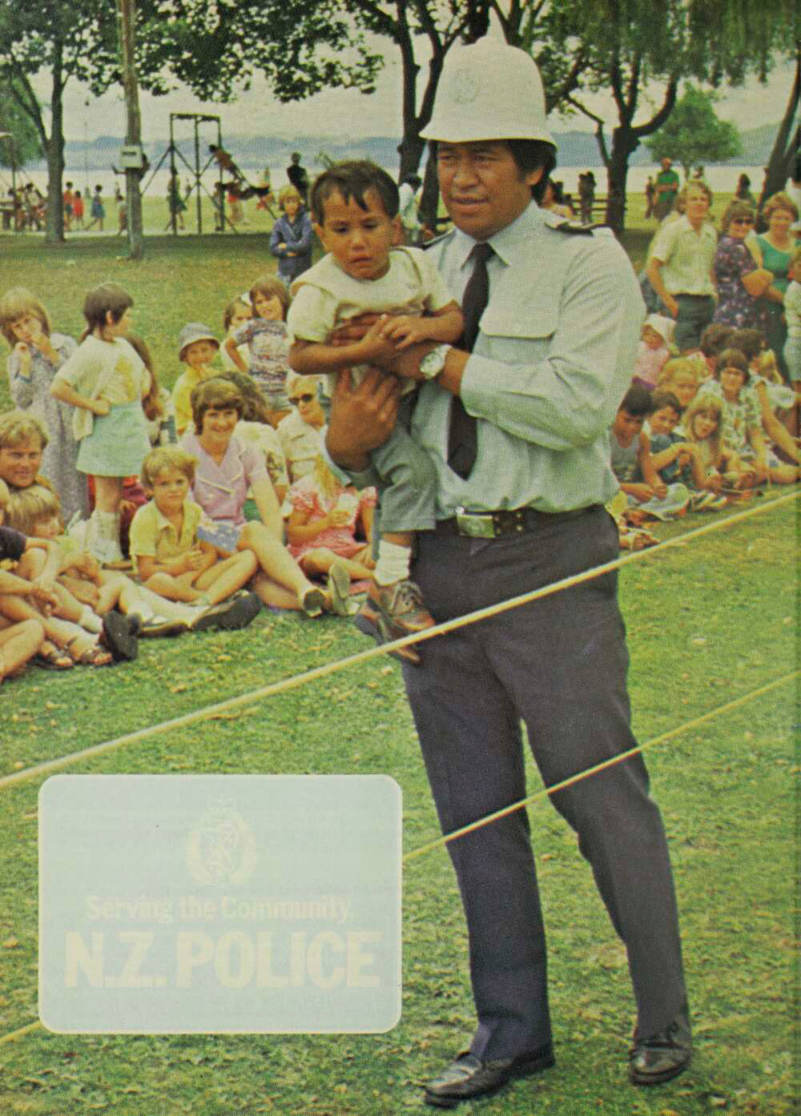
From the
Press
From the Nauru Post The NP wishes to congratulate the police force on its new uniform. It is bright, attractive and some have even described it as psychedelic. Perhaps the new bright uniform is a reflection of the ministry’s young minister who would obviously be full of bright and new ideas ...
From the Cook Islands News, Rarotonga The Tourist Authority is to mount an ‘educational programme’ for tourists visiting the Cook Islands, to help visitors adapt to the local conditions and avoid unwittingly giving offence to local people through dress and behaviour.. . The Authority has also produced a series of Church hints for visitors, covering dress and the recording of services. ‘Of course it is difficult to draw the line on dress standards, but we do feel that a bikini is not acceptable wear in town’, says the general manager of the Tourist Authority, Mr Tomu Okatai. He also notes that some confusion could arise from impressions created by performances by dancing groups in hotels and night spots, with tourists perhaps mistaking dancing costumes for acceptable day wear ...
From Nasiko, new weekly news magazine, New Hebrides Nasiko has chosen Mrs Bee Maize to appear in our first issue as our tourist of the week. Mrs Maize has been a tourist in the New Hebrides for 10 years. She comes from Southern California .. Mrs Maize had bought a property on Santo from a land speculator, Mr Eugene Peacock. When she arrived here she discovered a law had been passed against land speculation She said although she may not get back the property she bought, •he does not regret it. ‘l’m so pleased that by investing money n that property I was able to come and discover this beautiful )lace,’she said. : rom the Arawa Bulletin, North Solomons Province, s apua New Guinea f anyone has recently had the opportunity to see the jungle •rowth along the banks of the Bovo, they would realise the )otential danger of it harbouring rascals and ‘flashers’. The ;rowth rate of the bush has been rapid. Previously the ATC would ome and cut it all back but since the changeover in that lepartment, no one seems at all interested and the jungle just ontmues to grow. Residents along this section have recently been larassed by undesirables just appearing ‘starkers’ out of the mdergrowth. How about it ATC or BCE Security, could tnmediate action be taken to do something about this problem hus relieving the nervous tension being experienced along this ection of the Bovo - PLEASE? rom the Fiji Times, Suva oung Ideas. This week’s question: What new things have you amt during the school holidays? Alec Morris, 10, Stella Maris rimary School: i learned how to drink grog, smoke and do night
awhng ...’ b
From the Honolulu Advertiser Alcoholism is a serious problem in Micronesia, where technological and social changes have not always proceeded apace. One Micronesian group that has tried to do something about this is Truk, where most islands are dry . . . Now the Truk State legislature has proposed the government, through the Alcoholic Beverage Control Board, take charge of selling spirits.
A bill now before the body would make the control board the only legal importer and wholesaler of alcohol in Truk. It would also require alcohol identification cards. Permit systems have been tried before, and most people ignored them. It is quite probable a new system would be just as ineffective, in spite of $5OO fines and the threat of imprisonment. And given Micronesia’s propensity for lax accounting procedures, it is interesting to speculate the probability of misplaced cartons of Schlitz and bottles of J&B scotch whenever a big party is planned In Truk, apparently, they believe whenever you have a problem, the government will take care of it. And it seems government now believes if you can’t beat ’em join ’em .. .
From a letter to Papua New Guinea Post-Courier, Port
Moresby
So the National Executive Council has approved TV. Must we have it? There is so much more that should come first: more and better schools, more and better roads, more and better medical care, employment opportunities, cultural development, rural development, the eight aim. TV won’t get us any of these.
Developing countries do not have the people or skills to make their own programmes except to a limited scale. They are forced then to buy cheap Western TV programmes. Often these are the worst programmes that Americans or English people wouldn’t watch. And old movies ...
From Town Talk in the Arawa Bulletin Newcomers to Bougainville were told they could get any amount of plants by just picking.them out of the jungle, so off they went seeking their shrubbery and found some beautiful banana trees growing wild (or so they thought), so proceeded to pick them.
Imagine their surprise when a beautiful, bare maiden popped up out of the nearby river swinging a bush-knife and screaming in pidgin at them! We hear they are still without their shrubbery, but boy, what a story to report to friends and relatives south!
From The Samoa Times, Apia The organisers of the Relief Fund Campaign for the recent landslide at Nua and Seetaga, American Samoa, this week sent an orator to thank the people of Western Samoa for their help.
The orator, Fualautoolasi Leulus’o Leatutufu, is the executive director and secretary of the National Samoan Chiefs Council of America, which is co-ordinating the campaign .. .
Fualautoolasi said total donations towards the relief fund have come to approximately $2O 000. Of this amount some $ll 000 was raised in the United States and Pago. The rest was donated by people living in Western Samoa .. .
From an editorial in The Fiji Times, Suva What a relief it must be for Pacific Island governments, individually and collectively as members of the South Pacific, that their region’s western boundary stretches no further than the border between Papua New Guinea and West Irian. This fortunate geographical convenience enables the South Pacific to pointedly ignore mass murder in West Irian. An authoritative report yesterday described how Indonesian rulers are conducting a campaign of oppression as bloody and brutal as any of the many others being pursued so vigorously in other parts of the world.
Secret executions, massacres, napalm, starvation, prison camps - West Irians suffer them all. Luckily for the South Pacific, the West Irians no longer count as Pacific Islanders.
Advertisements & other items, p. 45 (1 item)
45
ACIFIC ISLANDS MONTHLY - APRIL, 1980
The bitter and the sweet of Islands postwar rehabilitation
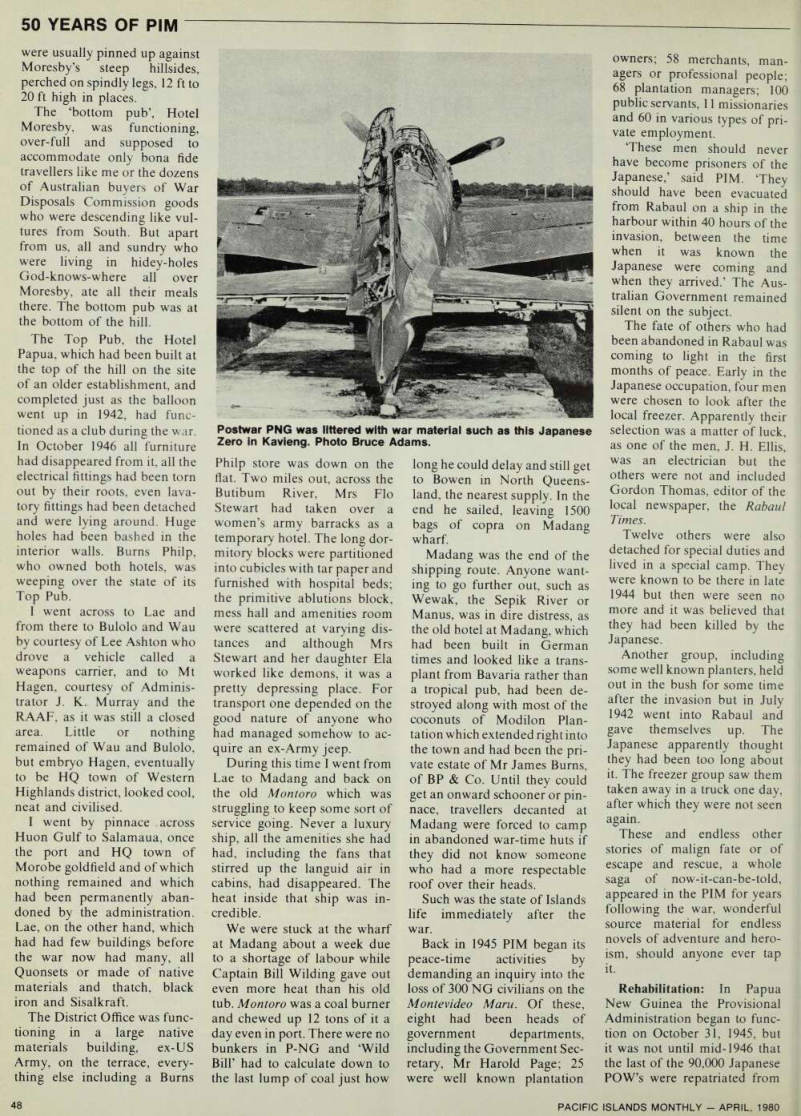
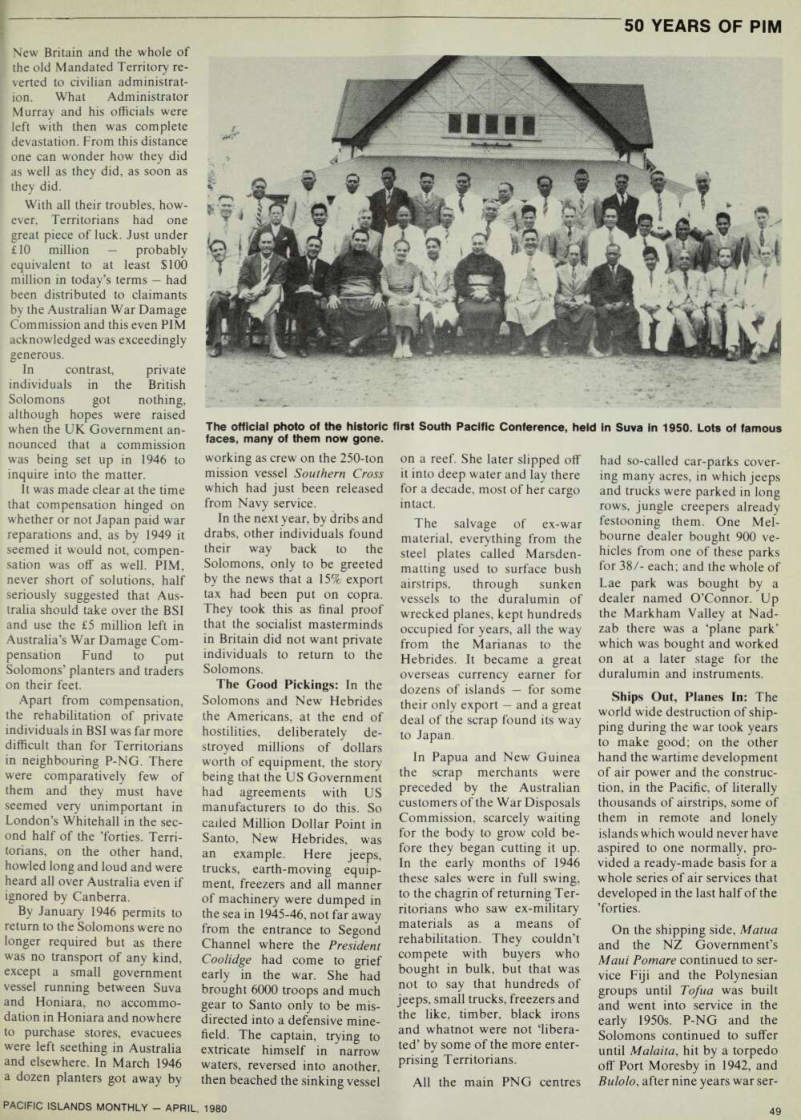

Islands postwar rehabilitation
The turbulent postwar years 1945-50 are the focus of this month’s article by JUDY TUDOR in her anniversary-year review of PlM’s 50 years in the Pacific. The magazine’s campaigns, pro and con on a variety of issues, are vividly recalled.
Although peace had been the objective for almost six years, the euphoria that the cessation of hostilities brought in 1945 soon wore olf. Disillusion was, however, more complete for some than for others. If evacuees from Papua, New Guinea, British Solomons or the Gilberts ever imagined that
they would immediately take
up where they had left off four years before, they were soon undeceived.
At the time PIM blamed the socialist governments in Aus tralia and UK for this, because they made rehabilitation more difficult and protracted. But with 1980 hindsight, it is obvious that whatever the pol itical colour of the administer ing authorities, getting back to normal in islands that had been battlefields, where the fabric of existence had been tom apart, was going to be slow as well as
painful.
Furthermore, if conditions in 1939 were to be regarded as ‘normal’ then it can be said now that no island or territory ever became normal again. The war speeded up communi cations and produced new ideas of social justice.
People who had never been nearer a Pacific island than King’s Cross or Palmerston North, Birmingham or Cin cinatti, who had never spared a thought for them or the people who lived in them, now
had developed fixed opinions
about them. That they were often cock-eyed and unin formed opinions seemed be side the point at the time.
Islands that had not been battlefields but had been blessed with so-called dollar
prosperity by providing
American support bases or air fields, had not escaped what British Prime Minister Mac millan, years later, called the winds of change but in com parison with the hurricanes that raged in P-NG and BSI
they were gentle zephyrs. My
own personal experiences
emphasised this point. I was then based in Sydney as PlM’s assistant editor.
I arrived in Suva in Sep tember 1945, when peace was only a couple of weeks old, to find colonial society in full blast, no clothes or food ration
ing, beer and liquor flowing
freely, dinner parties, cocktail
parties, even balls, the standard forms of entertainment.
The Grand Pacific Hotel was
providing rooms then regarded
as high class, solid Union
Steam Ship Company-type
food and pussy-footed Indian servants that brought you tea with the dawn, turned down your bed and arranged the mosquito net at night, and in between scrubbed, cleaned, served food and drink and remained unobtrusive.
The only inconvenience that I could see was lack of passen
ger ships, the only regular visi
tor being the Matua from New Zealand. She had been built in the 1930’s to carry 40 passen gers plus general cargo north, and bananas and fruit south.
During the war and for a con siderable time after it she car ried 100 passengers and always had a waiting list a mile
long.
Who was to have the privi lege of travelling on her was decided by a Movements Con trol Board. For some reason the alleged power of the press I presume the MCB decreed that I could travel to New Zealand on her, in a bunk in a two-berth cabin with a third body on a mattress on the floor.
This was de luxe.
Others not so fortunate were accommodated in what had been the lounge, where tiers of bunks had been built, or in one of the holds. The ex-lounge was known as The Jungle and the hold (males only) as The Concentration Camp. Meals were served in two or three sit tings, depending on the state of the sea and the number of people who felt strong enough to face them. In spite of the dis
comfort, Fiji people were
grateful to Matua which had provided their only link with the outside world during the war and who had given the owners a brass plate stating this fact.
The MCB not only allowed me passage to Auckland but an excursion around the islands and back to Suva Apia, Pago Pago, Nukualofa and Vavau.
In October 1945 war already seemed so far removed from these places as to make me
wonder if it had ever happened at all.
A year later, in October 1946, I went back to New Guinea, in a Qantas DC3, overnighting in Townsville.
Viewed from afar most of Port Moresby’s landmarks ap peared to be in place, including HP’s store with its distinctive tower. Closer inspection showed many of the buildings to be hollow shells but further round the harbour there was a mushroom growth of per manently, temporary hut ments, ex-military, now
occupied by the public servants
of the Provisional Administrat ion, which came to be known collectively as Konedobu, in the same sense that Whitehall means British or Canberra Australian governments.
The Provisional Adminis tration had been functioning for a year and every ship and
plane brought more returning
or joining Territorians who had screwed the necessary Permit to Enter out of Eddie Ward’s Department of External Terri tories.
I had arrived in Moresby in the middle of a public service fracas over non-existing ac commodation and as counter to their threats the Director of the PWD stated that, if left alone, he could produce a house every two weeks. The challenge was taken up and he
actually performed the miracle
in 11 days —a 4 rm. bung., all mod. cons., with external and internal walls of Sisalkraft (a sandwich of a heavy brown paper with bitumen filling).
The paper house had a tin roof and was not far from the ‘native hospital’, then situated on the Ela Beach side of Paga Point.
There were also regular houses being built of fibro cement, usually referred to as Stubbs’ houses, after the con tractor. The most outstanding feature of these was that they
were usually pinned up against
Moresby’s steep hillsides, perched on spindly legs, 12 ft to 20 ft high in places.
The ‘bottom pub’, Hotel
Moresby, was functioning,
over-full and supposed to accommodate only bona fide travellers like me or the dozens of Australian buyers of War Disposals Commission goods who were descending like vul tures from South. But apart from us, all and sundry who
were living in hidey-holes
God-knows-where all over Moresby, ate all their meals there. The bottom pub was at the bottom of the hill.
The Top Pub, the Hotel Papua, which had been built at the top of the hill on the site of an older establishment, and completed just as the balloon went up in 1942, had func tioned as a club during the war.
In October 1946 all furniture had disappeared from it, all the electrical fittings had been torn out by their roots, even lava tory fittings had been detached and were lying around. Huge holes had been bashed in the interior walls. Burns Philp, who owned both hotels, was weeping over the state of its
Top Pub.
I went across to Lae and from there to Bulolo and Wau by courtesy of Lee Ashton who drove a vehicle called a weapons carrier, and to Mt Hagen, courtesy of Adminis trator J. K. Murray and the RAAF, as it was still a closed area. Little or nothing remained of Wau and Bulolo,
but embryo Hagen, eventually
to be HQ town of Western Highlands district, looked cool, neat and civilised.
I went by pinnace across Huon Gulf to Salamaua, once the port and HQ town of Morobe goldfield and of which nothing remained and which had been permanently aban doned by the administration.
Lae, on the other hand, which had had few buildings before the war now had many, all Quonsets or made of native materials and thatch, black iron and Sisalkraft.
The District Office was func tioning in a large native materials building, ex-US Army, on the terrace, every thing else including a Burns
Philp store was down on the flat. Two miles out, across the Butibum River, Mrs Flo Stewart had taken over a women’s army barracks as a temporary hotel. The long dor mitory blocks were partitioned into cubicles with tar paper and furnished with hospital beds; the primitive ablutions block, mess hall and amenities room were scattered at varying dis tances and although Mrs Stewart and her daughter Ela worked like demons, it was a
pretty depressing place. For
transport one depended on the good nature of anyone who had managed somehow to ac
quire an ex-Army jeep.
During this time I went from Lae to Madang and back on the old Montoro which was struggling to keep some sort of service going. Never a luxury ship, all the amenities she had had, including the fans that stirred up the languid air in cabins, had disappeared. The heat inside that ship was in credible.
We were stuck at the wharf at Madang about a week due to a shortage of labour while Captain Bill Wilding gave out even more heat than his old tub. Montoro was a coal burner and chewed up 12 tons of it a day even in port. There were no bunkers in P-NG and ‘Wild Bill’ had to calculate down to the last lump of coal just how
long he could delay and still get to Bowen in North Queens land, the nearest supply. In the end he sailed, leaving 1500 bags of copra on Madang wharf.
Madang was the end of the shipping route. Anyone want ing to go further out, such as Wewak, the Sepik River or Manus, was in dire distress, as the old hotel at Madang, which had been built in German times and looked like a trans plant from Bavaria rather than a tropical pub, had been de stroyed along with most of the coconuts of Modilon Plan tation which extended right into the town and had been the pri vate estate of Mr James Burns, of BP & Co. Until they could get an onward schooner or pin nace, travellers decanted at Madang were forced to camp in abandoned war-time huts if they did not know someone who had a more respectable roof over their heads.
Such was the state of Islands life immediately after the war.
Back in 1945 PIM began its
peace-time activities by
demanding an inquiry into the loss of 300 NG civilians on the Montevideo Maru. Of these, eight had been heads of
government departments,
including the Government Sec retary, Mr Harold Page; 25 were well known plantation
owners; 58 merchants, man agers or professional people; 68 plantation managers; 100 public servants, 11 missionaries and 60 in various types of pri
vate employment.
‘These men should never have become prisoners of the
Japanese,’ said PIM. ‘They
should have been evacuated from Rabaul on a ship in the harbour within 40 hours of the invasion, between the time when it was known the Japanese were coming and when they arrived.’ The Aus tralian Government remained silent on the subject.
The fate of others who had been abandoned in Rabaul was coming to light in the first months of peace. Early in the Japanese occupation, four men were chosen to look after the local freezer. Apparently their selection was a matter of luck, as one of the men, J. H. Ellis, was an electrician but the others were not and included Gordon Thomas, editor of the local newspaper, the Rabaul Times.
Twelve others were also detached for special duties and lived in a special camp. They were known to be there in late 1944 but then were seen no more and it was believed that they had been killed by the
Japanese.
Another group, including some well known planters, held out in the bush for some time after the invasion but in July 1942 went into Rabaul and gave themselves up. The
Japanese apparently thought
they had been too long about it. The freezer group saw them taken away in a truck one day, after which they were not seen
again.
These and endless other stories of malign fate or of escape and rescue, a whole saga of now-it-can-be-told, appeared in the PIM for years following the war, wonderful source material for endless novels of adventure and hero ism, should anyone ever tap it.
Rehabilitation: In Papua New Guinea the Provisional Administration began to func tion on October 31, 1945, but it was not until mid-1946 that the last of the 90,000 Japanese POW’s were repatriated from
Postwar PNG was littered with war material such as this Japanese Zero In Kavieng. Photo Bruce Adams.
i New Britain and the whole of the old Mandated Territory re verted to civilian administrat ion. What Administrator Murray and his officials were left with then was complete devastation. From this distance one can wonder how they did as well as they did, as soon as
they did.
With all their troubles, how ever, Territorians had one great piece of luck. Just under £lO million probably equivalent to at least $lOO million in today’s terms had been distributed to claimants by the Australian War Damage Commission and this even PIM
acknowledged was exceedingly
generous.
In contrast, private individuals in the British Solomons got nothing,
although hopes were raised
when the UK Government an nounced that a commission was being set up in 1946 to inquire into the matter.
It was made clear at the time that compensation hinged on whether or not Japan paid war reparations and, as by 1949 it seemed it would not, compen sation was off as well. PIM, never short of solutions, half
seriously suggested that Aus
tralia should take over the BSI and use the £5 million left in Australia’s War Damage Com pensation Fund to put Solomons’ planters and traders on their feet.
Apart from compensation, the rehabilitation of private individuals in BSI was far more difficult than for Territorians in neighbouring P-NG. There were comparatively few of them and they must have seemed very unimportant in London’s Whitehall in the sec ond half of the ’forties. Terri torians, on the other hand, howled long and loud and were heard all over Australia even if
ignored by Canberra.
By January 1946 permits to
return to the Solomons were no longer required but as there was no transport of any kind, except a small government vessel running between Suva and Honiara, no accommo dation in Honiara and nowhere to purchase stores, evacuees were left seething in Australia and elsewhere. In March 1946 a dozen planters got away by
working as crew on the 250-ton mission vessel Southern Cross which had just been released from Navy service.
In the next year, by dribs and drabs, other individuals found their way back to the Solomons, only to be greeted by the news that a 15% export tax had been put on copra.
They took this as final proof that the socialist masterminds in Britain did not want private individuals to return to the Solomons.
The Good Pickings: In the Solomons and New Hebrides the Americans, at the end of hostilities, deliberately de stroyed millions of dollars worth of equipment, the story being that the US Government had agreements with US manufacturers to do this. So called Million Dollar Point in Santo, New Hebrides, was
an example. Here jeeps,
trucks, earth-moving equip
ment, freezers and all manner of machinery were dumped in the sea in 1945-46, not far away from the entrance to Segond Channel where the President Coolidge had come to grief early in the war. She had brought 6000 troops and much gear to Santo only to be mis directed into a defensive mine field. The captain, trying to extricate himself in narrow waters, reversed into another, then beached the sinking vessel
on a reef. She later slipped off it into deep water and lay there for a decade, most of her cargo intact.
The salvage of ex-war material, everything from the steel plates called Marsden matting used to surface bush
airstrips, through sunken
vessels to the duralumin of
wrecked planes, kept hundreds
occupied for years, all the way from the Marianas to the Hebrides. It became a great overseas currency earner for dozens of islands for some their only export and a great deal of the scrap found its way
to Japan
In Papua and New Guinea the scrap merchants were
preceded by the Australian
customers of the War Disposals
Commission, scarcely waiting
for the body to grow cold be
fore they began cutting it up.
In the early months of 1946 these sales were in full swing, to the chagrin of returning Ter ritorians who saw ex-military materials as a means of rehabilitation. They couldn’t compete with buyers who bought in bulk, but that was not to say that hundreds of jeeps, small trucks, freezers and the like, timber, black irons and whatnot were not ‘libera ted’ by some of the more enter
prising Territorians.
All the main PNG centres
had so-called car-parks cover ing many acres, in which jeeps and trucks were parked in long
rows, jungle creepers already
festooning them. One Mel bourne dealer bought 900 ve hicles from one of these parks for 38/- each; and the whole of
Lae park was bought by a
dealer named O’Connor. Up the Markham Valley at Nad zab there was a ‘plane park’ which was bought and worked on at a later stage for the duralumin and instruments.
Ships Out, Planes In: The world wide destruction of ship ping during the war took years to make good; on the other hand the wartime development of air power and the construc tion, in the Pacific, of literally thousands of airstrips, some of them in remote and lonely islands which would never have aspired to one normally, pro vided a ready-made basis for a whole series of air services that developed in the last half of the ’forties.
On the shipping side, Matua and the NZ Government’s Maui Pomare continued to ser vice Fiji and the Polynesian groups until Tofua was built and went into service in the early 19505. P-NG and the Solomons continued to suffer until Malaita, hit by a torpedo off Port Moresby in 1942, and Bulolo , after nine years war ser
The official photo of the historic first South Pacific Conference, held in Suva in 1950. Lots of famous faces, many of them now gone.
vice, were back in business.
In August 1948 the Canadian-Pacific liner Aorangi, which also had been on war service, recommenced Pacific voyages linking Aus tralia and New Zealand with US west coast ports via Fiji and Honolulu. But she ran at a loss from the outset and was finally withdrawn in the early 19505.
Meantime air services began to take up the slack. Pan- American Airways announced resumption of its trans-Pacific service within months of the end of the war; Australian National Airways, then owned
privately (much later bought
out by Ansett), announced a parallel service. Both used
‘giant Skymaster aircraft, car
rying 40 passengers’, reported
an admiring PIM.
ANA’s enterprise lasted two years, carrying out the service on behalf of the governments of Britain, Australia and New Zealand who had formed Bri tish Commonwealth Pacific Airlines (BCPA) in 1946, in order to keep all international air services in government hands. BCPA began to operate on its own account in April 1948 and ANA reluctantly was forced to return to internal ser vices. Canadian Pacific Air lines, the third trans-Pacific service, did not begin operating until 1949.
Meantime controversy raged in Fiji as to whether Nausori or Nadi would be the inter national airport. Nadi, at the time was regarded as a hot, flat area covered with sugar-cane and without tourist potential; Suva, on the other hand, just 17 miles from Nausori, wet and all as it was, was regarded as the place to be.
Finally the choice went to neither a fine new airport would be built at Suva Point, within spitting distance of the city itself, although it meant resumption of land and de struction of some houses. Sur veys were actually made before wiser counsel prevailed. Jet airliners were already on the drawing board, and Suva Point looked a bit cramped for those.
It was back to Nadi and the eventual development of that area as a tourist trap in its own
right.
The RNZAF was running
services from Auckland to Fiji, Western Samoa and the Cooks before the war ended, and con tinued to keep these services warm until NZ’s National Air ways Corporation could take over. Qantas ran DC3’s to Port Moresby, Lae and Rabaul;
flying-boats to Fiji via
Noumea; privately owned Trans-Oceanic was putting the New Hebrides and the Solomons on the air map and venturing even as far as Tahiti on charter runs. Air France and TRAPAS were taking care of New Caledonia. In short, although much in the Pacific was still bogged down in post
war depression and red-tape,
the air age was off to a good start in 1950.
Advancement of the Islanders: A conference to plan the advancement of South Pa cific people, attended by 43
delegates representing UK,
USA, France, Netherlands, Australia and New Zealand, was held in Canberra in January-February 1947. An agreement was drawn up which, in effect, established the South Pacific Commission.
Twelve commissioners, two from each country were pro vided for, also a secretariat with a secretary-general and other permanent officers. A working fund of £stg4o,ooo was agreed on, of which Australia was to provide 30%. The next meeting was not held until May 1948 when a committee was set up to recommend a head quarters. Suva or Noumea were the hot favourites, with the choice finally falling to
Noumea, in the old Pentagon
building vacated by the
Americans at Anse Vata which not only had office space but living quarters for the SPC’s first Secretary-General, Mr W.
D. Forsyth, of Australia.
Appointments were made to the research council, and it was announced that a South Pacific Conference, at which the del egates would be Islanders, would be held in Suva in April 1950.
The conference was duly held and pronounced a success although some territories
obviously had difficulty in
finding delegates advanced
enough to know what it was about.
Operating in a wider field, the Trusteeship Council of the United Nations had nothing to do until the end of the Japanese war. It then set about converting old Mandated Ter ritories (West Samoa, New Guinea, Nauru and the Marianas, Marshalls and Carolines) to Trusteeships.
New Zealand was quick off the mark, sending its draft trusteeship agreement on Western Samoa to Samoan leaders for their comments.
The Samoans turned it down and asked UN to grant independence instead. A Trusteeship mission sub sequently visited W. Samoa but was not in favour, merely ask ing NZ to give a larger measure of self-determination. NZ fell into line, giving Samoa a High Commissioner instead of an Administrator, a Council of State of the three Fautua and
a Legislative Assembly instead
of a Legislative Council when the group became a Trustee ship in November 1947.
Nauru became a Trusteeship territory in October 1947 with out fuss but New Guinea remained technically a Manda ted Territory due to the fact that Australia wished to make permanent the Provisional ar rangement of administering Papua and New Guinea together. It was allowed to do so.
The former Japanese Man date of the Marianas, Marshalls and Carolines be came the US Trusteeship of the Pacific Islands on July 18, 1947 but it was a TT with a dif
ference, designated a strategic
area under the administration of the US Navy. What went on there, especially in Saipan, was so secret even the HQ was kept in neighbouring Guam, while various nuclear devices were tested in the Marshalls and visitors were unwelcome every where.
Bits and Pieces Copra and the MOF: In the early post-war the price of copra rose steeply in spite of the fact that someone had invented a substitute for soap called detergent. All Common wealth territories kept a firm
hand on things by setting up
control boards, stabilisation funds, export taxes and the like. Fiji, West Samoa, and the BSI had their copra sold to the UK Ministry of Food and in 1949 Papua-New Guinea joined this club. The price was fixed annually and could not rise or fall by more than 10% in any one year. The price for 1949 was £stg4B, fob islands ports but by the time the vari ous government instrumen talities got at it, planters actually received about 50% of what copra was bringing on the free market.
By late 1950 they were fed up with this. BSI planters threa tened to defy their copra board and P-NG planters sent a del egation to Canberra. Needless to say, the MOF contract con tinued for the full nine years.
Honour Roll: In January 1946 PIM published an 8-page
supplement carrying the names
of servicemen and civilians of the South Pacific who had lost
Suva Point airport plan. It never happened.
their lives, been casualties or had been decorated. It had a coloured Union Jack on the cover which must have made the Frenchmen spit, whose names appeared in it.
A Knighthood for Western Samoa’s retiring Administra tor Alfred Turnbull was an nounced in the New Year Honours of 1946.
Manus Base: Sir Thomas Blarney, C-in-C Australian forces, said that P-NG’s Manus base, built by the Americans into a junior Pearl Harbour, should stay in Australian hands. PIM called him a ‘dangerous dreamer’. It went on to say that Australians were fools in international affairs but even they must see that Australia alone could not de fend herself. ‘lf America (who saved us in 1942) wanted a few square miles of tropical island as a base let us give them gladly.’ Of course, Australia didn’t; the Americans pulled out and Manus disintegrated.
Mrs Ruby Boye, BEM: All women did not leave the BSIP
during the general evacuation.
Mrs Boye stayed with her hus band on Vanikoro, HQ of the Kauri Timber Co. and manned the radio station, sending weather and other reports to the Allies in the face of threa
tened Japanese reprisals. For
this she received the BEM, one of the few women in 1946 New Years Honours to receive it, and the personal congratu lations of Admiral Halsey,
Usn.
The CIPA: In mid-1946 trouble was continuing in the Cook Islands between the Cook Islands Workers’ Union and the Auckland-based, Albert Henry-led Cook Islands Progressive Association as to who would work ships. It came to a head the following year when a plane-load of New Zealand police were sent to
Rarotonga to straighten things
out. The CIPA later set out to run stores and an inter-island
ship.
Banabans of Ocean Island were said, in June 1946, to be settling in on Rabi, the Fiji island bought for them, with Major D. G. Kennedy, DSO, who had had distinguished war service in the Solomons in charge. This transfer of 703
Banabans and 300 Gilbertese from a semi-barren phosphate island to copra-producing Rabi
was interesting, PIM thought,
but would the experiment meet with success? (We all know the answer to that.) Candle-nut Oil was a new industry in Fiji in 1946, made from nuts gathered in Fiji, Tonga and Samoa. It was a substitute for linseed oil used in paints and varnishes, flourished for a few years and then faded out as linseed oil became more plentiful and
people tired of gathering
nuts.
The King’s Medal was awarded to C. H. Meen (Hoi Meen Chin) of Rabaul in October 1946. The citation said in part that although he was in terned with a small group of Chinese in Japanese-occupied Rabaul, he managed to make contact with Allied Intelligence and began to work for them. In 1943 he sent detailed maps and written information which ena bled the Allied forces to make successful air attacks on Japanese installations. He had also managed to hide Allied airmen and arrange for them to be evacuated.
Niuafoou, in the Tongan Group, was devastated by an
eruption in September 1946
and the whole population of 1800 evacuated to Eua.
Casino: It was reported in June 1947 that a large casino and modern 200-room hotel was to be built at Anse Vata beach in Noumea and was expected to become the ‘most brilliant resort in the South Seas’. PlM’s paragraph did not say when this would happen but, in fact, 20 years later the report became true.
Royal Marriages: Tonga was en fete in June 1947 when
Prince Tupouto’a Tungi, heir
to the throne, married Miss Halaevalu Mata’aho, and Prince Tu’ipelehake married Miss Melenaite Tupou- Moheofo, in a double cer emony. The Methodist Church wedding was followed by Ton gan ceremonies.
Kon Tiki: In July 1947, PIM reported that six young Scan dinavians led by Thor Heyer dahl were out in the Eastern Pacific somewhere on a raft trying to prove that Poly nesians could have come from South America. In the follow ing month PIM was able to re port their arrival in the
Marquesas, 81 days after they
had left the port of Callao.
Eniwetok atoll in the Marshalls was taken over in
December 1947 by the US Atomic Energy Commission to test a ‘super secret atomic weapon’. The 145 inhabitants of the atoll were relocated else where.
NG Timber Scandal: What turned out to be a cause celebre broke in December 1947 when Mr Jock Garden, a friend of Australian External Territories Minister Eddie Ward, was charged with forging a letter purporting to give a timber lease in the Bulolo Valley to Brisbane timber merchants Hancock and Gore, for a con sideration of £50,000. The sen sation and all its ramifications
dragged on, involving three
other members of Garden’s syndicate a man named Far rell, Garden’s son and veteran
flyer Ray Parer, and finally
Minister Ward himself who was the subject of a Royal Commission. Garden went to gaol, the other members of the syndicate were cleared and the Royal Commission found Mr Ward not involved in any way.
Blue Lagoon: Miss Jean Simmons, then 18, arrived in Suva in December 1947 with other actors to star in the film Blue Lagoon part of which was made in the Yasawas, a fact that indirectly started popular cruises to those isolated islands, originally run by Mr Trevor Withers.
Oil: It was announced in June 1948 that the NG Pet roleum Co of Dutch New Guinea expected to begin pro duction from wells in the extreme tip of the Vogelkop,
near Sorong, by the beginning
of 1949.
Tuna Fishing: In late 1948, Mr Harold Gatty, who had done much to establish Pan- Am’s air service across the Pa cific, went in for a new venture when he registered South Seas Marine Products in Suva with the idea of catching and can ning tuna for the insatiable American market. Three mod ern tuna clippers, two live bait vessels and a refrigerated vessel were purchased plus a long range spotter plane. It took little more than a year to show that whatever tuna did else where they could not be caught
in Fiji waters by the pole
method employed in the north
Tonga’s royal wedding, June 1947. Prince Tungi (heir to the throne, and now King Taufa’ahau), with his brother Prince Tu’ipelehake (now Premier) en route for the chapel to claim their brides.
ern hemisphere. The ships were sold and the company wound up. The Japanese who 1 came in later proved that it could be done by the long-line method, but that was another story.
The Fingerprint Murder: Three Brisbane detectives who had gone to Ocean Island in
April 1949 and fingerprinted
everyone on the island before charging a Chinese labourer, Tai Shek, with the murder of Mr T. Allen, a BPC engineer, and his wife, were off again on their travels in September. The accused had been sent to Suva for trial, some technical hitch arose, he was then sent back to Ocean for re-arrest and re committal and returned to Suva. On the strength of his fingerprints being found on a window sill in the Allens’ house, he was found guilty and
eventually hanged at Suva
gaol.
Devaluation: In October 1949. Britain devalued the £Stg against the US dollar by 30% and all British Pacific countries followed suit. The price of
commodities written in US dol lars rose in terms of deyalued £’s but as far as the Pacific was concerned this mainly affected gold, which shot up from £A 10.15.0 an ounce to approx £A 15.10.0. But as far as the US was concerned gold remained at SUS3S per ounce and was to stay that way for the next 20 years.
Timber: Commonwealth New Guinea Timbers was born at the end of 1949 49% owned by Bulolo Gold Dredg ing, the Australian government having the balance. Object was to harvest the klinkii and hoop pine of the Bulolo Valley and turn it into plywood and veneer while at the same time, through reafforestation, create a per manent forest asset.
Goodbye to Socialism and all That was the headline in PIM in December 1949. Labour governments had been de feated in both New Zealand and Australia in that month and PIM commented that no communities had suffered more under their controls and regulations than their ‘voiceless
people of the South Pacific ter ritories’. Events were to show, however, that eggs, once scrambled, are hard to re assemble.
US Navy Out: American Samoa was given a year’s notice that after 51 years the USN would bow out of admin istration of the territory on July 1, 1951, the US Department of the Interior taking over. The Samoans were unhappy at the prospect of losing their Fairy Godfather, not expecting their new bosses to be so open handed.
SPP: After months of frus tration and delays, P-NG got its first post-war newspaper.
First issue of the South Pacific Post was published on Sep tember 26, 1950.
Deputy Administrators were to be appointed in Papua-New Guinea two of them, at salaries ranging from £2OOO to £2500. 1950 Ended on a happy note. The price for copra sold to the United Kingdom MOF would rise in 1951 by the full 10% allowed.
This PIM cover never appeared.
It was designed by a regular PIM reader and contributor who signed himself Kupa. Many readers over the years sent unsolicited cover designs, in variably including the coconut palms that have become PlM’s motif.
Advertisements & other items, pp. 48-56 (5 items)
50 Years Of Rim
48
PACIFIC ISLANDS MONTHLY - APRIL, 1980
50 Years Of Rim
49
PACIFIC ISLANDS MONTHLY - APRIL, 1980
PRO SERIES. The Tone
n» > RO-501
PRO-502
PRO 601
PRO SERIES. The Tone
of the Future Being Set Today.
Introducing state-of-the-art audio for the 80’s. The Pro Series, from Akai. Representing the latest in digital processor technology and other space-age developments. A preeminent lineup of slim design component systems that have what your best customers expect from Akai. The finest in sound quality,
today and in the future.
PRO-601
Quartz Direct Drive Turntable.. model AP-QSOC DC Stereo Power Amplifier.,.,. model PA-WO4 Stereo Pre-Amplifier model PR-AO4 FM/AM Stereo Digital Synthesizer Tuner - model AT-VO4 Stereo Cassette Deck model GX-MlO Stereo Graphic Equalizer (Optional) model EA-GBC Audio Timer (Optional). model DT-100 Speaker SR-H5O/SW-T5O Audio Rack model RM-H6l 'A long wave band model is also available
PRO-502
Turntable model AP-D3OC Stereo Integrated Amplifier model AM-UO2 FM/AM Stereo Tuner - model AT-KO2 Stereo Cassette Deck model CS-MO 2 Stereo Graphic Equalizer (Optional) model EA-G4O Audio Timer (Optional)..., model DT-100 Speaker SRH3O/SW T3O Audio Rack model RM-H 52 - 4 long wave band model is also available
PRO-501
Turntable model AP-B20C(S) Stereo Integrated Amplifier model AM-UOl FM/AM Stereo Tuner - model AT-KO2(S) Stereo Cassette Deck model CS-MOl Audio Timer (Optional) model DT-100 Speaker SR-H3O/SW-T3O Audio Rack model RM-H5l •4 long wave band model is also available i 999
OFFICIAL SUPPLIER OF
VIDEO HOME SYSTEMS
1980
MOSCOW
AKAI
AKAI ELECTRIC CO., LTD.
Tokyo, Japan
Approved by M.0.0.C.
PNG
S.O. Svensson (N.G.) Ltd.
P.O. Box 705, Port Moresby Tel: 2275 Fiji Islands Motibhal & Company Ltd.
P.O. Box 9175, Nadi International Airport Tel: 72-165 New Zealand Pye Ltd., Consumer Products Sector 110 Mt. Eden Rd., Mt. Eden, Auckland Tel: 686-437 New Caledonia Menard Pacifique s.a.r.l.
B.P. H 2, Noumea Tel: 275222 Tahiti Etablissements Comimpex P.O. Box 200, Papeete Tel: 20477 New Hebrides (Islands) Burns Philp (New Hebrides) Co., Ltd.
P.O. Box 27. Port Vila, New Hebrides Islands Norfolk Island Burns Philp (Norfolk Island) Co.. Ltd.
P.O. Box 21, Norfolk Island Samoa Islands Burns Philp (South Sea) Co.. Ltd.
P.O. Box 129, Pago Pago, American Samoa Manana Islands J.C.Tenorio Enterprises P.O. Box 137, Saipan Tel: 6444/8 Solomon Islands Security Electrical Co., Ltd.
P.O. Box 174, Honiara Tel: 881 Cook Islands JPS Enterprises Ltd.
P.O. Box 15, Rarotonga Tel: 2150, 2176 For more information, please send this coupon to our distributor in your country or to AKAI ELECTRIC CO. LTD. 12-14. 2-Chome. Higashi-Kojiya, Ohta-ku. Tokyo. Japan
You better deal with...
DEMKA
(AUSTRALIA) PTY LTD.
...if you want to deal better
...with the many manufacturers, established in various parts of the world, but on an exclusive basis and...
in the South Pacific only.
We are an exception for every manufacturer we represent, which is to the...
buyer’s advantage.
DEMKA
(AUSTRALIA) PTY. LTD
P.O. Box 340, Mascot N.S.W. 2020 Telex: 21416 AHA Sydney Cables: DEMKAY Sydney
% m - II ss y n: jj a* f^*2 «r* \ I Is it true that true hi-fi is complicated?
It’s true that the advanced electronics in Sansui’s new SUPER COMPO systems are very complex. But happily it’s also true that Sansui has made true hi-fi simple with “in-depth matching” systems: SUPER COMPO. Without depleting your budget or hogging your living room, SUPER COMPO easily fills your room with your favorite music in stirring stereo.
Today’s music sources sound so vivid because they have a dynamic and sonic range far wider than ever before. That’s why you need the latest audio advances found in all SUPER COMPO systems, created by Sansui, the hi-fi specialist.
Isn’t it great to discover that your family, too, can now enjoy the very best music on hi-fi? SUPER COMPO!
Only hi-fi,everything hi-fi.
SansuL
SANSUI ELECTRIC CO., LTD. 14-1 Izumi 2-chome, Suginami-ku, Tokyo 168, Japan • Australia VANFI (Aust.) Pty. Ltd. 162, Albert Road, South Melbourne, Victoria 3205, Australia Phone: 699-5473 / 283 Alfred Street, North Sydney, N.S.W. 2060, Australia Phone: 929-0293 • Fiji Prabhu Brothers Ltd. P.O. Box 183, Nadi Phone; 70183/4 • Papua New Guinea Oceania Indent Agency (P.N.G.) Pty. Ltd. Box 5518, Boroko, Port Moresby Phone: PM 256406 • New Zealand David Reid Electronics Ltd. C.P.O. Box 2630, Auckland, 1 Phone: 492-189 • New Caledonia Ets Michel MERCIER B.P. 1123, Noumea Phone: 27. 59. 11 • South Pacific Miltons Department Stores Limited P.O. Box 146, Norfolk Island 2899 • Central Pacific Nauru Co-operative Society Republic of Nauru • New Hebrides The Sound Centre P.O. Box 434, Port Villa • Cook Island United Island Traders Ltd. P.O. Box 1 & 2, Rarotonga • Tahiti SIMEL P.O. Box 3338
* O * -0 O lO & *
FOR:
IN OUR 86th YEAR SELLING ‘SERVICE’
TO THE PACIFIC ISLANDS
Nelson & Robertson
PTY. LTD. (Established 1895)
Plantation House, 197 Clarence Street, Sydney.
Cables: ‘IVAN’, Sydney, Brisbane. Telex: AA22381, Sydney.
INDENTS - FROM AUSTRALIA, NEW ZEALAND and OVERSEAS.
FOODSTUFFS • SOFTGOODS • HARDWARE • MACHINERY TRAVEL • INSURANCE • CANNED FISH • JUTE GOODS
• REAL ESTATE •
BRANCH OFFICES:
Nelson & Robertson Pty. Ltd., P.O. Box 575, Brisbane, Qld., Australia.
P.O. Box 2092, Govt. Bldg., Suva, Fiji.
P.O. Box 258, Lautoka, Fiji.
P.O. Box 2420, CPO Auckland 1, New Zealand.
PAPUA NEW GUINEA
REPRESENTATIVES:
Rabtrad Nuigini Pty. Ltd., P.O. Box 219, Rabaul, P.N.G.
P.O. Box 1406, Lae, P.N.G.
P.O. Box 711, Madang, P.N.G.
P.O. Box 253, Kieta, P.N.G.
• Kelvinator Australia Limited .. . Adelaide, South Australia • Truk Cooperative Association . .. Truk, Eastern Caroline Islands • Bern Inc... Yap District, Western Caroline Islands • Cook Islands Trading Corporation , Ltd... Rarotonga, Cook Islands • Carpenters Fiji Lir, Enterprises .. . Majuro, Marshall Islands • Electric Radio Noumea ... Noumea, New Caledonia • Pentecost Pacific SA... Port-Vila, Pacific Traders , Inc... Pago Pago, American Samoa • Motor Distributors (Samoa) Ltd... Apia, Western Samoa • Guadalcanal Elet
50 Years Of Pim
53
PACIFIC ISLANDS MONTHLY - APRIL, 1980
50 Years Of Pim
3 ACIFir, ISI AMDQ MDMTUI v a nmi 4
Exit


Trade
Winds
Exit Mister Gross
Tuvalu Prime Minister Toalipi Lauti’s dream of achieving prosperity for his country
through a partnership with
Californian real estate dealer Sidney Gross has ended. In a radio address on Funafuti he said that the joint venture with Mr Gross for the creation of a fishing fleet for Tuvalu was off.
Such a scheme would lose money, he said, in what was widely regarded as an honest and dignified admission that he had been wrong in planning the deal.
This seems to have ended an adventurous dream which began for Mr Lauti when he flew to the United States in February, 1979, and handed a cheque for SASSO 380 to Mr Gross, who promised to invest it at 15% and negotiate for the purchase of fishing boats to be financed from a $5 million loan which Mr Gross would raise.
The fleet, of four ships, would earn more than SUS 9 million in four years, 80% of the profit going as repayment for the $5 million loan. The rest would go into Tuvalu’s investment account to be handled by Mr.
Gross.
In his radio address, broad cast in the local language, Mr Lauti told his people that the Planning Department had advised him that a joint fishery venture would be a loss to Tuvalu and to Mr Gross. He had seen Mr Gross in Honolulu and told him that the venture was ended because of the high cost of running a fish
ing fleet.
Mr Gross, said the Prime Minister, had asked him to postpone his decision to end
the scheme until his experts; had reviewed the situation. He: had expected one fishing boat:
to be ready by February 1.
Mr Lauti told his listeners: ‘Since the Planning Officer has; revealed that nothing will be; gained from it, you are now 1 informed that this will be post poned until such times that the: world currency is more: stable.’
He added that his govern ment was having talks with interests in Japan,, South Korea and Taiwan andl ‘from what we know the talks are progressing well’.
In December, parliament! was told that Mr Gross had! been asked for the return of the; $555 000-plus which Mr Lautii had invested in Mr Gross’ Blue; Chip Realty. The money was needed to buy the Tuvaluans into a joint venture withr Barclays Bank International! which will open a bank onr Funafuti.
Meanwhile, many\ Tuvaluans who had paid a totall of $75 000 for land in Greenr Valley, Texas, are also askings for their money back.
Tuvalu’s Prime Minister Toalipi Lauti, with (left) John lonatana, secretary to government.
All-in-all, it seems clear that Mr Gross and Tuvalu have parted company.
Profit Lifts
; Or Bp, Wrc
fhe South Pacific’s two trading ;iants, Burns Philp and Car >enters, have reported big lifts n profits for the half year to he end of 1979 - Burns Philp ip by 20.8% to $7 111 000 and Carpenters by 73% to ;6 090 000.
The former’s islands sub idiary, Burns Philp (South lea) Co Ltd, contributed its [uota to the group’s profitable
ix months through its
•ranches in Papua New juinea and the New Hebrides /hich showed increases in sales nd profits, mainly in the lotor divisions. For some sason Fiji and Western Samoa on’t merit a mention in the iterim report to the Sydney
tock Exchange.
Carpenters reported lower rofits from Fiji, mainly
irough the merchandising op
rations and the copra mill, but lere were strong profit contri
butions from the motor div ision and the engineering support services, thanks to the Monasavu hydro-electric pro ject. The Papua New Guinea operations increased their
profit through the motor, plan
tation and oil mill divisions and merchandising, but the tea and coffee estates had reduced output and profit because of
drought.
Burns Philp has also an nounced a rights issue of shares, the first cash issue to its shareholders for 24 years. It will be on a 1 for 4 basis at $l.BO a share to registered shareholders. This will raise $l6 736 932 to supplement funds required for the continu
ing growth of the group’s oper
ations. During the six months the group acquired Cope All man (South Pacific) Ltd, which has a biscuit factory and a soap factory in Rodwell Road, Suva, and Tutt Bryant Pacific Ltd, of Papua New Guinea which will contribute to the group’s motor division.
Carpenters reported selling
the Southern Pacific Insurance Co Ltd.
Windfall for
Malolo
Malolo Islanders in Fiji received $lO 000 a block for 12 blocks on their small island on
which luxury holiday homes
are being built. On top of that they well get an annual rental for the land.
Mr Errol Fifer, a Sydney
property developer, recently
raised $1.3 million from Aus tralians to buy the luxury homes. The resort is expected to open in April.
The homes on Malolo Island, which is west of Nadi Airport, form part of a private club, the Naitasi, which is owned by residents of the re sort. Each has two adjoining bures which may be used by friends.
PNG inflation
up, but . . .
Papua New Guinea’s inflation rate for 1979 was 7.9%, up 1.9% from the previous year.
Finance Minister Barry Holloway said the rise was
reasonable by world stan dards.
He added: ‘Most countries in the world, especially our major trading partners, have much higher inflation rates. Our country inevitably feels the effect of that when we import products from countries with
higher inflation.’
Of Spec
and OPEC
Armed with a brief prepared by the South Pacific Bureau for
Economic Co-operation
(SPEC), a delegation of Islands countries will go to Vienna later this year to ask for aid from the Organisation of Pet roleum Producing Countries
(Opec).
The delegation will ask for guaranteed fuel supplies at concession prices as a help in cushioning the shock of high energy costs on their fragile economies.
The delegation, which will be at ministerial level, aims to have a report ready for the next
South Pacific Forum meeting later this year.
Members of the delegation have not yet been chosen.
3 times to
Honolulu
Air Micronesia will restore its
third weekly flight between
Ponape and Honolulu from May 1. The flights were discon tinued last October when the airline withdrew its third jet operating in Micronesia after it failed to secure the right to fly between Osaka, Japan, and
Saipan.
President of Continental Air Micronesia Dan Peck told a conference on Ponape in February that he did not know how long the third flight would be in operation. It may be dis continued after September if traffic falls off seriously after summer.
Hydro-power
plans in PNG
Papua New Guinea’s Elec tricity Commission (Elcom) is planning a massive power scheme which could involve as
many as 12 power stations on the Vanapa River outside Port Moresby.
The scheme could eventually produce between 1200 and 1500 megawatts a day.
Port Moresby at present uses only 38 megawatts a day. The scheme is aimed at encourag
ing large-scale foreign invest
ment in the national capital district.
Water used in the scheme would drop several thousand metres from two lakes built on the 4000-metre Mount Albert Edward, about 90 km north of Port Moresby. It would cascade through a series of hydro electric stations on the Vanapa River, and into a third weir closer to the coast.
The scheme is planned in stages, with moves from one to
another depending on develop
ment of demand.
In another move to develop PNG’s hydro-power resources, Australia’s Snowy Mountains
Engineering Corporation
signed an agreement in February for a SA73 million scheme to be built in the West ern Highlands.
Advertisements & other items, pp. 57-60 (3 items)
'Acific Islands Monthly - April. 1980
vhenyou own a Kelyinator
> Refrigerators, Freezers, Gas and Electric Ranges, Air Conditioners, Automatic Wash ers and Dryers, Wringer Washers, Microwave Ovens, Humidifiers, Dehumidifiers, Water Coolers, Commercial Air Conditioners and Refrigerators. •a : MM
/NTEKJVAT/OIVAL COMPAM *
Kelvinator International Company. P.O. Box 9200. Grand Rapids, Michigan 49509. U.S.A. irprises . . Ponape, Eastern Caroline Islands • Western Carolines Trading C 0. .. Palau, Western Caroline Islands • Family Chain Stores, Suva, Fiji • Pacific International Co., Inc. . . Agana, Guam • M.S. Villagomez Enterprises ... Saipan, Mariana Islands • Robert Reimers rides • Fisher & Paykel Ltd.. . Panmure, New Zealand • Bums Philp (New Guinea) Ltd. . . Port Moresby, Papua New Guinea • South Honiara, Solomon Islands • Ets. Rene Solari etFils .. . Papeete, Tahiti • E.M. Jones .. . Nukualofa, Tonga
TRADEWINDS INTELLIGENCE ...I
NEW ZEALAND in March sent 850 sheep to Papua New Guine. under its bilateral aid programme. The sheep - 800 Corriedale: and 50 Perendales - went to a PNG Government farm nea Goroka. The farm is the centre of a sheep management projec for smallholders in the New Guinea highlands.
SUVA ARCHITECTS John Rounds, Lee and Partners Co Ltd have formed an association with a leading Australian firm of ar chitects, Devine, Erby and Mazlin Pty Ltd. The two teams wil pool resources to handle large undertakings in Fiji and the Soutl Pacific region. Mr Rounds worked for some years in Sydney a: an architect.
NORFOLK Island was visited by 21 000 tourists in 1978-79 including 12 370 from Australia and 8630 from New Zealand.
CONSTRUCTION firm Downer-Turner of New Zealand begar a preliminary survey of Palau’s airport and the site of their bas< camp in February before the arrival of their heavy equipmen due sometime in April. The company was awarded the multi million dollar contract last November. Scope of the work con traded for includes improvements to the existing Airai airpor which include earthwork, grading and fill for widening anc extending the present runway to 2194 m, including appropriate taxiway and aircraft parking apron and paving.
AIR NIUGINI’S in-flight magazine Paradise has doubled its prim run from 25 000 to 50 000 and increased its size by eight pages The increase in production was in response to reader demanc and increased passenger traffic, partly due to the opening of nevs flights to Honolulu, Jakarta and Singapore. Paradise is published every second month.
DAVID Lincoln-Gordon has been appointed Regional Controller for the Pacific Islands of the Commonwealth Development Corporation. The CDC’s office in Suva was upgraded to Regional Office status from February 1. CDC’s Islands operations were
offers expert insurance service
throughout the Islands.
QBE INSURANCE LIMITED
Central Office: 82 Pitt Street, Sydney.
NEW CALEDONIA -- T.A. Hagen , Ste. lA/.A. Johnston , S.A.R.L. Noumea.
NEW HEBRIDES Manager: G.F. Donnelly, Vila; Santo Santr Burns Phi Ip (New Hebrides) Ltd.
TAHITI - Arthur Chung: Immeuble 8.1., Front de Mer, Papeete.
NIUE. NORFOLK ISLAND, SAMOA, TONGA and other South Sea Islands - Burns Phi/p (South Sea) Company Ltd.
QUEENSLAND INSURANCE (FIJI) LIMITED
Head Office, 34 Usher St., SUVA. General Manager: L.G. Liddell. A.A.1.1.
Assistant Managers: Vijay Lai and J.T. Laidlaw. LAUTOKA Office, Burns Philp Bldg. District Manager: J. Dalton.
QUEENSLAND INSURANCE (RN.C.) LIMITED
PAPUA NEW GUINEA -
Head Office, PORT MORESBY. General Manager; J.M. Dawe. Assistant Manager; R.V. Maskell.
District Managers at; LAE: I.R. Martin. MOUNT HAGEN D.F. Carroll. ARAWA: J Longbut. MADANG: R.W.V. Colhngs. RABAUL W.F. Tinkers 0 E
RADEWINDS INTELLIGENCE TRA
formerly part of the East Asia and Pacific Islands Region and were controlled from Singapore. CDC’s existing commitments to projects in the new region (Fiji, Papua New Guinea and Solomon Islands) total about £33 million sterling.
AN AUSTRALIAN consortium of Leighton, Hornibrook and Thiess Bros Pty Ltd has won a contract worth $5l million to construct a water supply scheme for the Nadi-Lautoka area of
Fiji.
THE AUSTRALIAN Government is providing $250 000 worth of flour and vegetable oil as a follow-up for victims of Hurricane Meli, which struck Fiji in March, 1979.
MORE than 30 000 tonnes of pine will be processed into wood products in Fiji this year for local and export markets, including 13 000 tonnes for sawn timber. A new SFISO 000 sawmill has just been completed at the Fiji Pine Commission’s Drasa wood
processing depot.
EMPEROR Gold Mining Co, Vatukoula, Fiji, is budgeting on record tonnages and drilling development this year. Emperor general manager Geoffrey Reid said in February that with the price 3f gold almost double what it was a year ago the company was finding it economic to extract lower grades of ore. Drilling at the nine was up to levels comparable with peak periods of the jast.
WESTERN Samoa exported 18 500 tonnes of copra worth more han $8 million last year. Cocoa production totalled 2000 tonnes, )f which 1400 tonnes worth $3 500 000 had been sold by the end >f 1979. iOLOMON Islands and New Hebrides governments have signed in agreement under which vessels of the Santo-based South Pacific Fishing Company can fish in Solomon Islands waters and :atch up to 1500 tonnes of tuna a year. The agreement is valid or one year, and subject to renewal after negotiations.
JINGAPORE-based forestry operator Inchcape Berhad will take >ver the management of Papua New Guinea’s largest timber con- :em, Commonwealth New Guinea Timbers Ltd. According to i February announcement the company will hold a 30% interest n CNGT. To set up the deal, the PNG Government, which holds \9% of CNGT, will buy the majority interest of Sohbu Trading Corporation of Japan, then resell 30% to Inchcape Berhad. Under 1973 agreement, the government has first refusal on the Sohbu hares.
HE SFSO limit on Fiji currency allowed to be taken out of the ountry by travellers was raised to $ 100 on February 1. At the same me the $2OO limit on foreign currency notes was raised to $5OO. ; became legal on the same day to buy, sell, borrow and lend old coins in Fiji. But restriction on dealing in gold bullion jmained as before.
RANS-Micronesia Airways began a daily Monday-Friday serice between Ponape and Kosrae on February 18. Aircraft used a 16-seat turbo-prop Nomad. Another service between the lands is operated by the Pacific Missionary Aviation (PMA) airne. iN X-RAY machine which has been gathering dust in the Cook ‘lands for three years, is at last to be installed in the Rarotonga lospital. The $5O 000 machine, supplied under New Zealand aid, 3uld not be used earlier as the X-ray room lacked the required ;ad shielding. The shielding has now been installed.
IIR PACIFIC will take over its ground-handling operation from Australia’s Qantas Airways Ltd at Nadi Airport from August 1.
Air Pacific general manager Captain Alan Bodger said that the ikeover was based on economics, after Qantas increased its round-handling fees by 80% on January 1.
TGENCE...TRADEWINDS INTELL
GOLD
WitrOtf
AND
RELICS
\ [i£lbs
OUR AUSTRALIAN EXPERIENCE SINCE 1974
INDICATES TO US THAT THESE ARE MOST
ASSUREDLY FOR AUSTRALIAN CONDITIONS
THE VERY LATEST LIGHTWEIGHT MACHINES
FOR THE GREATEST
DEPTH PENETRA T/ON
IN
MAGNETIC GROUND CONDITIONS
(WHERE THE GOLD IS USUALLY LOCATED.)
BOUNTY HUNTER
"THE ONE THAT GETS THE GOLD"
MADE IN U.S.A.
25 MODELS - LIFETIME WARRANTY
-ALL PRICES
SEE THE RANGE - TEST THEM YOURSELF
AT ALL QUALITY DETECTOR STOCKISTS
AND DON'T SETTLE FOR ANYTHING LESS!
BOUNTY HUNTER HAS MORE VALUE PACKED
FEATURES. SOME MODELS ARE STANDARD
WITH 3 SEARCH COILS!
PHONE OR WRITE FOR FREE DATA PACKAGE
AND NEAREST DEALER LOCATION.
Sole S.W. Pacific Distributors & Factory-Approved Service Centre
HENDON DETECTOR COMPANY
An Associate of Southern Patagonian Holdings Pty Limited Office: 121 Plateau Rd. Telephone: (STD 02) 918 6288, 918 6667 (24 Mrs.) AH Mai! to: P.O. BOX 11. V., AVALON BEACH, NSW. 2107, AUSTRALIA Telex: 70560 Telegrams: "HENDONAERO SYDNEY”
REPUTABLE NEW DEALERS ARE WELCOME -
NEVER SAY NO TO A CUSTOMER - WE CAN
PUT BOUNTY HUNTER GOLD DETECTORS ON
YOUR SHELVES IN 24 HOURS!
" ... % V.
liv*
i «b sr E fl V > »*tVJ ■Hi
developing the
wheel loaders
Throughout the Pacific Islands you will find CATERPILLAR working to develop the land.
Caterpillar wheel loaders are among those machines. They are dependable, with the adjustment-free Cat diesel engine, rugged planetary power shift transmission and long-life sealed hydraulic system to keep you working.
Caterpillar wheel loaders give you 4-wheel drive, articulated steering and caliper disc brakes to get you in, out and around, fast. You can rely on Caterpillar to get the job done economically'and efficiently.
HASTINGS OEERING
BA 10451
LAE ;
Milford Haven Road, Telephone 42 2355
PORT MORESBY :
Telephone 256650
BOUGAINVILLE :
Itakara Industrial Park, Arawa. Telephone 959077 All CATERPILLAR equipment is CAT backed by CAT PLUS service. CAT pi US PLUS is a package of programmes designed to help you protect your investments and get the maximum return on your machines. CAT PLUS is the most comprehensive service programme available... .anytime, anywhere.
When you invest in CATERPILLAR equipment you have the full backing of your CAT Dealer and
CAT PLUS.
0 SUVA : Carpenter Street, Raiwai.
Private Mail Bag, GPO Suva. Fiji. Ph. 381622, Telex FJ2190 Cables CARPTRAC LAUTOKA : Veitari. Telephone 61877 LABASA ; Vulovi, Telephone 81888 □
YOUR
CATS R PILLAR
DEALER
Caterpillar. Cat and IB are Trademarks of Caterpillar Tractor Co.
AP.IPir ICI A KinO UAkITUI \J > nnn .
ssm plans for fishing boats,
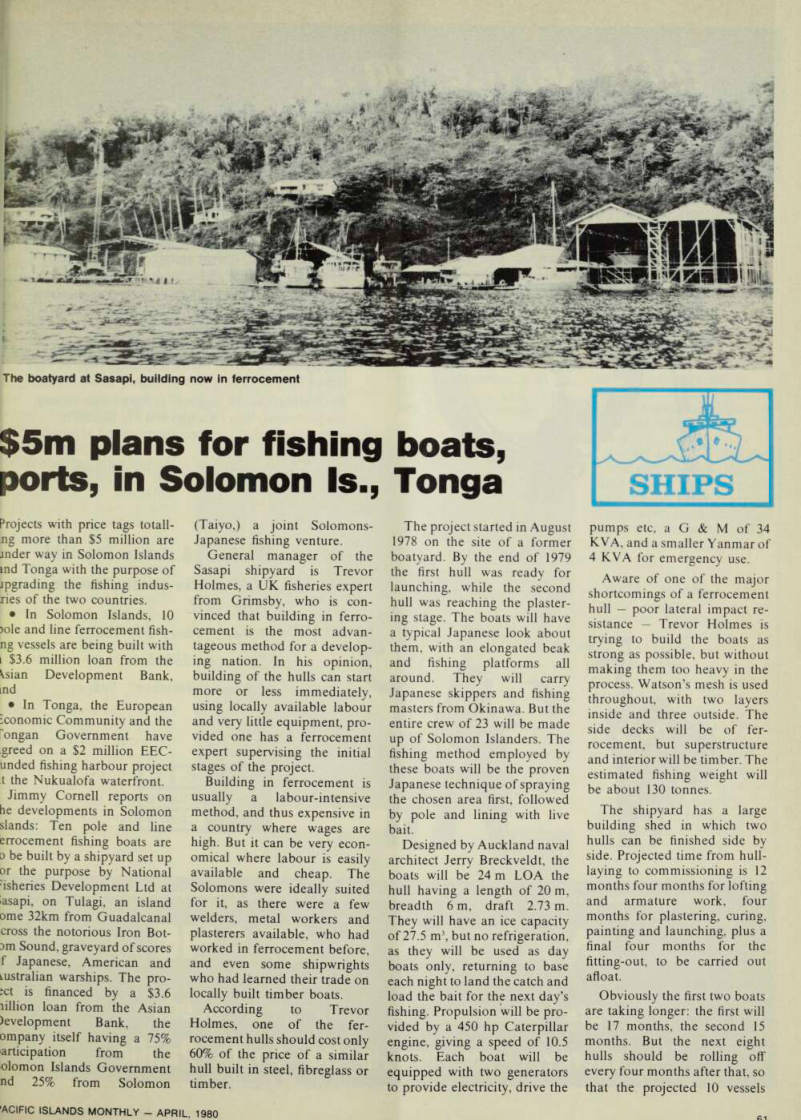

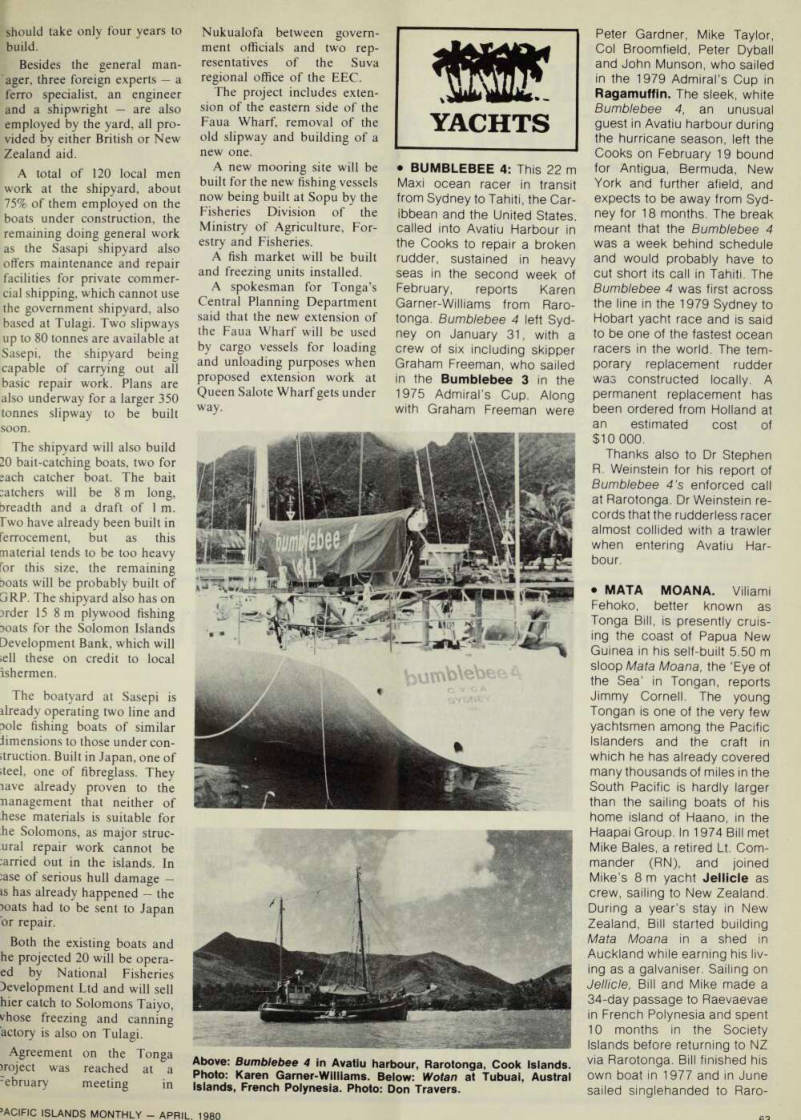
ports, in Solomon Is., Tonga
Ships
Projects with price tags totali ng more than $5 million are mder way in Solomon Islands md Tonga with the purpose of jpgrading the fishing indus ries of the two countries. • In Solomon Islands, 10 )ole and line ferrocement fish ng vessels are being built with i $3.6 million loan from the Vsian Development Bank, md • In Tonga, the European
iconomic Community and the
r ongan Government have greed on a $2 million EEC
unded fishing harbour project
t the Nukualofa waterfront.
Jimmy Cornell reports on
he developments in Solomon
slands: Ten pole and line
errocement fishing boats are
o be built by a shipyard set up or the purpose by National r isheries Development Ltd at ; asapi, on Tulagi, an island ome 32km from Guadalcanal cross the notorious Iron Bot om Sound, graveyard of scores f Japanese, American and Australian warships. The pro pel is financed by a $3.6 lillion loan from the Asian )evelopment Bank, the ompany itself having a 75% articipation from the olomon Islands Government nd 25% from Solomon
(Taiyo,) a joint Solomons- Japanese fishing venture.
General manager of the
Sasapi shipyard is Trevor
Holmes, a UK fisheries expert from Grimsby, who is con vinced that building in ferro cement is the most advan tageous method for a develop ing nation. In his opinion, building of the hulls can start more or less immediately,
using locally available labour
and very little equipment, pro vided one has a ferrocement expert supervising the initial stages of the project.
Building in ferrocement is usually a labour-intensive method, and thus expensive in a country where wages are high. But it can be very econ omical where labour is easily available and cheap. The Solomons were ideally suited for it, as there were a few welders, metal workers and plasterers available, who had worked in ferrocement before, and even some shipwrights who had learned their trade on locally built timber boats.
According to Trevor Holmes, one of the fer rocement hulls should cost only 60% of the price of a similar hull built in steel, fibreglass or timber.
The project started in August 1978 on the site of a former boatyard. By the end of 1979 the first hull was ready for launching, while the second hull was reaching the p astermg stage The boats will have a typical Japanese look about them, with an elongated beak and fishing platforms all around. They will carry
Japanese skippers and fishing
masters from Okinawa. But the entire crew of 23 will be made up of Solomon Islanders. The
fishing method employed by
these boats will be the proven
Japanese technique of spraying
the chosen area first, followed by pole and lining with live b a j t Designed by Auckland naval architect Jerry Breckveldt, the boats will be 24 m LOA the hull having a length of 20 m, breadth 6m, draft 2.73 m.
They will have an ice capacity of 27.5 m 3, but no refrigeration, as they will be used as day boats only, returning to base each night to land the catch and load the bait for the next day’s fishing. Propulsion will be provided by a 450 hp Caterpillar engine, giving a speed of 10.5 knots. Each boat will be equipped with two generators to provide electricity, drive the
pumps etc, a G & M of 34 KVA, and a smaller Yanmar of 4 KVA for emergency use.
Aware of one of the major shortcomings of a ferrocement hu „ ? |a(era , ; re . sistanc /_ Trevor Holmes is ■ t 0 build the boats as stron 5 as ible bu( without mak ing them too heavy in the procesf. Watson’s mesh is used throughout , with two , a s inside and thrce outside . V he side decks will be of fer . rocement, but superstructure and imerior wi „ be timber The estimated fishing weight wi |, be about , 30 tonnes.
shipyard has a large
building shed in which two hulls can hashed side by Slde - Projected time from hull
laymg t 0 commissioning is 12
months four months for loftm g and armature work, four m °nths for plastering, curing,
painting and launching, plus a
our mont hs for the fitting-out, to be carried out afloat.
Obviously the first two boats are taking longer: the first will be 17 months, the second 15 months. But the next eight hulls should be rolling off every four months after that, so that the projected 10 vessels
The boatyard at Sasapi, building now in ferrocement
should take only four years to build.
Besides the general man ager, three foreign experts a
ferro specialist, an engineer
and a shipwright are also
employed by the yard, all pro
vided by either British or New Zealand aid.
A total of 120 local men work at the shipyard, about 75% of them employed on the boats under construction, the
remaining doing general work
as the Sasapi shipyard also offers maintenance and repair facilities for private commer cial shipping, which cannot use the government shipyard, also based at Tulagi. Two slipways up to 80 tonnes are available at
Sasepi, the shipyard being
capable of carrying out all basic repair work. Plans are also underway for a larger 350 tonnes slipway to be built soon.
The shipyard will also build 20 bait-catching boats, two for sach catcher boat. The bait :atchers will be 8 m long, breadth and a draft of 1 m.
Two have already been built in ferrocement, but as this material tends to be too heavy for this size, the remaining boats will be probably built of GRP. The shipyard also has on
irder 15 8 m plywood fishing
Doats for the Solomon Islands Development Bank, which will jell these on credit to local ishermen.
The boatyard at Sasepi is already operating two line and Dole fishing boats of similar dimensions to those under con duction. Built in Japan, one of
Jteel, one of fibreglass. They
lave already proven to the management that neither of hese materials is suitable for he Solomons, as major struc ural repair work cannot be :arried out in the islands. In :ase of serious hull damage
is has already happened - the
loats had to be sent to Japan
or repair.
Both the existing boats and he projected 20 will be opera ed by National Fisheries Development Ltd and will sell hier catch to Solomons Taiyo,
vhose freezing and canning
actory is also on Tulagi.
Agreement on the Tonga
iroject was reached at a
February meeting in
Nukualofa between govern ment officials and two rep resentatives of the Suva regional office of the EEC.
The project includes exten sion of the eastern side of the Faua Wharf, removal of the old slipway and building of a new one.
A new mooring site will be built for the new fishing vessels now being built at Sopu by the Fisheries Division of the
Ministry of Agriculture, For
estry and Fisheries.
A fish market will be built and freezing units installed.
A spokesman for Tonga’s
Central Planning Department
said that the new extension of the Faua Wharf will be used by cargo vessels for loading and unloading purposes when proposed extension work at Queen Salote Wharf gets under way.
Advertisements & other items, pp. 61-70 (2 items)
61
'ACIFIC ISLANDS MONTHLY - APRIL, 1980
plumbing supplies fast
Total service 0n ...
Sr You can get all your needs from one supply source: water taps, valves, copper tube, tools and a host of other fittings and related plumbing equipment for domestic, industrial and multi-storey buildings.
Watson & Crane Pty Ltd have over 20,000 plumbing items in stock at their central warehouse located at Waterloo, NSW, Australia.
Years of experience in handling and shipping right throughout the South Pacific add up to another big reason for you to deal with Watson & Crane Pty Ltd.
Representatives call regularly at Papua New Guinea, the Solomons, New Hebrides and Fiji Islands to personally discuss your requirements and appropriate credit arrangements.
Write, cable or telephone today for complete plumbers' supplies service. r*: m Watson & Crane Pty. Ltd. 1037 Bourke Street, Waterloo,
NSW 2017.
Phone: Sydney 699-1333.
Telex: AA 25548.
Cables: "Watcrane" Sydney.
Pacific Island distributors of Crane Enfield copper tube for water, sanitation, engineering, refrigeration and air conditioning.
WATSON & CRANE
are organised to fulfil your needs
wherever you are in the South Pacific
In the home
SPEED-E-GAS
is fast, efficient
and reliable.
Terminals throughout the Pacific.
For more information write Boral Gas Limited, 221 Miller Street, North Sydney 2060 *Speed-E-Gas is known in Papua New Guinea, as Guinea Gas. In Tonga as Tonga Speed-E-Gas, and in Fiji as Fiji Gas.
BORAL
INTEGRATED TECHNICAL SERVICES
• SALES
• ON SITE INSTALLATION
• FIELD SERVICE
• HE, VHF.TJHF LINK AND MOBILE SYSTEMS
• GROUND AIR COMMUNICATIONS
• MARINE NAVIGATION AND COMMUNICATIONS
• AIRCRAFT ELECTRONIC SYSTEMS
DISTRIBUTORS OF;
• CODANHFSSB SYSTEMS
• PHILIPS VHF/UHFFM MOBILE SYSTEMS
• JRC MARINE RADAR, SOUNDERS, SATTELITE NAVIGATORS
• MAGNAVOX SATTELITE NAVIGATORS
• DECCA MARINE RADAR
• KING, MARCO, SUNAIR, COLLINS AIRCRAFT RADIO SYSTEMS
FIELD ENGINEERING INTEGRATED TECHNICAL SERVICES
P. 0. Box 350. Cairns 4870. Queensland. Australia.
Phone: (070) 51 1616.51 4826.53 1356,51 3052. Telex: AA 48085
MANUFACTURERS OF:
• PORTABLE DEPTH FINDERS
• HF RADIO SCANNERS
• VOICE SCRAMBLERS
• MICROPROCESSOR BASED
CONTROL SYSTEMS
CATAMARANS
Passenger ferries, passenger/cargo ferries, container feeder vessels, diving platforms, offshore supply vessels, livestock carriers.
All sizes of catamarans for all applications.
Maritime International P/L.
P.O Box 995, Southport, Queensland 4215, Aust.
x&v.
V** 5 * 2S^ ■ m mm fA % \N IS 9 a\s U da to' eSe Ae\s' a eSSeS ' I ;v e a " w : «ro^ c^ces - ea-- soo es. 90Nl^ - °' 9 '° W' cxi ) a "*:;•.«
lV & So se !'^
\SsS> CC®
ve^e^°''
eQ®' 9 auvo \ r & l l
3 V . WV^^'»
o oV^^^a2^'^ o^o v a^ v 90'°' a\N c s.s^ %006- M A\o®’
tSV'
t*" ms^
HENRY CURRIES
PTY LTD.
EXPORTERS o GENERAL MERCHANTS
428 GEORGE ST., SYDNEY
CABLES: HENCO SYDNEY. G.P.O. Box 3949. PHONE; 232-5377 For specialised and personalised buying service throughout the Pacific Islands and the East.
• LOCAL AGENTS AND REPRESENTATION: •-
PAPUA NEW GUINEA: FIJI:
SOLOMON ISLANDS:
Mr. Tom Lo, P.O. Box 327, Honiara.
Telephone 399.
Resident Affen ts in other Pacific Territories. •- RABAUL: M. & C. Seeto P.O. Box 131, Rabaul.
Telephone 92-2919.
K, Witherlngton Ltd., P.O. Box 293, Suva.
Telephone 22-356.
MADANG; W. Double, P.O. Box 22, M3dang.
Telephone 82-2696.
NEW HEBRIDES:
John Lum & Associates, P.O. Box 65, Santo.
Telephone 329.
m PACIFIC
II FORUm
Line
nWMFn RV TUP Peni
OWNED BY THE PEOPLE
OF THE PACIFIC ISLANDS
Regular Monthly Liner Services
from Australia and New Zealand
to the South and Central Pacific
FOR INFORMATION CONTACT AGENTS:
AMERICAN SAMOA:
Polynesian Shipping Services Inc. P.O. Box 1478, Pago Pago.
AUSTRALIA:
The Australian National Line, 50 Queen Street, Melbourne.
Union Bulkships Pty.Ltd., 333-339 George Street. Sydney.
GILBERT ISLANDS:
Gilbert Islands Shipping Corp. P.O. Box 495, Tarawa.
FIJI:
Burns Philp South Sea Co. Ltd. GPO Box 355, Suva.
NEW CALEDONIA:
ETS Ballande, BP. C 4, Noumea.
NEW HEBRIDES:
Burns Philp New Hebrides Limited. Vila.
NEW ZEALAND;
The Shipping Corp. of N.Z. Ltd. P.O. Box 3344, Wellington.
PAPUA NEW GUINEA:
Steamships Trading Co. Ltd. P.O. Box 1, Port Moresby.
SOLOMON ISLANDS;
Sullivans S.l. Ltd. GPO Box 3, Honiara.
TONGA:
Union Steam Ship Co. P.O. Box 4, Nukualofa.
YUASA
BATTERY
Indispensable on
Cars and Vehicles
that support Modern
Industrial Society
Tuas
B AT
'ERv
CO CTO
uie
JUASA
Yuasa
MANUFACTURERS OF All KINDS OF
ELECTRIC BATTERIES AND RELATED
ELECTRICAL APPLIANCES
YUASA BATTERY CO., LTD.
No. 12-11, 2-Chome, Higashi-Shimbashi Minato-ku, Tokyo 105, Japan Phone: Tokyo (03) 437-2411
Cable : YUASABATRY TOKYO
Telex : 29228 YBCTOK
TAMROC’
HYBRID PIGS FOR THE PACIFIC BASIN
Hardy sunburn resistant prolific excellent foragers.
A new red-gold hybrid pig espcially developed for tropical Pacific Island conditions.
This new breeding strain has been developed from imported pedigree Duroc-Jersey and Tamworth varieties Young breeding stock now available.
For further information write to;
SPRINGFIELD FARM, P.O. BOX 18-050, GLEN
INNES, AUCKLAND 6, NEW ZEALAND.
THE
DIFFERENCE
BETWEENA
LONG RUN AND
AN ALSO RAN
IS JUST
ONE WORD
to custom designed bearings for special purposes, you’ll find that investing in the best costs less in the long run. Particularly when you add in a number of other factors.
Availability for example. What we and our Authorised Distributors keep on the shelf can keep you off the hook when it comes to prompt supply of bearings.
Qualified sales and service engineers are also available to help you with design, installation and maintenance problems.
Reliability is a word we’d like to talk to you about very soon.
Australian Timken Proprietary Limited Ballarat, Victoria.
TIMKEN
REGISTERED TRADE MARK
TAPERED ROLLER BEARINGS
TIMKEN
RELIABILITY!
Whatever you are designing, maintaining or repairing, you want a long run for your time and effort.
And Timken” tapered roller bearings ensure just that.
Throughout the world, they are manufactured to consistent standards of design and quality. So even when working with imported equipment, you know that Timken bearings bought in Australia will fit.
But it’s not quality at any price.
From off the shelf bearings to suit thousands of general applications 3416 AT
GLOBAL SERVICE FOR SHIPPERS
V
THE
LINE
. - <£~
28 Day Service
United Kingdom and Continent to:
PAPEETE • NOUMEA
PAPUA NEW GUINEA and SOLOMON ISLANDS
PO RT VI LA & SANTO BY TRANSHIPMENT * United Kingdom and Continent to: SUVA AND LAUTOKA (FCL LCL & UNITISED ONLY) * Papua New Guinea and Solomon Islands to:
UNITED KINGDOM and CONTINENT
For particulars apply:
THE BANK LINE (AUSTRALASIA) PTY LTD.
18th Floor 1 Yori< Street SYDNEY N.S.W 2000 Australia Tel: 272041 Telex: 24063 nh
Yachts

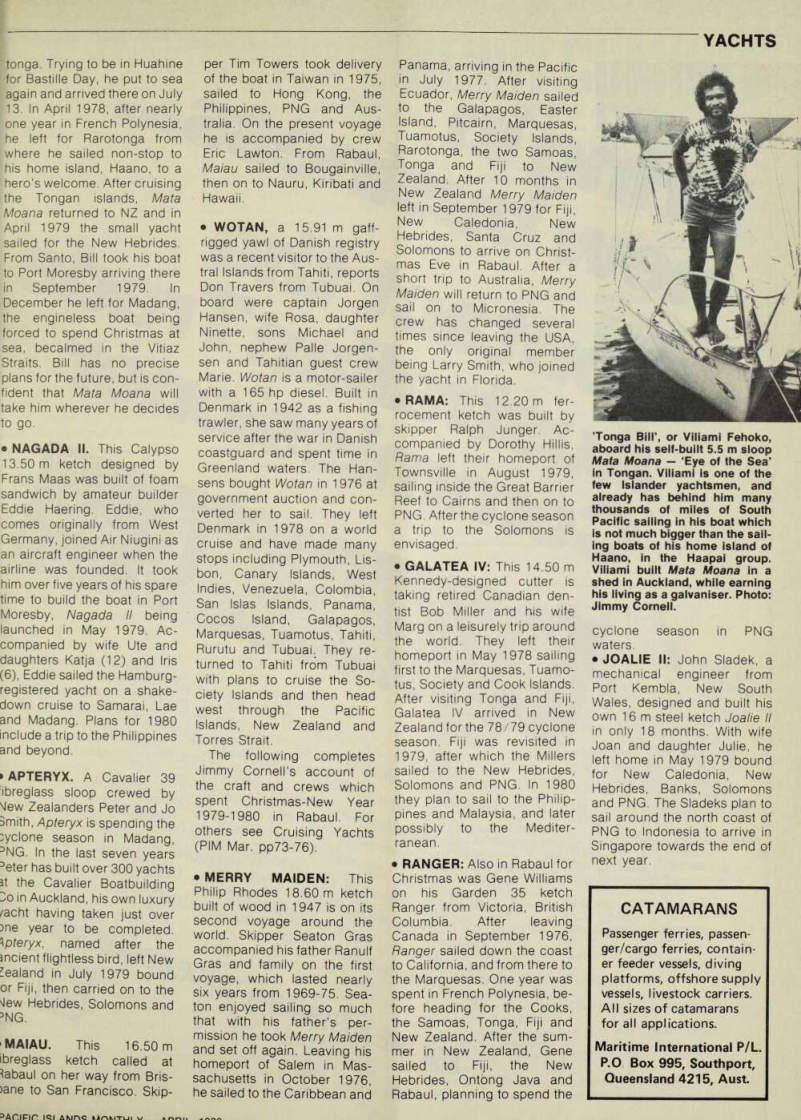
• Bumblebee 4: This 22 M
Maxi ocean racer in transit from Sydney to Tahiti, the Car ibbean and the United States, called into Avatiu Harbour in the Cooks to repair a broken rudder, sustained in heavy seas in the second week of February, reports Karen Garner-Williams from Raro tonga. Bumblebee 4 left Syd ney on January 31, with a crew of six including skipper Graham Freeman, who sailed in the Bumblebee 3 in the 1975 Admiral’s Cup. Along with Graham Freeman were
Peter Gardner, Mike Taylor, Col Broomfield, Peter Dyball and John Munson, who sailed in the 1979 Admiral’s Cup in Ragamuffin. The sleek, white Bumblebee 4, an unusual guest in Avatiu harbour during the hurricane season, left the Cooks on February 19 bound for Antigua, Bermuda, New York and further afield, and expects to be away from Syd ney for 18 months. The break meant that the Bumblebee 4 was a week behind schedule and would probably have to cut short its call in Tahiti. The Bumblebee 4 was first across the line in the 1979 Sydney to Hobart yacht race and is said to be one of the fastest ocean racers in the world. The tem porary replacement rudder was constructed locally. A permanent replacement has been ordered from Holland at an estimated cost of $lO 000.
Thanks also to Dr Stephen R. Weinstein for his report of Bumblebee 4's enforced call at Rarotonga. Dr Weinstein re cords that the rudderless racer almost collided with a trawler when entering Avatiu Har bour. • MATA MOANA. Viliami Fehoko, better known as Tonga Bill, is presently cruis ing the coast of Papua New Guinea in his self-built 5.50 m sloop Mata Moana, the ‘Eye of the Sea’ in Tongan, reports Jimmy Cornell. The young Tongan is one of the very few yachtsmen among the Pacific Islanders and the craft in which he has already covered many thousands of miles in the South Pacific is hardly larger than the sailing boats of his home island of Haano, in the Haapai Group. In 1974 Bill met Mike Bales, a retired Lt. Com mander (RN), and joined Mike’s 8 m yacht Jellicle as crew, sailing to New Zealand.
During a year’s stay in New Zealand, Bill started building Mata Moana in a shed in Auckland while earning his liv ing as a galvaniser. Sailing on Jellicle, Bill and Mike made a 34-day passage to Raevaevae in French Polynesia and spent 10 months in the Society Islands before returning to NZ via Rarotonga. Bill finished his own boat in 1977 and in June sailed singlehanded to Rare
Above: Bumblebee 4 in Avatiu harbour, Rarotonga, Cook Islands.
Photo: Karen Garner-Williams. Below: Wotan at Tubuai, Austral Islands, French Polynesia. Photo: Don Travers.
tonga. Trying to be in Huahine for Bastille Day, he put to sea again and arrived there on July 13. In April 1978, after nearly one year in French Polynesia, he left for Rarotonga from where he sailed non-stop to his home island, Haano, to a hero’s welcome. After cruising the Tongan islands, Mata Moana returned to NZ and in April 1979 the small yacht sailed for the New Hebrides.
From Santo, Bill took his boat to Port Moresby arriving there in September 1979. In December he left for Madang, the engineless boat being forced to spend Christmas at sea, becalmed in the Vitiaz Straits. Bill has no precise plans for the future, but is con fident that Mata Moana will take him wherever he decides to go. • NAGADA 11. This Calypso 13.50 m ketch designed by Frans Maas was built of foam sandwich by amateur builder Eddie Haering. Eddie, who comes originally from West Germany, joined Air Niugini as an aircraft engineer when the airline was founded. It took him over five years of his spare time to build the boat in Port Moresby, Nagada II being launched in May 1979. Ac companied by wife Ute and daughters Katja (12) and Iris (6), Eddie sailed the Hamburg registered yacht on a shake down cruise to Samarai, Lae and Madang. Plans for 1980 include a trip to the Philippines and beyond. ► APTERYX. A Cavalier 39 ibreglass sloop crewed by Mew Zealanders Peter and Jo Smith, Apteryx is spending the
cyclone season in Madang,
3 NG. In the last seven years 3 eter has built over 300 yachts
it the Cavalier Boatbuilding
So in Auckland, his own luxury having taken just over )ne year to be completed. \pteryx, named after the indent flightless bird, left New Zealand in July 1979 bound or Fiji, then carried on to the view Hebrides, Solomons and 3 NG.
'MAIAU. This 16.50 m ibreglass ketch called at tebaul on her way from Bris )ane to San Francisco. Skip
per Tim Towers took delivery of the boat in Taiwan in 1975, sailed to Hong Kong, the Philippines, PNG and Aus tralia. On the present voyage he is accompanied by crew Eric Lawton. From Rabaul, Maiau sailed to Bougainville, then on to Nauru, Kiribati and Hawaii. • WOTAN, a 15.91 m gaff rigged yawl of Danish registry was a recent visitor to the Aus tral Islands from Tahiti, reports Don Travers from Tubuai. On board were captain Jorgen Hansen, wife Rosa, daughter Ninette, sons Michael and John, nephew Palle Jorgen sen and Tahitian guest crew Marie. Wotan is a motor-sailer with a 165 hp diesel. Built in Denmark in 1942 as a fishing trawler, she saw many years of service after the war in Danish coastguard and spent time in Greenland waters. The Han sens bought Wotan in 1976 at government auction and con verted her to sail. They left Denmark in 1978 on a world cruise and have made many stops including Plymouth, Lis bon, Canary Islands, West Indies, Venezuela, Colombia, San Islas Islands, Panama, Cocos Island, Galapagos, Marquesas, Tuamotus, Tahiti, Rurutu and Tubuai. They re turned to Tahiti from Tubuai with plans to cruise the So ciety Islands and then head west through the Pacific Islands, New Zealand and Torres Strait.
The following completes Jimmy Cornell’s account of the craft and crews which spent Christmas-New Year 1979-1980 in Rabaul. For others see Cruising Yachts (PIM Mar. pp 73-76).
• Merry Maiden: This
Philip Rhodes 18.60 m ketch built of wood in 1947 is on its second voyage around the world. Skipper Seaton Gras accompanied his father Ranulf Gras and family on the first voyage, which lasted nearly six years from 1969-75. Sea ton enjoyed sailing so much that with his father’s per mission he took Merry Maiden and set off again. Leaving his homeport of Salem in Mas sachusetts in October 1976, he sailed to the Caribbean and
Panama, arriving in the Pacific in July 1977. After visiting Ecuador, Merry Maiden sailed to the Galapagos, Easter Island, Pitcairn, Marquesas, Tuamotus, Society Islands, Rarotonga, the two Samoas, Tonga and Fiji to New Zealand. After 10 months in New Zealand Merry Maiden left in September 1979 for Fiji, New Caledonia, New Hebrides, Santa Cruz and Solomons to arrive on Christ mas Eve in Rabaul. After a short trip to Australia, Merry Maiden will return to PNG and sail on to Micronesia. The crew has changed several times since leaving the USA, the only original member being Larry Smith, who joined the yacht in Florida. • RAMA: This 12.20 m ter rocement ketch was built by skipper Ralph Junger. Ac companied by Dorothy Hillis, Rama left their homeport of Townsville in August 1979, sailing inside the Great Barrier Reef to Cairns and then on to PNG. After the cyclone season a trip to the Solomons is envisaged.
• Galatea Iv: This 14.50 M
Kennedy-designed cutter is taking retired Canadian den tist Bob Miller and his wife Marg on a leisurely trip around the world. They left their homeport in May 1978 sailing first to the Marquesas, Tuamo tus, Society and Cook Islands.
After visiting Tonga and Fiji, Galatea IV arrived in New Zealand for the 78/79 cyclone season. Fiji was revisited in 1979, after which the Millers sailed to the New Hebrides, Solomons and PNG. In 1980 they plan to sail to the Philip pines and Malaysia, and later possibly to the Mediter ranean. • RANGER: Also in Rabaul for Christmas was Gene Williams on his Garden 35 ketch Ranger from Victoria, British Columbia. After leaving Canada in September 1976, Ranger sailed down the coast to California, and from there to the Marquesas. One year was spent in French Polynesia, be fore heading for the Cooks, the Samoas, Tonga, Fiji and New Zealand. After the sum mer in New Zealand, Gene sailed to Fiji, the New Hebrides, Ontbng Java and Rabaul, planning to spend the
cyclone season in PNG waters. • JOALIE II: John Sladek, a mechanical engineer from Port Kembla, New South Wales, designed and built his own 16 m steel ketch Joalie II in only 18 months. With wife Joan and daughter Julie, he left home in May 1979 bound for New Caledonia, New Hebrides, Banks, Solomons and PNG. The Sladeks plan to sail around the north coast of PNG to Indonesia to arrive in Singapore towards the end of next year.
Tonga BIN’, or Viliami Fehoko, aboard his self-built 5.5 m sloop
Mata Moana ‘Eye of the Sea’
In Tongan. Viliami is one of the few Islander yachtsmen, and already has behind him many thousands of miles of South Pacific sailing in his boat which is not much bigger than the sail ing boats of his home island of Haano, In the Haapai group.
Viliami built Mata Moana in a shed in Auckland, while earning his living as a galvaniser. Photo:
Jimmy Cornell.
Advertisements & other items, pp. 63-67 (3 items)
63
S ACIFIC ISLANDS MONTHLY - APRIL 1980
Yachts
Egan Report
67
ACIFIC ISLANDS MONTHLY - APRIL, 1980
(continued from page 14)
Services
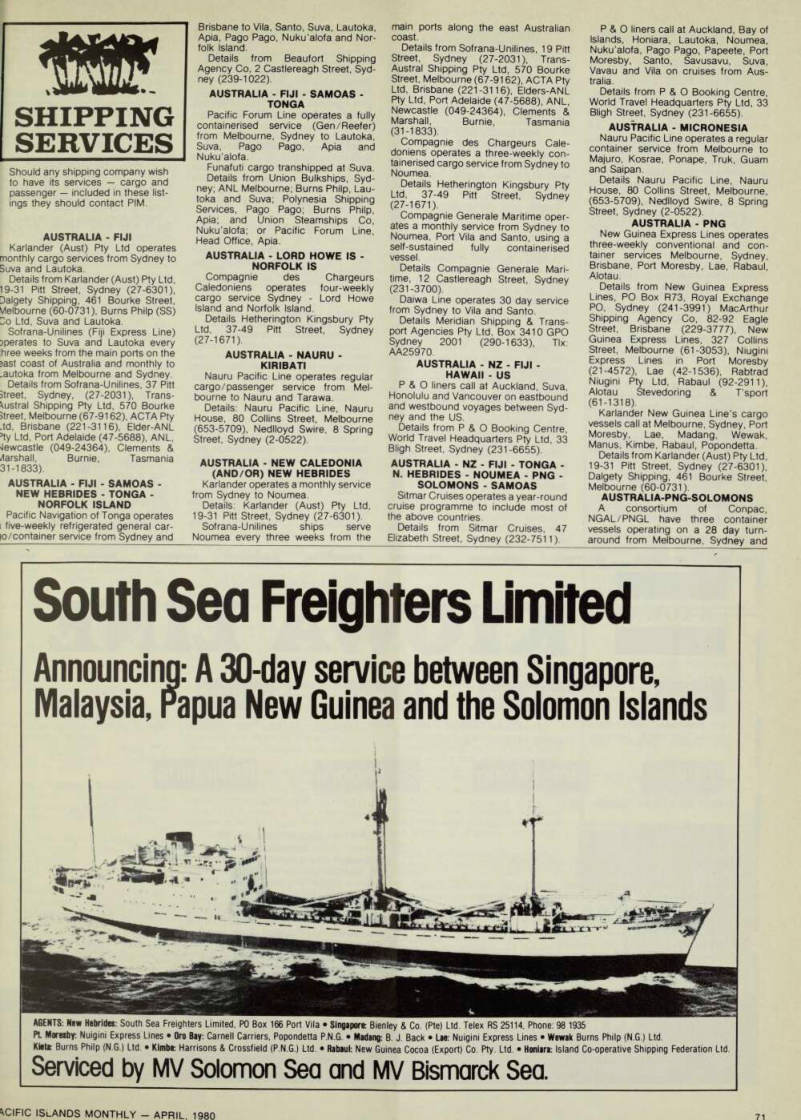
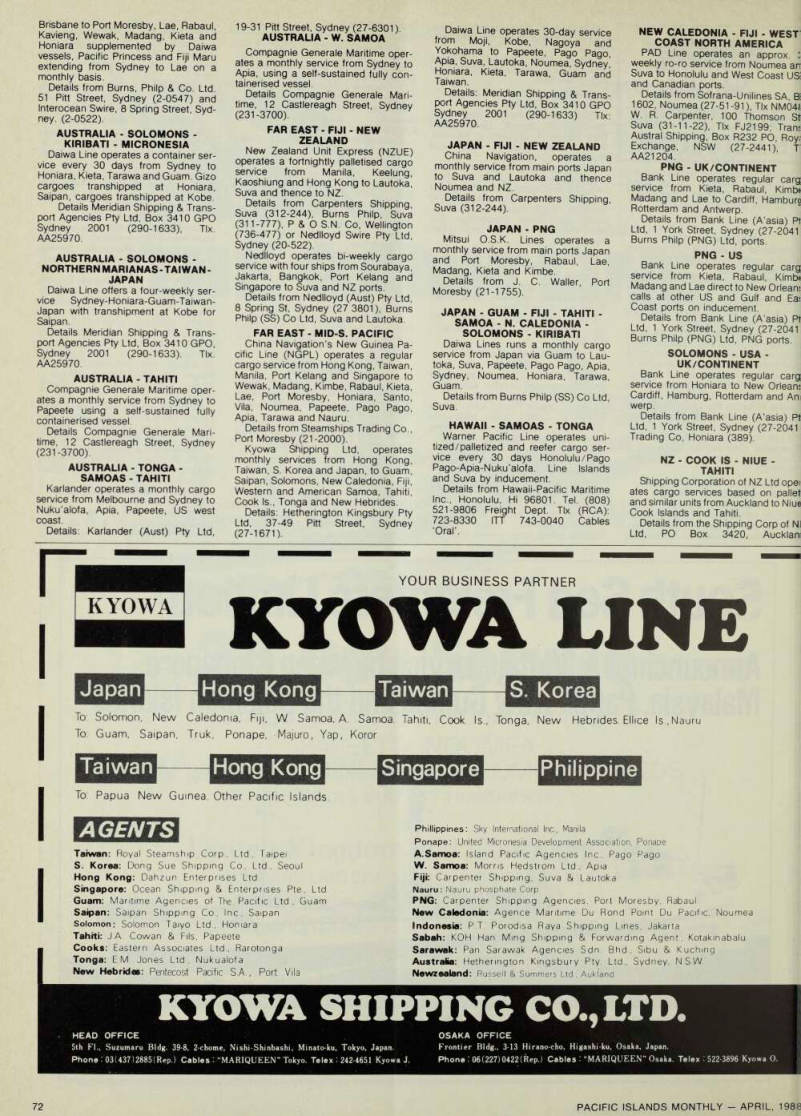
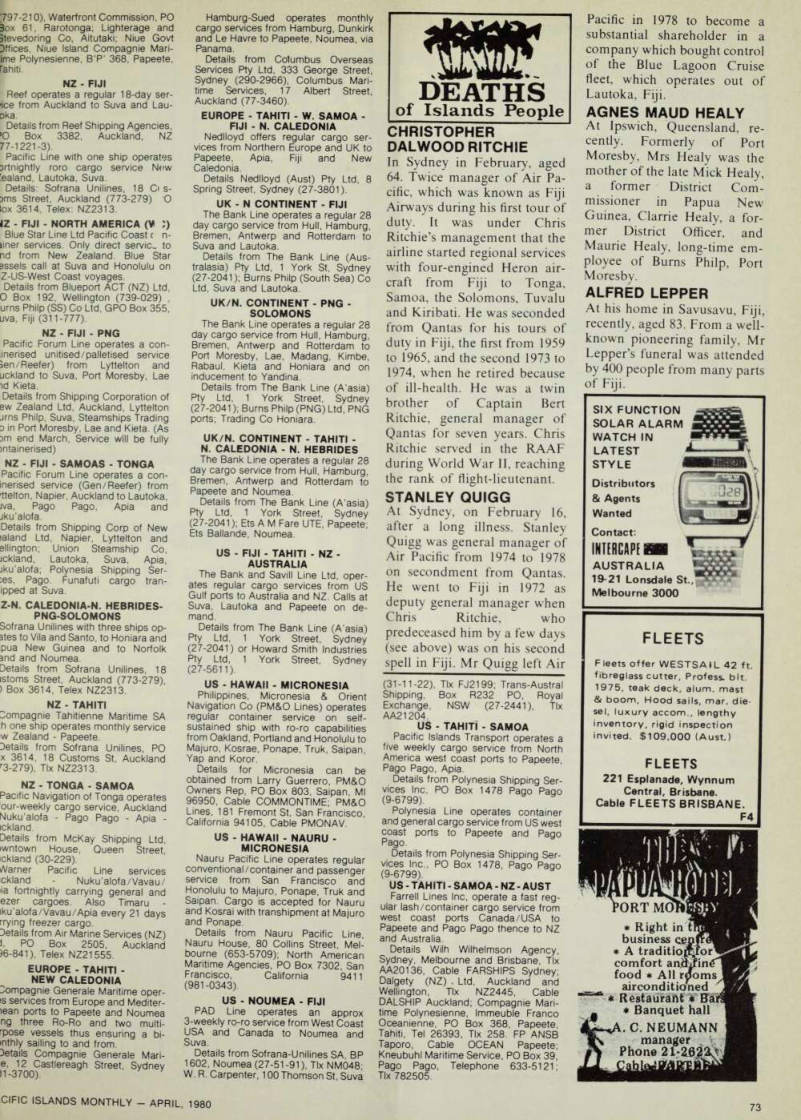
Shipping
Should any shipping company wish to have its services cargo and passenger included in these list ings they should contact PIM.
Australia - Fiji
Karlander (Aust) Pty Ltd operates monthly cargo services from Sydney to Suva and Lautoka.
Details from Karlander (Aust) Pty Ltd, 19-31 Pitt Street, Sydney (27-6301), Oalgety Shipping, 461 Bourke Street, Melbourne (60-0731), Burns Philp (SS) Do Ltd, Suva and Lautoka.
Sofrana-Unilines (Fiji Express Line) operates to Suva and Lautoka every hree weeks from the main ports on the jast coast of Australia and monthly to .autoka from Melbourne and Sydney.
Details from Sofrana-Unilines, 37 Pitt Street, Sydney, (27-2031), Trans \ustral Shipping Pty Ltd, 570 Bourke Street, Melbourne (67-9162), ACTA Pty .td, Brisbane (221-3116), Elder-ANL >ty Ltd, Port Adelaide (47-5688), ANL, Newcastle (049-24364), Clements & Marshall, Burnie, Tasmania 31-1833).
Australia - Fiji - Samoas -
New Hebrides - Tonga -
Norfolk Island
Pacific Navigation of Tonga operates i five-weekly refrigerated general car lo/container service from Sydney and
Brisbane to Vila, Santo, Suva, Lautoka, Apia, Pago Pago, Nukualofa and Nor folk Island.
Details from Beaufort Shipping Agency Co, 2 Castlereagh Street, Syd ney (239-1022).
Australia - Fiji - Samoas -
Tonga
Pacific Forum Line operates a fully containerised service (Gen /Reefer) from Melbourne, Sydney to Lautoka, Suva, Pago Pago, Apia and Nuku’alofa.
Funafuti cargo transhipped at Suva.
Details from Union Bulkships, Syd ney; ANL Melbourne; Burns Philp, Lau toka and Suva; Polynesia Shipping Services, Pago Pago; Burns Philp, Apia; and Union Steamships Co, Nuku’alofa; or Pacific Forum Line, Head Office, Apia.
Australia - Lord Howe Is -
Norfolk Is
Compagnie des Chargeurs Caledoniens operates four-weekly cargo service Sydney - Lord Howe Island and Norfolk Island.
Details Hetherington Kingsbury Pty Ltd, 37-49 Pitt Street, Sydney (27-1671).
Australia - Nauru -
Kiribati
Nauru Pacific Line operates regular cargo/passenger service from Mel bourne to Nauru and Tarawa.
Details: Nauru Pacific Line, Nauru House, 80 Collins Street, Melbourne (653-5709), Nedlloyd Swire, 8 Spring Street, Sydney (2-0522).
Australia - New Caledonia
(And/Or) New Hebrides
Karlander operates a monthly service from Sydney to Noumea.
Details: Karlander (Aust) Pty Ltd. 19-31 Pitt Street, Sydney (27-6301).
Sofrana-Unilines ships serve Noumea every three weeks from the
main ports along the east Australian coast - Details from Sofrana-Unilines, 19 Pitt Street, Sydney (27-2031), Trans- Austral Shipping Pty Ltd, 570 Bourke Street, Melbourne (67-9162), ACTA Pty Ltd, Brisbane (221-3116), Elders-ANL Ry Ltd, Port Adelaide (47-5688), ANL, Newcastle (049-24364), Clements & Marshall Burnie, Tasmania Compagnie des Chargeurs Caledoniens operates a three-weekly containerised cargo service from Sydney to Noumea. y Details Hetherington Kingsbury Pty Ltd 37-49 Pitt Strppt qjrinpv (27-1671) 1 V Compagnie Generate Maritime operates a monthly service from Sydney to Noumea, Port Vila and Santo using a self-sustained fully containerised vessel.
Details Compagnie Generate Maritime, 12 Castlereagh Street, Sydney (231-3700).
Daiwa Line operates 30 day service from Sydney to Vila and Santo Details Meridian Shipping & Transport Agencies Pty Ltd, Box 3410 GPO Sydney 2001 (290-1633) Tlx AA25970. '
Australia -N7 Fi Ii
Hawaii -Us
p &O liners call at Auckland, Suva, Honolulu and Vancouver on eastbound and westbound voyages between Sydney and the US 1 Details from P & O Booking Centre, World Travel Headquarters Pty Ltd, 33 Bligh Street, Sydney (231-6655). 71 v ’
AUSTRALIA - NZ - FIJI - TONGA - N. HEBRIDES - NOUMEA - PNG -
Solomons - Samoas
Sitmar Cruises operates a year-round cruise programme to include most of the above countries.
Details from Sitmar Cruises, 47 Elizabeth Street, Sydney (232-7511).
P & O liners call at Auckland, Bay of Islands, Honiara, Lautoka, Noumea, Nukualofa. Pago Pago, Papeete, Port Moresby, Santo, Savusavu, Suva, Vavau and Vila on cruises from Aus tralia.
Details from P & O Booking Centre.
World Travel Headquarters Pty Ltd, 33 Bligh Street, Sydney (231-6655).
Australia - Micronesia
N f uru Pacific Lin f operata ® a re 9 ular M ® lb< ? ur £ e t 0 Kosrae ' Ponape, Truk, Guam a ndSapan n . w P^S ,f,C * 4 r ] e ; K NaUrU House, 80 Collins Street. Melbourne, (653-5709). Nedlloyd Swire. 8 Spring street ' Sy f I na^?' 9 f 22^
. Australia - Png
New Guinea Express Lines operates three-weekly conventional and con tainer services Melbourne, Sydney, Brisbane, Port Moresby, Lae, Rabaul, Al ° tau - , Details from New Guinea Express k£ es, « P 0 Box R73 ' Royal Exchange PG ' Sydney (241-3991) MacArthur Shipping Agency Co, 82-92 Eagle Street, Brisbane (229-3777), New Guinea Express Lines, 327 Collins Street, Melbourne (61-3053), Niugini Express Lines in Port Moresby (21-4572). Lae (42-1536), Rabtrad Pty Ltd. Rabaul (92-2911) n, m S ,evedonn 9 & Tsport M . ...
Karlander New Guinea Line s cargo r sala caN at Me'bourne. Sydney. Port K?L !: ae, D K Ma ? a D 9 ’ 'J /awak - Manus. Kimbe Rabaul, Popondetta Details from Karlander (Aust) Pty Ltd 19-31 Pitt Street. Sydney (27-6301), Dalgety Shipping, 461 Bourke Street, Melbourne (60-0731).
Australia-Png-Solomons
A consortium of Conpac NGAL/PNGL have three container vessels operating on a 28 day turn around from Melbourne, Sydney and
Brisbane to Port Moresby, Lae, Rabaul, Kavieng, Wewak, Madang, Kieta and Honiara supplemented by Daiwa vessels, Pacific Princess and Fiji Maru extending from Sydney to Lae on a monthly basis.
Details from Burns, Philp & Co. Ltd. 51 Pitt Street, Sydney (2-0547) and Interocean Swire, 8 Spring Street, Syd ney. (2-0522).
Australia - Solomons -
Kiribati - Micronesia
Daiwa Line operates a container ser vice every 30 days from Sydney to Honiara, Kieta, Tarawa and Guam. Gizo cargoes transhipped at Honiara, Saipan, cargoes transhipped at Kobe.
Details Meridian Shipping & Trans port Agencies Pty Ltd, Box 3410 GPO Sydney 2001 (290-1633), Tlx.
AA25970.
Australia - Solomons -
Northern Marianas-Taiwan
Japan
Daiwa Line offers a four-weekly ser vice Sydney-Honiara-Guam-Taiwan- Japan with transhipment at Kobe for Saipan.
Details Meridian Shipping & Trans port Agencies Pty Ltd, Box 3410 GPO, Sydney 2001 (290-1633). Tlx.
AA25970.
Australia - Tahiti
Compagnie Generate Maritime oper ates a monthly service from Sydney to Papeete using a self-sustained fully containerised vessel.
Details Compagnie Generate Mari time, 12 Castlereagh Street, Sydney (231 -3700).
Australia - Tonga -
Samoas - Tahiti
Karlander operates a monthly cargo service from Melbourne and Sydney to Nuku'alofa, Apia, Papeete, US west coast.
Details: Karlander (Aust) Pty Ltd,
19-31 Pitt Street. Sydney (27-6301)
Australia - W. Samoa
Compagnie Generate Maritime oper ates a monthly service from Sydney to Apia, using a self-sustained fully con tainerised vessel.
Details Compagnie Generate Mari time, 12 Castlereagh Street, Sydney (231-3700).
Far East - Fiji - New
Zealand
New Zealand Unit Express (NZUE) operates a fortnightly palletised cargo service from Manila, Keelung, Kaoshiung and Hong Kong to Lautoka, Suva and thence to NZ.
Details from Carpenters Shipping, Suva (312-244), Burns Philp, Suva (311-777), P & O S.N. Co, Wellington (736-477) or Nedlloyd Swire Pty Ltd, Sydney (20-522).
Nedlloyd operates bi-weekly cargo service with four ships from Sourabaya, Jakarta, Bangkok, Port Kelang and Singapore to Suva and NZ ports.
Details from Nedlloyd (Aust) Pty Ltd, 8 Spring St, Sydney (27 3801), Burns Philp (SS) Co Ltd, Suva and Lautoka.
Far East - Mid-S. Pacific
China Navigation’s New Guinea Pa cific Line (NGPL) operates a regular cargo service from Hong Kong, Taiwan, Manila, Port Kelang and Singapore to Wewak, Madang, Kimbe, Rabaul, Kieta, Lae, Port Moresby, Honiara, Santo, Vila, Noumea, Papeete, Pago Pago, Apia, Tarawa and Nauru.
Details from Steamships Trading Co., Port Moresby (21-2000).
Kyowa Shipping Ltd, operates monthly services from Hong Kong, Taiwan, S. Korea and Japan, to Guam, Saipan, Solomons, New Caledonia, Fiji, Western and American Samoa, Tahiti, Cook Is., Tonga and New Hebrides.
Details: Hetherington Kingsbury Pty Ltd, 37-49 Pitt Street, Sydney (27-1671).
Daiwa Line operates 30-day service from Moji, Kobe, Nagoya and Yokohama to Papeete, Pago Pago, Apia, Suva, Lautoka. Noumea, Sydney!
Honiara, Kieta, Tarawa, Guam and Taiwan.
Details: Meridian Shipping & Trans port Agencies Pty Ltd, Box 3410 GPO Sydney 2001 (290-1633) Tlx AA25970.
Japan - Fiji - New Zealand
China Navigation, operates a monthly service from main ports Japan to Suva and Lautoka and thence Noumea and NZ.
Details from Carpenters Shipping Suva (312-244).
Japan - Png
Mitsui O.S.K. Lines operates a monthly service from main ports Japan and Port Moresby, Rabaul, Lae, Madang, Kieta and Kimbe.
Details from J. C. Waller. Port Moresby (21-1755).
JAPAN - GUAM - FIJI - TAHITI -
Samoa - N. Caledonia -
Solomons - Kiribati
Daiwa Lines runs a monthly cargo service from Japan via Guam to Lau toka, Suva, Papeete, Pago Pago, Apia, Sydney, Noumea, Honiara, Tarawa, Guam.
Details from Burns Philp (SS) Co Ltd, Suva.
Hawaii - Samoas - Tonga
Warner Pacific Line operates uni tized/palletized and reefer cargo ser vice every 30 days Honolulu/Pago Pago-Apia-Nuku’alofa. Line Islands and Suva by inducement.
Details from Hawaii-Pacific Maritime Inc., Honolulu, Hi 96801. Tel. (808) 521-9806 Freight Dept. Tlx (RCA): 723-8330 ITT 743-0040 Cables ‘Oral’.
New Caledonia - Fiji - West'
Coast North America
PAD Line operates an approx. C weekly ro-ro service from Noumea an Suva to Honolulu and West Coast USE and Canadian ports.
Details from Sofrana-Unilines SA, BE 1602, Noumea (27-51 -91), Tlx NMO4i W. R. Carpenter, 100 Thomson St Suva (31-11-22), Tlx FJ2199; Trans Austral Shipping, Box R 232 PC, Roy?
Exchange, NSW (27-2441), T AA21204.
Png - Uk/Continent
Bank Line operates regular carg service from Kieta. Rabaul, Kimb« Madang and Lae to Cardiff, Hamburg Rotterdam and Antwerp.
Details from Bank Line (A'asia) Pt Ltd, 1 York Street, Sydney (27-2041 Burns Philp (PNG) Ltd, ports.
Png - Us
Bank Line operates regular carg service from Kieta, Rabaul, Kimb« Madang and Lae direct to New Orleans calls at other US and Gulf and Ea: Coast ports on inducement.
Details from Bank Line (A’asia) Pt Ltd, 1 York Street, Sydney (27-2041 Burns Philp (PNG) Ltd, PNG ports.
Solomons - Usa -
Uk/Continent
Bank Line operates regular carg service from Honiara to New Orleans Cardiff, Hamburg, Rotterdam and Am werp.
Details from Bank Line (A'asia) Pt Ltd, 1 York Street, Sydney (27-2041 Trading Co, Honiara (389).
NZ - COOK IS - NIUE -
Tahiti
Shipping Corporation of NZ Ltd open ates cargo services based on pallet and similar units from Auckland to Niue Cook Islands and Tahiti.
Details from the Shipping Corp of Nl Ltd, PO Box 3420, Aucklanr
[797-210), Waterfront Commission, PO 3ox 61, Rarotonga; Lighterage and Stevedoring Co, Aitutaki; Niue Govt Offices, Niue Island Compagnie Mari ime Polynesienne, B’P’ 368, Papeete, Fahiti.
Nz - Fiji
Reef operates a regular 18-day ser ies from Auckland to Suva and Lau oka.
Details from Reef Shipping Agencies, •O Box 3382, Auckland, NZ 77-1221-3).
Pacific Line with one ship operates xtnightly roro cargo service New tealand, Lautoka, Suva.
Details: Sofrana Unilines, 18 D s >ms Street, Auckland (773-279) O lox 3614, Telex: NZ2313.
IZ • FIJI - NORTH AMERICA (V ',) Blue Star Line Ltd Pacific Coast c n liner services. Only direct servic„ to nd from New Zealand. Blue Star Bssels call at Suva and Honolulu on Z-US-West Coast voyages.
Details from Blueport ACT (NZ) Ltd, O Box 192, Wellington (739-029) , urns Philp (SS) Co Ltd, GPO Box 355, uva, Fiji (311-777).
Nz - Fiji - Png
Pacific Forum Line operates a con inerised unitised/palletised service sen/Reefer) from Lyttelton and uckland to Suva, Port Moresby, Lae id Kieta.
Details from Shipping Corporation of ew Zealand Ltd, Auckland, Lyttelton jrns Philp, Suva, Steamships Trading d in Port Moresby, Lae and Kieta. (As )m end March, Service will be fully mtainerised) NZ - FIJI - SAMOAS - TONGA Pacific Forum Line operates a con inerised service (Gen/Reefer) from Helton, Napier. Auckland to Lautoka, iva, Pago Pago, Apia and jku'alofa.
Details from Shipping Corp of New (aland Ltd, Napier, Lyttelton and ellington; Union Steamship Co, ickland, Lautoka, Suva, Apia, jku’alofa; Polynesia Shipping Ser ies, Pago. Funafuti cargo tran ipped at Suva.
Z-N. Caledonia-N. Hebrides
Png-Solomons
Sofrana Unilines with three ships op ites to Vila and Santo, to Honiara and pua New Guinea and to Norfolk and and Noumea.
Details from Sofrana Unilines, 18 istoms Street, Auckland (773-279), > Box 3614, Telex NZ2313.
Nz - Tahiti
Dompagnie Tahitienne Maritime SA h one ship operates monthly service w Zealand - Papeete.
Details from Sofrana Unilines, PO x 3614, 18 Customs St, Auckland r 3-279), Tlx NZ2313.
Nz - Tonga - Samoa
Pacific Navigation of Tonga operates our-weekly cargo service. Auckland Nukualofa - Pago Pago - Apia ickland.
Details from McKay Shipping Ltd, •wntown House, Queen Street ckland (30-229). i/Varner Pacific Line services ckland - Nuku'alofa/Vavau/ ia fortnightly carrying general and ezer cargoes. Also Timaru iku’alofa/Vavau/Apia every 21 days rrying freezer cargo.
Details from Air Marine Services (NZ) I, PO Box 2505, Auckland )6-841), Telex NZ21555.
Europe - Tahiti -
New Caledonia
Dompagnie Generate Maritime oper is services from Europe and Mediter lean ports to Papeete and Noumea ng three Ro-Ro and two multi rpose vessels thus ensuring a bi •nthly sailing to and from.
Details Compagnie Generate Mari
e, 12 Castlereagh Street, Sydney 11-3700).
Hamburg-Sued operates monthly cargo services from Hamburg, Dunkirk and Le Havre to Papeete, Noumea, via Panama.
Details from Columbus Overseas Services Pty Ltd, 333 George Street, Sydney (290-2966), Columbus Mari time Services, 17 Albert Street, Auckland (77-3460).
EUROPE - TAHITI - W. SAMOA -
Fiji - N. Caledonia
Nedlloyd offers regular cargo ser vices from Northern Europe and UK to Papeete, Apia, Fiji and New Caledonia.
Details Nedlloyd (Aust) Pty Ltd, 8 Spring Street, Sydney (27-3801).
Uk - N Continent - Fiji
The Bank Line operates a regular 28 day cargo service from Hull, Hamburg, Bremen, Antwerp and Rotterdam to Suva and Lautoka.
Details from The Bank Line (Aus tralasia) Pty Ltd, 1 York St, Sydney (27-2041); Burns Philp (South Sea) Co Ltd, Suva and Lautoka.
Uk/N. Continent - Png -
Solomons
The Bank Line operates a regular 28 day cargo service from Hull, Hamburg, Bremen, Antwerp and Rotterdam to Port Moresby, Lae, Madang, Kimbe, Rabaul, Kieta and Honiara and on inducement to Yandina.
Details from The Bank Line (A’asia) Pty Ltd, 1 York Street, Sydney (27-2041); Burns Philp (PNG) Ltd, PNG ports; Trading Co Honiara.
Uk/N. Continent - Tahiti -
N. Caledonia - N. Hebrides
The Bank Line operates a regular 28 day cargo service from Hull, Hamburg, Bremen, Antwerp and Rotterdam to Papeete and Noumea.
Details from The Bank Line (A'asia) Pty Ltd, 1 York Street, Sydney (27-2041); Ets A M Fare UTE, Papeete; Ets Ballande, Noumea.
US - FIJI - TAHITI - NZ -
Australia
The Bank and Savill Line Ltd, oper ates regular cargo services from US Gulf ports to Australia and NZ. Calls at Suva, Lautoka and Papeete on de mand.
Details from The Bank Line (A’asia) Pty Ltd, 1 York Street, Sydney (27-2041) or Howard Smith Industries Pty Ltd, 1 York Street, Sydney (27-5611).
Us - Hawaii - Micronesia
Philippines, Micronesia & Orient Navigation Co (PM&O Lines) operates regular container service on self sustained ship with ro-ro capabilities from Oakland, Portland and Honolulu to Majuro, Kosrae, Ponape, Truk. Saipan, Yap and Koror.
Details for Micronesia can be obtained from Larry Guerrero, PM&O Owners Rep. PO Box 803, Saipan, Ml
96950, Cable Commontime; Pm&O
Lines, 181 Fremont St, San Francisco, California 94105, Cable PMONAV.
Us - Hawaii - Nauru -
Micronesia
Nauru Pacific Line operates regular conventional/container and passenger service from San Francisco and Honolulu to Majuro, Ponape, Truk and Saipan. Cargo is accepted for Nauru and Kosrai with transhipment at Majuro and Ponape.
Details from Nauru Pacific Line, Nauru House, 80 Collins Street, Mel bourne (653-5709); North American Maritime Agencies, PO Box 7302, San Francisco, California 9411 (981-0343).
Us • Noumea - Fiji
PAD Line operates an approx 3-weekly ro-ro service from West Coast USA and Canada to Noumea and Suva.
Details from Sofrana-Unilines SA, BP 1602, Noumea (27-51-91), Tlx NMO4B; W, R. Carpenter, 100 Thomson St, Suva
(31-11-22), Tlx FJ2199; Trans-Austral Shipping, Box R 232 PO, Royal Exchange, NSW (27-2441), Tlx AA21204.
Us - Tahiti - Samoa
Pacific Islands Transport operates a five weekly cargo service from North America west coast ports to Papeete, Pago Pago, Apia.
Details from Polynesia Shipping Ser vices Inc, PO Box 1478 Pago Paqo (9-6799).
Polynesia Line operates container and general cargo service from US west coast ports to Papeete and Pago Pago.
Details from Polynesia Shipping Ser vices Inc., PO Box 1478, Pago Paqo (9-6799).
US - TAHITI - SAMOA - NZ - AUST Farrell Lines Inc, operate a fast reg ular lash/container cargo service from west coast ports Canada/USA to Papeete and Pago Pago thence to NZ and Australia.
Details Wilh Wilhelmson Agency, Sydney, Melbourne and Brisbane, Tlx AA20136, Cable FARSHIPS Sydney; Dalgety (NZ) . Ltd, Auckland and Wellington, Tlx NZ2445, Cable DALSHIP Auckland; Compagnie Mari time Polynesienne, Immeuble Franco Oceanienne, PO Box 368, Papeete, Tahiti. Tel 26393, Tlx 258. FP ANSB Taporo. Cable OCEAN Papeete: Kneubuhl Maritime Service, PO Box 39, Pago Pago, Telephone 633-5121; Tlx 782505.
Advertisements & other items, pp. 71-72 (2 items)
71
\CIFIC ISLANDS MONTHLY - APRIL 1980
South Sea Freighters Limited
Announcing: A 30-day service between Singapore,
Malaysia, Papua New Guinea and the Solomon Islands rr n V./** ■ " |Sr r * • :> » Ui AGENTS: New Hebrides: South Sea Freighters Limited. PO Box 166 Port Vila • Singapore: Bienley & Co. (Pte) Ltd. Telex RS 25114, Phone: 98 1935 Pi Moresby; Nuigini Express Lines • Oro Bay; Carnell Carriers, Popondetta P.N.G. • Madang: B. J. Back • Lae: Nuigini Express Lines • Wewak Burns Philp (N.G.) Ltd.
Kieta; Burns Philp (N.G.) Ltd, • Klmbe; Harrisons & Crossfield (P.N.G.) Ltd. • Rabaul: New Guinea Cocoa (Export) Co. Pty. Ltd. • Honiara: Island Co-operative Shipping Federation Ltd.
Serviced by MV Solomon Sea and MV Bismarck Sea.
KYOWA
YOUR BUSINESS PARTNER
KYOWA LINE
KongTaiwan^^9S. Korea
To: Solomon, New Caledonia, Fiji, W Samoa, A. Samoa. Tahiti, Cook Is., Tonga, New Hebrides. Ellice Is , Nauru To; Guam, Saipan, Truk, Ponape, Majuro, Yap, Koror To: Papua New Guinea, Other Pacific Islands
AGENTS
Taiwan: Royal Steamship Corp. Ltd , Taipei S. Korea: Dong Sue Shipping Co., Ltd., Seoul Hong Kong; Dahzun Enterprises Ltd Singapore: Ocean Shipping & Enterprises Pte, Ltd.
Guam: Maritime Agencies of The. Pacific Ltd., Guam Saipan: Saipan Shipping Co, Inc., Saipan Solomon: Solomon Taiyo Ltd , Honiara Tahiti: J A Cowan & Fils, Papeete Cooks: Eastern Associates Ltd , Rarotonga Tonga: E M. Jones Ltd , Nukualofa New Hebrides: Pentecost Pacific S.A., Port Vila Phillippines: Sky International Inc., Manila Ponape: United Micronesia Development Association, Ponape A.Samoa: Island Pacific Agencies Inc., Pago Pago W. Samoa: Morris Hedstrom Ltd., Apia Fiji; Carpenter Shipping, Suva & Lautoka Nauru: Nauru phosphate Corp.
PNG: C arpenter Shipping Agencies, Port Moresby, Rabaul New Caledonia: Agence Maritime Du Rond Point Du Pacific. Noumea Indonesia; P.T Porodisa Raya Shipping Lines. Jakarta Sabah: KOH Han Ming Shipping & Forwarding Agent, Kotakmabalu Sarawak: Pan Sarawak Agencies Sdn. Bhd , Sibu & Kuching Australia: Hethenngton Kingsbury Pty Ltd . Sydney, NS W.
Newzealand: Russell & Summers Ltd., Aukland
KYOWA SHIPPING CO., LTD.
HEAD OFFICE OSAKA OFFICE
sth FL, Suzumaru Bldg. 39-8, 2-chome, Nishi-Shinbashi, Minato-ku, Tokyo, Japan. Frontier Bldg., 3-13 Hirano-cho, Higashi-ku, Osaka, Japan.
Phone : 03(437)2885(Rep.) Cables : “MARIQUEEN” Tokyo. Telex : 242-4651 Kyowa J. Phone .: 06(227)0422(Rep.) Cables : “MARIQUEEN” Osaka. Tele* : 522-3896 Kyowa 0.
Deaths
of Islands People
Christopher
Dalwood Ritchie
In Sydney in February, aged
64. Twice manager of Air Pa cific, which was known as Fiji Airways during his first tour of duty. It was under Chris Ritchie’s management that the airline started regional services with four-engined Heron air craft from Fiji to Tonga, Samoa, the Solomons, Tuvalu and Kiribati. He was seconded from Qantas for his tours of duty in Fiji, the first from 1959 to 1965, and the second 1973 to 1974, when he retired because of ill-health. He was a twin brother of Captain Bert Ritchie, general manager of Qantas for seven years. Chris Ritchie served in the RAAF during World War 11, reaching the rank of flight-lieutenant.
Stanley Quigg
At Sydney, on February 16, after a long illness. Stanley Quigg was general manager of Air Pacific from 1974 to 1978 on secondment from Qantas.
He went to Fiji in 1972 as deputy general manager when Chris Ritchie, who
predeceased him by a few days
(see above) was on his second spell in Fiji. Mr Quigg left Air
Pacific in 1978 to become a substantial shareholder in a company which bought control of the Blue Lagoon Cruise fleet, which operates out of Lautoka, Fiji.
Agnes Maud Mealy
At Ipswich, Queensland, re cently. Formerly of Port Moresby, Mrs Healy was the mother of the late Mick Flealy, a former District Com missioner in Papua New Guinea, Clarrie Healy, a for mer District Officer, and
Maurie Healy, long-time em
ployee of Burns Philp, Port Moresby.
Alfred Lepper
At his home in Savusavu, Fiji, recently, aged 83. From a well
known pioneering family, Mr
Lepper’s funeral was attended by 400 people from many parts of Fiji.
Advertisements & other items, pp. 73-74 (2 items)
73
CIFIC ISLANDS MONTHLY APRIL, 1980
Fleets
SIX FUNCTION
SOLAR ALARM
WATCH IN
LATEST
STYLE
Distributors & Agents Wanted Contact:
INTERCAPf 88
AUSTRALIA
19-21 Lonsdale St Melbourne 3000
FLEETS
Fleets offer WESTSAIL 42 ft. fibreglass cutter, Profess, bit. 1975, teak deck, alum, mast & boom, Hood sails, mar, diesel, luxury accom., lengthy inventory, rigid inspection invited. $109,000 (Aust.)
FLEETS
221 Esplanade, Wynnum Central, Brisbane.
Cable FLEETS BRISBANE.
F 4
»ORT MOl
♦ Right in tl business cej * A traditioJ^itor , comfort an,dLrin( food ♦ All rooms airconditioned it Restaurant * Bai ♦ Banquet hall
~C. NEUMANN
manager Phone 21*2622>
Sony
VIDEO RECORDERS
Blank Beta & VMS Tapes Pre Recorded Movie Tapes
ALL AT EXPOR T PRICES
AH enquiries welcomed Contact:
INTERCAPE AUSTRALIA
19—21 Lonsdale Street., Melbourne 3000, Aust.
FOR IMMEDIATE SALE
"Solomons Office Services"
Small company providing typing, secretarial, duplicating and clerical services to a wide variety of customers. Some international standard work. Business expanded tenfold in past year; still lots of expansion, and diversification. Most profitably, owner should be highly qualified stenographer/p.a.
Work permit required for expatriate owner unless citizen of S.l.
Price around $15,000 negotiable.
Serious enquiries to:
P.O. BOX 365, HONIARA
FORUM FISHERIES AGENCY
HONIARA, SOLOMON ISLANDS
DIRECTOR
Applications are invited for the position of Director of the Forum Fisheries Agency (FFA). The FFA is an international organisation based in Honiara, Solomon Islands, which is responsible for providing assistance to member governments in the development of fisheries resources in the South Pacific Region.
DUTIES: The Director will be responsible to the Forum Fisheries Committee (the executive arm of the agency) for the direction and control of the agency, which at present comprises a staff of five professional officers plus clerical staff.
QUALIFICATIONS: The successful applicant should have proven managerial abilities and be able to liaise with Forum Government and relevant organisations within and beyond the South Pacific Region. A knowledge of fisheries would be desirable.
The appointment which will be initially for a period of two years, attracts a salary of 5.1.532,000 per annum free of Solomon Islands income tax. Attractive transportation, housing, education, recreation leave and superannuation provisions are applicable.
DEPUTY DIRECTOR
Applications are also invited for the position of Deputy Director of the agency.
DUTIES: The Deputy Director will be responsible to the Director for the conduct of supervision of work of the agency including the collection and dissemination to Member Governments of statistical and marketing information on tuna and the provision of assistance on the development and management of all living marine resources.
QUALIFICATIONS: The successful applicant will have had long experience in the field of fisheries management and administration.
The appointment which will be initially for 2 years attracts a salary of 5.1.528,000 per annum free of Solomon Islands income tax. Attractive transportation, housing, education, recreation leave and superannuation provisions are applicable.
Applications for the above positions, together with the names of three referees familiar with the experience and abilities of the applicant, should be addressed to:
SECRETARY FOR FOREIGN AFFAIRS
DEPARTMENT OF FOREIGN AFFAIRS
SOLOMON ISLANDS
HONIARA, SOLOMON ISLANDS
The closing date for application is Monday 12th May 1980 NOTE: The Forum Fisheries Agency was established in 1979 by the South Pacific Forum. Membership of both organisations comprises the Governments of Australia, The Cook Islands, Fiji, Kiribati, Nauru, New Zealand, Niue, Papua New Guinea, Solomon Islands, Tonga, Tuvalu and Western Samoa. 5.1.51 = U. 5.51.18 AS OF 1/3/80.
POSTAGE STAMPS
Office or bank workers.
Do you throw away envelopes?
I pay cash for postage stamps on envelopes from Pacific Islands. JNo Australian or N.Z. required). Envelopes should be neatly opened. Send in quantities of at least 50 by surface mail or write for further details to:
HARRY HAYES
48 Trafalgar Street, Batley,
West Yorkshire WFI7 7HA,
United Kingdom
A FAIR DEAL IS ASSURED
CATAMARANS
20 metres in fibreglass or aluminium. Speeds B—l 6 knots dependant on load or service requirements.
For further details write to Maritime International Pty. Ltd., P.O. Box 995, Southport, Qld. 4215, Australia
PETER FISHER
TRADING
Pty Ltd
321 PITT St., SYDNEY, AUSTRALIA 2000
Telephone: 212 1475 Cables: "FISHERION" Sydney
EXPORTERS TO THE
PAH PIC ISI
Advertising Index
Aggie Grey Hotel 43
Am Ati L 16
Air Nuigini 34.36-37
Aka I 50
Boral 64
Bankline 70
Cumines. Henry 67
Clarion Shoji 30
Carptrac 60
Dept. Overseas Trade 66
Demka 52
Forum Fisheries 74
Fleets 73
Fisher. Peter 74
Harry Hayes 74
Hendon Detectors 59
Hawker Siddley 44
Komatsu 26
Kelvinator 56-57
Kyowa Shipping 72
Macquarrie Industries 32
Maritime International 65. 74
Matsushita 12
mckenzie. j.g. 74
N. Z. Police 46
Nelson & Robertson 55
N. Z. Dairy Board 75
Nissan 76
Pioneer 20-21
Pacific Forum 67
Papua Hotel 43
Polynesian Bookshop 43
Qbe Insurance 58
Qantas 4
South Pacific Hotels 28
South Seas Freighters 71
Sansui 54
Sony 23
Timken 69
Trio Kenwood 42
Toyota Motor 2
Tatham 18
Victor 8
Vidio Recorder Centre 73-74
Val-U-Pak Products 68
Watson & Crane 62
Yuasa Battery Co. 68
Yamaha 38-39
Integrated Technical Services 64
Advertisements & other items, pp. 74-76 (1 item)
Boat
FOR SALE
Inter island yacht or workboat. Could carry 16 people or goods.
KETCH 48 x 13 x 7 FT.
Simple, but sound.
Will deliver. $25,000.
Write to: McKenzie, Yacht Albatross VI, c/o Post Office, Whangarei, New Zealand
OTHERS AVAILABLE
'■/&-&^y' ■ -:fe s
, • ■- ■TVs#’- ’ •£- ,, - - ' r ' "-*•••-'* ■ ... •*r XT'* v * ■■ ' -w S£g! a? :£" ** 4£
yf'&Z&ik
W mm ag £ non fat ■V drie d milk t; * *
fJ * I .♦JI-J
" r- : 1* - *
-Huy
• • *■. mm milk ■ - Ancnor ' V «» S j : 4 - * *.; ?■ PS?*
.ir»ilflf
»» IM ' lx nor * j instant I whole 9 Anchor, k l hstaD' ,r TI “™2^wh i '<■ y jC -iland > u creamery
butter
UCHMC
4 K / r« milk * ''■liß
IJjAltO
ilk
✓ O
TIT
'*}MnD /
uoR
ilk
4 Oft
CHE ESt
I %0 y W cy A O/ r <4 »*? rr.
ST ft •‘■V .•ra ■•* - % m m TT
Datsuns “extra” effort for total quality.
All because you deserve nothing but the best Dummy components for assembly practice t r y * Special shower tests on a “white body." Datsun's “pass/no pass sample.' Tough wheel strength testing.
Whenever you step into a Datsun, there’s one thing you can always count on. Every Datsun comes from a winning combination of the highest technological know-how, the most advanced production techniques and the strictest quality control measures possible.
But there’s something else. Something uniquely Datsun. And that’s what we call our “extra” effort. For instance, our system of inserting a “dummy’’ body into a current production line not only enables us to master the new procedures before actual production of a new model, but it also gives each of us a rare opportunity to gain firsthand knowledge on how a car in its entirety should be.
Special shower tests are conducted on a "white body' to analyze water flow under diverse motoring conditions in the rain. The results are fed back to the engineering and design department to ensure car body watertightness.
Then, there’s our "pass/no pass sample.” An authoritative guide for determining the best paint quality, it enables us to tell, virtually at a glance, whether a Datsun has been painted precisely and with the utmost care.
Datsun statistically picks samples from each lot of wheels and subjects them to rigorous strength tests.
If a sample fails to measure up to Datsun’s strict standards, it is promptly rejected along with the entire lot.
In other words, we leave nothing to chance. So whenever you travel in a Datsun, you ride not only on peak technology but also on our ‘ extra’’ effort to make each Datsun a benchmark of quality.
DATSUN
Datsun Distributors: Boroko Motors Ltd. P.O. Box 1259, Boroko, Port Moresby, P.N.G. /Carpenters Motors, Sales Division 61-63 Foster St. Walu Bay, Suva, Fiji Islands Private Mail Bag/ Morris Hedstrom Ltd. PO. Box 189, Apia, Western Samoa/ United Enterprises Ltd. P.O. Box 262, Honiara, Solomon Islands/ Sirius Motors P.O. Box 34, Norfolk Island, South Pacific/ Jacob Enterprises P.O. Box 4, Republic of Nauru/Cook Islands Motor Center Ltd. P.O. Box 74, Rarotonga, Cook Islands, South Pacific/ Pentecost Pacific S.A. P.O. Box 119, Port Vila, New Hebrides/ Agence Alma S.A. BP A 3, Noumea Cedex, New Caledonia/ Tahitibull S.A.R.L. BP. 359, Papeete, Tahiti /Gilbert Islands Government, Supply Division P.O, Box 71, Bairiki, Tarawa, Gilbert Islands